Do no use bender blankets on wet
surfaces or if blankets are wet.
Always wear protective gloves
(
thermal
insulated
)
when handling bender
blankets and heated PVC pipe. Bender Blankets operate
at temperatures of 250
o
to 300
o
.
Note: Wait for blankets to cool. Store the blankets
carefully to avoid damage when not in use.
Important: Read the caution and identification labels
attached to each blanket.
Do not bend, fold or crush the bender
blankets. Each blanket tends to have a
natural curl which allows for rolling and storage.
PVC Bender Blankets are rated for PVC
conduit through schedule 40. Do not
attempt to use on other materials. Inner blanket
temperatures may exceed 300
o
F.
Cooling PVC pipe should be done while
wearing gloves and using cool, wet rags.
Do not touch the pipe with your bare skin.
Important: The entire length of the bender blanket must
be in contact with the pipe. Do not use for heating on
bent areas of pipe.
IMPORTANT: RECEIVING INSTRUCTIONS: Visually inspect all components for shipping damage. If any shipping
damage is found, notify carrier at once. Shipping damage is NOT covered by warranty. The carrier is responsible for
all repair or replacement costs resulting from damage in shipment.
Gardner
Bender
Instruction
Sheet
IMPORTANT USER SAFETY AND PROTECTION: In setting up systems to fit your operations, care must be taken to
select the proper components and design to insure appropriate integration with your operations and existing
equipment and that all safety measures have been taken to avoid the risk of personal injury and property damage
from your application or system.
GB GARDNER BENDER CANNOT BE HELD RESPONSIBLE FOR DAMAGE OR INJURY CAUSED BY UNSAFE
USE, MAINTENANCE OR APPLICATION OF ITS PRODUCTS. Please contact GB's technical service department
for assistance if you are in doubt as to the proper safety precautions essential to designing and setting up your
particular application.
PVC Bender
Blankets
BB5150, BB2030
BB3040
!
WARNING
!
WARNING
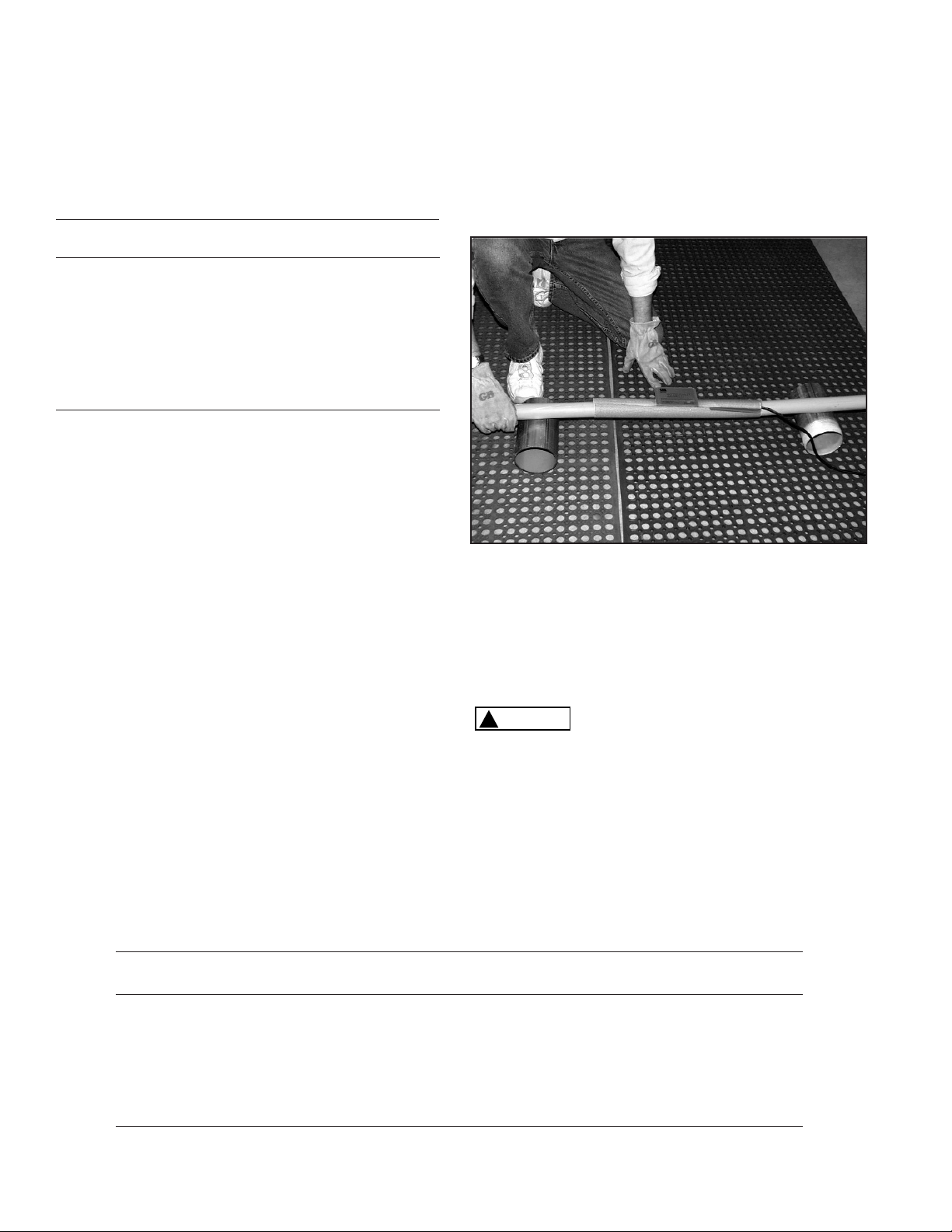
PVC Bender Blankets are used for making offset, kick
and 90
o
bends on PVC conduit through schedule 40.
Three models of blankets are available to bend
1
⁄2"
through 4" pipe. Smaller,
1
⁄2" through 2" pipe, will bend to
90
o
in one bend. Larger sizes, 2" through 4", require a
series of smaller bends to reach a full 90
o
. See table “A”
for maximum bend angles in one bend.
Time required to heat pipe to bendable temperatures
will vary with air temperature, wind conditions and line
voltage. Typical warm-up times are shown in table “B”.
During warm-up nothing should touch the blanket
surfaces. Support PVC off the ground on each end.
Do not allow blanket to touch supports.
When bending pipe outdoors, plug both ends to prevent
wind from entering and cooling pipe. Wrap the blanket
around the pipe with the open edges on the bottom and
overlapped or butted together.
Support each PVC end off the ground. Temperatures
below 72
o
F. will lengthen heating time. Check pipe
flexibility every few minutes to determine when pipe is
soft enough to bend.
Bending
1
⁄2" through 1
1
⁄2" PVC
1. Select pipe length and determine location for bend,
and degree of bend needed. Bending pipe on wood
sheets prevents rapid cool-down.
2. Open the blanket and place it around the pipe. Be sure
the exact area to be bent is covered. Very little heat is
conducted beyond the edge of the blanket. Position the
cord
(
thermostat end
)
on bottom of pipe.
3. Plug power cord in a 120V AC outlet. Wait 4 or 5
minutes, then check pipe flexibility by trying to bend it.
If pipe resists bending, leave blanket on for 2 or 3
minutes longer. When the pipe bends easily, remove
and unplug the blanket.
Wear protective gloves when handling
the blanket and PVC pipe.
Table B
Electrical Pipe Approximate
Pipe Size Required Support Warm-up Time
1
⁄2" through 1
1
⁄2" 120V - 310 W Wood Blocks - each end 4 to 10 min.
2" 120V - 690 W Wood Blocks - each end 7 to 10 min.
3" 120V - 690 W Wood Blocks - each end 12 to 17 min.
3
1
⁄2" 120V - 1120 W Wood Blocks - each end 15 to 18 min.
4" 120V - 1120 W Wood Blocks - each end 18 to 22 min.
Note: To achieve optimum blanket life, remove blanket carefully by using metal tab to lift blanket. Allow blanket to
cool for 10 minutes before using again. Bender blankets are primarily designed as a custom bending tool, not as a
high production tool. Life cycles of 150 bends are average. Depending on how carefully the blankets are used and
handled, more or less cycles may result.
Table A
Blanket Pipe
Model No. Size Bend Angles
BB5150
1
⁄2" - 1
1
⁄2"90
o
in one bend
BB2030 2" 90
o
in one bend
2
1
⁄2" - 3" 45
o
in one bend
BB3040 3" 90
o
in one bend
3
1
⁄2"60
o
in one bend
4" 30
o
in one bend
!
WARNING
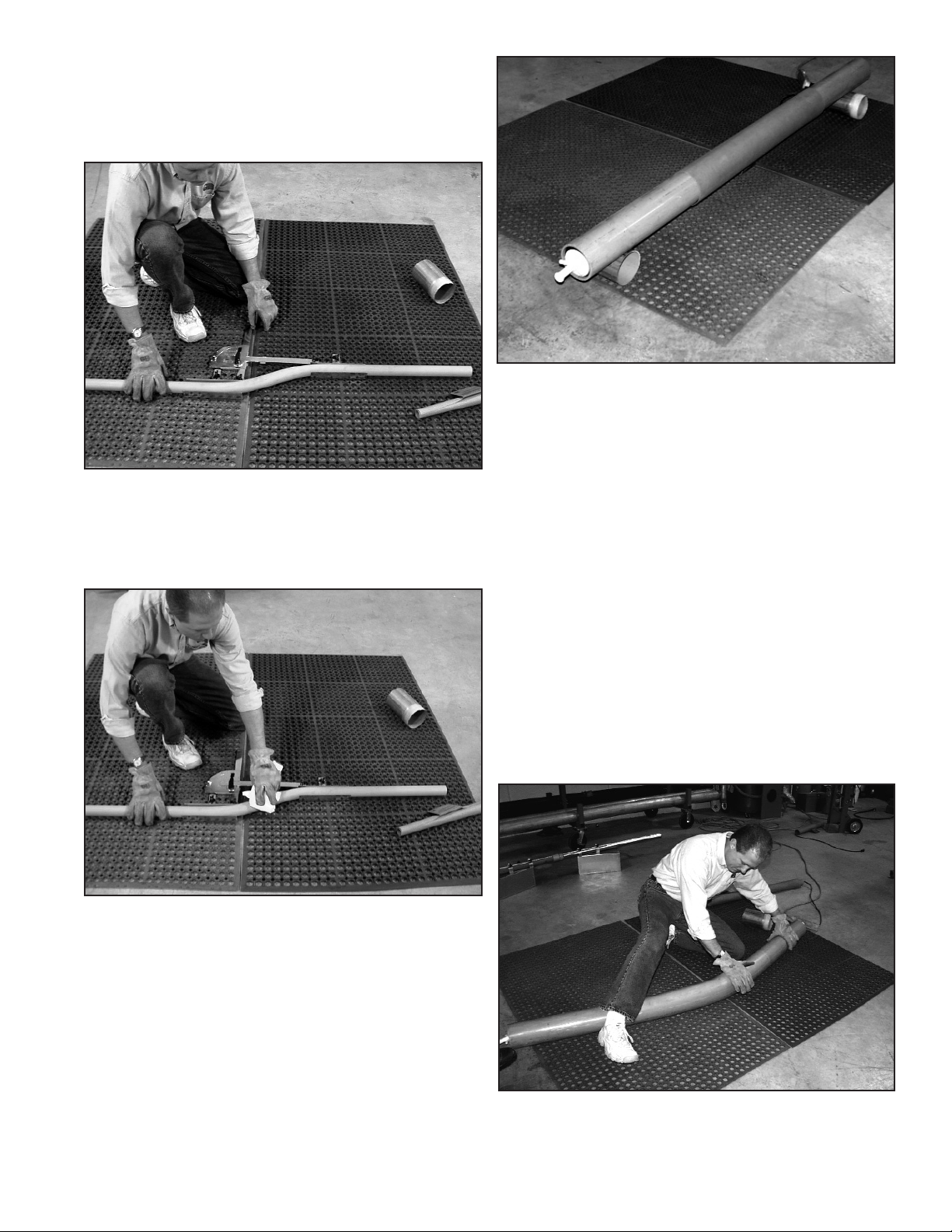
4. Bend pipe to the desired angle. Remove kinks or
ripples by pressing them flat then applying pressure to
the side of the flattened area. Work pipe until smooth
bend is complete. Use bend guide
(
BG-520
)
for more
precise control of angular and offset bends.
5. Hold the pipe in the bent position until the bend is set
and the pipe has cooled enough to handle without
gloves. Wipe pipe with a wet rag to set the bend and
cool the pipe.
Note: Remove kinks or ripples prior to cooling pipe.
After the pipe is cool the bent area cannot be heated
again and reformed.
Bending 2" through 4"
1. Wrap blanket around pipe. On large diameter pipe,
position blanket overlap on bottom of the pipe.
2. Support PVC on each end to lift off of the ground. Be
sure the blanket is not touching the supports. Any
object touching the blanket will produce a hot spot and
scorch the pipe.
3. Plug blanket cord in a receptacle. Check table “B” for
correct electrical source by blanket size. Allow 10 to 15
minutes for pipe to warm up. Check pipe flexibility by
pressing area within the blanket. When pipe feels very
soft, it is hot enough to form the bend.
Note: When bending pipe outdoors, cap or plug
both ends to prevent wind from entering and cooling
pipe while blanket is trying to heat. Use PVC pipe
plugs while heating and bending PVC sizes over 1
1
⁄2".
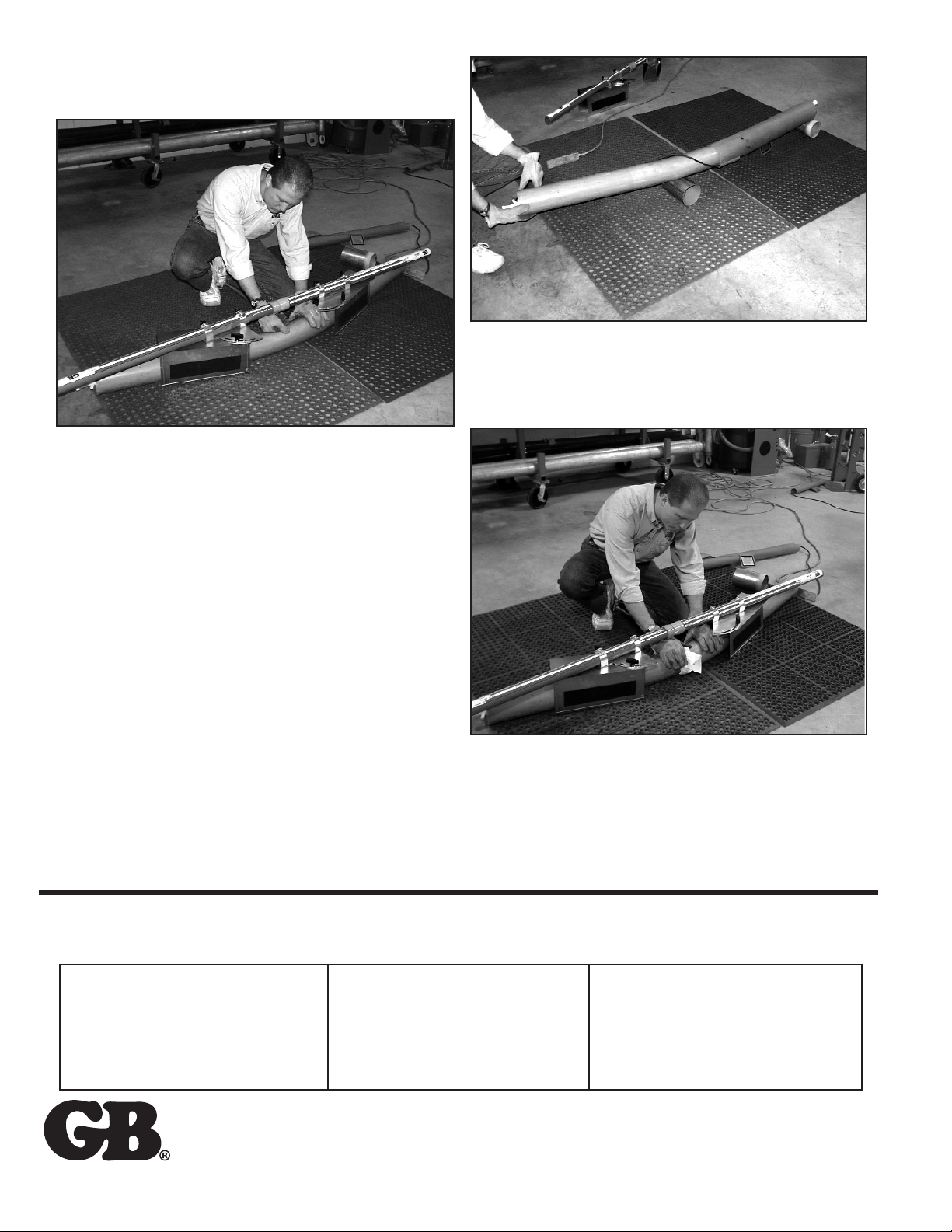
4. When pipe reaches maximum flexibility, remove and
unplug the blanket. Place pipe on wood sheet, not on
concrete floor. Begin forming the bend working from
the start of the bend and gradually completing the
entire angle. Large diameter PVC may be difficult to
handle and may require two people to make the
desired bend.
WARRANTY: GB ELECTRICAL, INC.
warrants its
products against defects in workmanship and
materials for 90 days from date of delivery to user.
Chain is not warranted. Warranty does not cover
ordinary wear and tear, abuse, misuse, overloading,
altered products or use of improper fluid.
WARRANTY RETURN PROCEDURE: When question
of warranty claim arises, send the unit to the nearest
GB Authorized Service Center for inspection,
transportation prepaid. Furnish evidence of purchase
date. If the claim comes under the terms of our
warranty the Authorized Service Center will REPAIR
OR REPLACE PARTS AFFECTED and return the unit
prepaid.
PARTS AND SERVICE: For quality workmanship and
genuine GB ELECTRICAL parts, select an Authorized
GB Service Center for your repair needs. Only
repairs performed by an Authorized Service Center
displaying the official GB Authorized sign are backed
with full factory warranty. Contact GB Electrical
(414) 352-4160 for the name of the nearest GB
Authorized Service Center.
REPAIR AND SERVICE INSTRUCTIONS: For repair service and parts contact your nearest GB ELECTRICAL
Service Center. The Service Center will provide complete and prompt service on all GB ELECTRICAL products.
GB Electrical, Inc.
An Applied Power Company
PO Box 3241 Milwaukee, WI 53201-3241 | www.gardner
bender.com
Phone: 800.624.4320 | FAX 262.293.7022
RPS-0044 Rev. A 03/07
5. Use of a bending guide
(
BG-560
)
is recommended for
more precise control of the bend angle.
6. Do not attempt to form the entire bend in one motion.
Large pipe tends to kink and ripple during a bend. As
the bend is formed, remove kinks immediately by
pressing them flat and reshaping the pipe to maintain
a round, smooth bend. If pipe begins to cool and set,
complete as much of the bend as possible. Reheat the
pipe portion for the remaining bend and proceed to
finish the bend.
(
Each operator will develop a
technique after a few bends.
)
Check table “A” for
maximum bend angles obtainable in one attempt. Most
larger pipe will require a series of bends to obtain 45
o
or larger bends.
Note: Once a bend is set and cooled, the bent
portion cannot be reheated and reformed. The
blanket is only effective on straight pipe.
7. Cool pipe and set bends by wiping exterior surfaces
with a cool wet rag. Do not install pipe until completely
cooled to permit handling without gloves.