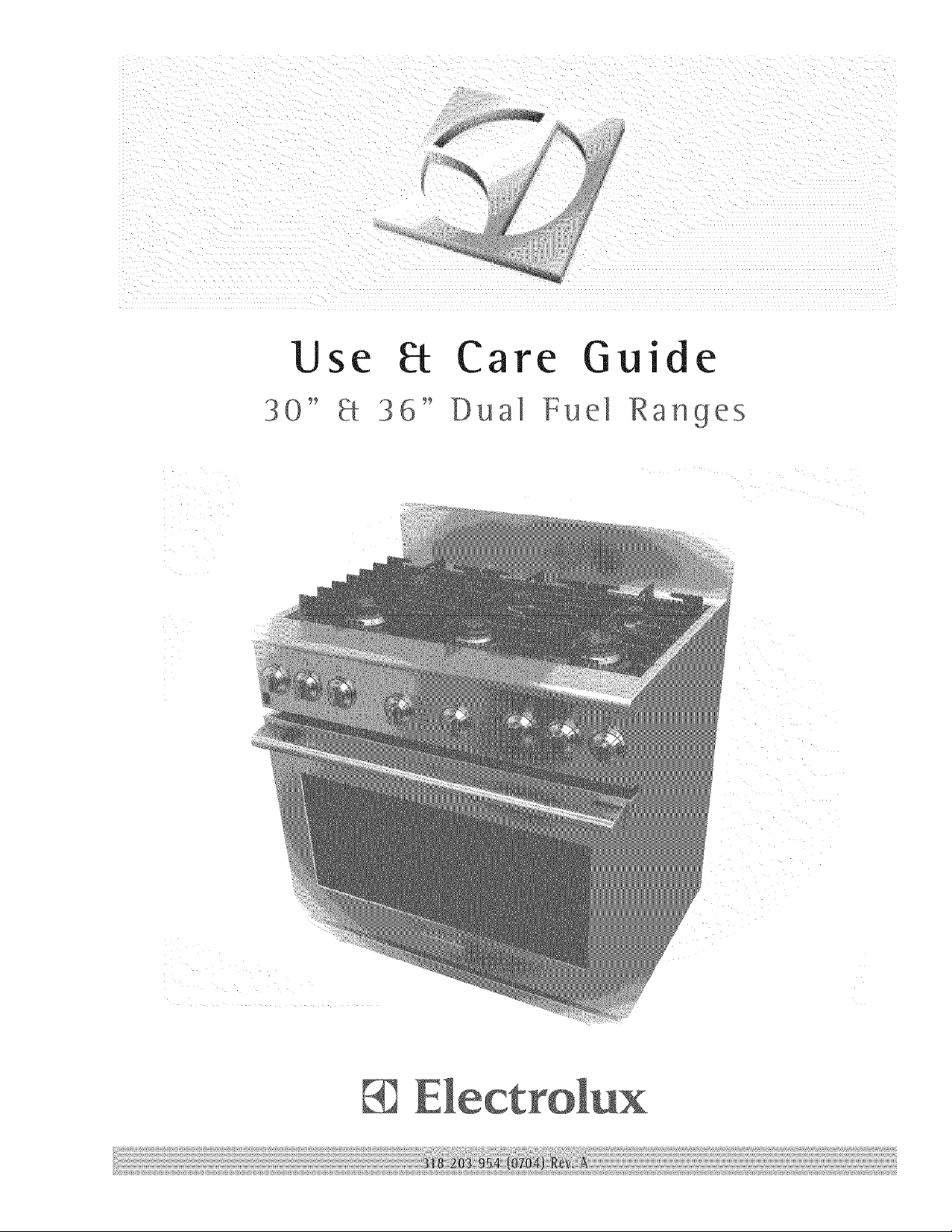
Use _ Care Guide
30" _ 36" Dual Fuel Ranges
Finding information
MAKEA RECORDFORFUTUREUSE
[] [] [] [] [] [] [] [] [] [] [] [] [] [] [] [] [] [] [] [] [] []
Brand
Purchase Date
Model Number
Serial Number
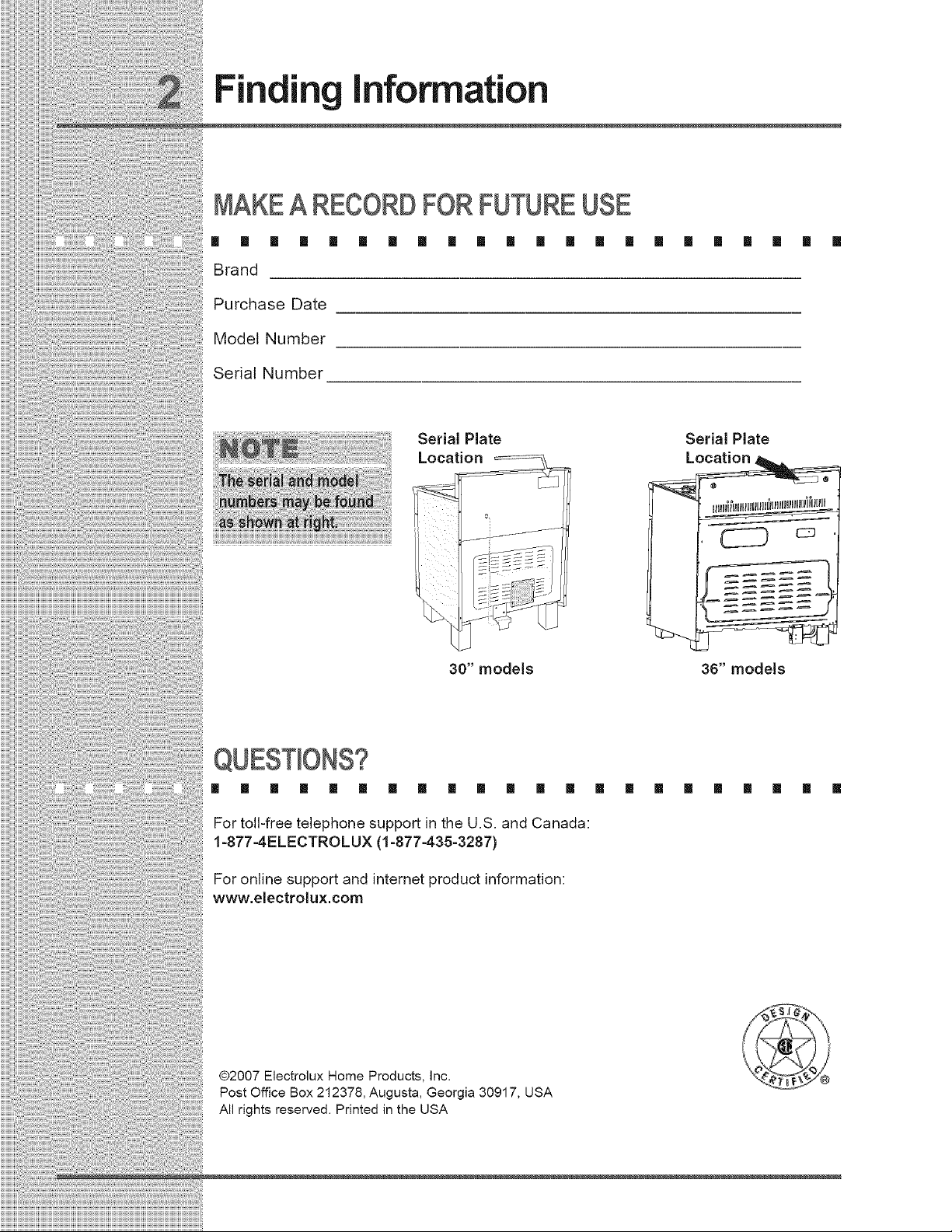
Serial Plate Serial Plate
Location Location
30" models
=================I
[] [] [] [] [] [] [] [] [] [] [] [] [] [] [] [] [] [] [] [] [] []
For toll-free telephone support in the U.S. and Canada:
1-877-4ELECTROLUX (1-877-435-3287)
For online support and internet product information:
www.electrolux.com
@2007 Electrolux Home Products, inc.
Post Office Box 212378, Augusta, Georgia 30917, USA
All rights reserved. Printed in the USA
Finding information
TABLE OF CONTENTS
[] [] [] [] [] [] [] [] [] [] [] [] [] [] [] [] [] [] [] [] [] []
Finding Information ...........................................2-3 Care & Cleaning .............................................26-33
Makea Recordfor Futureuse ................................2 Usingthe Self-CleanFeature................................26
Questions?..............................................................2 Startingthe OvenSelf-CleanCycle......................27
..... GeneralCleaning..................................................28
_are_y..................................................................4-_ Cleaningthe BurnerGrates BurnerCaps Burner
ImportantSafety Instructions..................................4 Heads SimmerPlateandGriddle........................29
Getting Start ..........................................................9 CooktopCleaningand Maintenance.....................30
LiquefiedPetroleum(Propane)Gas Conversion.... 9 Cleaningrecommendationsfor the Ceramic
GlassCooktop .................................................30-31
Range Features ..............................................10-1! CareandCleaningof StainlessSteel...................31
30 RangeFeatures..............................................10 ToRemoveand Replacethe OvenDoor ..............32
36 RangeFeatures..............................................11 SpecialDoorCare Instructions.............................32
Surface Cooking ............................................12-17 OvenUght.............................................................33
Flamesize.............................................................12 Solutions to Common Problems ..................34-37
ProperBurnerAdjustment.....................................12 SurfaceBurnersDo NotLight...............................34
BurnerLocations...................................................12 BurnerFlameonlyLights HalfWay ....... ....
Placementof BurnerHeadsandCaps .................13 AroundBurner.......................................................34
Placementof BurnerGrates.................................13
SurfaceCookingUtensils......................................14
Usingthe Griddle..................................................14
Usingthe WokStand ............................................15
Usingthe SimmerPlate ........................................10
SettingSurfaceControls.......................................17
Getting Started ...............................................18-19
BeforeSettingOvenControls..........................18-19
Setting the Oven Controls ............................20-25
OvenControlFeatures..........................................20
Baking...................................................................20
BakingProblems...................................................21
ConvectionBaking................................................22
ConvectionRoasting.............................................22
BreadProofFeature .............................................23
Warm& Hold Feature...........................................23
Broiling..................................................................24
SettingBroil...........................................................25
BurnerFlameis Orange........................................34
ScratchesorAbrasionson CeramicGlassCooktop
Surface..................................................................34
MetalMarksonCeramicGlassCooktopSurface...35
BrowStreaksandSpeckson CeramicGlass
CooktopSurface...................................................35
Areasof DiscolorationonCeramicGlassCooktop
Surface..................................................................35
Appliancenot Level...............................................35
PoorBakingResults .............................................35
EntireOven DoesNotOperate.............................30
OvenLight DoesNotWork ...................................30
FanNoiseDuringCookingOperation...................30
OvenSmokesExcessivelyDuringBroiling...........36
Self-CleaningCycleDoesNot Work.....................37
Soil NotCompletelyRemovedAfter Self-Cleaning
Cycleis Completed...............................................37
FlamesInsideOvenor SmokeFromVent............37
Warranty Information..........................................38
Safety
IMPORTANTSAFE INSTRUCTIONS
[] [] [] [] [] [] [] [] [] [] [] [] [] [] [] [] [] [] [] [] []
This manual contains important safety symbols and instructions. Please pay attention to these
symbols and follow all instructionsgiven.
Remove all tape and packaging wrap before using the appliance. Destroy the carton
and plastic bags after unpacking the appliance. Never allow children to play with
packaging material.
Proper Installation-Be sure your appliance is properly installed and grounded by a
qualified technician in accordance with the National Fuel Gas Code ANSI Z223.1--
latest edition in the United States, or in Canada CAN/CGA B149.1, and CAN/CGA
B149.2, and the National Electrical Code ANSl/NFPA No. 70--latest edition in United
States, or in Canada CSA Standard C22.1, Canadian Electrical Code, Part 1, and local
code requirements. Install and/or adjust only per installation instructions provided in the
literature package for this range.
in case of an emergency, know how to disconnect the electrical power to the
appliance at the circuit breaker or fuse box and how to turn off the gas supply at
the main shut off valve.
Safety
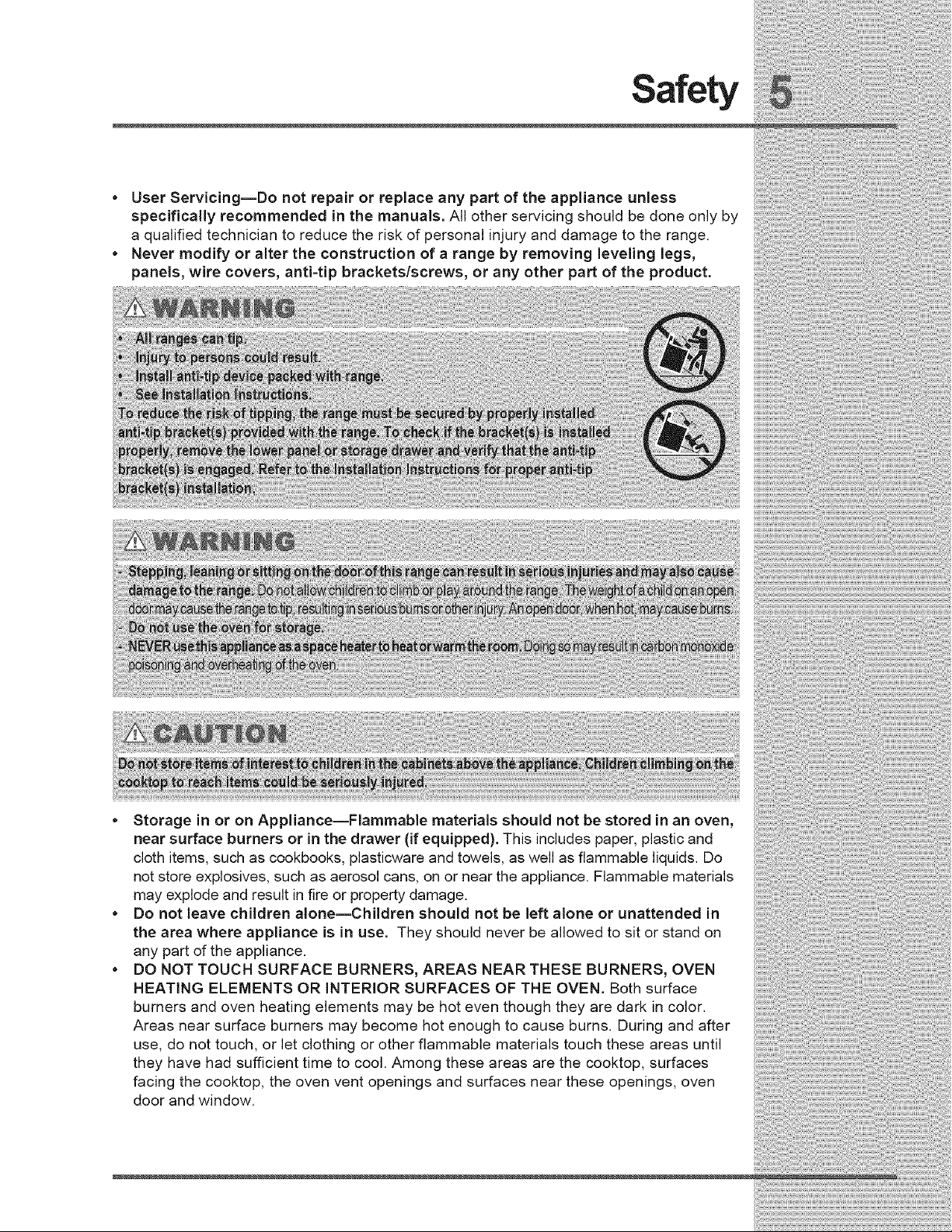
, User Servicing--Do not repair or replace any part of the appliance unless
specifically recommended in the manuals. All other servicing should be done only by
a qualified technician to reduce the risk of personal injury and damage to the range.
• Never modify or alter the construction of a range by removing leveling legs,
panels, wire covers, anti-tip brackets/screws, or any other part of the product.
• Storage in or on Appliance--Flammable materials should not be stored in an oven,
near surface burners or in the drawer (if equipped). This includes paper, plastic and
cloth items, such as cookbooks, plasticware and towels, as well as flammable liquids. Do
not store explosives, such as aerosol cans, on or near the appliance. Flammable materials
may explode and result in fire or property damage.
• Do not leave children alone--Children should not be left alone or unattended in
the area where appliance is in use. They should never be allowed to sit or stand on
any part of the appliance.
, DO NOT TOUCH SURFACE BURNERS, AREAS NEAR THESE BURNERS, OVEN
HEATING ELEMENTS OR INTERIOR SURFACES OF THE OVEN. Both surface
burners and oven heating elements may be hot even though they are dark in color.
Areas near surface burners may become hot enough to cause burns. During and after
use, do not touch, or let clothing or other flammable materials touch these areas until
they have had sufficient time to cool. Among these areas are the cooktop, surfaces
facing the cooktop, the oven vent openings and surfaces near these openings, oven
door and window.
6 Safety
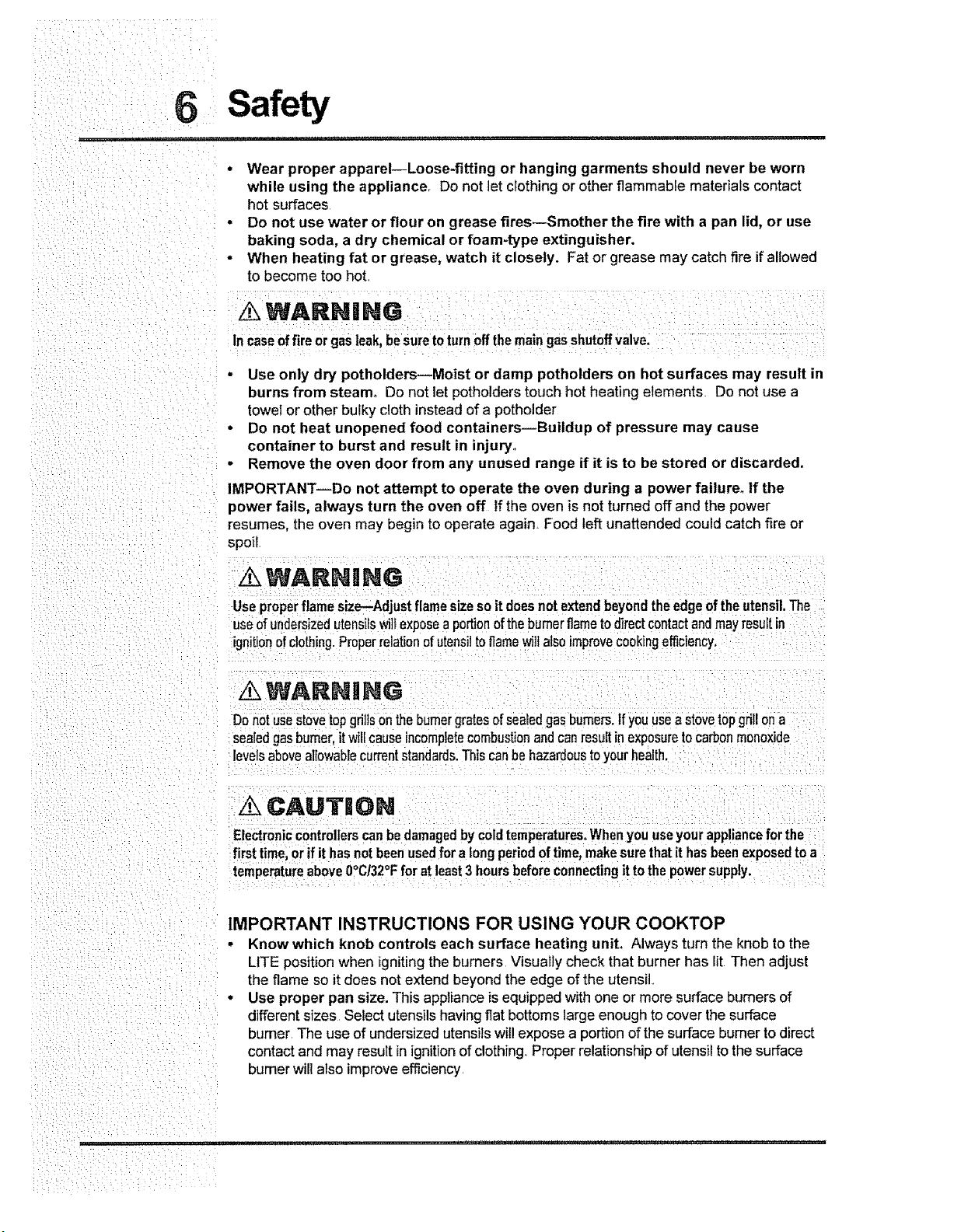
Wear proper apparel--Loose-fitting or hanging garments should never be worn
while using the appliance. Do not let c_othingor other flammable materials contact
hot surfaces
Do not use water or flour on grease fires--Smother the fire with a pan lid, or use
baking soda, a dry chemical or foam-type extinguisher.
When heating fat or grease, watch it closely. Fat or grease may catch fire if allowed
to become too hot
WARN| NG
Incaseoffire orgasleak,besureto turnoffthemaingasshutoffvalve.
• Use only dry potholders--Moist or damp potholders on hot surfaces may result in
burns from steam° Do not let potholders touch hot heating elements Do not use a
towel or other bulky cloth instead of a potholder
• Do not heat unopened food containers--Buildup of pressure may cause
container to burst and result in injury°
• Remove the oven door from any unused range if it is to be stored or discarded.
IMPORTANT--Do not attempt to operate the oven during a power failure. If the
power fails, always turn the oven off If the oven is not turned off and the power
resumes, the oven may begin to operate again, Food left unattended could catch fire or
spoil
WARN I NG
Use properflamesize--Adjustflame sizeso it doesnotextendbeyondtheedgeof theutensil.The
useof undersizedutensilswi]fexposeaportionofthe burnerflameto directcontactandmayresultin
ignitionof clothing.Properrelationofutensiltoflamewilt alsoimprovecookingefficiency,
WARN aNG
Donotusestovetopgrillsontheburnergralesof sealedgas burners,ifyouusea stovetopgrill ona
sealedgasburner,it will causeincampletecombustionandcanresultin exposuretocarbonmonoxide
levelsaboveallowablecurrentstandards.This canbe hazardoustoyourhealth.
CAUTION
Electroniccontrollerscanbedamagedby coldtemperatures.Whenyou useyourappliancefor the
first time,or if it hasnotbeenusedfor a longperiodoftime,makesurethatit hasbeenexposedto a
temperatureabove0°C/32°Ffor atleast3 hoursbeforeconnectingit to thepowersupply.
IMPORTANT INSTRUCTIONS FOR USING YOUR COOKTOP
Know which knob controls each surface heating unit. Always turn the knob to the
LITE position when ignitingthe burners Visuatly check that burner has lit Then adjust
the flame so it does not extend beyond the edge of the utensii
Use proper pan size. This appliance is equipped with one or more surface burners of
different sizes Select utensils having flat bottoms large enough to cover the surface
burner The use of undersized utensils wil! expose a portion of the surface burner to direct
contact and may result in ignitionof clothing Proper relationship of utensil to the surface
burner will also improve efficiency
Safety
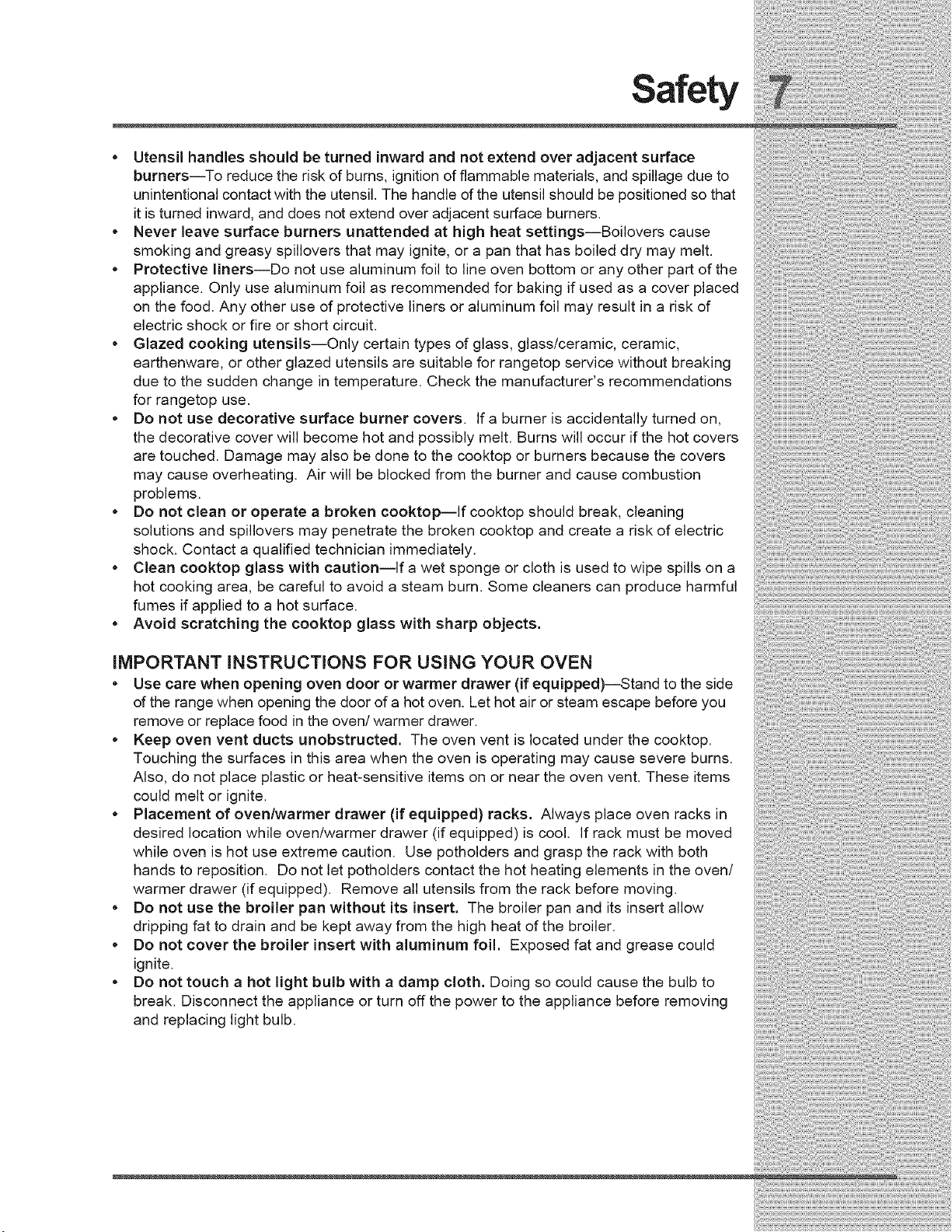
. Utensil handles should be turned inward and not extend over adjacent surface
burners--To reduce the risk of burns, ignition of flammable materials, and spillage due to
unintentional contact with the utensil. The handle of the utensil should be positioned so that
it is turned inward, and does not extend over adjacent surface burners.
. Never leave surface burners unattended at high heat settings--Boilovers cause
smoking and greasy spillovers that may ignite, or a pan that has boiled dry may melt.
. Protective liners--Do not use aluminum foil to line oven bottom or any other part of the
appliance. Only use aluminum foil as recommended for baking if used as a cover placed
on the food. Any other use of protective liners or aluminum foil may result in a risk of
electric shock or fire or short circuit.
. Glazed cooking utensils--Only certain types of glass, glass/ceramic, ceramic,
earthenware, or other glazed utensils are suitable for rangetop service without breaking
due to the sudden change in temperature. Check the manufacturer's recommendations
for rangetop use.
• Do not use decorative surface burner covers, if a burner is accidentally turned on,
the decorative cover will become hot and possibly melt. Burns will occur if the hot covers
are touched. Damage may also be done to the cooktop or burners because the covers
may cause overheating. Air will be blocked from the burner and cause combustion
problems.
• Do not clean or operate a broken cooktop--lf cooktop should break, cleaning
solutions and spillovers may penetrate the broken cooktop and create a risk of electric
shock. Contact a qualified technician immediately.
. Clean cooktop glass with caution--if a wet sponge or cloth is used to wipe spills on a
hot cooking area, be careful to avoid a steam burn. Some cleaners can produce harmful
fumes if applied to a hot surface.
. Avoid scratching the cooktop glass with sharp objects.
IMPORTANT INSTRUCTIONS FOR USING YOUR OVEN
. Use care when opening oven door or warmer drawer (if equipped)--Stand to the side
of the range when opening the door of a hot oven. Let hot air or steam escape before you
remove or replace food in the oven/warmer drawer.
• Keep oven vent ducts unobstructed. The oven vent is located under the cooktop.
Touching the surfaces in this area when the oven is operating may cause severe burns.
Also, do not place plastic or heat-sensitive items on or near the oven vent. These items
could melt or ignite.
• Placement of ovenlwarmer drawer (if equipped) racks. Always place oven racks in
desired location while oven/warmer drawer (if equipped) is cool. if rack must be moved
while over] is hot use extreme caution. Use potholders and grasp the rack with both
hands to reposition. Do not let potholders contact the hot heating elements in the oven/
warmer drawer (if equipped). Remove all utensils from the rack before moving.
. Do not use the broiler pan without its insert. The broiler pan and its insert allow
dripping fat to drain and be kept away from the high heat of the broiler.
• Do not cover the broiler insert with aluminum foil. Exposed fat and grease could
ignite.
. Do not touch a hot light bulb with a damp cloth. Doing so could cause the bulb to
break. Disconnect the appliance or turn off the power to the appliance before removing
and replacing light bulb.
Safety
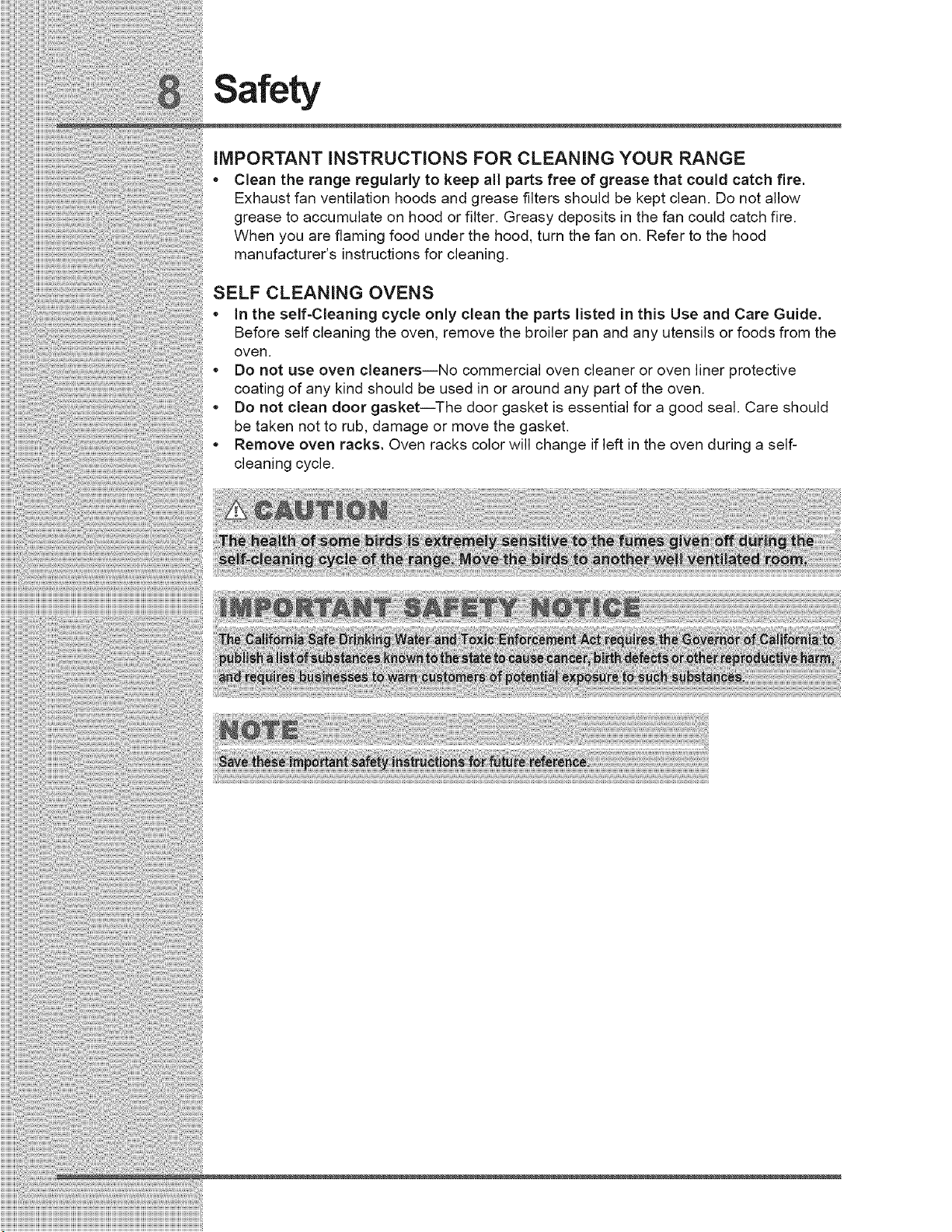
IMPORTANT INSTRUCTIONS FOR CLEANING YOUR RANGE
Clean the range regularly to keep all parts free of grease that could catch fire.
Exhaust fan ventilation hoods and grease filters should be kept clean. Do not allow
grease to accumulate on hood or filter. Greasy deposits in the fan could catch fire.
When you are flaming food under the hood, turn the fan on. Refer to the hood
manufacturer's instructions for cleaning.
SELF CLEANING OVENS
• In the self-Cleaning cycle only clean the parts listed in this Use and Care Guide.
Before self cleaning the oven, remove the broiler pan and any utensils or foods from the
oven.
Do not use oven cleaners--No commercial oven cleaner or oven liner protective
coating of any kind should be used in or around any part of the oven,
Do not clean door gasket--The door gasket is essential for a good seal, Care should
be taken not to rub, damage or move the gasket,
Remove oven racks. Oven racks color will change if left in the oven during a self-
cleaning cycle.
LIQUEFIED PETROLEUM (PROPANE) GAS
[] [] [] [] [] [] [] [] [] [] [] [] [] [] [] [] [] [] [] [] [] []
This appliance can be used with Natural Gas and Propane Gas. It is shipped from the
factory for use with natural gas.
A kit for converting to LP gas is supplied with your cooktop. The kit is marked "FOR LP/
PROPANE GAS CONVERSION". Follow the installation instructions which are inside the
envelope.
The conversion must be performed by a qualified service technician in accordance with
the kit instructions and all local codes and requirements. Failure to follow instructions
could result in serious injury or property damage. The qualified agency performing this
work assumes responsibility for the conversion.
Range Features
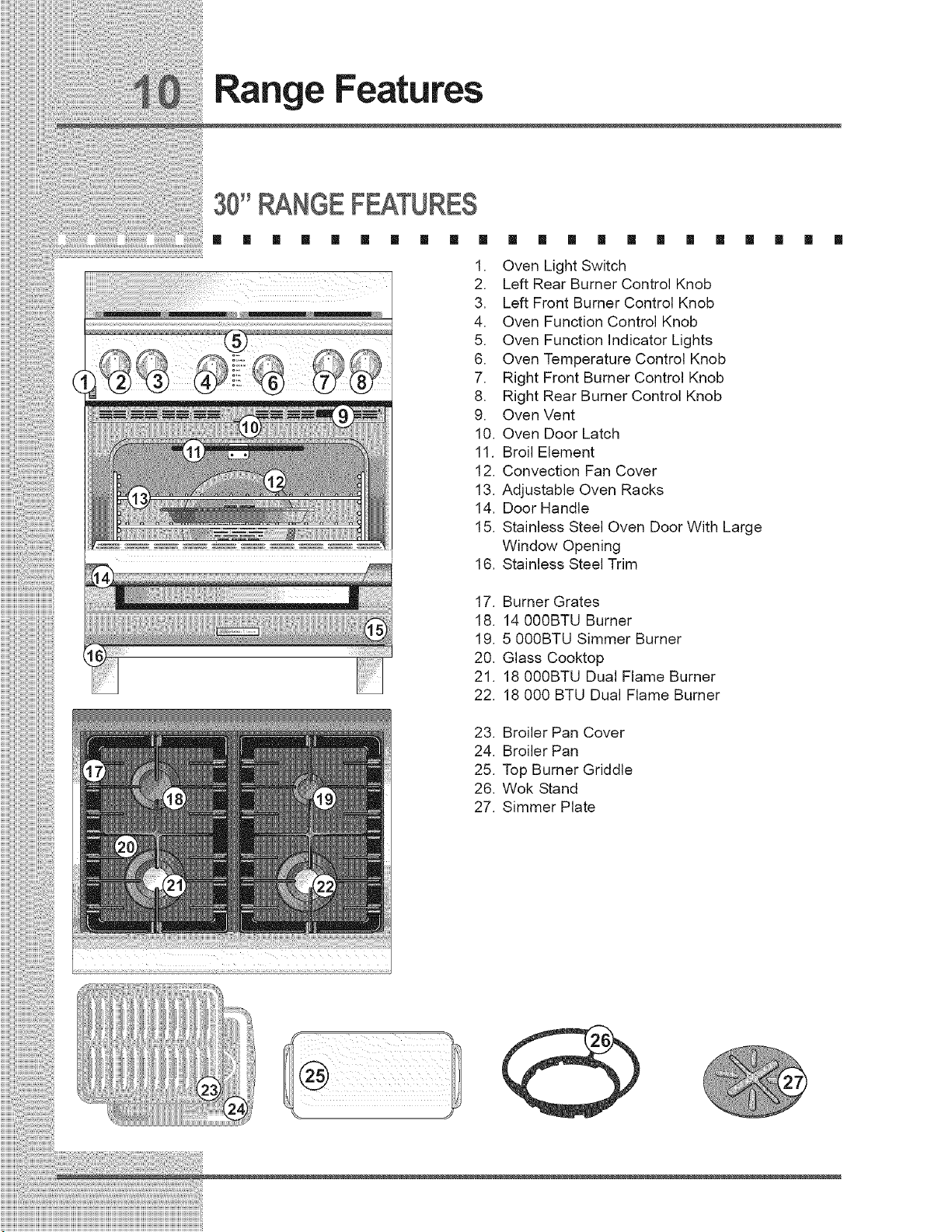
30" NGE FEATURES
[] [] [] [] [] [] [] [] [] [] [] [] [] [] [] [] []
1. Oven Light Switch
2. Left Rear Burner Control Knob
3. Left Front Burner Control Knob
4. Oven Function Control Knob
5. Oven Function Indicator Lights
6. Oven Temperature Control Knob
7. Right Front Burner Control Knob
8. Right Rear Burner Control Knob
9. Oven Vent
10. Oven Door Latch
11. Broil Element
12. Convection Fan Cover
13. Adjustable Oven Racks
14, Door Handle
15. Stainless Steel Oven Door With Large
Window Opening
16. Stainless Steel Trim
17. Burner Grates
18. 14 000BTU Burner
19. 5 000BTU Simmer Burner
20. Glass Cooktop
21. 18 000BTU Dual Flame Burner
22. 18 000 BTU Dual Flame Burner
23. Broiler Pan Cover
24. Broiler Pan
25. Top Burner Griddle
26. Wok Stand
27. Simmer Plate
[] [] [] []
Range Features
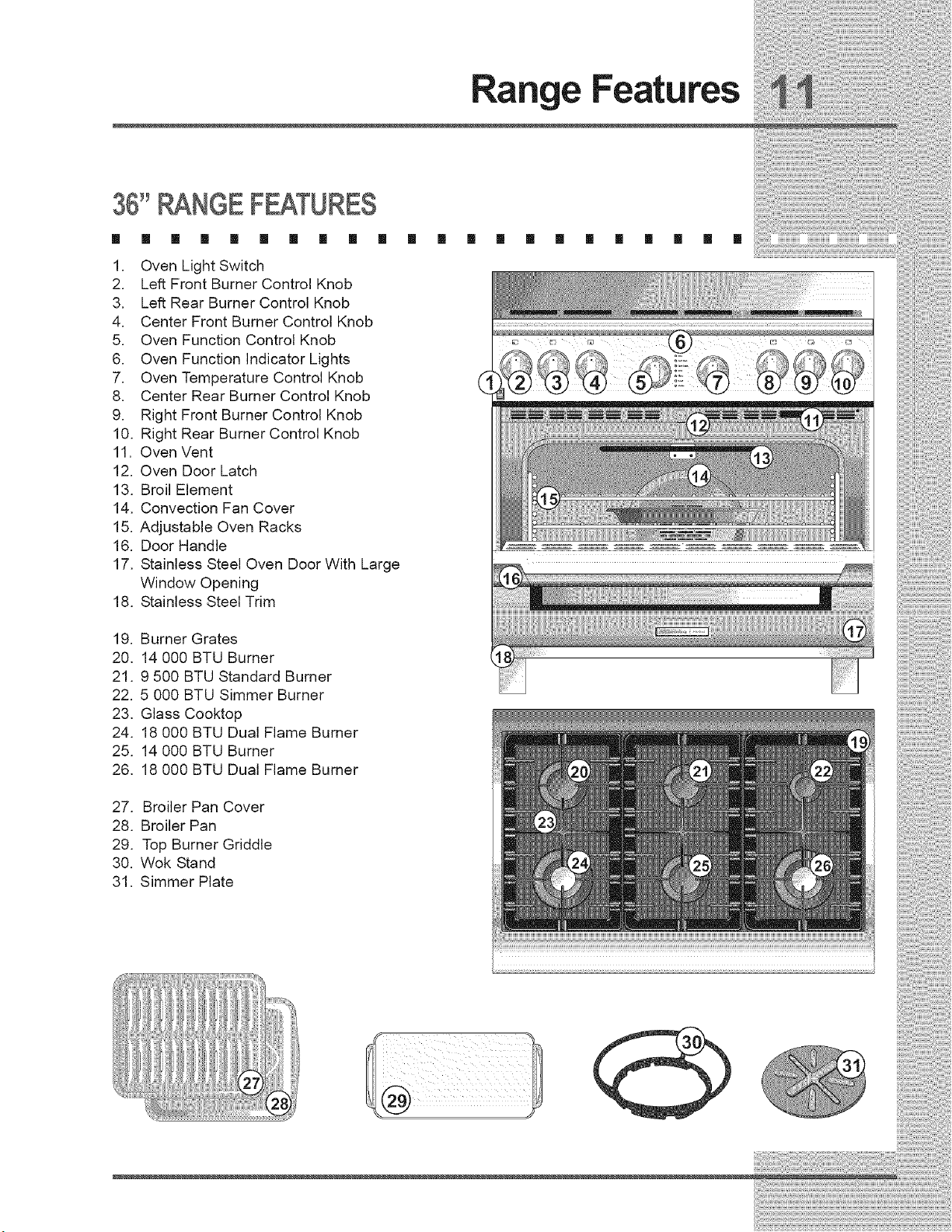
36" NGE FEATURES
[] [] [] [] [] [] [] [] []
1. Oven Light Switch
2. Left Front Burner Control Knob
3. Left Rear Burner Control Knob
4. Center Front Burner Control Knob
5. Oven Function Control Knob
6. Oven Function Indicator Lights
7. Oven Temperature Control Knob
8. Center Rear Burner Control Knob
9. Right Front Burner Control Knob
10. Right Rear Burner Control Knob
11. Oven Vent
12. Oven Door Latch
13. Broil Element
14. Convection Fan Cover
15. Adjustable Oven Racks
16. Door Handle
17. Stainless Steel Oven Door With Large
Window Opening
18. Stainless Steel Trim
19. Burner Grates
20. 14 000 BTU Burner
21. 9 500 BTU Standard Burner
22. 5 000 BTU Simmer Burner
23. Glass Cooktop
24. 18 000 BTU Dual Flame Burner
25. 14 000 BTU Burner
26. 18 000 BTU Dual Flame Burner
27. Broiler Pan Cover
28. Broiler Pan
29. Top Burner Griddle
30. Wok Stand
31. Simmer Plate
[] [] [] [] [] [] [] [] [] [] [] []
Surface Cooking
FLAMES(ZE
Ill [] [] [] [] [] [] [] [] [] [] [] [] [] [] [] [] [] [] [] [] []
For most cooking, start on the highest control setting and then turn to a lower one to
complete the process. Use the chart below as a guide for determining proper flame size
for various types of cooking. The size and type of utensil used and the amount of food
being cooked will influence the setting needed for cooking.
For deep fat frying, use a thermometer and adjust the surface control knob accordingly.
If the fat is too cool, the food will absorb the fat and be greasy. If the fat is too hot, the food
will brown so quickly that the center will be undercooked. Do not attempt to deep fat fry too
much food at once as the food will neither brown nor cook properly.
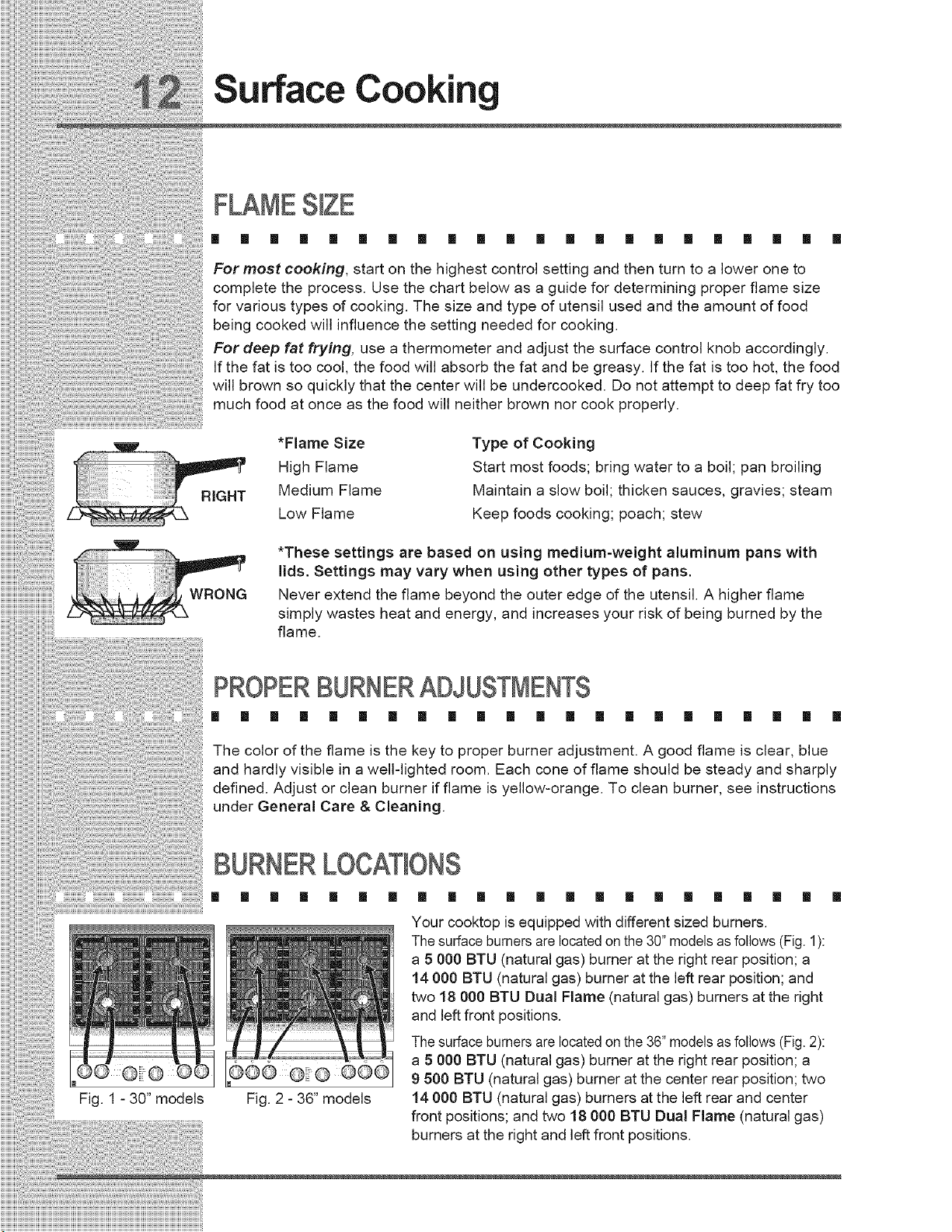
Fig. 1 - 30" models
*Flame Size
High Flame
Medium Flame
Low Flame
Type of Cooking
Start most foods; bring water to a boil; pan broiling
Maintain a slow boil; thicken sauces, gravies; steam
Keep foods cooking; poach; stew
*These settings are based on using medium-weight aluminum pans with
lids. Settings may vary when using other types of pans.
Never extend the flame beyond the outer edge of the utensil. A higher flame
simply wastes heat and energy, and increases your risk of being burned by the
flame.
PROPERBURNERADJUSTMENTS
[] [] [] [] [] [] [] [] [] [] [] [] [] [] [] [] [] [] [] [] [] []
The color of the flame is the key to proper burner adjustment. A good flame is clear, blue
and hardly visible in a well-lighted room. Each cone of flame should be steady and sharply
defined. Adjust or clean burner if flame is yellow-orange. To clean burner, see instructions
under General Care & Cleaning.
BURNERLOCAT)ONS
[] [] [] [] [] [] [] [] [] [] [] [] [] [] [] [] [] [] [] [] [] []
@@@ @j@ @@@
Fig. 2 - 36" models
Your cooktop is equipped with different sized burners.
The surface burners are locatedon the 30" modelsas follows (Fig. I ):
a 5 000 BTU (natural gas) burner at the right rear position; a
14 000 BTU (natural gas) burner at the left rear position; and
two 18 000 BTU Dual Flame (natural gas) burners at the right
and left front positions.
The surface burners are locatedon the 36" modelsas follows (Fig. 2):
a 5 000 BTU (natural gas) burner at the right rear position; a
9 500 BTU (natural gas) burner at the center rear position; two
14 000 BTU (natural gas) burners at the left rear and center
front positions; and two 18 000 BTU Dual Flame (natural gas)
burners at the right and left front positions.
Surface Cooking
P CEMENT OF BURNERHEADSAND CAPS
[] [] [] [] [] [] [] [] [] [] [] [] [] [] [] [] [] [] [] [] [] []
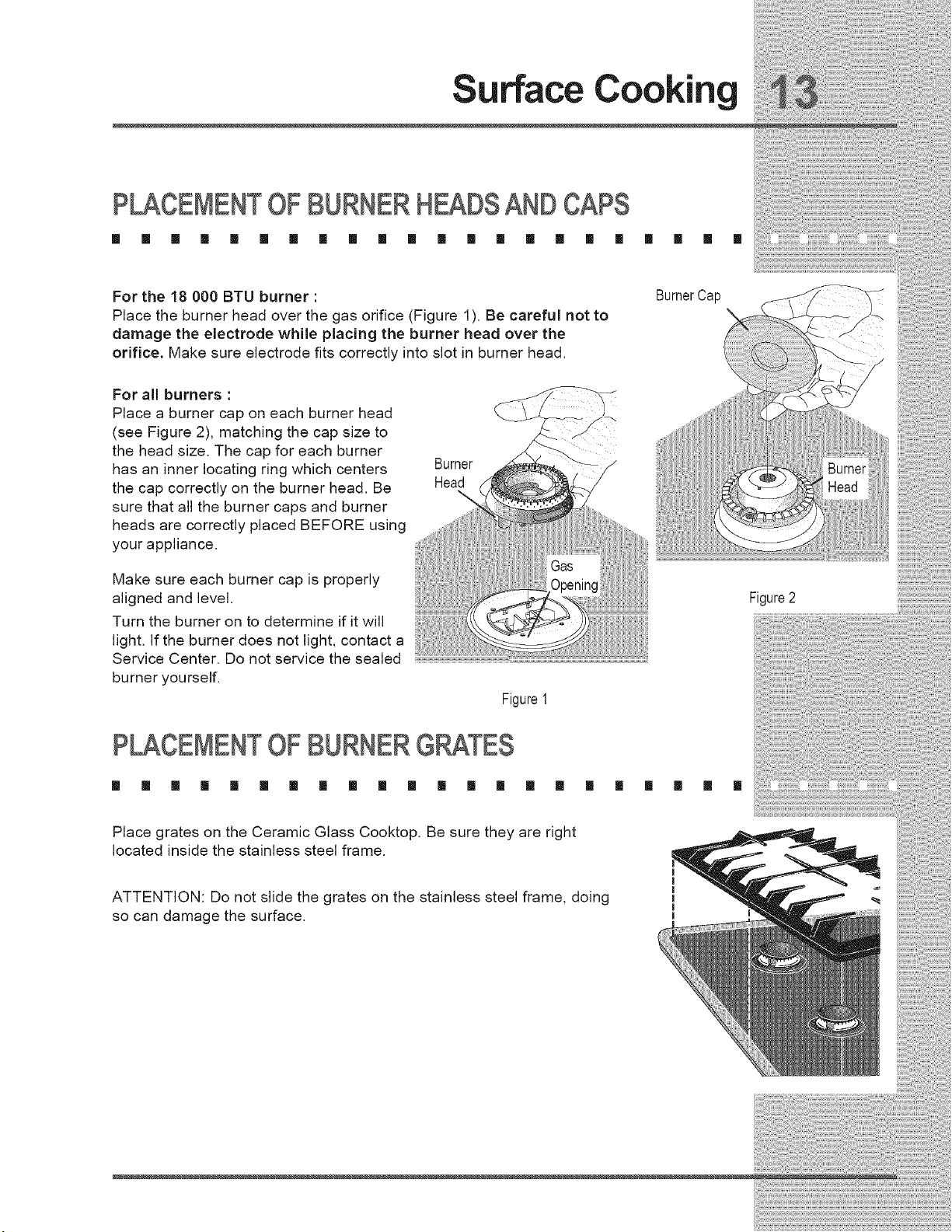
For the 18 000 BTU burner :
Place the burner head over the gas orifice (Figure 1). Be careful not to
damage the electrode while placing the burner head over the
orifice. Make sure electrode fits correctly into slot in burner head.
For all burners :
Place a burner cap on each burner head
(see Figure 2), matching the cap size to
the head size. The cap for each burner
has an inner locating ring which centers
the cap correctly on the burner head. Be
sure that all the burner caps and burner
heads are correctly placed BEFORE using
your appliance.
Make sure each burner cap is properly
aligned and level.
Turn the burner on to determine if it will
light. If the burner does not light, contact a
Service Center. Do not service the sealed
burner yourself.
Burner
Head
Figure1
P CEMENT OFBURNERG TES
BurnerCap
[] [] [] [] [] [] [] [] [] [] [] [] [] [] [] [] [] [] [] [] [] []
Fi ure 2
........................................................................iii!_i_i!i_i_i!!;i!i!_i_i!!;i!i!_i_i!!;i!i!_i_i!!;i!i!_i_i!!;i!i!_i_ii!ii
Place grates on the Ceramic Glass Cooktop. Be sure they are right
located inside the stainless steel frame.
ATTENTION: Do not slide the grates on the stainless steel frame, doing
so can damage the surface.
Surface Cooking
SURFACECOOK(NGUTENS(LS
[] [] [] [] [] [] [] [] [] [] [] [] [] [] [] [] [] [] [] [] [] []
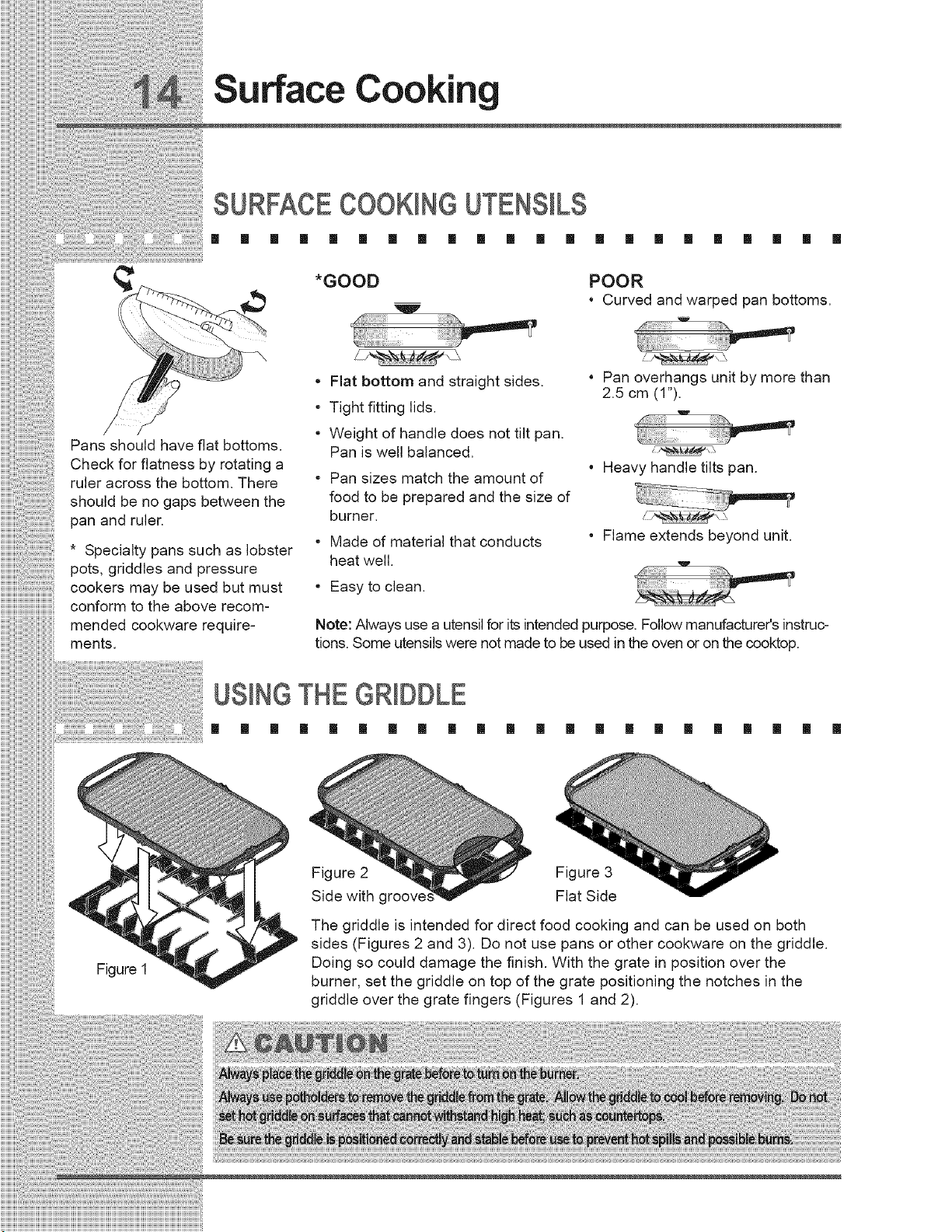
*GOOD
w
POOR
• Curved and warped pan bottoms.
Pans should have flat bottoms.
Check for flatness by rotating a
ruler across the bottom. There
should be no gaps between the
pan and ruler.
* Specialty pans such as lobster
pots, griddles and pressure
cookers may be used but must
conform to the above recom-
mended cookware require-
ments.
. Flat bottom and straight sides.
• Tight fitting lids.
• Weight of handle does not tilt pan.
Pan is well balanced.
• Pan sizes match the amount of
food to be prepared and the size of
burner.
• Made of material that conducts
heat well.
• Easy to clean.
• Pan overhangs unit by more than
2.5 cm (1").
• Heavy handle tilts pan.
• Flame extends beyond unit.
v
Note: Always use a utensil for its intended purpose. Follow manufacturer's instruc-
tions. Some utensils were not made to be used in the oven or on the cooktop.
US)NGTHE GR(DDLE
[] [] [] [] [] [] [] [] [] [] [] [] [] [] [] [] [] [] [] [] [] []
Figure 2
Side with groove
Figure 3
Flat Side
The griddle is intended for direct food cooking and can be used on both
sides (Figures 2 and 3). Do not use pans or other cookware on the griddle.
Doing so could damage the finish. With the grate in position over the
burner, set the griddle on top of the grate positioning the notches in the
griddle over the grate fingers (Figures 1 and 2).

Surface Cooki
US+NGTHEWOKSTAND
[] [] [] [] [] [] [] [] [] [] [] [] [] [] [] [] [] [] [] [] []
The Wok Stand provided with your cooktop is designed to allow round-bottomed woks to be
used. it is recommended that you use a 14 inch diameter (35.5 cm) or less Wok. It is
recommended that you use the right front POWER burner with the wok stand for best
performance. If properly positioned, the Wok Stand will not slide off the grate.
To Properly Position the Wok Stand:
With the grate in position over the burner, set the Wok Stand on top of the grate positioning the
notches in the Wok Stand over the cooktop grate fingers (See Figure 1).
Figure 1
Flat-bottomwokswithlargeflat
bottomsmayalsobeusedonyour
cooktop Surface BurnerGrates _v ""_"_d
withoutthe WokStand (See Figure v__
2).lnsurethestabilityoftheflat- _ .__+__
bottomwokbefore cookingwithout
the Wok Stand, If unstable DO
NOTusetheflat-bottomwok "_
without the Wok Stand. _
Round-bottomwoks(wth a Properuseofflat-bottomwok Improperuseofround-bottomwok
.......... on Surface Burner Grate on Surface Burner Grate
support rmg_ snoula 1,4u/De _.
used (See Figure 3). The Hgurez Figure3
supporting ring was not designed : : ::::
for proper or stable use on the
Surface Burner Grates.
Surface Cooking
USINGTHE SIMMERPLATE
Ill [] [] [] [] [] [] [] [] [] [] [] [] [] [] [] [] [] [] [] [] []
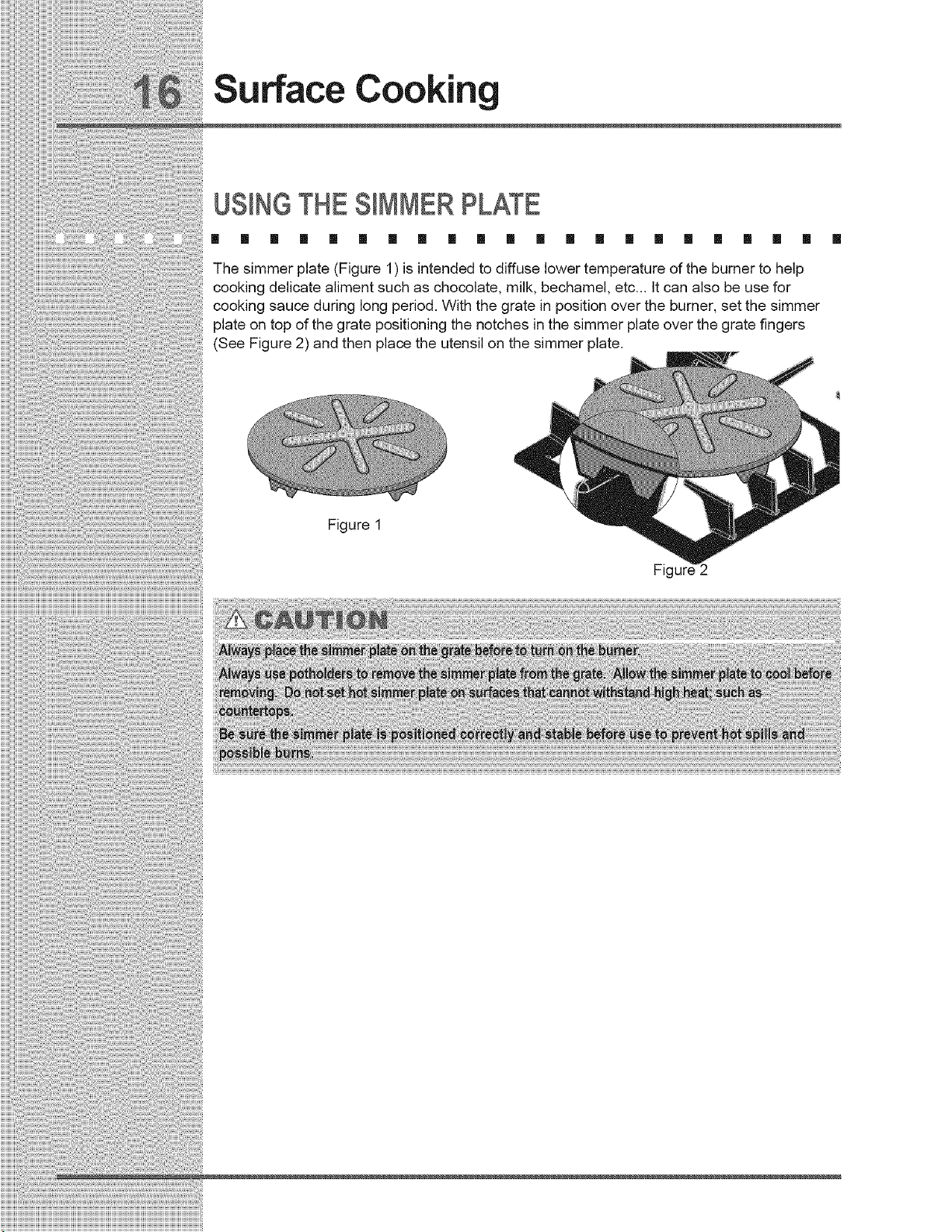
The simmer plate (Figure 1) is intended to diffuse lower temperature of the burner to help
cooking delicate aliment such as chocolate, milk, bechamel, etc... It can also be use for
cooking sauce during long period. With the grate in position over the burner, set the simmer
plate on top of the grate positioning the notches in the simmer plate over the grate fingers
(See Figure 2) and then place the utensil on the simmer plate.
Figure 1
Figur,
Surface Cooking
SETTINGSURFACECONTROLS
[] [] [] [] [] [] [] [] [] [] [] [] [] [] [] [] [] [] [] [] [] []
Your cooktop may be equipped with any combination of the following burners:
Simmer Burner: best used for simmering delicate sauces, etc.
Standard Burner: used for most all surface cooking needs.
Large Burner: best used when bringing large quantities of liquid to temperature and when
preparing larger quantities of food.
Regardless of size, always select a utensil that is suitable for the amount and type of food
being prepared. Select a burner and flame size appropriate to the pan. Never allow flames
to extend beyond the outer edge of the pan.
Your cooktop is also equipped with 270 ° rotation flame control valves. These valves
provide enhanced control of the burner flame. Each burner lights automatically from an
electric ignitor when its control knob is turned to the LITE position.
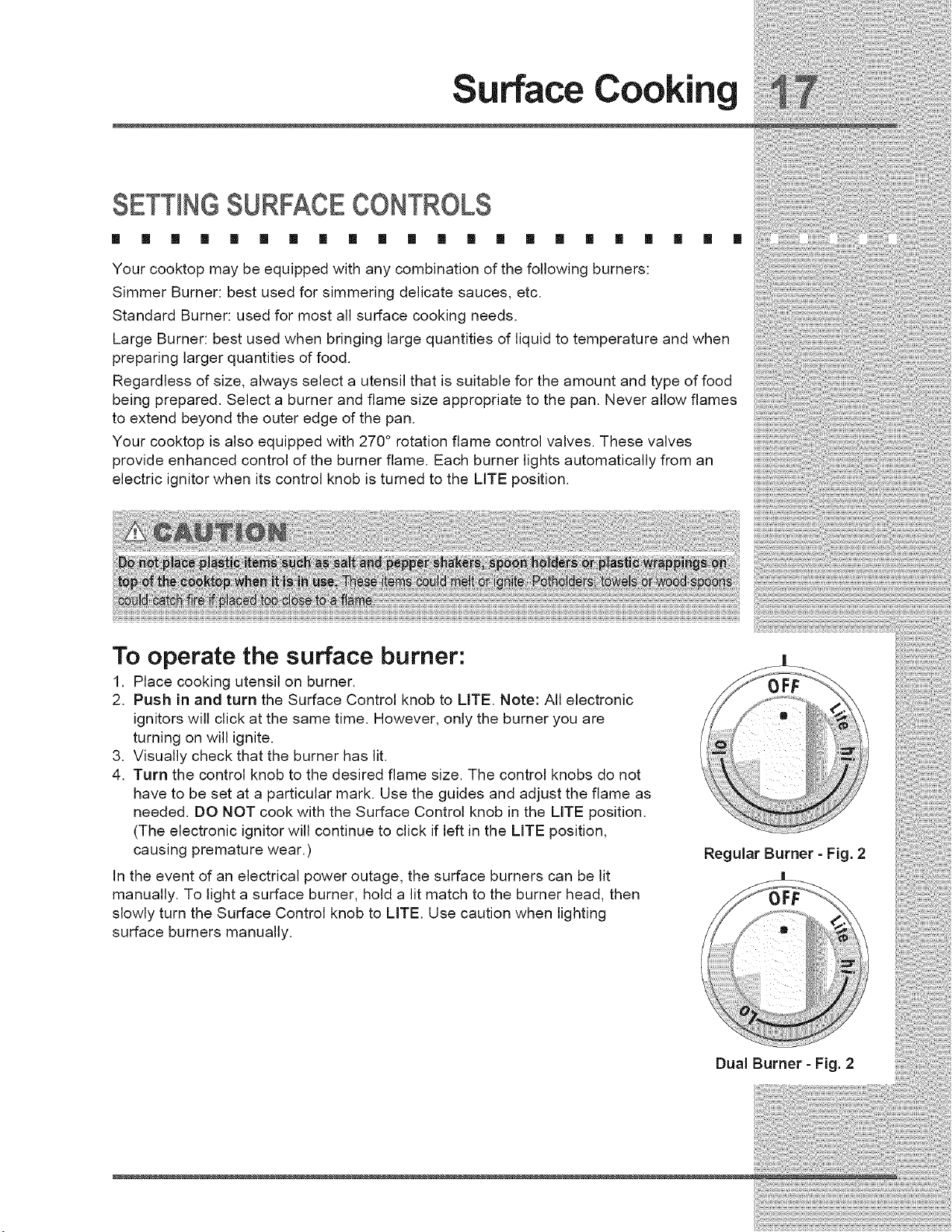
To operatethe surface burner"
1. Placecookingutensilonburner. " _/_-OFF---'_,_'_
2. Push in and turn the Surface Control knob to LITE Note: All electronic
ignitorswill clickatthesametime. However, onlythe burneryou are
turning onwill ignite.
3. Visuallycheckthatthe burnerhas lit.
4. Turn the control knobtothedesiredfiamesize. The control knobs do not
have to be set at a particularmark. Use the guides and adjusttheflame as
needed. DO NOTcookwith the Surface Control knob in the LITE position.
(The electronic ignitorwill continue to click if left in the UTE position,
causing prematurewear.) RegularBurner- Fig. 2
Intheeventofanelectricalpoweroutage, thesurfaceburnerscanbelit
manually. To lighta surface burner, hold a litmatch tothe burnerhead, then _7-O}:F_, _
slowlyturn the Surface Control knobto LITE. Use cautionwhen lighting
surfaceburnersmanually.
DualBurner-Fig. 2
Getting Started
BEFORESE ING OVENCONTROLS
[] [] [] [] [] [] [] [] [] [] [] [] [] [] [] [] [] [] [] [] [] []
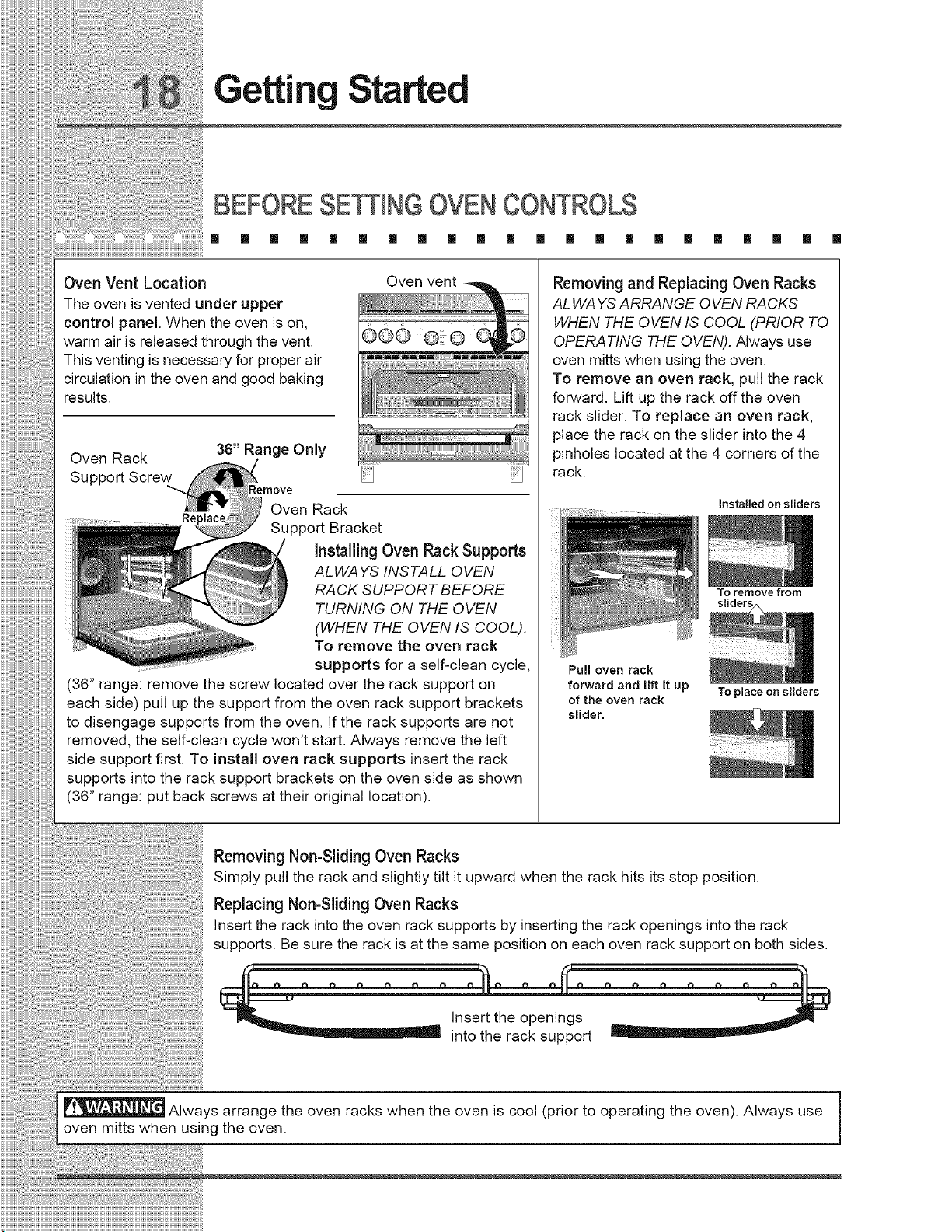
Oven Vent Location
The oven is vented under upper
control panel, When the oven is on,
warm air is released through the vent.
This venting is necessary for proper air
circulation in the oven and good baking
results.
Oven vent
Oven Rack
Support Screw
36" Range Only
move
Oven Rack
Support Bracket
Installing Oven Rack Supports
ALWAYS INSTALL OVEN
RACK SUPPORT BEFORE
TURNING ON THE OVEN
(WHEN THE OVEN IS COOL).
To remove the oven rack
supports for a self-clean cycle,
(36" range: remove the screw located over the rack support on
each side) pull up the support from the oven rack support brackets
to disengage supports from the oven. If the rack supports are not
removed, the self-clean cycle won't start. Always remove the left
side support first. To install oven rack supports insert the rack
supports into the rack support brackets on the oven side as shown
(36" range: put back screws at their original location).
Removing and Replacing Oven Racks
ALWAYS ARRANGE OVEN RACKS
WHEN THE OVEN IS COOL (PRIOR TO
OPERATING THE OVEN). Always use
oven mitts when using the oven.
To remove an oven rack, pull the rack
forward. Lift up the rack off the oven
rack slider. To replace an oven rack,
place the rack on the slider into the 4
pinholes located at the 4 corners of the
rack.
Installed on sliders
Pull oven rack
forward and liffitup
ofthe oven rack
slider.
To remove from
To place on sliders
Removing Non-Sliding Oven Racks
Simply pull the rack and slightly tilt it upward when the rack hits its stop position.
Replacing Non-Sliding Oven Racks
Insert the rack into the oven rack supports by inserting the rack openings into the rack
supports. Be sure the rack is at the same position on each oven rack support on both sides.
o o o o o o
_the openings
into the rack support
Always arrange the oven racks when the oven is cool (prior to operating the oven). Always use i
oven mitts when using the oven.
1
Getting Started
BEFORE SE ING OVEN CONTROLS (CONT'D}
[] [] [] [] [] [] [] [] [] [] [] [] [] [] [] [] [] [] []
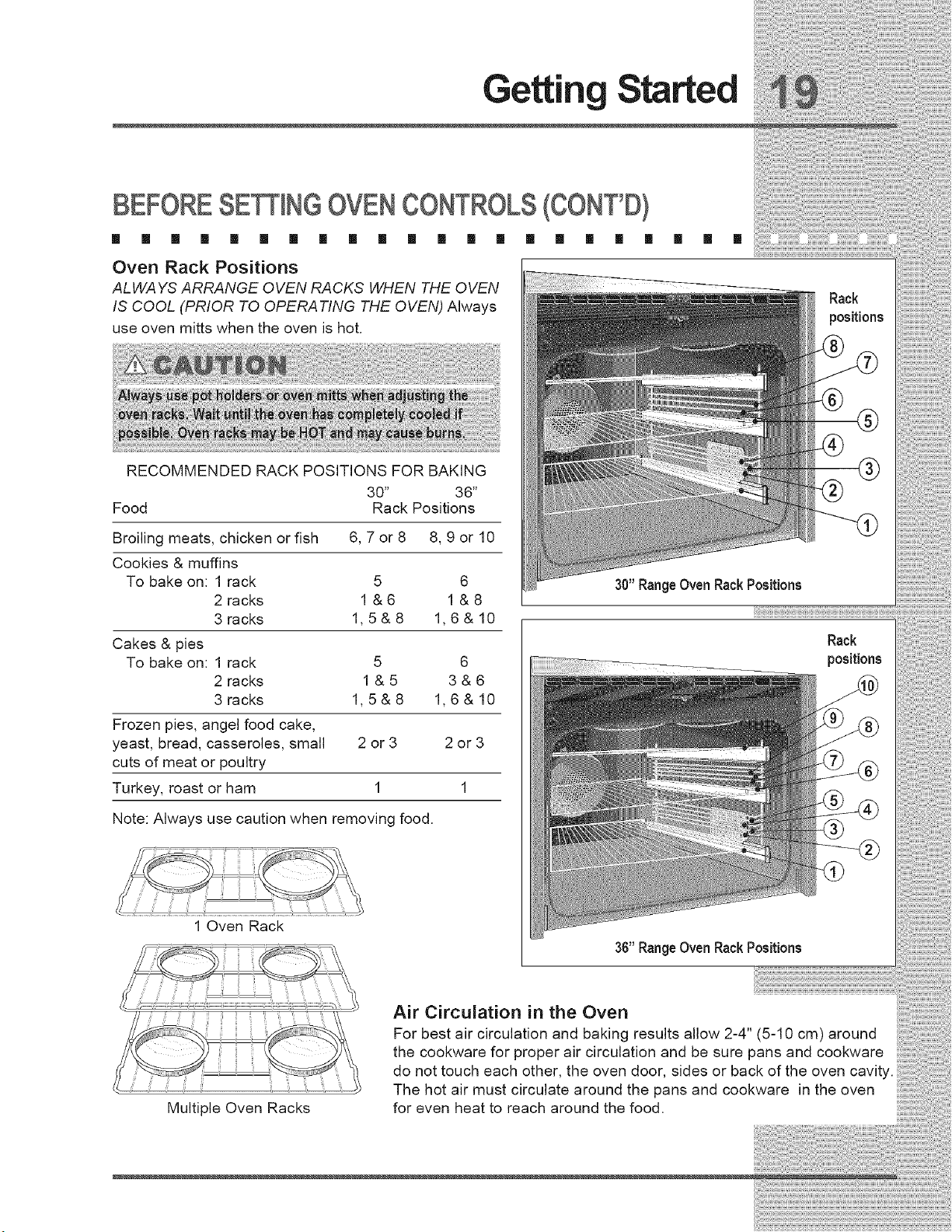
Oven Rack Positions
ALWAYS ARRANGE OVEN RACKS WHEN THE OVEN
IS COOL (PRIOR TO OPERATING THE OVEN) Always
use oven mitts when the oven is hot.
RECOMMENDED RACK POSITIONS FOR BAKING
30" 36"
Food Rack Positions
Broiling meats, chicken or fish 6, 7 or 8 8, 9 or 10
Cookies & muffins
To bake on: 1 rack 5 6
2 racks 1 &6 1 &8
3 racks 1, 5 & 8 1,6 & 10
Cakes & pies
To bake on: 1 rack 5 6
2 racks 1 & 5 3 & 6
3 racks 1, 5 & 8 1,6 & 10
Frozen pies, angel food cake,
yeast, bread, casseroles, small 2 or 3 2 or 3
cuts of meat or poultry
Turkey, roast or ham 1 1
Note: Always use caution when removing food.
[] [] []
30"RangeOven RackPositions
1 Oven Rack
36" Range Oven Rack Positions
Rack
Multiple Oven Racks
Air Circulation in the Oven
For best air circulation and baking results allow 2-4" (5-10 cm) around
the cookware for proper air circulation and be sure pans and cookware
do not touch each other, the oven door, sides or back of the oven cavity.
The hot air must circulate around the pans and cookware in the oven
for even heat to reach around the food.
Setting the oven controls
CONTROLFEATURES
m [] [] [] [] [] [] [] [] [] [] [] [] [] [] [] [] [] [] [] []
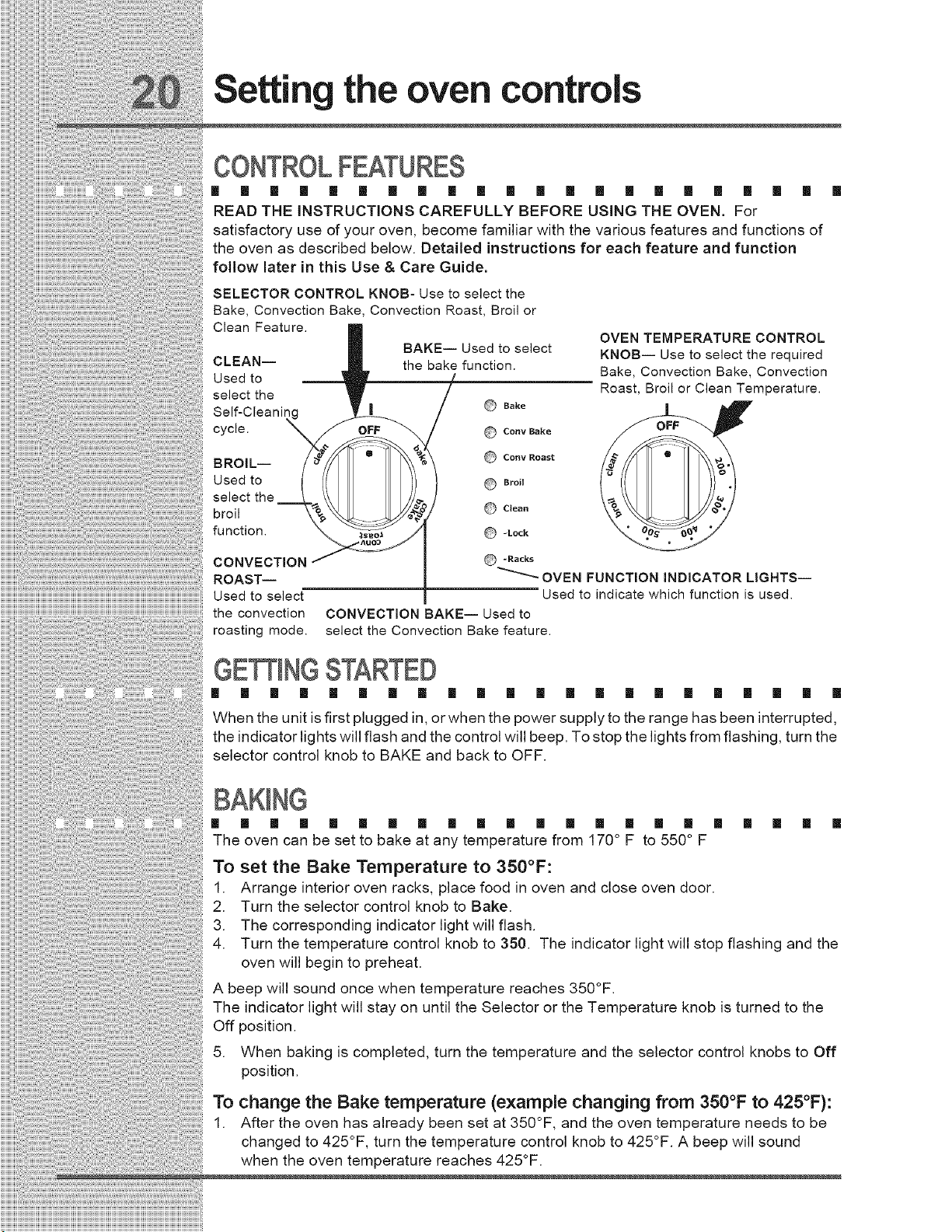
READ THE INSTRUCTIONS CAREFULLY BEFORE USING THE OVEN. For
satisfactory use of your oven, become familiar with the various features and functions of
the oven as described below. Detailed instructions for each feature and function
follow later in this Use & Care Guide.
SELECTOR CONTROL KNOB- Use to select the
Bake, Convection Bake, Convection Roast, Broil or
Clean Feature.
CLEAN--
Used to
select the
Self-Cleani?
cycle.
BROIL--
Used to
select the
broil
function.
CONVECTION
ROAST--
Used to select
the convection
roasting mode.
BAKE-- Used to select
the bake function.
OVEN TEMPERATURE CONTROL
KNOB-- Use to select the required
Bake, Convection Bake, Convection
Roast, Broil or Clean Temperature.
O Bake
Corlv Bake
(;OrlV Roast
Broil
(;lean
-Racks
OVEN FUNCTION iNDICATOR LIGHTS--
Used to indicate which function is used.
CONVECTION BAKE-- Used to
select the Convection Bake feature.
GEeiNG STARTED
[] [] [] [] [] [] [] [] [] [] [] [] [] [] [] [] [] [] [] [] [] []
When the unit is first plugged in, or when the power supply to the range has been interrupted,
the indicator lights will flash and the control will beef To stop the lights from flashing, turn the
selector control knob to BAKE and back to OFF.
[] [] [] [] [] [] [] [] [] [] [] [] [] [] [] [] [] [] [] [] [] []
The oven can be set to bake at any temperature from 170 ° F to 550° F
To set the Bake Temperature to 350°F:
1. Arrange interior oven racks, place food in oven and close oven door.
2. Turn the selector control knob to Bake.
3. The corresponding indicator light will flash.
4. Turn the temperature control knob to 350. The indicator light will stop flashing and the
oven will begin to preheat.
A beep will sound once when temperature reaches 350°F.
The indicator light will stay on until the Selector or the Temperature knob is turned to the
Off position.
5. When baking is completed, turn the temperature and the selector control knobs to Off
position.
To change the Bake temperature (example changing from 350°F to 425°F):
1. After the oven has already been set at 350°F, and the oven temperature needs to be
changed to 425°F, turn the temperature control knob to 425°F. A beep will sound
when the oven temperature reaches 425°F.
Setting the oven controls
BAKINGPROBLEMS
[] [] [] [] [] [] [] [] [] [] [] [] [] [] [] [] [] [] [] [] [] []
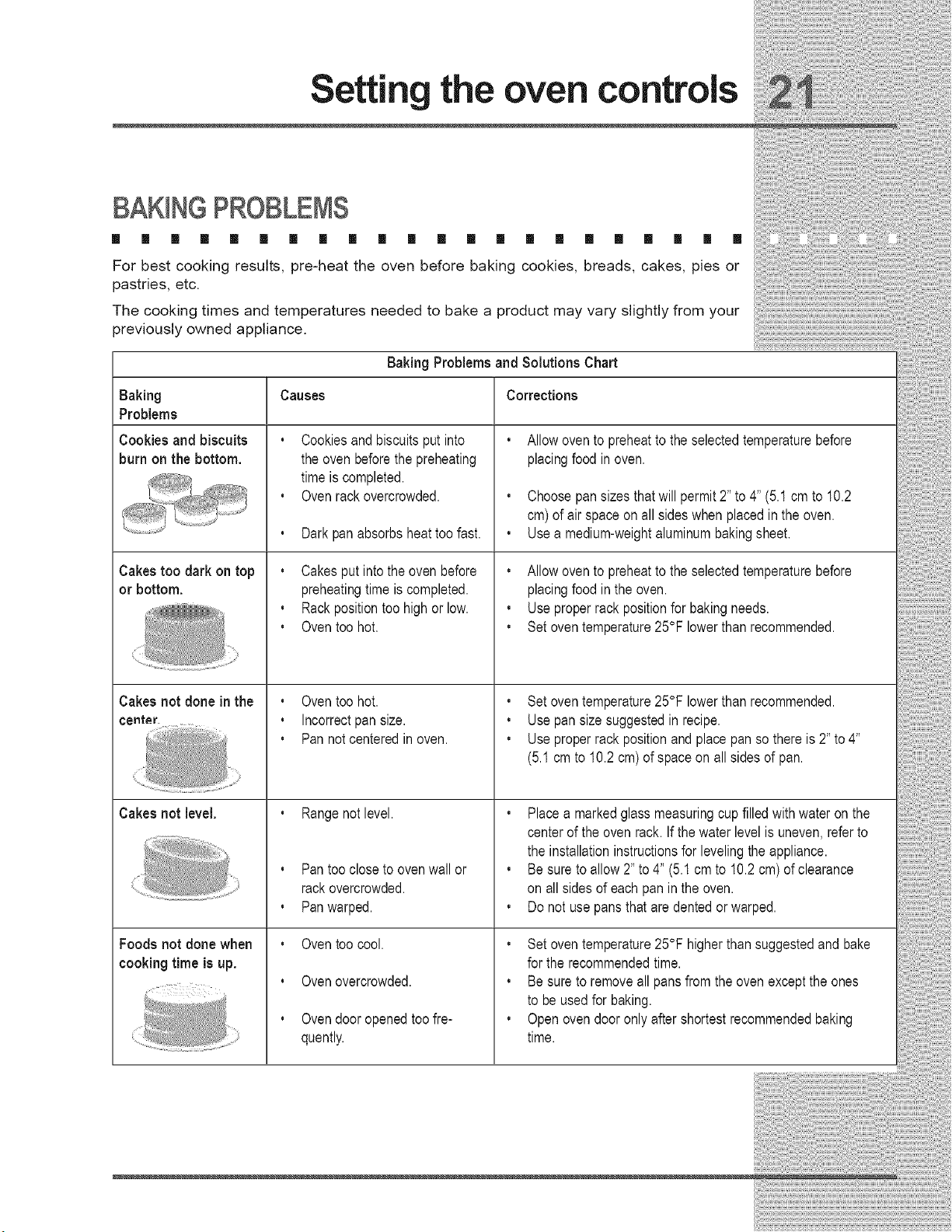
For best cooking results, pre-heat the oven before baking cookies, breads, cakes, pies or
pastries, etc.
The cooking times and temperatures needed to bake a product may vary slightly from your
previously owned appliance.
Baking Problemsand Solutions Chart
8aking Causes Corrections
Problems
e
Cookies and biscuits
burnon the bottom.
Cakes too dark on top
or bottom.
Cookiesand biscuitsputinto
the oven beforethe preheating
timeis completed.
Ovenrackovercrowded.
, Darkpanabsorbsheattoo fast.
, Cakesput into theoven before
preheatingtimeis completed.
, Allow ovento preheatto the selectedtemperaturebefore
placingfood in oven.
, Choosepan sizesthatwill permit2" to 4" (5.1cm to 10.2
cm)of air spaceon all sideswhen placedin the oven.
, Use a medium-weightaluminumbakingsheet.
, Allow ovento preheatto the selectedtemperaturebefore
placingfood in the oven.
_ _ , Rackpositiontoo highor low. , Useproperrackpositionfor bakingneeds.
/_ _ o
_ , Oventoo hot. , Set oventemperature25 F lowerthan recommended.
center
Cakes notdone in the i Oventoo hot. i Set oventemperature25°F lowerthan recommended. ::
................... ,ncorrectpans,ze. Usepan sizesuggestedin recipe. ,, ,,
, Pannotcentered n oven , Use properrackposton and pace panso there s 2 to 4
_ _ . ...............
....._: _.'_ _.,,_4i_ :._'_"/*..... (51 cm to 102 cm) of spaceon a s des of pan .........................
Cakes not level. , Rangenot level. , Placea markedglass measuringcup filledwithwateron the
.............. centerof theoven rack. Ifthe water levelis uneven,referto
.... the installationinstructionsfor levelingthe appliance.
_! , Pantoo close to ovenwall or , Besure to allow2" to 4" (5.1cmto 10.2cm)of clearance
_: __!_
,i:: rackovercrowded, on allsides of each panin the oven. ,
......................................................., Panwarped. , Do not use pansthat aredented or warped.
Foods not done when , Oventoo cool. , Set oventemperature25°'Fhigherthansuggestedand bake
cooking time is up. , , for the recommendedtime.
....... Ovenovercrowded. Besure to removeall pansfrom the ovenexceptthe ones
_ ,_,_ : ,._, to be usedfor baking.
...... , Ovendooropenedtoo fre- , Open ovendooronlyafter shortestrecommendedbakng
:: ::i: quently, time. :)
the oven controls
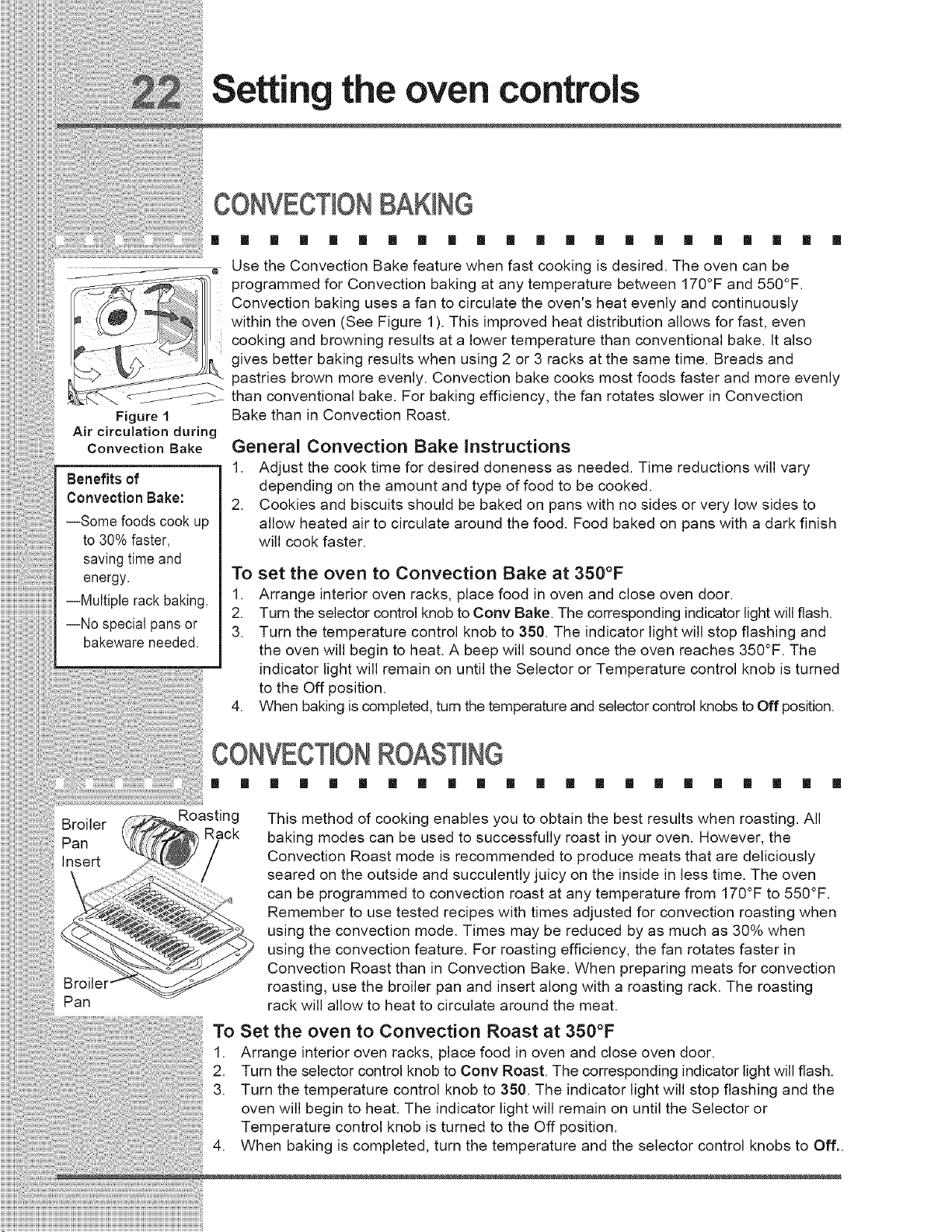
CONVECTIONBAKING
[]
J
Figure I
Air circulation during
Convection Bake
Benefits of
Convection Bake:
--Some foods cook up
to 30% faster,
saving time and
energy.
--Multiple rack baking.
--No special pans or
bakeware needed.
[] [] [] [] [] [] [] [] [] [] [] [] [] [] [] [] [] [] [] [] []
Use the Convection Bake feature when fast cooking is desired. The oven can be
programmed for Convection baking at any temperature between 170°F and 550°F.
Convection baking uses a fan to circulate the oven's heat evenly and continuously
within the oven (See Figure 1). This improved heat distribution allows for fast, even
cooking and browning results at a lower temperature than conventional bake. It also
gives better baking results when using 2 or 3 racks at the same time. Breads and
pastries brown more evenly. Convection bake cooks most foods faster and more evenly
than conventional bake. For baking efficiency, the fan rotates slower in Convection
Bake than in Convection Roast.
General Convection Bake instructions
1. Adjust the cook time for desired doneness as needed. Time reductions will vary
depending on the amount and type of food to be cooked.
2. Cookies and biscuits should be baked on pans with no sides or very low sides to
allow heated air to circulate around the food. Food baked on pans with a dark finish
will cook faster.
To set the oven to Convection Bake at 350°F
1. Arrange interior oven racks, place food in oven and close oven door.
2. Turn the selector control knob to Cony Bake. The corresponding indicator light will flash.
3. Turn the temperature control knob to 350. The indicator light will stop flashing and
the oven will begin to heat. A beep will sound once the oven reaches 350°F. The
indicator light will remain on until the Selector or Temperature control knob is turned
to the Off position.
4. When baking is completed, turn the temperature and selector control knobs to Off position.
CONVECTIONROASTING
[] [] [] [] [] [] [] [] [] [] [] [] [] [] [] [] [] [] [] [] [] []
BroilerPan
Insert
t##
Pan
Roasting
Rack
/
This method of cooking enables you to obtain the best results when roasting. All
baking modes can be used to successfully roast in your oven. However, the
Convection Roast mode is recommended to produce meats that are deliciously
seared on the outside and succulently juicy on the inside in less time. The oven
can be programmed to convection roast at any temperature from 170°F to 550°F.
Remember to use tested recipes with times adjusted for convection roasting when
using the convection mode. Times may be reduced by as much as 30% when
using the convection feature. For roasting efficiency, the fan rotates faster in
Convection Roast than in Convection Bake. When preparing meats for convection
roasting, use the broiler pan and insert along with a roasting rack. The roasting
rack will allow to heat to circulate around the meat.
To Set the oven to Convection Roast at 350°F
1. Arrange interior oven racks, place food in oven and close oven door.
2. Turn the selector control knob to Conv Roast. The corresponding indicator light will flash.
3. Turn the temperature control knob to 350. The indicator light will stop flashing and the
oven will begin to heat. The indicator light will remain on until the Selector or
Temperature control knob is turned to the Off position.
4. When baking is completed, turn the temperature and the selector control knobs to Off..
Setting the oven controls
[] [] [] [] [] [] [] [] [] [] [] [] [] [] [] [] [] [] [] [] [] []
Broiling is a method of cooking tender cuts of meat by direct heat under the broil element of
the oven.
Preheating
For an optimum browning, preheat the broil element for 2 minutes.
To Broil
Broil one side until the food is browned; turn and cook on the second side. Season and
serve. Always pull the rack out to the "stop" position before turning or removing food.
Broiling Tips
The broiler pan and it grid allow dripping grease to drain and be kept away from the high heat
of the broiler.
Broiling Times
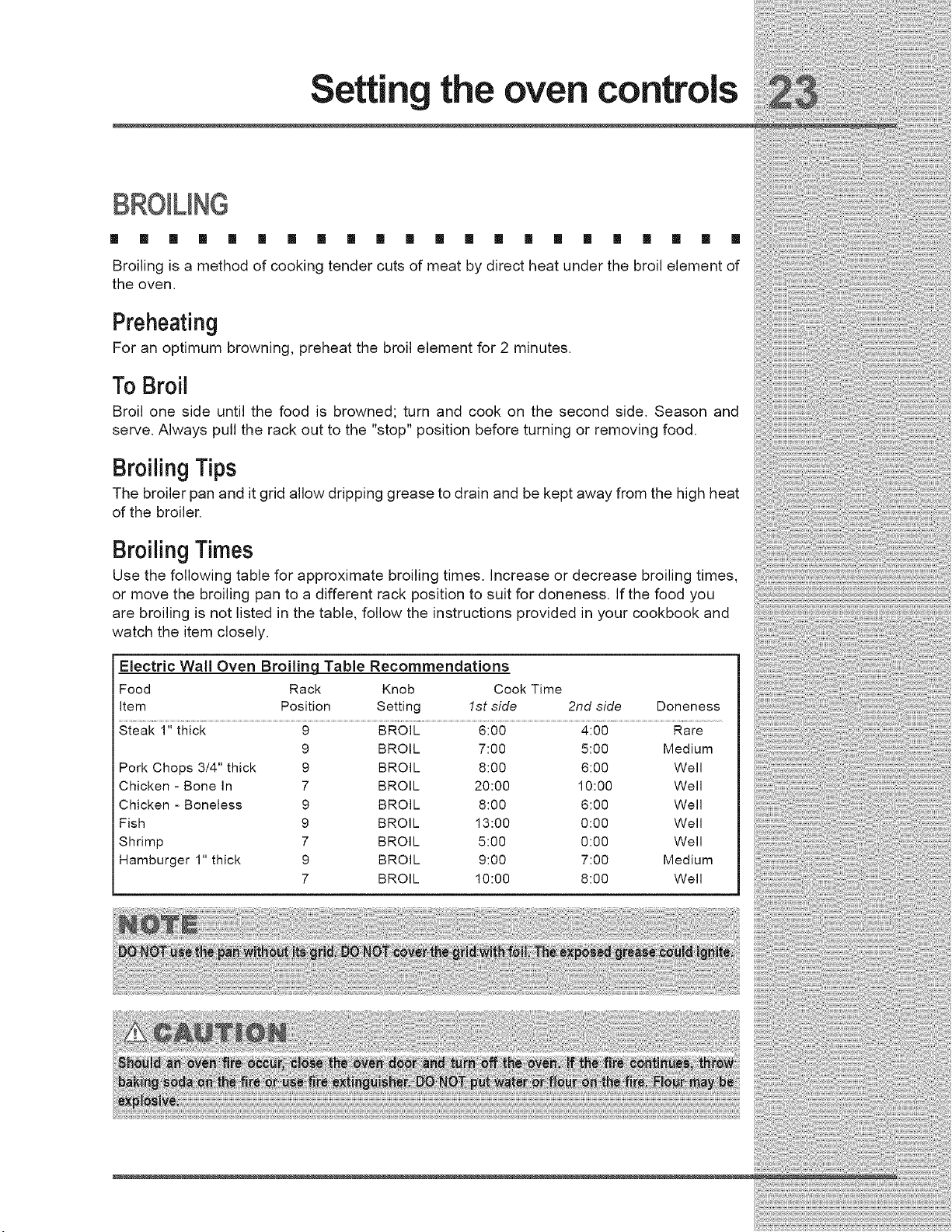
Use the following table for approximate broiling times. Increase or decrease broiling times,
or move the broiling pan to a different rack position to suit for doneness. If the food you
are broiling is not listed in the table, follow the instructions provided in your cookbook and .... ........................................................................................................................................................
watch the item closely.
Tob,oRooommoodot,oos
I Food Rack Knob Cook Time ,
i item ;; Posi!!on Se!!!ng !s! s{de 2nd s!de Doneness :
Jsteak 1 thick 9 BROi: 6i00 4i00 Rare :
| 9 BROIL 7:00 5:00 Medium
I Pork Chops 3/4 thick 9 BROIL 8:00 6:00 Well
I Chicken - Bone In 7 BROIL 20:00 10:00 Well
I Chicken - Boneless 9 BROIL 8:00 6:00 Well
I Fish 9 BRO_L 13:00 0:00 WeU
JShrimp 7 BROIL 5:0O 0:00 WeU
I Hamburger 1 thick 9 BROIL 9:00 7:00 Medium : :
7 BROIL 10:00 8:00 Well
Setting the oven controls
SETTINGBROIL
[] [] [] [] [] [] [] [] [] [] [] [] [] [] [] [] [] [] [] [] [] []
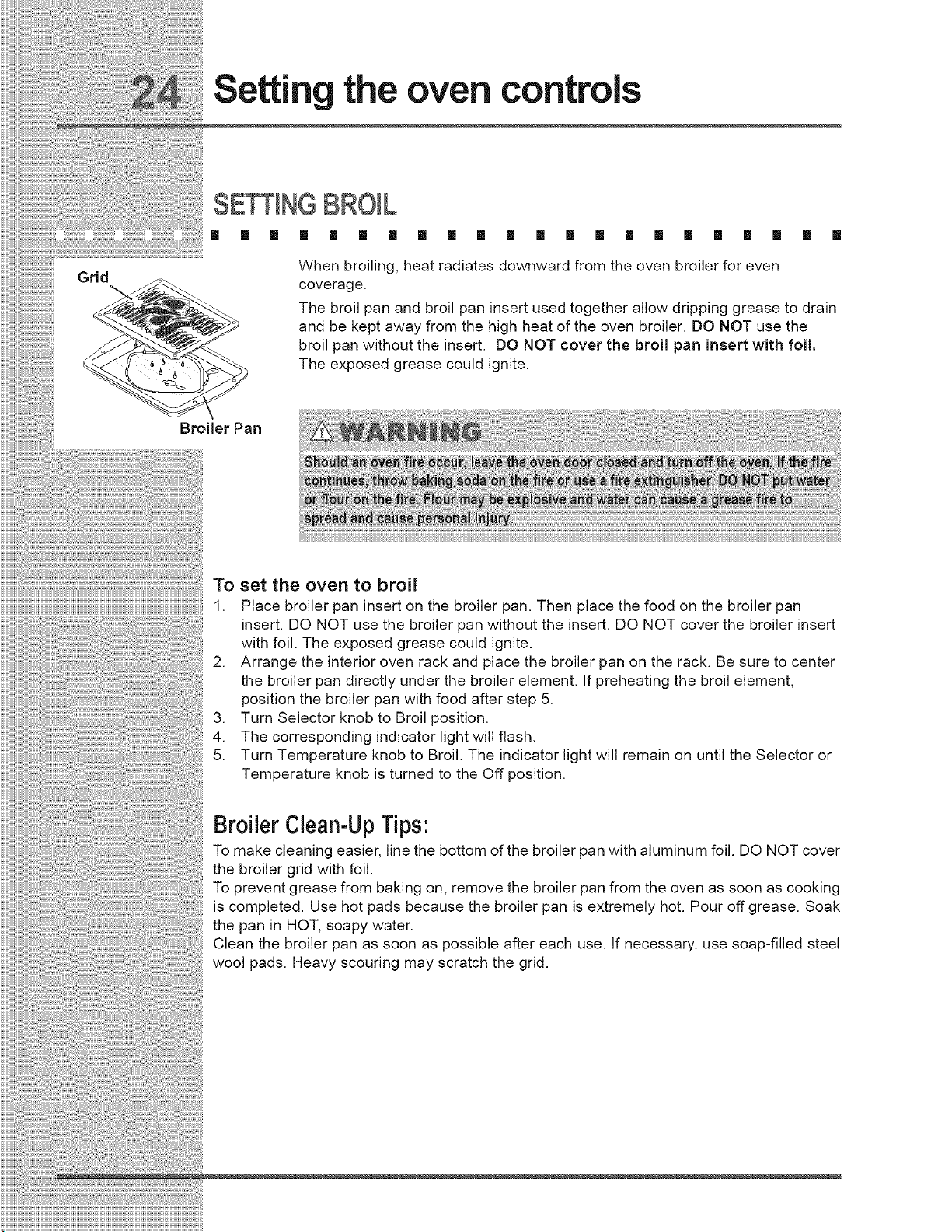
Grid
Broiler Pan
When broiling, heat radiates downward from the oven broiler for even
coverage.
The broil pan and broil pan insert used together allow dripping grease to drain
and be kept away from the high heat of the oven broiler. DO NOT use the
broil pan without the insert. DO NOT cover the broil pan insert with foil.
The exposed grease could ignite.
To set the oven to broil
Place broiler pan insert on the broiler pan. Then place the food on the broiler pan
insert. DO NOT use the broiler pan without the insert. DO NOT cover the broiler insert
with foil. The exposed grease could ignite.
2. Arrange the interior oven rack and place the broiler pan on the rack. Be sure to center
the broiler pan directly under the broiler element. If preheating the broil element,
position the broiler pan with food after step 5.
3. Turn Selector knob to Broil position.
4. The corresponding indicator light will flash.
5. Turn Temperature knob to Broil. The indicator light will remain on until the Selector or
Temperature knob is turned to the Off position.
Broiler Clean-Up Tips:
To make cleaning easier, line the bottom of the broiler pan with aluminum foil. DO NOT cover
the broiler grid with foil.
To prevent grease from baking on, remove the broiler pan from the oven as soon as cooking
is completed. Use hot pads because the broiler pan is extremely hot. Pour off grease. Soak
the pan in HOT, soapy water.
Clean the broiler pan as soon as possible after each use. If necessary, use soap-filled steel
wool pads. Heavy scouring may scratch the grid.
Care & Cleaning
US+NGTHESELF-CLEANFEATURE
[] [] [] [] [] [] [] [] [] [] [] [] [] [] [] [] [] [] [] [] [] []
Adhere to the Following Cleaning
Precautions:
+ Allow the oven to cool before cleaning.
+ Wear rubber gloves when cleaning any exterior parts of the
oven manually.
During the self-cleaning cycle, the outside of the range can
become very hot to the touch. DO NOT leave a small children
unattended near the range.
Before cleaning any part of the oven, be sure the oven is turned
off. Wait until the oven is cool.
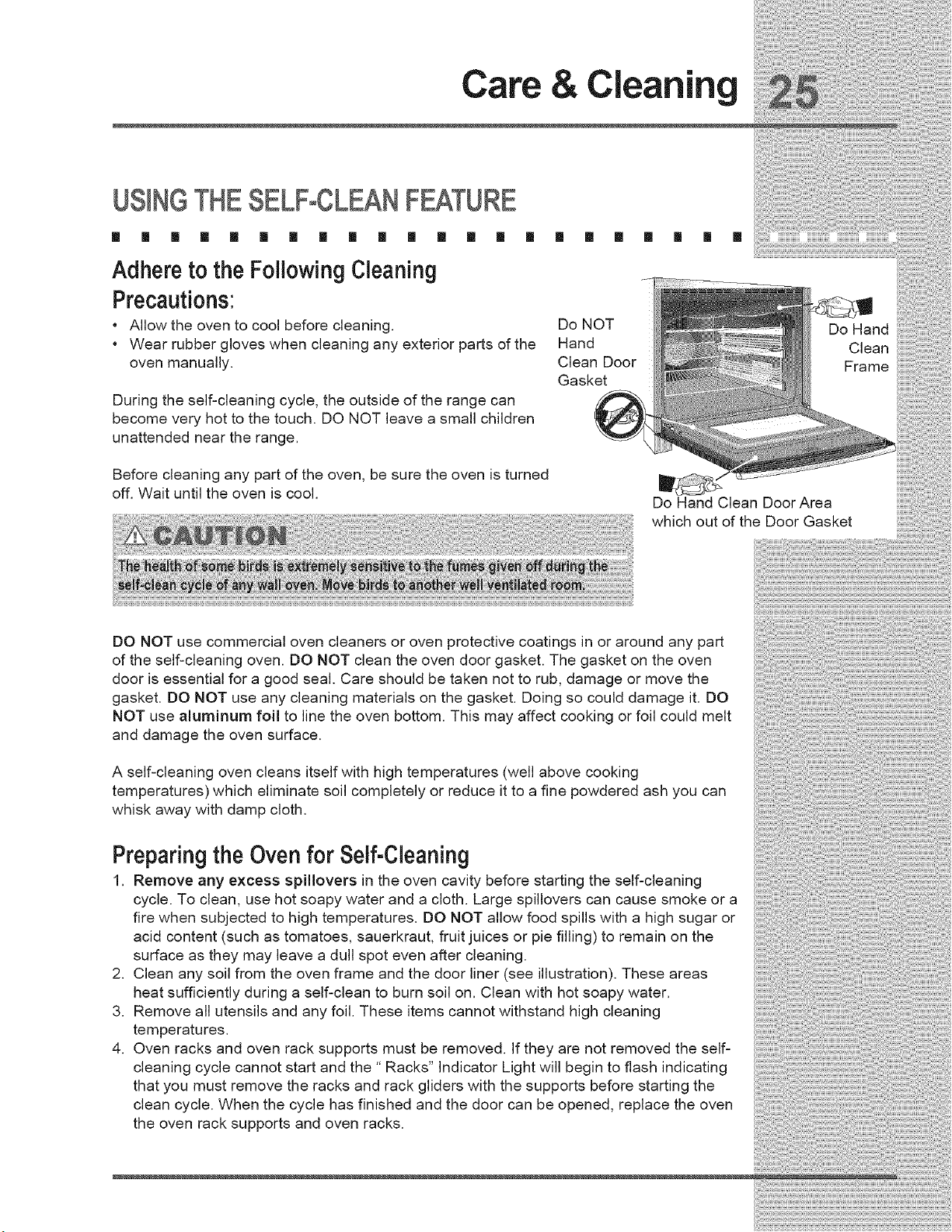
Do NOT
Hand
Clean Door
Gasket
Do Hand Clean Door Area
which out of the Door Gasket
DO NOT use commercial oven cleaners or oven protective coatings in or around any part
of the self-cleaning oven. DO NOT clean the oven door gasket. The gasket on the oven
door is essential for a good seal. Care should be taken not to rub, damage or move the
gasket. DO NOT use any cleaning materials on the gasket. Doing so could damage it+ DO
NOT use aluminum foil to line the oven bottom. This may affect cooking or foil could melt
and damage the oven surface.
A self-cleaning oven cleans itself with high temperatures (well above cooking
temperatures) which eliminate soil completely or reduce it to a fine powdered ash you can
whisk away with damp cloth.
Preparing the Oven for Self-Cleaning
1. Remove any excess spillovers in the oven cavity before starting the self-cleaning
cycle. To clean, use hot soapy water and a cloth. Large spillovers can cause smoke or a
fire when subjected to high temperatures. DO NOT allow food spills with a high sugar or
acid content (such as tomatoes, sauerkraut, fruit juices or pie filling) to remain on the
surface as they may leave a dull spot even after cleaning.
2. Clean any soil from the oven frame and the door liner (see illustration). These areas
heat sufficiently during a self-clean to burn soil on. Clean with hot soapy water.
3. Remove all utensils and any foil. These items cannot withstand high cleaning
temperatures.
4. Oven racks and oven rack supports must be removed. If they are not removed the self-
cleaning cycle cannot start and the" Racks" Indicator Light will begin to flash indicating
that you must remove the racks and rack gliders with the supports before starting the
clean cycle. When the cycle has finished and the door can be opened, replace the oven
the oven rack supports and oven racks.
Care & C(eani
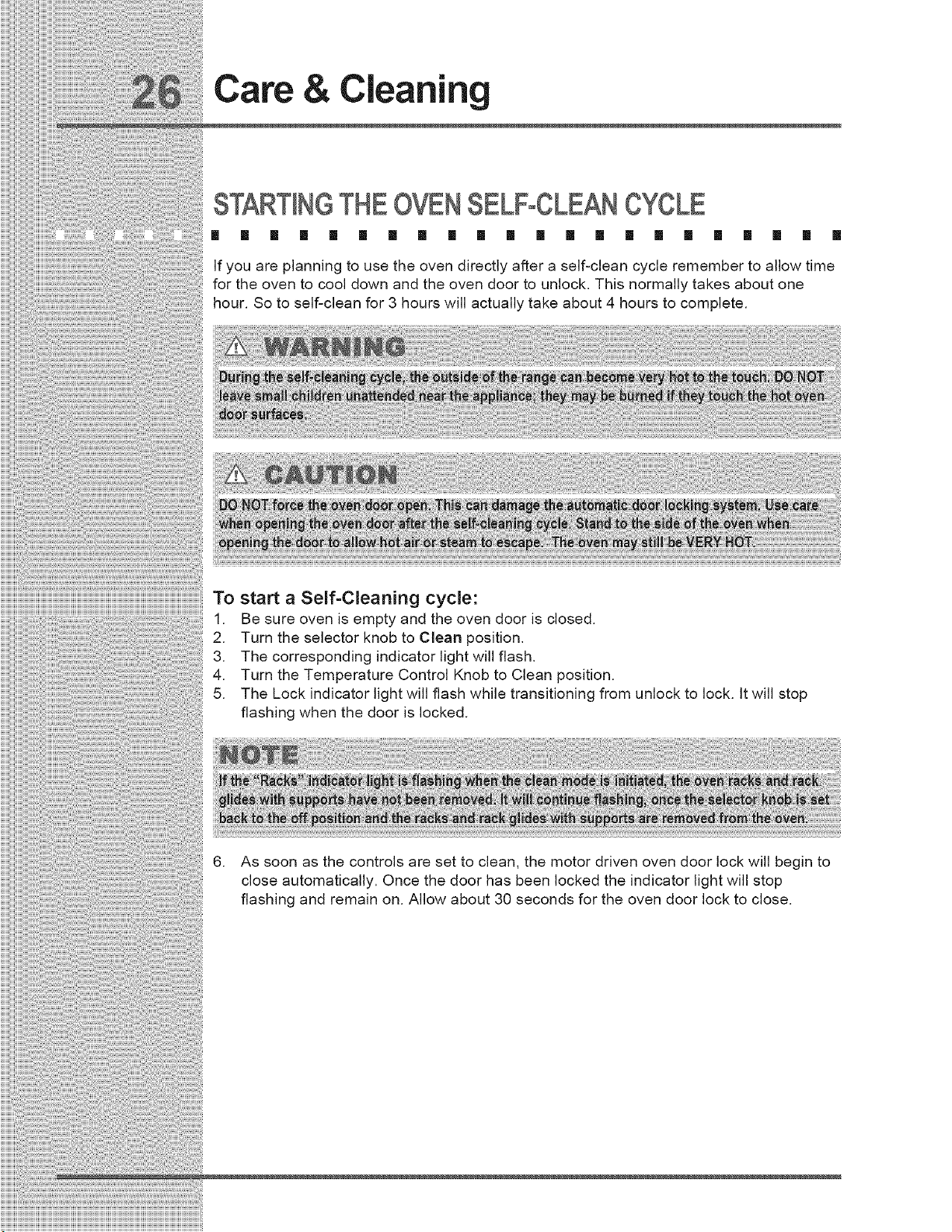
START(NGTHEOVENSELF-CLEANCYCLE
[] [] [] [] [] [] [] [] [] [] [] [] [] [] [] [] [] [] [] [] [] []
If you are planning to use the oven directly after a self-clean cycle remember to allow time
for the oven to cool down and the oven door to unlock. This normally takes about one
hour. So to self-clean for 3 hours will actually take about 4 hours to complete.
To start a Se(f-C(eaning cyc(e:
1. Be sure oven is empty and the oven door is closed.
2. Turn the selector knob to Clean position.
3. The corresponding indicator light will flash.
4. Turn the Temperature Control Knob to Clean position.
5. The Lock indicator light will flash while transitioning from unlock to lock. It will stop
flashing when the door is locked.
6. As soon as the controls are set to clean, the motor driven oven door lock will begin to
close automatically. Once the door has been locked the indicator light will stop
flashing and remain on. Allow about 30 seconds for the oven door lock to close.
Care & Cleaning
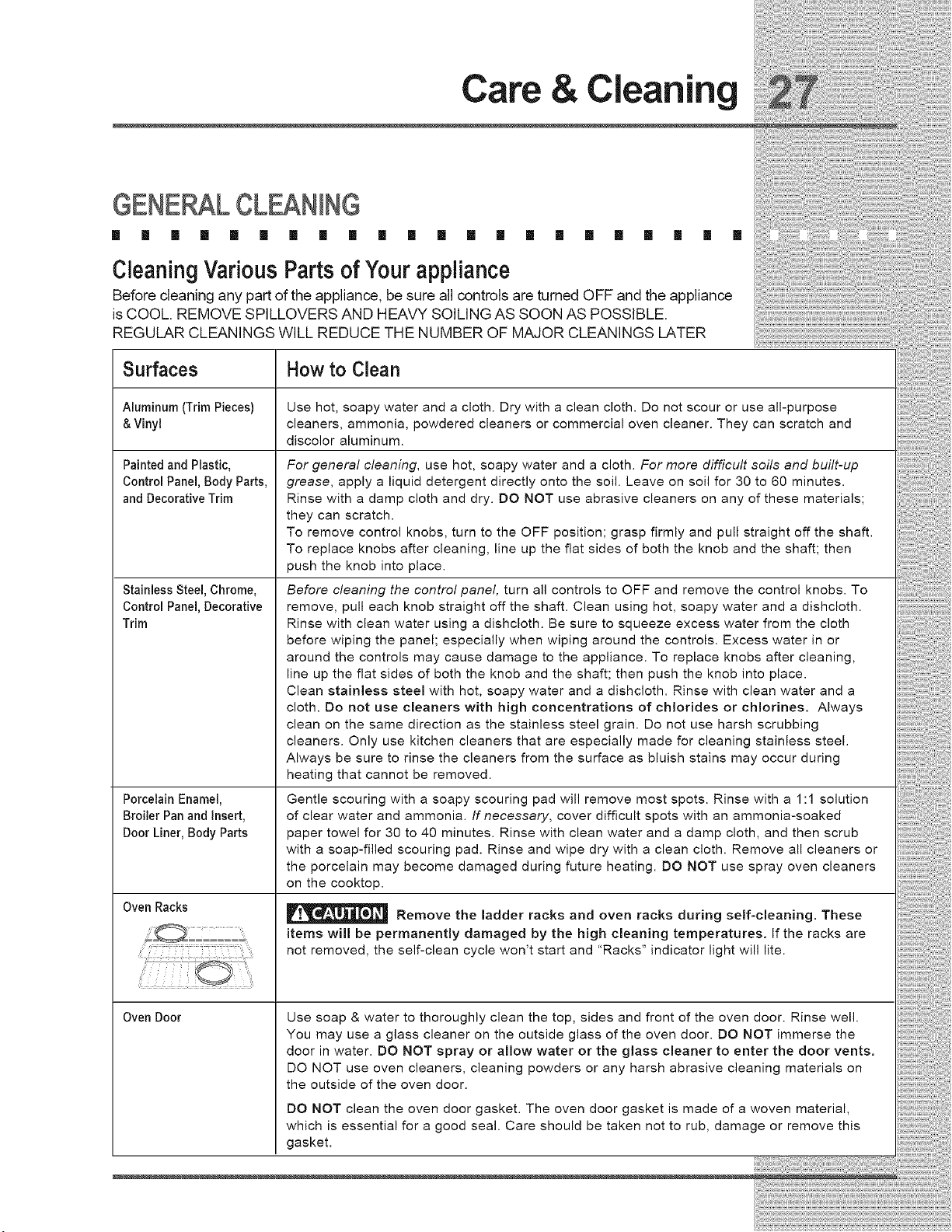
GENE L CLEAN)NG
[] [] [] [] [] [] [] [] [] [] [] [] [] [] [] [] [] [] [] [] [] []
Cleaning Various Parts of Yourappliance
Before cleaning any part of the appliance, be sure all controls are turned OFF and the appliance
is COOL, REMOVE SPILLOVERS AND HEAVY SOILING AS SOON AS POSSIBLE,
REGULAR CLEANINGS WILL REDUCE THE NUMBER OF MAJOR CLEANINGS LATER
Surfaces How to Clean
Aluminum (Trim Pieces) Use hot, soapy water and a cloth. Dry with a clean cloth. Do net scour or use all-purpose
& Vinyl cleaners, ammonia, powdered cleaners or commercial oven cleaner. They can scratch and
discolor aluminum.
Painted and Plastic,
Control Panel, Body Parts,
and Decorative Trim
Stainless Steel, Chrome,
Control Panel, Decorative
Trim
Porcelain Enamel,
Broiler Pan and insert,
Door Liner, Body Parts
Oven Racks
Oven Door
For general cleaning, use hot, soapy water and a cloth. For more difficult soils and built-up
grease, apply a liquid detergent directly onto the soil. Leave on soil for 30 to 60 minutes.
Rinse with a damp cloth and dry. DO NOT use abrasive cleaners on any of these materials;
they can scratch.
To remove control knobs, turn to the OFF position; grasp firmly and pull straight off the shaft.
To replace knobs after cleaning, line up the flat sides of both the knob and the shaft; then
push the knob into place.
Before cleaning the control panel, turn all controls to OFF and remove the control knobs. To
remove, pull each knob straight off the shaft. Clean using hot, soapy water and a dishcloth.
Rinse with clean water using a dishcloth. Be sure to squeeze excess water from the cloth
before wiping the panel; especially when wiping around the controls. Excess water in or
around the controls may cause damage to the appliance. To replace knobs after cleaning,
line up the flat sides of both the knob and the shaft; then push the knob into place.
Clean stainless steel with hot, soapy water and a dishcloth. Rinse with clean water and a
cloth. Do not use cleaners with high concentrations of chlorides or chlorines. Always
clean on the same direction as the stainless steel grain. Do not use harsh scrubbing
cleaners. Only use kitchen cleaners that are especially made for cleaning stainless steel.
Always be sure to rinse the cleaners from the surface as bluish stains may occur during
heating that cannot be removed.
Gentle scouring with a soapy scouring pad will remove most spots. Rinse with a 1:1 solution
of clear water and ammonia. If necessary, cover difficult spots with an ammonia-soaked
paper towel for 30 to 40 minutes. Rinse with clean water and a damp cloth, and then scrub
with a soap-filled scouring pad. Rinse and wipe dry with a clean cloth. Remove all cleaners or
the porcelain may become damaged during future heating. DO NOT use spray oven cleaners
on the cooktop.
Remove the ladder racks and oven racks during self-cleaning. These
items will be permanently damaged by the high cleaning temperatures. If the racks are
not removed, the self-clean cycle won't start and "Racks" indicator light will lite.
Use soap & water to thoroughly clean the top, sides and front of the oven door. Rinse well.
You may use a glass cleaner on the outside glass of the oven door. DO NOT immerse the
door in water. DO NOT spray or allow water or the glass cleaner to enter the door vents.
DO NOT use oven cleaners, cleaning powders or any harsh abrasive cleaning materials on
the outside of the oven door.
DO NOT clean the oven door gasket. The oven door gasket is made of a woven material,
which is essential for a good seal. Care should be taken not to rub, damage or remove this
gasket.
General Care & Cleaning
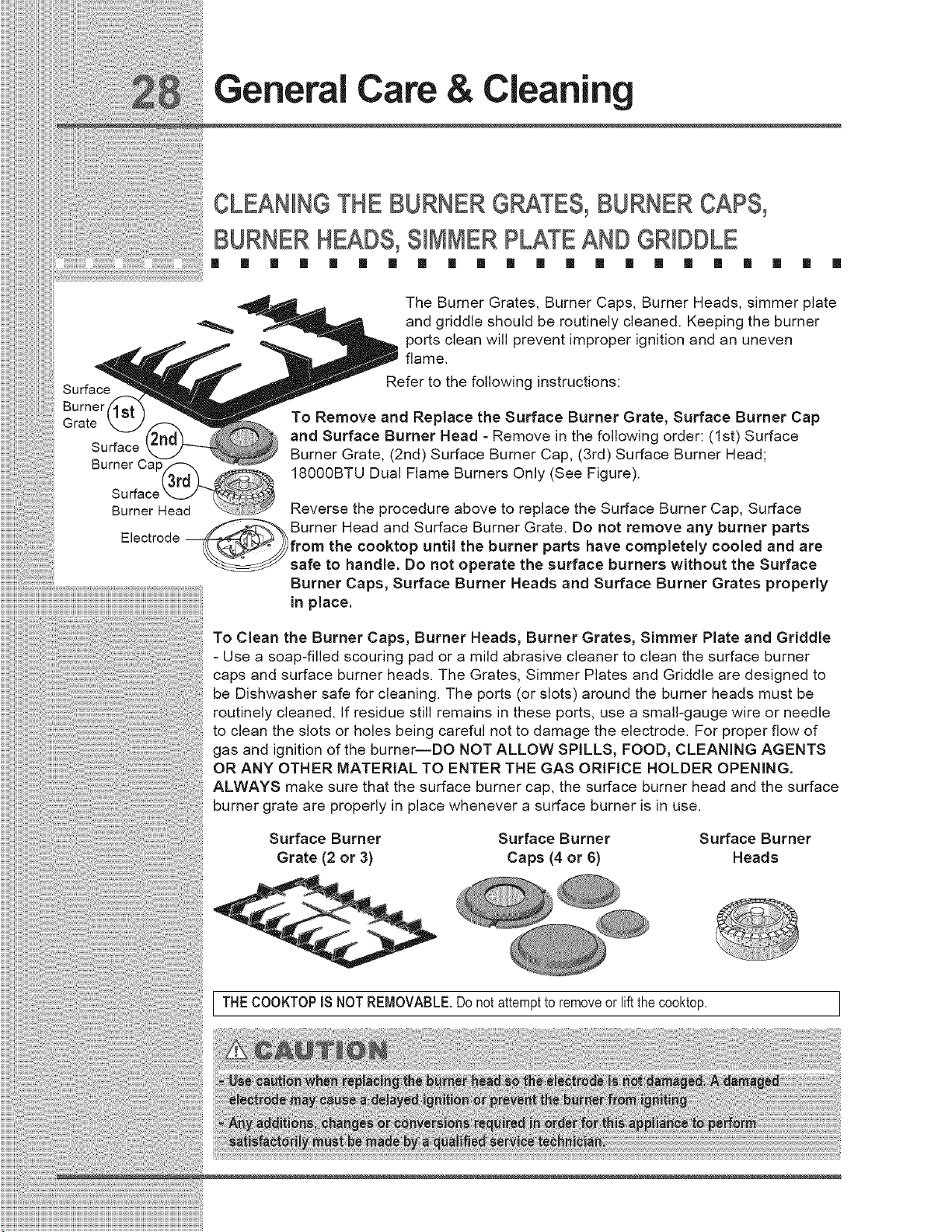
CLEANING THE BURNER GRATES, BURNER CAPS,
BURNER HEADS, SIMMER PLATE AND GRIDDLE
I [] [] [] [] [] [] [] [] [] [] [] [] [] [] [] [] [] [] [] []
The Burner Grates, Burner Caps, Burner Heads, simmer plate
and griddle should be routinely cleaned. Keeping the burner
ports clean will prevent improper ignition and an uneven
flame.
Surface
Burner
Grate
Surface
Burner Ca
Surface
Burner
Refer to the following instructions:
To Remove and Replace the Surface Burner Grate, Surface Burner Cap
and Surface Burner Head - Remove in the following order: (1st) Surface
Burner Grate, (2nd) Surface Burner Cap, (3rd) Surface Burner Head;
18000BTU Dual Flame Burners Only (See Figure).
Reverse the procedure above to replace the Surface Burner Cap, Surface
_Burner Head and Surface Burner Grate. Do not remove any burner parts
Electrode _L_/from the cooktop until the burner parts have completely cooled and are
_safe to handle. Do not operate the surface burners without the Surface
Burner Caps, Surface Burner Heads and Surface Burner Grates properly
in place.
To Clean the Burner Caps, Burner Heads, Burner Grates, Simmer Plate and Griddle
- Use a soap-filled scouring pad or a mild abrasive cleaner to clean the surface burner
caps and surface burner heads. The Grates, Simmer Plates and Griddle are designed to
be Dishwasher safe for cleaning. The ports (or slots) around the burner heads must be
routinely cleaned. If residue still remains in these ports, use a small-gauge wire or needle
to clean the slots or holes being careful not to damage the electrode. For proper flow of
gas and ignition of the burner--DO NOT ALLOW SPILLS, FOOD, CLEANING AGENTS
OR ANY OTHER MATERIAL TO ENTER THE GAS ORIF_CE HOLDER OPENING.
ALWAYS make sure that the surface burner cap, the surface burner head and the surface
burner grate are properly in place whenever a surface burner is in use.
Surface Burner
Grate (2 or 3)
Surface Burner
Caps (4 or 6)
Surface Burner
Heads
THECOOKTOPHSNOT REMOVABLE.Do not attemptto removeor liftthe cooktop. I
General Care & Cleaning
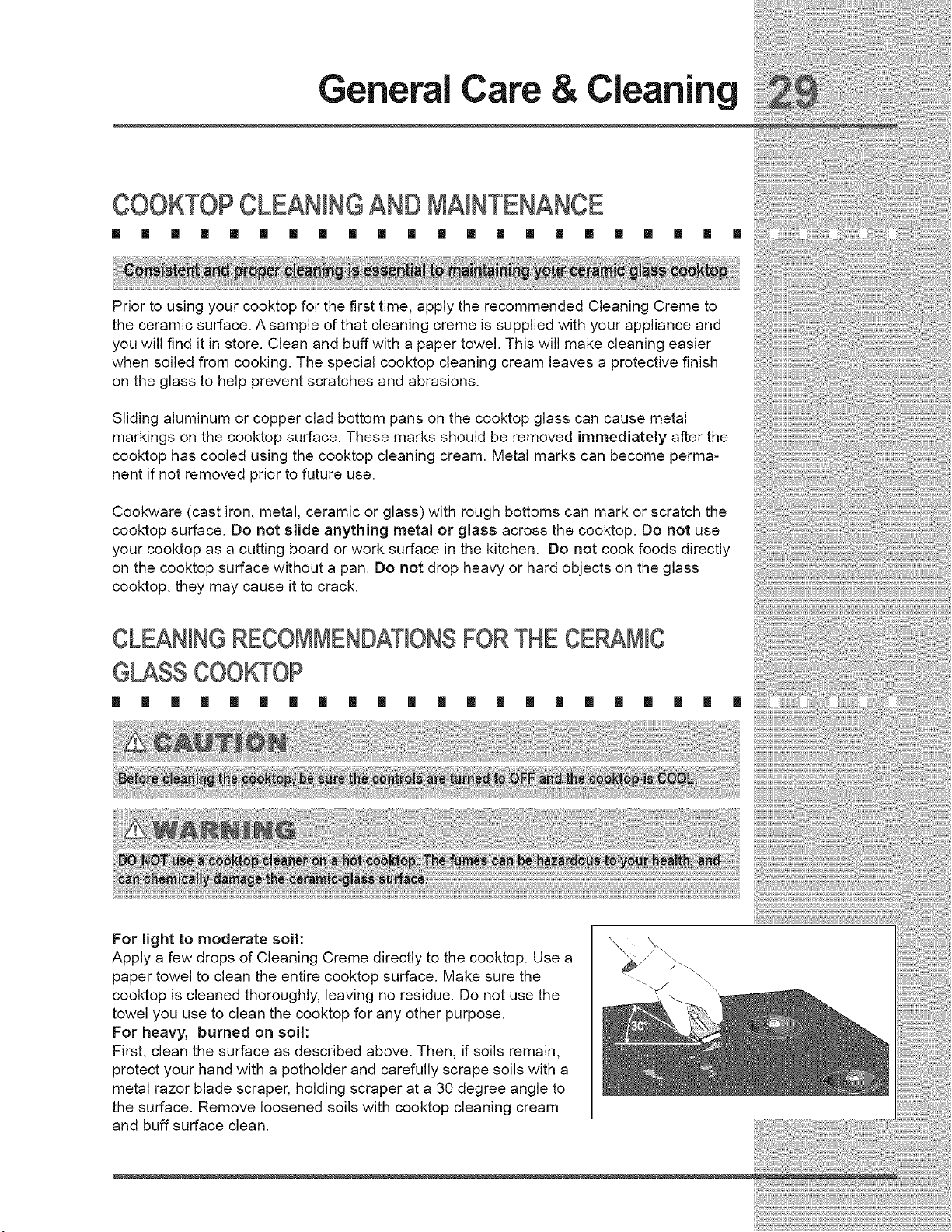
COOKTOP CLEANINGAND MAINTENANCE
[] [] [] [] [] [] [] [] II II II [] [] [] II II [] [] [] [] [] []
Prior to using your cooktop for the first time, apply the recommended Cleaning Creme to
the ceramic surface. A sample of that cleaning creme is supplied with your appliance and
you will find it in store. Clean and buff with a paper towel. This will make cleaning easier
when soiled from cooking. The special cooktop cleaning cream leaves a protective finish
on the glass to help prevent scratches and abrasions.
Sliding aluminum or copper clad bottom pans on the cooktop glass can cause metal
markings on the cooktop surface. These marks should be removed immediately after the
cooktop has cooled using the cooktop cleaning cream. Metal marks can become perma-
nent if not removed prior to future use.
Cookware (cast iron, metal, ceramic or glass) with rough bottoms can mark or scratch the
cooktop surface. Do not slide anything metal or glass across the cooktop. Do not use
your cooktop as a cutting board or work surface in the kitchen. Do not cook foods directly
on the cooktop surface without a pan. Do not drop heavy or hard objects on the glass
cooktop, they may cause it to crack.
CLEANINGRECOMMENDATIONSFORTHE CE MmC
G SS COOKTOP
II II II [] [] II [] III I II [] [] II [] [] [] [] I [] [] []
For light to moderate soil:
Apply a few drops of Cleaning Creme directly to the cooktop. Use a
paper towel to clean the entire cooktop surface. Make sure the
cooktop is cleaned thoroughly, leaving no residue. Do not use the
towel you use to clean the cooktop for any other purpose.
For heavy, burned on soil:
First, clean the surface as described above. Then, if soils remain,
protect your hand with a potholder and carefully scrape soils with a
metal razor blade scraper, holding scraper at a 30 degree angle to
the surface. Remove loosened soils with cooktop cleaning cream
and buff surface clean.
General Care & Cleani
CLEANINGRECOMMENDATIONSFORTHE CE%MmC
G SS COOKTOP (CONTINUED)
m [] [] [] m [] [] [] m [] [] [] [] [] m [] [] [] [] [] []
Plastic or foods with a high sugar content:
These types of soils need be removed immediately if spilled or melted onto the ceramic
cooktop surface. Permanent damage (such as pitting of the cooktop surface) may occur if
not removed immediately. After turning the surface elements OFF, use a razor blade
scraper or a metal spatula with a mitt and scrape the soil from the hot surface (as illus-
trated on previous page). Allow the cooktop to cool, and use the same method for heavy or
burned on soils.
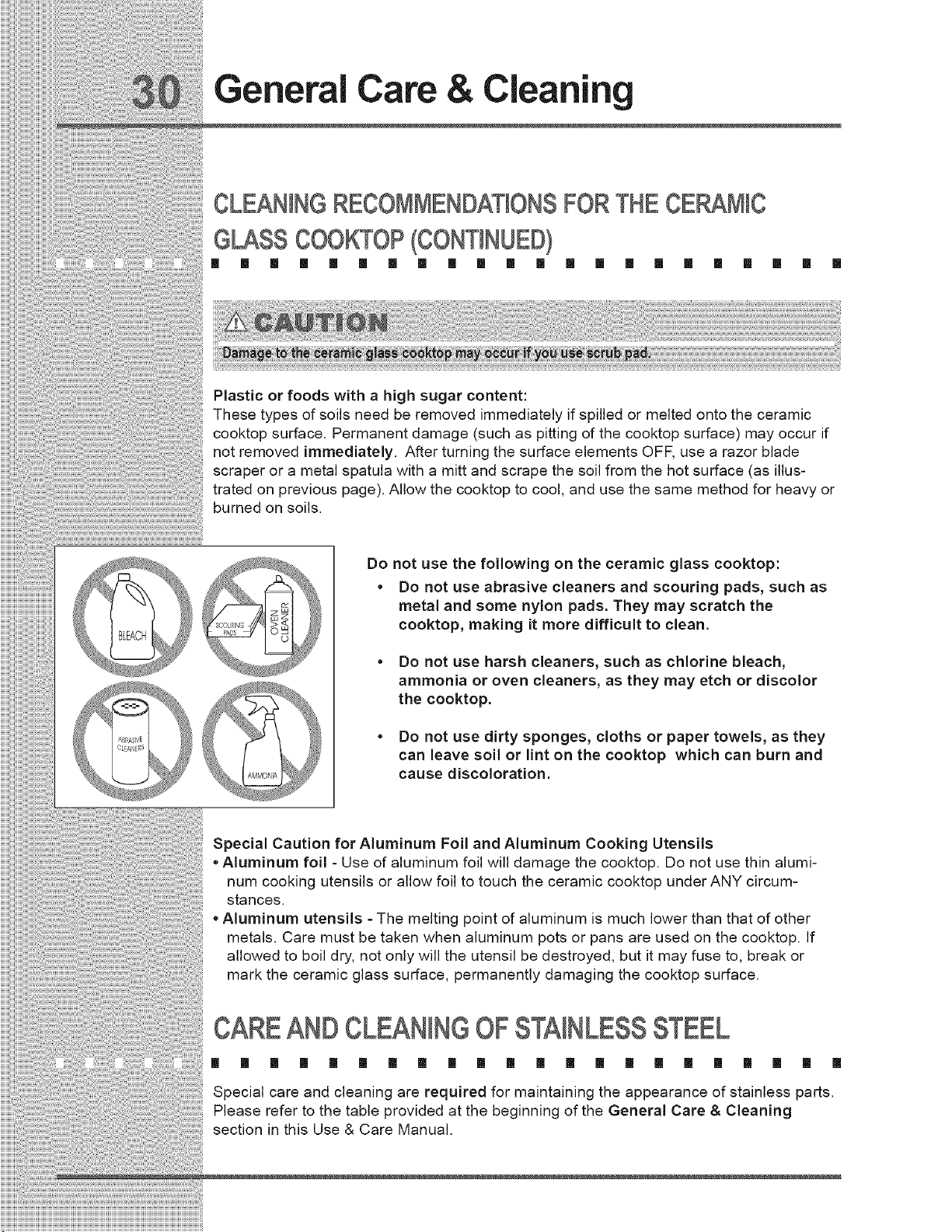
Do not use the following on the ceramic glass cooktop:
• Do not use abrasive cleaners and scouring pads, such as
metal and some nylon pads. They may scratch the
cooktop, making it more difficult to clean.
• Do not use harsh cleaners, such as chlorine bleach,
ammonia or oven cleaners, as they may etch or discolor
the cooktop.
. Do not use dirty sponges, cloths or paper towels, as they
can leave soil or lint on the cooktop which can burn and
cause discoloration.
Special Caution for Aluminum Foil and Aluminum Cooking Utensils
• Aluminum foil = Use of aluminum foil will damage the cooktop. Do not use thin alumi-
num cooking utensils or allow foil to touch the ceramic cooktop under ANY circum-
stances.
Aluminum utensils - The melting point of aluminum is much lower than that of other
metals. Care must be taken when aluminum pots or pans are used on the cooktop. If
allowed to boil dry, not only will the utensil be destroyed, but it may fuse to, break or
mark the ceramic glass surface, permanently damaging the cooktop surface.
CAREANDCLEANINGOFSTAINLESSSTEEL
[] [] [] [] [] [] [] [] [] [] [] [] [] [] [] [] [] [] [] [] [] []
Special care and cleaning are required for maintaining the appearance of stainless parts.
Please refer to the table provided at the beginning of the General Care & Cleaning
section in this Use & Care Manual.
Care & Cleaning
TO REMOVEAND REP CE OVENDOOR
[] [] [] [] [] [] [] [] [] [] [] [] [] [] [] [] [] [] [] [] [] []
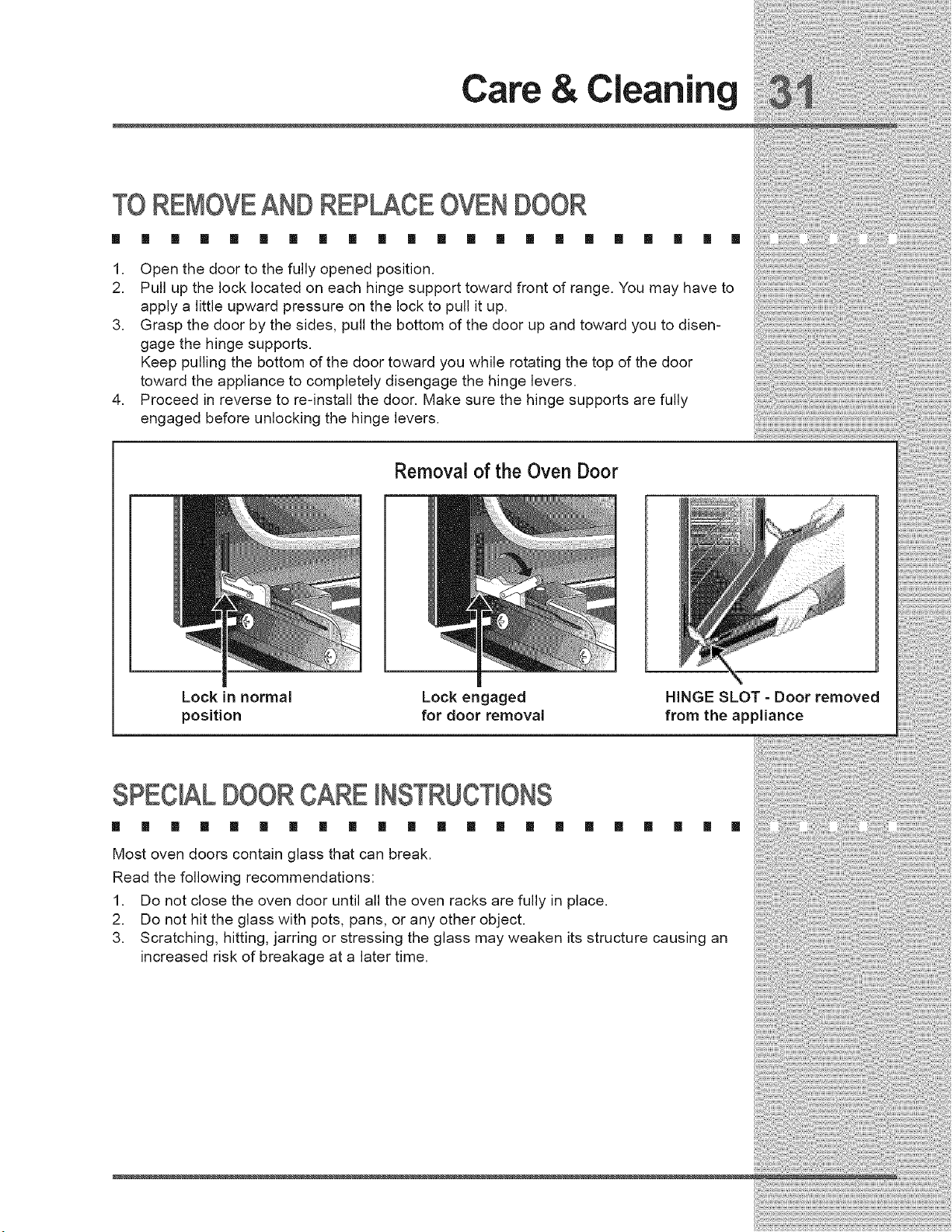
1. Open the door to the fully opened position.
2. Pull up the lock located on each hinge support toward front of range. You may have to
apply a little upward pressure on the lock to pull it up.
3. Grasp the door by the sides, pull the bottom of the door up and toward you to disen-
gage the hinge supports.
Keep pulling the bottom of the door toward you while rotating the top of the door
toward the appliance to completely disengage the hinge levers.
4. Proceed in reverse to re-install the door. Make sure the hinge supports are fully
engaged before unlocking the hinge levers.
Lock in normal
position
Removal of the Oven Door
Lock engaged
for door removal
SPEC+ALDOORCARE+NSTRUCT+ONS
[] [] [] [] [] [] [] [] [] [] [] [] [] [] [] [] [] [] [] [] [] []
Most oven doors contain glass that can break.
Read the following recommendations:
1. Do not close the oven door until all the oven racks are fully in place.
2. Do not hit the glass with pots, pans, or any other object.
3. Scratching, hitting, jarring or stressing the glass may weaken its structure causing an
increased risk of breakage at a later time.
Care & Cleani
OVENL+GHT
I [] [] [] [] [] [] [] [] [] [] [] [] [] [] [] [] [] [] [] [] []
An interior oven light will turn automatically when the oven door is opened. The oven
light may be turned on when the door is closed by using the oven light switch located on
the control panel,
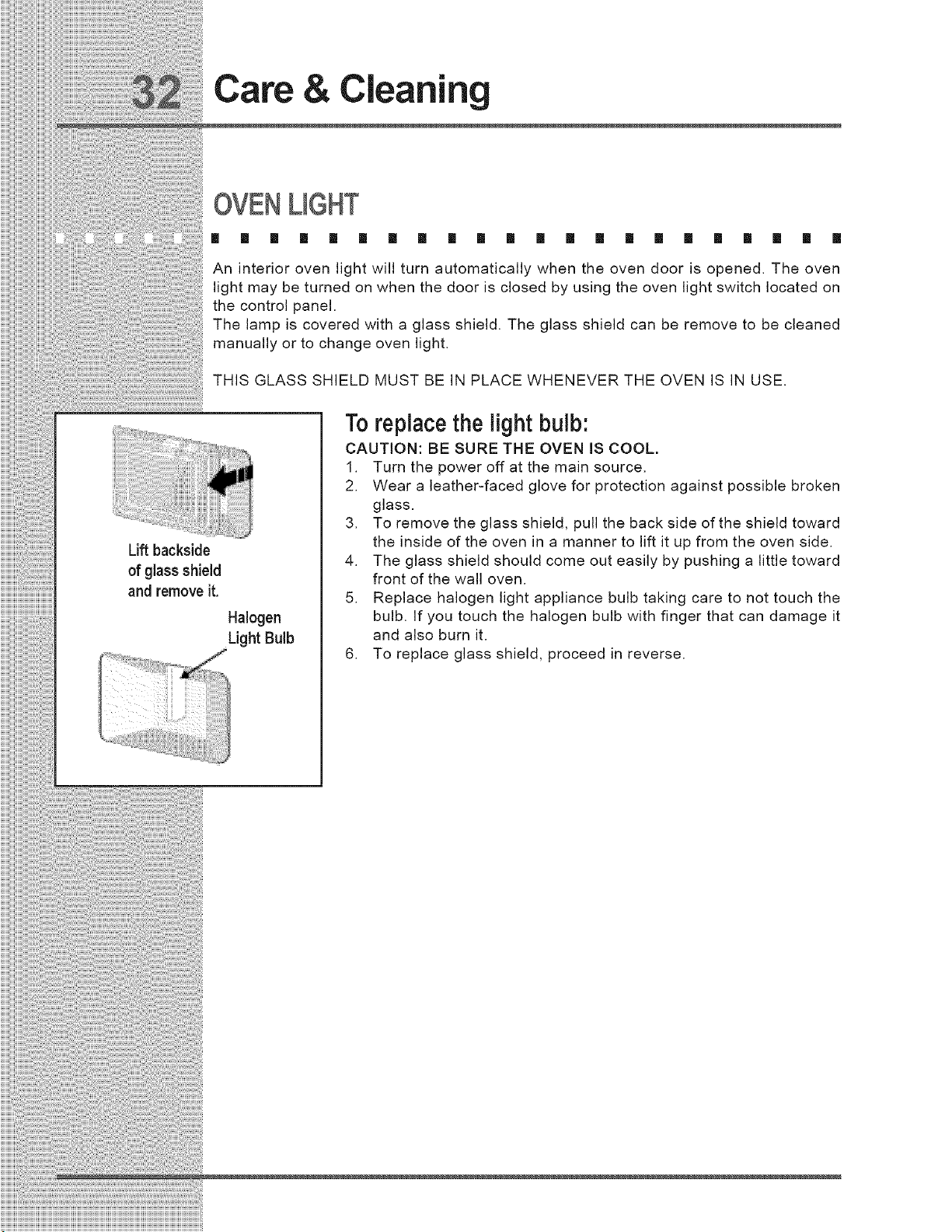
The lamp is covered with a glass shield, The glass shield can be remove to be cleaned
manually or to change oven light,
THIS GLASS SHIELD MUST BE IN PLACE WHENEVER THE OVEN IS IN USE.
Lift backside
of glass shield
and remove it.
Halogen
Light Bulb
To replace the light bulb:
CAUTION: BE SURE THE OVEN IS COOL.
1. Turn the power off at the main source.
2. Wear a leather-faced glove for protection against possible broken
glass.
3. To remove the glass shield, pull the back side of the shield toward
the inside of the oven in a manner to lift it up from the oven side.
4. The glass shield should come out easily by pushing a little toward
front of the wall oven.
5. Replace halogen light appliance bulb taking care to not touch the
bulb. If you touch the halogen bulb with finger that can damage it
and also burn it.
6. To replace glass shield, proceed in reverse.
utions to Common Problems
SURFACE BURNERS DONOT LIGHT
[] [] [] [] [] [] [] [] [] [] [] [] [] [] [] [] [] [] [] [] [] []
* Surface Control knob has not been completely turned to LITE. Push in and turn the
Surface Control knob to LITE until burner ignites and then turn control knob to desired
flame size.
* Be sure gas supply valve is open.
* Burner ports are clogged. Clean burners. See Cleaning the Burner Grates, Burner
Caps, Burner Heads in General Care & Cleaning section. With the burner off, clean
ports with a small-gauge wire or needle.
* Power cord is disconnected from outlet (Electric Ignition Models only). Be sure cord is
securely plugged into the outlet.
* Electrical power outage (electric ignition models only). Burners can be lit manually. See
Setting Surface Controls in this Use and Care Guide.
BURNER FHME ON_ UGHTS HALF VV_ MOUND BURNER ,,_,_,,,,,,,,,,_:_,,________________________________________________:______:_:___`_`_`_`__`_______________`____________________________:::_____:
[]. [] [] [] [] [] [] [] [] [] [] [] [] [] [] [] [] [] [] [] [] []))
Burner ports are clogged. With the burner off, clean ports by using a small-gauge wire
, or needle.
Moisture is present after cleaning, Lightly fan the flame and allow burner to operate until
flame is fujl, Dry the burners thoroughly following instructions in the General Cleaning
section.
. up. R
[] [] [] [] [] [] [] [] [] []
: Dustparticlesinmain line.Allowthe burnertooperatea few minutesuntilflameturnsblue.
Incoastalareas,a slightlyorangeflame isunavoidabledue tosaltair. ]
SCOTCHES ORAB_SIONS ONCE_MIC G_SS i
.coo,
* Coarse particles (such as salt or sand)are between cooktop and utensil. Be sure
cooktop surface and bottom of utensils are clean before use. Small scratches do not
, affect cooking and will become less visible with use.
Cleaning materials not recommended for glass ceramic cooktop have been used. See
Ceramic-Glass Cooktop section in this Owner s Guide.
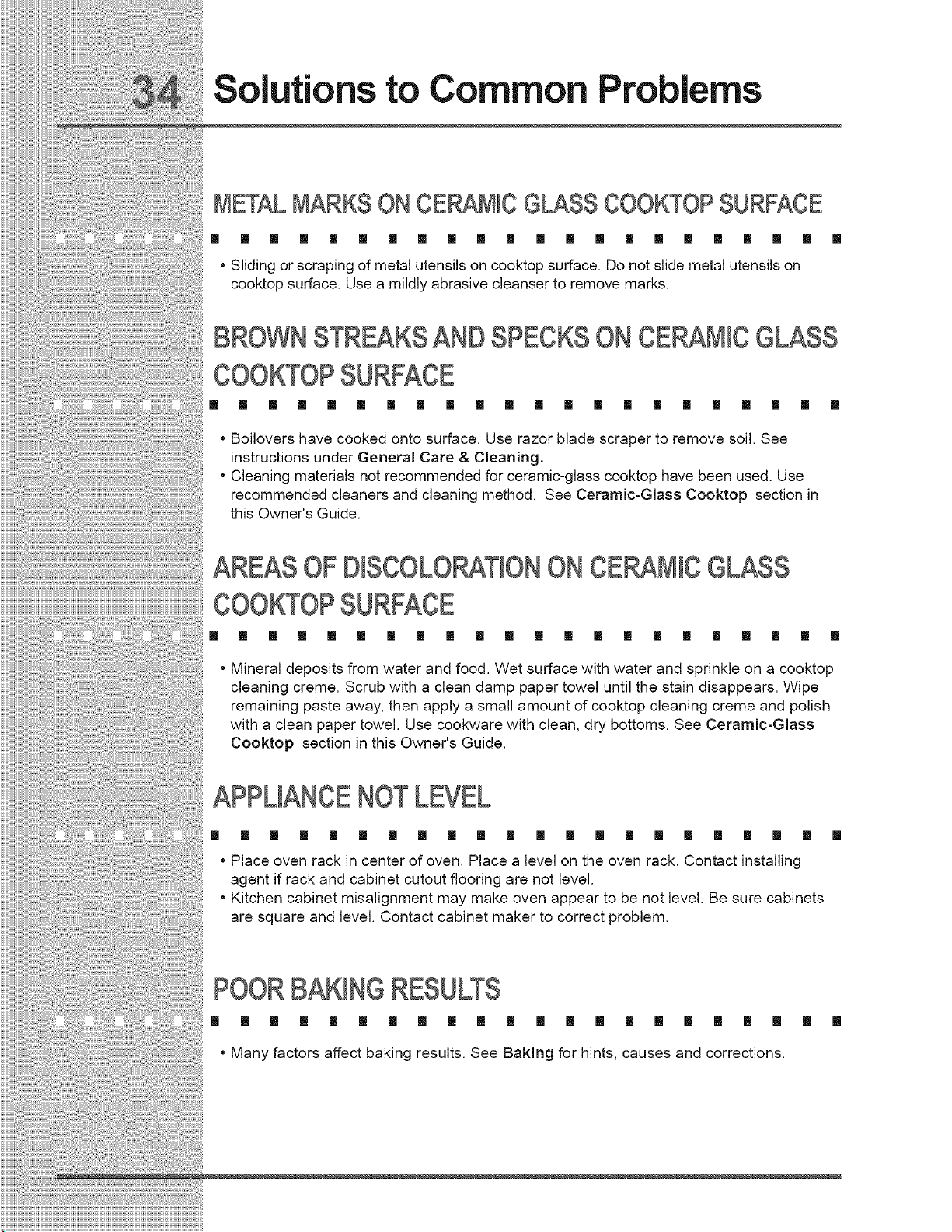
Solutions to Common Problems
METALMARKSONCE_MmCG_SS COOKTOPSURFACE
[] [] [] [] [] [] [] [] [] [] [] [] [] [] [] [] [] [] [] [] []
• Sliding or scraping of metal utensils on cooktop surface. Do not slide metal utensils on
cooktop surface. Use a mildly abrasive cleanser to remove marks.
BROWNSTREAKSANDSPECKSONCE_MIC GLASS
COOKTOPSURFACE
[] [] [] [] [] [] [] [] [] [] [] [] [] [] [] [] [] [] [] [] [] []
Boilovers have cooked onto surface. Use razor blade scraper to remove soil. See
instructions under General Care & Cleaning.
Cleaning materials not recommended for ceramic-glass cooktop have been used. Use
recommended cleaners and cleaning method. See Ceramic-Glass Cooktop section in
this Owner's Guide.
AREASOFDISCOLO_TIONONCE_MIC GLASS
COOKTOPSURFACE
[] [] [] [] [] [] [] [] [] [] [] [] [] [] [] [] [] [] [] [] [] []
• Mineral deposits from water and food. Wet surface with water and sprinkle on a cooktop
cleaning creme. Scrub with a clean damp paper towel until the stain disappears. Wipe
remaining paste away, then apply a small amount of cooktop cleaning creme and polish
with a clean paper towel. Use cookware with clean, dry bottoms. See Ceramic-Glass
Cooktop section in this Owner's Guide.
APPLIANCENOTLEVEL
[] [] [] [] [] [] [] [] [] [] [] [] [] [] [] [] [] [] [] [] [] []
• Place oven rack in center of oven. Place a level on the oven rack. Contact installing
agent if rack and cabinet cutout flooring are not level.
• Kitchen cabinet misalignment may make oven appear to be not level. Be sure cabinets
are square and level. Contact cabinet maker to correct problem.
POORBAKINGRESULTS
[] [] [] [] [] [] [] [] [] [] [] [] [] [] [] [] [] [] [] []
• Many factors affect baking results. See Baking for hints, causes and corrections.
[] []
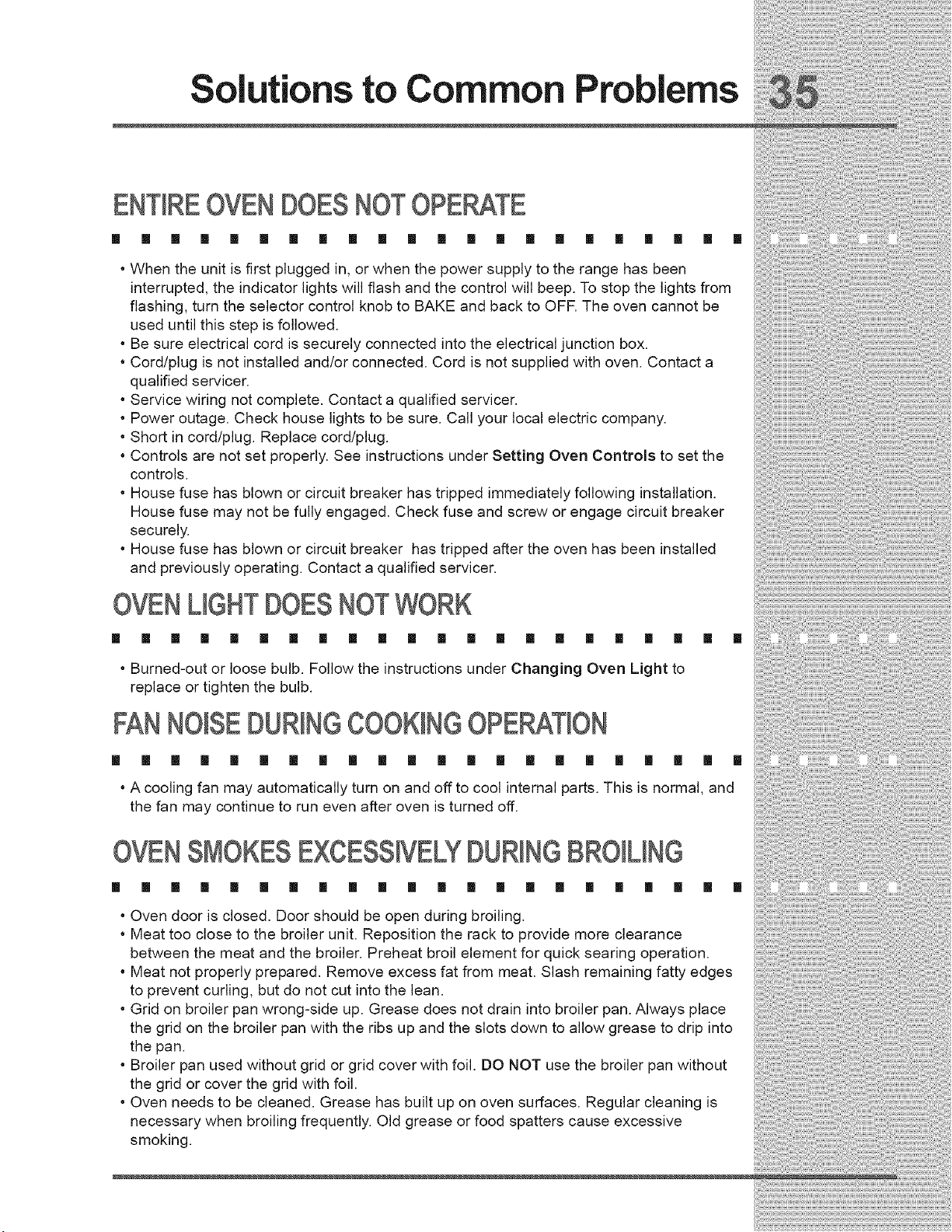
Solutions to Common Problems
ENT)REOVENDOESNOTOPE TE
[] [] [] [] [] [] [] [] [] [] [] [] [] [] [] [] [] [] [] [] [] []
• When the unit is first plugged in, or when the power supply to the range has been
interrupted, the indicator lights will flash and the control will beep. To stop the lights from
flashing, turn the selector control knob to BAKE and back to OFR The oven cannot be
used until this step is followed.
• Be sure electrical cord is securely connected into the electrical junction box.
• Cord/plug is not installed and/or connected. Cord is not supplied with oven. Contact a
qualified servicer.
• Service wiring not complete. Contact a qualified servicer.
• Power outage. Check house lights to be sure. Call your local electric company.
• Short in cord/plug. Replace cord/plug.
• Controls are not set properly. See instructions under Setting Oven Controls to set the
controls.
• House fuse has blown or circuit breaker has tripped immediately following installation.
House fuse may not be fully engaged. Check fuse and screw or engage circuit breaker
securely.
• House fuse has blown or circuit breaker has tripped after the oven has been installed
and previously operating. Contact a qualified servicer.
OVENL(GHTDOESNOTWORK
,,.[] [] [] [] [] [] [] [] [] [] [] [] [] [] [] [] [] [] [] [] []
Burned-out or loose bulb. Follow the instructions under Changing Oven Light to :: ; )))
replace or tighten the bulb. :::
0y..,0?
• A cooling fan may automatically turn on and off to cool internal parts. This is normal, and :
the fan may continue to run even after oven is turned off.
' . .
[ Oven door is closed. Door should be open during broiling.
Meat too close to the broiler unit. Reposition the rack to provide more clearance
. between the meat and the broiler. Preheat broil element for quick searing operation.
Meat not properly prepared. Remove excess fat from meat. Slash remaining fatty edges
. to prevent curling, but do not cut into the lean.
Grid on broiler pan wrong-side up. Grease does not drain into broiler pan. Always place
the grid on the broiler pan with the ribs up and the slots down to allow grease to drip into
•the pan.
Broiler pan used without grid or grid cover with foil. DO NOT use the broiler pan without
. the grid or cover the grid with foil.
Oven needs to be cleaned. Grease has built up on oven surfaces. Regular cleaning is
necessary when broiling frequently. Old grease or food spatters cause excessive
smoking. :
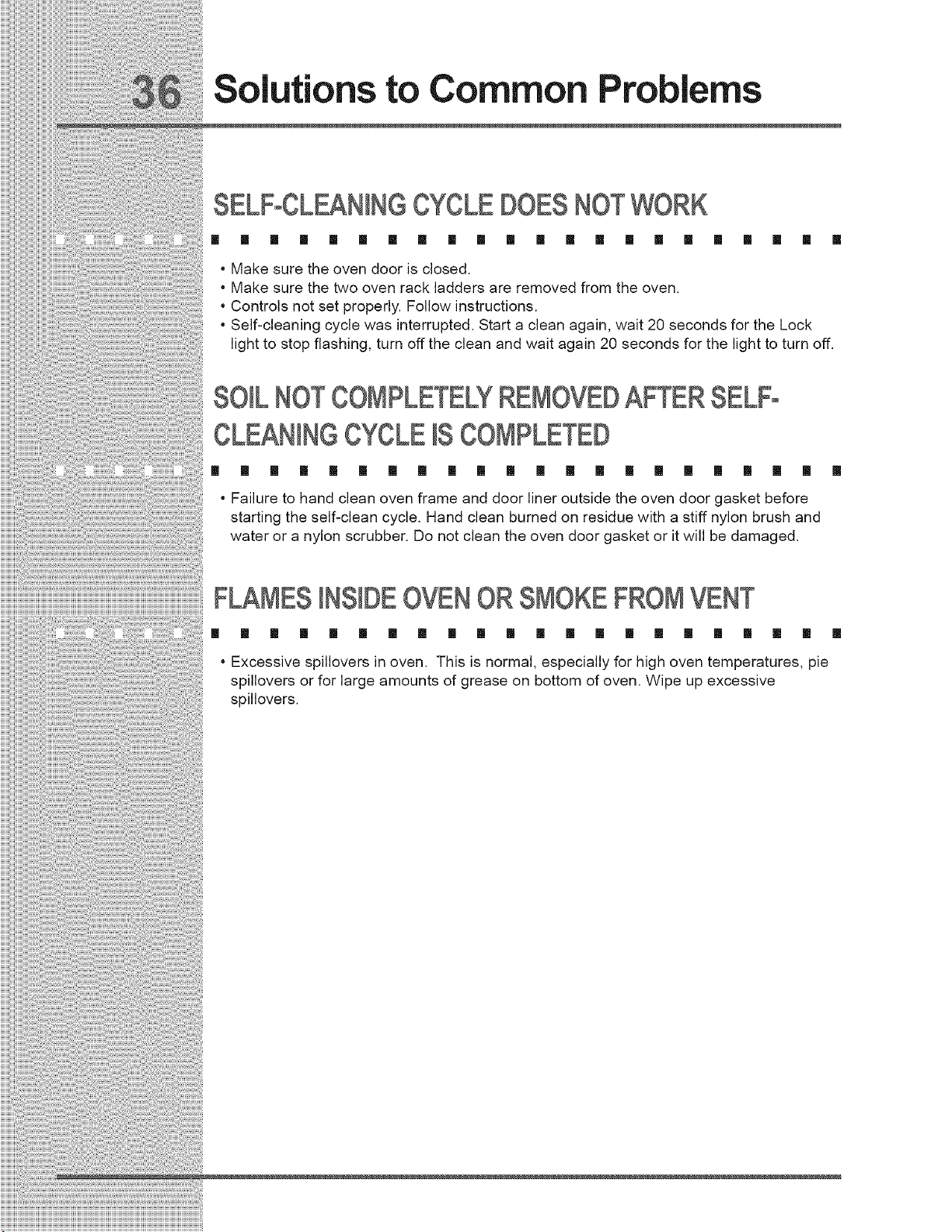
Solutions to Common Problems
SELF-CLEANINGCYCLEDOESNOTWORK
m [] [] [] [] [] [] [] [] [] [] [] [] [] [] [] [] [] [] [] [] []
• Make sure the oven door is closed.
• Make sure the two oven rack ladders are removed from the oven.
• Controls not set properly. Follow instructions.
• Self-cleaning cycle was interrupted. Start a clean again, wait 20 seconds for the Lock
light to stop flashing, turn off the clean and wait again 20 seconds for the light to turn off.
SOiL NOTCOMPLETELYREMOVEDAFTERSELF°
CLEANINGCYCLEISCOMPLETED
[] [] [] [] [] [] [] [] [] [] [] [] [] [] [] [] [] [] [] [] []
• Failure to hand clean oven frame and door liner outside the oven door gasket before
starting the self-clean cycle. Hand clean burned on residue with a stiff nylon brush and
water or a nylon scrubber. Do not clean the oven door gasket or it will be damaged.
FLAMESINSIDEOVENORSMOKEFROMVENT
[] [] [] [] [] [] [] [] [] [] [] [] [] [] [] [] [] [] [] [] []
• Excessive spillovers in oven. This is normal, especially for high oven temperatures, pie
spillovers or for large amounts of grease on bottom of oven. Wipe up excessive
spillovers.

Notes
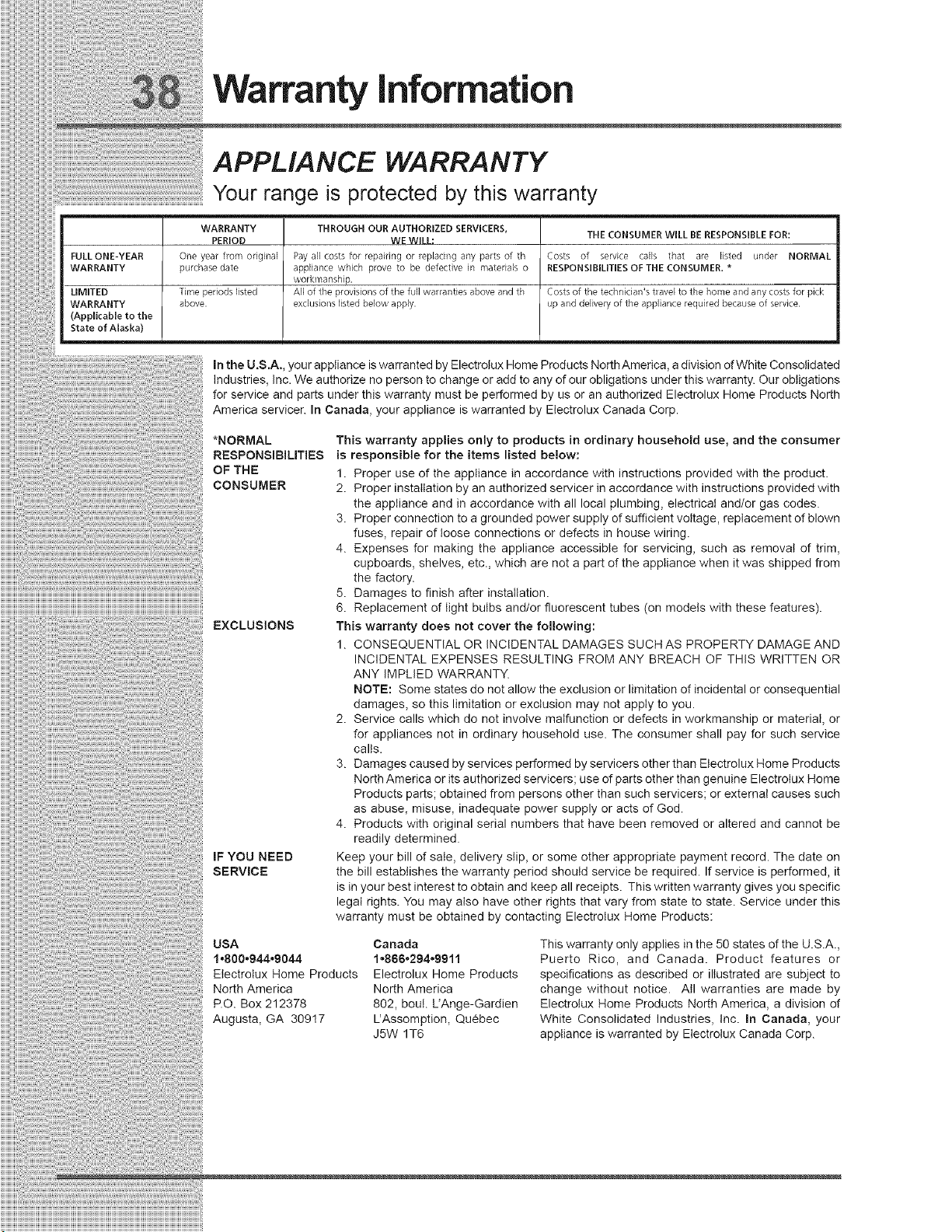
Warranty information
I ULL ONE-YEAR
WARRANTY
LIMITED
WARRANTY
(Applkabie to the
State of Alaska)
APPLIANCE WARRANTY
Your range is protected by this warranty
WARRANTY
PERIOD
One year from original
purchase date
Time periods listed
above.
THROUGH OUR AUTHORIZED SERVmCERS,
WE WILL:
Pay all costs for repairing or replacing any parts of th
appliance which prove to be defective in materials o
workmanship.
All of the provisions of the full warranties above and th
exclusions listed below apply.
THE CONSUMER WILL BE RESPONSIBLE FOR:
Costs of serwce calls that are listed under NORMAL
RESPONSIBILITIES OF THE CONSUMER. *
Costs of the technidan's travel to the home and any costs for pick
up and delNe_y of the appliance required because of serwce.
In the U.S.A., your appliance is warranted by Electrolux Home Products North America, a division of White Consolidated
Industries, Inc. We authorize no person to change or add to any of our obligations under this warranty. Our obligations
for service and parts under this warranty must be performed by us or an authorized Electrolux Home Products North
America servicer, in Canada, your appliance is warranted by Electrolux Canada Corp.
*NORMAL
RESPONSiBiLiTiES
OF THE
CONSUMER
EXCLUSIONS
iF YOU NEED
SERVICE
This warranty applies only to products in ordinary household use, and the consumer
is responsible for the items listed below:
1. Proper use of the appliance in accordance with instructions provided with the product.
2. Proper installation by an authorized servicer in accordance with instructions provided with
the appliance and in accordance with all local plumbing, electrical and/or gas codes.
3. Proper connection to a grounded power supply of sufficient voltage, replacement of blown
fuses, repair of loose connections or defects in house wiring.
4. Expenses for making the appliance accessible for servicing, such as removal of trim,
cupboards, shelves, etc., which are not a part of the appliance when it was shipped from
the factory.
5. Damages to finish after installation.
6. Replacement of light bulbs and/or fluorescent tubes (on models with these features).
This warranty does not cover the following:
1. CONSEQUENTIAL OR INCIDENTAL DAMAGES SUCH AS PROPERTY DAMAGE AND
INCIDENTAL EXPENSES RESULTING FROM ANY BREACH OF THIS WRITTEN OR
ANY IMPLIED VVARRANTY.
NOTE: Some states do not allow the exclusion or limitation of incidental or consequential
damages, so this limitation or exclusion may not apply to you.
2. Service calls which do not involve malfunction or defects in workmanship or material, or
for appliances not in ordinary household use. The consumer shall pay for such service
calls.
3. Damages caused by services performed by servicers other than Etectrolux Home Products
North America or its authorized servicers; use of parts other than genuine Electrolux Home
Products parts; obtained from persons other than such servicers; or external causes such
as abuse, misuse, inadequate power supply or acts of God.
4. Products with original serial numbers that have been removed or altered and cannot be
readily determined.
Keep your bill of sale, delivery slip, or some other appropriate payment record. The date on
the bill establishes the warranty period should service be required. If service is performed, it
is in your best interest to obtain and keep all receipts. This written warranty gives you specific
legal rights. You may also have other rights that vary from state to state. Service under this
warranty must be obtained by contacting Electrolux Home Products:
USA
1,800,944.9044
Electrotux Home Products
North America
P.O. Box 212378
Augusta, GA 30917
Canada
1,866o294,991!
Electrolux Home Products
North America
802, boul. UAnge-Gardien
UAssomption, Quebec
J5W 1T8
This warranty only applies in the 50 states of the U.S.A.,
Puerto Rico, and Canada. Product features or
specifications as described or illustrated are subject to
change without notice. All warranties are made by
Electrolux Home Products North America, a division of
White Consolidated Industries, Inc. in Canada, your
appliance is warranted by Electrolux Canada Corp.

