ww w.PyleUSA.com
2
To guarantee optimal function of this product, please adhere
to the following instructions:
• Before using this product for the rst time, please read the manual
carefully!
• The product has been designed with safety features. Nevertheless,
please read the safety instructions carefully and use the equipment
only as described in the manual to avoid hazards and personal
injury.
• Please retain this manual for future reference.
• Should you pass on this product, ensure to include the
corresponding instruction manual.
WARNING! SAFETY FIRST!
• Never ride without wrist, knee, and elbow guards, as well as helmet!
• When riding, wear sports shoes with a full-length, anti-skid sole!
• Use the skateboard only on suitable surfaces that are at, smooth,
clean and dry.
• Always take into account other road users and remember that a
skateboard is not a vehicle as dened by road traffic act.
• Before starting: Check the castors and axles for tightness.
ww w.PyleUSA.com
3
SAFETY INFORMATIONS
1. The maximum user weight is 220 lbs.
2. When riding your skateboard, safety always takes priority over
speed. Never ride faster as you could run when jumping off the
skateboard.
3. Walking on or jumping onto a skateboard can be dangerous!
4. Only ride in areas without traffic. Do not exercise at locations,
where you could endanger other people, e.g. on sidewalks, public
squares and roads.
5. Children under 8 years old must always be supervised when
riding a skateboard.
6. The most severe injuries are broken bones. For that reason, correct
falling and rolling off must be learned rst.
7. New skateboarders should practice with a friend or parents.
Most accidents happen at the beginning of the learning phase.
8. Before jumping off the skateboard, consider where it could go.
It could injure other people.
9. Avoid riding on wet or uneven surfaces.
10. Your skateboard meets high quality standards. All materials have
been selected carefully and been manufactured in accordance
with quality assurance measures. We would, nevertheless, like to
remind you that inexperienced riding or improper handling can
easily cause extreme wear and tear, damage to the product, or
injuries. We are not liable for any damage as a result of such actions.
ww w.PyleUSA.com
4
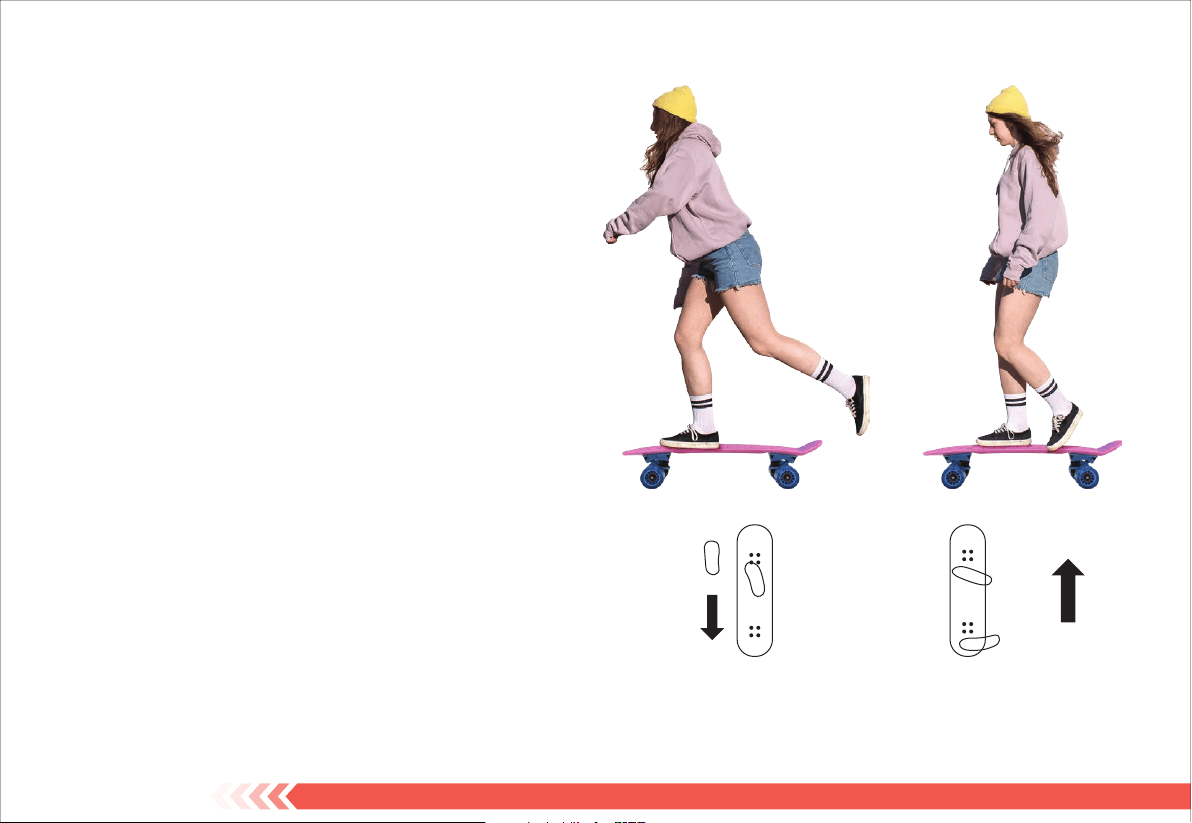
Resistance Stable driving position
RIDING TECHNIQUE
1. Starting position: Adjust your speed according to
your skills. If you are an inexperienced “skateboarder”,
rst position one foot in driving direction in par with
the front wheels. Slightly load that foot, then slightly
bent the knee. Then position the other foot above
the rear axle at a right angle to the board. Remember
to always load the front foot, i.e. shift your body
weight to the front. Make sure to always get off
towards the front. After a few tries you will get a
better feeling for the skateboard.
2. Initial riding tests: Then try to tilt the board along
the longitudinal axis to the right and left by shifting
your weight accordingly. Use your knee joints and
ankles to shift the weight, keeping your upper body
straight. Hold the balance using your arms. To start
moving the skateboard, position one foot on the
board rst as described under starting position.
Then push several times with your other foot. Once
your skateboard has gained sufficient momentum,
position your second foot on the rear part of the
board. Never ride with just one foot on the board.
Beginners should avoid steep ground.

ww w.PyleUSA.com
5
3. Braking
a. Braking at low speed: First position your rear foot next to the board, and then touch down to decelerate.
The front foot remains on the board until the breaking process has come to an end.
b. Braking at high speed: Proceed similar as at low speed. After initial braking with the rear foot, take the front foot
off the board as well. It is important to stop the skateboard immediately after having jumped off.
A skateboard that continues running in an uncontrolled manner is a danger for the surrounding.
4. Making turns: First take the starting position. Then bend your knees further and shift your weight towards the side
of the board, on which you want to make a turn. In order to turn to the right, shift your weight to the right.
To turn to the left, shift your weight to the left. The radius of the curve will depend on the lateral pressure you apply.
The more pressure, the smaller the curve.
KEEP YOUR SKATEBOARD IN GOOD CONDITION!
1. Wear and tear requires regular maintenance and repair.
2. If it becomes necessary to replace some components, always use original spare parts for your own safety.
Please contact our customer service as per information below.
3. Worn castors can be replaced easily by loosening the respective bolts.
4. Sharp edges caused by using the skateboard must be neutralized. Remove cracks and splints immediately.
5. Replace defective parts of the skateboard immediately.
6. Even high-quality boards must be checked prior to every use, especially the bolts and wheels.
7. Check the axle suspension. All bolts must be tightened.
8. Check the bearings regularly for dirt, and clean them, e.g. with benzene. After cleaning, lubricate the bearings again.
To do so, use a suitable lubricant. Make sure no sand can enter the ball bearings.
9. IMPORTANT: Do not modify your skateboard in a way that could affect the safety
Questions? Comments?
We are here to help!
Email: cs@hurtleusa.com