

Read the manual carefully and ensure you have fully understood
its contents before operating this device for the first time.
English

Contents
First-Time Use
Home Screen......................................................................................................................................3
Connecting to the Internet..................................................................................................................4
Prepare Live TV................................................................................................................................. 6
Enjoy Live TV
Channel Scan..................................................................................................................................... 7
Live Menu........................................................................................................................................... 8
Channel Edit..................................................................................................................................... 10
Programme Guide (EPG).................................................................................................................12
Programme Recording (PVR).......................................................................................................... 13
Reminder.......................................................................................................................................... 15
Timeshift........................................................................................................................................... 16
HbbTV...............................................................................................................................................17
VIDAA tv........................................................................................................................................... 17
Benefits of Smart TV
Using a VIDAA Account................................................................................................................... 18
Voice Service Setup.........................................................................................................................18
Content Sharing................................................................................................................................21
Data Protection and Security........................................................................................................... 22
Usage Mode Setup.......................................................................................................................... 23
Using the Mobile App.......................................................................................................................23
Connecting to External Devices
Connecting Bluetooth Devices......................................................................................................... 25
Sharing your Smart Phone/Computer Screen on the TV................................................................ 26
Using AirPlay and HomeKit..............................................................................................................27
Connecting USB Devices.................................................................................................................28
Connecting Headphones.................................................................................................................. 29
Connecting Speakers or Other Audio Receivers............................................................................. 29
Connecting a Digital Audio System with ARC/eARC.......................................................................30
Settings Overview
Picture...............................................................................................................................................31
Sound................................................................................................................................................35
Network.............................................................................................................................................41
General............................................................................................................................................. 42
Support............................................................................................................................................. 44
Using Parental Controls................................................................................................................... 46
Reset to Factory Default.................................................................................................................. 46
1

Contents
Entertainment
Media................................................................................................................................................ 47
Accessibility Features
Accessibility Menu Setup................................................................................................................. 50
Audio Type Setup.............................................................................................................................50
Dialogue Enhancement.................................................................................................................... 50
Subtitle Setup................................................................................................................................... 50
Screen Magnification........................................................................................................................ 51
Voice Guide...................................................................................................................................... 51
Troubleshooting
FAQ...................................................................................................................................................52
TV Status Diagnosis.........................................................................................................................56
Picture Issues................................................................................................................................... 57
Sound Issues....................................................................................................................................58
Network Issues................................................................................................................................. 58
Other Issues..................................................................................................................................... 59
2
First-Time Use
Home Screen
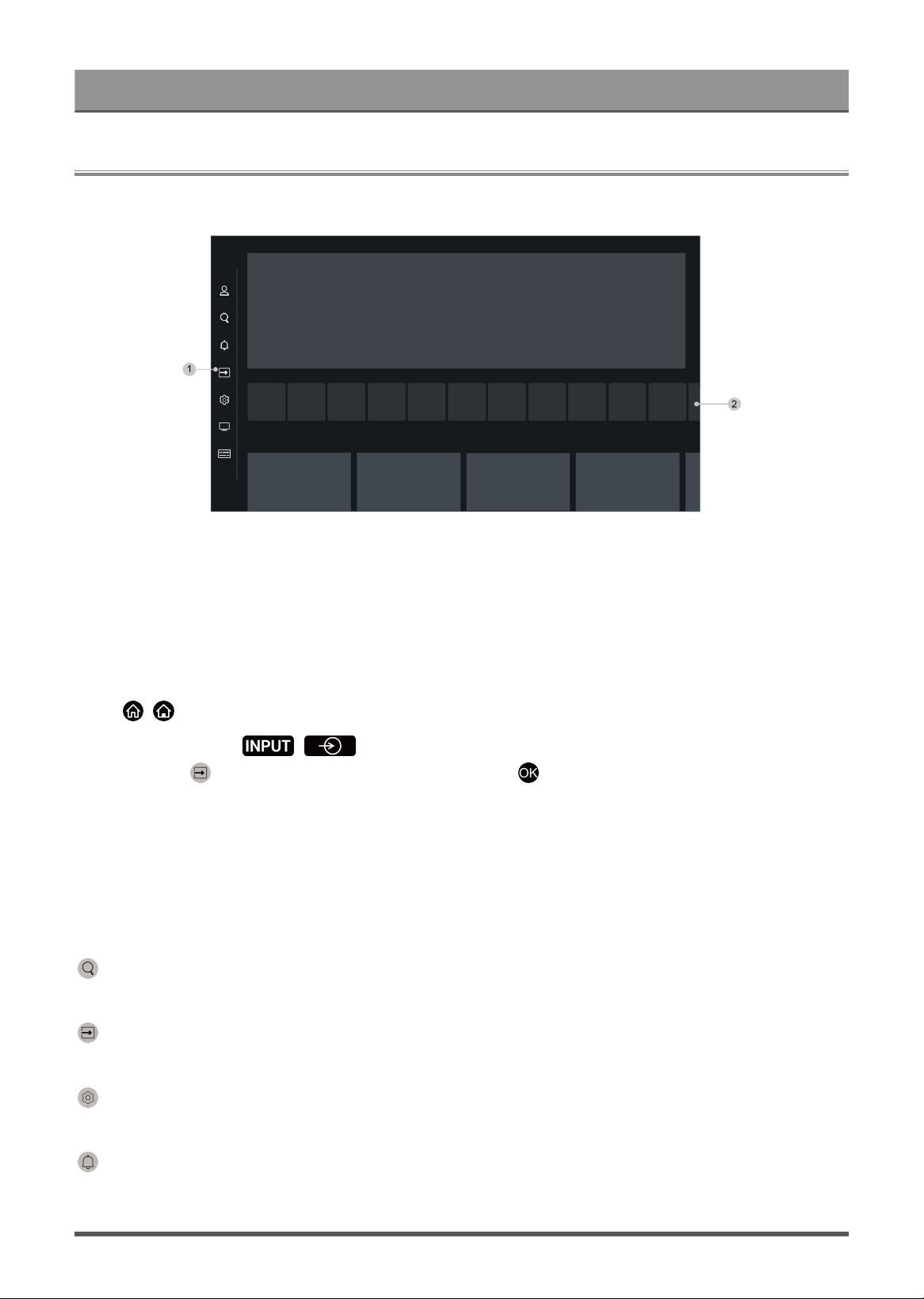
All TV functions can be accessed from the Home screen.
1. Navigation bar
2. Apps
Note:
• Indicators or icons may vary depending on models/countries/regions.
Display the Home Screen
Press / button on your remote control to enter the Home screen.
To choose input, press / button on your remote control or use the navigation buttons to move
the focus to the Input icon on the side of the screen, press button to enter and select your desired
input source.
Use the Navigation Bar
The navigation bar refers to indicators and icons on the side of the Home screen.
Note:
• Indicators or icons may vary depending on models/countries/regions.
Search
Search the content you want.
Input
Select the input source depending on the device you have connected to your TV.
Settings
Manage TV configuration.
Notifications
3
First-Time Use
Allow pop-up notifications to appear for useful information and events that occur with your TV, including:
Advertising, New Arrivals, Warnings and Legal Statements, System Messages and Alexa Notification.
You can enable/disable each of these notifications at Settings in the notification centre.
You can view the list of event messages generated by the TV.
To delete all notifications, select Clear All.
Note:
• The Alexa Notification may not be applicable in some models/countries/regions.
VIDAA Account
A VIDAA account provides all the best features of your Smart TV and ensures that all services are kept up to
date.
For more information about VIDAA account, please refer to Benefits of Smart TV > Using a VIDAA Account in
this manual.
Guide
Quick access to Guide. For more information, please refer to Enjoy Live TV > Programme Guide (EPG) in this
manual.
Live TV
Quick access to Live TV. For more information, please refer to First-Time Use > Prepare Live TV in this
manual.
Connecting to the Internet
To get access to the Internet using a wired connection or connecting to an available wireless network.
Connect to a Wired (Ethernet) Network
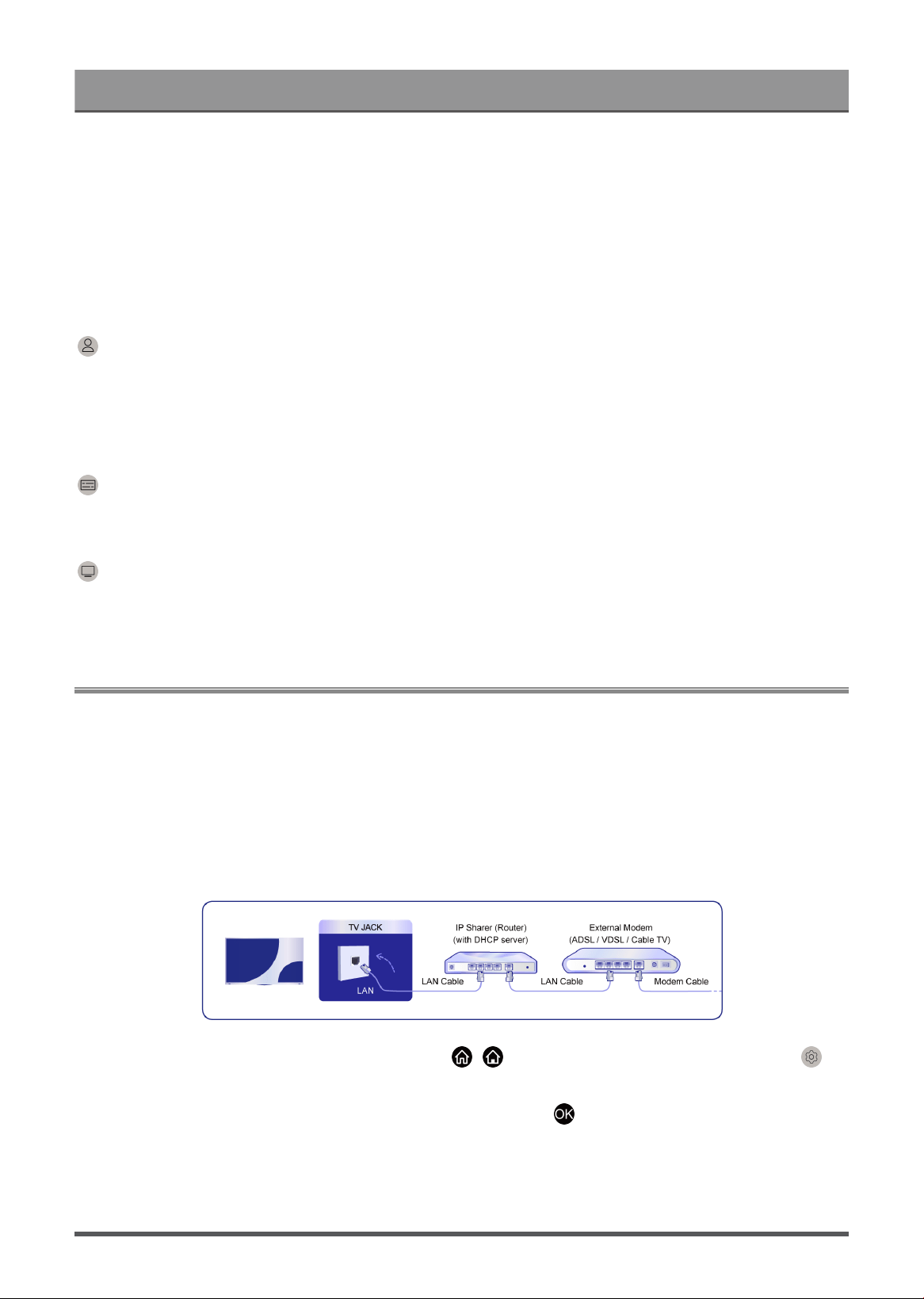
To get access to the Internet using a wired connection, it is recommended to use a modem or router that
supports Dynamic Host Configuration Protocol (DHCP). Modems and routers that support DHCP automatically
provide the IP address, netmask, gateway, DNS Server 1 and DNS Server 2, so you do not have to enter
them manually. Most home networks already have DHCP.
After connecting to a wired (Ethernet) network, press / button on your remote control and select
Settings > Network > Network Configuration.
Set the TV network by selecting Network Configuration and press button to enter the submenu.
• Connection Type
Choose a wired (Ethernet) network connection to access the Internet.
4
First-Time Use
• Ethernet
Display network status.
• IP Settings
In IP Version, you can select from IPv4 and IPv6. When IPv4 is selected, the IP address, netmask,
gateway, DNS Server 1 and DNS Server 2 will be automatically defined, or you can configure them
manually for your network connection. When IPv6 is selected, all information is automatically defined.
Related information
Network on page 41
Network Issues on page 58
My TV cannot connect to the network. on page 54
Connect to a Wireless Network
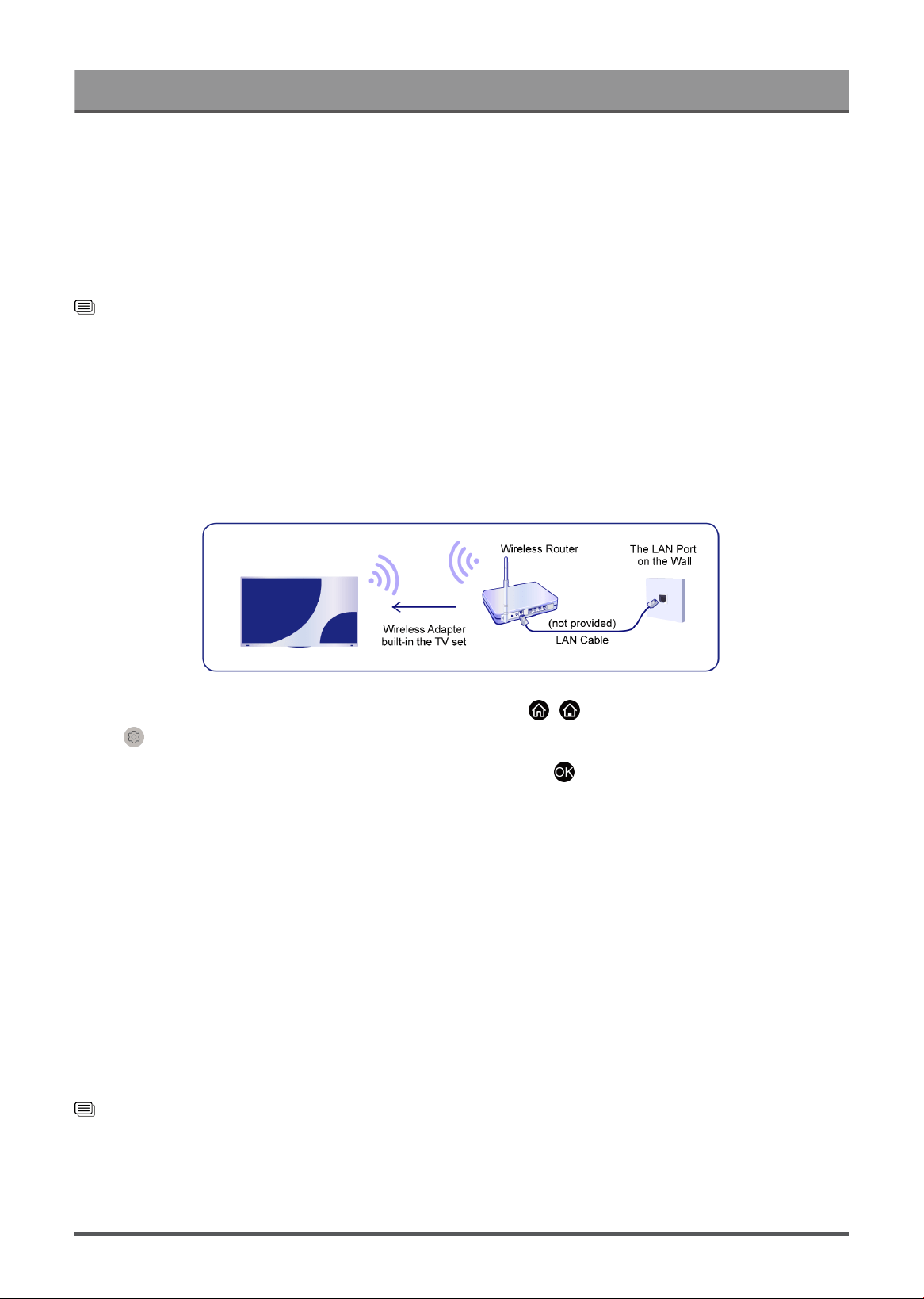
To connect to an available wireless network, make sure that you turn on your wireless router and have the
wireless router's SSID and password before attempting to connect.
To get access to the Internet using a wireless connection, press / button on your remote control and
select Settings > Network > Network Configuration.
Set the TV network by selecting Network Configuration and press button to enter the submenu.
• Connection Type
Choose a wireless network connection to access the Internet.
• Advanced Settings
Configure the advanced wireless network settings for the TV.
• Add
You can add a wireless network.
• Refresh
Refresh wireless network.
Note:
• If no wireless router is found, select Add and enter the network name in the SSID.
• If no wireless router is found, select Refresh.
Related information
Network on page 41
Network Issues on page 58
My TV cannot connect to the network. on page 54
5

First-Time Use
Prepare Live TV
Connect satellite/antenna/cable to the TV
Note:
• TV jacks may vary and satellite/antenna/cable function may not be applicable in some models/countries/
regions.
• You may also connect devices that can receive broadcast signals such as a Set Top Box.
Start auto scan or manual scan
1.
Press / button on your remote control and select TV.
2.
Press / button on your remote control and select Settings > Channel > Auto Scan/Advanced
Settings > Manual Scan.
Related information
Channel Scan on page 7
6

Enjoy Live TV
Channel Scan
You can scan for channels automatically or manually.
Auto Scan
Automatic channel scan.
1.
Press / button on your remote control and select TV.
2.
In Live TV, press / button and select Settings > Channel > Auto Scan.
If no TV channels were saved before, you will be prompted to do a channel scan.
Satellite
• Single satellite: You can use single satellite if you only have one satellite installed.
• DiSEqC: You can choose DiSEqC if you have DiSEqC equipment. Up to four satellites in DiSEqC 1.0
mode can be installed.
If you are using a motorised antenna, you can use DiSEqC 1.2 mode.
• Unicable: If your home is equipped with Unicable satellite distribution, you should use this option.
Please make sure that you know the Unicable band and frequency to be used. The information should be
available on the equipment or the landlord can provide it.
Antenna
• Channel: Select from All Channels or Free Channels. This option may not be available depending on
countries/regions/operators.
• Scan Mode: Select from digital channels only (DTV), digital and analogue channels (DTV+ATV) or
analogue channels only (ATV).
If you receive DVB-T or DVB-T2 signal, you can use DTV.
• LCN: Switch on/off LCN (Logical Channel Number).
Please note that some operators restrict manual changes to the channel order. If you switch off LCN, then
the channel list can be edited after channel scan.
This function may not be applicable in some models/countries/regions.
Cable
• Channel: Select from All Channels or Free Channels. This option may not be available depending on
countries/regions/operators.
• Scan Mode: Select from digital channels only (DTV), digital and analogue channels (DTV+ATV) or
analogue channels only (ATV). For some countries/regions, only ATV is available.
• LCN: Switch on/off LCN (Logical Channel Number).
Please note that some operators restrict manual changes to the channel order. If you switch off LCN, then
the channel list can be edited after channel scan.
This function may not be applicable in some models/countries/regions.
Note:
• Satellite/antenna/cable function may not be applicable in some models/countries/regions.
7
Enjoy Live TV
Related information
Prepare Live TV on page 6
Manual Scan
Manual scan channels for DTV or ATV.
1.
Press / button on your remote control and select TV.
2.
In Live TV, press / button on your remote control and select Settings > Channel > Advanced
Settings > Manual Scan.
Note:
• Services may vary depending on models/countries/regions.
Related information
Prepare Live TV on page 6
Live Menu
You can obtain quick access to the channel list, favourite channel list or use relevant features with ease when
watching TV programmes.
Note:
• Only for the models with tuners.
Display Channel List
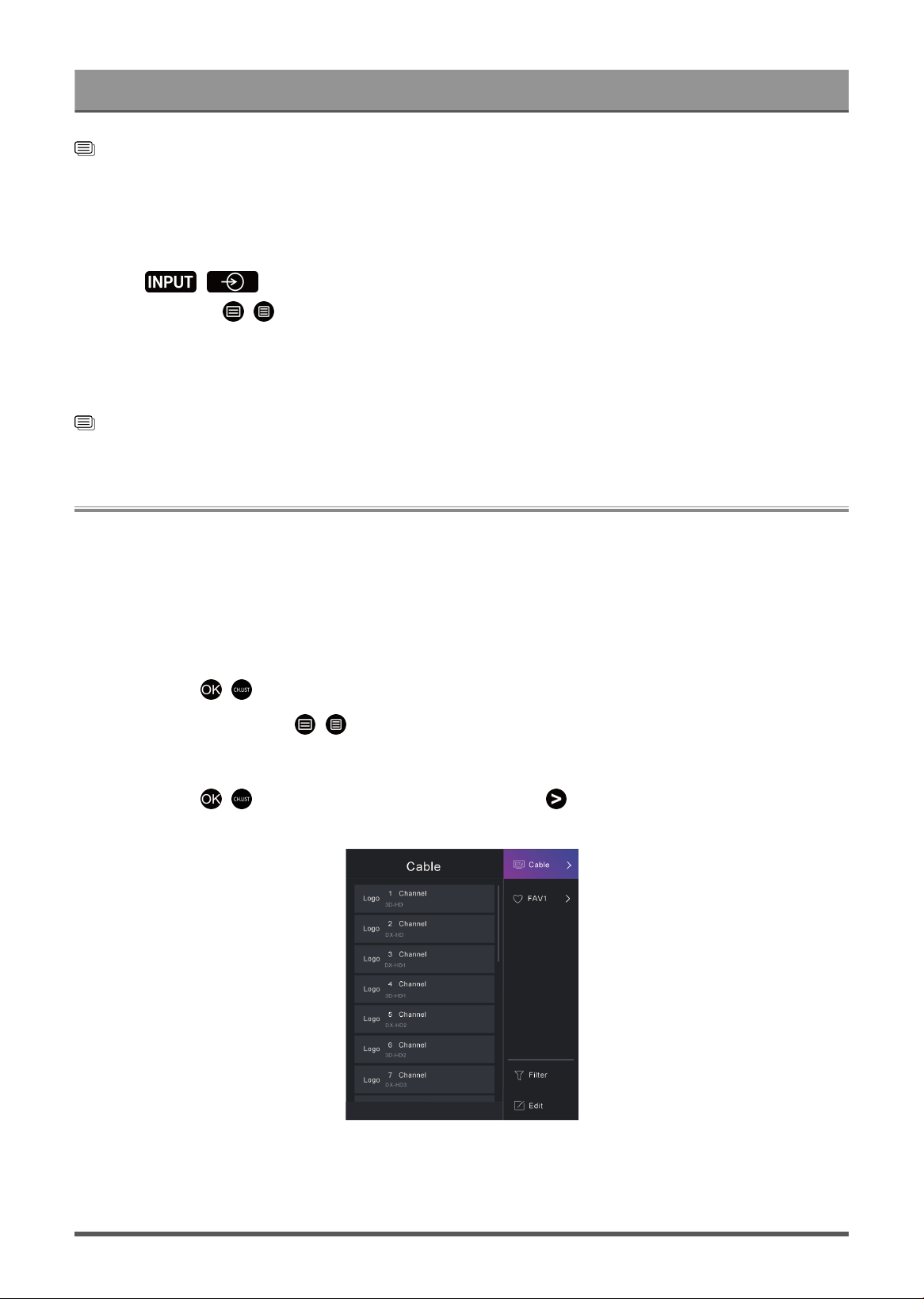
In Live TV, press / button on your remote control to display the Channel List menu.
Alternatively, in Live TV, press / button on your remote control and select Channel List.
Learn about channel list sub-menu
In Live TV, press / button on your remote control and press button.
TV List
Display Live TV channel categories, such as Cable and Antenna.
8

Enjoy Live TV
FAV1-4
Display favourite lists 1 to 4.
Filter
Select channels by Content, HD, Channel Block, Scrambled and Sort.
Some options in Filter may not be available in some models/countries/regions.
Edit
Edit the channel list.
Note:
• The sub-menu options may vary depending on models/countries/regions.
Related information
Edit Channel List on page 10
Display Favourite Channel List
In Live TV, press / button on your remote control and press button, then select FAV1-4 to display
the favourite list.
Related information
Edit Favourite Channel List on page 11
Learn about the On-Screen Menu
In Live TV, press / button to access the on-screen menu.
• Channel List
Quick access to Channel List.
• Guide
Quick access to Guide (EPG).
• PVR
Launch Schedule Recording.
• Timeshift
Launch Timeshift.
• HbbTV
Enable or disable HbbTV functionality for the current channel (only available for digital channels).
• Subtitle
Turn on Subtitle function or select subtitle option for digital broadcast content.
• Recording List
Quick access to Recording List.
• E-Manual
Enter Enjoy Live TV chapter to learn more about how to set up Live TV features.
• Audio Only
When you select this option, the screen will not display the picture. You can only listen to the audio.
Press any button except the power button, volume buttons and mute button to restore the picture.
9
Enjoy Live TV
• Settings
Set up picture, sound, channel, network, accessibility, system and support.
Note:
• Some menus above may not be available in some models/countries/regions.
Related information
Edit Channel List on page 10
Programme Guide (EPG) on page 12
Programme Recording (PVR) on page 13
HbbTV on page 17
Subtitle Setup on page 50
Channel Edit
Manually edit the channel list or favourite channel list to your preference.
Note:
• Only for the models with tuners.
Edit Channel List
Before you can edit the channel list, Channel Scan must be completed first.
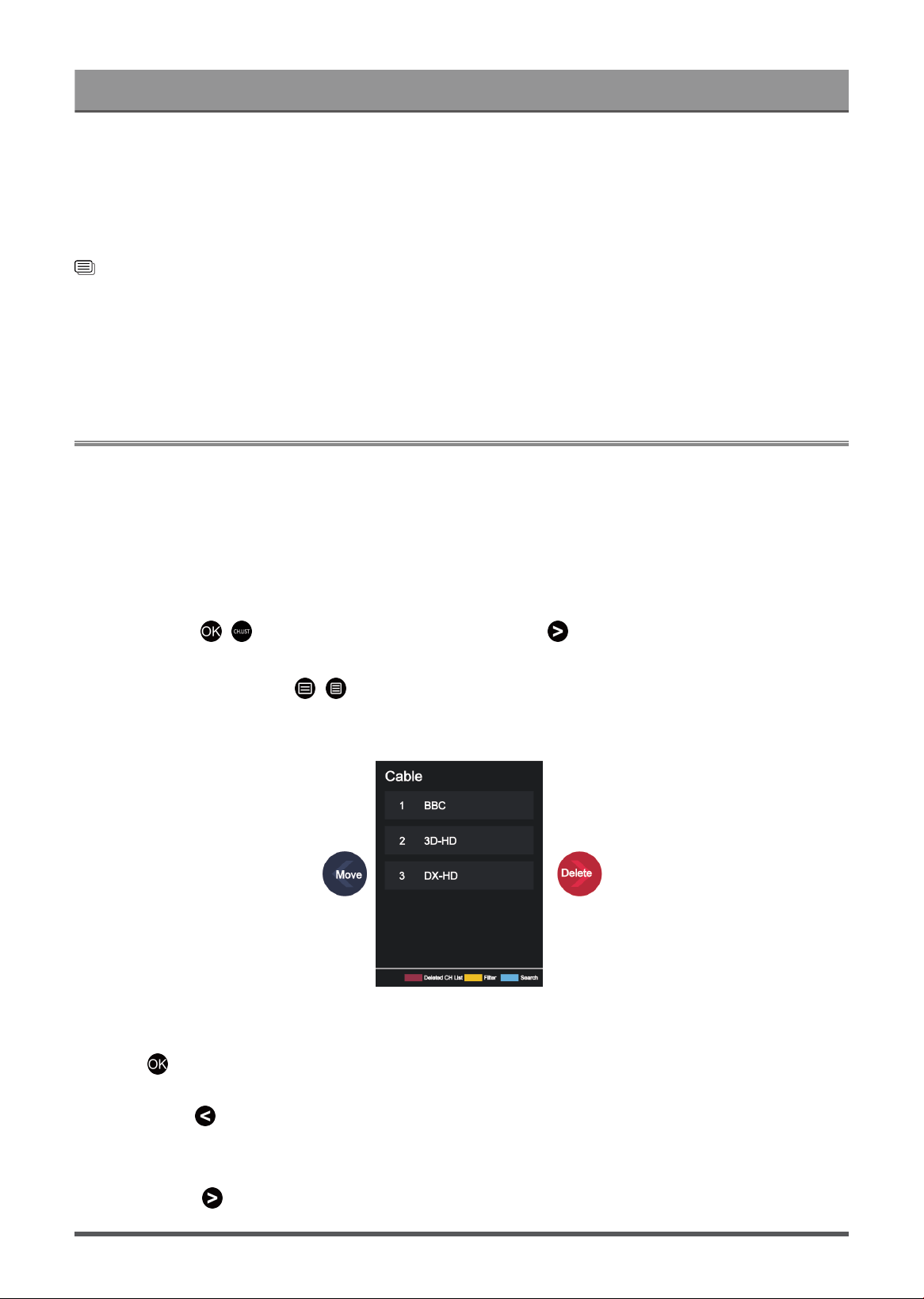
In Live TV, press / button on your remote control and press button to select a Live TV channel
category such as Antenna or Cable, then use D-pad to select Edit.
Alternatively, in Live TV, press / button, select Settings > Channel > Channel Edit, then select a Live
TV channel category such as Antenna or Cable.
Manage the channels
•
Press button on the selected channel, then a checkbox will appear. You can select multiple channels
at the same time to move or delete.
•
Move: Press button to move the selected channel.
Moving the channels could be restricted by the operator. If you want to be able to move channels, it is not
recommended to choose an operator during channel scan, also LCN should be set to Off.
•
Delete: Press button to delete the selected channel.
10

Enjoy Live TV
•
Restore: Press [RED] button, or press / button to display the colour menu and select RED
to enter the list of deleted channels. Press button to restore the deleted channel.
•
Filter: Press [YELLOW] button or press / button to display the colour menu and select
YELLOW, the filter screen will pop up. Press button to select options, the channel list can then be
updated.
•
Search: Press [BLUE] button or press / button to display the colour menu and select BLUE
to search for a channel.
Export the channel list to USB
The current channel list can be exported to a USB storage device.
In Live TV, press / button on your remote control and select Settings > Channel > Channel Edit >
Export to USB.
Import the channel list from USB
Previously exported channel lists can be imported via a USB storage device.
In Live TV, press / button on your remote control and select Settings > Channel > Channel Edit >
Import from USB.
Related information
Channel Scan on page 7
Edit Favourite Channel List
Before you can edit the favourite list, Channel Scan must be completed first.
Add a channel to a favourite list
You can add channels from various reception types to the favourite list.
1.
In Live TV, press / button to display the channel list.
2.
Press / button and select the channel(s) you want to add to the favourite list.
3. Select Add to Favourite and choose from FAV1-FAV4.
4. Then, a heart-shape icon will appear next to the added channel.
Move or remove channels in a favourite list
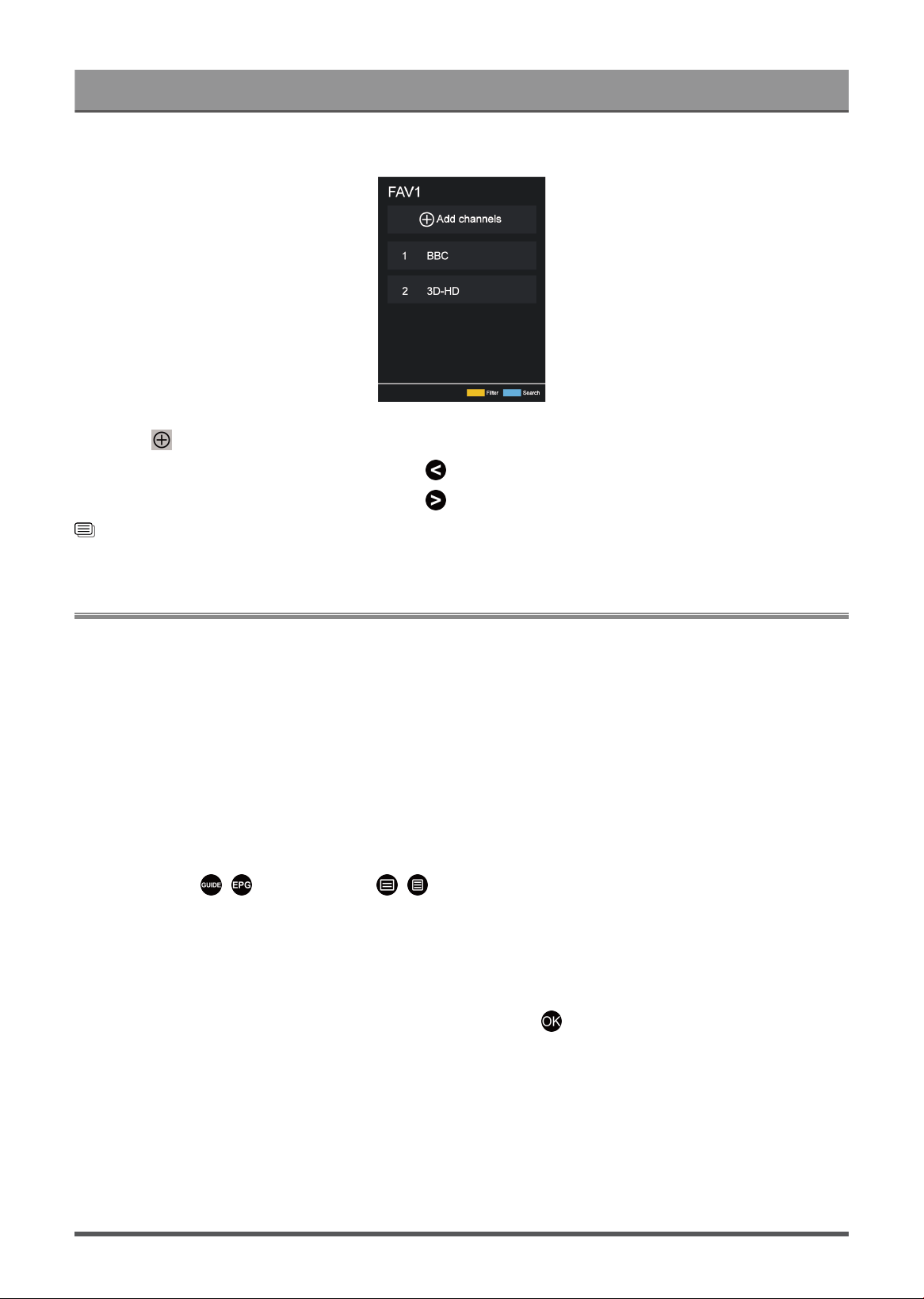
In Live TV, press / button on your remote control and press , select FAV1-4, then use D-pad to
select Edit.
Alternatively, in Live TV, press / button on your remote control and select Settings > Channel >
Channel Edit, then select FAV1-FAV4.
You can add, move, or remove favourite channels.
11
Enjoy Live TV
•
Select Add channels to add the selected channel to the favourite list.
•
Select a channel in a favourite list, then press button to move it.
•
Select a channel in a favourite list, then press button to remove it.
Related information
Channel Scan on page 7
Programme Guide (EPG)
The Guide (EPG) provides a convenient way to check TV programmes for the upcoming 8 days. The
information displayed by the Guide (EPG) is made available by the commercial television networks for digital
channels only. The Guide (EPG) also provides a simple way to record your favourite programmes and a
reminder function, which can switch channels automatically at scheduled times, so that you will not miss
programmes of interest. The availability and amount of programme information will vary depending on the
broadcaster.
Note:
• The Guide (EPG) function is only available for digital channels, analogue channels are not supported.
Launch the Guide
In Live TV, press / button, or press / button and select Guide (EPG) to display programme
guide.
Learn about the Guide menu
• Watch
In Guide (EPG), when a current programme is selected, press > Watch to switch to the channel you
want to see.
12
Enjoy Live TV
• PVR/Reminder
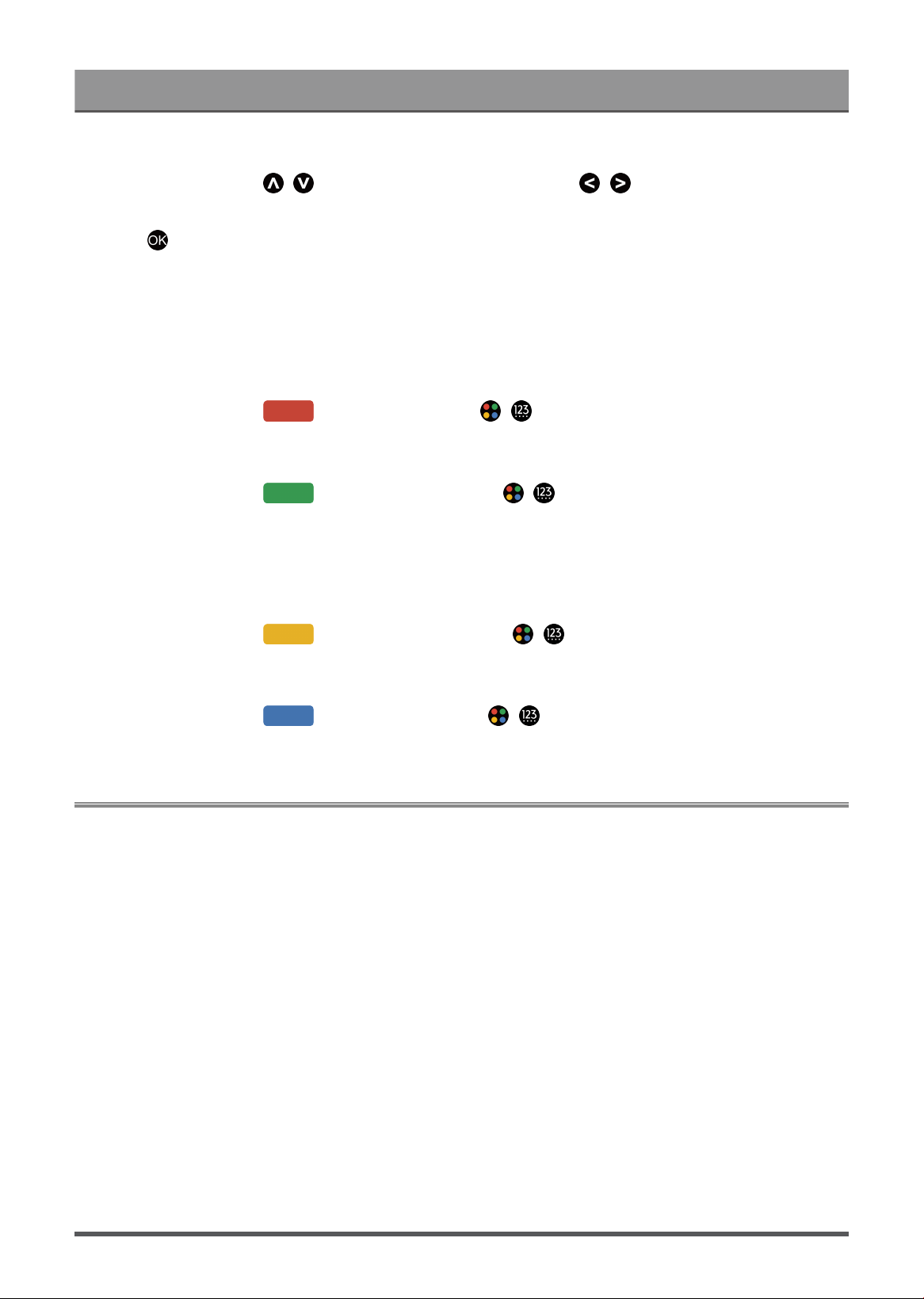
In Guide (EPG), press / button to select the channels. Press / button to select programme
based on the time schedule.
Press button to select PVR or Reminder.
For more information, please refer to Enjoy Live TV > Programme Recording (PVR) or Enjoy Live TV >
Reminder in this manual.
Note:
• The PVR function may not be applicable in some models/countries/regions.
• Scheduled
In Guide (EPG), press [RED] button or press / button to display the colour menu and
select RED. This will display a list of scheduled reminders and recordings.
• Programme Colour
In Guide (EPG), press [GREEN] button or press / button to display the colour menu and
select GREEN. Use the colours to indicate different genres in the Guide (EPG) for quick and easy viewing.
Note:
• This function may not be applicable in some models/countries/regions.
• 24h−
In Guide (EPG), press [YELLOW] button or press / button to display the colour menu and
select YELLOW to select programmes of the previous day.
• 24h+
In Guide (EPG), press [BLUE] button or press / button to display the colour menu and
select BLUE to select programmes of the next day.
Programme Recording (PVR)
The PVR function allows you to easily record digital television content for later viewing.
Read before Recording Programmes
• To use PVR, you must connect a storage device for recording. PVR will not function if a data storage
device has not been connected.
• The format of the storage device can be NTFS or FAT32. The storage space of your device should be no
less than 2GB (for 15 minutes high-definition video). It is strongly recommended to use a USB mobile hard
disk drive instead of a USB flash drive as the storage device.
• If the transfer rate of your hard disk is too slow, a pop-up notice will be displayed. In this case, you will
need to use another disk with higher speed.
• PVR is only available for digital channels and does not support analogue channels.
• Some broadcasters may restrict the recording of programmes.
• If a recording is made from a locked channel, the system PIN will need to be input to playback the
recorded content.
• Some channel-related configuration may conflict with background recording. In this case, a reminder
window will pop up.
• The PVR function may not be applicable in some models/countries/regions.
13
Enjoy Live TV
Related information
Connecting USB Devices on page 28
Recording
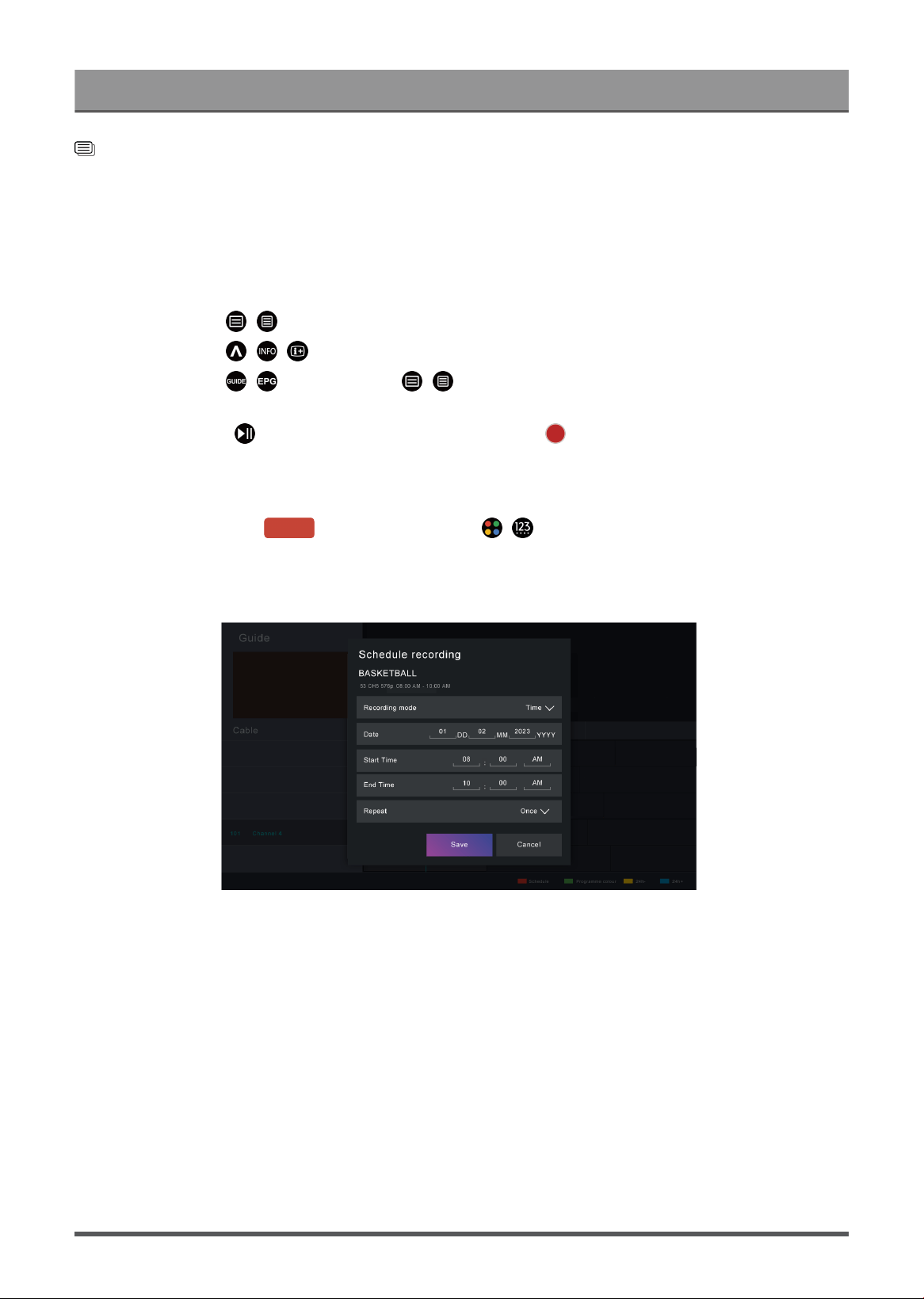
Schedule Recording
There are several ways to use PVR.
•
In Live TV, press / button and select PVR.
•
In Live TV, press / / button to load the info bar, then select a programme and choose PVR.
•
In Live TV, press / button, or press / button and select Guide (EPG) to display programme
guide. Select a programme and choose PVR.
•
If your remote has button, press it and use D-pad to select to set up PVR.
You can select recording mode from time, manual stop and programme.
When you select time, you can set the booking time and period.
In Guide (EPG), press the [RED] button or press / button to display the colour menu, select
RED to view the scheduled recording. In the schedule recording list, you can readjust the reservation
information that has been set.
Standby Recording
If you press the power button during recording and select Standby Recording, your TV will go into standby
mode, but the recording process will continue. If you press the power button again to wake up the TV, the
recording process will not be affected. After recording, the recorded file will be automatically saved to the
attached USB disk.
Background Recording
When you switch to an App or another source (e.g. HDMI) during recording, the recording process will
continue. When the recording has completed, the recorded programme will be automatically saved to the
attached USB disk.
14
Enjoy Live TV
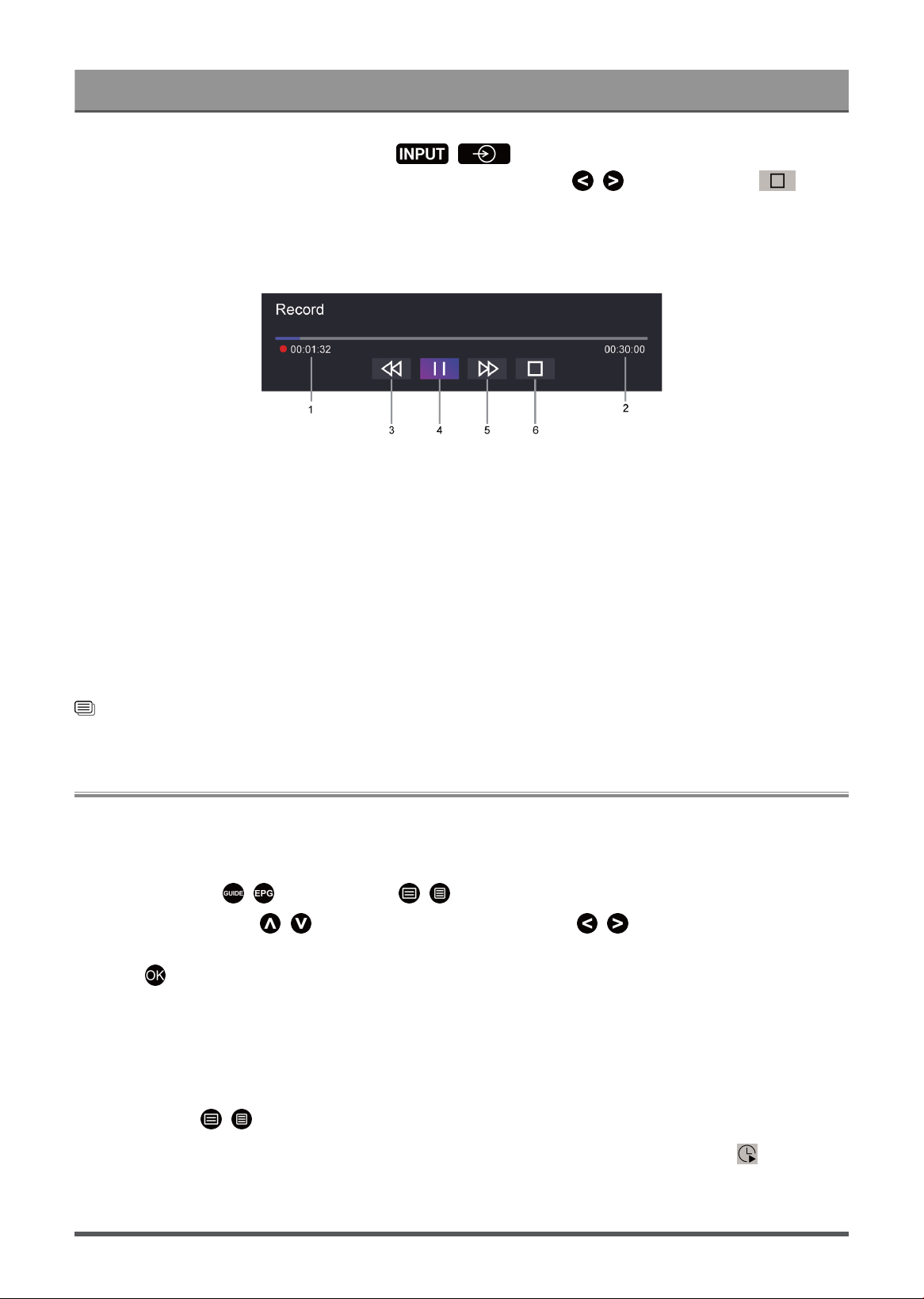
If you want to manually stop recording, press / button on your remote control and select TV to
switch back to the channel that is currently being recorded, then press / button and select on-
screen to stop.
Learn about the recording control bar
1. Recording time
2. Total time
3. Rewind
4. Pause / Play
5. Fast forward
6. Stop
Note:
• The PVR function may not be applicable in some models/countries/regions.
• Buttons on remote control will vary depending on models/countries/regions.
Related information
Schedule Recording cannot be used. on page 55
Reminder
Setup this feature to allow reminders to be displayed of future programmes.
Set up a Reminder
1.
In Live TV, press / button, or press / > Guide (EPG) to display programme guide.
2.
In Guide (EPG), press / button to select the channels. Press / button to select a programme
that has not been aired.
3.
Press button to select Reminder.
Note:
• Reminder is only available for programmes that have not been aired yet.
Manage the Reminder List
In Live TV, press / button on your remote control and select Recording List > Scheduled.
You can change reminder information or cancel reminders. Reminder items are identified with icons.
15
Enjoy Live TV
Delete reminder
Select a reminder, press / button on your remote control to start editing and press button to delete it.
Edit reminder
Select reminder in the schedule list, then press button to edit.
Timeshift
This option allows you to pause and rewind Live TV. This function operates by recording temporarily to
a storage device. Please ensure your storage device is connected and there is enough free disk space,
otherwise timeshift will not function.
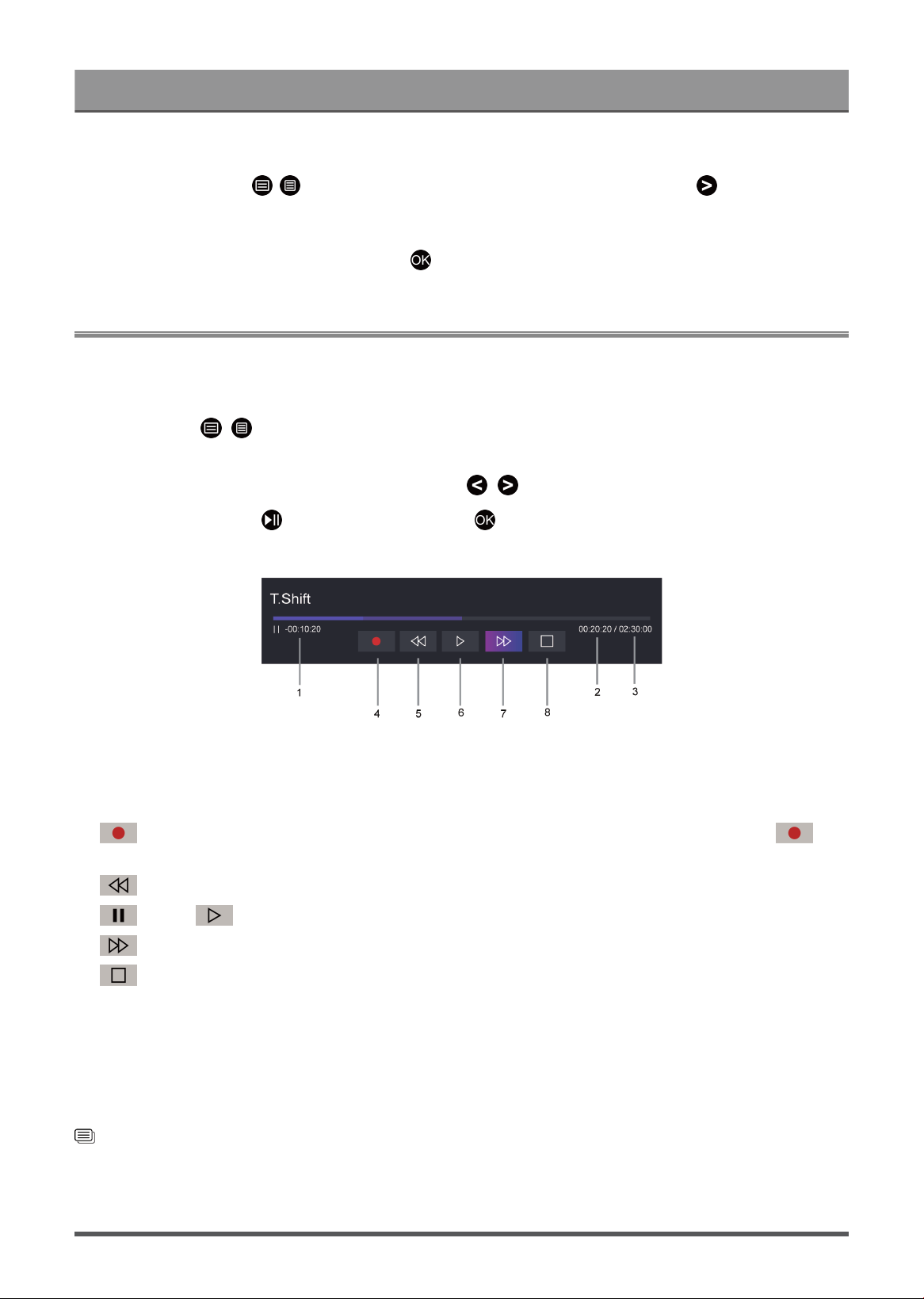
In Live TV, press / button on your remote control and select Timeshift, then the playback bar will
appear.
Alternatively, you can launch Timeshift just by pressing / button.
If your remote control has button, press it and press button to launch Timeshift.
1. Unwatched time for buffered content
2. Current time
3. Total time
4.
Record: to convert a Timeshift to a live recording of the current broadcast channel. Select and
the programme content you have watched in Timeshift will also be saved to the storage device.
5.
Fast backward: you can choose 2×, 4×, 8× or 16×.
6.
Pause/ Play
7.
Fast forward: you can choose 2×, 4×, 8× or 16×.
8.
Stop Timeshift: to exit the function and watch the current broadcast.
Note:
• The Timeshift function does not support analogue channels.
• The storage space of the device should be no less than 2GB. It is strongly recommended to use a USB
mobile hard disk drive instead of a USB flash drive as the storage device.
• The Timeshift function may not be applicable in some models/countries/regions.
Related information
Connecting USB Devices on page 28
16

Enjoy Live TV
HbbTV
Access service from providers through HbbTV.
Press / button on your remote control, then select Settings > System > Application Settings >
HbbTV.
Enable or disable HbbTV functionality for all channels (only available for digital channels).
In Live TV, press / button to select HbbTV.
Enable or disable HbbTV functionality for the current channel (only available for digital channels).
When HbbTV service is enabled and the programme supports HbbTV, follow the instructions on the TV screen
to select the corresponding button on the remote control to access the service.
Note:
• This function may not be applicable in some models/countries/regions.
• Some channels may not support the HbbTV service.
• HbbTV cannot be used during Timeshift or PVR.
VIDAA tv
Get to know VIDAA tv
VIDAA tv is a feature of the VIDAA operating system where you can watch free live TV channels. All kinds of
programmes are available like sports, movies, music and more. Content will be supplied by multiple partners
depending on the country/region you are located in.
How to use VIDAA tv
VIDAA tv is accessible from the home page by pressing the / Home button on the remote control, then
selecting the VIDAA tv app. Another way to access VIDAA tv is via the VIDAA tv remote control button, or via
the Guide and Channel List buttons on the remote control.
VIDAA tv will start playing after selecting a channel. It's easy for you to get access without doing extra work.
Note:
• To use this feature, you need to connect to the internet and agree to the EULA during the device setup.
• This feature may not be available in some countries/regions.
• Some settings may not be applicable to VIDAA tv.
17

Benefits of Smart TV
Using a VIDAA Account
Sign into your VIDAA account and create multiple profiles to receive personalised content according to your
account preferences.
Sign into an account
Before signing into your VIDAA account, make sure your TV is connected to the network. For more about
network settings, please refer to First-Time Use > Connect to the Internet > Connect to a Wired (Ethernet)
Network or Connect to a Wireless Network in this manual.
1.
After the network is connected, press / button on your remote control and select VIDAA
Account icon in the navigation bar on the Home screen.
2. Register your device to your VIDAA Account. After entering your E-mail and password, select Sign in.
3. You can create a profile and give it a name.
If you forget your password and need to change the password, select Forget Password?, input your E-mail
address and verification code, then create a new password.
Create a new account
If you do not have a VIDAA account, create a new one to enjoy the best features of your Smart TV.
Before creating a new account, make sure your TV is connected to the network. For more about network
settings, please refer to First-Time Use > Connect to the Internet > Connect to a Wired (Ethernet) Network or
Connect to a Wireless Network in this manual.
1.
After the network is connected, press / button on your remote control and select VIDAA
Account icon in the navigation bar on the Home screen.
2. Select Create Account on screen.(or select Email Create Account for some countries/regions)
3. Enter your E-mail address and password.
4. Follow the instructions on your TV to finish the process of creating an account.
Voice Service Setup
Set up voice assistant to control your TV by your voice.
Note:
• Voice Service feature may not be applicable in some models/countries/regions.
• To use this function, End User License Agreement and corresponding Smart feature privacy policy/terms
and conditions may be required to be agreed to.
Hands-Free Wake-up
Interacting with Alexa or VIDAA Voice by just using your voice, all hands-free.
Before using Hands-Free Wake-up, connect your TV to the network and sign into your VIDAA Account at
/ > VIDAA Account. For more information about how to sign into the VIDAA Account, please refer
to Benefits of Smart TV > Using a VIDAA Account in this manual.
18

Benefits of Smart TV
How to use Hands-Free Wake-up
After the Alexa or VIDAA Voice setup has been completed, say "Alexa" or "Hey VIDAA" to call up the voice
assistant without the use of your hands.
Note:
• The Hands-Free Wake-up function may not be applicable in some models/countries/regions.
• The setup steps may vary. Please refer to the specific product.
• This feature requires Alexa built-in service.
Alexa Setup
Interact with Alexa by pressing and holding the microphone button on your remote control. You can ask Alexa
to control this TV.
Before setting up the Amazon Alexa Service, connect your TV to the network and sign into your VIDAA
Account at / > VIDAA Account. More information about how to sign into the VIDAA Account,
please refer to Benefits of Smart TV > Using a VIDAA Account in this manual.
How to set up Alexa
1.
Press / button, select the Settings icon, then select System > Voice Service > Amazon Alexa.
2. Select Set voice assistant to Alexa and Set Up Alexa. If you have selected Alexa during the first-time
installation process, it will directly guide you to the Set Up Alexa steps.
3. Select Amazon Alexa supported voice language from the selection.
4. You are now at the step 'Sign into your Amazon account'. Scan the QR code with your mobile device or
visit the website on your mobile device or computer and enter the on-screen code. The code will expire
after 10 minutes. If you do not have an Amazon account, create a new one.
5. After you have linked the Amazon account, the TV screen will change to the next step. You can sign into
your VIDAA account. If you have signed in before, this step will be skipped.
6.
Now Alexa is set up and ready. You can enjoy interacting with Alexa using your voice by just pressing and
holding the button on your remote control. Ask Alexa after the tone.
Note:
• The Alexa function may not be applicable in some models/countries/regions.
• The setup steps above may vary. Please refer to the specific product.
• Shipment with voice remote control varies depending on TV models/countries/regions.
• You can use Alexa without signing into your account by skipping the sign in section. In this case, you can
still use your voice to change the channel and control playback. Sign into your account in the settings
menu at any time to enjoy more functions of Alexa.
• This feature requires Alexa built-in service. Otherwise, use external Alexa-enabled devices (e.g. Alexa
App, Echo) to control your smart TV by using just your voice.
•
Download and install the remote control app on your mobile device at / > Settings > Support >
Mobile App Download. Press the Microphone icon in the app to interact with Alexa on your TV.
•
You can select the language used by Alexa at / > Settings > System > Voice Service >
Amazon Alexa > Language. This feature requires Alexa built-in service, which varies depending on TV
models and countries/regions.
Related information
Connect to a Wired (Ethernet) Network on page 4
19

Benefits of Smart TV
Connect to a Wireless Network on page 5
VIDAA Voice Setup
VIDAA Voice is a voice assistant to help you control the TV and search content, supporting several languages.
Before using VIDAA Voice, please check the following:
• Network connected
• Voice remote paired
• End User License Agreement and voice feature privacy policy/terms agreed
To access the Voice Service centre and set voice assistant to VIDAA Voice, you can choose one of following
options:
•
Just press button on your remote control.
•
Press / button to select Settings icon and select System > Voice Service.
When VIDAA Voice is selected as your voice assistant, select the language of VIDAA Voice in the Voice
Service centre. Then press and hold the button on your remote control to interact with VIDAA Voice.
Note:
• VIDAA Voice may not be applicable in some models/countries/regions.
• Shipment with remote control varies depending on TV models/countries/regions.
•
For remote controls without the Microphone button, download and install the app on your mobile device
at / > Settings > Support > Mobile App Download. Press the Microphone icon in the app to
interact with your TV.
Related information
Connect to a Wired (Ethernet) Network on page 4
Connect to a Wireless Network on page 5
Using the Mobile App on page 23
Google Smart Home Service Setup
For specific models and countries/regions, Google Smart Home Service function is available. Set up Google
Smart Home Service to control your smart TV with Google Home devices or the App. You can change
channels or inputs, adjust volume and more.
Before setting up the Google Smart Home Service, connect your TV to the network and sign into your VIDAA
Account at / > VIDAA Account. More information about how to sign into the VIDAA Account,
please refer to Benefits of Smart TV > Using a VIDAA Account in this manual.
STEP 1: Set up Google Smart Home Service on TV
1.
Press / button on your remote control to select Settings icon and select System > Voice
Service > Google Smart Home Service. Select Set up now.
2. Sign into your VIDAA account. If you have signed in before, this step will be skipped.
3. Give your TV a name.
STEP 2: Set up in Google Home app
Follow the setup instructions on-screen to set up the Google Smart Home Service.
1. Download and install the Google Home app on your mobile device, then open the app.
20

Benefits of Smart TV
2. Find and select VIDAA Voice service in the app.
3. Follow the instructions in the app to link your VIDAA account signed in on your TV to your Google Account.
Google Smart Home Service is set up and ready. Control your smart TV by using your voice through the
Google Home device or App.
Note:
• Google Smart Home Service may not be applicable in some models/countries/regions.
• The setup steps above may vary. Please refer to the actual product.
Related information
Connect to a Wired (Ethernet) Network on page 4
Connect to a Wireless Network on page 5
Voice Service Other Issues
If you want to turn on your TV with Alexa-enabled devices (e.g. Echo, Echo show) or Google Home devices
(e.g. Google Home, Google Nest Hub), please:
•
Turn on Wake on LAN and Wake on Wireless Network at / > Settings > Network.
• Make sure your TV and Alexa-enabled devices/Google Home devices are connected to the same network
environment.
Note:
• Only Alexa (Alexa skill is enabled) and Google Smart Home Service support turning on your TV with Alexa
Echo or Google Home.
Related information
Connect to a Wired (Ethernet) Network on page 4
Connect to a Wireless Network on page 5
Content Sharing
Content Sharing allows you to view media content, like videos, music or photos saved in your Android/iOS/PC
device on your TV screen.
Share Media Content from your Device
1. Connect your TV and Android/iOS/PC device to the same network.
2.
Turn on Content Sharing at / > Settings > System > Mobile Device Connection > Content
Sharing.
3. Turn on the content sharing function in your Android/iOS/PC device.
4. Find the TV name in the search list of your device and select it. Wait for the connection progress to
complete.
5. On your Android/iOS/PC device, choose the media content you want to share on your TV.
21

Benefits of Smart TV
Related information
Connect to a Wired (Ethernet) Network on page 4
Connect to a Wireless Network on page 5
Play Media Content from your Device on the TV
You can connect media content saved in your Android/iOS/PC device to your local network and play the
content on your TV.
1. Connect your TV and Android/iOS/PC device to the same network.
2.
Turn on Content Sharing at / > Settings > System > Mobile Device Connection > Content
Sharing.
3. Make sure your media content in your Android/iOS/PC device are visible through the local network.
4.
On your TV, select a device with media content at / > Input, or / > Media. The media
content list in your Android/iOS/PC device appears.
5. Select a media content item from the list to play.
Note:
• Some Android/iOS/PC devices may not support content sharing function. If your device does not support
content sharing, you can download an app that supports the function to connect to your TV. For more
information, please refer to Benefits of Smart TV > Using the Mobile App in this manual.
• Content may not be played depending on the file format.
• Content may not be played smoothly, or the function may not work properly due to the network condition.
Data Protection and Security
Clear Cache
Press / button on your remote control and select Settings > System > Application Settings >
Clear Cache.
Clear cache, user data and temporary files for browser and applications.
Delete Cookies
Press / button on your remote control and select Settings > System > Application Settings >
Delete Cookies.
Delete cookies for browser and applications.
22

Benefits of Smart TV
Do Not Track
Press / button on your remote control and select Settings > System > Application Settings > Do
Not Track.
Send a request to websites not to collect or track your browsing data.
Note:
• This function may not be applicable in some models/countries/regions.
Usage Mode Setup
Press / button on your remote control and select Settings > System > Advanced Settings >
Usage Mode.
Set the TV to use in Home or Store mode.
Home Mode
Select Home Mode for normal TV usage.
If you want to switch to Store Mode when the TV is in Home Mode, press / button to select
Settings, then select System > Advanced Settings > Usage Mode and choose Store Mode.
Store Mode
Select Store Mode to setup the TV in a retail setting. This mode enables E-Pos and other demo functions and
is only intended for use in retail stores.
When Store Mode is selected, press / button on your remote control to enter store mode settings.
If you want to switch to Home Mode when the TV is in Store Mode, press / button on your remote
control to enter store mode settings and choose Home Mode. Alternatively, press / button, then select
Settings, then select System > Advanced Settings > Usage Mode and choose Home Mode.
Note:
• Enabling Store Mode could increase energy consumption.
• How to exit Store Mode varies depending on models/countries/regions.
Using the Mobile App
Press / button on your remote control and select Settings > Support > Mobile App Download.
Scan the Mobile App download QR code on screen to install the app on your mobile device. It is a convenient
and easy way to control your TV. This app is available on both Android and iOS.
To connect to your TV after installing the mobile app:
1.
Agree with end user license, disclaimer and privacy policies on the TV. If you are not sure whether you
have agreed, check by pressing / button on your remote control and select Settings > Support
> Disclaimer and Privacy > EULA and Other Policy and Services.
2. Make sure your mobile device and TV are connected to the same network environment.
23

Benefits of Smart TV
3.
To use this function, switch on Content Sharing by pressing / button on your remote control and
select Settings > System > Mobile Device Connection > Content Sharing.
4. Open the mobile app and select the TV device you want to connect to.
What you can do with the app:
• Turn the TV on or off
• Volume up or down
• Switch channels
• Input characters with your mobile device keyboard
• Share pictures, music, or videos from your mobile device to the TV
Related information
Connect to a Wired (Ethernet) Network on page 4
Connect to a Wireless Network on page 5
24

Connecting to External Devices
Connecting Bluetooth Devices
You can connect to devices using Bluetooth technology.
Press / button on your remote control and select Settings > Network > Bluetooth.
Note:
• Bluetooth function may not be applicable in some models/countries/regions.
Turn on Bluetooth Feature on your TV
Press / button on your remote control and select Settings > Network > Bluetooth and set
Bluetooth to On.
Note:
• This function may not be applicable in some models/countries/regions.
Connect a Bluetooth Device
To pair a Bluetooth device, such as Bluetooth headphones, speakers, keyboards, mouse or even mobile
devices:
1.
Press / button on your remote control, select Settings > Network > Bluetooth and set
Bluetooth to On.
2. Before pairing your Bluetooth device, make sure it is in the pairing mode and placed within pairing range.
To put your Bluetooth device in pairing mode, refer to the user manual of your device.
3.
Find the Bluetooth device name by pressing / button on your remote control and selecting
Settings > Network > Bluetooth > Equipment Management, once it is located select it. The device will
be automatically connected to the TV.
Note:
• Only one Bluetooth speaker or Bluetooth headphone can be connected to the TV. If a new Bluetooth
speaker or headphone connects to the TV, the existing one will be disconnected automatically.
• Some compatibility issues may occur depending on the Bluetooth device support.
• Bluetooth keyboards may not be functional with some applications.
• The TV and Bluetooth devices may become disconnected if the distance between them is too long.
• This function may not be applicable in some models/countries/regions.
Related information
Headphone Settings Setup on page 39
Listen to the Audio through Bluetooth Devices
Pair the Bluetooth audio device using the TV Bluetooth setup process. Refer to the user manual for your audio
device, such as Bluetooth speaker or sound bar, for detailed connection and setup.
After the Bluetooth connection is completed, press / button on your remote control, select Settings
> Sound > Speakers > Audio Output, then select Bluetooth Speaker option to listen to the audio through
Bluetooth devices.
Note:
• Compatibility issues may occur depending on the Bluetooth device.
25

Connecting to External Devices
• The TV and Bluetooth devices may become disconnected if the distance between them is too long.
• This function may not be applicable in some models/countries/regions.
Listen to your Mobile Device Audio through the TV
Press / button on your remote control and select Settings > Network > Bluetooth > TV Bluetooth
Speaker.
Mobile devices are connected to the TV via Bluetooth and audio is played via the TV speaker.
When your mobile device is connected to the TV via Bluetooth, you can play your mobile device music
through the TV built-in speakers.
Go to your mobile settings to enable Bluetooth and choose the TV to connect.
To use this function, make sure to select TV Speaker at / > Settings > Sound > Speakers >
Audio Output.
Note:
• This function may not be applicable in some models/countries/regions.
Related information
Select Speakers on page 38
Sharing your Smart Phone/Computer Screen on the TV
Before using the feature, please set your TV to the wireless network connection.
Press / button on your remote control and select Screen Sharing.
1. Turn on the casting function of your Android/Windows 10/computer device. The setting icon may vary
depending on the device. The feature may be called "Wireless display", "Smartview", "Wireless projection",
etc.
2. Find the TV name in the search list of your device and select it. Wait for the connection progress to
complete and the content on your device will be displayed on the TV.
Press / button on your remote control, select Setting > System > Mobile Device Connection >
Screen Sharing and switch it to on. Then, you can share your device's screen directly without opening the
Screen Sharing App on your TV.
Note:
• Some devices may not support casting.
26

Connecting to External Devices
Related information
Connect to a Wireless Network on page 5
Using AirPlay and HomeKit
Note:
• This function may not be applicable in some models/countries/regions.
• Use of the Works with Apple badge means that an accessory has been designed to work specifically with
the technology identified in the badge and has been certified by the developer to meet Apple performance
standards. Apple is not responsible for the operation of this device or its compliance with safety and
regulatory standards.
Using AirPlay
Use AirPlay to share audio and video content wirelessly from your iPhone, iPad, or Mac to your TV. Stream
music and videos, share your photos, or mirror exactly what is on your device screen.
AirPlay is a source in Inputs. Press the / button on your remote control to select the AirPlay,
then select AirPlay and HomeKit Settings. You can also find AirPlay and HomeKit settings in system settings
on your TV.
How to use AirPlay:
1. Make sure your Apple device is connected to the same network as your TV.
2.
Locate the AirPlay icon on supported media apps, or the Screen Mirroring icon in Control Center on your
Apple device. Depending on the content, these steps may vary:
•
To mirror your deviceʼs screen, open Control Center and tap Screen Mirroring .
•
To stream audio from supported music or podcast apps, tap AirPlay audio .
•
To stream video from supported apps, tap AirPlay video .
3. Select your TV from the list to begin using AirPlay.
Note:
• To use this feature your TV must support AirPlay.
• The TV and Apple devices are connected to the same network.
• The icon is only for reference. In some apps, you may have to tap another icon firstly.
• If an AirPlay passcode appears on your TV screen, enter the passcode on your Apple device to continue.
27
Connecting to External Devices
Using HomeKit
Use HomeKit to control your TV easily and securely with your Apple devices.
1. To set up HomeKit, open AirPlay and HomeKit settings on the TV. Locate the HomeKit section and select
'Set Up'.
2. The HomeKit setup screen will display a pairing QR code on the TV. Use your iPhone or iPad to scan the
QR code, then follow the on-screen directions to complete HomeKit setup.
Note:
• Available operations vary depending on the version of the app and software.
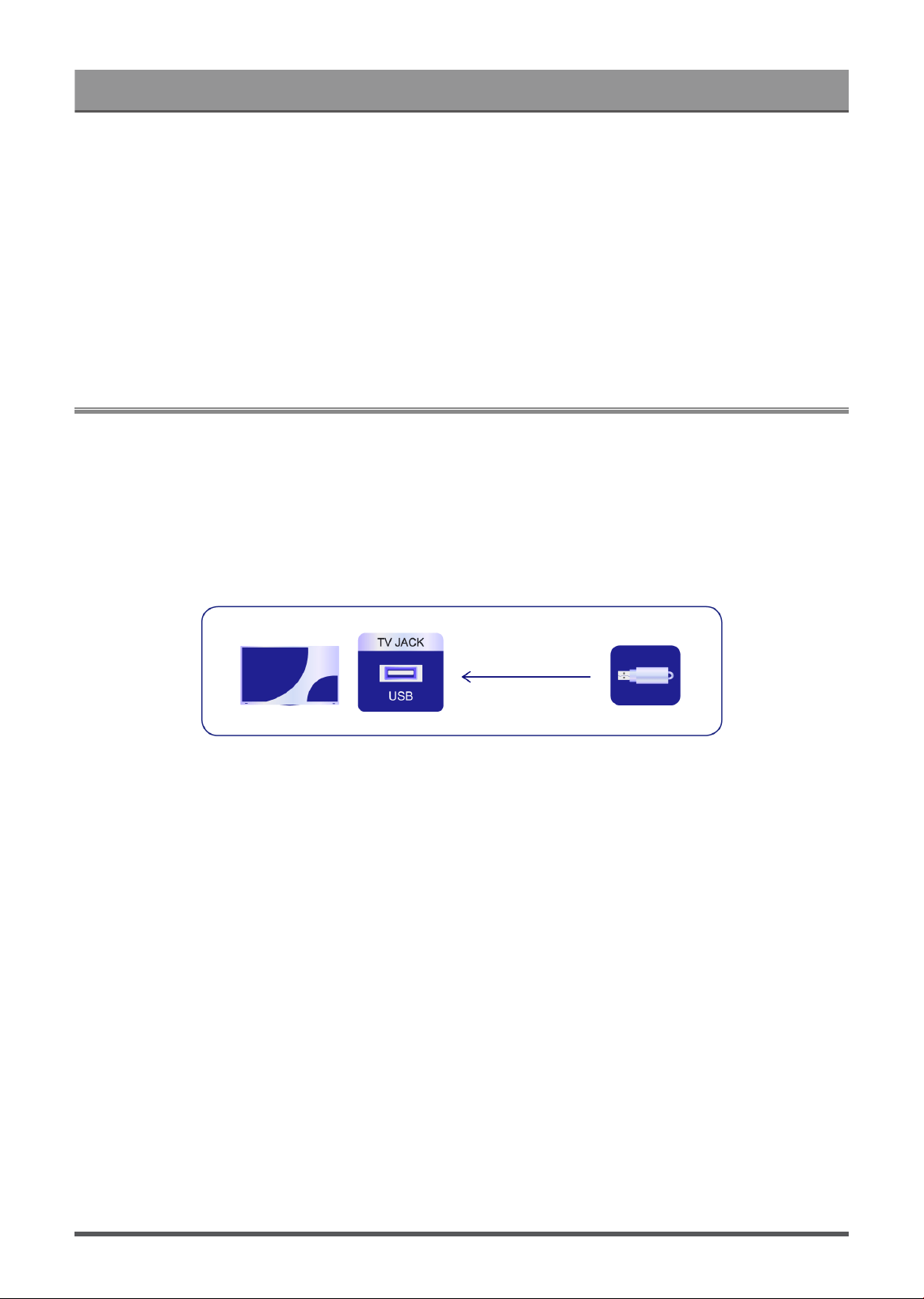
Connecting USB Devices
Connect USB devices, such as hard drives and USB memory sticks for browsing photos or listening to music.
Read before connecting USB devices
USB disk sizes 4GB, 8GB, 16GB, 32GB, 64GB, 128GB and other common market sizes are supported. Up to
8TB hard drives are supported.
Supported formats: NTFS, FAT32.
Select the content you want to play or view. For more information, please refer to Entertainment > Media in
this manual.
Use the USB storage device function
The USB storage device function can be used to record and view digital broadcast programmes.
Read the precautions below before recording or viewing programmes by using the USB storage device
function.
Note:
• Be sure to select the correct country/region for use.
• Use of the recording function may not be applicable depending on the selected country/region. Use with
incorrect settings may violate certain laws or other regulations and may result in criminal punishment. In
such cases, our CORPORATION and the Group shall bear no responsibility whatsoever.
• Recorded programmes saved in the USB storage device can only be viewed on this TV. They cannot be
viewed when connected to another TV (including the same model of TV), a PC, or other devices.
• You cannot watch one channel while recording another.
• If the recording time to the USB storage device is too short, no data may be saved.
• You cannot record video input signals in the USB device.
• Not all types of broadcast may be recordable.
28
Connecting to External Devices
• After programming the TV to record digital broadcasting, do not disconnect the power plug before
recording starts.
• If video or audio recording fail due to malfunction of the TV or poor reception, no compensation shall be
paid.
• Certain digital cameras may not be compatible with the TV.
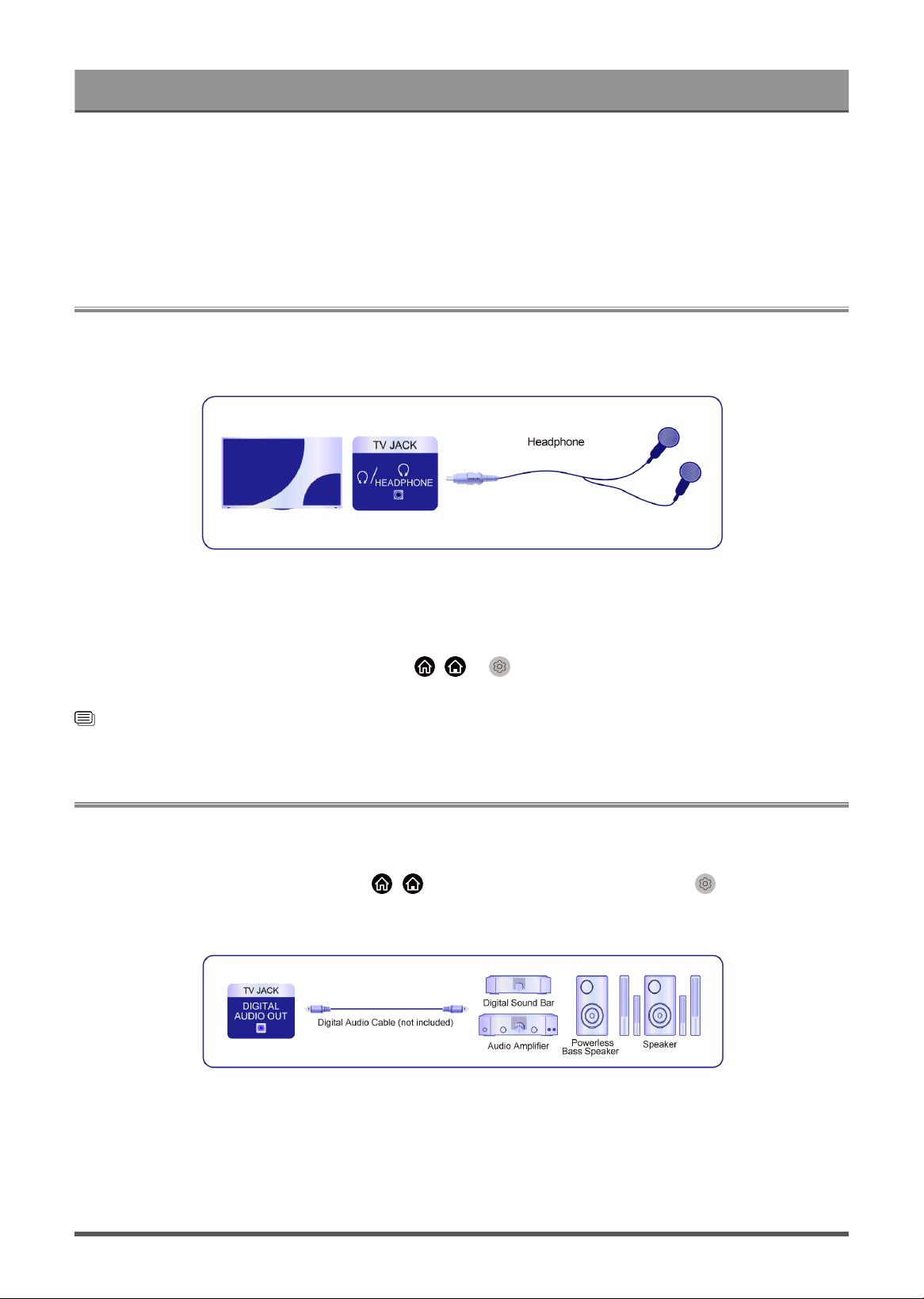
Connecting Headphones
You can connect a pair of headphones (not provided) to the HEADPHONE port on your TV. While the
headphone is connected, the sound from the built-in speakers will be disabled.
Note:
• Headphone port may not be available in some models.
• Headphones with microphones are not supported.
•
If Headphone with Speakers is selected at / > Settings > Sound > Headphone >
Headphone Mode, the headphone and the TV will have sound output at the same time.
Related information
Headphone Settings Setup on page 39
Connecting Speakers or Other Audio Receivers
To connect speakers or other audio receivers with an audio cable (not provided), see the illustration below.
Ensure the audio connected devices are switched on before switching on the TV.
When the connection is completed, press / button on your remote control, select Settings > Sound
> Speakers > Audio Output and select the SPDIF Only option.
Note:
• If you prefer to use Audio Return Channel (ARC) or enhanced Audio Return Channel (eARC), please refer
to Connecting to External Devices > Connecting a Digital Audio System with ARC/eARC in this manual.
29
Connecting to External Devices
•
You can connect the DIGITAL AUDIO OUT port on the back of the TV to the optical port on the amplifier.
Then press / button on your remote control and select Settings > Sound > Speakers > Digital
Audio Output to choose Dolby Audio - Dolby Digital to receive the Dolby Digital audio.
Related information
Select Speakers on page 38
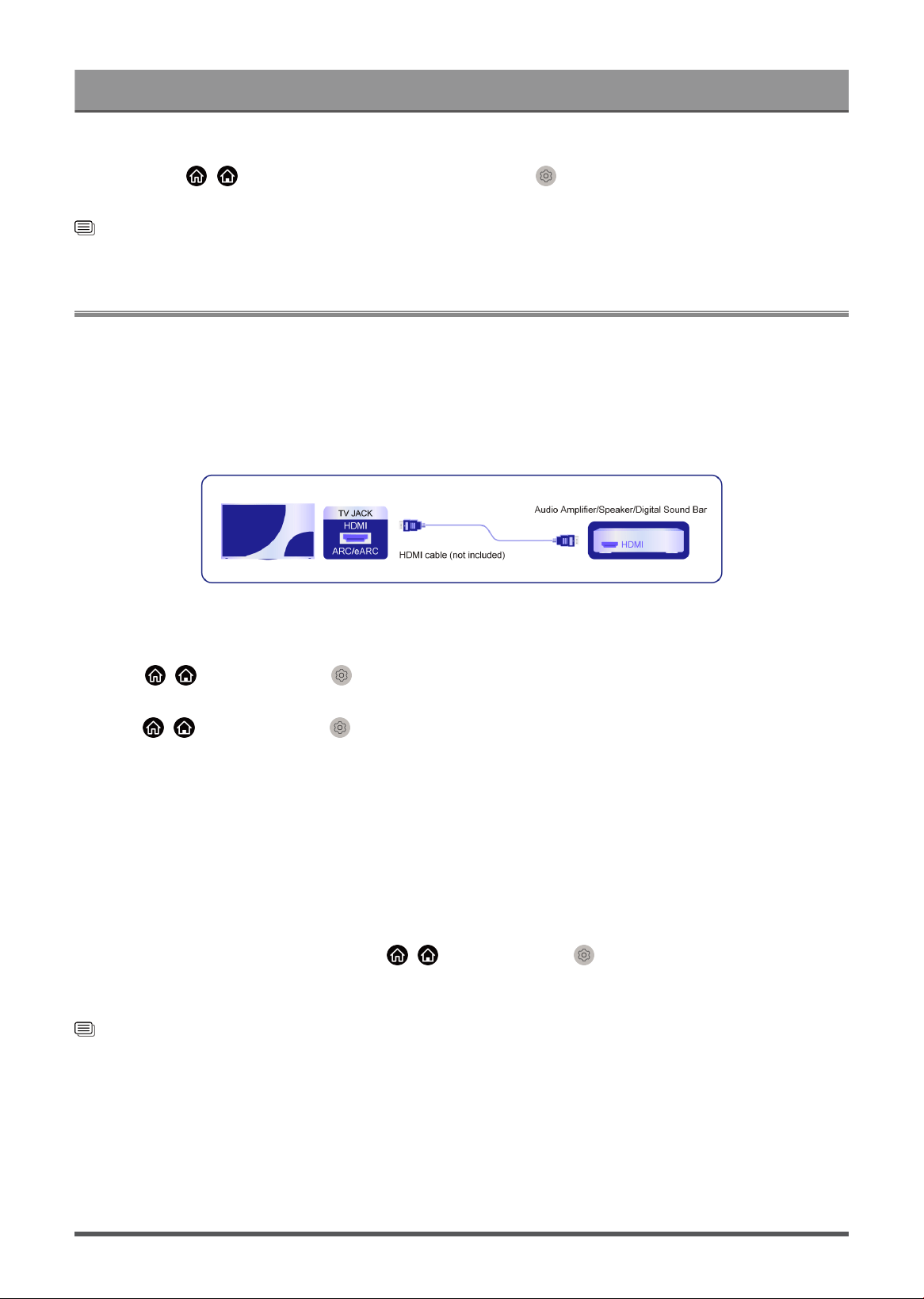
Connecting a Digital Audio System with ARC/eARC
If you would like to use the Audio Return Channel (ARC) or enhanced Audio Return Channel (eARC) feature
to send sound from the TV by a HDMI cable to a digital sound system, you can connect it to the HDMI (ARC/
eARC) port of your TV.
By using this feature, you can also control the sound system with your TV remote instead of using the remote
control from the connected device.
After the connection:
1. Power on the sound system.
2.
Press / button and select Settings icon on the Home screen.
3.
Select Sound > Speakers > Audio Output and choose ARC option. If the device supports eARC function,
press / button and select Settings icon on the Home screen, then select Sound > Speakers >
eARC to set eARC to On.
Note:
• Audio receiver must support ARC/eARC function.
• If the device has an Input Selector feature, then make sure to change it to TV.
• When this port is used for ARC/eARC function, it can be used as signal input when a DVD is connected to
an amplifier and the amplifier is connected to the TV at the same time. Some amplifiers may not support
series connection.
•
5.1 CH (channel) audio is available when the TV is connected to an external device that supports 5.1
channel surround sound. You can press / button and select Settings icon on the Home screen,
select Sound > Speakers > Digital Audio Output to choose Dolby Audio - Dolby Digital Plus to receive
the 5.1 channel audio.
Related information
Select Speakers on page 38
30

Settings Overview
Picture
Adjust picture mode, picture size and other advanced picture settings.
Choose a Picture Mode
Press / button on your remote control and select Settings > Picture > Picture Mode.
Select a pre-set picture mode to best suit the content you are viewing.
Note:
• Options may differ depending on your model/country/region and the content you are watching. Please refer
to the specific product.
When you use a normal signal
• Standard
Use Standard mode for watching normal content, such as News, Drama or Documentaries.
• Cinema Day
Use Cinema Day for watching movies in a bright environment.
• Cinema Night
Use Cinema Night for watching movies in a dark environment.
• Dynamic
Use Dynamic mode for content that requires vivid picture quality.
• Sports
Optimised picture for watching sports.
• FILMMAKER
Press / button on your remote control, select Settings > Picture > Content Type Auto
Detection and turn it on. When filmmaker signal is detected, picture mode will turn to FILMMAKER
automatically.
This function is only applicable in the HDMI input source.
Low Blue Light for TUV Certification
Low Blue Light menu on your TV is designed to reduce the level of blue light to protect your eyes.
Press / button on your remote control, select Settings > Picture > Picture Mode Settings >
Expert Settings > Low Blue Light and select On.
To reduce eye strain and protect eyes when you watch TV for a period of time, you are recommended to:
• Take regular and frequent breaks, avoid watching TV for periods of more than one hour. Watching TV for
long periods of time may cause eye fatigue.
• Look away from the TV screen and focus on distant objects during viewing breaks for at least 10 minutes.
• Relax yourself during viewing breaks by doing eye exercises or outdoor activities.
• The best recommended viewing distance is 3 times the vertical height of the TV screen.
Regular breaks and exercises are extremely helpful in relieving eye strain and fatigue.
Note:
31

Settings Overview
• This feature may not be applicable in some models/countries/regions. Low blue light certification may vary
by model.
When you use a HDR signal
HDR (high dynamic range) can improve the viewing experience with higher contrast and vivid colours. Bright
whites look brighter and dark blacks look darker. TV can display a wide range of colours.
When you use a Dolby Vision signal
Inspired by cinema technology, Dolby Vision is the format that allows your TV to deliver a full range of colours,
high dynamic range images, brighter whites and dark blacks using scene-by-scene calibration.
Change the Aspect Ratio
Press / button on your remote control and select Settings > Picture > Aspect Ratio.
Adjust the Aspect Ratio to stretch or zoom the picture.
• Auto
Automatically switch Aspect Ratio between 16:9 and 4:3 based on the signal information.
• 16:9
Best suited for 16:9 Widescreen content. This will also stretch 4:3 content to Widescreen.
• 4:3
Best suited for 4:3 content.
• 21:9
Best suited for 21:9 content, generally used in game scenarios.
• Movie Zoom
Fill the entire screen by zooming in to remove horizontal black bars from the top and bottom of the picture.
• Dot to Dot
Displays the native signal without any scaling.
Note:
• The options above may not be applicable in some input sources.
• Using special functions to change the size of the displayed image (e.g. changing the height/width ratio) for
the purpose of public display or commercial gain, may infringe on copyright laws.
• If the aspect ratio of the selected format is different from the TV transmission or video content, it can distort
the picture.
• When connecting a PC to the TV via HDMI input, fast moving images may become distorted.
Smart Scene
Press / button on your remote control and select Settings > Picture > Smart Scene.
Smart Scene will enable your TV to continually recognise the scene and enhance the picture quality on all
input sources.
Note:
• Some specific applications have explicit constraints meaning content recognition is not allowed.
32

Settings Overview
Advanced Picture Settings Setup
Press / button on your remote control and select Settings > Picture > Picture Mode Settings.
Adjust display settings for each Picture Mode. You can personalise the picture quality by adjusting the
following settings. Options may not be applicable depending on your model/country/region and the picture
mode you selected.
• Apply Picture Settings
Apply current picture mode settings to all the input sources or just the current source.
• Backlight
Set the overall brightness of the screen.
Note:
• The function name may vary depending on the model type.
The following option may differ depending on model type, please refer to the actual product.
Dynamic Backlight Control
Enhance the contrast ratio between light and dark areas of the picture.
This function may not be applicable in some models/countries/regions.
Backlight
Adjust how bright you want images to appear, lower settings create darker images.
This function may not be applicable in some models/countries/regions.
Automatic Light Sensor
TV will automatically adjust the picture settings according to the amount of ambient light in the room.
This function may not be applicable in some models/countries/regions.
Automatic Colour Temperature
Automatically adjust the colour temperature of the TV picture according to the ambient colour temperature.
This function may not be applicable in some models/countries/regions.
Local Dimming (or Dynamic Range maximum brightness for some models)
TV will automatically adjust the backlight in specific areas of the screen according to the contrast changes
in the image.
This function may not be applicable in some models/countries/regions.
• Brightness
Adjust the Brightness level to generate lighter or darker images.
• Contrast
Adjust the Contrast level to increase or decrease how bright images appear.
• Colour Saturation
Adjust the colour intensity of the picture for a more vibrant image.
• Sharpness
Adjust how sharp or soft the edges of images appear.
• Adaptive Contrast
Automatically adjust dark areas and light areas of the image to see more detail.
33

Settings Overview
• Ultra Smooth Motion
Reduce the afterimage effect when viewing fast-moving objects.
This function may not be applicable in some models/countries/regions.
• Clear Motion
Reduce judder and blur from video content.
This function may not be applicable in some models/countries/regions.
• Noise Reduction
Improve the picture quality by reducing noise.
• MPEG Noise Reduction
Reduce MPEG block noise to provide clearer edge transitions.
• Colour Temperature
Adjust how warm (red) or cool (blue) the white areas of an image appears.
• Expert Settings
Adjust advanced picture settings based on your viewing preference.
• Overscan
Change the video size setting to crop the edges of the displayed image.
This function may not be applicable in some models/countries/regions.
• Reset Current Mode
Restore all the picture settings in the current picture mode to the factory default values.
Related information
Picture Issues on page 57
Expert Settings Setup
Press / button on your remote control and select Settings > Picture > Picture Mode Settings >
Expert Settings.
Adjust the colour space and Gamma to best suit the content you are viewing. Options may not be applicable
depending on your model/country/region and the picture mode you selected.
• Colour Gamut
Change the range of colours the TV displays.
This function may not be applicable in some models/countries/regions.
• Colour Tuner
Adjust the Hue, Saturation and Brightness of colour settings.
• White Balance
Adjust the intensity of red, green and blue to view the true colour of all images in the picture.
• Black Level
Adjust the HDMI Level to enhance current content.
34

Settings Overview
• Gamma Adjustment
Adjust the Gamma to alter how the TV will respond to grayscale content. In low ambient light choose a
higher number, in brighter ambient light select a lower number. The default setting of 2.2 is recommended
for most ambient light conditions.
This function may not be applicable in some models/countries/regions.
• Gamma Calibration
Adjust selected Gamma curve.
This function may not be applicable in some models/countries/regions.
• Viewing Angle
Provide a better viewing experience when watching TV from anywhere in the room.
This function is only available in models supporting the Viewing Angle Control feature.
• Dynamic Tone Mapping
Automatically adjust brightness and gradient balance by analysing the brightness level of HDR content.
This function may not be applicable in some models/countries/regions and only be visible when in HDR
mode.
• Dark Detail
Automatically raise brightness and improve shadow detail in dark scenes.
• Precision Detail
Automatically enhance image details.
This function may not be applicable in some models/countries/regions.
• Gradient
Optimize the colour spots of contour lines to deliver better picture quality.
This function may not be applicable in some models/countries/regions.
• RGB Only Mode
RGB filter for adjustment and control of colour space and colour saturation.
• Low Blue Light
Eye care: reduce the emission of blue light.
This function may not be applicable in some models/countries/regions.
• High Refresh Rate Mode
240Hz high refresh rates can provide a stable and smooth image for the dynamic and fast-moving content.
Note: TV will keep going black for a few seconds when switching this option.
This function may not be applicable in some models/countries/regions.
Related information
Picture Issues on page 57
Sound
Adjust sound mode and other advanced sound settings.
35

Settings Overview
Choose a Sound Mode
Press / button on your remote control and select Settings > Sound > Sound Mode.
Select a pre-set sound mode to suit the content you are listening to.
• Standard
In Standard mode, the TV delivers a flat frequency response, which preserves the natural characteristics of
the original sound.
• Theatre
Theatre mode increases the surround sound effect and provides a more prominent bass response.
• Music
In Music mode, low and high frequencies are emphasised to enhance musical instrument reproduction.
• Speech
In Speech mode, low and high frequencies are attenuated to improve the reproduction and clarity of the
human voice.
• Late Night
In Late Night mode, the TV will improve the reproduction and clarity of the human voice with a low volume
level.
• Sports
Optimised sound for watching Sports events.
Dolby Atmos
Press / button on your remote control and select Settings > Sound > Dolby Atmos.
Set Dolby Atmos to On to enhance the richness of sound allowing a more immersive listening experience.
Note:
• This function may not be applicable in some models/countries/regions.
Audio Enhancement
Press / button on your remote control and select Settings > Sound > Audio Enhancement.
Set Audio Enhancement to enjoy the audio performance of Dolby Atmos, DTS Virtual X. Enable or disable
according to your own preference.
Note:
• This function may not be applicable in some models/countries/regions. Selections may vary depending on
models.
• When Hi-Res is selected, some options in Sound settings may not be available for setup.
Sound Mode Settings Setup
Press / button on your remote control and select Settings > Sound > Sound Mode Settings.
Adjust the audio settings of the TV. You can personalise the sound quality by adjusting the following settings.
• Apply Audio Settings
Adjust current sound mode to apply to all sources or just the current source.
36

Settings Overview
• Total Sonics
Optimise the overall sound quality by increasing bass and widening the sound field to provide a clear,
natural dialogue.
This function may not be applicable in some models/countries/regions.
• Total Volume
Maintain a consistent loudness level for a wide dynamic range of programmes, loud commercials and
channel or input changes.
This function may not be applicable in some models/countries/regions.
• Total Surround
Provide surround sound experience with psycho-acoustic processing to place sounds at the side, behind
and above the viewer. For best results use with Total Sonics.
This function may not be applicable in some models/countries/regions.
• Bass Boost
Bass Boost uses DTS TruBass™ to enhance the perception of bass frequencies to provide deep, rich bass
response from the TV's internal speakers.
This function may not be applicable in some models/countries/regions.
• Surround Sound
Surround sound uses DTS TruSurround™ to deliver an immersive surround sound experience from the
TV’s internal speakers.
This function may not be applicable in some models/countries/regions.
• Dialog Clarity
Dialog Clarity uses DTS Dialog Clarity™ to boost the frequency range of the human voice so dialogue is
clearly understood and heard above audio or surround effects.
This function may not be applicable in some models/countries/regions.
• TruVolume
Automatic control over large volume changes while watching TV programmes or films, providing a more
comfortable and consistent volume.
This function may not be applicable in some models/countries/regions.
• Waves
Based on the psychoacoustic low-frequency extension technology. Waves effectively extend bass
response beyond the physical capabilities of the system, presenting a natural, vigorous and strong bass
effect.
This function may not be applicable in some models/countries/regions.
• Equalizer
Boost the volume at different frequencies.
This function is only applicable when TV Speaker is selected at / > Settings > Sound >
Speakers > Audio Output.
• Bass Boost Gain
Hear and feel rich bass response with the TV's subwoofer speaker.
This function may not be applicable in some models/countries/regions.
37

Settings Overview
• Top Channel Gain
Experience the rich high-pitched response with the TV's top speaker.
This function may not be applicale in some models/countries/regions.
• Center Channel Gain
Experience the rich human voice response with the TV's center speaker.
This function may not be applicable in some models/countries/regions.
• Wall Mount Setup
Automatically optimise the sound based on the position of the TV.
This function may not be applicable in some models/countries/regions.
• Auto Volume Control
Activate to prevent the volume from changing when switching TV channels.
After Auto Volume Control is turned on, it will act as DAP Volume Leveler when playing Dolby Audio, or it
will provide DRC function when playing DTS bitstream containing DRC metadata.
This function may not be applicable in some models/countries/regions.
• Reset Current Mode
Restore all of the audio settings in the current audio mode to the factory default values.
Note:
• Some models may not support decoding of DTS CD bitstreams. Playback of this format may produce
undesirable noise.
Related information
Sound Issues on page 58
Select Speakers
Press / button on your remote control and select Settings > Sound > Speakers.
Adjust the settings of speakers.
Audio Output
Select the speakers which you want to use.
Digital Audio Output
Select the digital audio output format that best suits the audio device type.
• Auto: the audio device automatically outputs in a supported format.
• Pass Through: the audio device outputs without any processing.
• PCM: the audio device outputs PCM (Pulse Code Modulation) format.
• Dolby Audio - Dolby Digital: the audio device outputs Dolby Digital audio when connected to the TV via
the optical port.
• Dolby Audio - Dolby Digital Plus: the audio device outputs Dolby Digital Plus audio when connected to
the TV via the HDMI(ARC/eARC) port.
• DTS Surround: the audio device outputs DTS audio when connected to the TV via the optical port or
HDMI(ARC/eARC) port.
Note:
38

Settings Overview
• Due to the differences between different models, options above may vary according to the actual product.
•
This function is only applicable when / > Settings > Sound > Speakers > Audio Output is set
to ARC or SPDIF Only.
Digital Audio Delay
Adjust the digital audio output delay time to sync audio from an external speaker with the images on the TV.
Note:
•
This function is only applicable when / > Settings > Sound > Speakers > Audio Output is set
to ARC or SPDIF Only.
Lip Sync
Synchronise the video and audio.
Note:
• This function may not be applicable in some Audio Output modes.
Balance
Adjust the left and right speaker level to optimise audio for a specific location.
Note:
• This function may not be applicable in some Audio Output modes.
eARC
Connect an audio device that supports eARC via HDMI (eARC) and set eARC to On to enjoy higher sound
quality. This feature is available to set when / > Settings > Sound > Speakers > Audio Output is
set to ARC.
Note:
• This function may not be applicable in some models/countries/regions.
Related information
Connecting Speakers or Other Audio Receivers on page 29
Connecting a Digital Audio System with ARC/eARC on page 30
Headphone Settings Setup
Press / button on your remote control and select Settings > Sound > Headphone.
Set the sound output mode through headphones.
After connecting your wired or Bluetooth headphone, or other external audio amplifiers, you can set up your
TV to your preference.
Note:
• This function may not be applicable in some models/countries/regions.
Headphone Mode
Change Headphone audio settings.
39

Settings Overview
Headphone Only, the TV speakers will be muted when the headphones are being used. Any other connected
audio devices will also be muted when headphones are in use.
Headphone with Speakers, the TV speakers, headphones and other connected audio devices will have
audio output.
Audio Out with Speakers, the TV speakers and headphones will have audio output simultaneously, and the
volume can be adjusted simultaneously.
Note:
• When you set built-in speakers and headphones to have audio output at the same time, the sound effect of
the speakers may change.
Headphone Volume
Independently adjust the volume of the Headphones.
In Headphone Only mode, you can adjust the volume by the remote or in Headphone Volume menu on
screen.
In Headphone with Speakers mode, the TV speaker volume can be adjusted by the remote. The volume of
headphone can be adjusted in Headphone Volume menu on screen.
Related information
Connect a Bluetooth Device on page 25
Connecting Headphones on page 29
SoundBar Settings
When a soundbar device is connected to the TV, you can change the Sound Bar Settings via the Settings
menu for best device audio quality.
When an ARC device is connected to the TV, the sound output is automatically switched to ARC. If the user
switches to other sound output channels, the soundbar menu cannot be adjusted but the sound menu of TV
can be adjusted.
Press / button on your remote control and select Settings > Sound > Sound Bar Settings.
When you connect a soundbar with a HDMI cable, you should Set CEC Control to On by pressing /
button on your remote control, then select Settings > System > HDMI & CEC > CEC Control.
• EQ Modes
You can select Music. Movie, News, Sport, Night.
• Surround Modes
You can set to On to turn on the Surround Modes.
• Bass Level/Treble Level/Dimmer Level
You can adjust Bass Level/Treble Level/Dimmer Level
• Reset
Reset current Sound Bar Settings to factory mode.
Note:
• This function is only applicable for the specific soundbar types.
40

Settings Overview
WiSA Speaker Settings
Press / button on your remote control and select Settings > Sound > WiSA Speaker Settings.
To use this function, please insert your WiSA usb transmitter to the TV first. After inserting the transmitter, a
notification will pop up automatically and you can choose to enter the WiSA Speaker Settings directly. You can
also enter the settings later through the setting menu.
Channel
Select the channel of WiSA speaker.
Note:
• Selections here may vary depending on model type.
Available Speaker List
Displays the list of speakers that are available, speaker selection and further changes can be made.
Note:
• Some options here will vary depending on the selected Channel.
Search Manually
Search for available speakers manually.
Reset WiSA Transmitter
Reset of the WiSA transmitter configuration information will delete all previous settings.
Network
You can get access to the Internet through your TV.
Turn on the TV through the Internet
Wake on Cast
Press / button on your remote control and select Settings > Network > Wake on Cast.
You can enable or disable Wake on Cast function which is able to turn on the TV by screen casting through
mobile devices.
Note:
• This function may not be applicable in some models/countries/regions.
• Enabling this function may result in higher energy consumption.
Wake on LAN
Press / button on your remote control and select Settings > Network > Wake on LAN.
With a wired Ethernet connection and enabling Wake on LAN, you can switch on the TV from standby and
push content to be viewed on the TV with a mobile device App supporting the screencast function.
Note:
41

Settings Overview
• To use this function, make sure your TV and mobile device are connected to the same network
environment.
• Enabling this function may result in higher energy consumption.
• This function may not be applicable in some models/countries/regions.
Wake on wireless network
Press / button on your remote control and select Settings > Network > Wake on Wireless
Network.
With a wireless network connection and enabling Wake on Wireless Network, you can switch on the TV
from standby and push content to be viewed on the TV with a mobile device App supporting the screencast
function.
Note:
• To use this function, make sure your TV and mobile device are connected to the same network
environment.
• Enabling this function may result in higher energy consumption.
• This function may not be applicable in some models/countries/regions.
Related information
Connect to a Wired (Ethernet) Network on page 4
Connect to a Wireless Network on page 5
General
You can set up system settings.
Note:
• The menus displayed vary depending on models/countries/regions.
Set Time
Press / button on your remote control and select Settings > System > Time.
Set the current time based on your location.
• Time Format
Set the time display to be 12 or 24-hour format.
• Date/Time
Set the Date and Time. You can set the date and time to automatically sync with Internet/broadcast or
manually setup by yourself.
This function may not be applicable in some models/countries/regions.
• Time Zone
Select your time zone.
This function may not be applicable in some models/countries/regions.
• Daylight Saving
Select whether to apply Daylight Saving Time to the TV.
This function may not be applicable in some models/countries/regions.
42

Settings Overview
Use Timer
Press / button on your remote control and select Settings > System > Timer Settings.
Adjust the timer settings to suit your preference.
• Sleep Timer
Set the sleep timer to automatically turn the TV off at the specified time.
• Power On Timer
Set the time you want the TV to turn on automatically. You can set the same time each day or set a
different time on different days.
• Power Off Timer
Set the time you want the TV to turn off automatically. You can set the same time each day or set a
different time on different days.
• Menu Timeout
Set the amount of time you would like the menu to remain on the screen.
• Auto Sleep
Set the amount of time that you would like the TV to auto power off after a period of no activity.
This function may not be applicable in some models/countries/regions.
• Auto Standby with No Signal
TV will go to standby if there is no signal after the set time.
This function may not be applicable in some models/countries/regions.
Use System PIN
Press / button on your remote control and select Settings > System > System PIN.
Change the PIN that you use to access Parental Control, Auto Channel Scan and Reset to Factory Defaults.
Note:
• 0000 is not allowed for System PIN.
Set Language and Location
Press / button on your remote control and select Settings > System > Language and Location.
Select the language used for this TV and your location.
• Location
Choose the location from where you will watch your TV.
• Postcode
User can change the Postcode. This function may not be applicable in some models/countries/regions.
• Menu Language
Set the default language for the TV menu.
• Primary Audio
Set the default audio output language for the type of digital broadcast content that you are viewing.
43

Settings Overview
• Secondary Audio
Set the secondary audio output language for digital broadcast content.
• Digital Teletext
Adjust Teletext decoding.
Edit TV Name
Press / button on your remote control and select Settings > System > Advanced Settings > TV
Name.
You can edit the name for your TV to be used on the network.
Note:
• Up to 18 characters can be entered.
Support
You can set up support settings.
Note:
• The menus displayed vary depending on models/countries/regions.
Check System Info
View system information.
Check Signal Info
Press / button on your remote control and select Settings > Support > System Info > Signal Info.
Show the signal information of current input.
Check Network Connection Status
Press / button on your remote control and select Settings > Support > System Info > Network
Connection Status.
View the TV's network connection information.
Check Input Connection Status
Press / button on your remote control and select Settings > Support > System Info > Input
Connection Status.
View the TV's input connection information.
Check Software Version
To check the current software version of your TV, press / button on your remote control and select
Settings > Support > System Info > Version.
System Upgrade
Press / button on your remote control and select Settings > Support > System Upgrade.
44

Settings Overview
Set your TV to receive the latest firmware.
• Auto Firmware Upgrade
Set your TV to automatically receive the latest firmware.
• Check Firmware Upgrade
Check to ensure that your TV has received the latest firmware.
Please ensure your TV is connected to the Internet.
• Check OAD Upgrade
Check to ensure that your TV has received the latest firmware via the tuner.
Note:
• Please ensure your TV is connected to the Internet.
• This function is only applicable when Thailand and Malaysia are selected in Location.
• System App Auto Upgrade
Set your system applications to automatically upgrade to the latest version. App auto upgrade will be
completed in the background. Confirmation on new Privacy Notices may be required to complete any
upgrades.
• Upgrade from USB
Upgrade TV software from USB device.
Note:
• Please ensure the USB flash drive is inserted to the USB 2.0 port of the TV.
• The update files must be located in the root directory of the update USB device.
• The format of the USB must be FAT32 and the partition table type must be MBR.
Related information
Connecting USB Devices on page 28
Enjoy Safe Use of the TV
Press / button on your remote control and select Settings > Support > Disclaimer and Privacy >
EULA and Other Policy and Services.
Read the Disclaimer Details and Data Protection Policy. Allow/Deny your consent to the listed polices relating
to the collection of User/Network data.
Press / button on your remote control and select Settings > Support > Disclaimer and Privacy >
Remove User Data.
To remove any usage data from the local TV and Cloud storage, select Remove User Data.
Check the TV Running Time
You can access the Status Check page to view the running time of your TV.
1.
While in an input source, such as Live TV, HDMI or AV, press / button to launch the quick menu.
2.
Under the quick menu, press and hold [BLUE] button, the Status Check page will appear on
screen for you to check the TV running time.
Note:
45

Settings Overview
• This feature may not be applicable in some models/countries/regions.
Using Parental Controls
Press / button on your remote control and select Settings > System > Parental Control.
Turn on Parental Control to prevent children from being able to view certain content.
If you have not set the PIN code before, create and confirm PIN window will be displayed. Using the D-pad on
the remote, create the PIN code.
If you have set the PIN code before, enter PIN window will be displayed.
• Locks
Turn on Locks to enable the Parental Control function.
You will see other Parental Control settings change from a greyed out state to highlighted. When this occurs,
Block Time, Channel Block, Content Block, Input Block, App Block, Website Block or Reset to Default
features are available to set.
• Block Time
Block the whole TV usage for a defined period of time, including Live TV, HDMI and apps.
• Channel Block
Block all or individual channels when you turn on the Parental Control feature.
• Content Block
Certain programmes are blocked by age rating. This is controlled by the broadcaster.
• Input Block
Block content from devices that are connected to external inputs.
• App Block
Block access to certain apps. If an app that you want to restrict does not appear here, then check the
Parental Control settings in the app.
• Website Block
Set the range of URLs that the browser can access.
• Reset to Default
Restore Parental Control back to the factory default setting.
Related information
Use System PIN on page 43
Reset to Factory Default
Press / button on your remote control and select Settings > Support > Reset to Factory Default.
Restore your TV to the factory default. Reset will clear your personal settings, information and data. Enter the
PIN code on-screen to enable the Factory Reset.
46
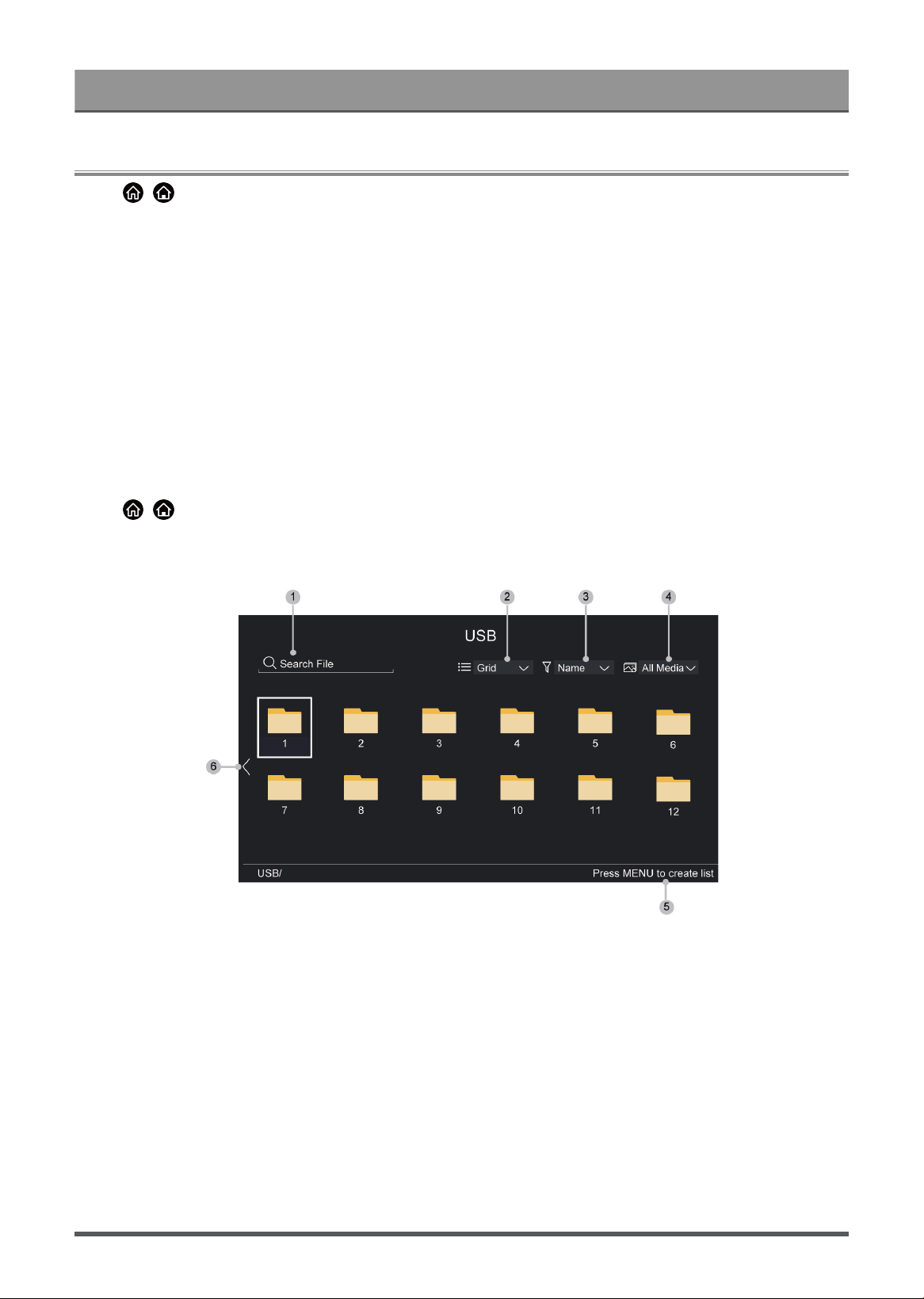
Entertainment
Media
Press / button on your remote control and select Media.
Media is a central location for you to view or listen to different types of content, such as photos, music and
movies. You can view media content through the following methods:
• A USB thumb drive or hard drive.
• Compatible mobile phone, tablet or other personal devices: you can stream movies, music and photos that
are stored on compatible personal devices and play or view the content on your TV.
By default, there is Content Sharing displayed on the Media screen. If your mobile device is connected to the
TV, its name also appears on the Media screen.
For more information about Content Sharing, please refer to Benefits of Smart TV > Content Sharing in this
manual.
Enjoy Photos/Audio/Video Stored on a USB Device
Press / button on your remote control and select Media > connected devices.
Select the content you want to play on the screen, like pictures, videos and music.
1. Search the content you want to play.
2. Arrange the content list by Grid, List.
3. Sort the content list by Name, Date Modified, Size.
4. Filter the content list by All Media, Photo, Video, Music, Recorded.
5. Create a photo, music, or video playlist.
6. When the focus is on the first line, there will be an arrow on the left side. Select the arrow to enter multiple
storage sources.
Note:
• Some options in the above table may not be available in some models/countries/regions.
• You must obtain any required permission from copyright owners to download or use copyrighted content.
We cannot and do not grant such permission.
47
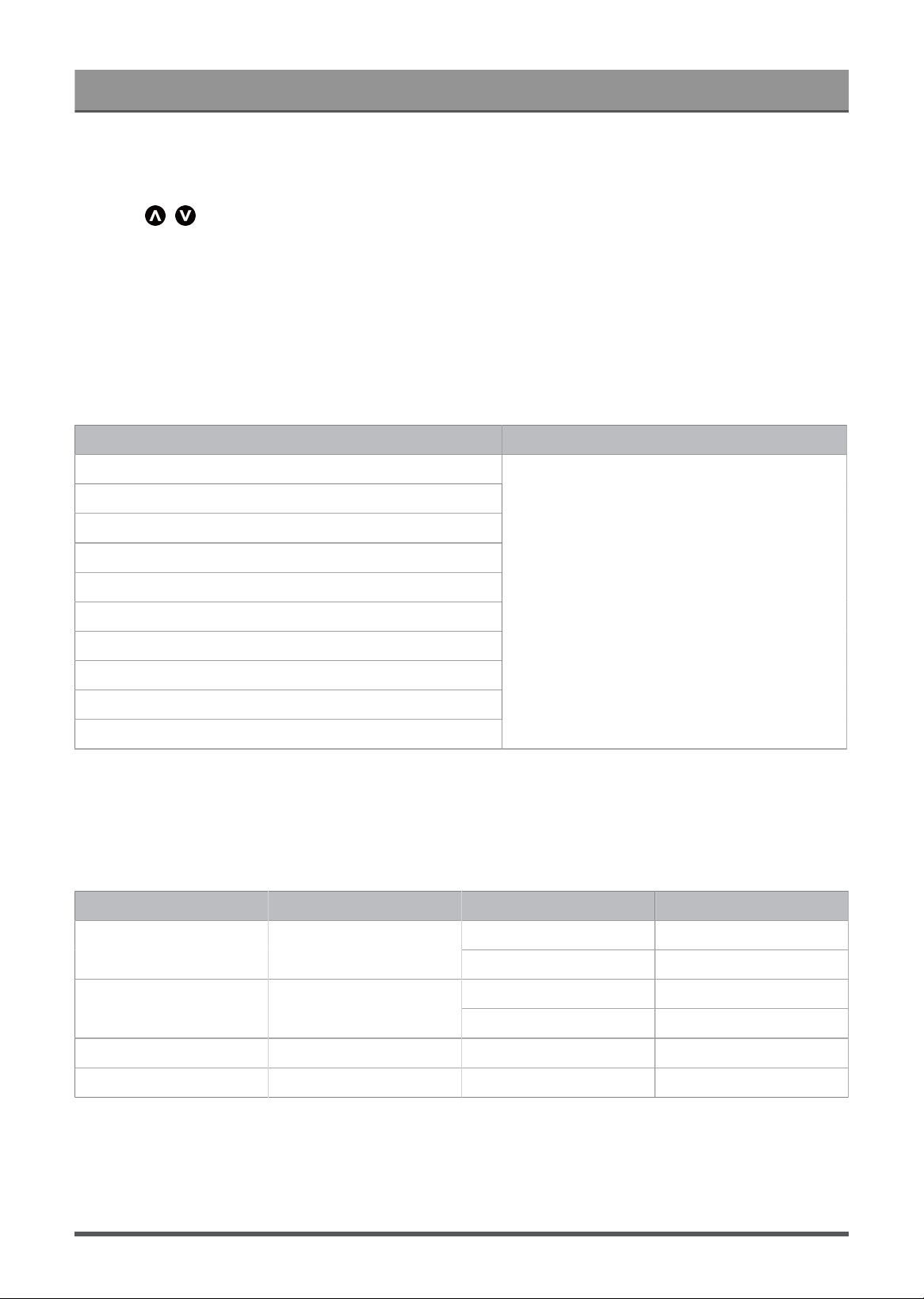
Entertainment
Play Background Music while Viewing Pictures
1. Choose a picture to display.
2.
Press / button to display control bar.
3. Select Background Music and choose your music to create a Music Playlist.
Now you can play background music while viewing pictures.
Audio Format
Due to differences in programming tools and other factors, some of the file formats that are listed may not be
supported.
The listed formats may not be supported depending on the model.
Container File Extension Name
LPCM
MPEG1/2 Layer1
MPEG1/2 Layer2
MPEG1/2/2.5 Layer3
WMA
AAC
MPEG-H
FLAC
VORBIS
OPUS
.wav
.mp3
.wma
.flac
Photo Format
Due to differences in programming tools and other factors, some of the file formats that are listed may not be
supported.
The listed formats may not be supported depending on the model.
Container File Extension Name Mode of Operation Resolution
base-line 15360 x 8640JPEG .jpg .jpeg
progressive 1920 x 1080
no-interlace 9600 x 6400PNG .png
interlace 1200 x 800
BMP .bmp - 9600 x 6400
GIF .gif - 6400 x 4800
Video Format
Due to differences in programming tools and other factors, some of the file formats that are listed may not be
supported.
48
Entertainment
The listed formats may not be supported depending on the model.
Codec Name File Extension Name Sampling rate
MPEG1/2 1920 x 1080p @ 120fps
MPEG4 1920 x 1080p @ 60fps
AVC(H.264) 4096 x 2160p @ 60fps
HEVC(H.265) 4096 x 2160p @ 60fps
WMV3 1920 x 1080p @ 60fps
VC1 1920 x 1080p @ 60fps
VP8 1920 x 1080p @ 60fps
VP9 4096 x 2160p @ 60fps
AV1
.mp4
.mov
.mkv
.ts
.avi
.wmv
.flv
.webm
4096 x 2160p @ 60fps
THIS PRODUCT IS LICENSED UNDER THE AVC PATENT PORTFOLIO LICENSE FOR THE PERSONAL
USE OF A CONSUMER OR OTHER USES IN WHICH IT DOES NOT RECEIVE REMUNERATION TO (i)
ENCODE VIDEO IN COMPLIANCE WITH THE AVC STANDARD (“AVC VIDEO”) AND/OR (ii) DECODE AVC
VIDEO THAT WAS ENCODED BY A CONSUMER ENGAGED IN A PERSONAL ACTIVITY AND/OR WAS
OBTAINED FROM A VIDEO PROVIDER LICENSED TO PROVIDE AVC VIDEO. NO LICENSE IS GRANTED
OR SHALL BE IMPLIED FOR ANY OTHER USE. ADDITIONAL INFORMATION MAY BE OBTAINED FROM
MPEG LA, L.L.C. SEE HTTP://WWW.MPEGLA.COM
49

Accessibility Features
Accessibility Menu Setup
Provide menu option to aid the visually or hearing impaired.
Press / button on your remote control and select Settings > Accessibility > High Contrast Menu.
Improve contrast for visually impaired.
Press / button on your remote control and select Settings > Accessibility > Menu Transparency.
Select menu transparency from Off, Medium, High.
Note:
• The above functions may not be applicable in some models/countries/regions.
Audio Type Setup
Provide audio description to aid the visually impaired.
Press / button on your remote control and select Settings > Accessibility > Audio Type.
• Audio Type
Accessibility audio settings.
• Audio Format
Select the audio format.
• Fader Control
Provide the best sound quality options for the visually impaired.
Note:
• The above functions may not be applicable in some models/countries/regions.
Dialogue Enhancement
Press / button on your remote control and select Settings > Accessibility > Dialogue
Enhancement.
Enable or disable dialogue enhancement.
Note:
• This function may not be applicable in some models/countries/regions.
Subtitle Setup
Adjust Subtitle Settings for digital broadcast content.
Press / button on your remote control and select Settings > Accessibility > Subtitle Settings.
• Subtitle
Enable Subtitle type.
• Primary Subtitle
Set the default subtitle language for digital broadcast content.
• Secondary Subtitle
Set the secondary subtitle language for digital broadcast content.
50

Accessibility Features
• Channel Subtitle Storage
Enable the storage of subtitle settings per channel.
Note:
• The above functions may not be applicable in some models/countries/regions.
Screen Magnification
Press / button on your remote control and select Settings > Accessibility > Screen
Magnification.
Allow visually impaired/partially sighted viewers to magnify an area of the screen.
Note:
• This function is only applicable for some scenarios.
• This function may not be applicable in some models/countries/regions.
Voice Guide
Press / button on your remote control and select Settings > Accessibility > Voice Guide.
Adjust settings for the Menu Audio function.
• Voice Guide
Enable or disable Voice Guide.
• Volume
Set the Menu Audio volume.
• Language
Set the Menu Audio language.
• Rate
Set the Menu Audio speed.
• Pitch
Set the Menu Audio pitch.
• Focus Voice Guide
Turn down the background volume when Menu Audio is playing.
Note:
• This function may not be applicable in some models/countries/regions.
51
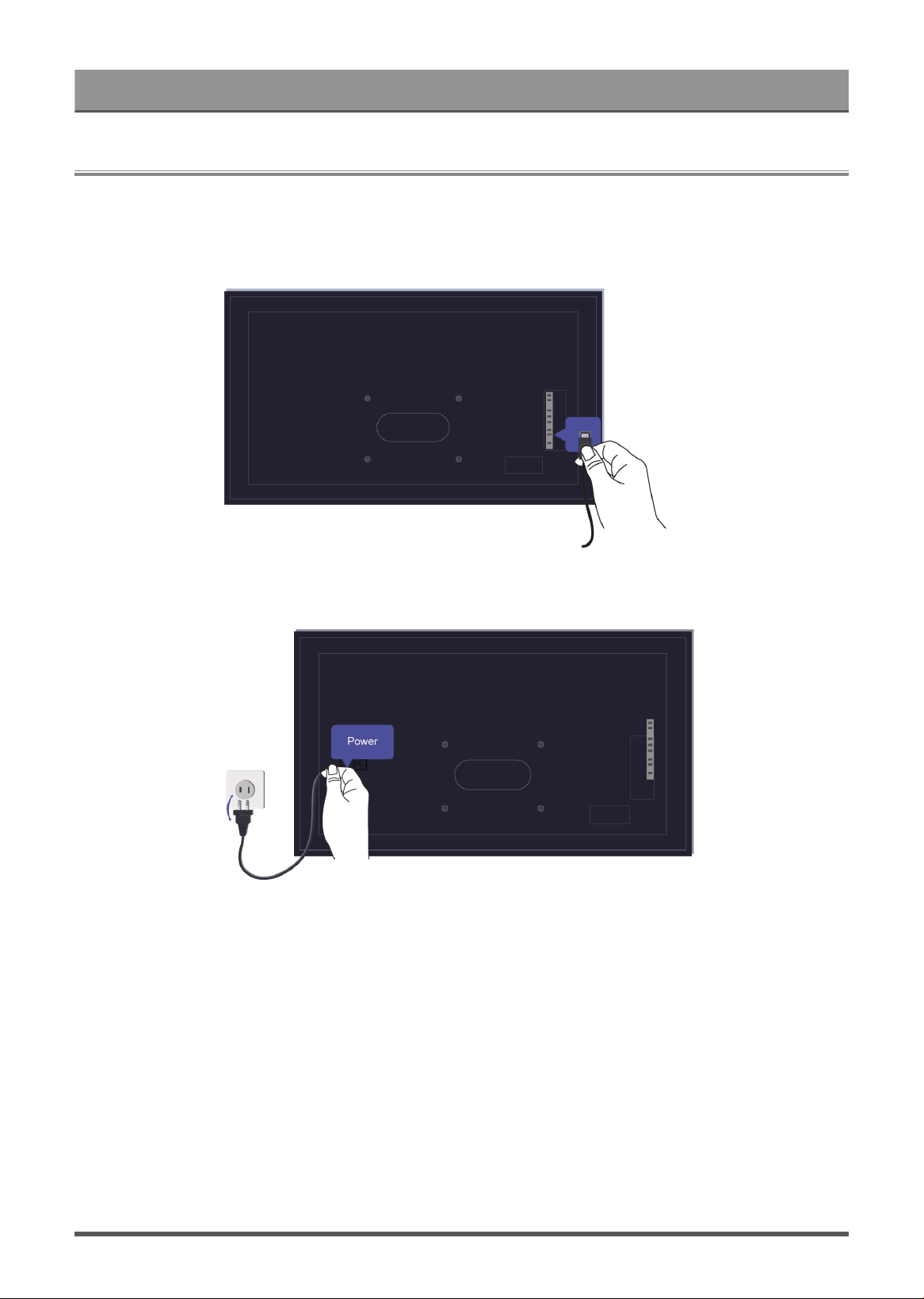
Troubleshooting
FAQ
In this section you will find the answers to the most frequently asked questions.
There is no picture, or the picture is black and white.
Check input cable connections.
Unplug the TV power cord from AC outlet and re-plug after 60 seconds.
52
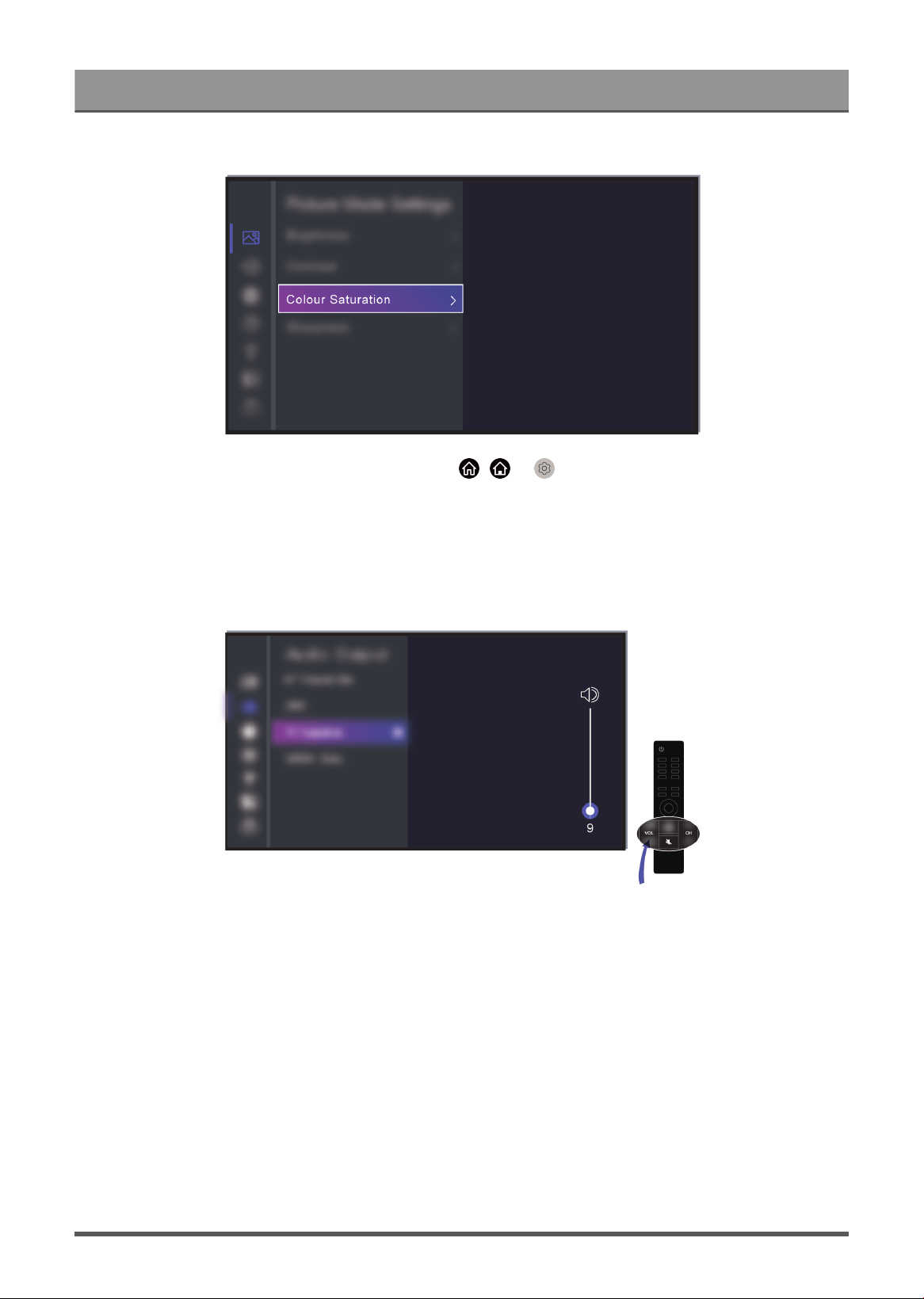
Troubleshooting
Check if the Colour Saturation is set to 50 or higher at / > Settings > Picture > Picture Mode
Settings > Colour Saturation.
No sound or the sound is too low.
There is no sound or the sound is too low at maximum volume.
Check if Mute mode is set to on.
Check the volume settings.
Check the volume control of the device (cable or satellite box, DVD, Blu-ray, etc.) connected to your TV.
53
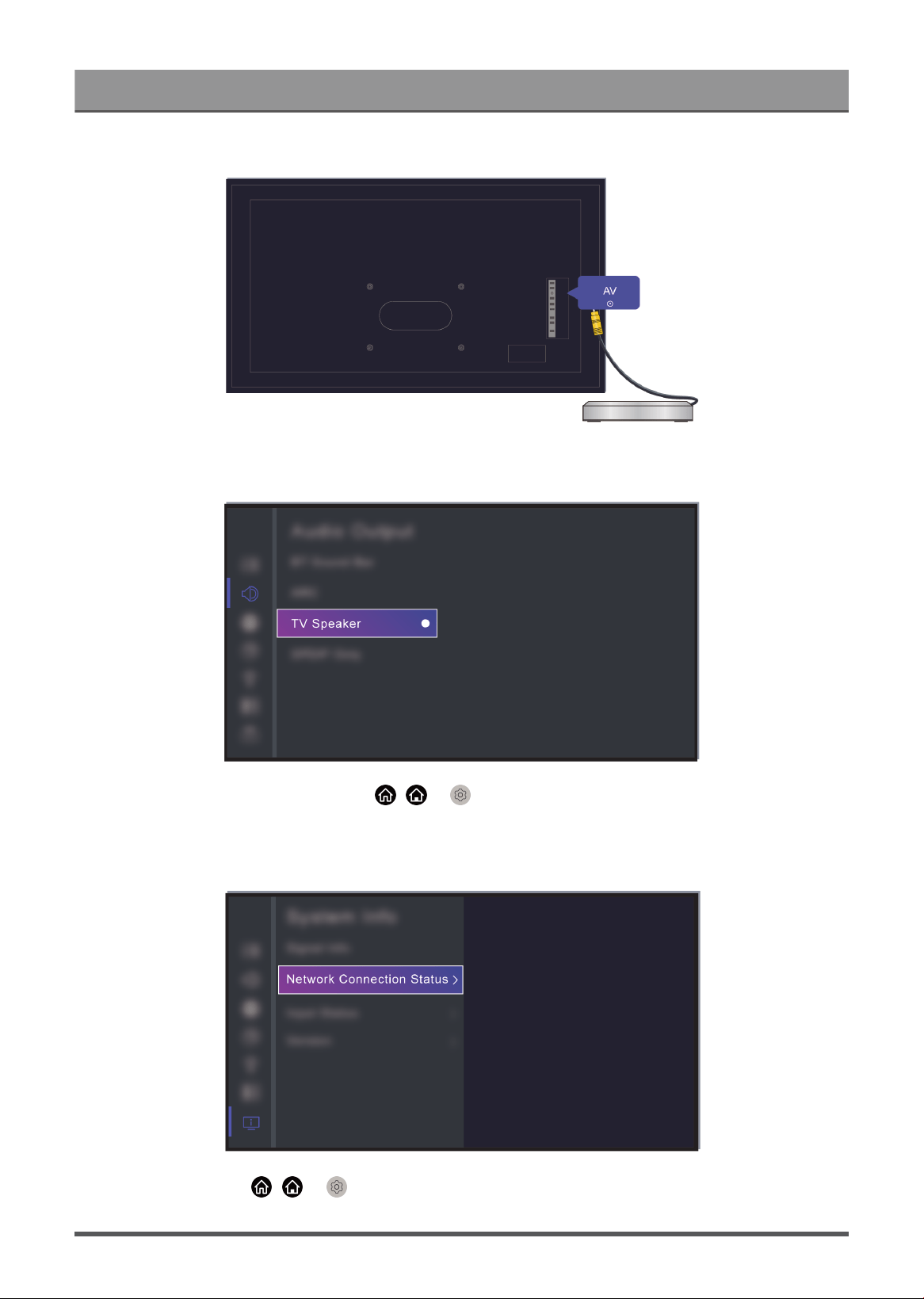
Troubleshooting
Make sure that the audio cable is connected to the correct audio output connector on the external device.
Check whether TV Speaker is selected at / > Settings > Sound > Speakers > Audio Output.
My TV cannot connect to the network.
Check network status at / > Settings > Support > System Info > Network Connection Status.
54
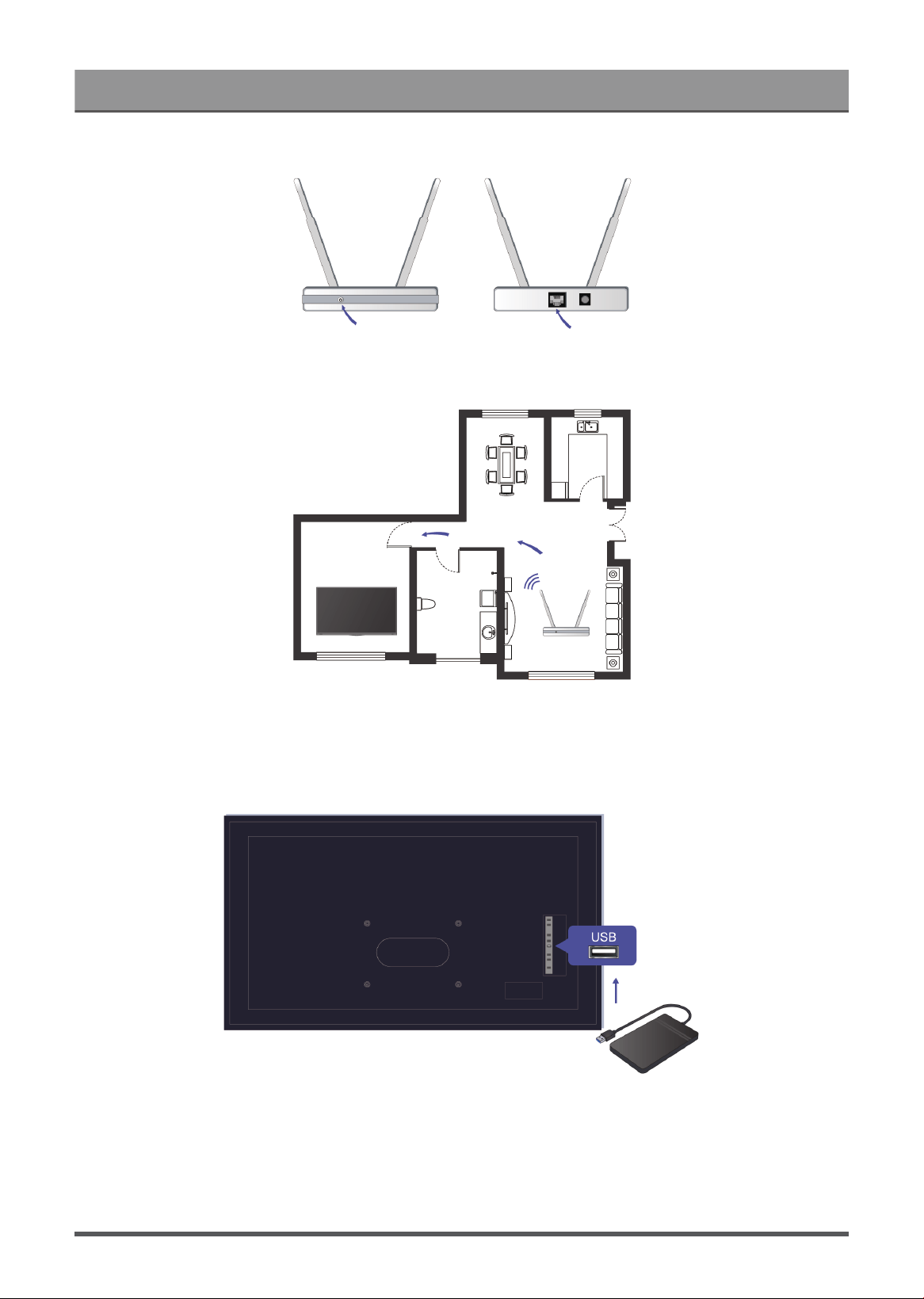
Troubleshooting
Make sure your modem/wireless router is on and connected to the Internet.
Position your wireless router, modem router, or access point in a central location. Avoid putting it in a corner.
Schedule Recording cannot be used.
Check if there is a storage device connected to the TV.
55
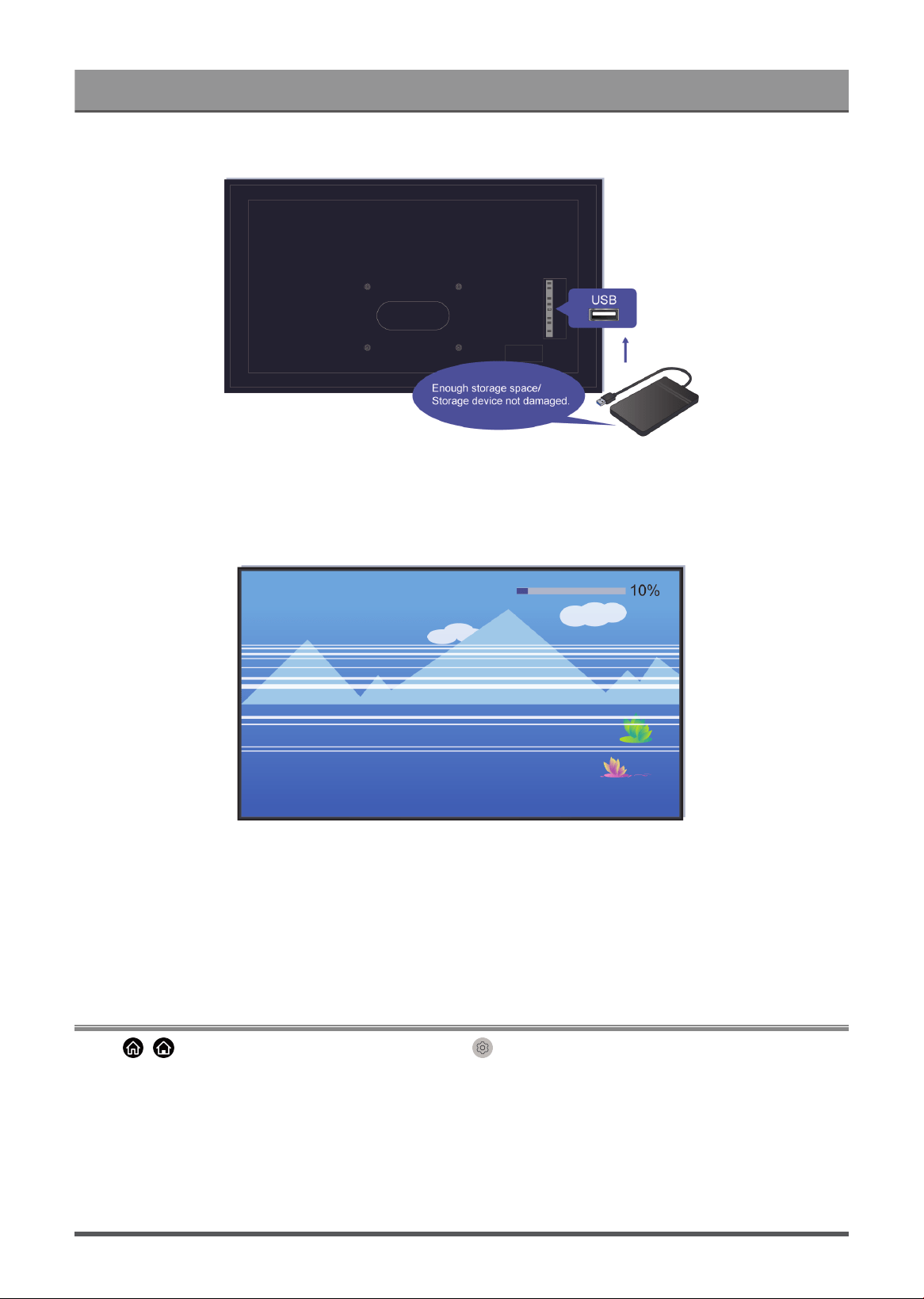
Troubleshooting
Check the free space of the storage device. The function will not work if there is not enough storage space on
the device.
Check whether your storage device is damaged. If so, it is suggested to format your storage device.
Recording will automatically stop if the signal becomes too weak.
Note:
• Recording function may not work if the read/write speed of the USB device is too slow.
• Recording function may not work because the storage format of your device is unsupported.
• The Recording functions may not be applicable in some models/countries/regions.
TV Status Diagnosis
Press / button on your remote control and select Settings > Support > Self Diagnosis.
When the TV malfunctions, you can perform some self-diagnosis to find the problem.
• Picture Test
When performing the Picture Test, a test picture will be shown on screen. Select OK to start the test.
Picture Test displays a high-definition picture that you can examine for flaws or faults. Please check the
picture carefully for up to 10s.
56
Troubleshooting
• Sound Test
When performing the Sound Test, a test sound will be played with the TV Speaker. Select OK to start the
test. Please listen to the sound carefully to check whether you can hear the sound problem.
• Network Connection Test
When performing a Network Connection Test, the test will confirm whether your TV is connected to
network via the TV screen. If the network test is successful but you still have problems using online
services, please contact your Internet provider.
• Network Speed Test
Perform this test to check the network speed.
• Input Connection Test
When performing an Input Connection Test, you can select any of the input sources and check related
information with external connections.
• Status Check
When performing a Status Check, the status of your TV will be displayed showing any error codes.
Picture Issues
When the TV has a picture problem, these steps may help resolve the problem.
Press / button on your remote control and select Settings > Support > Self Diagnosis > Picture
Test.
Before you review the list of problems and solutions below, use Picture Test to determine if the problem is
caused by the TV. Picture Test displays a high definition picture that you can examine for flaws or faults.
• If the test picture does not appear or there is noise or distortion, the TV may have a problem. Contact the
service company in your country/region.
• If the test picture is displayed properly, there may be a problem with an external device. Please check the
connections.
• If the problem persists, check the signal strength or refer to the external device's user manual.
Problem Possible Solutions
The picture is distorted.
• The compression of video content may cause picture distortions,
especially in fast moving pictures from sports programmes and action
movies.
• If the signal reception is weak or poor, screen distortion may be visible but
it is not a malfunction.
• Mobile phones used close to the TV (within 1m) may cause noise on
analogue and digital channels.
The picture is blurry or
flickering, or cuts out
momentarily.
•
Press / button on your remote control and select Settings >
Picture > Picture Mode Settings > Sharpness. You can try to increase
or decrease the Sharpness.
• If you use an external antenna, check the direction, position and
connection of the antenna.
• Adjust the direction of your antenna, or reset or fine tune the channel.
57
Troubleshooting
Problem Possible Solutions
The picture appears red,
purple, pink and other
colours.
•
Press / button on your remote control and select Settings >
Picture > Picture Mode Settings > Expert Settings > White Balance.
You can try to increase or decrease the White Balance.
Picture distorted or appears
wavy.
• Some electrical appliances may affect the TV. If you turn off the appliance
and the interference goes away, then move it further away from TV.
• Insert the power plug of the TV into another power outlet.
Related information
There is no picture, or the picture is black and white. on page 52
Sound Issues
When the TV has a sound problem, these steps may help resolve the problem.
Press / button on your remote control and select Settings > Support > Self Diagnosis > Sound
Test.
If the TV plays the Sound Test melody without distortion, there may be a problem with an external device or
the broadcast signal's strength.
Problem Possible Solutions
Picture is normal, but no
sound.
• Check the volume settings.
• Check if 'Mute' mode is set to on.
• Check the volume control of the device (cable or satellite box, DVD, Blu-
ray, etc.) connected to your TV.
The speakers are making an
odd sound.
• Make sure that the audio cable is connected to the correct audio output
connector on the external device.
• For antenna or cable connections, check the signal information.
• A low signal level may cause sound distortions.
Sound is distorted.
• Some electrical appliances may affect the TV. If you turn off the appliance
and the interference goes away, then move it further away from TV.
• Insert the power plug of the TV set into another power outlet.
Sound is distorted or cuts
out momentarily.
• If you use an external antenna, check the direction, position and
connection of the antenna.
• Adjust the direction of your antenna or reset or fine tune the channel.
Related information
No sound or the sound is too low. on page 53
Network Issues
When the TV has difficulties in connecting to the Internet, these steps may help resolve the problem.
Press / button on your remote control and select Settings > Support > Self Diagnosis > Network
Connection Test.
58
Troubleshooting
Problem Possible Solutions
The TV cannot connect to
apps.
• Make sure the TV has a network connection.
•
Press / button on your remote control and select Settings >
Support > Self Diagnosis > Network Connection Test.
• Contact your Internet service provider.
The wireless network
connection failed.
• Make sure your wireless modem/router is on and connected to the
Internet.
The wireless network signal
is too weak.
• Position your wireless router, modem router, or access point in a central
location. Avoid putting it in a corner.
Related information
My TV cannot connect to the network. on page 54
Other Issues
Use these procedures to resolve other issues that may occur.
Problem Possible Solutions
The TV is hot.
• Watching TV for an extended period of time causes the panel to generate
heat. The heat from the panel is dissipated through internal vents running
along the top of the TV.
• After extended use, you may feel heat when touching it. This heat is not a
defect and does not affect the TV's functionality.
The TV smells of plastic.
• This smell is normal and will dissipate over time.
The plastic cabinet makes a
"clicking" type of sound.
• The "clicking" sound can be caused when the temperature of the TV
changes. This change causes the TV cabinet to expand or contract, which
makes the sound. This is normal and the TV is OK.
When I turn on my TV, there
is a delay for a few seconds
before the picture appears.
Is this normal?
• Yes, this is normal. The TV is initialising and searching for the previous
setting information.
59
