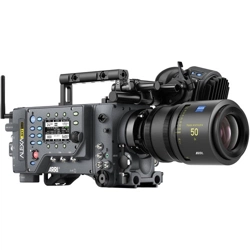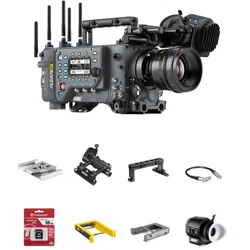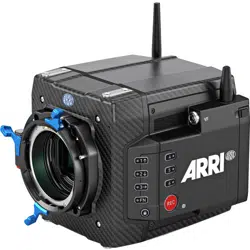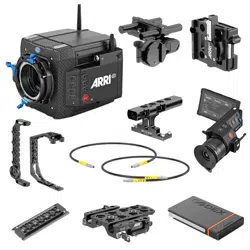

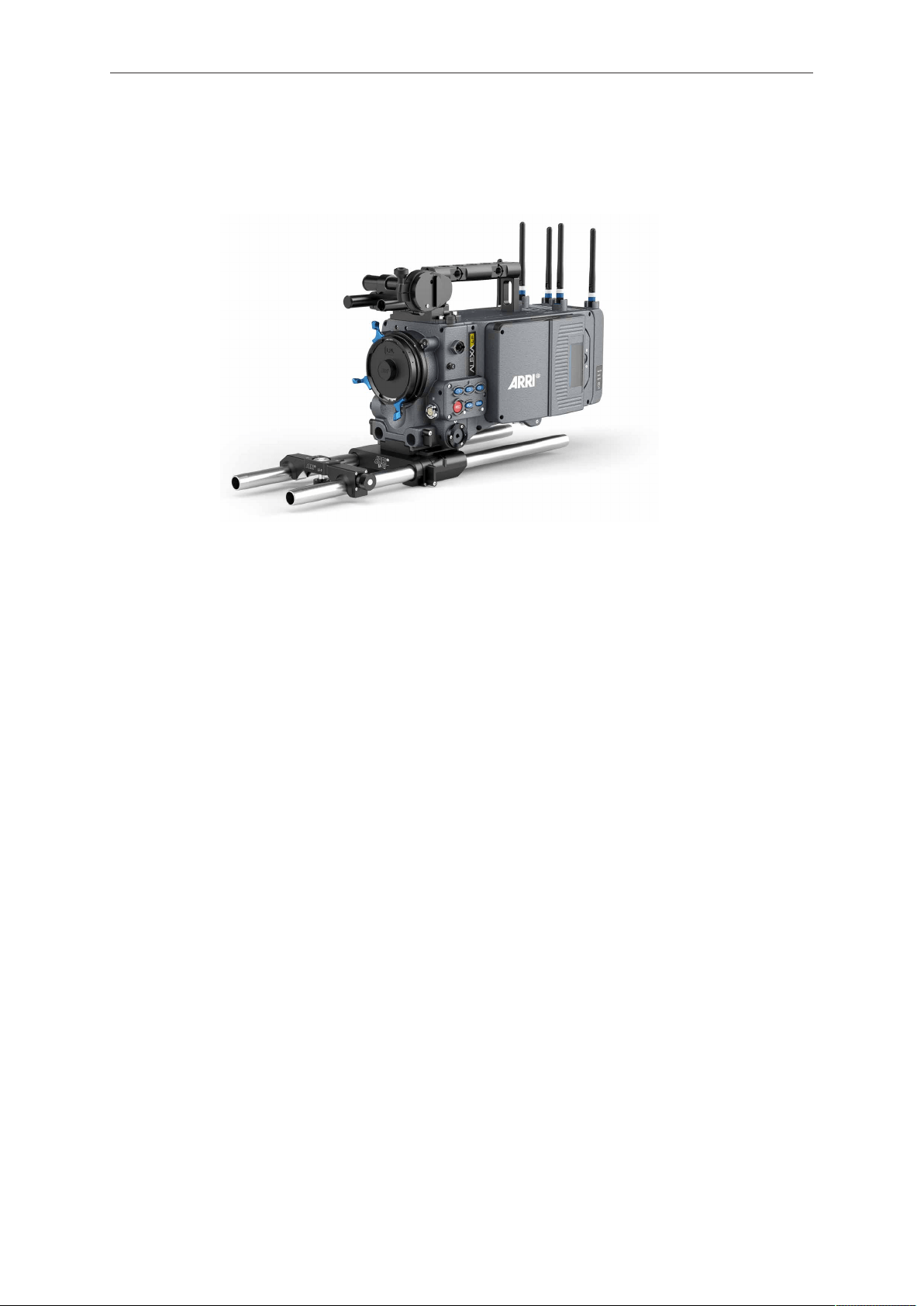
ALEXA LF
Software Update Package 4.0
U S E R M A N U A L
6 November 2018
ALEXA LF
Software Update Package 4.0
U S E R M A N U A L
6 November 2018

2 Copyright
Copyright
All rights reserved.
This document is provided under a license agreement containing restrictions on use
and disclosure and is also protected by copyright law.
Due to continued product development this information may change without notice.
The information and intellectual property contained herein is confidential between
ARRI and the client and remains the exclusive property of ARRI. If you find any
problems in the documentation, please report them to us in writing. ARRI does not
warrant that this document is error-free.
Arnold & Richter Cine Technik
Tuerkenstr. 89
D-80799 Munich
Germany
mailto: [email protected]
http://www.arri.com

Contents 3
Contents
1 Disclaimer...............................................................................................7
2 About This Manual................................................................................ 9
3 Scope.................................................................................................... 10
4 Introduction to the ALEXA LF............................................................11
5 Layout of the ALEXA.......................................................................... 12
6 Safety Guidelines.................................................................................14
6.1 Explanation of Warning Signs and Indications.................................... 14
6.2 General Safety Guidelines.................................................................. 14
6.3 Specific Safety Instructions................................................................. 14
7 General Precautions............................................................................16
7.1 Storage and Transport........................................................................ 16
7.2 Condensation.......................................................................................16
8 Sensor related image issues..............................................................17
9 Power Supply.......................................................................................18
9.1 Power Management............................................................................ 18
9.2 BAT Connector.................................................................................... 18
9.3 Mains Unit NG 12/26 R.......................................................................19
9.4 Cine-Style Block Batteries...................................................................19
9.5 Onboard Batteries............................................................................... 20
9.5.1 V-Lock Batteries................................................................................ 20
9.5.2 Gold Mount Batteries.........................................................................20
9.6 Power Outputs.....................................................................................21
10 Camera Support...................................................................................22
10.1 Minimum Equipment Recommended For Operation........................... 22
10.2 Tripod and Remote Heads.................................................................. 22
10.3 Electronic Viewfinder........................................................................... 22
10.3.1 Viewfinder Cables..............................................................................24
10.3.2 Viewfinder Mounting Bracket.............................................................24
10.4 Center Camera Handle CCH-1........................................................... 26
10.5 Bridge Plates BP-12/BP-13................................................................. 27
10.6 Bridge Plate adapter BPA-1................................................................ 28
10.7 Wedge Adapter WA-1 and Quick-Release Plate QR-HD-1.................28
10.8 Levelling Block LB-1............................................................................28
10.9 Shoulder Pad SP-3..............................................................................29

4 Contents
11 Connectors........................................................................................... 30
11.1 BAT...................................................................................................... 31
11.2 RET IN.................................................................................................31
11.3 MON OUT 1/2/3.................................................................................. 31
11.4 EXT...................................................................................................... 32
11.5 ETHERNET..........................................................................................32
11.6 EVF...................................................................................................... 32
11.7 AUDIO IN.............................................................................................32
11.8 RS........................................................................................................ 32
11.9 12 V..................................................................................................... 33
11.10 TC........................................................................................................ 33
11.11 AUDIO OUT.........................................................................................33
11.12 SD Card...............................................................................................33
11.13 LBUS Support......................................................................................34
12 Recording Module............................................................................... 36
13 Lens Mounting..................................................................................... 40
13.1 LPL mount........................................................................................... 40
13.2 PL-to-LPL Adapter...............................................................................41
13.3 Lens Support....................................................................................... 41
14 In-Camera Filter Module LF IFM........................................................ 43
14.1 Safety instructions for in-camera filtration........................................... 44
14.1.1 Maximum lens mounting depth for PL lenses................................... 44
14.1.2 Basic precautions.............................................................................. 45
14.1.3 Required shimming and maximum lens mounting depth.................. 45
14.2 LF FSND Filter Set (Full).................................................................... 45
14.3 Shimming the lens mount................................................................... 46
14.4 Mounting in-camera filters................................................................... 52
14.5 Filter cleaning...................................................................................... 55
15 Camera Controls..................................................................................57
15.1 Main Controls...................................................................................... 57
15.1.1 Display............................................................................................... 57
15.1.2 Screen Buttons.................................................................................. 58
15.1.3 HOME screen.................................................................................... 58
15.1.3.1 Lists and User Lists.................................................................................... 61
15.1.3.2 FPS..............................................................................................................62
15.1.3.3 AUDIO......................................................................................................... 63
15.1.3.4 SHUTTER....................................................................................................66
15.1.3.5 EI................................................................................................................. 66
15.1.3.6 COLOR........................................................................................................ 68
15.1.3.7 WB............................................................................................................... 71

Contents 5
15.1.4 Function Buttons................................................................................73
15.1.4.1 TC................................................................................................................ 74
15.1.4.2 INFO............................................................................................................ 75
15.1.4.3 USER...........................................................................................................78
15.1.4.4 PLAY............................................................................................................82
15.1.4.5 Wireless Remote System............................................................................85
15.1.5 Menu.................................................................................................. 93
15.1.5.1 Recording.................................................................................................... 94
15.1.5.2 Monitoring.................................................................................................... 96
15.1.5.3 Project........................................................................................................104
15.1.5.4 System.......................................................................................................106
15.1.5.5 Frame Grabs............................................................................................. 116
15.1.5.6 User Setups...............................................................................................117
15.2 Operator controls...............................................................................119
15.3 EVF Controls..................................................................................... 120
15.3.1 Viewfinder EVF menu......................................................................121
15.3.2 Viewfinder CAM menu.....................................................................122
15.4 Web Remote......................................................................................123
16 Wireless Video................................................................................... 124
16.1 Setting the region of the wireless video function...............................125
16.2 Preparation........................................................................................ 125
16.3 Status LEDs.......................................................................................125
16.4 Pairing camera and receivers........................................................... 125
16.5 Supported resolutions........................................................................127
16.6 Sample setups...................................................................................127
16.7 Software update................................................................................ 128
17 Operation of the Camera.................................................................. 129
17.1 Internal recording...............................................................................129
17.1.1 Recording Module........................................................................... 129
17.1.2 Internal Recording Formats.............................................................129
17.2 Monitoring.......................................................................................... 136
17.2.1 Frame Lines.....................................................................................136
17.2.2 Status Info Overlays........................................................................ 137
17.3 Using Timecode.................................................................................139
17.4 Syncing the Sensors of Two Cameras..............................................140
17.5 Syncing the Settings of Two Cameras.............................................. 142
18 Remote Control Unit RCU-4............................................................. 145
19 Index....................................................................................................146
20 Appendix.............................................................................................149
20.1 Technical data....................................................................................149
20.2 Connector Pin Outs........................................................................... 152

6 Contents
20.3 False Color Display........................................................................... 157
20.4 Warning and Error Messages............................................................158
20.5 Dimensions and Weights...................................................................162
20.6 Declarations of Conformity................................................................ 162

Disclaimer 7
1 Disclaimer
Before using the products described in this manual be sure to read and understand all
respective instruction.
The ARRI ALEXA is only available to commercial customers. The customer grants by
utilization that the ARRI ALEXA or other components of the system are deployed for
commercial use. Otherwise the customer has the obligation to contact ARRI preceding
the utilization.
While ARRI endeavors to enhance the quality, reliability and safety of their products,
customers agree and acknowledge that the possibility of defects thereof cannot be
eliminated entirely. To minimize risk of damage to property or injury (including death)
to persons arising from defects in the products, customers must incorporate sufficient
safety measures in their work with the system and have to heed the stated canonic
use.
ARRI or its subsidiaries do not assume any responsibility for incurred losses due to
improper handling or configuration of the camera or other system components, due
to sensor contamination, occurrence of dead or defective pixels, defective signal
connections or incompatibilities with third party recording devices.
ARRI assumes no responsibility for any errors that may appear in this document. The
information is subject to change without notice.
For product specification changes since this manual was published, refer to the
latest publications of ARRI data sheets or data books, etc., for the most up-to-date
specifications. Not all products and/or types are available in every country. Please
check with an ARRI sales representative for availability and additional information.
Neither ARRI nor its subsidiaries assume any liability for infringement of patents,
copyrights or other intellectual property rights of third parties by or arising from the
use of ARRI products or any other liability arising from the use of such products. No
license, express, implied or otherwise, is granted under any patents, copyrights or
other intellectual property right of ARRI or others.
ARRI or its subsidiaries expressly exclude any liability, warranty, demand or other
obligation for any claim, representation, or cause, or action, or whatsoever, express
or implied, whether in contract or tort, including negligence, or incorporated in terms
and conditions, whether by statue, law or otherwise. In no event shall ARRI or its
subsidiaries be liable for or have a remedy for recovery of any special, direct, indirect,
incidental, or consequential damages, including, but not limited to lost profits, lost
savings, lost revenues or economic loss of any kind or for any claim by third party,
downtime, good-will, damage to or replacement of equipment or property, any cost
or recovering of any material or goods associated with the assembly or use of our
products, or any other damages or injury of the persons and so on or under any other
legal theory.
In the case one or all of the foregoing clauses are not allowed by applicable law, the
fullest extent permissible clauses by applicable law are validated.
ARRI is a registered trademark of Arnold & Richter Cine Technik GmbH & Co Betriebs
KG.
The ALEXA viewfinder EVF-1 contains proprietary technology owned by Fourth
Dimension Displays Limited and licensed by ARRI.
This product contains licensed technology from Linotype.
Quicktime and Quicktime logo are trademarks or registered trademarks of Apple
Computer, Inc., used under license therefrom.
Apple ProRes 422 Proxy, Apple ProRes 422 LT, Apple ProRes 422, Apple ProRes
422 HQ, Apple ProRes 4444, Apple ProRes 4444 XQ, and the ProRes logo are
trademarks or registered trademarks of Apple Computer, Inc., used under license
therefrom.

8 Disclaimer
SxS and are trademarks of SONY corporation.
mkdosfs
Portions ©1998, Robert Nordier. All Rights Reserved.
© 1998, Robert Nordier. All rights reserved.
Redistribution and use in source and binary forms, with or without modification, are
permitted provided that the following conditions are met:
Redistributions of source code must retain the above copyright notice, this list of
conditions and the following disclaimer.
Redistributions in binary form must reproduce the above copyright notice, this list of
conditions and the following disclaimer in the documentation and/or other materials
provided with the distribution.
THIS SOFTWARE IS PROVIDED BY THE AUTHOR(S) “AS IS” AND ANY EXPRESS
OR IMPLIED WARRANTIES, INCLUDING, BUT NOT LIMITED TO, THE IMPLIED
WARRANTIES OF MERCHANTABILITY AND FITNESS FOR A PARTICULAR
PURPOSE ARE DISCLAIMED. IN NO EVENT SHALL THE AUTHOR(S) BE
LIABLE FOR ANY DIRECT, INDIRECT, INCIDENTAL, SPECIAL, EXEMPLARY,
OR CONSEQUENTIAL DAMAGES (INCLUDING, BUT NOT LIMITED TO,
PROCUREMENT OF SUBSTITUTE GOODS OR SERVICES; LOSS OF USE, DATA,
OR PROFITS; OR BUSINESS INTERRUPTION) HOWEVER CAUSED AND ON ANY
THEORY OF LIABILITY, WHETHER IN CONTRACT, STRICT LIABILITY, OR TORT
(INCLUDING NEGLIGENCE OR OTHERWISE) ARISING IN ANY WAY OUT OF THE
USE OF THIS SOFTWARE, EVEN IF ADVISED OF THE POSSIBILITY OF SUCH
DAMAGE.

About This Manual 9
2 About This Manual
ARRI recommends that all users of the ALEXA read the manual in its entirety prior
to use. For experienced users, the manual's structure also provides quick access for
reference.
How to Use This Manual
All directions are given from a camera operator's point of view. For example, camera-
right side refers to the right side of the camera when standing behind the camera and
operating it in a normal fashion.
Connectors are written in all capital letters, for example, MON OUT. Menus and
screens on the Main Camera Controls are written in all capital letters, for example,
RECORDING menu and HOME screen. Buttons are written in italic typeface capital
letters, for example, PLAY button.
The appendix at the back of the manual contains useful reference material including
ALEXA specifications, connector pin-out diagrams, a false color display explanation,
error and warning message explanations, ALEXA dimensional drawings and a menu
structure tree.

10 Scope
3 Scope
This instruction manual applies to the following hardware, software and firmware
versions:
ALEXA LF: with Electronic Viewfinder EVF-1 or EVF-2;
Camera Software Update Package (SUP) for ALEXA LF cameras: 4.0
Document revision history
Document ID: D45 10003373
Version Release Date
2.0 K09699 19 March 2018
K09716 6 April 2018
3.0 K09810 7 August 2018
4.0 K09867 6 November 2018

Introduction to the ALEXA LF 11
4 Introduction to the ALEXA LF
The ALEXA LF (Large Format) camera is part of a complete large-format system that
meets and exceeds modern production requirements. Based around a large-format
4.5K version of the ALEXA sensor, the system comprises the ALEXA LF camera,
ARRI Signature Prime lenses, new LPL lens mount and PL adapter. These system
elements have been designed to take fullest advantage of the enlarged sensor, while
also offering full compatibility with existing lenses, accessories and workflows.
Featuring a sensor slightly larger than full frame, ALEXA LF records native 4.5K with
ARRI’s best overall image quality. This allows filmmakers to explore an immersive
large-format aesthetic while retaining the sensor’s proven suitability for HDR
and WCG workflows. Versatile recording formats, including efficient ProRes and
uncompressed ARRIRAW up to 150 fps, provide unprecedented creative freedom.
ALEXA LF has the biggest sensor area of any cinema camera on the market, second
only to ARRI Rental’s ALEXA 65. Maintaining the ALEXA family’s optimal pixel size for
highest overall image quality results in a 4448 x 3096 picture, which can be recorded
in full using the LF Open Gate sensor mode. An LF 16:9 sensor mode maximizes
lens options while meeting 4K deliverable standards, and an LF 2.39:1 sensor mode
combines a cinematic widescreen image with high frame rates for sensuous slow
motion. All sensor modes offer true 800 ASA sensitivity as well as reduced noise,
providing the perfect canvas for modern, subtle lighting techniques.
A crucial element of the new system is the LPL lens mount, with dimensions optimized
for large format sensors. A wider diameter and shorter flange focal depth allows the
ARRI Signature Primes and all future large format lenses to be small and lightweight
with a fast T-stop and pleasing bokeh, a combination of features that would not
be possible within the confines of the PL lens mount. The LPL mount will also be
available for other ARRI cameras such as the ALEXA Mini, so the Signature Primes
can be used for large format and Super 35. In addition, the LPL mount is being
licensed to other lens and camera manufacturers, creating a new universal standard.
Although camera, lens mount and lenses are new, compatibility with existing PL mount
lenses and ALEXA accessories is a cornerstone of the system's design. A PL adapter
offers full backwards compatibility with all PL mount lenses, be they Super 35 or full
frame. Since the PL adapter clips securely into the LPL lens mount without tools,
crews can rapidly switch between PL and LPL lenses on set, offering an unlimited
lens choice to the cinematographer. Since the ALEXA LF is based on the proven,
robust ALEXA camera design, most existing accessories will work right out of the box.
Since all other features and the user interface are the same as in the ALEXA SXT W,
including the integrated wireless video transmitter and the user interface, crews will
quickly adapt to this new camera.
ALEXA LF offers the same proven, versatile workflows as other ALEXA cameras.
Recording at various resolutions is possible in uncompressed, unencrypted ARRIRAW
up to 150 fps or in fast, efficient ProRes up to 100 fps. Lens metadata can be recorded
from LDS-1, LDS-2 or /i capable lenses. Existing ARRI Look Files (ALF-2) can be
used with ALEXA LF and the entire range of ARRI workflow software tools has been
reworked to support ALEXA large-format images.
12 Layout of the ALEXA
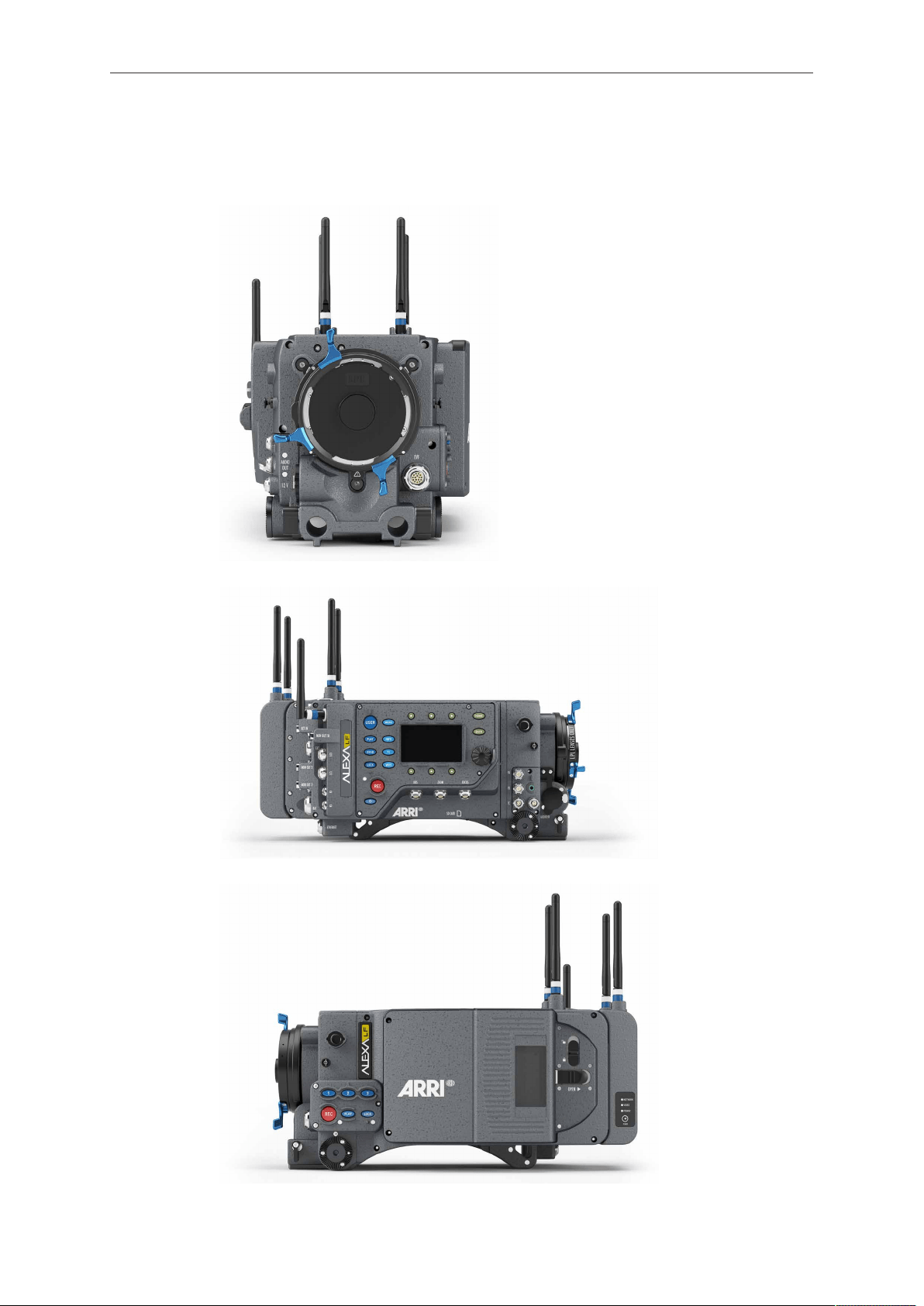
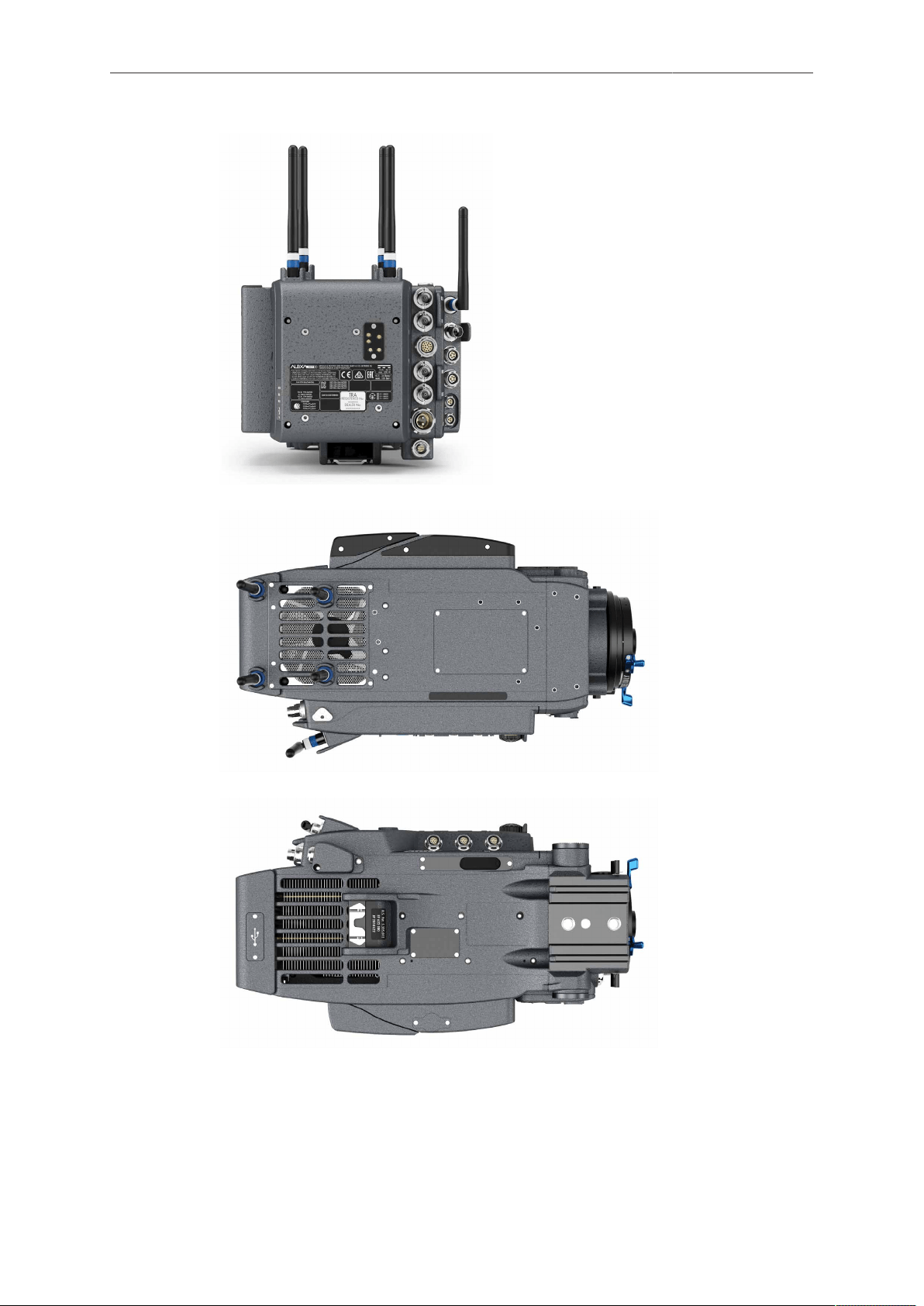
5 Layout of the ALEXA
Layout of the ALEXA 13
14 Safety Guidelines
6 Safety Guidelines
Any violation of these safety instructions or non-observance of personal care could
cause serious injuries (including death) to users and affiliates and damage to the
equipment or other objects.
6.1 Explanation of Warning Signs and Indications
Indicates a possible risk of injury or damage to the equipment
Indicates the risk of electric shock or fire danger that could result in injury or
damage to the equipment.
NOTICE
Indicates further information or information from other instruction manuals
6.2 General Safety Guidelines
Always follow these guidelines to ensure against injury to yourself or others and
damage to the system or other objects.
This safety information is in addition to the product specific operating instructions
in general and must be strictly observed for safety reasons.
Read and understand all safety and operating instructions before you operate or
install the system!
Retain all safety and operating instructions for future reference.
Heed all warnings on the system and in the safety and operating instructions
before you operate or install the system. Follow all installation and operating
instructions.
Do not use accessories or attachments that are not recommended by ARRI, as
they may cause hazards and invalidate the warranty!
Do not attempt to repair any part of the system! Repairs must only be carried out
by authorized ARRI Service Centers.
6.3 Specific Safety Instructions
Do not remove any safety measures from the system!
Do not operate the system in areas with humidity above operating levels or expose
it to water or moisture!

Safety Guidelines 15
Do not cover the fan openings at the camera back top and bottom!
Do not subject the system to severe shocks!
Do not place the system on an unstable trolley/hand truck, stand, tripod, bracket,
table or any other unstable support device! The system may fall, causing serious
personal injury and damage to the system or other objects.
Operate the system using only the type of power source indicated in the manual!
Unplug the power cable by gripping the power plug, not the cable!
Never insert objects of any kind into any part of the system if not clearly qualified
for the task in the manual, as objects may touch dangerous voltage points or short
out parts! This could cause fire or electrical shock.
Unplug the system from the power outlet before opening any part of the system or
before making any changes to the system, especially the attaching or removing of
cables!
Do not use solvents to clean!
Do not remove any stickers or paint marked screws!
Always place a lens or a protective cap in the lens mount receptacle!
Changing camera lenses should be done in a dry and dust-free environment. If
this is not possible, take extra care that no dust enters the camera while the lens is
off!
When no lens is attached to the camera, immediately place the protective cap on
the lens mount to avoid contamination of the sensor cover glass!
After changing lenses, always perform a dust check to make sure no dust has
settled on the sensor cover glass!
Clean optical lens surfaces only with a lens brush or a clean lens cloth. In cases of
solid dirt or grease, moisten a lens cloth with pure alcohol. Discard contaminated
lens cloth after use! Never attempt to clean a lens brush with your fingers!
NEVER USE CANS WITH COMPRESSED AIR OR GAS TO BLOW OFF THE
DUST! This can severely damage optical elements.
If the sensor cover glass has been contaminated by solid dirt or grease, special
optical cleaning kits should be used for dirt removal under very high care! If the
contamination cannot be removed, the camera should be taken to an ARRI service
center for cleaning.
THE USE OF METHANOL TO CLEAN OPTICAL SURFACES IS NOT
RECOMMENDED!
NEVER USE ACETONE TO CLEAN OPTICAL SURFACES!
NEVER TRY TO REMOVE THE SENSOR COVER GLASS!
DO NOT POINT THE CAMERA INTO DIRECT SUNLIGHT, VERY BRIGHT LIGHT
SOURCES, OR HIGH-ENERGY LIGHT SOURCES (e. g. laser beams)! This may
cause permanent damage to the camera image sensor.
DO NOT POINT THE VIEWFINDER INTO DIRECT SUNLIGHT, VERY BRIGHT
LIGHT SOURCES, OR HIGH-ENERGY LIGHT SOURCES (e. g. laser beams)!
This may cause permanent damage to the viewfinder display and optical
elements.
During extended operation, high data rates and/or operation at high ambient
temperatures, the camera's surfaces and especially the area around the
ventilation grille on top of the camera at the camera rear can get hot. Use caution
and never cover, obstruct or block the fan inlets or outlets while the camera is
powered.
16 General Precautions
7 General Precautions
7.1 Storage and Transport
Use a lens port cap to prevent damage to the sensor cover glass and sensor
whenever there is no lens attached.
Unplug all cables when transporting the ALEXA in a camera case.
Do not store the camera in places where it may be subject to temperature
extremes, direct sunlight, high humidity, severe vibration, or strong magnetic fields.
7.2 Condensation
When moving the camera from a cool to a warm location or when the camera is
used in a damp environment, condensation may form inside the lens port, on the
sensor cover glass, between the sensor and the sensor cover glass, and on internal or
external electrical connections.
Operating the camera while condensation is present may result in personal injury or
damage to the equipment.
Condensation on the optical components may have a visible effect on the output
images. To reduce the risk of condensation:
Find a warmer storage location.
If the camera needs to be stored in a place that is considerably cooler than the
location where it will be used, consider keeping the camera powered from a mains
unit in addition to using the air-drying cartridge.

Sensor related image issues 17
8 Sensor related image issues
Single Frame Spots of Various Shape – also known as “Digital Dust” or
“White Flecks”
Natural and/or artificial radiation may cause a “false exposure” on the image sensor.
The shape of these spots may vary from dots to lines or other, sometimes irregular
shapes. These spots occur in random locations of the image, last only for a single
frame and are more visible in dark images. This is a principle issue of all image
sensors and not a malfunction.
Flicker
Some light sources (i.e. discharge tubes or LEDs) may cause an interference with
sensor exposure. This may result in image flickering or “bands” of different brightness
moving up or down the image. Please note that at higher frame rates (100 fps in 50Hz
countries, 120 fps in 60Hz countries) even tungsten light may flicker. A short recording
and playback will show this flicker.
Rolling Shutter
Due to the rolling shutter design principle of the sensor the following effects can be
observed in certain situations:
Skewed/slanted vertical lines: fast panning or fast-moving objects may result in
vertical structures to appear "skewed/slanted”. The intensity of the effect depends
on the relative speed of panning/object.
Partial exposure: very short light effects (i.e. a photographer’s flash or strobe light)
may result in the upper part of the image showing the light effect whereas the
lower part does not or vice versa.
"Black Sun"
Very bright lights (i.e. the sun, or a photographer’s flash) may result in a black/
magenta spot. Note: pointing the camera directly into the sun may damage the sensor.
Stuck Pixels at Long Exposure Times
At longer exposure times (longer than the standard 1/50th of a second), stuck pixels
may become visible in darker image areas. The longer the exposure time the more
pixels will be affected. When using exposure times longer than 1/50th of a second,
carefully check your image whether the quality meets your requirements.
Stitching with ALEXA LF
The ALEXA LF sensor consists of a large sensor structure that is created by exposing
two Super 35 sensor structures side by side onto a silicon wafer. This process is,
somewhat misleadingly, called “stitching”. As is common with stitched large format
sensors in our industry, in rare situations it is possible to notice the boundary between
the left and right image halves.
18 Power Supply
9 Power Supply
Use only ARRI-recommended power supply solutions.
Manipulation of power supplies could result in serious injury or death, or damage
to the ALEXA.
The ALEXA accepts an input voltage range from 18.5 V to 34 V DC on the on-board
battery and a range from 19.5 V to 34 V DC on the BAT connector. Do not supply
power outside the specified voltage range.
In order to process the increased pixel count while still maintaining ALEXA best
overall image quality, the ALEXA LF draws between 120W and 160W while recording,
with EVF-1 and wireless video transmitter on, but no further accessories attached.
120W have been measured while recording ProRes 4444 in LF 16:9 sensor mode at
24 fps onto SxS PRO+ 256 GB cards. 160W have been measured while recording
ARRIRAW at 90 fps in LF Open Gate sensor mode onto SXR Capture Drives.
Electronic accessories will increase power draw based on the accessories’ draw.
NOTICE
The camera requires a voltage of at least 19.5 V on the BAT connector or 18.5
V on the on-board battery to power on, but it will continue running on a voltage
of down to one volt less (18.5 V / 17.5 V) on the respective inputs.
When powering accessories through the camera, the total power draw of the
camera is increased by the amount of power drawn by the accessories.
Always keep the BAT connector or attached battery accessible so that they can
be unplugged quickly in case of emergency.
9.1 Power Management
When using the BAT connector and an onboard battery adapter simultaneously, the
camera’s power management system ensures that the power source with the highest
voltage level is used. When the voltage level of one power source drops below the
level of the other, or a power source is disconnected from the camera, the power
management system automatically switches to the other power source, avoiding
shutdown of the camera.
Note that this also means that when the onboard battery provides a higher voltage
than the BAT connector, the onboard battery gets used first.
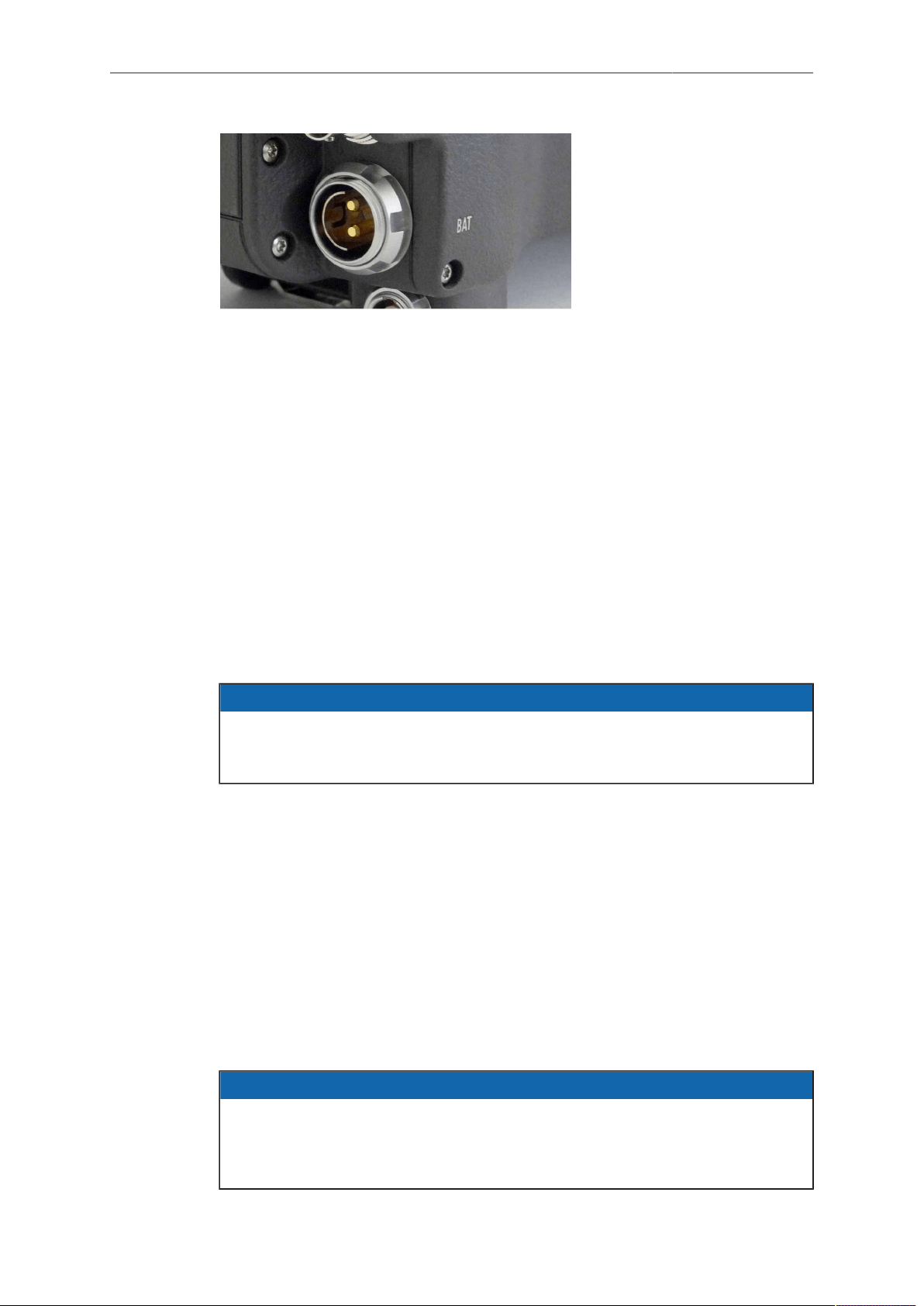
9.2 BAT Connector
The BAT connector is the primary power input on the ALEXA. It is a Fischer 2-pin
socket located at the back of the camera on the camera-right side.
The socket accepts power cables KC-20S and KC-29S. The cables can either be
connected to the mains unit NG 12/26R or to 24 V cine-style batteries with three-pin
XLR outputs. Do not use cables longer than 4m.
Power Supply 19
Fig. 1: BAT connector
9.3 Mains Unit NG 12/26 R
Use of the mains unit is recommended for shooting in the studio and when using
electronic accessories with high power consumption.
To power the ALEXA using the Mains Unit NG 12/26 R:
1. Set the correct mains voltage on the mains unit using the fuse on the back of the
unit. For example, set it to 220 V if the AC mains power source is 220 V.
2. Connect the mains unit to AC mains power.
3. Ensure that the camera power is turned off.
4. Set the voltage switch on the mains unit to 26 V.
5. Connect the battery cable KC-20S or KC-29S (spiral cable) to the power supply
socket on the camera and the 26 V socket on the mains unit.
NOTICE
The NG 12/24 R was the original design that provided 12 & 24 volts output – it was
superseded by the NG 12/26 R, which outputs 12 & 26 volts. The NG 12/24 R can
easily be upgraded to NG 12/26 R specification at an ARRI service center.
9.4 Cine-Style Block Batteries
Any 24 V cine-style block battery with a three-pin XLR output can be used to power
the camera through a KC-20S or a KC-29S battery cable connected to the camera's
BAT connector. The camera will accept any voltage from 19.5 to 34 V on this
connector.
To connect the battery to the camera:
1. Ensure that the main switch on the camera is off.
2. Connect the battery cable KC-20S or KC-29S (spiral cable) to the power supply
socket (BAT) on the camera and the 24V output on the battery.
NOTICE
When the battery voltage drops below the warning level, the BAT1 level in the
camera display will start flashing. A white i will appear, signaling more information
is available on the INFO screen. For more information on setting the low battery
warning level, see Menu>System>Power (on page 109).
20 Power Supply
9.5 Onboard Batteries
The camera can be equipped with battery adapters that accommodate a number
of on-board batteries. When a battery equipped with the TI-protocol for battery
communication is used, the ALEXA will display remaining capacity as a percentage on
the HOME screen.
The top end of the ALEXA LF power draw at 12V can generate currents that various
components in the camera/battery-adapter/on-board-battery system are not rated for.
Therefore, the power input of the ALEXA LF has been set to 18.5 - 34 V for the on-
board battery interface, which in turn means that the current ALEXA battery adapters
for 12V Gold mount (BAB-G K2.72003.0 and BAT-G K2.72006.0) and 12V V Lock
(BAB-V K2.72010.0 and BAT-V K2.72011.0) will not work with the ALEXA LF.
While many on-board battery manufacturers have solutions for the ALEXA LF now,
three different adapters are available from ARRI:
RP-CFA1: Hawk-Woods 26V Reel Power Fitting
BAB-HG: Battery Adapter for High Load Gold Mount batteries
BAB-HV: Battery Adapter for High Load V-Lock batteries
NOTICE
Adapters must be installed by a trained technician.
Use only batteries providing a current of at least 15 A for a camera setup
without any accessories. When using accessories like motors or monitors,
choose batteries with higher current according to the power draw of the
accessories.
9.5.1 V-Lock Batteries
V-Lock batteries get their name from the characteristic v-shape of the mounting
mechanism on the back of the battery.
To attach a V-Lock battery:
1. Align the v-shaped wedge on the battery with the v-shaped notch on the battery
plate.
2. Press the battery downwards until you hear a click.
3. Check that the battery is securely mounted on the battery plate.
To release a V-Lock battery:
1. Press the release button on the camera-left side or top of the battery
(manufacturer dependent).
2. While pressing the release button, slide the battery upwards.
9.5.2 Gold Mount Batteries
Gold Mount batteries use three, typically gold colored, off-centered mounting pins to
attach to the battery adapter. Their remaining capacity will be displayed as percentage
on the HOME screen.
To attach a Gold Mount battery:
1. Align the three pins on the back of the battery to the three corresponding holes on
the battery adapter.
2. Press the battery to camera-right until you hear a click.
3. Check that the battery is securely mounted on the battery plate.

Power Supply 21
To release a Gold Mount battery:
1. Press the release button on the camera-left side of the battery adapter.
2. While pressing the release button, slide the battery camera-left, and pull it straight
out.
9.6 Power Outputs
The ALEXA LF has four 24 V power outputs, two at the front and two at the back of
the camera, and one 12 V power output.
For detailed information, see Chapters "RS", page 32 and "12 V", page 33.
22 Camera Support
10 Camera Support
10.1 Minimum Equipment Recommended For
Operation
ALEXA LF camera body and LPL mount
Electronic Viewfinder EVF-1 or EVF-2
Viewfinder Mounting Bracket
KC 150-S Viewfinder Cable short 0.35m/1.2ft
CCH-1 Center Camera Handle
BP-12 Bridge Plate with base plate, or BPA-1 with BP-5/BP-8 Bridge Plate and
base plate, or WA-1 Wedge Adapter and Quick Release HD Baseplate
SD card
Compatible power supply
Suitable media for recording
10.2 Tripod and Remote Heads
Tripod and remote heads must have adequate load ratings to support the ALEXA and
attached accessories. See the dimensional drawings and weights for your camera
model in the Appendix of the manual.
NOTICE
Always check the payload limits of a remote head and crane before mounting a
camera.
In applications where the camera mount is subject to high forces (e.g. car or helicopter
mounts) the camera must be additionally secured with appropriate safety restraints. All
mount screws must be tightened firmly with an appropriate screwdriver (not with the
commonly used coin!).
10.3 Electronic Viewfinder
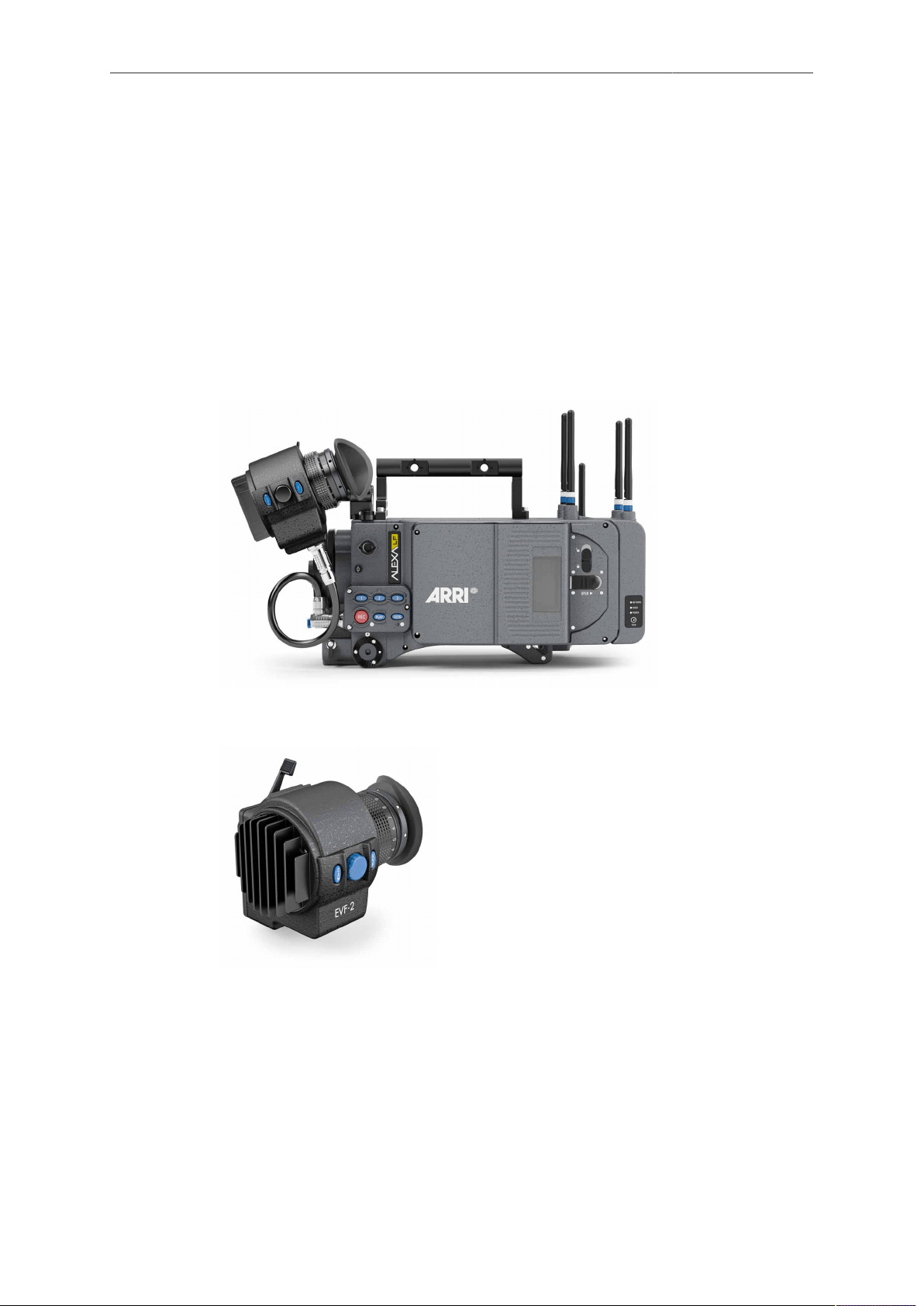
EVF-1
Camera Support 23
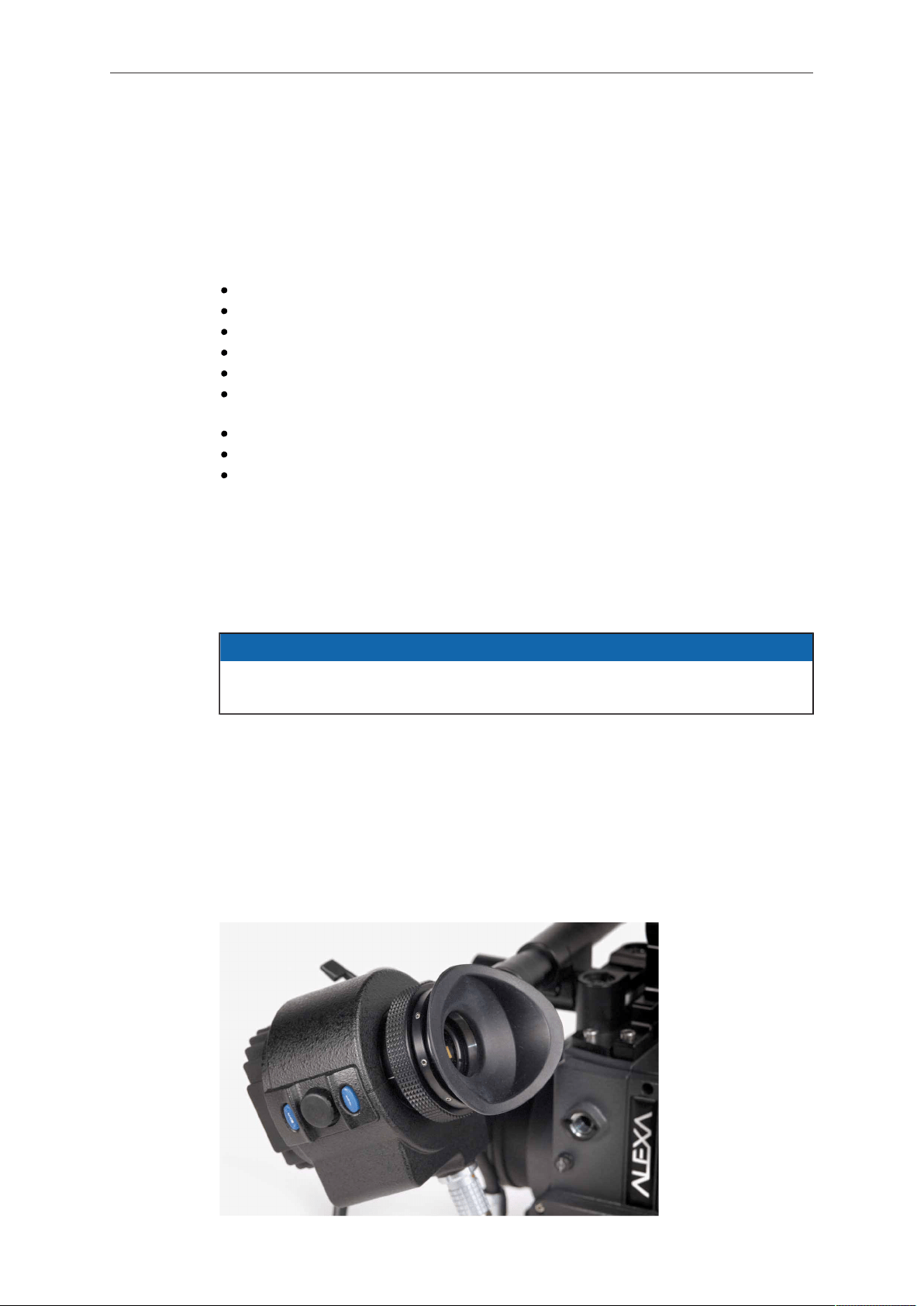
The electronic viewfinder EVF-1 employs a liquid crystal on silicon (LCOS) imaging
device with a temperature-stabilized LED light source to provide a bright, accurate
view of the sensor image in all operating conditions. Each EVF-1 is calibrated to
precisely match the image on the ALEXA's HD-SDI outputs.
The EVF-1 has a resolution of 1280x720 pixels, with 32 additional lines of resolution
above and 32 below the image to display camera status information. The EVF-1 can
also display a surround view area of the sensor to help the operator track unwanted
elements before they enter the recorded image area. Focus can be checked by
temporarily zooming into the image. The low-latency interface of the EVF-1 has a
delay of less than 1 frame.
The EVF-1 has button controls for false color check and zoom, as well as buttons and
a jogwheel to control EVF and camera settings.
Connect the viewfinder to the camera using the viewfinder mounting bracket.
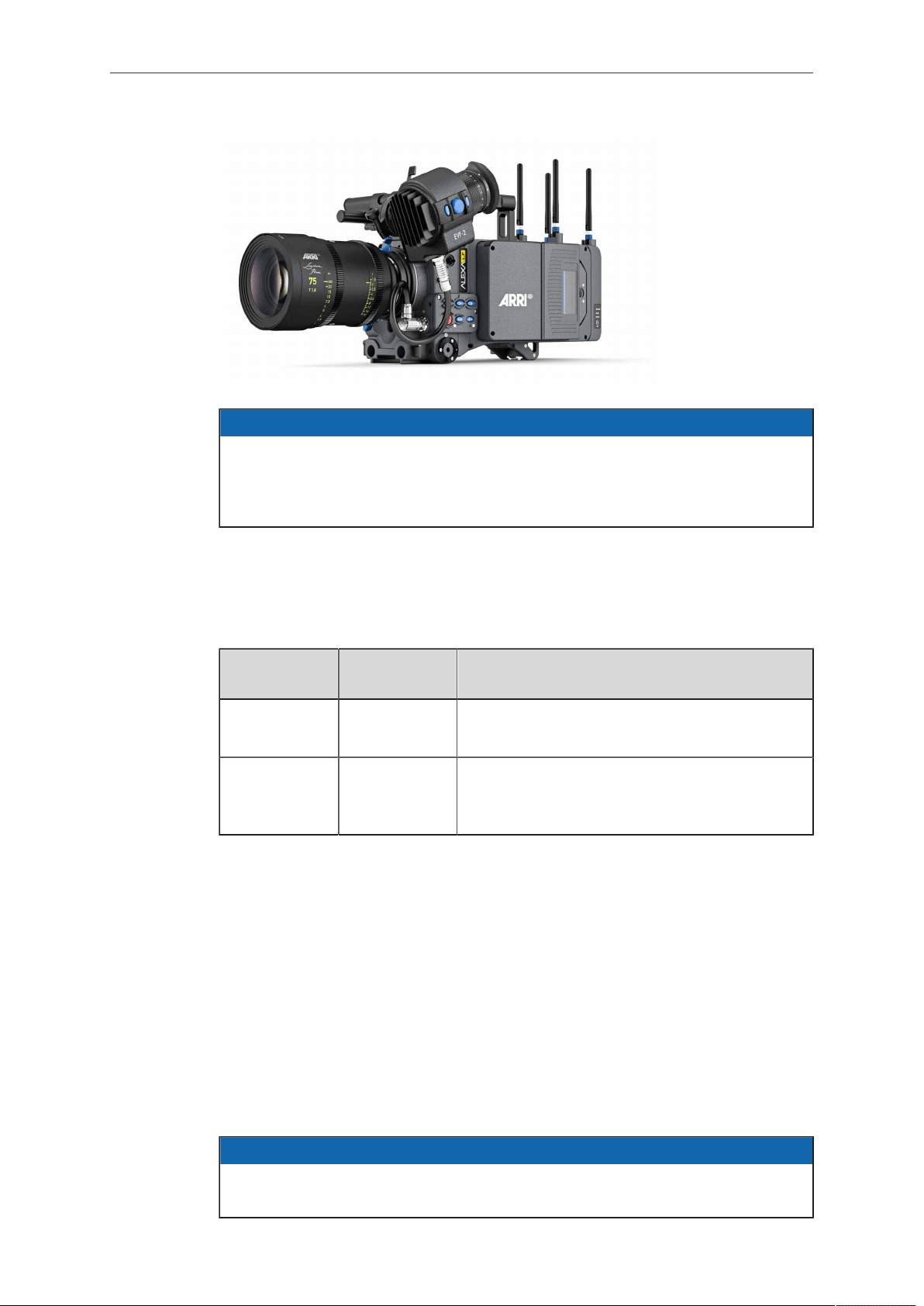
EVF-2
A new and greatly improved electronic viewfinder, the EVF-2, is available as of
mid-August 2018 for the ALEXA LF camera to answer customer's requests for
a better way to judge focus, dynamic range and color. While still maintaining its
predecessor’s proven robustness, reliability and ergonomics, the EVF-2 is equipped
with a new display with full HD resolution and higher contrast, greatly improving the
operator's ability to judge focus and dynamic range. A new glass eyepiece based
on the ARRICAM/AMIRA design provides a clean image, free of distortions and with
greater freedom of movement for the operator through a wider exit pupil. The fully
revamped color science further improves the image, including more accurate color
rendition, a better match to on-set monitors and a stable color balance at all ambient
temperatures, display brightness settings and image brightness levels. An "EVF-1
gamma" setting emulates the EVF-1 tonal behavior for situations where EVF-2 and
EVF-1 are used together on set.
24 Camera Support
NOTICE
Do not point the viewfinder into direct sunlight, very bright light sources, or high-
energy light sources (e. g. laser beams)! This may cause permanent damage to the
viewfinder display and optical elements. If possible, cover the eyepiece when not in
use to prevent any damage.
10.3.1 Viewfinder Cables
The viewfinder cables are unidirectional with a male plug to connect to the camera
and a female plug to connect to the viewfinder.
Cables are available in the following lengths:
Model Length
(m / ft)
Suggested use
KC-150-S 0.35 / 1.2 For use of EVF on camera left side in handheld
mode
KC-151-S 0.65 / 2.1 For use of EVF on camera right side or when
using Viewfinder Extension Bracket VEB-1 or
VEB-3
10.3.2 Viewfinder Mounting Bracket
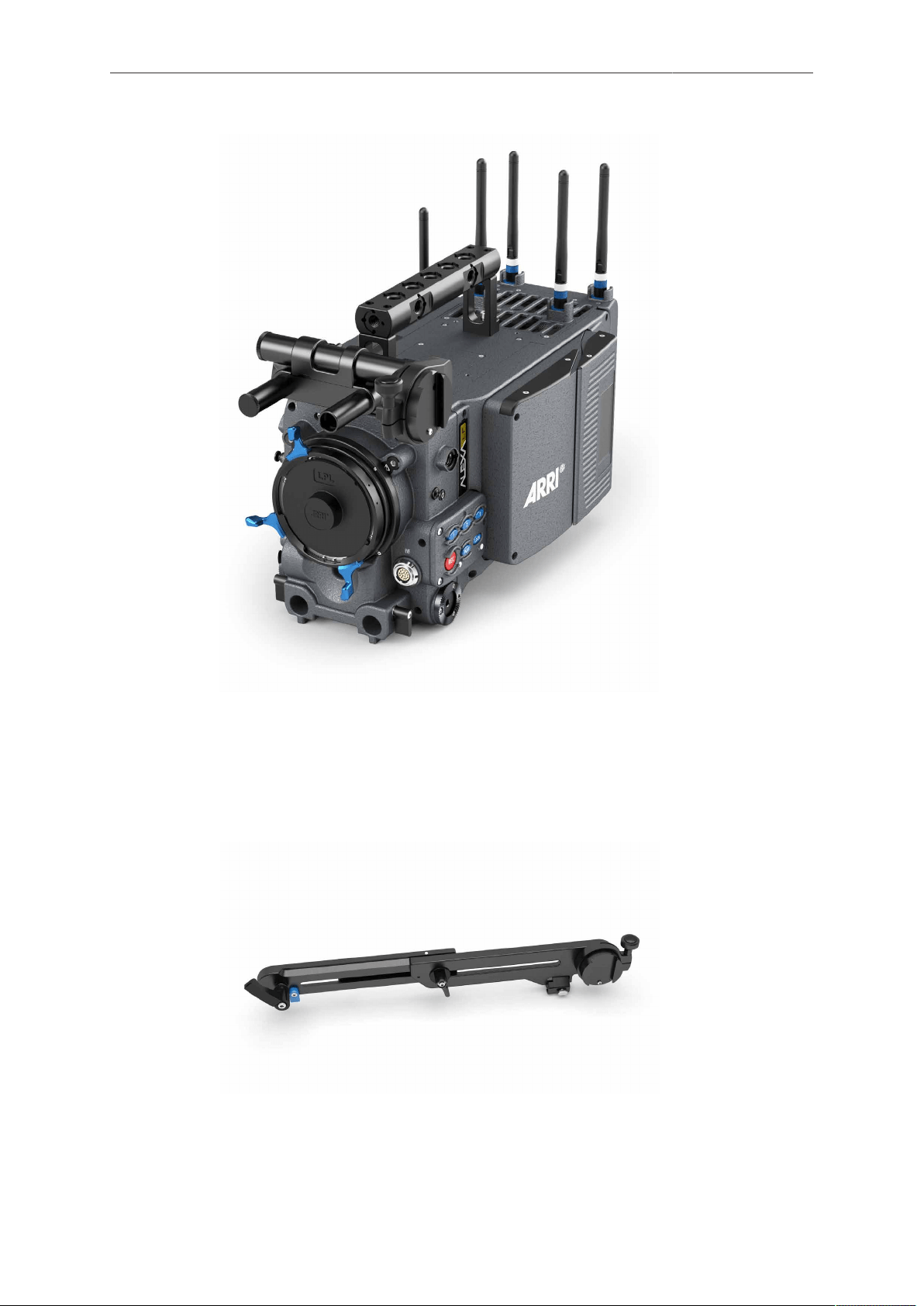
The Viewfinder Mounting Bracket VMB-3 is attached to the camera using two captive
3mm hex socket head screws on top of the camera at the front. The VMB-3 features a
leveling bubble and two internally threaded 15mm rods with standard 60mm distance.
These can be exchanged for or extended with standard 15mm rods for mounting
matte boxes, lens motors and the like above the lens if need be.
Attach the EVF to the Viewfinder Mounting Bracket by sliding the dove tail into the
receptacle and closing the lever on the EVF.
The position of the EVF can be adjusted by loosening the levers on the Viewfinder
Mounting Bracket, adjusting the position as desired and closing the levers to retighten.
The EVF can be mounted on the camera-right side by unscrewing the threaded end
cap on the side-to-side adjustment rod, removing the rod itself and inserting it from the
other side. Remember to reattach the threaded end cap.
NOTICE
Camera-right operation is not possible with the standard EVF cable KC-150-S.
Instead, the longer cable KC-151-S is needed.
Camera Support 25
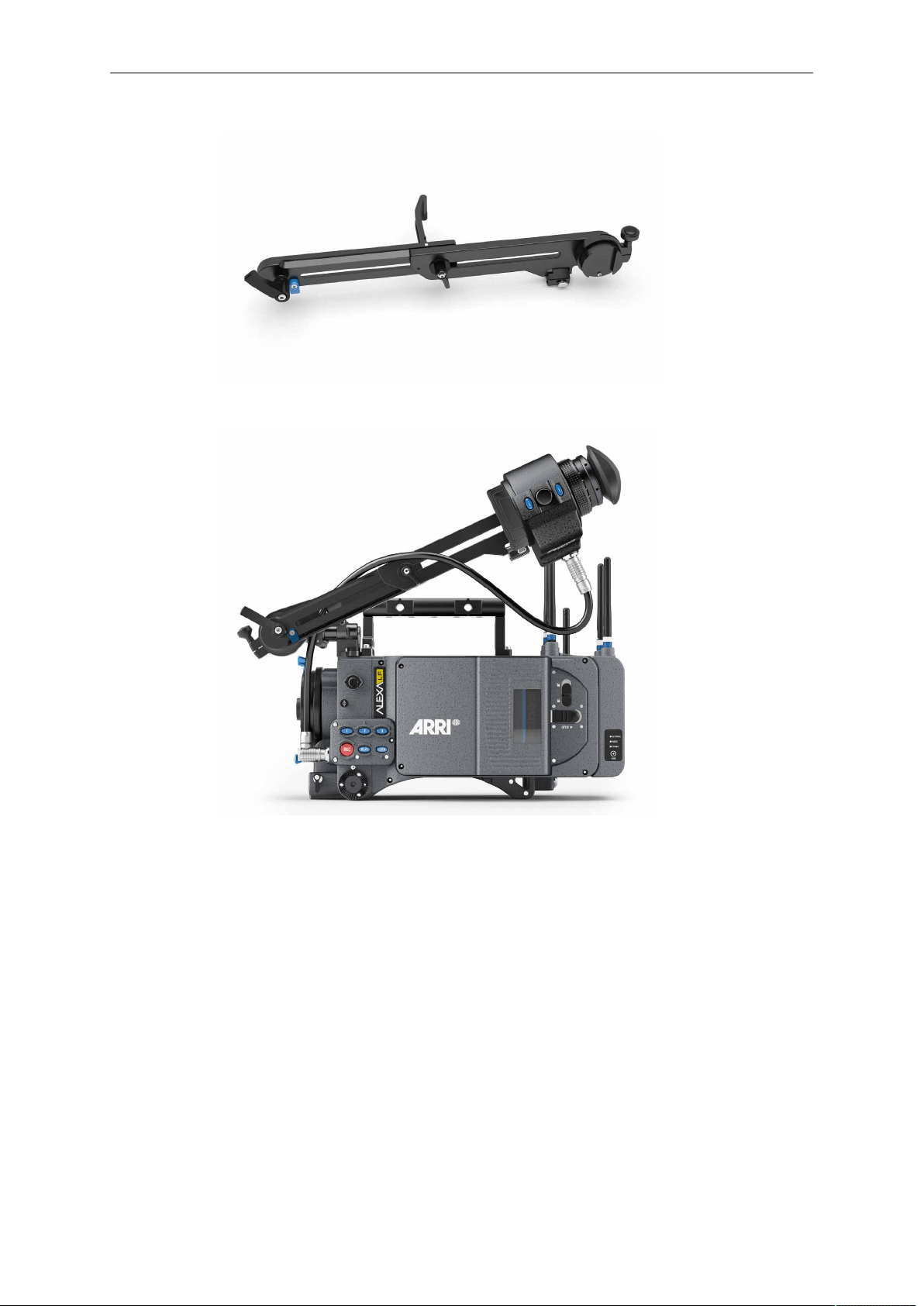
The Viewfinder Extension Bracket VEB-3 extends the mounting point of the EVF
further back. It can be attached to a tripod head for use with geared heads or greater
comfort when using fluid heads using its standard attachment point for the ARRI
Eyepiece Leveler EL-3.
To avoid damage to the VMB-3 when using the VEB-3 with an eyepiece leveler,
loosen the friction on VMB-3’s rotating assembly.
Fig. 2: VEB-3 with closed fold-out arm
26 Camera Support
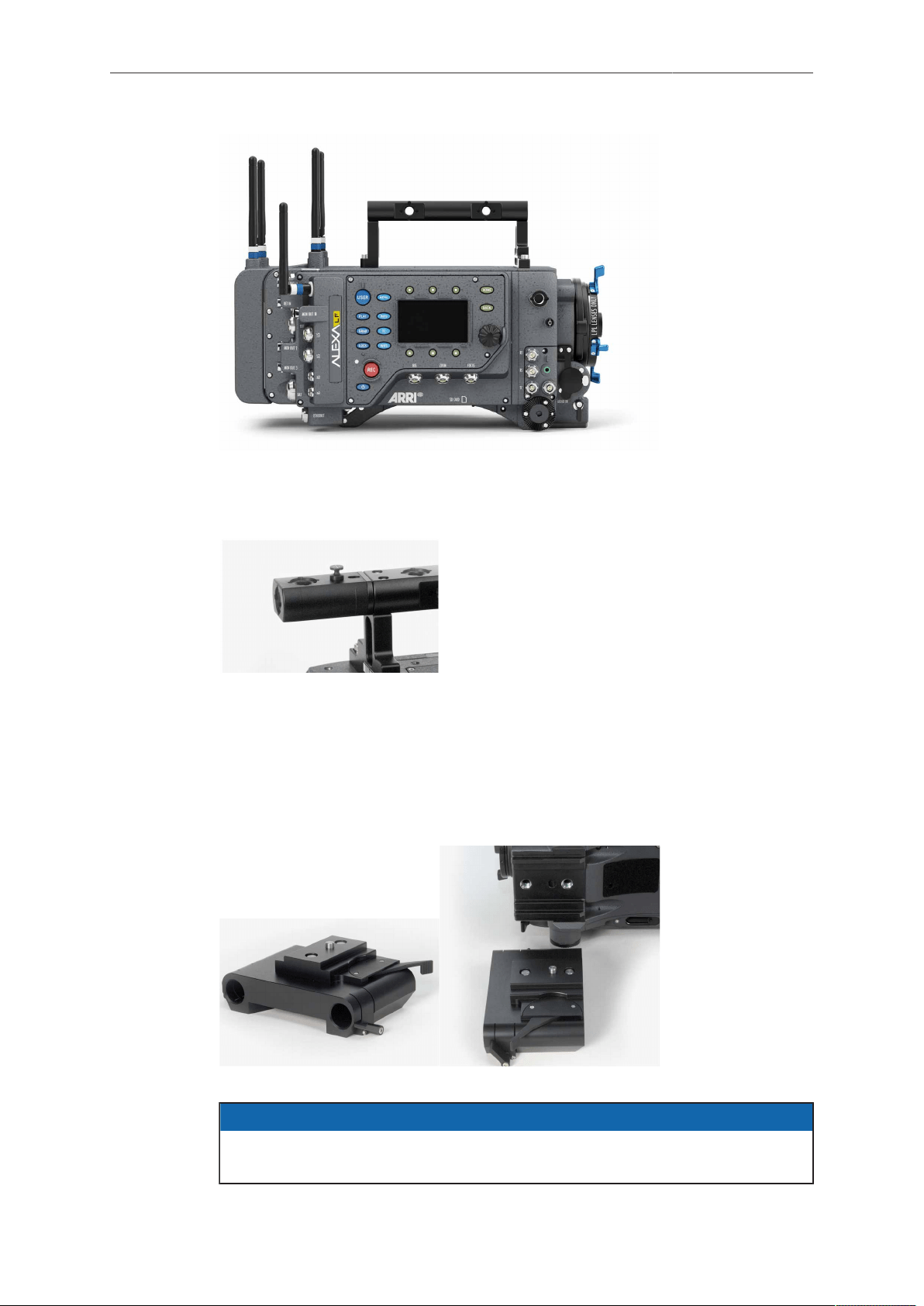
Fig. 3: VEB-3 with opened fold-out arm
10.4 Center Camera Handle CCH-1
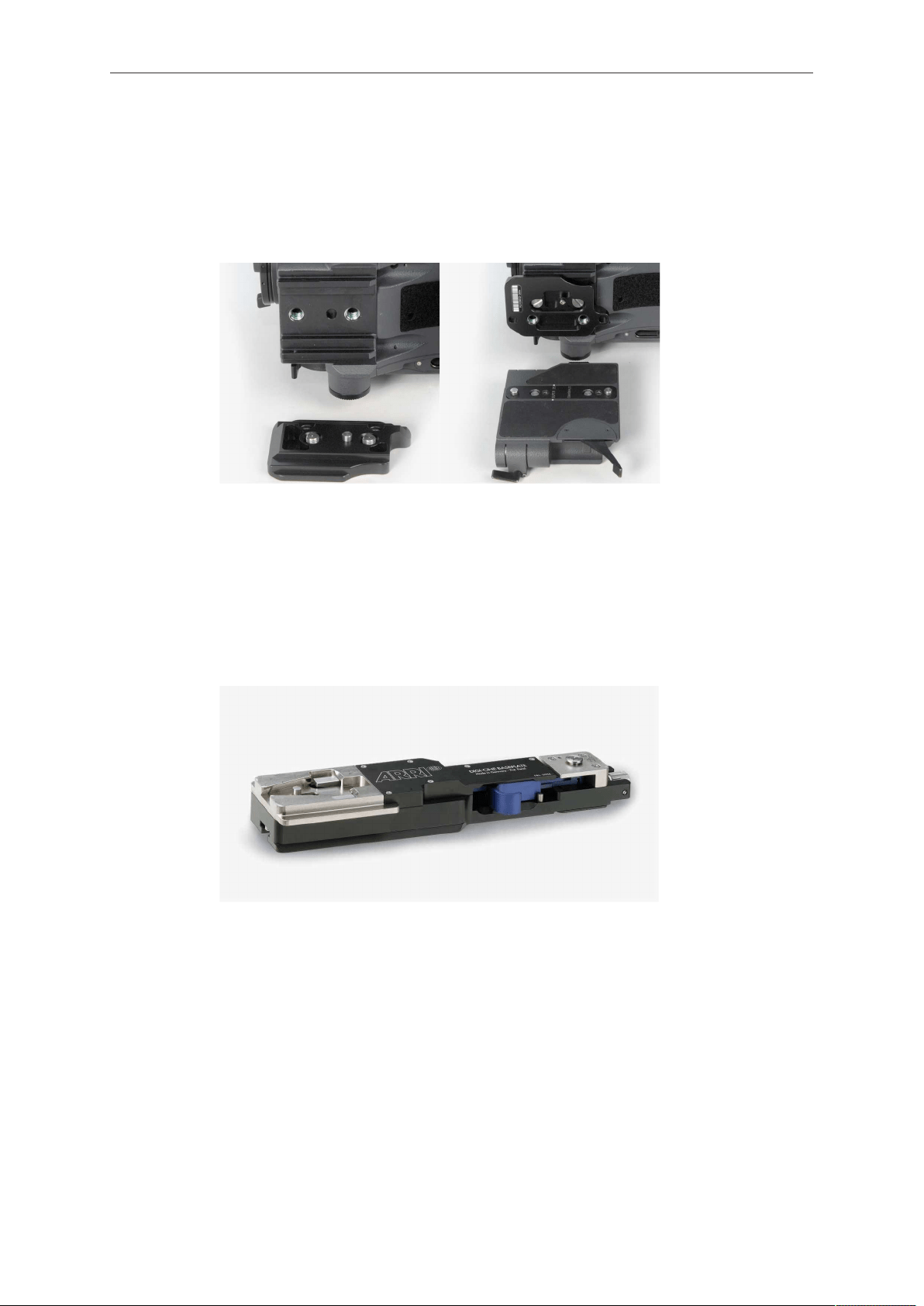
The Center Camera Handle CCH-1 is attached to the camera top with three captive
3mm hex socket head screws (two at the front and one at the back). Ensure that the
CCH-1 is securely fastened before attempting to lift the camera.
Camera Support 27
The Handle Extension Block HEB-2 mounts to the front end of the CCH-1 and adds
one more focus hook to the camera in a high position, allowing the tape measure to
clear the matte box.
10.5 Bridge Plates BP-12/BP-13
The bridge plate BP-12 for 19 mm studio rods has been specifically developed for
ALEXA. It mounts directly to the camera body using two 3/8-16 screws and ensures
that support rods, matte boxes and follow focus units are positioned properly in
regards to the optical center of the camera, just like all other ARRI cameras.
The bridge plate BP-13 is equivalent to the BP-12, but for 15 mm studio rods.
NOTICE
Make sure bridge plates are tightened firmly with a wide bladed screwdriver, not the
commonly used coin!
28 Camera Support
10.6 Bridge Plate adapter BPA-1
The bridge plate adapter BPA-1 can be used to attach a BP-3/BP-5/BP-8/BP-9 to
ALEXA. First attach the BPA-1 to the camera with the two screws. Then attach the
bridge plate to the adaptor with its two screws. Make sure the screws are tightened
firmly with a screwdriver.
10.7 Wedge Adapter WA-1 and Quick-Release Plate
QR-HD-1
The WA-1 can be mounted at the same position as a bridge plate. It has a dove tail
that slides into the counter part of a quick-release plate, like the ARRI QR-HD-1. The
quick-release plate has a pin at its back, which fits into the pin receptacle at the back
of the camera base.
Fig. 4: ARRI QR-HD-1
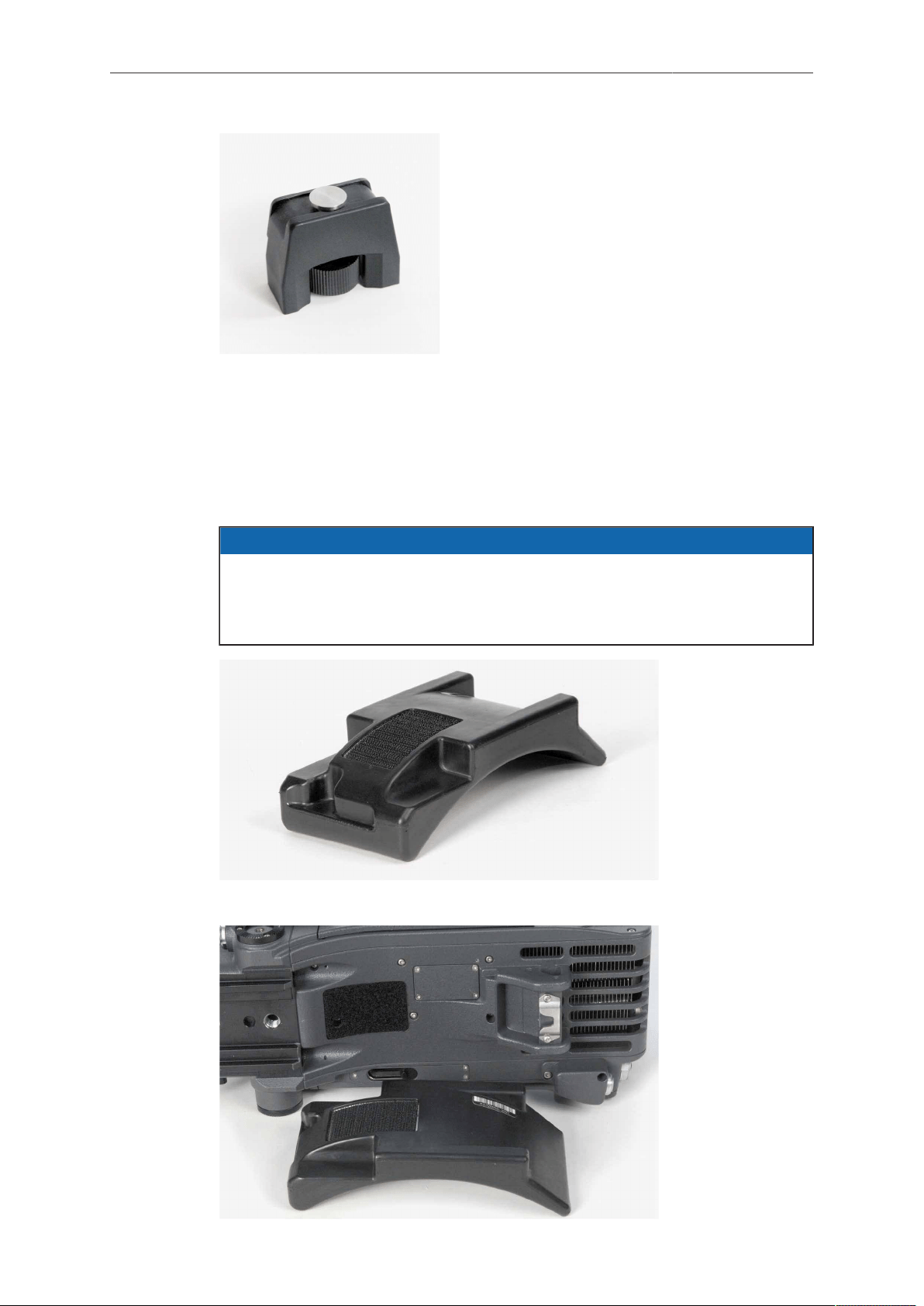
10.8 Levelling Block LB-1
The Leveling Block LB-1 attaches to the bottom of the ALEXA in the pin receptacle on
the back foot. It prevents the camera from resting on a rear-mounted battery when a
bridge plate is attached and the camera is placed on a flat surface.
Attach the LB-1 by inserting its pin into the pin receptacle at the end of the shoulder
arc in the camera base. Twist the knob clockwise to tighten.
Camera Support 29
Fig. 5: Leveling Block LB-1
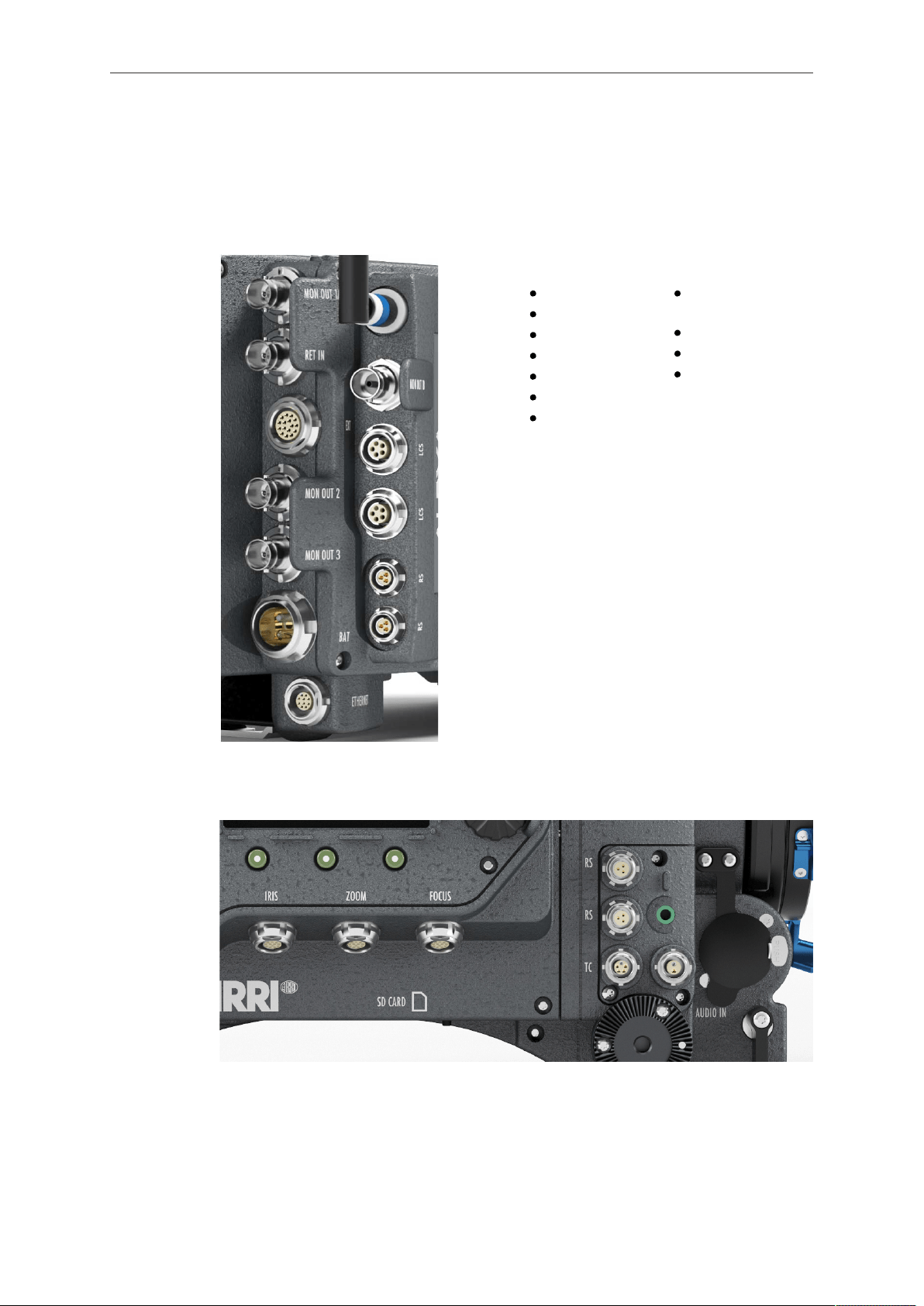
10.9 Shoulder Pad SP-3
The camera base has an integrated arch to fit to the operator's shoulder. For extended
handheld shots, the shoulder pad SP-3 can be attached to the base of the camera
with velcro.
NOTICE
The SP-3 can only be used with a BP-12 and 19 mm rods or with 15 mm rods and
a Wedge Adapter WA-1 and a Quick-Release Plate QR-HD-1. When using the
BPA-1 with a BP-5/BP-8, the bridge plate has to be removed prior to attaching the
SP-3.
Fig. 6: SP-3 shoulder pad
Fig. 7: SP-3 below camera
30 Connectors
11 Connectors
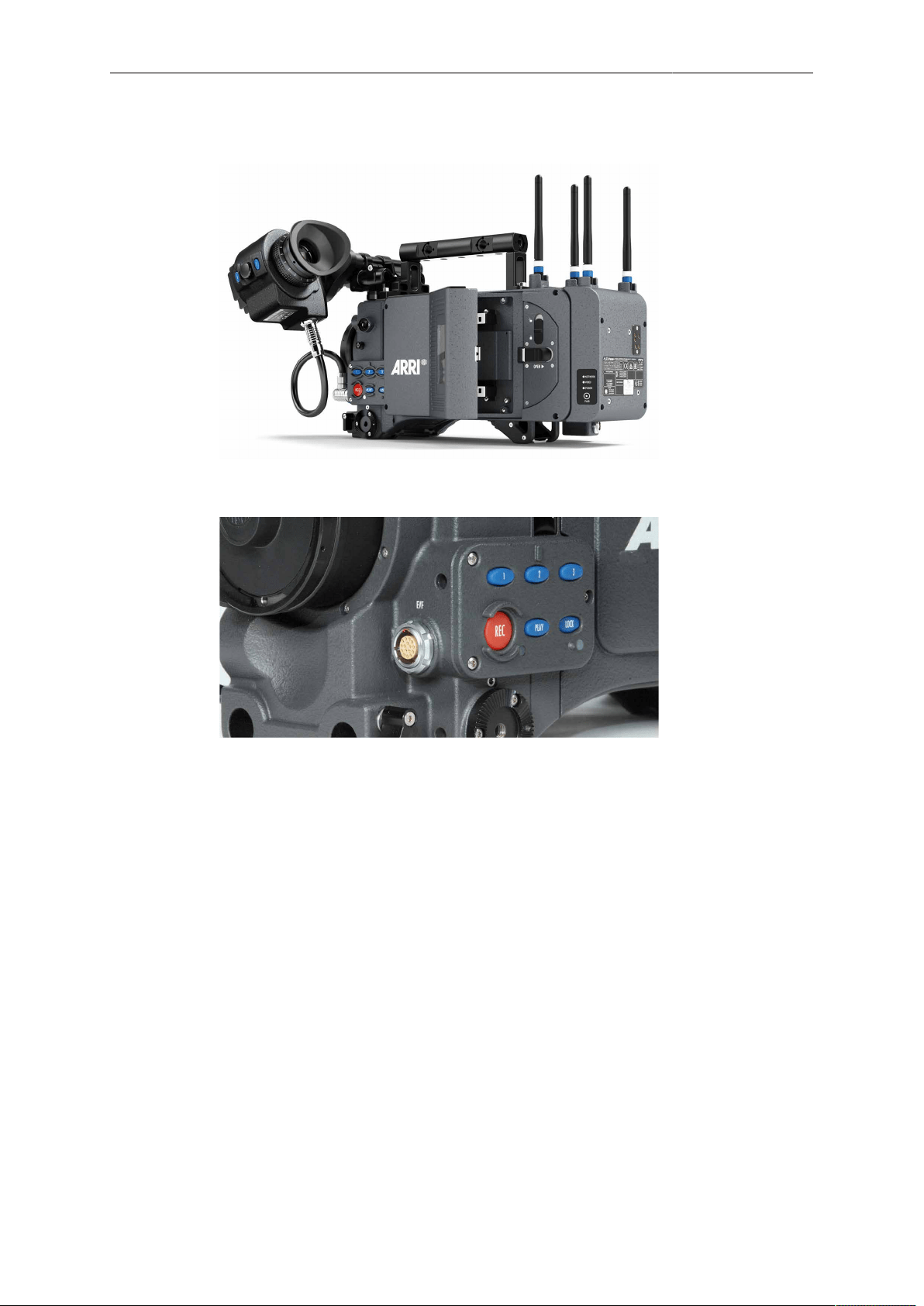
Camera back
Left column
MON OUT 1A
RET IN
EXT
MON OUT 2
MON OUT 3
BAT
ETHERNET
Right column
ECS antenna
connector
MON OUT 1B
LCS (2x)
RS (2x)
Camera right
From top to bottom, left to right:
CLM connectors IRIS, ZOOM, FOCUS, SD CARD (camera bottom), 2x RS (24 V) out,
TC in/out, AUDIO OUT, 12V out, AUDIO IN
Connectors 31
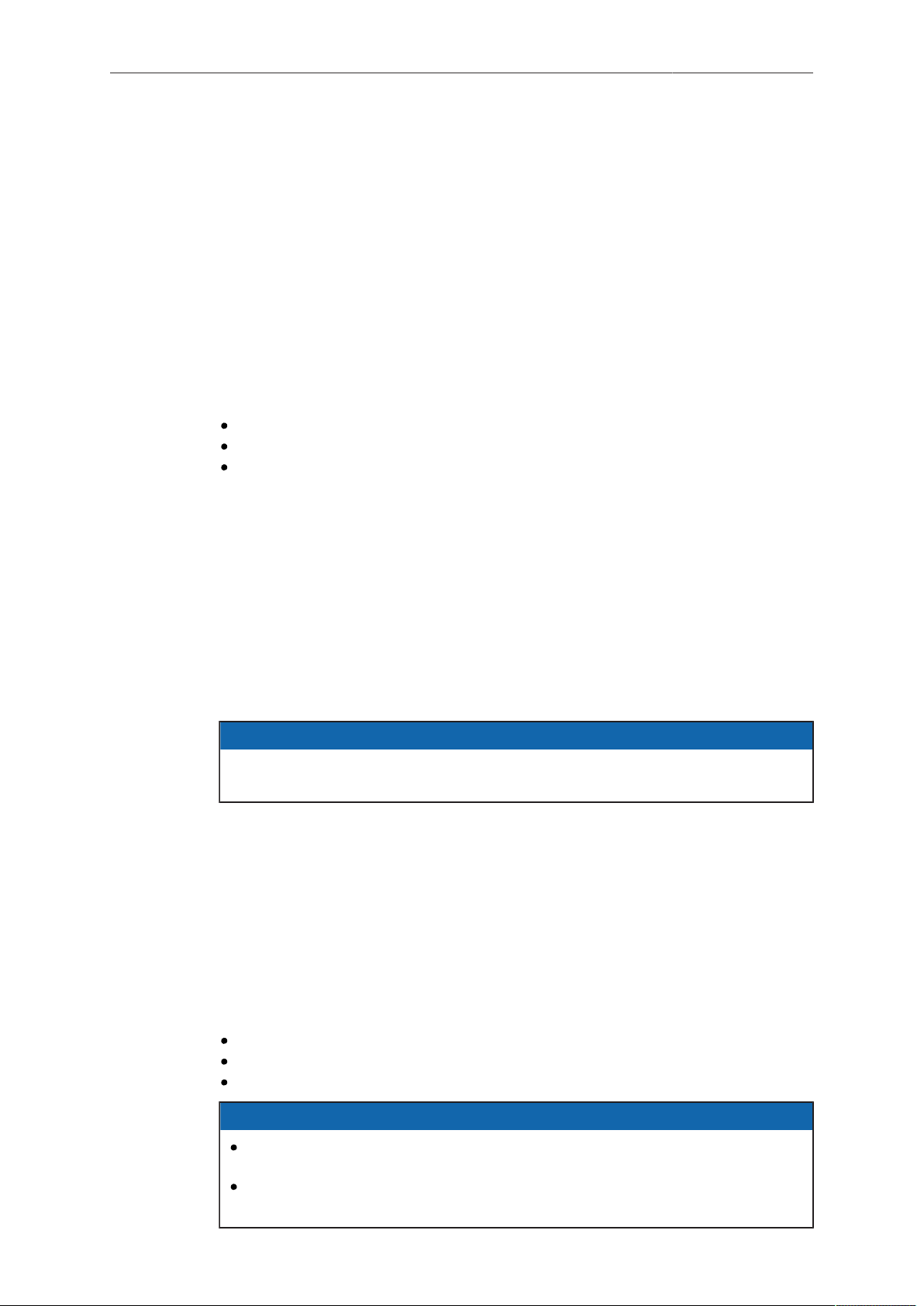
Camera left
Camera front
11.1 BAT
The BAT connector can be used to power the camera from an external power source
with cables KC-20S and KC-29S.
It is located at the back of the camera on the camera-right side.
11.2 RET IN
A return signal from another image source can be fed into the ALEXA’s RET connector
for displaying on EVF and/or MON OUT. The signal must be a 1920x1080 422 1.5G
single link according to SMPTE 274M and 292M. The output routing of the RET in
signal can be set in the Monitoring menu.
The connector is located at the back of the camera on the camera-right side.
11.3 MON OUT 1/2/3
The MON OUT connectors are BNC connectors capable of carrying a 1920x1080 422
YCbCr 1.5G SDI signal with frame rates of 23.976, 24, 25, 29.97 or 30 fps according
to SMPTE standards 274M and 292M. MON OUT 1 and 2 can also carry a 3840x2160
422 YCbCr 6G SDI signal with the same frame rates as above. The signal format can
be changed in the Monitoring menu.

32 Connectors
The connectors are located at the back of the camera on the camera-right side.
11.4 EXT
The EXT connector is a multi-pin accessory connector that carries signals for
communication with various accessories and 24V power. The maximum power output
is 2.2A, shared with the RS outputs.
Cables are currently available for:
Connecting a UMC-3 remote motor controller (model UMC Connection Cable
(0.80m/2.6ft) K-UMC3-ALEXA)
Connecting two ALEXA cameras for synchronized operation (model EXT to EXT
Cable (2.00m/6.6ft) KC 155-S)
The connector is located at the back of the camera on the camera-right side.
11.5 ETHERNET
Standard Ethernet connectors cannot deliver the durability and reliability required
by ARRI, so the ALEXA uses a specially designed 10-pin LEMO connector. The
ARRI KC-153-S cable is required to connect the Ethernet socket to a standard RJ-45
Ethernet port.
The Ethernet port can be used to operate two ALEXA cameras with synced settings
by connecting the cameras with a KC 156-S cable, or to connect the Remote Control
Unit RCU-4 to the camera.
The Ethernet connector can output 24 V with 1.2 A power.
The connector is located at the back of the camera on the camera-right side.
11.6 EVF
The EVF connector connects the camera to an EVF electronic viewfinder. The
signals on this connector are proprietary and can only be used to drive an EVF. This
proprietary signal assures low latency for the viewfinder image.
The connector is located at the front of the camera on the camera-left side.
11.7 AUDIO IN
2-channel analog line-level audio can be fed to the camera via the 5-pin XLR
connector located at the front of the camera on the camera-right side.
The ALEXA converts the audio signal from analog to 24 bit 48 kHz PCM.
11.8 RS
The RS connectors can supply external devices with a combined load of up to 2.2 A
(shared with the EXT connector power out), depending on the camera power supply.
When the camera is powered from a source with a voltage below 24 V, they output
24 V. If the camera's power source supplies more than 24 V, this voltage level is also
present on the RS outputs. Besides powering accessories, the RS outputs also carry a
shutter pulse signal and can be used to send a remote start/stop signal to the camera.
The connectors are located at the front and the back of the camera on the camera-
right side.
Connectors 33
11.9 12 V
The 12 V output with a 2-pin LEMO connector is located on the right side of the
camera. It is limited to 12 V and can supply a device with a current of up to 2.2 A,
depending on the camera power supply.
The connector is located at front of the camera on the camera-right side.
11.10 TC
The TC connector is a 5pin LEMO socket. It accepts and distributes a Longitudinal
Time Code (LTC) signal.
It can be used to
jam-sync the ALEXA's time code to a Clockit, TC Slate or another camera
transmit the ALEXA's time code to a Clockit, TC Slate or another camera
tune the frequency of the ALEXA’s crystal oscillator with an Ambient ACC Clockit
Controller
The connector is located at the front of the camera on the camera-right side.
Note that during playback, the timecode that is output via the TC connector does not
match the timecode of the played clip.
11.11 AUDIO OUT
The AUDIO OUT is a 3.5mm TRS connector (headphone jack), which outputs audio
fed to the 5-pin XLR AUDIO IN connector with a maximum power of 2.5 dBm.
The connector is located at the front of the camera on the camera-right side.
NOTICE
Connecting headphones to the camera while recording can cause a short audio
signal interruption due to static electricity.
11.12 SD Card
The ALEXA saves data such as user setups, frame grabs and system logs to an SD
card. Firmware, additional frame lines and ARRI Look File 2 files are loaded onto the
camera from the SD card. The SD card slot is located on the bottom of the camera on
the camera-right side. To access the SD card slot, slide the door towards the front of
the camera.
SD Card Requirements
SD or SDHC card (most brands are compatible)
maximum capacity of 4GB
FAT or FAT32 format
NOTICE
Keep the SD card slot door closed to prevent dirt and moisture from entering
the camera.
After booting the camera or inserting an SD card, it might take some seconds
until the SD card is recognized and usable.
34 Connectors
The SD card can be formatted on the ALEXA or the following folder structure can be
created manually on a computer. The SD card must be properly formatted prior to its
first use.
SD card folder structure:
– ARRI
– ALEXA
– Firmware
– Framelines
– Grabs
– LDA
– Licenses
– LookFiles
– ScreenCaptures
– Sensor
– Setups
To format an SD card on the ALEXA:
1. Press the MENU button.
2. Using the jogwheel, select System.
3. Select SD Card.
4. Select Format + prepare SD card.
5. Press both FORMAT buttons simultaneously. The ALEXA will create the required
folder structure on the SD card after formatting.
NOTICE
Formatting the SD card will irreversibly remove all data on the SD card.
To create the required folder structure on the SD card in the ALEXA
without formatting:
1. Press the MENU button.
2. Using the jogwheel, select System.
3. Select SD Card.
4. Select Prepare SD card. The ALEXA will create the required folder structure on
the SD card without formatting or deleting any data.
NOTICE
Firmware update files are recognized by the camera anywhere within the structure,
but it is recommended to copy them into the Firmware folder.
11.13 LBUS Support
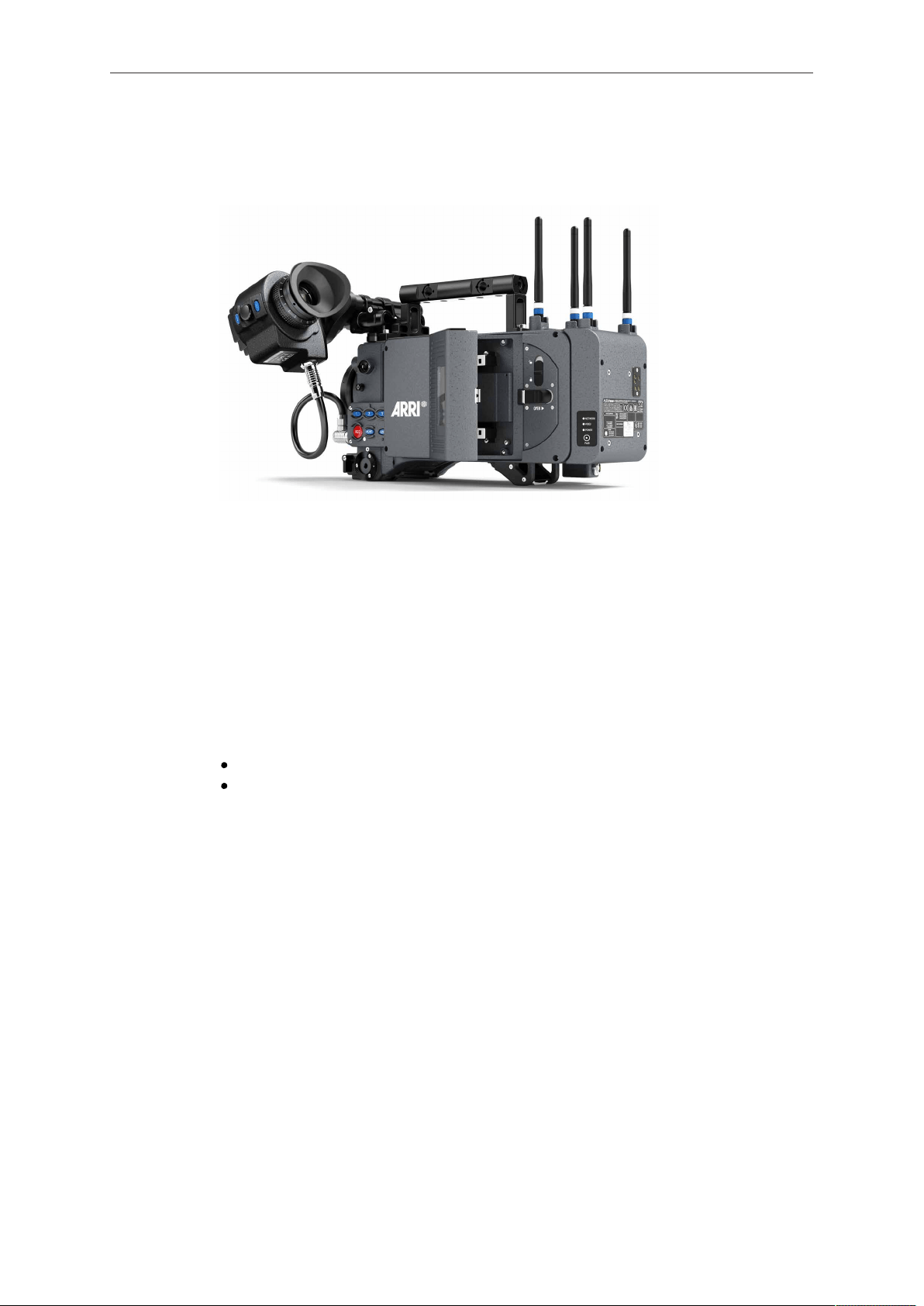
LBUS Support
By connecting an LCS to LBUS cable (Cable LCS (5p) - LBUS (0.8m/2.6ft) -
K2.0007318) to one of the two LCS connectors on the ALEXA LF, it is possible to use
the majority of ARRI LBUS accessories with the ALEXA LF. LBUS devices can daisy
chain, but it is also possible to connect one cable each to the two ALEXA LF LCS
connectors to support even more LBUS devices.
Connectors 35
LBUS accessories compatible with ALEXA LF:
cforce mini lens motors
cforce plus lens motors
cforce mini RF lens motors
Needs cforce mini RF SUP 1.1 (planned for Q4 2018)
The cforce mini RF motor must be set to "client mode". Then it works like a
cforce mini motor without the RF functionality, which the ALEXA LF has built-in
anyway.
Master Grips
Needs at least Master Grip/OCU-1 SUP 1.1.2
For override function it needs Master Grip/OCU-1 SUP 2.0 (planned for Q4
2018)
Operator Control Unit OCU-1
Needs Master Grip/OCU-1 SUP 2.0 (which is what the first OCU-1 units will be
shipped with, planned for Q4 2018)
LCUBE CUB-1
With the CUB-1 it is possible to connect an ARRI Ultrasonic Distance Measure
(UDM) to an LBUS connector. While a different cable can also connect the
UDM directly to the ALEXA LF EXT connector, the CUB-1 option might come
in handy if the EXT connector is in use otherwise (e.g. for sensor sync, for
instance).
LCUBE CUB-2
The CUB-2 allows an ARRI LBUS device (for instance the Master Grips or
Operator Control Unit OCU-1) to control the internal motors in ENG lenses.
cmotion pan-bar zoom
cmotion steady zoom
cmotion cfinder III
NOTICE
For OCU-1 override function, the WCU-4 needs WCU-4 SUP 3.2 (planned for
Q4 2018).
CAUTION!
When using cforce motors, separate power must be provided to the cforce lens
motors from the other side of the daisy chain, for instance from an LBUS to D-
tap cable (LBUS - D-Tap - K2.0006758) connected to an on-board battery. This
is because the power output from the ALEXA LF LCS connectors cannot provide
sufficient power to the cforce motors. If cforce motors are powered from the LCS
connectors, calibration may malfunction, fast motor movements may result in
stuttering motor movements and a whining noise could be generated during slow
motor speeds.
36 Recording Module
12 Recording Module
The ALEXA records clips using the recording module on the camera-left side. For
every recording medium type, the respective adapter needs to be inserted before a
medium can be inserted. The media slot can take SXR Capture Drives with the SXR
Capture Drive Adapter and SxS PRO+ cards with the SxS Adapter 2.
When the ALEXA is in ProRes mode, it can record onto SXR Capture Drives or SxS
PRO+ cards. They do not need to be loaded or unloaded, but can be used directly
after insertion and can be safely removed whenever they are in standby.
When the ALEXA is in ARRIRAW mode, it can only record onto SXR Capture Drives,
which need to be loaded after insertion and unloaded prior to removal. Refer to the
respective sections below for more information.
The ALEXA supports recording to the following media:
SxS PRO+ cards 256 GB (SBP-256D, SBP-256E)
SXR Capture Drives in 1 TB or 2 TB
To access the media slot, slide the OPEN slider towards camera back so that the
spring-loaded door jumps open.
Putting the lock slider in the (lower) lock position prevents accidental opening of the
door. Ensure that the lock slider is in the (upper) unlocked position before attempting
to open the door.
Recording Module 37
NOTICE
Keep the door closed to prevent dirt and moisture from entering the camera.
Only Sony SxS PRO+ cards can be used with ALEXA. Sony SxS-1 and SxS
PRO cards are not supported.
SXR Capture Drives are specified for a temperature range from 0° Celsius to
70° Celsius (32° Fahrenheit to 158° Fahrenheit). When working in environments
with ambient temperatures below 0° Celsius, ensure that SXR Capture Drives
have a temperature of at least 0° Celsius when starting a recording to ensure
proper operation.
While we do everything we can to assure reliable functioning of different
recording medias such as SXR Capture Drives, and while the mean time
before failure (mtbf) for drives is excellent, a failure that results in loss of data
may occur at any time. Therefore, you are obliged to implement and maintain
at any time adequate and necessary data security measures and back up
drive content as soon as possible. ARRI assumes or accepts no liability or
responsibility for data loss or data corruption, or any other damages, loss or
harm due to malfunction of recording drives.
Inserting media:
To insert an adapter:
1. Insert the adapter into the media slot with the contacts facing the front of the
camera and the metal housing facing out (away from the camera body).
2. Push the adapter towards camera front until the two securing plastic lids lock the
adapter.
To load an SXR Capture Drive:
1. Insert the SXR Capture Drive into the media slot with the contacts facing the front
of the camera and the ribbed side facing out (away from the camera body).
2. Push the SXR Capture Drive towards camera front until the lock engages.
3. Close the door.
When the camera is in ARRIRAW mode, it automatically loads the SXR Capture Drive
when the door has been closed, see "Explanation of LED States" below. If closing the
door is not possible, e. g. because it has been damaged, loading an SXR Capture
Drive can also be triggered by pressing and holding the eject button for about five
seconds.
Loading an SXR Capture Drive in ARRIRAW mode normally only takes a few
seconds. In certain situations, however, it may take up to 30 seconds, especially when
an SXR Capture Drive has been removed previously without unloading it properly.
NOTICE
Do not put any labels or adhesive tape on the back of an SXR Capture Drive (the
side facing the camera body). The SXR Capture Drive must have full contact to the
camera body to ensure proper heat conduction.
To load an SxS PRO+ card:
1. Insert the card into the adapter with the contacts facing the front of the camera and
the label facing out (away from the camera body).
2. Push the card in against the spring until the lock engages.
3. Close the door.
38 Recording Module
NOTICE
Do not force any media into the slot or into the adapter in wrong orientation—
the contacts could be damaged.
Do not force the door closed if the media is not fully inserted.
Removing media:
When the camera is in ProRes recording mode, SxS PRO+ cards and SXR Capture
Drives do not have to be mounted or unmounted—they can be inserted or removed
whenever the camera is in STBY mode. If media is removed during recording, only the
last second of the current clip will be lost. All clips on the media will remain accessible.
When the camera is in ARRIRAW recording mode, SXR Capture Drives need to be
unloaded before they can be safely removed. Unloading is triggered automatically
when the door is opened and the SXR Capture Drive is in standby. When the door is
already open, but the SXR Capture Drive is still loaded, press the eject button on the
SXR Capture Drive to trigger unloading. See "Explanation of LED States" below for
information about how the camera signals loading state. If media is removed during
recording, only the last five seconds of the current clip will be lost. All clips on the
media will remain accessible.
NOTICE
If the recording process is interrupted by power loss or media removal, transfer
all the data from the media and format it before using it again.
If the door is opened while an ARRIRAW recording is running, the camera
continues running.
Before removing any media, open the door by sliding the OPEN slider towards camera
back. Ensure the lock slider is in the (upper) unlocked position, otherwise the OPEN
slider will be blocked.
To remove an SXR Capture Drive:
► Carefully pull the SXR Capture Drive towards camera back, taking care not to drop
it accidentally.
To remove an SxS PRO+ card:
► Push the card inwards (towards camera front) until the lock disengages, then pull
the card out backwards, taking care to prevent the card from dropping out of the
adapter.
To remove an adapter:
► Carefully lift the two securing plastic tabs that secure the adapter and pull the
adapter towards camera back, taking care not to drop it accidentally.
CAUTION!
It is possible that SXR Capture Drives will get hot to the touch during extended
operation and can cause pain or even burns if held for too long. It is advisable
to handle the drive for no more than three seconds, and to remove the drive
quickly and carefully. Allow it to cool before further handling and consider wearing
protective gloves.
Recording Module 39
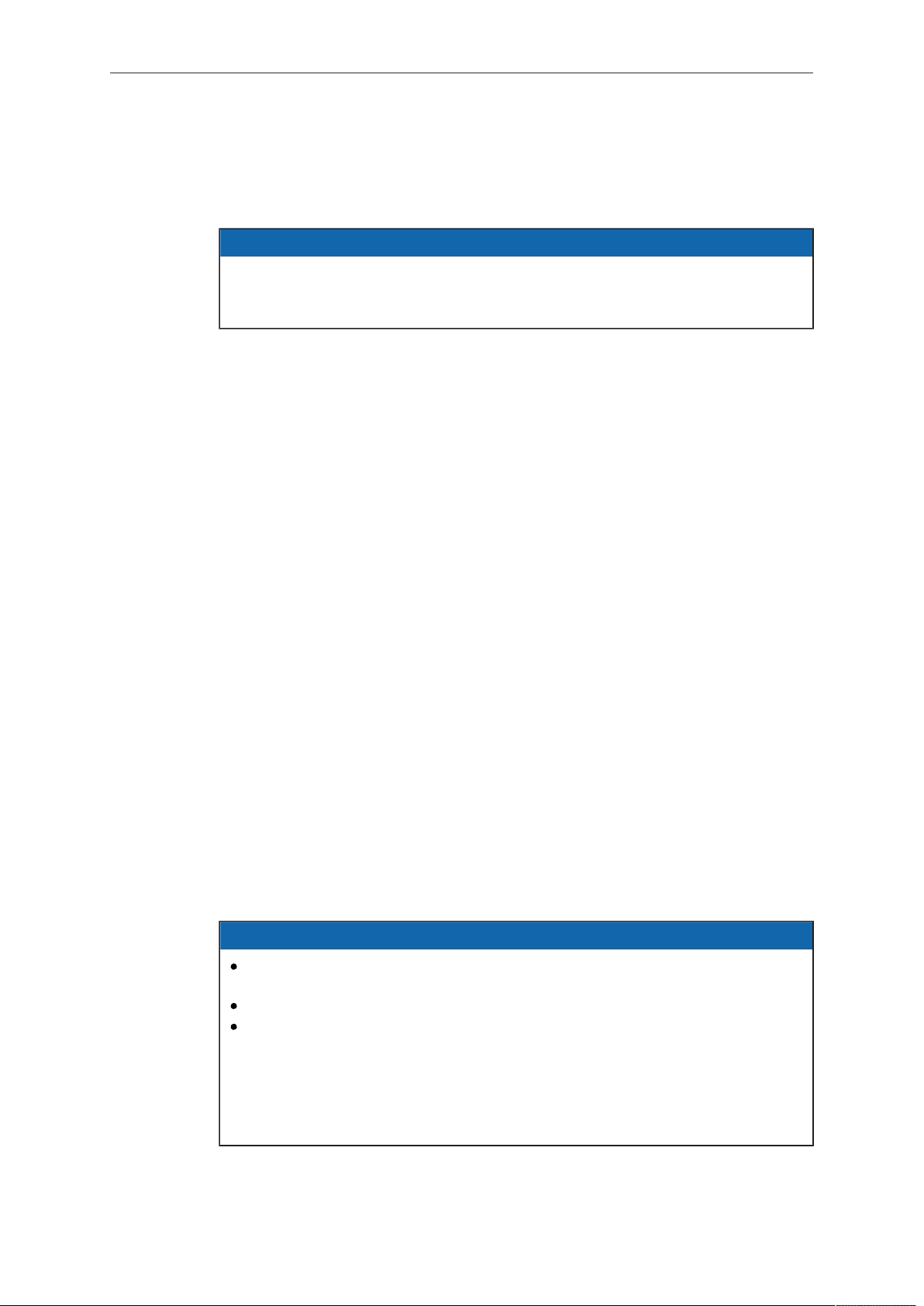
Explanation of LED States
SXR Capture Drives and SxS Adapter 2 have an LED that signals the media's state to
the user.
LED state Media state
Off
No media present
Media is unreadable (e.g. wrong file system)
Media is inactive
Solid green Media is in standby and ready
Solid red Media is being accessed (read/write)
DO NOT REMOVE MEDIA!
Red flashing Media error, see camera for details
Blue flashing
(SXR Capture Drive only)
SXR Capture Drive is being loaded or unloaded
Solid blue
(SXR Capture Drive only)
SXR Capture Drive is unloaded and can be
ejected safely
40 Lens Mounting
13 Lens Mounting
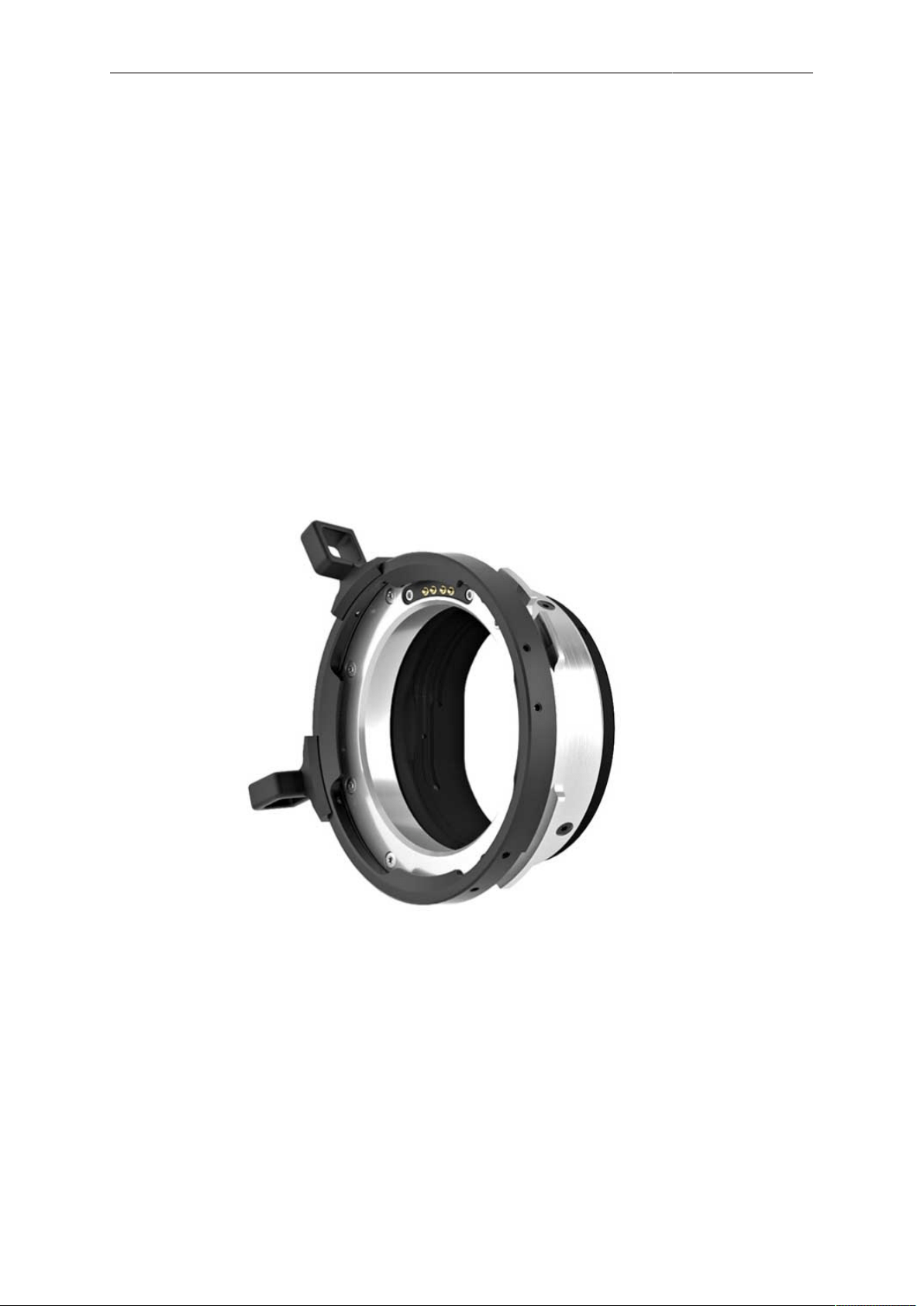
The ALEXA is equipped with an interchangeable lens mount.
NOTICE
Lenses must cover a diameter of at least 36.35 mm for LF 16:9 sensor mode, 39.76
mm for LF 2.39:1 sensor mode and 44.71 mm for LF Open Gate sensor mode to
prevent vignetting.
13.1 LPL mount
The ALEXA LPL lens mount supports the ARRI Lens Data System LDS-2. An LDS
lens must be mounted with the LDS contacts in the 12 o'clock position to enable the
LDS functions. Take care not to damage the LDS contacts on the lens and the camera
when mounting or unmounting a lens or lens port cover.
The LPL mount also offers basic Cooke /i support for direct lens metadata capture
through the LDS contacts. The cameras can store a subset of /i lens data (focus
distance and lens iris settings) as dynamic camera metadata. Running the camera
outside the standard speeds of 23.976 to 30 fps may produce an offset of several
frames. Certain lens settings will produce an offset lens data readout (e. g. iris open).
This can be corrected manually, after the metadata had been extracted (ARRI Meta
Extract).
The basic /i compatibility has been tested and approved by Cooke Optics Limited. For
support and questions about /i Technology, please contact Cooke Optics directly.
To mount an LPL-mount lens:
1. Turn the bayonet ring anti-clockwise until it stops.
2. Remove the lens port cap.
3. Carefully insert the lens into the lens port. Align the notch in the lens flange with
the index pin on the mount, keeping the lens rotated into a position where the lens
markings are visible from either side of the camera.
4. Press the lens flange flat onto the lens mount.
5. Turn the bayonet ring clockwise until the lens is locked securely.
6. Ensure that the lens is properly mounted.
NOTICE
When no lens is attached to the camera, use the lens port cap to prevent dust
from entering the lens cavity.
Do not short-circuit the LDS-2 contacts.
The sophisticated design principle of the camera’s optical module delivers
outstanding images with a cinematic look and feel, but also makes the imager
sensitive to contamination. Dust particles that have settled on the sensor cover
glass during a lens change may become visible as dark spots in the output
image, similar to lint leaving marks on exposed film. The degree of this effect
depends on the aperture of the lens.
Lens Mounting 41
13.2 PL-to-LPL Adapter
The PL-to-LPL adapter allows to attach PL lenses to the ALEXA LF without using any
tools. The PL-to-LPL Adapter can be mounted with the LDS contacts in the 12:00 or
3:00 position. In both positions, it supports LDS-1 and /i.
The three most common uses of Super 35 PL lenses on the ALEXA LF are:
1 Using an image expander.
2 Cropping the Super 35 area in post.
3 Using the large illumination circle of Ultra Primes, Master Primes or Ultra Wide
Zoom (UWZ).
For more information, please refer to the ARRI large format webpage (https://
www.arri.com/largeformat).
Some anamorphic lenses have their lens data connectors in the 3:00 position. In this
case, use a 1.5 mm hex key to reposition the orientation pin of the adapter so that the
lens can be mounted correctly.
Only use PL lenses that do not exceed the dimensions defined in Chapter "Maximum
lens mounting depth for PL lenses", page 44.
13.3 Lens Support
Heavy lenses may require additional lens support. Using a lens support guarantees
that the weight of the lens will not influence the flange focal depth and reduces stress
on the lens mount.
To support a lens use 15mm studio or 19mm studio rods and an appropriate lens
bridge. 15mm studio rods require a bridge-plate with 15mm studio rod support, such
as a BP-3/BP-9 + BPA-1, while 19mm studio rods require a bridge-plate with 19mm
studio rod support, such as a BP-12 or BP-5/BP-8 + BPA-1.
Mount the lens bridge LS-10 for 15 mm studio rods by pushing it onto the rods from
the front. Mount the lens bridge LS-9 for 19 mm studio rods by clipping it on the rods
from the top.
42 Lens Mounting
Slide the bridge into position on the rods directly under the lens support ring on the
lens, and fix it in place by tightening the lever on its side. Align and tighten the center
screw in the lens support ring, adjusting the height of the center screw with the lever
on the back of the lens bridge.
In-Camera Filter Module LF IFM 43
14 In-Camera Filter Module LF IFM
The In-Camera Filter Module LF IFM is standard to the ALEXA LF, which allows the
use of ARRI Large Format Full Spectrum Neutral Density (LF FSND) filters (available
separately).
By using internal filters you can rate the camera at the base sensitivity of EI 800
without the need for external filters, even in bright light conditions. In-camera filters
for LF IFM can be used with a large variety of lens sizes and are much lighter than
external ND filters.
CAUTION!
DO NOT POINT THE CAMERA INTO DIRECT SUNLIGHT, VERY BRIGHT LIGHT
SOURCES, OR HIGH-ENERGY LIGHT SOURCES (e.g. laser beams)! This may
cause permanent damage to the internal filter or the camera.
NOTICE
Internal filtration requires additional shimming. For PL mount lenses, the LF IFM
filters work only with a lens mounting depth of 31.50 mm maximum.
The ALEXA LF with LPL mount must use the "ALEXA LPL LF FSND" filters.
ALEXA Classic/XT/SXT or SXT W cameras with an LPL mount must use the
"ALEXA LPL S35 FSND" filters.
ALEXA Classic/XT/SXT or SXT W cameras with a PL mount must use the
"ALEXA PL S35 FSND" filters.
Benefits of in-camera filtration
Filtering behind the lens rather than in front reduces weight, reflections and
operational complexity. The filters’ in-camera position significantly reduces the
camera’s total and front weight (because internal filters are smaller and lighter than
external ones).
Also, internal filters are far less exposed to damage than external ones and, since
lenses are changed more frequently than ND filters, the LF FSND filters provide extra
protection for the sensor.
The Large Format Full Spectrum Neutral Density (LF FSND) filters for LF IFM are
based on new technologies that assure highest image quality. An absorptive full
spectrum ND coating attenuates the light while maintaining a perfectly neutral color
balance at all densities.
A base of water-white optical glass, precision-polished to create perfectly parallel
surfaces, guarantees a clear and sharp image.
Additional broadband anti-reflective multi-coating reduces internal reflections and
ensures a high image contrast. LF FSND filters for LF IFM are available in eight
densities from ND 0.3 to ND 2.4 and can be purchased separately or in sets.
All benefits at a glance:
Internal filtration reduces reflections, weight, hassle – and filter damage
New high-tech filters based on white-water optical glass
Internal filtration protects sensor
Available in 8 densities from ND 0.3 to ND 2.4
Neutral color balance at all densities through absorptive full spectrum ND coating
High image sharpness through precision polishing
High contrast through anti-reflective multi-coating
44 In-Camera Filter Module LF IFM
LF IFM filter holder is standard to the ALEXA LF.
14.1 Safety instructions for in-camera filtration
Proper shimming is crucial for the safe use of in-camera filters. Only correct shimming
ensures the proper flange focal depth.
14.1.1 Maximum lens mounting depth for PL lenses
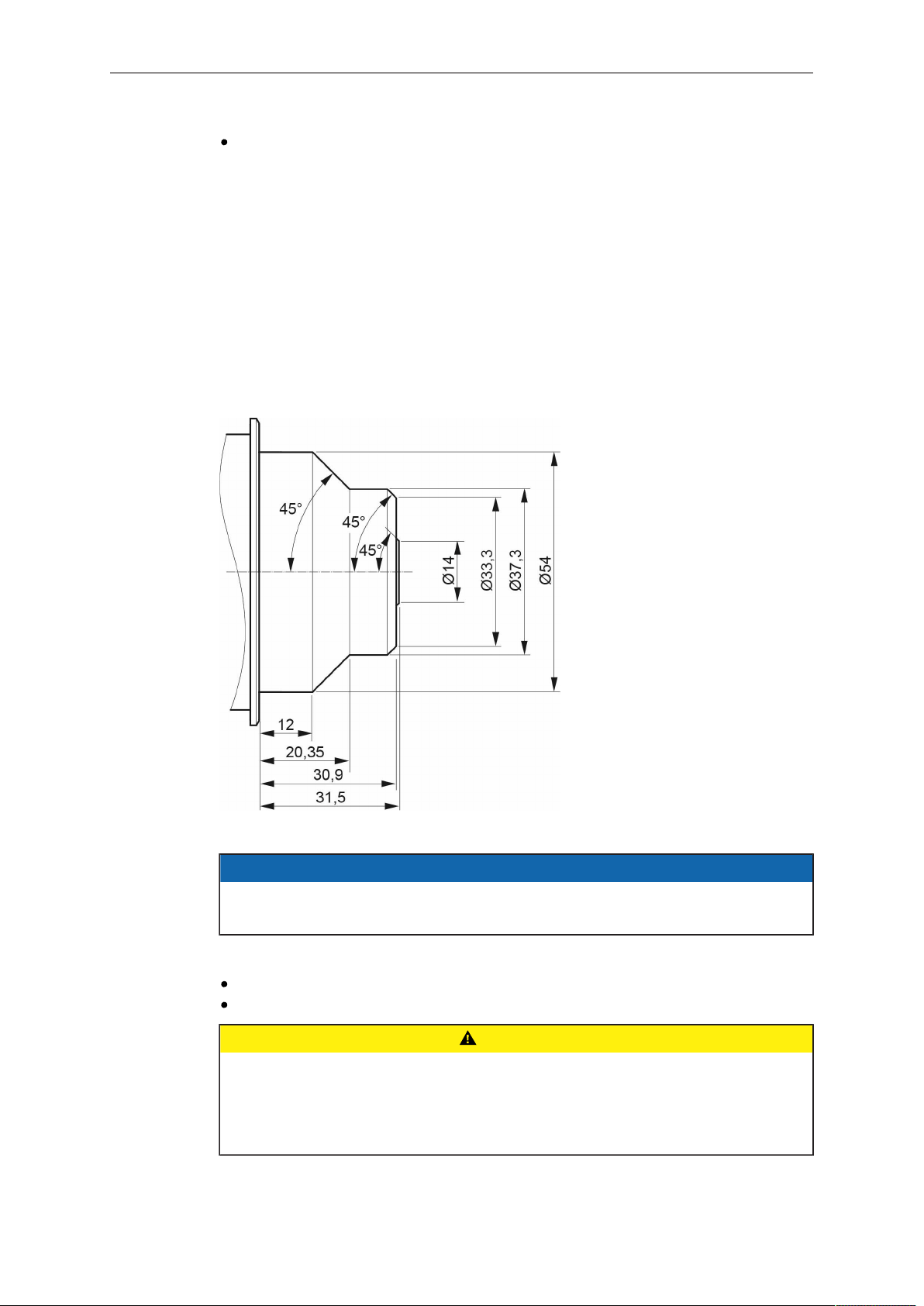
Only cameras with the original LF IFM Shim allow for 31.50 mm maximum lens
mounting depth of PL mount lenses, when using in-camera filters.
To avoid damage or injury when using PL mount lenses with the PL-to-LPL adapter,
use only lenses that do not exceed the following dimensions:
Fig. 8: Allowed lens dimensions with in-camera filters
NOTICE
The original ARRI IFM/Extenders Depth Gauge (K2.72144.0) will help you stay
within allowed lens dimensions. Please ask your local ARRI Service Partner.
For a safe and correct use of internal filters, always shim your camera properly.
Observe all precautions and use only proper tools, lenses and materials
For PL mount lenses, use only lenses with 31.50 mm maximum mounting depth
CAUTION!
Risk of damage and injury from improper lenses!
PL mount lenses with more than 31.50 mm mounting depth might damage internal
filters and the camera. Shards from broken filter glass might cause injury.
Always check the lens mounting depth before mounting or changing a lens.
In-Camera Filter Module LF IFM 45
CAUTION!
Risk of damage and injury from insufficient shimming!
All internal filters require a properly shimmed lens mount. Otherwise, even PL
mount lenses with a nominal mounting depth of less than 31.50 mm might damage
internal filters and the camera. Shards from broken filter glass might cause injury.
To ensure maximum allowable lens mounting depth, and to avoid damage or injury,
always shim your camera correctly (see page 46).
The proper LF IFM Shim comes with the LF FSND Filter Set (Full) and is also
available individually. Use only this original shim when filtering with LF IFM.
CAUTION!
Risk of damage from improper tools, materials or negligence!
In-camera filters are very delicate. Always handle them very carefully and with
proper tools (e.g. the original Ground Glass/Frameglow tool). Never touch the filter
glass with bare fingers (sweat and physical contact might damage the sensitive
coating).
Check and clean each filter before and after use. Store it properly. Use only original
ARRI cleansing utensils and materials (others might damage the filter).
14.1.2 Basic precautions
When using LF IFM and internal filters:
1. Ensure a clean, dust-and-moisture-free environment.
2. Wear fresh rubber gloves to avoid fingerprints and smear.
3. Place the camera on a flat, level and safe surface.
4. Never touch the sensor.
5. Work very carefully due to the delicate nature of tools/components.
6. Safely store all tools/components afterwards.
7. Shim you camera exactly to required flange focal depth.
8. Check each lens mounting depth and flange shape.
9. Use only lenses within allowed dimensions.
14.1.3 Required shimming and maximum lens mounting depth
Only proper shimming will ensure the maximum allowable lens mounting depth (see
page 44):
For safe use of in-camera filters, always prepare your camera with the original LF
IFM Shim.
See "Shimming the lens mount", page 46.
14.2 LF FSND Filter Set (Full)
The LF FSND Filter Set (Full) is a set with all FSND filters and required tools. It
consists of:
Storage Case
LF IFM Optical Clear (1) ND 0.0
Filter Insertion Tool (2)
16 0.1 mm washers (3) (also available separately as K4.0000762)
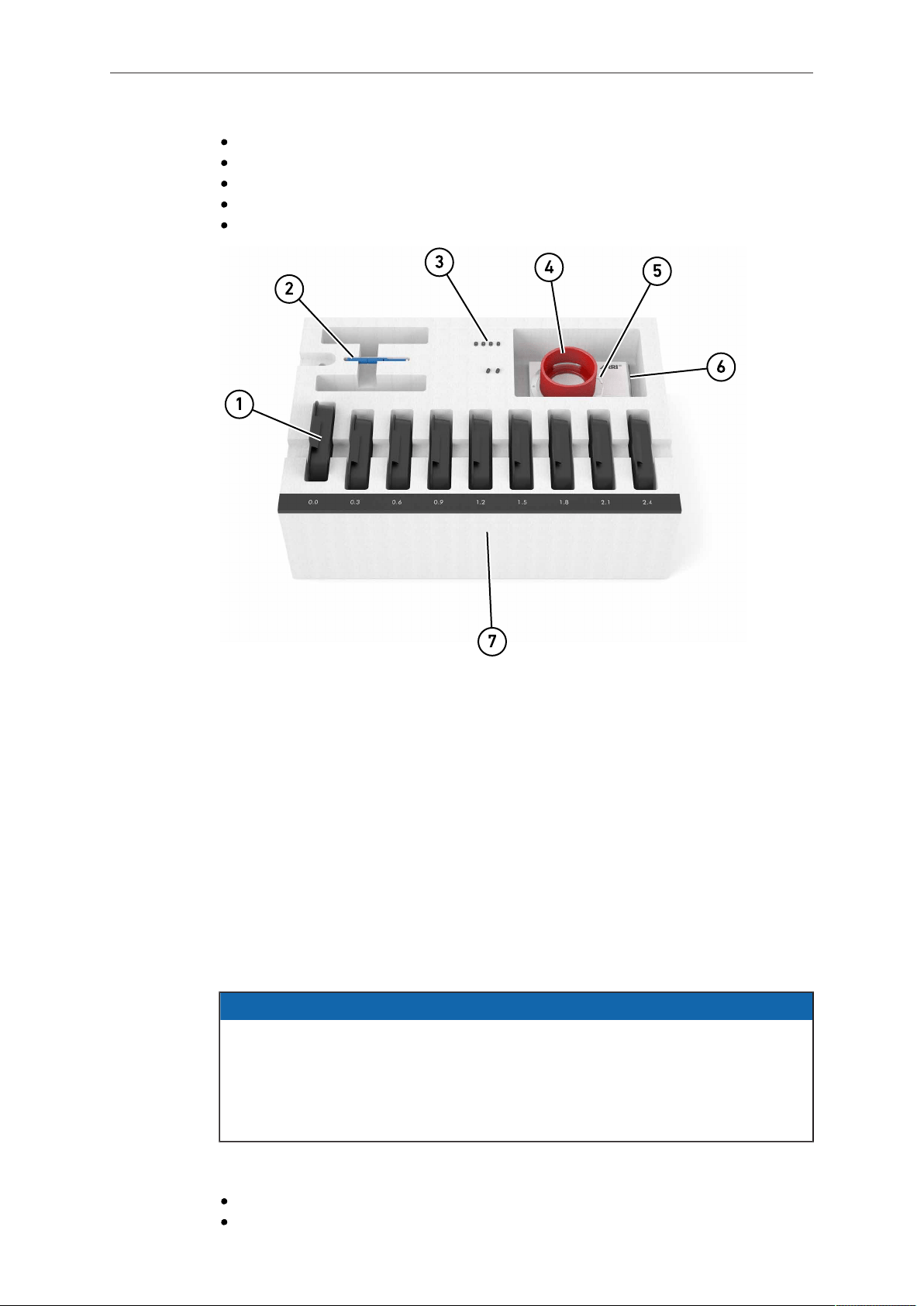
46 In-Camera Filter Module LF IFM
IFM/Extenders Depth Gauge DG-1 (4)
LF IFM Shim (5)
Microfiber Cloth (6)
Cleaning Instructions (6)
Eight Internal Filters LF FSND 0.3, 0.6, 0.9 1.2, 1.5, 1.8, 2.1, 2.4 (7)
Fig. 9: The FSND Filter Set (Full) for ALEXA LF
The LF IFM Empty Filter Frame is also available separately to create custom filters.
When mounting filters into the filter frame, use the provided shims to ensure the filter
is sitting neither too loose nor too tight. Take special care when mounting glass filters,
as the glass might break otherwise. Tighten the filter frame screws with a torque of 4
Ncm.
To insert or change a filter:
See "Mounting in-camera filters", page 52. Each filter is also available separately.
14.3 Shimming the lens mount
In-camera filtration will change your flange focal depth. Therefore, all internal filters
require a properly shimmed lens mount (see page 44).
NOTICE
Use only the original LF IFM Shim when filtering with LF IFM.
To compensate for the change in flange focal depth due to the shim, always insert
the LF IFM Optical Clear filter when no filtering is needed.
When the camera is no longer shimmed for LF IFM, the glassless LF IFM Empty
Filter Frame must be placed back into the filter position.
General shimming precautions:
Fix the LF IFM Shim properly between lens lock and lens mount.
The shim's inscription must face camera-outwards.
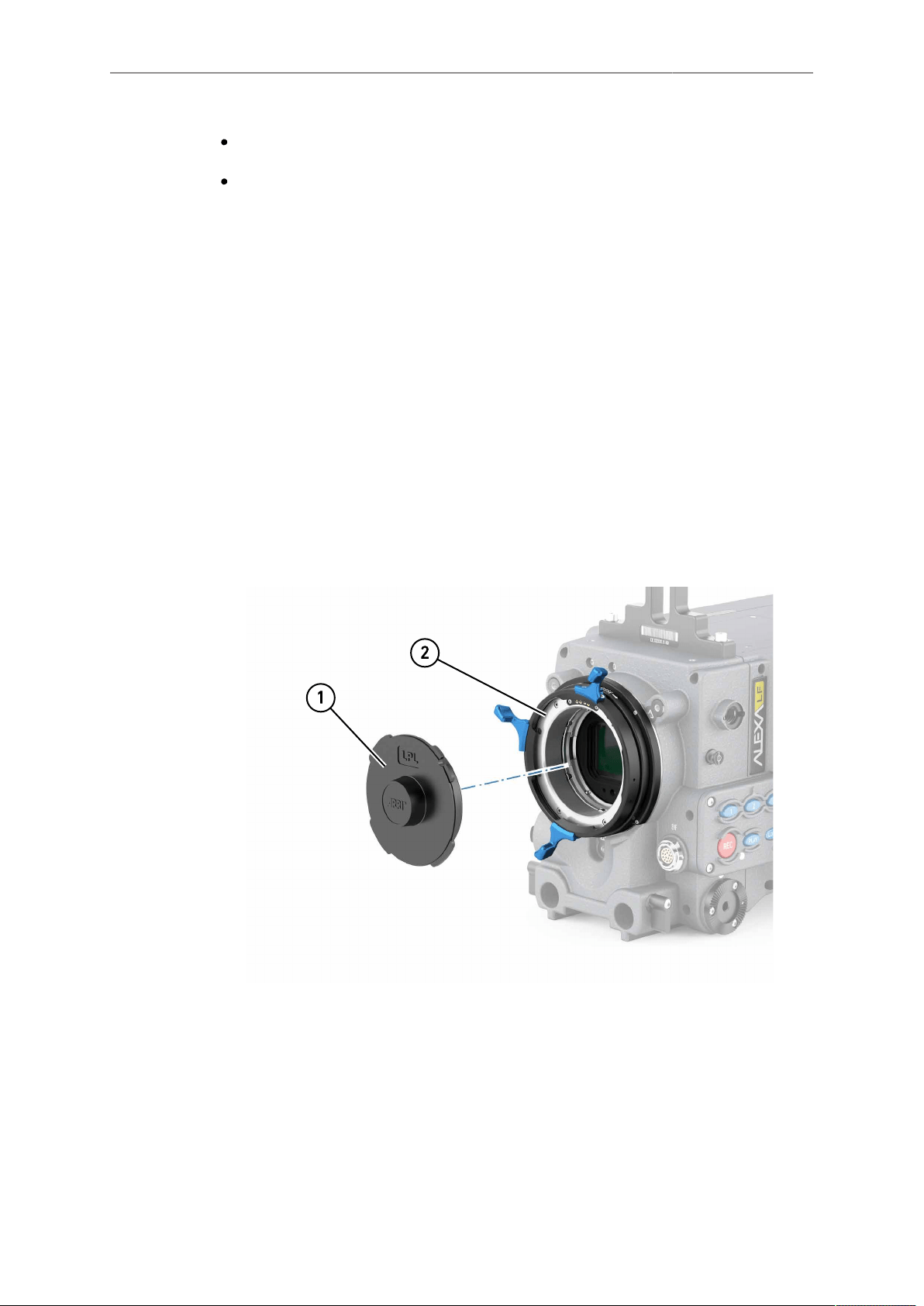
In-Camera Filter Module LF IFM 47
Mount all proper shims correctly without omitting, adding or losing any. Otherwise,
the flange focal depth will not be correct.
Mark your cameras shimmed for LF IFM to avoid confusion.
Once the camera is shimmed for LF IFM: Immediately replace the LF IFM Empty Filter
Frame with an FSND filter or the LF IFM Optical Clear filter.
Store the LF IFM Empty Filter Frame in a safe place: When the camera is no longer
shimmed for LF IFM in the future, the LF IFM Empty Filter Frame must be placed back
into the filter position.
If you de-shim the camera: Immediately replace the LF IFM Optical Clear filter or any
other FSND filter with the LF IFM Empty Filter Frame.
To compensate for the change in flange focal depth due to the shim:
► Always use the LF IFM Optical Clear filter when no filtering is needed.
Tools needed:
TX6 torx screwdriver
To shim the mount:
1. Remove lens or lid (1) from the LPL lens mount and turn the lens lock into position
CLOSED (2).
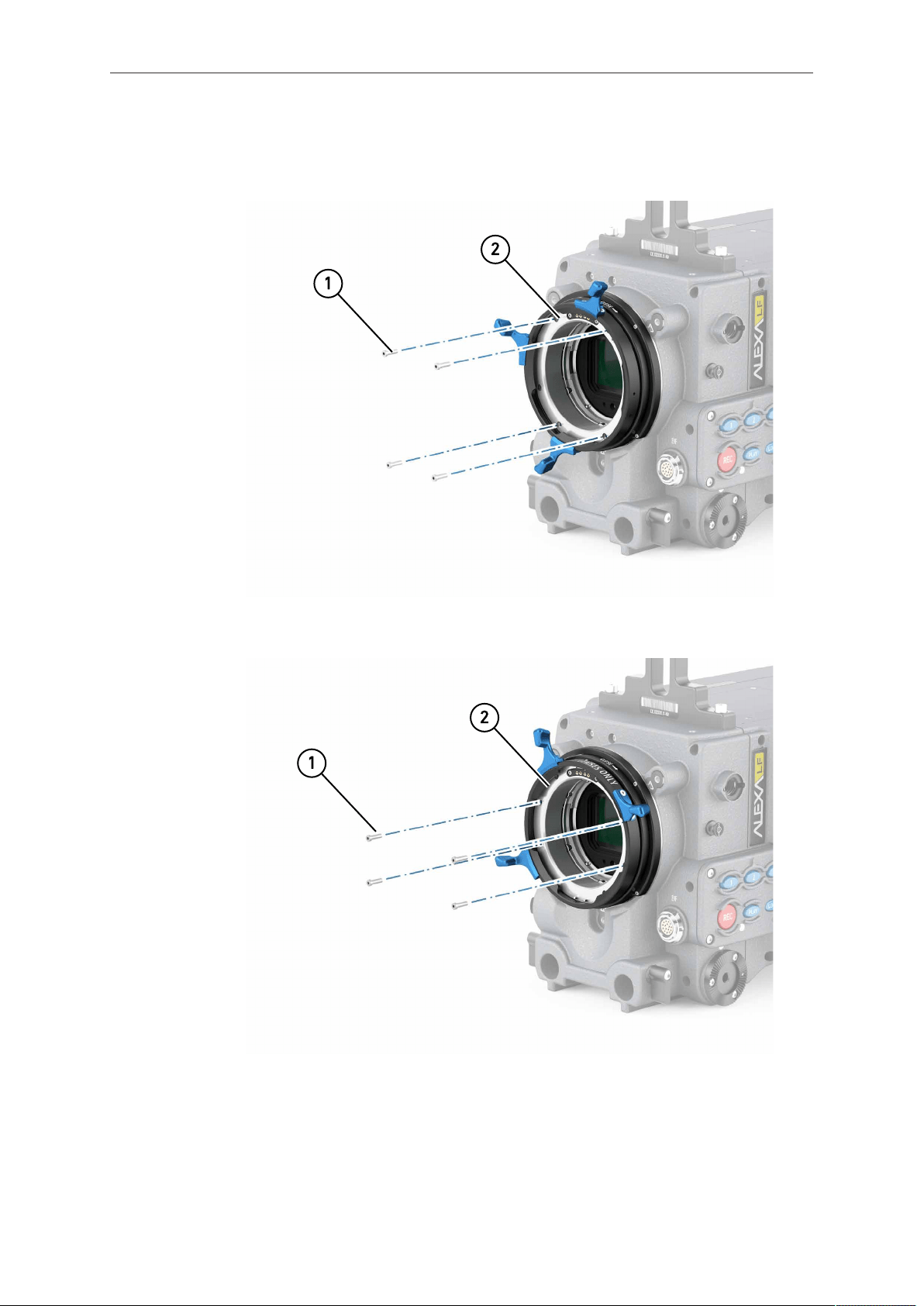
48 In-Camera Filter Module LF IFM
2. Unscrew (only with a TX6 torx screwdriver!) the four accessible torx screws (1)
that hold the lens lock (the other four torx screws are still hidden by lock position
CLOSED).
3. Turn the lens lock into position OPEN (2) to unhide and unscrew the other four torx
screws (1).
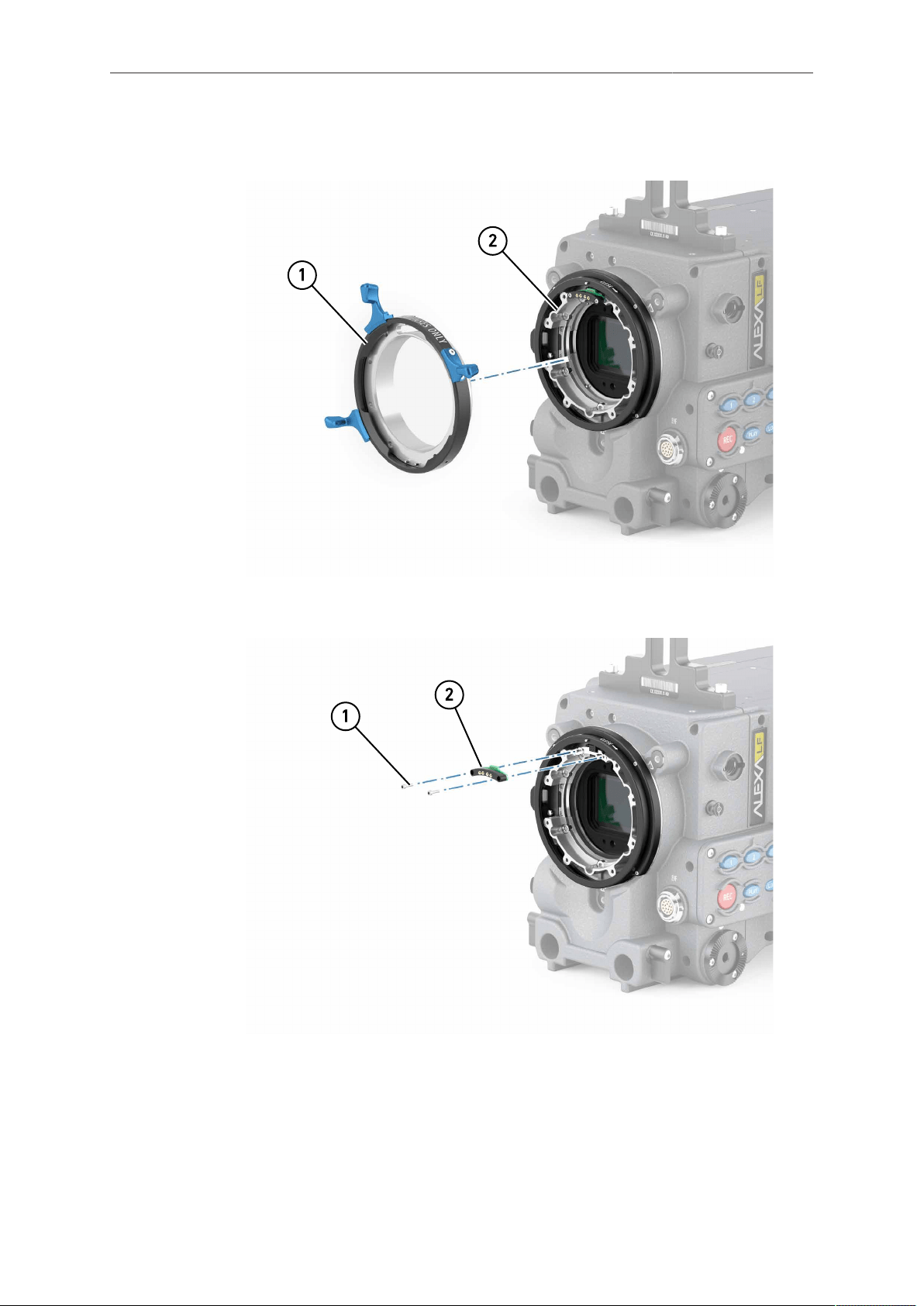
In-Camera Filter Module LF IFM 49
4. Remove the lens lock (1) from the LPL mount. Keep all installed shims (if any)
carefully in place (2):
5. Remove the LDS pin support and MCA print (2) by unscrewing the two TX6 torx
screws (1).
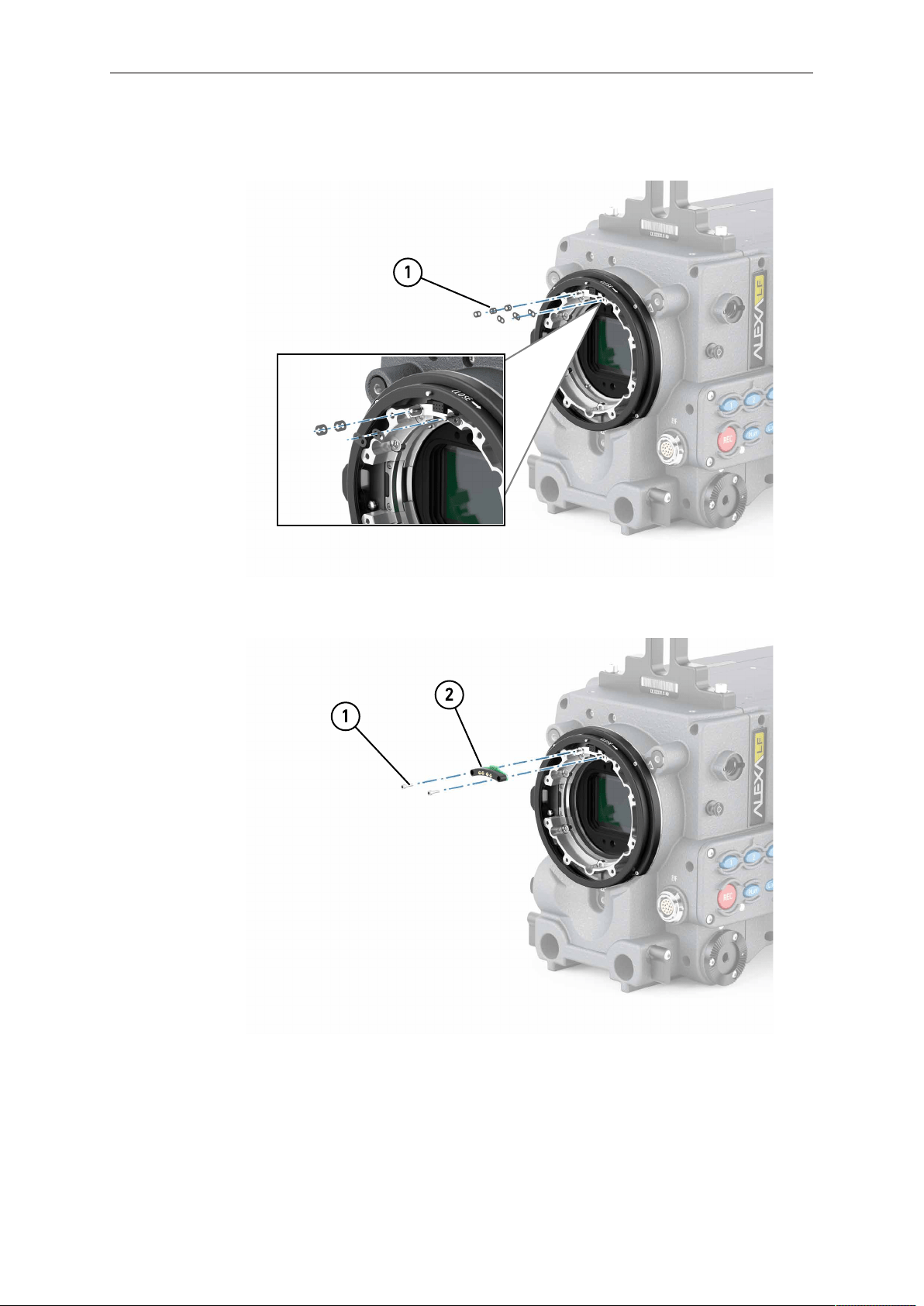
50 In-Camera Filter Module LF IFM
6. Add three 0.1 mm washers (1) on each of the four positioning pins (see detailed
section).
7. Reattach the LDS pin support and MCA print (2) by fastening the two TX6 torx
screws (1) hand-tight.
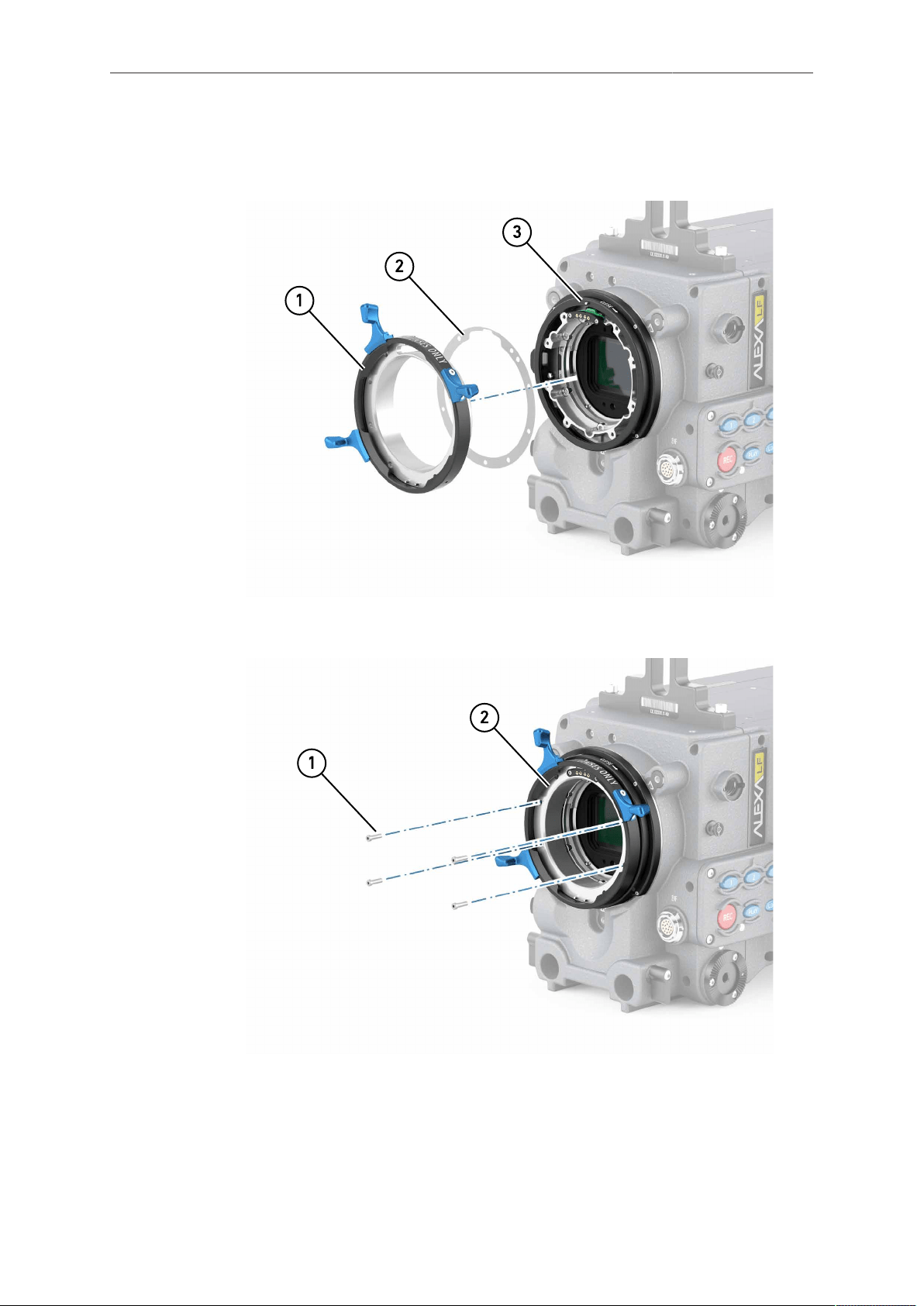
In-Camera Filter Module LF IFM 51
8. Accurately place the LF IFM Shim, with its inscription always facing camera-
outwards (2), onto the LPL mount. The shim's screw holes must line up exactly
with the mount's thread holes and the index pin (3):
9. Fasten the lens lock, still in position OPEN (2), back to the LPL mount; use four of
the eight torx screws (1) hand-tight:
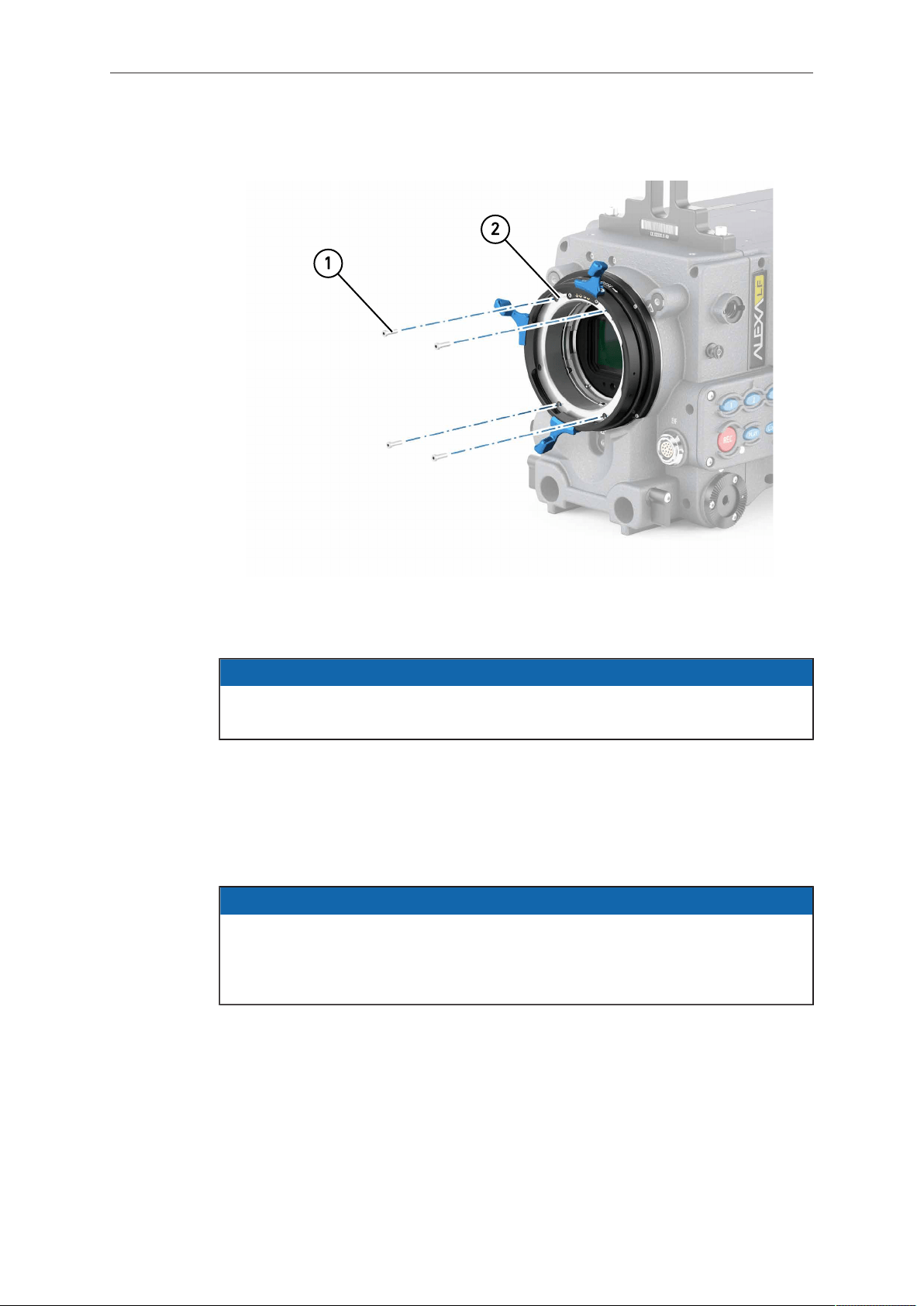
52 In-Camera Filter Module LF IFM
10. Turn the lens lock into Position CLOSED (2) and fasten the other four torx screws
hand-tight (1). Check if all screws and the shim fit correctly:
11. Before mounting a lens, always check its mounting depth (see "Safety instructions
for in-camera filtration", page 44 and "Maximum lens mounting depth for PL
lenses", page 44)
NOTICE
Make sure the LDS connection between lens and camera’s LPL mount works
properly. If not, add more washers (see step 6).
14.4 Mounting in-camera filters
Internal filters are very delicate. Before you mount or change a filter, check the lens
mounting depth (see "Safety instructions for in-camera filtration", page 44 and
"Maximum lens mounting depth for PL lenses", page 44).
NOTICE
By default, the filter position in the lens mount of the ALEXA LF is occupied by the
LF IFM Empty Filter Frame. This glassless filter ring must be replaced by a real
filter or LF IFM Optical Clear filter, once the camera is shimmed for LF IFM use (see
page 46)
Tools needed:
Filter insertion tool
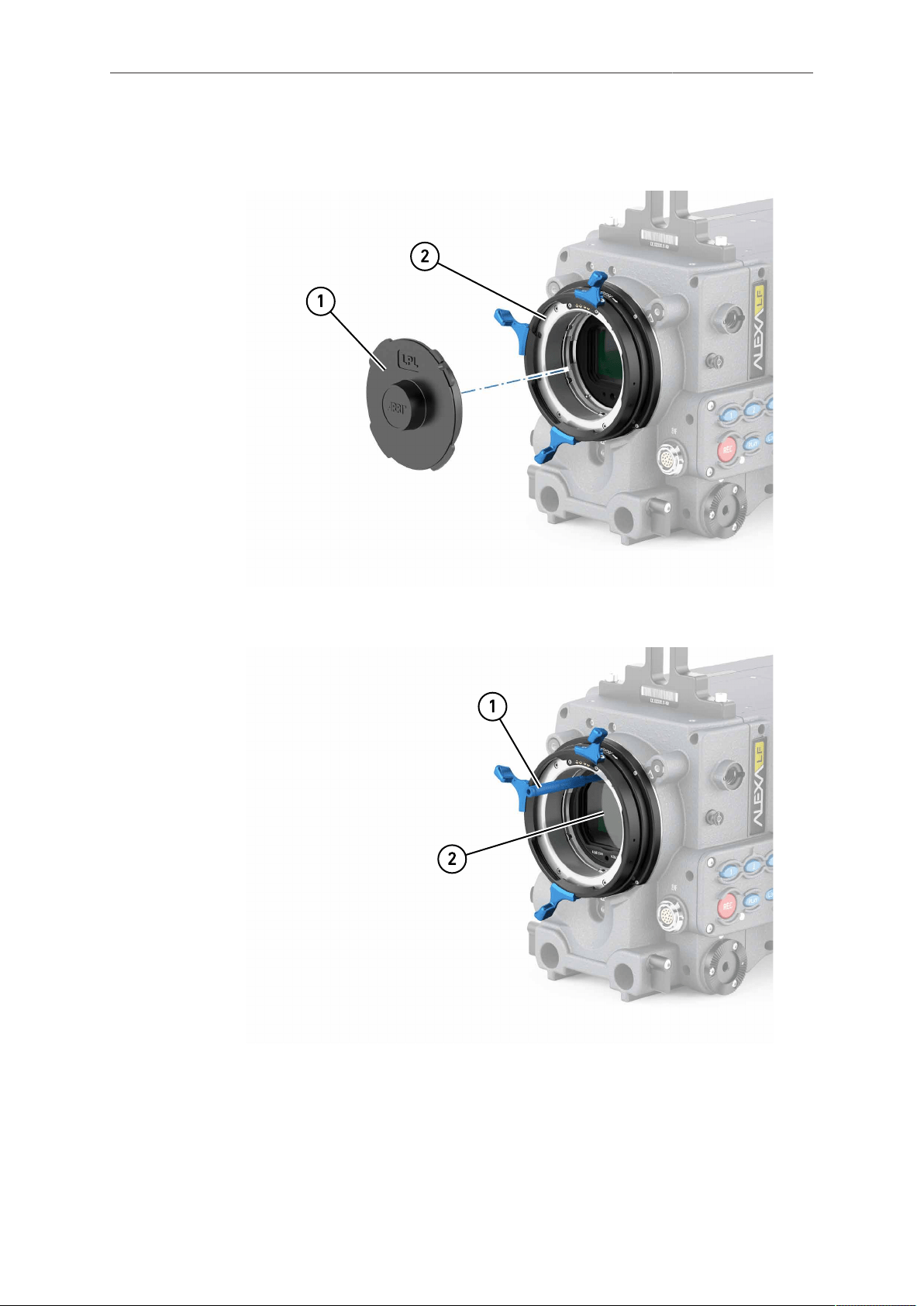
In-Camera Filter Module LF IFM 53
To insert or change an in-camera filter:
1. Remove the lens or lid (1) from the LPL lens mount (2).
2. Carefully screw the filter insertion tool (1) into the filter ring’s (2) thread hole in the
12 o'clock position (1).
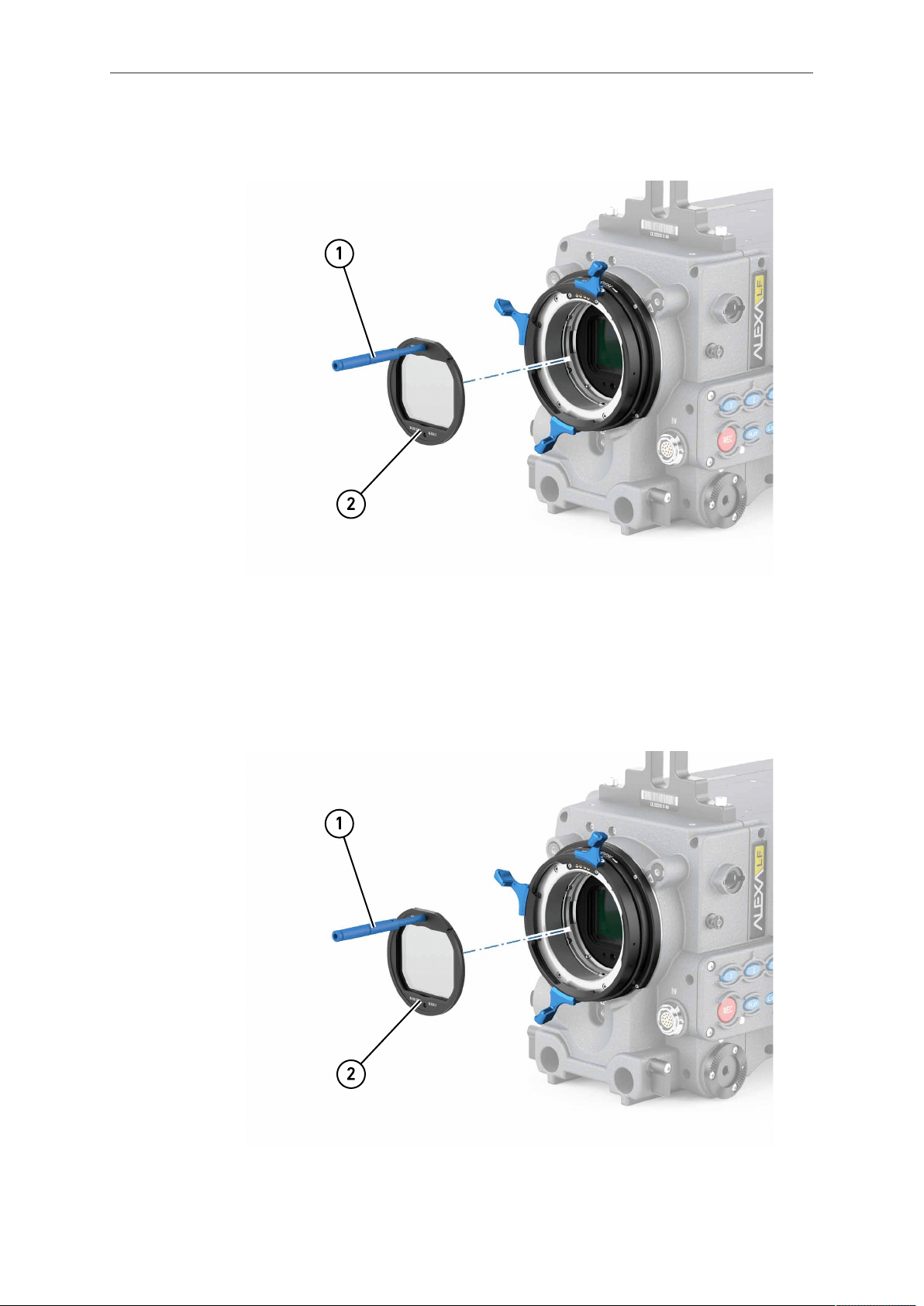
54 In-Camera Filter Module LF IFM
3. Pull the filter (2) from the bottom ring in the camera's LPL mount. If the filter
position is held by an LF IFM Empty Filter Frame, remove it likewise.
4. Clean the removed filter and stow it properly in its individual box and the storage
case. If the filter position was held by an LF IFM Empty Filter Frame, store it
likewise (in case the camera is no longer shimmed for LF IFM in the future).
5. Place the removed filter into its padded filter box in the storage case. Remove the
filter insertion tool to pick up the next filter.
6. Make sure the next filter (2) is clean and the filter insertion tool is in the 12 o’clock
position (1).
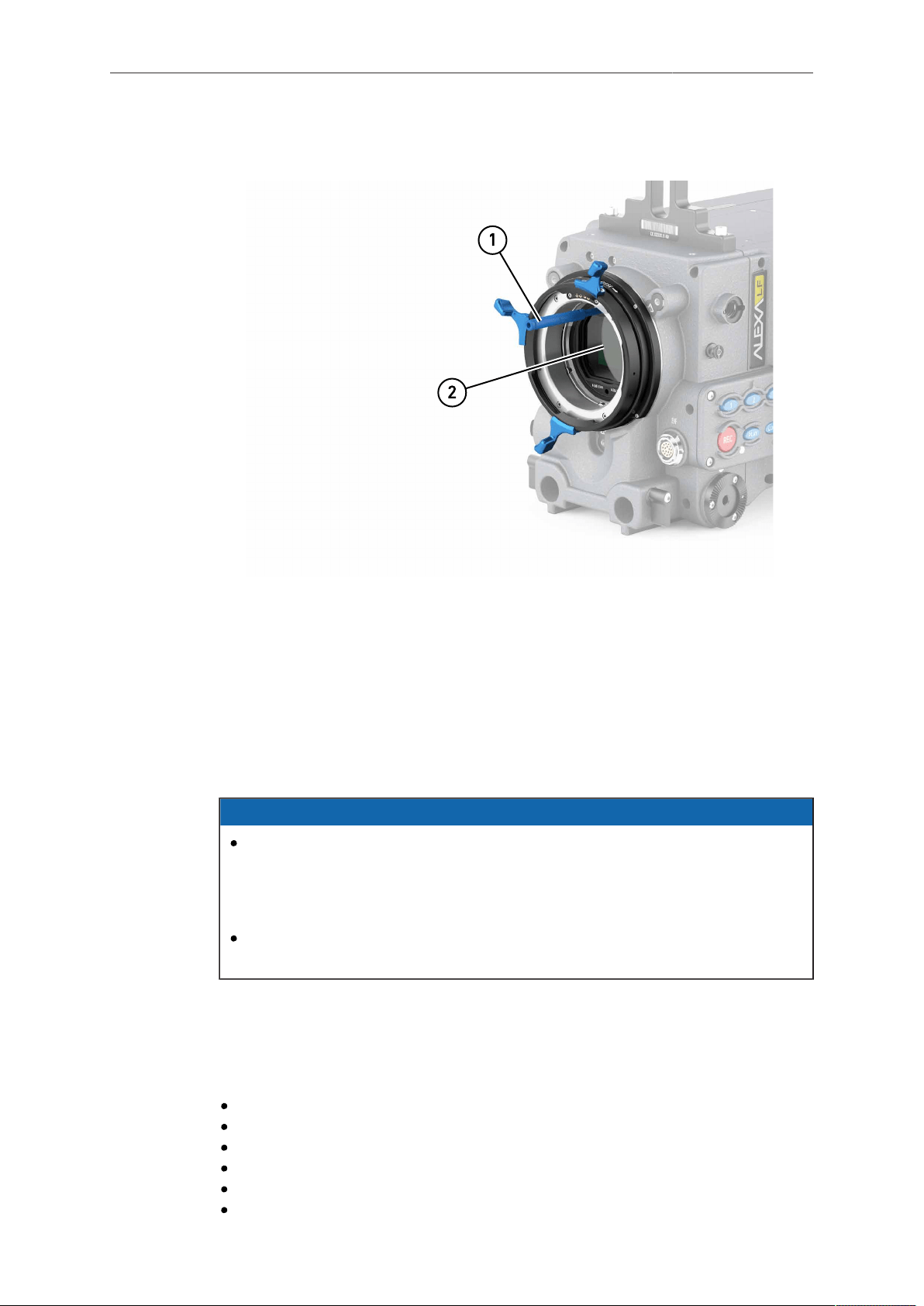
In-Camera Filter Module LF IFM 55
7. Place the next filter onto the bottom ring in the camera’s LPL mount. The filter
insertion tool has to be in the 12 o’clock position (1).
8. Align the filter ring’s main notch with the bottom ring’s red nut in the 6 o’clock
position. To ensure an accurate fit, align the filter ring’s other notches with the two
red noses in the bottom ring’s 10:30 and 1:30 positions.
9. Put your finger on the lower edge of the filter ring and push the filter ring slightly
inwards, using the filter insertion tool on top and your finger on the bottom.
10. After the filter ring has audibly snapped into position, carefully unscrew the filter
insertion tool. The filter has to sit precisely on the bottom ring.
11. Mount a lens (observe maximum lens dimensions!), or cover the LPL lens mount
properly with its lid.
NOTICE
All internal filters require a properly shimmed lens mount (see page 46).
To compensate for the change in flange focal depth due to the shim, always
insert the LF IFM Optical Clear filter when no filtering is needed.
When the camera is no longer shimmed for LF IFM, the glassless LF IFM
Empty Filter Frame must be placed back into the filter position.
For PL mount lenses, LF IFM works only with a lens mounting depth of 31.50
mm maximum.
14.5 Filter cleaning
Tools needed:
Cleaning Instructions
Fresh rubber gloves
Micro bellows
Cotton swab
Purified alcohol
Microfiber Cloth from FSND Filter Set

56 In-Camera Filter Module LF IFM
To clean the filters:
NOTICE
To avoid in-camera damage, always clean all filters outside of camera.
1. Ensure a clean, dust-and-moisture-free environment
2. Wear fresh rubber gloves to avoid fingerprints and smear
3. Never touch the sensor
4. Check the coating for dirt, smear and scratches
5. Remove sand, dust or solid particles with micro bellows
6. Clean off oil, grease or smear with a cotton swab (or the microfiber cloth) slightly
wetted in purified alcohol only
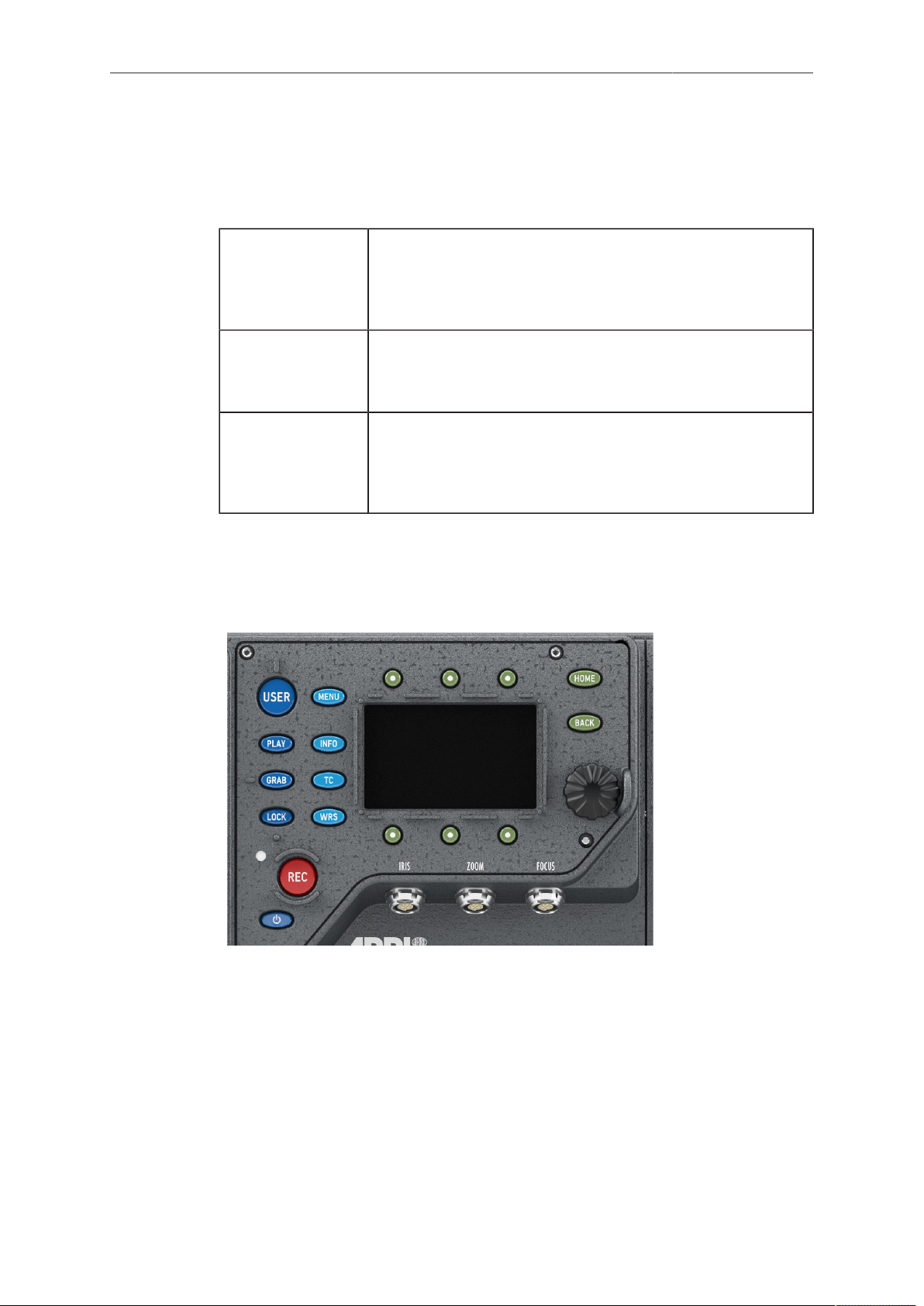
Camera Controls 57
15 Camera Controls
The ALEXA can be controlled through three user interfaces:
Main controls Location: camera-right side
Interface: 3-inch LCD-screen with floating-function buttons, a
jogwheel to navigate through menus and adjust parameters,
and a range of fixed-function buttons.
Operator controls Location: camera-left side
Interface: three assignable function buttons plus three fixed-
function buttons for easy operator access.
EVF controls Location: Electronic Viewfinder EVF
Interface: fixed function buttons and a jogwheel for adjust-
ment of viewfinder parameters and primary shooting para-
meters.
15.1 Main Controls
The main controls can be used to set all camera parameters.
Fig. 10: Main controls
15.1.1 Display
The 3-inch LCD has a resolution of 400x240 pixels. The back-lit, transflective display
has exceptional contrast even in bright sunlight.
To adjust the LCD brightness:
► Go to MENU>System>Display + Beeper and adjust Display brightness OR
► On the HOME screen, press and hold the BACK button, then turn the jogwheel.
A plastic shield protects the display from scratches. It can be removed by pulling it off
the four pins.
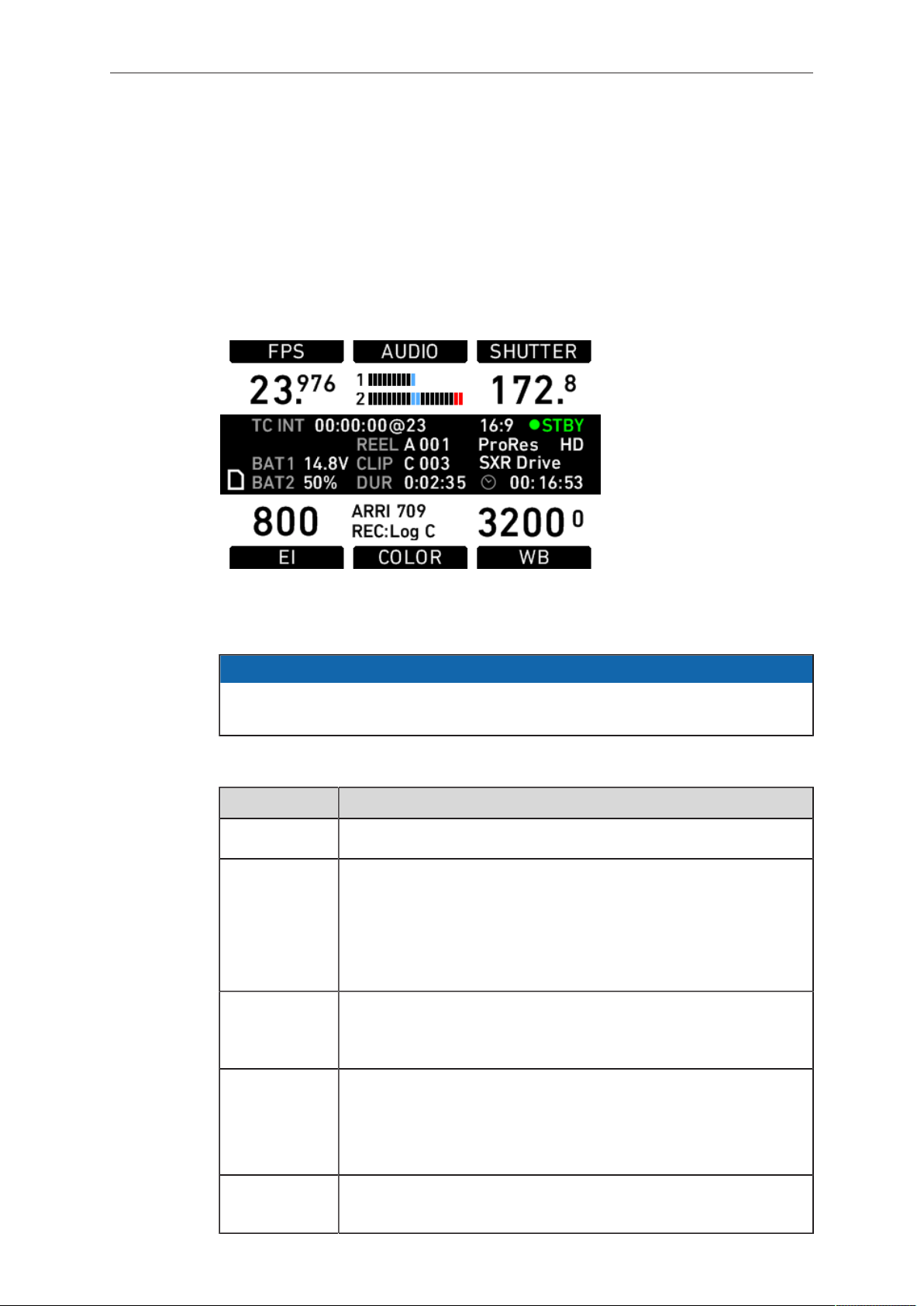
58 Camera Controls
15.1.2 Screen Buttons
Six screen buttons are located above and below the LCD display. Their function varies
depending on the screen content and is shown directly above or below each button.
If no function is shown above or below a button on the LCD, it has no function for that
screen.
As a failsafe, operations that cannot be reversed and can result in the loss of data
require pressing two buttons simultaneously to confirm the operation.
15.1.3 HOME screen
The HOME screen is the ALEXA’s default screen. It shows the most important camera
parameters and gives quick access to changing them through the screen buttons. To
return to the HOME screen from any menu in the camera, press the HOME button.
NOTICE
To adjust the LCD brightness from the HOME screen, rotate the jogwheel while
pressing the BACK button.
Screen buttons
Button Function
FPS Sets the frame rate of the sensor.
AUDIO Shows the current audio level. If AUDIO is set to Off, the audio
input is switched off: no audio is embedded in the HD-SDI out-
puts, and no audio tracks are recorded onto internal media. The
same applies if AUDIO is disabled, which is the case if the sen-
sor frame rate is different from the project fps setting (for exam-
ple, while over- or undercranking).
SHUTTER Sets the shutter angle of the sensor. Shutter angle and sensor
fps determine exposure time of the sensor in seconds by the fol-
lowing equation: angle / (360 * fps).
EI Sets the exposure index rated in ASA. The ALEXA has a base
sensitivity of 800 ASA.
Note: ASA rating is identical to ISO rating.
Note: Exposure Index is not applied to ARRIRAW signals.
COLOR Opens the color screen, where gamma and look settings for in-
ternal recording, MON OUT 1/2/3 and EVF can be changed.
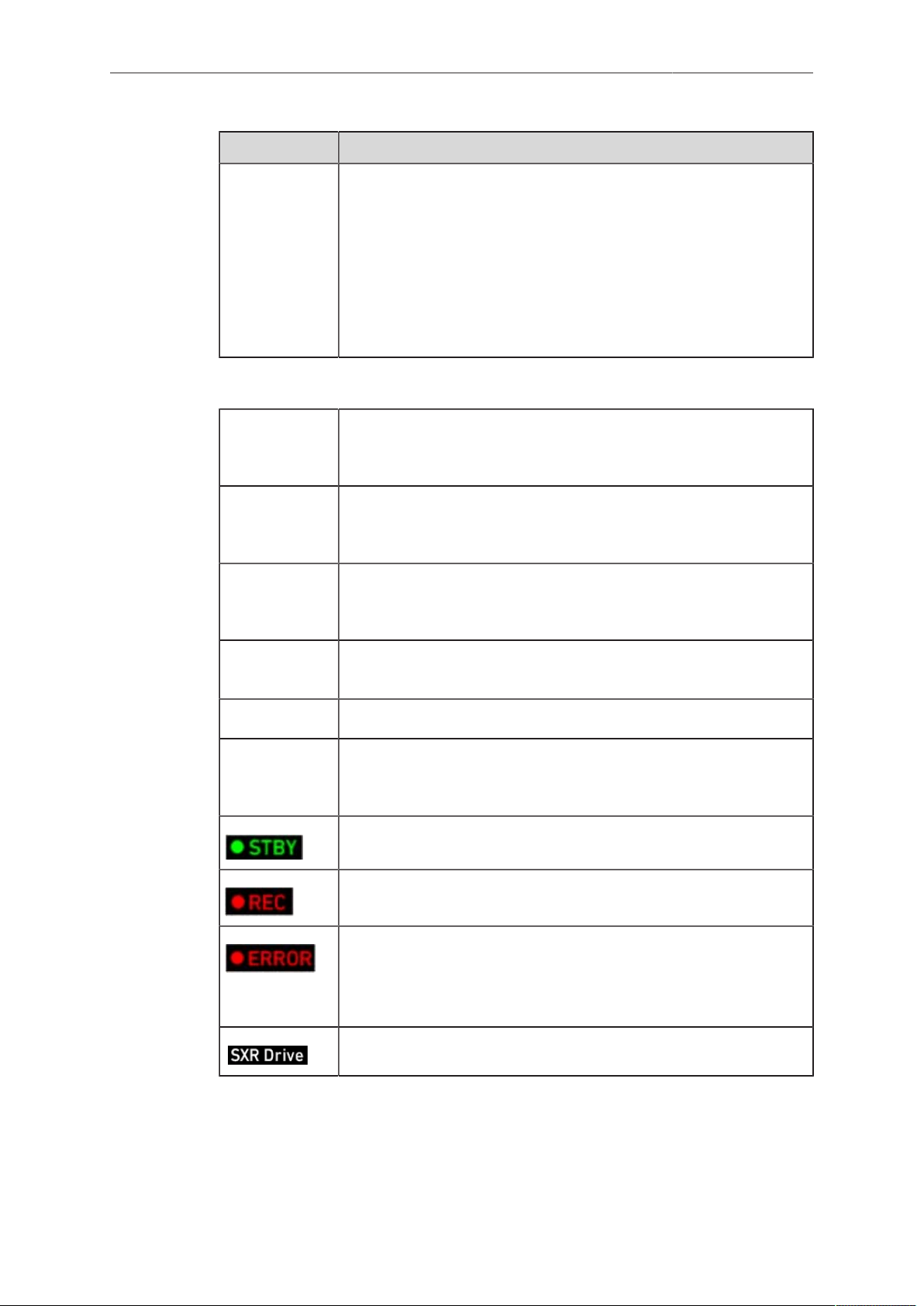
Camera Controls 59
Button Function
WB Sets the camera’s white balance. This is the color temperature
of the light source that the ALEXA is currently adjusted for. In ad-
dition to the red/blue correction of the white balance, the ALEXA
can also compensate for a green/magenta tint. This value, called
CC (color compensation), is shown as an exponent of the WB
value. Positive values are marked with a "+" and negative values
with a "-".
The user can execute an automatic white balance by pressing
the AUTO WB button in the WB screen.
Camera Status Section
TC Displays the current time code including the source (INT: inter-
nal, EXT: external source). Frames are not displayed. The time-
base of the time code is shown after the @ sign.
BAT 1 The voltage level of the power source present at the BAT con-
nector, or the remaining capacity of an attached battery in per-
centage if it transmits this information.
BAT 2 The voltage level of a battery attached to the onboard battery
adapter, or the remaining capacity of an attached battery in per-
centage if it transmits this information.
REEL Identifies the current reel with the camera index letter, such as A
or B and the reel number.
CLIP Identifies the current clip with the clip index and clip number.
DUR Displays the duration (i.e. screen time in relation to project rate)
of the current clip while recording or of the last recorded clip
while in standby, in the format h:mm:ss.
The camera is in standby and ready to record.
The camera is recording.
An error occurred and recording is not possible. Press the INFO
button for more information.
If nothing is shown, the camera has detected no errors, but no
media is present for recording.
Type of inserted media (SXR Capture Drive, SxS PRO)
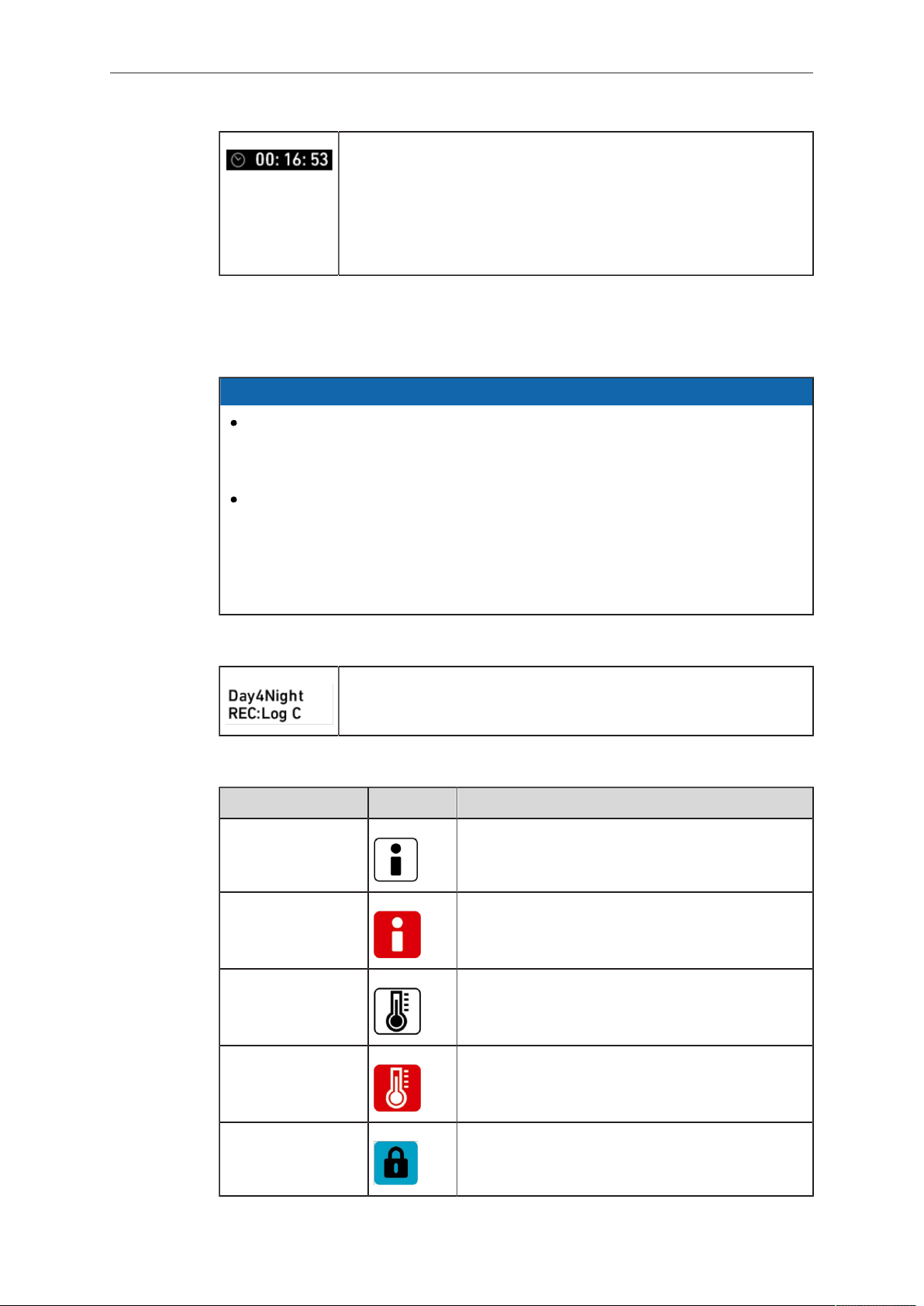
60 Camera Controls
During standby, shows remaining capacity of the inserted media
in hours, minutes, and seconds. It is calculated for the current
framerate and codec.
*
During recording, shows remaining length for current clip in
hours, minutes, and seconds, prefixed with 'C'.
Shows media status when media is not ready for recording.
*
When recording is set to ProRes, the value shown is the minimum available recording time for the
current sensor frame rate and codec combination. Apple ProRes
TM
is a variable bit rate codec, so the
actual remaining recording time depends on the image content. The remaining time is updated during
recording. After stopping recording, the remaining time may skip a few seconds because some media
space is needed for file management.
NOTICE
Media that has been formatted with a newer or older SUP version may not be
recognized correctly and be shown as invalid, or may trigger the warning "files
not consistent". In this case, backup any data from the media and format it in-
camera.
The maximum size of a single clip is limited to about 229 GB. Therefore, the
camera shows a little 'C' (for clip) next to the clock icon as soon as recording
starts, and it counts down the remaining time for the current recording. When
the remaining time reaches zero, the camera will stop recording similar to a
full medium. During standby, the camera shows the remaining capacity for the
whole medium.
COLOR Section
Name of the selected ARRI Look File 2 file
Selected gamma for recording path
Icons
Name Icon Description
General Warning Important information is waiting on the INFO
screen.
General Error An error has occurred. Check the INFO screen
for more information.
Temperature
Warning
There is a minor sensor-temperature offset.
Image quality may be slightly affected.
Temperature Er-
ror
There is a substantial sensor-temperature off-
set. Image quality may be seriously affected.
Lock The Main Controls are locked.
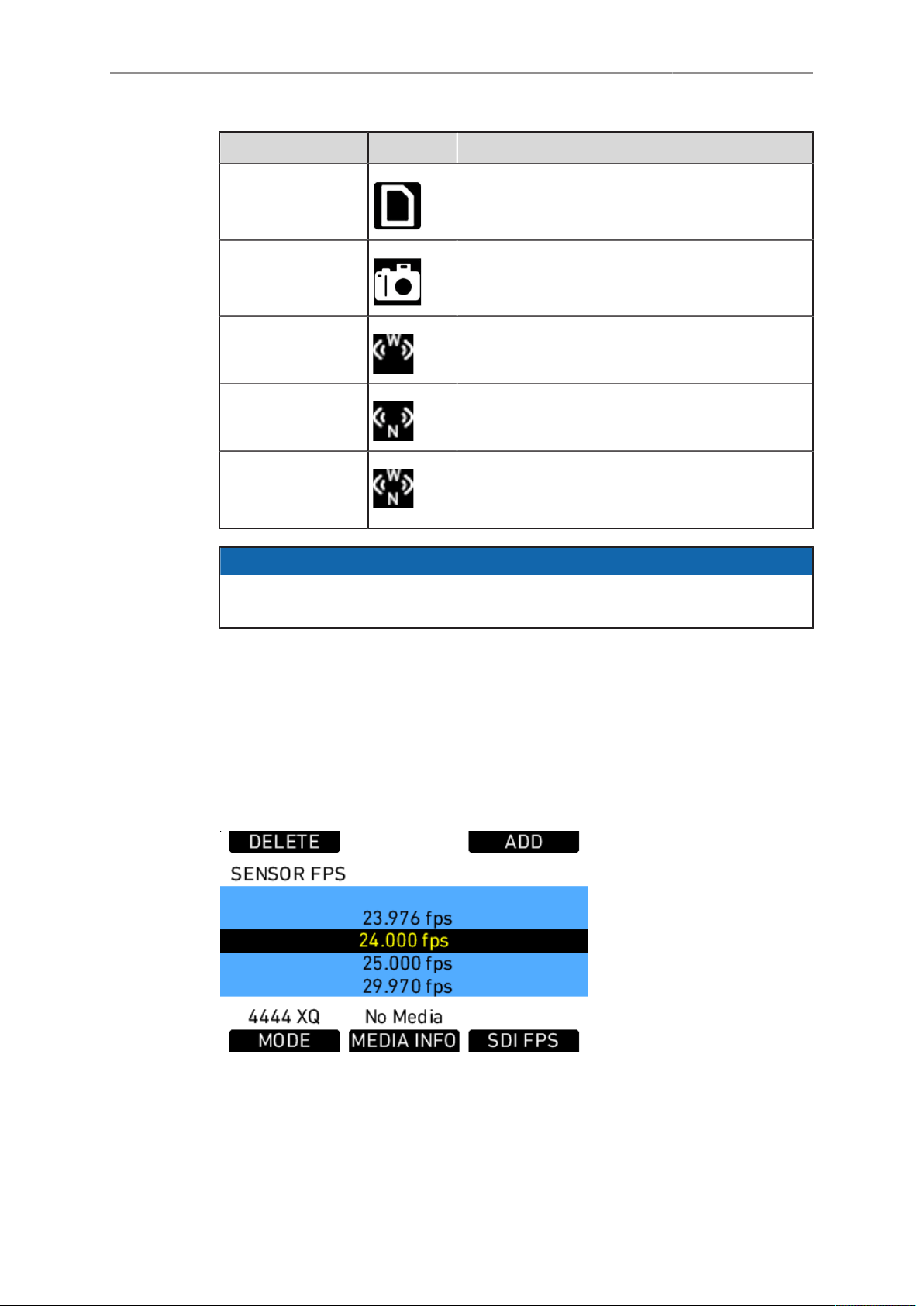
Camera Controls 61
Name Icon Description
SD Card An SD card is present. The icon turns orange
when the card is accessed.
Grab The GRAB icon flashes while a still frame is be-
ing taken and written to the SD card.
Radio The ARRI Wireless Remote System (WRS) ra-
dio is active.
The wireless network/WiFi radio is active.
The ARRI Wireless Remote System (WRS) ra-
dio and the wireless network/WiFi radio are ac-
tive.
NOTICE
A sensor temperature warning or error after boot-up is normal, as it takes a few
seconds for the sensor to reach its preset temperature.
15.1.3.1 Lists and User Lists
On the HOME screen, press the FPS, SHUTTER, WB (white balance) and EI
(exposure index) buttons to open lists of preconfigured values for each setting.
User-defined values can be added to the FPS, SHUTTER and WB lists. The EI list is
fixed and user-defined values cannot be added. It contains values from 160-3200 ASA
in steps of 1/3 stops.
Setting a list value
Fig. 11: SENSOR FPS screen
Any value in a list may be set. Invalid values will appear grayed out.
To set a list value:
1. Rotate the jogwheel to select the desired list value.
2. Press the jogwheel to set the list value.
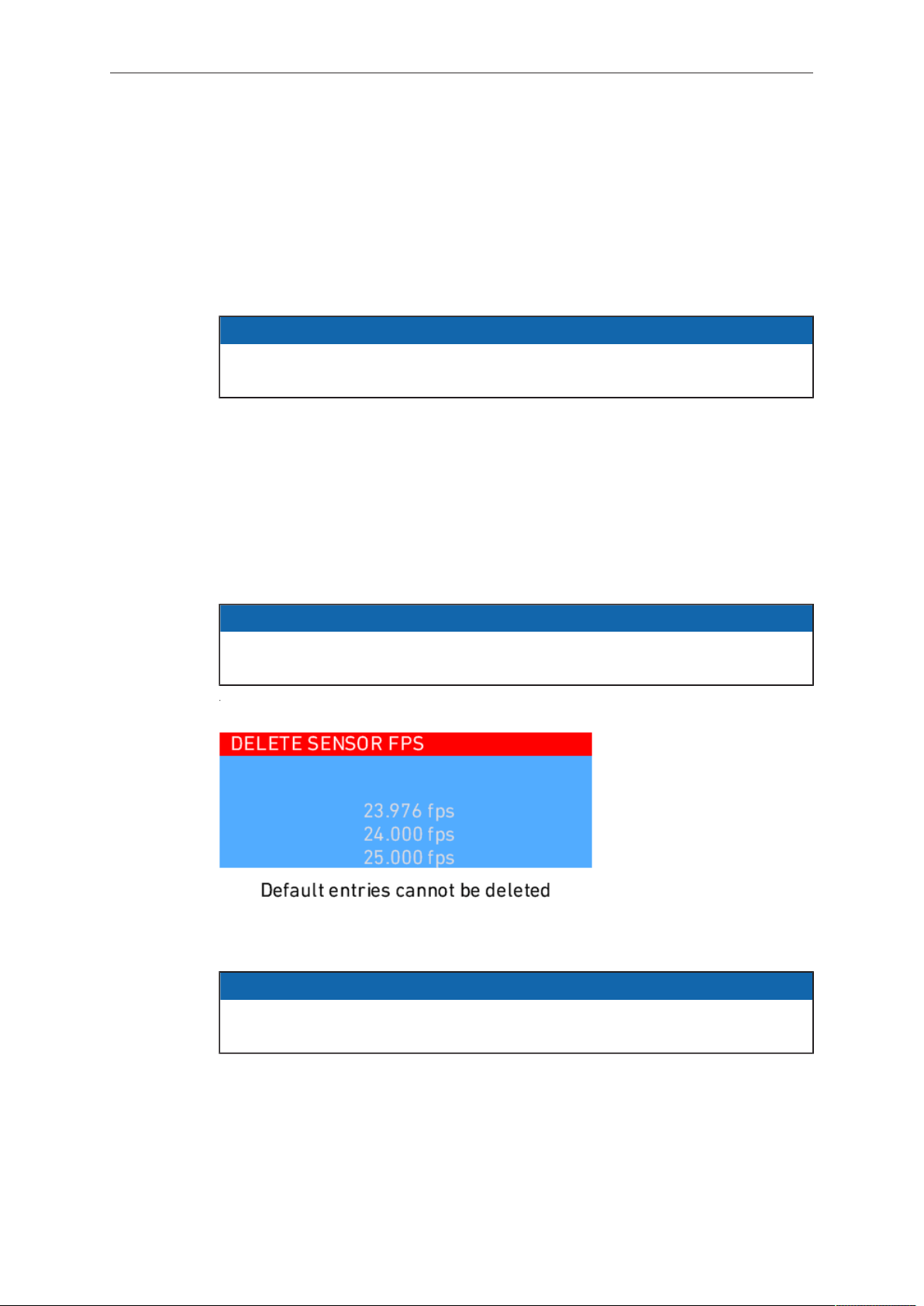
62 Camera Controls
Adding a list value
If the desired list value does not appear in the list, a user-defined value can be added.
To add a list value:
1. Press the ADD button.
2. On the ADD screen, use the jogwheel and + or – buttons to enter a new list value.
3. When you are finished entering the new list value, press the jogwheel to add it to
the list.
NOTICE
Each list supports a maximum of 16 entries. To add new user-defined list values to
a full list, you must delete previously added user-defined list values.
Deleting a list value
User-defined list values that are no longer required can be deleted.
To delete a list value:
1. Press the DELETE button.
2. On the DELETE screen, use the jogwheel to select the user-defined value you
wish to delete.
3. Press both DELETE buttons simultaneously.
NOTICE
Preconfigured values cannot be deleted and will appear grayed out on the DELETE
screen.
Figure 23: DELETE SENSOR FPS screen
NOTICE
The EI list is static and cannot be changed by the user. It contains ASA values from
160-3200 ASA in steps of 1/3 stop.
15.1.3.2 FPS
Press the FPS (frames per second) button on the HOME screen to open the SENSOR
FPS list screen, which lists the default frame rates as well as user-defined frame rates.
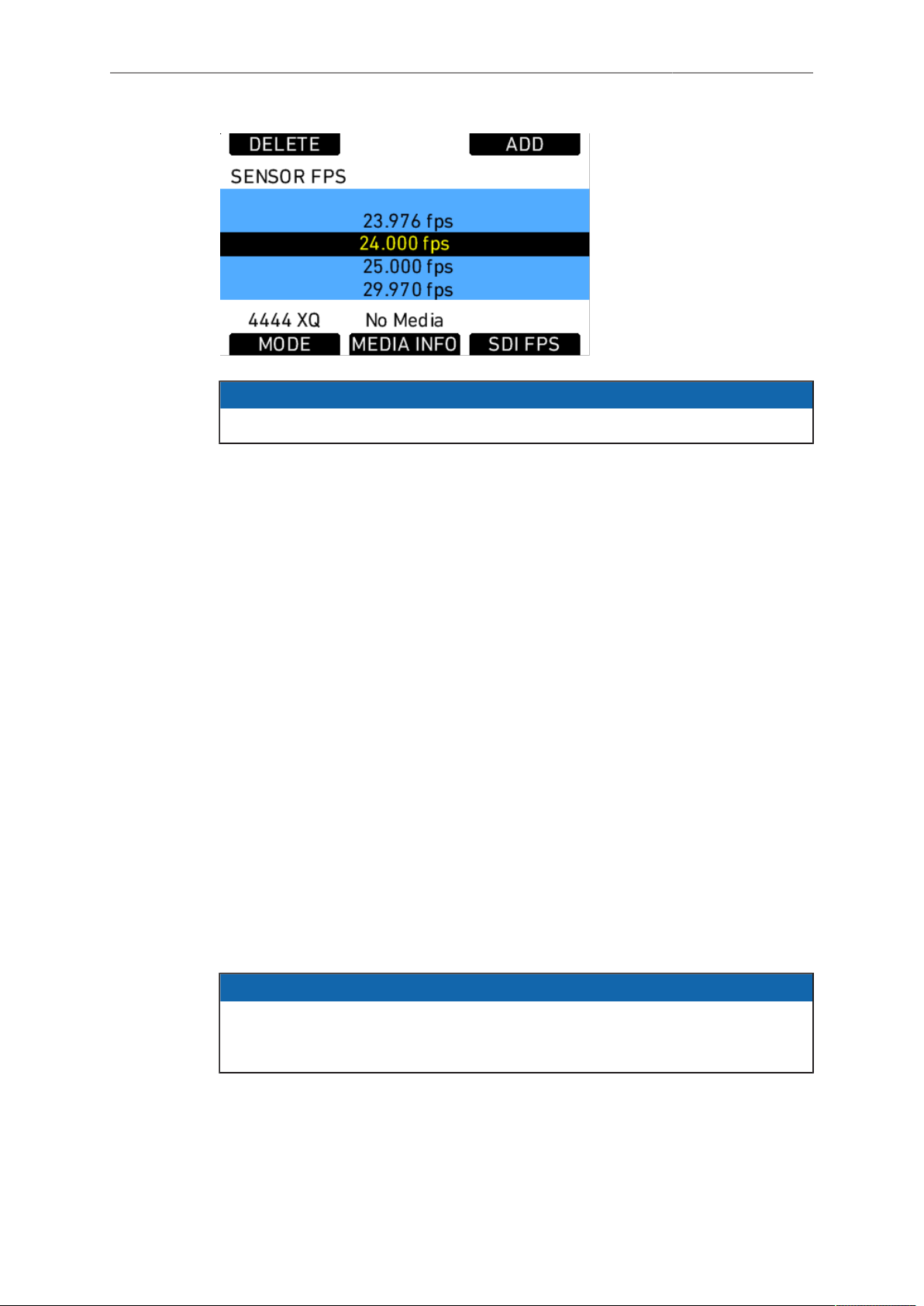
Camera Controls 63
NOTICE
Access to this screen is disabled during record.
The maximum frame rate that can be set is dependent on the type of media and the
codec.
If the desired frame rate cannot be set because it is grayed out, change the codec to
one with a lower data rate.
There are shortcut buttons on the FPS screen for CODEC, INFO and SDI FPS. In the
SDI FPS screen, MON OUT 1/2/3 frame rates can be adjusted within the limits of their
current format.
The MON OUT should match the sensor frame rate. If the sensor frame rate exceeds
the available MON OUT frame rates, set the MON OUT to half the sensor frame rate if
possible to maximize the smoothness of the image when panning and tilting.
To correctly set frame rates for the MON OUT:
1. Press the MENU button.
2. Using the jogwheel, select the Monitoring menu.
3. Select MON OUT.
4. Set Frame rate to the same frame rate as the sensor frame rate. If the sensor
frame rate exceeds the range of the available MON OUT frame rates, set the MON
OUT frame rate to half the value of the sensor frame rate.
5. Press the HOME button to exit.
15.1.3.3 AUDIO
Press the AUDIO button on the HOME screen to open the AUDIO screen. This screen
shows the ALEXA’s two audio channel levels. The audio levels are displayed from -45
dBFS to 0 dBFS.
NOTICE
No audio meters are displayed on the HOME screen or AUDIO screen when audio
is set to Off or audio is disabled. Audio is disabled when the sensor frame rate does
not match the project frame rate. In this case, no audio is transmitted via HD-SDI.
Light blue markers show reference levels of -20, -18 and -9 dB FS.
Red markers at levels -1 and 0 dBFS warn of clipping. With proper audio signal levels,
the red markers should almost never be visible.
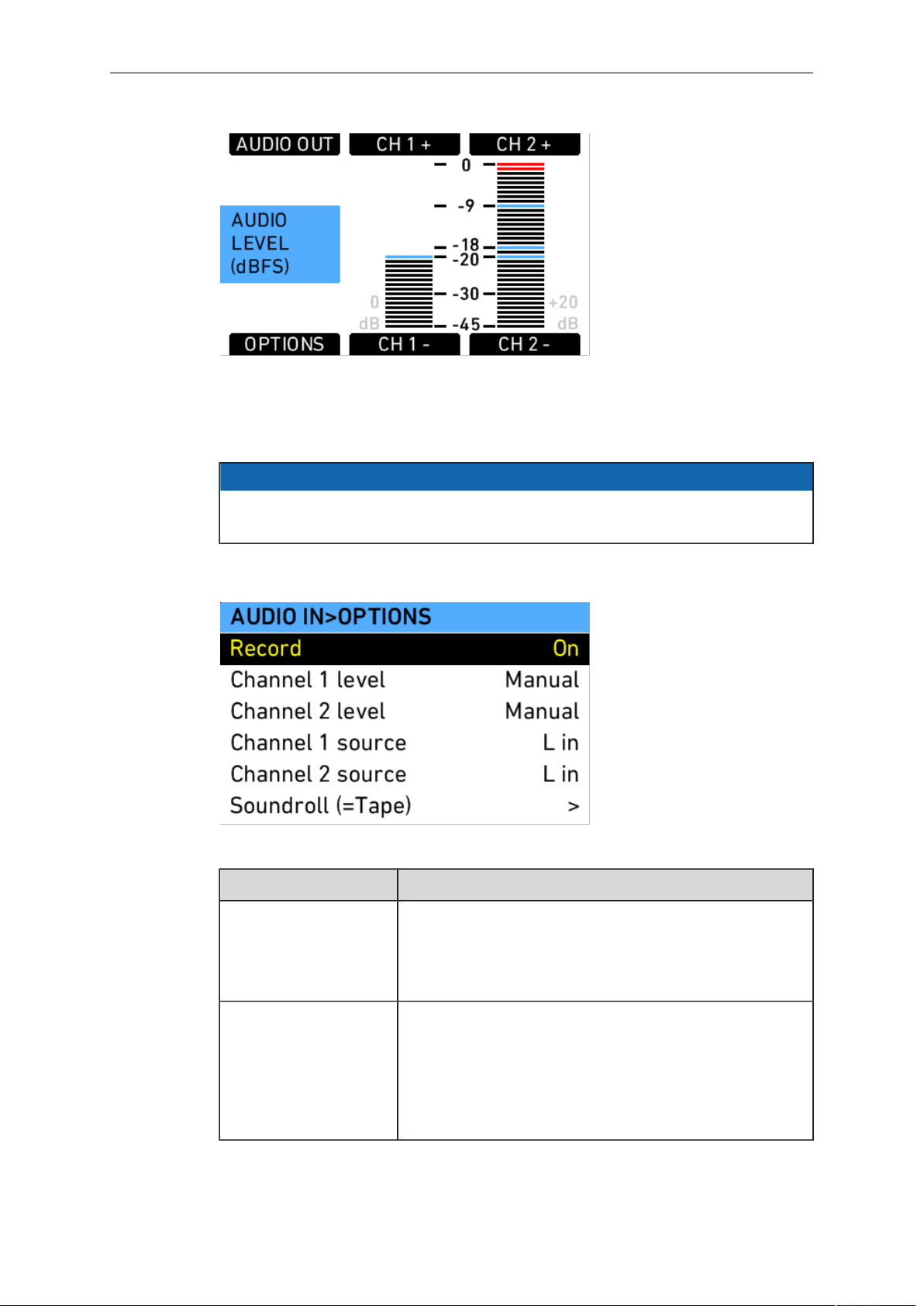
64 Camera Controls
Fig. 12: Audio screen
Gain can be applied to the audio channels by turning the jogwheel to set both
channels, or by pressing the CH 1+, CH 1-, CH 2+ and CH 2- buttons. The amount of
gain applied by the camera is indicated next to the levels as light gray numbers.
NOTICE
When adjusting audio input levels, a "clicking" noise can be heard on audio outputs.
Adjustment of audio levels therefore is disabled during recording.
Press the OPTIONS button to open the AUDIO IN>OPTIONS screen and set audio
parameters.
Fig. 13: AUDIO IN>OPTIONS screen
Option Description
Record Turns audio recording On or Off.
If audio recording is switched off, no audio is recorded
internally, HD-SDI contains no audio and Audio out is
muted.
Channel 1 level Manual allows the user to manually apply gain to the in-
put signal on channel 1 to reach a correct level.
Unity matches a 4 dBu input signal to -20 dBFS. This
setting leaves enough headroom for recording and
avoids audio clipping. When Unity is selected, audio lev-
els cannot be adjusted by the user.
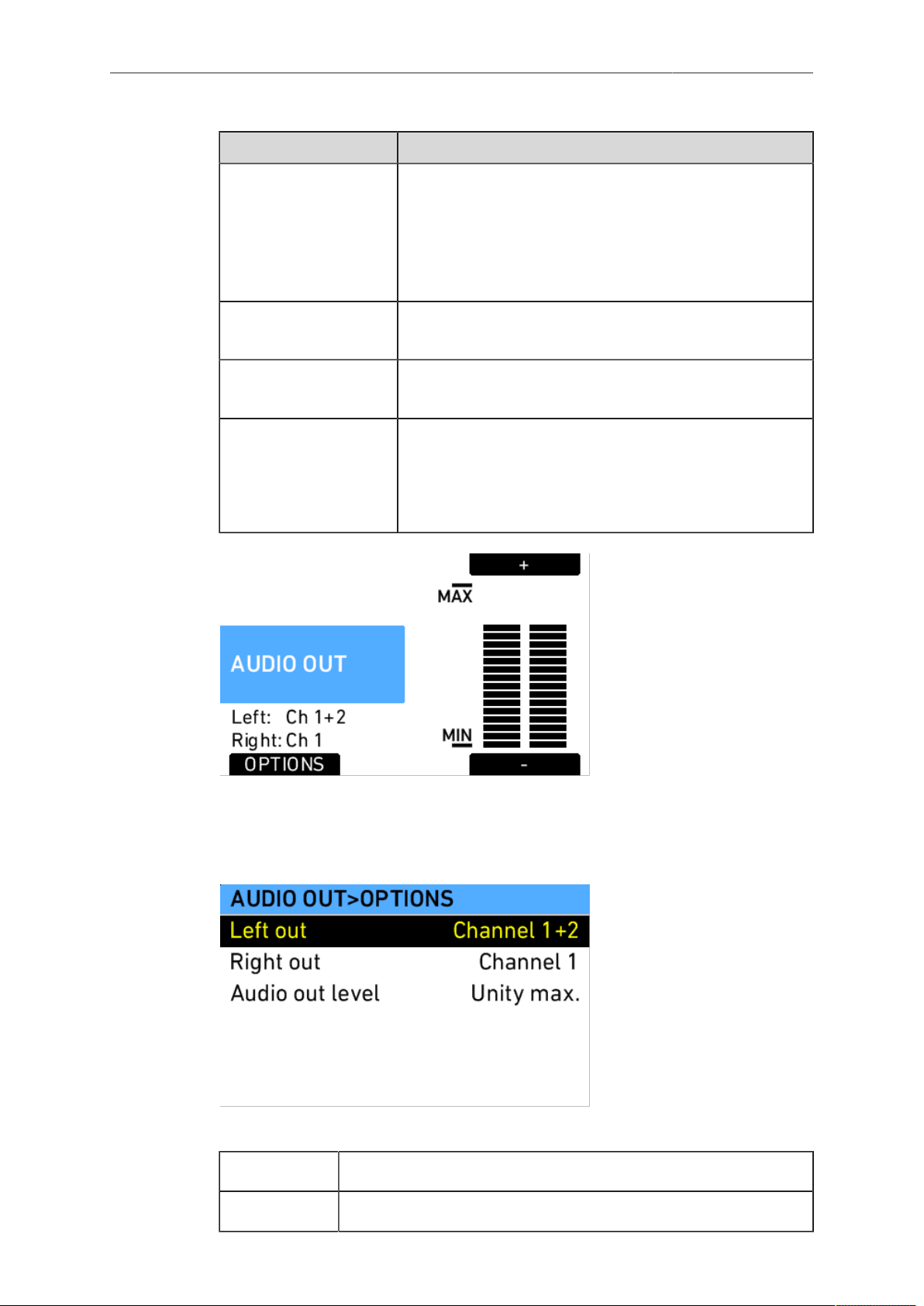
Camera Controls 65
Option Description
Channel 2 level Manual allows the user to manually apply gain to the in-
put signal on channel 2 to reach a correct level.
Unity matches a 4 dBu input signal to -20 dBFS. This
setting leaves enough headroom for recording and
avoids audio clipping. When Unity is selected, audio lev-
els cannot be adjusted by the user.
Channel 1 source Select the left or right input signal as the source for
Channel 1.
Channel 2 source Select the left or right input signal as the source for
Channel 2.
Soundroll (=Tape) Enter a name for the sound roll (also known as Tape
in the menus of some recorders) of an external audio
recorder, for easier sound syncing in post-production.
The name will be written to the FCP XML file and the
Avid Log Exchange (ALE) file on the recording media.
Fig. 14: Audio out screen
Press the AUDIO OUT button to open the AUDIO OUT>OPTIONS screen where the
global volume for both Audio out channels can be adjusted. The OPTIONS button
opens a list of AUDIO OUT options.
Fig. 15: AUDIO OUT>OPTIONS
Left out Sets which channel is routed to the left output.
Right out Sets which channel is routed to the right output.
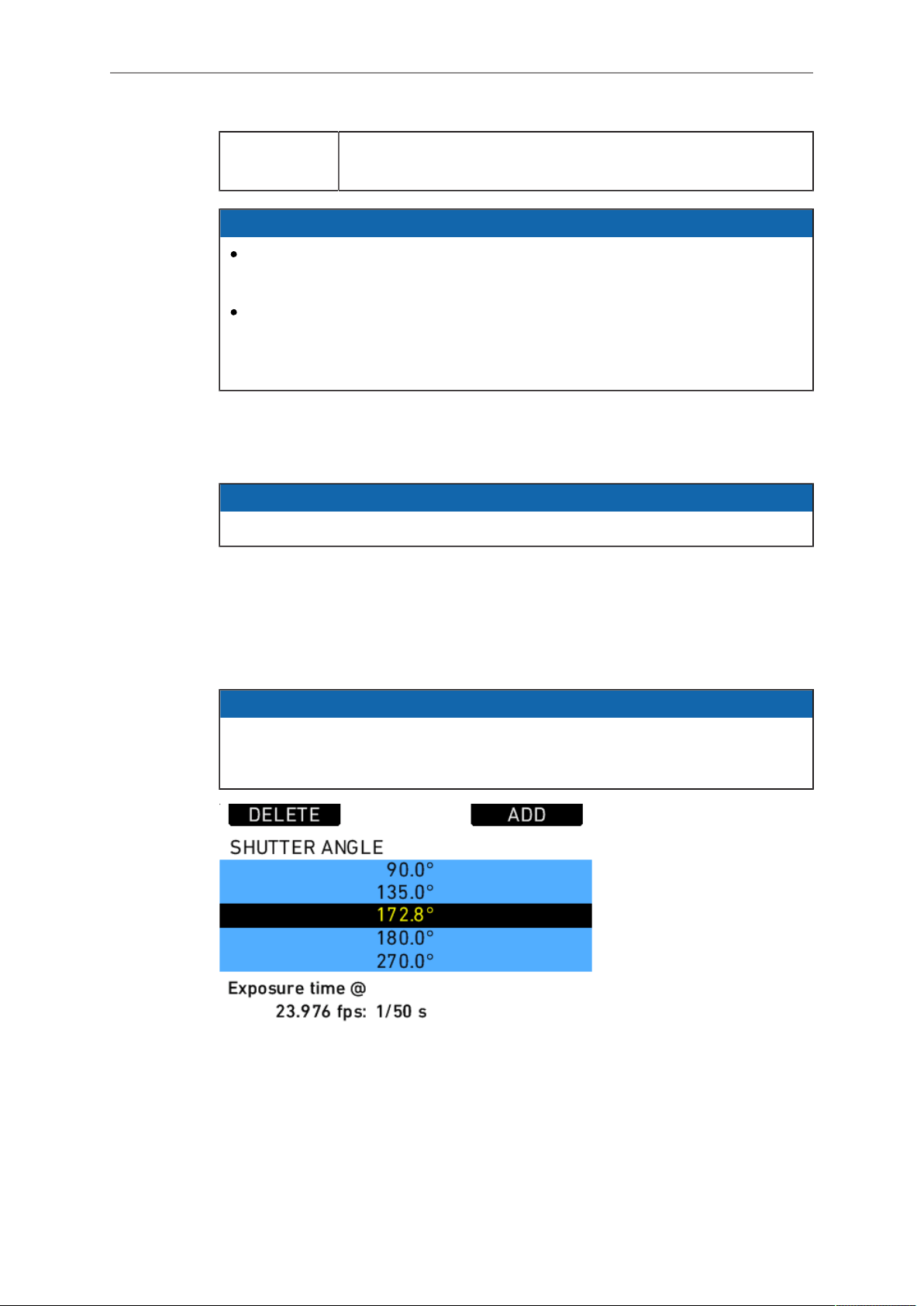
66 Camera Controls
Audio out
level
Set the level of the audio out channels manually, or set it to fix
the maximum output.
NOTICE
These settings do not influence the audio signal embedded in the HD-SDI
connectors or recorded in QuickTime clips. They only affect the AUDIO OUT
connector.
ALEXA automatically determines the internal signal run time and matches audio
and images so they are always in sync. When changing sensor fps or project
fps, it may take up to 2 seconds for the camera to resync image and audio
signals.
15.1.3.4 SHUTTER
Press the SHUTTER button in the HOME screen to open the SHUTTER ANGLE
screen.
NOTICE
Access to this screen is disabled during record.
The list of default shutter angles includes 11.2°, 22.5°, 45.0°, 90.0°, 172.8°, 180.0°,
270.0° and 358.0°. User-defined shutter angles can be set by pressing the ADD
button. The exposure time for the current frame rate and shutter angle is indicated in
seconds at the bottom of the SHUTTER ANGLE screen.
The shutter angle range is 5.0° to 358.0° up to 60 fps and 5.0° to 356.0° above 60 fps.
Below the list, the actual exposure time at the currently set frame rate is shown.
NOTICE
Be aware that the combination of long exposure times (a low sensor frame rate and
large shutter angle) and high exposure indexes can lead to image artifacts! Try to
avoid exposure times longer than 1/50th of a second for maximum image quality.
Fig. 16: Shutter list
15.1.3.5 EI
The Exposure Index (EI) is the applied sensitivity of the camera.
The ALEXA has a base sensitivity of 800 ASA. This means that the dynamic range is
almost evenly distributed above and below neutral gray with low noise in the shadows
and clean, smooth clipping behavior in the highlights.
Due to its high dynamic range, the ALEXA’s sensitivity can be set from 160 to 3200
ASA in steps of 1/3 stops while maintaining high image quality.
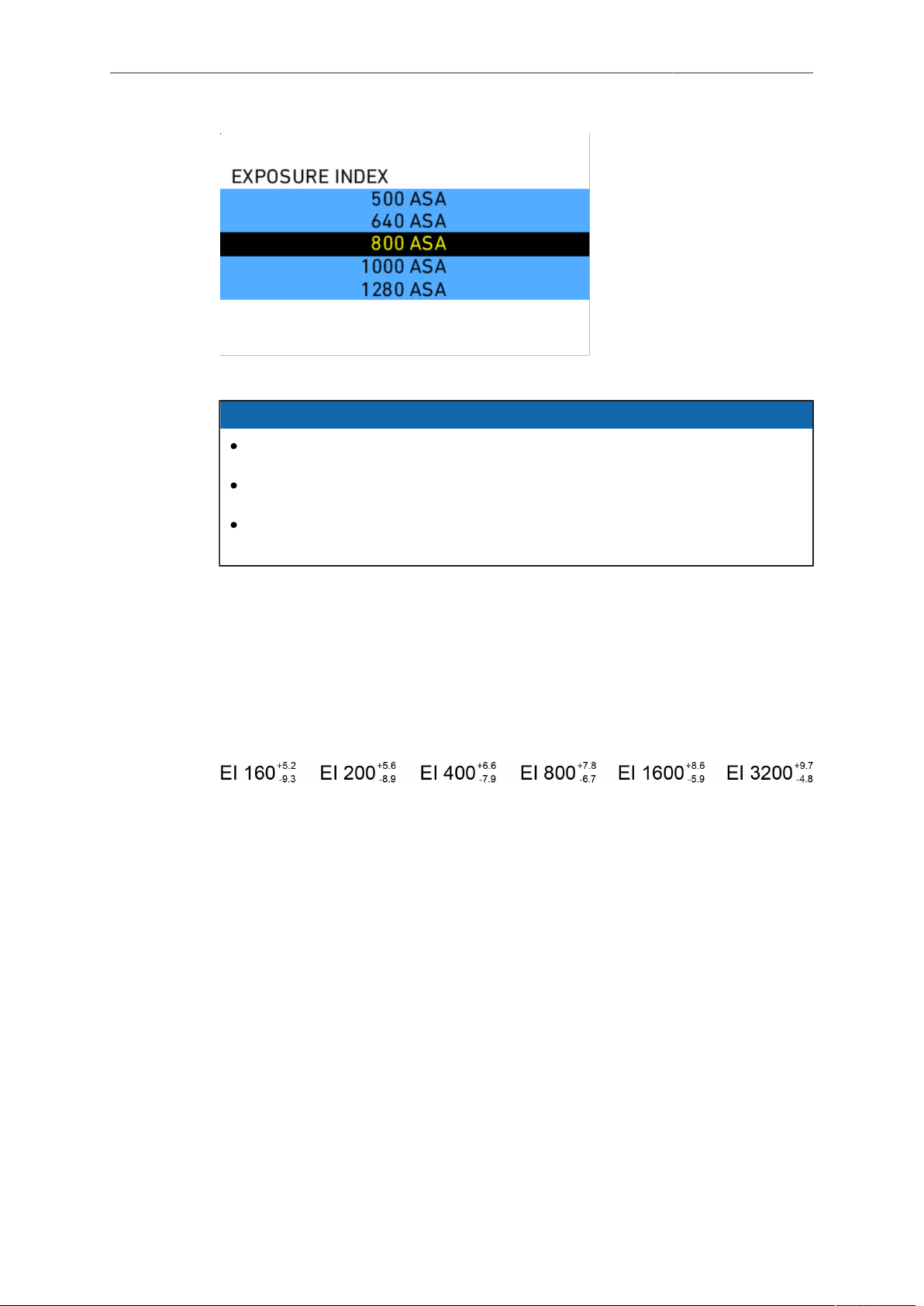
Camera Controls 67
Fig. 17: Exposure Index screen
NOTICE
The Exposure Index list has fixed content, meaning that it cannot be changed
by the user.
When changing the EI setting during recording, one or more frames on the
recorded material may show artifacts resulting from the change.
An area that is overexposed more than eight stops above clipping can appear
darker than its surroundings.
Applying the exposure indexes at the extremes of the range will nonetheless have
an influence on the images. At low exposure indexes, such as 160 ASA, the dynamic
range below neutral gray increases, reducing noise even further. At the same time,
the dynamic range above neutral gray is slightly reduced. Highlight clipping itself is
not influenced by this, but the shoulder of the gamma curve will get slightly steeper,
reducing the smoothness of the change from almost overexposed to overexposed.
At high exposure indexes, such as 1600 ASA, the images behave in the opposite way.
Noise is increased, which makes it important to judge shadow detail, while there will
be even more headroom in the highlights.
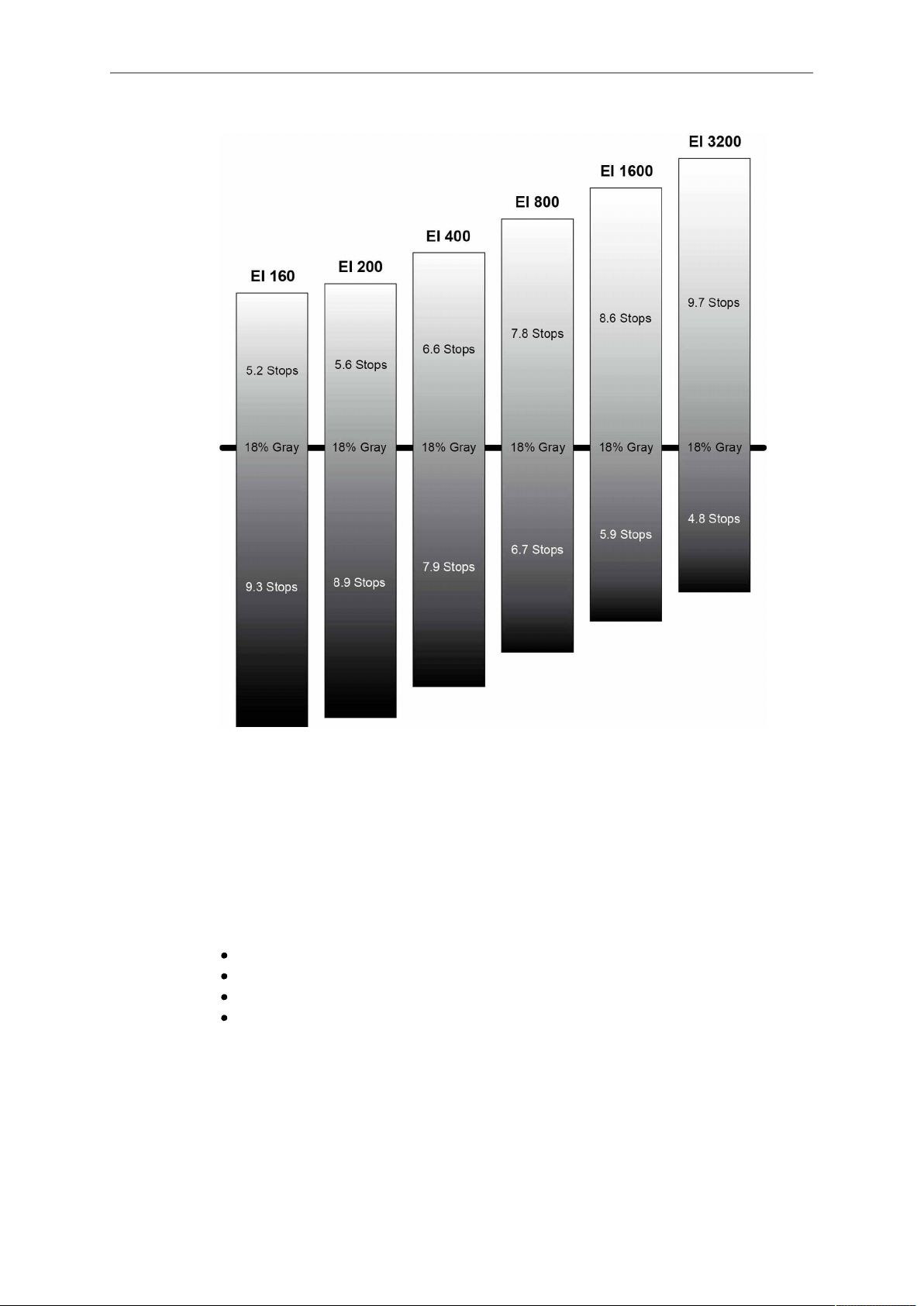
68 Camera Controls
15.1.3.6 COLOR
The ALEXA LF comes with very powerful color processing capabilities that can
be configured on the COLOR screen, similar to the ALEXA SXT. As the possible
combinations of color processing parameters may become quite complex, ARRI
provides a white paper titled "ARRI Look Management in ALEXA SXT", available for
download on the ARRI ALEXA webpage.
Press the COLOR button to open the COLOR screen. The COLOR screen displays
an overview of the color management settings applied to the camera’s output paths,
including:
the current processing setting of internal recording
a link to the processing settings of EVF and MON OUT 1/2/3
the currently set ARRI Look File 2
a link to the MON OUT color space configuration
If the ARRI Look File 2 file has been modified via an external Camera Access Protocol
(CAP) enabled software, but is not yet saved, the look file name is appended by an
asterisk.
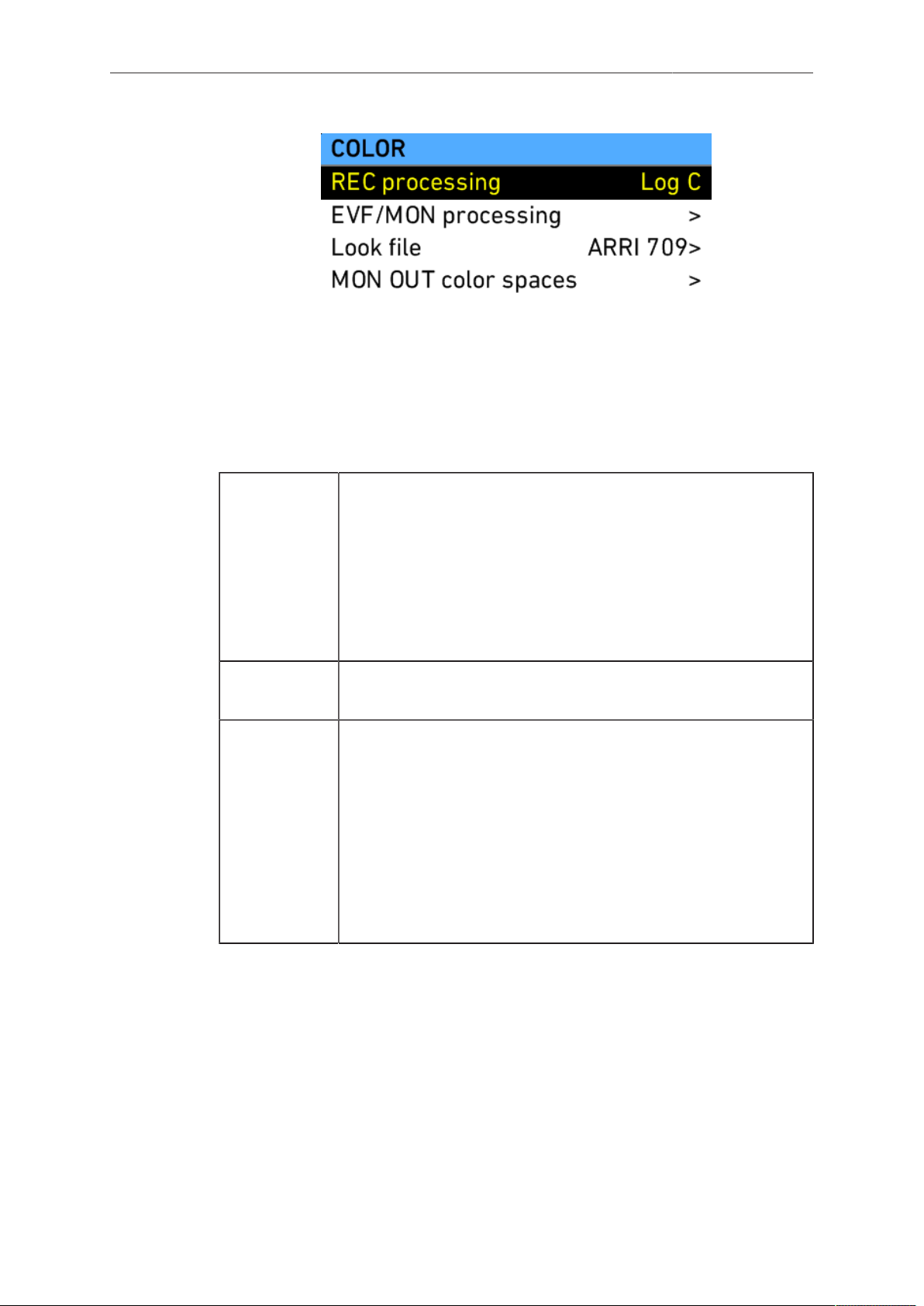
Camera Controls 69
Processing defines the type of processing that is applied to the image path. The
following list describes which image processing settings are available. Note that in
case of ARRIRAW recording, REC processing is always set to ARRIRAW and cannot
be changed.
Log C Log C is a logarithmic gamma based on the Cineon format for
output to film print or digital intermediate. Color-grading is a re-
quired post-production step in the Log C workflow. Standard
broadcast monitors cannot properly display Log C images so a
conversion look up table (LUT) is necessary for display, dailies
and editing proxies. Log C images will appear flat and desaturat-
ed when displayed on standard broadcast monitors. ALEXA pre-
view LUTs can easily be generated using the ARRI LUT Genera-
tor, a web application available on www.arri.com.
Look file The ARRI Look File 2 file that has been selected is applied on
the respective image path.
ALEXA Clas-
sic 709
The ALEXA performs an image processing that is similar to the
behavior of an ALEXA XT or ALEXA Classic with SUP 11.
This setting is mainly useful if a standard REC 709 conform im-
age should be output on the respective image path, but a more
creative ARRI Look File 2 file has been loaded, e.g. for record-
ing.
This setting is not available for internal recording.
Note: For technical reasons, the resulting image has very subtle
differences to selecting the Look file "ALEXA Classic 709" and
setting processing to "Look file".
MON OUT color spaces
The MON OUT color spaces screen allows to configure the color space for MON
OUT 1/2/3. This setting must match the color rendering capabilities of the connected
monitors, otherwise color clipping may occur.
ARRI Look File 2 files
ARRI Look File 2 files are a way for the user to alter the parameters the ALEXA uses
when converting the sensor image data to a video color space. This can be described
as applying a custom "look" to the different image output paths. The ARRI Look File 2
file can be applied directly to the recorded image (destructive workflow), or just to the
monitoring paths and included in the clip as metadata only (non-destructive workflow).
The ALEXA comes with several pre-installed ARRI Look File 2 files, including LCC
709, where LCC stands for Low Contrast Curve and 709 denotes the target color
space. This ARRI Look File 2 file contains a custom tone map curve that creates a
70 Camera Controls
video image with lower contrast compared to the standard REC 709 output. As a
result, the image holds as much dynamic range information as possible, without using
Log C encoding. Highlight and shadow detail that would be lost in the typical REC 709
tone mapping can still be accessed.
ARRI Look Creator, a free application from ARRI, and some third-party applications
can be used to create ARRI Look File 2 files, which can be based on frame grabs
taken with the ALEXA.
To apply an ARRI Look File 2 file:
1. On the HOME screen, press the COLOR button.
2. Select Look file from the menu.
3. Using the jogwheel, select an ARRI Look File 2 file from the list on the LOOK
FILES screen. The default preloaded ARRI Look File 2 is ARRI 709.
4. Press the jogwheel to set the ARRI Look File 2.
5. On the COLOR screen, set the processing to Look file.
NOTICE
If REC gamma is set to Look file, the recorded image on the internal media will be
permanently altered by that ARRI Look File 2 file.
Additional ARRI Look File 2 files can be added to the ALEXA from the SD card. The
ARRI Look File 2 files must be copied into the lookfiles folder on the SD card. The
required folder structure on the SD card can be created via MENU>System>SD
card>Prepare SD card.
To add an ARRI Look File 2 file to the camera:
1. On the HOME screen, press the COLOR button.
2. Select Look file from the menu.
3. Press the ADD button.
4. Using the jogwheel, select an ARRI Look File 2 file from the list on the LOOK
FILES (SD CARD) screen.
5. Press the jogwheel to add the ARRI Look File 2 file. The ARRI Look File 2 file will
be added to the list on the LOOK FILES screen.
To delete an ARRI Look File 2 file from the camera:
1. On the LOOK FILES screen, select an ARRI Look File 2 from the list.
2. Press the DELETE button.
3. Press both new DELETE buttons simultaneously. The ARRI Look File 2 file will be
deleted from the camera but will remain on the SD card.
Playback and ARRI Look File 2 files
During playback, the camera makes a distinction between clips recorded in
ARRIRAW, Log C, or Look processing.
When a clip recorded in ARRIRAW or Log C is played back and an output is
configured for Look processing, the look will be applied to this output. Please note
that this is the currently enabled ARRI Look File 2, as the camera does not take into
account which ARRI Look File 2 was active when the clip was recorded. It is the
responsibility of the user to make sure the correct ARRI Look File 2 is applied during
playback.
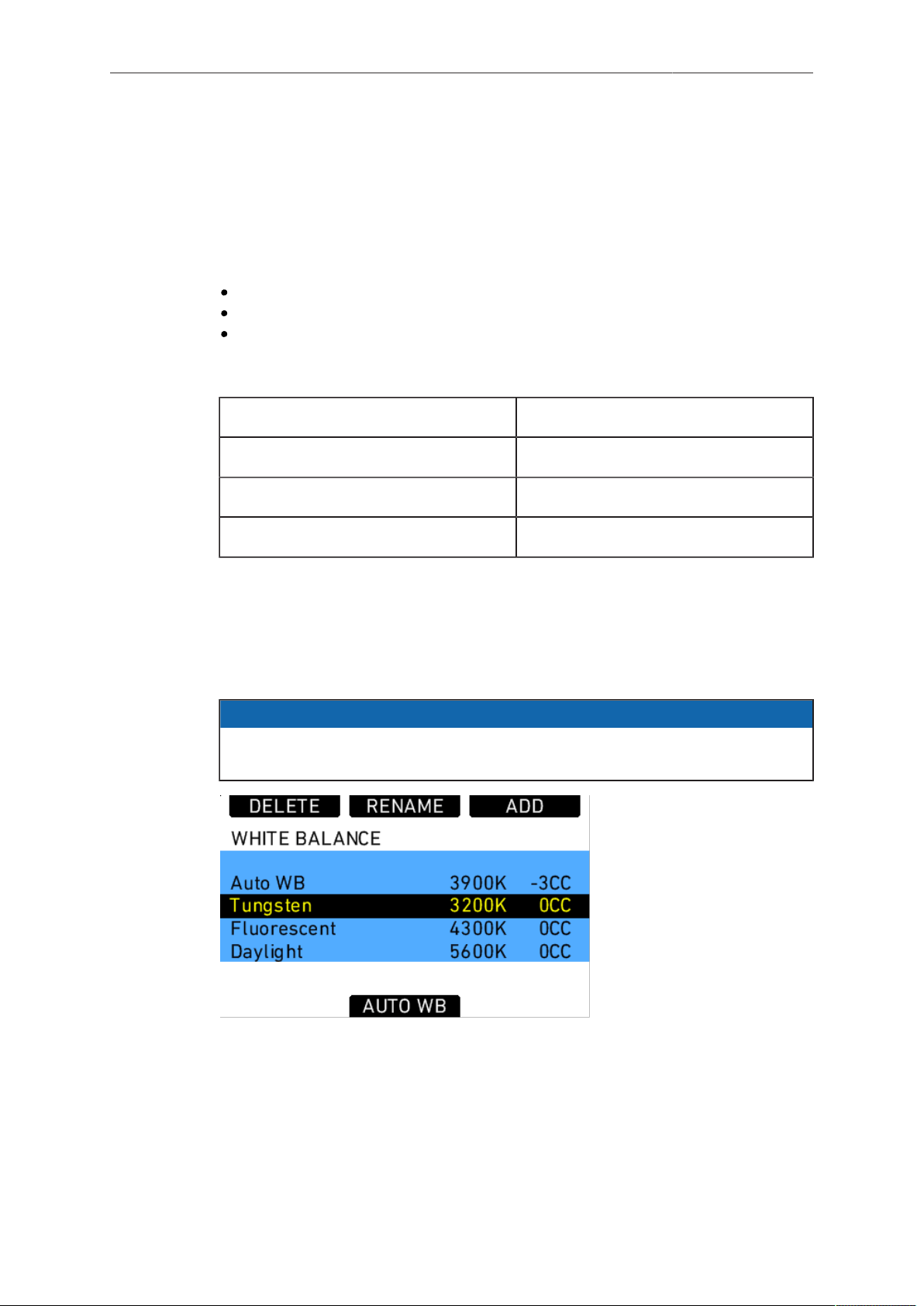
Camera Controls 71
When a clip recorded with Look processing is played back, no ARRI Look File 2 will be
applied by the camera during playback. For the duration of that clip, ARRI Look File 2
files will be disabled.
15.1.3.7 WB
White Balance (WB) is the color balance of the camera that should be set to the value
appropriate for the light in use. There are three methods for setting the white balance:
white balance presets
user-defined white balance
automatic white balance
On the HOME screen, press the WB button to open the WHITE BALANCE screen.
The ALEXA has the following white balance presets:
Tungsten 3200K 0CC
Fluorescent 4300K 0CC
Daylight 5600K 0CC
Daylight Cool 7000K 0CC
White balance is a red-blue adjustment of the image. To adjust the green-magenta
balance, use the color compensating (CC) adjustment.
For example, a fluorescent source will have peaks in its spectrum that cannot be
corrected with the traditional white balance. The CC shift can correct these peaks up
to a full green or full magenta gel. One step of CC SHIFT is equal to 035 Kodak CC
values or 1/8 Rosco values.
NOTICE
When changing the WB setting during recording, one or more frames on the
recorded material may show artifacts resulting from the change.
Fig. 18: WHITE BALANCE screen
ARRI recommends adjusting white balance and color compensation using appropriate
measuring equipment such as a vectorscope with calibrated grey card or a color
meter.
If the desired white balance setting does not appear in the WHITE BALANCE list, a
user-defined white balance can be added.
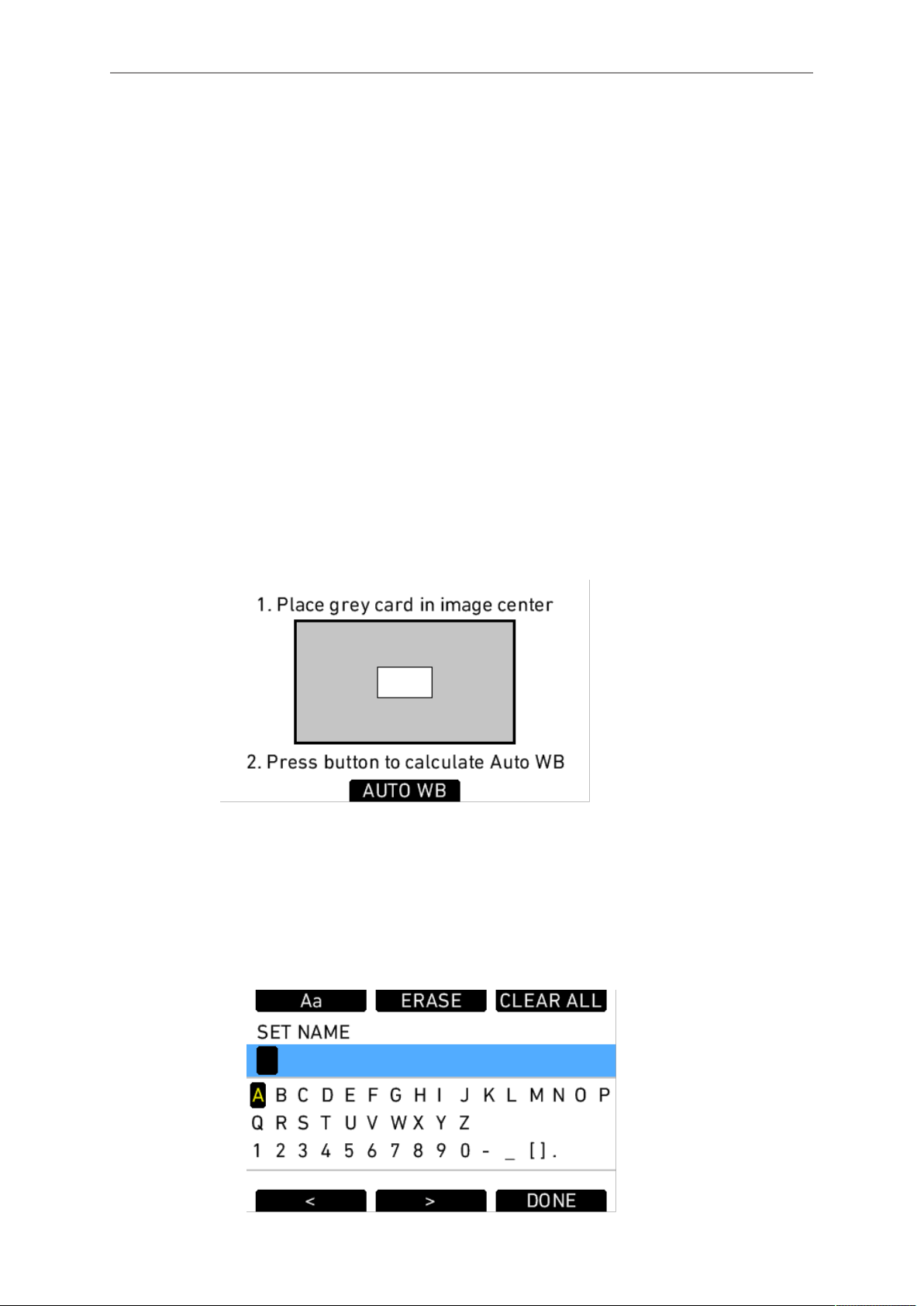
72 Camera Controls
To add a white balance:
1. On the HOME screen, press the WB button.
2. Press the ADD button.
3. Rotate the jogwheel to adjust the white balance value in steps of 100K or press
the + 1000K and – 1000K buttons.
4. Press the jogwheel or <> button to select the CC adjustment.
5. Rotate the jogwheel to adjust the CC value.
6. Press the jogwheel to add the new white balance to the WHITE BALANCE list.
To perform an automatic white balance:
1. On the HOME screen, press the WB button.
2. Press the AUTO WB button.
3. Place a well-lit grey card in the center of the image and press the AUTO WB
button. The ALEXA will calculate the white balance and color compensation values
and set these values for the "Auto WB" entry in the list.
Note: The automatic white balance will be overwritten each time a new one is
calculated.
Note: If the grey card is significantly over- or underexposed, the ALEXA may not be
able to calculate a white balance value and will display an error message.
To rename a white balance:
1. On the HOME screen, press the WB button.
2. Using the jogwheel, select the name of the white balance you wish to rename.
3. Press the RENAME button.
4. Use the jogwheel to enter a new name.
5. Press the DONE button to save the new name.
Fig. 19: WB SET NAME screen
Camera Controls 73
NOTICE
Default white balance values cannot be renamed.
15.1.4 Function Buttons
The main controls feature the following function buttons:
ON/OFF Press once to switch the camera on. Press and hold for 5 sec-
onds to switch off the camera. A countdown will be displayed on
the HOME screen. If the button is released before the countdown
has elapsed, the camera does not switch off.
REC Press to start and stop internal recording.
LOCK Press and hold for 3 seconds to lock or unlock the main cam-
era controls and function buttons. The recessed function buttons
USER, REC and ON/OFF cannot be locked and remain avail-
able. A lock symbol on the HOME screen indicates that the lock
is engaged.
GRAB Press to take a still frame and write it to the SD card. The write
process is indicated by a flashing camera icon, followed by a
flashing SD card icon on the HOME screen. When writing is fin-
ished, a new still frame can be taken.
TC Press to open the TIMECODE screen.
WRS Press to open the Wireless Remote System screen.
PLAY Press to open the playback screen and activate playback on
MON OUT and EVF. When the playback screen is opened, the
last clip on the media will be loaded automatically.
INFO Press to open the LIVE INFO screen. The LIVE INFO screen dis-
plays the camera’s current system state and any current error
messages. On the LIVE INFO screen, there are buttons to ac-
cess the following additional information screens:
VERSION
MEDIA
SYSTEM
SAVE TO SD (press to save a log file)
FPS INFO
USER Press to open the USER BUTTONS screen. There are six user
buttons that can be assigned by the user. Buttons 1, 2 and 3 are
shared with User Buttons 1, 2, and 3 in the operator controls.
Press the jogwheel to see a complete list of user button options.
MENU Press to open the MENU screen, where most camera settings
can be adjusted.
BACK Press to go back to the previous menu or screen when navigat-
ing. Press to cancel settings adjustments and revert to the previ-
ous setting.
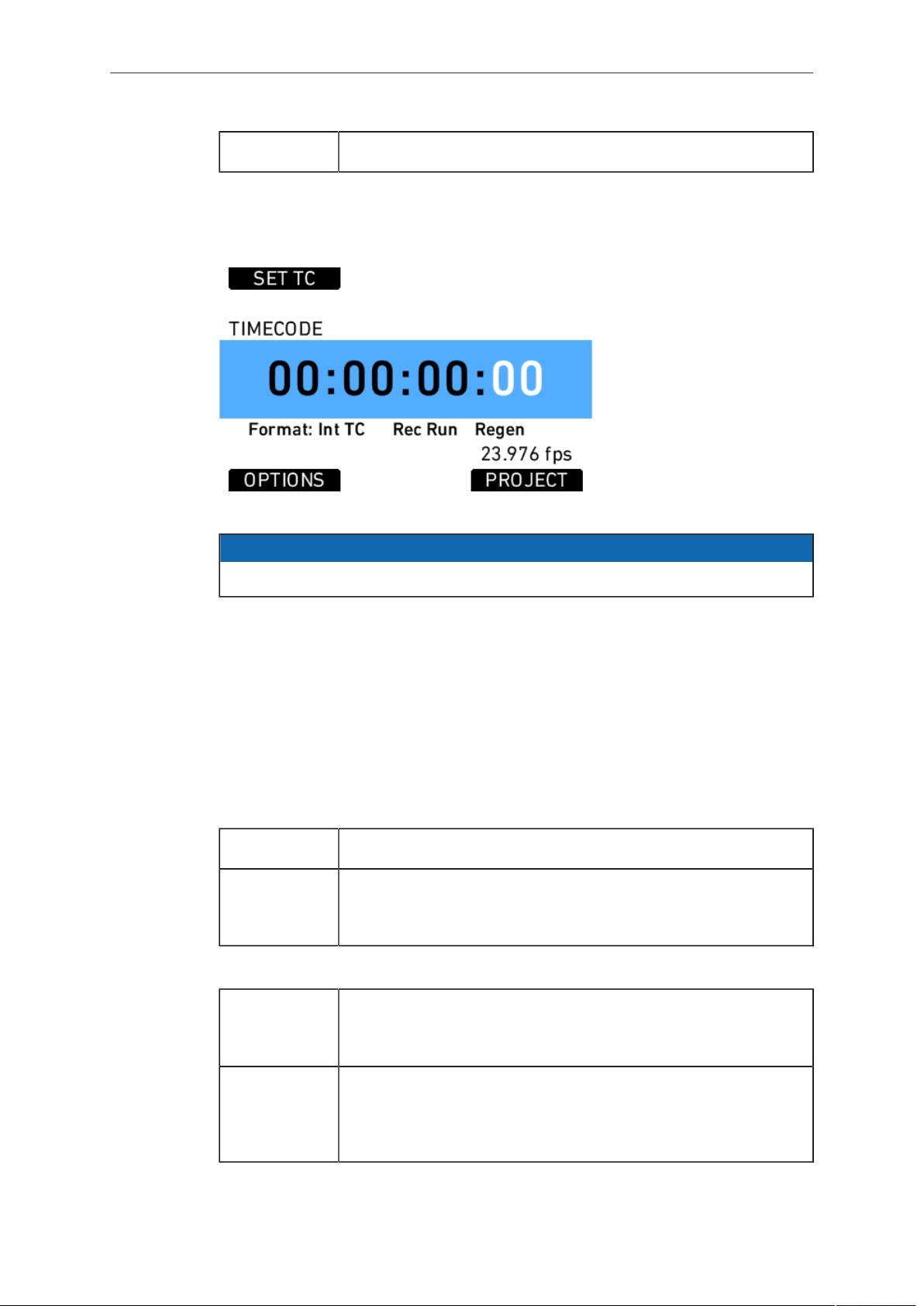
74 Camera Controls
HOME Press to return to the HOME screen from any menu or screen.
15.1.4.1 TC
Press the TC button to open the TIMECODE screen. The TIMECODE screen displays
the current timecode and timecode format settings.
Fig. 20: Timecode screen
NOTICE
Individual frame values are not shown but are still counted.
Press the SET TC button to set the TC counter (only when the timecode source is set
to Int TC). On the SET TIMECODE screen, press the SET 2 TIME button to match
the counter to the camera’s system clock. Press the RESET button to reset counter to
zero.
The PROJECT button is a quick link into the PROJECT menu screen, where project
fps can be adjusted. Project fps sets the time base of the time code.
TIMECODE OPTIONS
Press the OPTIONS button to open the TIME CODE OPTIONS screen.
Select Source to choose the timecode source. Available sources are:
Int TC Internal TC counter
Ext LTC TC is read from the LTC input. Only possible with Mode set to
Free Run, and the project frame rate must match the sensor
frame rate.
Select Mode to define how the timecode is counted. Available modes are:
Rec Run TC will only run while recording. The TC value increases with
every frame generated by the sensor while recording in the
project time base.
Free Run TC runs free. If the source is set to Int TC, and the sensor frame
rate does not match the time base of the TC, the value counts up
with every new frame generated by the sensor in the project time
base.
Select Generator to set the camera’s timecode generator. Available generators are:
Camera Controls 75
Regen Rec Run TC is regenerated from the last valid TC value. When
set to Ext LTC, the camera continuously reads the TC signal
at the LTC connector as long as it is present. Upon disconnec-
tion or loss of signal, the camera continues counting on its own.
When the external signal is reconnected, the camera uses the
values of the external signal again.
When set to Int TC, the value increases with each new frame
generated by the sensor.
Jam sync Only Ext LTC can be jam sync'd. To perform a jam sync, connect
the external TC source to the camera. The camera then reads
the external TC count and continues counting on its own; the ex-
ternal TC source can be removed again. The precise crystal os-
cillator in the ALEXA will count accurately for up to eight hours.
After eight hours, perform another jam sync to prevent timecode
offset.
The camera can be sync'd to TC signals whose time base dif-
fers from the camera's project time base, as long as both are in-
teger (24, 25 and 30 fps) or non-integer (23.976 and 29.97 fps)
signals. It is not possible to mix integer and non-integer signals.
NOTICE
It is recommended to jam-sync after every shooting break to avoid the risk of
losing timecode sync during a shot.
The camera will keep its TC and TC tuning values for about 10 minutes after
disconnection from the power source. If a power source is connected, the
camera will remember its TC for as long as the power source is connected,
even if it is switched off.
NOTICE
The camera will force timecode to Int TC and Regen if the sensor frame rate
does not match the project frame rate.
Non-integer TC time base settings 23.976 and 29.97 are always counted as
non-dropframe time code.
15.1.4.2 INFO
STATUS Info
The STATUS INFO screen displays information about the current state of the camera
system. System state: Good means that all components in the ALEXA are functioning
normally. Other messages can contain error messages prefixed with E:, or warnings
prefixed with W:. For more information about error messages and warnings, see
"Warning and Error Messages" in the Appendix.
Press the SAVE TO SD button to save a system log to the SD card. This may take up
to one minute.
NOTICE
It is only necessary to save a system log if the camera experiences multiple error
messages or other abnormal behavior. The system log is not a human-readable file
and should be sent to an ARRI Camera Service center for analysis.
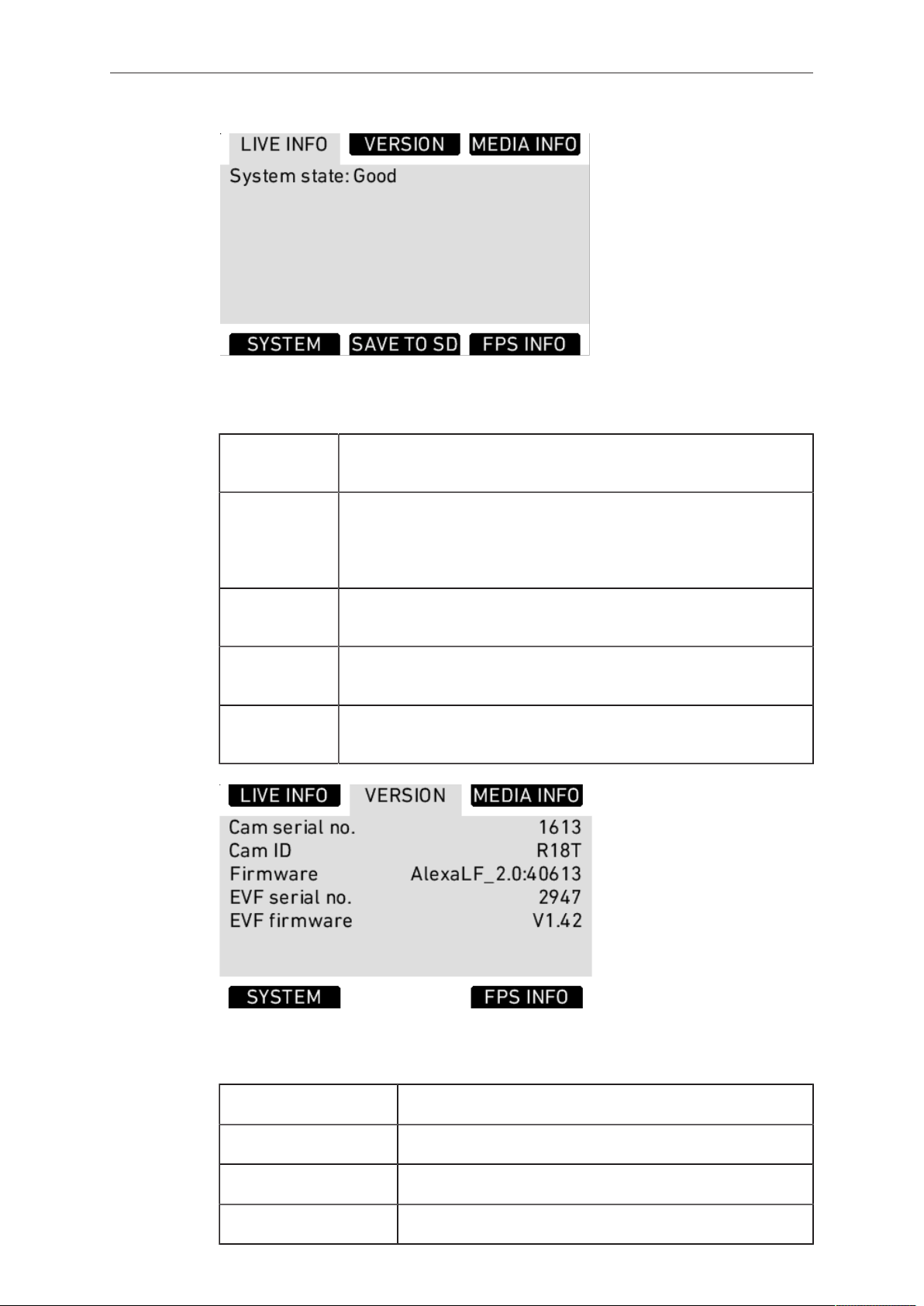
76 Camera Controls
Fig. 21: LIVE info screen
VERSION Info
Cam serial
no.
The serial number of the camera.
Cam ID Translation of the camera serial number to Base36, with an addi-
tional prefix for 3D applications. This encoding of the serial num-
ber has been chosen so it can be part of each filename while us-
ing the fewest number of characters.
Firmware Version number of the currently installed camera Software Up-
date Packet (SUP).
EVF serial
no.
The serial number of the Electronic Viewfinder EVF attached to
the camera.
EVF
firmware
Version number of the Electronic Viewfinder EVF firmware.
Fig. 22: VERSION info screen
MEDIA Info
Int. Rec. Mode Current mode for internal recording.
Adapter type Type of the inserted storage adapter
Status Current status of internal media.
Free capacity Free storage space displayed as a percentage.
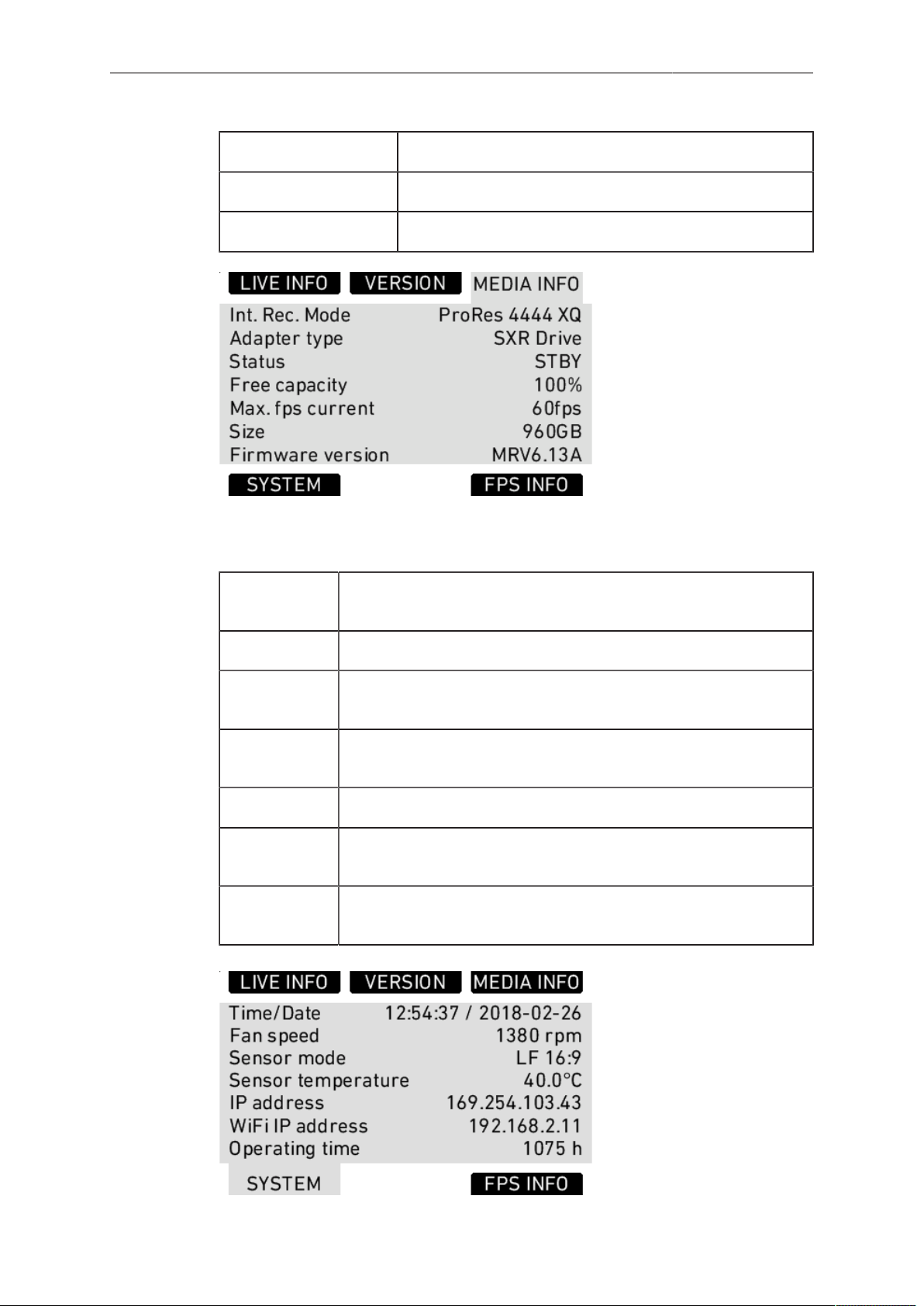
Camera Controls 77
Max. fps current Maximum frame rate with current codec.
Size Total available storage space on media
Firmware version Firmware version of the media
Fig. 23: MEDIA info screen
SYSTEM Info
Time/Date Current date and time. To set the date and time, press the MENU
button, select SYSTEM and select DATE/TIME.
Fan speed Speed of the camera’s cooling fan in rotations per minute.
Sensor
mode
Shows the active sensor mode.
Sensor tem-
perature
Current temperature of image sensor.
IP address IP address of the camera's Ethernet port.
WiFi IP ad-
dress
IP address of the camera's WiFi connection.
Operating
time
Shows the total operating time of the camera in hours
Fig. 24: SYSTEM info screen
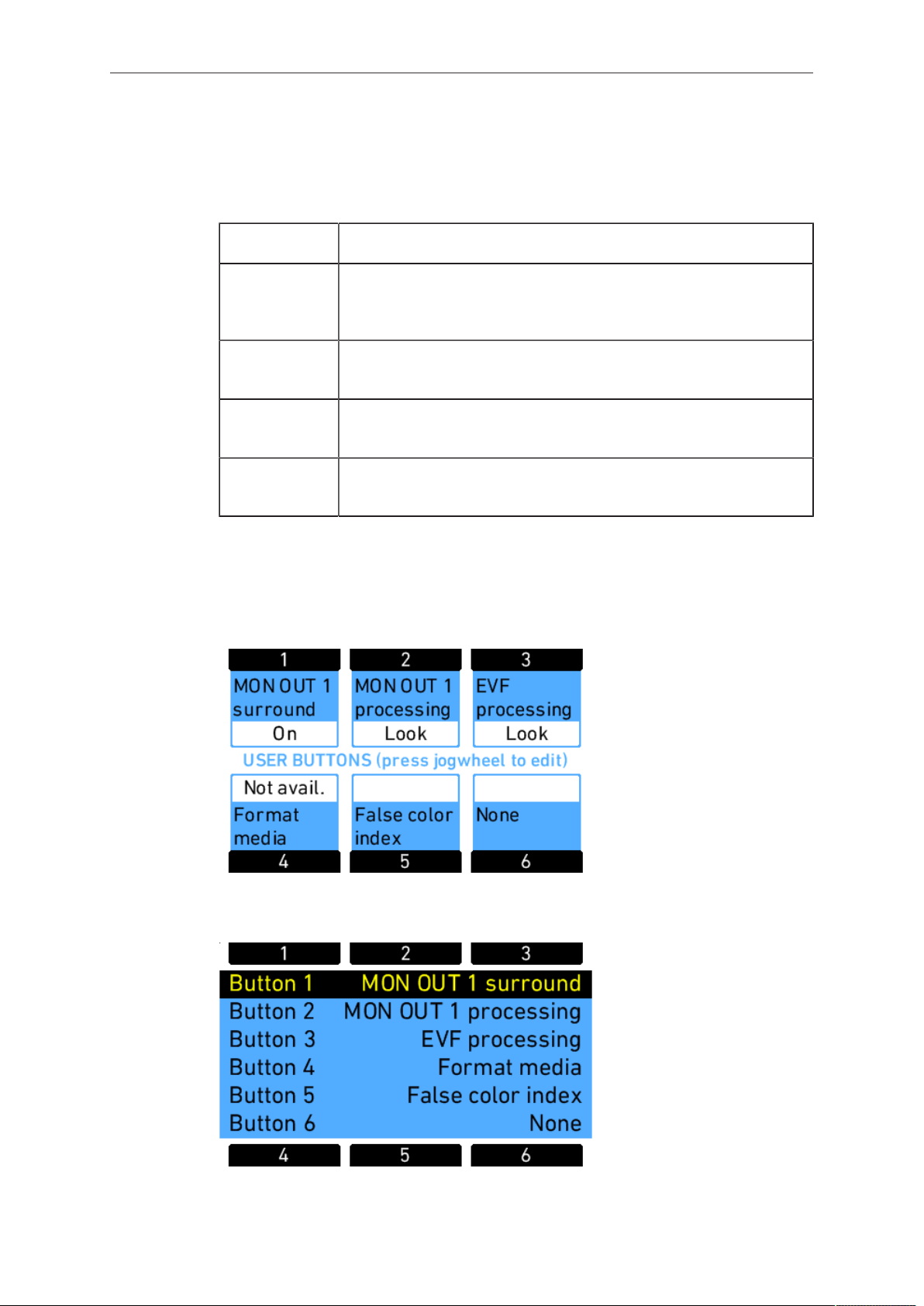
78 Camera Controls
FPS Info
The FPS Info screen displays an overview of the current frame rates set in the camera
and the maximum frame rate possible on the media loaded in the camera at the
current settings.
Sensor fps Frames per second generated by the sensor
Project fps Time base the camera will use for counting timecode and the
frame rate used for on-camera playback of internally recorded
clips
MON OUT 1
frame rate
Frame rate output over the MON OUT 1 HD-SDI
MON OUT 2
frame rate
Frame rate output over the MON OUT 2 HD-SDI
Media max.
fps current
Maximum frame rate the loaded media can record at the current
codec.
15.1.4.3 USER
Press the USER button to open the USER BUTTONS screen. There are six
assignable user buttons. Buttons 1, 2 and 3 are shared with User Buttons 1, 2, and
3 in the operator controls. Press the jogwheel to see a complete list of user button
options.
Fig. 25: USER BUTTONS screen
Assign functions to the buttons by using the jogwheel.
Fig. 26: Edit User Button assignment
The following table lists all available functions and if they can be assigned to user
buttons 1-3 (identical for on-screen and buttons on camera-left side), 4-6, or both:
Camera Controls 79
Name Description 1-3 4-6
None button has no function X X
MON OUT 1 sur-
round
toggles surround view of the MON
OUT 1 on or off
X X
MON OUT 1 process-
ing
toggles processing of MON OUT 1 be-
tween Log C, Look, and ALEXA Clas-
sic 709
X X
MON OUT 1 frame
lines
toggles frame lines on the MON OUT 1
on or off
X X
MON OUT 1 status
info
toggles status info on the MON OUT 1
on or off
X X
MON OUT 1 smart
zoom
When MON OUT 1 zoom is off, switch-
es zoom on.
When MON OUT 1 zoom is on, short
press toggles zoom positions, long
press switches zoom off.
X X
MON OUT 1 zoom toggles zoom on MON OUT 1 on or off X X
MON OUT 1 zoom
pos
toggles zoom position on MON OUT 1 X X
MON OUT 1 false
color
toggles false color display on MON
OUT 1 on or off
X X
MON OUT 1 peaking toggles peaking on MON OUT 1 on or
off
X X
MON 1 desqueeze toggles anamorphic desqueeze on
MON OUT 1 on or off
X X
MON OUT 2 sur-
round
toggles surround view of the MON
OUT 2 on or off
X X
MON OUT 2 process-
ing
toggles processing of MON OUT 2 be-
tween Log C, Look, and ALEXA Clas-
sic 709
X X
MON OUT 2 frame
lines
toggles frame lines on the MON OUT 2
on or off
X X
MON OUT 2 status
info
toggles status info on the MON OUT 2
on or off
X X
MON OUT 2 smart
zoom
When MON OUT 2 zoom is off, switch-
es zoom on.
When MON OUT 2 zoom is on, short
press toggles zoom positions, long
press switches zoom off.
X X
80 Camera Controls
Name Description 1-3 4-6
MON OUT 2 zoom toggles zoom on MON OUT 2 on or off X X
MON OUT 2 zoom
pos
toggles zoom position on MON OUT 2 X X
MON OUT 2 false
color
toggles false color display on MON
OUT 2 on or off
X X
MON OUT 2 peaking toggles peaking on MON OUT 2 on or
off
X X
MON 2 desqueeze toggles anamorphic desqueeze on
MON OUT 2 on or off
X X
MON OUT 3 sur-
round
toggles surround view of the MON
OUT 3 on or off
X X
MON OUT 3 process-
ing
toggles processing of MON OUT 3 be-
tween Log C, Look, and ALEXA Clas-
sic 709
X X
MON OUT 3 frame
lines
toggles frame lines on the MON OUT 3
on or off
X X
MON OUT 3 status
info
toggles status info on the MON OUT 3
on or off
X X
MON OUT 3 smart
zoom
When MON OUT 3 zoom is off, switch-
es zoom on.
When MON OUT 3 zoom is on, short
press toggles zoom positions, long
press switches zoom off.
X X
MON OUT 3 zoom toggles zoom on MON OUT 3 on or off X X
MON OUT 3 zoom
pos
toggles zoom position on MON OUT 3 X X
MON OUT 3 false
color
toggles false color display on MON
OUT 3 on or off
X X
MON OUT 3 peaking toggles peaking on MON OUT 3 on or
off
X X
MON 3 desqueeze toggles anamorphic desqueeze on
MON OUT 3 on or off
X X
EVF surround
1
toggles surround view on the EVF im-
age on or off
X
EVF processing
1
toggles processing of the EVF be-
tween Log C, Look, and ALEXA Clas-
sic 709
X
Camera Controls 81
Name Description 1-3 4-6
EVF frame lines
1
toggles frame lines on the EVF image
on or off
X
EVF status info
1
toggles status info on the EVF image
on or off
X
EVF smart zoom
1
When EVF zoom is off, switches zoom
on.
When EVF zoom is on, short press
toggles zoom positions, long press
switches zoom off.
X
EVF zoom
1
toggles the zoom function on the EVF X
EVF zoom pos
1
toggles zoom position on EVF X
EVF false color
1
toggles false color display on the EVF
on or off
X
EVF peaking
1
toggles peaking on the EVF on or off X
EVF desqueeze
1
toggles anamorphic desqueeze on
EVF on or off
X
Frame lines color toggles the color of frame lines be-
tween White, Red, Green, Blue, Yellow
and Black
X X
Return in active toggles the RET IN signal on or off on
the EVF and MON OUT as set
Scaling of RET IN signal may differ
slightly depending on sensor mode
and sensor frame rate
X X
Phase sensor temporarily shifts the sensor frame rate
for 0.2 fps as long as the user button
is pressed in order to adjust the phase
of the ALEXA frame rate to an exter-
nal device, i.e. a CRT monitor or a rear
screen projector.
Only available in standby and with
timecode in rec run
X X
Color bars activates color bars on MON OUT
1/2/3
X X
Grab still frame takes a still frame and saves it to the
SD card
X
Check last clip start plays the first 5 seconds of the last
clip, then returns to a live image
X
Check last clip end plays the last 5 seconds of the last clip,
then returns to a live image
X
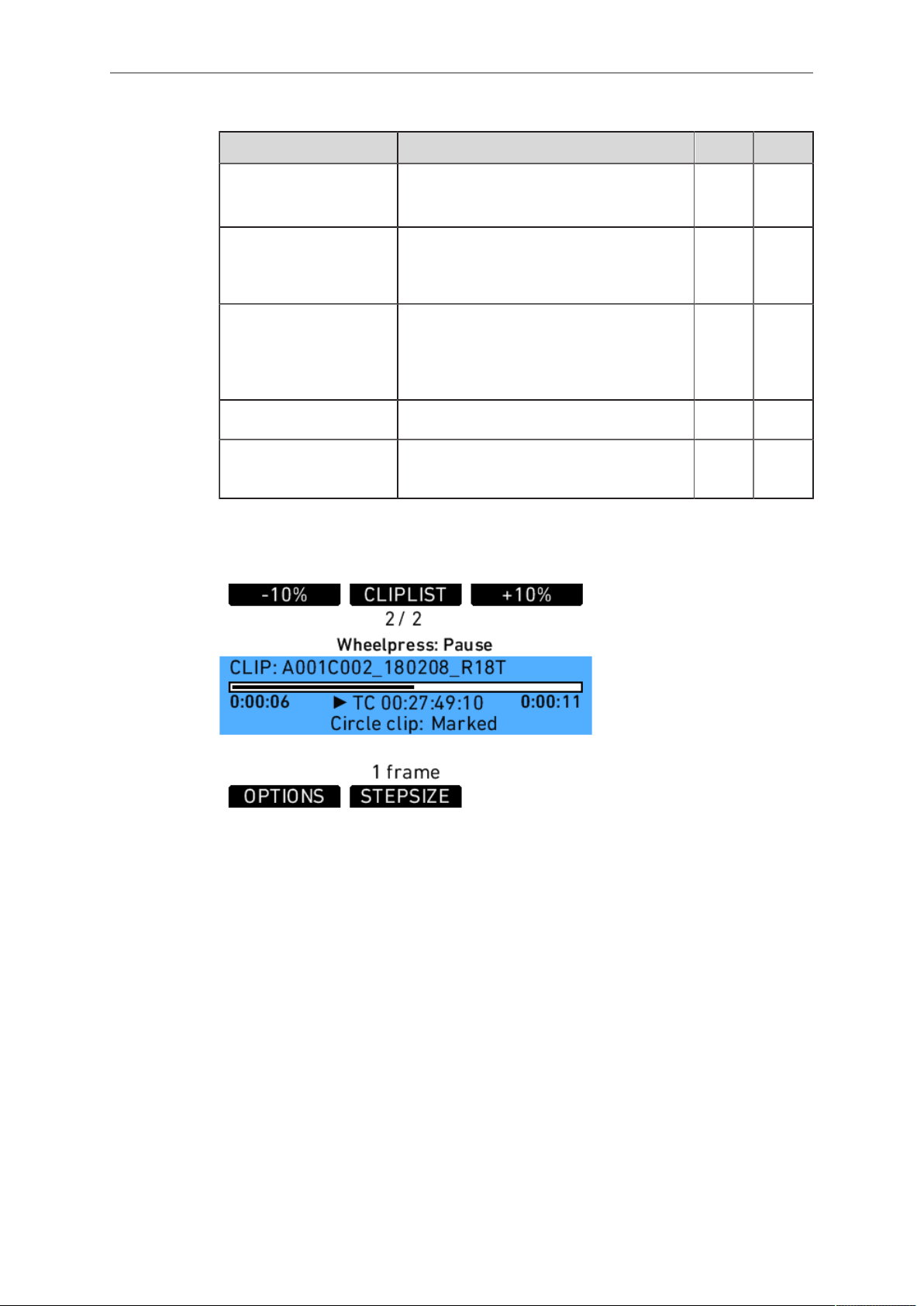
82 Camera Controls
Name Description 1-3 4-6
Circle clip marks the clip as a good take
Only available during recording
X
Auto WB Press once to open the AUTO WB
sceen. Press again to perform an auto-
matic white balance.
X
Grab GUI takes a still image of the current main
camera control screen on the LCD and
saves it to the SD card as a .png file in
the ScreenCaptures folder
X
Format media quick link to the Format media screen X
False color index displays the FALSE COLOR INDEX
screen
X
1
only available with EVF attached
15.1.4.4 PLAY
Fig. 27: PLAY screen
Clips that have been recorded internally can be played back by the camera on the
EVF and all MON OUTs.
To play clips that have been recorded internally:
1. Press the PLAY button.
2. On the PLAY screen, the last recorded clip loads. Press the jogwheel to play the
clip.
3. Press the jogwheel to pause the clip.
4. Rotate the jogwheel to advance the clip frame by frame, or in one second steps.
Press the STEPSIZE button to toggle between seconds and frames.
5. Press the +10% and –10% buttons to advance or rewind the clip by ten percent of
its duration.
6. Press the HOME button or BACK button to exit and output a live image over the
output paths.
Camera Controls 83
NOTICE
Do not eject media during playback.
Recorded clips do not contain the surround view portion of the EVF or MON
OUT 1/2/3 image. When playing back clips, the surround view portion will not
be visible.
Playback of ARRIRAW footage may show a thin black border around the image
that is not part of the recorded material.
PLAY screen buttons
STEPSIZE Toggle the scrub step size between one frame and one second.
+10% Advance the current clip by ten percent of the clip duration.
Does not work when close to the end of a clip.
-10% Rewind the current clip by ten percent of the clip duration.
Does not work when close to the beginning of a clip.
The jogwheel can be used to scrub through the paused clip. The scrub stepsize is
shown in the lower middle section of the screen.
Additional PLAY screen information:
clip name
playback progress bar with current playback position in time and total clip duration
playback timecode
information whether the clip was marked as circle clip during recording
OPTIONS
The OPTIONS screen button opens a list of general playback options.
Clip end action Determines what happens when the end of a clip is
reached. Options are Pause and Loop.
Show frame lines Sets frame lines to On or Off during playback. Center
mark is always switched off during playback.
Status info on MON
OUT 1/2/3
Sets status info overlays on MON OUT during playback
to On or Off.
Peaking on MON
OUT 1/2/3
Determines whether peaking is applied to played back
clips on MON OUT. Unless needed to check focus, we
recommend to leave this option off as it can confuse
others into thinking the peaking indication is a recorded
image artifact.
Peaking on EVF Determines whether peaking is applied to played back
clips on EVF. Unless needed to check focus, we recom-
mend to leave this option off as it can confuse others in-
to thinking the peaking indication is a recorded image
artifact.
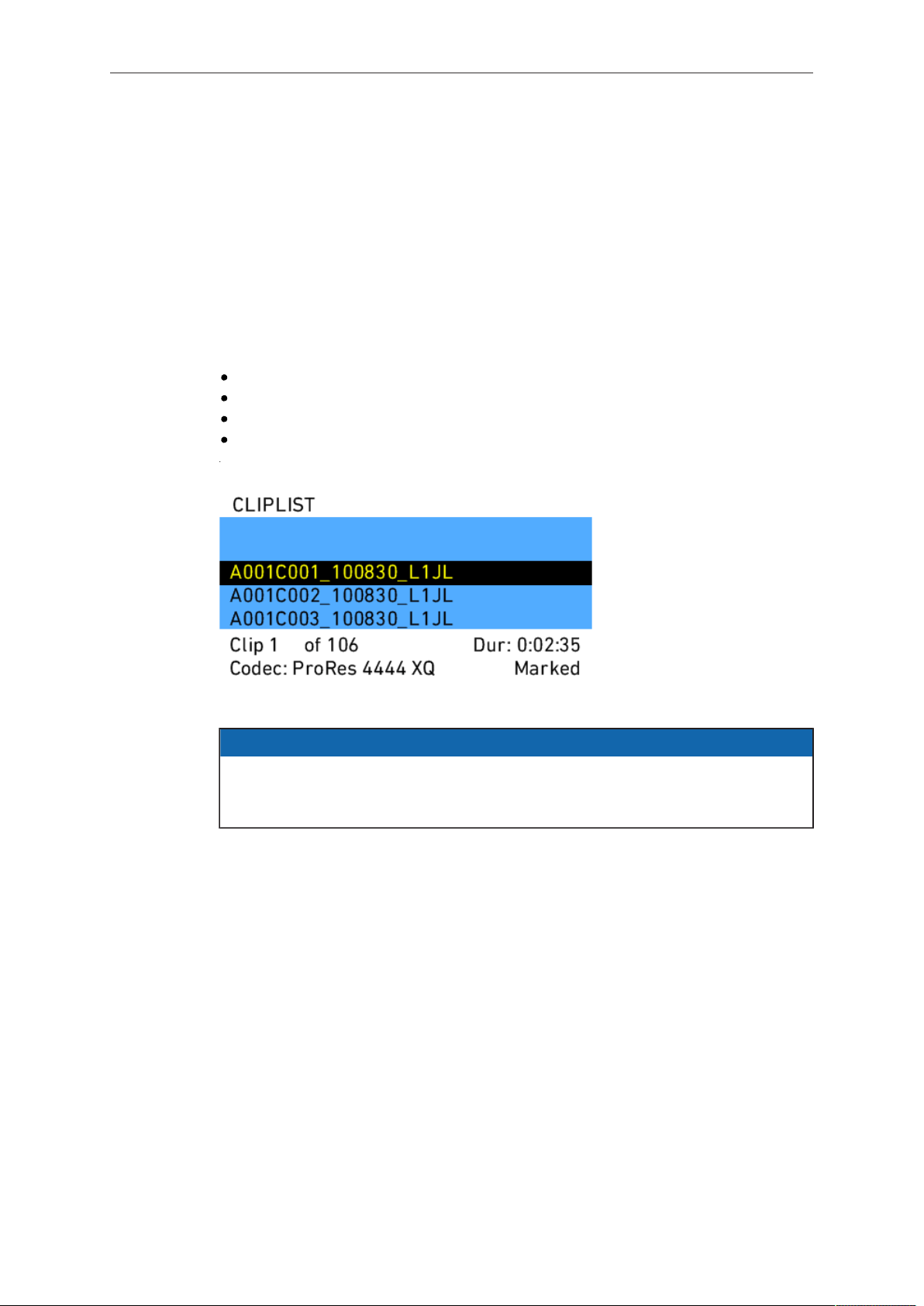
84 Camera Controls
CLIPLIST
Press the CLIPLIST button to open the CLIPLIST screen and access all the clips
recorded internally.
To play a clip from the cliplist:
1. Press the CLIPLIST button.
2. Use the jogwheel to select a clip.
3. Press the jogwheel to load the selected clip.
4. Press the jogwheel to play the selected clip.
Additional CLIPLIST screen information:
number of selected and total number of clips on the media
codec of selected clip
duration of selected clip
circled or not
Fig. 28: CLIPLIST screen
NOTICE
Not all clip formats can be played back in all camera modes. If a clip cannot be
played back in the current camera mode, it appears grayed out. Switch the camera
to the mode that was used for shooting to play back those clips.
When a clip with audio tracks is selected for playback, the audio tracks will be played
back as well. In-camera playback may render a short audio distortion at the beginning
or end of the clip, which is not part of the recorded audio tracks.
Playback and ARRI Look File 2 files
During playback, the camera makes a distinction between clips recorded in
ARRIRAW, Log C, or Look processing.
When a clip recorded in ARRIRAW or Log C is played back and an output is
configured for Look processing, the look will be applied to this output. Please note
that this is the currently enabled ARRI Look File 2, as the camera does not take into
account which ARRI Look File 2 was active when the clip was recorded. It is the
responsibility of the user to make sure the correct ARRI Look File 2 is applied during
playback.
When a clip recorded with Look processing is played back, no ARRI Look File 2 will be
applied by the camera during playback. For the duration of that clip, ARRI Look File 2
files will be disabled.
Camera Controls 85
15.1.4.5 Wireless Remote System
Radio System
The ALEXA LF contains a radio unit that enables wireless lens control, lens data
communication and remote control of basic camera functions. The radio system is
called white radio and it can be identified by a white ring at the base of the antenna
mount point. It offers 8 channels to choose from:
Channel Frequency
0 2.410 GHz
1 2.415 GHz
2 2.430 GHz
3 2.435 GHz
4 2.450 GHz
5 2.455 GHz
6 2.470 GHz
7 2.475 GHz
8 2.420 GHz
9 2.425 GHz
10 2.440 GHz
11 2.445 GHz
12 2.460 GHz
13 2.465 GHz
White radio and legacy yellow radio cannot be mixed in the same radio network of
camera and hand units. It is possible to use both systems in parallel within different
radio networks.
Up to three hand units can be connected to one camera in parallel to form a radio
network.
Setting the region of the wireless function
CAUTION!
Wireless region settings specify where the wireless function can be used in
compliance with local regulations. It may be illegal to use the wireless function
in a region other than specified in the setting. Please ensure that the region is
configured correctly, e. g. when traveling.
► Press the WRS button. Choose RADIO > WRS REGION and select the region.
You have the following options:
Australia
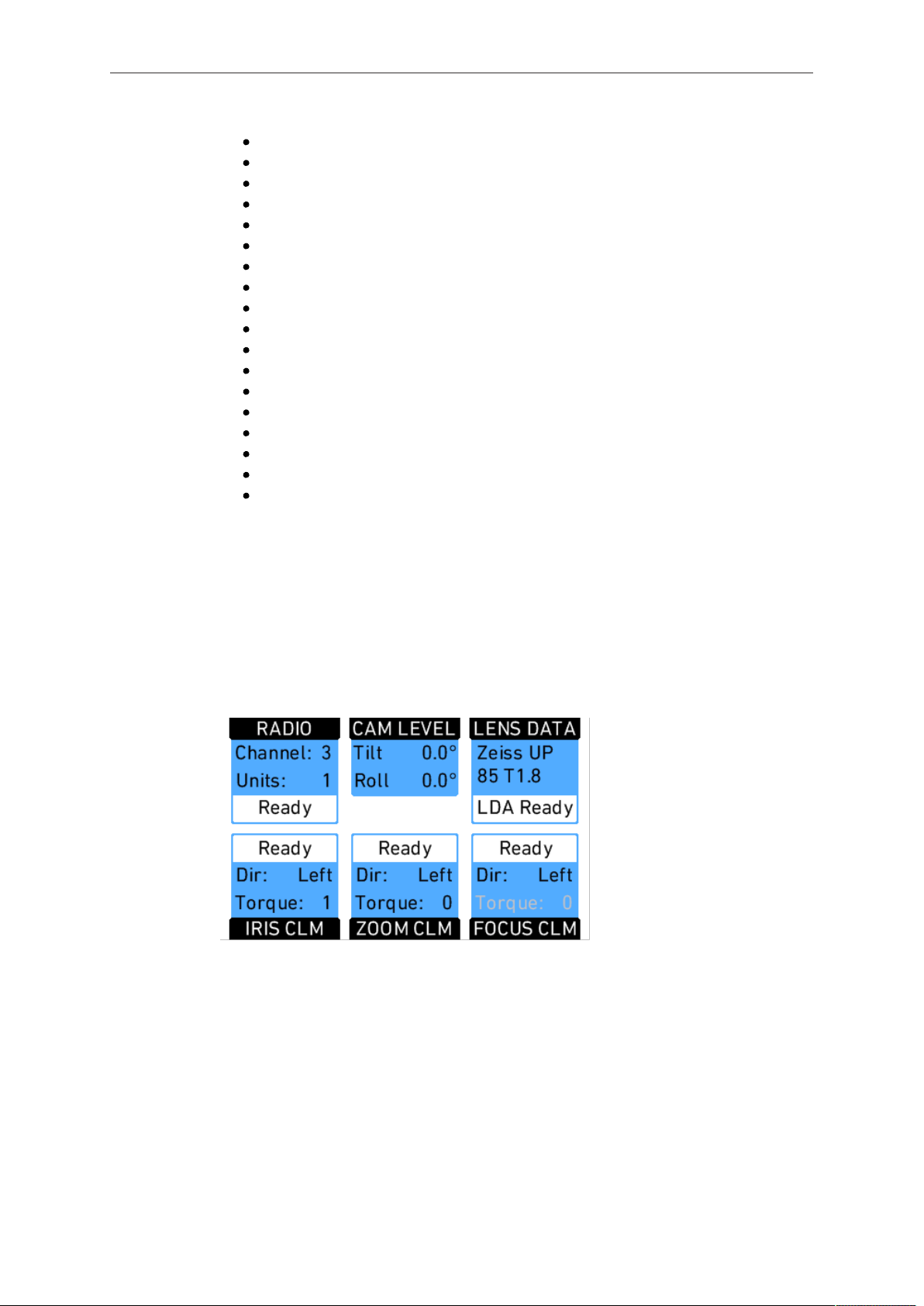
86 Camera Controls
Canada
China
Egypt
Europe
Hong Kong
India
Israel
Japan
New Zealand
Philippines
Singapore
South Africa
South Korea
Taiwan
Thailand
United Arab Emirates
USA
World
In case of doubt please contact ARRI Service to ensure that the region is configured
correctly. Note that all settings fulfill FCC requirements.
Plus Camera Controls
The WRS button gives access to the WRS screen, from where all camera settings
related to the Wireless Remote System can be handled.
The WRS screen gives an overview of radio status, camera level, LDS status, and
CLM status. The screen buttons lead to screens containing more detailed info on
these topics and where settings can be changed.
Fig. 29: WRS screen
RADIO
Shows the currently set radio channel, the number of connected hand units and the
staus of the radio system. Pressing the RADIO button opens a screen where radio
can be set on or off, the channel number can be set, and the WRS region can be set.
When radio is switched on, a small icon appears in the camera HOME screen.
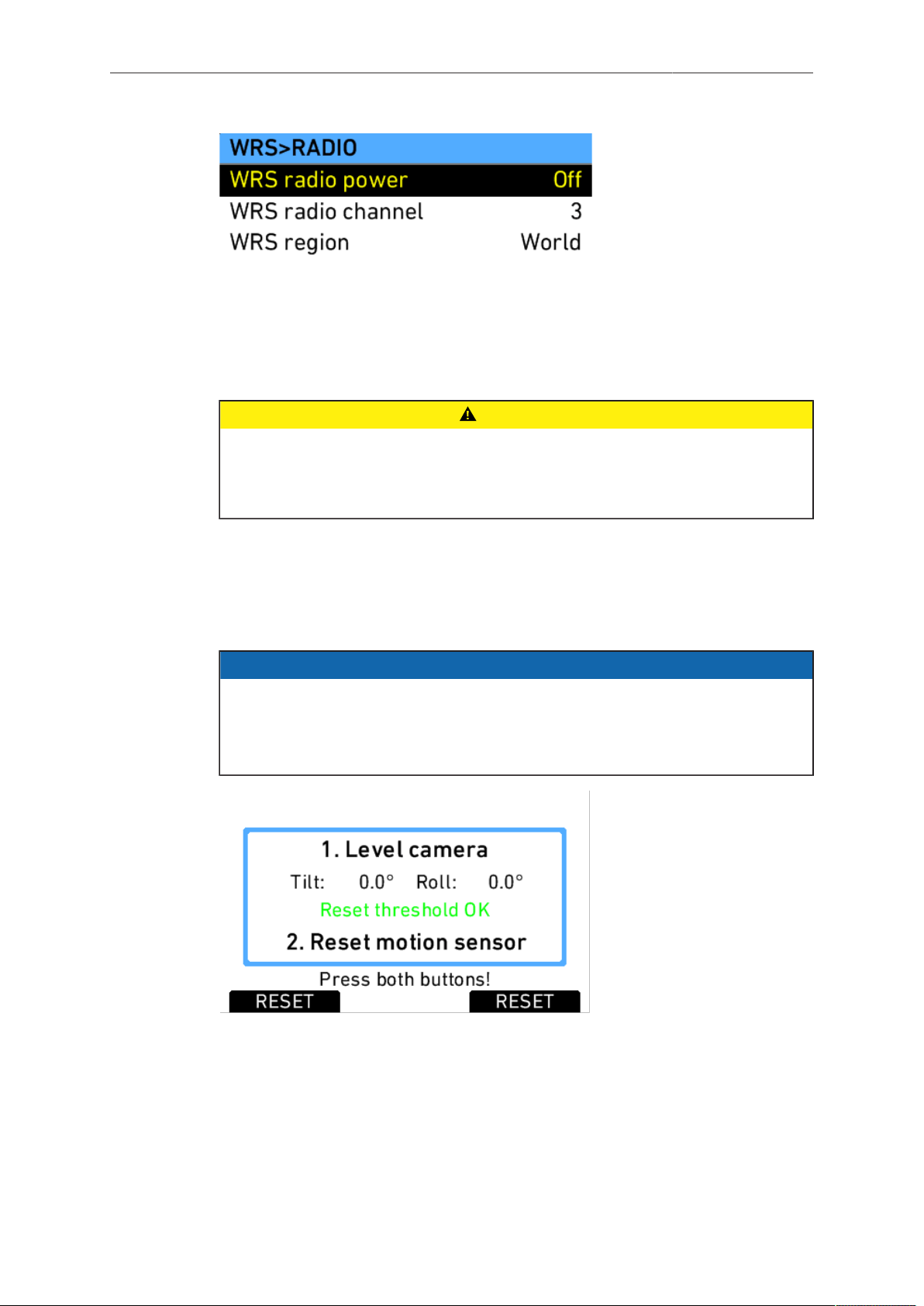
Camera Controls 87
Fig. 30: WRS radio screen
CAUTION!
WRS region settings specify where the wireless function can be used in compliance
with local regulations. It may be illegal to use the wireless function in a region other
than specified in the setting. Please ensure that the region is configured correctly
(e. g. when traveling).
CAM LEVEL
Shows the tilt and roll of the camera in degrees as measured by the camera's position
sensor. This sensor can be reset if it appears to have an offset. Press the CAM LEVEL
screen button to access the reset screen. By pressing the two lower outer screen
buttons simultaneously, the sensor is reset.
NOTICE
The sensor can only be reset while both axis are within a threshold of +/-10
degrees around 0.
For legal reasons, roll and tilt values in recorded metadata are set to a fixed, invalid
value.
Fig. 31: Motion sensor reset screen
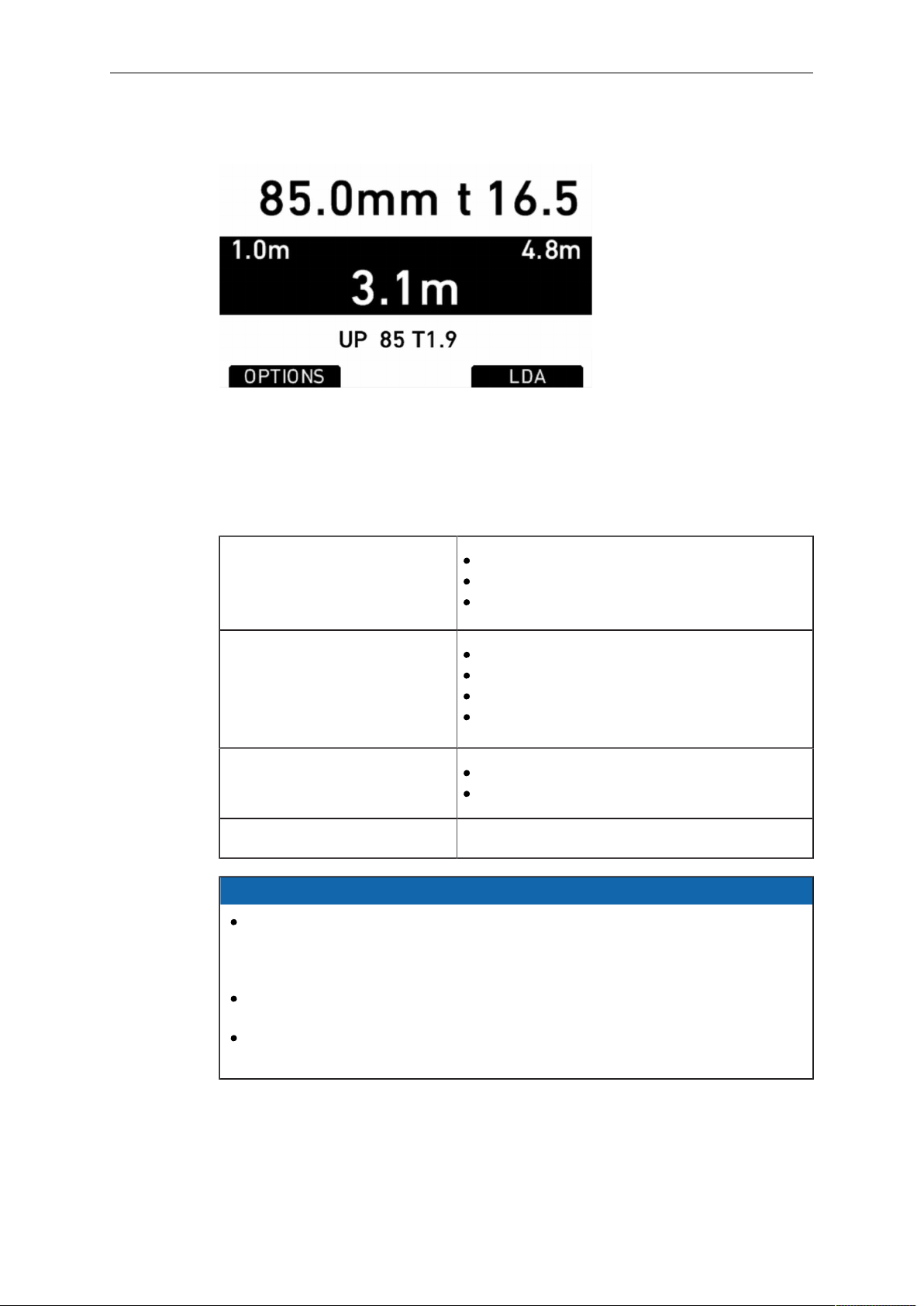
88 Camera Controls
LENS DATA
Fig. 32: LDS info screen
Shows the type of LDS lens connected and the LDS status. The LENS DATA screen
button leads to the LDS screen, where lens type, current focal length, iris, focus
distance and close and far point of depth of field are shown.
The OPTIONS screen button opens the LDS options screen, where the following
parameters can be set:
Lens distance unit
Metric
Imperial
Default unit (as provided by the lens)
Circle of confusion
0.013 mm
0.025 mm
0.035 mm
0.050 mm
LDS mount
On
Off
Lens squeeze factor Link to the Project menu
NOTICE
When setting LDS mount to Off, it is possible to use a lens table from the Lens
Data Archive (see below) with an LDS lens, and ignore data coming from the
lens itself. To re-enable the LDS mount, set the parameter to On, detach the
lens and re-attach it.
After connecting a new LDS lens, turn all lens rings slowly until all lens axes
have transmitted their current positions.
Cooke /i lenses need to have a firmware version of 0.39 or higher to work
properly with the camera.
LDA
When a non-LDS lens is connected, the user can achieve LDS functionality by using
the Lens Data Archive. In the LDS screen, a button labeled LDA appears when a non-
LDS lens is connected.
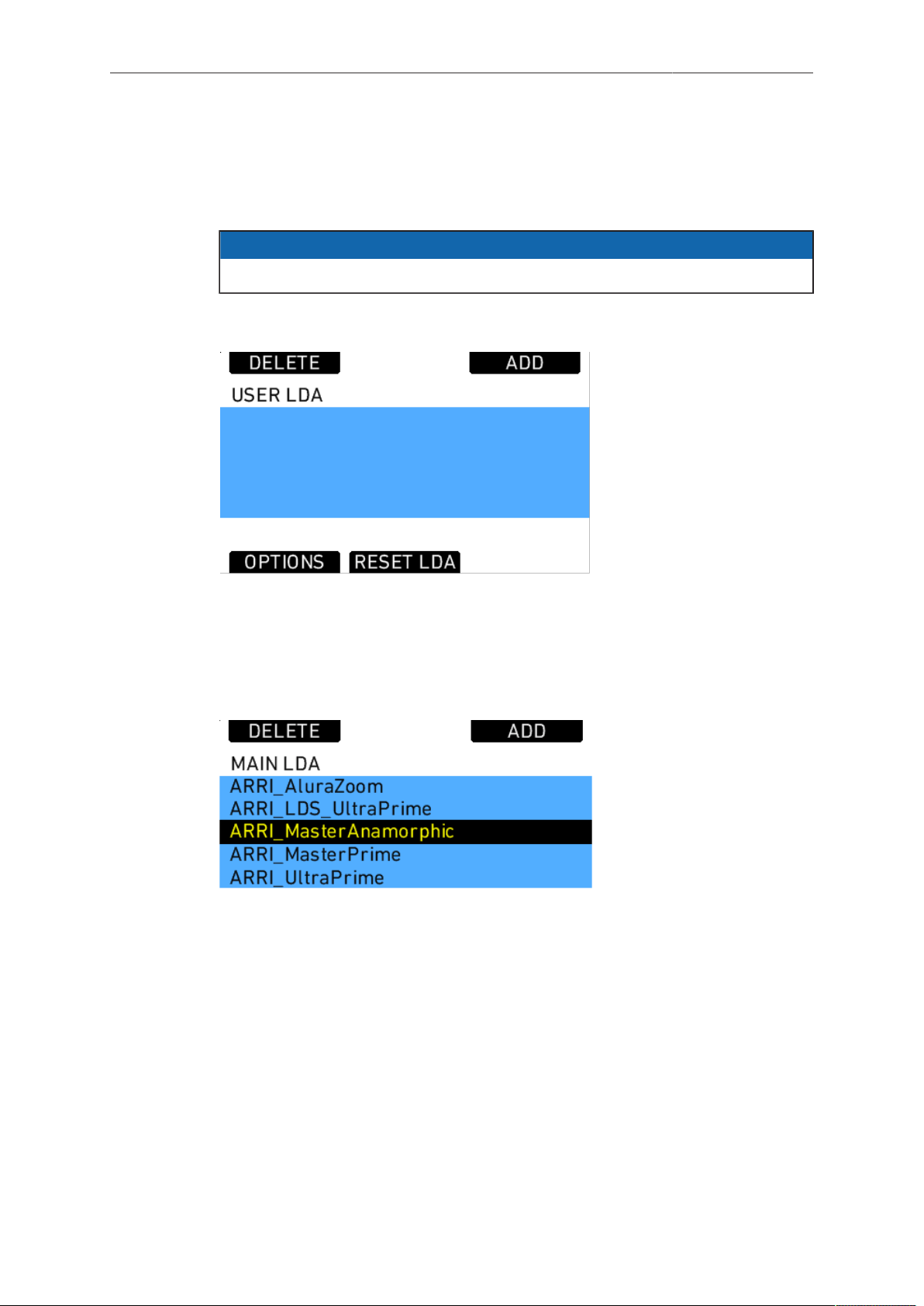
Camera Controls 89
The LDA screen consists of a user list and a main archive list. The user list should
only contain the lenses currently used to achieve quick access to the desired lens
tables. The main archive contains a set of lens tables for ARRI/Zeiss High Speeds
(also known as Super Speeds), Master Primes and Ultra Primes and can be extended
with additional lens tables for any PL-Mount lens.
NOTICE
Custom lens tables may have to be created manually beforehand.
Pressing the LDA button opens the User LDA screen. Select a lens table and press
the wheel. After calibrating the lens motors, the LDS functionality can be used.
Fig. 33: USER LDA screen
To add a lens table from the main archive, access the User LDA screen and press the
ADD button. This opens the MAIN LDA screen. From the main archive, first select a
lens type, then a lens model and then a lens class. The lens class can be found on the
lens barrell below the infinity symbol of the focus scale. Select to add the lens table to
the user list (Press ADD), use it without adding (USE), or both (ADD+USE).
Fig. 34: Main LDA screen
To delete a lens table from the user archive, access the user list and press the
DELETE button. Select the lens table to delete and press the two buttons labelled
DELETE simultaneously.
Custom lens tables can be added to the main archive via the SD card. Place the lens
table on the SD card in a folder named "LDA". Insert the SD card into the camera. Go
to the main archive list and press ADD. Select the desired lens table and press the
wheel. The lens table will be located in the main archive as lens type "Custom".
It is possible to inverse the iris, zoom and focus scales for lens tables if necessary.
Press OPTIONS on the USER LDA screen to access the LDA OPTIONS screen,
where these adjustments can be made.
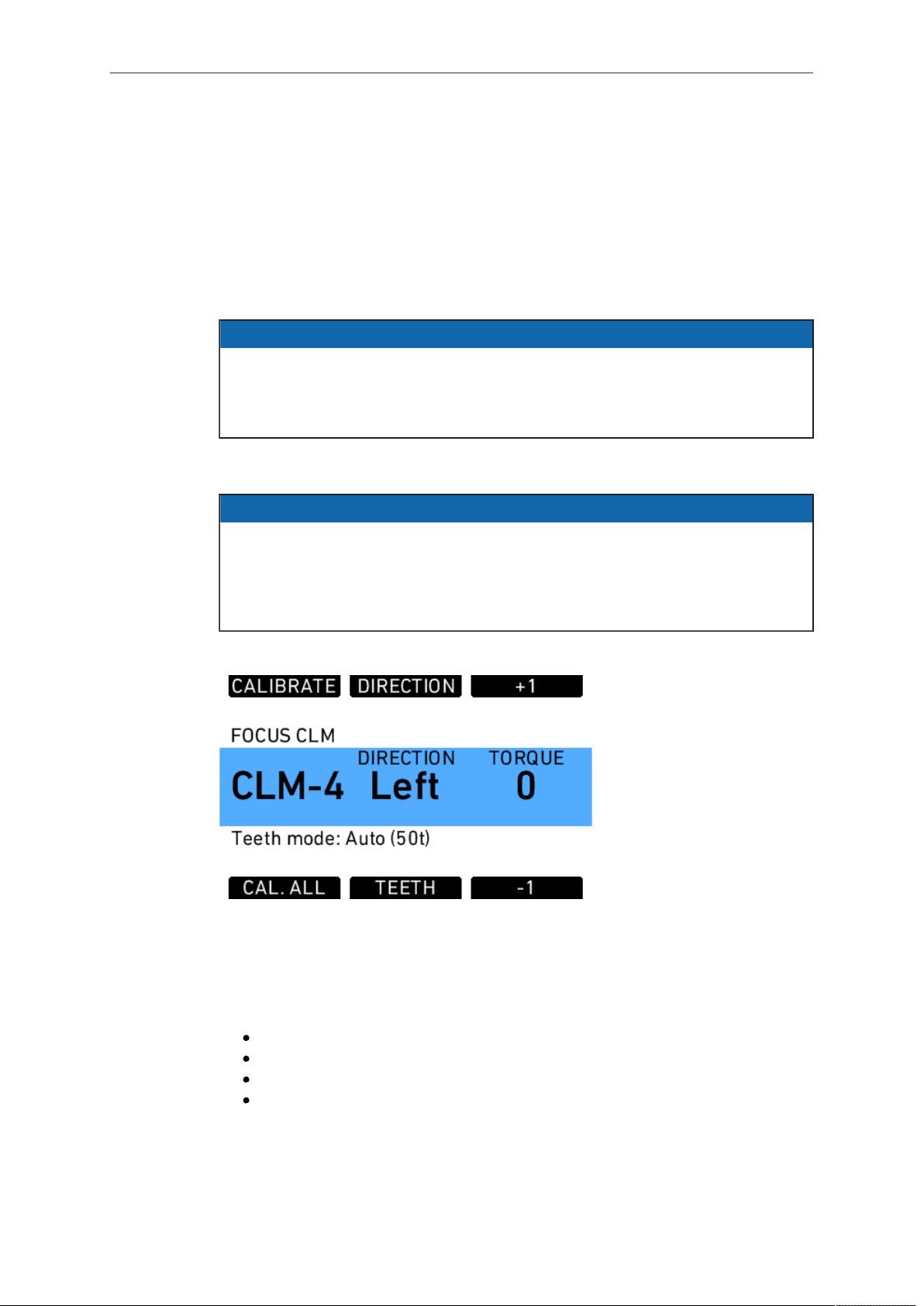
90 Camera Controls
Lenses can also be equipped with the lens data mount LDM. The mount contains a
chip with the lens table stored inside, so the lens transmits its data to the camera as
soon as it is connected. For information on current ring positions, these lenses must
be used in combination with controlled lens motors.
CLM screens
The screens for IRIS, FOCUS and ZOOM controlled lens motors all have the same
layout. They show the motor type, motor direction, motor torque, and motor teeth
count mode.
NOTICE
For CLM-2 motors the torque value is greyed out as torque is only active for CLM-3,
CLM-4, CLM-4 Plus, or CLM-5 motors. It can nonetheless be changed in case a
CLM-3, CLM-4, CLM-4 Plus, or CLM-5 motor might be used but is currently not at
hand.
In addition, a lens motor calibration can be triggered, either for all lens motors, or only
for the one featured in the particular screen.
NOTICE
When starting a motor calibration, make sure each motor's gear wheel is connected
properly to the lens. Pay extra attention that no one is close to the motors or
holding them. Catching a finger, cloth or anything else on the motor's gear wheel
can cause severe body harm as well as damage to the system (and not to mention
hurt like hell).
The image below shows the FOCUS CLM screen:
► Press CALIBRATE to start calibration of the selected motor.
► Press CAL. ALL to start calibration of all motors simultaneously.
► Press DIRECTION to toggle motor direction between Left and Right.
► Press TEETH to toggle motor teeth count between:
Auto (detected teeth count in brackets)
40t
50t
60t
► Press +1 or -1 to adjust motor torque.
Lens Motors
The ALEXA LF supports ARRI CLM-2, CLM-3, CLM-4, and CLM-5 motors and the
LDE-1. CLM-1 motors are not supported. CLM-2, CLM-3, CLM-4, and CLM-5 motors
can be used in a mixed setup.
Camera Controls 91
NOTICE
Use only one lens motor per lens axis.
Lens motors should be connected, according to their position on the lens, to the IRIS,
FOCUS and ZOOM sockets on the camera-right side.
It is also possible to connect LBUS motors like the cforce mini with an LCS-to-LBUS
cable via the LCS connectors at the camera back.
Motor calibration
After connecting a lens motor to the camera and the lens, it must be calibrated. The
lens motor must be recalibrated under the following conditions:
when the lens motor is detached from the lens
after a camera reboot
after changing lenses
after a change in motor position while powered down
NOTICE
Omitting motor calibration might lead to damage of the lens due to the high level of
motor torque.
To calibrate a motor:
1. Press the WRS button.
2. Select a motor by pressing the IRIS CLM, ZOOM CLM or FOCUS CLM button.
3. Press CALIBRATE to start calibration of this motor only, or CAL. ALL to start
calibration of all motors.
Motor direction
The direction of the motors can be set in the ALEXA's menus.
To set the direction of a motor:
1. Press the WRS button.
2. Select the motor by pressing the IRIS CLM, ZOOM CLM or FOCUS CLM button.
3. Press the LEFT or RIGHT button to set the direction of the lens motor.
Motor torque
For all supported motors except for CLM-2 motors, the motor torque can be set in the
ALEXA's menus.
To set the torque on a lens motor:
1. Press the WRS button.
2. Select the lens by pressing the IRIS CLM, ZOOM CLM or FOCUS CLM button.
3. Press the +1 or -1 buttons to increase or decrease the motor's torque. Available
torque settings are 1 to 4, with 1 being the lowest torque level.
NOTICE
Ensure that the motor torque level matches the lens to avoid lens damage.
92 Camera Controls
3D lens sync
When two ALEXA LF cameras are set to Sensor sync EXT master and EXT slave,
the slave camera will switch off its radio module and receive motor control commands
from the master camera over the EXT connection.
NOTICE
Matching of the master and slave cameras' lenses in terms of focus, iris and
zoom ring positions depends on the mechanical accuracy of the lenses. Make
sure the lenses in use are matched as closely as possible. Use only lenses
of the same focus classification to minimize positional errors. Deviating focus
positions of non-matching lenses cannot be compensated.
At higher focus distances, even a very small position error of the lens ring
results in a great difference of indicated focus values. Therefore, even a pair of
matching lenses in a 3D lens sync setup may show different focus values.
Lens Data Encoder LDE-1
The LDE-1 generates lens data in situations when an ALEXA LF is being used without
an LDS lens or an ARRI lens motor. Thus the LDE-1 extends the abilities of the ARRI
Lens Data System to all lenses and cameras setups. The LDE-1 contains an encoder
that delivers lens data to the camera and can be used in parallel with a manual follow
focus unit or a third-party wireless lens control system.
Hand Units
For detailed information of the hand units, please refer to the device's own manuals.
Wireless Compact Unit WCU-4
The WCU-4 is an all-inclusive and yet affordable hand unit offering up to 3-axis lens
control. It includes a newly designed, super-smooth focus knob with adjustable friction
and backlit, optionally pre-marked focus rings that are well readable in the dark
without distracting performers. The whole unit is completely splash proof for ARRI-
typical reliability. The slider has its scale on the 3” display, providing clearly readable
T-stop numbers and optional on-screen markings. If preferred, the slider can be also
set to show zoom scales. With the additional ALEXA Remote license, the WCU-4
shows extended camera status information and allows to change camera parameters
from the remote unit.
Single Axis Unit SXU-1
The Single Axis Unit SXU-1 is a simple single channel hand unit that can be set
up to control focus, iris or zoom. It can be used along the WCU-4 for separate iris
control, perhaps operated by the cinematographer in situations where subtle exposure
adjustments are required during travelling shots.
Master Grips
Master Grips combine effective camera stabilization with flexible and responsive
fingertip control of lens and camera while shooting handheld. They can be connected
to the camera via cable to an LCS port.
Operator Control Unit OCU-1
The compact and lightweight OCU-1 provides flexible control of lens motors and
camera user buttons on ALEXA LF. It can be connected to the camera via cable to an
LCS port.

Camera Controls 93
cmotion pan-bar and steady zoom
cmotions pan-bar and steady zooms are small clamp-on zoom controllers. They can
be connected to the camera via cable to an LCS port.
Zoom Main Unit ZMU-3
The ZMU-3 controls the zoom axis. It can be connected to the camera via cable to
an LCS port, or via cable through an LCS port of an WCU-3, or wirelessly by using a
WZE-3.
Wireless Zoom Extension WZE-3
The WZE-3 is a radio system that enables direct wireless connection of a ZMU-3 and
a camera.
Hand Unit Priorization
Different priority levels are assigned to the hand unit devices to ensure only one
device has control over a motor at a time.
When steering items of the same type are assigned to the same axis, the one
connected via ECS has highest priority, second highest priority has a device cable on
the upper LCS port, the lower LCS port has the lowest priority. Of two radio devices
with the same steering items assigned to the same axis, the one that connects to the
camera first gains control.
Cabled devices can gain control of an axis at the time of connection. Wireless devices
must be rebooted if an axis has become idle before they can gain control.
An exception to the rule are devices on the zoom axis. Here the cabled devices have
the highest priority, with LCS port 1 having priority over LCS port 2.
15.1.5 Menu
The menu contains parameters for basic camera setup. It has a tree structure and the
current path in the menu is displayed across the top of every screen.
Press the MENU button to open the MENU screen. There are six submenus in the
main menu for setting up the ALEXA:
Recording
Monitoring
Project
System
Frame grabs
User setups
Links to submenus can be identified by an arrow bracket character on the right side.
To access a submenu, select the submenu link and press the jogwheel to open the
submenu. Press the BACK button to step back one menu.
Menus also contain parameters with a user choice of values. The parameter name is
displayed on the left side of the menu, and the current value is displayed on the right
side of the menu. To choose a different parameter value, select it with the jogwheel
and press the jogwheel to choose a different value. Press the BACK button to cancel
a choice. When a parameter is displayed in gray, it cannot be chosen with current
camera settings.
Press the HOME button from any menu or submenu to return to the HOME screen.
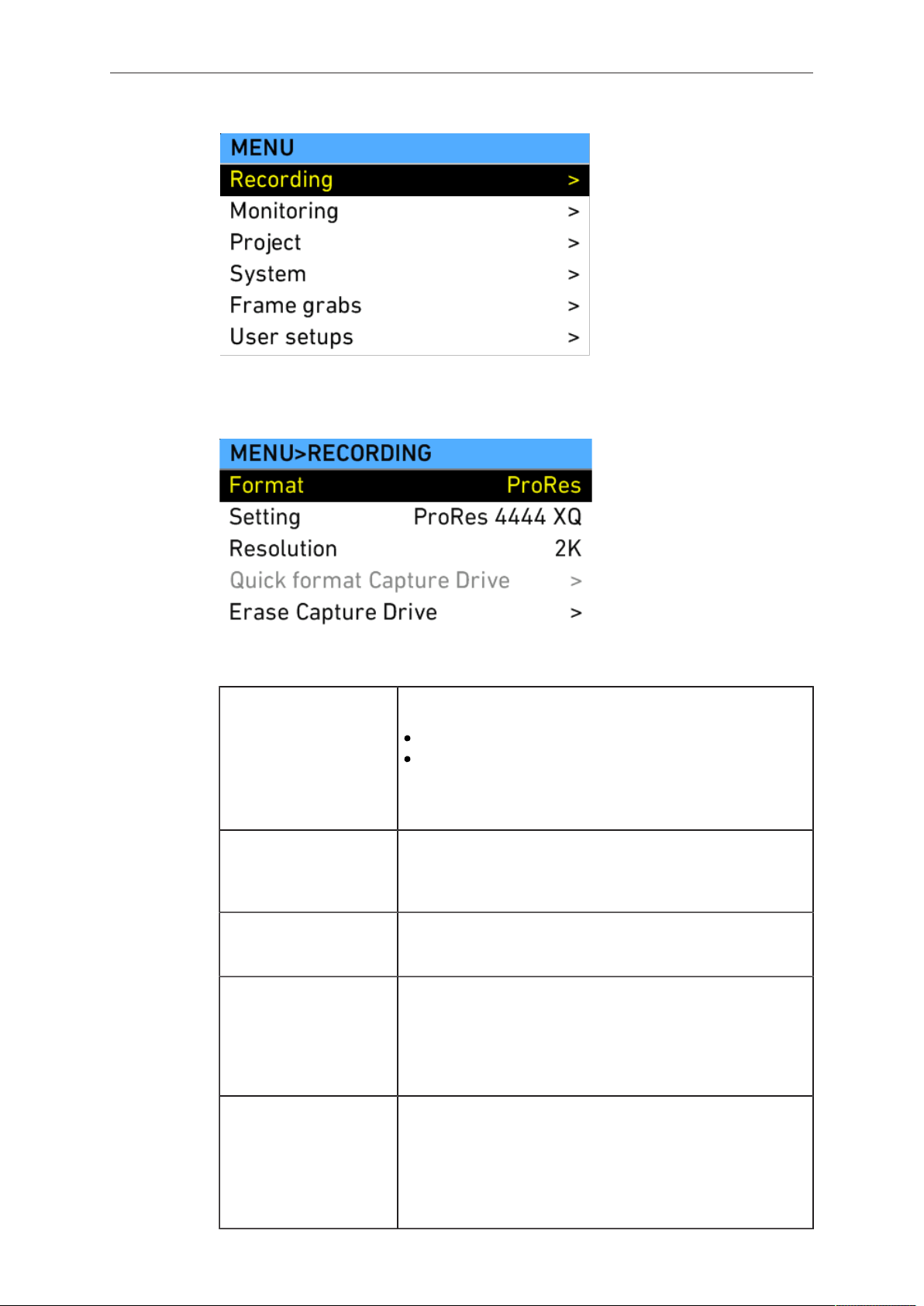
94 Camera Controls
15.1.5.1 Recording
Select the RECORDING submenu to adjust parameters for internal recording.
Format Select for recording options:
ProRes
TM
ARRIRAW
Switching between recording modes takes approximate-
ly 20 seconds.
Setting Select to set the codec:
ProRes 422, ProRes 422 HQ, ProRes 4444, ProRes
4444 XQ
Resolution Select to set the resolution.
See the tables below for available resolutions.
Quick format Capture
Drive/SxS CARD
For Capture Drives
only available in AR-
RIRAW recording
Select to format a SXR Capture Drive or SxS PRO+
card. To complete the action, press both FORMAT but-
tons on the confirmation prompt. A quick format erases
only the file allocation table.
Erase Capture Dri-
ve/SxS CARD
For Capture Dri-
ves only available in
ProRes recording
Select to erase a SXR Capture Drive or SxS PRO+
card. To complete the action, press both ERASE buttons
on the confirmation prompt. This action takes longer
than the quick format, but ensures that all data on the
card is erased. Erasing an SxS PRO+ card can increase
its write speed.
Camera Controls 95
NOTICE
Power loss during formatting of media may lead to irreversible damage to the
media! Please ensure steady power supply before starting formatting.
Before formatting or erasing an SxS PRO+ card, make sure the write-protect
tab on the back edge of the SxS PRO+ card is disengaged. Do not engage or
disengage the write-protect tab while the card is loaded in the SxS slot.
Formatting or erasing media removes all data irreversibly. Follow data
management best practices to prevent loss of data.
If media without a valid file system is loaded in the camera, you will be prompted to
format the media. ARRI recommends immediate formatting of media that trigger this
warning.
Apple ProRes
TM
codecs and resolutions
Apple ProRes
TM
codecs supported by the ALEXA:
ProRes 422
ProRes 422 HQ
ProRes 4444
1
ProRes 4444 XQ
1
1 Without alpha channel (444 only)
ProRes 422 and ProRes 422 HQ have a bit depth of 10, ProRes 4444 and ProRes
4444 XQ have a bit depth of 12.
The following recording resolutions are supported with Apple ProRes
TM
recording:
Sensor Mode Resolution
HD (1920 x 1080)
2K (2048 x 1152)
LF 16:9
4K UHD (3840 x 2160)
LF 2.39:1 4.5K (4448 x 1856)
LF Open Gate 4.5K (4448 x 3096)
ARRIRAW
ARRIRAW recording is possible with SXR Capture Drives. Note that Codex Transfer
Drives cannot be used for recording.
The following recording resolutions are supported with ARRIRAW recording:
Sensor Mode Resolution
LF 16:9 4K UHD (3840 x 2160)
LF 2.39:1 4.5K (4448 x 1856)
LF Open Gate 4.5K (4448 x 3096)
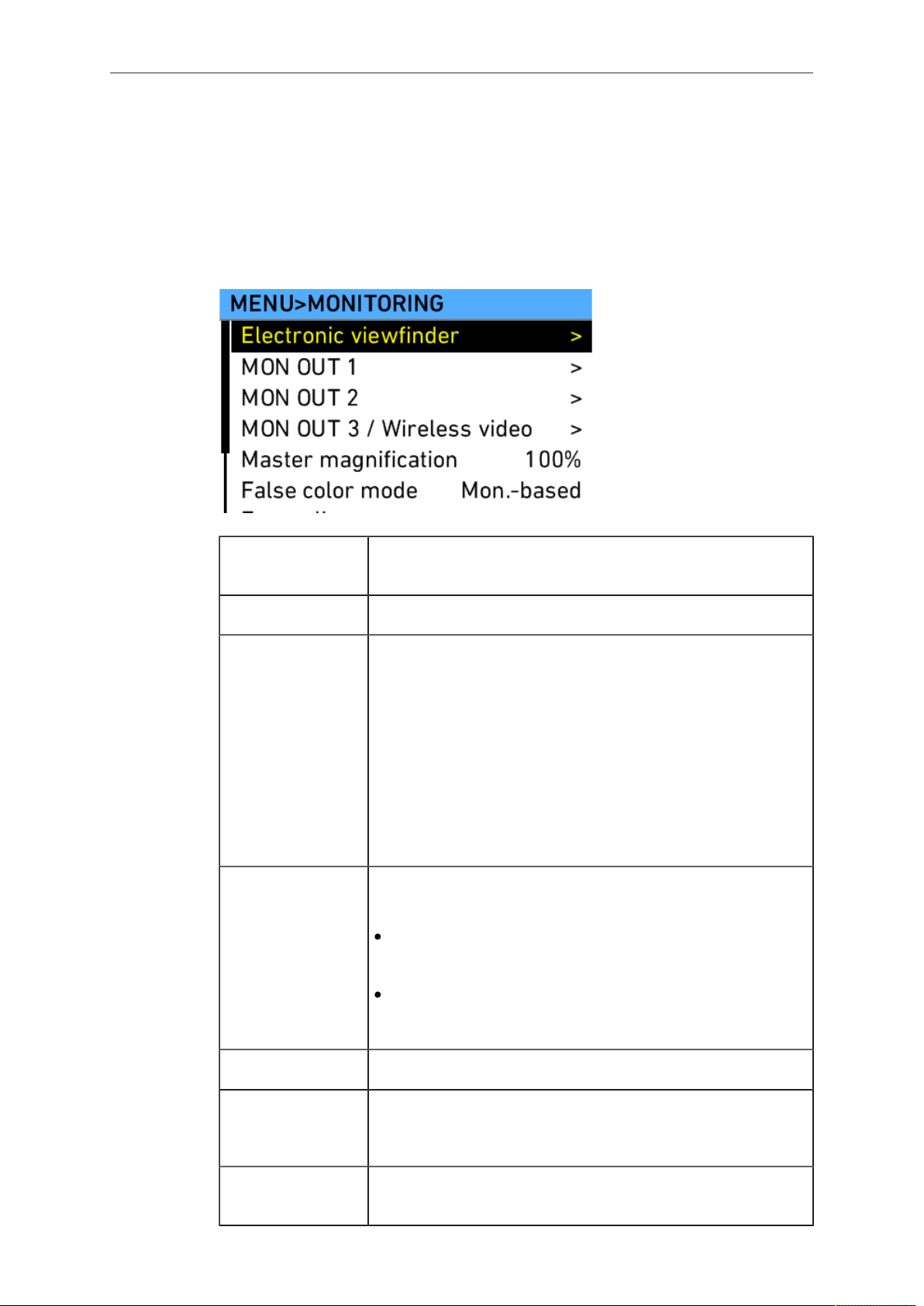
96 Camera Controls
15.1.5.2 Monitoring
Select the Monitoring submenu to adjust parameters for monitoring on the EVF
and the MON OUT 1/2/3 output. These outputs are meant for monitoring and not
recording.
Frame lines set in the Frame lines submenu apply to both MON OUT 1/2/3 and EVF.
Select the Electronic viewfinder and MON OUT 1/2/3 submenus to switch the set
frame lines on or off individually.
Electronic
viewfinder
Select to adjust EVF settings.
MON OUT 1/2/3 Select to adjust MON OUT 1/2/3 settings.
Master magnifi-
cation
Select to set the magnification of EVF and MON OUT 1, 2
and/or 3 simultaneously. Magnification, in contrast to the
temporary ZOOM feature, is a persistent increase in the im-
age size on EVF and MON OUT 1, 2 and/or 3. When individ-
ual outputs have been set to different magnification values,
master magnification shows "-". Changing master magnifica-
tion will force the magnification of all outputs to the new val-
ue.
Note: The camera stores separate magnification values for
each sensor mode, so values that were set once will be re-
stored when returning to a different sensor mode.
False color mode Select to set the false color mode to monitoring-based or
Log C-based.
Monitoring-based: When false color is activated, it is ap-
plied to the video signal as it is configured for the respec-
tive monitoring output.
Log C-based: When false color is activated, the respective
monitoring output is switched to Log C and false color is
applied to the Log C signal.
Frame lines Select to set up frame lines.
RET IN path Select to set which of the monitoring output paths carries the
signal at the RET IN connector as return in active is toggled
via a USER button.
Electronic hori-
zon sensitivity
Select to adjust the sensitivity of the electronic horizon.
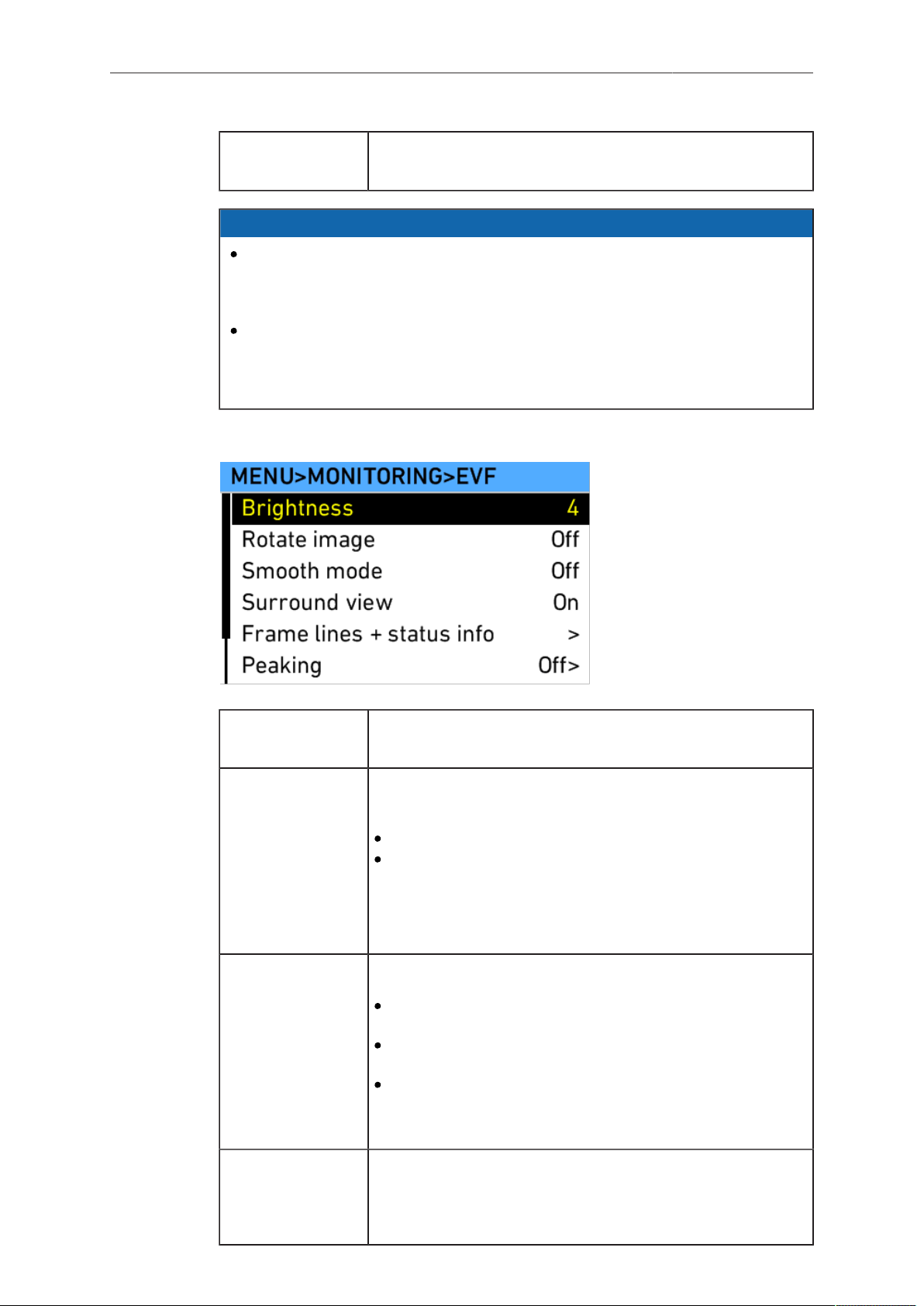
Camera Controls 97
False color index Select to open the FALSE COLOR INDEX screen which has
a reference chart explaining the false color coding.
NOTICE
When activating RET IN with status info on, status info will stay active and
partially overlay the RET IN image. Left, right, top and bottom edges of the RET
IN image are cropped on MON OUT 1/2/3. On EVF, only left and right edges
are cropped. Set status info off to view the full RET IN image.
Because of magnify, zoom or the presence of the LDS info overlay, it is possible
that less of the image is visible in the EVF or on MON OUT than is being
recorded. In that case an orange border will be shown at the frame boundaries
where the recorded image exceeds what is visible.
Electronic Viewfinder
Brightness Select to adjust the brightness of the EVF. With an EVF-2
connected, the brightness is expressed in nits (cd/m
2
).
Gamma Select to set the gamma characteristic (technically the Elec-
tro-Optical Transfer Function or EOTF) of the EVF-2.
Gamma 2: Gamma characteristic optimized for EVF-2
EVF-1: Gamma characteristic similar to EVF-1
Note: Only available with EVF-2 connected.
Note: The gamma characteristic of Return In and Image
Compare is always Gamma 2.
Power Select to set the power mode of EVF-2.
Auto: Automatically switches the EVF-2 on and off based
on the eye sensor in the eye piece
On: Forces the EVF-2 power to always stay on.
Note: This will reduce the lifetime of the EVF-2!
Off: Permanently disable EVF-2 power, e. g. when the eye
sensor is covered
Note: Only available with EVF-2 connected.
Rotate image When mounting the EVF to the right side of the camera, the
image can be rotated by 180° to orient the image correctly in
the viewfinder. Affects only the EVF image, MON OUT 1/2/3
and recording images are not rotated.
98 Camera Controls
Smooth mode Select to set smooth mode On or Off. With smooth mode
on, the EVF image shutters less when panning. The effect is
only noticeable with sensor frame rates of 15 fps or above.
Slightly reduces the image brightness in the EVF.
Note: Smooth mode is only possible with frame rates up to
30 fps and shutter angles of 180.0 or less. If smooth mode is
switched on but not available, the camera issues a warning.
Surround view Select to set surround view on the EVF On or Off. When set
to on, the additional pixels outside the recorded image area
on the ALEXA’s A2X sensor are displayed, allowing the op-
erator to see outside the recorded image and keep unwant-
ed objects, such as microphone booms, out of the shot. To
view only the recorded image, set surround view to off.
Note: Only available in sensor mode LF 16:9
Frame lines +
status info
Select to set frame lines, surround mask, center mark and
status info overlays to On or Off in the EVF.
Peaking Select to set peaking in the EVF to On or Off, and the
strength of peaking to low, medium or high.
Zoom position Select to set the zoom position. Press the ZOOM button on
the EVF to zoom in and press again to zoom out. .
Magnification Select to set the magnification of the EVF image. Magnifica-
tion, in contrast to the temporary ZOOM feature, is a persis-
tent increase in the image size displayed in the EVF.
Note: The camera stores separate magnification values for
each sensor mode, so values that were set once will be re-
stored when returning to a different sensor mode.
Anamorphic
desqueeze
Select to set anamorphic desqueeze to On or Off. The
desqueeze factor can be configured via Menu > Project >
Lens squeeze factor.
Frame lines + status info screen
Frame lines Select to set frame lines to On or Off. Frame lines are a ref-
erence for framing that typically consist of an image frame, a
center mark and an aspect ratio reference. See the appendix
for more information on the ALEXA frame line format.
Surround mask Select to adjust the surround mask settings. If surround view
is set to On, it must be separated from the recorded image
area to allow proper framing. Users can choose:
Black line
Color line
Mask 25%
Mask 50%
Mask 100%
Center mark Select to set the center mark to Off, Small Dot, Medium Dot
or Cross to aid in image framing.
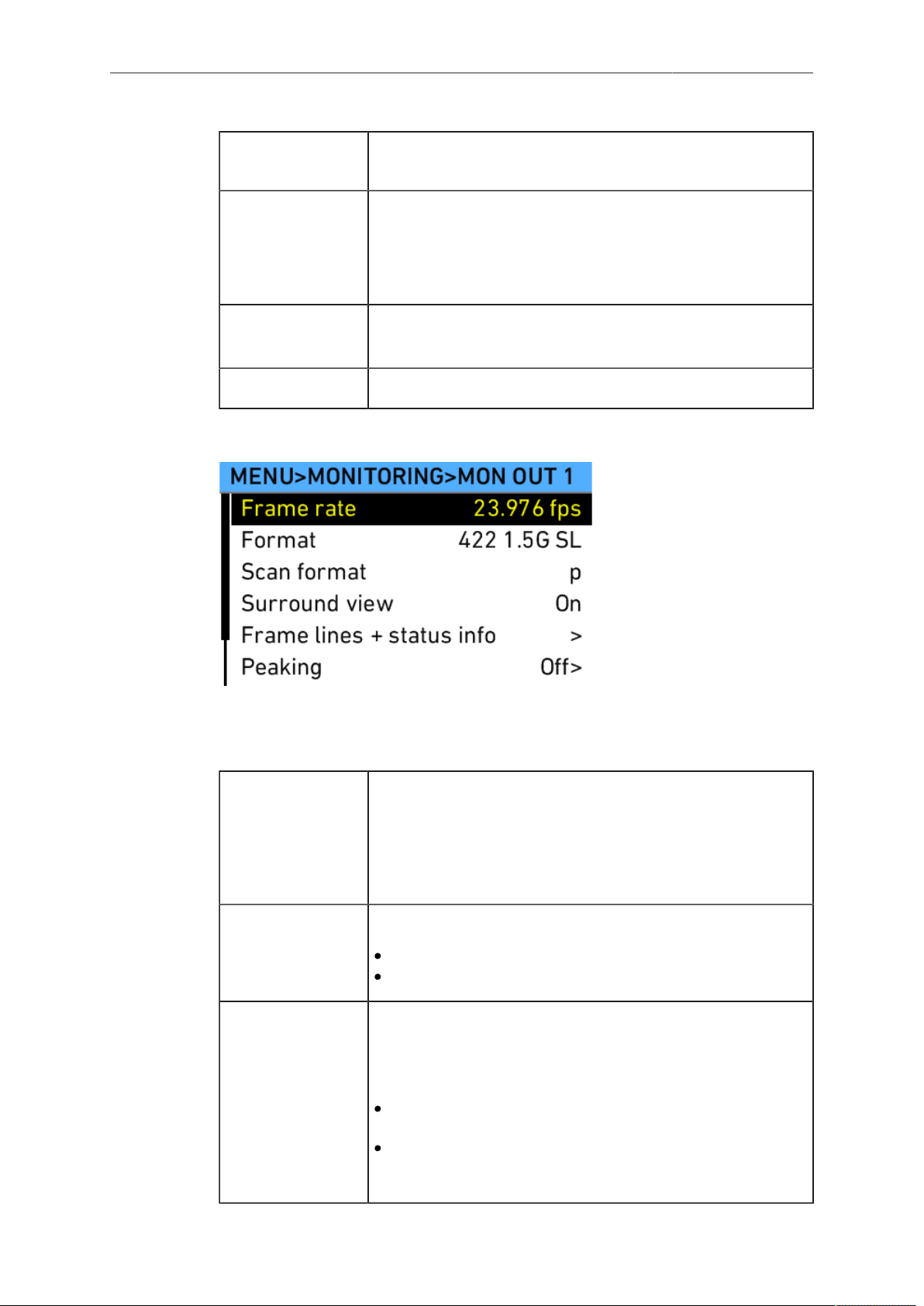
Camera Controls 99
Status info
brightness
Select to adjust the brightness of the status info overlays.
Status info Select to set status info to On or Off. When set to On, cam-
era shooting parameters are displayed across the top of
the EVF-1’s image, outside the active image area and cam-
era status information is displayed across the bottom of the
EVF’s image, outside the active image area.
Electronic hori-
zon
Select to set the electronic horizon level to On or Off.
Note: Brightness is controlled via frame line intensity.
LDS info Select to set the LDS lens information overlay to On or Off.
MON OUT 1/2/3
MON OUT 1, 2 and 3 are single link HD-SDI outputs. The output range is fixed at legal
range. As MON OUT 1, 2 and 3 offer the same set of parameters, only MON OUT 1 is
described in detail.
Frame rate Select to set the MON OUT frame rate to 23.976, 24, 25,
29.97 or 30 fps. The frame rate should, if possible, match
the sensor frame rate to avoid dropped frames or duplicate
frames on the output, which would result in jittery images
during camera movement or when image subjects are mov-
ing.
Format Select to set the SDI format of MON OUT. Available formats:
HD 422 1.5G Single Link
UHD 422 6G Single Link (only MON OUT 1 and 2)
Scan format Select to set the type of scan. Which type you use depends
on the downstream equipment the MON OUT is connected
to. Some monitors, video transmitters or switchers are hap-
pier with the p, others with the psf setting.
p: Progessive. Images are transmitted line by line from left
to right, starting at the top-left pixel.
psf: Progressive segmented frame. Images are first split in-
to fields, which are then transmitted line by line from left to
right.
100 Camera Controls
Surround view Select to set surround view on the MON OUT On or Off.
When set to on, the additional pixels outside the recorded
image area on the ALEXA’s A2X sensor are displayed, al-
lowing the operator to see outside the recorded image and
keep unwanted objects, such as microphone booms, out of
the shot. To view only the recorded image, set surround view
to off.
Note: Only available in sensor mode LF 16:9
Frame lines +
status info
Select to set frame lines, surround mask, center mark and
status info overlays to On or Off on the MON OUT.
Peaking Select to set peaking on the MON OUT to On or Off, and the
strength of peaking to low, medium or high.
False color Select to activate the false color display on the MON OUT.
The false color display is an exposure tool that overlays the
image with color coding to highlight areas with significant lu-
minance values.
Zoom position Select to set the zoom position. Assign a user button to
MON OUT 1/2/3 zoom to toggle zoom on or off.
Magnification Select to set the magnification of the MON OUT 1/2/3 image.
Magnification, in contrast to the temporary ZOOM feature,
is a persistent increase in the image size on MON OUT 1, 2
and/or 3.
Note: The camera stores separate magnification values for
each sensor mode, so values that were set once will be re-
stored when returning to a different sensor mode.
Note: When the MON OUT output format is set to 422 6G SL
(UHD), magnification is fixed to 100%.
Anamorphic
desqueeze
Select to set anamorphic desqueeze to On or Off. The
desqueeze factor can be configured via Menu > Project >
Lens squeeze factor.
NOTICE
Only use double shielded HD-SDI cables for monitoring to ensure error free data
transmission!
The following sensor/SDI frame rate combinations will lead to a non-continuous
motion portrayal on the MON OUT outputs, even though the sensor frame rate is a
multiple of the SDI frame rate (sensor FPS/SDI FPS):
119.880 / 29.97
120.000 / 30
150.000 / 30
Recorded images are not affected.
Frame lines + status info screen
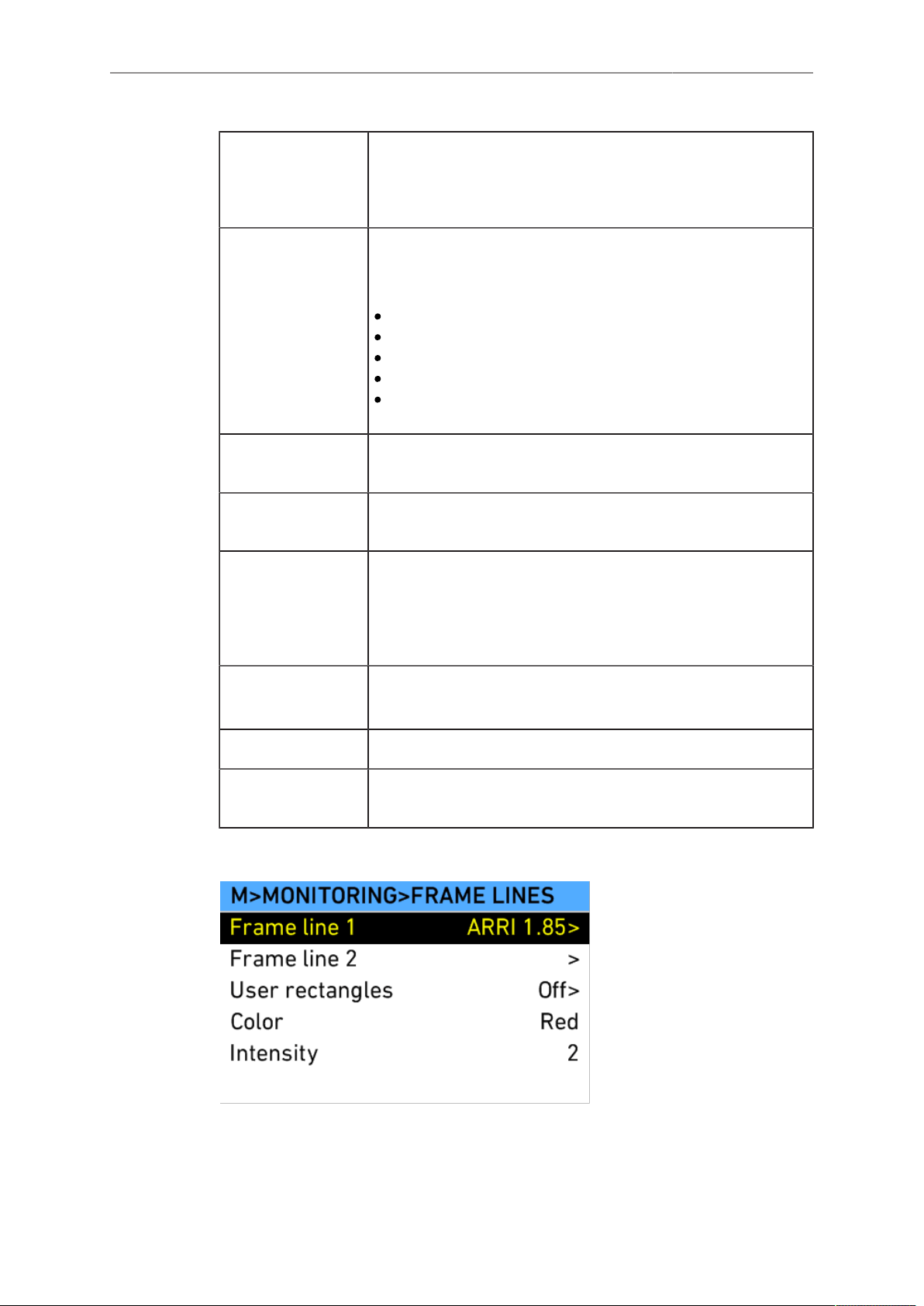
Camera Controls 101
Frame lines Select to set frame lines to On or Off. Frame lines are a ref-
erence for framing that typically consist of an image frame, a
center mark and an aspect ratio reference. See the appendix
for more information on the ALEXA frame line format.
Surround mask Select to adjust the surround mask settings. If surround view
is set to On, it must be separated from the recorded image
area to allow proper framing. Users can choose:
Black line
Color line
Mask 25%
Mask 50%
Mask 100%
Center mark Select to set the center mark to Off, Small Dot, Medium Dot
or Cross to aid in image framing.
Status info
brightness
Select to adjust the brightness of the status info overlays.
Status info Select to set status info to On or Off. When set to On, cam-
era shooting parameters are displayed across the top of the
MON OUT image, outside the active image area and cam-
era status information is displayed across the bottom of the
MON OUT image, outside the active image area.
Electronic hori-
zon
Select to set the electronic horizon level to On or Off.
Note: Brightness is controlled via frame line intensity.
LDS info Select to set the LDS lens information overlay to On or Off.
Camera index
letter
Select to display the camera index letter in the top right cor-
ner of the MON OUT image.
Frame Lines
Frame lines are an image overlay that can be applied to either the EVF image, the
MON OUT image, or both.
ALEXA frame lines are stored as XML files that define the frame lines’ aspect ratio,
marker style, line width, center marker and more. The color of the frame lines is set on
the camera or can be defined within the file.

102 Camera Controls
A standard set of frame lines for different aspect ratios is provided in the camera,
including:
Sensor mode LF 16:9
1.78:1 (ARRI 1.78)
1.78:1 for HD cropping (ARRI 1.78 HD)
*
1.85:1 (ARRI 1.85)
1.85:1 for 2K DCI-compatible cropping (ARRI 1.85 2K DCI)
*
2.00:1 (ARRI 2.00)
2.39:1 (ARRI 2.39)
2.39:1 for 2K DCI-compatible cropping (ARRI 2.39 2K DCI)
*
Super 35 6:5 (ARRI S35 6x5 2.6K Scope 2x)
Super 35 16:9 (ARRI S35 16x9 2.8K)
Super 35 16:9 (ARRI S35 16x9 3.2K)
*
available with 2K recording resolution
Sensor mode LF 2.39:1
1.78:1 (ARRI 1.78)
1.85:1 (ARRI 1.85)
2.00:1 (ARRI 2.00)
2.39:1 (ARRI 2.39)
2.39:1 for 4K DCI-compatible cropping (ARRI 2.39 4K DCI)
Super 35 16:9 (ARRI S35 16x9 2.8K)
Super 35 16:9 (ARRI S35 16x9 3.2K)
Sensor mode LF Open Gate
1.78:1 (ARRI 1.78)
1.78:1 for UHD cropping (ARRI 1.78 UHD)
1.85:1 (ARRI 1.85)
1.85:1 for 4K DCI-compatible cropping (ARRI 1.85 4K DCI)
2.00:1 (ARRI 2.00)
2.39:1 (ARRI 2.39)
2.39:1 for 4K DCI-compatible cropping (ARRI 2.39 4K DCI)
Super 35 3:2 (ARRI S35 3x2 3.4K)
Super 35 6:5 (ARRI S35 6x5 2.6K Scope 2x)
Super 35 16:9 (ARRI S35 16x9 2.8K)
Super 35 16:9 (ARRI S35 16x9 3.2K)
Frame lines starting with "ARRI S35" mark the corresponding sensor area of a Super
35 ALEXA when using standard PL mount lenses with the PL-to-FPL adapter.
To create custom frame lines, use the Frame Line Composer on the ARRI website.
Save the new frame lines as XML files to an SD card formatted on the ALEXA, in the
Frame lines folder. The ALEXA supports up to 16 frame line templates.
To load additional frame lines:
1. In the FRAME LINES menu, select Frame line 1 (or Frame line 2).
2. Press the ADD button.
3. On the FRAME LINES (SD CARD) screen, use the jogwheel to select the frame
line you wish to add.
4. Press the jogwheel to add it to the FRAME LINES list.
Camera Controls 103
5. Using the jogwheel, select the new frame line in the FRAME LINES list.
6. Press the jogwheel to set the new frame line.
Frame line 1 Select to set the primary frame line template.
Frame line 2 Select to set a secondary frame line, if desired.
User rectan-
gles
Select to open the User rectangles menu, where two custom
user rectangle overlays can be adjusted.
Color Select to set the color of the frame lines. In the frame lines defin-
ition file, lines can either be given a fixed color, or they can have
the color specified as "User". If "User" is chosen for a line, the
setting chosen in this menu section is applied to the line.
Intensity Select to set the intensity of the frame lines. The higher the num-
ber, the brighter the frame lines appear.
User rectangles screen
User rectan-
gles
Select to set user rectangles to Off, Rect 1, Rect 2 or Rect 1&2.
The ALEXA can display up to two additional rectangles that can
be adjusted manually.
Set rect 1 Select to set the shape of rectangle 1. Activate it through User
rectangles.
Set rect 2 Select to set the shape of rectangle 2. Activate it through User
rectangles.
The currently active border is highlighted in red on all outputs that have frame lines
enabled while editing user rectangles. Note that it may take some moments for the
highlighting to update when switching between borders.
Frame Lines Saved in Metadata
The ALEXA records up to six rectangular frame lines from the active frame line files
into metadata. This metadata is present in all recording formats and on all HD-SDI
outputs. The frame line metadata can be used either for automatic dailies creation or
for displaying the frame lines in post.
Automated Dailies Creation
It is possible to load two frame line files simultaneously into the camera for a total of
six frame lines displayed in the viewfinder or on MON OUT. In metadata, the frame
lines of the first file will be called frame line 1A, frame line 1B and frame line 1C,
while the frame lines of the second file will be called frame line 2A, frame line 2B and
frame line 2C. Frame line 1A is automatically the master frame line. The master frame
line can be used by dailies creation software to automatically frame the dailies. This
feature is expected first on the Codex Vault, but other dailies creation software is
expected to follow suite.
Frame Lines in Post
The frame line metadata makes the original camera frame lines available during post
production for editing, color grading or compositing tools and can be displayed as an
overlay in the respective image viewer.
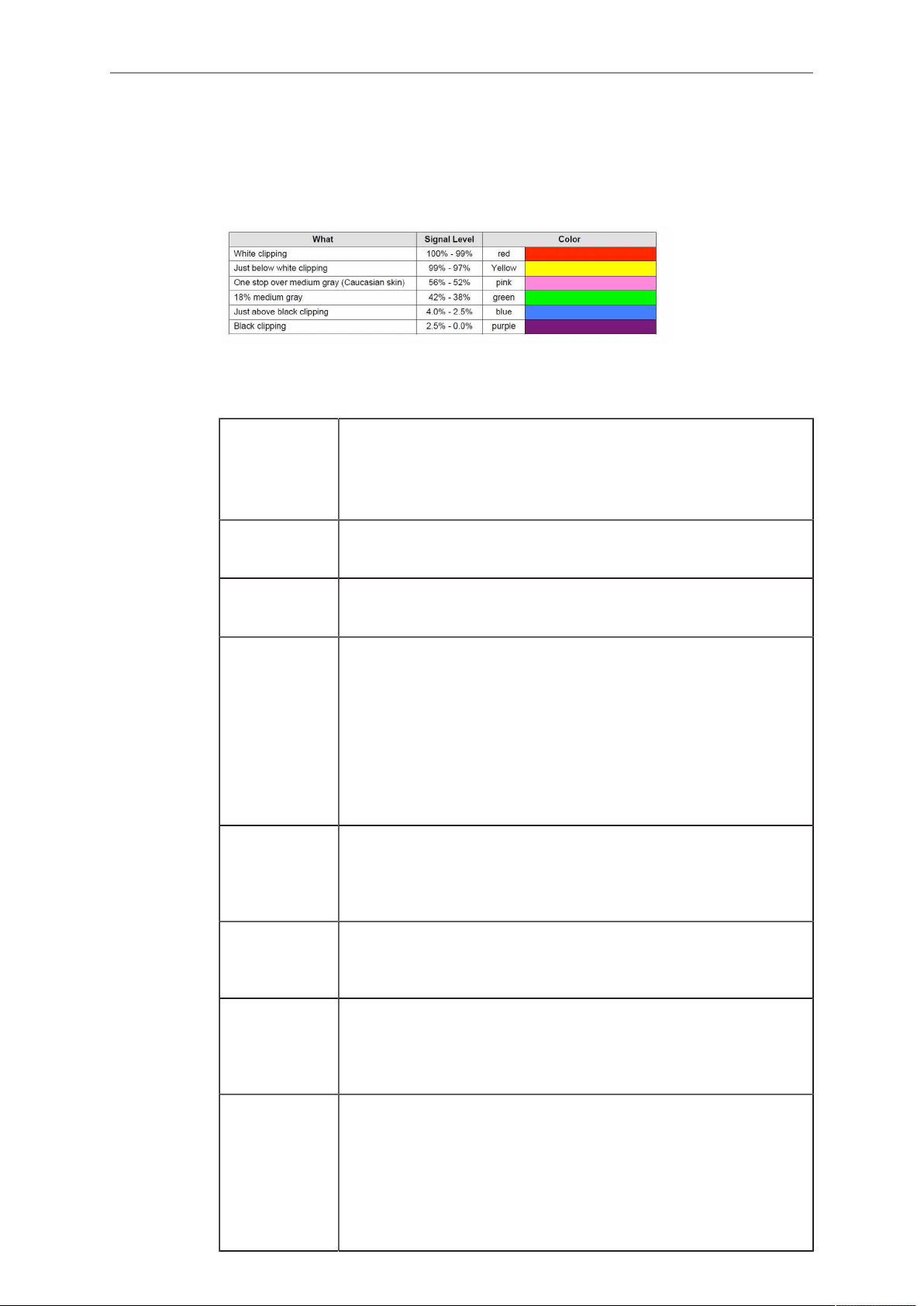
104 Camera Controls
False Color Index
Select False color index to display a reference chart showing the relationship between
the color overlays, signal level in percent and descriptions. False color is available on
the EVF and over the MON OUT outputs.
Fig. 35: False Color Encoding
15.1.5.3 Project
Sensor
mode
Select to set which sensor mode is active: LF 16:9, LF 2.39:1, or
LF Open Gate.
Note: When changing the sensor mode, the camera resets the
recording resolution to the default value.
Resolution Select to set the current recording resolution. Links to
MENU>Recording.
Setting Select to set the current recording codec. Links to
MENU>Recording.
Project
frame rate
Select to set the time code timebase and the playback frame
rate. The time code timebase determines how many frames the
time code counts per second. The playback frame rate deter-
mines the frame rate that clips will be played back at. Changing
the project frame rate will automatically also change the sensor
frame rate and the MON OUT SDI frame rates to the same val-
ue. It is still possible to have different frame rates for these set-
tings by changing the sensor frame rate or the any of the MON
OUT SDI frame rates individually.
Camera in-
dex
Select to set the camera indentifier. Identifies the individual cam-
era unit in clips and is reflected in clip names recorded internally.
This is usually "A" for A-camera unit, "B" for B-camera unit, and
so on.
Camera in-
dex color
Select to set the color of the camera index letter to match the
color coding of your cameras. This color is used when the cam-
era index letter is switched on for MON OUT.
Next reel
count
Select to set the reel number assigned to the next new media
used for internal recording. The ALEXA automatically advances
the reel number every time new media is formatted on the cam-
era. The reel number is reflected in clip names on media.
Lens
squeeze fac-
tor
Select to set the squeeze factor of the lens that is in use. This
value is written into the metadata of the clip and allows video
players and editing software to automatically desqueeze clips
that have been shot with anamorphic lenses.
The lens squeeze factor is also used for applying anamorphic
desqueeze on EVF and MON OUTs when activated on the re-
spective paths.
Camera Controls 105
Production
info
Select to open the PRODUCTION INFO screen where the user
can enter metadata information specific to the production.
NOTICE
At this point in time, the two new lens squeeze factors (1.65x and 1.80x) will not
be recorded in ARRIRAW motion picture metadata. Instead, the motion picture
ARRIRAW metadata will list a lens squeeze factor of 1.0 (however, the 1.25x,
1.30x, 1.50x and 2.00x squeeze factors will be recorded properly in metadata).
The ARRIRAW Software Developer Kit (SDK) 6.0 and later and the ARRIRAW
Converter 4.0 and later contain a new feature that allows for the manual entry of
a de-squeeze ratio, which must be used for footage shot with 1.65x and 1.80x
squeeze lenses.
ARRI recommends to set the value of Next reel count to 001 at the beginning of
a shoot.
When the current reel count is 999, the reel count reverts to 001 for the next
media that is formatted.
When changing the camera index on a card that already contains clips, the
clip counter is not reset to 1 but is incremented from the last clip of the last
recording.
Production Info
The PRODUCTION INFO screen has fields to enter metadata information specific
to the production. The user can enter the names of the director, cinematographer,
location, production, scene and take. Two additional fields allow to enter other data.
Production Enter the name of the production
Prod. Company Enter the name of the production company
Director Enter the name of the director
Cinematographer Enter the name of the cinematographer
Camera Operator Enter the name of the camera operator
Location Enter the name of the location
Scene Enter the name/number of the scene
Take Enter the name/number of the take
User Info 1 Enter other info
User Info 2 Enter other info
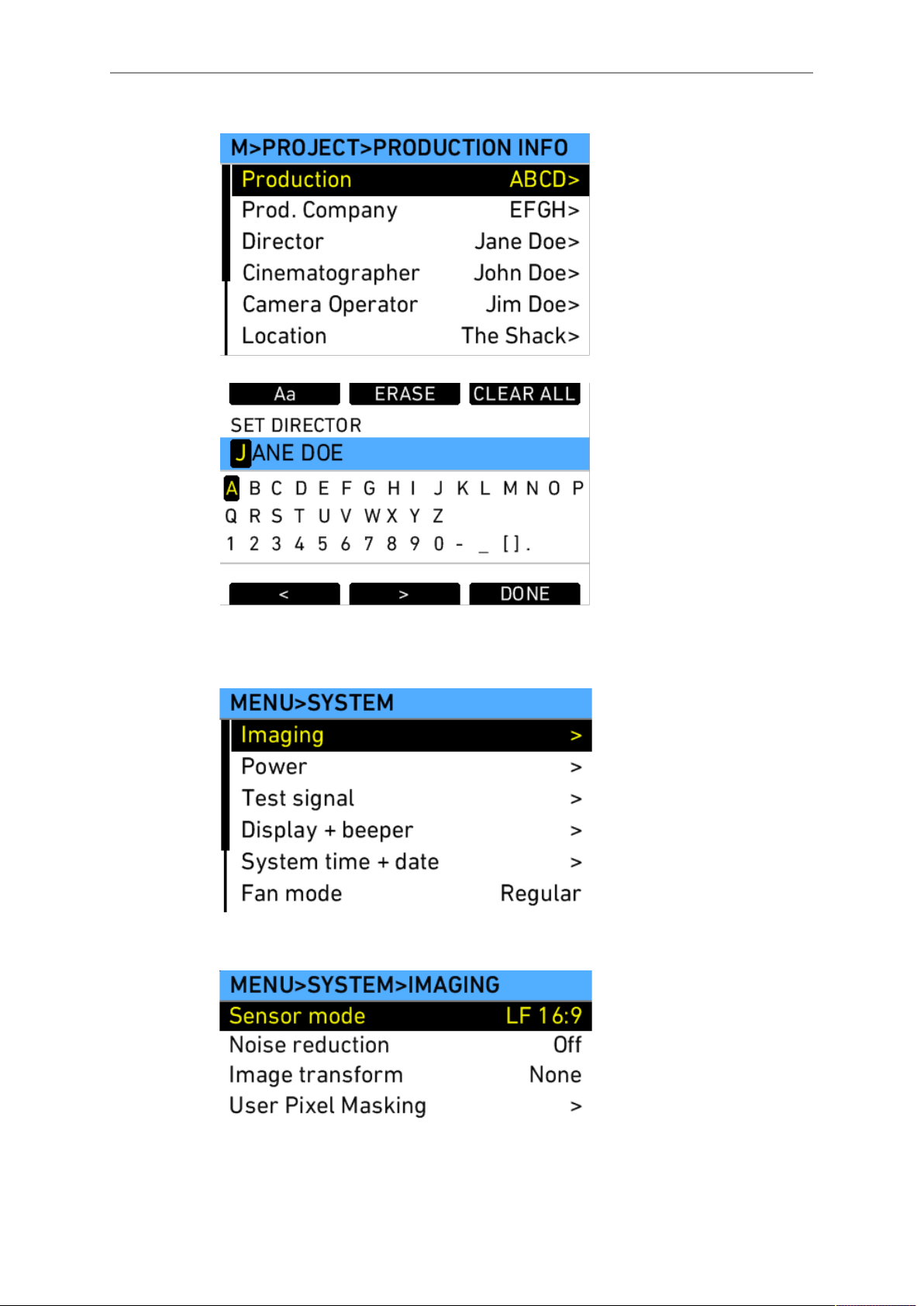
106 Camera Controls
15.1.5.4 System
The System menu contains submenus of system settings.
Imaging
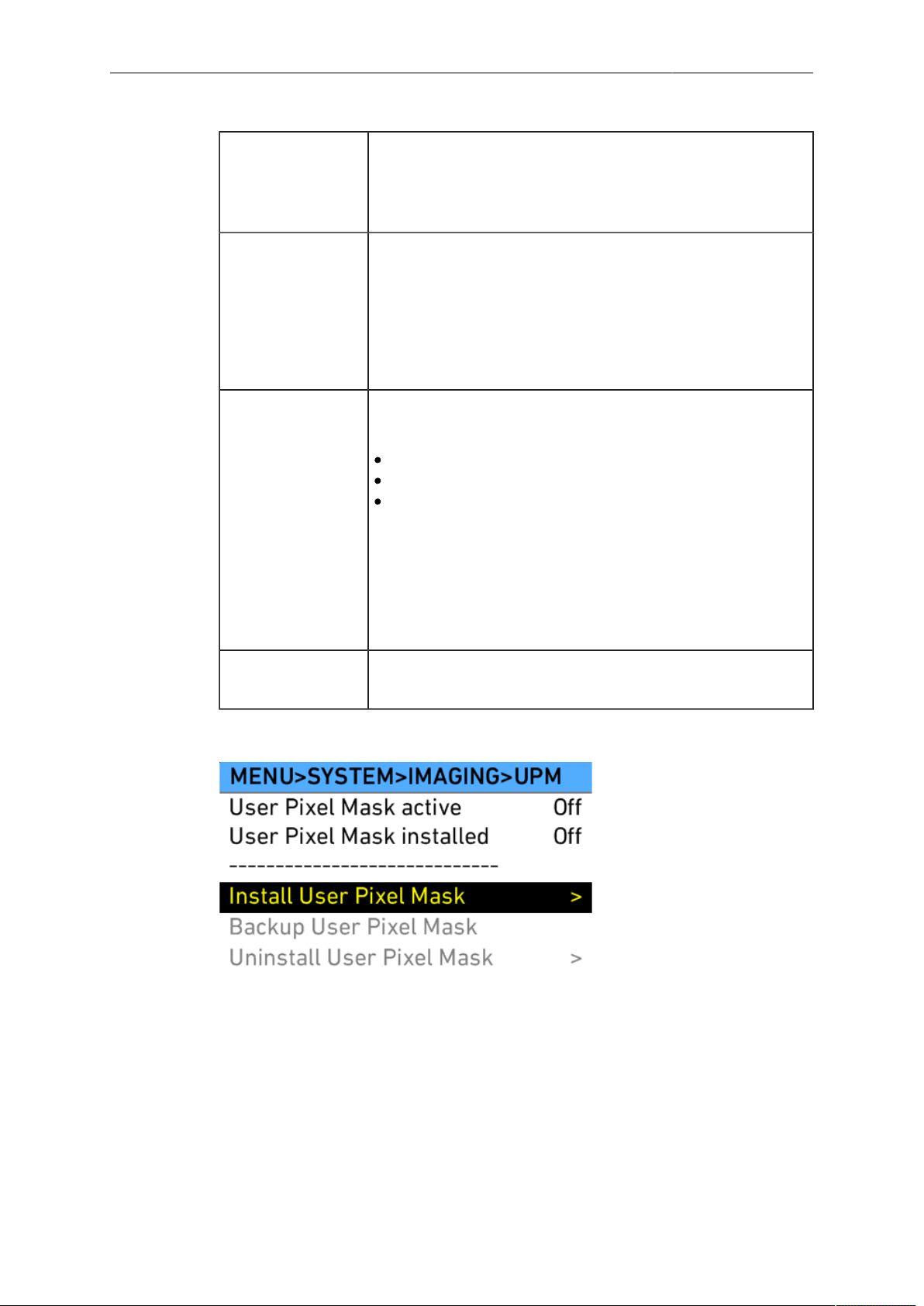
Camera Controls 107
Sensor mode Select to set which sensor mode is active: LF 16:9, LF
2.39:1, or LF Open Gate.
Note: When changing the sensor mode, the camera resets
the recording resolution to the default value.
Noise reduction Note: When recording ARRIRAW, noise reduction is only
applied to monitoring image paths (EVF and MON OUT 1,
2 and 3) and not to the recorded images. Information about
noise reduction is stored in metadata.
Note: Using noise reduction may result in slight image ar-
tifacts when capturing fast moving objects. As always, use
tests to verify applicability.
Image transform Select to set the desired image transformation. Available val-
ues are:
None
Mirror horiz.
Rotate 180°
Note: Horizontal mirroring is applied on all output paths and
internally recorded material. Image rotation is only applied to
output paths; internally recorded material is not rotated, but
rotation information is written into metadata. Frame grabs of
rotated images will be displayed upside down on a comput-
er.
User Pixel Mask-
ing
Select to open the User Pixel Masking screen.
User Pixel Masking
All sensors exhibit a certain number of defect pixels, and ALEXAs have a number of
mechanisms to catch and correct them, including User Pixel Masking.
User Pixel Masking works in combination with the ARRIRAW Converter (ARC) from
ARC version 3.0 on.
To use User Pixel Masking for all Output and Recording Formats:
1. Record a short ARRIRAW sequence at 24 fps OR capture an ARRIRAW frame
grab.
2. Import the ARRIRAW sequence or frame grab into the ARC.
3. Use the ARC software to mark defect pixels. The marked pixel coordinates are
stored in an XML file called the User Pixel Mask. Please note that it is advisable
108 Camera Controls
to mark the least number of pixels necessary, as too many marked pixels can be
counter productive.
4. Save the User Pixel Mask into the folder /ARRI/ALEXA/Sensor/ on the SD card
and load it into the camera via the SD card.
5. After a restart of the camera, the marked pixels will be masked using information
from surrounding pixels. This masking happens right after the sensor, and thus
applies to all outputs: the electronic viewfinder, MON OUT, and frame grab outputs
as well as ARRIRAW and ProRes recordings.
6. Carefully check the end result by visually inspecting the areas where you have
marked pixels; if too many pixels are marked too close to each other, or if pixels
are marked close to other pixels that are already marked in the static pixel mask,
the result could be uncorrectable clusters, which are more visible than the original
defect pixels.
As an added service, it is possible to send the User Pixel Mask to ARRI Service at
[email protected] for verification. We strongly recommend to take advantage of this free
service, as sometimes, depending on the background, clusters are difficult to spot.
Please note, however, that in the end it is the responsibility of the person creating the
User Pixel Mask to verify that no clusters are formed.
NOTICE
When shooting ARRIRAW, it is not necessary to load the User Pixel Mask into
the camera. Instead, it can be applied to the ARRIRAW files in post using the
ARRIRAW converter software or any third party software that has implemented
the User Pixel Mask feature through the ARRIRAW SDK.
The User Pixel Mask will remain intact during a factory reset and during a
software update. It can be manually removed or overwritten with a new one at
any time.
User Pixel Mask active Shows whether a User Pixel Mask is currently
active in the camera.
User Pixel Mask installed Shows whether a User Pixel Mask is currently
installed in the camera.
Install User Pixel Mask Select to install a User Pixel Mask from the SD
card.
Backup User Pixel Mask Select to backup the currently installed User
Pixel Mask onto SD card. It will be automatical-
ly named UserPixelMask_CAMSERIAL_Back-
up_ YEARMONTHDAY_HOURMINUTESE-
COND
Uninstall User Pixel Mask Select to uninstall a User Pixel Mask.
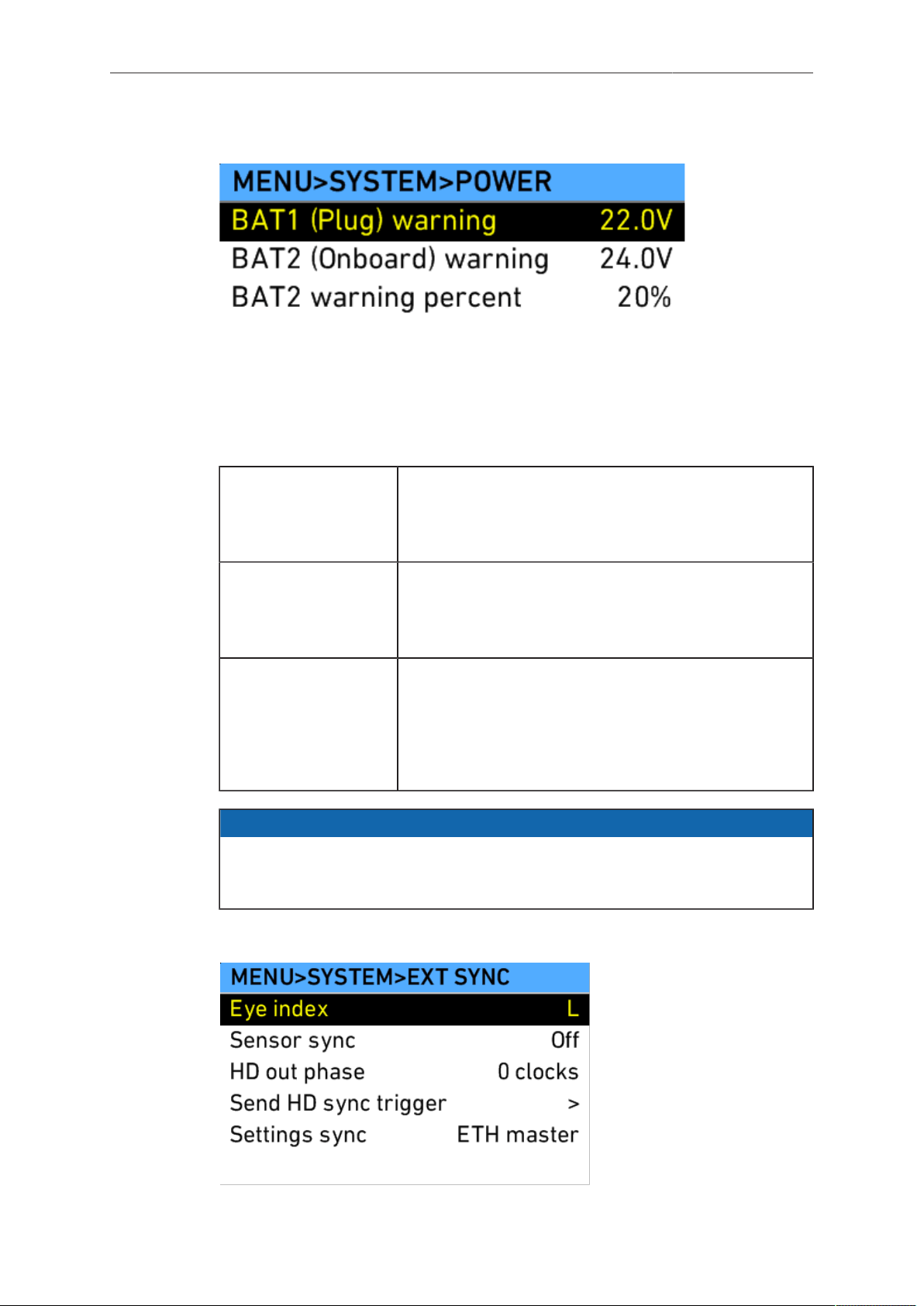
Camera Controls 109
Power
BAT1 (Plug) warning Select to adjust the voltage level at which a power warn-
ing is displayed for the power source connected to the
BAT plug. The level can be adjusted to match the bat-
tery type used. The default value is 22.0 V.
BAT2 (Onboard)
warning
Select to adjust the voltage level at which a power warn-
ing is displayed for the onboard battery. The level can
be adjusted to match the battery type used. The default
value is 24.0 V.
BAT2 warning per-
cent
Select to adjust the percentage level at which a power
warning is displayed for the onboard battery. This set-
ting only takes effect if a smart battery is attached that
communicates its remaining percentage to the cam-
era. The level can be adjusted to match the battery type
used. The default value is 20 percent.
NOTICE
When the voltage level reaches 1 Volt below the warning level set in the POWER
menu, the ALEXA displays a battery error message and recording is unavailable.
The camera will read the voltage level as insufficient.
External Sync
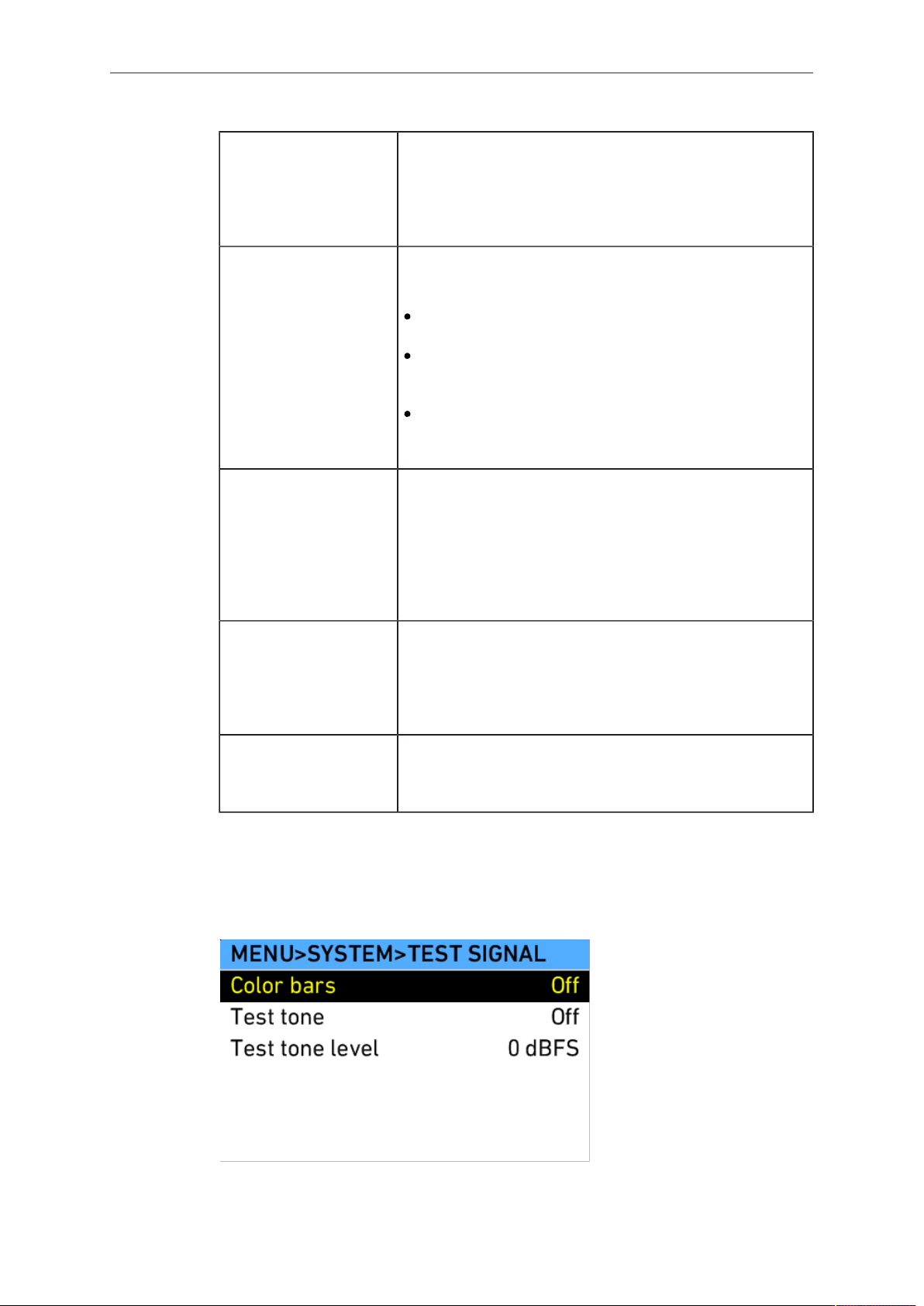
110 Camera Controls
Eye index Select to set the Eye index to left (L) or right (R). The
first letter of the Camera ID will be changed to L or R
for stereoscopic productions to identify left and right
eye cameras. The eye index is reflected in clip names
recorded internally.
Sensor sync Select to sync the sensors of two ALEXAs. See
page 140 for more information.
Off: The camera is in non-synced mode for regular
use.
EXT master: The camera sends signals to an EXT
SLAVE camera via the EXT connector containing sync
clock and TC signals.
EXT slave: The camera receives signals from an EXT
MASTER camera containing sync clock and TC sig-
nals through the EXT connector.
HD out phase Select to adjust the phase of all MON OUTs in the range
of -30 to +30 HD clocks (1 HD clock = 13.4 ns). This can
be necessary for 3D applications with external recorders
that require the slave signal to arrive after the master
signal. Shift the phase backwards (+) on a slave camera
or forwards (-) on a master camera to achieve the cor-
rect signal order.
Send HD sync trigger When using two cameras in sensor sync mode without
settings sync, the EXT MASTER camera must send a
trigger to the EXT SLAVE camera to ensure the HD out-
puts of the cameras are synced. Press the jogwheel to
send the trigger.
Settings sync ALEXA cameras can be operated in synced-settings
mode, where the settings of two cameras can be synced
via Ethernet. See page 142 for more information.
Unless a phase offset is required by certain monitoring equipment, generally there will
be no need to adjust the HD out phase. Use "Send HD sync trigger" to bring the HD
output of connected cameras back into sync.
Test Signal
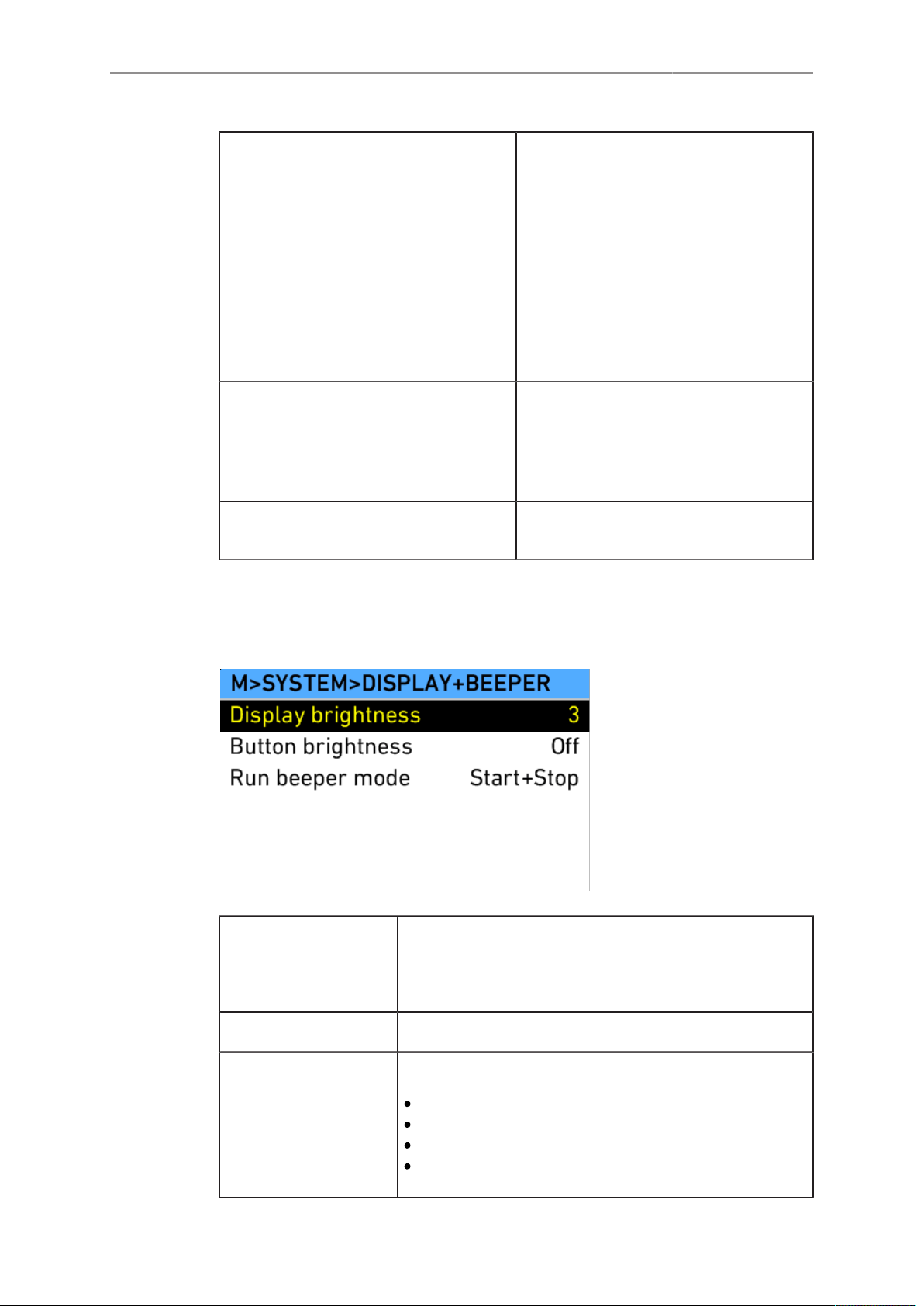
Camera Controls 111
Color bars Select to activate SMPTE color bars
on all MON OUTs. The color bars are a
10-bit signal according to SMPTE RP
219-2002.
Note: Color bar is switched off when
recording is started. Color bars will
always bypass the ALF-2 look file.
These are SDR color bars. Use only
on SDR displays. They will, however,
work properly when the camera MON
OUT color space is set to either Rec.
709 or Rec. 2020.
Test tone Select to activate a 1 kHz audio test
tone on all channels when color bar is
active.
Note: Test tone is only active when au-
dio recording is on and possible.
Test tone level Select to set the level of the audio test
tone to 0 dbFS, -9 dBFS or -18 dBFS.
Note: Switching on the color bars the first time after camera bootup may take a few
seconds.
Display + Beeper
Display brightness Select to adjust the brightness of the LCD display on
the camera-right side. To adjust the display brightness
when the HOME screen is displayed, press and hold the
BACK button while rotating the jogwheel.
Button brightness Select to adjust the brightness of the button illumination.
Run beeper mode Select to set the Run beeper mode to:
Off
Start
Stop
Start+Stop
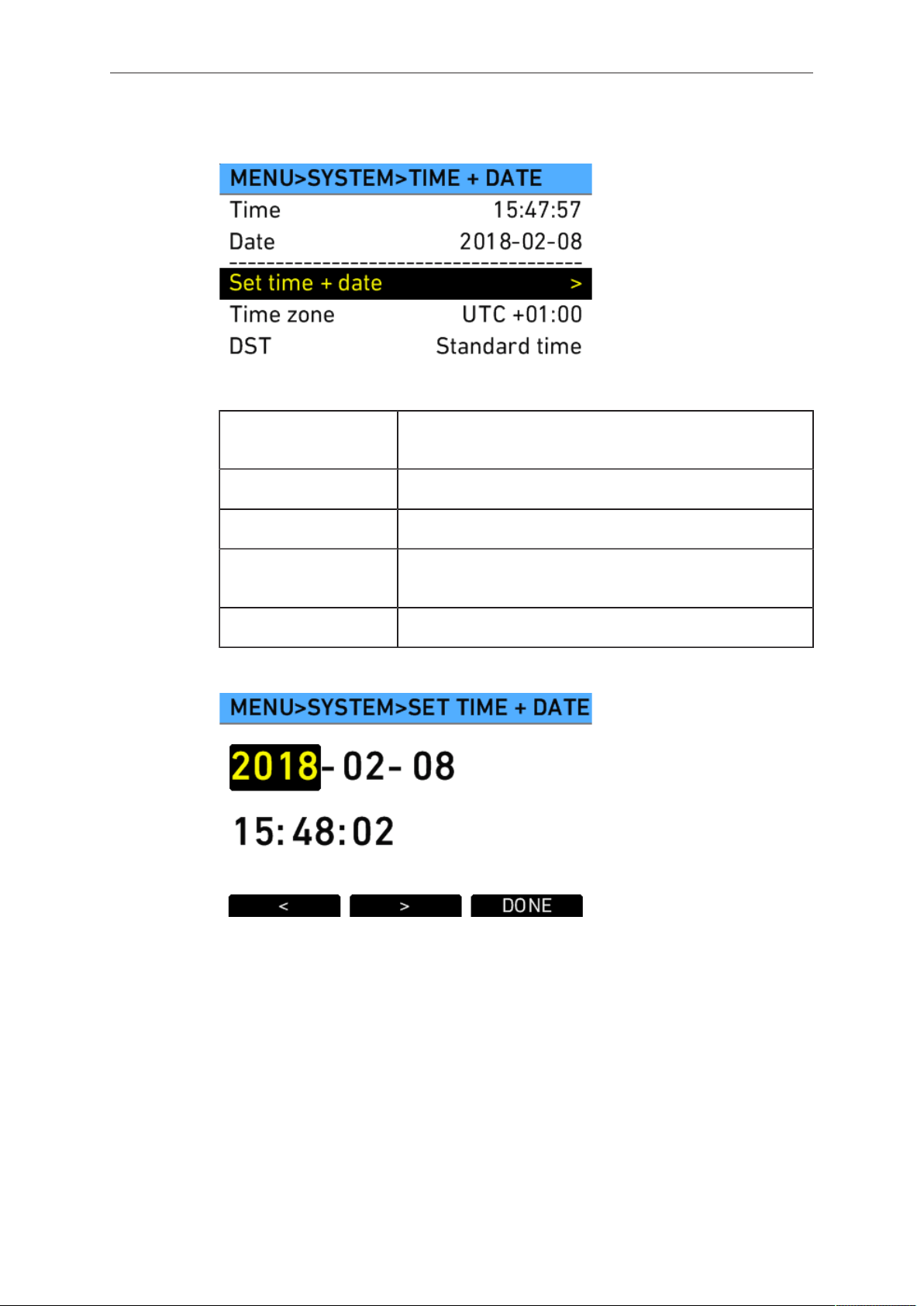
112 Camera Controls
System Time + Date
Time Displays the current time in HOURS:MINUTES:SE-
CONDS format.
Date Displays the current date in YEAR-MONTH-DAY format.
Set time + date Select to set time and date.
Time zone Select to set the time zone to match your current loca-
tion.
DST Select to set daylight savings time.
Set time + date
Use the lower screen buttons to navigate between the elements in the screen and to
finish your setting.
To set the time and date:
1. In the System menu, select System time + date.
2. Select Set time + date.
3. Use the jogwheel to adjust the date value, starting with the year.
4. Press the > button to jump to the month, day, hour, minute and second.
Press the < button to jump back one step.
5. Press the DONE button when finished.
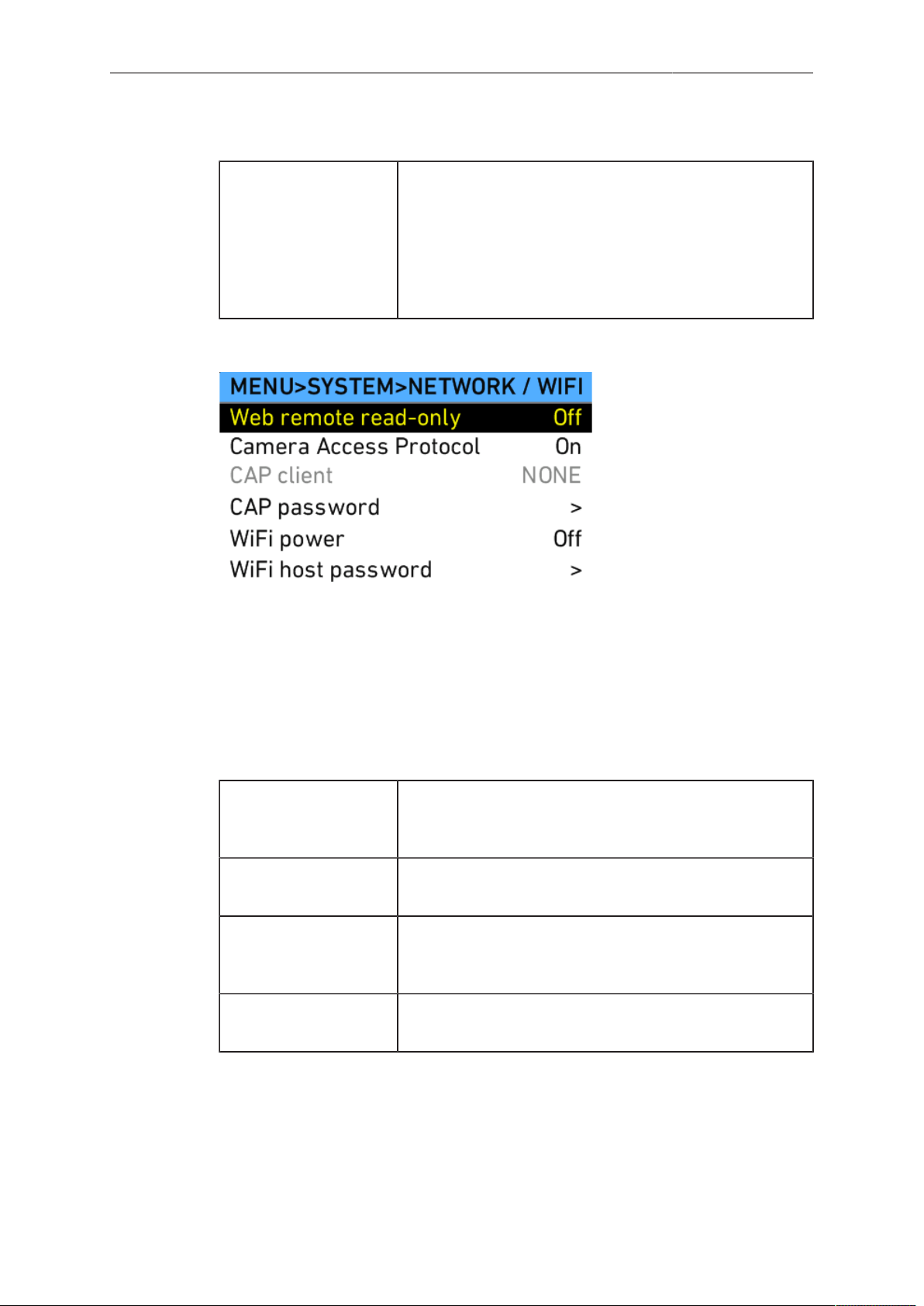
Camera Controls 113
Fan mode
Fan mode Select to set the fan mode to Regular for locations with
ambient temperatures up to 30°C (86°F). For locations
with ambient temperatures higher than 30°C (86°F), set
to Rec low.
When the fan is set to Rec Low, it will run at a high rate
when the camera is in Standby, and run at a low rate
when the camera is recording.
Network
The ALEXA provides two ways for accessing the camera via network: with a web
browser using the web remote, or with a third party software supporting the Camera
Access Protocol (CAP).
The Camera Access Protocol allows third party software to remotely manipulate the
currently active ARRI Look File 2 file. Changes to an ARRI Look File 2 file become
immediately effective on all image paths with processing configured to Look file. Third
party software can connect to the camera via Ethernet. A list of supported third party
software can be found on the ARRI ALEXA LF web page.
Web remote read-on-
ly
Select to restrict network access to read-only mode.
When set to Off, the Web Remote will not function prop-
erly.
Camera Access Pro-
tocol
Select to switch remote access to the camera via the
Camera Access Protocol on or off.
CAP client name Shows the name of the currently connected client.
Shows 'NONE' if no client is connected, and 'NO NAME'
if the connected client has not transmitted its name.
CAP password Select to set the password for Camera Access Protocol
connections.
WiFi
The WiFi module in the ALEXA acts as an access point and opens up a wireless
network in the 2.4 GHz band. The name of the network is "Alexa-SERIAL#", where
SERIAL# is the serial number of the camera, and it uses WPA-2 encryption. The
default password for the network is set to "arriarri".
The camera selects the WiFi channel automatically to minimize interferences. It is not
possible to change the channel manually.
114 Camera Controls
WiFi power Select to turn WiFi power on or off
WiFi host password Select to enter the password for the WiFi network
NOTICE
When activating or deactivating the ARRI Wireless Remote System (WRS, also
known as Electronic Control System (ECS) or "white radio"), the WiFi module
changes its channel to minimize interferences. Devices connected via WiFi will lose
their connection temporarily, but most devices reconnect automatically.
If the camera is connected via WiFi and Ethernet, ensure that no other device on
the network uses the IP address 169.254.0.11.
The steps to connect to the web remote differ depending on the device that is used
for accessing. The camera does not have an integrated DNS or DHCP server. Instead
it uses zeroconf to setup the network, which is natively supported by Apple devices
and which can be installed on other operating systems. Certain parameters need to be
configured manually on devices that do not support zeroconf.
Devices supporting zeroconf
1. Connect to the camera's wifi.
2. Open a browser on the device.
3. Enter http://alexaSERIAL#.local, where SERIAL# is the serial number of the
camera.
Devices not supporting zeroconf
1. Look up the camera's IP address at INFO>SYSTEM.
2. Connect to the camera's wifi.
3. Set the IP settings of the device to static IP (not DHCP).
4. Assign an IP address where the first three numbers are identical to the camera's
IP and the last number is different and in the range of 1 - 254.
Example: If the camera has the IP address 169.254.68.152, a valid IP for the
device would be 169.254.68.150.
5. Open a browser on the device.
6. Enter http://IPADDRESS to open the web remote, where IPADDRESS is the IP
address of the camera.
Example: If the camera has the IP address 169.254.68.152, enter
http://169.254.68.152
SD card
Format + prepare SD
card
Select to format the SD card and create the required
folder structure after confirmation.
Note: This erases all data present on the SD card.
Prepare SD card Select to create or complete the required folder struc-
ture on the SD card without erasing any data present on
the SD card.
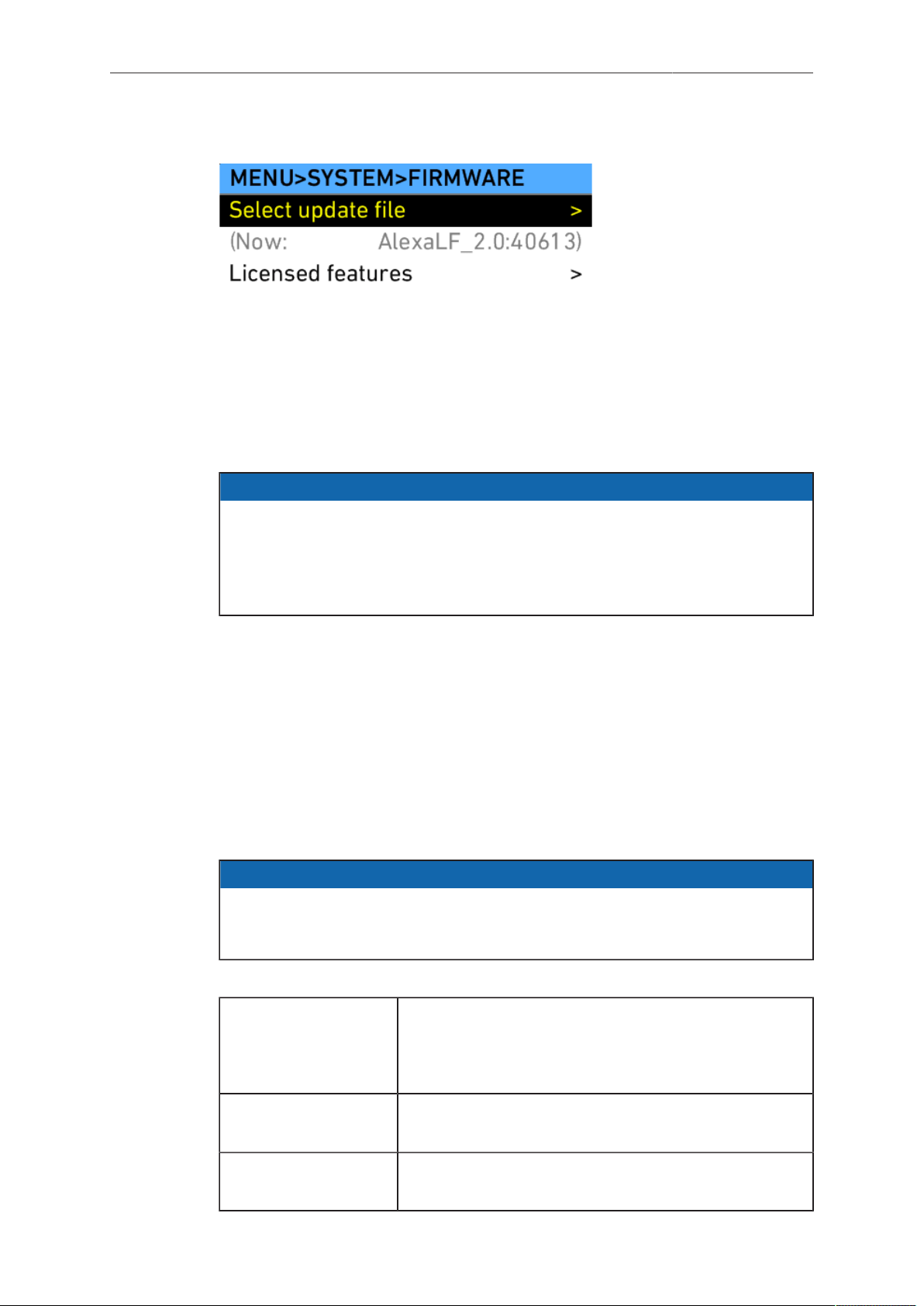
Camera Controls 115
Firmware - Software Update Packages (SUPs)
To keep the ALEXA up to date with new features, the camera firmware can be
updated by the user. Download the latest Software Update Package (SUP) from
http://www.arri.com/camera/alexa and be sure to read the included instructions.
NOTICE
ARRI discourages downgrading cameras to lower SUP versions. Be sure to
carefully read the release notes of the currently installed SUP to find out if
downgrading is possible, and ask your ARRI service center if in doubt.
The ALEXA requires the LPL lens mount to be attached when installing a Software
Update Package.
To update the camera to a new SUP (more detailed instructions can be found in the
respective release notes):
1. Copy the new SUP into the Firmware folder on an SD card formatted in the
ALEXA.
2. Load the SD card into the camera.
3. In the System menu, select Firmware.
4. Select Select update file.
5. Select the new SUP from the list on the FIRMWARE (SD CARD) screen.
6. Press both UPDATE buttons simultaneously to update the camera's firmware.
NOTICE
Update duration may differ between camera models. Do not interrupt the update
once it has started. Make sure the camera power supply will remain sufficient for
the duration of the update (approx. 15 minutes).
Select update file Select to update the camera’s firmware. If an SD card
containing update files is loaded in the camera, you can
select an update file from the list and perform an up-
date.
Current version Select to display the release code of current installed
firmware.
Licensed features Select to manage licensed features on the INSTALLED
LICENSES screen.
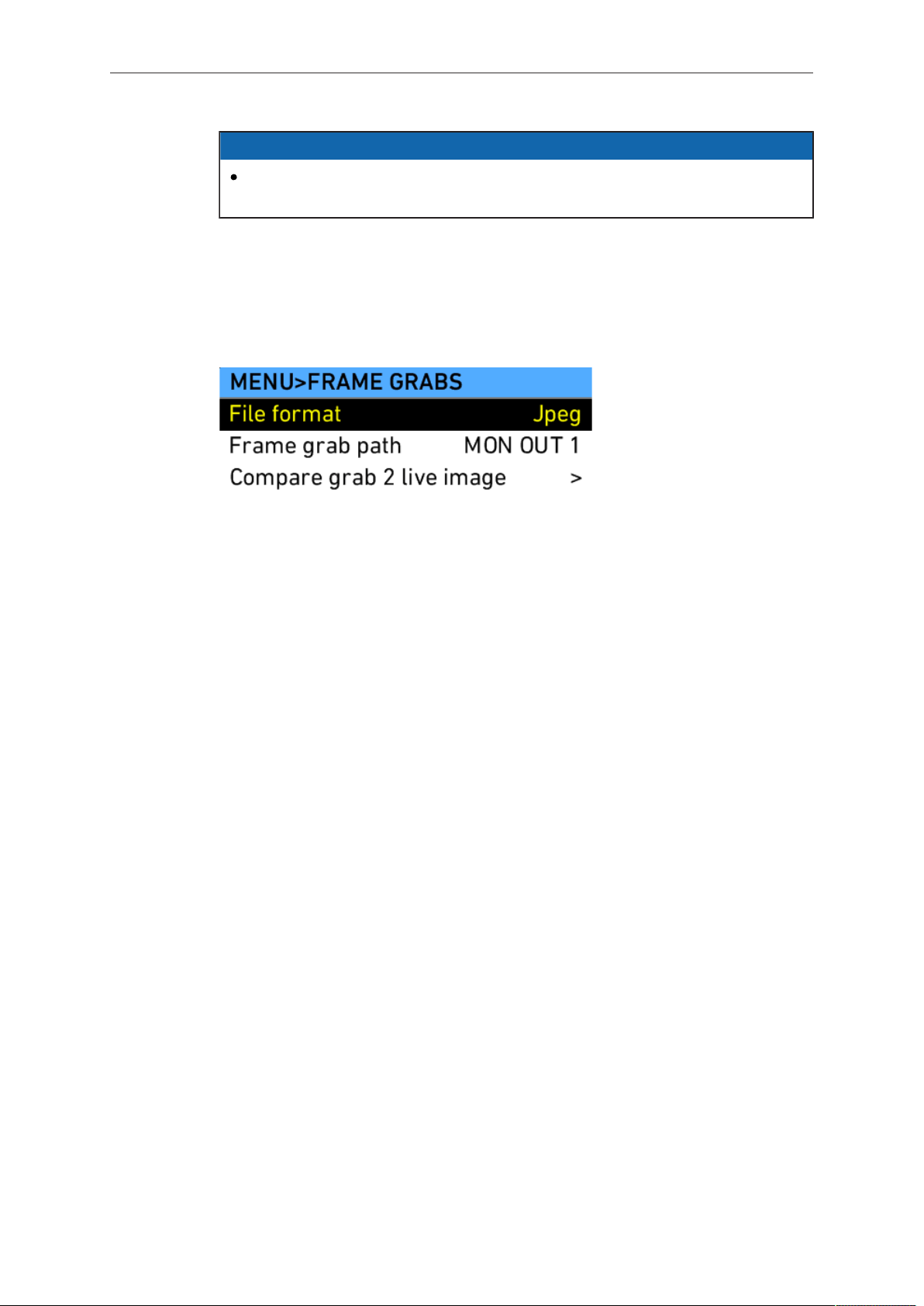
116 Camera Controls
NOTICE
On rare occasions, the update process can fail. If the update procedure fails, try
it again until you succeed.
Licensed Features
The Licensed Features screen shows all installed licenses, and allows to export a
HW INFO file. This file contains information about the hardware configuration of the
ALEXA and might be requested by ARRI Service for troubleshooting.
15.1.5.5 Frame Grabs
It is possible to take still frames from the camera's sensor. The image path from which
still frames are grabbed can be selected. Available still image formats include .jpg, .tif
and .dpx when the frame grab path is not RAW, or .ari when the frame grab path
is RAW. Note that .tif, .dpx, and .ari still frames have large file sizes and take some
time to be copied to the SD card. Use fast SD cards when taking still frames in these
formats.
To set the still frame format:
1. In the Frame grabs menu, select File format.
2. Use the jogwheel to select the desired format and press the jogwheel to set it.
Unavailable formats are grayed out.
To take a still frame and save it to the SD card:
► Press the GRAB button. The write process is indicated by a flashing camera icon,
followed by a flashing SD card icon on the HOME screen. When writing is finished,
a new still frame can be taken. The time needed for saving the image to the SD
card will vary, depending on the file format. Additional still frames may not be
taken while saving.
To take a still frame during playback of ProRes, ensure that the frame grab path is not
set to RAW.
Still frames can also be taken by assigning User buttons 1, 2 or 3 to Grab still frame.
This allows still frames to be taken from the operator's side of the camera (camera-left
side).
Still frames will be saved in the Grabs folder on the SD card.
Frame compare
It is possible to load a previously made frame grab and compare it with the current live
image. Select Compare grab 2 live image to go to the COMPARE FILE screen.
Press LOAD GRAB to select a frame grab from the SD card for comparison.
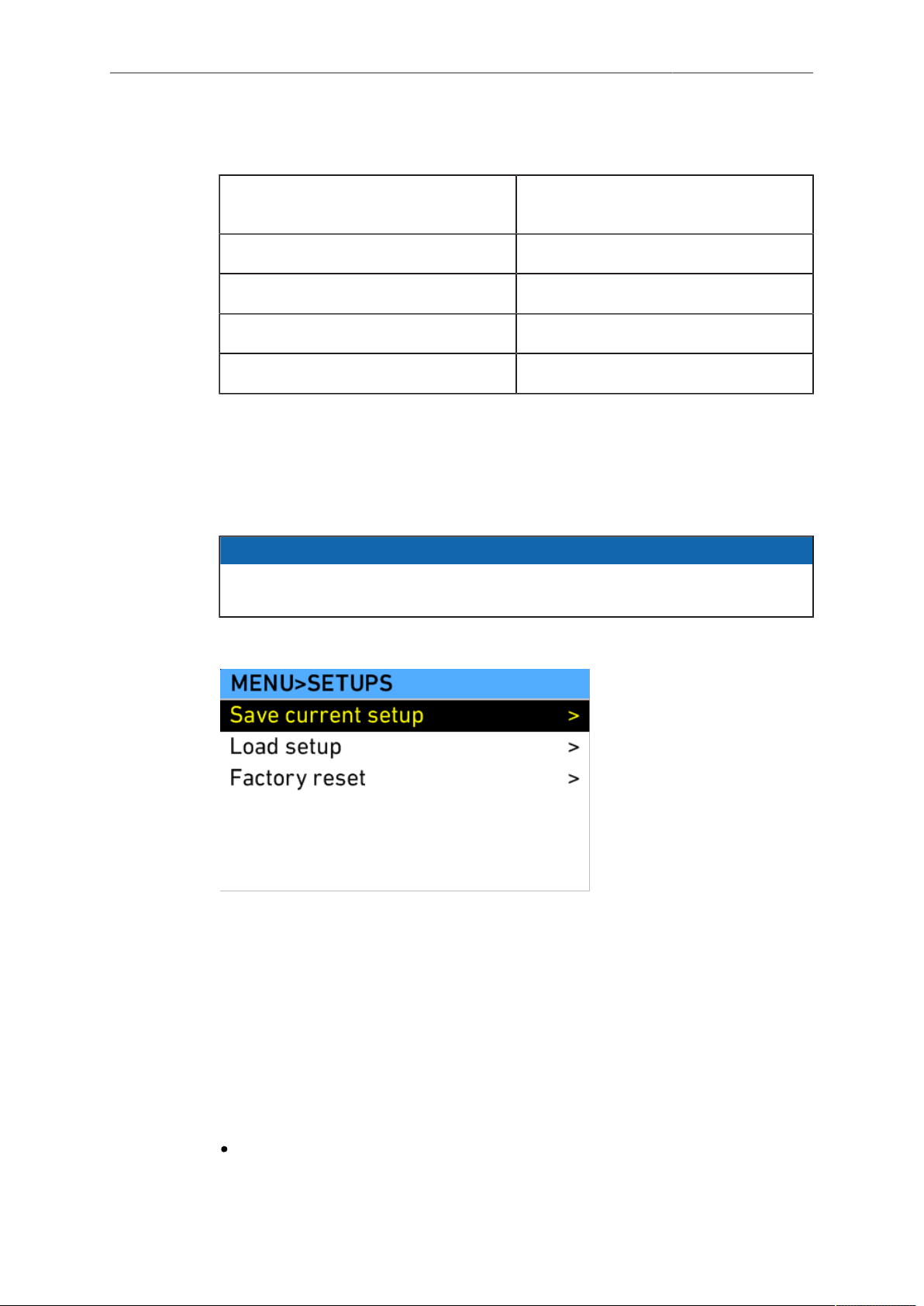
Camera Controls 117
Press OPTIONS to access the options for frame compare. The following options are
available:
Compare mode Interleave
Toggle
Active on EVF On/Off
Active on MON OUT 1 On/Off
Active on MON OUT 2 On/Off
Active on MON OUT 3 On/Off
Press COMPARE on the COMPARE FILE screen to activate or deactivate frame
compare.
When compare mode is set to Interleave, every other line is replaced by content from
the loaded file. This is useful for lining up shots, as the frame will flicker until the stored
and the live image are perfectly lined up. Otherwise, pressing COMPARE completely
overlays the loaded image over the live image.
NOTICE
Set magnification to 100% and switch zoom to off when taking frame grabs and
activating frame compare.
15.1.5.6 User Setups
A user setup is a profile of the current settings on the ALEXA that can be saved to the
SD card. User setups can be given custom names, saved to the SD card and loaded
onto multiple ALEXAs.
Rather than resetting the camera to its factory default settings, a user setup can be
used to reset the camera to a user's default settings.
A user setup contains all parameters set in the camera except files that have been
transferred via SD card, specifically frame lines and ARRI Look File 2 files. These
are not affected by loading a user setup and are only cleared by performing a factory
reset.
Requirements:
formatted SD card loaded in the SD card slot on the ALEXA
To create a user setup:
► Set all the desired parameters on the ALEXA.
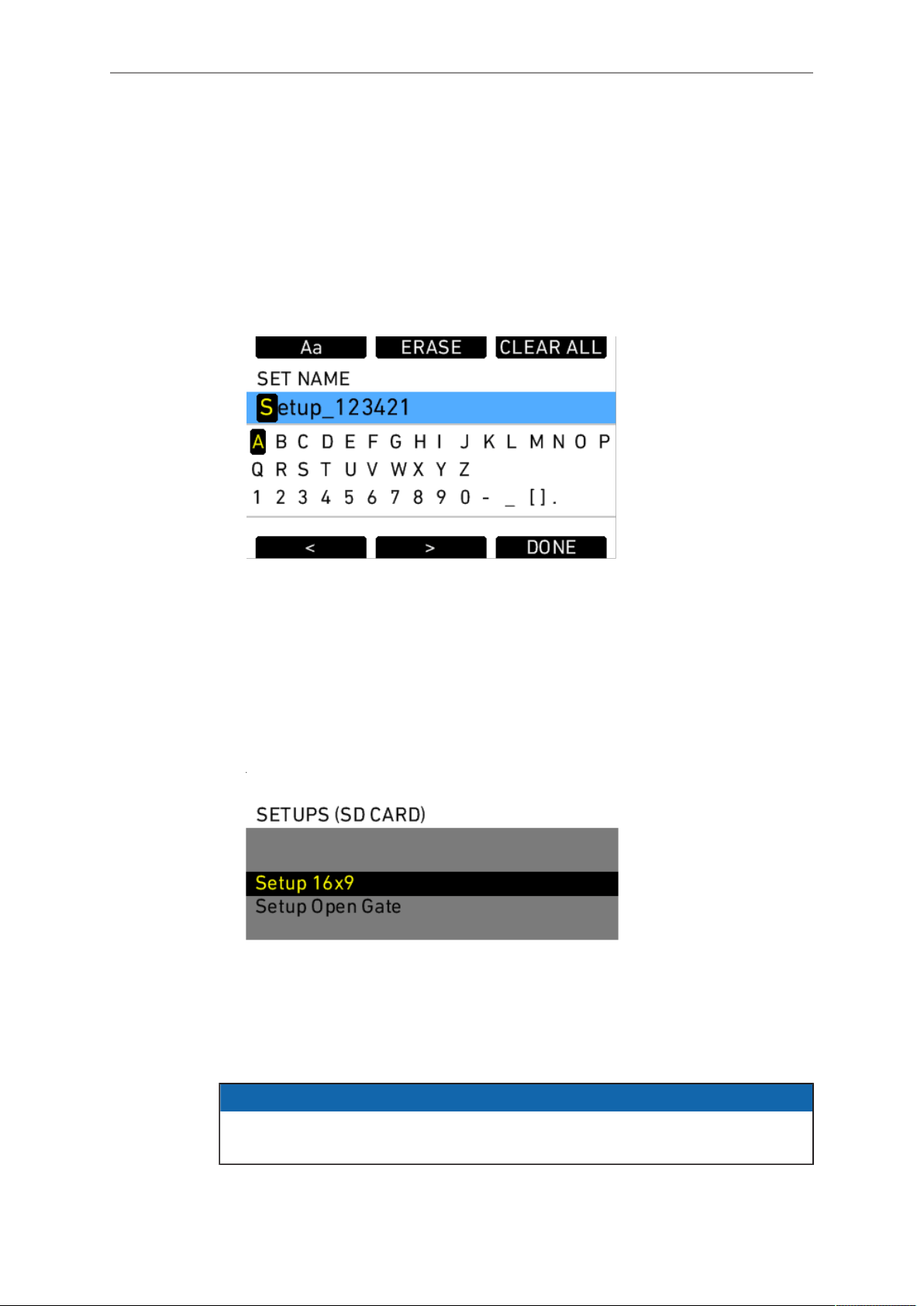
118 Camera Controls
To save a user setup:
1. Press the MENU button.
2. Use the jogwheel to select User Setups.
3. Select Save current setup.
4. To apply a custom name to your user setup, press the RENAME button. Erase the
default user-setup name by pressing the CLEAR ALL button.
5. Use the jogwheel to enter a new name by scrolling to the desired character and
pressing to select it.
6. When you have finished entering the new user setup name, press the DONE
button.
7. Press the jogwheel to save the new user setup to the SD card.
To load a user setup:
1. Press the MENU button.
2. Use the jogwheel to select User Setups.
3. Select Load setup.
4. Use the jogwheel to select the desired setup in the list and press the jogwheel to
load the setup.
5. Press the PROJECT button to validate your project settings.
NOTICE
User setups work only in the SUP version they are created in. After a SUP update,
a new user setup must be created and saved.
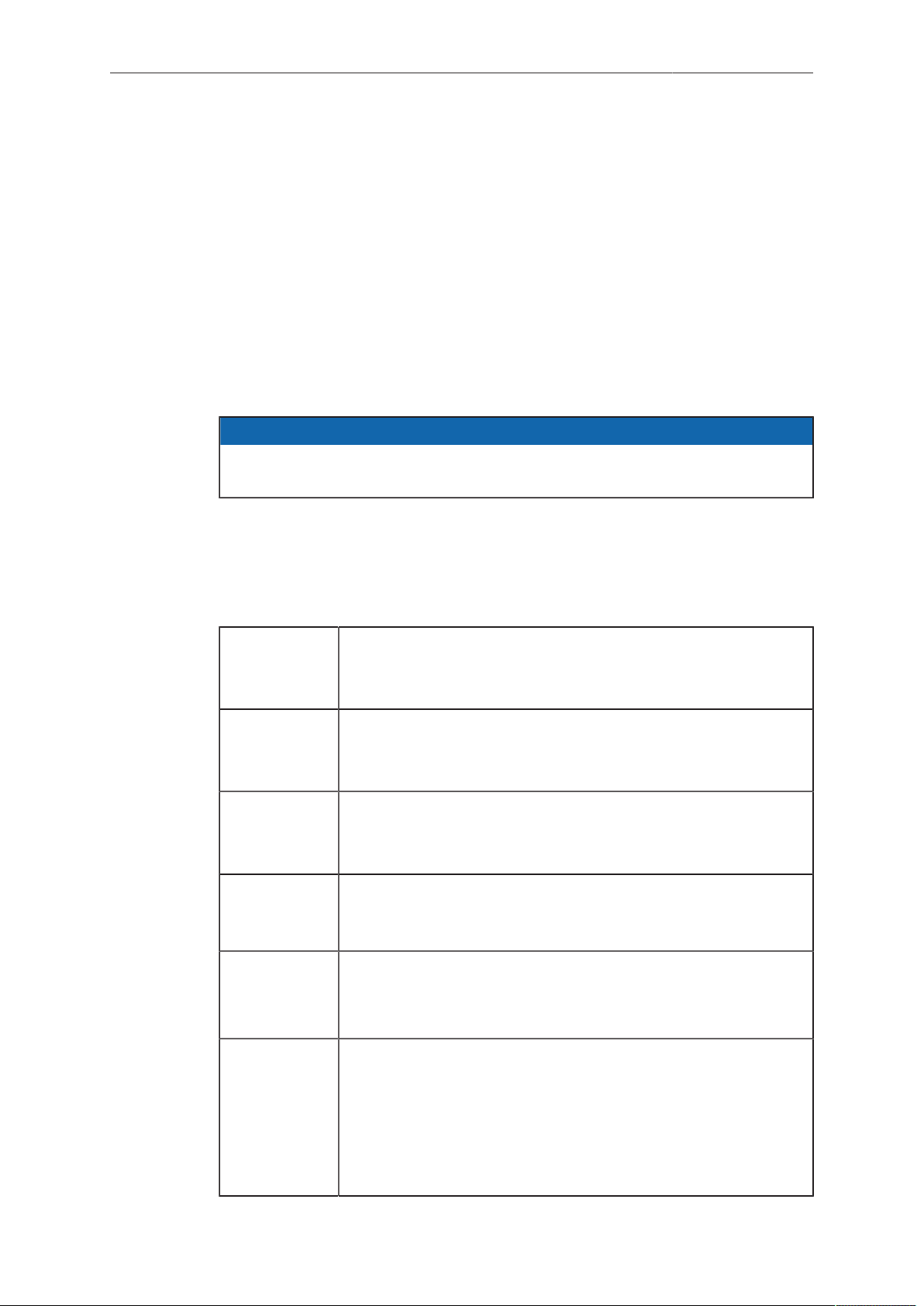
Camera Controls 119
A recommended procedure for working with user setups is as follows:
1. Before shooting, perform a factory reset to restore factory default settings.
2. Save a user setup named "Reset" or similar. This will be used instead of
performing the ALEXA’s factory reset.
3. Adjust the camera's shooting parameters and settings, and load the desired frame
lines and ARRI Look File 2 files.
4. Save another user setup with a descriptive name, such as "Show Title A-Cam".
5. To reset the camera to the default settings without losing the frame lines or ARRI
Look File 2 files, load the "Reset" user setup.
User setups can be used to ensure that cameras on multi-camera shoots have
matching settings, or to transfer a show’s setup onto daily cameras, to ensure they
carry the same shooting specifications.
NOTICE
You cannot switch between sensor modes by loading a user setup. To switch
sensor modes, go to the SYSTEM>IMAGING menu or PROJECT menu.
15.2 Operator controls
The operator controls are located on the camera left side and consist of three function
buttons plus three assignable buttons.
1 User button 1.
Can be assigned functions with the USER button on the Main
controls
2 User button 2.
Can be assigned functions with the USER button on the Main
controls.
3 User button 3.
Can be assigned functions with the USER button on the Main
controls.
REC Press the REC button to start and stop internal recording. A red
LED tally indicates recording. See section Prerecording for differ-
ent behavior with prerecording switched on.
PLAY Press the PLAY button once to load the last clip.
Press the PLAY button again to toggle between play and pause.
Press and hold the PLAY button for 2 seconds to stop playback.
LOCK Press and hold the LOCK button for 3 seconds (counted down
on the main controls LCD) to lock the main and operator con-
trols. A blue LED beside the LOCK button on the camera-left
side indicates the lock is active. A lock icon on the LCD display
on the camera-right side indicates the lock is active.
Press and hold the LOCK button for 3 seconds to unlock the
main and operator controls.
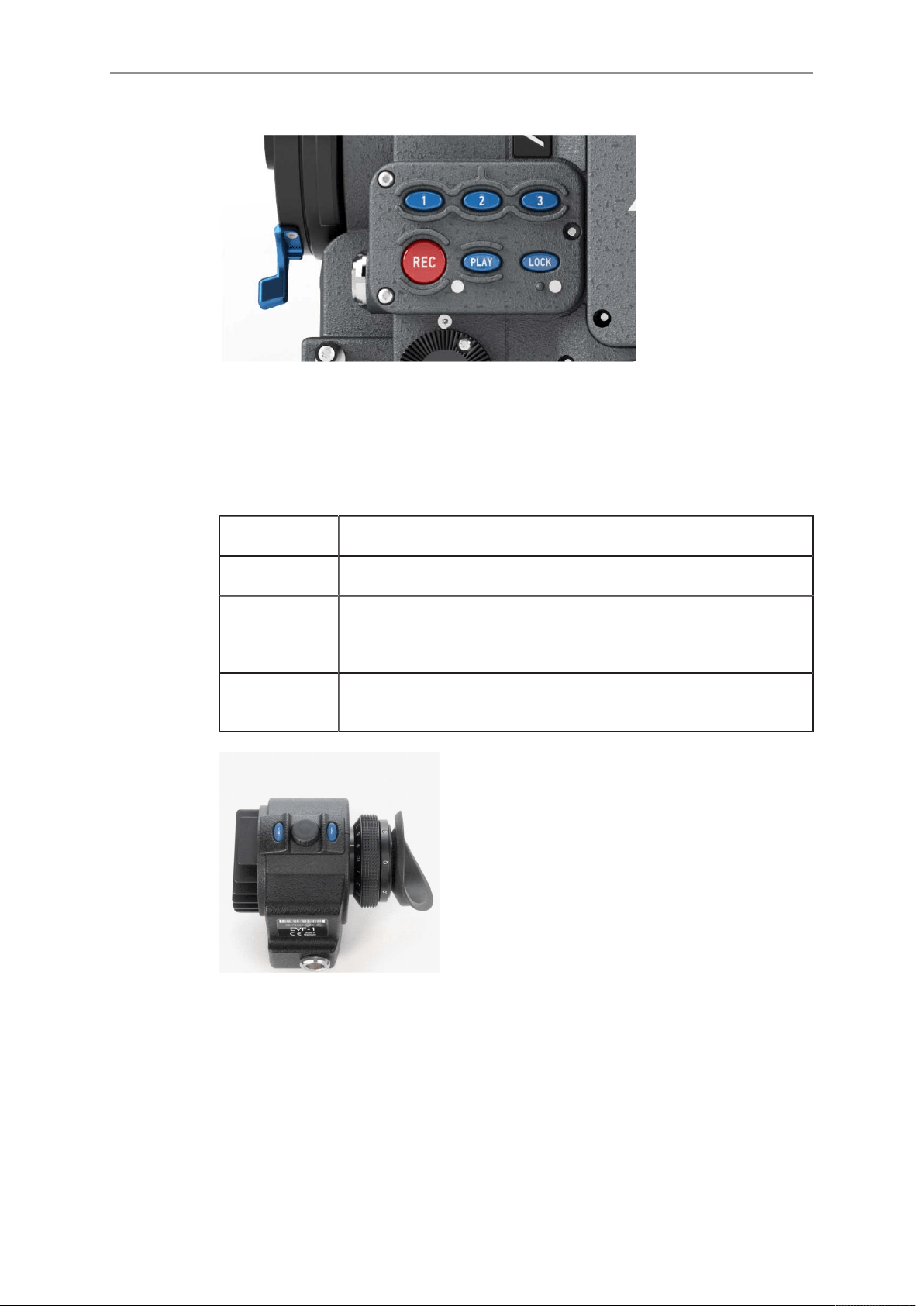
120 Camera Controls
Fig. 36: Operator UI
15.3 EVF Controls
The EVF controls are located on the electronic viewfinder. They consist of a number of
function buttons and a jogwheel.
CAM Press the CAM button to open the EVF's CAM menu.
EVF Press the EVF button to open the EVF's EVF menu.
ZOOM Press the ZOOM button for a temporary zoom-in to quickly check
focus. Being zoomed in is indicated by an orange frame around
the image. Frame lines are deactivated while zoom is active.
EXP Press the EXP button (EXP = EXPOSURE) to toggle false color
display on and off.
Fig. 37: EVF-1 left side
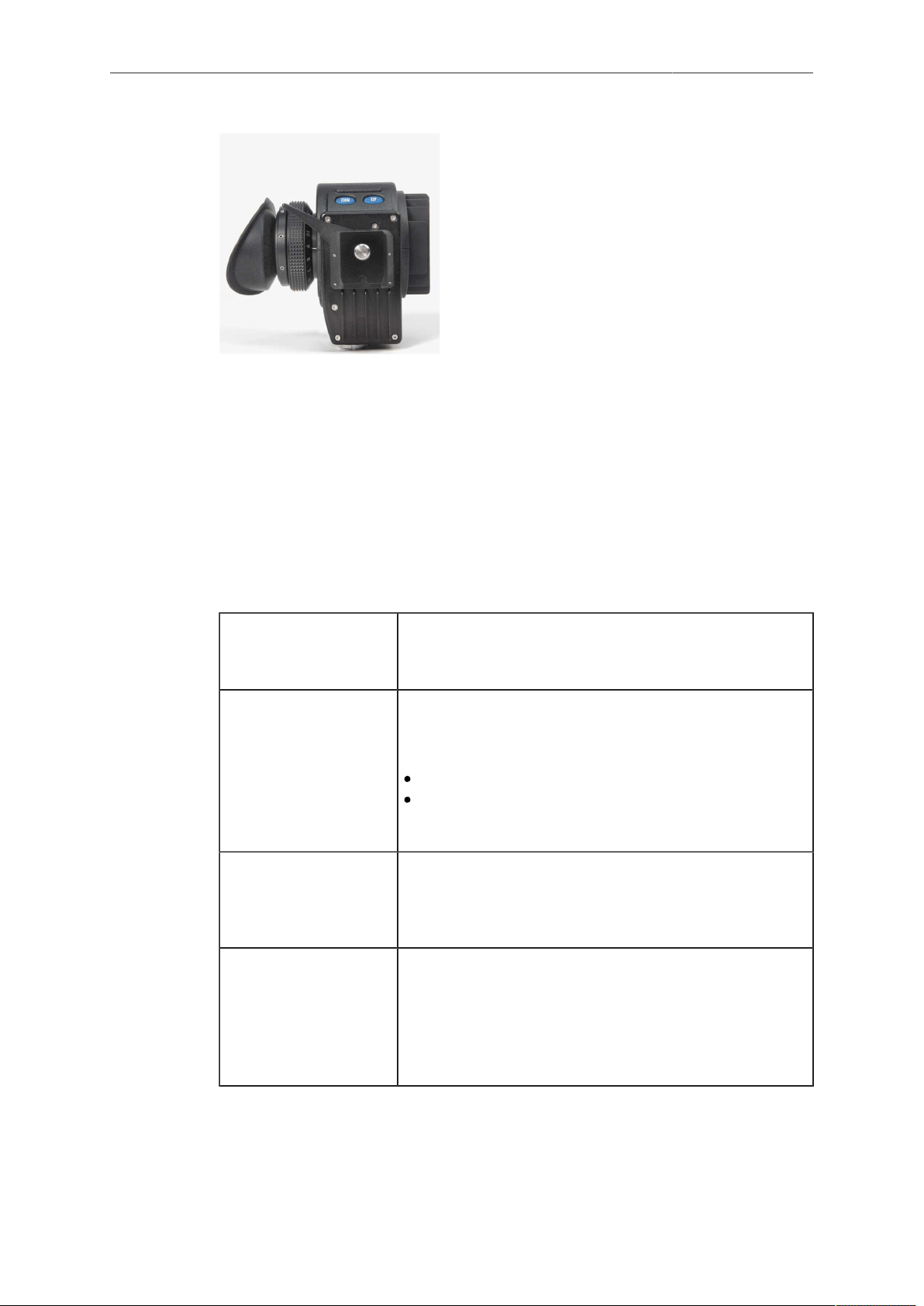
Camera Controls 121
Fig. 38: EVF-1 right side
When the LOCK button on the main controls is engaged, the CAM and EVF buttons
are locked with the main controls and operator controls. The ZOOM and EXP buttons
are not affected by the lock.
The message "Button is locked!" is displayed in the EVF when the CAM or EVF button
is pressed while the main controls are locked.
15.3.1 Viewfinder EVF menu
Press the EVF button to open the Viewfinder EVF menu in the EVF display and set the
viewfinder parameters. Use the jogwheel on the EVF to select and set menu options.
Press the EVF button to exit the Viewfinder EVF menu.
Brightness Select to set the brightness of the EVF from 1 (least
bright) to 5 (brightest). With an EVF-2 connected, the
brightness is expressed in nits (cd/m
2
).
Gamma Select to set the gamma characteristic (technically
the Electro-Optical Transfer Function or EOTF) of the
EVF-2.
Gamma 2: Gamma characteristic optimized for EVF-2
EVF-1: Gamma characteristic similar to EVF-1
Note: Only available with EVF-2 connected.
Rotate image When mounting the EVF to the right side of the camera,
the image can be flipped to orient the image correctly in
the viewfinder. Affects only the EVF image, MON OUT
and recording images are not rotated.
Smooth mode Select to set smooth mode On or Off. With smooth
mode on, the EVF image shutters less when panning.
Note: Smooth mode is only possible with frame rates up
to 30 fps and shutter angles of 180.0 or less. If smooth
mode is switched on but not available, the camera is-
sues a warning.
122 Camera Controls
Surround view Select to set surround view on the EVF On or Off. When
set to on, the additional pixels outside the recorded im-
age area on the ALEXA’s A2X sensor are displayed,
allowing the operator to see outside the recorded im-
age and keep unwanted objects, such as microphone
booms, out of the shot. To view only the recorded im-
age, set surround view to off.
Note: Only available in sensor mode LF 16:9
Surround mask Select to adjust the surround mask settings. If surround
view is set to On, the boundary between the recorded
area and surround view will always be indicated to allow
proper framing. Users can choose between:
Black line
Color line
Mask 25%
Mask 50%
Mask 100%
Status info Select to set status info to On or Off. When set to On,
camera shooting parameters are displayed across the
top of the EVF's image, outside the active image area
and camera status information is displayed across the
bottom of the EVF's image, outside the active image
area.
Frame lines Select to set frame lines to On or Off. Frame lines are a
reference for framing that typically consist of an image
frame, a center mark and an aspect ratio reference. See
the appendix for more information on the ALEXA frame
line format.
Select frame lines 1 Select to set the main frame lines template from those
stored in the camera.
Select frame lines 2 Select to set the secondary frame lines template from
those stored in the camera.
Center mark Select to set the center mark to Off, Small Dot, Medium
Dot or Cross to aid in image framing.
User rectangles Select to display up to two additional user-editable rec-
tangles in the EVF image.
Edit user rectangles Select to adjust the user rectangles.
Frame lines color Select to set the color of the frame lines.
Frame lines intensity Select to set the brightness of the frame lines.
15.3.2 Viewfinder CAM menu
Press the CAM button to open the Viewfinder CAM menu in the EVF display and set
camera parameters. Use the jogwheel on the EVF to select and set menu options.
Press the CAM button to exit the Viewfinder CAM menu.

Camera Controls 123
FPS Select to set the sensor frame rate. Preconfigured and previously
added user-defined values can be selected in the FPS list.
SHUTTER Select to set the shutter angle. Preconfigured and previously
added user-defined values can be selected in the Shutter list.
EI Select to set the exposure index. Settings from EI 160 to EI 3200
can be selected, in steps of 1/3 stop.
WB Select to set the white balance. Preconfigured and previously
added user-defined values can be selected in the WB list.
15.4 Web Remote
All ALEXA cameras contain a web server that can provide a user interface for
remotely controlling the ALEXA.
Connecting to the Camera
The Web Remote can be accessed through an Ethernet connection from the
camera's ETH port to a computer's Ethernet port, using the Bonjour protocol or
by directly entering the camera's IP address. First, make sure on the camera that
MENU>SYSTEM>NETWORK>Web remote ready-only is set to Off. If you want to
prevent access to the Web Remote, set MENU>SYSTEM>NETWORK>Web remote
ready-only to On. Then connect the cable. To use the Bonjour protocol, open the web
browser on the computer and enter the address alexa####.local in the browser's
address bar, with #### being the serial number of the camera. Alternatively, you can
look up the camera's IP address (INFO > SYSTEM) and enter that in the browser's
address bar.
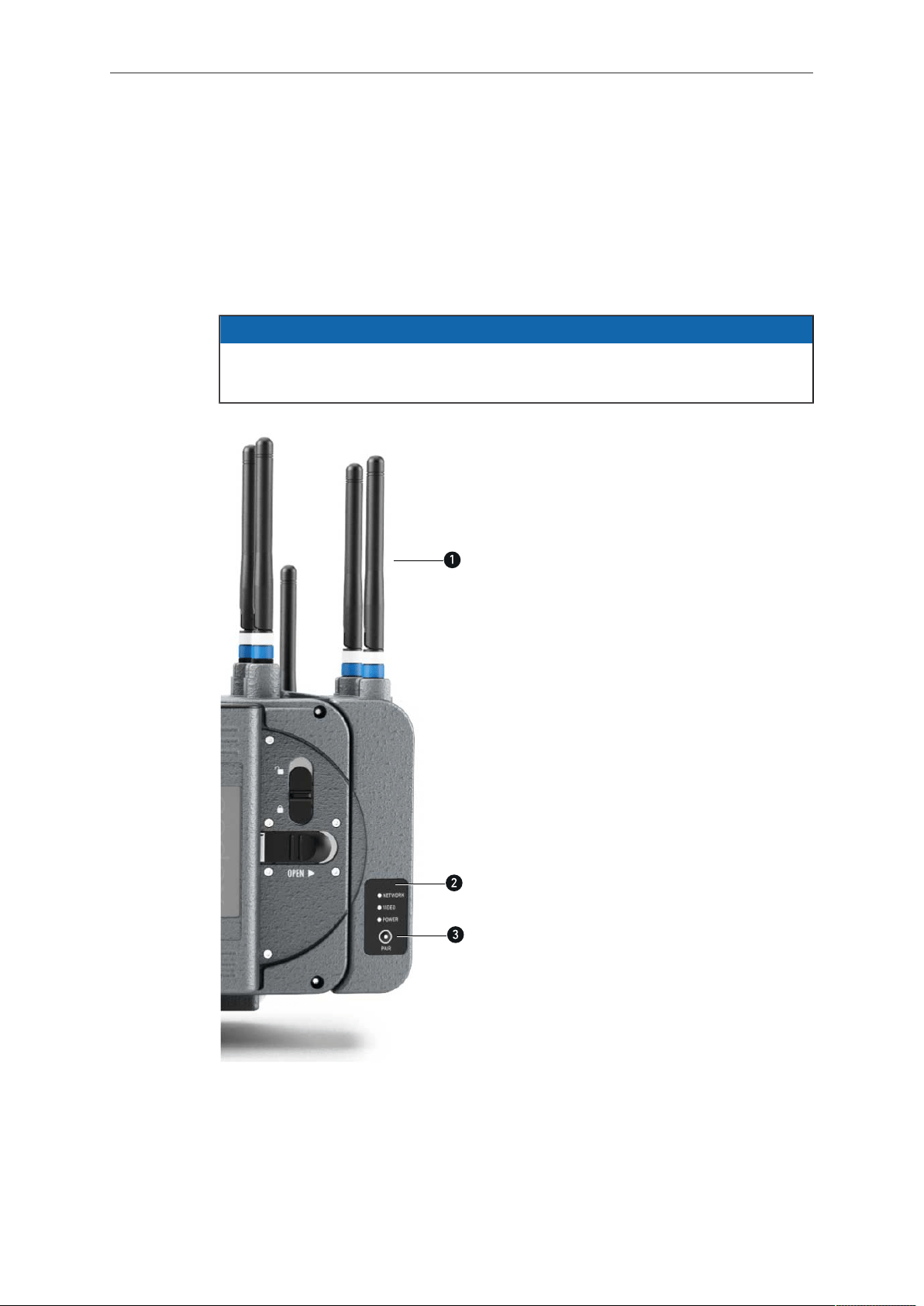
124 Wireless Video
16 Wireless Video
The HD video transmitter transmits the video signal of MON OUT 3 to a Wireless
Video Receiver (WVR-1) or Transvideo Starlite ARRI-WVS monitor.
It can wirelessly transmit at 5 GHz up to a distance of 600 m with less than 1 ms delay.
The transmission is always secured by 128 bit AES encryption and is uncompressed.
The camera can transmit to up to four receivers simultaneously.
NOTICE
The WVS is not compatible with any other wireless video transmission system.
Only devices with the same region setting are compatible with each other.
1 Wireless video antennas
2 Status LEDs: Network, Video, Power
3 PAIR button
Wireless Video 125
16.1 Setting the region of the wireless video function
Setting the region of the wireless video module can only be done by ARRI Service
Centers. Please note that only devices with the same region setting are compatible
with each other.
CAUTION!
Wireless region settings specify where the wireless function can be used in
compliance with local regulations. It may be illegal to use the wireless function
in a region other than specified in the setting. Please ensure that the region is
configured correctly, e. g. when traveling.
16.2 Preparation
1 Screw on two antennas on top of the HD video transmitter to the antenna
connectors.
2 Attach a battery to the battery adapter on the back of the camera or use a power
supply to power the camera.
3 Turn on the HD video transmitter in the camera menu and pair it to one or more
receivers.
16.3 Status LEDs
LED Status
Signal
LOW = low link signal strength
MID = medium link signal strength
HIGH = high link signal strength
Network
Solid: Connection is established
Slow blinking: Pairing active
Fast blinking: System error
Video
Solid: Video signal is locked
Fast blinking: System error
Power Shows if wireless video transmitter is powered
16.4 Pairing camera and receivers
To transmit video content from the camera to a WVR-1 or Transvideo Starlite
ARRI-WVS, it is necessary to pair the devices. Pairing describes the function of
connecting a transmitter to one or more receivers. The pairing needs to be confirmed
at both devices with the push of the PAIR button. The pairing process is accompanied
by a specific pattern of indicators through LEDs blinking on the devices.
Precondition:
► Select MENU > MONITORING > MON OUT 3 / WIRELESS VIDEO and ensure
that Wireless video power is set to On.
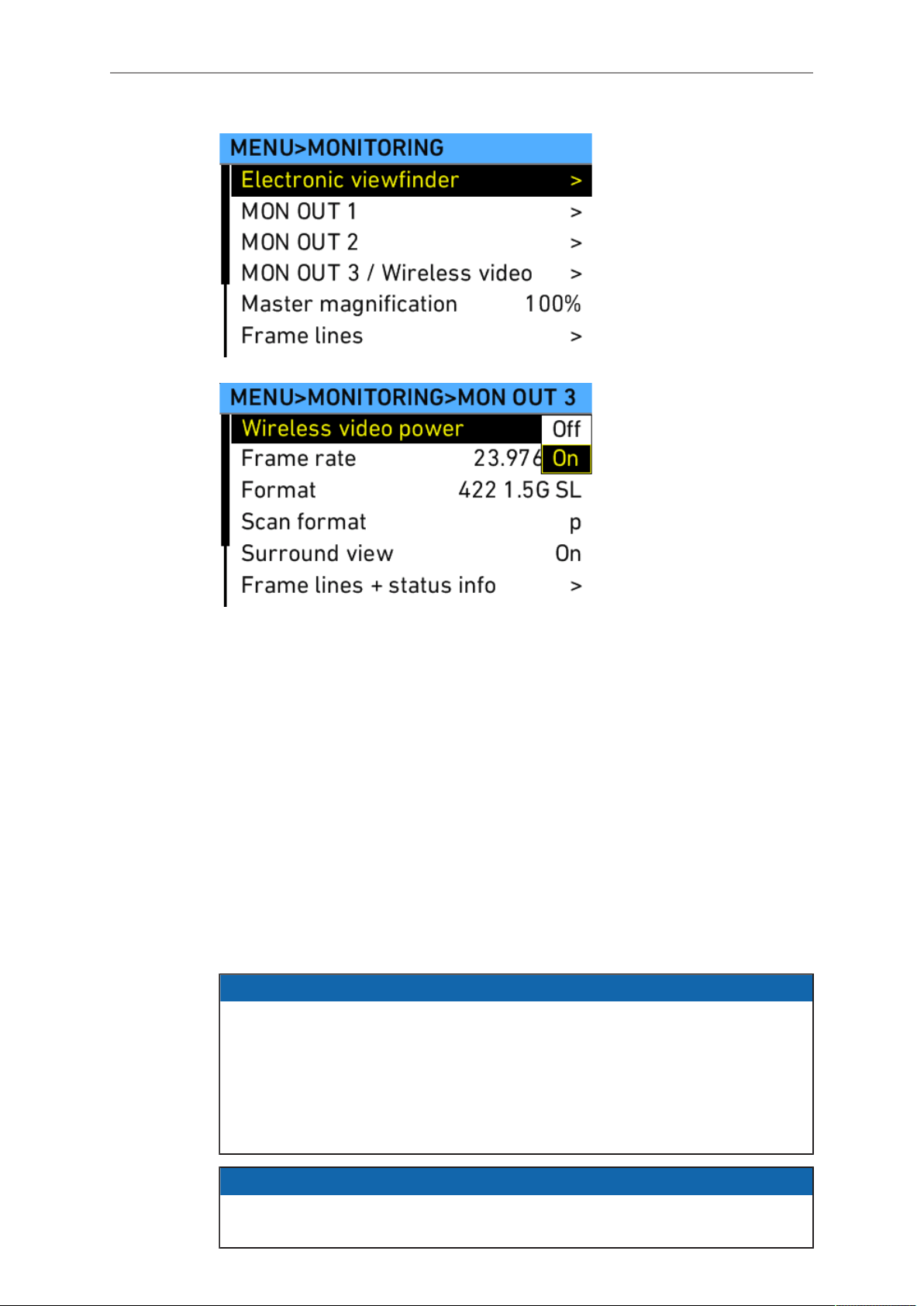
126 Wireless Video
Pairing:
1. Make sure the transmitter and receivers you want to pair are at least 1 m apart.
2. Turn on WVR-1. Make sure no other transmitters and receivers are powered up.
3. Press PAIR on WVR-1 until NETWORK LED blinks fast.
4. Press PAIR on the camera until NETWORK LED blinks fast.
5. Pairing is complete when NETWORK LEDs turn to solid.
6. Repeat the procedure for each additional WVR-1.
During the pairing process, the external monitor to which the WVR-1 is connected
should show the following information:
1 "Registration in Progress"
2 "Searching for Camera Unit ..."
For instructions on pairing the camera with a Transvideo Starlite ARRI-WVS, please
see the manual of the Transvideo Starlite ARRI-WVS.
NOTICE
If four receivers are paired to a transmitter, and another receiver is paired, the first
of the already paired receivers will be unpaired and the new one will be added. The
adding of new receivers works in a cyclic first-in first-out order.
An inactive receiver stays paired to the transmitter. If a fifth receiver is added to
a setup with one inactive and three active receivers, the new receiver does NOT
replace the inactive one. In this case, there is no differentiation between active and
inactive devices. The rule mentioned above still applies.
NOTICE
Before pairing two devices, make sure that there is at least 1 meter / 3.3 feet
distance between the devices.
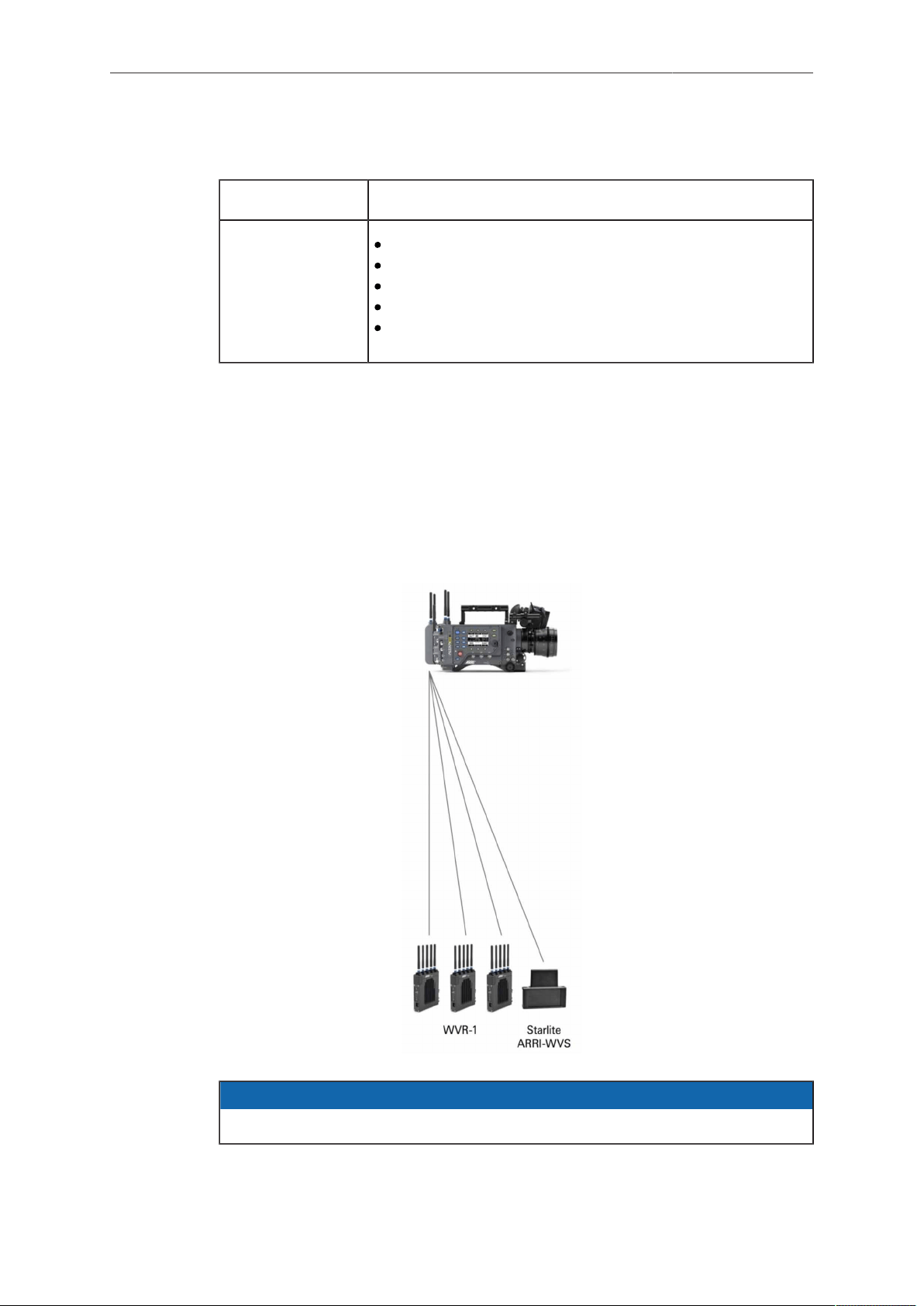
Wireless Video 127
16.5 Supported resolutions
1080p 23.976, 24, 25, 29.97, 30, 50, 59.94, 60
1080psf
23.976 (displayed as 1080i48)
24 (displayed as 1080i48)
25 (displayed as 1080i50)
29.97 (displayed as 1080i60)
30 (displayed as 1080i60)
16.6 Sample setups
The number of WVS systems that can be used in parallel depends on the num-
ber of channels available, which is different for each region, and the radio noise
present. In general, four to six systems can work in parallel.
It is possible to pair one ALEXA LF with up to four receivers (either the WVR-1 or
the Transvideo Starlite ARRI-WVS). See an example setup below.
NOTICE
It is not possible to pair one WVR-1 with more than one ALEXA LF.
128 Wireless Video
16.7 Software update
To up- or downgrade the HD wireless video module, it is necessary to connect it via
USB to a Windows computer that runs the ARRI Wireless Video software, which is
available for download on the ARRI web page. You need to have the current firmware
installation file available to perfom the upgrade. The user software guides you through
the process of up- or downgrading.
NOTICE
The firmware up-/downgrade process of the wireless video module is separate from
the regular ALEXA Software Update Packet (SUP) updates.
CAUTION!
Do not switch off power and do not remove the USB cable during the update, as
this may damage the wireless video module.
Operation of the Camera 129
17 Operation of the Camera
This chapter covers tasks the user will encounter while using the ALEXA. While
previous chapters contained specific procedures for basic use, this chapter will outline
broader tasks and offer recommendations and best practices, including camera
configuration.
17.1 Internal recording
This chapter contains information and recommendations for internal recording. The
user is encouraged to adapt the recommendations and workflow to individual and
production needs.
NOTICE
ARRI cannot be held responsible for the loss of any data in conjunction with
internal recording.
While we do everything we can to assure reliable functioning of different
recording medias such as SXR Capture Drives, and while the mean time
before failure (mtbf) for drives is excellent, a failure that results in loss of data
may occur at any time. Therefore, you are obliged to implement and maintain
at any time adequate and necessary data security measures and back up
drive content as soon as possible. ARRI assumes or accepts no liability or
responsibility for data loss or data corruption, or any other damages, loss or
harm due to malfunction of recording drives.
17.1.1 Recording Module
The ALEXA LF uses SXR Capture Drives and Sony SxS PRO+ cards for internal
recording. All media require an adapter specific to their type: SXR Capture Drives
require the SXR Adapter, SxS PRO+ cards require the SxS Adapter 2. SxS PRO+
cards do not allow recording ARRIRAW data.
File System
Depending on the recording format, SXR Capture Drives are initialized with different
file systems. SXR Capture Drives can be formatted in-camera or using Codex
Software (Mac only) in a Codex Single Dock, or the standalone Codex Vault.
When the camera is set to ARRIRAW recording, SXR Capture Drives are initialized
as Codex volumes. When the camera is set to ProRes recording, SXR Capture Drives
are initialized with the UDF file system. In both cases, the file system is read-only for
computers.
SxS PRO+ cards can only be used for ProRes recording. These cards are always
initialized with the UDF file system and have to be formatted in the camera with the
SxS Adapter 2.
17.1.2 Internal Recording Formats
ALEXA footage can be captured as QuickTime movies using an Apple ProRes
TM
codec or as unencrypted and uncompressed ARRIRAW file sequences.
NOTICE
Recording ARRIRAW internally works only with SXR Capture Drives.
130 Operation of the Camera
ProRes
Recording in ProRes is a cost-efficient alternative to shooting ARRIRAW, as it requires
less storage space and no further processing in post.
The following resolutions are available with ProRes recording:
Sensor Mode Resolution
HD (1920 x 1080)
2K (2048 x 1152)
LF 16:9
4K UHD (3840 x 2160)
LF 2.39:1 4.5K (4448 x 1856)
LF Open Gate 4.5K (4448 x 3096)
ProRes RAID - Redundant Recording on SXR Capture Drives
In the ALEXA LF, ProRes is always recorded with a method (RAID) that provides
redundancy for greater data security for SXR Capture Drives. As with ALEXA XT and
SXT cameras, half the Capture Drive's capacity can be used to record ProRes, but the
other half can be used to increase the safety of the recorded data.
ProRes RAID for SXR Capture Drives
When SXR Capture Drives are being formatted for ProRes in the ALEXA LF, a
combination of RAID 1 (mirroring) and RAID 0 (striping) is used, commonly referred
to as RAID 10. Drives zero and one will be combined into one RAID 1 volume and
drives two and three into another. This provides redundancy. The resulting two RAID 1
volumes are combined into one RAID 0 volume so it can be accessed as one volume.
Downloading ProRes RAID Data
SXR Capture Drives recorded in ALEXA LF require Codex Production Suite 4.1 or
later for downloading. Codex Production Suite 4.1 or later is included in new SXR
Capture Drive Docks, or available free of charge for owners of older docks.
To download ProRes from SXR Capture Drives recorded in ALEXA LF, the ARRI RAID
driver must be installed in the downloading Mac. The ARRI RAID driver is included in
Codex Production Suite 4.1, but will not be installed by default. To install, check the
"Capture Drive RAID support" box when installing the Codex Production Suite.
The ARRI RAID driver has been tested with Mac OS 10.10 und 10.11.
Operation of the Camera 131
NOTICE
CAUTION! RAID redundancy is very helpful if data from one of the two internal
drives is corrupted or one of the internal drives is damaged. But the SXR Capture
Drive still appears as one volume, and if it gets erased accidentally by the user, the
data is gone.
CAUTION! While this redundancy is a great new feature, it creates some
incompatibilities you should be aware of:
If an SXR Capture Drive that has been formatted on an ALEXA LF should be
downloaded on a Mac that does not have the ARRI RAID driver installed, the
Mac cannot recognize the RAID formatted drive and will ask if this drive should
be formatted. Don't format the drive, but install the ARRI RAID driver and try
again.
Please note that due to the camera’s write pattern, there may be gaps in the
clips which do not contain valid QuickTime data. These gaps may not be bit-
identical on the individual SSDs unless the drives have previously been secure
erased using the Codex Vault. This is normal and only relevant in cases where
the date has to be restored manually.
Note: When working with ProRes clips without audio, Final Cut Pro 7 may fail during a
Consolidate action as it does not recognize the file type correctly. To fix this problem,
use the SetFile command line tool on all affected clips as follows: "SetFile -t MooV
<clipname>", where <clipname> needs to be replaced with the name of the affected
clip. Then relaunch Final Cut and redo the Consolidate action.
ARRIRAW
ARRIRAW data delivers unencrypted, uncompressed and uncompromised image
quality from an ALEXA camera. It offers the highest achievable resolution, the
camera's natural color response and great exposure latitude as uncompressed
and unprocessed sensor data. ARRIRAW images have only one channel. A color
reconstruction algorithm calculates the missing components of each pixel based on
the type and position of the array of colored filters (Bayer pattern) on the camera
sensor.
ARRIRAW de-bayering is available through the ARRIRAW Converter (ARC) or custom
processing, which is implemented in most of the major post production tools for dailies
processing and mastering.
The following resolutions are available with ARRIRAW recording:
Sensor Mode Resolution
LF 16:9 4K UHD (3840 x 2160)
LF 2.39:1 4.5K (4448 x 1856)
LF Open Gate 4.5K (4448 x 3096)
The camera will automatically calculate a CRC32C checksum for the image data
inside each ARRIRAW frame. This checksum is recorded onto the SXR Capture
Drive where Codex software uses it to verify the image content during all copying
and processing steps. In addition to providing extra security, this also speeds up the
copying process.
The checksum is also stored in the ARRIRAW header as metadata (fields
'ImageDataChecksumType' and 'ImageDataChecksum'), making it thus available to
third parties. Note that this checksum does not validate the entire .ari file, only the
image data itself.
132 Operation of the Camera
Choosing a Recording Format
The selection of the recording format is a crucial decision which needs to be
discussed with the production company and post production. While lower bit rate
codecs offer longer recording times, they introduce compression artifacts that can limit
creative choices.
ProRes 422 Use for basic television production. Limited options in
color correction.
ProRes 422 HQ Use for high quality TV production. Suitable for creative
color correction.
ProRes 4444 Use for high quality TV and cinema production. Very
suitable for creative color correction and visual effects
work such as pulling mattes.
ProRes 4444 XQ The ideal choice for productions that are shooting for
premium image quality, are looking for extreme color
grading and want to preserve the superior tonal range of
ALEXA's Log C signal.
ARRIRAW Use for cinema production, visual effects and high qual-
ity TV. Best format for creative color correction and visu-
al effects work. Unencrypted and uncompressed format.
Raw data needs to be processed into color images.
Always test the full workflow pipeline with the preferred recording format before
shooting.
Media preparation
The typical usage cycle of recording media is:
1 Format
2 Record
3 Copy
4 Back up
5 Verify data
6 Format
Format Before recording, the drives/cards must be formatted. The cam-
era always performs a blank format, which means that the me-
dia contain no metadata and are not assigned a reel number pri-
or to recording the first clip. The camera auto-detects media with
an invalid file system and asks the user to format the media. The
ALEXA uses the UDF file system for ProRes recording and the
Codex file system for ARRIRAW recording. Both file systems are
read-only for computer systems, which minimizes the risk of data
corruption.
Record When the REC button is pressed, the camera starts to write a
clip to the media. With the first clip, the camera also assigns a
reel number. There is more information on file naming later in
this chapter.
Operation of the Camera 133
Copy After recording is finished, the footage needs to be copied to an-
other device in order to free up the media. The copy process
should be verified using checksum calculation to ensure that no
errors have occurred.
Backup The footage should ideally be copied to two physically separate
destinations. The first copy should be the "working copy", and
the second copy should be the "backup copy". These tasks can
be done in parallel, as long as the end result is verified data on
two independent devices.
Format Only when the data has been copied to two independent devices
and verified, should the drive/card be formatted to clear all da-
ta. We recommend that the person who verifies the primary and
back-up copies should also format the media. The camera crew
then always receives an empty card and does not need to worry
if the footage has already been copied from the drive/card. SxS
cards can be formatted with any file system, as they have to be
reformatted by the camera anyway. SXR Capture Drives can be
formatted with the Codex software and do not require to be refor-
matted in the camera.
NOTICE
SxS PRO+ cards currently cannot be formatted on Mac OS X 10.11 (El Capitan)
using the Disk Utility. To format these media, open the Terminal and enter the
following command:
diskutil eraseVolume HFS+ empty /Volumes/A001R1FM/,
where A001R1FM needs to be replaced with the name of your card.
File Structure for ProRes Recording
After an SxS PRO+ card or SXR Capture Drive is formatted for ProRes recording
in the camera, it is named ARRI_UDF until the first clip is recorded. Once a clip has
been recorded, the name changes to the camera index letter and current reel number,
which can be preset in the PROJECT menu. Clips are stored in a folder with the same
name as the media.
In addition to the clips, recording writes an XML file and an ALE file.
The XML file is a Final Cut Pro 7 (FCP) XML file. When opened in Final Cut Pro
7, all clips are imported as one bin. If the clips are copied from the card to another
destination, the file paths in the XML file have to be adjusted to match the new file
location. The XML file is not compatible with FCP X.
The ALE file is an Avid Log Exchange file for Media Composer. It contains all static
clip metadata, which is also embedded in each recorded clip.
For more information about ALEXA metadata, please refer to the ALEXA Metadata
white paper, available at http://www.arri.com/camera/digital_cameras/downloads in the
"Technical Information" section.
File Structure for ARRIRAW Recording (Codex VFS)
When an SXR Capture Drive with ARRIRAW footage is loaded on a computer, it
shows up like a regular external drive. Operating underneath, however, is the Codex
Virtual File System (VFS). The VFS can present, for example, readily processed DPX
files, MXF/DNxHD and/or QuickTime/ProRes proxies next to the original ARI files on
the Codex volume. Except for the recorded data on the drive, none of these additional
files actually exist. It's only when these files are requested, that they are generated,
on-demand, and on the fly. Hence the term "virtual".
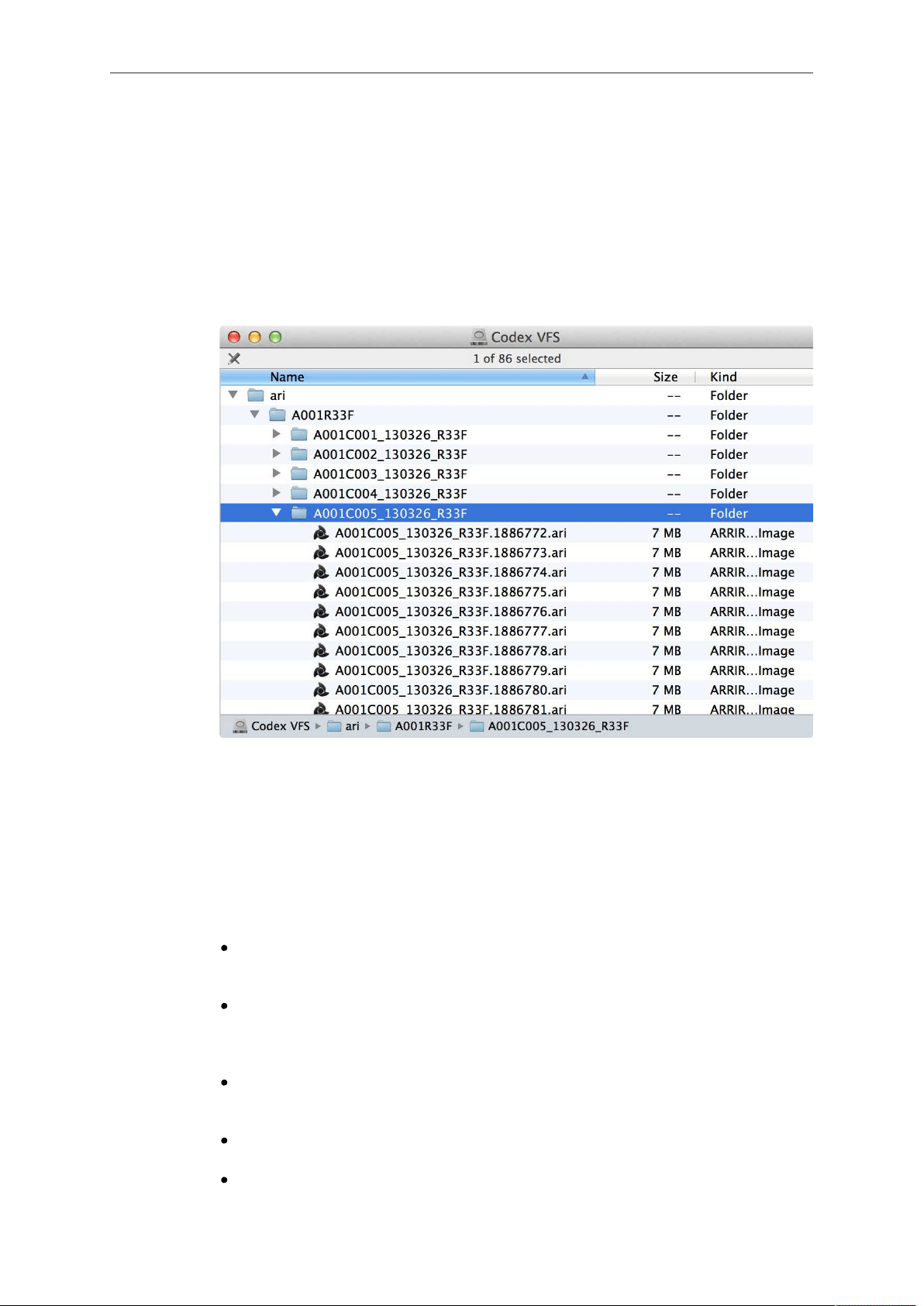
134 Operation of the Camera
The file formats, file naming and directory structure that will be presented by the VFS
are fully configurable through the Codex Platform software. This makes the VFS a
highly flexible tool for providing exactly the material you require, when you want it,
without redundant processing and storage overhead on your drives.
The default VFS configuration for the output of only ARRIRAW files uses the following
file path:
<Extension>/<Roll>/<Shot>/<Shot>.<TC Frames>.<Extension>
For detailed instructions on the Virtual File System configuration, please visit http://
www.codexdigital.com/support/media-stations and download the Codex VFS Guide.
Fig. 39: Example of an SXR Capture Drive using the VFS default file structure in Mac OS
X
File naming scheme
The ALEXA automatically names files as they are created on the recording
media. While it is possible to change the file names later on a computer, it is not
recommended, as the ALEXA naming scheme has been developed to minimize the
risk of duplicate file names.
The file name consists of five parts:
Camera Index: One character, A-Z. User assignable, should match the camera
unit. For example, the camera index A can be assigned to the A camera, and B to
the B camera.
Reel Counter: 3 characters, 001-999. Auto-assigned to each drive/card,
automatically advanced by one for each new drive/card. The user can change the
counter for the next reel. This should only be done under special circumstances,
such as after changing the camera body in the middle of a shoot.
Clip Index: One character, fixed to C. Main use is to separate the reel counter
from the clip counter. If more than 999 clips are recorded to one card (not likely to
happen), it changes to D.
Date: Current date, in order YYMMDD, as set in Menu>System/Time/Date,
separated from the other naming components by underscores.
Camera ID: Consists of a one letter prefix, currently fixed to R, and the camera
serial number encoded in 3 letters Base36 (0-9, A-Z).

Operation of the Camera 135
The file name for ARRIRAW files on SXR Capture Drives is controlled by the VFS
configuration. We highly recommend to use the standard file naming convention
"<shot>.<TC frames since midnight>.<extension>", whereas "shot" automatically uses
the ALEXA naming scheme described above.
The reel counter should be set to 001 at the beginning of a shoot. The camera will
then automatically advance the reel number each time a new drive/card is loaded into
the camera, formatted and recorded on. If a previously recorded drive/card is reloaded
in the camera (comparable to a short end of a film roll), it will keep its reel number
and the camera will continue the reel count. If the drive/card is loaded in another
camera, the card keeps its name, but a new folder with the according camera ID and
reel number is created in the root folder of the drive/card. It is possible, but usually not
necessary, to manually change the next reel number in the Project menu.
Examples
A typical ProRes/Quicktime file name would look like this:
A004C010_180208_R18T.mov
A typical ARRIRAW file name would look like this:
A004C010_180208_R18T.1886777.ari
The translation of this name is as follows:
This clip was the tenth clip recorded on the fourth reel.
This clip was recorded on February 08, 2018.
The camera assigned the Base 36 serial number 18T, which translates into the
decimal serial number 1613
Frame number 1886777 on a 24 fps project translates to a time of day time code
of 9:50:15pm and 17 frames.
Additional recommendations
To minimize the risk of lost data, ARRI suggests the following guidelines for data
management:
Pre-format your media. Format all the drives/cards in the camera before shooting
begins. This will save production time at least until all cards have been used once.
The media do not receive a reel number until the first clip is recorded, so there is
no need to use the cards in the same order they were pre-formatted.
Limit the recording time, especially on the drives. Compressed recording offers
very long recording times. Please consider limiting the recording time to 30
minutes of footage per card/drive to reduce risk of loosing data.
Download and back up data immediately after reloading the camera to minimize
the time that data exists in just one place.
On SxS cards, use the write protect tab before sending it to the data wrangler.
After an SxS card has been downloaded and backed up, disengage its write
protect before formatting.
Metadata
Metadata is stored in a Final Cut XML file, an Avid ALE file, in the recorded frames/
clips and embedded in the HD-SDI signals. The most important metadata for post
production workflow is the tape name, as it will be one of the primary identifiers used
in the EDL. The term tape name is an existing post-production naming convention that
is also used for nonlinear media. The terms tape name and reel name may be used
interchangeably.
The tape name of ALEXA files is limited to 8 letters to match the CMX 3600 EDL
standard. It consists of the Camera Index, reel counter and the Camera ID. Based on
the previous example, the tape name of the clip would be A004R18T.

136 Operation of the Camera
Even if the user forgets to assign different camera indices to two cameras on the same
project, the Camera ID metadata guarantees unique tape names.
The Quicktime file carries a single timecode track.
For more information about ALEXA metadata, please refer to the ALEXA Metadata
white paper, available at http://www.arri.com/camera/digital_cameras/downloads in the
"Technical Information" section.
17.2 Monitoring
The ALEXA's monitoring options are the electronic viewfinder EVF and the MON OUT.
Surround View is available on both while the camera is in LF 16:9 sensor mode. When
set to on, the additional pixels outside the recorded image area on the ALEXA’s A2X
sensor are displayed, allowing the operator to see outside the recorded image and
keep unwanted objects, such as microphone booms, out of the shot. To view only the
recorded image, set surround view to off.
To aid in framing, both the EVF and MON OUT can display frame lines overlaid on the
image. Frame lines can be considered electronic versions of ground glass markings in
film cameras.
17.2.1 Frame Lines
A standard set of frame lines for different aspect ratios is provided in the camera,
including:
Sensor mode LF 16:9
1.78:1 (ARRI 1.78)
1.78:1 for HD cropping (ARRI 1.78 HD)
*
1.85:1 (ARRI 1.85)
1.85:1 for 2K DCI-compatible cropping (ARRI 1.85 2K DCI)
*
2.00:1 (ARRI 2.00)
2.39:1 (ARRI 2.39)
2.39:1 for 2K DCI-compatible cropping (ARRI 2.39 2K DCI)
*
Super 35 6:5 (ARRI S35 6x5 2.6K Scope 2x)
Super 35 16:9 (ARRI S35 16x9 2.8K)
Super 35 16:9 (ARRI S35 16x9 3.2K)
*
available with 2K recording resolution
Sensor mode LF 2.39:1
1.78:1 (ARRI 1.78)
1.85:1 (ARRI 1.85)
2.00:1 (ARRI 2.00)
2.39:1 (ARRI 2.39)
2.39:1 for 4K DCI-compatible cropping (ARRI 2.39 4K DCI)
Super 35 16:9 (ARRI S35 16x9 2.8K)
Super 35 16:9 (ARRI S35 16x9 3.2K)
Sensor mode LF Open Gate
1.78:1 (ARRI 1.78)
1.78:1 for UHD cropping (ARRI 1.78 UHD)
1.85:1 (ARRI 1.85)
1.85:1 for 4K DCI-compatible cropping (ARRI 1.85 4K DCI)
2.00:1 (ARRI 2.00)
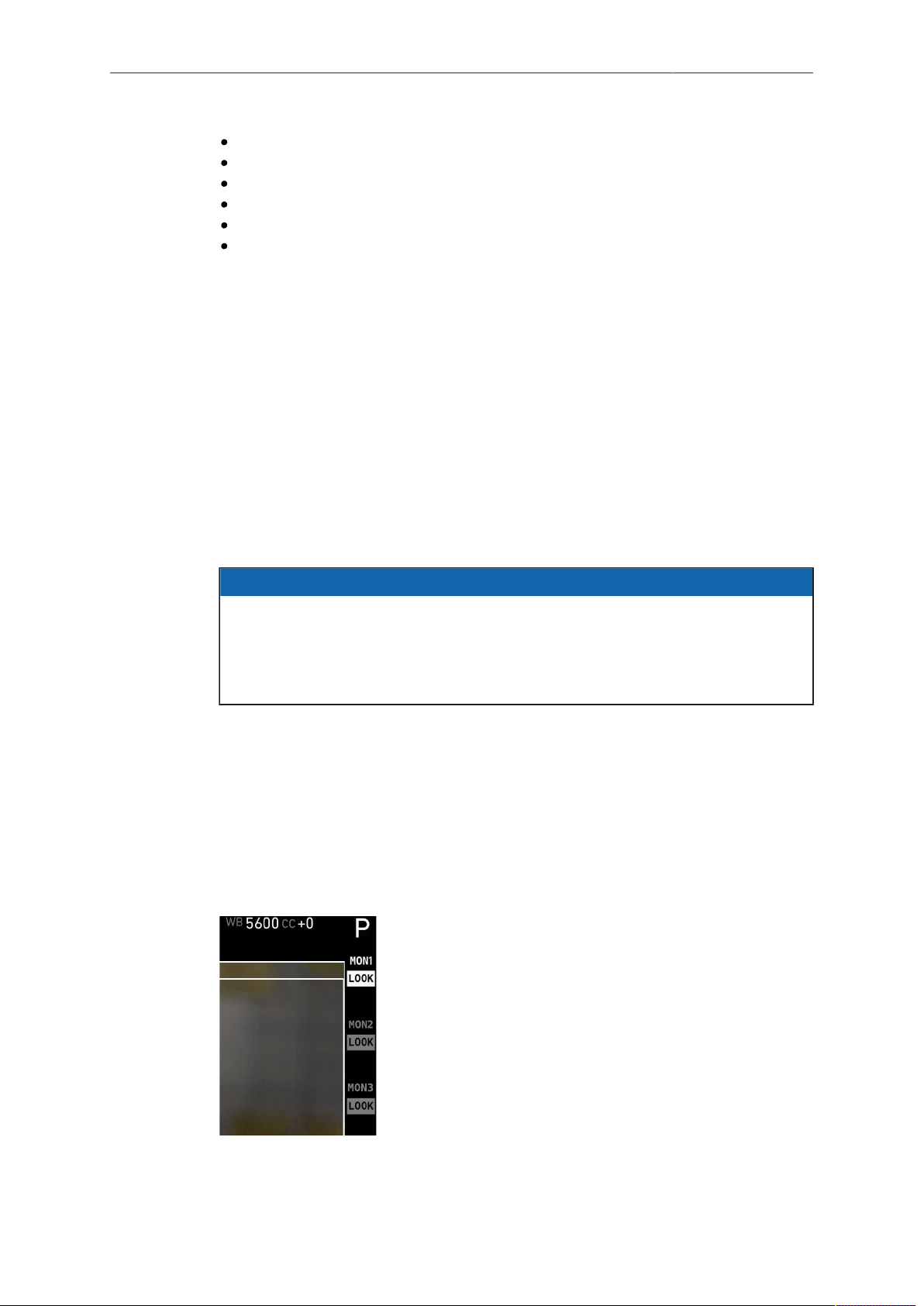
Operation of the Camera 137
2.39:1 (ARRI 2.39)
2.39:1 for 4K DCI-compatible cropping (ARRI 2.39 4K DCI)
Super 35 3:2 (ARRI S35 3x2 3.4K)
Super 35 6:5 (ARRI S35 6x5 2.6K Scope 2x)
Super 35 16:9 (ARRI S35 16x9 2.8K)
Super 35 16:9 (ARRI S35 16x9 3.2K)
Frame lines starting with "ARRI S35" mark the corresponding sensor area of a Super
35 ALEXA when using standard PL mount lenses with the PL-to-FPL adapter.
To create custom frame lines, use the Frame Line Composer on the ARRI website.
Save the new frame lines as XML files to an SD card formatted on the ALEXA, in the
Frame lines folder. The ALEXA supports up to 16 frame line templates.
17.2.2 Status Info Overlays
The ALEXA can display camera status information on EVF and MON OUT.
At the top and bottom of the screen, the ALEXA displays textual status information.
The top status bar consists of sensor FPS, shutter angle, exposure index and white
balance. In the EVF, the status bar also works as a menu, allowing the user to change
the values when the CAM button is pressed.
The bottom status bar displays information about the battery levels, recording/standby
flag and remaining capacity of internal storage.
NOTICE
The maximum size of a single clip is limited to about 229 GB. Therefore, the
camera shows the remaining time for both the whole media as well as the current
clip as soon as recording starts. When the remaining time reaches zero, the
camera will stop recording similar to a full medium. During standby, the camera
shows only the remaining time for the whole media.
On the left and right of the screen, icons provide information about the current status
of the camera. The icons are organized into groups.
The left icon group is labeled SYS and contains information about the general system
state of the ALEXA. On the right side, there are three groups labeled MON, EVF
and LOOK. They provide specific information about MON OUT 1/2/3, EVF and the
application of ARRI Look File 2 files.
The status icons that belong to the respective output path are as bright as the rest of
the status info, while the icons of the other paths are dimmed. This makes it easier to
distinguish to which monitoring output a monitor is connected to.
Fig. 40: Status overlays on MON OUT 1
The following table explains the icons in the SYS group:
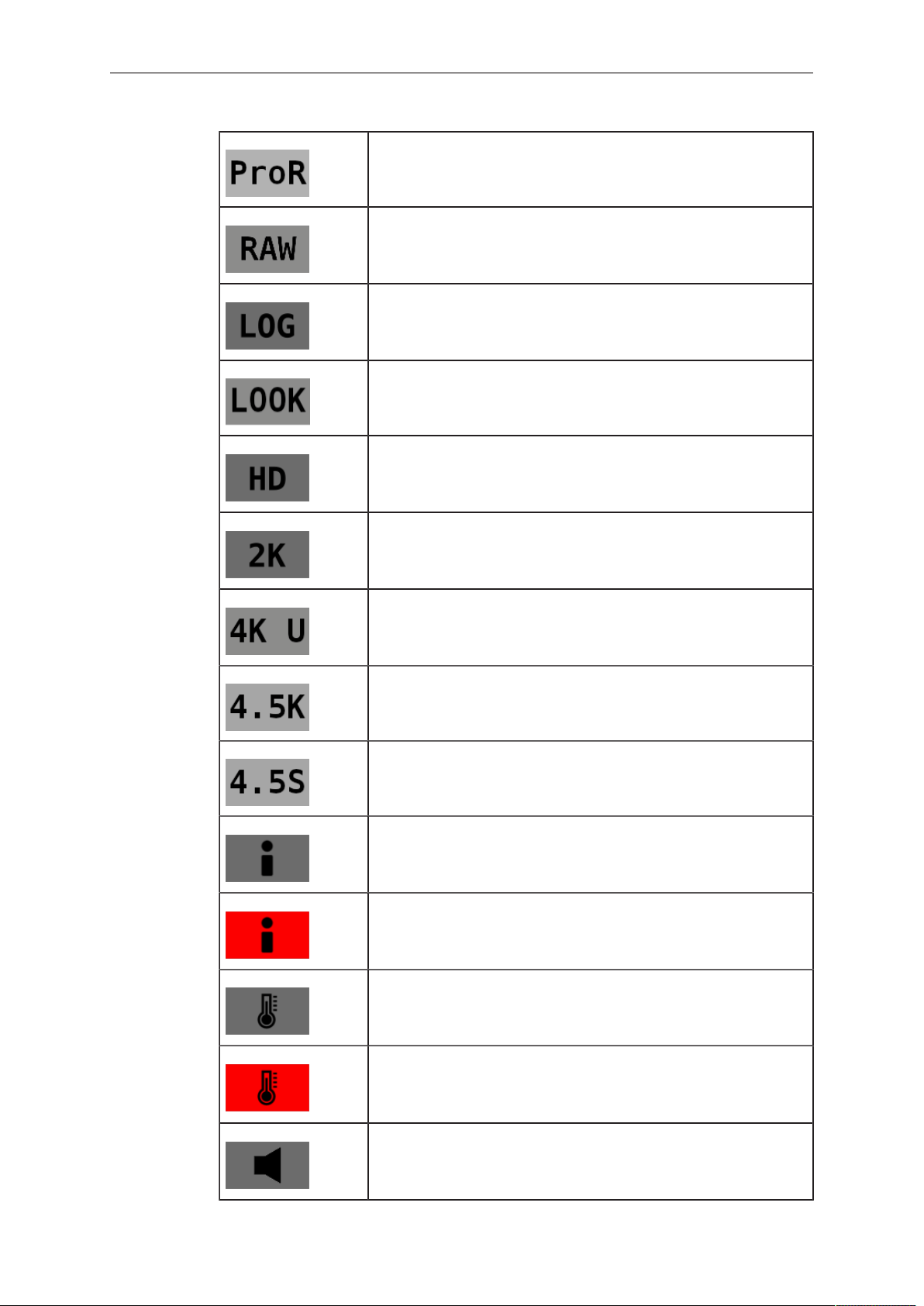
138 Operation of the Camera
Indicates that the current recording mode is set to ProRes.
Indicates that the current recording mode is set to AR-
RIRAW.
Indicates that the processing of the recording is set to Log C.
Indicates that the processing of the recording is set to ARRI
Look File 2 file.
Indicates that the current recording resolution is set to HD.
Indicates that the current recording resolution is set to 2K
Cine.
Indicates that the current recording resolution is set to 4K
UHD.
Indicates that the current recording resolution is set to 4.5K.
Indicates that the current recording resolution is set to 4.5K
in 2.39:1 (Scope).
Indicates that there is a warning condition in the camera.
Warns that the camera has detected an error.
Indicates that the camera temperature is outside of its opti-
mal range.
Warns that the camera temperature has reached a critical
point where it can no longer be operated and must be pow-
ered down.
Indicates that audio recording has been switched on.
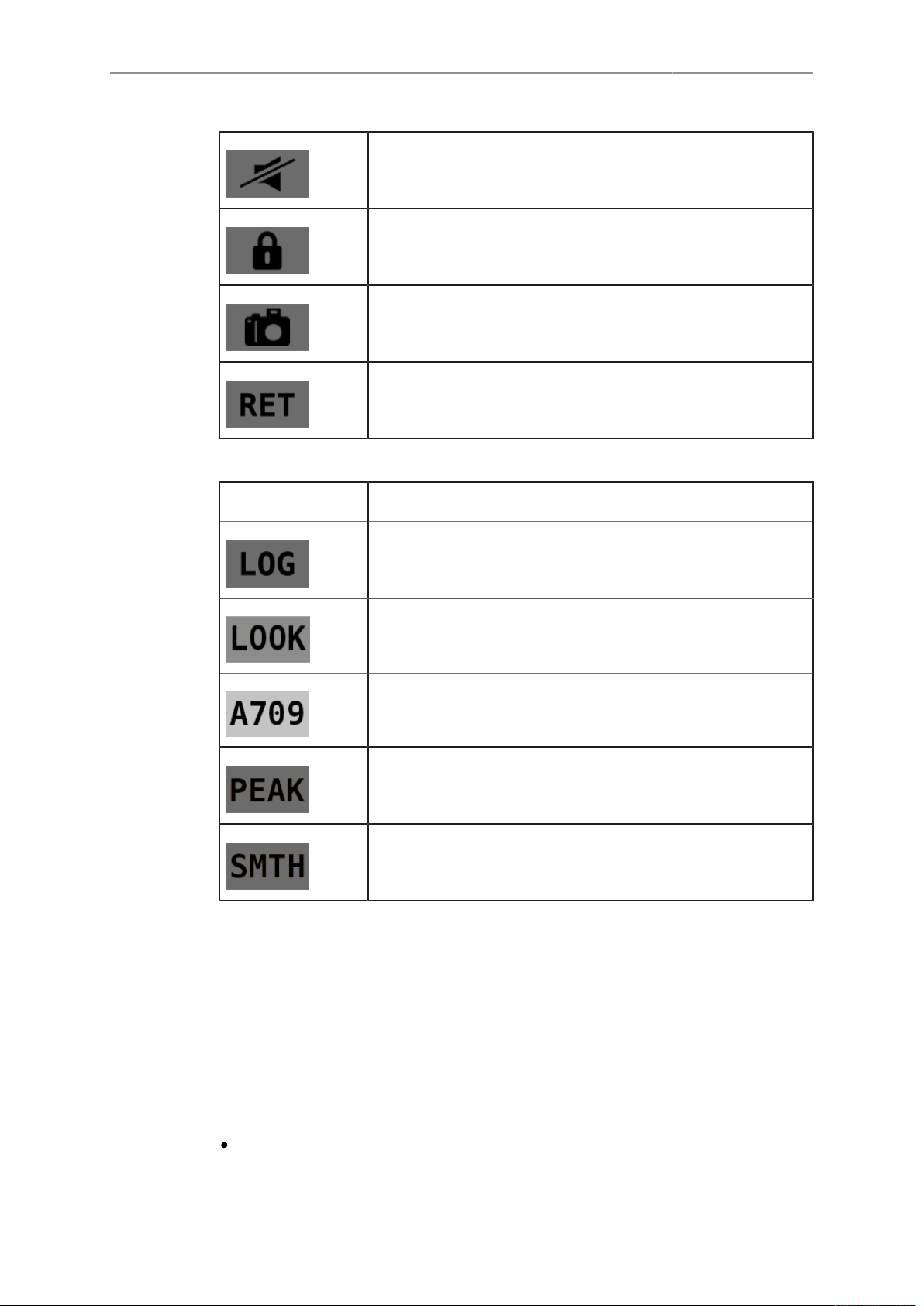
Operation of the Camera 139
Warns that audio recording has been switched on, but is cur-
rently disabled, e.g. because of an off-speed framerate.
Indicates that the camera controls are locked.
Only shown in EVF
Indicates that a frame grab is currently in progress.
Indicates that the signal from the RET IN connector is cur-
rently being displayed.
The following table explains the icons in the MON and EVF group on the right:
Icon Description
Indicates that the processing of the respective output is set
to Log C.
Indicates that the processing of the respective output is set
to ARRI Look File 2 file.
Indicates that the processing of the respective output is set
to ALEXA Classic 709.
Warns that peaking is active on the respective output.
Warns that smooth mode is active in the EVF.
17.3 Using Timecode
Timecode ensures that every image of recorded media can be identified with a unique
value and synced with corresponding media, such as sound or the second camera in
a 3D application. When used with other metadata, such as reel names, all recorded
media maintains its unique identity.
Following are two ways timecode can be used on a production:
External TC, Time of day
Use: This format is often used on multi-camera productions with sync-sound.
When all cameras are running at sync-sound speed, which is also the project
frame rate, sound and image time code match and allow for easy syncing in post.

140 Operation of the Camera
Setup: The sound department acts as the timecode master, and generates
timecode which uses the time of day as a value, and a time base matching the
project frame rate. Twenty-four hours of time will translate into twenty-four hours of
time code.
Timecode is fed to the camera via the TC connector. The timecode source must
be set in the camera to Ext LTC and the mode to Free Run. The project fps setting
must match both the sensor frame rate and the time base of the external timecode
signal. The camera can be set to use Jam sync generator, in which it samples the
timecode value once and then continues counting based on its own high-precision
crystal clock. The timecode source can be disconnected from the camera after
jamming in Jam sync generator mode. This mode ensures stable timecode with an
offset of less than one frame for each eight hours, after which the camera has to
be re-jammed.
Alternatively, the camera can be set to regenerate mode, or Regen on the
TIMECODE OPTIONS screen. In Regen mode, the camera uses the timecode
value of the external timecode source. This ensures correct timecode for an infinite
duration, but the timecode source must remain connected to the camera. Note that
the camera ignores external timecode during record and counts using its internal
clock to avoid timecode jumps should connection problems arise, e. g. due to a
faulty timecode cable.
Variations: If shooting starts close to midnight, the timecode might be started with
an offset time of day to prevent a rollover at midnight.
Restrictions: External timecode is only possible if the camera is running at sync-
sound speed. If the camera is over- or under-cranking, the timecode frame rate
will no longer match the sensor framerate, and timecode values would either be
duplicate or dropped. To prevent this, the ALEXA will automatically switch to Int TC
source and Regen mode when the sensor frame rate is changed.
Internal TC, Rec Run
Use: Record run timecode is often used on single camera productions that are
either MOS or use a dumb slate to sync picture and sound. Record run timecode
guarantees continuous timecode on all recorded data. Record runtime code also
works with over- and under-cranking.
Setup: The timecode source must be set to Int TC, the mode to Rec Run and the
generator to Regen. Timecode counts up only during recording, by one frame for
each image generated by the sensor. The timecode counts at the project frame
rate set on the camera. Normally, the timecode hour value advances by one hour
for each new reel, using only hours 01-20 for reel 1-20, and then restarting at hour
01 for reel 21.
Variations: Record run timecode might be used for off-speed work on productions
that use external timecode sources for all sync sound.
Restrictions: None.
17.4 Syncing the Sensors of Two Cameras
Two ALEXAs can be synced for 3D applications or any application requiring sensor
sync using the EXT connectors and corresponding cable. When synced, images are
captured from each camera's sensor at precisely the same time.
NOTICE
Syncing two sensors is possible at frame rates of at least 1.000 fps.
Use both sensor sync and settings sync (see next chapter) in 3D setups.

Operation of the Camera 141
To sync the sensors of two ALEXAs:
1. Connect an EXT cable KC 155-S to the EXT ports on each ALEXA.
2. In the System menu on the master camera, select External Sync.
3. On the EXT SYNC screen, set Sensor sync to EXT master.
4. In the System menu on the slave camera, select External Sync.
5. On the EXT SYNC screen, set Sensor sync to EXT slave. It takes approximately
five seconds for the two ALEXAs to sync.
The master camera triggers the slave camera so that images are created at the same
moment of time with an accuracy of 10 μs. Whenever an error occurs, the camera will
issue a warning.
Image integration between master and slave camera has a locked offset of less
than 10 μs. This means that in the worst case, exposure differs by 4.3% (@ 60 fps
frame rate and 5.0° shutter angle). With a regular exposure time (24 fps, 172.8°), the
maximum difference is 0.05%.
Synchronizing Image Output
The MON OUTs of two ALEXAs can also be synchronized. To achieve this, the user
must send a trigger from the master camera to the slave camera after sensor sync is
established.
To sync the MON OUTs of two ALEXAs:
1. Ensure that the sensors of the two ALEXAs are synced.
2. Ensure that MON OUT fps equals sensor fps.
3. In the System menu on the master camera, select External Sync.
4. On the EXT SYNC screen, select Send HD sync trigger.
5. Press the jogwheel to send the trigger to the slave camera.
The camera will display the message HD sync trigger sent to slave camera!. If
the sensors are not synced, the camera will display the error message Trigger not
sent. Camera must be set to Ext sync: Master!.
After the sync trigger has been sent, the slave camera will no longer display the
warning HD outs not synced. Trigger now!.
If the two cameras' settings are synced over Ethernet, the trigger is automatically sent.
When the outputs are synced, jitter between the two cameras' HD outputs is less than
500 ns. The HD output of each camera can be advanced or delayed by up to 30 HD
clocks (1 HD clock= 13.46 ns), allowing for a total shift of 60 HD clocks (808 ns total)
between cameras.
Timecode
Timecode is also transmitted from the master to the slave over the EXT cable. When
a camera has been set to slave, it automatically uses the timecode values transmitted
over the EXT cable. The TC screen will display EXT TC from master camera as TC
source, and all options are disabled. Only the master camera outputs LTC timecode
on its TC connector.

142 Operation of the Camera
NOTICE
In a setup with sensor sync, but without settings sync, recording needs to be
started first on the slave camera, and then on the master camera.
When the mirror shutter is switched on, an ALEXA Studio can only be synced to
another ALEXA Studio.
Recording on the slave camera may stop a few frames later than on the master
camera. Sync up the clips by timecode to ensure matching master/slave
footage.
17.5 Syncing the Settings of Two Cameras
Two ALEXAs can be operated with synchronized settings.
Camera connection
The settings of two ALEXAs can be synchronized over Ethernet using the ALEXA
Ethernet/Ethernet Cable KC 156-S, or over an ethernet hub using the ALEXA
Ethernet/RJ-45 Cable KC 153-S.
Camera setup
To sync the settings of two ALEXAs over Ethernet:
1. Connect an ALEXA Ethernet/Ethernet Cable KC 156-S to the EXT ports on both
ALEXAs, or an ALEXA Ethernet/RJ-45 Cable KC 153-S to the ethernet hub and
the EXT port of each ALEXA.
2. In the System menu on the master camera, select External Sync.
3. On the EXT SYNC screen, set Settings sync to ETH master.
4. In the System menu on the slave camera, select External Sync.
5. On the EXT SYNC screen, set Settings sync to ETH slave. The two ALEXAs
will automatically negotiate IP addresses. It takes approximately five seconds to
establish a connection.
The master camera will initially distribute its settings to the slave camera. Once this
is done, settings can also be changed on the slave camera, and the change will
take effect on both cameras. This is useful if the master camera's controls are not
accessible.
If a camera is set to ETH master or ETH slave, but is not connected to another
camera, a warning is displayed on the STATUS Info screen.
Synced settings
The following settings are synced when syncing two ALEXAs:
WB>White Balance + CC Tint
EI>Exposure Index
FPS>Sensor FPS
SHUTTER>Shutter Angle
COLOR>REC Processing
COLOR>MON OUT 1 Processing
COLOR>MON OUT 2 Processing
COLOR>MON OUT 3 Processing

Operation of the Camera 143
COLOR>EVF Processing
MENU>Recording>Mode
MENU>Recording>Codec
MENU>Recording>Resolution
MENU>Monitoring>EVF>Surround view
MENU>Monitoring>EVF>Anamorphic desqueeze
MENU>Monitoring>MON OUT 1>Frame rate
MENU>Monitoring>MON OUT 1>Scan format
MENU>Monitoring>MON OUT 1>Status info
MENU>Monitoring>MON OUT 1>Surround view
MENU>Monitoring>MON OUT 1>Surround mask
MENU>Monitoring>MON OUT 1>Framelines
MENU>Monitoring>MON OUT 1>Anamorphic desqueeze
MENU>Monitoring>MON OUT 2>Frame rate
MENU>Monitoring>MON OUT 2>Scan format
MENU>Monitoring>MON OUT 2>Status info
MENU>Monitoring>MON OUT 2>Surround view
MENU>Monitoring>MON OUT 2>Surround mask
MENU>Monitoring>MON OUT 2>Framelines
MENU>Monitoring>MON OUT 2>Anamorphic desqueeze
MENU>Monitoring>MON OUT 3>Frame rate
MENU>Monitoring>MON OUT 3>Scan format
MENU>Monitoring>MON OUT 3>Status info
MENU>Monitoring>MON OUT 3>Surround view
MENU>Monitoring>MON OUT 3>Surround mask
MENU>Monitoring>MON OUT 3>Framelines
MENU>Monitoring>MON OUT 3>Anamorphic desqueeze
MENU>Project>Project fps
The slave camera also takes over the Camera ID of the master camera, so file names
are identical except for the Camera ID prefix. It is important to give the master and the
slave camera different Camera ID prefixes to prevent duplicate file names.
When formatting media in settings synchronized cameras, the next reel count of the
master camera takes effect.
144 Operation of the Camera
NOTICE
An error will be triggered on pressing record when at least one of the synced
cameras is not ready for recording (e.g. because of missing medium).
Automatic white balance for synced cameras can only be initiated on the master
camera.
Sensor mode needs to be switched manually on all synced cameras. Do not
start recording until all cameras have loaded the same sensor mode.
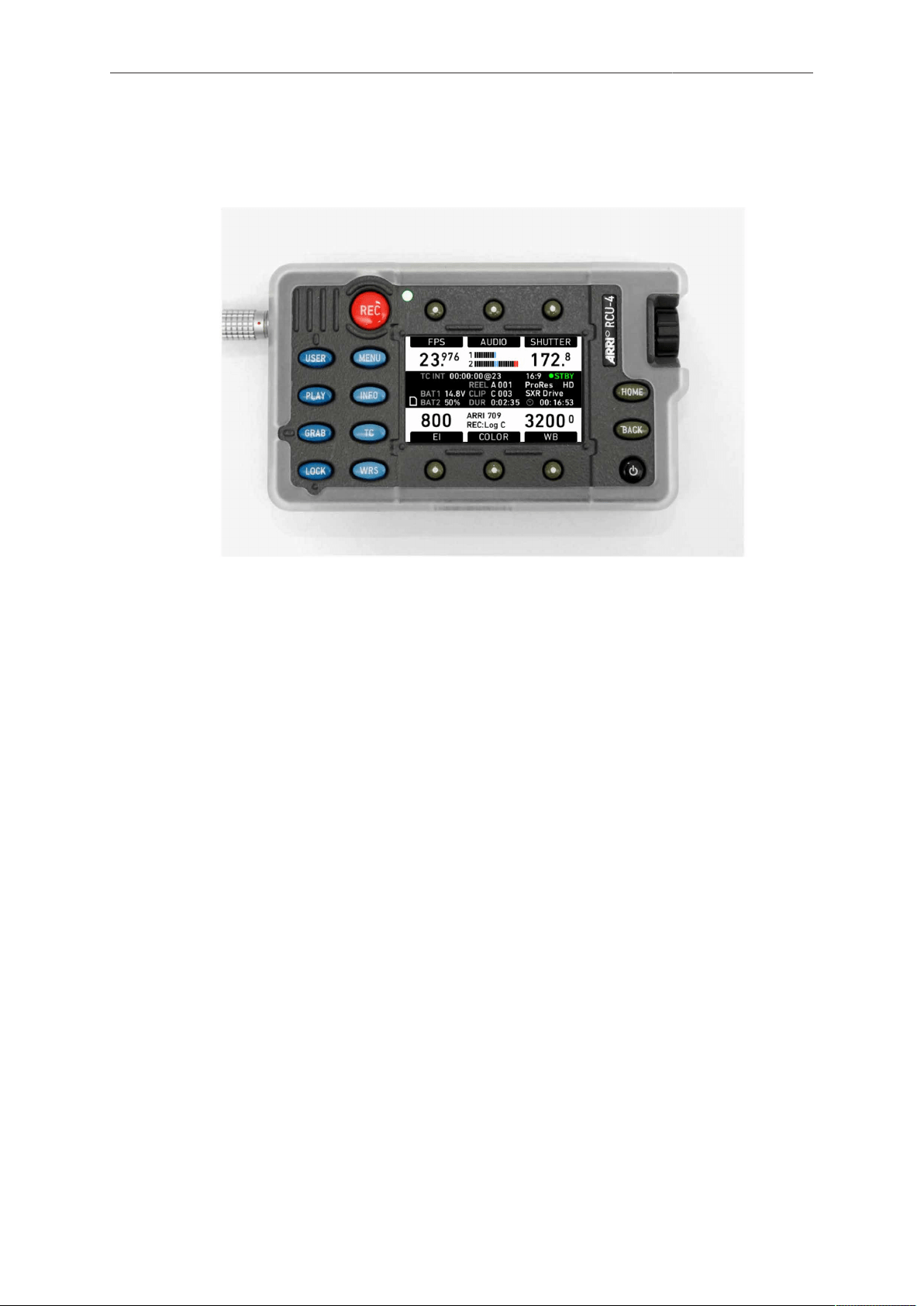
Remote Control Unit RCU-4 145
18 Remote Control Unit RCU-4
The camera can be remotely controlled with an RCU-4. This device mirrors the
controls on the camera's right side. It is connected to the camera's Ethernet port.
Power is supplied via the Ethernet cable.
To power the RCU-4, connect it to a camera, make sure the camera is powered up,
and press the power button.
During boot-up, the RCU-4 compares its firmware version with the camera firmware
version. If it detects a difference, it will update itself to match the camera's firmware
version. When the update is completed, the RCU-4 will shut down automatically.
The power button of the RCU-4 only affects the RCU-4. It is not possible to power or
to shut down the camera with the RCU-4. When the camera is powered down, the
RCU-4 shuts down automatically as it loses its power supply.
The LOCK button of the RCU-4 locks only the RCU-4. It does not affect the camera
lock.
For more information, please refer to the RCU-4 user manual.

146 Index
19 Index
1
12 V............................................................................................................................................................... 33
A
About This Manual.......................................................................................................................................... 9
Appendix...................................................................................................................................................... 149
ARRI Look File 2 files................................................................................................................................... 69
AUDIO........................................................................................................................................................... 63
AUDIO IN...................................................................................................................................................... 32
AUDIO OUT.................................................................................................................................................. 33
B
Basic precautions.......................................................................................................................................... 45
BAT................................................................................................................................................................ 31
BAT Connector.............................................................................................................................................. 18
Bridge Plate adapter BPA-1.......................................................................................................................... 28
Bridge Plates BP-12/BP-13........................................................................................................................... 27
C
Camera Controls........................................................................................................................................... 57
Camera Support............................................................................................................................................ 22
Center Camera Handle CCH-1..................................................................................................................... 26
Cine-Style Block Batteries............................................................................................................................ 19
COLOR.......................................................................................................................................................... 68
Condensation................................................................................................................................................ 16
Connector Pin Outs..................................................................................................................................... 152
Connectors.................................................................................................................................................... 30
D
Dimensions and Weights............................................................................................................................ 162
Disclaimer........................................................................................................................................................ 7
Display........................................................................................................................................................... 57
Display + Beeper........................................................................................................................................ 111
E
EI................................................................................................................................................................... 66
Electronic Viewfinder.............................................................................................................................. 22, 97
ETHERNET................................................................................................................................................... 32
EVF................................................................................................................................................................ 32
EVF Controls............................................................................................................................................... 120
Explanation of Warning Signs and Indications............................................................................................. 14
EXT................................................................................................................................................................ 32
External Sync.............................................................................................................................................. 109
F
False Color Display..................................................................................................................................... 157
False Color Index........................................................................................................................................ 104
Fan mode.................................................................................................................................................... 113
Filter cleaning................................................................................................................................................ 55
Firmware - Software Update Packages (SUPs)......................................................................................... 115
FPS................................................................................................................................................................ 62
Frame Lines........................................................................................................................................ 101, 136
Function Buttons........................................................................................................................................... 73
G
General Precautions...................................................................................................................................... 16
General Safety Guidelines............................................................................................................................ 14
Gold Mount Batteries.................................................................................................................................... 20
H
Hand Units.................................................................................................................................................... 92
HOME screen................................................................................................................................................ 58

Index 147
I
Imaging........................................................................................................................................................ 106
In-Camera Filter Module LF IFM.................................................................................................................. 43
INFO.............................................................................................................................................................. 75
Internal recording........................................................................................................................................ 129
Internal Recording Formats........................................................................................................................ 129
L
Layout of the ALEXA.................................................................................................................................... 12
Lens Motors.................................................................................................................................................. 90
Lens Mounting............................................................................................................................................... 40
Lens Support................................................................................................................................................. 41
Levelling Block LB-1..................................................................................................................................... 28
LFFSND Filter Set (Full)............................................................................................................................... 45
Lists and User Lists...................................................................................................................................... 61
LPL mount..................................................................................................................................................... 40
M
Main Controls................................................................................................................................................ 57
Mains Unit NG 12/26 R................................................................................................................................ 19
Maximum lens mounting depth for PL lenses.............................................................................................. 44
Menu.............................................................................................................................................................. 93
Minimum Equipment Recommended For Operation.................................................................................... 22
Monitoring............................................................................................................................................. 96, 136
MON OUT 1/2/3...................................................................................................................................... 31, 99
Mounting in-camera filters............................................................................................................................. 52
N
Network....................................................................................................................................................... 113
O
Onboard Batteries......................................................................................................................................... 20
Operation of the Camera............................................................................................................................ 129
Operator controls......................................................................................................................................... 119
P
PLAY.............................................................................................................................................................. 82
Plus Camera Controls................................................................................................................................... 86
Power.......................................................................................................................................................... 109
Power Management...................................................................................................................................... 18
Power Outputs.............................................................................................................................................. 21
Power Supply................................................................................................................................................ 18
Production Info............................................................................................................................................ 105
Project......................................................................................................................................................... 104
R
Radio System................................................................................................................................................ 85
Recording...................................................................................................................................................... 94
Recording Module................................................................................................................................. 36, 129
Remote Control Unit RCU-4....................................................................................................................... 145
Required shimming and maximum lens mounting depth............................................................................. 45
RET IN.......................................................................................................................................................... 31
RS.................................................................................................................................................................. 32
S
Safety Guidelines.......................................................................................................................................... 14
Safety instructions for in-camera filtration.................................................................................................... 44
Scope............................................................................................................................................................ 10
Screen Buttons.............................................................................................................................................. 58
SD card....................................................................................................................................................... 114
SD Card........................................................................................................................................................ 33
Shimming the lens mount............................................................................................................................. 46
Shoulder Pad SP-3....................................................................................................................................... 29
SHUTTER...................................................................................................................................................... 66
Specific Safety Instructions........................................................................................................................... 14
Status Info Overlays.................................................................................................................................... 137
Storage and Transport.................................................................................................................................. 16
Syncing the Sensors of Two Cameras....................................................................................................... 140
Syncing the Settings of Two Cameras....................................................................................................... 142
System......................................................................................................................................................... 106
System Time + Date................................................................................................................................... 112

148 Index
T
TC........................................................................................................................................................... 33, 74
Technical data............................................................................................................................................. 149
Test Signal................................................................................................................................................... 110
TIMECODE OPTIONS.................................................................................................................................. 74
Tripod and Remote Heads............................................................................................................................ 22
U
USER............................................................................................................................................................. 78
User Pixel Masking..................................................................................................................................... 107
User Setups................................................................................................................................................ 117
Using Timecode.......................................................................................................................................... 139
V
Viewfinder Cables......................................................................................................................................... 24
Viewfinder CAM menu................................................................................................................................ 122
Viewfinder EVF menu................................................................................................................................. 121
Viewfinder Mounting Bracket........................................................................................................................ 24
V-Lock Batteries............................................................................................................................................ 20
W
Warning and Error Messages..................................................................................................................... 158
WB................................................................................................................................................................. 71
Web Remote............................................................................................................................................... 123
Wedge Adapter WA-1 and Quick-Release Plate QR-HD-1.......................................................................... 28
WiFi.............................................................................................................................................................. 113
Wireless Remote System.............................................................................................................................. 85

Appendix 149
20 Appendix
20.1 Technical data
Image Sensor
Type A2X CMOS sensor
Sensor frame rates 0.750 - 150.000 fps
(depending on sensor mode and
recording format)
Shutter angle 5.0° - 358.0°
Active photo sites (incl. surround view) 4448 x 2502 (LF 16:9)
4448 x 1856 (LF 2.39:1)
4448 x 3096 (LF Open Gate)
Aperture of recorded image 31.68 x 17.82 mm (LF 16:9)
36.70 x 15.31 mm (LF 2.39:1)
36.70 x 25.54 (LF Open Gate)
Photo site pitch 8.25 μm
Aspect ratios 1.78:1 (16:9)
2.39:1
1.44:1 (Open Gate)
Filters optical low pass, UV, IR
Color filters RGB primary colors
Lens
Lens mount Exchangeable lens mount, with LPL
mount installed
Flange focal depth 44.00 mm nominal
Image processing
White balance 2000 - 11000 Kelvin
CC Shift -12 to +12
EI rating 160 - 3200 ASA
Recorded image resolutions (pixels) 1920 x 1080 (LF 16:9 HD)
2048 x 1152 (LF 16:9 2K)
3840 x 2160 (LF 16:9 4K UHD)
3840 x 2160 (LF 16:9 ARRIRAW)
4448 x 1856 (LF 2.39:1)
4448 x 3096 (LF Open Gate)
Viewfinder EVF-1

150 Appendix
Technology LCOS imaging device
Resolution 1280 x 784 pixels
Viewfinder EVF-2
Technology OLED imaging device
Resolution 1920 x 1080 pixels
Power
Power supply (BAT) DC 19.5 - 34 V
Power supply (onboard battery) DC 18.5 - 34 V
Power management Active ORing between BAT connector
and onboard battery adapters
Power consumption ca. 120 W (recording ProRes 4444 at
24 fps in LF 16:9 sensor mode onto an
SxS PRO+ 256 GB card with EVF-1
and wireless video on but without ac-
cessories)
ca. 160 W (recording ARRIRAW at 90
fps in LF Open Gate sensor mode on-
to an SXR Capture Drive 2 TB with
EVF-1 and wireless video on but with-
out accessories)
Power outputs 4 x RS (24 V), 1 x 12 V
Recording
Recording media Codex SXR Capture Drives
Sony SxS PRO+ 256 GB cards
Recording formats Apple QuickTime ProRes 422
Apple QuickTime ProRes 422 HQ
Apple QuickTime ProRes 4444
Apple QuickTime ProRes 4444 XQ
ARRIRAW (ari)
Image Outputs
Monitoring outputs EVF out: proprietary signal for EVF
with delay <1 frame
3x MON OUT:
422 1.5G @ frame rates:
23.976, 24, 25, 29.97 and 30 fps
422 6G @ frame rates (MON OUT
1/2):
23.976, 24, 25, 29.97 and 30 fps
Timecode

Appendix 151
Type Tunable TC clock generator with crys-
tal oscillator
TC input LTC in
TC outputs LTC out
HD-SDI LTC/VITC out
Others
SD card most SD cards with FAT/FAT32 up to 4
GB
Sound level under 20 dB(A) @ 24 fps and ambient
temperature < 25° C / 77° F
Environmental -20° C to +45° C @ 95% relative hu-
midity max, non condensing
HD video transmitter
Power consumption 7W
Output resolution 1920 x 1080
Frame rates p: 23.98, 24, 25, 29.97, 30
psF: 23.98, 24, 25, 29.97, 30
Audio 2 channels, 48KHz PCM
embedded in HD-SDI signal
Transmission range 600m (2,000 ft) line of sight
Latency < 1ms
Encryption 128bit AES
Modulation process and other specifics OFDM (Orthogonal Frequency-Division
Multiplexing)
Bandwidth 40MHz
WiFi module
IEEE 802.11b: 1/2/5.5/11 Mbit/s Modulation DSSS, Bandwidth: 22 MHz
IEEE 802.11g: 6/9/12/18/24/36/48/54
Mbit/s
Modulation OFDM, Bandwidth: 20 MHz
Dimensions and weight
For dimensions and weight, please refer to the dimensional drawings.
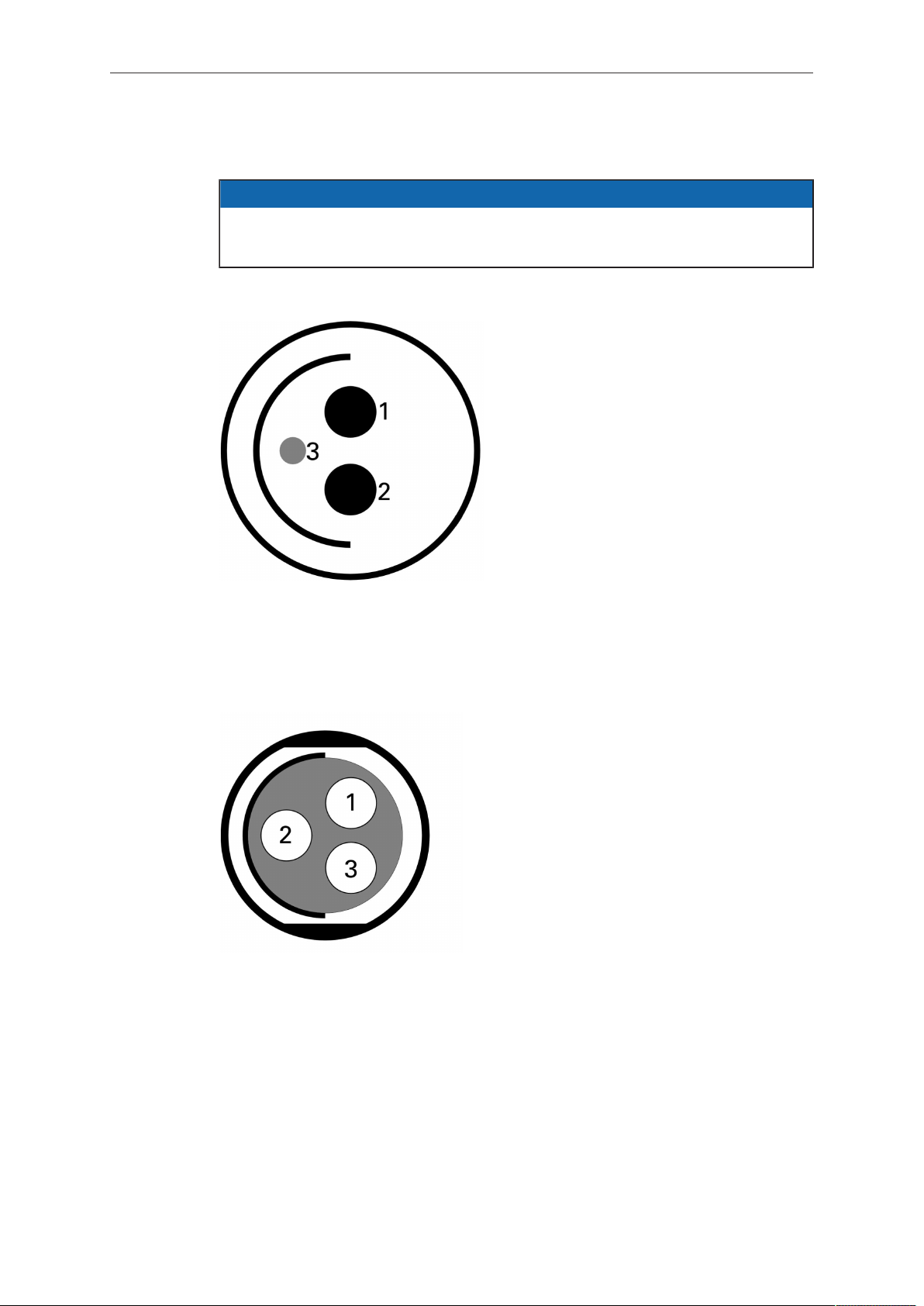
152 Appendix
20.2 Connector Pin Outs
NOTICE
The drawings of the connectors are not to scale.
All pin-outs for camera interfaces appear as seen by the user.
BAT
1 GND
2 +24V
3 BAT-COM
RS
1 GND
2 24V-AUX
3 R/S
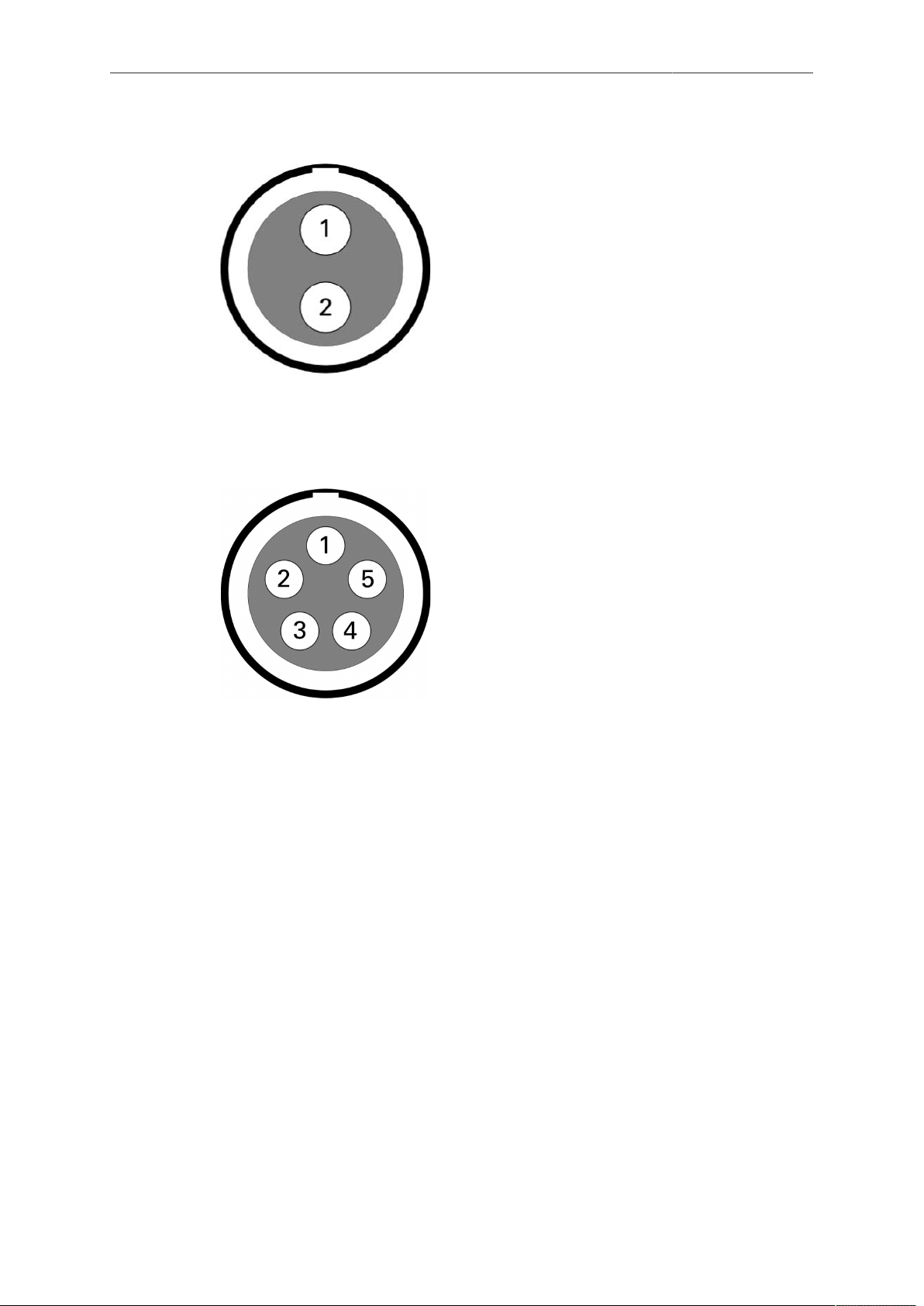
Appendix 153
12V
1 GND
2 12V-AUX
TC
1 GND
2 LTC IN
3 ASCII
4 TUNE OUT
5 LTC OUT

154 Appendix
EXT
1 RS422-TXD(+)
2 RS232-TXD
3 CAN1-L
4 CAN1-H
5 CAN2-L
6 CAN2-H
7 24V-AUX
8 RS232-RXD
9 RS422-RXD(-)
10 RS422-RXD(+)
11 RS422-TXD(-)
12 GND
13 TTL-IN1
14 TTL-IN2
15 24V-AUX
16 GND
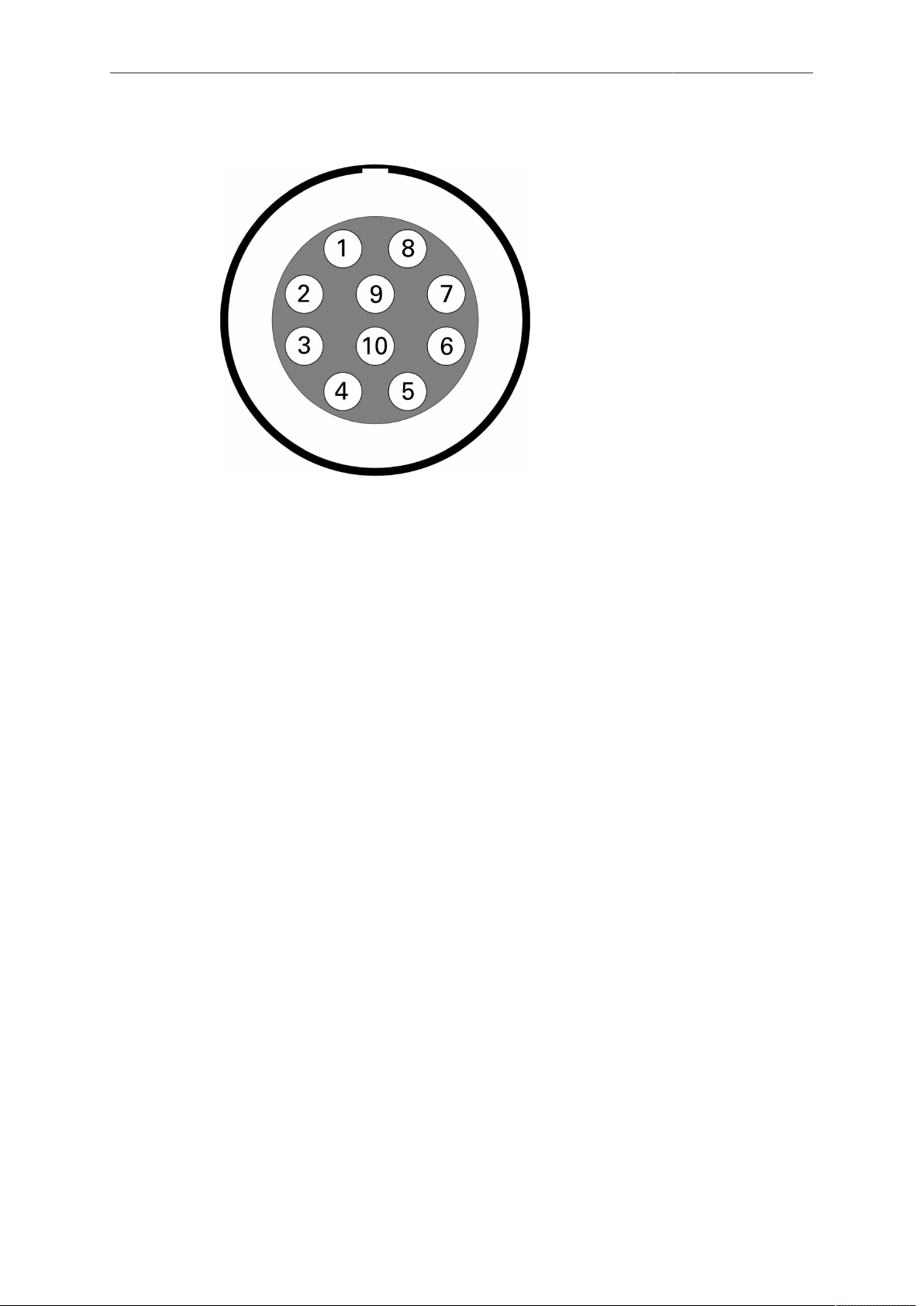
Appendix 155
ETHERNET Camera Side
1 MX-1P CTS (white-orange)
2 MX-1N DTR (orange)
3 MX-2P GND (white-green)
4 MX-2N DCD (green)
5 MX-3P TXD (blue)
6 MX-3N RXD (white-blue)
7 MX-4P DSR (white-brown)
8 MX-4N RTS (brown)
9 GND
10 24V-ETH
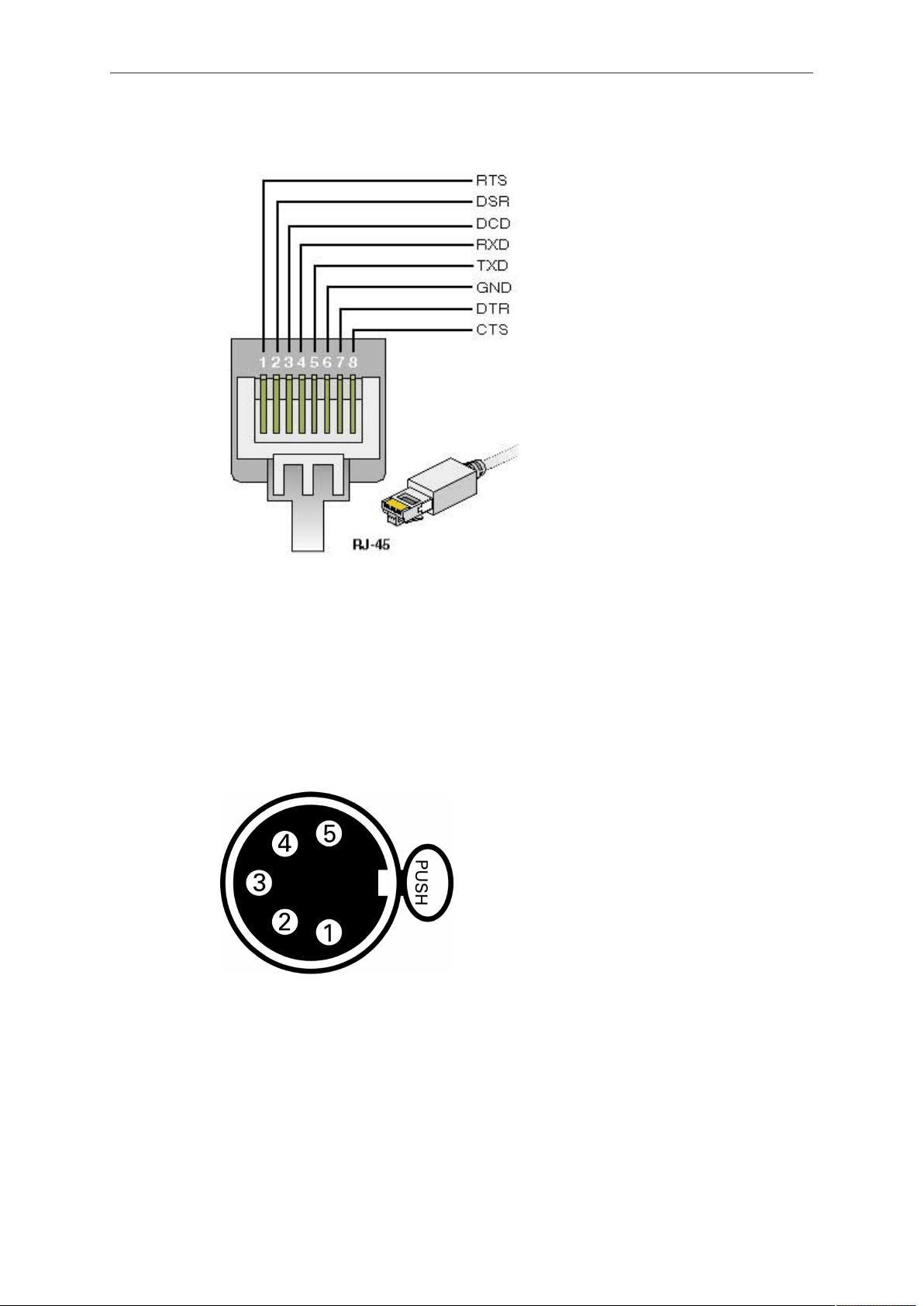
156 Appendix
ETHERNET PC Side
RTS brown
DSR white-brown
DCD green
RXD white-blue
TXD blue
GND white-green
DTR orange
CTS white-orange
AUDIO IN
1 AGND
2 L-IN(+)
3 L-IN(-)
4 R-IN(+)
5 R-IN(-)
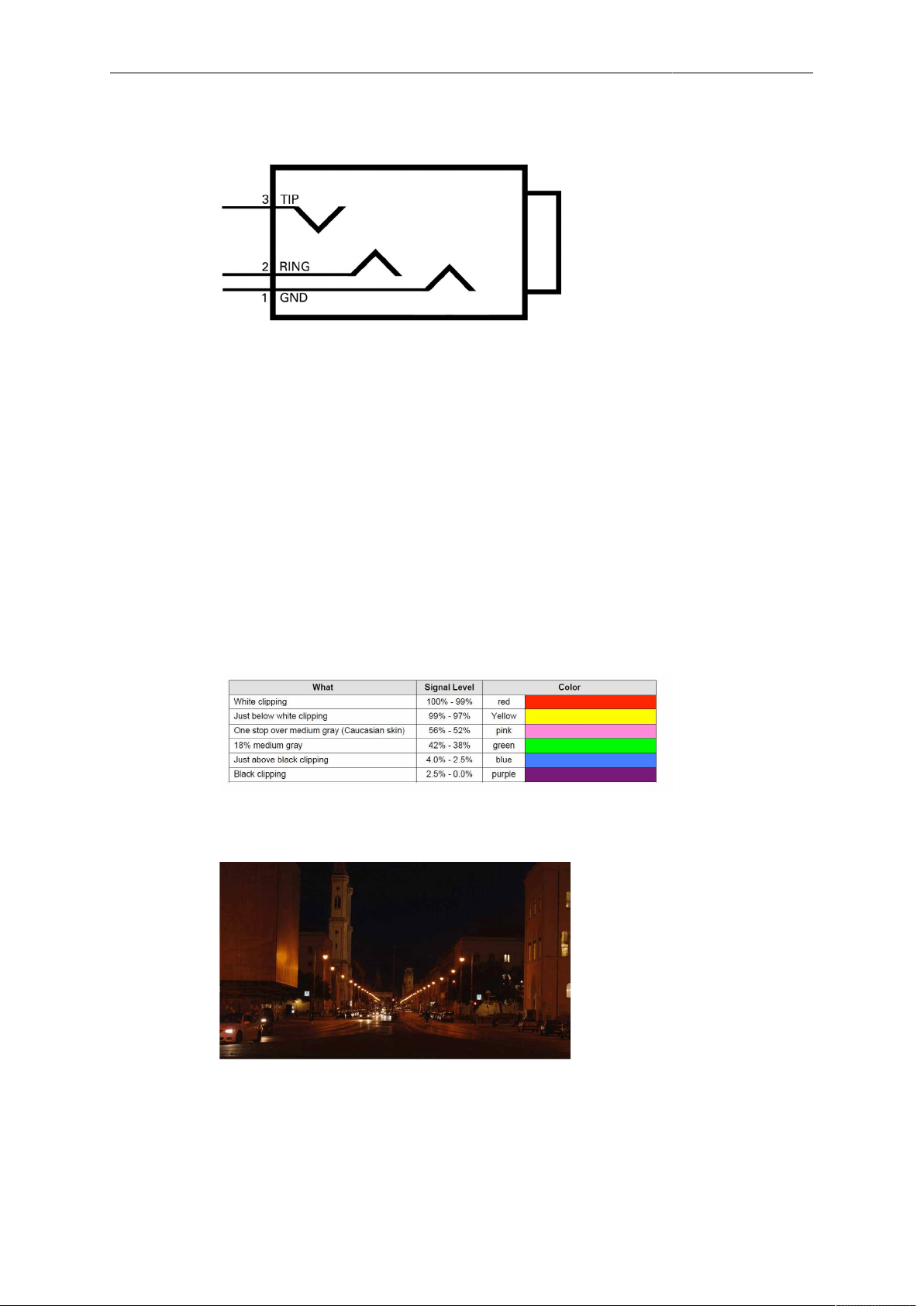
Appendix 157
AUDIO OUT
1 GND
2 R-OUT
3 L-OUT
20.3 False Color Display
The false color display is a tool to check correct exposure. It can be activated on EVF
and MON OUT, and takes the respective gamma setting as a basis for calculation.
When active, the image is turned into a greyscale image with important luminance
ranges shown in signal colors. Note that the false color tool is only suitable for
checking exposure and is not an appropriate tool for checking other image parameters
or sensor quality.
Color Encoding
Six different colors are used to show the important luminance ranges.
Fig. 41: False Color Encoding
The following example illustrates the behavior of the false color display.
Fig. 42: Night scene captured with ALEXA

158 Appendix
Fig. 43: Night scene with false color active
20.4 Warning and Error Messages
If anything unwanted occurs in the camera, it will give a message to the user.
These states, which require attention from the user, are indicated by icons in the main
display, the viewfinder and the MON OUT.
Warnings inform the user that a state has changed or that an error is likely to occur,
but recording is still possible.
When the camera goes into error state, recording is no longer possible, as it cannot be
guaranteed that images are acquired as the user intended, or it is not possible for the
camera to record.
The messages give a compact description of what has happened. If more information
is required, please refer to the following tables.
Special warnings and errors: Sensor temperature
ALEXA has a Peltier element that keeps the image sensor at a stable temperature.
This is important to achieve constant image quality. In certain situations, the camera
might not be able to keep the optimal temperature, or it might take some time to reach
the optimal temperature. This may be the case directly after booting, or in very hot or
cold environments.
A red temperature icon indicates that the sensor temperature is too far off to
guarantee a high image quality. A white temperature icon indicates that the sensor
temperature is not optimal, but image quality is still within the (very high) quality limits
required by ARRI.
The related messages in the INFO screen are shown in the following tables.
Status message
System state: Good Camera works properly.
Warning messages and meanings
Main Bat: Power warning The battery attached to the BAT connector
has reached its warning level. Battery power is
about to end, and a replacement battery should
be prepared.
Onboard Bat: Power warning The battery attached to the onboard battery
adapter has reached its warning level. Battery
power is about to end, and a replacement bat-
tery should be prepared.

Appendix 159
Media: Low capacity The recording medium has less than 3 min-
utes recording time left. Prepare a new card for
recording.
Media: Rec. inhibited The recording medium is protected. Remove
the card from the camera, slide the switch lo-
cated on the camera back end to the Rec en-
able position and re-insert the card.
Media full The recording medium is full.
Media: Wrong file system The recording medium is not formatted in the
file system required by the camera. Format the
medium.
Media too slow The write speed of recording medium is insuffi-
cient for the sensor fps set on the camera. Use
a medium with a higher write speed.
Media: files not consistent The metadata of one or more files on the
recording media are not consistent. Backup any
data on the medium and format the medium.
Media type not supported The media type of the current medium is not
supported.
Media write problem The camera has problems writing to the record-
ing medium. Continue with a fresh medium.
Media: wrong recording mode.
May contain clips
Capture Drive is formatted for ARRIRAW, but
ALEXA is in ProRes recording mode, or vice-
versa. Format the media to record on it.
Camera overheating The camera system's temperature is reach-
ing a critical level. This can either be due to a
blocked camera fan or ambient temperature
exceeding the system's limits. Apply addition-
al cooling or switch off the camera to prevent
hardware damage.
Low sensor temperature The sensor temperature is lower than it should
be. High image quality is still guaranteed.
High sensor temperature The sensor temperature is higher than it should
be. High image quality is still guaranteed.
Ext TC: Different frame rate The external TC signal's time base differs from
the project fps of the camera. Syncing is still
possible.
Re-jam timecode soon. Accuracy of jammed Timecode can soon ex-
pire. Re-jam camera with external Timecode
soon.
Re-jam timecode now. Accuracy of jammed Timecode has expired.
Re-jam camera with external Timecode.

160 Appendix
TC source forced to internal Sensor fps does not match Project fps. Exter-
nal Free Run TC cannot be used, camera has
switched to Int Rec Run TC.
TC mode forced to Rec Run Sensor fps does not match Project fps. Exter-
nal Free Run TC cannot be used, camera has
switched to Int Rec Run TC.
Interface bit error. Check im-
age.
Reboot camera. If error continues to occur,
contact ARRI service.
Internal processing problem Reboot camera. If error continues to occur,
contact ARRI service.
Internal battery error The internal battery which powers the real-time
clock must be replaced. Contact an ARRI ser-
vice center near you.
System problem Reboot the camera. If error continues to occur,
contact ARRI service.
System problem (I2C bus er-
ror)
Problem on camera data bus. Reboot the cam-
era. If error continues to occur, contact ARRI
service.
External TC: Incompatible
frame rate
The external TC signal's time base is not ac-
cepted by the camera.
External TC: Jamming. Please
wait.
Camera jams to external TC signal. Do not dis-
connect TC source from camera until warning
disappears.
External TC: Signal missing Camera is set to Ext LTC regen, but external
TC signal is missing.
External TC: Incompatible
frame rate
The external TC signal has a time base that
does not match the project fps of the camera.
Framegrab: Grabbing image
failed
A problem occurred in the camera. The frame
grab failed.
Framegrab: Storing image
failed
A problem occurred with the SD card. The
frame grab failed.
Playback failed The camera could not play back the internally
recorded clips.
EVF smooth mode not possi-
ble
Smooth mode is set to "On", but either sensor
fps is higher than 30.000, or shutter angle is
higher than 180.0
Ext LTC: Forced to JAM sync Ext LTC had to be switched to Jam sync by
camera system.
Card/Media removed, play-
back failed
Camera had to abort playback, as media was
removed.
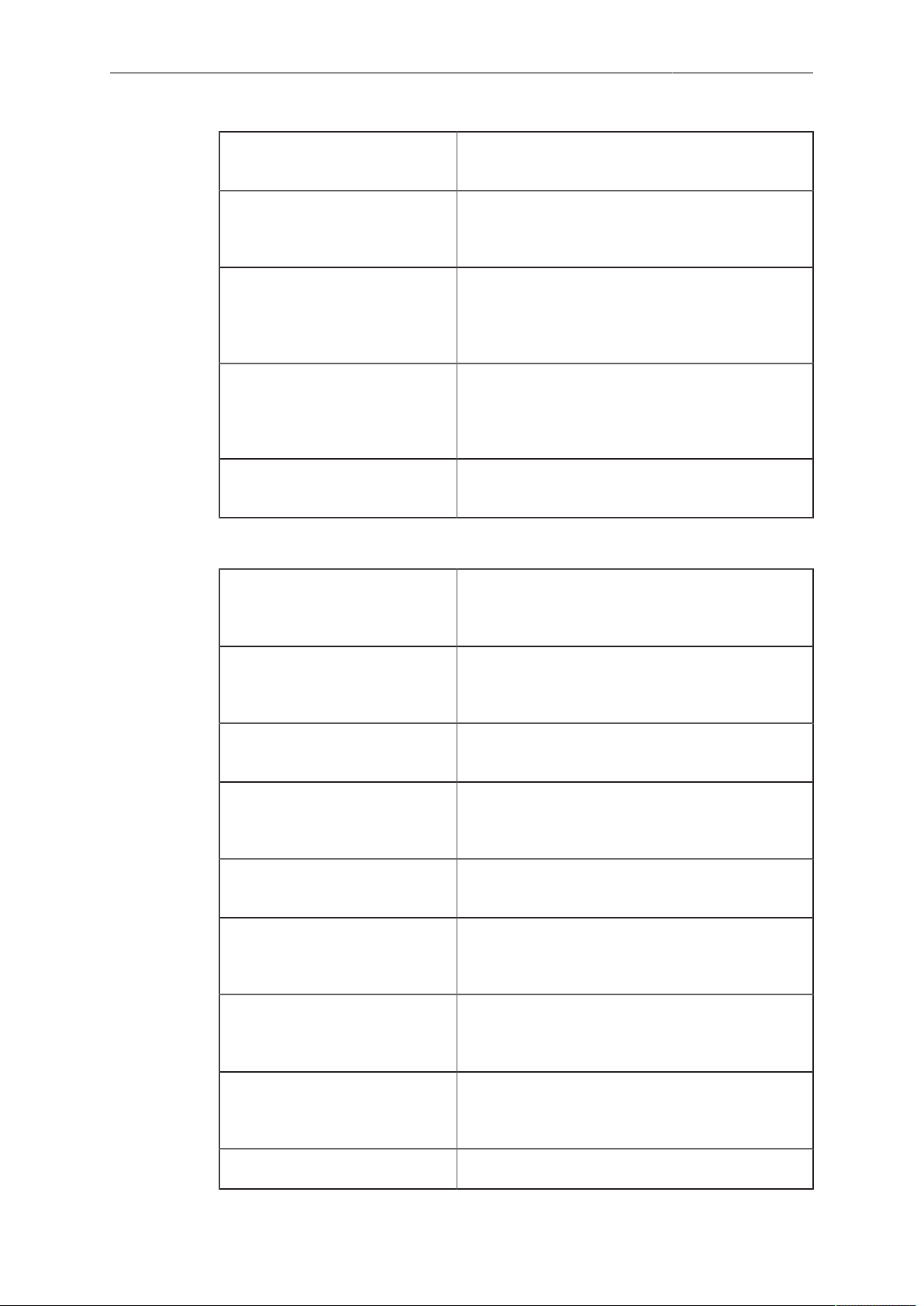
Appendix 161
Calibrate lens motors. New lens motors are attached to the camera.
Prior to use they must be calibrated.
Temperature at limit. Fan
RPM raised
Although camera fan is in "Rec low" mode, fan
noise might exceed silent level because cam-
era is becoming too hot.
Some buttons are defect Camera button signals are failing. Reboot cam-
era. If reappearing after reboot, contact service
for button replacement. Mostly hardware prob-
lem.
Media: Data rate low. Check
last clip.
Data rate of last recorded clip is very low.
Check for artifacts in replay. Can also occur
when forgetting to remove lens cap during
recording.
LDS failure. Reboot. The lens data system has failed. Restart the
camera if LDS is used.
Error messages and meanings
Main Bat: Low power The battery attached to the BAT connector has
reached its low level (10% below warning lev-
el). Battery must be replaced.
Onboard Bat: Low power The onboard battery has reached its low level
(10% below warning level). Battery must be re-
placed.
All Bats: Low power Batteries on both BAT connector and onboard
battery(s) have to be replaced.
Media end of lifetime The recording medium has reached the end of
its life cycle and has become read-only. Use a
new medium.
Media: Write speed error The current write speed could not be handled
by the recording medium.
Camera overheating The camera is getting too warm. Apply addi-
tional cooling or shut down to prevent hardware
damage.
Low sensor temperature Sensor temperature is out of range. Wait until
error message disappears before continuing to
shoot.
High sensor temperature Sensor temperature is out of range. Wait until
error message disappears before continuing to
shoot.
System error Reboot the camera.
162 Appendix
Codec error. Reboot. An error in the compression module has oc-
curred, and recording was aborted. Reboot the
camera.
Sensor error. Reboot. The image sensor has a problem. Reboot the
camera.
Sensor boot error The sensor has not booted. Reboot the cam-
era.
Interface error. Reboot. An internal data interface has a problem. If re-
booting does not solve the problem, contact the
ARRI service.
Fan error. Contact service. The fan module is not working properly. Either
install an SFM-1, or contact the ARRI service.
Fatal system error. Shut down
camera.
Camera has to be rebooted. If this error contin-
ues to occur, a hardware problem might be the
reason. Contact the ARRI service.
Software error. Reboot. A part of the camera software has stopped
functioning properly and requires a camera re-
boot.
Internal audio recording failed Audio recording on internal medium failed.
REC error. Reboot. Error in the recording module. Reboot camera.
If any error that requires rebooting occurs repeatedly, contact the ARRI service.
20.5 Dimensions and Weights
Dimensional drawings including weights information can be found at the end of
this document. A version with higher resolution can be downloaded from the ARRI
website: http://www.arri.com/camera/alexa/downloads/ in the section "Dimensional
Drawings".
20.6 Declarations of Conformity
Note: Changes or modifications not expressly approved by the party responsible for
compliance could void the user's authority to operate the equipment.
FCC Compliance Statement
Class A Statement: This equipment has been tested and found to comply with the
limits for a Class A digital device, pursuant to Part 15 of the FCC Rules. These limits
are designed to provide reasonable protection against harmful interference when the
equipment is operated in a commercial environment.
Appendix 163
Note: This equipment generates, uses, and can radiate radio frequency energy and, if
not installed and used in accordance with the instruction manual, may cause harmful
interference to radio communications. Operation of this equipment in a residential area
is likely to cause harmful interference in which case the user will be required to correct
the interference at his own expense.
ECS transceiver module: FCC ID: Y7N-EMIP400
Wireless video module: FCC ID: Y7N-AVTS36254
WiFi module: FCC ID: PVH0965
Industry Canada Compliance Statement
Complies with the Canadian ICES-003 Class A specifications.
Cet appareil numérique de la Classe A est conforme à la norme NMB-003 du Canada.
This device complies with RSS-210 of Industry Canada.
Cet appareil est conforme à CNR-210 d' Industrie Canada.
This Class A device meets all the requirements of the Canadian interference-causing
equipment regulations
Cet appareil numérique de la Classe A respecte toutes les exigences du Réglement
sur le matériel brouilleur du Canada.
ECS transceiver module: IC ID: 9482A-EMIP400
Wireless video module: IC: 7680A-AMNKHIN1
WiFi module: IC: 5325A-0965
Australia / New Zealand
China
ECS transceiver module:
CMIIT ID: 2017DJ7865 (M)
Wireless video module:
WiFi module:
ALEXA LF:
CMIIT ID: 2018AJ1286
164 Appendix
India
ECS transceiver module: Certification no.: ETA-1386/2018/ERLP
Wireless video module: Certification no.: ETA-1307/2017/ERLO
Israel
Model: ALEXA LF _IL
Manufacturer: ARRI - Arnold & Richter Cine Technik GmbH & Co
Manufacturing country: Germany
Type Approval No.: 51-66210
Valid from: 12.09.2018
Japan
ECS transceiver module: MIC-ID: 020-180029
WiFi module: MIC-ID: 204-510009
Wireless video module: MIC-ID: 001-A03519
Philippines
No. ESD – 1816774C
Singapore
South Africa
TA 2017/3060
APPROVED

Appendix 165
South Korea
ECS transceiver module: Certification No: R-CRM-Arg-EMIP400
WiFi module: Certification No: MSIP-CRM-ULX-ODIN-W260
Wireless video module: Certification No: MSIP-CRM-ARg-AVTS35253
ALEXA LF: Certification No: R-REM-Arg-ALEXA-LF
Taiwan
ECS transceiver module: NCC: CCAH18LP0650T0
Wireless video module: NCC: CCAH17LP4190T1
WiFi module: NCC: CCAJ16LP1230T0
低功率電波輻射性電機管理辦法
警語一
經型式認證合格之低功率射頻電機,非
經許可,公司、商號或使用者均不得擅
自變更頻率、加大功率或變更原設計之
特性及功能。
(即低功率電波輻射性電機管理辦法第十
二條)
The low-power radio-frequency de-
vices must not be altered by chang-
ing the frequency, enhancing emission
power, adding external antenna, and
modification of original design charac-
teristic as well as function.
警語二
低功率射頻電機之使用不得影響飛航安
全及干擾合法通信;經發現有干擾現象
時,應立即停用,並改善至無干擾時方
得繼續使用。
前項合法通信,指依電信法規定作業之
無線電通信。低功率射頻電機須忍受合
法通信或工業、科學及醫療用電波輻射
性電機設備之干擾。
(即低功率電波輻射性電機管理辦法第十
四條)
The operation of the low-power ra-
dio-frequency devices is subject to the
conditions that no harmful interference
is caused. The user must stop oper-
ating the device immediately should
harmful interference is caused and
shall not resume until the condition
causing the harmful interference has
been corrected.
Moreover, the interference must be ac-
cepted that may be caused by the op-
eration of an authorized communica-
tions, or ISM equipment.
警語三
在
5.25G~5.35G
頻帶內操作之無線資訊
傳輸設備僅適於室內使用
5250MHz-5350MHz is allowed to use
for indoor only.
Thailand
This telecommunication equipment conforms to NTC technical requirement.
166 Appendix
United Arab Emirates
ALEXA LF: Dealer No: DA68290/17 (valid until: 28th Aug. 2022)
ALEXA LF: Registered No: ER61078/18 (valid until: 04 Feb 2021)
The wireless video module of the ALEXA LF is certified for indoor and outdoor use in
the USA, for all other countries it is certified for indoor use only.
Regarding §10(10) of Radio equipment directive 2014/53/EU, the wireless video
module has restrictions in the following markets:

Arnold & Richter Cine Technik GmbH & Co. Betriebs KG
Sitz: München, Register: Amtsgericht München, HRA-Nr. 57918
Tel.: +49(89) 3809 0
Türkenstr. 89
Persönlich haftende Gesellschafterin: Arnold & Richter Cine Technik GmbH
Fax: +49(89) 3809-1245
D-80799 München
Sitz: München, Register: Amtsgericht München, HRB-Nr. 54477
www.arri.com
Steuer-Nr. 144/232/20555
Geschäftsführung: Franz Kraus; Dr. Jörg Pohlman; Stephan Schenk; Walter Trauninger
Ust-ID: DE 129725260 WEEE-Reg.-Nr. DE 48968492
Bay.Landesbank: KTO: 111 43 68 BLZ: 700 500 00
Swift/BIC: BYLADEMM IBAN: DE64 7005 0000 0001 1143 68
HypoVereinsbank: KTO: 7 940 009 BLZ: 700 202 70
Swift/BIC: HYVEDEMMXXX IBAN: DE63 7002 0270 0007 9400 09
Arnold & Richter Cine Technik GmbH & Co. Betriebs KG
Business Unit Camera Systems, Türkenstr.89, D-80799 München
EU–Konformitätserklärung
EU–Declaration of Conformity
Markenname / Brand Name: ARRI
Produktbezeichnung / Product Description:
Digitalkamerasystem / Digital Camera System:
• ARRI ALEXA LF + Electronic Viewfinder EVF1 or EVF2
+ Europa Settings der Software 2.0 oder höher, Objektive gemäß Appendix I, Antennen
gemäß Appendix II und sontiges Zubehör gemäß Appendix III
+ Europe Setting for Software 2.0 or later, Primes following Appendix I, Antenna following Appendix II and additional
accessories following Appendix III
Die bezeichneten Produkte stimmen mit den Vorschriften folgender Europäischer Richtlinien überein:
The designated products conform to the specifications of the following European directives:
1. Richtlinie 2014/53/EU des Europäischen Parlaments und des Rates vom 16. April 2014 zur
Harmonisierung der Rechtsvorschriften der Mitgliedstaaten über die Bereitstellung von Funkanlagen
auf dem Markt - OJ L 153, 22.5.2014, S. 62–106
Directive 2014/53/EU of the European Parliament and the Council of 16 April 2014 on the harmonisation of the laws of the
Member States relating to the making available on the market of radio equipment - OJ L 153, 22 May 2014, p. 62–106
2. Richtlinie 2011/65/EU des Europäischen Parlaments und des Rates vom 8. Juni 2011
zur Beschränkung der Verwendung bestimmter gefährlicher Stoffe in Elektro- und Elektronikgeräten -
OJ L 174, 1.7.2011, S. 88–110
Directive 2011/65/EU of the European Parliament and the Council of 8 June 2011 on the restriction of the use of certain
hazardous substances in electrical and electronic equipment - OJ L 174, 1 July 2011, p. 88–110
Die Übereinstimmung mit den Richtlinien erfolgte unter Anwendung nachfolgend genannter Normen:
The compliance with the requirements of the European Directives was proved by the application of the following standards:
Grundlegende Anforderungen zu Nr. 1. Essential Requirements regarding No 1
• Art. 3.1 a nach 2014/35/EU –following 2014/35/EU
o EN 62368-1:2014 + AC:2015-05 + AC:2015-11;
• Art. 3.1 b nach 2014/30/EU –following 2014/30/EU
o EN 301 489-1 V2.1.1; EN 301 489-17 V3.1.1; EN 55032:2015; EN 55103-2:2009
• Art. 3.2
o EN 300 328 V2.1.1; EN 301 893 V2.1.1
Grundlegende Anforderungen zu Nr. 2. - Essential Requirements regarding No 2
• EN 50581:2012;
Für die Ermittlung der entsprechenden Normen haben wir die folgende Quelle verwendet:
To evaluate the respective information, we used:
http://ec.europa.eu/growth/single-market/european-standards/harmonised-standards/index_en.htm
Jahr der Anbringung des CE-Zeichens / Year of affixed CE-marking: 2018
München, den 25.07.2018
gez/sig gez/sig
Walter Trauninger
Geschäftsführer / Managing Director
Dr. Sebastian Lange
Arnold & Richter Cine Technik GmbH & Co. Betriebs KG
Sitz: München, Register: Amtsgericht München, HRA-Nr. 57918
Tel.: +49(89) 3809 0
Türkenstr. 89
Persönlich haftende Gesellschafterin: Arnold & Richter Cine Technik GmbH
Fax: +49(89) 3809-1245
D-80799 München
Sitz: München, Register: Amtsgericht München, HRB-Nr. 54477
www.arri.com
Steuer-Nr. 144/232/20555
Geschäftsführung: Franz Kraus; Dr. Jörg Pohlman; Stephan Schenk; Walter Trauninger
Ust-ID: DE 129725260 WEEE-Reg.-Nr. DE 48968492
Bay.Landesbank: KTO: 111 43 68 BLZ: 700 500 00
Swift/BIC: BYLADEMM IBAN: DE64 7005 0000 0001 1143 68
HypoVereinsbank: KTO: 7 940 009 BLZ: 700 202 70
Swift/BIC: HYVEDEMMXXX IBAN: DE63 7002 0270 0007 9400 09
Leiter Qualitätsmanagement / Head of Quality
Management
Arnold & Richter Cine Technik GmbH & Co. Betriebs KG
Business Unit Camera Systems, Türkenstr.89, D-80799 München
APPENDIX I – Liste der Objektive - List of Primes
Lfd. Nr.
Item
Bezeichung
Model name
1
ARRI Signature Primes mit Lens Data System 2 in den Brennweiten 18-125
ARRI - Signatures Primes with Lens Data System 2 with focal lenght 18-125
2
LPL to PL Adapter + ARRI Objektive mit Lens Data System 1
LPL to PL adapter + ARRI - Lens Data System 1
APENDIX-II – Liste der Antennen - List of Antennas
Lfd. Nr.
Item
Hersteller
Manufacturer
Bezeichnung
Model name
Gain
(dBi)
Strahlungsdiagramm
Radation pattern
Antennentyp
Type
Anschluss
Connector
1
Nearson
S131AM-2450S
2.0
Omni-directional
Dipole
Reverse
SMA
2
Proant
333 (Ex-it 2400
Foldable)
2.0
Omni-directional
Dipole
Reverse
SMA
3
Radial/Larsen
R380.500.125
2.0
Omni-directional
Dipole
Reverse
SMA
4
Wanshih
WSS002
2.0
Omni-directional
Dipole
Reverse
SMA
5
HFB
HFB Custom
Antenna
-1.3
Omni-directional
Reverted F antenna
(WLAN L antenna)
MMCX
6
Taoglas
GW26.0151
1.8
Omni-directional
Monopole
Reverse
SMA
APENDIX-III – Liste des zusätzlichen Zubehörs - List of additional accessories
Lfd. Nr.
Item
Bezeichung
Model name
1
Aktiver Batteriadapter V-Mount BAB-HV
Battery Adapter Back BAB
-HV
2
Aktiver Batteriadapter G-Mount BAB-HG
Battery Adapter Back BAB
-HG
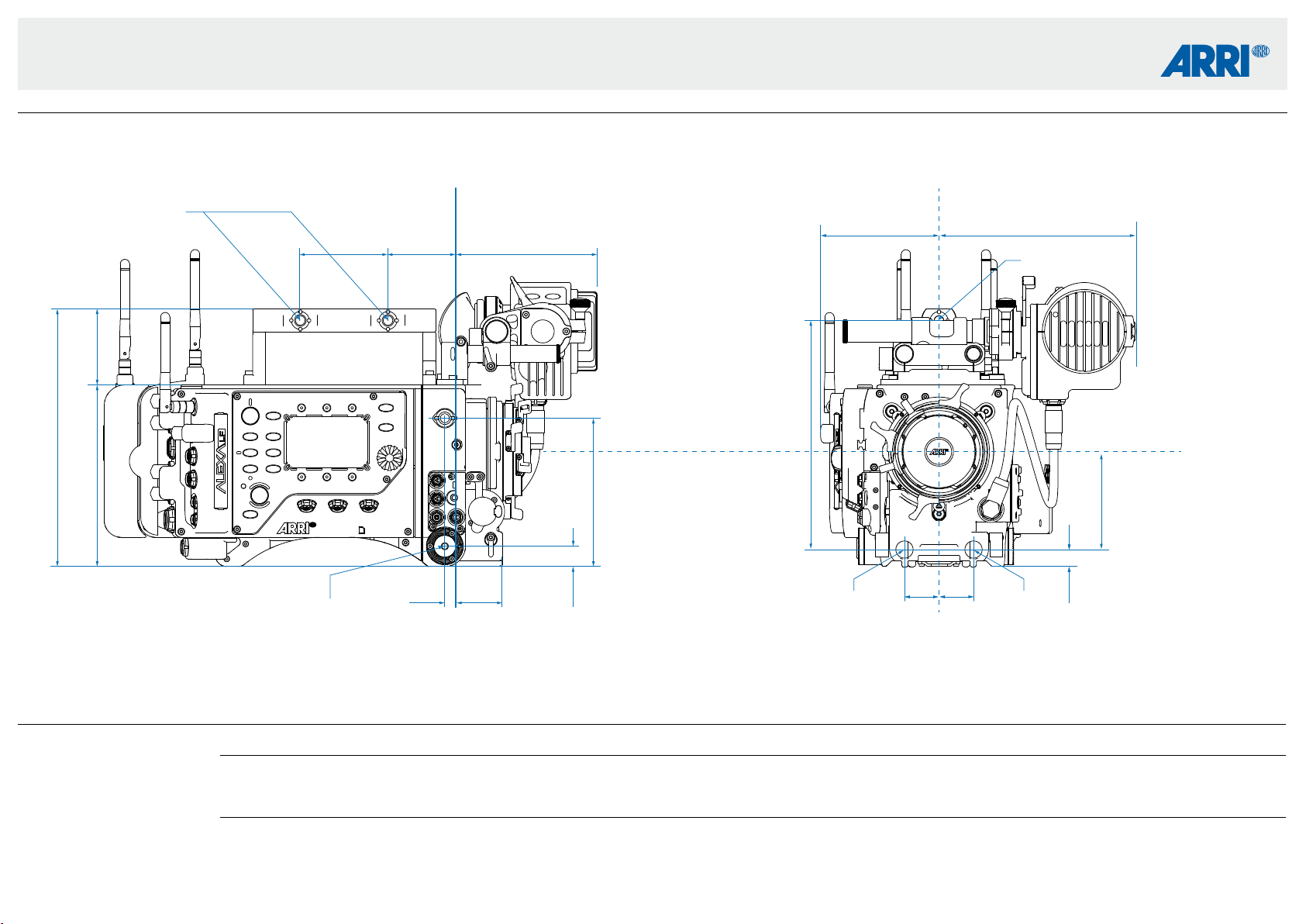
Technical Data are subject to change without notice.CAMERA DIMENSIONS – Version 2018- 01
ALEXA LF
ALEXA LF Length Width Height Weight
Body + LPL mount 351 mm - 14.33” 201 mm - 7.91” 158 mm - 6.22” 7.8 kg - 17.2 lb
Body + LPL mount
Electronic Viewfinder EVF-1, EVF-1 cable KC-150-S,
Viewfinder Mounting Bracket (VMB-3)
414 mm - 16.3” 251 mm - 9.88” 224 mm - 8.82” 9.4 kg - 20.7 lb
Camera Right Image Plane Camera Front Optical Center
Optical Center
M6 (3.5mm deep)
85 mm
3.35”
128.8 mm
5.07”
17.6 mm
0.7”
223.8 mm
8.81”
66 mm
2.6”
157.8 mm
6.21”
102.8 mm
4.05”
171.2 mm
6.74”
120,3 mm
4.74”
59.4 mm
2.34”
10 mm
0.39”
40 mm
1.58”
76.2 mm
3”
264 mm
10.4”
UNC 3/8“–16 (10 mm deep)
UNC 3/8“–16 (10 mm deep)
199 mm
7.84”
ø 15 mm ø 15 mm
30 mm
1.18”
30 mm
1.18”
14.8 mm
0.58”
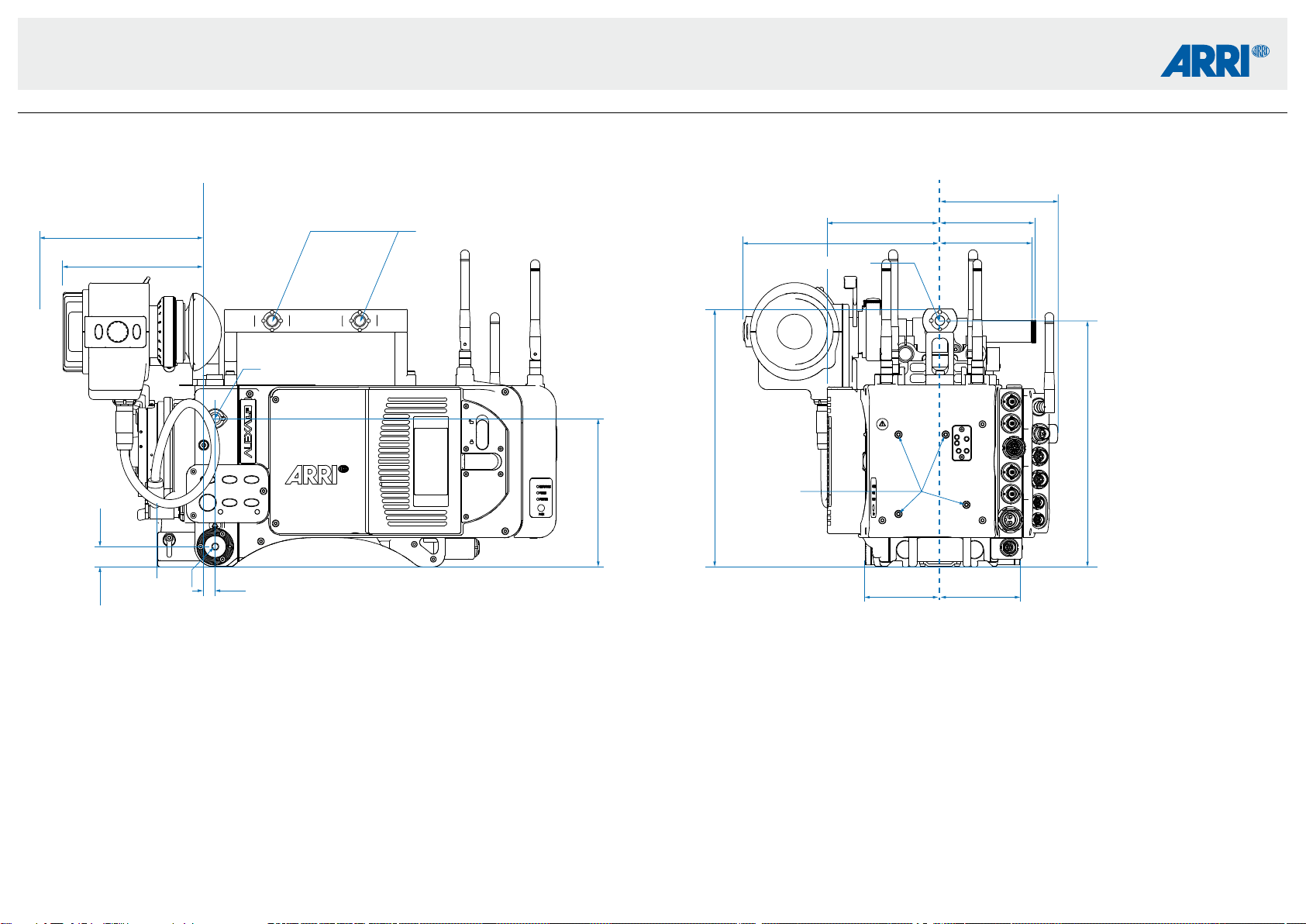
Technical Data are subject to change without notice.CAMERA DIMENSIONS – Version 2018- 01
ALEXA LF
80 mm
3.15”
83.5 mm
3.29”
98 mm
3.86”
UNC 3/8“–16 (10 mm deep)
142 mm max.
5.59”
120 mm
4.72”
64.9 mm
2.56”
69.9 mm
2.75”
Camera Left Image Plane Camera Back Optical Center
223. 8 mm
8.81”
128.8 mm
5.07”
17.6 mm
0.7”
10 mm
0.39”
213.8 mm
8.42”
102.8 mm
4.05”
M6 (3.5 mm deep)
M3 (6 mm deep)
UNC 3/8“–16 (10 mm deep)
UNC 3/8“–16 (10 mm deep)
171 mm
6.73”
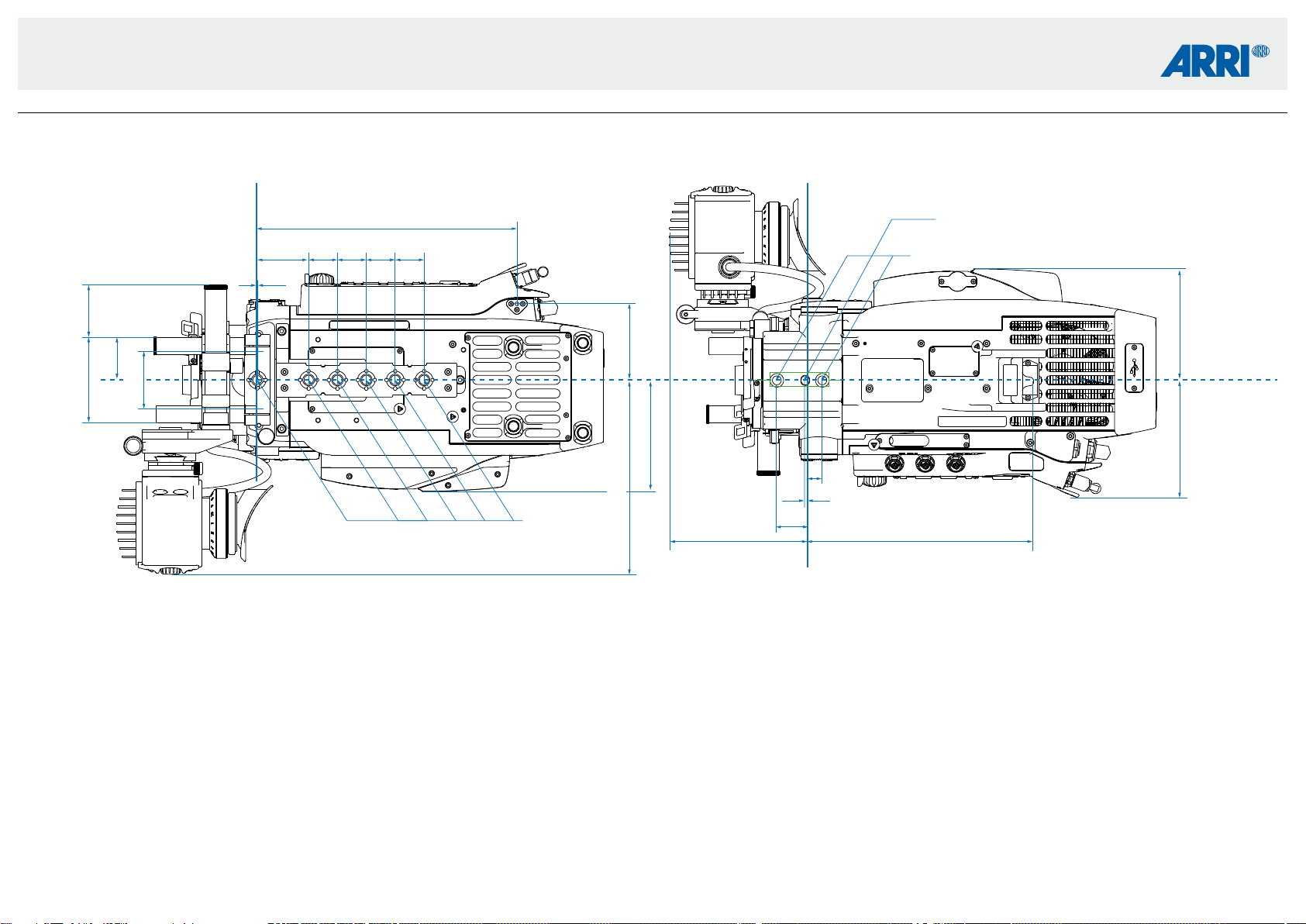
Technical Data are subject to change without notice.CAMERA DIMENSIONS – Version 2018- 01
ALEXA LF
98 mm
3.86”
1.5 mm
0.06”
83.5 mm
3.29”
37.5 mm
1.48”
98 mm
3.86”
Camera Top Image Plane Image Plane Camera Bottom
230 mm
9.05”
67 mm
2.64”
46.7 mm
1.84”
46.7 mm
1.84”
25.4 mm
1”
25.4 mm
1”
25.4 mm
1”
25.4 mm
1”
UNC 3/8“–16
(10 mm deep)
103 mm
4.06”
UNC 3/8“–16 (10 mm deep)
oval hole 7 mm (+0.022) wide and 8 mm long (4.5 mm deep)
120 mm
4.72”
198 mm
7.79”
27.5 mm
1.08”
2.5 mm
0.1”
12.5 mm
0.49”
75 mm
2.95”
50.8 mm
2”
171.22 mm
6.74”
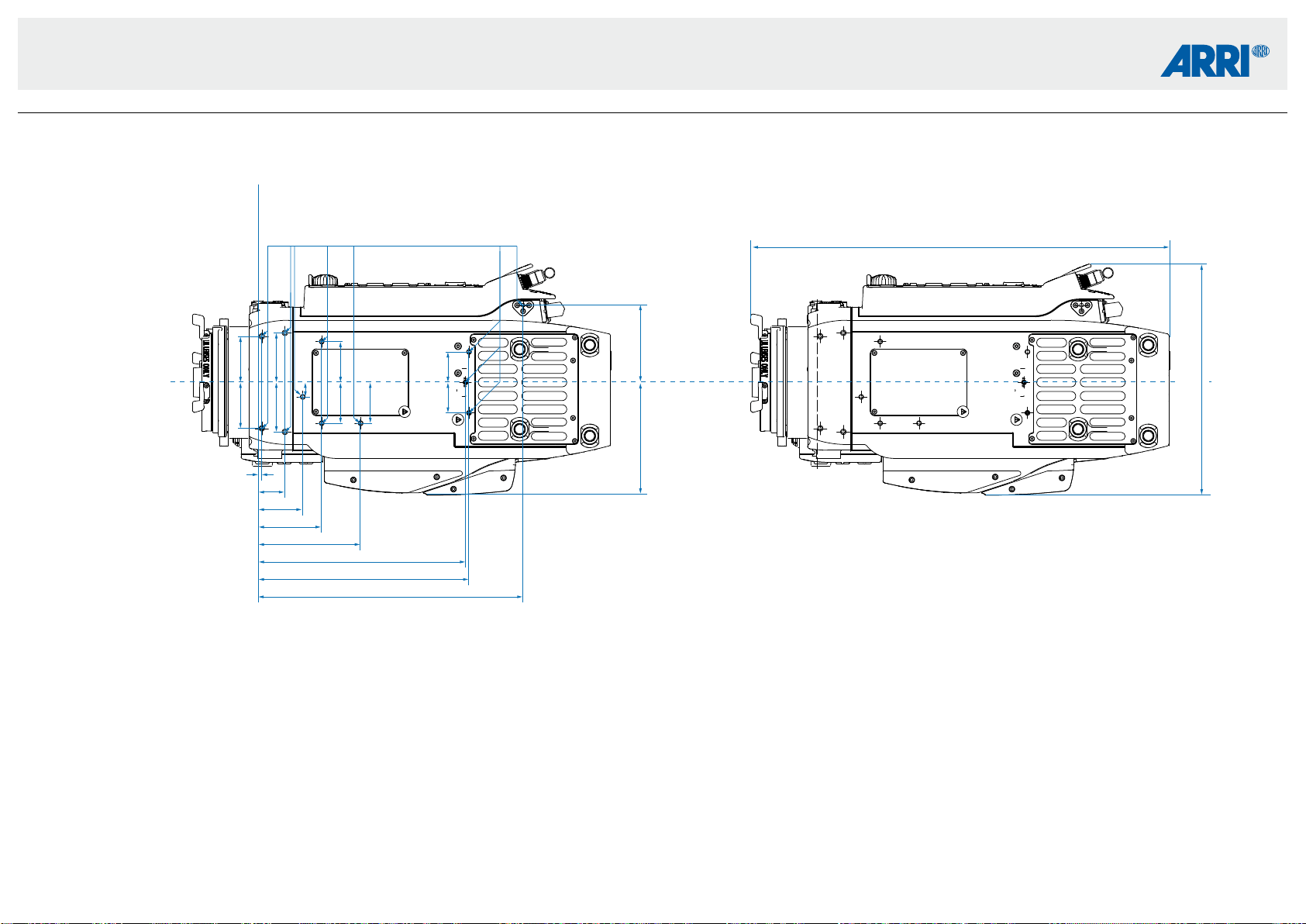
Technical Data are subject to change without notice.CAMERA DIMENSIONS – Version 2018- 01
ALEXA LF
98 mm
3.86”
Optical Center
67 mm
2.64”
230 mm
9.06”
364 mm
14.33”
183 mm
7.21”
180 mm
7.09”
88.8 mm
3.5”
55 mm
2.17”
38.5mm
1.52”
40 mm
1.58”
43 mm
1.69”
43 mm
1.69”
35.5 mm
1.4”
35.5 mm
1.4”
12.6 mm
0.5”
35.5 mm
1.4”
26.5 mm
1.04”
26.5 mm
1.04”
40 mm
1.58”
23 mm
0.91”
3 mm
0.12”
M4 (4 mm deep)
201 mm
7.91”
Camera Top Image Plane Camera Top