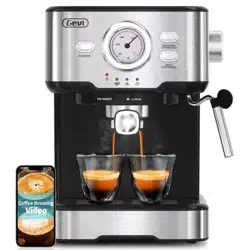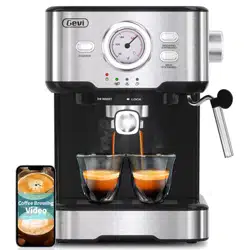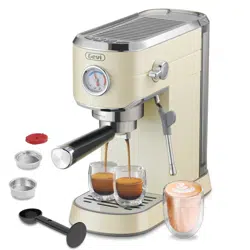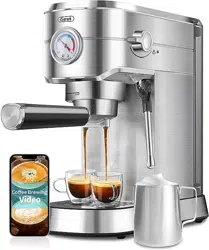

Read this booklet thoroughly before using this coffee machine for the quick use.
Function Instruction
Quick Use Manual
3-in-1 Smart
Espresso Coffee Machine
Grinder | Brewer | Frother
GECME020DE-U
Read this booklet thoroughly before using this coffee machine and save it for future reference
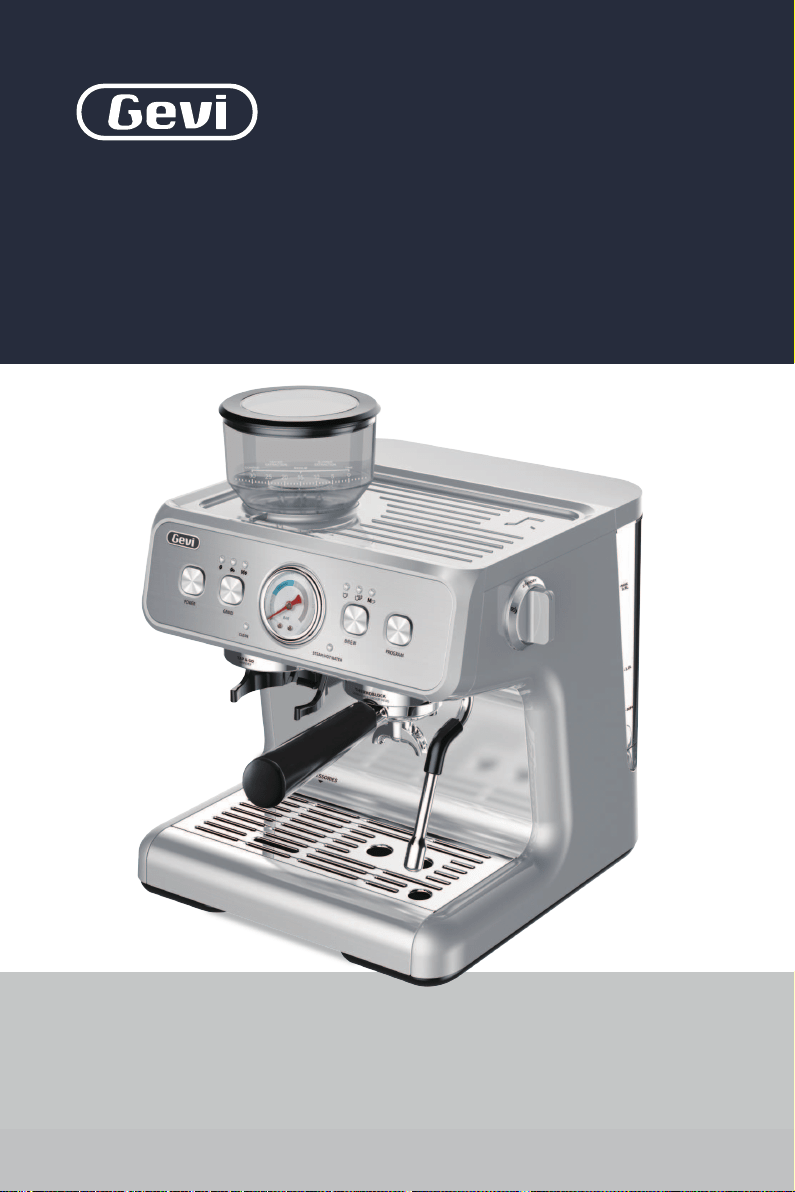
Read this booklet thoroughly before using this coffee machine for the quick use.
Function Instruction
Quick Use Manual
3-in-1 Smart
Espresso Coffee Machine
Grinder | Brewer | Frother
GECME020DE-U
Read this booklet thoroughly before using this coffee machine and save it for future reference

10
13
13
18
19
19
20
26
31
31
31
34
39
40
40
08
01
13
05
1. Important Safeguards
2. Features
3. More Details
4. Before First Use
5. Grinding Guide
5.1 Brief Introduction
5.2 Tips For Grinding
5.3 Operation
6. Espresso Guide
6.1 Brief Introduction
6.2 Tips For Espresso
6.3 Operation
7. Milk Frothing Guide
7.1 Brief Introduction
7.2 Tips For Milk Frothing
7.3 Operation
8. Hot Water Function Guide
9. Sleep & Auto Off Function Guide
10. Water Shortage Function Guide
11. Restore All Default Settings Guide
12. Care & Cleaning - Espresso Machine
13. Care & Cleaning - Grinder
14. Descaling Cycle - Espresso Machine
15. Troubleshooting Guide
15.1 Troubleshooting Guide - Espresso Machine
15.2 Troubleshooting Guide - Steam Wand
15.3 Troubleshooting Guide - Grinder
ContentsContents
. . . . . . . . . . . . . . . . . . . . . . . . . . . . . . . . . . . . . . . . .
. . . . . . . . . . . . . . . . . . . . . . . . . . . . . . . . . . . . . . . . . . . . . . . . . . . . . . .
. . . . . . . . . . . . . . . . . . . . . . . . . . . . . . . . . . . . . . . . . . . . . . . . . . .
. . . . . . . . . . . . . . . . . . . . . . . . . . . . . . . . . . . . . . . . . . . . . . . .
. . . . . . . . . . . . . . . . . . . . . . . . . . . . . . . . . . . . . . . . . . .
. . . . . . . . . . . . . . . . . . . . . . . . . . . . . . . . . . . . . . . . . . . .
. . . . . . . . . . . . . . . . . . . . . . . . . . . . . . . . . . . . . . . . . . . . . . . . . . .
. . . . . . . . . . . . . . . . . . . . . . . . . . . . . . . . . . . . . . . . . . . .
. . . . . . . . . . . . . . . . . . . . . . . . . . . . . . . . . . . . . . . . . . .
. . . . . . . . . . . . . . . . . . . . . . . . . . . . . . . . . . . . . . .
. . . . . . . . . . . . . . . . . . . . . . . . . . . . . . . . . . . . . . . . . . . . . . . . . . .
. . . . . . . . . . . . . . . . . . . . . . . . . . . . . . . . . . . . .
65
67
16. Warranty
17. Coffees To Try
. . . . . . . . . . . . . . . . . . . . . . . . . . . . . . . . . . . . . . . . . . . . . . . .
. . . . . . . . . . . . . . . . . . . . . .
. . . . . . . . . . . . . . . . . . . . . . . . . . .
. . . . . . . . . . . . . . . . . . . . . . . . . . . . . . . . . . . . . . . . . . . . . . . . . . . . .
. . . . . . . . . . . . . . . . . . . . . . . . . . . . . . .
. . . . . . . . . . . . . . . . . . . . . . . . . . . . . .
. . . . . . . . . . . . . . . . . . . . . . . . . . . . . . . . . . . . . . . . . . . . . . . . . . .
. . . . . . . . . . . . . . . . . . . . . . . . . . . . . . . . . . . . . . . . . . . . . . . . .
. . . . . . . . . . . . . . . . . . . . . . . . . . . . . . . . . . . . . . . . . . .
. . . . . . . . . . . . . . . . . . . . . . . . . . . . . . . . . . . . . . . . . . . .
. . . . . . . . . . . . . . . . . . . . . . . . . . . . . . . . . . . . . . . . . . . . . . . .
50
53
46
41
53
61
59
42
. . . . . . . . . . . . . . . . . . . . . . . . . . . .
. . . . . . . . . . . . . . . . . . . . . . . . . .
. . . . . . . . . . . . . . . . . . . . . . . . . . . . . . . . . . . . .
. . . . . . . . . . . . . . . . . . . . . . . . . . . . . . . . . . . . . . .
. . . . . . . . . . . . . . . .
. . . . . . . . . . . . . . . . . . . . . . . . . .

10
13
13
18
19
19
20
26
31
31
31
34
39
40
40
08
01
13
05
1. Important Safeguards
2. Features
3. More Details
4. Before First Use
5. Grinding Guide
5.1 Brief Introduction
5.2 Tips For Grinding
5.3 Operation
6. Espresso Guide
6.1 Brief Introduction
6.2 Tips For Espresso
6.3 Operation
7. Milk Frothing Guide
7.1 Brief Introduction
7.2 Tips For Milk Frothing
7.3 Operation
8. Hot Water Function Guide
9. Sleep & Auto Off Function Guide
10. Water Shortage Function Guide
11. Restore All Default Settings Guide
12. Care & Cleaning - Espresso Machine
13. Care & Cleaning - Grinder
14. Descaling Cycle - Espresso Machine
15. Troubleshooting Guide
15.1 Troubleshooting Guide - Espresso Machine
15.2 Troubleshooting Guide - Steam Wand
15.3 Troubleshooting Guide - Grinder
ContentsContents
. . . . . . . . . . . . . . . . . . . . . . . . . . . . . . . . . . . . . . . . .
. . . . . . . . . . . . . . . . . . . . . . . . . . . . . . . . . . . . . . . . . . . . . . . . . . . . . . .
. . . . . . . . . . . . . . . . . . . . . . . . . . . . . . . . . . . . . . . . . . . . . . . . . . .
. . . . . . . . . . . . . . . . . . . . . . . . . . . . . . . . . . . . . . . . . . . . . . . .
. . . . . . . . . . . . . . . . . . . . . . . . . . . . . . . . . . . . . . . . . . .
. . . . . . . . . . . . . . . . . . . . . . . . . . . . . . . . . . . . . . . . . . . .
. . . . . . . . . . . . . . . . . . . . . . . . . . . . . . . . . . . . . . . . . . . . . . . . . . .
. . . . . . . . . . . . . . . . . . . . . . . . . . . . . . . . . . . . . . . . . . . .
. . . . . . . . . . . . . . . . . . . . . . . . . . . . . . . . . . . . . . . . . . .
. . . . . . . . . . . . . . . . . . . . . . . . . . . . . . . . . . . . . . .
. . . . . . . . . . . . . . . . . . . . . . . . . . . . . . . . . . . . . . . . . . . . . . . . . . .
. . . . . . . . . . . . . . . . . . . . . . . . . . . . . . . . . . . . .
65
67
16. Warranty
17. Coffees To Try
. . . . . . . . . . . . . . . . . . . . . . . . . . . . . . . . . . . . . . . . . . . . . . . .
. . . . . . . . . . . . . . . . . . . . . .
. . . . . . . . . . . . . . . . . . . . . . . . . . .
. . . . . . . . . . . . . . . . . . . . . . . . . . . . . . . . . . . . . . . . . . . . . . . . . . . . .
. . . . . . . . . . . . . . . . . . . . . . . . . . . . . . .
. . . . . . . . . . . . . . . . . . . . . . . . . . . . . .
. . . . . . . . . . . . . . . . . . . . . . . . . . . . . . . . . . . . . . . . . . . . . . . . . . .
. . . . . . . . . . . . . . . . . . . . . . . . . . . . . . . . . . . . . . . . . . . . . . . . .
. . . . . . . . . . . . . . . . . . . . . . . . . . . . . . . . . . . . . . . . . . .
. . . . . . . . . . . . . . . . . . . . . . . . . . . . . . . . . . . . . . . . . . . .
. . . . . . . . . . . . . . . . . . . . . . . . . . . . . . . . . . . . . . . . . . . . . . . .
50
53
46
41
53
61
59
42
. . . . . . . . . . . . . . . . . . . . . . . . . . . .
. . . . . . . . . . . . . . . . . . . . . . . . . .
. . . . . . . . . . . . . . . . . . . . . . . . . . . . . . . . . . . . .
. . . . . . . . . . . . . . . . . . . . . . . . . . . . . . . . . . . . . . .
. . . . . . . . . . . . . . . .
. . . . . . . . . . . . . . . . . . . . . . . . . .

When using electrical appliances, basic safety precautions should
always be followed, including the following:
1. Read all instructions.
2. Before using, check that the voltage of wall outlet corresponds to
rated voltage marked on the rating plate.
3. To protect against fire, electric shock and injury to person, do
not immerse cord, plug, in water or other liquid.
4. The appliance must not be immersed.
5. Unplug from outlet when not in use and before cleaning. Allow
to cool before putting on or taking off parts, and before cleaning
the appliance.
6. Do not operate any appliance with a damaged cord or plug or
after the appliance malfunctions, or is dropped or damaged in
any manner. Return appliance to the nearest authorized service
facility for examination, repair or electrical or mechanical
adjustment.
7. If the supply cord is damaged, it must be replaced by the
manufacturer, its service agent or similarly qualified persons in
order to avoid a hazard.
8.
The use of accessory attachments not recommended by the
appliance manufacturer may result in fire, electric shock or
injury to persons.
9.
Do not let cord hang over edge of table or counter, or touch hot
surfaces.
10. Do not place on or near a hot gas or electric burner, or in a
heated oven.
11.
Do not place the coffee machine on hot surface or beside fire
in order to avoid to be damaged.
12. To disconnect, turn any control to “off ”, then remove plug from
wall outlet.
13. Do not use appliance for other than intended use and place it in
a dry environment.
14. Be careful not to get burned by the steam.
15. The temperature for operating or storing the coffee machine
shall be higher than 0℃.
16. Do not operate the coffee machine at an environment with high
temperature, strong magnetic field and moist air.
17. Do not touch the hot surface of appliance (such as steam wand,
and the steel mesh just boiling). Use handle or knobs.
18. Do not let the coffee maker operate without water.
19. Connect plug to wall outlet before using and turn any switch off
before plug is removed from wall outlet.
20. Close supervision is necessary when any appliance is used by or
near children.
21. This appliance is not intended for use by persons (including
children) with reduced physical, sensory or mental capabilities,
or lack of experience and knowledge, unless they have been
given supervision or instruction concerning use of the appliance
by a person responsible for their safety.
22. Children should be supervised to ensure that they do not play
21
1. Important Safeguards
1. Important Safeguards

When using electrical appliances, basic safety precautions should
always be followed, including the following:
1. Read all instructions.
2. Before using, check that the voltage of wall outlet corresponds to
rated voltage marked on the rating plate.
3. To protect against fire, electric shock and injury to person, do
not immerse cord, plug, in water or other liquid.
4. The appliance must not be immersed.
5. Unplug from outlet when not in use and before cleaning. Allow
to cool before putting on or taking off parts, and before cleaning
the appliance.
6. Do not operate any appliance with a damaged cord or plug or
after the appliance malfunctions, or is dropped or damaged in
any manner. Return appliance to the nearest authorized service
facility for examination, repair or electrical or mechanical
adjustment.
7. If the supply cord is damaged, it must be replaced by the
manufacturer, its service agent or similarly qualified persons in
order to avoid a hazard.
8.
The use of accessory attachments not recommended by the
appliance manufacturer may result in fire, electric shock or
injury to persons.
9.
Do not let cord hang over edge of table or counter, or touch hot
surfaces.
10. Do not place on or near a hot gas or electric burner, or in a
heated oven.
11.
Do not place the coffee machine on hot surface or beside fire
in order to avoid to be damaged.
12. To disconnect, turn any control to “off ”, then remove plug from
wall outlet.
13. Do not use appliance for other than intended use and place it in
a dry environment.
14. Be careful not to get burned by the steam.
15. The temperature for operating or storing the coffee machine
shall be higher than 0℃.
16. Do not operate the coffee machine at an environment with high
temperature, strong magnetic field and moist air.
17. Do not touch the hot surface of appliance (such as steam wand,
and the steel mesh just boiling). Use handle or knobs.
18. Do not let the coffee maker operate without water.
19. Connect plug to wall outlet before using and turn any switch off
before plug is removed from wall outlet.
20. Close supervision is necessary when any appliance is used by or
near children.
21. This appliance is not intended for use by persons (including
children) with reduced physical, sensory or mental capabilities,
or lack of experience and knowledge, unless they have been
given supervision or instruction concerning use of the appliance
by a person responsible for their safety.
22. Children should be supervised to ensure that they do not play
21
1. Important Safeguards
1. Important Safeguards
43
North American models with grounded plugs:
NOTE
For electronic instruction manual, please contact Gevi support team.
WARNING
with the appliance.
23. For Household Use Only
24. Do not use outdoors.
25. Scalding may occur if the lid is removed during the brewing cycles.
26. Check hopper for presence of foreign objects before using.
27. Avoid contacting moving parts. Do not attempt to defeat any safety
interlock mechanisms.
To avoid the risk of injury, do not open the brew chamber during the
brew process.
Risk of Fire or Electric Shock. Do not remove this cover. No user
serviceable parts inside. Repair should be done by authorized service
personnel only.
Power cord instructions:
A short power-supply cord (or detachable power-supply cord) may
be provided to reduce risks resulting from becoming entangled in
or tripping over a longer cord. Longer detachable power supply cords
or extension cords are available and may be used if care is exercised
in their use. If a long detachable power-supply cord or extension
cord is used:
a. The marked electrical rating of the detachable power-supply
cord or extension cord should be at least as great as the
electrical rating of the machine.
b. If the machine is of the grounded type, the extension cord
should be a grounding type 3-wire cord.
c. The Longer cord should be arranged so that it will not drape
over the counter top or table top where it can be pulled on by
children or tripped over unintentionally.
Do not pull, twist or otherwise abuse the power cord.
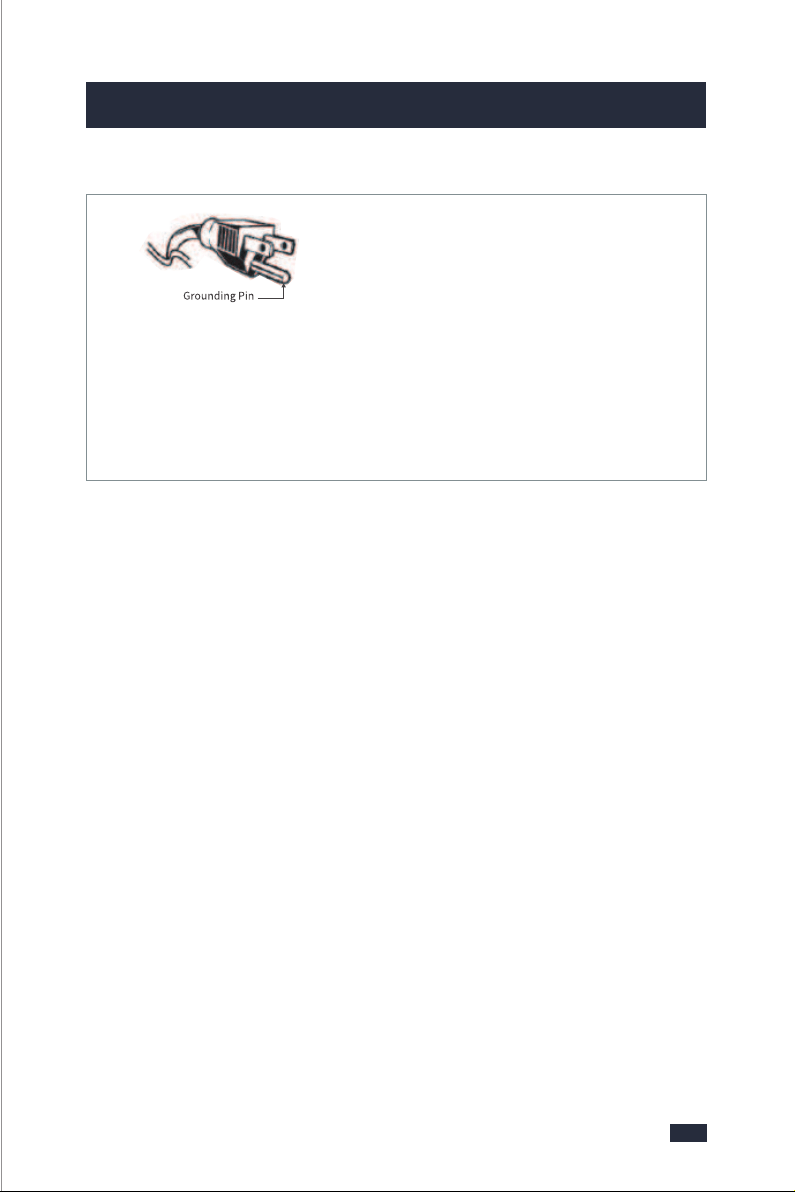
To reduce the risk of electric shock, this machine
has a grounding type cord and plug that has a
third grounding pin ( 3-prong plug ). The plug must be plugged into an outlet
that is properly installed and grounded in accordance with all local codes
and ordinances. If the plug does not fit into the outlet or if in doubt as to
whether the outlet is properly grounded, contact a qualified electrician to
install the proper outlet. Do not alter the plug in any way.
Grounded Plug
1. Important Safeguards
1. Important Safeguards
43
North American models with grounded plugs:
NOTE
For electronic instruction manual, please contact Gevi support team.
WARNING
with the appliance.
23. For Household Use Only
24. Do not use outdoors.
25. Scalding may occur if the lid is removed during the brewing cycles.
26. Check hopper for presence of foreign objects before using.
27. Avoid contacting moving parts. Do not attempt to defeat any safety
interlock mechanisms.
To avoid the risk of injury, do not open the brew chamber during the
brew process.
Risk of Fire or Electric Shock. Do not remove this cover. No user
serviceable parts inside. Repair should be done by authorized service
personnel only.
Power cord instructions:
A short power-supply cord (or detachable power-supply cord) may
be provided to reduce risks resulting from becoming entangled in
or tripping over a longer cord. Longer detachable power supply cords
or extension cords are available and may be used if care is exercised
in their use. If a long detachable power-supply cord or extension
cord is used:
a. The marked electrical rating of the detachable power-supply
cord or extension cord should be at least as great as the
electrical rating of the machine.
b. If the machine is of the grounded type, the extension cord
should be a grounding type 3-wire cord.
c. The Longer cord should be arranged so that it will not drape
over the counter top or table top where it can be pulled on by
children or tripped over unintentionally.
Do not pull, twist or otherwise abuse the power cord.
To reduce the risk of electric shock, this machine
has a grounding type cord and plug that has a
third grounding pin ( 3-prong plug ). The plug must be plugged into an outlet
that is properly installed and grounded in accordance with all local codes
and ordinances. If the plug does not fit into the outlet or if in doubt as to
whether the outlet is properly grounded, contact a qualified electrician to
install the proper outlet. Do not alter the plug in any way.
Grounded Plug
1. Important Safeguards
1. Important Safeguards
6
Spoon
Portafilter
Cleaning tool box
5
Product notices:
a. Place the machine on a hard, flat, level surface to avoid
interruption of airflow underneath the espresso machine.
b. Do not operate the machine with an empty water reservoir.
c. Keep the area above the machine clear during use, as hot steam
will escape the machine.
Electrical parameters: 120V~ 60Hz 1500W
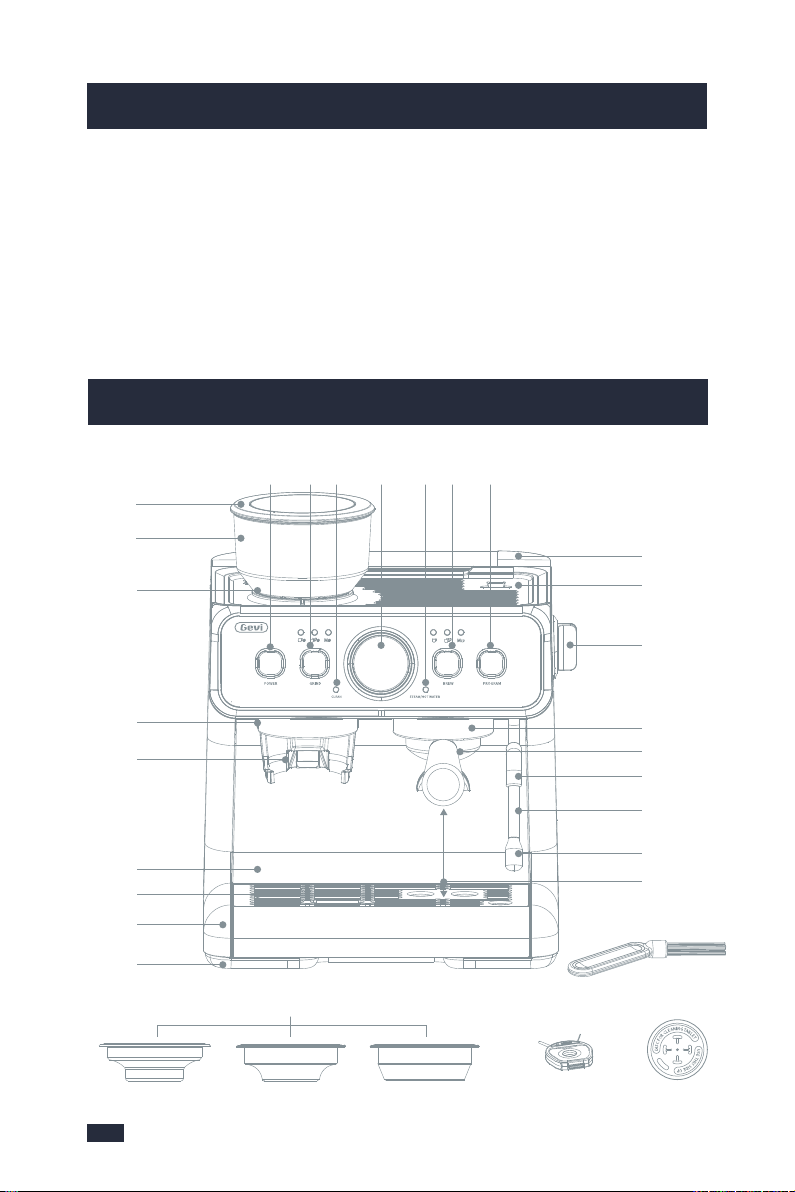
A. Hopper lid
With silicone sealing ring can
better seal the beans
B. Removable Bean Hopper
The removable 250g capacity
Bean Hopper features 31 easily
adjustable Grind Settings. Turn
the Hopper from coarse to fine
to adjust the Grind Setting &
maximise the taste of your espresso.
C. Grind Size Selector
The range of 31 Grind Settings
allows for precision adjustment.
D. Grind Area
The coffee grinds are delivered
directly into the Filter Basket.
E. Grinding Cradle
The Grinding Cradle can hold
the Portafilter to provide
seamlesson-demand grinding.
This helps you to control the
amount of coffee grinds straight
into the Filter Basket.
F. Accessories Storage Home
Area behind the Drip Tray, for
storing the Cleaning Disc, Cleaning
Brush & Cleaning Pin.
G. Removable Drip Tray, Grill
& Grind Bin
The range of 31 Grind Settings
allows for precision adjustment.
H. Cord Storage
Conveniently stow excess cord
by pushing the cord inside the
machine to keep benchtop tidy.
J. Removable 2.8L Water
Reservoir
Push back the lid & fill with cold
water, or remove the Water
Reservoir by opening he Lid,
lifting upwards using the Handle
located inside.
I. Non-slip Feet
The non-slip silicone feet ensure
that the coffee machine remains
stable on the benchtop during use.
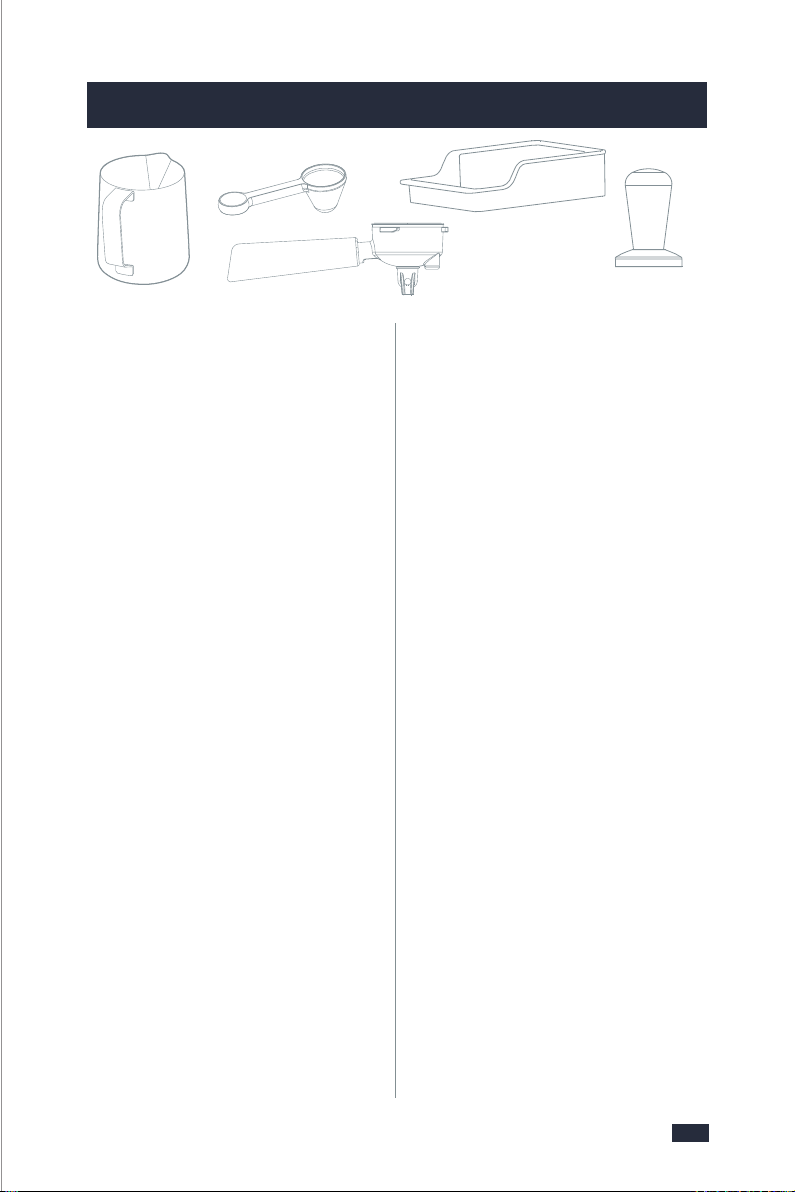
350mL Milk Jug
58mm Stainless Steel
& Aluminum Tamper
STYUVWX
J
M
N
K
O
P
Q
R
L
58mm Single Wall Filter Baskets
Steam Wand
Tip Pin
Filter Basket
Pin
Cleaning Brush
Cleaning DiscCleaning Pin
A
B
C
D
F
G
H
I
E
Single CupDouble CupLong brew
K. Warming Plate with Tamper
Home
- Preheats cups & glasses which
helps to retain the essential
characteristics of true espresso
aroma & a rich, sweet taste.
- Tamper home located on the top
of the Warming Plate for convenient
access & storage.
1. Important Safeguards
2. Features
2. Features
6
Spoon
Portafilter
Cleaning tool box
5
Product notices:
a. Place the machine on a hard, flat, level surface to avoid
interruption of airflow underneath the espresso machine.
b. Do not operate the machine with an empty water reservoir.
c. Keep the area above the machine clear during use, as hot steam
will escape the machine.
Electrical parameters: 120V~ 60Hz 1500W
A. Hopper lid
With silicone sealing ring can
better seal the beans
B. Removable Bean Hopper
The removable 250g capacity
Bean Hopper features 31 easily
adjustable Grind Settings. Turn
the Hopper from coarse to fine
to adjust the Grind Setting &
maximise the taste of your espresso.
C. Grind Size Selector
The range of 31 Grind Settings
allows for precision adjustment.
D. Grind Area
The coffee grinds are delivered
directly into the Filter Basket.
E. Grinding Cradle
The Grinding Cradle can hold
the Portafilter to provide
seamlesson-demand grinding.
This helps you to control the
amount of coffee grinds straight
into the Filter Basket.
F. Accessories Storage Home
Area behind the Drip Tray, for
storing the Cleaning Disc, Cleaning
Brush & Cleaning Pin.
G. Removable Drip Tray, Grill
& Grind Bin
The range of 31 Grind Settings
allows for precision adjustment.
H. Cord Storage
Conveniently stow excess cord
by pushing the cord inside the
machine to keep benchtop tidy.
J. Removable 2.8L Water
Reservoir
Push back the lid & fill with cold
water, or remove the Water
Reservoir by opening he Lid,
lifting upwards using the Handle
located inside.
I. Non-slip Feet
The non-slip silicone feet ensure
that the coffee machine remains
stable on the benchtop during use.
350mL Milk Jug
58mm Stainless Steel
& Aluminum Tamper
STYUVWX
J
M
N
K
O
P
Q
R
L
58mm Single Wall Filter Baskets
Steam Wand
Tip Pin
Filter Basket
Pin
Cleaning Brush
Cleaning DiscCleaning Pin
A
B
C
D
F
G
H
I
E
Single CupDouble CupLong brew
K. Warming Plate with Tamper
Home
- Preheats cups & glasses which
helps to retain the essential
characteristics of true espresso
aroma & a rich, sweet taste.
- Tamper home located on the top
of the Warming Plate for convenient
access & storage.
1. Important Safeguards
2. Features
2. Features
87
L. Steam/Hot Water dial
Turn left to select steam, turn right
to select hot water
M. Group Head -
58mm Commercial Size
The wider size allows more even
extraction of the tamped coffee
grinds.
N. Portafilter -
58mm Commercial Size
The wider size ensures the coffee
grinds are more evenly spread, and
easier to tamp.
O. Rubber Handle
Silicone material allows any
movement of the Steam Wand
to a desired position without
burning fingers.
P. Steam & Hot Water Wand
Stainless steel 360° swivel-action
Steam wand for effortless milk
frothing.
Q. Froth nozzle
Heat insulation and convenient to
rotation
R. Extra Tall Cup Height
A 350mL for extracting coffee
directly into mugs & glasses.
illuminated when ready. The
machine will automatically enter
sleep mode after 5 minutes, the
POWER LIGHT will stop illuminating.
S. POWER Button & Light
Press button to turn on the machine.
The POWER LIGHT will illuminate
& pulse to indicate it is heating up.
The POWER LIGHT stays fully
W.Clean Light
Flash white when the machine has
cumulatively flow out 15L of
water/coffee.
X. STEAM/HOT WATER Light
Fully illuminated white when DIAL
stay to the vertical position and
ready to steam & hot water.
Y. Pressure Gauge
It helps to improve espresso
extraction, to achieve great tasting
coffee, every time.
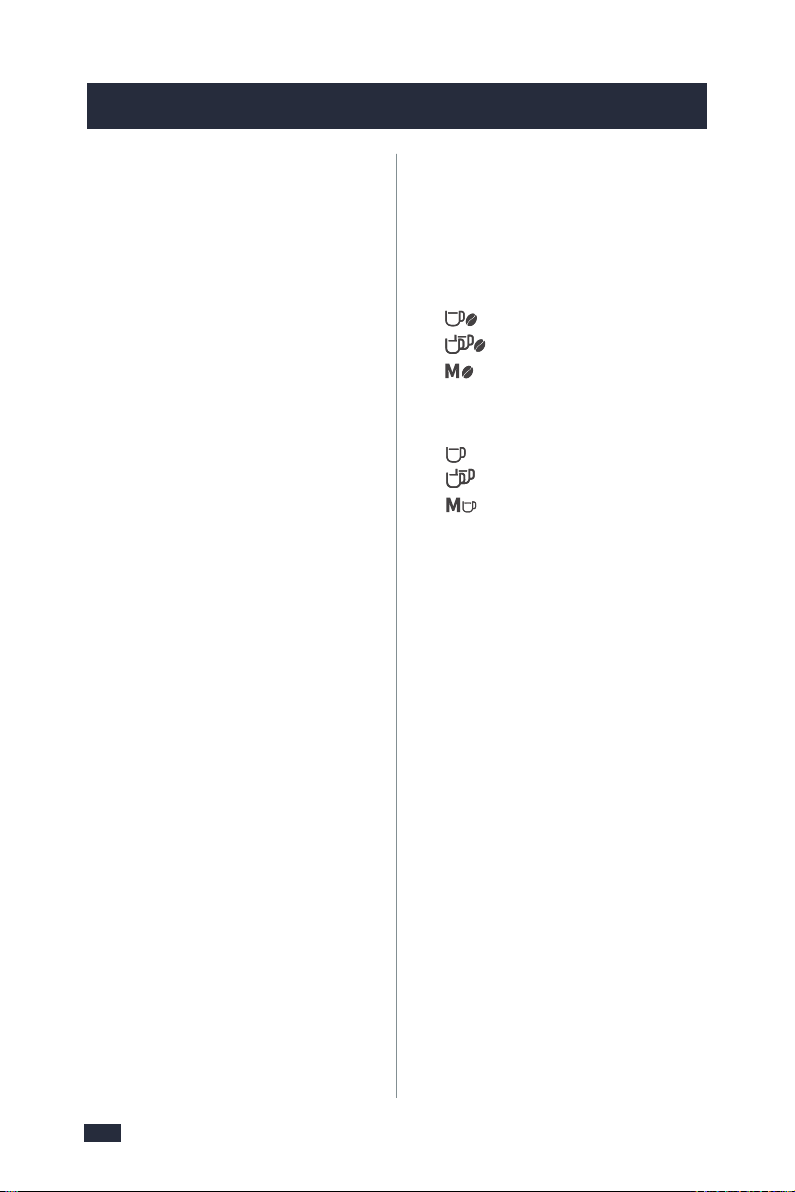
T. Grind button
Single-shot Grind Mode
Double-shot Grind Mode
Manual-shot Grind Mode
U. Brew button
Single-shot Mode
Double-shot Mode
Manual-shot Mode
V. Program Button
- Customize grind amount &
espresso by using 1 cup and 2 cup
- Customize coffee temperature
- Customize pre-infusion profile
This 3 way system delivers
the accurate & stable water
temperature that is needed for
consistently great tasting coffee.
Integrated Grinder
Easy on-demand grinding experience
This 3 way system delivers
the accurate & stable water
temperature that is needed for
consistently great tasting coffee.
Three Way Shot Control System
Optimum temperature
• Thermoblock Technology
The Thermoblock ensures fast heat
up, and precise water temperature
for the best espresso extraction &
milk steaming. Only the required
amount of water is heated for speed
and efficiency. The Thermoblock
heats water so that espresso extracts
at 198°F for the optimum extraction
of oils from the tamped coffee grinds.
Temperatures above or below will
result in burnt/bitter or weak tasting
espresso.
• Advanced PID Controller
The PID monitors and controls the
Thermoblock to ensure water is
always delivered to tamped coffee
grinds at the precise temperature
needed.
• Gentle Pre-infusion
Small amounts of water are gently
introduced onto the tamped coffee
grinds prior to the steady flow of
water, for a richer flavored espresso.
The Group Head and the portafilter
are commercial sized, 58mm, just like
local cafe.
The PID monitors and controls the
Thermoblock to ensure water is
always delivered to tamped coffee
grinds at the precise temperature
needed.
The 58mm portafilter allows a more
even extraction of the tamped
coffee grinds, resulting in a true cafe
tasting coffee.
Cafe 58mm
Group Head & Portafilter
Extract the maximum amount of flavor
• Auto Shot & Customiz -
able Amount Control
Three different grinding modes are
available for choice Single-shot,
Double-shot and Manual-shot.
Single-shot/Double-shot will
automatically stop after dispensing
the right amount, while Manual-shot
allows you to customize your
preferred amount.
Fineness or coarseness of grind will
2. Features
3. More Details
87
L. Steam/Hot Water dial
Turn left to select steam, turn right
to select hot water
M. Group Head -
58mm Commercial Size
The wider size allows more even
extraction of the tamped coffee
grinds.
N. Portafilter -
58mm Commercial Size
The wider size ensures the coffee
grinds are more evenly spread, and
easier to tamp.
O. Rubber Handle
Silicone material allows any
movement of the Steam Wand
to a desired position without
burning fingers.
P. Steam & Hot Water Wand
Stainless steel 360° swivel-action
Steam wand for effortless milk
frothing.
Q. Froth nozzle
Heat insulation and convenient to
rotation
R. Extra Tall Cup Height
A 350mL for extracting coffee
directly into mugs & glasses.
illuminated when ready. The
machine will automatically enter
sleep mode after 5 minutes, the
POWER LIGHT will stop illuminating.
S. POWER Button & Light
Press button to turn on the machine.
The POWER LIGHT will illuminate
& pulse to indicate it is heating up.
The POWER LIGHT stays fully
W.Clean Light
Flash white when the machine has
cumulatively flow out 15L of
water/coffee.
X. STEAM/HOT WATER Light
Fully illuminated white when DIAL
stay to the vertical position and
ready to steam & hot water.
Y. Pressure Gauge
It helps to improve espresso
extraction, to achieve great tasting
coffee, every time.
T. Grind button
Single-shot Grind Mode
Double-shot Grind Mode
Manual-shot Grind Mode
U. Brew button
Single-shot Mode
Double-shot Mode
Manual-shot Mode
V. Program Button
- Customize grind amount &
espresso by using 1 cup and 2 cup
- Customize coffee temperature
- Customize pre-infusion profile
This 3 way system delivers
the accurate & stable water
temperature that is needed for
consistently great tasting coffee.
Integrated Grinder
Easy on-demand grinding experience
This 3 way system delivers
the accurate & stable water
temperature that is needed for
consistently great tasting coffee.
Three Way Shot Control System
Optimum temperature
• Thermoblock Technology
The Thermoblock ensures fast heat
up, and precise water temperature
for the best espresso extraction &
milk steaming. Only the required
amount of water is heated for speed
and efficiency. The Thermoblock
heats water so that espresso extracts
at 198°F for the optimum extraction
of oils from the tamped coffee grinds.
Temperatures above or below will
result in burnt/bitter or weak tasting
espresso.
• Advanced PID Controller
The PID monitors and controls the
Thermoblock to ensure water is
always delivered to tamped coffee
grinds at the precise temperature
needed.
• Gentle Pre-infusion
Small amounts of water are gently
introduced onto the tamped coffee
grinds prior to the steady flow of
water, for a richer flavored espresso.
The Group Head and the portafilter
are commercial sized, 58mm, just like
local cafe.
The PID monitors and controls the
Thermoblock to ensure water is
always delivered to tamped coffee
grinds at the precise temperature
needed.
The 58mm portafilter allows a more
even extraction of the tamped
coffee grinds, resulting in a true cafe
tasting coffee.
Cafe 58mm
Group Head & Portafilter
Extract the maximum amount of flavor
• Auto Shot & Customiz -
able Amount Control
Three different grinding modes are
available for choice Single-shot,
Double-shot and Manual-shot.
Single-shot/Double-shot will
automatically stop after dispensing
the right amount, while Manual-shot
allows you to customize your
preferred amount.
Fineness or coarseness of grind will
2. Features
3. More Details
109
be better suited by dosing different
amount into a filter basket.
• Resettable Grinding Modes
Step 1. Remove Packaging
Grinding amount of Single-shot/
Double-shot is resettable, you can
set to better suit your taste or restore
to defaults as you like.
Ensure all packaging has been removed.
Step 2. Position Machine
Ensure the machine is positioned
onto a dry, stable, flat & horizontal
benchtop.
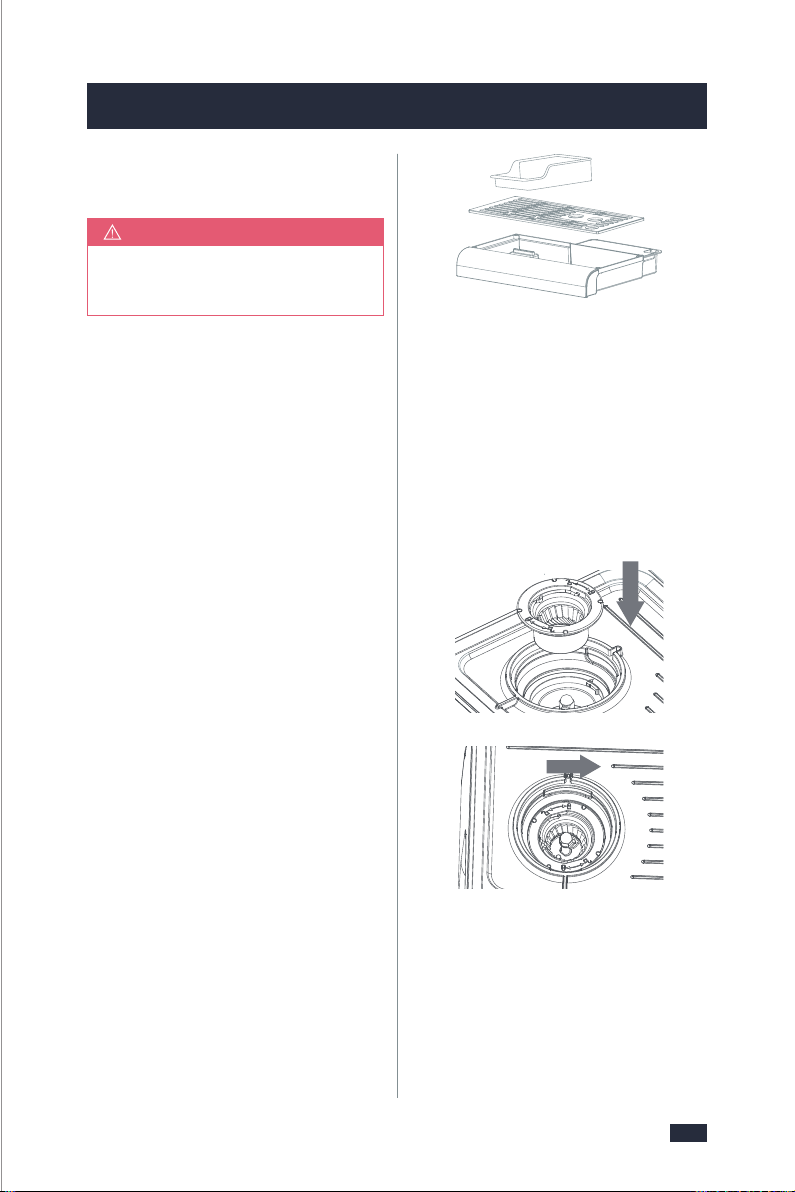
• Removable Bean Hopper
- Align the Hopper Guide with the red
Grinder Interlock.
- Insert Bean Hopper into the Grinder
Collar.
Step 5. Insert Parts into the Grinder
• Removable Top Burr
- Using the one handle insert the Top
Burr into the Grinder Collar.
- Rotate the Grinder collar clockwise.
- When correctly seated, the Top Burr
will be flush with the surface of the
Grinder Collar.
- Place the one handle down.
Step 4. Place Accessories
- Accessories Storage Home behind
the Drip Tray for the Cleaning Brush
& Cleaning Pin.
- Place the Tamper in the detail
provided on the Cup warming tray.
Step 3. Wash & Dry Parts
Wash the parts listed below in warm
water with a mild detergent:
- Stainless Steel Milk Jug.
- Stainless Steel Single Cup Filter
Basket.
- Stainless Steel Double Cup Filter
Basket.
- Stainless Steel Long brew Filter
Basket .
- Hardened Stainless Steel Top Burr.
- Water Reservoir.
- Portafilter.
- Bean Hopper.
- Tamper.
Rinse & allow thorough air drying.
• Conical Burr Grinder
The integrated Grinder offers all-in-
one grinding experience. The
hardened Stainless Steel Conical
Burr achieves consistent grind
particle sizes, which minimizes
heat transfer & reduces friction due
to its gentle & slow rotation.
• Bean Hopper
The 250g Hopper features anti-spill
gates which prevents coffee beans
from escaping onto the countertop
when removing.
The on-board Grinder offers all-in
-one grinding experience with
Grinder integrated in the Espresso
Machine.
Adjustable Grind Size
• Grind Setting
31-step espresso grind settings from
fine to coarse for an optimal
extraction.
Customizable Ext-
raction Temperature
Temperature just like you want
Allows water temperature to be
changed from the recommended
92°C (in 3°C increments between 89
-95°C) to cater for personal preferences.
Remove the orange silicone cap fo-
und at the base of the Water Reservoir.
Stainless steel 360° swivel-action
Steam wand for effortless milk
frothing.
Commercial Style
Steam Wand
When the STEAM/HOT WATER dial is
in the hot water position, the Steam
wand will dispense hot water for
making Americanos and pre-heating
cups.
Instant Hot Water
Monitors espresso extraction pressure
and allows you to make espress to
better suit your taste.
Espresso Pressure
Gauge
Dual boilers deliver double heating
supply. One is for extracting coffee and
the other one is for milk frothing.
Active temperature control with Dual
Heating Systems provides the best
temperature stability for optimal
coffee extraction and milk frothing.
Dual Boilers
Dual Heating Systems each dedicated
to espresso and steam for simultan-
eous milk frothing and espresso
extraction.
Simultaneous Coffee & Steam
IMPORTANT
3. More Details4. Before First Use
5
0
9
12
15
20
BAR
109
be better suited by dosing different
amount into a filter basket.
• Resettable Grinding Modes
Step 1. Remove Packaging
Grinding amount of Single-shot/
Double-shot is resettable, you can
set to better suit your taste or restore
to defaults as you like.
Ensure all packaging has been removed.
Step 2. Position Machine
Ensure the machine is positioned
onto a dry, stable, flat & horizontal
benchtop.
• Removable Bean Hopper
- Align the Hopper Guide with the red
Grinder Interlock.
- Insert Bean Hopper into the Grinder
Collar.
Step 5. Insert Parts into the Grinder
• Removable Top Burr
- Using the one handle insert the Top
Burr into the Grinder Collar.
- Rotate the Grinder collar clockwise.
- When correctly seated, the Top Burr
will be flush with the surface of the
Grinder Collar.
- Place the one handle down.
Step 4. Place Accessories
- Accessories Storage Home behind
the Drip Tray for the Cleaning Brush
& Cleaning Pin.
- Place the Tamper in the detail
provided on the Cup warming tray.
Step 3. Wash & Dry Parts
Wash the parts listed below in warm
water with a mild detergent:
- Stainless Steel Milk Jug.
- Stainless Steel Single Cup Filter
Basket.
- Stainless Steel Double Cup Filter
Basket.
- Stainless Steel Long brew Filter
Basket .
- Hardened Stainless Steel Top Burr.
- Water Reservoir.
- Portafilter.
- Bean Hopper.
- Tamper.
Rinse & allow thorough air drying.
• Conical Burr Grinder
The integrated Grinder offers all-in-
one grinding experience. The
hardened Stainless Steel Conical
Burr achieves consistent grind
particle sizes, which minimizes
heat transfer & reduces friction due
to its gentle & slow rotation.
• Bean Hopper
The 250g Hopper features anti-spill
gates which prevents coffee beans
from escaping onto the countertop
when removing.
The on-board Grinder offers all-in
-one grinding experience with
Grinder integrated in the Espresso
Machine.
Adjustable Grind Size
• Grind Setting
31-step espresso grind settings from
fine to coarse for an optimal
extraction.
Customizable Ext-
raction Temperature
Temperature just like you want
Allows water temperature to be
changed from the recommended
92°C (in 3°C increments between 89
-95°C) to cater for personal preferences.
Remove the orange silicone cap fo-
und at the base of the Water Reservoir.
Stainless steel 360° swivel-action
Steam wand for effortless milk
frothing.
Commercial Style
Steam Wand
When the STEAM/HOT WATER dial is
in the hot water position, the Steam
wand will dispense hot water for
making Americanos and pre-heating
cups.
Instant Hot Water
Monitors espresso extraction pressure
and allows you to make espress to
better suit your taste.
Espresso Pressure
Gauge
Dual boilers deliver double heating
supply. One is for extracting coffee and
the other one is for milk frothing.
Active temperature control with Dual
Heating Systems provides the best
temperature stability for optimal
coffee extraction and milk frothing.
Dual Boilers
Dual Heating Systems each dedicated
to espresso and steam for simultan-
eous milk frothing and espresso
extraction.
Simultaneous Coffee & Steam
IMPORTANT
3. More Details4. Before First Use
5
0
9
12
15
20
BAR
1211
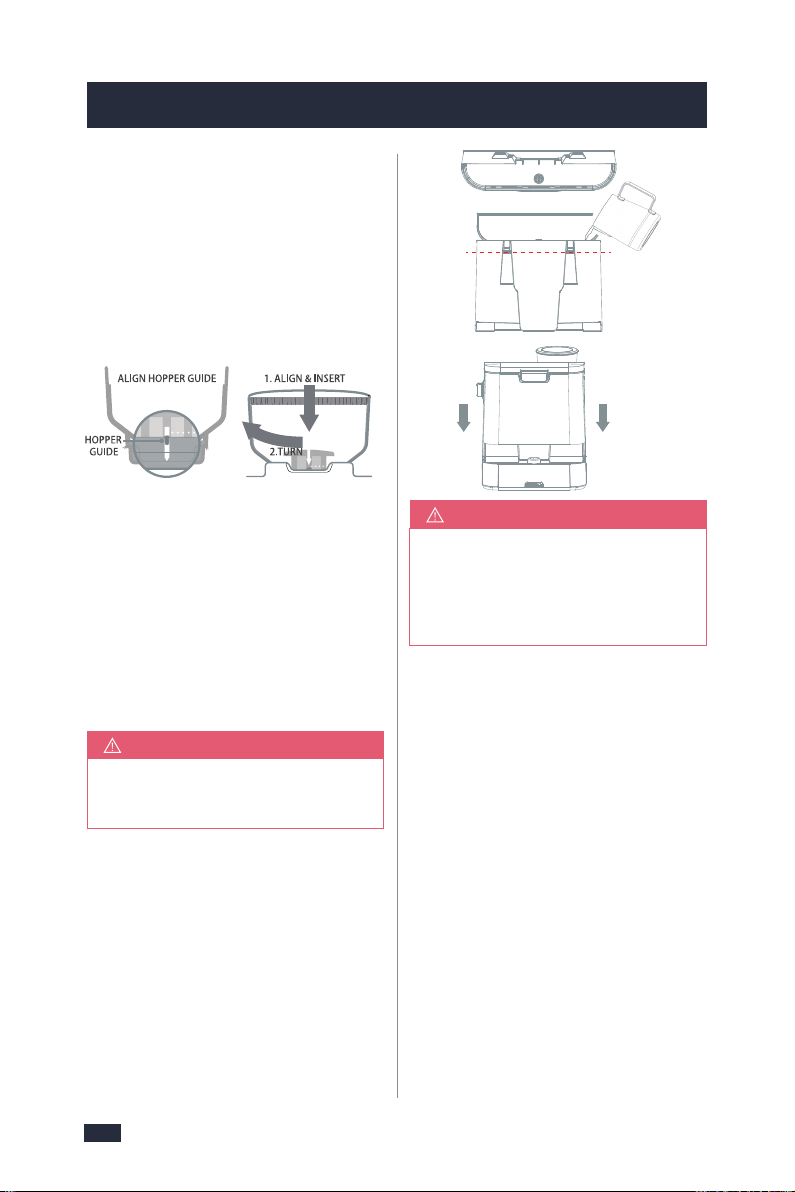
- Lightly pushing down, turn the Bean
Hopper in a clockwise direction to
lock the Hopper into place.
- This opens the Hopper Gates ( to
release coffee beans onto the Burrs).
At Grind Setting 30, Hopper Gates are
fully open.
- Continue to turn the Bean Hopper
in a clockwise direction to set the
Grind Setting.
- As a starting point for espresso
extraction try Grind Setting 10.
- Fill the Bean Hopper with freshly
roasted coffee beans.
- Long press Brew button to start. The
machine will have a beep & water
should start flowing from the Group
Head.
- After it flows out 150mL-200mL of
water to flush the machine, press
the Brew button to stop.
- Press the Power button to exit
function.The machine will return to
the READY state.
- Pour away the water in the cup.
- Position Steam Wand over the Drip
Tray.
- Turn DIAL to HOT WATER.
- Allow water to run through for 20 sec.
- Return DIAL to vertical position.
- The machine will return to the
READY state.
- Now the Espresso Machine should
be thoroughly primed.
- Wash Portafilter & Filter Basket
in warm water & dry before making
your first coffee.
This priming step must be compl-
eted prior to first use.
IMPORTANT
Make sure that the Water Reserv-
oir is clean & free of any debris, as
any fine particles can block the
water flow.
NOTE
Turning the Portafilter to the
centre position might be tight for
the first few uses.
NOTE
For the first few seconds the Pump
will make a louder than usual noise
as it begins pumping the water
through.
NOTE
Step 6. Preparing to Prime Machine
• Fill Water Reservoir
- Remove the orange silicone cap on
the Water Reservoir valve.
- Open the Lid and lift upwards using
the Handle inside.
- Fill with cold water from the tap.
- Insert the Water Reservoir into
position & close the Lid.
• Power
- Ensure that the Steam & Hot Water
DIAL is in the vertical position.
- Insert the Power Plug into a 120V AC
power outlet & switch the power on.
- Press the POWER BUTTON to turn
on the machine.
- The POWER LIGHT will illuminate &
pulse to indicate the Thermoblock
is heating up.
- The Grind Button Light will be fully
illuminated from turn on.
- When the POWER, Brew button Light
& STEAM/HOT WATER Light are all
fully illuminated, the machine is in
the READY state for all features.
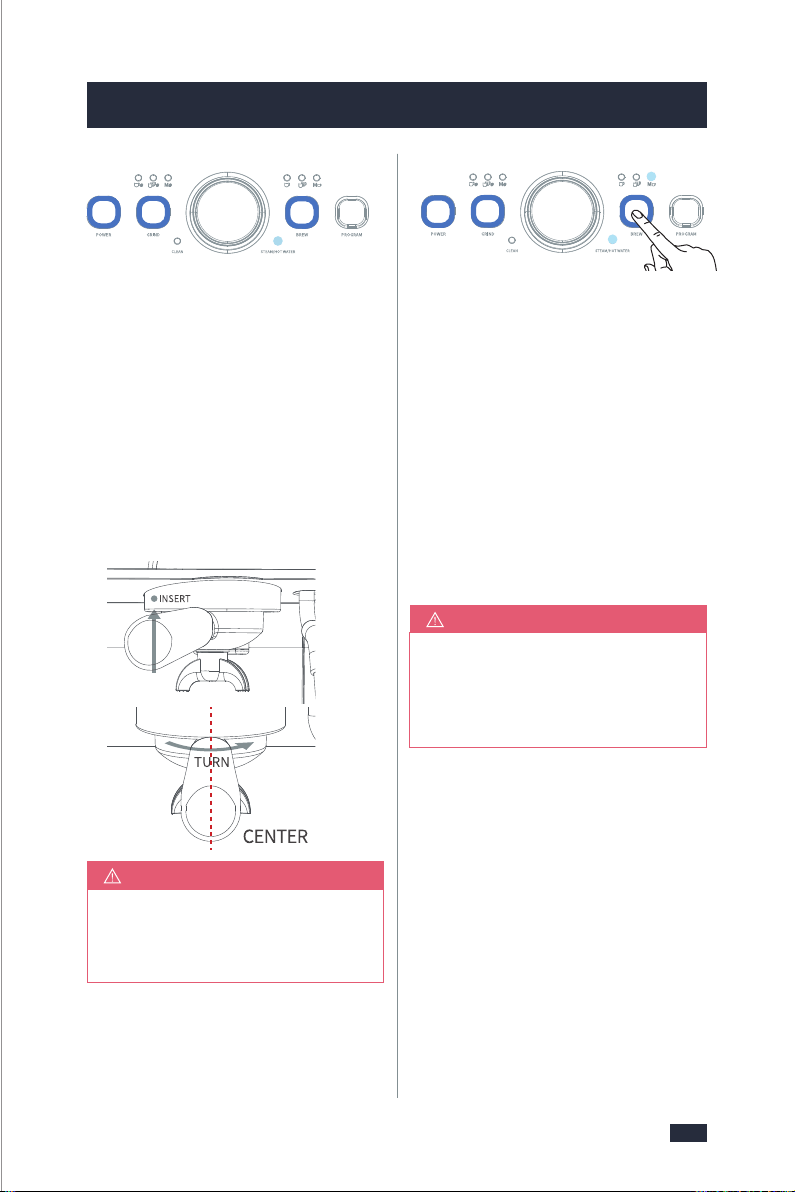
• Insert Portafilter
- Insert the Long Brew Filter Basket in
the Portafilter.
- Align the Portafilter with the
'INSERT' position located on the left
of the Group Head.
- Insert the Portafilter flat against
the Group Head, then turn the
Portafilter right all the way to the
centre Cposition.
MAX 2.8L
READY
Step 7. Prime Espresso Machine
- Press Brew button three times. The
machine is in making manual-shot
mode status.
4. Before First Use4. Before First Use
1211
- Lightly pushing down, turn the Bean
Hopper in a clockwise direction to
lock the Hopper into place.
- This opens the Hopper Gates ( to
release coffee beans onto the Burrs).
At Grind Setting 30, Hopper Gates are
fully open.
- Continue to turn the Bean Hopper
in a clockwise direction to set the
Grind Setting.
- As a starting point for espresso
extraction try Grind Setting 10.
- Fill the Bean Hopper with freshly
roasted coffee beans.
- Long press Brew button to start. The
machine will have a beep & water
should start flowing from the Group
Head.
- After it flows out 150mL-200mL of
water to flush the machine, press
the Brew button to stop.
- Press the Power button to exit
function.The machine will return to
the READY state.
- Pour away the water in the cup.
- Position Steam Wand over the Drip
Tray.
- Turn DIAL to HOT WATER.
- Allow water to run through for 20 sec.
- Return DIAL to vertical position.
- The machine will return to the
READY state.
- Now the Espresso Machine should
be thoroughly primed.
- Wash Portafilter & Filter Basket
in warm water & dry before making
your first coffee.
This priming step must be compl-
eted prior to first use.
IMPORTANT
Make sure that the Water Reserv-
oir is clean & free of any debris, as
any fine particles can block the
water flow.
NOTE
Turning the Portafilter to the
centre position might be tight for
the first few uses.
NOTE
For the first few seconds the Pump
will make a louder than usual noise
as it begins pumping the water
through.
NOTE
Step 6. Preparing to Prime Machine
• Fill Water Reservoir
- Remove the orange silicone cap on
the Water Reservoir valve.
- Open the Lid and lift upwards using
the Handle inside.
- Fill with cold water from the tap.
- Insert the Water Reservoir into
position & close the Lid.
• Power
- Ensure that the Steam & Hot Water
DIAL is in the vertical position.
- Insert the Power Plug into a 120V AC
power outlet & switch the power on.
- Press the POWER BUTTON to turn
on the machine.
- The POWER LIGHT will illuminate &
pulse to indicate the Thermoblock
is heating up.
- The Grind Button Light will be fully
illuminated from turn on.
- When the POWER, Brew button Light
& STEAM/HOT WATER Light are all
fully illuminated, the machine is in
the READY state for all features.
• Insert Portafilter
- Insert the Long Brew Filter Basket in
the Portafilter.
- Align the Portafilter with the
'INSERT' position located on the left
of the Group Head.
- Insert the Portafilter flat against
the Group Head, then turn the
Portafilter right all the way to the
centre Cposition.
MAX 2.8L
READY
Step 7. Prime Espresso Machine
- Press Brew button three times. The
machine is in making manual-shot
mode status.
4. Before First Use4. Before First Use
1413
Old coffee beans, no matter the
Grind Setting, will have a fast
extraction and will produce an
under extracted tasting espresso.
NOTE
Pre -ground coffee grinds are too
coarse to use with Single Wall
Filter Baskets.
NOTE
It is normal for the correct dose of
coffee grinds to appear overfilled
in the Filter Basket before tamping.
NOTE
After adjusting the Grind Setting
it is important to purge (for 1-2
sec) a small amount of coffee
grinds from the Grinder. This
removes the coffee grinds of the
previous Grind Setting; ensuring
the next espresso extraction is
made entirely of the coffee grinds
from the new Grind Setting.
- Smaller number settings deliver
finer coffee grinds & a slower
extraction.
- Larger number settings deliver
coarser coffee grinds & a faster
extraction.
TIP
TIP
1. Coffee Beans
For optimum flavour & extraction:
- Buy freshly roasted coffee beans in
small 250g batches to reduce the
storage time.
2. Grind Setting
You may need to vary the Grind
Setting when using different coffee
beans and depending on bean
freshness. The range of 31 Grind
Settings allows for precision
adjustment, controlling the grind
size & ultimately the characteristics
of the resulting extraction.
It may take several incremental
adjustments before you reach your
optimum Grind Setting. Dial in Grind
Setting based on pour time & taste
see Espresso Guide.
4. Grind Dosage & Tamp Force
For best results, the amount of
coffee grinds dosed should remain
consistent.
3. Filter Baskets
• Single Wall Filter Baskets
These work with freshly ground coffee
grinds and are supplied with the Gevi
machine.
- Use within two weeks of opening.
- Store coffee beans in a dry, airtight
container. Place in a cool dark cup-
board.
- If water is not flowing from the
Group Head or Steam Wand, repeat
Step 7.
5.2 Tips For Grinding
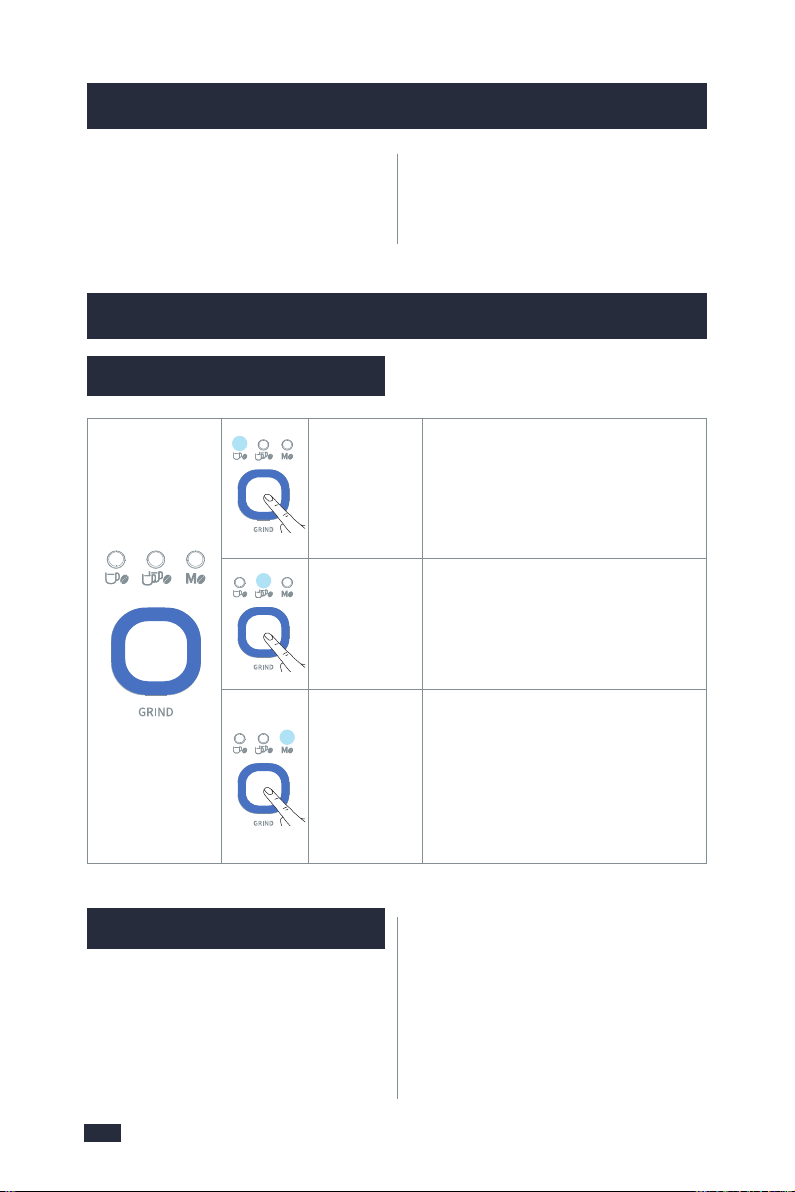
Single-shot
Grind Mode
Press 1 time to select Single-shot
Grind Mode, long press to start
grinding and then it will
automatically stop.
Press 2 times to select Double-
shot Grind Mode, long press to
start grinding and then it will
automatically stop.
Press 3 times to select Manual-
shot Grind Mode, long press to
start grinding. When you get a
desired amount of coffee grinds
press again to stop. (It will
automatically stop after 60s)
Double-shot
Grind Mode
Manual-shot
Grind Mode
5.1 Brief Introduction
Single CupDouble CupLong brew
- If water is still not running through,
contact Gevi Customer Care.
4. Before First Use
5. Grinding Guide
5. Grinding Guide
1413
Old coffee beans, no matter the
Grind Setting, will have a fast
extraction and will produce an
under extracted tasting espresso.
NOTE
Pre -ground coffee grinds are too
coarse to use with Single Wall
Filter Baskets.
NOTE
It is normal for the correct dose of
coffee grinds to appear overfilled
in the Filter Basket before tamping.
NOTE
After adjusting the Grind Setting
it is important to purge (for 1-2
sec) a small amount of coffee
grinds from the Grinder. This
removes the coffee grinds of the
previous Grind Setting; ensuring
the next espresso extraction is
made entirely of the coffee grinds
from the new Grind Setting.
- Smaller number settings deliver
finer coffee grinds & a slower
extraction.
- Larger number settings deliver
coarser coffee grinds & a faster
extraction.
TIP
TIP
1. Coffee Beans
For optimum flavour & extraction:
- Buy freshly roasted coffee beans in
small 250g batches to reduce the
storage time.
2. Grind Setting
You may need to vary the Grind
Setting when using different coffee
beans and depending on bean
freshness. The range of 31 Grind
Settings allows for precision
adjustment, controlling the grind
size & ultimately the characteristics
of the resulting extraction.
It may take several incremental
adjustments before you reach your
optimum Grind Setting. Dial in Grind
Setting based on pour time & taste
see Espresso Guide.
4. Grind Dosage & Tamp Force
For best results, the amount of
coffee grinds dosed should remain
consistent.
3. Filter Baskets
• Single Wall Filter Baskets
These work with freshly ground coffee
grinds and are supplied with the Gevi
machine.
- Use within two weeks of opening.
- Store coffee beans in a dry, airtight
container. Place in a cool dark cup-
board.
- If water is not flowing from the
Group Head or Steam Wand, repeat
Step 7.
5.2 Tips For Grinding
Single-shot
Grind Mode
Press 1 time to select Single-shot
Grind Mode, long press to start
grinding and then it will
automatically stop.
Press 2 times to select Double-
shot Grind Mode, long press to
start grinding and then it will
automatically stop.
Press 3 times to select Manual-
shot Grind Mode, long press to
start grinding. When you get a
desired amount of coffee grinds
press again to stop. (It will
automatically stop after 60s)
Double-shot
Grind Mode
Manual-shot
Grind Mode
5.1 Brief Introduction
Single CupDouble CupLong brew
- If water is still not running through,
contact Gevi Customer Care.
4. Before First Use
5. Grinding Guide
5. Grinding Guide
1615
If the GRIND SIZE selector changes,
the quantities of powder volume
will also be changed.
NOTE
a. You can use our Single Cup Filter
Basket or Double Cup Filter Basket
to grind beans by using the Custom
Mode.
b. You can grind beans in a different
container put under the powder
outlet and then weigh the powder
by using an electronic scale, this
will make sure you get a more
precise amount of powder.
NOTE
Evenly tamp (press) coffee grinds to
the level indicated, with firm force
10 -15kg.
the finer the grind size. The larger the
number, the coarser the grind size.
- The machine is on and in the READY
state.
- Place the Portafilter with either the
Single Cup Filter Basket or Double
Cup Filter Basket under the ground
coffee outlet based on the quantity
you want to customize.
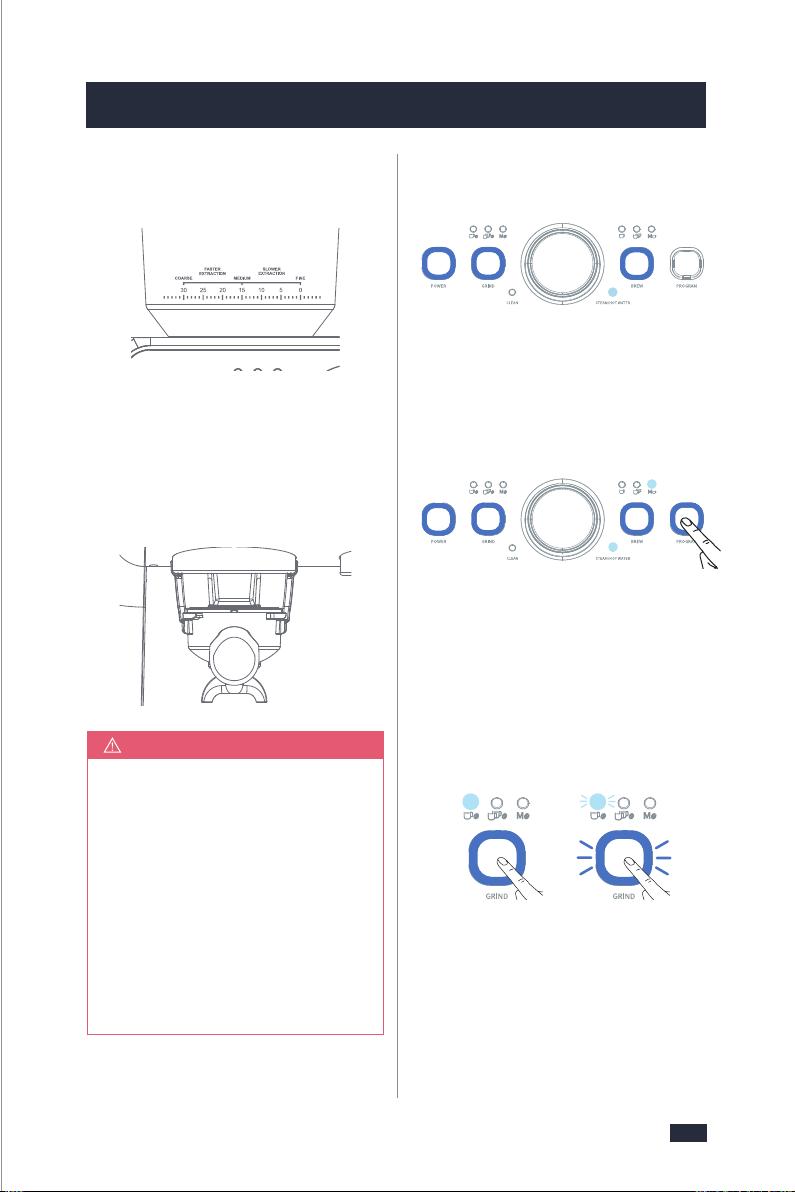
Customisable Single-Shot Grind
Volume
- Press the Program button to enter
into the user-defined mode, the
machine will have a beep.
- Press grind button one time, then
the single-shot grind indicator will
keep white light fixed.
- Press & hold the Grind button for 2
seconds.
- The single-shot grind indicator will
flash to indicate it is in custom mode.
- Bean will start to grind.
- When you reach your desired 1 shot
volume, press the Grind button.
- The Grind will stop.
- Press the Program button within 10
seconds,single-shot grind indicator
Tamp Force
10-15kg
Single Cup
Long brew
18-22g
Double Cup
13-15g
5. Powder Size Reference
- Coffee powder produced by grind
size setting range from 0-7 is not
well-suited for espresso because it
is too fine. But it can be used for
Turkish style coffee.
- Based on ground powder size
reference for Espresso, the grind
size setting range is 8-10, you can
put the powder dose as below:
6. Customisable-Grind Volumes
- Open the Hopper lid . Add beans
into the Bean hopper .
(The maximum quantity is 250g /
8.81 oz.)
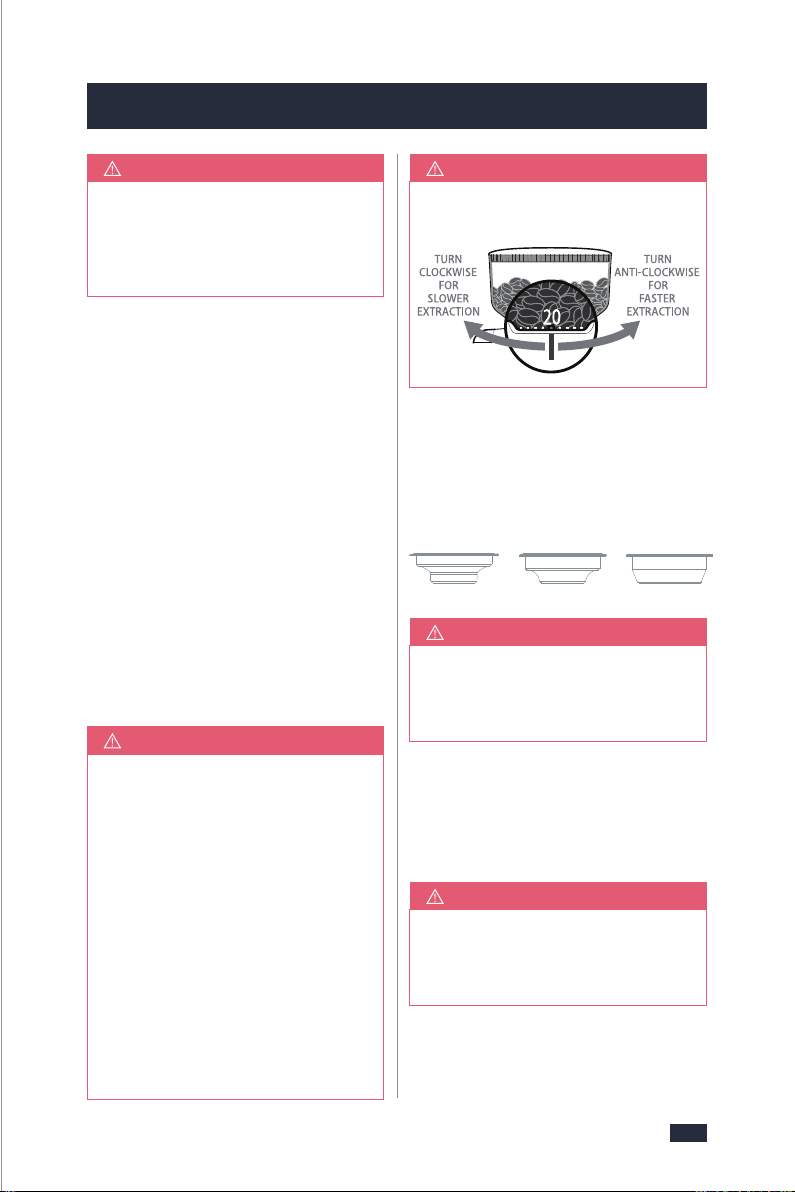
- Setting your preferred size by
rotating the grind size ring setting
from 0 to 30, the corresponding
range from fine to coarse.
- The grind size will affect the water
flow rate through the coffee in the
Filter Basket and the flavor of the
espresso.The smaller the number,
- Coffee powder produced by grind
size setting range from 19-30 is also
not well-suited for espresso because
it is too coarse. But it can be used
for pour over coffee.
- Based on ground powder size
reference for Long brew, the grind
size setting range is 15-18, you can
put the powder dose as below:
Single-cup
filter
Double-cup
filter
One cupTwo cup
8-10g13-15g
Description
Cup Size
Powder dose
grams
18-22g
Powder dose
grams
Long brew filter
Long brew cup
Description
Cup Size
READY
PRESS & HOLD 2 SEC
8 -10g
5. Grinding Guide5. Grinding Guide
1615
If the GRIND SIZE selector changes,
the quantities of powder volume
will also be changed.
NOTE
a. You can use our Single Cup Filter
Basket or Double Cup Filter Basket
to grind beans by using the Custom
Mode.
b. You can grind beans in a different
container put under the powder
outlet and then weigh the powder
by using an electronic scale, this
will make sure you get a more
precise amount of powder.
NOTE
Evenly tamp (press) coffee grinds to
the level indicated, with firm force
10 -15kg.
the finer the grind size. The larger the
number, the coarser the grind size.
- The machine is on and in the READY
state.
- Place the Portafilter with either the
Single Cup Filter Basket or Double
Cup Filter Basket under the ground
coffee outlet based on the quantity
you want to customize.
Customisable Single-Shot Grind
Volume
- Press the Program button to enter
into the user-defined mode, the
machine will have a beep.
- Press grind button one time, then
the single-shot grind indicator will
keep white light fixed.
- Press & hold the Grind button for 2
seconds.
- The single-shot grind indicator will
flash to indicate it is in custom mode.
- Bean will start to grind.
- When you reach your desired 1 shot
volume, press the Grind button.
- The Grind will stop.
- Press the Program button within 10
seconds,single-shot grind indicator
Tamp Force
10-15kg
Single Cup
Long brew
18-22g
Double Cup
13-15g
5. Powder Size Reference
- Coffee powder produced by grind
size setting range from 0-7 is not
well-suited for espresso because it
is too fine. But it can be used for
Turkish style coffee.
- Based on ground powder size
reference for Espresso, the grind
size setting range is 8-10, you can
put the powder dose as below:
6. Customisable-Grind Volumes
- Open the Hopper lid . Add beans
into the Bean hopper .
(The maximum quantity is 250g /
8.81 oz.)
- Setting your preferred size by
rotating the grind size ring setting
from 0 to 30, the corresponding
range from fine to coarse.
- The grind size will affect the water
flow rate through the coffee in the
Filter Basket and the flavor of the
espresso.The smaller the number,
- Coffee powder produced by grind
size setting range from 19-30 is also
not well-suited for espresso because
it is too coarse. But it can be used
for pour over coffee.
- Based on ground powder size
reference for Long brew, the grind
size setting range is 15-18, you can
put the powder dose as below:
Single-cup
filter
Double-cup
filter
One cupTwo cup
8-10g13-15g
Description
Cup Size
Powder dose
grams
18-22g
Powder dose
grams
Long brew filter
Long brew cup
Description
Cup Size
READY
PRESS & HOLD 2 SEC
8 -10g
5. Grinding Guide5. Grinding Guide
1817
For best espresso results, use
filtered water & freshly roasted
coffee beans.
TIP
By staying Manual-shot Grind
Mode, press the Grind button to
stop when getting the desired
amount of powder.Press the
POWER Button again to exit the
manual dose grind mode.
NOTE
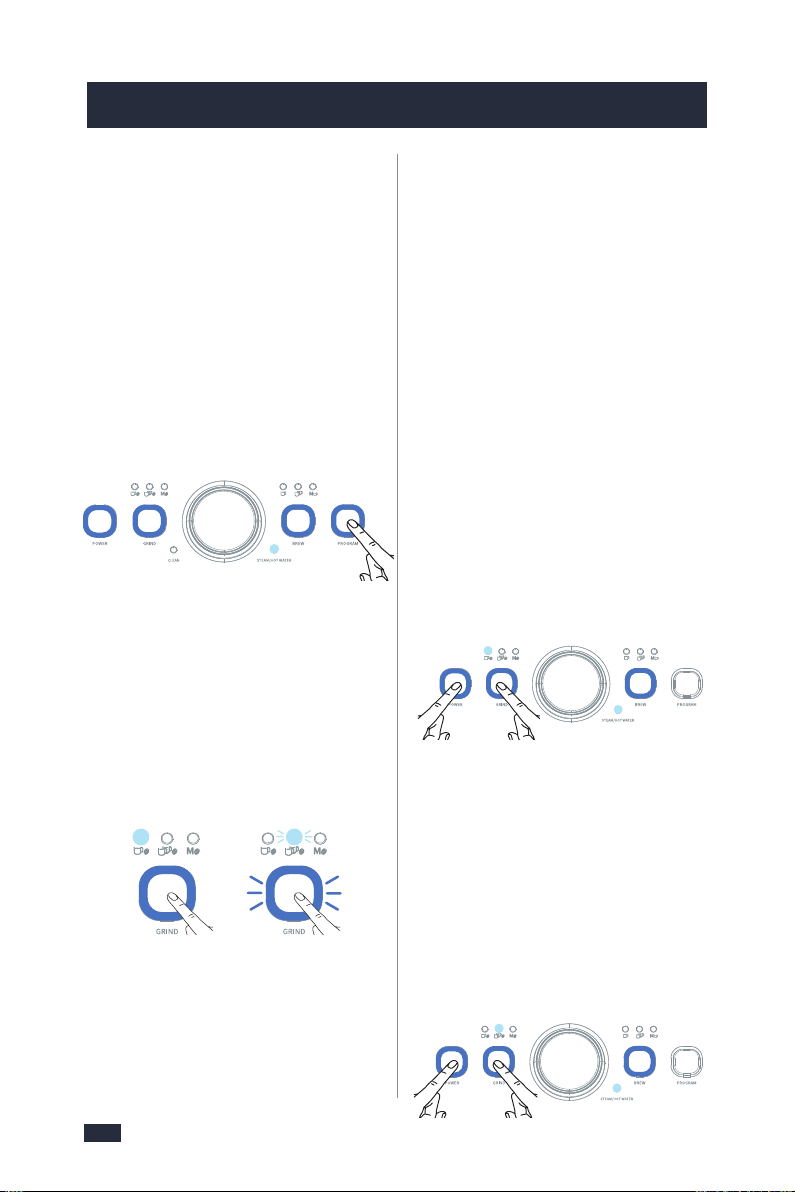
will flash white light for 2 times then
turn off.
- The new One Cup (Grind) Volume
has been saved.
- The machine will return to the
READY state.
Restore Single-Shot Grind Volume
- Press Grind button one times for
selecting single-shot grind indicator.
- Hold and press together the Power
button and Grind button for two
seconds, there will be a beep. Then
the default setting of grinding will
be restored and be back to ready
mode.
1. Check Water & Beans
2. Start Up
3. Dose Coffee Grinds
Restore Double-Shot Grind Volume
- Press Grind button two times for
selecting double-shot grind indicator.
- Hold and press together the Power
button and Grind button for two
seconds, there will be a beep.
Then the default setting of grinding
will be restored and be back to
ready mode.
Customisable Double-Shot Grind
Volume
- Press the Program button to enter
into the user-defined mode, the
machine will have a beep.
- press grind button two times, then
the double-shot grind indicator
will keep white light fixed.
- Press & hold the Grind button for 2
seconds.
- The double-shot grind indicator
will flash to indicate it is in custom
mode.
- Bean will start to grind.
- When you reach your desired 2
shot volume, press the Grind button.
- The Grind will stop.
PRESS & HOLD 2 SEC
PRESS & HOLD TOGETHER 2 SEC
PRESS & HOLD TOGETHER 2 SEC
5.3 Operation
- Press the Program button within
10 seconds,double-shot grind
indicator will flash white light for
2 times then turn off.
- The new Two Cup (Grind) Volume
has been saved.
- The machine will return to the
READY state.
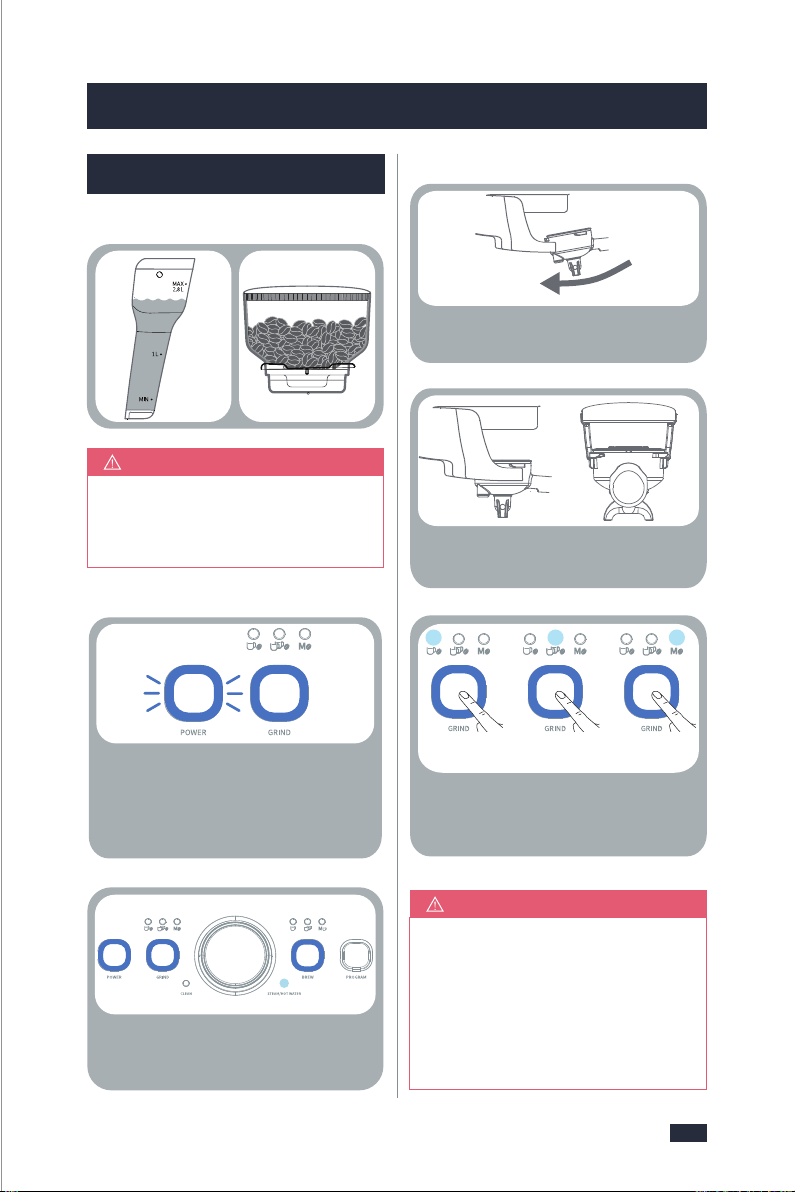
Press POWER BUTTON, LIGHT
pulses = heating up. GRINDER
LIGHT fully illuminated = Grinder
ready to use.
LIGHTS all fully illuminated =
Espresso Machine ready to use.
Insert Portafilter into Grinding
Cradle.
Portafilter will sit flat, unsup-
ported, in the Grinding Cradle.
SLIDE IN
FROM ABOVE
Press Grind button to choose
Grind Mode, then Long press
Grind button to grind
OROR
Single-shot
Grind Mode
Double-shot
Grind Mode
Manual-shot
Grind Mode
5. Grinding Guide
5. Grinding Guide
1817
For best espresso results, use
filtered water & freshly roasted
coffee beans.
TIP
By staying Manual-shot Grind
Mode, press the Grind button to
stop when getting the desired
amount of powder.Press the
POWER Button again to exit the
manual dose grind mode.
NOTE
will flash white light for 2 times then
turn off.
- The new One Cup (Grind) Volume
has been saved.
- The machine will return to the
READY state.
Restore Single-Shot Grind Volume
- Press Grind button one times for
selecting single-shot grind indicator.
- Hold and press together the Power
button and Grind button for two
seconds, there will be a beep. Then
the default setting of grinding will
be restored and be back to ready
mode.
1. Check Water & Beans
2. Start Up
3. Dose Coffee Grinds
Restore Double-Shot Grind Volume
- Press Grind button two times for
selecting double-shot grind indicator.
- Hold and press together the Power
button and Grind button for two
seconds, there will be a beep.
Then the default setting of grinding
will be restored and be back to
ready mode.
Customisable Double-Shot Grind
Volume
- Press the Program button to enter
into the user-defined mode, the
machine will have a beep.
- press grind button two times, then
the double-shot grind indicator
will keep white light fixed.
- Press & hold the Grind button for 2
seconds.
- The double-shot grind indicator
will flash to indicate it is in custom
mode.
- Bean will start to grind.
- When you reach your desired 2
shot volume, press the Grind button.
- The Grind will stop.
PRESS & HOLD 2 SEC
PRESS & HOLD TOGETHER 2 SEC
PRESS & HOLD TOGETHER 2 SEC
5.3 Operation
- Press the Program button within
10 seconds,double-shot grind
indicator will flash white light for
2 times then turn off.
- The new Two Cup (Grind) Volume
has been saved.
- The machine will return to the
READY state.
Press POWER BUTTON, LIGHT
pulses = heating up. GRINDER
LIGHT fully illuminated = Grinder
ready to use.
LIGHTS all fully illuminated =
Espresso Machine ready to use.
Insert Portafilter into Grinding
Cradle.
Portafilter will sit flat, unsup-
ported, in the Grinding Cradle.
SLIDE IN
FROM ABOVE
Press Grind button to choose
Grind Mode, then Long press
Grind button to grind
OROR
Single-shot
Grind Mode
Double-shot
Grind Mode
Manual-shot
Grind Mode
5. Grinding Guide
5. Grinding Guide
2019
dissipates. This occurs when too little
of the essential oils, flavours & colours
from the coffee grinds have been
extracted. This creates a sour tasting
espresso.
• Over Extraction
There may be no pour, or it may be
slow & drip throughout the entire
pour. The resulting crema is very
dark. This occurs when too much of
the essential oils, flavours & colours
from the coffee grinds have been
extracted. This creates a bitter tasting
espresso.
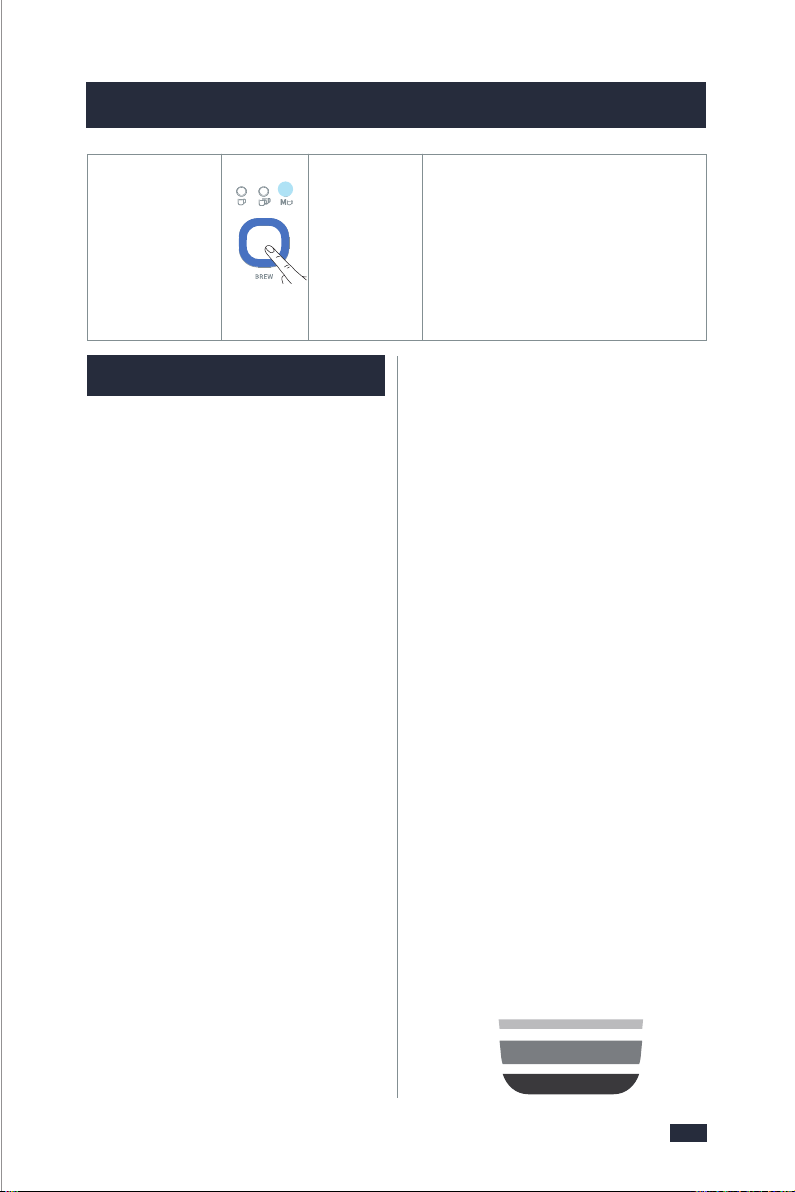
3. Look for Colour Change
The optimum shot contains 3 elements:
Heart: At the base-starts out dark
brown.
Body: Blends with the heart
- becomes a rich caramel with
reddish reflections.
Crema: The layer on top of the body
- dark golden.
The way the espresso pours will tell
you everything.
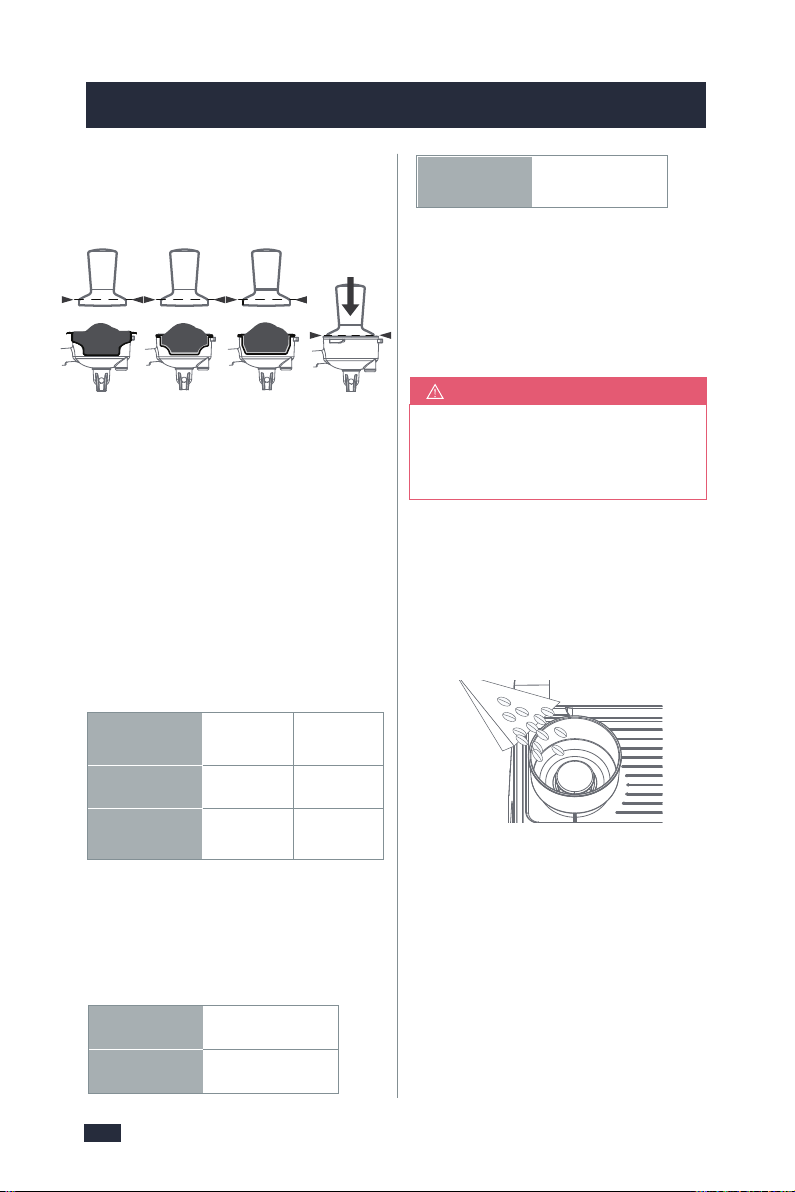
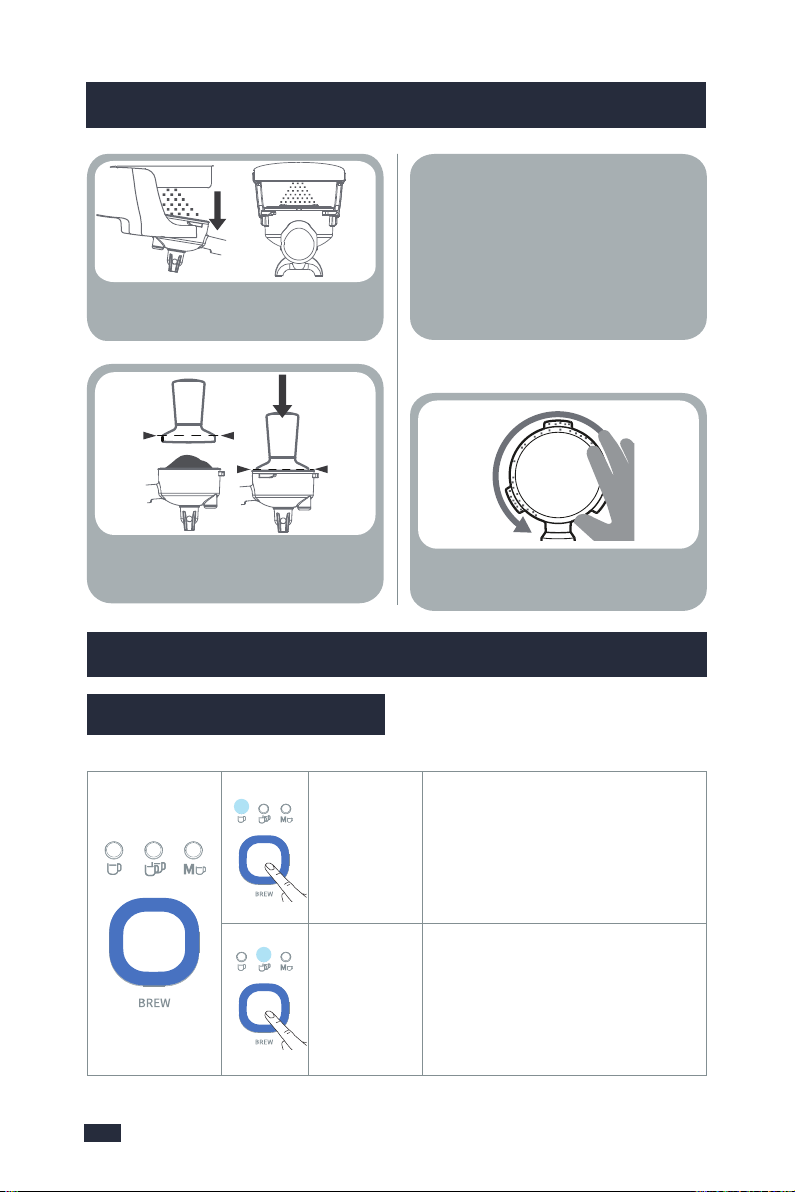
5. Wipe Excess Grinds
Push down Portafilter to grind
into Filter Basket.
- Single Cup Filter = 8-10g coffee
grinds.
- Double Cup Filter = 13-15g
coffee grinds.
- Long Brew Filter = 18-22g
coffee grinds.
Evenly tamp (press) grinds
to level indicated.
Wipe away any excess grinds to
clear edges.
Single-shot
Mode
Press 1 time to select Single-shot
Mode, long press to start brewing
and then it will automatically stop.
Press 2 times to select Double-
shot Mode, long press to start
brewing and then it will
automatically stop.
Double-shot
Mode
6.1 Brief Introduction
Manual-shot
Mode
Press 3 times to select Manual-
shot Mode, long press to start
brewing. When you get a desired
amount of coffee press again to
stop. (It will automatically stop
after brewing 300mL)
6.2 Tips For Espresso
1. Extraction Time
Espresso around 30ml/cup.
Extraction time is a good indicator
of the quality of the pour. The
optimum time per shot varies
between types & freshness of
coffee beans. However, in general,
the pour time should be between
20-30 seconds for both Single &
Double Cup shots.
2. Type of Extraction
• Optimum Extraction
A quality pour has a steady flow with
a consistency similar to that of warm
honey. The resulting crema is dark
golden. The sweetest flavours & oils
have been extracted creating a rich
tasting espresso.
• Under Extraction
The pour is fast & light in colour, the
resulting crema is thin with a creamy
light brown colour which quickly
Crema -
Body -
Heart -
5. Grinding Guide
6. Espresso Guide
6. Espresso Guide
2019
dissipates. This occurs when too little
of the essential oils, flavours & colours
from the coffee grinds have been
extracted. This creates a sour tasting
espresso.
• Over Extraction
There may be no pour, or it may be
slow & drip throughout the entire
pour. The resulting crema is very
dark. This occurs when too much of
the essential oils, flavours & colours
from the coffee grinds have been
extracted. This creates a bitter tasting
espresso.
3. Look for Colour Change
The optimum shot contains 3 elements:
Heart: At the base-starts out dark
brown.
Body: Blends with the heart
- becomes a rich caramel with
reddish reflections.
Crema: The layer on top of the body
- dark golden.
The way the espresso pours will tell
you everything.
5. Wipe Excess Grinds
Push down Portafilter to grind
into Filter Basket.
- Single Cup Filter = 8-10g coffee
grinds.
- Double Cup Filter = 13-15g
coffee grinds.
- Long Brew Filter = 18-22g
coffee grinds.
Evenly tamp (press) grinds
to level indicated.
Wipe away any excess grinds to
clear edges.
Single-shot
Mode
Press 1 time to select Single-shot
Mode, long press to start brewing
and then it will automatically stop.
Press 2 times to select Double-
shot Mode, long press to start
brewing and then it will
automatically stop.
Double-shot
Mode
6.1 Brief Introduction
Manual-shot
Mode
Press 3 times to select Manual-
shot Mode, long press to start
brewing. When you get a desired
amount of coffee press again to
stop. (It will automatically stop
after brewing 300mL)
6.2 Tips For Espresso
1. Extraction Time
Espresso around 30ml/cup.
Extraction time is a good indicator
of the quality of the pour. The
optimum time per shot varies
between types & freshness of
coffee beans. However, in general,
the pour time should be between
20-30 seconds for both Single &
Double Cup shots.
2. Type of Extraction
• Optimum Extraction
A quality pour has a steady flow with
a consistency similar to that of warm
honey. The resulting crema is dark
golden. The sweetest flavours & oils
have been extracted creating a rich
tasting espresso.
• Under Extraction
The pour is fast & light in colour, the
resulting crema is thin with a creamy
light brown colour which quickly
Crema -
Body -
Heart -
5. Grinding Guide
6. Espresso Guide
6. Espresso Guide
2221
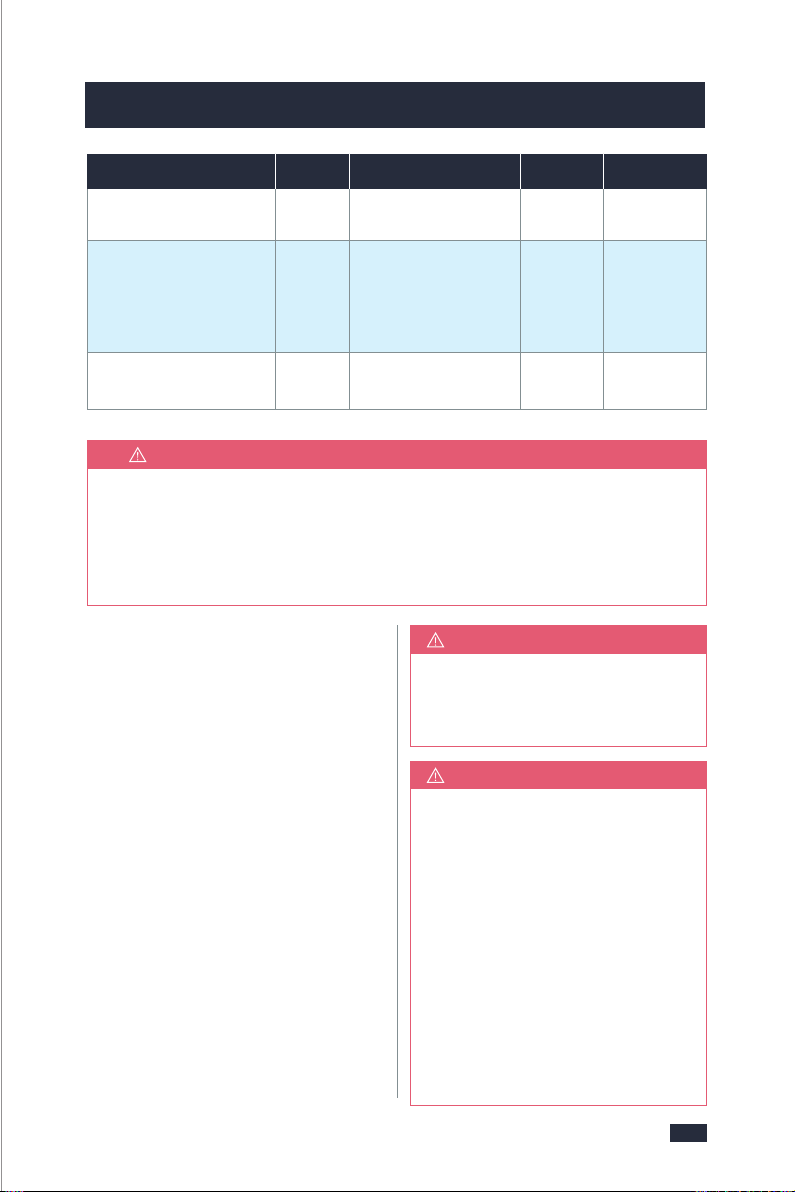
5. Customisable-Shot Volumes
The features Auto Shot Volumetric
Control extracts just the right amount
of espresso then automatically stops.
Possible setting range for different
brew final dose:
ONE CUP Espresso = 25 - 60mL
TWO CUP Espresso = 45 - 80mL
MANUAL SHOT Long dose = Max 300mL
At any point during espresso extraction,
you can stop the pour by pressing the
same button again.
- Check Water Reservoir
- Ensure there is enough water in the
Reservoir.
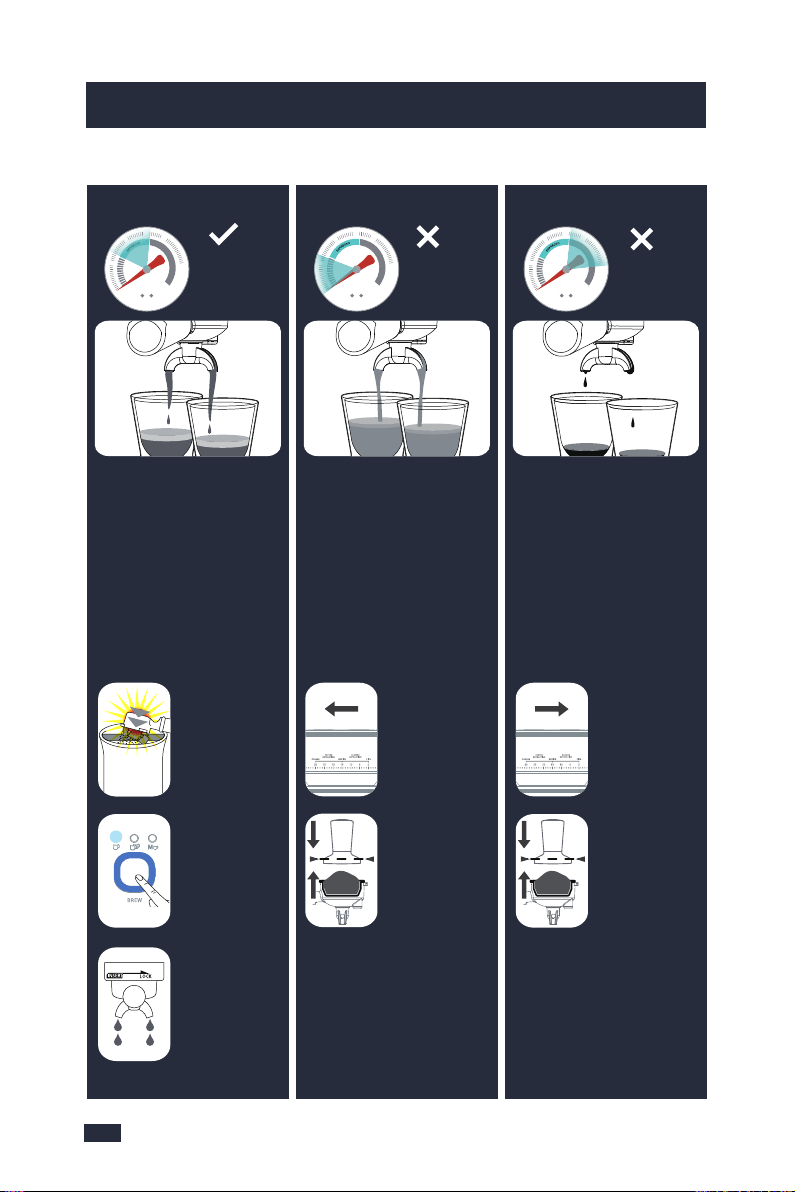
4. Espresso Extraction Guide
Correct ExtractionUnder ExtractionOver Extraction
After ExtractionSolutionsSolutions
Within
Espresso
Range
Under
Espresso
Range
Over
Espresso
Range
• Flow starts after 4 - 7 secs
• Flow slow like warm honey
• Crema is golden brown with
a fine mousse texture
• Espresso is dark brown
• Extraction takes 25 - 35 secs
Used grinds will
form a coffee
'puck'.
Grind size finer
Remove used
grinds:
Adjust & re-
test:
Grind size coarser
Adjust & re-
test:
keep the filter
basket clean to
prevent block-
ages. Without
ground coffee in
the filter basket,
lock the
Portafilter into
the machine
and run hot
water through.
Tamp using 30 ‒
40lbs of pressure.
The top edge of
metal cap on
the tamper should
be level with the
top of the filter
basket AFTER
tamping.
Tamp using 15
kilos of pressure.
The top edge of
metal cap on the
tamper should
be level with the
top of the filter
basket AFTER
tamping.
Rinse filter
basket
• Flows starts after 3 - 5 secs
• Flow fast like water
• Crema is thin and pale
• Espresso is pale brown
• Tastes bitter/sharp, weak
and watery
• Extraction takes up to 20
secs
• Flow starts after 8 secs
• Flow drips or not at all
• Crema is dark and spotty
• Espresso is very dark brown
• Tastes bitter and burnt
• Extraction takes more than
40 secs
Over Extracted
(Bitter Astringent)
Under Extracted
(Underdeveloped Sour)
Too FineToo Much
Too Little
(increase dose)
Too Heavy
Too Light
Over 40 Sec
BalancedOptimum
Too
Coarse
Espresso Grinding Size
reference around 8-10
Powder Dose:
One cup: 8-10gr
Two cup: 13-15gr
22-30 lbs/
(10-15kg)
9 Bar
25 -35 Sec
Under 20 Sec
GrindGrind DoseTampShot Time
- Ensure coffee beans or pre-ground grinds are fresh.
- Old coffee beans no matter the Grind Setting will have a fast
extraction and will produce an under extracted tasting espresso.
- The grind size will affect the water flow rate through the coffee in
the filter and the flavor of the espresso.
NOTE
For best espresso results, use
filtered water & freshly roasted
coffee beans.
TIPS
Before insert the refill water tank,
use the clean cloth to wipe off the
water on the valve.
When the water tank is pulled up,
the water will flow out from the outlet
at the bottom of the water tank, as
it is a movable part. If you have pulled
up several times and have not wipe
the water immediately,it will accumu-
late more and more and ran to the
bottom of the machine, maybe will leave
the table full of water.It's not leaking.
NOTE
6. Espresso Guide6. Espresso Guide
5
0
9
12
15
20
BAR
5
0
9
12
15
20
BAR
5
0
9
12
15
20
BAR
2221
5. Customisable-Shot Volumes
The features Auto Shot Volumetric
Control extracts just the right amount
of espresso then automatically stops.
Possible setting range for different
brew final dose:
ONE CUP Espresso = 25 - 60mL
TWO CUP Espresso = 45 - 80mL
MANUAL SHOT Long dose = Max 300mL
At any point during espresso extraction,
you can stop the pour by pressing the
same button again.
- Check Water Reservoir
- Ensure there is enough water in the
Reservoir.
4. Espresso Extraction Guide
Correct ExtractionUnder ExtractionOver Extraction
After ExtractionSolutionsSolutions
Within
Espresso
Range
Under
Espresso
Range
Over
Espresso
Range
• Flow starts after 4 - 7 secs
• Flow slow like warm honey
• Crema is golden brown with
a fine mousse texture
• Espresso is dark brown
• Extraction takes 25 - 35 secs
Used grinds will
form a coffee
'puck'.
Grind size finer
Remove used
grinds:
Adjust & re-
test:
Grind size coarser
Adjust & re-
test:
keep the filter
basket clean to
prevent block-
ages. Without
ground coffee in
the filter basket,
lock the
Portafilter into
the machine
and run hot
water through.
Tamp using 30 ‒
40lbs of pressure.
The top edge of
metal cap on
the tamper should
be level with the
top of the filter
basket AFTER
tamping.
Tamp using 15
kilos of pressure.
The top edge of
metal cap on the
tamper should
be level with the
top of the filter
basket AFTER
tamping.
Rinse filter
basket
• Flows starts after 3 - 5 secs
• Flow fast like water
• Crema is thin and pale
• Espresso is pale brown
• Tastes bitter/sharp, weak
and watery
• Extraction takes up to 20
secs
• Flow starts after 8 secs
• Flow drips or not at all
• Crema is dark and spotty
• Espresso is very dark brown
• Tastes bitter and burnt
• Extraction takes more than
40 secs
Over Extracted
(Bitter Astringent)
Under Extracted
(Underdeveloped Sour)
Too FineToo Much
Too Little
(increase dose)
Too Heavy
Too Light
Over 40 Sec
BalancedOptimum
Too
Coarse
Espresso Grinding Size
reference around 8-10
Powder Dose:
One cup: 8-10gr
Two cup: 13-15gr
22-30 lbs/
(10-15kg)
9 Bar
25 -35 Sec
Under 20 Sec
GrindGrind DoseTampShot Time
- Ensure coffee beans or pre-ground grinds are fresh.
- Old coffee beans no matter the Grind Setting will have a fast
extraction and will produce an under extracted tasting espresso.
- The grind size will affect the water flow rate through the coffee in
the filter and the flavor of the espresso.
NOTE
For best espresso results, use
filtered water & freshly roasted
coffee beans.
TIPS
Before insert the refill water tank,
use the clean cloth to wipe off the
water on the valve.
When the water tank is pulled up,
the water will flow out from the outlet
at the bottom of the water tank, as
it is a movable part. If you have pulled
up several times and have not wipe
the water immediately,it will accumu-
late more and more and ran to the
bottom of the machine, maybe will leave
the table full of water.It's not leaking.
NOTE
6. Espresso Guide6. Espresso Guide
5
0
9
12
15
20
BAR
5
0
9
12
15
20
BAR
5
0
9
12
15
20
BAR
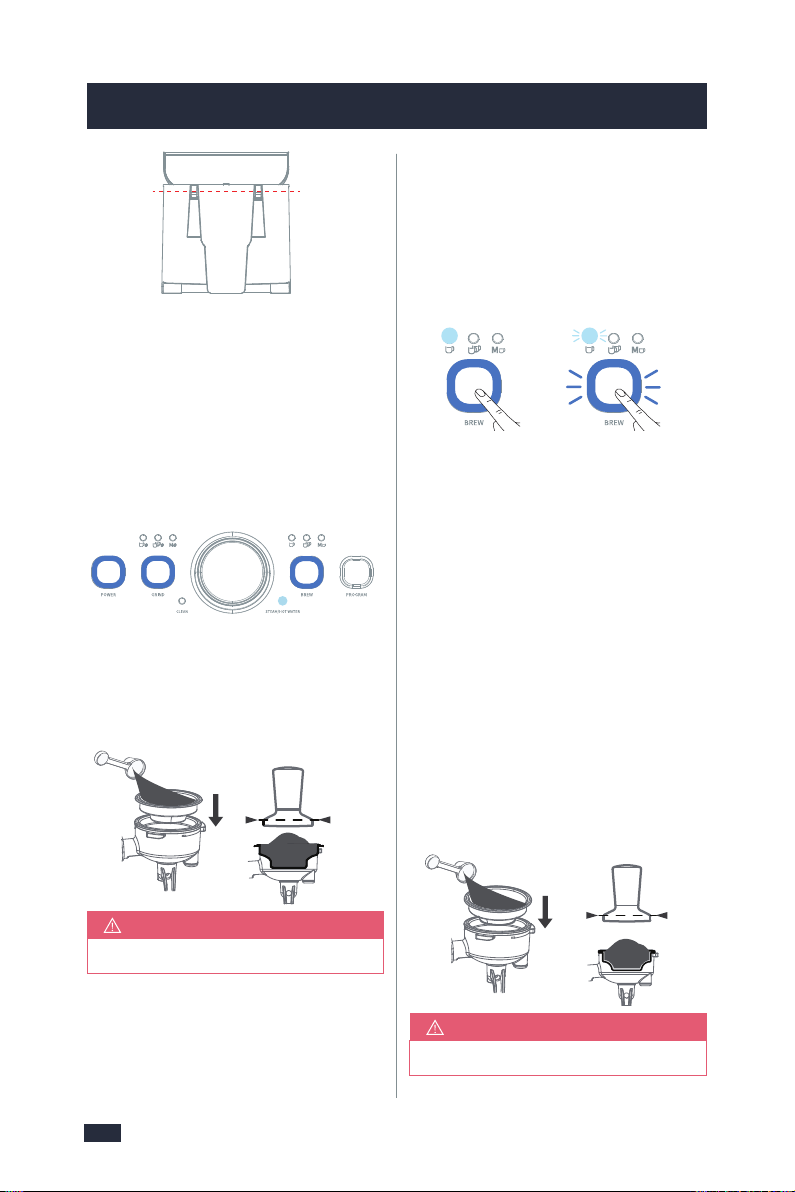
2423
- Espresso will start to pour.
- When you reach your desired 1 shot
volume, press the Brew button.
- The espresso pour will stop.
- Press the Program button within 10
seconds,single-shot indicator will
flash white light for 2 times then
turn off.
- The new ONE CUP espresso shot
volume has been saved.
- The machine will return to the READY
state.
Customisable Double-Shot Volume
- Insert Two Cup Filter Basket into the
Portafilter.
- Dose with coffee grinds then tamp.
- Insert Portafilter into the
Portafilter.
- Press the Program button to enter
into the user-defined mode, the
machine will have a beep.
PRESS & HOLD 2 SEC
- Insert Portafilter into the Group
Head.
- Espresso will start to pour.
- When you reach your desired 2
shots volume, press the Brew button.
- The espresso pour will stop.
- Press the Program button within
10 seconds,double-shot indicator
will flash white light for 2 times then
turn off.
- The new TWO CUP espresso shot
volume has been saved.
- The machine will return to the
READY state.
Restore Single-Shot Volume
- Press Brew button one time for
selecting Single-shot indicator .
- Hold and press together the Power
button and Brew button for two
seconds, there will be a beep. Then
the default setting of brewing
espresso will be restored and be
back to ready mode.
PRESS & HOLD 2 SEC
Customisable Single-Shot Volume
- Insert Single-shot Filter Basket
into the Portafilter.
- Dose with coffee grinds then tamp.
Check Power Ensure that:
- The Power Plug is inserted into the
outlet & switched on.
- The DIAL is in the vertical position.
-Press the POWER button to turn on
the machine.
- The machine is on and in the READY
state.
MAX 2.8L
8 -10g
Double Cup
13-15g
1 spoon of powder is 7g .
TIPS
1 spoon of powder is 7g .
TIPS
Restore Double-Shot Volume
- Press Brew button two time for
selecting Two cup indicator .
- Hold and press together the Power
button and Brew button for two
seconds, there will be a beep. Then
the default setting of brewing
Espresso will be restored and be
back to ready mode.
6. Customisable - Extraction
Temperature
The Thermoblock heats water so that
espresso extracts at 92°C(197.6℉). For
the best tasting espresso, balancing
bitterness and acidity.
You can adjust the water temperature
used for espresso extraction, in 3°C
(5.4℉)increments between 89°C
(192.2℉)-95°C(203℉), to cater for
different types of roasted coffee
beans and for personal preference.
- Higher temperatures increase
bitterness and decrease acidity.
- Lower temperatures decrease
PRESS & HOLD TOGETHER 2 SEC
PRESS & HOLD TOGETHER 2 SEC
- Press the Program button to enter
into the user-defined mode, the
machine will have a beep
- Press Brew button two time, then
the double-shot indicator will keep
white light fixed.
- Press & hold the Brew button for 2
seconds.
- The Double-shot indicator will flash
to indicate it is in custom mode.
- Press brew button one time, then
the single-shot indicator will keep
white light fixed.
- Press & hold the Brew button for 2
seconds.
- The single-shot indicator will flash
to indicate it is in custom mode.
6. Espresso Guide6. Espresso Guide
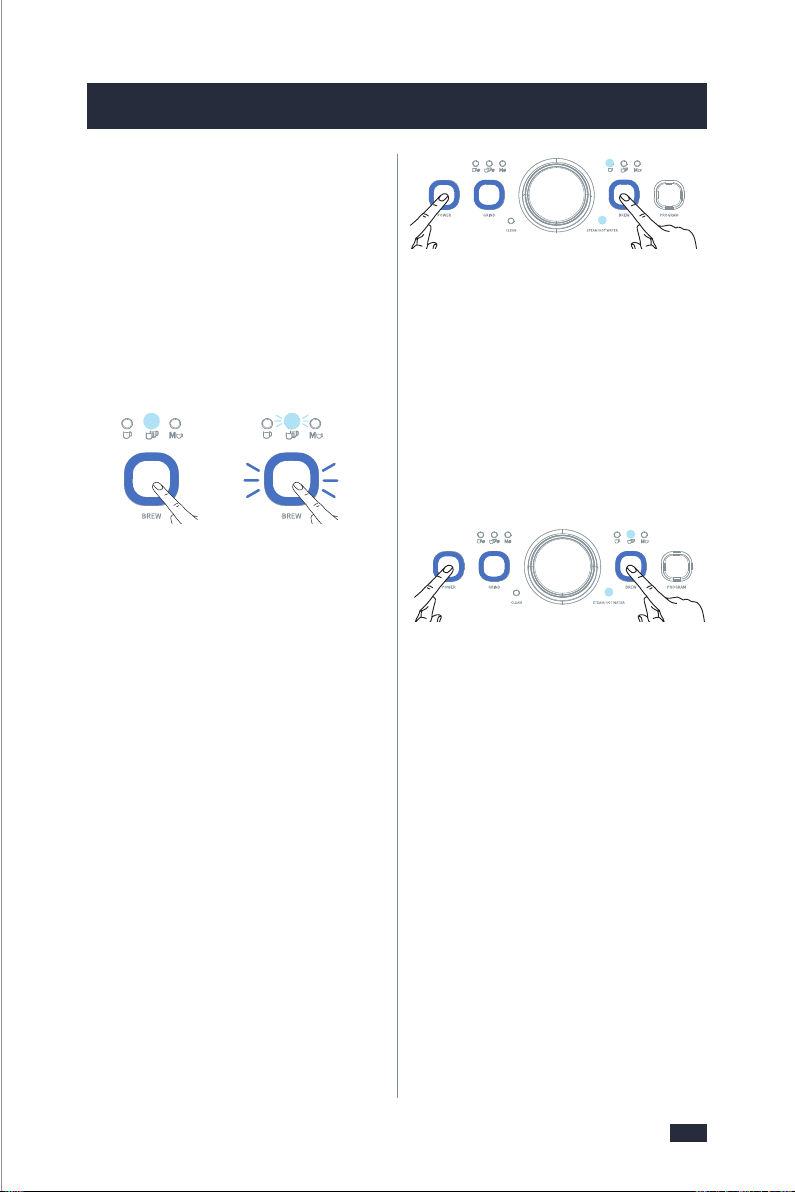
2423
- Espresso will start to pour.
- When you reach your desired 1 shot
volume, press the Brew button.
- The espresso pour will stop.
- Press the Program button within 10
seconds,single-shot indicator will
flash white light for 2 times then
turn off.
- The new ONE CUP espresso shot
volume has been saved.
- The machine will return to the READY
state.
Customisable Double-Shot Volume
- Insert Two Cup Filter Basket into the
Portafilter.
- Dose with coffee grinds then tamp.
- Insert Portafilter into the
Portafilter.
- Press the Program button to enter
into the user-defined mode, the
machine will have a beep.
PRESS & HOLD 2 SEC
- Insert Portafilter into the Group
Head.
- Espresso will start to pour.
- When you reach your desired 2
shots volume, press the Brew button.
- The espresso pour will stop.
- Press the Program button within
10 seconds,double-shot indicator
will flash white light for 2 times then
turn off.
- The new TWO CUP espresso shot
volume has been saved.
- The machine will return to the
READY state.
Restore Single-Shot Volume
- Press Brew button one time for
selecting Single-shot indicator .
- Hold and press together the Power
button and Brew button for two
seconds, there will be a beep. Then
the default setting of brewing
espresso will be restored and be
back to ready mode.
PRESS & HOLD 2 SEC
Customisable Single-Shot Volume
- Insert Single-shot Filter Basket
into the Portafilter.
- Dose with coffee grinds then tamp.
Check Power Ensure that:
- The Power Plug is inserted into the
outlet & switched on.
- The DIAL is in the vertical position.
-Press the POWER button to turn on
the machine.
- The machine is on and in the READY
state.
MAX 2.8L
8 -10g
Double Cup
13-15g
1 spoon of powder is 7g .
TIPS
1 spoon of powder is 7g .
TIPS
Restore Double-Shot Volume
- Press Brew button two time for
selecting Two cup indicator .
- Hold and press together the Power
button and Brew button for two
seconds, there will be a beep. Then
the default setting of brewing
Espresso will be restored and be
back to ready mode.
6. Customisable - Extraction
Temperature
The Thermoblock heats water so that
espresso extracts at 92°C(197.6℉). For
the best tasting espresso, balancing
bitterness and acidity.
You can adjust the water temperature
used for espresso extraction, in 3°C
(5.4℉)increments between 89°C
(192.2℉)-95°C(203℉), to cater for
different types of roasted coffee
beans and for personal preference.
- Higher temperatures increase
bitterness and decrease acidity.
- Lower temperatures decrease
PRESS & HOLD TOGETHER 2 SEC
PRESS & HOLD TOGETHER 2 SEC
- Press the Program button to enter
into the user-defined mode, the
machine will have a beep
- Press Brew button two time, then
the double-shot indicator will keep
white light fixed.
- Press & hold the Brew button for 2
seconds.
- The Double-shot indicator will flash
to indicate it is in custom mode.
- Press brew button one time, then
the single-shot indicator will keep
white light fixed.
- Press & hold the Brew button for 2
seconds.
- The single-shot indicator will flash
to indicate it is in custom mode.
6. Espresso Guide6. Espresso Guide
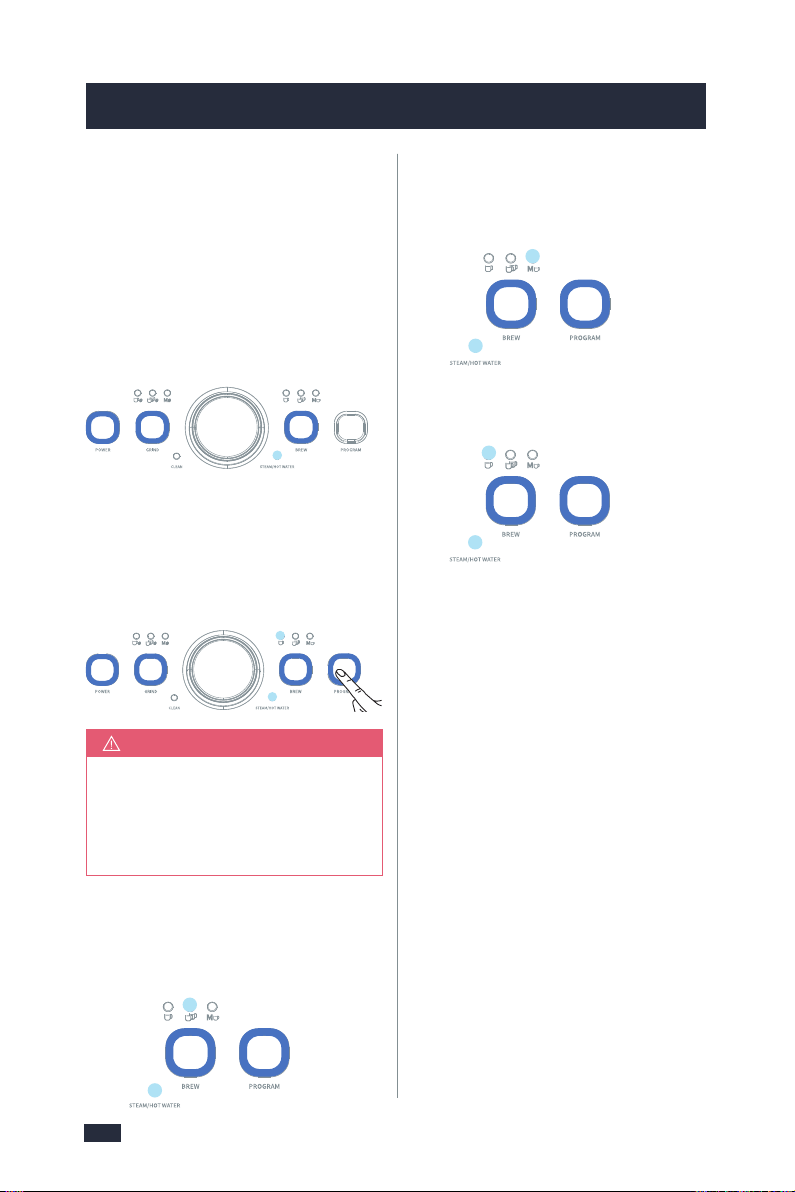
2625
2. Access Extraction Temperature
Custom Mode
- Press the Program button for
minimum 2 seconds , there will be
a beep.
If no buttons are pressed within 1
minute of entering a custom mode,
the machine will exit and go back
to the READY state.
IMPORTANT
bitterness and increase acidity.
1. Check Power
Ensure that:
- The Power Plug is inserted into the
outlet & switched on.
- The DIAL is in the vertical position.
- The machine is on and in the
READY state.
3. Adjusting Extraction Temperature
The default setting is:
92°C(197.6℉) = Double-shot indicator
illuminated.
4. Confirm Extraction Pre-infusion
Profile
- Press the Program button to save
your selection. The machine will
beep & exit the custom mode.
- The machine will return to the
READY state.
- Constant = Press the brew button 3
times, The Manual-shot indicator
illuminated.
6.3 Operation
1. Check Water
MAX 2.8L
Fill water into the water tank NOT
exceed the MAX line. Set up the
water tank vertically and align
the bucklesto the hole on the
back of themachine,and press
it down to beparallel to the top
of the machine.
4. Confirm Extraction Temperature
- Press the Program button to save
your selection. The machine will
beep & exit the custom mode.
- The machine will return to the
READY state.
7. Customisable -
Extraction Pre-infusion Profile
1. You can select from three Pre-
infusion Profiles to cater for personal
preferences.
- Gentle Pre-infusion: Small defined
amounts of water are introduced into
the tamped coffee grinds, gently
adding moisture to bloom the coffee
grinds in preparation for a steady
water flow. For a balanced tasting
espresso. This is the default profile
setting.
- Distinct Pre-infusion: A single distinct
To adjust extraction temperature press:
95°C(203℉) = Manual-shot indicator
illuminated.
89°C(192.2℉) = Single-shot indicator
illuminated.
dose of water is released into the
tamped coffee grinds, followed by a
brief rest period, then a steady water
flow.For a more bright tasting espresso.
- Constant Pre-infusion: Delivers a
constant, steady water flow from
start to finish. For a more sharp
tasting espresso.
2. Access Pre-infusion Custom Mode
- The machine is ON and in the READY
state.
- Simultaneously press & hold the
Brew button and Program button for
2 seconds. The machine will beep.
3. Selecting Pre-infusion Profiles
The default setting is:
Gentle = the Single-shot indicator is
illuminated.
To select a Pre-infusion Profile
- Distinct = Press the brew button 2
times, Double-shot indicator will
illuminate.
6. Espresso Guide6. Espresso Guide
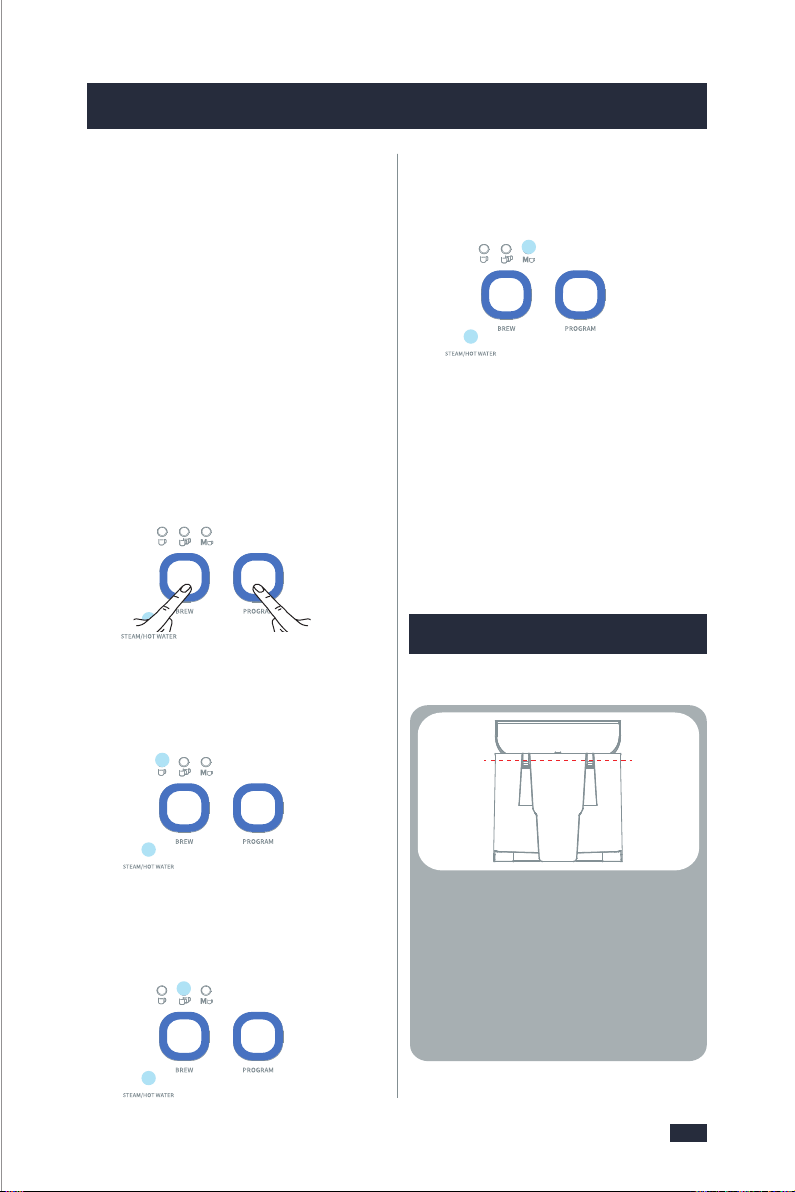
2625
2. Access Extraction Temperature
Custom Mode
- Press the Program button for
minimum 2 seconds , there will be
a beep.
If no buttons are pressed within 1
minute of entering a custom mode,
the machine will exit and go back
to the READY state.
IMPORTANT
bitterness and increase acidity.
1. Check Power
Ensure that:
- The Power Plug is inserted into the
outlet & switched on.
- The DIAL is in the vertical position.
- The machine is on and in the
READY state.
3. Adjusting Extraction Temperature
The default setting is:
92°C(197.6℉) = Double-shot indicator
illuminated.
4. Confirm Extraction Pre-infusion
Profile
- Press the Program button to save
your selection. The machine will
beep & exit the custom mode.
- The machine will return to the
READY state.
- Constant = Press the brew button 3
times, The Manual-shot indicator
illuminated.
6.3 Operation
1. Check Water
MAX 2.8L
Fill water into the water tank NOT
exceed the MAX line. Set up the
water tank vertically and align
the bucklesto the hole on the
back of themachine,and press
it down to beparallel to the top
of the machine.
4. Confirm Extraction Temperature
- Press the Program button to save
your selection. The machine will
beep & exit the custom mode.
- The machine will return to the
READY state.
7. Customisable -
Extraction Pre-infusion Profile
1. You can select from three Pre-
infusion Profiles to cater for personal
preferences.
- Gentle Pre-infusion: Small defined
amounts of water are introduced into
the tamped coffee grinds, gently
adding moisture to bloom the coffee
grinds in preparation for a steady
water flow. For a balanced tasting
espresso. This is the default profile
setting.
- Distinct Pre-infusion: A single distinct
To adjust extraction temperature press:
95°C(203℉) = Manual-shot indicator
illuminated.
89°C(192.2℉) = Single-shot indicator
illuminated.
dose of water is released into the
tamped coffee grinds, followed by a
brief rest period, then a steady water
flow.For a more bright tasting espresso.
- Constant Pre-infusion: Delivers a
constant, steady water flow from
start to finish. For a more sharp
tasting espresso.
2. Access Pre-infusion Custom Mode
- The machine is ON and in the READY
state.
- Simultaneously press & hold the
Brew button and Program button for
2 seconds. The machine will beep.
3. Selecting Pre-infusion Profiles
The default setting is:
Gentle = the Single-shot indicator is
illuminated.
To select a Pre-infusion Profile
- Distinct = Press the brew button 2
times, Double-shot indicator will
illuminate.
6. Espresso Guide6. Espresso Guide
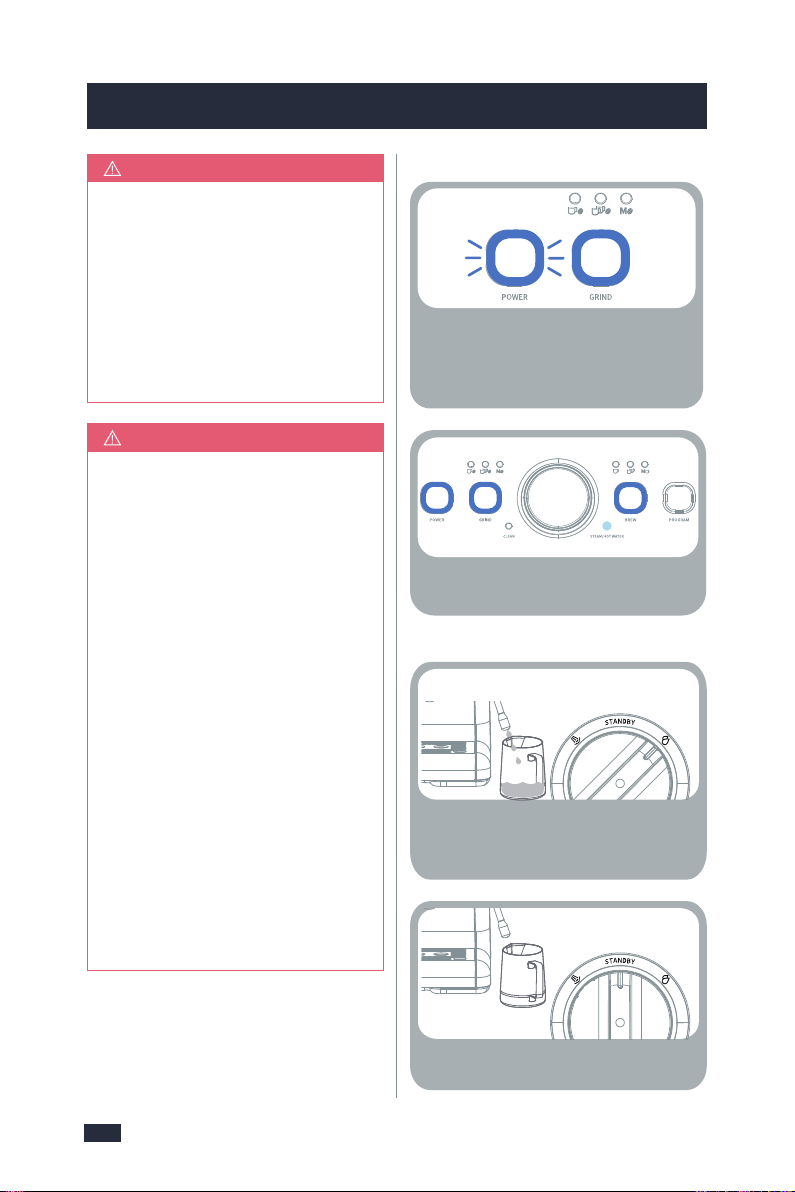
2827
For best espresso results, use
filtered water & freshly roasted
coffee beans.
As with NTC precision thermostats,
the espresso extraction temperature
is controlled at 197℉, while the
milk frothing temperature is at
212°F.
TIPS
To avoid leaking, coffee powder
should be tamped BELOW the
MAX line of portafilter.
TIPS
Before insert the refill water tank,
use the clean cloth to wipe off the
water on the valve.
If the temperature is too high to
make espresso, the steam will
splash from the portafilter and
hot water will drip off. It will result
in a small amount of coffee and a
bad taste.
When the water tank is pulled up,
the water will flow out from
theoutlet at the bottom of the
water tank, as it is a movable part.
If you have pulled up several times
and have not wipe the water
immediately,it will accumulate
more and more and ran to the
bottom of the machine, maybe
will leave the table full of water.
It's not leaking.
NOTE
2. Start Up
Insert the Power Plug. Press
POWER BUTTON, LIGHT pulses =
heating up. GRINDER LIGHT fully
illuminated = Grinder ready to use.
3.Warm Cup - by Hot Water
LIGHTS all fully illuminated =
Espresso Machine ready to use.
Place cup on benchtop and
position Steam Wand.Turn DIAL
to HOT WATER.
Quarter fill cup with hot water.
Return DIAL to vertical position
1 Min Heat Up
Wipe Filter Basket with a
dry cloth.
Dose the Filter Basket with
grinds.
6. Tamp
- Single Cup Filter = 8-10g coffee
grinds.
- One Cup = 8 - 10g coffee grinds.
- Two Cup = 13 - 15g coffee grinds.
- Long Brew Cup = 18 - 22g coffee
grinds.
Evenly tamp (press) grinds to
level indicated"
4. Select Filter Baskets
5. Warm Group Head, Portafilter
& Filter Basket
Place a Filter Baskets inside the
portafilter.
Select either:
- Single Cup Filter
- Double Cup Filter
- Long Brew Filter
Single CupDouble CupLong brew
Hold Portafilter under Group
Head while water flows.
Empty cup after 20 - 30 secs.
OR by Warming Plate.
Cup can be warmed on the top
of the machine when it is ON.
6. Espresso Guide6. Espresso Guide
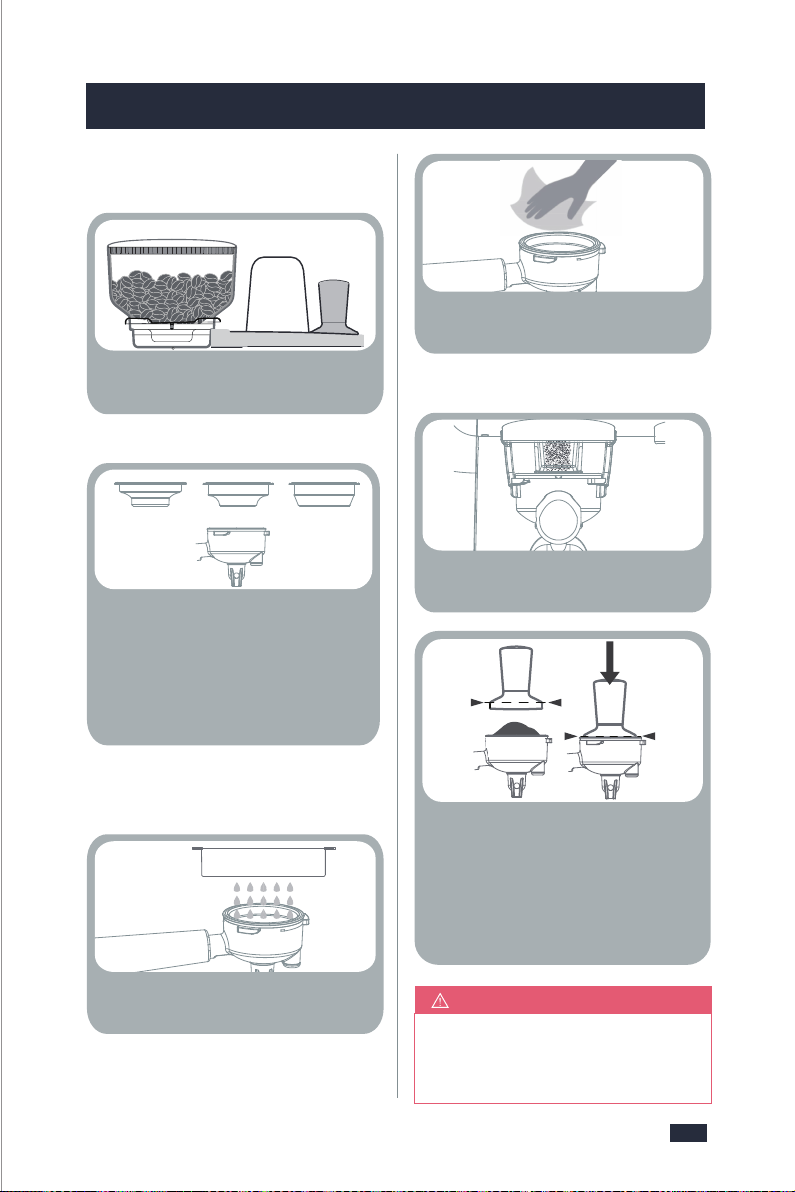
2827
For best espresso results, use
filtered water & freshly roasted
coffee beans.
As with NTC precision thermostats,
the espresso extraction temperature
is controlled at 197℉, while the
milk frothing temperature is at
212°F.
TIPS
To avoid leaking, coffee powder
should be tamped BELOW the
MAX line of portafilter.
TIPS
Before insert the refill water tank,
use the clean cloth to wipe off the
water on the valve.
If the temperature is too high to
make espresso, the steam will
splash from the portafilter and
hot water will drip off. It will result
in a small amount of coffee and a
bad taste.
When the water tank is pulled up,
the water will flow out from
theoutlet at the bottom of the
water tank, as it is a movable part.
If you have pulled up several times
and have not wipe the water
immediately,it will accumulate
more and more and ran to the
bottom of the machine, maybe
will leave the table full of water.
It's not leaking.
NOTE
2. Start Up
Insert the Power Plug. Press
POWER BUTTON, LIGHT pulses =
heating up. GRINDER LIGHT fully
illuminated = Grinder ready to use.
3.Warm Cup - by Hot Water
LIGHTS all fully illuminated =
Espresso Machine ready to use.
Place cup on benchtop and
position Steam Wand.Turn DIAL
to HOT WATER.
Quarter fill cup with hot water.
Return DIAL to vertical position
1 Min Heat Up
Wipe Filter Basket with a
dry cloth.
Dose the Filter Basket with
grinds.
6. Tamp
- Single Cup Filter = 8-10g coffee
grinds.
- One Cup = 8 - 10g coffee grinds.
- Two Cup = 13 - 15g coffee grinds.
- Long Brew Cup = 18 - 22g coffee
grinds.
Evenly tamp (press) grinds to
level indicated"
4. Select Filter Baskets
5. Warm Group Head, Portafilter
& Filter Basket
Place a Filter Baskets inside the
portafilter.
Select either:
- Single Cup Filter
- Double Cup Filter
- Long Brew Filter
Single CupDouble CupLong brew
Hold Portafilter under Group
Head while water flows.
Empty cup after 20 - 30 secs.
OR by Warming Plate.
Cup can be warmed on the top
of the machine when it is ON.
6. Espresso Guide6. Espresso Guide
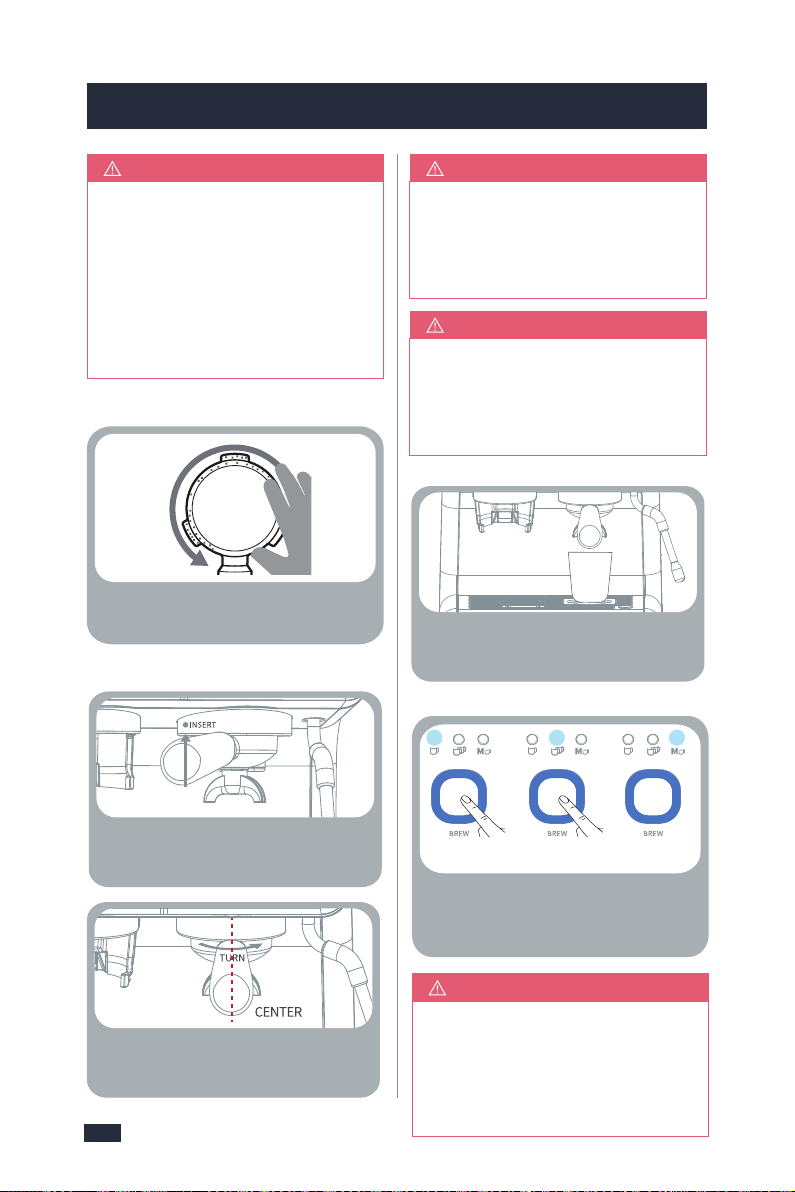
3029
7. Wipe Excess Grinds
Wipe away any excess grinds to
clear edges.
Do not press grounds with too
much force. Use the tamper
lightly to avoid clogging your
machine. If grounds are too
tightly packed, the water cannot
flow through the portafilter and
may cause blockage or leakage.
NOTE
If the portafilter is not installed
parallel to the machine, the coffee
willsplash and leak from the gap
of the connection position.
NOTE
Place a cup onthe drip tray. lf the
cup is tall you can remove the drip
tray cover and put the cup into the
drip tray.
TIPS
The portafilter should be removed
after a while as the machineneed
to relieve the pressure. Otherwise,
the steam will splash out because
of the strong pressure. Please
remove in parallel.Because high
pressure,the water will fully
penetrate into the coffee powder,
it takes time for water to pass
through and flow out of the
coffee powder. So it is normal
that the excess coffee will drip off.
TIPS
When the machine starts to work,
there will be some noise out from
the machine as it is pumping the
water with a high pressure.
While during operation,if there is
suddenly make 5 beeps and the
Brew button will blink red light at
the same time from the machine,
which may due to the water in the
water tank is not enough for pum-
ping. If so, please pay attention to
the water volume and add water
in time.
NOTE
8. Insert Portafilter
Keep Portafilter flat, align,
insert & turn into Group Head.
Portafilter should be in the
centre position.
9. Position Cup
Position cup on Drip Tray,
under Portafilter.
10. Espresso Extraction
Press Brew button to choose
Brew Mode, then Long press
Brew button to pour
OROR
Single-shot
Mode
Double-shot
Mode
Manual-shot
Mode
By staying Manual-shot Mode,
press the Brew button to stop
when getting the desired amount
of coffee.Press the POWER Button
to exit Manual-shot Mode.
NOTE
Extraction begins and will autom-
atically stop.Now Crema is golden
brown with a fine mousse texture.
Remove spent (used) coffee cake
from Portafilter.
Wipe the powder outlet with a
damp cloth.
5
0
9
12
15
20
BAR
Wait 20 seconds to remove the
portafilter from the Group Head
after pouring to avoid any
splashing or water discharge.
11. Remove Coffee cake
1.TURN
2.REMOVE
Check if the Drip Tray needs
emptying.
6. Espresso Guide6. Espresso Guide
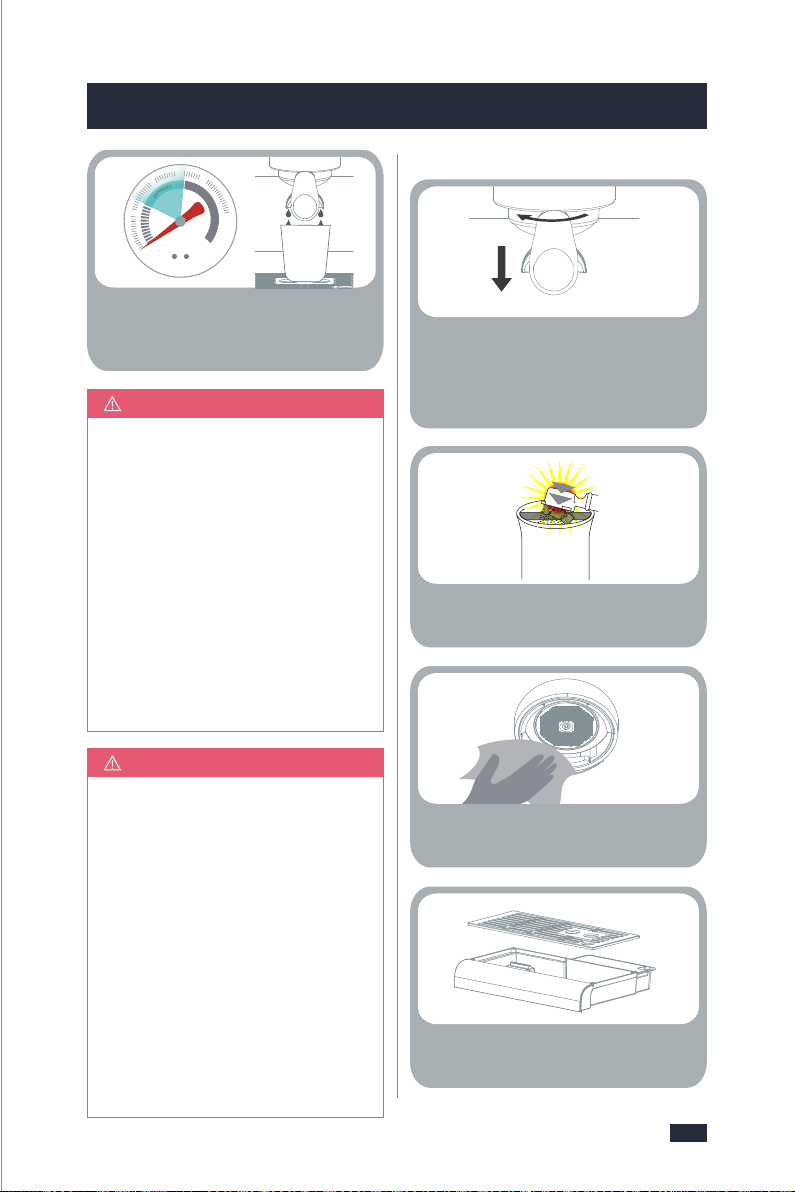
3029
7. Wipe Excess Grinds
Wipe away any excess grinds to
clear edges.
Do not press grounds with too
much force. Use the tamper
lightly to avoid clogging your
machine. If grounds are too
tightly packed, the water cannot
flow through the portafilter and
may cause blockage or leakage.
NOTE
If the portafilter is not installed
parallel to the machine, the coffee
willsplash and leak from the gap
of the connection position.
NOTE
Place a cup onthe drip tray. lf the
cup is tall you can remove the drip
tray cover and put the cup into the
drip tray.
TIPS
The portafilter should be removed
after a while as the machineneed
to relieve the pressure. Otherwise,
the steam will splash out because
of the strong pressure. Please
remove in parallel.Because high
pressure,the water will fully
penetrate into the coffee powder,
it takes time for water to pass
through and flow out of the
coffee powder. So it is normal
that the excess coffee will drip off.
TIPS
When the machine starts to work,
there will be some noise out from
the machine as it is pumping the
water with a high pressure.
While during operation,if there is
suddenly make 5 beeps and the
Brew button will blink red light at
the same time from the machine,
which may due to the water in the
water tank is not enough for pum-
ping. If so, please pay attention to
the water volume and add water
in time.
NOTE
8. Insert Portafilter
Keep Portafilter flat, align,
insert & turn into Group Head.
Portafilter should be in the
centre position.
9. Position Cup
Position cup on Drip Tray,
under Portafilter.
10. Espresso Extraction
Press Brew button to choose
Brew Mode, then Long press
Brew button to pour
OROR
Single-shot
Mode
Double-shot
Mode
Manual-shot
Mode
By staying Manual-shot Mode,
press the Brew button to stop
when getting the desired amount
of coffee.Press the POWER Button
to exit Manual-shot Mode.
NOTE
Extraction begins and will autom-
atically stop.Now Crema is golden
brown with a fine mousse texture.
Remove spent (used) coffee cake
from Portafilter.
Wipe the powder outlet with a
damp cloth.
5
0
9
12
15
20
BAR
Wait 20 seconds to remove the
portafilter from the Group Head
after pouring to avoid any
splashing or water discharge.
11. Remove Coffee cake
1.TURN
2.REMOVE
Check if the Drip Tray needs
emptying.
6. Espresso Guide6. Espresso Guide
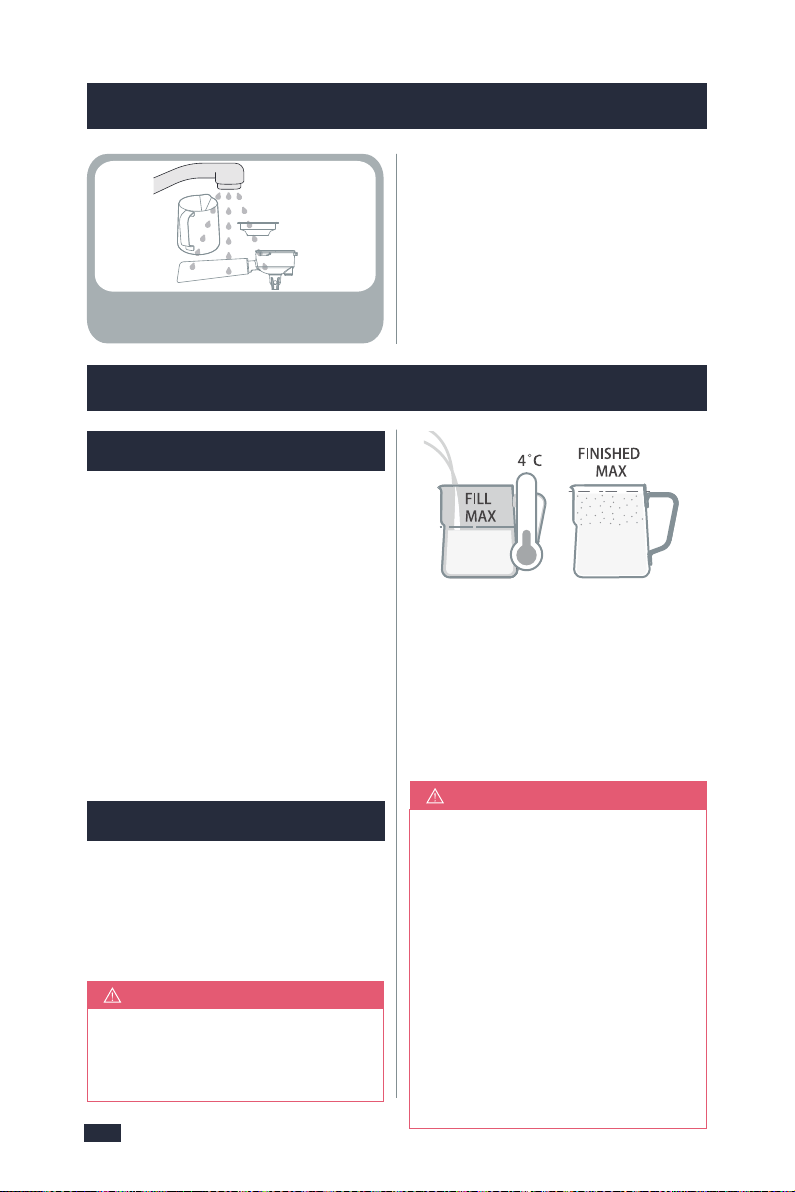
3231
Use the 12 Oz (350mL) milk Jug.
Wash parts with warm water.
7. Milk Frothing Guide
7. Milk Frothing Guide
Milk frothing is the steaming of milk.
Key Elements of Frothed Milk
Milk that has been frothing correctly
has a thick, rich microfoam with a
silky sheen. Frothed involves both
heating and aeratingmilk using steam.
Vital elements includepositioning of
the Steam Wand, when to adjust the
Milk Jug position and reaching the
correct temperature. Use the below
steps tohelp you create café-style
microfoam.
1. Fill Milk Jug:
Add 100-150mL of cold milk around
4°C(40℉) into a chilled clean stainless
steel Milk Jug. Fill to the bottom of the
Milk Jug spout.
7.1 Brief Introduction
7.2 Tips For Milk Frothing
The volume of milk will increase
or stretch during frothing , so
don’t overfill the Jug.
NOTE
For best milk frothing results every
time, ensure steam has warmed
up before frothing milk . Steam is
ready when steam button light is
fully ON.
Place a cup under the froth nozzle,
then turn on the DIAL to STEAM.
Wait about a few seconds, there
will be water coming out from the
nozzle. Be careful of the hot steam.
Then pour away the water of the cup.
Once any water has been purged
NOTE
stop the steam by returning DIAL.
Be careful not to get burned by
the steam.
2. Steam Warm Up:
Steam is ready when Steam/Hot water
indicatoris fully ON. Turn DIAL to STEAM.
For You will also hear the Pump start.
Pause steam by returning DIAL to the
vertical position.
3. Position:
Place the Steam Wand Arm in the Jug
spout at the 12 o'clock position, with
the Froth nozzle in the milk at the 3
o'clock position, a finger width away
from the edge of the Jug. Keep Steam
Wand tip just under the surface of the
milk. Turn DIAL back to STEAM position
to start frothing. A whirlpool action
should be created in the Jug.
4. Sound:
How air is introduced to the milk
determines the consistency of the
foam. If large gulps of air are added
to the milk, the foam will have large
bubbles. Introducing air to the milk
in a controlled, gentle fashion
indicated by a gentle hissing sound,
will ensure the milk has fine aerated
micro foams.
Barista Tip: Milk Frothing Sounds
- Gurgling: Tip not deep enough, raise
Jug.
- Smooth Hissing: Just right for latte.
- Screeching: Tip too deep, lower Jug.
5.Keeping Froth nozzlePosition:
As the steam heats & frothing the milk,
the milk will stretch causing the level
of the milk in the Jug rise. As this
happens follow the level of the milk
by lowering the Jug , keeping the
Froth nozzle just below the surface.
Some adjustments to technique
will be required when using non-
dairy milk.
NOTE
6. Amount of Foam:
Create the amount of micro foams you
want. Cappuccinos traditionally have
more micro foams than flat whites.
7. Immerse Tip:
After creating the desired amount of
foams, immerse the Steam Wand half
depth way into the milk. This heats
all the milk and pulls in milk instead
of air. This ensures that the milk &
foam are blended together, making
it denser & smoother.
6. Espresso Guide
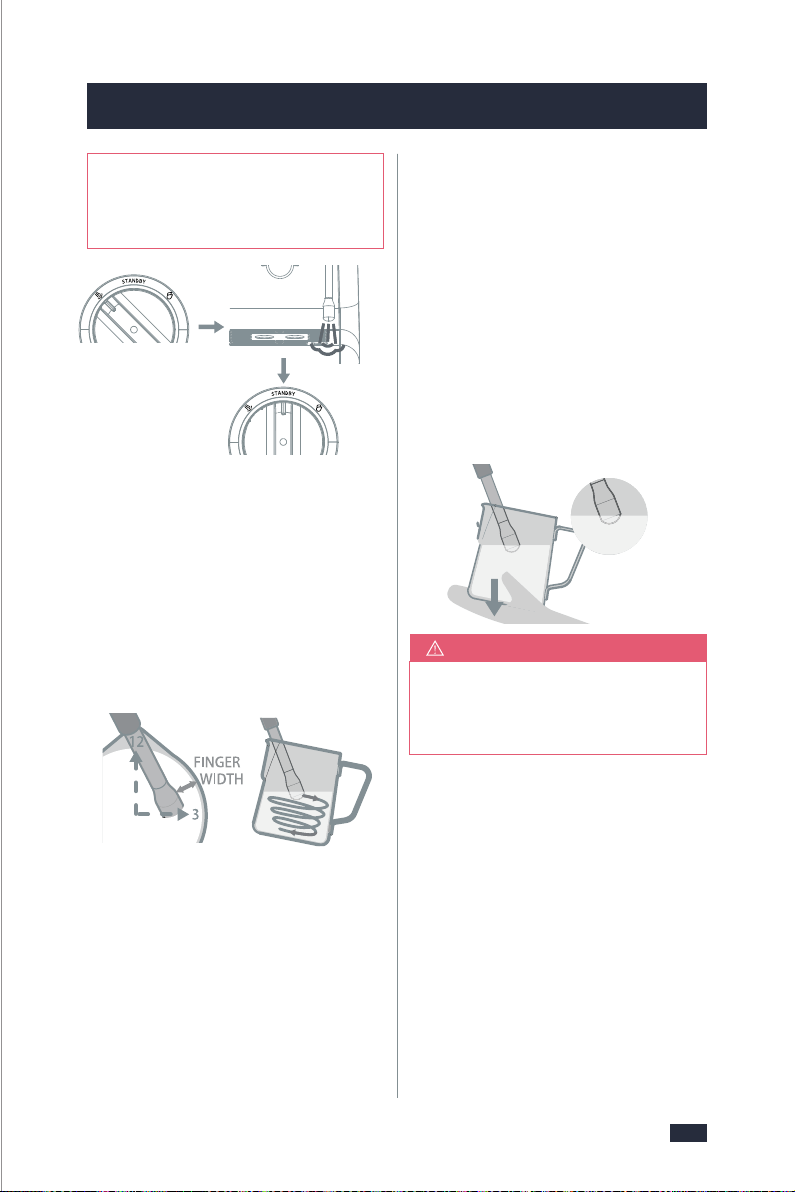
3231
Use the 12 Oz (350mL) milk Jug.
Wash parts with warm water.
7. Milk Frothing Guide
7. Milk Frothing Guide
Milk frothing is the steaming of milk.
Key Elements of Frothed Milk
Milk that has been frothing correctly
has a thick, rich microfoam with a
silky sheen. Frothed involves both
heating and aeratingmilk using steam.
Vital elements includepositioning of
the Steam Wand, when to adjust the
Milk Jug position and reaching the
correct temperature. Use the below
steps tohelp you create café-style
microfoam.
1. Fill Milk Jug:
Add 100-150mL of cold milk around
4°C(40℉) into a chilled clean stainless
steel Milk Jug. Fill to the bottom of the
Milk Jug spout.
7.1 Brief Introduction
7.2 Tips For Milk Frothing
The volume of milk will increase
or stretch during frothing , so
don’t overfill the Jug.
NOTE
For best milk frothing results every
time, ensure steam has warmed
up before frothing milk . Steam is
ready when steam button light is
fully ON.
Place a cup under the froth nozzle,
then turn on the DIAL to STEAM.
Wait about a few seconds, there
will be water coming out from the
nozzle. Be careful of the hot steam.
Then pour away the water of the cup.
Once any water has been purged
NOTE
stop the steam by returning DIAL.
Be careful not to get burned by
the steam.
2. Steam Warm Up:
Steam is ready when Steam/Hot water
indicatoris fully ON. Turn DIAL to STEAM.
For You will also hear the Pump start.
Pause steam by returning DIAL to the
vertical position.
3. Position:
Place the Steam Wand Arm in the Jug
spout at the 12 o'clock position, with
the Froth nozzle in the milk at the 3
o'clock position, a finger width away
from the edge of the Jug. Keep Steam
Wand tip just under the surface of the
milk. Turn DIAL back to STEAM position
to start frothing. A whirlpool action
should be created in the Jug.
4. Sound:
How air is introduced to the milk
determines the consistency of the
foam. If large gulps of air are added
to the milk, the foam will have large
bubbles. Introducing air to the milk
in a controlled, gentle fashion
indicated by a gentle hissing sound,
will ensure the milk has fine aerated
micro foams.
Barista Tip: Milk Frothing Sounds
- Gurgling: Tip not deep enough, raise
Jug.
- Smooth Hissing: Just right for latte.
- Screeching: Tip too deep, lower Jug.
5.Keeping Froth nozzlePosition:
As the steam heats & frothing the milk,
the milk will stretch causing the level
of the milk in the Jug rise. As this
happens follow the level of the milk
by lowering the Jug , keeping the
Froth nozzle just below the surface.
Some adjustments to technique
will be required when using non-
dairy milk.
NOTE
6. Amount of Foam:
Create the amount of micro foams you
want. Cappuccinos traditionally have
more micro foams than flat whites.
7. Immerse Tip:
After creating the desired amount of
foams, immerse the Steam Wand half
depth way into the milk. This heats
all the milk and pulls in milk instead
of air. This ensures that the milk &
foam are blended together, making
it denser & smoother.
6. Espresso Guide
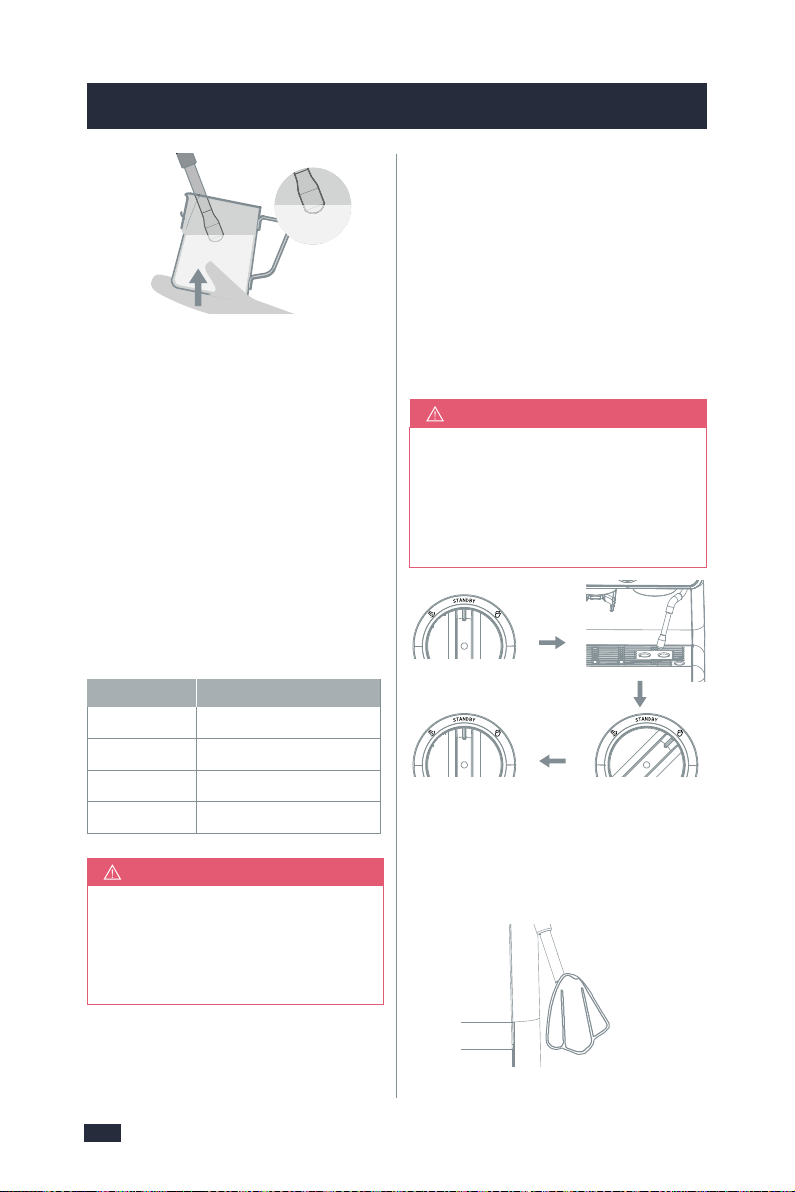
3433
8. Correct Temperature:
An indication of reaching correct milk
temperature is when the Milk Jugbase
can only be touched comfortably for
approximately 3 seconds.
Barista Tip: Milk Temperature
- Under: If not heated long enough,
it will be warm with little texture.
- Optimum: See below table.
- Over: If heated for too long it will
start to boil around 72°C and will
have a burnt taste with all texture
lost.
Full & Skim60-65°C(140-149 ℉)
MILKTEMPERATURE
Almond55-65°C(131-149 ℉)
Soy55-60°C(131-149 ℉)
Coconut65-70°C(131-149 ℉)
Above recommendations might
vary from one milk brand to
another and depending on your
taste preference.
NOTE
11. Tap & Swirl the Jug :
Gently tapping the Jug on the benchtop
helps to release larger trapped air bub-
bles. Swirling helps the milk & froth
to combine for an even consistency &
a silky appearance.
vertical position and remove the Milk
Jug from the Steam Wand. Place Milk
Jug to one side. Place the Steam
Wand over the Drip Tray . Turn the
DIAL to the HOT WATER position for
a few seconds, then return the DIAL
to the vertical position. This will
remove any milk that has been
sucked into the Steam Wand Tip.
10. Wipe Steam Wand:
Wipe the Steam Wand Arm & Froth
nozzle with a clean damp cloth to
remove any milk residue.
12. The Finishing Touches:
Pour from the Milk Jug into your cup
in one steady motion.
7.3 Operation
Milk temperature from 140-149°F
is recommended for milk frothing,
or you can increase or decrease
the temperature to better suit
your taste.
NOTE
1. Check Water
As with NTC precision thermostats,
the espresso extraction temperature
is controlled at 197℉, while the
milk frothing temperature is at 212°F.
TIPS
Before insert the refill water tank,
use the clean cloth to wipe off the
water on the valve.
If the temperature is too high to
make espresso, the steam will
splash from the portafilter and
hot water will drip off. It will result
in a small amount of coffee and a
bad taste.
When the water tank is pulled up,
the water will flow out from
theoutlet at the bottom of the
water tank, as it is a movable part.
If you have pulled up several times
and have not wipe the water
immediately,it will accumulate
more and more and ran to the
bottom of the machine, maybe
will leave the table full of water.
It's not leaking.
NOTE
MAX 2.8L
Fill water into the water tank NOT
exceed the MAX line. Set up the
water tank vertically and align
the bucklesto the hole on the
back of themachine,and press
it down to beparallel to the top
of the machine.
7. Milk Frothing Guide7. Milk Frothing Guide
9. Purging the Steam Wand:
When correct milk temperature has
been reached, turn the DIAL to the
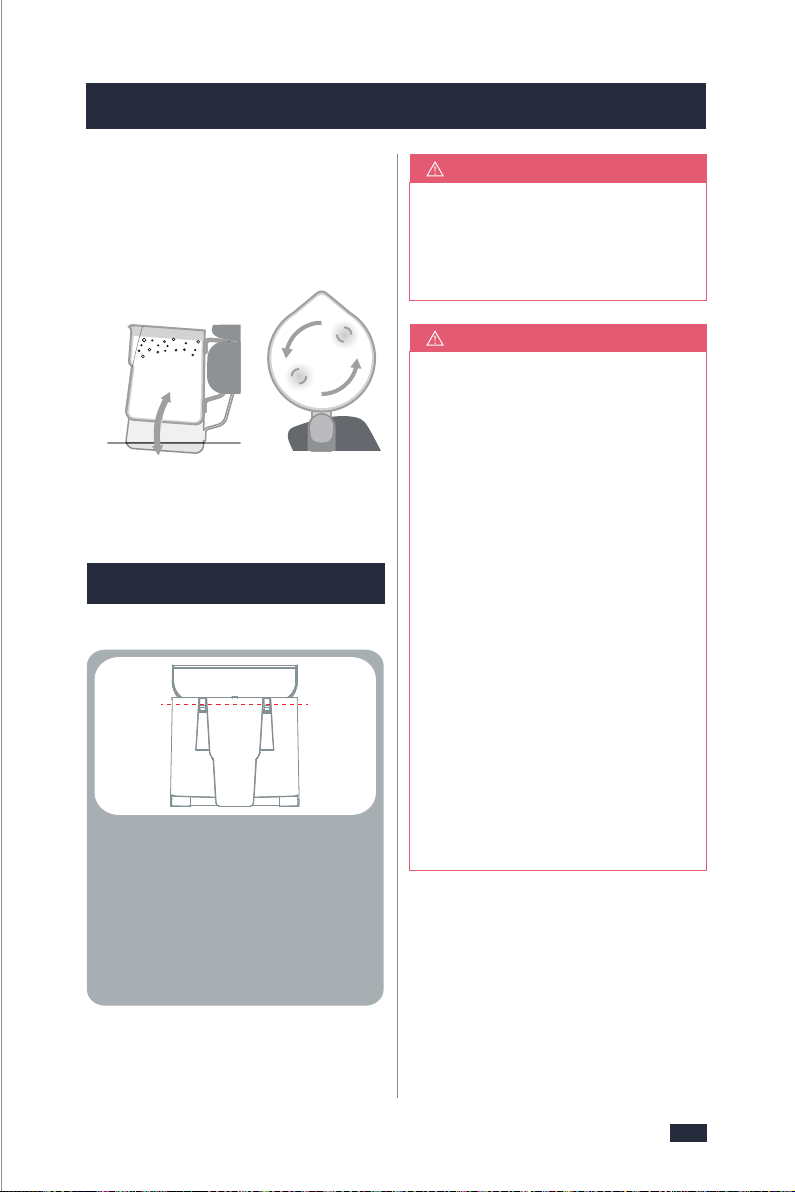
3433
8. Correct Temperature:
An indication of reaching correct milk
temperature is when the Milk Jugbase
can only be touched comfortably for
approximately 3 seconds.
Barista Tip: Milk Temperature
- Under: If not heated long enough,
it will be warm with little texture.
- Optimum: See below table.
- Over: If heated for too long it will
start to boil around 72°C and will
have a burnt taste with all texture
lost.
Full & Skim60-65°C(140-149 ℉)
MILKTEMPERATURE
Almond55-65°C(131-149 ℉)
Soy55-60°C(131-149 ℉)
Coconut65-70°C(131-149 ℉)
Above recommendations might
vary from one milk brand to
another and depending on your
taste preference.
NOTE
11. Tap & Swirl the Jug :
Gently tapping the Jug on the benchtop
helps to release larger trapped air bub-
bles. Swirling helps the milk & froth
to combine for an even consistency &
a silky appearance.
vertical position and remove the Milk
Jug from the Steam Wand. Place Milk
Jug to one side. Place the Steam
Wand over the Drip Tray . Turn the
DIAL to the HOT WATER position for
a few seconds, then return the DIAL
to the vertical position. This will
remove any milk that has been
sucked into the Steam Wand Tip.
10. Wipe Steam Wand:
Wipe the Steam Wand Arm & Froth
nozzle with a clean damp cloth to
remove any milk residue.
12. The Finishing Touches:
Pour from the Milk Jug into your cup
in one steady motion.
7.3 Operation
Milk temperature from 140-149°F
is recommended for milk frothing,
or you can increase or decrease
the temperature to better suit
your taste.
NOTE
1. Check Water
As with NTC precision thermostats,
the espresso extraction temperature
is controlled at 197℉, while the
milk frothing temperature is at 212°F.
TIPS
Before insert the refill water tank,
use the clean cloth to wipe off the
water on the valve.
If the temperature is too high to
make espresso, the steam will
splash from the portafilter and
hot water will drip off. It will result
in a small amount of coffee and a
bad taste.
When the water tank is pulled up,
the water will flow out from
theoutlet at the bottom of the
water tank, as it is a movable part.
If you have pulled up several times
and have not wipe the water
immediately,it will accumulate
more and more and ran to the
bottom of the machine, maybe
will leave the table full of water.
It's not leaking.
NOTE
MAX 2.8L
Fill water into the water tank NOT
exceed the MAX line. Set up the
water tank vertically and align
the bucklesto the hole on the
back of themachine,and press
it down to beparallel to the top
of the machine.
7. Milk Frothing Guide7. Milk Frothing Guide
9. Purging the Steam Wand:
When correct milk temperature has
been reached, turn the DIAL to the
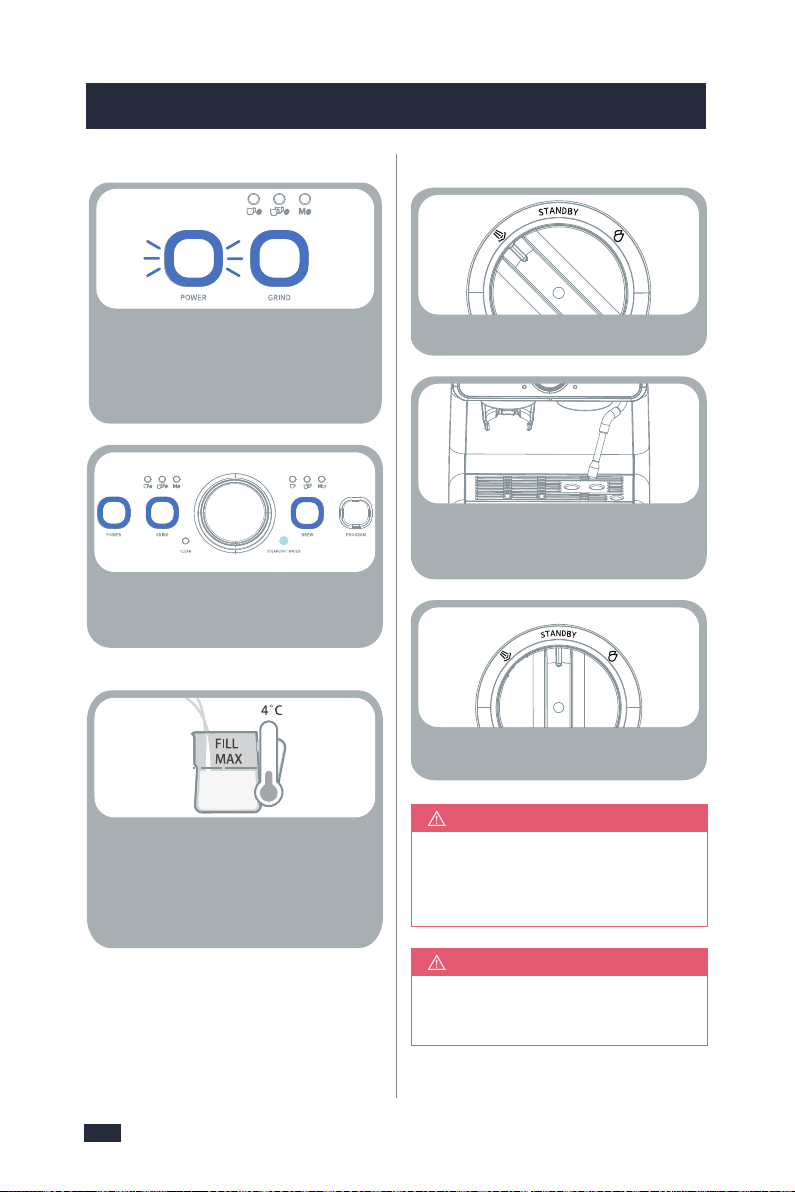
3635
2. Start Up
3. Prep Milk Jug
4. Before Frothing Milk
Insert the Power Plug. Press
POWER BUTTON, LIGHT pulses =
heating up. GRINDER LIGHT fully
illuminated = Grinder ready to use.
LIGHTS all fully illuminated =
Espresso Machine ready to use.
Fill 12 Oz(350ml) milk Jug.
Stainless steel Jug with cold
milk just below the bottom of
the spout.Recommended
100mL-150mL, 41-45℉ milk.
Turn DIAL to STEAM.
Some wate may come out of
the Steam Wand.
Pause steam by returning DIAL.
5. Position Steam Wand
Steam Wand position:
The Froth nozzle is 1cm away
from the jug wall.
- Arm at 12 o'clock.
- Tip at 3 o'clock.
Turn DIAL back to STEAM
position to start frothing milk.
6. Start Frothing Milk
Frothing makes a smooth
hissing noise.
Check milk is moving in a
whirlpool action.
As milk level rises, lower Jug
to keep Tip just below surface.
When desired microfoam
achieved, immerse Steam
Wand half way.
7. Milk Frothing
Milk ready when Milk Jug base
is too hot to touch for 3 sec.
For better taste,we suggest to
release the water before frothing
milk.
TIPS
After the milk jug base is too hot
to touch for 3 sec.If you need
more milk froth, you can continue
to froth or stop according to your
needs.
TIPS
For best milk frothing results,
ensure steam has first warmed up.
NOTE
1 Min Heat Up
140-149℉
7. Milk Frothing Guide7. Milk Frothing Guide
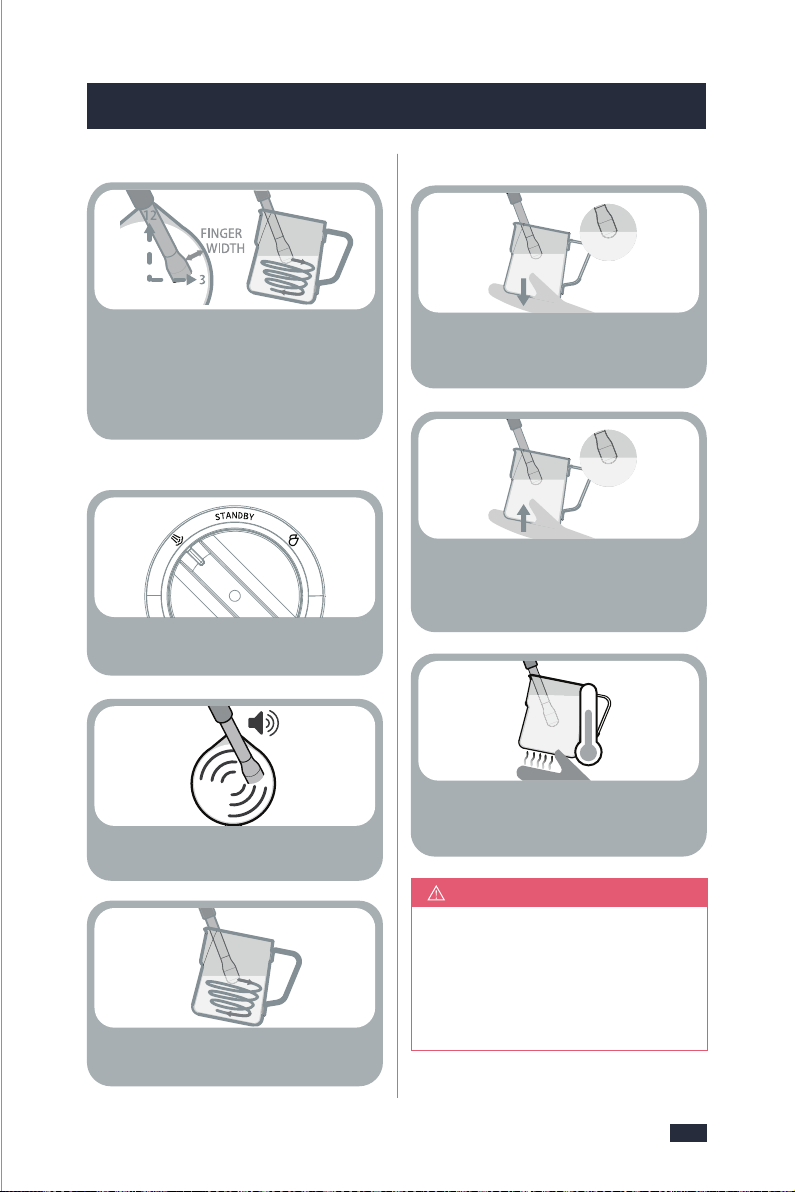
3635
2. Start Up
3. Prep Milk Jug
4. Before Frothing Milk
Insert the Power Plug. Press
POWER BUTTON, LIGHT pulses =
heating up. GRINDER LIGHT fully
illuminated = Grinder ready to use.
LIGHTS all fully illuminated =
Espresso Machine ready to use.
Fill 12 Oz(350ml) milk Jug.
Stainless steel Jug with cold
milk just below the bottom of
the spout.Recommended
100mL-150mL, 41-45℉ milk.
Turn DIAL to STEAM.
Some wate may come out of
the Steam Wand.
Pause steam by returning DIAL.
5. Position Steam Wand
Steam Wand position:
The Froth nozzle is 1cm away
from the jug wall.
- Arm at 12 o'clock.
- Tip at 3 o'clock.
Turn DIAL back to STEAM
position to start frothing milk.
6. Start Frothing Milk
Frothing makes a smooth
hissing noise.
Check milk is moving in a
whirlpool action.
As milk level rises, lower Jug
to keep Tip just below surface.
When desired microfoam
achieved, immerse Steam
Wand half way.
7. Milk Frothing
Milk ready when Milk Jug base
is too hot to touch for 3 sec.
For better taste,we suggest to
release the water before frothing
milk.
TIPS
After the milk jug base is too hot
to touch for 3 sec.If you need
more milk froth, you can continue
to froth or stop according to your
needs.
TIPS
For best milk frothing results,
ensure steam has first warmed up.
NOTE
1 Min Heat Up
140-149℉
7. Milk Frothing Guide7. Milk Frothing Guide
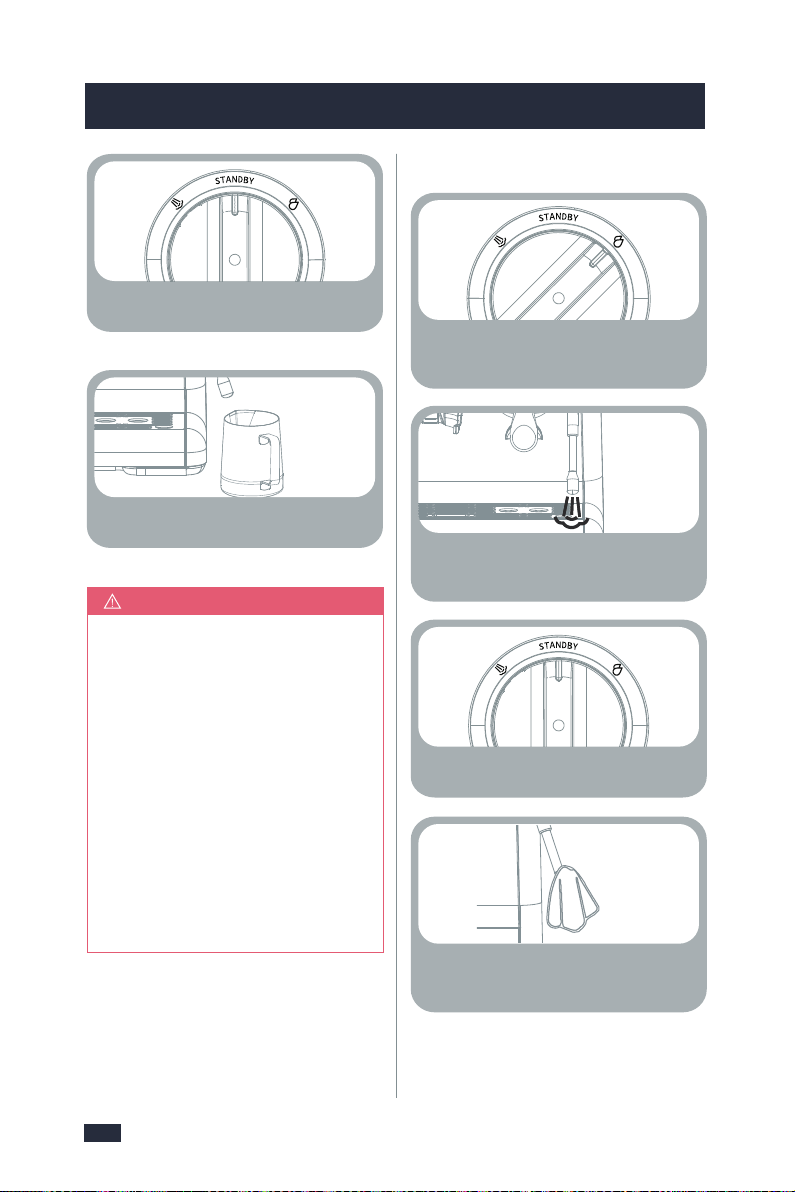
3837
8. Purge & Clean Steam Wand
9. Milk Finishing Touches
Return DIAL to vertical position.
Remove Jug from Steam Wand.
Turn DIAL to HOT WATER for
1 - 2 sec
Return DIAL to the vertical position.
Wipe Steam Wand & Tip with a
damp cloth.
Milky water will come out of
Steam Wand.
To keep optimum Steam Wand
performance, always purge & clean
the Steam Wand after frothing milk.
TIPS
During the milk frothing, if there is
suddenly make 5 beeps and the
Brew button will blink red light at
the same time. It will comie out
with small steam. Please check
whether the water is enough and
add water in time.The milk will be
empty from jug and make it again.
When the water left the water tank
is going to finish, it will produce a
louder noise for pumping. After ad-
ding water, it will operate as usual.
NOTE
Tap Jug to release larger air
bubbles.
Swirl Jug to blend milk and
create a silky texture.
Pour milk in one steady motion.
7. Milk Frothing Guide7. Milk Frothing Guide
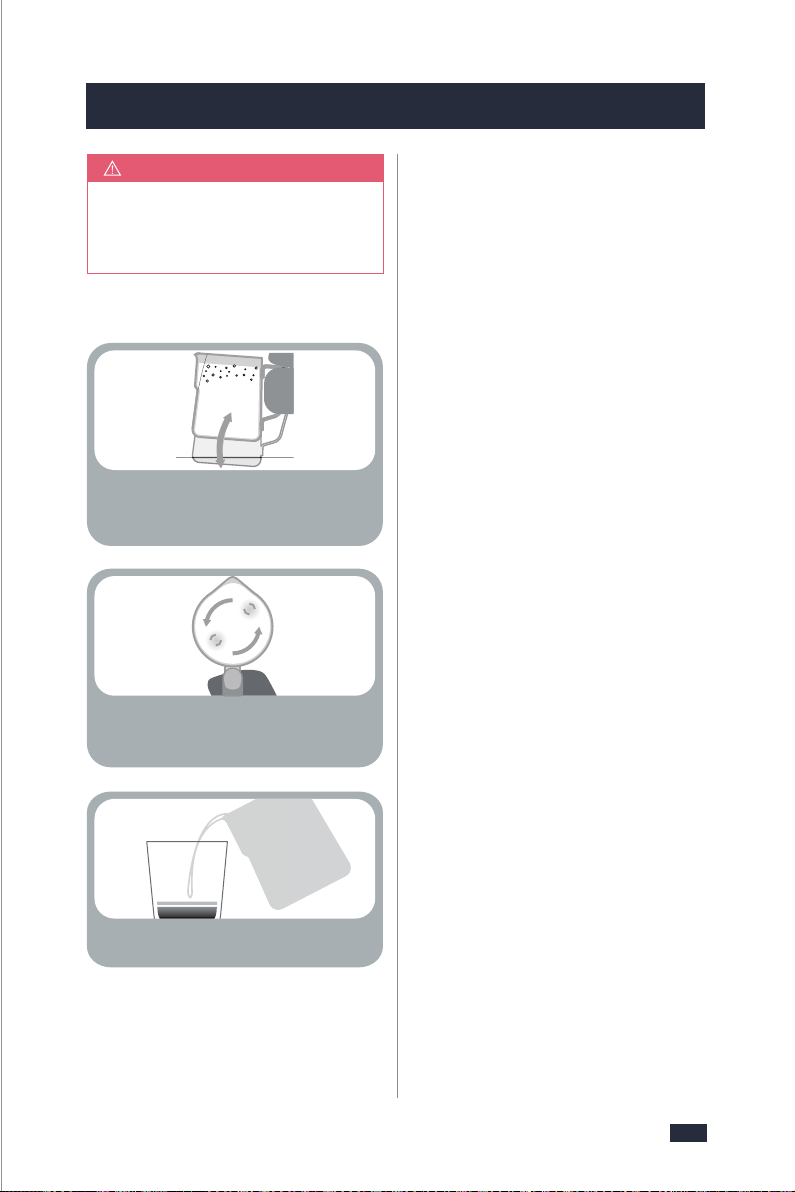
3837
8. Purge & Clean Steam Wand
9. Milk Finishing Touches
Return DIAL to vertical position.
Remove Jug from Steam Wand.
Turn DIAL to HOT WATER for
1 - 2 sec
Return DIAL to the vertical position.
Wipe Steam Wand & Tip with a
damp cloth.
Milky water will come out of
Steam Wand.
To keep optimum Steam Wand
performance, always purge & clean
the Steam Wand after frothing milk.
TIPS
During the milk frothing, if there is
suddenly make 5 beeps and the
Brew button will blink red light at
the same time. It will comie out
with small steam. Please check
whether the water is enough and
add water in time.The milk will be
empty from jug and make it again.
When the water left the water tank
is going to finish, it will produce a
louder noise for pumping. After ad-
ding water, it will operate as usual.
NOTE
Tap Jug to release larger air
bubbles.
Swirl Jug to blend milk and
create a silky texture.
Pour milk in one steady motion.
7. Milk Frothing Guide7. Milk Frothing Guide
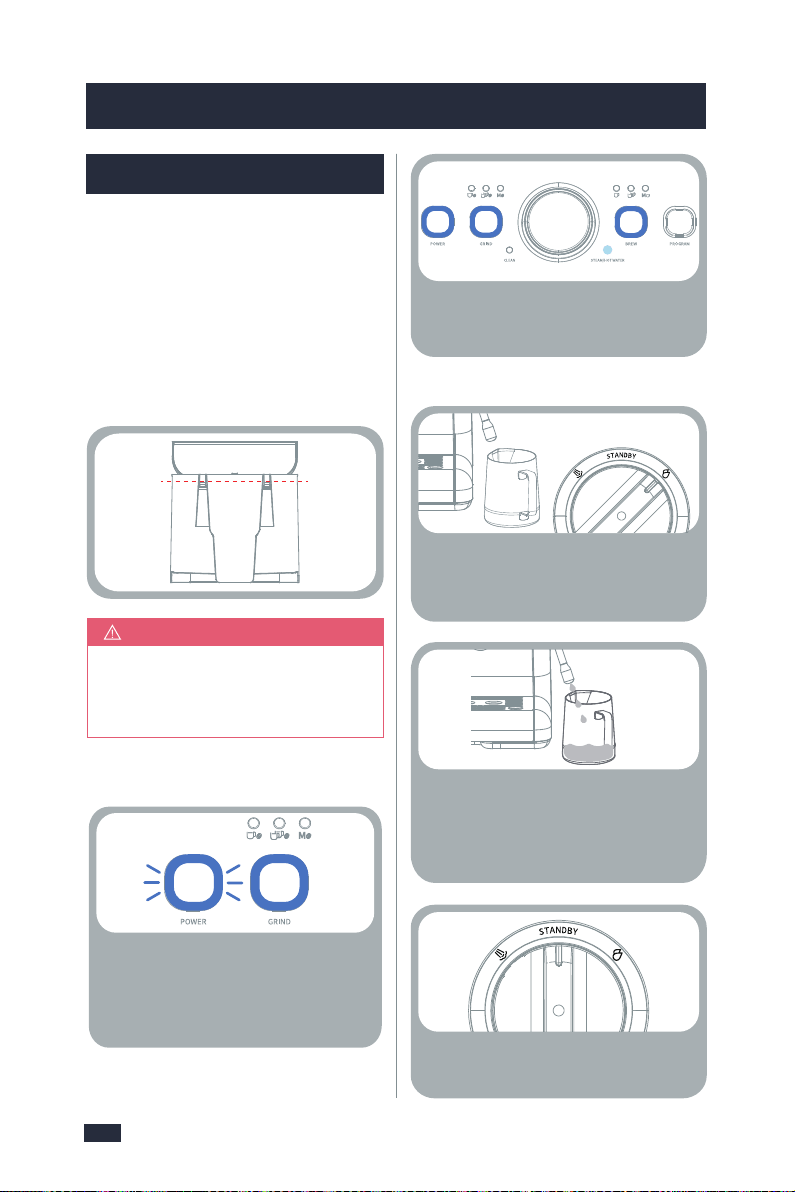
It will dispense hot water for 5min
and then automatically stop. Hot
water can be used for making long
black coffee, hot drinks such as tea,
instant soups and to warm cups
prior to making espresso.
- If there is no any operation after 5
minutes, the machine will pass to
auto off mode. All button lights and
indicator lights will be off.
- To reactivate the machine, press any
button, the machine will be back to
ready status based on the last function
that we use before entering auto off
mode.
- Long press Power button to stop the
water shortage alarm. All button lights
and indicator lights will be off.
- Remove the Portafilter to clean the
coffee powder and don't use the
residual coffee powder again.
During the brew/steam function, if
the Water Reservoir is out of water,
the machine will make 5 beeps, the
Brew button will blink red light,Now
it stay in WATER SHORTAGE MODE.
8.1 Brief Introduction
For best espresso results, use
filtered water & freshly roasted
coffee beans.
TIP
1. Check Water
MAX 2.8L
2. Start Up
1 Min Heat Up
3. Hot Water
Press POWER BUTTON, LIGHT
pulses = heating up. GRINDER
LIGHT fully illuminated = Grinder
ready to use.
4039
To stop the hot water, Return DIAL
to vertical position
Place cup on benchtop and
position Steam Wand.Turn DIAL
to HOT WATER.
Hot water will pour from the
hot water outlet and can be
used for making Americanos
and pre-heating cups.
If the hot water function is being
used for more than 1 minute, the
Steam/Hot water indicator will
blink white light quickly. To stop t
his, reset steam/water knob to
horizontal position
(standby position).
NOTE
You can make milk foam/hot
water while making espresso
or grinding.
TIP
Due to water shortage, the machine
will have high temperature and
high pressure in the Portafilter , so
NOTE
we recommend that you follow the
below steps:
LIGHTS all fully illuminated =
Espresso Machine ready to use.
8. Hot Water Function Guide8. Hot Water Function Guide
9. Sleep & Auto Off Function Guide
10. Water Shortage Function Guide
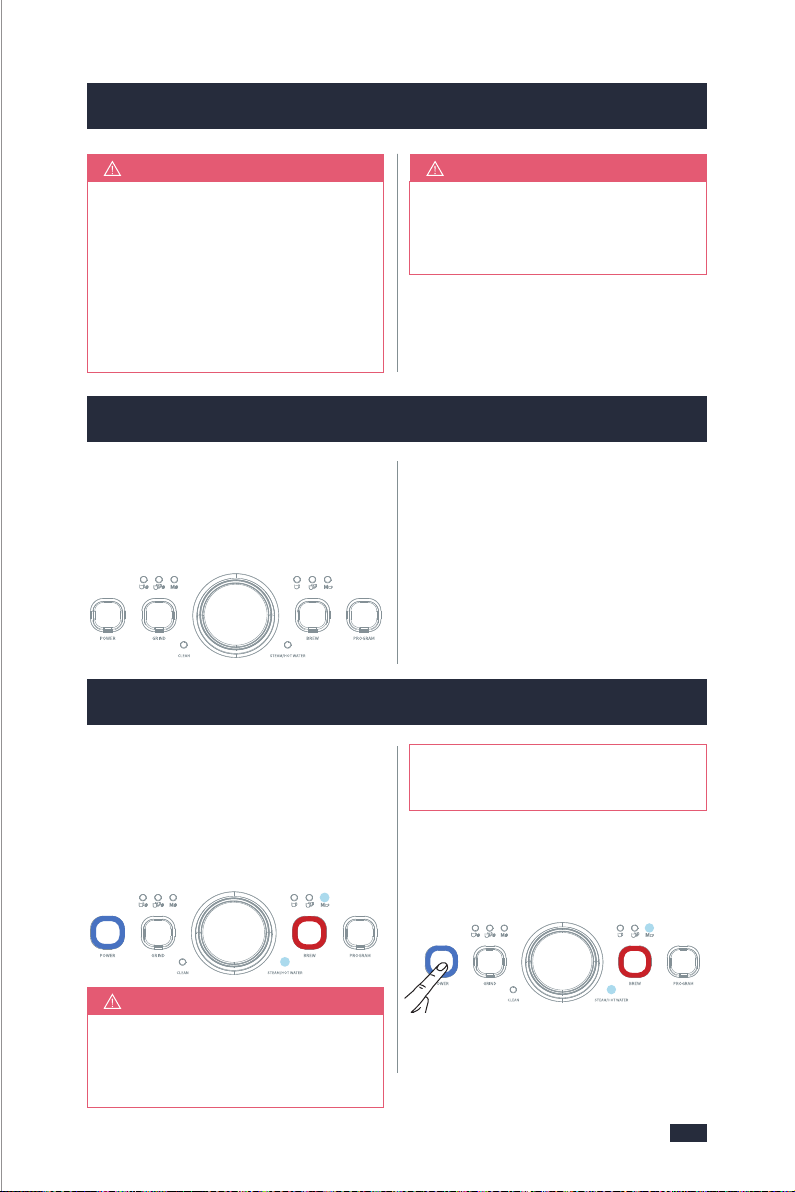
It will dispense hot water for 5min
and then automatically stop. Hot
water can be used for making long
black coffee, hot drinks such as tea,
instant soups and to warm cups
prior to making espresso.
- If there is no any operation after 5
minutes, the machine will pass to
auto off mode. All button lights and
indicator lights will be off.
- To reactivate the machine, press any
button, the machine will be back to
ready status based on the last function
that we use before entering auto off
mode.
- Long press Power button to stop the
water shortage alarm. All button lights
and indicator lights will be off.
- Remove the Portafilter to clean the
coffee powder and don't use the
residual coffee powder again.
During the brew/steam function, if
the Water Reservoir is out of water,
the machine will make 5 beeps, the
Brew button will blink red light,Now
it stay in WATER SHORTAGE MODE.
8.1 Brief Introduction
For best espresso results, use
filtered water & freshly roasted
coffee beans.
TIP
1. Check Water
MAX 2.8L
2. Start Up
1 Min Heat Up
3. Hot Water
Press POWER BUTTON, LIGHT
pulses = heating up. GRINDER
LIGHT fully illuminated = Grinder
ready to use.
4039
To stop the hot water, Return DIAL
to vertical position
Place cup on benchtop and
position Steam Wand.Turn DIAL
to HOT WATER.
Hot water will pour from the
hot water outlet and can be
used for making Americanos
and pre-heating cups.
If the hot water function is being
used for more than 1 minute, the
Steam/Hot water indicator will
blink white light quickly. To stop t
his, reset steam/water knob to
horizontal position
(standby position).
NOTE
You can make milk foam/hot
water while making espresso
or grinding.
TIP
Due to water shortage, the machine
will have high temperature and
high pressure in the Portafilter , so
NOTE
we recommend that you follow the
below steps:
LIGHTS all fully illuminated =
Espresso Machine ready to use.
8. Hot Water Function Guide8. Hot Water Function Guide
9. Sleep & Auto Off Function Guide
10. Water Shortage Function Guide
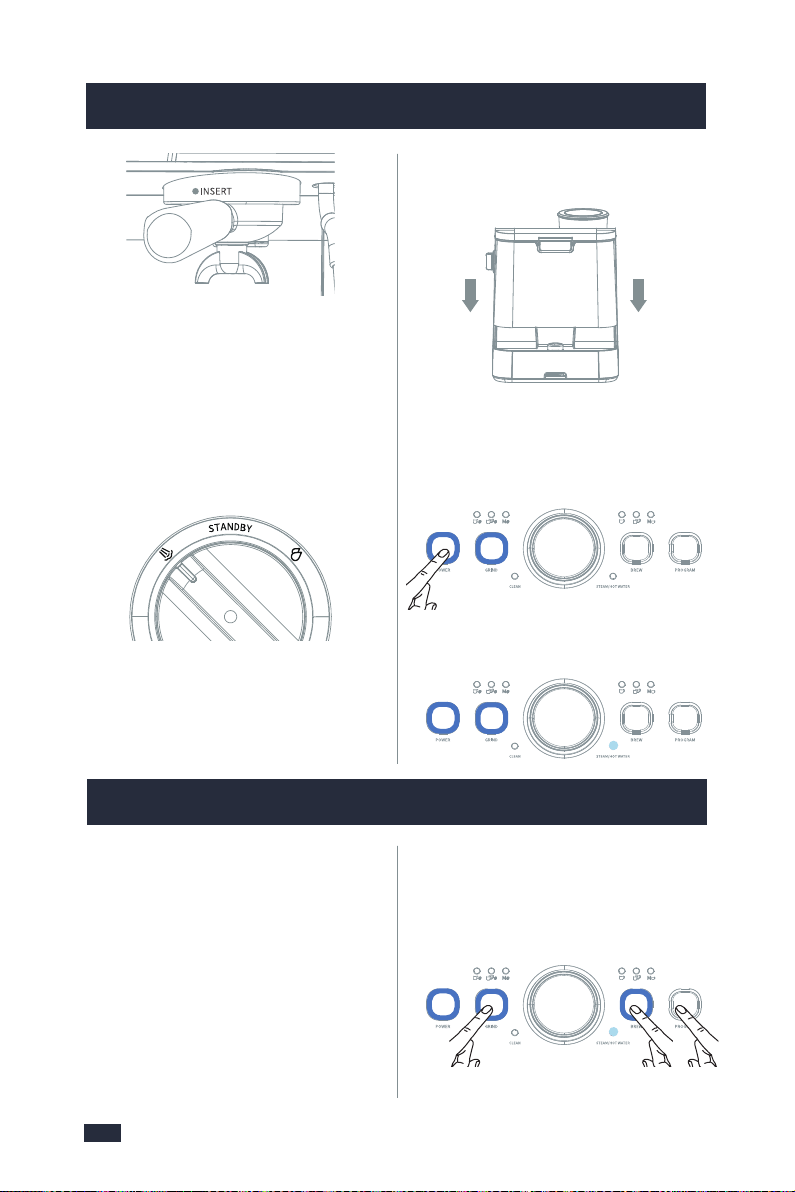
10. Water Shortage Function Guide
Cleaning Accessories & Removable
Parts
- Clean parts in warm water with a
mild detergent, rinse & dry.
Cleaning Cup warming tray &
Exterior
- Clean parts in warm water with a
mild detergent, rinse & dry.
• When Required
Wipe over the machine with a soft
damp cloth with a mild detergent and
wipe dry.
Cleaning Drip Tray & Bean hopper
• When Required
Empty if the red Water Level Indicator
appears through the Stainless Steel
Grill, otherwise water will overflow.
Dishwasher Safe parts:
Dishwasher Safe TOP SHELF ONLY
parts:
- Hardened stainless steel top burr
NON-Dishwasher Safe parts:
- Water reservoir
- Portafilter
- Bean hopper
- Stainless Steel Milk Jug
- Stainless Steel Drip Tray Grill
- Stainless Steel Single-cup Filter Basket
- Stainless Steel Double-cup Filter Basket
- Stainless Steel Long Brew Filter Basket
- Cleaning Disc
- Drip tray
- Tamper
- Cleaning needle
- Cleaning brush
The espresso making process involves
extracting oils out of ground coffee.
Deposits of grinds & oils build up over
time, affecting the taste of the coffee
& operation of the Espresso Machine.
Purging water through the Group Head
& Steam Wand, before & after making
each coffee, is the easiest way to keep
your Espresso Machine clean.
- Rotate the Steam wand to point at
the Drip tray . Turn on the Steam/
water knob to the steam function to
release the pressure. When it stops
to release the pressure, turn the
steam/water knob to a horizontal
position(standby position).
- Then the machine passes to ready
condition.
Restore All Default Settings
- The machine is on and in the READY
state.
- Press and hold Grind button , Brew
button and Program button at the
same time for minimum 2 seconds,
there will be a beep.
- You can easily reset all settings to
the factory defaults.
- Refill the Water reservoir with clean,
room temperature water. Do not
exceed the “MAX” line. Close the
4241
To prevent damage to the machine,
do not use alkaline cleaning agents,
abrasives or metal scourers.
CAUTION
Do not immerse the machine in
water.
CAUTION
Over time it is normal for the inside
of the Drip Tray & Bean hopper to
be stained by the oils in the coffee
grinds.
Note
Do not use alkaline cleaning agents,
abrasives or metal scourers, as
these will scratch the surfaces of
parts.
NOTE
- Press the Power button, the
machine will make a beep, then
the Power button starts to blink
blue light slowly.
reservoir cover , and put the Water
reservoir on the back of machine.
- All the buttons flash, then all default
settings will be restored.
- The machine will be back to ready
mode.
12. Care & Cleaning - Espresso Machine
11. Restore All Default Settings Guide
10. Water Shortage Function Guide
Cleaning Accessories & Removable
Parts
- Clean parts in warm water with a
mild detergent, rinse & dry.
Cleaning Cup warming tray &
Exterior
- Clean parts in warm water with a
mild detergent, rinse & dry.
• When Required
Wipe over the machine with a soft
damp cloth with a mild detergent and
wipe dry.
Cleaning Drip Tray & Bean hopper
• When Required
Empty if the red Water Level Indicator
appears through the Stainless Steel
Grill, otherwise water will overflow.
Dishwasher Safe parts:
Dishwasher Safe TOP SHELF ONLY
parts:
- Hardened stainless steel top burr
NON-Dishwasher Safe parts:
- Water reservoir
- Portafilter
- Bean hopper
- Stainless Steel Milk Jug
- Stainless Steel Drip Tray Grill
- Stainless Steel Single-cup Filter Basket
- Stainless Steel Double-cup Filter Basket
- Stainless Steel Long Brew Filter Basket
- Cleaning Disc
- Drip tray
- Tamper
- Cleaning needle
- Cleaning brush
The espresso making process involves
extracting oils out of ground coffee.
Deposits of grinds & oils build up over
time, affecting the taste of the coffee
& operation of the Espresso Machine.
Purging water through the Group Head
& Steam Wand, before & after making
each coffee, is the easiest way to keep
your Espresso Machine clean.
- Rotate the Steam wand to point at
the Drip tray . Turn on the Steam/
water knob to the steam function to
release the pressure. When it stops
to release the pressure, turn the
steam/water knob to a horizontal
position(standby position).
- Then the machine passes to ready
condition.
Restore All Default Settings
- The machine is on and in the READY
state.
- Press and hold Grind button , Brew
button and Program button at the
same time for minimum 2 seconds,
there will be a beep.
- You can easily reset all settings to
the factory defaults.
- Refill the Water reservoir with clean,
room temperature water. Do not
exceed the “MAX” line. Close the
4241
To prevent damage to the machine,
do not use alkaline cleaning agents,
abrasives or metal scourers.
CAUTION
Do not immerse the machine in
water.
CAUTION
Over time it is normal for the inside
of the Drip Tray & Bean hopper to
be stained by the oils in the coffee
grinds.
Note
Do not use alkaline cleaning agents,
abrasives or metal scourers, as
these will scratch the surfaces of
parts.
NOTE
- Press the Power button, the
machine will make a beep, then
the Power button starts to blink
blue light slowly.
reservoir cover , and put the Water
reservoir on the back of machine.
- All the buttons flash, then all default
settings will be restored.
- The machine will be back to ready
mode.
12. Care & Cleaning - Espresso Machine
11. Restore All Default Settings Guide
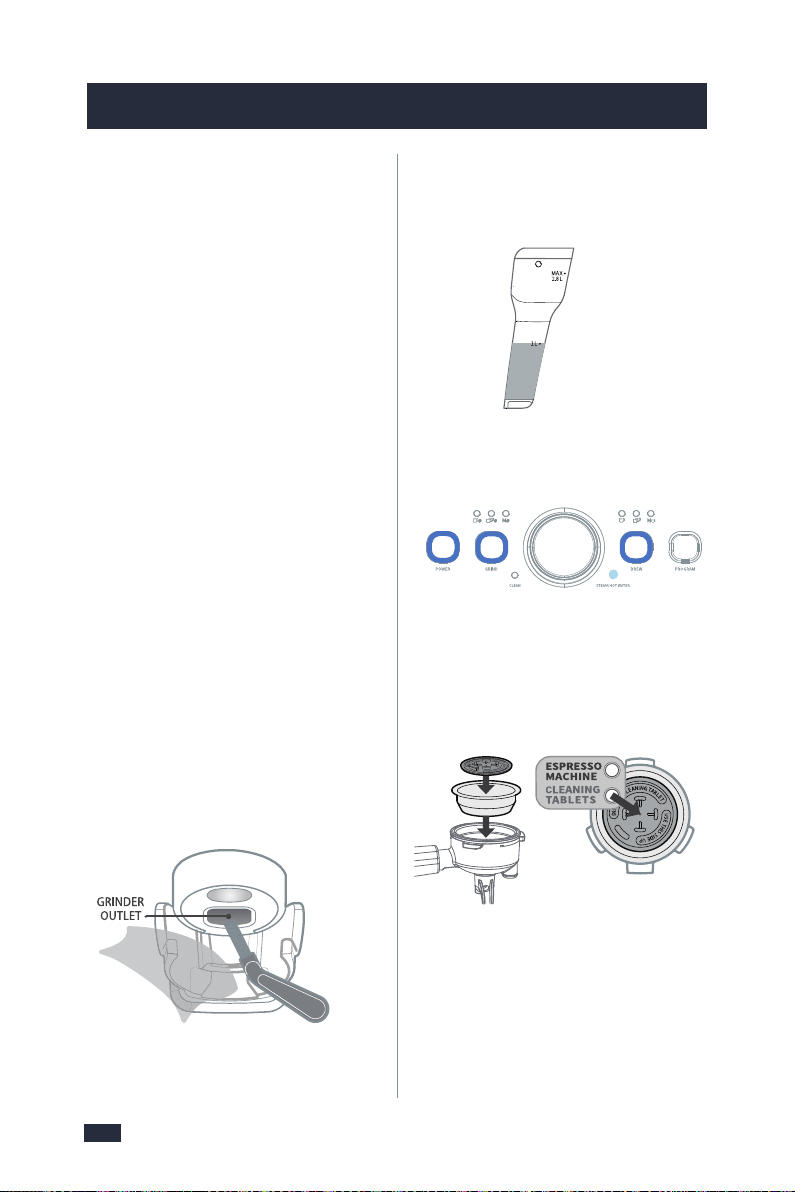
Cleaning Steam Wand
• Every Time
- After frothing milk, purge the Steam
Wand by turning the STEAM/HOT
WATER dial to Steam for just 3-4
seconds..
- Wipe the Steam Wand with a damp
cloth.
• Weekly
Clean in warm water with a mild
detergent, rinse & dry.
Cleaning Portafilter & Filter Basket
• Every Time
Wash after each use by rinsing them
with warm water under the tap.
• Regular Intervals
In warm soapy water using a mild
detergent, rinse & dry.
Cleaning Shower & Group Head
• Every Time
Run water through before making an
espresso.
• Weekly
- Purge water through the Group Head
by using the Double-cup filter.
- Allow water to run through until it
stops.
- With the Cleaning Brush remove
any coffee grinds from around the
Group Head inside rim and Silicone
Seal. Wipe the Shower Head with a
damp cloth.
Cleaning Cycle Procedure
• Preparing for Cleaning Cycle
- Ensure there is at least 1 Litre of water
• Cleaning Cycle Complete
- After it flows out 150ml-200ml of
water to Clean the machine, press
the Brew button to stop.
- Press the Power button to exit
function.The machine will return
to the READY state.
- Remove the Portafilter from the
Group Head. Check whether the
descaler has been dissolved.
- Water will purge into the Drip Tray.
• Cleaning Cycle Clean Up
- Purge the Group Head by pressing
Brew button 3 times, then the Manual
dose indicator will keep white light fixed.
- Long press Brew button to start and
water should flow.
- Allow water to run through and press
the Brew button to stop.
- Wash the Drip Tray, Portafilter &
Cleaning Disc in warm water with a
mild detergent, rinse & dry.
• Group Head Silicone Seal
A silicone seal is located in the Group
Head and creates a seal against the
Filter Basket when making an espresso.
Over time this Seal loses its elasticity
and may require replacement. The
seal may need replacing when watery
espresso leaks from around the porta-
filter handle during extraction, or if the
portafilter handle is loose when fully
turned to the centre position.
4443
If the descaler has not been dissolved,
insert the Portafilter back into the
Group Head, empty the Drip Tray.
Repeat the Cleaning Cycle section.
NOTE
When the machine is not being
used, we recommend that you
don’t leave the Portafilter inserted
into the Group Head, as this will
reduce the life of the silicone seal.
IMPORTANT
Contact Gevi should you think
that the Group Head seal needs
replacing. Do not attempt to change
the Silicone Seal without first consu-
lting Gevi.
NOTE
- Empty the Drip Tray.
- The machine is on and in the READY
state.
- Place the Double-cup filter & the
Cleaning Disc into the Portafilter.
- Place one espresso machine cleaning
descaler in the middle of the Cleaning
Disc in the space provided.
- Insert Portafilter into the Group Head.
- Start the Cleaning Cycle Procedure.
- Press Brew button three times.
- Long press Brew button to start. The
machine will have a beep & water
should start flowing from the Group
Head.
12. Care & Cleaning - Espresso Machine12. Care & Cleaning - Espresso Machine
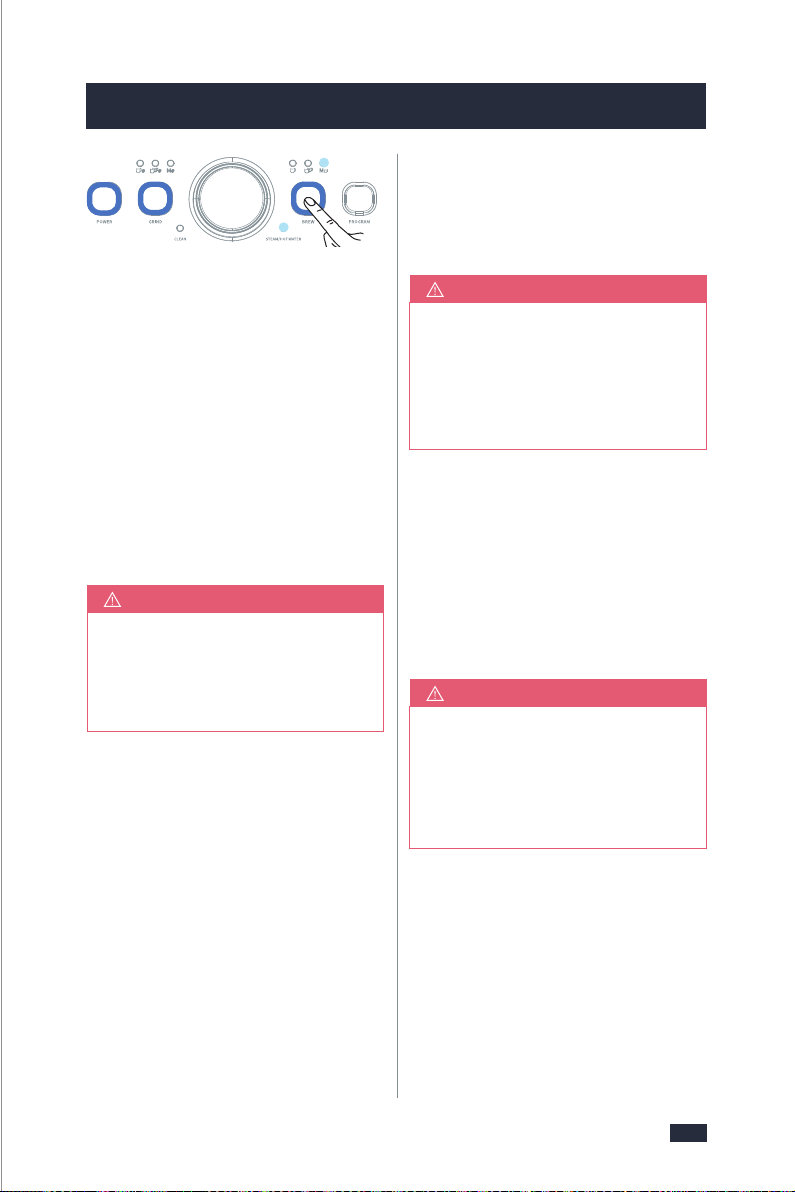
Cleaning Steam Wand
• Every Time
- After frothing milk, purge the Steam
Wand by turning the STEAM/HOT
WATER dial to Steam for just 3-4
seconds..
- Wipe the Steam Wand with a damp
cloth.
• Weekly
Clean in warm water with a mild
detergent, rinse & dry.
Cleaning Portafilter & Filter Basket
• Every Time
Wash after each use by rinsing them
with warm water under the tap.
• Regular Intervals
In warm soapy water using a mild
detergent, rinse & dry.
Cleaning Shower & Group Head
• Every Time
Run water through before making an
espresso.
• Weekly
- Purge water through the Group Head
by using the Double-cup filter.
- Allow water to run through until it
stops.
- With the Cleaning Brush remove
any coffee grinds from around the
Group Head inside rim and Silicone
Seal. Wipe the Shower Head with a
damp cloth.
Cleaning Cycle Procedure
• Preparing for Cleaning Cycle
- Ensure there is at least 1 Litre of water
• Cleaning Cycle Complete
- After it flows out 150ml-200ml of
water to Clean the machine, press
the Brew button to stop.
- Press the Power button to exit
function.The machine will return
to the READY state.
- Remove the Portafilter from the
Group Head. Check whether the
descaler has been dissolved.
- Water will purge into the Drip Tray.
• Cleaning Cycle Clean Up
- Purge the Group Head by pressing
Brew button 3 times, then the Manual
dose indicator will keep white light fixed.
- Long press Brew button to start and
water should flow.
- Allow water to run through and press
the Brew button to stop.
- Wash the Drip Tray, Portafilter &
Cleaning Disc in warm water with a
mild detergent, rinse & dry.
• Group Head Silicone Seal
A silicone seal is located in the Group
Head and creates a seal against the
Filter Basket when making an espresso.
Over time this Seal loses its elasticity
and may require replacement. The
seal may need replacing when watery
espresso leaks from around the porta-
filter handle during extraction, or if the
portafilter handle is loose when fully
turned to the centre position.
4443
If the descaler has not been dissolved,
insert the Portafilter back into the
Group Head, empty the Drip Tray.
Repeat the Cleaning Cycle section.
NOTE
When the machine is not being
used, we recommend that you
don’t leave the Portafilter inserted
into the Group Head, as this will
reduce the life of the silicone seal.
IMPORTANT
Contact Gevi should you think
that the Group Head seal needs
replacing. Do not attempt to change
the Silicone Seal without first consu-
lting Gevi.
NOTE
- Empty the Drip Tray.
- The machine is on and in the READY
state.
- Place the Double-cup filter & the
Cleaning Disc into the Portafilter.
- Place one espresso machine cleaning
descaler in the middle of the Cleaning
Disc in the space provided.
- Insert Portafilter into the Group Head.
- Start the Cleaning Cycle Procedure.
- Press Brew button three times.
- Long press Brew button to start. The
machine will have a beep & water
should start flowing from the Group
Head.
12. Care & Cleaning - Espresso Machine12. Care & Cleaning - Espresso Machine
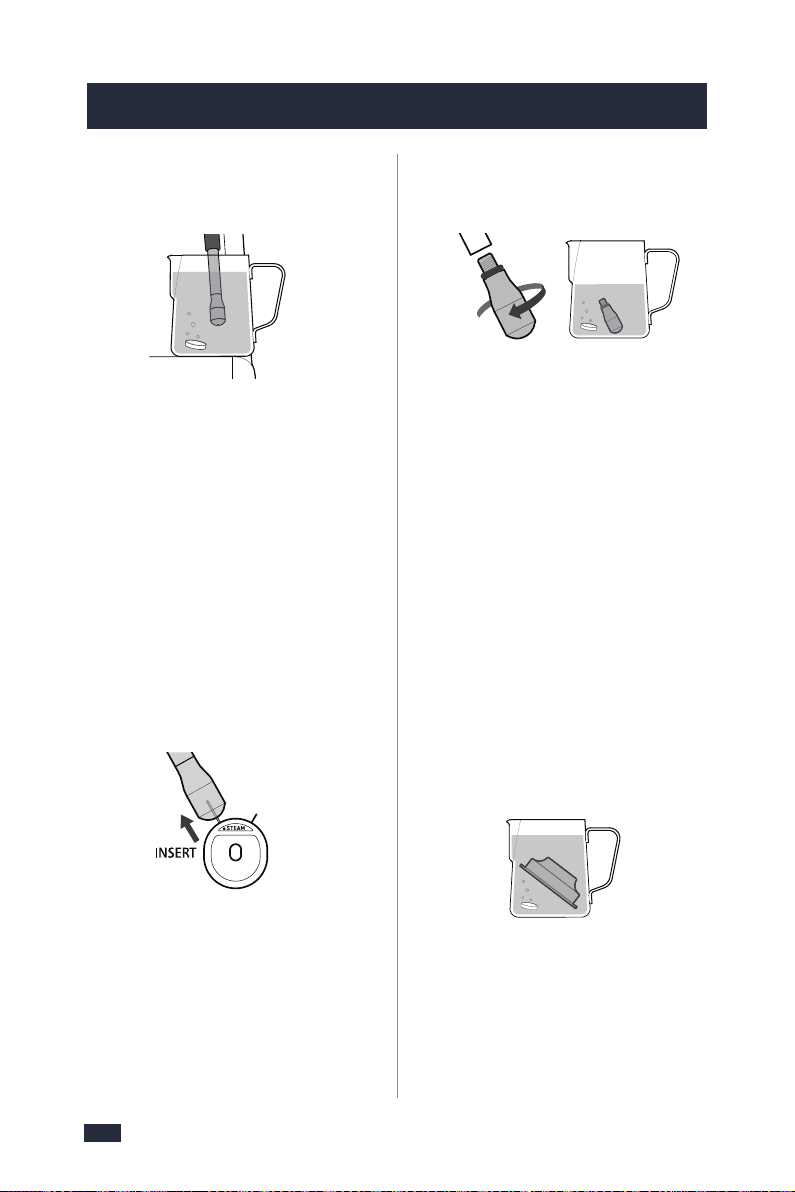
• 2-3 Months
- Soak the Steam Wand overnight in
the Milk Jug with warm water.
- In the morning remove the Milk Jug
and rinse ensuring that all traces of
the solution have been removed.
- Wipe Steam Wand with a damp cloth
ensuring that all traces of the cleaning
descaler have been removed.
- Turn the steam/hot water dial to
steam position and run for 3-4s.
• Unblocking Steam Wand
If the Froth nozzle becomes clogged
with milk residue:
- Insert the Steam Wand Tip Pin up
the Froth nozzle hole and remove.
Cleaning the Bean hopper
• 2-3 Months for random use
- If the Grinder is used frequently like
everyday, the Bean hopper needs to
be cleaned.
• Weekly to ensure best
performance.
Cleaning Portafilter support &
Grind Outlet
• Weekly
- Remove any coffee grinds from the
Portafilter support & Grind Outlet
with the Cleaning Brush and wipe
with a damp cloth, wipe dry.
• Preparing to Clean Bean hopper
- Turn off the machine, switch off &
unplug at power outlet.
- Make note of the current Grind
Setting (to use as the starting point
after cleaning).
• Remove and Clean Bean hopper
- Turn Bean hopper fully counter
clockwise, to close the Hopper
Gates and unlock the Bean hopper.
- Remove the Bean hopper from the
Grinder Collar and store any remai-
ning beans in an airtight container
to preserve their freshness.
- Press the Brew button 1 time, then
the Single cup indicator will keep
white light fixed.
Conical burrs are used to grind coffee
beans to a suitable size for espresso
extraction. Deposits of grinds & oils
build up over time, affecting the taste
of the espresso & operation of the
integrated Grinder.
- In the morning rinse the Milk Jug &
Filter Basket (s) under running water
ensuring all traces of the cleaning
descaler have been removed.
- Place a Filter Basket into Portafilter
[without coffee grinds] and insert
into Milk Jug.
4645
To prevent damage to the machine,
do not use alkaline cleaning agents,
abrasives or metal scourers.
CAUTION
Do not immerse the machine in
water.
NOTE
- Empty the Drip Tray.
- The machine is on and in the READY
state.
- In the morning rinse the Milk Jug &
Froth nozzle under running water
ensuring all traces of the cleaning
descaler have been removed.
- Use the Steam Wand Tip Pin to
clean the Froth nozzle.
- Ensure red O-ring is present &
undamaged.
- Screw the Froth nozzle back into the
Steam Wand Arm.
- Turn the steam/hot water dial to
steam position and run for 3-4s.
Cleaning Filter Baskets
• 2-3 Months
- Soak the Filter Baskets overnight in
the Milk Jug with warm water.
- Turn the steam/hot water dial to
steam position and run for 3-4s.
• Steam Wand Remains Blocked
- Unscrew the Froth nozzle and soak
overnight in the Milk Jug with warm
water & one Espresso Machine Cleaning
descaler.
- Long press Brew button to start.
- Allow water to run through until it
stops.
13. Care & Cleaning - Grinder
12. Care & Cleaning - Espresso Machine12. Care & Cleaning - Espresso Machine
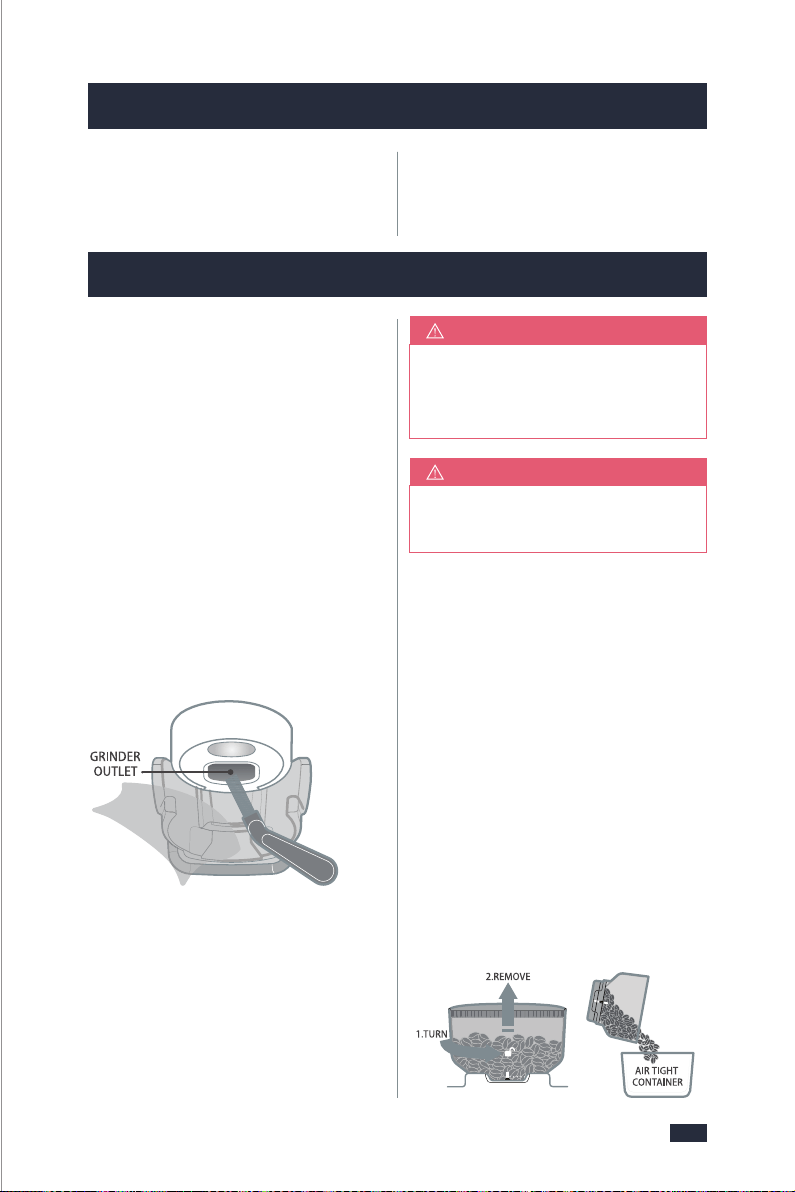
• 2-3 Months
- Soak the Steam Wand overnight in
the Milk Jug with warm water.
- In the morning remove the Milk Jug
and rinse ensuring that all traces of
the solution have been removed.
- Wipe Steam Wand with a damp cloth
ensuring that all traces of the cleaning
descaler have been removed.
- Turn the steam/hot water dial to
steam position and run for 3-4s.
• Unblocking Steam Wand
If the Froth nozzle becomes clogged
with milk residue:
- Insert the Steam Wand Tip Pin up
the Froth nozzle hole and remove.
Cleaning the Bean hopper
• 2-3 Months for random use
- If the Grinder is used frequently like
everyday, the Bean hopper needs to
be cleaned.
• Weekly to ensure best
performance.
Cleaning Portafilter support &
Grind Outlet
• Weekly
- Remove any coffee grinds from the
Portafilter support & Grind Outlet
with the Cleaning Brush and wipe
with a damp cloth, wipe dry.
• Preparing to Clean Bean hopper
- Turn off the machine, switch off &
unplug at power outlet.
- Make note of the current Grind
Setting (to use as the starting point
after cleaning).
• Remove and Clean Bean hopper
- Turn Bean hopper fully counter
clockwise, to close the Hopper
Gates and unlock the Bean hopper.
- Remove the Bean hopper from the
Grinder Collar and store any remai-
ning beans in an airtight container
to preserve their freshness.
- Press the Brew button 1 time, then
the Single cup indicator will keep
white light fixed.
Conical burrs are used to grind coffee
beans to a suitable size for espresso
extraction. Deposits of grinds & oils
build up over time, affecting the taste
of the espresso & operation of the
integrated Grinder.
- In the morning rinse the Milk Jug &
Filter Basket (s) under running water
ensuring all traces of the cleaning
descaler have been removed.
- Place a Filter Basket into Portafilter
[without coffee grinds] and insert
into Milk Jug.
4645
To prevent damage to the machine,
do not use alkaline cleaning agents,
abrasives or metal scourers.
CAUTION
Do not immerse the machine in
water.
NOTE
- Empty the Drip Tray.
- The machine is on and in the READY
state.
- In the morning rinse the Milk Jug &
Froth nozzle under running water
ensuring all traces of the cleaning
descaler have been removed.
- Use the Steam Wand Tip Pin to
clean the Froth nozzle.
- Ensure red O-ring is present &
undamaged.
- Screw the Froth nozzle back into the
Steam Wand Arm.
- Turn the steam/hot water dial to
steam position and run for 3-4s.
Cleaning Filter Baskets
• 2-3 Months
- Soak the Filter Baskets overnight in
the Milk Jug with warm water.
- Turn the steam/hot water dial to
steam position and run for 3-4s.
• Steam Wand Remains Blocked
- Unscrew the Froth nozzle and soak
overnight in the Milk Jug with warm
water & one Espresso Machine Cleaning
descaler.
- Long press Brew button to start.
- Allow water to run through until it
stops.
13. Care & Cleaning - Grinder
12. Care & Cleaning - Espresso Machine12. Care & Cleaning - Espresso Machine
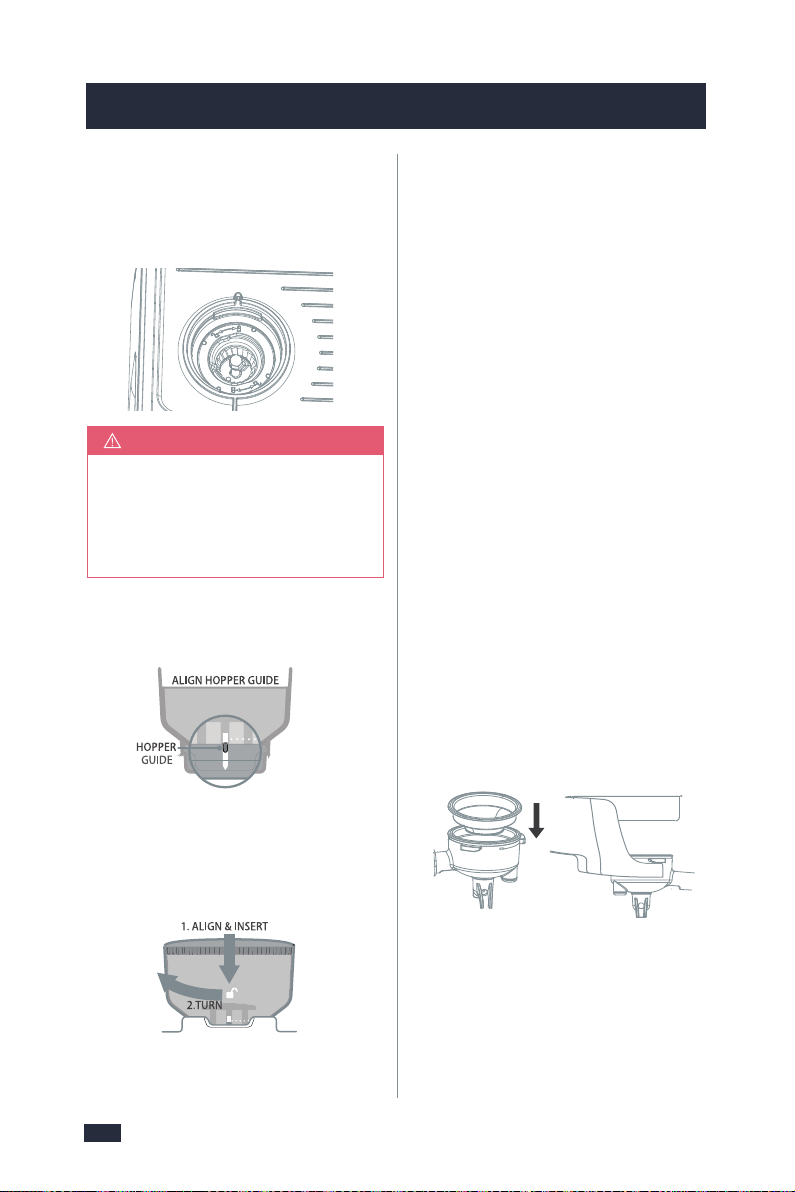
- Ensure the Hopper Guide is aligned
with the vertical red tines on the
Hopper base.
- Align & insert the Bean hopper into
the Grinder Collar and firmly pushing
down turn clockwise to lock into
place and open the Hopper Guide.
• Cleaning Top Burr
- Fold the one handle up and lift the
Top Burr from the Grinder Collar.
- Wash the Top Burr in warm soapy
water with a mild detergent, rinse
& dry.
• Cleaning & Unblocking Bottom
Burr and Grind Chamber
- Use the Cleaning Brush or a Vacuum
Cleaner to thoroughly clean the
parts and surfaces in the Grind
Chamber of fine coffee grinds. A
damp cloth can be used to wipe the
inside of the Grind Collar.
• Replace Top Burr
How to take out the Top Burr:
- Rotate the Grinder Collar countercl-
ockwise.
How to reseat the Top Burr:
- Use the one handle to put the Top
Burr into the Grinder Collar.
- Use the one handle to take out the
Top Burr seated in the Grinder Collar.
- Remove the Portafilter and dispose
of the waste grinds as these will be
too coarse for espresso coffee.
- Remove the Bean hopper from the
Grinder Collar and store any remaining
coffee beans in an airtight container to
preserve their freshness.
4847
Spots & marks on the surface of the
Burrs are part of the hardening
process (for extra-long life). These
marks do not affect the performance
of the Grinder or the taste of the
espresso.
NOTE
Care should be taken when cleaning
Grinder Burrs as they are sharp.
CAUTION
• Grind Off Excess Coffee Beans
- The machine is on and in the READY
state.
- Make note of the current Grind Setting
(to use as the starting point after
cleaning).
- Insert Double-cup filter into the
Portafilter.
- Insert Portafilter into Portafilter
support.
• 1-2 Months
- If the Grinder is used frequently (
everyday), the Burrs need to be
cleaned to ensure best performance
of the integrated Grinder. Regular
cleaning helps the Burrs achieve
consistent grinding results, which
Cleaning & Unblocking Grinder
Burrs, Collar, Grind Chamber
And Outlet
- Reset to the Grind Setting noted
prior to cleaning.
• Preparing to Clean
- Turn off the machine, switch off &
unplug at power outlet.
Do not pour water or any other
liquid into the Grind Chamber.
CAUTION
Coffee grinds caught under the Top
Burr may prevent the Bean hopper
from seating correctly. If this happens
grind off excess coffee beans.
NOTE
is especially important when grinding
coffee beans for espresso.
• Replace Bean hopper
- Ensure the Grinder Collar is clean,
without residual of coffee beans or
grinds.
- Allow thorough air drying.
13. Care & Cleaning - Grinder13. Care & Cleaning - Grinder
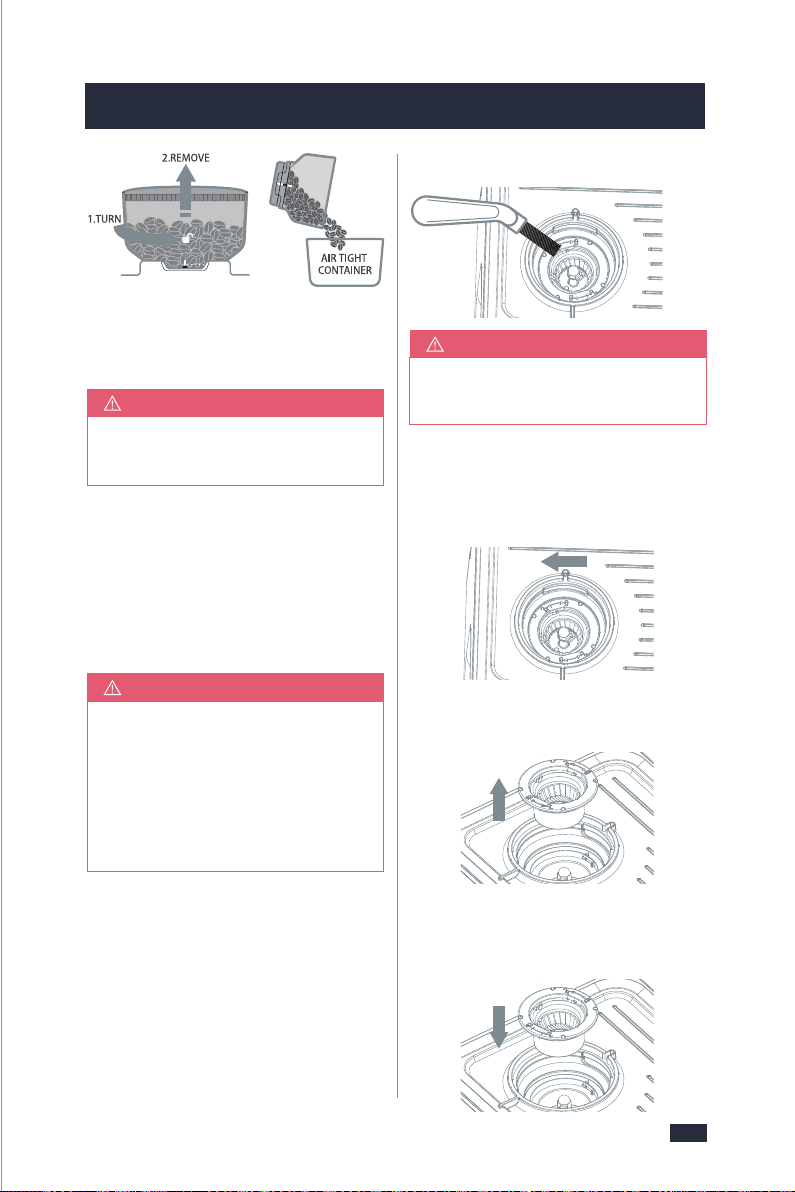
- Ensure the Hopper Guide is aligned
with the vertical red tines on the
Hopper base.
- Align & insert the Bean hopper into
the Grinder Collar and firmly pushing
down turn clockwise to lock into
place and open the Hopper Guide.
• Cleaning Top Burr
- Fold the one handle up and lift the
Top Burr from the Grinder Collar.
- Wash the Top Burr in warm soapy
water with a mild detergent, rinse
& dry.
• Cleaning & Unblocking Bottom
Burr and Grind Chamber
- Use the Cleaning Brush or a Vacuum
Cleaner to thoroughly clean the
parts and surfaces in the Grind
Chamber of fine coffee grinds. A
damp cloth can be used to wipe the
inside of the Grind Collar.
• Replace Top Burr
How to take out the Top Burr:
- Rotate the Grinder Collar countercl-
ockwise.
How to reseat the Top Burr:
- Use the one handle to put the Top
Burr into the Grinder Collar.
- Use the one handle to take out the
Top Burr seated in the Grinder Collar.
- Remove the Portafilter and dispose
of the waste grinds as these will be
too coarse for espresso coffee.
- Remove the Bean hopper from the
Grinder Collar and store any remaining
coffee beans in an airtight container to
preserve their freshness.
4847
Spots & marks on the surface of the
Burrs are part of the hardening
process (for extra-long life). These
marks do not affect the performance
of the Grinder or the taste of the
espresso.
NOTE
Care should be taken when cleaning
Grinder Burrs as they are sharp.
CAUTION
• Grind Off Excess Coffee Beans
- The machine is on and in the READY
state.
- Make note of the current Grind Setting
(to use as the starting point after
cleaning).
- Insert Double-cup filter into the
Portafilter.
- Insert Portafilter into Portafilter
support.
• 1-2 Months
- If the Grinder is used frequently (
everyday), the Burrs need to be
cleaned to ensure best performance
of the integrated Grinder. Regular
cleaning helps the Burrs achieve
consistent grinding results, which
Cleaning & Unblocking Grinder
Burrs, Collar, Grind Chamber
And Outlet
- Reset to the Grind Setting noted
prior to cleaning.
• Preparing to Clean
- Turn off the machine, switch off &
unplug at power outlet.
Do not pour water or any other
liquid into the Grind Chamber.
CAUTION
Coffee grinds caught under the Top
Burr may prevent the Bean hopper
from seating correctly. If this happens
grind off excess coffee beans.
NOTE
is especially important when grinding
coffee beans for espresso.
• Replace Bean hopper
- Ensure the Grinder Collar is clean,
without residual of coffee beans or
grinds.
- Allow thorough air drying.
13. Care & Cleaning - Grinder13. Care & Cleaning - Grinder
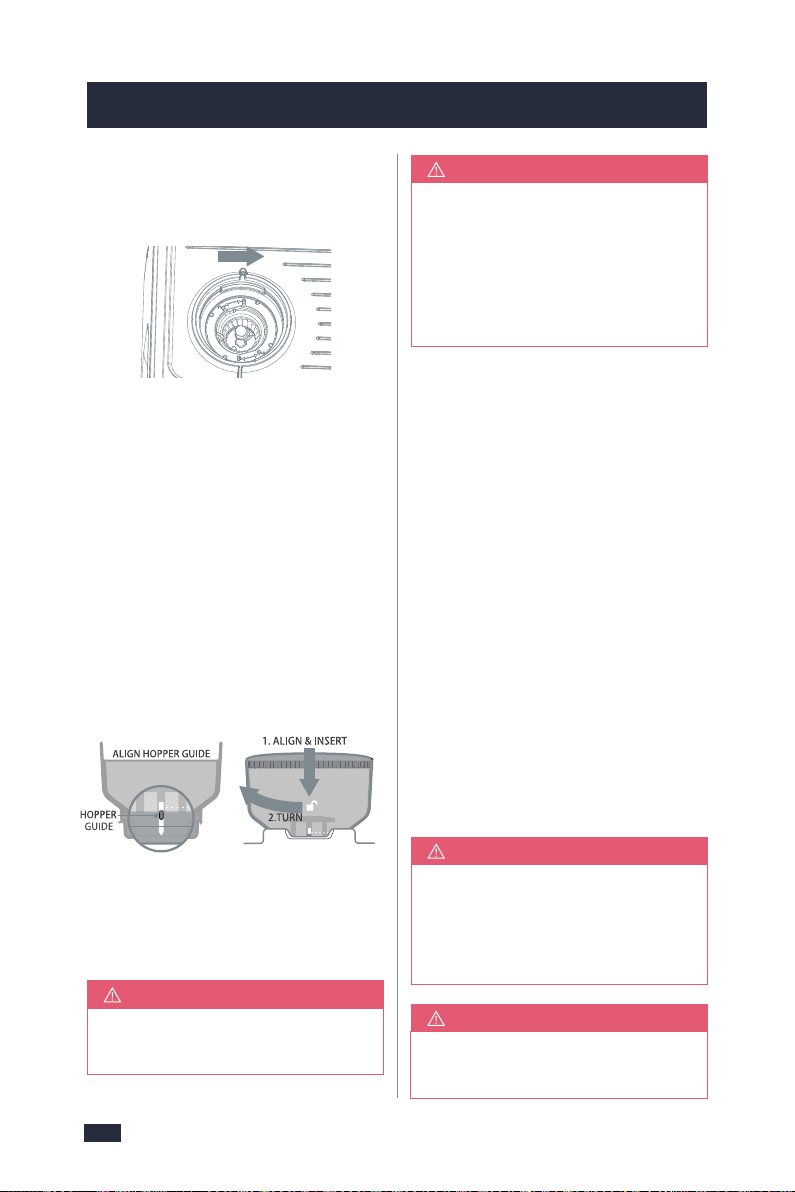
- When correctly seated, the Top Burr
will be flush with the surface of the
Grinder Collar.
- Place the handle down.
• Replace Bean hopper
- Ensure the Hopper Guide is aligned
with the vertical white lines on the
Hopper base.
- Align & insert the Bean Hopper into
the Grinder Collar and firmly push
down. Turn clockwise to lock into
place and open the Hopper Guide.
hardened Stainless Steel for extra-
long life. However, after prolonged
use, the Bottom Burr may require
adjustment to compensate for wear.
If the coffee grinds are too coarse
when the Grind Setting is below 2
and the espresso is consistently
under extracted, the Bottom Burr
may need adjusting. Contact Gevi
should you think that the Bottom
Burr needs adjustment.
Prior to contacting Gevi, please
ensure that you are using freshly
roasted beans and that the Top
Burr is seated correctly.
- Reset to the Grinder Setting noted
prior to cleaning.
- Refill the Bean hopper with coffee
beans.
Descaling Cycle
• Preparing for Descaling Cycle
• Fill Water Reservoir with Solution
- Insert the Water Reservoir into position.
- To make sure your machine operates
efficiently, internal pipe clean and
the peak flavor of coffee, it is necessary
to clean the machine’s water scale
periodically.
- We recommend descaling your
Espresso Machine every 4-6 months,
although this period will depend on
the hardness of water and frequency
of use.
- When the system detects that the
flow amount of the whole machine
reaches 15 L, the clean light will
flash, which means the appliance
needs to be performed descaling,
at that time, you can activate the
descaling function manually.
Descaling Solution
You have 3 options:
a. One espresso machine descaling
tablet.
or
b. Liquid descaler.
5049
After cleaning, the optimum Grind
Setting may have been changed.
NOTE
Old coffee beans, no matter the
Grind Setting, will have a fast ext-
raction and will produce an under
extracted tasting espresso.
IMPORTANT
If the Descaling Cycle is not comp-
leted or stopped part way through
any of the Descaling Steps, then
you will need to start the Descaling
Cycle again from the beginning.
IMPORTANT
Recommend using the citric acid
(The proportion of citric acid and
water is 1:100).
NOTE
If the Top Burr is not seated corr-
ectly, the Grinder will produce
IMPORTANT
coarse coffee grinds. Grind off excess coffee beans and clean the Top Burr
& Grind Chamber.
Gevi may determine that Bottom Burr adjustment shims are required.Do not
attempt to add shims without first consulting Gevi.
NOTE
This machine has no user servic-
eable parts. Any servicing beyond
that described in the Cleaning
Section should be performed by an
Authorized Service Representative
only.
NOTE
Adjusting Bottom Burr
- The Conical burrs are made of
14. Descaling Cycle - Espresso Machine
- The Top Burr will be flush with the
surface of the Grinder Collar.
- Rotate the grinding ring clockwise.
or
c. White vinegar & warm water.
You also can use powder descalers
or others to clean your machine as
you like. For specific cleaning
methods, please refer to the
instructions provided by your
descaler provider.
13. Care & Cleaning - Grinder13. Care & Cleaning - Grinder
- When correctly seated, the Top Burr
will be flush with the surface of the
Grinder Collar.
- Place the handle down.
• Replace Bean hopper
- Ensure the Hopper Guide is aligned
with the vertical white lines on the
Hopper base.
- Align & insert the Bean Hopper into
the Grinder Collar and firmly push
down. Turn clockwise to lock into
place and open the Hopper Guide.
hardened Stainless Steel for extra-
long life. However, after prolonged
use, the Bottom Burr may require
adjustment to compensate for wear.
If the coffee grinds are too coarse
when the Grind Setting is below 2
and the espresso is consistently
under extracted, the Bottom Burr
may need adjusting. Contact Gevi
should you think that the Bottom
Burr needs adjustment.
Prior to contacting Gevi, please
ensure that you are using freshly
roasted beans and that the Top
Burr is seated correctly.
- Reset to the Grinder Setting noted
prior to cleaning.
- Refill the Bean hopper with coffee
beans.
Descaling Cycle
• Preparing for Descaling Cycle
• Fill Water Reservoir with Solution
- Insert the Water Reservoir into position.
- To make sure your machine operates
efficiently, internal pipe clean and
the peak flavor of coffee, it is necessary
to clean the machine’s water scale
periodically.
- We recommend descaling your
Espresso Machine every 4-6 months,
although this period will depend on
the hardness of water and frequency
of use.
- When the system detects that the
flow amount of the whole machine
reaches 15 L, the clean light will
flash, which means the appliance
needs to be performed descaling,
at that time, you can activate the
descaling function manually.
Descaling Solution
You have 3 options:
a. One espresso machine descaling
tablet.
or
b. Liquid descaler.
5049
After cleaning, the optimum Grind
Setting may have been changed.
NOTE
Old coffee beans, no matter the
Grind Setting, will have a fast ext-
raction and will produce an under
extracted tasting espresso.
IMPORTANT
If the Descaling Cycle is not comp-
leted or stopped part way through
any of the Descaling Steps, then
you will need to start the Descaling
Cycle again from the beginning.
IMPORTANT
Recommend using the citric acid
(The proportion of citric acid and
water is 1:100).
NOTE
If the Top Burr is not seated corr-
ectly, the Grinder will produce
IMPORTANT
coarse coffee grinds. Grind off excess coffee beans and clean the Top Burr
& Grind Chamber.
Gevi may determine that Bottom Burr adjustment shims are required.Do not
attempt to add shims without first consulting Gevi.
NOTE
This machine has no user servic-
eable parts. Any servicing beyond
that described in the Cleaning
Section should be performed by an
Authorized Service Representative
only.
NOTE
Adjusting Bottom Burr
- The Conical burrs are made of
14. Descaling Cycle - Espresso Machine
- The Top Burr will be flush with the
surface of the Grinder Collar.
- Rotate the grinding ring clockwise.
or
c. White vinegar & warm water.
You also can use powder descalers
or others to clean your machine as
you like. For specific cleaning
methods, please refer to the
instructions provided by your
descaler provider.
13. Care & Cleaning - Grinder13. Care & Cleaning - Grinder
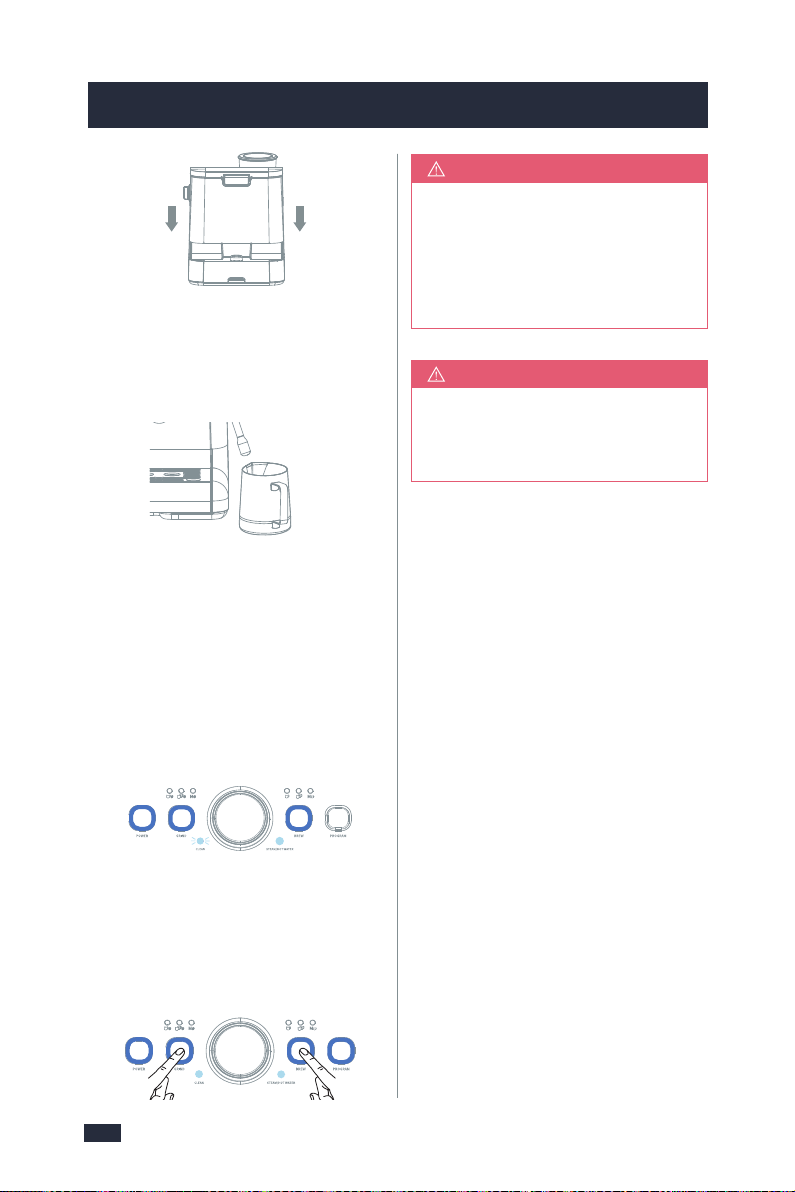
• Check Power
Ensure that:
- The Power Plug is inserted into the
outlet & switched on.
- the STEAM/HOT WATER dial is in the
vertical position.
- The Clean indicator blinks white
light slowly.
• Activate the Descaling Cycle
- Simultaneously press & hold the
Grind button and Brew button for 2
seconds. The Clean indicator keeps
white light fixed.
Step 2. Preparing for Purge
Step 1. Start Descaling Cycle
- Turn the STEAM/HOT WATER dial to
the STEAM position.
- The Steam/Hot water indicator will
now start to flash.
- The Pump will start and hot water
will run from the Group Head & Steam
Wand. Over a 2 minute period the
Pump will make different noises.
- When hot water has stopped being
released from the Group Head & Steam
Wand , to indicate the machine has
finished this step, the machine will
beep. The Steam/Hot water indicator
will now start to flash.
- Turn the STEAM/HOT WATER dial to
the vertical position.
- The Steam/Hot water indicator will
now be fully illuminated.
- Move to Step 2. Preparing for Purge.
- The Steam Wand & Group Head now
need to be purged clean with fresh
water to remove descaling solution.
Rinse Water Reservoir.
- Remove the Water Reservoir and
rinse thoroughly under running
water, ensuring that all traces of the
descaling solution have been removed.
Fill Water Reservoir
- Fill the Water Reservoir to the '1
Liter' line with cold water from the
tap and insert into position.
Empty Containers
- Empty water from the containers
and replace.
- Move to Step 3.Start Purge.
Step 3. Start Purge
- Turn the STEAM/HOT WATER dial
to the Hot Water position.
- The Pump will start and hot water
will run from the Steam Wand. Over
a 2 minute period the Pump will
make different noises.
- When hot water has stopped being
released from the Steam Wand, the
Descaling Cycle is completed.
• Descaling Cycle Complete
- To indicate the completion of the
Descaling Cycle the machine will
beep.
- The Steam/Hot water indicator will
flash to prompt the return of the STEAM
/HOT WATER dial to the vertical position.
- Turn the STEAM/HOT WATER dial to
the vertical position.
- The machine will return to the READY
state.
• Descaling Cycle Clean Up
- Empty water from the containers
and clean, ensuring that all traces
of the descaling solution have been
removed.
5251
If Descaling Step 1 is not started
within 1 minute to enter the
Descaling Cycle, the machine will
exit the Descaling Cycle and go
back to the READY state.
IMPORTANT
There is a maximum of 5 minutes
allowed to complete this step
before the Descaling Cycle exits.
IMPORTANT
The Descaling Cycle can be exited
at any point by pressing the Power
button.
IMPORTANT
• Place Containers
- Place a 1 Litre container under Group
Head and another 4 cup container
under the Steam Wand.
14. Descaling Cycle - Espresso Machine14. Descaling Cycle - Espresso Machine

• Check Power
Ensure that:
- The Power Plug is inserted into the
outlet & switched on.
- the STEAM/HOT WATER dial is in the
vertical position.
- The Clean indicator blinks white
light slowly.
• Activate the Descaling Cycle
- Simultaneously press & hold the
Grind button and Brew button for 2
seconds. The Clean indicator keeps
white light fixed.
Step 2. Preparing for Purge
Step 1. Start Descaling Cycle
- Turn the STEAM/HOT WATER dial to
the STEAM position.
- The Steam/Hot water indicator will
now start to flash.
- The Pump will start and hot water
will run from the Group Head & Steam
Wand. Over a 2 minute period the
Pump will make different noises.
- When hot water has stopped being
released from the Group Head & Steam
Wand , to indicate the machine has
finished this step, the machine will
beep. The Steam/Hot water indicator
will now start to flash.
- Turn the STEAM/HOT WATER dial to
the vertical position.
- The Steam/Hot water indicator will
now be fully illuminated.
- Move to Step 2. Preparing for Purge.
- The Steam Wand & Group Head now
need to be purged clean with fresh
water to remove descaling solution.
Rinse Water Reservoir.
- Remove the Water Reservoir and
rinse thoroughly under running
water, ensuring that all traces of the
descaling solution have been removed.
Fill Water Reservoir
- Fill the Water Reservoir to the '1
Liter' line with cold water from the
tap and insert into position.
Empty Containers
- Empty water from the containers
and replace.
- Move to Step 3.Start Purge.
Step 3. Start Purge
- Turn the STEAM/HOT WATER dial
to the Hot Water position.
- The Pump will start and hot water
will run from the Steam Wand. Over
a 2 minute period the Pump will
make different noises.
- When hot water has stopped being
released from the Steam Wand, the
Descaling Cycle is completed.
• Descaling Cycle Complete
- To indicate the completion of the
Descaling Cycle the machine will
beep.
- The Steam/Hot water indicator will
flash to prompt the return of the STEAM
/HOT WATER dial to the vertical position.
- Turn the STEAM/HOT WATER dial to
the vertical position.
- The machine will return to the READY
state.
• Descaling Cycle Clean Up
- Empty water from the containers
and clean, ensuring that all traces
of the descaling solution have been
removed.
5251
If Descaling Step 1 is not started
within 1 minute to enter the
Descaling Cycle, the machine will
exit the Descaling Cycle and go
back to the READY state.
IMPORTANT
There is a maximum of 5 minutes
allowed to complete this step
before the Descaling Cycle exits.
IMPORTANT
The Descaling Cycle can be exited
at any point by pressing the Power
button.
IMPORTANT
• Place Containers
- Place a 1 Litre container under Group
Head and another 4 cup container
under the Steam Wand.
14. Descaling Cycle - Espresso Machine14. Descaling Cycle - Espresso Machine

5453
The machine is not plugged
well into a wall outlet.
Not properly purged clean
with fresh water to remove
descaling solution.
Coffee grinds are stored in
a hot and humid place for
a long time. The coffee
grinds turn bad.
The sealing ring of the water
inlet hole is deformed.
Too much water is in Drip Tray.
The machine malfunctions.
When the water tank is
pulled up after use, it is
normal that there will be
water left on the desk.
As the water outlet at the
bottom of the water tank is
a movable part and it is not
leaking.
The sounds are caused by
the normally working
pressure control valve.
Clean the Drip Tray.
Contact Gevi Customer Care.
Contact Gevi Customer Care.
It is normal.
Use blended coffee beans.
Use fine coffee grinds.
Plug the machine into a
wall outlet correctly. If the
machine still cannot work,
contact Gevi Customer Care.
Purge the machine properly
after descaling.
See Descaling Cycle - Espresso
Machine, page 50-52 .
Keep the unused coffee
grinds in a cool, dry place.
After opening a bag of coffee
grinds, reseal and restore in
a refrigerator to maintain
freshness.
ProblemPossible CauseWhat To Do
The machine cannot work.
The coffee beans are
inappropriate.
The size of coffee grinds
is too coarse.
Not enough coffee grinds,
use more grinds.
The amount of coffee grinds
is inappropriate.
Too much tamp force, tamp
lighter.
The coffee grinds are
tamped too tight.
Make sure the temperature
is correct(89-95℃/192-203℉).
Not an appropriate tempe-
rature for brewing coffee.
30mL per cup.
The espresso amount is
inappropriate.
Acid(vinegar) taste
exists in your espresso.
Water leaks from
the bottom.
Ticking sounds after
turning on the machine
and tearing sounds after
coffee pouring.
The machine makes
weak coffee.
The Group Head Silicone
Seal is new and needs
bedding in.
Too many coffee grinds used
Portafilter is not
attached correctly or has
not been tightened
sufficiently.
Ensure all three tabs of the
Portafilter are fully
inserted into the Group
Head and rotated to the
centre position. See ESPRE-
SSO GUIDE,page 20-31.
No Filter Basket inserted in
the Portafilter.
Group Head Silicone Seal is
damaged or worn.
Coffee grind is too fine.
Ensure a Filter Basket is
inserted into the Portafilter
before using in the Group
Head.
See Care & Cleaning, page 42-49.
Contact Gevi Customer Care.
Change to a coarser Grind
Setting.
Too many coffee grinds used.Dose less coffee grinds.
Coffee grinds tamped too
hard.
Apply less force during
tamping.
Top edge of Filter Basket
has not been cleaned of
loose coffee grinds.
Wipe around top edge of the
Filter Basket before inserting
into Group Head. See
ESPRESSO GUIDE,page 20-31.
Keep using. This Seal will
bed in during the first few
uses and become easier
to turn.
Dose less coffee grinds.
ProblemWhat To Do
Portafilter is tight
to turn in the Group Head.
Clean the parts with the Clea-
ning Brush and damp cloth.
See Care & Cleaning, page 42-49.
Group Head inside rim,
Silicon Seal or Shower
Head is dirty.
See Care & Cleaning, page 42-49.
Contact Gevi Customer Care.
Re-install properly.
Group Head Silicone Seal is
damaged or worn.
The Portafilter is not
installed properly.
Portafilter is loose
or comes off during
espresso extraction.
Espresso squirts or
trickles down the side
of the Group Head
during extraction.
Possible Cause
15. Troubleshooting Guide
15. Troubleshooting Guide
15.1 Troubleshooting Guide - Espresso Machine
5453
The machine is not plugged
well into a wall outlet.
Not properly purged clean
with fresh water to remove
descaling solution.
Coffee grinds are stored in
a hot and humid place for
a long time. The coffee
grinds turn bad.
The sealing ring of the water
inlet hole is deformed.
Too much water is in Drip Tray.
The machine malfunctions.
When the water tank is
pulled up after use, it is
normal that there will be
water left on the desk.
As the water outlet at the
bottom of the water tank is
a movable part and it is not
leaking.
The sounds are caused by
the normally working
pressure control valve.
Clean the Drip Tray.
Contact Gevi Customer Care.
Contact Gevi Customer Care.
It is normal.
Use blended coffee beans.
Use fine coffee grinds.
Plug the machine into a
wall outlet correctly. If the
machine still cannot work,
contact Gevi Customer Care.
Purge the machine properly
after descaling.
See Descaling Cycle - Espresso
Machine, page 50-52 .
Keep the unused coffee
grinds in a cool, dry place.
After opening a bag of coffee
grinds, reseal and restore in
a refrigerator to maintain
freshness.
ProblemPossible CauseWhat To Do
The machine cannot work.
The coffee beans are
inappropriate.
The size of coffee grinds
is too coarse.
Not enough coffee grinds,
use more grinds.
The amount of coffee grinds
is inappropriate.
Too much tamp force, tamp
lighter.
The coffee grinds are
tamped too tight.
Make sure the temperature
is correct(89-95℃/192-203℉).
Not an appropriate tempe-
rature for brewing coffee.
30mL per cup.
The espresso amount is
inappropriate.
Acid(vinegar) taste
exists in your espresso.
Water leaks from
the bottom.
Ticking sounds after
turning on the machine
and tearing sounds after
coffee pouring.
The machine makes
weak coffee.
The Group Head Silicone
Seal is new and needs
bedding in.
Too many coffee grinds used
Portafilter is not
attached correctly or has
not been tightened
sufficiently.
Ensure all three tabs of the
Portafilter are fully
inserted into the Group
Head and rotated to the
centre position. See ESPRE-
SSO GUIDE,page 20-31.
No Filter Basket inserted in
the Portafilter.
Group Head Silicone Seal is
damaged or worn.
Coffee grind is too fine.
Ensure a Filter Basket is
inserted into the Portafilter
before using in the Group
Head.
See Care & Cleaning, page 42-49.
Contact Gevi Customer Care.
Change to a coarser Grind
Setting.
Too many coffee grinds used.Dose less coffee grinds.
Coffee grinds tamped too
hard.
Apply less force during
tamping.
Top edge of Filter Basket
has not been cleaned of
loose coffee grinds.
Wipe around top edge of the
Filter Basket before inserting
into Group Head. See
ESPRESSO GUIDE,page 20-31.
Keep using. This Seal will
bed in during the first few
uses and become easier
to turn.
Dose less coffee grinds.
ProblemWhat To Do
Portafilter is tight
to turn in the Group Head.
Clean the parts with the Clea-
ning Brush and damp cloth.
See Care & Cleaning, page 42-49.
Group Head inside rim,
Silicon Seal or Shower
Head is dirty.
See Care & Cleaning, page 42-49.
Contact Gevi Customer Care.
Re-install properly.
Group Head Silicone Seal is
damaged or worn.
The Portafilter is not
installed properly.
Portafilter is loose
or comes off during
espresso extraction.
Espresso squirts or
trickles down the side
of the Group Head
during extraction.
Possible Cause
15. Troubleshooting Guide
15. Troubleshooting Guide
15.1 Troubleshooting Guide - Espresso Machine

5655
Custom shot volume being
used.
The Filter Basket is blocked.
Group Head is dirty.
Group Head is blocked.
Coffee grinds are too fine.
Change to a coarser Grind
Setting.
Too many coffee grinds used.Dose less coffee grinds.
Coffee grinds tamped too
hard.
Apply less force during
tamping.
Espresso Machine has scale
build up.
A Descaling Cycle is required.
See Descaling Cycle,
pages 46-49.
Reset to the default shot
volumes.
See Customisable - Shot
Volumes Temperature,
pages 24-25.
See Care & Cleaning,
pages 38-45.
A Cleaning Cycle is required.
A Descaling Cycle is required.
See Descaling Cycle, page 46-49
See Cleaning Cycle, page 42-46
What To Do
Change to a finer Grind
Setting.
Dose more coffee grinds.
See Tips for Grinding, page 13-19
Use freshly roasted coffee
beans.
Coffee grinds too coarse.
Not enough coffee grinds
used.
Coffee beans are old or dry.
Tamp more firmly. See
Espresso.
Extraction Guide section,
page 20-31.
Grinds not tamped
(compacted) enough.
Group Handle is loose
or comes off during
espresso extraction.
Espresso pours out in
drips.
(Over Extracted)
Espresso does not
have any crema, or
crema is thin.
(Under Extracted)
The two outlet holes of
Portafilter are blocked.
The holes of the Filter Basket
are blocked.
Custom extraction tempe-
rature being used.
Coffee beans being stored
in the fridge or freezer.
Cup or glass was cold prior
to espresso pour.
Group Head or Handle not
warmed before use.
Use the default 92°C
extraction temperature.
See Customisable -
Extraction Temperature,
page 20-22.
Store coffee beans in a dry,
airtight container. Place in
a cool dark cupboard.
See ESPRESSO GUIDE,
page 20-31.
Hold the Portafilter
under the Group Head and
press the Brew Button. Allow
water to run through.
Pour hot water from the
Steam Wand into the cup
before extracting espresso.
Clean the holes.
Soak the Filter Basket in
clean water for about half
an hour, and then clean it
with a brush.
What To Do
See ESPRESSO GUIDE,
page 20-31.
Fill reservoir with water.
Prime water through the
Group Head, press the Brew
Button. Allow water to run
through.
No water in the Water
Reservoir.
Change to a coarser Grind
Setting.
Dose less coffee grinds.
Apply less force during
tamping.
Coffee grind is too fine.
Too many coffee grinds used.
Coffee grinds tamped too
hard.
No espresso pours.
No espresso pours.
Espresso squirts or
trickles down the side
of the Group Head
during extraction.
Espresso is too cold.
Possible CauseProblemProblemPossible Cause
15. Troubleshooting Guide15. Troubleshooting Guide
5655
Custom shot volume being
used.
The Filter Basket is blocked.
Group Head is dirty.
Group Head is blocked.
Coffee grinds are too fine.
Change to a coarser Grind
Setting.
Too many coffee grinds used.Dose less coffee grinds.
Coffee grinds tamped too
hard.
Apply less force during
tamping.
Espresso Machine has scale
build up.
A Descaling Cycle is required.
See Descaling Cycle,
pages 46-49.
Reset to the default shot
volumes.
See Customisable - Shot
Volumes Temperature,
pages 24-25.
See Care & Cleaning,
pages 38-45.
A Cleaning Cycle is required.
A Descaling Cycle is required.
See Descaling Cycle, page 46-49
See Cleaning Cycle, page 42-46
What To Do
Change to a finer Grind
Setting.
Dose more coffee grinds.
See Tips for Grinding, page 13-19
Use freshly roasted coffee
beans.
Coffee grinds too coarse.
Not enough coffee grinds
used.
Coffee beans are old or dry.
Tamp more firmly. See
Espresso.
Extraction Guide section,
page 20-31.
Grinds not tamped
(compacted) enough.
Group Handle is loose
or comes off during
espresso extraction.
Espresso pours out in
drips.
(Over Extracted)
Espresso does not
have any crema, or
crema is thin.
(Under Extracted)
The two outlet holes of
Portafilter are blocked.
The holes of the Filter Basket
are blocked.
Custom extraction tempe-
rature being used.
Coffee beans being stored
in the fridge or freezer.
Cup or glass was cold prior
to espresso pour.
Group Head or Handle not
warmed before use.
Use the default 92°C
extraction temperature.
See Customisable -
Extraction Temperature,
page 20-22.
Store coffee beans in a dry,
airtight container. Place in
a cool dark cupboard.
See ESPRESSO GUIDE,
page 20-31.
Hold the Portafilter
under the Group Head and
press the Brew Button. Allow
water to run through.
Pour hot water from the
Steam Wand into the cup
before extracting espresso.
Clean the holes.
Soak the Filter Basket in
clean water for about half
an hour, and then clean it
with a brush.
What To Do
See ESPRESSO GUIDE,
page 20-31.
Fill reservoir with water.
Prime water through the
Group Head, press the Brew
Button. Allow water to run
through.
No water in the Water
Reservoir.
Change to a coarser Grind
Setting.
Dose less coffee grinds.
Apply less force during
tamping.
Coffee grind is too fine.
Too many coffee grinds used.
Coffee grinds tamped too
hard.
No espresso pours.
No espresso pours.
Espresso squirts or
trickles down the side
of the Group Head
during extraction.
Espresso is too cold.
Possible CauseProblemProblemPossible Cause
15. Troubleshooting Guide15. Troubleshooting Guide

5857
No water in the reservoir.
Water Reservoir is not
correctly positioned.
Insert the Water Reservoir
into the back of the unit.
Orange silicone cap from
the packaging may still be
inserted.
Remove the orange silicone
cap found at the base of
the Water Reservoir.
New Pre-infusion Profiles
has been selected.
Different Pre-infusion
Profiles make different
noise at the start of an
espresso extraction.
See Customisable - Pre-
infusion Profiles, page 25-26.
Fill reservoir with water.
Let the machine return to
the READY state if it is
cooling down after steam.
Prime water through the
Group Head, press the
Brew Button. Allow water
to run through.
What To Do
Keep Drip Tray in place,
when cooling to espresso
temperature. The STEAM
LIGHT flashes and water
purges into Drip Tray. See
ESPRESSO GUIDE,
page 20-31.
Empty if the red Water
Level Indicator appears
through the Drip Tray
Stainless Steel Grill.
Drip Dray not present
when Thermoblock is
auto purging.
Water overflowing from
Drip Tray.
Group Handle is loose
or comes off during
espresso extraction.
Water around Drip
Tray area or on benchtop.
Custom shot volumes
being used.
Custom extraction tempe-
rature being used.
Type of coffee beans being
used.
Steam function has been
used just before extracting
espresso.
Use the default 92°C
extraction temperature.
See Customisable -
Extraction Temperature,
page 24-25
Try different brands of
coffee beans.
Allow time for water to
purge the Thermoblock and
cool down before extracting
espresso. The STEAM LIGHT
should have finished flashing.
Restore to default shot
volumes or change your
custom shot volume(s).
See Customisable - Shot
Volumes, page22-24.
What To Do
Rest Portafilter on the
Drip Tray for 5 sec to allow
the water to dissipate before
disposing cake.
Dose less coffee grinds.
Ensure coffee grinds are
tamped evenly.
Dual Wall Filter Baskets will
keep the coffee cake wetter
than Single Wall Filter
Baskets.
Check there is nothing
obstructing the Group Head
or Portafilter & clean.
A little water will remain on
top of the used coffee cake.
Too many coffee grinds used.
Dual Wall Filter Baskets
being used.
Uneven tamping.
Obstruction in the Group
Head or Portafilter.
Spent (used) coffee cake
is wet.
Espresso pours into
cup unevenly.
Pump makes an
unusual noise.
Espresso shot volume
too much or too little.
Espresso tastes bitter.
ProblemPossible CauseProblemPossible Cause
15. Troubleshooting Guide
15. Troubleshooting Guide

5857
No water in the reservoir.
Water Reservoir is not
correctly positioned.
Insert the Water Reservoir
into the back of the unit.
Orange silicone cap from
the packaging may still be
inserted.
Remove the orange silicone
cap found at the base of
the Water Reservoir.
New Pre-infusion Profiles
has been selected.
Different Pre-infusion
Profiles make different
noise at the start of an
espresso extraction.
See Customisable - Pre-
infusion Profiles, page 25-26.
Fill reservoir with water.
Let the machine return to
the READY state if it is
cooling down after steam.
Prime water through the
Group Head, press the
Brew Button. Allow water
to run through.
What To Do
Keep Drip Tray in place,
when cooling to espresso
temperature. The STEAM
LIGHT flashes and water
purges into Drip Tray. See
ESPRESSO GUIDE,
page 20-31.
Empty if the red Water
Level Indicator appears
through the Drip Tray
Stainless Steel Grill.
Drip Dray not present
when Thermoblock is
auto purging.
Water overflowing from
Drip Tray.
Group Handle is loose
or comes off during
espresso extraction.
Water around Drip
Tray area or on benchtop.
Custom shot volumes
being used.
Custom extraction tempe-
rature being used.
Type of coffee beans being
used.
Steam function has been
used just before extracting
espresso.
Use the default 92°C
extraction temperature.
See Customisable -
Extraction Temperature,
page 24-25
Try different brands of
coffee beans.
Allow time for water to
purge the Thermoblock and
cool down before extracting
espresso. The STEAM LIGHT
should have finished flashing.
Restore to default shot
volumes or change your
custom shot volume(s).
See Customisable - Shot
Volumes, page22-24.
What To Do
Rest Portafilter on the
Drip Tray for 5 sec to allow
the water to dissipate before
disposing cake.
Dose less coffee grinds.
Ensure coffee grinds are
tamped evenly.
Dual Wall Filter Baskets will
keep the coffee cake wetter
than Single Wall Filter
Baskets.
Check there is nothing
obstructing the Group Head
or Portafilter & clean.
A little water will remain on
top of the used coffee cake.
Too many coffee grinds used.
Dual Wall Filter Baskets
being used.
Uneven tamping.
Obstruction in the Group
Head or Portafilter.
Spent (used) coffee cake
is wet.
Espresso pours into
cup unevenly.
Pump makes an
unusual noise.
Espresso shot volume
too much or too little.
Espresso tastes bitter.
ProblemPossible CauseProblemPossible Cause
15. Troubleshooting Guide
15. Troubleshooting Guide

6059
Steam Wand Tip too deep.
Milk is not fresh.
Milk temperature is too
warm.
Ensure you start frothing
with milk that is around
4°C(39.2°F).Ensure steam
has warmed up before
frothing milk . Steam is
ready when steam button
light is fully ON.
Ensure the milk being
used is fresh.
Type of Milk Jug being used.
For best frothing results use
a chilled Stainless Steel Milk
Jug.
Milk has been boiled.
The milk is making bubbles
rather than microfoam.
Start again with fresh,
chilled milk.
Heat till the Milk Jug can
only be held for approxim-
ately 3 second,
60-65°C(140°F-149°F).
Ensure the Steam Wand Tip
is positioned correctly when
frothing.
Tap the Jug on the benchtop
when finished to release
trapped air bubbles.
See Tip for Milk Frothing,
pages 31-38.
Lower Milk Jug. Ensure the
Steam Wand Tip is
positioned correctly when
frothing. See Tip for Milk
Frothing, pages 31-38.
What To Do
Keep the Steam Wand Tip
just under the surface of the
milk. This will help introduce
air into the milk to create
microfoam.
Milk is not taking in
enough air.
Not enough foam
when frothing.
Steam Wand making a
Screeching noise.
The machine is not ready
for milk frothing.
The temperature of the
milk is inappropriate.
Steam Wand is blocked.
Milk may not be heated
enough.
Clean the Steam Wand
immediately after use every
time with a wet sponge.
Ensure that milk is heated
properly during frothing,
but be sure not to heat too
much and boil the milk.
See Tip for Milk frothing,
pages 31-38.
Check whether the
machine is ready for
milk frothing.
See Tips for Milk
frothing, page 31-38.
Suitable milk temperature
for frothing is from 29-31 to
7.2°C(45℉).
Use skim milk.
Use whole milk or semi-
skimmed milk.
The Steam Wand is too far
away from the milk or into
the milk too much.
Insert the Steam Wand into
the milk approximately
2mm.
What To Do
See Care & Cleaning, page 42-49Steam Wand Tip is blocked.
Fill reservoir with water. Run
hot water through the Steam
Wand to ensure water flows.
No water in the Water
Reservoir.
A Descaling Cycle is required.
See Descaling Cycle, pages 50-52
Espresso Machine has
scale build up.
Milky coffee is too cold.
No steam from the
Steam Wand.
Cannot frothing milk.
ProblemPossible Cause
ProblemPossible Cause
15.2 Troubleshooting Guide - Steam Wand
15. Troubleshooting Guide15. Troubleshooting Guide

6059
Steam Wand Tip too deep.
Milk is not fresh.
Milk temperature is too
warm.
Ensure you start frothing
with milk that is around
4°C(39.2°F).Ensure steam
has warmed up before
frothing milk . Steam is
ready when steam button
light is fully ON.
Ensure the milk being
used is fresh.
Type of Milk Jug being used.
For best frothing results use
a chilled Stainless Steel Milk
Jug.
Milk has been boiled.
The milk is making bubbles
rather than microfoam.
Start again with fresh,
chilled milk.
Heat till the Milk Jug can
only be held for approxim-
ately 3 second,
60-65°C(140°F-149°F).
Ensure the Steam Wand Tip
is positioned correctly when
frothing.
Tap the Jug on the benchtop
when finished to release
trapped air bubbles.
See Tip for Milk Frothing,
pages 31-38.
Lower Milk Jug. Ensure the
Steam Wand Tip is
positioned correctly when
frothing. See Tip for Milk
Frothing, pages 31-38.
What To Do
Keep the Steam Wand Tip
just under the surface of the
milk. This will help introduce
air into the milk to create
microfoam.
Milk is not taking in
enough air.
Not enough foam
when frothing.
Steam Wand making a
Screeching noise.
The machine is not ready
for milk frothing.
The temperature of the
milk is inappropriate.
Steam Wand is blocked.
Milk may not be heated
enough.
Clean the Steam Wand
immediately after use every
time with a wet sponge.
Ensure that milk is heated
properly during frothing,
but be sure not to heat too
much and boil the milk.
See Tip for Milk frothing,
pages 31-38.
Check whether the
machine is ready for
milk frothing.
See Tips for Milk
frothing, page 31-38.
Suitable milk temperature
for frothing is from 29-31 to
7.2°C(45℉).
Use skim milk.
Use whole milk or semi-
skimmed milk.
The Steam Wand is too far
away from the milk or into
the milk too much.
Insert the Steam Wand into
the milk approximately
2mm.
What To Do
See Care & Cleaning, page 42-49Steam Wand Tip is blocked.
Fill reservoir with water. Run
hot water through the Steam
Wand to ensure water flows.
No water in the Water
Reservoir.
A Descaling Cycle is required.
See Descaling Cycle, pages 50-52
Espresso Machine has
scale build up.
Milky coffee is too cold.
No steam from the
Steam Wand.
Cannot frothing milk.
ProblemPossible Cause
ProblemPossible Cause
15.2 Troubleshooting Guide - Steam Wand
15. Troubleshooting Guide15. Troubleshooting Guide

6261
Grinder Motor in
protection mode to
prevent overheating.
No coffee beans in the
Bean Hopper.
Grinder has been used for
long periods in a short
space of time.
Fill the Bean Hopper with
freshly roasted coffee beans.
Hopper Gates are closed
or not fully open.
Turn the Bean Hopper in a
clockwise direction. At Grind
Setting 30, Hopper Gates are
fully open. See Removable
Bean Hopper section,
page13-19.
The Grind Chamber or
Outlet is blocked.
Grind Setting not correct.
Grinder needs cleaning.
See Care & Cleaning,
pages 42-49.
Adjust the Grind Settings
by turning the Bean Hopper.
See Tips for Grinding, &
Extraction, pages 13-19.
Top Burr not seated
correctly.
Top Burr needs cleaning.
Coffee beans or grinds are
caught around & under the
Top Burr.
See Care & Cleaning,
pages 42-49.
Leave the Grinder for
5 minutes.
The GRINDER LIGHT will
illuminate white to indicate
normal use can be resumed.
What To Do
See Adjusting the Bottom
Burr section on, page 13-19.
Bottom Burrs needs
adjusting.
No coffee grinds
coming from the
Grinder Outlet.
Coffee grinds are
coarse when on a
fine Grind Setting.
Grinder Light
illuminated red.
Bean hopper is not installed.
New Burrs are bedding in.
This is normal for the
first few uses.
The machine is not
plugged into the power
outlet.
The Bean Hopper is not
seated correctly & not acti-
vating the red Interlock Pin.
Turn the Bean Hopper in a
clockwise direction to lock
into place.
See Care & Cleaning, page 42-49
Insert in the Power Plug
into power
outlet & switch on.
Install the bean hopper
properly.
Turn the Bean Hopper
clockwise in small increm-
ents to a finer Grind Setting
to keep an optimum
espresso extraction. Use
the information on pages
20-31 to help.
Not enough coffee grinds
used.
Beans are losing freshness.
Dose more coffee grinds.
Grinds not tamped
(compacted) enough.
Tamp more firmly. See
Espresso Extraction Guide
section, page 20-31.
What To Do
Turn the Bean Hopper in a
clockwise direction to a Grind
Setting between 30-0 to fully
open the Hopper Gates.
See Removable Bean
Hopper section, page 13-19.
Hopper Gates are closed
or not fully open.
Grinder Light does
not illuminate after
pressing POWER
Button.
Optimum Grind Setting
is producing an under
extracted espresso.
Grinder Light flashes
when trying to grind
beans.
Grind button light keeps
red fixed.
ProblemPossible Cause
ProblemPossible Cause
15.3 Troubleshooting Guide - Grinder
15. Troubleshooting Guide15. Troubleshooting Guide

6261
Grinder Motor in
protection mode to
prevent overheating.
No coffee beans in the
Bean Hopper.
Grinder has been used for
long periods in a short
space of time.
Fill the Bean Hopper with
freshly roasted coffee beans.
Hopper Gates are closed
or not fully open.
Turn the Bean Hopper in a
clockwise direction. At Grind
Setting 30, Hopper Gates are
fully open. See Removable
Bean Hopper section,
page13-19.
The Grind Chamber or
Outlet is blocked.
Grind Setting not correct.
Grinder needs cleaning.
See Care & Cleaning,
pages 42-49.
Adjust the Grind Settings
by turning the Bean Hopper.
See Tips for Grinding, &
Extraction, pages 13-19.
Top Burr not seated
correctly.
Top Burr needs cleaning.
Coffee beans or grinds are
caught around & under the
Top Burr.
See Care & Cleaning,
pages 42-49.
Leave the Grinder for
5 minutes.
The GRINDER LIGHT will
illuminate white to indicate
normal use can be resumed.
What To Do
See Adjusting the Bottom
Burr section on, page 13-19.
Bottom Burrs needs
adjusting.
No coffee grinds
coming from the
Grinder Outlet.
Coffee grinds are
coarse when on a
fine Grind Setting.
Grinder Light
illuminated red.
Bean hopper is not installed.
New Burrs are bedding in.
This is normal for the
first few uses.
The machine is not
plugged into the power
outlet.
The Bean Hopper is not
seated correctly & not acti-
vating the red Interlock Pin.
Turn the Bean Hopper in a
clockwise direction to lock
into place.
See Care & Cleaning, page 42-49
Insert in the Power Plug
into power
outlet & switch on.
Install the bean hopper
properly.
Turn the Bean Hopper
clockwise in small increm-
ents to a finer Grind Setting
to keep an optimum
espresso extraction. Use
the information on pages
20-31 to help.
Not enough coffee grinds
used.
Beans are losing freshness.
Dose more coffee grinds.
Grinds not tamped
(compacted) enough.
Tamp more firmly. See
Espresso Extraction Guide
section, page 20-31.
What To Do
Turn the Bean Hopper in a
clockwise direction to a Grind
Setting between 30-0 to fully
open the Hopper Gates.
See Removable Bean
Hopper section, page 13-19.
Hopper Gates are closed
or not fully open.
Grinder Light does
not illuminate after
pressing POWER
Button.
Optimum Grind Setting
is producing an under
extracted espresso.
Grinder Light flashes
when trying to grind
beans.
Grind button light keeps
red fixed.
ProblemPossible Cause
ProblemPossible Cause
15.3 Troubleshooting Guide - Grinder
15. Troubleshooting Guide15. Troubleshooting Guide

6463
Coffee beans or grinds are
caught in the Top Burr or
Grinder Collar.
The Top Burr is not
seated correctly.
Grinder Collar not aligned
to the Top Cover.
Ensure the dot on the Top
Cover aligns with the dot
on the Grinder Collar.
See Replace Top Burr
section, page 13-19.
Coffee beans or grinds are
caught around & under
the Top Burr.
Remove the Top Burr and
replace the Bean Hopper.
Hold the Bean Hopper down
with your hand, do not turn.
Insert the Portafilter
into the Grinding Cradle
and push down to activate
the Grinder. The coffee grinds
will fall out the Grind Outlet.
Remove the Bean Hopper
& Top Burr.
Use the Cleaning Brush or
Vacuum Cleaner as neces-
sary to clear loose coffee
beans or grinds. See
Replace Bean Hopper
section, page 13-19.
Make sure the Top Burr is
correctly aligned and that
the two handles are placed
one on each side.
See Replace Top Burr
section, page13-19.
What To Do
Make sure the Top Burr is
correctly aligned and that
the two handles are placed
one on each side.
See Replace Top Burr
section, page 13-19.
The Top Burr is not
seated correctly.
Top Burr does not sit in
the Grinder Collar
correctly.
Not enough coffee grinds
used.
Beans are too old.
Bottom Burrs needs
adjusting.
The Bean Hopper is not
seated correctly.
Coffee beans or grinds are
caught around the Top
Burr or Grinder Collar.
Remove the Bean Hopper
& replace.
See Replace Bean Hopper
section,page 13-19.
Remove the Bean Hopper
& Top Burr.
Use the Cleaning Brush or
Vacuum Cleaner as nece-
ssary to clear loose coffee
beans or grinds. See Replace
Bean Hopper section,
page13-19.
Grinder Collar not aligned
to the Top Cover.
Ensure the dot on the Top
Cover aligns with the dot on
the Grinder Collar.
See Replace Top Burr s
ection, page 13-19.
Dose more coffee grinds.
Use freshly roasted beans.
Old coffee beans, no matter
the Grind Setting, will have
a fast extraction and will
produce an under extracted
tasting espresso.
See Adjusting the Bottom
Burr section, page 13-19.
What To Do
Bean Hopper cannot be
locked into position.
Bean Hopper cannot be
locked into position.
Espresso is under
extracted even with
a fine coffee grind.
Grind Setting cannot
be adjusted.
ProblemPossible CauseProblemPossible Cause
15. Troubleshooting Guide15. Troubleshooting Guide

6463
Coffee beans or grinds are
caught in the Top Burr or
Grinder Collar.
The Top Burr is not
seated correctly.
Grinder Collar not aligned
to the Top Cover.
Ensure the dot on the Top
Cover aligns with the dot
on the Grinder Collar.
See Replace Top Burr
section, page 13-19.
Coffee beans or grinds are
caught around & under
the Top Burr.
Remove the Top Burr and
replace the Bean Hopper.
Hold the Bean Hopper down
with your hand, do not turn.
Insert the Portafilter
into the Grinding Cradle
and push down to activate
the Grinder. The coffee grinds
will fall out the Grind Outlet.
Remove the Bean Hopper
& Top Burr.
Use the Cleaning Brush or
Vacuum Cleaner as neces-
sary to clear loose coffee
beans or grinds. See
Replace Bean Hopper
section, page 13-19.
Make sure the Top Burr is
correctly aligned and that
the two handles are placed
one on each side.
See Replace Top Burr
section, page13-19.
What To Do
Make sure the Top Burr is
correctly aligned and that
the two handles are placed
one on each side.
See Replace Top Burr
section, page 13-19.
The Top Burr is not
seated correctly.
Top Burr does not sit in
the Grinder Collar
correctly.
Not enough coffee grinds
used.
Beans are too old.
Bottom Burrs needs
adjusting.
The Bean Hopper is not
seated correctly.
Coffee beans or grinds are
caught around the Top
Burr or Grinder Collar.
Remove the Bean Hopper
& replace.
See Replace Bean Hopper
section,page 13-19.
Remove the Bean Hopper
& Top Burr.
Use the Cleaning Brush or
Vacuum Cleaner as nece-
ssary to clear loose coffee
beans or grinds. See Replace
Bean Hopper section,
page13-19.
Grinder Collar not aligned
to the Top Cover.
Ensure the dot on the Top
Cover aligns with the dot on
the Grinder Collar.
See Replace Top Burr s
ection, page 13-19.
Dose more coffee grinds.
Use freshly roasted beans.
Old coffee beans, no matter
the Grind Setting, will have
a fast extraction and will
produce an under extracted
tasting espresso.
See Adjusting the Bottom
Burr section, page 13-19.
What To Do
Bean Hopper cannot be
locked into position.
Bean Hopper cannot be
locked into position.
Espresso is under
extracted even with
a fine coffee grind.
Grind Setting cannot
be adjusted.
ProblemPossible CauseProblemPossible Cause
15. Troubleshooting Guide15. Troubleshooting Guide

6665
This Gevi product is covered by a 12-month
replacement or repair warranty after the order is
issued under normal use, and we will provide
customer service to answer technical questions
even after 12 months.
In order to make a claim under our
warranty, you must have the original
proof of purchasing documentation
for the product, including but not
limited to Order Number and QR
Code, and present it when requested.
This guarantee is valid for the original
retail purchaser from the date of
initial retail purchase and is not
transferable.
Upon receipt of your claim, Gevi will
seek to resolve your difficulties.
Should your product develop any
defect within 12 months of purchase
because of faulty materials or work-
manship, we will repair or replace
this product or any component of
the product, at our discretion.
Replacement will be made with a
refurbished product or component.
Refurbished parts may be used to
repair the product.
Our replacement or repair warranty
only applies where a defect arises as
a result of faulty material or workm-
anship during the warranty period.
Your warranty does not cover misuse
or negligent handling (including
damage caused by failing to use the
product in accordance with this
instruction booklet), accidental
damage, normal wear and tear, or
lack of maintenance. Do Not attempt
to repair or adjust any electrical or
mechanical functions on this product.
Doing so will void this guarantee.
Your warranty does not:
• cover freight or any other costs
incurred in making a claim, consu-
mable items, accessories that by
their nature and limited lifespan
require periodic renewal (such as
filters and seals) or any consequential
loss or damage;
or
• cover damage caused by:
- power surges, power dips, voltage
supply problems, or use of the
product on incorrect voltage;
- servicing or modification of the
product other than by Gevi or an
authorized Gevi service center;
- use of the product with other
accessories, attachments, product
supplies, parts or devices that do
not confirm to Gevi specifications;
or
- exposure of the product to
abnormally corrosive condition
• extend beyond 3 months if the
product is used in commercial,
industrial, educational or rental
applications.
If your warranty claim is not accepted,
we will inform you and if requested
to do so by you, repair the product
provided you pay the usual charges
for such repair. You will also be
responsible for all freight and other
costs.
Should your product require repair
or service after the warranty period,
contact Gevi after-sales team.
16. Warranty
16. Warranty

6665
This Gevi product is covered by a 12-month
replacement or repair warranty after the order is
issued under normal use, and we will provide
customer service to answer technical questions
even after 12 months.
In order to make a claim under our
warranty, you must have the original
proof of purchasing documentation
for the product, including but not
limited to Order Number and QR
Code, and present it when requested.
This guarantee is valid for the original
retail purchaser from the date of
initial retail purchase and is not
transferable.
Upon receipt of your claim, Gevi will
seek to resolve your difficulties.
Should your product develop any
defect within 12 months of purchase
because of faulty materials or work-
manship, we will repair or replace
this product or any component of
the product, at our discretion.
Replacement will be made with a
refurbished product or component.
Refurbished parts may be used to
repair the product.
Our replacement or repair warranty
only applies where a defect arises as
a result of faulty material or workm-
anship during the warranty period.
Your warranty does not cover misuse
or negligent handling (including
damage caused by failing to use the
product in accordance with this
instruction booklet), accidental
damage, normal wear and tear, or
lack of maintenance. Do Not attempt
to repair or adjust any electrical or
mechanical functions on this product.
Doing so will void this guarantee.
Your warranty does not:
• cover freight or any other costs
incurred in making a claim, consu-
mable items, accessories that by
their nature and limited lifespan
require periodic renewal (such as
filters and seals) or any consequential
loss or damage;
or
• cover damage caused by:
- power surges, power dips, voltage
supply problems, or use of the
product on incorrect voltage;
- servicing or modification of the
product other than by Gevi or an
authorized Gevi service center;
- use of the product with other
accessories, attachments, product
supplies, parts or devices that do
not confirm to Gevi specifications;
or
- exposure of the product to
abnormally corrosive condition
• extend beyond 3 months if the
product is used in commercial,
industrial, educational or rental
applications.
If your warranty claim is not accepted,
we will inform you and if requested
to do so by you, repair the product
provided you pay the usual charges
for such repair. You will also be
responsible for all freight and other
costs.
Should your product require repair
or service after the warranty period,
contact Gevi after-sales team.
16. Warranty
16. Warranty
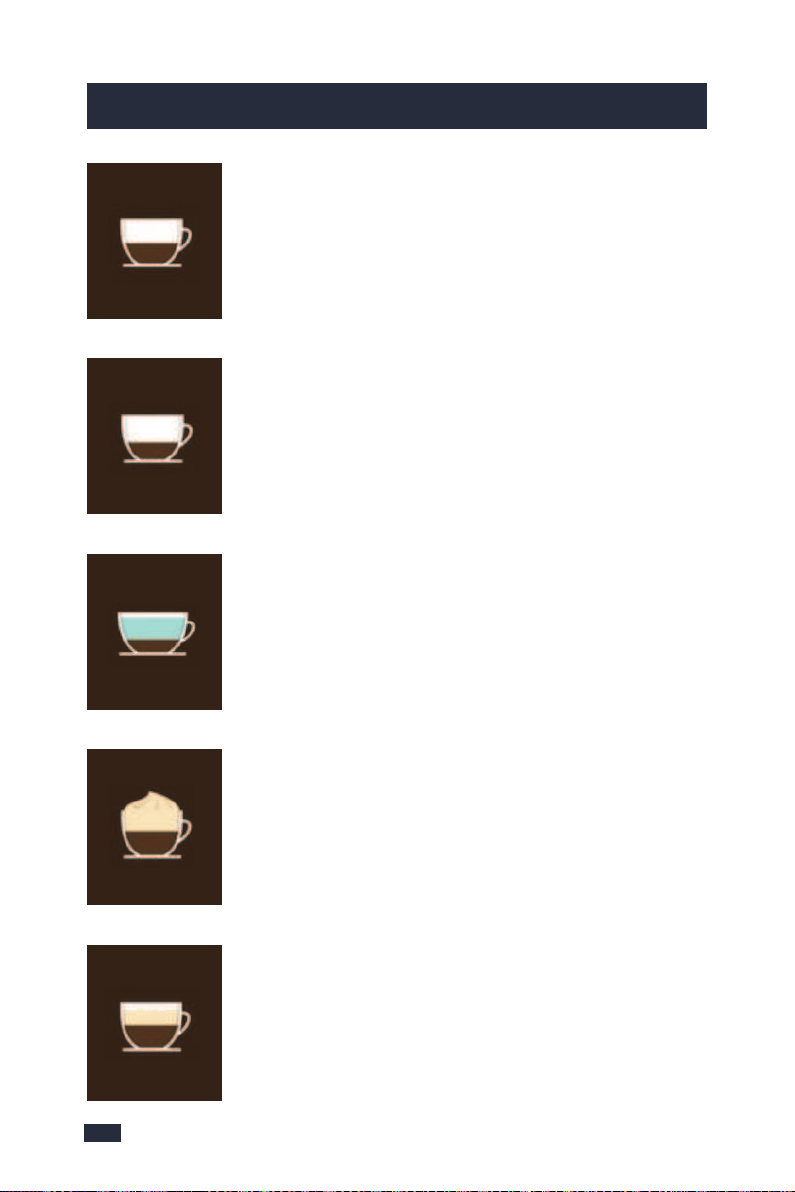
6867
Espresso (Short Black)
Espresso is a concentrated, full bodied coffee with a
stable layer of crema on top. An espresso is the
foundation of all cafe coffee.
• Espresso glass (3 oz)
• Single or double shot of espresso (1-2 oz)
Ristretto
A ristretto is an extremely short espresso, distinguished
by its intense flavor, aftertaste and its thin crema on top.
• Espresso cup (1 oz)
• Half a single shot of espresso (0.5 oz)
Long Black (Americano)
A standard espresso with hot water added. The hot
water is added first so that the crema is maintained.
• Cup (6 oz)
• Hot Water (to preference)
• Single or double shot of espresso (1-2 oz)
Con Panna
Con Panna, Italian for "with cream", made up of an
espresso topped with lightly whipped cream. It can
also be dusted with cinnamon or chocolate.
• Cup (6 oz)
• Single or double shot of espresso (1-2 oz)
• Lightly whipped cream - dusted cinnamon
Macchiato
Macchiato, Italian for ,'to stain or mark'. Traditionally
served as a standard espresso with a dash of cold or
frothed milk & a small dollop of foam into the middle
of the crema.
• Espresso glass (3 oz)
• Single or double shot of espresso (1-2 oz)
• Dash of cold or frothed milk & small dollop of foam
Flat White
An espresso with frothed milk & a thin layer of foam
milk on top. The wider cup will create the slim layer of
foam, the signature of the flat white.
• Wide cup (6 oz)
• Single or double shot of espresso (1-2 oz)
• Frothed milk & foam
Latte
An espresso with frothed milk & a finger width layer of
foam milk on top. The narrower cup will create the
thicker layer of foam.
• Glass or Cup (7 oz)
• Single or double shot of espresso (1-2 oz)
• Frothed milk & foam
Cappuccino
An espresso with 1/3 steamed frothed milk, topped with
1/3 creamy foam & a dusting of chocolate.
• Cup (6-8 oz)
• Single or double shot of espresso (1-2 oz)
• 1/3 frothed milk, 1/3 foam - dusted with chocolate
Mocha
Made in a similar way to a cappuccino but with the
addition of chocolate. Simply stir the chocolate into
the espresso prior to adding the steamed milk & foam.
• Cup or tall glass (6-8 oz)
• Single or double shot of espresso (1-2 oz)
• Chocolate Syrup (to preference)
• 1/3 Frothed milk, 1/3 foam
Babyccino
Steamed frothed milk with a layer of foamed milk.
It can also be dusted with chocolate.
• Small cup (3 oz)
• No shot of espresso
• Frothed milk & foam - dusted with chocolate
17. Coffees To Try
17. Coffees To Try
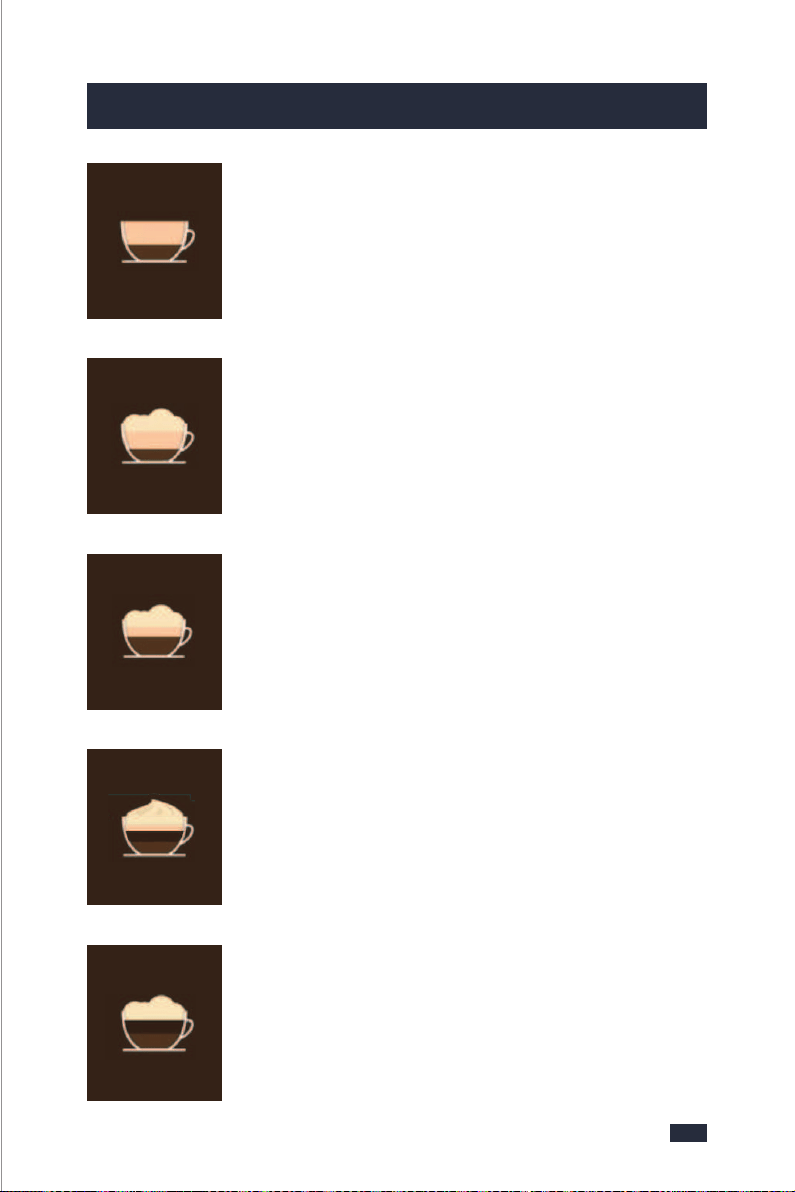
6867
Espresso (Short Black)
Espresso is a concentrated, full bodied coffee with a
stable layer of crema on top. An espresso is the
foundation of all cafe coffee.
• Espresso glass (3 oz)
• Single or double shot of espresso (1-2 oz)
Ristretto
A ristretto is an extremely short espresso, distinguished
by its intense flavor, aftertaste and its thin crema on top.
• Espresso cup (1 oz)
• Half a single shot of espresso (0.5 oz)
Long Black (Americano)
A standard espresso with hot water added. The hot
water is added first so that the crema is maintained.
• Cup (6 oz)
• Hot Water (to preference)
• Single or double shot of espresso (1-2 oz)
Con Panna
Con Panna, Italian for "with cream", made up of an
espresso topped with lightly whipped cream. It can
also be dusted with cinnamon or chocolate.
• Cup (6 oz)
• Single or double shot of espresso (1-2 oz)
• Lightly whipped cream - dusted cinnamon
Macchiato
Macchiato, Italian for ,'to stain or mark'. Traditionally
served as a standard espresso with a dash of cold or
frothed milk & a small dollop of foam into the middle
of the crema.
• Espresso glass (3 oz)
• Single or double shot of espresso (1-2 oz)
• Dash of cold or frothed milk & small dollop of foam
Flat White
An espresso with frothed milk & a thin layer of foam
milk on top. The wider cup will create the slim layer of
foam, the signature of the flat white.
• Wide cup (6 oz)
• Single or double shot of espresso (1-2 oz)
• Frothed milk & foam
Latte
An espresso with frothed milk & a finger width layer of
foam milk on top. The narrower cup will create the
thicker layer of foam.
• Glass or Cup (7 oz)
• Single or double shot of espresso (1-2 oz)
• Frothed milk & foam
Cappuccino
An espresso with 1/3 steamed frothed milk, topped with
1/3 creamy foam & a dusting of chocolate.
• Cup (6-8 oz)
• Single or double shot of espresso (1-2 oz)
• 1/3 frothed milk, 1/3 foam - dusted with chocolate
Mocha
Made in a similar way to a cappuccino but with the
addition of chocolate. Simply stir the chocolate into
the espresso prior to adding the steamed milk & foam.
• Cup or tall glass (6-8 oz)
• Single or double shot of espresso (1-2 oz)
• Chocolate Syrup (to preference)
• 1/3 Frothed milk, 1/3 foam
Babyccino
Steamed frothed milk with a layer of foamed milk.
It can also be dusted with chocolate.
• Small cup (3 oz)
• No shot of espresso
• Frothed milk & foam - dusted with chocolate
17. Coffees To Try
17. Coffees To Try