
User Manual
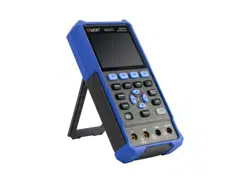
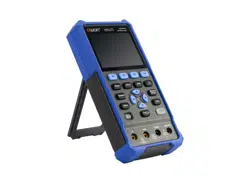
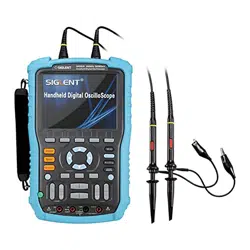
SHS800 Series Handheld Digital Oscilloscope
UM03008-E05A
SIGLENT TECHNOLOGIES CO,.LTD


SHS800 Series I
Declaration
1. Copyright © SIGLENT TECHNOLOGIES CO., LTD.
2. Information in this manual takes place of all data published before.
3. SIGLENT company reserves the rights to change specifications and price.
4. Contents in this manual are not allowed to be copied, extracted and
translated without permission by the company.

II SHS800 Series
Safety Information
Carefully read the following safety information before using the SHS800.
Specific warning and caution statements, where they apply, appear throughout the
manual.
A “Warning” identifies conditions and actions that pose hazard(s) to the user.
A “Caution” identifies conditions and actions that the user should notice.
The following international symbols are used on the SHS800 and in this manual:
Hazardous Protective Warning Earth Ground Power
Voltage Earth Ground Switch
Use only insulated voltage probes, test leads and adapters supplied
with the SHS800, or accessories appointed by the company.
Before use inspect voltage probes, test leads and accessories for
mechanical damage and replace when damaged.
Always connect the battery charge first to the AC outlet before
connecting it to the SHS800.
Do not apply voltages that higher than 600 V from earth ground to any
input when using scope ports in a CAT Ⅲ environment. Do not apply
voltages that higher than 1000 V from earth ground to any input when
using scope ports in a CAT Ⅱ environment.
Do not apply input voltages above the rating of the instrument. Use
caution when using 1:1 test leads because the probe tip voltage will be
directly transmitted to the SHS800.
Do not apply voltages that higher than 300 V from earth ground to any
input when using multimeter ports in a CAT Ⅲ environment. Do not
apply voltages that higher than 600 V from earth ground to any input
when using multimeter ports in a CAT Ⅱ environment.
Do not apply voltages that higher than 300 V from earth ground to the
isolated inputs when using multimeter ports in a CAT Ⅲ environment.
Do not apply voltages that higher than 600 V from earth ground to the
isolated inputs when using multimeter ports in a CAT Ⅱ environment.

SHS800 Series III
Do not insert metal objects into connectors.
Use of the SHS800 in a manner not specified may impair the
protection provided by the equipment. Before use, inspect the test
leads for mechanical damage and replace damaged test leads!
Whenever it is likely that the safety has been impaired, the SHS800
must be turned off and disconnected from the line power. The matter
should then be referred to qualified personnel.
Warning:
Standard probe 10:1 supports CAT Ⅱ 400V.
Optional probe supports CAT Ⅱ 1000V and CAT Ⅲ 600V
IV SHS800 Series
Safety Operation of Battery
SHS800 series handheld digital oscilloscope can be used to test float signal when
power supplied by battery. When using the double channels to test float signal, the two
channels should be connected to the same earth ground, because the earth ground of
the two channels is connected
Warning:
Do not connect the ground spring to voltages higher than 42 V peak or 30Vrms from
earth ground.
Warning:
Do not use USB line to connect SHS800 to any instruments (such as computer, printer
and so on) which connected to the earth ground, or the SHS800 and the instruments
connected with will be burned.

SHS800 Series V
Introduction of SHS800 Series
This manual mainly introduces SHS800 series Handheld Digital Oscilloscope.
The SHS800 series is a high performance handheld oscilloscope with great range of
dynamic input scope. It has small volume which convenient to carry, compact interface
and etc. It satisfies the most needs of outside measurement and improves working
efficiency greatly.
Function Characteristics
The SHS800 combines the functions of oscilloscope, multimeter and recorder
(including trend plot and waveform recorder) along with double channels.
Oscilloscope channels input voltage grade: voltage inputs directly through a
BNC probe is as high as CATⅡ 300V and CAT Ⅲ 150v.
Standard probe: 10X CATⅡ 400
Optional probe: 10X CATⅡ 1000V and 10X CAT Ⅲ 600V
Oscilloscope and multimeter safety grade is CATⅡ 600V and CAT Ⅲ 300V
5.7 inches color TFT LCD.
It provides maximal bandwidth 200MHz, real time sampling rate 1GSa/s,
memory depth 2Mpts.
The multimeter display resolution is 6000 points and can measure voltage,
current, resistance, capacitance, diode, continuity.
Support scope measure parameters trend plot, multimeter measure
parameter trend plot and scope waveform recorder.
3 types of trigger mode: auto, normal and single; 5 types of trigger type: edge,
pulse, video, slope and alternative.
32 types of auto-measurement function and 3 types of cursor measure mode.
5 kinds of digital filter mode: +, -, *, /, FFT.
Unique digital filter function and waveform recording function.
2 groups of reference waveform, 20 groups of common waveform, 10 groups
of setting inside save / recall; Support waveform, setting, CSV and bitmap file
save and recall with USB flash driver.
Standard configuration interface: USB Device, USB Host. Support software
update with USB flash driver, PC remote control and PicBridge print.
For its build-in Li battery and small volume, it’s convenient to carry and work
outside.

VI SHS800 Series
Accessories of SHS800
A user manual
A product guaranty card
A certification
Two 1:1/10:1 probes
An USB cable
A adapter
Meter pens for multimeter
A Probes calibrated device
A CD (including EasyScope3.0 computer software system)
Optional Probe
100MHz high-voltage safety probe C
A
T II 1000V,C
A
T III
600 V

SHS800 Series VII
Table of Contents
Safety Information ..................................................................................................................... II
Safety Operation of Battery .................................................................................................... IV
Introduction of SHS800 Series ................................................................................................ V
Function Characteristics ......................................................................................................... V
Accessories of SHS800 ......................................................................................................... VI
Chapter 1 Accidence .................................................................................................................. 1
Accidence of the Front Panel and User Interface .................................................................. 1
Function Check ......................................................................................................................... 4
Chapter 2 Using the Scope ....................................................................................................... 5
Menu and Control Buttons ....................................................................................................... 5
Automatic Settings.................................................................................................................... 6
CH1/CH2 Channel Functions .................................................................................................. 6
Scope’s Function Menu............................................................................................................ 9
Acquire Signals System .................................................................................................... 9
Display System ................................................................................................................ 11
Math Waveform ................................................................................................................ 13
Horizontal System ............................................................................................................ 15
Reference waveform ....................................................................................................... 17
Cursor and Measure System ................................................................................................. 18
Cursor measure ............................................................................................................... 18
Parameter Measure ......................................................................................................... 20
Trigger System........................................................................................................................ 25
Save and Recall System ........................................................................................................ 33
Utility System .......................................................................................................................... 37
Chapter 3 Using the Multimeter ............................................................................................. 43
Making DC and AC Voltage Measurement ........................................................................... 44
Making Resistance Measurement ......................................................................................... 45
Making Diode Measurement .................................................................................................. 46
Making Continuity Measurement ........................................................................................... 46
Making Capacitance Measurement ....................................................................................... 47
Making DC and AC Current Measurement ........................................................................... 48
Chapter 4 Using the Recorder Functions ............................................................................ 50
Oscilloscope Trend Plot ......................................................................................................... 51
Waveform Recorder ............................................................................................................... 54
Multimeter Trend Plot ............................................................................................................. 57
Chapter 5 Prompting and Troubleshooting ......................................................................... 60
System Prompting Messages Instruction ............................................................................. 60
Troubleshooting ...................................................................................................................... 62

VIII SHS800 Series
Chapter 6 Service and Support .............................................................................................. 64
Maintain Summary.................................................................................................................. 64
Contact SIGLENT ................................................................................................................... 64
Appendix A: Default Setup ..................................................................................................... 65
Appendix B: Battery Installation ............................................................................................ 67
Appendix C: Daily Maintaining and Cleaning ...................................................................... 6
8
SHS800 Series 1
Chapter 1 Accidence
About this Chapter
This chapter mainly covers the following contents:
Get a primary understanding of the front panel and user interface
A brief function check
Probe compensation
Accidence of the Front Panel and User Interface
You’d better get an understanding of the front panel before you operate the SHS800
series Handheld Digital Oscilloscope. The following contents introduce the function of
the front panel. With its help you could be familiar with the operations of the SHS800 in
a short time.
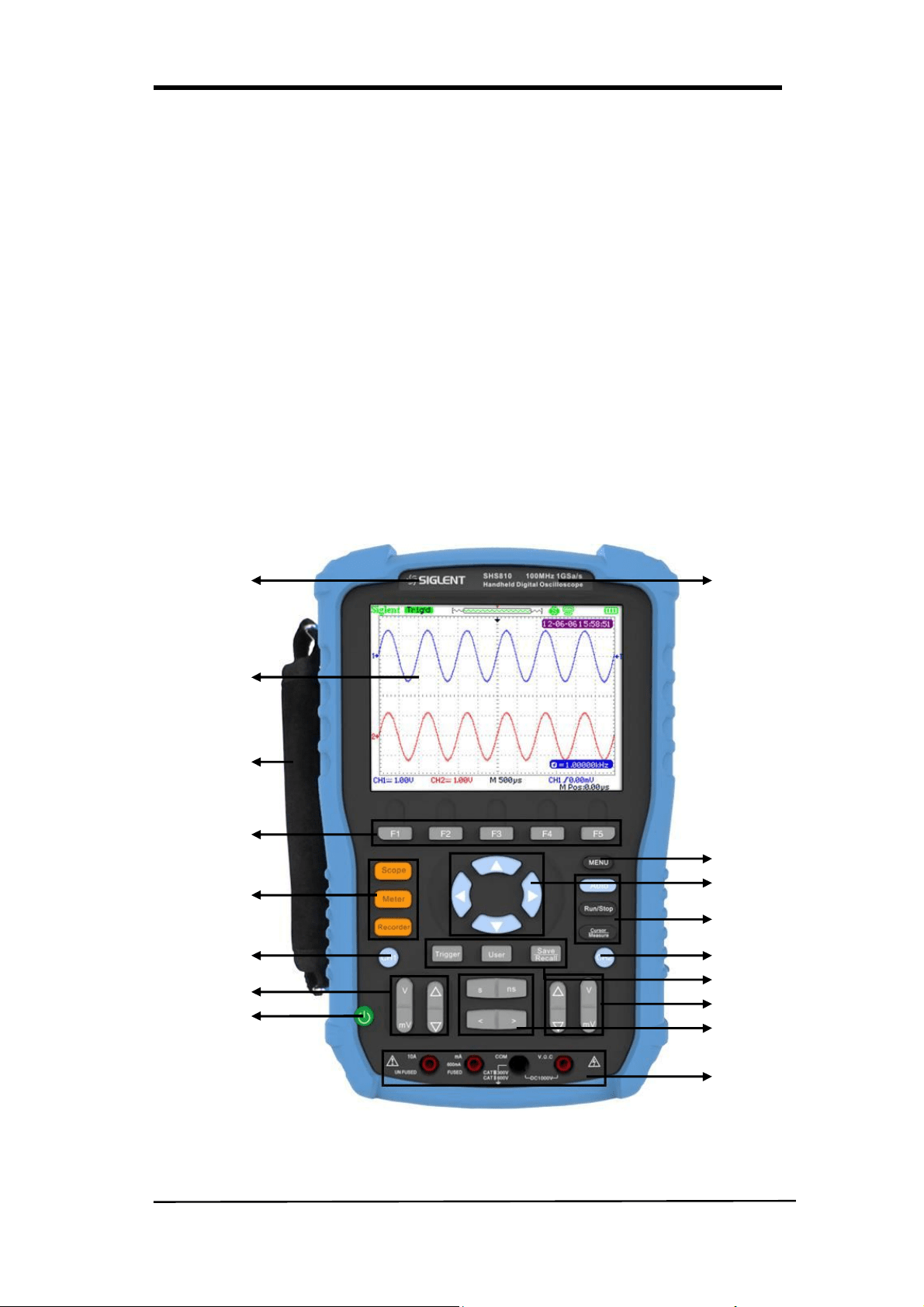
Figure 1-1 Front Panel
1
2
3
4
5
6
7
8
9
10
11
12
13
14
15
17
16
2 SHS800 Series
Description
1. power on/off key
2. CH1 vertical range and position key
3. CH1 on /off key
4. Scope, Meter, Recorder function
menu
5. option keys
6. Handle
7. LCD
8. LOGO
9. BW and sample rate
10. menu on/off key
11. arrow keys
12. Auto, Run/Stop, Cursor function
keys
13. CH2 on/off key
14. Trigger, User, Save/Recall function
keys
15. CH2 vertical range and position keys
16. time base and horizon position keys
17. multimeter input ports
Notes:
The arrow keys include these functions: direction keys, moving trigger level, setting
the trigger level to zero, choosing menu, setting horizontal position to zero, moving
cursor.
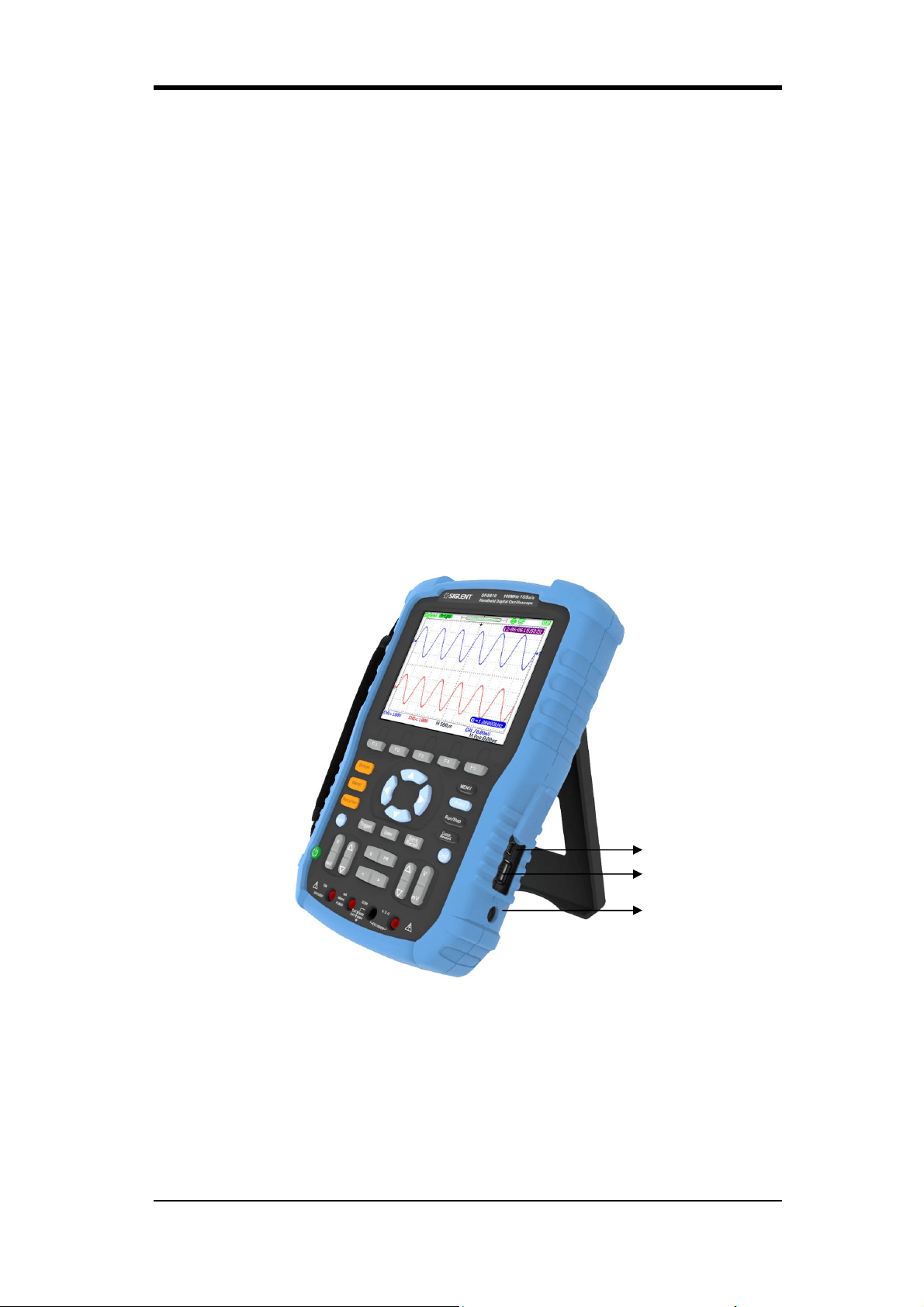
Figure 1-2 Side Panel
Description
1. USB Device
2. USB Host
3. power input port
1
2
3
SHS800 Series 3
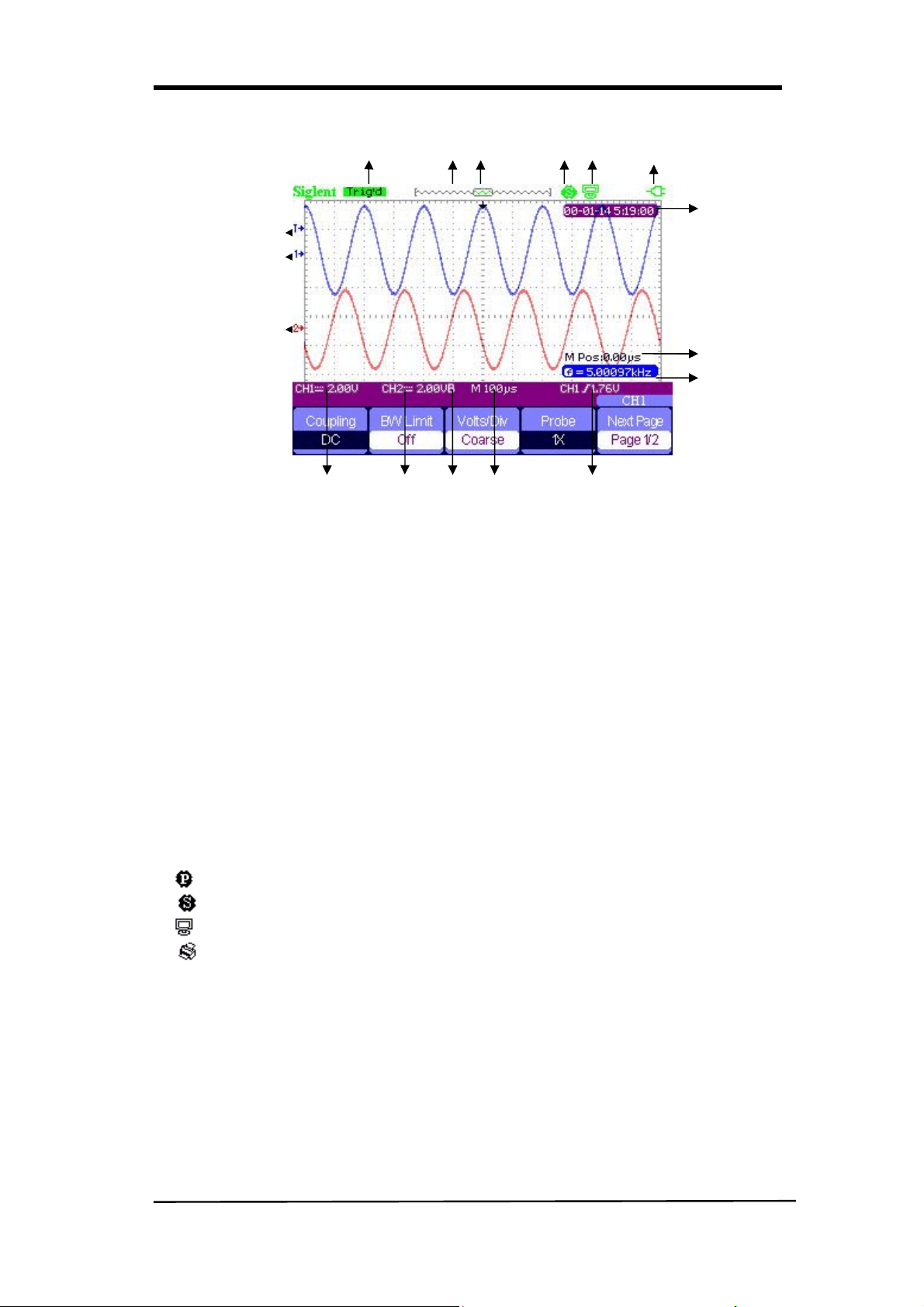
Figure 1-3 User Interface
Description
1. Trigger state
Armed: The scope is acquiring data of pre-trigger ,please ignore all triggers under
this state.
Ready: The scope has sampled all pre-triggers data and is ready to accept trigger.
Trig’d: The scope has found a trigger and is sampling data after trigger.
Stop: The scope stops sampling data.
Auto: The scope is sampling waveform without trigger under automatic mode.
Scan: The scope samples and displays waveform under scan mode.
2. Shows location of current waveform in the memory
3. Shows the trigger position in the memory
4. : Print Key option chooses to print figure
: Print Key option chooses to save figure
5. : USB Device option chooses to connect computer
: USB Device option chooses to connect printer
6. Shows power state
7. Shows current time
8. Horizontal position
9. Frequency Counter
10. Shows the trigger level
11. Shows the time base
12. “B” shows the BW limited is on
13. Channel’s vertical range
14. Channel’s coupling states
15. “2” is a symbol of channel 2
16. “1” is a symbol of channel 1
17. “T “shows the trigger level
1
2 3 4 5 6
7
8
9
10 11 12 13 14
15
16
17

4 SHS800 Series
Function Check and Probe Compensation
Function Check
Let’s make a quick function check to make sure whether the SHS800 works normally.
Please do the following steps:
1. Power the SHS800. The SHS800 performs all the self check items and makes sure
that it passes the self check.
2. Connect the probe to the CH1 of the SHS800. Align the slot of the probe connector
with the salient on the CH1 BNC, push down and twist right to lock the probe.
Connect the probe tip and reference lead to the Probe Comp connectors.
3. Press 【Auto】, you will see a square wave with 1 KHz frequency and about 3V
peak-peak in a few seconds.
4. Press 【CH1】 twice to cancel channel 1, then press 【CH2】 to display channel
2 and repeat step 2 and 3.
Probe Compensation
When you connect the probe to an arbitrary channel for the first time, please make the
following adjustment to make the probe match with the channels. Probe without
compensation or compensation warp may lead to imprecise or false measurements.
You can perform the adjustments manually to match your probe with the input channels.
1. Set the probe option attenuation in the channel menu to 10X and connect the probe
to channel 1 on the scope. If you use the probe hook-tip, make sure that the
hook-tip is fixed on the probe firmly.
2. Attach the probe tip to the Probe Comp~3V connector and the reference lead to
the Probe Comp Ground connector. Display the channel and then push button
【Auto】.
3. Check the shape of the waveform displaying on the screen.
Under Compensated Correctly Compensated Over Compensated
4. Please adjust your probe or repeat all the operations above if necessary.
Multimeter meter pen
To avoid obtaining no measurements or unnecessary damage to the SHS800, you
should use the right jack when measuring current, voltage and other measure.

SHS800 Series 5
Chapter 2 Using the Scope
About this Chapter
This chapter provides a step-by-step introduction to the scope functions of SHS800
series. The introduction gives basic examples to show how to use the menus and
perform basic operations without d covering all of the capabilities of the scope
functions。
In order to use the SHS800 effectively, we need to know the functions of the SHS800
below. Menu and control buttons, connector and control, auto-settings, Scope,
measurement system, trigger system, storage system and utility system.
Menu and Control Buttons
Table 2-1 Function Menu
CH1, CH2 channel menu
Acquire sample menu
Display display menu
Math math menu
Horizon horizon menu
Ref reference waveform menu
MEAU on/off menu
Auto automatic setting control menu
Run/Stop sample/Stop button
Cursor cursor menu
Measure automatic measurement menu
Trigger trigger menu
Save/Recall save/Recall menu
User utility menu
6 SHS800 Series
Automatic Settings
When measuring unknown signals and having no idea about its voltage, range,
frequency, trigger and other information, you can use the automatic setting function.
Automatic Setting Application Example
Operating steps:
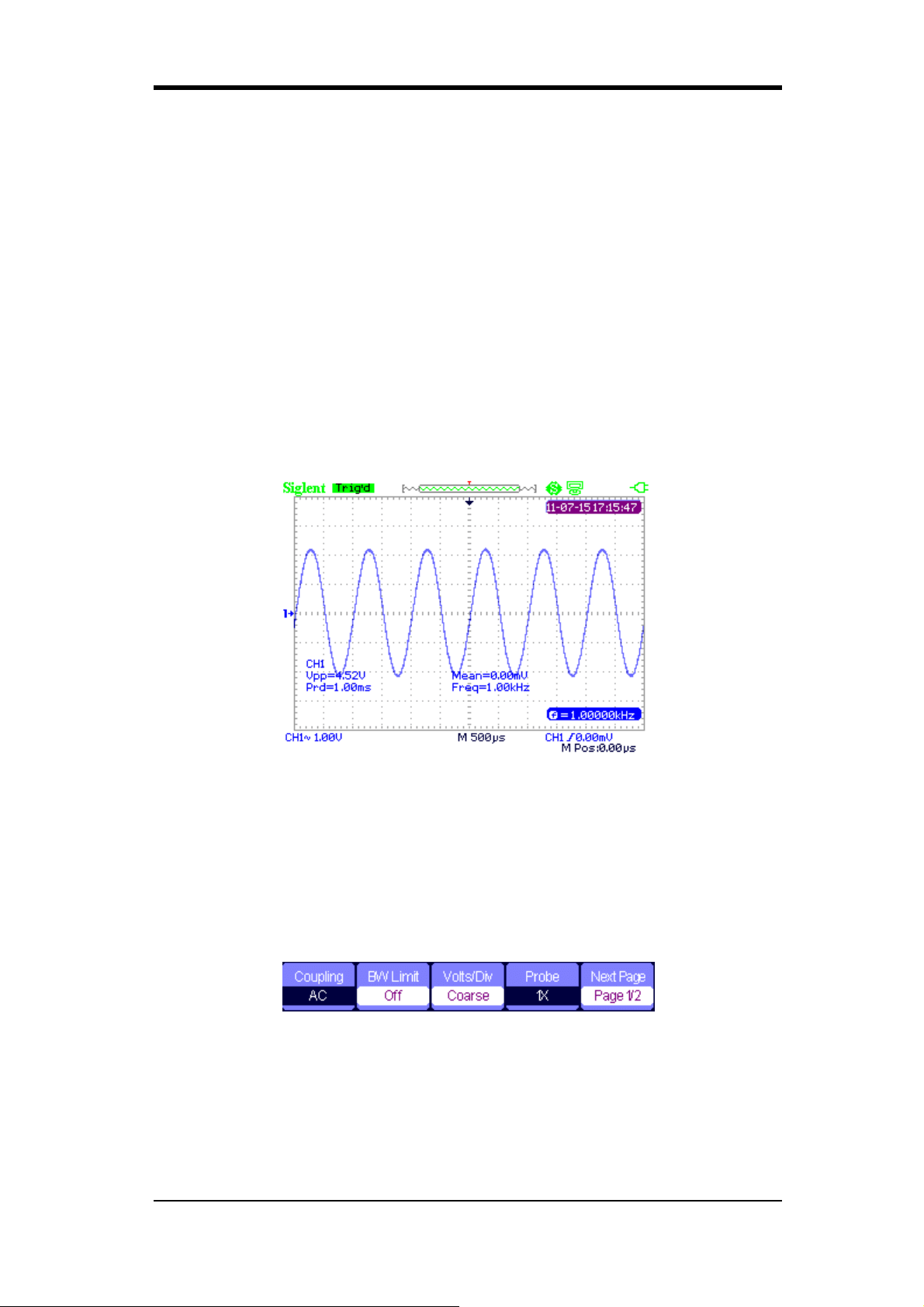
1. Input a signal to CH1 or CH2 and then press 【Auto】.
2. The SHS800 adjusts its settings automatically to display the best peak-peak,
average, period, frequency and other information according to the characteristics of
the signals.
3. Adjust time base and voltage range manually to obtain waveforms needed if
necessary.
Figure 2-1 Automatic Setting
CH1/CH2 Channel Functions
Press 【CH1】/【CH2】 to enter CH1/CH2 channel menu.
Figure 2-2 Channel Menu 1
SHS800 Series 7
Table 2-2 CH1/CH2 function Menu 1
Option Setting Instruction
Coupling
DC
DC passes both AC and DC
components of the input signals.
AC
AC blocks the DC component of the
input signals and attenuates signals
below 10 Hz.
GND GND disconnects the input signal.
BW Limit
On
Off
Limit the bandwidth above 20M to
reduce display noise; filter the signals to
reduce noise and other unwanted high
frequency components.
V/div
Coarse
Change the range of voltage by .1-2-5
sequence.
Fine
Fine changes the resolution by small
steps under the coarse settings.
Probe
1X、5X、10X、50X、
100X、500X、1000X
Set to match the type of probe you are
using to ensure correct vertical readouts.
Next Page Page1/2
Enter the second page of CH1/CH2
menu.
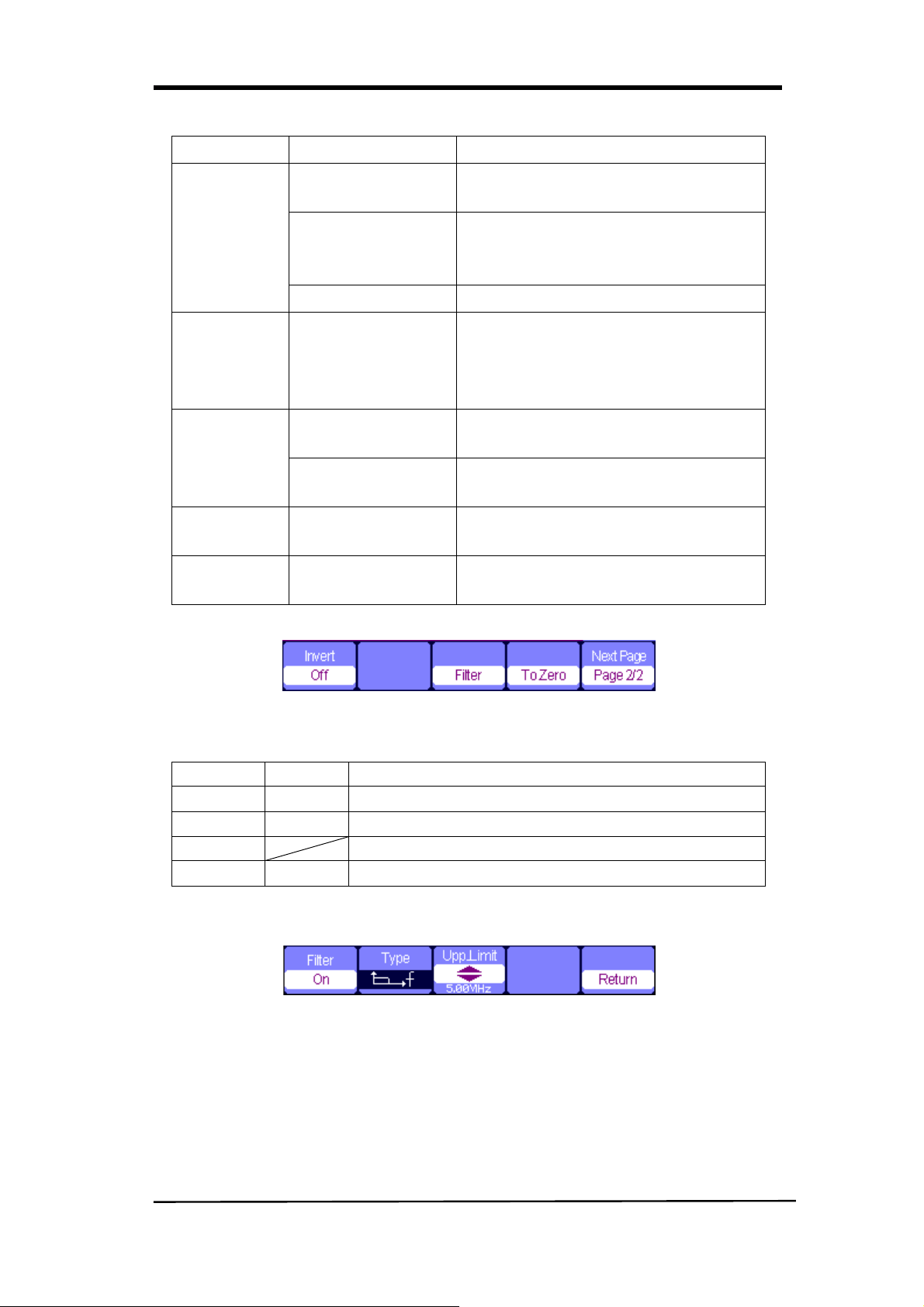
Figure 2-3 Channel Menu 2
Table 2-3 CH1/CH2 Function Menu 2
Option Setting Instruction
Invert On/Off Turn on/off invert function.
Filter
Enter the FILTER menu.
To Zero Set waveform vertical position and trigger level to zero.
Next Page Page 2/2 Return to the first page of CH1/CH2 menu.
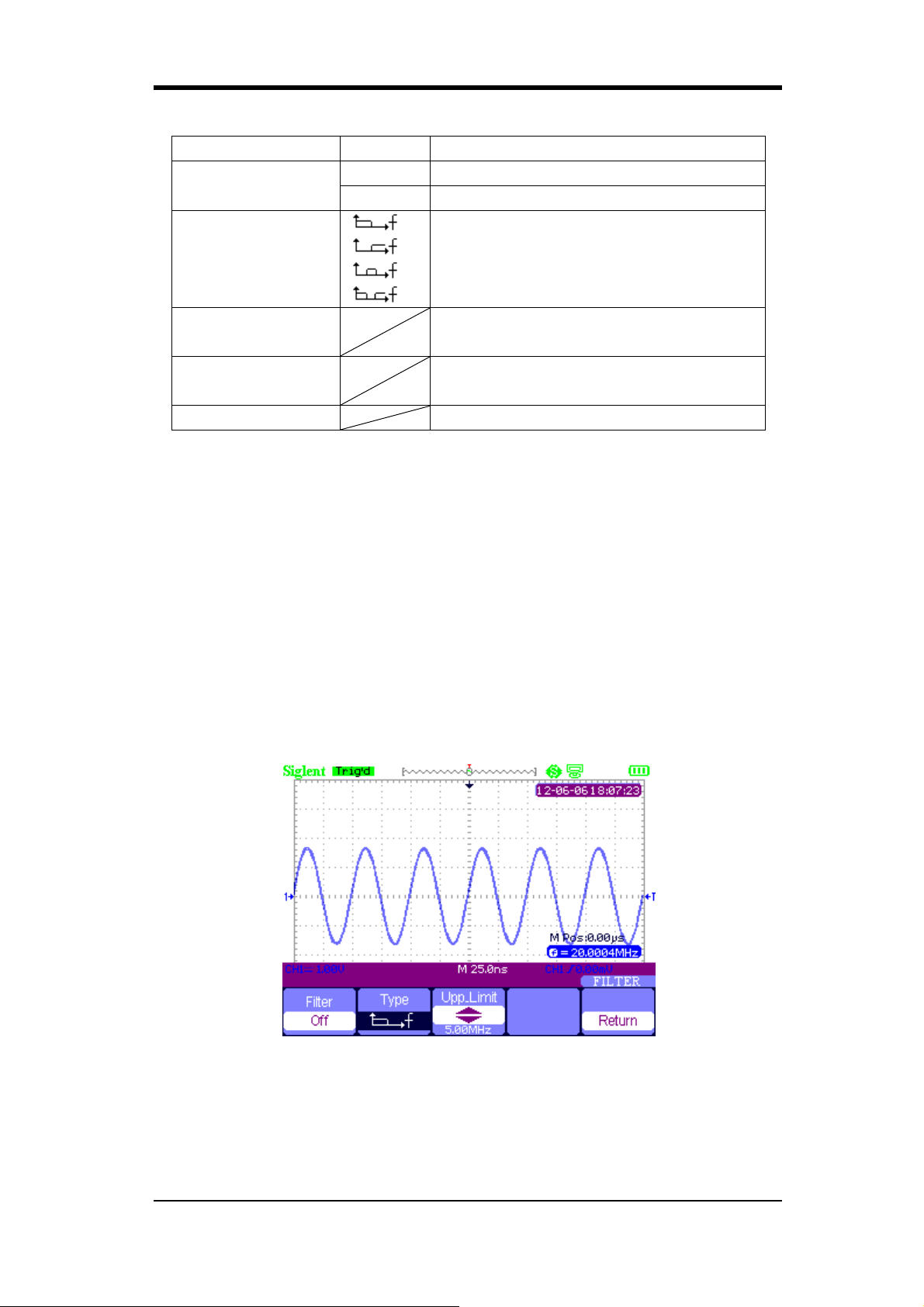
Figure 2-4 Digital Filter Function Menu
8 SHS800 Series
Table 2-4 Digital Filter Function Menu
Option Setting
Introduction
Digital Filter
On Turn on the digital filter.
Off Turn off the digital filter.
Type
Setup as LPF (Low Pass Filter).
Setup as HPF (High Pass Filter).
Setup as BPF (Band Pass Filter).
Setup as BRF (Band Reject Filter).
Up_Limit
Use the up and down arrow keys to set
Upp_Limit.
Low_Limit
Use the up and down arrow keys to set
Low_Limit.
Return Return to the CH1 or CH2 menu.
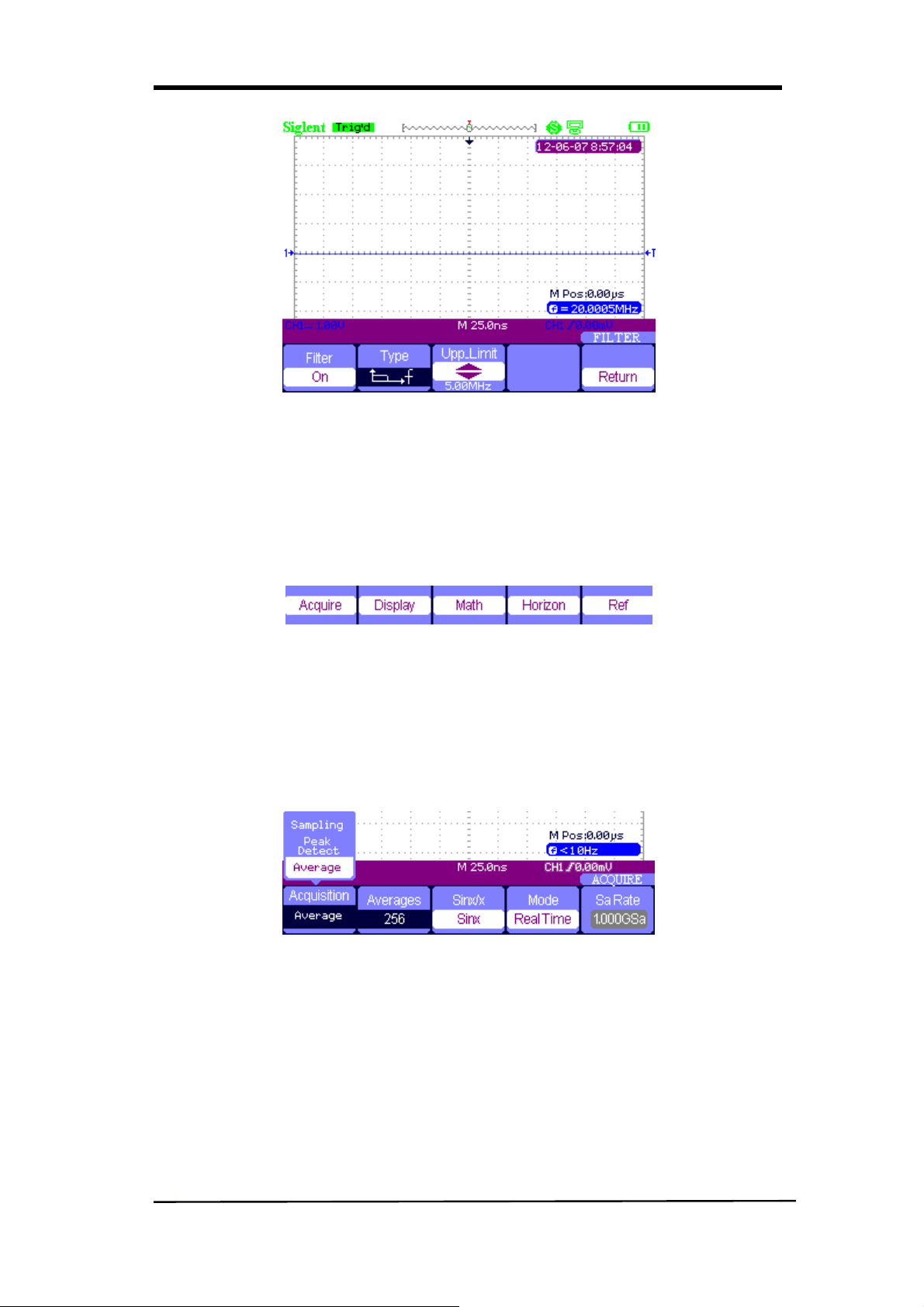
Digital Filter Application Example
Operation steps:
1. Input a signal to CH1 and press 【AUTO】.
2. Press 【CH1】 to enter CH1 menu.
3. Press 【F5】 to enter the second page of the CH1 menu.
4. Press 【F3】 to enter the digital Filter function.
5. Press F2 to choose a filter type. For example: input a signal with BW 20M and
choose Upp_Limit.
6. Use up and down arrow keys to set the filter range.
7. Press 【F1 】to turn on the filter
Figure 2-5 Before Turn On the Digital Filter
SHS800 Series 9
Figure 2-6 After Turn On the Digital Filter
Scope’s Function Menu
The button 【Scope】 includes the following functions:
Figure 2-7 Scope Function Menu
Acquire Signals System
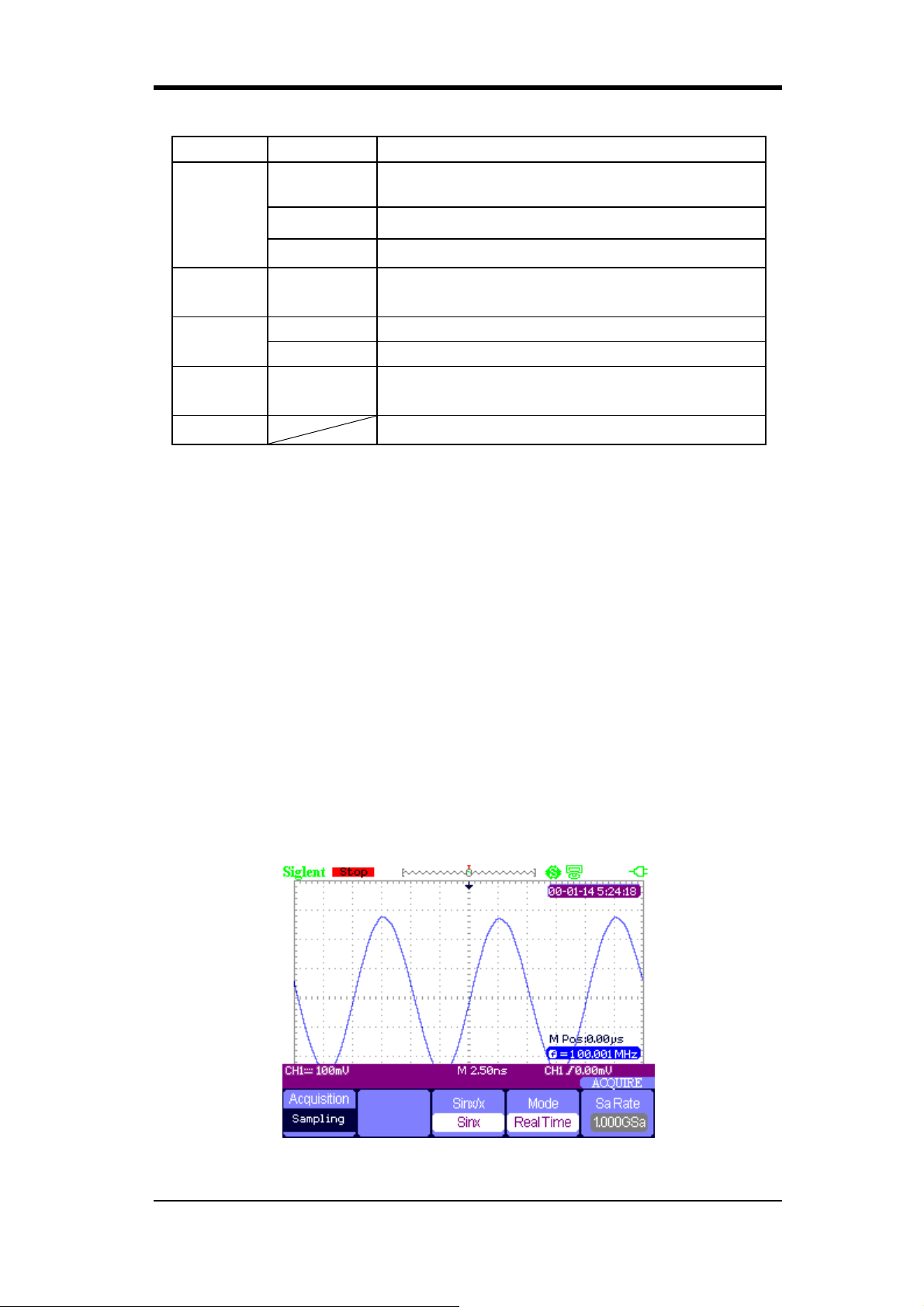
Press 【Scope】 and choose Acquire to enter acquiring system. See Figure 2-8.
Figure 2-8 Acquire Signals system function menu
10 SHS800 Series
Table 2-5 Acquiring Signals System Function Menu
Option Setting Introduction
Acquisition
Sampling Sample and display most waveforms accurately.
Peak Detect Detect burr and reduce fake wave phenomena.
Average Reduce random and irrelative noise.
Averages
(4, 16, 32,
64,128,256〕
Select the times of averages.
Sinx/x
sinx Use sin interpolation
x Use liner interpolation
Mode
Equ time
Real time
Set the Sampling mode to Equ time.
Set the Sampling mode to Real time.
Sa Rate Display system sampling rate.
Sampling: To construct the waveform, the scope samples the signals in equal interval.
Peak Detect: The scope captures the maximum and minimum values of the signals in
every interval to display the waveform.
Average: The scope acquires several waveforms, averages them, and displays the final
waveform. The more average times the smoother of the waveform.
Equivalent Time Sampling: This mode is good for observing repetitive period
waveforms. The sampling rate is up to 50GSa/s.
Real Time Sampling: The scope has the highest real-time sampling rate up to 1GSa/s.
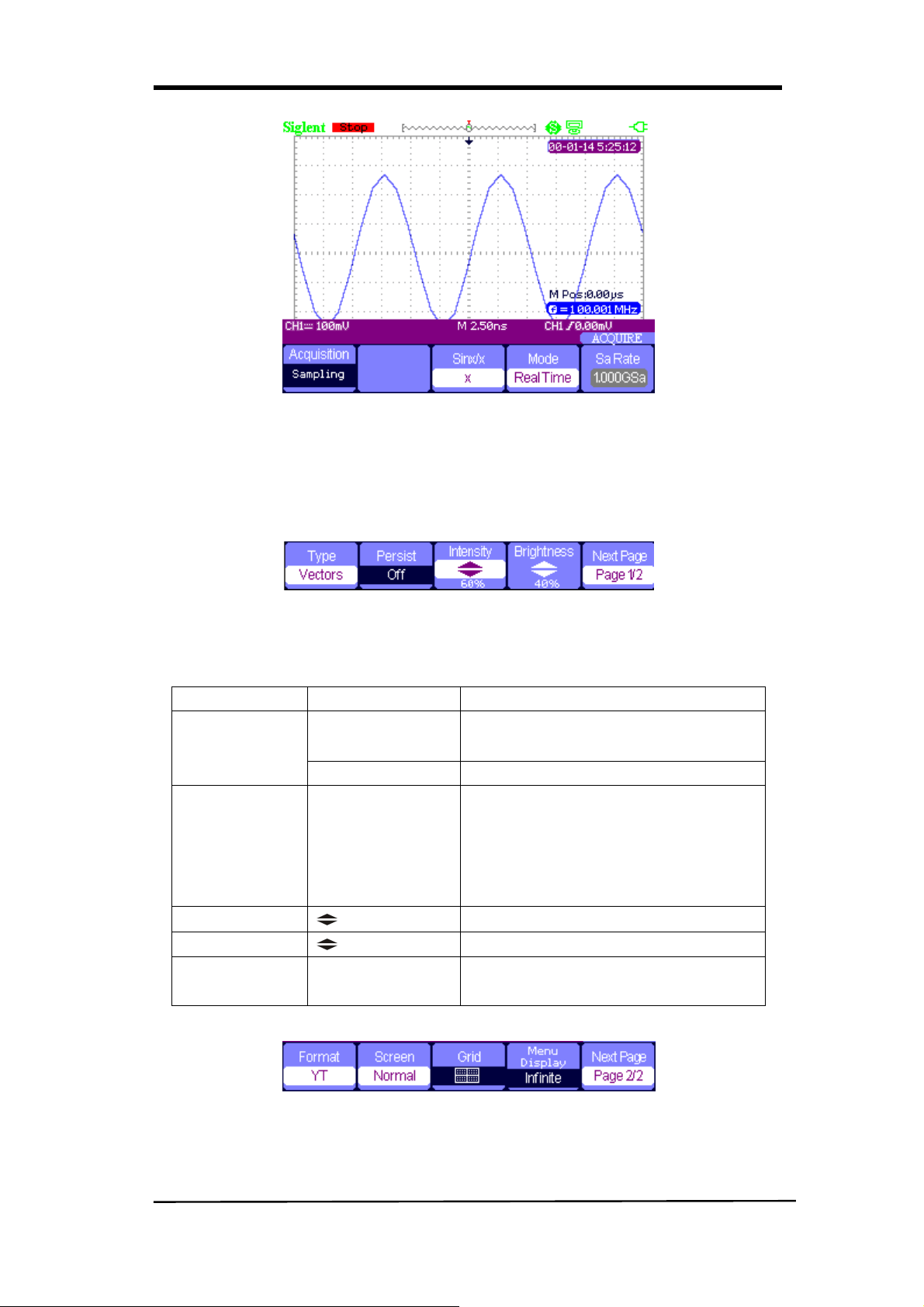
Interpolation (Sinx/x) Application Example
Operation steps:
1. Press 【Scope】 and choose Acquire to enter acquiring system.
2. Press 【F4】 to choose Ream Time.
3. Press 【F3】 to choose Sinx/x.
Figure 2-9 Sinx Interpolation
SHS800 Series 11
Figure 2-10 X Interpolation
Display System
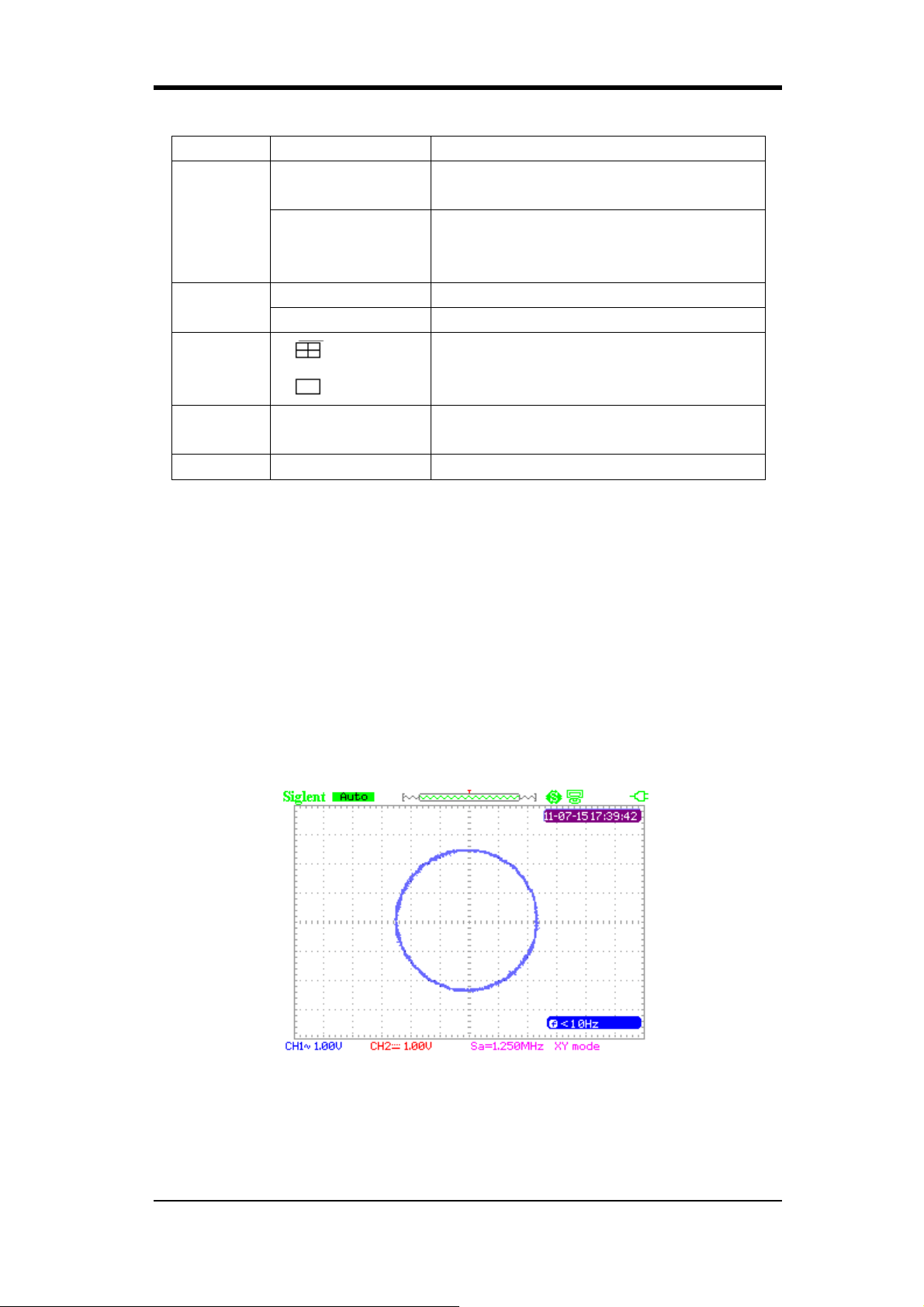
Press 【Scope】 and choose Display to enter display system. See Figure 2-6.
Figure 2-11 Display Menu 1
Table 2-6 Display System Function Menu
Option Setting Introduction
Type
Vectors
Vectors fill the space between adjacent
sample points in the display.
Dots Dots:display sample points directly.
Persist
Off
1 sec
2 sec
5 sec
Infinite
Sets the length of time each displayed
sample point remains displayed.
Intensity <Intensity> Set waveform intensity.
Brightness <Brightness> Set grid brightness.
Next Page Page 1/2
Enter the second page of DISPLAY
menu.
Figure 2-12 Display Menu 2
12 SHS800 Series
Table 2-7 Display system function menu 2:
Option Setting Introduction
Format
YT
YT format displays the vertical voltage in
relation to time (horizontal scale).
XY
XY format displays a dot each time a
sample is acquired on channel 1 and
channel 2.
Screen
Normal Set to normal mode.
Inverted Set to invert color display mode.
Grid
Display grids and axes on the screen.
Turn off the grids.
Turn off the grids and axes.
Menu
Display
2sec, 5sec, 10sec,
20sec, Infinite
Set display time of menu on the screen.
Next Page Page 2/2 Return to the first page of DISPLAY menu.
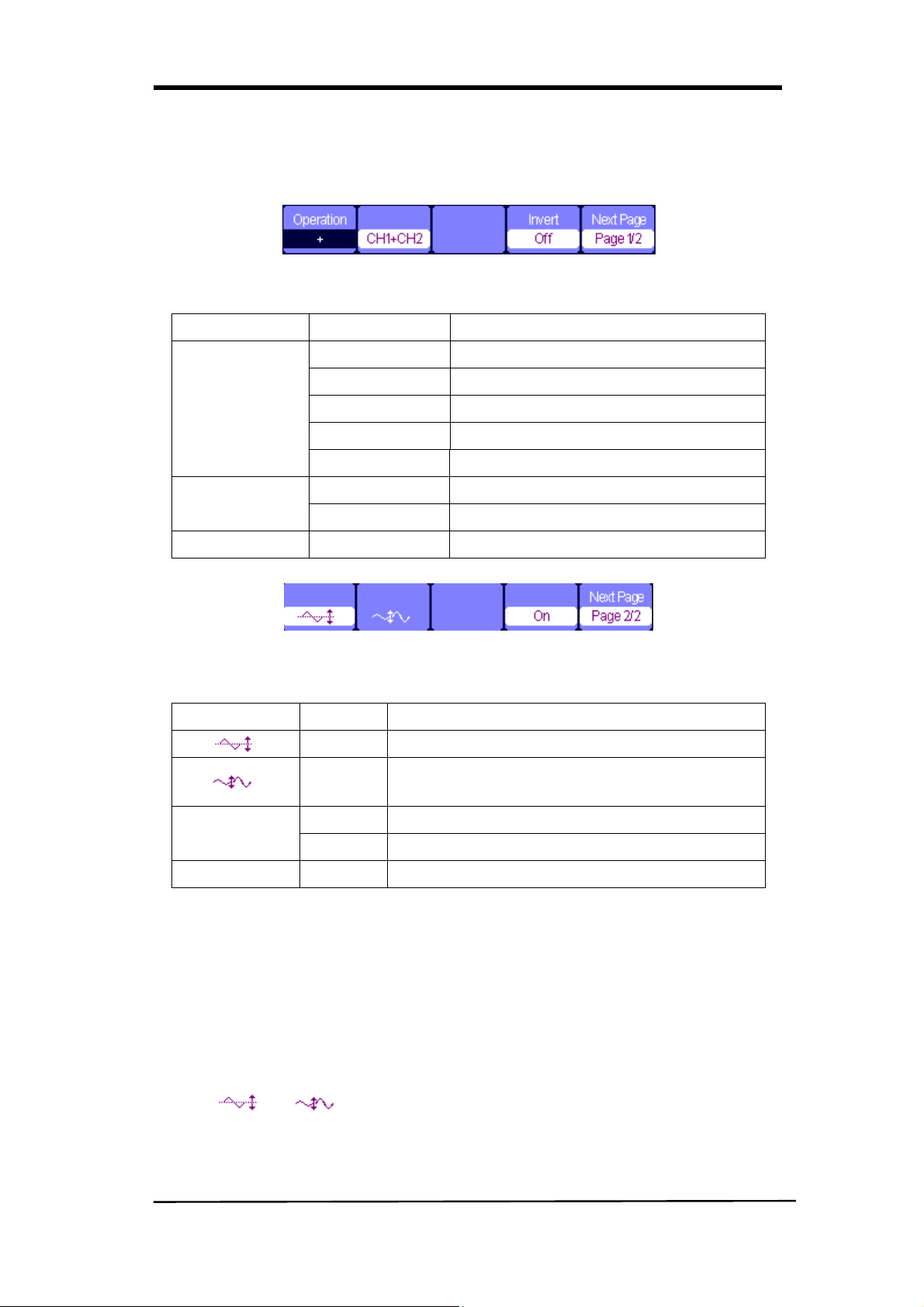
XY Waveform Application Example
Observe XY waveform, operation steps:
1. Input 2 sine signals to the channels with the same frequency, range and phase 90
degree difference, press the button 【Auto】.
2. Press 【Scope】 and choose Display to enter the display system.
3. Press 【Next Page】 to enter the second page of DISPLAY menu.
4. Press 【F1】 to choose XY mode.
5. Adjust the vertical range of CH 1 and CH 2 to obtain the best XY waveform.
Figure 2-13 XY Waveform
SHS800 Series 13
Math Waveform
Press 【Scope】 and choose Math to enter the math waveform function menu.
Figure 2-14 MATH Menu
Table 2-8 Math Menu Function
Option Setting Instruction
Operation
+ CH1+CH2
- CH1-CH2、CH2-CH1
* CH1*CH2
/ CH1/CH2、CH2/CH1
FFT
Fast Fourier Transform.
Invert
On
Invert the waveform.
Off
Turn off the invert function
Next Page
Page1/2
Enter the second page of MATH menu.
Figure 2-15 MATH Function Menu
Table 2-9 Addition operation
Option Setting
Instruction
Use arrow keys to move the waveform upright.
Use arrow keys to adjust the scale of math
waveform.
Waveform
Math Switch
On
Turn on the math waveform..
Off
Unique key turn off the math waveform.
Next page Page2/2
Return to the first menu off math waveform.
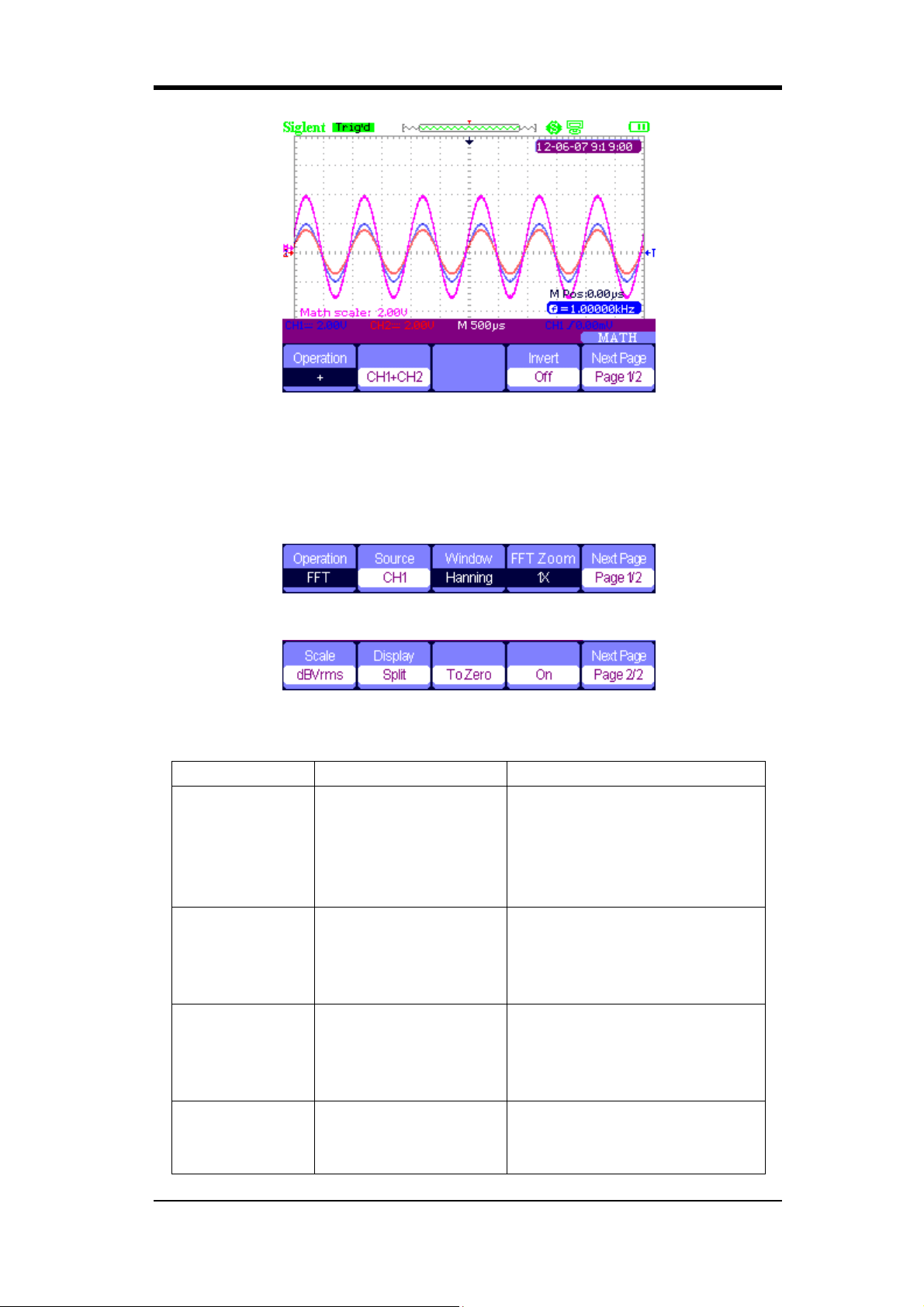
Waveform Math Application Example
Operation steps of adding two waveforms:
1. Input two signals to the channels and press 【Auto】.
2. Press 【Scope】 and choose Math to enter waveform operation.
3. Press 【F1】 to choose “+” operation.
4. Press 【F5】 to enter the second page of waveform operation menu.
5. Use and functions keys and the arrow keys to change the parameter to
display the best waveform.
6. Press 【F4】 to exit the math waveform operation.
14 SHS800 Series
Figure 2-16 Result of Two Waveforms Add
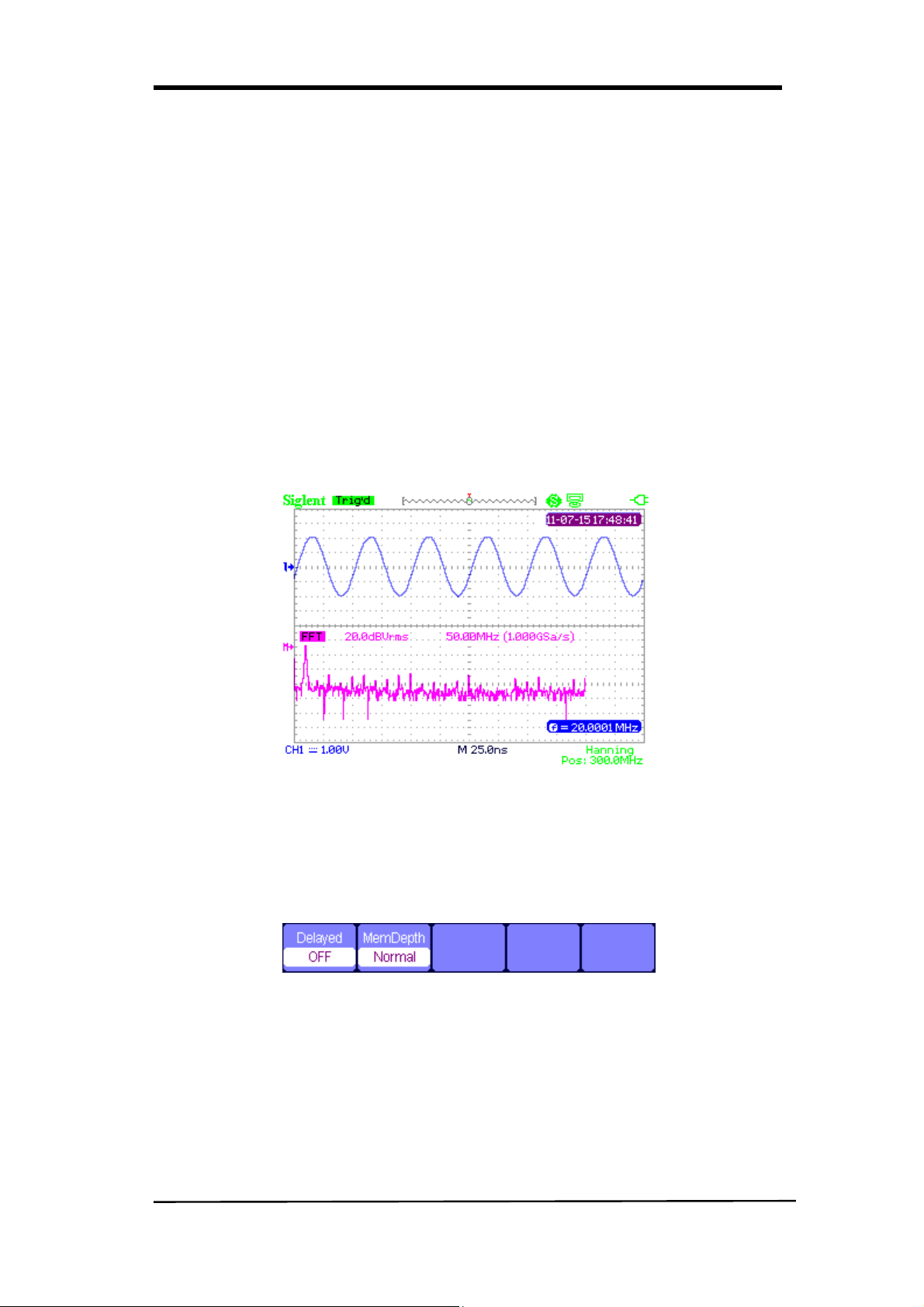
About FFT operation
Using FFT math operation can translate time field signal to frequency field signal.
Figure 2-17 FFT Function Menu 1
Figure 2-18 FFT Function Menu 2
Table 2-10 FFT Window Function
Window Characteristic Advantage content
Rectangular
The best frequency
resolution but the worst
magnitude resolution. It
is essentially the same
as no window.
Symmetric transients or bursts.
Equal-amplitude sine waves with
fixed frequencies. Broadband
random noise with a relatively
slowly varying spectrum.
Hanning
Better frequency,
poorer magnitude
accuracy than
rectangular
Sine, periodic, and narrow-band
random noise.
Hamming
Hamming has a slightly
better frequency
resolution than
Hanning.
Transients or bursts pulse. The
ranges of the signals have great
difference from before to after.
Blackman
Best magnitude
resolution but worst
frequency resolution.
Single frequency waveforms, to
find higher order harmonics.
SHS800 Series 15
FFT Zoom: zoom in FFT waveform vertically by 1X, 2X, 5X and 10X.
Scale: choose dBVrms or Vrms as a measure unit.
Display: Spilt or Full Screen FFT waveform display mode.
FFT Waveform Operation Application Example
Operation steps:
1. Input a signal to CH1 and press 【Auto】.
2. Press 【Scope】 and choose Math to enter waveform operation.
3. Press 【F1】 to choose FFT.
4. Press 【F5】 to enter the second page of the menu and adjust the setups.
5. Adjust the channel vertical scale and complete FFT waveform’s vertical position and
vertical scale settings.
6. Press 【F5】 to exit waveform operation.
Figure 2-19 FFT Waveform
Horizontal System
Press 【Scope】 and then choose Horizontal to enter the horizontal function menu.
Figure 2-20 Horizontal System Menu
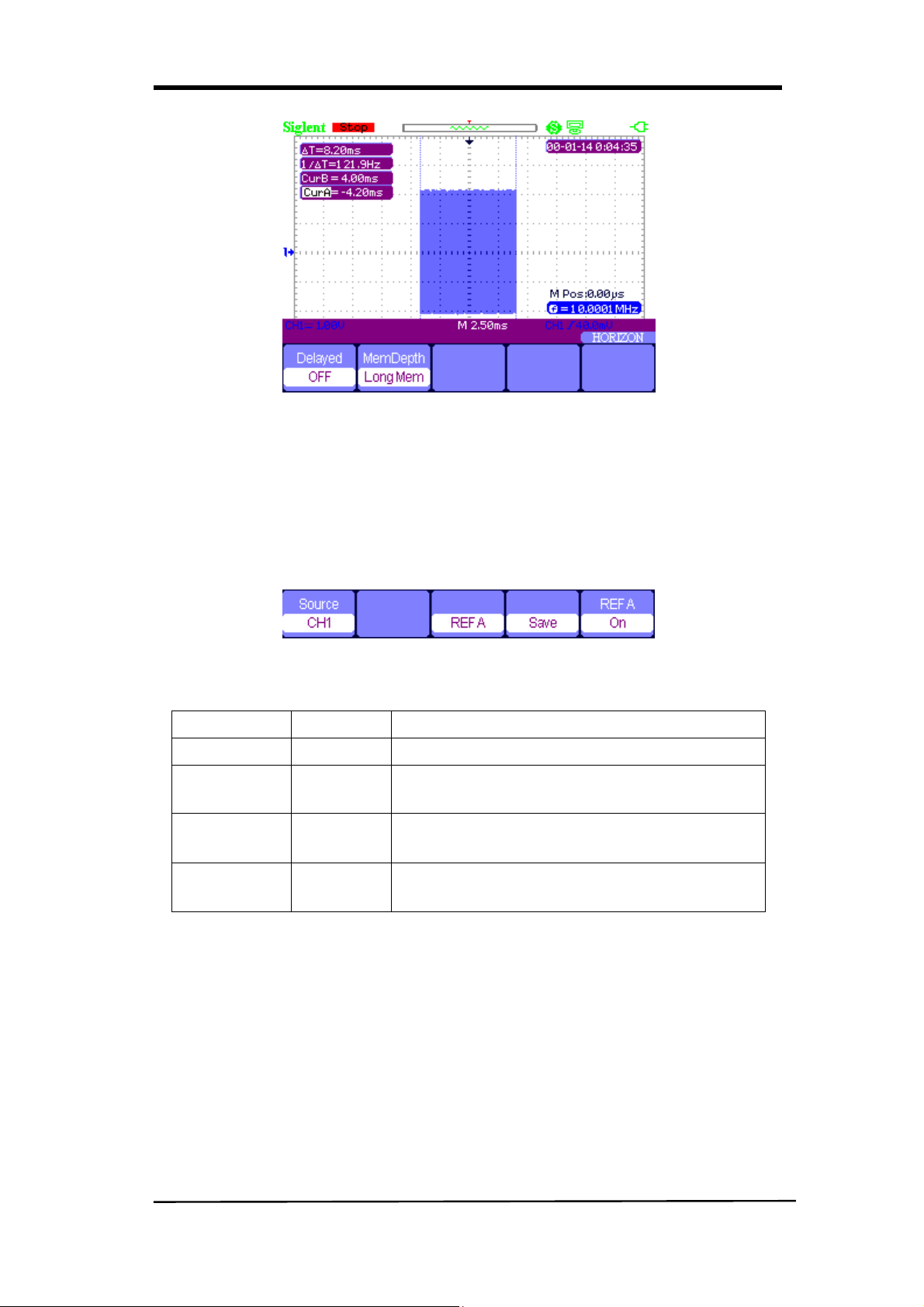
Delay scan: zoom in the waveform being chosen.
Memory depth: normal memory and long memory.

16 SHS800 Series
Delay Scan Application Example
Operation steps:
1. Input a waveform to CH1 or CH2.
2. Adjust time base to display the best waveform.
3. Press 【Scope】 and then choose Horizontal to enter horizontal system.
4. Press 【F1】 to turn on delay scan.
5. Change time base and choose a window waveform to zoom in and analyze.
6. Press 【F1】 to turn off delay scan.
Figure 2-21 Delay Scan Waveform
Normal Memory and Long Memory under Real Time Sample Application Example
Operations steps:
1. Input a sine signal with 100M bandwidth and 4V Vpp to CH1 or CH2, adjust time
base to 50nS. The common storage sampling rate will be 1GSa/s while the long
storage is 500MSa/s at this time.
2. Press 【Run/Stop】 respectively at common storage and long storage.
3. Change time base to let the whole waveform display on the screen.
4. Count memory depth. Sampling Points=Sampling Rate *Sampling Time
Figure 2-22 Normal Memory
SHS800 Series 17
Figure 2-23 Long Memory
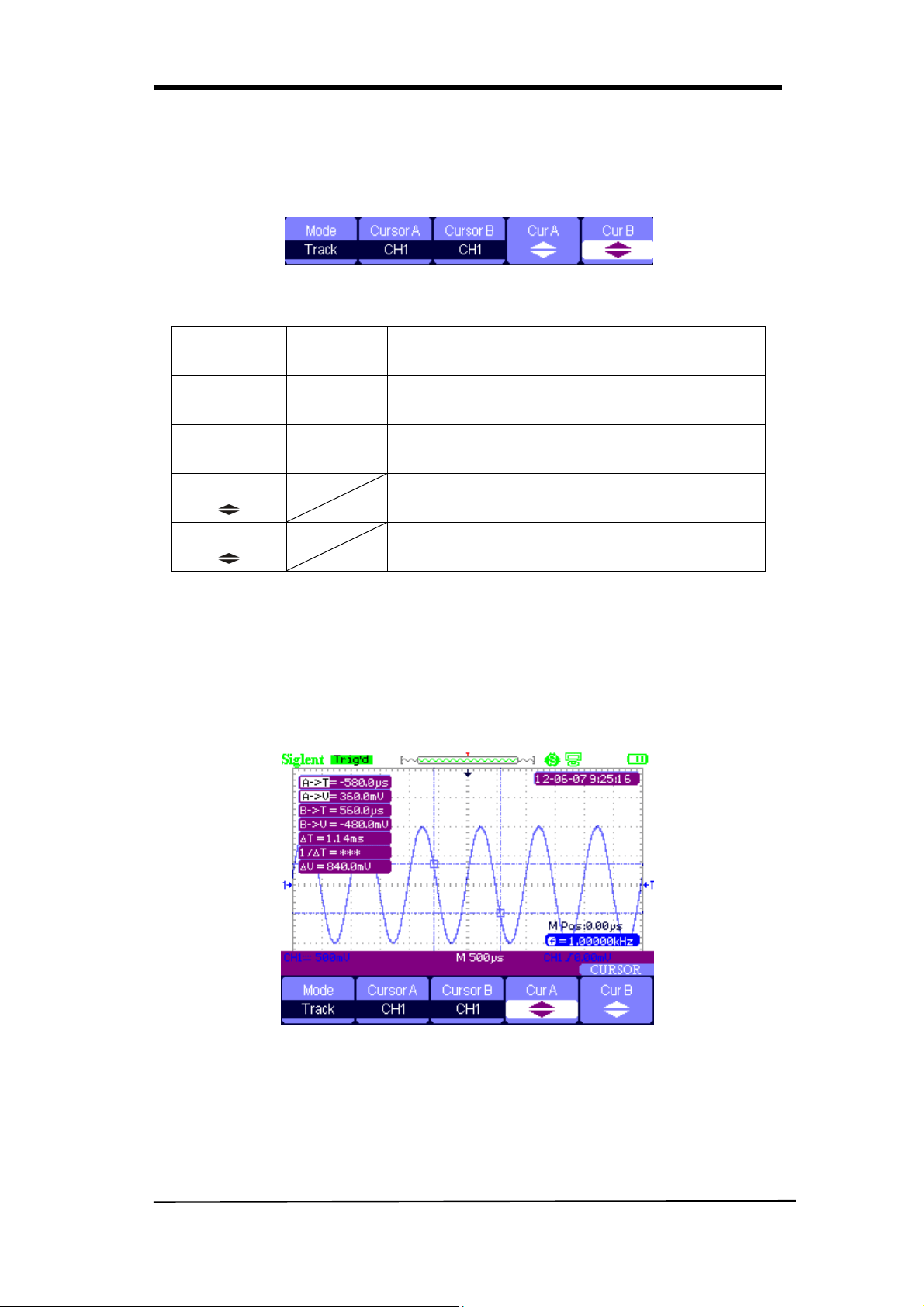
Reference waveform
Press 【Scope】 and choose Ref to enter the reference waveform function menu.
Figure 2-24 Reference waveform Menu
Table 2-11 REF Waveform Function Menu
Function Setting
Instruction
Signal CH1/CH2
Choose the waveform to be saved.
Ref A/Ref B
Choose to save or recall the reference position of
the waveform..
Save
Save the source waveform to the pointed
reference position.
Ref A/Ref B
On
Off
Display the reference waveform on the screen.
Clean the reference waveform on the screen.
Reference Waveform Application Example
Operation steps:
1. Input a waveform to CH1 or CH2.
2. Adjust time base to display the best waveform.
3. Press 【Scope】 and choose Ref to enter horizontal system.
4. Choose the reference waveform need to save and press 【F4】 to save.
5. Press 【F5】 to show the reference waveform.
6. Press 【F5】 to exit the reference waveform.

18 SHS800 Series
Figure 2-25 Reference Waveform
Cursor and Measure System
Cursor measure
Press 【Cursor/Measure】 once to enter the cursor measure system.
There are three modes of measure: manual, track, automatic.
Manual mode: horizontal or vertical cursors appear in couple and we use them to
measure voltage or time parameters. The space between two cursors can be adjusted.
Figure 2-26 Manual Cursor Measurement
Table 2-12 Manual Mode Function Menu
Option Setting Instruction
Cursor Mode Manual
In this menu, set the manual cursor
measure.
Type
Voltage
Time
Use cursors to measure voltage
parameters.
Use cursors to measure time parameters.
Source
CH1、CH2
MATH
REFAREFB
Choose the signal to be measured by
cursors.
Cur A
Use arrow keys to adjust t position of cursor
A.
Cur B
Use arrow keys to adjust t position of cursor
B.
SHS800 Series 19
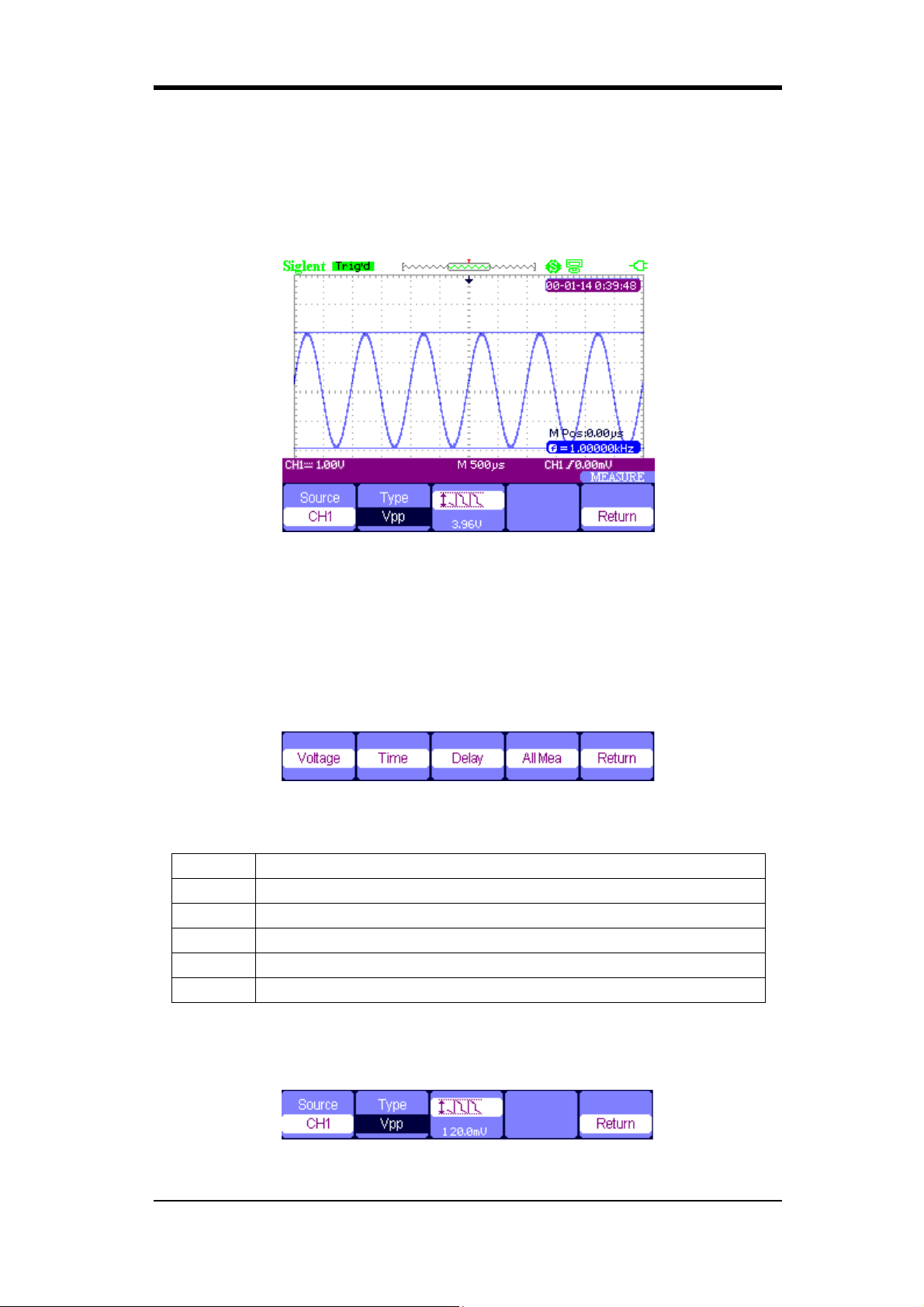
Track mode: In this mode, the screen displays two cross cursors. The cross cursor sets
the position on the waveform automatically. You could adjust cursor’s horizontal position
on the waveform by turning the arrow kyes ” . The oscilloscope displays the values on
the top of the right screen.
Figure 2-27 Cursor Trace Menu
Table 2-13 Trace Mode Function Menu
Option Setting Instruction
Cursor Mode Track In this mode, set track cursor measure.
Cursor A
CH1、CH2
NONE
Set the input signal channel that the Cursor A will
measure.
Cursor B
CH1、CH2
NONE
Set the input signal channel that the Cursor B will
measure.
Cur A
Use arrow keys to adjust the position of cursor A.
Cur B
Use arrow keys to adjust the position of cursor B.
Track Mode Application Example
Operation steps:
1. Press 【Cursor/Measure】 once to enter cursor system.
2. Press 【F1】 to choose Tracke mode.
3. Adjust cursor A and cursor B to trace waveform with arrow keys ,
Figure 2-28 Cursor Trace Menu
Automatic measure mode: This mode will take effect with automatic measurements.
The instruments will display cursors while measuring parameters automatically. These
cursors demonstrate the physical meanings of these measurements.
20 SHS800 Series
Automatic Measure Application Example
Operation steps:
1. Press 【Cursor/Measure】 once to enter cursor system.
2. Press 【F1】 to choose Auto mode.
3. Press 【Cursor/Measure】 again and choose parameter types to be measured.
Figure 2-29 Auto Measure
Parameter Measure
Press 【 Cursor/Measure 】 twice and any key of F1 ~ F5 to enter parameter
measurement system..
Figure 2-30 Parameter Measure Function Menu
Table 2-14 Parameter Measure Function
Option Instruction
Voltage Press this button to enter the Voltage measure menu.
Time Press this button to enter the Time measure menu.
Delay Press this button to enter the Delay measure menu.
All Mea Press this button to enter the All Measurement menu.
Return Return to the home page of MEASURE menu.
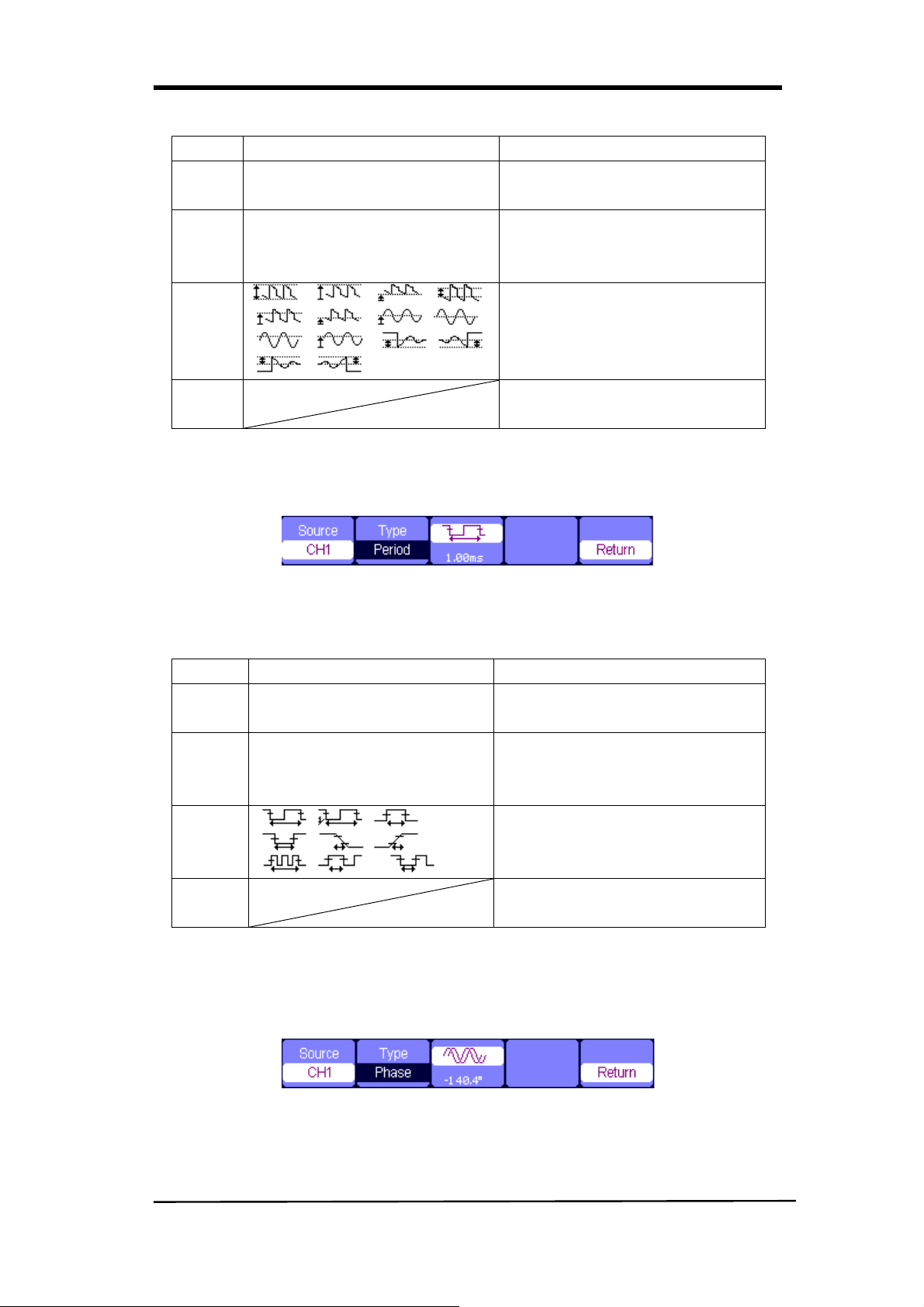
Voltage parameter measure
Figure 2-31 Parameter Measure Function Menu
SHS800 Series 21
Table 2-15 Voltage Measure Function
Option Setting Instruction
Source CH1,CH2
Select input signal source for
voltage measure.
Type
Vpp, Vmax, Vmin, Vamp, Vtop,
Vbase, Vavg, Mean, Vrms, FOV,
FPRE, ROV, RPRE ,
Press F2 or use the arrow keys to
select voltage measure
parameter.
Icon
, . ,
, ,
, 、
, 、
Display the corresponding icon
and measure value of your
selected Voltage measure
parameter.
Return
Return to the home page of
MEASUREMENT menu.
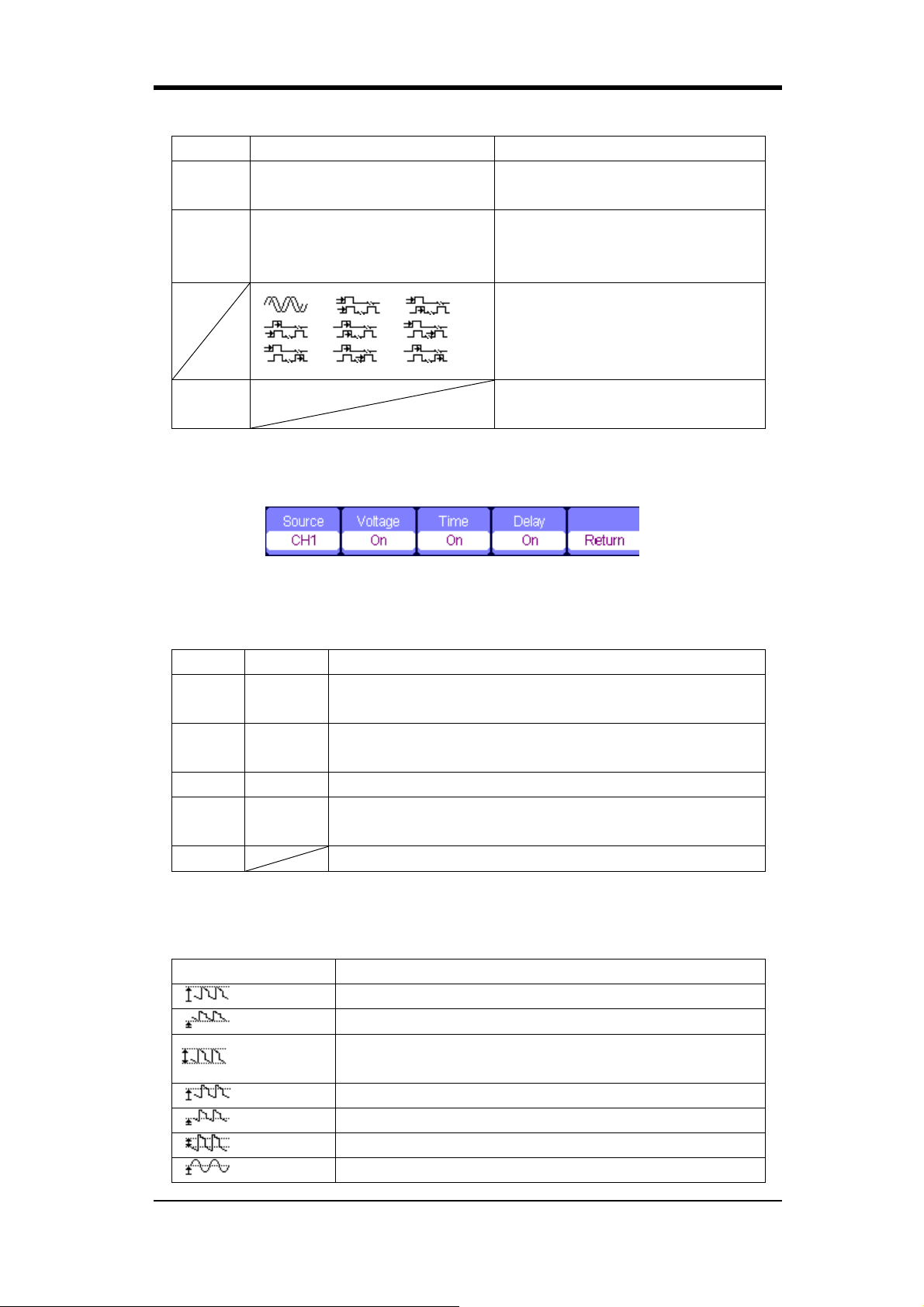
Time parameter measure
Figure 2-32 Time Measure Function Menu
Table 2-16 Time Measure Function
Option Setting Instruction
Source CH1, CH2
Select input signal source for Time
measure.
Type
Period, Freq, +Wid, -Wid, Rise
Time, Fall Time, BWid, +Dut,
-Dut
Press F2 or use the arrow keys to
select time measure parameter.
、
Display the corresponding icon and
measure value of your selected
time measure parameter.
Return
Return to the home page of
MEASURE menu.
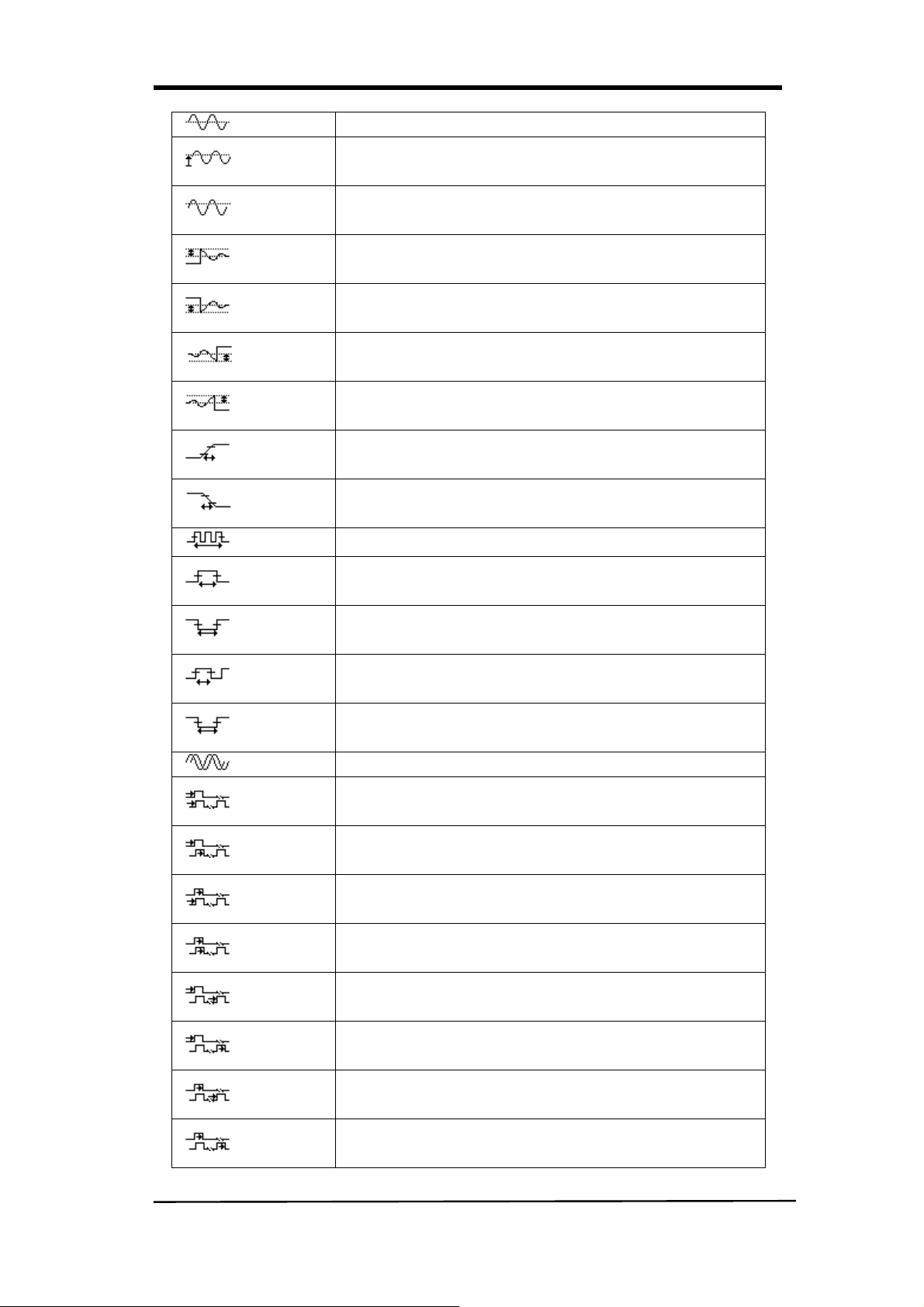
Delay parameter measure
Figure 2-33 Delay Measure Function Menu
22 SHS800 Series
Table 2-17 Delay Measure Function
Option Setting Instruction
Source CH1, CH2
Select input signal source for delay
measure.
Type
Phase、FRR、FRF、FFR、FFF、
LRR、LRF、LFR、LFF
Press the “Type” button or use
arrow keys to select delay
measure parameter.
、 、
、 、 、
、 、
Display the corresponding icon
and measure value of your
selected Delay measure
parameter.
Return
Return to the home page of
MEASURE menu.
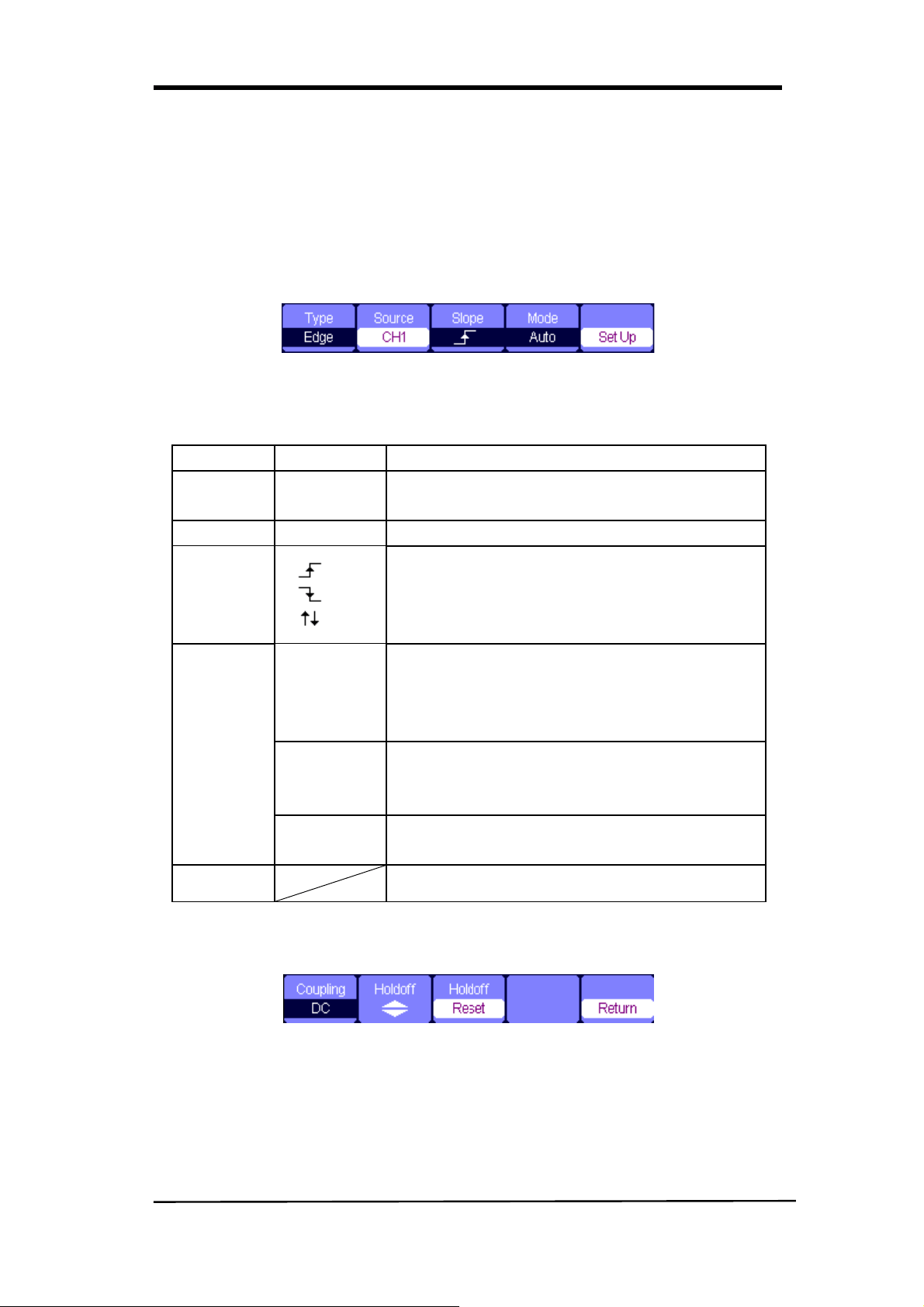
All parameters measure
Figure 2-34 All Measure Function Menu
Table 2-18 All Measure Function Menu
Option Setting Instruction
Source
CH1、
CH2
Select input signal channel.
Voltag
e
On/Off Turn on/off the all voltage parameters measure function.
Time On/Off Turn on/off the all time parameters measure function.
Delay On/Off
Turn on/off the all delay parameters measurement
function.
Return Return to the “All Measure main menu”.
Table 2-19 All Measure Function Menu
Measure Type Introduction
Vmax
The positive peak voltage.
Vmin
The negative peak voltage.
Vpp
The absolute difference between positive peak voltage
and negative peak voltage.
Vtop
The maximal voltage during the measure.
Vbase
The minimal voltage during the measure.
Vamp
The difference between the Vtop and the Vbase voltage.
Vavg
The arithmetic mean over the first cycle of the waveform.
SHS800 Series 23
Mean
The arithmetic mean over the entire waveform.
Crms
Virtual value: the true Root Mean Square voltage of the
first cycle in the waveform.
Vrms
The true Root Mean Square voltage over the entire
waveform.
ROVShoot
Defined as (Vmax-Vhig)/Vamp after the waveform
rising.
FOVShoot
Defined as (Vmin-Vlow)/Vamp after the waveform
falling.
RPREshoot
Defined as (Vmin-Vlow)/Vamp before waveform
rising.
FPREshoot
Defined as (Vmax-Vhig)/Vamp before waveform
falling.
Rise Time
The time between the first voltage level rising from 10% to
90%.
Fall Time
The time between the first voltage level falling from 90%
to 10%
BWid
The duration of a burst over the entire waveform.
+ Wid
The time between the first rising edge and the next falling
edge of 50% voltage level.
- Wid
The time between the first falling edge and the next rising
edge of 50% voltage level.
+ Duty
The ratio between the first positive pulse width and the
period.
- Duty
The ratio between the first negative pulse width and the
period.
Phase
The phase difference between two waveforms.
FRR
The time between the first rising edge of source 1 and the
first rising edge of source 2.
FRF
The time between the first rising edge of source 1 and the
first falling edge of source 2.
FFR
The time between the first falling edge of source 1 and
the first rising edge of source 2.
FFF
The time between the first falling edge of source 1 and
the first falling edge of source 2.
LRR
The time between the first rising edge of source 1 and the
last rising edge of source 2.
LRF
The time between the first rising edge of source 1 and the
last falling edge of source 2.
LFR
The time between the first falling edge of source 1 and
the last rising edge of source 2.
LFF
The time between the first falling edge of source 1 and
the last falling edge of source 2.

24 SHS800 Series
Parameter Measure Supplication Example
Operation steps:
1. Press 【Cursor/Measure】 twice and any key of F1~F5 to enter parameter
measurement system.
2. Choose any key out of F1~F5 to choose measure type. For example: Voltage.
3. Press 【F2】 to choose measure parameter. For example: Vpp.
4. Press 【F5】 to return.
Figure 2-35 All Measure Function Menu
32 types of parameters measure application example
Operation steps:
1. Input two sine signals respectively to CH1 and CH2 with the same frequency,
amplitude and different phases,
2. Adjust time base and vertical scale to obtain the best waveform.
3. Press 【Cursor/Measure】 and choose All.
4. Turn on Voltage, Time, Delay and will display 32 types of parameter measure.
Figure 2-36 32 Types of Parameter Measure
SHS800 Series 25
Trigger System
There are 5 kinds of trigger function: edge, pulse, video, slope, alternative.
Press 【Trigger】 to enter the trigger system.
Edge Trigger
Figure 2-37 Edge Trigger Function Menu
Table 2-20 Edge Trigger Function Menu
Option Setting Instruction
Type Edge
Trigger on the rising or falling edge of the input
signal.
Source CH1, CH2 Set CH1 or CH2 as a trigger source.
Slope
Trigger on rising edge of the trigger signal.
Trigger on falling edge of the trigger signal.
Trigger on rising and falling edge of the trigger
signal.
Mode
Auto
Use this mode to let the acquisition free-run in the
absence of a valid trigger; This mode allows an
un-triggered, scanning waveform at 100 ms/div or
slower time base settings.
Normal
Use this mode when you want to see the valid
trigger waveforms only; the scope will not acquire
waveform until satisfied trigger. .
Single
The setup detects a trigger and acquires
waveform, then stop.
Setting Enter the “Trigger Setup Menu”.
Figure 2-38 32 Trigger Setting Function Menu
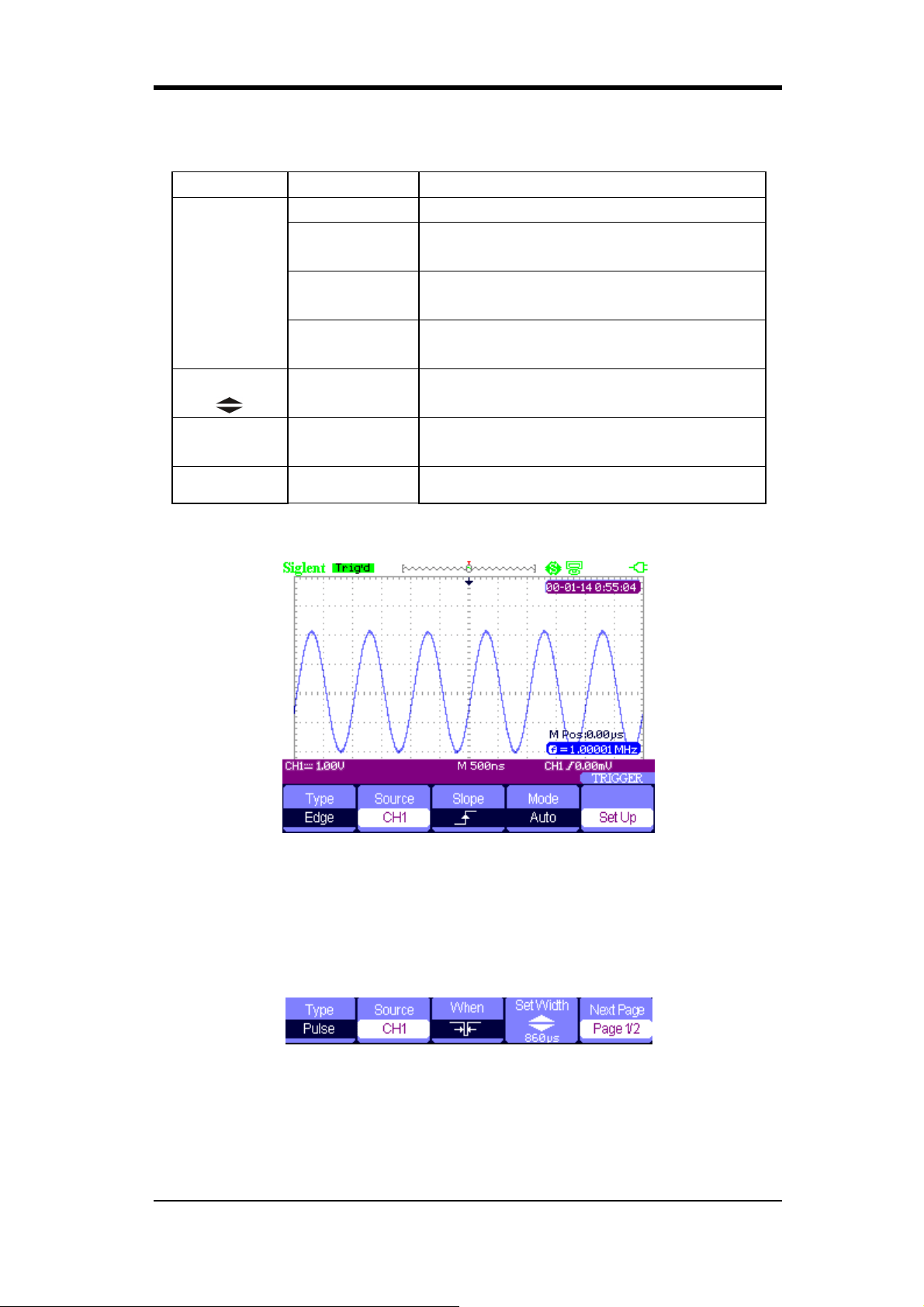
26 SHS800 Series
Table 2-21 Trigger Setting Menu
Option Setting Instruction
Coupling
DC Passes all components of the signal
AC
Blocks DC components and attenuates
signals below 170Hz.
HF Reject
Attenuates the high-frequency components
above 140kHz.
LF Reject
Blocks the DC component and attenuates the
low-frequency components below 7 kHz.
Hold off
Using the arrow keys to adjust hold off
time(sec),the hold off value is displayed.
Hold off
Reset
Reset hold off time to 100ns.
Return Return the first page of the menu.
Figure 2-39 Signal Rise Trigger Menu
Pulse Trigger
Figure 2-40 Pulse Trigger Function Menu 1
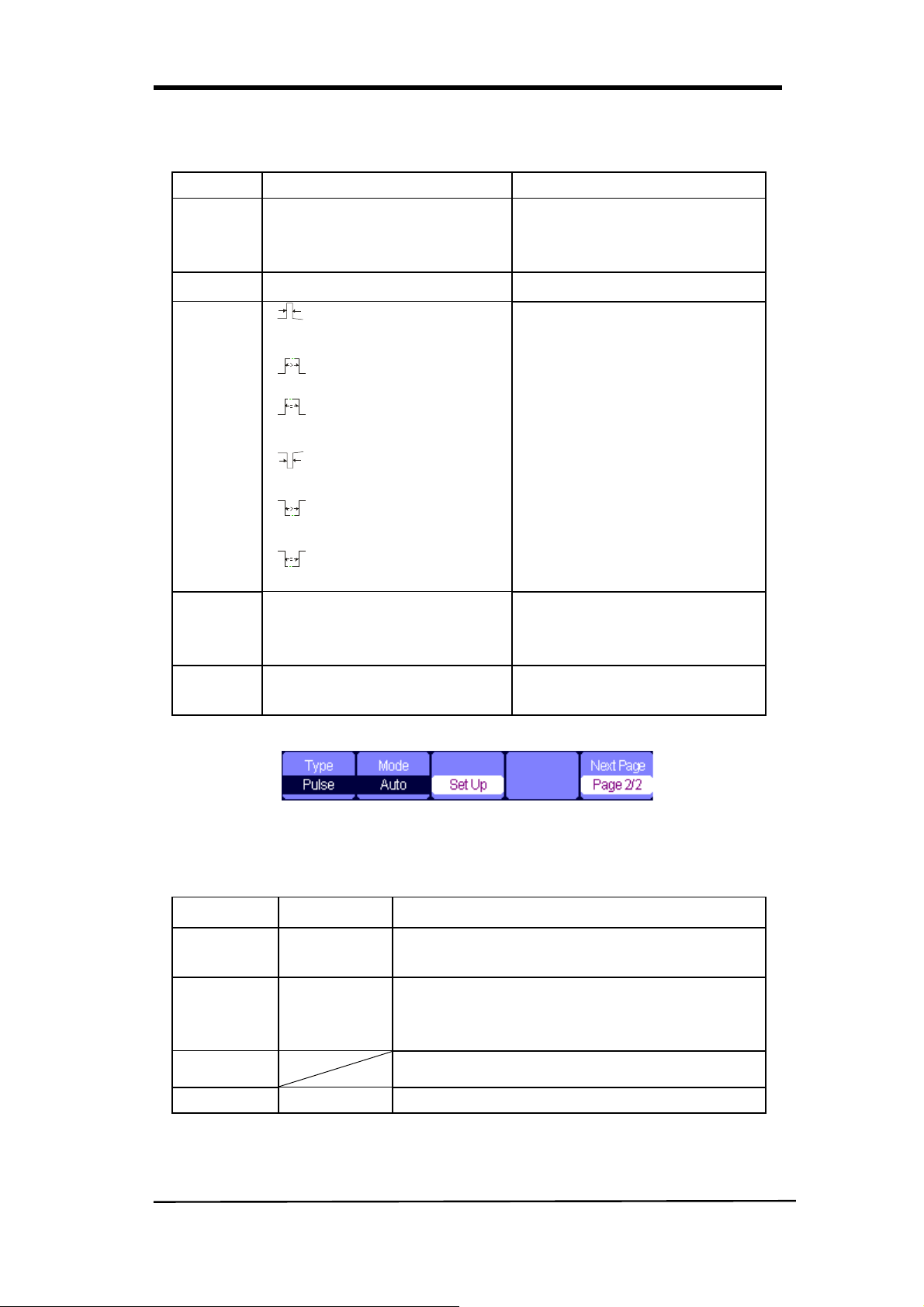
SHS800 Series 27
Table 2-22 Pulse Trigger Function Menu 1
Option Setting Instruction
Type Pulse
Select the pulse to trigger the
pulse match the trigger
condition.
Source CH1、CH2 Select input signal source.
Condition
(Positive pulse width less
than pulse width set)
(Positive pulse width
larger than pulse width setting)
(Positive pulse width equal
to pulse width setting)
(Negative pulse width less
than pulse width setting)
(Negative pulse width
larger than pulse width setting)
(Negative pulse width
equal to pulse width setting)
Compare the trigger conditions
of pulse. It triggers as soon as
matching the conditions.
Set Width 20.0ns~10.0s
Selecting this option can turn the
arrow keys to set up the pulse
width.
Next
Page
Page 1/2
Ente r the second page of the
menu.
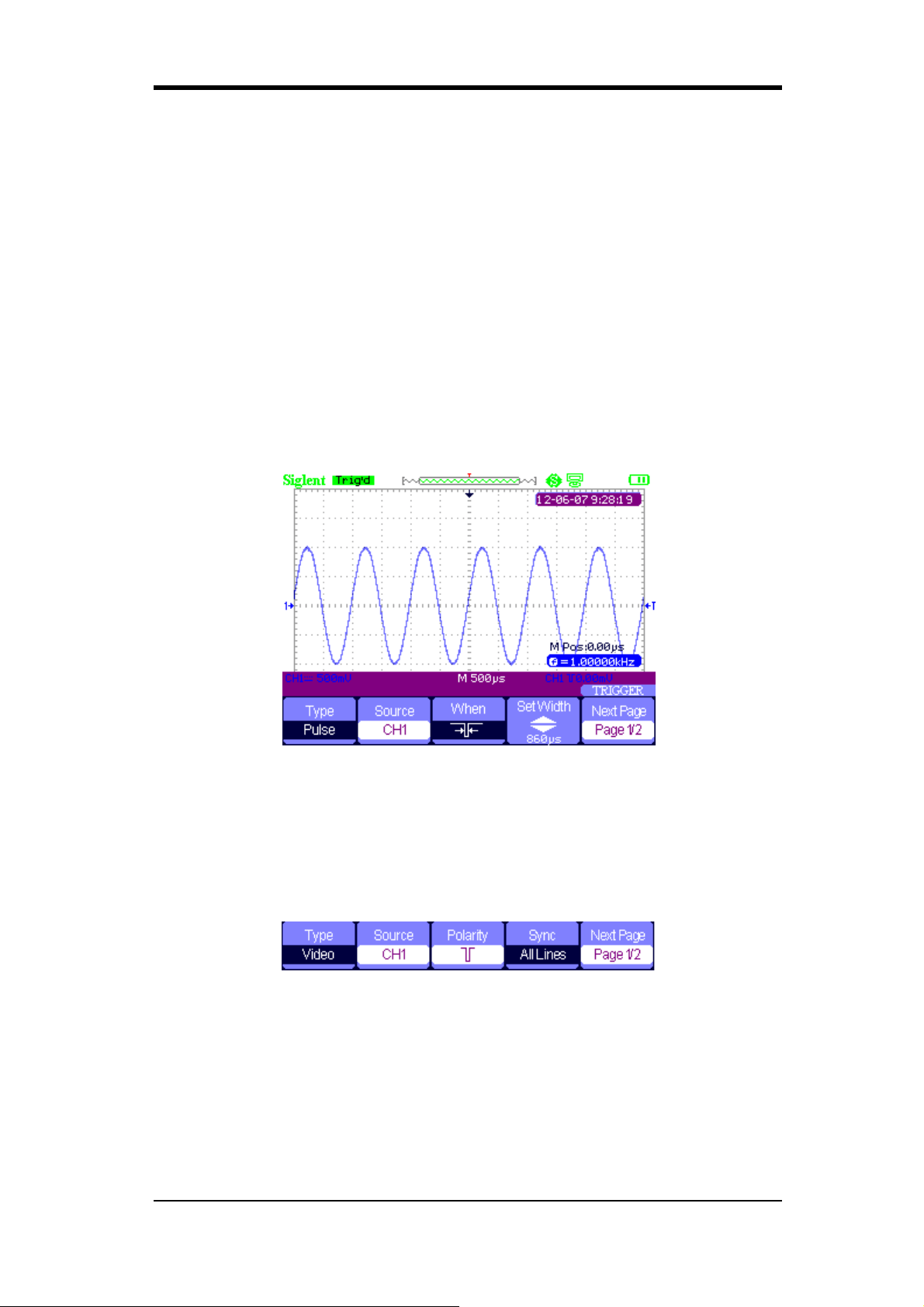
Figure 2-41 Pulse Trigger Function Menu 2
Table 2-23 Pulse Trigger Function Menu 2
Option Setting Instruction
Type Pulse
Select the pulse to trigger the pulse match the
trigger condition.
Mode
Auto
Normal
Single
Select the type of triggering; Normal mode is best
for most Pulse Width trigger applications.
Setup Enter the “Trigger setup menu”.
Next Page Page 2/2 Return to the first page of the menu.
28 SHS800 Series
Pulse Trigger Application Example
Operations steps:
1. Input a pulse signal.
2. Press 【Trigger】 to enter trigger menu.
3. Press 【F1】 to choose pulse trigger.
4. Press 【F3】 to set pulse trigger conditions.
5. Press 【F4】 and use arrow keys to set pulse width.
6. Move trigger level line with the up and down arrow keys. It will trigger as soon as it
meets the trigger conditions.
Notes:
We can’t adjust trigger level line under the SetWidth menu as we use the up and down
arrow keys to set both the pulse width and trigger level line. If you want to adjust the
trigger level, please make sure that you have exited the SetWidth menu.
Figure 2-42 Pulse Trigger
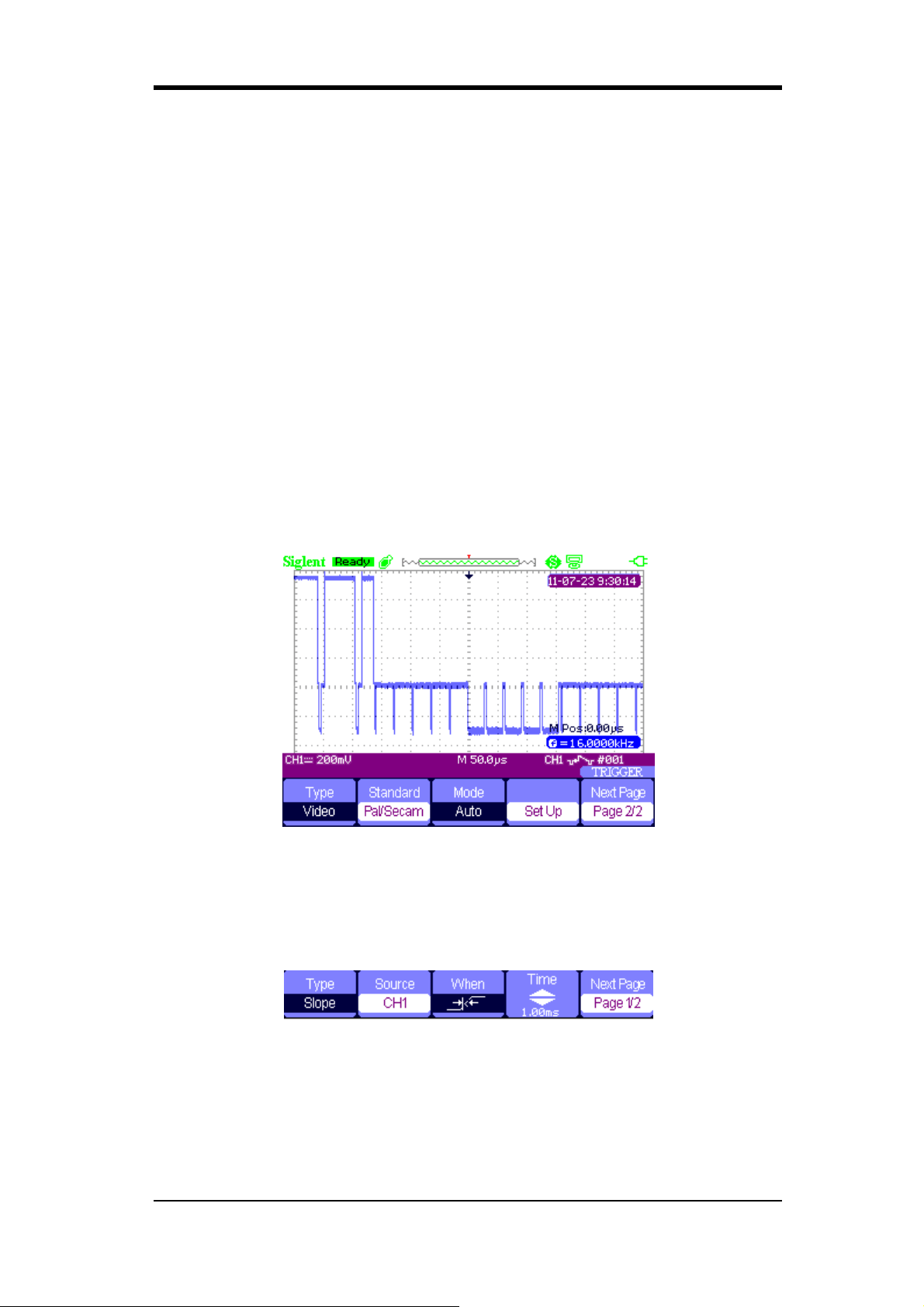
Video Trigger
Figure 2-43 Video Trigger Menu 1
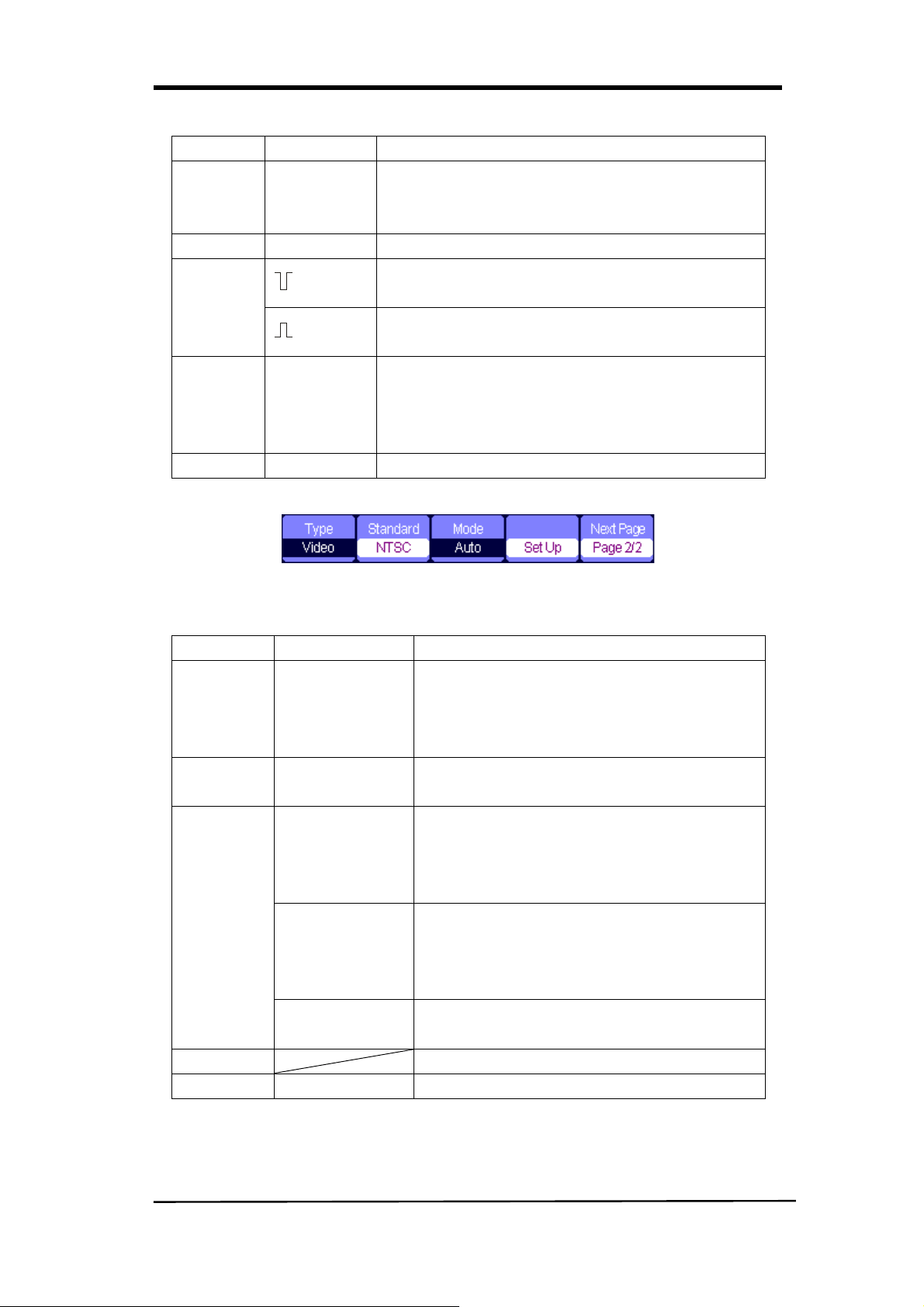
SHS800 Series 29
Table 2-24 Pulse Trigger Function Menu 2
Option Setting Instruction
Type Video
When you select the video type, put the couple set
to the AC, then you could trigger the NTSC, PAL
and SECAM video signal.
Source CH1、CH2 Select the input source to be the trigger signal.
Polarity
(Normal)
Normal triggers on the negative edge of the sync
pulse.
(Inverted)
Inverted triggers on the positive edge of the sync
pulse.
Sync
All Lines
Line Num
Odd Field
Even Field
Select appropriate video sync.
Next Page Page 1/2 Enter the second page of “Video trigger menu”.
Figure 2-44 Video Trigger Menu 2
Table 2-25 Pulse Trigger Function Menu 2
Option Setting Instruction
Type Video
When you select the video type, put the
couple set to the AC, then you could
trigger the NTSC, PAL and SECAM
video signal.
Standard
NTSC,
PAL/SECAM
Select the video standard for sync and line
number count.
Mode
Auto
Use this mode to let the acquisition free-run in
the absence of a valid trigger; This mode
allows an un-triggered, scanning waveform at
100 ms/div or slower time base settings.
Normal
Use this mode when you want to see only valid
triggered waveforms; when you use this mode,
the oscilloscope does not display a waveform
until after the first trigger.
Single
When you want the oscilloscope to acquire a
single waveform, press the “SINGLE ”button.
Set up Enter the “Trigger setup menu”.
Next Page Page 2/2 Return the first page of “Video Trigger menu”.
30 SHS800 Series
Video Trigger Application Example
Operation steps:
1. Input a video signal.
2. Press【Trigger】 to enter trigger menu.
3. Press【F1】 to choose Video.
4. Press【F5】 to enter the second page of video trigger menu.
5. Press【F2】 to set the video standard PAL/SECAM or NTSC meeting with the input
signal.
6. Press【F5】 to return to the first page of video trigger menu.
7. press 【F4】 to choose the type of Sync. If you choose Line Number, use the up and
down arrow keys to set the number of line.
8. Move trigger level line with the up and down arrow keys to set the trigger position.
Notes:
We can’t adjust trigger level line under the Line Number menu as we use the up and
down arrow keys to set both the pulse width and trigger level line. If you want to adjust
the trigger lever, please make sure that you have exited the Line Number menu.
Figure 2-45 Video Trigger
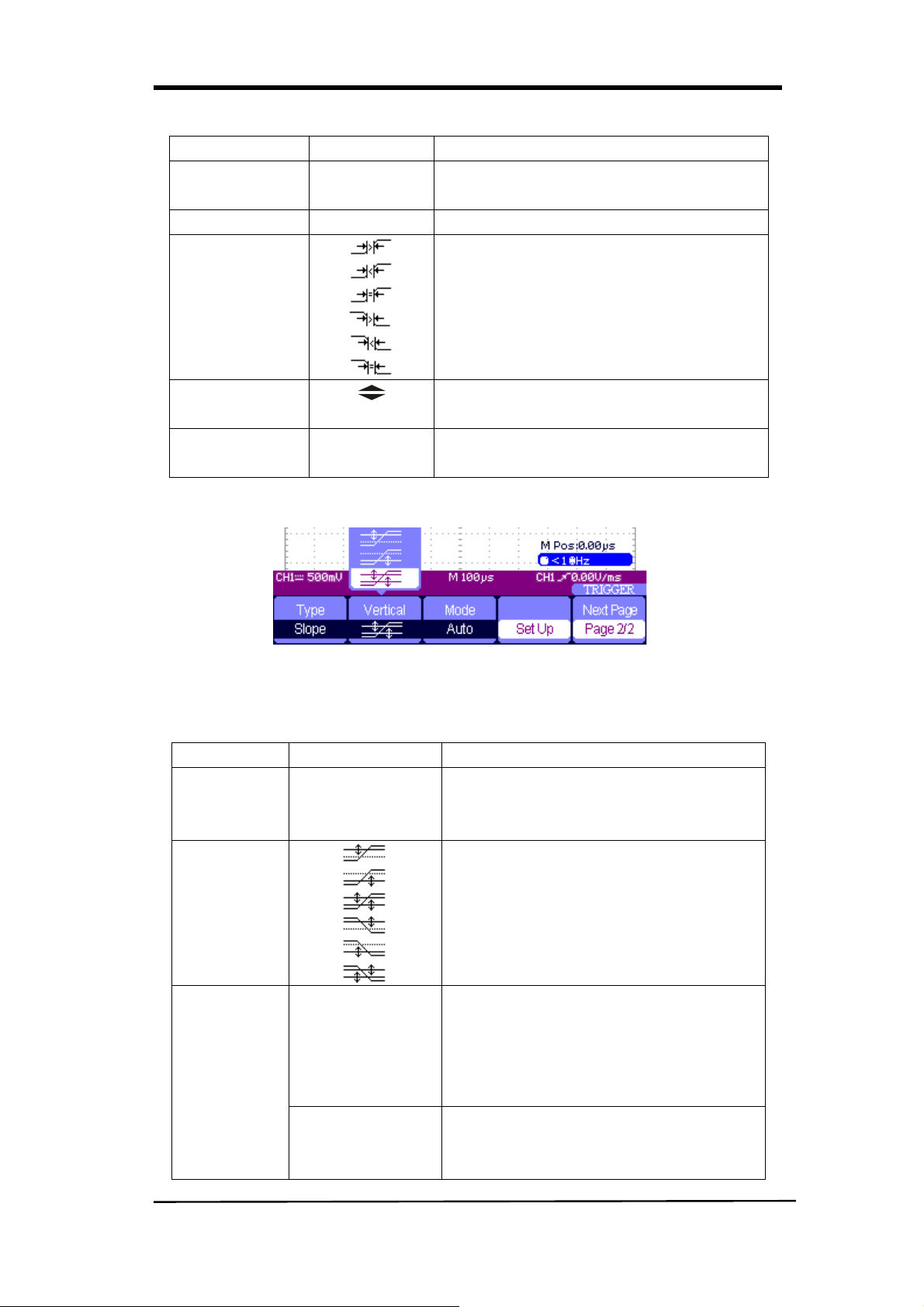
Slope trigger
Figure 2-46 Slope Trigger 1
SHS800 Series 31
Table 2-26 Slope Trigger Function Menu 1
Option Setting Instruction
Type Slope
Trigger on positive slope of negative slope
according to setup time of the oscilloscope.
Source CH1、CH2 Select trigger source.
Condition
Select trigger conditions.
Time
〈Set time〉
Use the arrow keys to set slope time. Time
setup range is 20ns-10s.
Next Page Page 1/2
Enter the second page of the slope trigger
menu.
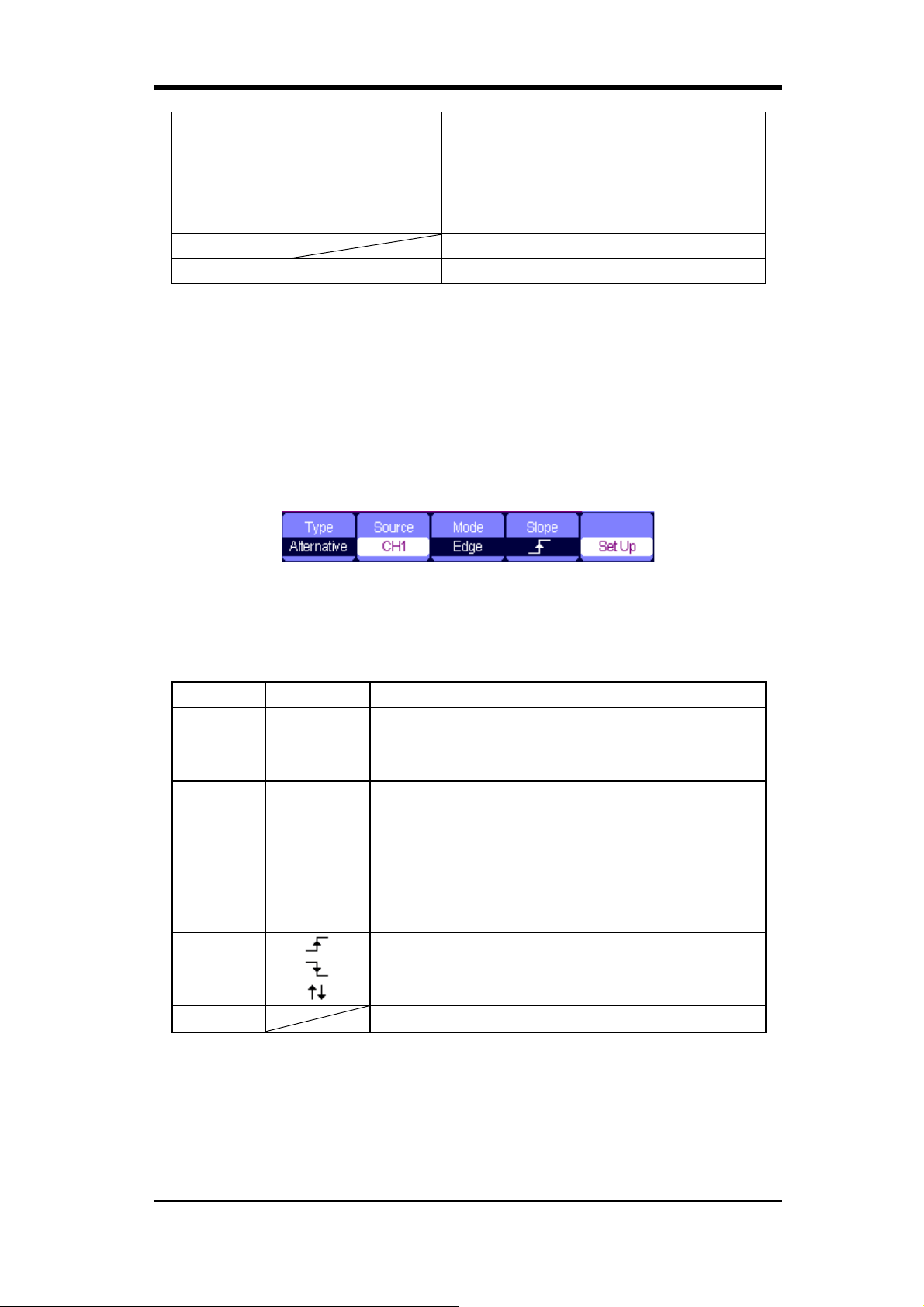
Figure 2-47 Slope Trigger 2
Table 2-27 Slope Trigger Function Menu 2
Option Setting Instruction
Type Slope
Trigger on positive slope of negative
slope according to setup time of the
oscilloscope.
Vertical
Select the trigger level that can be
adjusted by “LEVEL” knob. You can
adjust “LEVEL A”, “LEVEL B” or
adjust them at the same time.
Mode
Auto
Use this mode to let the acquisition
free-run in the absence of a valid trigger;
This mode allows an un-triggered,
scanning waveform at 100 ms/div or
slower time base settings.
Normal
Use this mode when you want to see only
valid triggered waveforms; when you use
this mode, the oscilloscope does not
32 SHS800 Series
display a waveform until after the first
trigger.
Single
When you want the oscilloscope to acquire
a single waveform, press the “SINGLE ”
button.
Set up Enter the “Trigger setup menu”.
Next Page Page 2/2 Return to the first page of slope trigger.
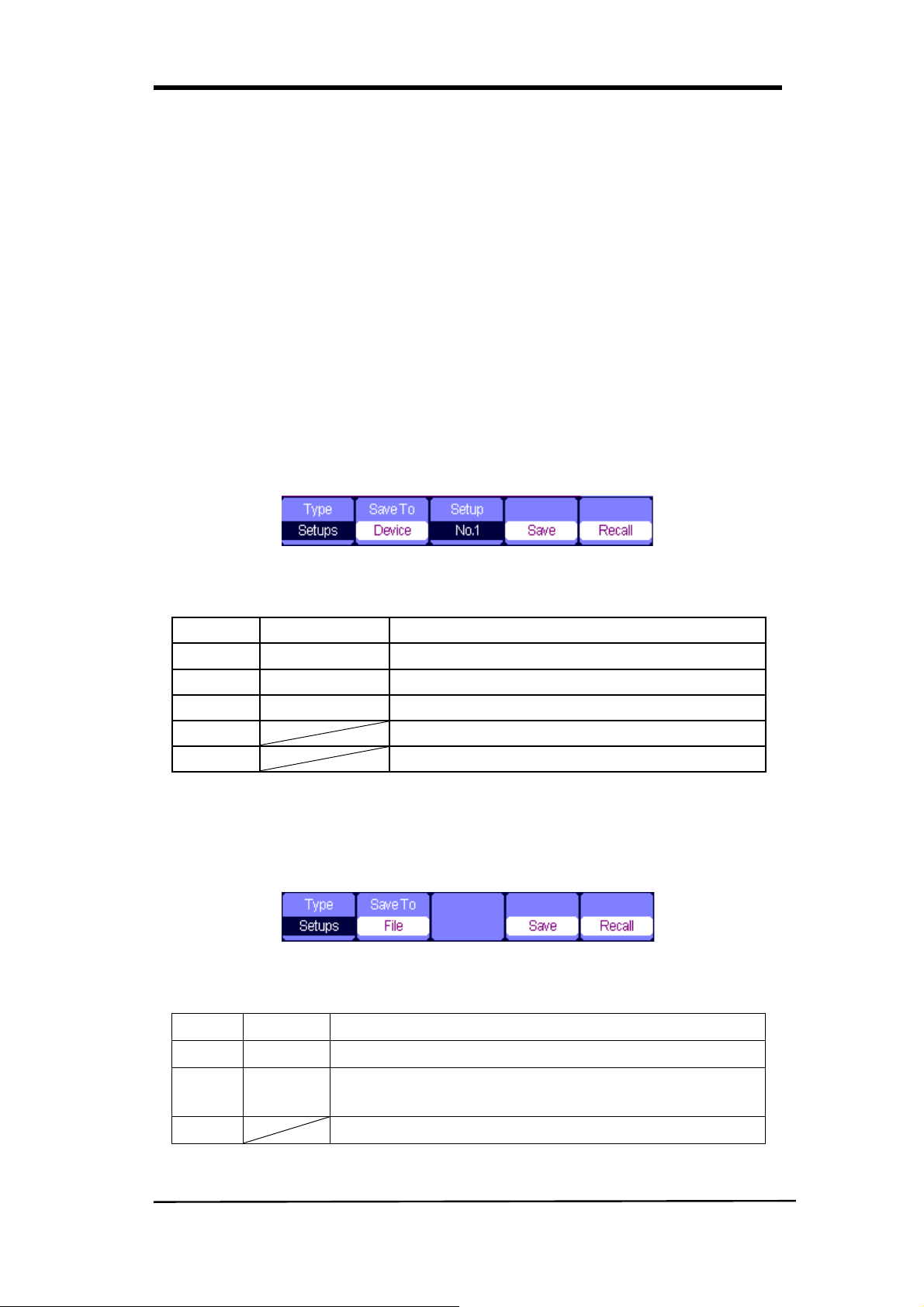
Alternative trigger
The trigger signal comes from two vertical channels when you use alternative trigger. In
this mode, you can observe two irrelative signals at the same time. You can select
different trigger types for two vertical signals, and selected types cover edge, pulse,
video and slope trigger. Trigger information of two channel signals display on the bottom
right of the screen.
Figure 2-48 Alternative Trigger Menu
Table 2-28 Alternative Trigger Function Menu
Option Setting Instruction
Type Alternative
The trigger signal comes from two vertical channels
when you use alternative trigger. In this mode, you
can observe two irrelative signals at the same time.
Source
CHX
CHY
Set trigger type information for CHX signal
Set trigger type information for CHY signal
Mode
Edge
Pluse
video
slope
Set trigger type of the vertical channel signal
Slope
Triggering on rising edge.
Triggering on falling edge.
Triggering on rising edge and falling edge.
Set up Enter the “Trigger setup menu”.
SHS800 Series 33
Save and Recall System
SHS800 can save 2 groups of reference waveforms, 20 groups of setups and 10 groups
of waveforms in its internal memory. There is an USB Host interface in the front panel of
the SHS800 and you can save setup data, waveform data, waveform interface image,
CSV file to an USB flash drive. The postfix of setup data is SET while waveform data is
DAV. The waveform data can be recalled to the current SHS800 or SHS800 with the
same the model. Figure data and CSV file can’t be recalled to the SHS800, but it can be
opened on the computer through correlative software. CSV can be opened by EXCEL
software on computer.
Saving Setups
Saving Setups to Device
All setups are stored in nonvolatile memory. When recall the setups, the SHS800 will be
under the setup save mode.
Figure 2-49 Saving Setups to Device Menu
Table 2-29 Saving Setups to Device Function Menu
Option Setting Introduction
Type Setups Menu for the Save/Recall setting in the SHS800.
Save to Device Save setups to the scope’s internal memory.
Setup No.1 to No.20 Choose the position number to save/recall setups.
Save Accomplish the operation of saving setups.
Recall Recall the saved setups.
Saving Setups to USB Flash Drive
Figure 2-50 Saving Setups to USB Flash Drive Menu
Table 2-30 Saving Setups to USB Flash Drive Function Menu
Option Setting Instruction
Type Setup Used to save/recall the SHS800’s setup menu
Save
to
File Save the setup data of the SHS800 to USB flash drive.
Save Enter the waveform save/recall interface.
34 SHS800 Series
Saving waveform
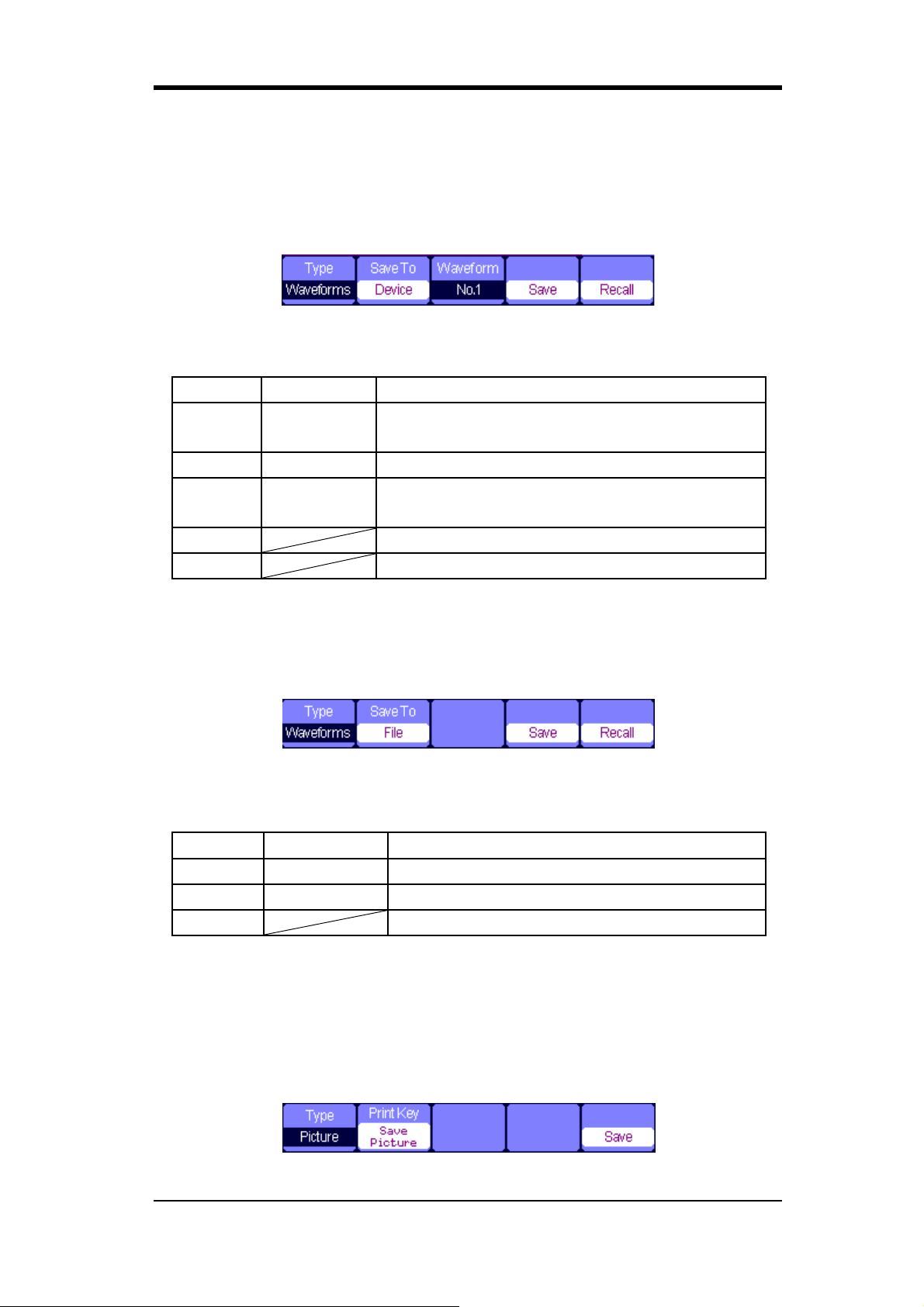
Saving waveform to device
Figure 2-51 Saving Waveform to Device Menu
Table 2-31 Saving Waveform to Device Function Menu
Option Setup Introduction
Type Waveforms
Menu for the Storage/Recall waveforms in the
scope.
Save To Device Save waveforms to the SHS800’s internal memory..
waveform
No.1 to
No.10
Choose the position number to save/recall setups.
Save Accomplish the storage.
Recall Recall the storage in the “waveform” operation
Saving waveform to USB Flash Drive
Figure 2-52 Saving Waveform to USB Flash Drive Menu
Table 2-32 Saving Waveform to USB Flash Drive Function Menu
Option Setup Introduction
Type Waveforms Menu for the Storage/Recall waveforms.
Save to File Save waveforms to USB flash drive.
Save Accomplish the storage.
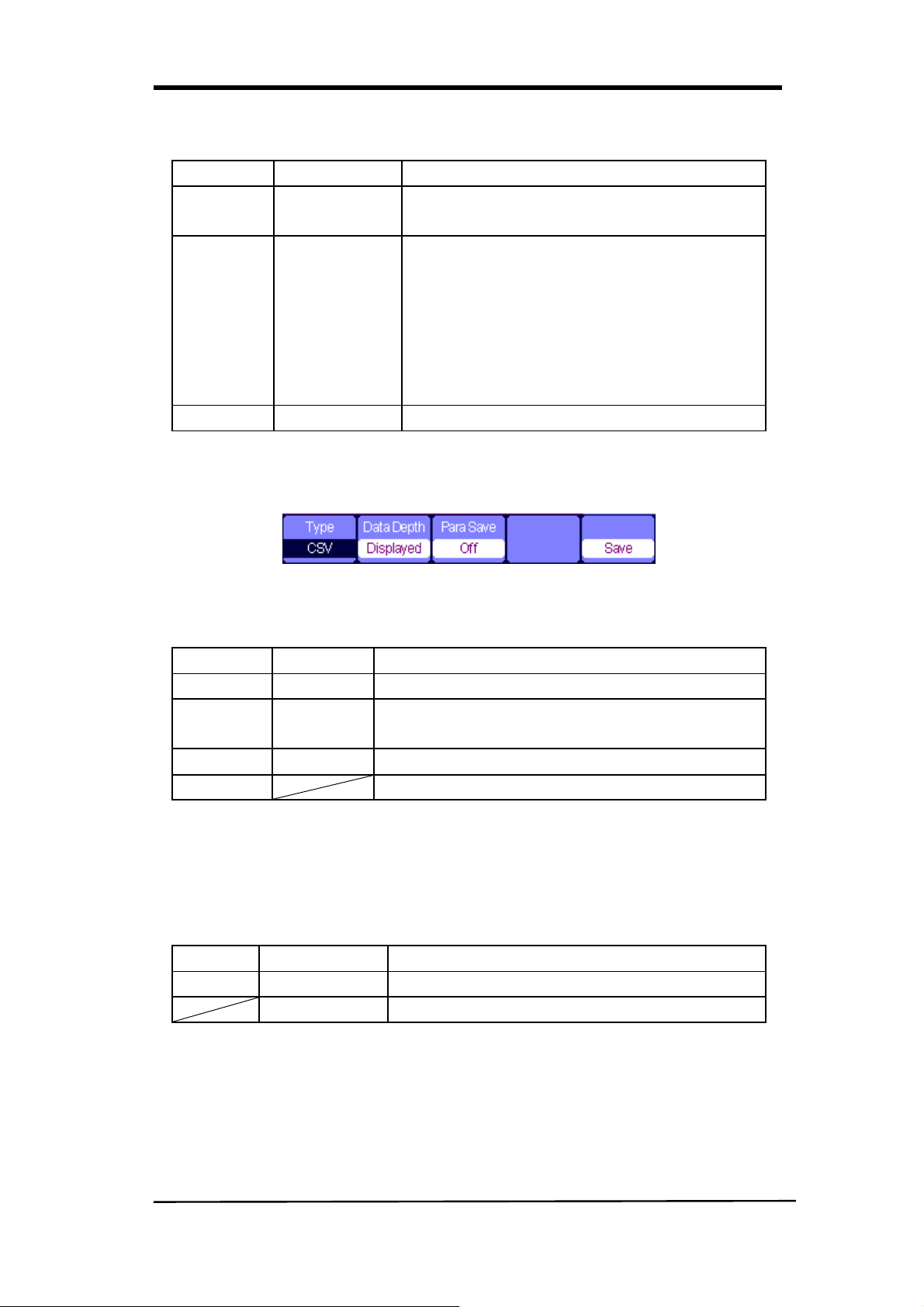
Saving Picture
Waveform interface image can be saved to USB flash drive, but they can’t be recalled.
You can view them on correlative computer software.
Figure 2-53 Saving Picture Menu
SHS800 Series 35
Table 2-33 Saving Picture Function Menu
Option Setting Introduction
Type Picture
Menu for the Storage/Recall waveform interface
image.
Print Key
Print Picture
Save Picture
Choose Print Picture option and press
Save/Recall for 4 seconds to print the picture
while the SHS800 connects to the printer.
Choose Save Picture option and press
Save/Recall for 4 seconds to save the picture
while you insert an USB flash driver to the
SHS800.
Save Go to the Save/Recall interface.
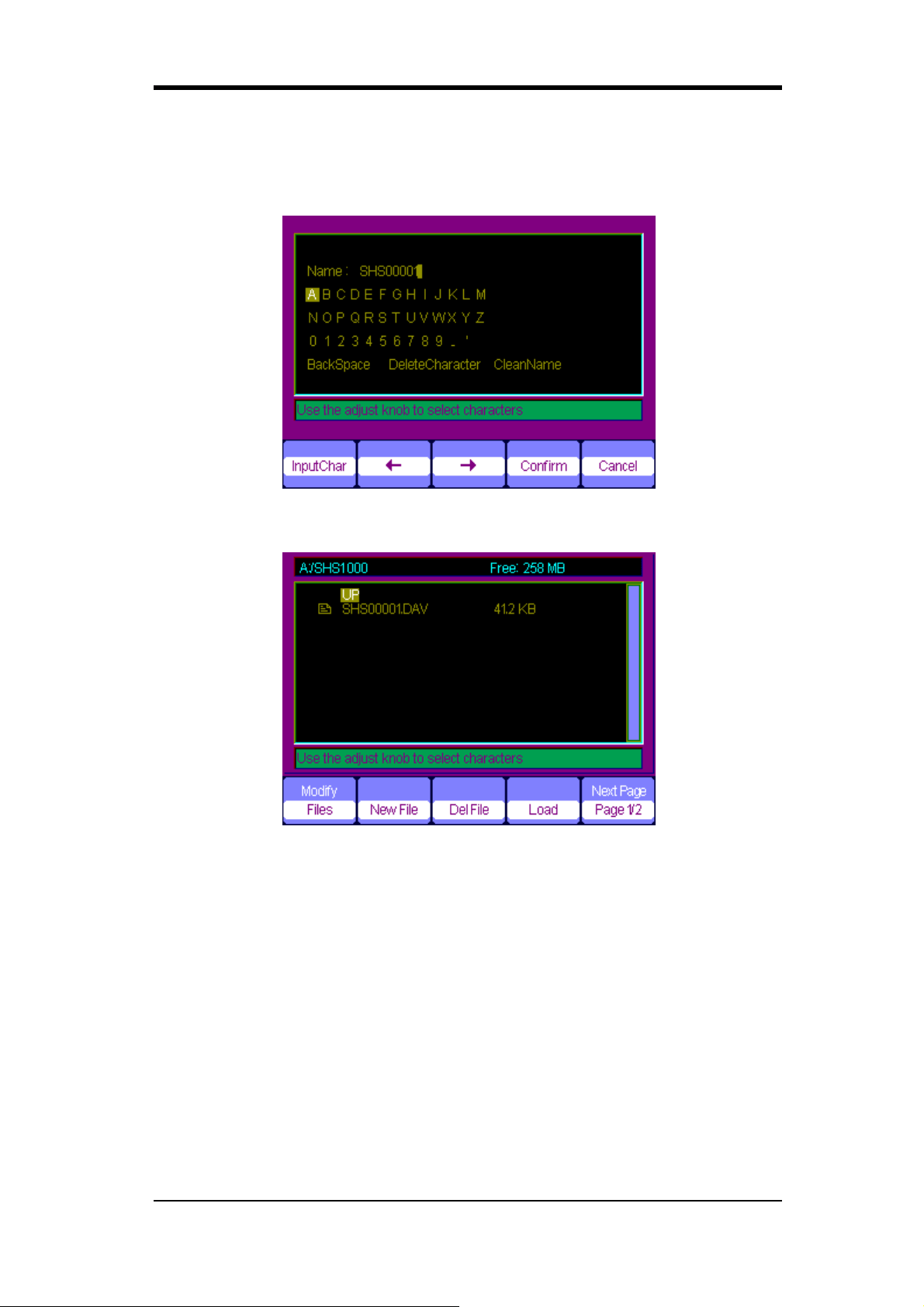
Saving CSV
Figure 2-54 Saving CSV Menu
Table 2-34 Saving CSV Function Menu
Option Setting Introduction
Type CSV Menu for the Storage CSV file to USB flash drive.
Data Depth
Displayed
Maximum
Set to store displayed waveform data to CSV file.
Set to store maximum waveform data to CSV file.
Para Save On/Off Set whether store parameters to CSV file or not.
Save Go to the Save/Recall interface.
Recall Factory Setups
Press Recall you can recall factory setups.
Table 2-35 Factory Setups Function Menu
Option Setting Instruction
Type Factory To view the Factory setup.
Load Recall the Factory setup.
Save/Recall Waveform to USB Flash Drive Application
Operation steps:
1. Press 【Save/Recall】 and press 【F1】 (Type) to choose Waveforms.
2. Insert USB flash drive to USB host (you will get the message: USB flash driver
connects successfully!).
3. Press 【F2】 (Save to) to choose File.
36 SHS800 Series
4. Press 【F4】 (Save) to enter save/recall interface.
5. Press 【F1】 (Modify) to choose File.
6. Press 【F2】 (New File) and input the mane of the file according to the prompts to
create a new file. Then press Confirm.
Figure 2-55 Input the Name of the File
7. File saves successfully.
Figure 2-56 File Saves Successfully
Recalling a file:
Choose the file to be recalled and press Recall at the memory interface, which you
complete the recalling operation.
Notes:
The picture in the SHS800 with a “BMP” postfix can’t be recalled, but you can open it in
computer with relative software.
SHS800 Series 37
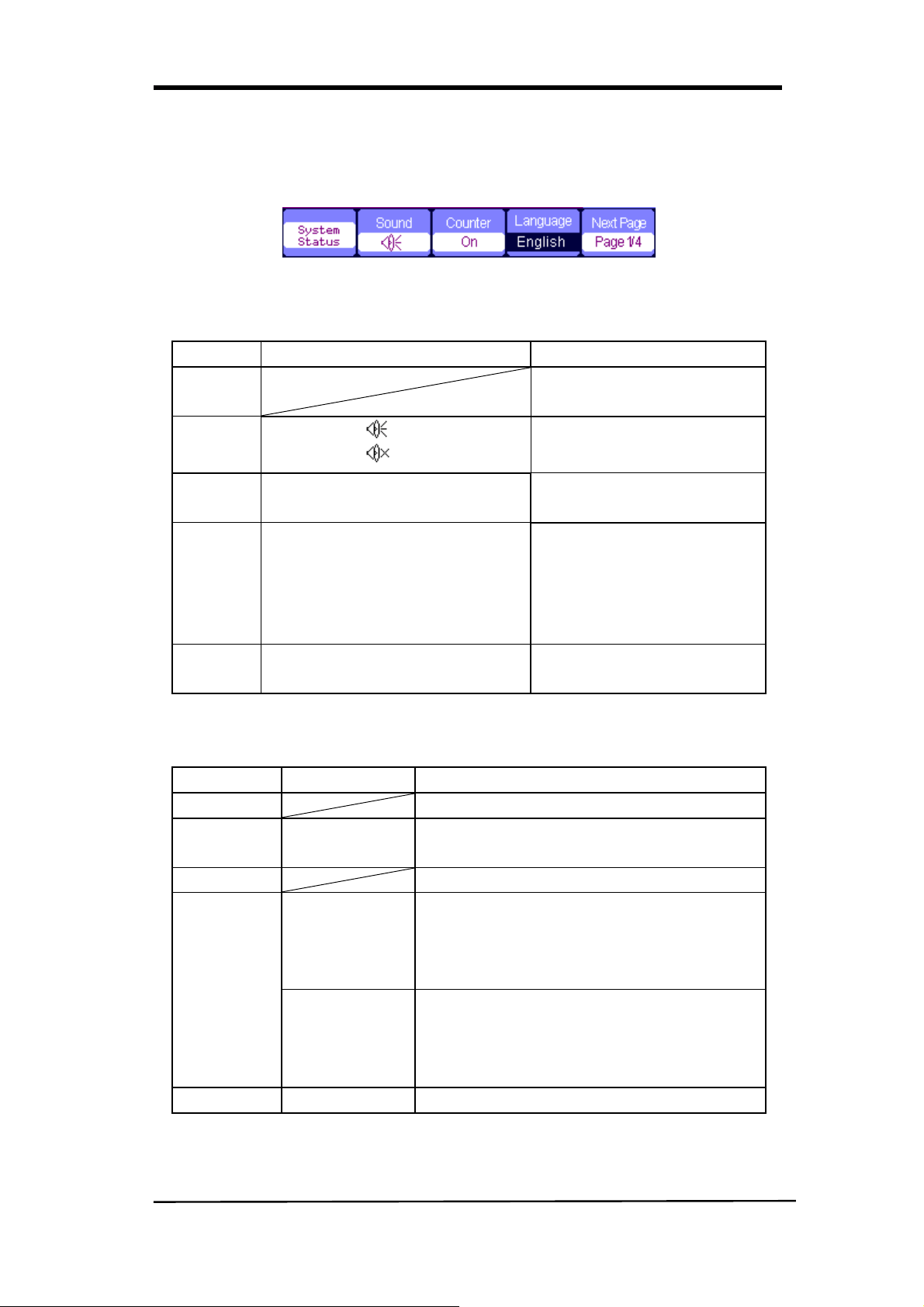
Utility System
Press 【User】 to enter utility system menu. See figure 2-57.
Figure 2-57 Utility System Menu 1
Table 2-36 Utility System Function Menu 1
Option Setting Introduction
System
Status
Displays the main information
of the SHS800.
Sound
Open the key-press voice.
Close the key-press voice.
Counter On/Off
Turn on/off the frequency
counter
Language
Simplified Chinese, English,
Traditional Chinese, Arabic,
French, German, Russian,
Spanish, Portuguese, Japanese
Korean, Italian
Select the interface language.
Next
Page
Page 1/4
Enter the next page of the
menu.
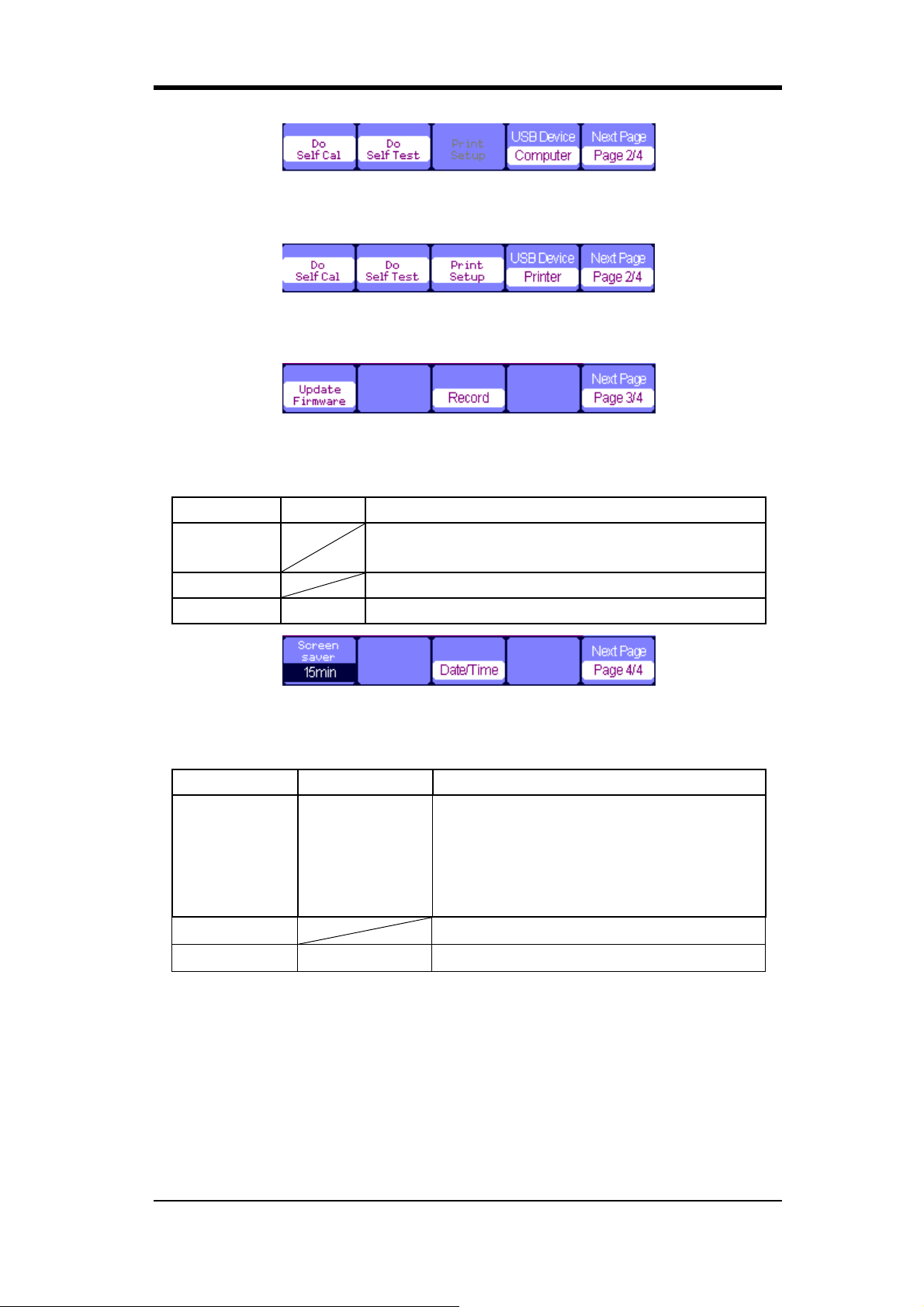
Table 2-37 Utility System Function Menu 2
Option Setting Introduction
Do self Cal Do a self calibration to calibrate the channels.
Do Self Test
Screen Test
Keyboard Test
Run the screen detect program
Run the keyboard detect program
Print Setup Enter the print setup menu to set print options.
USB Device
Printer
SHS800 connects to the printer through USB
cable. When you execute print function,
please select Printer. At this time the print
icon displays on the top of the screen.
Computer
SHS800 connects to the computer through
USB cable. When you execute EasyScope
software, please select Computer. At this
time
the computer icon displays on the screen.
Next Page Page 2/4 Enter the third page of the menu.
38 SHS800 Series
Figure 2-58 Utility System Menu 2
Figure 2-59 Utility System Print Setup
Figure 2-60 Utility System Menu 3
Table 2-38 Utility System Function Menu 3
Option Setting Introduction
Update
Firmware
You can update the SHS800 by using USB flash
driver (About two minutes).
Record Press this button to enter the waveform record menu.
Next Page Page 3/4 Enter the fourth page of the menu..
Figure 2-61 Utility System Menu 4
Table 2-39 Utility System Function Menu 4
Option Setting Introduction
Screen saver
1min 2min
5min 10min
15min 30min
1hour 2hour
5hour Off
Set the time of screen saver
Date/Time Set the date and time of the SHS800.
Next Page Page4/4 Return to the first page of the menu.

SHS800 Series 39
Self Calibration
Self Calibration is operated to calibrate the relative data of SHS800 to decrease the
mistake during the measure. If the operating temperature changes by or more than 5° C
or the instrument runs more than thirty minutes, you should do the self calibration. When
you do the self calibration, you should cut off all the probes and leads. Then press
【User】 button to choose Do self cal to show the self calibration menu, and do self
calibration program according to the prompts on the screen.
Figeure 2-62 Self Calibration
Print Setting
The SHS800 supports PictBridge compatible printers. You can connect the side USB
Device of the SHS800 to the USB Device of the PictBridge compatible printer through
USB cable. After setting the print settings, press 【Save/Recall】 button for 4 seconds
to complete the print operation.
Figure 2-63 Print Setting Menu 1
Table 2-40 Print Setup Function Menu 1
Option Setting Introduction
Ink Saver
On
Off
Print the screen image on a white
background when you select On.
Layout Portrait/Landscape The output direction of the printer.
Paper Size
Set the type of the
paper.
Displays settings available on your
PictBridge compatible printer.
40 SHS800 Series
Print Key
Print Picture
Choose Print Picture option and press
Save/Recall for 4 seconds to print the
picture while the SHS800 connects to
the printer.
Save Picture
Choose Save Picture option and press
Save/Recall for 4 seconds to save the
picture while you insert an USB flash
driver to the SHS800.
Next Page Page 1/2 Enter the second page of the menu.
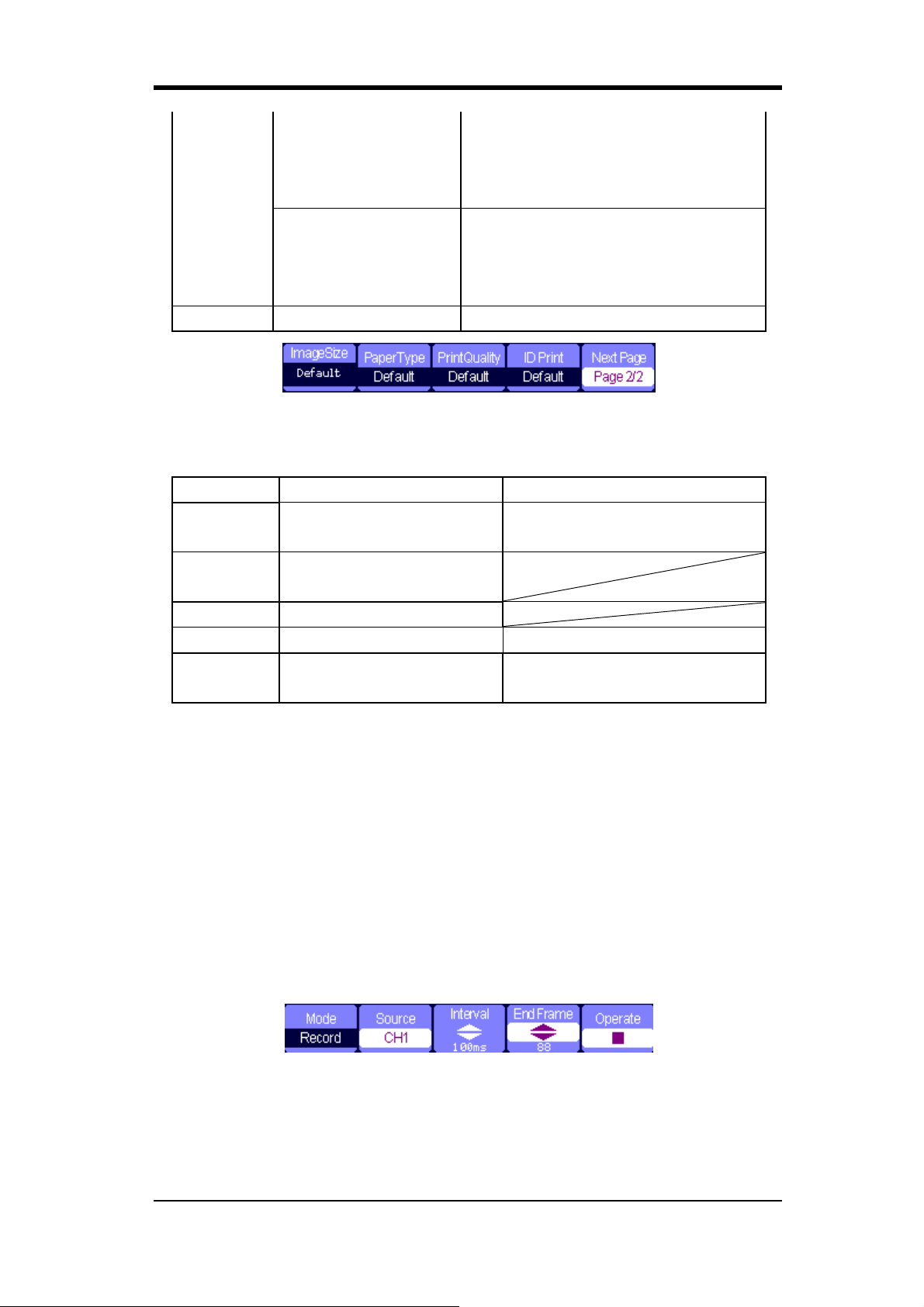
Figure 2-64 Print Setting Menu 2
Table 2-41 Print Setting Function Menu 2
Option Setting Introduction
Image Size Set the type of the paper.
Set the paper size available to the
PictBridge compatible printer.
Paper Type
Default, Plain,
Photo,FastPhoto
Print Quality Default, Normal, Draft, Fine
ID Print Default, On, Off
Next Page Page 2/2
Return to the first page of the
menu.
Waveform Record
Waveform record: record waveform with a designated interval until reaching the end
frame.
When recording CH1 or CH2 waveform, users can set the interval between frames. The
recorder can record 2500 frames waveform.
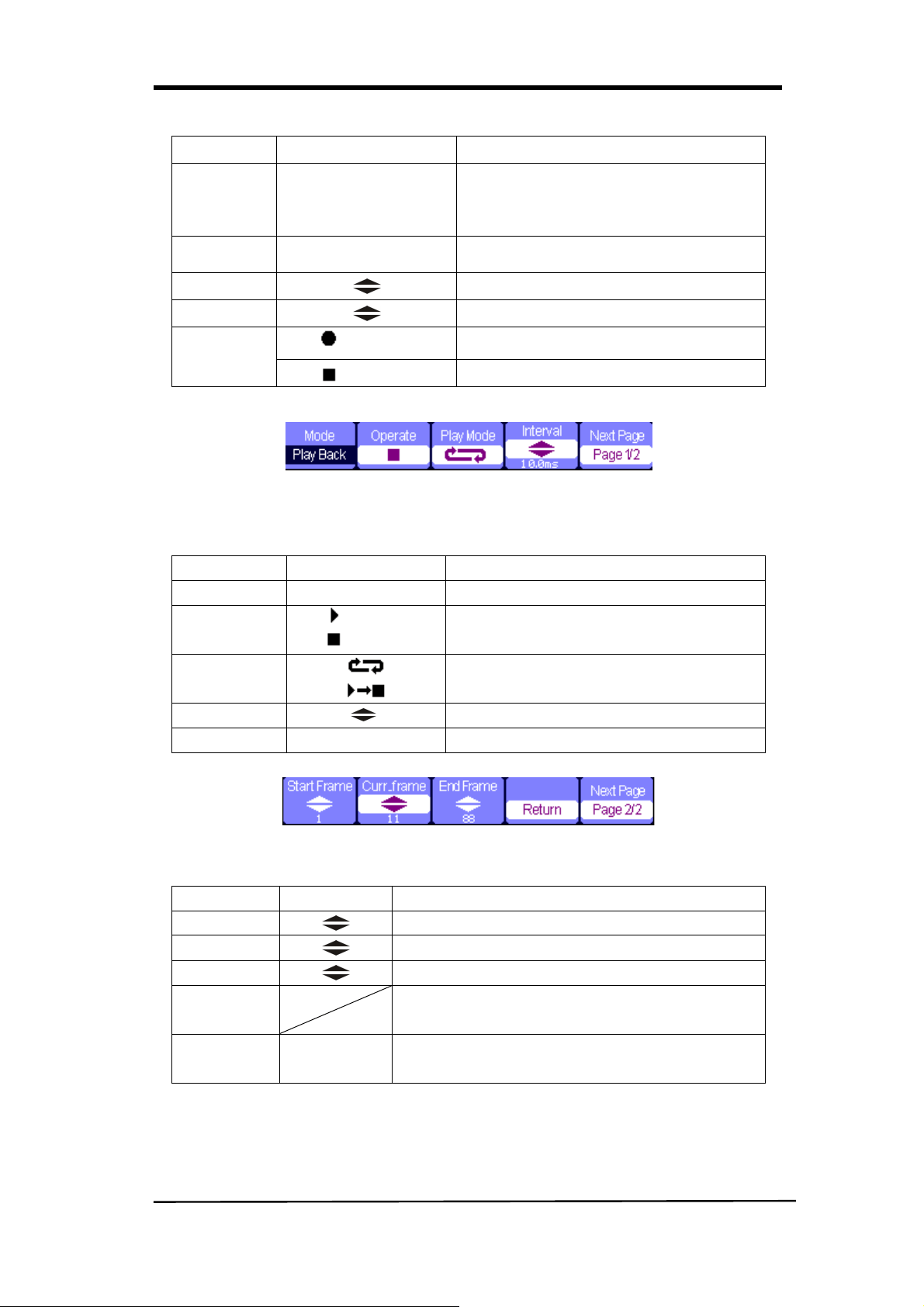
Figure 2-65 Waveform Record Menu
SHS800 Series 41
Table 2-42 Waveform Record Menu
Option Setting Instruction
Mode
Record
Replay
Off
Set recorder function menu.
Set replay function menu.
Turn off waveform record menu.
Source CH1、CH2 Choose recorder source.
Interval
Set interval of recorder waveform
End Frame
Set the max value of recorder frame.
Operate
(record)
Start to record
(stop)
Stop recording
Figure 2-66 Waveform Play Back Menu 1
Table 2-43 Waveform Play Back Function Menu 1
Option Setting Instruction
Mode Play Back Set the Play Back function menu.
Operate
(Run)
(Stop)
Press to start playback playing.
Press to stop playing.
Play Mode
Set circular play mode.
Set single time play mode.
Interval Set interval between frames.
Next Page Page 1/2 Enter the second page of the menu.
Figure 2-67 Waveform Play Back Menu 2
Table 2-44 Waveform Play Back Function Menu 2
Option Setting Instruction
Start Frame
Set start frame.
Curr_Frame
Select current frame to be played.
End Frame
Set end frame.
Return
Press to return the waveform recorder main
menu.
Next Page Page 2/2
Return to the first page of Play Back function
menu.
42 SHS800 Series
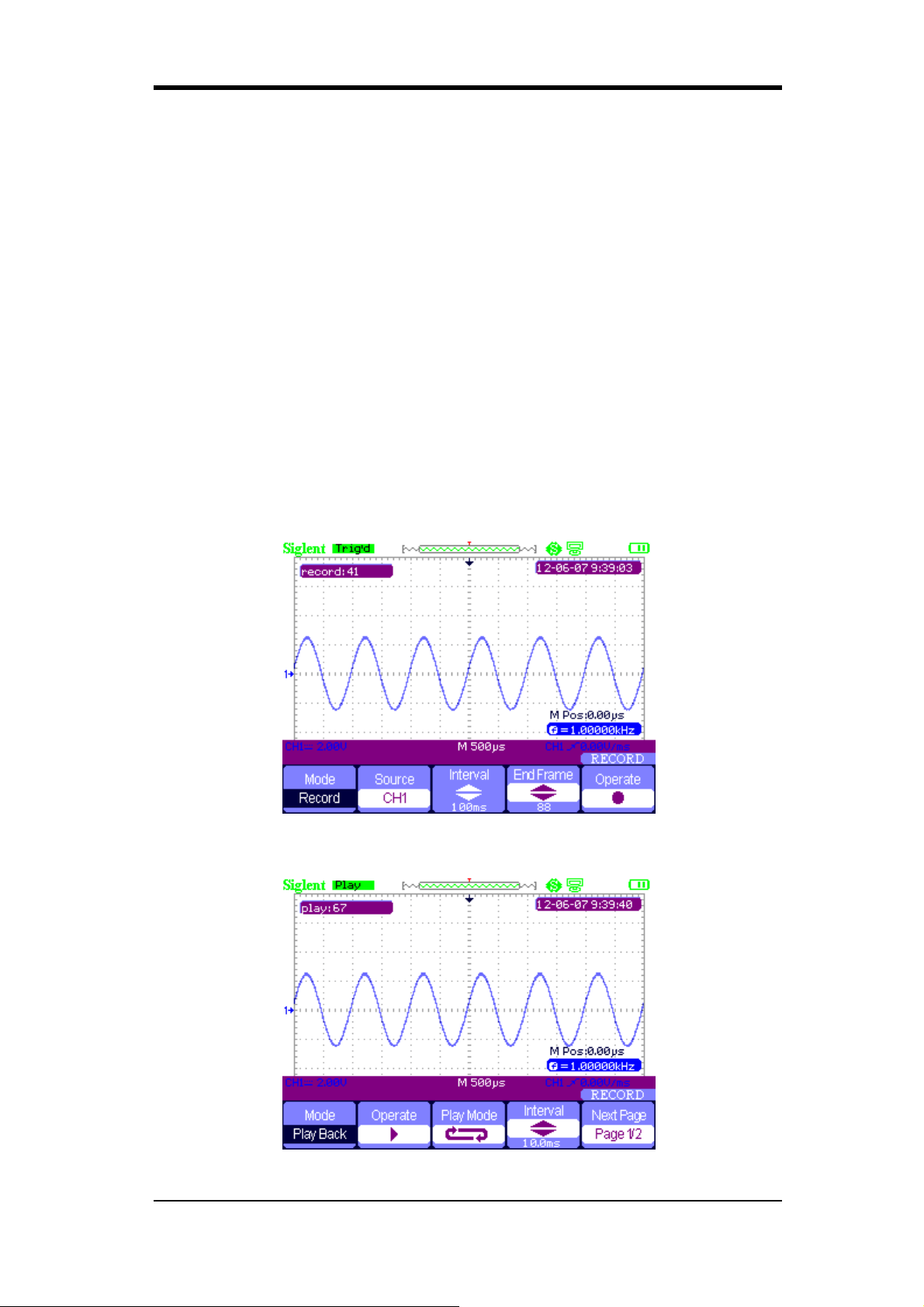
Waveform Record Application Example
Operation steps:
1. Input a waveform to be recorded.
2. Press 【User】 to enter utility system.
3. Press 【F5 】to enter the third page of the menu and enter waveform recording
menu.
4. Press 【F1】 to choose Record mode.
5. Use up and down arrow keys to set【 Interval】 and 【End】Frame.
6. Press 【F5】to perform waveform recording.
Waveform Play Back Application Example
Operation steps:
1. Press 【F1 】to choose Replay mode.
2. Press 【F5】 to enter the second page of the menu.
3. Set replay Start Frame, Curr_frame, End Frame and return to the first page of the
menu.
4. Set 【Replay】 Mode, Interval and press 【F2】 to perform waveform replay.
5. Press 【F1】 to choose Off mode to exit waveform record.
Figure 2-68 Waveform Record
Figure 2-69 Waveform Play Back
SHS800 Series 43
Chapter 3 Using the Multimeter
About this Chapter
This chapter provides a step-by-step introduction to the multimeter functions of SHS800
series Handheld Digital Oscilloscope. The introduction gives basic examples to show
how to use the menus and perform basic operations.
The digital multimeter provides the following functions: making DC voltage, AC voltage,
resistance, diode, continuity, capacitance, DC current, and AC current measurements.
Notes:
1. You should use the multimeter with correct connections as instructions.
2. The key 【Rub/Stop】 can hold the screen.
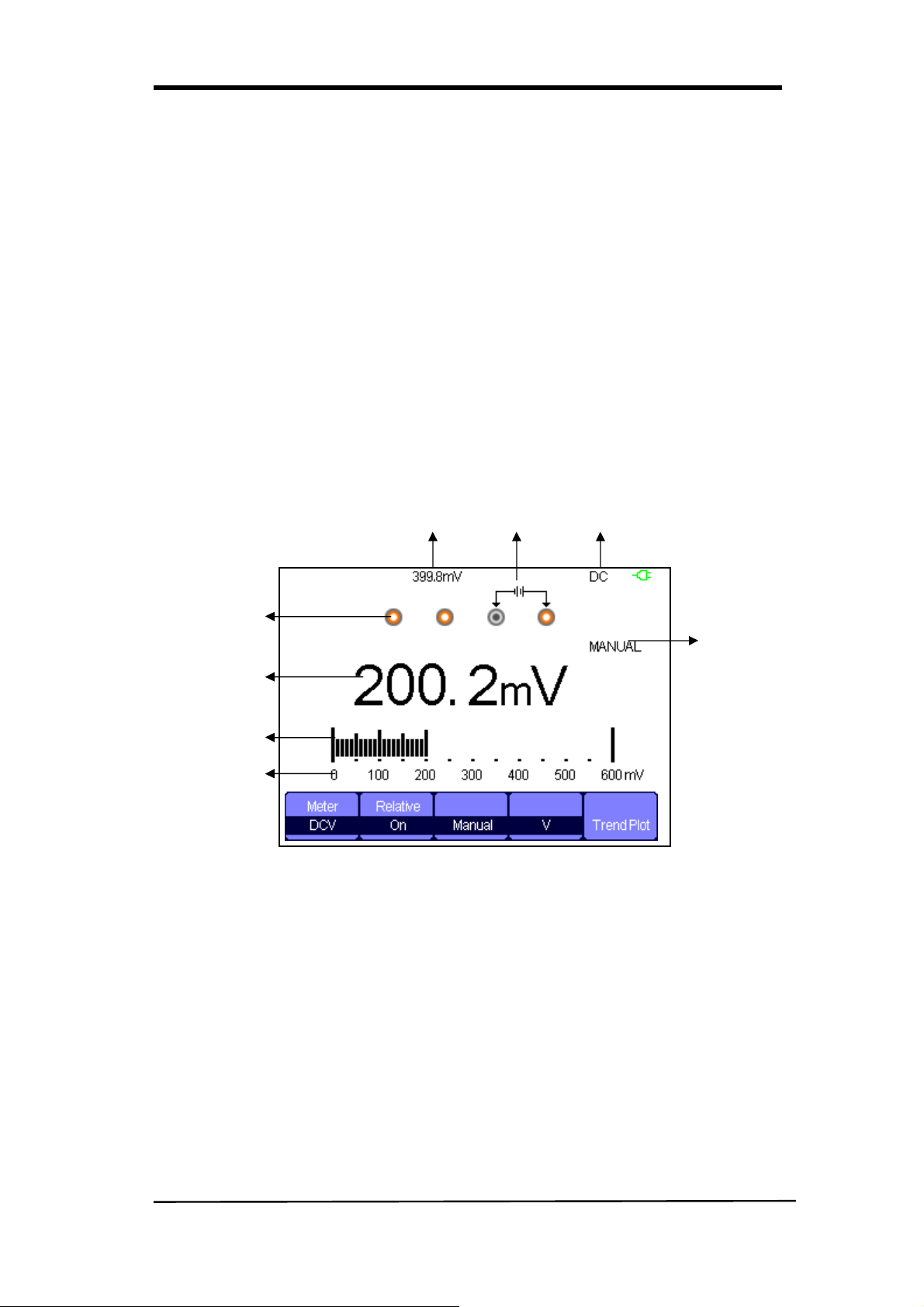
Figure 3-1 Multimeter User Interface
1. the range of the multimeter
2. staffs
3. reading value
4. input ports
5. relative value
6. the indicate of input connection
7. test type
8. operation type
1
2
3
4
8
5 6 7
44 SHS800 Series
Making DC and AC Voltage Measurement
Table 3-1 DC and AC Function Menu
Option Setting Instruction
Relative Value
On
Save the current input value as a reference and
record again. Real value equals relative value plus
measurement value
Off Real value equals measurement value
Mode
Auto
Choose the best measurement scale
automatically
Manual Choose measurement scale manually
Scale
Auto
Choose the best measurement scale
automatically according to the measurement
value.
Manual
Choose measurement scale manually and there
will be a warring when over the scale.
Tendency Plot On Plot with the measurements according to time
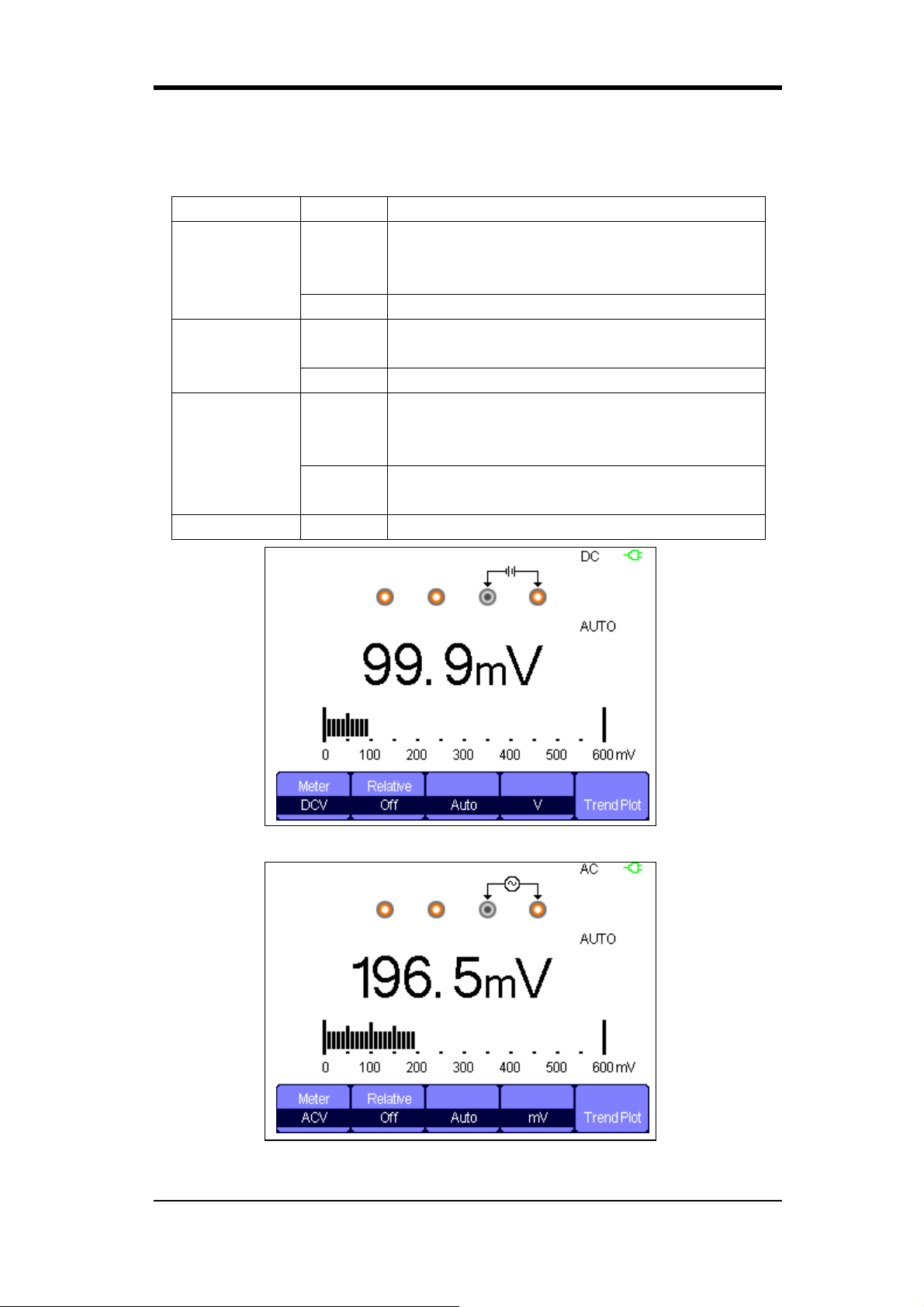
Figure 3-2 DC Voltage Measurement
Figure 3-3 AC Voltage Measurement
SHS800 Series 45
Operation Steps:
1. Press 【Meter】 to enter multimeter mode, press 【F1】 to choose DCV, ACV
measurement.
2. Insert the red probe to the V.Ω.C banana jack input and the black probe to the
COM. Connect the other end of probes to the power or load to be measured.
3. Turn on /off the relative according to the real demand.
4. Choose Manual or Auto according to the real demand.
5. Read voltage value.
Making Resistance Measurement
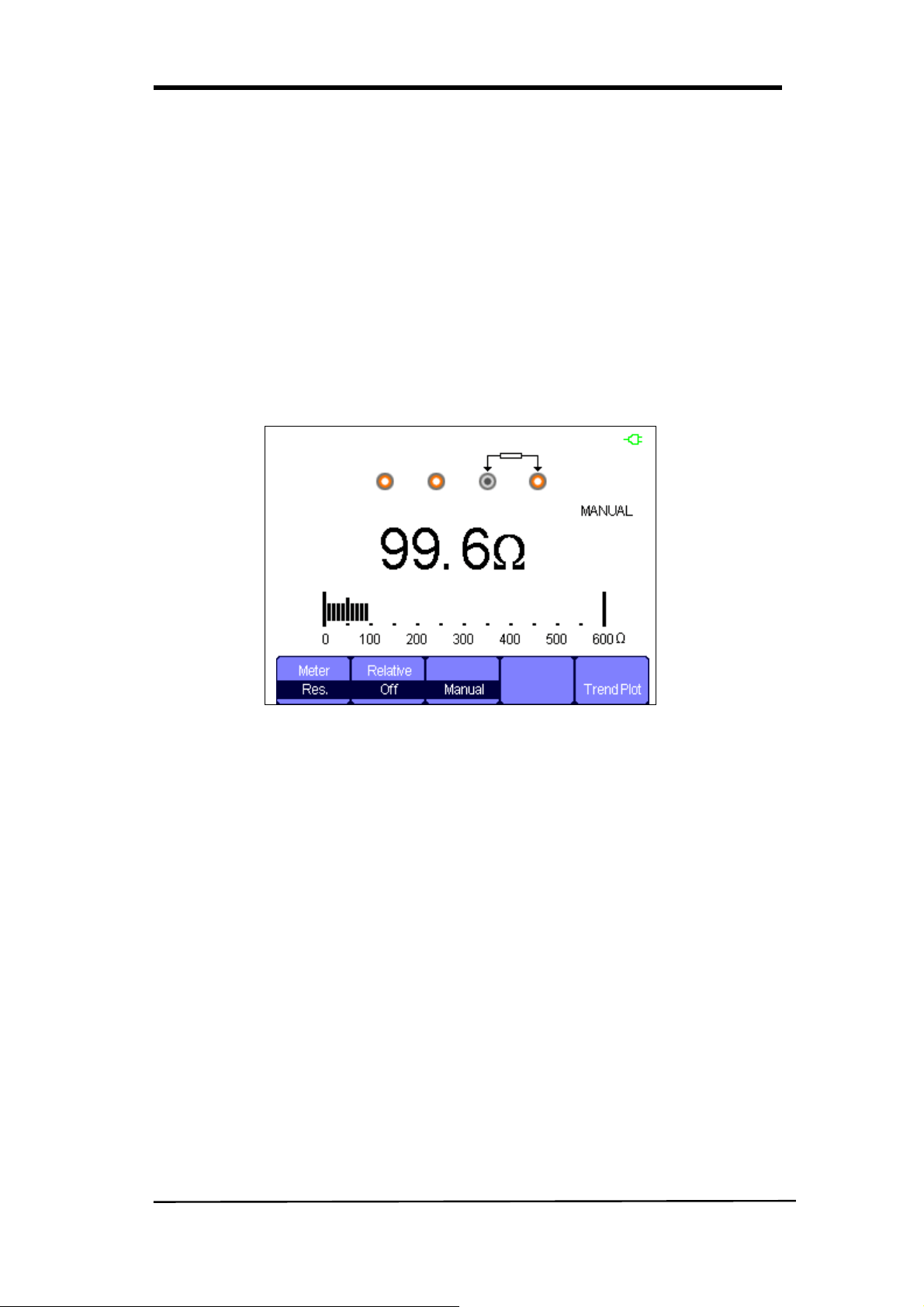
Figure 3-4 Resistance Measurement
Operation steps:
1. Press 【Meter】 to enter multimeter mode, press 【F1】 to choose Res.
measurement.
2. Insert the red probe to the V.Ω.C banana jack input and the black probe to the
COM. Connect the other end of probes to the power or load to be measured.
3. Turn on /off the relative according to the real demand.
4. Choose Manual or Auto according to the real demand.
5. Read resistance value.
Notes:
When measuring resistant, please make sure that the circuit is power off and the
capacitance is discharged to avoid damage to the SHS800.
46 SHS800 Series
Making Diode Measurement
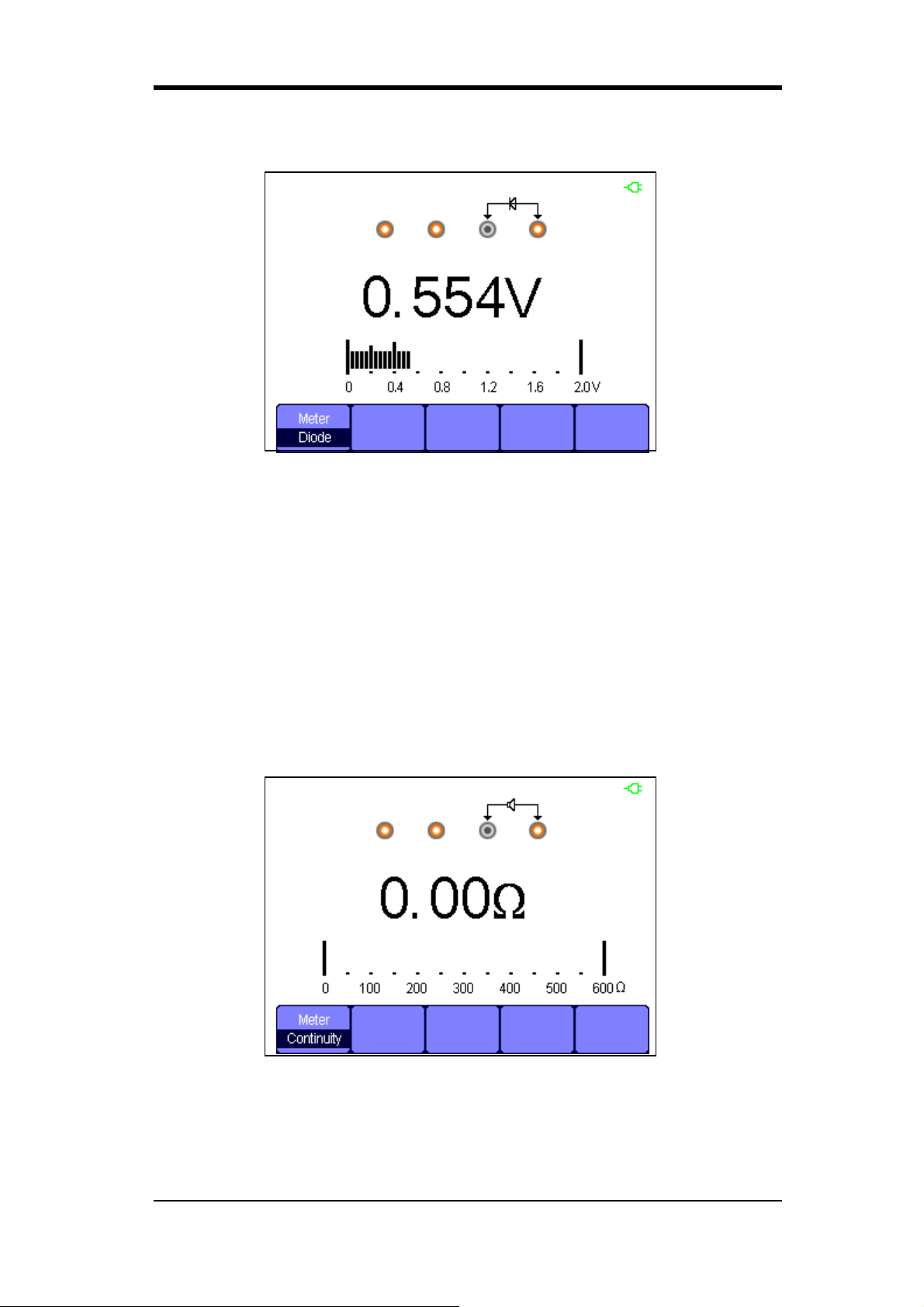
Figure 3-5 Diode Measurement
Operation steps:
1. Press 【Meter】 to enter multimeter mode, press 【F1】 to choose Diode
measurement.
2. Insert the red probe to the V.Ω.C banana jack input and the black probe to the
COM. Connect the other end of probes to the diode to be measured.
3. Read the value.
Making Continuity Measurement
Figure 3-6 Continuity Measurement
SHS800 Series 47
Operation steps:
1. Press 【Meter】 to enter multimeter mode, press 【F1】 to choose Continuity
measurement.
2. Insert the red probe to the V.Ω.C banana jack input and the black probe to the
COM. Connect the other end of probes to the object to be measured.
3. When the measured object is under 50Ω, the multimeter will alarm and read
value.
4. When the measured object is above 50Ω, the multimeter will not alarm and read
value.
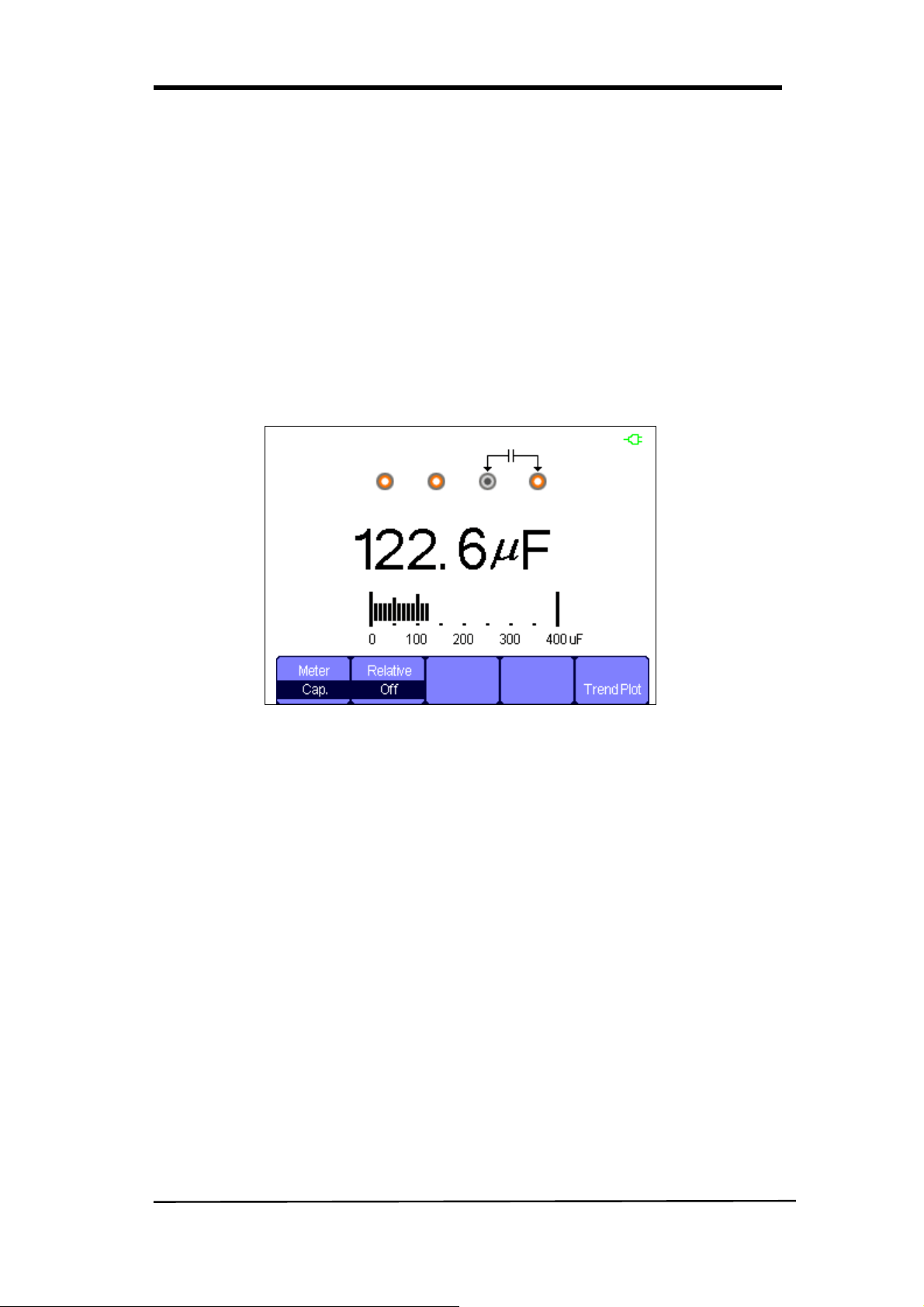
Making Capacitance Measurement
Figure 3-7 Capacitance Measurement
Operation steps:
1. Press 【Meter】 to enter multimeter mode, press 【 F1】 to choose Cap.
measurement.
2. Insert the red probe to the V.Ω.C banana jack input and the black probe to the
COM. Connect the other end of probes to the measured object.
3. Turn on /off the relative according to the real demand.
4. Read measurement value.
48 SHS800 Series
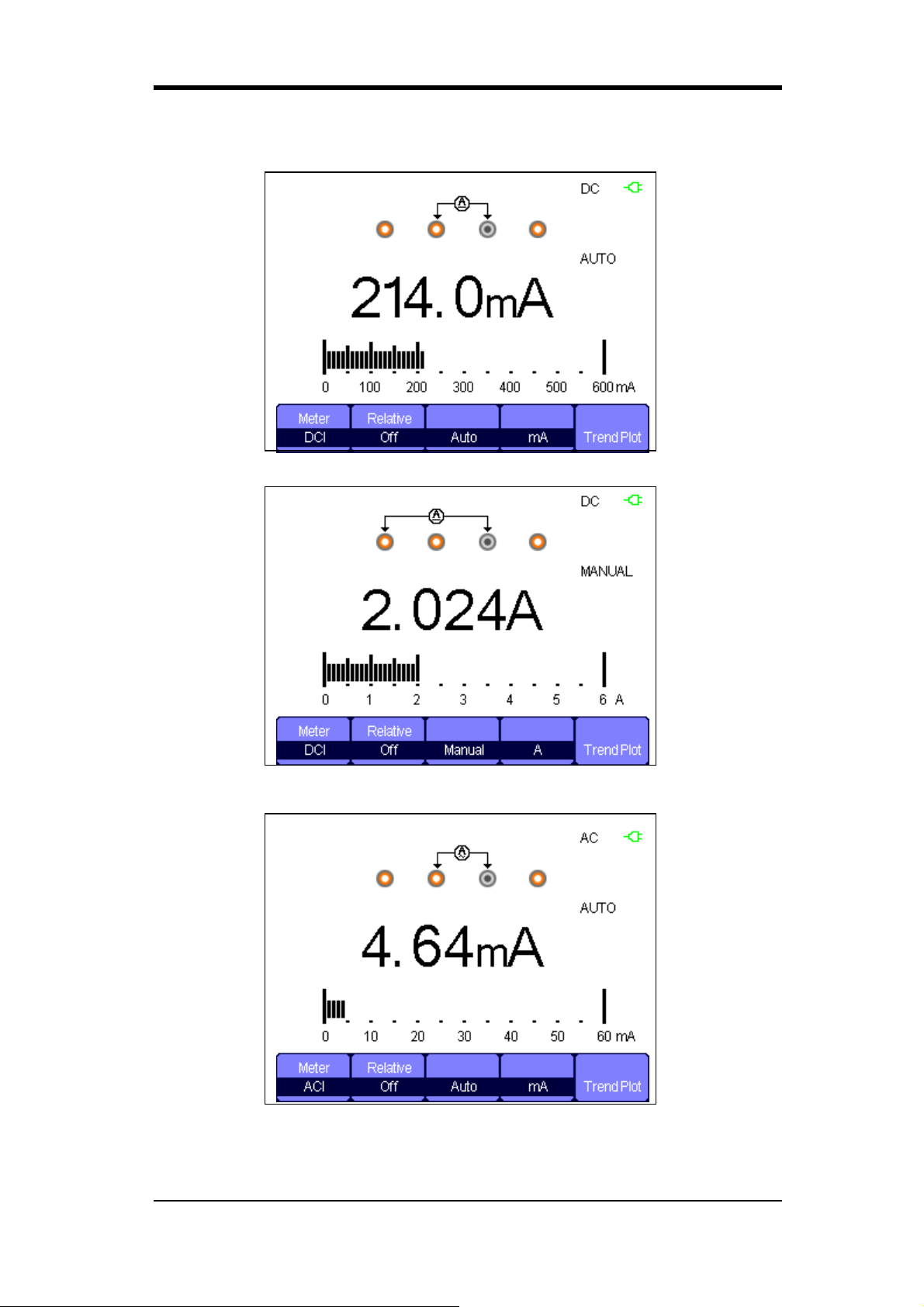
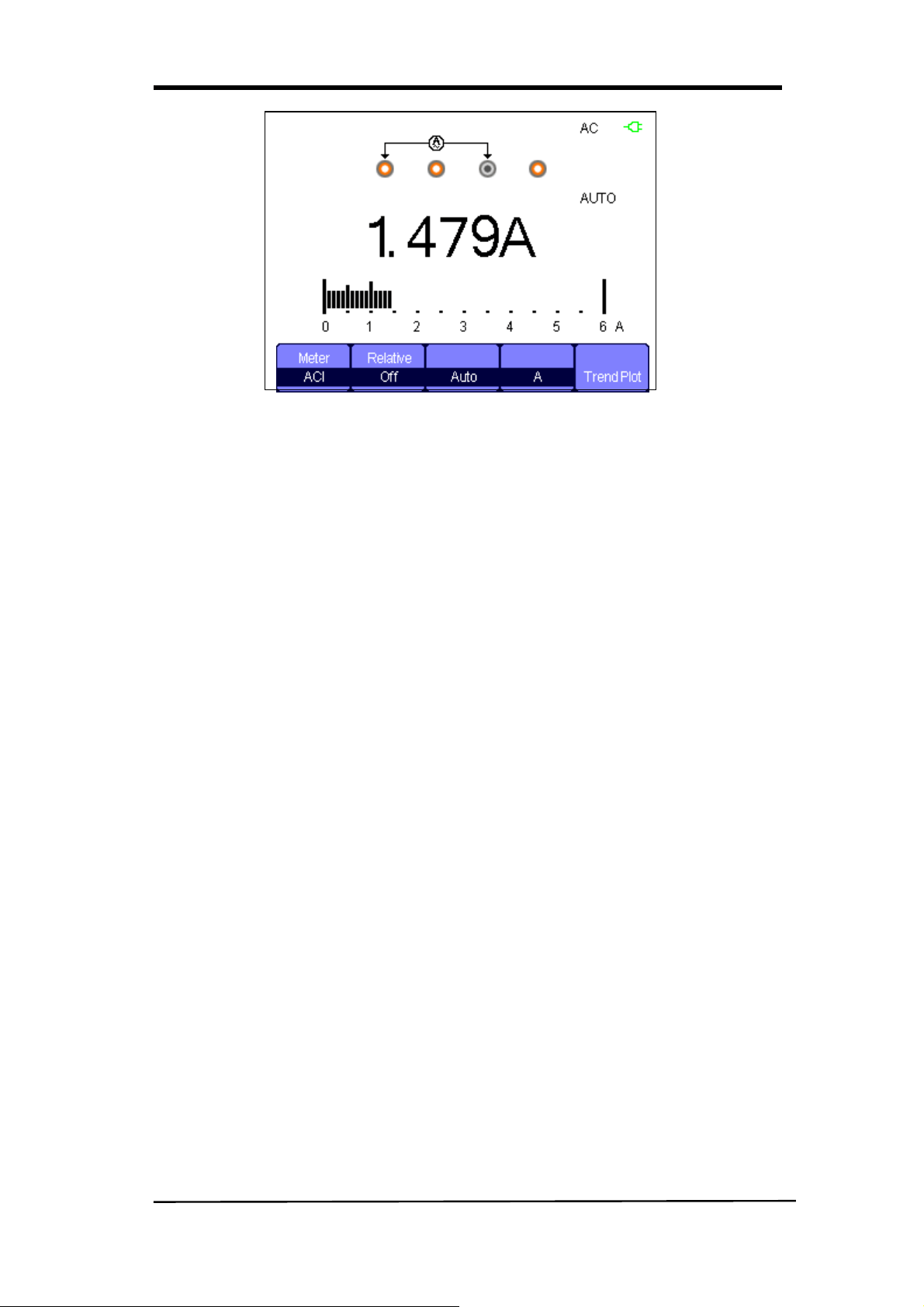
Making DC and AC Current Measurement
Figure 3-8 DC Current “mA” Measurement
Figure 3-9 DC Current “A” Measurement
Figure 3-10 AC Current “mA” Measurement
SHS800 Series 49
Figure 3-11 AC Current “A” Measurement
Operation steps:
1. Press 【Meter】 to enter multimeter mode, press 【F1】 to choose DCI/ACI
measure.
2. Insert the red probe to the A or mA jack input and the black probe to the
COM. Connect the other end of probes to the power or load to be measured.
3. Turn on /off the relative according to the real demand.
4. Choose Manual or Auto according to the real demand.
5. Read current value.

50 SHS800 Series
Chapter 4 Using the Recorder
Functions
About this Chapter
This chapter provides a step-by-step introduction to the recorder functions of SHS800
series Handheld Digital Oscilloscope. The introduction gives basic examples to show
how to use the menus and perform basic operations.
The recorder mainly includes the following functions:
Trend Plot: Trend plot is to save the measurements in the memory and then plot a
graph of Scope or Meter measurements as a function of time.
Waveform Recorder: Record real time waveform without gap or space. That is to say
every time the SHS800 can save all captured waveform data and then replay them.
The maximal recording length of waveform recorder is 7M data points.
SHS800 Series 51
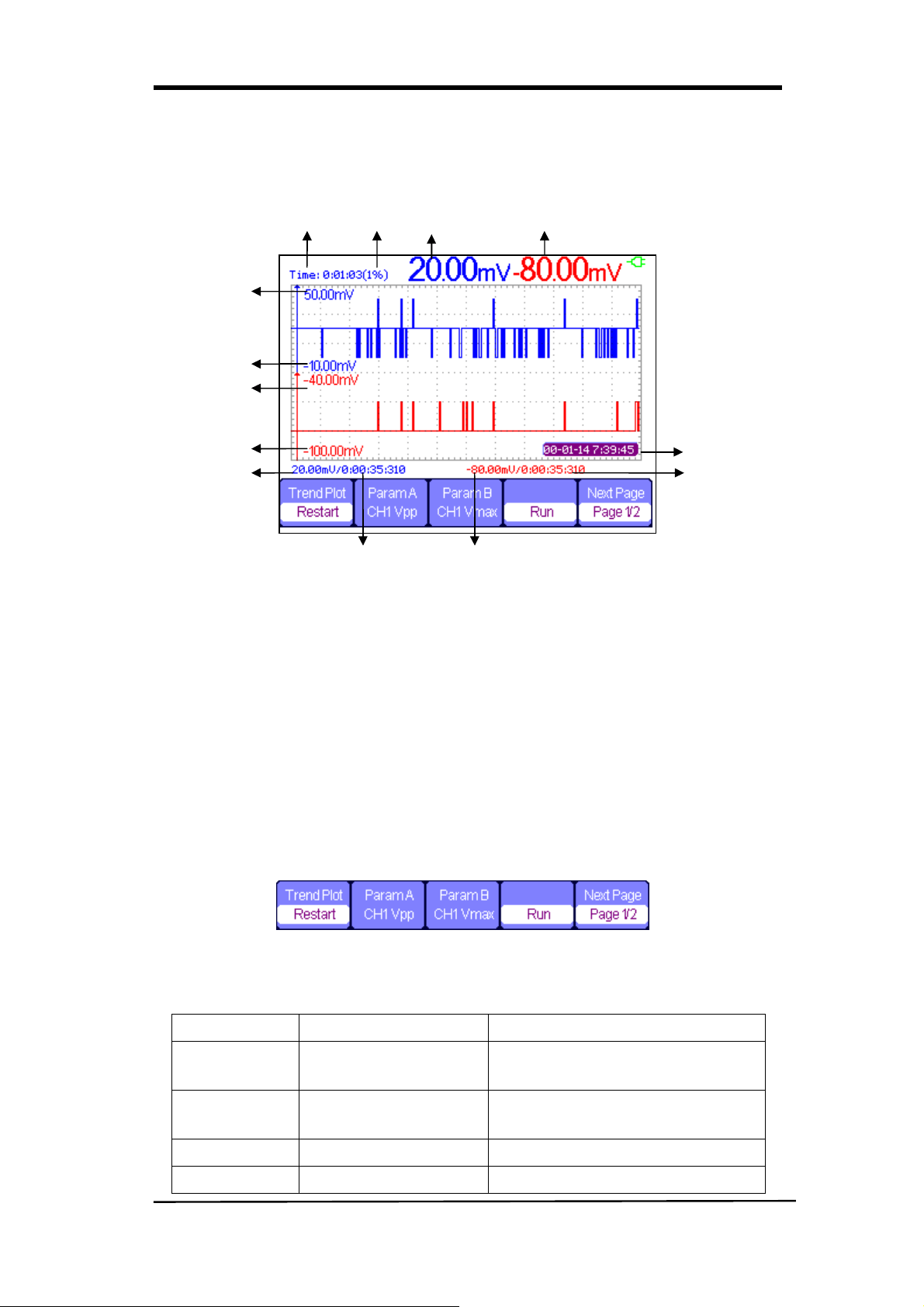
Oscilloscope Trend Plot
Figure 4-1 Scope trend plot user interface
1. current recorded time
2. the percentage of recorded date take in the whole memory
3. Value of the latest recorded data point A
4. Value of the latest recorded data point B
5. real time
6. sampling time of the cursor point
7. parameter measurement of the cursor point
8. vertical scale
9. vertical scale
Figure 4-2 Scope Trend plot Function Menu 1
Table 4-1 Scope Trend plot Function Menu 1
Option Setting Instruction
Trend Plot Restart
Quilt the current data and start to
record afresh.
Parameter A/B
Choose the parameter
to be measured.
Voltage , time and delay
measurement
Run/Stop Stop or continue recording data
Next Page Page 1/2 Enter the second page of the menu.
1 2 3 4
5
6
7 6
8
7
9
8
9
52 SHS800 Series
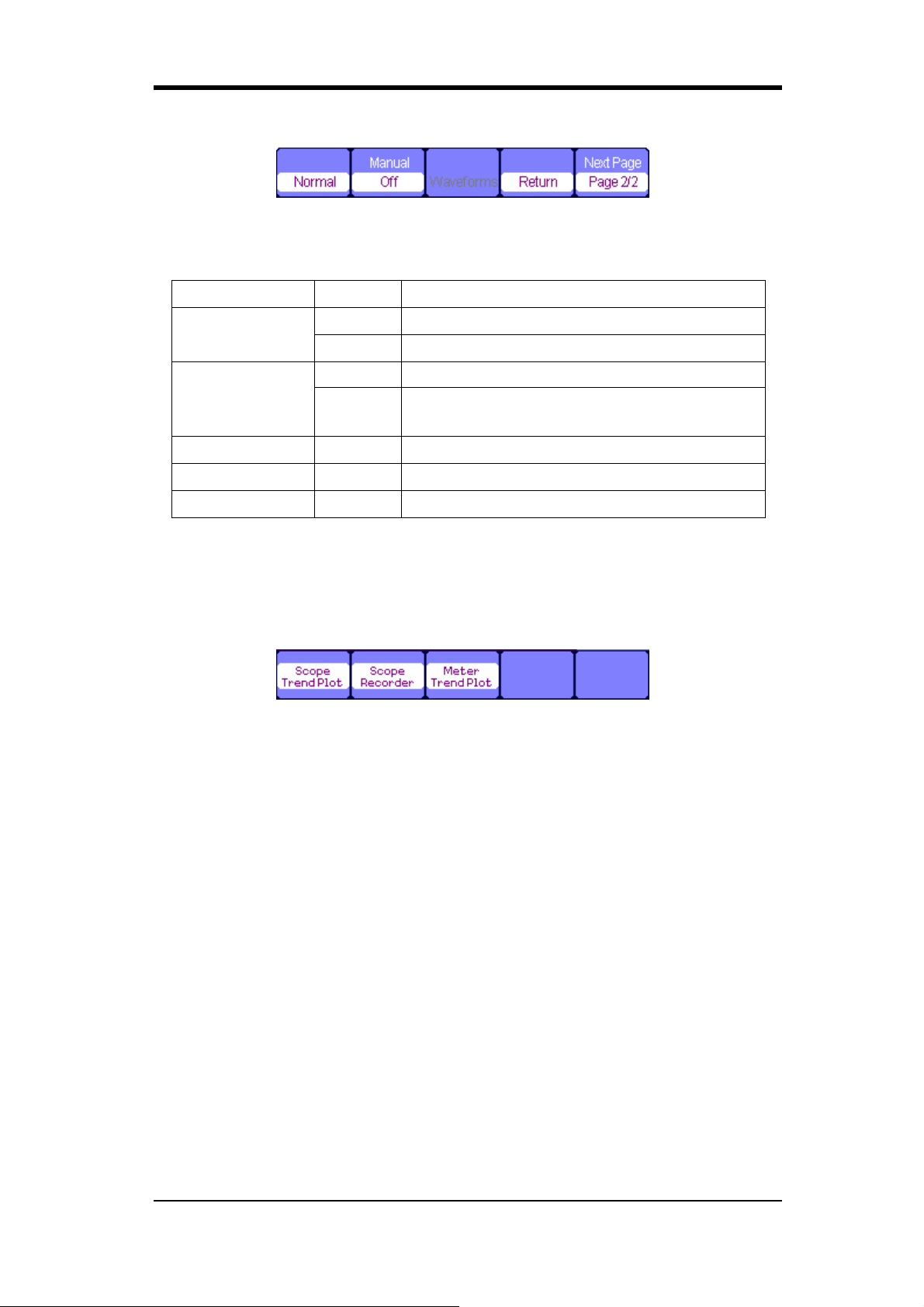
Figure 4-3 Scope Trend plot Function Menu 2
Table 4-2 Scope Trend plot Function Menu 2
Option Setting Instruction
Display Mode
Normal
Display the data up to the minute.
View all Display all date in a compressing proportion
Manual
Off Record data automatically
On
Record data manually. A Record presses a
record.
Waveforms Memory data transfer to exterior storage device
Return Return to the oscilloscope interface
Next Page Page 2/2
Return to the first page of the menu.
First choose a measurement in scope or meter mode. You can choose the recorder
functions from the waveform recorder main menu. To open the main menu, do the
following:
Press 【Recorder】 to open the recorder main menu.
Figure 4-4 Recorder Function Main Menu
Scope Trend Plot Application Example
Operation steps:
Open trend plot function
1. Input a signal to CH1 or CH2.
2. Press 【Recorder】 to enter the recorder main menu.
3. Press 【F1】 to choose Scope Plot.
4. Choose measured parameter A/B and start recording the trend plot. The scope
5. Press 【F5】 to pause or continue recording data.
SHS800 Series 53
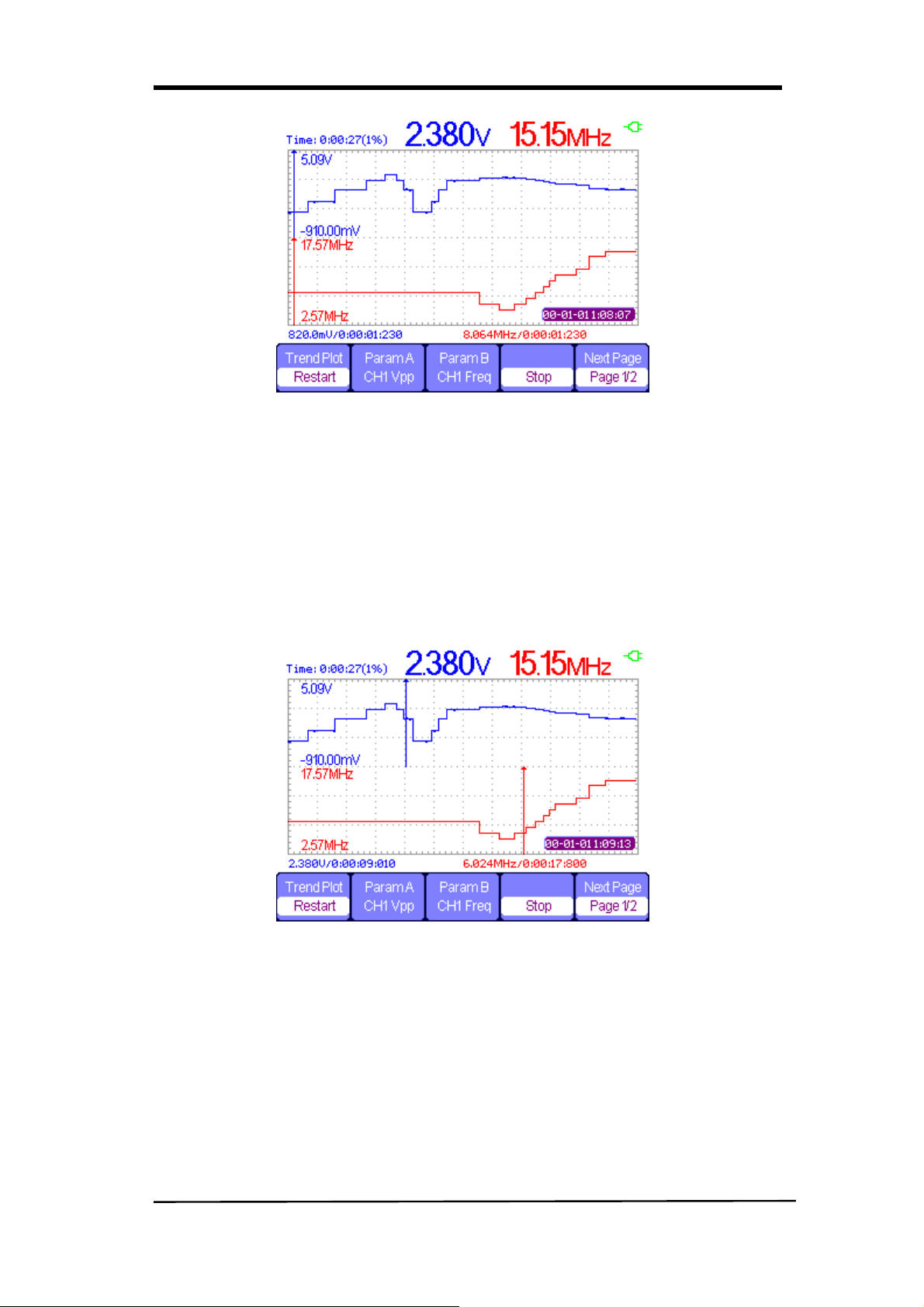
Figure 4-5 Trend Plot record Curve
Display recorded data
6. Press 【F5】 to enter the second page of trend plot menu.
7. Press 【F1】 to choose data display mode.
Normal: the screen displays the data up to the minute.
View All: the screen displays all data in the memory.
8. Zoom function: under full screen mode, press time base to zoom in or zoom out.
9. Data analysis: move cursor, analyzing data over time.
Figure 4-6 Analyzing Trend Plot
10. Save waveform: save the recorded waveform to exterior storage device to make
more detailed analysis.
11. Press Return to exit trend plot.
54 SHS800 Series
Waveform Recorder
Press 【Recorder】 to enter recorder main menu under scan time base, then press
【F2】 to choose Scope recorder.
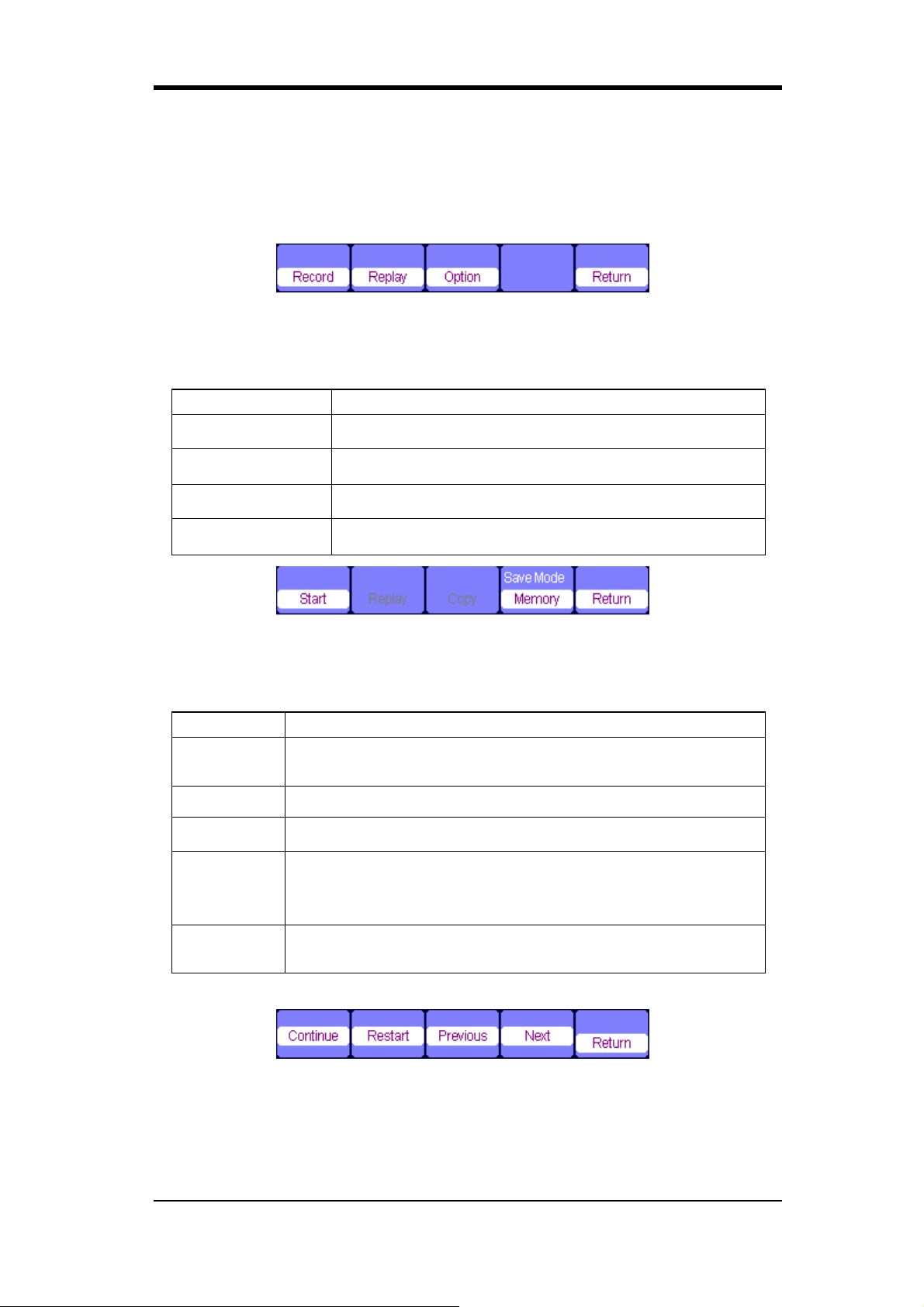
Figure 4-7 Waveform Recorder Menu
Table 4-3 Waveform Recorder Function Menu
Option Instruction
Record Record waveform without gap.
Replay Replay the recorded waveform.
Option Setup the parameters of waveform recorder.
return Exit waveform recorder function.
Figure 4-8 Waveform Recorder Saving Mode Menu
Table 4-4 Waveform Recorder Saving Mode Function Menu
Option Instruction
Start
Begin to record waveform.(record waveform under 100mS and
above scan time base)
replay Replay the recorded waveform.
Copy Copy the waveform saved in the memory to the USB flash disk.
Save mode
Choose a place to save record, including memory USB flash
disk. USB flash driver saves only under 2.5s/div and above time
base.
return
Exit the submenu and return to the waveform recorder main
menu.
Figure 4-9 Waveform Recorder Replaying Mode Menu
SHS800 Series 55
Table 4-5 Waveform Recorder Replaying Mode Function Menu
Option Instruction
Stop/Continue
Pause or contnue playing waveform automatically, you can
change the time base to observe the waveform in the
memory.
Restart Replay the waveform
Previous Back the waveform and then play.
Next Speed the playing of the waveform.
Return Exit the replaying menu.
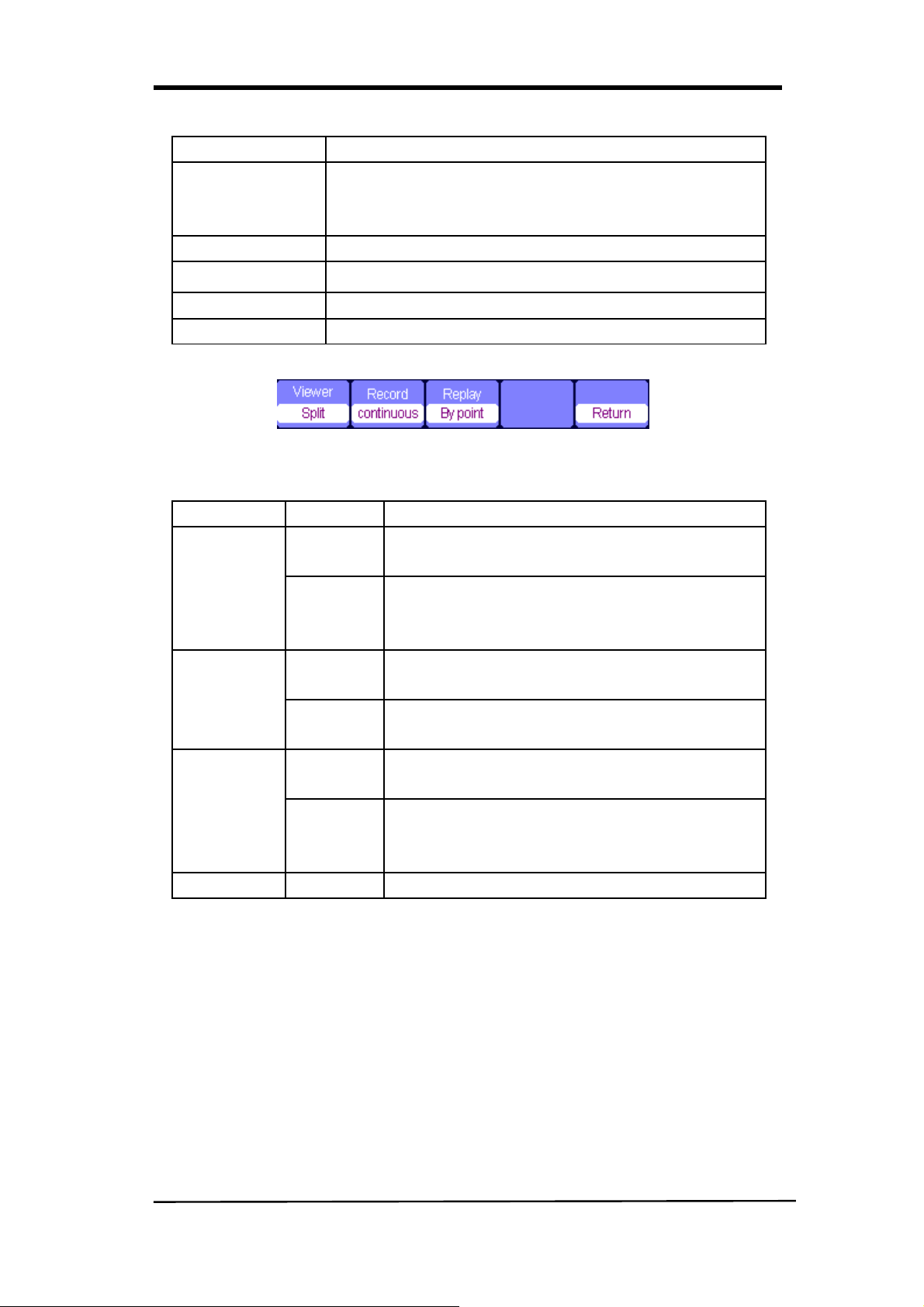
Figure 4-10 Waveform Recorder Setting Menu
Table 4-6 Waveform Recorder Setting Menu
Option Setting Instruction
Viewer
mode
Full screen
Record and replay channel waveform with full
screen
Split
Record and replay channel waveform with divided
screen. The up half of the screen displays CH1
while the down half displays CH2.
Record
mode
continuous
Record circularly, when the waveform recorder is
full, the after data will cover the pre-data.
Single
Stop recording data when the waveform recorder
memory is full.
Replay mode
By Point
When replaying, the screen waveform updates
every dot from left to right.
By frame
When replaying,the screen waveform updates the
whole screen according to the time of sampling
every frame data.
return Exit the recorder setup interface.
Waveform recorder application example
Startup the waveform recorder function:
1. Under 100mS or above time base.
2. Press 【Recorder】 to open the main menu.
3. Press 【F2】 to choose scope recorder.
4. Press 【F3】 to set the waveform recorder. Such as
5. Press 【F5】 to return to the waveform recorder main menu.
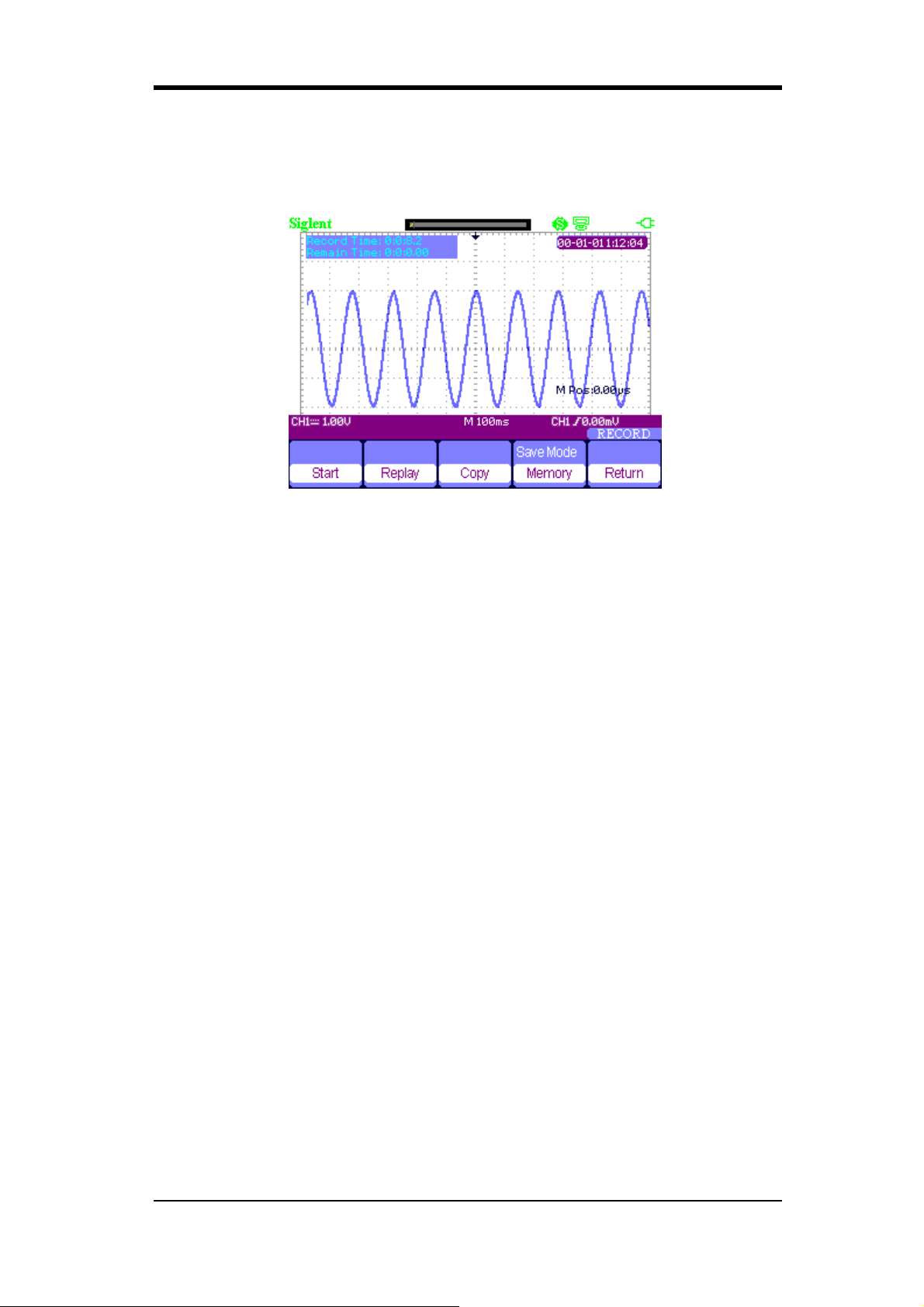
6. Press 【F1】 to enter record interface.
7. Press 【F4】 to set storage mode. Interior and USB flash disk storage mode.
56 SHS800 Series
8. Press 【F1】 to start recording data.
The waveform will not move right and the recorded data saved to memory. The
recorded time will be different according to the time base. You can pause or stop at
any time.
Figure 4-11Waveform Recorder Interface
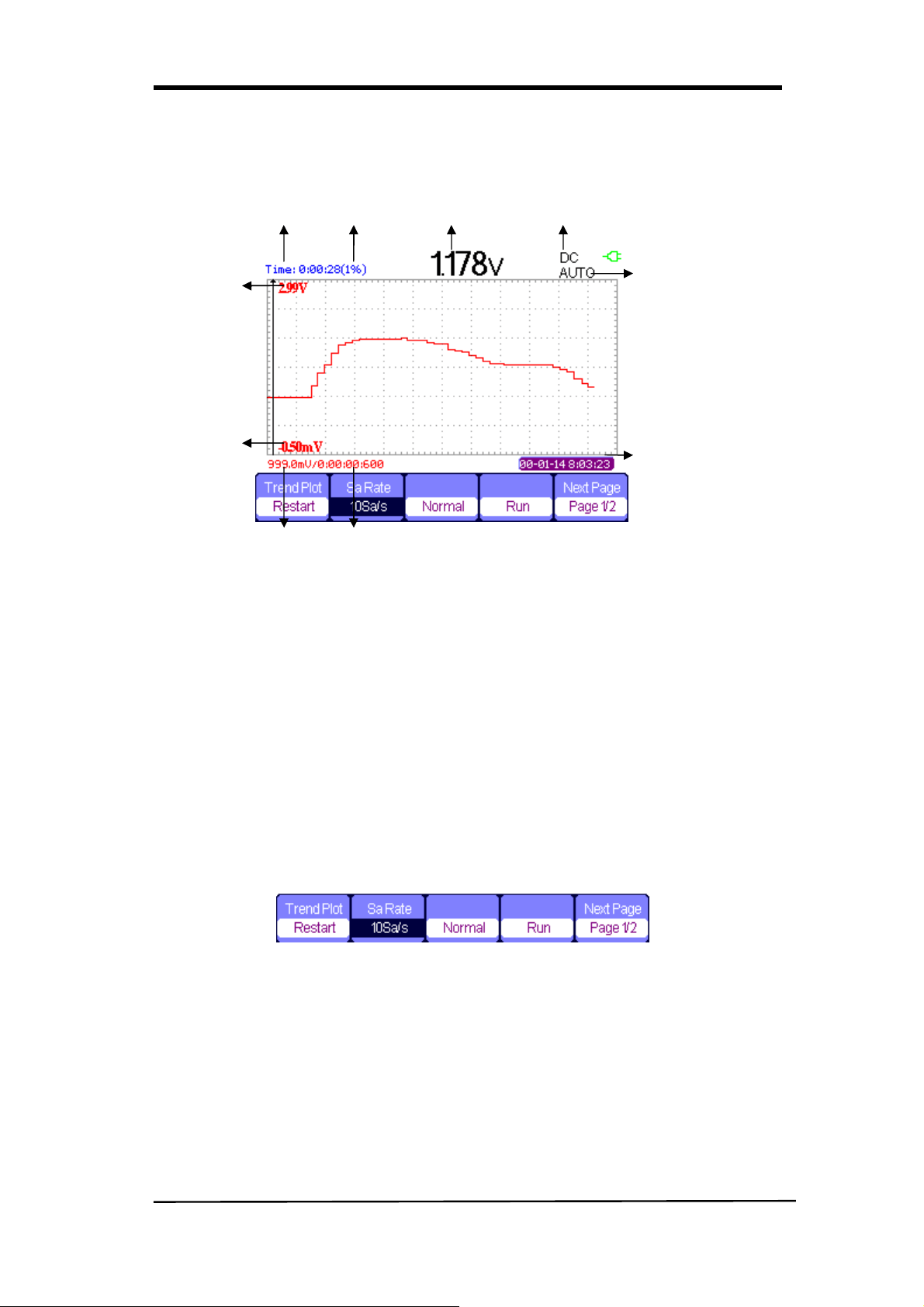
Waveform replay
9. Press 【F2】 to replay waveform.
You can replay the recorded waveform for several times and you can Advance or
back off at any time.
10. Press 【F5】 to exit the waveform recorder.
SHS800 Series 57
Multimeter Trend Plot
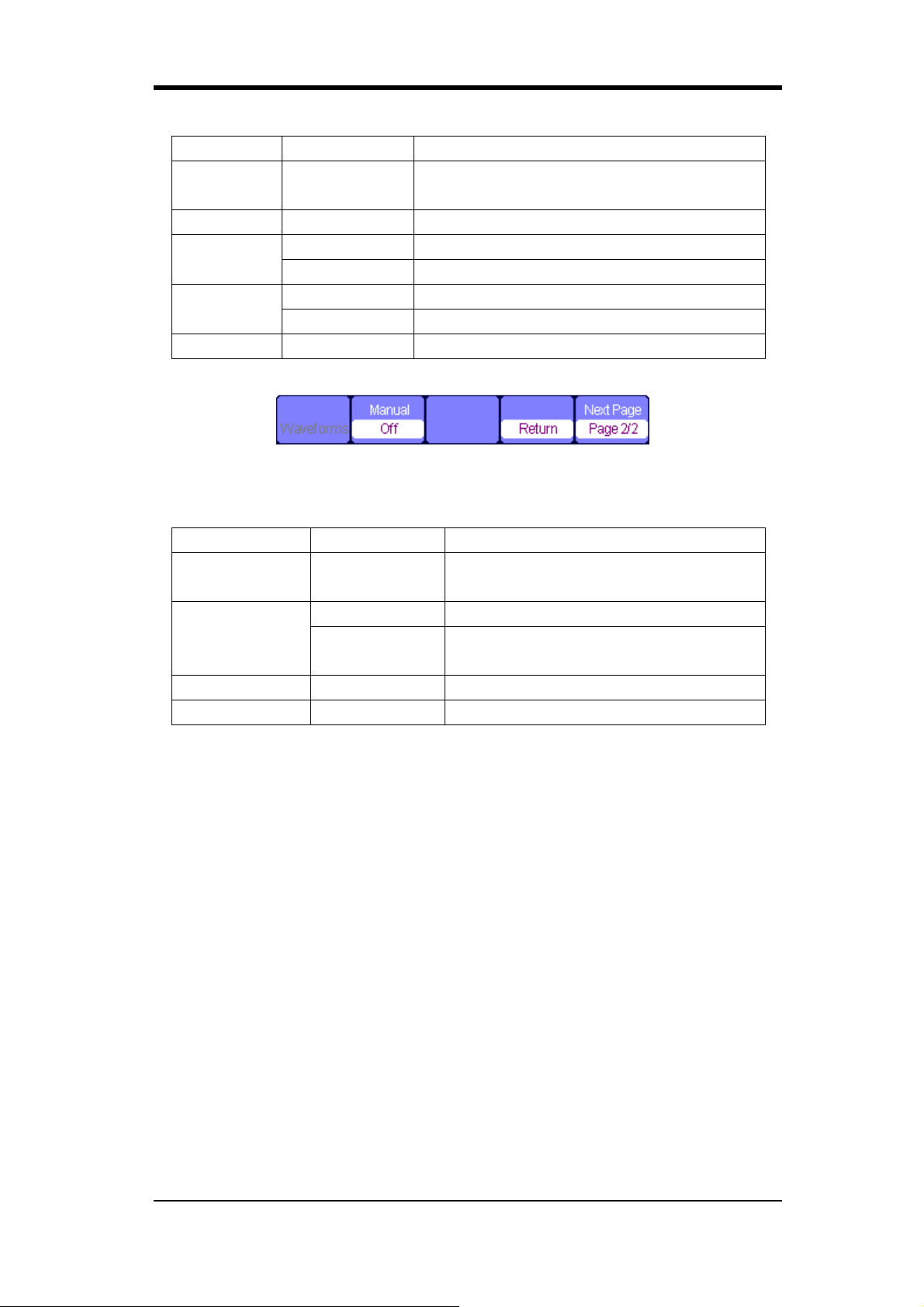
Figure 4-12 Multimeter Trend Plot User Interface
1. current recorded time
2. the percentage of the current data take in the whole memory
3. the parameter value of the recorded data up to the minute
4. DC/AC
5. manual/auto
6. the real time
7. the sample time of the cursor point.
8. the parameter measurement value of the cursor point
9. vertical scale
10. vertical scale
Figure 4-13 Multimeter Trend Plot Menu 1
2 3 4
7 8
1
5
6
9
10
58 SHS800 Series
Table 4-6 Multimeter Trend Plot Function Menu 1
function setting Instruction
Restart
Quilt the current data and start to record
afresh.
Sa Rate 10Sa…0.005Sa
Set sampling rate
Display
mode
normal Display the recorded data up to the minute.
All view Display all dots.
Record
mode
Run Record data automatically
Stop Stop record data
Next Page Page1/2 Enter the second page of the menu.
Figure 4-14 Multimeter Trend Plot Menu 2
Table 4-7 Multimeter Trend Plot Function Menu 2
Function Setting Instruction
Waveform
storage
Data in the memory transferred to the
exterior storage device.
Record manually
Off Record data automatically
On
Record data manually. A Record presses
a record.
Return Return to the multimeter function state
Next Page Page2/2 Return to the first page.
Multimeter trend plot application example
Start plot function
Operation steps:
1. Input a measured signal correctly. See chapter 3 Using the Multimeter.
2. Press 【F5】 to enter Trend Plot at the multimeter main menu.
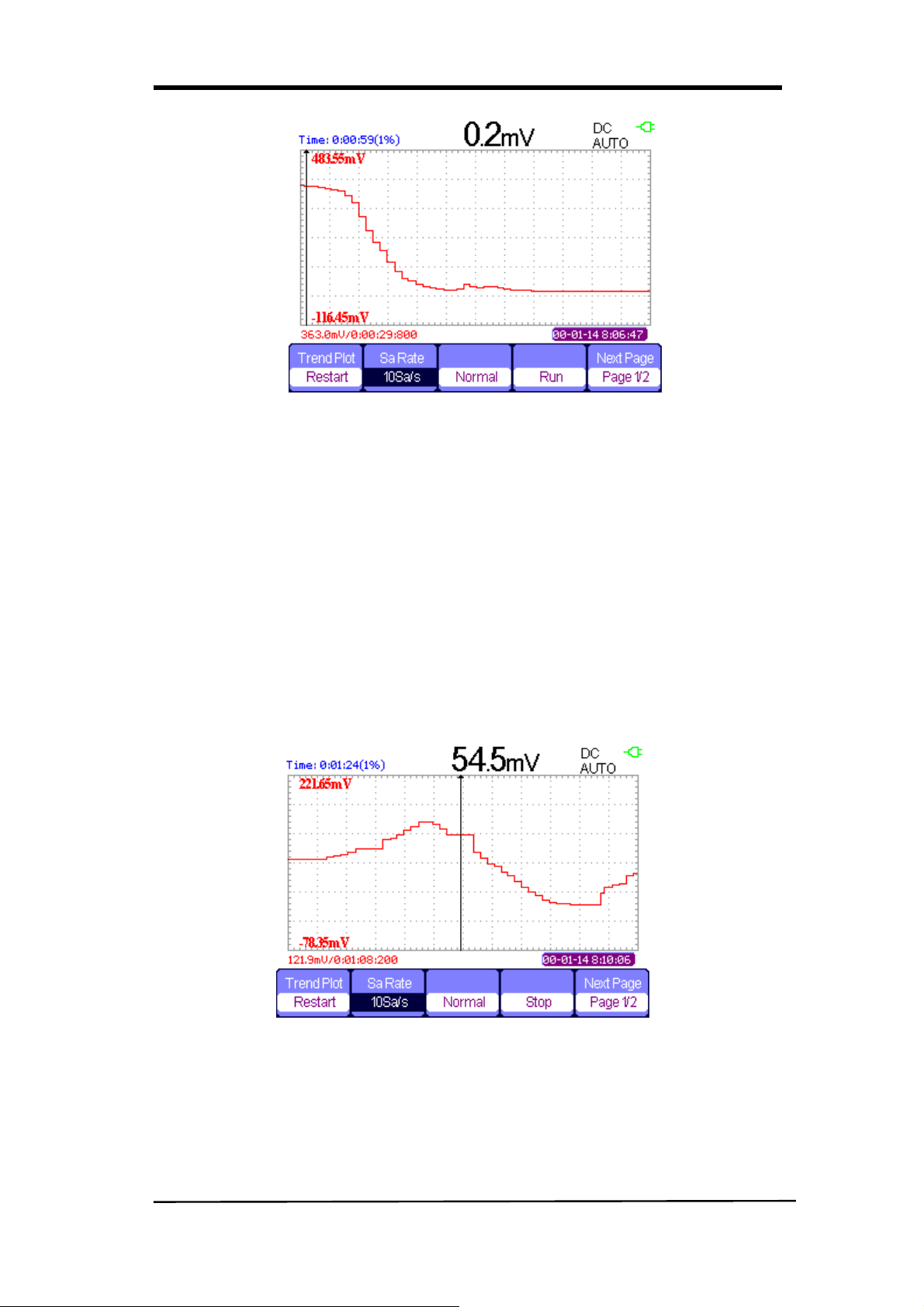
The SHS800 will record the measurement value of the input port continuously and
plot measurements over time.
SHS800 Series 59
Figure 4-15 Multimeter Trend Plot Recording Curve
3. Press 【F4】 to stop or run recording data.
4. At the second page of the menu you can choose manual or auto mode to record
the data.
Display the record data
5. Press 【F3】 to choose data display mode.
Normal mode: the screen displays the data up to the minute. The recorded data
before saved in the memorizer.
Full view mode: the screen display all recorded data in the memorizer.
6. Zoom function: under full screen mode, press time base to zoom in or zoom out.
7. Data analysis: move cursor, analyzing data over time.
Figure 4-16 Analysis Trend Plot Data
8. Save waveform: save the recorded waveform to exterior storage device to make
more detailed analysis.
9. Press Return to exit trend plot.

60 SHS800 Series
Chapter 5 Prompting and
Troubleshooting
About this Chapter
This chapter gives a detailed instruction of every system prompting appears on the
screen as well as some basic troubleshooting.
System Prompting Messages Instruction
Trig level at limit! : Mention you that the trigger level is at a limit when you turn
the Trig level knob.
Horizon position at limit! : Mention you that the horizontal position is at a limit
when you turn the horizon position knob.
Volts/Div at limit! : Mention you that the vertical voltage have already touched the
Min 2mV/div or the Max 100V/div.
Volts position at limit! : The system would display this information when the
vertical position is at a limit.
Sec/Div at limit! : Prompts that the Volts/Div is at full range while turning the
vertical scale knob.
Holdoff time at limit! : Use the arrow keys when holdoff time has been to max or
min value, now the system will clew this information.
Function isn’t useable! : Under several special modes, the some functions could
not be running.
No signal! : The system would clew this information when the signal could not
match the auto set condition. (Using in the auto set)
Adjust at limit! : You could adjust the pulse width by the arrow keys till the pulse
width has reached min20.0ns or max 10.0s.
Location Empty! : If you have no stored waveforms or setups on some location,
the screen will display this information when you press the “Recall” button on this
location.
USB Flash Drive Plug In! : This information will appear when you invert the USB
Flash Drive to the USB Host port.
USB Flash Drive Pull Out! : This information will appear when you pull out the
USB Flash Drive.
Store Data Success! : Save setup data, waveform data or Figure data to the

SHS800 Series 61
internal of the oscilloscope or USB flash successful.
Ready Data Success! : Read setup data or waveform data from the internal of
the oscilloscope or USB flash successful.
Please set USB Device to printer! : Press the “S/div” knob will appear this
information on the screen when the “Print Key” option is set to “Print Figure” and
the “USB Device” option is set to “Computer”.
USB Flash Drive isn’t connected! : When the “Save To” option is set to “File” or
the “Print Key” option is set to “Save Figure” in “Save/Recall” menu , Press the
“Save” option button or the “S/div” knob before inverting the USB Flash Drive to
the USB Host port will appear this information on the screen.
Record Wave Success! :This message will appear when you finish recording
waveforms.

62 SHS800 Series
Troubleshooting
1. After the SHS800 is powered on,if the screen remains dark ,please do as
following steps:
1) Check the power cable’s connection.
2) Ensure the power switch is turned on.
3) After the inspections above,restart the Handheld Digital Oscilloscope.
4) If the Handheld Digital Oscilloscope is still not used after the checking, please
connect with MY company
2. If there is no signal wave in the screen after gathering the signal, please do
as following steps:
1) Check the probe connecting with the signal cable or not
2) Check the signal cable connecting with the BNC connector or not.
3) Check the probe whether connect with the goods tested or not.
4) Check the tested goods produce the signal or not.
5) Gather the signal again.
3. The value of the tested voltage is 10 times higher/lower than the real one ,
please do as following steps:
Check the attenuation quotient whether match the probe attenuation proportion or
not.
4. Display the wave, but not steady , please do as following steps:
1) Check the signal source on the trigger interface whether or not matches the
signal channel.
2) Check the trigger mode: normal signal should use the “edge” trigger mode.
The video signal should use the “Video” Trigger mode. The signal would
display steady, only using the matching trigger mode.
3) Attempt to change the “ coupling” into “HF Reject” or “LF Reject” display, so
that the High/low frequency noise disturb the trigger should be filtrated
5. Press “RUN/STOP” button, but no display.
Check the trigger mode on the trigger interface whether or not in the “normal” or
“single”, and check the trigger level is whether or not over the wave range. If yes,
please put the trigger level to the middle position or set the trigger mode to the
“Auto” position. In another hand, you could choose the “Auto” button to set up
automatically.

SHS800 Series 63
6. The signal is displayed as ladder like waveform
1) This phenomenon is normal. The time base maybe is too slow .you should
turn the horizontal SCALE knob to increase horizontal resolution to improve
the display.
2) Maybe the display Type is set to “Vectors”, You could set it to Dots mode to
improve the display.
7. The multimeter measurements aren’t correct
1) Check that if the range of the SHS800 matches with the measured item.
2) Make sure that if the multimeter is beyond the calibration date. if the
measurements and the real values are beyond the relevant precision, please
contact with the calibration site warranted by SIGLENT company to calibrate
the SHS800 .
3) If you can’t use the SHS800 normally all the same, please contact with
SIGLENT servicing center, we will provide service for you.
8. The other kind of trouble, please contact with SIGLENT servicing center. For
more details please see service and support.
Warning
Person without warranty by SIGLENT Company shouldn’t disconnect
the machine for inspection or you will lose the quality guarantee.

64 SHS800 Series
Chapter 6 Service and Support
About this Chapter
This chapter covers basic maintain procedures that can be performed by the user. You
should have a detailed understanding of the content below to use and maintain you legal
rights.
Maintain Summary
Each SIGLENT product is warranted to be free from defects in material and
workmanship under normal use and service. The warranty period is three years and
begins on the data of shipment. This warranty extends only to the original buyer or
ender-user c of a SIGLENT authorized reseller. If a product or CRT proves defective
within the warranty period, SIGLENT will provide repair or replacement as described in
the complete warranty statement.
To arrange for service or obtain a copy of the complete warranty statement, please
contact with the nearest SIGLENT sale and service office.
Except this summary or the applicable warranty statement, SIGLENT makes no warranty
of any kind of express or implied, including without limitation the implied warranties of
merchantability and fitness for a particular purpose. In no event shall SIGLENT be liable
for indirect, special or consequential damages.
Contact SIGLENT
SIGLENT TECHNOLOYIES CO., LTD
Address: 3/F , No. 4 BUILDING, 3rd LIUXIAN Rd, ANTONGDA INDUSTRY GARDEN,
BAO’AN DISTRICT, SHENZHEN,518101, CHINA
Tel: 0086 755 36615186
E-mail: sales@siglent.com
http://www.siglent.com

65 SHS800 Series
Appendix A: Default Setup
Menu or
system
Options, Knobs or Buttons Default setup
CH1, CH2
Coupling DC
BW Limit Off
Volts/div Coarse
Probe 1X
Invert Off
Filter Off
Volts/div 1.00V
MATH
Operation CH1+CH2
CH1 Invert Off
CH2 Invert Off
FFT Operation:
Source CH1
Window Hanning
FFT Zoom 1X
Scale dBVrms
Display Split
HORIZONTAL
Window Main Time Base
Position 0.00μs
Sec/div 500μs
Window Zone 50.0μs
Trigger knob Level
CURSOR
Type Off
Source CH1
Horizontal (voltage) +/-3.2divs
Vertical (time) +/-5divs
ACQUIRE
Three Mode Options Sampling
Averages 16
Sampling Method Real Time
DISPLAY
Type Vectors
Persist off
Gird
Intensity 60%
Brightness 40%
Format YT
Menu Display Infinite
SAVE/RECALL
Type Setups
Save To Device

SHS800 Series 66
Setup No.1
REF
Source CH1
REFA Off
REFB Off
UTILITY
Sound On
Frequency Counter On
Side USB Computer
Record Off
TRIGGER
(Edge)
Type Edge
Source CH1
Slope Rising
Mode Auto
Coupling DC
Level 0.00V
TRIGGER
(Pulse)
Type Pulse
Source CH1
Condition =
Set Pulse Width 1.00ms
Mode Auto
Coupling DC
TRIGGER
(Video)
Type Video
Source CH1
Polarity Normal
Sync All Lines
Standard NTSC
Mode Auto
TRIGGER
(Slope)
Type Slope
Source CH1
Condition
Time 1.00ms
Mode Auto
TRIGGER
(Alternative)
Type Alternative
Source CH1
Mode Edge
Coupling DC
Slope Rise
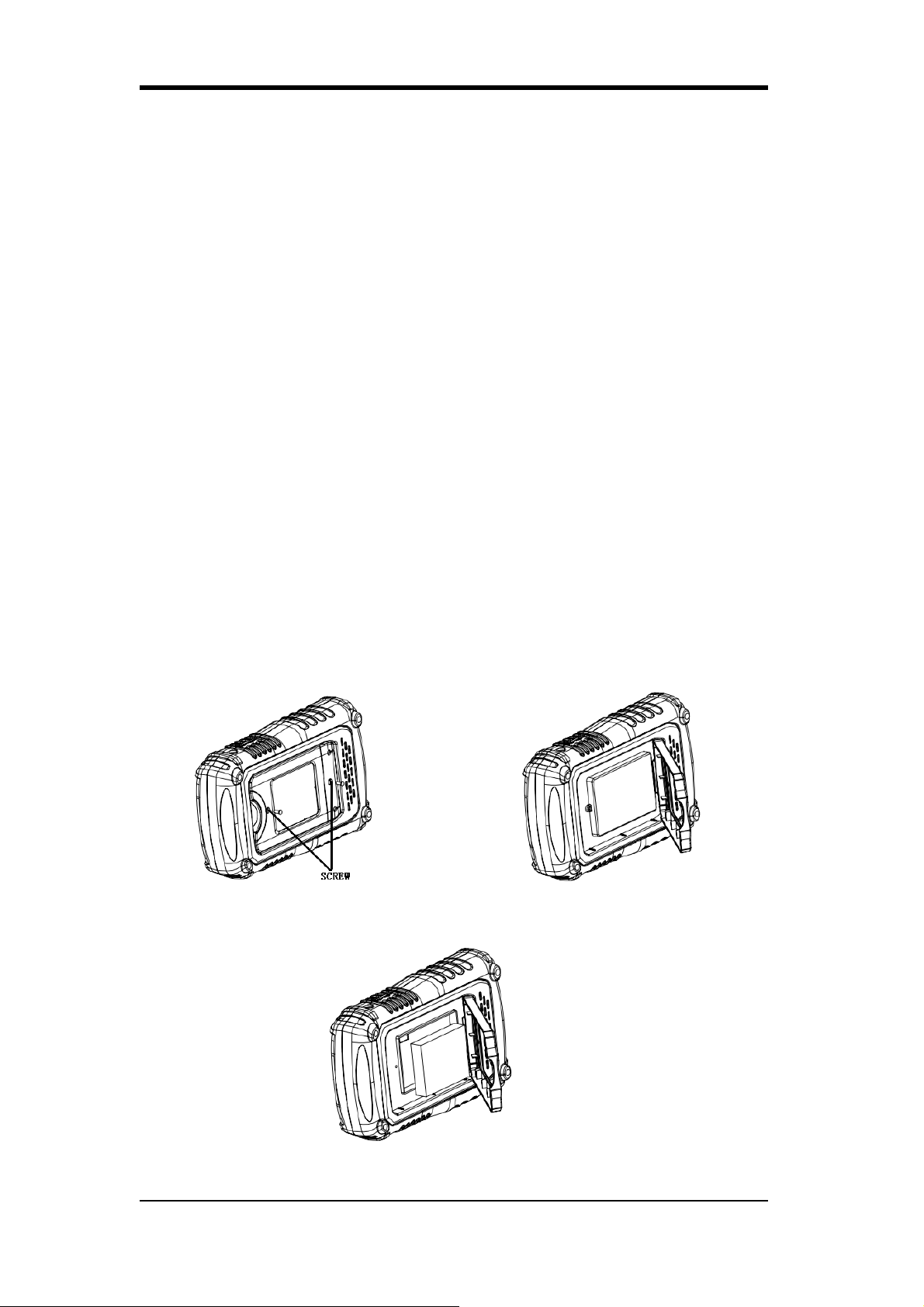
67 SHS800 Series
Appendix B: Battery Installation
The battery of the SHS800 is separated from it’s host, please install the battery
according to following steps:
1. Dismantle the two screws of the battery cap by using screw knife, as figure 1 shows..
2. Draw back the packing block of the Handheld Digital Oscilloscope, and then
dismantle the battery cap, as figure 2 shows.
3. Put battery into the battery bin stably, as figure 3 shows.
4. Cover the battery cap, and tightly twist the two screws which are dismantled from the
battery cap forward, such as figure 3 shows.
5. Successful installation of the battery depends on whether the Handheld Digital
Oscilloscope could be normally turned on or not.
Notes:
The battery plug is designed to prevent from connecting reversely, it prefers
operating slightly to powerfully.
Make a caution at the direction of the battery cap, logo of the battery is attached to
the external end.
If The Handheld Digital Oscilloscope can not be turned on normally after correctly
installation, it is likely that the battery quantity of electricity has been used off, please
refresh for the battery right away.
In the case of not working, battery must be charged once every three months.
Figure 1 Figure 2
Figure 3

SHS800 Series 68
Appendix C: Daily Maintaining and Cleaning
Daily Maintaining
Do not let the LCD exposed in the sun directly for a long period when storing or placing
the SHS800.
CAUTION: To avoid damage to the instrument or probes, do not expose them to sprays,
liquids, or solvents
Cleaning
Check the instrument and the probes according to daily use situation. Please do the
following steps to clean the surface of the instrument.
To clean the exterior surface, perform the following steps:
1. Remove loose dust on the outside of the instrument and probes with a lint-free cloth.
Use care to avoid scratching the clear plastic display filter.
2. Use a soft cloth dampened with water to clean the instrument. Please disconnect it
from all power sources firstly.
Note:
1. To avoid damage to the surface of the instrument or probes, do not use any
abrasive or chemical cleaning agents
2. To avoid water causing electric short circuit or body hurt, Make sure the
instrument is completely dry before reconnecting it to a power source