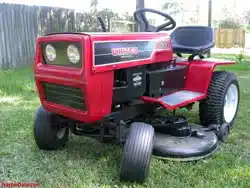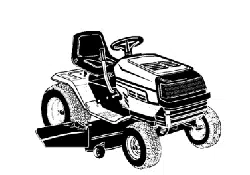
YARD
Operator's Manual
Transmatic
Garden Tractor
Models
820 Thru 829
840 Thru 849
IMPORTANT: Read safety rules and instructions carefully before operating equipment.
Warning: This unit is equipped with an internal combustion engine and should not be used on or near any unimproved forest-
covered, brush-covered or grass-covered land unless the engine's exhaust system is equipped with a spark arrester meeting
applicable local or state laws (if any). If a spark arrester is used, it should be maintained in effective working order by the operator.
In the State of California the above is required by law (Section 4442 of the California Public Resources Code). Other states may have
similar laws. Federal laws apply on federal lands. A spark arrester for the muffler is available through your nearest engine authorized
service dealer or contact the service department, P.O. Box 368022 Cleveland, Ohio 44136-9722.
MTD PRODUCTS INC. P.O. BOX 368022 CLEVELAND, OHIO 44136-9722
PRINTED IN U.S.A. FORM NO. 770-10119A
(12/99)
TABLEOFCONTENTS
Content Page
Important Safe Operation Practices ................................................................... 3-5
Slope Gauge ...................................................................................................... 6
Hardware Pack .................................................................................................. 7
Unpacking .......................................................................................................... 8
Assembling Your Garden Tractor ....................................................................... 8
Know Your Garden Tractor ................................................................................ 15
Operating Your Garden Tractor ......................................................................... 17
Making Adjustments .......................................................................................... 19
Service ............................................................................................................... 21
Maintaining Your Garden Tractor ....................................................................... 22
Off-Season Storage ........................................................................................... 25
Optional Equipment ........................................................................................... 26
Troubleshooting ................................................................................................. 27
FINDINGMODELNUMBER
This Operator's Manual is an important part of your new Garden Tractor. It will help you assemble, prepare
and maintain the unit for best performance. Please read and understand what it says.
Before you start assembling your new equipment, please locate the model plate on the
equipment and copy the informationfrom itin the space provided below. The information on
the model plate is very important if you need help from our Customer Support Department or
an authorized dealer.
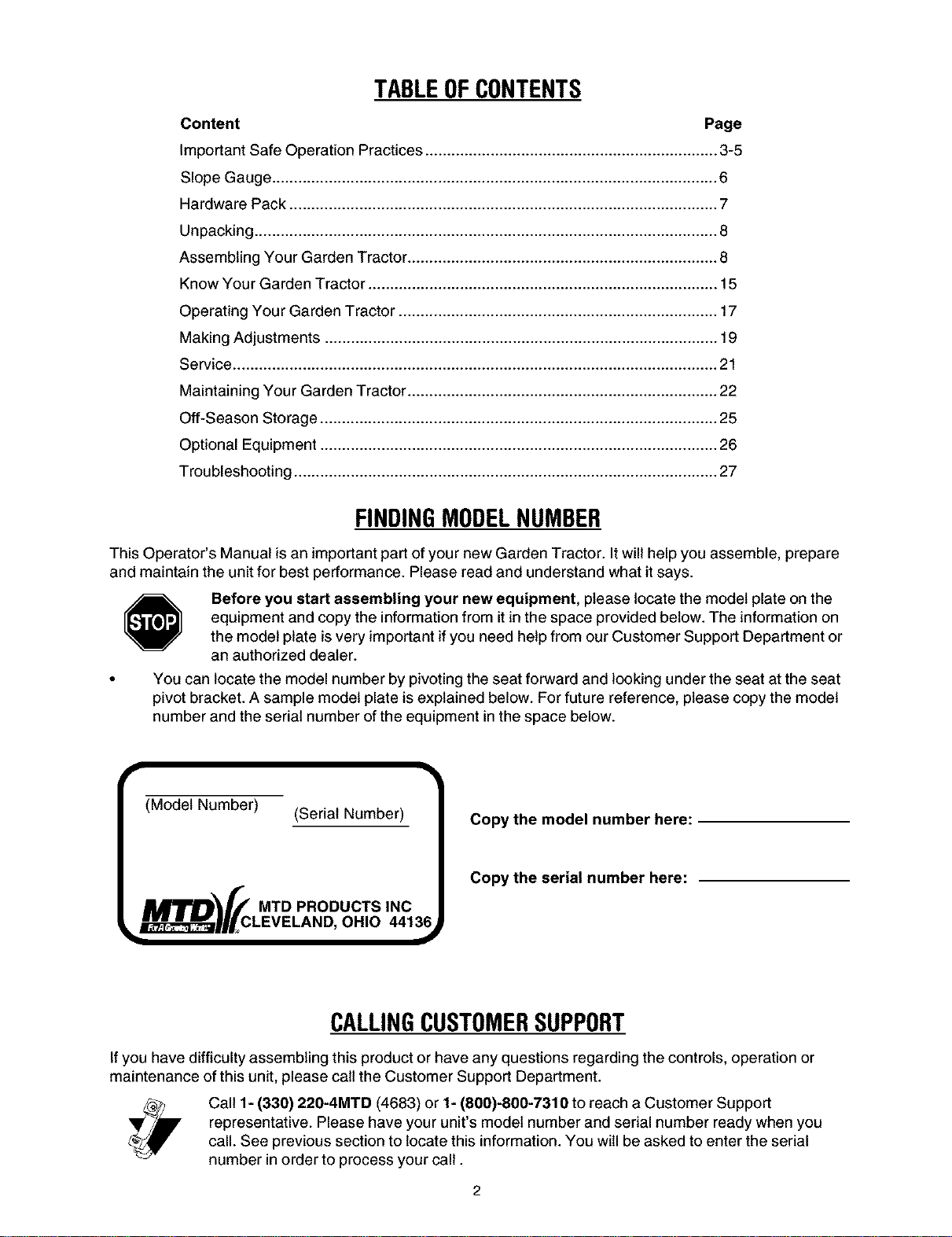
You can locate the model number by pivoting the seat forward and looking under the seat at the seat
pivot bracket. A sample model plate is explained below. For future reference, please copy the model
number and the serial number of the equipment in the space below.
r
(Model Number)
(Serial Number)
[ MTOP.OOOCTS,.CI
_HLCLEVELAND, OHIO 4413_
Copy the model number here:
Copy the serial number here:
CALLINGCUSTOMERSUPPORT
If you have difficulty assembling this product or have any questions regarding the controls, operation or
maintenance of this unit, please call the Customer Support Department.
Call 1- (330) 220-4MTD (4683) or 1- (800)-800-7310 to reach a Customer Support
representative. Please have your unit's model number and serial number ready when you
call. See previous section to locate this information. You will be asked to enter the serial
number inorder to process your call.
SECTION1: IMPORTANTSAFEOPERATIONPRACTICES
WARNING: This symbol points out important safety instructions which, if not followed, could
endanger the personal safety and/or property of yourself and others, read and follow all
instructions in this manual before attempting to operate your lawn mower, failure to comply with
these instructions may result in personal injury. When you see this symbol, heed its warning.
WARNING: The Engine Exhaust from this product contains chemicals known to the State of
California to cause cancer, birth defects or other reproductive harm.
DANGER: Your lawn mower was built to be operated according to the rules for safe operation in this
manual. As with any type of power equipment, carelessness or error on the part of the operator can
result in serious injury. This lawn mower is capable of amputating hands and feet and throwing objects.
Failure to observe the following safety instructions could result in serious injury or death.
GENERALOPERATION
• Read, understand, and follow all instructions in the
operator's manual and on the machine before
starting. Keep this manual in a safe place for future
and regular reference and for ordering replacement
parts.
• Only allow responsible individuals familiar with the
instructions to operate the machine. Know controls
and how to stop the machine quickly.
• Do not put hands or feet under cutting deck or near
rotating parts.
• Clear the area of objects such as rocks, toys, wire,
etc., which could be picked up and thrown by the
blade. A small object may have been overlooked
and could be accidentally thrown by the mower in
any direction and cause injury to you or a
bystander. To help avoid athrown objects injury,
keep children, bystanders and helpers at least 75
feet from the mower while it is in operation. Always
wear safety glasses or safety goggles during
operation or while performing an adjustment or
repair, to protect eyes from foreign objects. Stop
the blade(s) when crossing gravel drives, walks or
roads.
• Be sure the area is clear of other people before
mowing. Stop machine if anyone enters the area.
• Never carry passengers.
• Disengage blade(s) before shifting into reverse and
backing up. Always look down and behind before
and while backing.
• Be aware of the mower and attachment discharge
direction and do not point it at anyone. Do not
operate the mower without either the entire grass
catcher or the chute guard in place.
• Slow down before turning. Operate the machine
smoothly. Avoid erratic operation and excessive
speed.
• Never leave a running machine unattended.
Always turn off blade(s), place transmission in
neutral, set park brake, stop engine and remove
key before dismounting.
• Turn off blade(s) when not mowing.
• Stop engine and wait until blade(s) comes to a
complete stop before (a) removing grass catcher or
unclogging chute, or (b) making any repairs,
adjusting or removing any grass or debris.
• Mow only in daylight or good artificial light.
• Do not operate the machine while under the
influence of alcohol or drugs.
• Watch for traffic when operating near or crossing
roadways.
• Use extra care when loading or unloading the
machine into a trailer or truck. This unit should not
be driven up or down a ramp onto a trailer or truck
under power, because the unit could tip over,
causing serious personal injury. The unit must be
pushed manually on a ramp to load or unload
properly.
• Never make a cutting height adjustment while
engine is running if operator must dismount to do
so.
• Wear sturdy, rough-soled work shoes and close-
fitting slacks and shirts. Do not wear loose fitting
clothes or jewelry. They can be caught in moving
parts. Never operate a unit in bare feet, sandals, or
sneakers.
• Check overhead clearance carefully before driving
under power lines, wires, bridges or low hanging
tree branches, before entering or leaving buildings,
or in any other situation where the operator may be
struck or pulled from the unit, which could result in
serious injury.
• Disengage all attachment clutches, thoroughly
depress the brake pedal, and shift into neutral
before attempting to start engine.
• Your mower is designed to cut normal residential
grass of a height no more than 10". Do not attempt
to mow through unusually tall, dry grass (e.g.,
pasture) or piles of dry leaves. Debris may build up
on the mower deck or contact the engine exhaust
presenting a potential fire hazard.
SLOPEOPERATION
Slopes are a major factor related to loss of control and
tip-over accidents which can result in severe injury or
death. All slopes require extra caution. If you cannot
back up the slope or ifyou feet uneasy on it, do not mow
it.
For your safety, use the slope gauge included as part of
this manual to measure slopes before operating this
unit on a sloped or hilly area. If the slope is greater than
15° as shown on the slope gauge, do not operate this
unit on that area or serious injury could result.
DO:
• Mow up and down slopes, not across.
• Remove obstacles such as rocks, limbs, etc.
• Watch for holes, ruts or bumps. Uneven terrain
could overturn the machine. Tall grass can hide
obstacles.
• Use stow speed. Choose a low enough gear so that
you will not have to stop or shift while on the slope.
Always keep machine in gear when going down
slopes to take advantage of engine braking action.
• Follow the manufacturer's recommendations for
wheel weights or counterweights to improve
stability.
• Use extra care with grass catchers or other
attachments. These can change the stability of the
machine.
• Keep all movement on the slopes slow and gradual.
Do not make sudden changes in speed or direction.
Rapid engagement or braking could cause the front
of the machine to lift and rapidly flip over backwards
which could cause serious injury.
• Avoid starting or stopping on a slope. If tires lose
traction, disengage the blade(s) and proceed slowly
straight down the slope.
DONOT:
• Do not turn on slopes unless necessary; then, turn
slowly and gradually downhill, if possible.
• Do not mow near drop-offs, ditches or
embankments. The mower could suddenly turn
over if a wheel is over the edge of a cliff or ditch, or
if an edge caves in.
• Do not mow on wet grass. Reduced traction could
cause sliding.
• Do not try to stabilize the machine by putting your
foot on the ground.
• Do not use grass catcher on steep slopes.
CHILDREN
Tragic accidents can occur if the operator is not alert to
the presence of children. Children are often attracted to
the machine and the mowing activity. Never assume
that children will remain where you last saw them.
• Keep children out of the mowing area and in
watchful care of an adult other than the operator.
• Be alert and turn machine off if children enter the
area.
• Before and when backing, look behind and down
for small children.
• Never carry children, even with the blades off. They
may fall off and be seriously injured or interfere with
the safe machine operation.
• Never allow children under 14 years old to operate
the machine. Children 14 years and over should
only operate machine under close parental
supervision and proper instruction.
• Use extra care when approaching blind corners,
shrubs, trees or other objects that may obscure
your vision of a child or other hazard.
• Remove key when machine is unattended to
prevent unauthorized operation.
SERVICE
• Use extreme care in handling gasoline and other
fuels. They are extremely flammable and the
vapors are explosive.
• Use only an approved container.
• Never remove fuel cap or add fuel with the engine
running. Allow engine to cool at least two minutes
before refueling.
• Replace fuel cap securely and wipe off any spilled
fuel before starting the engine as it may cause a fire
or explosion.
• Extinguish all cigarettes, cigars, pipes and other
sources of ignition.
• Never refuel the machine indoors because fuel
vapors will accumulate in the area.
• Never store the fuel container or machine inside
where there is an open flame or spark, such as a
gas hot water heater, space heater or furnace.
• Never run a machine inside a closed area.
• To reduce fire hazard, keep the machine free of
grass, leaves or other debris build-up. Clean up oil
or fuel spillage. Allow machine to cool at least 5
minutes before storing.
• Before cleaning, repairing or inspecting, make
certain the blade and all moving parts have
stopped. Disconnect the spark plug wire, and keep
the wire away from the spark plug to prevent
accidental starting.
• Wedonotrecommendtheuseofpressure
washersorgardenhosetocleanyourunit.They
maycausedamagetoelectriccomponents,
spindles,pulleys,bearingsortheengine.Theuse
ofwaterwillresultinshortenedlifeandreduce
serviceability.
• Checkthebladeandenginemountingboltsat
frequentintervalsforpropertightness.Also,
visuallyinspectbladefordamage(e.g.,excessive
wear,bent,cracked).Replacewithbladewhich
meetsoriginalequipmentspecifications.
• Keepallnuts,boltsandscrewstighttobesurethe
equipmentisinsafeworkingcondition.
• Nevertamperwithsafetydevices.Checktheir
properoperationregularly.Useallguardsas
instructedinthismanual.
• Afterstrikingaforeignobject,stoptheengine,
removethewirefromthesparkplugandthoroughly
inspectthemowerforanydamage.Repairthe
damagebeforerestartingandoperatingthemower.
• Grasscatchercomponentsaresubjecttowear,
damageanddeterioration,whichcouldexpose
movingpartsorallowobjectstobethrown.Foryour
safetyprotection,frequentlycheckcomponents
andreplacewithmanufacturer'srecommended
partswhennecessary.
• Mowerbladesaresharpandcancut.Wrapthe
blade(s)orwearglovesanduseextracautionwhen
servicingblade(s).
• Checkbrakeoperationfrequently.Adjustand
serviceasrequired.
• Muffler,engineandbeltguardsbecomehotduring
operationandcancauseaburn.Allowtocooldown
beforetouching.
• Donotchangetheenginegovernorsettingsor
overspeedtheengine.Excessiveenginespeeds
aredangerous.
• Observeproperdisposallawsandregulations.
Improperdisposaloffluidsandmaterialscanharm
theenvironmentandtheecology.
• Priortodisposal,determinethepropermethodto
disposeofwastefromyourlocalEnvironmental
ProtectionAgency.Recyclingcentersare
establishedtoproperlydisposeofmaterialsinan
environmentallysafefashion.
• Usepropercontainerswhendrainingfluids.Donot
usefoodorbeveragecontainersthatmaymislead
someoneintodrinkingfromthem.Properlydispose
ofthecontainersimmediatelyfollowingthedraining
offluids.
• DONOTpouroilorotherfluidsintotheground,
downadrainorintoastream,pond,lakeorother
bodyofwater.ObserveEnvironmentalProtection
Agencyregulationswhendisposingofoil,fuel,
coolant,brakefluid,filters,batteries,tiresandother
harmfulwaste.
WARNING: YOUR RESPONSIBILITY- Restrict the use of this power machine to persons who read,
understand and follow the warnings and instructions in this manual and on the machine.
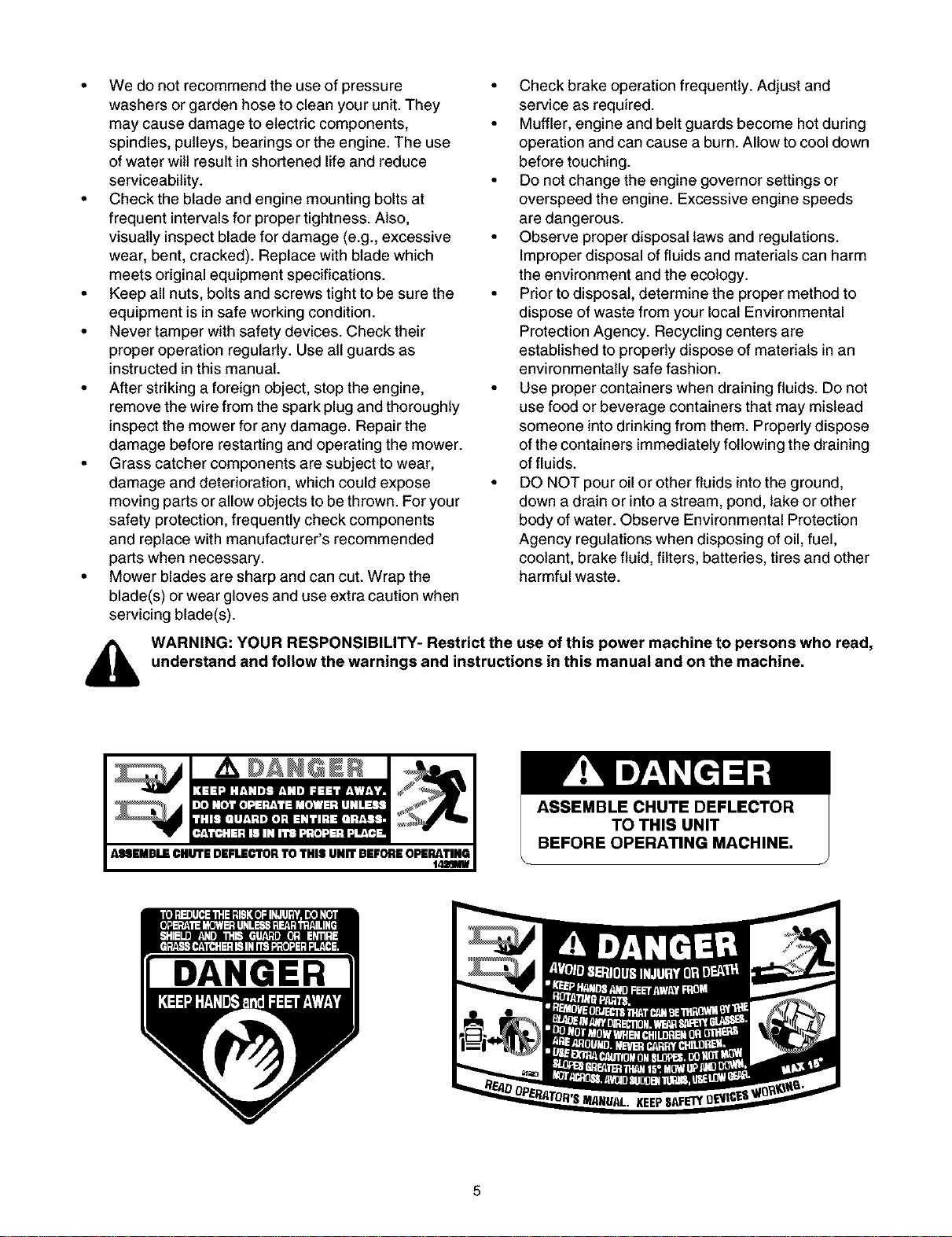
ABSEMBLECHUTE DEFLECTORTO THIS UNIT BEFOREOPERATING
t_MAV
ASSEMBLE CHUTE DEFLECTOR
TO THIS UNIT
BEFORE OPERATING MACHINE.
DANGER
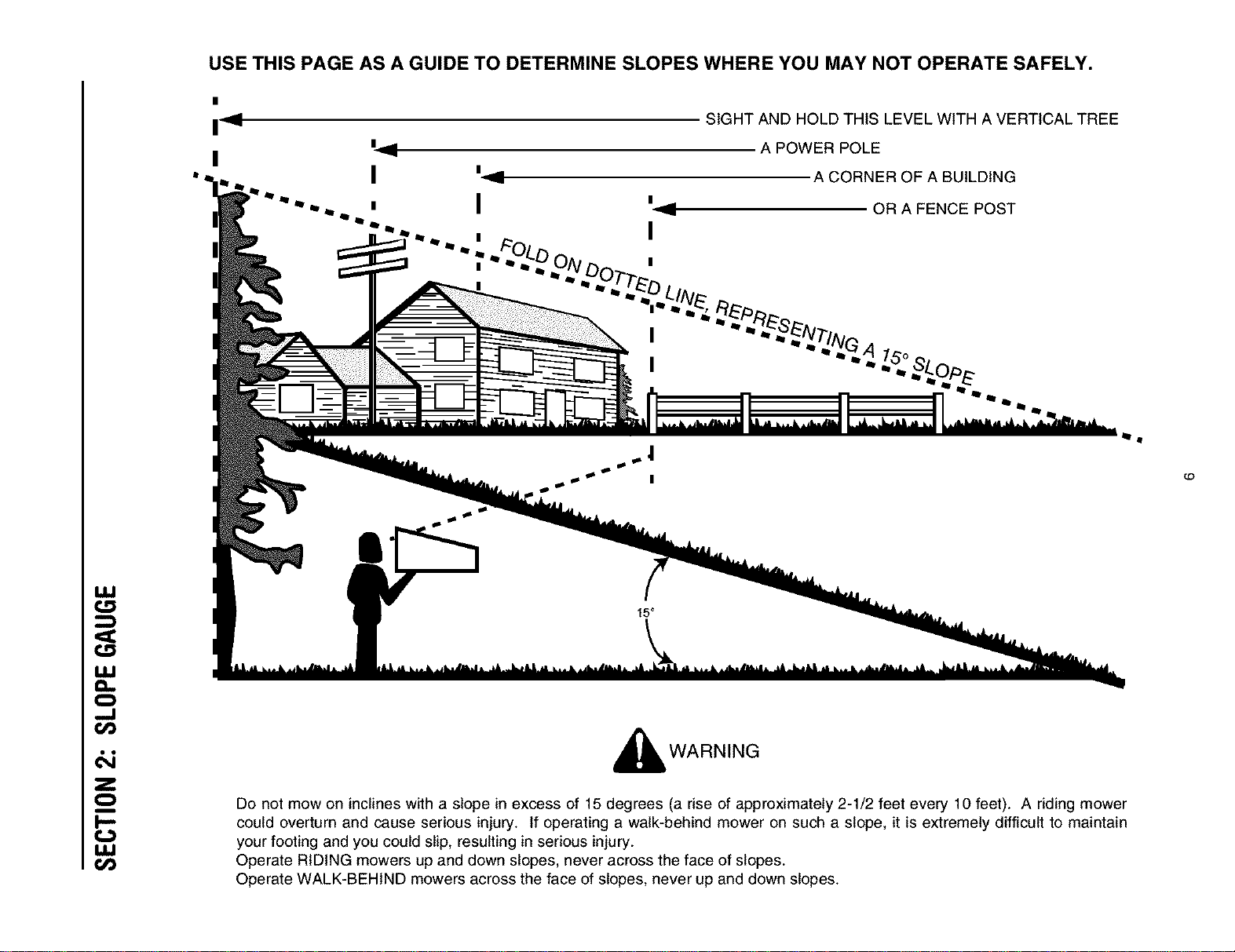
USE THIS PAGE AS A GUIDE TO DETERMINE SLOPES WHERE YOU MAY NOT OPERATE SAFELY.
SIGHT AND HOLD THIS LEVEL WITH A VERTICAL TREE
A POWER POLE
A CORNER OF A BUILDING
OR A FENCE POST
I
I
m
Z
m
I.M
Do not mow on inclines with a slope in excess of 15 degrees (a rise d approximately 2-1/2 feet every 10 feet). A riding mower
could overturn and cause serious injury. If operating a walk-behind mower on such a slope, it is extremely difficult to maintain
your footing and you could slip, resulting in serious injury.
Operate RIDING mowers up and down slopes, never across the face of slopes.
Operate WALK-BEHIND mowers across the face of slopes, never up and down slopes.
t.O
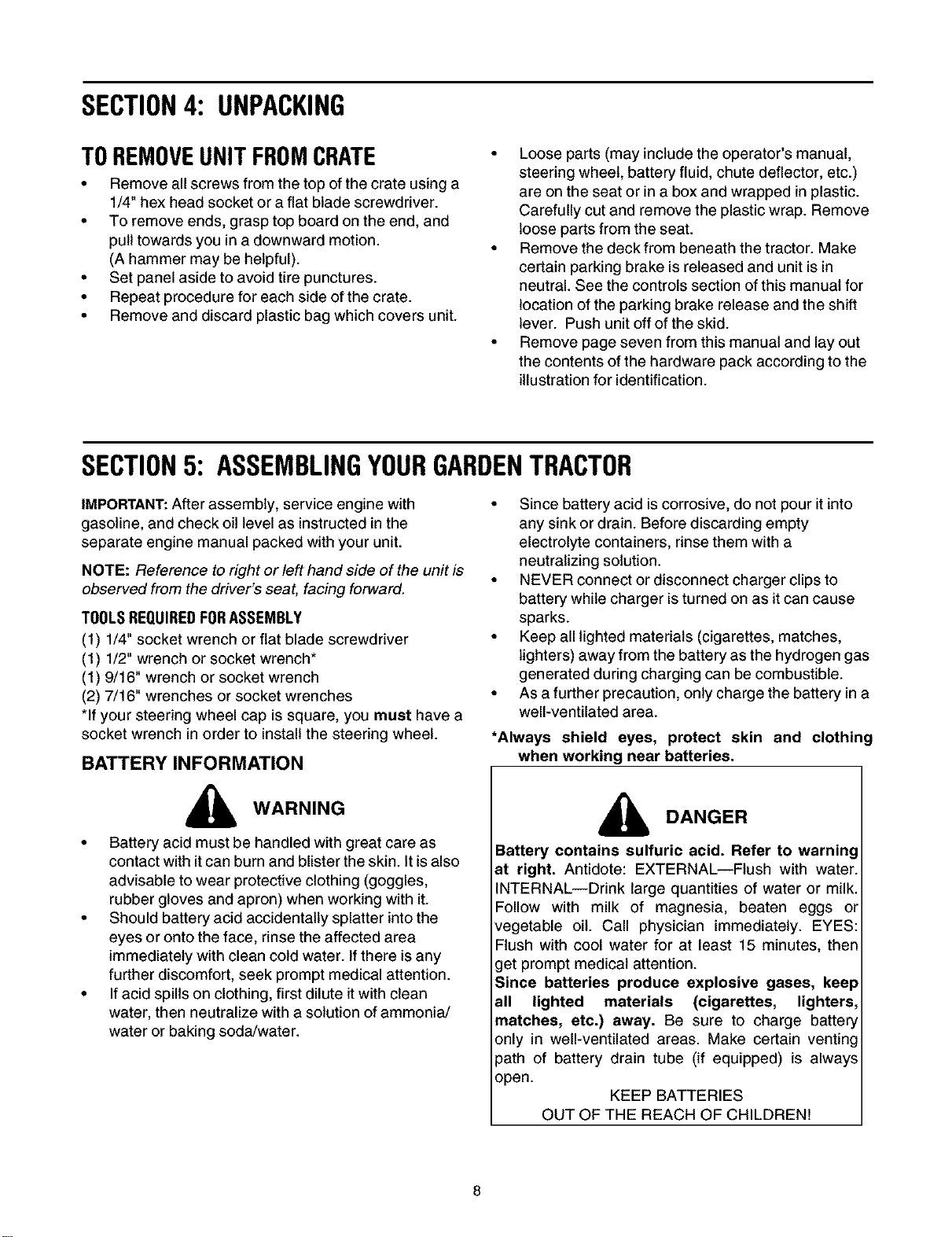
SECTION3: HARDWAREPACK
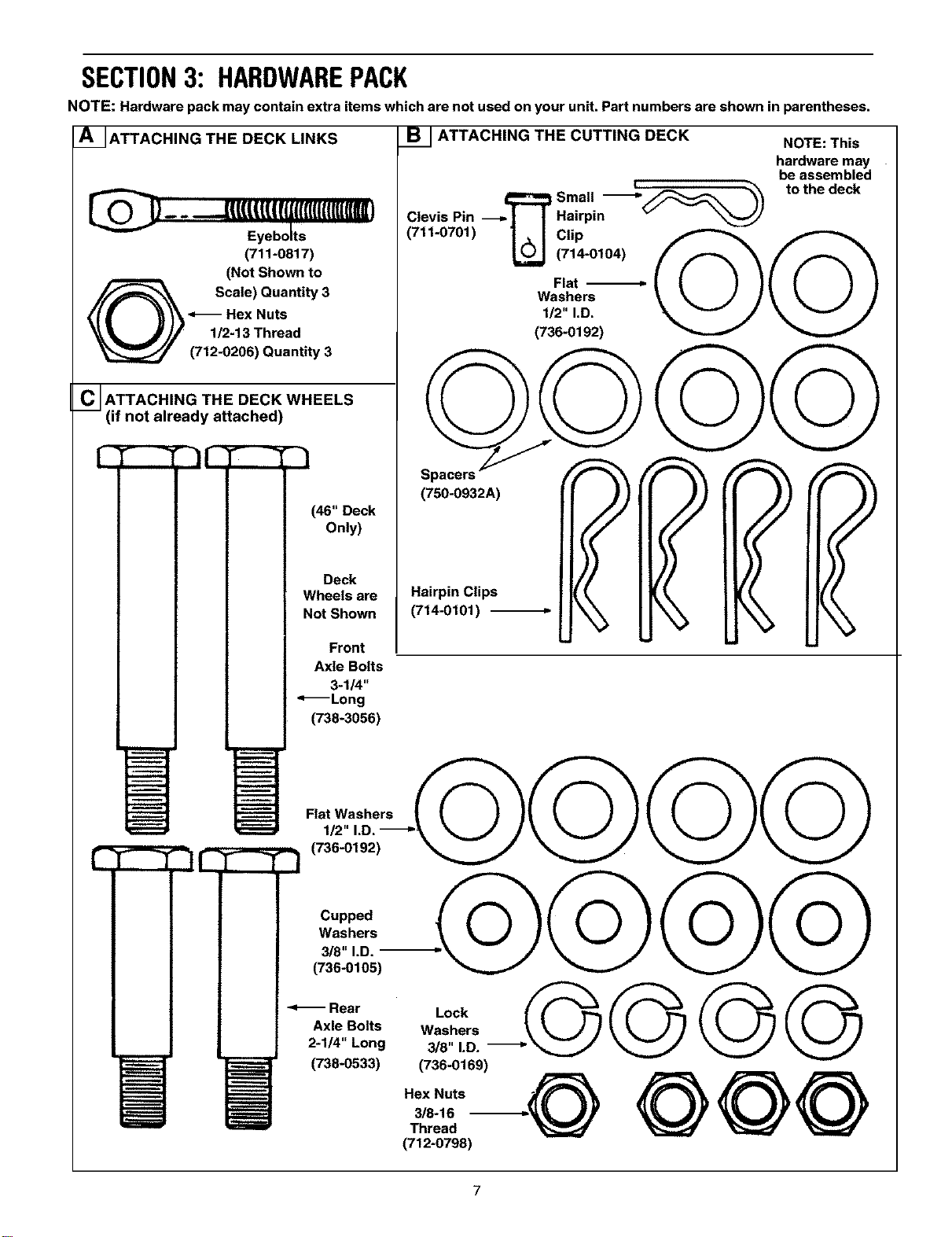
NOTE: Hardware pack may contain extra items which are not used on your unit. Part numbers are shown in parentheses.
A IATTACHING THE DECK LINKS al ATTACHING THE CUTTING DECK NOTE: This
_[O_1]... _..[{1(|{|(I fU(ifl{l(ll[llTll)
Eyebotts
(711-0817)
(Not Shown to
Scale) Quantity 3
•,_ Hex Nuts
1/2-13 Thread
(712-0206) Quantity 3
C IATTACHING THE DECK WHEELS
(if not already attached)
m
m
m
m
m
w
m
(46" Deck
Only)
Deck
Wheels are
Not Shown
Front
Axle Bolts
3-1/4"
"_Long
(738-3056)
f-
€=_ Sma,,__
Clevis Pin -_p] I Hairpin "
(711-0701) I_,Jclip
_L_BJ (714-0104)
Flat
Washers
1/2" LD.
(736-0192)
©
(750-0932A)
Hairpin Clips
(714-0101) --- _
hardware may
be assembled
to the deck
Flat Washers __
1/2"1.D.-_. _ / _, _ /
(738-0192)_'_
Cupped
Washers
3/8" I,D.
(736-0105)
Rear
Axle Bolts
2-1/4" Long
(738-0533)
o
Washers
3/8" I.D.
(736-0169)
.ex.u s.©©©©
3/8-16 --
Thread
(712-0798)
SECTION4: UNPACKING
TOREMOVEUNITFROMCRATE
• Remove all screws from the top of the crate using a
1/4" hex head socket or a flat blade screwdriver.
• To remove ends, grasp top board on the end, and
pull towards you in a downward motion.
(A hammer may be helpful).
• Set panel aside to avoid tire punctures.
• Repeat procedure for each side of the crate.
• Remove and discard plastic bag which covers unit.
• Loose parts (may include the operator's manual,
steering wheel, battery fluid, chute deflector, etc.)
are on the seat or in a box and wrapped in plastic.
Carefully cut and remove the plastic wrap. Remove
loose parts from the seat.
• Remove the deck from beneath the tractor. Make
certain parking brake is released and unit is in
neutral. See the controls section of this manual for
location of the parking brake release and the shift
lever. Push unit off of the skid.
• Remove page seven from this manual and lay out
the contents of the hardware pack according to the
illustration for identification.
SECTION5: ASSEMBLINGYOURGARDENTRACTOR
IMPORTANT: After assembly, service engine with
gasoline, and check oil level as instructed in the
separate engine manual packed with your unit.
NOTE: Reference to right or left hand side of the unit is
observed from the driver's seat, facing forward.
TOOLSREQUIREDFORASSEMBLY
(1) 1/4" socket wrench or flat blade screwdriver
(1) 1/2" wrench or socket wrench*
(1) 9/16" wrench or socket wrench
(2) 7/16" wrenches or socket wrenches
*If your steering wheel cap is square, you must have a
socket wrench in order to install the steering wheel.
BATTERY INFORMATION
WARNING
• Battery acid must be handled with great care as
contact with it can burn and blister the skin. It isalso
advisable to wear protective clothing (goggles,
rubber gloves and apron) when working with it.
• Should battery acid accidentally splatter into the
eyes or onto the face, rinse the affected area
immediately with clean cold water. If there is any
further discomfort, seek prompt medical attention.
• If acid spills on clothing, first dilute it with clean
water, then neutralize with a solution of ammonia/
water or baking soda/water.
• Since battery acid is corrosive, do not pour it into
any sink or drain. Before discarding empty
electrolyte containers, rinse them with a
neutralizing solution.
• NEVER connect or disconnect charger clips to
battery while charger is turned on as it can cause
sparks.
• Keep all lighted materials (cigarettes, matches,
lighters) away from the battery as the hydrogen gas
generated during charging can be combustible.
• As a further precaution, only charge the battery in a
well-ventilated area.
*Always shield eyes, protect skin and clothing
when working near batteries.
DANGER
Battery contains sulfuric acid. Refer to warning
at right. Antidote: EXTERNAL--Flush with water.
INTERNAL--Drink large quantities of water or milk.
Follow with milk of magnesia, beaten eggs or
vegetable oil. Call physician immediately. EYES:
Flush with cool water for at least 15 minutes, then
get prompt medical attention.
Since batteries produce explosive gases, keep
all lighted materials (cigarettes, lighters,
matches, etc.) away. Be sure to charge battery
only in well-ventilated areas. Make certain venting
path of battery drain tube (if equipped) is always
open.
KEEP BATTERIES
OUT OF THE REACH OF CHILDREN!
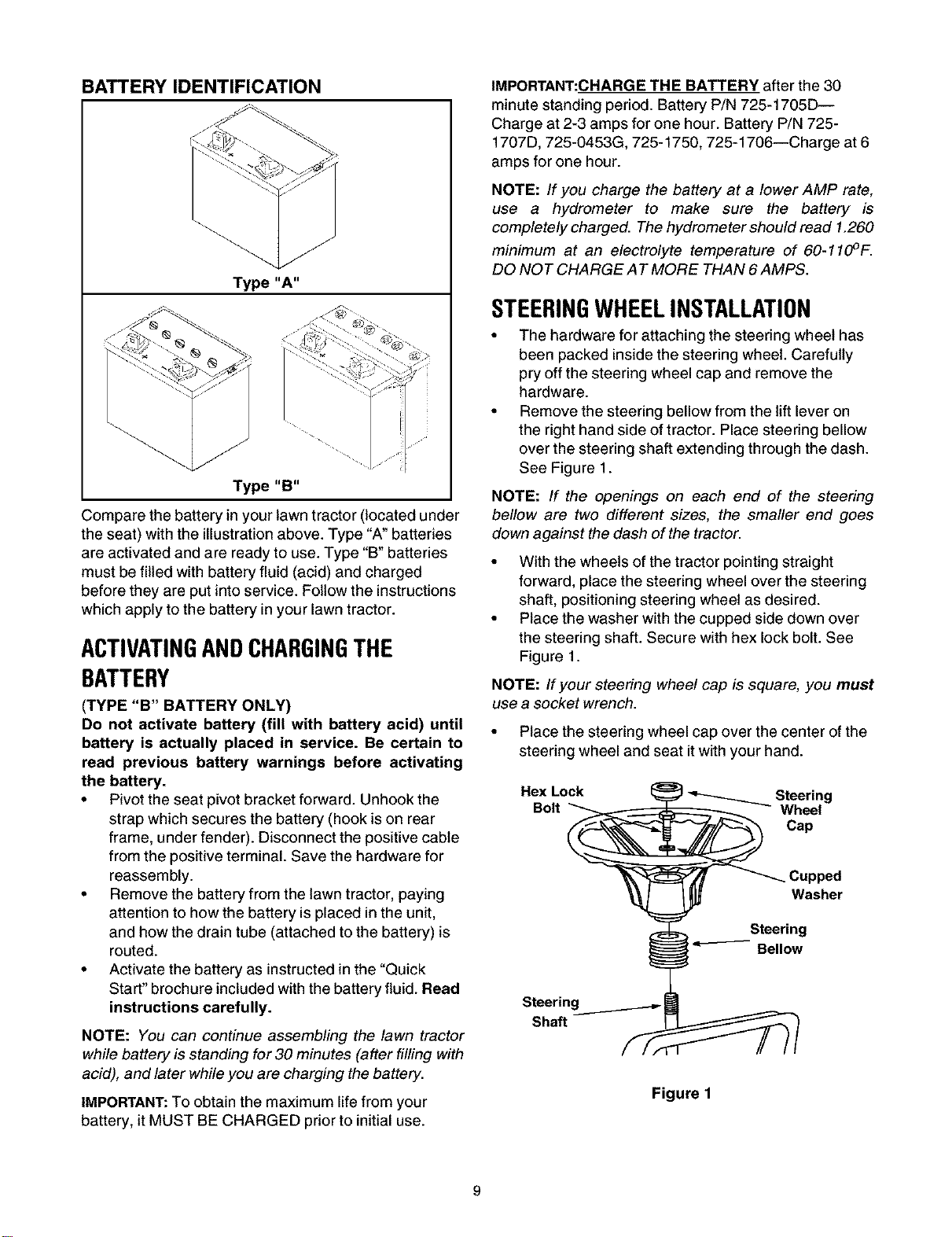
BATTERY IDENTIFICATION
Type "A"
Type "B"
Compare the battery in your lawn tractor (located under
the seat) with the illustration above. Type "A" batteries
are activated and are ready to use. Type "B" batteries
must be filled with battery fluid (acid) and charged
before they are put into service. Follow the instructions
which apply to the battery in your lawn tractor.
ACTIVATINGANDCHARGINGTHE
BATTERY
(TYPE "B" BATTERY ONLY)
Do not activate battery (fill with battery acid) until
battery is actually placed in service. Be certain to
read previous battery warnings before activating
the battery.
• Pivot the seat pivot bracket forward. Unhook the
strap which secures the battery (hook is on rear
frame, under fender). Disconnect the positive cable
from the positive terminal. Save the hardware for
reassembly.
• Remove the battery from the lawn tractor, paying
attention to how the battery is placed inthe unit,
and how the drain tube (attached to the battery) is
routed.
• Activate the battery as instructed in the "Quick
Start" brochure included with the battery fluid. Read
instructions carefully.
NOTE: You can continue assembling the lawn tractor
while battery is standing for 30 minutes (after filling with
acid), and later while you are charging the battery.
IMPORTANT: To obtain the maximum life from your
battery, it MUST BE CHARGED prior to initial use.
IMPORTANT:CHARGE THE BATTERY after the 30
minute standing period. Battery P/N 725-1705D--
Charge at 2-3 amps for one hour. Battery P/N 725-
1707D, 725-0453G, 725-1750, 725-1706---Charge at 6
amps for one hour.
NOTE: If you charge the battery at a Iower AMP rate,
use a hydrometer to make sure the battery is
completely charged. The hydrometer should read 1.260
minimum at an electrolyte temperature of 60-110°F.
DO NOT CHARGE A T MORE THAN 6 AMPS.
STEERINGWHEELINSTALLATION
• The hardware for attaching the steering wheel has
been packed inside the steering wheel. Carefully
pry off the steering wheel cap and remove the
hardware.
• Remove the steering bellow from the lift lever on
the right hand side of tractor. Place steering bellow
over the steering shaft extending through the dash.
See Figure 1.
NOTE: If the openings on each end of the steering
bellow are two different sizes, the smaller end goes
down against the dash of the tractor.
• With the wheels of the tractor pointing straight
forward, place the steering wheel over the steering
shaft, positioning steering wheel as desired.
• Place the washer with the cupped side down over
the steering shaft. Secure with hex lock bolt. See
Figure 1.
NOTE: Ifyour steering wheel cap is square, you must
use a socket wrench.
• Place the steering wheel cap over the center of the
steering wheel and seat itwith your hand.
_ Stee g
Hex Lock rin
Bolt -- _ Wheel
Cap
Wa,her
Steering___._._.__._.__
Shaft
F-F
Steering
Bellow
Figure 1
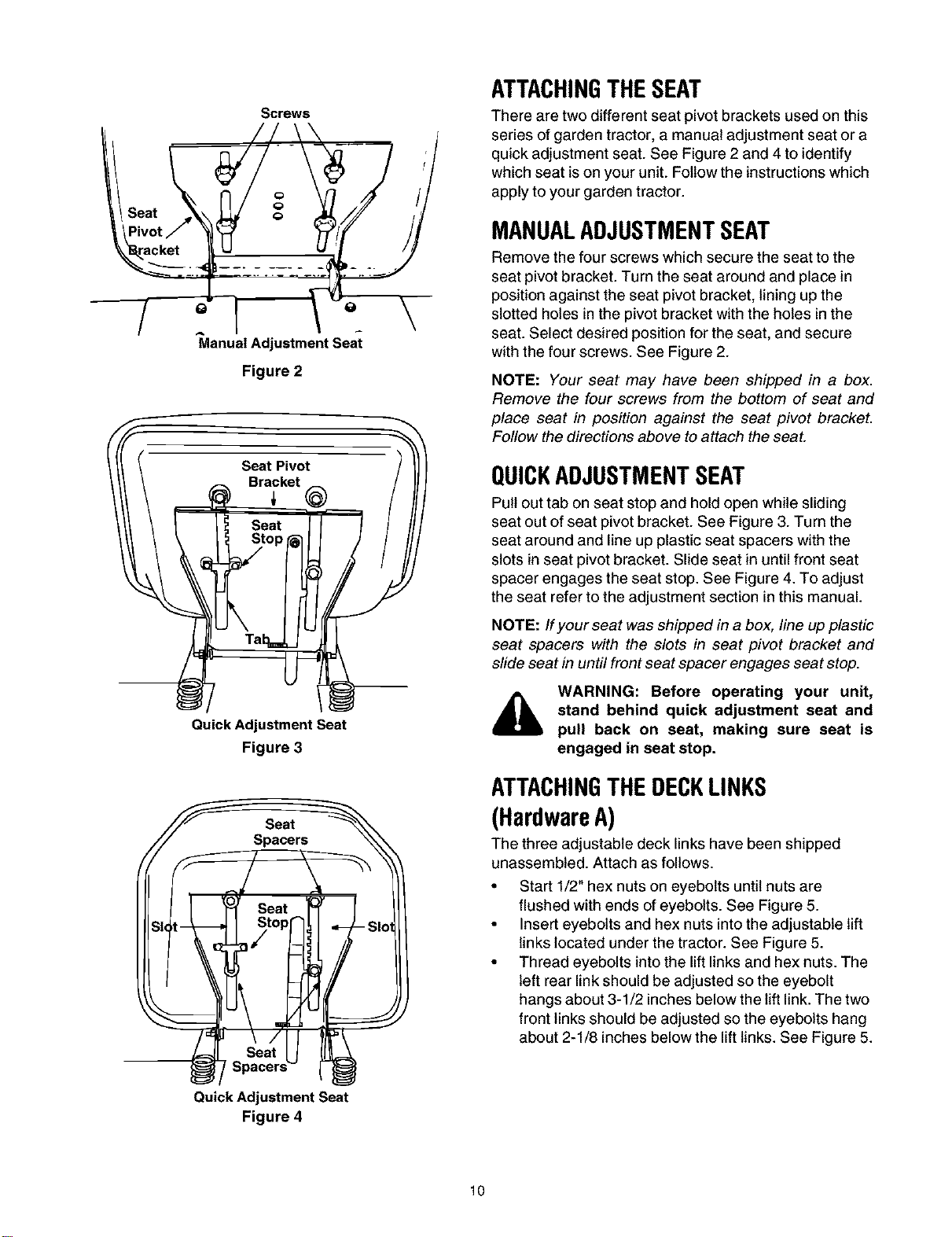
Screws
Manual Adjustment Seat
Figure 2
Seat Pivot
Bracket _)
Quick Adjustment Seat
Figure 3
Seat
Seat
SI ,Stop SIo
Quick Adjustment Seat
Figure 4
ATTACHINGTHESEAT
There are two different seat pivot brackets used on this
series of garden tractor, a manual adjustment seat or a
quick adjustment seat. See Figure 2and 4 to identify
which seat is on your unit. Follow the instructions which
apply to your garden tractor.
MANUALADJUSTMENTSEAT
Remove the four screws which secure the seat to the
seat pivot bracket. Turn the seat around and place in
position against the seat pivot bracket, lining up the
slotted holes in the pivot bracket with the holes in the
seat. Select desired position for the seat, and secure
with the four screws. See Figure 2.
NOTE: Your seat may have been shipped in a box.
Remove the four screws from the bottom of seat and
place seat in position against the seat pivot bracket.
Follow the directions above to attach the seat.
QUICKADJUSTMENTSEAT
Pull out tab on seat stop and hold open while sliding
seat out of seat pivot bracket. See Figure 3. Turn the
seat around and line up plastic seat spacers with the
slots in seat pivot bracket. Slide seat in until front seat
spacer engages the seat stop. See Figure 4. To adjust
the seat refer to the adjustment section in this manual.
NOTE: Ifyour seat was shipped in a box, line up plastic
seat spacers with the slots in seat pivot bracket and
slide seat in until front seat spacer engages seat stop.
WARNING: Before operating your unit,
stand behind quick adjustment seat and
pull back on seat, making sure seat is
engaged in seat stop.
ATTACHINGTHEDECKLINKS
(HardwareA)
The three adjustable deck links have been shipped
unassembled. Attach as follows.
• Start 1/2" hex nuts on eyebolts until nuts are
flushed with ends of eyeboits. See Figure 5.
• Insert eyeboits and hex nuts into the adjustable lift
links located under the tractor. See Figure 5.
• Thread eyebolts into the lift links and hex nuts. The
left rear link should be adjusted so the eyebolt
hangs about 3-1/2 inches below the lift link. The two
front links should be adjusted so the eyebolts hang
about 2-1/8 inches below the lift links. See Figure 5.
10
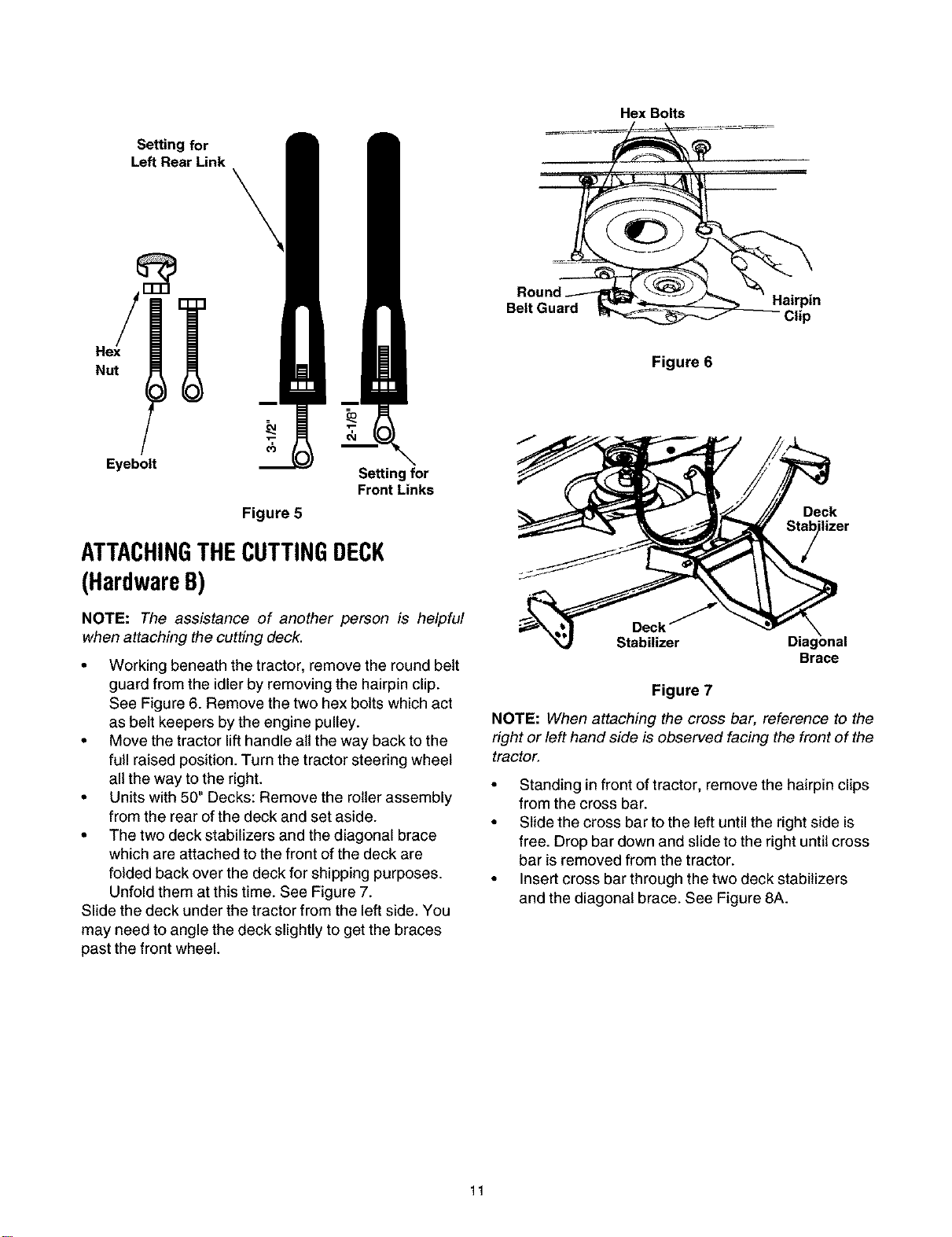
Nut
Eyebolt
Setting for
Left Rear Link
\
m
03
Figure 5
Setting for
Front Links
ATTACHINGTHECUTTINGDECK
(HardwareB)
NOTE: The assistance of another person is helpful
when attaching the cutting deck.
• Working beneath the tractor, remove the round belt
guard from the idler by removing the hairpin clip.
See Figure 6. Remove the two hex bolts which act
as belt keepers by the engine pulley.
• Move the tractor lift handle alt the way back to the
full raised position. Turn the tractor steering wheel
all the way to the right.
• Units with 50" Decks: Remove the roller assembly
from the rear of the deck and set aside.
• The two deck stabilizers and the diagonal brace
which are attached to the front of the deck are
folded back over the deck for shipping purposes.
Unfold them at this time. See Figure 7.
Slide the deck under the tractor from the left side. You
may need to angle the deck slightly to get the braces
past the front wheel.
Hex Bolts
Belt Guard Hairpin
Clip
Figure 6
Deck
Deck
Stabilizer
Brace
Figure 7
NOTE: When attaching the cross bar, reference to the
right or left hand side is observed facing the front of the
tractor.
• Standing infront of tractor, remove the hairpin clips
from the cross bar.
• Slide the cross bar to the left until the right side is
free. Drop bar down and slide to the right until cross
bar is removed from the tractor.
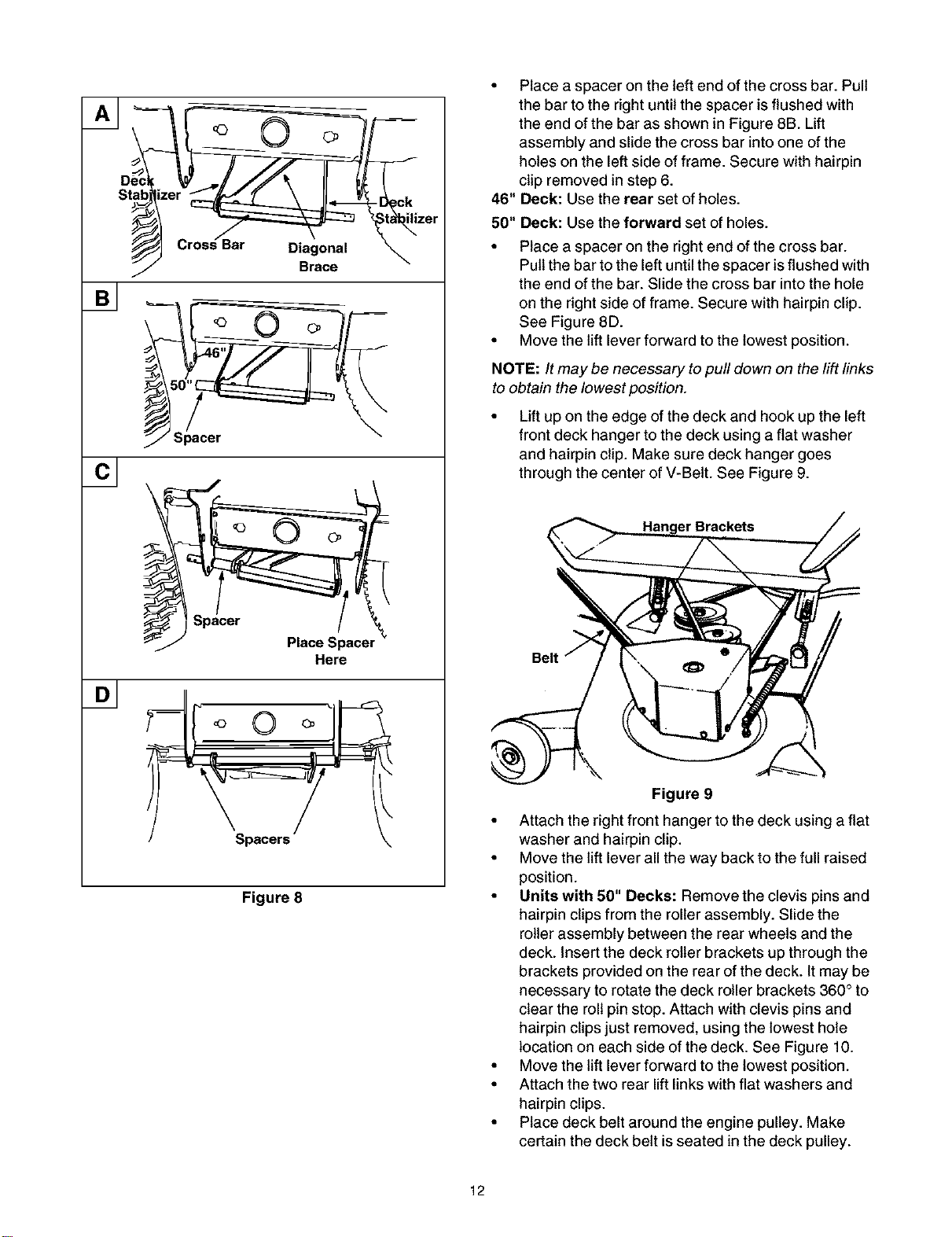
• Insert cross bar through the two deck stabilizers
and the diagonal brace. See Figure 8A.
11
"oi
Stab
BI
cl
DI
t zer
Cross Di.,ona,\
Brace
_acer
\
Place Spacer
Here
Spacers
Figure 8
• Place a spacer on the left end of the cross bar. Pull
the bar to the right until the spacer is flushed with
the end of the bar as shown in Figure 8B. Lift
assembly and slide the cross bar into one of the
holes on the left side of frame. Secure with hairpin
clip removed in step 6.
46" Deck: Use the rear set of holes.
50" Deck: Use the forward set of holes.
• Place a spacer on the right end of the cross bar.
Pull the bar to the left until the spacer is flushed with
the end of the bar. Slide the cross bar into the hole
on the right side of frame. Secure with hairpin clip.
See Figure 8D.
• Move the lift lever forward to the lowest position.
NOTE: It may be necessary to pull down on the lift links
to obtain the lowest position.
Lift up on the edge of the deck and hook up the left
front deck hanger to the deck using a flat washer
and hairpin clip. Make sure deck hanger goes
through the center of V-Belt. See Figure 9.
Figure 9
• Attach the right front hanger to the deck using a flat
washer and hairpin clip.
• Move the lift lever all the way back to the full raised
position.
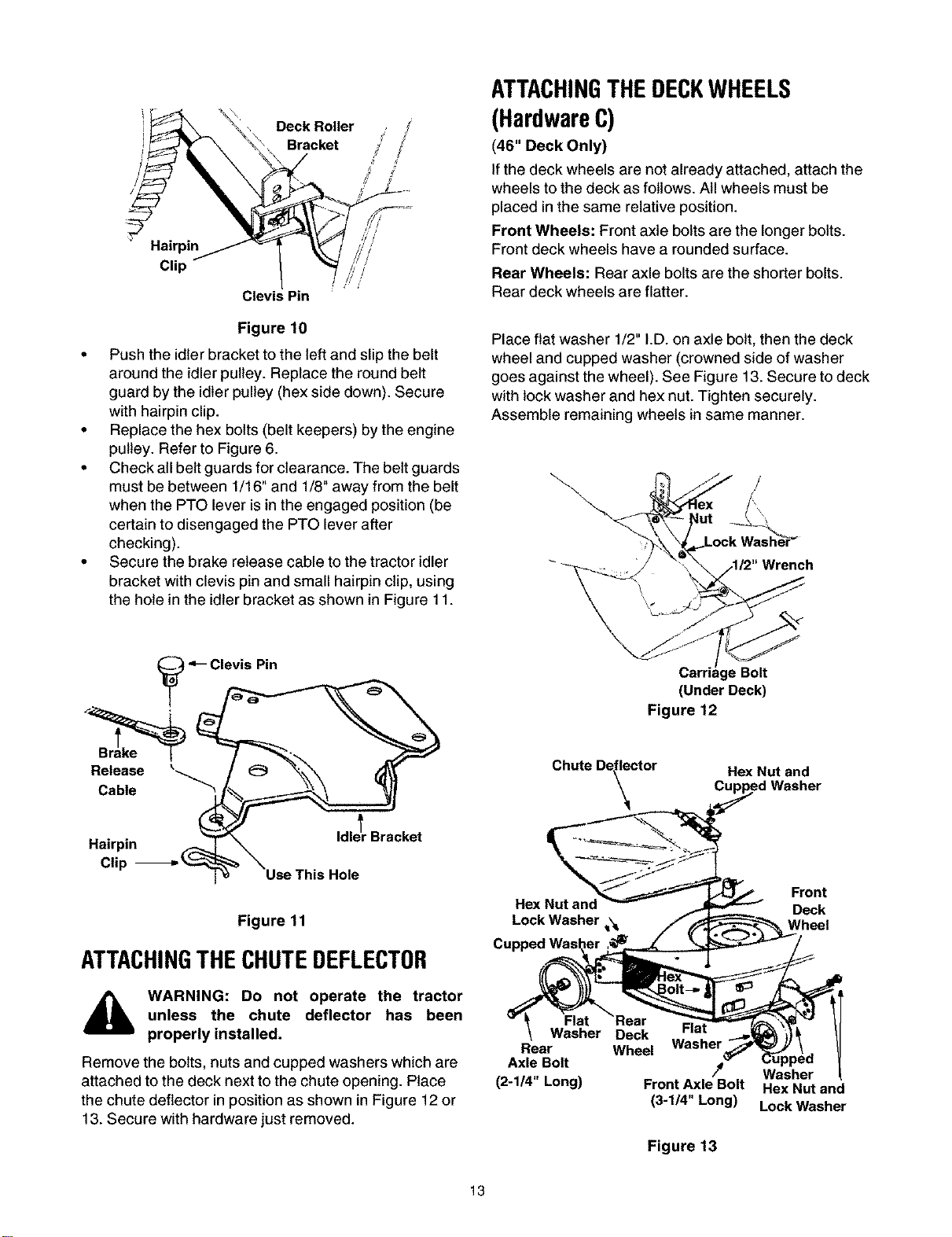
• Units with 50" Decks: Remove the clevis pins and
hairpin clips from the roller assembly. Slide the
roller assembly between the rear wheels and the
deck. Insert the deck roller brackets up through the
brackets provided on the rear of the deck. It may be
necessary to rotate the deck roller brackets 360 ° to
clear the roll pin stop. Attach with clevis pins and
hairpin clips just removed, using the lowest hole
location on each side of the deck. See Figure 10.
• Move the lift lever forward to the lowest position.
• Attach the two rear lift links with flat washers and
hairpin clips.
• Place deck belt around the engine pulley. Make
certain the deck belt is seated in the deck pulley.
12
Deck Roller , /
Bracket j j!
/
Clip
Clevis Pin
Figure 10
• Push the idler bracket to the left and slip the belt
around the idler pulley. Replace the round belt
guard by the idler pulley (hex side down). Secure
with hairpin clip.
• Replace the hex bolts (belt keepers) by the engine
pulley. Refer to Figure 6.
• Check all belt guards for clearance. The belt guards
must be between 1/16" and 1/8" away from the belt
when the PTO lever is in the engaged position (be
certain to disengaged the PTO lever after
checking).
• Secure the brake release cable to the tractor idler
bracket with clevis pin and small hairpin clip, using
the hole in the idler bracket as shown in Figure 11.
ATTACHINGTHEDECKWHEELS
(HardwareC)
(46" Deck Only)
If the deck wheels are not already attached, attach the
wheels to the deck as follows. All wheels must be
placed in the same relative position.
Front Wheels: Front axle boltsare the longer bolts.
Front deck wheels have a rounded surface.
Rear Wheels: Rear axle bolts are the shorter bolts.
Rear deck wheels are flatter.
Place flat washer 1/2" I.D. on axle bolt, then the deck
wheel and cupped washer (crowned side of washer
goes against the wheel). See Figure 13. Secure to deck
with lock washer and hex nut. Tighten securely.
Assemble remaining wheels in same manner.
Wrench
)"-- Clevis Pin
Release _-_
Cable
Hairpin
Clip
Idle_rBracket
Figure 11
ATTACHINGTHECHUTEDEFLECTOR
WARNING: Do not operate the tractor
unless the chute deflector has been
properly installed.
Remove the bolts, nuts and cupped washers which are
attached to the deck next to the chute opening. Place
the chute deflector in position as shown in Figure 12 or
13. Secure with hardware just removed.
(Under Deck)
Figure 12
Chute De\flector Hex Nut and
\
Washer
Front
Hex Nutand Deck
Lock Washer _ Wheel
Flat
Washer Deck Flat
Rear Wheel Washer "
Axle Bolt f Washer
(2-1/4" Long) Front Axle Bolt Hex Nut and
(3-1/4" Long) Lock Washer
Figure 13
13
TIREPRESSURE
The tires on your unit may be over-inflated for shipping
purposes. Reduce the tire pressure before operating
the unit. Check the sidewall of the tires for proper
inflation pressure.
WARNING: Maximum tire pressure under
any circumstances is 30 p.s.i. Equal tire
pressure should be maintained on all tires.
LEVELINGTHEDECK
After attaching the deck to the tractor, check to be
certain it is adjusted properly.
• Check tire pressure in all four tires. See sidewall of
tire for recommended inflation pressure.
• Make certain all deck wheels or both ends of the
deck roller are mounted in same relative hole
locations.
• Place the tractor on a level surface.
• 46" Deck: Lower the deck until it reaches the
ground. All four deck wheels should reach the
ground at the same time.
• Both Decks: Place the deck approximately 1"
above the ground. Check to be certain the distance
from the bottom edge of the deck to the ground is
the same on both sides of the deck.
If adjustment is necessary, adjust the deck links on the
left side of the deck as follows.
• Make certain the PTO is disengaged. Remove the
hairpin clip and washer from the weld bolt. Thread
eyebott up or down the link as necessary, and
reassemble.
• Check to be certain the front of the deck is 1/4" to
3/8" lower than the rear of the deck. If it is not,
adjust the two front links to obtain this distance.
FINALASSEMBLY
Make certain all nuts and bolts are tightened securely.
INSTALLINGTHEBATTERY
(Type"A" Battery)
NOTE: If battery is put into service after date shown on
top of battery, charge for minimum of 1 hour at 6-10
amps.
• Lift the hood of the tractor. Remove the wing nuts
from the hold-down rods which secure the battery
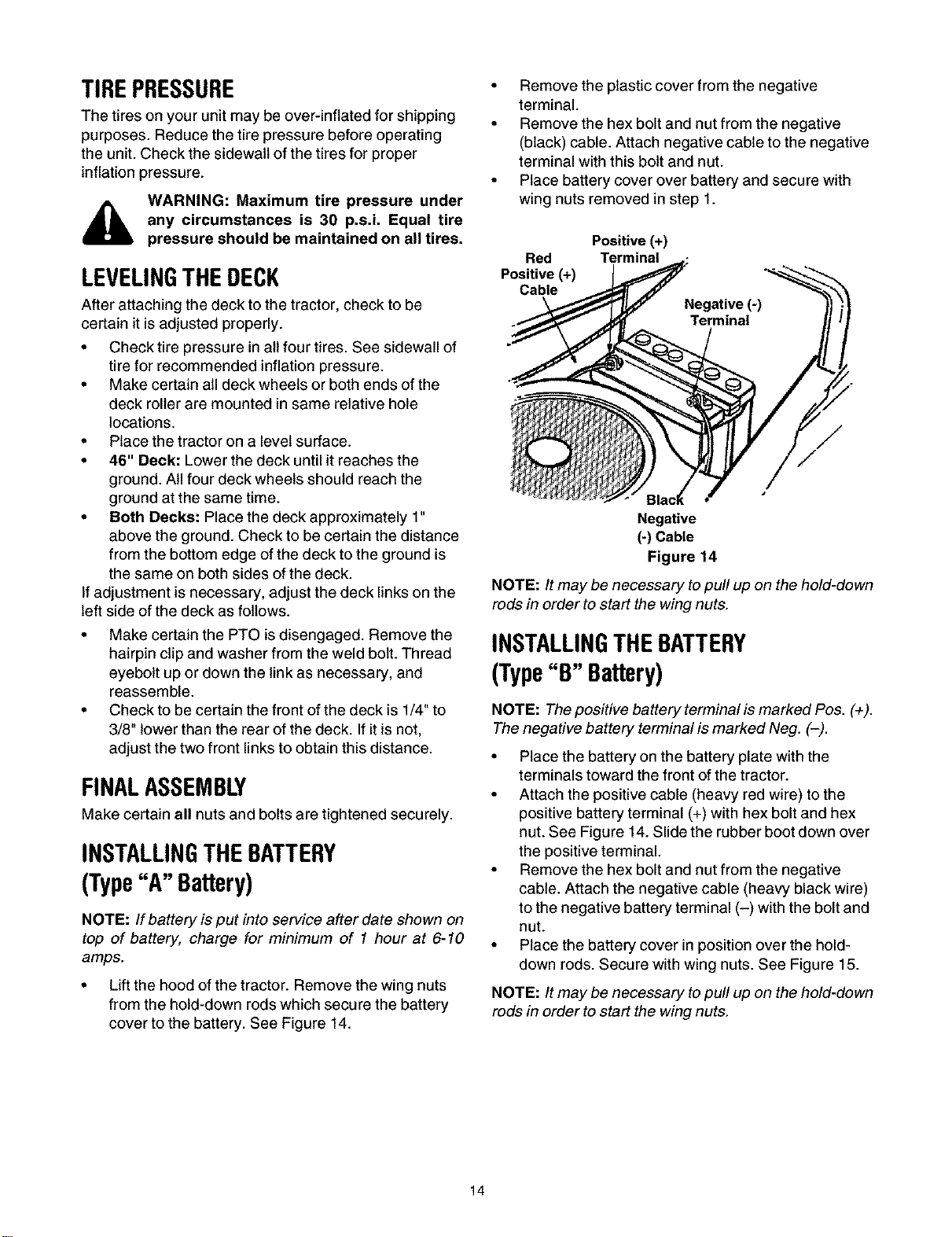
cover to the battery. See Figure 14.
• Remove the plastic cover from the negative
terminal.
• Remove the hex bolt and nut from the negative
(black) cable. Attach negative cable to the negative
terminal with this bolt and nut.
• Place battery cover over battery and secure with
wing nuts removed in step 1.
Positive (+)
Red Terminal
Positive(+)
Cable
Negative
(-) Cable
Figure 14
NOTE: It may be necessary to pull up on the hold-down
rods in order to start the wing nuts.
INSTALLINGTHEBATTERY
(Type"e" Battery)
NOTE: The positive battery terminal is marked Pos. (+).
The negative battery terminal is marked Neg. (-).
• Place the battery on the battery plate with the
terminals toward the front of the tractor.
• Attach the positive cable (heavy red wire) to the
positive battery terminal (+) with hex bolt and hex
nut. See Figure 14. Slide the rubber boot down over
the positive terminal.
• Remove the hex bolt and nut from the negative
cable. Attach the negative cable (heavy black wire)
to the negative battery terminal (-) with the bolt and
nut.
• Place the battery cover in position over the hold-
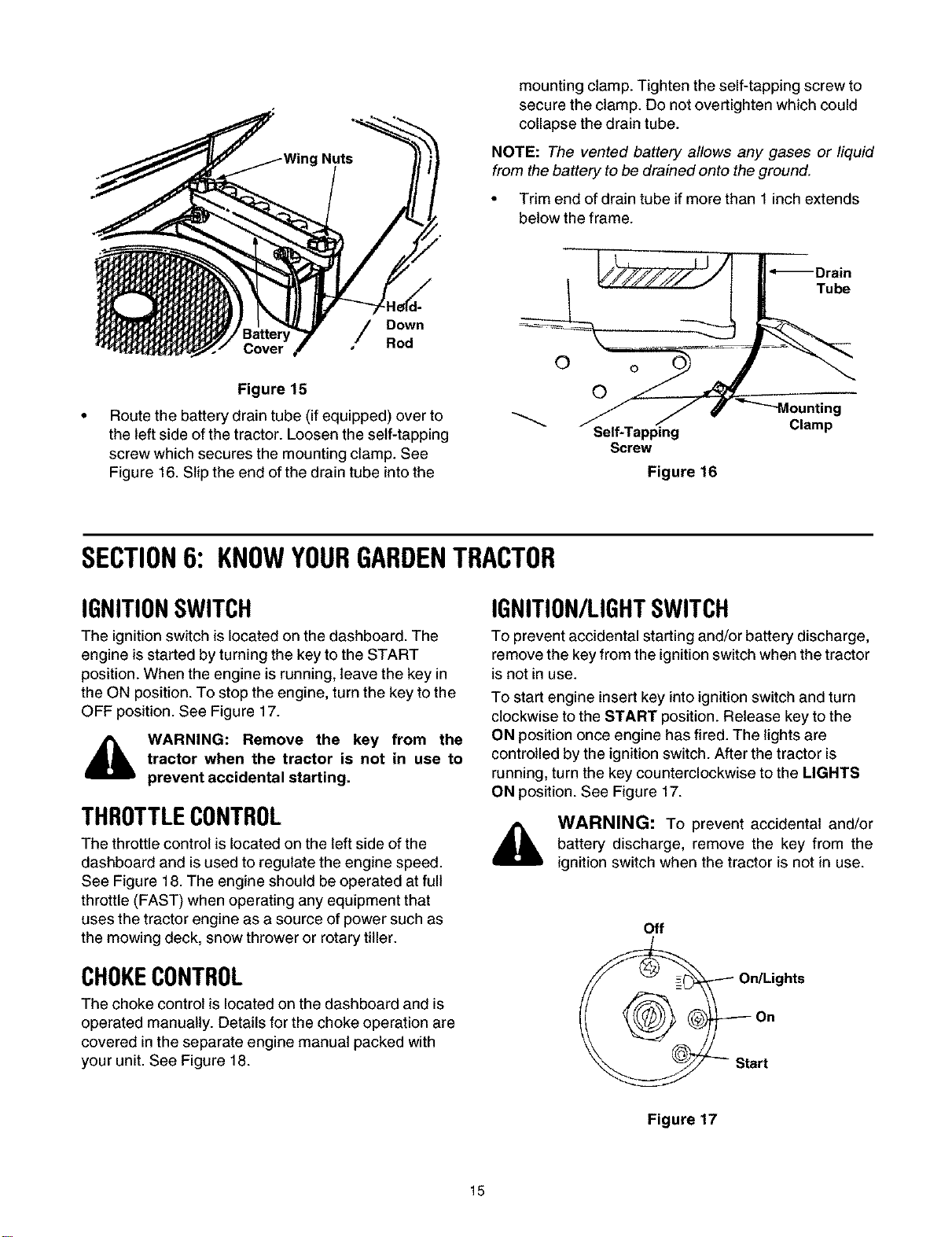
down rods. Secure with wing nuts. See Figure 15.
NOTE: It may be necessary to pull up on the hold-down
rods in order to start the wing nuts.
14
Down
Rod
Cover
Figure 15
Route the battery drain tube (ifequipped) over to
the left side ofthe tractor. Loosen the self-tapping
screw which secures the mounting clamp. See
Figure 16. Slip the end of the drain tube into the
mounting clamp. Tighten the self-tapping screw to
secure the clamp. Do not overtighten which could
collapse the drain tube.
NOTE: The vented battery allows any gases or liquid
from the battery to be drained onto the ground.
• Trim end of drain tube if more than 1 inch extends
below the frame.
Dra,n
\
Screw
Figure 16
SECTION6: KNOWYOURGARDENTRACTOR
IGNITIONSWITCH
The ignition switch is located on the dashboard. The
engine is started by turning the key to the START
position. When the engine is running, leave the key in
the ON position. To stop the engine, turn the key to the
OFF position. See Figure 17.
,_ WARNING: Remove the key from the
tractor when the tractor is not in use to
prevent accidental starting.
THROTTLECONTROL
The throttle control is located on the left side of the
dashboard and is used to regulate the engine speed.
See Figure 18. The engine should be operated at full
throttle (FAST) when operating any equipment that
uses the tractor engine as a source of power such as
the mowing deck, snow thrower or rotary tiller.
CHOKECONTROL
The choke control is located on the dashboard and is
operated manually. Details for the choke operation are
covered in the separate engine manual packed with
your unit. See Figure 18.
IGNITION/LIGHTSWITCH
To prevent accidental starting and/or battery discharge,
remove the key from the ignition switch when the tractor
is not in use.
To start engine insert key into ignition switch and turn
clockwise to the START position. Release key to the
ON position once engine has fired. The lights are
controlled by the ignition switch. After the tractor is
running, turn the key counterclockwise to the LIGHTS
ON position. See Figure 17.
WARNING: To prevent accidental and/or
battery discharge, remove the key from the
ignition switch when the tractor is not in use.
Off
On/Lights
Start
Figure 17
15
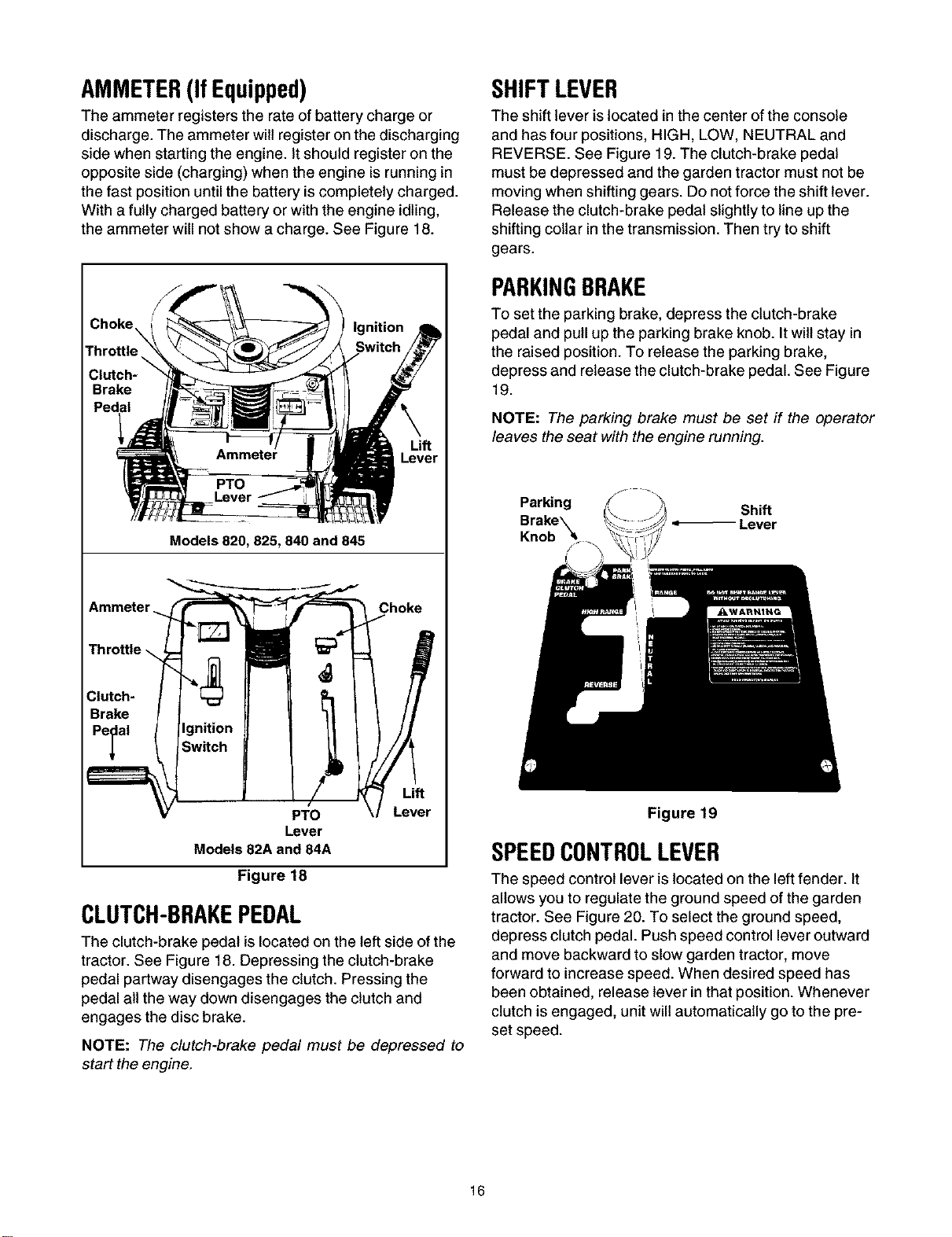
AMMETER(If Equipped)
The ammeter registers the rate of battery charge or
discharge. The ammeter wilt register on the discharging
side when starting the engine. Itshould register on the
opposite side (charging) when the engine is running in
the fast position until the battery is completely charged.
With a fully charged battery or with the engine idling,
the ammeter will not show a charge. See Figure 18.
Models 820, 825, 840 and 845
Ammeter. Choke
PTO
Lever
Models 82A and 84A
Figure 18
Lift
Lever
CLUTCH-BRAKEPEDAL
The clutch-brake pedal is located on the left side of the
tractor. See Figure 18. Depressing the clutch-brake
pedal partway disengages the clutch. Pressing the
pedal all the way down disengages the clutch and
engages the disc brake.
NOTE: The clutch-brake pedal must be depressed to
start the engine.
SHIFTLEVER
The shift lever is located inthe center of the console
and has four positions, HIGH, LOW, NEUTRAL and
REVERSE. See Figure 19. The clutch-brake pedal
must be depressed and the garden tractor must not be
moving when shifting gears. Do not force the shift lever.
Release the clutch-brake pedal slightly to line up the
shifting collar in the transmission. Then try to shift
gears.
PARKINGBRAKE
To set the parking brake, depress the clutch-brake
pedal and pull up the parking brake knob. It wilt stay in
the raised position. To release the parking brake,
depress and release the clutch-brake pedal. See Figure
19.
NOTE: The parking brake must be set if the operator
leaves the seat with the engine running.
Parking Shift
"_Lever
Knob
Figure 19
SPEEDCONTROLLEVER
The speed control lever is located on the left fender. It
allows you to regulate the ground speed of the garden
tractor. See Figure 20. To select the ground speed,
depress clutch pedal. Push speed control lever outward
and move backward to slow garden tractor, move
forward to increase speed. When desired speed has
been obtained, release lever in that position. Whenever
clutch is engaged, unit will automatically go to the pre-
set speed.
16
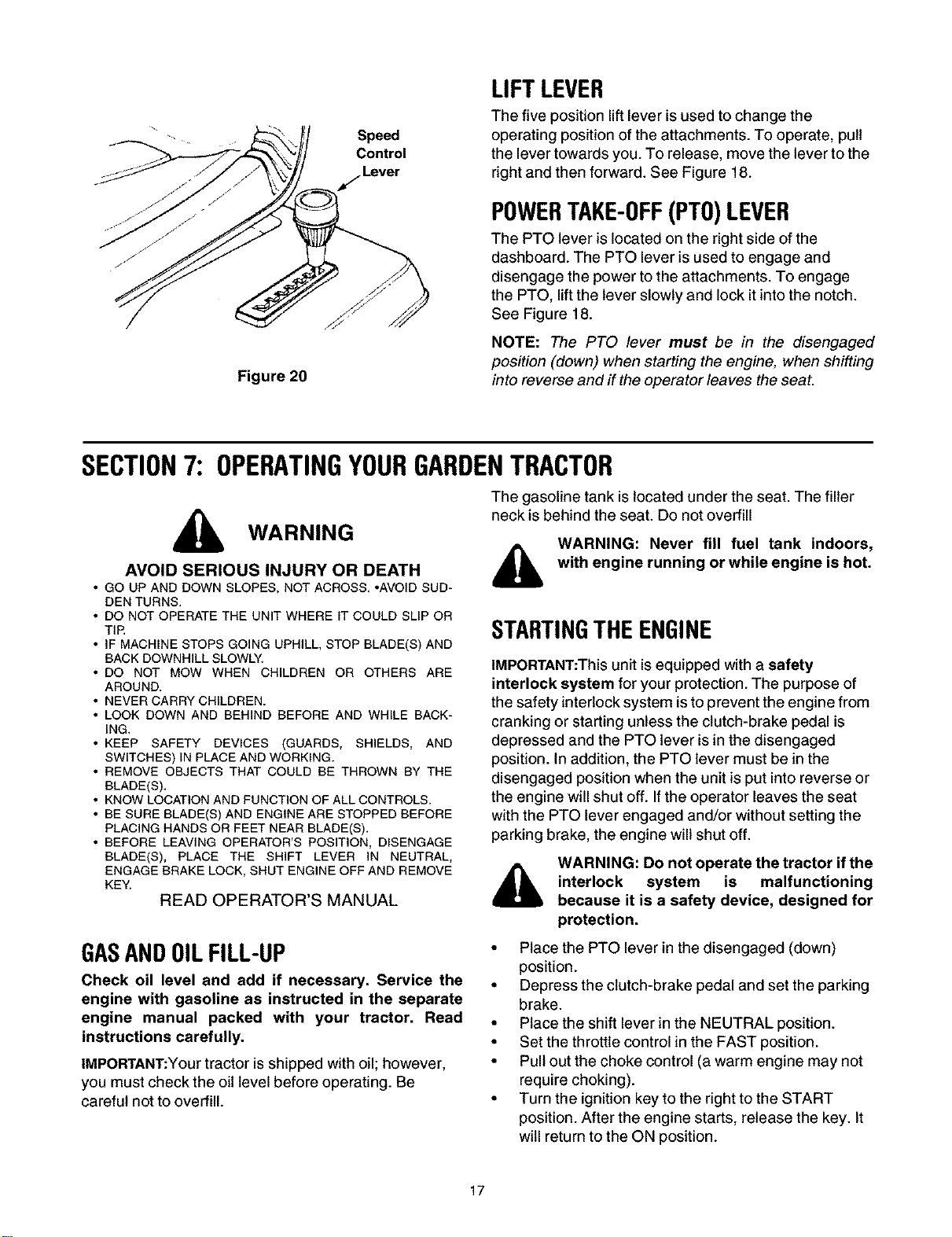
Figure 20
Speed
Control
_,jLever
LIFTLEVER
The five position lift lever isused to change the
operating position of the attachments. To operate, pull
the lever towards you. To release, move the lever to the
right and then forward. See Figure 18.
POWERTAKE-OFF(PTO)LEVER
The PTO lever is located on the right side of the
dashboard. The PTO lever is used to engage and
disengage the power to the attachments. To engage
the PTO, lift the lever slowly and lock it into the notch.
See Figure 18.
NOTE: The PTO lever must be in the disengaged
position (down) when starting the engine, when shifting
into reverse and if the operator leaves the seat.
SECTION7: OPERATINGYOURGARDENTRACTOR
WARNING
AVOID SERIOUS INJURY OR DEATH
• GO UP AND DOWN SLOPES, NOT ACROSS. •AVOID SUD-
DEN TURNS.
• DO NOT OPERATE THE UNIT WHERE IT COULD SLIP OR
TIR
• IF MACHINE STOPS GOING UPHILL, STOP BLADE(S) AND
BACK DOWNHILL SLOWLY.
• DO NOT MOW WHEN CHILDREN OR OTHERS ARE
AROUND.
• NEVER CARRY CHILDREN.
• LOOK DOWN AND BEHIND BEFORE AND WHILE BACK-
ING.
• KEEP SAFETY DEVICES (GUARDS, SHIELDS, AND
SWITCHES) IN PLACE AND WORKING.
• REMOVE OBJECTS THAT COULD BE THROWN BY THE
BLADE(S).
• KNOW LOCATION AND FUNCTION OF ALL CONTROLS.
• BE SURE BLADE(S) AND ENGINE ARE STOPPED BEFORE
PLACING HANDS OR FEET NEAR BLADE(S).
• BEFORE LEAVING OPERATOR'S POSITION, DISENGAGE
BLADE(S), PLACE THE SHIFT LEVER IN NEUTRAL,
ENGAGE BRAKE LOCK, SHUT ENGINE OFF AND REMOVE
KEY.
READ OPERATOR'S MANUAL
The gasoline tank is located under the seat. The filler
neck is behind the seat. Do not overfill
WARNING: Never fill fuel tank indoors,
with engine running or while engine is hot.
STARTINGTHEENGINE
IMPORTANT:This unit isequipped with a safety
interlock system for your protection. The purpose of
the safety interlock system isto prevent the engine from
cranking or starting unless the clutch-brake pedal is
depressed and the PTO lever is in the disengaged
position. In addition, the PTO lever must be in the
disengaged position when the unit is put into reverse or
the engine will shut off. If the operator leaves the seat
with the PTO lever engaged and/or without setting the
parking brake, the engine will shut off.
WARNING: Do not operate the tractor ifthe
interlock system is malfunctioning
because it is a safety device, designed for
protection.
GASANDOILFILL-UP
Check oil level and add if necessary. Service the
engine with gasoline as instructed in the separate
engine manual packed with your tractor. Read
instructions carefully.
IMPORTANT:Your tractor is shipped with oil; however,
you must check the oil level before operating. Be
careful not to overfill.
• Place the PTO lever in the disengaged (down)
position.
• Depress the clutch-brake pedal and set the parking
brake.
• Place the shift lever in the NEUTRAL position.
• Set the throttle control in the FAST position.
• Pull out the choke control (a warm engine may not
require choking).
• Turn the ignition key to the right to the START
position. After the engine starts, release the key. It
will return to the ON position.
17
• Slowly push in the choke as the engine warms up.
STOPPINGTHEENGINE
Turn the ignition key to the left to the OFF position.
Remove the key to prevent accidental starting.
IMPORTANT: If you strike a foreign object, stop the
engine. Remove wire from spark plug, thoroughly
inspect the unit for any damage, and repair the damage
before restarting and operating the mower.
NOTE: When operating the unit initially, there will be
little difference between the highest two speeds until
after the belts have seated themselves into the pulleys
during the break-in period. Be certain to change oil in
the crankcase after the first 5 hours of operation.
Be sure that the lawn is clear of stones, sticks, wire, or
other objects which could damage tractor or engine.
For best results and to insure more even grass
distribution, do not mow when lawn is excessively wet.
NOTE: If any problems are encountered, refer to the _IL
Trouble Shooting Guide.
SETTINGTHECUTTINGHEIGHT
Select the position for the tractor lift lever which gives
the desired cutting height. Then move the wheels on
the deck so that the wheels are 1/4 to 1/2 inch above
the ground.
NOTE: To obtain the best, uniform cut, the deck is
designed to be suspended from the tractor at the
desired cutting height. The deck wheels or deck rofer
should be just off the ground, to smooth out the cut and
guard against gouging.
OPERATINGTHETRACTOR
• Start the engine as instructed previously.
• Move throttle control to full throttle to prevent strain
on the engine and to operate attachments.
• Place the shift lever in one of the two forward
positions (LOW or HIGH), or in REVERSE. Place
the speed control lever in desired position. Use first
speed position when operating the tractor for the
first time.
WARNING: Look to the rear before
backing up.
• Release the parking brake by depressing the
clutch-brake pedal. Release clutch-brake pedal
slowly to put unit into motion.
• The tractor is brought to a stop by depressing the
clutch-brake pedal.
• The cutting blades (or other attachment) may be
engaged while the tractor is moving or standing still.
DO NOT engage the cutting blades abruptly as the
sudden belt tension on the pulley may cause the
engine to stall.
WARNING: Keep feet and hands away
from the discharge opening, the blades or
any part of the deck.
WARNING: Before leaving the operator's
position for any reason, disengage the
blades, place the shift lever in neutral,
engage the parking brake, shut engine off
and remove the key.
When stopping the unit to empty a grass bag, etc.,
follow the instructions above. This procedure will also
eliminate "browning" the grass, which is caused by hot
exhaust gases from a running engine.
If unit stalls with speed control in sixth or seventh
speed, or if unit will not operate with speed control lever
in first or second speed position, proceed as follows.
Place shift lever in NEUTRAL.
Restart engine.
Place speed control lever in highest speed position.
Release clutch-brake pedal fully.
Depress clutch-brake pedal.
Place speed control lever in desired position.
Place shift lever in one of the forward positions (HIGH
or LOW) or REVERSE, and follow normal operating
procedures.
HIGH-LOWTRANSMISSIONRANGES
HIGH range position is for normal load conditions, such
as mowing or transporting.
LOW range position is for situations which require more
torque when the tractor is used under high load
conditions, such as tilling, snow removal or hauling
heavy loads.
GRASSCOLLECTORAVAILABLE
GRASS COLLECTOR Model OEM-190-083 is
available as optional equipment for tractors with 46"
mowing decks.
WARNING: The mower should not be
operated without the entire grass catcher
or chute deflector in place.
NOTE: Under normal usage bag material is subject to
wear, and should be checked periodically. Be sure to
use only factory authorized replacement bag.
18
SECTION8: MAKINGADJUSTMENTS
WARNING: Disconnect the spark plug
wire(s) and ground against the engine
before performing any adjustments,
repairs or maintenance.
LEVELINGTHEDECK
The sides of the deck should be the same distance from
the ground. The front of the deck should be 1/4" to 3/8"
lower than the rear of the deck. Ifadjustment is
required, refer to "Leveling the Deck" in Assembly
instructions.
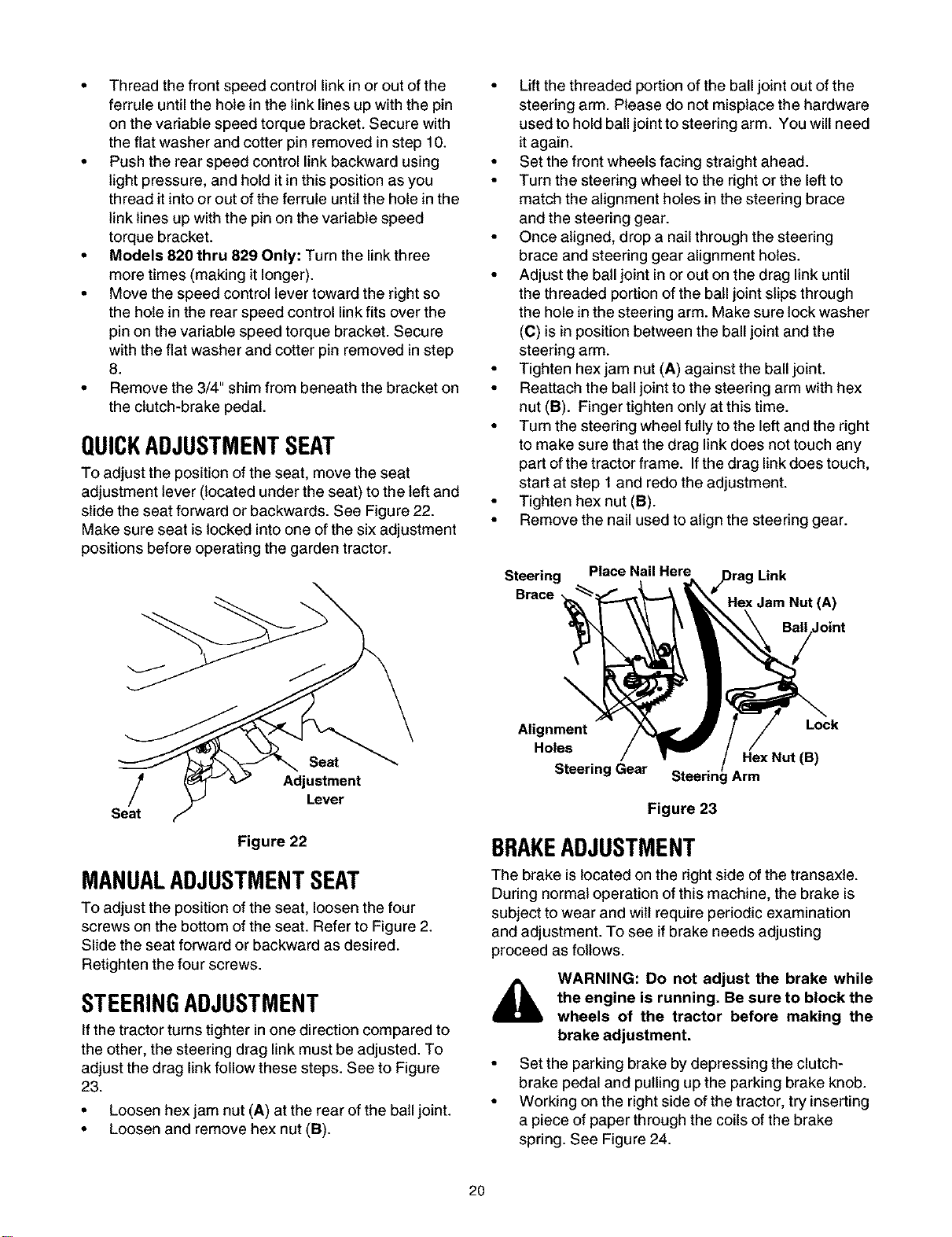
S.eed
Control _ _/
Lever "_,// Rear Speed
/'Y_ Control Link Clutch-Brake
It W / Pedal
Co°er ins /
J _"IP' / Flat Washers _._A
__ _f _ Pins Front Sp_d /_
ff,_-,-"---_'_z_L_._ _ Control Link I_"
// ,on
!ir7
Variable Speed
Torque Bracket F._/_ _%.
Assembly
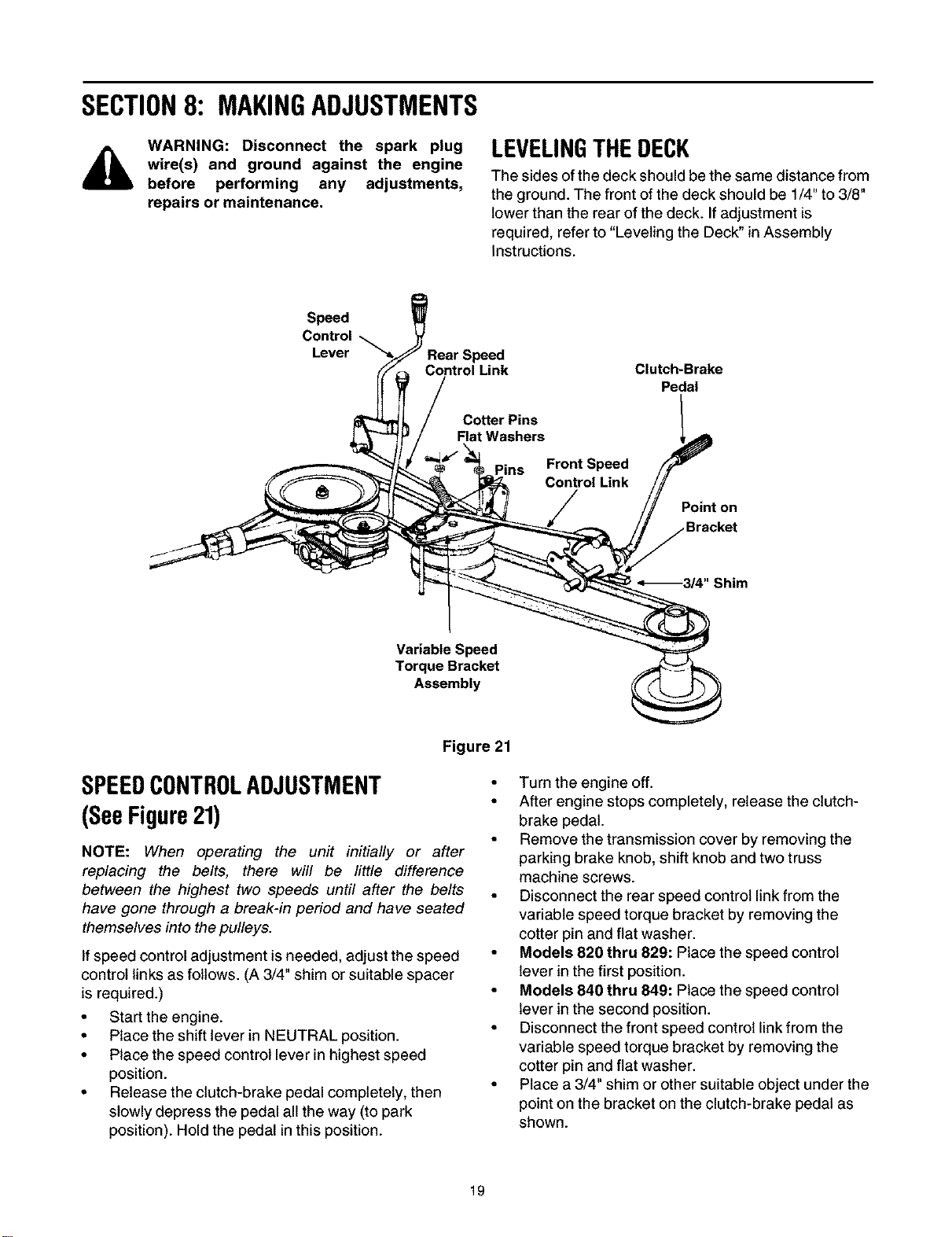
Figure 21
SPEEDCONTROLADJUSTMENT
(SeeFigure21)
NOTE: When operating the unit initially or after
replacing the belts, there will be little difference
between the highest two speeds until after the belts
have gone through a break-in period and have seated
themselves into the pulleys.
If speed control adjustment is needed, adjust the speed
control links as follows. (A 3/4" shim or suitable spacer
is required.)
• Start the engine.
• Place the shift lever in NEUTRAL position.
• Place the speed control lever in highest speed
position.
• Release the clutch-brake pedal completely, then
slowly depress the pedal all the way (to park
position). Hold the pedal in this position.
• Turn the engine off.
• After engine stops completely, release the clutch-
brake pedal.
• Remove the transmission cover by removing the
parking brake knob, shift knob and two truss
machine screws.
• Disconnect the rear speed control link from the
variable speed torque bracket by removing the
cotter pin and flat washer.
• Models 820 thru 829: Place the speed control
lever in the first position.
• Models 840 thru 849: Place the speed control
lever in the second position.
• Disconnect the front speed control link from the
variable speed torque bracket by removing the
cotter pin and flat washer.
• Place a 3/4" shim or other suitable object under the
point on the bracket on the clutch-brake pedal as
shown.
19
• Threadthefrontspeedcontrollinkinoroutofthe
ferruleuntiltheholeinthelinklinesupwiththepin
onthevariablespeedtorquebracket.Securewith
theflatwasherandcotterpinremovedinstep10.
• Pushtherearspeedcontrollinkbackwardusing
lightpressure,andholditinthispositionasyou
threaditintooroutoftheferruleuntiltheholeinthe
linklinesupwiththepinonthevariablespeed
torquebracket.
• Models 820 thru 829 Only: Turn the link three
more times (making it longer).
• Move the speed control lever toward the right so
the hole in the rear speed control link fits over the
pin on the variable speed torque bracket. Secure
with the flat washer and cotter pin removed in step
8.
• Remove the 3/4" shim from beneath the bracket on
the clutch-brake pedal.
QUICKADJUSTMENTSEAT
To adjust the position of the seat, move the seat
adjustment lever (located under the seat) to the left and
slide the seat forward or backwards. See Figure 22.
Make sure seat is locked into one of the six adjustment
positions before operating the garden tractor.
• Lift the threaded portion of the ball joint out of the
steering arm. Please do not misplace the hardware
used to hold ball joint to steering arm. You will need
it again.
• Set the front wheels facing straight ahead.
• Turn the steering wheel to the right or the left to
match the alignment holes in the steering brace
and the steering gear.
• Once aligned, drop a nail through the steering
brace and steering gear alignment holes.
• Adjust the ball joint in or out on the drag link until
the threaded portion of the ball joint slips through
the hole inthe steering arm. Make sure lock washer
(C) is in position between the ball joint and the
steering arm.
• Tighten hex jam nut (A) against the ball joint.
• Reattach the ball joint to the steering arm with hex
nut (B). Finger tighten only at this time.
• Turn the steering wheel fully to the left and the right
to make sure that the drag link does not touch any
part of the tractor frame. If the drag link does touch,
start at step 1 and redo the adjustment.
• Tighten hex nut (B).
• Remove the nail used to align the steering gear.
Steering Place Nail Here Link
Brace
Hex Jam Nut (A)
Ioint
Seat
Adjustment
Lever
Seat
Figure 22
MANUALADJUSTMENTSEAT
To adjust the position of the seat, loosen the four
screws on the bottom of the seat. Refer to Figure 2.
Slide the seat forward or backward as desired.
Retighten the four screws.
STEERINGADJUSTMENT
If the tractor turns tighter in one direction compared to
the other, the steering drag link must be adjusted. To
adjust the drag link follow these steps. See to Figure
23.
• Loosen hex jam nut (A) at the rear of the ball joint.
• Loosen and remove hex nut (B).
Alignment Lock
Holes
Hex Nut (B)
Steering Gear Arm
Figure 23
BRAKEADJUSTMENT
The brake is located on the right side of the transaxle.
During normal operation of this machine, the brake is
subject to wear and will require periodic examination
and adjustment. To see if brake needs adjusting
proceed as follows.
WARNING: Do not adjust the brake while
the engine is running. Be sure to block the
wheels of the tractor before making the
brake adjustment.
Set the parking brake by depressing the clutch-
brake pedal and pulling up the parking brake knob.
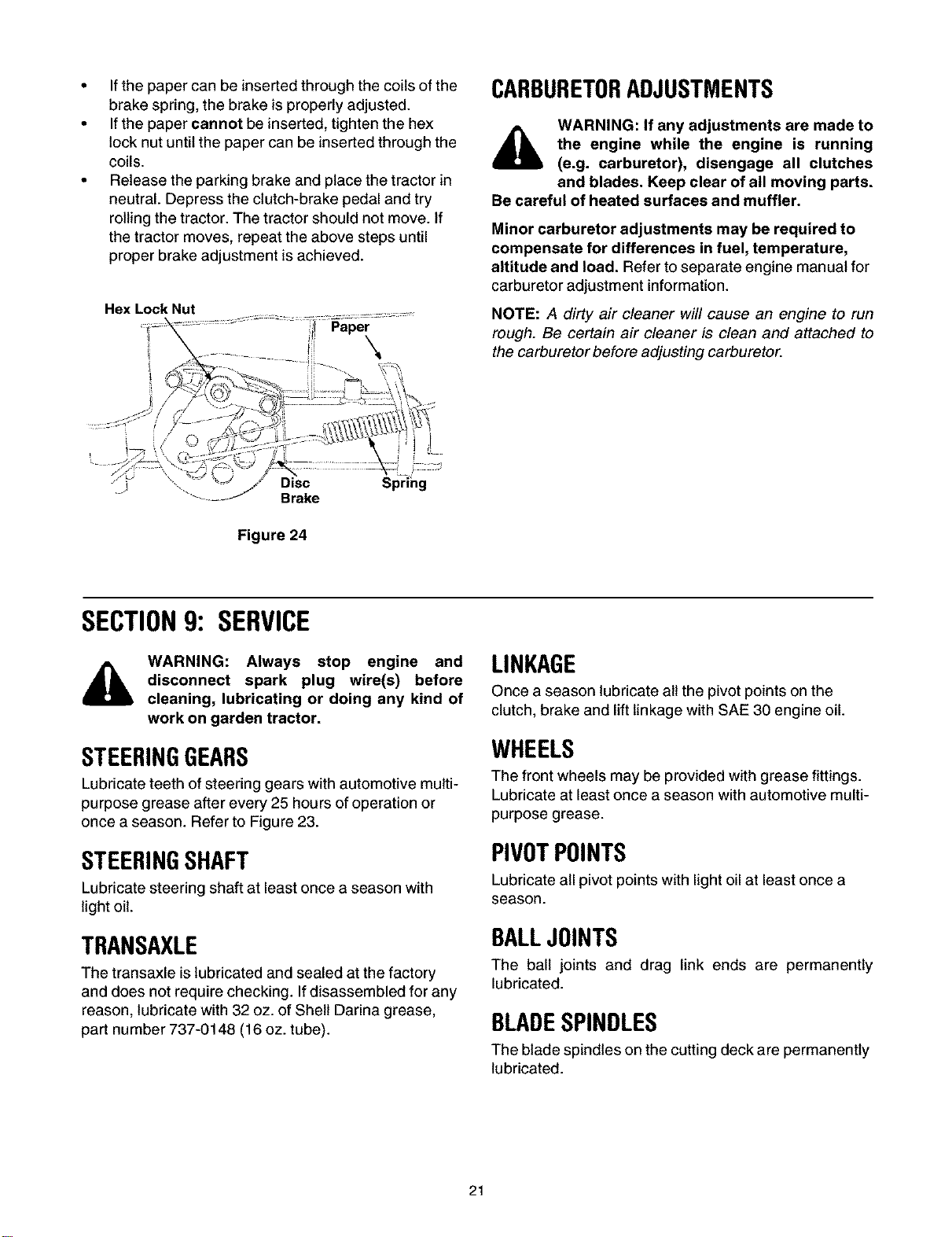
Working on the right side of the tractor, try inserting
a piece of paper through the coils of the brake
spring. See Figure 24.
2O
• Ifthepapercanbeinsertedthroughthecoilsofthe
brakespring,thebrakeisproperlyadjusted.
• Ifthepapercannot be inserted, tighten the hex
lock nut until the paper can be inserted through the
coils.
• Release the parking brake and place the tractor in
neutral. Depress the clutch-brake pedal and try
rolling the tractor. The tractor should not move. If
the tractor moves, repeat the above steps until
proper brake adjustment is achieved.
Hex Lock Nut
Paper
\
CARBURETORADJUSTMENTS
WARNING: If any adjustments are made to
the engine while the engine is running
(e.g. carburetor), disengage all clutches
and blades. Keep clear of all moving parts.
Be careful of heated surfaces and muffler.
Minor carburetor adjustments may be required to
compensate for differences in fuel, temperature,
altitude and load. Refer to separate engine manual for
carburetor adjustment information.
NOTE: A dirty air cleaner will cause an engine to run
rough. Be certain air cleaner is clean and attached to
the carburetor before adjusting carburetor.
Figure 24
Spring
SECTION9: SERVICE
WARNING: Always stop engine and
disconnect spark plug wire(s) before
cleaning, lubricating or doing any kind of
work on garden tractor.
STEERINGGEARS
Lubricate teeth of steering gears with automotive multi-
purpose grease after every 25 hours of operation or
once a season. Refer to Figure 23.
STEERINGSHAFT
Lubricate steering shaft at least once a season with
light oil.
TRANSAXLE
The transaxle is lubricated and sealed at the factory
and does not require checking. If disassembled for any
reason, lubricate with 32 oz. of Shell Darina grease,
part number 737-0148 (16 oz. tube).
LINKAGE
Once a season lubricate all the pivot points on the
clutch, brake and lift linkage with SAE 30 engine oil.
WHEELS
The front wheels may be provided with grease fittings.
Lubricate at least once aseason with automotive multi-
purpose grease.
PIVOTPOINTS
Lubricate all pivot points with light oil at least once a
season.
BALLJOINTS
The ball joints and drag link ends are permanently
lubricated.
BLADESPINDLES
The blade spindles on the cutting deck are permanently
lubricated.
21
SECTION10: MAINTAININGYOURGARDENTRACTOR
,&
WARNING: Disconnect the spark plug
wire(s) and ground against the engine
before performing any adjustments,
repairs or maintenance.
TROUBLESHOOTING
Refer to the trouble shooting chart for information.
ENGINE
Refer to the separate engine manual for engine
maintenance instructions.
Maintain engine oil as instructed in the separate
engine manual packed with your unit. Read and follow
instructions carefully.
Service air cleaner every 25 hours under normal
conditions. Clean every few hours under extremely
dusty condition. To service the air cleaner, refer to the
separate engine manual packed with your unit.
The spark plugs should be cleaned and the gap reset
once a season. Spark plug replacement is
recommended at the start of each mowing season;
check engine manual for correct plug type and gap
specifications.
CLEANINGENGINEANDDECK
Any fuel or oil spilled on the machine should be wiped
off promptly. Grass, leaves, and other dirt must not be
allowed to accumulate around the cooling fins of the
engine or on any part of the machine.
Clean the underside of the deck after each mowing.
CUTTINGBLADES
WARNING: Protect hands by using heavy
gloves or a rag to grasp the cutting blades.
The blades may be removed for sharpening or
replacement as follows:
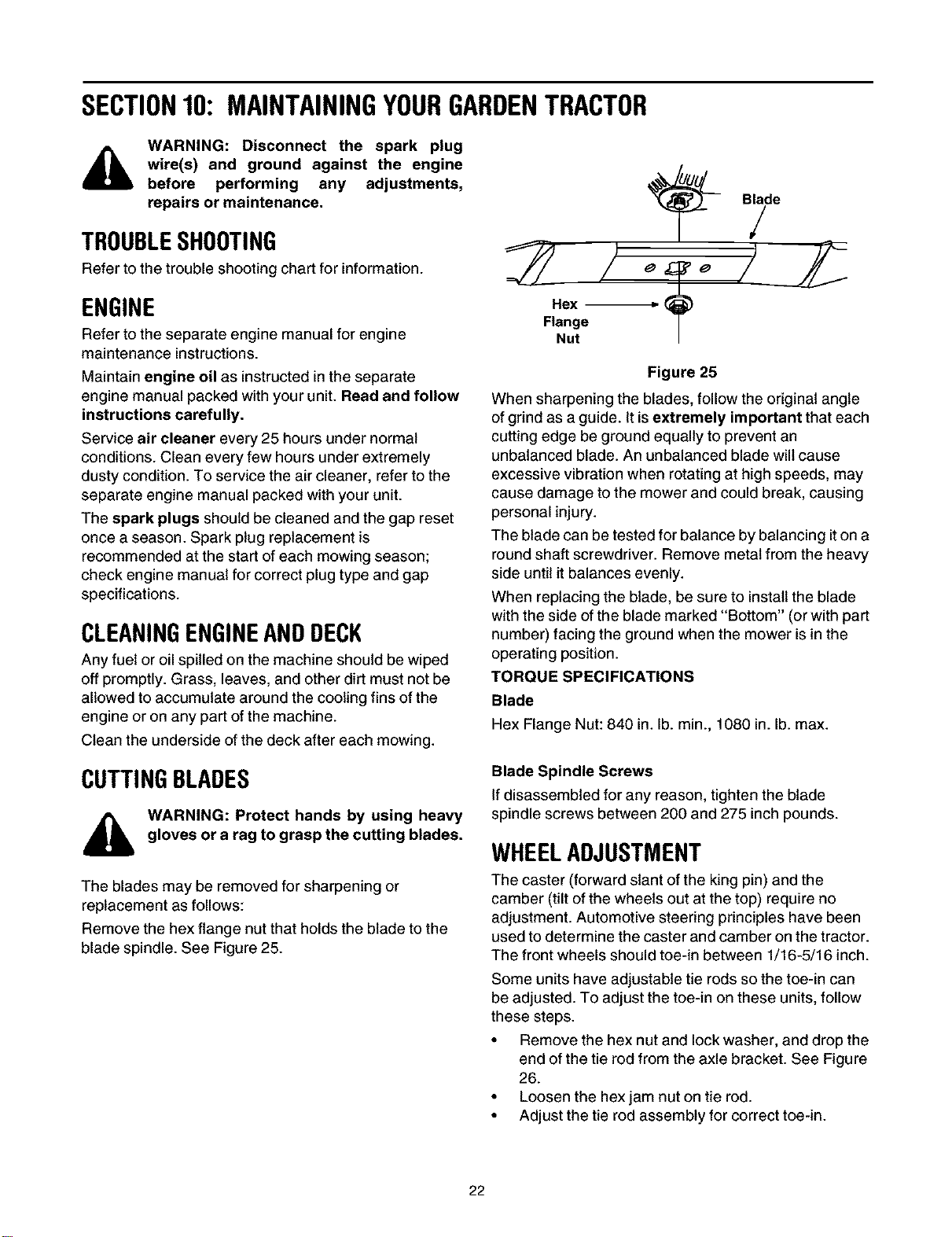
Remove the hex flange nut that holds the blade to the
blade spindle. See Figure 25.
2 /
Hex
Flange
Nut
Blade
/
Figure 25
When sharpening the blades, follow the original angle
ofgrind as a guide. Itisextremely important that each
cutting edge be ground equally to prevent an
unbalanced blade. An unbalanced blade will cause
excessive vibration when rotating at high speeds, may
cause damage to the mower and could break, causing
personal injury.
The blade can be tested for balance by balancing iton a
round shaft screwdriver. Remove metal from the heavy
side until it balances evenly.
When replacing the blade, be sure to install the blade
with the side of the blade marked "Bottom" (or with part
number) facing the ground when the mower is in the
operating position.
TORQUE SPECIFICATIONS
Blade
Hex Flange Nut: 840 in. lb. min., 1080 in. lb. max.
Blade Spindle Screws
If disassembled for any reason, tighten the blade
spindle screws between 200 and 275 inch pounds.
WHEELADJUSTMENT
The caster (forward slant of the king pin) and the
camber (tilt of the wheels out at the top) require no
adjustment. Automotive steering principles have been
used to determine the caster and camber on the tractor.
The front wheels should toe-in between 1/16-5/16 inch.
Some units have adjustable tie rods so the toe-in can
be adjusted. To adjust the toe-in on these units, follow
these steps.
• Remove the hex nut and lock washer, and drop the
end of the tie rod from the axle bracket. See Figure
26.
• Loosen the hex jam nut on tie rod.
• Adjust the tie rod assembly for correct toe-in.
22
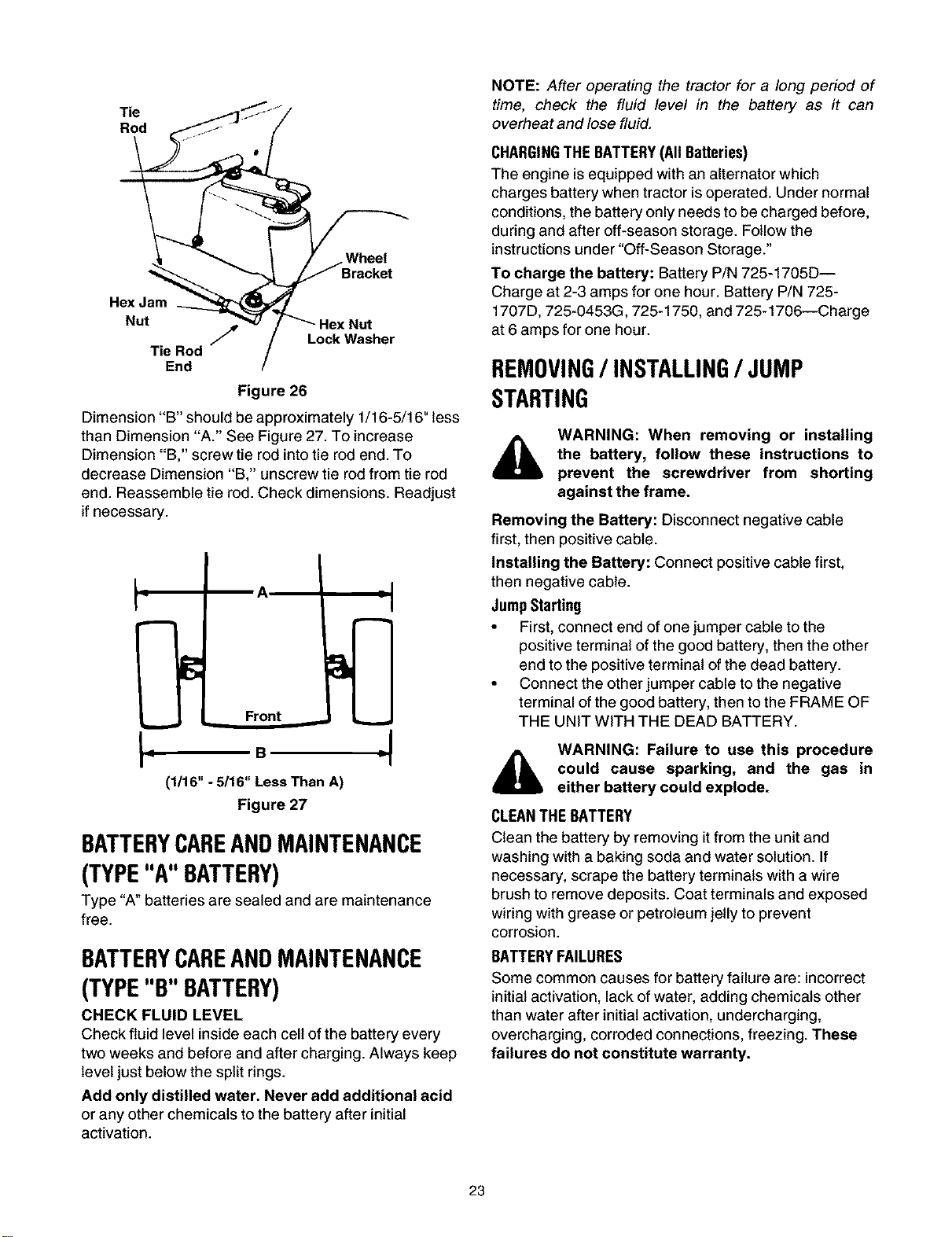
Tie
Rod
•Wheel
Hex Jam
Nut
Tie Rod
End
Nut
7 Lock Washer
Figure 26
Dimension "B" should be approximately 1/16-5/16" less
than Dimension "A." See Figure 27. To increase
Dimension "B," screw tie rod intotie rod end. To
decrease Dimension "B," unscrew tie rod from tie rod
end. Reassemble tie rod. Check dimensions. Readjust
if necessary.
| I
I. ° .I
(1/16" - 5116"LessThan A)
Figure 27
BATTERYCAREANDMAINTENANCE
(TYPE"A" BATTERY)
Type "A" batteries are sealed and are maintenance
free.
BATTERYCAREANDMAINTENANCE
(TYPE"e" BATTERY)
CHECK FLUID LEVEL
Check fluid level inside each cell of the battery every
two weeks and before and after charging. Always keep
level just below the split rings.
Add only distilled water. Never add additional acid
or any other chemicals to the battery after initial
activation.
NOTE: After operating the tractor for a long period of
time, check the fluid level in the battery as it can
overheat and lose fluid.
CHARGINGTHE BATTERY(AllBatteries)
The engine is equipped with an alternator which
charges battery when tractor isoperated. Under normal
conditions, the battery only needs tobe charged before,
during and after off-season storage. Follow the
instructions under "Off-Season Storage."
To charge the battery: Battery P/N 725-1705D--
Charge at 2-3 amps for one hour. Battery P/N 725-
1707D, 725-0453G, 725-1750, and 725-1706--Charge
at 6 amps for one hour.
REMOVING/ INSTALLING/ JUMP
STARTING
WARNING: When removing or installing
the battery, follow these instructions to
prevent the screwdriver from shorting
against the frame.
Removing the Battery: Disconnect negative cable
first, then positive cable.
Installing the Battery: Connect positive cable first,
then negative cable.
JumpStarting
• First, connect end of one jumper cable to the
positive terminal of the good battery, then the other
end to the positive terminal of the dead battery.
• Connect the other jumper cable to the negative
terminal of the good battery, then to the FRAME OF
THE UNIT WITH THE DEAD BATTERY.
WARNING: Failure to use this procedure
could cause sparking, and the gas in
either battery could explode.
CLEANTHE BATTERY
Clean the battery by removing itfrom the unit and
washing with a baking soda and water solution. If
necessary, scrape the battery terminals with a wire
brush to remove deposits. Coat terminals and exposed
wiring with grease or petroleum jelly to prevent
corrosion.
BATTERYFAILURES
Some common causes for battery failure are: incorrect
initial activation, lack of water, adding chemicals other
than water after initial activation, undercharging,
overcharging, corroded connections, freezing. These
failures do not constitute warranty.
23
TIRES
Maximum tire pressure under any circumstances is 30
p.s.i. Equal tire pressure should be maintained on all
tires. Check tire sidewalls for proper inflation.
When installing a tire to the rim, be certain rim is clean
and free of rust. Lubricate both the tire and rim
generously. Never inflate to over 30 p.s.L to seat beads.
WARNING: Excessive pressure (over 30
p.s.i.) when seating beads may cause tire/
rim assembly to burst with force sufficient
to cause serious injury.
FUELFILTER
Your unit is equipped with a replaceable in-line fuel
filter. Replace filter whenever contamination or
discoloration is noticed. Order replacement filter
through your authorized engine service dealer.
BELTREPLACEMENT
DeckBelt
• Remove the deck by following instructions on
pages 11 thru 13 in reverse order.
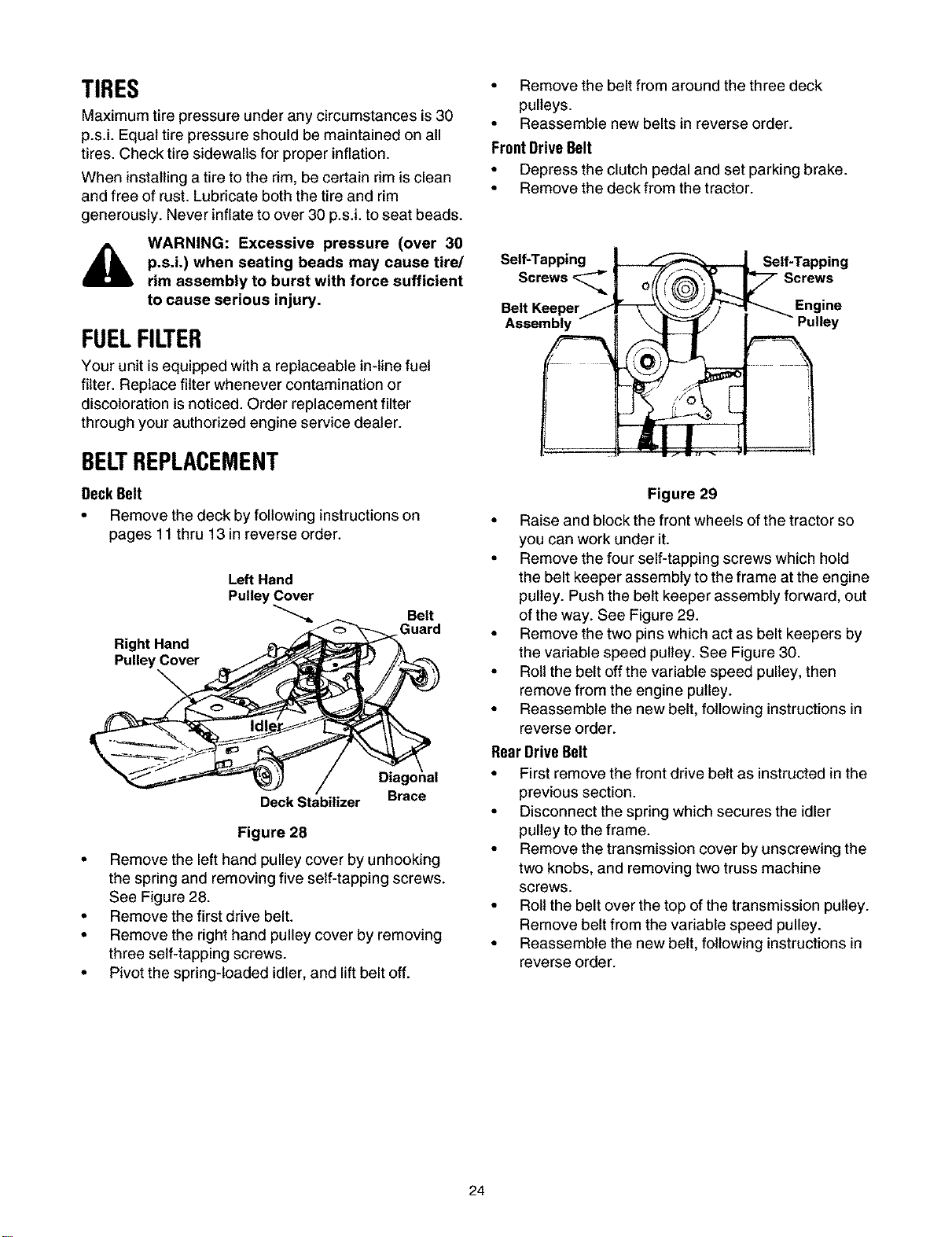
Right Hand
Pulley Cover
Left Hand
PulleyCover
Belt
Guard
Deck Stabilizer Brace
Figure 28
• Remove the left hand pulley cover by unhooking
the spring and removing five self-tapping screws.
See Figure 28.
• Remove the first drive belt.
• Remove the right hand pulley cover by removing
three self-tapping screws.
• Pivot the spring-loaded idler, and liftbelt off.
• Remove the belt from around the three deck
pulleys.
• Reassemble new belts in reverse order.
FrontDriveBelt
• Depress the clutch pedal and set parking brake.
• Remove the deck from the tractor.
Self-Tapping Self-Tapping
Screws ,_ Screws
Belt Keeper Engine
Assembly Pulley
Figure 29
• Raise and block the front wheels of the tractor so
you can work under it.
• Remove the four self-tapping screws which hold
the belt keeper assembly to the frame at the engine
pulley. Push the belt keeper assembly forward, out
of the way. See Figure 29.
• Remove the two pins which act as belt keepers by
the variable speed pulley. See Figure 30.
• Roll the belt off the variable speed pulley, then
remove from the engine pulley.
• Reassemble the new belt, following instructions in
reverse order.
RearDriveBelt
• First remove the front drive belt as instructed in the
previous section.
• Disconnect the spring which secures the idler
pulley to the frame.
• Remove the transmission cover by unscrewing the
two knobs, and removing two truss machine
screws.
• Roll the belt over the top of the transmission pulley.
Remove belt from the variable speed pulley.
• Reassemble the new belt, following instructions in
reverse order.
24
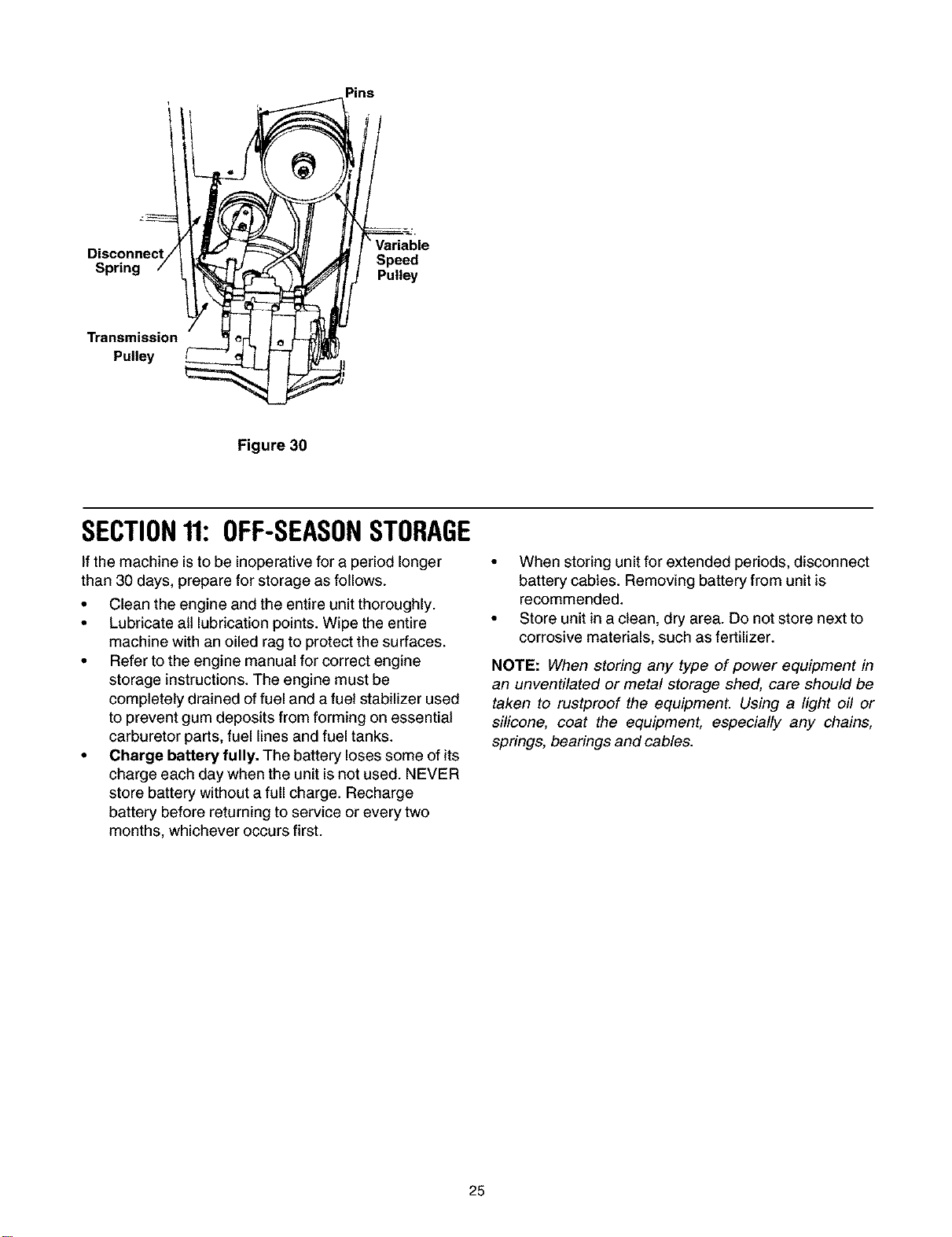
Pins
Disconnect Speed
Spring Pulley
Transmission
Pulley
Figure 30
SECTION11:OFF-SEASONSTORAGE
If the machine is to be inoperative for a period longer
than 30 days, prepare for storage as follows.
• Clean the engine and the entire unit thoroughly.
• Lubricate all lubrication points. Wipe the entire
machine with an oiled rag to protect the surfaces.
• Refer to the engine manual for correct engine
storage instructions. The engine must be
completely drained of fuel and a fuel stabilizer used
to prevent gum deposits from forming on essential
carburetor parts, fuel lines and fuel tanks.
• Charge battery fully. The battery loses some of its
charge each day when the unit is not used. NEVER
store battery without a full charge. Recharge
battery before returning to service or every two
months, whichever occurs first.
• When storing unit for extended periods, disconnect
battery cables. Removing battery from unit is
recommended.
• Store unit in a clean, dry area. Do not store next to
corrosive materials, such as fertilizer.
NOTE: When storing any type of power equipment in
an unventilated or metal storage shed, care should be
taken to rustproof the equipment. Using a light oil or
silicone, coat the equipment, especially any chains,
springs, bearings and cables.
25
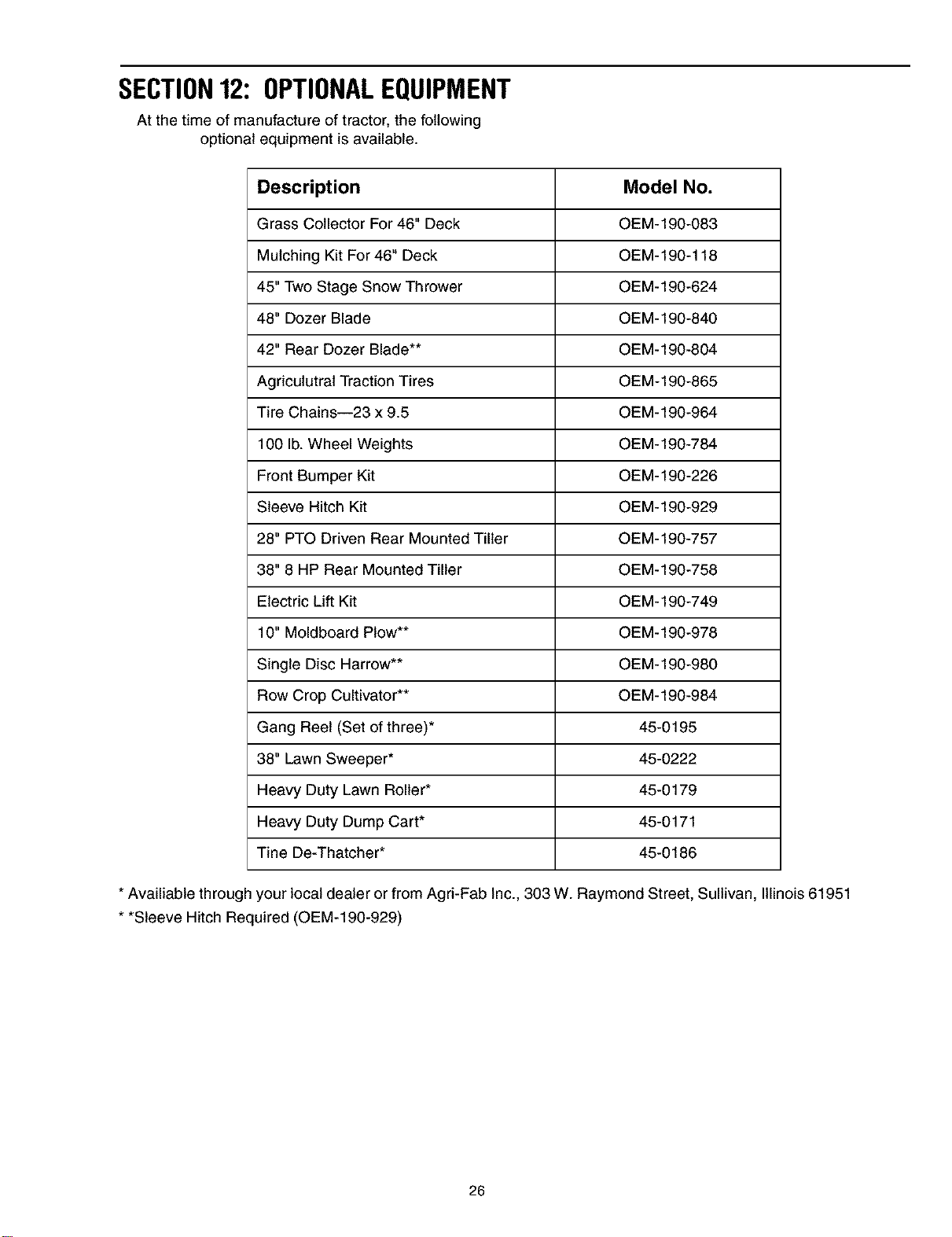
SECTION12: OPTIONALEQUIPMENT
At the time of manufacture of tractor, the following
optional equipment is available.
Description Model No.
Grass Collector For 46" Deck OEM-190-083
Mulching Kit For 46" Deck OEM-190-118
45" Two Stage Snow Thrower OEM-190-624
48" Dozer Blade OEM-190-840
42" Rear Dozer Blade** OEM-190-804
Agriculutral Traction Tires OEM-190-865
Tire Chains--23 x 9.5 OEM-190-964
100 lb. Wheel Weights OEM-190-784
Front Bumper Kit OEM-190-226
Sleeve Hitch Kit OEM-190-929
28" PTO Driven Rear Mounted Tiller OEM-190-757
38" 8 HP Rear Mounted Tiller OEM-190-758
Electric Lift Kit OEM-190-749
10" Moldboard Plow** OEM-190-978
Single Disc Harrow** OEM-190-980
Row Crop Cultivator** OEM-190-984
Gang Reel (Set of three)* 45-0195
38" Lawn Sweeper* 45-0222
Heavy Duty Lawn Roller* 45-0179
Heavy Duty Dump Cart* 45-0171
Tine De-Thatcher* 45-0186
* Availiable through your local dealer or from Agri-Fab Inc., 303 W. Raymond Street, Sullivan, Illinois 61951
* *Sleeve Hitch Required (OEM-190-929)
26
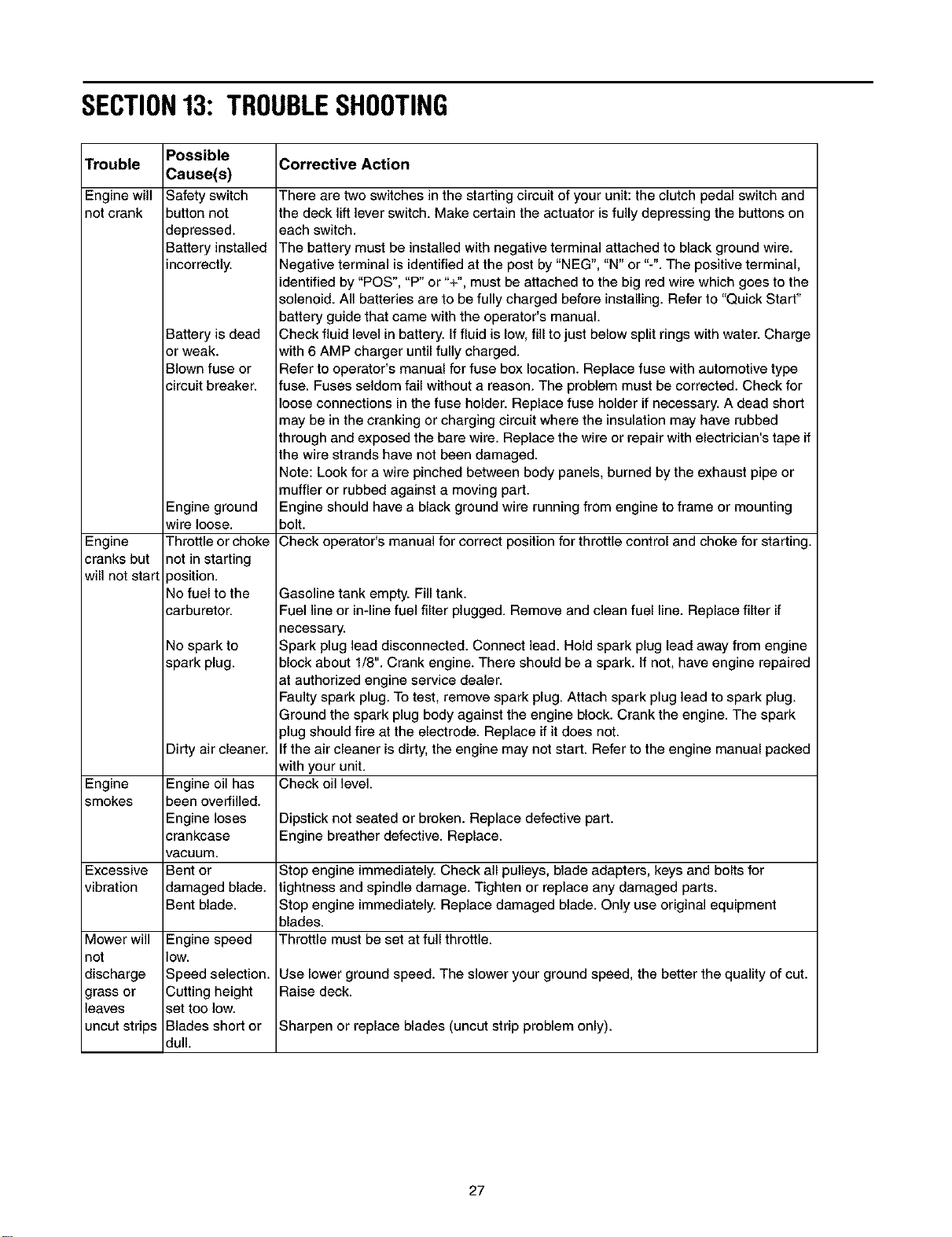
SECTION13: TROUBLESHOOTING
Trouble Corrective Action
Engine wil]
not crank
Engine
cranks but
will not start
Engine
smokes
Excessive
vibration
Mower will
not
discharge
grass or
leaves
uncut strips
Possible
Cause(s)
Safety switch
button not
depressed.
Battery installed
incorrectly.
Battery is dead
or weak.
Blown fuse or
circuit breaker.
Engine ground
wire loose.
Throttle or choke
not in starting
3osition.
No fuel to the
carburetor.
No spark to
spark plug.
Dirty air cleaner.
Engine oil has
been oveffilled.
Engine loses
crankcase
vacuum.
Bent or
damaged blade.
Bent blade.
Engine speed
low.
Speed selection.
Cutting height
set too low.
Blades short or
dull,
There are two switches in the starting circuit of your unit: the clutch pedal switch and
the deck lift lever switch. Make certain the actuator is fully depressing the buttons on
each switch.
The battery must be installed with negative terminal attached to black ground wire.
Negative terminal is identified at the post by "NEG', "N" or "-". The positive terminal,
identified by "POS', "P" or "+", must be attached to the big red wire which goes to the
solenoid. All batteries are to be fully charged before installing. Refer to "Quick Start"
battery guide that came with the operator's manual.
Check fluid level in battery. If fluid is low, fill to just below split rings with water. Charge
with 6 AMP charger until fully charged.
Refer to operator's manual for fuse box location. Replace fuse with automotive type
fuse. Fuses seldom fail without a reason. The problem must be corrected. Check for
loose connections in the fuse holder. Replace fuse holder if necessary. A dead short
may be in the cranking or charging circuit where the insulation may have rubbed
through and exposed the bare wire. Replace the wire or repair with electrician's tape if
the wire strands have not been damaged.
Note: Look for a wire pinched between body panels, burned by the exhaust pipe or
muffler or rubbed against a moving part.
Engine should have a black ground wire running from engine to frame or mounting
bolt.
Check operator's manual for correct position for throttle control and choke for starting.
Gasoline tank empty. Fill tank.
Fuel line or in-line fuel filter plugged. Remove and clean fuel line. Replace filter if
necessary.
Spark plug lead disconnected. Connect lead. Hold spark plug lead away from engine
block about 1/8". Crank engine. There should be a spark. If not, have engine repaired
at authorized engine service dealer.
Faulty spark plug. To test, remove spark plug. Attach spark plug lead to spark plug.
Ground the spark plug body against the engine block. Crank the engine. The spark
plug should fire at the electrode. Replace if it does not.
If the air cleaner is dirty, the engine may not start. Refer to the engine manual packed
with your unit.
Check oil level.
Dipstick not seated or broken. Replace defective part.
Engine breather defective. Replace.
Stop engine immediately. Check all pulleys, blade adapters, keys and bolts for
tightness and spindle damage. Tighten or replace any damaged parts.
Stop engine immediately. Replace damaged blade. Only use original equipment
blades.
Throttle must be set at full throttle.
Use lower ground speed. The slower your ground speed, the better the quality of cut.
Raise deck.
Sharpen or replace blades (uncut strip problem only).
27

MANUFACTURER'S LIMITED WARRANTY FOR:
YARD
The limited warranty set forth below is given by MTD
PRODUCTS INC ("MTD") with respect to new merchandise
purchased and used in the United States, its possessions
and territories.
MTD warrants this product against defects in material and
workmanship for a period of two (2) years commencing on
the date of original purchase and will, at its option, repair or
replace, free of charge, any part found to be defective in
material or workmanship. This limited warranty shall only
apply if this product has been operated and maintained in
accordance with the Operator's Manual furnished with the
product, and has not been subject to misuse, abuse, com-
mercial use, neglect, accident, improper maintenance,
alteration, vandalism, theft, fire, water or damage because
of other peril or natural disaster. Damage resulting from the
installation or use of any accessory or attachment not
approved by MTD Products Inc. for use with the product(s)
covered by this manual will void your warranty as to any
resulting damages.
Normal wear parts or components thereof are subject to
separate terms as follows: All normal wear part or compo-
nent failures will be covered on the product for a period of
90 days regardless of cause. After 90 days, but within the
two year period, normal wear part failures will be covered
ONLY IF caused by defects in material or workmanship of
OTHER component parts. Normal wear parts and compo-
nents include, but are not limited to, belts, blades, blade
adapters, grass bags, rider deck wheels, seats, snow
thrower skid shoes, shave plates and tires. Batteries are
covered by a 90-day limited replacement warranty.
HOW TO OBTAIN SERVICE: Warranty service is available,
WITH PROOF OF PURCHASE THROUGH YOUR LOCAL
AUTHORIZED SERVICE DEALER. To locate the dealer in
your area, please check for a listing in the Yellow Pages or
contact the Customer Service Department of MTD PROD-
UCTS INC by calling 1-800-800-7310 or writing to P.O. Box
368022, Cleveland, Ohio 44136-9722.
This limited warranty does not provide coverage in the
following cases:
a. The engine or component parts thereof. These items
carry a separate manufacturer's warranty. Please refer
to the applicable manufacturer's warranty on these
items.
b. Log splitter pumps, valves and cylinders have a sepa-
rate one year warranty.
c. Routine maintenance items such as lubricants, filters,
blade sharpening and tune-ups, or adjustments such
as brake adjustments, clutch adjustments or deck
adjustments; and normal deterioration of the exterior
finish due to use or exposure.
d. MTD does not extend any warranty for products sold
or exported outside of the United States of America,
its possessions and territories, except those sold
through MTD's authorized channels of export distribu-
tion.
NO implied warranty, including any implied warranty of
merchantability or fitness for a particular purpose,
applies after the applicable period of express written
warranty above as to the parts as identified. No other
express warranty or guaranty, whether written or oral,
except as mentioned above, given by any person or
entity, including a dealer or retailer, with respect to any
product shall bind MTD. During the period of the War-
ranty, the exclusive remedy is repair or replacement of
the product as set forth above. (Some states do not
allow limitations on how long an implied warranty lasts, so
the above limitation may not apply to you.)
The provisions as set forth in this Warranty provide the
sole and exclusive remedy arising from the sales. MTD
shall not be liable for incidental or consequential loss
or damages including, without limitation, expenses
incurred for substitute or replacement lawn care ser-
vices, for transportation or for related expenses, or for
rental expenses to temporarily replace a warranted
product. (Some states do not allow the exclusion or limita-
tion of incidental or consequential damages, so the above
exclusion or limitation may not apply to you.)
In no event shall recovery of any kind be greater than the
amount of the purchase price of the product sold. Alteration
of the safety features of the product shall void this War-
ranty. You assume the risk and liability for loss, damage, or
injury to you and your property and/or to others and their
property arising out of the use or misuse or inability to use
the product.
This limited warranty shall not extend to anyone other than
the original purchaser, original lessee or the person for
whom it was purchased as a gift.
How State Law Relates to this Warranty: This limited
warranty gives you specific legal rights, and you may also
have other rights which vary from state to state.