Roku TV
™
User Guide
Version 10.0
For U.K.
English
Illustrations in this guide are provided
for reference only and may differ from
actual product appearance.

Copyright
© 2021 Roku, Inc. All rights reserved. ROKU, the ROKU Logo, and “NOW THIS IS TV” are trademarks and/or registered
trademarks of Roku, Inc. Material in this User Manual is the property of Roku, Inc., and is protected under US and
International copyright and/or other intellectual property laws. Reproduction or transmission of the materials, in whole
or in part, in any manner, electronic, print, or otherwise, without the prior written consent of Roku, Inc., is a violation of
Roku, Inc.’s, rights under the aforementioned laws.
No part of this publication may be stored, reproduced, transmitted or distributed, in whole or in part, in any manner,
electronic or otherwise, whether or not for a charge or other or no consideration, without the prior written permission
of Roku, Inc.
Requests for permission to store, reproduce, transmit or distribute materials shall be made to both of the following
address:
Roku, Inc.
150 Winchester Circle
Los Gatos, CA 95032 USA
Product name: Roku TV™
Document name: Roku TV™ User Guide
Document revision: 10.0 – U.K., English
Publication date: 30-April-2021

iii
Contents
Welcome ...................................................................................................................................................1
The new standard in Smart TVs .................................................................................................................................. 1
Get the most out of your new TV ............................................................................................................................... 1
Connections and setup .................................................................................................................... 6
Connecting a TV aerial ................................................................................................................................................... 6
Connecting external equipment with a composite AV video cable ....................................................... 6
Connecting external equipment with an HDMI
®
cable ................................................................................... 7
Connecting headphones or analogue soundbar ................................................................................................ 7
Connecting an AV receiver or digital soundbar ................................................................................................ 8
Preparing for Internet connectivity ......................................................................................................................... 8
AC power .............................................................................................................................................................................. 9
Roku remote batteries .................................................................................................................................................... 9
Roku TV remote ................................................................................................................................................................ 10
Panel buttons ..................................................................................................................................................................... 13
Single button ................................................................................................................................................................. 13
Three buttons ................................................................................................................................................................ 14
Game-pad style joystick .......................................................................................................................................... 14
Four buttons .................................................................................................................................................................. 14
Five buttons (with mute) ........................................................................................................................................ 15
Five buttons (without mute) ................................................................................................................................. 15
Seven buttons ............................................................................................................................................................... 16
Guided Setup ....................................................................................................................................... 17
Starting Guided Setup ................................................................................................................................................... 17
Guided Setup ...................................................................................................................................................................... 18
Network connection ................................................................................................................................................ 20
Activation ....................................................................................................................................................................... 25
Connect your devices .............................................................................................................................................. 26
The Home screen .............................................................................................................................. 29
Personalise your Home screen ........................................................................................................................... 30
Benefits of connecting ................................................................................................................... 32
Connecting brings out your TV’s full potential! ............................................................................................... 32
Take advantage of awesome features ................................................................................................................. 32
What is streaming? ......................................................................................................................................................... 33

iv
What if I didn’t connect my TV? .............................................................................................................................. 35
Setting up live TV ............................................................................................................................. 36
How do I set up the TV tuner? ................................................................................................................................. 37
Scanning for individual channels ............................................................................................................................ 40
Using your TV ..................................................................................................................................... 42
Status indicator ................................................................................................................................................................ 42
Standby mode energy savings................................................................................................................................. 43
Watching live TV channels ......................................................................................................................................... 43
Changing channels..................................................................................................................................................... 43
Programme guide ..................................................................................................................................................... 44
Viewing programme information ....................................................................................................................... 45
Adjusting settings while watching a programme ..................................................................................... 46
Pausing live TV ................................................................................................................................................................ 46
Requirements .............................................................................................................................................................. 46
Enabling Live TV Pause ........................................................................................................................................... 47
Using Live TV Pause ................................................................................................................................................. 47
Notes about Live TV Pause .................................................................................................................................. 49
Automatic network recommendation ................................................................................................................. 49
Switching TV inputs ...................................................................................................................................................... 50
Auto-detecting devices .......................................................................................................................................... 50
Adjusting audio/video settings .......................................................................................................................... 50
Automatic game console configuration ........................................................................................................ 50
Using Roku Voice commands .................................................................................................................................... 51
Playing content from USB storage devices ....................................................................................................... 52
Auto player launch..................................................................................................................................................... 52
Playing content from local network media servers ....................................................................................... 53
Setting up a payment method ................................................................................................................................. 53
Using your TV on a restricted public network ................................................................................................. 54
About using your TV on a restricted public network .............................................................................. 54
Getting your Roku TV on line on a restricted public network ............................................................ 55
Opting out of HbbTV .................................................................................................................................................... 57
Checking signal condition ........................................................................................................................................... 58
Using Apple AirPlay and the Apple Home app ................................................................. 59
Apple AirPlay ..................................................................................................................................................................... 59
Other AirPlay things to try .................................................................................................................................... 59
Apple Home app ............................................................................................................................................................. 59
Some Apple HomeKit things to try .................................................................................................................. 60
Adjusting TV settings ...................................................................................................................... 61
Settings menu .................................................................................................................................................................... 61
Options menu .................................................................................................................................................................... 62
Options menu settings ................................................................................................................................................. 63

v
Picture settings................................................................................................................................................................. 65
Picture settings menu options ............................................................................................................................. 65
Auto Low Latency Mode (ALLM) ...................................................................................................................... 68
Variable refresh rate (VRR) ................................................................................................................................... 68
Expert Picture Settings (4K models only).......................................................................................................... 68
Sound settings ..................................................................................................................................................................69
Volume mode (select models only) ..................................................................................................................69
Sound settings – Dolby
®
Audio Processing (select models only) .................................................... 70
Sound settings – DTS
®
TruSurround / DTS
®
Studio Sound (select models only) ..................... 71
Sound settings – Sonic Emotion
™
Premium (select models only) ..................................................... 73
Sonic Emotion™ settings......................................................................................................................................... 74
Accessibility ....................................................................................................................................................................... 75
Accessibility menu settings ................................................................................................................................... 75
Changing privacy settings .......................................................................................................................................... 77
Advertising..................................................................................................................................................................... 77
Microphone .................................................................................................................................................................... 77
My Feed ................................................................................................................................................. 79
Searching for something to watch.......................................................................................... 80
How do I search? ............................................................................................................................................................ 80
Searching with the remote ..................................................................................................................................... 81
Searching from the Roku mobile app ............................................................................................................... 81
Searching with Google Assistant ....................................................................................................................... 82
Searching with Amazon Alexa ............................................................................................................................ 82
Searching for free content ..................................................................................................................................... 83
I found a programme. Now what? .......................................................................................................................... 83
Follow on Roku................................................................................................................................................................ 84
Recent Searches ............................................................................................................................................................. 84
Using the Roku Channel Store ................................................................................................... 85
Automatic Account Link ............................................................................................................................................. 86
Customising your TV ...................................................................................................................... 87
Add TV inputs ................................................................................................................................................................... 87
Add streaming channels .............................................................................................................................................. 87
Rename inputs .................................................................................................................................................................. 88
Remove unwanted tiles................................................................................................................................................ 89
Rearrange tiles .................................................................................................................................................................. 89
Change the look and feel with themes ................................................................................................................. 91
Edit live TV channel line-up ........................................................................................................................................ 91
Change menu volume ................................................................................................................................................... 92
Configure power settings ........................................................................................................................................... 93
Power on settings ...................................................................................................................................................... 93
Auto power savings .................................................................................................................................................. 93

vi
Standby LED On/Off ............................................................................................................................................... 94
Fast TV start ................................................................................................................................................................ 94
Configure accessibility................................................................................................................................................. 94
Audio description ...................................................................................................................................................... 94
Subtitles mode ............................................................................................................................................................. 95
Subtitles language ..................................................................................................................................................... 95
Hard of hearing ............................................................................................................................................................96
Hide Home screen shortcuts .....................................................................................................................................96
Parental controls ............................................................................................................................... 97
Creating a parental control PIN ............................................................................................................................... 97
Blocking TV channels .................................................................................................................................................... 98
Enabling parental control of TV programmes ............................................................................................. 98
Blocking channels....................................................................................................................................................... 98
What happens when a TV programme is blocked? ................................................................................... 100
Changing the parental control PIN ...................................................................................................................... 102
Resetting parental controls...................................................................................................................................... 102
More settings .................................................................................................................................... 103
Guest Mode ...................................................................................................................................................................... 103
Network settings ........................................................................................................................................................... 104
Time settings ................................................................................................................................................................... 106
Scan again for live TV channels ............................................................................................................................. 106
HDMI
®
mode (4K models only) .............................................................................................................................. 107
Control by mobile apps.............................................................................................................................................. 108
Home theatre configuration .................................................................................................................................... 109
Turning off the TV speakers for home theatre use ................................................................................. 109
Setting up a digital audio connection ............................................................................................................ 109
Choosing an audio format .................................................................................................................................... 110
Turning off the TV screen while listening to music ................................................................................... 111
Controlling other devices through CEC ........................................................................................................... 111
Restart the TV ...................................................................................................................................................................113
Reset the TV ..................................................................................................................................................................... 114
Reset audio/video settings .................................................................................................................................. 114
Factory reset everything ....................................................................................................................................... 114
What if I can’t access the Factory Reset option? ...................................................................................... 115
Network connection reset ..................................................................................................................................... 115
Roku account PIN ........................................................................................................................................................... 115
Update the TV ................................................................................................................................................................. 116
Checking for updates on a connected TV ..................................................................................................... 117
Getting updates on a non-connected TV ..................................................................................................... 118
Other devices .................................................................................................................................... 120
Mirror your phone or tablet ..................................................................................................................................... 120
Roku mobile app.............................................................................................................................................................. 121

vii
Private Listening on the Roku mobile app .................................................................................................... 121
Universal remotes ..........................................................................................................................................................122
FAQ ....................................................................................................................................................... 123


1
Welcome
Congratulations on the purchase of your new Roku TV! Discover the joy of endless
entertainment. After it’s set up, you’ll be able to access a world of streaming content
channels that may include paid subscription channels and free channels.
Important:
Your TV receives automatic updates from time to time, enabling new
content and features. This edition of the User Guide describes Roku TV version 10.0.
To determine the current version of your Roku TV, go to Settings > System > About
after you complete Guided Setup.
The new standard in Smart TVs
Welcome to TV like you’ve most likely never seen before—a home screen that you can
personalise with your favourite devices and streaming channels. Choose from
hundreds of thousands of streaming movies and TV episodes, plus music, sports, kids,
family, international and much more. You should never run out of things to watch.
Note:
A paid subscription or other payments may be required for some channel
content. Channel availability is subject to change and varies by country.
Get the most out of your new TV
Follow these steps to get the most out of your new TV.
• Connect to the Internet
• It’s easy, and it will unlock a world of entertainment. All you need is a
network connection. There are plenty of free streaming channels, paid
subscription services, and convenient ways to rent or buy a favourite film or
programme.

2
• Pick your favourite streaming channels
• Find the entertainment you love. From the latest blockbuster movies to
your favourite TV programmes, with tons of live sports, a broad selection of
music streaming channels, popular programming in international languages
relevant to your location, 24x7 live news and so much more, your new Roku
TV has your sweet spot. A paid subscription or other payments may be
required for some channels.
• Find Live TV programmes in the programme guide
• Use the programme guide to see not only what’s on TV right now, but what
was on up to a week ago, and what will be on in the coming week. And for
many over-the-air programmes, if you start watching the programme after
it is already in progress, or you see something you missed in the
programme guide, you can use the Guide’s options menu to discover how
you can see the programme from the beginning, find other episodes, or
entire seasons of the programme, if applicable.
• Personalise your Home screen
• Put your favourite streaming channels and TV inputs front-and-centre on
the Home screen. No more flipping through inputs or wading through
complicated menus. You can even customise the names of each input and
move tiles around so your most-often used devices and streaming channels
are only a click away.
• Search for your favourite movie, TV programme, actor, director, or genre
• Once you’re connected to the internet, you can
easily search across top
streaming channels by movie or programme title, actor, director, genre,
channel name, or interactive game name—all from one place. Search by
typing words or phrases using the on-screen keyboard, or on your mobile
device speak words or phrases (
in English
) in a conversational tone using
Voice Search. Some channels and content require payment.
• Pause live TV
• Pause, resume, fast forward, and rewind TV programmes. Simply connect
your own USB drive to the TV and pause live TV for up to 90 minutes.
Note:
Live TV Pause is available on TV programmes received on the TV
tuner input, and only when the TV is linked to a valid Roku account.

3
• Control your TV with voice commands
• Use the free Roku mobile app to control your Roku TV. Use
conversational voice commands to search for programs by title, actor,
director, or genre. On selected streaming channels, you can search
without leaving the current channel. Your search results appear in the
lower portion of the screen. The current channel’s results appear first
followed by results from other channels.
While you’re at it, explore these additional voice features:
• Use voice commands to launch streaming channels or switch inputs.
1
• Set sleep timers. For example, say “Turn the TV off in 30 minutes”, or
“Go to sleep at 11 p.m.”
• Search for movies based on popular quotes. For example, say “What
movie is this from – ‘Here’s looking at you, kid’.”
•
Only on 4K TVs
, say “Show me 4K movies” to see a list of 4K movies
available across participating streaming channels.
• Use Roku Voice to make on-screen keyboard entries in a variety of
on-screen keyboards. Keyboards that support voice entry have a
microphone icon next to the input field. You can say letters,
characters, and numbers for an easy way to enter the required
information.
• Use voice commands to turn the display off (for enjoying streaming
music), turn closed captions on or off, and to replay the last few
seconds of a movie or TV program.
• Control the Roku Media Player to play your personal music and show
movies and photos. Say commands like, “Play classic rock on Roku
Media Player,” “Skip ahead 20 seconds,” or “Play the next song.”
• Ask Siri on your Apple device to control your Roku TV with just your
voice
2
. Say things like “Hey Siri, play jazz on the living room TV” to play
music from your iPhone, iPad, Apple Watch, HomePod Mini, or Mac on
your Roku TV. Roku TVs also support Apple HomeKit, providing an easy
way to control HomeKit-enabled accessories using the Apple Home app
and Siri. After installing your Roku TV, set it up with just a few simple
steps within the Apple Home app. You can even create your own
custom automations and scenes that include HomeKit-enabled
accessories such as your Roku TV, to control your home setting..
1 Voice features support English language only.
2 Apple AirPlay 2 and HomeKit are supported by Roku TVs except for models beginning with “6”
(6
XXXX
) and “5” (5
XXXX
).

4
• Use Google Home, Google Pixel phone, or the Google Home mobile app
to control your Roku TV. You can search for movies and TV programs,
launch most channels, control playback, adjust the volume, switch
inputs, turn the TV on and off, and more. Control multiple Roku devices
by including the location of the device in your commands. For example,
say “Hey Google, turn off Roku in the bedroom.” For information on
linking and controlling your Roku TV, see
https://support.roku.com/article/360009649613-how-do-i-control-my-
roku-streaming-device-with-the-google-assistant-.
• Use Amazon Echo Dot, Echo Plus, Echo Show, or the Amazon Alexa
mobile app to control your Roku TV. You can search for movies and TV
programs, launch most channels, control playback, adjust the volume,
switch inputs, turn the TV on and off, and more. Control multiple Roku
devices by including the location of the device in your commands. For
example, say “Hey Alexa, pause Roku in the living room.” For information
on adding the Alexa Roku skills and controlling your Roku TV, see:
https://support.roku.com/article/360017961074-how-do-i-use-amazon-
alexa-with-my-roku-streaming-device-.
• Use Apple AirPlay 2 with your iOS and MacOS devices
• Effortlessly share videos, photos, music, and more from Apple devices on
Roku TVs
1
. Control AirPlay sessions with pause, rewind, and more using
your iPhone, iPad, or Mac. Play music from your Apple devices on Roku TVs
and other AirPlay 2 enabled speakers in your home at the same time in
perfect sync. Plus, mirror the screen from your iPhone, iPad, or Mac to the
big screen.
• Send your personal media to the big screen
• Send personal photos, videos, and music from your compatible smartphone
or tablet to the TV screen in just a few taps. Plus, with select channels, you
can send movies, programmes, sport highlights, and more directly to your
TV.
• Follow movies coming soon
• Use My Feed to choose from and follow a list of upcoming movies, and then
watch for alerts each time one of your followed movies becomes available
or changes price.
1 Apple AirPlay 2 and HomeKit are supported by Roku TVs except for models beginning with “6”
(6
XXXX
) and “5” (5
XXXX
).

5
• Take charge with the Roku mobile app
• Control your TV with the included remote or from your compatible
smartphone or tablet with the free mobile app for iOS
®
and Android™
mobile devices
1
. Browse channels, view My Feed, listen to audio from live TV
and streaming channels. Search more easily using your mobile device’s
keyboard and Voice Search.
2
• Mirror your compatible smartphone or tablet on your TV. Share videos,
photos, web pages, and more from compatible devices.
• Get the best streaming experience with automatic network recommendation
• While you are watching a streaming channel, and during manual wireless
network scans, your TV will recommend the optimal wireless network
connection. You can choose to switch to the recommended network or
continue with the current connection.
• Connect your Roku TV to networks found in hotels and halls of residence
• Temporarily link your smartphone or table to your TV to agree to any terms,
enter codes, or provide required information before you can get Internet
access in locations that require these additional steps (also known as
restricted public networks
).
Note:
Using your Roku TV on a restricted public network requires wireless
availability and use of your network-connected smartphone, tablet, or
computer to authenticate access to your account. You must use your Roku
TV remote, and not the Roku mobile app, to initiate the connection process.
Streaming content might be limited due to your geographic location or
because of restrictions imposed by the network host.
Go to support.roku.com for device compatibility information.
Let’s get started.
1 IOS® is a trademark or registered trademark of Cisco in the U.S. and other countries and is used under
license. Android™ is a trademark of Google Inc.
2 Voice features support English language only.

6
Connections and setup
Refer to your TV’s Quick Start Guide or other provided documentation for model-
specific information about attaching the base or a wall mount and making
connections to AC power and to your other audio/video devices. The following
general information applies to all Roku TV models.
Connecting a TV aerial
Connect your TV aerial to the TV using a 75-ohm coaxial cable (not provided) from
the aerial to the ANT input on the TV.
Tip:
If you receive your TV stations through a set top box from a cable or satellite TV
provider, connect it to the TV using the best connection method available.
• HDMI input – Digital HD and SD video (best)
• AV input – analogue SD video
Connecting external equipment with a composite
AV video cable
If the best connection available on your device is AV or composite video output,
connect it to the TV using a composite AV cable (not provided). Composite AV
cables typically have three RCA-type plugs on each end, colour coded as follows:
• Yellow – Video
• Red – Audio, right channel
• White or black – Audio, left channel
Connect each plug to the corresponding connector on the device and on the TV.
Note:
Select models have an AV Input that looks like a headphone jack. Use the
breakout cable (included) to adapt this input to the three RCA-type plugs on your
composite cable.

7
Connecting external equipment with an HDMI
®
cable
If possible, connect your devices using HDMI
®
cables (not provided). They help to
provide the best video quality and also carry audio signals, so that only one cable is
needed. For better picture quality, we recommend that you use cables designated as
High Speed HDMI
®
Cables.
Tip:
You might need to configure the device you are connecting to the TV to send its
signal through its HDMI connector.
The connector labelled HDMI (ARC) has the additional ability to use the audio return
channel to send digital audio to a receiver or soundbar, as explained in
Connecting an
AV receiver or digital soundbar.
Only on select models:
The connector labelled HDMI (eARC) provides the same
functionality as the HDMI ARC connector, plus the ability to pass through full-
resolution sound formats such as Dolby Atmos and DTS:X from and to devices that
support these formats, without additional processing by the TV. Additional details are
provided in
Choosing an audio format
.
Connecting headphones or analogue soundbar
You can connect headphones or an analogue soundbar (not provided) to the TV’s
headphone jack.
Tip:
Inserting a plug in the headphone jack disables the sound from the TV’s built-in
speakers.
Warning:
Loud noise can damage your hearing. When using headphones, use the
lowest volume setting on your headphones that still lets you hear the sound.
Select models also have an audio line out connection that is not affected by TV
volume or mute settings and does not disable the TV speakers. Use this connection
when you want to use your amplifier or soundbar to control the TV volume. To turn
off the TV’s built-in speakers, from the Home screen menu, navigate to Settings >
Audio > TV speakers and change the setting.

8
Connecting an AV receiver or digital soundbar
You can enjoy Dolby Audio™ multichannel sound from your TV if you connect a digital
amplifier or soundbar (not provided) in either of two ways:
Digital optical audio out (S/PDIF) – Connect a TOSLINK optical cable (not provided)
from the TV to the Optical input on your receiver or soundbar.
HDMI ARC – Connect an HDMI
®
cable (not provided) from the HDMI (ARC) connector
to the HDMI
®
input on your receiver or soundbar. This connection uses the Audio
Return Channel (ARC) feature of HDMI
®
to output sound from the TV to a compatible
device. To use this feature, you must configure the TV to enable HDMI
®
ARC, as
explained in
Enable HDMI® ARC.
HDMI eARC –
Select models only:
Connect an HDMI
®
cable (not provided) from the
HDMI (eARC) connector to the HDMI (ARC) or HDMI (eARC) input on your receiver
or soundbar. If your receiver or soundbar supports HDMI enhanced ARC (eARC), the
TV can pass through full-resolution sound from programmes containing enhanced
audio. If your receiver or soundbar does not support eARC, use the TV’s eARC port to
make ARC the connection. The eARC port is backward compatible with the ARC
standard.
Preparing for Internet connectivity
If you want to watch streaming content and take advantage of most of the cool
features of your Roku TV, connect it to the Internet through a wireless modem/router
or a wireless access point (not provided). The TV has a built-in wireless LAN adapter.
Note:
The TV supports only its internal wireless network adapter—it does not support
the use of a USB network adapter.
Select models have both wired and wireless network connectivity. To use the wired
network connection, connect an RJ-45 Ethernet cable (not provided) from the jack on
the back of your TV to your network router or switch. The wired connection
automatically supports both 10 Base-T and 100 Base-T Ethernet.

9
AC power
Plug your TV into a power outlet. You can tell that the TV has power because the
status indicator lights up when the TV is off.
The topic Status indicator
explains how the status indicator shows what is happening
with the TV.
Roku remote batteries
Open the back of your Roku remote and insert the included batteries, observing the
proper orientation as indicated in the battery compartment. Reattach the back cover.
10
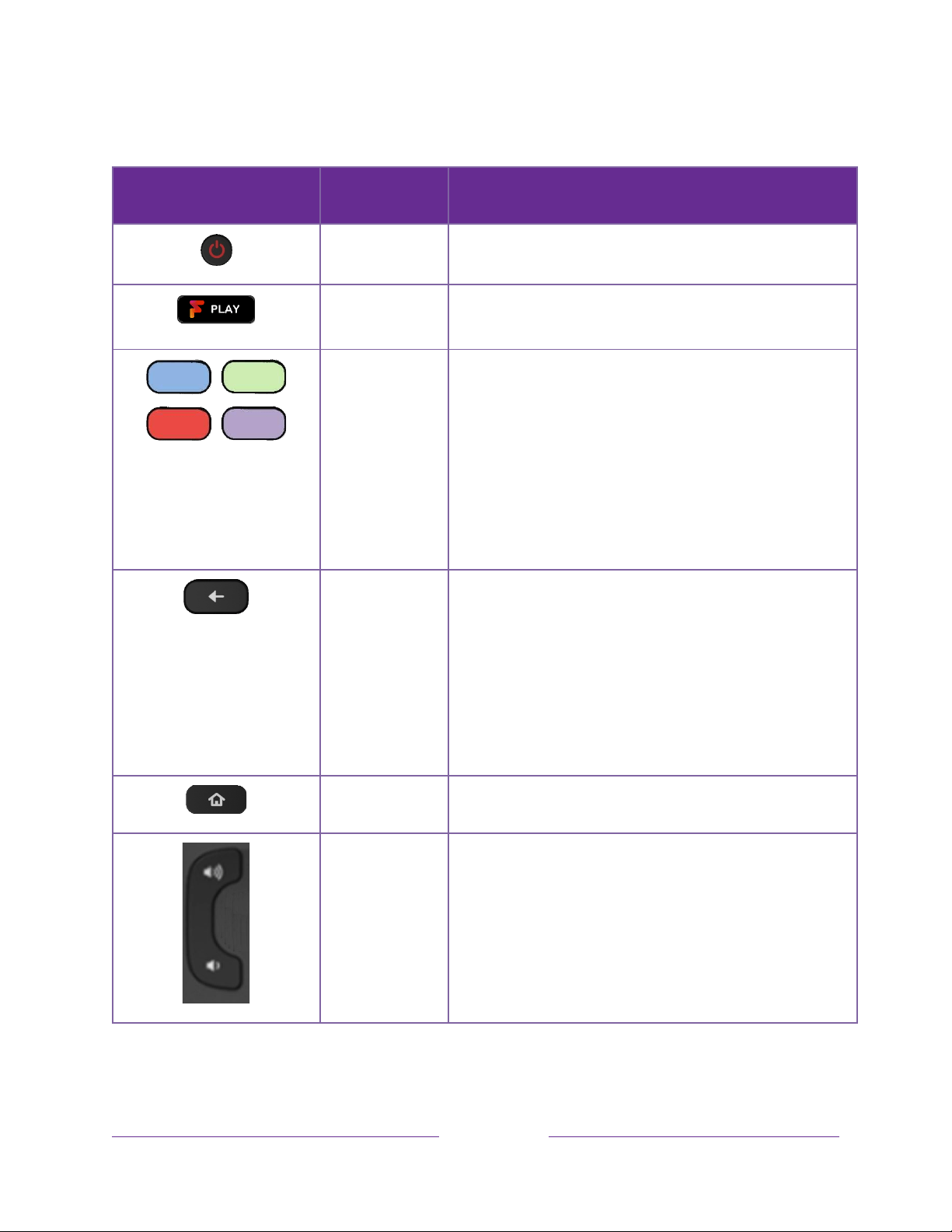
Roku TV remote
BUTTON FUNCTION DESCRIPTION
POWER
Turns TV on and off.
FREEVIEW PLAY
Accesses Freeview Play, where you can see free
streaming content provided by participating channels.
FACTORY
ASSIGNED
CHANNEL
SHORTCUT
Dedicated buttons show the logo of a pre-set streaming
content provider. Dedicated content providers vary by
model and region. Pressing a button:
• Displays the streaming channel’s main page if you
have already added the channel to your Home
screen.
• Displays the streaming channel’s sign-up page if
you have not already added the channel.
BACK
• Menu: Goes back to previous menu/screen.
• Home screen tile: Moves highlight back to the Home
screen menu.
• Watching any TV input: Returns to Home screen.
• Playing streaming content: Stops playing stream
and returns to the previous menu or screen.
• Browsing streaming content: Goes to the previous
level in the content tree.
HOME
Immediately returns to the Home screen.
VOLUME UP
VOLUME DOWN
Increases and decreases the volume.
11
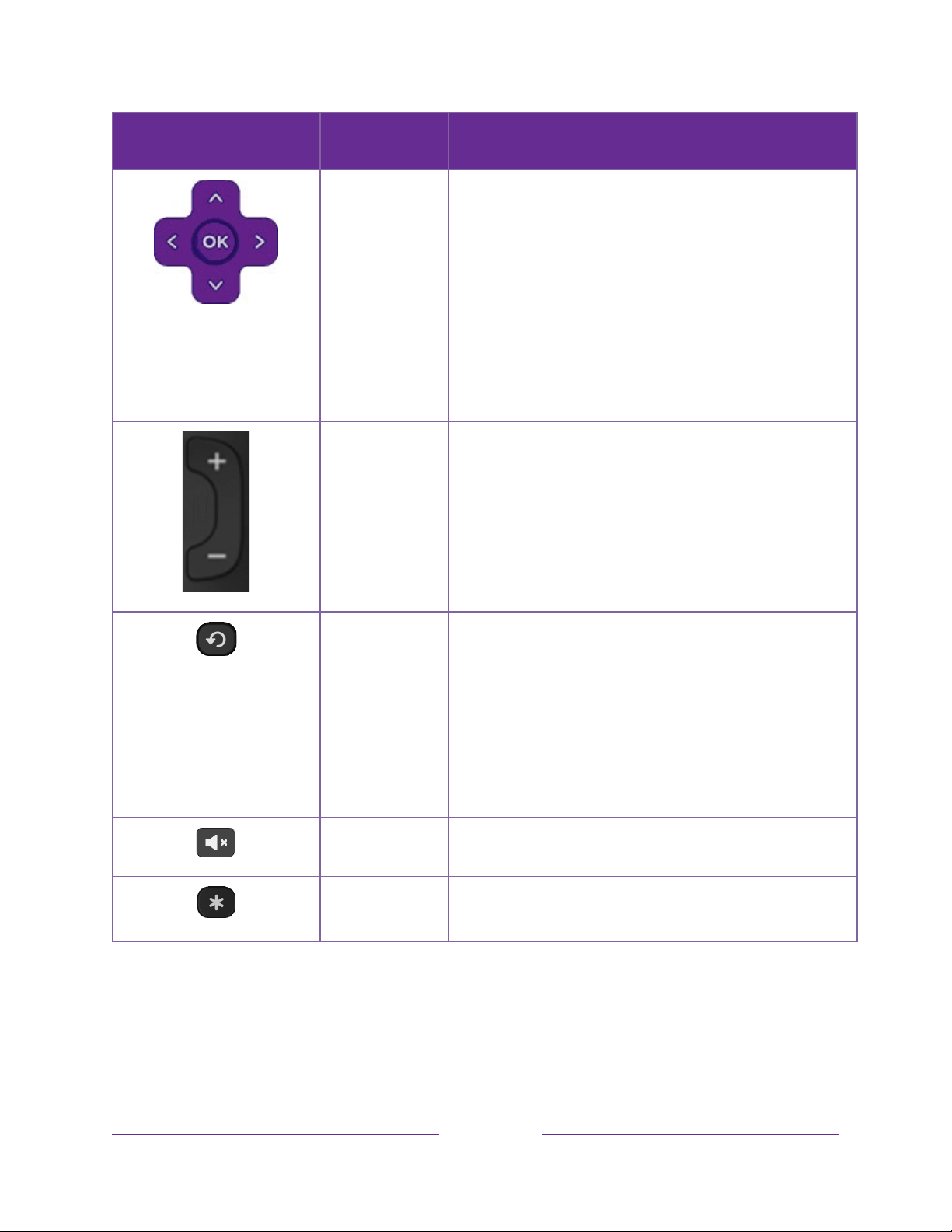
BUTTON FUNCTION DESCRIPTION
DIRECTIONAL PAD
While navigating the TV menus and options:
• LEFT/RIGHT/UP/DOWN moves the highlight in the
corresponding direction.
• OK selects the highlighted option.
While watching streaming content
• Action depends on the streaming app.
While watching TV:
• OK
Displays the programme information banner.
CHANNEL UP
CHANNEL DOWN
Changes to the next or previous channel in the channel
list.
REPLAY
Live TV: Jumps to previously tuned channel. If Live TV
Pause is enabled, jumps back a few seconds with each
press and resumes playing.
Programme guide: Returns to the current day and time.
Streaming content: Depends on streaming app.
On-screen keyboard: Backspaces in the text you are
entering.
MUTE
Mutes and unmutes TV sound
STAR
Displays additional options when available. On-screen
hints let you know when this button is active.
12
BUTTON FUNCTION DESCRIPTION
MEDIA PLAYBACK
CONTROLS
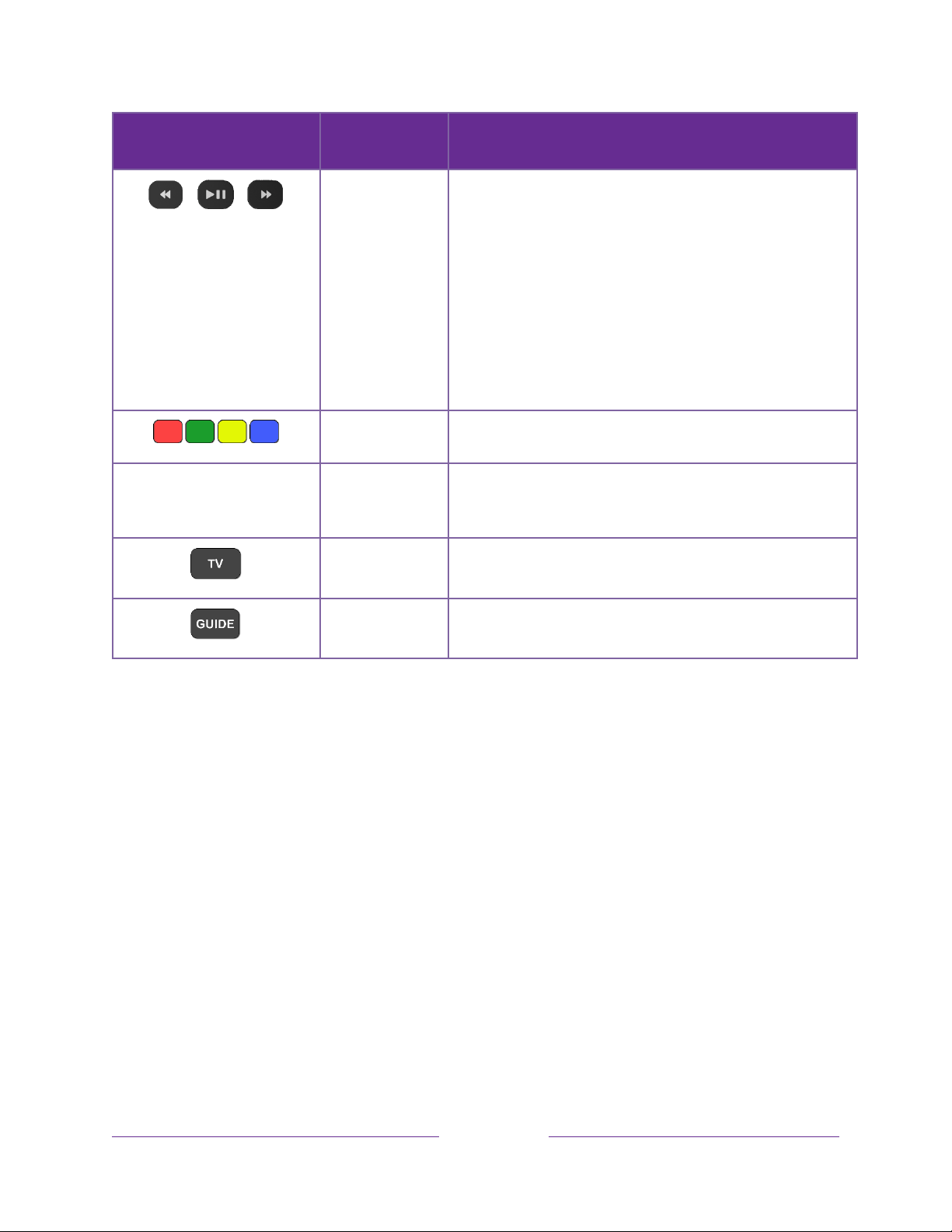
Scan backward, pause, play, and fast forward streaming
content and live TV channels (if Live TV Pause is
enabled).
Press REWIND or FAST FWD one, two, or three times to
control the speed of the operation.
REWIND and FAST FWD also jump backward and
forward one screen at a time when viewing long lists,
such as when you are browsing live TV programmes in
the programme guide.
COLOR KEYS
Function depends on Interactive TV app being used.
0 – 9
NUMBER KEYS Live TV: Direct channel entry.
On-screen number pad: Direct number entry.
TV
Jumps directly to Live TV. Exits an interactive TV app.
GUIDE
Displays the programme guide.

13
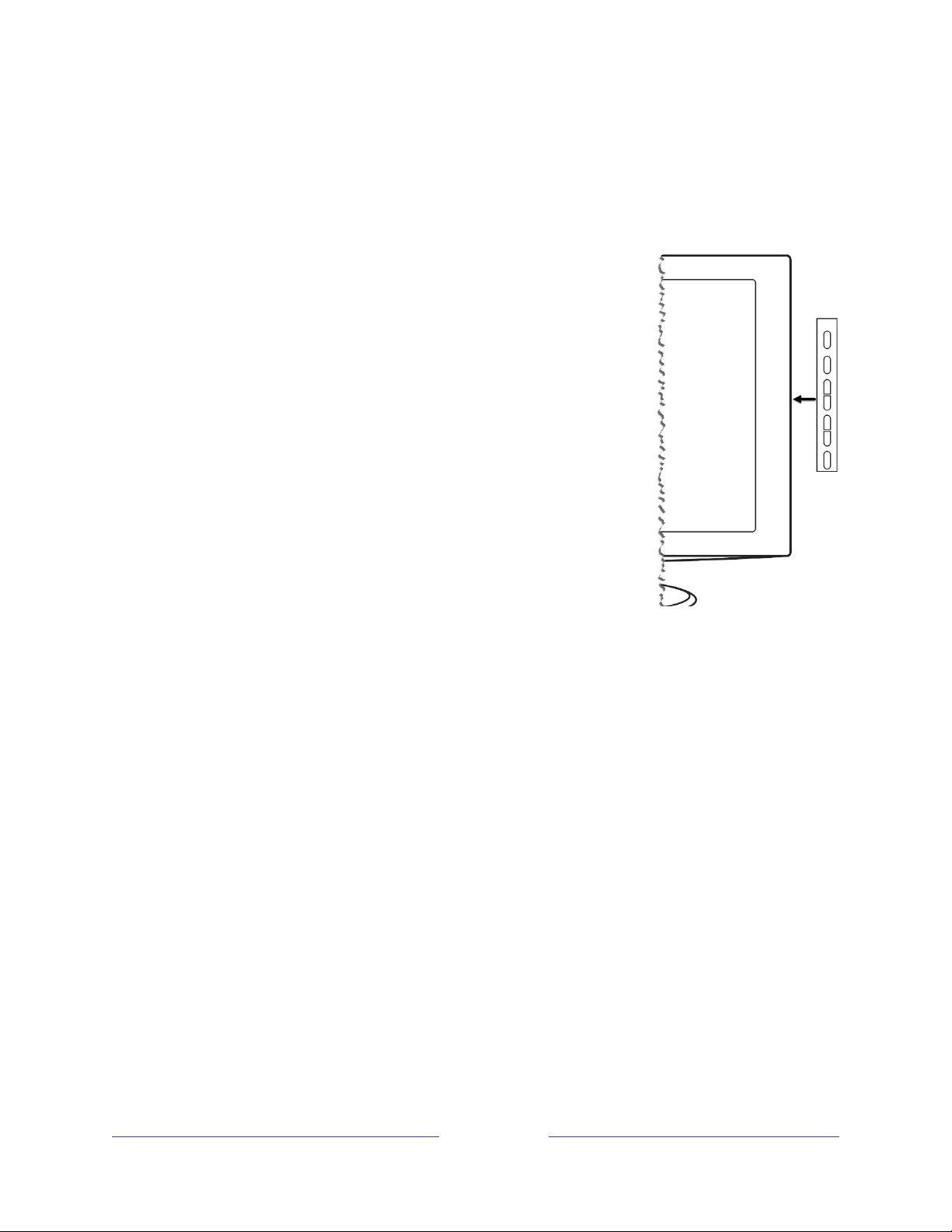
Panel buttons
Your TV has buttons on its side, bottom, or back panel that perform simple control
functions. The TV panel buttons are not a substitute for the remote, as they do not
give you access to all TV functions.
Depending on model, your TV model has one of several different panel button
designs. Choose the one that applies to your TV from the following list:
•
Single button
• Three buttons
• Game-pad style joystick
• Four buttons
• Five buttons (with mute)
• Five buttons (without mute)
• Seven buttons
Single button
If your TV has this style of panel button, you can perform the following functions:
• Turn TV on: short press.
• Display the Input List: short press when TV is on.
• Select the next input in the Input List: short press while the TV is showing the
Input List.
• Dismiss the Input List without changing inputs: no press.
• Turn TV off: long press.
Short press = less than two seconds
Long press = more than two seconds
No press = no press within two seconds

14
Three buttons
If your TV has this style of panel buttons, you can perform the following functions:
• Turn TV on: middle button, short or long press.
• Volume up: right button when Input List is not active.
• Volume down: left button when Input List is not active.
• Display Input List: middle button, short press when TV is on.
• Highlight next input in the Input List: right button when Input List is active.
• Highlight previous input in the Input List: left button when Input List is active.
• Select highlighted item in the Input List: middle button, short press, or no
press.
• Turn TV off: middle button, long press.
Short press = less than two seconds
Long press = more than two seconds
No press = no press within four seconds
Game-pad style joystick
If your TV has this style of panel button, you can perform the following
functions:
• Press in: Toggle between power ON and Standby.
• Press up or down: Increase/decrease the volume.
• Press left or right: Switch inputs. Each press moves the highlight up or down
one item. Pausing for a few moments selects the highlighted item.
Four buttons
If your TV has this style of panel buttons, you can perform the following functions:
• Power: Turns the power on and off.
• Input: Selects among TV inputs. Each press moves down one item. Pausing for
a few moments selects the highlighted item.
• Volume +: Increases the volume.
• Volume –: Decreases the volume.

15
Five buttons (with mute)
If your TV has this style of panel buttons, you can perform the following functions.
Note that the order of the buttons might vary from model to model. Examine the
panel button labels to determine your TV model’s layout.
• Power: Turns the power on and off.
• Input: Selects among TV inputs. Each press moves down one item. Pausing for
a few moments selects the highlighted item.
• Volume +: Increases the volume.
• Volume –: Decreases the volume.
• Mute: Mutes and unmutes the sound.
Five buttons (without mute)
If your TV has this style of panel buttons, you can perform the following functions.
Note that the order of the buttons might vary from model to model. Examine the
panel button labels to determine your TV model’s layout.
• Power: Turns the power on and off.
• Input +: Selects the next TV input. Each press moves down one item. Pausing
for a few moments selects the highlighted item.
• Input -: Selects the previous TV input. Each press moves up one item. Pausing
for a few moments selects the highlighted item.
• Volume +: Increases the volume.
• Volume –: Decreases the volume.
16
Seven buttons
If your TV has this style of panel buttons, you can perform the following functions.
Note that the order of the buttons might vary from model to model. Examine the
panel button labels to determine your TV model’s layout.
• Input: Selects among TV inputs. Each press moves
down one item. Pressing Channel + or Channel – moves
the highlight up or down. Pausing for a few moments
selects the highlighted item.
• Channel +: Moves the highlighted item up in the current
menu.
• Channel –: Moves the highlighted item down in the
current menu.
• Volume +: Increases the volume.
• Volume –: Decreases the volume.
• Mute: Mutes and unmutes the sound.
• Power: Turns the power on and off.

17
Guided Setup
With the preliminaries out of the way, it’s time to turn on your TV. As the TV starts for
the first time, it leads you through Guided Setup, which configures the TV before you
start to use it.
During Guided Setup, you’ll:
• Answer a few questions
• Provide network connection information
• Get a software update
• Link your TV to your Roku account.
• Connect devices such as a DVD player, game console, or cable box.
Starting Guided Setup
To start Guided Setup, press POWER on the remote to turn on your TV.
Note:
Guided Setup normally runs only once, the first time you turn on your TV. If you
need to run Guided Setup again, you must to perform a factory reset, as explained in
Factory reset everything
.
When you first turn on your TV, it will take a few seconds to get itself ready. You’ll
notice the following things happening:
1. The status indicator blinks every time the TV is busy doing something; in this
case it’s powering up and getting ready for you.
2. The splash screen appears and the status indicator blinks slowly for a few more
seconds. The power-on screen shows a brand logo while the TV starts up.
18
3. After a few seconds, Guided Setup starts.
Guided Setup
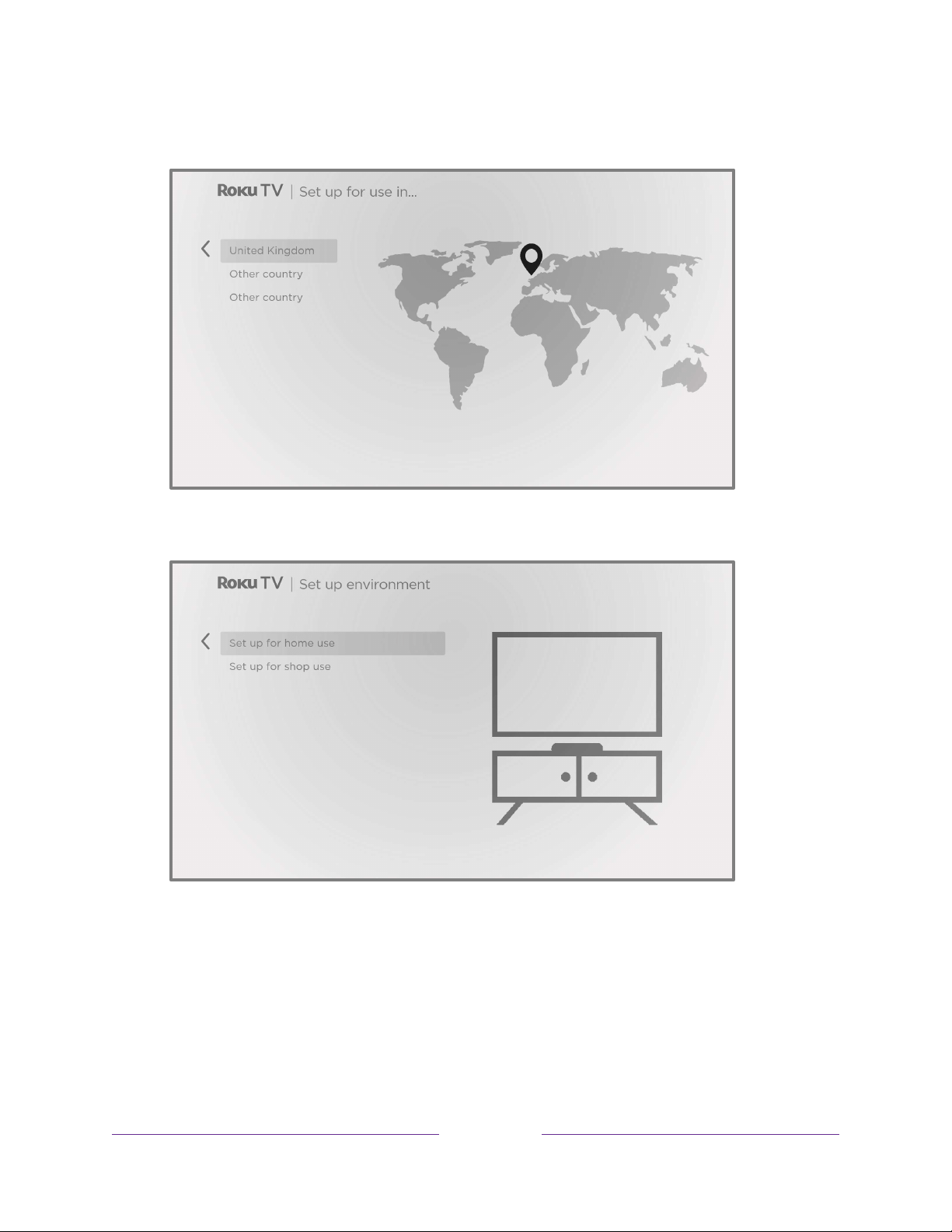
At this point, you should be seeing the Language screen.
1. Press DOWN on the purple directional pad to highlight your preferred
language, and then press OK.
19
2.
Some models have a country selection screen:
If you don’t see this screen, skip
ahead to the next step.
If you see this screen, select your country, and then press OK.
3. Press OK to select Set up for home use. This is the right choice for enjoying
your TV at home. It provides energy saving options as well as access to all
features of the TV.
20
Note:
Set up for shop use configures the TV for retail display and is not
recommended for any other use. In shop mode, some features of the TV are
missing or limited. To switch from one mode to the other, you have to perform
a factory reset as explained in
Factory reset everything
, and then repeat
Guided Setup.
Network connection
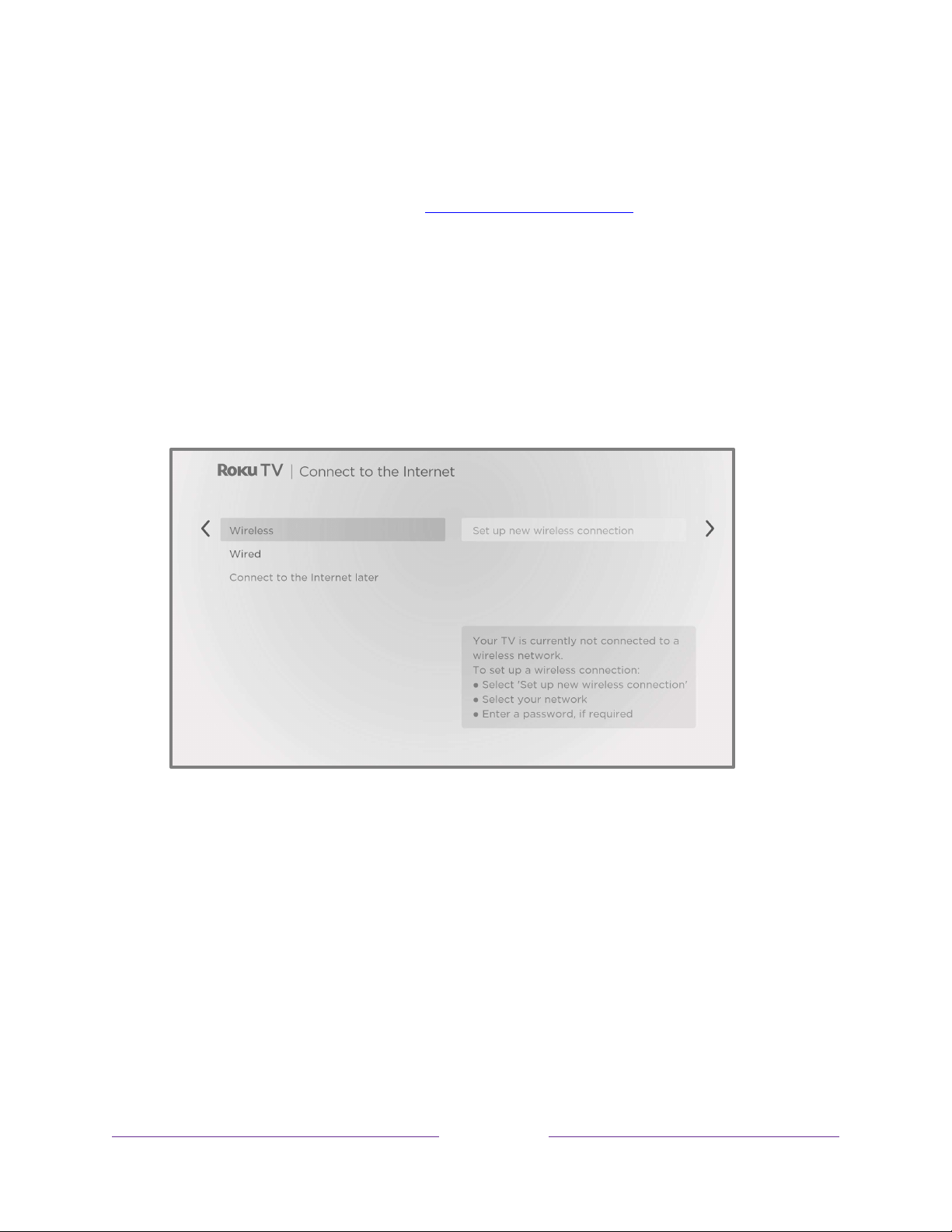
After you select Set up for home use, the TV prompts you to make a network
connection. If your TV has both wired and wireless connections, you’ll see the
following screen. If your TV has only wireless connectivity, skip the following
step.
21
4.
Only on models that display the Connect to the Internet screen:
Make a
selection:
• Wireless connection – Highlight Set up new wireless connection and press
OK. The TV prompts you through wireless setup. Skip ahead to the next
step for help with the process.
• Wired connection – Highlight Connect to wired network and press OK. The
TV immediately attempts to connect to your wired network, your local
network, and then the Internet. Go to Step 9 to continue with Guided Setup.
• Connect to the Internet later – If you don’t want to connect to the Internet
right now, you can select this option and use the TV to watch live TV
channels, and connect your devices to play games or watch DVDs or
content from other devices. When you’re ready to connect, it’s easy. We’ll
show you how in
Benefits of connecting
.
Note:
If you decide not to connect, Guided Setup skips ahead to setting up
the devices that you’ve connected to your TV. Jump ahead to
Connect your
devices to complete Guided Setup.
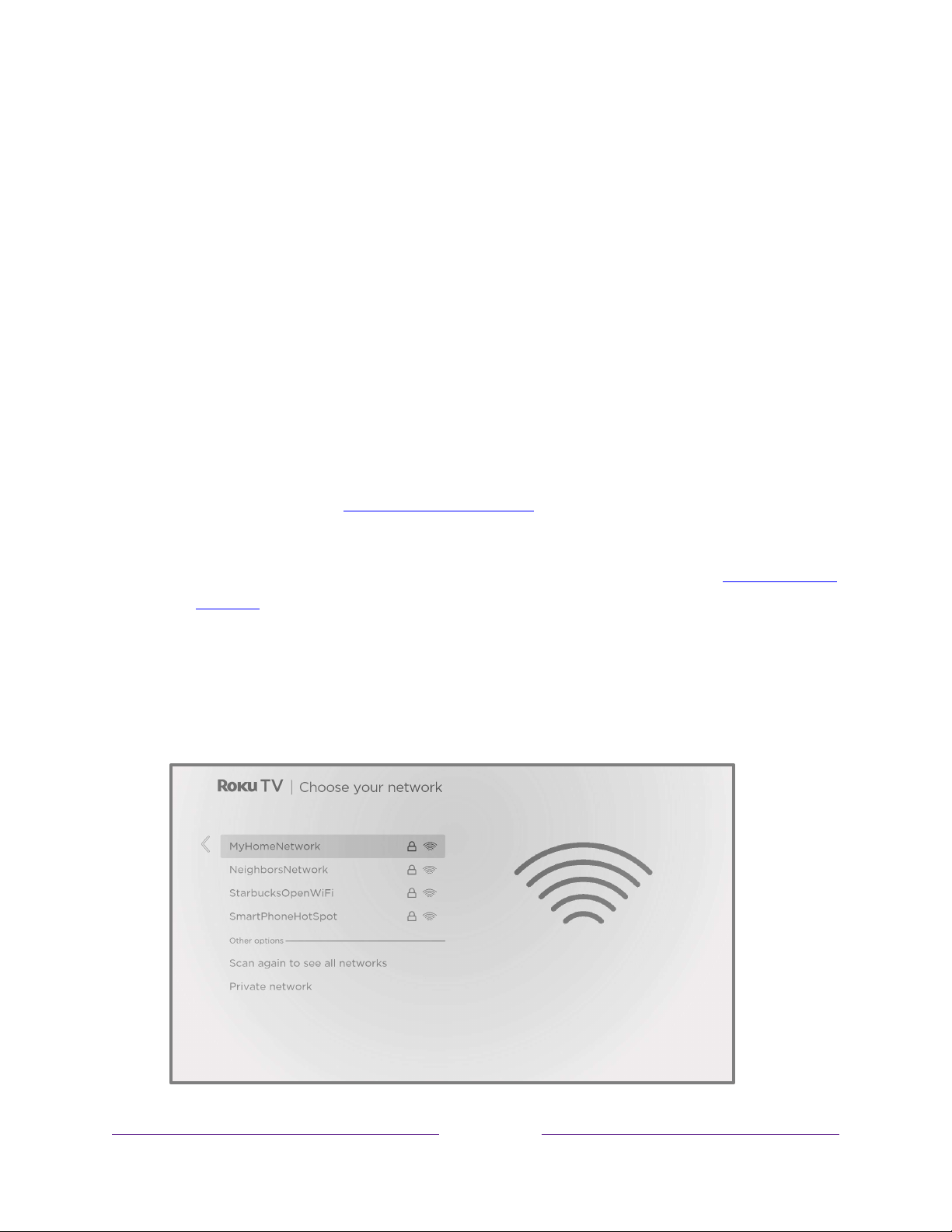
5.
On models that have wireless only, and models with both wired and wireless
and you’ve selected Wireless:
The TV scans for the wireless networks within
range and displays them in order, with the strongest signals first. In addition to
your own wireless signal, the TV might pick up signals from your neighbours.

22
Press UP or DOWN to highlight the name of your wireless network, and then
press OK to select it.
Note:
Some networks, such as those often found in school halls of residence,
hotels, and other public places, require you to read and agree to terms, enter a
code, or provide identifying information before letting you connect to the
Internet. If your Roku TV detects that you are connecting to such a network, it
prompts you through the connection process using your compatible
smartphone or tablet to provide the needed information. For more information,
see
Using your TV on a restricted public network
.
Other options
• Scan again / Scan again to see all networks – The name of this option
depends on the number of wireless networks within range.
• Scan again appears if the list already shows all available wireless
networks within range. If you don’t see your wireless network name in
the list, you might need to adjust the location of your wireless router or
the TV, turn on your router, or make other changes. When everything is
ready, select Scan again to see if your network name now appears in the
list.
• Scan again to see all networks appears if there are more wireless
networks than the strongest ones it initially listed. If you don’t see your
wireless network name in the list, this option displays the complete list. If
you still don’t see your network name, you might have your router
configured to provide wireless service as a “private network.”
Note:
Highlighting either of these options displays an informational panel
with the unique media access control (MAC) address of your Roku TV.
You will need the MAC address if your wireless router is configured to
use MAC address filtering.
• Private network – If your wireless network name is hidden, it won’t appear
in the list. Select Private network and then press OK to display an on-screen
keyboard. Use the keyboard to enter your network name. Unless you
changed the factory-set network name, you can find the name (also called
SSID) on a label on the router.
23
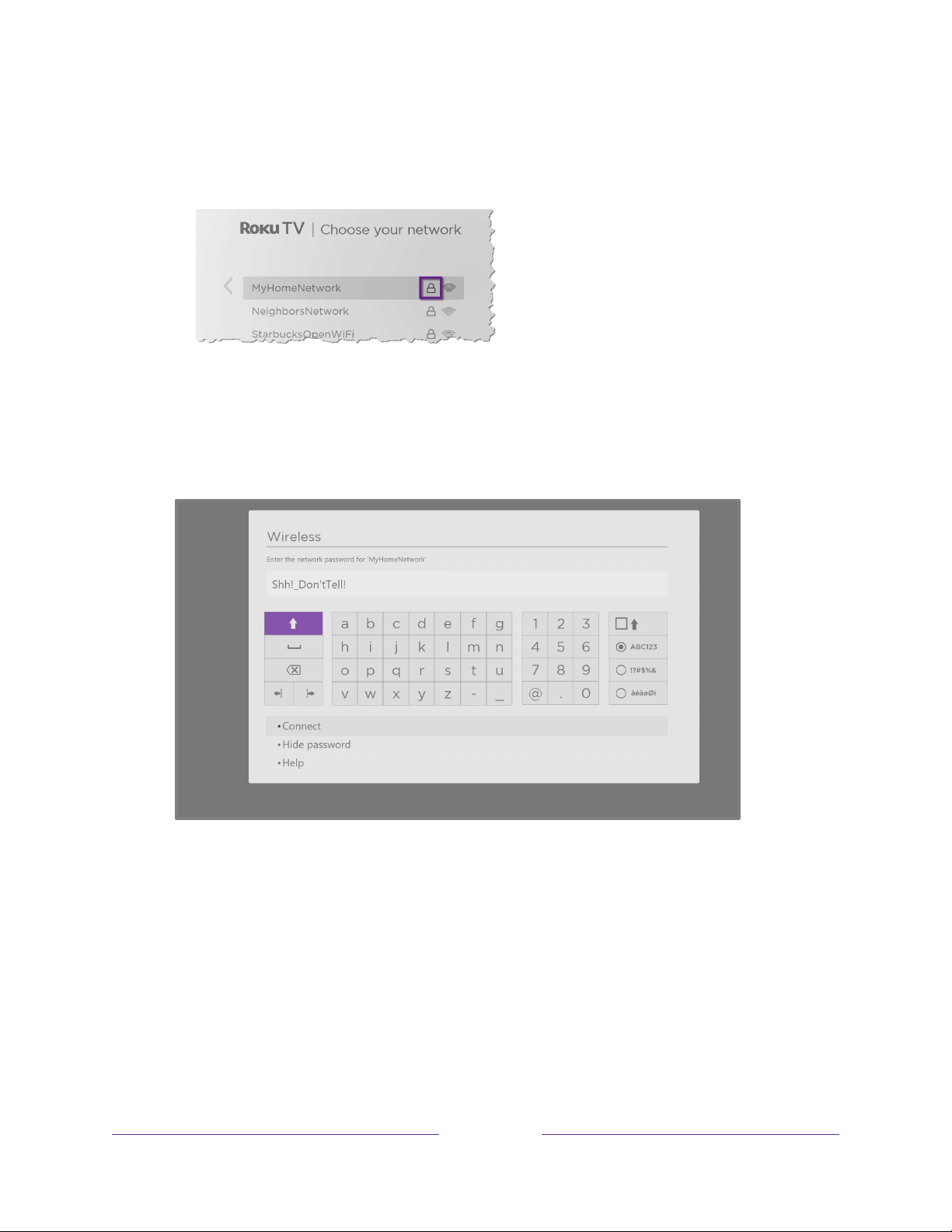
Tip:
Wireless networks that are password-protected display a “padlock”
icon adjacent to the name. This icon enables you to know that you are
going to be prompted to enter a password after you select that network.
6.
Only if you select a password protected wireless network:
An on-screen
keyboard appears. Enter your wireless network password by using the purple
directional pad to navigate the keyboard, and pressing OK to select a
highlighted letter, number, or symbol.
After you select Connect, the TV displays progress messages as it connects to
your wireless network, your local network, and the Internet.
24
7.
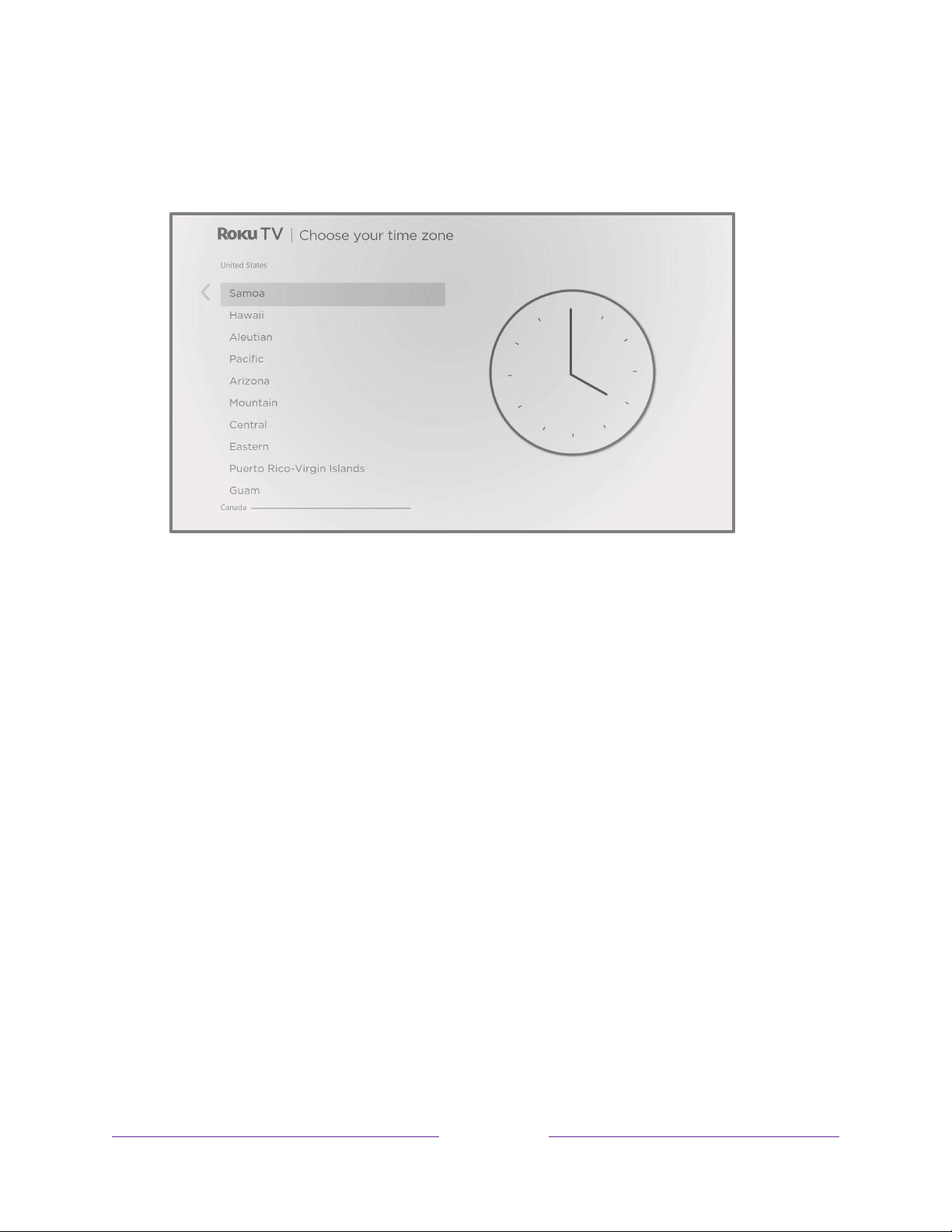
Only if your TV cannot get the correct time zone and current time from your
network service provider:
The Choose your time zone screen appears. Press
UP or DOWN to highlight your time zone, and then press OK.
Tip:
Your TV needs to know the local time zone so that it can correctly display
information about the program you are currently watching.
As soon as the TV is able to connect to the Internet, it downloads and installs
its first software update, and then restarts.
Tip:
Your TV automatically checks for updates periodically. These updates
provide new features and improve your overall experience with the TV. After
an update, you might notice that some options have moved, and that there are
new options or features. This User Guide describes version 10.0. To determine
your current Roku TV software version, go to
Settings > System > About
after
you complete Guided Setup. You can download an updated User Guide that
matches your Roku TV software version from the Roku TV web site.

25
Activation
After the TV restarts, it prompt you through activation.
8. Use a computer, tablet, or smartphone with an Internet connection to link to a
new or existing Roku account.
Note: Roku does not charge for activation support – beware of scams. For
detailed information, see
Will I be charged for customer service or device
activation?
Why do I need a Roku account?
You need a Roku account for several reasons:
• It links you, your Roku TV, and your other Roku streaming devices to the Roku
Channel Store and billing service.
• Streaming content providers know that it’s OK to send content you request to
your Roku TV.
• Roku can automatically send updates to your device.
You need a Roku account to activate your device and access entertainment from
streaming channels. Linking to a Roku account also activates several advanced features
on your TV, such as Guest Mode, the Roku Mobile App, and Live TV Pause, to name just
a few. Roku accounts are free, and while a valid credit card number is not required to
create your account, providing your credit card information makes renting, purchasing,
and subscribing to entertainment from the Roku Channel Store fast and convenient.
After you activate your TV, it gets an acknowledgement, and then adds your
newly-selected and pre-existing streaming channels from other Roku devices
on the same account. This process is automatic and takes a few moments—a
little longer if you have added a lot of streaming channels.
Tip:
Streaming channels from all of the Roku streaming devices associated with
your account are synchronised periodically. All of your Roku streaming devices
therefore display the same set of channels (subject to compatibility with the
device).
26
Connect your devices
Next, Guided Setup helps you set up the external devices that you want to use
with it, such as a cable box, Blu-ray™ player, or game console.
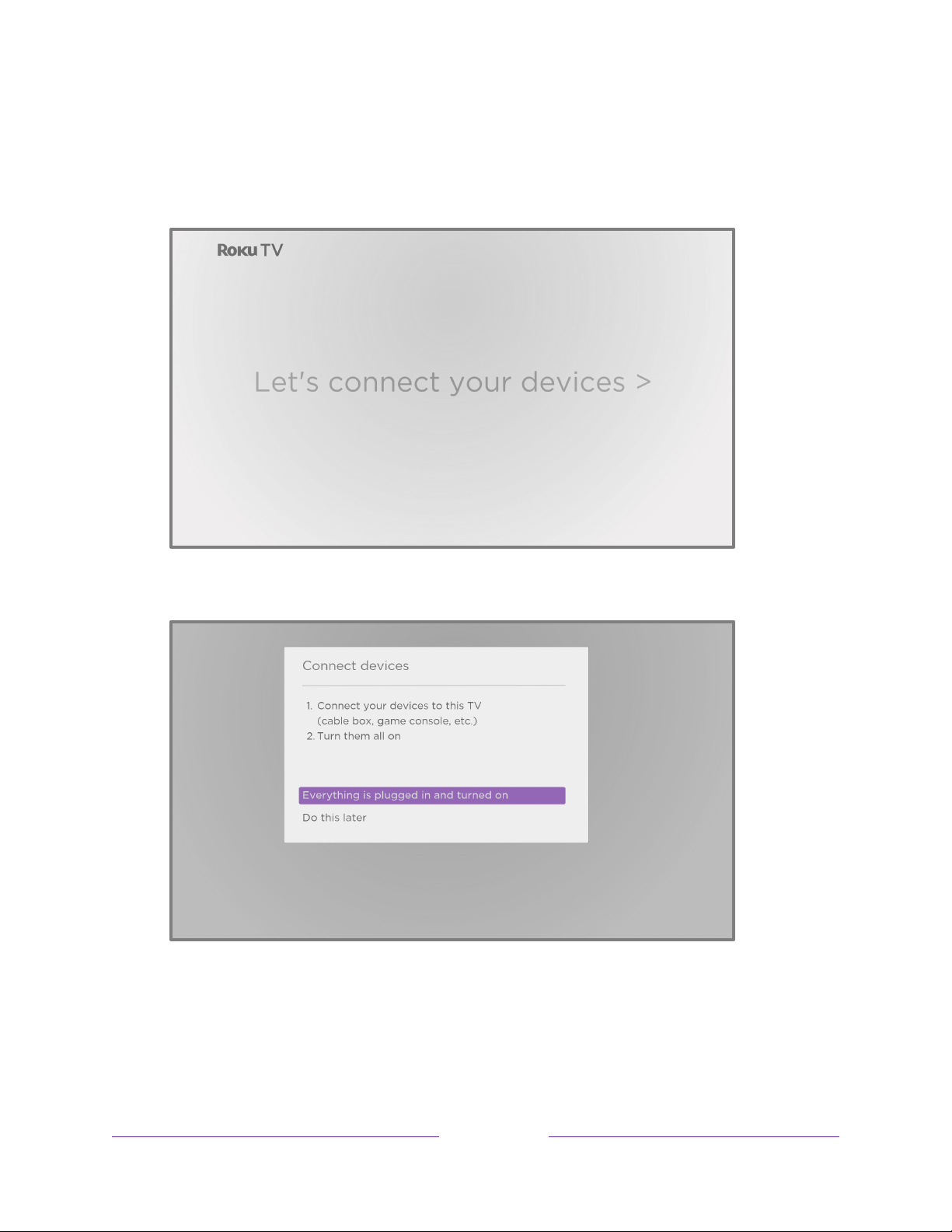
9. Press OK to proceed:
10. Connect all the devices you plan to use with your TV, turn them all on, and then
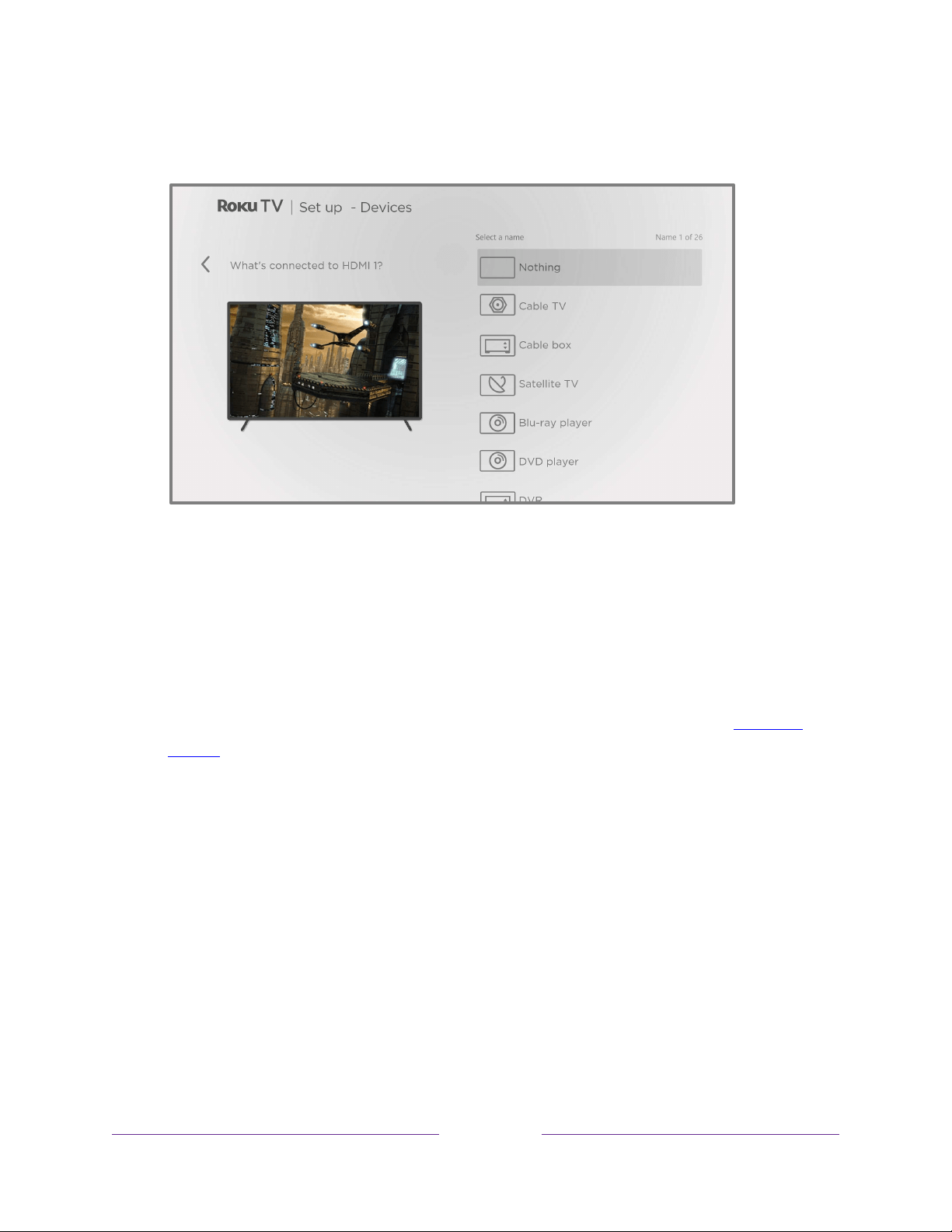
select Everything is plugged in and turned on. The TV now takes you step by
step through each of its inputs and asks what kind of device you have
27
connected. For each input that has a connected and active device, you can see
its picture and hear its sound.
11. Press UP or DOWN to highlight the label you want to associate with the input,
and then press OK. If you are not using the input, select Nothing, and the input
won’t appear on the Home screen.
12. While setting up your devices, rather than using the predefined names and
icons, you can set a custom name and icon. To do so, scroll up or down to
highlight Set custom name & icon, and then press OK. Follow the instructions
on the screen to enter a name and select an icon for the input. See
Rename
inputs for more information.
Note:
If you specify a custom name for an input, voice commands will not
reliably switch to that input. Voice commands typically can only switch among
inputs that use built-in names, such as “AV,” and “Cable Box,” and “DVR.”
13. Repeat the previous step for each input.
28
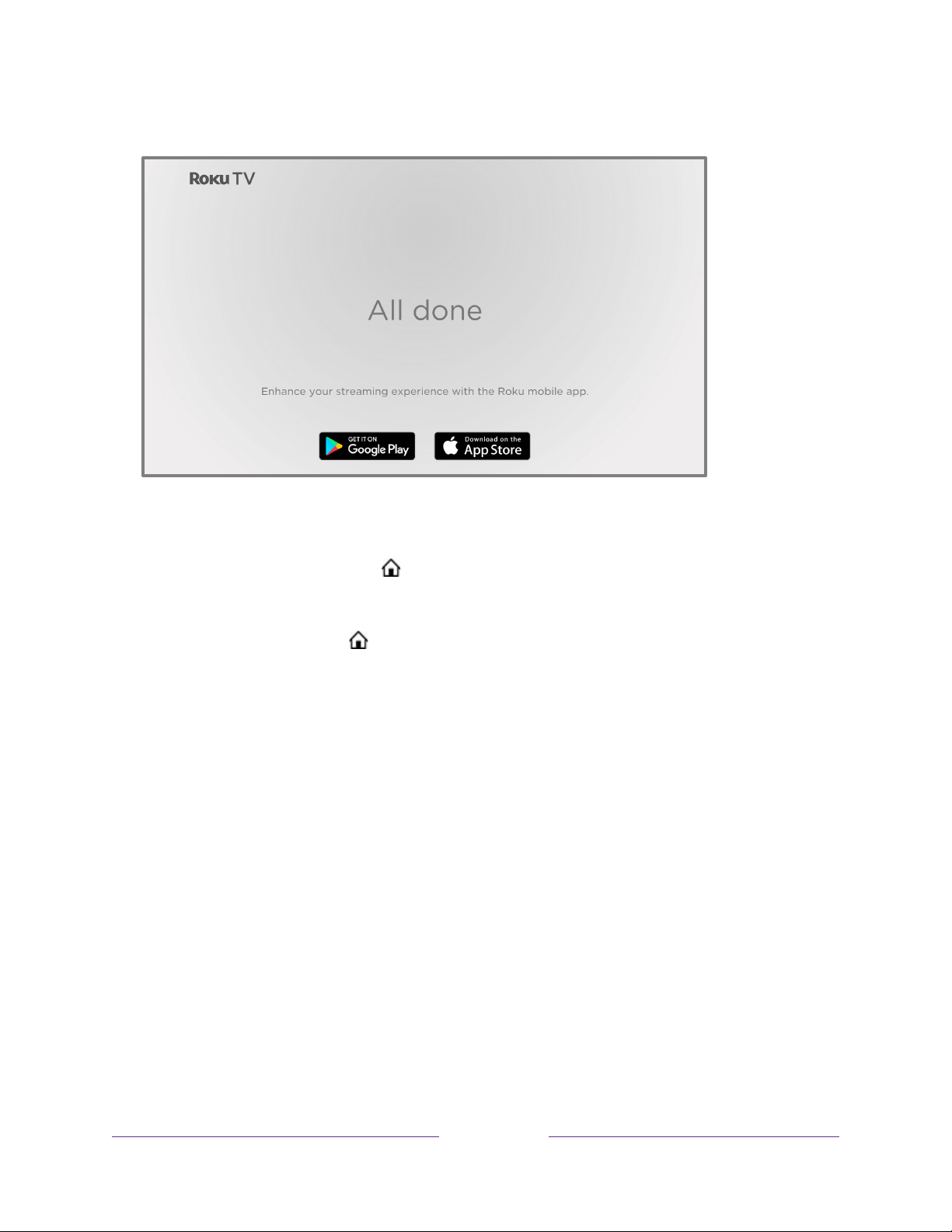
You’re done with Guided Setup.
Note:
Some Roku TVs, depending on where you live and other factors, show you an
introductory video filled with some great hints and tips. If you’re not interested in
viewing this video, press HOME on the remote to return to the Roku TV Home
screen.
Whenever you press HOME on the remote, the Home screen greets you.
From here, you can explore everything your TV has to offer. Use the purple
directional pad to move around, and press OK to select a highlighted item. We’ve
designed the TV to encourage you to explore, and you can probably figure out most
of the capabilities and settings on your own. If you have any questions or difficulties,
you can find answers and solutions in this guide.
29
The Home screen
The following illustrations show typical Home screens, which vary depending on
location, connected mode, selected theme, number of TV inputs enabled, and
streaming channels and apps added.
Note:
A paid subscription or other payments may be required for some channel
content. Channel availability is subject to change and varies by country. Not all
content is available in countries or regions where Roku
®
products are sold.
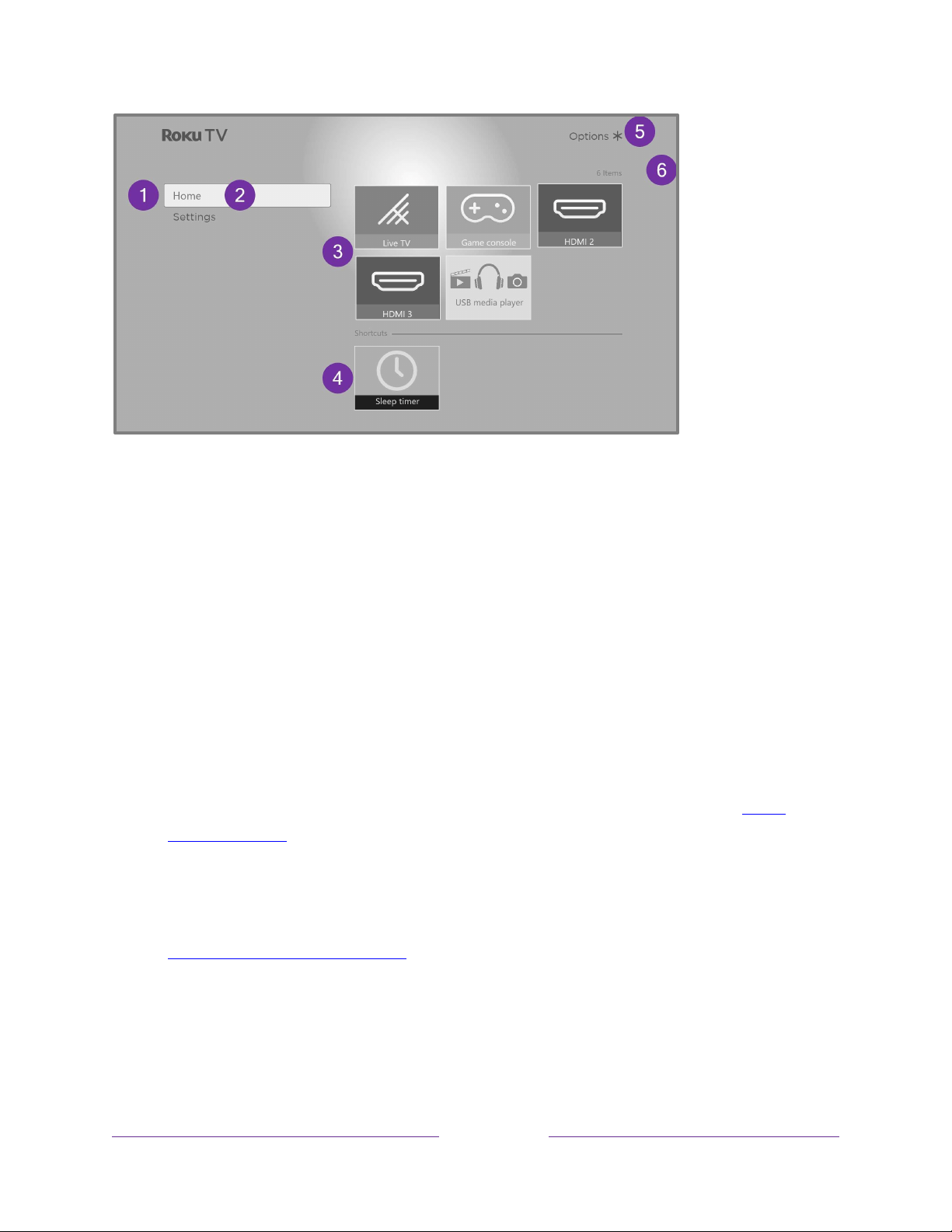
Typical connected Home screen
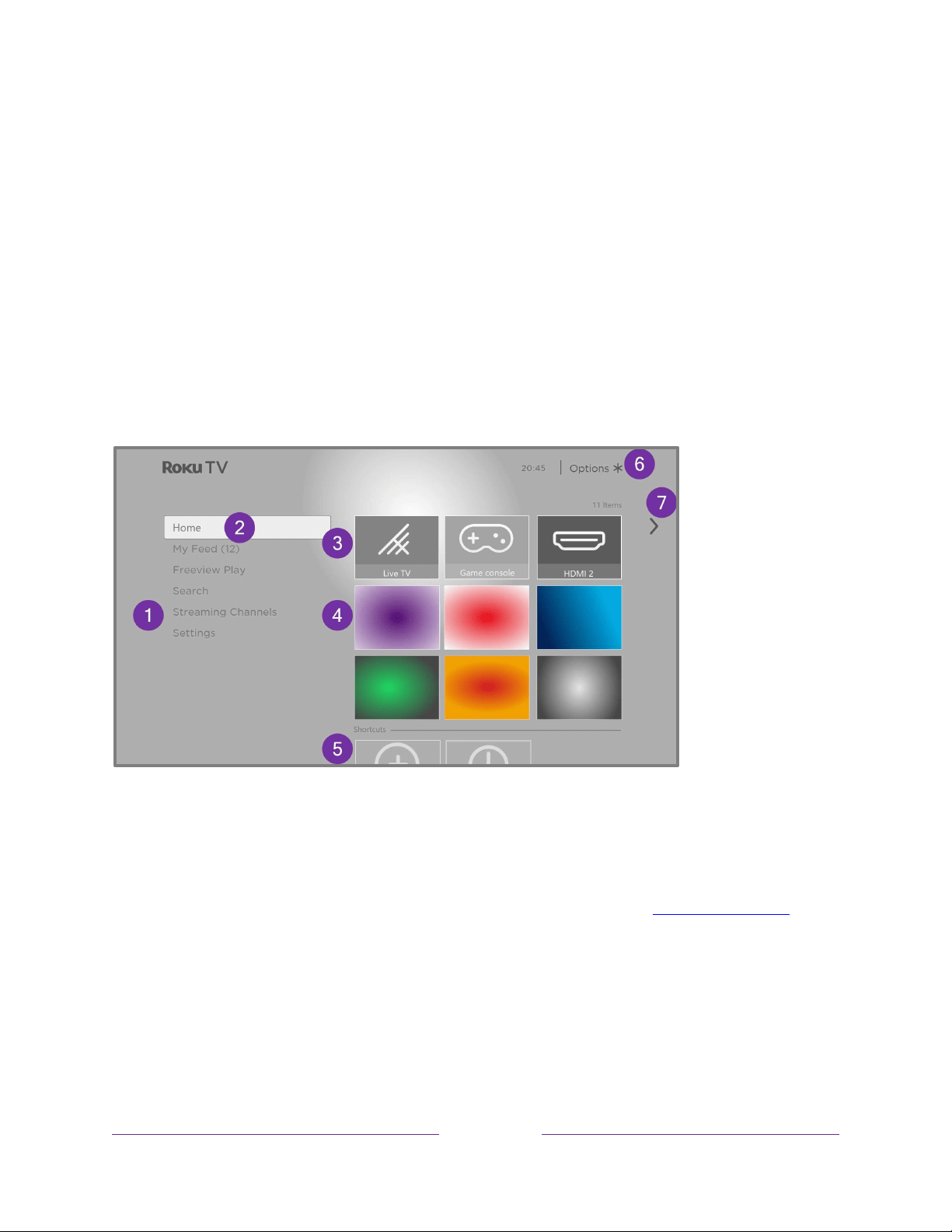
1. Home screen menu—shows options available to you when you are on the Home screen.
2. Highlighted option—press OK to select.
3. TV input tiles—select an input to watch the connected device.
4. Streaming channel and app tiles—select a tile and press OK to go to the indicated streaming
channel or application. You can add any number of channels from the
Roku Channel Store
.
5. Direct access tiles – shortcuts to often used features.
6. Options hint—press STAR
for options when this symbol is present.
7. Next screen hint—press RIGHT to see the next screen.
30
Typical non-connected Home screen
1. Home screen menu—shows options available to you when you are on the Home screen.
2. Highlighted option—press OK to select.
3. TV input tiles—select an input and press
OK to watch the connected device.
4. Direct access tiles – shortcuts to often used features.
5. Options hint—press STAR for options when this symbol is present.
6. Next screen hint—press
RIGHT to see the next screen.
Personalise your Home screen
There are many things you can do to personalise your Home screen and make it just
right for you and your family:
•
Only in connected mode:
Add streaming channels by using the Streaming
Channels menu option or the Add Channels shortcut to browse the
Roku
Channel Store.
•
Only in connected mode:
Change the screen theme by going to Settings >
Themes to find and pick one to suit your mood.
•
Hide Home screen shortcuts
. Hide or show the shortcut tiles that appear at the
bottom of your Home screen grid.
• Remove a tile by highlighting it and pressing STAR . Then highlight Remove
input or Remove channel and press OK.

31
• Move a tile by highlighting it and pressing STAR . Then highlight Move input
or Move channel and press OK. Use the purple directional pad to move the tile,
and then press OK to lock it in its new location. Move the shortcut tiles within
the shortcut area only. Shortcuts are designed to always appear at the very
bottom of the grid, so you can access them quickly by pressing UP once when
you’re at the top of the grid.
•
Only on channels that you have subscribed through your linked Roku account
,
manage your subscriptions by highlighting a streaming channel tile and
pressing STAR . Then highlight Manage subscription and press OK. Select
Cancel subscription and then follow the instructions to confirm your
cancellation.
• Rename a TV input tile by highlighting it and pressing STAR . Then highlight
Rename input and press OK. Highlight a new name in the list, and then press
OK to assign that name to the tile.
Rather than using the predefined names and icons, you can set a custom name
and icon. To do so, scroll up or down to highlight Set custom name & icon, and
then press OK. Follow the instructions on the screen to enter a name and select
an icon for the input.
Note:
If you specify a custom name for an input, voice commands will not
reliably switch to that input. Voice commands typically can only switch among
inputs that use built-in names, such as “AV,” and “Cable Box,” and “DVR.”

32
Benefits of connecting
Connecting brings out your TV’s full potential!
Make any night a movie night
Thousands of movies to choose from, across all major streaming movie channels
1
.
You’ll never run out of something new to watch.
Get in the groove
Stream endless hours of music from free and subscription-based channels. With
almost instant access to thousands of music artists, your favourite beats are just as
close as your remote.
Explore your passions
In addition to the most popular streaming channels, your Roku TV also offers lots of
streaming channels to fuel your passions—including fitness, cooking, religion,
outdoors, international programming, and much more.
Enjoy FREE trials of popular channels
Your Roku TV comes loaded with special offers, including free trials (if eligible) from
popular subscription channels. REMEMBER THAT YOU MUST CANCEL BEFORE THE
FREE TRIAL ENDS TO AVOID SUBSCRIPTION FEES.
Take advantage of awesome features
Powerful, voice-enabled search lets you use English language voice commands to
find movies and TV programmes by title, actor, director, or genre across multiple
streaming channels. Additionally, your search commands can include popular movie
quotes, and words like “free” and “4K.”
1 A paid subscription or other payments may be required for some channels. Channel availability is
subject to change and varies by country. Not all content is available in countries or regions where Roku®
products are sold.

33
Voice commands with multiple device support let you use Apple Siri
1
, Google
Assistant, or Amazon Alexa to change stations, TV inputs, launch streaming channels,
and more. Include a location in your command such as “in the bedroom” to specify
which Roku device you want to control.
Automatic account linking keeps track of supported streaming subscriptions on other
Roku devices, so that you won’t have to re-enter your user name and password when
adding the same channel on your newly-activated Roku TV.
2
Programme guide that is available any time at the touch of a button. You can scroll
up and down to see all TV channels you receive. You can scroll left to see the
previous 7 days, and scroll right to see the upcoming 7 days.
Live TV Pause lets you connect a USB drive (not provided) and pause live TV for up
to 90 minutes. After pausing, you can play, fast-forward, rewind, and pause again to
any point within the rolling 90-minute window.
Mobile Private Listening on the Roku mobile app lets you listen to streaming
programmes and live TV programmes on headphones (not provided) plugged into
your IOS
®
or Android™ mobile device.
What is streaming?
Streaming is viewing or listening to video or audio content that is sent over the
Internet, or located on a network-connected media server or on a USB device
plugged into the TV’s USB port.
With streaming, you can buy or rent most programmes on demand, when it’s
convenient for you. When streaming, you can play, pause, rewind, and fast forward
most of what you are watching. You can also replay the last few seconds again, or
turn on subtitles if available.
Tip:
Some content cannot be paused or skipped. For example, if you are viewing live
programming or a programme that is supported by ads, you might not be allowed to
skip the ads.
1 Roku 4K TVs only.
2 Not all streaming channels currently support automatic account linking.

34
Your Roku TV lets you choose from streaming channels that offer a huge selection of
entertainment:
• Hundreds of thousands of movies and TV episodes.
• Live and on-demand TV, sports, music, movies, and more.
• Programming just for kids and families.
• International programming relevant to your community.
• 24x7 news and in-depth news commentary.
Many streaming channels are free. Some streaming channels let you purchase or rent
the latest movie releases or popular TV series. Some channels charge a monthly
subscription fee, and others are available at no additional cost if you subscribe to a
companion service through your cable or satellite provider.
If you have an existing subscription to a streaming provider, you can just sign in with
your existing user name and password.
To play streaming content, add one or more streaming channels to your Home screen.
Use the Add Channels shortcut on the Home screen or the Streaming Channels
option on the Home screen menu to go to the Channel Store, and then select the
streaming channel you want to add. The channel remains on your Home screen unless
you remove it, and you can watch it at any time.
For more information on using the Roku Channel Store feature, see
Using the Roku
Channel Store.
Note:
A paid subscription or other payments may be required for some channels.
Channel availability is subject to change and varies by country. Not all content is
available in countries or regions where Roku
®
products are sold.

35
What if I didn’t connect my TV?
What if you went through Guided Setup and chose Connect to the Internet later? No
worries. Your Roku TV makes it easy to connect whenever you want. As you move
around the Home screen, you’ll see several places where you can start the connection
process. For example:
• Now and then you’ll see a message appear on the panel to the right of the
Home screen offering a Connect Now option. You can highlight and select the
Connect Now option to get started.
• Use the Connect and activate now option in the Settings menu. From the
Home screen menu, select Settings, then Network, and then Connect and
activate now.
• If you want to start over from the beginning, do a Factory reset, and then go
through Guided Setup again. This time, select your home network when
prompted.

36
Setting up live TV
In addition to the other entertainment possibilities of your Roku TV, you may also
want to watch broadcast channels from an aerial connected to the ANT input. On
your Roku TV, you watch broadcast TV in much the same way you watch other
entertainment choices. You select a tile—in this case, the Live TV tile—from the Home
screen.
The first time you select the Live TV tile, you must set up the TV tuner. Setting up the
TV tuner scans for active channels and adds them to your live TV channel list.
Why do I have to set up the TV tuner?
Not everyone needs to use the TV tuner. For example, you might have a set top box provided
by a cable or satellite company that receives all of your channels. Most of these set top boxes
use an HDMI
®
connection.
More and more people are watching only streaming TV and do not have a TV aerial or
cable/satellite service. If you don’t need the TV tuner, you can bypass setting it up and instead
remove it from the Home screen as explained in
Remove unwanted tiles
.
When you set up Live TV, the TV scans the signals on its ANT input for channels with a good
signal, and adds those to the channel list, skipping dead channels and channels with a very
weak signal.
37
How do I set up the TV tuner?
1. Make sure your aerial (not provided) is connected to the TV’s ANT input.
2. On the Home screen, select the Live TV tile. If it is not on your Home screen, go
to Settings > TV Inputs to add it.
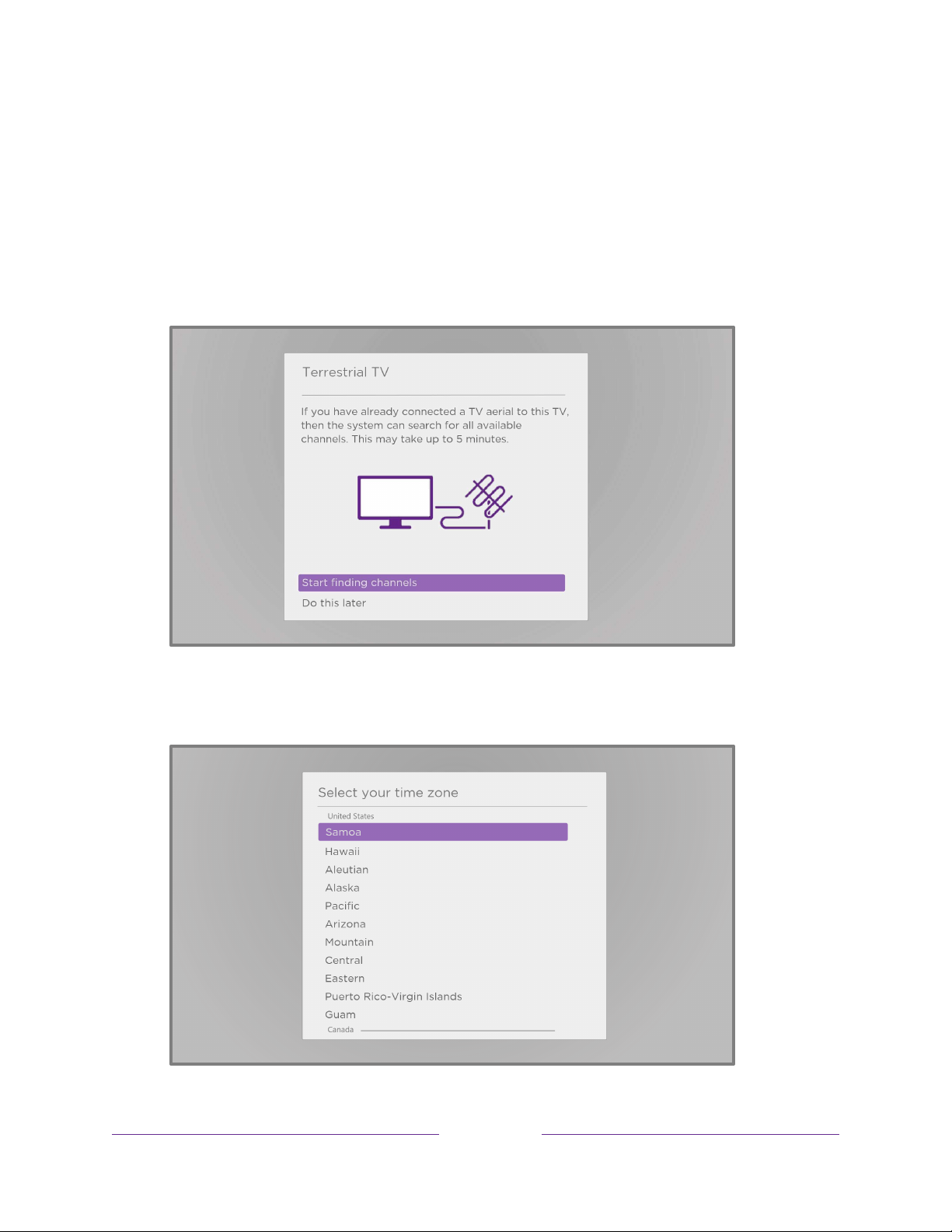
3. Read the simple on-screen instructions, and then select Start finding channels.
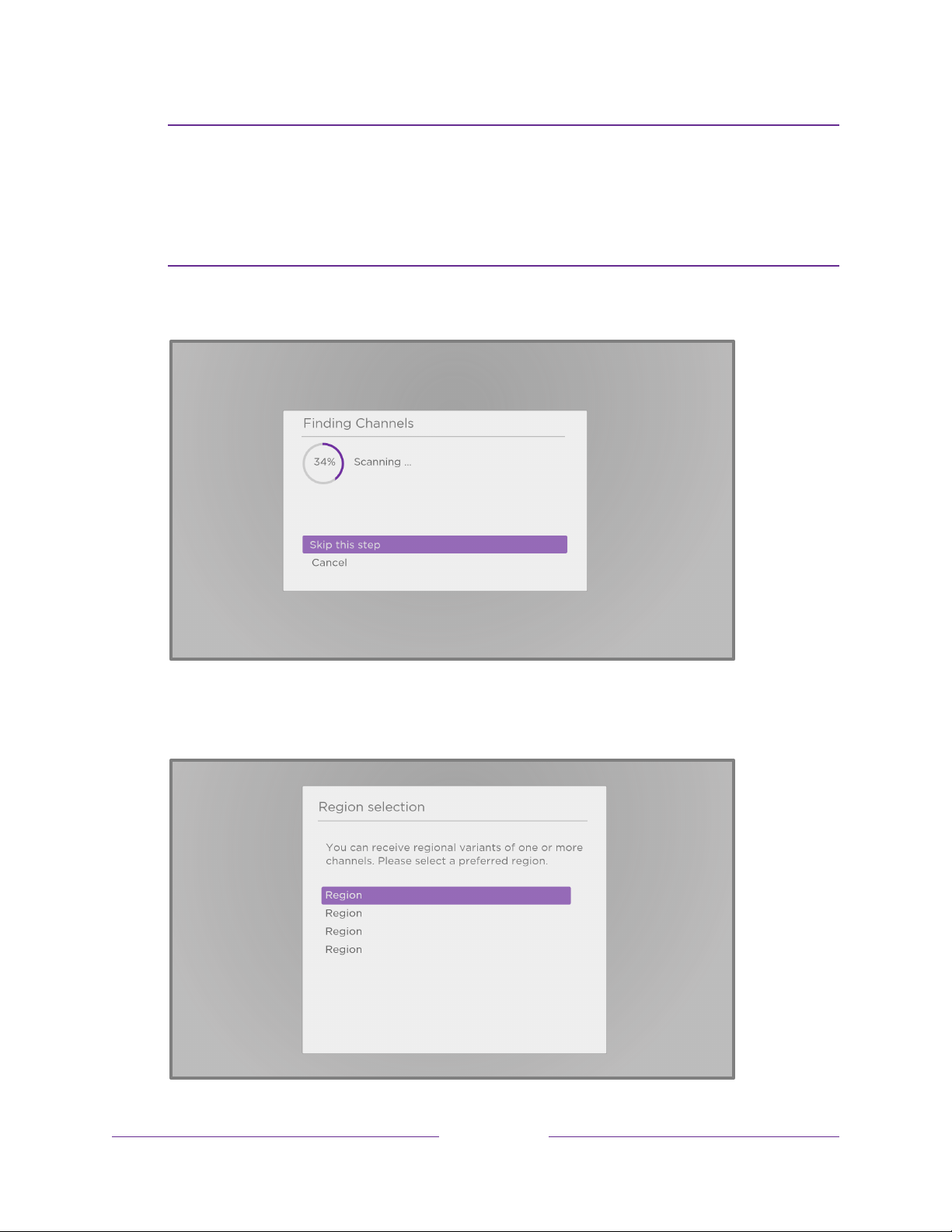
4. If prompted, select your time zone. You’ll only need to do this if the TV can’t
figure out your time zone from your Internet connection.
38
Why does the TV need my time zone?
The TV needs to know your time zone so that it can correctly display time information
about the programme you are currently watching.
In most cases, it can get the time
zone automatically and skips this step.
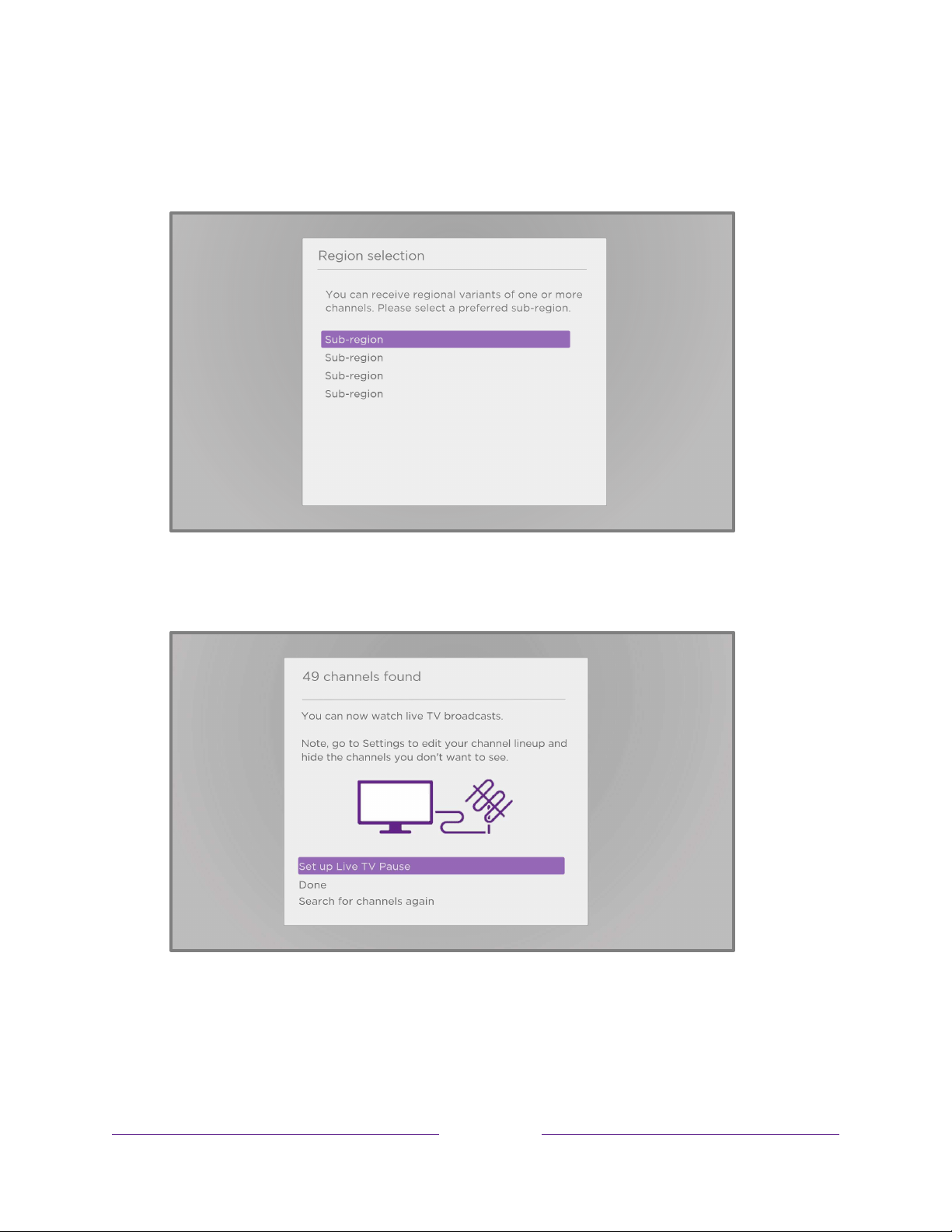
5. Wait while your TV scans for live TV stations…
Scanning for channels can take several minutes. If the TV detects that you can
receive channels from multiple regions, this screen will appear:
39
6. Highlight a region, and then press OK to continue. If the TV detects that you
can receive channels from multiple sub-regions within your selected region, this
screen will appear:
7. Highlight a sub-region, and then press OK to continue. When the channel scan
finishes, the TV programmes the number of channels it added.

40
8. At this point, you can do any of the following:
• Select Done to start watching TV.
• Select Scan for channels to repeat the entire channel scan. This option
deletes all existing channels and the region and subregion selections, if
applicable.
• Select Rescan for channels to repeat the channel scan. This option deletes
all existing channels, but retains your previous region and subregion
selections, if applicable.
•
Only in connected mode
, select Set up Live TV Pause. You can also do this
later. The topic
Pausing live TV
explains how to set up and use this feature.
Tip:
Repeat the channel scan from time to time to make sure you are receiving all of
the latest channels. Broadcasters add and remove channels, move channels to
different parts of the spectrum, and change the power levels of their channels
periodically. Your TV reception and picture quality depend on the position of your
aerial and on your location relative to the transmitters of broadcasters in your area.
Note:
You’ll have to repeat the channel scan if you remove and re-add the Live TV
tile from the Home screen or perform a factory reset. To repeat the channel scan,
go to Settings > TV inputs > Live TV > Scan for channels > Start finding channels.
Scanning for individual channels
After performing a complete channel scan, you can perform a manual channel scan at
any time, for example, to discover and add new channels or channels from a different
region or subregion.
To manually scan for channels:
1. From the Home screen menu, navigate to Settings > TV Inputs > Live TV >
Manual scan for channels.
2. Use the purple directional pad to highlight a channel multiplex and its assigned
frequency in the list, and the press OK to scan that channel multiplex.
3. Wait while the selected multiplex is scanned for individual channels.

41
4. Press OK to confirm and return to the list of channel multiplexes.
5. Repeat these steps as needed to scan for additional channels.
Now, you’re ready to watch live TV! While you’re watching, try the following tips:
• Press GUIDE to display the programme guide, and then use the directional pad
to navigate through the guide. Press CH- or REWIND / CH+ or
FAST FWD to jump through the guide a page at a time.
• While in the programme guide, press OK to tune to the highlighted channel (if
you are viewing programmes that are on now).
• While watching a TV programme, press OK to display information about the
current programme.
• Press STAR to see options for picture and sound settings.
•
Only in connected mode
, press Freeview Play to go to the Freeview Play area,
where you can view on-demand and live programmes, and watch catch-up TV
on several channels.
•
Only in connected mode,
use the Roku mobile app, Google Assistant, or
Amazon Alexa to search for programmes by title, actor, director, or genre. The
TV or the Roku mobile app displays the results along with the streaming
channels that offer the requested content.

42
Using your TV
This section provides information on using the day-to-day features of your TV.
Status indicator
Your TV has a single status indicator. It goes on and off and blinks in different ways
depending on the status of the TV, as shown in the following table:
TV CONDITION
STATUS INDICATOR
MEANING
On (screen is active) Off Screen is communicating that TV is on.
Screensaver (screen is active) Off Screen is communicating that TV is on.
Off (no power) Off TV is not connected to power.
Off (standby) On TV is connected to power and is ready
to use.
Starting up from off state Slow pulsing blink until start-
up completes
TV is doing something.
On (receiving update from
USB)
Slow pulsing blink until update
completes
TV is doing something.
Remote command received Dims on/off once TV has received your command.
Network connection lost Two short blinks, pause, repeat TV was connected and paired with a
Roku account and now has no network
connection.
Powering down to standby
mode
Slow pulsing blink until the TV
reaches standby
TV is doing something.

43
Standby mode energy savings
When you turn off your TV, it remains in a higher power mode for a few minutes, after
which it goes into a very low power standby mode. If you turn on the TV again before
it has entered the very low power mode, it turns on immediately. After the TV goes
into the lower power standby mode, it takes a few seconds longer to start up.
Only in connected mode,
you can optionally enable Fast TV start. When this option is
enabled, your TV starts up almost immediately regardless of how long it has been
turned off, but uses somewhat more power in standby mode. Fast TV start also gives
you access to some additional features, such as turning on the TV with voice
commands and turning off the screen when listening to music. For more information,
see
Fast TV start
.
Watching live TV channels
Select the Live TV tile in the Home screen. Your TV remembers the last channel you
watched and starts with that channel playing.
Changing channels
To change channels, you can do any of the following:
• Press CH+ to change to the next higher channel.
• Press CH- to change to the next lower channel.
• Press GUIDE to display the programme guide, and then use the purple
directional pad to select the channel or programme you want to watch.
• Press or CH- or CH+ to move up or down five channels at a time. Hold the
button down to auto-repeat.
• Press REWIND or FAST FWD to move through the guide one day at
a time.
• When you’ve highlighted the channel or programme you want to watch,
press OK. Press REPLAY to jump back to the current time in the
programme guide.)
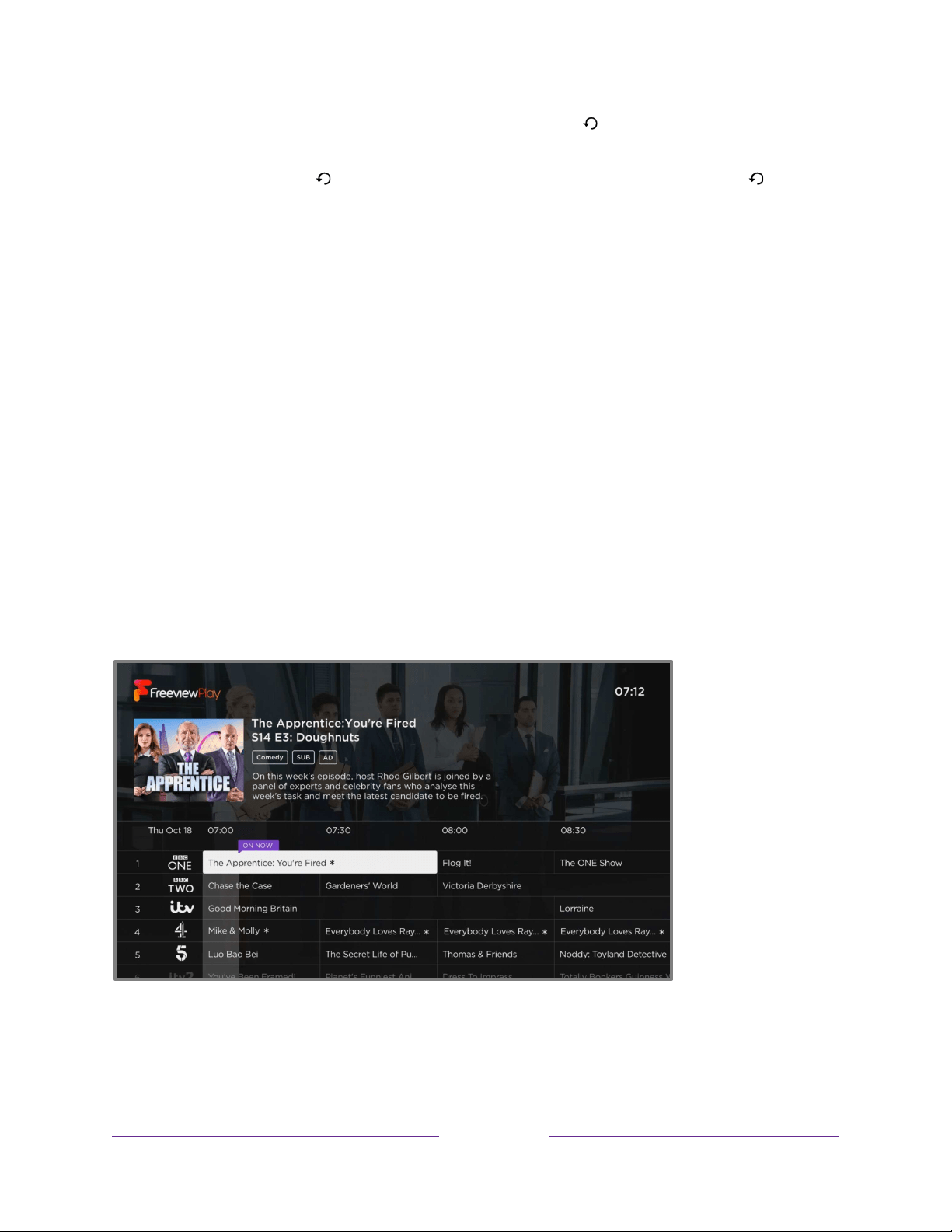
44
• While watching a TV programme, press REPLAY to jump to the previous
channel. Press again to return to the channel you were watching before you
pressed REPLAY . If you have enabled Live TV Pause, use REPLAY to jump
back a few seconds in the programme.
Programme guide
Use the programme to find TV programmes received through the TV tuner. The
programme guide lets you scroll through all TV channels. You can see all the
programmes from today and from the previous and upcoming 7 days.
Press GUIDE at any time to open the programme guide.
If you are using your TV in connected mode, the ability to select programmes that
have already aired during the previous week enables you catch up on missed movies
or episodes.
As you navigate, notice that the programme guide shows a light grey background for
programmes and portions of programmes that have already aired. It shows a black
background for programmes and portions of programmes that have not yet aired.
The line dividing these two zones is the progress bar.
Typical programme guide (connected mode)
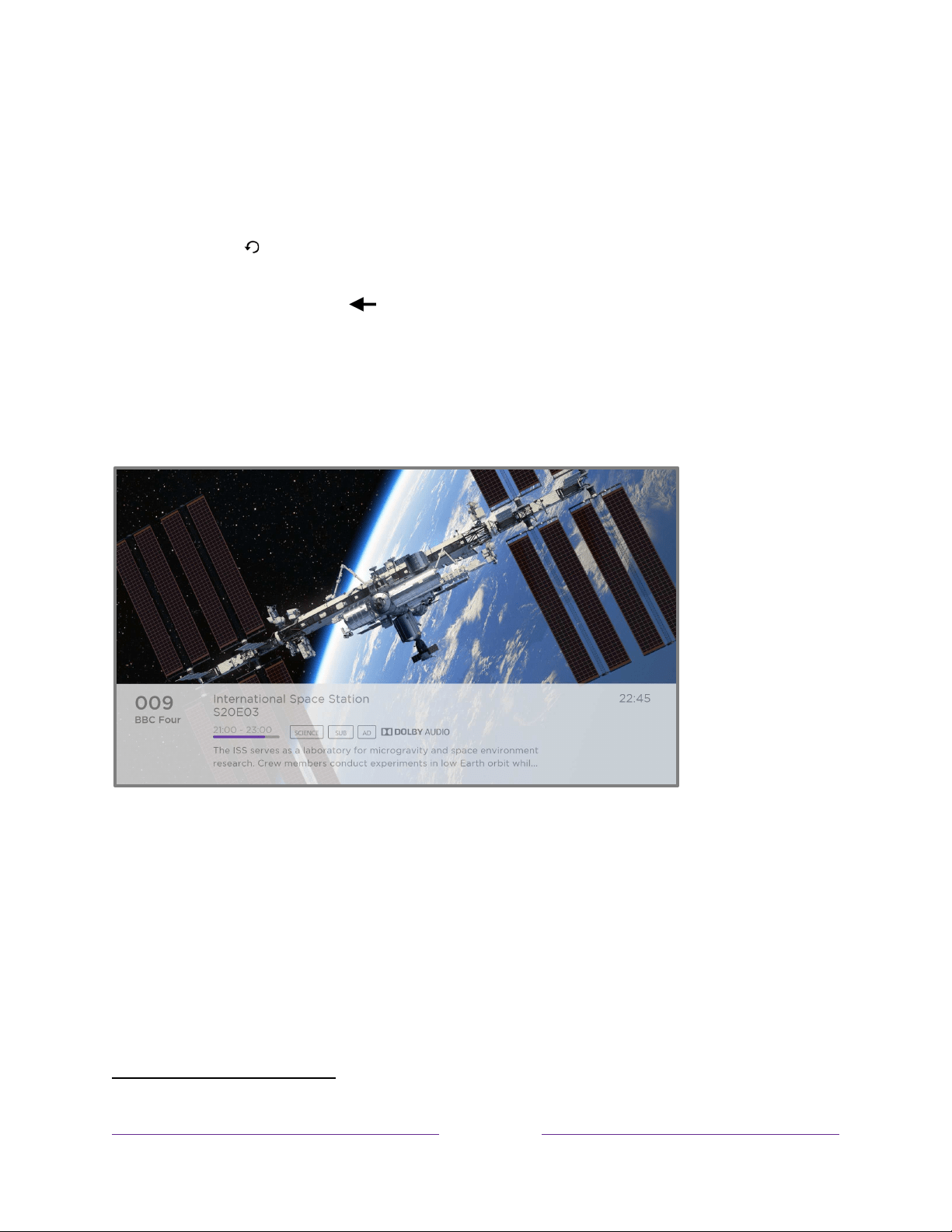
45
Navigating the programme guide
• To switch to a programme that is currently in progress, highlight it, and then
press OK.
• To return to the current time after navigating to a different time slot, press
REPLAY .
• To return to the currently airing programme without changing the current
channel, press BACK .
Viewing programme information
View programme information for the current programme in a banner at the bottom of
the screen. The following illustration shows the information that is available:
Programme information banner
Programme information might include any or all of the following, depending on
availability within the broadcast information:
• Channel number
• Channel name
• Programme title and episode name/number
• Start time, end time, and graph of programme length showing current position
• Genre, if provided
• SUB, if subtitles are available
• AD, if audio description is available
•
Only on select 4K models:
HDR or Dolby
®
Vision™ logo
1
(HDMI
®
and streaming sources)
• Current time
• Programme description.
1 The Dolby Vision™ logo appears only on Dolby Vision™-certified models when displaying Dolby Vision™
content.

46
Tip:
If you’ve set up Live TV Pause and you’re watching live TV, you’ll also see a
progress bar showing the current playback position within the rolling 90-minute
pause time. For more information, see
Pausing live TV
.
Adjusting settings while watching a programme
Press STAR to display the Options menu. Press UP or DOWN to highlight an
option, and then press LEFT or RIGHT to change the setting. The topic
Adjusting TV
settings explains each of the settings in detail.
Pausing live TV
Live TV Pause gives your Roku TV the ability to pause, play, fast forward, and rewind
broadcast TV. You can pause TV for up to 90 minutes.
Requirements
To use this feature, you need to:
1. Connect your TV to the Internet. If you didn’t connect during Guided Setup, see
What if I didn’t connect my TV?
.
2. Provide your own dedicated USB flash drive (thumb drive} with the following
minimum specifications.
• 16 GB
• 15 Mbps read/write speed
• USB 2.0 compliant
A USB flash drive (thumb drive) meeting the minimum requirements is highly
recommended over an externally-powered hard disk drive. Note that you can
use any larger size drive—there is no limit to the maximum size—but using a
larger drive does not extend the 90-minute pause time.
Important:
After warning you and giving you a chance to cancel Live TV Pause
setup, all existing content on your USB drive is erased when you enable this
feature.

47
3. Connect your USB drive to the TV’s USB port.
Important:
Some TV models have more than one USB port. You can connect
your Live TV Pause USB drive to any port, but make sure that nothing is
connected to other USB ports while enabling Live TV Pause. Reconnect other
USB devices after you have finished enabling Live TV Pause.
4. Enable Live TV Pause, as explained in the following topic.
Enabling Live TV Pause
You can start setting up Live TV Pause in any of the following ways:
• After completing a channel scan, select Set up Live TV Pause from the
available options.
• Press Play/Pause on the Roku remote while watching a broadcast TV channel.
• Highlight the Live TV tile on the Home screen, press STAR , and then select
Enable Live TV Pause.
After starting setup of Live TV Pause in any of these ways, the TV prompts you
through the steps needed to enable this feature. Setup takes only a few moments.
Note:
Use of a USB hub is not supported.
Using Live TV Pause
If you have used the Roku remote to watch streaming channels, using Live TV Pause
should be very familiar to you.
• While watching a TV programme, press PLAY/PAUSE to pause or play the
content. After the TV programme has been paused for 90 minutes, the TV
resumes playing.
• After watching a channel for a while, press REWIND to jump back up to the
point where you first started watching the channel, up to 90 minutes.
• After pausing or rewinding, press FAST FWD to jump ahead up to the point
where you are once again watching the live TV programme.
• Press FAST FWD or REWIND repeatedly to cycle through 1x, 2x, and 3x
skip speeds. Press REPLAY to play back the last several seconds of the
programme.
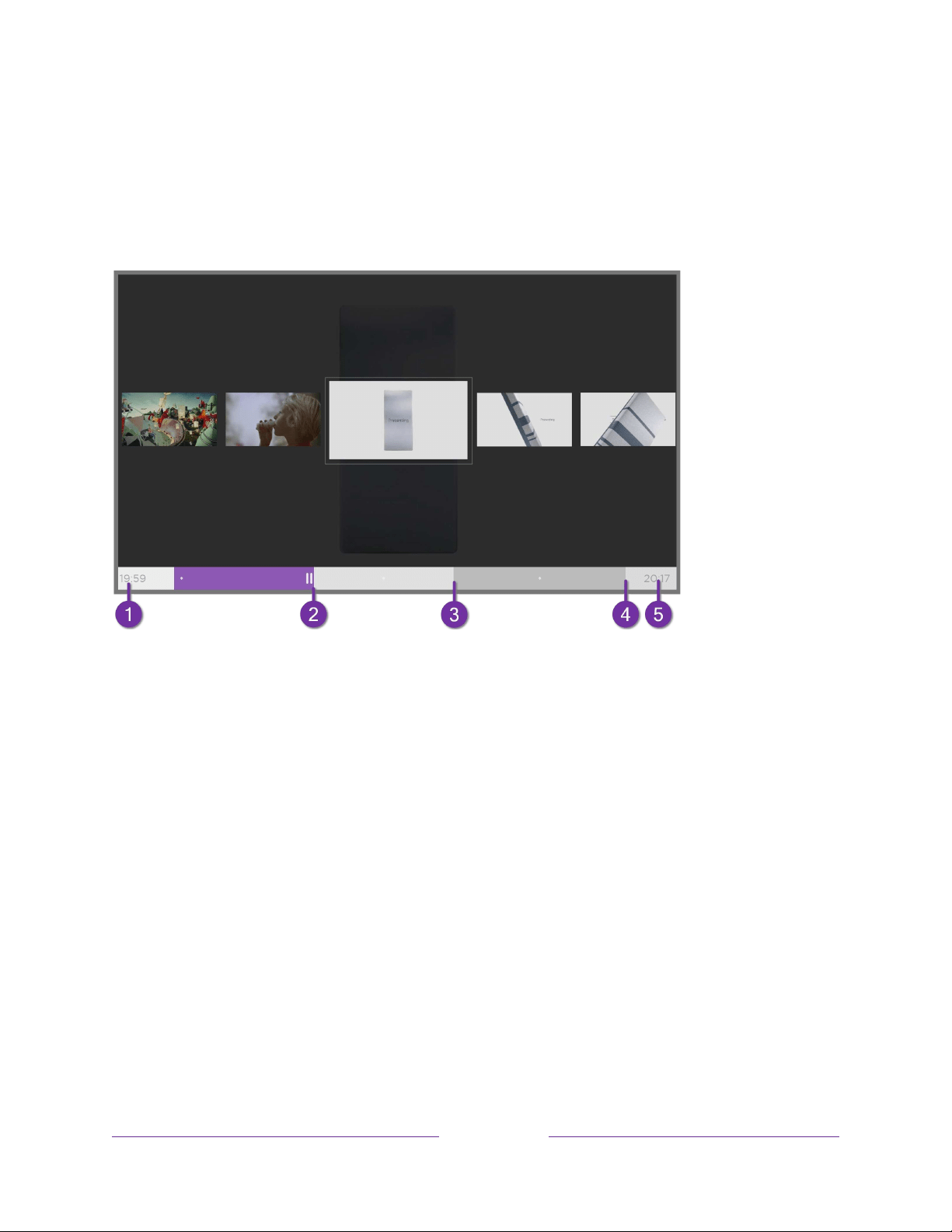
48
• When the programme is paused, press LEFT or RIGHT to move backward or
forward through the programme approximately 10 seconds per press. Small
frames appear across the screen to identify your location in the programme.
Whenever you use any of the Live TV Pause features, the TV momentarily displays a
progress bar:
Time at current playback position.
1. Current playback position
2. Extent of pause time, representing the amount of time this channel has been buffered, up to 90
minutes.
3. 90-minute mark, representing the maximum extent of pause time.
4. Current time.
The progress bar also displays tick marks at each half hour point, to help you locate
the boundaries where one programme ends and a new one begins.

49
Notes about Live TV Pause
• You can use Live TV Pause only with broadcast channels received through the
TV’s ANT input.
• Changing channels erases and restarts the Live TV Pause buffer.
• Returning to the Home screen, selecting another input, or turning off the TV
erases and resets the Live TV Pause buffer.
• Disconnecting the USB drive erases the Live TV Pause buffer.
Automatic network recommendation
Your home might have multiple wireless networks, each with its own characteristics.
While you are streaming and during manual network scans, your TV checks the
wireless networks nearby to make sure you are getting the optimum viewing
experience.
If your TV determines that a better connection is available while you are watching
streaming content, it recommends that you switch by displaying a message in the
lower portion of the screen:
When this happens, you can select the appropriate button to accept or reject the
recommendation, or you can select Don’t show again if you do not want to use this
feature.

50
Switching TV inputs
Switch TV inputs to access the device connected to that input, for example, a
Blu-ray™ player. Switch inputs is as easy as highlighting the input’s tile on the Home
screen and pressing OK. The video signal on the input, if any, plays on the screen.
Tip:
To learn how to add, remove, rename, and rearrange the tiles on your Home
screen, see
Customising your TV
.
Auto-detecting devices
Your TV automatically detects when you connect a new device to an HDMI input and
turn on its power. The input is automatically added to the Home screen if it isn’t
already present.
Adjusting audio/video settings
While watching video content on any input, press STAR to display the Options
menu. Press UP or DOWN to highlight an option, and then press LEFT or RIGHT to
change the setting. To learn about each of the sound and video settings, see
Adjusting TV settings
.
Automatic game console configuration
Your TV automatically detects select game consoles and configures the key features
it supports to optimize TV performance while playing video games. When you
connect a supported and powered-on game console through an HDMI
®
input, the TV
automatically changes the input tile to the game console icon
1
.
Only on selected
models with compatible game consoles,
it also enables:
• Automatic low-latency mode (ALLM)
• Variable refresh rate
• HDR gaming
• High frame rate
• Game mode
• THX Certified game mode
1 Certain game consoles, such as the Microsoft Xbox One, do not communicate their identity until you
select the input after connecting the console.
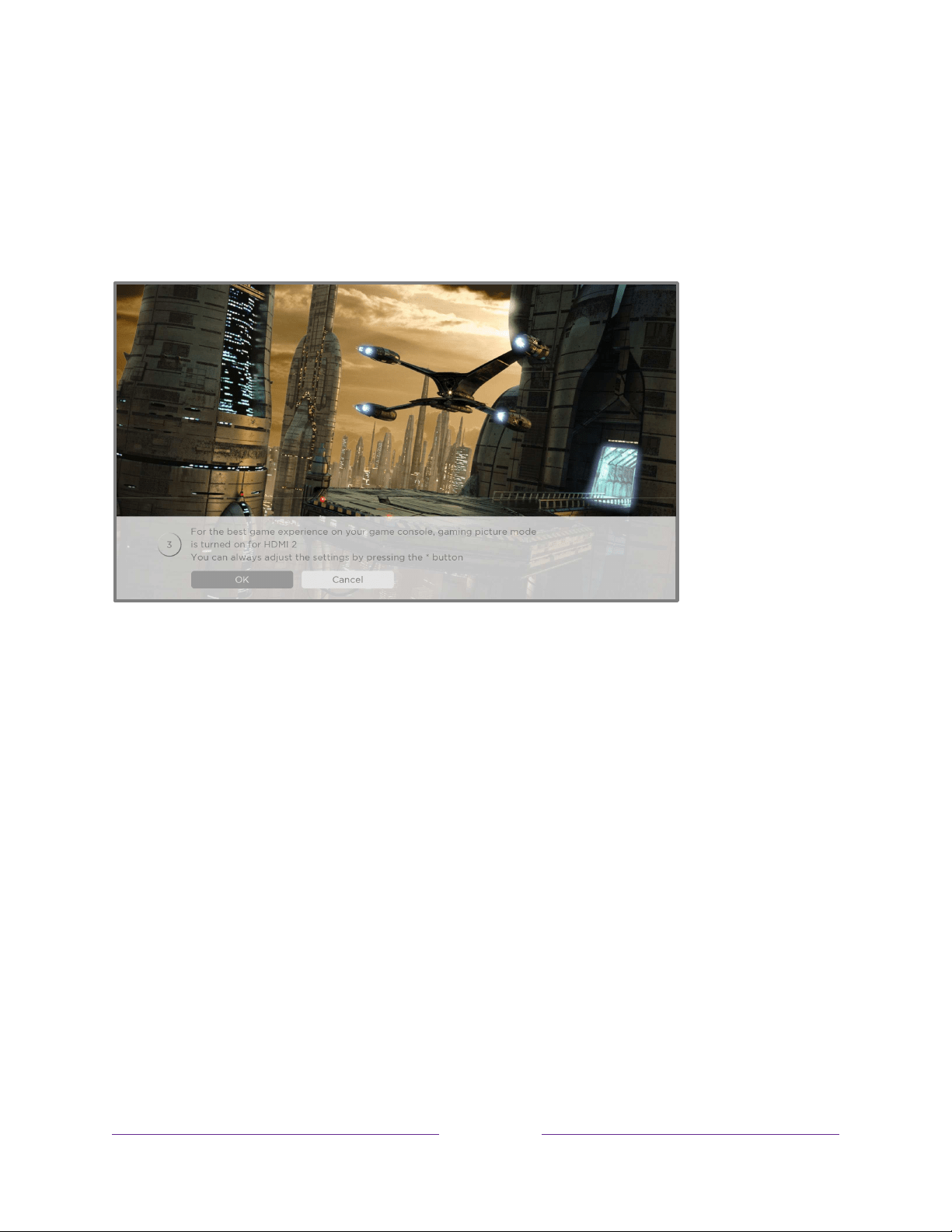
51
Various combinations of these features are available only on select Roku TV models,
and if present, can be disabled by navigating to Settings > TV inputs and then
selecting the appropriate HDMI input.
When you start playing a game, your TV displays a message at the bottom of the
screen to make you aware of the settings that it will use.
Select Cancel before the timer runs out to keep the current TV picture settings. For
example, you might want to cancel automatic configuration if you are watching a
movie from your game console.
Using Roku Voice commands
Roku Voice commands make it fast and easy to control your TV and find
entertainment with simple voice commands like “show me comedies.” Control your
TV with commands like “switch to game console,” or “watch channel 7.1.” Use your
Roku Voice remote, the Roku mobile app, or a compatible smart speaker to speak
commands. When using a smart speaker, add “on my Roku” or, for example, “on my
bedroom
Roku” to the end of the command.
To learn what commands to use, keep watch for hints that appear at appropriate
times. For example, if you are in the Options menu with the Sleep timer command
highlighted, a hint might appear explaining how to use a Roku Voice command to set
the sleep timer. By using the Roku Voice command, you can use the command at any
time, without a need to call up the menu.

52
Playing content from USB storage devices
Only in connected mode
, your Home screen has the Roku Media Player tile.
Otherwise, the Home screen has the USB Media Player tile. With either player, you
can play personal music, video, and photo files from a personal USB flash drive or
hard disk connected to the TV’s USB port.
To use this feature, make sure your media files are compatible with the Roku/USB
Media Player. To see the latest list of supported formats, view Help in the Media
Player
1
. The Roku/USB Media Player displays supported file types only, and hides file
types it knows it cannot play.
Note:
If you do not see the Roku Media Player on your Home screen, it might have
been uninstalled. You can reinstall it from the Roku Channel Store by using the
Streaming Channels menu option or the Add Channels shortcut. The USB Media
Player in non-connected mode cannot be uninstalled.
For more information about playing back your personal videos, music, and photos, go
to the following link on the Roku web site:
go.roku.com/rokumediaplayer
.
Auto player launch
Only in connected mode
, you can set your TV to automatically open the Roku Media
Player when you connect a USB drive with a recognizable file system (such as
FAT16/32, NTFS, HFS+ or EXT2/3). To configure this setting, from the Home screen
menu, navigate to Settings > System > USB media. At this point, the following
options are available:
• Auto-launch – Select Prompt, On, or Off, as desired.
• Prompt – (default) Display a prompt each time a recognised USB drive is
connected. The prompt provides options to launch the Roku Media Player
as well as to change future auto-play behaviour.
• On – Always launch the Roku Media Player whenever you connect a
recognised USB drive.
• Off – Never launch the Roku Media Player automatically.
• Launch channel – Select the app you want to use to play back media files.
1 There are many variants of each supported media format. Some variants may not play at all or may
have issues or inconsistencies during playback.

53
Playing content from local network media servers
Only in connected mode
, your TV can play personal video, music, and photo files from
a media server on your local network. Media servers include personal computers
running media server software such as Plex or Windows Media Player, network file
storage systems that have built-in media server software, and other devices that
implement the specifications of the Digital Living Network Alliance. Some servers do
not fully implement the DLNA specification but are UPNP (Universal Plug and Play)
compatible. The Roku Media Player will connect to them as well.
Some media servers can convert files into Roku compatible formats. Digital Rights
Management (DRM)-protected content is not supported.
Setting up a payment method
For streaming channels that allow you to pay through your linked Roku account, you
can enter a payment method directly on your TV. Entering a payment method on
your TV means that you don’t need to go to a computer or mobile device to set up a
payment method.
To add a payment method:
1. From the Home screen menu, navigate to Settings > Payment method > Add
payment method.
2. Use the on-screen number pad to enter your credit/debit card number,
expiration date, CVV number, and postal code.
Note:
If you have already set up a payment method on my.roku.com, that
payment method is identified here in such a way as not to expose any personal
data. You can use this screen to change your payment method, if desired.
3. Select Save Card, and then press OK.
To manage your saved payment method and to see other payment methods, log into
your account at
https://go.roku.com/pay.

54
Using your TV on a restricted public network
Hotels, school halls of residence, conference facilities, and similar locations with public
wireless Internet access often require you to interact with a web page to authenticate
your access. These types or networks are called
restricted public networks
. When you
select a network of this type, the TV automatically detects that additional information
is needed and prompts you through using another wireless device to supply the
requested information.
About using your TV on a restricted public network
Here are some points to keep in mind when using your TV on a restricted public
network:
• Using your Roku TV on a hotel or other public network requires wireless
availability and a network-connected smartphone, tablet, or computer to
authenticate access to your wireless access point.
• You will need your Roku TV remote.
• Some content might be limited or unavailable if you try to connect outside
your home country due to geo-filtering.
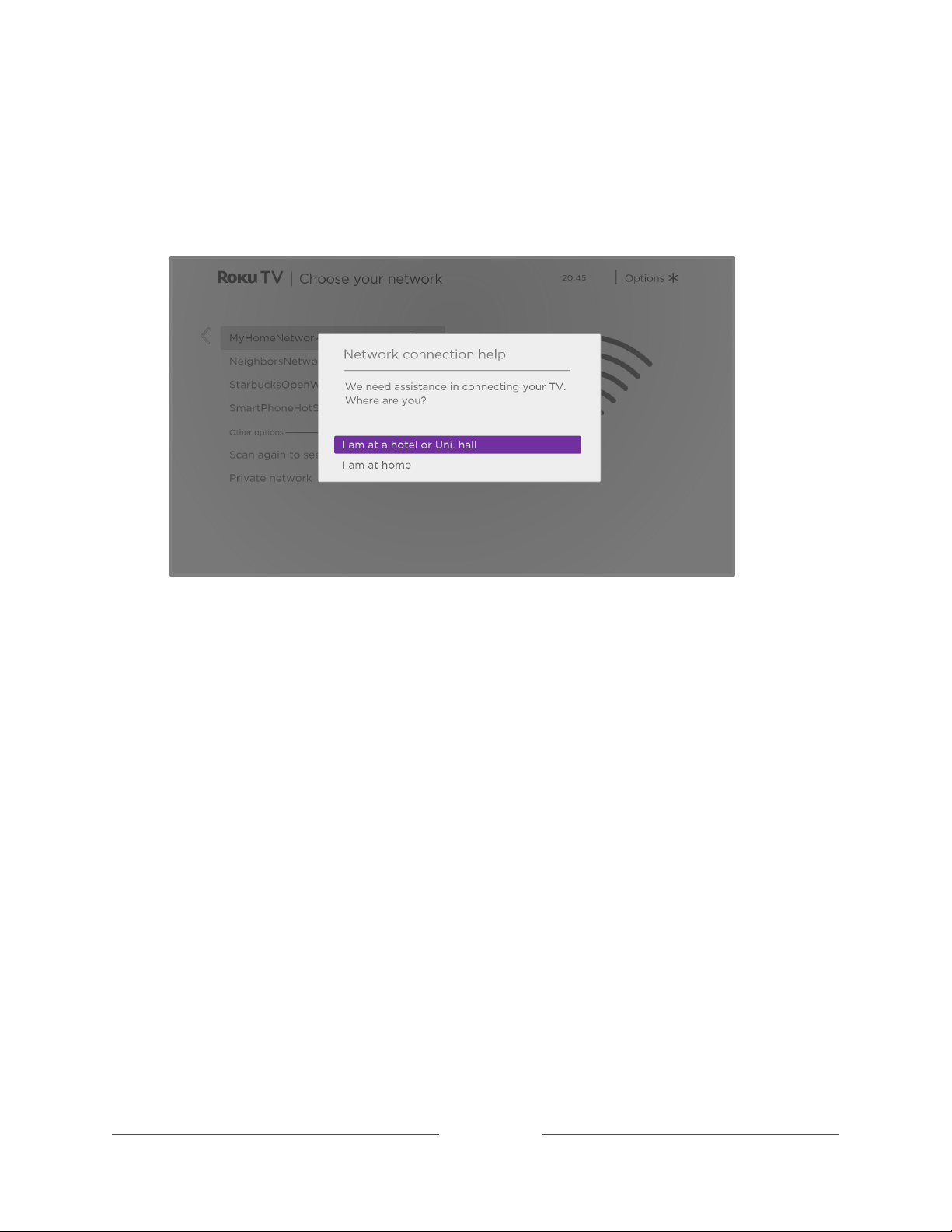
55
Getting your Roku TV on line on a restricted public network
1. Either during Guided Setup or after using the Settings > Network menu to set
up a new connection, the TV automatically detects that you are connecting to
a restricted network and displays the following prompt:
Tip:
Your TV can connect to a restricted network only if Enable ‘Device
connect’ is selected in Settings > System > Advanced system settings. (Device
connect is enabled by default, but if you have disabled it, the TV cannot
complete the connection.)
Note:
Device connect is not present if the TV is in non-connected mode.
2. After selecting the correct network, highlight I am at a hotel or hall of
residence, and then press OK. The TV prompts you to use your smartphone,
tablet, or laptop to complete the connection.
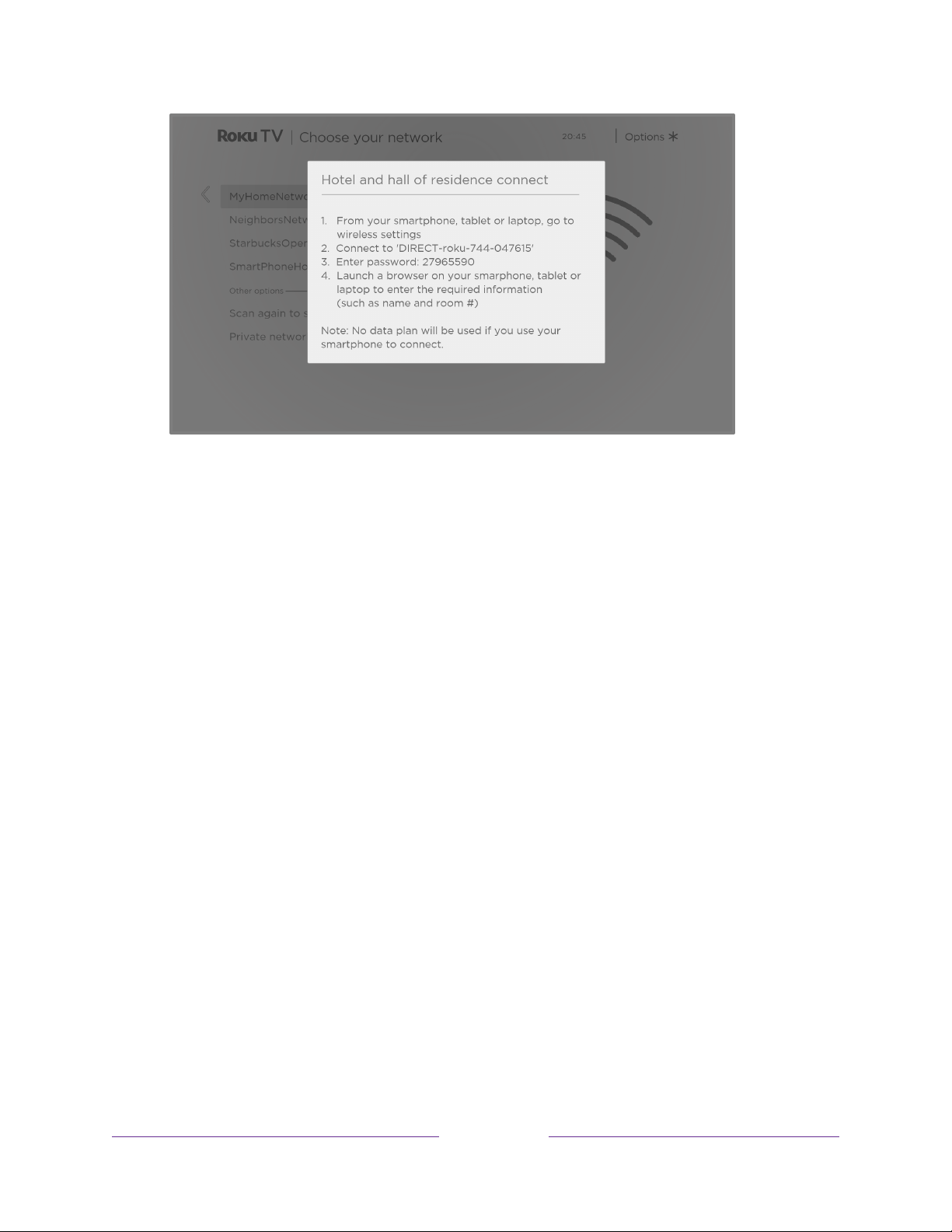
56
3. Use a mobile phone, tablet, or wireless-enabled computer to detect wireless
networks. In most cases, you can simply open the device’s Wi-Fi Settings or
Network Settings screen to start scanning.
Note:
The mobile phone, tablet, or computer must be on the same wireless
network to which you are connecting the TV.
4. Connect to the network named on your TV screen. The actual network name
varies.
Note:
The previous step connects your smartphone, tablet, or computer
directly to the TV. No connection charges apply and the connection does not
impact your device’s data plan.
5. The wireless connection process prompts you for a password. Enter the
password as shown on the TV screen. The actual password varies.
6. Start the web browser on your mobile phone, tablet, or computer. When you
attempt to open any web page, the restricted connection will prompt you for
whatever information it needs. In most cases, you must agree to terms and
conditions, provide identifying information, or enter a password, PIN, or room
number to proceed. The information requested depends on the organization
that controls the wireless connection.
7. After you enter the requested information, the TV automatically proceeds to
complete its connection and resumes normal operation.

57
8. If the TV prompts you to link to your Roku account, use your mobile phone,
tablet, or computer to activate your TV.
Opting out of HbbTV
Hybrid Broadcast Broadband TV (HbbTV) is enabled by default, and provides
interactive television services over both broadcast signals and your Internet
connection, if any. You can change the following settings by navigating from the
Home screen menu to Settings > Inputs > Live TV > HbbTV:
Enable HbbTV – Highlight this option and press OK to clear the check box and disable
HbbTV.
Do not track – Highlight this option and press OK to change the tracking options.
Choose between the following options:
• Not set – Your TV will not share your tracking preference with HbbTV apps.
• On – Your TV will tell HbbTV apps that you do not want your behaviour
tracked. However, whether HbbTV apps honour this setting is voluntary.
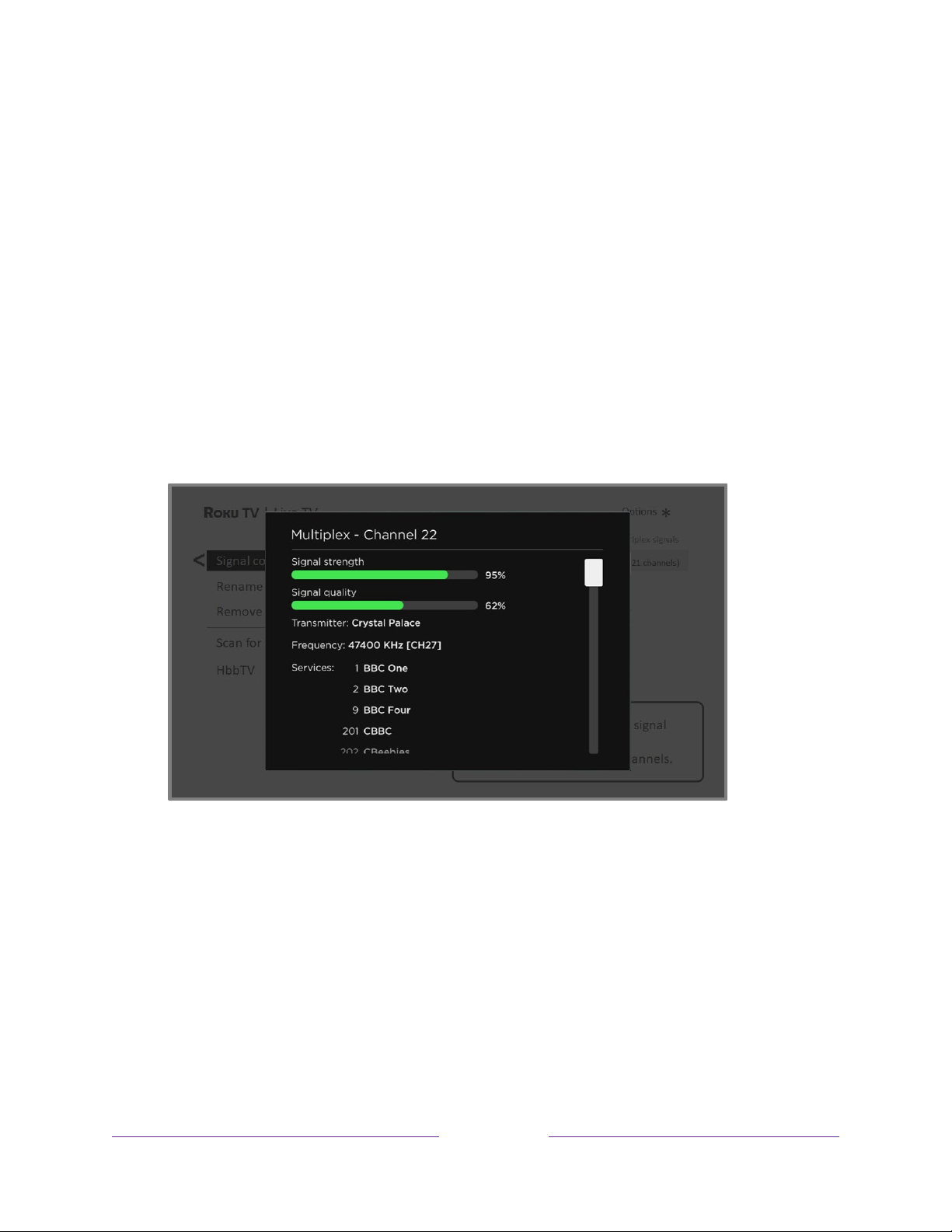
58
Checking signal condition
You can check the signal condition of the TV broadcasts you receive over your TV
aerial. Doing so can help you troubleshoot reception issues and take corrective action,
for example, reorienting your aerial or adding a signal amplifier.
To check signal condition:
1. From the Home screen menu, navigate to Settings > TV inputs > Live TV >
Signal condition.
2. Highlight one of the channel multiplexes in the right column. A multiplex is a
collection of channels coming from a single broadcast location. The highlighted
multiplex shows its signal strength adjacent to the channel number.
3. Press OK to display the signal condition details.
4. Make any adjustments to your aerial as needed. The signal strength and signal
quality indicators will increase as you find the optimum position for your aerial.
By trying different multiplexes, you can find the position that provides the best
signal across all channels, or optimise one multiplex over the others if that is
your preference.

59
Using Apple AirPlay and
the Apple Home app
Apple AirPlay
AirPlay lets you share videos, photos, music, and more from your iPhone, iPad, or Mac.
To use AirPlay, your Roku TV must be on the same wireless network as your Apple
device
1
. To configure your preferred AirPlay security settings, navigate to Settings >
Apple AirPlay and HomeKit from your Roku TV home screen. Depending on the
AirPlay settings you select, you may be required to enter a password on your Apple
device to initiate an AirPlay session on your Roku TV.
Other AirPlay things to try
• Screen mirroring from an iOS device.
• Screen mirroring from a Mac.
• Using your Roku TV as an extended Mac display.
• Playing synchronized music on multiple AirPlay 2-enabled devices, including
Roku TVs.
Apple Home app
Apple HomeKit controls compatible smart home lights, locks, thermostats, and other
devices, including Roku TVs. The Apple Home app lets you add your Roku TV to your
Apple HomeKit ecosystem. You can also interact with HomeKit-enabled devices by
using Siri from your iPhone, iPad, Apple Watch, HomePod or Mac.
To enable your Roku TV to work with the Apple Home app:
1 iPhone, iPad, or iPod touch with iOS 12.3 or later. Mac with macOS Mojave 10.14.5 or later.

60
1. From your TV’s Home screen, navigate to Settings > Apple AirPlay and
HomeKit.
2. Under HomeKit, select Set Up. Your TV will display a unique QR code.
3. From your Apple device, open the Apple Home app and select Add Accessory.
4. Use the Apple Home app to scan the QR code displayed on your TV and follow
the instructions.
Some Apple HomeKit things to try
On your Apple device, say:
• “Hey Siri, play jazz in the living room.”
• “Hey Siri, mute the TV in the office.”
• “Hey Siri, turn off the TVs in my home.”
• Add your Roku TV to an Apple Home scene.
Find more ideas at https://www.apple.com/ios/home/
.

61
Adjusting TV settings
You can adjust most picture and sound settings while you are watching a programme
by pressing STAR to open the Options menu. There are some additional picture
and sound settings in the Settings menu.
In most cases, the changes you make apply only to the input you are using. Live TV,
each HDMI input, and the AV input have their own settings that the TV remembers
when you return to that input. The TV also separately remembers the settings you
specify while viewing streaming content.
Settings menu
Use the Settings menu to adjust overall TV settings. Press HOME to go to the
Home screen menu, and then navigate to Settings > TV picture settings.
You can adjust the following overall TV picture settings from the Settings screen:
• TV brightness – Provide a better viewing experience in darker or brighter
rooms. Increases or decreases the TV’s general brightness across all TV inputs.
Note:
This setting is identical to the TV brightness setting you can access in
the Options menu while watching a programme.
• HDR notification –
On select models only:
Controls whether the TV displays a
notification in the upper right corner of the screen for a few seconds when
HDR or Dolby
®
Vision™ content begins to play.
• On – The TV displays a notification when HDR or Dolby
®
Vision™ content
begins to play.
• Off – The TV does not display a notification when HDR or Dolby
®
Vision™
content begins to play.
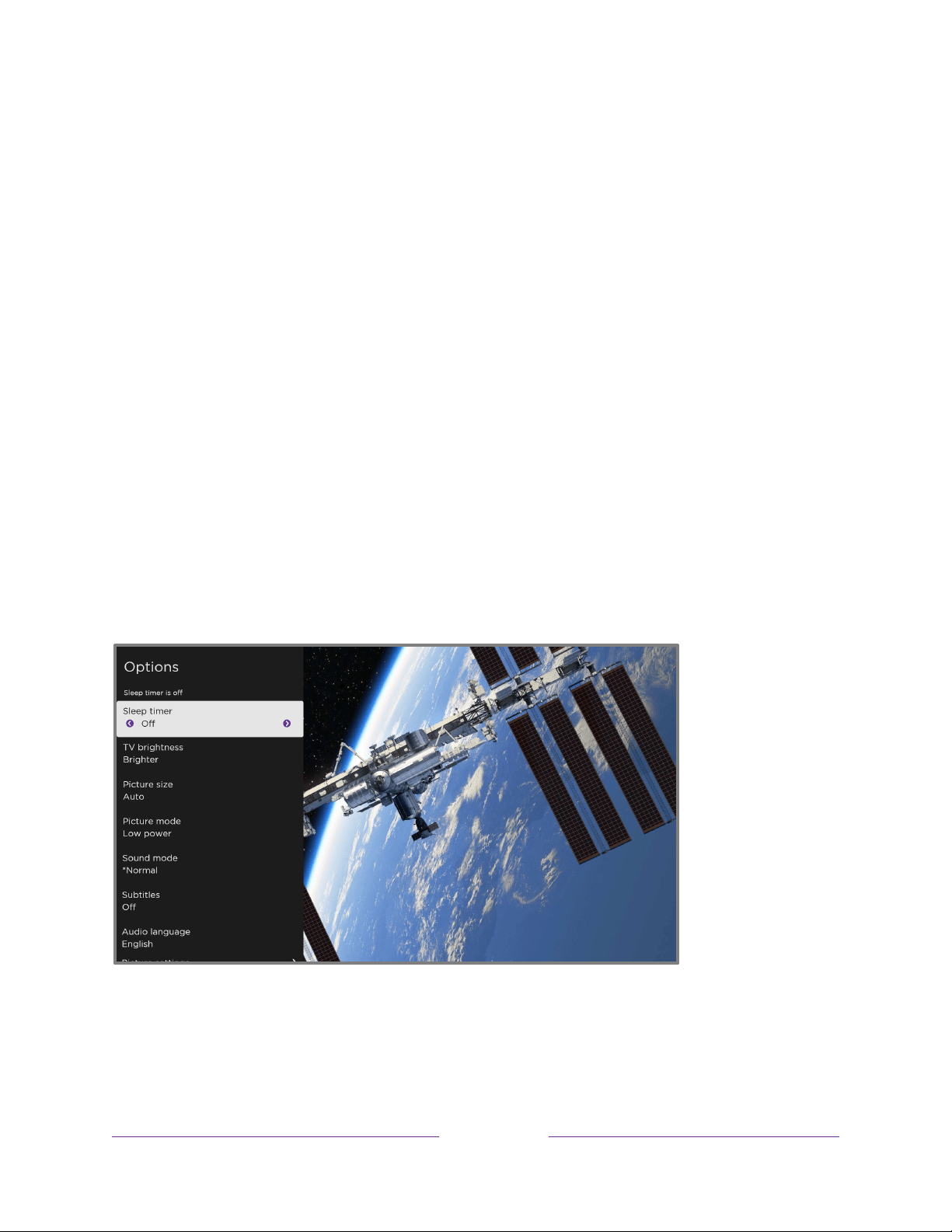
62
Note:
This setting does not affect the HDR or Dolby
®
Vision™
notification that
always appears in the programme information banner. Press OK while watching
a programme to open the programme information banner.
• Settings per input – Lists each TV input. Select an input, and then press
STAR to display the Options menu where you can adjust the input’s settings
while watching a live picture and listening to the sound from that input.
Tip:
You don’t have to go to the Settings menu first—you can display an input’s
Options menu and adjust its settings whenever you are watching the input by
pressing
STAR
.
Options menu
The Options menu for each TV input provides many settings for controlling the
appearance of the picture and the quality of the audio. To view the Options menu,
press STAR whenever you are watching a TV input or streaming a video (except
when you are viewing the programme information banner). The Options menu is a
panel that appears over the left side of the screen:
Typical Options menu
To adjust the settings on the Options menu, press UP or DOWN to highlight a setting,
and then press LEFT or RIGHT to change the setting. You’ll see the changes you make
right away in picture appearance or audio quality.

63
Tip:
When you highlight a setting, the header text explains the effect of its current
value. When you begin to adjust a setting, the other options are hidden so you can
see more of the screen. Even though the other settings are hidden, you can move the
highlight up or down to adjust the other settings. As soon as you press UP or DOWN,
the other settings become visible again.
Note:
Some streaming channels assign the
STAR
button to a different function or
to no function at all), meaning it will not open the Options menu. In these cases, use a
different channel to configure options. The selected settings remain active for all
streaming channels.
Options menu settings
• Sleep timer – Sets a timer that turns off the TV after the specific amount of
time.
This setting remains in effect even if you stop watching the current input.
• TV brightness – Affects the overall brightness of the picture.
This setting
applies across the entire TV; that is, to all TV inputs and is identical to the TV
brightness setting under Settings > TV picture settings.
• Picture size – Adjusts the aspect ratio of the picture, enabling you to view a
picture in its original format, or zoom or stretch it to fill the screen. The Auto
setting has been found to produce the best picture in most cases.
• Picture mode – Provides picture pre-sets for various viewing preferences.
This
setting applies to the currently-selected input only.
• Sound mode – Adjusts the sound quality output from the TV speakers.
This
setting applies across the entire TV; that is, to all TV inputs.
It does not affect
the sound quality for headphones, HDMI (ARC), HDMI (eARC), or S/PDIF
(TOSLINK) connectors.

64
• Subtitles – Controls when you see subtitles.
This setting is only offered for Live
TV, the AV input, streaming content, and videos played in the media player.
Any set value remains in effect across only these inputs.
• Live TV – Set subtitles to off, always on, on only when the TV sound is
muted, or on only during instant replay (when Live TV Pause has been
enabled).
• AV input – Set subtitles to off, always on, or on only when the TV sound is
muted.
• Streaming video channel or media player – For streaming content that
provides closed subtitles, set subtitles to off, always on, on only when the
TV sound is muted, or on only during instant replay (for streaming content
that supports instant replay).
Note that some streaming channels have
other methods for turning subtitles on and off. In these cases, the Subtitles
option does not appear on the Options menu.
• Audio language – Controls the language of the audio that you hear while
watching a programme.
• Picture settings – Shows the
Picture settings
menu.
• Sound settings –
Only on select models:
Shows the Sound settings menu.
• Accessibility – Shows the Accessibility menu.
Tip: To dismiss the
Options
menu, just wait a few seconds without pressing any
buttons. Or press STAR again to dismiss the menu immediately.
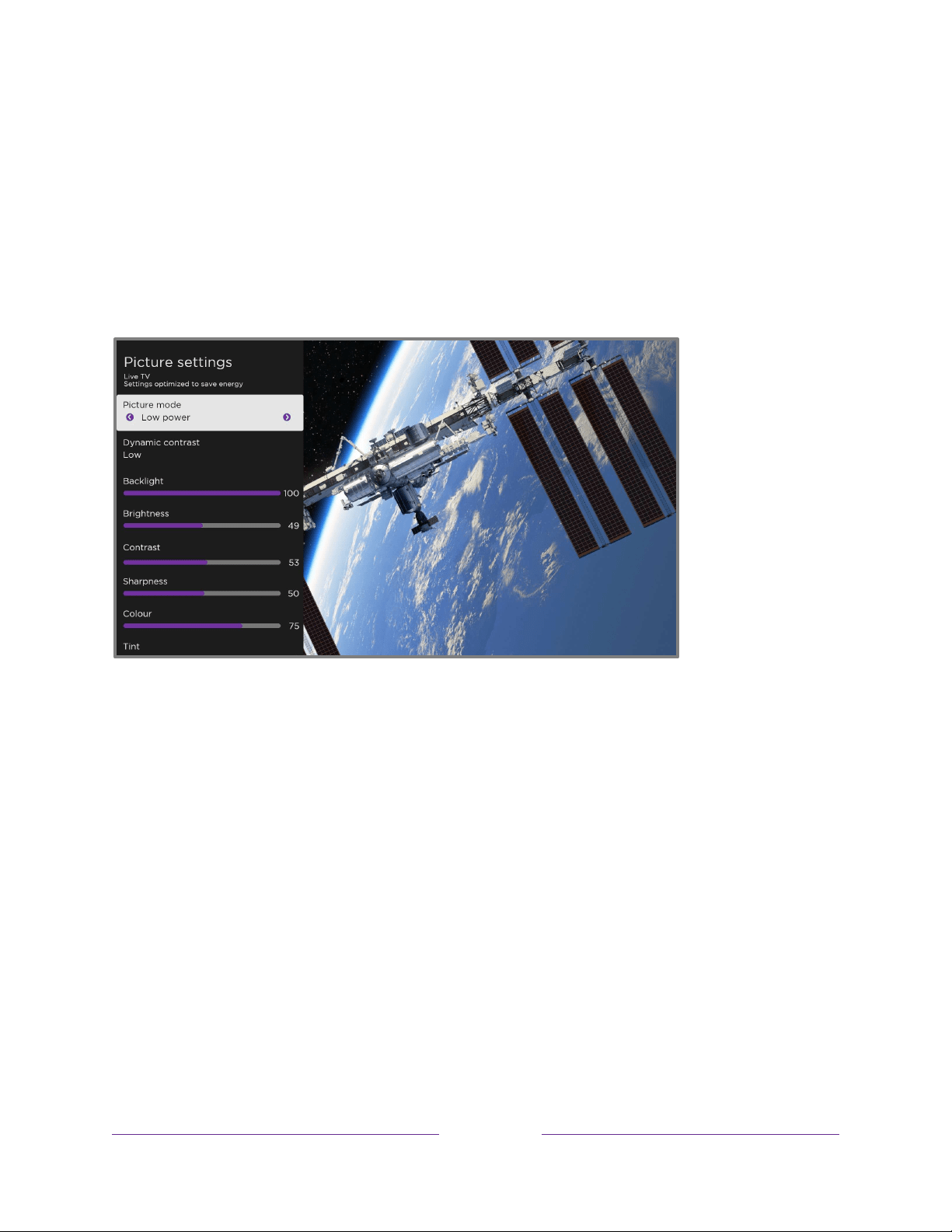
65
Picture settings
The Picture settings menu for each TV input provides settings for fine tuning the
appearance of the picture. All of the settings in this menu apply only to the currently-
selected input.
To use the Picture settings menu, first press STAR to display the Options menu.
Then select Picture settings.
Typical Picture settings menu
Tip:
Some streaming channels assign the STAR
button to a different function,
meaning it will not open the Options menu. In these cases, use a different channel to
configure Picture settings. The selected settings remain active for all streaming
channels.
Picture settings menu options
Note:
Picture settings vary by brand and model. Not all settings are available on all
TVs. Names of certain settings also vary by brand and might differ from the names
listed here.
• Picture mode – Provides picture pre-sets for various viewing preferences. This
setting duplicates the one on the Options menu. When you change the Picture
mode, other picture settings adjust accordingly. For example, setting the
Picture mode to Vivid sets Brightness, Contrast, Sharpness, and other values
to produce a very vibrant picture. Setting Picture mode to Movie changes the

66
settings to produce a picture suitable for enjoying movies in a darkened room.
If you make changes to the individual picture settings—for example, Contrast,
or Sharpness—these settings are saved for the current input
and
the current
picture mode. In this way, you can set HDMI 1 input’s Movie picture mode to
use different settings than the HDMI 2 input’s Movie picture mode and the Live
TV input’s Movie picture mode. Use Reset picture settings, described below, to
return the input’s selected picture mode to its original values.
• Local dimming –
Only on select models:
Sets the amount of dimming applied
to multiple areas of the screen’s backlight intensity. This setting can make dark
areas darker without affecting the brightness of light areas.
• Dynamic contrast –
Only on select models:
Automatically adjusts the backlight
level to achieve the optimum contrast and prevent excessive differences
between light and dark areas of the screen.
• Micro contrast –
Only on select models:
Improves image contrast.
• Backlight - Adjusts the overall light intensity of the screen.
• Brightness – Adjusts the dark level of the picture.
• Contrast – Adjusts the white level of the picture.
• Sharpness – Adjusts the sharpness of edges in the picture.
• Colour – Adjusts the saturation of colours in the picture. A setting of 0
removes all colour and displays a black and white picture.
• Tint – Adjusts the colour balance from green to red to obtain accurate colours
in the picture.
• Colour temperature – Adjusts the overall colour tones in the picture from
Normal to slightly more bluish (Cool) to slightly more reddish (Warm).
• Frame rate conversion –
Only on select models. Each TV brand uses a different
name for this option.
Adjusts the amount of motion processing applied to the
video signal. A higher setting results in more smoothing, but can cause
undesirable picture artefacts in certain types of content
.
Each Picture mode
has a different default setting.

67
• Film mode –
Only on select models. Each TV brand uses a different name for
this option.
When enabled, this feature reduces “judder” that is often present
when 24 frame-per-second movies are upscaled to 60Hz TV standards. Film
mode is On by default in Movie and HDR Dark picture modes, and Off by
default in other picture modes.
• Blur reduction –
Only on select 120Hz models. Each TV brand uses a different
name for this option.
Reduces blur, especially for fast-moving images such as
sports.
• Black frame insertion –
Only on select models that also have the local dimming
feature. Each TV brand uses a different name for this option.
Reduces motion
blur caused by the refresh rate of the screen. Enabling this feature inserts black
frames between picture frames in a way that improves the clarity of fast-
moving objects. It provides an improved viewing experience for video games
and sporting events, but reduces the brightness of the picture. You can select
settings of Low, Medium, High, or Off to achieve the desired picture quality.
• Game mode –
Only on HDMI and AV inputs:
Controls whether Game mode is
enabled. When On, the TV performs less image processing and has less input
lag. When Off, the TV performs more image processing and has more input lag,
which is less desirable for action games.
• Reset picture settings – Returns all picture settings for the input’s currently-
selected Picture mode to their original values.
Tip:
To dismiss the Picture settings menu, just wait a few seconds without
pressing any buttons. Or press STAR
again to dismiss the menu immediately.

68
Auto Low Latency Mode (ALLM)
Only on select models:
Auto Low Latency Mode (ALLM) detects when certain
game consoles are connected to an HDMI input, and then automatically configures
the best settings for action games when that input is selected. When ALLM is
active, the manual Game mode setting is not available.
Variable refresh rate (VRR)
Only on select models:
Variable refresh rate (VRR) allows a compatible game
console or computer connected via HDMI to control the refresh rate of the TV.
This feature helps to ensure that the TV does not begin to display a video frame
until the video source has completely rendered it. The result is smoother image
animation with a lower instance of stutter or tearing. Use of this feature requires
that:
• Variable refresh rate is turned On in the HDMI settings for the input. This
setting is Off by default.
• The HDMI mode is set to Auto or HDMI 2.0 in the HDMI settings for the input.
• Game mode is enabled.
• The connected device supports VRR.
Tip:
To dismiss the Picture settings menu, just wait a few seconds without
pressing any buttons. Or press STAR
again to dismiss the menu immediately.
Expert Picture Settings (4K models only)
4K (UHD) TV models have additional picture settings for demanding home theatre
enthusiasts. Expert Picture Settings include gamma, noise reduction, 11-point white
balance adjustment, and extended colour space management.
You can access Expert Picture Settings only by using the Roku Mobile App on an iOS
®
or Android™ mobile device. For more information, go to the following link on the Roku
web site:
go.roku.com/expertpicturesettings
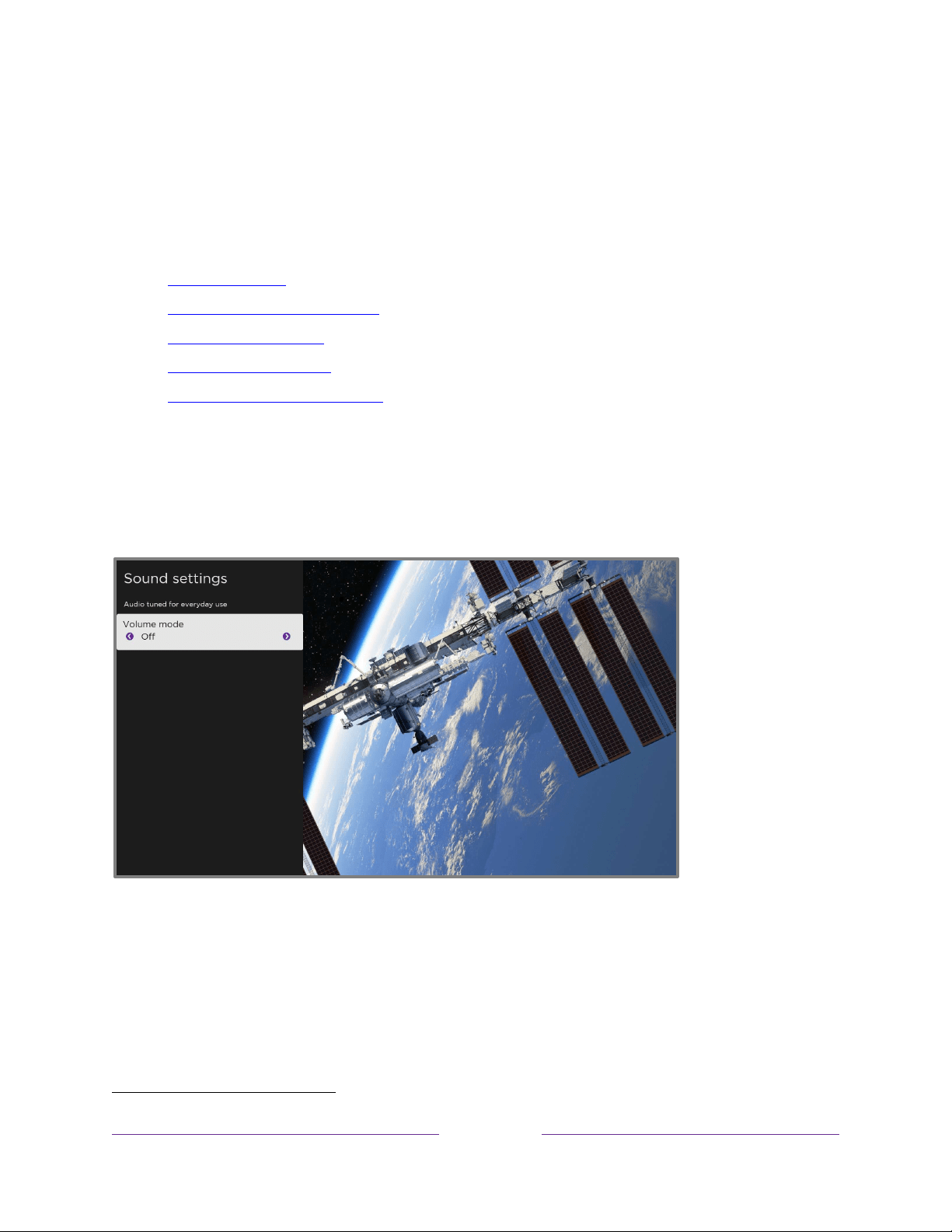
69
Sound settings
Your TV model might have any one of the following premium sound settings available
in the Options menu:
• No sound settings
•
Volume mode
• Dolby
®
Audio Processing
• DTS
®
TruSurround
• DTS
®
Studio Sound
• Sonic Emotion™ Premium
Volume mode (select models only)
To access Volume mode, first press STAR to display the Options menu, then select
Sound settings
1
.
Sound settings menu for models with Volume mode
Tip:
Some streaming channels assign the STAR
button to a different function,
meaning it will not open the Options menu. In these cases, use a different channel to
set the Volume mode. The selected mode remains active for all streaming channels.
1 On some models the Volume mode option is in the Options menu rather than in Sound settings.
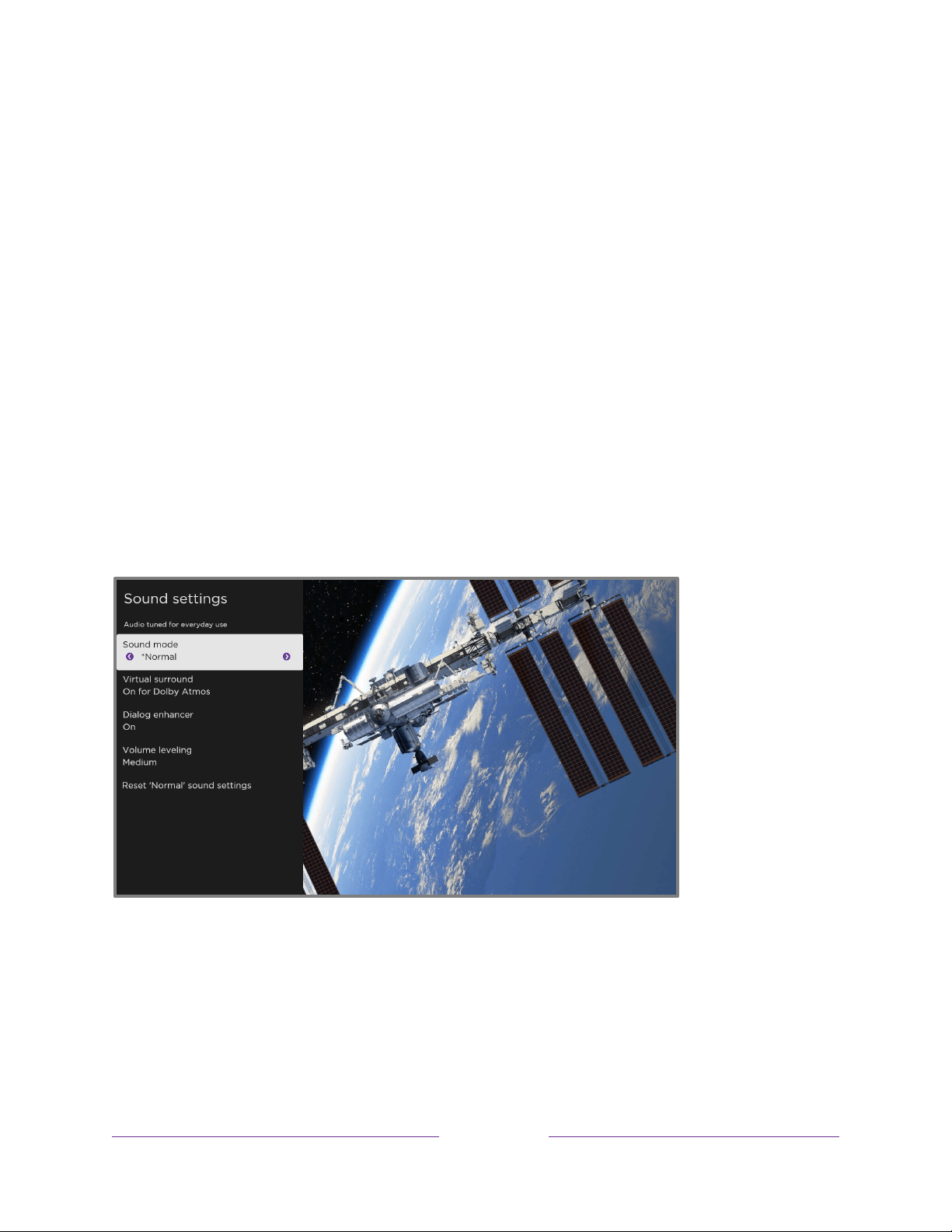
70
Sound settings menu - Volume mode
• Off – Volume mode is inactive and content volume is unmodified.
• Levelling – Provides a consistent volume level across different types of
content, so that you need not change the volume every time you switch
channels or when a commercial comes on.
• Night – Soft sounds, such as whispers, are increased while loud sounds, such as
explosions, are decreased, making it easier to hear your TV at night without
disturbing others.
• Dolby AC-4 Dialog Enhancement –
Only on select models:
Select On for AC-4
to enhance the dialog in content that supports the AC-4 audio format.
Sound settings – Dolby
®
Audio Processing (select models only)
Each TV input has separate settings for fine tuning sound quality. All of the settings in
this menu apply only to the currently-selected input. To access the DAP settings, first
press STAR to display the Options menu, then select Sound settings.
Sound settings menu for models with Dolby
®
Audio Processing
Tip:
Some streaming channels assign the STAR
button to a different function,
meaning it will not open the Options menu. In these cases, use a different channel to
configure Dolby
®
Audio Processing. The selected settings remain active for all
streaming channels.
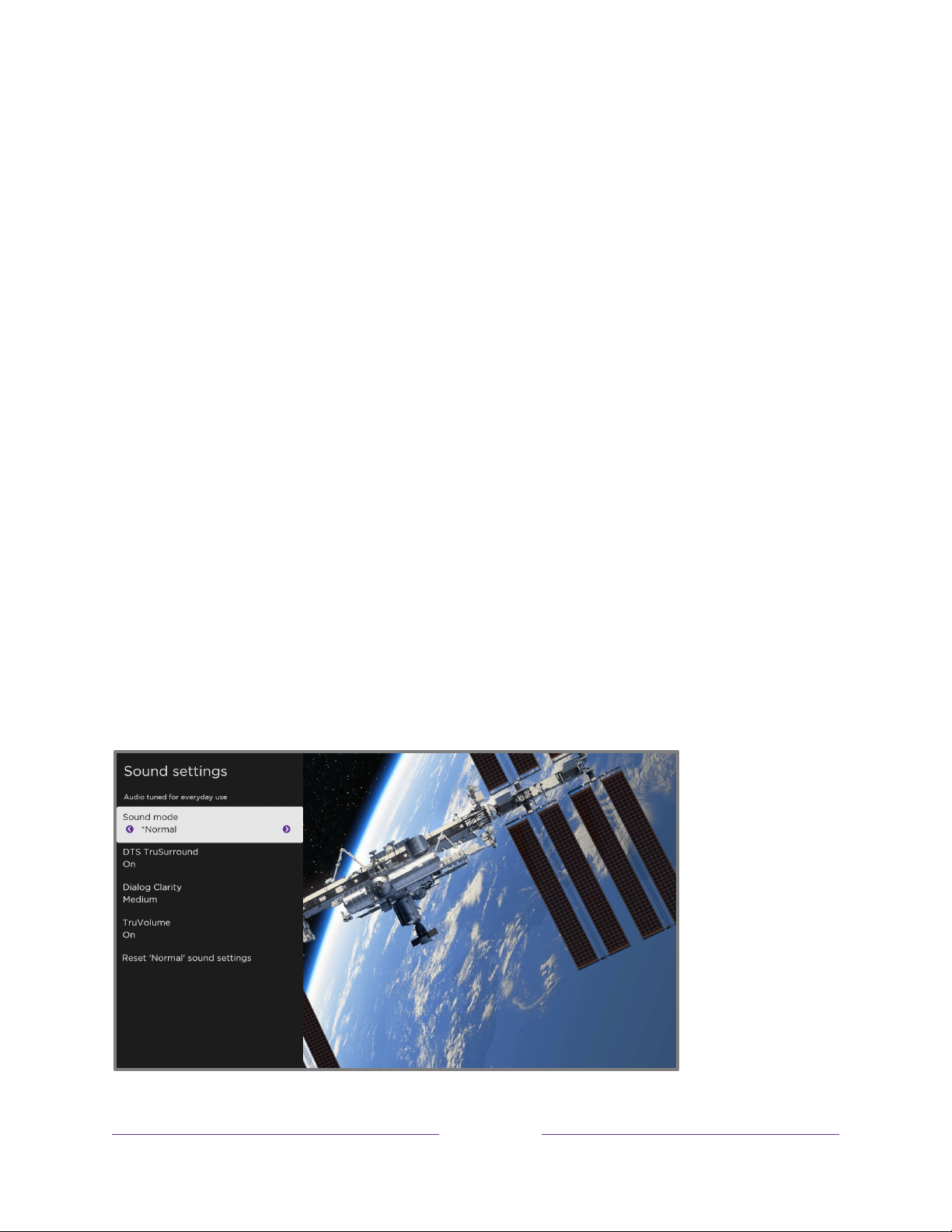
71
Sound settings menu– Dolby
®
Audio Processing
• Sound mode – Select from among various pre-set sound modes to improve
speech, make music sound its best, boost bass or treble, or simulate a theatre.
Use Reset sound settings, described below, to return the input’s current
settings to their original values.
• Virtual surround (
Only on select models
) – Options vary by TV model.
Simulates surround sound that otherwise would require installation of a
surround sound audio system. Sometimes, the effect interferes with dialog
clarity. Use the Dialog enhancer option to compensate.
• Dialog enhancer – Improves the clarity of speech when on.
• Dolby AC-4 Dialog Enhancement –
Only on select models:
Select On for AC-4
to enhance the dialog in content that supports the AC-4 audio format.
• Reset sound settings – Returns Virtual surround and Dialog clarity settings to
their default settings for the selected Sound mode.
Sound settings – DTS
®
TruSurround / DTS
®
Studio Sound (select
models only)
Each TV input has separate settings for fine tuning sound quality. All of the settings in
this menu apply only to the currently-selected input. To access the DTS
®
settings, first
press STAR to display the Options menu, then select Sound settings.
Sound settings menu for models with DTS
®
TruSurround/Studio Sound

72
Tip:
Some streaming channels assign the STAR
button to a different function,
meaning it will not open the Options menu. In these cases, use a different channel to
configure DTS
®
Studio Sound. The selected settings remain active for all streaming
channels.
Sound settings menu– DTS
®
TruSurround / DTS
®
Studio Sound
• Sound mode – Select from among various pre-set sound modes to improve
speech, make music sound its best, boost bass or treble, or simulate a theatre.
Use Reset sound settings, described below, to return the input’s current
settings to their original values.
• DTS TruSurround –Simulates surround sound that otherwise would require
installation of a surround sound audio system. Sometimes, the effect interferes
with dialog clarity. Use the Dialog clarity option to compensate.
• Dialog Clarity – Available only when DTS TruSurround is On. Choose among
Low, Medium, and High settings to improve the clarity of dialog when you are
using the TruSurround feature.
• TruVolume – Minimises annoying volume fluctuations in programmes.
• Dolby AC-4 Dialog Enhancement –
Only on select models:
Select On for AC-4
to enhance the dialog in content that supports the AC-4 audio format.
• Reset sound settings – Returns DTS TruSurround, Dialog Clarity, and
TruVolume settings, to their default settings for the selected Sound mode.
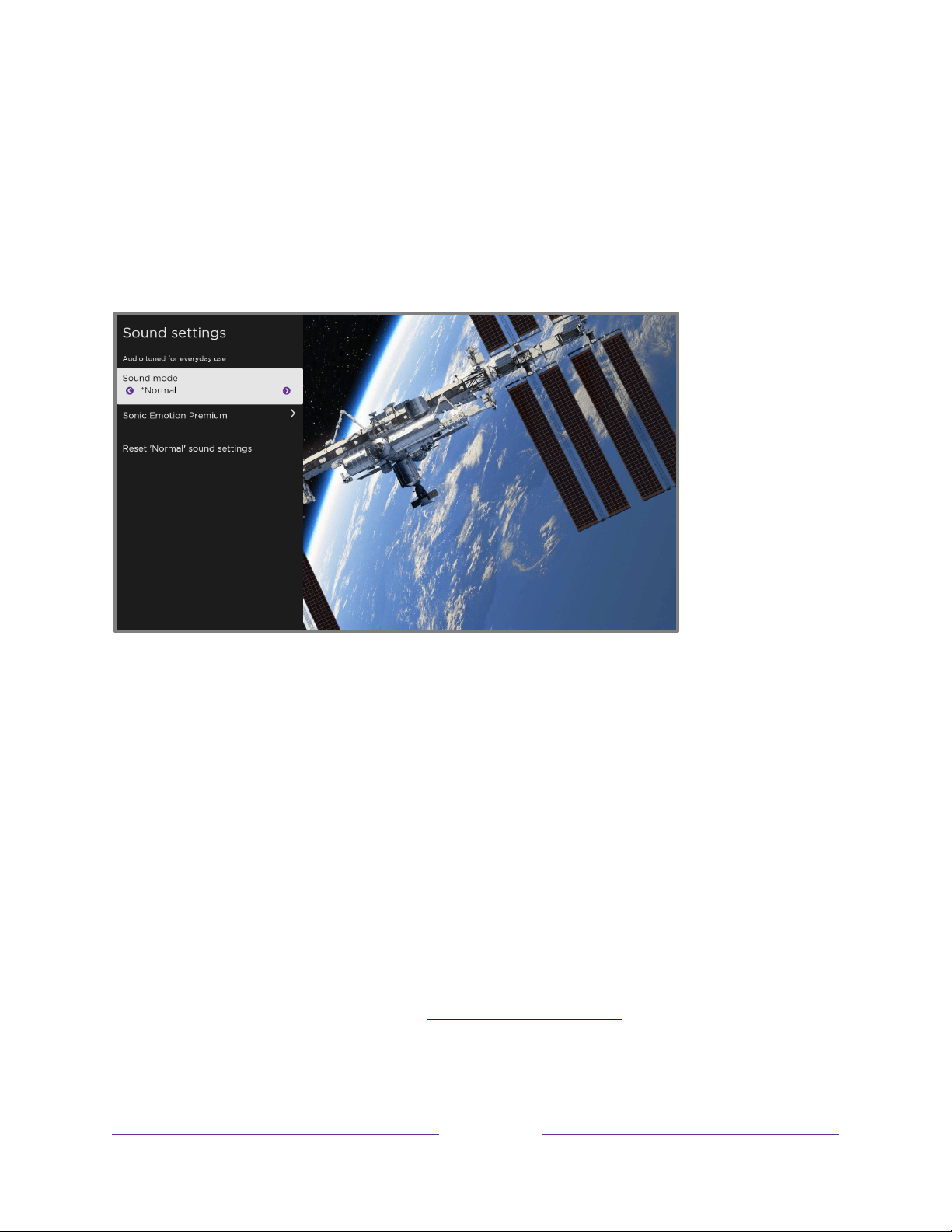
73
Sound settings – Sonic Emotion
™
Premium (select models only)
Sonic Emotion™ Premium is an audio technology that enables your TV to produce a
more immersive sound experience. Each TV input has separate settings for fine tuning
sound quality. All of the settings in this menu apply only to the currently-selected
input. To access the Sonic Emotion™ settings, first press STAR to display the
Options menu, then select Sound settings.
Sound settings menu for models with Sonic Emotion™ Premium
Tip:
Some streaming channels assign the STAR
button to a different function,
meaning it will not open the Options menu. In these cases, use a different channel to
configure Sonic Emotion™. The selected settings remain active for all streaming
channels.
Sound settings menu– Sonic Emotion
™
Premium
• Sound mode – Select from among various pre-set sound modes to improve
speech, make music sound its best, boost bass or treble, or simulate a theatre.
Use Reset sound settings, described below, to return the input’s current
settings to their original values.
• Sonic Emotion Premium – Displays a menu with individual Sonic Emotion™
audio settings, as described in
Sonic Emotion settings
.
• Dolby AC-4 Dialog Enhancement –
Only on select models:
Select On for AC-4
to enhance the dialog in content that supports the AC-4 audio format.
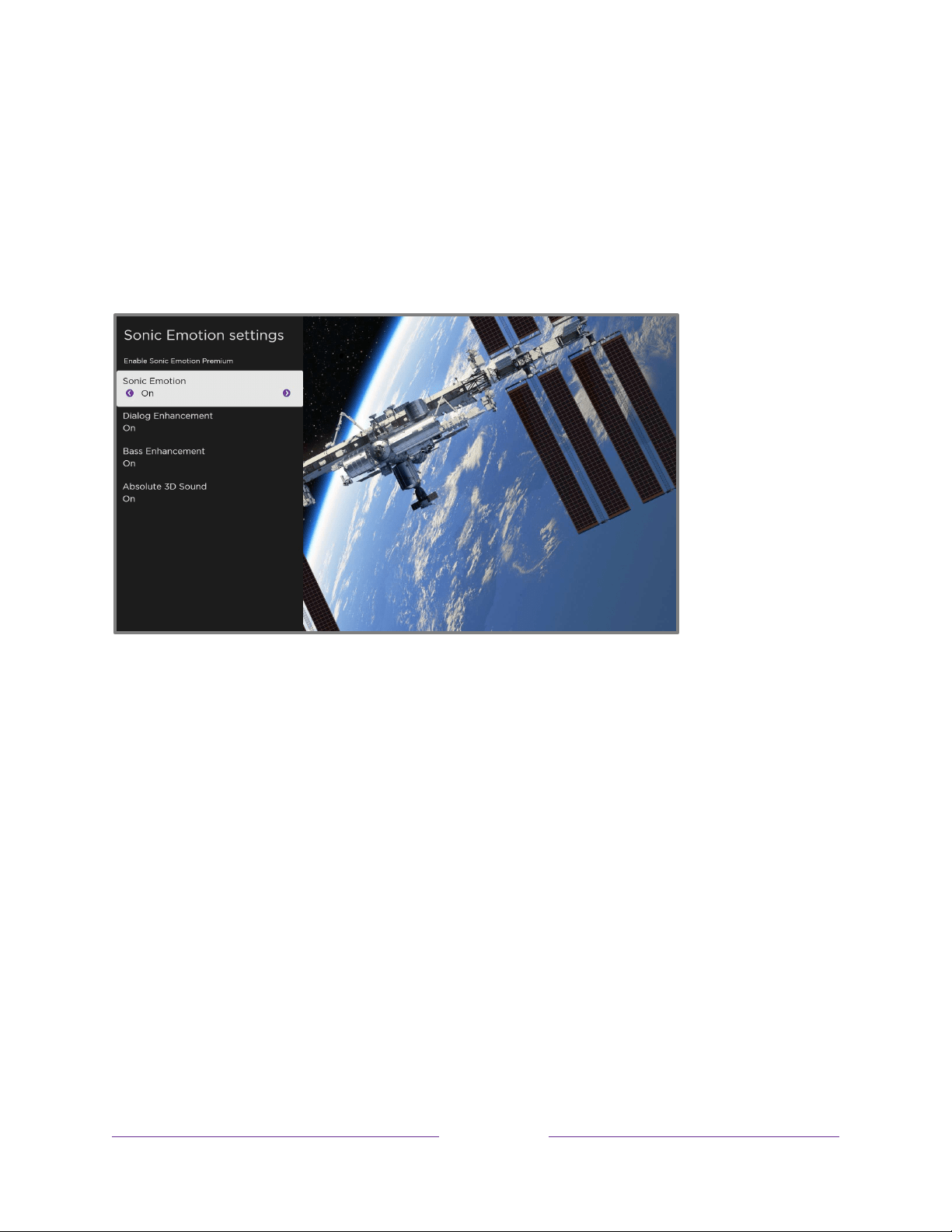
74
• Reset audio settings – Returns Sonic emotion settings to their default settings
for the selected Sound mode.
Sonic Emotion™ settings
When you select Sonic Emotion Premium from the Sound settings menu, these
additional settings become available:
Sonic Emotion settings menu for models with Sonic Emotion™ Premium
• Dialog Enhancement – Enhances your ability to hear and understand dialog in
the programme.
• Bass Enhancement – Enhances the low frequency sound component in the
programme.
• Absolute 3D Sound – Simulates sound from multiple speakers that would
otherwise require installation of a surround sound audio system.
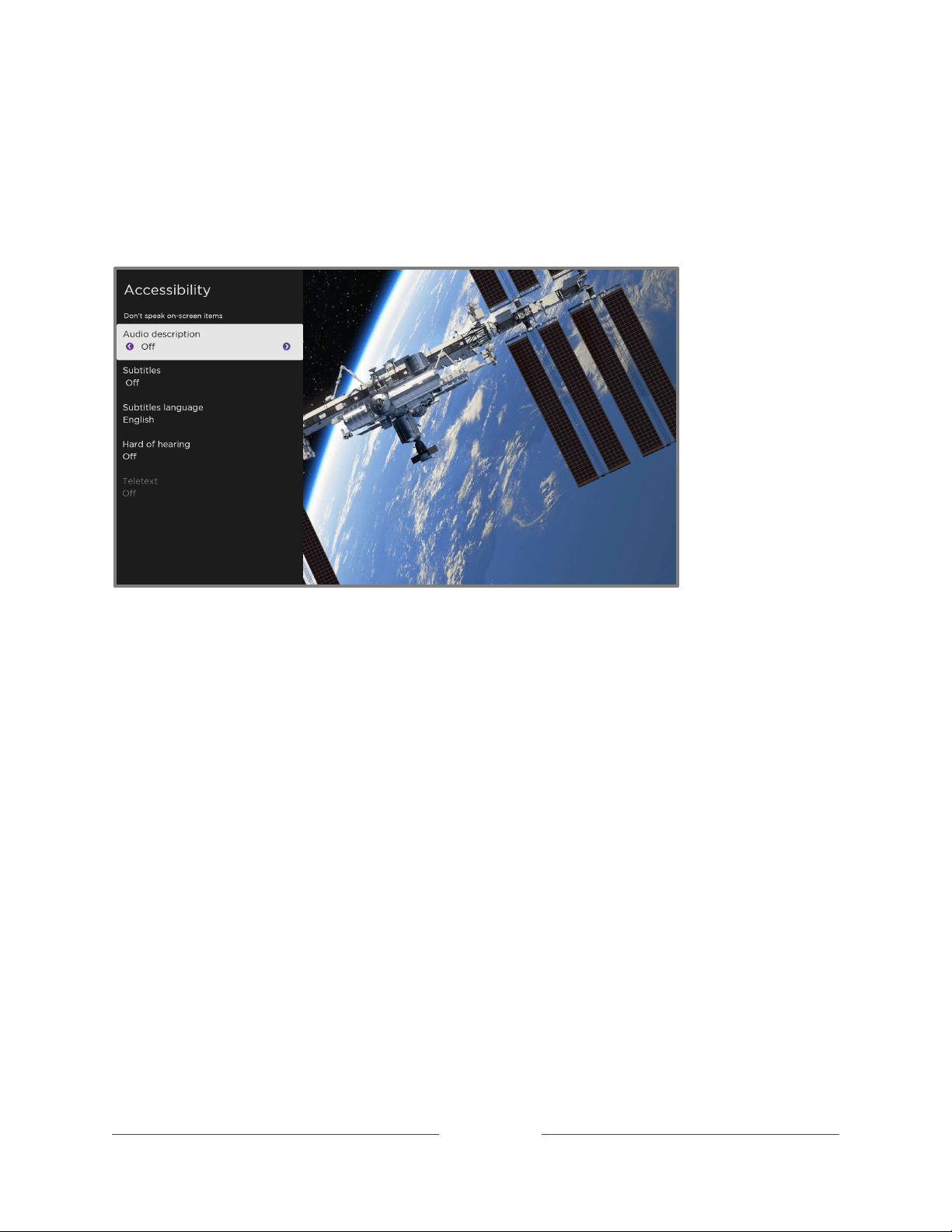
75
Accessibility
Use the Accessibility menu to change accessibility settings without leaving the
programme you are watching. These settings are also available on the Home screen
menu under Settings > Accessibility.
Tip:
Some streaming channels assign the STAR
button to a different function,
meaning it will not open the Options menu. In these cases, use a different channel to
configure accessibility options.
Accessibility menu settings
• Audio description – Enables and controls the volume of descriptive audio
service when available in TV broadcasts. Choose Low, Medium, or High to
enable descriptive audio and set the relative volume accordingly. Choose Off to
disable descriptive audio.

76
• Subtitles – Controls when you see subtitles.
This setting is only offered for Live
TV, the AV input, streaming content, and videos played in the media player.
Any set value remains in effect across only these inputs.
• Live TV – Set subtitles to off, always on, on only when the TV sound is
muted, or on only during instant replay (when Live TV Pause has been
enabled).
• AV input – Set subtitles to off, always on, or on only when the TV sound is
muted.
• Streaming video channel or media player – For streaming content that
provides closed subtitles, set subtitles to off, always on, on only when the
TV sound is muted, or on only during instant replay (for streaming content
that supports instant replay).
Note that some streaming channels have
other methods for turning subtitles on and off. In these cases, the Subtitles
option does not appear on the Options menu.
• Hard of hearing – When enabled, shows descriptions of non-dialog audio
within subtitles.
This setting remains in effect on all inputs that provide
subtitles.
• Teletext – Provides text and graphical news and information in certain markets.
Not available in the UK, so the only option is No service.

77
Changing privacy settings
Note:
Privacy settings are not present on TVs operating in non-connected mode.
Advertising
Roku offers multiple privacy settings related to advertising. To learn more about these
options, please see Roku’s Privacy Policy at
go.roku.com/PrivacyPolicy.
Microphone
Your Roku TV does not have a built-in microphone. However streaming channel
providers can use the microphone on Roku Voice remotes (only on select models) or
on your mobile device when the Roku mobile app is running. You can control whether
streaming channels have permission to use the microphone.
Note:
These settings affect only streaming channel access to the microphone. They
do not affect your Roku TV’s Voice Search feature.
Channel microphone access
You can control which streaming channels have permission to use the microphone,
giving you control over how the microphone is used by each streaming channel. The
default setting is Prompt, so channels will not be able to turn on the microphone
without your permission.
To change microphone access settings:
1. From the Home screen menu, navigate to Settings > Privacy > Microphone.
2. Select Channel microphone access.
3. Choose one of the following settings:
• Prompt – Display a notification the first time a streaming channel requests
the use of the microphone. When such a notification appears, you can
choose either Allow microphone access or Deny microphone access on a
per-channel basis. If you choose to allow microphone access, you’ll be
prompted to confirm your choice by entering a numeric code that appears
on the screen.

78
• Always allow – Do not prompt, but always allow any streaming channel to
use the microphone.
• Never allow – Do not prompt, but never allow any streaming channel to use
the microphone.
Channel permissions
After granting or denying microphone access on a per-channel basis, you can reset
channel permissions to enable them to follow the system-wide setting you specify
under Channel microphone access
.
To reset channel permissions:
1. From the Home screen menu, navigate to Settings > Privacy > Microphone.
2. Select Channel permissions.
3. Highlight Reset channel permissions, or highlight a specific listed channel, and
then press OK to deny microphone access to all or to a specific channel.

79
My Feed
Only in connected mode,
use My Feed to get updates on movies, TV programmes,
and actors that you are following.
You can follow any movie, TV programme, or actor across top streaming channels. To
follow a programme, use the Search feature to find the movie, TV programme, or
name that you want to follow, and then select Follow this movie/TV show/person on
Roku. For more information, see
Searching for something to watch.
Note:
The TV takes a bit of time to update your newly-followed programmes. Until it
finds at least one channel offering the movie, the content banner in My Feed shows
Check back later for updates.
My Feed alerts you any time a movie or TV programme you are following becomes
available on another channel and whenever its price changes. A number in
parentheses next to My Feed in the Home screen menu means that My Feed has
updated information that you haven’t viewed yet. For example, if three of your
followed programmes have updates, you’ll see My Feed (3).
Note:
When a movie or TV programme you are following becomes available, the
streaming channel offering the movie might require that you subscribe or pay a fee to
view it.

80
Searching for something
to watch
Searching for movies and programmes across many popular streaming channels is
one of the unique features of your Roku TV. Within a single search operation, you can
search by:
• Movie name
• TV programme name
• Actor or director name
• Streaming channel name
• Popular quotes, such as “May the Force be with you.”
• Genre, including the special genres, “free” And “4K.”
• Game name
Note:
Roku Search is only available if your TV is operating in connected mode and
linked to a Roku account. Roku Search doesn’t search across all streaming channels,
but searches across lots of popular streaming channels. The actual channels it
searches vary by locale.
How do I search?
You can search in several different ways:
• By using an on-screen keyboard that you navigate using the purple directional
pad on your remote
• By typing on the Roku mobile app on your phone or tablet
• By speaking search phrases in English using, the Roku mobile app, Alexa, or
Google Home Assistant.
For more information about Voice Search, go to
go.roku.com/voicesearch
.

81
Searching with the remote
1. Select Search on the Home screen menu.
2. Use the purple directional pad to navigate the on-screen keyboard, entering a
few characters of the search term.
Each additional character you enter narrows down the search, making the
search results more relevant. You’ll often see the results you are seeking after
entering only a few letters.
3. When you see the programme you are searching for, press RIGHT to highlight
it. Continue pressing RIGHT to see more details about how to watch the
program.
Searching from the Roku mobile app
Use the free Roku mobile app on your compatible smartphone or tablet to make
searching even faster. Use your mobile device’s keypad to type more quickly and
easily than with the on-screen keyboard on your TV. Or, search by touching the Voice
Search icon and saying the name of the movie, TV programme, actor, director, genre,
streaming channel, or game.
When you use the Roku mobile app to search, search results are shown on your
mobile device instead of on the TV screen. When you make a selection from the
search results, the TV starts playing the selected programme.
For more information, see
Roku mobile app
.

82
Searching with Google Assistant
Use your Google Home, Google Pixel phone, or the Google Home mobile app to
search for programs:
1. Link your Roku account to your Google account using the Google Home
mobile app on your iOS or Android device.
2. Start your command with
“Hey Google”
or
“OK Google,”
and follow the
command with
“on Roku.”
Some examples:
•
“Hey Google, show me documentaries on Roku.”
•
“OK Google, show me comedies on Roku.”
Note:
You also can issue commands to control your Roku TV. And, if you have
enabled Fast TV Start on your TV, you can turn on your TV by saying,
“OK Google,
turn on Roku.”
For more information about setting up and using Google Assistant with your Roku TV,
see
https://support.roku.com/article/360009649613-how-do-i-control-my-roku-
streaming-device-with-the-google-assistant-.
Searching with Amazon Alexa
Use your Amazon Echo Dot, Echo Plus, Echo Show, or the Amazon Alexa mobile app
to search for programs:
1. Link your Roku account to your Amazon account using the Amazon Alexa app
on your iOS or Android device.
2. Start your command with
“Alexa,”
and follow the command with
“on Roku.”
Some examples:
•
“Alexa, turn up the volume on Roku.”
•
“Alexa, show me documentaries on Roku.”
Note:
You also can issue commands to control your Roku TV. And, if you have
enabled Fast TV Start on your TV, you can turn on your TV by saying,
“Alexa, turn on
Roku.”
For more information about setting up and using Amazon Alexa with your Roku TV,
see
https://support.roku.com/article/360017961074-how-do-i-use-amazon-alexa-
with-my-roku-streaming-device-.
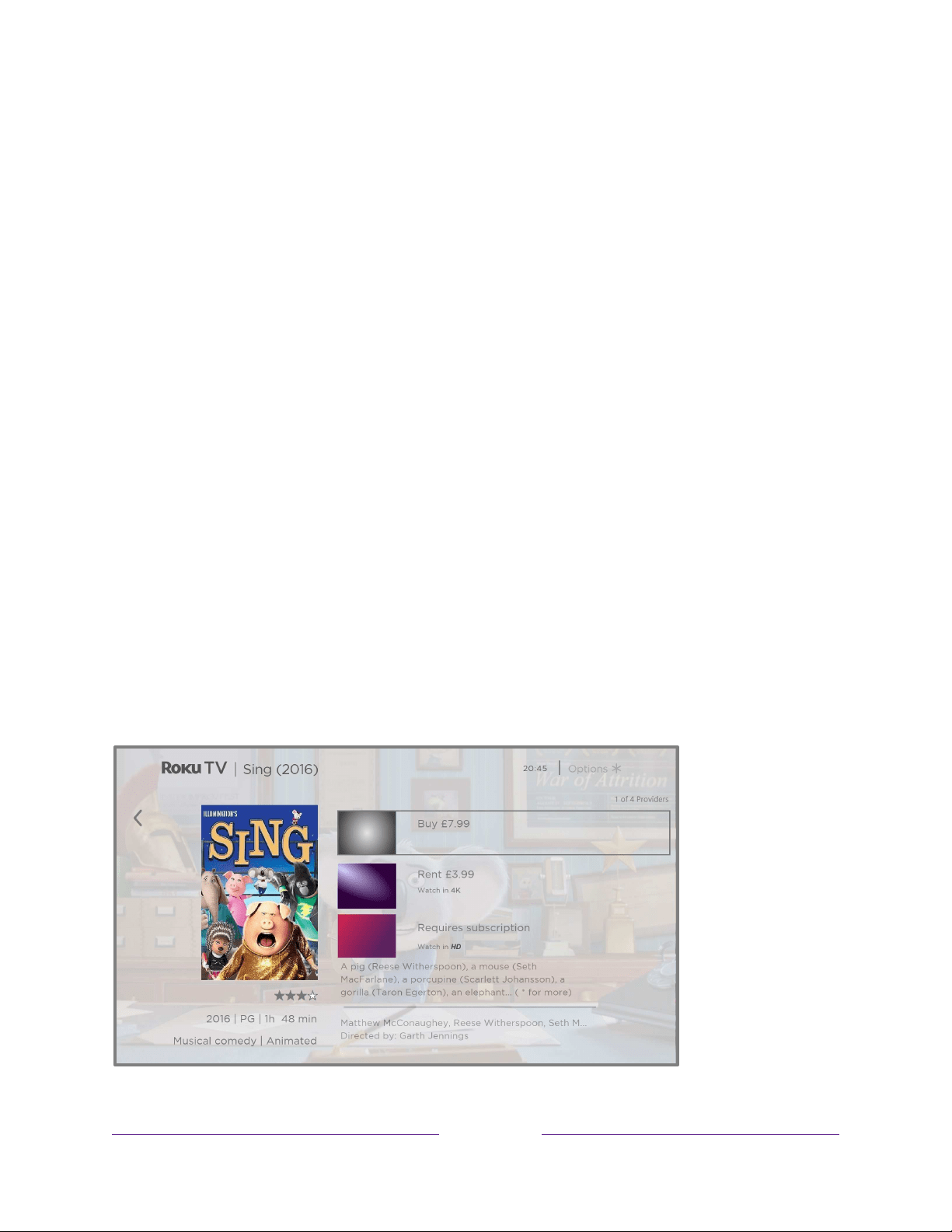
83
Searching for free content
As you’ll discover, there is a lot of content available through your Roku TV, and much
of it is free. You can easily find free content by including the word “free” in your
search. For example:
• Roku mobile app—Say, “Show me free comedies” or “Show me free romance,”
or simply, “Show me free shows.”
• Google Home, Google Pixel phone, or the Google Home mobile app—Say “OK
Google, show me free programs on Roku,” or “Hey Google, show me free
documentaries on Roku.”
• Amazon Alexa—Say “Alexa, show me free miniseries on Roku” or “Alexa, show
me free dramas on Roku.”
I found a programme. Now what?
Now that you’ve highlighted the programme, movie, actor, game, or streaming
channel you were looking for, press RIGHT.
If your search result was an actor, director, or other item that does not represent a
single item of content, you’ll see another list to narrow down your search. Use the
purple directional pad to find and launch the programme you want to watch.

84
If your search result was a game or a streaming channel, you’ll see detailed
information, images, and available actions, such as a list of results and the cost, if any,
of using the item or channel.
Note:
Some channels may require a paid subscription.
Follow on Roku
Rather than watch the programme you found in Search, you can add it to My Feed
and wait until it’s available on a particular streaming channel or available at a better
price. From the search results screen, select Follow on Roku. Then go to My Feed
periodically to check for updates to each of your followed movies, TV programmes, or
people. For more information, see
My Feed
.
Recent Searches
The next time you use Search from the Home screen menu, the Search screen
displays a list of recent search selections in place of the search instructions.
Using the recent search selections list makes it easy to quickly get to a previously
found item, for example, to find another movie with the same actor, or another TV
programme in the same series.

85
Using the Roku Channel
Store
Only in connected mode
, either the Streaming Channels menu option or the Add
Channels shortcut takes you to the Roku Channel Store, where you can add new
subscription based and free streaming channels to your TV.
Tip:
Search for streaming channels by using the Search option, as explained in
Searching for something to watch
. Use Roku Voice Search if you prefer. When you
use Voice Search, if your TV recognizes a channel name, it launches the channel if you
already have installed it. Otherwise, it offers to install it for you. At that point, you can
choose to install or cancel.
To make it easier to find what you want, the streaming channels in the Roku Channel
Store are categorised by topic. Press UP or DOWN to highlight the category you
want, and then press RIGHT to move the highlight into the grid of streaming channel
tiles.
When you find a streaming channel you want to add or learn more about, highlight it
and press OK to display more details.
• If the streaming channel you are adding is free, you can select Go to channel to
start watching it immediately.
• If there is a one-time or recurring fee associated with using the streaming
channel, you must agree to the terms and conditions, accept the fee, and—if
you created one when you activated your Roku TV, enter your Roku PIN code
to authorise the charges.
• If you already have a subscription to the channel—for example, you already
subscribe to Netflix or you receive HBO through a cable TV provider—you must
complete a different, simple authorization step to add the streaming channel.

86
You need only complete the authorization or activation step one time, when you
initially add the streaming channel. After that, you just select the streaming channel
tile from the Home screen to start watching. (Channel and content availability are
subject to change. Charges may apply to your selection.)
Tip:
New streaming channels are added continuously to the Roku Channel Store, so
be sure to check back frequently for new options.
Note:
If you don’t remember your PIN, or if you want to change whether you need to
use a PIN to make purchases on your Roku account, see
Roku account PIN
.
Automatic Account Link
Some subscription channels take advantage of Automatic Account Link. If you have
multiple Roku devices, channels that support this feature require you to supply your
user name and password on only one device.

87
Customising your TV
There are several things you can do to personalise your TV.
Add TV inputs
As you use your TV, you might find that you need to add a TV input tile that you did
not add during Guided Setup. To add a TV input:
1. From the Home screen menu, navigate to Settings > TV inputs. Notice that the
list of inputs is divided into two sections: Inputs being used and Inputs not
used.
2. Press UP or DOWN to highlight an input in the Inputs not used section of the
list.
3. Press RIGHT to move the highlight to Set up input.
4. Press OK to add the input.
5. Press HOME to return to the Home screen. Notice that the input has been
added to the top of the Home screen. If you want to move the input tile to a
different position in the grid, see
Rearrange tiles
.
Add streaming channels
You can add streaming channels by searching in the Roku Channel Store from any of
the following locations:
• Streaming channels option
• Search (including Roku Voice Search)
• Add Channels shortcut
New streaming channels are added to the bottom of the Home screen. If you want to
move the channel tile to a different position in the grid, see
Rearrange tiles
.

88
Hint:
If you have multiple Roku devices, they all show the same set of streaming
channels after their next daily update, unless the channel is not compatible with the
device. So don’t be surprised when you add a channel to your Roku TV and then see
it the next day on your Roku Streaming Stick or Roku Premiere.
Rename inputs
Rather than trying to remember that your Blu-ray™ player is connected to HDMI 1 and
your game console is connected to HDMI 3, you can rename the TV inputs to match
the connected device.
Note:
Renaming an input also changes the icon associated with it.
To rename an input, you can either:
• Highlight the input tile in the Home screen, and then press STAR to display a
list of options. From the list of options, select Rename input. Then select a new
name and icon.
or
• From the Home screen menu, navigate to Settings > TV inputs. On the TV
inputs screen, select the input you want to rename, select Rename, and then
select a new name and icon from the provided list.
Rather than using the predefined names and icons, you can set a custom name and
icon. To do so, scroll up or down to highlight Set custom name & icon, and then press
OK. Follow the instructions on the screen to enter a name and select an icon for the
input.
Press HOME to return to the Home screen. The new name and icon are now in
effect.

89
Remove unwanted tiles
It’s easy to remove unused TV inputs and unwanted channel or app tiles. For example,
if you never use the HDMI 3 input, or if you don’t like the weather app you added from
the Roku Channel Store, you can remove them from your Home screen.
Note:
You also can remove the Live TV tile if you never use the TV tuner. But be
aware that removing the Live TV tile also deletes the channel list. You’ll have to set up
the TV tuner again next time you want to view live TV. Instructions for setting up the
TV tuner can be found in
Setting up live TV
.
• To remove any tile, highlight the input tile in the Home screen, and then press
STAR to display a list of options. From the list of options, select Remove
input. In the screen that follows, confirm you want to remove the input.
• Alternatively, to remove a TV input tile, navigate to Settings > TV inputs. On
the TV inputs screen, select the input you want to remove, and then select
Remove > Confirm. Then press HOME to return to the Home screen.
Rearrange tiles
When you add a TV input tile, it’s added at the top of your Home screen. When you
add a new streaming channel, it’s added at the bottom of your Home screen.
You can easily rearrange the order of the tiles on the Home screen to suit your
viewing preferences. For example, you might want Live TV to be the first tile in your
Home screen. But if you mostly watch one streaming channel, you might want its tile
to be the first one on your Home screen.
1. On the Home screen, highlight one of the tiles you want to move.
2. Press STAR to display a list of options for the type of tile you selected.
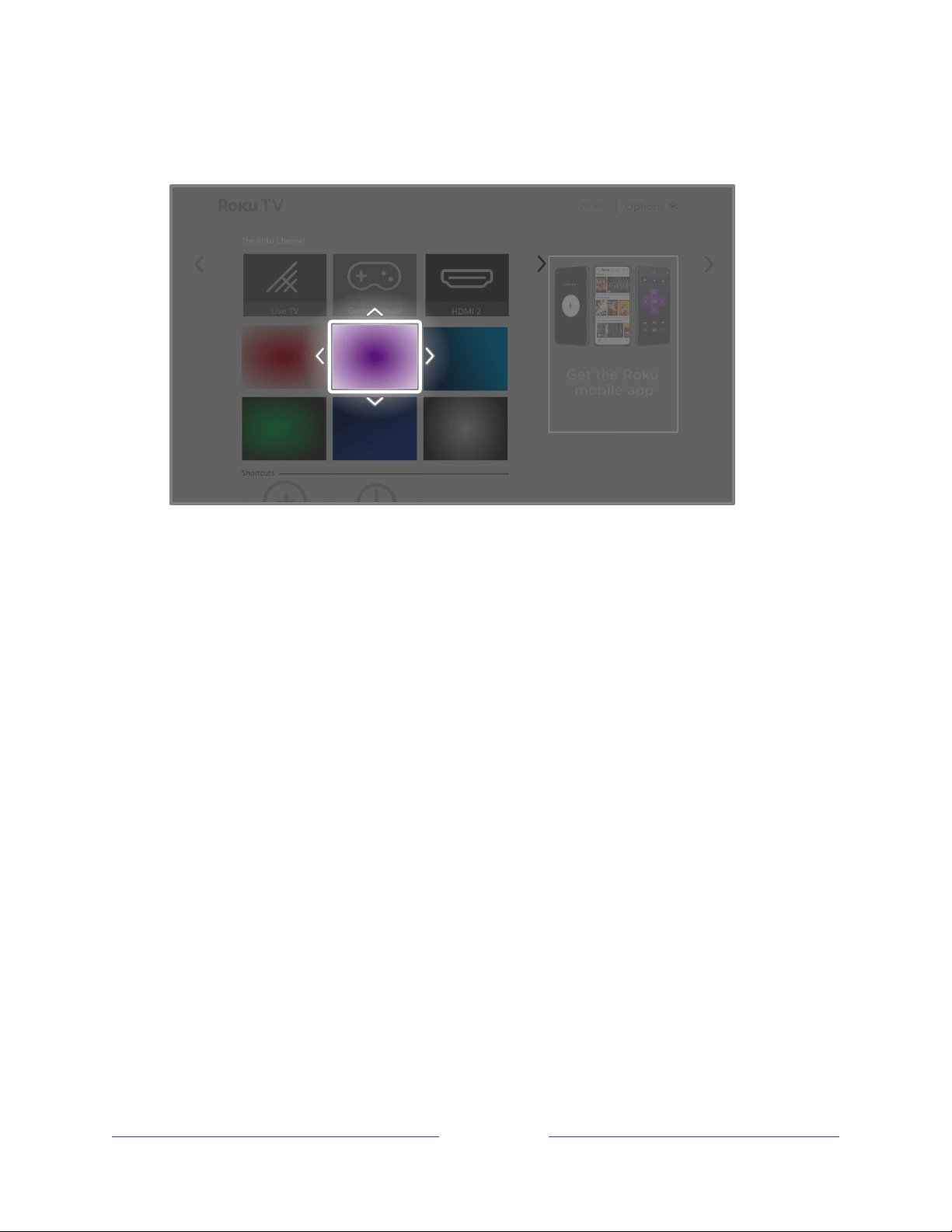
90
3. Select Move input or Move channel. The list of options disappears and the
highlighted tile shows arrows indicating how it can be moved.
Moving a tile on the Home screen (non-connected mode)
Note:
A paid subscription or other payments may be required for some
channels. Channel availability is subject to change and varies by country. Not all
content is available in countries or regions where Roku
®
products are sold.
4. Use the purple directional pad to move the highlighted tile to its new position.
As you move the tile, it pushes other tiles out of its way.
5. Press OK to lock the tile into its new position.
6. Repeat these steps to move other tiles until you have arranged your Home
screen to your liking.

91
Change the look and feel with themes
Only in connected mode
, another way to customise your TV is to change its theme.
The theme establishes the look and feel of the TV through colours, designs, fonts,
wallpaper (background), and screensaver. Some themes require payment.
To change the theme, from the Home screen menu navigate to Settings > Theme. In
the Themes screen, choose from the following options:
• Wallpapers – Select a wallpaper of your choice.
• Screensavers – Select a screensaver of your choice.
• Seasonal themes – Turn seasonal themes on or off. When this feature is on,
Roku overrides your selected theme with a theme of their own choosing for
various holidays and significant events. After the holiday or event passes, the
TV reverts to your selected theme.
• Screensaver wait time – Select the idle time after which you want your
selected screensaver to appear.
• Restore default theme – Every Roku TV has a theme based on the TV brand
and model. Use this option to restore that default theme.
Edit live TV channel line-up
When you set up the TV tuner as described in
Setting up live TV, the TV adds all the
broadcast channels with good signals that it can detect in your area. It’s likely that
you now have more channels than you want in your channel list.
To edit the channel line-up, from the Home screen menu, navigate to Settings > TV
inputs > Live TV > Edit channel lineup. You’ll see a screen listing all of your channels.
Adjacent to the list of channels is a miniature TV screen playing the highlighted
channel’s picture and sound.
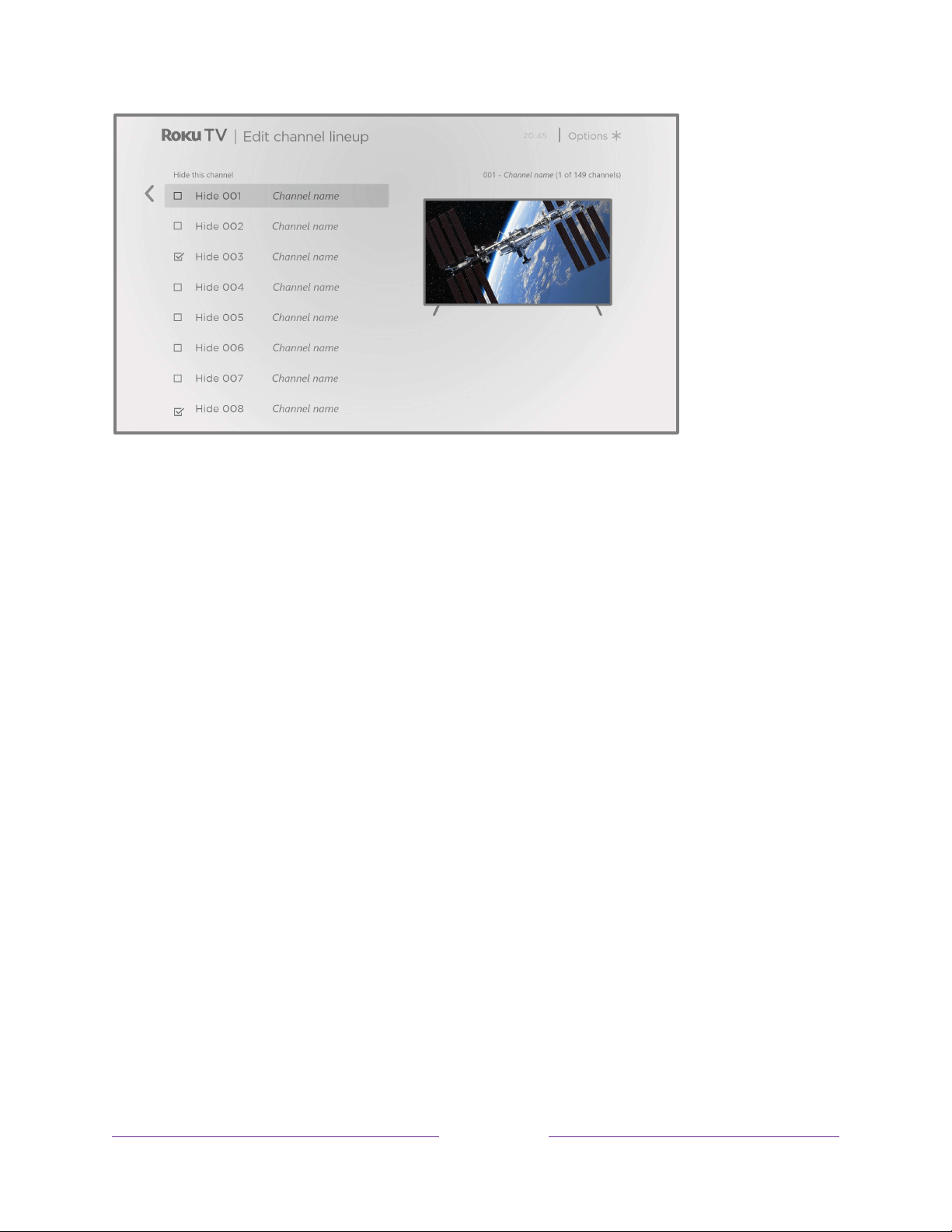
92
For each channel that you want to hide, highlight it, and then press OK to hide the
channel.
Tip:
If you need to see the highlighted channel to decide whether to hide it, wait a
couple of moments for the TV to start playing the channel’s picture and sound. If
you’ve enabled parental controls and the programme on the current channel is
blocked, you won’t see a picture or hear sound while editing the channel line-up.
Note:
Repeating the live TV channel scan unhides all hidden channels.
Change menu volume
Menu sounds are the noises the TV makes to let you know it received your command.
You can change the volume of these menu sounds or turn them off.
To adjust the menu volume, from the Home screen menu, navigate to Settings >
Audio > Menu volume. Navigate to the right and then change the setting to High,
Medium, Low, or Off.
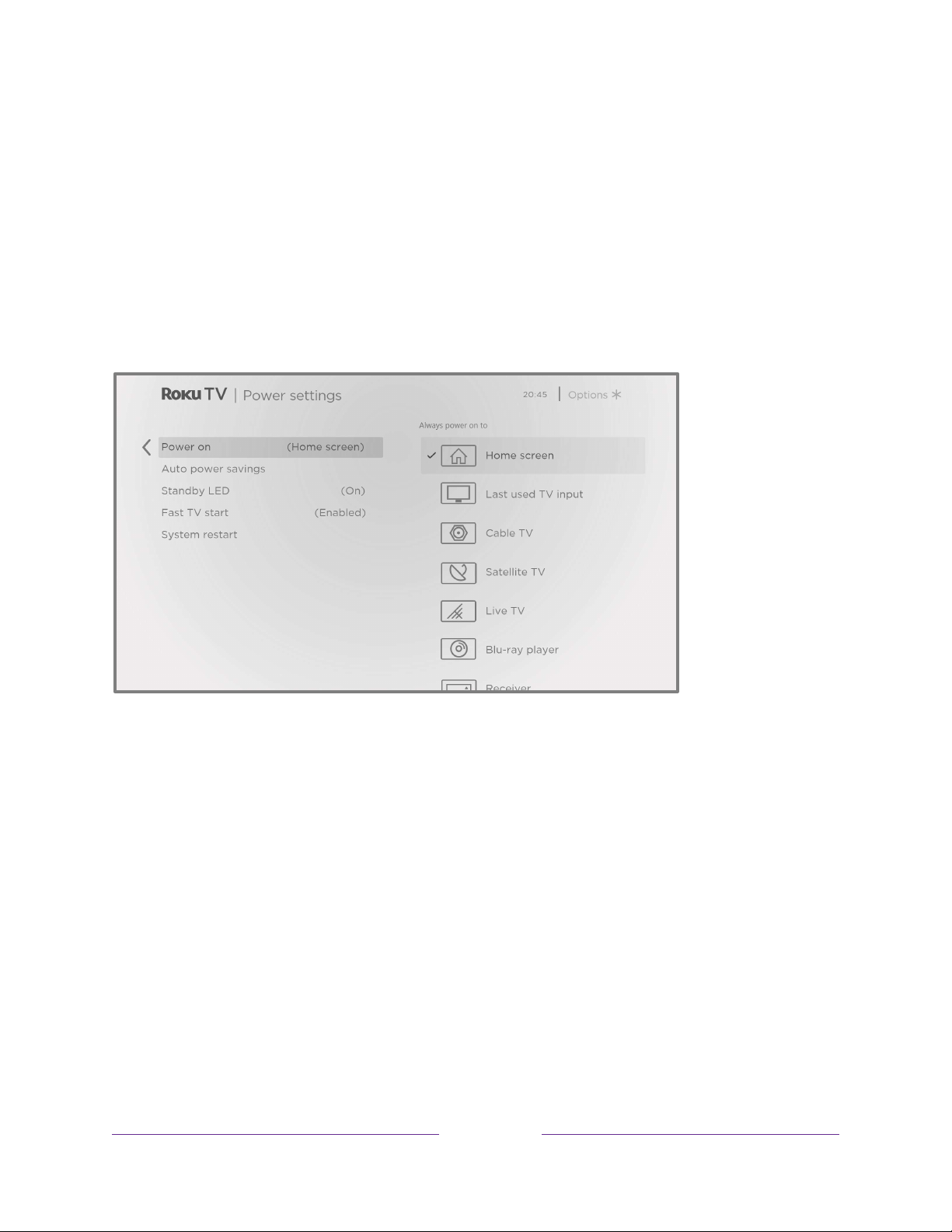
93
Configure power settings
Power settings let you configure features related to how your TV’s power settings
work.
Power on settings
Power on settings tell the TV what to do when you turn on the power. To configure
the power on settings, from the Home screen menu, navigate to Settings > System >
Power > Power on. Highlight the preferred power on location in the list, and then
press OK.
Auto power savings
To help you save energy, your TV can automatically turn itself off after a period of
inactivity or a period during which no signal has been detected. It is factory-
configured to do both of these things, but you can change these settings if needed.
To configure automatic power off, from the Home screen menu navigate to Settings >
System > Power > Auto power savings. In the Power settings screen, highlight the
following options and press OK to turn them on or off:
• Reduce power after 15 minutes – If no video or audio activity and no user
interaction occur for 15 minutes, the TV automatically turns off the screen and
sound.
• Turn off after 4 hours – If no video or audio activity and no user interaction
occur for 4 hours, the TV goes into standby mode.

94
Standby LED On/Off
Normally, the status indicator is lit whenever the TV is in standby mode. If you prefer
the status indicator to not be lit in standby mode, you can turn it off. To do so, from
the Home screen menu, navigate to Settings > System > Power > Standby LED, and
then select Off.
After making this change, the status indicator still performs all other indication
functions.
Fast TV start
Only in connected mode
, you can enable Fast TV start. As you might expect, Fast TV
start lets you start watching your TV almost instantly after turning it on. But it also
enables other convenient features, such as the ability to listen to certain music
channels with the TV screen off and the convenience of being able to turn on and
control your TV using voice commands.
Be aware that enabling Fast TV start makes your TV use somewhat more power
when it is powered off to standby mode.
Configure accessibility
Accessibility settings enable users with vision or hearing impairment to use the TV
more effectively. Accessibility settings are located under Settings > Accessibility.
Audio description
Use the Audio description settings to select whether to hear description of the non-
dialog action in a programme, and to set the volume relative to the TV volume. Audio
description is a service provided in some TV broadcasts that describes what is
happening on the screen, to help users who have low or no vision enjoy programmes.
You can choose from among the following options:
• Off – No audio description.
• Low – Audio description at a low relative volume.
• Medium – Audio description at a medium relative volume.
• High – Audio description at a high relative volume.

95
Subtitles mode
The Subtitles mode settings specify when subtitles appear. Access subtitles settings
from the Home screen menu by selecting Settings > Accessibility > Subtitles mode.
At this point, you can choose among the following options:
• Off – No subtitles appear.
• On always– Subtitles appear whenever they are available from the programme
source.
• On replay– Subtitles appear, when available, only when you use the replay
feature, and only when you are watching a streaming programme that supports
instant replay, watching a video through the Roku or USB media player, or
watching a TV channel after enabling Live TV Pause.
• On mute – Subtitles appear, when available, only when the TV is muted.
Tips:
•
You can change the subtitles mode while watching a programme. Press
STAR
to display the Options menu, and then select Subtitles.
•
Some streaming channels require you to enable subtitles through a setting
within their channel even though you have turned on subtitles in the TV
settings.
Note:
Once enabled, the selected subtitles mode applies to all inputs that support
subtitles and remains enabled until you turn it off.
Subtitles language
Use the Subtitles language to select the language in which you want subtitles to
appear, when that language is available in the programme you are watching. If your
preferred language is not available, then subtitles revert to the default language for
the programme, which usually is English.
Access subtitles language settings from the Home screen menu by selecting
Settings > Accessibility > Subtitles language. Highlight the language you prefer, and
then press OK to select it.

96
Hard of hearing
For programmes that display subtitles, the Hard of hearing setting enables
description of non-dialog audio within the subtitles, helping those with hearing
impairment to enjoy the programme.
Access the hard of hearing setting from the Home screen menu by selecting
Settings > Accessibility > Hard of hearing. Choose On or Off.
Hide Home screen shortcuts
If you prefer to not see the shortcut tiles on the Home screen, you can hide them.
To hide Shortcuts:
1. From the Home Screen menu, navigate to Settings > Home screen, and then
press RIGHT.
2. Select Shortcuts.
3. Highlight Hide, and then press OK.

97
Parental controls
Parental controls
1
enable you to control whether the members of your household can
view certain channels. When a channel is blocked, you can unblock it by entering a
parental control PIN that only you know.
Note:
Parental controls block content from the TV tuner. Parental controls do not
block content on other TV inputs or content from streaming channels you add to your
TV.
Creating a parental control PIN
The first time you access the Parental controls screen, you must create a new
parental control PIN. Thereafter, whenever you want to change parental control
settings, unblock programming that has been blocked, change the PIN, or disable
parental controls, you must enter your parental control PIN.
Tip:
Your parental control PIN has no connection to your Roku account PIN. You can
make them the same if you want—this is entirely your choice.
To create a new parental control PIN, from the Home screen menu navigate to
Settings > Parental controls. The screen displays a numeric keypad. Use the purple
directional pad or channel number buttons to enter a four-digit code, and then press
OK. Repeat the process to enter the same PIN again, just to make sure you correctly
entered the PIN you want to use.
Important:
If you forget your parental control PIN, the only way to recover is to
perform a factory reset operation, as explained in
Factory reset everything
.
1 May not be available in all countries where Roku TVs are sold.

98
Blocking TV channels
Only on select models:
Parents can configure parental controls to block specific TV
channels that they don’t want other family members to view.
Enabling parental control of TV programmes
The first step in blocking TV programmes is to enable parental controls.
This setting is provided separately to make it easier for you to unblock all blocked
channels without requiring you to unblock them individually, per channel. For
example, your kids are going to summer camp for two weeks, and while they are
gone, you don’t want to have to deal with unblocking channels that you want to
watch by entering your parental control PIN each time. All you need to do is clear
Enable parental controls, and all TV channels are unblocked. When the kids return,
select Enable parental controls again, and all of your previously-blocked channels are
restored in a single operation.
To enable parental controls:
1. From the Home screen menu, navigate to Settings > Parental controls, and
then enter your parental control PIN.
2. In the Parental controls screen, navigate to TV tuner > Enable parental
controls.
3. Make sure the word (On) appears next to Enable parental controls. If not,
press OK to toggle the setting.
Blocking channels
You can block any channel you deem inappropriate for yourself or other members of
your family.
To block TV channels:
1. From the Home screen menu, navigate to Settings > Parental controls, and
then enter your parental control PIN.
2. In the Parental controls screen, navigate to TV tuner > Select channels to
block.
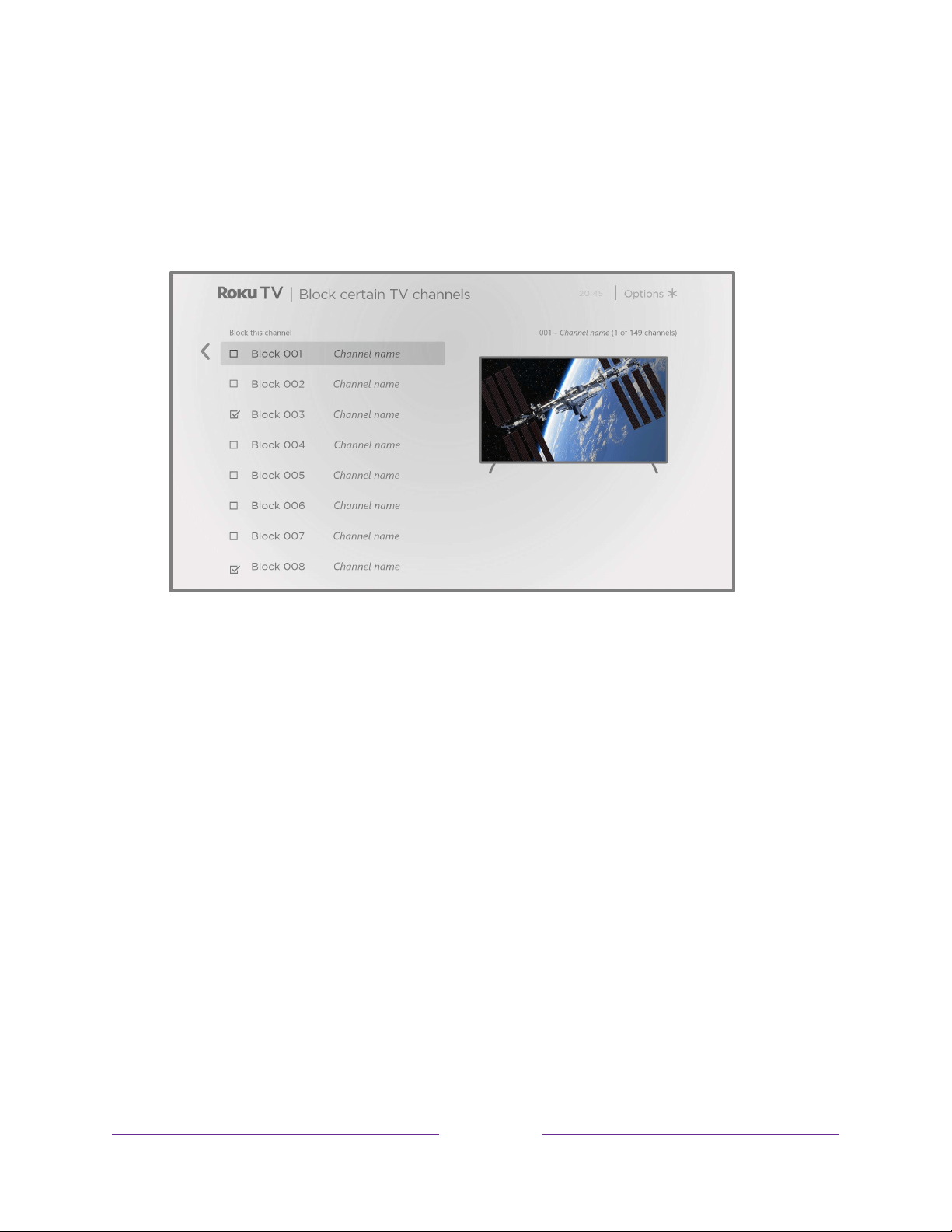
99
3. Make sure that Enable parental controls shows (On).
4. Press RIGHT to highlight the first channel in the channel list.
5. Press DOWN or UP to highlight an individual channel, and then press OK to
toggle blocking. A channel is blocked when it has a check mark next to it.
Tip:
To help you determine which channels to block, pause for a moment while
highlighting channels. A miniature picture of the channel appears on the right,
and its sound plays.
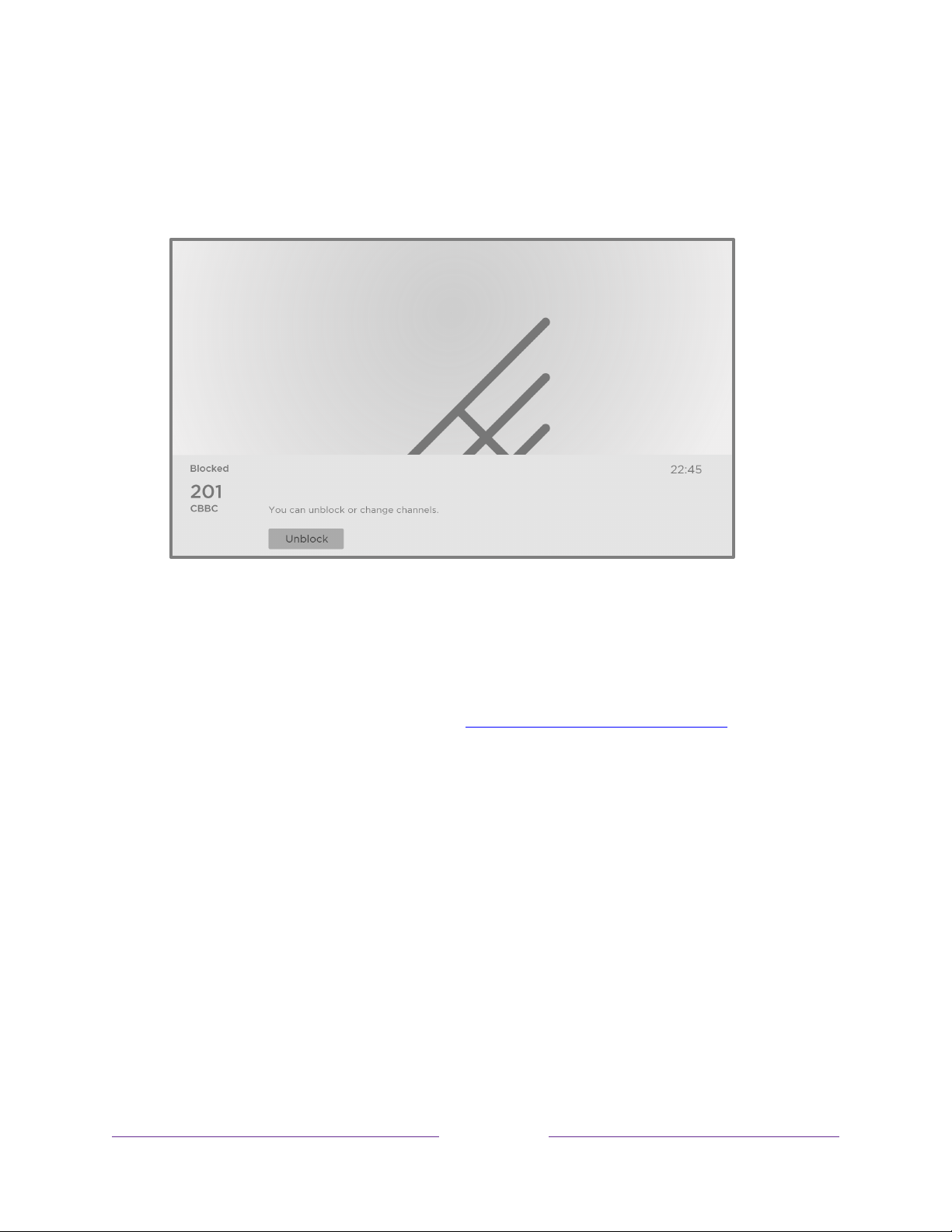
100
What happens when a TV programme is blocked?
When a channel is blocked by parental control settings, the TV displays a blocked
message:
Whenever this blocked message appears, both the video and audio of the programme
are blocked, as well as programme information that would normally appear in the area
at the bottom of the screen.
To watch the blocked programme, you need to know the PIN code defined when you
enabled parental controls, as explained in
Creating a parental control PIN
.
1. Press OK to select Unblock and display a PIN pad.
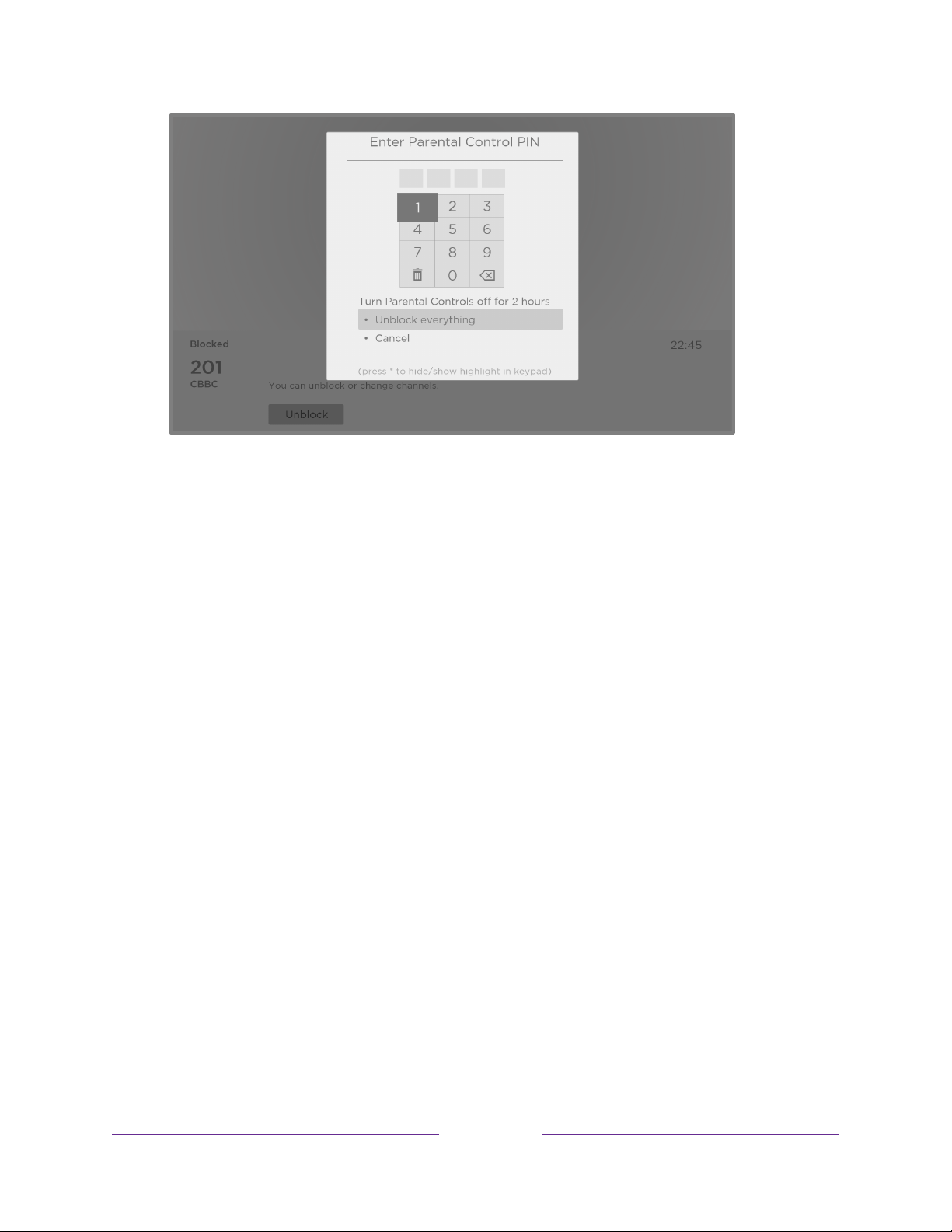
101
2. Use the purple direction pad or the number keys or channel number buttons to
enter your parental control PIN code, and then press OK to select Unblock
everything.
Tip:
To shield your parental control PIN from others in the room, press STAR
to
hide the highlighted number. When you hide the highlight, you will have to count key
presses to keep track of which number is selected.
After unblocking programmes that have been blocked, all blocking is disabled for two
hours or until you turn off the TV.

102
Changing the parental control PIN
To change your parental control PIN:
1. From the Home screen menu, navigate to Settings > Parental controls, and
then enter your parental control PIN.
2. In the Parental controls screen, highlight Change PIN.
3. Move the highlight into the adjacent keypad. Use the purple directional pad or
the channel number keys to enter a four-digit code, and then press OK. Then
repeat the process to enter the same PIN again, just to make sure you correctly
entered the PIN you want to use.
Resetting parental controls
So now your kids have grown up and gone away to college, and you no longer want
to deal with blocked channels.
To erase all parental control settings:
1. From the Home screen menu, navigate to Settings > Parental controls, and
then enter your parental control PIN.
2. In the Parental controls screen, highlight Reset parental controls.
3. Follow the instructions on the screen to confirm that you want to erase all
parental control settings.
Tip:
Resetting parental controls also erases your parental control PIN.

103
More settings
This section describes the features and settings of the TV that were not covered in
the other parts of this guide.
Guest Mode
Only in connected mode
, when you enable Guest Mode, your guests can sign in to
subscription channels using their own account credentials instead of using yours.
Your guests’ credentials are then automatically removed on the date they specify.
By enabling Guest Mode, your guests won’t have access to your personal streaming
channel accounts and won’t be able use your Roku account to make purchases.
Instead, your guests can safely access their own subscription channels. And they
won’t have to remember to sign out before they leave.
To enable Guest Mode:
1. From the Home screen menu, navigate to Settings > System > Guest Mode.
2. Select Enter Guest Mode.
3. Use the purple directional pad or channel number buttons to enter your Roku
account PIN in the on-screen keypad.
4. Select OK to confirm and put the TV into Guest Mode.
Note:
You also can enable and disable Guest Mode remotely by going to
http://my.roku.com on your computer or smart phone, logging in to your account,
scrolling down to My linked devices, and then selecting Enable Guest Mode or
Disable Guest Mode, respectively.
After you put your TV into Guest Mode, it is ready to welcome your guests, allowing
them to select a sign-out date. On the home screen, they will find an assortment of
default subscription channels They can enjoy free content from The Roku Channel
and many others, or sign-in and watch movies and TV programmes from their own

104
subscriptions and saved content libraries. Your guests can use the Roku Channel
Store to find and add channels they watch at home with confidence that they
automatically will be removed on their sign-out date.
For more information about the experience your guests will have when Guest Mode is
enabled, see:
https://support.roku.com/article/360015612834--how-do-i-set-up-auto-sign-out-
mode-for-my-guests-
To disable Guest Mode:
1. Press HOME to return to the Home screen menu.
2. Navigate to Settings > System > Guest Mode.
3. Select Exit Guest Mode.
4. Use the purple directional pad or the channel number buttons to enter your
Roku account PIN in the on-screen keypad.
5. Select OK and confirm that you want to disable Guest Mode.
After you disable Guest Mode, all of your original settings are restored and your
channels are reinstalled. You might need to sign in to your subscription channels
again to access your content.
Note:
Any game data that was stored on your Roku device is not restored.
Network settings
If needed, you can change your network settings at any time. For example, if you
change the name of your wireless network (its SSID) or its password, you will need to
change your TV’s settings so that it can continue to connect. Also, if you decided not
to connect to the Internet in
Guided Setup
, you can use network settings to connect
at a later time.
To change network settings, from the Home screen menu, navigate to Settings >
Network, and then press RIGHT. At this point, you can choose from among the
following options:

105
• About – Lists important information about your current network connection,
such as status, connection type, IP addresses, and MAC address. This
information is often useful when contacting customer support with connection
issues.
• Check connection – Select your existing network connection type, and then
press OK to start checking the network connection. The TV uses your current
network information to reconfirm the wireless or wired network connection to
the local network and the Internet connection.
• Set up connection – Select a network connection type, and then select the
option to set up a new connection. Follow the on-screen instructions to
complete the network connection. For help with each of the steps, see
Network
connection.
• Bandwidth saver – Enable or disable this feature as appropriate. If On, your TV
prompts you to stop streaming if you haven’t used the remote control within
the past four hours. If you do not respond, streaming stops to save your data
allocation and increase the network bandwidth available to other devices in
your home. Change to Off to disable the automatic bandwidth saving feature.
Note:
Some networks, such as those found in school halls of residence, hotels, and
other public places, may require you to read and agree to terms, enter a code, or
provide identifying information before letting you connect to the Internet. For
more information, see
Using your TV on a restricted public network
.

106
Time settings
You can change time settings to suit your preferences. You can find the following
settings by navigating from the Home screen menu to Settings > System > Time:
• Sleep timer – Set a time delay after which the TV will automatically shut off.
This setting reflects the setting you can make in the Options menu from any TV
input, as explained in
Options menu settings
.
Note that the sleep timer setting
is not input specific, and also can be set by using the Sleep timer shortcut in
the Home screen grid.
• Time zone – Correct time zone information is needed to correctly display
programme data. Choose whether to set the time zone automatically or
manually, and if set manually, select your current time zone. Usually, a TV
connected to the Internet can discover its own time zone automatically, but
sometimes a TV that is not connected to the Internet cannot and so must be
set manually. Initially, this setting is made when you set up the TV tuner, as
explained in
Setting up live TV
.
• Clock format – Select whether to display time in a 12-hour or 24-hour format,
or to turn off time display.
Scan again for live TV channels
There will be times when you need to create a new channel list. For example, you:
• Reorient your TV aerial
• Move to a different city with different channels
Whenever you need to update your TV channel list, you can repeat the channel scan.
Tip:
Even if you don’t change anything related to your TV channel reception, you
should repeat the channel scan from time to time to make sure you are receiving all of
the latest channels. Broadcasters add and remove channels, move channels to
different parts of the spectrum, and change the power levels of their channels
periodically.

107
To repeat the channel scan, from the Home screen menu, navigate to Settings > TV
inputs > Live TV > Scan for channels. Then choose one of the following:
• Scan for channels – Erases your current channel list and region/subregion
selections, if applicable. Use this option if you move to a new location with
different channels.
• Rescan for channels – Erases your current channel list but keeps your existing
region/subregion selections, if applicable. Use this option to find new channels
that may have been added since your last channel scan.
For details on the channel scan process, see
How do I set up the TV tuner?
HDMI
®
mode (4K models only)
On 4K (UHD) TVs, you can independently configure each HDMI input to match the
capabilities of the connected device. From the Home screen menu, navigate to
Settings > TV inputs, and then select an enabled HDMI input. Next, select HDMI mode
and then select one of the following settings:
• Auto – Let the TV determine the best setting. Use this option unless your
HDMI
®
device does not correctly communicate its HDMI
®
version information.
• HDMI 1.4 – Configure the input for compatibility with HDMI
®
version 1.4, which
supports a maximum refresh rate of 30 Hz at full UHD resolution. Most HDMI
®
devices will work correctly with the TV in this mode.
• HDMI 2.0 – Configure the input for compatibility with HDMI
®
version 2.0, which
supports a maximum refresh rate of 60 Hz at full UHD resolution. You must use
this mode to view HDR content from the device connected to this HDMI input.
However, note that many older HDMI
®
devices do not work correctly when the
TV’s HDMI input is set to this mode.

108
Control by mobile apps
You can choose the level of control you want to allow your TV to accept from
external devices, such as smart phones, tablets, and virtual assistants. Device connect
settings enable other devices, including the Roku mobile app, to control your TV over
the local area network in your home.
To adjust the level of external control access:
1. From the Home screen menu, navigate to Settings > System > Advanced
system settings > Control by mobile apps.
2. Select Network access.
3. Select one of the following settings:
• Default – Devices can connect only through a private network address, and
accept commands only from other private network addresses on your
home network. This setting is suitable for most cases, including use of the
Roku mobile app on your smartphone.
• Permissive – Devices can connect under all conditions, but accept
commands only from private network addresses or the same subnetwork
within your home network. This setting might be required when attempting
to operate the TV from a third-party application, for example, one of the
Internet of Things (IoT) applications such as ifttt.com.
• Disabled – Device connection is completely disabled. The TV does not
accept external commands from any source, including the Roku mobile app.

109
Home theatre configuration
Your TV has several features that make it an ideal TV for a home theatre. But you
might not notice them because they remain in the background until you decide to use
them.
Turning off the TV speakers for home theatre use
You can turn off the TV’s built-in speakers if desired, by changing the setting under
Settings > Audio > Speakers and change the setting. However, if you use an HDMI
ARC or HDMI eARC connection with CEC enabled, the TV automatically mutes its
internal speakers when it sends sound to an external device. It also mutes all sound
when you use the headphone jack on the TV, private listening through the Roku
Enhanced Remote Control or the Roku mobile app.
Setting up a digital audio connection
To take advantage of your TV’s advanced audio capabilities, connect it to an external
amplifier, receiver, or soundbar by using either of these two digital audio connections:
• HDMI ARC or eARC – The HDMI
®
Audio Return Channel (ARC) or
on
select TVs only
, the HDMI Enhanced ARC (eARC) connector enables
the TV to output digital audio on one of its HDMI
®
connectors. The
connected amplifier then can function simultaneously as an input source to the
TV, if needed, without the need to use additional cables.
To use the ARC or eARC capability, you must connect an HDMI
®
cable from
your amplifier’s HDMI
®
ARC or eARC connector to the HDMI ARC or HDMI
eARC connector on the TV. You also must:
• Be sure your HDMI
®
cable is certified by HDMI
®
.
• Enable HDMI ARC under Settings > System > Control other devices (CEC),
as explained in
Enable HDMI
®
ARC
.
• S/PDIF optical – The S/PDIF optical connector outputs a digital
audio signal. To use the optical output, connect a TOSLINK optical
cable from the amplifier to the Optical or SPDIF connector on the
TV.

110
Important:
To make sure the S/PDIF outputs audio reliably, you must turn off
the TV’s speakers. To do so, from the Home screen menu, navigate to
Settings > Audio > Speakers and change the setting to Off.
Note:
Dolby Audio™ support for Dolby Digital Plus™ format is not available
through the S/PDIF optical output. This format is only available through the
HDMI ARC connection.
Tip:
Even when you use S/PDIF for audio, the TV can correctly detect more
audio formats if you connect an HDMI
®
cable between the TV’s HDMI ARC or
HDMI eARC port and the receiver’s ARC or eARC port.
Choosing an audio format
After making the required HDMI
®
ARC, eARC, or S/PDIF optical connection, go to
Settings > Audio > S/PDIF and ARC option and select the audio format to use.
Choosing Auto detect is the easy solution, and generally provides good results.
However, if you have a high-end sound system and want to make sure you are getting
the best sound quality available in the programs you are watching, you can choose
another setting.
• Auto detect – Automatically detects the incoming audio format and
transcodes it to a compatible available format for the audio output (ARC,
eARC, or S/PDIF).
• Auto passthrough – Passes through the input audio to the connected receiver
without transcoding, sometimes resulting in better audio quality especially for
high-end audio formats such as those that take advantage of the higher
bandwidth of eARC, including Dolby MAT and Dolby Digital Plus 7.1, among
others.
• PCM-Stereo – Always outputs pulse-code modulated stereo, regardless of
input audio format.
• Dolby Digital – Converts all input formats to Dolby Digital.
• Dolby Digital Plus – Converts all input formats to Dolby Digital Plus.

111
• Dolby Digital – DTS – Converts all inputs except DTS to Dolby Digital. If DTS is
detected and the receiver supports DTS, passes through the DTS audio without
modification.
• Dolby Digital Plus – DTS – Converts all input formats except DTS to Dolby
Digital Plus. If DTS is detected and the receiver supports DTS, passes through
the DTS audio without modification.
Note:
DTS audio formats are meant to be used with ARC, eARC, or S/PDIF
connections to a DTS-capable home theatre receiver. If you use one of the DTS
options with the TV speakers, you might not hear any audio.
Turning off the TV screen while listening to music
Certain music channels enable you to turn off the TV screen while streaming music to
your TV speakers, soundbar, or home theatre receiver.
To turn off the TV screen on supported channels:
1. Press STAR to display the Options menu.
2. Press DOWN to highlight Turn off display.
3. Press OK.
Note:
This feature is available only on select streaming audio channels, and only when
the TV is operating in connected mode with Fast TV Start enabled. To enable Fast TV
Start, from the Home screen menu, navigate to Settings > System > Power.
Controlling other devices through CEC
Consumer Electronics Control (CEC) enables your TV and other CEC-compatible
home entertainment devices to control one another in various ways. First, the CEC-
compatible devices must “discover” one another and report their capabilities. After
this, one device can control another according to the features you enable. For
example, playing a disc on a Blu-ray™ player could switch the TV to the Blu-ray™
player’s input. Or, powering off the TV could also power off the Blu-ray™ player and
the home theatre receiver.

112
Discover connected CEC devices
To discover CEC devices:
1. Make sure that your CEC-compatible devices are connected to the TV with a
suitable certified HDMI
®
Cable that supports HDMI
®
ARC and CEC control.
2. Turn on each device and make sure all devices are CEC enabled.
Tip:
Some manufacturers have their own branded names for CEC functionality,
so you might need to read the product documentation to correctly identify the
CEC features of the device.
3. On the TV’s Home screen menu, navigate to Settings > System > Control other
devices (CEC) and then select Search for CEC devices. Press OK to repeat the
discovery process, if necessary.
When finished, the TV displays a list of CEC devices that are connected to each HDMI
input, as well as any devices that had previously been connected. The TV remembers
the names of multiple CEC devices even when they are no longer connected. If the list
is longer than the allowed space, press STAR to see a complete list in a scrollable
window.
Enable HDMI
®
ARC or eARC
HDMI
®
ARC, or
on selected TVs
, eARC, is the audio return channel that is available on
one of the TV’s HDMI ports. The audio return channel enables you to send Dolby
Audio™ content or DTS audio content back to a home theatre receiver that is also
sending an audio and video signal into the TV. Using HDMI
®
ARC or eARC reduces the
number of cables needed and controls the volume and mute state of the receiver.
HDMI
®
ARC or eARC is disabled by default. To enable it, in the Home screen menu,
navigate to Settings > System > Control other devices (CEC), and then highlight
HDMI ARC.
Note:
Enabling HDMI ARC also enables System audio control. After enabling HDMI
ARC, you can disable System audio control if you prefer.

113
Enable 1-touch play
1-touch play enables a device to control which TV input is active. For example,
pressing Play on your Blu-ray™ player switches the TV to the Blu-ray™ input.
1-touch play is disabled by default. To enable 1-touch play, from the Home screen
menu, navigate to Settings > System > Control other devices (CEC) and highlight 1-
touch play. Press OK to enable or disable the feature.
Enable system standby
The system standby feature causes other devices to power off when you power off
your TV. Depending on the CEC System Standby implementation, it also might enable
connected devices to power off your TV when you power off the device.
System standby is disabled by default. To enable system standby, in the Home screen
menu, navigate to Settings > System > Control other devices (CEC) and highlight
System standby. Press OK to enable or disable the feature.
Restart the TV
You can restart the TV when necessary. Restarting has the same effect as unplugging
the TV power and then plugging it in again.
To restart the TV, navigate to Settings > System > Power, and then select System
restart. Highlight Restart, and then press OK to confirm restart.
While the TV restarts, the screen goes dark for a few seconds, and then displays the
start-up screen for a few more seconds. When the restart operation completes, the
TV displays the activity you selected in
Power on settings.

114
Reset the TV
You can choose to reset only the TV picture and audio settings to their original
values, or perform a full factory reset to return the TV to the state it was in when you
first unpacked and turned it on.
Reset audio/video settings
To reset only the TV picture and audio settings to their original values, navigate to
Settings > System > Advanced system settings > Factory reset, and then highlight
Reset TV audio/video settings. Read the information on the screen to make sure you
understand what the reset operation does.
To proceed with the reset operation, press PLAY/PAUSE three times in a row.
Factory reset everything
A full factory reset returns the TV’s settings to their original state and removes all
personally identifiable information from the TV. When finished, you must repeat
Guided Setup, reconnecting to the Internet, re-linking your Roku account, and
reloading any streaming channels. You also must repeat live TV setup and input
configuration.
Factory reset is the recommended choice if you want to transfer the TV to another
owner, and it is the only choice if you want to switch from Shop mode to Home mode
(if you inadvertently selected Shop mode during Guided Setup).
To perform a factory reset, navigate to Settings > System > Advanced system
settings > Factory reset, and then highlight Factory reset everything. Read the
information on the screen to make sure you understand what this reset operation
does.
To proceed with the full factory reset, use the on-screen number pad to enter the
code displayed on the screen, and then select OK to proceed.
When the factory reset operation completes, the TV restarts and displays the first
Guided Setup screen.

115
What if I can’t access the Factory Reset option?
It is possible for your TV to get into a state where you cannot access the various
menus, including the menu option that lets you perform a factory reset operation. If
that happens, you can force the TV to reset by following these steps.
1. Using a straightened paper clip or ball-point pen, press and hold the recessed
RESET button on the TV connector panel.
2. Continue to hold the RESET button for approximately 12 seconds.
When the reset cycle completes, the status indicator comes on dim.
3. Release the RESET button. The TV is now powered off.
4. Turn on the TV and proceed through Guided Setup. See
Guided Setup
.
Network connection reset
If you want to remove your network connection information without disturbing other
settings, navigate from the Home screen menu to Settings > System > Advanced
system settings > Network connection reset, and then select Reset connection.
When you select this option, the TV removes your wireless network information,
including the name of the connection (its SSID) and your wireless password, if any,
and then it restarts. After restarting, your TV retains all of its other settings and its
association with your Roku account.
After resetting your network connection, navigate from the Home screen menu to
Settings > Network > Set up new connection to set up your network connection and
enjoy all of the benefits of your connected TV.
Roku account PIN
When you created your Roku account, you were given the opportunity to create a
PIN code and to specify when it must be used. Roku lets you optionally require that
users enter your PIN as an additional verification method when making purchases
through the TV or adding items from the Roku Channel Store. In addition, you must
have a Roku account PIN before you can enable or disable Guest Mode.

116
If you created a Roku account PIN and want to change it, or you don’t remember your
PIN, or if you didn’t create a Roku account PIN and want to add one, you can easily
make these changes.
1. On a computer, tablet, or smartphone, use your web browser to go to
https://my.roku.com and sign in.
After signing in, the My account page appears.
2. Under PIN preference, click Update to open the Choose your PIN preferences
page.
3. Skip this step if you just want to change your PIN. Otherwise, choose the
option you prefer from among those listed:
• Require a PIN to make purchases or to add any item from the Channel
Store.
• Require a PIN to make purchases.
• Do not require a PIN to make purchases.
4. If you choose either of the first two options, enter your PIN twice in the
appropriate boxes.
5. Click Save Changes to save your changes and return to the My Account page.
Note that your current setting is described under PIN preference.
Update the TV
If your TV is operating in connected mode, it will automatically get updates from time
to time. You don’t need to do anything. But if you are aware that an update is
available and you don’t want to wait until the TV updates itself, you can manually
check for updates.
If your TV is operating in non-connected mode, you can still get updates by using a
USB flash drive.

117
You can download an updated User Guide that matches your Roku TV software
version from the Roku web site at:
www.roku.com/support
To determine your current Roku TV software version, go to Settings > System >
About, and then press OK or navigate to the right.
Checking for updates on a connected TV
If you’re one of those people who has to have the latest, most up-to-date features the
moment they are available, you can check for updates as often as you want.
To check for updates, navigate to Settings > System > System update, and then
select Check now. The TV responds either with a message saying that your TV is up
to date, or with a message saying that an update is available.
Follow the instructions on the screen to install the system update.
Note:
Sometimes system updates install new system software, and other times they
install new features for streaming channels. Therefore, you won’t always see a change
in the behaviour of your TV after a system update.
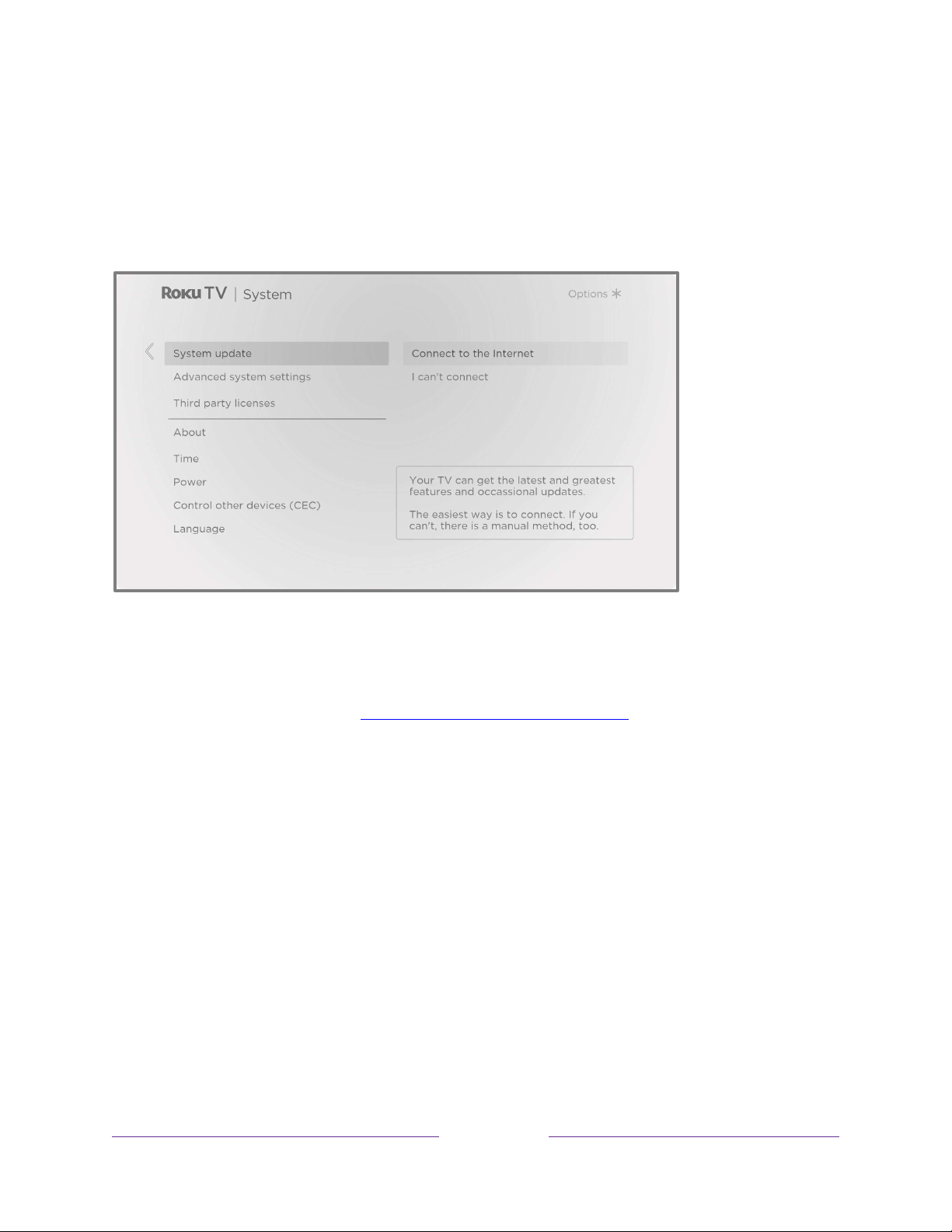
118
Getting updates on a non-connected TV
If your TV is not connected to the Internet, you can still get system updates by using
a USB flash drive and a computer with an Internet connection.
To get a system update, navigate to Settings > System > System update:
The System update screen on a non-connected TV gives you the opportunity to
connect your TV to the Internet to automatically receive updates. We recommend
this option if it is possible in your situation. To proceed, select Connect to the Internet
and follow the instructions in
What if I didn’t connect my TV?
.
Otherwise, if you can’t connect to the Internet, select I can’t connect, and then follow
the instructions on the screen. Here’s a summary:
1. On an Internet-connected computer, go to the web site displayed on the
System update screen.
2. On the USB Update web page, select the correct brand and model, and then
click Next.
3. Click Download Software, and then save the file to the root folder of a
standard USB flash drive.

119
USB flash drive
Any normal USB flash drive will work, provided it has a FAT-16 or FAT-32 file system
format. (This is the default for most flash drives.)
The size of the download is small—usually less than 100 MB—and so will fit on most any
size flash drive you might have.
4. When the download finishes, take the USB flash drive to the TV and plug it into
the USB port. When you do, the TV validates the files on the flash drive and
displays a 12-digit code.
5. Write down the code and the web address, and take this information back to
your Internet-connected computer.
6. On the 12-digit code page, enter the code your TV displayed, and then click
Next.
7. On the 6-digit code page, write down the 6-digit code that appears, and then
take it back to your TV.
12- and 6-digit codes
The USB update process uses a pair of codes to validate that you are authorised to
install an update, and to ensure you are not attempting to install an old, unsupported
version of the system software.
8. Using the TV remote, select Next to move to the next screen, and then use the
on-screen keyboard to enter the 6-digit code. When finished, select OK. The
system update begins. Do not remove the USB flash drive until the TV restarts.
When the update finishes, the TV restarts. You can check the new version number by
navigating to Settings > System > About.

120
Other devices
Mirror your phone or tablet
Only in connected mode
, your TV has a feature called screen mirroring that lets you
mirror your compatible smartphone or tablet on your TV. Share videos, photos, web
pages, and more from compatible devices.
By default, your TV’s screen mirroring mode is set to Prompt. In this mode, when your
TV receives a screen mirroring request, it prompts you with the following options,
unless you have previously selected Always allow or Never allow for the device:
• Always accept – Always accept mirrored content from the mobile device
without additional prompting in the future for this device.
• Accept – Accept mirrored content from the mobile device this time only.
Prompt again next time this device attempts to mirror content.
• Ignore – Do not accept mirrored content from the mobile device at this time.
Prompt again next time this device attempts to mirror content.
• Always ignore – Never accept mirrored content from this mobile device.
Note:
You can manage and change the list of devices that are set to Always allow
or Never allow by navigating from the Home screen menu to Settings > System >
Screen mirroring > Screen mirroring devices.
• If you prefer to always allow all screen mirroring attempts without prompting,
go to Settings > System > Screen mirroring, and then change the Screen
mirroring mode to Always allow.
• If you prefer to never allow screen mirroring from any device, change the
Screen mirroring mode to Never allow.

121
For information on which devices may work with screen mirroring and instructions on
how to use it, go to the following link on the Roku web site:
go.roku.com/screenmirroring
Roku mobile app
Roku makes the Roku mobile app free for compatible iOS
®
and Android™ mobile
devices.
The Roku mobile app is an alternative control centre for your Roku TV, plus a way to
stream Roku content while you are on the go. The Roku mobile app helps you find
and add new Roku Channels, more easily search and find something to watch and
even use your voice to search without typing.
Find more information and get the Roku mobile app by using the following link to the
Roku web site:
go.roku.com/mobileapp
Private Listening on the Roku mobile app
Only on compatible Apple and Android devices
, the Roku mobile app enables you to
use headphones connected to your device to listen to streaming programmes and
broadcast TV channels. Make sure you have the latest version of the Roku mobile app
before using this feature.
For more information, go to the following link on the Roku web site:
go.roku.com/privatelistening

122
Universal remotes
In many cases, you can programme your cable or satellite universal remote to also
control your TV. You will need to have instructions for programming the remote
handy. Check with your cable or satellite provider for instructions.
For details on how to set up the TV to work with universal remotes, go to the
following link on the Roku web site:
go.roku.com/universalremote


124
Legal statement
Please note—Use of the Roku TV is governed by the Roku TV End User License Agreement (see below). In addition, an
end user online profile and billing account with Roku, Inc. (“Roku”) on Roku’s website (“Roku Account”) is required to
stream content via the Internet using your Roku TV. A Roku Account gives you access to movies, television shows,
and other audio-visual entertainment in the “Roku Channel Store,” a storefront of applications provided by Roku via
your device’s on-screen menu. After your Roku Account is created, you can link your Roku TV to your account. By
using the Roku TV, you agree to these statements. For the avoidance of doubt, the content disclaimer set forth herein
shall refer to all content and channels accessible and available on the Roku TV, including those available via the Roku
®
streaming platform, as well as broadcast cable.
Due to the various capabilities of the Roku TV, as well as limitations in the available content available therein, certain
features, applications, and services may not be available on all Roku TV s, or in all territories. Some features on the
Roku TV may also require additional peripheral devices or membership fees that are sold separately. Please visit the
Roku, Inc. website for more information on the Roku TV and content availability. The services and availability of
content on the Roku TV are subject to change from time to time without prior notice.
All content and services accessible through the Roku TV belong to Roku, Inc. or third parties and are protected by
copyright, patent, trademark and/or other intellectual property laws. Such content and services are provided solely for
your personal noncommercial use. You may not use any content or services in a manner that has not been authorized
by the content owner or service provider. Without limiting the foregoing, you may not modify, copy, republish, upload,
post, transmit, translate, sell, create derivative works, exploit, or distribute in any manner or medium any content or
services displayed through the Roku TV.
Third party services, including Freeview Play services, may be changed, suspended, removed, terminated or
interrupted, or access may be disabled at any time, without notice, and Roku makes no representation or warranty
that any content or service will remain available for any period of time. Content and services are transmitted by third
parties by means of networks and transmission facilities over which Roku has no control. Without limiting the
generality of this statement, Roku expressly disclaims any responsibility or liability for any change, interruption,
disabling, removal of or suspension of any content or service made available through the Roku TV. Roku, the content
providers, or the service providers may impose limits on the use of or access to certain services or content, in any case
and without notice or liability. Any questions or requests for service relating to the content or services made available
on the Roku TV should be submitted to the respective cable content or service provider or as described in the Roku
TV User Guide.
In the event of a conflict between the Roku TV End User Agreement and the terms set forth in this Legal Statement,
the Roku TV End User Agreement shall prevail and control in all circumstances.
Roku TV Terms of Use
Dolby Audio™
Manufactured under license from Dolby Laboratories. Dolby, Dolby Audio, and the
double-D symbol are trademarks of Dolby Laboratories. Copyright 1992-2015 Dolby
Laboratories. All rights reserved.
Dolby Vision™
Dolby, Dolby Vision, and the double-D symbol are trademarks of Dolby Laboratories.
Manufactured under license from Dolby Laboratories. Confidential unpublished works.
Copyright © 2013-2015 Dolby Laboratories. All rights reserved.
HDMI
®
The terms HDMI
®
and HDMI
®
High-Definition Multimedia Interface, and the HDMI
®
Logo
are trademarks or registered trademarks of HDMI
®
Licensing LLC in the United States
and other countries.
Roku
ROKU, ROKU TV and the ROKU logo are the trademarks or registered trademarks of
Roku, Inc. All other trademarks and logos herein are the property of their respective
owners.