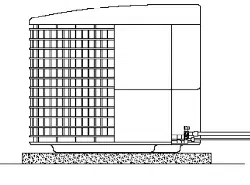
II
• I
These instructions must be read and understood completely before attempting installation.
IMPORTANT: Effective January 1,2015, all split system and packaged air conditioners must be installed pursuant to
applicable regional efficiency standards issued by the Department of Energy.
Safety Labeling and Signal Words
DANGER, WARNING, CAUTION, and
NOTE
The signal words DANGER, WARNING,
CAUTION, and NOTE are used to identify levels of
hazard seriousness. The signal word DANGER is
only used on product labels to signify an immediate
hazard. The signal words WARNING, CAUTION,
and NOTE will be used on product labels and
throughout this manual and other manuals that may
apply to the product.
DANGER - Immediate hazards which will result in
severe personal injury or death.
WARNING - Hazards or unsafe practices which
could result in severe personal injury or death.
CAUTION - Hazards or unsafe practices which
may result in minor personal injury or product or
property damage.
NOTE - Used to highlight suggestions which will
result in enhanced installation, reliability, or
operation.
Signal Words in Manuals
The signal word WARNING is used throughout this
manual in the following manner:
The signal word CAUTION is used throughout this
manual in the following manner:
Signal Words on Product Labeling
Signal words are used in combination with colors
and/or pictures on product labels.
TABLE OF CONTENTS
Inspect New Unit ............................... 2
Safety Considerations ........................... 2
Location ....................................... 2
Clearances ................................ 2 - 3
Unit Support ................................... 4
Refrigeration System ........................... 4
Electrical Wiring ................................ 9
Start-up Procedure ............................ 10
Refrigerant Charge ............................ 10
Sequence of Operation ......................... 14
Troubleshooting ............................... 14
Maintenance .................................. 14
Comfort Alert TM Diagnostics Codes .............. 15
R-410A Quick Reference Guide ................. 16
DEATH, PERSONAL INJURY, AND/OR PROPERTY
DAMAGE HAZARD
Failure to carefully read and follow this warning
could result in equipment malfunction, property
damage, personal injury and/or death.
Installation or repairs made by unqualified per-
sons could result in equipment malfunction,
property damage, personal injury and/or death.
The information contained in this manual is in-
tended for use by a qualified service technician fa-
miliar with safety procedures and equipped with
the proper tools and test instruments.
Installation must conform with local building
codes and with the National Electrical Code
NFPA70 current edition or Canadian Electrical
Code Part 1 CSA C.22.1.
421 01 5103 02 02/09/15
INSPECT NEW UNIT
After uncrating unit, inspect thoroughly for hidden
damage. If damage is found, notify the transportation
company immediately and file a concealed damage
claim.
SAFETY CONSIDERATIONS
PROPERTY DAMAGE HAZARD
Failure to follow this caution may result in proper-
ty damage
R-410A systems operate at higher pressures than
R-22 systems. When working with R-410A sys-
tems, use only service equipment and replace-
ment components specifically rated or approved
for R-410A service.
Consult a qualified installer, service agency, or the
dealer/distributor for information and assistance. The
qualified installer must use factory authorized kits and
accessories when modifying this product. Refer to the
individual instructions packaged with the kit or accessory
when installing.
The weight of the product requires careful and proper
handling procedures when lifting or moving to avoid
personal injury. Use care to avoid contact with sharp or
pointed edges.
Follow all safety codes. Wear safety glasses, protective
clothing, and work gloves. Use a heat sinking material -
such as a wet rag - during brazing operations. Keep a fire
extinguisher available. Consult local codes and the
National Electric Code (NEC) for special requirements.
Improper installation, adjustment, alteration, service or
maintenance can void the warranty.
LOCATION
Check local codes for regulations concerning zoning,
noise, platforms, and other issues.
Locate unit away from fresh air intakes, vents, or
bedroom windows. Noise may carry into the openings
and disturb people inside.
Locate unit in a well drained area, or support unit high
enough so that water runoff will not enter the unit.
Locate unit away from areas where heat, lint, or exhaust
fumes will be discharged onto unit (as from dryer vents).
Locate unit away from recessed or confined areas where
recirculation of discharge air may occur (refer to
CLEARANCES section of this document).
Roof-top installation is acceptable providing the roof will
support the unit and provisions are made for water
drainage and noise/vibration dampening.
NOTE: Roof mounted units exposed to wind may require
wind baffles. Consult the manufacturer for additional
information.
ELECTRICAL SHOCK HAZARD
Failure to turn off the main (remote) electrical dis-
connect device could result in personal injury or
death.
Before installing, modifying or servicing system,
turn OFF the main (remote) electrical disconnect
device. There may be more than one disconnect
device. Lock out and tag switch with a suitable
warning label.
CLEARANCES
When installing, allow sufficient space for airflow
clearance, wiring, refrigerant piping, and service. Allow
24 in. (610 mm) clearance to service end of unit and 48 in.
(1219.2 mm) above unit. For proper airflow, a 6 in. (152.4
mm) clearance on one side of unit and 12 in. (304.8 mm)
on all remaining sides must be maintained. Maintain a
distance of 24 in. (609.6 mm) between units or 18 in.
(457.2 mm) if no overhang within 12 ft. (3.66 m). Position
so water, snow, or ice from roof or eaves cannot fall
directly on unit.
2 421 01 5103 02
UNIT SUPPORT
NOTE: Unit must be level + 2degrees [a 3Ainch rise or fall
per foot of run (10 mm rise or fall per 305 mm of run)] or
compressor may not function properly.
A. GROUND LEVEL INSTALLATION
The unit must be level and supported above grade by
beams, platform, or a pad. Platform or pad can be of
open or solid construction but should be of permanent
materials such as concrete, bricks, blocks, steel, or
pressure- treated timbers approved for ground contact.
Soil conditions must be considered so that the platform
or pad does not shift or settle and leave the unit partially
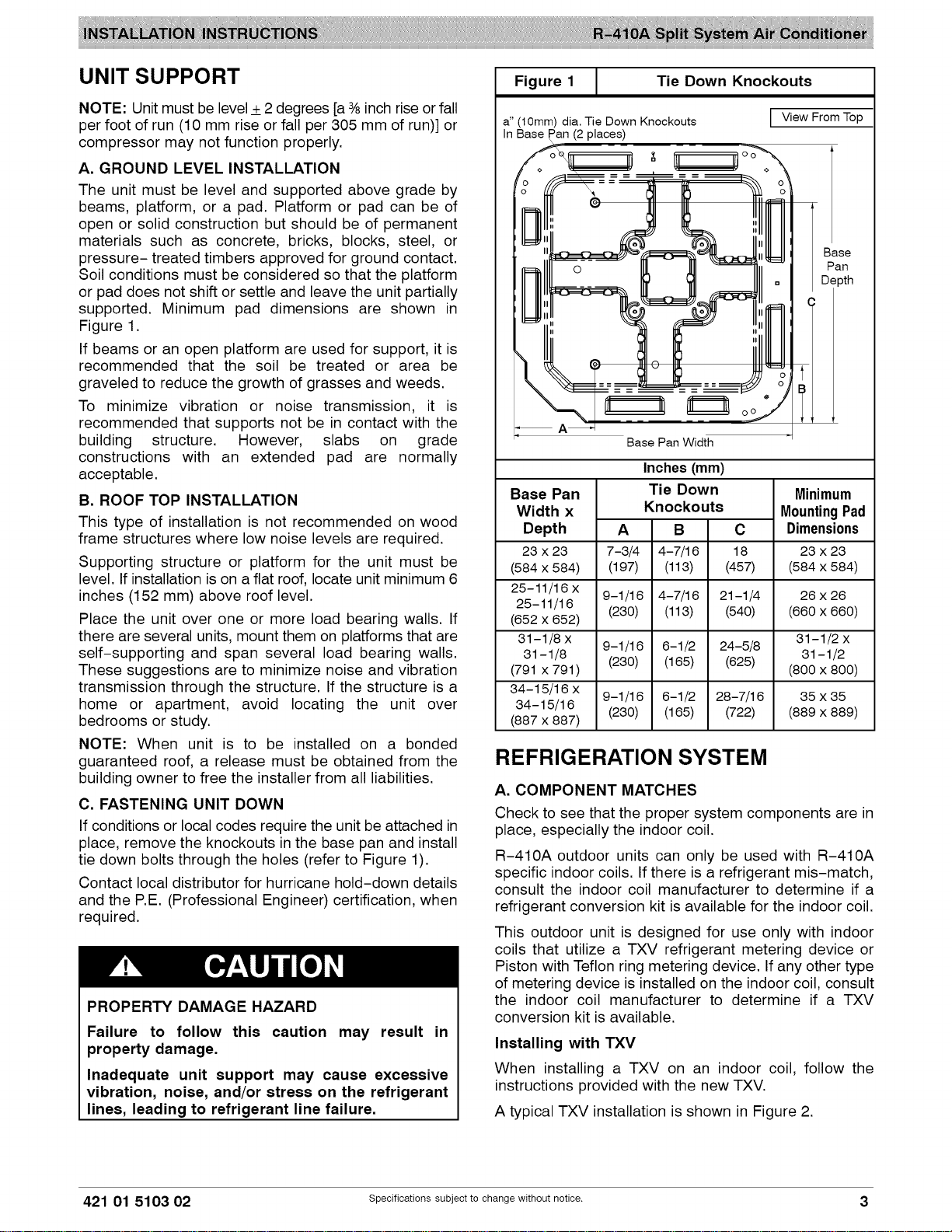
supported. Minimum pad dimensions are shown in
Figure 1.
If beams or an open platform are used for support, it is
recommended that the soil be treated or area be
graveled to reduce the growth of grasses and weeds.
To minimize vibration or noise transmission, it is
recommended that supports not be in contact with the
building structure. However, slabs on grade
constructions with an extended pad are normally
acceptable.
B. ROOF TOP INSTALLATION
This type of installation is not recommended on wood
frame structures where low noise levels are required.
Supporting structure or platform for the unit must be
level. If installation is on a flat roof, locate unit minimum 6
inches (152 mm) above roof level.
Place the unit over one or more load bearing walls. If
there are several units, mount them on platforms that are
self-supporting and span several load bearing walls.
These suggestions are to minimize noise and vibration
transmission through the structure. If the structure is a
home or apartment, avoid locating the unit over
bedrooms or study.
NOTE: When unit is to be installed on a bonded
guaranteed roof, a release must be obtained from the
building owner to free the installer from all liabilities.
C. FASTENING UNIT DOWN
If conditions or local codes require the unit be attached in
place, remove the knockouts in the base pan and install
tie down bolts through the holes (refer to Figure 1).
Contact local distributor for hurricane hold-down details
and the P.E. (Professional Engineer) certification, when
required.
PROPERTY DAMAGE HAZARD
Failure to follow this caution may result in
property damage.
Inadequate unit support may cause excessive
vibration, noise, and/or stress on the refrigerant
lines, leading to refrigerant line failure.
I
Figure 1 ] Tie Down Knockouts
a" (10mm) dia. Tie Down Knockouts L
View From
Top
In Base Pan (2 places)
A
cO
Base Pan Width
Base Pan
Width x
Depth
23 x 23
(584 x 584)
25-11/16 x
25-11/16
(652 x 652)
31-1/8 x
31-1/8
(791 x 791)
34-15/16 x
34-15/16
(887 x 887)
Inches (mm)
Tie Down
Knockouts
A B
7-3/4 4-7/16
(197) (113)
9-1/16 4-7/16
(230) (113)
9-1/16 6-1/2
(230) (165)
9-1/16 6-1/2
(230) (165)
C
18
(457)
21-1/4
(540)
24-5/8
(625)
28-7/16
(722)
Minimum
MountingPad
Dimensions
23 x 23
(584 x 584)
26 x 26
(660 x 660)
31-1/2 x
31-1/2
(800 x 800)
35 x 35
(889 x 889)
REFRIGERATION SYSTEM
A. COMPONENT MATCHES
Check to see that the proper system components are in
place, especially the indoor coil.
R-410A outdoor units can only be used with R-410A
specific indoor coils. If there is a refrigerant mis-match,
consult the indoor coil manufacturer to determine if a
refrigerant conversion kit is available for the indoor coil.
This outdoor unit is designed for use only with indoor
coils that utilize a TXV refrigerant metering device or
Piston with Teflon ring metering device. If any other type
of metering device is installed on the indoor coil, consult
the indoor coil manufacturer to determine if a TXV
conversion kit is available.
Installing with TXV
When installing a TXV on an indoor coil, follow the
instructions provided with the new TXV.
A typical TXV installation is shown in Figure 2.
421 01 5103 02 specificationssubjecttochangewithout notice. 3
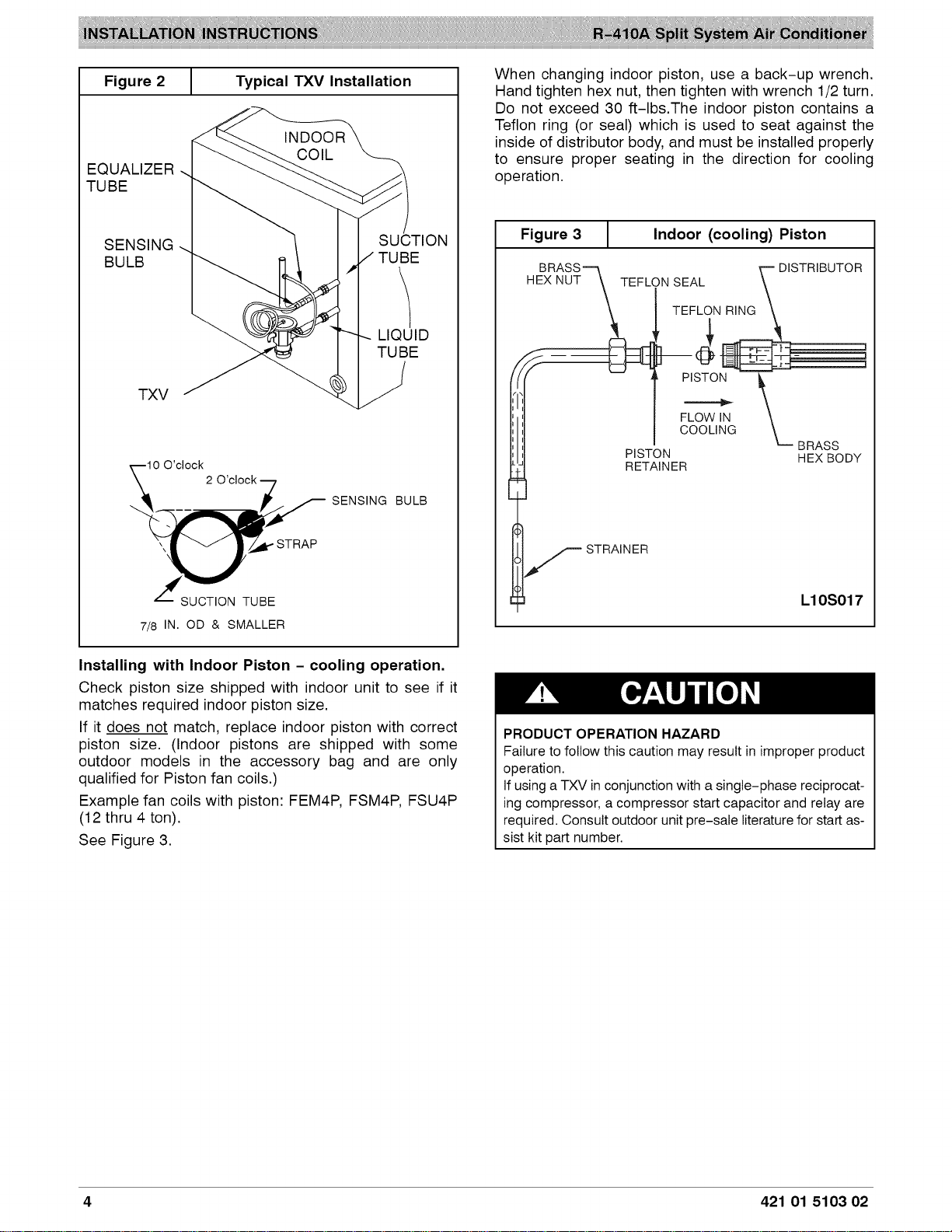
Figure 2 _ Typical TXV Installation
EQUALIZER
TUBE
SENSING SUCTION
BULB TUBE
TXV
LIQUID
TUBE
._ 00'cl°ck 20,clock 7
7/8 IN. OD & SMALLER
SENSING BULB
When changing indoor piston, use a back-up wrench.
Hand tighten hex nut, then tighten with wrench 1/2 turn.
Do not exceed 30 ft-lbs.The indoor piston contains a
Teflon ring (or seal) which is used to seat against the
inside of distributor body, and must be installed properly
to ensure proper seating in the direction for cooling
operation.
Figure 3 1 Indoor (cooling) Piston
BRASS'="_
HEX NUT\ TEFLON SEAL
\ _ TEFLONRING
I!l I
I',_ I FLOWIN
lil I cOOLING
I:1 PISTON
II RETAINER
f STRAINER
]
BRASS
HEX BODY
L10S017
Installing with Indoor Piston - cooling operation.
Check piston size shipped with indoor unit to see if it
matches required indoor piston size.
If it does not match, replace indoor piston with correct
piston size. (Indoor pistons are shipped with some
outdoor models in the accessory bag and are only
qualified for Piston fan coils.)
Example fan coils with piston: FEM4P, FSM4P, FSU4P
(12 thru 4 ton).
See Figure 3.
PRODUCT OPERATION HAZARD
Failure to follow this caution may result in improper product
operation.
Ifusing a TXV in conjunction with a single-phase reciprocat-
ing compressor, a compressor start capacitor and relay are
required. Consult outdoor unit pre-sale literature for start as-
sist kit part number.
4 421 01 5103 02
1 £_ iit!!!!!!!!!!!!!!!!!!!!!!!!!!!!!!!!!!!!!!!!!!! _ _ _ _
_________________________________________________________________________________________________________________________________________________________________________________________________________________________________________________________________________________________________________________________________________________________________________________________________________________________________________________________________________________________________________________________________________________________________________________________________________________________________________________________________________________________________________________________________________________________________________________________________________________________________________________________________________________________________________________________________________________________________________________________________________________________________________________________________________________________________
B. REFRIGERANT LINE SETS
The refrigerant line set must be properly sized to assure
maximum efficiency and proper oil circulation.
Refer to Product Specifications and Long Line
Applications Guideline for line set sizing.
NOTE: Total line set length must not exceed 200 feet (61
m).
A crankcase heater must be used when the refrigerant
line length exceeds 80 feet (24.4 m).
If outdoor unit is more than 10 feet (3 m) higher than the
indoor coil, refer to the Long Line Applications Guideline
for instructions.
When the outdoor unit is higher than the indoor coil, the
vertical separation must not exceed 100 feet (30 m).
When the outdoor unit is lower than the indoor coil, the
vertical separation must not exceed 50 feet (15.2 m).
If it is necessary to add refrigerant line in the field, use
dehydrated or dry, sealed, deoxidized, copper
refrigeration tubing. Do not use copper water pipe.
Do not remove rubber plugs or caps from copper tubing
until connections are ready to be made.
Be extra careful when bending refrigeration tubing.
Tubing can "kink" easily, and if this occurs, the entire
length of tubing must be replaced.
PERSONALINJURY HAZARD
Failure to relieve system pressure could result in
personal injury and/or death.
Relieve pressure and recover all refrigerant be-
fore servicing existing equipment, and before fi-
nal unit disposal. Use all service ports and open
all flow-control devices, including solenoid
valves.
C. ROUTING AND SUSPENDING REFRIGERANT
LINES
Run refrigerant lines as straight and direct as possible,
avoiding unnecessary bends and turns. Always insulate
the entire suction line. Both lines should be insulated
when routed through an attic or when routed through an
underground raceway.
When routing refrigerant lines through a foundation or wall,
do not allow refrigerant lines to come in direct contact with
the building structure. Make openings large enough so that
lines can be wrapped with extra insulation. Fill all gaps with
R-I-V caulk. This will prevent noise transmission between
the tubing and the foundation or wall.
Along floor or ceiling joists, suspend refrigerant lines so
that they do not contact the building structure, water
pipes, or ductwork. Use insulated or suspension type
hangers. Metal straps must be at least 1"(25 mm) wide to
avoid cutting into the tube insulation. Keep the liquid and
suction lines separate. Refer to Figure 4.
UNIT OPERATION HAZARD
Failure to follow this caution may result in im-
proper product operation.
Do not leave system open to atmosphere any lon-
ger than absolutely required for installation. Inter-
nal system components - especially refrigerant
oils - are extremely susceptible to moisture con-
tamination. Keep ends of tubing sealed during
installation until the last possible moment.
Figure 4
Routing and Suspending Refrigerant Lines
I'_-_ _ LIQUID TUBE
THROUGH THE WALL
HANGER STRAP
(AROUND SUCTION _,= --
TUBE ONLY) _'
f JOiST
t_SU cTLATIoONTUBE
1"(25m_1 I_
MIN LIQUID TUBE
SUSPENSION
421 01 5103 02 Specifications subject to change without notice. 5
UNIT OPERATION HAZARD
Failure to follow this caution may result in im-
proper product operation.
Do not bury more than 36" (lm) of line set under-
ground. Refrigerant may migrate to cooler buried
section during extended periods of unit shut-
down, causing refrigerant slugging and possible
compressor damage at start-up.
If ANY section of the line set is buried under-
ground, provide a minimum 6" (152mm) vertical
rise at the service valve.
D. OUTDOOR UNIT HIGHER THAN INDOOR UNIT
Proper oil return to the compressor should be maintained
with suction gas velocity. If velocities drop below 1500
fpm (feet per minute), oil return will be decreased. To
maintain suction gas velocity, do not upsize vertical
suction risers.
E. LIQUID LINE FILTER-DRIER
Outdoor units are shipped with an appropriate filter-drier
for installation in the liquid line. Leave the plugs in the
tube ends until the filter-drier is installed. The optimal
location for the filter-drier is close to the indoor coil.
Install the filter-drier with the arrow pointing towards the
indoor coil. Refer to Figure 5.
Figure 5
Liquid Line Filter-Drier
Installed at Indoor Coil
Filter-Drier
(arrow points towards indoor coil)
38-11-84
F. SERVICE VALVES
Service valves are closed and tube stubs are plugged
from the factory. Outdoor units are shipped with a
refrigerant charge sealed in the unit. Leave the service
valves closed until all other refrigerant system work is
complete or the charge will be lost. Leave the plugs in
place until line set tubing is ready to be inserted.
Service valve bodies are brass and tube stubs are
copper.
Figure 6 1 Service Valve
G. BRAZING CONNECTIONS
NOTE: Remove valve core from schrader port on both
Service Valves BEFORE brazing. This helps prevent
overheating and damage to valve seals (refer to Figure 6).
Replace valve core when brazing is completed.
FIRE HAZARD
Failure to remove refrigerant and oil charge be-
fore brazing could result in personal injury, death,
and/or property damage.
Refrigerant and oil mixture could ignite and burn
as it escapes and contacts brazing torch. Make
sure the refrigerant charge is properly removed
from both the high and low sides of the system be-
fore brazing any component or lines.
Clean line set tube ends with emery cloth or steel brush.
Remove any grit or debris.
Insert line set tube ends into service valve tube stubs.
Apply heat absorbing paste or heat sink product between
service valve and joint. Wrap service valves with a heat
sinking material such as a wet cloth.
Braze joints using a SiI-Fos or Phos-copper alloy.
PRODUCT DAMAGE HAZARD
Failureto follow this caution may resultin productdam-
age.
Braze with SiI-Fos or Phos-copper alloy on cop-
per-to-copper joints and wrap a wet cloth around
rear of fitting to prevent damage to TXV.
6 421 01 5103 02
J ! i!iiiiiiiiWi!ii !iiIi!i i!iIi!i i!iIi!i i!iIi!i i!iIi!i i!iIi!i iiiiii !iiiiii iii!ii!!iiIi!i i!iIi!i i!iIi!i i!iIi!i i!iIi!i i!iIi!i i!iIi!i i!iIi!i i!iIi!i i!iIi!i i!iIi!i i!i i!i i
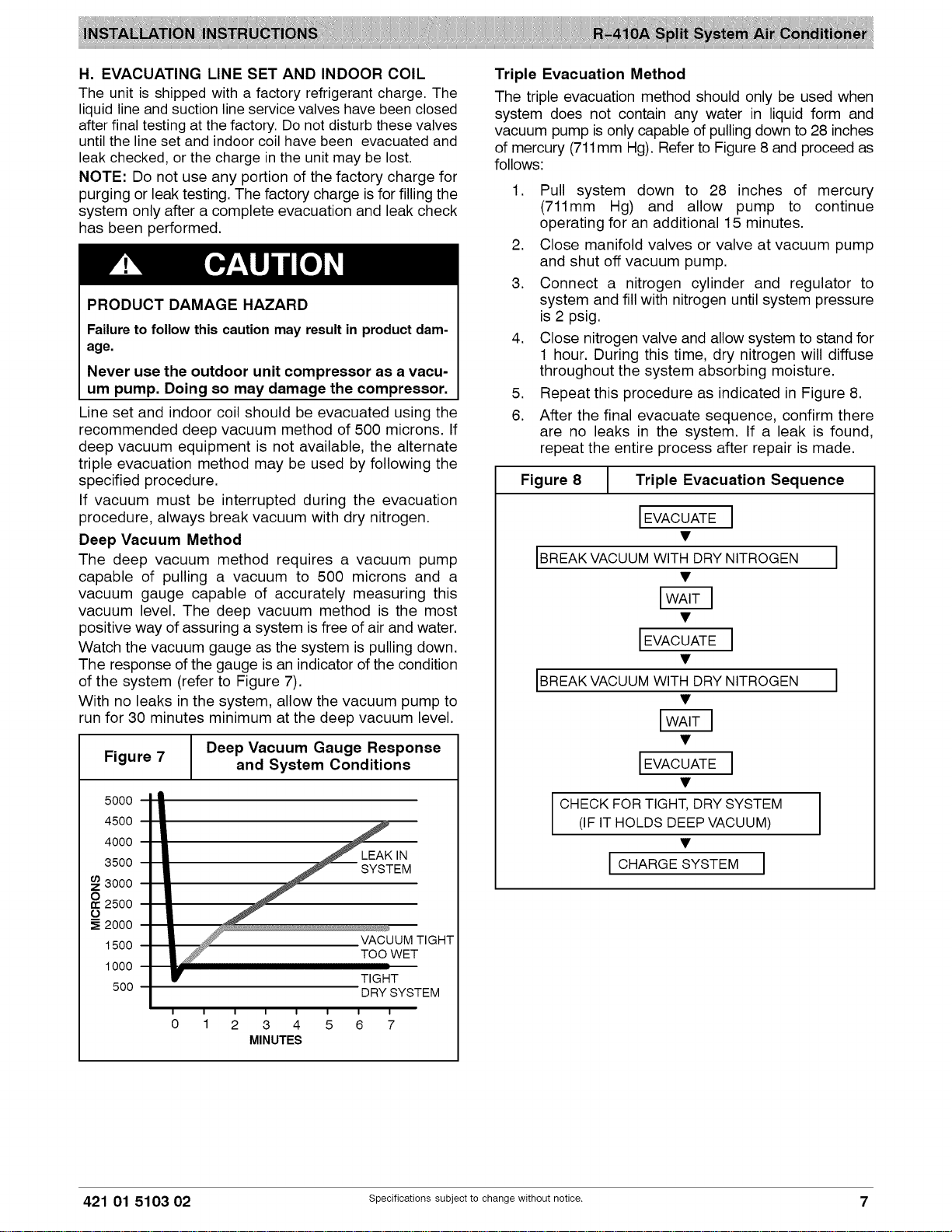
H. EVACUATING LINE SET AND INDOOR COIL
The unit is shipped with a factory refrigerant charge. The
liquid line and suction line service valves have been closed
after final testing at the factory. Do not disturb these valves
until the line set and indoor coil have been evacuated and
leak checked, or the charge in the unit may be lost.
NOTE: Do not use any portion of the factory charge for
purging or leak testing. The factory charge isfor filling the
system only after a complete evacuation and leak check
has been performed.
PRODUCT DAMAGE HAZARD
Failure to follow this caution may result in product dam-
age.
Never use the outdoor unit compressor as a vacu-
um pump. Doing so may damage the compressor.
Line set and indoor coil should be evacuated using the
recommended deep vacuum method of 500 microns. If
deep vacuum equipment is not available, the alternate
triple evacuation method may be used by following the
specified procedure.
If vacuum must be interrupted during the evacuation
procedure, always break vacuum with dry nitrogen.
Deep Vacuum Method
The deep vacuum method requires a vacuum pump
capable of pulling a vacuum to 500 microns and a
vacuum gauge capable of accurately measuring this
vacuum level. The deep vacuum method is the most
positive way of assuring a system isfree of air and water.
Watch the vacuum gauge as the system is pulling down.
The response of the gauge is an indicator of the condition
of the system (refer to Figure 7).
With no leaks in the system, allow the vacuum pump to
run for 30 minutes minimum at the deep vacuum level.
Figure 7
Deep Vacuum Gauge Response
and System Conditions
5OOO
4500
4000
3500
3000
2500
O
2000
1500
1000
5OO
-.4
TIGHT
ET
DRY SYSTEM
I I I I I I I I
0 1 2 3 4 5 6 7
MINUTES
Triple Evacuation Method
The triple evacuation method should only be used when
system does not contain any water in liquid form and
vacuum pump is only capable of pulling down to 28 inches
of mercury (711mm Hg). Refer to Figure 8 and proceed as
follows:
1. Pull system down to 28 inches of mercury
(711mm Hg) and allow pump to continue
operating for an additional 15 minutes.
2. Close manifold valves or valve at vacuum pump
and shut off vacuum pump.
3. Connect a nitrogen cylinder and regulator to
system and fill with nitrogen until system pressure
is 2 psig.
4. Close nitrogen valve and allow system to stand for
1 hour. During this time, dry nitrogen will diffuse
throughout the system absorbing moisture.
5. Repeat this procedure as indicated in Figure 8.
6. After the final evacuate sequence, confirm there
are no leaks in the system. If a leak is found,
repeat the entire process after repair is made.
Figure 8 1 Triple Evacuation Sequence
IEVACUATE I
IBREAK VACUUM WITHDRYNITROGEN
IEVACUATE I
IBREAK VACUUM WITHDRYNITROGEN
IEVACUATE I
I CHECK FORTIGHT,DRY SYSTEM
(IF IT HOLDS DEEPVACUUM)
I CHARGE SYSTEM I
421 01 5103 02 Specifications subject to change without notice. 7
I. OPENING SERVICE VALVES
Outdoor units are shipped with a refrigerant charge
sealed in the unit. Opening the service valves releases
this charge into the system.
NOTE: Open the Suction service valve first. If the Liquid
service valve is opened first, oil from the compressor
may be drawn into the indoor coil TXV, restricting
refrigerant flow and affecting operation of the system.
Remove Suction service valve cap and insert a hex
wrench into the valve stem. Hold the valve body steady
with an end-wrench and back out the stem by turning the
hex wrench counterclockwise. Turn the stem until it just
contacts the rolled lip of the valve body.
After the refrigerant charge has bled into the system,
open the Liquid service valve.
NOTE: These are not back-seating valves. It is not
necessary to force the stem tightly against the rolled lip.
The service valve cap is a primary seal for the valve and
must be properly tightened to prevent leaks. Make sure
cap is clean and apply refrigerant oil to threads and
sealing surface on inside of cap.
Tighten cap finger tight and then tighten additional 6 of a
turn (1 wrench flat) to properly seat the sealing surfaces.
J. GAUGE PORTS
Check for leaks at the schrader ports and tighten valve
cores if necessary. Install plastic caps finger tight.
ELECTRICAL WIRING
The supply voltage must be 208/230 volts (197 volt
minimum to 253 volts maximum) 60 Hz single phase.
Outdoor units are approved for use with copper
conductors only. Do not use aluminum wire.
Refer to unit rating plate for minimum circuit ampacity
and circuit protection requirements.
Grounding
Permanently ground unit in accordance with the National
Electrical Code and local codes or ordinances. Use a
copper conductor of the correct size from the grounding
lug in control box to a grounded connection in the service
panel or a properly driven and electrically grounded
ground rod.
Wiring Connections
Make all outdoor electrical supply (Line Voltage)
connections with raintight conduit and fittings. Most
codes require a disconnect switch outdoors within sight
of the unit. Consult local codes for special requirements.
Route electrical supply (Line Voltage) wiring through
knockout hole in bottom of Control Box. Connect wires to
Contactor and Ground Lug according to Wiring Diagram
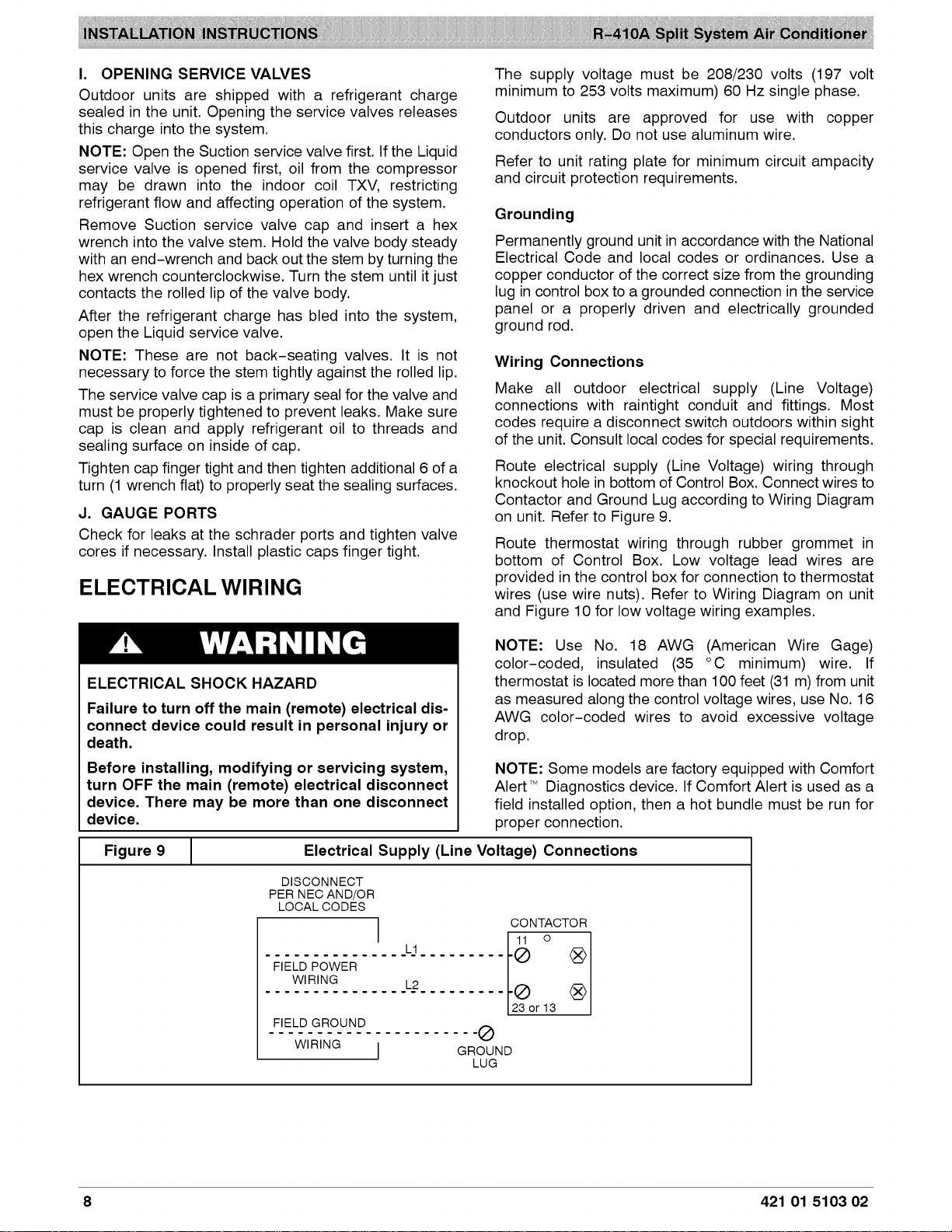
on unit. Refer to Figure 9.
Route thermostat wiring through rubber grommet in
bottom of Control Box. Low voltage lead wires are
provided in the control box for connection to thermostat
wires (use wire nuts). Refer to Wiring Diagram on unit
and Figure 10 for low voltage wiring examples.
ELECTRICAL SHOCK HAZARD
Failure to turn off the main (remote) electrical dis-
connect device could result in personal injury or
death.
Before installing, modifying or servicing system,
turn OFF the main (remote) electrical disconnect
device. There may be more than one disconnect
device.
Figure 9
NOTE: Use No. 18 AWG (American Wire Gage)
color-coded, insulated (35 °C minimum) wire. If
thermostat is located more than 100 feet (31 m) from unit
as measured along the control voltage wires, use No. 16
AWG color-coded wires to avoid excessive voltage
drop.
NOTE: Some models are factory equipped with Comfort
Alert TM Diagnostics device. If Comfort Alert is used as a
field installed option, then a hot bundle must be run for
proper connection.
Electrical Supply (Line Voltage) Connections
DISCONNECT
PER NEC AND/OR
LOCAL CODES
1
L1
FIELD POWER
WIRING L2
FIELD GROUND
WIRING j
CONTACTOR
3or13
-®
GROUND
LUG
8 421 01 5103 02
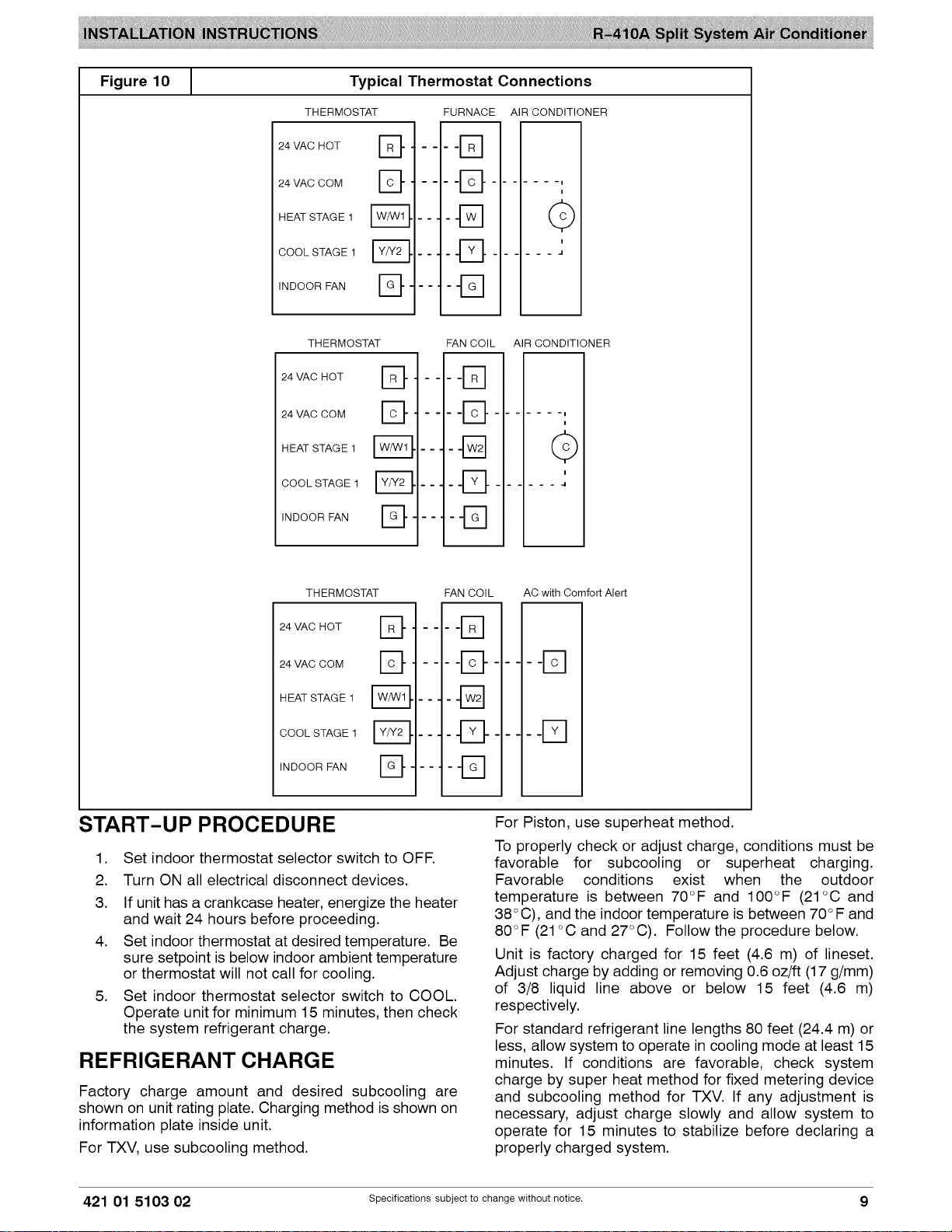
Figure10
TypicalThermostatConnections
THERMOSTAT FURNACE AIR CONDITIONER
24 VAC HOT D
24 VAC COM D
HEAT STAGE 1
COOL STAGE 1
INDOOR FAN D
- - .
--171
- -D -
-4B
-D
...... i
i
A
(c)
i
THERMOSTAT
24 MAC HOT D
24 MAC COM D
HEAT STAGE 1
COOL STAGE 1
INDOOR FAN D
- - °
FAN COIL
--F_
- -D -
-4B
--_-
-D
AIR CONDITIONER
...... i
i
(c)
I
..... •1
THERMOSTAT
24 MAC HOT D
24 MAC COM D
HEAT STAGE 1
COOL STAGE 1
INDOOR FAN D
FAN COIL
.... D
.... D _
_ . _ _ -
AC with Comfort Alert
.... D
.... D
START-UP PROCEDURE
,
2.
3.
4.
5.
Set indoor thermostat selector switch to OFF.
Turn ON all electrical disconnect devices.
If unit has a crankcase heater, energize the heater
and wait 24 hours before proceeding.
Set indoor thermostat at desired temperature. Be
sure setpoint is below indoor ambient temperature
or thermostat will not call for cooling.
Set indoor thermostat selector switch to COOL.
Operate unit for minimum 15 minutes, then check
the system refrigerant charge.
REFRIGERANT CHARGE
Factory charge amount and desired subcooling are
shown on unit rating plate. Charging method is shown on
information plate inside unit.
For TXV, use subcooling method.
For Piston, use superheat method.
To properly check or adjust charge, conditions must be
favorable for subcooling or superheat charging.
Favorable conditions exist when the outdoor
temperature is between 70°F and 100°F (21°C and
38 °C), and the indoor temperature is between 70°F and
80°F (21°C and 27°C). Follow the procedure below.
Unit is factory charged for 15 feet (4.6 m) of lineset.
Adjust charge by adding or removing 0.6 oz/ft (17 g/mm)
of 3/8 liquid line above or below 15 feet (4.6 m)
respectively.
For standard refrigerant line lengths 80 feet (24.4 m) or
less, allow system to operate in cooling mode at least 15
minutes. If conditions are favorable, check system
charge by super heat method for fixed metering device
and subcooling method for TXV. If any adjustment is
necessary, adjust charge slowly and allow system to
operate for 15 minutes to stabilize before declaring a
properly charged system.
421 01 5103 02 specificationssubjecttochangewithout notice. 9
If the indoor temperature is above 80°F (27°C), and the
outdoor temperature is in the favorable range, adjust
system charge by weight based on line length and allow
the indoor temperature to drop to 80°F (27°C) before
attempting to check system charge by subcooling
method as described above.
If the indoor temperature is below 70°F (21°C), or the
outdoor temperature is not in the favorable range, adjust
charge for line set length above or below 15 feet (4.6 m)
only. Charge level should then be appropriate for the
system to achieve rated capacity. The charge level could
then be checked at another time when the both indoor
and outdoor temperatures are in a more favorable range.
NOTE: If line length is beyond 80 feet (24.4 m) or greater
than 20 feet (6.1 m) vertical separation, See Long Line
Guideline for special charging requirements.
A. UNITS WITH COOLING MODE TXV
Units installed with cooling mode TXV require charging
by the subcooling method.
1. Operate unit a minimum of 15 minutes before
checking charge.
NOTE: If outdoor unit has a 2-speed fan motor,
motor will operate in low speed when outdoor
ambient temperature is below 82°F. Pull one of
the yellow low voltage wires off the fan control and
the unit will default to high speed fan for servicing.
Reconnect wire after servicing.
2. Measure liquid service valve pressure by
attaching an accurate gage to service port.
3. Measure liquid line temperature by attaching an
accurate thermistor type or electronic
thermometer to liquid line near outdoor coil.
4. Refer to unit rating plate for required subcooling
temperature.
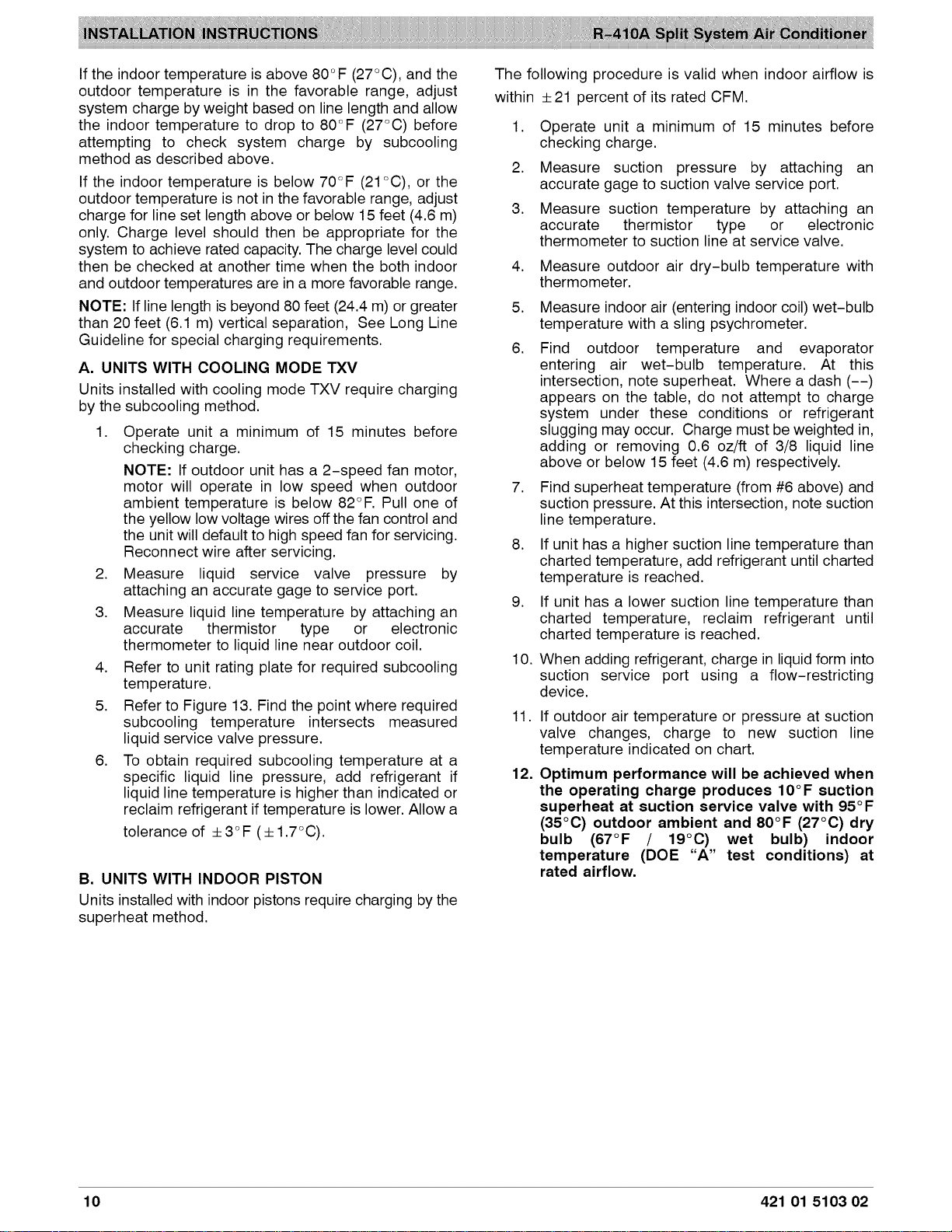
5. Refer to Figure 13. Find the point where required
subcooling temperature intersects measured
liquid service valve pressure.
6. To obtain required subcooling temperature at a
specific liquid line pressure, add refrigerant if
liquid line temperature is higher than indicated or
reclaim refrigerant if temperature is lower. Allow a
tolerance of +3°F (+ 1.7°C).
B. UNITS WITH INDOOR PISTON
Units installed with indoor pistons require charging by the
superheat method.
The following procedure is valid when indoor airflow is
within + 21 percent of its rated CFM.
1. Operate unit a minimum of 15 minutes before
checking charge.
2. Measure suction pressure by attaching an
accurate gage to suction valve service port.
3. Measure suction temperature by attaching an
accurate thermistor type or electronic
thermometer to suction line at service valve.
4.
5.
6.
7.
.
.
10.
11.
12.
Measure outdoor air dry-bulb temperature with
thermometer.
Measure indoor air (entering indoor coil) wet-bulb
temperature with a sling psychrometer.
Find outdoor temperature and evaporator
entering air wet-bulb temperature. At this
intersection, note superheat. Where a dash (--)
appears on the table, do not attempt to charge
system under these conditions or refrigerant
slugging may occur. Charge must be weighted in,
adding or removing 0.6 oz/ft of 3/8 liquid line
above or below 15 feet (4.6 m) respectively.
Find superheat temperature (from #6 above) and
suction pressure. At this intersection, note suction
line temperature.
If unit has a higher suction line temperature than
charted temperature, add refrigerant until charted
temperature is reached.
If unit has a lower suction line temperature than
charted temperature, reclaim refrigerant until
charted temperature is reached.
When adding refrigerant, charge in liquid form into
suction service port using a flow-restricting
device.
If outdoor air temperature or pressure at suction
valve changes, charge to new suction line
temperature indicated on chart.
Optimum performance will be achieved when
the operating charge produces 10°F suction
superheat at suction service valve with 95°F
(35°C) outdoor ambient and 80°F (27°C) dry
bulb (67°F / 19°C) wet bulb) indoor
temperature (DOE "A" test conditions) at
rated airflow.
10 421 01 5103 02
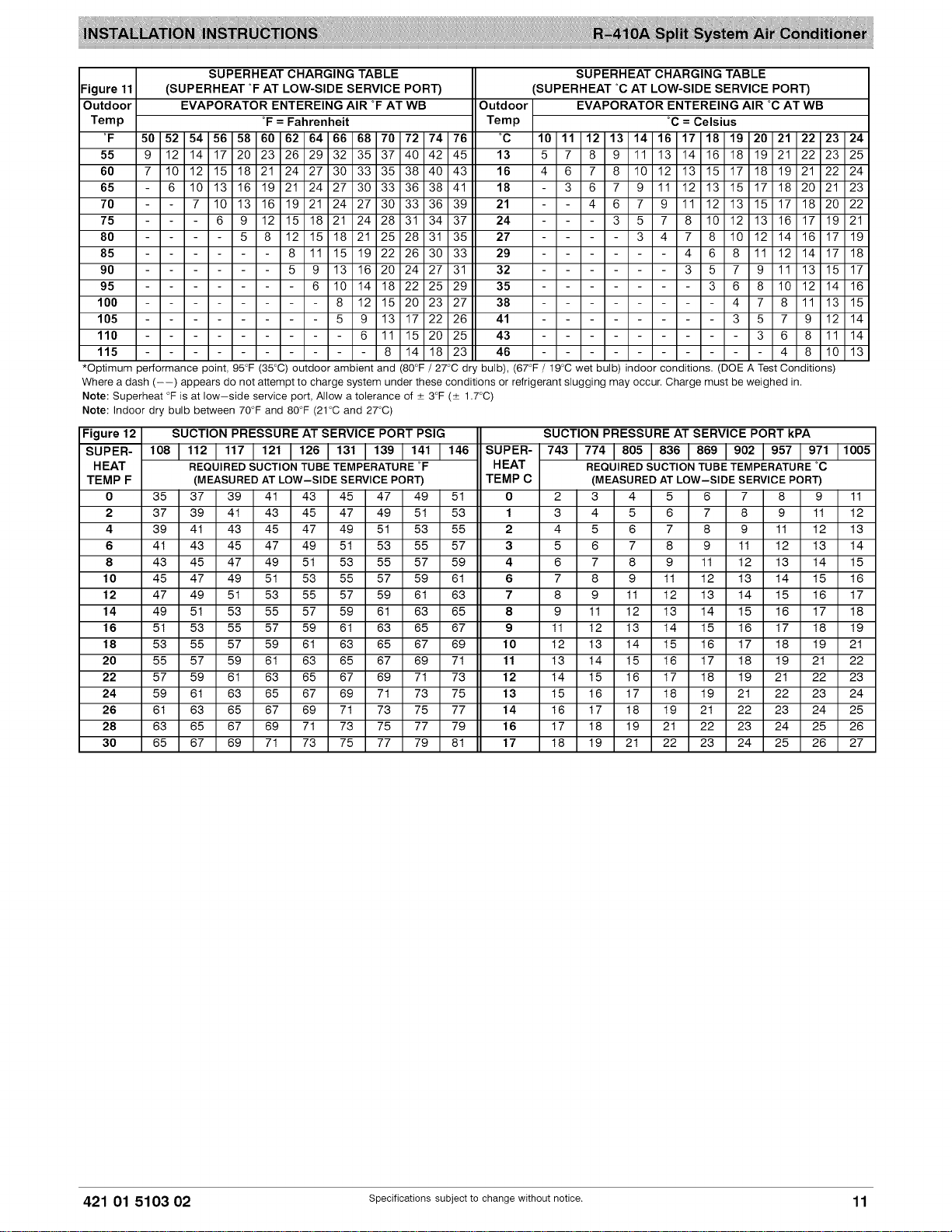
Figure 11
Outdoor
Temp
°F
55
60
65
70
75
80
85
90
95
100
105
110
115
SUPERHEAT CHARGING TABLE
(SUPERHEAT °FAT LOW-SIDE SERVICE PORT)
EVAPORATOR ENTEREING AIR °F AT WB
°F = Fahrenheit
50 52 54 56 58 60 62 64 66 68 70 72 74 76
9 12 14 17 20 23 26 29 32 35 37 40 42 45
7 10 12 15 18 21 24 27 30 33 35 38 40 43
6 10 13 16 19 21 24 27 30 33 36 38 41
7 10 13 16 19 21 24 27 30 33 36 39
6 9 12 15 18 21 24 28 31 34 37
5 8 12 15 18 21 25 28 31 35
8 11 15 19 22 26 30 33
5 9 13 16 20 24 27 31
6 10 14 18 22 25 29
8 12 15 20 23 27
5 9 13 17 22 26
6 11 15 20 25
8 14 18 23
Outdoor
Temp
°C
13
16
18
21
24
27
29
32
35
38
41
43
46
SUPERHEAT CHARGING TABLE
(SUPERHEAT °C AT LOW-SIDE SERVICE PORT)
EVAPORATOR ENTEREING AIR °C AT WB
°C= Celsius
10 11 12 13 14 16 17 18 19 20 21 22 23 24
5 7 8 9 11 13 14 16 18 19 21 22 23 25
4 6 7 8 10 12 13 15 17 18 19 21 22 24
3 6 7 9 11 12 13 15 17 18 20 21 23
4 6 7 9 11 12 13 15 17 18 20 22
3 5 7 8 10 12 13 16 17 19 21
3 4 7 8 10 12 14 16 17 19
4 6 8 11 12 14 17 18
3 5 7 9 11 13 15 17
3 6 8 10 12 14 16
4 7 8 11 13 15
3 5 7 9 12 14
3 6 8 11 14
4 8 10 13
*Optimum performance point, 95°F (35°C) outdoor ambient and (80°F / 27°C dr bulb), (67°F / 19°C wet bulb) indoor conditions. (DOE A Test Conditions)
Where a dash (--) appears do not attempt to charge system under these conditions or refrigerant slugging may occur. Charge must be weighed in.
Note: Superheat °F is at low-side service port, Allow a tolerance of + 3°F (+ 1.7°C)
Note: Indoor dry bulb between 70°F and 80°F (21°C and 27°C)
Figure 12 SUCTION PRESSURE AT SERVICE PORT PSIG SUCTION PRESSURE AT SERVICE PORT kPA
SUPER-10811121117112111261131113911411146SUPER-743177418051836186919021957197111005
HEAT REQUIRED SUCTION TUBE TEMPERATURE°F HEAT REQUIREDSUCTION TUBE TEMPERATURE °C
TEMP F (MEASURED AT LOW-SIDE SERVICE PORT) TEMP C (MEASURED AT LOW-SIDE SERVICE PORT)
0 35 37 39 41 43 45 47 49 51 0 2 3 4 5 6 7 8 9 11
2 37 39 41 43 45 47 49 51 53 1 3 4 5 6 7 8 9 11 12
4 39 41 43 45 47 49 51 53 55 2 4 5 6 7 8 9 11 12 13
6 41 43 45 47 49 51 53 55 57 3 5 6 7 8 9 11 12 13 14
8 43 45 47 49 51 53 55 57 59 4 6 7 8 9 11 12 13 14 15
10 45 47 49 51 53 55 57 59 61 6 7 8 9 11 12 13 14 15 16
12 47 49 51 53 55 57 59 61 63 7 8 9 11 12 13 14 15 16 17
14 49 51 53 55 57 59 61 63 65 8 9 11 12 13 14 15 16 17 18
16 51 53 55 57 59 61 63 65 67 9 11 12 13 14 15 16 17 18 19
18 53 55 57 59 61 63 65 67 69 10 12 13 14 15 16 17 18 19 21
20 55 57 59 61 63 65 67 69 71 11 13 14 15 16 17 18 19 21 22
22 57 59 61 63 65 67 69 71 73 12 14 15 16 17 18 19 21 22 23
24 59 61 63 65 67 69 71 73 75 13 15 16 17 18 19 21 22 23 24
26 61 63 65 67 69 71 73 75 77 14 16 17 18 19 21 22 23 24 25
28 63 65 67 69 71 73 75 77 79 16 17 18 19 21 22 23 24 25 26
30 65 67 69 71 73 75 77 79 81 17 18 19 21 22 23 24 25 26 27
421 01 5103 02 specificationssubjectto change without notice. 11
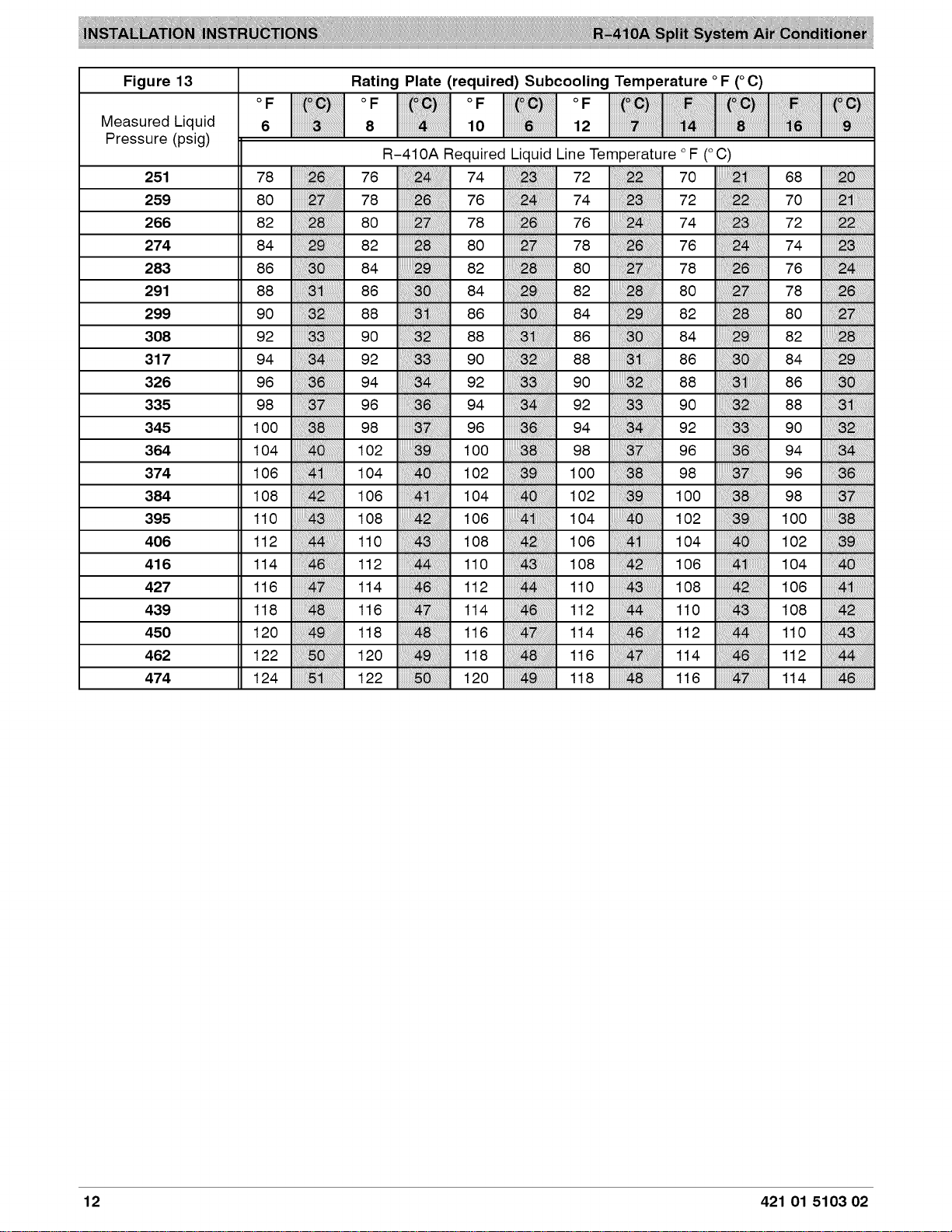
Figure 13
Measured Liquid
Pressure (psig)
oF
6
Rating Plate (required) Subcooling Temperature °F (°C)
o
oF F oF
8 10 ...........................................12
R-410A Required Liquid Line Temperature °F (°C)
251 78 76 74 72 70 68
259 80 78 76 74 72 70
266 82 80 78 76 74 72
274 84 82 80 78 76 74
283 86 84 82 80 78 76
291 88 86 84 82 80 78
299 90 88 86 84 82 80
308 92 90 88 86 84 82
317 94 92 90 88 86 84
326 96 94 92 90 88 86
335 98 96 94 92 90 88
345 100 98 96 94 92 90
364 104 102 100 98 96 94
374 106 104 102 100 98 96
384 108 106 104 102 100 98
395 110 108 106 104 102 100
406 112 110 108 106 104 102
416 114 112 110 108 106 104
427 116 114 112 110 108 106
439 118 i!i!i!i!i!i!i!i!i!i!i!i!ii!i!ii_!_iiiiiiiiiiiiiiiiiiiiiiiiiiiiiiiiiiiiiiiill116 114 i!i!i!i!i!i!i!i!i!i!i!i!ii!i!ii_i_!ii!ii!ii!ii!ii!ii!ii!ii!ii!ii!ii!ii!ii!ii112 !i!i!i!i!i!i!i!i!i!i!ii!i!ii_!_!ii!ii!ii!ii!ii!ii!ii!ii!ii!ii!iiiiiii!iii!il110 i!i!i!i!i!i!i!i!i!i!i!i!ii!i!ii_i_!ii!ii!ii!ii!ii!ii!ii!ii!ii!ii!ii!ii!ii!ii!108 !i!i!i!i!i!i!i!i!i!i!ii!i!ii_iiiiiiiiiiiiiiiiiiiiiiiiiiiiiiiiiiiiii!i!iiii
450 120 118 116 114 112 110
462 122 120 118 116 114 112
474 124 122 iiiiiiiiiiiiiiiiiiii'ii_iii_ii_iiiiiiiiiiiiiiiiiiiiiiiiiiiiiiiiiiiiil120 iiiiiiiiiiiiiiiiiiiiiiiiiii_i_!iiiiiiiiiiiiiiiiiiiiiiiiiiiiiiiiiiiiiiiiii118 iiiiiiiiiiiiiiiiiiiiiiii_i_!ii!ii!ii!ii!ii!ii!ii!ii!ii!ii!ii!iill116 iiiiiiiiiiiiiiiiiiiiiiiiiii_ii!ii!ii!ii!ii!ii!ii!ii!ii!ii!ii!ii!ii!il114 iiiiiiiiiiiiiiiiiiiiiiii_!_ii_ii_ii_ii_ii_ii_ii_ii_ii_ii_ii_ii_i_
12 421 01 5103 02
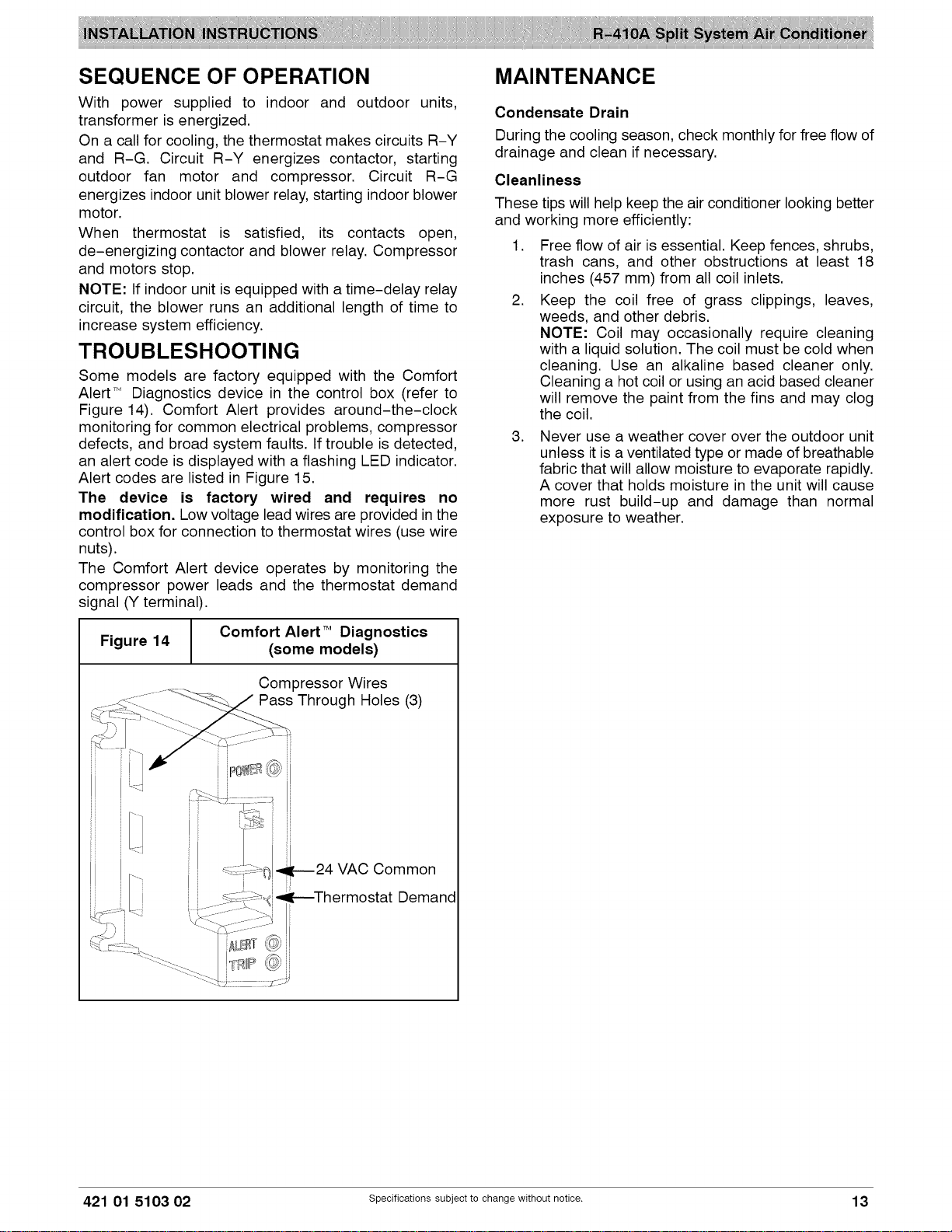
SEQUENCE OF OPERATION
With power supplied to indoor and outdoor units,
transformer is energized.
On a call for cooling, the thermostat makes circuits R-Y
and R-G. Circuit R-Y energizes contactor, starting
outdoor fan motor and compressor. Circuit R-G
energizes indoor unit blower relay, starting indoor blower
motor.
When thermostat is satisfied, its contacts open,
de-energizing contactor and blower relay. Compressor
and motors stop.
NOTE: If indoor unit is equipped with a time-delay relay
circuit, the blower runs an additional length of time to
increase system efficiency.
TROUBLESHOOTING
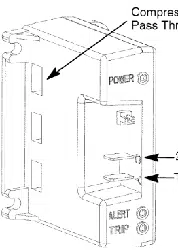
Some models are factory equipped with the Comfort
Alert TM Diagnostics device in the control box (refer to
Figure 14). Comfort Alert provides around-the-clock
monitoring for common electrical problems, compressor
defects, and broad system faults. If trouble is detected,
an alert code is displayed with a flashing LED indicator.
Alert codes are listed in Figure 15.
The device is factory wired and requires no
modification. Low voltage lead wires are provided in the
control box for connection to thermostat wires (use wire
nuts).
The Comfort Alert device operates by monitoring the
compressor power leads and the thermostat demand
signal (Y terminal).
Figure 14
Comfort Alert TM Diagnostics
(some models)
MAINTENANCE
Condensate Drain
During the cooling season, check monthly for free flow of
drainage and clean if necessary.
Cleanliness
These tips will help keep the air conditioner looking better
and working more efficiently:
,
,
,
Free flow of air is essential. Keep fences, shrubs,
trash cans, and other obstructions at least 18
inches (457 mm) from all coil inlets.
Keep the coil free of grass clippings, leaves,
weeds, and other debris.
NOTE: Coil may occasionally require cleaning
with a liquid solution. The coil must be cold when
cleaning. Use an alkaline based cleaner only.
Cleaning a hot coil or using an acid based cleaner
will remove the paint from the fins and may clog
the coil.
Never use a weather cover over the outdoor unit
unless it is a ventilated type or made of breathable
fabric that will allow moisture to evaporate rapidly.
A cover that holds moisture in the unit will cause
more rust build-up and damage than normal
exposure to weather.
421 01 5103 02 Specificationssubjectto change without notice. 13
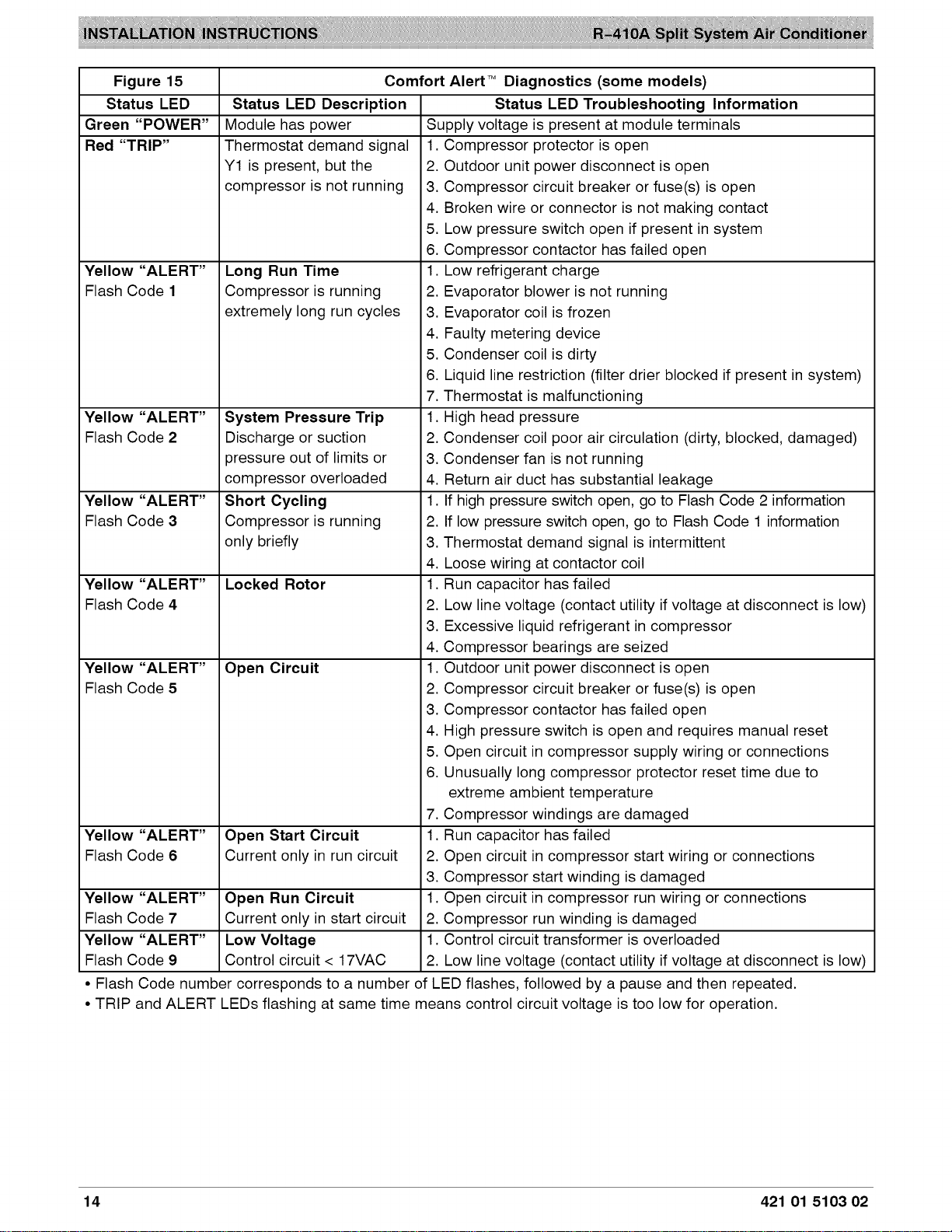
Figure 15
Status LED
Green "POWER"
Red "TRIP"
Yellow "ALERT"
Flash Code 1
Yellow "ALERT"
Flash Code 2
Yellow "ALERT"
Flash Code 3
Yellow "ALERT"
Flash Code 4
Yellow "ALERT"
Flash Code 5
Yellow "ALERT"
Flash Code 6
Yellow "ALERT"
Flash Code 7
Yellow "ALERT"
Flash Code 9
Comfort Alert TM
Status LED Description
Module has power
Thermostat demand signal
Y1 is present, but the
compressor is not running 3.
4.
5.
6.
Long Run Time 1
Compressor is running 2.
extremely long run cycles 3.
4.
5.
6.
7.
System Pressure Trip 1
Discharge or suction 2.
pressure out of limits or 3.
compressor overloaded 4.
Short Cycling 1
Compressor is running 2.
only briefly 3.
4.
Locked Rotor 1
2.
3.
4.
Open Circuit 1
2.
3.
4.
5.
6.
7.
Open Start Circuit 1
Current only in run circuit 2.
3.
Open Run Circuit 1
Current only in start circuit 2.
Diagnostics (some models)
Status LED Troubleshooting Information
Supply voltage is present at module terminals
1. Compressor protector is open
2. Outdoor unit power disconnect is open
Compressor circuit breaker or fuse(s) is open
Broken wire or connector is not making contact
Low pressure switch open if present in system
Compressor contactor has failed open
• Low refrigerant charge
Evaporator blower is not running
Evaporator coil is frozen
Faulty metering device
Condenser coil is dirty
Liquid line restriction (filter drier blocked if present in system)
Thermostat is malfunctioning
•High head pressure
Condenser coil poor air circulation (dirty, blocked, damaged)
Condenser fan is not running
Return air duct has substantial leakage
• If high pressure switch open, go to Flash Code 2 information
If low pressure switch open, go to Flash Code 1 information
Thermostat demand signal is intermittent
Loose wiring at contactor coil
•Run capacitor has failed
Low line voltage (contact utility if voltage at disconnect is low)
Excessive liquid refrigerant in compressor
Compressor bearings are seized
•Outdoor unit power disconnect is open
Compressor circuit breaker or fuse(s) is open
Compressor contactor has failed open
High pressure switch is open and requires manual reset
Open circuit in compressor supply wiring or connections
Unusually long compressor protector reset time due to
extreme ambient temperature
Compressor windings are damaged
•Run capacitor has failed
Open circuit in compressor start wiring or connections
Compressor start winding is damaged
•Open circuit in compressor run wiring or connections
Compressor run winding is damaged
Low Voltage 1. Control circuit transformer is overloaded
Control circuit < 17VAC 2. Low line voltage (contact utility if voltage at disconnect is low)
• Flash Code number corresponds to a number of LED flashes, followed by a pause and then repeated.
• TRIP and ALERT LEDs flashing at same time means control circuit voltage is too low for operation.
14 421 01 5103 02
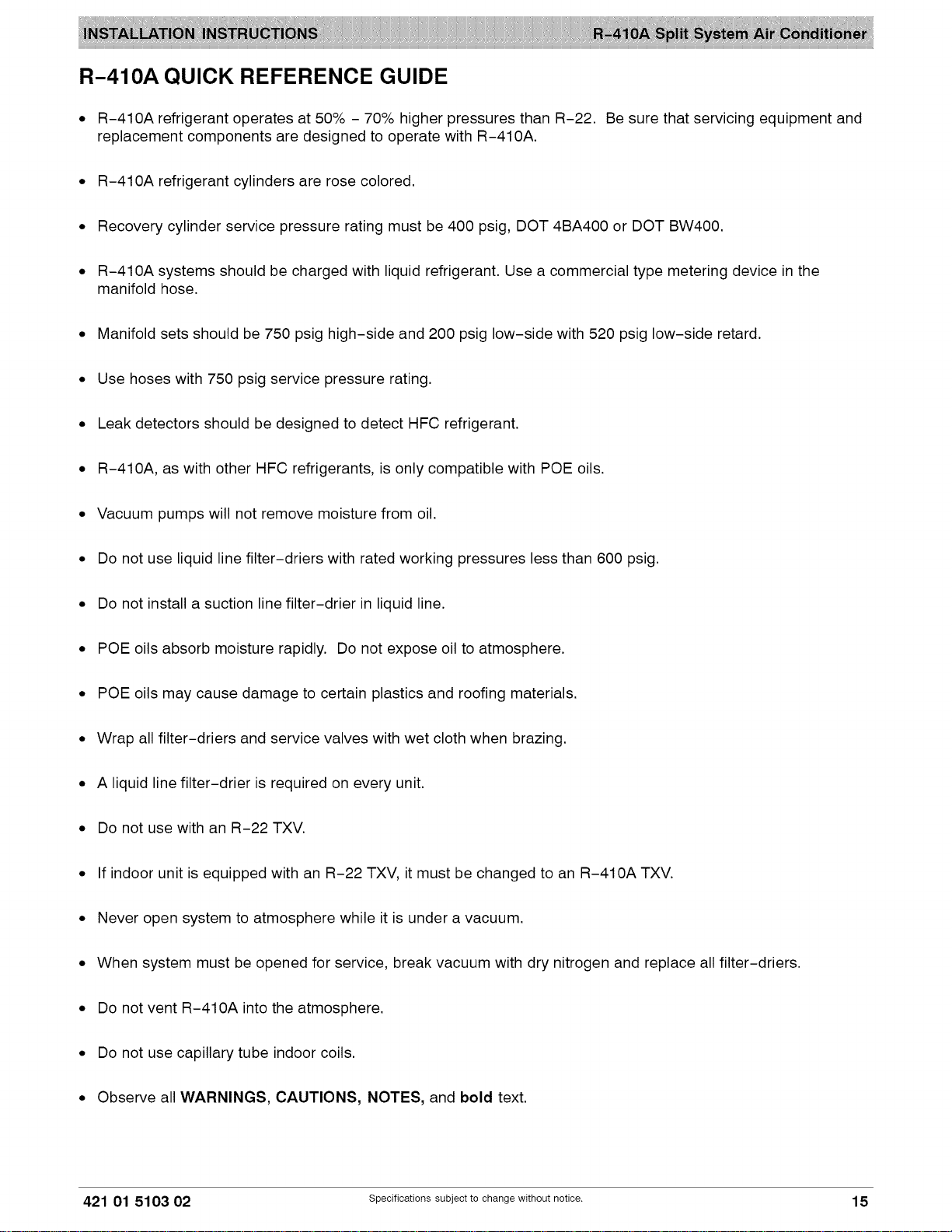
R-410A QUICK REFERENCE GUIDE
• R-410A refrigerant operates at 50% - 70% higher pressures than R-22. Be sure that servicing equipment and
replacement components are designed to operate with R-410A.
• R-410A refrigerant cylinders are rose colored.
• Recovery cylinder service pressure rating must be 400 psig, DOT 4BA400 or DOT BW400.
• R-410A systems should be charged with liquid refrigerant. Use a commercial type metering device in the
manifold hose.
° Manifold sets should be 750 psig high-side and 200 psig low-side with 520 psig low-side retard.
° Use hoses with 750 psig service pressure rating.
° Leak detectors should be designed to detect HFC refrigerant.
° R-410A, as with other HFC refrigerants, is only compatible with POE oils.
° Vacuum pumps will not remove moisture from oil.
° Do not use liquid line filter-driers with rated working pressures less than 600 psig.
° Do not install a suction line filter-drier in liquid line.
° POE oils absorb moisture rapidly. Do not expose oil to atmosphere.
° POE oils may cause damage to certain plastics and roofing materials.
° Wrap all filter-driers and service valves with wet cloth when brazing.
° A liquid line filter-drier is required on every unit.
° Do not use with an R-22 TXV.
° If indoor unit is equipped with an R-22 TXV, it must be changed to an R-410A TXV.
° Never open system to atmosphere while it is under a vacuum.
° When system must be opened for service, break vacuum with dry nitrogen and replace all filter-driers.
° Do not vent R-410A into the atmosphere.
° Do not use capillary tube indoor coils.
° Observe all WARNINGS, CAUTIONS, NOTES, and bold text.
421 01 5103 02 Specificationssubjectto change without notice. 15
16 Copyright2015International Comfort Products 421 01 5103 02
Lewisburg, TN 37091 USA