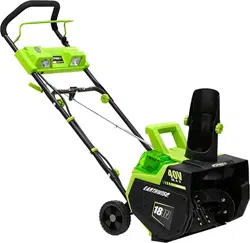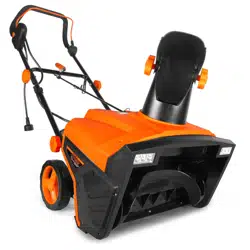
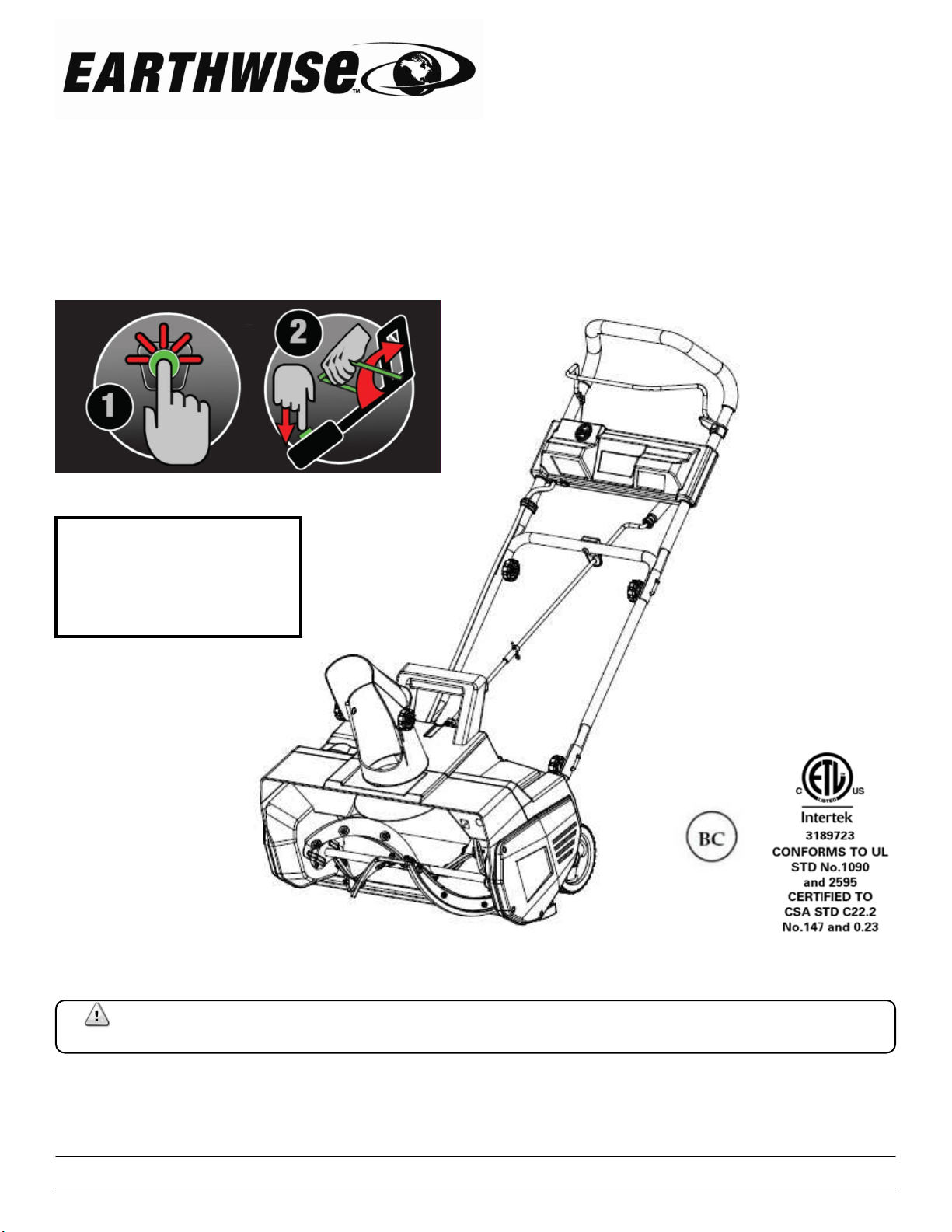
Model SN74022
OWNER’S MANUAL
22-IN Lithium Snow Thrower
Copyright All Rights Reserved.
SAVE THIS MANUAL FOR FUTURE REFERENCE
This product has been engineered and manufactured to our high standard for dependability, ease of operation, and
operator safety. Properly cared for, it will give you years of rugged, trouble-free performance.
WARNING: To reduce the risk of injury, the user must read and understand the owner’s manual
before using this product.
CA Compliant Charger
Included (Model No.
CHL80040)
BATTERY MUST BE CHARGED
BEFORE FIRST USE. TWO TO
THREE INITIAL CHARGING/
DISCHARGING CYCLES MAY BE
REQUIRED TO ACHIEVE
MAXIMUM RUN TIME/CAPACITY.
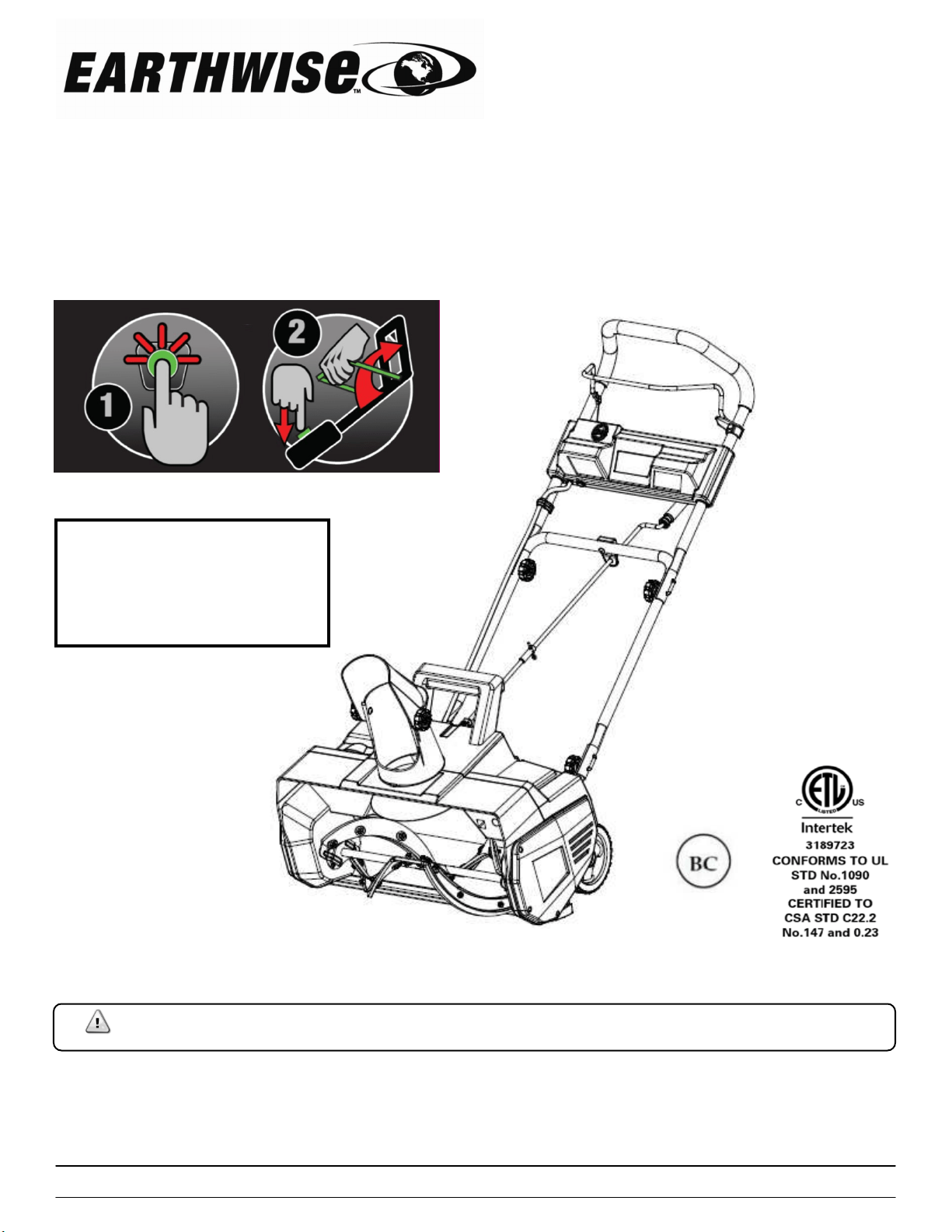
Quick Start Instruction
From Page 9
Thank you for your purchase.
DO NOT RETURN THIS PRODUCT TO THE STORE. OPERATING, ASSEMBLY, PART,
SERVICE QUESTIONS? GO TO AMERICANLAWNMOWER.COM OR CALL 1-800-633-1501
BETWEEN 8 AM – 5 PM EST, MONDAY-FRIDAY FOR ASSISTANCE.

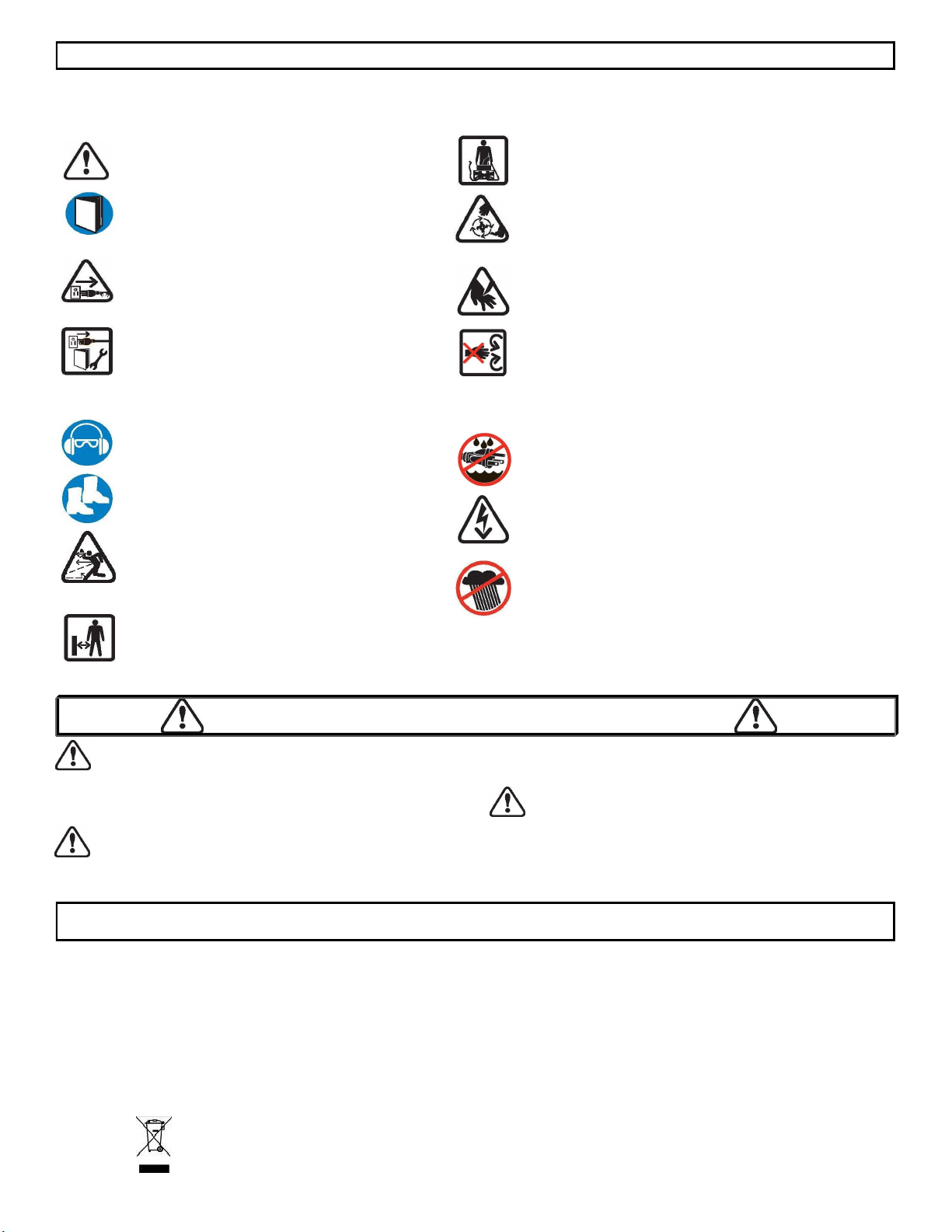
Precautions that involve your safety.
Keep the electrical cord free of the auger. The auger may
damage the cord and cause contact with live parts.
CAUTION! Read the instruction manual and
follow the warning and safety instructions!
DANGER! Rotating auger. Keep hands and feet at a safe
distance.
CAUTION! Remove plug from outlet
immediately if the cable is damaged or cut.
Do not place hand under auger.
SWITCH OFF! the machine, wait until it comes
to a complete standstill and remove battery
prior to maintenance, cleaning or repair work!
Do not place hand in front of chute deflector.
CAUTION! Always wear eye and ear
protection.
Do not expose to rain or use in damp locations.
Wear safe, sturdy, nonskid footwear!
DANGER! Risk of electric shock.
DANGER! objects may be thrown out at high
speed when motor is running. Do not walk in
front of running machine.
Do not use in rain or electrical storms.
Keep bystanders at a safe distance.
Waste electrical products should not be disposed of with household waste. Please recycle
where facilities exist. Check with your Local Authority or retailer for recycling advice.
SYMBOLS
Some of the following symbols may be used on this product. Please study them and learn their meaning. Proper
interpretation of these symbols will allow you to operate the product better and safer.
2
Model SN74022
TO REDUCE RISK OF INJURY: Before any use
be sure everyone using this product reads and
understands all safety instructions and other
information contained in this manual.
CAUTION: Wear appropriate personal hearing
protection during use. Under some conditions and
duration of use, noise from this product may
contribute to hearing loss.
Save these instructions and review frequently prior
to use and in instructing others.
WARNING: When using electric appliances, basic
safety precautions should always be followed to
reduce risk of fire, electric shock, and personal
injury, including the following:
READ ALL INSTRUCTIONS
IMPORTANT SAFETY WARNINGS
GENERAL SAFETY
Disconnect the battery pack from the appliance before
making any adjustments, changing accessories, or
storing appliance. Such preventive safety measures
reduce the risk of starting the appliance accidentally.
Recharge only with the charger specified by the
manufacturer. A charger that is suitable for one type of
battery pack may create a risk of fire when used with
another battery pack.
Use appliances only with specifically designated
battery packs. Use of any other battery packs may
create a risk of injury and fire.
When battery pack is not in use, keep it away from other
metal objects, like paper clips, coins, keys, nails, screws or
other small metal objects, that can make a connection from
one terminal to another. Shorting the battery terminals
together may cause burns or a fire.
Under abusive conditions, liquid may be ejected from the
battery; avoid contact. If contact accidentally occurs, flush
with water. If liquid contacts eyes, additionally seek medical
help. Liquid ejected from the battery may cause irritation or
burns.
Do not use a battery pack or appliance that is
damaged or modified. Damaged or modified
batteries may exhibit unpredictable behavior resulting
in fire, explosion or risk of injury.
Do not expose a battery pack or appliance to fire or
excessive temperature. Exposure to fire or
temperature above 130°C may cause explosion. The
temperature of 130°C can be replaced
by the temperature of 265°F.
Follow all charging instructions and do not charge the
battery pack or appliance outside of the temperature
range specified in the instructions. Charging
improperly or at temperatures outside of the specified
range may damage the battery and increase the risk
of fire.
Have servicing performed by a qualified repair person
using only identical replacement parts.
This will ensure that the safety of the product is
maintained.
Do not modify or attempt to repair the appliance or
the battery pack (as applicable) except as indicated
in the instructions for use and care.
CHECK FOR DAMAGED PARTS - Before further
use of the product, any part that is damaged should
be carefully checked to determine that it will operate
properly and perform its intended function. Check
for alignment of moving parts, binding of moving
parts, breakage of parts, mounting and any other
condition that may affect its operation. Any part that
is damaged should be properly repaired or replaced.
For assistance call our customer service help line at
1-800-633-1501.
AVOID DANGEROUS ENVIRONMENTS - Do
not operate in gaseous or explosive atmospheres.
Motors in these products normally spark, and the
sparks might ignite fumes.
KEEP CHILDREN AWAY - All visitors, children and
pets should stay at a safe distance from the work
area.
DRESS PROPERLY- Don’t wear loose clothing or
jewelry and wear protective hair covering to contain
long hair. They can be caught in moving parts.
Wear safe, sturdy, nonskid footwear. Maintain good
footing at all times, especially on slopes.
USE SAFETY GLASSES - Wear safety glasses
with side shields or goggles that are marked to
comply with ANSI Z87.1 standard when operating
this product.
WARNING: Keep hands away from moving parts.
Never put your hands near the auger to remove
snow, sticks or other debris. Blocked auger can
“spring back” when cleared and may cause
personal injury even when the snow thrower is
stopped. Always use a wooden stick such as a
broom handle to clear blockages.
REMOVE THE BATTERY from the snow thrower
when not in use or when servicing or cleaning. Do
not leave unattended.
USE RIGHT APPLIANCE - Do not use this product
for any job except that for which it is intended.
AVOID ACCIDENTAL STARTING—Don’t carry
snow thrower with finger on switch when the battery
is installed. Be sure switch is off when installing
battery.
DO NOT OVERLOAD the snow thrower by using at
too fast a rate to clear the snow. The snow thrower
will perform better and safer at the rate for which it
was designed.
DON’T OVERREACH - Guide the snow thrower at
a walking pace only. Keep proper footing and
balance at all times.
LIGHTING - Only operate your snow thrower in
daylight or good artificial light.
STORE IDLE UNIT INDOORS-When not in use,
the snow thrower should be stored indoors in a dry
area out of reach of children.
MAINTAIN UNIT WITH CARE-Keep clean for best
performance and to reduce the risk of injury.
Keep handles dry, clean and free from oil.
Do not operate the snow thrower on a slope that is
too steep for safe operation. When on slopes, slow
down and make sure you have good footing.
Before starting the snow thrower make sure the
auger is not touching any object and is free to
move.
Do not attempt to clear snow from a gravel or
crushed rock surface. This product is only intended
for use on hard, flat surfaces free of sand, stone
and debris, wires or any other objects.
Operation of the snow thrower in the hand-held
position is unsafe except in accordance with the
special instructions for such use provided in the
operator’s manual.
CAUTION: Never throw snow towards people, pets
or cars and never allow anyone in front of the snow
thrower while in operation.
Objects that might clog the snow thrower or cause
other damage can be hidden in the snow. Clear the
area of doormats, sleds, boards, wires and other
debris prior to use.
If the auger strikes a foreign object, stop the snow
thrower and examine it for signs of damage. Make
any necessary repairs before restarting and
continuing to work.
STAY ALERT - Watch what you are doing. Use
common sense. Do not operate the snow thrower
when you are tired or under the influence of drugs,
alcohol or medications.
GENERAL SAFETY
3
Model SN74022
GENERAL SAFETY
If the snow thrower starts to vibrate abnormally, turn it off
immediately and check for the cause. Vibration is
generally a warning of trouble.
Always turn off the snow thrower, wait until the auger
comes to a complete stop and remove the battery before
carrying out maintenance or repairs.
Never operate the snow thrower without proper guards
and other safety protective devices in place and
working.
GENERAL SAFETY
SAFETY RULES FOR CHARGER
FCC WARNING:
Please note that changes or modifications to this
product not expressly approved by the party
responsible for compliance could void the user's
authority to operate the equipment.
NOTE: This equipment has been tested and found to
comply with the limits for a Class B digital device,
pursuant to Part 15 of the FCC Rules. These limits are
designed to provide reasonable protection against
harmful interference in a residential installation. This
equipment generates, uses and can radiate radio
frequency energy and, if not installed and used in
accordance with the instructions, may cause harmful
interference to radio communications. However, there
is no guarantee that interference will not occur in a
particular installation. If this equipment does cause
harmful interference to radio or television reception,
which can be determined by turning the equipment off
and on, the user is encouraged to try to correct the
interference by one or more of the following measures:
-- Reorient or relocate the receiving antenna.
-- Increase the separation between the equipment and
receiver.
-- Connect the equipment into an outlet on a circuit
different from that to which the receiver is connected.
-- Consult the dealer or an experienced radio/TV
technician for help.
Do not abuse the cord. Never use the cord for carrying,
pulling or unplugging the power tool. Keep cord away from
heat, oil, sharp edges or moving parts. Damaged or
entangled cords increase the risk of electric shock.
Use of an attachment not recommended or sold by the
battery charger manufacturer may result in a risk of fire,
electric shock, or injury to persons. Following this rule will
reduce the risk of electric shock, fire, or serious personal
injury.
Do not service snow thrower with battery, switch key, or
charger installed.
Do not use the charger when the ambient temperature is
above 100°F (37.8°C) or below 32°F (0°C)
Do not operate charger with a damaged cord or plug
which could cause shorting and electric shock. If
damaged, replace the charger with an identical charger.
Do not operate charger if it has received a sharp blow,
been dropped or otherwise damaged in any way. Take it
to a qualified individual for electrical check to determine if
the charger is in good working order.
Unplug charger from outlet before attempting any
maintenance or cleaning to reduce the risk of electric
shock.
Disconnect charger from the power supply when not in
use to prevent damage to the charger during a power
surge.
Risk of electric shock, Do not touch uninsulated portion of
output connector or uninsulated battery terminal.
Do not expose charger to wet or damp conditions, Water
entering charger will increase the risk of electric shock.
Make sure cord is located so that it will not be stepped on,
tripped over, come in contact with sharp edges or moving
parts or otherwise subjected to damage or stress. This will
reduce the risk of accidental falls, which could cause
injury and damage to the cord, which could result in
electric shock.
Keep cord and charger away from heat to prevent
damage to housing or internal parts.
Do not let gasoline, oils, petroleum-based products, etc.
come in contact with plastic parts. They contain chemicals
that can damage, weaken or destroy plastic.
An extension cord should not be used unless
absolutely necessary. Use of improper extension cord
could result in a risk of fire and electric shock. If
extension cord must be used, make sure:
a. That pins on plug of extension cord are the same
number, size and shape as those of plug on
charger
b. That extension cord is properly wired and in good
condition; and
c. That wire size is large enough for AC ampere
rating of charger as specified below:
Cord length (Feet) - 25’ 50’ 100’
Cord Size (AWG) - 16 16 16
NOTE: AWG= American Wire Gauge
Save these instructions. Refer to them frequently and
use them to instruct others who may use this product.
If you loan someone this snow thrower, loan them
these instructions also.
WARNING: Keep all connections dry and off the
ground. Do not touch plug with wet hands.
CAUTION: Auger does not stop immediately after the
snow thrower is turned off.
CAUTION: Risk of injury. This snow thrower is capable
of causing serious injury. Do not put hands, feet or any
body part or clothing near the rotating auger.
WARNING: California Proposition 65:
This product contains chemicals known to the State of
California to cause cancer, birth defects or other
reproductive harm.
WARNING: Cancer and Reproductive Harm -
www.P65Warnings.ca.gov.
4
Model SN74022
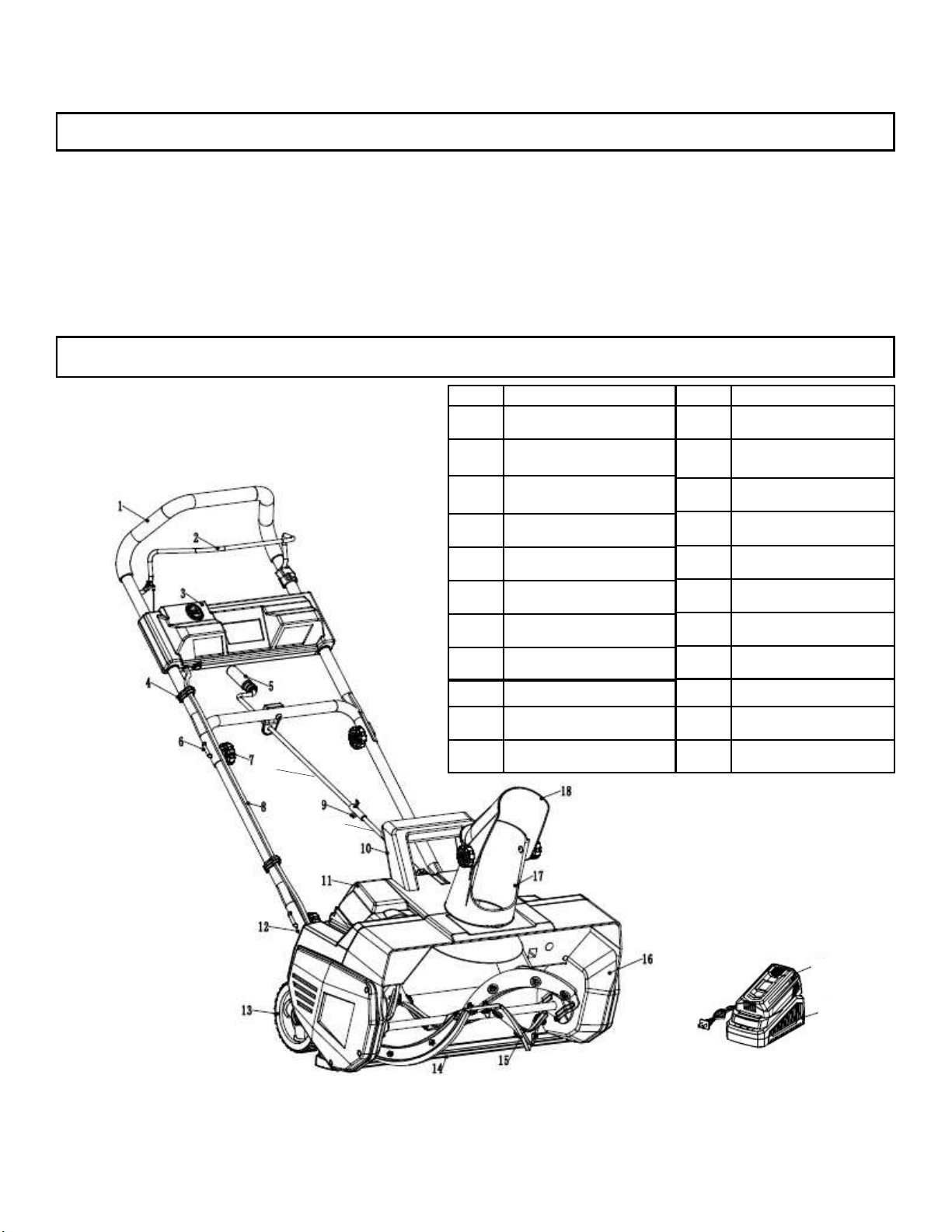
PRODUCT SPECIFICATIONS
Model: SN74022
Power supply voltage: 40V, DC only Clearing width: 22 inches (560 mm)
Speed: 2000 RPM Max clearing depth: 12 inches (305 mm)
Battery: 40V, 4.0 Ah Lithium-ion Max clearing capacity: 600 pounds/minute
Charging time: 2.5 hours Max throwing distance: Up to 30 feet
Battery run time: Up to 30 minutes Weight: 32.4 pounds
PARTS LIST
No. Description
1 Upper handle
2 Bail wire
3 Switch button
4 Cable clip
5 Crank handle
5A Upper crank
5B Lower crank
6 J bolt
7 Knob
8 Center handle
9 Cotter pin
No. Description
10 Auxiliary handle
11
Battery
compartment
12 Lower handle
13 Wheel assy.
14 Scraper blade
15 Auger
16 Side cover
17 Discharge chute
18 Chute deflector
19 Battery pack
20 Charger
19
20
5
Model SN74022
5A
5B
ASSEMBLY
UNPACKING
This product requires assembly.
Carefully remove everything from the box. Make sure that
all items listed in the packing list are included.
Inspect all items carefully to make sure no breakage or
damage occurred during shipping.
Do not discard the packing material until you have
carefully inspected and satisfactorily operated the snow
thrower.
If any parts are damaged or missing, please call our
customer service help line at 1-800-633-1501 for
assistance.
PACKING LIST
- Snow Thrower
- Handle Assembly
- Chute Crank
- Chute Deflector
- Battery & Charger
- Hardware Bag
- Owner’s Manual
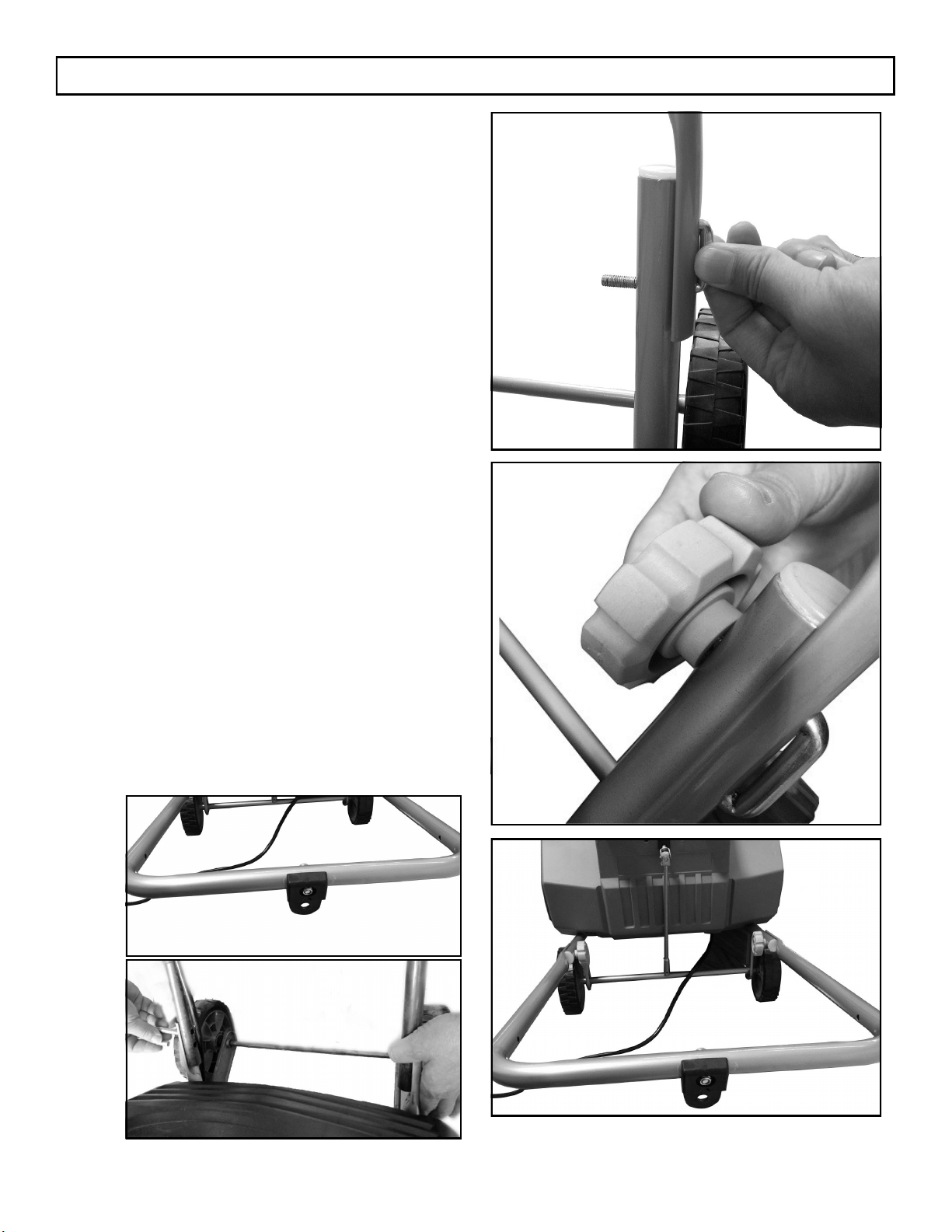
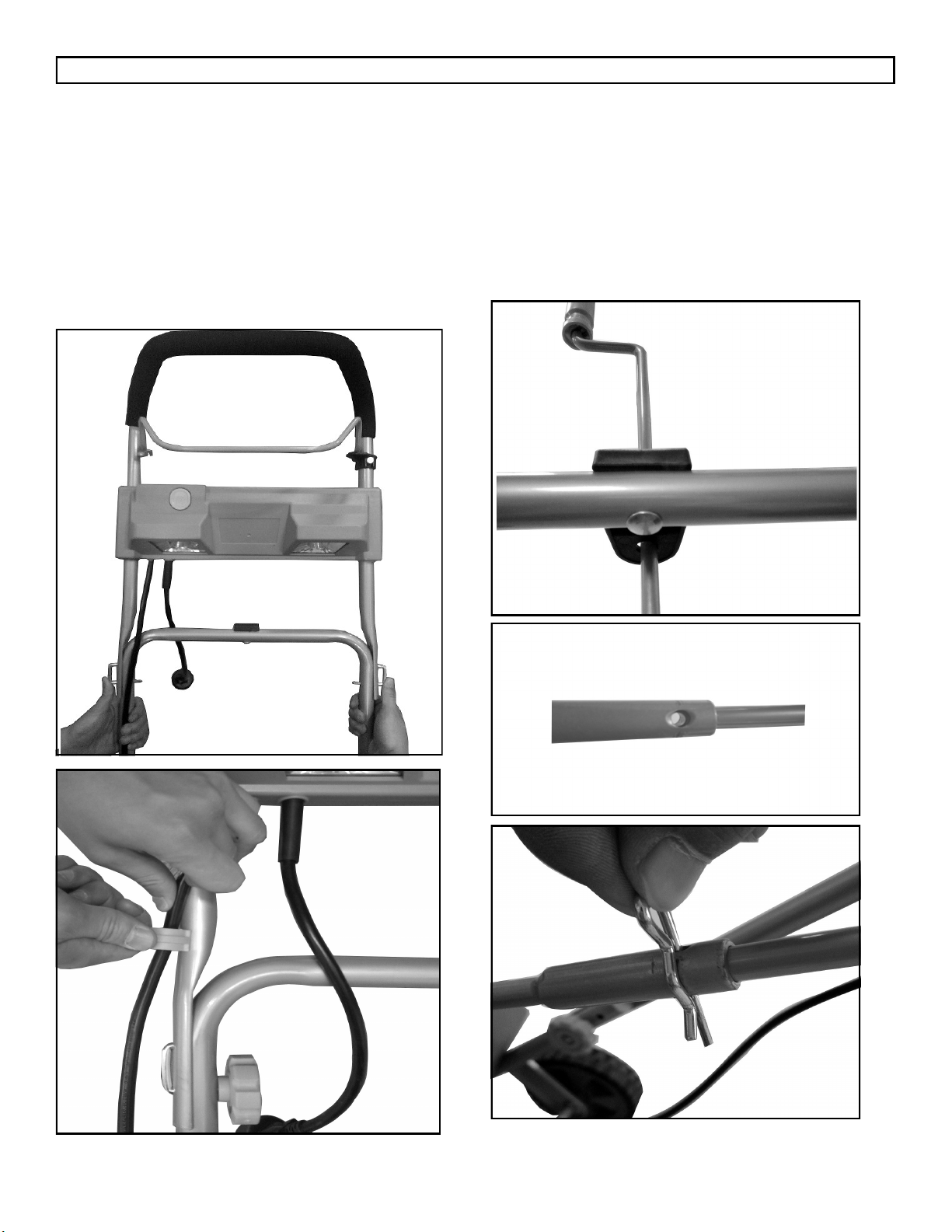
INSTALLING CENTER HANDLE
Position the center handle onto the lower handles and
make sure the bracket is pointed downward. (See Fig
1)
Align the holes on the center handle with the holes in
the lower handle as shown. (See Fig 2)
Insert J-bolt through both handles with the threaded
end at the bottom and facing inside. (See Fig 3)
Install the handle knob and tighten securely to secure
the bolt in place. (See Fig 4)
Repeat on the opposite side to secure the center
handle in place. (See Fig 5)
Fig. 5
Fig. 4
Fig. 3
Fig. 2
Fig. 1
6
Model SN74022
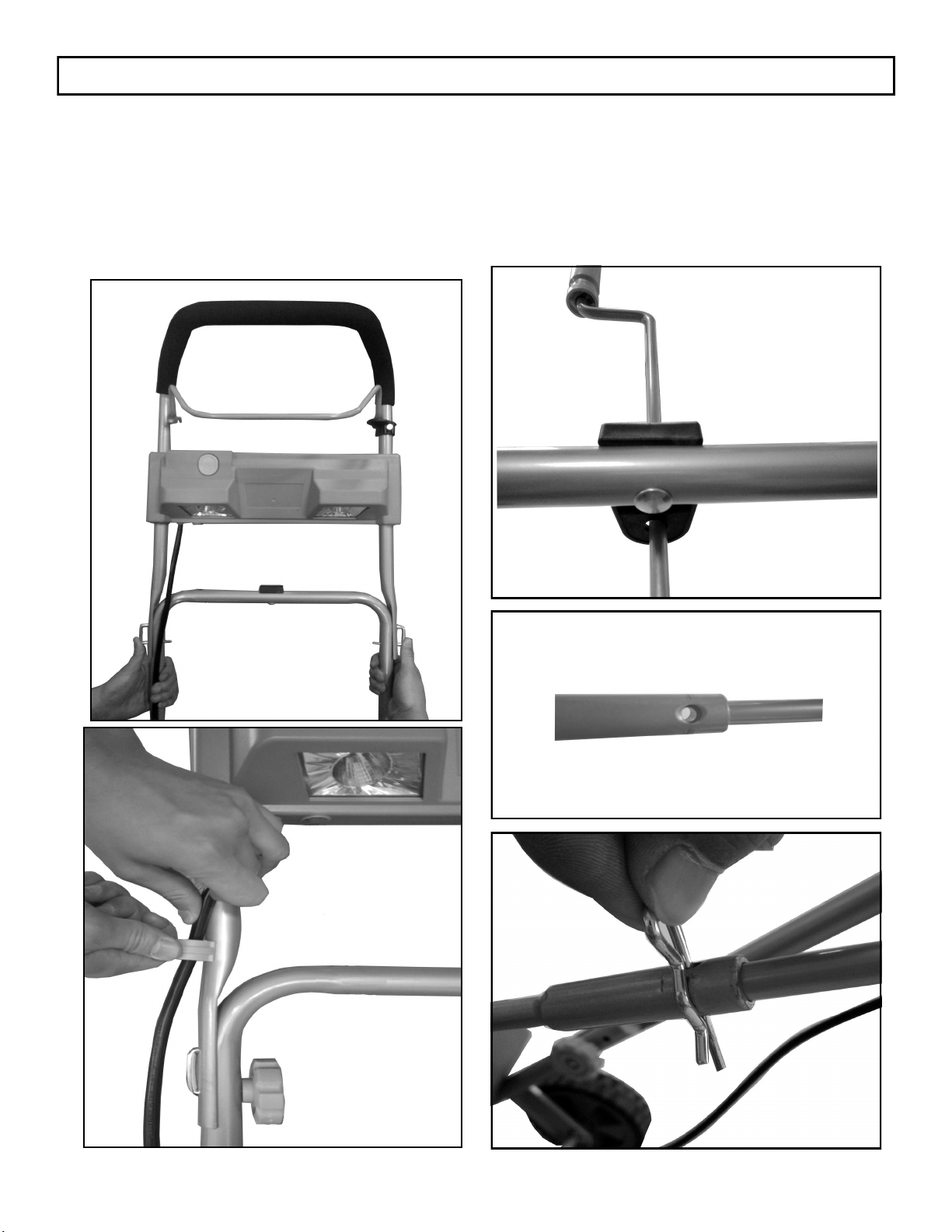
INSTALLING CHUTE CRANK
Install the upper chute crank through the bracket
located on the center handle. (See Fig 8)
Align the holes in the upper and lower cranks and
insert the cotter pin through the holes as shown to
secure. (See Fig 9 and Fig 10)
Turn the lever left and right to verify the proper
functioning of the crank and the chute.
ASSEMBLY
INSTALLING UPPER HANDLE
Align the holes on the upper handle with the holes in
the center handle as shown. (See Fig 6)
Insert threaded end of J bolt through both handles with
the threaded end facing inside.
Install the handle knob and tighten secure.
Repeat on the opposite side.
Secure the cable clip to handles. (See Fig 7).
Fig. 8
Fig. 9
Fig. 10
Fig. 6
Fig. 7
7
Model SN74022
8
Model SN74022
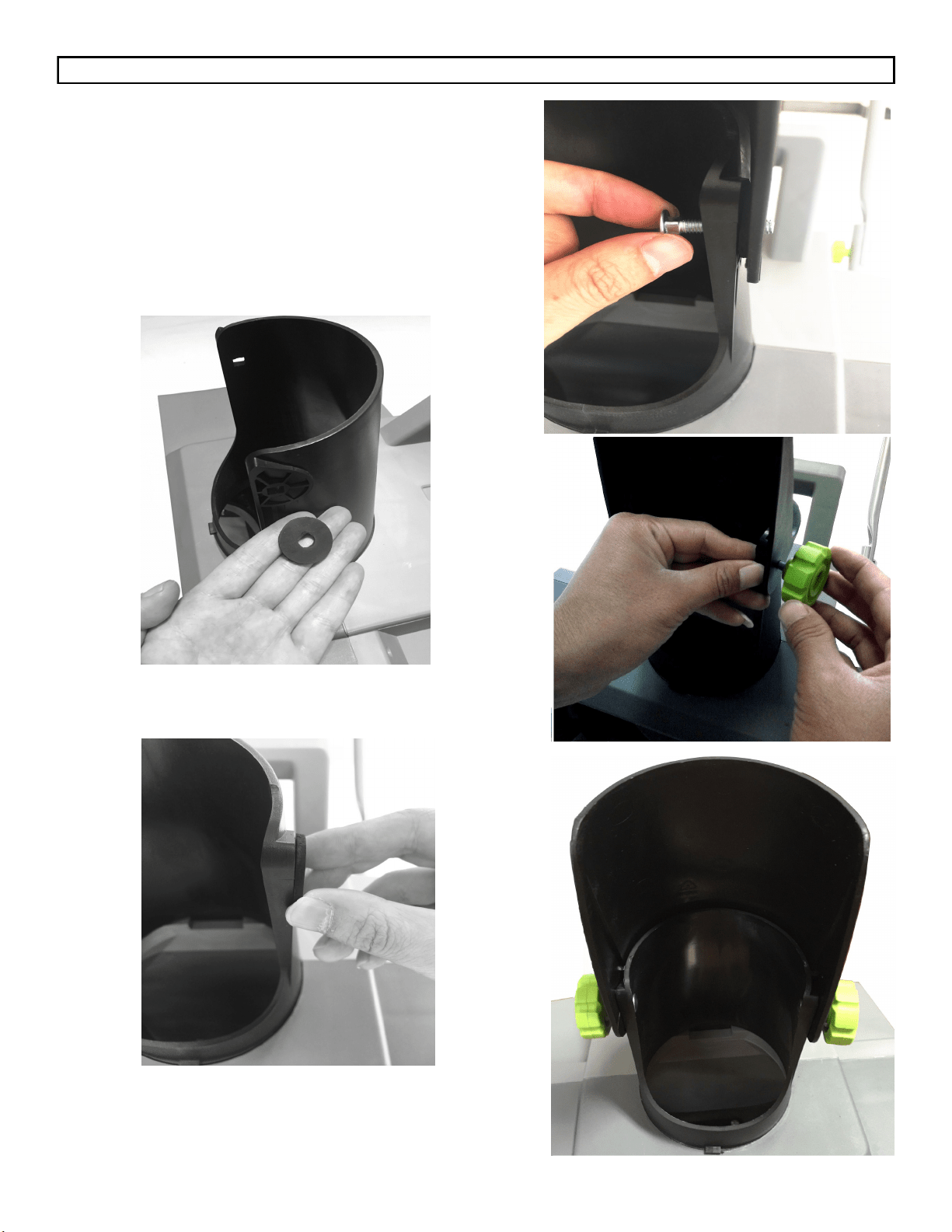
INSTALLING CHUTE DEFLECTOR
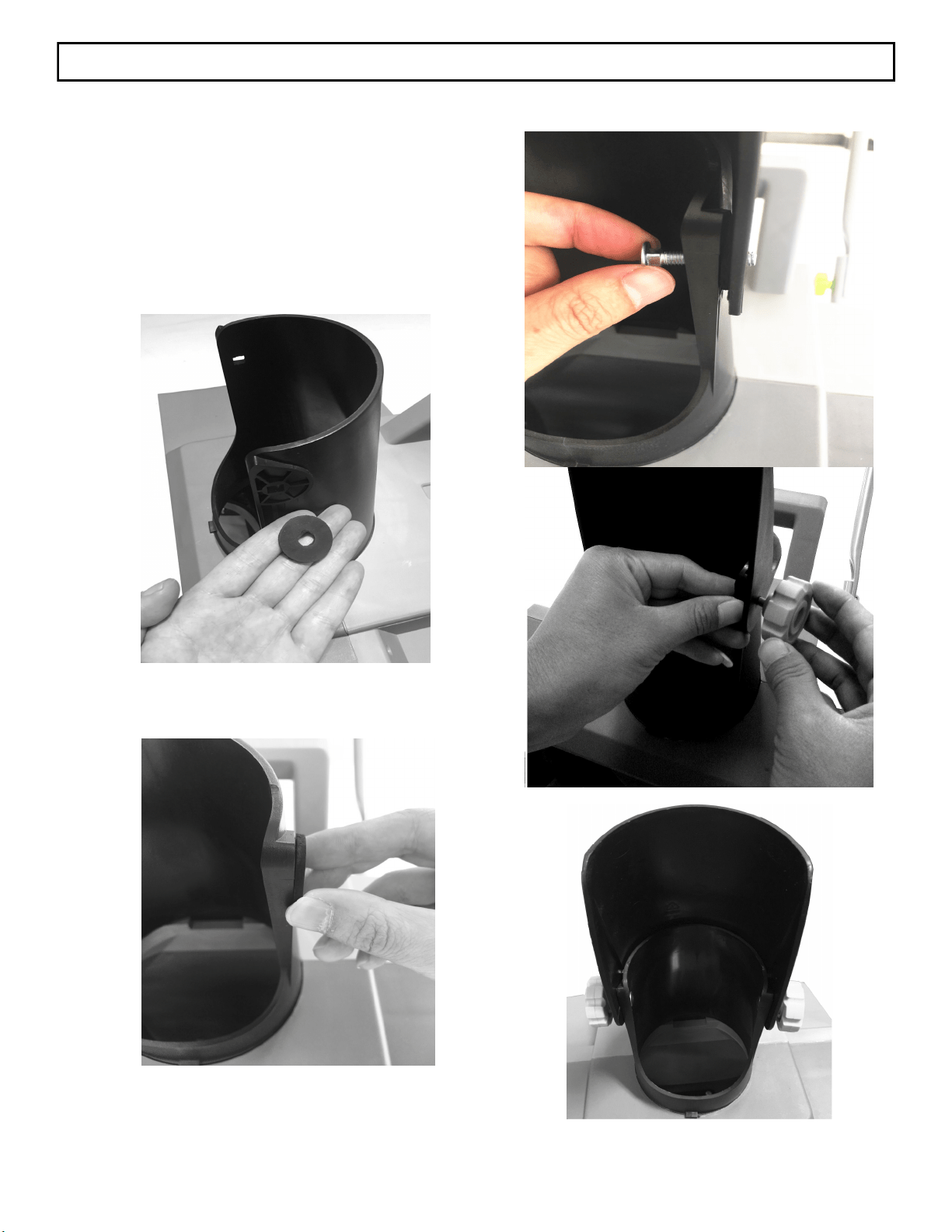
Take the washer out of hardware bag. (See Fig 11)
Position the washer onto the discharge chute. (See
Fig 12)
Position the chute deflector over the discharge chute.
Align the holes and place the washer between the
deflector and chute. (See Fig 13)
Tighten the knobs firmly. (See Fig 14 - 15)
Fig. 12
Fig. 11
ASSEMBLY
Fig. 14
Fig. 15
Fig. 13
Removing snow
Before starting work, thoroughly inspect the area where
the equipment is to be used and remove all doormats
sleds, boards, wires and any other foreign objects.
Check the condition of the snow thrower before operating
it to ensure that the auger turns freely.
Check the auger for wear and tear at regular intervals.
Make sure all fasteners on the snow thrower (screws,
nuts, etc.) are fully tightened.
Position the discharge chute so that snow will discharge
in a safe direction. Do not direct the discharge towards
people or areas where property can be damaged. Keep
children, pets and others away for the work area. Do not
walk in front of the snow thrower when it is running.
Direct the discharge to the right or left by turning the
discharge chute with the chute crank. The chute can be
adjusted up to 180 degrees.
The chute deflector on the top of the discharge chute
controls the height of the discharge. Loosen both of the
knobs to raise or lower the deflector to the desired height
and tighten the knobs to secure the deflector.
NOTE: Do not over-tighten the knobs.
For the most efficient snow removal throw the snow
downwind and slightly overlap each swath.
Push the snow thrower forward at a comfortable rate of
speed, yet slow enough to clear the path completely. The
width and depth of the snow determines your forward
speed.
When turning at the end of a swath, use the wheel on
one side as the pivot point. Slightly tilt the snow thrower
on this pivot point while turning.
The snow thrower can remove up to 12 inches deep in
one pass. To shave down larger banks of snow, lift the
snow thrower by the primary and auxiliary handles and
place the snow thrower on the bank. Let the weight of
the snow thrower shave down the bank by rocking it in a
back-and-forth motion.
When clearing steps, hold the snow thrower by the
primary and auxiliary handles and use a swinging or
sweeping motion.
Clear snow often, before it gets too deep. It is best to
remove the snow as soon as possible after it falls.
Some parts of the snow thrower may freeze under
extreme temperature conditions. If parts freeze while the
snow thrower is in use, stop the snow thrower, remove
the battery and inspect for frozen parts. Free all parts of
ice before restarting or operating the snow thrower. Do
not attempt to operate the snow thrower with frozen parts
or try to force controls that are frozen.
OPERATING
Install battery
BATTERY MUST BE CHARGED BEFORE FIRST USE.
Open the battery compartment cover and slide the
battery down until it clicks to lock it into position, then
close the battery department cover.
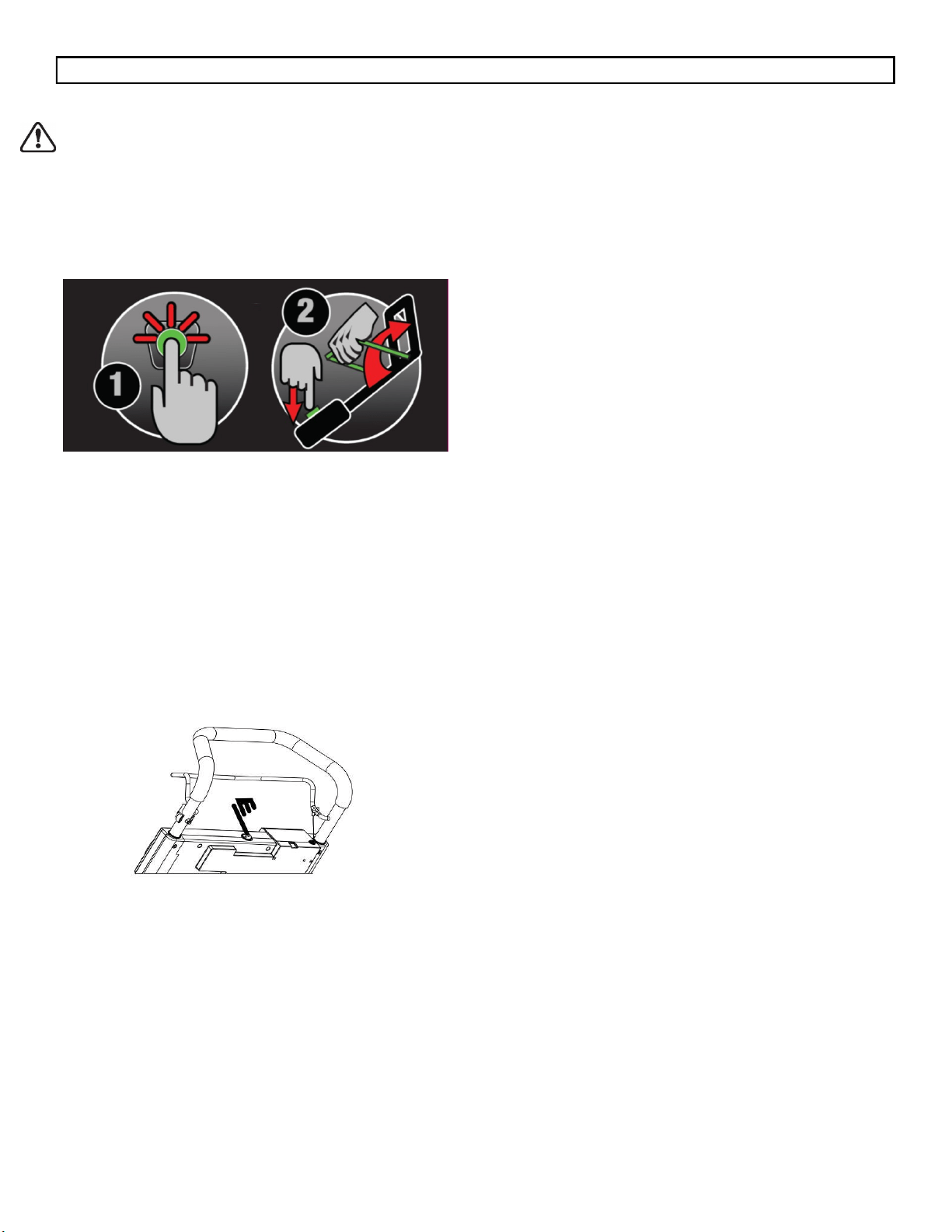
Turning On and Off
WARNING: The auger starts rotating immediately after
the snow thrower is switched on. Keep hands and feet
away from the auger.
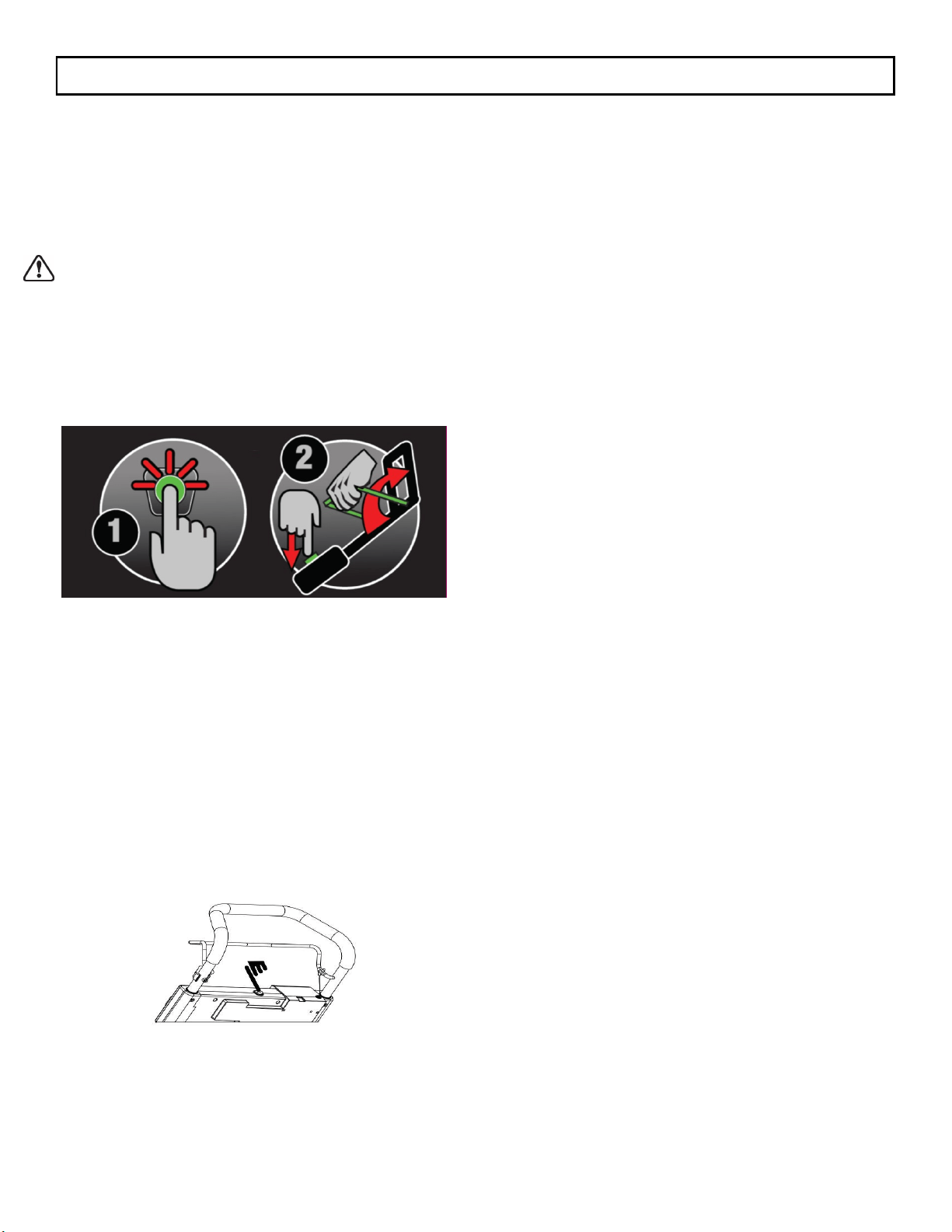
To switch ON, make sure the auger is not touching any
surface. Press down and hold the safety lock off button
(1). While holding down the button pull back on bail wire
(2). Once the snow thrower is started you can release the
safety lock off button.
To switch off simply release the bail wire.
LED HEADLIGHTS
LED headlights are located on the upper handle to
illuminate your path when using the snow blower in low
light conditions.
The lights may be turned on when the snow thrower is
operating. After the snow thrower is engaged by pressing
the safety lock button and pulling the bail wire toward the
handle, the lights may be turned on by pressing the on-off
switch to the on position. Lights will go out when the bail
wire is released. (See Fig 16)
The lights will illuminate when the bail wire is pulled as
long as the on-off switch remains in the on position.
When job is completed, press switch to the off position.
Fig 16
ON/ OFF BUTTON
9
Model SN74022
OPERATING
After clearing the snow, continue to run the snow thrower
for a few minutes to prevent ice from freezing on moving
parts. Then switch off the motor, wait for all moving parts
to stop, and wipe the ice and snow from the snow
thrower with a clean rag.
WARNING: To avoid serious personal injury, do not use
hands or feet to unclog the chute.
Before unclogging the chute, shut off the snow thrower
and remove the battery pack. Wait for the auger to stop
turning. Clean out the chute with a wooden stick such as
a broom handle.
If the snow thrower should start to vibrate abnormally,
immediately stop the motor and check for the cause.
Vibration is generally a warning of trouble.
Look behind and use care when backing up with the
snow thrower.
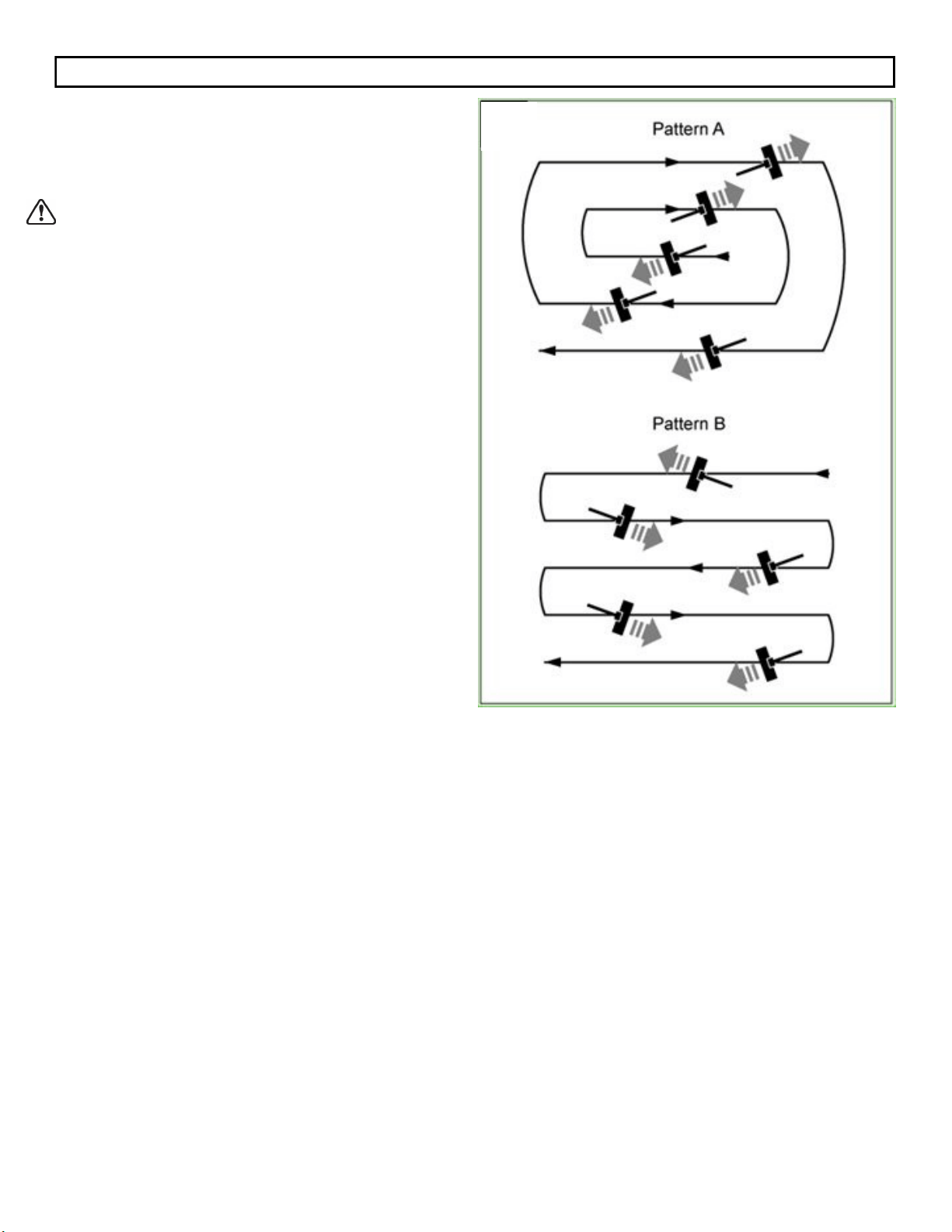
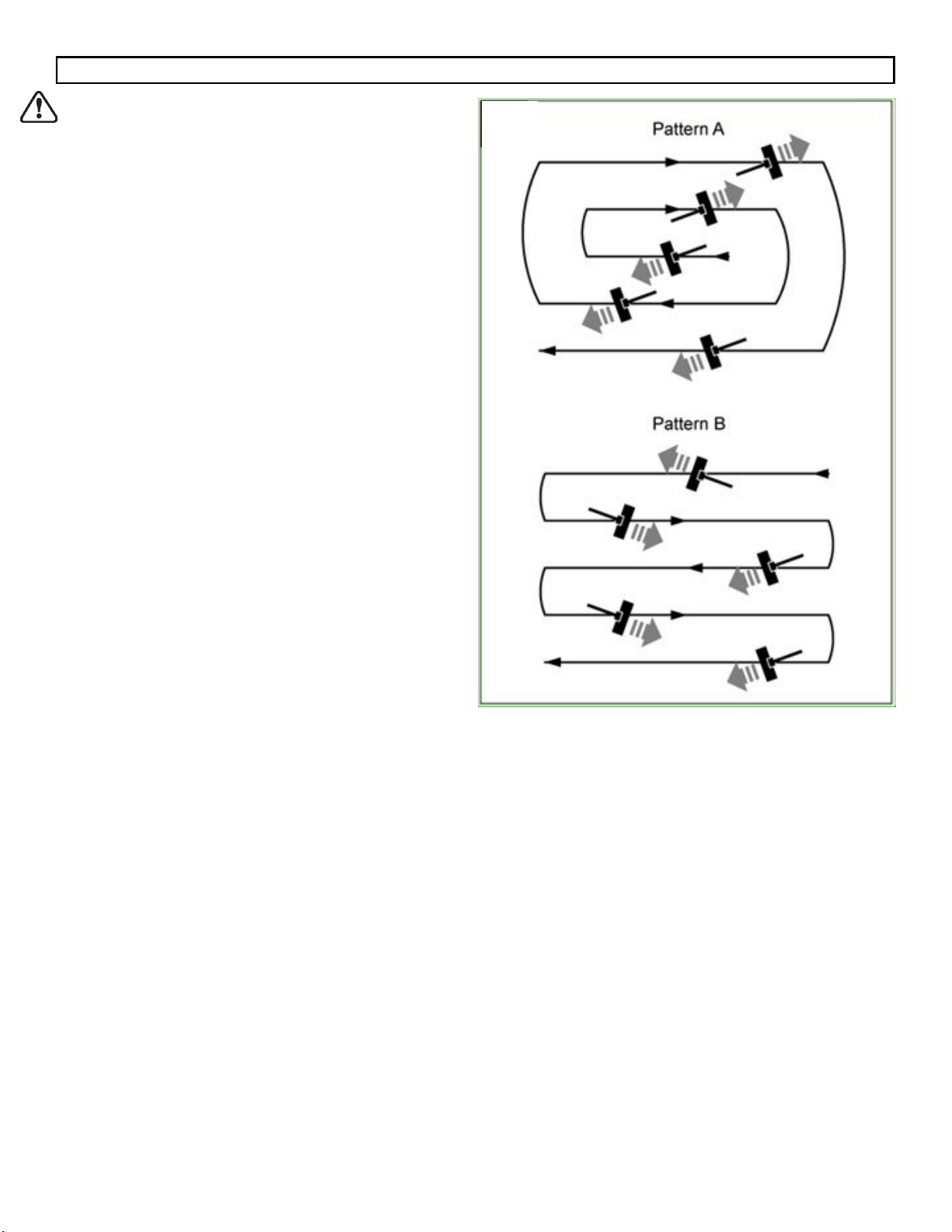
For large areas a definite pattern of operation is required
to thoroughly clean an area of snow. These patterns
will avoid throwing snow in unwanted places as well as
eliminating a second removal of snow.
Pattern A: Throw the snow to the right or left side where
it is possible. For areas such as a long driveway it is
advantageous to start in the middle. Plow from one end
to the other, throwing snow to both sides.
Pattern B: If the snow can only be thrown to one side of
the area to be cleared, start on the opposite side.
Overload Protection
The over current controller will automatically turn off the
snow thrower within 2 seconds when the current is over
25A. If the motor stops, you can restart the snow thrower
immediately if needed.
10
Model SN74022
MAINTENANCE
Replacing the scraper
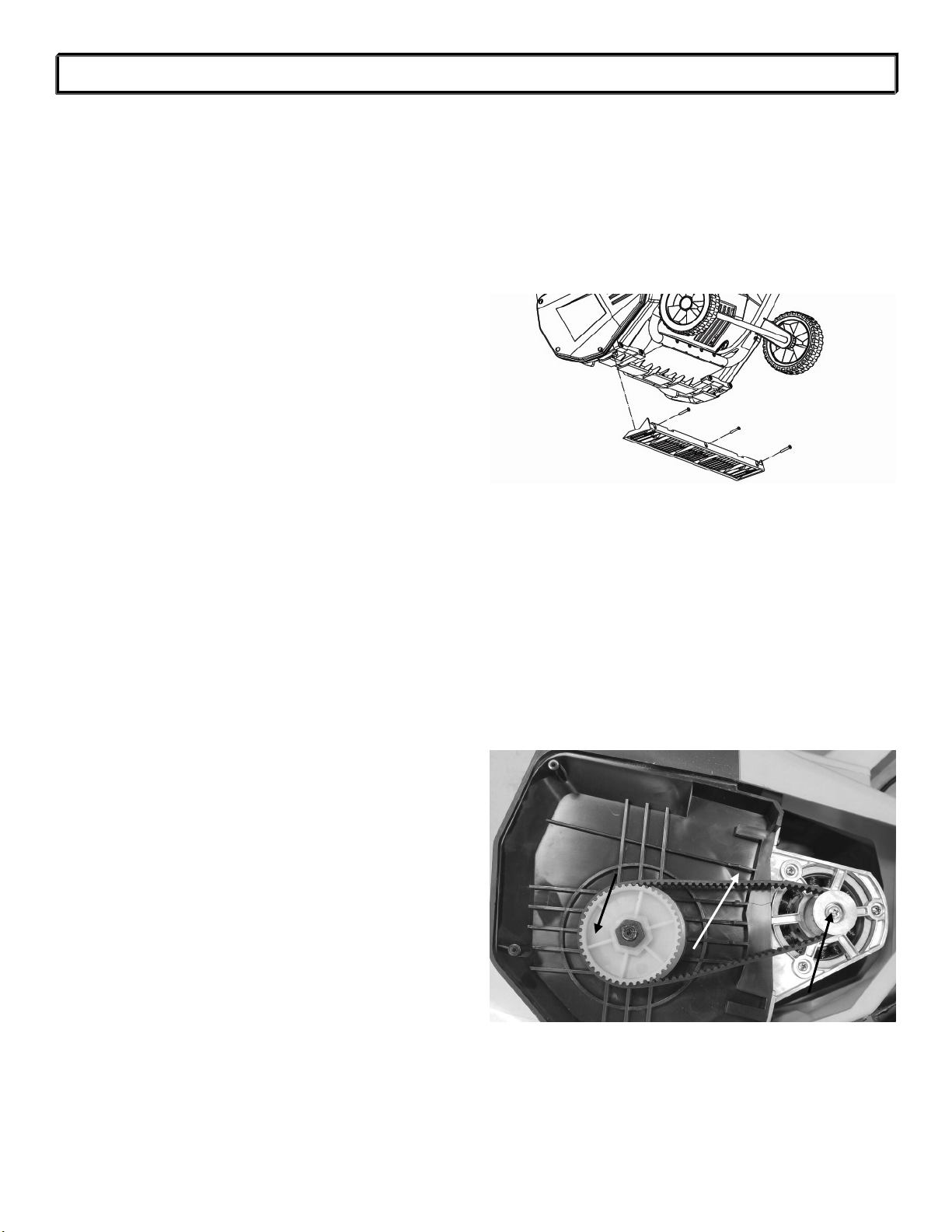
The scraper is located at the base of the snow thrower
beneath the auger housing.
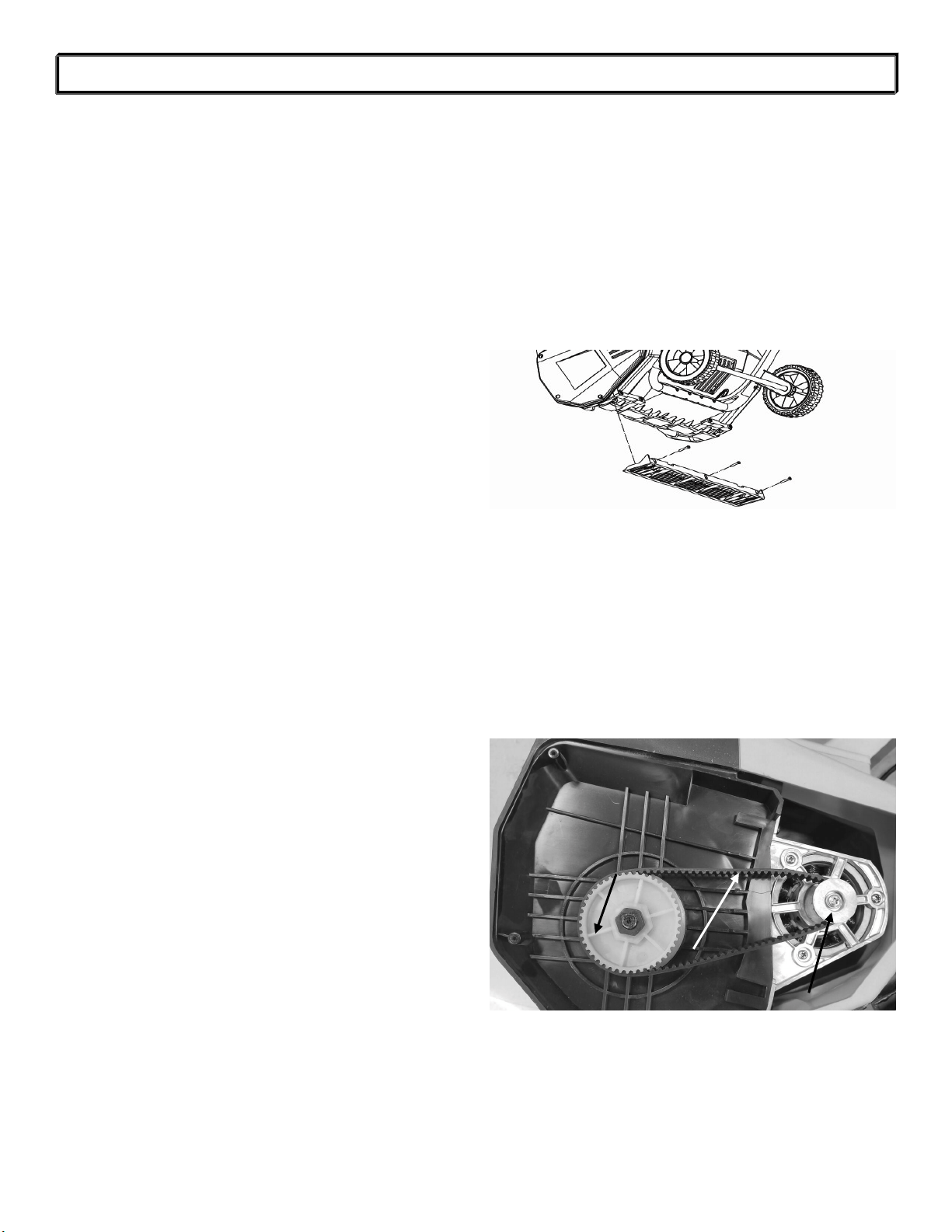
Remove the screws that secure the scraper to the snow
thrower.
Install the new scraper and fasten it securely with the
screws. (See Fig 17)
Replacing the auger belt
Under normal operating conditions it should not be
necessary to replace the auger belt. However, should
the auger jam or malfunction the belt could be damaged.
To replace the belt follow these instructions.
Belt drive system structure (See Fig 18)
Regular cleaning and maintenance of your snow thrower
will ensure efficiency and prolong the life of the product.
Check all fasteners at frequent intervals for proper
tightness to be sure the snow thrower is in safe working
condition.
After each use, let the motor run for a few minutes so that
moving parts do not freeze. Then shut off the motor, wait
for all moving parts to stop, and wipe the ice and snow
from the snow thrower. Rotate the chute crank several
times to remove snow.
Only use a cloth soaked with hot water and a soft brush
to clean the snow thrower. Never wet or spray water on
the machine!
Do not use detergents or solvents as these could cause
irreparable damage to the snow thrower. Chemicals can
destroy the plastic parts.
To protect the snow thrower from corrosion when storing
for long periods, lightly oil the metal parts.
Store the snow thrower in a dry area out of reach of
children.
For the user’s safety, worn or damaged parts must be
replaced. Replace with original replacement parts only.
Parts from another snow thrower may not fit properly
causing an unsafe situation.
Lubricating the snow thrower
You do not need to lubricate the snow thrower. All of the
bearings are sealed and were lubricated at the factory for
the life of the snow thrower.
Replacing the rubber plates on auger
Detach the worn rubber plate by removing the two sets of
nuts, bolts, and washers used to secure it.
Install the new rubber plate.
Insert the bolt with the small flat washer into the
corresponding holes on each end of the rubber plate.
Use a large flat washer and locknut to secure the bolt
on each end.
Install the other rubber plate in the same manner.
Fig. 18
Fig 17
Before carrying out maintenance operations, remove the battery pack.
Auger Pulley
Auger Belt
Drive Pulley
11
Model SN74022
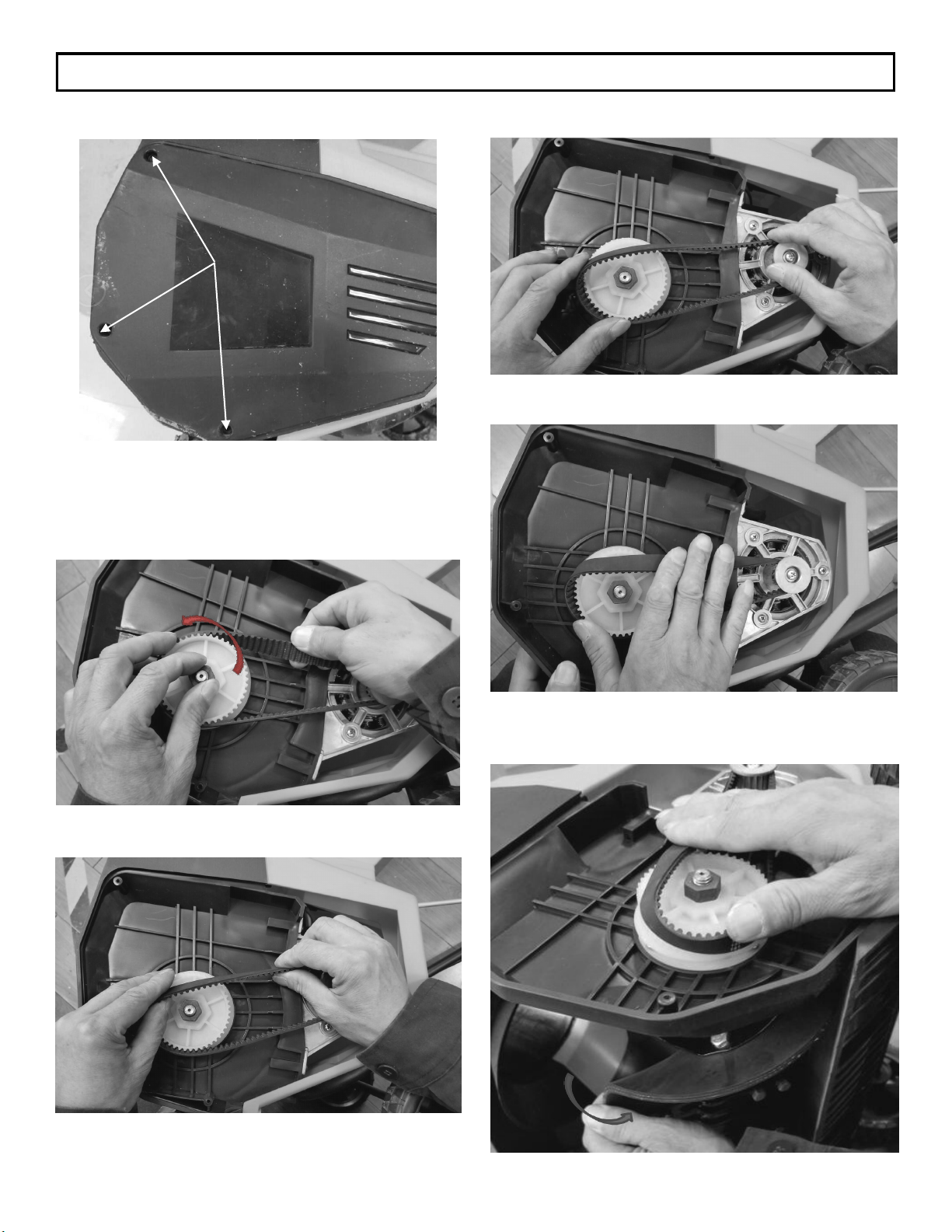
MAINTENANCE
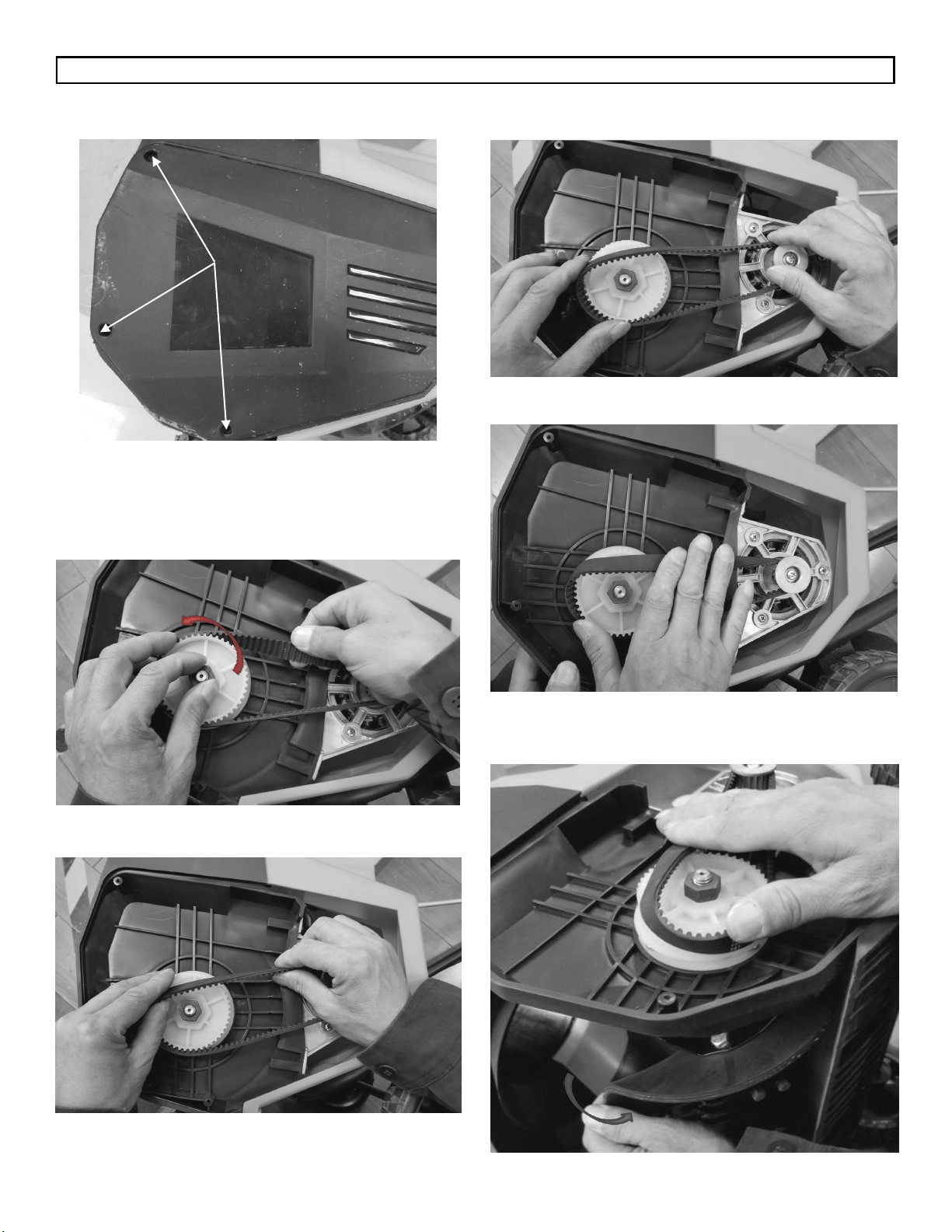
1. Open the left side plate by removing three screws.
(Fig. 19)
2. Use your right hand to turn the rib side of the belt
up and pull upwards while turning the auger pulley
counterclockwise with your left hand. The belt can be
easily removed from the pulley. (Fig. 20 - 21)
3. Put the belt on the drive pulley first and then place
the belt at the lower end of the auger pulley. (Fig. 22)
4. Use right hand to press the belt with ribbed side
down. (Fig. 23)
5. While holding the belt down with your right hand use
your left hand to turn the auger forward so that the
auger pulley rotates in a
clockwise direction. (Fig. 24)
Fig. 19
Screw
Fig. 20
Fig. 21
Fig. 22
Fig. 23
Fig. 24
12
Model SN74022
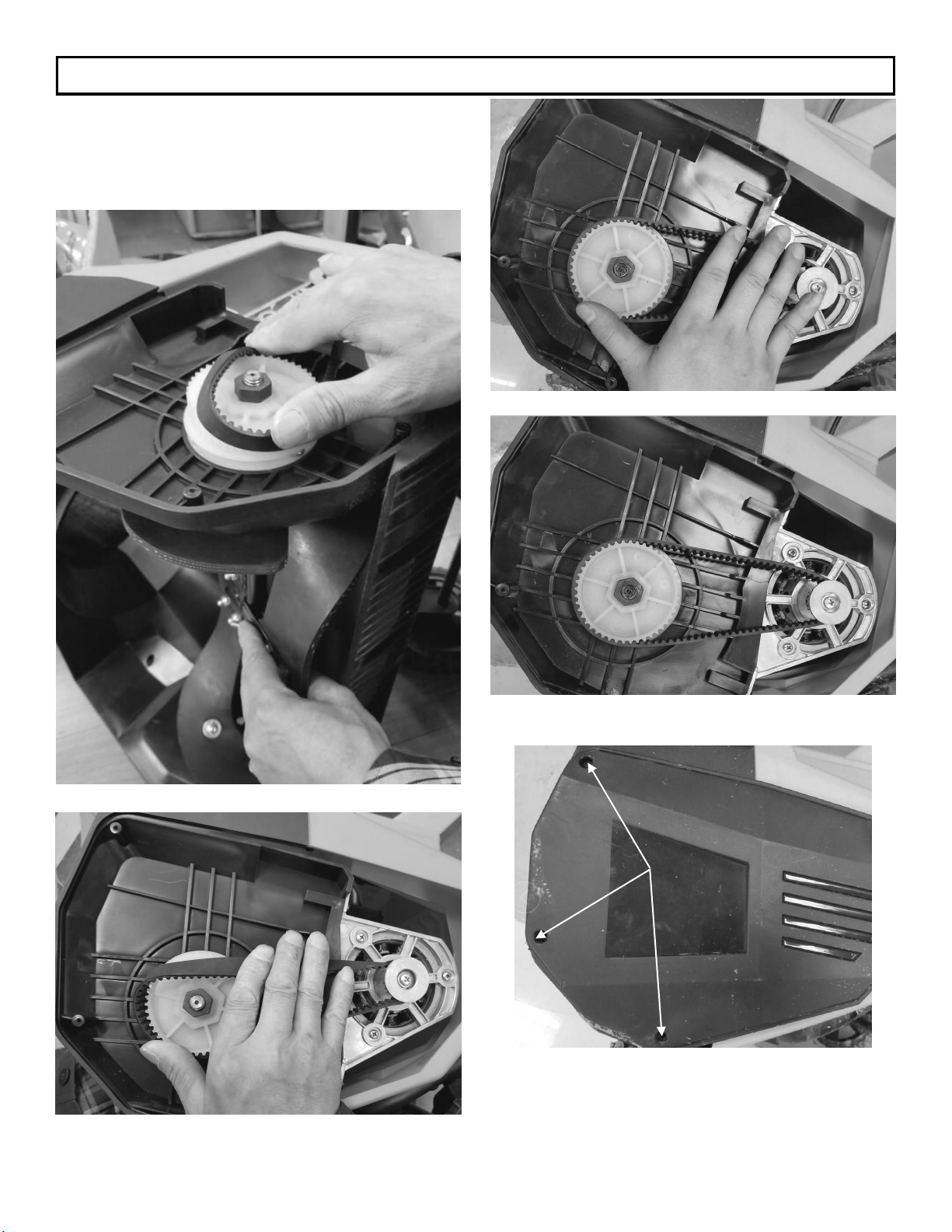
MAINTENANCE
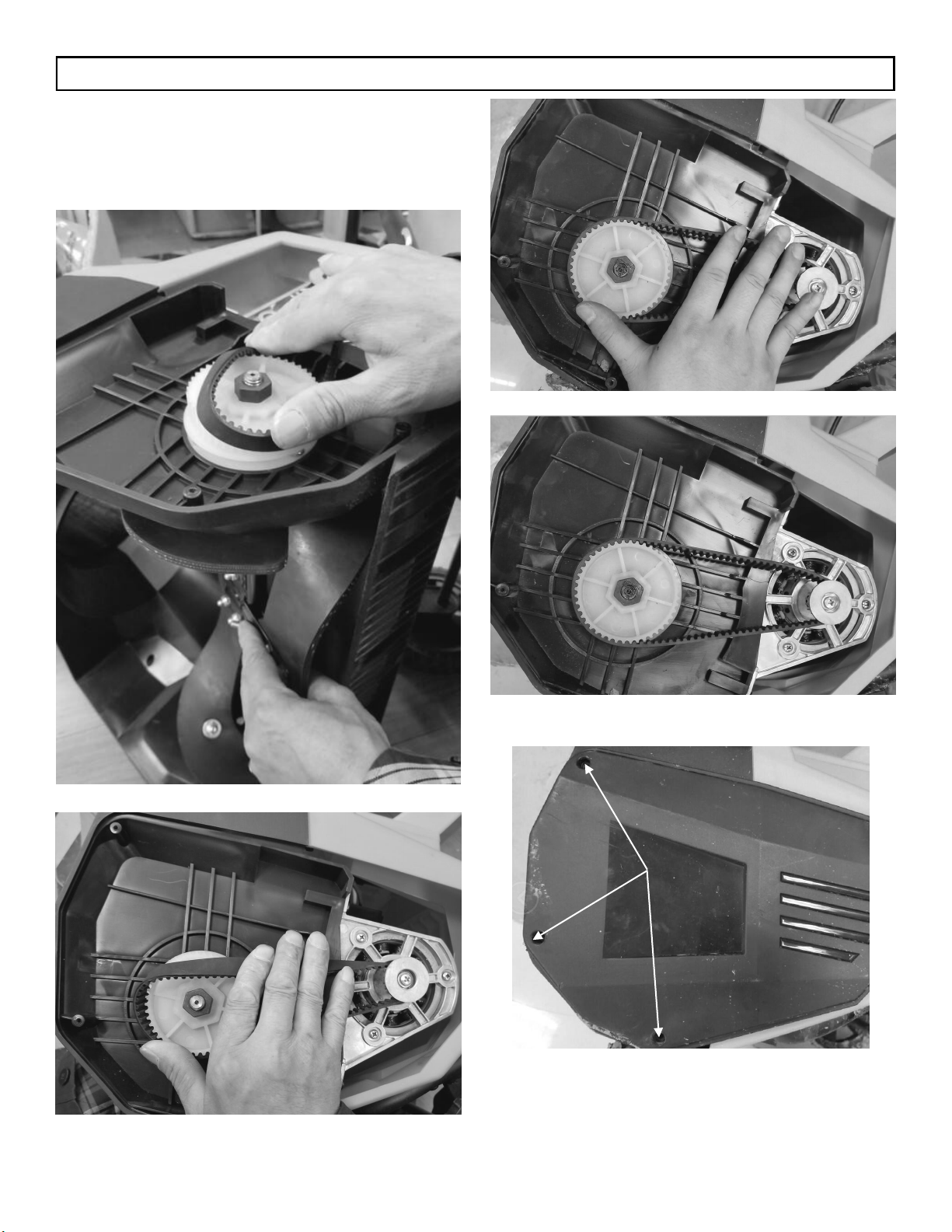
6. Keep pressure on the belt with your right hand (rib
side down and flat side up) while rotating the auger.
The belt will be gradually pushed down onto the
pulley. When the belt is seated on the pulley, adjust
it so that the ribs of the belt match the grooves on
the pulley. (Fig. 25 - 28)
Fig. 24
7. After belt is installed, replace the side plate and
secure it with the three screws. (Fig. 29)
Fig. 27
Fig. 26
Fig. 29
Fig. 28
Fig. 25
Screw
13
Model SN74022
CHARGING THE BATTERY PACK
BATTERY METER
Since the snow thrower battery is shipped in a low
charge condition, the battery must be charged before
use. The battery has 3 LED lights to indicate battery
capacity. These lights will only illuminate when the light
indicator button is pushed.
If three GREEN lights illuminate, the battery is charged
and ready for use. Two green lights are equal to 25%-
80% charge, while one green light is equal to 5%-25%
charge.
It is recommended to charge battery pack when one light
is illuminated.
CHARGING THE BATTERY PACK
The snow thrower comes with a maintenance free,
sealed, 40 volt storage battery.
Charge the battery pack only with the charger
provided.
Allow at least two hours of charge time before initial
use of the snow thrower.
Make sure the power supply is normal household
voltage, 120 volts, 60Hz, AC only.
The battery should be charged in a cool, dry place.
To improve battery life, store battery indoors in a
controlled climate. Fully charge battery pack every
3 months.
Since the battery will not develop a memory, it does
not have to be fully discharged before recharging.
2 to 3 initial charging/discharging cycles may be
required to achieve maximum run time/capacity.
When fully charged, the battery can be safely stored
in temperatures down to –4˚F(-20˚C) for a period of
up to one month before requiring charging. Fully
charge battery pack every 3 months.
The battery charger should be operated in
temperatures between 32˚F and 100˚F(0˚C and
37.8˚C).
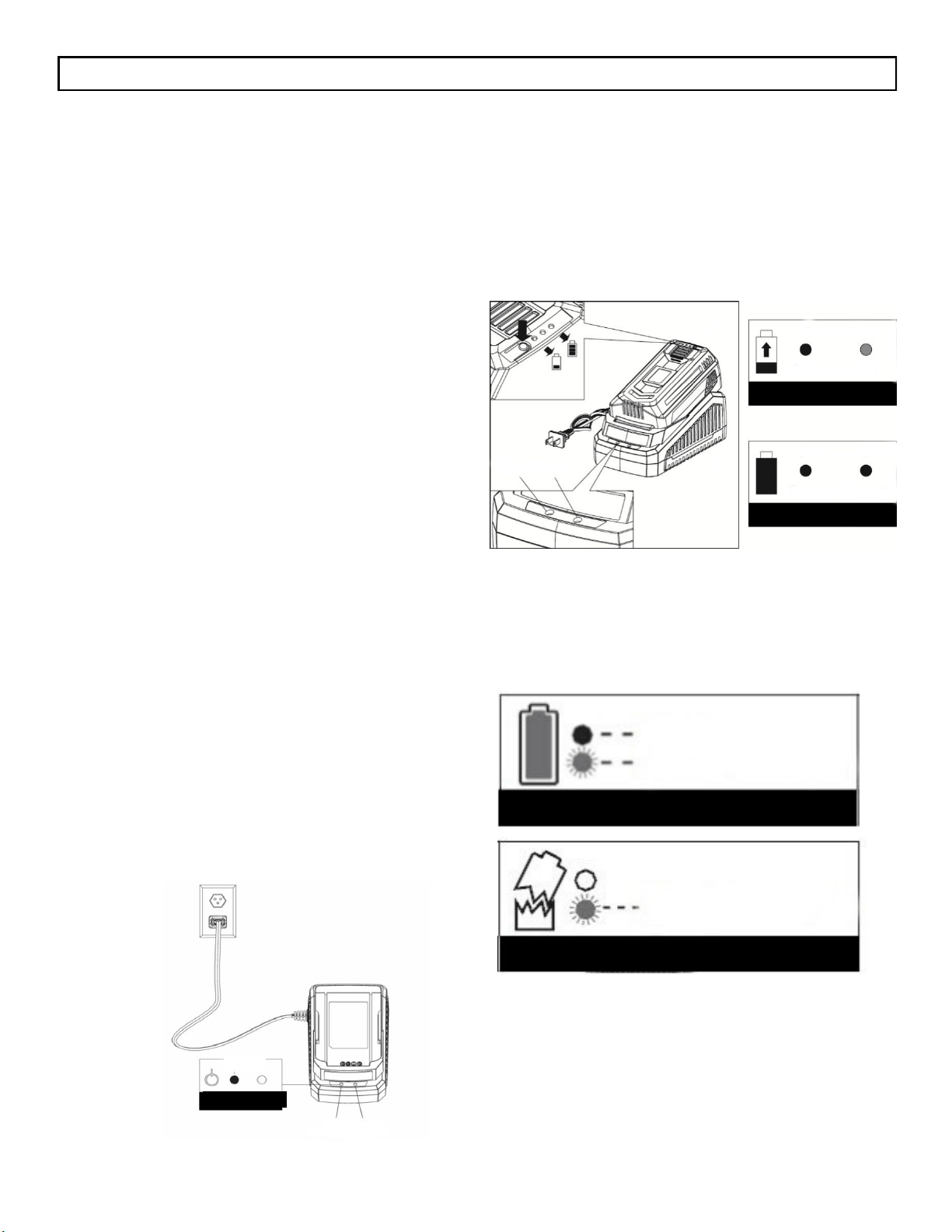
TO CHARGE
Insert the 120 volt plug of the charger into the wall
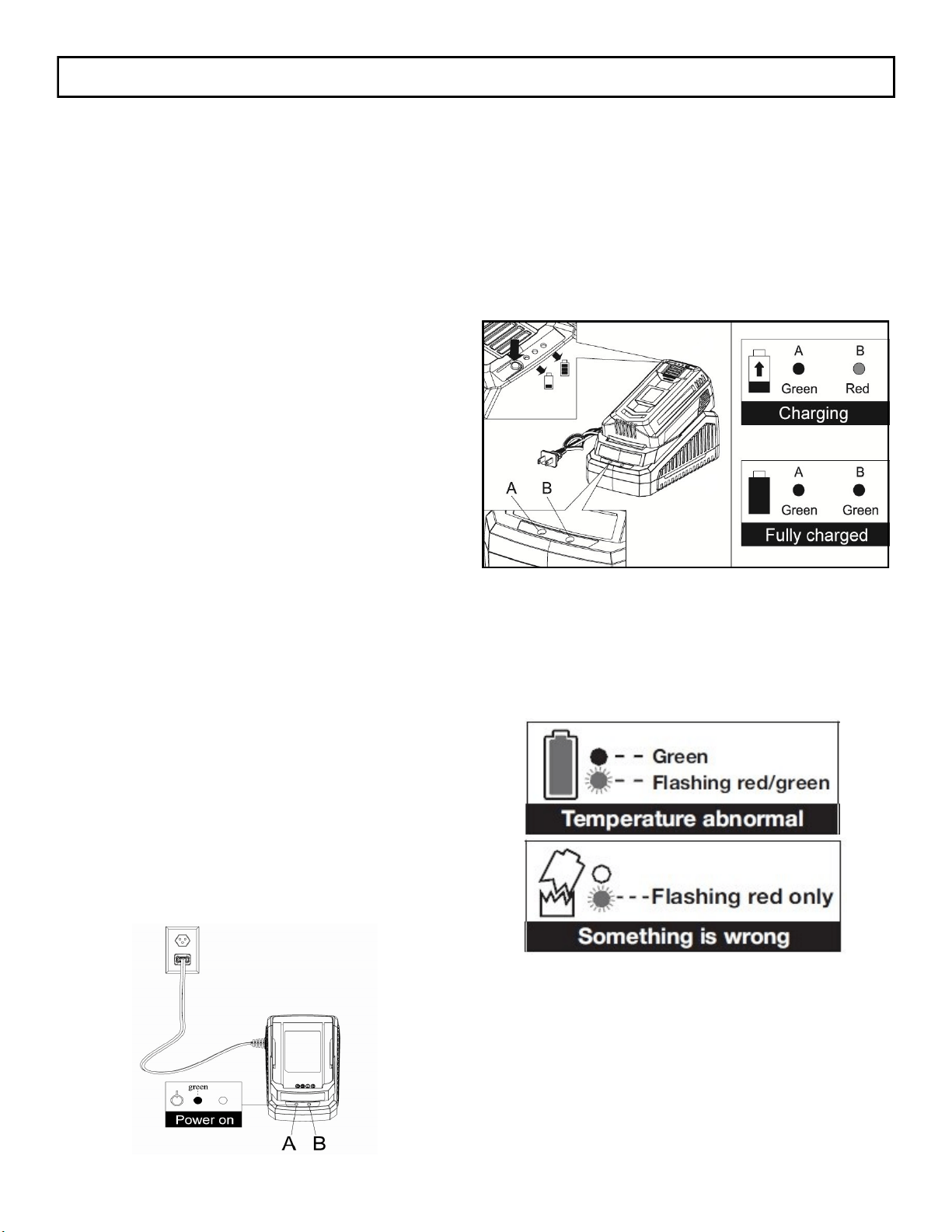
receptacle. Light A will illuminate and stay green.
(Fig. 30)
Fig. 30
Place the battery pack into the charger by sliding
the pack as shown in Fig. 13 to lock it into position.
Light B will illuminate red to indicate that the battery
is charging and the three lights on the battery pack
will cycle in green.
When the battery pack is fully charged, light B will
turn green and the lights on the battery pack will shut
off. (Fig 31)
NOTE: Typical time required to reach a full charge is
2 1/2 hours.
NOTE: If light A remains green while light B alternately
flashes red and green, this indicates a temperature
abnormality (i.e. that the battery pack is either too hot or
too cold). If there is only a red blinking light, this indicates
that something is wrong with the battery. Contact
Earthwise customer service center at 1-800-633-1501 for
assistance.
If the charging light indicator Light B alternately blinks red
and green or it does not come on at all, check that the
battery pack is fully seated into the bay. Remove the pack
and reinsert. If the problem persists, contact the
Earthwise customer service center at 1-800-633-1501 for
assistance.
Fig. 31
14
Model SN74022
Run the snow thrower for a few minutes to melt away any
snow on the snow thrower.
Remove the battery pack from the snow thrower.
Examine the snow thrower thoroughly for worn, loose, or
damaged parts. Check connections and screws and
tighten if necessary. To repair or replace parts, contact
our customer service help line at 1-800-633-1501.
Store the snow thrower, along with the removed battery
pack, in a clean, dry place out of reach of children. Cover
loosely with a tarp for added protection.
STORAGE
BATTERY DISPOSAL
Remove the battery pack from the snow thrower. Cover the terminals with heavy duty adhesive tape. Do not attempt to destroy or disassemble battery
pack or remove any components. This product contains lithium-ion batteries which must be recycled or disposed of properly. Local, state or federal
laws may prohibit disposal of these batteries in ordinary trash.
The RBRC seal on the li-ion battery pack indicates that the costs to recycle the battery pack at the end of its useful life has already been
paid by The Great States Corporation American Lawn Mower Company. It is illegal to place spent li-ion batteries in the local municipal
solid waste or in the trash. RBRC in cooperation with The Great States Corporation American Lawn Mower Company has provided an
environmentally friendly and easy way to recycle spent li-ion batteries. Just contact your local recycling center or call 1-800-8BATTERY
for information on where to drop off the spent battery.
CHARGING THE BATTERY PACK
SLEEP MODE:
If the light indicator button is continuously pressed for
more than 30 seconds, the lights will go into sleep mode.
When light indicator button is pushed, no lights illuminate
(This can occasionally occur during transportation).
To re-activate battery LED lights, place the battery on the
charger and charge for one to two minutes. Battery
indicator will function normally.
15
Model SN74022
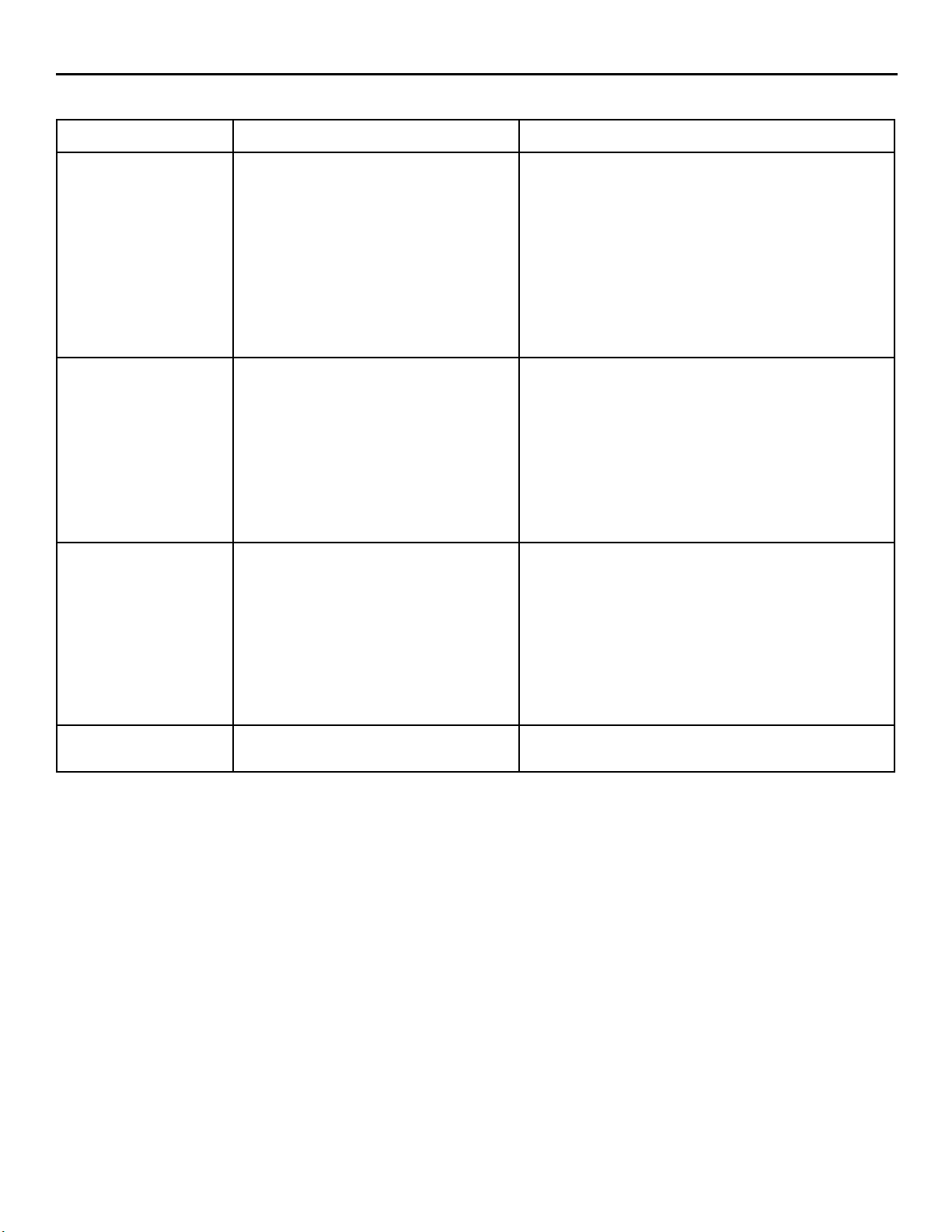
TROUBLESHOOTING
Problem Possible causes Remedy
Motor does not start Battery not making contact.
Lock off not fully operated.
Battery not installed properly.
Battery not charged.
Check battery is fully inserted.
Check that lock off is fully forward prior to moving
trigger.
Check battery installation.
Check battery charging requirements.
Poor results Drive belt worn or damaged.
Auger worn or damaged.
Discharge blocked.
Replace the drive belt.
Replace the auger. Ensure the screws and nuts are
properly tightened.
Switch off the snow thrower, remove the battery
pack, and clean the discharge.
Abnormal vibrations Drive belt worn or damaged.
Auger worn or damaged.
Scraper blade worn or damaged.
Replace the drive belt.
Replace the auger. Ensure the screws and nuts are
properly tightened.
Replace the scraper blade. Ensure the screws are
properly tightened.
Battery LED lights will
not illuminate
Battery in sleep mode Place battery on charger for one to two minutes.
16
Model SN74022
17
Model SN74022
PARTS AND SERVICE
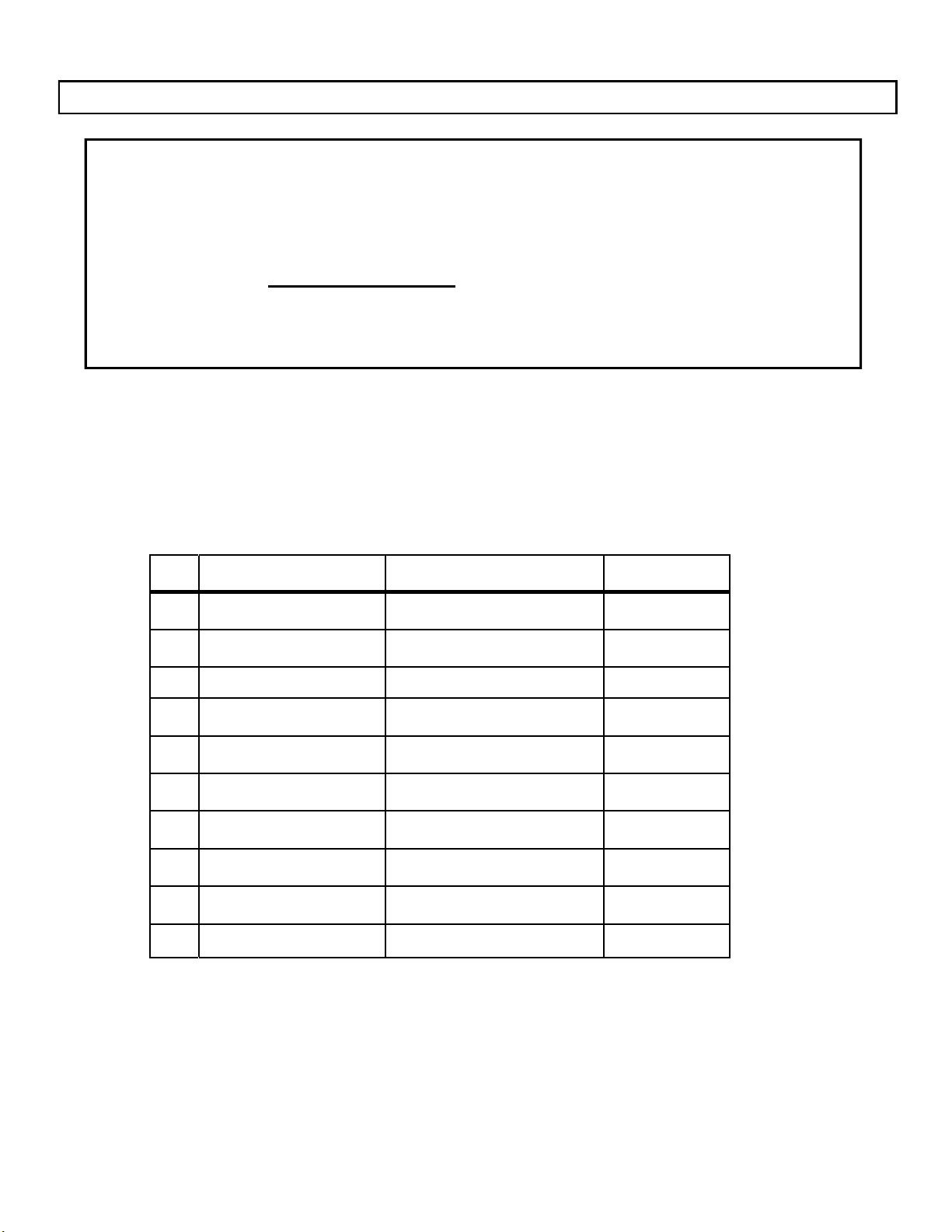
For parts or service, please call 1-800-633-1501 or visit us online at americanlawnmower.com. Be
sure to provide all relevant information when you call or visit.
REPAIR PARTS (KITS/ ITEMS)
The model/ serial number of this tool is found on a plate or label attached to the housing. Please
record the serial number in the space provided below.
MODEL NUMBER SN74022 ___
SERIAL NUMBER________________
Always mention the model number when ordering kits/items for this tool.
CALL US FIRST !!
Call us first with questions about operating or maintaining your tool
at 1-800-633-1501 between 8:00 a.m. – 5:00 p.m. Eastern
Standard Time, or get assistance on www.americanlawnmower.com.
No. Kit/Item Number Description QTY
1
SN18-CHK-1 Center Handle Kit
1
2
SN22-AK Auger Kit
1
3 SN18-HWK-1 Hardware Kit 1
4
SN22-SB Scraper Blade/ Fender Kit
1
5
SN18-ACK-1 Adjusting Cover Kit
1
6
WK-TC-SN Wheel Kit
1
7
SN4018-BELT Drive belt kit
1
8
SN18-CKH-1 Crank Handle Kit
1
9
BL84040 Battery Pack
1
10
CHL80040 Charger
1
Modelo SN74022
EL MANUAL DEL PROPIETARIO
Sopladora de nieve de 560 mm (22 pulg.) de Litio
Copyright. Todos los derechos reservados.
GUARDE ESTE MANUAL PARA CONSULTAS FUTURAS
Este producto fue diseñado y fabricado de acuerdo con nuestros altos estándares de confiabilidad, facilidad de operación y seguridad
para el operario. Si se trata con cuidado, esta herramienta le otorgará años de óptimo rendimiento y resistencia.
ADVERTENCIA: Para reducir el riesgo de sufrir alguna lesión, el usuario debe leer y comprender
el manual del propietario antes de usar este producto.
Cargador Cumple con
CA está incluido
(Modelo No.
CHL80040)
DEBE CARGAR LA BATERÍA ANTES
DE UTILIZARLA POR PRIMERA VEZ.
ES POSIBLE QUE SE NECESITEN DE
DOS A TRES CICLOS DE CARGA/
DESCARGA INICIALES PARA
OBTENER LA MÁXIMA CAPACIDAD O
TIEMPO DE FUNCIONAMIENTO.
Instrucción de inicio rápido
De la pagina 9
NO DEVUELVA ESTE PRODUCTO A LA TIENDA. ¿TIENE PREGUNTAS SOBRE FUNCIONAMIENTO,
MONTAJE, PIEZAS O SERVICIO TÉCNICO? IR A WWW.AMERICANLAWNMOWER.COM O LLAME AL
1-800-633-1501 ENTRE LAS 8:00 AM Y LAS 5:00 PM, HORA DEL ESTE DE LOS ESTADOS UNIDOS.
Muchas gracias por su compra.
Los productos eléctricos no se deben desechar junto con los residuos domésticos. Recicle donde haya centros para tal fin.
Consulte a la autoridad local o al distribuidor minorista para obtener asesoramiento sobre reciclado.
SÍMBOLOS
Algunos de los siguientes símbolos pueden aparecer en este producto. Tenga a bien estudiarlos y aprender su significado.
La adecuada interpretación de estos símbolos le permitirá operar el producto mejor y de manera más segura.
2
Modelo SN74022
Precauciones para su seguridad.
Mantenga el cable eléctrico lejos de la barrena. La
barrena puede dañar el cable y producir un contacto con
piezas activas.
PRECAUCIÓN: Lea el manual de
instrucciones y atienda las instrucciones se
seguridad y advertencia.
¡PELIGRO! Cuchillas giratorias. Mantenga manos y pies
a una distancia segura.
PRECAUCIÓN: Retire el enchufe del
tomacorriente de inmediato si el cable está
dañado o cortado.
No colocar la mano debajo de la barrena.
APAGUE la máquina, espere hasta que se
detenga por completo y retire el enchufe del
tomacorriente antes de realizar alguna
tarea de mantenimiento, limpieza o
reparación.
No colocar la mano enfrente del deflector de descarga.
PRECAUCIÓN: Use siempre protecciones
para sus ojos y oídos.
No exponga la unidad a la lluvia ni la use en lugares
húmedos.
Use calzado seguro, resistente y
antideslizante.
¡PELIGRO! Riesgos de descargas eléctricas.
¡PELIGRO! Pueden ser lanzados objetos a
gran velocidad cuando el motor está en
funcionamiento. No pase delante de la
máquina cuando está funcionando.
No usar en la lluvia. No usar durante tormentas
eléctricas.
Mantenga a las personas que se
encuentran en el lugar a una distancia
segura.
PARA REDUCIR EL RIESGO DE LESIONES: Antes
de utilizar este producto, cerciórese de que todos
los usuarios lean y comprendan las instrucciones
de seguridad y la demás información incluida
en este manual.
PRECAUCIÓN: Use protección auditiva apropiada
mientras trabaja. En ciertas condiciones y con cierta
duración de uso, el ruido generado por este producto
puede contribuir a la pérdida de la audición.
Guarde estas instrucciones y revíselas con frecuencia
antes de usar la herramienta y para impartirlas a otros.
ADVERTENCIA: Al utilizar aparatos eléctricos,
se recomienda respetar siempre las precauciones
de seguridad básicas que se detallan a continuación,
a fin de reducir riesgos de incendios, descargas
eléctricas y lesiones personales.
LEA TODAS LAS INSTRUCCIONES
ADVERTENCIAS DE SEGURIDAD IMPORTANTES
NORMAS GENERALES DE SEGURIDAD
Desconecte la batería del dispositivo antes de realizar ajustes,
cambiar accesorios o guardar el dispositivo. Dichas medidas
de seguridad preventivas reducen el riesgo de encender el
aparato accidentalmente.
Recargue solo con el cargador especificado por el fabricante.
Un cargador que sea adecuado para un tipo de batería puede
crear un riesgo de incendio cuando se usa con otra batería.
Use electrodomésticos solo con paquetes de baterías
específicamente designados. El uso de cualquier otra batería
puede crear un riesgo de lesiones e incendios.
Cuando no use la batería, manténgala alejada de otros objetos
metálicos, como clips de papel, monedas, llaves, clavos, tornillos
u otros objetos metálicos pequeños, que pueden hacer una
conexión de un terminal a otro. El cortocircuito de los terminales
de la batería puede causar quemaduras o un incendio.
En condiciones abusivas, se puede expulsar líquido de la
batería; evitar el contacto. Si se produce un contacto accidental,
enjuague con agua. Si el líquido entra en contacto con los ojos,
busque ayuda médica adicional. El líquido expulsado de la
batería puede causar irritación o quemaduras.
No utilice una batería o aparato que esté dañado o
modificado. Las baterías dañadas o modificadas pueden
exhibir un comportamiento impredecible que resulta en
fuego, explosión o riesgo de lesiones.
No exponga una batería o aparato al fuego o a una
temperatura excesiva. La exposición al fuego oa
temperaturas superiores a 130 ° C puede causar una
explosión. La temperatura de 130 ° C se puede reemplazar
por la temperatura de 265 ° F.
Siga todas las instrucciones de carga y no cargue la batería
o el aparato fuera de la temperature rango especificado
en las instrucciones. La carga inadecuada o a temperaturas
fuera del rango especificado puede dañar la batería y
aumentar el riesgo de incendio.
Haga que una persona de reparación calificada realice el
mantenimiento utilizando solo piezas de repuesto idénticas.
Esto asegurará que se mantenga la seguridad del producto.
No modifique ni intente reparar el electrodoméstico o la
batería (según corresponda), excepto como se indica en las
instrucciones de uso y cuidado.
CONTROLE SI HAY PIEZAS DAÑADAS. Antes de seguir
usando el producto, se deberán revisar las piezas
dañadas en forma exhaustiva para determinar
si la herramienta funcionará correctamente y realizará
el trabajo previsto. Compruebe la alineación y las uniones
de las piezas móviles, el montaje, averías
de componentes y otros factores que puedan afectar
el funcionamiento. Se debe reparar o reemplazar
cualquier pieza dañada en forma adecuada. Para recibir
asistencia, comuníquese con nuestra línea de ayuda
de atención al cliente al 1-800-633-1501.
EVITE AMBIENTES PELIGROSOS. No trabaje
en entornos donde existan gases o sustancias explosivas.
Por lo general, los motores de estos productos producen
chispas que podrían inflamar los gases.
MANTENGA ALEJADOS A LOS NIÑOS. Todos
los visitantes, niños y mascotas deben mantenerse
a una distancia segura de la zona de trabajo.
USE ROPA ADECUADA. No use prendas sueltas
ni artículos de joyería. Use protección para cubrir y sujetar
el cabello largo, ya que puede quedar atrapado
en las piezas móviles.
Use calzado seguro, resistente y antideslizante.
En todo momento mantenga una buena base
de apoyo, especialmente en pendientes.
USE GAFAS DE SEGURIDAD. Al trabajar con este
producto, use gafas de seguridad con protectores
laterales que cumplan con la norma ANSI Z87.1.
ADVERTENCIA: Mantenga las manos lejos de las piezas
en movimiento. Nunca coloque las manos cerca
de la barrena para quitar nieve, palos u otros desechos.
Al limpiar la barrena, esta puede destrabarse
repentinamente y provocar lesiones, aún cuando
la sopladora de nieve se haya detenido. Para destapar
una obstrucción, use siempre un palo de madera como
el del mango de una escoba.
EXTRAIGA LA BATERÍA DE LA ROTOCULTIVADOR
cuando no esté en uso o durante el servicio de
mantenimiento o la limpieza. Manténgala bajo vigilancia
constante.
USE LA HERRAMIENTA CORRECTA. No utilice este
producto en trabajos para los que no esté indicado.
EVITE EL ARRANQUE ACCIDENTAL - No traslade el
cultivador cuando se haya insertado la llave o si la batería
está instalada. Asegúrese de retirar la llave al instalar la
batería.
NO SOBRECARGUE la sopladora de nieve usándola
a una velocidad excesiva. La máquina funcionará
mejor y de manera más segura a la velocidad para
la que fue diseñada.
NO ADOPTE UNA POSTURA INCÓMODA. Guíe
la sopladora de nieve sólo a paso de hombre.
Mantenga una base de apoyo firme y buen equilibrio
en todo momento.
ILUMINACIÓN. Trabaje con la sopladora de nieve sólo
con luz natural o buena luz artificial.
GUARDE LA UNIDAD BAJO TECHO. Cuando no esté
en uso, la sopladora de nieve se deberá guardar en un
lugar seco, fuera del alcance de los niños.
MANTENGA LA UNIDAD EN CONDICIONES.
Consérvela limpia para lograr un óptimo funcionamiento
y reducir el riesgo de lesiones. Revise el cable de
extensión periódicamente y reemplácelo si está dañado.
Mantenga los mangos secos, limpios y libres de aceite.
Para un funcionamiento seguro, no utilice la sopladora
de nieve en pendientes demasiado pronunciadas.
Cuando trabaje en pendientes, disminuya la velocidad
y asegúrese de tener una buena base de apoyo.
Antes de encender la sopladora de nieve, cerciórese
de que la barrena no esté en contacto con ningún objeto
y de que tenga libre movimiento.
No intente limpiar la nieve en una superficie de grava
o de roca triturada. Este producto está diseñado sólo
para usar sobre superficies rígidas y planas sin arena,
piedras y desechos, cables o cualquier otro objeto.
El funcionamiento de la sopladora de nieve en posición
manual no es seguro a menos que se utilice conforme
a las instrucciones especiales provistas en el manual
del operario.
PRECAUCIÓN: Nunca arroje nieve a las personas,
mascotas o automóviles y no permita que nadie
esté frente a la sopladora de nieve mientras está en
funcionamiento.
Es posible que los objetos que pueden tapar
la sopladora de nieve o causar daños estén escondidos
en la nieve. Antes de usar la máquina, despeje el área
de felpudos, trineos, tablas, cables y otros desechos.
Si la barrena golpea un cuerpo extraño, detenga
la sopladora de nieve y verifique que no haya signos
de daños. Haga las reparaciones necesarias antes
de volver a empezar y continuar el trabajo.
PONGA ATENCIÓN. Observe lo que está haciendo.
Use el sentido común. No opere la sopladora de nieve
si está cansado o bajo la influencia de drogas, alcohol o
medicamentos.
NORMAS GENERALES DE SEGURIDAD
3
Modelo SN74022
NORMAS GENERALES DE SEGURIDAD
Si la sopladora de nieve comienza a vibrar de manera inusual,
apáguela de inmediato y revísela para detectar la causa.
Generalmente, la vibración advierte la existencia de un
problema.
Siempre apáguela; extraiga la batería y espere hasta que la
barrena se detenga por completo antes de realizar tareas de
mantenimiento o reparaciones.
Nunca opere la sopladora de nieve si los protectores
adecuados y otros dispositivos de protección no están en su
lugar y en buenas condiciones.
NORMAS GENERALES DE SEGURIDAD
REGLAS DE SEGURIDAD PARA EL EMPLEO DEL CARGADOR
cordón de extensión, asegúrese.
a. De que las patillas de la clavija del cordón de
extensión vengan en el mismo número, tamaño y
forma que las de la clavija del cargador.
b. De que el cordón de extensión esté cableado
correctamente y en buenas condiciones eléctricas, y
c. De que tamaño del alambre sea del tamaño suficiente
para el amperaje de CA nominal del cargador como se
especifica a continuación:
Long. cordón (pies) 25’ 50’ 100’
Calibre cordón (AWG) 16 16 16
NOTA: AWG= Calibre conductors norma Americana
Guarde estas instrucciones. Consúltelas con frecuencia y
empléelas para instruir a otras personas que puedan utilizer
este sopladora de nieve. Si presta a alguien esta
herramienta, facilitele también las instrucciones.
ADVERTENCIA: Mantenga todas las conexiones secas y
alejadas del suelo. No toque el enchufe con las manos
mojadas.
No maltrate el cordón ni lo utilice para trasladar la podadora de
pasto. Tampoco tire del cordón para desconectar el aparato.
Mantenga el cordón alejado del calor, el aceite, los bordes
afilados o las piezas móviles. Los cordones dañados o
enredados aumentan el riesgo de descarga eléctrica.
Usar un aditamento que no sea recomendado o vendido por el
fabricante del cargador de la bacteria puede provocar
unriesgo de incendio, descarga eléctrica o lesions personales.
Seguir estas medidas precautorias disminuirá el riesgo de
descarga eléctrica, incendio o lesions personales.
No dé mantenimiento a la sopladora de nieve con la llave de
seguridad o el cargador instalados.
No utilice el cargador cuando la temperature ambiente sea
mayor de 100°F(37,8°C) ó menor de 32°F (0°C).
No utilice el cargador si está dañado el cordón o la clavija, ya
que podria causar un corto circuito y una descarga eléctrica. Si
está dañada una pieza, un centro de servicio autorizado debe
reemplazar el cargador.
No utilice el cargador si el mismo ha sufrido una caίda, un
golpe seco o un daño de cualquier tipo. Lléveio a un técnico de
servicio autorizado para una revisión eléctrica y asί
determiner si el cargador está en buenas condiciones de
funcionamiento.
Para reducer el riesgo de una descarga eléctrica, desconecte
el cargador de la toma de corriente antes de iniciar una tarea
de mantenimiento o de limpleza.
Cuando el cargador no esté en uso, desconéctelo del
suministro eléctrico. Esto ayuda a evitar dañar el cargador en
caso de una subida de voltaje.
Riesgo de descarga eléctrica. No toque ninguna parte sin aislar
del conector de salida, ni ninguna terminal de las pilas en tales
condiciones.
No exponga el cargador a condiciones húmedas o mojadas. La
introducción de agua en el cargador aumenta el riesgo de una
descarga eléctrica.
Asegúrese de que el cordón eléctrico esté ubicado de tal
manera que nadie lo pise o se tropiece con él, no toque bordes
afilados o piezas móviles ni quede sujeto a daños ni tensiones.
De esta manera se reduce el riesgo de caidas accidentals que
pudieran causar lesions personales y daños al cordón, lo cual
podria ocasionar una descarge eléctrica.
Mantenga el cordón y el cargador alejados del calor para evitar
dañar el alojamiento o las partes internas de la unidad.
No permita que gasoline, aceites,productos a base de petróleo,
etc. lleguen a tocar las piezas de plástico. Dichos productos
contienen compuestos quimicos que pueden dañar, debilitar o
destruir el plástico.
No debe emplearse un cordón de extensión a menos que sea
absolutamente necesario. El empleo de un cordón de extensión
inadecuado puede significar un riesgo de incendio o descarga
eléctrica. Si es necesario utilizer un
ADVERTENCIAS DE LA FCC:
Por favor tenga en cuenta que los cambios o modificaciones
a los que se someta este producto y que no estén
expresamente aprobados por la parte responsable del
cumplimiento, podrían anular la autoridad del usuario para
operar el equipo.
NOTA: Este equipo ha sido probado y se ha determinado
que cumple con los límites de un dispositivo digital Clase B,
de conformidad con la Parte 15 de las Reglas de la
Comisión Federal de Comunicaciones (FCC por sus siglas
en inglés). Estos límites están diseñados para brindar una
protección razonable contra interferencias dañinas en
instalaciones residenciales. Este equipo genera, utiliza y
puede emitir energía de radiofrecuencia, y si no se instala y
utiliza según las instrucciones, podría ocasionar interferencia
perjudicial para las comunicaciones por radio. Sin embargo,
no se garantiza que no se producirá interferencia en alguna
instalación en particular. Si este equipo causa interferencia
perjudicial a la recepción de radio o de televisión, lo cual
puede determinar si apaga y enciende el equipo, se le
aconseja al usuario que trate de corregir la interferencia
realizando una o más de las siguientes acciones:
-- Cambie la ubicación o la orientación de la antena
receptora.
-- Aumente la distancia que separa el equipo y el receptor.
-- Conecte el equipo a un tomacorriente que esté en un
circuito distinto al que está conectado el receptor.
-- Consulte a su concesionario o a un técnico experimentado
de radio/TV para pedir ayuda.
PRECAUCIÓN: La barrena no se detiene de inmediato
cuando se apaga la sopladora de nieve.
PRECAUCIÓN: Riesgo de lesiones. La sopladora de nieve
puede provocar lesiones graves. No acerque ninguna parte de
su cuerpo, ni prendas de vestir a la barrena giratoria.
ADVERTENCIA: Proposición 65 de California:
Este producto contiene sustancias químicas al estado de
California como causantes de cáncer, defectos de nacimiento
u otros problemas reproductivos.
ADVERTENCIA: Cáncer y Daño Reproductivo -
www.P65Warnings.ca.gov.
4
Modelo SN74022
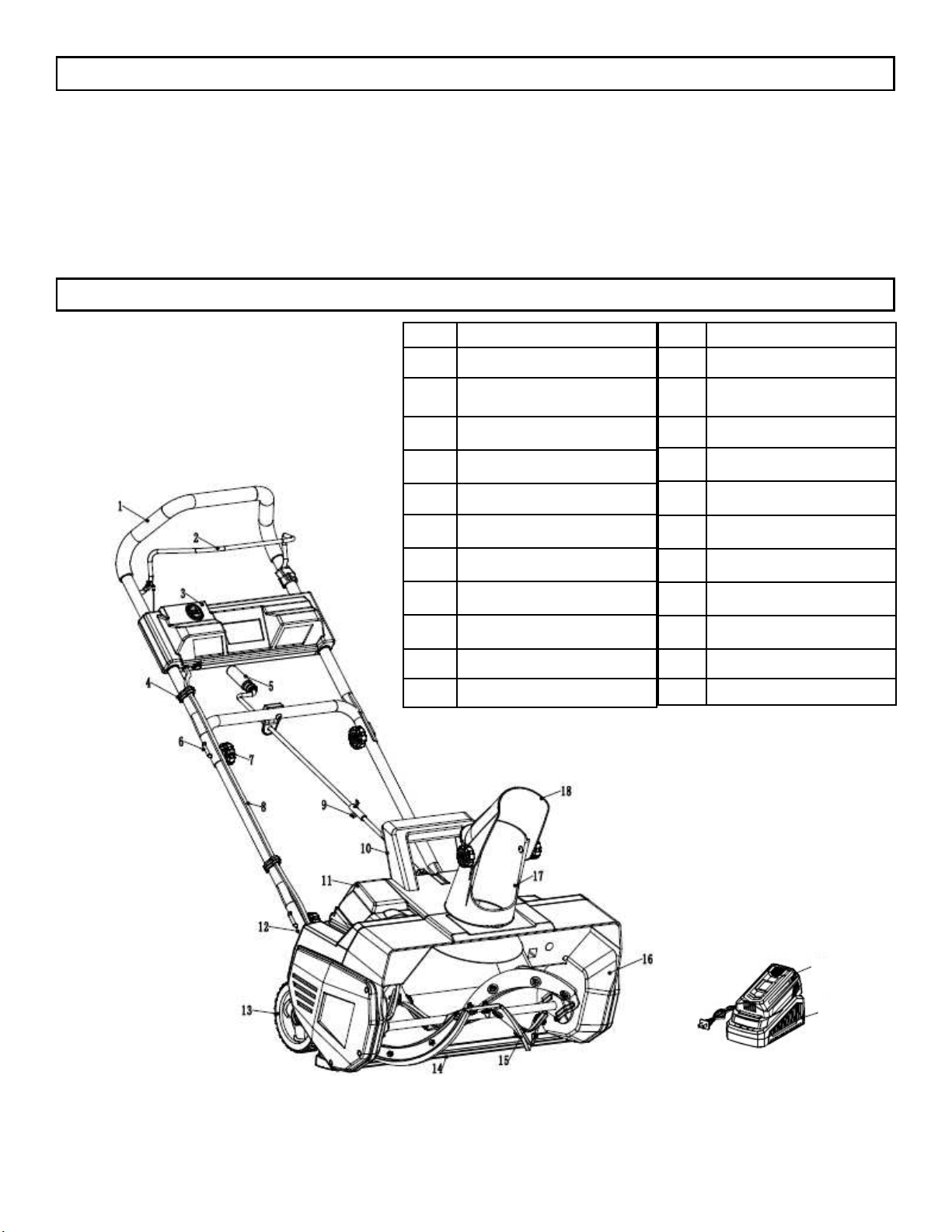
19
20
ESPECIFICACIONES DEL PRODUCTO
Modelo: SN74022
Voltaje del suministro eléctrico: 40V, CC solamente Ancho de barrido: 560 mm (22 pulg.)
Velocidad de ralentí 2000 RPM Profundidad máx. de barrido: 305 mm (12 pulg.)
Batería: 40V, 4.0 Ah Lithim-ion Capacidad máx. de barrido: 272 kg (600 libras)/minuto
Tiempo de carga: 2,5 horas Distancia máx.de lanzamiento: Hasta 914 cm (30 pies)
Duración de la batería: Hasta 30 minutes Peso: 14.7 kg (32.4 libras)
LISTA DE PIEZAS
Ref. Descripción
10 Mango auxiliary
11
Cubierta del paquete de
baterías
12 Mango inferior
13 Conjunto de la rueda
14 Cuchilla raspadora
15 Barrena
16 Tapa lateral
17 Canal de descarga
18 Deflector de descarga
19 Batería
20 Cargodar
Ref. Descripción
1 Mango superior
2
Empuñadura de
arranque
3 Botón del interruptor
4 Sujetador de cable
5 Mango de la manivela
5A Manivela superior
5B Manivela inferior
6 Perno J
7 Perilla
8 Mango central
9 Pasador
5
Modelo SN74022
MONTAJE
DESEMBALAJE
Este producto requiere montaje.
Retire con cuidado todos los componentes de la caja.
Asegúrese de que estén incluidos todos los elementos
detallados en la lista de embalaje.
Inspeccione todos los elementos detenidamente para
corroborar que no existan roturas ni averías ocurridas
durante el envío.
No deseche el material de embalaje hasta haber
inspeccionado exhaustivamente la sopladora de nieve
y comprobar que funciona en forma satisfactoria.
Si alguna pieza falta o está dañada, llame al 1-800-633-1501
para obtener asistencia.
LISTA DE EMBALAJE
- Sopladora de nieve
- Montaje del mango
- Manivela de descarga
- Batería & Cargodar
- Paquete de ferreteria
- Deflector de descarga
- El manual del propietario
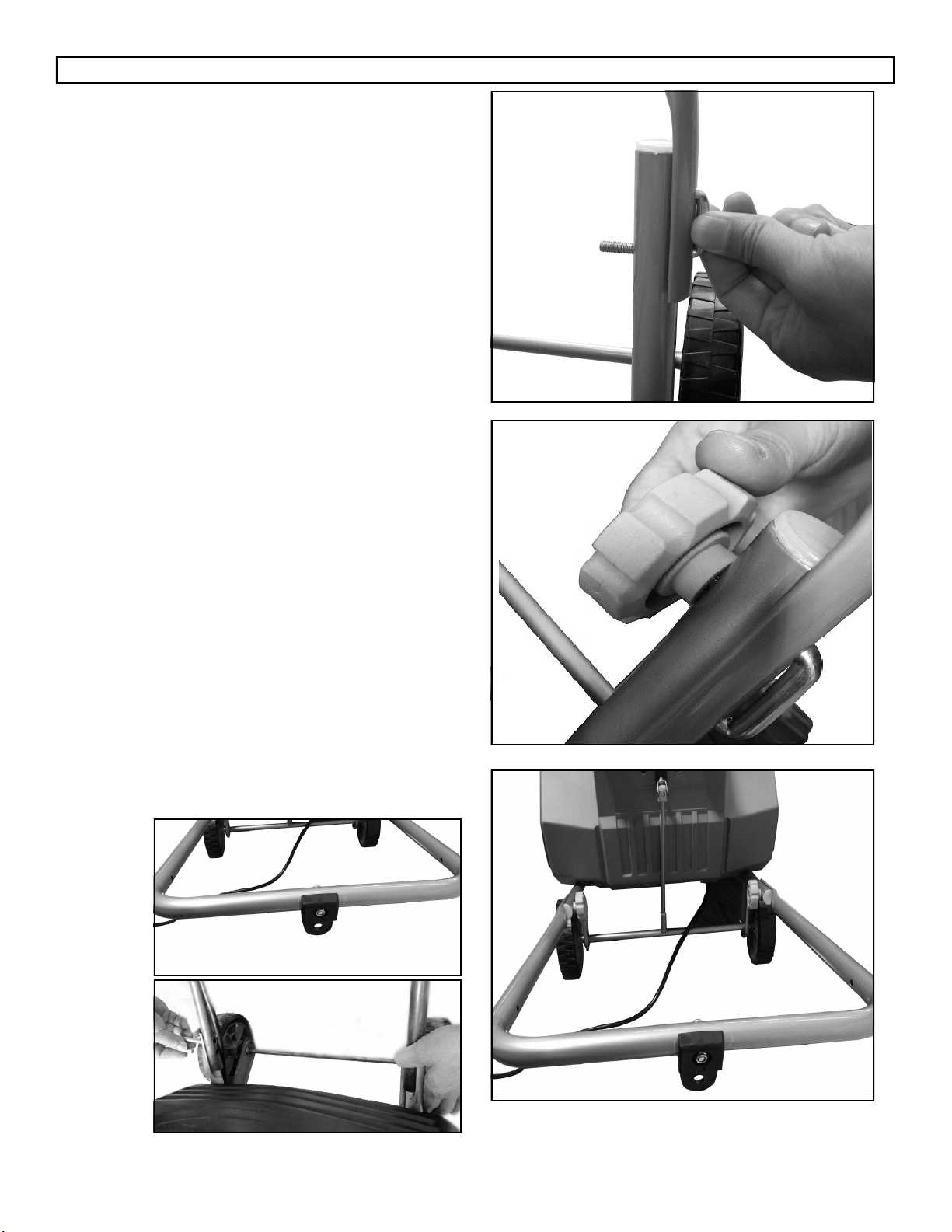
INSTALACIÓN DEL MANGO CENTRAL
Ubique el mango central en los mangos inferiores y
asegúrese de que soporte apunte hacia abajo. (Ver
Fig. 1)
Alinee los orificios en el mango central con los
orificios en el mango inferior tal como se muestra.
(Ver Fig. 2)
Inserte el perno J a través de ambos mangos con el
extremo roscado en la parte inferior y orientado
hacia el interior. (Ver Fig. 3)
Instale la perilla del mango y apriete firmemente para
asegurar el perno en su lugar. (Ver Fig. 4)
Repita del otro lado para asegurar el mango central en
el lugar.
(Ver Fig.
5)
Fig. 4
Fig. 1
Fig. 2
Fig. 3
Fig. 5
6
Modelo SN74022
INSTALACIÓN DE LA MANIVELA DE DESCARGA
Instale la manivela de descarga superior a través del
soporte situado en el mango central. (Ver Fig. 8)
Alinee los orificios en las manivelas superior e
inferior e inserte el pasador a través de los orificios
tal como se muestra para asegurar. (Ver Fig. 9 y Fig.
10)
Gire la palanca hacia la izquierda y hacia la derecha
para verificar el funcionamiento adecuado de la
manivela y la descarga.
MONTAJE
INSTALACIÓN DEL MANGO SUPERIOR
Alinee los orificios en el mango superior con los
orificios en el mango central tal como se muestra.
(Ver Fig. 6)
Inserte el extremo roscado del perno J a través de
ambos mangos con el extremo roscado orientado
hacia el interior.
Instale la perilla del mango y apriete firmemente.
Repita del lado opuesto.
Asegure el sujetador de cable a los mangos. (Ver Fig.
7)
Fig. 6
Fig. 9
Fig. 7
Fig. 8
Fig. 10
7
Modelo SN74022
8
Modelo SN74022
INSTALACIÓN DEL DEFLECTOR DE DESCARGA
Saque la lavadora de la bolsa de hardware. (Ver Fig
11)
Coloque la lavadora en el conducto de descarga.
(Ver Fig 12)
Coloque el deflector de descarga sobre la descarga.
Alinee los orificios y coloque la arandela entre el
deflector y la descarga. (Ver Fig. 13)
Apriete ajustando las perillas con firmeza. (Ver Fig.
14 - 15)
MONTAJE
Fig. 14
Fig. 15
Fig. 11
Fig. 12
Fig. 13
Verifique el estado de la sopladora de nieve antes de operarla
para asegurarse de que la barrena gire libremente.
Inspeccione regularmente la barrena para detectar si está
gastada o dañada.
Asegúrese de que todos los sujetadores de la sopladora
de nieve (tornillos, tuercas, etc.) estén ajustados totalmente.
Ubique el canal de descarga de modo que descargue la nieve
en una dirección segura. No dirija la descarga hacia otras
personas o áreas en las que se pueda dañar la propiedad.
Mantenga a los niños, mascotas y a otras personas alejados
de la zona de trabajo. No pase delante de la sopladora de nieve
cuando está en funcionamiento.
Dirija la descarga hacia la derecha o hacia la izquierda girando
el canal de descarga con la manivela. La descarga puede
ajustarse hasta 180 grados.
El deflector de descarga, ubicado en la parte superior del canal
de descarga, controla la altura de la descarga. Afloje las dos
perillas en para levantar o bajar el deflector a la altura
deseada y ajústelas para sujetar el deflector. NOTA: No ajuste
excesivamente las perillas.
Para una mejor remoción de la nieve, arroje la nieve
en la dirección del viento y solape ligeramente cada franja.
Empuje la sopladora de nieve hacia adelante a una velocidad
cómoda pero lo suficientemente despacio para despejar
el camino por completo. El ancho y profundidad de la nieve
determina la velocidad de avance.
Comience despejando el camino cerca del tomacorriente
y trabaje hacia afuera, arrojando nieve con un movimiento
de atrás hacia delante.
Cuando gire al final de una franja, pase por encima del cable
y gire la sopladora de nieve. Use la rueda de uno de los lados
como punto de pivote. Incline ligeramente la máquina sobre
este punto de pivote mientras la gira.
La sopladora de nieve puede quitar hasta 30 cm (12 pulg.) de
profundidad en una pasada. Para quitar bancos de nieve más
grandes, levante la máquina por los mangos superior e inferior
y colóquela sobre el banco. Deje que el peso de la sopladora
quite el banco de nieve moviéndola de atrás hacia delante.
Para despejar escalones, sostenga la sopladora de nieve por
los mangos superior e inferior con un movimiento deslizante
o de barrido.
Limpie la nieve con frecuencia antes de que sea demasiado
profunda. Es mejor quitar la nieve apenas cae.
Algunas piezas de la sopladora de nieve pueden congelarse
en condiciones de temperaturas extremas. Si las piezas
se congelan mientras la máquina está en uso, deténgala,
desconecte el cable de extensión e inspeccione las piezas
congeladas. Quite el hielo de todas las piezas antes de volver
a arrancar u operar la sopladora de nieve. No intente operar
la máquina con piezas congeladas ni trate de forzar
los controles que están congelados.
Después de quitar la nieve, siga usando la sopladora de nieve
durante unos minutos para evitar que el hielo se congele
en las piezas móviles. Luego apague el motor, espere
a que se detengan las piezas móviles y seque el hielo
y la nieve de la sopladora de nieve con un paño limpio.
FUNCIONAMIENTO
Encendido y apagado
ADVERTENCIA: La barrena comienza a girar
inmediatamente después de que la sopladora de nieve se
enciende. Mantenga manos y pies alejados de la barrena.
Para encenderlo, asegúrese de que la barrena no esté tocando
ninguna superficie. Presione y mantenga presionado el botón
de bloqueo de seguridad (1). Mientras mantiene presionado el
botón de retroceso en el cable (2). Una vez que se inicia el
quitanieves, puede soltar el botón de bloqueo de seguridad.
Para apagar, simplemente suelte la empuñadura de arranque.
LUCES DELANTERAS DE LED
Las luces delanteras de LED se sitúan en el mango superior
para iluminar el recorrido al usar la sopladora de nieve en
condiciones de iluminación deficiente.
Las luces deben estar encendidas cuando la sopladora de
nieve está en funcionamiento. Una vez que la sopladora de
nieve funcione presionando el botón de bloqueo de seguridad y
tirando del gatillo de control hacia el mango, las luces se
encenderán colocando el interruptor de encendido-apagado en
la posición de encendido. Las luces se apagarán al soltar el
gatillo de control. (Ver Fig. 16)
Las luces se encenderán al tirar del gatillo de control siempre
que el interruptor de encendido-apagado se encuentre en la
posición de encendido. Una vez que haya completado el
trabajo, presione el interruptor hasta la posición de apagado.
Remoción de la nieve
Antes de comenzar a trabajar, inspeccione bien el área donde
se utilizará el equipo y retire felpudos, trineos, tablas, cables y
cualquier otro objeto extraño.
Fig 16
BOTÓN DE ENCENDIDO/
APAGADO
9
Modelo SN74022
FUNCIONAMIENTO
ADVERTENCIA: Para evitar lesiones personales graves,
no use las manos ni los pies para destapar el canal.
Antes de destapar, apague la máquina y retire el paquete de
baterías. Espere a que la barrena deje de girar.
Limpie la descarga con un palo de madera como el del mango
de una escoba.
Si la sopladora de nieve comienza a vibrar de manera inusual,
apáguela de inmediato y revísela para detectar la causa.
Generalmente, la vibración advierte la existencia de un
problema.
Mire hacia atrás y tenga precaución al retroceder con la
sopladora de nieve.
Las grandes superficies requieren un patrón definido de
operación para limpiar completamente un área de nieve. Estos
patrones evitarán arrojar nieve en lugares no deseados y
también evitarán una segunda pasada.
Patrón A: Arroje la nieve a la derecha o a la izquierda donde
sea posible. Para áreas como un largo camino de entrada, es
mejor comenzar en el medio. Limpie de un extremo a otro,
arrojando la nieve a ambos lados.
Patrón B: Si la nieve sólo se puede arrojar a un lado del área a
despejar, comience en el lado opuesto.
Protección contra sobrecarga
El controlador de sobre corriente se apagará automáticamente
la sopladora de nieve en 2 segundos cuando la corriente es
más de 25A. Si el motor se detiene, puede reiniciar la
sopladora de nieve inmediatamente si es necesario.
10
Modelo SN74022
MANTENIMIENTO
Reemplazo del raspador
El raspador está ubicado en la base de la sopladora de nieve,
debajo de la caja del barrena.
Retire los tornillos que sujetan el raspador a la sopladora de
nieve.
Instale el raspador nuevo y sujételo bien con los tornillos.(Ver
Fig. 17)
Reemplazo de la correa de la barrena
En condiciones de operación normales, no debería ser
necesario reemplazar la correa de la barrena. No obstante, si
la barrena se atasca o funciona mal, puede dañarse la correa.
Para reemplazar la correa, siga estas instrucciones.
Estructura del sistema de correa de transmisión .(Ver Fig.
18)
Una limpieza y mantenimiento periódicos de la sopladora
de nieve asegurará su eficacia y prolongará la vida útil
del producto.
Verifique con frecuencia que todos los sujetadores estén bien
ajustados para asegurarse de que la sopladora esté en buenas
condiciones.
Después de cada uso, deje que el motor funcione unos minutos
para que las piezas móviles no se congelen. Luego apague
el motor, espere a que se detengan las piezas móviles y seque
el hielo y la nieve de la sopladora de nieve. Gire la manivela
de descarga varias veces para retirar la nieve.
Use únicamente un paño humedecido con agua caliente y un
cepillo suave para limpiar la sopladora de nieve. ¡Nunca moje
o rocíe agua en la máquina!
No utilice detergentes ni solventes, ya que podrían ocasionar
daños irreversibles a la sopladora de nieve. Los productos
químicos pueden destruir las piezas plásticas.
Cuando almacene la sopladora de nieve durante un período
prolongado, lubrique ligeramente las piezas metálicas con
aceite para proteger la unidad de la corrosión.
Guarde el artefacto en un lugar seco fuera del alcance de los
niños.
Para la seguridad del usuario, las piezas gastadas o dañadas
se deben reemplazar. Reemplace sólo con piezas de repuesto
originales. Las piezas provenientes de otra sopladora de nieve
pueden no adaptarse adecuadamente, lo que provocaría una
situación de inseguridad.
Lubricación de la sopladora de nieve
No necesita lubricar la sopladora de nieve. Todos los
rodamientos están sellados y fueron lubricados en fábrica
para la vida útil de la máquina.
Reemplazo de las placas de goma en la barrena.
Quite la placa de goma usada retirando los dos juegos
de tuercas, pernos y arandelas que se utilizan para sujetarla.
Instale la placa de goma nueva.
Coloque el perno con la arandela plana pequeña en los orificios
correspondientes en cada uno de los extremos de la placa
de goma. Use una arandela plana grande y una tuerca de
fijación para sujetar el perno en cada uno de los extremos.
Instale la otra placa de goma de la misma manera.
Polea de la barrena
Correa de la barrena
Polea de mando
Fig 17
Fig. 18
Antes de realizar tareas de mantenimiento, desconecte el
suministro electric, retire el paquete de baterías.
11
Modelo SN74022
MANTENIMIENTO
1. Abra la placa del lado izquierdo quitando tres tornillos.
(Fig. 19)
2. Utilice la mano derecha para levantar el lado plegado de la
correa y jale hacia arriba mientras hace girar la polea de la
barrena con la mano izquierda en el sentido contrario a las
agujas del reloj. Ahora puede quitarse fácilmente la correa
de la polea. (Fig. 20 - 21)
3. Coloque primero la correa en la polea de mando y
enseguida coloque la correa en el extremo inferior de
la polea de la barrena. (Fig. 22)
4. Utilice la mano derecha para presionar la correa con el
lado plegado hacia abajo. (Fig. 23)
5. Mientras presiona la correa hacia abajo con su mano
derecha, deslice la barrena hacia adelante con su mano
izquierda para que la polea de la barrena gire en el sentido
de las agujas del reloj. (Fig. 24)
Fig. 20
Fig. 19
Tornillos
Fig. 21
Fig. 22
Fig. 23
Fig. 24
12
Modelo SN74022
MANTENIMIENTO
6. Mientras gira la barrena, siga presionando la correa con su
mano derecha (con el lado plegado hacia abajo y el lado
plano hacia arriba). La correa será empujada poco a poco
dentro de la polea. Cuando la correa quede asentada en la
polea, ajústela de manera que los pliegues de ésta
coincidan con las ranuras de la polea. (Fig. 25 - 28)
7. Después de instalar la correa, reemplace la placa lateral y
asegúrela con los tres tornillos. (Fig. 29)
Fig. 29
Fig. 25
Fig. 26
Fig. 27
Fig. 28
Tornillos
13
Modelo SN74022
CARGA DEL PAQUETE DE BATERÍAS
MEDIDOR DE BATERÍA
La batería de la rotocultivador se envía con poca carga, por lo
que deberá cargarla antes de utilizarla. La batería tiene 3 luces
LED que indican su capacidad. Estas luces se encienden
solamente cuando se presiona el botón de la luz indicadora.
Si se encienden las luces VERDES, la batería está cargada y
lista para ser usada. Dos luces verdes equivalen al 25 %-80 %
de carga. Una luz verde equivale al 5 %-25 % de carga.
Se recomienda cargar el paquete de baterías cuando se
enciende una luz.
CARGA DEL PAQUETE DE BATERÍAS
La rotocultivador se proporciona con batería de 40 voltios
selladas que no requieren mantenimiento.
Extraiga la llave de seguridad de la rotocultivador y
guárdela en un lugar seguro, fuera del alcance de los
niños.
Cargue el paquete de baterías únicamente con el
cargador provisto.
Deje la batería cargando durante al menos dos horas
antes de usar la rotocultivador por primera vez.
Asegúrese de que el voltaje del suministro eléctrico sea el
doméstico normal: 120 voltios, 60 Hz, CA únicamente.
La batería debe cargarse en un lugar fresco y seco.
Para mejorar la vida útil de la batería, guárdela en un
lugar cerrado y a temperatura controlada. Cargue el
paquete de baterías completamente cada 3 meses.
Debido a que la batería no tiene ningún efecto memoria,
no es necesario que esté totalmente descargada para
volver a cargarla.
Es posible que se necesiten de dos a tres ciclos de carga/
descarga iniciales para obtener la máxima capacidad o
tiempo de funcionamiento.
Cuando la batería está cargada por completo, se puede
guardar de forma segura en temperaturas de hasta –20 °C
(-4 °F) durante un período de hasta un mes antes de que
requiera una nueva carga. Cargue el paquete de
baterías completamente cada 3 meses.
El cargador de baterías debe usarse en temperaturas que
oscilan entre los 0 °C y 37,8 °C (32 °F y 100 °F).
PROCEDIMIENTO DE CARGA
Inserte el enchufe del cargador de 120 voltios en el
receptáculo de la pared. Se iluminará la luz A y permanecerá
verde.
(Fig. 30)
Verde
Escondido
Fig. 30
Para colocar el paquete de baterías en el cargador,
deslícelo hasta que esté trabado en posición, como se
muestra en la figura 13. La luz B se iluminará en rojo para
indicar que la batería se está cargando y las tres luces del
paquete de baterías alternarán en verde.
Cuando el paquete de baterías esté completamente
cargado, la luz B se volverá verde y las luces del paquete
de baterías se apagarán. (Fig 31)
NOTA: Tiempo promedio requerido para alcanzar una carga
completa: 2.5 horas.
NOTA: Si la luz A permanece verde mientras la luz B destella
alternadamente en rojo y verde, estaría indicando una
irregularidad en la temperatura. (el paquete de baterías está
demasiado caliente o demasiado frío). Si solamente destella
una luz roja, esto indica que hay un problema con la batería.
Comuníquese con el centro de atención al cliente de Earthwise
al 1-800-633-1501 para obtener asistencia.
Si la luz B indicadora de carga destella alternadamente en rojo
y verde, o si directamente no se enciende, corrobore que el
paquete de baterías esté bien asentado en el compartimento.
Retire el paquete y vuelva a colocarlo. Si el problema persiste,
comuníquese con el centro de atención al cliente de Earthwise
al 1-800-633-1501 para obtener asistencia.
Cargando
Verde Roja
A B
Carga Completa
Verde Verde
A B
A B
Verde
Destellos rojos/verdes
Problema de temperatura
Problema con la batería
Destellos rojos solamente
14
Modelo SN74022
Fig. 31
Use la sopladora de nieve durante unos minutos para derretir
y quitar la nieve de la máquina.
Extraiga el paquete de baterías de la sopladora de nieve.
Verifique bien la sopladora de nieve para detectar si hay piezas
gastadas, flojas o dañadas. Revise las conexiones y los
tornillos, y ajústelos si es necesario. Para reparar o reemplazar
piezas, comuníquese con nuestra línea de ayuda de atención
al cliente al 1-800-633-1501.
Guarde la sopladora de nieve junto con el paquete de baterías
extraído en un lugar limpio y seco, fuera del alcance de los
niños.
Cúbrala con una lona floja para mayor protección.
ALMACENAMIENTO
ELIMINACIÓN DE LA BATERÍA
Extraiga el paquete de baterías de la rotocultivador. Cubra los terminales con una cinta adhesiva resistente. No trate de
destruir ni desarmar el paquete de baterías ni de extraer ninguno de sus componentes. Este producto contiene baterías
de litio-ion, que se deben reciclar o desechar adecuadamente. Es posible que las leyes locales, estatales o federales
prohíban eliminar estas baterías con los desechos comunes.
El sello RBRC que aparece en el paquete de baterías de litio-ion indica que los costos para reciclarlo al
término de su vida útil ya han sido pagados por The Great States Corporation/American Lawn Mower
Company. Es ilegal arrojar las baterías de litio-ion gastadas en un depósito municipal de residuos sólidos
o en la basura. RBRC, en colaboración con The Great States Corporation/American Lawn Mower
Company, ofrece una forma fácil y ecológica de reciclar las baterías de litio-ion gastadas. Simplemente
comuníquese con un centro de servicio autorizado de Earthwise™, el centro de reciclaje local o llame al
1.800.8.BATTERY para obtener información sobre dónde dejar las baterías gastadas.
CARGA DEL PAQUETE DE BATERÍAS
MODO DE SUSPENSIÓN:
Si el botón del indicador de luz se mantiene presionado durante
más de 30 segundos, las luces pasarán al modo de
suspensión: Cuando se pulsa el botón del indicador de luz, no
se iluminan las luces (Esto puede ocurrir ocasionalmente
durante el transporte).
Para reactivar las luces LED, coloque la batería en el cargador
y cárguela durante uno o dos minutos. El indicador de la batería
funcionará normalmente.
15
Modelo SN74022
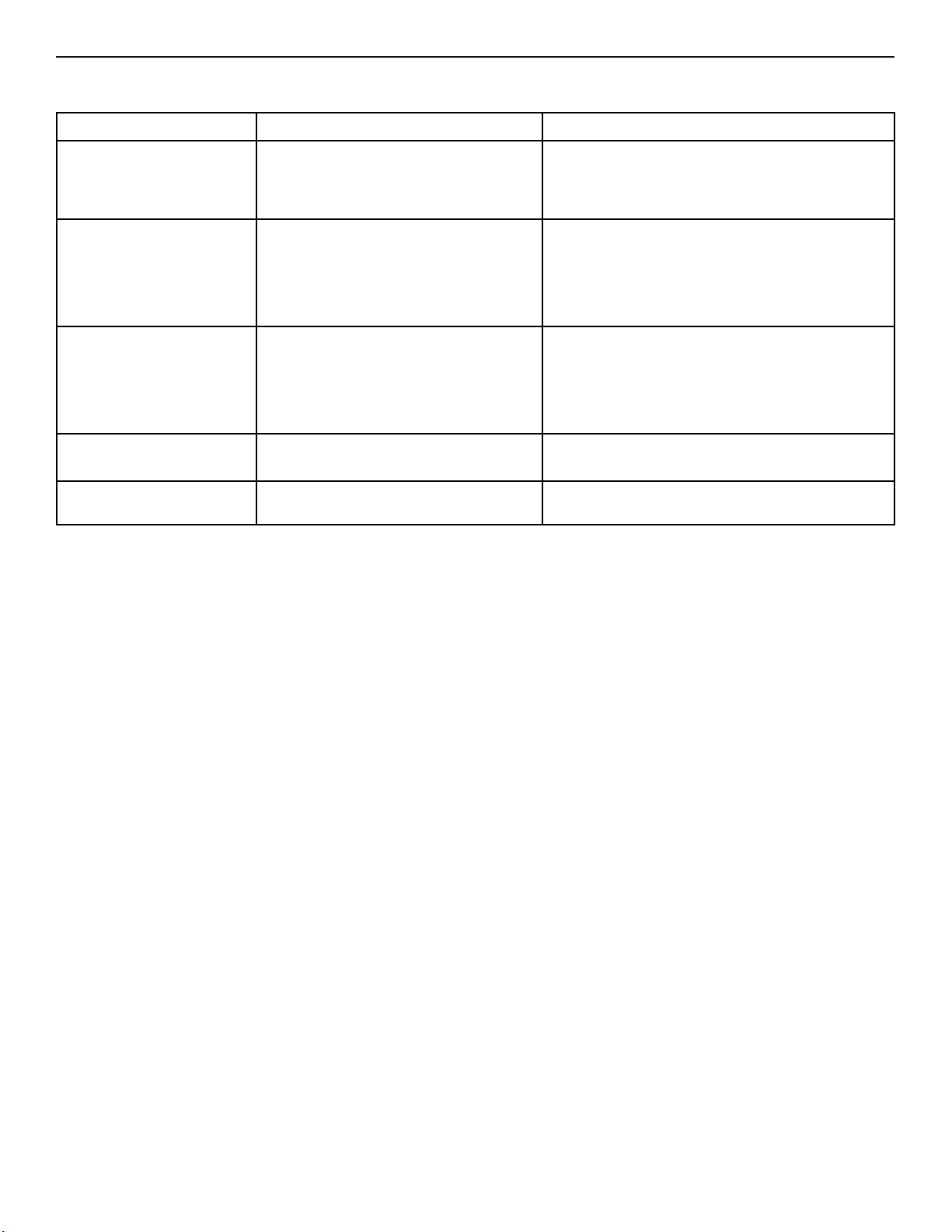
SOLUCIÓN DE PROBLEMAS
Problema Posibles causas Solución
El motor no arranca La unidad no está enchufada.
No hay electricidad.
Cable defectuoso.
Enchufe la unidad.
Revise el suministro eléctrico.
Revise el cable. Repare o reemplácelo, si fuera ne-
cesario.
Resultados no
satisfactorios
Correa de transmisión gastada o dañada.
Barrena gastada o dañada.
Canal de descarga tapado.
Reemplace la correa de transmisión.
Reemplazo de las placas de goma en la barrena.
Asegúrese de que los tornillos y las tuercas estén
ajustados correctamente.
Apague la sopladora de nieve y limpie el canal
de descarga.
Vibraciones inusuales Correa de transmisión gastada o dañada.
Barrena gastada o dañada.
Cuchilla raspadora gastada o dañada.
Reemplace la correa de transmisión.
Reemplazo de las placas de goma en la barrena.
Asegúrese de que los tornillos
y las tuercas estén ajustados correctamente.
Reemplace la cuchilla raspadora. Asegúrese
de que los tornillos estén ajustados correctamente.
El motor se apaga durante el
funcionamiento
El nivel de corriente es demasiado alto Presione el botón de reinicio. Reinicie la sopladora de
nieve.
Las luces LED de la batería
no se iluminarán
Batería en modo de suspensión Coloque la batería en el cargador durante uno o dos
minutos.
16
Modelo SN74022
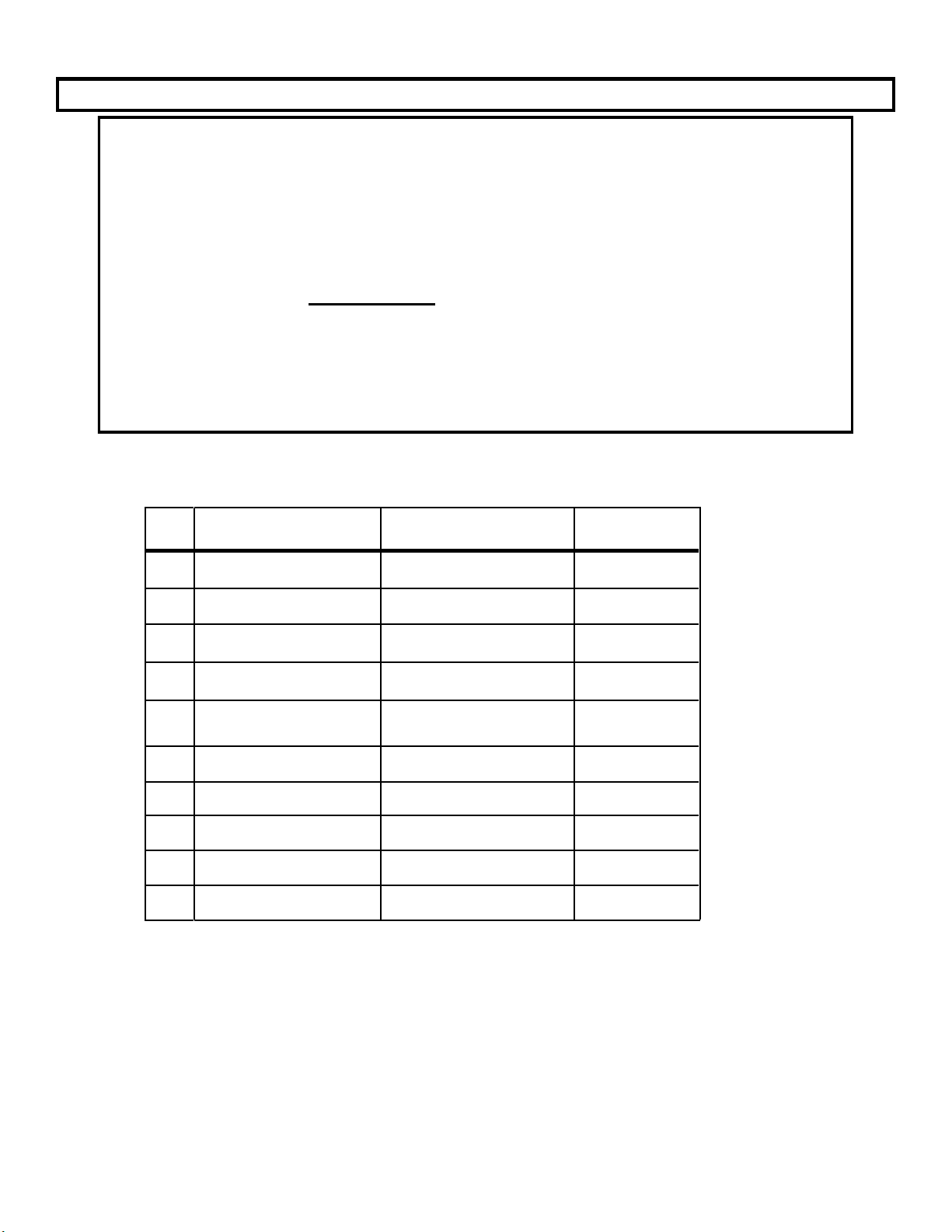
17
Modelo SN74022
PIEZAS Y SERVICIO
Para solicitar repuestos o servicio técnico, llame al 1-800-633-1501 o visite nuestra página web
www.americanlawnmower.com. Asegúrese de proporcionar toda la información relevante cuando
nos llame o visite.
REPUESTOS (KITS / ARTÍCULOS)
El número de modelo/ de serie de esta herramienta se encuentra en una placa o etiqueta adjunta
a la caja. Registre el número de serie en el espacio provisto a continuación.
MODELO N.º SN74022 ____
NÚMERO DE SERIE _______________
Mencione siempre el serial del modelo cuando ordene kits para el mismo.
¡LLÁMENOS PRIMERO!
Llámenos primero si tiene preguntas sobre el funcionamiento o el mantenimiento
de este producto al 1.800.633.1501, de 8:00 a 17:00, hora estándar del este,
obtener asistencia en www.americanlawnmower.com
N.° Número de kit/ Número de
artículo
Descripción Cantidad
1
SN18-CHK-1 Kit de manija central
1
2
SN22-AK Kit de barrena
1
3 SN18-HWK-1
Kit de hardware
1
4
SN22-SB
Kit de hardware 1
5
SN18-ACK-1
Cuchilla rascadora / kit de
guardabarros
1
6
WK-TC-SN Kit de rueda
1
7
SN4018-BELT Kit correa de transmisión
1
8
SN18-CKH-1 Kit de manivela
1
9
BL84040 Paquete de baterías
1
10
CHL80040 Cargador
1