OPERATOR’S MANUAL
MANUEL D’UTILISATION
MANUAL DEL OPERADOR
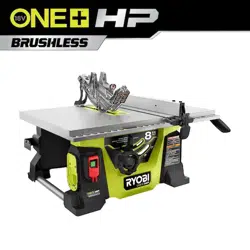
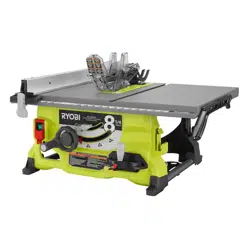
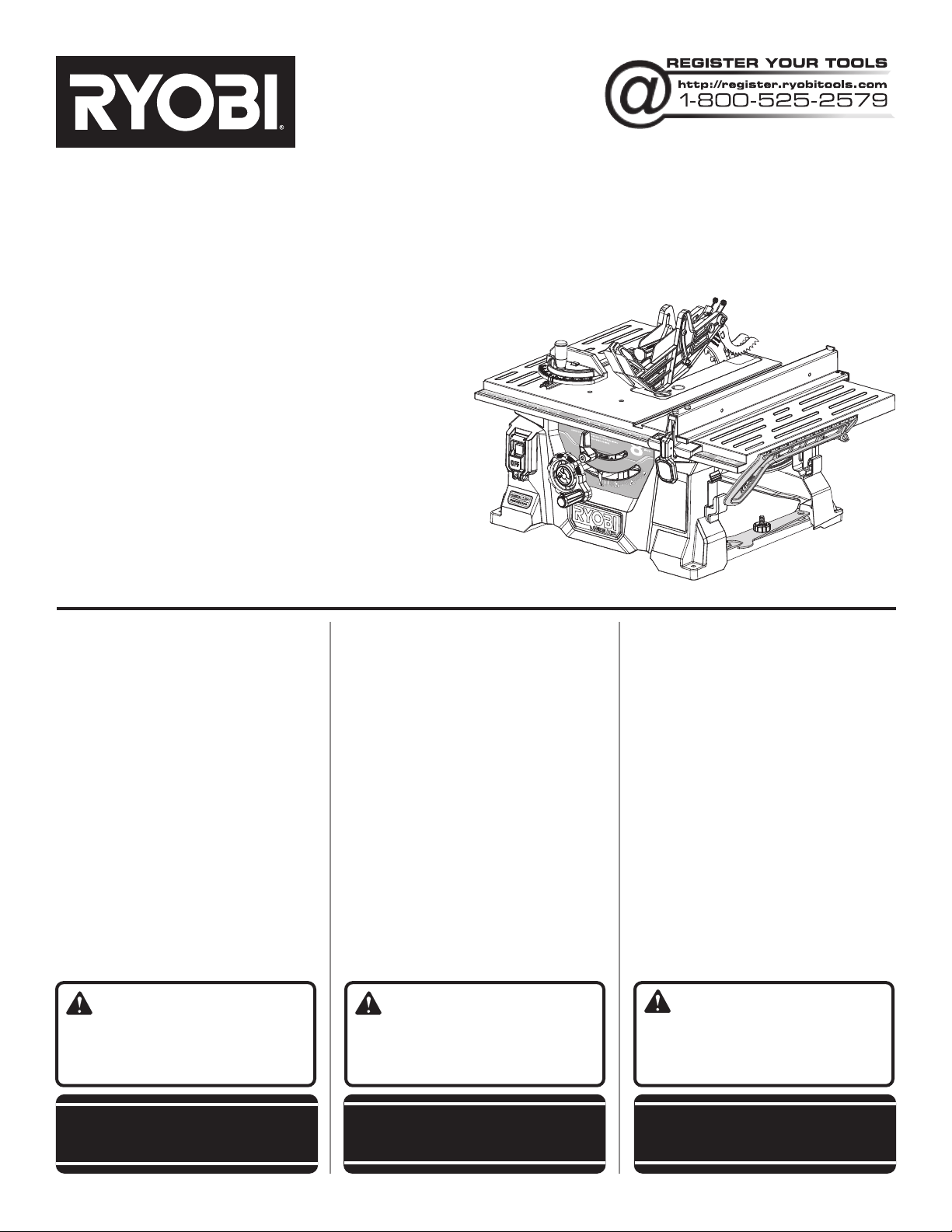
8-1/4 in. 18 VOLT TABLE SAW
SCIE À TABLE de 209,5 mm (8-1/4 po),
18 V
SIERRA DE MESA de 209,5 mm
(8-1/4 pulg.), 18 V
PBLTS01
WARNING: To reduce the
risk of injury, the user must read and
understand the operator’s manual
before using this product.
SAVE THIS MANUAL FOR
FUTURE REFERENCE
ADVERTENCIA: Para reducir
el riesgo de lesiones, el usuario debe leer
y comprender el manual del operador
antes de usar este producto.
AVERTISSEMENT :
Pour
réduire les risques de blessures,
l’utilisateur doit lire et veiller à bien
comprendre le manuel d’utilisation avant
d’employer ce produit.
GUARDE ESTE MANUAL
PARA FUTURAS CONSULTAS
CONSERVER CE MANUEL
POUR FUTURE RÉFÉRENCE
TABLE OF CONTENTS
****************
General Safety Rules .......................2-3
Table Saw Safety Rules ...................4-5
Additional Safety Rules ......................6
Symbols ..............................................7
Glossary of Terms ...............................8
Features .........................................9-11
Tools Needed ...................................12
Loose Parts List ................................13
Assembly .....................................14-20
Operation .....................................21-37
Adjustments ................................38-40
Maintenance ................................41-42
Troubleshooting ...........................42-43
Parts Ordering / Service ..... Back Page
TABLE DES MATIÈRES
****************
Règles de sécurité générales ..........2-3
Règles de sécurité scie à table .......4-5
Règles de sécurité supplémentaires .......6
Symboles ............................................ 7
Glossaire .............................................8
Caractéristiques ............................9-11
Outils nécessaires ............................12
Liste des pièces détachées .............. 13
Assemblage .................................14-20
Utilisation .....................................21-37
Réglages ......................................38-40
Entretien ......................................41-42
Dépannage ..................................42-43
Commande de pièces /
réparation ..........................Page arrière
ÍNDICE DE CONTENIDO
****************
Reglas de seguridad generales .......2-3
Reglas de seguridad sierra
de mesa ..........................................4-5
Advertencias de seguridad
adicionales .........................................6
Símbolos ............................................7
Glosario de términos .......................... 8
Características ..............................9-11
Herramientas necesarias ..................12
Lista de piezas sueltas ..................... 13
Armado ........................................14-20
Funcionamiento ...........................21-37
Ajustes .........................................38-40
Mantenimiento .............................41-42
Corrección de problemas ............42-43
Pedidos de piezas /
servicio .......................... Pág. posterior
2 - English
WARNING:
Read all safety warnings, instructions, illustrations
and specifications provided with this power tool.
Failure to follow all instructions listed below may result
in electric shock, fire and/or serious injury.
Save all warnings and instructions for future reference.
The term “power tool” in the warnings refers to your mains-
operated (corded) power tool or battery-operated (cordless)
power tool.
WORK AREA SAFETY
Keep work area clean and well lit. Cluttered or dark
areas invite accidents.
Do not operate power tools in explosive atmospheres,
such as in the presence of flammable liquids, gases
or dust. Power tools create sparks which may ignite the
dust or fumes.
Keep children and bystanders away while operating a
power tool. Distractions can cause you to lose control.
ELECTRICAL SAFETY
Power tool plugs must match the outlet. Never modify
the plug in any way. Do not use any adapter plugs with
earthed (grounded) power tools. Unmodified plugs and
matching outlets will reduce risk of electric shock.
Avoid body contact with earthed or grounded surfaces,
such as pipes, radiators, ranges and refrigerators.
There is an increased risk of electric shock if your body
is earthed or grounded.
Do not expose power tools to rain or wet conditions.
Water entering a power tool will increase the risk of electric
shock.
Do not abuse the cord. Never use the cord for carrying,
pulling or unplugging the power tool. Keep cord away
from heat, oil, sharp edges or moving parts. Damaged
or entangled cords increase the risk of electric shock.
When operating a power tool outdoors, use an
extension cord suitable for outdoor use. Use of a cord
suitable for outdoor use reduces the risk of electric shock.
If operating a power tool in a damp location is
unavoidable, use a ground fault circuit interrupter
(GFCI) protected supply. Use of a GFCI reduces the risk
of electric shock.
PERSONAL SAFETY
Stay alert, watch what you are doing and use common
sense when operating a power tool. Do not use a
power tool while you are tired or under the influence
of drugs, alcohol or medication. A moment of inattention
while operating power tools may result in serious personal
injury.
Use personal protective equipment. Always wear eye
protection. Protective equipment such as a dust mask,
non-skid safety shoes, hard hat, or hearing protection used
for appropriate conditions will reduce personal injuries.
Prevent unintentional starting. Ensure the switch is in
the off-position before connecting to power source
and/or battery pack, picking up or carrying the tool.
Carrying power tools with your finger on the switch or
energizing power tools that have the switch on invites
accidents.
Remove any adjusting key or wrench before turning
the power tool on. A wrench or a key left attached to a
rotating part of the power tool may result in personal injury.
Do not overreach. Keep proper footing and balance
at all times. This enables better control of the power tool
in unexpected situations.
Dress properly. Do not wear loose clothing or jewelry.
Keep your hair, clothing and gloves away from moving
parts. Loose clothes, jewelry or long hair can be caught
in moving parts.
If devices are provided for the connection of dust
extraction and collection facilities, ensure these are
connected and properly used. Use of dust collection
can reduce dust-related hazards.
Do not let familiarity gained from frequent use of tools
allow you to become complacent and ignore tool safety
principles. A careless action can cause severe injury within
a fraction of a second.
POWER TOOL USE AND CARE
Do not force the power tool. Use the correct power
tool for your application. The correct power tool will
do the job better and safer at the rate for which it was
designed.
Do not use the power tool if the switch does not turn
it on and off. Any power tool that cannot be controlled
with the switch is dangerous and must be repaired.
GENERAL SAFETY RULES

3 - English
GENERAL SAFETY RULES
Disconnect the plug from the power source and/
or remove the battery pack, if detachable, from the
power tool before making any adjustments, changing
accessories, or storing power tools. Such preventive
safety measures reduce the risk of starting the power tool
accidentally.
Store idle power tools out of the reach of children and
do not allow persons unfamiliar with the power tool
or these instructions to operate the power tool. Power
tools are dangerous in the hands of untrained users.
Maintain power tools and accessories. Check for
misalignment or binding of moving parts, breakage
of parts and any other condition that may affect the
power tool’s operation. If damaged, have the power
tool repaired before use. Many accidents are caused
by poorly maintained power tools.
Keep cutting tools sharp and clean. Properly maintained
cutting tools with sharp cutting edges are less likely to
bind and are easier to control.
Use the power tool, accessories and tool bits etc.
in accordance with these instructions, taking into
account the working conditions and the work to be
performed. Use of the power tool for operations different
from those intended could result in a hazardous situation.
Keep handles and grasping surfaces dry, clean and
free from oil and grease. Slippery handles and grasping
surfaces do not allow for safe handling and control of the
tool in unexpected situations.
BATTERY TOOL USE AND CARE
Recharge only with the charger specified by the
manufacturer. A charger that is suitable for one type
of battery pack may create a risk of fire when used with
another battery pack.
Use power tools only with specifically designated bat-
tery packs. Use of any other battery packs may create
a risk of injury and fire.
When battery pack is not in use, keep it away from
other metal objects, like paper clips, coins, keys, nails,
screws or other small metal objects, that can make a
connection from one terminal to another. Shorting the
battery terminals together may cause burns or a fire.
Under abusive conditions, liquid may be ejected from
the battery; avoid contact. If contact accidentally
occurs, flush with water. If liquid contacts eyes, ad-
ditionally seek medical help. Liquid ejected from the
battery may cause irritation or burns.
Do not use a battery pack or tool that is damaged or
modified. Damaged or modified batteries may exhibit
unpredictable behavior resulting in fire, explosion, or risk
of injury.
Do not expose a battery pack or tool to fire or exces-
sive temperature. Exposure to fire or temperature above
265° F may cause explosion.
Follow all charging instructions and do not charge the
battery pack or tool outside the temperature range
specified in the instructions. Charging improperly or at
temperatures outside the specified range may damage
the battery and increase the risk of fire.
Use battery only with charger listed. For use with
18 V lithium-ion battery packs, see tool/appliance/battery
pack/charger correlation supplement 987000-432.
SERVICE
Have your power tool serviced by a qualified repair
person using only identical replacement parts. This will
ensure that the safety of the power tool is maintained.
Never service damaged BATTERY packs. Service of
BATTERY packs should only be performed by the
manufacturer or authorized service providers.

4 - English
TABLE SAW SAFETY RULES
GUARDING RELATED WARNINGS
Keep guards in place. Guards must be in working
order and be properly mounted. A guard that is loose,
damaged, or is not functioning correctly must be repaired
or replaced.
Always use saw blade guard, riving knife and anti-
kickback pawls for every through-cutting operation.
For through-cutting operations where the saw blade cuts
completely through the thickness of the workpiece, the
guard and other safety devices help reduce the risk of
injury.
Immediately reattach the guarding system after
completing an operation (such as rabbeting, dadoing
or resawing cuts) which requires removal of the guard,
riving knife and/or anti-kickback pawls. The guard,
riving knife, and anti-kickback pawls help to reduce the
risk of injury.
Make sure the saw blade is not contacting the guard,
riving knife or the workpiece before the switch is
turned on. Inadvertent contact of these items with the
saw blade could cause a hazardous condition.
Adjust the riving knife as described in the instruction
manual. Incorrect spacing, positioning and alignment can
make the riving knife ineffective in reducing the likelihood
of kickback.
For the riving knife and anti-kickback pawls to work,
they must be engaged in the workpiece. The riving
knife and anti-kickback pawls are ineffective when cutting
workpieces that are too short to be engaged with the riving
knife and anti-kickback pawls. Under these conditions
a kickback cannot be prevented by the riving knife and
anti-kickback pawls.
Use the appropriate saw blade for the riving knife.
For the riving knife to function properly, the saw blade
diameter must match the appropriate riving knife and the
body of the saw blade must be thinner than the thickness
of the riving knife and the cutting width of the saw blade
must be wider than the thickness of the riving knife.
CUTTING PROCEDURES WARNINGS
DANGER: Never place your fingers or hands in the
vicinity or in line with the saw blade. A moment of
inattention or a slip could direct your hand towards the
saw blade and result in serious personal injury.
Feed the workpiece into the saw blade against the
direction of rotation. Feeding the workpiece in the same
direction that the saw blade is rotating above the table
may result in the workpiece, and your hand, being pulled
into the saw blade.
Never use the miter gauge to feed the workpiece when
ripping and do not use the rip fence as a length stop
when cross cutting with the miter gauge. Guiding the
workpiece with the rip fence and the miter gauge at the
same time increases the likelihood of saw blade binding
and kickback.
When ripping, always apply the workpiece feeding
force between the fence and the saw blade. Use a
push stick when the distance between the fence and
the saw blade is less than 150 mm, and use a push
block when this distance is less than 50 mm. “Work
helping” devices will keep your hand at a safe distance
from the saw blade.
Use only the push stick provided by the manufacturer
or constructed in accordance with the instructions.
This push stick provides sufficient distance of the hand
from the saw blade.
Never use a damaged or cut push stick. A damaged
push stick may break causing your hand to slip into the
saw blade.
Do not perform any operation “freehand”. Always
use either the rip fence or the miter gauge to position
and guide the workpiece. “Freehand” means using
your hands to support or guide the workpiece, in lieu
of a rip fence or miter gauge. Freehand sawing leads to
misalignment, binding and kickback.
Never reach around or over a rotating saw blade.
Reaching for a workpiece may lead to accidental contact
with the moving saw blade.
Provide auxiliary workpiece support to the rear and/or
sides of the saw table for long and/or wide workpieces
to keep them level. A long and/or wide workpiece has
a tendency to pivot on the table’s edge, causing loss of
control, saw blade binding and kickback.
Feed workpiece at an even pace. Do not bend or
twist the workpiece. If jamming occurs, turn the tool
off immediately, unplug the tool then clear the jam.
Jamming the saw blade by the workpiece can cause
kickback or stall the motor.
Do not remove pieces of cut-off material while the saw
is running. The material may become trapped between
the fence or inside the saw blade guard and the saw
blade pulling your fingers into the saw blade. Turn the saw
off and wait until the saw blade stops before removing
material.
Use an auxiliary fence in contact with the table top
when ripping workpieces less than 2 mm thick. A thin
workpiece may wedge under the rip fence and create a
kickback.

5 - English
TABLE SAW SAFETY RULES
KICKBACK CAUSES AND RELATED WARNINGS
Kickback is a sudden reaction of the workpiece due to a
pinched, jammed saw blade or misaligned line of cut in the
workpiece with respect to the saw blade or when a part of
the workpiece binds between the saw blade and the rip
fence or other fixed object.
Most frequently during kickback, the workpiece is lifted from
the table by the rear portion of the saw blade and is propelled
towards the operator.
Kickback is the result of saw misuse and/or incorrect
operating procedures or conditions and can be avoided by
taking proper precautions as given below.
Never stand directly in line with the saw blade. Always
position your body on the same side of the saw blade
as the fence. Kickback may propel the workpiece at high
velocity towards anyone standing in front and in line with
the saw blade.
Never reach over or in back of the saw blade to pull or
to support the workpiece. Accidental contact with the
saw blade may occur or kickback may drag your fingers
into the saw blade.
Never hold and press the workpiece that is being
cut off against the rotating saw blade. Pressing the
workpiece being cut off against the saw blade will create
a binding condition and kickback.
Align the fence to be parallel with the saw blade. A
misaligned fence will pinch the workpiece against the
saw blade and create kickback.
Use a featherboard to guide the workpiece against the
table and fence when making non-through cuts such
as rabbeting, dadoing or resawing cuts. A featherboard
helps to control the workpiece in the event of a kickback.
Use extra caution when making a cut into blind areas
of assembled workpieces. The protruding saw blade
may cut objects that can cause kickback.
Support large panels to minimize the risk of saw blade
pinching and kickback. Large panels tend to sag under
their own weight. Support(s) must be placed under all
portions of the panel overhanging the table top.
Use extra caution when cutting a workpiece that is
twisted, knotted, warped or does not have a straight
edge to guide it with a miter gauge or along the fence.
A warped, knotted, or twisted workpiece is unstable
and causes misalignment of the kerf with the saw blade,
binding and kickback.
Never cut more than one workpiece, stacked vertically
or horizontally. The saw blade could pick up one or more
pieces and cause kickback.
When restarting the saw with the saw blade in the
workpiece, centre the saw blade in the kerf so that
the saw teeth are not engaged in the material. If the
saw blade binds, it may lift up the workpiece and cause
kickback when the saw is restarted.
Keep saw blades clean, sharp, and with sufficient
set. Never use warped saw blades or saw blades with
cracked or broken teeth. Sharp and properly set saw
blades minimise binding, stalling and kickback.
TABLE SAW OPERATING PROCEDURE WARNINGS
Turn off the table saw and unplug the tool when
removing the table insert, changing the saw blade or
making adjustments to the riving knife, anti-kickback
pawls or blade guard, and when the machine is left
unattended. Precautionary measures will avoid accidents.
Never leave the table saw running unattended. Turn it
off and don’t leave the tool until it comes to a complete
stop. An unattended running saw is an uncontrolled
hazard.
Locate the table saw in a well-lit and level area where
you can maintain good footing and balance. It should
be installed in an area that provides enough room to
easily handle the size of your workpiece. Cramped,
dark areas, and uneven slippery floors invite accidents.
Frequently clean and remove sawdust from under
the saw table and/or the dust collection device.
Accumulated sawdust is combustible and may self-ignite.
The table saw must be secured. A table saw that is not
properly secured may move or tip over.
Remove tools, wood scraps, etc. from the table before
the table saw is turned on. Distraction or a potential jam
can be dangerous.
Always use saw blades with correct size and shape
(diamond versus round) of arbour holes. Saw blades
that do not match the mounting hardware of the saw will
run off-centre, causing loss of control.
Never use damaged or incorrect saw blade mounting
means such as flanges, saw blade washers, bolts or
nuts. These mounting means were specially designed for
your saw, for safe operation and optimum performance.
Never stand on the table saw, do not use it as a
stepping stool. Serious injury could occur if the tool is
tipped or if the cutting tool is accidentally contacted.
Make sure that the saw blade is installed to rotate
in the proper direction. Do not use grinding wheels,
wire brushes, or abrasive wheels on a table saw.
Improper saw blade installation or use of accessories
not recommended may cause serious injury.

6 - English
ADDITIONAL SAFETY RULES
Know your power tool. Read the operator’s manual
carefully. Learn the saw’s applications and limitations as
well as the specific potential hazards related to this tool.
Make workshop childproof with padlocks and master
switches, or by removing starter keys.
Always wear eye protection with side shields marked
to comply with ANSI Z87.1. Failure to do so could result
in objects being thrown into your eyes, resulting in possible
serious injury.
Secure work. Use clamps or a vise to hold work when
practical. It’s safer than using your hand and frees both
hands to operate tool.
Use recommended accessories. Consult the operator’s
manual for recommended accessories. The use of
improper accessories may risk injury.
Use only correct blades. Do not use blades with incorrect
size holes. Never use blade washers or blade bolts that
are defective or incorrect. The maximum blade capacity
of your saw is 8-1/4 in. (209,5 mm).
Check damaged parts. Before further use of the tool, a
guard or other part that is damaged should be carefully
checked to determine that it will operate properly and
perform its intended function. Check for alignment of
moving parts, binding of moving parts, breakage of parts,
mounting and any other conditions that may affect its
operation. A guard or other part that is damaged must
be properly repaired or replaced by an authorized service
center to avoid risk of personal injury.
Never leave tool running unattended. Turn the power
off. Don’t leave tool until it comes to a complete stop.
Protect your lungs. Wear a face or dust mask if the
cutting operation is dusty.
Protect your hearing. Wear hearing protection during
extended periods of operation.
Always keep the blade guard and riving knife (splitter)
in place and in working order.
Keep hands away from cutting area. Keep hands away
from blades. Do not reach underneath work or around or
over the blade while blade is rotating. Do not attempt to
remove cut material when blade is moving.
Avoid awkward operations and hand positions where
a sudden slip could cause your hand to move into the
blade.
Do not reach behind the blade with either hand from
either side of the saw blade, to support the workpiece,
remove wood scraps, or for any other reason while
the blade is spinning.
The table saw must be mounted to a firm supporting
surface, such as a workbench or leg stand that
positions the saw at waist height. In addition, provide
adequate support such as auxiliary tables, roller support
tables, outfeed supports, etc. when cutting heavy, wide,
or long . Heavy, wide, or long workpieces can tip if not
securely supported. If the cut-off piece or workpiece tips,
it can lift the blade guard or be thrown by the spinning
blade.
If the workpiece or blade becomes jammed, turn the
table saw off. Wait for all moving parts to stop and remove
the battery. Then work to free the jammed material. After
the material is removed, verify that the blade is parallel
to the miter gauge groove, and the riving knife and blade
are aligned. If the jam occurred during a rip cut, verify that
the rip fence is parallel to the blade. Adjust if necessary.

7 - English
SYMBOLS
Some of the following symbols may be used on this tool. Please study them and learn their meaning. Proper interpretation
of these symbols will allow you to operate the tool better and safer.
SYMBOL NAME DESIGNATION/EXPLANATION
Safety Alert Indicates a potential personal injury hazard.
Read Operator’s Manual
To reduce the risk of injury, user must read and understand
operator’s manual before using this product.
Eye Protection
Always wear eye protection with side shields marked to comply
with ANSI Z87.1.
No Hands Symbol
Failure to keep your hands away from the blade will result in
serious personal injury.
Wet Conditions Alert Do not expose to rain or use in damp locations.
V Volts Voltage
A Amperes Current
Hz Hertz Frequency (cycles per second)
min Minutes Time
Alternating Current Type of current
n
o
No Load Speed Rotational speed, at no load
Class II Construction Double-insulated construction
.../min Per Minute Revolutions, strokes, surface speed, orbits, etc., per minute
The following signal words and meanings are intended to explain the levels of risk associated with this product.
SYMBOL SIGNAL MEANING
DANGER:
Indicates a hazardous situation, which, if not avoided, will result in death or
serious injury.
WARNING:
Indicates a hazardous situation, which, if not avoided, could result in death or
serious injury.
CAUTION:
Indicates a hazardous situation, that, if not avoided, may result in minor or
moderate injury.
NOTICE:
(Without Safety Alert Symbol) Indicates information considered important, but
not related to a potential injury (e.g. messages relating to property damage).

8 - English
GLOSSARY OF TERMS
Pilot Hole (drill presses and scroll saws)
A small hole drilled in a workpiece that serves as a guide
for drilling large holes accurately or for insertion of a scroll
saw blade.
Push Blocks (jointer planers)
Device used to feed the workpiece over the jointer planer
cutterhead during any operation. This aid helps keep the
operator’s hands well away from the cutterhead.
Push Blocks and Push Sticks (table saws)
Devices used to feed the workpiece through the saw blade
during cutting operations. When making a narrow rip cut
without a jig or similar cutting aid, always use a push stick (not
a push block). A push block can be used for narrow ripping
operations, if a jig or similar cutting aid is used. These aids
help keep the operator’s hands well away from the blade.
Rabbet
A non-through cut positioned on the end or edge of the
workpiece which produces a square, two-sided notch or
trough in the workpiece.
Resaw (table saws and band saws)
A cutting operation to reduce the thickness of the workpiece
to make thinner pieces.
Resin
A sticky, sap-based substance that has hardened.
Revolutions Per Minute (RPM)
The number of turns completed by a spinning object in one
minute.
Ripping or Rip Cut (table saws)
A cutting operation along the length of the workpiece and
typically in the direction of the grain.
Riving Knife/Spreader/Splitter (table saws)
A metal piece, slightly thinner than the blade, which helps
keep the kerf open and also helps to prevent kickback.
Saw Blade Path
The area over, under, behind, or in front of the blade. As it
applies to the workpiece, that area which will be or has been
cut by the blade.
Snipe (planers)
Depression made at either end of a workpiece by cutter
blades when the workpiece is not properly supported.
Taper Cut
A cut where the material being cut has a different width at
the beginning of the cut from the end.
Through Sawing
Any cutting operation where the blade extends completely
through the thickness of the workpiece. This type of cut will
separate a single workpiece into two pieces.
Workpiece or Material
The item on which the operation is being done.
Worktable
Surface where the workpiece rests while performing a cutting,
drilling, planing, or sanding operation.
Anti-Kickback Pawls (radial arm and table saws)
A device which, when properly installed and maintained,
is designed to stop the workpiece from being kicked back
toward the front of the saw during a ripping operation.
Arbor
The shaft on which a blade or cutting tool is mounted.
Bevel Cut
A cutting operation made with the blade at any angle other
than 90° to the table surface.
Chamfer
A cut removing a wedge from a block so the end (or part of
the end) is angled rather than at 90°.
Compound Cut
A cross cut made with both a miter and a bevel angle.
Cross Cut
A cutting or shaping operation made across the grain or the
width of the workpiece.
Cutter Head (planers and jointer planers)
A rotating cutterhead with adjustable blades or knives. The
blades or knives remove material from the workpiece.
Dado Cut (table saws and compound sliding miter saws)
A non-through cut which produces a square, three-sided
notch or trough in the workpiece.
Featherboard (table saws)
A device used to help control the workpiece by guiding
it securely against the table or fence during any ripping
operation.
FPM or SPM
Feet per minute (or strokes per minute), used in reference
to blade movement.
Freehand
Performing a cut without the workpiece being guided by a
fence, miter fence, or other aids.
Gum
A sticky, sap-based residue from wood products.
Heel
Alignment of the blade to the miter gauge groove.
Kerf
The material removed by the blade in a through cut or the
slot produced by the blade in a non-through or partial cut.
Kickback
A hazard that can occur when the blade binds or stalls,
throwing the workpiece in the direction of the spinning blade.
Miter Cut
A cutting operation made with the workpiece at any angle
to the blade other than 90°.
Non-Through Cuts (table saws and compound sliding
miter saws)
Any cutting operation where the blade does not extend
completely through the thickness of the workpiece. This is a
cut where the blade will not cut the workpiece into two pieces.
9 - English
FEATURES
PRODUCT SPECIFICATIONS
Blade Arbor .............................................................. 5/8 in.
Blade Diameter ......................................................8-1/4 in.
Blade Tilt ................................................................. 0˚ - 45˚
Input .......................................................................18 V DC
No Load Speed ..............................up to 4,500/min (RPM)
Cutting Depth at 0˚ ................................................2-1/4 in.
Cutting Depth at 45˚ ..............................................1-3/4 in.
Fig. 2
HEIGHT/BEVEL
ADJUSTING
HANDWHEEL
BEVEL
SCALE
BEVEL
INDICATOR
BEVEL
LOCKING LEVER
BLADE
GUARD
LOCKING
LEVER
RIP SCALE
INDICATOR
RIP
SCALE
RIP
FENCE
LOW
FENCE
MITER GAUGE
GROOVE
MITER
GAUGE
RIVING
KNIFE
ANTI-KICKBACK
PAWLS
FRONT
RAIL
SWITCH
ASSEMBLY
DUST
CHUTE
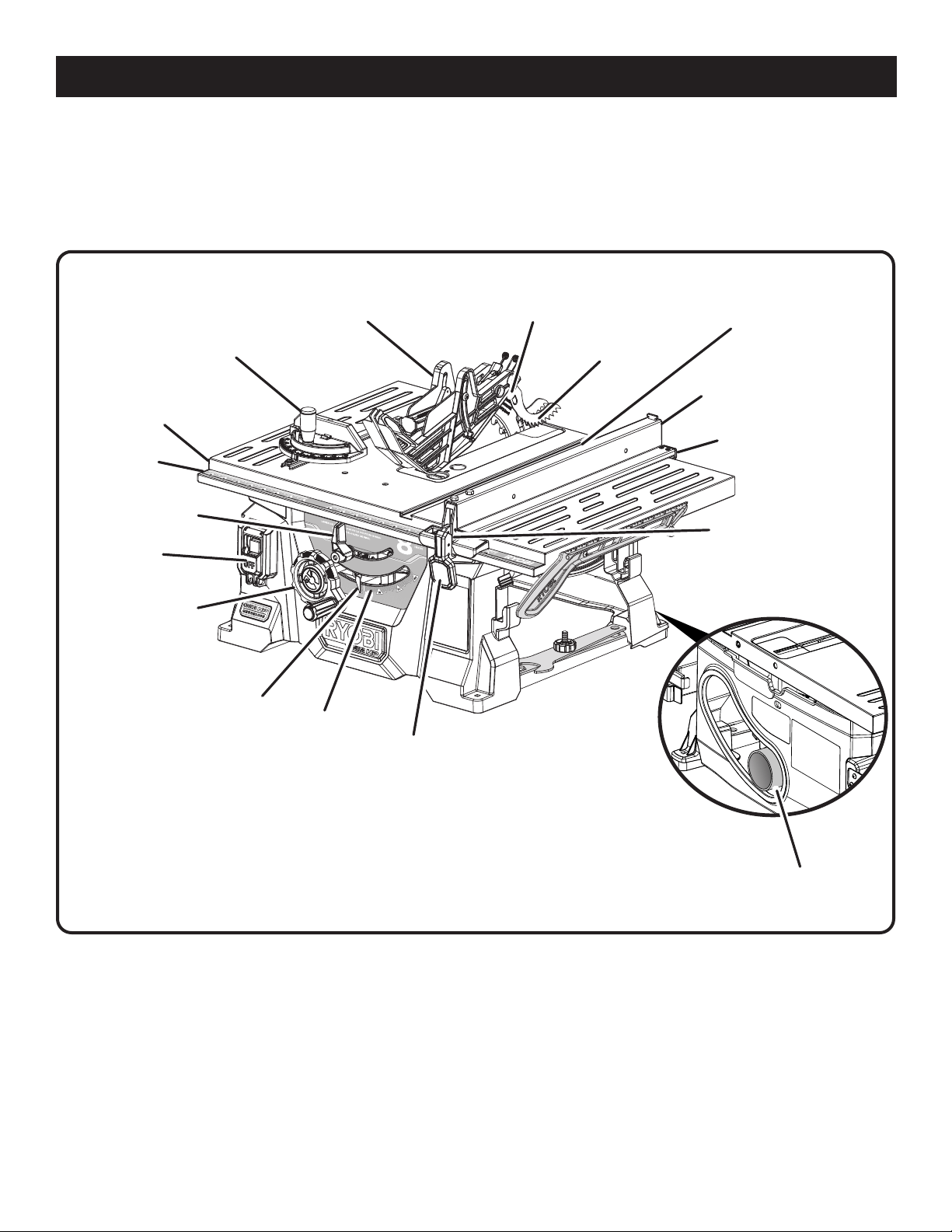
KNOW YOUR TABLE SAW
See Figures 2 - 3.
The safe use of this product requires an understanding of
the information on the tool and in this operator’s manual as
well as a knowledge of the project you are attempting. Before
use of this product, familiarize yourself with all operating
features and safety rules.
ACCESSORY STORAGE - Convenient storage areas for
the push stick, riving knife, wrenches, blade guard, miter
gauge, and rip fence are located underneath the saw table.
ANTI-KICKBACK PAWLS - Kickback is a hazard in which
the workpiece is thrown back toward the operator. The teeth
on the removable anti-kickback pawls point away from the
workpiece. If the workpiece should be pulled back toward
the operator, the teeth dig into the wood to help prevent or
reduce the possibility of kickback. The anti-kickback pawls
may be bypassed.
BEVEL LOCKING LEVER - This lever, placed just under the
saw table surface on the front of the saw, locks the angle
setting of the blade.

10 - English
BEVEL SCALE - The easy-to-read scale on the front of the
saw shows the exact blade angle.
BLADE - For maximum performance, it is recommended
that you use the 8-1/4 in. carbide tipped combination blade
provided with the saw. The blade is raised and lowered with
the height/bevel adjusting handwheel. Bevel angles are locked
with the bevel locking lever. Additional blade styles of the
same high quality are available for specific operations such
as ripping. Your local dealer can provide you with complete
information.
Blade kerf width must be within the limits stamped on the
riving knife.
WARNING:
Do not use blades rated less than the speed of this tool.
Failure to heed this warning could result in personal injury.
BLADE GUARD - Always keep the removable blade guard
down over the saw blade for through-sawing cuts.
FEATURES
Fig. 3
RIP FENCE
STORAGE AREA
PUSH STICK
STORAGE AREA
BLADE GUARD
STORAGE AREA
RIVING KNIFE, MITER
GAUGE, AND BLADE WRENCH
STORAGE AREA
DUST CHUTE - The built-in dust chute makes it easy to
dispose of sawdust. A vacuum hose may be attached to
the dust chute.
HEIGHT/BEVEL ADJUSTING HANDWHEEL - Located on
the front of the saw, use this handwheel to lower and raise
the blade for height adjustments or blade replacement. This
handwheel also makes the adjustment for bevel angles easy.
MITER GAUGE - The miter gauge aligns the wood for a
cross cut. The easy-to-read indicator shows the exact angle
for a miter cut.
MITER GAUGE GROOVE - The miter gauge rides in the
groove on the saw table.
RIP FENCE - A sturdy metal fence guides the workpiece
and is secured with the locking handle.
NOTE: Do not place the rip fence on the left side of the blade
when cutting material greater than 3/4 inches thick.
RIP SCALE - Located on the front rail, the easy-to-read rip
scale provides precise measurements for rip cuts.
11 - English
FEATURES
RIVING KNIFE - A removable metal piece of the blade guard
assembly with kickback pawls, slightly thinner than the saw
blade, which helps keep the kerf open and prevent kickback.
When in the through sawing, or “up” position, it is higher than
the saw blade. When in the non-through sawing, or “down”
position, it is below the saw blade teeth.
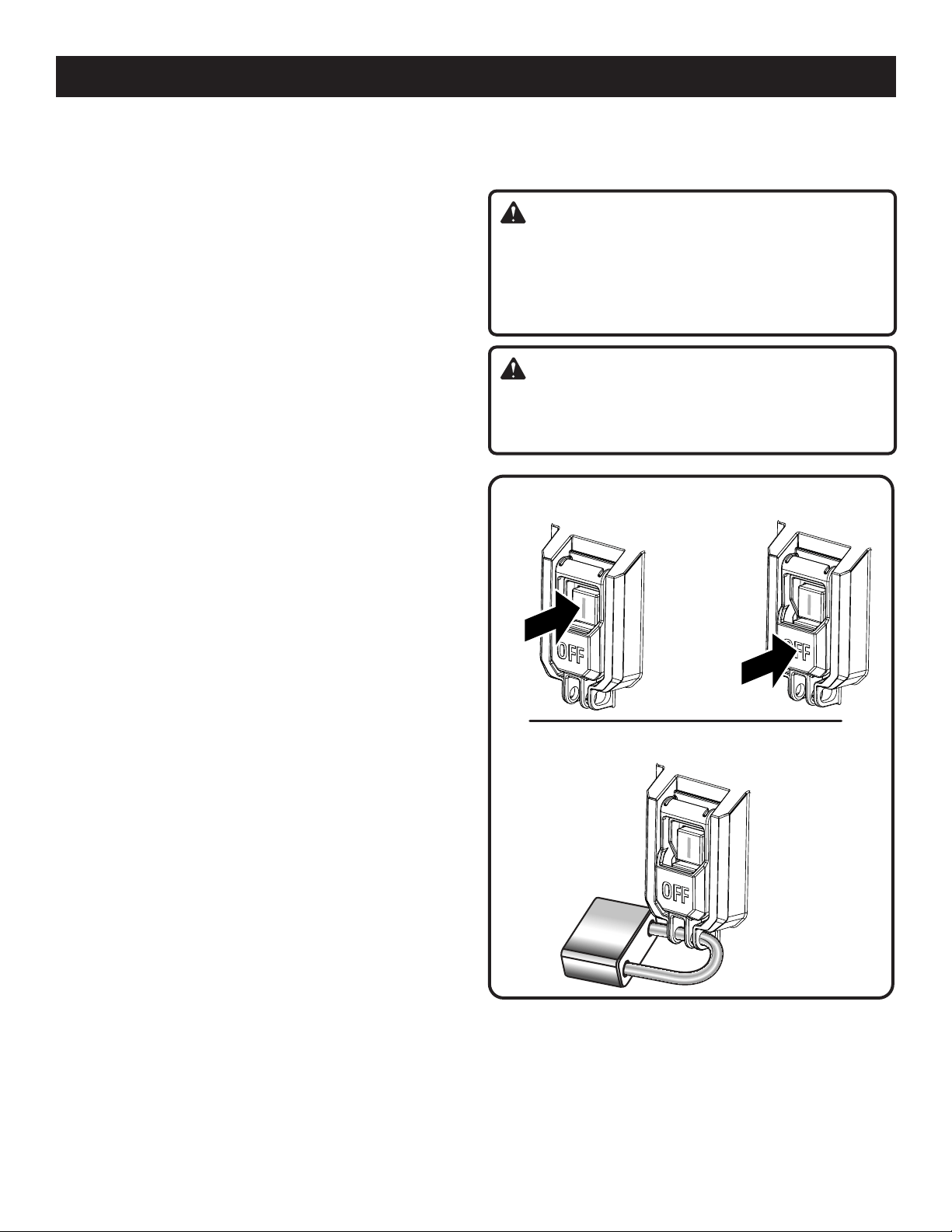
SWITCH ASSEMBLY - This saw has an easy access switch
assembly located below the front rail. To lock the switch, install
a padlock (not included) through the holes in the switch and
cover. Make certain the switch is inoperable. If the switch
is still operable with the padlock installed, a padlock with
a larger shackle diameter must be used. Store the padlock
key in another location.
OPERATING COMPONENTS
The upper portion of the blade projects up through the table
and is surrounded by an insert called the throat plate. The
height of the blade is set with a handwheel on the front of
the saw. Detailed instructions are provided in the Operation
section of this manual for the basic cuts: cross cuts, miter
cuts, bevel cuts, and compound cuts.
The rip fence is used to position work for lengthwise cuts.
A scale on the front rail shows the distance between the rip
fence and the blade.
It is very important to use the blade guard assembly with
kickback pawls for all through-sawing operations. The blade
guard assembly with kickback pawls includes: riving knife and
blade guard with anti-kickback pawls.
SWITCH ASSEMBLY
See Figure 4.
This saw is equipped with an on/off switch that has a built-in
locking feature. This feature is intended to prevent unauthorized
and possible hazardous use by children and others.
NOTE: The switch cover does not have to be raised to
operate the switch.
TO TURN THE SAW ON:
Insert the battery.
Press the top button on the switch to turn the saw on.
TO TURN THE SAW OFF:
Press the bottom button on the switch to turn the saw
off.
TO LOCK THE SAW:
With the saw turned off, install a padlock (not included)
through the holes in the switch and switch cover.
WARNING:
ALWAYS make sure your workpiece is not in contact with
the blade before operating the switch to start the tool.
Failure to heed this warning may cause the workpiece to
be kicked back toward the operator and result in serious
personal injury.
WARNING:
To reduce the risk of accidental starting, always make
sure the top button on the switch is not depressed before
installing the battery.
Fig. 4
SWITCH IN LOCKED POSITION
SWITCH ON SWITCH OFF

12 - English
The following tools (not included or drawn to scale) are needed for assembly and making adjustments:
TOOLS NEEDED
Fig. 5
FRAMING SQUARE
PHILLIPS
SCREWDRIVER
FLATHEAD
SCREWDRIVER
SOCKET WRENCH
AND SOCKETS (8 mm
and 13 mm)
COMBINATION
SQUARE
C-CLAMPS
13mm WRENCH

LOOSE PARTS
13 - English
The following items are included with your table saw:
Fig. 6
A. Blade Guard with Anti-kickback Pawls.................... 1
B. Handle Assembly ..................................................... 1
C. Handle End Cap ....................................................... 1
D. Hex Key (5 mm) ....................................................... 1
E. Rip Fence ................................................................. 1
F. Push Stick ................................................................ 1
G. Miter Gauge ............................................................. 1
H. Open End Blade Wrench ......................................... 1
I. Closed End Blade Wrench ....................................... 1
B
A
E
C
F
G
D
H
I
A
14 - English
UNPACKING
This product requires assembly.
Carefully lift saw from the carton and place it on a level
work surface.
NOTE: This tool is heavy. To avoid back injury, keep your
knees bent and lift with your legs, not your back, and get
help when needed.
WARNING:
Do not use this product if any parts on the Loose Parts list
are already assembled to your product when you unpack
it. Parts on this list are not assembled to the product by
the manufacturer and require customer installation. Use
of a product that may have been improperly assembled
could result in serious personal injury.
Inspect the tool carefully to make sure no breakage or
damage occurred during shipping.
Do not discard the packing material until you have
carefully inspected the tool, identified all loose parts, and
satisfactorily operated the tool.
NOTE: Remove the foam block from between the saw’s
table and the motor by first beveling the blade, refer to
To Change Blade Angle (Bevel) in the Operation section
of this manual.
The saw is factory set for accurate cutting. After
assembling it, check for accuracy. If shipping has
influenced the settings, refer to specific procedures
explained in this manual.
If any parts are damaged or missing, please call
1-800-525-2579 for assistance.
WARNING:
If any parts are damaged or missing, do not operate
this tool until the parts are replaced. Use of this product
with damaged or missing parts could result in serious
personal injury.
WARNING:
Do not attempt to modify this tool or create accessories
not recommended for use with this tool. Any such
alteration or modification is misuse and could result in a
hazardous condition leading to possible serious personal
injury.
WARNING:
Do not connect to power supply until assembly is
complete. Failure to comply could result in accidental
starting and possible serious personal injury.
WARNING:
Do not lift the saw without help. Hold it close to your body.
Keep your knees bent and lift with your legs, not your
back. Ignoring these precautions can result in back injury.
WARNING:
Never stand directly in line with the blade or allow hands
to come closer than 3 in. to the blade. Do not reach over
or across the blade. Failure to heed this warning can
result in serious personal injury.
WARNING:
To avoid serious personal injury, always make sure the
table saw is securely mounted to a workbench or an
approved leg stand. NEVER operate the saw on the floor.
ASSEMBLY

15 - English
ASSEMBLY
MOUNTING HOLES
See Figure 7.
The table saw must be mounted to a firm supporting surface
such as a workbench or leg stand. Four bolt holes have been
provided in the saw’s base for this purpose.
To mount the saw to a work bench, insert bolts that are
of sufficient length to accommodate the saw base, lock
washers, hex nuts, and the thickness of the workbench or
other mounting surface. Tighten all bolts or screws securely.
Carefully check the workbench after mounting to make sure
that no movement can occur during use. If any tipping,
sliding, or walking is noted, secure the workbench to the
floor before operating.
INSTALLING THE HANDLE
See Figure 8.
Remove the hex nut from the bolt in the handle but do
not remove the bolt.
Slide the washer onto the bolt.
Place the hex nut into the recessed hole on the back of
the height/bevel adjusting handwheel and hold in place.
Insert the handle and screw into the hole on the height/
bevel adjusting handwheel.
Using a flathead screwdriver, turn the screw clockwise
and tighten in place.
Cover the end of the handle with the cap.
REMOVING/REINSTALLING THE THROAT
PLATE
See Figure 9.
WARNING:
If the throat plate is too high or too low, the workpiece
can catch on the uneven edges resulting in binding or
kickback which could result in serious personal injury.
Verify the throat plate is correctly seated. Before turning
on the saw, perform a dry run of the cutting operation to
make sure that no problems will occur when the cut is
made. If the workpiece catches, do not attempt to use
the saw. Contact customer service for assistance.
Lower the blade by turning the height/bevel adjusting
handwheel counterclockwise.
To remove the throat plate, rotate the knob to the unlocked
position. Place your index finger into the hole, lift and pull
the throat plate out toward the front of the saw.
To reinstall the throat plate, rotate the knob to the unlocked
position. Place throat plate back onto the saw and rotate
the knob to the locked position.
THROAT
PLATE
KNOB
HOLE
Fig. 8
Fig. 7
Fig. 9
HEX
NUT
BOLT
WASHER
HANDLE
HEIGHT/BEVEL
ADJUSTING
HANDWHEEL
HANDLE
END CAP
MOUNTING
HOLES
MOUNTING
HOLES
LOCK
UNLOCK

16 - English
ASSEMBLY
CHANGING RIVING KNIFE POSITIONS
See Figure 10.
This saw is shipped with a riving knife that should be placed
in the “down” position for non-through cutting and must be
placed in the “up” position for all other cutting operations.
CAUTION:
Use caution when reaching inside the throat in the saw
table. Blade contact, even when the blade is still, may
result in injury to hands or arms.
Remove the battery.
To place in the “up” position for all through cutting:
Remove the throat plate.
Raise the saw blade by turning the height/bevel adjusting
handwheel clockwise.
Unlock the release lever by pulling it up.
Grasp the riving knife and pull it towards the right side of
the saw to release the riving knife from the spring-loaded
riving clamp.
Pull the riving knife up until the internal pins are engaged
and the riving knife is above the saw blade.
Lock the release lever by pushing the lever down.
WARNING:
Make sure the release lever is fully seated. If the
release lever is difficult to lock, thoroughly clean lever
components using compressed air or a clean soft cloth as
described in the Cleaning the Riving Knife Lock Lever
Plates section in Maintenance. Failure to completely
lock the release lever can allow the riving knife to change
position during saw use, which could result in serious
personaly injury.
Reinstall the throat plate.
To place in the “down” position for all non-through cutting:
Remove the throat plate.
Raise the saw blade by turning the height/bevel adjusting
handwheel clockwise.
Unlock the release lever by pulling it up.
Grasp the riving knife and pull it towards the right side of
the saw to release the riving knife from the spring-loaded
riving clamp.
Push the riving knife down until it is below the saw blade.
Lock the release lever by pushing the lever down.
Reinstall the throat plate.
IN “UP” POSITION FOR THROUGH CUTTING
IN “DOWN” POSITION FOR NON-THROUGH CUTTING
Fig. 10
RELEASE LEVER
(LOCKED)
RELEASE LEVER
(UNLOCKED)
17 - English
ASSEMBLY
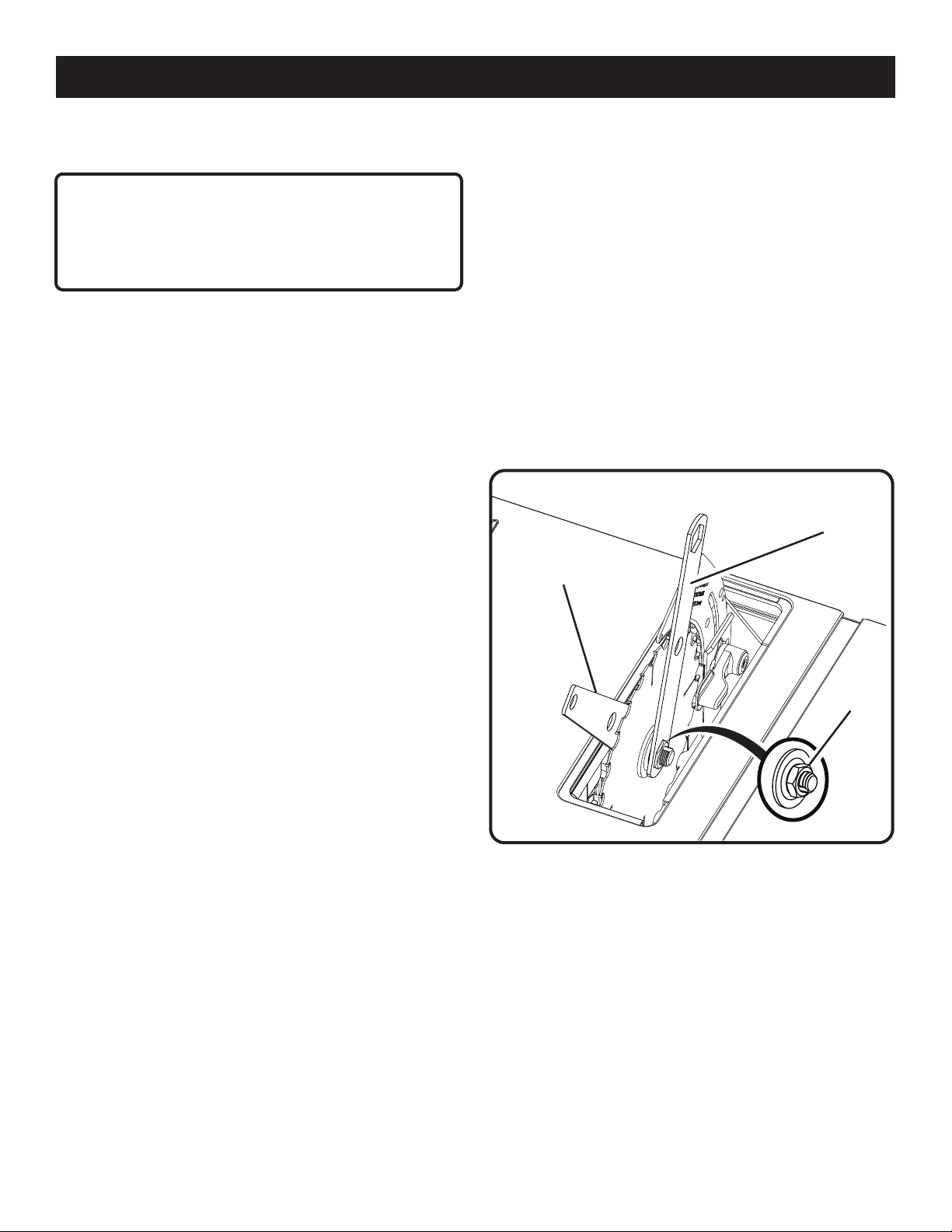
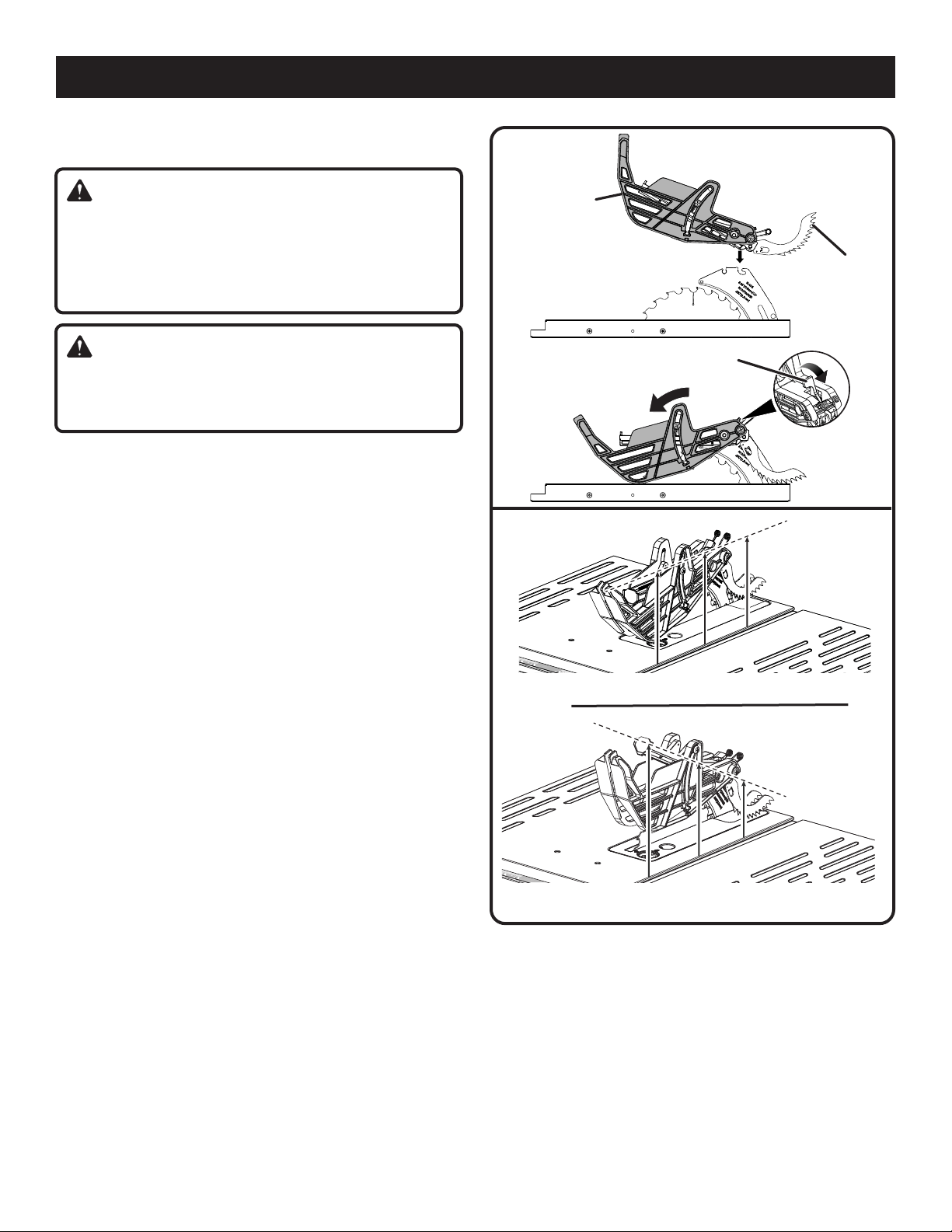
CHECKING SAW BLADE INSTALLATION
See Figure 11.
NOTICE:
To work properly, the saw blade teeth must point down
toward the front of the saw. Failure to heed this warning
could cause damage to the saw blade, the saw, or the
workpiece.
Remove the battery.
Remove the blade wrench from the blade wrench storage
area.
Lower the saw blade and remove the throat plate.
Raise the saw blade to its full height by turning the height/
bevel adjusting handwheel clockwise.
Make sure the bevel locking lever is locked. (See figure 29.)
Place riving knife in the “up” position.
To loosen the blade:
Place the flat open end of the open end blade wrench on
the flats on the arbor shaft.
Insert the closed end blade wrench over the blade nut.
Holding both wrenches firmly, pull the closed end wrench
forward to the front of the machine.
NOTE: Arbor shaft has right-hand threads.
To tighten the blade:
Place the flat open end of the open end blade wrench on
the flats on the arbor shaft.
Insert the closed end blade wrench over the blade nut.
Holding both wrenches firmly, push the closed end wrench
to the back of the machine. Make sure the blade nut is
securely tightened. Do not overtighten.
NOTE: Arbor shaft has right-hand threads.
Reinstall the throat plate.
Check all clearances for free blade rotation.
After installation, adjust the rip scale indicator to account
for the kerf and thickness of the blade. Refer to To Set the
Rip Fence Scale Indicator to the Blade in the Operation
section of this manual. In cutting operations, the scale will be
set to the side of the blade where the cut will be measured
and made.
Fig. 11
OPEN END BLADE
WRENCH
CLOSED END
BLADE WRENCH
BLADE
NUT
18 - English
ASSEMBLY
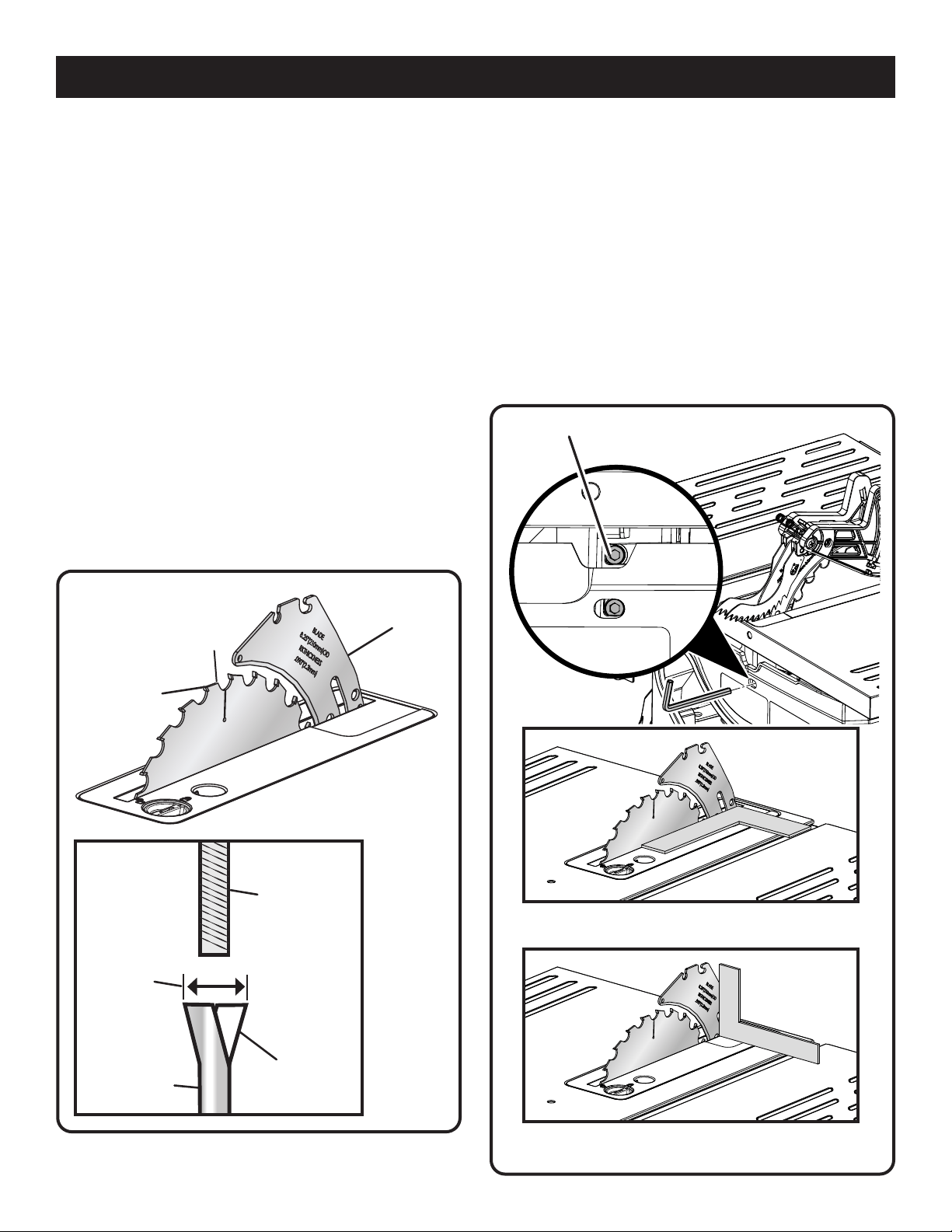
INSTALLING THE BLADE GUARD
See Figures 12 - 13.
WARNING:
Always install the blade guard onto the riving knife in the
“up” position to provide proper blade coverage. Installing
the guarding components onto the riving knife in any oth-
er position will prevent them from working as designed,
which could increase the risk of serious personal injury.
WARNING:
Replace the blade guard if the anti-kickback pawls are
dull or damaged. Dull or damaged pawls may not stop
a kickback increasing the risk of serious personal injury.
Anti-kickback pawls are part of the blade guard for this saw.
They should only be used for through cuts. When not needed,
they may be positioned to be out of the way.
Remove the battery.
Raise the saw blade by turning the height/bevel adjusting
handwheel clockwise.
Place riving knife in “up” position.
Reinstall the throat plate.
To install blade guard:
Lift the guard lever up to unlock.
With the front of the blade guard raised, lower the back
of the guard into the riving knife in the position shown.
Push the front of the guard down until the bar inside the
guard is parallel to the table (see figure 13). If the bar is
not parallel to the table, the riving knife is not in the “up”
position.
Lock the guard in place by pushing the guard lever down.
The blade guard side barriers may be lifted, then
positioned out of the way without being removed for
easier measurement.
NOTE: Blade alignment can be adjusted for different kerf
widths. Refer to: To Check and Align the Riving Knife and
Saw Blade. Check the blade guard assembly with kickback
pawls for clearances and free movement.
BLADE
GUARD
GUARD
LEVER
ANTI-
KICKBACK
PAWLS
Fig. 12
Fig. 13
INCORRECT
CORRECT
19 - English
Fig. 14
ASSEMBLY
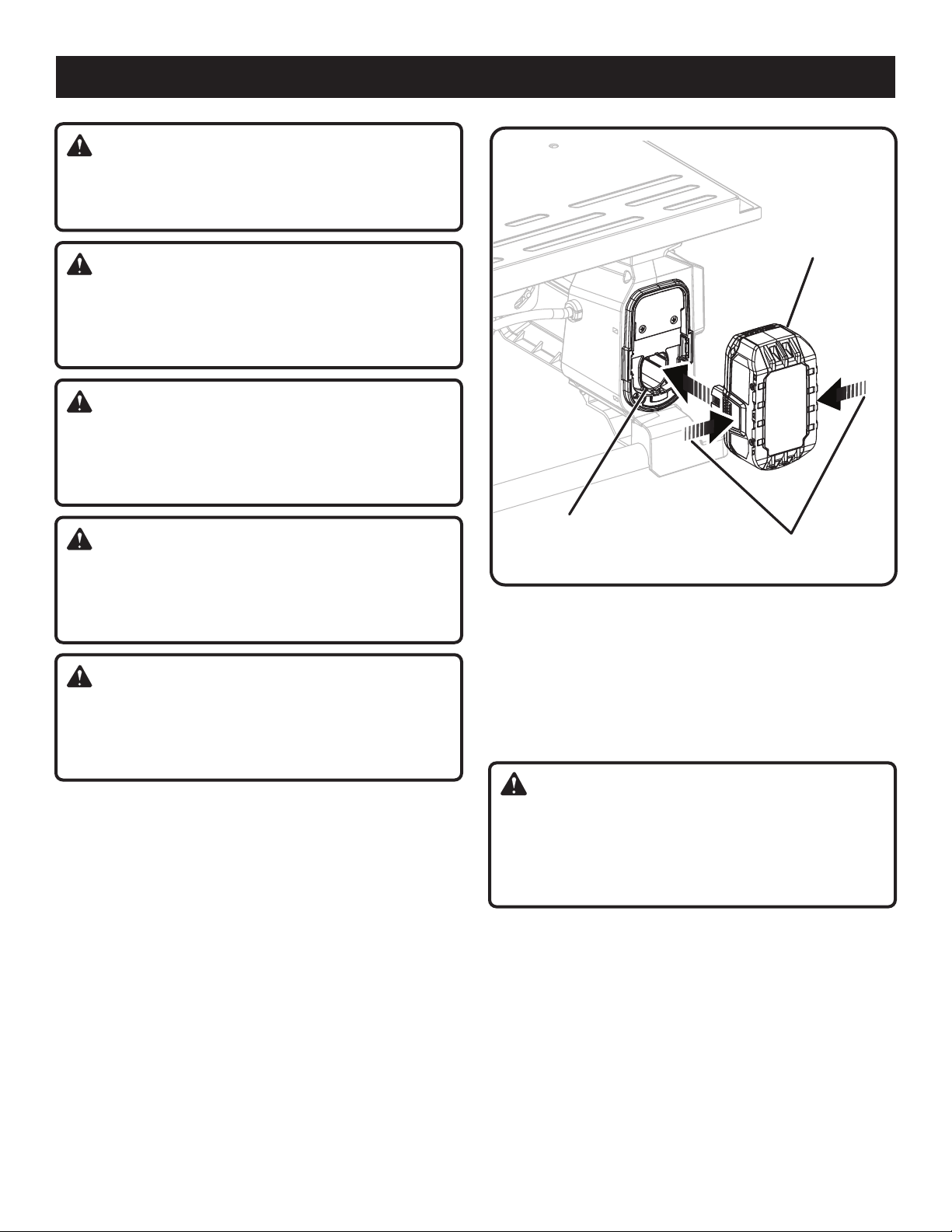
TO CHECK AND ALIGN THE RIVING KNIFE
AND SAW BLADE
See Figures 14 - 15.
To check alignment of the riving knife:
Remove the battery.
Raise the saw blade by turning the height/bevel adjusting
handwheel clockwise.
Adjust the bevel angle to 0° and lock the bevel locking
lever.
Remove the blade guard.
To check horizontal alignment, place a framing square
or straight edge against both the body of the saw blade
and the riving knife. The framing square should contact
both the blade body and riving knife evenly with no gaps.
Check the alignment with both sides of the blade body.
NOTE: The kerf or width of each tooth is wider than the
blade body. When the riving knife is properly aligned, it
will be centered on the kerf width.
To check vertical alignment, place a framing square beside
the riving kife. The edge of the square and the riving knife
should be parallel.
Fig. 15
HORIZONTAL ADJUSTMENT
VERTICAL ADJUSTMENT
BLADE
TOOTH
BLADE
BODY
RIVING
KNIFE
SCREWS
If the riving knife is out of alignment with the saw blade,
adjustment is needed. The riving knife must be in alignment
front to back (horizontally) and top to bottom (vertically).
To adjust (horizontally and vertically):
Raise the saw blade to its full height.
Remove the blade guard.
From the back of the saw, loosen the screws holding the
mounting bracket.
Reposition the riving knife left or right as needed to align
the riving knife with the saw blade.
Once properly aligned, securely retighten all screws.
Check again for squareness and continue to adjust if
needed.
BLADE
BODY
KERF
WIDTH
BLADE
TOOTH
RIVING
KNIFE

20 - English
Fig. 17
ASSEMBLY
RIP
FENCE
STORING TABLE SAW ACCESSORIES
See Figures 16 - 19.
When not in use the rip fence, riving knife, wrenches, blade
guard, miter gauge, and push stick may be stored beneath
the saw table.
Fig. 19
Fig. 18
Fig. 16
RIP
FENCE
STORAGE
BLADE
GUARD
BLADE
WRENCHES
RIVING
KNIFE
PUSH
STICK
MITER
GAUGE
PUSH STICK
STORAGE SCREW(S)
RIVING KNIFE, MITER
GAUGE, AND BLADE
WRENCH STORAGE AREA
BLADE
GUARD
STORAGE
KNOB
21 - English
INSTALLING/REMOVING THE BATTERY PACK
See Figure 20.
Place battery pack in the saw. Align raised rib on battery
pack with groove inside saw.
Make sure the latches on each side of the battery pack
snap in place and that the battery pack is secured in the
tool before beginning operation.
WARNING:
Always remove battery pack from your tool when you
are assembling parts, making adjustments, cleaning,
transporting, or when not in use. Removing battery pack
will prevent accidental starting that could cause serious
personal injury.
Locate and depress the latches on each side of the battery
pack to release the battery pack from the saw.
Remove the battery pack.
For complete charging instructions, refer to the Operator’s
Manuals for your battery pack and charger.
OPERATION
WARNING:
Do not allow familiarity with tools to make you careless.
Remember that a careless fraction of a second is suf-
ficient to inflict severe injury.
WARNING:
Always wear eye protection with side shields marked to
comply with ANSI Z87.1. Failure to do so could result in
objects being thrown into your eyes, resulting in possible
serious injury.
WARNING:
Do not use any attachments or accessories not recom-
mended by the manufacturer of this tool. The use of
attachments or accessories not recommended can result
in serious personal injury.
WARNING:
Although many of the illustrations in this manual are
shown with the blade guard removed for clarity, do not
operate the saw without the blade guard unless specifi-
cally instructed to do so.
WARNING:
The table saw must be mounted to a firm supporting
surface, such as a workbench or leg stand that positions
the saw at waist height. Many illustrations in this manual
are shown with the saw unmounted for clarity.
APPLICATIONS
You may use this tool for the purposes listed below:
Straight line cutting operations such as cross cutting,
ripping, mitering, beveling, and compound cutting
Cabinet making and woodworking
NOTE: This table saw is designed to cut wood and wood
composition products only.
Fig. 20
BATTERY PORT
BATTERY
LATCHES

22 - English
OPERATION
CAUSES OF KICKBACK
Kickback can occur when the blade stalls or binds, kicking
the workpiece back toward you with great force and speed. If
your hands are near the saw blade, they may be jerked loose
from the workpiece and may contact the blade. Obviously,
kickback can cause serious injury, and it is well worth using
precautions to avoid the risks.
Kickback can be caused by any action that pinches the
blade in the wood such as:
Making a cut with incorrect blade depth
Sawing into knots or nails in the workpiece
Twisting the wood while making a cut
Failing to support work
Forcing a cut
Cutting warped or wet lumber
Using the wrong blade for the type of cut
Not following correct operating procedures
Misusing the saw
Failing to use the anti-kickback pawls
Cutting with a dull, gummed-up, or improperly set blade
AVOIDING KICKBACK
Always use the correct blade depth setting. The top of
the blade teeth should clear the workpiece by 1/8 in. to
1/4 in.
Inspect the work for knots or nails before beginning a
cut. Knock out any loose knots with a hammer. Never
saw into a loose knot or nail.
Always use the rip fence when rip cutting. Use the miter
gauge when cross cutting. This helps prevent twisting
the wood in the cut.
Always use clean, sharp, and properly-set blades. Never
make cuts with dull blades.
To avoid pinching the blade, support the work properly
before beginning a cut.
When making a cut, use steady, even pressure. Never
force cuts. Do not release the workpiece until you have
pushed it completely past the blade.
Do not cut wet or warped lumber. The workpiece must
have a straight edge for it to be guided along the rip fence.
Use extra caution when cutting some prefinished or
composition wood products as the anti-kickback pawls
may not always be effective.
Always guide your workpiece with both hands or with
push sticks and/or push blocks. Keep your body in a
balanced position to be ready to resist kickback should
it occur. Never stand directly in line with the blade.
Use of a featherboard will help hold the workpiece securely
against the saw table or fence.
Clean the saw, blade guard, under the throat plate, and
any areas where sawdust or scrap workpieces may gather.
Keep blade guard, riving knife and ainti-kickback pawls
in place and proper operation. The riving knife must be
in alignment with the blade and the pawls must stop a
kickback once it has started. Check their operation before
ripping.
Maintain the rip fence parallel with the saw blade.
When ripping, apply the feed force to the section of the
workpiece between the blade and rip fence. Use a push
stick and/or push block when appropriate.
Use the right type of blade for the cut being made.
Always use the riving knife for every operation where it
is allowed. The use of this device will greatly reduce the
risk of kickback.
23 - English
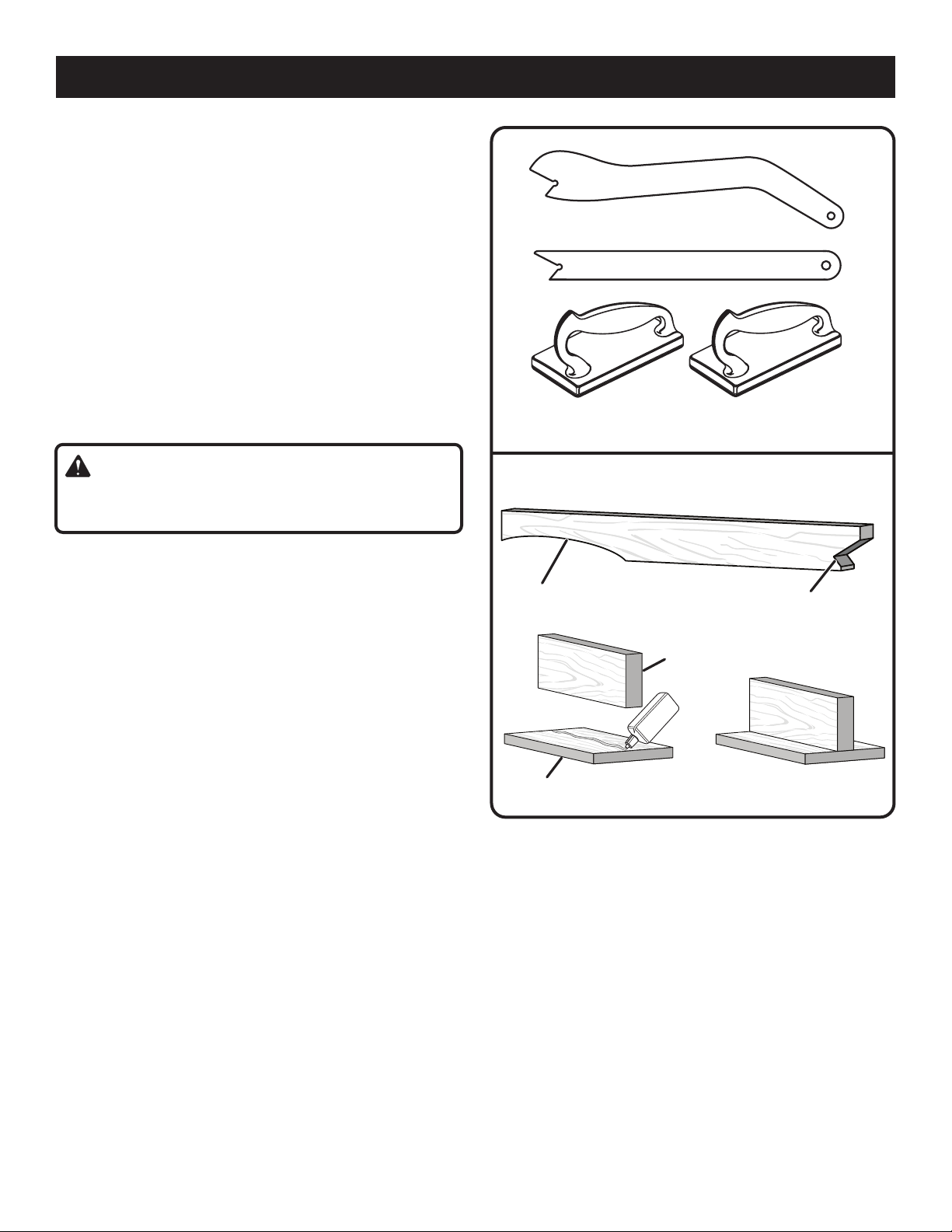
Fig. 22
PUSH BLOCKS
HANDLE
BASE
PUSH STICKS
PUSH STICK
PUSH BLOCK
Fig. 21
GRIP
NOTCH
CUTTING AIDS
See Figures 21 - 22.
Push sticks are devices that may be used for pushing a
workpiece through the blade in any rip cut. When making
non-through cuts or ripping narrow stock, always use a
push stick, push block, and/or featherboard so your hands
do not come within 3 inches of the saw blade. They can be
made in various sizes and shapes from scrap wood and
used in a specific project. The stick must be narrower than
the workpiece, with a 90˚ notch in one end and shaped for
gripping on the other end.
A push block has a handle fastened by recessed screws
from the underside or secured with wood glue. Use push
blocks for narrow cuts and all non-through cuts. A cutting jig
or similar cutting aid may be necessary to ensure the push
block does not interfere with the cut.
CAUTION:
Be sure the screws in a push block are recessed to avoid
damaging the saw or workpiece.
Push blocks and push sticks like the ones shown in figure 20
can be purchased locally and a push stick is included
with your saw. To make additional cutting aids, follow the
instructions below.
To make a push stick:
The material, shape and size of a push stick can vary. For
this project, use a piece of solid wood that is 18 in. long,
1-1/2 in. wide. and 3/4 in. thick.
If desired, cut a curve into one end of the workpiece to
serve as a grip.
Cut a notch into the workpiece on the opposite end.
During use, this end will contact the edge of the material
being cut.
To make a push block:
The material, shape and size of a push block can vary. For
this project, use two pieces of solid wood to make the base
and handle. The base is 5 in. long, 3 in. wide. and 3/8 in. thick.
The handle should be 5 in. long, 1 in. wide, and 3/4 in. thick.
Mark the center of the base.
Attach the handle to the center of the base using recessed
screws or wood glue.
NOTE: To prevent the push block from slipping across the
workpiece, you can attach a piece of sandpaper or a non-
slip rubber pad to the bottom of the base.
OPERATION

24 - English
OPERATION
3/4 in.
21 in.
3 1/2 in.
WORKPIECE SUPPORTS
See Figure 23.
When cutting with your table saw, make sure that the
workpiece you are cutting is properly supported. Properly
supporting the workpiece throughout the cutting process
not only improves the accuracy of the cut but also makes
the cutting process safer for the user. This support could be
required on the infeed side, the overhang side, or the outfeed
side of the table. Improper support of the workpiece can
cause the workpiece to move in unexpected ways during the
process of the cut startling the user of the saw. It may also
cause the user to apply abnormal forces to the workpiece
to control it during the cutting process. This tipping motion
of the workpiece will happen if approximately half of the
workpiece overhangs any edge of the saw table.
Appropriate support can be easy to achieve. Commercially
available support stands are available, or any surface that
is the same height as the work surface of the saw would be
acceptable. An operation that is practiced before actually
making the cut will inform the user that supports may be
necessary for safely completing the saw cut.
AUXILIARY FENCE
An auxiliary fence is a device used to close the gap between
the rip fence and the saw table. Always make and use and
auxiliary fence when ripping material 1/8 in. or thinner.
HOW TO MAKE AND ATTACH AN AUXILIARY
FENCE (FOR RIP CUTTING THIN WORKPIECE)
See Figure 24.
An auxiliary fence may be made for the saw by cutting a
piece of wood to 21 in. long, at least 3/4 in. thick, and at
least 3-1/2 in. tall.
NOTE: The height and thickness of the auxiliary fence can be
increased depending on the size and type of workpiece you
are attempting to cut. Use taller auxiliary fences when cutting
workpieces that are taller than the height of the rip fence.
To attach the auxiliary fence to the rip fence:
Place the wood against the left side of the rip fence and
resting firmly on the saw table.
From the back side of the rip fence, secure the wood to
the fence using wood screws.
NOTE: Make sure the screws you use to attach the auxiliary
fence do not pass through the front face of the fence.
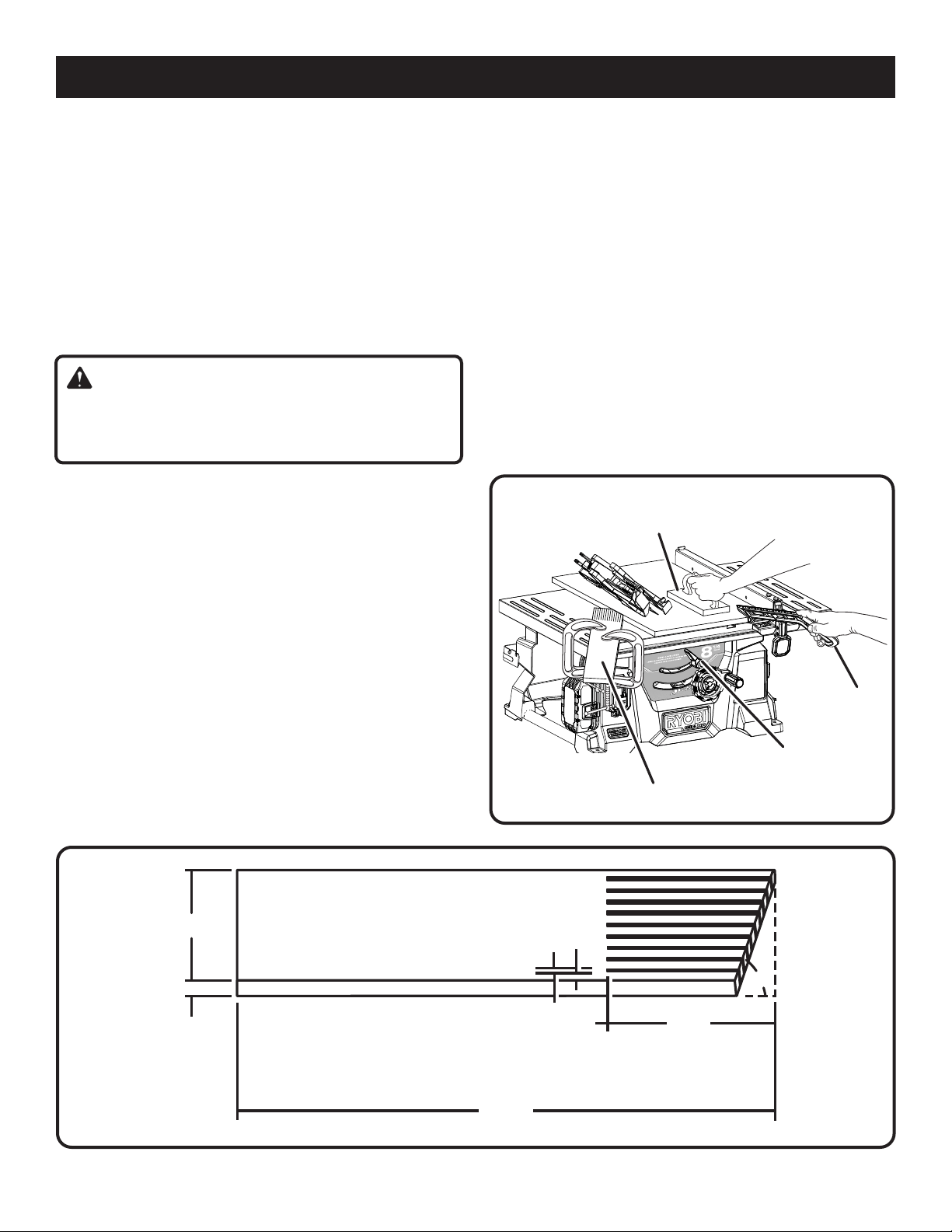
HOW TO MAKE A JIG (FOR RIP CUTTING
NARROW WORKPIECE)
See Figure 25.
If ripping a narrow workpiece places the hands too close to
the blade, it will be necessary to make and use a jig.
To make a jig:
Attach a handle to a long, straight piece of wood and
secure from the underside using recessed screws.
Cut an L-shaped stop in the side of the jig.
Fig. 25
Fig. 23
Fig. 24
JIG
JIG
HANDLE
STOP
WORK
SUPPORT
To use a jig:
Position the workpiece flat on the table with the edge
flush against the jig and against the stop.
25 - English
Prepare the saw for ripping as discussed on page 32. Set the
rip fence to allow approximately a 1/4 in. “finger” to be cut in
the stock. Feed the stock only to the mark previously made
at 4 in. Turn the saw OFF and allow the blade to completely
stop rotating before removing the stock. Reset the rip fence
and cut spaced rips into the workpiece to allow approximately
1/4 in. fingers and 1/8 in. spaces between the fingers.
HOW TO MOUNT A FEATHERBOARD
See Figure 27.
Completely lower the saw blade. Position the rip fence to
the desired adjustment for the cut to be performed and lock.
Place the workpiece against the fence and over the saw
blade area. Adjust the featherboard to apply resistance to
the workpiece just forward of the blade. Attach C-clamps to
further secure the featherboard to the edge of the saw table.
Fig. 27
PUSH
BLOCK
Fig. 26
FEATHERBOARD
PUSH
STICK
BEVEL
LOCKING
LEVER
2 1/2 in.
12 in.
3/4 in.
4 in.
1/4 in.
1/8 in.
70°
OPERATION
Holding the jig handle and using a push block and/or
push stick make the rip cut, see Making a Rip Cut later
in this section.
FEATHERBOARD
A featherboard is a device used to help control the workpiece
by holding it securely against the table or fence. Featherboards
are especially useful when ripping small workpieces and for
completing non-through cuts. The end is angled with a number
of short kerfs to give a friction hold on the workpiece and
locked in place on the table with a C-clamp. Test to ensure
it can resist kickback.
WARNING:
Place the featherboard against the uncut portion of the
workpiece to avoid kickback that could cause serious
personal injury.
Commercially available featherboards can be purchased for a
reasonable price. Many of these featherboards mount inside
the miter slots of the saw and are convenient to mount and
use on your table saw. To make a featherboard, follow the
instructions in the next section.
HOW TO MAKE A FEATHERBOARD
See Figure 26.
The featherboard is an excellent project for the saw. Select
a solid piece of lumber approximately 3/4 in. thick, 2-1/2 in.
wide and 12 in. long. Mark the center of the width on one
end of the stock. Miter the width to 70° (see page 34 for
information on miter cuts). Mark the board from the widest
point at four inches.

26 - English
OPERATION
BEVEL RIP CUT
RIP CUT
CROSS CUT
MITER CUT
COMPOUND (BEVEL) MITER CUT
BEVEL CROSS CUT
1
WARNING:
The featherboard must be installed in front of the blade.
Do not locate the featherboard to the rear of the blade.
Kickback can result from the featherboard pinching
the workpiece and binding the blade in the saw kerf if
positioned improperly. Failure to heed this warning can
result in serious personal injury.
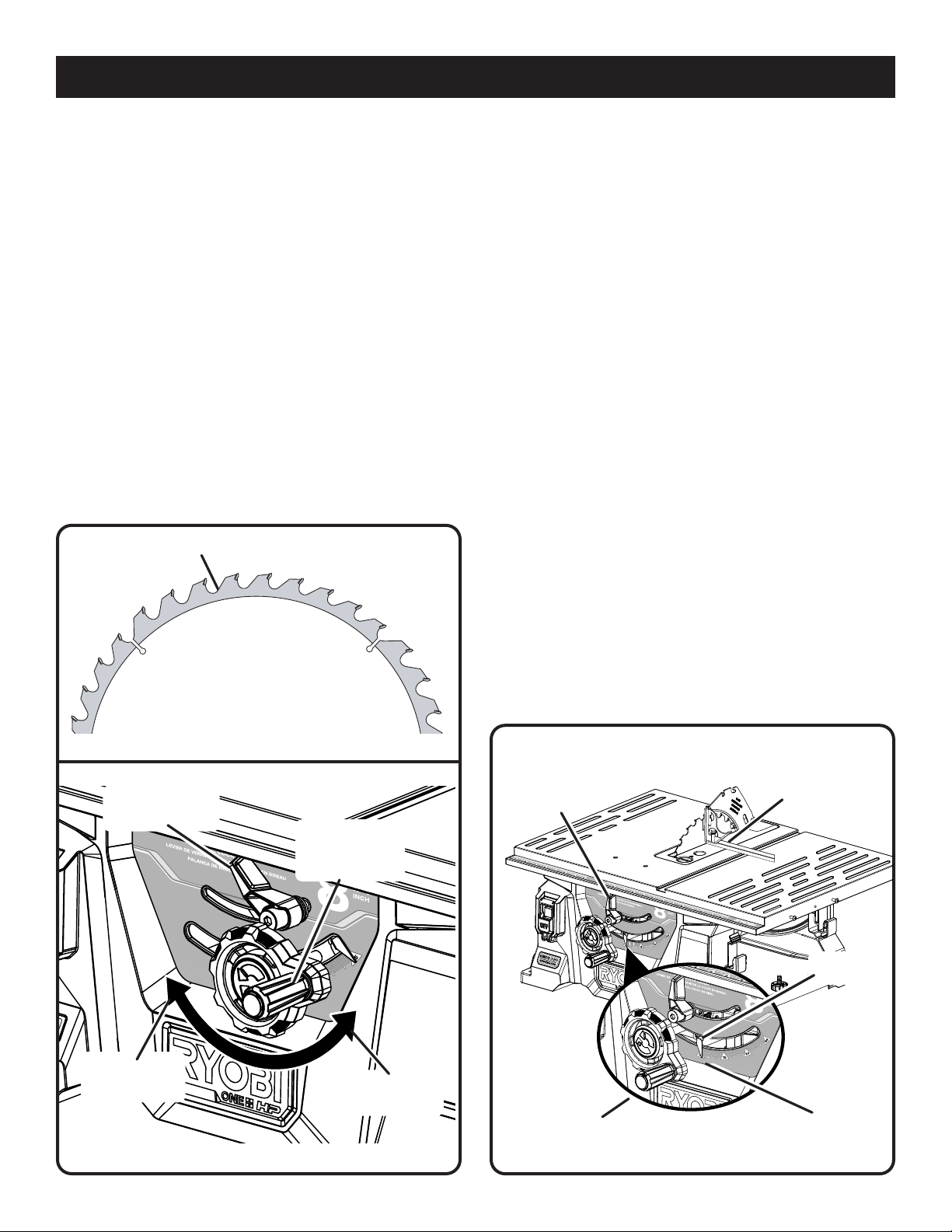
TYPES OF CUTS
See Figure 28.
There are six basic cuts: 1) the cross cut, 2) the rip cut, 3) the
miter cut, 4) the bevel cross cut, 5) the bevel rip cut, and 6) the
compound (bevel) miter cut. All other cuts are combinations
of these basic six. Operating procedures for making each
kind of cut are given later in this section.
WARNING:
Always make sure the blade guard and anti-kickback
pawls are in place and working properly when making
these cuts to avoid possible injury.
Cross cuts are straight 90° cuts made across the grain of
the workpiece. The wood is fed into the cut at a 90° angle
to the blade, and the blade is vertical.
Rip cuts are made with the grain of the wood. To avoid
kickback while making a rip cut, make sure one side of the
wood rides firmly against the rip fence.
Miter cuts are made with the wood at any angle to the
blade other than 90°. The blade is vertical. Miter cuts tend
to “creep” during cutting. This can be controlled by holding
the workpiece securely against the miter gauge.
WARNING:
Always use a push stick with small pieces of wood, and
also to finish the cut when ripping a long narrow piece
of wood, to prevent your hands from getting close to the
blade.
Bevel cuts are made with an angled blade. Bevel cross cuts are
across the wood grain, and bevel rip cuts are with the grain.
Compound (or bevel) miter cuts are made with an angled
blade on wood that is angled to the blade. Be thoroughly
familiar with making cross cuts, rip cuts, bevel cuts, and
miter cuts before trying a compound miter cut.
CUTTING TIPS
Dado and rabbet cuts are non-through cuts which can be
either rip cuts or cross cuts. Carefully read and understand
all sections of this operator’s manual before attempting any
operation.
2
6
4
5
3
Fig. 28
WARNING:
Do not use blades rated less than the speed of this tool.
Failure to heed this warning could result in personal injury.
27 - English
OPERATION
The kerf (the cut made by the blade in the wood) will be
wider than the blade to avoid overheating or binding.
Make allowance for the kerf when measuring wood.
Make sure the kerf is made on the waste side of the
measuring line.
Cut the wood with the finish side up.
Knock out any loose knots with a hammer before making
the cut.
Always provide proper support for the wood as it comes
out of the saw.
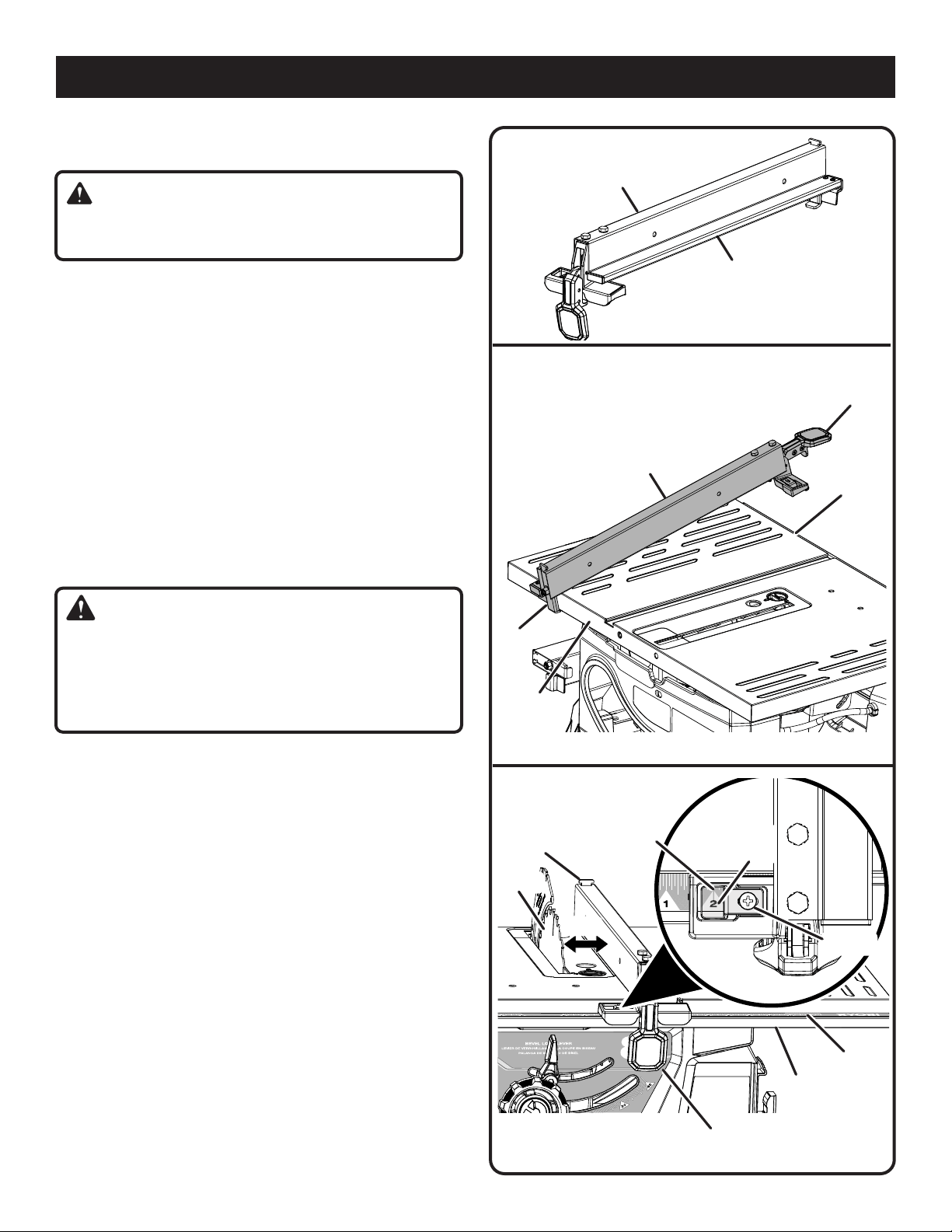
TO CHANGE BLADE DEPTH
See Figure 29.
The blade depth should be set so that the outer points of
the blade are higher than the workpiece by approximately
1/8 in. to 1/4 in. but the lowest points (gullets) are below
the top surface.
Turn the bevel lock lever to the right.
Fig. 29
GULLET
Fig. 30
Fig. 31
Raise the blade by turning the height/bevel adjusting
handwheel clockwise or lower it by turning the handwheel
counterclockwise.
TO CHANGE BLADE ANGLE (BEVEL)
See Figure 30.
This table saw has a rack and pinion bevel control that allows
you to make angled cuts from 90° to 45°.
NOTE: A 90° cut has a 0° bevel and a 45° cut has a 45° bevel.
Remove the battery.
Loosen bevel control by turning bevel lock lever all the
way to the left. If it needs to be further loosened, pull
spring-loaded bevel lock lever out and rotate it back to
the right. Release bevel locking lever and allow it to seat
(lock) in its original position. Turn it to the left again until
loose.
Move the height adjusting handwheel to the right to bevel
to 45° bevel angle.
Tighten bevel control by turning bevel lock lever to the
right. If it needs to be tightened more, pull the spring-
loaded bevel lock lever out and rotate it to the left. Then
release bevel lock lever and allow it to return to its original
position. Rotate to the right again. Repeat this process
until bevel lock lever is securely tightened.
TO ADJUST THE BEVEL INDICATOR
See Figure 31.
If the bevel indicator is not at zero when the saw blade is at
90°, adjust the indicator by loosening the screw and setting
it at 0° on the bevel scale. Retighten the screw.
COMBINATION
SQUARE
BEVEL
LOCKING
LEVER
HEIGHT/BEVEL
ADJUSTING
HANDWHEEL
SCREW
BEVEL
INDICATOR
HEIGHT/BEVEL
ADJUSTING
HANDWHEEL
BEVEL
LOCKING LEVER
TO DECREASE
ANGLE
TO INCREASE
ANGLE
28 - English
OPERATION
Fig. 34
Fig. 33
Fig. 32
LOW
FENCE
RIP
FENCE
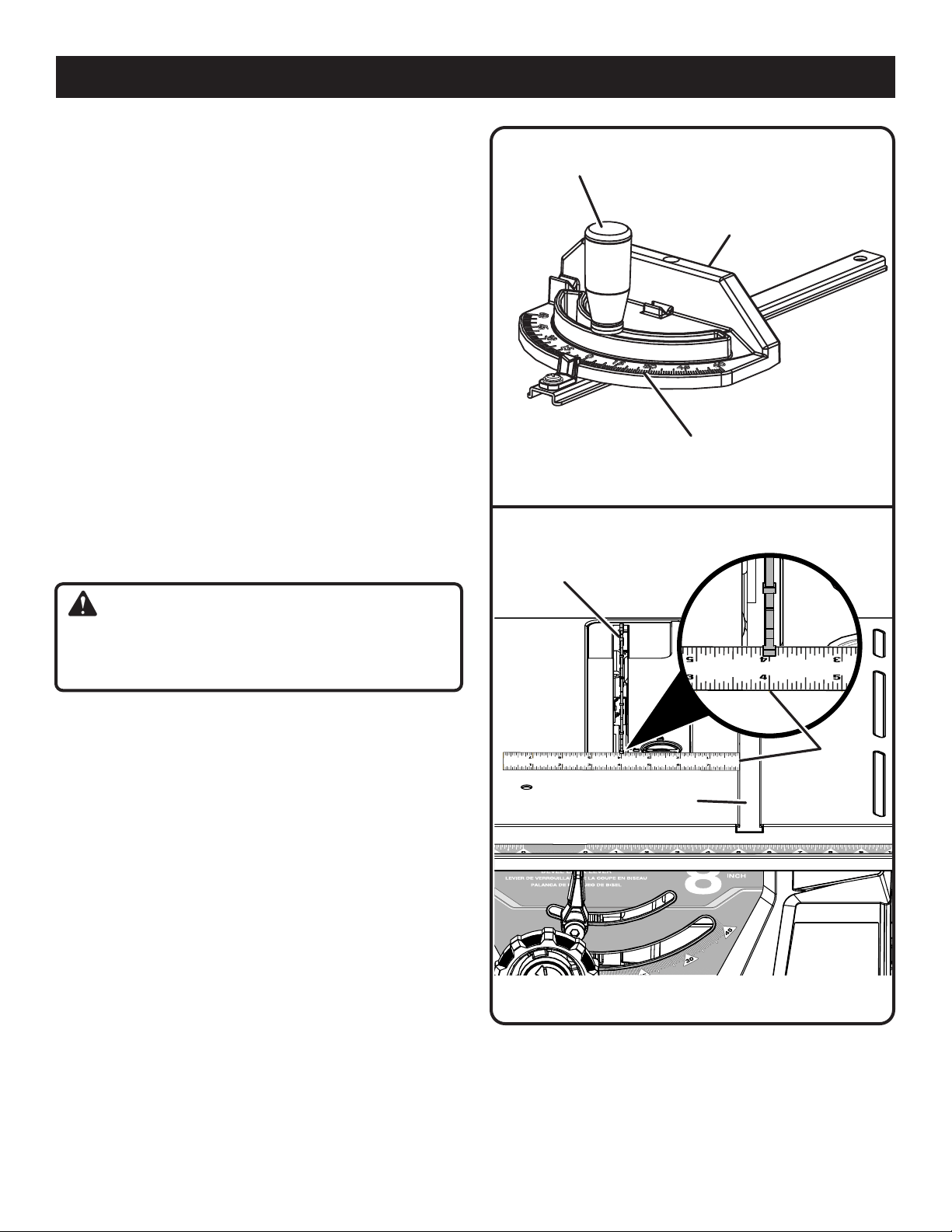
TO USE THE RIP FENCE
See Figures 32 and 33.
WARNING:
To reduce the risk of injury, always make sure the rip fence
is parallel to the blade before beginning any operation.
NOTE: The rip fence included with your saw has a low fence.
The low fence should face away from the blade when cutting
material greater than 3/4 inches thick. The low fence should
face toward the blade when cutting thin and/or narrow
workpieces. NEVER support the weight of the workpiece
on the low fence while making a cut.
Loosen the rip fence by lifting the locking lever.
Place the rear lip on the rear of the saw table and pull
slightly toward the front of the unit.
Lower the front end of the rip fence onto the guide
surfaces on top of the front rail.
Check for smooth gliding action.
Position the rip fence the desired distance from the blade.
With the rip fence flat on the saw table, push the fence
towards the front rail to align the fence to the blade.
WARNING:
Lock the fence at the intended cut size first then move the
work piece up to the fence. Do not place the work piece
first then move your fence up to it to lock the fence. This
may result in a misaligned fence which could pinch the
workpiece against the saw blade and create kickback.
Push the locking lever down to align and secure the
fence. When securely locked, the locking lever should
point downward.
NOTE: Ensure the locking lever secures the rip fence
in place. If adjustments are needed, see To Check
the Tightness of the Rip Fence Locking Lever in the
Adjustment section of this manual.
NOTE: If the rip fence is not parallel to the blade,
adjustments are needed. Refer to: To Check the Alignment
of the Rip Fence to the Blade in the Adjustment section
of this manual.
TO SET THE RIP FENCE SCALE INDICATOR
TO THE BLADE
See Figure 34.
Use the indicator on the rip fence to position the fence along
the scale on the front rail.
NOTE: The blade guard must be removed to perform this
adjustment. Reinstall the blade guard when the adjustment
is complete.
Begin with the blade at a zero angle (straight up).
FRONT
RAIL
RIP
FENCE
SCALE
LOCKING
LEVER
SCALE
INDICATOR
2 in.
2 in.
MARK
SCREW
BLADE
FRONT
RAIL
RIP
FENCE
LOCKING
LEVER
REAR OF
SAW
REAR
LIP
29 - English
Remove the battery.
Loosen the rip fence by lifting the locking lever.
Using a framing square, set the rip fence 2 in. from the
blade tip edge.
Loosen the screw on the scale indicator and align with
the 2 in. mark as shown.
Tighten the screw and check the dimension and the rip
fence.
TO USE THE MITER GAUGE
See Figure 35.
The miter gauge provides greater accuracy in angled cuts.
For very close tolerances, test cuts are recommended.
The miter gauge can be turned 60° to the right or left.
Loosen the lock knob.
With the miter gauge in the miter gauge groove, rotate
the gauge until the desired angle is reached on the scale.
Retighten the lock knob.
ADJUSTING THE BLADE PARALLEL TO THE
MITER GAUGE GROOVE (REMOVING HEEL)
See Figures 36 - 38.
WARNING:
The blade must be made parallel to the miter gauge
groove so the wood does not bind resulting in kickback.
Failure to do so could result in serious personal injury.
Do not loosen any bolts for this adjustment until you have
checked with a ruler and made test cuts to be sure adjust-
ments are necessary. Once the bolts are loosened, these
items must be reset.
Remove the battery.
Remove the blade guard and riving knife. Raise the blade
by turning the height/bevel adjusting handwheel clock-
wise.
NOTE: For details on removing and reinstalling the riving
knife, see Cleaning the Riving Knife Lock Lever Plates
in the Maintenance section of this manual.
Mark beside one of the blade teeth at the front of the
blade. Using a ruler, measure the distance from the inside
face of the blade tooth to the left edge of the miter gauge
groove.
NOTE: For greater accuracy, place the marked blade
tooth on top of the ruler.
Turn the blade so the marked tooth is at the back.
Move the ruler to the rear and again measure the distance
from the inside face of the blade tooth to the left edge of
the miter gauge groove. If the distances are the same,
the blade and the miter gauge groove are parallel.
Replace blade guard and riving knife.
OPERATION
Fig. 36
Fig. 35
LOCK
KNOB
MITER
GAUGE BODY
MITER
GAUGE
MITER GAUGE
GROOVE
RULER
BLADE
TOOTH
If the distances are different:
Remove the blade guard and riving knife. Raise the
blade by turning the height/bevel adjusting handwheel
clockwise.
Loosen the locking bolts by turning towards the left.
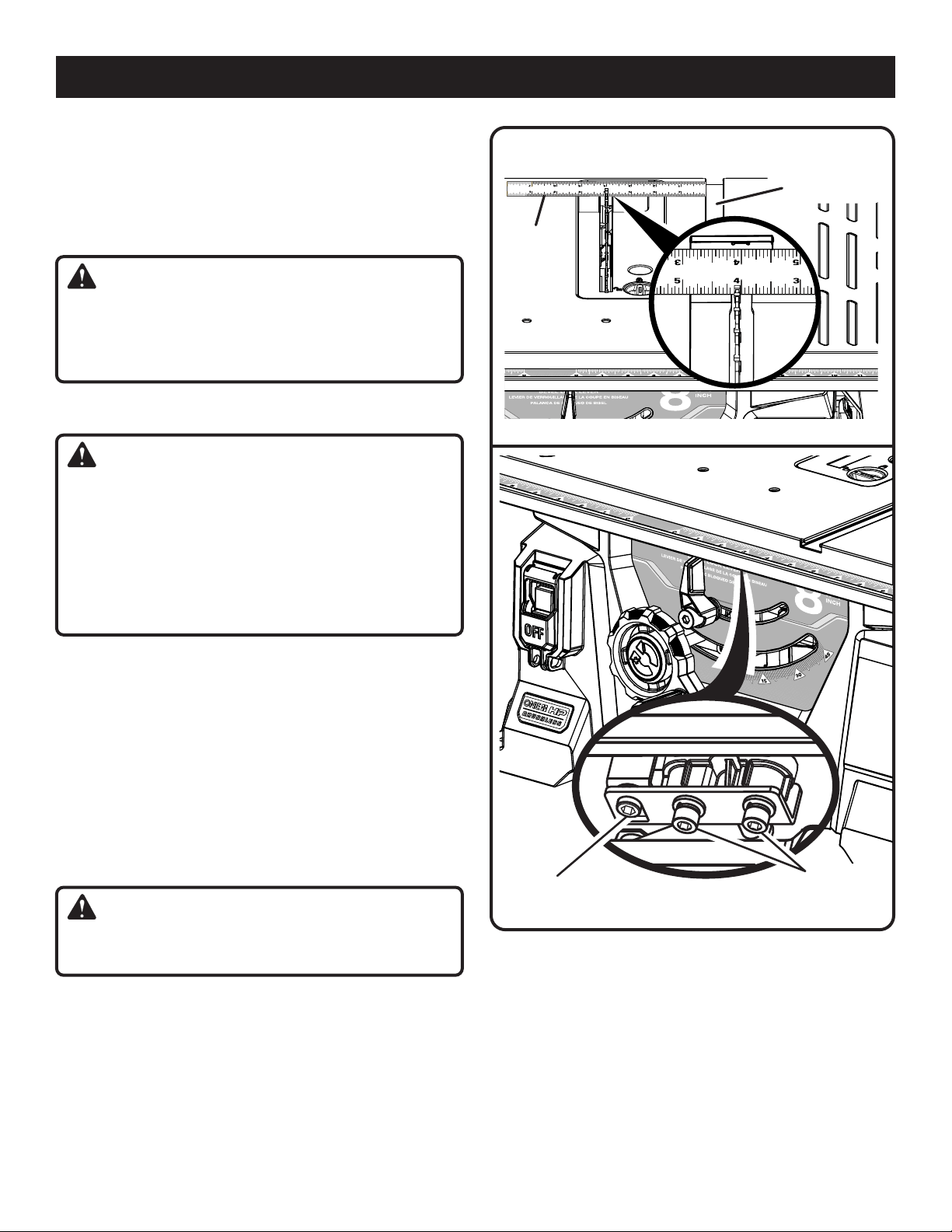
30 - English
NOTE: The bolts are located above the height/bevel
adjusting handwheel and under the saw table in the front
of the saw.
Turn adjusting bolt left or right until the blade is square.
Tighten the locking bolts. Check again for squareness
and continue to adjust if needed.
WARNING:
To reduce the risk of injury from kickback, align the rip
fence to the blade following any blade adjustments.
Always make sure the rip fence is parallel to the blade
before beginning any operation.
MAKING CUTS
WARNING:
Before making any cuts, make sure that the table saw
stand is on a firm level surface where there is plenty of
room to handle and properly support the table saw and
the workpiece. If a suitable location can not be found,
then the saw should not be used. Operating the saw in a
location that does not provide adequate space and stable
footing for the table saw stand could create a tipping
hazard which could result in serious personal injury.
This table saw can perform a variety of cuts that are not all
mentioned in this manual. DO NOT attempt to make any cuts
not covered here unless you are thoroughly familiar with the
proper procedures and necessary accessories. Your local
library has many books on table saw usage and specialized
woodworking procedures for your reference.
The blade provided with the saw is a high-quality combination
blade suitable for ripping and cross cut operations. Carefully
check all setups and rotate the blade one full revolution to
assure proper clearance before connecting saw to power
source. Stand slightly to the side of the blade path to reduce
the chance of injury should kickback occur.
WARNING:
Do not use blades rated less than the speed of this tool.
Failure to heed this warning could result in personal injury.
Use the miter gauge when making cross, miter, bevel, and
compound miter cuts. To secure the angle, lock the miter
gauge in place by twisting the lock knob clockwise. Always
tighten the lock knob securely in place before use.
During use the miter gauge may move slightly left or right
inside the miter gauge groove. For greater accuracy, press
the miter gauge against the left or right edge of the miter
gauge groove when making cuts. Do not allow the gauge to
go from one side to the other.
OPERATION
Fig. 37
Fig. 38
Always place the workpiece against the face of the miter
gauge body when making cuts. To prevent the workpiece
from moving, you can attach a piece of sandpaper to the
miter gauge body face.
NOTE: It is recommended that you place the piece to be
saved on the same side of the blade as the miter gauge, and
that you make a test cut on scrap wood first.
ADJUSTING
BOLT
LOCKING
BOLTS (2)
RULER
MITER GAUGE
GROOVE

31 - English
OPERATION
MAKING A CROSS CUT
See Figures 39 - 41.
WARNING:
Make sure the blade guard assembly with kickback
pawls is installed and working properly to avoid serious
possible injury.
WARNING:
Using the rip fence as a cutoff gauge when cross cutting
will result in kickback which can cause serious personal
injury.
Remove the rip fence.
Set the blade to the correct depth for the workpiece.
Set the miter gauge to 0° and tighten the lock knob.
Make sure the wood is clear of the blade before turning
on the saw.
Press the top button on the switch to turn the saw on.
NOTE: The switch cover does not have to be raised to
operate the switch.
Press the bottom button on the switch to turn the saw
off.
NOTE: To prevent unauthorized use, install a padlock
(not included) through the holes in the switch and cover
as shown in figure 39.
Let the blade build up to full speed before moving the
workpiece into the blade.
Hold the workpiece firmly with both hands on the miter
gauge and feed the workpiece into the blade.
NOTE: The hand closest to the blade should be placed
on the miter gauge lock knob and the hand farthest from
the blade should be placed on the workpiece.
When the cut is made, turn the saw off. Wait for the
blade to come to a complete stop before removing the
workpiece.
To make repetitive cross cuts:
A stop block can be used as a cut-off gauge to make repeti-
tive cross cuts of the same length without having to mark
the workpiece for each cut. The end of a stop block should
always be in front of the blade. NEVER use the rip fence as
a cut-off gauge.
Fig. 40
CROSS CUT
Fig. 39
PLACE RIGHT HAND
ON WORKPIECE AND
MITER GAUGE HERE
PLACE LEFT HAND
ON MITER GAUGE
LOCK KNOB
SWITCH IN LOCKED POSITION
SWITCH ON SWITCH OFF
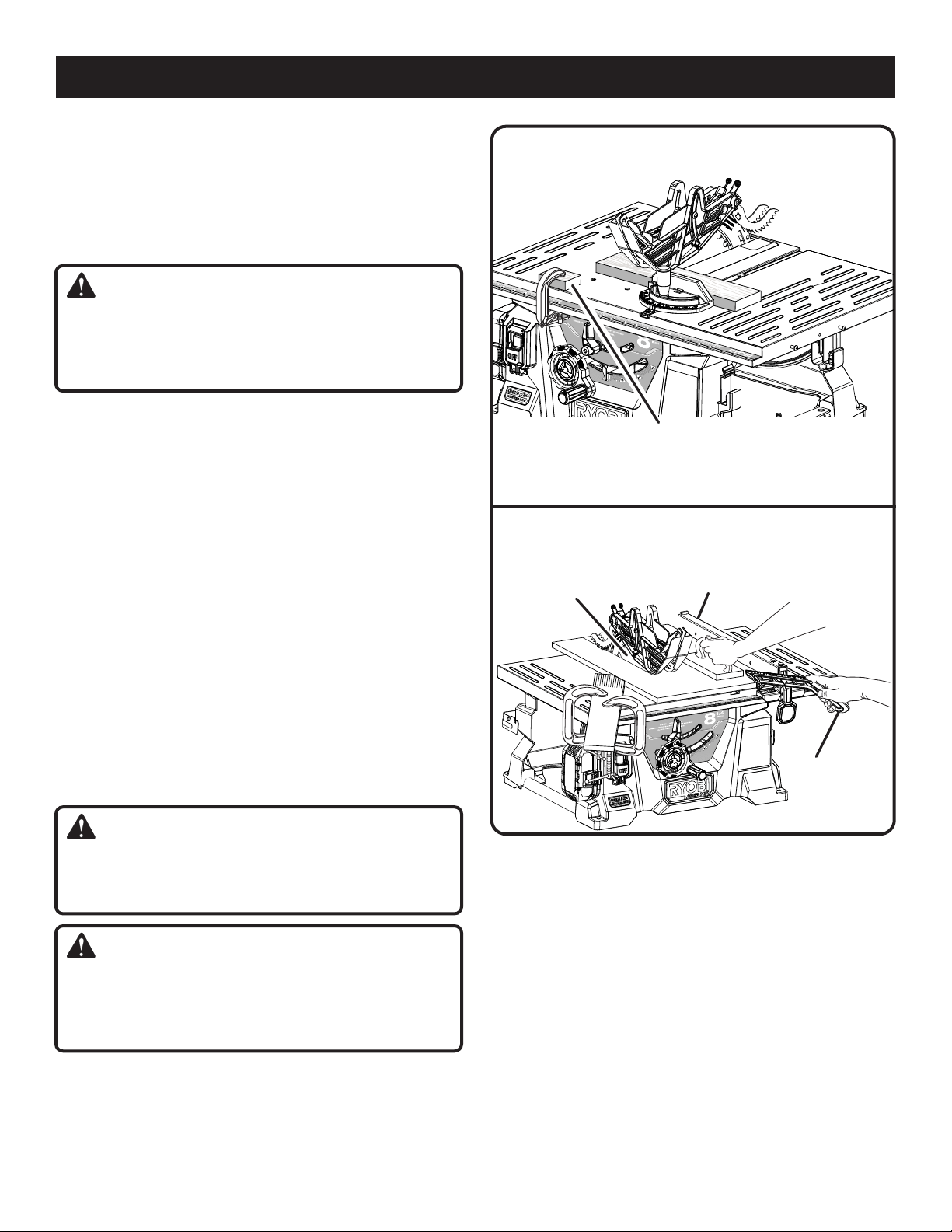
32 - English
OPERATION
REPETITIVE CROSS CUT
Fig. 41
STOP
BLOCK
Remove the rip fence.
Set the blade to the correct depth for the workpiece.
Set the miter gauge to 0° and tighten the lock knob.
Position a 3 in. block of wood at the desired distance
from the blade to act as a cut-off gauge.
Secure the stop block in place using a vice or a clamp.
WARNING:
When secured, the end of the stop block should be in
front of the blade. Securing the stop block beyond the
front of the blade will result in kickback which can cause
serious personal injury.
Position the workpiece on the miter gauge with the edge
flush against the stop block.
When cutting a long or wide workpiece, place a support
the same height as the table surface in front of the saw,
behind the saw, and on the sides of the saw as needed.
Insert the battery and turn the saw on.
Hold the workpiece firmly with both hands on the miter
gauge and feed the workpiece into the blade.
NOTE: The hand closest to the blade should be placed
on the miter gauge lock knob and the hand farthest from
the blade should be placed on the workpiece.
When the cut is made, turn the saw off. Wait for the blade
to come to a complete stop before removing the cut piece.
Move the miter gauge back to the front of the saw and
position the workpiece for the next cut.
After the last cut, turn the saw off. Wait for the blade to
come to a complete stop and remove the stop block.
MAKING A RIP CUT
See Figures 42 - 43.
WARNING:
Make sure the blade guard assembly with kickback
pawls is installed and working properly to avoid serious
possible injury.
WARNING:
Taper cuts must only be made with a special jig, which is
commercially available. Do not attempt a free hand taper
cut on this saw. Failure to follow these instructions could
result in serious personal injury.
Set the blade to the correct depth for the workpiece.
Position the rip fence the desired distance from the blade
for the cut and securely lock the handle.
NOTE: Do not place the rip fence on the left side of the
blade when cutting material greater than 3/4 inches thick.
Workpieces thicker than 3/4 inches may be unstable and
require additional hold downs to ensure stability during
cutting.
When cutting a long or wide workpiece, place a support
the same height as the table surface in front of the saw,
behind the saw, and on the sides of the saw as needed.
Install featherboard in the appropriate position for the cut
being made.
Make sure the workpiece is clear of the blade before
turning on the saw.
Insert the battery and turn the saw on.
Position the workpiece flat on the table with the edge
flush against the rip fence. Let the blade build up to full
speed before feeding the workpiece into the blade.
RIP CUT
BLADE
RIP
FENCE
PUSH
STICK
Fig. 42

33 - English
Using a push stick and/or push blocks, slowly feed the
workpiece toward the blade. Stand slightly to the side
of the workpiece as it contacts the blade to reduce the
chance of injury should kickback occur.
Once the blade has made contact with the workpiece, use
the hand closest to the rip fence to guide it. Make sure
the edge of the workpiece remains in solid contact with
both the rip fence and the surface of the table. If ripping
a narrow piece, use a push stick, push blocks and/or a
narrow ripping jig to move the piece through the cut and
past the blade.
When the cut is made, turn the saw off. Wait for the blade
to come to a complete stop before removing the workpiece.
To make rip cuts narrower than 2 inches:
If a narrow ripping jig is not used, the rip fence included with
your saw has a low fence to allow narrow ripping operations.
WARNING:
When making narrow rip cuts always ensure that the
piece being cut cannot fall into the throat plate of the saw.
If this piece falls into the throat plate it may damage the
under table guarding and create a hazardous condition
to the operator.
Unlock the rip fence and place it on the left side of the
blade.
NOTE: The rip fence included with your saw has a low
fence. The low fence should face away from the blade
when cutting material greater than 3/4 inches thick. The
low fence should face toward the blade when cutting thin
and/or narrow workpieces.
Lift the blade guard's left side barrier and lower it onto
either the workpiece or the narrow rip fence to ensure
coverage of the cutting zone during this operation.
Secure the rip fence.
Position the workpiece flat on the table with the edge flush
against the low fence.
Using a push block and/or push stick make the rip cut,
see Making a Rip Cut earlier in this section.
OPERATION
Fig. 43
NARROW RIP CUT
BLADE
PUSH
STICK
FEATHERBOARD
RIP
FENCE
LOW
FENCE
NOTE: This technique is for making narrow rip cuts on
workpieces with a thickness of 3/4 inches or less. To make
narrow rip cuts on thicker material use a narrow ripping
jig, refer to How To Make A Jig (For Rip Cutting Narrow
Workpiece) earlier in this section.
NOTE: The cutting operation described above and illustrated
in figure 42 will result in the saved piece being between the rip
fence and the left side of the blade. Alternatively, you could
place the rip fence and the wide portion of the workpiece
on the left side of the blade, which would result in the saved
piece being on the right.
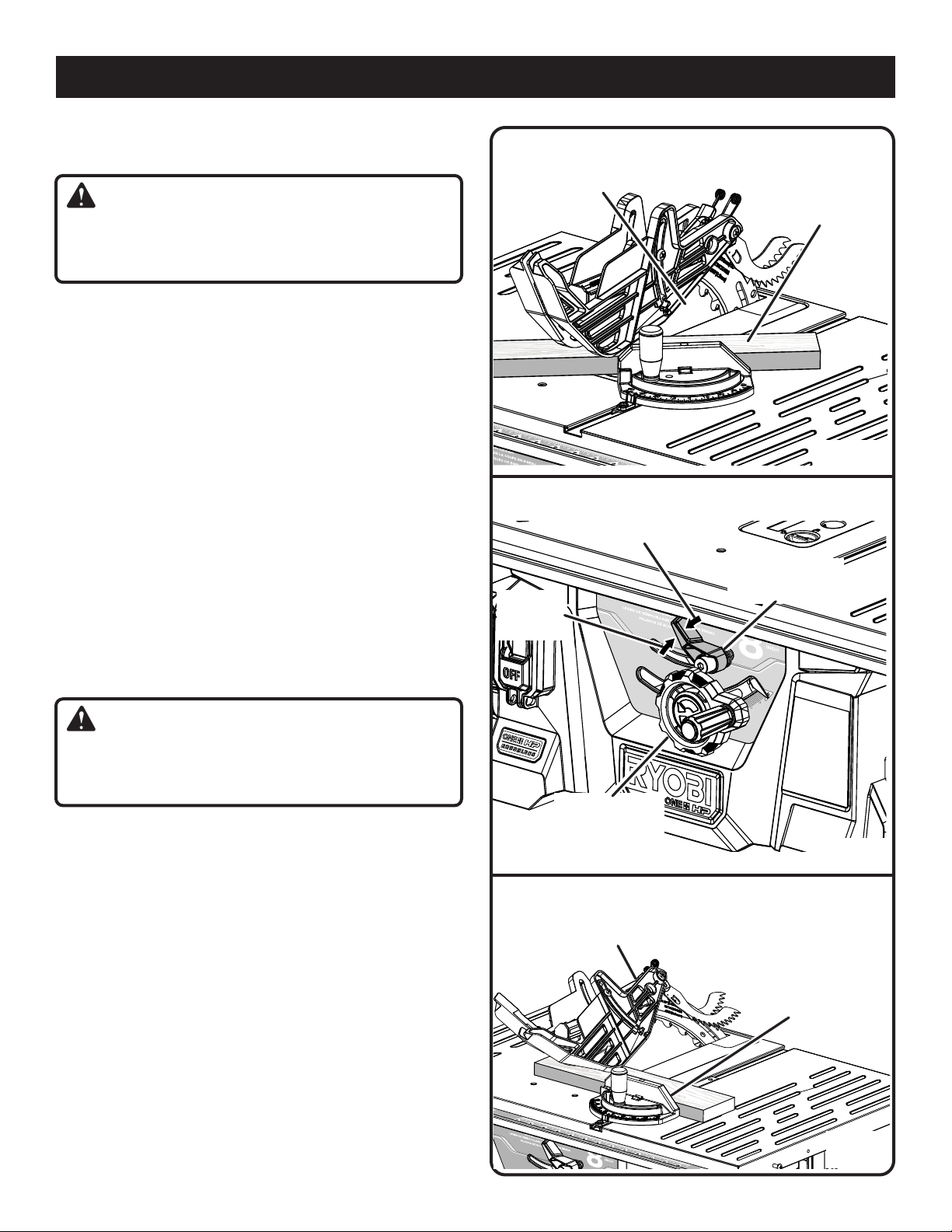
34 - English
MAKING A MITER CUT
See Figure 44.
WARNING:
Make sure the blade guard assembly with kickback
pawls is installed and working properly to avoid possible
serious injury.
Remove the rip fence.
Set the blade to the correct depth for the workpiece.
Set the miter gauge to the desired angle and tighten the
lock knob.
Make sure the workpiece is clear of the blade before
turning on the saw.
Insert the battery and turn the saw on.
Let the blade build up to full speed before moving the
workpiece into the blade.
Hold the workpiece firmly with both hands on the miter
gauge and feed the workpiece into the blade.
NOTE: The hand closest to the blade should be placed
on the miter gauge lock knob and the hand farthest from
the blade should be placed on the workpiece.
When the cut is made, turn the saw off. Wait for the
blade to come to a complete stop before removing the
workpiece.
MAKING A BEVEL CROSS CUT
See Figures 45 - 46.
WARNING:
Make sure the blade guard assembly with kickback
pawls is installed and working properly to avoid possible
serious injury.
Remove the rip fence.
Unlock the bevel locking lever.
Adjust the bevel angle to the desired setting.
Lock the bevel locking lever.
Set the blade to the correct depth for the workpiece.
Set the miter gauge to 0° and tighten the lock knob.
Make sure the workpiece is clear of the blade before
turning on the saw.
Insert the battery and turn the saw on.
Let the blade build up to full speed before moving the
workpiece into the blade.
Hold the workpiece firmly with both hands on the miter
gauge and feed the workpiece into the blade.
NOTE: The hand closest to the blade should be placed
on the miter gauge lock knob and the hand farthest from
the blade should be placed on the workpiece.
OPERATION
VIEWED FROM THE FRONT, BELOW THE TABLE SAW
TO
TIGHTEN
HEIGHT/BEVEL
ADJUSTING
HANDWHEEL
BEVEL
LOCKING LEVER
TO LOOSEN
MITER CUT
MITER GAUGE
ANGLED
BEVEL CROSS CUT
BLADE
ANGLED
BLADE
STRAIGHT
Fig. 44
Fig. 45
MITER GAUGE
STRAIGHT
Fig. 46
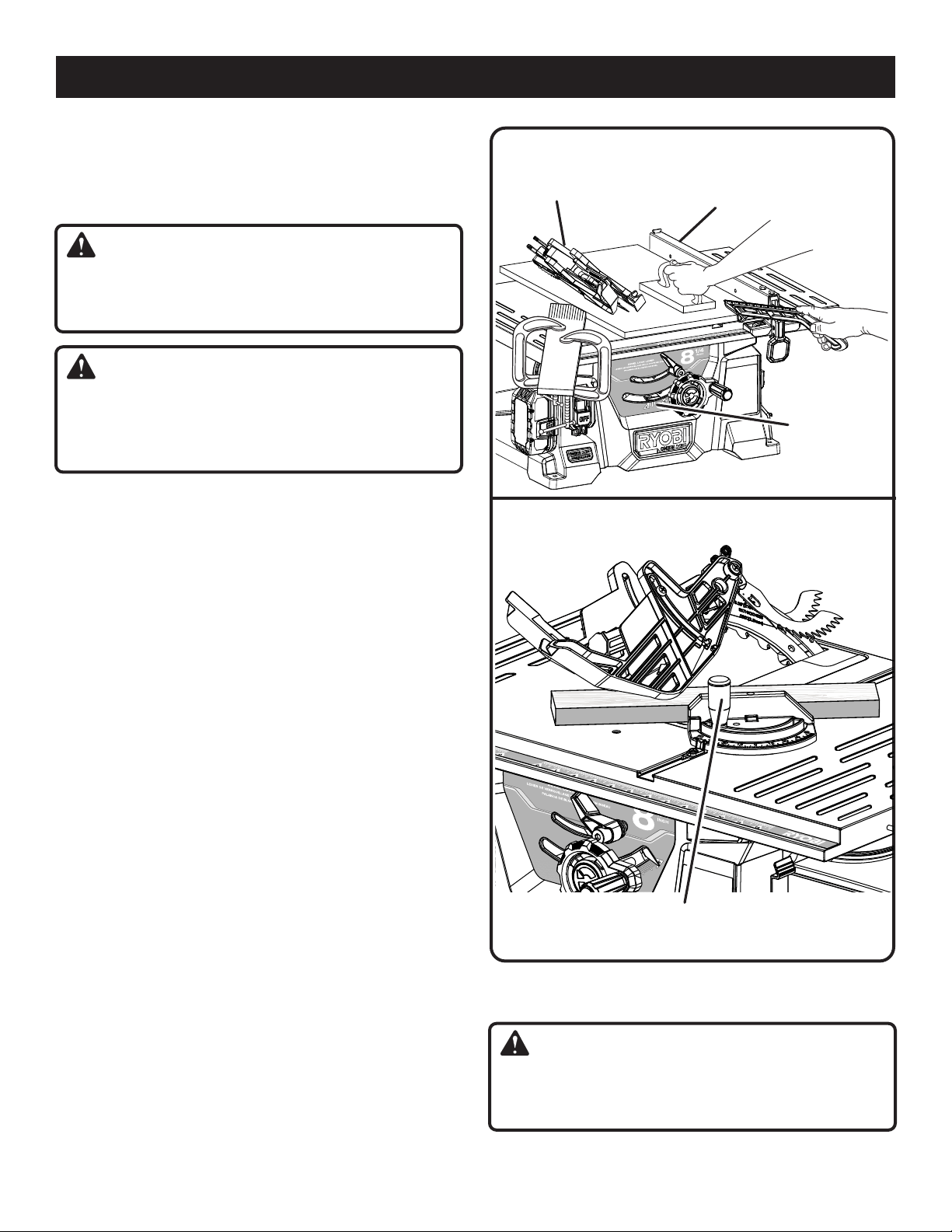
35 - English
Fig. 47
BEVEL RIP CUT
RIP FENCE
SCALE
BLADE
ANGLED
When the cut is made, turn the saw off. Wait for the blade
to come to a complete stop before removing the workpiece.
MAKING A BEVEL RIP CUT
See Figure 47.
WARNING:
Make sure the blade guard assembly with kickback
pawls is installed and working properly to avoid serious
personal injury.
WARNING:
The rip fence must be on the right side of the blade
to avoid trapping the wood and causing kickback.
Placement of the rip fence to the left of the blade will
result in kickback and the risk of serious personal injury.
Remove the miter gauge.
Install featherboard in the appropriate position for the cut
being made.
Unlock the bevel locking lever.
Adjust the bevel angle to the desired setting.
Lock the bevel locking lever.
Set the blade to the correct depth for the workpiece.
Position the rip fence the desired distance from the blade
for the cut and securely lock the handle.
Make sure the wood is clear of the blade before turning
on the saw.
When cutting a long or wide workpiece, place a support
the same height as the table surface in front of the saw,
behind the saw, and on the sides of the saw as needed.
Insert the battery and turn the saw on.
Position the workpiece flat on the table with the edge
flush against the rip fence. Let the blade build up to full
speed before feeding the workpiece into the blade.
Using a push stick and/or push blocks, slowly feed the
workpiece toward the blade. Stand slightly to the side of
the wood as it contacts the blade to reduce the chance
of injury should kickback occur.
Once the blade has made contact with the workpiece, use
the hand closest to the rip fence to guide it. Make sure
the edge of the workpiece remains in solid contact with
both the rip fence and the surface of the table. If ripping
a narrow piece, use a push stick and/or push blocks to
move the piece through the cut and past the blade.
When the cut is made, turn the saw off. Wait for the
blade to come to a complete stop before removing the
workpiece.
OPERATION
MAKING A COMPOUND (BEVEL) MITER CUT
See Figure 48.
WARNING:
Make sure the blade guard assembly with kickback
pawls is installed and working properly to avoid possible
serious injury.
Remove the rip fence.
Unlock the bevel locking lever.
PLACE LEFT HAND ON
MITER GAUGE HERE
Fig. 48
COMPOUND (BEVEL) MITER CUT
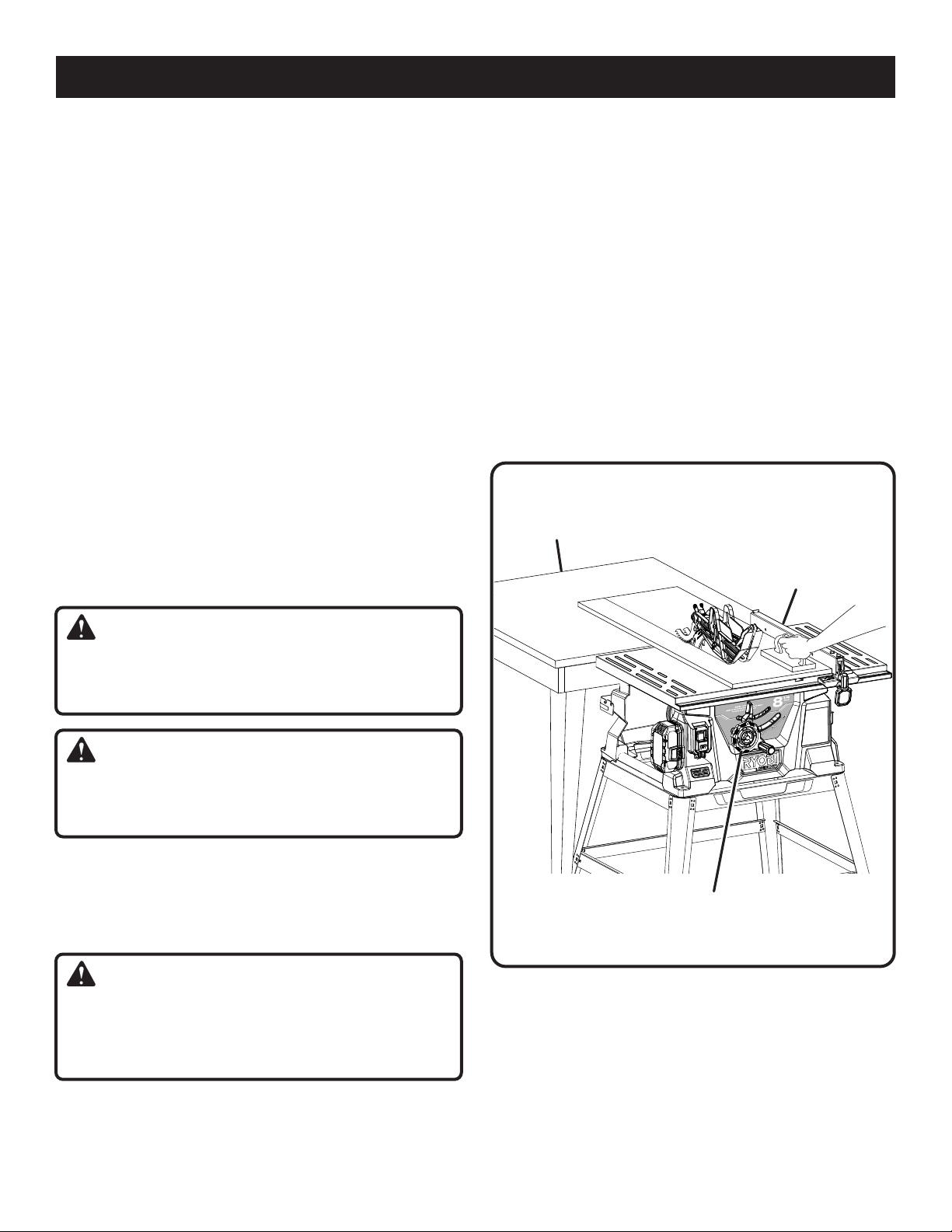
36 - English
Adjust the bevel angle to the desired setting.
Lock the bevel locking lever.
Set the blade to the correct depth for the workpiece.
Set the miter gauge to the desired angle and tighten the
lock knob.
Make sure the wood is clear of the blade before turning
on the saw.
Insert the battery and turn the saw on.
Let the blade build up to full speed before moving the
workpiece into the blade.
Hold the workpiece firmly with both hands on the miter
gauge and feed the workpiece into the blade.
NOTE: The hand closest to the blade should be placed
on the miter gauge lock knob and the hand farthest from
the blade should be placed on the workpiece.
When the cut is made, turn the saw off. Wait for the
blade to come to a complete stop before removing the
workpiece.
MAKING A LARGE PANEL CUT
See Figure 49.
Make sure the saw is properly secured to a work surface to
avoid tipping from the weight of a large panel.
WARNING:
Make sure the blade guard assembly with kickback
pawls is installed and working properly to avoid possible
serious injury.
WARNING:
Never make freehand cuts (cuts without the miter gauge
or rip fence). Unguided workpieces can result in serious
injury.
Install featherboard in the appropriate position for the cut
being made.
When cutting a long or wide workpiece, place a support
the same height as the table surface in front of the saw,
behind the saw, and on the sides of the saw as needed.
WARNING:
Improper support of the workpiece on the side and/
or outfeed side of the saw could create unexpected
movement of the workpiece and/or the saw, resulting in
serious personal injury.
Depending on the shape of the panel, use the rip fence
or miter gauge. If the panel is too large to use either the
rip fence or the miter gauge, it is too large for this saw.
OPERATION
Fig. 49
LARGE PANEL CUT
SUPPORT
HEIGHT/BEVEL
ADJUSTING
HANDWHEEL
RIP FENCE
Make sure the workpiece does not touch the blade before
you turn on the saw.
Insert the battery and turn the saw on.
Position the workpiece flat on the table with the edge
flush against the rip fence. Let the blade build up to full
speed before feeding the workpiece into the blade.
Using a push stick and/or push blocks, slowly feed the
workpiece toward the blade. Stand slightly to the side of
the wood as it contacts the blade to reduce the chance
of injury should kickback occur.
Once the blade has made contact with the workpiece, use
the hand closest to the rip fence to guide it. Make sure
the edge of the workpiece remains in solid contact with
both the rip fence and the surface of the table. If ripping
a narrow piece, use a push stick and/or push blocks to
move the piece through the cut and past the blade.
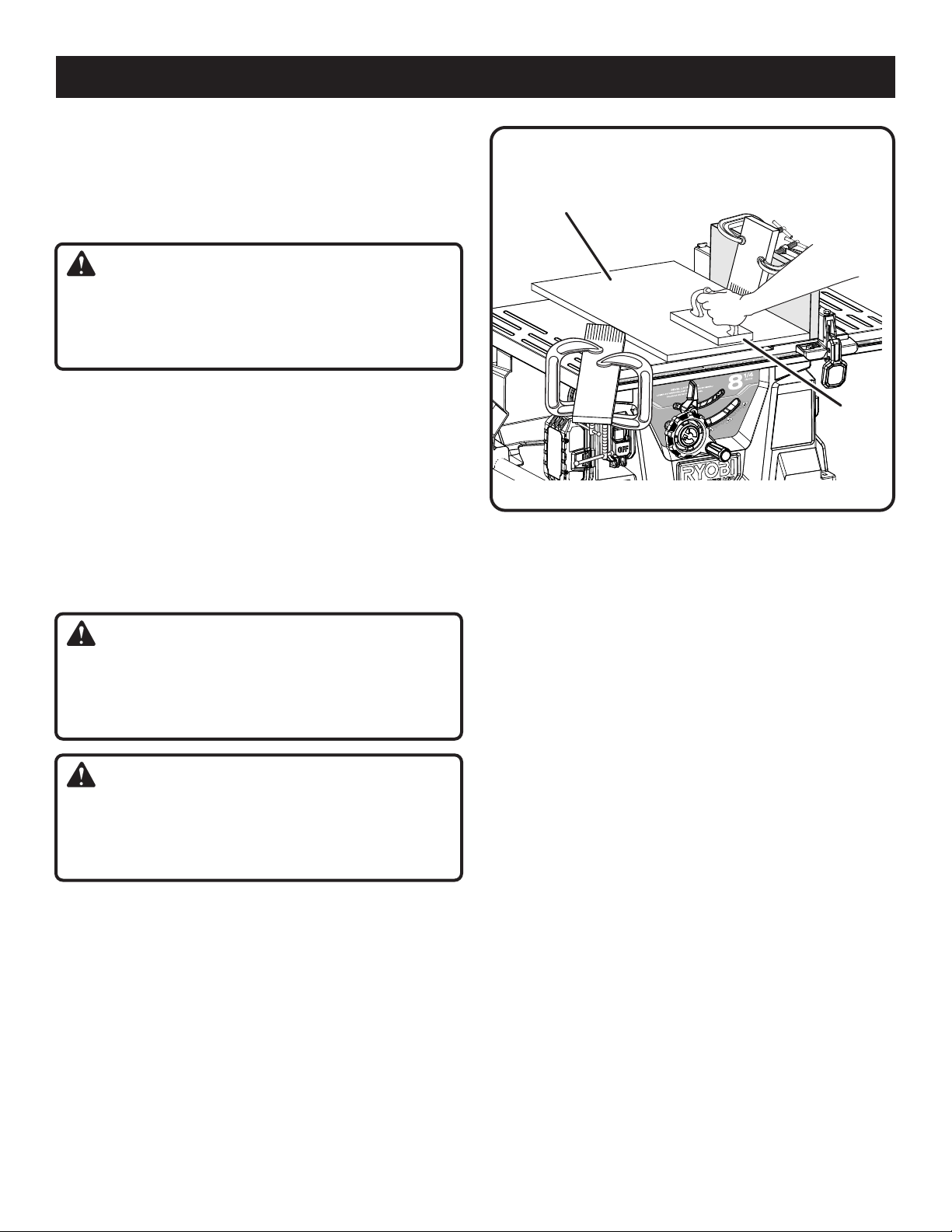
37 - English
When the cut is made, turn the saw off. Wait for the
blade to come to a complete stop before removing the
workpiece.
MAKING A NON-THROUGH CUT
See Figure 50.
WARNING:
DO NOT install dado blades on this machine. The arbor
shaft has insufficient threads to mount a dado blade.
Mounting a dado blade could result in the risk of serious
personal injury.
Non-through cuts (made with a standard 8-1/4 in. blade) can
be made with the grain (ripping) or across the grain (cross
cut). The use of a non-through cut is essential to cutting
grooves, rabbets, and dadoes. This is the only type cut that
is made without the blade guard assembly with kickback
pawls installed. Make sure the blade guard assembly with
kickback pawls is reinstalled upon completion of this type of
cut. Read the appropriate section which describes the type
of cut in addition to this section on non-through or dado
cuts. For example, if your non-through cut is a straight cross
cut, read and understand the section on straight cross cuts
before proceeding.
WARNING:
When making a non-through cut, the blade is covered
by the workpiece during most of the cut. Be alert to
the exposed blade at the start and finish of every cut to
reduce the risk of personal injury.
WARNING:
Never feed wood with your hands when making any
non-through cut such as rabbets or dadoes. To avoid
personal injury, always use push blocks, push sticks,
and featherboards.
Remove the battery.
Remove the blade guard.
Place riving knife in “down” position.
Unlock the bevel locking lever.
Adjust the bevel angle to 0°.
OPERATION
Lock the bevel locking lever.
Set the blade to the correct depth for the workpiece.
Depending on the shape and size of the wood, use either
the rip fence or miter gauge.
Insert the battery and turn the saw on.
Let the blade build up to full speed before moving the
workpiece into the blade.
Always use push blocks, push sticks, and/or feather-
boards appropriately when making non-through cuts to
reduce the risk of serious injury.
When the cut is made, turn the saw off. Wait for the
blade to come to a complete stop before removing the
workpiece.
NOTE: A non-through rip cut is shown in the illustration
above. To make a non-through cross cut, remove the blade
guard and anti-kickback pawls. Place the riving knife in the
“down” position and perform the cross cut, see Making a
Cross Cut earlier in this section.
Once all non-through cuts are completed:
Remove the battery.
Place riving knife in “up” position.
Reinstall blade guard.
Fig. 50
NON-THROUGH CUT
BLADE GUARD
REMOVED
PUSH
BLOCK

38 - English
WARNING:
Before performing any adjustment, make sure the battery
is removed and the top button on the switch is not
depressed. Failure to heed this warning could result in
serious personal injury.
To avoid unnecessary set-ups and adjustments, a good
practice is to check your setups carefully with a framing
square and make practice cuts in scrap wood before making
finish cuts in good workpieces. Do not start any adjustments
until you have checked with a square and made test cuts to
be sure adjustments are needed.
REPLACING THE BLADE
See Figures 51 - 53.
Wear gloves and other personal protective equipment when
installing and removing a blade only. DO NOT wear gloves
when operating the saw. DO NOT place gloved hand near
blade when it is in motion.
Use correct blades. Blade kerf width and blade body thickness
must be within the limits stamped on the riving knife.
Remove the battery.
Remove the blade guard and anti-kickback pawls.
Lower the saw blade and remove the throat plate.
Lock the bevel locking lever.
Raise the saw blade to full height.
Insert the open end of the blade wrench onto the flats on
the arbor shaft.
Insert the closed end of the blade wrench over the blade
nut. Holding both wrenches firmly, pull the outside wrench
(right side) forward while pushing the inside (left side) to
the back of the saw. Remove the blade nut and blade
washer.
NOTE: Arbor shaft has right-hand threads.
Unlock the release locking lever and remove the blade.
To replace the blade with an accessory blade, follow the
instructions provided with the accessory.
To install a standard blade:
Place the new blade on the arbor shaft (the teeth must
point down toward the front of the saw to work properly).
Place the blade washer and the blade nut over the arbor
shaft. Be sure the flat side of the blade washer faces
the blade and that all items are snug against the arbor
housing. Make sure the blade nut is securely tightened.
Do not overtighten.
NOTE: Arbor shaft has right-hand threads.
Lock the release lever.
Rotate the blade by hand to make sure it turns freely.
Lower the saw blade and reinstall the throat plate.
Check all clearances for free blade rotation.
ADJUSTMENTS
Fig. 51
OPEN END BLADE
WRENCH
CLOSED END
BLADE WRENCH
BLADE
NUT
BLADE
BLADE
NUT
BLADE
WASHER
ARBOR
SHAFT
Fig. 52
BLADE
THROAT
PLATE
RIVING
KNIFE
Fig. 53
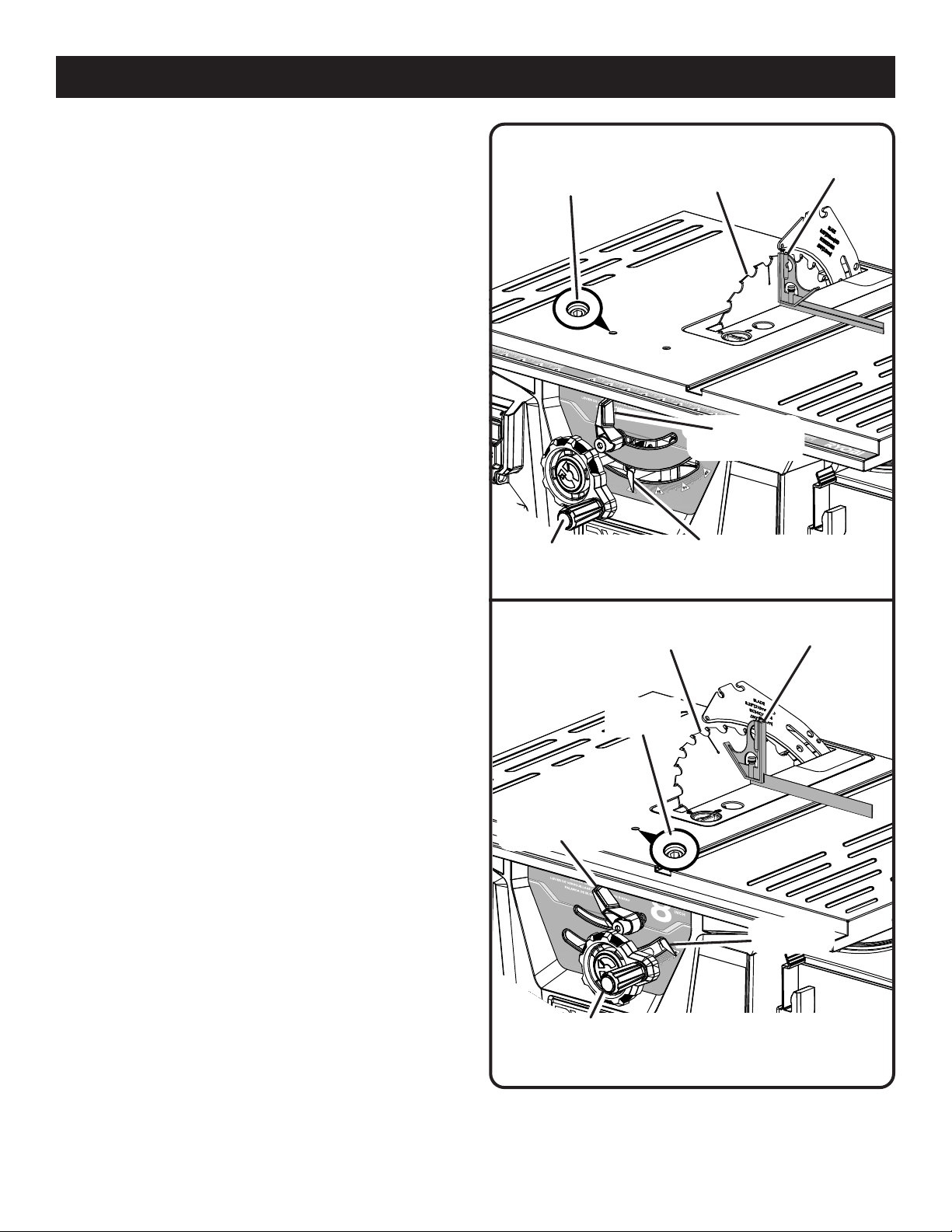
39 - English
ADJUSTMENTS
After installation, adjust the rip scale indicator to account
for the kerf and thickness of the blade. Refer to To Set the
Rip Fence Scale Indicator to the Blade in the Operation
section of this manual. In cutting operations, the scale will be
set to the side of the blade where the cut will be measured
and made.
TO SET THE BLADE AT 0° AND 45°
See Figures 54 - 55.
The angle settings of the saw have been set at the factory
and, unless damaged in shipping, should not require setting
during assembly. After extensive use, they may need to be
checked.
Remove the battery.
Raise the blade.
Remove the blade guard assembly with kickback pawls.
To check for squareness, 0˚ bevel:
Unlock the bevel locking lever.
Rotate the height/bevel adjusting handwheel until the
blade is tilted to the right as far as it will go.
Lock the bevel locking lever.
Place the combination square against blade. Make sure
square is not touching the tip of one of the saw teeth.
If the blade is not an exact 90° (0° bevel):
Unlock the bevel locking lever.
Turn the height/bevel adjusting handwheel until the bevel
indicator points to 5°-10°.
Turn the 0° stop screw 1/4 turn in the clockwise or
counterclockwise direction.
Rotate the height/bevel adjusting handwheel until the
blade is tilted to the right as far as it will go.
Lock the bevel locking lever and check the blade angle.
Repeat above steps to readjust and recheck blade angle
as needed.
Once blade is square to the table (0° bevel):
Check bevel indicator.
If indicator is not pointing to the 0º mark on the bevel
scale, loosen the indicator adjusting screw and adjust
indicator.
Retighten screw.
To check for squareness, 45˚ bevel:
Unlock the bevel locking lever.
Rotate the height/bevel adjusting handwheel until the
blade is tilted to the left as far as it will go.
Lock the bevel locking lever.
Place the combination square against blade. Make sure
square is not touching the tip of one of the saw teeth.
If the blade is not an exact 45°:
Unlock the bevel locking lever.
Turn the height/bevel adjusting handwheel until the bevel
indicator points to 35°-40°.
Turn the 45° stop screw 1/4 turn in the clockwise or
counterclockwise direction.
Fig. 54
BEVEL
INDICATOR
45˚ STOP
SCREW
COMBINATION
SQUARE
BLADE
BEVEL
LOCKING LEVER
Fig. 55
HEIGHT/BEVEL
ADJUSTING HANDWHEEL
Rotate the height/bevel adjusting handwheel until the
blade is tilted to the left as far as it will go.
Lock the bevel locking lever and check the blade angle.
HEIGHT/BEVEL
ADJUSTING
HANDWHEEL
BEVEL
INDICATOR
BEVEL
LOCKING LEVER
COMBINATION
SQUARE
BLADE
0˚ STOP
SCREW
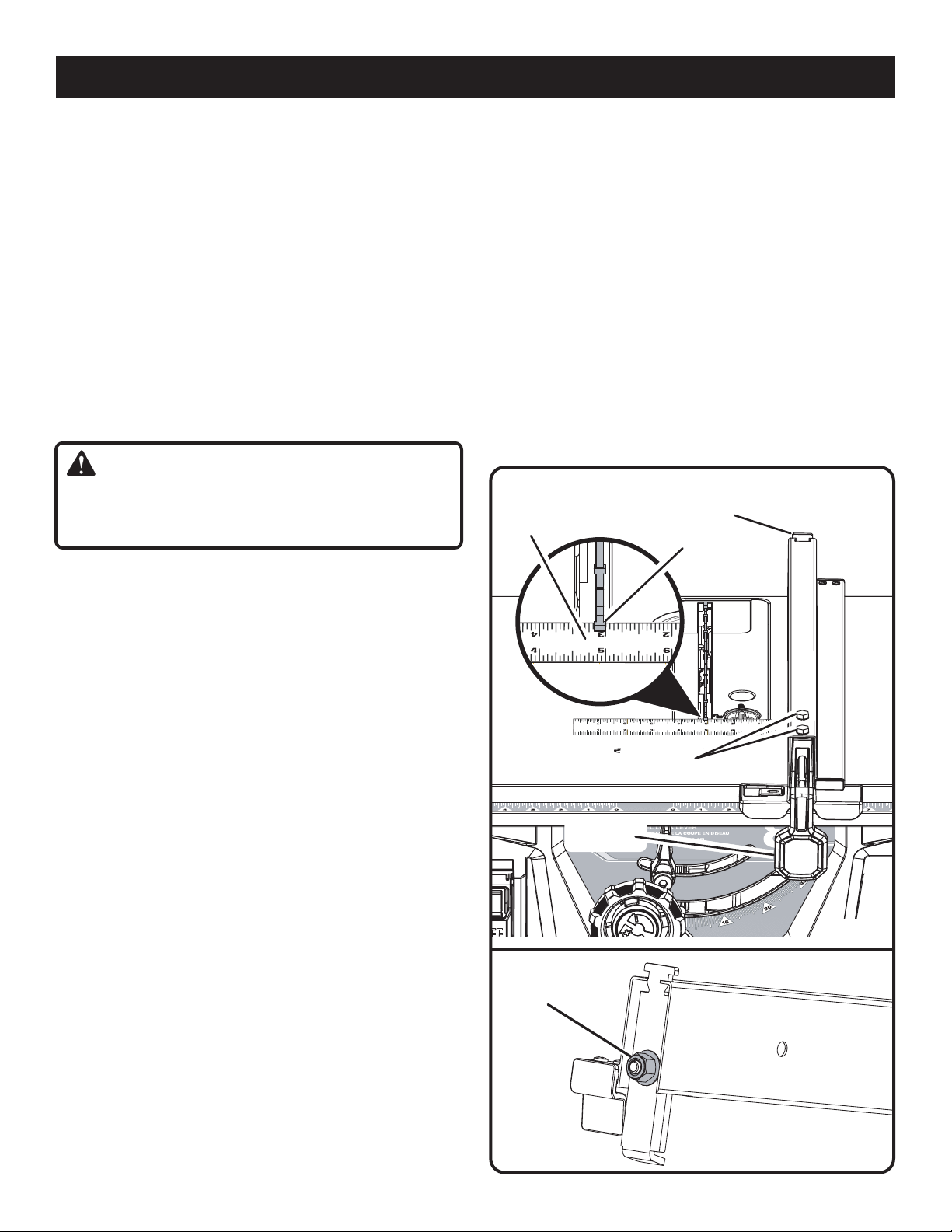
40 - English
ADJUSTMENTS
Repeat above steps to readjust and recheck blade angle
as needed.
Once blade is 45° to the table:
Check bevel indicator.
If indicator is not pointing to the 45º mark on the bevel
scale, loosen the indicator adjusting screw and adjust
indicator.
Retighten screws.
When all adjustments are complete:
Reinstall the blade guard assembly with kickback pawls.
TO CHECK THE ALIGNMENT OF THE RIP
FENCE TO THE BLADE
See Figure 56.
The rip fence must be parallel to the saw blade and the miter
gauge groove.
WARNING:
A misaligned rip fence can cause kickbacks and jams.
To reduce the risk of injury, always maintain proper rip
fence alignment.
Remove the battery.
Remove the blade guard, riving knife, and anti-kickback
pawls. Raise the blade by turning the height/bevel adjust-
ing handwheel clockwise.
Verify the blade is parallel to the miter gauge groove as
described in the Adjusting the Blade Parallel to the Miter
Gauge Groove (Removing Heel) section in Operation.
Move the rip fence near the saw blade (about three inches
away) and lock the rip fence in place with the locking
lever.
Mark beside one of the blade teeth at the front of the
blade. Using a ruler, measure the distance from the inside
face of the blade tooth to the to the inside face of the rip
fence.
NOTE: For greater accuracy, place the marked blade
tooth on top of the ruler.
NOTE: If the rip fence is on the left side of the blade,
measure from the low fence to the blade tooth.
Turn the blade so the marked tooth is at the back.
Move the ruler to the rear and again measure the distance
from the inside face of the blade tooth to the inside face
of the rip fence. If the distances are the same, the blade
and the rip fence are parallel.
If the distances are different:
Unlock the rip fence.
Loosen the two screws located on top of the rip fence.
Adjust the rip fence.
Alternately retighten the screws. Recheck alignment.
Repeat steps as needed until rip fence is correctly aligned.
Replace blade guard, riving knife, and anti-kickback pawls.
TO CHECK THE TIGHTNESS OF THE RIP
FENCE LOCKING LEVER
See Figure 57.
The locking lever on the rip fence should hold the rip fence
securely against the front and back rails. The lever should
not be difficult to push down and lock. To assure proper
fence lock adjustment:
Lock the rip fence in place.
Try moving the fence from side-to-side. If the fence moves,
tighten the lock nut 1/4 turn at a time, rechecking for
movement after each adjustment.
With the rip fence in the locked position, recheck rip fence
parallelism with the blade and adjust if necessary.
NOTE: If it is difficult or too easy to lock and unlock the
locking lever, adjust the lock nut until the lever is properly
tensioned then repeat the above steps.
RIP FENCE
RULER
BLADE TOOTH
LOCKING
LEVER
Fig. 56
SCREWS
Fig. 57
LOCK NUT
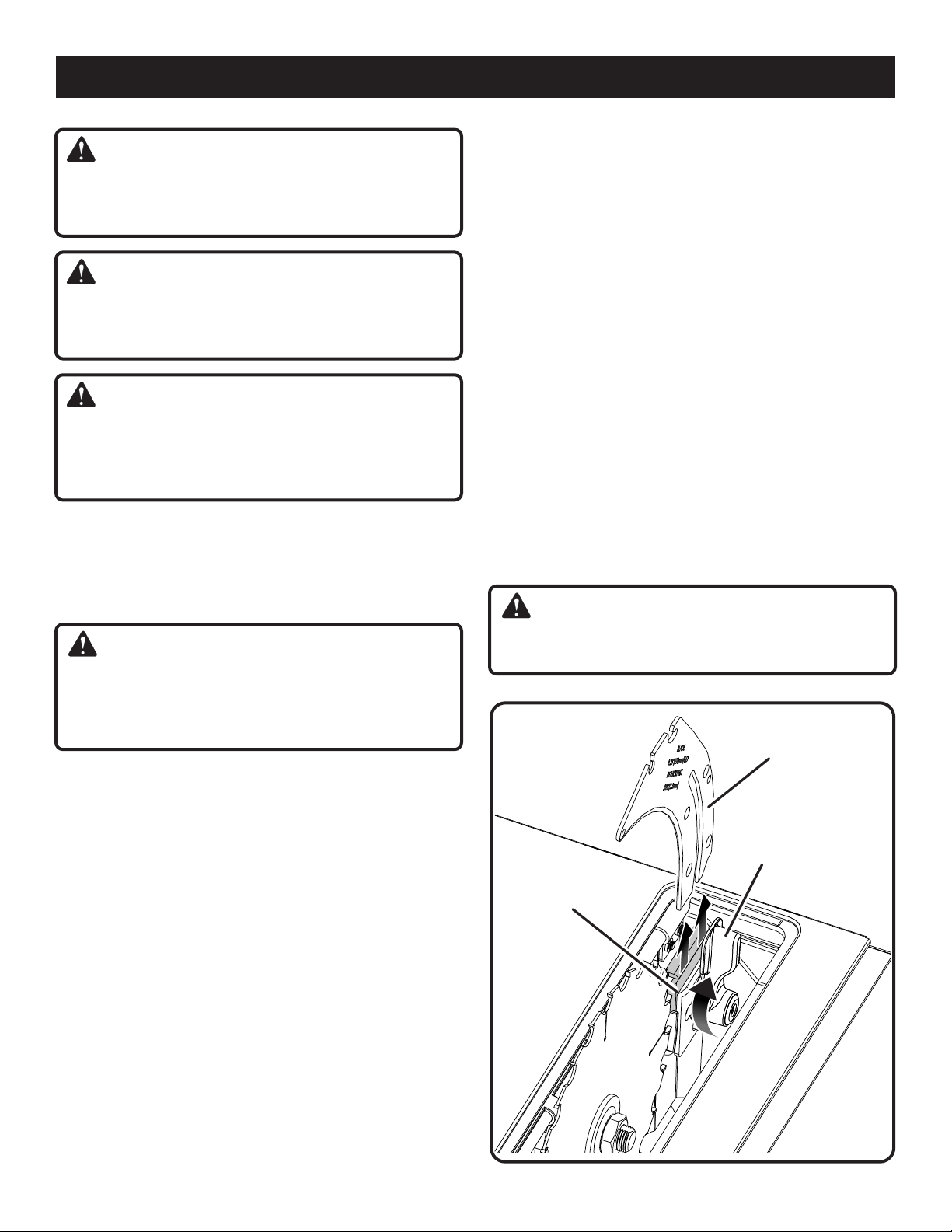
41 - English
WARNING:
When servicing, use only identical replacement parts.
Use of any other parts may create a hazard or cause
product damage.
WARNING:
Always wear eye protection with side shields marked
to comply with ANSI Z87.1 during product operation. If
operation is dusty, also wear a dust mask.
WARNING:
Before performing any maintenance, make sure the
battery is removed from the tool and the top button on
the switch is not depressed. Failure to heed this warning
could result in serious personal injury.
GENERAL MAINTENANCE
Avoid using solvents when cleaning plastic parts. Most
plastics are susceptible to damage from various types of
commercial solvents and may be damaged by their use. Use
clean cloths to remove dirt, dust, oil, grease, etc.
WARNING:
Do not at any time let brake fluids, gasoline, petroleum-
based products, penetrating oils, etc., come in contact
with plastic parts. Chemicals can damage, weaken, or
destroy plastic which may result in serious personal injury.
Periodically check all clamps, nuts, bolts, and screws for
tightness and condition. Make sure the throat plate is in
good condition and in position.
Check the blade guard assembly with kickback pawls
for proper installation, fit, clearances, and for free move-
ment. Some wood types may cause a buildup of dust,
pitch, or resin on components, so regular maintenance
and cleaning is recommended. Any cleaner used must
be appropriate for use on plastic parts.
Clean plastic parts only with a soft damp cloth. Do
not use any aerosol or petroleum solvents.
Protect the blade by cleaning out sawdust from under-
neath the table and in the blade teeth. Clean blade teeth
with a solvent recommended for gum and pitch removal.
To maintain the table surfaces, fence, and rails, periodi-
cally apply paste wax to them and buff to provide smooth
functioning. To prevent work from slipping during cutting
operation, do not wax the working face of the miter gauge.
MAINTENANCE
LUBRICATION
All of the bearings in this tool are lubricated with a sufficient
amount of high grade lubricant for the life of the unit under
normal operating conditions. Therefore, no further lubrication
is required.
CLEANING THE RIVING KNIFE LOCK LEVER
PLATES
See Figure 58.
The lock lever on the riving knife may become difficult to
lock securely after extended use due to sawdust or debris
falling into the plates.
Remove the battery.
Unlock the lever to remove the riving knife.
Wipe the area with a clean dry cloth or use compressed
air to blow away debris.
Clean the riving knife.
Reinstall the riving knife and turn the lever to lock the
riving knife in place.
NOTE: If the lock lever is difficult to move or will not
fully close after the plates have been cleaned, contact
customer service.
WARNING:
Do not use the saw if the lock lever does not fully close.
Doing so may cause serious personal injury.
LOCK
LEVER
PLATES
Fig. 58
RIVING
KNIFE
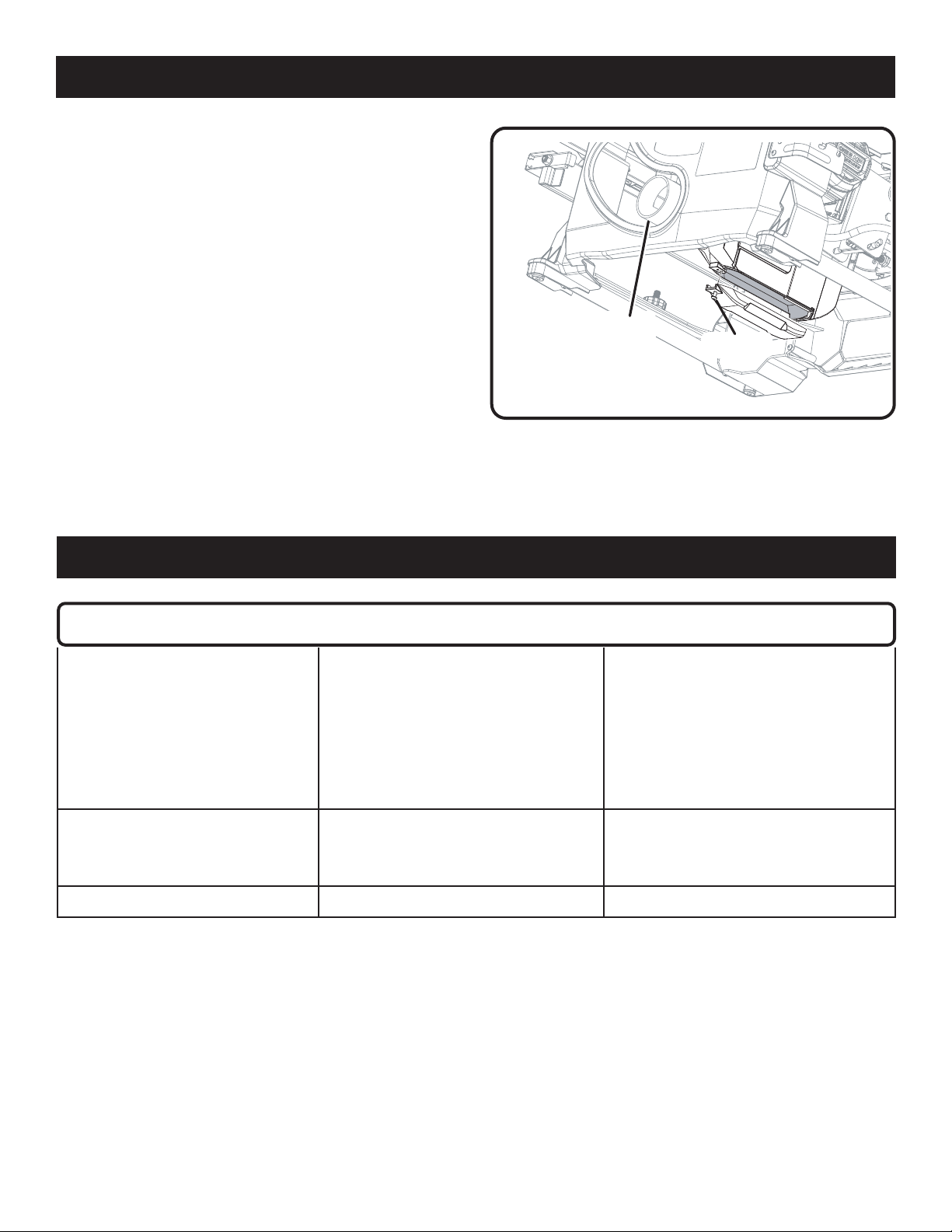
42 - English
MAINTENANCE
Fig. 59
DUST
CHUTE
SCREW
DUST CHUTE
See Figure 59.
This saw features a dust chute for convenience in discharging
sawdust. A standard shop vac can be attached to the chute,
located under the back side of the saw.
During periods of extended use, the dust chute should be
emptied and cleaned to prevent buildup of sawdust and to
make sure there are no obstructions or other small offcuts
that may have fallen into the throat plate opening that could
hinder maximum performance.
To clean the dust chute:
Remove the battery.
Loosen the screw at the bottom of the dust chute.
Remove the cover.
Shake out any sawdust and wipe with a clean dry cloth,
as needed.
Replace the cover and securely tighten the screw.
TROUBLESHOOTING
PROBLEM CAUSE SOLUTION
Excess vibration. Blade is out of balance.
Blade is damaged.
Saw is not mounted securely.
Work surface is uneven.
Blade is warped.
Replace blade.
Replace blade.
Tighten all hardware.
Reposition on flat surface. Adjust legs of
optional stand.
Check saw blade installation. Replace
blade if necessary.
Rip fence does not move smoothly. Rip fence not mounted correctly.
Rails are dirty or sticky.
Clamp screw is out of adjustment.
Remount the rip fence.
Clean and wax rails.
Adjust clamp screw counterclockwise.
Rip fence does not lock at rear. Clamp screw is out of adjustment. Adjust clamp screw clockwise.
43 - English
TROUBLESHOOTING
PROBLEM CAUSE SOLUTION
Cutting binds or burns work. Blade is dull.
Blade is heeling.
Work is fed too fast.
Rip fence is misaligned.
Workpiece is warped.
Riving knife is out of alignment.
Replace or sharpen blade.
See Adjusting the Blade Parallel to the
Miter Gauge Groove (Removing Heel).
Slow the feed rate.
Align the rip fence.
Replace the workpiece. Always cut with
convex side to table surface.
See To Check and Align the Riving Knife
and Saw Blade in the Assembly section.
Workpiece edges away from rip fence
when ripping.
Blade not properly sharpened or set. Resharpen or set blade.
Saw does not make accurate 90˚ or
45˚ cuts.
Positive stops behind the front panel
need adjusting (Bevel Cuts).
Miter gauge is misaligned (Miter Cuts).
Adjust positive stops.
Adjust the miter gauge.
Height/bevel adjusting hand-wheel
is hard to turn.
Gears or screw post behind the front
panel are clogged with sawdust.
Clean the gears or screw post.
Saw does not start. Battery is not installed.
Safety restart is activated.
Install battery.
Turn the ON/OFF switch off, then back
on to restart.
Blade makes poor cuts. Blade is dull or dirty.
Blade is wrong type for cut being made.
Blade is mounted backwards.
Clean, sharpen, or replace blade.
Replace with correct type.
Remount blade.
Blade does not lower when turning
height/bevel adjusting handwheel.
Locking lever is not at full left position. Move locking lever to left.
Motor labors in rip cut. Blade not proper for rip cut. Change blade; rip blade typically has
fewer teeth.
Blade coasts for longer than a few
seconds after the saw is turned off.
Braking system may not be working
properly.
Contact customer service.