Do not install or use this child restraint
until you read and understand all
instructions in this manual. To avoid
serious injuries to your baby, follow the
instructions carefully and be sure to buckle
your baby using the 5-point harness.
WARNING:
Child Requirements:
Weight limits: 4 - 35 lbs (1.8 - 15.8 kg)
Maximum height: 32 inches (81.3 cm)
USA
Instructions for use EN
FIUS1403I205
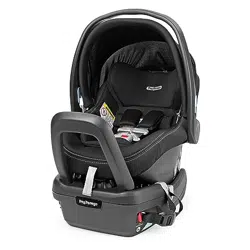
PRIMO VIAGGIO 4
.
35
O W N E R ’ S M A N U A L

- 2 -
© 2014 Peg Perego. All rights reserved.
Table of Contents
Before You Start page 3
Customer Service/Registration Form page 4
Safety Rules page 5
Your Car Seat page 8
Your Car Seat Base page 10
Travel System page 11
Serial Numbers page 12
Assembly before first use page 13
Installation Instructions page 14
LATCH SYSTEM overview page 15
Vehicle seat belt overview page 16
Non compatible vehicle belt designs or seating
positions
page 23
Installing the Base page 24
How to level the base in the vehicle page 25
How to Install the Base using the LATCH SYSTEM
page 26
How to install the Base using your VEHICLE SEAT BELT
page 29
Installing the Base with different Types of Seat Belts
page 31
Installing the Car Seat on the Base page 32
Installing the Car Seat without the Base page 34
Installing the Car Seat with different Types of Seat
Belts
page 36
Use of a Locking Clip page 37
How to buckle your baby into the Car Seat
page 38
How to raise or lower the Shoulder Straps
page 43
Dual Cushion System page 45
Using the Car Seat outside the Vehicle page 46
How to use the Car Seat on aircraft page 49
Cleaning and Maintenance page 50
How to wash the chair padding - Cover removal
page 51
How to wash the chair padding - Refitting
page 54
Replacement Parts page 56

- 3 -
1 Please read this manual carefully. Keep this manual in the rear compartment of your
child car seat.
2 Review car seat parts and read through instructions. Read and understand the
labels and all the instructions before using this car seat.
3 Fill in and return the registration form (see page 4).
4 All assembly must be performed by an adult.
5 Do not use the car seat if damaged or parts are missing.
6 Use only parts or accessories that come with the unit. Do not modify or repair any part.
7 Remember: this car seat is to be installed rear facing only.
8 Peg Perego has the right to make changes to the product at any time without notice.
Before You Start

- 4 -
Call Peg Perego USA Customer Service at
1-800-671-1701 (toll free) for information
about repairs or spare parts. If any part
is missing or damaged, replace with Peg
Perego parts only. See page 56 for a list of
replacement parts.
If you want more than one base, you can
purchase it from your local dealer, or you
can call 1-800-671-1701 (toll free), or you
can go to www.pegperego.com.
Important! Child restraints could be
recalled for safety reasons. You must
register this restraint to be reached in
a recall. Send your name, address and
the restraint’s model number and
manufacturing date to:
Peg Perego U.S.A., Inc.
3625 Independence Drive
Fort Wayne, IN 46808
Or call 1-800-671-1701 (toll free)
Or register online at
www.carseat-registration.pegperego.com
For recall information, call the U.S.
Government’s Vehicle Safety Hotline at
1-888-327-4236 (TTY: 1-800-424-9153).
Or go to http://www.NHTSA.gov
Important! This information is already
available on the registration form attached
to your new car seat. All that you can do is
tear off the part indicated and send through
ordinary mail. We have already paid for it.
Complete and send in the registration
form right away.
Customer Service
Registration Form
- 5 -
WARNING
• This car seat meets or exceeds all
applicable Federal Motor Vehicle Safety
Standard 213 requirements for use in
motor vehicles and aircraft.
• Read all instructions before use of the
child carrier. Keep instructions for future
reference in the dedicated pocket located
in the rear compartment of this car seat.
• Your child could be seriously injured
if you do not follow instructions and
warning labels correctly.
• Use this car seat rear facing only. This seat
is not designed to face forward. Serious
injury or death can occur in an accident
if you install the seat facing forward.
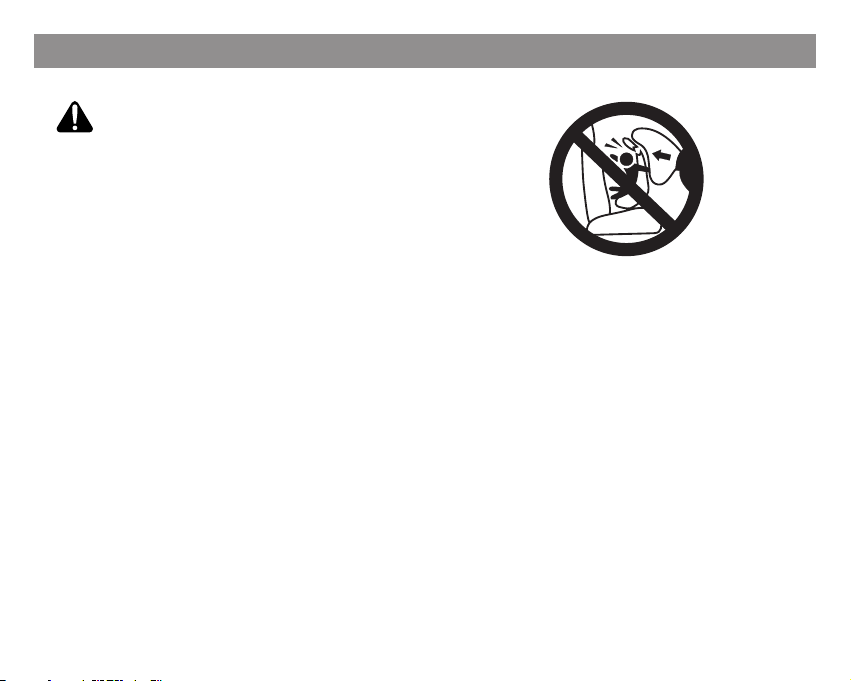
• If your vehicle has air bags, do not
install this car seat on a seating position
equipped with an active air bag. In case
of air bag deployment the restraint
could be hit with severe force. Death or
serious injuries can occur to the restraint
occupant.
• If your vehicle is equipped with air bags,
Safety Rules
refer to your vehicle owner’s manual for
instructions on where to install a child
car seat.
• Owners of vehicles with front (or rear)
passenger side air bags should refer to
their vehicle owner’s manual for child
restraint installation instructions.
• This car seat is certified for use with
or without base. Use of the base is
highly recommended for ease of proper
installation. Install this car seat without
the base only if needed.
• Never install the car seat in the front
vehicle seat unless instructed by your
vehicle manual. According to accident
statistics, children are safer when properly
restrained in the rear seating positions
than in the front seating positions.
- 6 -
WARNING
• NEVER leave the child unattended.
• Always buckle your baby into the car
seat with the harness. Be sure to latch
buckles correctly.
• Fall hazard: child's activity can
move carrier. NEVER place carrier on
countertops, table or any other elevated
surface.
• Do not use in the seating area or across
the top of shopping carts.
• Suffocation hazard: child carrier
can roll over on soft surfaces and
suffocate child. NEVER place carrier
on beds, sofas or other soft surfaces.
• Strangulation hazard: children have
STRANGLED in loose or partially buckled
harness straps. Fully restrain the child
even when carrier is used outside the
vehicle.
• In case of accident: if this car seat is
involved in a car accident, it may be
no longer safe to use. You may need to
get a new unit. Call customer service
at 1-800-671-1701 (toll free) for more
information.
• Do not use this carrier if it is broken or
damaged.
• If you use a lap belt or lap/shoulder
belt to install the base, you must use
a seat belt that locks in place. Please
refer to your owner's vehicle manual for
additional information. You may need
to use a locking clip, not provided with
this seat.
• When lifting the seat out of the base, be
sure you first secure the handle into the
carrying position.
• Keep fingers away from moving parts.
Safety Rules
- 7 -
WARNING
•
Use only with children who weigh
between 4 and 35 pounds (1.8 and 15.8
kg) and whose height is 32 inches (81.3
cm) or less. If your baby was born with
low birth weight, ask your doctor for
special instructions on using a child car
seat.
•
Never leave your baby alone in the car
seat. He/she could get tangled in the
straps and be seriously injured or could
move or tip the seat.
•
Install this car seat on front facing
seats only. Do not use on rear facing or
side facing seats or in cars with door-
mounted or motorized shoulder belts.
•
Use this car seat in vehicles with
standard lap or lap/shoulder belts or
universal lower anchors. If your vehicle
has lower anchors, use those to secure
the car seat instead of the standard seat
belt. Read your vehicle manual to locate
the lower anchors.
•
Be sure the car seat is properly leveled.
If the seat reclines too much, your baby
can be injured or ejected from the seat.
If the seat is too upright, it can cause
your baby to have breathing problems,
which could lead to injury or death.
•
Do not leave the car seat or base
unsecured in the vehicle, even if not
occupied. A loose car seat can injure
other passengers in a crash.
•
Do not use this unit after seven (7) years
from the date of production labeled on
the seat.
•
Do not hang toys on handle of seat.
•
Use only approved parts. Use of
unapproved parts can affect the safety
of the car seat and cause serious injury
or death in an accident.
Safety Rules
- 8 -
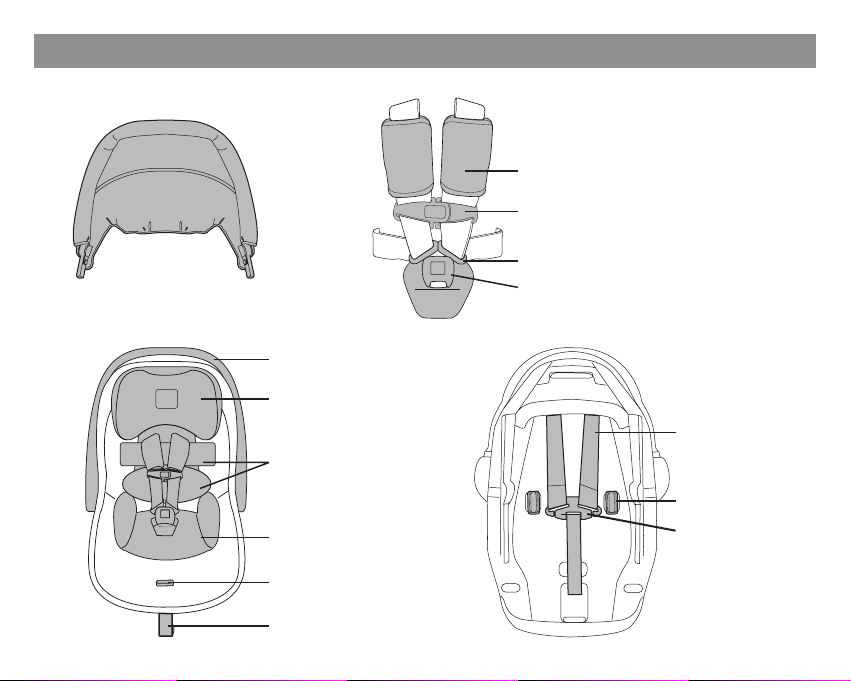
HOOD
Splitter plate
Harness
shoulder straps
Waist anchors
BACK
Chest clip
Harness buckle
Harness latch plate
5 POINT HARNESS SYSTEM
Shoulder pads
FRONT
Seat handle
First stage cushion
Second stage cushion
Side Impact
Head protection
Harness adjuster button
Harness adjuster strap
Your Car Seat
- 9 -
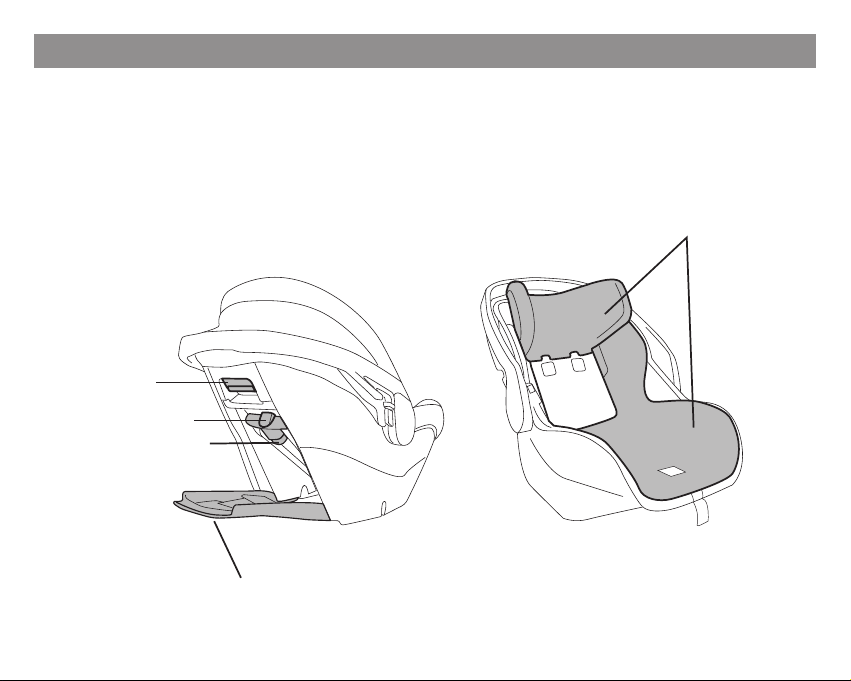
Rear compartment door
Sliding harness plate
Release lever
Harness plate button
Energy absorbing Expanded
Polystyrene (EPS) foam lined shell
and headrest for added impact
protection.
Your Car Seat
- 10 -
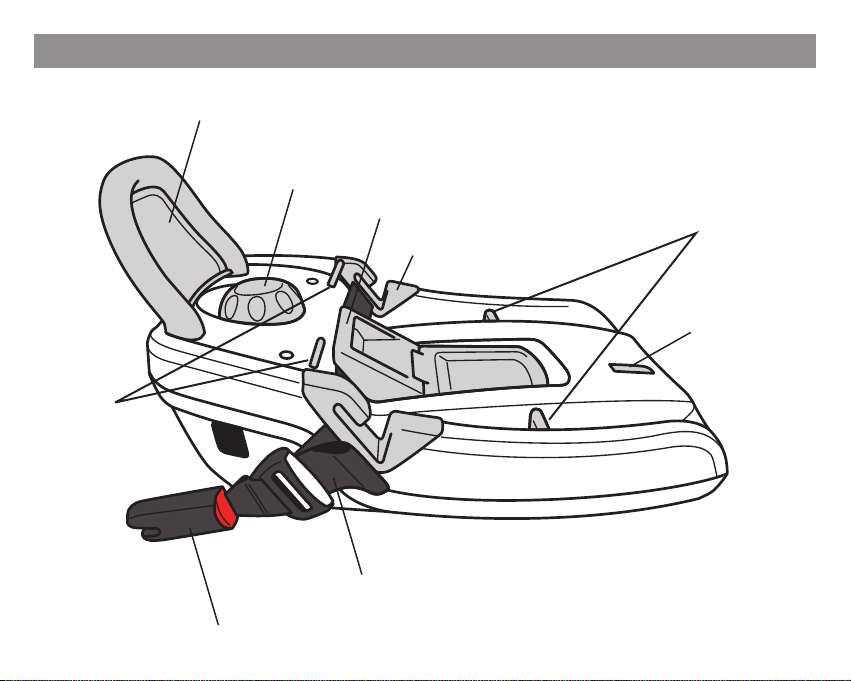
Your Car Seat Base
Rear latches
Front latches
Integrated Right Tight lockoff clip
Level indicator
UAS connector
Angle adjuster knob
Latch strap
Color coded belt slots
Anti rebound bar
- 11 -
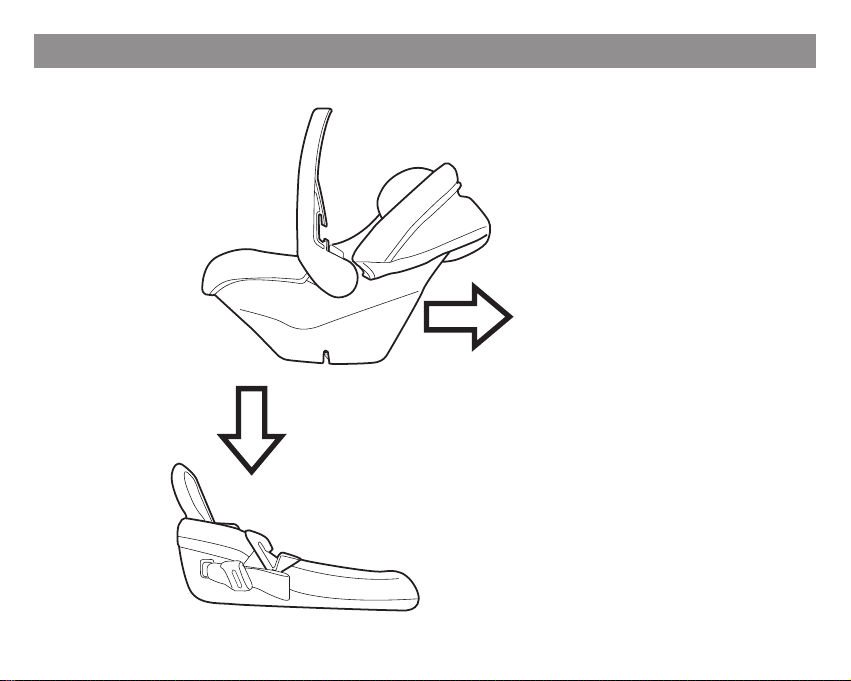
Base
Seat
Chassis /Strollers:
.
Booklet
.
Book
.
Book Plus
.
Book Pop-Up
.
Switch Four
.
Duette
.
Triplette
Travel System
- 12 -
Serial Numbers
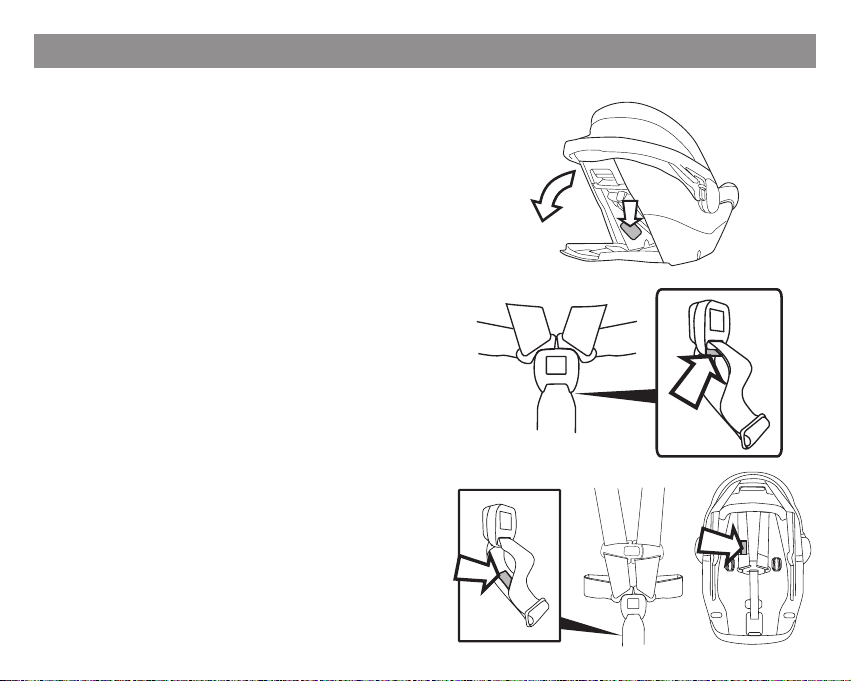
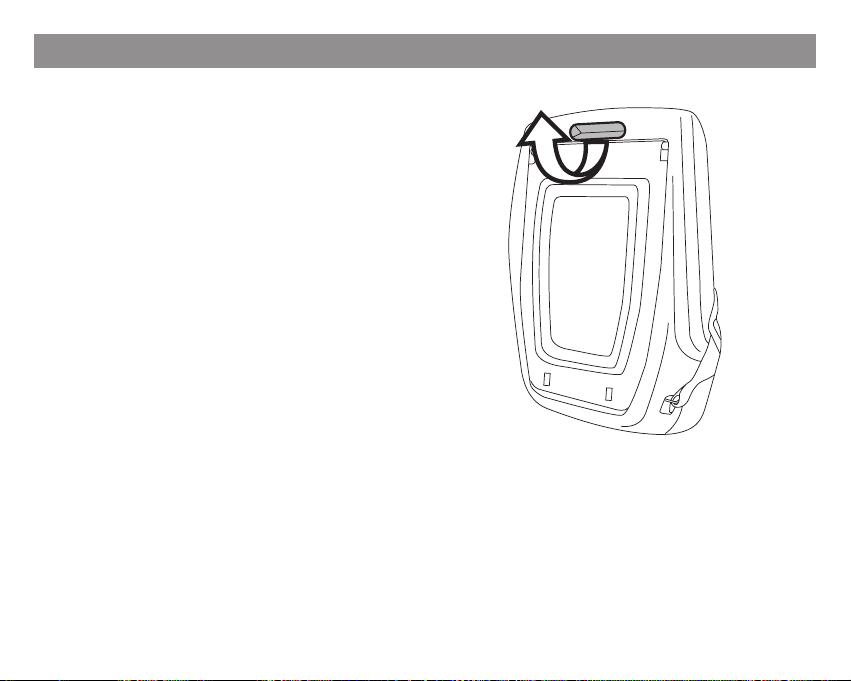
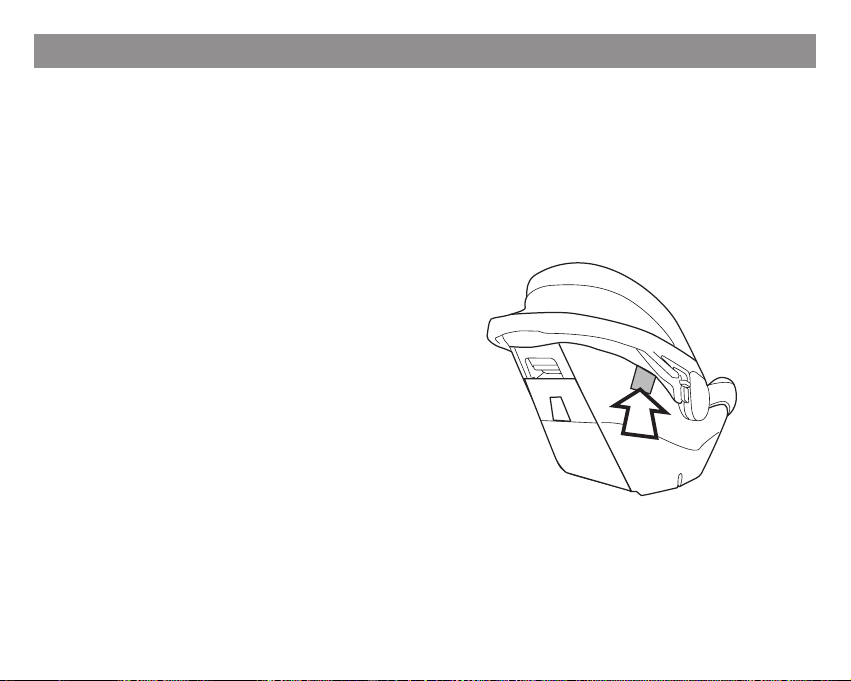
Open the rear compartment door to read
the product identity label as shown in the
picture. The label carries the following
information: product name, production
date and serial number, which identify
your product uniquely.
Every buckle and harness used on Primo
Viaggio 4
.
35 is marked with a production
serial number located as shown in the
pictures.
In the event of problems with the
product, these details may be requested
by PegPerego Customer Service.
- 13 -
Assembly before first use
Primo Viaggio 4
.
35 is almost ready for use.
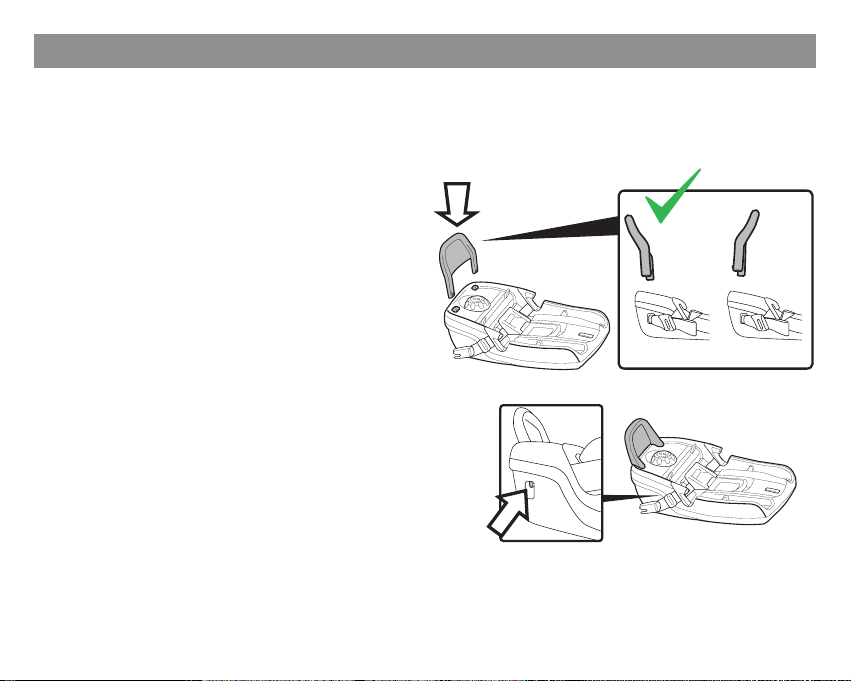
Disconnect the car seat from the base
following instructions at page 25.
Snap fit the anti-rebound bar into the
base as shown in the picture.
Check that the bar is properly installed by
pulling on top of it trying to detach the
bar from the base.
IMPORTANT NOTE: the anti rebound bar
provides extra protection in case of a
rear collision or during the movement of
the seat in a crash. Always assemble it
properly.
In case, the anti rebound bar can be
removed by pressing the buttons located
inside each latch connector storage
housing.
x
- 14 -
Installation Instructions
Peg Perego Primo Viaggio 4
.
35 is certified
for use with or without the base. Use of
the base is highly recommended because
it makes installation easier and therefore
safer.
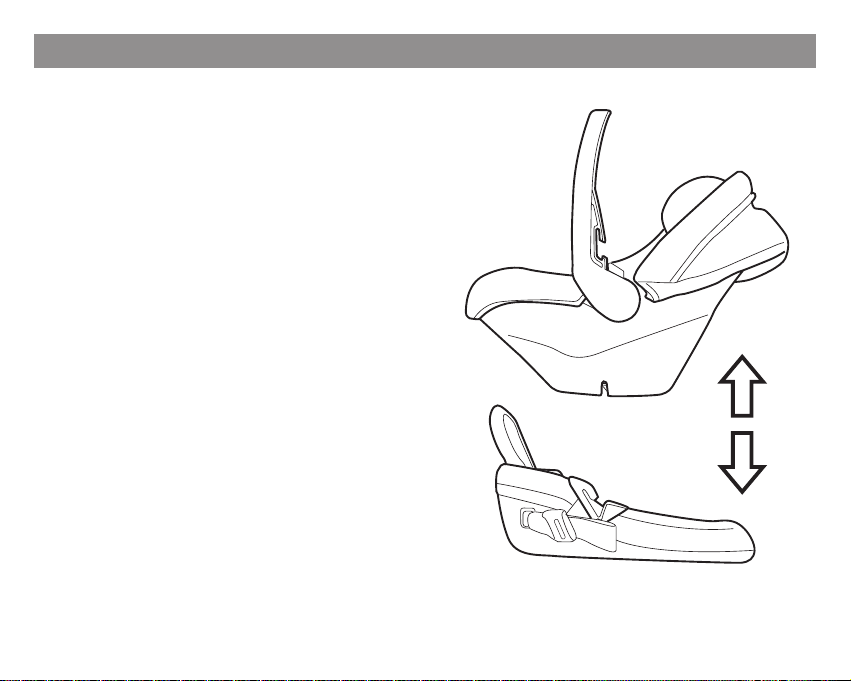
Unlatch the seat from the base following
instructions at page 25, then re-latch and
repeat this operation until you are familiar
with this important feature.
- 15 -
LATCH SYSTEM overview
Primo Viaggio 4
.
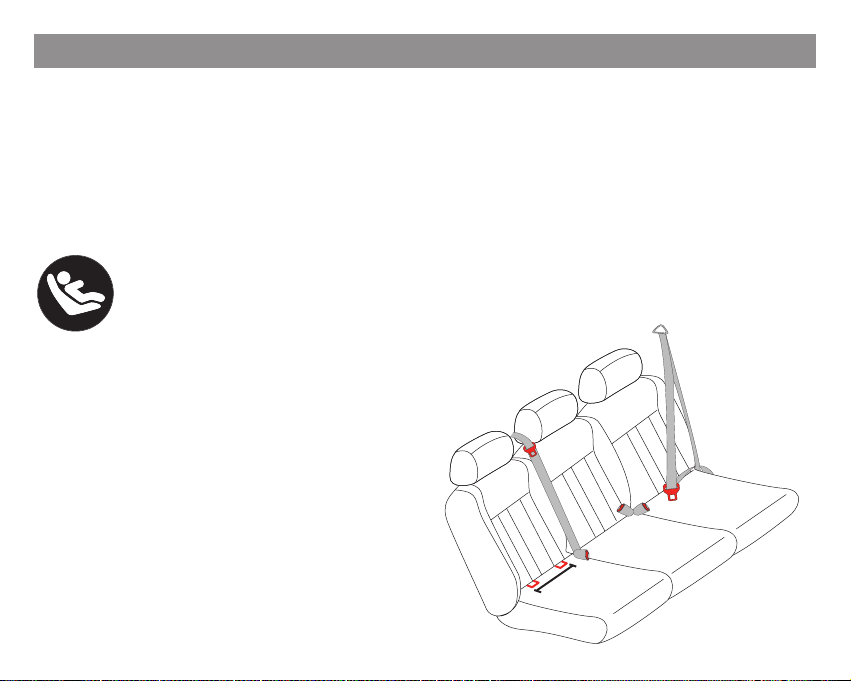
35 is equipped with latch connectors on the base (refer to page 26 for
latch operation). Latches must be connected to your vehicle latch anchors located at the
junction of the seat and backrest in your vehicle seat. There are at least two anchors for
each seating position and they are spaced by about 11" (28 cm). They may be visible or
slightly recessed into the vehicle upholstery and can be protected by plastic or fabric
shields. The LATCH anchor can be located by this symbol:
Check your Vehicle Owner's Manual to
nd the LATCH anchor locations in your
vehicle and the possible combinations of
use of a child restraint in it.
11” - 28cm
- 16 -
Vehicle seat belt overview
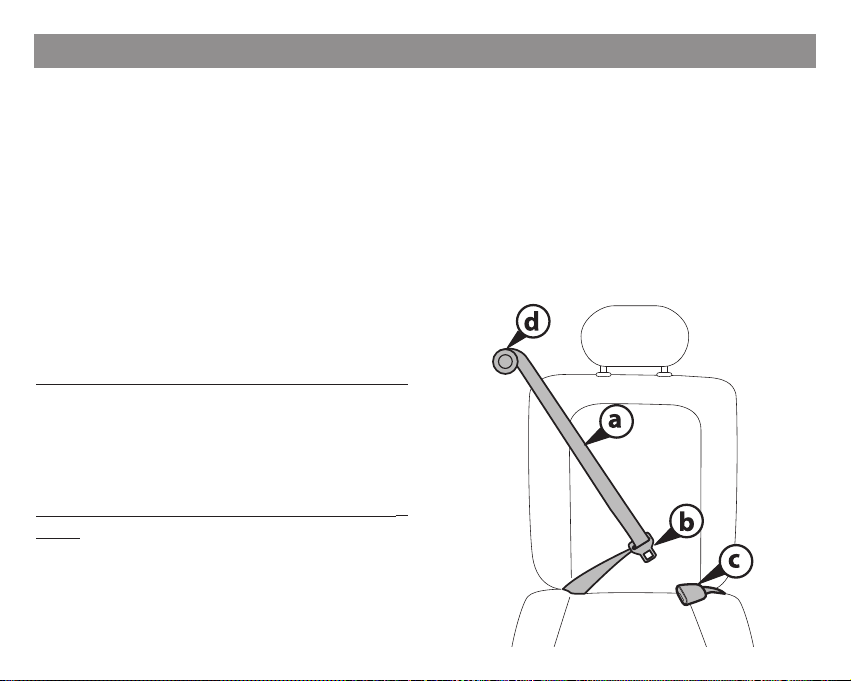
VEHICLE SEATBELTS: this child seat is designed to be installed with vehicle belts.
There are many dierent vehicle belt designs. Unfortunately, some may be unsuitable
for a safe installation of Primo Viaggio 4
.
35. Please read carefully the pages below.
Check your vehicle owner’s manual or call Peg Perego Customer Service @ 1-800-671-
1701 for additional help.
The most common vehicle belt is
composed of a web strap (a), a latch
plate (b), a buckle (c) and a retractor (d).
A retractor is a spring loaded device that
rolls the seatbelt automatically when not
in use. Common retractors are:
Emergency Locking Retractor (ELR)
allows the occupant to have free
movement while buckled up, but in
an emergency situation or crash the
retractor instantly locks securing the
occupant.
Switchable Locking Retractor (ELR —>
ALR) Switches from Emergency Locking
Retractor (ELR) to an Automatic Locking
Retractor (ALR). This allows the user to
lock the retractor at a set position (also
called child restraint mode) used for
securing child seats.
- 17 -
Vehicle seat belt overview
ALR mode is activated by extending the
retractor all the way out until a "click" is
heard, next let the seat belt (webbing)
retract into the retractor to the desired
length and stop the belt at that point.
The retractor locks and will not let the belt
lengthen at that point (only retract).
To cancel ALR mode and return the
retractor to the ELR mode, just let the
retractor retract the webbing all the way
back into the retractor.
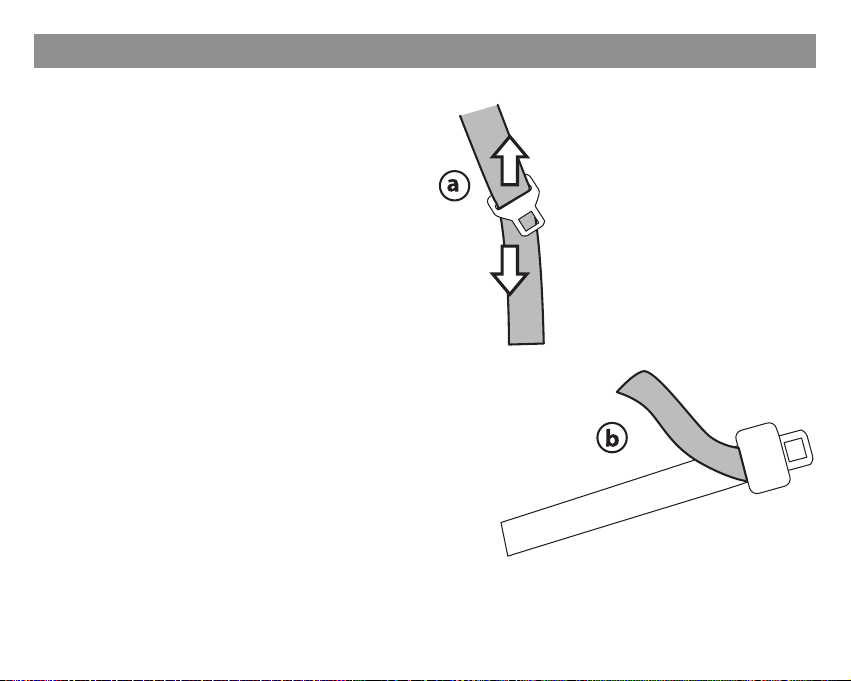
A latch plate can be a sliding latch plate (a)
or a locking latch plate (b). A sliding latch
plate is available on lap/shoulder belt
only and moves freely along the strap. A
Locking latch plate has a mechanism to
lock the movement of the plate on the
strap.
- 18 -
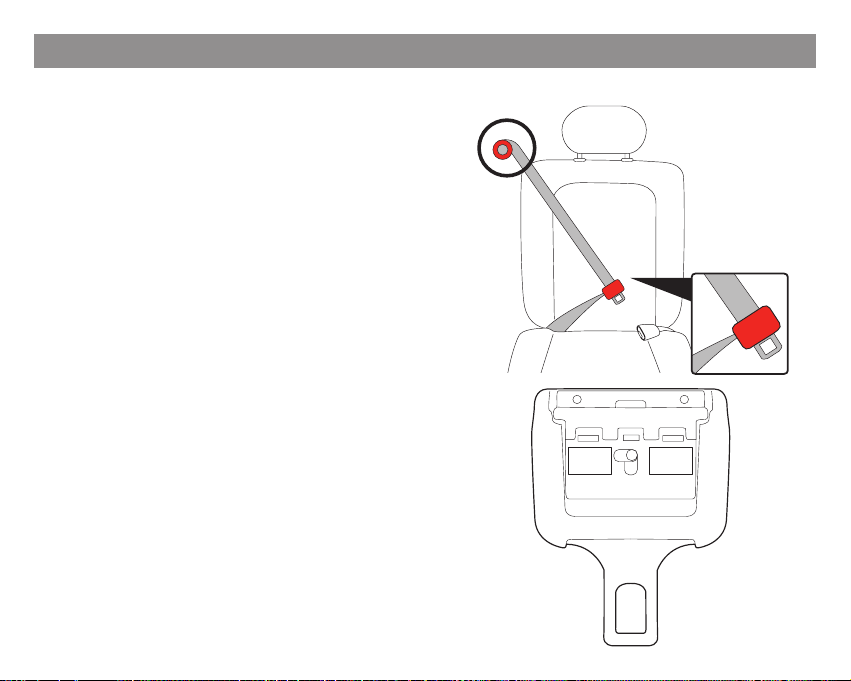
Lap/shoulder belt (3-point) with
Switchable Locking Retractor (ELR
—> ALR) and free sliding latch plate.
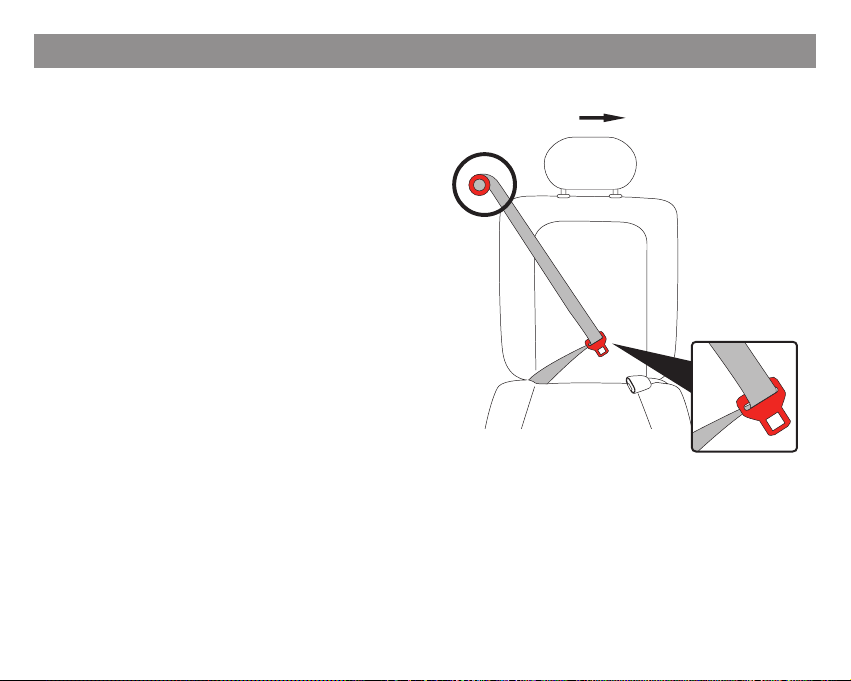
This type of seat belt has a latch plate that
moves freely along the belt. To activate
ALR for child restraint installation, some
vehicle models may require to pull the
belt all the way out; some other vehicle
models may require to pull the belt for
a certain length (check vehicle owner’s
manual for details).
For installation of Primo Viaggio 4
.
35,
leave the seatbelt in ELR mode and use
the locko clip integrated in the child
seat base.
A locking clip may be required when the
child seat is used without base (refer to
page 37).
ELR ALR
X
Vehicle seat belt overview
- 19 -
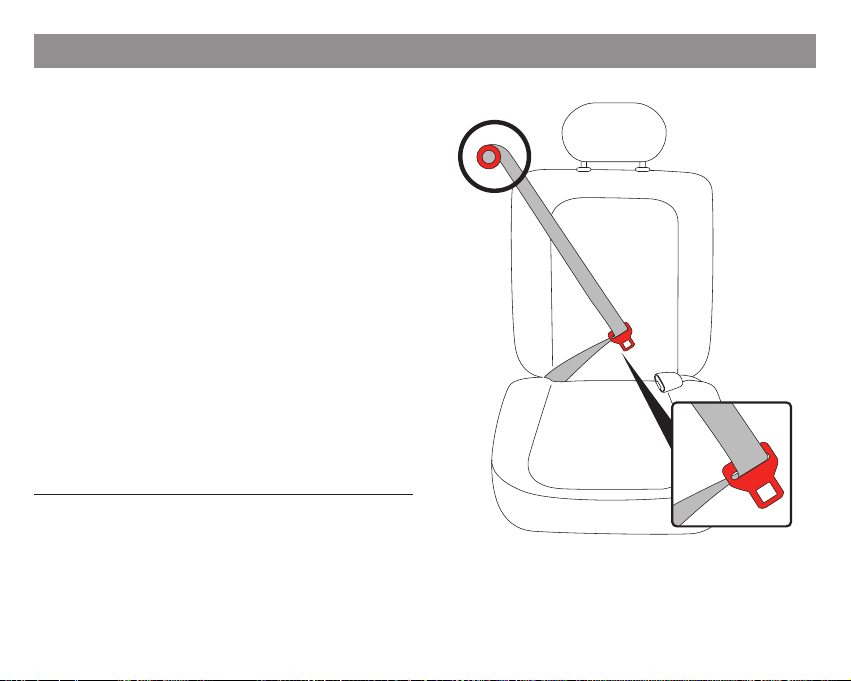
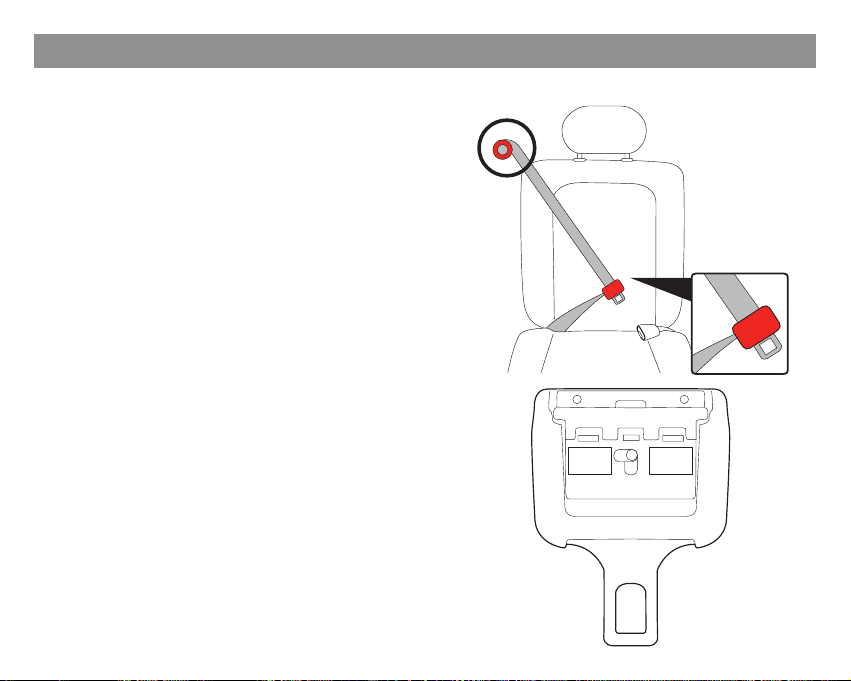
Lap/shoulder belt (3-point) with
Emergency Locking Retractor (ELR)
and with a locking latch plate. This
type of belt can be adjusted by pulling/
releasing the strap at the latch plate
adjuster. Please refer to your vehicle
owner’s manual for details.
A locking clip may be required when the
child seat is used without base (refer to
page 37).
Note: Some locking latch plates need to
have the web positioned at the correct
angle for proper locking. Make sure the
latch plate properly locks when installing
the car seat with a locking latch plate.
Note: some vehicles are equipped with
switchable latch plate that can switch
from a sliding type to a locking type. In
this specic case, make sure that the latch
plate is in a locking mode.
ELR
SLIDE LOCK
Vehicle seat belt overview
- 20 -
Vehicle seat belt overview
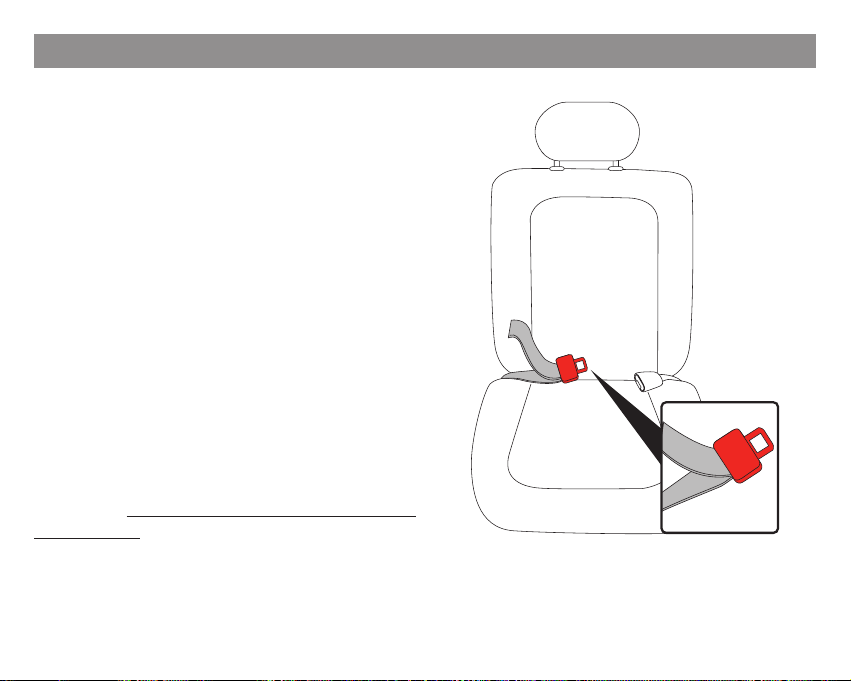
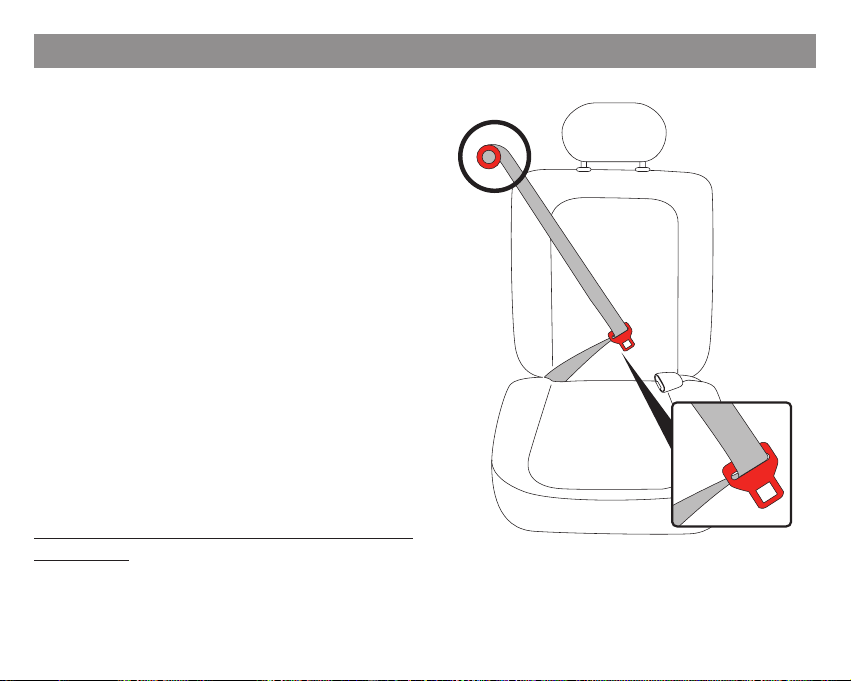
Lap/shoulder belt (3-point) with
Emergency Locking Retractor (ELR)
and free sliding latch plate. This type
of seat belt has a latch plate that moves
freely along the belt; it will only lock in an
emergency (sudden stop or crash).
For installation of Primo Viaggio 4
.
35,
leave the seatbelt in ELR mode and use
the locko clip integrated in the child
seat base.
A locking clip may be required when the
child seat is used without base (refer to
page 37).
If additional help is needed, consult with a
Child Passenger Safety Technician (CPST).
To locate a technician go to the website at
http://www.nhtsa.gov/cps/cpstting/index.cfm
ELR
- 21 -
Vehicle seat belt overview
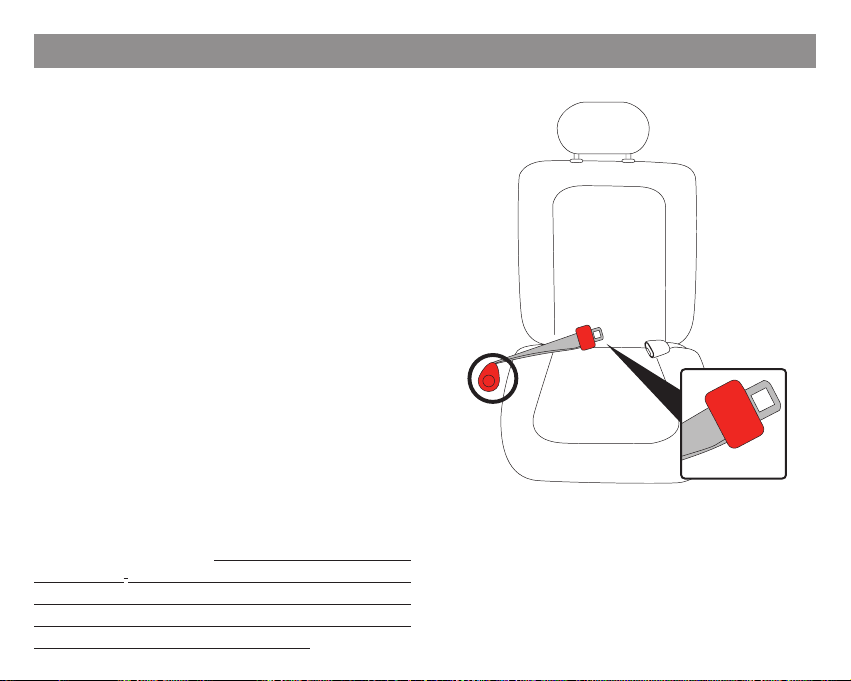
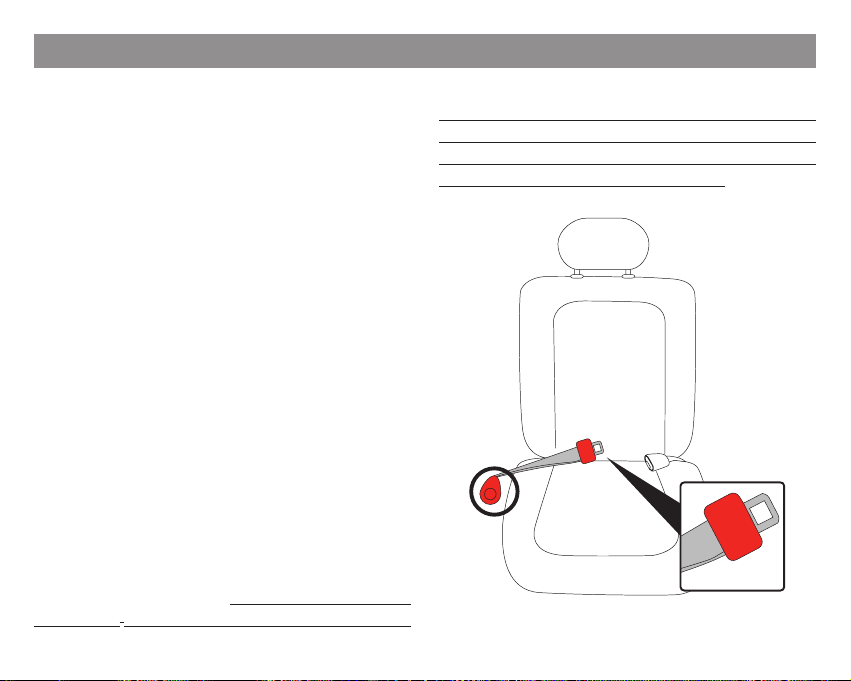
Lap belt (2-point) with a locking latch
plate. This type of belt can be adjusted by
pulling/releasing the strap tail at the latch
plate.
Some vehicles may have seatbelts with
large rigid buckles. These designs may
cause the installation to be troublesome
and aect stability of the child restraint
during normal use. Also, it may cause
slack in the belt that may result in poor
performance in case of a sudden stop or
crash.
In this situation, try another seating
position in the vehicle or consult your
vehicle owner’s manual.
Please consult a certied child passenger
safety technician for other installation
options (www.nhtsa.gov/cps/cpstting/
index.cfm).
- 22 -
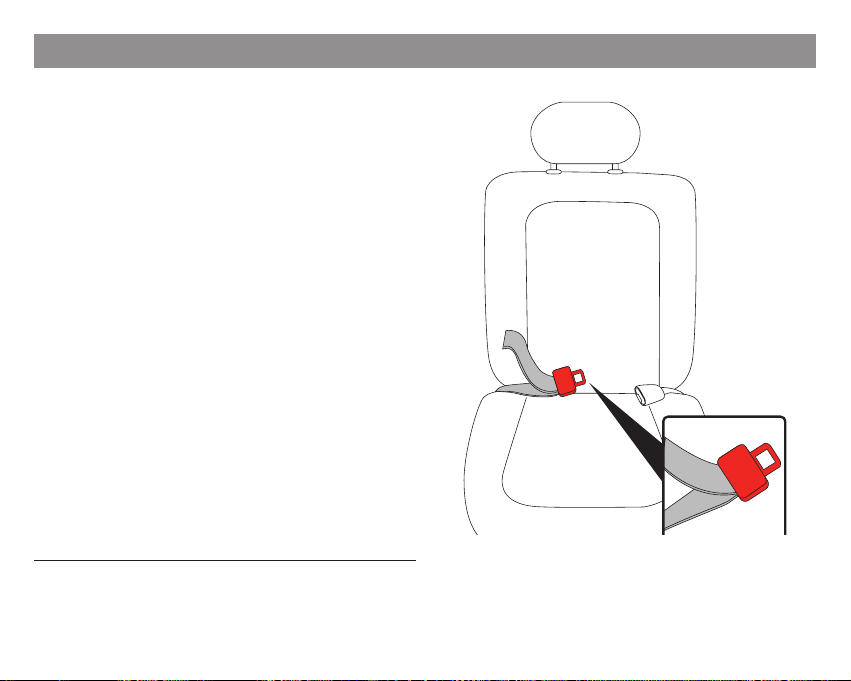
Lap belt (2-point) with Switchable
Locking Retractor (ELR --> ALR). This
type of seat belt has a latch plate that is
sewn to the end of the belt. To activate
ALR retractor for child seats installation,
some vehicle models may require to pull
the belt all the way through; some other
vehicle models may require to pull the
belt for a certain length (check vehicle
owner’s manual for details). Tighten the
belt around the seat feeding the belt
back into the retractor. The belt will not
extend unless you unbuckle the belt and
repeat the operation from the beginning.
Lap belt (2-point) with Emergency
Locking Retractor (ELR). This type of
seat belt has a latch plate sewn at the end
of the belt; it will only lock in an emergen-
cy (sudden stop or crash).
Important note:
DO NOT USE Primo
Viaggio 4
.
35 with this belt or consult a
certied child passenger safety technician
for other installation options (www.nhtsa.
gov/cps/cpstting/index.cfm).
ELR -->ALR
Vehicle seat belt overview
- 23 -
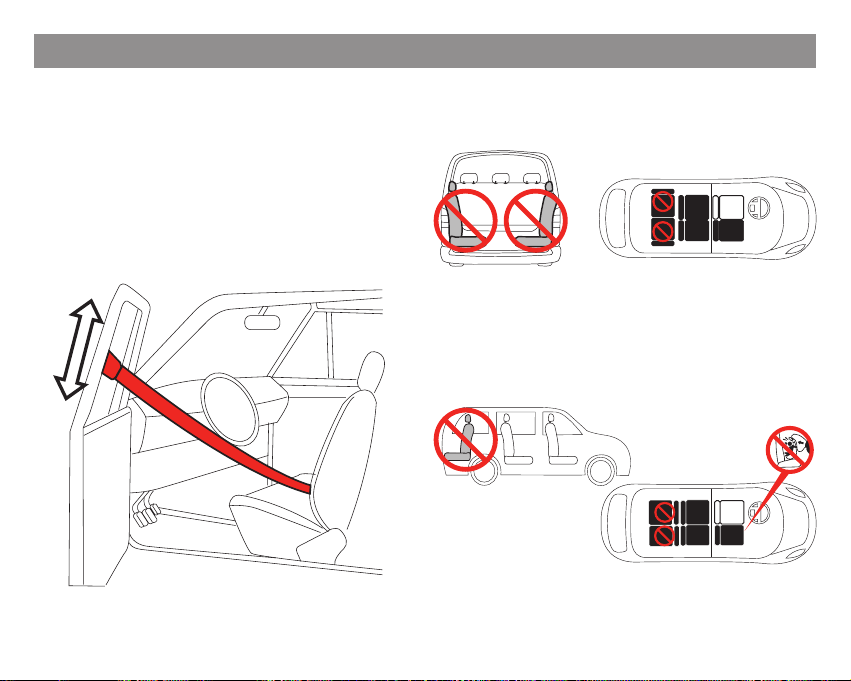
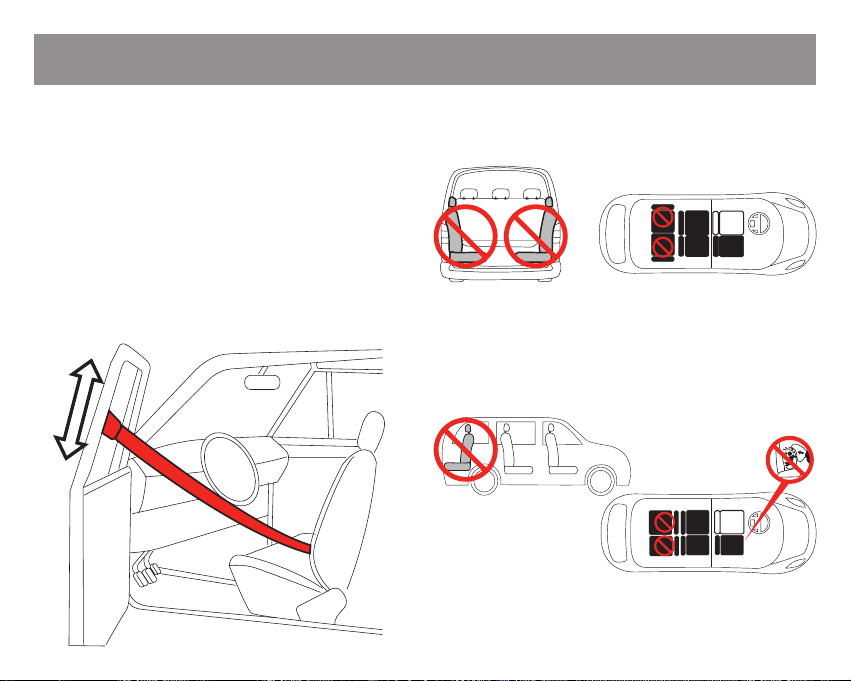
Non compatible seatbelt designs or seating positions
WARNING: do not use Primo Viaggio
4
.
35 with the following vehicle belt
design:
1. Lap/motorized shoulder belts.
Belts mounted on the door.
2. Side facing seats.
3. Rear facing seats.
4. Rotating seats unless tray can be locked
in forward facing direction.
For your child’s safety, always read your
vehicle owner’s manual for further
information.
NO
NO
NEVER INSTALL
REAR-FACING IN
FRONT OF AN
ACTIVE AIRBAG
NO
NO
- 24 -
1• USING LATCH SYSTEM.
If your car has “universal
lower anchors”, you can
install the child car seat
using the LATCH system
instructions on page 26. The anchor
is a bar located where the seat back
meets the seat bottom (slide your
hand down between the seat back
and seat bottom to locate this bar).
Important! In addition to this manual
reading, check your vehicle manual
for child restraint use, Latch System
location or vehicle belt information.
2• USING A STANDARD LAP BELT OR
LAP/SHOULDER BELT. If your car
does not have universal lower anchors,
install the child car seat using the
instructions for lap or lap/shoulder
belt on page 29.
When using Primo Viaggio 4
.
35 with its base, first install the base, and then
install the car seat on the base.
Important! Read your vehicle manual for instructions on where to best install a child
car seat in your vehicle.
There are two ways to install the base:
Installing the Base
- 25 -
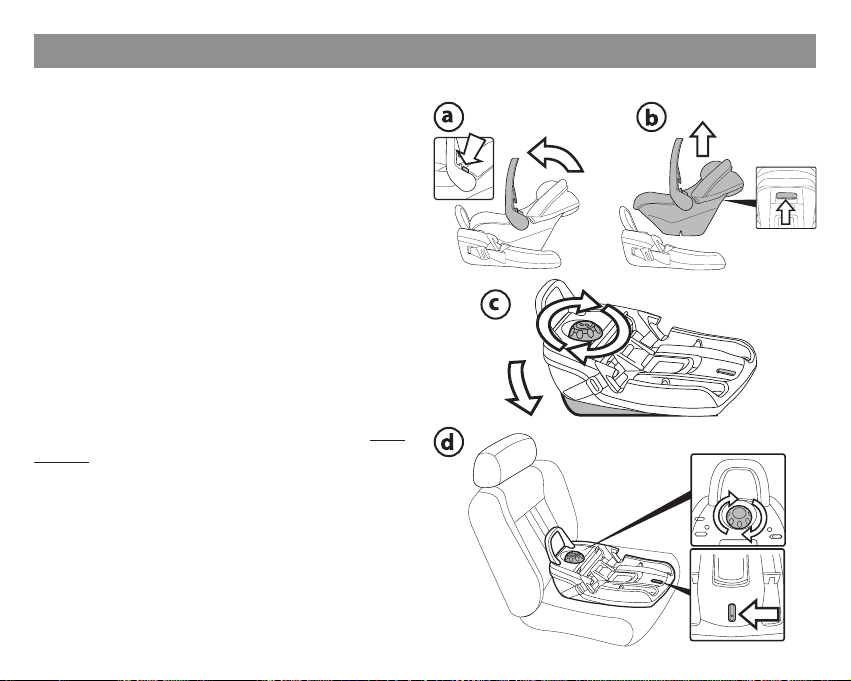
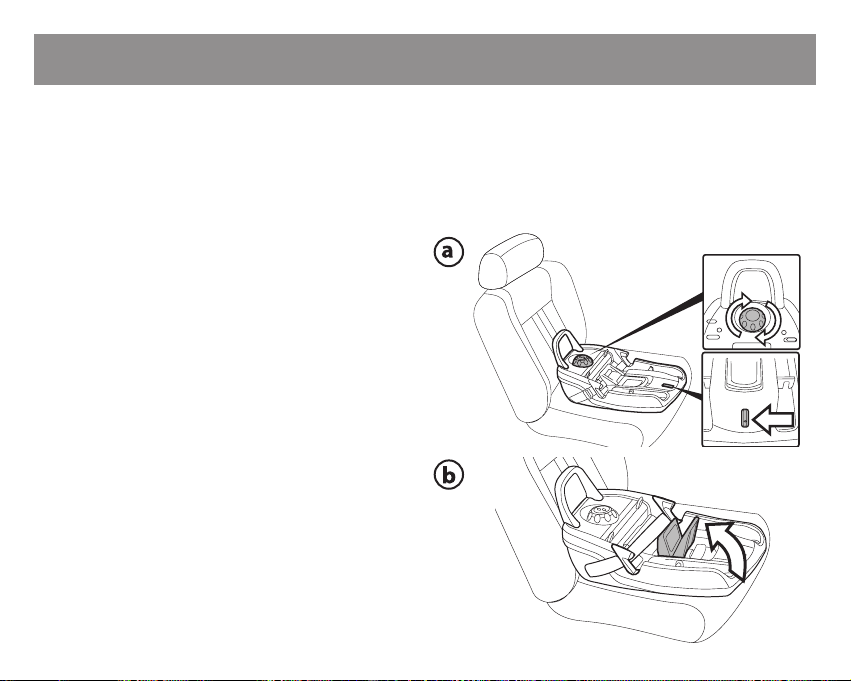
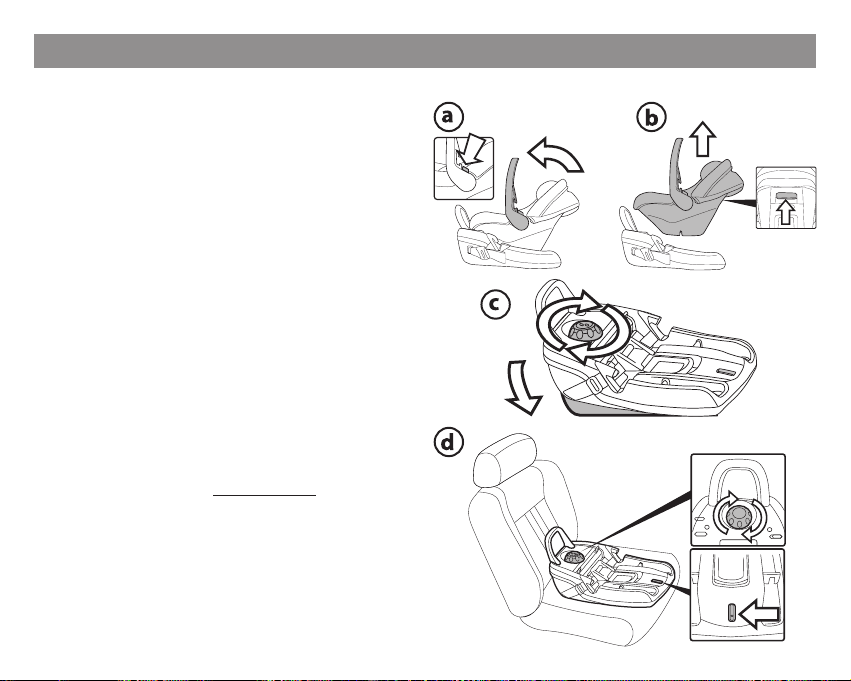
Take the car seat off the base. Rotate
the handle in the upright position by
pressing the buttons on the side of
the handle (a). Place your hand on the
top of the seat back and pull up on
the release lever with your fingers. Pull
the car seat up at the same time (b).
Note: Pulling near the center of the lever
provides the easiest release.
Turn the knob left or right to adjust the
base foot (c).
Make sure that your vehicle is parked
on level ground. Position the base rear
facing in the back seat of your vehicle.
Check the level indicator on the top surface
of the base and further rotate the knob
to make sure that you reach the proper
angle (d). Follow the visual instructions
placed on the side of the indicator in
order to set the angle corresponding to
the weight of your child.
How to level the base in the vehicle
- 26 -
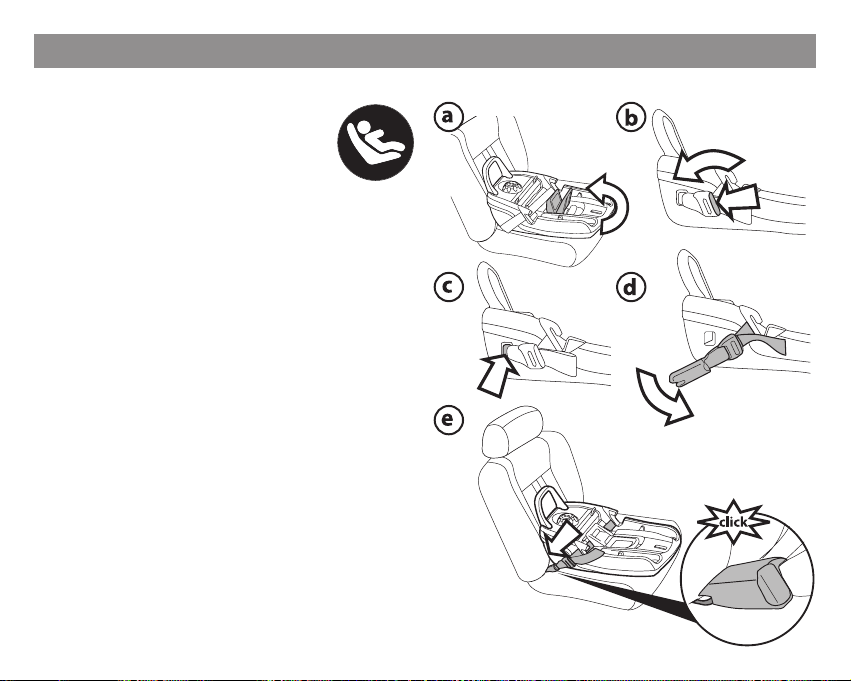
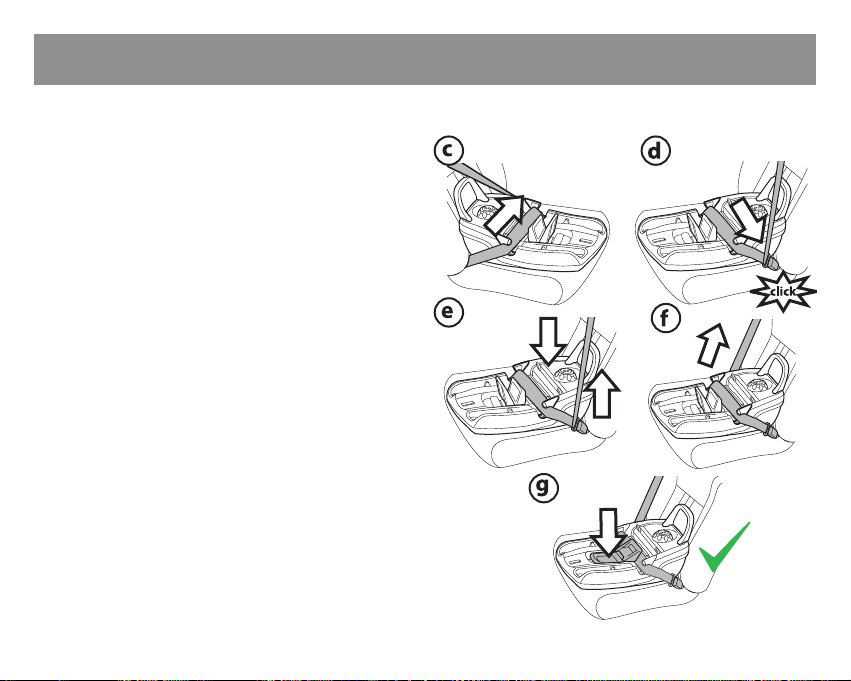
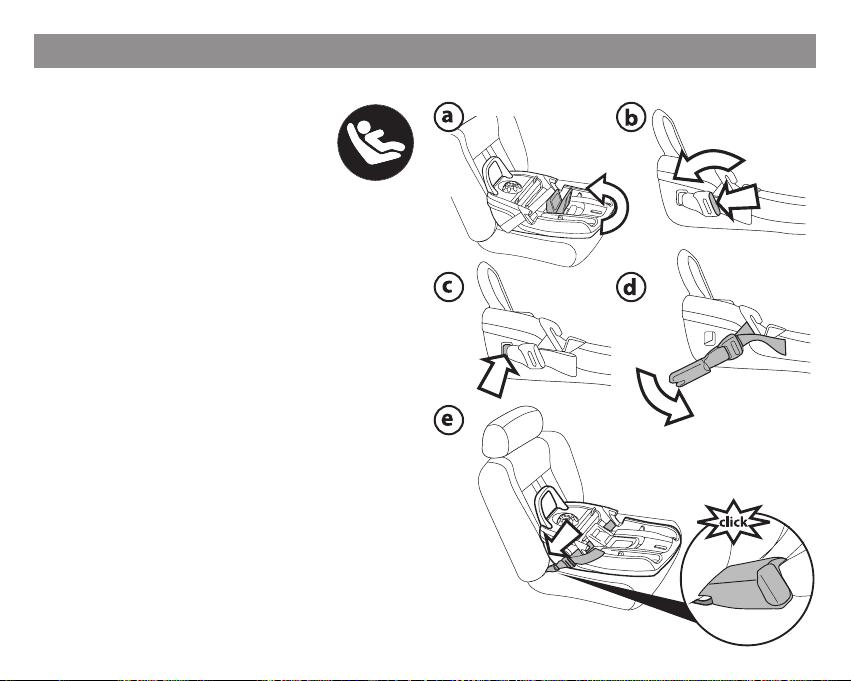
Open the lockoff clip as shown
in the picture (a). Remove the
two anchor latches from their
housings. The latches are on
the side of the base. Remove the
adjuster from its support, loosen the latch
strap by pressing on the gray button and
pulling the strap as shown (b). Press the
red button on top of the latch connector
(c) and pull it out of its housing (d). Repeat
on the other side.
Push each latch onto the anchor bar
located between your vehicle seat
backrest and cushion. Press until you hear
a click (e).
How to install the Base using the LATCH SYSTEM
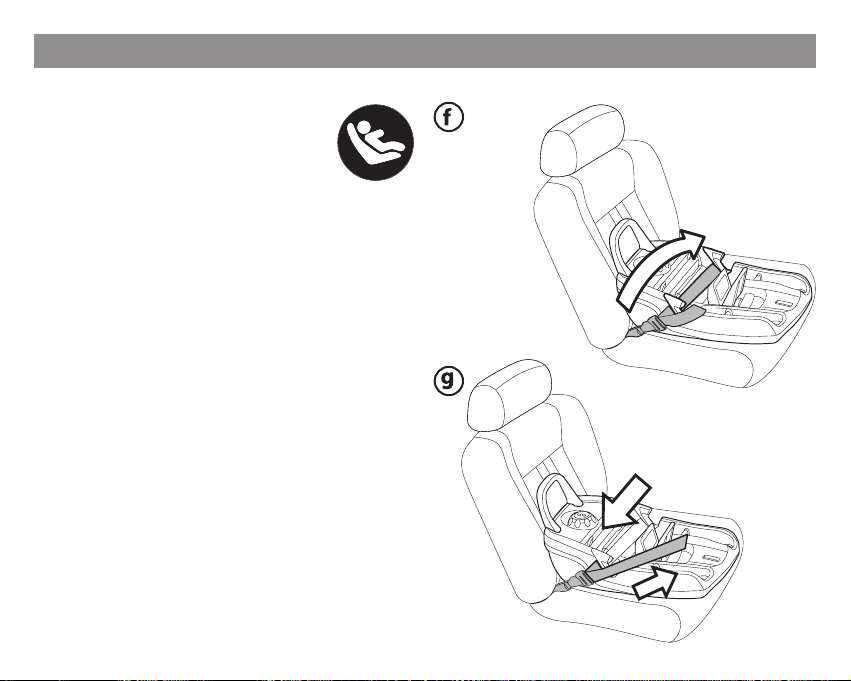
- 27 -
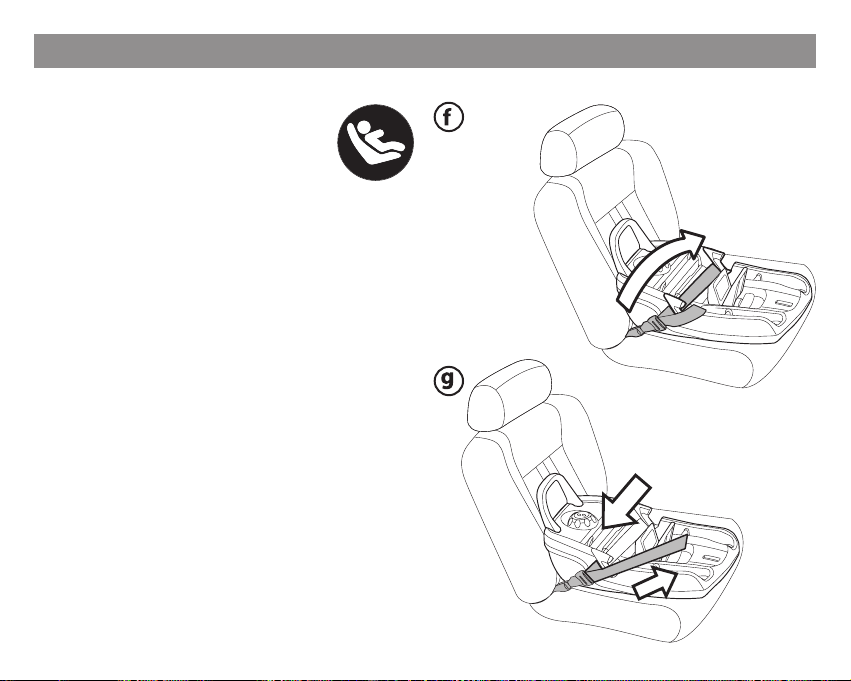
Keep the lockoff clip open and
make sure that the latch strap
is threaded flat through the
base (f ).
Tighten the base against the
seat by pulling the free end of the latch
strap; at the same time press down on
the base with your body weight and
tighten further (g). Push and pull on
the base. If you can move it more than
2,5 cm (1 inch), tighten the belt further.
How to install the Base using the LATCH SYSTEM
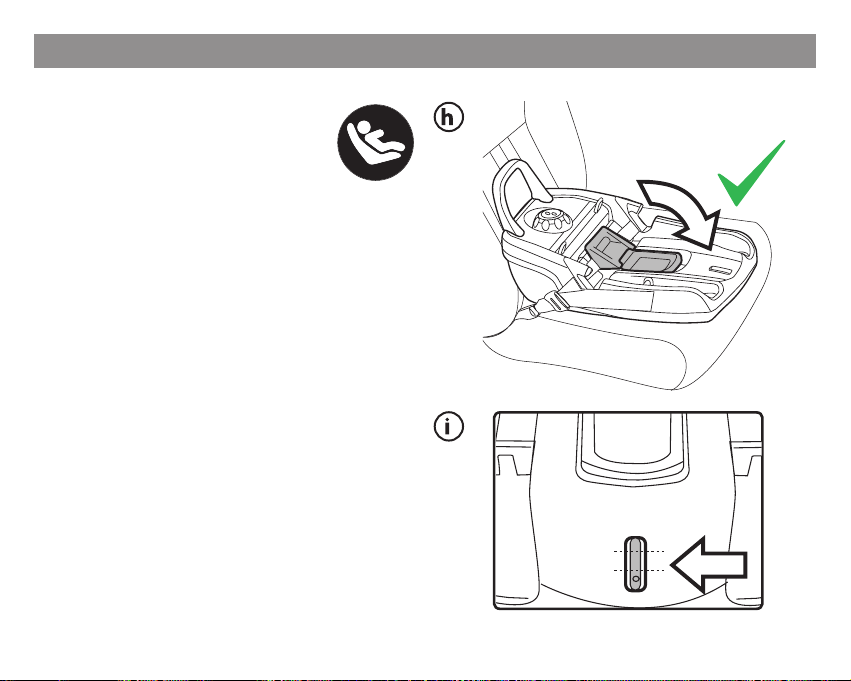
- 28 -
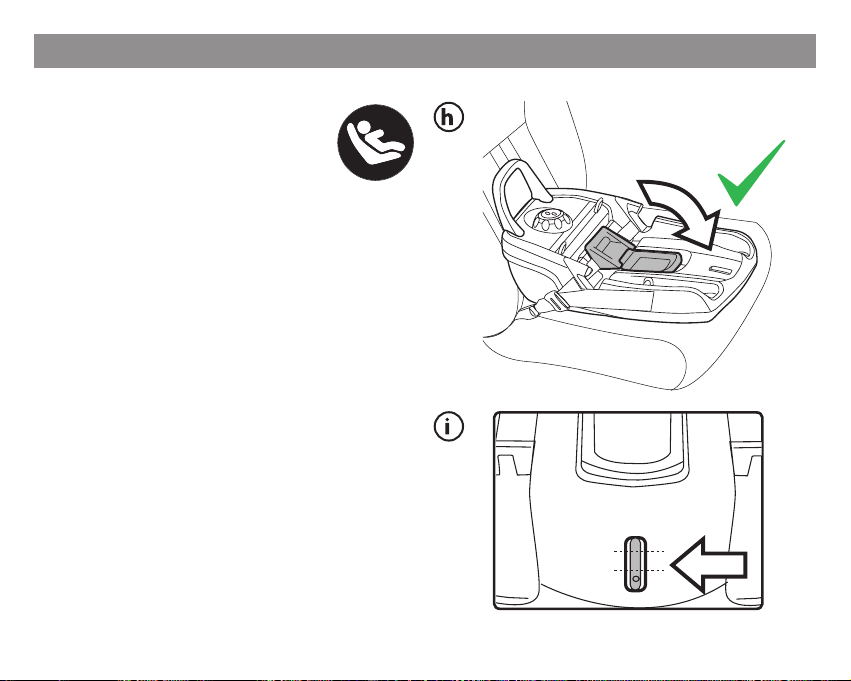
Close the Right Tight lockoff
clip by pressing the lever as
shown in the picture with an
audible click (h).
Now check the level indicator again. It is
divided in 3 areas that give the proper
backrest angle depending on the weight
of your child. Make sure that the bubble is
in the selected area (i).
Now that you have installed the base, go
to page 32.
How to install the Base using the LATCH SYSTEM
- 29 -
Important! Not all the seat belts work in the same way. To make sure that the child car
seat is properly installed using your seat belts, read your vehicle owner’s manual. It will
suggest proper installation of a child car seat.
This section refers to base installation using a common lap/shoulder belt with sliding
latch plate and ELR or SLR retractor (see sections 2.1, 2.2 and 2.3 from page 18 for
additional details).
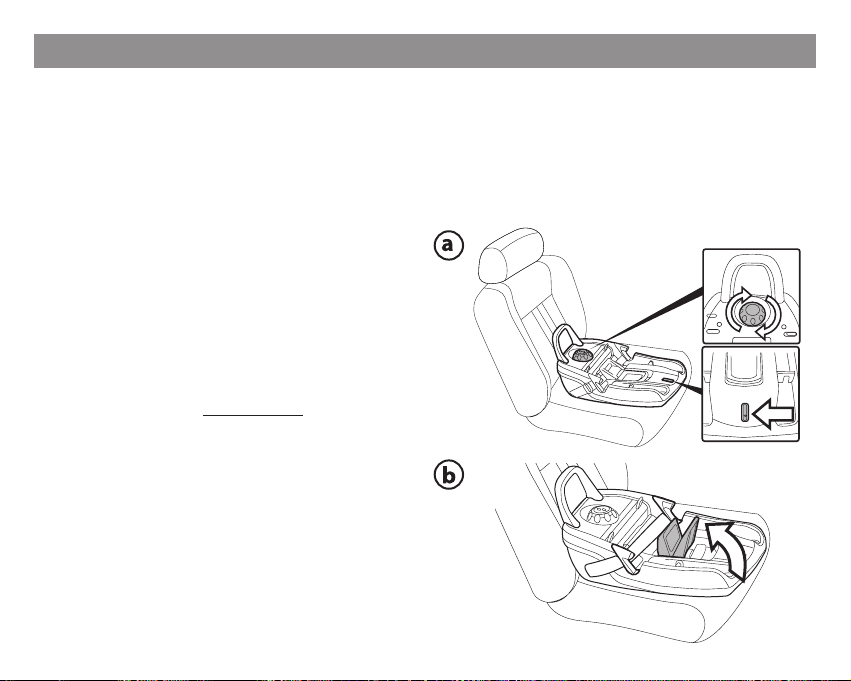
Make sure that your vehicle is parked on
level ground when you install the base.
Remove the seat from the base following
the procedure at page 25.
Position the base rear facing in the back
seat of your vehicle. Check the level
indicator and set the proper angle (a)
following the procedure at page 25.
Keep the latch connectors stored in their
housing. Open the lockoff clip as shown
in the picture (b) .
How to install the Base using your VEHICLE SEAT BELT
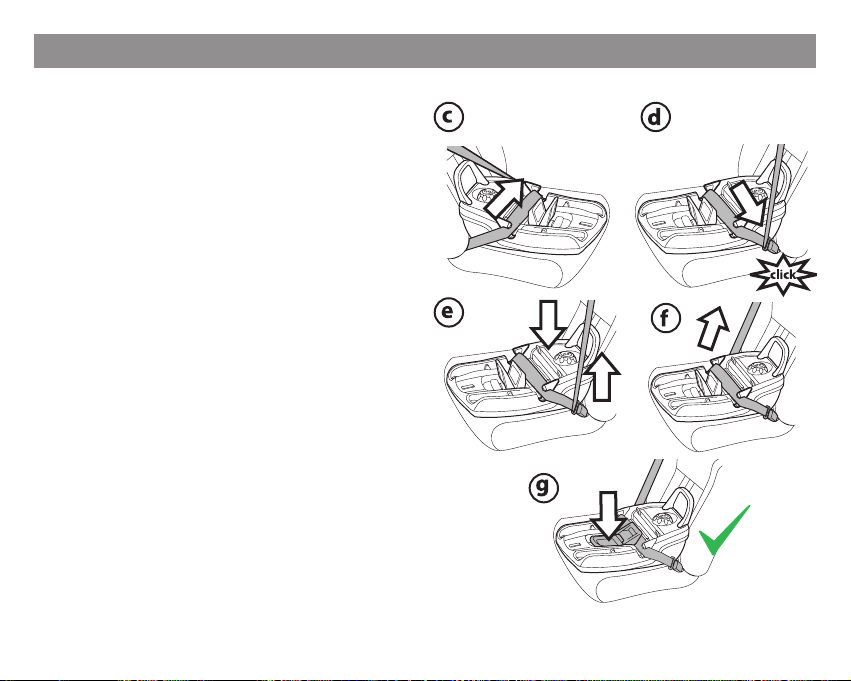
- 30 -
Thread the lap portion of the belt through
the slots on the base (c) and lock the latch
plate into the buckle as shown (d). Press
down on the base with your body weight
and pull the shoulder strap as shown (e).
Take the shoulder portion of the belt and
tread it through the openings again (f).
Close the Right Tight lockoff clip by
pressing the lever as shown in the picture
(g) with an audible click. Push and pull
on the base. If you can move the base
more than 2,5 cm (1 inch), tighten the belt
further. Check the level indicator. If the
bubble has moved outside of the desired
area, turn the knob until it is back within
the correct area. You may need to loosen
the strap slightly to do this.
Warning! If you cannot get the belt tight
enough, refer to your vehicle manual for
instructions on how to secure the base using
the type of seat belt in your vehicle. Your
baby is not safe riding in a loose car seat.
How to install the Base using your VEHICLE SEAT BELT
- 31 -
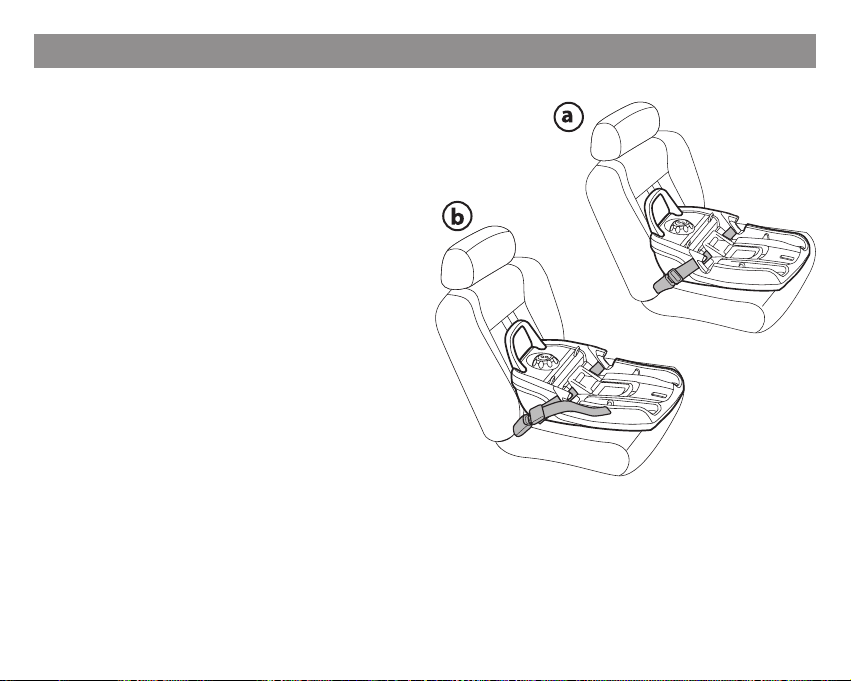
Installing the Base with different Types of Seat Belts
Different Types of Lap Belts
Lap belts with Emergency Locking
Retractors (ELR), Automatic Locking
Retractors (ALR), and Switching Locking
Retractors (SLR) look as shown (a).
Consult your vehicle owner's manual to
determine which style you have.
Lap belts with locking latch plates look as
shown (b).
Lap belt only with an Emergency Locking Retractor If you have a lap belt (without
shoulder strap) that locks only in an emergency (ELR), do not use it to secure the Primo
Viaggio 4
.
35 car seat. Please consult a certified Child Passenger Safety Technician for
other installation options.
To find a technician in your area, go to: http://www.nhtsa.dot.gov/people/injury/
childps/contacts/index.cfm, or call 1-888-327-4236.
- 32 -
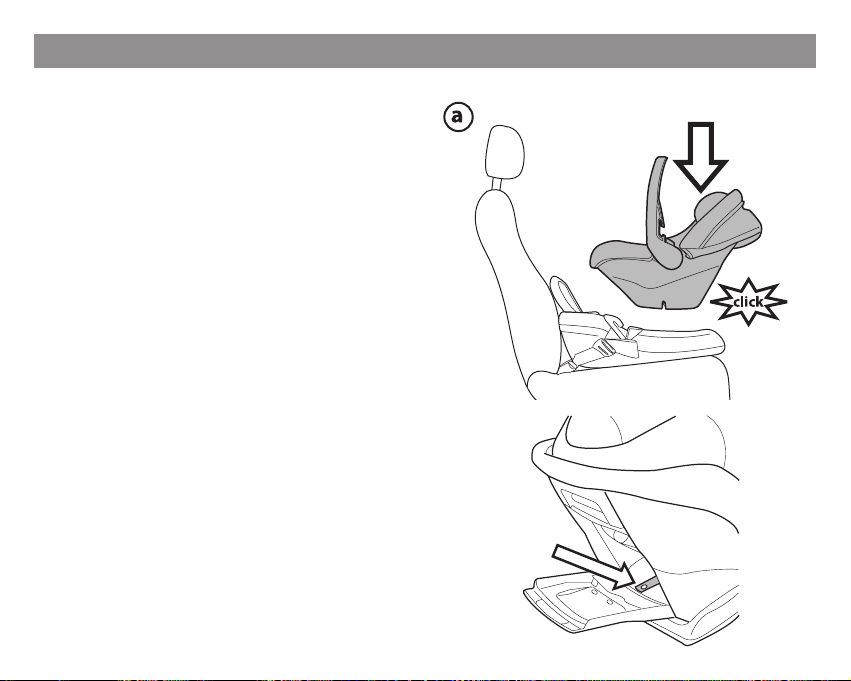
Now that you have installed the base in
your vehicle, you are ready to install the
car seat on the base.
Holding the car seat by the handle, align
it over the base and press it rear facing on
the base until you hear the click (a). You
will not be able to move the car seat if it is
properly locked in place.
Important! Newborn children should be
properly reclined. If the seat reclines too
much, your baby can be ejected from the
seat in an accident. If too upright, it can
cause breathing problems.
When levelling the base follow
instructions at page 25.
Once the seat is installed on the base,
open the rear compartment and check if
the bubble has moved from the original
position. In case re-adjust the seat until
the bubble is in the correct position.
Installing the Car Seat on the Base
- 33 -
Installing the Car Seat on the Base
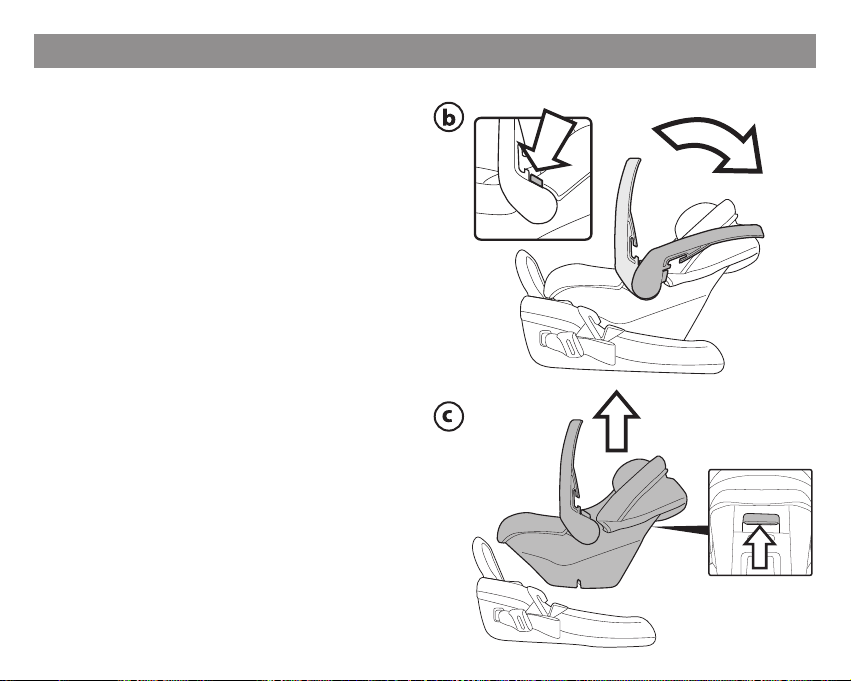
It is recommended to adjust the
handle so that it rests at the top
edge of the car seat as shown.
To rotate the handle, press the squared
buttons (located on each side of the
handle where it attaches to the seat) and
rotate it to the recommended position (b).
To remove the car seat, move the handle
to the upright position. Place your hand
on the top of the seat back and pull up
on the release lever with your fingers (c).
Note: Pulling near the center of the lever
provides the easiest release.
- 34 -
Installing the Car Seat without the Base
Important! The base is designed to avoid consumer misuse by reducing the number
of times the seat must be anchored to your vehicle. Please, use and install Primo
Viaggio 4
.
35 without the base only if needed.
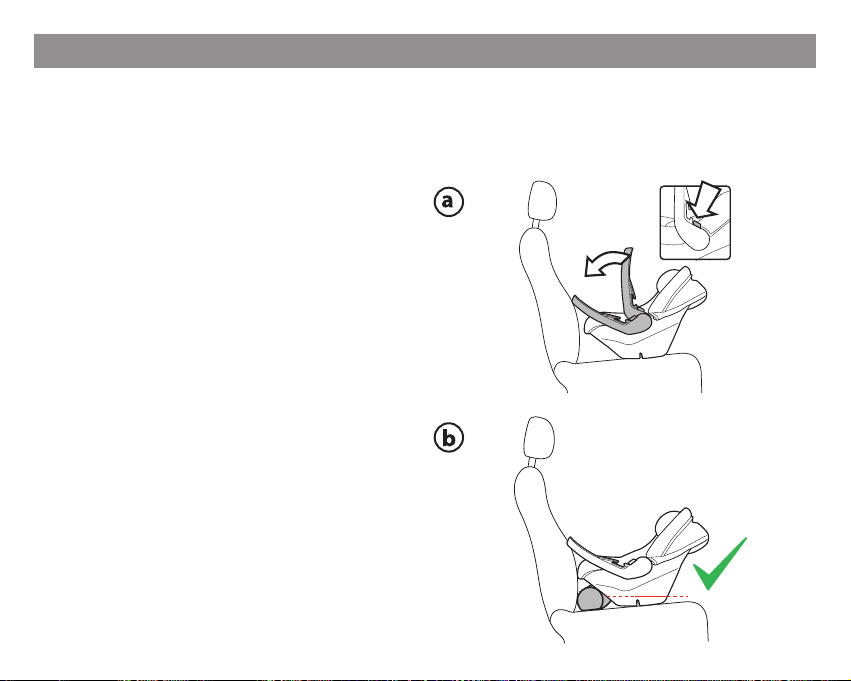
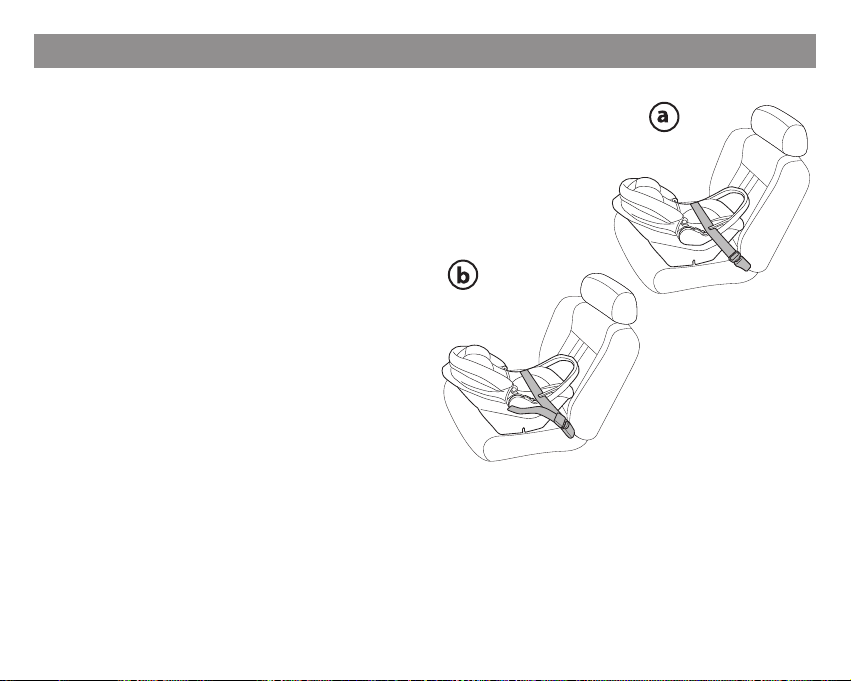
Make sure that your vehicle is parked on
level ground when you install the base.
Position the restraint on the seat, so
that your baby is facing the rear of the
vehicle. Adjust the handle in the forward
most position as shown (a). Any other
position may injure your baby in an
accident. To move the handle, press the
gray buttons on the side of the handle
at the same time and rotate the handle.
Important! The seat must be parallel to
the ground. Use the line drawn on the
product as a reference: the line must be
horizontal. If necessary, use rolled towels
or pool noodles under the seat at vehicle
seat crease (b).
- 35 -
Installing the Car Seat without the Base
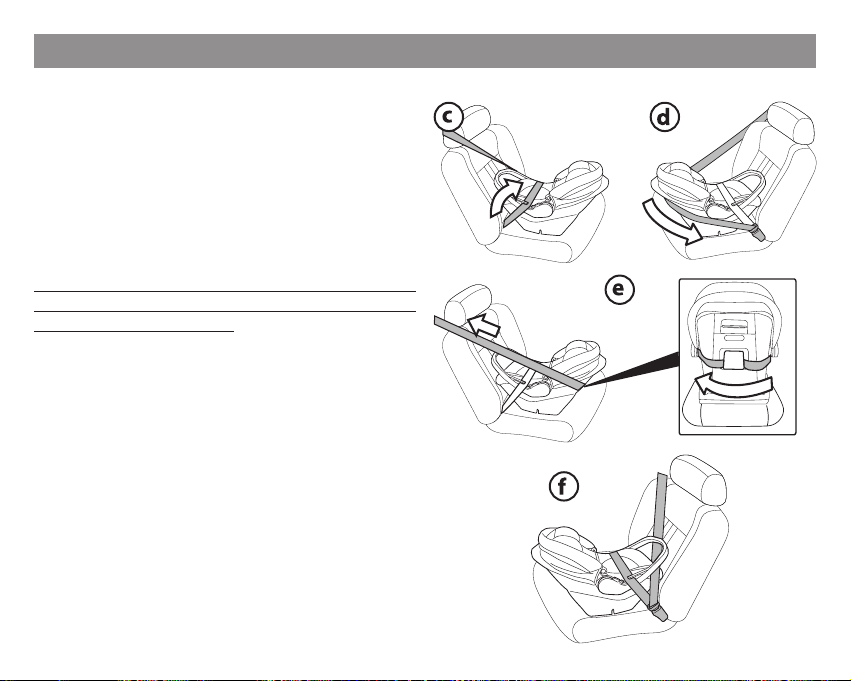
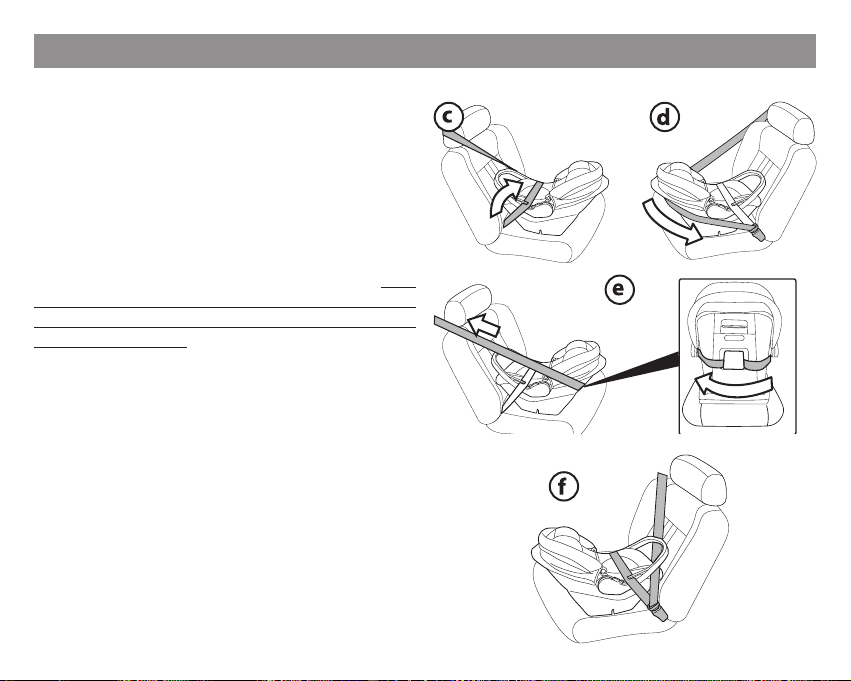
Thread the lap belt through the slots
on the handle and lock the latch
plate into the buckle as shown (c).
Pull the shoulder portion of the belt
around the back of the seat (d).
Thread the shoulder belt into the slot in
the back of the seat and pull it to tighten
the restraint againts the vehicle seat (e).
Once the seat is tight, check that the red
line on the side of the car seat is level with
the ground (page 34).
Important! If the vehicle belt is not long
enough, the restraint can be installed
treading only the lap portion of the belt in the
handle slots as show in the picture (f). If the
vehicle belt is not equipped with a locking
device, use of a locking clip is required (refer
to page 36 for additional details).
Warning!
If you cannot get the belt tight
enough, refer to your vehicle manual for
instructions on how to secure the seat using
the type of seat belt in your vehicle. Your
baby is not safe riding in a loose car seat.
- 36 -
Installing the Car Seat with different Types of Seat Belts
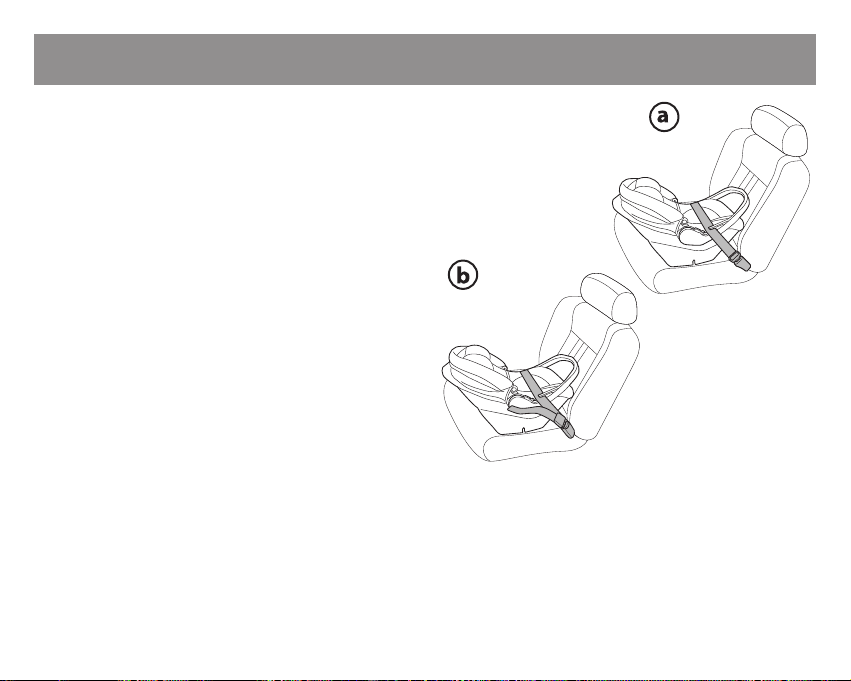
Different Types of Lap Belts
Lap belts with Emergency Locking
Retractors (ELR), Automatic Locking
Retractors (ALR), and Switching Locking
Retractors (SLR) look as shown (a).
Consult your vehicle owner's manual to
determine which style you have.
Lap belts with locking latch plates look as
shown (b).
Lap belt only with an Emergency Locking Retractor If you have a lap belt (without
shoulder strap) that locks only in an emergency (ELR), do not use it to secure the Primo
Viaggio 4
.
35 car seat. Please consult a certified Child Passenger Safety Technician for
other installation options.
To find a technician in your area, go to: http://www.nhtsa.dot.gov/people/injury/
childps/contacts/index.cfm, or call 1-888-327-4236.
- 37 -
Use of a Locking Clip
Installation of Primo Viaggio 4
.
35 without
base follows the same rules as with base
regarding the availability of different
types of vehicle seat belts.
Important! For different types of seat
belts, please refer to page 16 and on.
Primo Viaggio 4
.
35 should not be installed
on seat types shown on page 23.
Should your vehicle belt need a locking
clip, a standard one can be purchased
in specialized retailers or through Peg
Perego Customer Service.
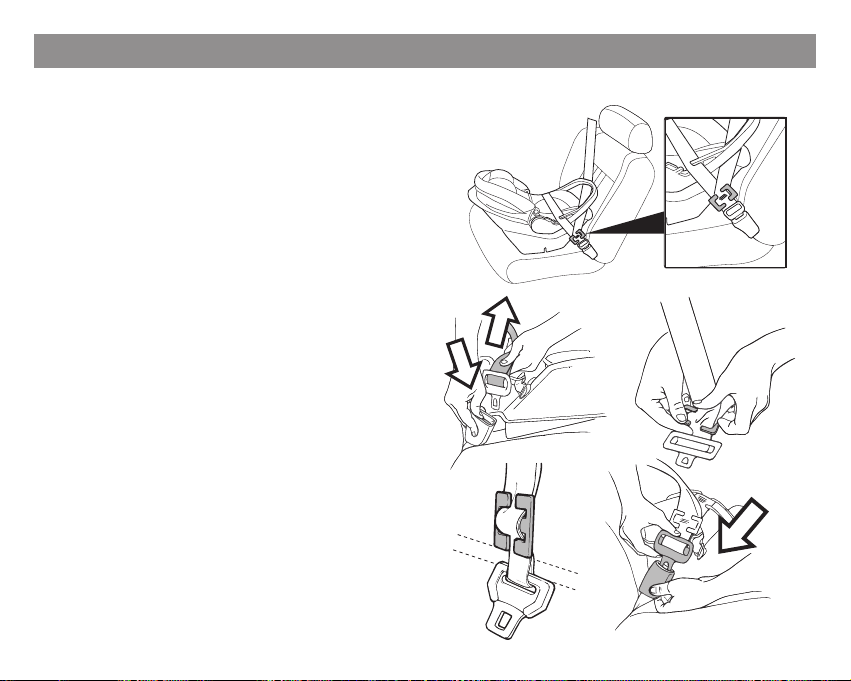
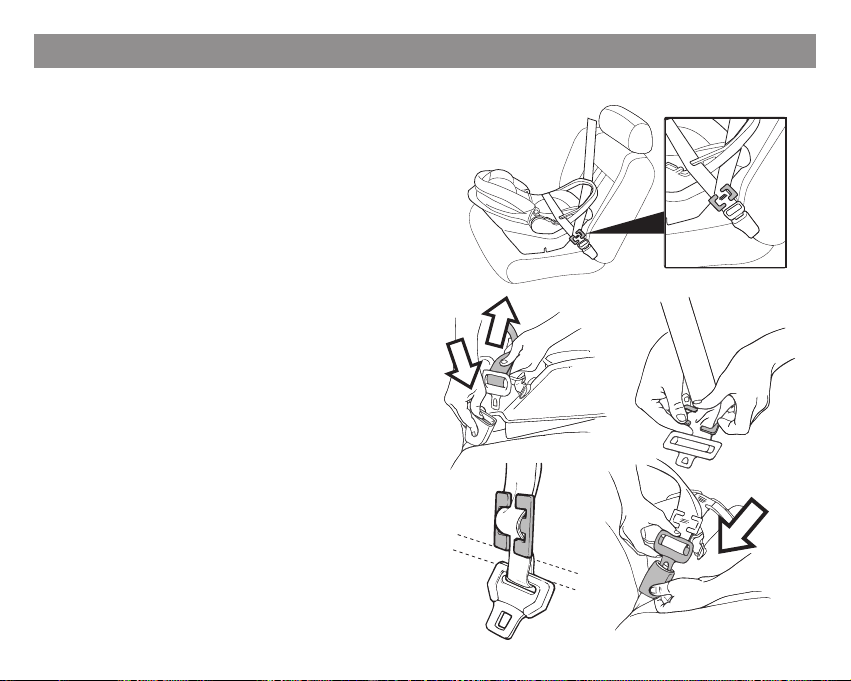
To install the locking clip, hold the
shoulder strap and lap belt together just
above the buckle. Unbuckle the belt while
holding the straps. Hook the locking clip
around both straps as shown.
Leave 1/2 inch space between the clip
and latch. Re-buckle the belt.
A
B
PUSH
13 mm
1/2 inch
- 38 -
How to buckle your baby into the Car Seat
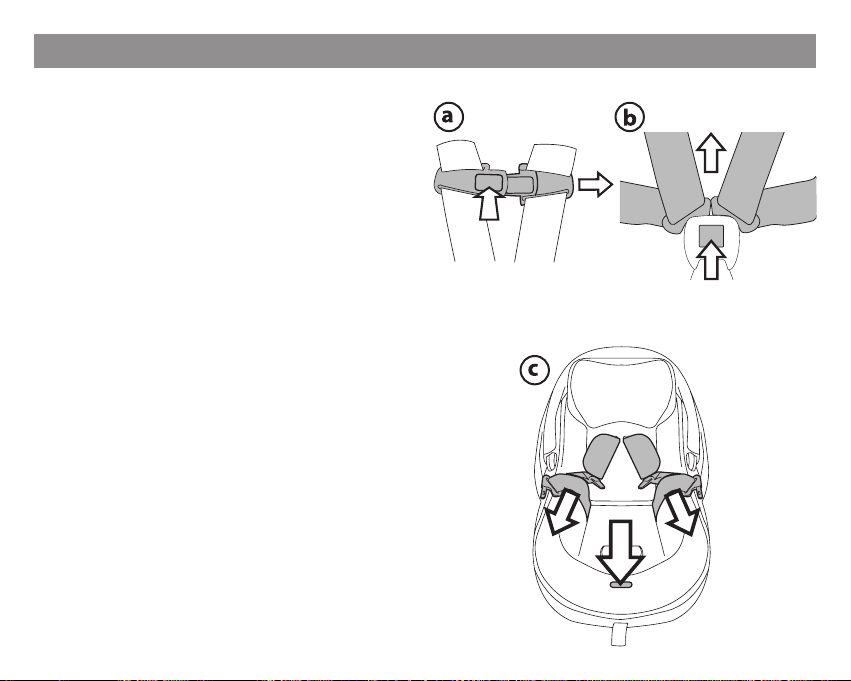
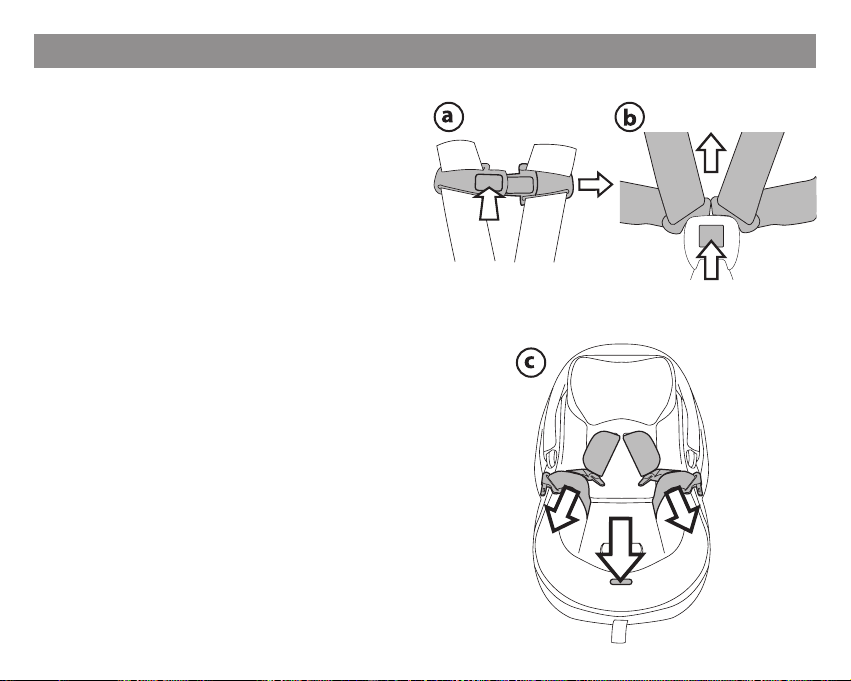
This restraint uses a 5-point harness system
to secure your baby into the car seat.
Undo the chest clip, pressing the button
on the clip and pulling apart as shown (a).
Undo the latch plates, pressing the red
button and pulling the latches up (b).
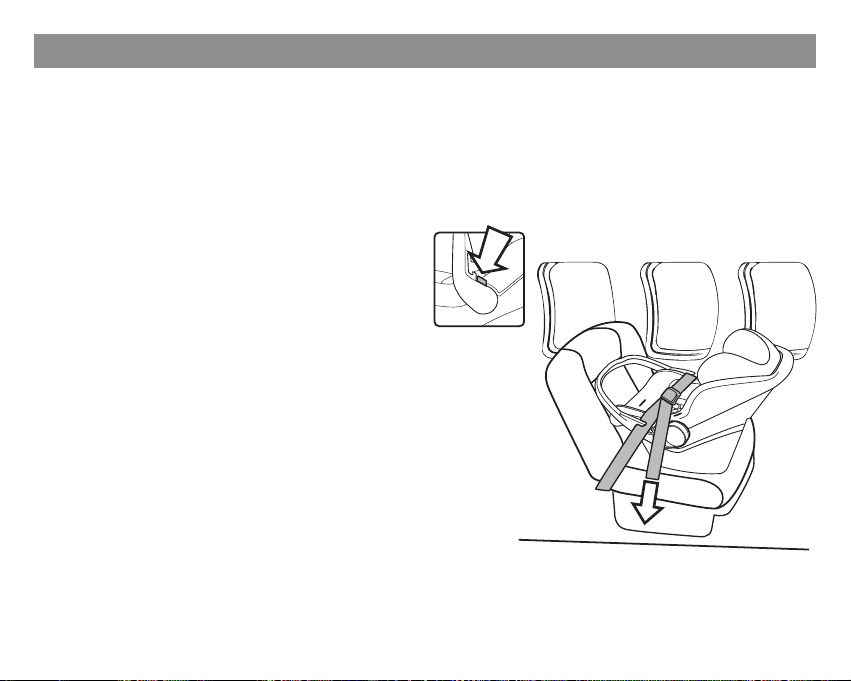
Push and hold the harness adjuster
button located in a slot at child's feet
and pull the shoulder belts out (c).
1
2
2
1
2
1
2
- 39 -
Lay the shoulder straps to the side to
make room for your baby; use the side
bands to keep the harness open as shown
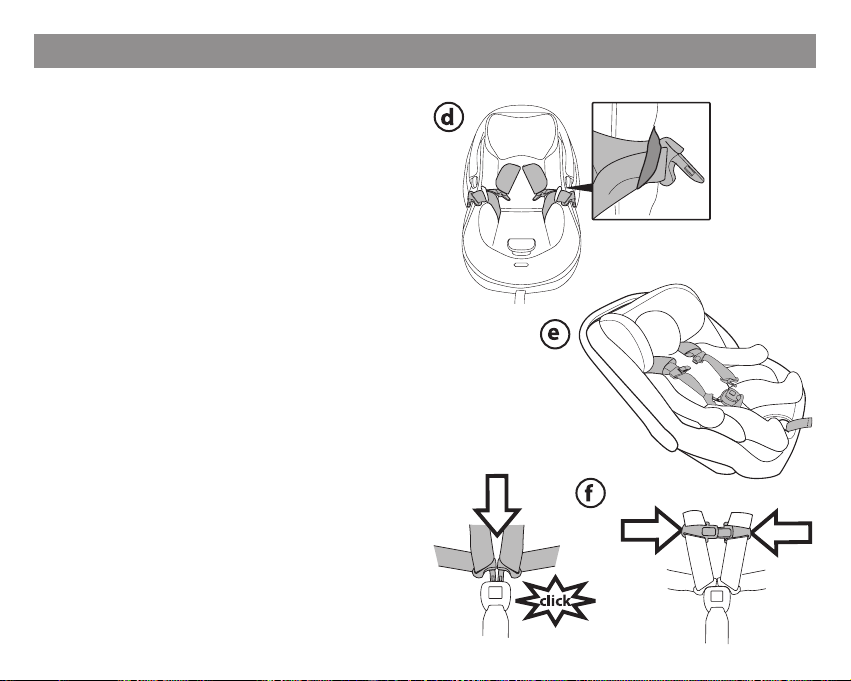
in the picture (d).
Put your baby in the car seat with the
bottom and back flat against the child
restraint. Bring the two shoulder straps
over your baby’s shoulders. Make sure
the straps are not twisted behind the
backrest or over your baby’s chest (e).
Insert both latch plates into the
buckle until you hear them click.
Latch the two chest clips together (f).
How to buckle your baby into the Car Seat
- 40 -
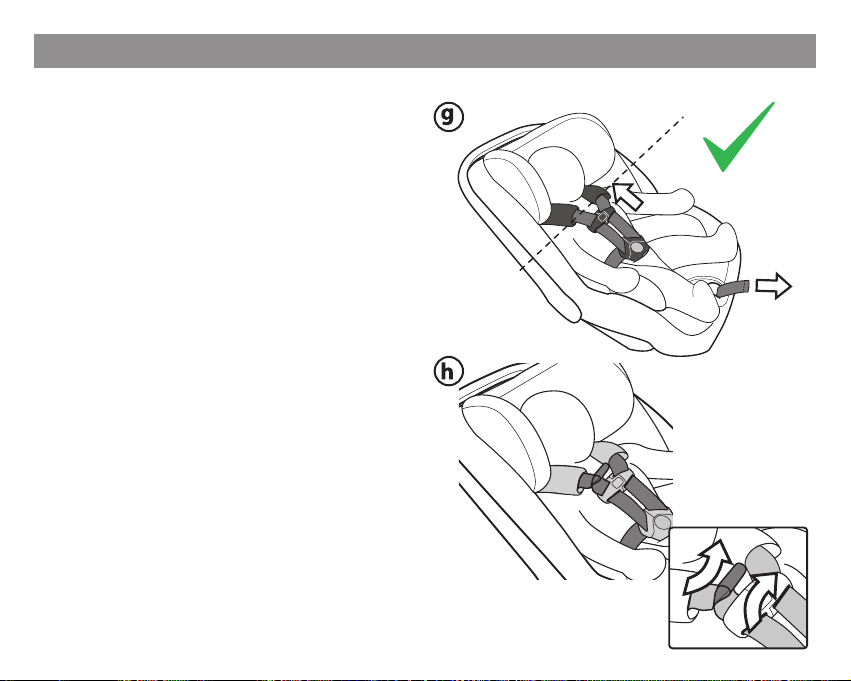
Adjust the chest clip to the arm pit level.
To tighten the harness, pull the adjuster
strap at the bottom of the seat until the
strap is snug. Tuck the loose end of the
adjuster strap under the seat padding.
Pull on straps to make sure that both
plates are latched securely (g).
IMPORTANT NOTE: You may need to
adjust the shoulder height. See how to
raise or lower the shoulder straps at page
43.
Make sure you leave one finger width
between the harness and your
baby’s collar bone or try to pinch the
webbing as shown in the picture (h).
If you can easily pinch the straps the
harness may be tightened further.
How to buckle your baby into the Car Seat
x
- 41 -
How to buckle your baby into the Car Seat
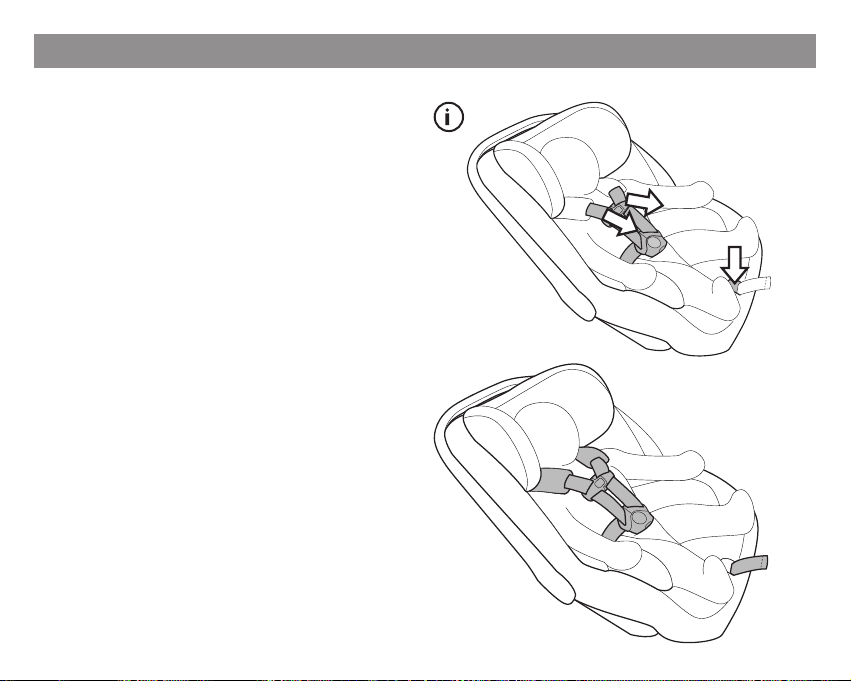
To loosen the harness, press and hold the
harness adjuster button inside the slot
located at your baby’s feet, and pull the
top harness as shown (i).
Important!
A snug strap should not allow
any slack. It lies in a relatively straight line
without sagging. It does not press on the
child’s flesh or push the child’s body into
an unnatural position.
1
2
2
- 42 -
How to buckle your baby into the Car Seat
x
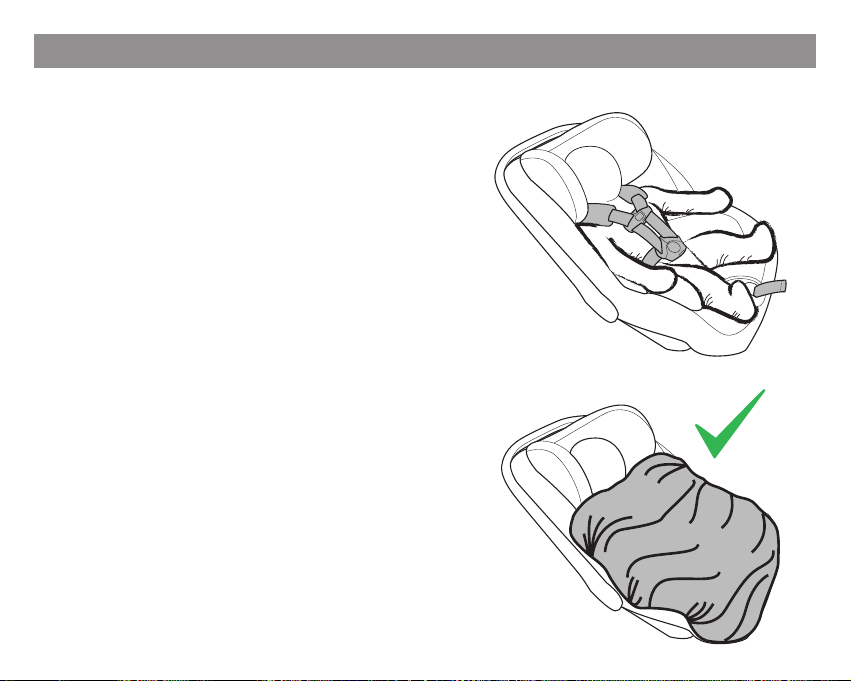
Important! In winter time do not fasten
the child in the car seat wearing bulky
clothes or placing extra blankets between
the body and the harness. This will result
in a poor belt installation that may have
severe consequences in case of a collision.
To provide extra weather protection use a
blanket over the harness or use approved
Peg Perego accessories.
- 43 -
How to raise or lower the Shoulder Straps
Primo Viaggio 4
.
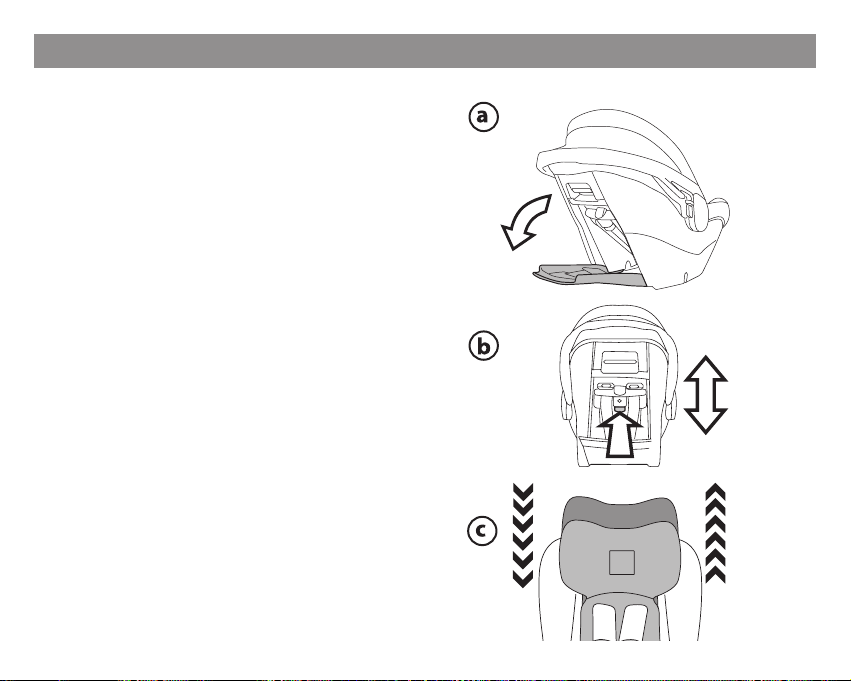
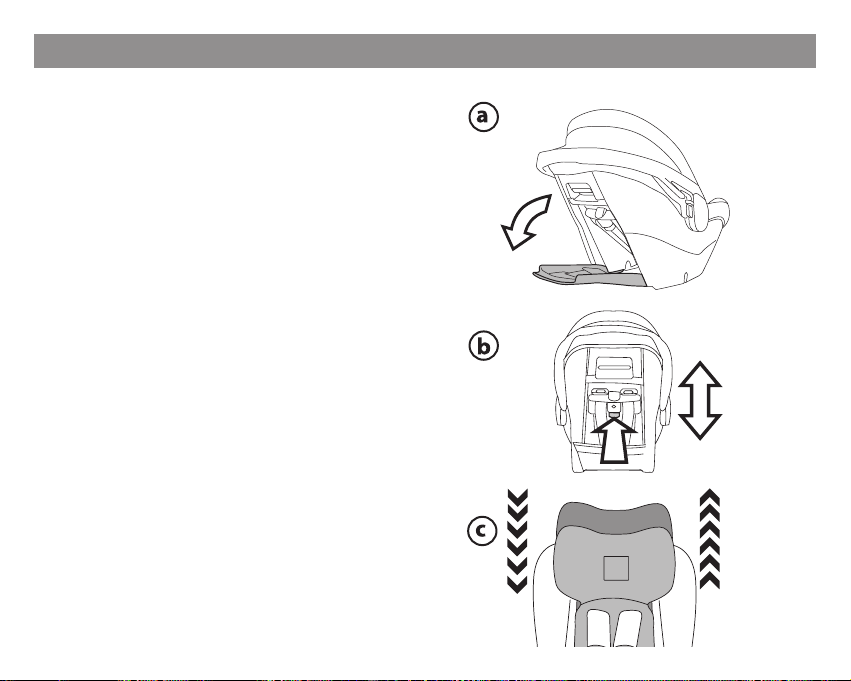
35 is fitted with a
sliding harness plate to make strap
adjustment easy and safe. Removing
the shoulder straps and threading
through slots is not required on this seat.
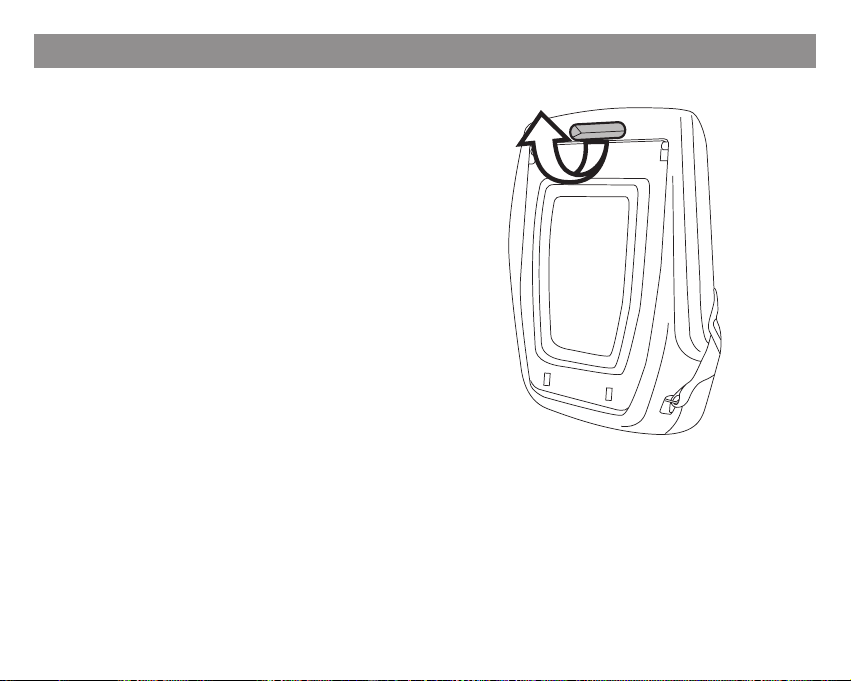
To access the harness plate open the rear
comportment door (a).
To raise or lower the harness plate, push
the button on the bottom of it and at the
same time pull or push the plate to adjust
at the desired position (b).
There are 6 positions to choose from (c).
5
6
4
3
2
1
1
2
- 44 -
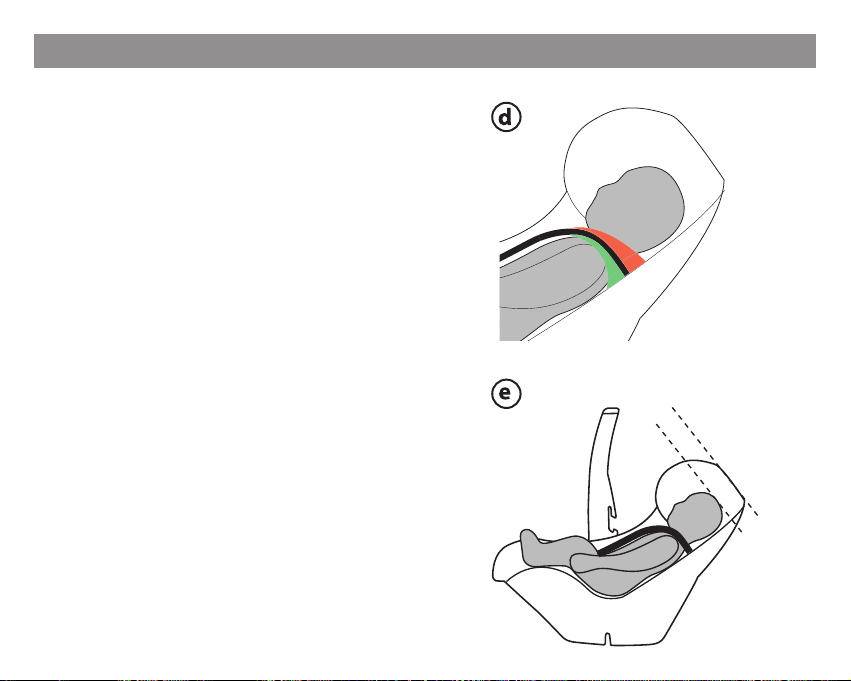
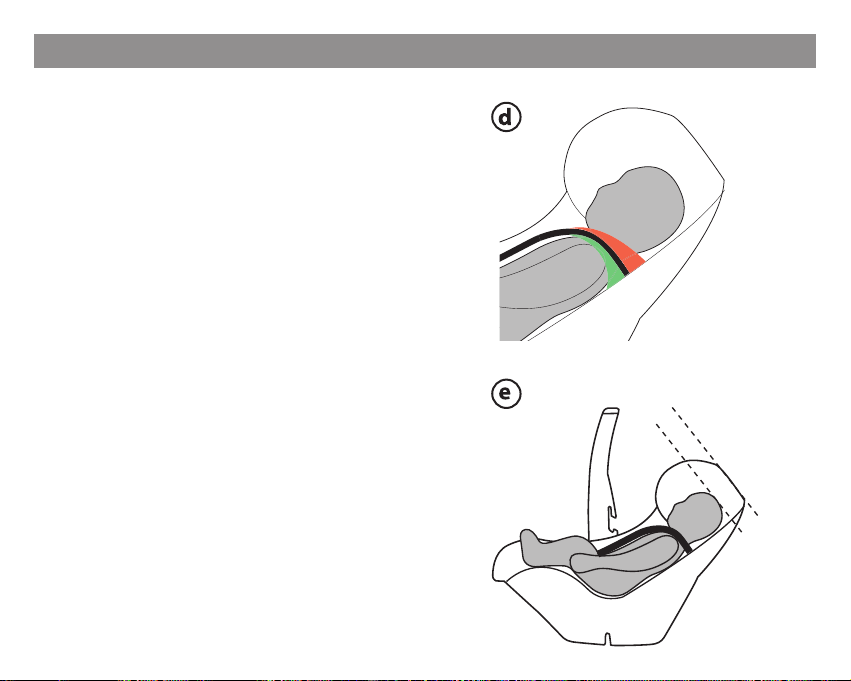
The correct height of the side protection
panel is when the shoulder strap slots
are located just below shoulder level
(green area), as shown in the picture (d).
Make sure belts are not in the red area.
Important! T
his restraint is designed for
childs up to 32 inches (81.3 cm) in length.
The top of the child head should not exceed
the top of the seat back by at least one
inch (2.5 cm) as shown in the picture (e).
With the growing child, additional
cushions can be removed (see
page 45 for additional information).
Important! Make sure that the chest
harness and all the straps are flat and not
twisted on the back or the front of the car
seat.
1 inch mi
n
How to raise or lower the Shoulder Straps
- 45 -
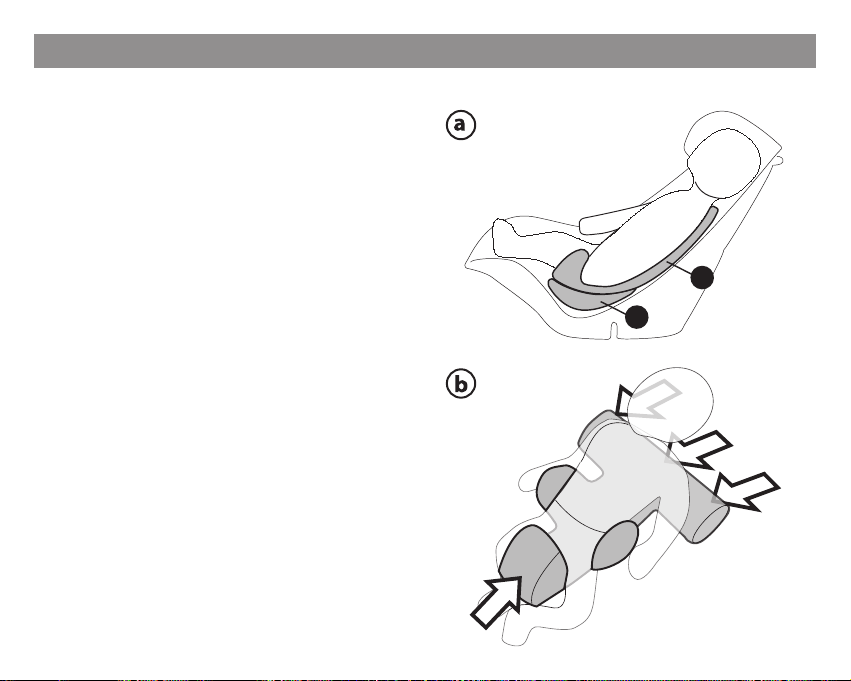
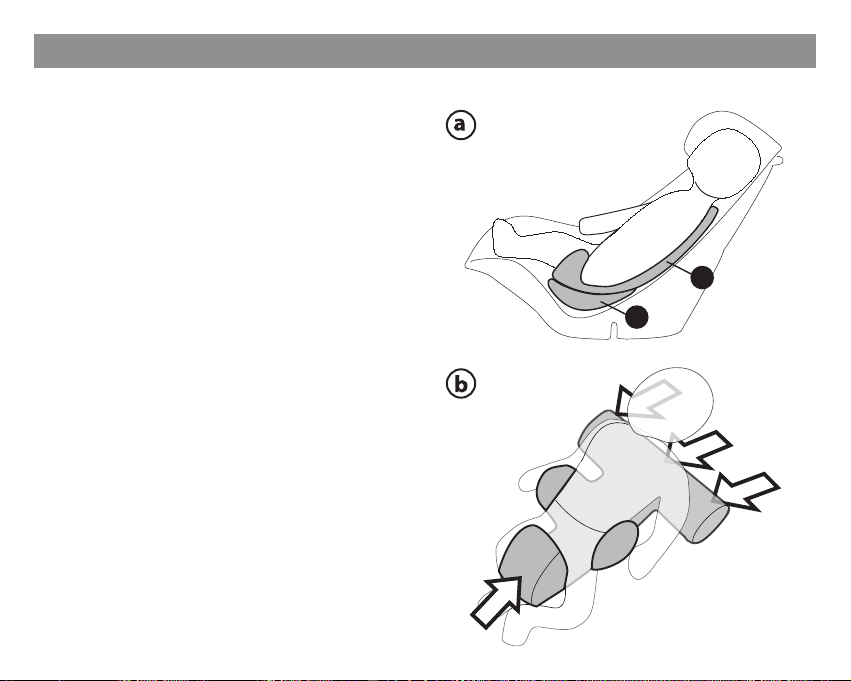
Dual Cushion System
Primo Viaggio 4
.
35 is equipped with a
dual stage cushion system consisting of a
first stage (1) and a second stage cushion
(2).
If your baby is very tiny, cushion 1 can
be used in conjunction with cushion 2 as
shown (a).
The first stage cushion provides extra back
support, allowing the head of your child
to stay flat properly, avoiding breathing
difficulty.
Additionally, the cushion extra padding
in the crotch area makes sure that your
child does not slip down and his head is
fully supported between the side impact
protection wings (b).
Important! The first stage cushion may
be used from birth up to about 8 pounds
or when the torso of your baby fully
occupies the space between the crotch
strap and the shoulder slots.
To remove the cushion, refer to page 51.
1
2
- 46 -
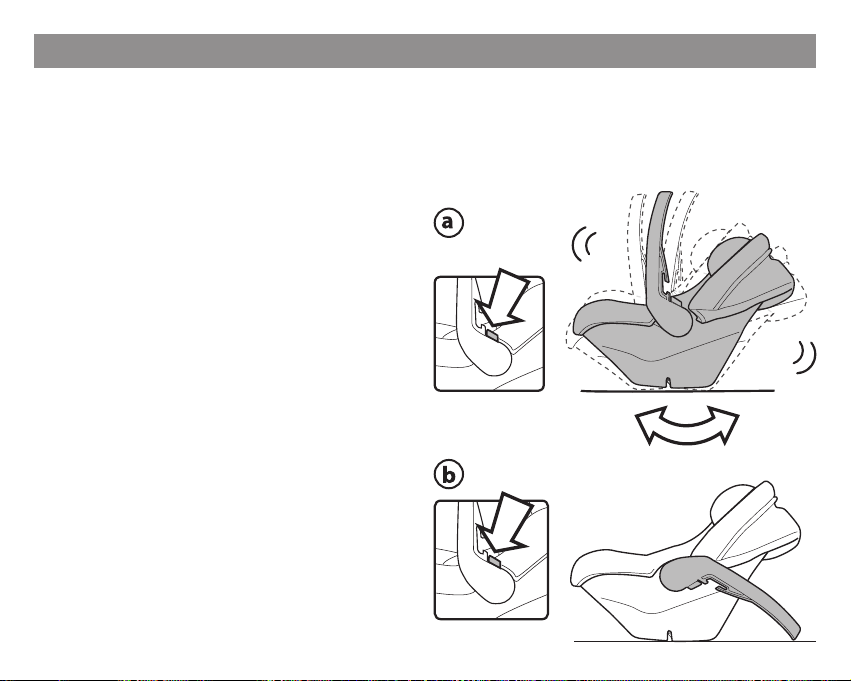
Using the Car Seat outside the Vehicle
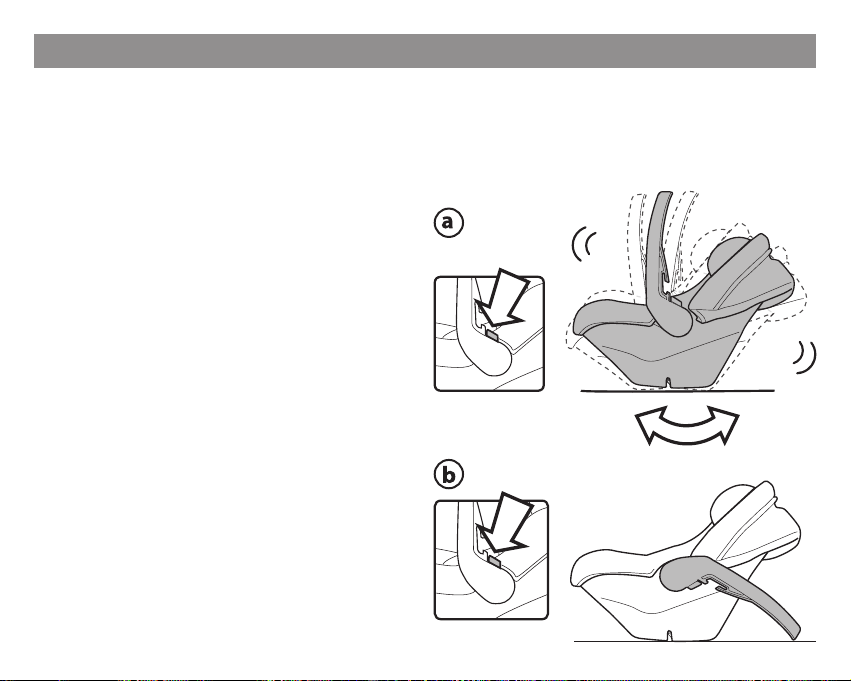
This unit can be used as an infant carrier.
The special shell shape is designed for
rocking your baby.
To rock your baby, move the handle
into the up position as shown (a).
To prevent rocking, lock the handle
behind the backrest (b).
- 47 -
Using the Car Seat outside the Vehicle
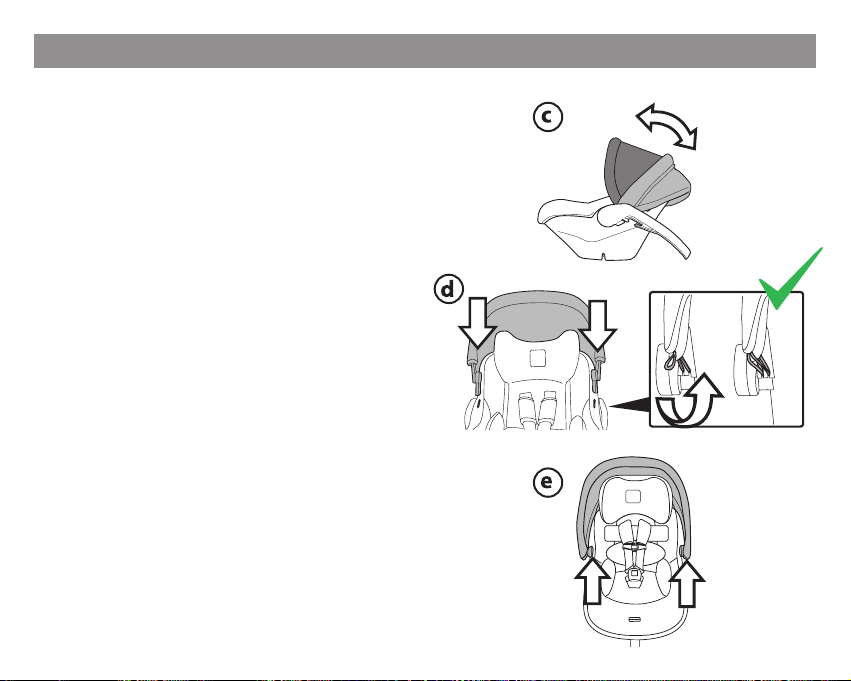
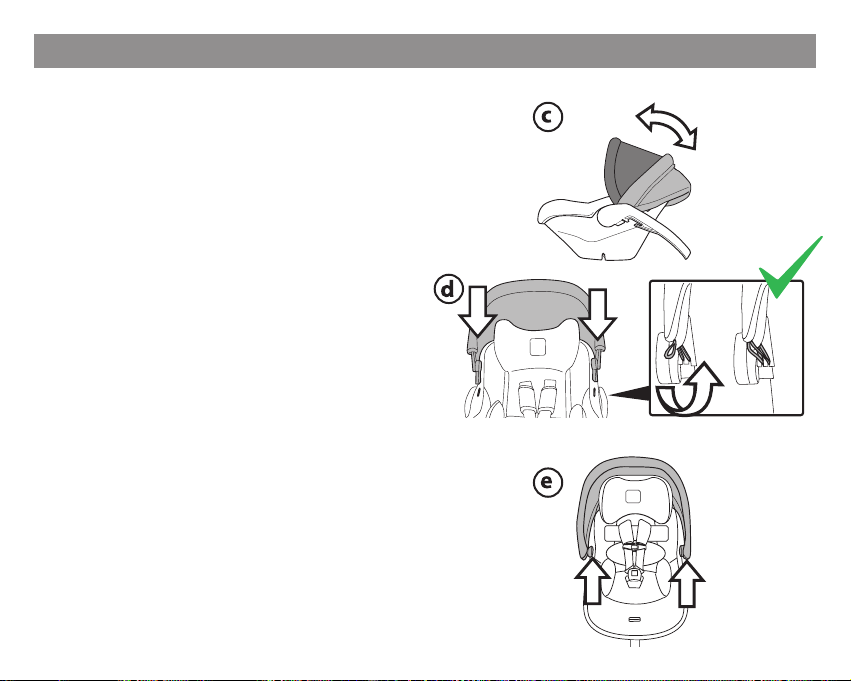
The hood provides shade for your baby (c).
To attach the hood, push the hood latches
into the slots on the seat shell as shown
(d). Secure the elastic fasteners to the
shell as shown in the picture. To open the
hood, pull the frame until it clicks open.
To remove the hood, remove the fasteners
from the seat shell and pull the side latches
as shown in the picture (e).
Warning! The hood must not be used
to lift the safety seat because it might
detach.
- 48 -
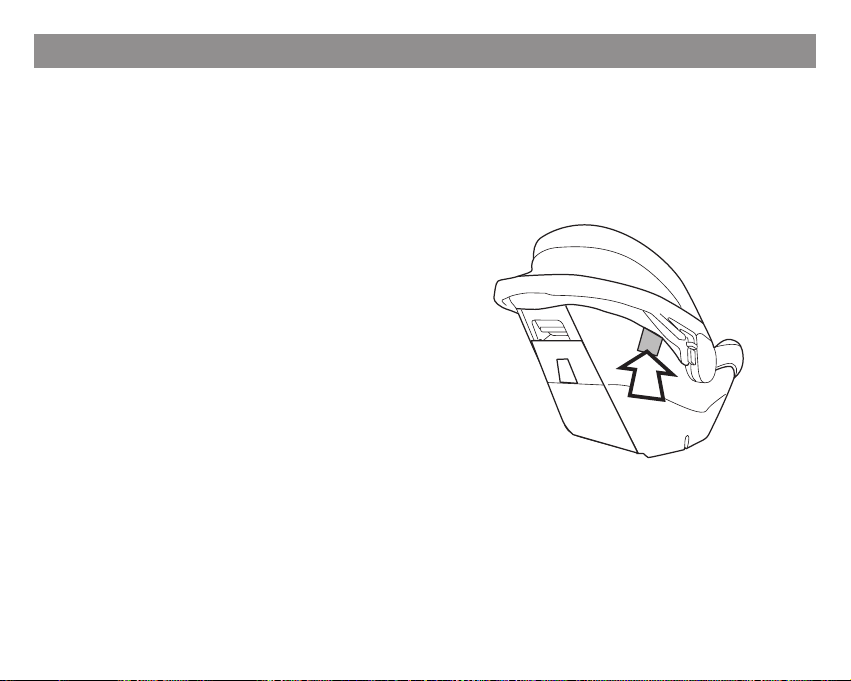
Carrying handle for the base.
Warning!
Do not lift with the seat
attached to the base.
Warning!
Do not use as a means of
transporting a child.
Using the Car Seat outside the Vehicle
- 49 -
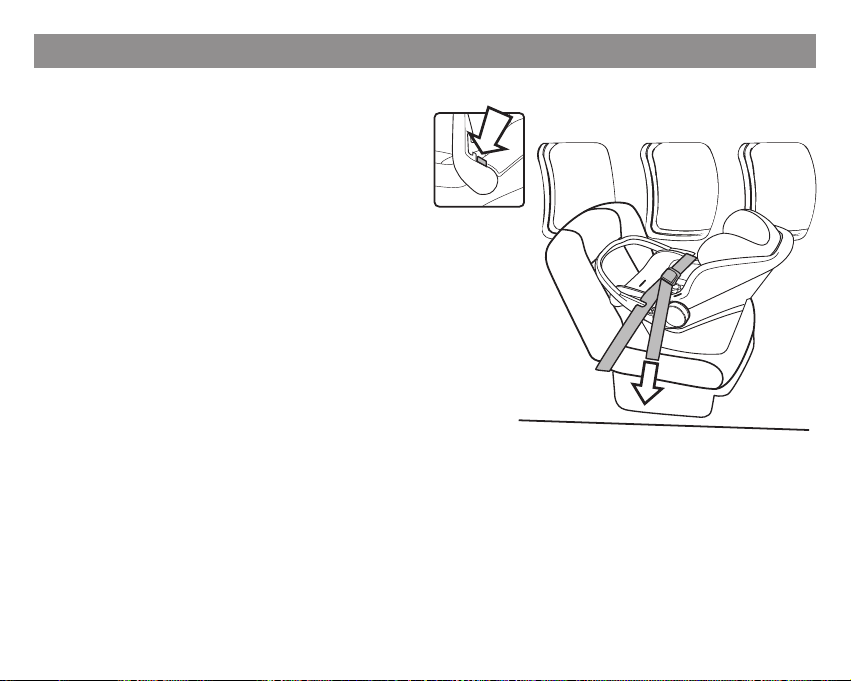
This unit is certified for aircraft use.
Position the restraint on the seat, adjust
the handle in the forward most position
as shown. Any other position may injure
your baby in an accident. To move the
handle, press the gray buttons on the
sides of the handle at the same time and
push the handle.
Adjust the restraint on the seat. Check the
red line to see that the base is level with
the ground. Thread the lap belt through
the slots on the handle seat and lock the
latch plate into the buckle.
Pull the strap to tighten the seat belt. Press
down on the seat with your body weight
and pull the strap tighter. Once the seat is
tight, check that the red line on the side of
the car seat is level with the ground.
Important! Use only on forward facing
seats. If the restraint can not be properly
secured ask for flight attendant help.
Important! Do not use the base to install
the restraint on an aircraft.
How to Use the Car Seat on Aircraft
- 50 -
Cleaning and Maintenance
This unit needs minimal maintenance.
Keep all moving parts clean.
Clean the plastic parts often with a
damp cloth. Do not use solvents or harsh
products.
Brush the fabric parts to remove dust.
Protect the product against snow, water,
and rain. Constant exposure to sunlight
can change the colors in the material.
Sun can also make the seat very hot. Be
sure it is cool before putting your baby in
the seat.
Warning! Excessive exposure to the sun
for long periods of time can make the
plastic brittle.
Store product in a dry area.
Warning!
Do not use or purchase
this restraint 7 (seven) years after the
production date labelled on the seat or
shell.
MAINTENANCE OF THE PADDING
Brush the fabric parts to remove dust.
To wash this upholstery, follow the
instructions written on the product label
(see below).
Do not use chlorine bleach.
Do not iron.
Do not dry clean.
Do not remove stains with solvents.
Do not tumble dry.
- 51 -
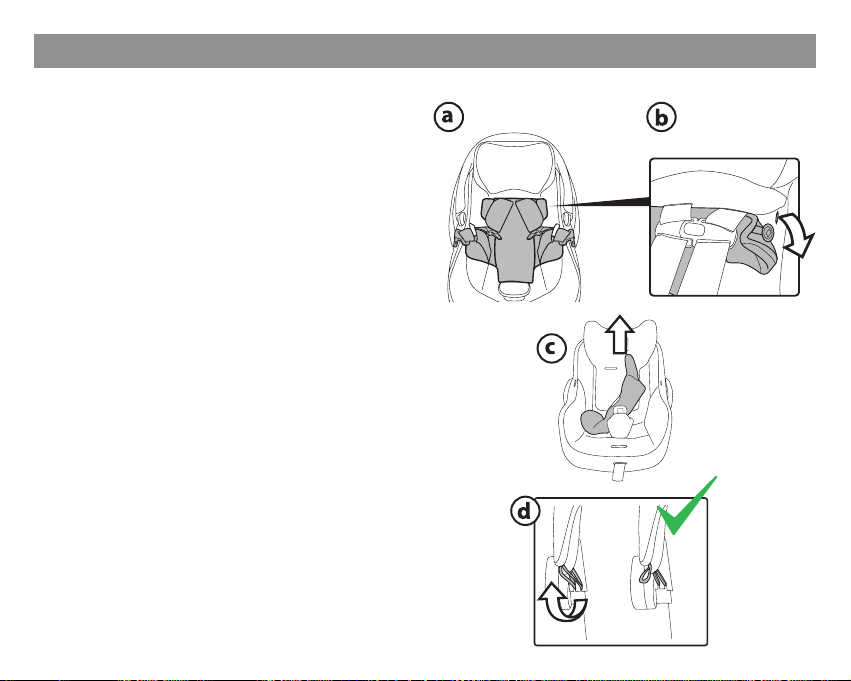
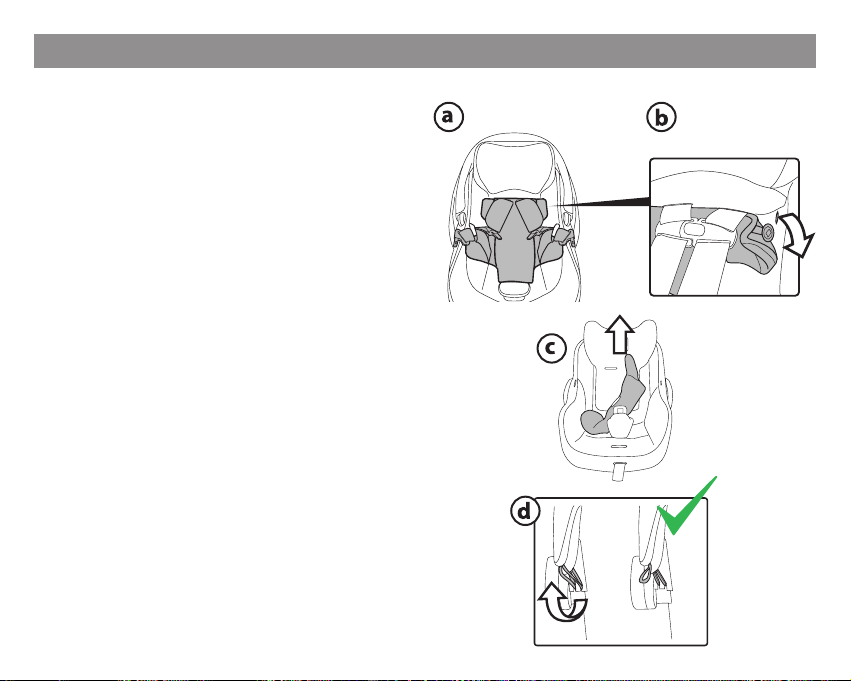
How to wash the chair padding - Cover removal
Open the harness following procedure at
page 38 (a).
Remove stage 1 cushion: undo the
buttons located on the side of the top
part as shown in the picture (b).
Remove stage 2 cushion simply pulling it
away from the crotch strap (c).
To remove the hood, remove the fasteners
from the seat shell (as shown in picture d)
and pull the hood away from the shell .
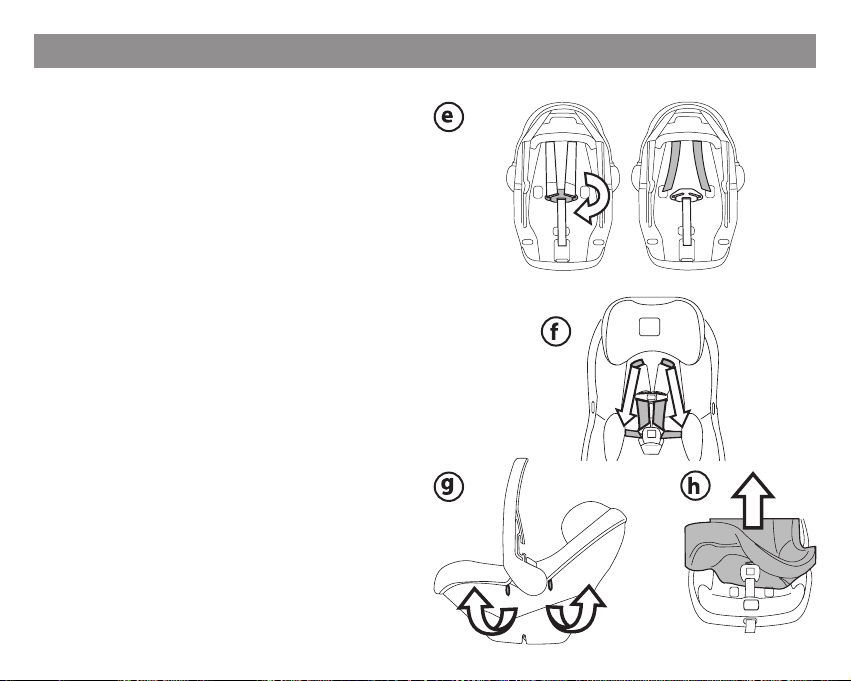
- 52 -
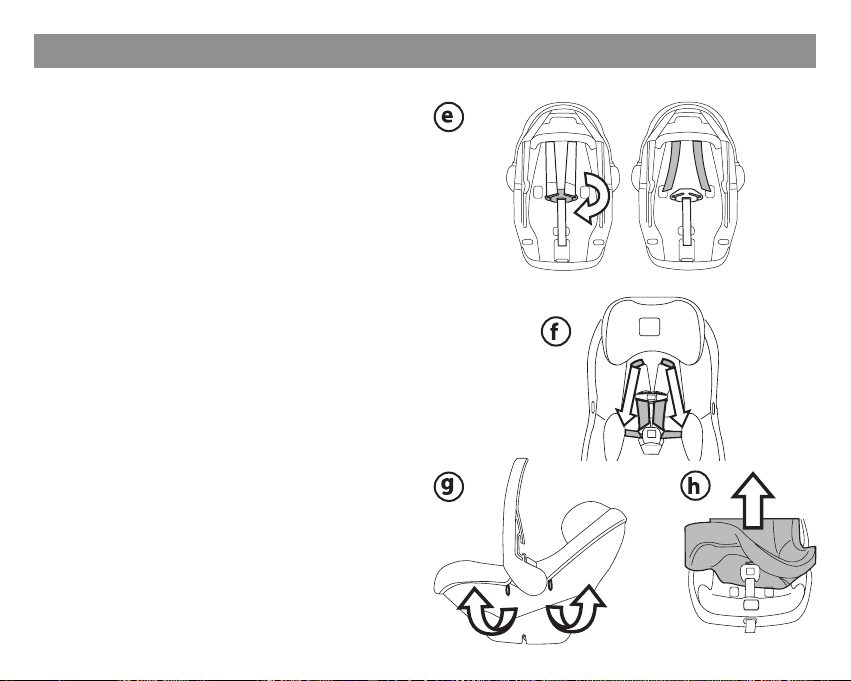
How to wash the chair padding - Cover removal
Turn the seat upside down and remove
the shoulder belts from the splitter plate
(e).
Slip the side belts through the slots in the
cover (f).
Undo the elastic bands under the handle
as shown in the picture (g) and remove
the seat cover starting from the crotch
strap (h).
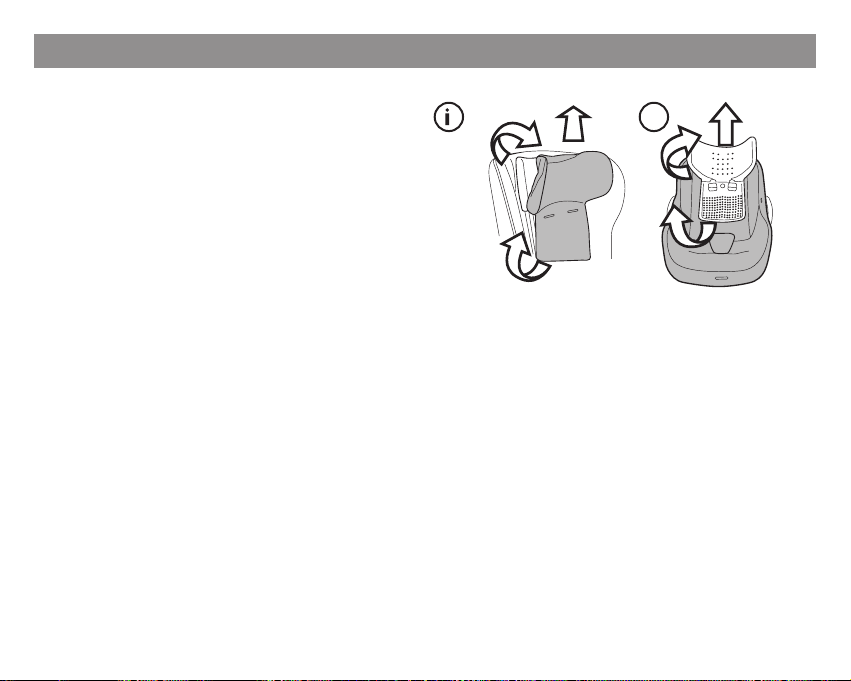
- 53 -
1
2
3
4
5
6
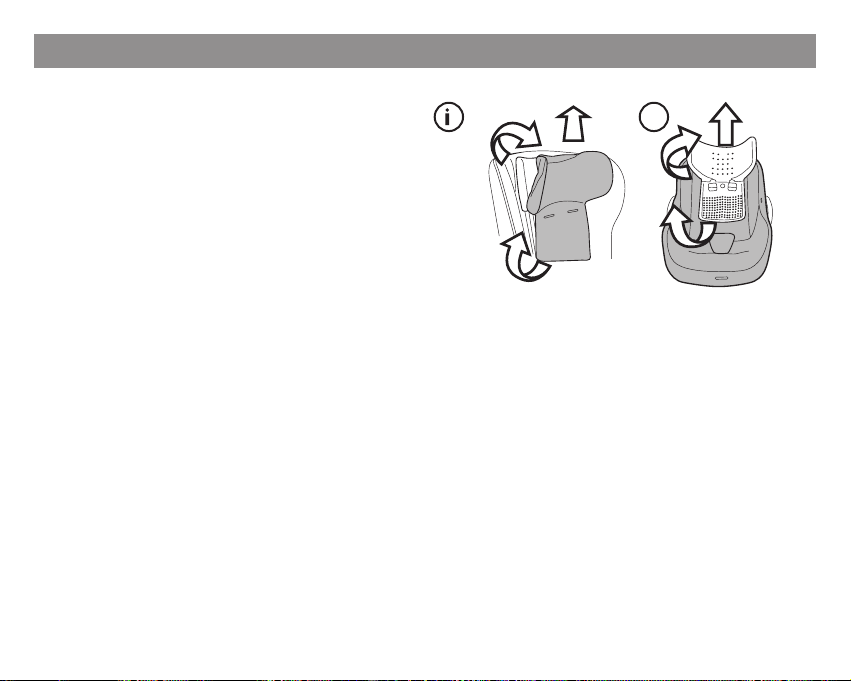
Remove the seat cover and the head
panel cover as shown in the sequence (i,j).
Important! the shell and the head panel
are fully lined with EPS. Pay attention
when the covers are removed in order to
avoid breaking these parts.
How to wash the chair padding - Cover removal
j
- 54 -
1
3
2
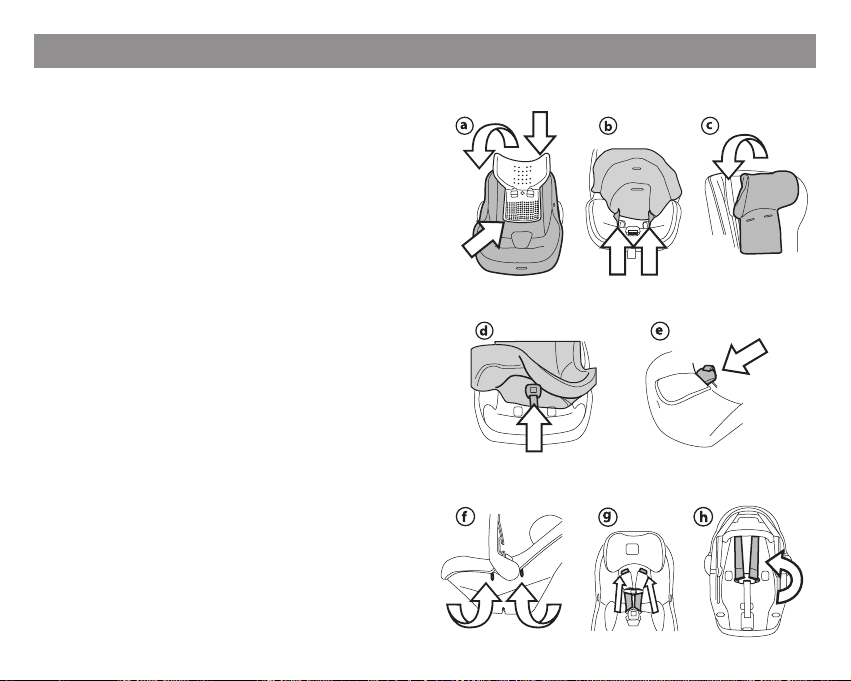
How to wash the chair padding - Refitting
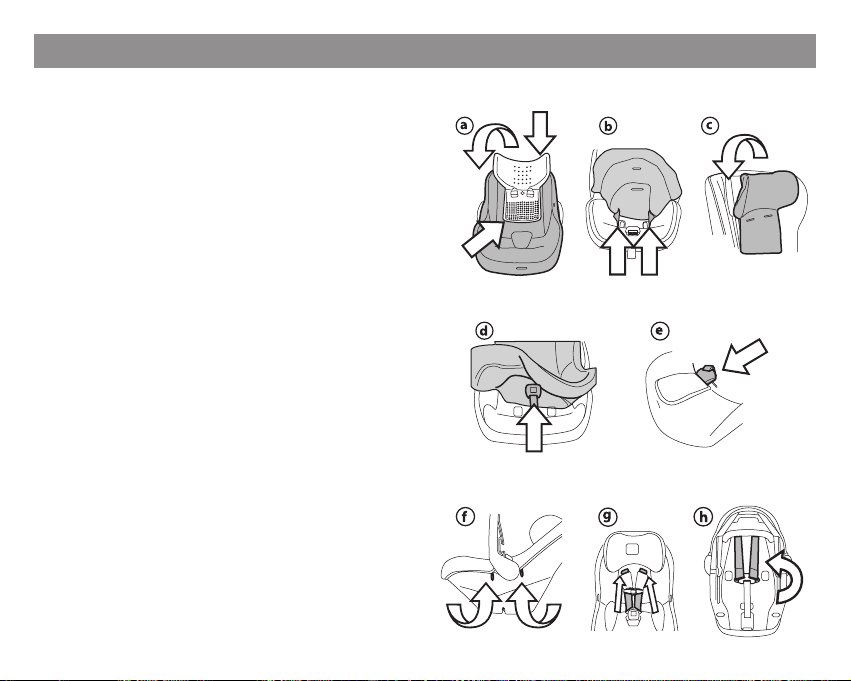
Slide the padding on (a) following the
sequence, as shown:
- slide the cover on from the top (1)
- allow the head panel to pass entirely
through the large opening (2)
- then slide the cover under the plastic
panel of the headrest (3).
Let the waist belts pass through the side
openings of the cover (b).
Put the head panel cover on (c) starting from
one wing and then doing the second. Be
careful doing this operation.
Slip the crotch strap through the opening
in the cover (d) and insert it into the leg
divider (e).
Refit the four elastic bands to the side of
the shell (f ).
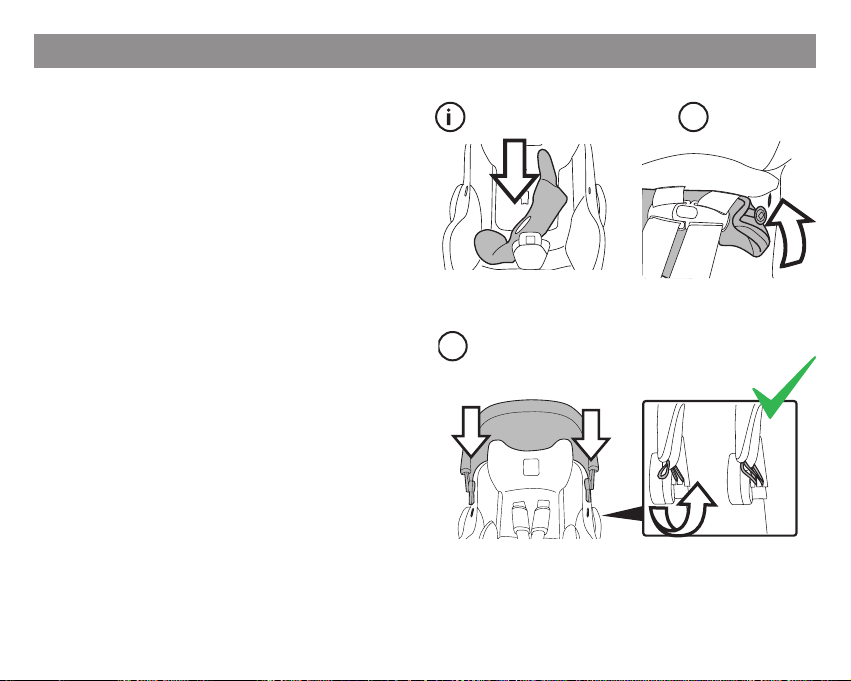
Thread the shoulder straps back in the
head panel openings (g).
Connect the shoulder straps to the splitter
plate (h).
- 55 -
How to wash the chair padding - Refitting
Insert the stage 2 cushion back in
place through the crotch slot (i).
If you need to put the stage 1 cushion
back in place make sure to fasten the side
buttons as shown in the picture (j).
To attach the hood, push the hood latch
into the slot on the seat shell as shown (k).
Secure the elastic fasteners to the shell as
shown in the picture.
j
k
- 56 -
5
4
1
3
6
7
2
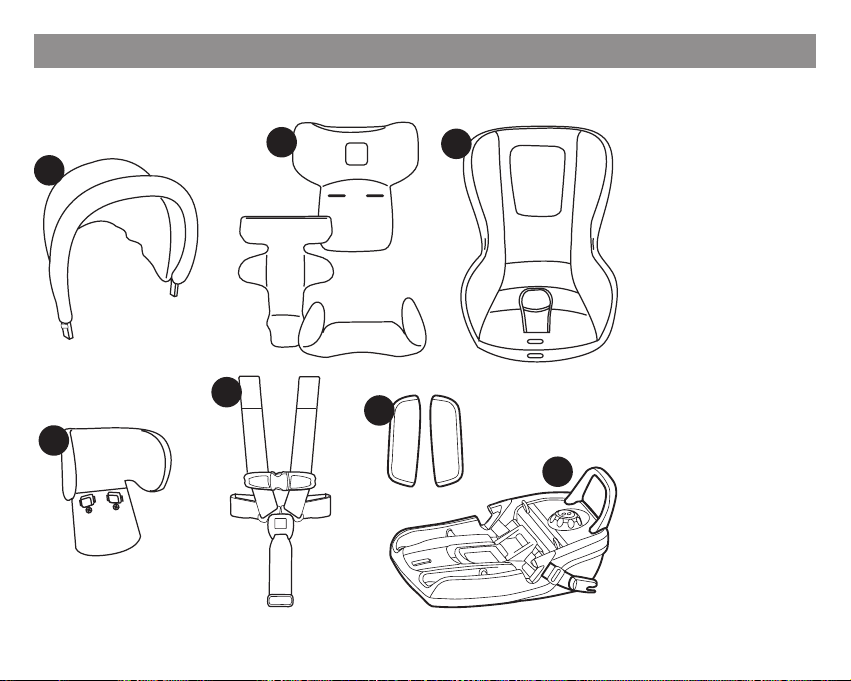
Replacement Parts
NOTE: Spare parts
available in different
colors* to be specified
when ordering.
NOTE: A Tether is not
a component of a rear
facing only car seat.
1) BCA435NA*
2) BRI435US*
3) BSA435US*
4) ASPI0157NFGR
5) MUCI0143GR
6) BSP435NA*
7) IAKADJBA00USNF

- 57 -
Declaration of conformity
Product name
PRIMO VIAGGIO 4
.
35
Product reference number
MPV03*
Reference Standards (origin)
FMVSS 571-213 (USA)
Declaration of conformity
PegPerego S.p.A. declares, under its own
responsibility, that the item in question has
undergone a series of internal tests and has been
certified by external independent laboratories, in
compliance with current legislation.
Date and place of issue
Arcore, February 2014
PegPerego S.p.A.
via De Gasperi, 50
20862 Arcore (MB), ITALY
EN_English
ES_Español
declaración de conformidad
Denominación del producto
PRIMO VIAGGIO 4
.
35
Código de identicación del producto
MPV03*
Normativas de referencia (origen)
FMVSS 571-213 (USA)
Declaración de conformidad
PegPerego S.p.A. declara bajo su propia responsabi-
lidad que el artículo considerado ha sido sometido
a ensayos propios y ha sido certificado por
laboratorios externos e independientes de
conformidad con las normas vigentes.
Fecha y lugar de expedición
Arcore, Febrero 2014
PegPerego S.p.A.
Via De Gasperi, 50
20862 Arcore (MB), ITALY



- 57 -
Declaration of conformity
Product name
PRIMO VIAGGIO 4
.
35
Product reference number
MPV03*
Reference Standards (origin)
FMVSS 571-213 (USA)
Declaration of conformity
PegPerego S.p.A. declares, under its own
responsibility, that the item in question has
undergone a series of internal tests and has been
certified by external independent laboratories, in
compliance with current legislation.
Date and place of issue
Arcore, February 2014
PegPerego S.p.A.
via De Gasperi, 50
20862 Arcore (MB), ITALY
EN_English
ES_Español
declaración de conformidad
Denominación del producto
PRIMO VIAGGIO 4
.
35
Código de identicación del producto
MPV03*
Normativas de referencia (origen)
FMVSS 571-213 (USA)
Declaración de conformidad
PegPerego S.p.A. declara bajo su propia responsabi-
lidad que el artículo considerado ha sido sometido
a ensayos propios y ha sido certificado por
laboratorios externos e independientes de
conformidad con las normas vigentes.
Fecha y lugar de expedición
Arcore, Febrero 2014
PegPerego S.p.A.
Via De Gasperi, 50
20862 Arcore (MB), ITALY
- 56 -
5
4
1
3
6
7
2
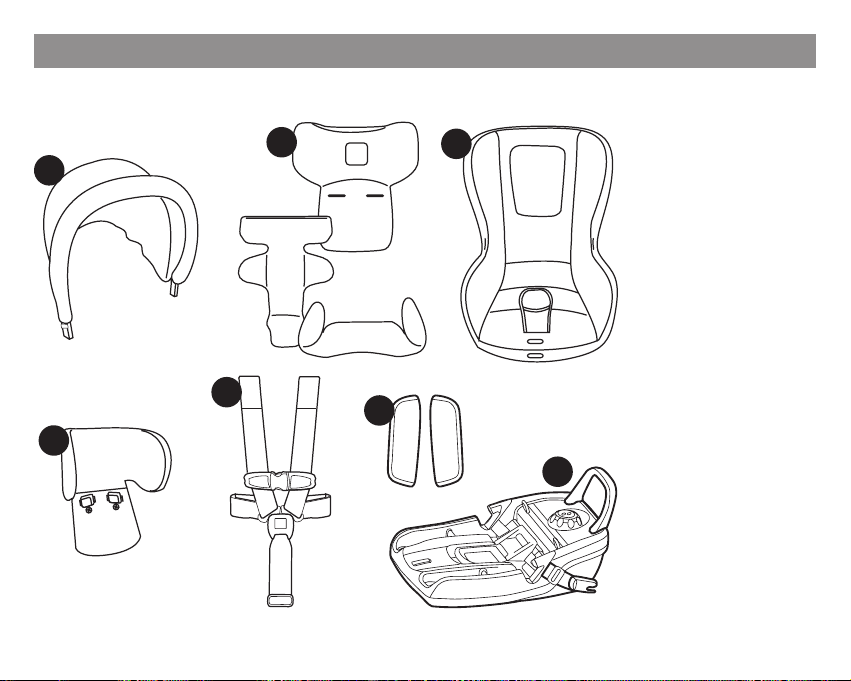
Piezas de repuesto
NOTA: Cuando haga su
pedido especifique los
colores* de las piezas
de repuesto.
NOTA: Una correa no es
un componente de silla
de auto orientada hacia
atrás.
1) BCA435NA*
2) BRI435US*
3) BSA435US*
4) ASPI0157NFGR
5) MUCI0143GR
6) BSP435NA*
7) IAKADJBA00USNF
- 55 -
Cómo lavar la guata de la silla - Montaje
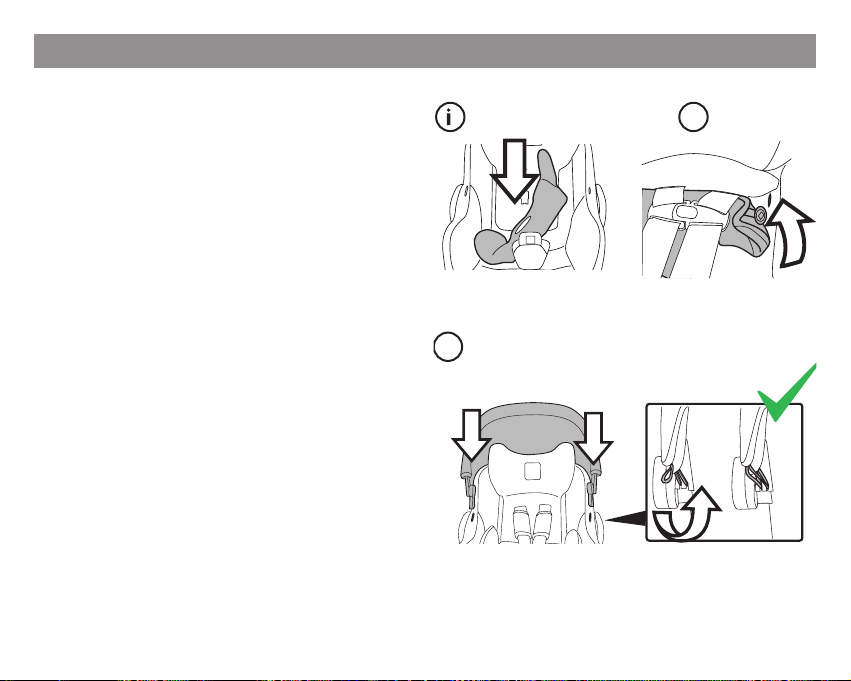
Coloque el cojín de segunda etapa a
través de la ranura de la entrepierna (i).
Si necesita colocar el cojín de primera
etapa, asegúrese de abrochar los botones
laterales como indica la figura (j).
Para montar la capota, empuje el seguro
de la capota en la ranura de la silla como
indica la figura (k). Enganche las bandas
elásticas en el armazón como muestra la
figura.
j
k
- 54 -
1
3
2
Cómo lavar la guata de la silla - Montaje
Coloque la guata (a) siguiendo esta secuencia:
- haga deslizar la funda desde arriba (1)
- haga pasar el panel para la cabeza
completamente por la abertura ancha (2)
- haga deslizar la funda por debajo del panel
plástico del reposacabezas (3).
Haga pasar las correas de la cintura por las
aberturas laterales de la funda (b).
Ponga la funda del panel para la cabeza (c)
comenzando con un ala y siguiendo con
la otra. Realice esta operación con mucho
cuidado.
Haga deslizar la correa de la entrepierna por
la abertura en la funda (d) e introdúzcala en el
divisor de piernas (e).
Aplique las cuatro bandas elásticas al costado
del armazón (f).
Enhebre nuevamente las correas de hombro
por las aberturas del panel para la cabeza (g).
Enganche las correas de hombro en la placa
divisora (h).
- 53 -
1
2
3
4
5
6
Quite la funda de la silla y la funda del
panel para la cabeza como ilustra la
secuencia (i, j).
¡Importante! El armazón y el panel para
la cabeza están totalmente revestidos con
EPS. Preste atención al quitar las fundas
para evitar roturas.
Cómo lavar la guata de la silla - Desmontaje de la funda
j
- 52 -
Cómo lavar la guata de la silla - Desmontaje de la funda
Invierta la silla y quite las correas de
hombro de la placa divisora (e).
Haga pasar los cinturones por las ranuras
de la funda (f ).
Desenganche las bandas elásticas debajo
del asa como indica la figura (g) y quite la
funda de la silla comenzando por la correa
de la entrepierna (h).
- 51 -
Cómo lavar la guata de la silla - Desmontaje de la funda
Abra el arnés siguiendo las instrucciones
de la página 38 (a).
Saque el cojín de primera etapa:
desabroche los botones al costado de la
parte superior como ilustra la figura (b).
Tire del cojín de segundo estadio para
desprenderlo de la correa de la entrepierna
(c).
Para quitar la capota, desenganche las
bandas elásticas del armazón (como
indica la figura d) y tire de la capota para
separarla del armazón.
- 50 -
Limpieza y mantenimiento
Esta unidad requiere un mantenimiento
mínimo. Mantenga limpias todas las
partes móviles.
Limpie las partes plásticas con frecuencia
utilizando un paño húmedo. No utilice
solventes ni productos agresivos.
Cepille las partes de tela para eliminar el
polvo.
Proteja el producto de la nieve, el agua
y la lluvia. La exposición constante a la
luz solar puede cambiar los colores del
material. El sol puede recalentar la silla.
Antes de colocar a su bebé en la silla,
asegúrese de que la silla no esté caliente.
¡Advertencia! La exposición al sol
durante períodos prolongados puede
resquebrajar el plástico.
Guarde el producto en un lugar seco.
¡Advertencia! No utilice ni compre una
silla de auto si han pasado 7 (siete) años
o más desde la fecha de fabricación
indicada en la etiqueta de la silla o del
armazón.
MANTENIMIENTO DE LA GUATA
Cepillar las partes de tela para eliminar el
polvo.
Para lavar este tapizado, seguir las
instrucciones de la etiqueta del producto
(ver más abajo).
No utilizar blanqueadores con cloro.
No planchar.
No limpiar a seco.
No quitar las manchas con solventes.
No secar en tambor.
- 49 -
Esta unidad está certificada para el uso en
aviones.
Coloque la silla sobre el asiento y ajuste
el asa en la posición más avanzada, como
muestra la figura. Cualquier otra posición
podría provocar lesiones al bebé en
un accidente. Para mover el asa, pulse
simultáneamente los botones grises
laterales y empújela.
Ajuste la silla en el asiento. Compruebe que
la base esté paralela al suelo observando
la línea roja. Haga pasar el cinturón de
cadera por las ranuras de la silla y bloquee
la placa del seguro en la hebilla.
Tire de la correa para apretar el cinturón
de seguridad. Presione la silla con el peso
de su cuerpo para apretar la correa aún
más. Una vez ajustada la silla, compruebe
que la línea roja al costado de la silla
quede paralela al suelo.
¡Importante! Utilice la silla sólo sobre un
asiento orientado hacia delante. Si la silla
no se puede asegurar adecuadamente,
solicite ayuda a un asistente de vuelo.
Uso de la silla de auto en el avión
¡Importante! No utilice la base para
instalar la silla en un avión.
- 48 -
Asa de transporte para la base.
¡Advertencia! No tire del asa hacia arriba
con la silla acoplada a la base.
¡Advertencia! No la utilice como medio
para transportar al niño.
Uso de la silla de auto fuera del vehículo
- 47 -
Uso de la silla de auto fuera del vehículo
La capota hace sombra para el bebé (c).
Para montar la capota, empuje los seguros
de la capota en las ranuras de la silla como
indica la figura (d). Enganche las bandas
elásticas en el armazón como muestra la
figura. Para abrir la capota, tire del armazón
hasta que se abra con un clic.
Para quitar la capota, desenganche las
bandas elásticas del armazón y tire de los
seguros laterales como indica la figura (e).
¡Advertencia! La capota no debe utilizarse
para levantar la silla, ya que podría
desprenderse.
- 46 -
Uso de la silla de auto fuera del vehículo
Esta unidad puede utilizarse como silla de
auto para niños. Está diseñada con forma
de caparazón para mecer al bebé.
Para mecer al bebé, levante el asa como
indica la figura (a).
Para impedir el balanceo, bloquee el asa
detrás del respaldo (b).
- 45 -
Sistema de doble cojín
Primo Viaggio 4
.
35 está equipada con un
sistema de doble cojín, compuesto por un
cojín de primera etapa (1) y un cojín de
segunda etapa (2).
Si su bebé es muy pequeño, el cojín 1
puede utilizarse conjuntamente con el 2,
como ilustra la figura (a).
El cojín de primera etapa ofrece un
soporte adicional a la espalda y facilita
el apoyo correcto de la cabeza de su hijo,
previniendo las dificultades respiratorias.
Además, la guata adicional en el área de
la entrepierna impide que el niño resbale
hacia abajo, y la cabeza queda totalmente
sostenida entre las alas de protección
contra los impactos laterales.
¡Importante! El cojín de primera etapa
puede utilizarse desde el nacimiento
hasta las 8 libras de peso, o hasta cuando
el torso del bebé ocupe todo el espacio
entre la correa de la entrepierna y las
ranuras de hombro.
Para quitar el cojín, lea la página 51.
1
2
- 44 -
La altura correcta del panel de protección
lateral se obtiene cuando las ranuras de la
correa de hombro quedan precisamente
debajo del nivel del hombro (área verde),
como ilustra la figura (d).
Asegúrese de que los cinturones no estén
en el área roja.
¡Importante! Esta silla de auto está
diseñada para niños de hasta 32 pulgadas
(81,3 cm) de estatura. Desde donde
termina la cabeza del niño hasta el borde
superior del respaldo de la silla debería
quedar libre por lo menos una pulgada
(2,5 cm), como muestra la figura (e). A
medida que el niño crezca, se podrán ir
quitando los cojines adicionales (ver la
página 45 para más información).
¡Importante! Asegúrese de que el arnés
pectoral y todas las correas queden planos
y no retorcidos detrás o delante de la silla
de auto.
1 inch mi
n
Cómo levantar o bajar las correas de hombro
- 43 -
Cómo levantar o bajar las correas de hombro
Primo Viaggio 4
.
35 está dotada de una
placa deslizante que garantiza un ajuste
de las correas sea fácil y seguro. Con esta
silla, no es necesario quitar la correa de
hombro y hacerla pasar por las ranuras.
Para acceder a la placa del arnés, abra la
puerta del compartimiento posterior (a).
Para levantar o bajar la correa del arnés,
pulse el botón en la parte inferior y al
mismo tiempo tire o empuje la placa para
ajustarla en la posición deseada (b).
Hay 6 posiciones para elegir (c).
5
6
4
3
2
1
1
2
- 42 -
Cómo sujetar a su bebé en la silla de auto
x
¡Importante! Durante el invierno, no
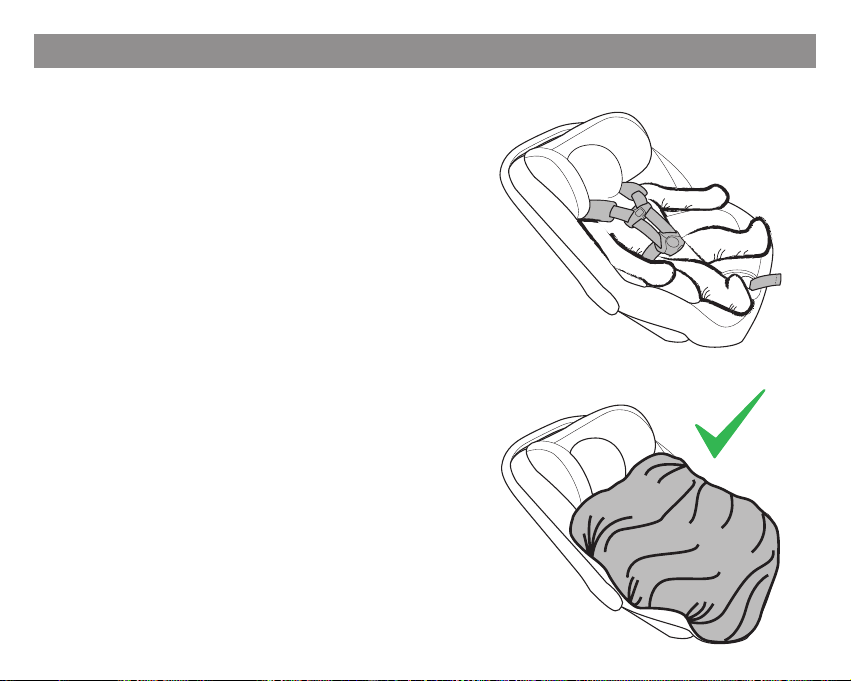
sujete en la silla de auto al bebé con ropa
demasiado voluminosa o con mantas
adicionales entre el cuerpo del bebé y
el arnés. El bebé no quedará sujetado
correctamente y podría sufrir graves
consecuencias en caso de colisión.
Para añadir abrigo, coloque una manta
sobre el arnés o utilice los accesorios
aprobados de Peg Perego.
- 41 -
Cómo sujetar a su bebé en la silla de auto
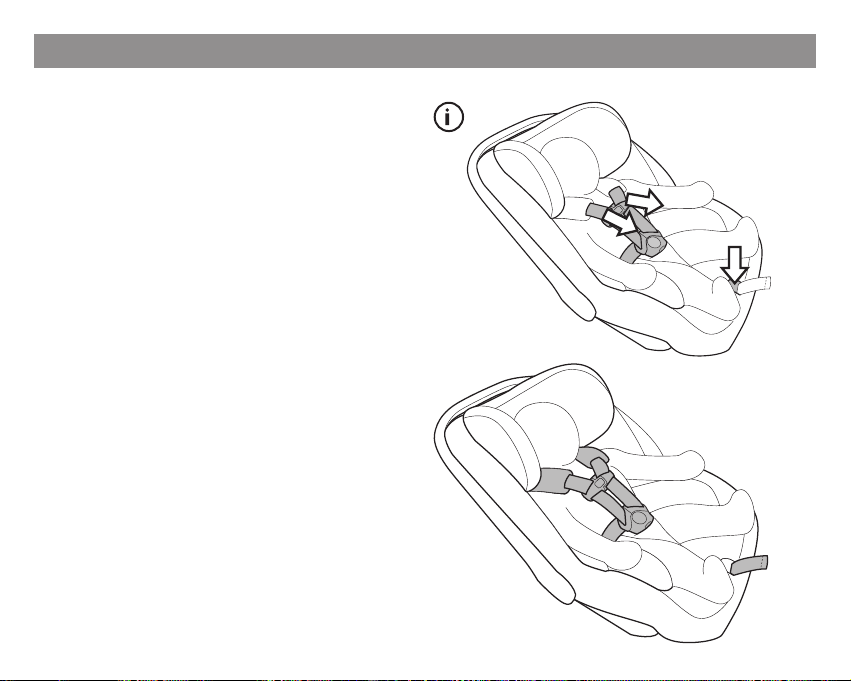
Para aflojar el arnés, mantenga pulsado
el botón de ajuste del arnés dentro de la
ranura a los pies del bebé y tire del arnés
como indica la figura (i).
¡Importante! Una correa ceñida no
debería permitir ningún aflojamiento sino
mantener una línea relativamente recta
sin ceder, pero sin tampoco hacer presión
sobre el bebé ni empujar el cuerpo a una
posición que no sea natural.
1
2
2
- 40 -
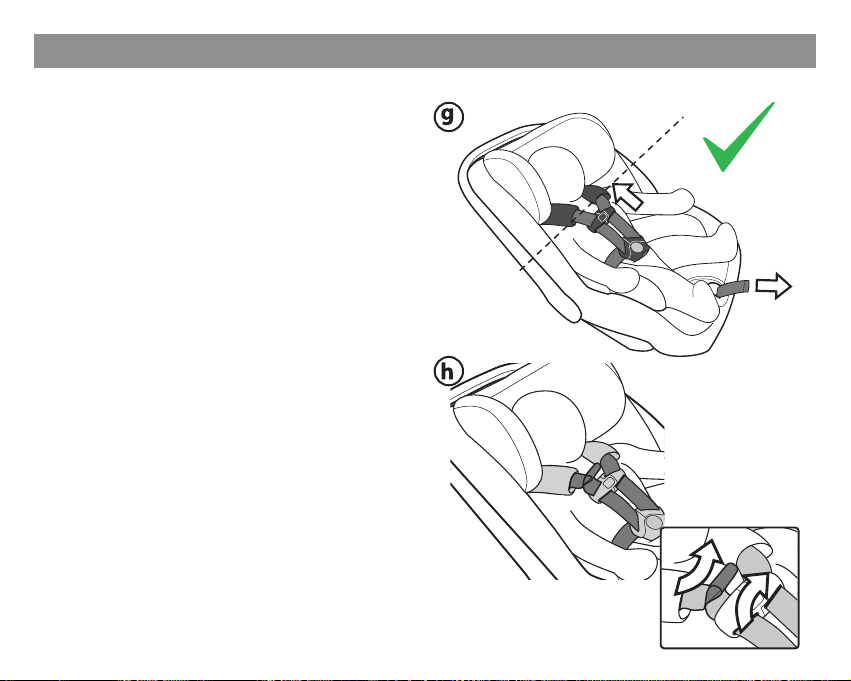
Ajuste el clip pectoral al nivel de la axila.
Para apretar el arnés, tire de la correa de
ajuste en el fondo de la silla hasta que
quede ceñida. Meta el extremo suelto de
la correa de ajuste debajo de la guata de
la silla. Tire de las correas para comprobar
que ambas placas estén bien abrochadas
(g).
NOTA IMPORTANTE: Podría ser necesario
ajustar la altura de hombro. Vea cómo
levantar o bajar las correas de hombro en
la página 43.
Asegúrese de dejar un dedo de distancia
entre el arnés y la clavícula del bebé,
o intente pellizcar las correas como se
indica en la figura (h). Si logra pellizcar
las correas con facilidad, el arnés puede
quedar más apretado.
Cómo sujetar a su bebé en la silla de auto
x
- 39 -
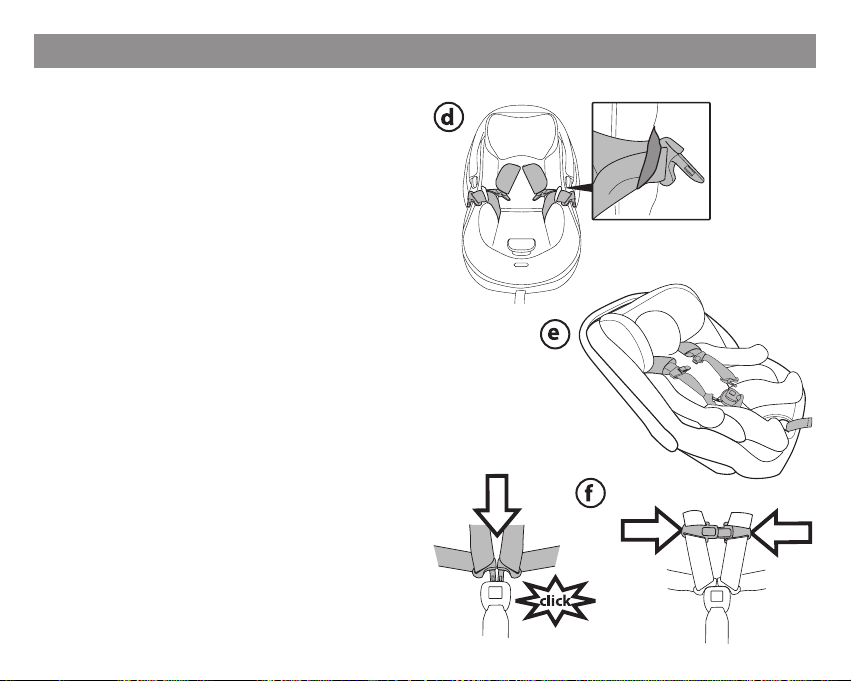
Coloque las correas de hombro al costado
para dar lugar al bebé. Utilice las bandas
laterales para mantener el arnés abierto
como muestra la figura (d).
Coloque al bebé en la silla de auto con
la cadera y la espalda pegadas a la silla
de auto. Lleve las dos correas de hombro
sobre los hombros del bebé. Asegúrese
de que las correas no queden retorcidas
detrás del respaldo o sobre el pecho del
bebé (e).
Introduzca ambas placas del seguro en la
hebilla hasta oír el clic. Abroche los dos
clips pectorales (f ).
Cómo sujetar a su bebé en la silla de auto
- 38 -
Cómo sujetar a su bebé en la silla de auto
Esta silla de auto aplica un sistema de
arnés de 5 puntos para sujetar al bebé.
Desabroche el clip pectoral pulsando el
botón del clip y tirando como indica la
figura (a).
Desabroche las placas de los seguros
pulsando el botón rojo y tirando de los
seguros hacia arriba (b).
Mantenga pulsado el botón de ajuste del
arnés, situado en una ranura a los pies
del niño, y saque las correas de hombro
tirando hacia fuera (c).
1
2
2
1
2
1
2
- 37 -
Uso del clip de bloqueo
Para la instalación de Primo Viaggio 4
.
35
sin base, hay que seguir las mismas reglas
que para la instalación con base, por
lo que respecta a los distintos tipos de
cinturones de seguridad de los vehículos.
¡Importante! Para otros tipos de cinturón,
véase desde la página 16 en adelante.
Primo Viaggio 4
.
35 no debería instalarse
en los tipos de asiento ilustrados en la
página 23.
Si los cinturones de su vehículo necesitan
un clip de bloqueo, consígalo en una
tienda especializada o a través del servicio
de asistencia de Peg Perego.
Para instalar el clip de bloqueo, sostenga
la correa de hombro y el cinturón de
cadera juntos, sobre la hebilla. Desabroche
el cinturón sosteniendo las correas.
Enganche el clip de bloqueo en torno a
ambas correas como indica la figura.
Deje media pulgada entre el clip y el
seguro. Abroche el cinturón.
A
B
PUSH
13 mm
1/2 inch
- 36 -
Instalación de la silla de auto con diferentes tipos de cinturones
de seguridad
Los distintos tipos de cinturones de
cadera
Los cinturones de cadera con retractores
de bloqueo de emergencia (ELR), con
retractores de bloqueo automático
(ALR) y con retractores de bloqueo con
conmutación (SLR) presentan el aspecto
indicado en la figura (a). Consulte el
manual de instrucciones del vehículo
para saber qué tipo de cinturones tiene.
Los cinturones de cadera con placa de
seguro bloqueante son como en la figura (b).
Cinturón de cadera sólo con retractor de bloqueo de emergencia Si tiene un
cinturón de cadera (sin correa de hombro) que se bloquea sólo en caso de emergencia
(ELR), no lo utilice para asegurar la silla de auto Primo Viaggio 4
.
35. Consulte con
un técnico de seguridad de pasajeros infantiles certificado para que le indique las
opciones de instalación. Para conseguir un técnico en su zona visite http://www.
nhtsa.dot.gov/people/injury/childps/contacts/index.cfm o llame al 1-888-327-4236.
- 35 -
Instalación de la silla de auto sin la base
Haga pasar el cinturón de cadera por las
ranuras del asa y bloquee la placa del seguro
en la hebilla como indica la figura (c). Tire de
la parte del cinturón que queda a la altura
del hombro y llévela por detrás del respaldo
del asiento (d).
Haga pasar la correa de hombro por la ranura
en el respaldo del asiento y tire para apretar
la silla contra el asiento del vehículo (e). Una
vez ajustada la silla, compruebe que la línea
roja al costado de la silla quede paralela al
suelo (página 34).
¡Importante! Si el cinturón del vehículo no
es suficientemente largo, la silla de auto se
puede instalar haciendo pasar sólo la parte
del cinturón correspondiente a la cadera por
las ranuras del asa, como muestra la figura (f).
Si el cinturón del vehículo no tiene dispositivo
de bloqueo, es necesario utilizar un clip de
bloqueo (véase la página 36 para más detalles).
¡Advertencia! Si no puede apretar el
cinturón lo suficiente, consulte el manual de
instrucciones de su vehículo para saber cómo
asegurar la silla utilizando el tipo de cinturón
de seguridad de su vehículo. Su bebé no
estará a salvo en una silla de auto floja.
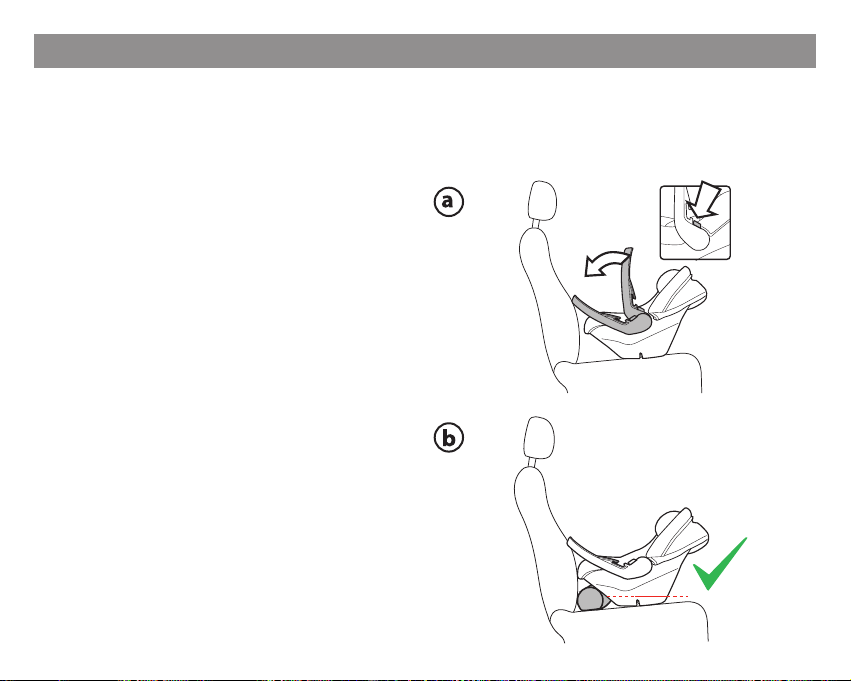
- 34 -
Instalación de la silla de auto sin la base
¡Importante!
La base está diseñada para prevenir el uso erróneo, ya que evita el tener que
fijar la silla en el vehículo cada vez que se utiliza. Utilice e instale Primo Viaggio 4
.
35 sin la
base sólo en caso de necesidad.
Asegúrese de que el vehículo esté aparcado
sobre un terreno llano para instalar la base.
Coloque la silla de auto sobre el asiento;
el bebé deberá quedar orientado hacia la
parte trasera del vehículo. Ajuste el asa en
la posición más avanzada, como muestra
la figura (a). Cualquier otra posición podría
provocar lesiones al bebé en un accidente.
Para mover el asa, pulse simultáneamente
los botones grises laterales y gírela.
¡Importante!
La silla debe estar paralela
al suelo. Guíese con la línea de referencia
dibujada sobre el producto: la línea debe
quedar horizontal. Si es necesario, rellene
el hueco sobre el asiento con toallas
enrolladas o cilindros flotantes para piscina
(b).
- 33 -
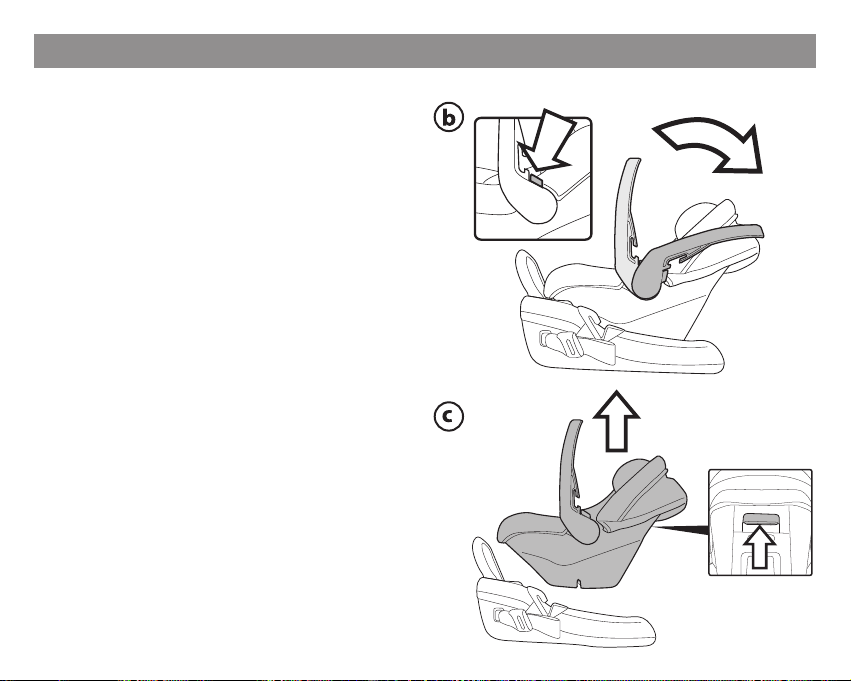
Instalación de la silla de auto sobre la base
Se recomienda ajustar el asa de manera
que se apoye sobre el borde superior de
la silla de auto como indica la figura. Para
girar el asa, pulse los botones cuadrados
(a cada lado del asa, en el punto donde
se une al asiento) y gírela a la posición
correcta (b).
Para quitar la silla de auto, desplace el asa
a la posición vertical. Ponga la mano sobre
la parte superior del respaldo y tire de la
palanca de desbloqueo con los dedos (c).
Nota: El desbloqueo se facilita tomando
la palanca por el centro.
- 32 -
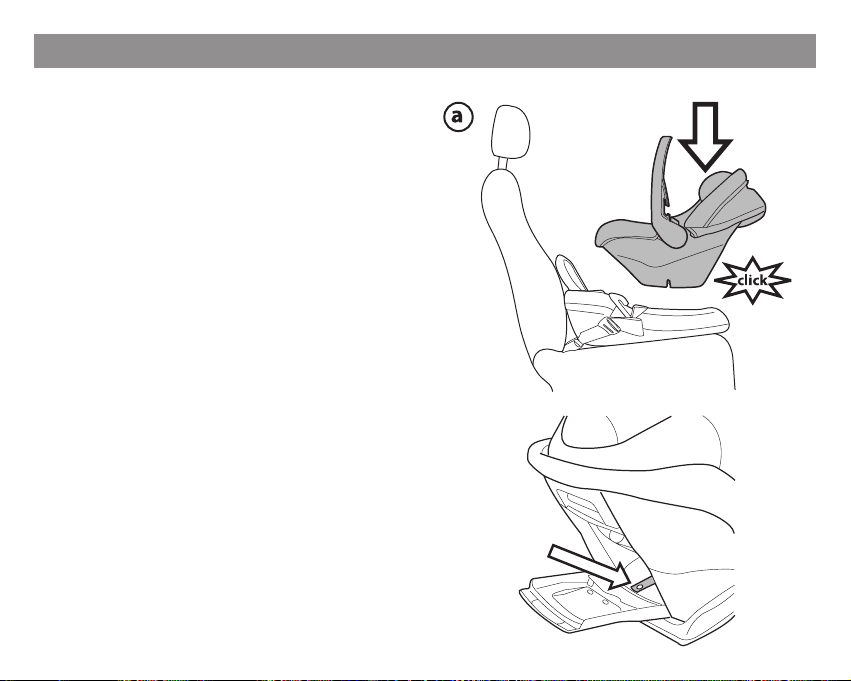
Ahora que la base está instalada en su
vehículo, puede instalar la silla de auto
sobre la base.
Sosteniendo la silla de auto por el asa,
deberá alinearla a la base y presionarla
con la parte posterior contra la base hasta
oír el clic (a). Si la silla de auto está bien
bloqueada, no debería ser posible moverla.
¡Importante! Los recién nacidos deberían
estar reclinados correctamente. Si la silla
está demasiado reclinada, su bebé podría
sufrir lesiones o ser expulsado de la silla
en un accidente. Si la silla está demasiado
erguida, su bebé podría tener dificultades
para respirar.
Para nivelar la base, siga las instrucciones
de la página 25.
Cuando el asiento esté instalado en la
base, abra el compartimento trasero y
controle si se modificó la posición original
de la burbuja de nivel. En ese caso, ajuste
el asiento hasta que la burbuja quede en
la posición correcta.
Instalación de la silla de auto sobre la base
- 31 -
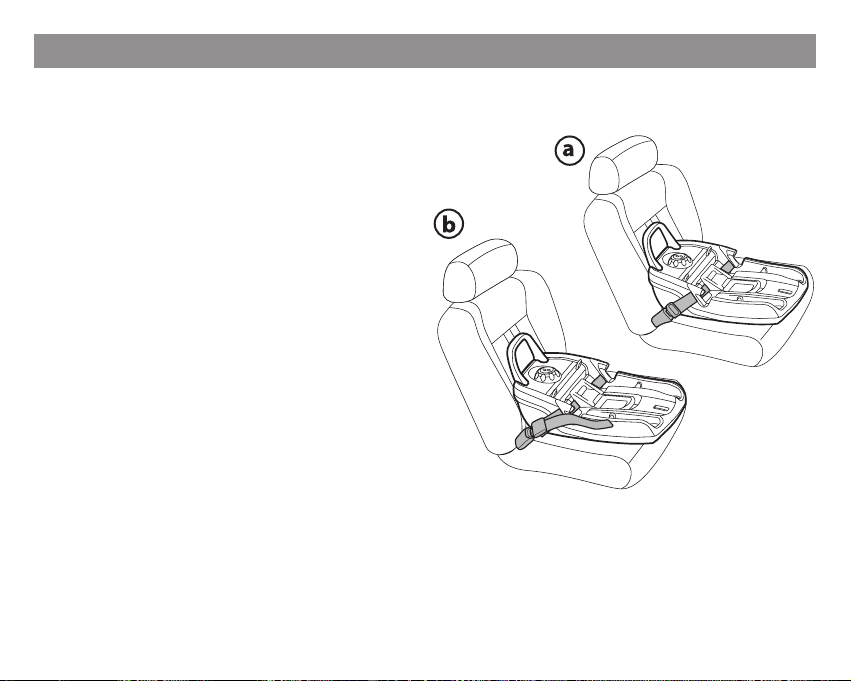
Instalación de la base con diferentes tipos de cinturones de seguridad
Los distintos tipos de cinturones de
cadera
Los cinturones de cadera con retractores
de bloqueo de emergencia (ELR), con
retractores de bloqueo automático
(ALR) y con retractores de bloqueo con
conmutación (SLR) presentan el aspecto
indicado en la figura (a). Consulte el
manual de instrucciones del vehículo
para saber qué tipo de cinturones tiene.
Los cinturones de cadera con placa de
seguro bloqueante son como en la figura (b).
Cinturón de cadera sólo con retractor de bloqueo de emergencia Si tiene un
cinturón de cadera (sin correa de hombro) que se bloquea sólo en caso de emergencia
(ELR), no lo utilice para asegurar la silla de auto Primo Viaggio 4
.
35. Consulte con
un técnico de seguridad de pasajeros infantiles certificado para que le indique las
opciones de instalación. Para conseguir un técnico en su zona visite http://www.
nhtsa.dot.gov/people/injury/childps/contacts/index.cfm o llame al 1-888-327-4236.
- 30 -
Haga pasar la parte del cinturón que queda
a la altura de la cadera por las ranuras de la
base (c) y bloquee la placa del seguro en la
hebilla como indica la figura (d). Presione la
base con el peso de su cuerpo para apretar
aún más la correa de hombro (e). Haga pasar
la parte del cinturón que queda a la altura del
hombro por las aberturas nuevamente (f).
Cierre el clip de bloqueo presionando la
palanca como muestra la figura (g) con un
clic audible. Empuje y tire de la base. Si la
base se desplaza más de una pulgada (2,5
cm), apriete el cinturón aún más. Controle
el indicador de nivel. Si la burbuja ha salido
del área deseada, gire el pomo hasta que
vuelva a estar dentro del área correcta. Para
ello puede ser necesario aflojar la correa
ligeramente.
¡Advertencia! Si no puede apretar el
cinturón lo suficiente, consulte el manual
de instrucciones de su vehículo para saber
cómo asegurar la base utilizando el cinturón
de seguridad de su vehículo. Su bebé no
estará a salvo en una silla de auto floja.
Cómo instalar la base utilizando los
CINTURONES DE SEGURIDAD DEL VEHÍCULO
- 29 -
¡Importante! No todos los cinturones de seguridad funcionan de la misma manera.
Para asegurarse de que la silla de auto para niños esté bien instalada con los
cinturones de seguridad, lea el manual de su vehículo. El manual le indicará cómo
instalar correctamente la silla de auto. Esta sección explica cómo instalar la base con
un cinturón de cadera / hombro con
placa de seguro deslizante y retractor ELR
o SLR (véanse las secciones 2.1, 2.2 y 2.3
desde la página 18 para más detalles).
Asegúrese de que el vehículo esté
aparcado sobre un terreno llano para
instalar la base. Quite la silla de auto de
su base siguiendo las instrucciones de la
página 25.
Coloque la base orientada hacia atrás
sobre el asiento trasero del vehículo.
Controle el indicador de nivel y ajuste
el ángulo correcto (a) siguiendo las
instrucciones de la página 25.
Mantenga los ganchos del seguro en
su alojamiento. Abra el clip de bloqueo
como se indica en la figura (b).
Cómo instalar la base utilizando los
CINTURONES DE SEGURIDAD DEL VEHÍCULO
- 28 -
Cierre el clip de bloqueo
presionando la palanca como
muestra la figura, con un clic
audible (h).
Controle nuevamente el indicador de
nivel. Está dividido en 3 áreas que indican
el ángulo del respaldo de acuerdo con el
peso del niño. Asegúrese de que la hebilla
esté en el área seleccionada (i).
Una vez instalada la base, vaya a la página
32.
Cómo instalar la base utilizando el SISTEMA DE SEGURO
- 27 -
Mantenga el clip abierto y
asegúrese de que la correa
del seguro quede enhebrada
planamente a través de la base
(f).
Apriete la base contra el asiento tirando
del extremo libre de la correa del seguro.
Al mismo tiempo, presione la base con el
peso de su cuerpo para apretarla más (g).
Empuje y tire de la base. Si se desplaza
más de una pulgada (2,5 cm), apriete el
cinturón aún más.
Cómo instalar la base utilizando el SISTEMA DE SEGURO
- 26 -
Abra el clip de bloqueo como
se indica en la figura (a). Quite
los dos seguros de anclaje de
sus alojamientos. Los seguros
están al costado de la base. Quite
el dispositivo de ajuste de su soporte y
afloje la correa del seguro pulsando el
botón gris y tirando de la correa como
indica la figura (b). Pulse el botón rojo
sobre el gancho del seguro (c) y quite el
seguro de su alojamiento (d). Repita la
operación del otro lado.
Empuje cada seguro en la barra de anclaje
ubicada entre el respaldo y el fondo del
asiento de su vehículo. Presione hasta oír
un clic (e).
Cómo instalar la base utilizando el SISTEMA DE SEGURO
- 25 -
Quite la silla de auto de la base. Lleve
el asa a la posición vertical pulsando
los botones al costado del asa (a).
Ponga la mano sobre la parte superior
del respaldo y tire de la palanca de
desbloqueo con los dedos. Tire de la silla
de auto hacia arriba al mismo tiempo (b).
Nota: El desbloqueo se facilita tomando
la palanca por el centro.
Gire el pomo hacia ambos lados para
ajustar el pie de la base (c).
Asegúrese de que el vehículo esté
aparcado sobre un terreno llano. Coloque
la base orientada hacia atrás sobre el
asiento trasero del vehículo. Controle
el indicador de nivel sobre la superficie
superior de la base y gire más el pomo
para asegurarse de alcanzar el ángulo
correcto (d). Siga las instrucciones visuales
al costado del indicador para adaptar el
ángulo adecuadamente al peso del niño.
Cómo nivelar la base en el vehículo
- 24 -
1• CON EL SISTEMA DE
SEGURO. Si su vehículo
tiene “anclajes inferiores
universales”, puede instalar
la silla de auto para niños
utilizando el sistema de SEGURO; vea
las instrucciones en la página 26. El
anclaje es una barra ubicada en la
línea de intersección entre el respaldo
y el fondo del asiento (deslice la mano
entre el respaldo y el fondo del asiento
para localizar esta barra).
¡Importante! Además de leer este manual,
consulte en el manual de su vehículo el
uso de las sillas de auto, la ubicación del
sistema de seguro y la información sobre
los cinturones de seguridad.
2• CON EL CINTURÓN DE CADERA O
LA CORREA DE CADERA / HOMBRO
ESTÁNDAR. Si su vehículo no tiene
anclajes inferiores universales, instale
la silla de auto para niños siguiendo
las instrucciones de uso del cinturón
de cadera o la correa de cadera /
hombro en la página 29.
Para utilizar Primo Viaggio 4
.
35 con la base, primero hay que instalar la base y
luego la silla de auto sobre la base.
¡Importante! Lea el manual de instrucciones de su vehículo para saber en qué parte
del vehículo se puede instalar mejor una silla de auto para niños.
Hay dos maneras de instalar la base:
Instalación de la base
- 23 -
Diseños de cinturón de seguridad de vehículo o posiciones
de asiento no compatibles
ADVERTENCIA: no utilice Primo
Viaggio 4
.
35 con los siguientes
diseños de cinturón de seguridad:
1. Cinturones de cadera / hombro
motorizados. Cinturones montados en la
puerta.
2. Asientos orientados hacia los costados.
3. Asientos orientados hacia atrás.
4.
Asientos giratorios, salvo que la bandeja
se pueda bloquear orientada hacia delante.
Para la seguridad de su niño, siempre lea
el manual de instrucciones de su vehículo
para más información.
NO
NO
NUNCA INSTALE LA SILLA
ORIENTADA HACIA ATRÁS
EN UN ASIENTO CON
AIRBAG ACTIVO.
NO
NO
- 22 -
Cinturón de cadera (de 2 puntos) con
retractor de bloqueo con conmutación
(ELR --> ALR). Este tipo de cinturón
tiene una placa de seguro cosida en su
extremo. Para activar el retractor ALR
para la instalación de una silla de auto,
en algunos modelos de vehículo hay
que tirar y hacer salir el cinturón hasta el
tope; en otros modelos hay que tirar del
cinturón hasta cierta longitud (consulte
el manual de instrucciones del vehículo
para más detalles). Apriete el cinturón
alrededor de la silla retrayéndolo con el
retractor. El cinturón no se extenderá a no
ser que se desabroche, para luego repetir
la operación desde el comienzo.
Cinturón de cadera (de 2 puntos) con
retractor de bloqueo de emergencia
(ELR). Este tipo de cinturón tiene una
placa de seguro cosida en su extremo
y se bloquea únicamente en caso de
emergencia (frenada brusca o choque).
Nota importante: NO UTILICE Primo
Viaggio 4
.
35 con este cinturón o consulte
con un técnico de seguridad de pasajeros
infantiles certicado para que le indique
las opciones de instalación (www.nhtsa.
gov/cps/cpstting/ index.cfm).
ELR -->ALR
Descripción general del cinturón de seguridad del vehículo
- 21 -
Descripción general del cinturón de seguridad del vehículo
Cinturón de cadera (de 2 puntos) con
placa de seguro bloqueante. Este tipo
de cinturón se puede ajustar tirando /
soltando la cola de la correa en la placa de
seguro.
Algunos vehículos pueden tener
cinturones con hebillas rígidas grandes.
Estos modelos pueden dicultar la
instalación y perjudicar la estabilidad de
la silla de auto durante el uso normal.
Además, pueden causar aojamientos del
cinturón y limitar las prestaciones en caso
de frenada brusca o choque.
En esta situación, pruebe la silla en otra
posición dentro del vehículo o consulte el
manual de instrucciones del vehículo.
Consulte con un técnico de seguridad de
pasajeros infantiles certicado para que
le indique las opciones de instalación
(www.nhtsa.gov/cps/cpstting/index.cfm).
- 20 -
Descripción general del cinturón de seguridad del vehículo
Cinturón de cadera / hombro (de 3
puntos) con retractor de bloqueo de
emergencia (ELR) y placa de seguro
deslizante. Este tipo de cinturón tiene
una placa de seguro que se desplaza
libremente por el cinturón y se bloquea
únicamente en caso de emergencia
(frenada brusca o choque).
Para la instalación de Primo Viaggio 4
.
35,
deje el cinturón en modo ELR y utilice el
clip de bloqueo integrado en la base de la
silla de auto.
Puede ser necesario un clip de bloqueo
en el caso de que la silla se utilice sin base
(véase la
página 37).
Si necesita ayuda, consulte con un técnico
de seguridad de pasajeros infantiles
(CPST).
Para conseguir un técnico visite el sitio
http://www.nhtsa.gov/cps/cpsfitting/
index.cfm
ELR
- 19 -
Cinturón de cadera / hombro (de 3
puntos) con retractor de bloqueo de
emergencia (ELR) y placa de seguro
bloqueante. Este tipo de cinturón se
puede ajustar tirando / soltando la correa
en el dispositivo de ajuste de la placa de
seguro. Consulte el manual de instrucciones
del vehículo para más detalles.
Puede ser necesario un clip de bloqueo
en el caso de que la silla se utilice sin base
(véase la página 37).
Nota: Con algunas placas de seguro
bloqueantes, el cinturón debe formar
un determinado ángulo para el bloqueo
correcto. Asegúrese de que la placa de
seguro se bloquee correctamente en caso
de instalar la silla de auto con una placa
de seguro bloqueante.
Nota: algunos vehículos están equipados
con placa de seguro con conmutación,
para conmutar entre el tipo deslizante al
tipo bloqueante. En este caso especíco,
asegúrese de que la placa de seguro esté
en modo bloqueante.
ELR
SLIDE LOCK
Descripción general del cinturón de seguridad del vehículo
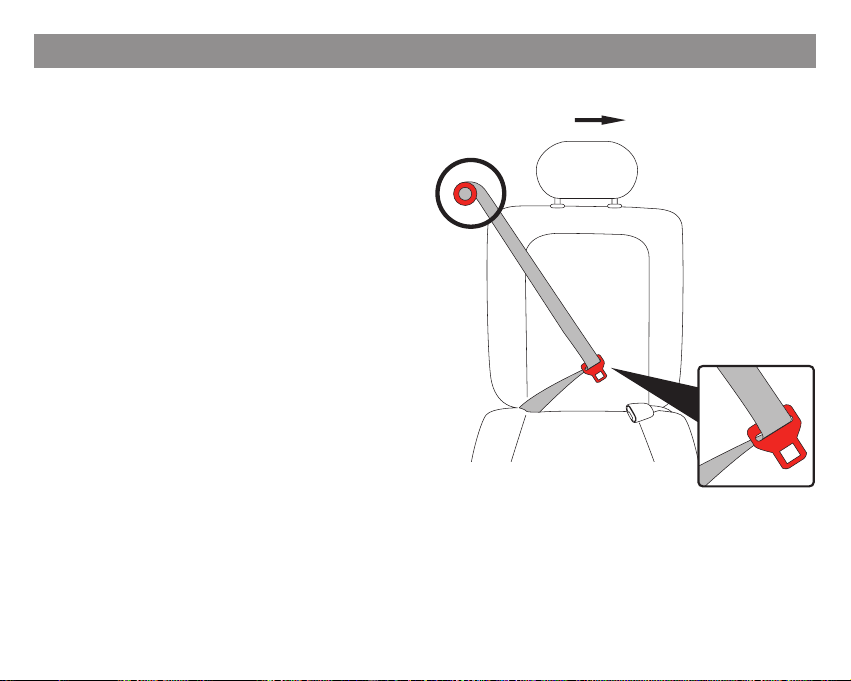
- 18 -
Cinturón de cadera / hombro (de 3
puntos) con retractor de bloqueo con
conmutación (ELR —> ALR) y placa de
seguro deslizante.
Este tipo de cinturón tiene una placa de
seguro que se desplaza libremente por
el cinturón. Para activar el modo ALR
para la instalación de una silla de auto,
en algunos modelos de vehículo hay
que tirar y hacer salir el cinturón hasta el
tope; en otros modelos hay que tirar del
cinturón hasta cierta longitud (consulte
el manual de instrucciones del vehículo
para más detalles).
Para la instalación de Primo Viaggio 4
.
35,
deje el cinturón en modo ELR y utilice el
clip de bloqueo integrado en la base de la
silla de auto.
Puede ser necesario un clip de bloqueo
en el caso de que la silla se utilice sin base
(véase la página 37).
ELR ALR
X
Descripción general del cinturón de seguridad del vehículo
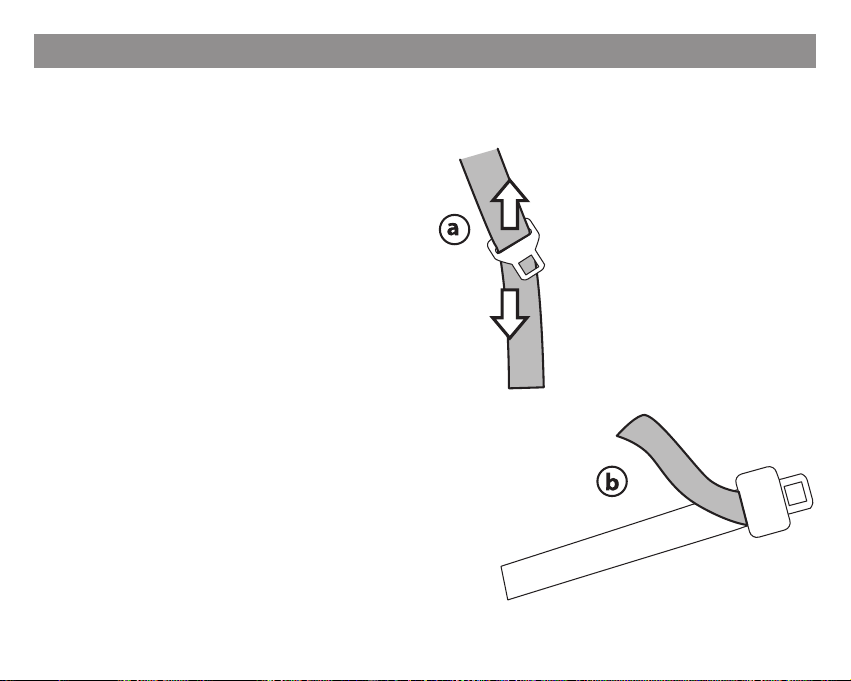
- 17 -
Descripción general del cinturón de seguridad del vehículo
bloquear el retractor en una determinada
posición (llamada también modo silla de
auto) para asegurar las sillas de auto
para niños.
El modo ALR se activa extendiendo el
retractor por completo hasta oír un clic,
luego dejando que el cinturón se retraiga
hacia el interior del retractor hasta la
longitud deseada y deteniendo el cinturón
en ese punto.
El retractor se bloqueará y no permitirá
que el cinturón se siga alargando a partir
de ese punto (sólo retracción).
Para anular el modo ALR y volver al modo
ELR del retractor, deje que el cinturón se
retraiga por completo en el retractor.
Una placa de seguro puede ser deslizante
(a) o bloqueante (b). Las placas de seguro
deslizantes se encuentran sólo en los
cinturones de cadera o de hombro y
se mueven libremente a lo largo de la
correa. Las placas de seguro bloqueantes
tienen un mecanismo que bloquea el
movimiento de la placa sobre la correa.
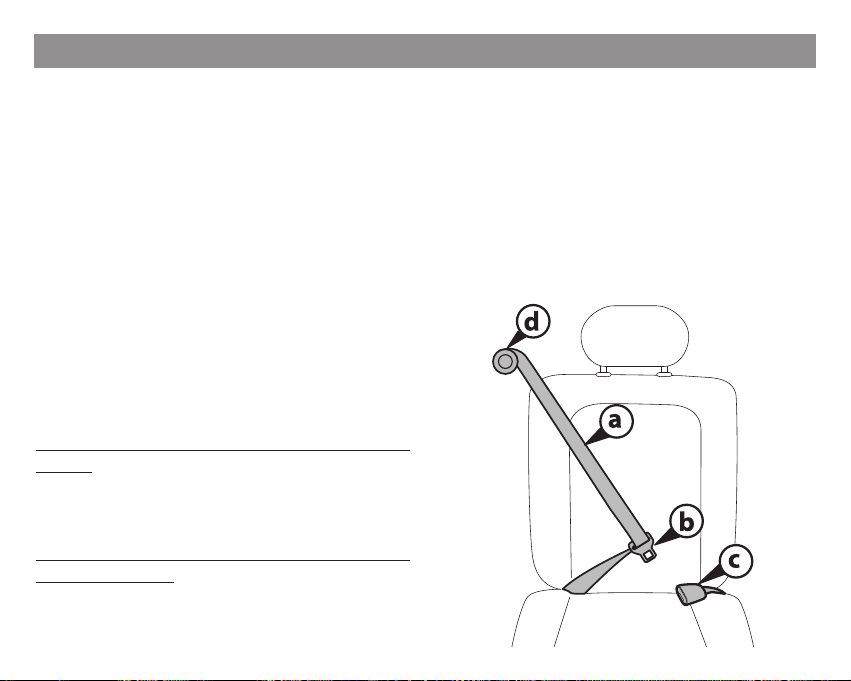
- 16 -
Descripción general del cinturón de seguridad del vehículo
CINTURONES DE SEGURIDAD DEL VEHÍCULO: esta silla de auto está diseñada para
la instalación con los cinturones de seguridad del vehículo. Existen varios diseños
de cinturón de seguridad. Lamentablemente, algunos modelos pueden resultar
inadecuados para la instalación segura de Primo Viaggio 4
.
35. Lea atentamente las
páginas siguientes. Consulte el manual de instrucciones del vehículo o llame al servicio
de asistencia al cliente de Peg Perego al 1-800-671- 1701 para pedir ayuda.
El cinturón de seguridad más común se
compone de una correa de tela (a), una
placa de seguro (b), una hebilla (c) y un
retractor (d). Un retractor es un dispositivo
de resorte bajo carga que enrolla el
cinturón automáticamente cuando éste
deja de utilizarse. Los retractores más
comunes son los siguientes:
Retractor de bloqueo de emergencia
(ELR): da libertad de movimiento
al usuario, pero en una situación de
emergencia o choque retiene al usuario
con rmeza.
Retractor de bloqueo con conmutación
(ELR —> ALR): conmuta entre la función
de retractor de bloqueo de emergencia
(ELR) y la de retractor de bloqueo
automático (ALR). Esto permite al usuario
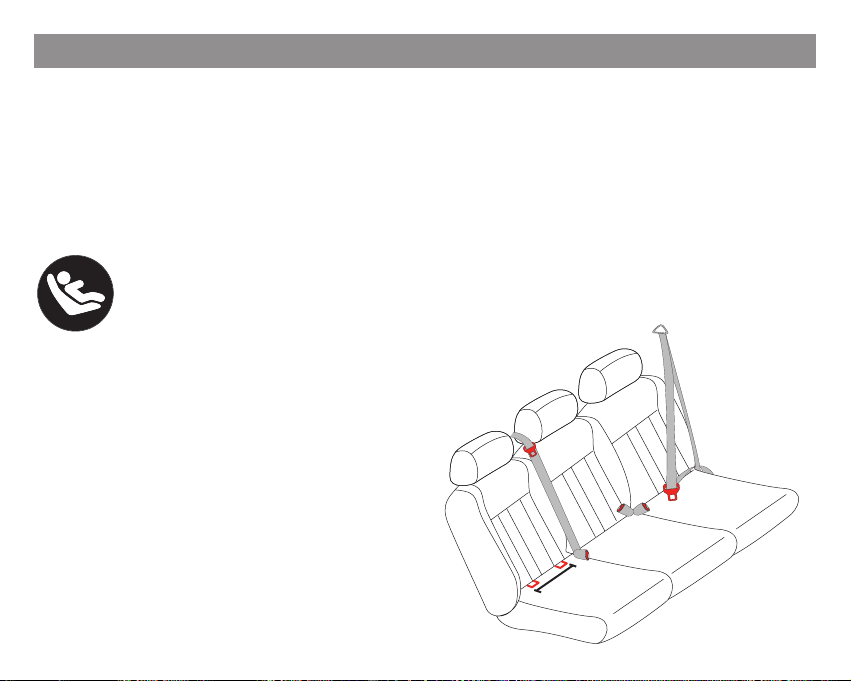
- 15 -
Descripción general del SISTEMA DE SEGURO
Primo Viaggio 4
.
35 está equipada con ganchos de bloqueo en la base (véase la página
26 para el uso del seguro). Los seguros se deben enganchar a los anclajes del vehículo
situados en la unión entre el asiento y el respaldo del asiento del vehículo. Hay al menos
dos anclajes por cada asiento, espaciados por unas 11 pulgadas (28 cm). Pueden estar
visibles o apenas retraídos en el tapizado del vehículo, protegidos con plástico o tela. El
gancho de SEGURO se identica con este símbolo:
Consulte el manual de instrucciones del
vehículo para descubrir la posición de
anclaje del SEGURO en su vehículo y las
posibles combinaciones para el uso de
una silla de auto.
11” - 28cm
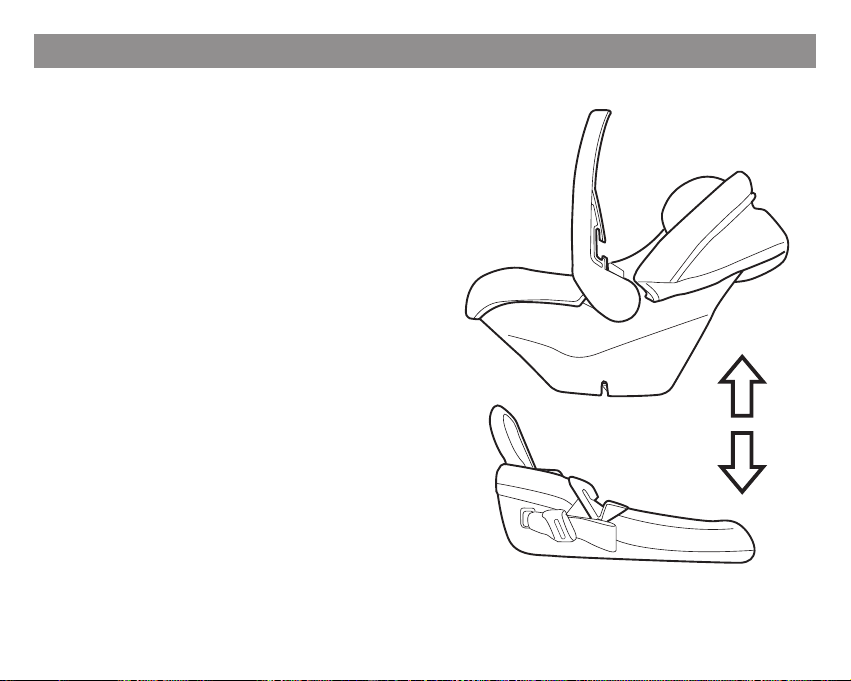
- 14 -
Instrucciones de instalación
Peg Perego Primo Viaggio 4
.
35 está
certificada para utilizarse con o sin base.
Se recomienda utilizar la base para que la
instalación resulte más fácil y segura.
Desenganche la silla de la base siguiendo
las instrucciones de la página 25, vuelva
a engancharla y repita la operación hasta
adquirir familiaridad con esta importante
prestación.
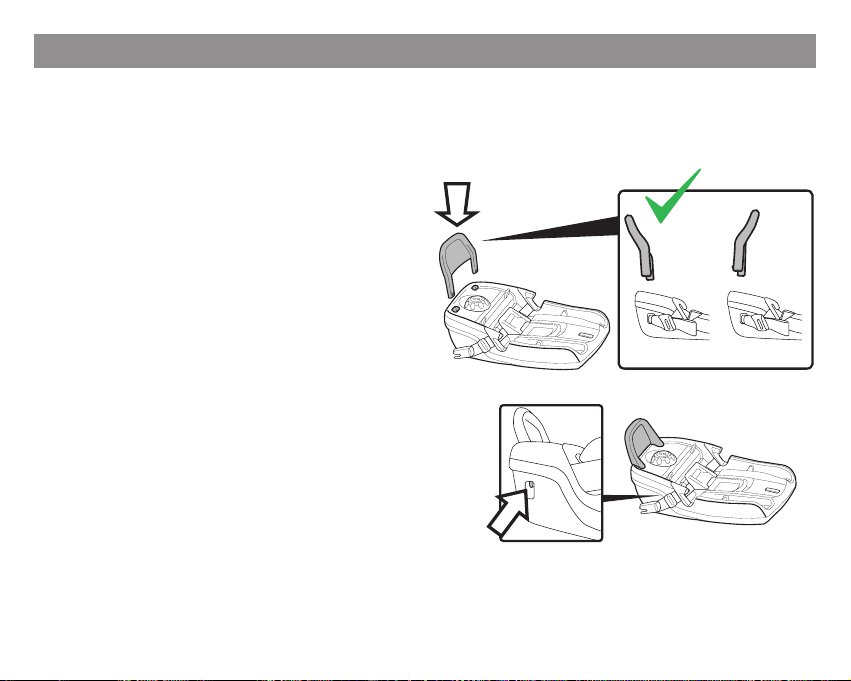
- 13 -
Ensamblaje antes del primer uso
Primo Viaggio 4
.
35 se suministra casi listo
para el uso.
Desenganche la silla de auto de su base
siguiendo las instrucciones de la página 25.
Encastre la barra antirrebote en la base
como indica la figura.
Compruebe que la barra quede instalada
adecuadamente, tirando de la parte
superior para tratar de desprenderla de la
base.
NOTA IMPORTANTE: la barra antirrebote
asegura una protección adicional en caso
de colisión trasera o durante el movimiento
de la silla en un accidente. Ensámblela
correctamente.
Si es necesario, la barra antirrebote se
puede quitar pulsando los botones que se
encuentran dentro del alojamiento de los
ganchos de seguro.
x
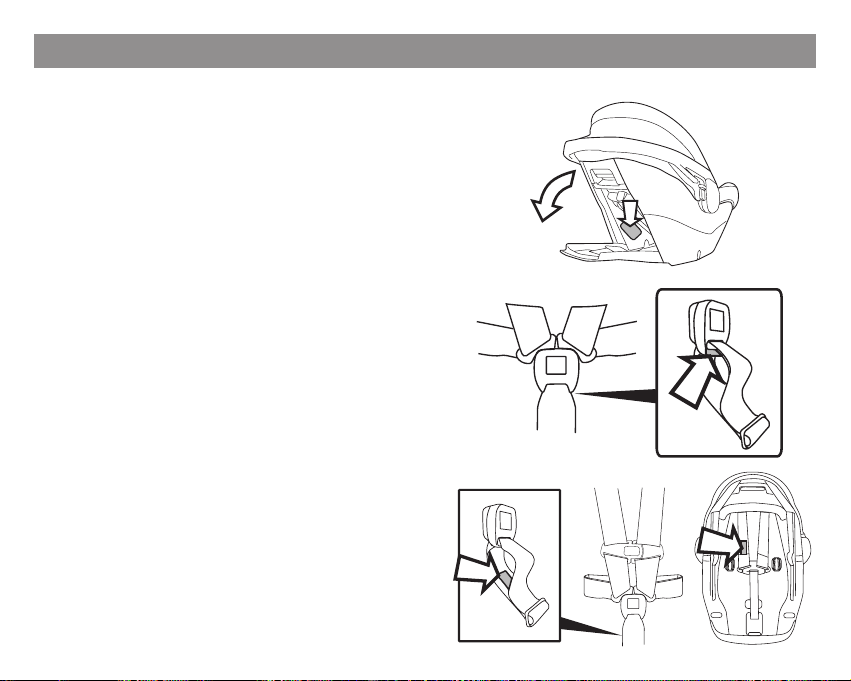
- 12 -
Números de serie
Abra la puerta del compartimiento
posterior para leer la etiqueta de
identificación del producto que se
indica en la figura. La etiqueta contiene
la siguiente información: nombre de
producto, fecha de producción y número
de serie; estos datos identifican al
producto unívocamente.
Todas las hebillas y arneses que se aplican
a Primo Viaggio 4
.
35 están marcados con
un número de serie en el punto que se
indica en la figura.
En caso de problemas con el producto,
estos datos pueden ser solicitados por el
servicio de asistencia de PegPerego.
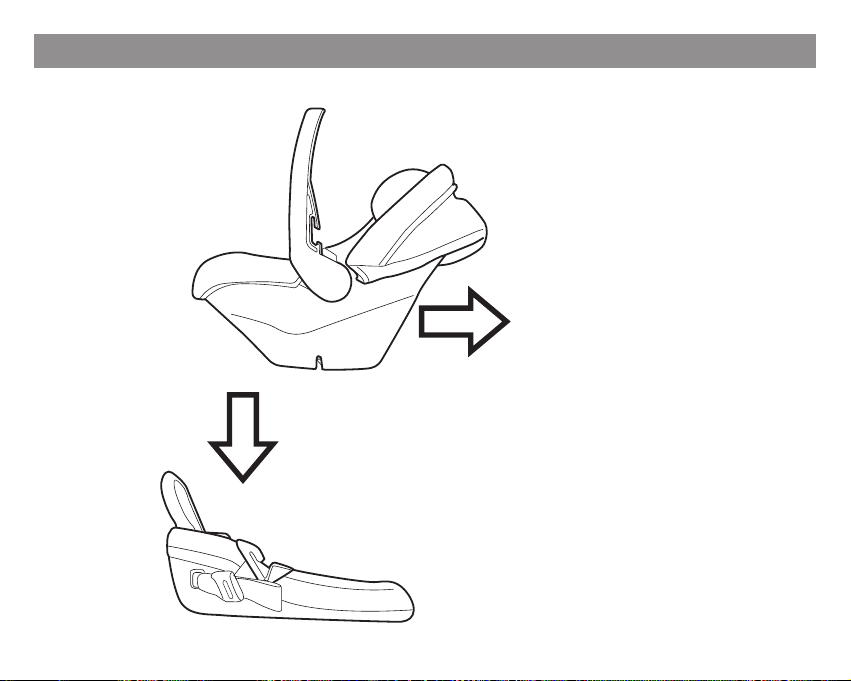
- 11 -
Base
Silla
Chasis / Sillas de paseo:
.
Booklet
.
Book
.
Book Plus
.
Book Pop-Up
.
Switch Four
.
Duette
.
Triplette
Sistema de viaje
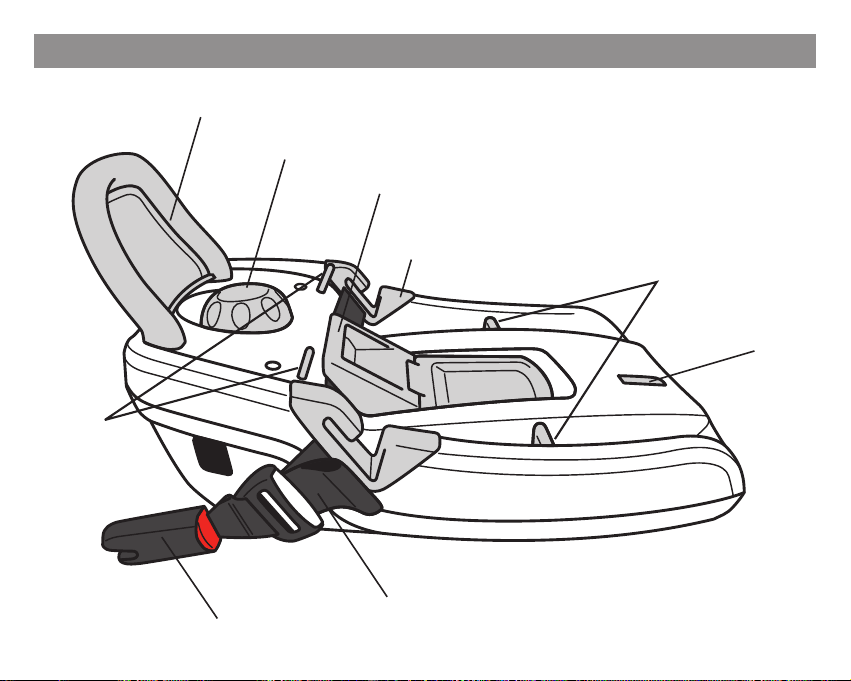
- 10 -
Base de la silla de auto
Ranuras del cinturón codificadas por color
Seguros posteriores
Seguros frontales
Correa del seguro
Pomo de ajuste del ángulo
Clip de bloqueo integrado
Indicador de nivel
Barra antirrebote
Gancho del seguro
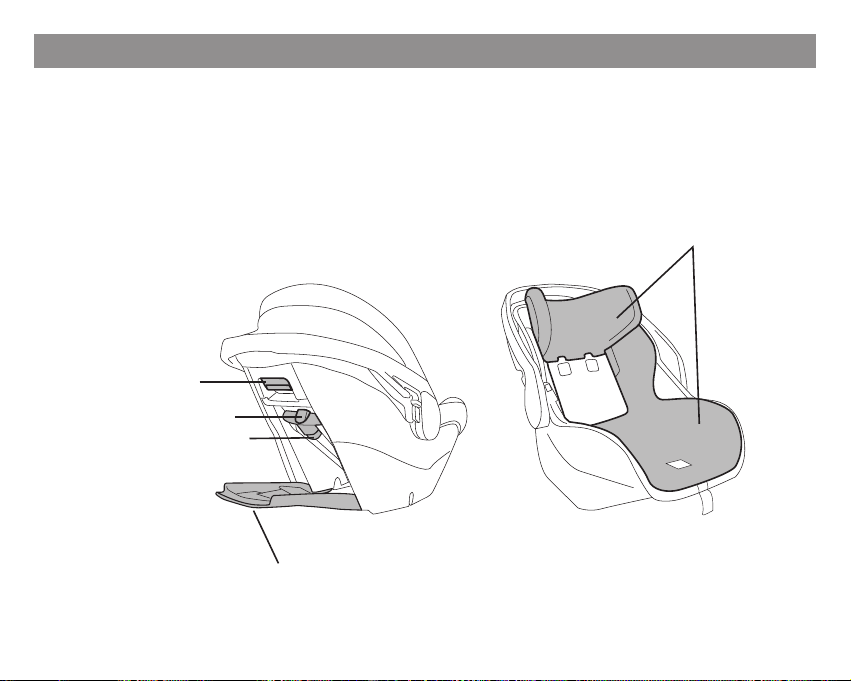
- 9 -
Puerta del compartimiento posterior
Placa de arnés deslizante
Palanca de desbloqueo
Botón de la placa del arnés
Armazón revestido en espuma de
poliestireno expandido (EPS) que absorbe
energía, con reposacabezas para una
mayor protección contra el impacto.
Su silla de auto
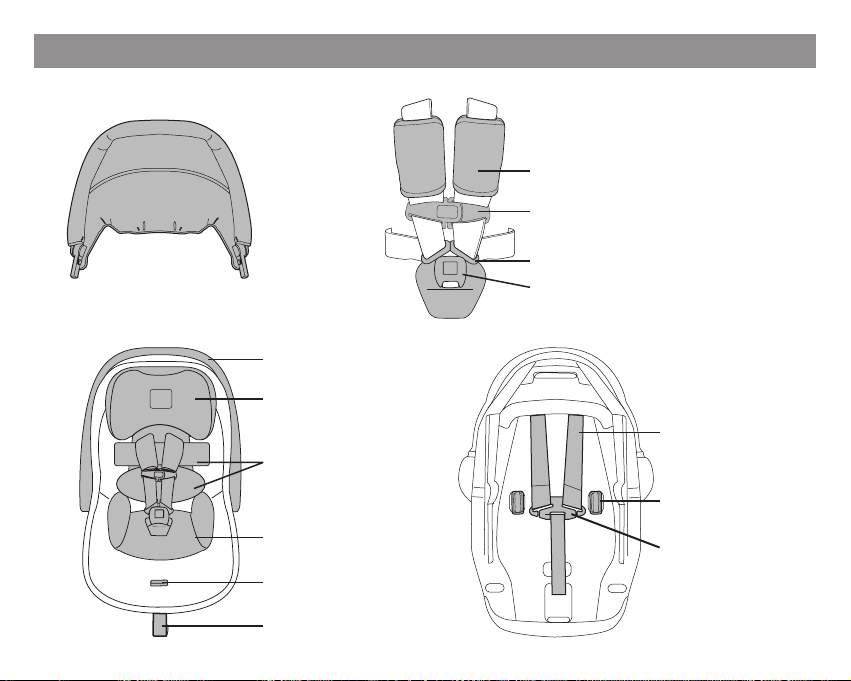
- 8 -
CAPOTA
Placa divisora
Correas de hombro
del arnés
Anclajes para
la cintura
LADO POSTERIOR
Clip pectoral
Hebilla del arnés
Placa del seguro del arnés
SISTEMA DE ARNÉS DE 5 PUNTOS
Cojines de hombro
FRENTE
Asa de la silla
Cojín de primera etapa
Cojín de segunda etapa
Protección de la cabeza
contra el impacto lateral
Botón de ajuste del arnés
Correa de ajuste del arnés
Su silla de auto
- 7 -
ADVERTENCIA
•
Utilice la silla de auto sólo para niños
de 4 a 35 libras (1,8 a 15,8 kg) de peso y
hasta 32 pulgadas (81,3 cm) de estatura.
Si su bebé tiene muy poco peso, pida al
médico instrucciones especiales sobre
cómo utilizar la silla de auto.
•
Nunca deje a su bebé solo en la silla de
auto. Podría enredarse con las correas
y sufrir lesiones graves, o moverse y
tumbar la silla.
•
Instale esta silla de auto únicamente en
asientos orientados hacia delante. No la
utilice en asientos orientados hacia atrás
o hacia los costados, ni en vehículos con
cinturones de hombro motorizados o
montados en las puertas.
•
Utilice esta silla de auto en vehículos
con cinturones de cadera o de hombro
estándar o con anclajes inferiores
universales. Si su vehículo tiene anclajes
inferiores, utilícelos para asegurar la silla
de auto en vez de utilizar el cinturón de
seguridad. Lea el manual de su vehículo
para localizar los anclajes inferiores.
•
Asegúrese de que la silla de auto esté
nivelada correctamente. Si la silla está
demasiado reclinada, su bebé podría
sufrir lesiones o ser expulsado de la silla.
Si la silla está demasiado erguida, su
bebé podría tener dificultades para
respirar y sufrir lesiones o muerte.
•
No deje la silla de auto ni la base
sueltas en el vehículo, aunque no estén
ocupadas. Una silla de auto suelta
puede causar lesiones a los pasajeros
en caso de accidente.
•
No utilice esta unidad pasados siete
(7) años desde la fecha de producción
etiquetada en la silla.
•
No cuelgue juguetes en el asa de la silla.
•
Utilice únicamente piezas aprobadas.
El uso de piezas no aprobadas puede
comprometer la seguridad de la silla de
auto y causar lesiones graves o muerte
en caso de accidente.
Reglas de seguridad
- 6 -
ADVERTENCIA
•
NUNCA deje a su bebé sin vigilancia.
•
Sujete a su bebé en la silla de auto
utilizando el arnés. Asegúrese de que
las hebillas se abrochen correctamente.
•
Peligro de caída: la silla puede moverse
debido a la actividad del niño. NUNCA
coloque la silla de auto sobre encimeras,
mesas u otras superficies elevadas.
•
No coloque la silla de auto en el asiento
o en la parte superior del carrito de
compras.
•
Peligro de asfixia: la silla de auto se
puede volcar sobre las superficies
blandas y sofocar al niño. NUNCA
coloque la silla de auto sobre camas,
sofás u otras superficies blandas.
•
Peligro de estrangulamiento: ha
habido casos de ESTRANGULAMIENTO
con correas sueltas o abrochadas
parcialmente. Sujete bien al niño aun
cuando la silla se utilice fuera del
vehículo.
•
En caso de accidente: si esta silla de
auto sufre un accidente, podría dejar
de ser segura para el uso. Podría ser
necesario adquirir una nueva unidad.
Llame al servicio al cliente 1-800-671-
1701 (gratuito) para más información.
•
No utilice esta silla de auto si está
averiada o dañada.
•
Si utiliza un cinturón de cadera o de
hombro para instalar la base, deberá
utilizar un cinturón de seguridad para
el bloqueo. Consulte el manual de
instrucciones del vehículo para más
información. Podría ser necesario utilizar
un clip de bloqueo, no suministrado
con esta silla.
•
Antes de levantar la silla de la base,
coloque el asa en posición de transporte.
•
No acerque los dedos a las piezas
móviles.
Reglas de seguridad
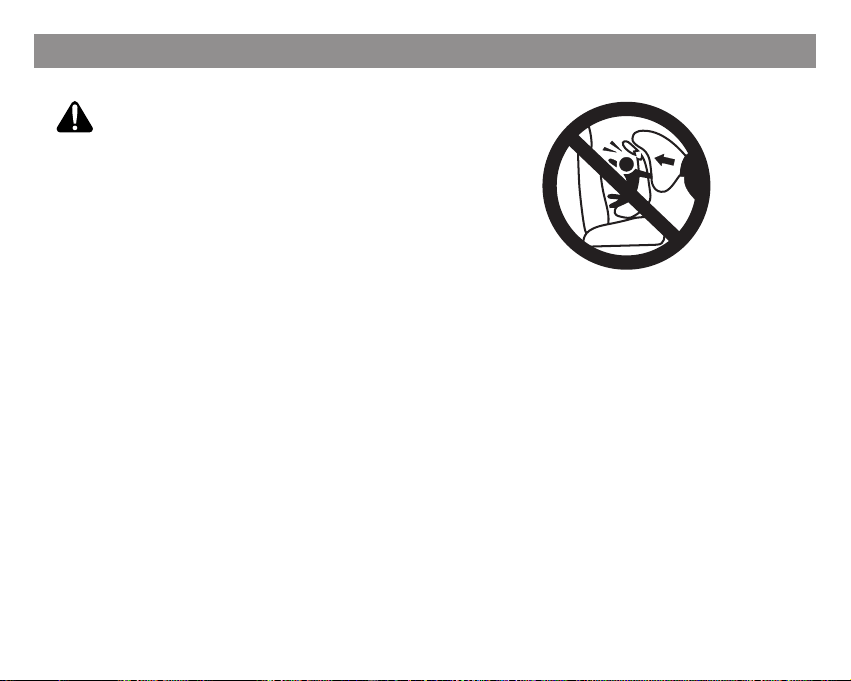
- 5 -
ADVERTENCIA
•
Esta silla de auto es conforme o supera
todos los requisitos de la Norma Federal
de Seguridad de Vehículos 213 para el
uso en vehículos a motor y aviones.
•
Lea todas las instrucciones antes de
utilizar esta silla de auto. Guarde las
instrucciones en el bolsillo posterior de
la silla de auto para futuras consultas.
•
Su niño podría sufrir graves heridas
en caso de incumplimiento de las
instrucciones y etiquetas de advertencia.
•
Utilice esta silla de auto únicamente
orientada hacia atrás. Esta silla no está
diseñada para orientarse hacia delante.
Un accidente podría causar graves
heridas o muerte si la silla se instala
orientada hacia delante.
•
Si su vehículo tiene airbags, no instale
esta silla de auto en un asiento que tenga
un airbag activo. En caso de despliegue
del airbag, la silla de auto podría recibir
un fuerte impacto. El usuario podría
sufrir graves lesiones o muerte.
Reglas de seguridad
•
Si su vehículo tiene airbags, lea el
manual de instrucciones de su vehículo
para saber en qué parte del vehículo
instalar la silla de auto.
•
Los propietarios de vehículos con
airbags laterales delanteros (o traseros)
deberían consultar en el manual del
vehículo las instrucciones para la
instalación de sillas de auto.
•
Nunca instale la silla de auto en el
asiento delantero del vehículo salvo que
tales sean las instrucciones del manual
de su vehículo. Según las estadísticas de
accidentes automovilísticos, cuando los
niños están sujetados correctamente en
el asiento trasero, se encuentran más a
salvo que en el asiento delantero.

- 4 -
Llame al Servicio al Cliente de Peg Perego
USA, 1-800-671-1701 (gratuito) si desea
obtener información sobre reparaciones o
piezas de repuesto. Si alguna pieza falta o
está dañada, se debe sustituir únicamente
con un repuesto original Peg Perego. En la
página 56 se listan las piezas de repuesto.
Si desea tener más de una base, puede
adquirirla a través de su revendedor local,
o llamando al 1-800-671-1701 (gratuito) o
visitando www.pegperego.com.
¡Importante! Las sillas de auto para niños
pueden ser retiradas para actualizaciones
por motivos de seguridad. Registre esta
silla de auto para permitir que le avisen
en tal caso. Envíe su nombre, su dirección,
el modelo de silla de auto y la fecha de
fabricación a:
Peg Perego U.S.A., Inc.
3625 Independence Drive
Fort Wayne, IN 46808
O llame al 1-800-671-1701 (gratuito)
O regístrese online en
www.carseat-registration.pegperego.com
Para información sobre el retiro de
artículos vendidos, llame a la línea
de asistencia para la seguridad de los
vehículos puesta a disposición por el
gobierno estadounidense, al 1-888-327-
4236 (TTY: 1-800-424-9153). O visite
http://www.NHTSA.gov
¡Importante! Esta información ya
está disponible en el formulario de
registro adjunto a su nueva silla de
auto. Simplemente debe recortar la
parte indicada y enviarla por correo
ordinario. El envío ya está pagado.
Complete y envíe inmediatamente el
formulario de registro.
Servicio al Cliente
Formulario de registro

- 3 -
1 Lea este manual atentamente. Conserve este manual en el bolsillo trasero de silla de
auto.
2 Revise una a una las piezas de la silla de auto y lea las instrucciones. Lea y entienda
todas las etiquetas y todas las instrucciones antes de utilizar esta silla de auto.
3 Rellene y envíe el formulario de registro (página 4).
4 El ensamblaje debe ser llevado a cabo por un adulto.
5 No utilice la silla de auto si falta o si está dañada alguna pieza.
6 Utilice sólo las piezas o accesorios que se suministran con la unidad. No modifique
ni repare ninguna pieza.
7 Recuerde: esta silla de auto debe instalarse únicamente orientada hacia atrás.
8 Peg Perego se reserva el derecho de aportar cambios al producto en cualquier
momento sin aviso previo.
Antes de empezar

- 2 -
© 2014 Peg Perego. Todos los derechos reservados.
Tabla de contenidos
Antes de empezar page 3
Servicio al cliente / formulario de registro page 4
Reglas de seguridad page 5
Su silla de auto page 8
Base de la silla de auto page 10
Sistema de viaje page 11
Números de serie page 12
Ensamblaje antes del primer uso page 13
Instrucciones de instalación page 14
Descripción general del sistema de SEGURO
page 15
Descripción general del cinturón de seguridad
del vehículo page 16
Diseños de cinturón de seguridad de vehículo o
posiciones de asiento no compatibles page 23
Instalación de la base page 24
Cómo nivelar la base en el vehículo page 25
Cómo instalar la base utilizando el SISTEMA DE
SEGURO page 26
Cómo instalar la base utilizando el CINTURÓN DE
SEGURIDAD DEL VEHÍCULO
page 29
Instalación de la base con diferentes tipos de
cinturones de seguridad page 31
Instalación de la silla de auto sobre la base
page 32
Instalación de la silla de auto sin la base page 34
Instalación de la silla de auto con diferentes tipos
de cinturones de seguridad page 36
Uso del clip de bloqueo page 37
Cómo sujetar a su bebé en la silla de auto
page 38
Cómo levantar o bajar las correas de hombro
page 43
Sistema de doble cojín page 45
Uso de la silla de auto fuera del vehículo page 46
Cómo utilizar la silla de auto en el avión
page 49
Limpieza y mantenimiento page 50
Cómo lavar la guata de la silla - Desmontaje de
la funda page 51
Cómo lavar la guata de la silla - Montaje
page 54
Piezas de repuesto page 56
No instale ni utilice esta silla de auto
para niños sin antes leer y entender
todas las instrucciones de este manual.
Para evitar heridas graves a su bebé,
siga las instrucciones atentamente y
asegúrese de sujetar a su bebé con el
arnés de 5 puntos.
ADVERTENCIA:
Requisitos para el niño:
Límites de peso: 4 - 35 libras (1,8 - 15,8 kg)
Estatura máxima: 32 pulgadas (81,3 cm)
USA
Instrucciones de uso ES
FIUS1403I205
M A N U A L D E U S U A R I O
PRIMO VIAGGIO 4
.
35