JVC
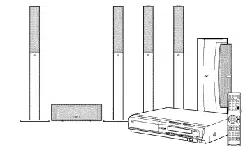
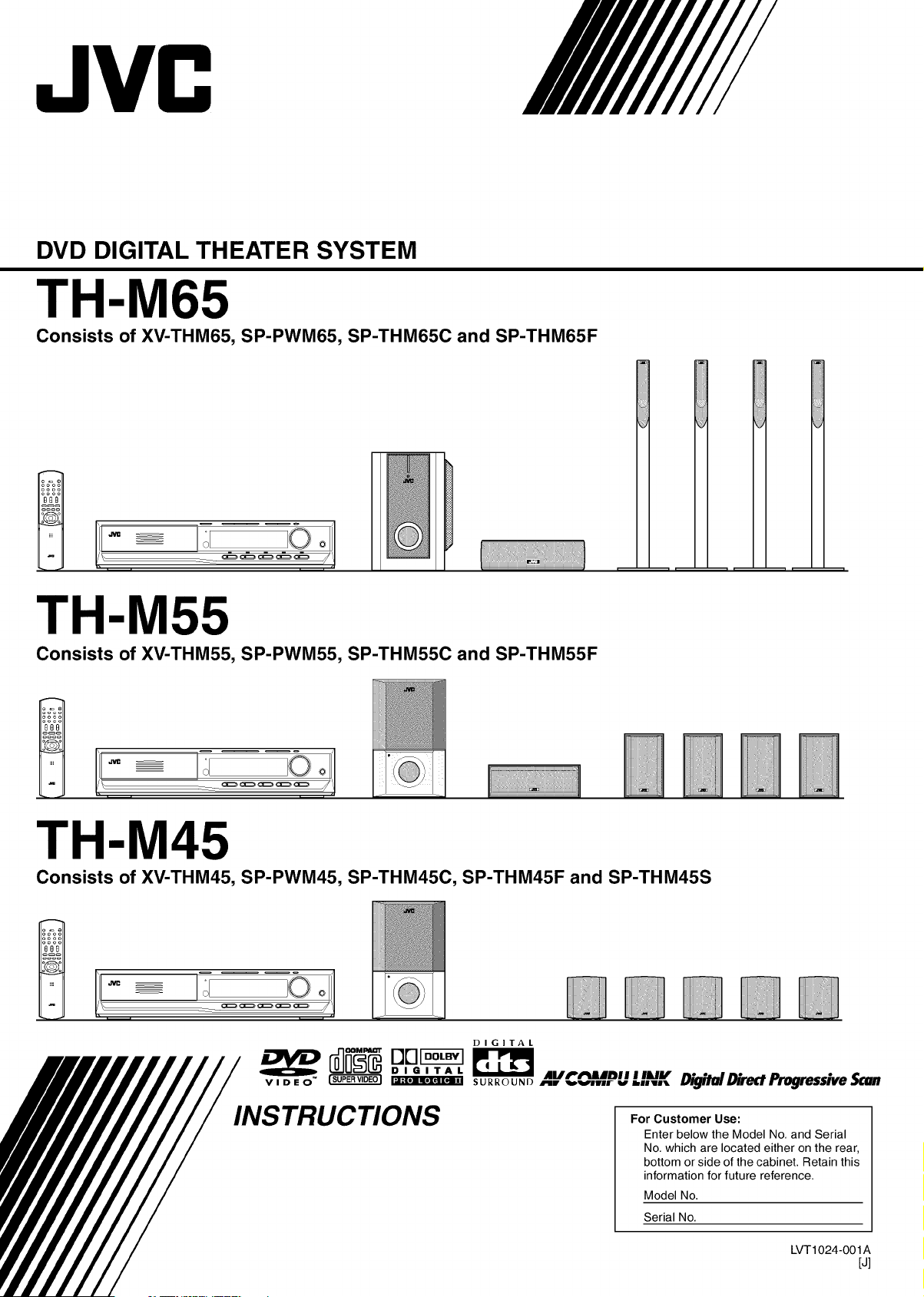
DVD DIGITAL THEATER SYSTEM
rH-M65
Consists of XV-THM65, SP-PWM65, SP-THM65C and SP-THM65F
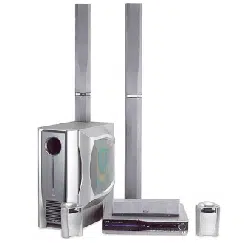
rH-M55
Consists of XV-THM55, SP-PWM55, SP-THM55C and SP-THM55F
!
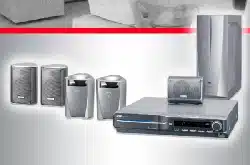
rH-M45
Consists of XV-THM45, SP-PWM45, SP-THM45C, SP-THM45F and SP-THM45S
DIGITAL
VIDEO" _ r_ SURROUND J,,llr _VlVlr_IlVll
INSTRUCTIONS For Customer Use:
Enter below the Model No. and Serial
No. which are located either on the rear,
bottom or side of the cabinet. Retain this
information for future reference.
Model No.
Serial No.
LVT1024-001A
[J]
Warnings,CautionsandOthers
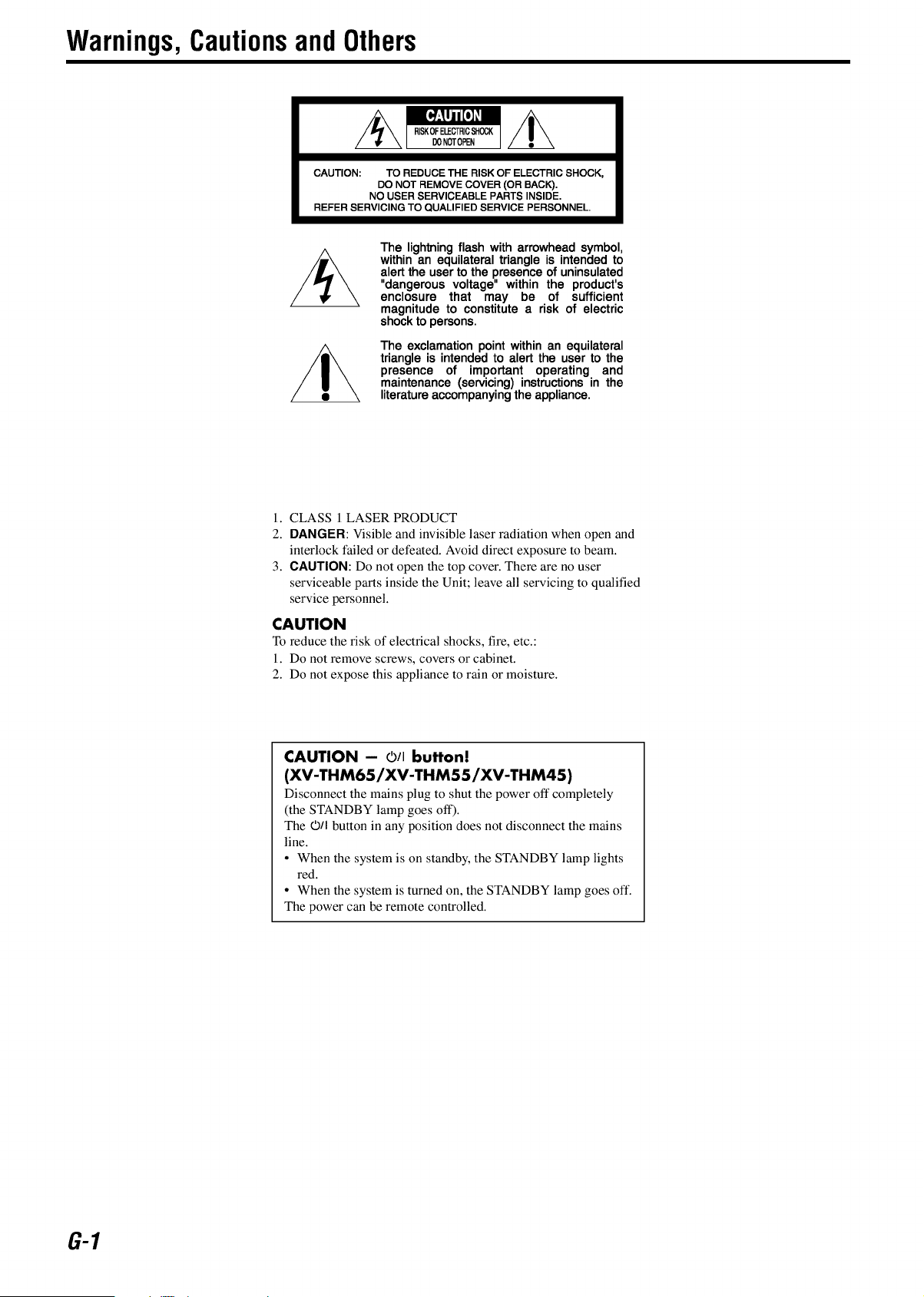
CAUTION: TO REDUCE THE RISK OF ELECTRIC SHOCK,
DO NOT REMOVE COVER (OR BACK).
NO USER SERVICEABLE PARTS INSIDE.
REFER SERVICING TO QUALIFIED SERVICE PERSONNEL.
The lightningflash with arrowhead symbol,
within an equilateral triangle is intendedto
alert the user to the presenceof uninsulated
"dangerous voltage" within the product's
enclosure that may be of sufficient
magnitude to constitute a risk of electric
shockto persons.
The exclamationpoint withinan equilateral
triangle is intendedto alert the user to the
presence of important operating and
maintenance (servicing)instructionsin the
literatureaccompanyingthe appliance.
l. CLASS 1 LASER PRODUCT
2. DANGER: Visible and invisible laser radiation when open and
interlock failed or defeated. Avoid direct exposure to beam.
3. CAUTION: Do not open the top cover. There are no user
serviceable parts inside the Unit; leave all servicing to qualified
service personnel.
CAUTION
To reduce the risk of electrical shocks, fire, etc.:
1. Do not remove screws, covers or cabinet.
2. Do not expose this appliance to rain or moisture.
CAUTION -- O/I button. =
(XV-THM65/XV-THM55/XV-THM45)
Disconnect the mains plug to shut the power off completely
(the STANDBY lamp goes off).
The ©/I button in any position does not disconnect the mains
line.
• When the system is on standby, the STANDBY lamp lights
red.
• When the system is turned on, the STANDBY lamp goes oft.
The power can be remote controlled.
G-1
Warnings, Cautions and Others
WARNING: TO REDUCE THE RISK OF FIRE
OR ELECTRIC SHOCK, DO NOT EXPOSE
THIS APPLIANCE TO RAIN OR MOISTURE.
INFORMATION
This equipment has been tested and found to comply with the
limits for a Class B digital device, pursuant to part 15 of the FCC
Rules. These limits are designed to provide reasonable
protection against harmful interference in a residential
installation.
This equipment generates, uses and can radiate radio frequency
energy and, if not installed and used in accordance with the
instructions, may cause harmful interference to radio
communications. However, there is no guarantee that
interference will not occur in a particular installation. If this
equipment does cause harmful interference to radio or television
reception, which can be determined by turning the equipment off
and on, the user is encouraged to try to correct the interference
by one or more of the following measures:
Reorient or relocate the receiving antenna.
Increase the separation between the equipment and receiver.
Connect the equipment into an outlet on a circuit different from
that to which the receiver is connected.
Consult the dealer or an experienced radio/TV technician for
help.
For Canada/pour le Canada
CAUTION: TO PREVENT ELECTRIC SHOCK, MATCH
WIDE BLADE OF PLUG TO WIDE SLOT, FULLY INSERT.
ATTENTION: POUR EVITER LES CHOCS ELECTRIQUES,
INTRODUIRE LA LAME LA PLUS LARGE DE LA FICHE
DANS LA BORNE CORRESPONDANTE DE LA PRISE ET
POUSSER JUSQUAU FOND.
For Canada/pour le Canada
THIS DIGITAL APPARATUS DOES NOT EXCEED THE
CLASS B LIMITS FOR RADIO NOISE EMISSIONS FROM
DIGITAL APPARATUS AS SET OUT IN THE
INTERFERENCE-CAUSING EQUIPMENT STANDARD
ENTITLED "DIGITAL APPARATUS," ICES-003 OF THE
DEPARTMENT OF COMMUNICATIONS.
CET APPAREIL NUMERIQUE RESPECTE LES LIMITES
DE BRUITS RADIOELECTRIQUES APPLICABLES AUX
APPAREILS NUMIRIQUES DE CLASSE B PRESCRITES
DANS LA NORME SUR LE MATERIEL BROUILLEUR:
"APPAREILS NUMERIQUES", NMB-003 EDICTEE PAR
LE MINISTRE DES COMMUNICATIONS.
Note to CATV system installer:
This reminder is provided to call the CATV system installer's
attention to Section 820-40 of the NEC which provides
guidelines for proper grounding and, in particular, specifies
that the cable ground shall be connected to the grounding
system of the building, as close to the point of cable entry as
practical.
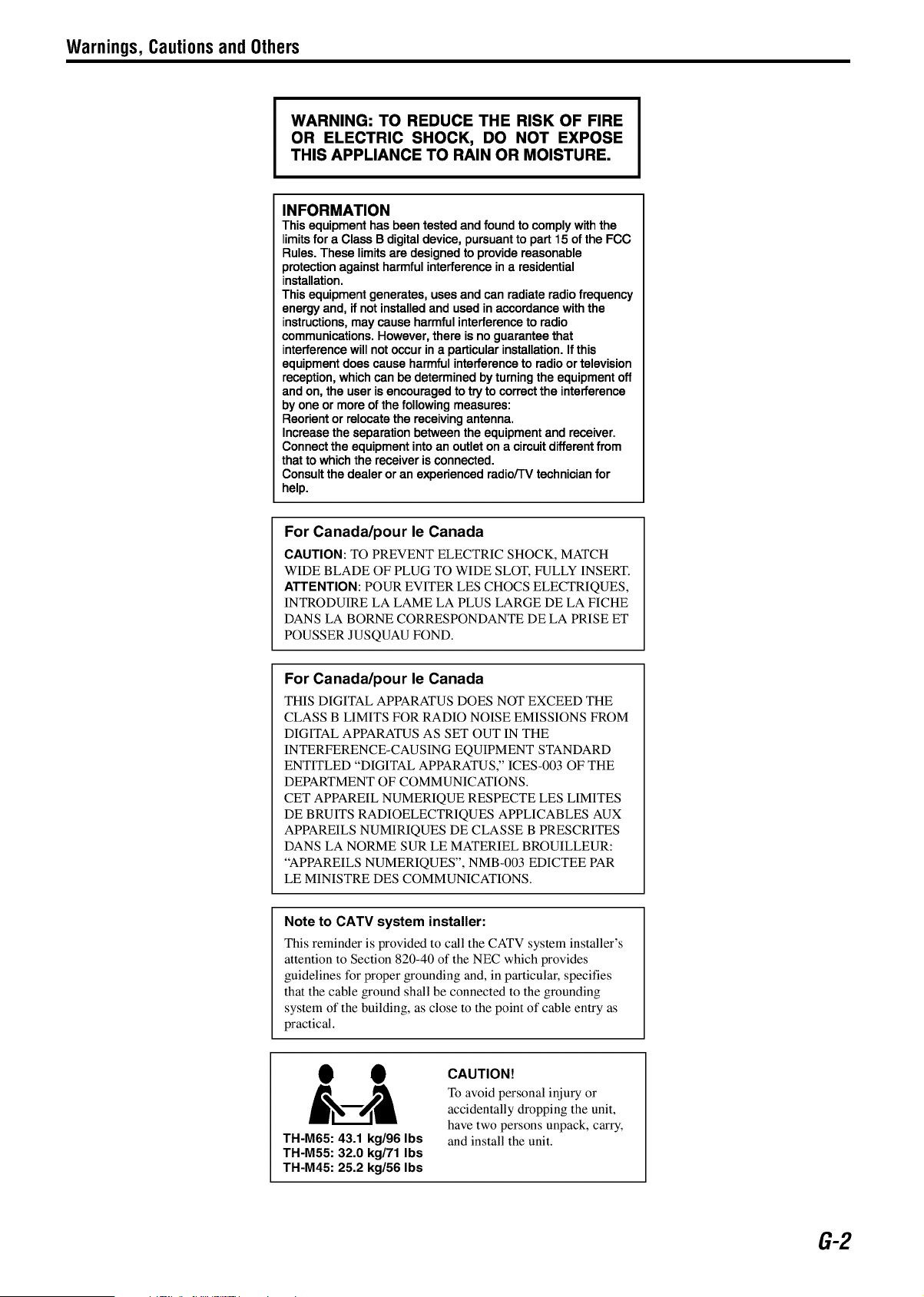
TH-M65:43.1 kg/96 Ibs
TH-M55:32.0 kg/71 Ibs
TH-M45:25.2 kg/56 Ibs
CAUTION!
To avoid personal injury or
accidentally dropping the unit,
have two persons unpack, carry,
and install the unit.
G-2
Tableof contents
Introduction ...................................... 2
Notes on handling..................................................................2
Supplied accessories.............................................................2
About discs ...................................... 3
Playabledisc types ................................................................3
Disc structure ........................................................................4
PlaybackControl function (PBC)-- VCDand SVCDonly ......4
Names of parts and controls ........... 5
Getting started ................................. 8
Connections...........................................................................8
Using the remote control .....................................................16
Basic operations ............................ 19
Turning the system on/off ....................................................19
Selectingthe source to play.................................................20
Adjusting the volume ...........................................................20
Listening with headphones..................................................20
Turning off the sound temporarily .......................................20
Adjusting the brightness ......................................................20
Using the Sleep Timer ..........................................................21
Adjusting the output level of the subwoofer.........................21
Adjusting the bass/treble sound...........................................21
Changingthe decodemode .................................................22
Changingthe scan mode .....................................................22
Playback ......................................... 23
Basic playback.....................................................................23
Playbackfeatures.................................................................25
Tuner operations ............................ 27
Manual tuning ......................................................................27
Presettuning .......................................................................27
Selectingthe FMreception mode.........................................28
Reducingthe noise of AM broadcast ...................................28
Creating realistic sound fields ...... 29
Using the surround mode....................................................31
Adjusting the sound.............................................................32
Advanced operations ..................... 33
Using the on-screen bar ......................................................33
Playingfrom a specified position on a disc..........................34
Using the MP3 control display............................................. 36
Using the JPEGcontrol display............................................ 37
Selectinga view angleof DVD............................................. 38
Selectingthe subtitle/audio languages................................. 39
Special picture playback...................................................... 1
Program Playback................................................................4:
RandomPlayback................................................................
RepeatPlayback..................................................................
Setting DVD preferences ............... 46
Using the choice menus ......................................................46
Menu description .................................................................48
ParentalLock .......................................................................51
System setting ............................... 54
AV COMPU LINK remote control
system ............................................ 55
References ..................................... 56
Maintenance........................................................................56
Trouble shooting ..................................................................56
Glossary...............................................................................59
Index....................................................................................60
Specifications ......................................................................61
1
Introduction
I Notes on handling
• Important cautions
Installation of the system
• Select a place which is level, dry and neither too hot nor too cold;
between 5°C and 35°C (41 °F and 95°F).
• Leave sufficient distance between the system and the TV.
• Do not use the system in a place subject to vibration.
Power cord
• Do not handle the power cord with wet hands!
• A small amount of power (1.0 watt) is always consumed while
the power cord is connected to the wall outlet (center unit only).
• When unplugging the power cord from the wall outlet, always
pull on the plug, not the power cord.
To prevent malfunctions of the system
• There are no user-serviceable parts inside. If anything goes
wrong, unplug the power cord and consult your dealer.
• Do not insert any metallic object into the system.
• Do not use any non-standard shape disc (like a heart, flower or
credit card, etc.) available on the market, because it may damage
the system.
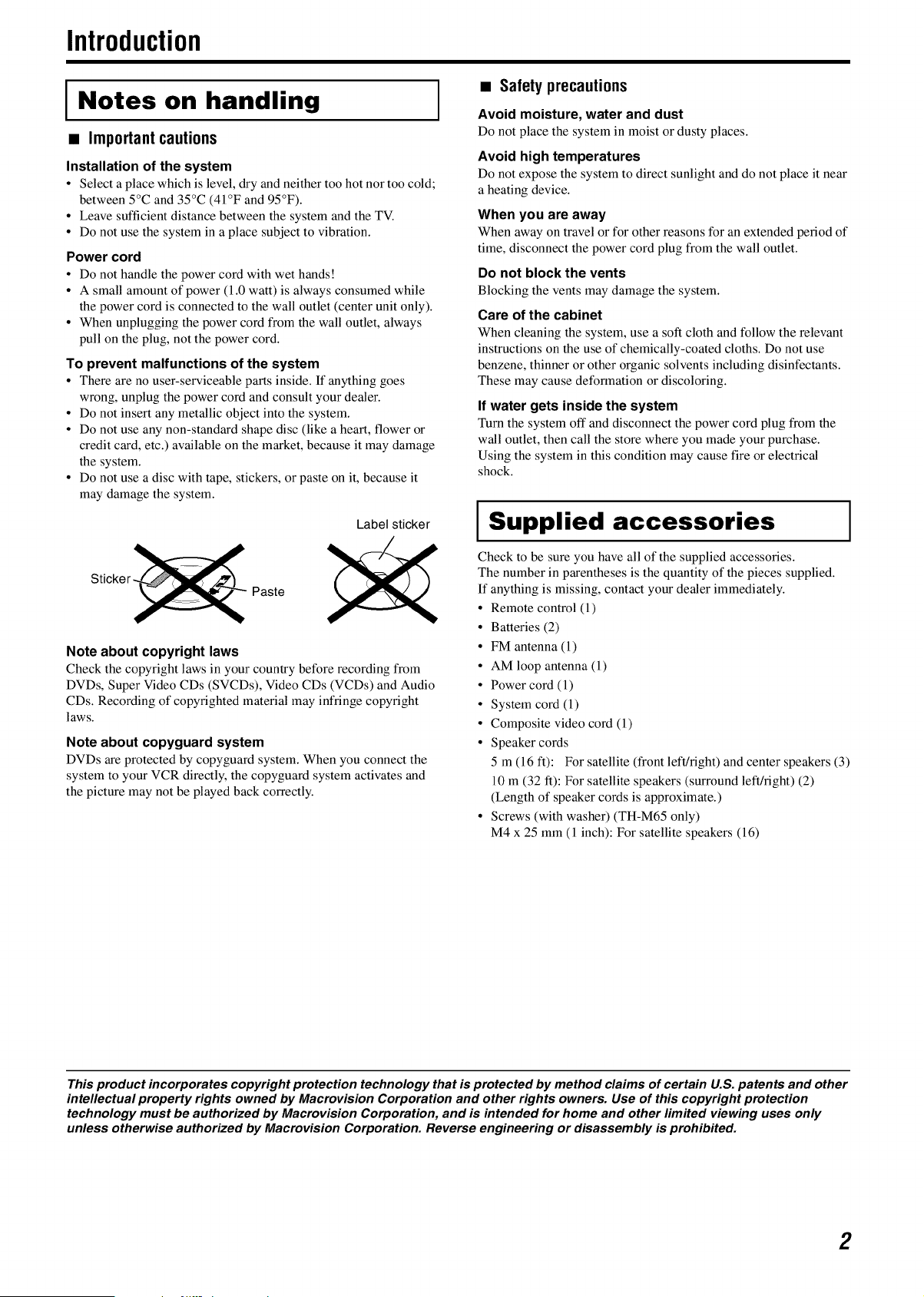
• Do not use a disc with tape, stickers, or paste on it, because it
may damage the system.
Paste
Label sticker
Note about copyright laws
Check the copyright laws in your country before recording from
DVDs, Super Video CDs (SVCDs), Video CDs (VCDs) and Audio
CDs. Recording of copyrighted material may infringe copyright
laws.
Note about copyguard system
DVDs are protected by copyguard system. When you connect the
system to your VCR directly, the copyguard system activates and
the picture may not be played back correctly.
• Safetyprecautions
Avoid moisture, water and dust
Do not place the system in moist or dusty places.
Avoid high temperatures
Do not expose the system to direct sunlight and do not place it near
a heating device.
When you are away
When away on travel or for other reasons for an extended period of
time, disconnect the power cord plug from the wall outlet.
DO not block the vents
Blocking the vents may damage the system.
Care of the cabinet
When cleaning the system, use a soil cloth and follow the relevant
instructions on the use of chemically-coated cloths. Do not use
benzene, thinner or other organic solvents including disinfectants.
These may cause deformation or discoloring.
If water gets inside the system
Turn the system off and disconnect the power cord plug from the
wall outlet, then call the store where you made your purchase.
Using the system in this condition may cause fire or electrical
shock.
Supplied accessories J
Check to be sure you have all of the supplied accessories.
The number in parentheses is the quantity of the pieces supplied.
If anything is missing, contact your dealer immediately.
• Remote control (1)
• Batteries (2)
• FM antenna (l)
• AM loop antenna (1)
• Powercord (1)
• System cord (1)
• Composite video cord (1)
• Speaker cords
5 m (16 It): For satellite (front left/right) and center speakers (3)
10 m (32 It): For satellite speakers (surround left/right) (2)
(Length of speaker cords is approximate.)
Screws (with washer) (TH-M65 only)
M4 x 25 mm (1 inch): For satellite speakers (16)
This product incorporates copyright protection technology that is protected by method claims of certain U.S. patents and other
intellectual property rights owned by Macrovision Corporation and other rights owners. Use of this copyright protection
technology must be authorized by Macrovision Corporation, and is intended for home and other limited viewing uses only
unless otherwise authorized by Macrovision Corporation. Reverse engineering or disassembly is prohibited.
2
Aboutdiscs
I Playable disc types
This system has been designed to play back the following discs:
DVD Video (DVD), Video CD (VCD), Super Video CD (SVCD),
Audio CD, CD-R and CD-RW.
• This system can also play back MP3 and JPEG files recorded on
CD-Rs and CD-RWs. (_ pg. 23)
• This system can also play back finalized DVD-Rs recorded in
DVD VIDEO format. However, some discs may not be played
back because of their disc characteristics or recording conditions.
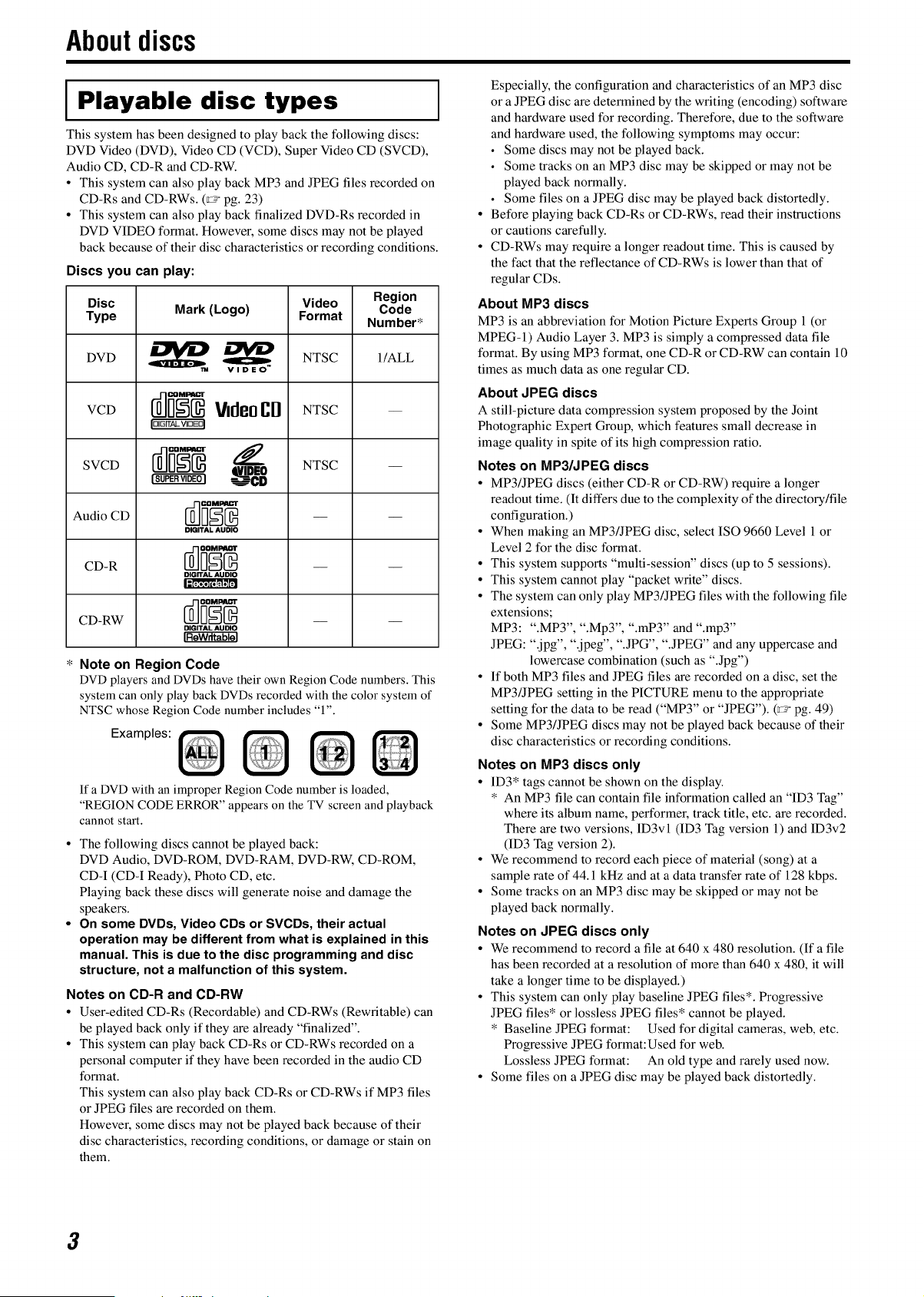
Discs you can play:
Region
Disc Mark (Logo) Video Code
Type Format Number*
DVD _ _ NTSC l/ALL
VIDEO =
VCD VideoCI] NTSC -
NW C
Audio CD [_ -- --
DIGITAL AUDIO
CD-R -- --
DIGITAL AUDIO
CD-RW -- --
DIGITAL AUDIO
* Note on Region Code
DVD players and DVDs have their own Region Code numbers. This
system can only play back DVDs recorded with the color system of
NTSC whose Region Code number includes "1".
Examples:
If a DVD with an improper Region Code number is loaded,
"REGION CODE ERROR" appears on the TV screen and playback
cannot start.
• The following discs cannot be played back:
DVD Audio, DVD-ROM, DVD-RAM, DVD-RW, CD-ROM,
CD-I (CD-I Ready), Photo CD, etc.
Playing back these discs will generate noise and damage the
speakers.
• On some DVDs, Video CDs or SVCDs, their actual
operation may be different from what is explained in this
manual. This is due to the disc programming and disc
structure, not a malfunction of this system.
Notes on CD-R and CD-RW
• User-edited CD-Rs (Recordable) and CD-RWs (Rewritable) can
be played back only if they are already "finalized".
• This system can play back CD-Rs or CD-RWs recorded on a
personal computer if they have been recorded in the audio CD
format.
This system can also play back CD-Rs or CD-RWs if MP3 files
or JPEG files are recorded on them.
However, some discs may not be played back because of their
disc characteristics, recording conditions, or damage or stain on
them.
Especially, the configuration and characteristics of an MP3 disc
or a JPEG disc are determined by the writing (encoding) software
and hardware used for recording. Therefore, due to the software
and hardware used, the following symptoms may occur:
• Some discs may not be played back.
• Some tracks on an MP3 disc may be skipped or may not be
played back normally.
• Some files on a JPEG disc may be played back distortedly.
Before playing back CD-Rs or CD-RWs, read their instructions
or cautions carefully.
CD-RWs may require a longer readout time. This is caused by
the fact that the reflectance of CD-RWs is lower than that of
regular CDs.
About MP3 discs
MP3 is an abbreviation for Motion Picture Experts Group 1 (or
MPEG-I) Audio Layer 3. MP3 is simply a compressed data file
format. By using MP3 format, one CD-R or CD-RW can contain 10
times as much data as one regular CD.
About JPEG discs
A still-picture data compression system proposed by the Joint
Photographic Expert Group, which features small decrease in
image quality in spite of its high compression ratio.
Notes on MP3/JPEG discs
• MP3/JPEG discs (either CD-R or CD-RW) require a longer
readout time. (It differs due to the complexity of the directory/file
configuration.)
• When making an MP3/JPEG disc, select ISO 9660 Level 1 or
Level 2 for the disc format.
• This system supports "multi-session" discs (up to 5 sessions).
• This system cannot play "packet write" discs.
• The system can only play MP3/JPEG files with the following file
extensions;
MP3: ".MP3", ".Mp3", ".mP3" and ".mp3"
JPEG: ".jpg", ".jpeg", ".JPG", "JPEG" and any uppercase and
lowercase combination (such as "Jpg")
• If both MP3 files and JPEG files are recorded on a disc, set the
MP3/JPEG setting in the PICTURE menu to the appropriate
setting for the data to be read ("MP3" or "JPEG"). (r_ pg. 49)
• Some MP3/JPEG discs may not be played back because of their
disc characteristics or recording conditions.
Notes on MP3 discs only
• ID3* tags cannot be shown on the display.
* An MP3 file can contain file information called an "ID3 Tag"
where its album name, performer, track title, etc. are recorded.
There are two versions, ID3vl (ID3 Tag version 1) and ID3v2
(ID3 Tag version 2).
• We recommend to record each piece of material (song) at a
sample rate of 44.1 kHz and at a data transfer rate of 128 kbps.
• Some tracks on an MP3 disc may be skipped or may not be
played back normally.
Notes on JPEG discs only
• We recommend to record a file at 640 x 480 resolution. (If a file
has been recorded at a resolution of more than 640 x 480, it will
take a longer time to be displayed.)
• This system can only play baseline JPEG files*. Progressive
JPEG files* or lossless JPEG files* cannot be played.
* Baseline JPEG format: Used for digital cameras, web, etc.
Progressive JPEG format:Used for web.
Lossless JPEG format: An old type and rarely used now.
• Some files on a JPEG disc may be played back distortedly.
3
About discs
IMPORTANT
Before playing a disc, make sure of the following;
• Check the connection with the TV.
• Turn on your TV and select the correct input mode on the TV to view
the pictures or on-screen information on the TV screen.
• For DVD playback, you can change the initial setting to your
preference. (rr pg. 46 - 53)
If ® appears on the TV screen when pressing a button;
The disc cannot accept the operation you have tried to do, or the
information required for that operation is not recorded on the
disc.
NOTICE: In some cases, without showing ®, operations will
not be accepted.
J Disc structure
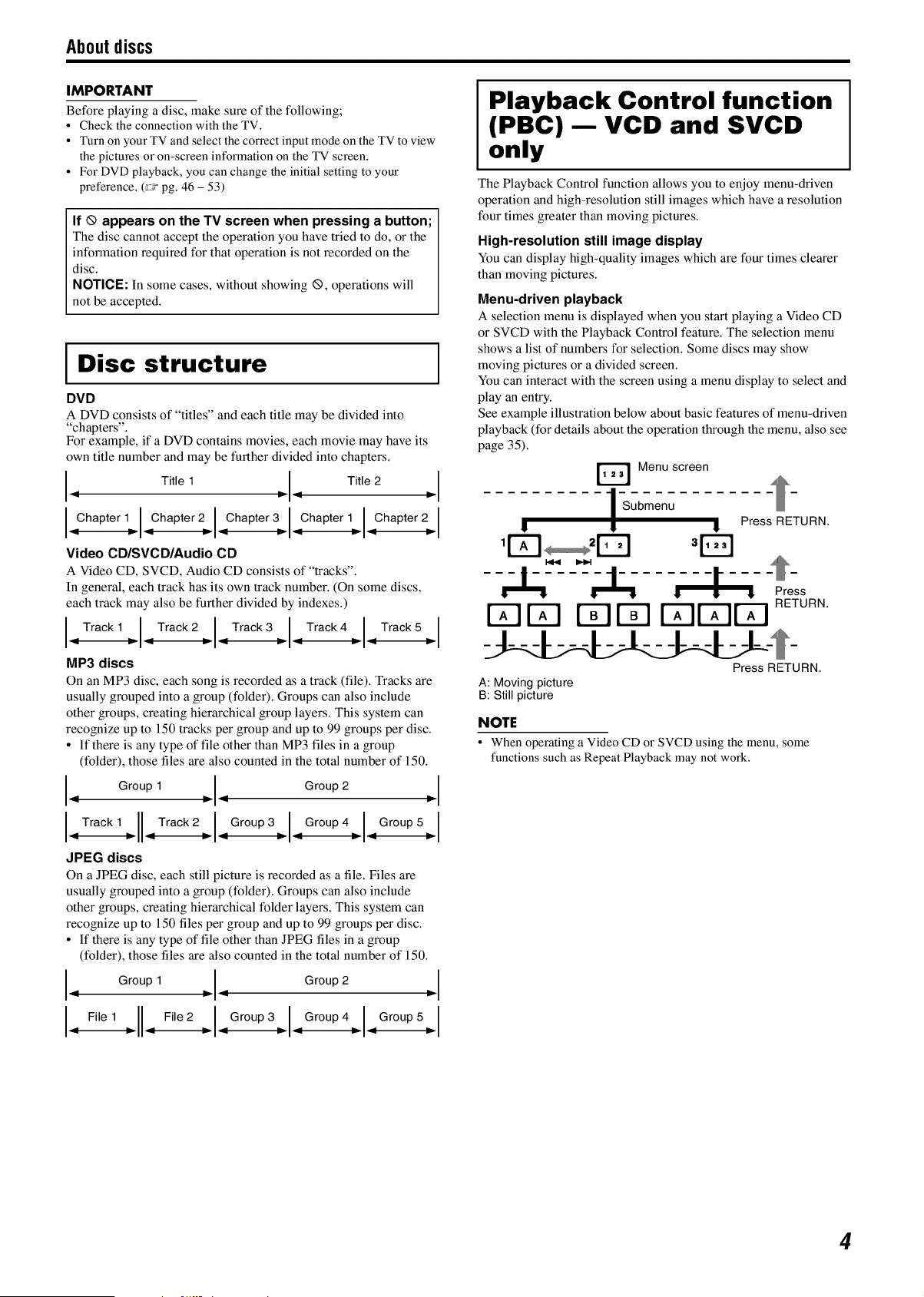
DVD
A DVD consists of "titles" and each title may be divided into
"chapters".
For example, if a DVD contains movies, each movie may have its
own title number and may be further divided into chapters.
J9 Title 1 Title 2
P
J Chapter1JChapter2< > < > <ChapterS> <Chapter1J Chapter2J> =
Video CD/SVCD/Audio CD
A Video CD, SVCD, Audio CD consists of "tracks".
In general, each track has its own track number. (On some discs,
each track may also be further divided by indexes.)
J Track1J Track2 Track3 Track4 J Track5
MP3 discs
On an MP3 disc, each song is recorded as a track (file). Tracks are
usually grouped into a group (folder). Groups can also include
other groups, creating hierarchical group layers. This system can
recognize up to 150 tracks per group and up to 99 groups per disc.
• If there is any type of file other than MP3 files in a group
(folder), those files are also counted in the total number of 150.
< Group 1 _ 4 Group 2 m,
i ; II=-- o
JPEG discs
On a JPEG disc, each still picture is recorded as a file. Files are
usually grouped into a group (folder). Groups can also include
other groups, creating hierarchical folder layers. This system can
recognize up to 150 files per group and up to 99 groups per disc.
• If there is any type of file other than JPEG files in a group
(folder), those files are also counted in the total number of 150.
< Group 1 _ 4 Group 2 m,
JFile1= < File2 = =Gr°up3 <Gr°up4 J Group5J__< _-
Playback Control function
(PBC) --- VCD and SVCD
only
The Playback Control function allows you to enjoy menu-driven
operation and high-resolution still images which have a resolution
four times greater than moving pictures.
High-resolution still image display
You can display high-quality images which are four times clearer
than moving pictures.
Menu-driven playback
A selection menu is displayed when you start playing a Video CD
or SVCD with the Playback Control feature. The selection menu
shows a list of numbers for selection. Some discs may show
moving pictures or a divided screen.
You can interact with the screen using a menu display to select and
play an entry.
See example illustration below about basic features of menu-driven
playback (for details about the operation through the menu, also see
page 35).
_ Menu screen
Submenu II Press RETURN.
I
F71
,a:, ;.L; , 1, ress
153153l-ql- -I l-ql=-lF;-I
Press RETURN.
A: Moving picture
B: Still picture
NOTE
• When operating a Video CD or SVCD using the menu, some
functions such as Repeat Playback may not work.
4
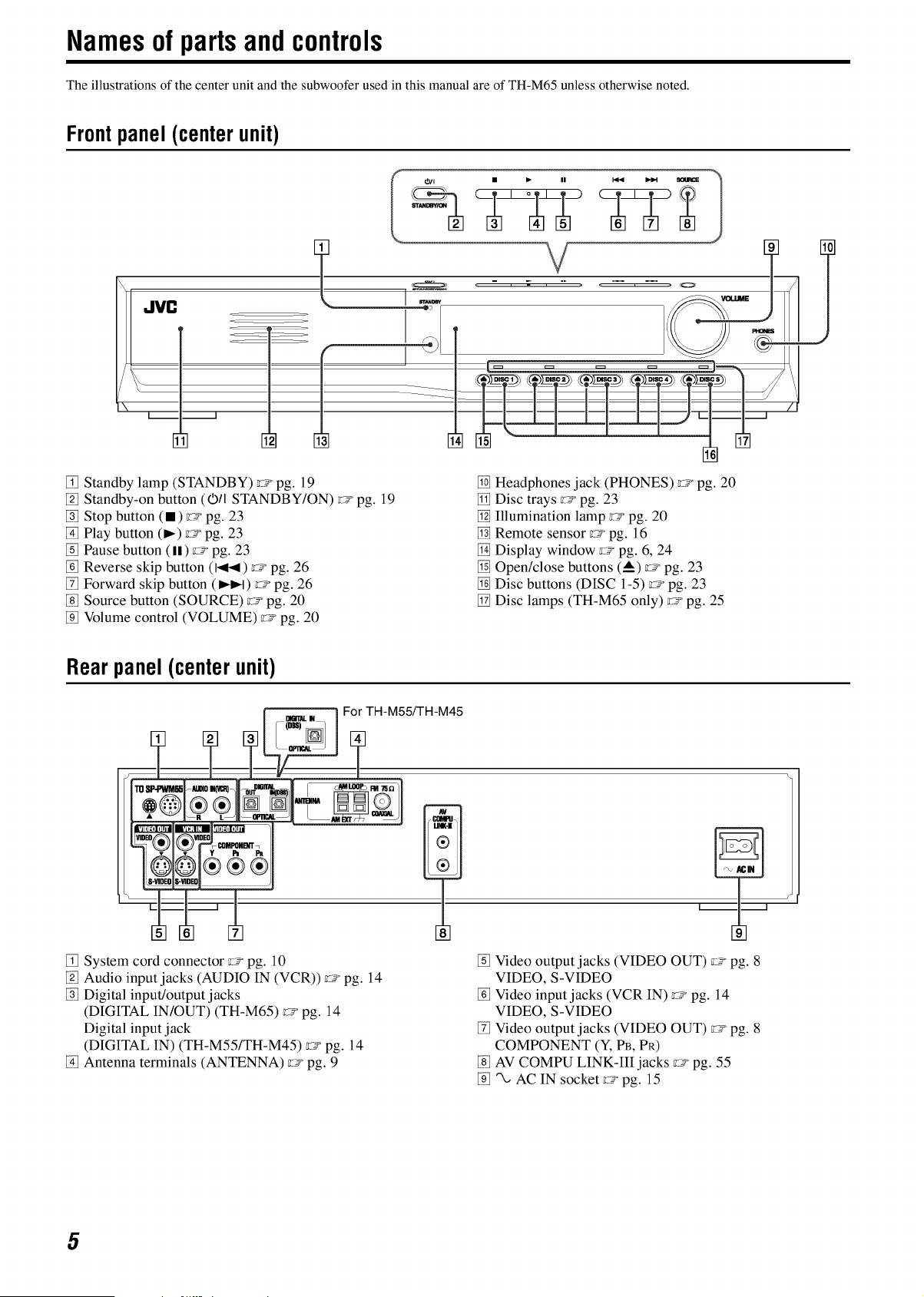
Namesof partsandcontrols
The illustrations of the center unit and the subwoofer used in this manual are of TH-M65 unless otherwise noted.
Frontpanel (centerunit)
l\ JVC
I
i
Standby lamp (STANDBY) _° pg. 19
[-4 Standby-on button (O/I STANDBY/ON) _° pg. 19
_] Stop button (•) _° pg. 23
_] Play button (_) _° pg. 23
Pause button (11) _° pg. 23
Reverse skip button (I.4-4) _° pg. 26
I-f7Forward skip button (_e,q) _° pg. 26
I-g]Source button (SOURCE) _° pg. 20
[-9_Volume control (VOLUME) _° pg. 20
N] Headphones jack (PHONES) _° pg. 20
N1 Disc trays _° pg. 23
_] Illumination lamp _° pg. 20
Remote sensor _° pg. 16
N] Display window _° pg. 6, 24
_] Open/close buttons (A) _o pg. 23
[] Disc buttons (DISC 1-5) _° pg. 23
[] Disc lamps (TH-M65 only) _° pg. 25
Rear panel(centerunit)
nOe,TAL_/ ] For TH-M55FFH-M45
System cord connector c_° pg. 10
[-4 Audio input jacks (AUDIO IN (VCR)) _° pg. 14
_] Digital input/output jacks
(DIGITAL IN/OUT) (TH-M65) _° pg. 14
Digital input jack
(DIGITAL IN) (TH-M55/TH-M45) _° pg. 14
_] Antenna terminals (ANTENNA) _° pg. 9
PU
Video output jacks (VIDEO OUT) _° pg. 8
VIDEO, S-VIDEO
Video input jacks (VCR IN) _° pg. 14
VIDEO, S-VIDEO
[-f_Video output jacks (VIDEO OUT) _° pg. 8
COMPONENT (Y, PB, PR)
I-g]AV COMPU LINK-Ill jacks _° pg. 55
[-9__ AC IN socket _° pg. 15
5
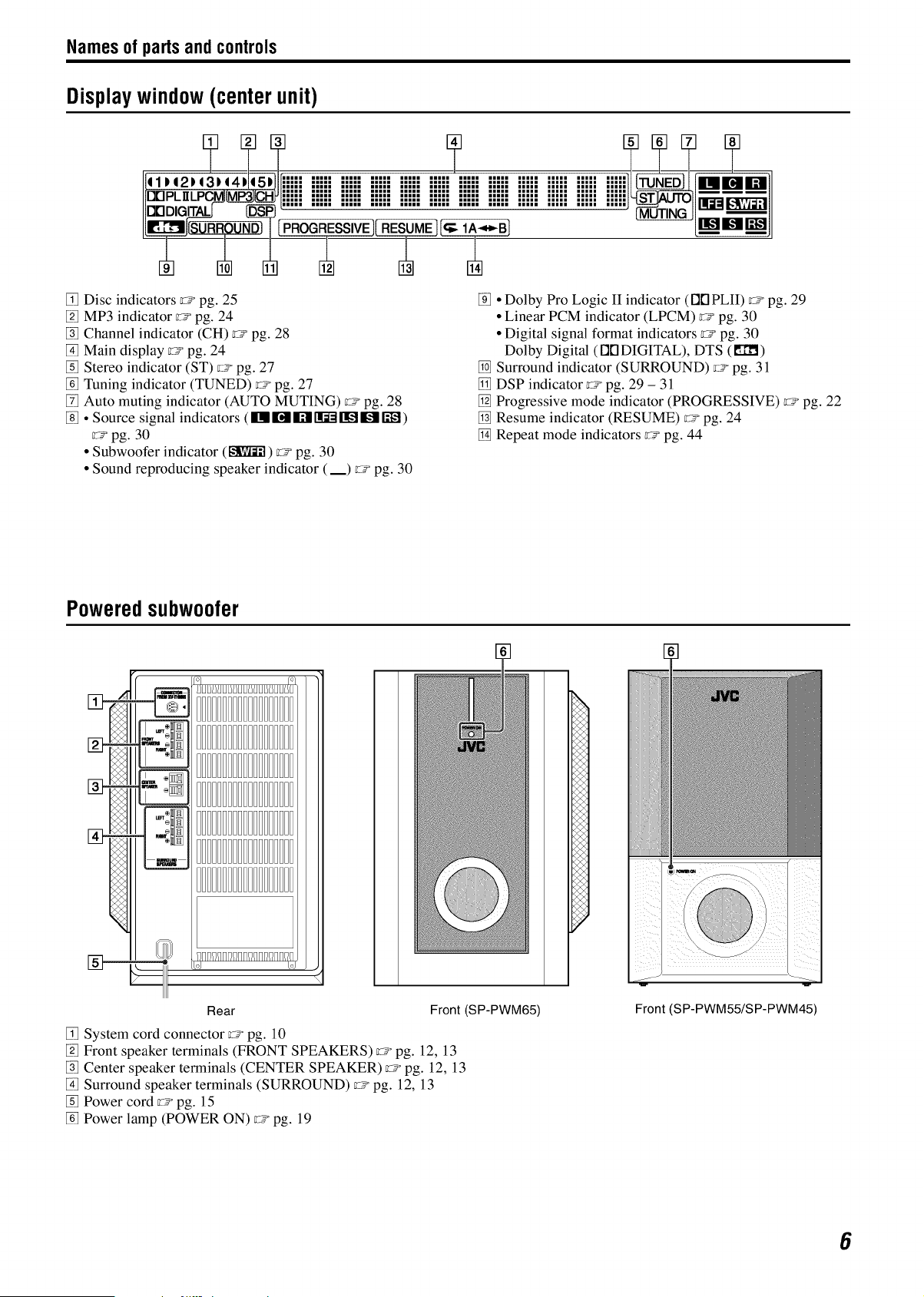
Namesof partsandcontrols
Display window (center unit)
Disc indicators _° pg. 25
[-4 MP3 indicator _° pg. 24
_] Channel indicator (CH) _° pg. 28
_] Main display _° pg. 24
Stereo indicator (ST) _° pg. 27
Tuning indicator (TUNED) _° pg. 27
[-77Auto muting indicator (AUTO MUTING) _° pg. 28
I-g]• Source signal indicators (mll_ INIIr-_ll_lgtll_)
_o pg. 30
• Subwoofer indicator (k"_g=dTt)_o pg. 30
• Sound reproducing speaker indicator (m) _° pg. 30
[-9_• Dolby Pro Logic II indicator (13rlPLII) _° pg. 29
• Linear PCM indicator (LPCM) _° pg. 30
• Digital signal format indicators _° pg. 30
Dolby Digital ( 1313DIGITAL), DTS (_)
_] Surround indicator (SURROUND) _° pg. 31
N1 DSP indicator _° pg. 29 - 31
_] Progressive mode indicator (PROGRESSIVE) _° pg. 22
Resume indicator (RESUME) _ pg. 24
N] Repeat mode indicators _° pg. 44
Powered subwoofer
" llll
Rear Front (SP-PWM65)
System cord connector _° pg. 10
[-4 Front speaker terminals (FRONT SPEAKERS) _° pg. 12, 13
_] Center speaker terminals (CENTER SPEAKER) _° pg. 12, 13
_] Surround speaker terminals (SURROUND) _° pg. 12, 13
Power cord _° pg. 15
Power lamp (POWER ON) _° pg. 19
Front (SP-PWM55/SP-PWM45)
6
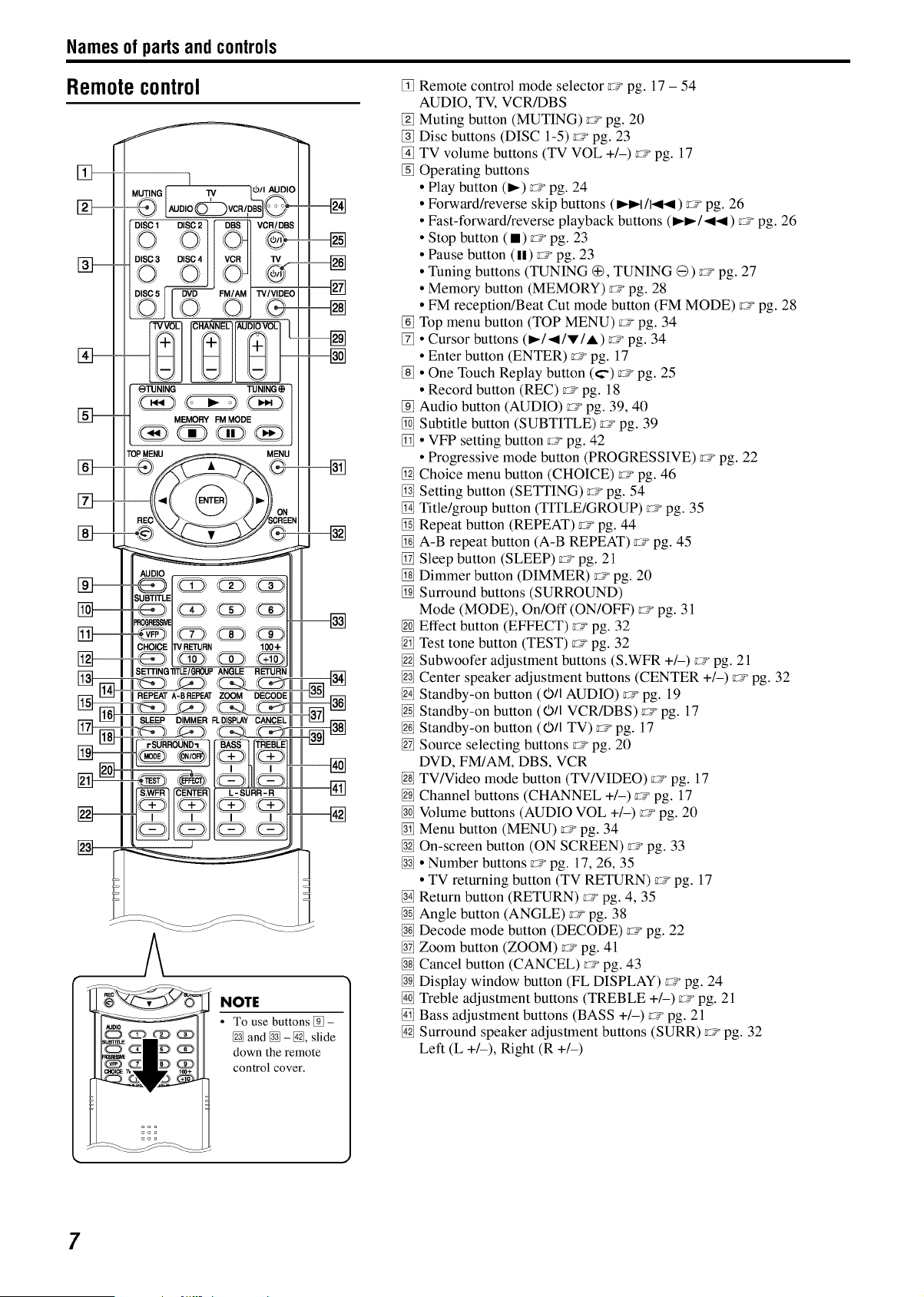
Namesof partsandcontrols
Remotecontrol
[]
TUNINGe)
GI? (i1?
100+
SETrlNG'nTLE/GROUPANGLE RETURN
REPEAT A-B REPEAT ZOOM DECODE
DIMMER FLDISPLAYCANCEL
A
NOTE
• To use buttons[] -
[] and[] - [_, slide
down the remote
control cover.
Remote control mode selector _° pg. 17 - 54
AUDIO, TV, VCR/DBS
[-4 Muting button (MUTING) _° pg. 20
_-] Disc buttons (DISC 1-5) _° pg. 23
_] TV volume buttons (TV VOL +/-) _° pg. 17
Operating buttons
• Play button (_) _° pg. 24
• Forward#everse skip buttons (_/_-q )_° pg. 26
• Fast-forward/reverse playback buttons (_1-_-_) _° pg. 26
• Stop button (•) _° pg. 23
• Pause button (11) _° pg. 23
• Tuning buttons (TUNING _, TUNING O) _° pg. 27
• Memory button (MEMORY) _ pg. 28
° FM reception/Beat Cut mode button (FM MODE) _° pg. 28
Top menu button (TOP MENU) _° pg. 34
I-f7• Cursor buttons (_.-/_l/V/_) _ pg. 34
• Enter button (ENTER) c_° pg. 17
I-g]• One Touch Replay button (¢') c_° pg. 25
• Record button (REC) c_° pg. 18
[-97Audio button (AUDIO) c_° pg. 39, 40
_] Subtitle button (SUBTITLE) _° pg. 39
N1 • VFP setting button c_° pg. 42
• Progressive mode button (PROGRESSIVE) c_° pg. 22
_] Choice menu button (CHOICE) c_° pg. 46
Setting button (SETTING) c_° pg. 54
N] Title/group button (TITLE/GROUP) c_° pg. 35
_] Repeat button (REPEAT) c_° pg. 44
[] A-B repeat button (A-B REPEAT) c_° pg. 45
[] Sleep button (SLEEP) c_° pg. 21
[] Dimmer button (DIMMER) c_° pg. 20
[] SmTound buttons (SURROUND)
Mode (MODE), On/Off (ON/OFF) c_° pg. 31
[] Effect button (EFFECT) c_° pg. 32
Test tone button (TEST) c_° pg. 32
Subwoofer adjustment buttons (S.WFR +/-) c_° pg. 21
Center speaker adjustment buttons (CENTER +/-) c_° pg. 32
Standby-on button (0/I AUDIO) c_° pg. 19
Standby-on button (©/I VCR/DBS) r_° pg. 17
[] Standby-on button (©/I TV) c_° pg. 17
Source selecting buttons c_° pg. 20
DVD, FM/AM, DBS, VCR
[_ TV/Video mode button (TV/VIDEO) c_° pg. 17
[] Channel buttons (CHANNEL +/-) c_° pg. 17
Volume buttons (AUDIO VOL +/-) c_° pg. 20
Menu button (MENU) c_° pg. 34
On-screen button (ON SCREEN) r_° pg. 33
• Number buttons c_° pg. 17, 26, 35
• TV returning button (TV RETURN) c_° pg. 17
Return button (RETURN) c_° pg. 4, 35
Angle button (ANGLE) c_° pg. 38
Decode mode button (DECODE) c_° pg. 22
Zoom button (ZOOM) c_° pg. 41
Cancel button (CANCEL) r_° pg. 43
Display window button (FL DISPLAY) c_° pg. 24
Treble adjustment buttons (TREBLE +/-) c_° pg. 21
4N_7Bass adjustment buttons (BASS +/-) c_° pg. 21
Surround speaker adjustment buttons (SURR) c_° pg. 32
Left (L +/-), Right (R +/-)
7
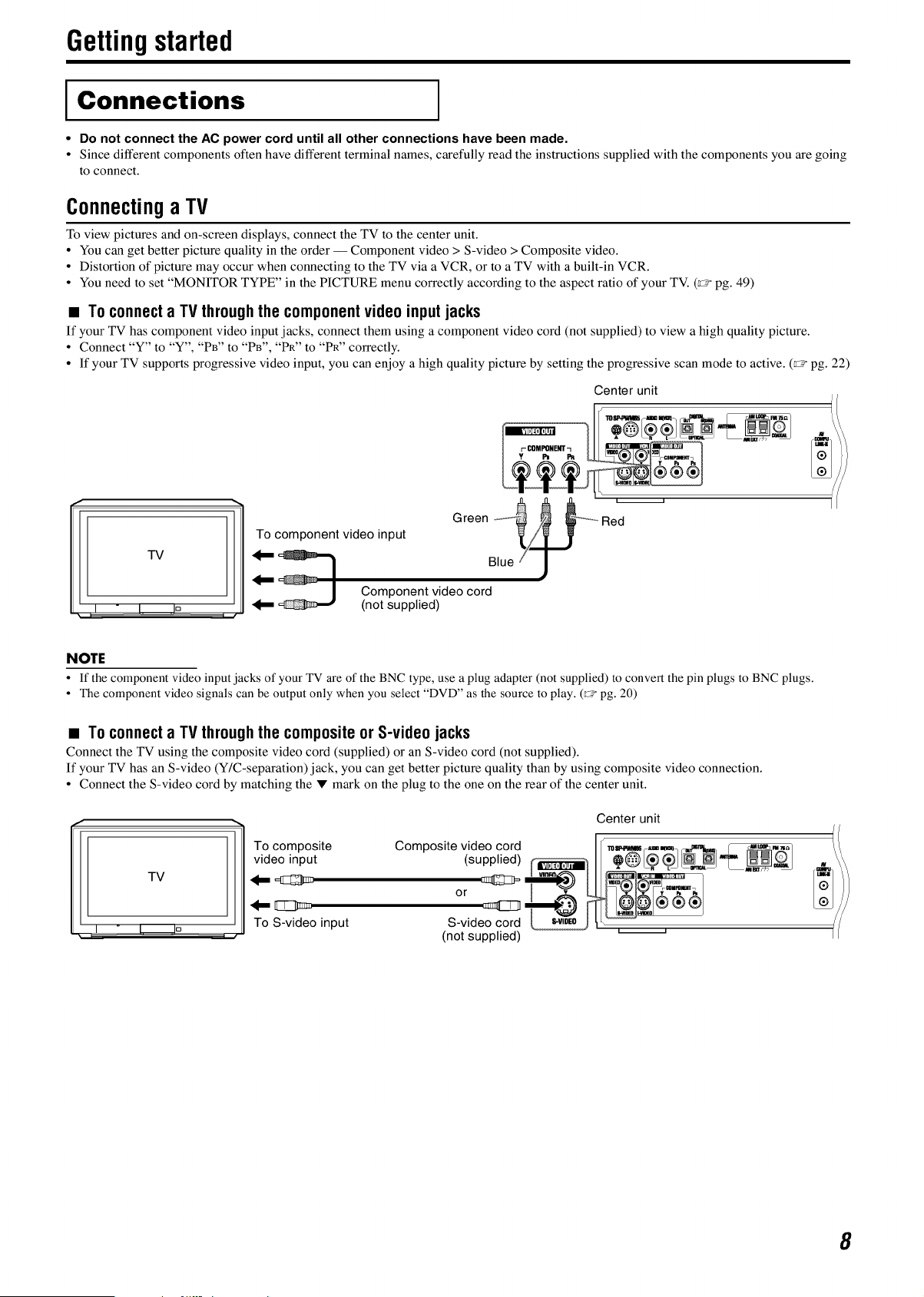
Gettingstarted
I Connections
• Do not connect the AC power cord until all other connections have been made.
• Since different components often have different terminal names, carefully read the instructions supplied with the components you are going
to connect.
Connectinga TV
To view pictures and on-screen displays, connect the TV to the center unit.
• You can get better picture quality in the order -- Component video > S-video > Composite video.
• Distortion of picture may occur when connecting to the TV via a VCR, or to a TV with a built-in VCR.
• You need to set "MONITOR TYPE" in the PICTURE menu correctly according to the aspect ratio of your TV. (r_ pg. 49)
• To connect a TV through the component video input jacks
If your TV has component video input jacks, connect them using a component video cord (not supplied) to view a high quality picture.
• Connect "Y" to "Y", "PB" to "PB", "PR" to "PR" correctly.
• If your TV supports progressive video input, you can enjoy a high quality picture by setting the progressive scan mode to active. (r_ pg. 22)
Center unit
TV1
-_ I - I, ,ID , ,
Green
To component video input !_
BIue -/-I--'j
Component video cord
(not supplied)
Red
NOTE
• If the component video input jacks of your TV are of the BNC type, use a plug adapter (not supplied) to convert the pin plugs to BNC plugs.
• The component video signals can be output only when you select "DVD" as the source to play. (rr pg. 20)
• To connect a TV through the composite or S-video jacks
Connect the TV using the composite video cord (supplied) or an S-video cord (not supplied).
If your TV has an S-video (Y/C-separation)jack, you can get better picture quality than by using composite video connection.
• Connect the S-video cord by matching the • mark on the plug to the one on the rear of the center unit.
f
TV
• I - I !° ,
To composite Composite video cord
video input (supplied)
or
To S-video input S-video cord
(not supplied)
Center unit
i
8
Getting started
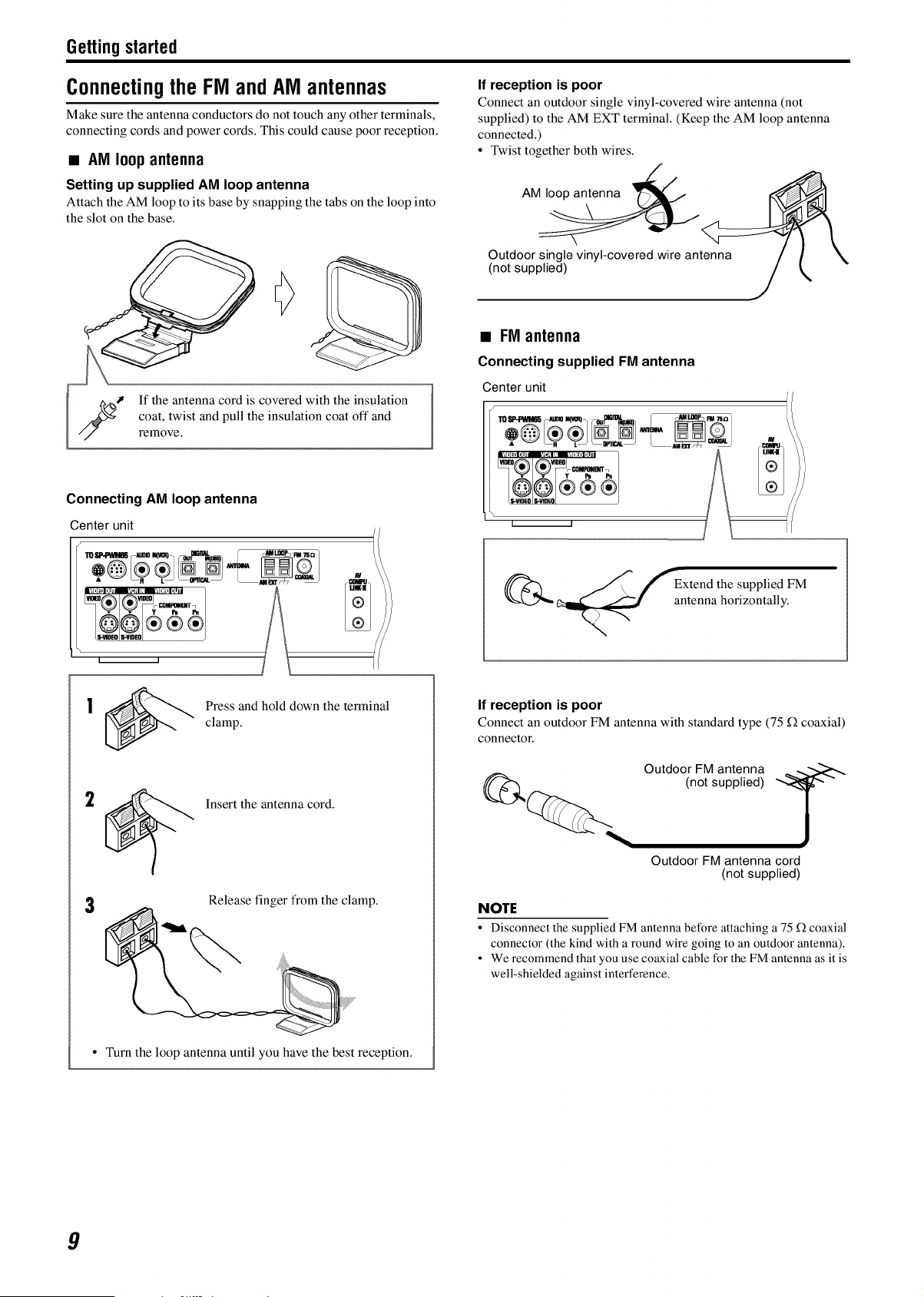
Connectingthe FM and AM antennas
Make sure the antenna conductors do not touch any other terminals,
connecting cords and power cords. This could cause poor reception.
• AM loop antenna
Setting up supplied AM loop antenna
Attach the AM loop to its base by snapping the tabs on the loop into
the slot on the base.
If the antenna cord is covered with the insulation
coat, twist and pull the insulation coat off and
remove.
Connecting AM loop antenna
Center unit
Press and hold down the terminal
clamp.
2 @ Insert the antenna cord.
3 Release finger from the clamp.
• Turn the loop antenna until you have the best reception.
If reception is poor
Connect an outdoor single vinyl-covered wire antenna (not
supplied) to the AM EXT terminal. (Keep the AM loop antenna
connected.)
° Twist together both wires.
AM loop antenna
Outdoor single vinyl-covered wire antenna
(not supplied)
• FM antenna
Connecting supplied FM antenna
Center unit
I I
/ xtendthesopp,,ed
antenna horizontally.
If reception is poor
Connect an outdoor FM antenna with standard type (75 _) coaxial)
connector.
Outdoo;FM antenna ._
supplied)
Outdoor FM antenna cord
(not supplied)
NOTE
• Disconnect the supplied FM antenna before attaching a 75 _ coaxial
connector (the kind with a round wire going to an outdoor antenna).
• We recommend that you use coaxial cable for the FM antenna as it is
well-shielded against interference.
9
Getting started
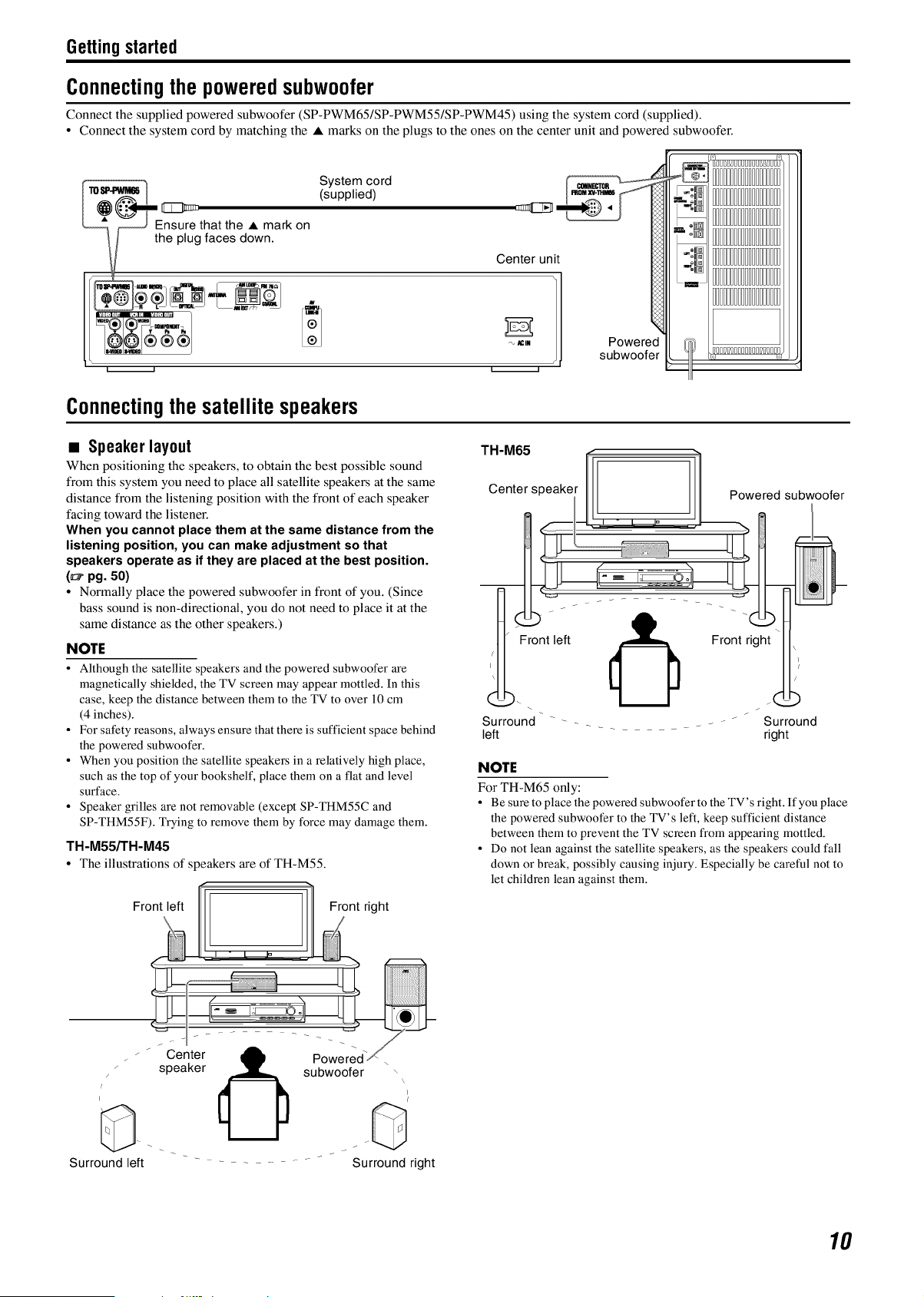
Connectingthe poweredsubwoofer
Connect the supplied powered subwoofer (SP-PWM65/SP-PWM55/SP-PWM45) using the system cord (supplied).
• Connect the system cord by matching the • marks on the plugs to the ones on the center unit and powered subwoofer.
Ensur[_ethat the • mark on
he plug faces down.
System cord
(supplied)
Center unit
_ _IN
L................--J
Powerec
subwoofer
E
Connectingthe satellite speakers
• Speakerlayout
When positioning the speakers, to obtain the best possible sound
from this system you need to place all satellite speakers at the same
distance from the listening position with the front of each speaker
facing toward the listener.
When you cannot place them at the same distance from the
listening position, you can make adjustment so that
speakers operate as if they are placed at the best position.
(_:_ pg. 50)
• Normally place the powered subwoofer in front of you. (Since
bass sound is non-directional, you do not need to place it at the
same distance as the other speakers.)
NOTE
• Although the satellite speakers and the powered subwoofer are
magnetically shielded, the TV screen may appear mottled. In this
case, keep the distance between them to the TV to over 10 cm
(4 inches).
• For safety reasons, always ensure that there is sufficient space behind
the powered subwoofer.
• When you position the satellite speakers in a relatively high place,
such as the top of your bookshelf, place them on a flat and level
surface.
• Speaker grilles are not removable (except SP-THM55C and
SP-THM55F). Trying to remove them by force may damage them.
TH-M55/TH-M45
• The illustrations of speakers are of TH-M55.
TH-M65 f
Center speaker
Powered subwoofer
N N
LIU ULIL
Surround " - - _ _ _ Surround
left - right
NOTE
For TH-M65 only:
• Be sure to place the powered subwoofer to the TV's right. If you place
the powered subwoofer to the TV's left, keep sufficient distance
between them to prevent the TV screen from appearing mottled.
• Do not lean against the satellite speakers, as the speakers could fall
down or break, possibly causing injury. Especially be careful not to
let children lean against them.
Surround left Surround right
10
Getting started This page is for TH-M65
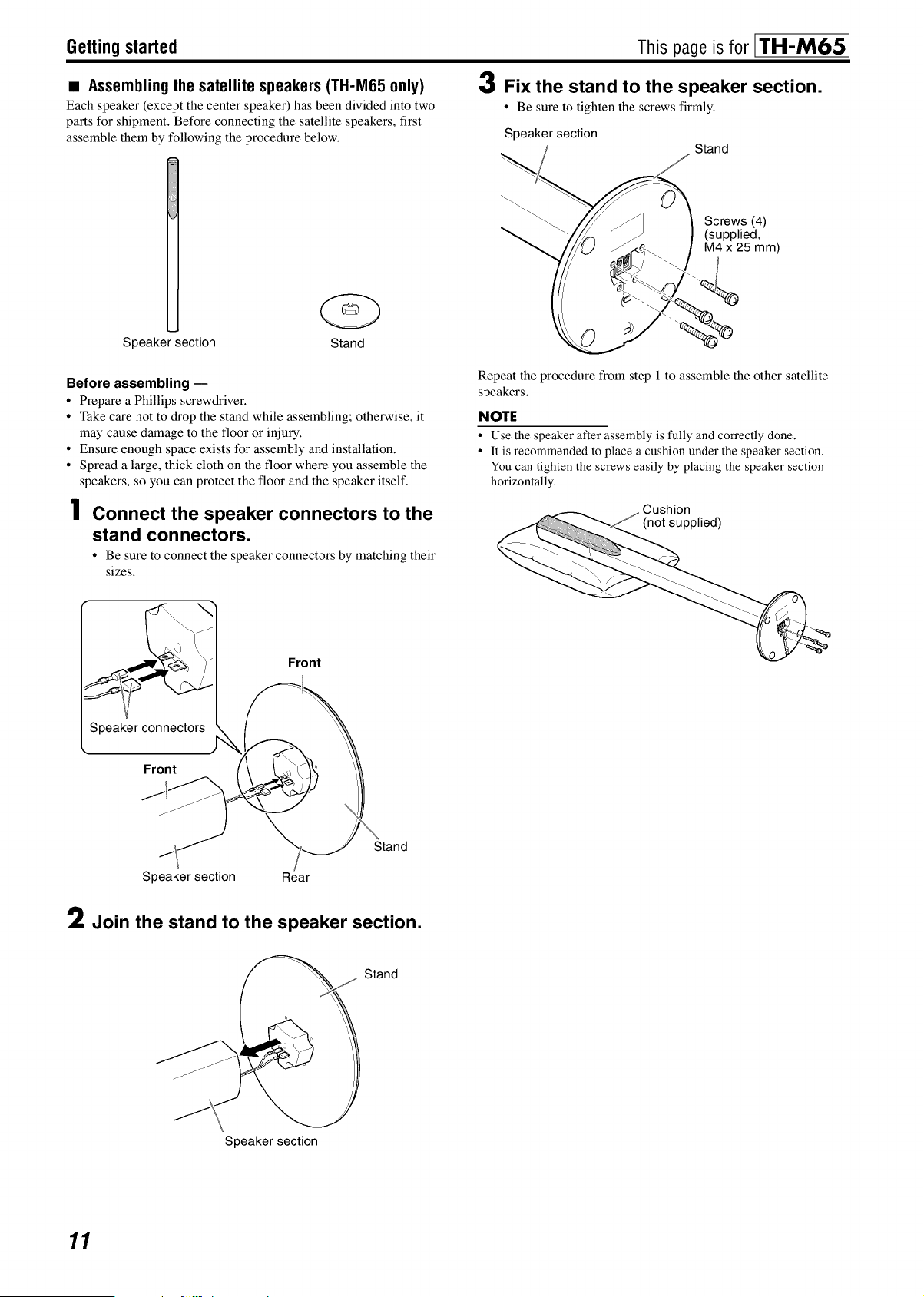
• Assemblingthesatellite speakers(TH-M65 only)
Each speaker (except the center speaker) has been divided into two
parts for shipment. Before connecting the satellite speakers, first
assemble them by following the procedure below.
3
Fix the stand to the speaker section.
• Be sure to tighten the screws firmly.
Speakersection
Stand
Screws (4)
(supplied,
M4 x 25 mm)
Speaker section Stand
Before assembling
• Prepare a Phillips screwdriver.
• Take care not to drop the stand while assembling; otherwise, it
may cause damage to the floor or injury.
• Ensure enough space exists for assembly and installation.
• Spread a large, thick cloth on the floor where you assemble the
speakers, so you can protect the floor and the speaker itself.
1 Connect the speaker connectors to the
stand connectors.
• Be sure to connect the speaker connectors by matching their
sizes.
Repeat the procedure from step 1 to assemble the other satellite
speakers.
NOTE
• Use the speaker after assembly is fully and correctly done.
• It is recommended to place a cushion under the speaker section.
You can tighten the screws easily by placing the speaker section
horizontally.
Cushion
(not supplied)
Speaker section Rear
Stand
2 Join the stand to the speaker section.
Stand
Speaker section
11
Getting started This page is for TH-M65
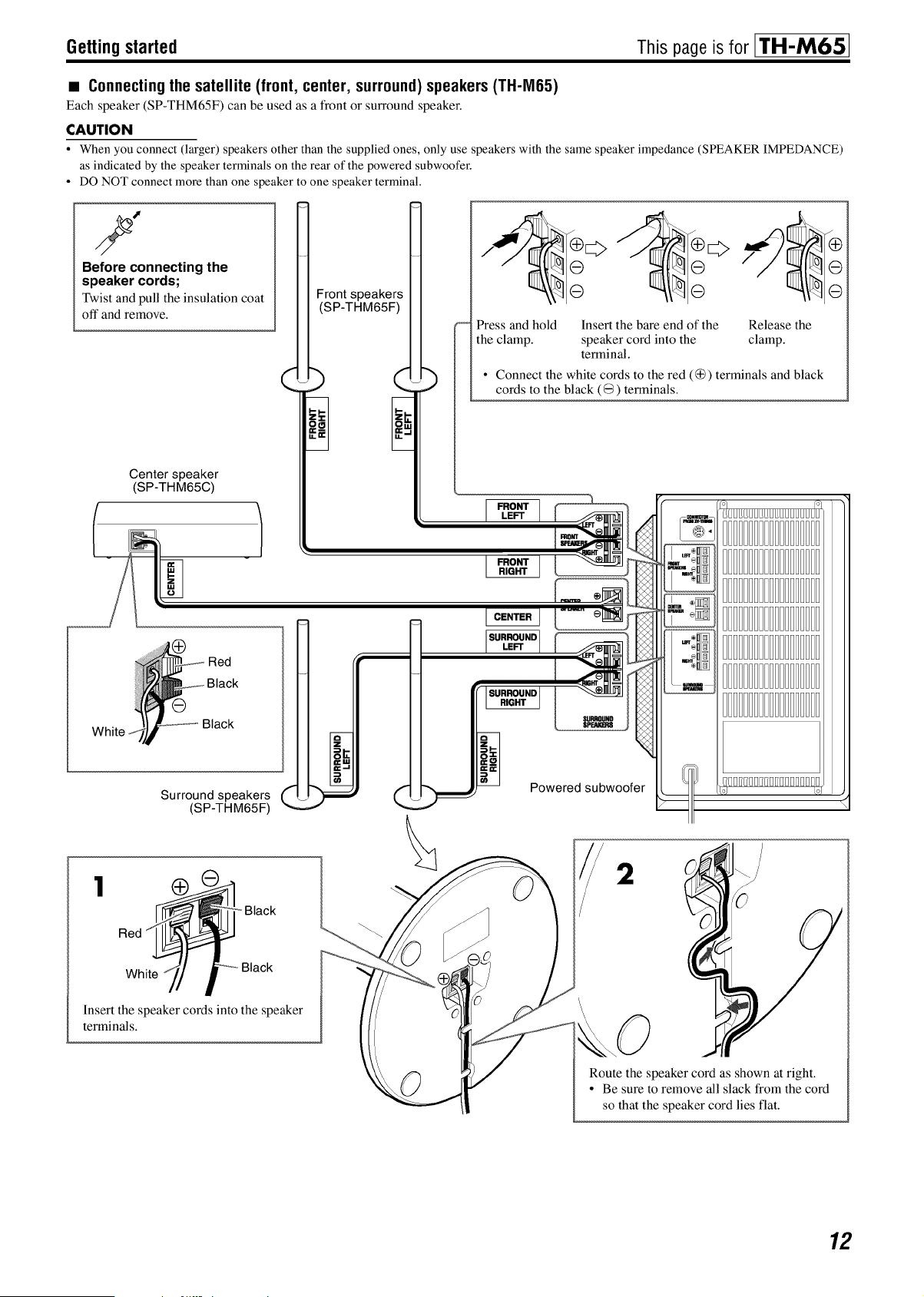
• Connectingthe satellite (front, center, surround)speakers(TH-M65)
Each speaker (SP-THM65F) can be used as a front or surround speaker.
CAUTION
• When you connect (larger) speakers other than the supplied ones, only use speakers with the same speaker impedance (SPEAKER IMPEDANCE)
as indicated by the speaker terminals on the rear of the powered subwoofer.
• DO NOT connect more than one speaker to one speaker terminal.
Before connecting the
speaker cords;
Twist and pull the insulation coat
off and remove.
Center speaker
(SP-THM65C)
( )
Z_
do
Front speakers
(SP-THM65F)
(
O_.
Press and hold Insert the bare end of the Release the
the clamp, speaker cord into the clamp.
terminal.
• Connect the white cords to the red (@) terminals and black
cords to the black (@) terminals.
I FRONTI
I RIGHT I
Red
Black
White 4)i_--_ Black
Surround speakers
(SP-THM65F)
Black
ISURROUNDI
Powered subwoofer
9"
_1_1
_1_1
!!!_!
m![]!
!!![]!
m
L
2
Red
White
Black
Insert the speaker cords into the speaker
terminals.
Route the speaker cord as shown at right.
• Be sure to remove all slack from the cord
so that the speaker cord lies flat.
12
Gettingstarted Thispa0eisfor TH-M55] TH-M45]
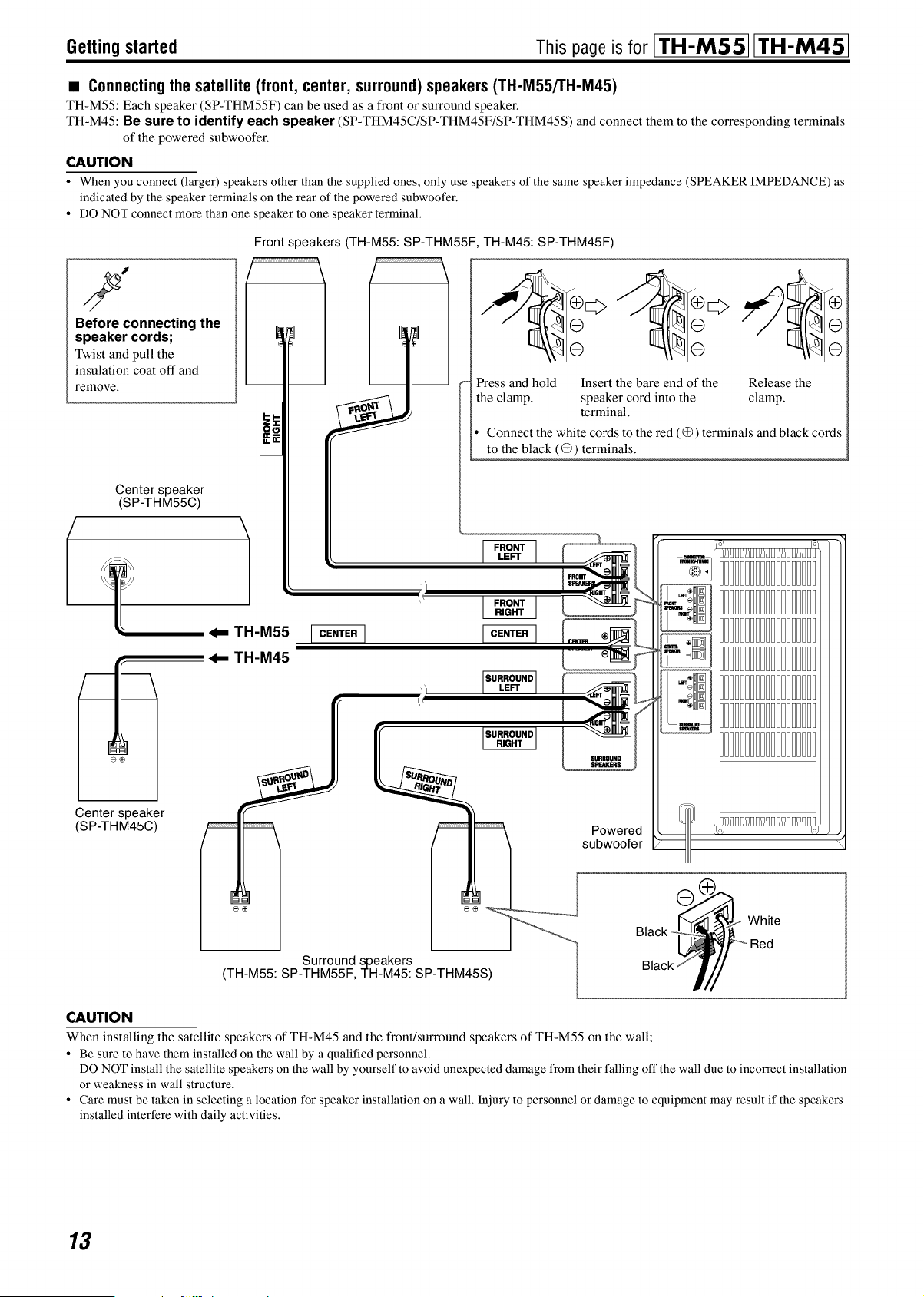
• Connecting the satellite (front, center, surround) speakers (TH-M55/TH-M45)
TH-M55: Each speaker (SP-THM55F) can be used as a front or surround speaker.
TH-M45: Be sure to identify each speaker (SP-THM45C/SP-THM45F/SP-THM45S) and connect them to the corresponding terminals
of the powered subwoofer.
CAUTION
• When you connect (larger) speakers other than the supplied ones, only use speakers of the same speaker impedance (SPEAKER IMPEDANCE) as
indicated by the speaker terminals on the rear of the powered subwoofer.
• DO NOT connect more than one speaker to one speaker terminal.
Front speakers (TH-M55: SP-THM55F, TH-M45: SP-THM45F)
Before connecting the
speaker cords;
Twist and pull the
insulation coat off and
remove.
m
Center speaker
(SP-THM55C)
4= TH-M55
Center speaker
(SP-THM45C) / ..............................................\
L
8@
\c
,)
?,
Surround speakers
(TH-M55: SP-THM55F, TH-M45: SP-THM45S)
Press and hold Insert the bare end of the Release the
the clamp, speaker cord into the clamp.
terminal.
• Connect the white cords to the red (@) terminals and black cords
to the black (@) terminals.
I FRONTI
ISURROUNDI
L=I
Powered
subwoofer
,o) toJ
O@
_/ White
Black / !//
CAUTION
When installing the satellite speakers of TH-M45 and the front/surround speakers of TH-M55 on the wall;
• Be sure to have them installed on the wall by a qualified personnel.
DO NOT install the satellite speakers on the wall by yourself to avoid unexpected damage from their falling off the wall due to incorrect installation
or weakness in wall structure.
• Care must be taken in selecting a location for speaker installation on a wall. Injury to personnel or damage to equipment may result if the speakers
installed interfere with daily activities.
13
Getting started
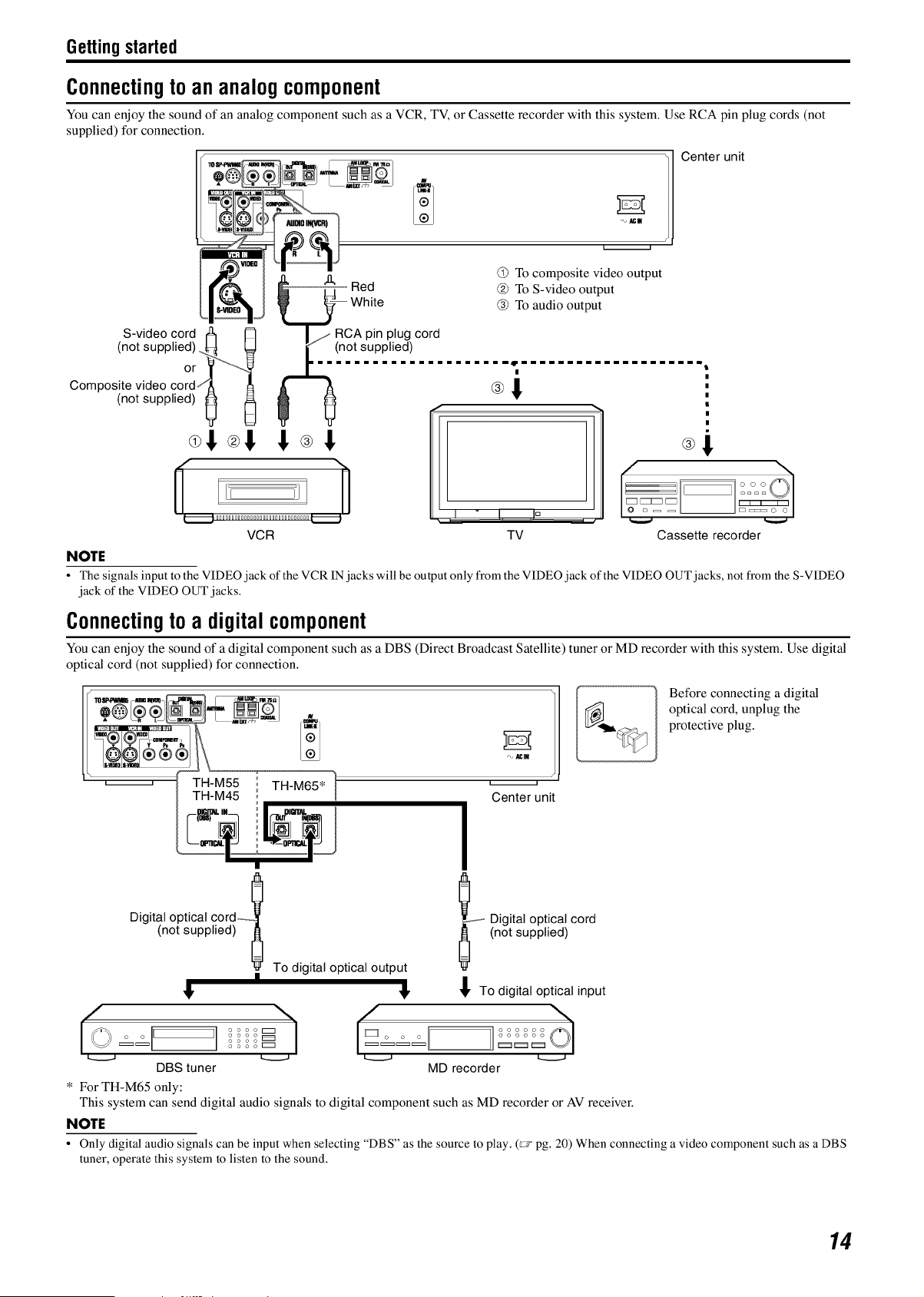
Connectingto an analogcomponent
You can enjoy the sound of an analog component such as a VCR, TV, or Cassette recorder with this system. Use RCA pin plug cords (not
supplied) for connection.
L................--J
n n @ To composite video output
r('_ _ _ Fled @ To S-video output
.lr _Sr = U - White @ To audio output
S-video cord iAi PI L,.,,I RCA pin plug cord
(not supplied) _ U _/ (not supplied)
..................... : .................... •
Composite video cord4 _ _ (33 1 "
(not supplied) f_ _1 _ _ ,- - T -, i
_s u "o" "0" I_1 '
t===, .............................._,===. _ ,I - I Io ,r 1_.2,== --,22211
VCR TV Cassette recorder
NOTE
• The signals input to the VIDEO jack of the VCR IN jacks will be output only from the VIDEO jack of the VIDEO OUT jacks, not from the S-VIDEO
jack of the VIDEO OUT jacks.
Connectingto a digital component
You can enjoy the sound of a digital component such as a DBS (Direct Broadcast Satellite) tuner or MD recorder with this system. Use digital
optical cord (not supplied) for connection.
_ JIGIN
Center unit
Before connecting a digital
optical cord, unplug the
protective plug.
Digital optical cord.-_.
(not supplied)
I Digital optical cord
(not supplied)
i To digital optical output
_, _, _, To digital optical input
0 iii oo
DBS tuner MD recorder
* For TH-M65 only:
This system can send digital audio signals to digital component such as MD recorder or AV receiver.
NOTE
• Only digital audio signals can be input when selecting "DBS" as the source to play. (rr pc. 20) When connecting a video component such as a DBS
tuner, operate this system to listen to the sound.
14
Getting started
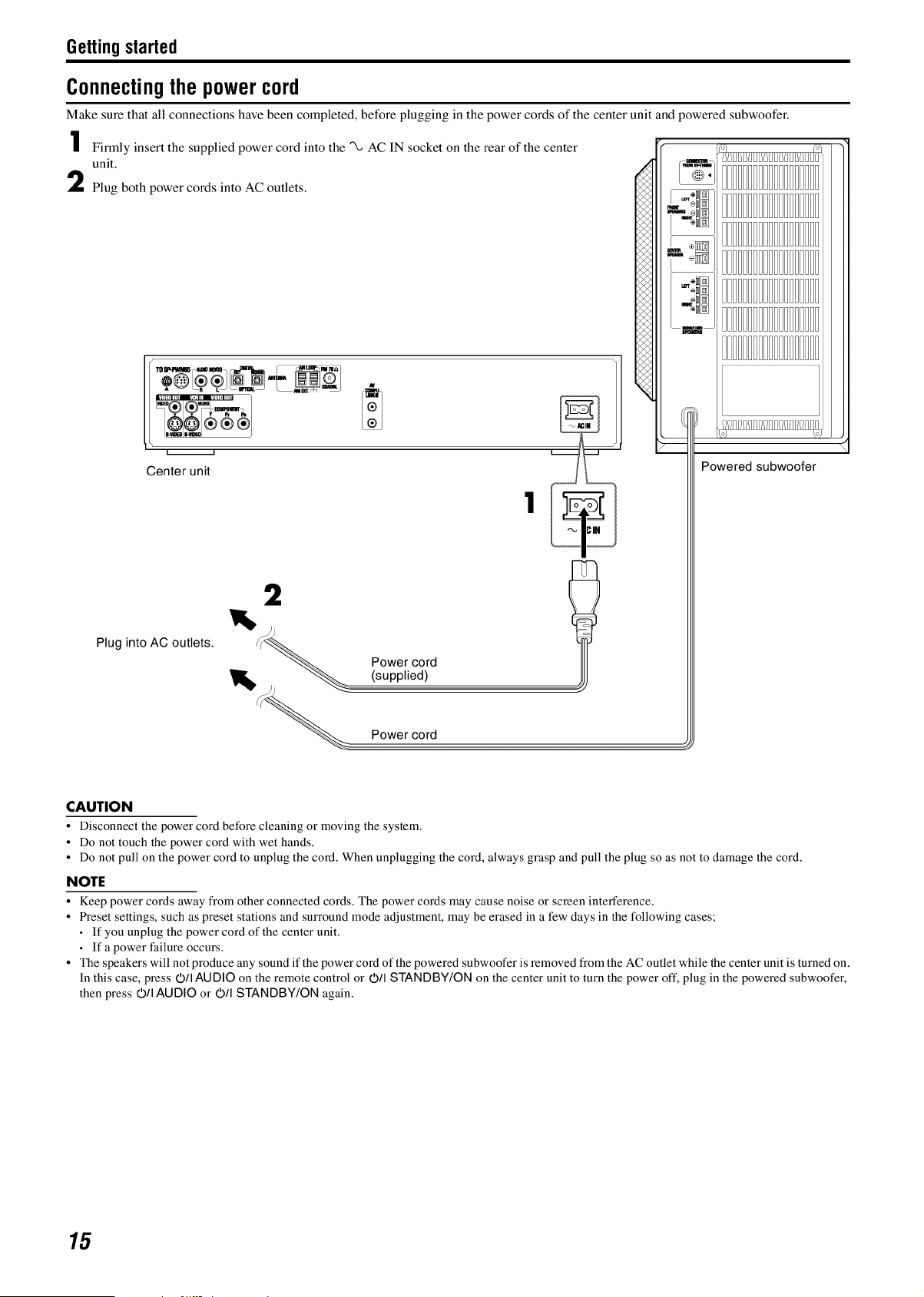
Connectingthe powercord
Make sure that all connections have been completed, before plugging in the power cords of the center unit and powered subwoofer.
Firmly insert the supplied power cord into the "X, C IN socket on the rear of the center
umt.
Plug both power cords into AC outlets.
1"0&_mi5 ul0 i_1_ mla_, m m_
L.................-J
Center unit
Plug into AC outlets•
Powercord
_1)' j_ Power cord
r/o] (o]
UUUUUUUUUUUUUUUUUU[J
IIIIIIIIIIIIIIIIIII
BBBBBBBBBBBBBBBBBBB
_ IIIIIIIIIIIIIIIIIII
m
(_ flflflflflflflflflflflflflflflflflflfl
,oJ toJ
Powered subwoofer
CAUTION
• Disconnect the power cord before cleaning or moving the system.
• Do not touch the power cord with wet hands.
• Do not pull on the power cord to unplug the cord. When unplugging the cord, always grasp and pull the plug so as not to damage the cord.
NOTE
• Keep power cords away from other connected cords. The power cords may cause noise or screen interference.
• Preset settings, such as preset stations and surround mode adjustment, may be erased in a few days in the following cases;
• If you unplug the power cord of the center unit.
• If a power failure occurs.
• The speakers will not produce any sound if the power cord of the powered subwoofer is removed from the AC outlet while the center unit is turned on.
In this case, press 0/I AUDIO on the remote control or O/I STANDBY/ON on the center unit to turn the power off, plug in the powered subwoofer,
then press 011 AUDIO or 011 STANDBY/ON again.
15
Getting started
I Using the remote control
The remote control makes it easy to use many of the system
functions from a distance of up to 7 m (23 It) away.
• You can also use the remote control supplied for this system to
operate other manufacturers' TVs (r_ pg. 17), VCRs (r_ pg. 18)
and DBS tuners/CATV converters (r_ pg. 17).
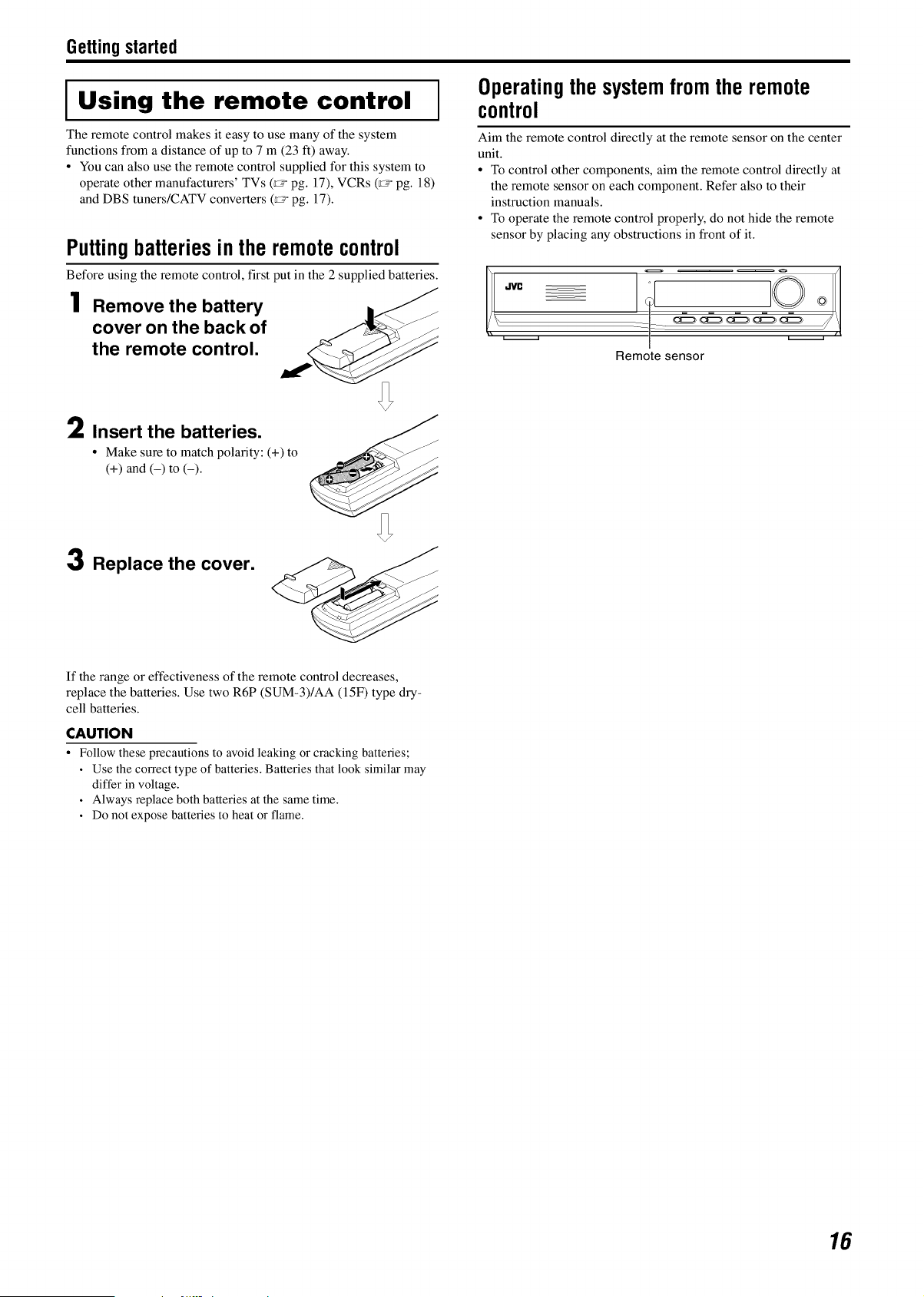
Puttingbatteriesin the remotecontrol
Before using the remote control, first put in the 2 supplied batteries.
1 Removethe battery j
cover on the back of
the remote control.
Operatingthe systemfromtheremote
control
Aim the remote control directly at the remote sensor on the center
unit.
• To control other components, aim the remote control directly at
the remote sensor on each component. Refer also to their
instruction manuals.
• To operate the remote control properly, do not hide the remote
sensor by placing any obstructions in front of it.
Remote sensor
A
Insert the batteries.
• Make sure to match polarity: (+) to
(+) and (-) to (-).
3 Replace the cover.
If the range or effectiveness of the remote control decreases,
replace the batteries. Use two R6P (SUM-3)/AA (15F) type dry-
cell batteries.
CAUTION
• Follow these precautions to avoid leaking or cracking batteries;
• Use the correct type of batteries. Batteries that look similar may
differ in voltage.
• Always replace both batteries at the same time.
• Do not expose batteries to heat or flame.
16
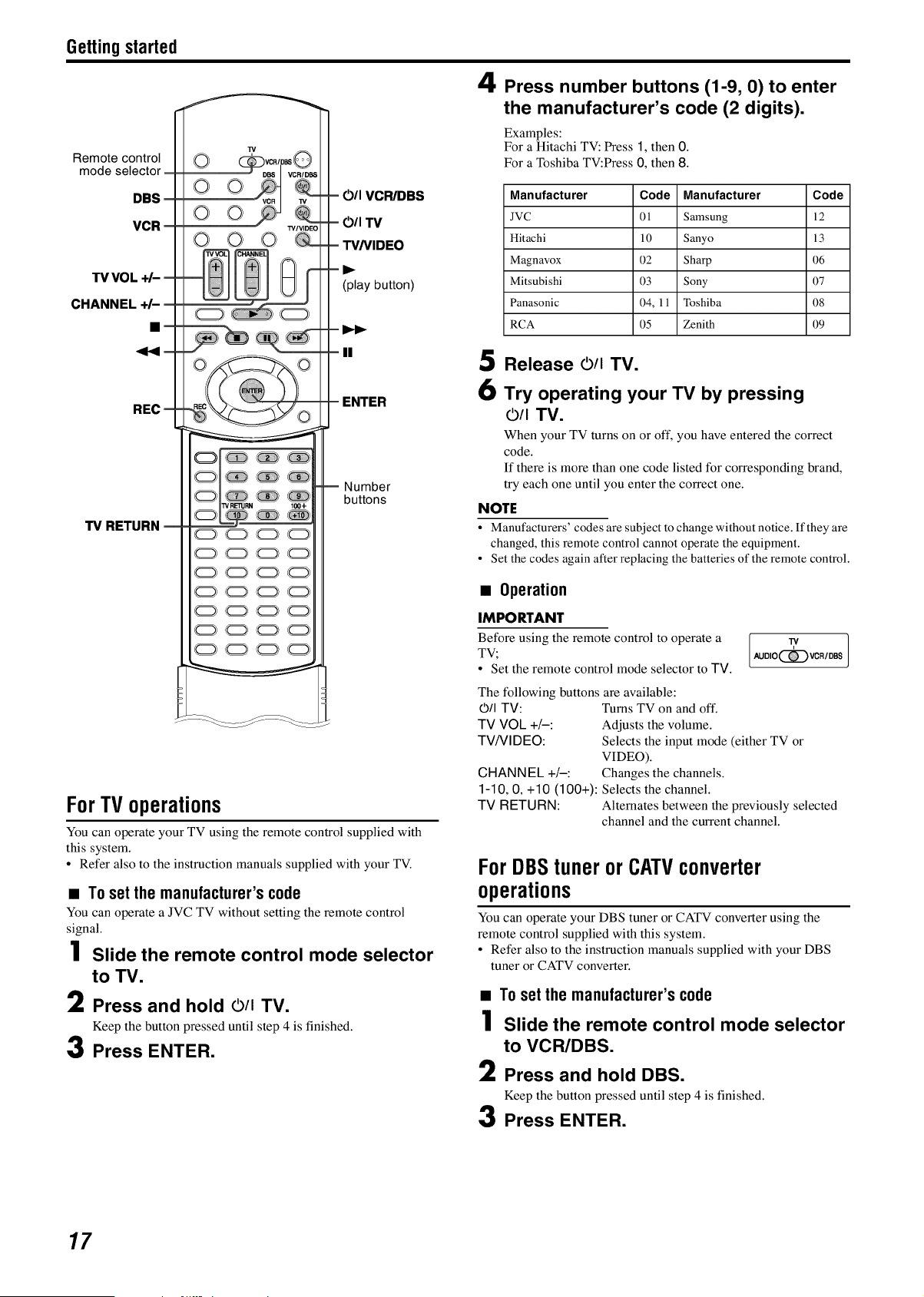
Getting started
Remote control
mode selector
DBS
VCR
TV VOL
CHANNEL +/-
<1<1--
REC --
TV RETURN
000}0
0000
0000
000_0
0000
0000
0000
- 0/I VCR/DBS
- 0/I TV
- TVNIDEO
-I_
(play button)
ENTER
- Number
buttons
For TV operations
You can operate your TV using the remote control supplied with
this system.
• Refer also to the instruction manuals supplied with your TV.
• To set the manufacturer's code
You can operate a JVC TV without setting the remote control
signal.
1 Slide the remote control mode selector
to TV.
2 Press and hold O/t TV.
Keep the button pressed until step 4 is finished.
3 Press ENTER.
4 Press number buttons (1-9, 0) to enter
the manufacturer's code (2 digits).
Examples:
For a Hitachi TV: Press 1, then 0.
For a Toshiba TV:Press 0, then 8.
Manufacturer Code Manufacturer Code
JVC 01 Samsung 12
Hitachi 10 Sanyo 13
Magnavox 02 Sharp 06
Mitsubishi 03 Sony 07
Panasonic 04, 11 Toshiba 08
RCA 05 Zenith 09
,,_ Release O/I TV.
6 Try operating your TV by pressing
O/t TV.
When your TV turns on or off, you have entered the correct
code.
If there is more than one code listed for corresponding brand,
try each one until you enter the correct one.
NOTE
• Manufacturers' codes are subject to change without notice. If they are
changed, this remote control cannot operate the equipment.
• Set the codes again after replacing the batteries of the remote control.
• Operation
IMPORTANT
Before using the remote control to operate a
TV;
• Set the remote control mode selector to TV.
[ AUDIO_VCR/DBS ]
The following buttons are available:
©/I TV: Turns TV on and off.
TV VOL +/-: Adjusts the volume.
TV/VI DEO: Selects the input mode (either TV or
VIDEO).
CHANNEL +/-: Changes the channels.
1-10, 0, +10 (100+): Selects the channel.
TV RETURN: Alternates between the previously selected
channel and the current channel.
ForDBStuner or CATVconverter
operations
You can operate your DBS tuner or CATV converter using the
remote control supplied with this system.
• Refer also to the instruction manuals supplied with your DBS
tuner or CATV converter.
• To set the manufacturer'scode
1 Slide the remote control mode selector
to VCR/DBS.
2 Press and hold DBS.
Keep the button pressed until step 4 is finished.
3 Press ENTER.
17
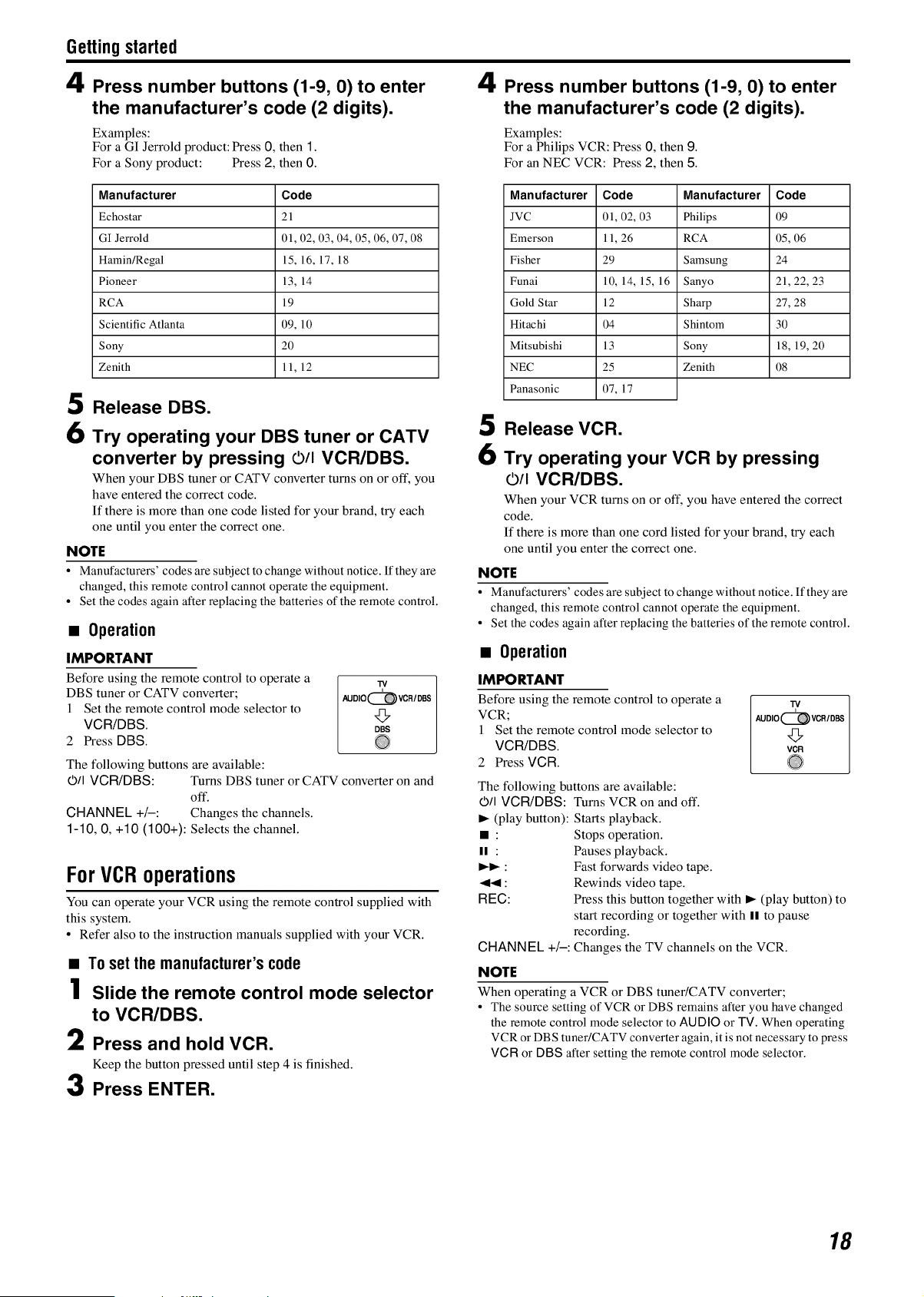
Getting started
4 Press number buttons (1-9, O) to enter
the manufacturer's code (2 digits).
Examples:
For a GI Jerrold product: Press 0, then 1.
For a Sony product: Press 2, then 0.
Manufacturer Code
Echostar 21
GI Jerrold 01,02, 03, 04, 05, 06, 07, 08
Hamin/Regal 15, 16, 17, 18
Pioneer 13, 14
RCA 19
Scientific Atlanta 09, 10
Sony 20
Zenith 11, 12
5 Release DBS.
6 Try operating your DBS tuner or CATV
converter by pressing 0/I VCR/DBS.
When your DBS tuner or CATV converter turns on or off, you
have entered the correct code.
If there is more than one code listed for your brand, try each
one until you enter the correct one.
NOTE
• Manufacturers' codes are subject to change without notice. If they are
changed, this remote control cannot operate the equipment.
• Set the codes again after replacing the batteries of the remote control.
• Operation
IMPORTANT
Before using the remote control to operate a
DBS tuner or CATV converter;
1 Set the remote control mode selector to
VCR/DBS.
2 Press DBS.
TV
AUDIOQVCR/DBS
DBS
The following buttons are available:
©/I VCR/DBS: Turns DBS tuner or CATV converter on and
off.
CHANNEL +/-: Changes the channels.
1-10, 0, +10 (100+): Selects the channel.
ForVCRoperations
You can operate your VCR using the remote control supplied with
this system.
• Refer also to the instruction manuals supplied with your VCR.
• To set the manufacturer's code
1 Slide the remote control mode selector
to VCR/DBS.
2 Press and hold VCR.
Keep the button pressed until step 4 is finished.
3 Press ENTER.
4
Press number buttons (1-9, O) to enter
the manufacturer's code (2 digits).
Examples:
For a Philips VCR: Press 0, then 9.
For an NEC VCR: Press 2, then 5.
Manufacturer Code Manufacturer Code
JVC 01, 02, 03 Philips 09
Emerson 11, 26 RCA 05, 06
Fisher 29 Samsung 24
Funai 10, 14, 15, 16 Sanyo 21,22,23
Gold Star 12 Sharp 27, 28
Hitachi 04 Shintom 30
Mitsubishi 13 Sony 18, 19, 20
NEC 25 Zenith 08
Panasonic 07, 17
5 Release VCR.
6 Try operating your VCR by pressing
O/t VCR/DBS.
When your VCR turns on or ofT, you have entered the correct
code.
If there is more than one cord listed for your brand, try each
one until you enter the correct one.
NOTE
• Manufacturers' codes are subject to change without notice. If they are
changed, this remote control cannot operate the equipment.
• Set the codes again after replacing the batteries of the remote control.
• Operation
IMPORTANT
Before using the remote control to operate a
VCR;
1 Set the remote control mode selector to
VCR/DBS.
2 Press VCR.
'T'V
i
AUDIO(_)VCR/DBS
G
VCR
The following buttons are available:
©11 VCR/DBS: Turns VCR on and off.
(play button): Starts playback.
• : Stops operation.
II : Pauses playback.
: Fast forwards video tape.
: Rewinds video tape.
REC: Press this button together with _ (play button) to
start recording or together with I| to pause
recording.
CHANNEL +/-: Changes the TV channels on the VCR.
NOTE
When operating a VCR or DBS tuner/CATV converter;
• The source setting of VCR or DBS remains after you have changed
the remote control mode selector to AUDIO or TV. When operating
VCR or DBS tuner/CATV converter again, it is not necessary to press
VCR or DBS after setting the remote control mode selector.
18
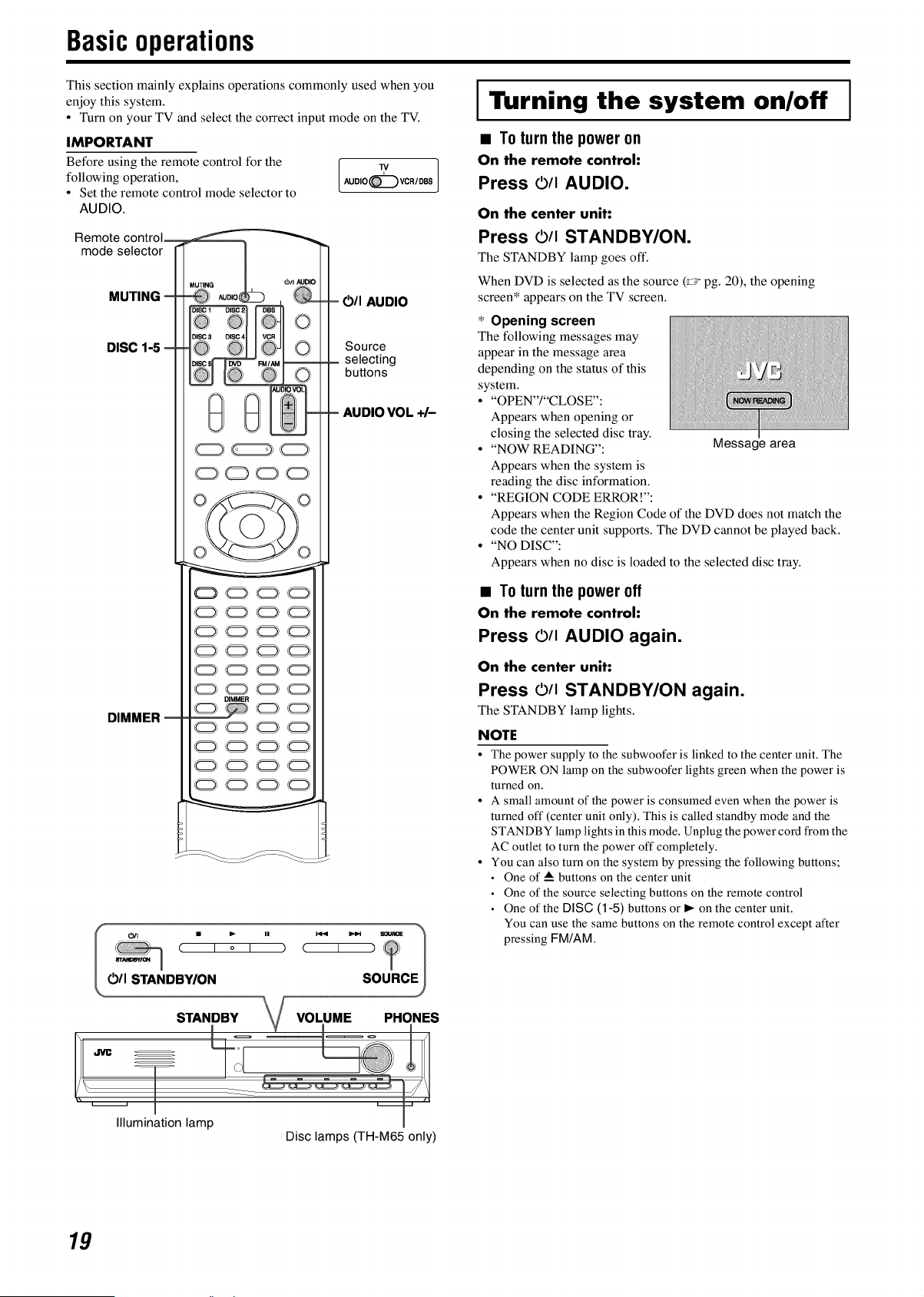
Basicoperations
This section mainly explains operations commonly used when you
enjoy this system.
• Turn on your TV and select the correct input mode on the TV.
IMPORTANT
Before using the remote control for the
following operation,
• Set the remote control mode selector to
AUDIO.
l AUDIO_VCR/DBS ]
Remote control
mode selector
MUTING --
DISC 1-5 --
DIMMER
=lUTING _/I AUDIO
@ Auo,o , , Q_
@1o
-W
OCDOO
(_000
0000
0000
0000
0000
DIMMER
- O/I AUDIO
Source
_ selecting
buttons
- AUDIO VOL +/-
I t_] I • IJ- II 144 IHH SOURCE
( I o I ) ( I ) @|
/
[ lave_\ STAN_)[ V VOLUME PHONES
Illumination lamp
Disc lamps (TH-M65 only)
I Turning the system on/off I
• To turnthe poweron
On the remote control:
Press O/t AUDIO.
On the center unit:
Press O/I STANDBY/ON.
The STANDBY lamp goes off.
When DVD is selected as the source (_ pg. 20), the opening
screen* appears on the TV screen.
* Opening screen
The following messages may
appear in the message area
depending on the status of this
system.
o "OPEN"/"CLOSE":
Appears when opening or
closing the selected disc tray.
o "NOW READING":
Appears when the system is
reading the disc information.
o "REGION CODE ERROR!":
Appears when the Region Code of the DVD does not match the
code the center unit supports. The DVD cannot be played back.
° "NO DISC":
Appears when no disc is loaded to the selected disc tray.
Message area
• To turn the power off
On the remote control:
Press O/t AUDIO again.
On the center unit:
Press O/t STANDBY/ON again.
The STANDBY lamp lights.
NOTE
• The power supply to the subwoofer is linked to the center unit. The
POWER ON lamp on the subwoofer lights green when the power is
turned on.
• A small amount of the power is consumed even when the power is
turned off (center unit only). This is called standby mode and the
STANDBY lamp lights in this mode. Unplug the power cord from the
AC outlet to turn the power off completely.
• You can also turn on the system by pressing the following buttons;
• One of • buttons on the center unit
• One of the source selecting buttons on the remote control
• One of the DISC (1-5) buttons or _ on the center unit.
You can use the same buttons on the remote control except after
pressing FM/AM.
19
Basic operations
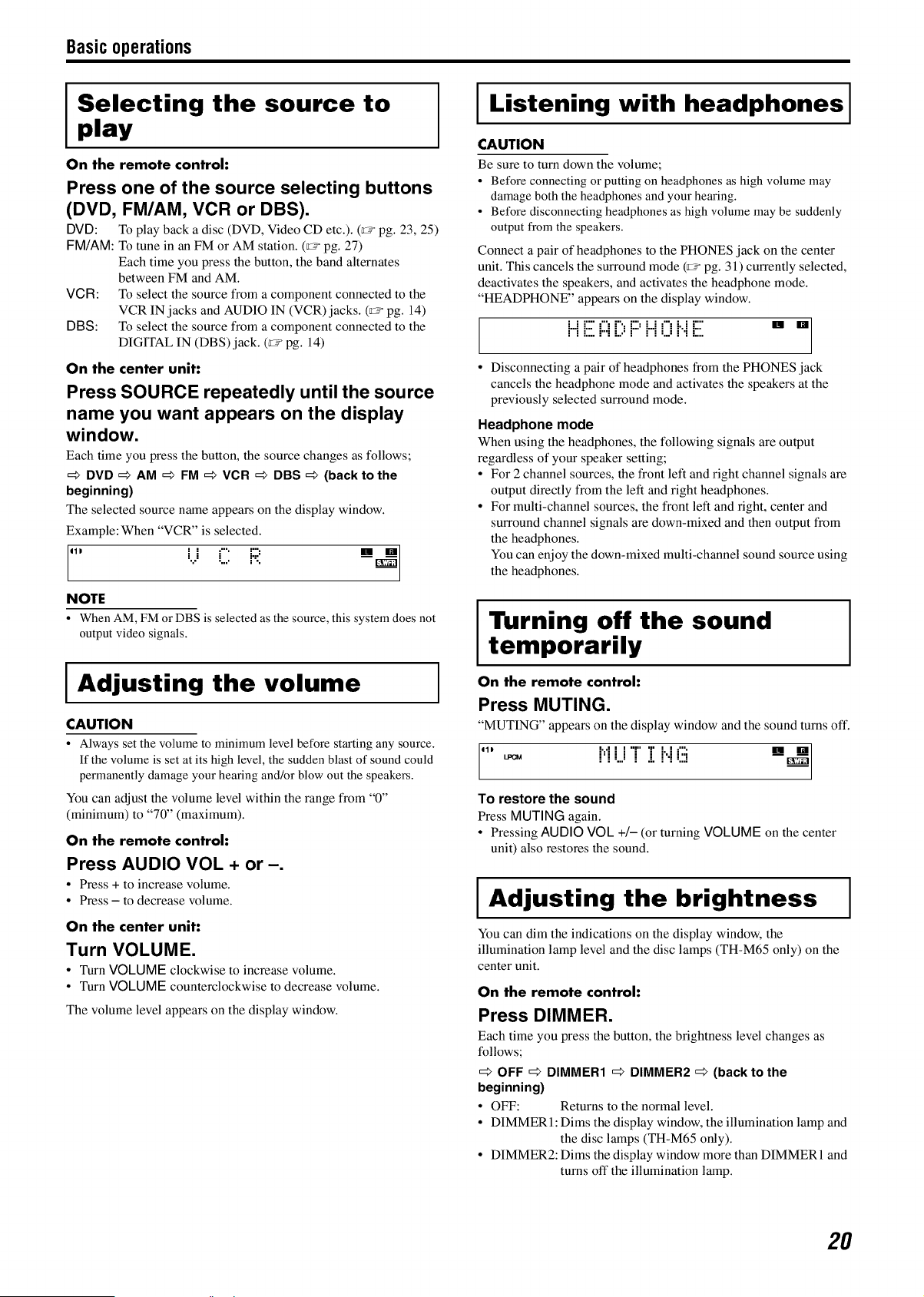
Selecting the source to
play
On the remote control:
Press one of the source selecting buttons
(DVD, FM/AM, VCR or DBS).
DVD: To play back a disc (DVD, Video CD etc.). (_ pg. 23, 25)
FM/AM: To tune in an FM or AM station. (_ pg. 27)
Each time you press the button, the band alternates
between FM and AM.
VGR: To select the source from a component connected to the
VCR IN jacks and AUDIO IN (VCR) jacks. (_ pg. 14)
DBS: To select the source from a component connected to the
DIGITAL IN (DBS) jack. (_ pg. 14)
On the center unit:
Press SOURCE repeatedly until the source
name you want appears on the display
window.
Each time you press the button, the source changes as follows;
<> DVD _ AM <> FM <> VCR <> DBS <> (back to the
beginning)
The selected source name appears on the display window.
Example: When "VCR" is selected.
',' i...i C: F;I: ---_
NOTE
• When AM, FM or DBS is selected as the source, this system does not
output video signals.
Adjusting the volume
CAUTION
• Always set the volume to mininmnl level before starting any source.
If the volume is set at its high level, the sudden blast of sound could
permanently damage your hearing and/or blow out the speakers.
You can adjust the volume level within the range from "0"
(minimum) to "70" (maximum).
On the remote control:
Press AUDIO VOL + or -.
• Press + to increase volume.
• Press - to decrease volume.
On the center unit:
Turn VOLUME.
• Turn VOLUME clockwise to increase volume.
• Turn VOLUME counterclockwise to decrease volume.
The volume level appears on the display window.
Listening with headphones]
CAUTION
Be sure to turn down the volume;
• Before connecting or putting on headphones as high volume may
damage both the headphones and your hearing.
• Before disconnecting headphones as high volume may be suddenly
output from the speakers.
Connect a pair of headphones to the PHONES jack on the center
unit. This cancels the surround mode (_-r pg. 31 ) currently selected,
deactivates the speakers, and activates the headphone mode.
"HEADPHONE" appears on the display window.
HE i:::iill:,F::'H0 i".iE " "
• Disconnecting a pair of headphones from the PHONES jack
cancels the headphone mode and activates the speakers at the
previously selected surround mode.
Headphone mode
When using the headphones, the following signals are output
regardless of your speaker setting;
• For 2 channel sources, the front left and right channel signals are
output directly from the left and right headphones.
• For multi-channel sources, the front left and right, center and
surround channel signals are down-mixed and then output from
the headphones.
You can enjoy the down-mixed multi-channel sound source using
the headphones.
Turning off the sound
temporarily
On the remote control:
Press MUTING.
"MUTING" appears on the display window and the sound turns ofT.
"' _ !"!i...iT !i!..!(!!i []
To restore the sound
Press MUTING again.
• Pressing AUDIO VOL +/- (or turning VOLUME on the center
unit) also restores the sound.
Adjusting the brightness ]
You can dim the indications on the display window, the
illumination lamp level and the disc lamps (TH-M65 only) on the
center unit.
On the remote control:
Press DIMMER.
Each time you press the button, the brightness level changes as
follows;
<> OFF _ DIMMER1 <> DIMMER2 <> (back to the
beginning)
• OFF: Returns to the normal level.
• DIMMERI: Dims the display window, the illumination lamp and
the disc lamps (TH-M65 only).
• DIMMER2: Dims the display window more than DIMMERI and
turns off the illumination lamp.
20
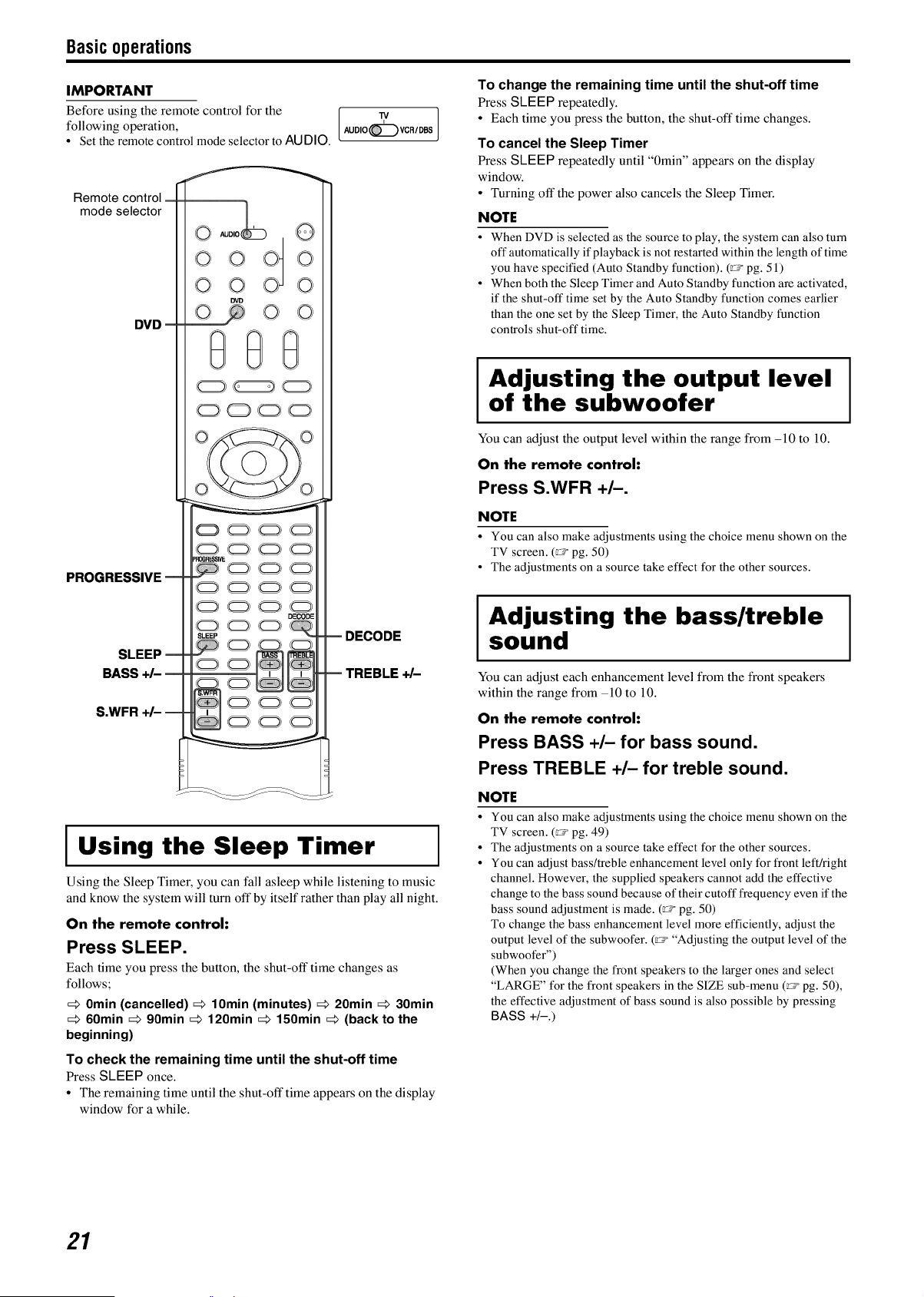
Basic operations
IMPORTANT
Before using the remote control for the
following operation,
• Set the remote control mode selector to NO DIO.
I AUDIO_VCR/DBS ]
Remote control
mode selector
DVD
PROGRESSIVE -
SLEEP m
BASS+_
S.WFR +/-
O °°L @
0 0 _0
0 0 0
DVD
0000
0000
0000
q_l:lE_l_
000
0000
0000
DECODE
SLEEP
-DECODE
_TREBLE+/-
I Using the Sleep Timer
Using the Sleep Timer, you can fall asleep while listening to music
and know the system will turn off by itself rather than play all night.
On the remote control:
Press SLEEP.
Each time you press the button, the shut-off time changes as
follows;
0min (cancelled) _ 10min (minutes) _ 20min _ 30min
60min _ 90min _ 120min _ 150min _ (back to the
beginning)
To check the remaining time until the shut-off time
Press SLEEP once.
• The remaining time until the shut-off time appears on the display
window for a while.
To change the remaining time until the shut-off time
Press SLEEP repeatedly.
• Each time you press the button, the shut-off time changes.
To cancel the Sleep Timer
Press SLEEP repeatedly until "0min" appears on the display
window.
• Turning off the power also cancels the Sleep Timer.
NOTE
• When DVD is selected as the source to play, the system can also turn
off automatically if playback is not restarted within the length of time
you have specified (Auto Standby function). (yr pg. 51)
• When both the Sleep Timer and Auto Standby function are activated,
if the shut-off time set by the Auto Standby function comes earlier
than the one set by the Sleep Timer, the Auto Standby function
controls shut-off time.
Adjusting the output level
of the subwoofer
You can adjust the output level within the range from -10 to 10.
On the remote control:
Press S.WFR +/-.
NOTE
• You can also make adjustments using the choice menu shown on the
TV screen. (rr pg. 50)
• The adjustments on a source take effect for the other sources.
Adjusting the bass/treble
sound
You can adjust each enhancement level from the front speakers
within the range from -10 to 10.
On the remote control:
Press BASS +/- for bass sound.
Press TREBLE +/- for treble sound.
NOTE
• You can also make adjustments using the choice menu shown on the
TV screen. (rr pg. 49)
• The adjustments on a source take effect for the other sources.
• You can adjust bass/treble enhancement level only for front left/right
channel. However, the supplied speakers cannot add the effective
change to the bass sound because of their cutoff frequency even if the
bass sound adjustment is made. (_ pg. 50)
To change the bass enhancement level more efficiently, adjust the
output level of the subwoofer. (rr "Adjusting the output level of the
subwoofer")
(When you change the front speakers to the larger ones and select
"LARGE" for the front speakers in the SIZE sub-menu (_ pg. 50),
the effective adjustment of bass sound is also possible by pressing
BASS +/-.)
21
Basic operations
Changing the decode
mode
When you play a disc (or software) encoded with Dolby Digital or
DTS Digital Surround, the following symptoms may occur;
• Sound does not come out at the beginning of playback.
• Noise comes out while searching for or skipping chapters or
tracks.
In these cases, change the decode mode to "DOLBY D" (for Dolby
Digital) or "DTS" (tbr DTS Digital Surround).
• When DVD or DBS is selected as the source
On the remote control:
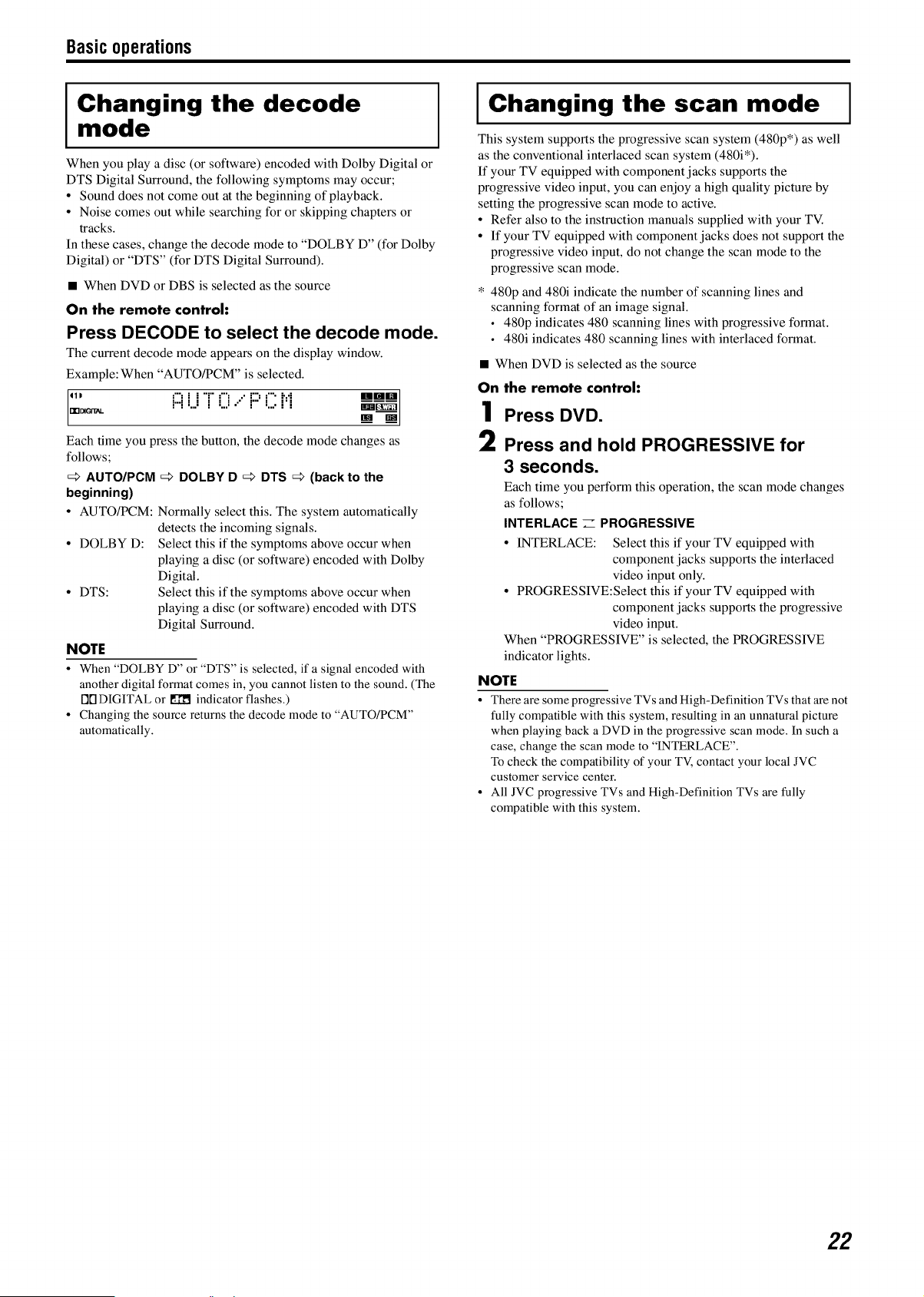
Press DECODE to select the decode mode.
The current decode mode appears on the display window.
Example: When "AUTO/PCM" is selected.
II1 ='= i i "T" ."'= ,' r"= ='". i,,,i imlri[_
nnE_Gr__ ='= = = = = = " =" = ='= []
Each time you press the button, the decode mode changes as
follows;
=> AUTO/PCM => DOLBY D => DTS => (back to the
beginning)
• AUTO/PCM: Normally select this. The system automatically
detects the incoming signals.
• DOLBY D: Select this if the symptoms above occur when
playing a disc (or software) encoded with Dolby
Digital.
• DTS: Select this if the symptoms above occur when
playing a disc (or software) encoded with DTS
Digital Surround.
NOTE
• When "DOLBY D" or "DTS" is selected, if a signal encoded with
another digital format comes in, you cannot listen to the sound. (The
[1[1DIGITAL or FJI"Iindicator flashes.)
• Changing the source returns the decode mode to "AUTO/PCM"
automatically.
JChanging the scan mode J
This system supports the progressive scan system (480p*) as well
as the conventional interlaced scan system (480i*).
If your TV equipped with component jacks supports the
progressive video input, you can enjoy a high quality picture by
setting the progressive scan mode to active.
• Refer also to the instruction manuals supplied with your TV.
• If your TV equipped with component jacks does not support the
progressive video input, do not change the scan mode to the
progressive scan mode.
480p and 480i indicate the number of scanning lines and
scanning format of an image signal.
• 480p indicates 480 scanning lines with progressive format.
• 480i indicates 480 scanning lines with interlaced format.
• When DVD is selected as the source
On the remote control:
1
2
Press DVD.
Press and hold PROGRESSIVE for
3 seconds.
Each time you perform this operation, the scan mode changes
as follows;
INTERLACE Z PROGRESSIVE
• INTERLACE: Select this if your TV equipped with
component jacks supports the interlaced
video input only.
• PROGRESSIVE:Select this if your TV equipped with
component jacks supports the progressive
video input.
When "PROGRESSIVE" is selected, the PROGRESSIVE
indicator lights.
NOTE
• There are some progressive TVs and High-Definition TVs that are not
fully compatible with this system, resulting in an unnatural picture
when playing back a DVD in the progressive scan mode. In such a
case, change the scan mode to "INTERLACE".
To check the compatibility of your TV, contact your local JVC
customer service center.
• All JVC progressive TVs and High-Definition TVs are fully
compatible with this system.
22
Playback
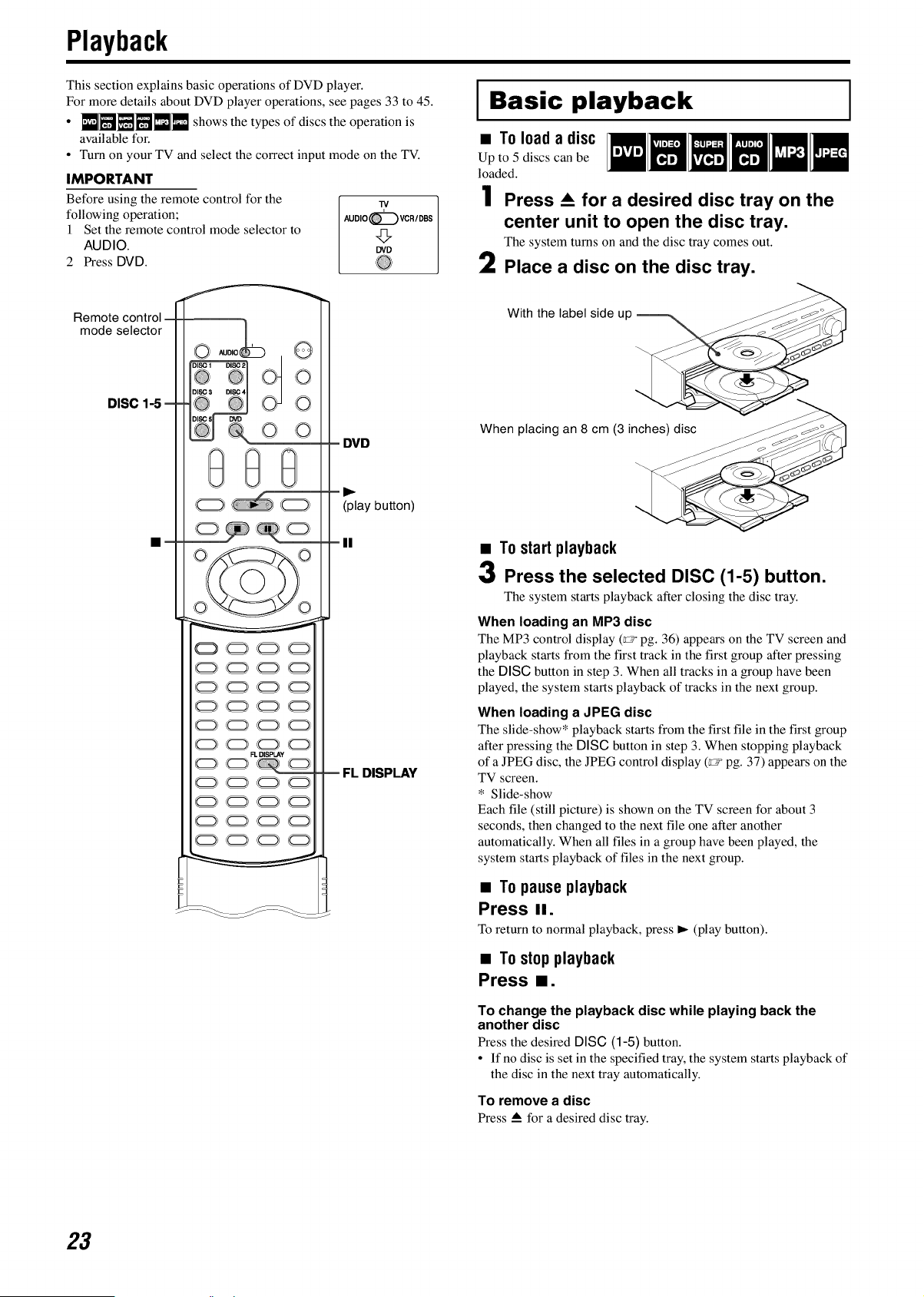
This section explains basic operations of DVD player.
For more details about DVD player operations, see pages 33 to 45.
• []N[_[][_[] shows the types of discs the operation is
available for.
• Turn on your TV and select the correct input mode on the TV.
IMPORTANT
Before using the remote control for the
following operation;
1 Set the remote control mode selector to
AUDIO.
2 Press DVD.
"IV
AUDIO_VCR/DBS
O
DV0
Remote control
mode selector _%ll 1,
jo o
DVD
IP-
(play button)
II
FL DISPLAY
S
I Basic playback I
• To load a disc
Up to 5 discs can be
loaded.
1 Press _ for a desired disc tray on the
center unit to open the disc tray.
The system turns on and the disc tray comes out.
2 Place a disc on the disc tray.
With the label side up
When placing an 8 cm (3 inches) disc
• To start playback
3 Press the selected DISC (1-5) button.
The system starts playback after closing the disc tray.
When loading an MP3 disc
The MP3 control display (r_ pg. 36) appears on the TV screen and
playback starts from the first track in the first group after pressing
the DISC button in step 3. When all tracks in a group have been
played, the system starts playback of tracks in the next group.
When loading a JPEG disc
The slide-show* playback starts from the first file in the first group
after pressing the DISC button in step 3. When stopping playback
of a JPEG disc, the JPEG control display (r_ pg. 37) appears on the
TV screen.
* Slide-show
Each file (still picture) is shown on the TV screen tbr about 3
seconds, then changed to the next file one after another
automatically. When all files in a group have been played, the
system starts playback of files in the next group.
• To pause playback
Press II.
To return to normal playback, press 1,_ (play button).
• To stopplayback
Press m.
To change the playback disc while playing back the
another disc
Press the desired DISC (1-5) button.
• If no disc is set in the specified tray, the system starts playback of
the disc in the next tray automatically.
To remove a disc
Press _ tbr a desired disc tray.
23
Playback
NOTE
• You can also start playback by pressing _- (play button) or DVD.
• Regardless of the operation for starting playback, the system plays
back all available discs sequentially until you stop playback.
However, the system stops playback after playback of the disc in the
fifth tray.
• When Video CDs/SVCDs with PBC function (_a=pg. 4) or DVD that
automatically go to the menu screen and wait for the next instruction,
the system does not move to the next disc. In such a case, select the
item to be played back from the menu. (_ pg. 35)
• You can check playback information on the display window and the
TV screen. (_ pg. 33)
• Some tracks on an MP3 disc may be skipped or may not be played
back normally.
• When you play back a JPEG disc, press buttons after the whole
picture appears on the TV screen. The system cannot accept
operations even though you press buttons while showing a picture.
• Some files on a JPEG disc may be played back distortedly.
• Ifablackscreencontinuouslyappearsintheslide-showplayback, the
file currently being played may be a non-baseline JPEG file. In this
case, select a playable file (a baseline JPEG file). For example, press
• or MENU to open the JPEG control display, etc. Note that it may
take a long time to select another file.
• Resume Playback (DVD/Video CD/SVCD only)
When Resume Playback is set to "ON" (_ pg. 51) and you stop
playback by the following operations, the position where playback
has been stopped is stored. (The RESUME indicator lights.)
• Turning off the power (r_ pg. 19)
• Pressing •
• Changing the source (r_ pg. 20)
To start playback from the stored position
(The RESUME indicator goes off.)
• Press the selected DISC button or _ (play button) on the remote
control or the center unit.
• Select DVD as the source again if you changed the source.
To clear the stored position
Press • again or open the disc tray with the playback disc.
• When the stored position has been cleared, playback starts from
the beginning of the disc.
• To prevent screen burn-out with the screen saver
A TV screen may burn out if a static picture is displayed for a long
time. To prevent this, the system automatically dims the screen if a
static picture is displayed for over 5 minutes (the screen saver
function).
• Pressing any button will cancel the screen saver function.
• If you do not want to use the screen saver function, see page 49.
• On-screen guide icons
During DVD playback, the following guide icons may appear for a
while on the TV screen;
• _: appears at the beginning of a scene containing multi-
subtitle languages.
• _: appears at the beginning of a scene containing multi-audio
languages.
• _: appears at the beginning of a scene containing multi-angle
views.
• O (Play), O (Pause), _ / _ (Fast forward/
fast-reverse), _ / _ (Slow-motion forward/fast-
reverse): appears when you perform each operation.
• If "®" appears on the TV screen when pressing a button, the disc
cannot accept an operation you have tried to do or information
required for that operation is not recorded to the disc.
NOTE
• In some cases, without showing "_", operations will not be accepted.
• If you do not want the on-screen guide icons to appear, see page 51.
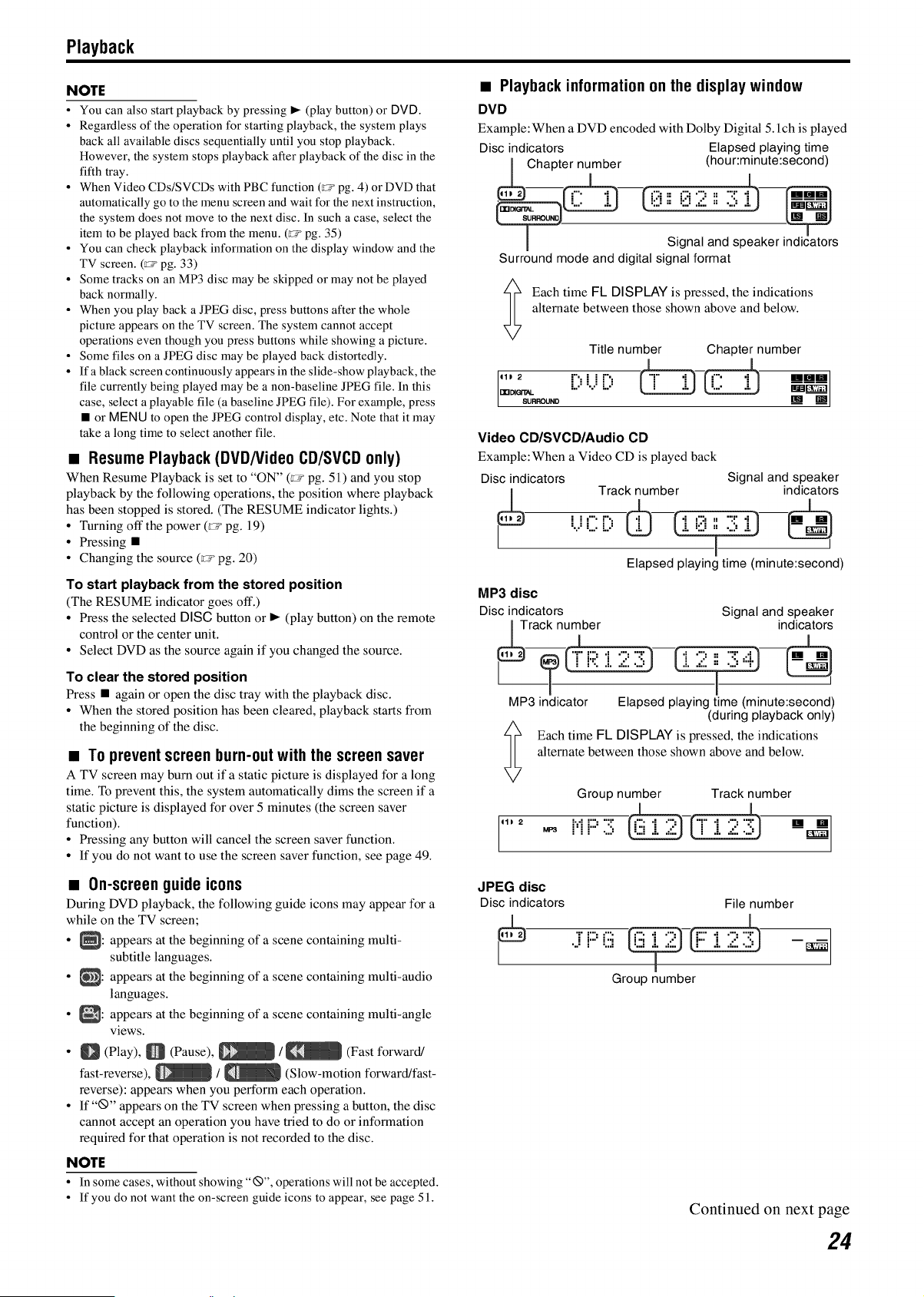
• Playback information on the display window
DVD
Example: When a DVD encoded with Dolby Digital 5. lch is played
Disc indicators Elapsed playing time
Chapter number (hour:minute:second)
Signal and speaker indicators
Surround mode and digital signal format
Each time FL DISPLAY is pressed, the indications
alternate between those shown above and below.
Title number Chapter number
,11 28URROUND r', = 11". _--_-
...... Immr.-g
nn_erE_L L.: :...: J...: m'_O_ii)
Video CD/SVCD/Audio CD
Example: When a Video CD is played back
Disc indicators Signal and speaker
Track number indicators
,,,::::,:::c5-0 i1
J-
Elapsed playing time (minute:second)
MP3 disc
Disc indicators
_Track nun_ber
i"eJ .? (T F;I".i 2:7]-
MP3 indicator
11) 2
Signal and speaker
indicators
T
Elapsed playing time (minute:second)
(during playback only)
Each time FL DISPLAY is pressed, the indications
alternate between those shown above and below.
Group number Track number
JPEG disc
Disc indicators
File number
I
"':::="::;_-{J::: ::?_ -_l
.......... i
Group number
Continued on next page
24
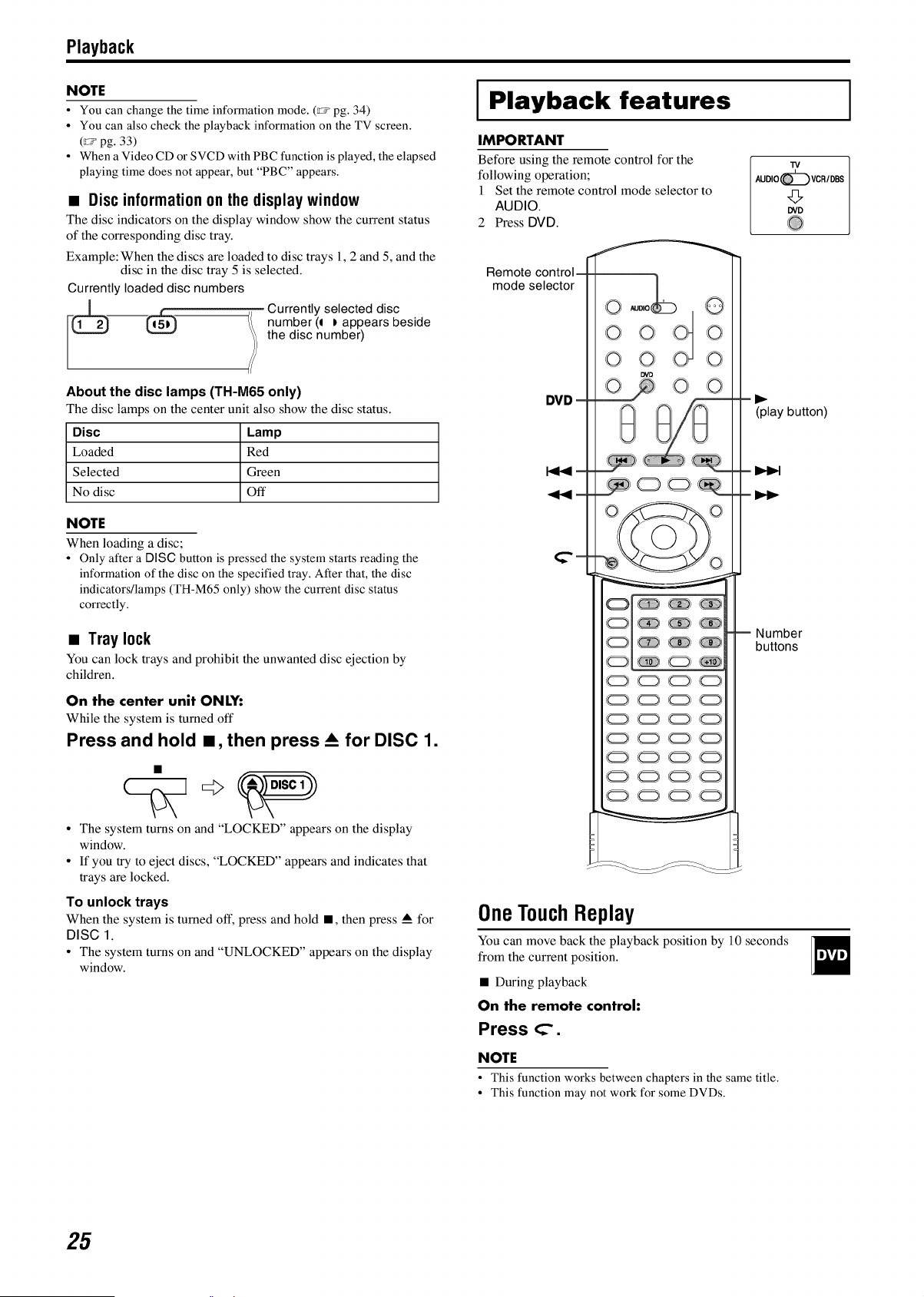
Playback
NOTE
• YOU can change the time information nlode. (_ pg. 34)
• You can also check the playback information on the TV screen.
(_ pg. 33)
• When a Video CD or SVCD with PBC function is played, the elapsed
playing time does not appear, but "PBC" appears.
• Disc information on the display window
The disc indicators on the display window show the current status
of the corresponding disc tray.
Example: When the discs are loaded to disc trays 1, 2 and 5, and the
disc in the disc tray 5 is selected.
Currently loaded disc numbers
_Q_ (_ Ca rrently selected discnumber (_) appears beside
the disc number)
About the disc lamps (TH-M65 only)
The disc lamps on the center unit also show the disc status.
Disc Lamp
Loaded Red
Selected Green
No disc Off
NOTE
When loading a disc;
• Only after a DISC button is pressed the system starts reading the
information of the disc on the specified tray. After that, the disc
indicators/lamps (TH-M65 only) show the current disc status
correctly.
• Tray lock
You can lock trays and prohibit the unwanted disc ejection by
children.
On the center unit ONLY:
While the system is turned off
Press and hold m, then press _ for DISC 1.
The system turns on and "LOCKED" appears on the display
window.
If you try to eject discs, "LOCKED" appears and indicates that
trays are locked.
To unlock trays
When the system is turned off, press and hold •, then press _ for
DISC 1.
• The system turns on and "UNLOCKED" appears on the display
window.
I Playback features
IMPORTANT
Before using the remote control for the
tbllowing operation;
1 Set the remote control mode selector to
AUDIO.
2 Press DVD.
Remote control
mode selector
DVD -
I
TV
AUDIO_VCR/DBS
4}
DVD
OO
_.)0@
0000
0000
0000
0000
0000
0000
0000
(play button)
- Number
buttons
OneTouchReplay
You can move back the playback position by 10 seconds
from the current position.
• During playback
On the remote control:
Press _.
NOTE
• This function works between chapters in the same title.
• This function may not work for some DVDs.
25
Playback
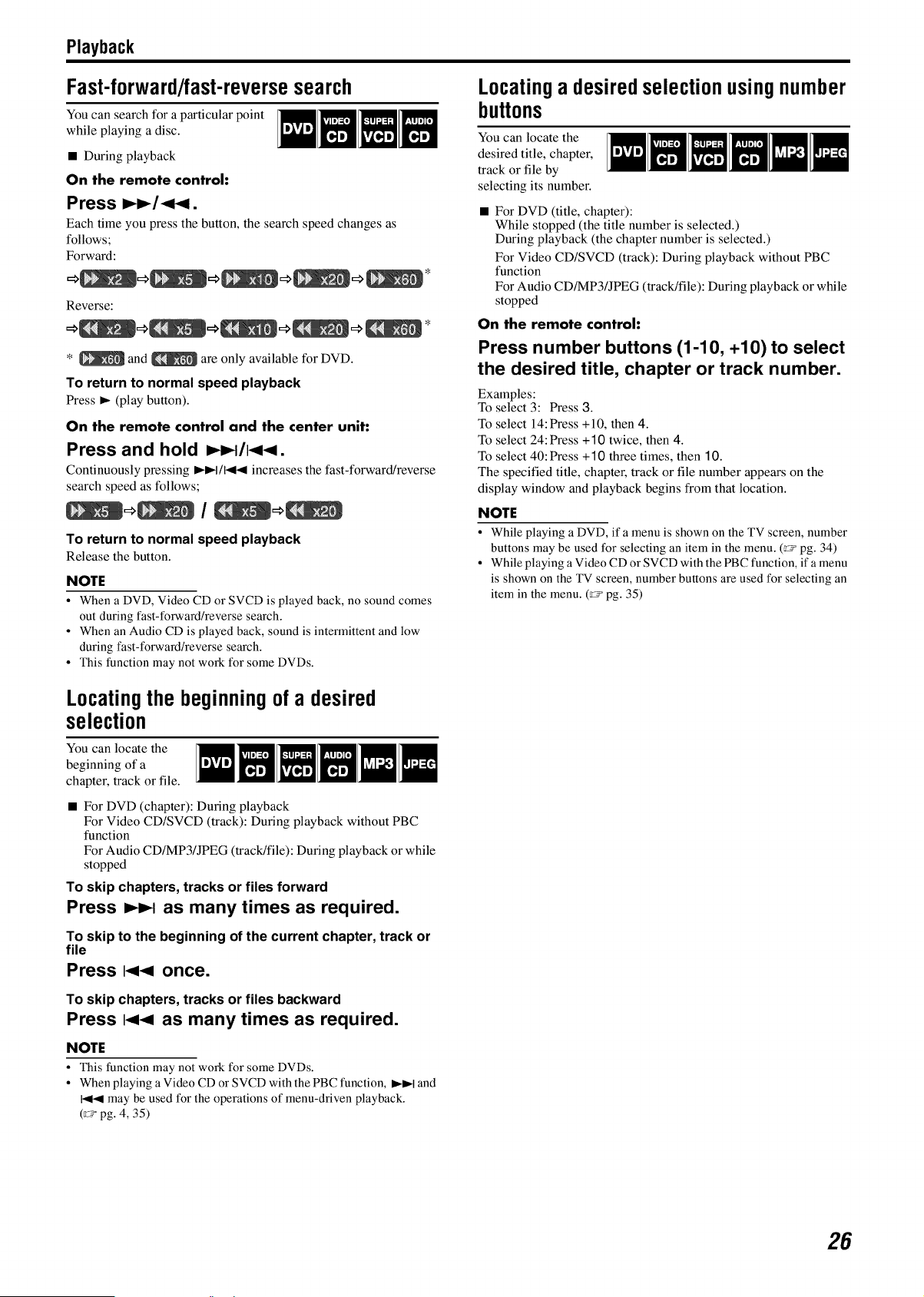
Fast-forward/fast-reversesearch
You can search for a particular point
while playing a disc.
• During playback
On the remote control:
Press _/_.
Each time you press the button, the search speed changes as
follows;
Forward:
Reverse:
* _ and _ are only available for DVD.
To return to normal speed playback
Press i_ (play button).
On the remote control and the center unit:
Press and hold _/1_.
Continuously pressing I_llq/I.,ql-ll increases the fast-forward!reverse
search speed as follows;
To return to normal speed playback
Release the button.
NOTE
• When a DVD, Video CD or SVCD is played back, no sound comes
out during fast-forward/reverse search.
• When an Audio CD is played back, sound is intermittent and low
during fast-forward/reverse search.
• This function may not work for some DVDs.
Locatingthe beginningof a desired
selection
You can locate the
beginning of a
chapter, track or file.
• For DVD (chapter): During playback
For Video CD/SVCD (track): During playback without PBC
function
For Audio CD/MP3/JPEG (track/file): During playback or while
stopped
To skip chapters, tracks or files forward
Press _ as many times as required.
To skip to the beginning of the current chapter, track or
file
Press I_ once.
To skip chapters, tracks or files backward
Press I_ as many times as required.
NOTE
• This function may not work for some DVDs.
• When playing a Video CD or SVCD with the PBC function, I_1_i and
I-_1 may be used for the operations of menu-driven playback.
(rr pg. 4, 35)
Locatinga desiredselectionusingnumber
buttons
You can locate the
desired title, chapter,
track or file by
selecting its number.
• For DVD (title, chapter):
While stopped (the title number is selected.)
During playback (the chapter number is selected.)
For Video CD/SVCD (track): During playback without PBC
function
For Audio CD/MP3/JPEG (track/file): During playback or while
stopped
On the remote control:
Press number buttons (1-10, +10) to select
the desired title, chapter or track number.
Examples:
To select 3: Press 3.
To select 14: Press +10, then 4.
To select 24: Press +10 twice, then 4.
To select 40: Press +10 three times, then 10.
The specified title, chapter, track or file number appears on the
display window and playback begins from that location.
NOTE
• While playing a DVD, if a menu is shown on the TV screen, number
buttons may be used for selecting an item in the menu. (r_= pg. 34)
• While playing a Video CD or SVCD with the PBC function, if a menu
is shown on the TV screen, number buttons are used for selecting an
item in the menu. (rr pg. 35)
26
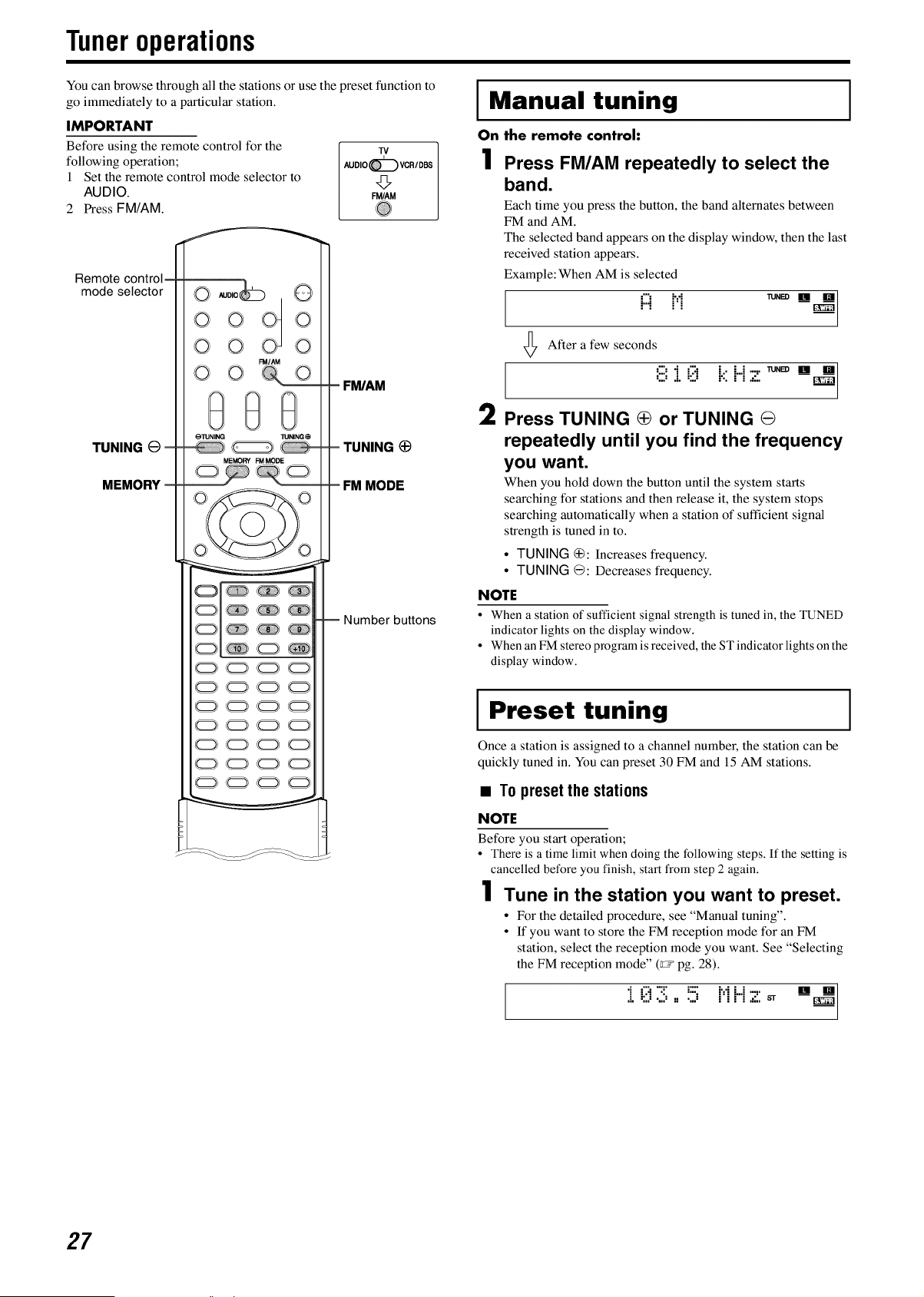
Tuneroperations
You can browse through all the stations or use the preset function to
go immediately to a particular station.
I Manual tuning I
On the remote control:
IMPORTANT
Before using the remote control for the
following operation;
1 Set the remote control mode selector to
AUDIO.
2 Press FM/AM.
Remote control
mode selector
TUNING G-
MEMORY
0 Au0_o_ Q
0 0 _0
O O O
FM/AM
oo o
@@@
ellJNING _INING _
MEMORY FM MODE
o[ ® ®
O ® ®
O®®®
O®O_
OO00
OO00
OOO©
OOOO
OOOO
OOOO
©©QQ
TV
AUDIO_VCR/DBS
FM/AM
Fr0VAM
- TUNING
FM MODE
-- Number buttons
1
2
Press FM/AM repeatedly to select the
band.
Each time you press the button, the band alternates between
FM and AM.
The selected band appears on the display window, then the last
received station appears.
Example: When AM is selected
i:::i H ,u._____
After a few seconds
8 :[@ k Hz ,_.m____
Press TUNING _ or TUNING O
repeatedly until you find the frequency
you want.
When you hold down the button until the system starts
searching for stations and then release it, the system stops
searching automatically when a station of sufficient signal
strength is tuned in to.
• TUNING _: Increases frequency.
• TUNING (_: Decreases frequency.
NOTE
• When a station of sufficient signal strength is tuned in, the TUNED
indicator lights on the display window.
• When an FM stereo program is received, the ST indicator lights on the
display window.
I Preset tuning I
Once a station is assigned to a channel number, the station can be
quickly tuned in. You can preset 30 FM and 15 AM stations.
• To preset the stations
NOTE
Before you start operation;
• There is a time limit when doing the following steps. If the setting is
cancelled before you finish, start from step 2 again.
1 Tune in the station you want to preset.
• For the detailed procedure, see "Manual tuning".
• If you want to store the FM reception mode for an FM
station, select the reception mode you want. See "Selecting
the FM reception mode" (r_ pg. 28).
•i "7"":!' i:::: M L.i ...,. [] []
,i. :;,,: ".,,: == ',..: " "" i ,=',, ST
27
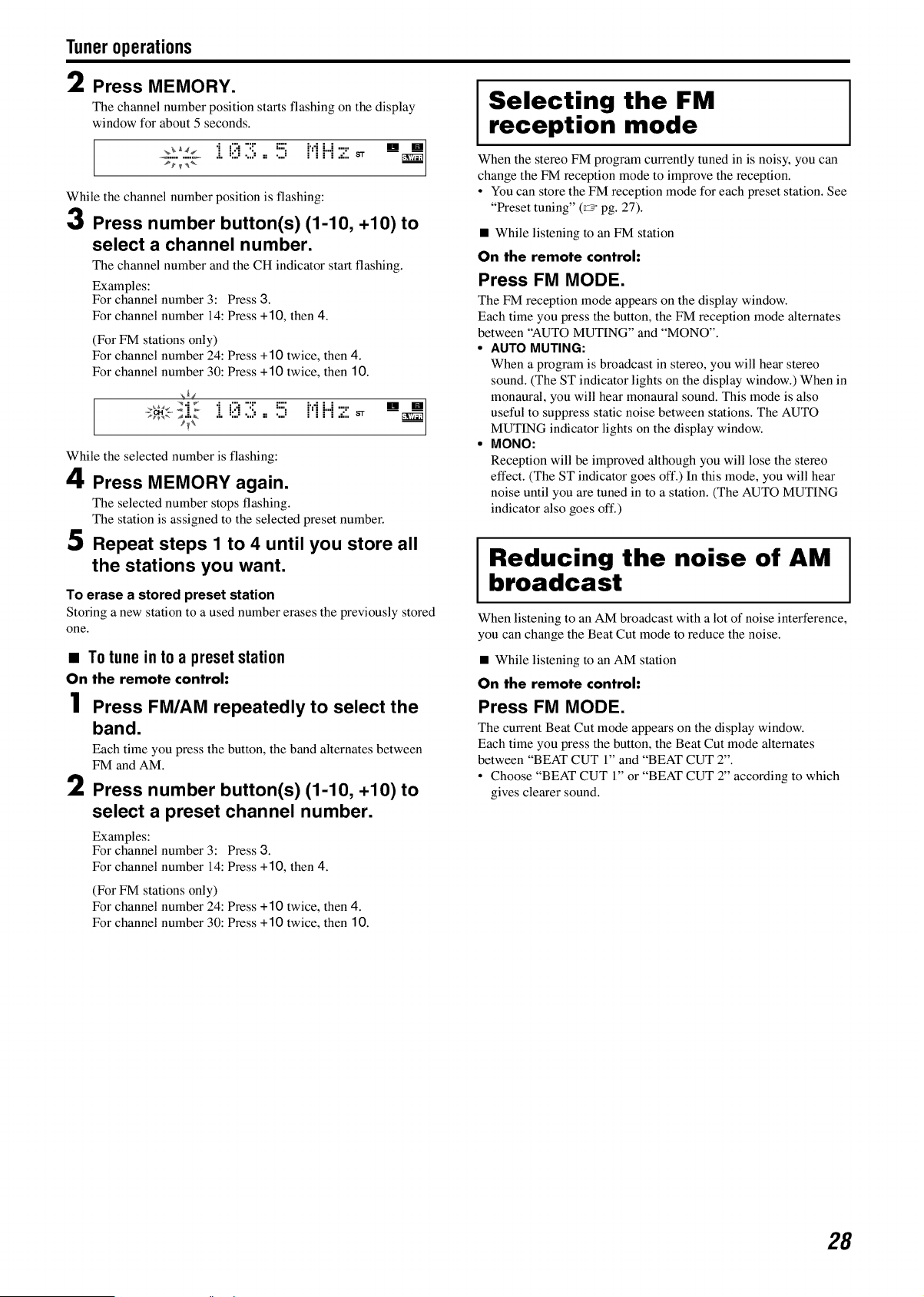
Tuneroperations
2 Press MEMORY.
The channel number position starts flashing on the display
window for about 5 seconds.
.............. l. =:,.," .,,,: :: ,...= i l l l .,,:,, ST
_axuLu
While the channel number position is flashing:
3 Press number button(s) (1-10, +10) to
select a channel number.
The channel number and the CH indicator start flashing.
Examples:
For channel number 3: Press 3.
For channel number 14: Press +10, then 4.
(For FM stations only)
For channel number 24: Press +10 twice, then 4.
For channel number 30: Press + ] 0 twice, then ] 0.
....... 12"1_ 'i i'::"":!" i:::: i','i L..i...,. []
-_--,_.l,_ ,l. ::,.: .,,,: :: ,...: i l l l .::,, ST
While the selected number is flashing:
4 Press MEMORY again.
The selected number stops flashing.
The station is assigned to the selected preset number.
5 Repeat steps 1 to 4 until you store all
the stations you want.
To erase a stored preset station
Storing a new station to a used number erases the previously stored
one.
• To tune in to a preset station
On the remote control:
1 Press FM/AM repeatedly to select the
band.
Each time you press the button, the band alternates between
FM and AM.
2 Press number button(s) (1-10, +10) to
select a preset channel number.
Examples:
For channel number 3: Press 3.
For channel number 14: Press +10, then 4.
(For FM stations only)
For channel number 24: Press +10 twice, then 4.
For channel number 30: Press + ] 0 twice, then ] 0.
Selecting the FM
reception mode
When the stereo FM program currently tuned in is noisy, you can
change the FM reception mode to improve the reception.
• You can store the FM reception mode for each preset station. See
"Preset tuning" (r_ pg. 27).
• While listening to an FM station
On the remote control:
Press FM MODE.
The FM reception mode appears on the display window.
Each time you press the button, the FM reception mode alternates
between "AUTO MUTING" and "MONO".
• AUTO MUTING:
When a program is broadcast in stereo, you will hear stereo
sound. (The ST indicator lights on the display window.) When in
monaural, you will hear monaural sound. This mode is also
useful to suppress static noise between stations. The AUTO
MUTING indicator lights on the display window.
• MONO:
Reception will be improved although you will lose the stereo
effect. (The ST indicator goes off.) In this mode, you will hear
noise until you are tuned in to a station. (The AUTO MUTING
indicator also goes off.)
Reducing the noise of AM
broadcast
When listening to an AM broadcast with a lot of noise interference,
you can change the Beat Cut mode to reduce the noise.
• While listening to an AM station
On the remote control:
Press FM MODE.
The current Beat Cut mode appears on the display window.
Each time you press the button, the Beat Cut mode alternates
between "BEAT CUT 1" and "BEAT CUT 2".
• Choose "BEAT CUT 1" or "BEAT CUT 2" according to which
gives clearer sound.
28
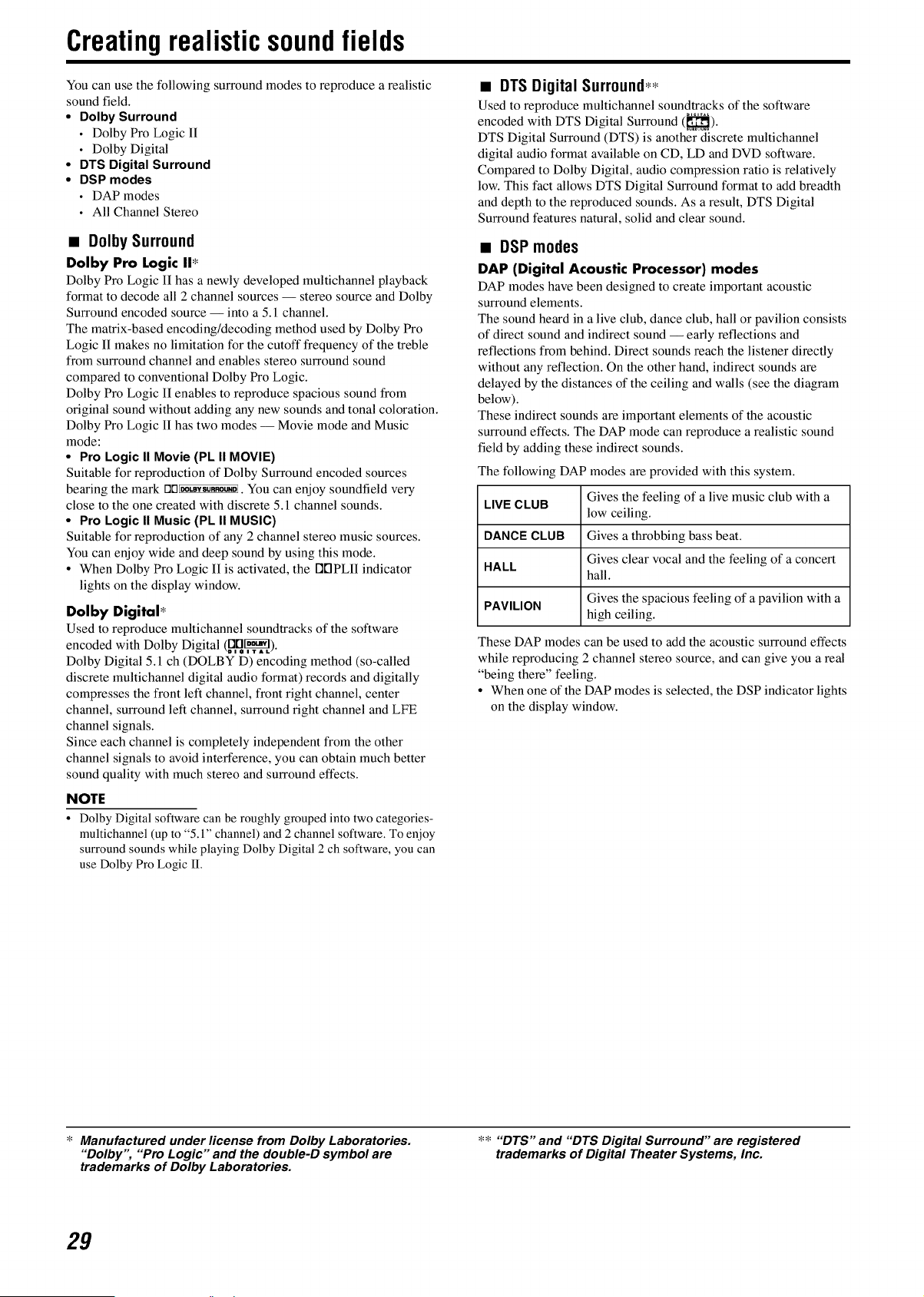
Creatingrealisticsoundfields
You can use the following surround modes to reproduce a realistic
sound field.
• Oolby Surround
• Dolby Pro Logic II
• Dolby Digital
• DTS Digital Surround
• DSP modes
• DAP modes
• All Channel Stereo
• Dolby Surround
Dolby Pro Logic I1"
• DTS Digital Surround**
Used to reproduce multichannel soundtracks of the software
encoded with DTS Digital Surround (_).
DTS Digital Surround (DTS) is another discrete multichannel
digital audio format available on CD, LD and DVD software.
Compared to Dolby Digital, audio compression ratio is relatively
low. This fact allows DTS Digital Surround format to add breadth
and depth to the reproduced sounds. As a result, DTS Digital
Surround features natural, solid and clear sound.
• DSP modes
DAP (Digital Acoustic Processor) modes
Dolby Pro Logic II has a newly developed multichannel playback
format to decode all 2 channel sources -- stereo source and Dolby
Surround encoded source -- into a 5.1 channel.
The matrix-based encoding/decoding method used by Dolby Pro
Logic II makes no limitation for the cutoff frequency of the treble
from surround channel and enables stereo surround sound
compared to conventional Dolby Pro Logic.
Dolby Pro Logic II enables to reproduce spacious sound from
original sound without adding any new sounds and tonal coloration.
Dolby Pro Logic II has two modes -- Movie mode and Music
mode:
• Pro Logic II Movie (PL II MOVIE)
Suitable for reproduction of Dolby Surround encoded sources
bearing the mark Dtq_. You can enjoy soundfield very
close to the one created with discrete 5.1 channel sounds.
• Pro Logic II Music (PL II MUSIC)
Suitable for reproduction of any 2 channel stereo music sources.
You can enjoy wide and deep sound by using this mode.
• When Dolby Pro Logic II is activated, the DrlPLII indicator
lights on the display window.
Dolby Digital*
Used to reproduce multichannel soundtracks of the software
encoded with Dolby Digital (DD_).
Dolby Digital 5.1 ch (DOLBY D) encoding method (so-called
discrete multichannel digital audio format) records and digitally
compresses the front left channel, front right channel, center
channel, surround left channel, surround right channel and LFE
channel signals.
Since each channel is completely independent from the other
channel signals to avoid interference, you can obtain much better
sound quality with much stereo and surround effects.
NOTE
• Dolby Digital software can be roughly grouped into two categories-
multichannel (up to "5.1" channel) and 2 channel software. To enjoy
surround sounds while playing Dolby Digital 2 ch software, you can
use Dolby Pro Logic II.
DAP modes have been designed to create important acoustic
surround elements.
The sound heard in a live club, dance club, hall or pavilion consists
of direct sound and indirect sound -- early reflections and
reflections from behind. Direct sounds reach the listener directly
without any reflection. On the other hand, indirect sounds are
delayed by the distances of the ceiling and walls (see the diagram
below).
These indirect sounds are important elements of the acoustic
surround effects. The DAP mode can reproduce a realistic sound
field by adding these indirect sounds.
The following DAP modes are provided with this system.
Gives the feeling of a live music club with a
LIVE CLUB
low ceiling.
DANCE CLUB Gives a throbbing bass beat.
Gives clear vocal and the feeling of a concert
HALL
hall.
Gives the spacious feeling of a pavilion with a
PAVILION
high ceiling.
These DAP modes can be used to add the acoustic surround effects
while reproducing 2 channel stereo source, and can give you a real
"being there" feeling.
• When one of the DAP modes is selected, the DSP indicator lights
on the display window.
* Manufactured under license from Dolby Laboratories.
"Dolby'; "Pro Logic" and the double-D symbol are
trademarks of Dolby Laboratories.
* * "DTS'" and "DTS Digital Surround" are registered
trademarks of Digital Theater Systems, Inc.
29
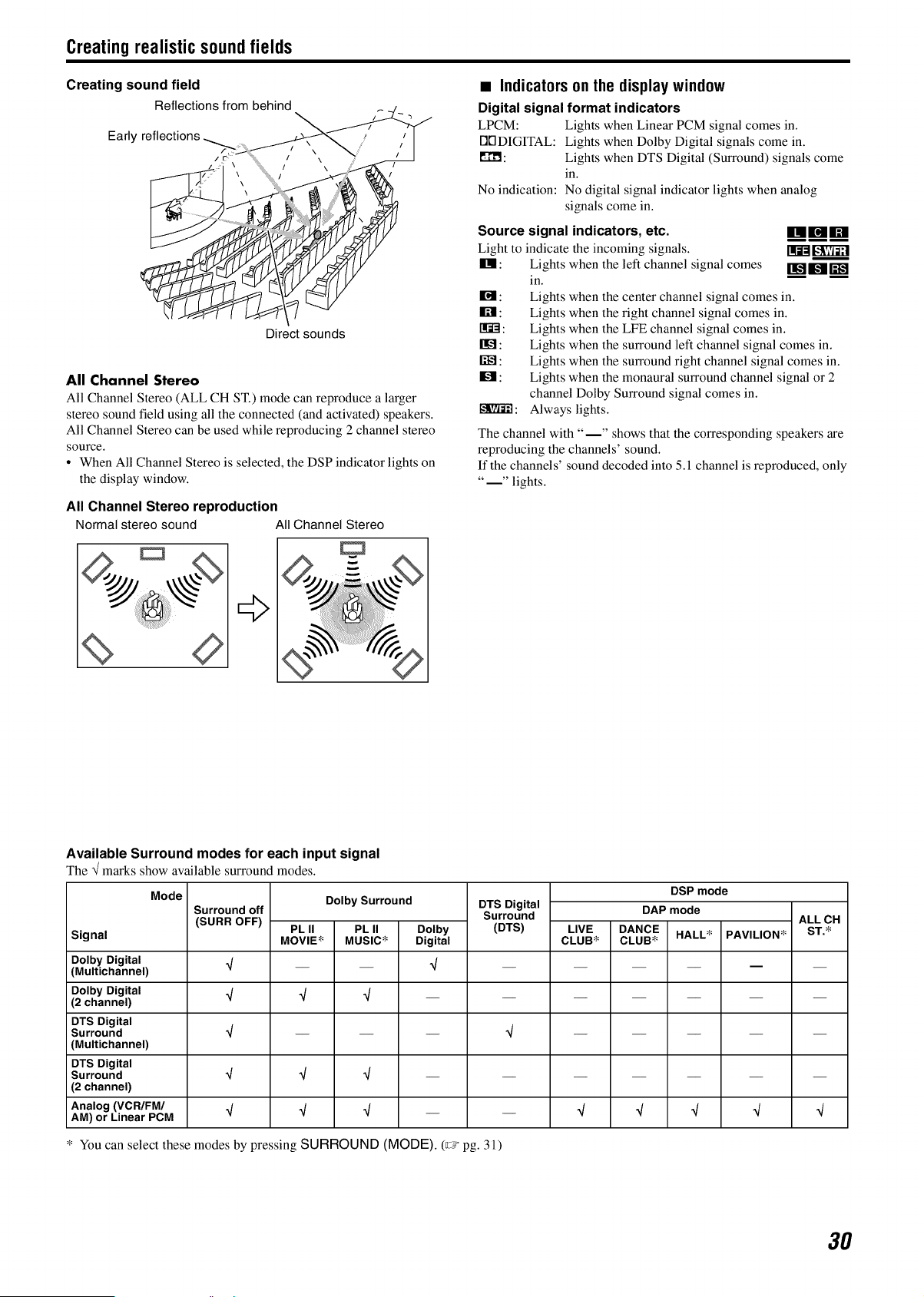
Creating realistic sound fields
Creating sound field
Reflections from behind /C-_- _ /
Early reflections ..._, i ,_/_/,__
• Indicators on the display window
Digital signal format indicators
LPCM: Lights when Linear PCM signal comes in.
DrlDIGITAL: Lights when Dolby Digital signals come in.
_I'l: Lights when DTS Digital (Surround) signals come
in.
No indication: No digital signal indicator lights when analog
signals come in.
Source signal indicators, etc. I]ll_ll'_ll
Light to indicate the incoming signals. _
gl: Lights when the left channel signal comes [!_! Ik"_[]_
in.
I_l : Lights when the center channel signal comes in.
: Lights when the right channel signal comes in.
: Lights when the LFE channel signal comes in.
: Lights when the surround left channel signal comes in.
: Lights when the surround right channel signal comes in.
: Lights when the monaural surround channel signal or 2
channel Dolby Surround signal comes in.
Always lights.
Direct sounds
All Channel Stereo
All Channel Stereo (ALL CH ST.) mode can reproduce a larger
stereo sound field using all the connected (and activated) speakers.
All Channel Stereo can be used while reproducing 2 channel stereo
source.
• When All Channel Stereo is selected, the DSP indicator lights on
the display window.
All Channel Stereo reproduction
Normal stereo sound All Channel Stereo
=;
The channel with "--" shows that the corresponding speakers are
reproducing the channels' sound.
If the channels' sound decoded into 5.1 channel is reproduced, only
"--" lights.
Available Surround modes for each input signal
The _/marks show available surround modes.
Mode
Signal
Dolby Digital
(Multichannel)
Dolby Digital
(2 channel)
DTS Digital
Surround
(Multichannel)
DTS Digital
Surround
(2 channel)
Analog (VCR/FM/
AM) or Linear PCM
Surround off
(SURR OFF)
,]
,]
,]
.j
,]
Dolby Surround
PL II PL II Dolby
MOVIE* MUSIC* Digital
DTS Digital
Surround
(DTS)
DSP mode
DAP mode
LIVE DANCE HALL*
CLUB* CLUB*
PAVILION*
ALL CH
ST.*
* You can select these modes by pressing SURROUND (MODE). (r_ pg. 3 l)
,/ ,/ ,/ ,/ ,/
30
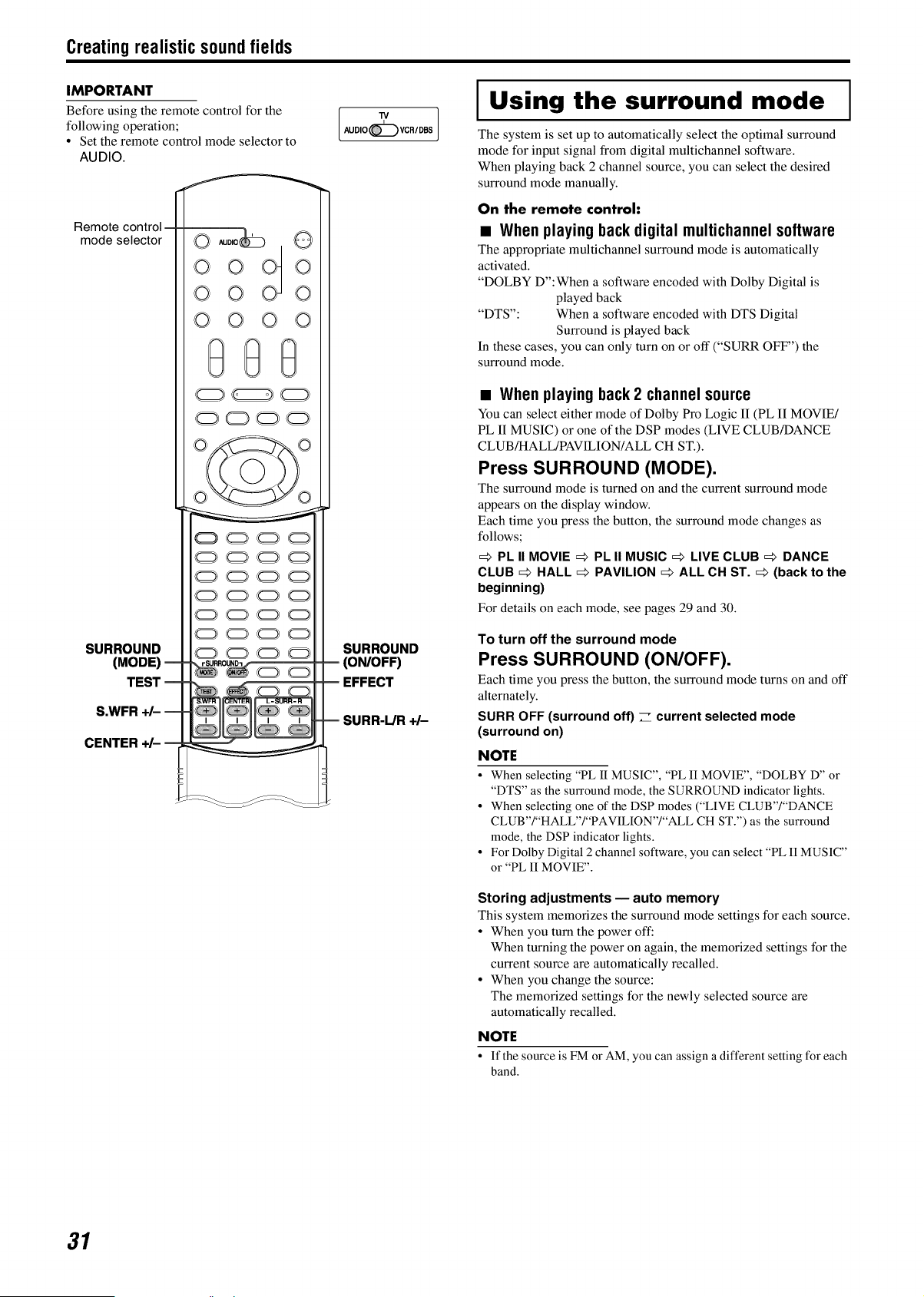
Creating realistic sound fields
IMPORTANT
Before using the remote control for the
following operation;
• Set the remote control mode selector to
AUDIO.
Remote control
mode selector
SURROUND
(MODE) --
TEST m
S.WFR +/-
CENTER+/-
O Auo,o_ @
0 0 _0
0 0 0
0 0 0 0
00@
OCDOO
C_O00
0000
0000
0000
0000
0000
0000
I AUDIO_VCR/DBS ]
SURROUND
(ON/OFF)
EFFECT
SURR-L/R +/-
I Using the surround mode I
The system is set up to automatically select the optimal surround
mode for input signal from digital multichannel software.
When playing back 2 channel source, you can select the desired
surround mode manually.
On the remote control:
• When playing back digital multichannel software
The appropriate multichannel surround mode is automatically
activated.
"DOLBY D":When a software encoded with Dolby Digital is
played back
"DTS": When a software encoded with DTS Digital
Surround is played back
In these cases, you can only turn on or off ("SURR OFF") the
surround mode
• When playing back 2 channel source
You can select either mode of Dolby Pro Logic II (PL II MOVIE/
PL II MUSIC) or one of the DSP modes (LIVE CLUB/DANCE
CLUB/HALL/PAVILION/ALL CH ST.).
Press SURROUND (MODE).
The surround mode is turned on and the current surround mode
appears on the display window.
Each time you press the button, the surround mode changes as
follows;
PL II MOVIE _ PL II MUSIC _ LIVE CLUB _ DANCE
CLUB _ HALL _ PAVILION _ ALL CH ST. _ (back to the
beginning)
For details on each mode, see pages 29 and 30.
To turn off the surround mode
Press SURROUND (ON/OFF).
Each time you press the button, the surround mode turns on and off
alternately.
SURR OFF (surround off) 7_ current selected mode
(surround on)
NOTE
• When selecting "PL II MUSIC", "PL II MOVIE", "DOLBY D" or
"DTS" as the surround mode, the SURROUND indicator lights
• When selecting one of the DSP modes ("LIVE CLUB"/"DANCE
CLUB"/"HALL"/"PAVILION"/"ALL CH ST.") as the surround
mode, the DSP indicator lights
• For Dolby Digital 2 channel software, you can select "PL II MUSIC"
or "PL II MOVIE"
Storing adjustments m auto memory
This system memorizes the surround mode settings for each source.
• When you turn the power off:
When turning the power on again, the memorized settings for the
current source are automatically recalled.
• When you change the source:
The memorized settings for the newly selected source are
automatically recalled.
NOTE
• If the source is FM or AM, you can assign a different setting for each
band.
31
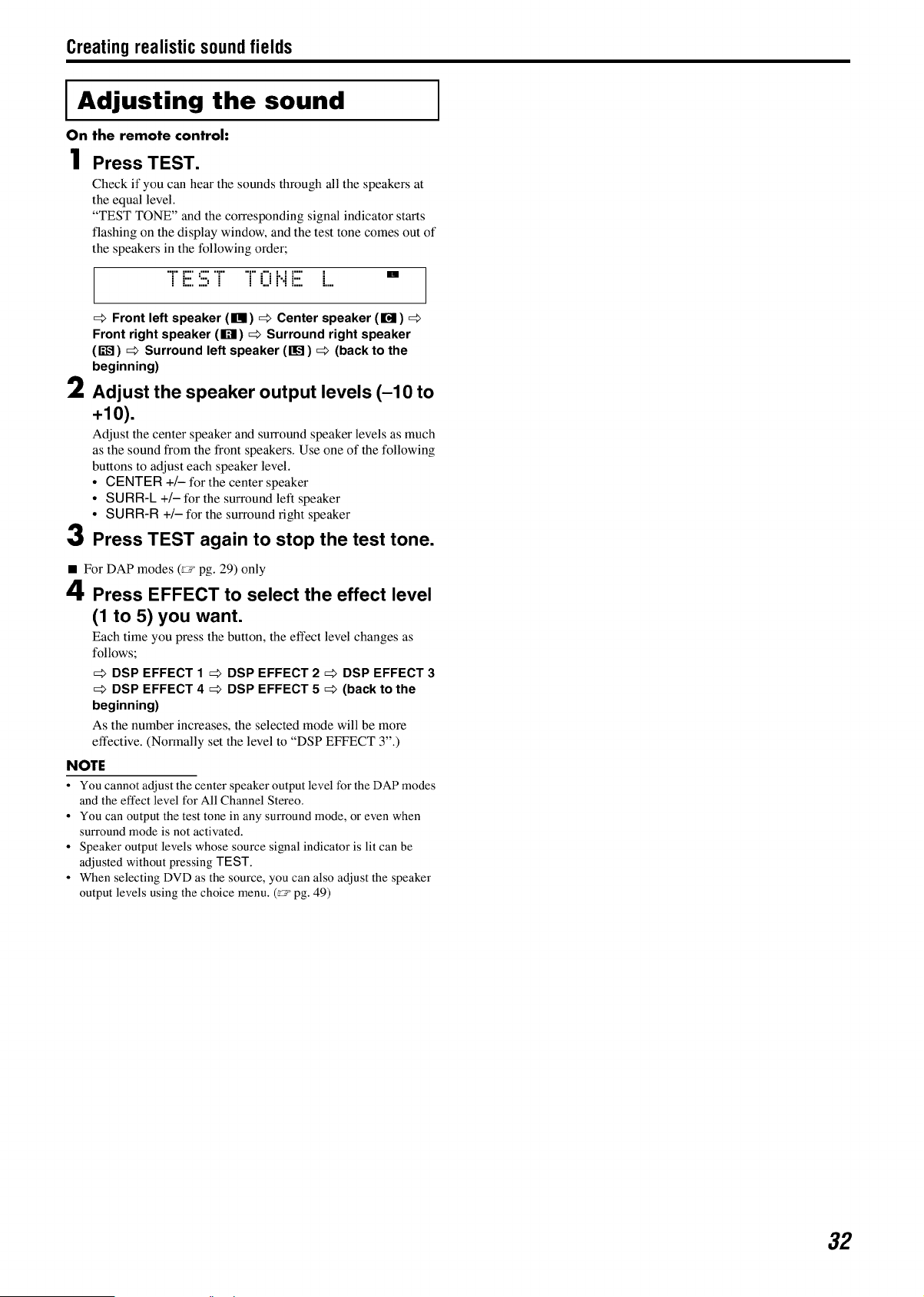
Creating realistic sound fields
Adjusting the sound
On the remote control:
1 Press TEST.
Check if you can hear the sounds through all the speakers at
the equal level.
"TEST TONE" and the corresponding signal indicator starts
flashing on the display window, and the test tone comes out of
the speakers in the following order;
'i E S i.... i 0 i..iE ..... "
Front left speaker (IBI) _ Center speaker (Iml)
Front right speaker (g'fll) _ Surround right speaker
(1_) _ Surround left speaker (llffl) _ (back to the
beginning)
2 Adjust the speaker output levels (-10 to
+10).
Adjust the center speaker and surround speaker levels as much
as the sound from the front speakers. Use one of the following
buttons to adjust each speaker level.
• CENTER +/- for the center speaker
• SURR-L +/- for the surround left speaker
• SURR-R +/- for the surround right speaker
3 Press TEST again to stop the test tone.
• For DAP modes (r_ pg. 29) only
i
4 Press EFFECT to select the effect level
(1 to 5) you want.
Each time you press the button, the effect level changes as
follows;
DSP EFFECT 1 _ DSP EFFECT 2 _ DSP EFFECT 3
DSP EFFECT 4 _ DSP EFFECT 5 _ (back to the
beginning)
As the number increases, the selected mode will be more
effective. (Normally set the level to "DSP EFFECT 3".)
NOTE
• You cannot adjust the center speaker output level for the DAP modes
and the effect level for All Channel Stereo
• You can output the test tone in any surround mode, or even when
surround mode is not activated
• Speaker output levels whose source signal indicator is lit can be
adjusted without pressing TEST
• When selecting DVD as the source, you can also adjust the speaker
output levels using the choice menu (rr pg 49)
32
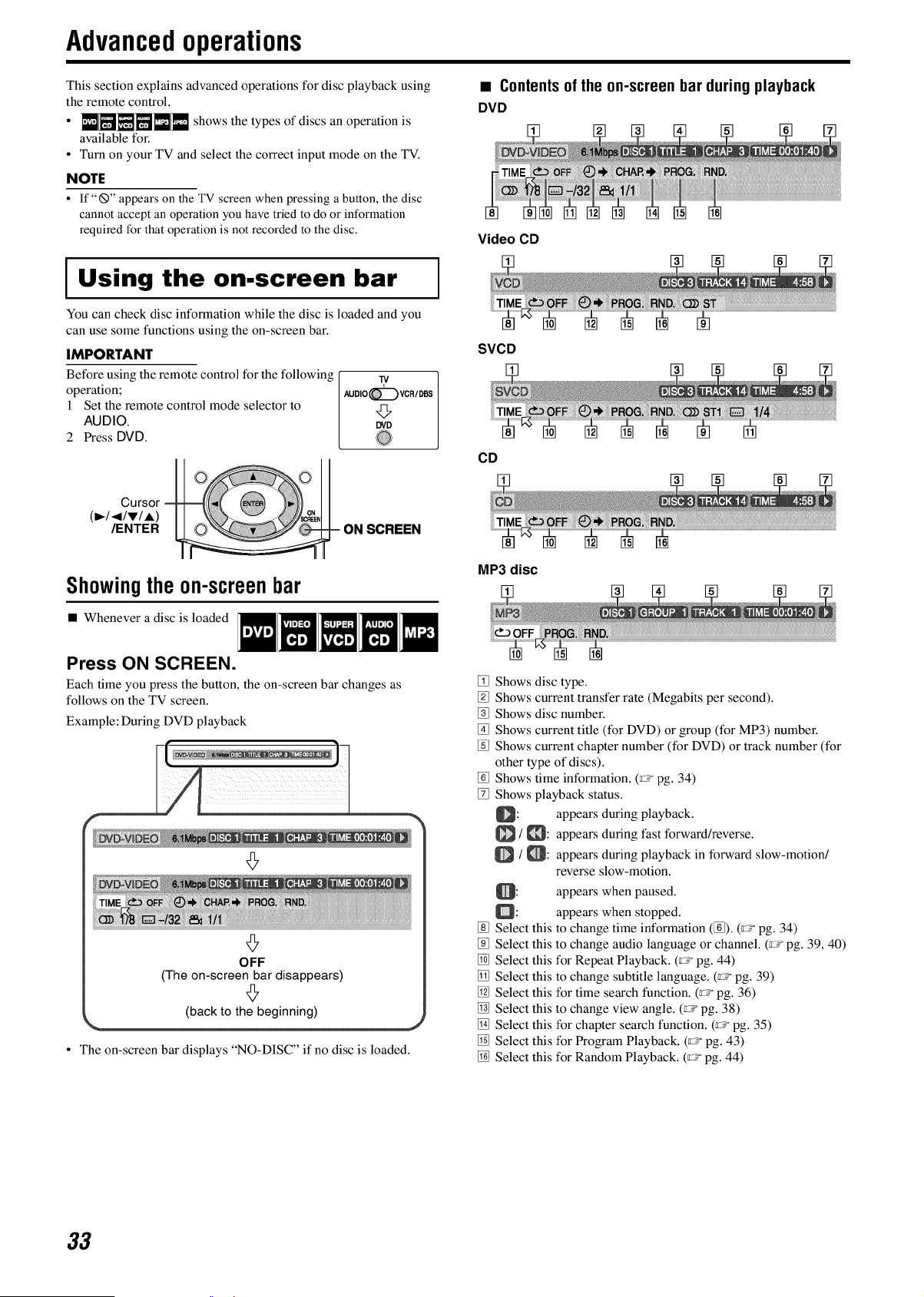
Advancedoperations
This section explains advanced operations for disc playback using
the remote control.
• []N[][][_[] shows the types of discs an operation is
available for.
• Turn on your TV and select the correct input mode on the TV.
NOTE
• If"_" appears on the TV screen when pressing a button, the disc
cannot accept an operation you have tried to do or information
required for that operation is not recorded to the disc.
I Using the bar
on.screen
You can check disc information while the disc is loaded and you
can use some functions using the on-screen bar.
IMPORTANT
Before using the remote control for the following [ w
operanon; /AUDIO_VCR/DBS
1 Set the remote control mode selector to / 4_
AUDIO. / _v
2 Press DVD. L
• Contents of the on-screen bar during playback
DVD
Video CD
SVCD
CD
(_l_lTll)
/ENTER SCREEN
Showingthe on-screenbar
• Whenever a disc is loaded
MP3 disc
Press ON SCREEN.
Each time you press the button, the on-screen bar changes as
follows on the TV screen.
Example: During DVD playback
+
OFF
(The on-screen bar disappears)
+
(back to the beginning)
The on-screen bar displays "NO-DISC" if no disc is loaded.
Shows disc type.
[] Shows current transfer rate (Megabits per second).
[] Shows disc number.
[] Shows current title (for DVD) or group (for MP3) number.
Shows current chapter number (for DVD) or track number (for
other type of discs).
[] Shows time information. (r_ pg. 34)
Shows playback status.
appears during playback.
/ _: appears during fast forward/reverse.
O / O: appears during playback in forward slow-motion/
reverse slow-motion.
appears when paused.
appears when stopped.
[] Select this to change time information ([_). (r_r pg. 34)
[] Select this to change audio language or channel. (r_ pg. 39, 40)
[] Select this for Repeat Playback. (r_ pg. 44)
[] Select this to change subtitle language. (r_r pg. 39)
[] Select this for time search function. (rr pg. 36)
[] Select this to change view angle. (rr pg. 38)
[] Select this for chapter search function. (r_ pg. 35)
[] Select this for Program Playback. (r_ pg. 43)
[] Select this for Random Playback. (r_ pg. 44)
33
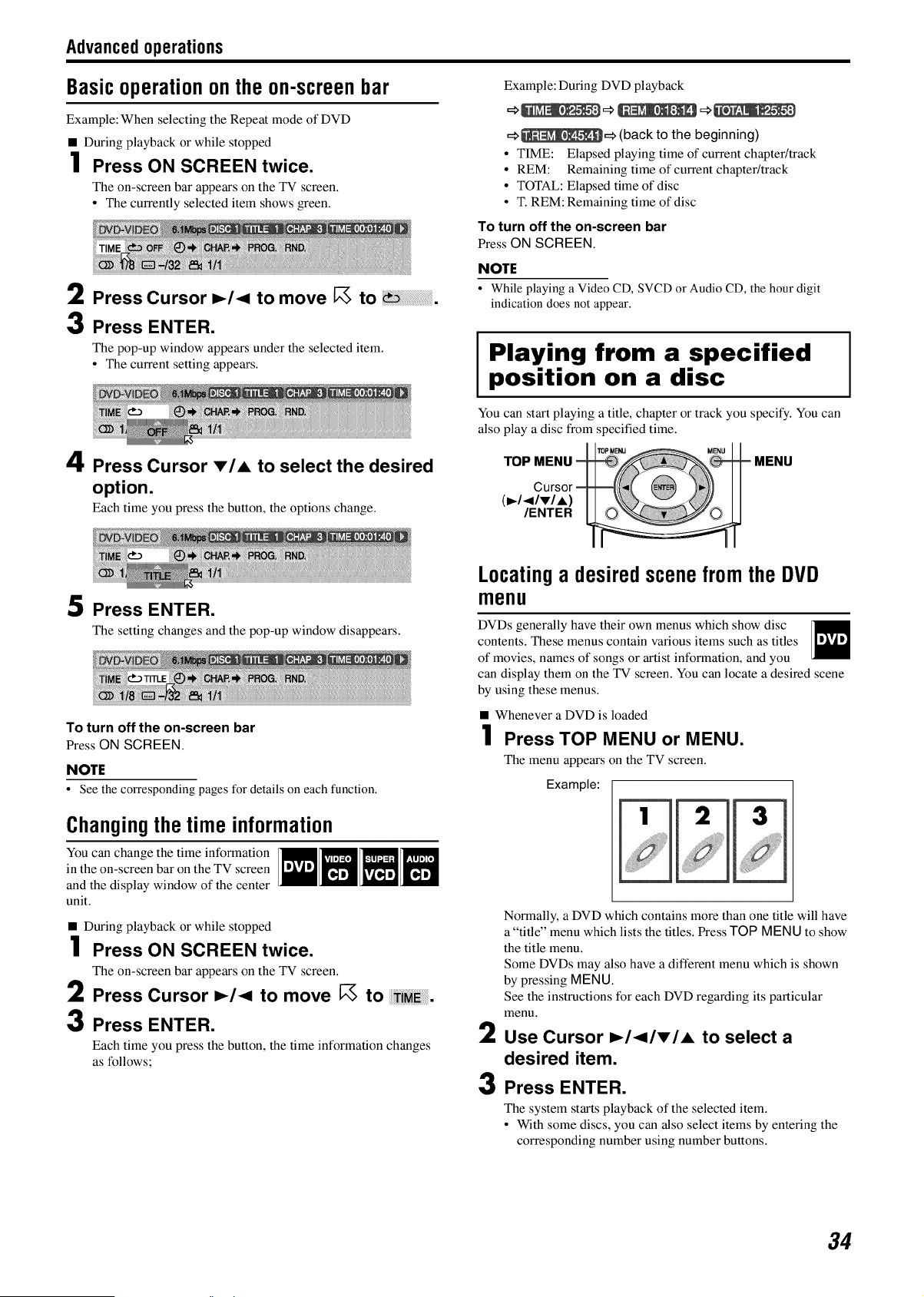
Advancedoperations
Basicoperationonthe on-screenbar
Example: When selecting the Repeat mode of DVD
• During playback or while stopped
1 Press ON SCREEN twice.
The on-screen bar appears on the TV screen.
• The currently selected item shows green.
2 Press Cursor =.-/-q to move 1_ to _.
3 Press ENTER.
The pop-up window appears under the selected item.
• The current setting appears.
4 Press Cursor T/A to select the desired
option.
Each time you press the button, the options change.
Example: During DVD playback
=__=_ (back to the beginning)
• TIME: Elapsed playing time of current chapter/track
• REM: Remaining time of current chapter/track
• TOTAL: Elapsed time of disc
• T. REM: Remaining time of disc
To turn off the on-screen bar
PressON SCREEN.
NOTE
• While playing a Video CD, SVCD or Audio CD, the hour digit
indication does not appear.
Playing from a specified
position on a disc
You can start playing a title, chapter or track you specify. You can
also play a disc from specified time.
TOP MENU MENU
(_I_IvlA)
/ENTER
5 Press ENTER.
The setting changes and the pop-up window disappears.
To turn off the on-screen bar
PressON SCREEN.
NOTE
• See the corresponding pages for details on each function.
Changingthe time information
You can change the time information
in the on-screen bar on the TV screen
and the display window of the center
unit.
• During playback or while stopped
1 Press ON SCREEN twice.
The on-screen bar appears on the TV screen.
2 Press Cursor =.-/-q to move 1_ to
3 Press ENTER.
Each time you press the button, the time information changes
as follows;
Locatinga desiredscenefromthe DVD
menu
DVDs generally have their own menus which show disc
contents. These menus contain various items such as titles
of movies, names of songs or artist information, and you
can display them on the TV screen. You can locate a desired scene
by using these menus.
• Whenever a DVD is loaded
1 Press TOP MENU or MENU.
The menu appears on the TV screen.
Example:
1 2 3
Normally, a DVD which contains more than one title will have
a "title" menu which lists the titles. Press TOP MENU to show
the title menu.
Some DVDs may also have a different menu which is shown
by pressing MENU.
See the instructions for each DVD regarding its particular
menu.
A
Use Cursor =.4-q/T/A to select a
desired item.
3 Press ENTER.
The system starts playback of the selected item.
• With some discs, you can also select items by entering the
corresponding number using number buttons.
34
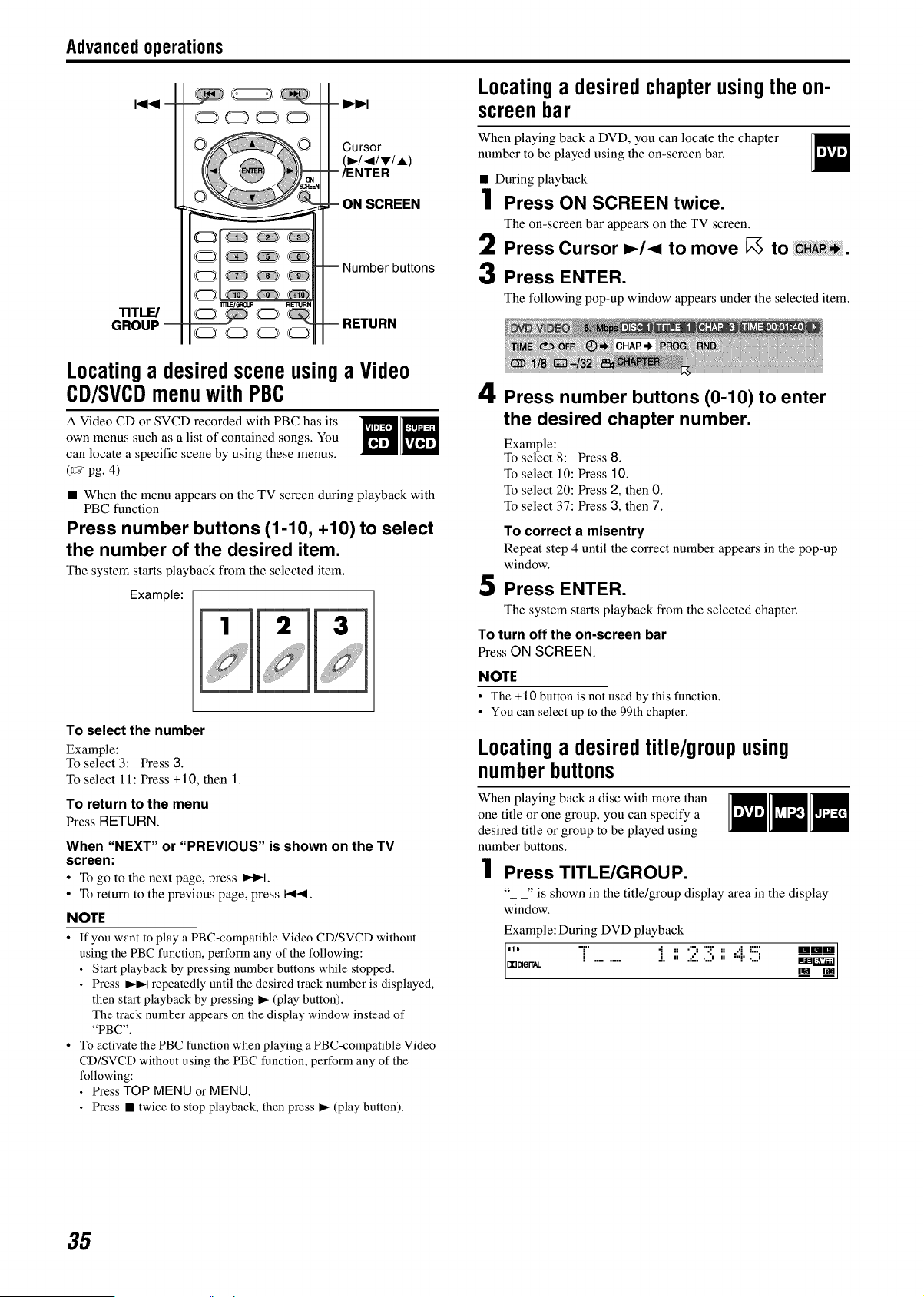
Advancedoperations
_E
TITLE/
GROUP
0000
till_E/GROUP RETURN
o
o c:::3 o o
Cursor
'ENTER
ON SCREEN
m Number buttons
m RETURN
Locating a desired scene using a Video
CD/SVCDmenuwith PBC
A Video CD or SVCD recorded with PBC has its
own menus such as a list of contained songs. You
can locate a specific scene by using these menus.
(r_ pg. 4)
• When the menu appears on the TV screen during playback with
PBC function
Press number buttons (1-10, +10) to select
the number of the desired item.
The system starts playback from the selected item.
Example:
1 2 3
To select the number
Example:
To select 3: Press 3.
To select 11: Press +10, then 1.
To return to the menu
Press RETURN.
When "NEXT" or "PREVIOUS" is shown on the TV
screen:
• To go to the next page, press _1.
• To return to the previous page, press 14-ql.
NOTE
• If you want to play a PBC-compatible Video CD/SVCD without
using the PBC function, perform any of the following:
• Start playback by pressing number buttons while stopped.
• Press I_1_1repeatedly until the desired track number is displayed,
then start playback by pressing I_ (play button).
The track number appears on the display window instead of
"PBC".
• To activate the PBC function when playing a PBC-compatible Video
CD/SVCD without using the PBC function, perform any of the
following:
• Press TOP MENU or MENU.
• Press • twice to stop playback, then press I_ (play button).
Locatinga desiredchapterusingtheon-
screenbar
When playing back a DVD, you can locate the chapter
number to be played using the on-screen bar.
• During playback
1 Press ON SCREEN twice.
The on-screen bar appears on the TV screen.
2 Press Cursor =.-/_ to move [_ to
3 Press ENTER.
The following pop-up window appears under the selected item.
4
Press number buttons (0-10) to enter
the desired chapter number.
Example:
To select 8: Press 8.
To select 10: Press 10.
To select 20: Press 2, then 0.
To select 37: Press 3, then 7.
To correct a misentry
Repeat step 4 until the correct number appears in the pop-up
window.
5 Press ENTER.
The system starts playback from the selected chapter.
To turn off the on-screen bar
Press ON SCREEN.
NOTE
• The +10 button is not used by this function.
• You can select up to the 99th chapter.
Locatinga desiredtitle/groupusing
numberbuttons
When playing back a disc with more than
one title or one group, you can specify a
desired title or group to be played using
number buttons.
1 Press TITLE/GROUP.
"" is shown in the title/group display area in the display
window.
Example: During DVD playback
'1' ..... "i ,, '":,":r ,, .4 =: mural
........... l, ii ,il,, ,,,,i ii "T ,,,,i l_ I
I'rlDIGITAL
m_
I
35
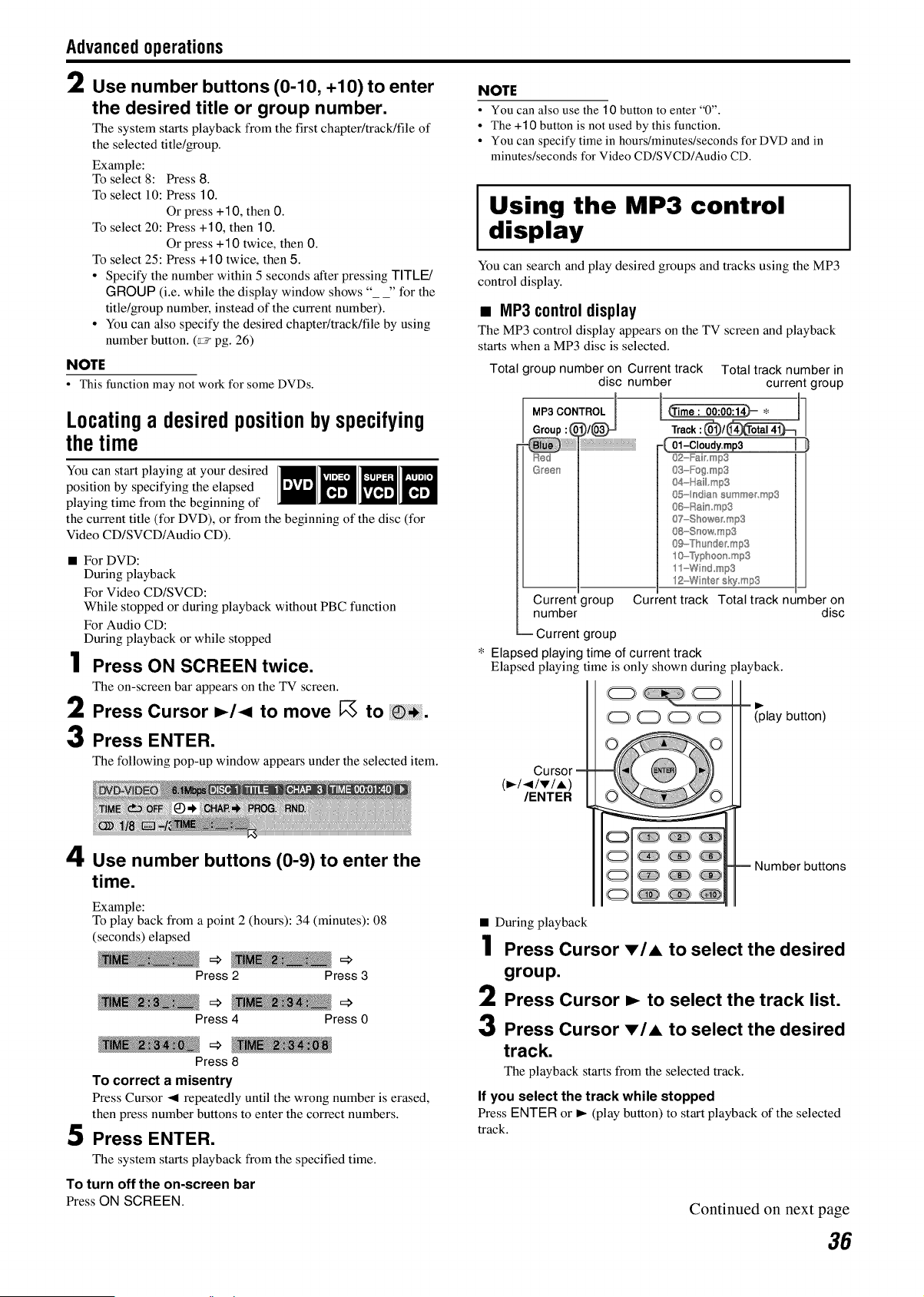
Advancedoperations
2 Use number buttons (0-10, +10) to enter
the desired title or group number.
The system starts playback from the first chapter/track/file of
the selected title/group.
Example:
To select 8: Press 8.
To select 10: Press 10.
Or press +10, then 0.
To select 20: Press +10, then 10.
Or press +10 twice, then 0.
To select 25: Press +10 twice, then 5.
• Specify the number within 5 seconds after pressing TITLE/
GROUP (i.e. while the display window shows ....__ for the
title/group number, instead of the current number).
• You can also specify the desired chapter/track/file by using
number button. (r_ pg. 26)
NOTE
• This function may not work for some DVDs.
Locatinga desiredpositionbyspecifying
thetime
You can start playing at your desired
position by specifying the elapsed
playing time from the beginning of
the current title (for DVD), or from the beginning of the disc (for
Video CD/SVCD/Audio CD).
• For DVD:
During playback
For Video CD/SVCD:
While stopped or during playback without PBC function
For Audio CD:
During playback or while stopped
1 Press ON SCREEN twice.
The on-screen bar appears on the TV screen.
2 Press Cursor _-/-q to move 1_ to
3 Press ENTER.
The following pop-up window appears under the selected item.
4 Use number buttons (0-9) to enter the
time.
Example:
To play back from a point 2 (hours): 34 (minutes): 08
(seconds) elapsed
=_ =_
Press 2 Press 3
Press 4 Press 0
Press 8
To correct a misentry
Press Cursor _1 repeatedly until the wrong number is erased,
then press number buttons to enter the correct numbers.
5 Press ENTER.
The system starts playback from the specified time.
To turn off the on-screen bar
Press ON SCREEN.
NOTE
• You can also use the 10 button to enter "0".
• The +10 button is not used by this function.
• You can specify time in hourshninutes/seconds for DVD and in
minutes/seconds for Video CD/SVCD/Audio CD.
Using the MP3 control
display
You can search and play desired groups and tracks using the MP3
control display.
• MP3 control display
The MP3 control display appears on the TV screen and playback
starts when a MP3 disc is selected.
Total group number on Current track Total track number in
disc number current group
Current ( roup
number
Current track Total track number on
disc
-- Current group
* Elapsed playing time of current track
Elapsed playing time is only shown during playback.
(_l_lvll)
/ENTER
0
0000
• During playback
1
2
3
oooooO t
(play button)
- Number buttons
Press Cursor T/A to select the desired
group.
Press Cursor _- to select the track list.
Press Cursor T/A to select the desired
track.
The playback starts from the selected track.
If you select the track while stopped
Press ENTER or _ (play button) to start playback of the selected
track.
Continued on next page
36
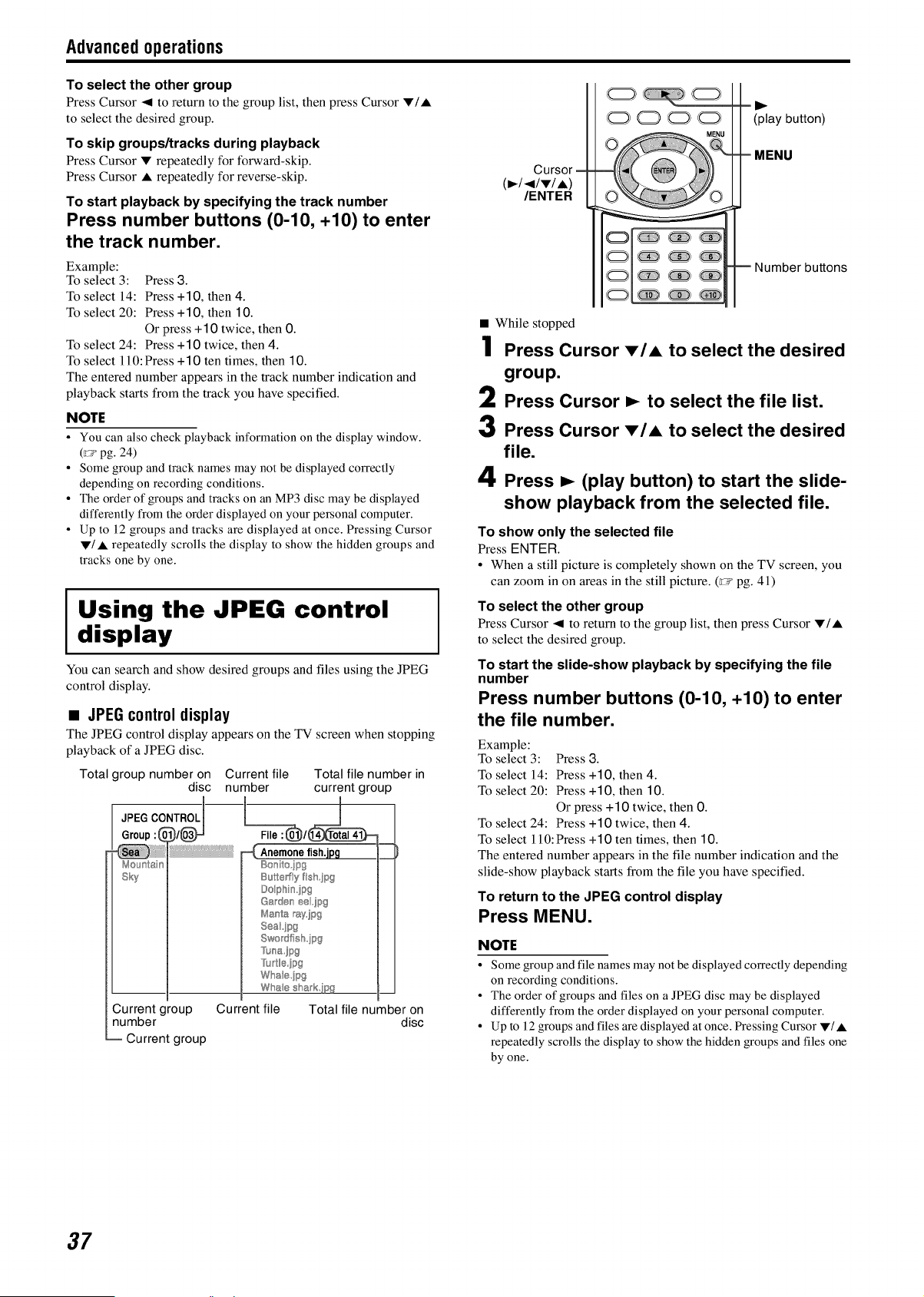
Advancedoperations
To select the other group
Press Cursor _1 to return to the group list, then press Cursor •/•
to select the desired group.
To skip groups/tracks during playback
Press Cursor • repeatedly for forward-skip.
Press Cursor • repeatedly for reverse-skip.
To start playback by specifying the track number
Press number buttons (0-10, +10) to enter
the track number.
Example:
To select 3: Press 3.
To select 14: Press +10, then 4.
To select 20: Press +10, then 10.
Or press +10 twice, then 0.
To select 24: Press +10 twice, then 4.
To select 110: Press + 10 ten times, then 10.
The entered number appears in the track number indication and
playback starts from the track you have specified.
NOTE
• You can also check playback information on the display window.
(yr pg. 24)
• Some group and track names may not be displayed correctly
depending on recording conditions.
• The order of groups and tracks on an MP3 disc may be displayed
differently from the order displayed on your personal computer.
• Up to 12 groups and tracks are displayed at once. Pressing Cursor
• /• repeatedly scrolls the display to show the hidden groups and
tracks one by one.
Using the JPEG control
display
You can search and show desired groups and files using the JPEG
control display.
• JPEG control display
The JPEG control display appears on the TV screen when stopping
playback of a JPEG disc.
Total group number on
disc
Current iroup
number
-- Current group
Current file Total file number in
number current group
==(_ fish.jp_q_
Bu e_y fsh pg
Dolph n p9
G_de _®iPg
Masta raTipg
Sea ipl
Swod sh pg
_Jsa ipg
I,_ tle@l
Whal_@ I
Whale shirk@ I
Current file
I
Total file number on
disc
O
(_1_1•11)
/ENTER
(play button)
MENU
Number buttons
• While stopped
2
3
1 Press Cursor T/A to select the desired
group.
Press Cursor _ to select the file list.
Press Cursor T/A to select the desired
file.
4 Press =,- (play button) to start the slide-
show playback from the selected file.
To show only the selected file
Press ENTER.
• When a still picture is completely shown on the TV screen, you
can zoom in on areas in the still picture. (r_ pg. 41)
To select the other group
Press Cursor _1 to return to the group list, then press Cursor •/•
to select the desired group.
To start the slide-show playback by specifying the file
number
Press number buttons (0-10, +10)to enter
the file number.
Example:
To select 3: Press 3.
To select 14: Press +10, then 4.
To select 20: Press +10, then 10.
Or press +10 twice, then 0.
To select 24: Press +10 twice, then 4.
To select 110:Press +10 ten times, then 10.
The entered number appears in the file number indication and the
slide-show playback starts from the file you have specified.
To return to the JPEG control display
Press MENU.
NOTE
• Some group and file names may not be displayed correctly depending
on recording conditions.
• The order of groups and files on a JPEG disc may be displayed
differently from the order displayed on your personal computer.
• Up to 12 groups and files are displayed at once. Pressing Cursor •/•
repeatedly scrolls the display to show the hidden groups and files one
by one.
37
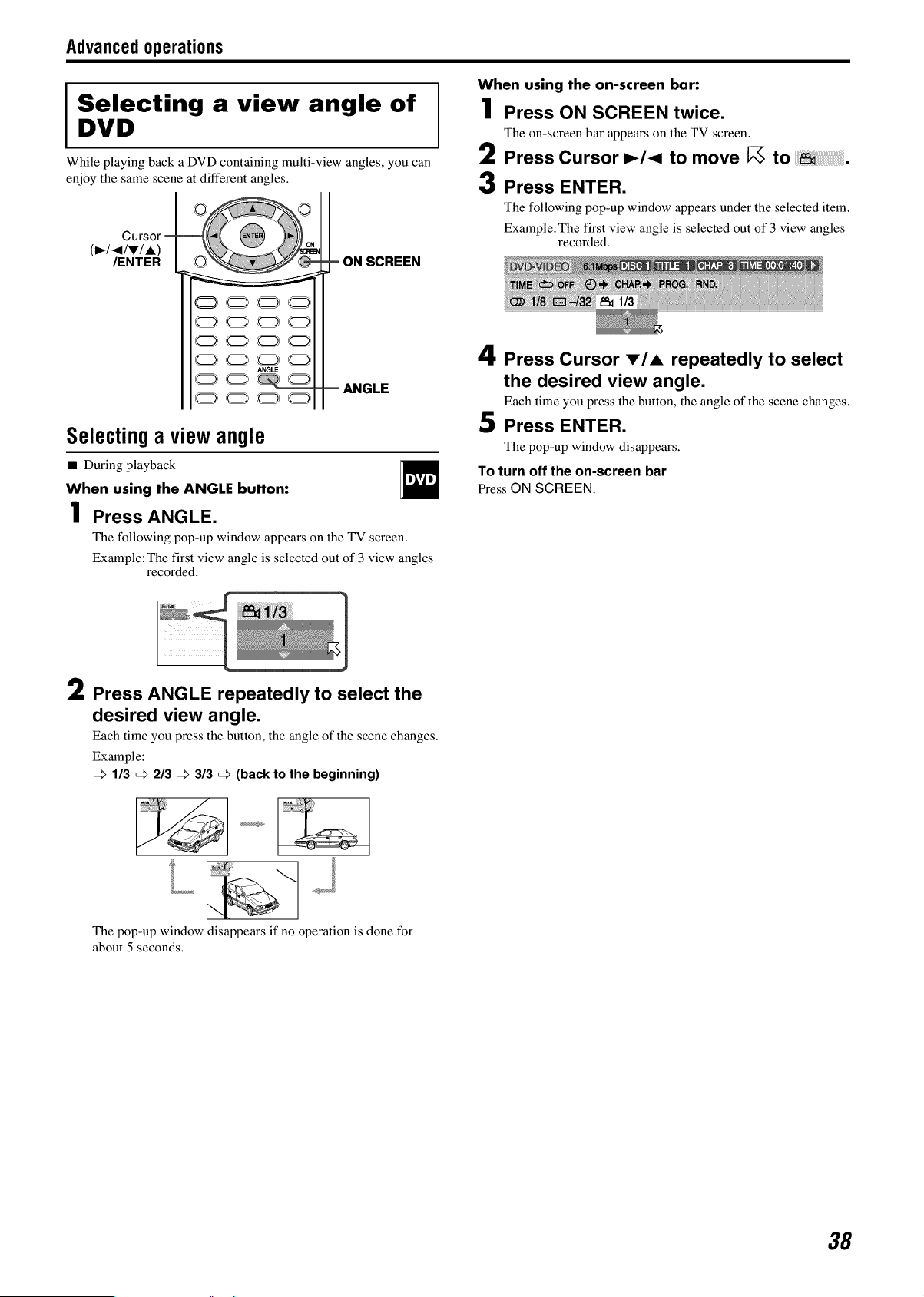
Advancedoperations
Selecting a view angle of
DVD
While playing back a DVD containing multi-view angles, you can
enjoy the same scene at different angles.
When using the on-screen bar:
1 Press ON SCREEN twice.
The on-screen bar appears on the TV screen.
2 Press Cursor _/_ to move _ to
3 Press ENTER.
(_/_/v/i)
/ENTER
(Z) O O O
OOOO
O O O (:_
OOOO
ANGLE
ooQo
OOOO
ANGLE
Selectinga view angle
• During playback
When using the ANGLE button:
1 Press ANGLE.
SCREEN
The following pop-up window appears under the selected item.
Example: The first view angle is selected out of 3 view angles
recorded.
4 Press Cursor T/A repeatedly to select
the desired view angle.
Each time you press the button, the angle of the scene changes.
5 Press ENTER.
The pop-up window disappears.
To turn off the on-screen bar
Press ON SCREEN.
The following pop-up window appears on the TV screen.
Example: The first view angle is selected out of 3 view angles
recorded.
2 Press ANGLE repeatedly to select the
desired view angle.
Each time you press the button, the angle of the scene changes.
Example:
=> 113 => 213=> 313 => (back to the beginning)
The pop-up window disappears if no operation is done for
about 5 seconds.
38
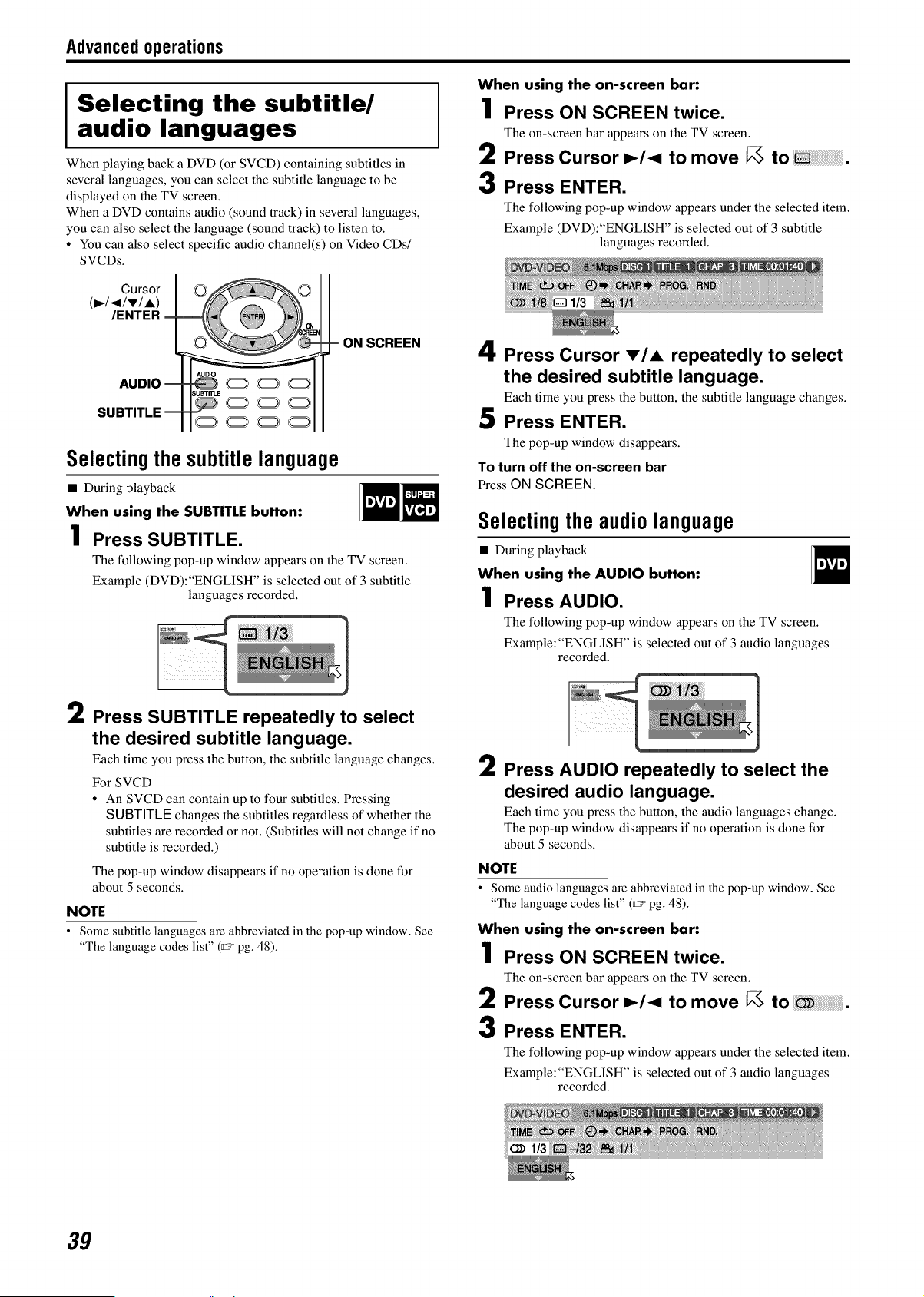
Advancedoperations
Selecting the subtitle/
audio languages
When playing back a DVD (or SVCD) containing subtitles in
several languages, you can select the subtitle language to be
displayed on the TV screen.
When a DVD contains audio (sound track) in several languages,
you can also select the language (sound track) to listen to.
• You can also select specific audio channel(s) on Video CDs/
SVCDs.
Cu rsor
/ENTER
SCREEN
000
000
0000
Selectingthesubtitlelanguage
• During playback
When using the SUBTITLE button:
1 Press SUBTITLE.
The following pop-up window appears on the TV screen.
Example (DVD):"ENGLISH" is selected out of 3 subtitle
languages recorded.
2 Press SUBTITLE repeatedly to select
the desired subtitle language.
Each time you press the button, the subtitle language changes.
For SVCD
• An SVCD can contain up to four subtitles. Pressing
SUBTITLE changes the subtitles regardless of whether the
subtitles are recorded or not. (Subtitles will not change if no
subtitle is recorded.)
The pop-up window disappears if no operation is done for
about 5 seconds.
NOTE
• Some subtitle languages are abbreviated in the pop-up window. See
"The language codes list" (rr pg. 48).
When using the on-screen bar:
1 Press ON SCREEN twice.
The on-screen bar appears on the TV screen.
2 Press Cursor =.q-< to move 1_ to
3 Press ENTER.
The following pop-up window appears under the selected item.
Example (DVD):"ENGLISH" is selected out of 3 subtitle
languages recorded.
4 Press Cursor vIA repeatedly to select
the desired subtitle language.
Each time you press the button, the subtitle language changes.
5 Press ENTER.
The pop-up window disappears.
To turn off the on-screen bar
Press ON SCREEN.
Selectingthe audiolanguage
• During playback
When using the AUDIO button:
1 Press AUDIO.
The following pop-up window appears on the TV screen.
Example: "ENGLISH" is selected out of 3 audio languages
recorded.
2 Press AUDIO repeatedly to select the
desired audio language.
Each time you press the button, the audio languages change.
The pop-up window disappears if no operation is done for
about 5 seconds.
NOTE
• Some audio languages are abbreviated in the pop-up window. See
"The language codes list" (rr pg. 48).
When using the on-screen bar:
1 Press ON SCREEN twice.
The on-screen bar appears on the TV screen.
2 Press Cursor =.-/< to move 1_ to
3 Press ENTER.
The following pop-up window appears under the selected item.
Example: "ENGLISH" is selected out of 3 audio languages
recorded.
39
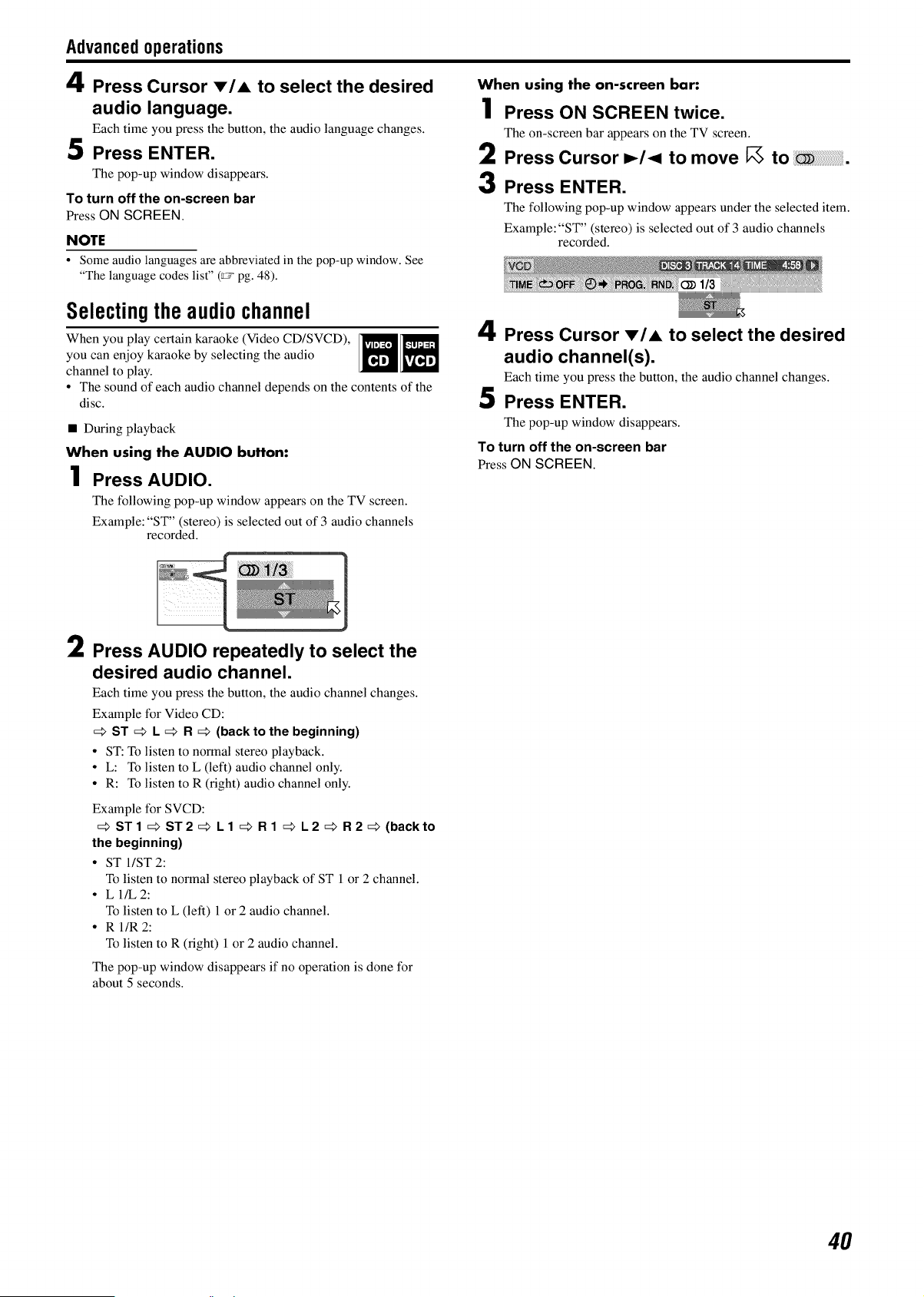
Advancedoperations
4 Press Cursor T/A to select the desired
audio language.
Each time you press the button, the audio language changes.
5 Press ENTER.
The pop-up window disappears.
To turn off the on-screen bar
PressON SCREEN.
NOTE
• Some audio languages are abbreviated in the pop-up window. See
When using the on-screen bar:
1 Press ON SCREEN twice.
The on-screen bar appears on the TV screen.
2 Press Cursor =.-/< to move _ to
3 Press ENTER.
"The language codes list" (rr pg. 48).
Selectingtheaudiochannel
When you play certain karaoke (Video CD/SVCD),
you can enjoy karaoke by selecting the audio
channel to play.
The following pop-up window appears under the selected item.
Example:"ST" (stereo) is selected out of 3 audio channels
recorded.
• The sound of each audio channel depends on the contents of the
disc.
• During playback
When using the AUDIO button:
1 Press AUDIO.
The following pop-up window appears on the TV screen.
Example: "ST" (stereo) is selected out of 3 audio channels
recorded.
4 Press Cursor T/A to select the desired
audio channel(s).
Each time you press the button, the audio channel changes.
Press ENTER.
The pop-up window disappears.
To turn off the on-screen bar
Press ON SCREEN.
2 Press AUDIO repeatedly to select the
desired audio channel.
Each time you press the button, the audio channel changes.
Example for Video CD:
ST _ L _ R _ (back to the beginning)
• ST: To listen to normal stereo playback.
• L: To listen to L (left) audio channel only.
• R: To listen to R (fight) audio channel only.
Example for SVCD:
=> ST I => ST 2 => L1 => R1 => L2=> R 2 => (back to
the beginning)
• ST l/ST 2:
To listen to normal stereo playback of ST 1 or 2 channel.
• L 1/L 2:
To listen to L (left) 1 or 2 audio channel.
• R I/R 2:
To listen to R (fight) 1 or 2 audio channel.
The pop-up window disappears if no operation is done for
about 5 seconds.
40
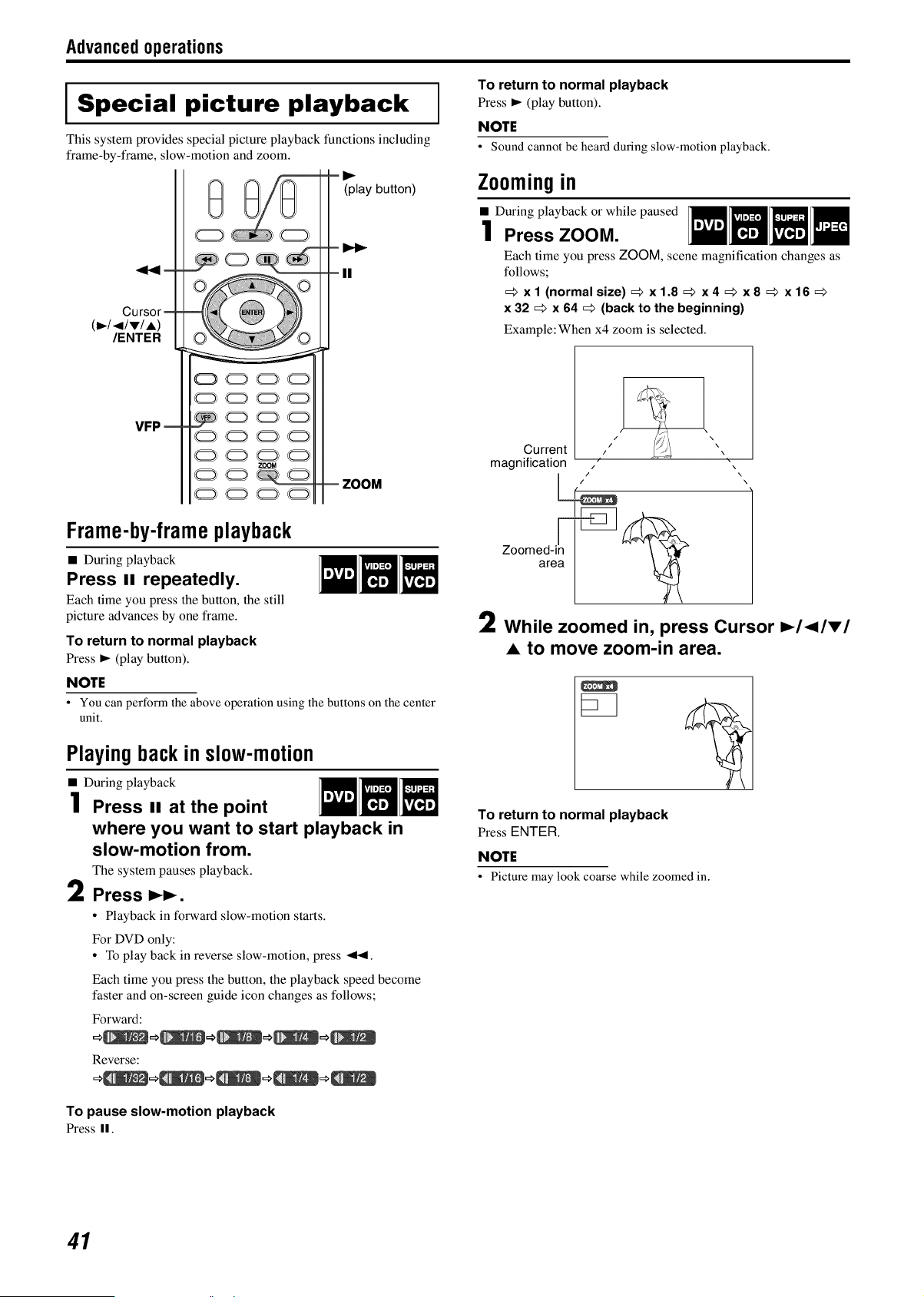
Advancedoperations
I Special picture playback
This system provides special picture playback functions including
frame-by-frame, slow-motion and zoom.
(play button)
0
_E
Cursor E
/ENTER
VFP --
_ooo
0000
0000
ZOOM
00 0
0000
=11
ZOOM
Frame-by-frameplayback
• During playback
Press II repeatedly.
Each time you press the button, the still
picture advances by one frame.
To return to normal playback
Press _ (play button).
NOTE
• You can perform the above operation using the buttons on the center
unit.
Playing back in slow-motion
• During playback
i Press II at the point
where you want to start playback in
slow-motion from.
The system pauses playback.
2 Press _.
• Playback in forward slow-motion starts.
For DVD only:
• To play back in reverse slow-motion, press -ql_l.
Each time you press the button, the playback speed become
faster and on-screen guide icon changes as follows;
Forward:
Reverse:
To pause slow-motion playback
Press II.
To return to normal playback
Press _ (play button).
NOTE
• Sound cannot be heard during slow-motion playback.
Zooming in
• During playback or while paused
Press ZOOM.
Each time you press ZOOM, scene magnification changes as
follows;
=>xl(normalsize)=_xl.8=_ x4=_x8=> x16=>
x 32 => x 64 => (back to the beginning)
Example: When x4 zoom is selected.
I
j,
/
Current , /
magnification /"
\
\
\
Zoomed-i
area
2
While zoomed in, press Cursor _I_ITI
• to move zoom-in area.
To return to normal playback
Press ENTER.
NOTE
• Picture may look coarse while zoomed in.
41
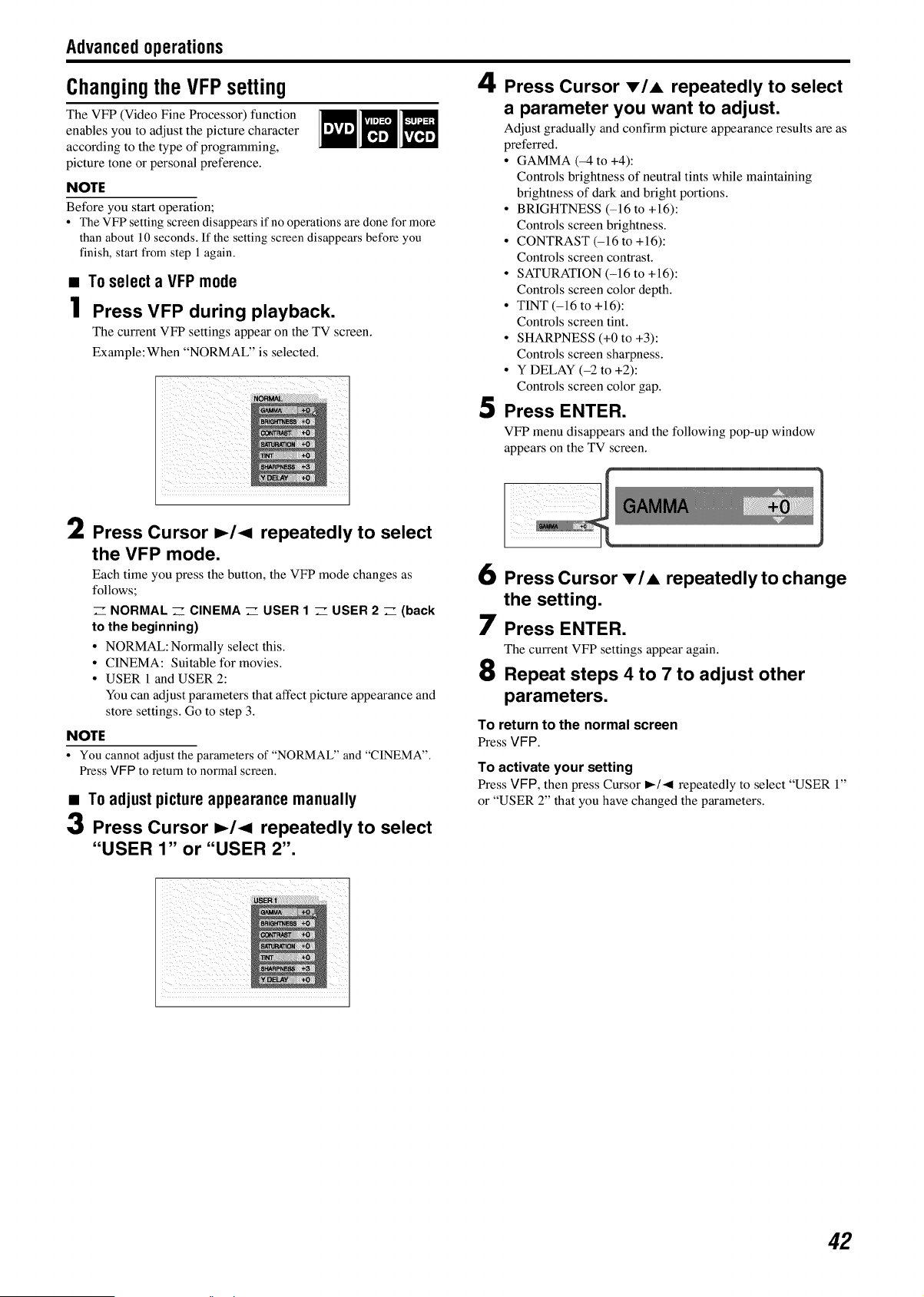
Advancedoperations
Changing the VFP setting
The VFP (Video Fine Processor) function
enables you to adjust the picture character
according to the type of programming,
picture tone or personal preference.
NOTE
Betbre you start operation; •
• The VFP setting screen disappears if no operations are done for more
than about 10 seconds. If the setting screen disappears before you o
4 Press Cursor T/A repeatedly to select
a parameter you want to adjust.
Adjust gradually and confirm picture appearance results are as
preferred.
• GAMMA (-4 to +4):
Controls brightness of neutral tints while maintaining
brightness of dark and bright portions.
BRIGHTNESS (-16 to +16):
Controls screen brightness.
CONTRAST (-16 to +16):
1
finish, start from step 1 again.
To select a VFP mode
Press VFP during playback.
The current VFP settings appear on the TV screen.
Example: When "NORMAL" is selected.
Controls screen contrast.
• SATURATION (-16 to +16):
Controls screen color depth.
• TINT (-16 to +16):
Controls screen tint.
• SHARPNESS (+0 to +3):
Controls screen sharpness.
• Y DELAY (-2 to +2):
Controls screen color gap.
5 Press ENTER.
VFP menu disappears and the following pop-up window
appears on the TV screen.
2 Press Cursor =.-/-< repeatedly to select
the VFP mode.
Each time you press the button, the VFP mode changes as
follows;
Z NORMAL .7_ CINEMA z USER 1 z USER 2 z (back
to the beginning)
• NORMAL: Normally select this.
° CINEMA: Suitable for movies.
• USER 1 and USER 2:
You can adjust parameters that affect picture appearance and
store settings. Go to step 3.
NOTE
• You cannot adjust the parameters of "NORMAL" and "CINEMA".
Press VFP to return to normal screen.
• To adjustpictureappearancemanually
3 Press Cursor _/_ repeatedly to select
"USER 1" or "USER 2".
6 Press Cursor T/A repeatedly to change
the setting.
7 Press ENTER.
The current VFP settings appear again.
8 Repeat steps 4 to 7 to adjust other
parameters.
TO return to the normal screen
Press VFP.
To activate your setting
Press VFP, then press Cursor I_/_1 repeatedly to select "USER 1"
or "USER 2" that you have changed the parameters.
42
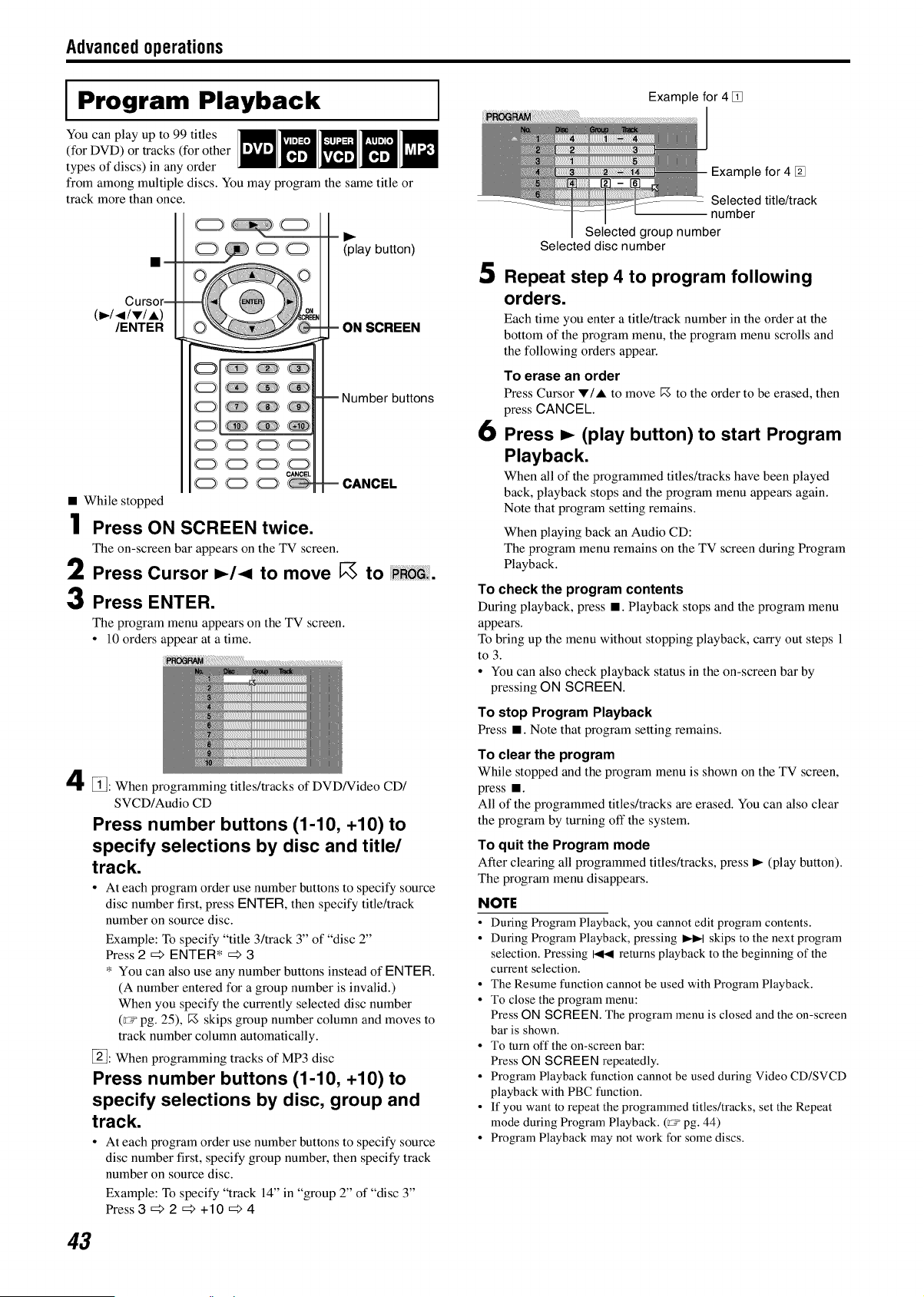
Advancedoperations
I Program Playback
You can play up to 99 titles
(tbr DVD) or tracks (tbr other
types of discs) in any order
from among multiple discs. You may program the same title or
track more than once.
OO
(_l<lvll)
/ENTER
• While stopped
(play button)
-ON SCREEN
- Number buttons
_CANCEL
1 Press ON SCREEN twice.
The on-screen bar appears on the TV screen.
2 Press Cursor _/< to move _ to
3 Press ENTER.
The program menu appears on the TV screen.
• l0 orders appear at a time.
4[]: When programming titles/tracks of DVDfVideo CD/
SVCD/Audio CD
Press number buttons (1-10, +10) to
specify selections by disc and title/
track.
• At each program order use number buttons to specify source
disc number first, press ENTER, then specify title/track
number on source disc.
Example: To specify "title 3/track 3" of "disc 2"
Press 2 =:> ENTER* =:> 3
• You can also use any number buttons instead of ENTER.
(A number entered for a group number is invalid.)
When you specify the currently selected disc number
(rr pg. 25), _ skips group number column and moves to
track number column automatically.
[]: When programming tracks of MP3 disc
Press number buttons (1-10, +10) to
specify selections by disc, group and
track.
• At each program order use number buttons to specify source
disc number first, specify group number, then specify track
number on source disc.
Example: To specify "track 14" in "group 2" of "disc 3"
Press 3 =_' 2 =_, +10 =_, 4
43
Example for 4 []
Example for 4 []
5
Selected title/track
number
Selected group number
Selected disc number
Repeat step 4 to program following
orders.
Each time you enter a title/track number in the order at the
bottom of the program menu, the program menu scrolls and
the following orders appear.
6
To erase an order
Press Cursor VIA to move ;; to the order to be erased, then
press CANCEL.
Press _ (play button) to start Program
Playback.
When all of the programmed titles/tracks have been played
back, playback stops and the program menu appears again.
Note that program setting remains.
When playing back an Audio CD:
The program menu remains on the TV screen during Program
Playback.
To check the program contents
During playback, press I. Playback stops and the program menu
appears.
To bring up the menu without stopping playback, carry out steps 1
to 3.
• You can also check playback status in the on-screen bar by
pressing ON SCREEN.
To stop Program Playback
Press I. Note that program setting remains.
To clear the program
While stopped and the program menu is shown on the TV screen,
press I.
All of the programmed titles/tracks are erased. You can also clear
the program by turning off the system.
To quit the Program mode
After clearing all programmed titles/tracks, press _ (play button).
The program menu disappears.
NOTE
• During Program Playback, you cannot edit program contents.
• During Program Playback, pressing _ skips to the next program
selection. Pressing _ returns playback to the beginning of the
current selection.
• The Resume function cannot be used with Program Playback.
• To close the program menu:
Press ON SCREEN. The program menu is closed and the on-screen
bar is shown.
• To turn off the on-screen bar:
Press ON SCREEN repeatedly.
• Program Playback function cannot be used during Video CD/SVCD
playback with PBC function.
• If you want to repeat the programmed titles/tracks, set the Repeat
mode during Program Playback. (rr pg. 44)
• Program Playback may not work for some discs.
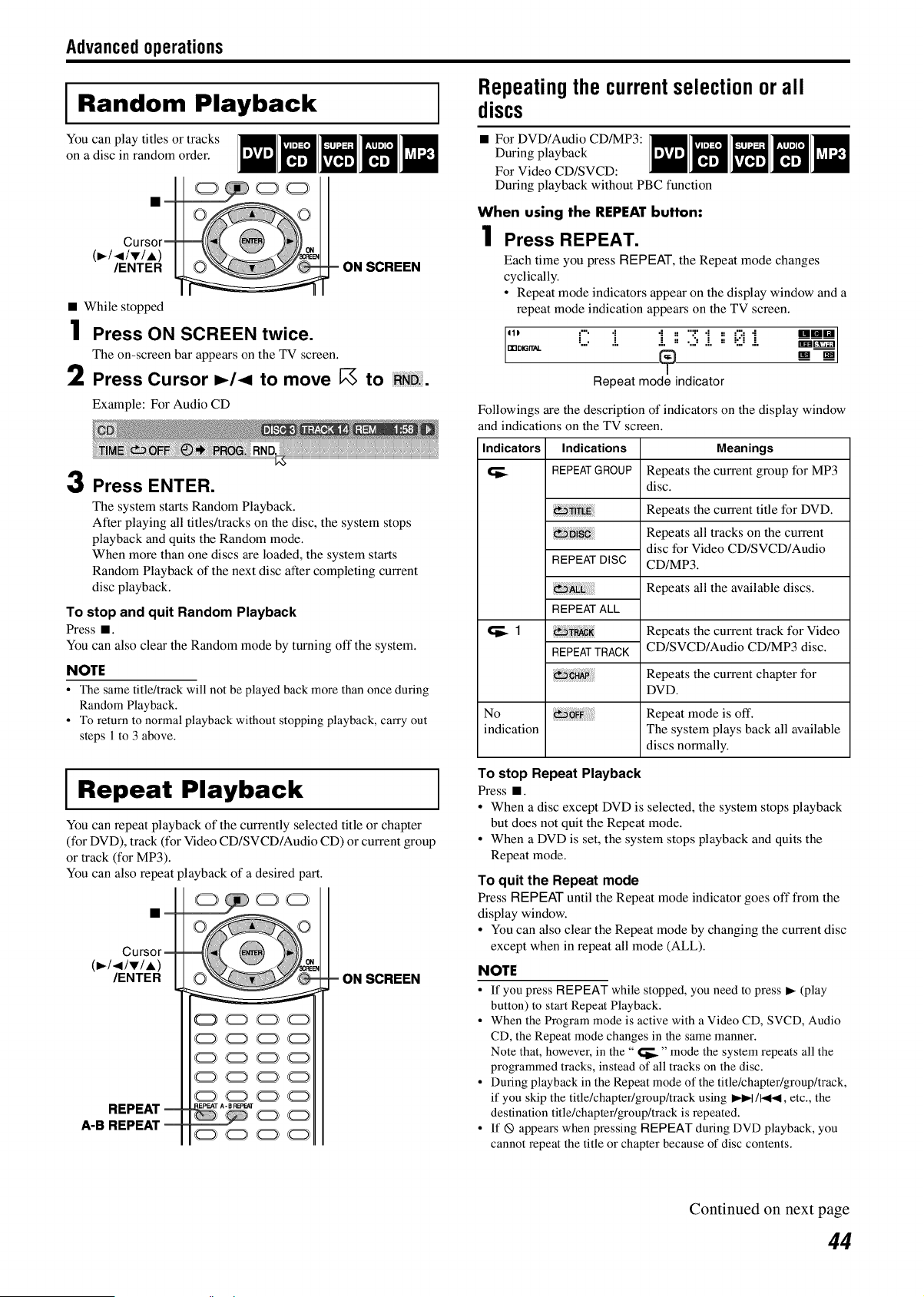
Advancedoperations
I Random Playback
You can play titles or tracks
on a disc in random order.
OO
Cursor
• While stopped
1 Press ON SCREEN twice.
- ON SCREEN
The on-screen bar appears on the TV screen.
2 Press Cursor =.-/< to move 1_ to
Example: For Audio CD
3 Press ENTER.
The system starts Random Playback.
After playing all titles/tracks on the disc, the system stops
playback and quits the Random mode.
When more than one discs are loaded, the system starts
Random Playback of the next disc after completing current
disc playback.
To stop and quit Random Playback
Press •.
You can also clear the Random mode by turning oil the system.
NOTE
• The same title/track will not be played back more than once during
Random Playback.
• To return to normal playback without stopping playback, carry out
steps 1to 3 above.
I Repeat Playback
You can repeat playback of the currently selected title or chapter
(tbr DVD), track (for Video CD/SVCD/Audio CD) or current group
or track (for MP3).
You can also repeat playback of a desired part.
(_J<lTll)
/ENTER
00_00
0000
0000
0000
0000
O0
0000
-ON SCREEN
Repeatingthe currentselectionor all
discs
• For DVD/Audio CD/MP3:
During playback
For Video CD/SVCD:
During playback without PBC function
When using the REPEAT button:
1 Press REPEAT.
Each time you press REPEAT,the Repeat mode changes
cyclically.
• Repeat mode indicators appear on the display window and a
repeat mode indication appears on the TV screen.
111 _____Biii
<" i i"..3 1 : 0 i. -_
nnDIGITAL i.... ... 1113"-JI_
Repeat mode indicator
Followings are the description of indicators on the display window
and indications on the TV screen.
Indicators Indications
REPEATGROUP
REPEAT DISC
REPEAT ALL
REPEAT TRACK
Meanings
Repeats the current group for MP3
disc.
Repeats the current title for DVD.
Repeats all tracks on the current
disc for Video CD/SVCD/Audio
CD/MP3.
Repeats all the available discs.
Repeats the current track for Video
CD/SVCD/Audio CD/MP3 disc.
Repeats the current chapter for
DVD.
No Repeat mode is off.
indication The system plays back all available
discs normally.
To stop Repeat Playback
Press •.
• When a disc except DVD is selected, the system stops playback
but does not quit the Repeat mode.
• When a DVD is set, the system stops playback and quits the
Repeat mode.
To quit the Repeat mode
Press REPEAT until the Repeat mode indicator goes off from the
display window.
• You can also clear the Repeat mode by changing the current disc
except when in repeat all mode (ALL).
NOTE
• If you press REPEAT while stopped, you need to press I_ (play
button) to start Repeat Playback.
• When the Program mode is active with a Video CD, SVCD, Audio
CD, the Repeat mode changes in the same manner.
Note that, however, in the" _" mode the system repeats all the
programmed tracks, instead of all tracks on the disc.
• During playback in the Repeat mode of the title/chapter/group/track,
if you skip the title/chapterJgroup/track using _/b_l<, etc., the
destination title/chapter/group/track is repeated.
• If ® appears when pressing REPEAT during DVD playback, you
cannot repeat the title or chapter because of disc contents.
Continued on next page
44
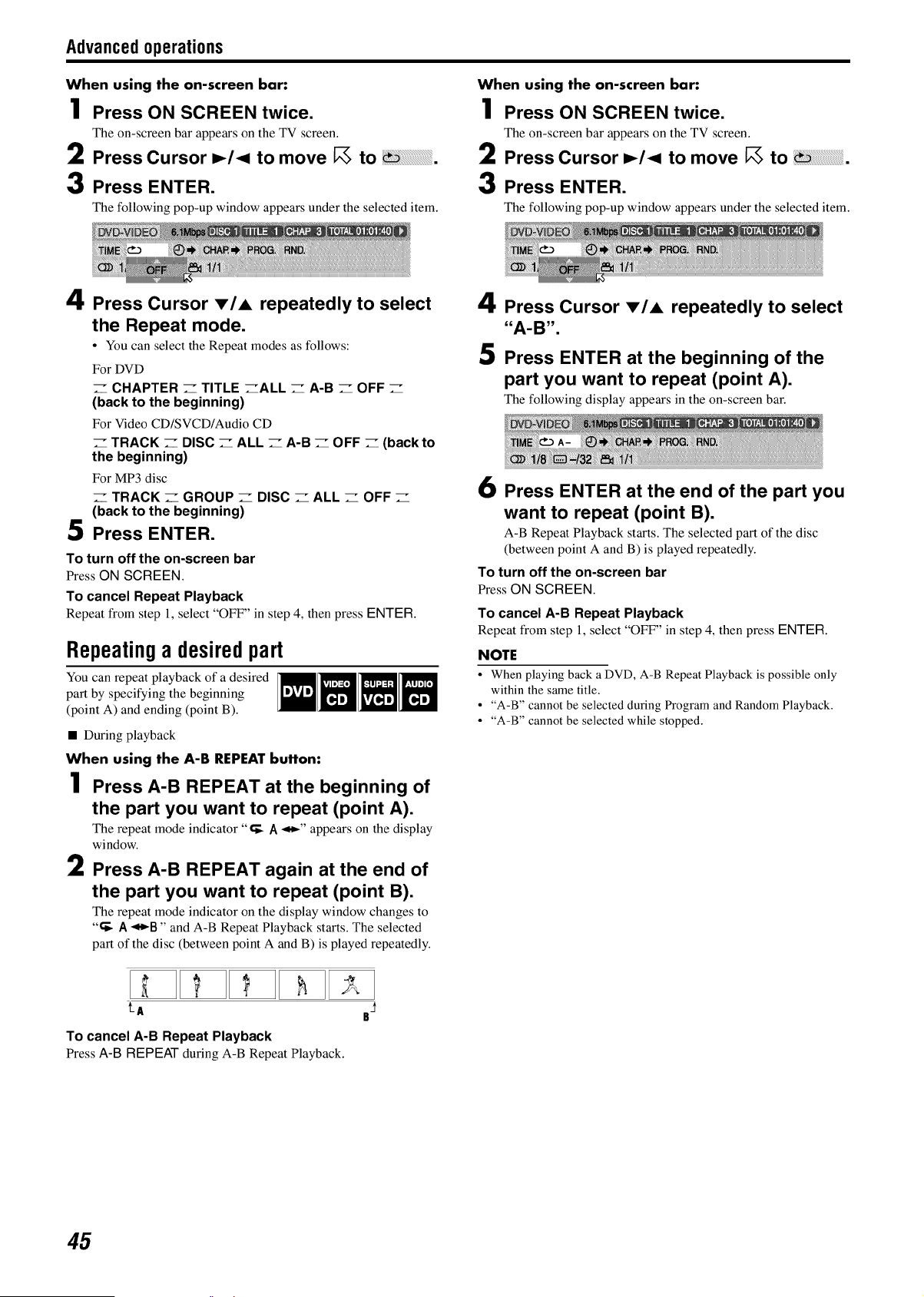
Advancedoperations
When using the on-screen bar:
1 Press ON SCREEN twice.
The on-screen bar appears on the TV screen.
2 Press Cursor m,-/< to move 1_ to
3 Press ENTER.
The following pop-up window appears under the selected item.
When using the on-screen bar:
1 Press ON SCREEN twice.
The on-screen bar appears on the TV screen.
2 Press Cursor m,-/< to move 1_ to
3 Press ENTER.
The following pop-up window appears under the selected item.
4 Press Cursor T/A repeatedly to select
the Repeat mode.
• You can select the Repeat modes as follows:
For DVD
.7_ CHAPTER z TITLE zALL z A-B z OFF z
(back to the beginning)
For Video CD/SVCD/Audio CD
.7_TRACK 7_ DISC .7_ALL .7_ A-B .7_OFF .7_(back to
the beginning)
For MP3 disc
.7_TRACK z GROUP .7_ DISC .7_ALL .7_ OFF .7_
(back to the beginning)
5 Press ENTER.
To turn off the on-screen bar
Press ON SCREEN.
To cancel Repeat Playback
Repeat from step l, select "OFF" in step 4, then press ENTER.
Repeatinga desiredpart
You can repeat playback of a desired
part by specifying the beginning
(point A) and ending (point B).
• During playback
When using the A-B REPEAT button:
1 Press A-B REPEAT at the beginning of
the part you want to repeat (point A).
The repeat mode indicator "_ A "_" appears on the display
window.
2 Press A-B REPEAT again at the end of
the part you want to repeat (point B).
The repeat mode indicator on the display window changes to
"_--_A <_B" and A-B Repeat Playback starts. The selected
part of the disc (between point A and B) is played repeatedly.
tA B_
To cancel A-B Repeat Playback
PressA-B REPEAT during A-B Repeat Playback.
4 Press Cursor T/A repeatedly to select
"A-B".
5 Press ENTER at the beginning of the
part you want to repeat (point A).
The following display appears in the on-screen bar.
6 Press ENTER at the end of the part you
want to repeat (point B).
A-B Repeat Playback starts. The selected part of the disc
(between point A and B) is played repeatedly.
To turn off the on-screen bar
PressON SCREEN.
To cancel A-B Repeat Playback
Repeat from step l, select "OFF" in step 4, then press ENTER.
NOTE
• When playing back a DVD, A-B Repeat Playback is possible only
within the same title.
• "A-B" cannot be selected during Program and Random Playback.
• "A-B" cannot be selected while stopped.
45
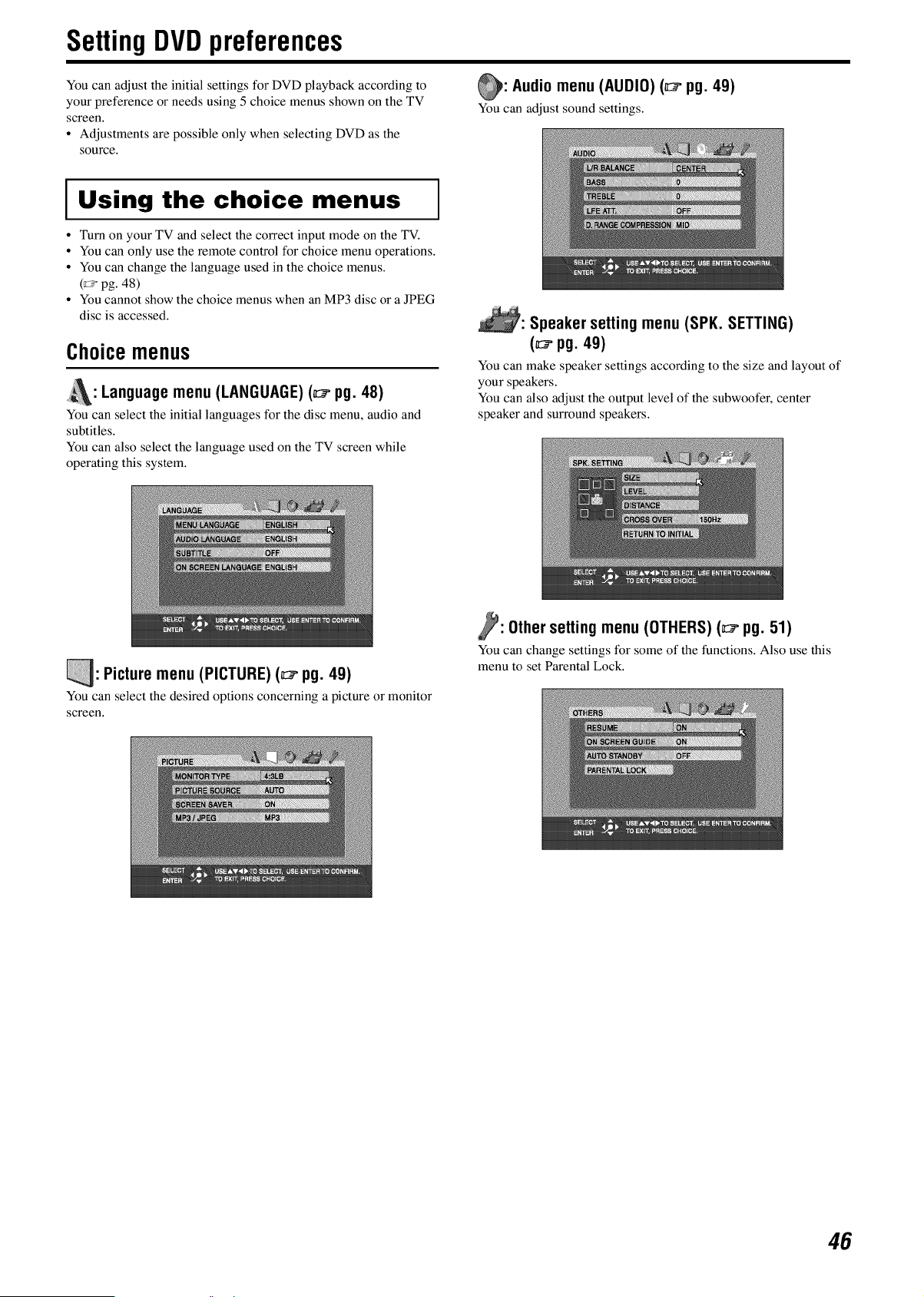
SettingDVDpreferences
You can adjust the initial settings for DVD playback according to
your preference or needs using 5 choice menus shown on the TV
screen.
• Adjustments are possible only when selecting DVD as the
source.
P:Audio menu (AUDIO) (o_ pg. 49)
You can adjust sound settings.
I Using the choice menus
• Turn on your TV and select the correct input mode on the TV.
• You can only use the remote control for choice menu operations.
• You can change the language used in the choice menus.
(r_ pg. 48)
• You cannot show the choice menus when an MP3 disc or a JPEG
disc is accessed.
Choicemenus
_: Language menu (LANGUAGE) (o_ pg. 48)
You can select the initial languages for the disc menu, audio and
subtitles.
You can also select the language used on the TV screen while
operating this system.
Speaker setting menu (SPK. SETTING)
(o_ pg. 49)
You can make speaker settings according to the size and layout of
your speakers.
You can also adjust the output level of the subwoofer, center
speaker and surround speakers.
Picture menu (PICTURE) (o:_ pg. 49)
You can select the desired options concerning a picture or monitor
screen.
Other setting menu (OTHERS) (o_ pg. 51)
You can change settings for some of the functions. Also use this
menu to set Parental Lock.
46
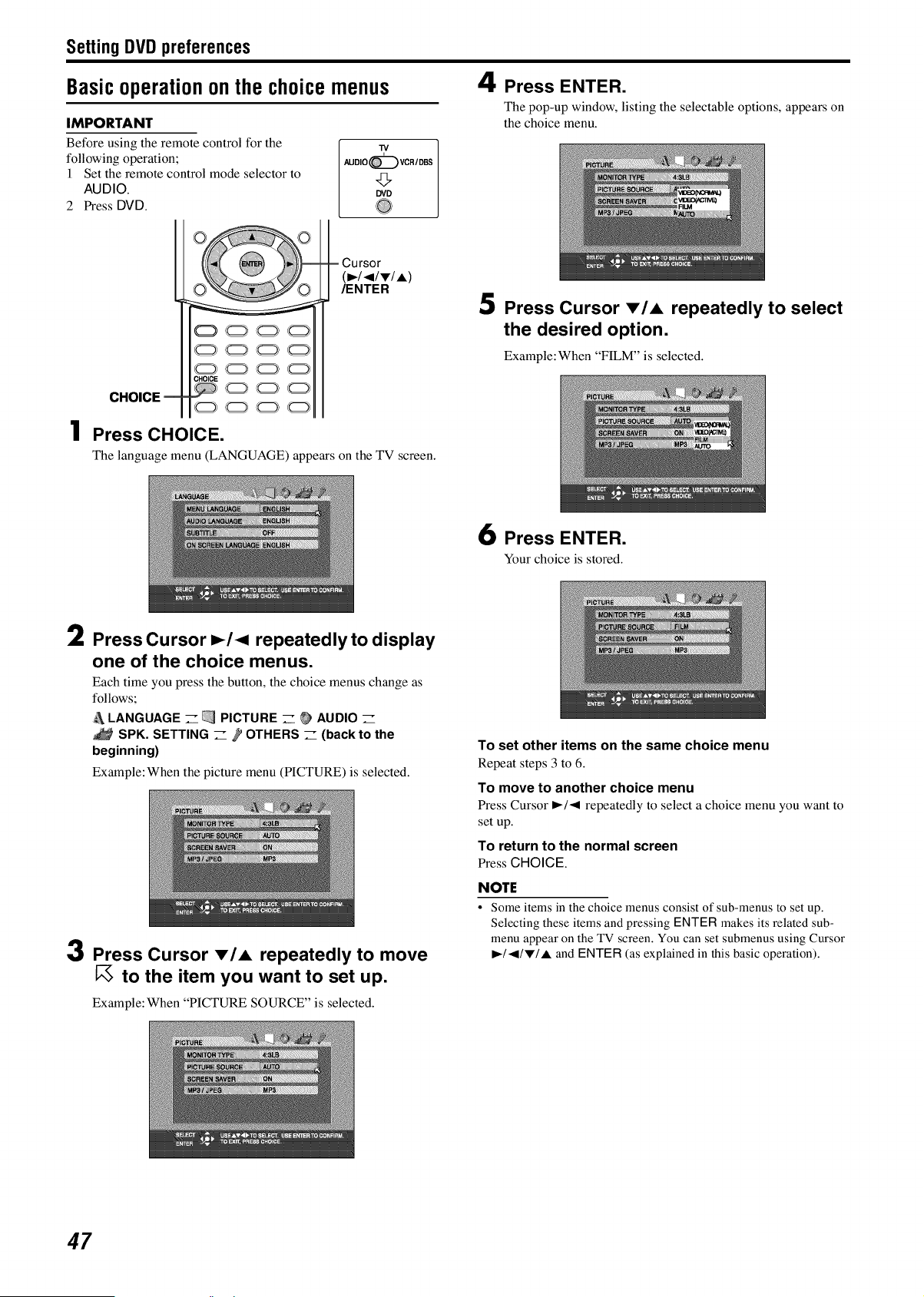
SettingDVDpreferences
Basic operation on the choice menus
IMPORTANT
Before using the remote control for the
following operation;
1 Set the remote control mode selector to
AUDIO.
2 Press DVD.
"IV
AUDIO_VCR/DBS
-5
DVD
4 Press ENTER.
The pop-up window, listing the selectable options, appears on
the choice menu.
1
Cursor
/ENTER
ooo
000
200
CHOICE- 0 0
ooo
Press CHOICE.
The language menu (LANGUAGE) appears on the TV screen.
5
Press Cursor T/i repeatedly to select
the desired option.
Example: When "FILM" is selected.
6 Press ENTER.
Your choice is stored.
2 Press Cursor _/_ repeatedly to display
one of the choice menus.
Each time you press the button, the choice menus change as
follows;
_ LANGUAGE _T_ PICTURE Z @ AUDIO z
SPK. SETTING z _ OTHERS z (back to the
beginning)
Example: When the picture menu (PICTURE) is selected.
3 Press Cursor T/i repeatedly to move
[_ to the item you want to set up.
Example: When "PICTURE SOURCE" is selected.
To set other items on the same choice menu
Repeat steps 3 to 6.
To move to another choice menu
Press Cursor I_/_1 repeatedly to select a choice menu you want to
set up.
To return to the normal screen
Press CHOICE.
NOTE
• Some items in the choice menus consist of stlb-menus to set tip.
Selecting these items and pressing ENTER makes its related sub-
menu appear on the TV screen. You can set submenus using Cursor
I_/_l/V/i and ENTER (as explained in this basic operation).
47
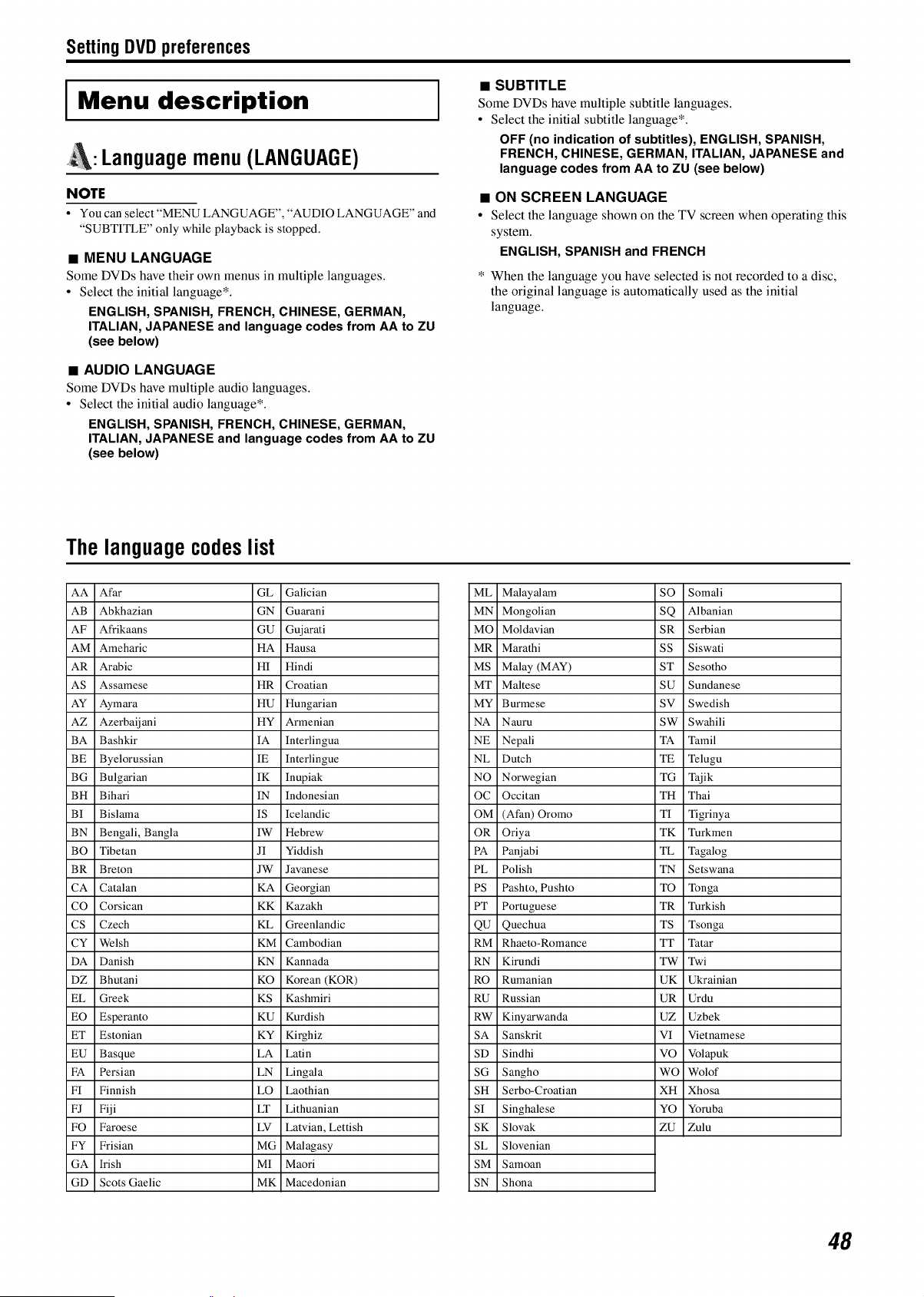
SettingDVDpreferences
I Menu description
Languagemenu (LANGUAGE)
NOTE
• You can select "MENU LANGUAGE", "AUDIO LANGUAGE" and
"SUBTITLE" only while playback is stopped.
• MENU LANGUAGE
Some DVDs have their own menus in multiple languages.
• Select the initial language*.
ENGLISH, SPANISH, FRENCH, CHINESE, GERMAN,
ITALIAN, JAPANESE and language codes from AA to ZU
(see below)
• AUDIO LANGUAGE
Some DVDs have multiple audio languages.
• Select the initial audio language*.
ENGLISH, SPANISH, FRENCH, CHINESE, GERMAN,
ITALIAN, JAPANESE and language codes from AA to ZU
(see below)
• SUBTITLE
Some DVDs have multiple subtitle languages.
• Select the initial subtitle language*.
OFF (no indication of subtitles), ENGLISH, SPANISH,
FRENCH, CHINESE, GERMAN, ITALIAN, JAPANESE and
language codes from AA to ZU (see below)
• ON SCREEN LANGUAGE
• Select the language shown on the TV screen when operating this
system.
ENGLISH, SPANISH and FRENCH
• When the language you have selected is not recorded to a disc,
the original language is automatically used as the initial
language.
The languagecodeslist
AA Afar GL Galician
AB Abkhazian GN Guarani
AF Afrikaans GU Gujarati
AM Ameharic HA Hausa
ML Malayalam SO Somali
MN Mongolian SQ Albanian
MO Moldavian SR Serbian
MR Marathi SS Siswati
AR Arabic HI Hindi
AS Assamese HR Croatian
AY Aymara HU Hungarian
AZ Azerbaijani HY Armenian
BA Bashkir IA Interlingua
BE Byelorussian IE Interlingue
BG Bulgarian IK Inupiak
BH Bihari IN Indonesian
BI Bislama IS Icelandic
BN Bengali, Bangla IW Hebrew
BO Tibetan JI Yiddish
BR Breton JW Javanese
CA Catalan KA Georgian
CO Corsican KK Kazakh
CS Czech KL Greenlandic
CY Welsh KM Cambodian
DA Danish KN Kannada
DZ Bhutani KO Korean (KOR)
EL Greek KS Kashmiri
EO Esperanto KU Kurdish
ET Estonian KY Kirghiz
EU Basque LA Latin
FA Persian LN Lingala
FI Finnish LO Laothian
FJ Fiji LT Lithuanian
FO Faroese LV Latvian, Lettish
FY Frisian MG Malagasy
GA Irish MI Maori
GD Scots Gaelic MK Macedonian
MS Malay (MAY) ST Sesotho
MT Maltese SU Sundanese
MY Burmese SV Swedish
NA Nauru SW Swahili
NE Nepali TA Tamil
NL Dutch TE Telugu
NO Norwegian TG Tajik
OC Occitan TH Thai
OM (Afan) Oromo TI Tigrinya
OR Oriya TK Turkmen
PA Panjabi TL Tagalog
PL Polish TN Setswana
PS Pashto, Pushto TO Tonga
PT Portuguese TR Turkish
QU Quechua TS Tsonga
RM Rhaeto-Romance TT Tatar
RN Kirundi TW Twi
RO Rumanian UK Ukrainian
RU Russian UR Urdu
RW Kinyarwanda UZ Uzbek
SA Sanskrit VI Vietnamese
SD Sindhi VO Volapuk
SG Sangho WO Wolof
SH Serbo-Croatian XH Xhosa
SI Singhalese YO Yoruba
SK Slovak ZU Zulu
SL Slovenian
SM Samoan
SN Shona
48
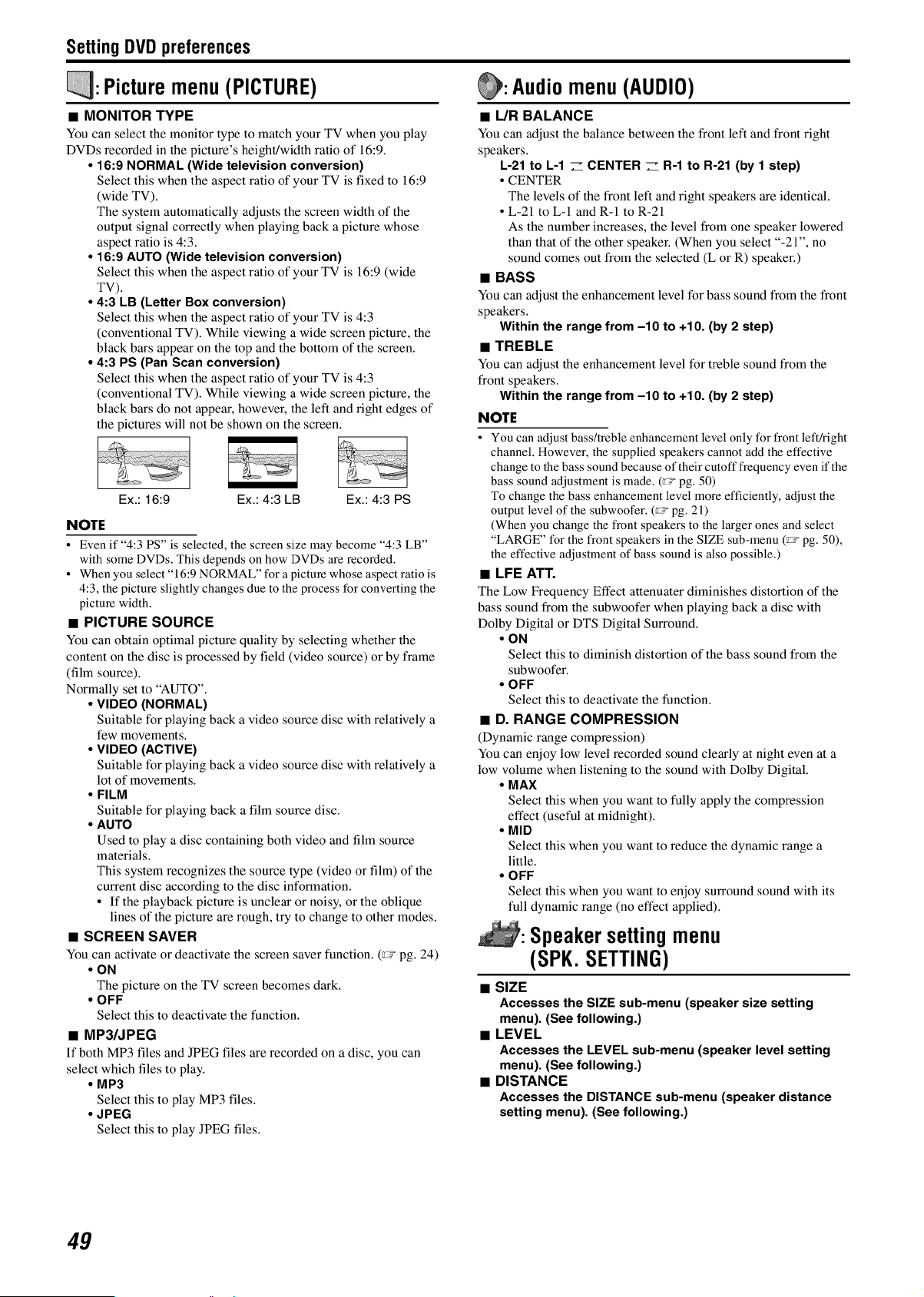
SettingDVDpreferences
Picturemenu(PICTURE)
• MONITOR TYPE
You can select the monitor type to match your TV when you play
DVDs recorded in the picture's height/width ratio of 16:9.
• 16:9 NORMAL (Wide television conversion)
Select this when the aspect ratio of your TV is fixed to 16:9
(wide TV).
The system automatically adjusts the screen width of the
output signal correctly when playing back a picture whose
aspect ratio is 4:3.
• 16:9 AUTO (Wide television conversion)
Select this when the aspect ratio of your TV is 16:9 (wide
TV).
• 4:3 LB (Letter Box conversion)
Select this when the aspect ratio of your TV is 4:3
(conventional TV). While viewing a wide screen picture, the
black bars appear on the top and the bottom of the screen.
• 4:3 PS (Pan Scan conversion)
Select this when the aspect ratio of your TV is 4:3
(conventional TV). While viewing a wide screen picture, the
black bars do not appear, however, the left and right edges of
the pictures will not be shown on the screen.
Ex.: 16:9 Ex.: 4:3 LB Ex.: 4:3 PS
NOTE
• Even if "4:3 PS" is selected, the screen size may become "4:3 LB"
with some DVDs. This depends on how DVDs are recorded.
• When you select "16:9 NORMAL" for a picture whose aspect ratio is
4:3, the picture slightly changes due to the process for converting the
picture width.
• PICTURE SOURCE
You can obtain optimal picture quality by selecting whether the
content on the disc is processed by field (video source) or by frame
(film source).
Normally set to "AUTO".
• VIDEO (NORMAL)
Suitable for playing back a video source disc with relatively a
few movements.
• VIDEO (ACTIVE)
Suitable for playing back a video source disc with relatively a
lot of movements.
• FILM
Suitable for playing back a film source disc.
• AUTO
Used to play a disc containing both video and film source
materials.
This system recognizes the source type (video or film) of the
current disc according to the disc information.
• If the playback picture is unclear or noisy, or the oblique
lines of the picture are rough, try to change to other modes.
• SCREEN SAVER
You can activate or deactivate the screen saver function. (_ pg. 24)
-ON
The picture on the TV screen becomes dark.
• OFF
Select this to deactivate the function.
• MPa/JPEG
If both MP3 files and JPEG files are recorded on a disc, you can
select which files to play.
• MP3
Select this to play MP3 files.
• JPEG
Select this to play JPEG files.
Audio menu (AUDIO)
• L/R BALANCE
You can adjust the balance between the front left and front right
speakers.
L-21 to L-1 z CENTER z R-1 to R-21 (by 1 step)
• CENTER
The levels of the front left and right speakers are identical.
• L-21 to L-I and R-I to R-21
As the number increases, the level from one speaker lowered
than that of the other speaker. (When you select "-21", no
sound comes out from the selected (L or R) speaker.)
• BASS
You can adjust the enhancement level for bass sound from the front
speakers.
Within the range from -10 to +10. (by 2 step)
• TREBLE
You can adjust the enhancement level for treble sound from the
front speakers.
Within the range from -10 to +10. (by 2 step)
NOTE
• You can adjust bass/treble enhancement level only for front left/right
channel. However, the supplied speakers cannot add the effective
change to the bass sound because of their cutoff frequency even if the
bass sound adjustment is made. (rr pg. 50)
To change the bass enhancement level more efficiently, adjust the
output level of the subwoofer. (r_= pg. 21)
(When you change the front speakers to the larger ones and select
"LARGE" for the front speakers in the SIZE sub-menu (rr pg. 50),
the effective adjustment of bass sound is also possible.)
• LFE ATT.
The Low Frequency Effect attenuater diminishes distortion of the
bass sound from the subwoofer when playing back a disc with
Dolby Digital or DTS Digital Surround.
-ON
Select this to diminish distortion of the bass sound from the
subwoofer.
• OFF
Select this to deactivate the function.
• D. RANGE COMPRESSION
(Dynamic range compression)
You can enjoy low level recorded sound clearly at night even at a
low volume when listening to the sound with Dolby Digital.
• MAX
Select this when you want to fully apply the compression
effect (useful at midnight).
• MID
Select this when you want to reduce the dynamic range a
little.
• OFF
Select this when you want to enjoy surround sound with its
full dynamic range (no effect applied).
Speakersettingmenu
(SPK. SETTING)
• SIZE
Accesses the SIZE sub-menu (speaker size setting
menu). (See following.)
• LEVEL
Accesses the LEVEL sub-menu (speaker level setting
menu). (See following.)
• DISTANCE
Accesses the DISTANCE sub-menu (speaker distance
setting menu). (See following.)
49
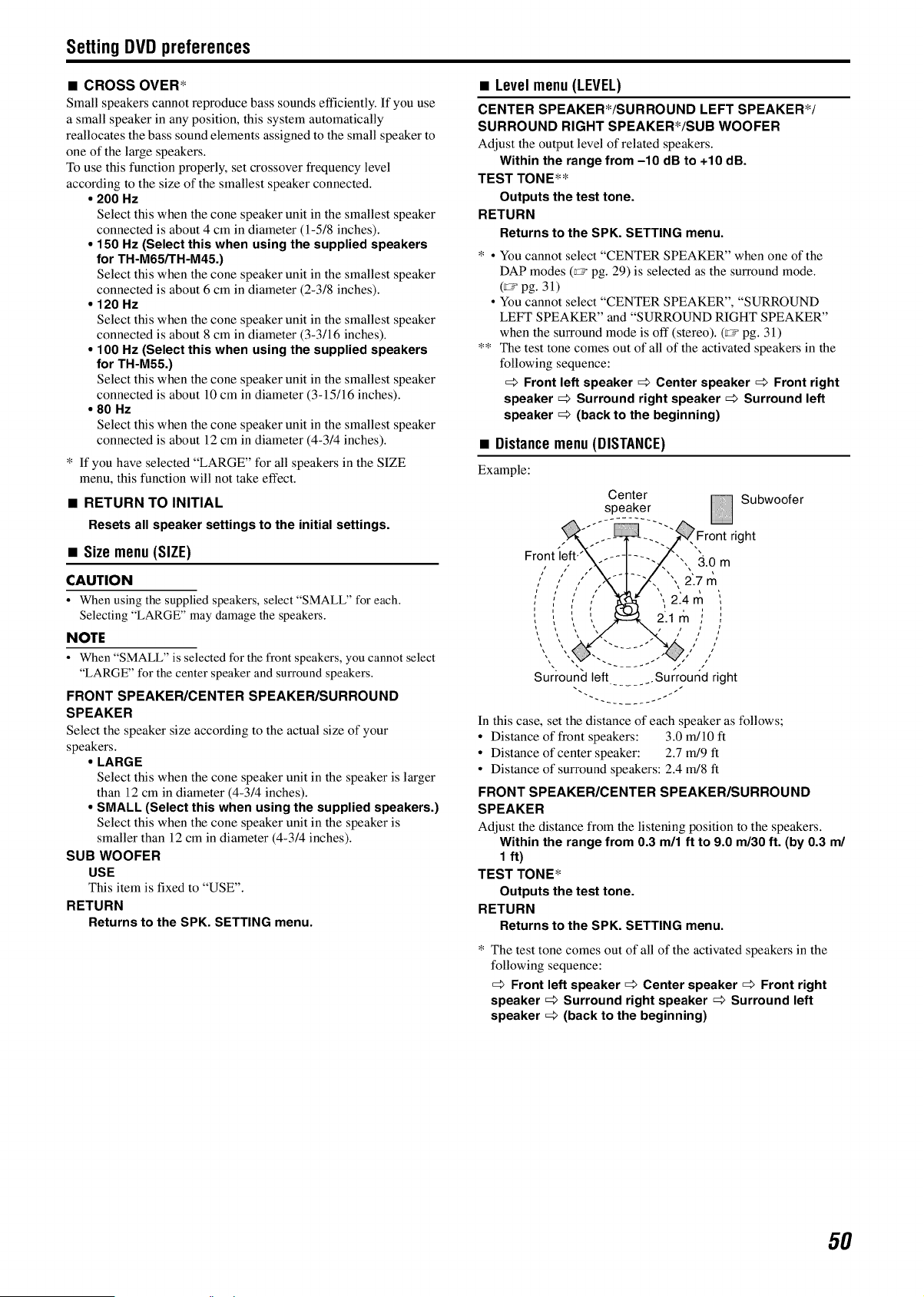
SettingDVDpreferences
• CROSS OVER*
Small speakers cannot reproduce bass sounds efficiently. If you use
a small speaker in any position, this system automatically
reallocates the bass sound elements assigned to the small speaker to
one of the large speakers.
To use this function properly, set crossover frequency level
according to the size of the smallest speaker connected.
• 200 Hz
Select this when the cone speaker unit in the smallest speaker
connected is about 4 cm in diameter (1-5/8 inches).
• 150 Nz (Select this when using the supplied speakers
for TH-M65/TH-M45.)
Select this when the cone speaker unit in the smallest speaker
connected is about 6 cm in diameter (2-3/8 inches).
• 120 Hz
Select this when the cone speaker unit in the smallest speaker
connected is about 8 cm in diameter (3-3/16 inches).
• 100 Nz (Select this when using the supplied speakers
for TH-M55.)
Select this when the cone speaker unit in the smallest speaker
connected is about 10 cm in diameter (3-15/16 inches).
• 80 Hz
Select this when the cone speaker unit in the smallest speaker
connected is about 12 cm in diameter (4-3/4 inches).
* If you have selected "LARGE" for all speakers in the SIZE
menu, this function will not take effect.
• RETURN TO INITIAL
Resets all speaker settings to the initial settings.
• Size menu(SIZE)
CAUTION
• When using the supplied speakers, select "SMALL" for each.
Selecting "LARGE" may damage the speakers.
NOTE
• When "SMALL" is selected for the front speakers, you cannot select
"LARGE" for the center speaker and surround speakers.
FRONT SPEAKER/CENTER SPEAKER/SURROUND
SPEAKER
Select the speaker size according to the actual size of your
speakers.
• LARGE
Select this when the cone speaker unit in the speaker is larger
than 12 cm in diameter (4-3/4 inches).
• SMALL (Select this when using the supplied speakers.)
Select this when the cone speaker unit in the speaker is
smaller than 12 cm in diameter (4-3/4 inches).
SUB WOOFER
USE
This item is fixed to "USE".
RETURN
Returns to the SPK. SETTING menu.
• Level menu (LEVEL)
CENTER SPEAKER*/SURROUND LEFT SPEAKER*/
SURROUND RIGHT SPEAKER*/SUB WOOFER
Adjust the output level of related speakers.
Within the range from -10 dB to +10 dB.
TEST TONE**
Outputs the test tone.
RETURN
Returns to the SPK. SETTING menu.
* • You cannot select "CENTER SPEAKER" when one of the
DAP modes (r_ pg. 29) is selected as the surround mode.
(rr pg. 31)
• You cannot select "CENTER SPEAKER", "SURROUND
LEFT SPEAKER" and "SURROUND RIGHT SPEAKER"
when the surround mode is off (stereo). (r_ pg. 31)
** The test tone comes out of all of the activated speakers in the
following sequence:
_:_ Front left speaker ::_ Center speaker _:_ Front right
speaker _=_Surround right speaker _:_ Surround left
speaker _ (back to the beginning)
• Distancemenu (DISTANCE)
Example:
Center
speaker
Subwoofer
Surround left ........ Surround right
In this case, set the distance of each speaker as follows;
• Distance of front speakers: 3.0 m/10 ft
• Distance of center speaker: 2.7 m/9 ft
• Distance of surround speakers: 2.4 m/8 ft
FRONT SPEAKER/CENTER SPEAKER/SURROUND
SPEAKER
Adjust the distance from the listening position to the speakers.
Within the range from 0.3 m/1 It to 9.0 m/a0 ft. (by 0.3 m/
1 ft)
TEST TONE*
Outputs the test tone.
RETURN
Returns to the SPK. SETTING menu.
* The test tone comes out of all of the activated speakers in the
following sequence:
_:_ Front left speaker ::_ Center speaker _:_ Front right
speaker _=_Surround right speaker _:_ Surround left
speaker _ (back to the beginning)
50
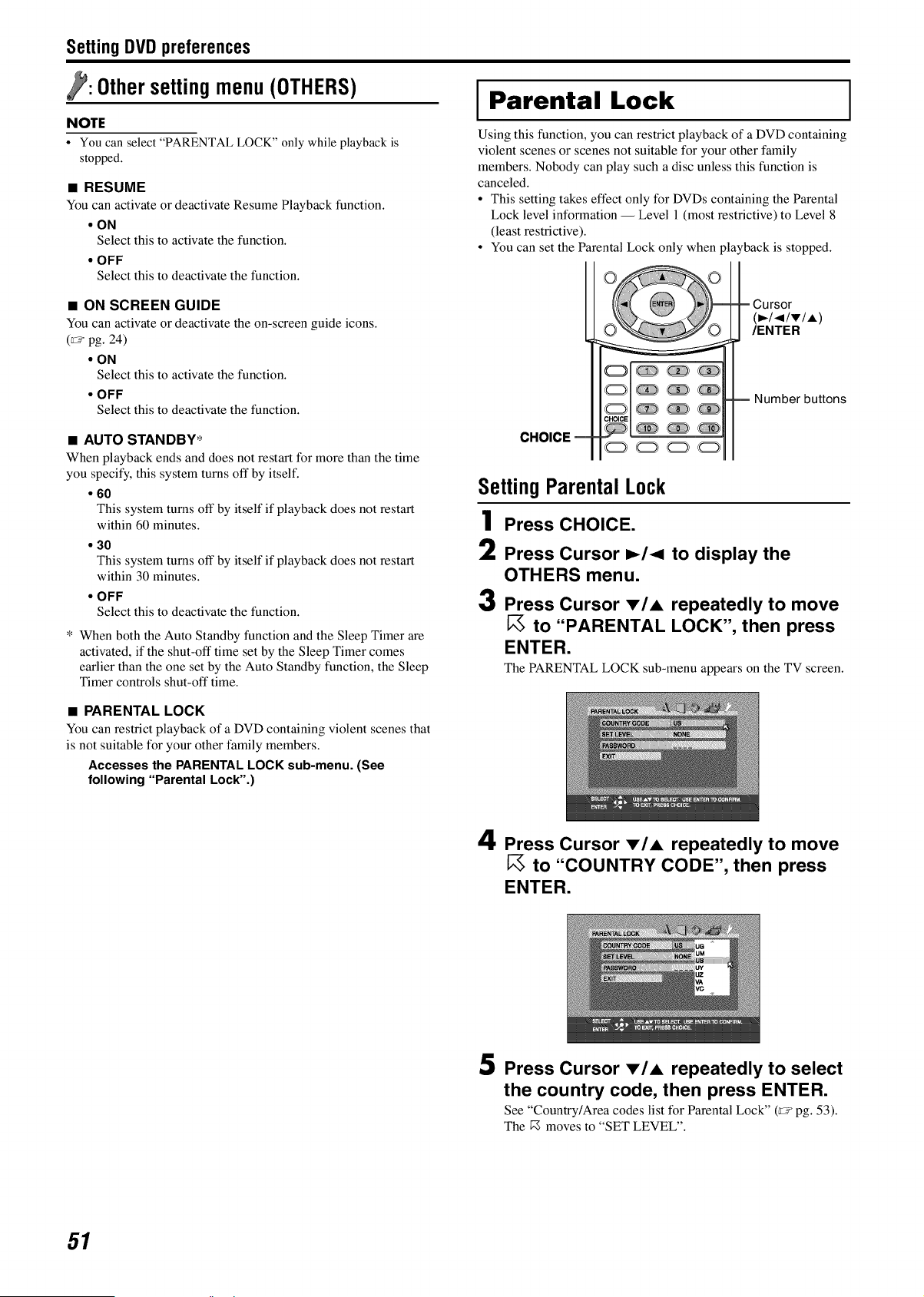
SettingDVDpreferences
Othersettingmenu(OTHERS)
NOTE
• You can select "PARENTAL LOCK" only while playback is
stopped.
• RESUME
You can activate or deactivate Resume Playback function.
*ON
Select this to activate the function.
• OFF
Select this to deactivate the function.
I Parental Lock I
Using this function, you can restrict playback of a DVD containing
violent scenes or scenes not suitable for your other family
members. Nobody can play such a disc unless this function is
canceled.
• This setting takes effect only for DVDs containing the Parental
• ON SCREEN GUIDE
You can activate or deactivate the on-screen guide icons.
(r_ pg. 24)
*ON
Select this to activate the function.
• OFF
Select this to deactivate the function.
• AUTO STANDBY*
When playback ends and does not restart for more than the time
you specify, this system turns off by itself.
• 60
This system turns off by itself if playback does not restart
within 60 minutes.
• 30
This system turns off by itself if playback does not restart
within 30 minutes.
• OFF
Select this to deactivate the function.
* When both the Auto Standby function and the Sleep Timer are
activated, if the shut-off time set by the Sleep Timer comes
earlier than the one set by the Auto Standby function, the Sleep
Timer controls shut-off time.
Lock level information -- Level 1 (most restrictive) to Level 8
(least restrictive).
• You can set the Parental Lock only when playback is stopped.
• PARENTAL LOCK
You can restrict playback of a DVD containing violent scenes that
is not suitable for your other family members.
Accesses the PARENTAL LOCK sub-menu. (See
following "Parental Lock".)
(_l<lvll)
/ENTER
Number buttons
Setting Parental Lock
1 Press CHOICE.
2 Press Cursor i-l< to display the
OTHERS menu.
3 Press Cursor T/A repeatedly to move
to "PARENTAL LOCK", then press
ENTER.
The PARENTAL LOCK sub-menu appears on the TV screen.
4 Press Cursor T/A repeatedly to move
to "COUNTRY CODE", then press
ENTER.
5
Press Cursor T/A repeatedly to select
the country code, then press ENTER.
See "Country/Area codes list for Parental Lock" (r_ pg. 53).
The _; moves to "SET LEVEL".
51
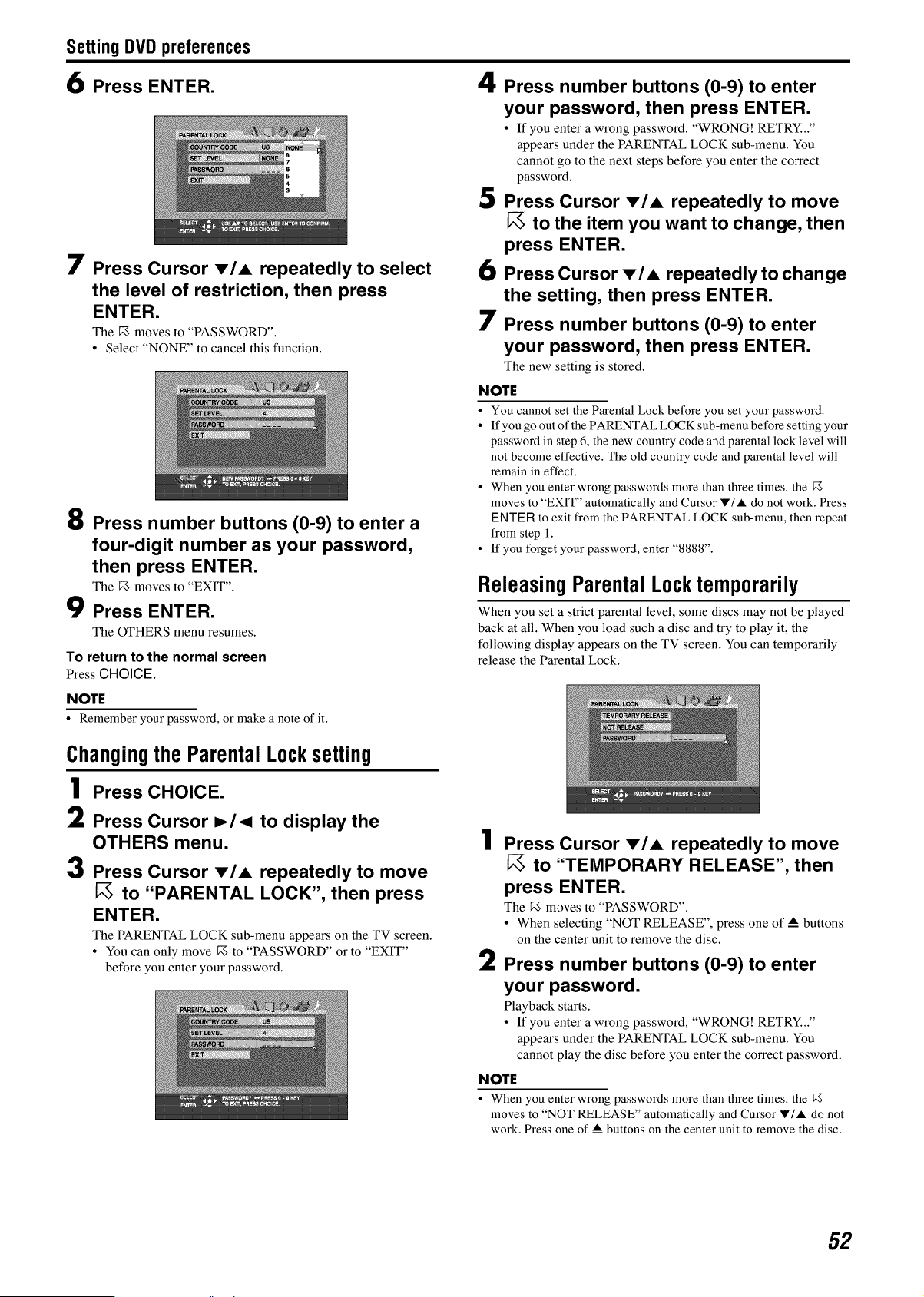
SettingDVDpreferences
6 Press ENTER.
7' Press Cursor T/A repeatedly to select
the level of restriction, then press
ENTER.
The R; moves to "PASSWORD".
• Select "NONE" to cancel this function.
8 Press number buttons (0-9) to enter a
four-digit number as your password,
then press ENTER.
The R; moves to "EXIT".
9 Press ENTER.
The OTHERS menu resumes.
To return to the normal screen
PressCHOICE.
NOTE
• Remember your password, or make a note of it.
Changing the Parental Lock setting
1 Press CHOICE.
2 Press Cursor _/_ to display the
OTHERS menu.
3 Press Cursor T/A repeatedly to move
to "PARENTAL LOCK", then press
ENTER.
The PARENTAL LOCK sub-menu appears on the TV screen.
• You can only move R; to "PASSWORD" or to "EXIT"
before you enter your password.
4 Press number buttons (0-9) to enter
your password, then press ENTER.
• If you enter a wrong password, "WRONG! RETRY..."
appears under the PARENTAL LOCK sub-menu. You
cannot go to the next steps before you enter the correct
password.
5 Press Cursor T/A repeatedly to move
to the item you want to change, then
press ENTER.
6
7
Press Cursor T/A repeatedly to change
the setting, then press ENTER.
Press number buttons (0-9) to enter
your password, then press ENTER.
The new setting is stored.
NOTE
• You cannot set the Parental Lock before you set your password.
• If you go out of the PARENTAL LOCK sub-menu before setting your
password in step 6, the new country code and parental lock level will
not become effective. The old country code and parental level will
remain in effect.
• When you enter wrong passwords more than three times, the
moves to "EXIT" automatically and Cursor VIA do not work. Press
ENTER to exit from the PARENTAL LOCK sub-menu, then repeat
from step 1.
• If you forget your password, enter "8888".
ReleasingParental Locktemporarily
When you set a strict parental level, some discs may not be played
back at all. When you load such a disc and try to play it, the
following display appears on the TV screen. You can temporarily
release the Parental Lock.
1
2
Press Cursor T/A repeatedly to move
to "TEMPORARY RELEASE", then
press ENTER.
The R; moves to "PASSWORD".
• When selecting "NOT RELEASE", press one of _ buttons
on the center unit to remove the disc.
Press number buttons (0-9) to enter
your password.
Playback starts.
• If you enter a wrong password, "WRONG! RETRY..."
appears under the PARENTAL LOCK sub-menu. You
cannot play the disc before you enter the correct password.
NOTE
• When you enter wrong passwords more than three times, the [;?;
moves to "NOT RELEASE" automatically and Cursor VIA do not
work. Press one of & buttons on the center unit to remove the disc.
52
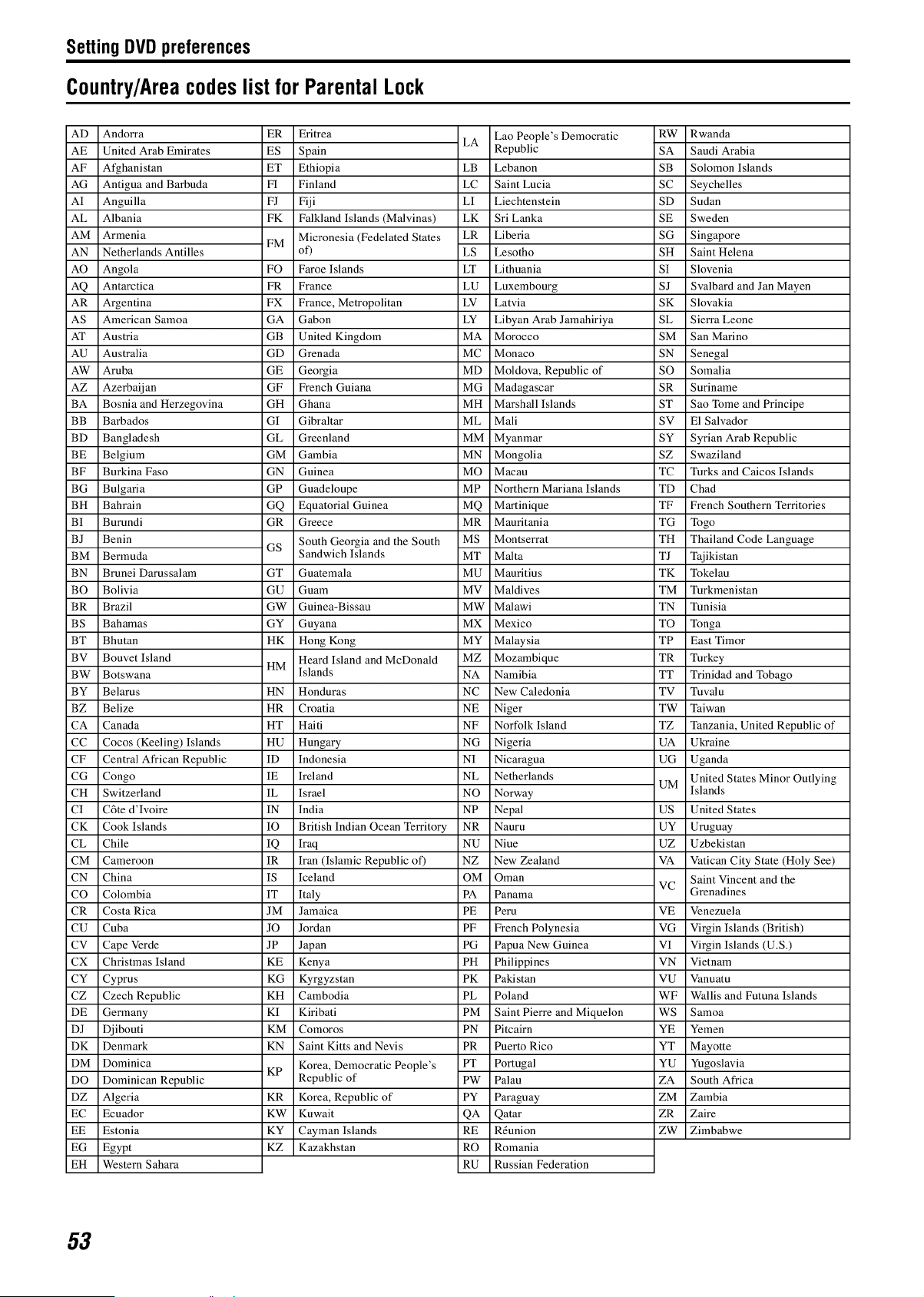
SettingDVDpreferences
Country/Area codes list for Parental Lock
AD Andorra
AE United Arab Emirates
AF Afghanistan
AG Antigua and Barbuda
AI Anguilla
AlL Albania
AM Armenia
AN Netherlands Antilles
AO Angola
AQ Antarctica
AR Argentina
AS American Samoa
AT Austria
AU Australia
AW Aruba
AZ Azerbaijan
BA Bosnia and Herzegovina
BB Barbados
BD Bangladesh
BE Belgium
BF Burkina Faso
BG Bulgaria
BH Bahrain
BI Burundi
BJ Benin
BM Bermuda
BN Brunei Darussalam
BO Bolivia
BR Brazil
BS Bahamas
BT Bhutan
BV Bouvet Island
BW Botswana
BY Belarus
BZ Belize
CA Canada
CC Cocos (Keeling) Islands
CF Central African Republic
CG Congo
CH Switzerland
CI C6te d'Ivoire
CK Cook Islands
CL Chile
CM Cameroon
CN China
CO Colombia
CR CostaRica
CU Cuba
CV Cape Verde
CX Christmas Island
CY Cyprus
CZ Czech Republic
DE Germany
DJ Djibouti
DK Denmark
DM Dominica
DO Dominican Republic
DZ Algeria
EC Ecuador
EE Estonia
EG Egypt
EH Western Sahara
ER Eritrea LA Lao People's Democratic
ES Spain Republic
ET Ethiopia LB Lebanon
FI Finland ILC Saint Lucia
FJ Fiji ILI Liechtenstein
FK Falkland Islands (Malvinas) ILK Sri ILanka
Micronesia (Fedelated States ILR Liberia
FM
of) ILS ILesotho
FO Faroe Islands LT Lithuania
FR France fLU ILuxembourg
FX France, Metropolitan LV Latvia
GA Gabon LY Libyan Arab Jamahiriya
GB United Kingdom MA Morocco
GD Grenada MC Monaco
GE Georgia MD Moldova, Republic of
GF French Guiana MG Madagascar
GH Ghana MH Marshall Islands
GI Gibraltar MIL Mali
GIL Greenland MM Myanmar
GM Gambia MN Mongolia
GN Guinea MO Macau
GP Guadeloupe MP Northern MarianaIslands
GQ Equatorial Guinea MQ Martinique
GR Greece MR Mauritania
South Georgia and the South MS Montserrat
GS Sandwich Islands MT Malta
GT Guatemala MU Mauritius
GU Guam MV Maldives
GW Guinea-Bissau MW Malawi
GY Guyana MX Mexico
HK Hong Kong MY Malaysia
Heard Island and McDonald MZ Mozambique
HM
Islands NA Namibia
HN Honduras NC New Caledonia
HR Croatia NE Niger
HT Haiti NF Nortblk Island
HU Hungary NG Nigeria
ID Indonesia NI Nicaragua
IE Ireland NL Netherlands
IlL Israel NO Norway
IN India NP Nepal
IO British Indian Ocean Territory NR Nauru
IQ Iraq NU Niue
IR Iran (Islamic Republic of) NZ New Zealand
IS Iceland OM Oman
IT Italy PA Panama
JM Jamaica PE Peru
JO Jordan PF French Polynesia
JP Japan PG Papua New Guinea
KE Kenya PH Philippines
KG Kyrgyzstan PK Pakistan
KH Cambodia PIL Poland
KI Kiribati PM Saint Pierre and Miquelon
KM Comoros PN Pitcairn
KN Saint Kitts and Nevis PR Puerto Rico
KP Korea, Democratic People's PT Portugal
Republic of PW Palau
KR Korea, Republic of PY Paraguay
KW Kuwait QA Qatar
KY Cayman Islands RE R_union
KZ Kazakhstan RO Romania
RU Russian Federation
RW Rwanda
SA Saudi Arabia
SB Solomon Islands
SC Seychelles
SD Sudan
SE Sweden
SG Singapore
SH Saint Helena
SI Slovenia
SJ Svalbard and Jan Mayen
SK Slovakia
SIL Sierra Leone
SM San Marino
SN Senegal
SO Somalia
SR Suriname
ST Sao Tome and Principe
SV El Salvador
SY Syrian Arab Republic
SZ Swaziland
TC Turks and Caicos Islands
TD Chad
TF French Southern Territories
TG Togo
TH Thailand Code Language
TJ Tajikistan
TK Tokelau
TM Turkmenistan
TN Tunisia
TO Tonga
TP East Timor
TR Turkey
TT Trinidad and Tobago
TV Tuvalu
TW Taiwan
TZ Tanzania, United Republic of
UA Ukraine
UG Uganda
United States Minor Outlying
UM Islands
US United States
UY Uruguay
UZ Uzbekistan
VA Vatican City State (Holy See)
Saint Vincent and the
VC Grenadines
VE Venezuela
VG Virgin Islands (British)
VI Virgin Islands (U.S.)
VN Vietnam
VU Vanuatu
WF Wallis and FutunaIslands
WS Samoa
YE Yemen
YT Mayotte
YU Yugoslavia
ZA South Africa
ZM Zambia
ZR Zaire
ZW Zimbabwe
53
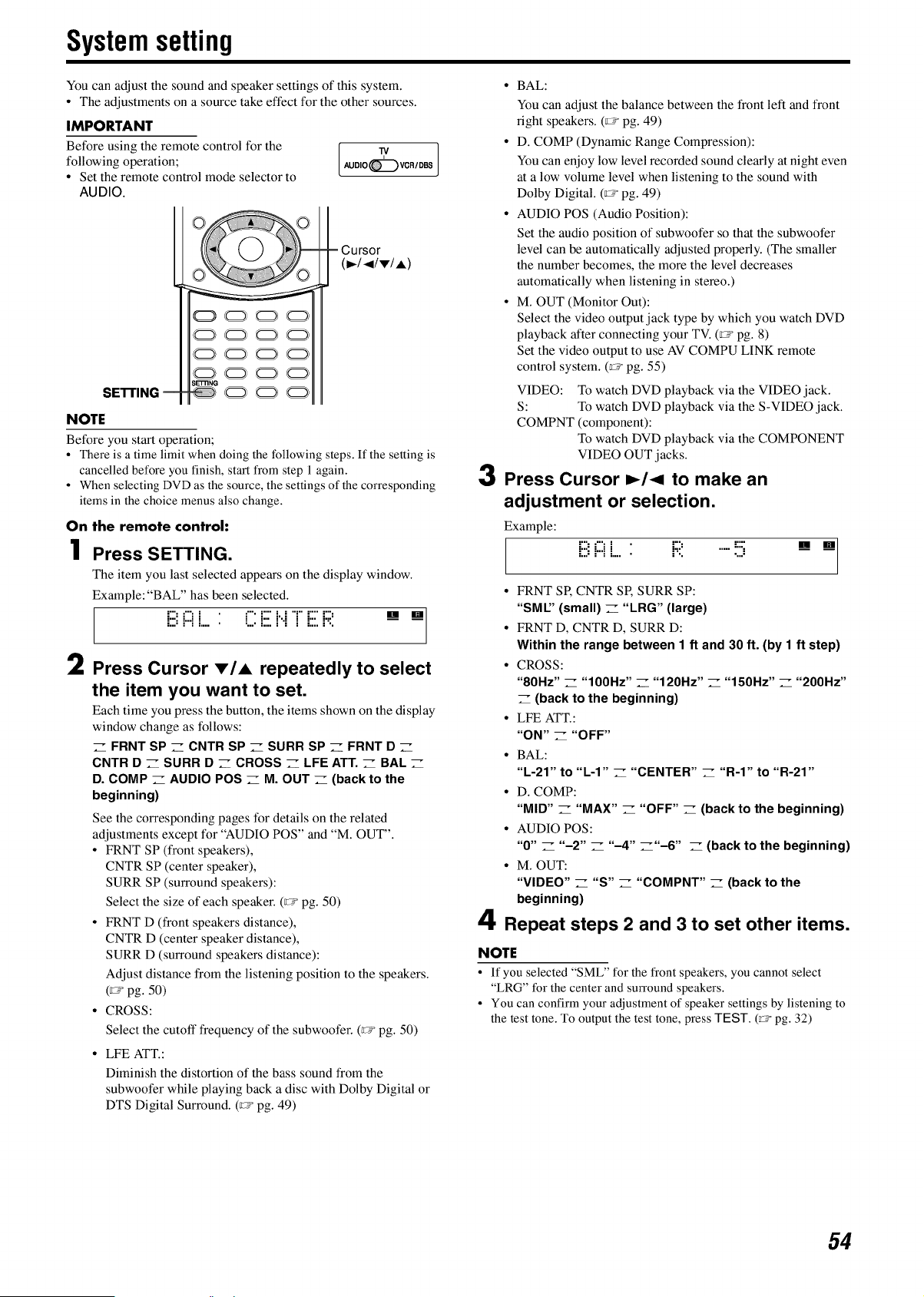
Systemsetting
You can adjust the sound and speaker settings of this system.
• The adjustments on a source take effect for the other sources.
IMPORTANT
Before using the remote control for the
following operation;
• Set the remote control mode selector to
AUDIO.
[ AUDIO_VCR/DBS ]
(_l<lTll)
_0_
_ _ 0
_ _ 0
SE'FFING 0 0
NOTE
Before you start operation;
• There is a time limit when doing the following steps. If the setting is
cancelled before you finish, start from step 1 again.
• When selecting DVD as the source, the settings of the corresponding
items in the choice menus also change.
On the remote control:
1 Press SETTING.
The item you last selected appears on the display window.
Example: "BAL" has been selected.
i:::_G I • 7' i:::'i...i"T"i:::'i:1:= [] -----]
I,,,' I I h,,, • ',,,' h,,, I I I I,,,, I ',
J
2 Press Cursor T/A repeatedly to select
the item you want to set.
Each time you press the button, the items shown on the display
window change as follows:
Z FRNT SP Z CNTR SP __ SURR SP Z FRNT D __
CNTR D __ SURR D Z CROSS Z LFE ATT. Z BAL Z
D. COMP Z AUDIO POS Z M. OUT Z (back to the
beginning)
See the corresponding pages for details on the related
adjustments except for "AUDIO POS" and "M. OUT".
• FRNT SP (front speakers),
CNTR SP (center speaker),
SURR SP (surround speakers):
Select the size of each speaker. (r_ pg. 50)
• FRNT D (front speakers distance),
CNTR D (center speaker distance),
SURR D (surround speakers distance):
Adjust distance from the listening position to the speakers.
(r_ pg. 50)
• CROSS:
Select the cutoff frequency of the subwoofer. (r_ pg. 50)
LFE ATT.:
Diminish the distortion of the bass sound from the
subwoofer while playing back a disc with Dolby Digital or
DTS Digital Surround. (_ pg. 49)
3
• BAL:
You can adjust the balance between the front left and front
right speakers. (r_ pg. 49)
• D. COMP (Dynamic Range Compression):
You can enjoy low level recorded sound clearly at night even
at a low volume level when listening to the sound with
Dolby Digital. (r_ pg. 49)
• AUDIO POS (Audio Position):
Set the audio position of subwoofer so that the subwoofer
level can be automatically adjusted properly. (The smaller
the number becomes, the more the level decreases
automatically when listening in stereo.)
• M. OUT (Monitor Out):
Select the video output jack type by which you watch DVD
playback after connecting your TV. (r_ pg. 8)
Set the video output to use AV COMPU LINK remote
control system. (r_ pg. 55)
VIDEO: To watch DVD playback via the VIDEO jack.
S: To watch DVD playback via the S-VIDEO jack.
COMPNT (component):
To watch DVD playback via the COMPONENT
VIDEO OUT jacks.
Press Cursor _-/< to make an
adjustment or selection.
Example:
B i:::iL. : R .....5
[] []
• FRNT SR CNTR SR SURR SP:
"SMU' (small) z "LRG" (large)
• FRNT D, CNTR D, SURR D:
Within the range between 1 ft and 30 ft. (by I ft step)
• CROSS:
"80Hz" Z "100Hz" Z "120Hz" Z "150Hz" Z "200Hz"
Z (back to the beginning)
• LFE ATT.:
"ON" z "OFF"
• BAL:
"L-21" to "L-1" z "CENTER" z "R-I" to "R-21"
• D. COMP:
"MID" z "MAX" z "OFF" z (back to the beginning)
• AUDIO POS:
"0" z "-2" z "-4" z"-6" z (back to the beginning)
• M. OUT:
"VIDEO" Z "S" z "COMPNT" z (back to the
beginning)
4 Repeat steps 2 and 3 to set other items.
NOTE
• If you selected "SML" for the front speakers, you cannot select
"LRG" for the center and surround speakers.
• You can confirm your adjustment of speaker settings by listening to
the test tone. To output the test tone, press TEST. (rr pg. 32)
54
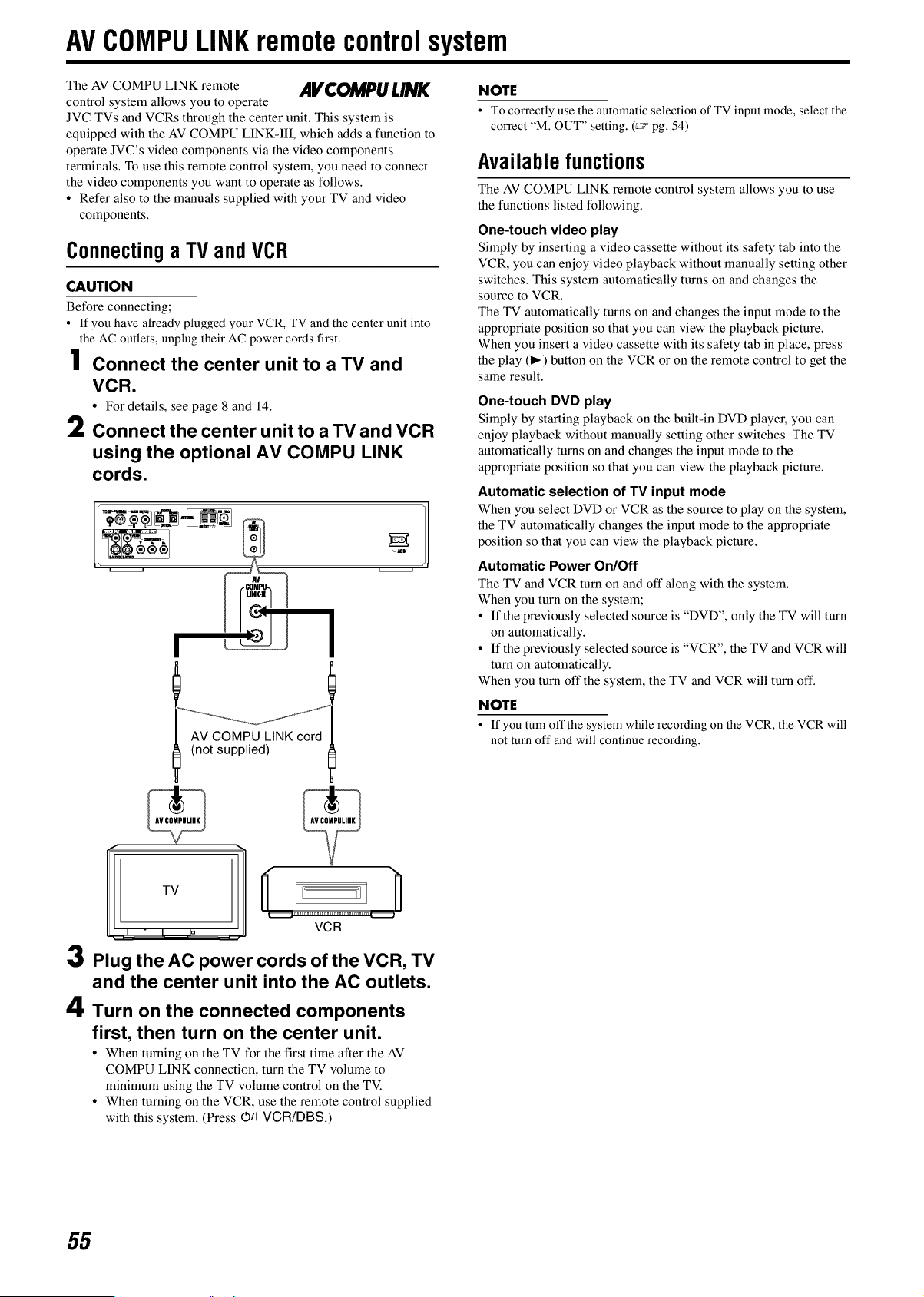
AVCOMPULINKremotecontrolsystem
The AV COMPU LINK remote AIJP'ftJiJDII I I&llf
4FreEr _IPVIVlB- V Ealllll
control system allows you to operate
JVC TVs and VCRs through the center unit. This system is
equipped with the AV COMPU LINK-Ill, which adds a function to
operate JVC's video components via the video components
terminals. To use this remote control system, you need to connect
the video components you want to operate as follows.
• Refer also to the manuals supplied with your TV and video
components.
Connectinga TVandVCR
CAUTION
Before connecting;
• If you have already plugged your VCR, TV and the center unit into
the AC outlets, unplug their AC power cords first.
i
1 Connect the center unit to a TV and
VCR.
• For details, see page 8 and 14.
2 Connect the center unit to a TV and VCR
using the optional AV COMPU LINK
cords.
I
_lcH
AV COMPU LINK cord
(not supplied)
NOTE
• To correctly use the automatic selection of TV input mode, select the
correct "M. OUT" setting. (rr pg. 54)
Available functions
The AV COMPU LINK remote control system allows you to use
the functions listed following.
One-touch video play
Simply by inserting a video cassette without its safety tab into the
VCR, you can enjoy video playback without manually setting other
switches. This system automatically turns on and changes the
source to VCR.
The TV automatically turns on and changes the input mode to the
appropriate position so that you can view the playback picture.
When you insert a video cassette with its safety tab in place, press
the play (1_) button on the VCR or on the remote control to get the
same result.
One-touch DVD play
Simply by starting playback on the built-in DVD player, you can
enjoy playback without manually setting other switches. The TV
automatically turns on and changes the input mode to the
appropriate position so that you can view the playback picture.
Automatic selection of TV input mode
When you select DVD or VCR as the source to play on the system,
the TV automatically changes the input mode to the appropriate
position so that you can view the playback picture.
Automatic Power On/Off
The TV and VCR turn on and off along with the system.
When you turn on the system;
• If the previously selected source is "DVD", only the TV will turn
on automatically.
• If the previously selected source is "VCR", the TV and VCR will
turn on automatically.
When you turn off the system, the TV and VCR will turn off.
NOTE
• If you turn off the system while recording on the VCR, the VCR will
not turn off and will continue recording.
- _ Io VCR
3 Plug the AC power cords of the VCR, TV
and the center unit into the AC outlets.
4 Turn on the connected components
first, then turn on the center unit.
• When turning on the TV for the first time after the AV
COMPU LINK connection, turn the TV volume to
minimum using the TV volume control on the TV.
• When turning on the VCR, use the remote control supplied
with this system. (Press ©/I VCR/DBS.)
55
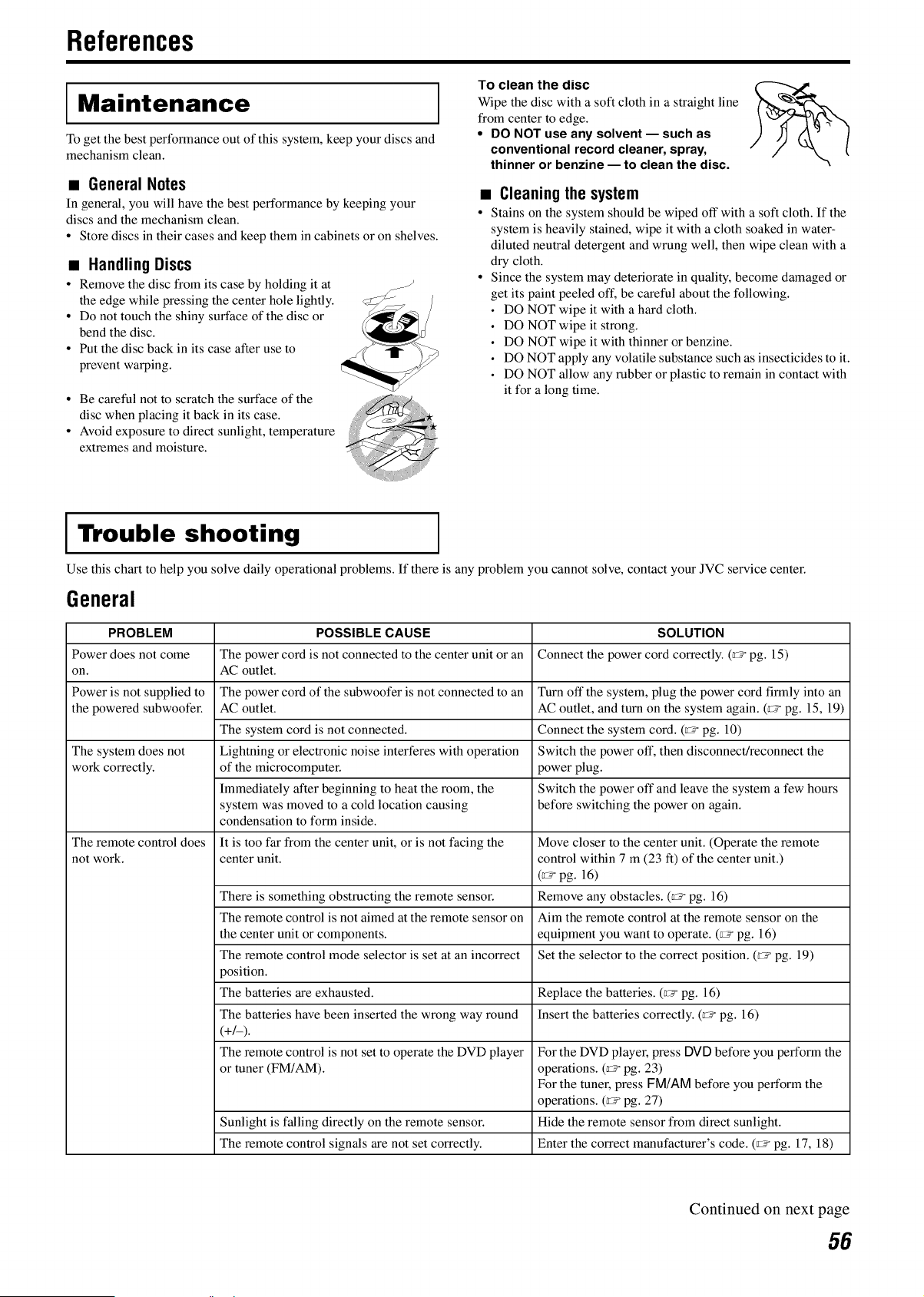
References
Maintenance
To get the best performance out of this system, keep your discs and
mechanism clean.
• General Notes
In general, you will have the best performance by keeping your
discs and the mechanism clean.
• Store discs in their cases and keep them in cabinets or on shelves.
• Handling Discs
• Remove the disc from its case by holding it at
the edge while pressing the center hole lightly.
• Do not touch the shiny surface of the disc or
bend the disc.
• Put the disc back in its case after use to
prevent warping.
fJ
• Be careful not to scratch the surface of the
disc when placing it back in its case.
• Avoid exposure to direct sunlight, temperature
extremes and moisture.
To clean the disc
Wipe the disc with a soft cloth in a straight line
from center to edge.
• DO NOT use any solvent -- such as
conventional record cleaner, spray,
thinner or benzine -- to clean the disc.
• Cleaningthe system
• Stains on the system should be wiped ott" with a soft cloth. If the
system is heavily stained, wipe it with a cloth soaked in water-
diluted neutral detergent and wrung well, then wipe clean with a
dry cloth.
• Since the system may deteriorate in quality, become damaged or
get its paint peeled off, be careful about the following.
• DO NOT wipe it with a hard cloth.
• DO NOT wipe it strong.
• DO NOT wipe it with thinner or benzine.
• DO NOT apply any volatile substance such as insecticides to it.
• DO NOT allow any rubber or plastic to remain in contact with
it for a long time.
I Trouble shooting
Use this chart to help you solve daily operational problems. If there is any problem you cannot solve, contact your JVC service center.
General
PROBLEM POSSIBLE CAUSE SOLUTION
Power does not come The power cord is not connected to the center unit or an Connect the power cord correctly. (_ pg. 15)
on. AC outlet.
Power is not supplied to The power cord of the subwoofer is not connected to an Turn off the system, plug the power cord firmly into an
the powered subwoofer. AC outlet. AC outlet, and turn on the system again. (r_ pg. 15, 19)
The system cord is not connected. Connect the system cord. (r_ pg. 10)
The system does not Lightning or electronic noise interferes with operation Switch the power off, then disconnect/reconnect the
work correctly, of the microcomputer, power plug.
Immediately after beginning to heat the room, the Switch the power off and leave the system a few hours
system was moved to a cold location causing before switching the power on again.
condensation to form inside.
The remote control does It is too far from the center unit, or is not facing the Move closer to the center unit. (Operate the remote
not work. center unit. control within 7 m (23 It) of the center unit.)
(r_ pg. 16)
There is something obstructing the remote sensor. Remove any obstacles. (r_ pg. 16)
The remote control is not aimed at the remote sensor on Aim the remote control at the remote sensor on the
the center unit or components, equipment you want to operate. (r_ pg. 16)
The remote control mode selector is set at an incorrect Set the selector to the correct position. (r_ pg. 19)
position.
The batteries are exhausted. Replace the batteries. (_ pg. 16)
The batteries have been inserted the wrong way round Insert the batteries correctly. (r_ pg. 16)
(+/-).
The remote control is not set to operate the DVD player For the DVD player, press DVD before you perform the
or tuner (FM/AM). operations. (rr pg. 23)
For the tuner, press FM/AM before you perform the
operations. (r_ pg. 27)
Sunlight is falling directly on the remote sensor. Hide the remote sensor from direct sunlight.
The remote control signals are not set correctly. Enter the correct manufacturer's code. (r_ pg. 17, 18)
Continued on next page
56
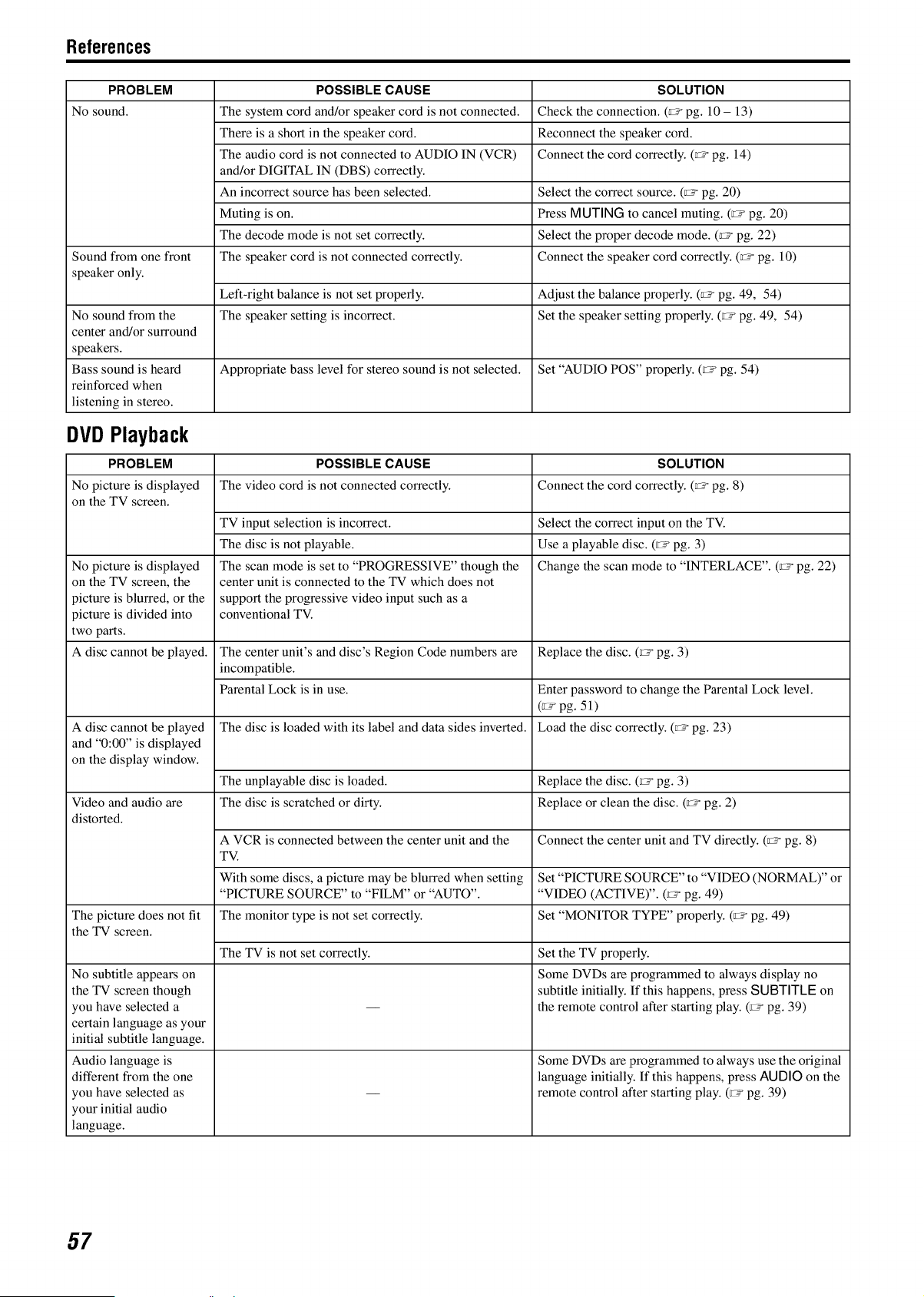
References
PROBLEM POSSIBLE CAUSE SOLUTION
No sound. The system cord and/or speaker cord is not connected. Check the connection. (r_ pg. l 0 - 13)
There is a short in the speaker cord. Reconnect the speaker cord.
The audio cord is not connected to AUDIO IN (VCR) Connect the cord correctly. (r_ pg. 14)
and/or DIGITAL IN (DBS) correctly.
An incorrect source has been selected. Select the correct source. (r_ pg. 20)
Muting is on. Press MUTING to cancel muting. (r_ pg. 20)
The decode mode is not set correctly. Select the proper decode mode. (r_ pg. 22)
Sound from one front The speaker cord is not connected correctly. Connect the speaker cord correctly. (r_ pg. 10)
speaker only.
Left-right balance is not set properly. Adjust the balance properly. (r_ pg. 49, 54)
No sound from the The speaker setting is incorrect. Set the speaker setting properly. (r_ pg. 49, 54)
center and/or surround
speakers.
Bass sound is heard Appropriate bass level for stereo sound is not selected. Set "AUDIO POS" properly. (r_ pg. 54)
reinforced when
listening in stereo.
DVD Playback
PROBLEM POSSIBLE CAUSE SOLUTION
No picture is displayed The video cord is not connected correctly. Connect the cord correctly. (_ pg. 8)
on the TV screen.
Select the correct input on the TV.
Use a playable disc. (r_ pg. 3)
Change the scan mode to "INTERLACE". (r_ pg. 22)No picture is displayed
on the TV screen, the
picture is blurred, or the
picture is divided into
two parts.
A disc cannot be played.
TV input selection is incorrect.
The disc is not playable.
The scan mode is set to "PROGRESSIVE" though the
center unit is connected to the TV which does not
support the progressive video input such as a
conventional TV.
The center unit's and disc's Region Code numbers are Replace the disc. (r_ pg. 3)
incompatible.
Parental Lock is in use. Enter password to change the Parental Lock level.
(r_ pg. 51 )
A disc cannot be played The disc is loaded with its label and data sides inverted. Load the disc correctly. (r_ pg. 23)
and "0:00" is displayed
on the display window.
The unplayable disc is loaded.
Video and audio are The disc is scratched or dirty.
distorted.
A VCR is connected between the center unit and the
TV.
With some discs, a picture may be blurred when setting
"PICTURE SOURCE" to "FILM" or "AUTO".
The picture does not fit The monitor type is not set correctly.
the TV screen.
The TV is not set correctly.
No subtitle appears on
the TV screen though
you have selected a
certain language as your
initial subtitle language.
Audio language is
different from the one
you have selected as
your initial audio
language.
Replace the disc. (r_ pg. 3)
Replace or clean the disc. (r_ pg. 2)
Connect the center unit and TV directly. (r_ pg. 8)
Set "PICTURE SOURCE" to "VIDEO (NORMAL)" or
"VIDEO (ACTIVE)". (r_ pg. 49)
Set "MONITOR TYPE" properly. (r_ pg. 49)
Set the TV properly.
Some DVDs are programmed to always display no
subtitle initially. If this happens, press SUBTITLE on
the remote control after starting play. (r_ pg. 39)
Some DVDs are programmed to always use the original
language initially. If this happens, press AUDIO on the
remote control after starting play. (r_ pg. 39)
57
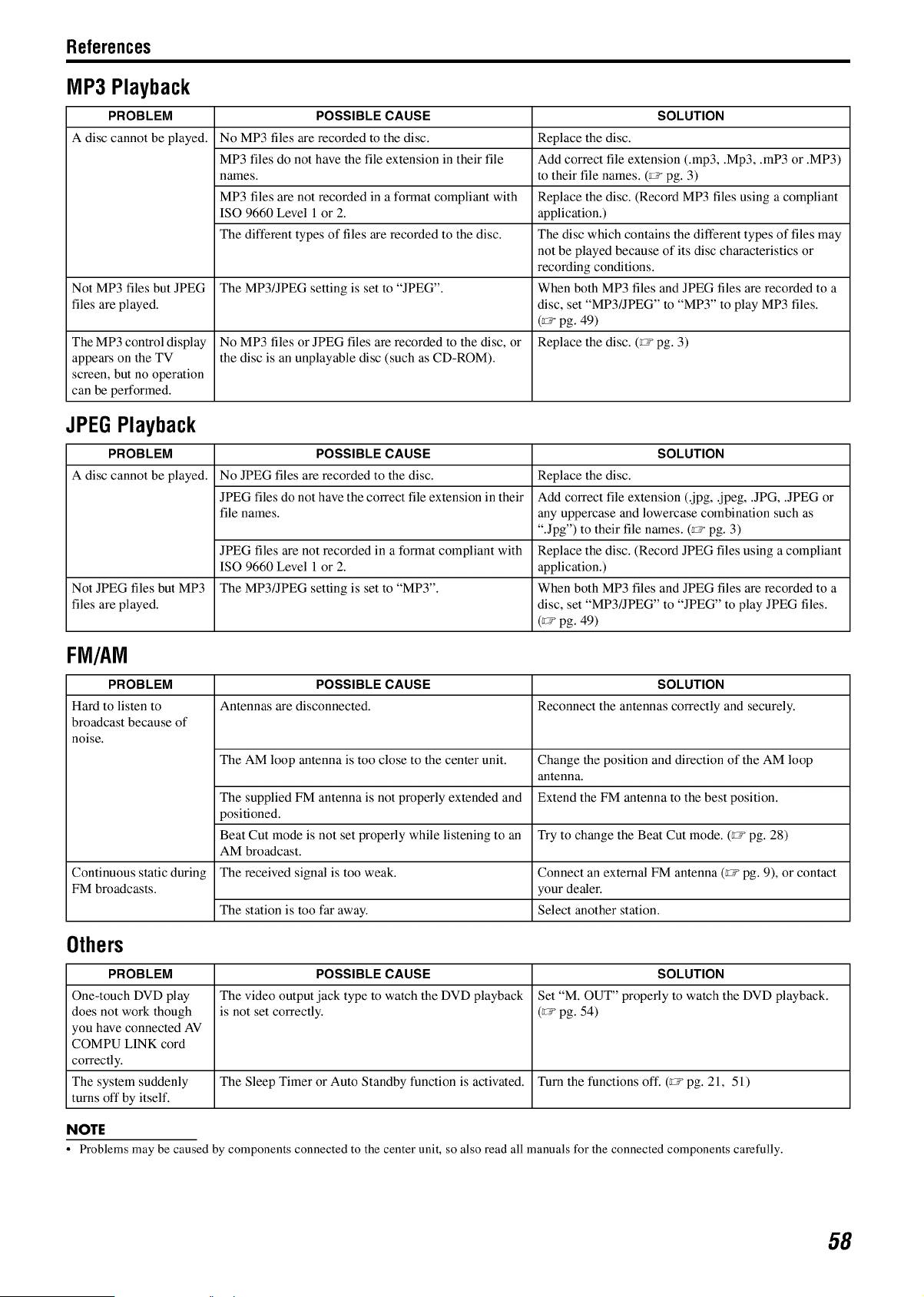
References
MP3 Playback
PROBLEM POSSIBLE CAUSE SOLUTION
A disc cannot be played. No MP3 files are recorded to the disc. Replace the disc.
MP3 files do not have the file extension in their file Add correct file extension (.mp3, .Mp3, .mP3 or .MP3)
names, to their file names. (r_ pg. 3)
MP3 files are not recorded in a format compliant with Replace the disc. (Record MP3 files using a compliant
ISO 9660 Level 1 or 2. application.)
The different types of files are recorded to the disc. The disc which contains the different types of files may
not be played because of its disc characteristics or
recording conditions.
Not MP3 files but JPEG The MP3/JPEG setting is set to "JPEG". When both MP3 files and JPEG files are recorded to a
files are played, disc, set "MP3/JPEG" to "MP3" to play MP3 files.
(r_ pg. 49)
The MP3 control display No MP3 files or JPEG files are recorded to the disc, or Replace the disc. (r_ pg. 3)
appears on the TV the disc is an unplayable disc (such as CD-ROM).
screen, but no operation
can be performed.
JPEG Playback
PROBLEM POSSIBLE CAUSE SOLUTION
A disc cannot be played. No JPEG files are recorded to the disc. Replace the disc.
JPEG files do not have the correct file extension in their Add correct file extension (.jpg, .jpeg, .JPG, .JPEG or
file names, any uppercase and lowercase combination such as
".Jpg") to their file names. (r_ pg. 3)
JPEG files are not recorded in a tbrmat compliant with Replace the disc. (Record JPEG files using a compliant
ISO 9660 Level 1 or 2. application.)
Not JPEG files but MP3 The MP3/JPEG setting is set to "MP3". When both MP3 files and JPEG files are recorded to a
files are played, disc, set "MP3/JPEG" to "JPEG" to play JPEG files.
(r_ pg. 49)
FM/AM
PROBLEM POSSIBLE CAUSE SOLUTION
Hard to listen to Antennas are disconnected. Reconnect the antennas correctly and securely.
broadcast because of
noise.
The AM loop antenna is too close to the center unit. Change the position and direction of the AM loop
antenna.
The supplied FM antenna is not properly extended and Extend the FM antenna to the best position.
positioned.
Beat Cut mode is not set properly while listening to an Try to change the Beat Cut mode. (r_ pg. 28)
AM broadcast.
Continuous static during The received signal is too weak. Connect an external FM antenna (_ pg. 9), or contact
FM broadcasts, your dealer.
The station is too far away. Select another station.
Others
PROBLEM
One-touch DVD play
does not work though
you have connected AV
COMPU LINK cord
correctly.
The system suddenly
turns off by itself.
POSSIBLE CAUSE
The video output jack type to watch the DVD playback
is not set correctly.
SOLUTION
Set "M. OUT" properly to watch the DVD playback.
(r_ pg. 54)
The Sleep Timer or Auto Standby function is activated. Turn the functions off. (r_ pg. 21, 51)
NOTE
• Problems may be caused by components connected to the center unit, so also read all manuals for the connected components carefully.
58
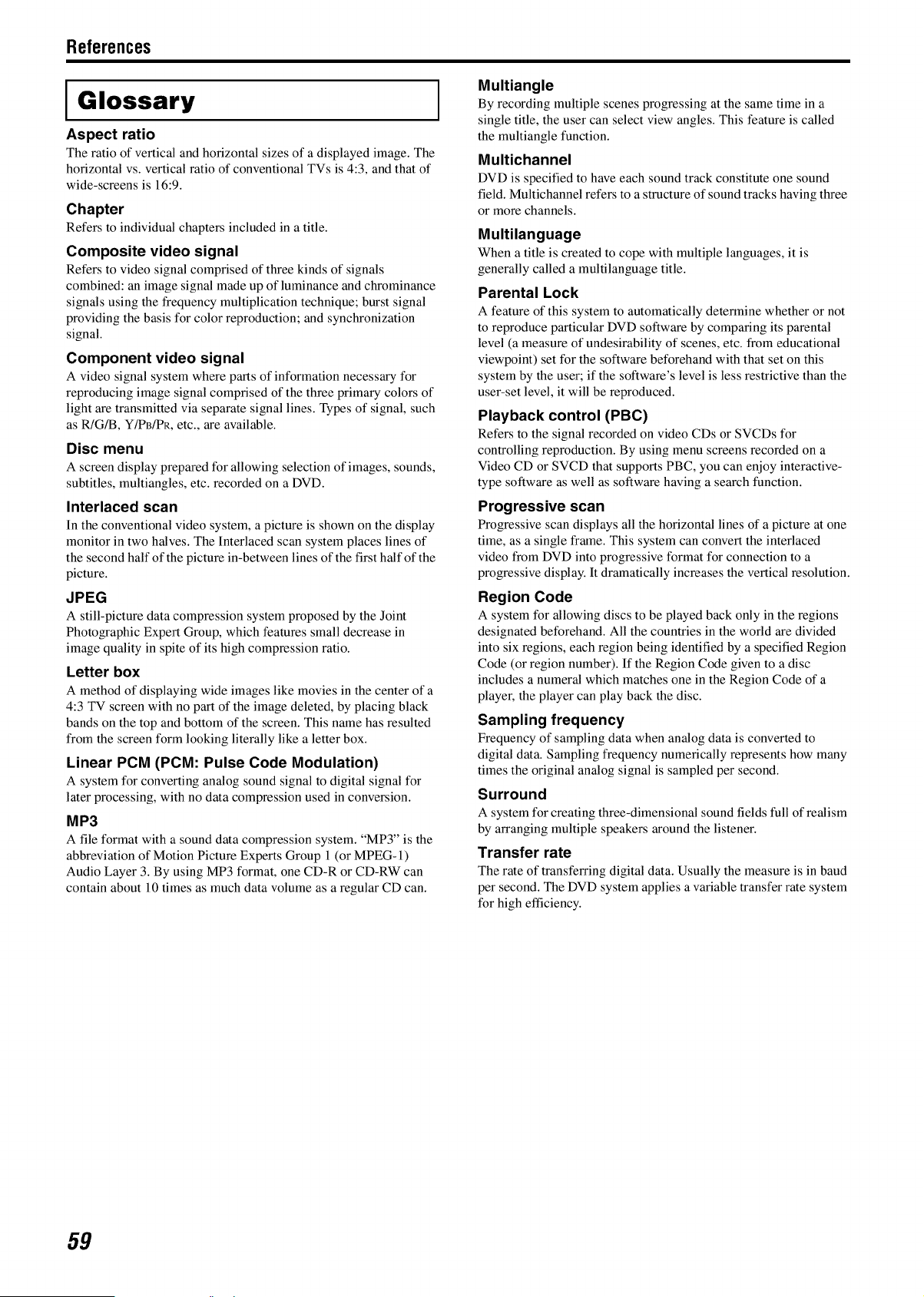
References
I Glossary
Aspect ratio
The ratio of vertical and horizontal sizes of a displayed image. The
horizontal vs. vertical ratio of conventional TVs is 4:3, and that of
wide-screens is 16:9.
Chapter
Refers to individual chapters included in a title.
Composite video signal
Refers to video signal comprised of three kinds of signals
combined: an image signal made up of luminance and chrominance
signals using the frequency multiplication technique; burst signal
providing the basis for color reproduction; and synchronization
signal.
Component video signal
A video signal system where parts of information necessary for
reproducing image signal comprised of the three primary colors of
light are transmitted via separate signal lines. Types of signal, such
as R/G/B, Y/PB/PR, etc., are available.
Disc menu
A screen display prepared tk?r allowing selection of images, sounds,
subtitles, multiangles, etc. recorded on a DVD.
Interlaced scan
In the conventional video system, a picture is shown on the display
monitor in two halves. The Interlaced scan system places lines of
the second half of the picture in-between lines of the first half of the
picture.
JPEG
A still-picture data compression system proposed by the Joint
Photographic Expert Group, which features small decrease in
image quality in spite of its high compression ratio.
Letter box
A method of displaying wide images like movies in the center of a
4:3 TV screen with no part of the image deleted, by placing black
bands on the top and bottom of the screen. This name has resulted
from the screen form looking literally like a letter box.
Linear PCM (PCM: Pulse Code Modulation)
A system for converting analog sound signal to digital signal for
later processing, with no data compression used in conversion.
MP3
A file format with a sound data compression system. "MP3" is the
abbreviation of Motion Picture Experts Group 1 (or MPEG-1)
Audio Layer 3. By using MP3 format, one CD-R or CD-RW can
contain about 10 times as much data volume as a regular CD can.
Multiangle
By recording multiple scenes progressing at the same time in a
single title, the user can select view angles. This feature is called
the multiangle function.
Multichannel
DVD is specified to have each sound track constitute one sound
field. Multichannel refers to a structure of sound tracks having three
or more channels.
Multilanguage
When a title is created to cope with multiple languages, it is
generally called a multilanguage title.
Parental Lock
A feature of this system to automatically determine whether or not
to reproduce particular DVD software by comparing its parental
level (a measure of undesirability of scenes, etc. from educational
viewpoint) set tk_r the software beforehand with that set on this
system by the user; if the software's level is less restrictive than the
user-set level, it will be reproduced.
Playback control (PBC)
Refers to the signal recorded on video CDs or SVCDs for
controlling reproduction. By using menu screens recorded on a
Video CD or SVCD that supports PBC, you can enjoy interactive-
type software as well as software having a search function.
Progressive scan
Progressive scan displays all the horizontal lines of a picture at one
time, as a single frame. This system can convert the interlaced
video from DVD into progressive tk_rmat for connection to a
progressive display. It dramatically increases the vertical resolution.
Region Code
A system for allowing discs to be played back only in the regions
designated betk?rehand. All the countries in the world are divided
into six regions, each region being identit]ed by a specified Region
Code (or region number). If the Region Code given to a disc
includes a numeral which matches one in the Region Code of a
player, the player can play back the disc.
Sampling frequency
Frequency of sampling data when analog data is converted to
digital data. Sampling frequency numerically represents how many
times the original analog signal is sampled per second.
Surround
A system for creating three-dimensional sound fields full of realism
by arranging multiple speakers around the listener.
Transfer rate
The rate of transferring digital data. Usually the measure is in baud
per second. The DVD system applies a variable transfer rate system
tier high efficiency.
59
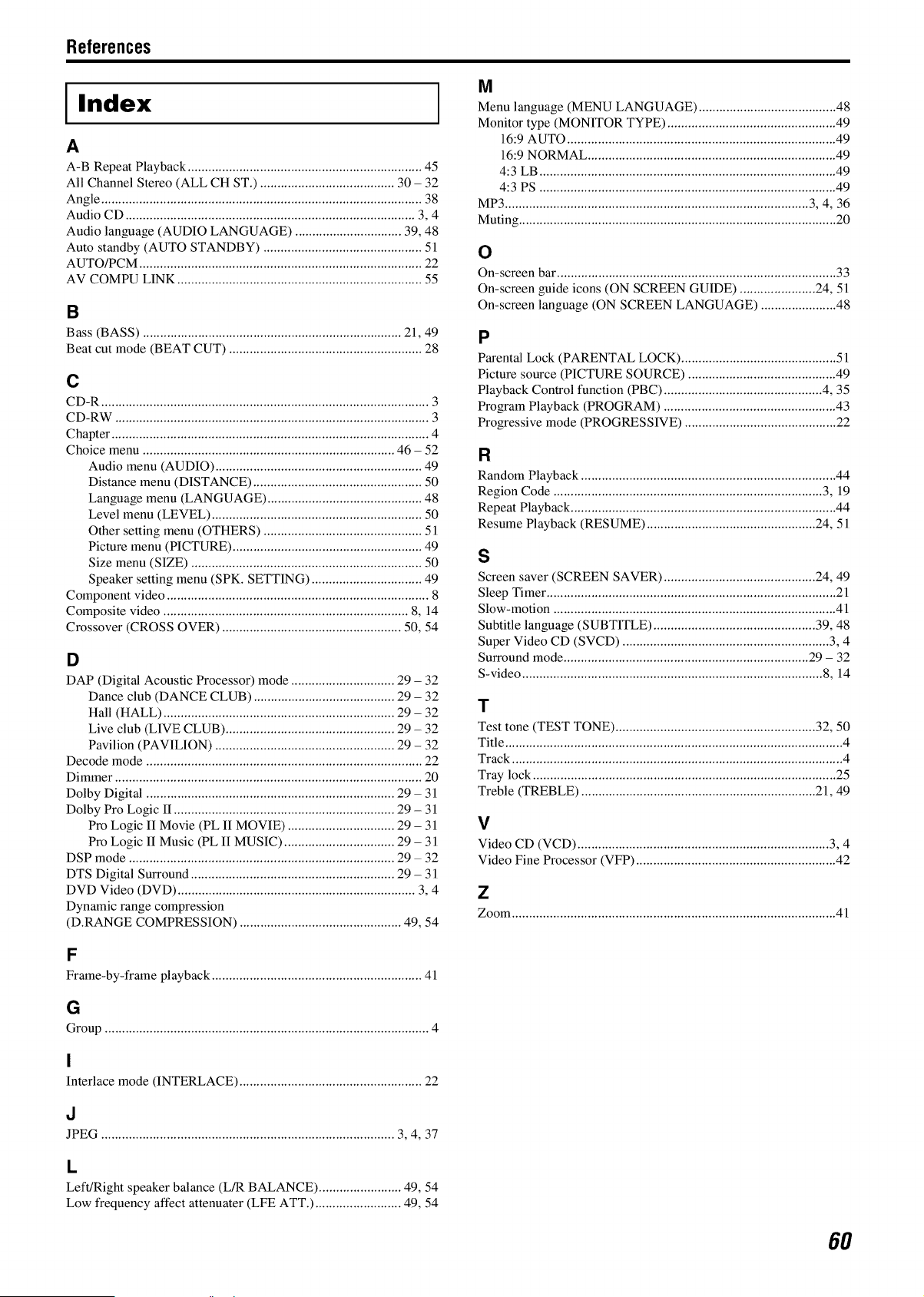
References
I Index
A
A-B Repeat Playback .................................................................... 45
All Channel Stereo (ALL CH ST.) ....................................... 30 - 32
Angle ............................................................................................. 38
Audio CD .................................................................................... 3, 4
Audio language (AUDIO LANGUAGE) ............................... 39, 48
Auto standby (AUTO STANDBY) .............................................. 51
AUTO/PCM .................................................................................. 22
AV COMPU LINK ....................................................................... 55
B
Bass (BASS) ........................................................................... 21, 49
Beat cut mode (BEAT CUT) ........................................................ 28
C
CD-R ............................................................................................... 3
CD-RW ........................................................................................... 3
Chapter ............................................................................................ 4
Choice menu ......................................................................... 46 - 52
Audio menu (AUDIO) ............................................................ 49
Distance menu (DISTANCE) ................................................. 50
Language menu (LANGUAGE) ............................................. 48
Level menu (LEVEL) ............................................................. 50
Other setting menu (OTHERS) .............................................. 51
Picture menu (PICTURE) ....................................................... 49
Size menu (SIZE) ................................................................... 50
Speaker setting menu (SPK. SETTING) ................................ 49
Component video ............................................................................ 8
Composite video ....................................................................... 8, 14
Crossover (CROSS OVER) .................................................... 50, 54
D
DAP (Digital Acoustic Processor) mode .............................. 29 - 32
Dance club (DANCE CLUB) ......................................... 29 - 32
Hall (HALL) ................................................................... 29 - 32
Live club (LIVE CLUB) ................................................. 29 - 32
Pavilion (PAVILION) .................................................... 29 - 32
Decode mode ................................................................................ 22
Dimmer ......................................................................................... 20
Dolby Digital ........................................................................ 29 - 31
Dolby Pro Logic II ................................................................ 29 - 31
Pro Logic II Movie (PL II MOVIE) ............................... 29 - 31
Pro Logic II Music (PL II MUSIC) ................................ 29 - 31
DSP mode ............................................................................. 29 - 32
DTS Digital Surround ........................................................... 29 - 31
DVD Video (DVD) ..................................................................... 3, 4
Dynamic range compression
(D.RANGE COMPRESSION) ............................................... 49, 54
F
Frame-by-frame playback ............................................................. 41
G
Group .............................................................................................. 4
I
Interlace mode (INTERLACE) ..................................................... 22
J
JPEG ..................................................................................... 3, 4, 37
1.
Left/Right speaker balance (L/R BALANCE) ........................ 49, 54
Low frequency affect attenuater (LFE ATT.) ......................... 49, 54
M
Menu language (MENU LANGUAGE) ........................................ 48
Monitor type (MONITOR TYPE) ................................................. 49
16:9 AUTO .............................................................................. 49
16:9 NORMAL ........................................................................ 49
4:3 LB ...................................................................................... 49
4:3 PS ...................................................................................... 49
MP3 ........................................................................................ 3, 4, 36
Muting ............................................................................................ 20
O
On-screen bar ................................................................................. 33
On-screen guide icons (ON SCREEN GUIDE) ...................... 24, 51
On-screen language (ON SCREEN LANGUAGE) ...................... 48
P
Parental Lock (PARENTAL LOCK) ............................................. 51
Picture source (PICTURE SOURCE) ........................................... 49
Playback Control function (PBC) .............................................. 4, 35
Program Playback (PROGRAM) .................................................. 43
Progressive mode (PROGRESSIVE) ............................................ 22
R
Random Playback .......................................................................... 44
Region Code .............................................................................. 3, 19
Repeat Playback ............................................................................. 44
Resume Playback (RESUME) ................................................. 24, 51
S
Screen saver (SCREEN SAVER) ............................................ 24, 49
Sleep Timer .................................................................................... 21
Slow-motion .................................................................................. 41
Subtitle language (SUBTITLE) ............................................... 39, 48
Super Video CD (SVCD) ............................................................ 3, 4
Surround mode ....................................................................... 29 - 32
S-video ....................................................................................... 8, 14
T
Test tone (TEST TONE) .......................................................... 32, 50
Title .................................................................................................. 4
Track ................................................................................................ 4
Tray lock ........................................................................................ 25
Treble (TREBLE) .................................................................... 21, 49
V
Video CD (VCD) ......................................................................... 3, 4
Video Fine Processor (VFP) .......................................................... 42
Z
Zoom .............................................................................................. 41
60
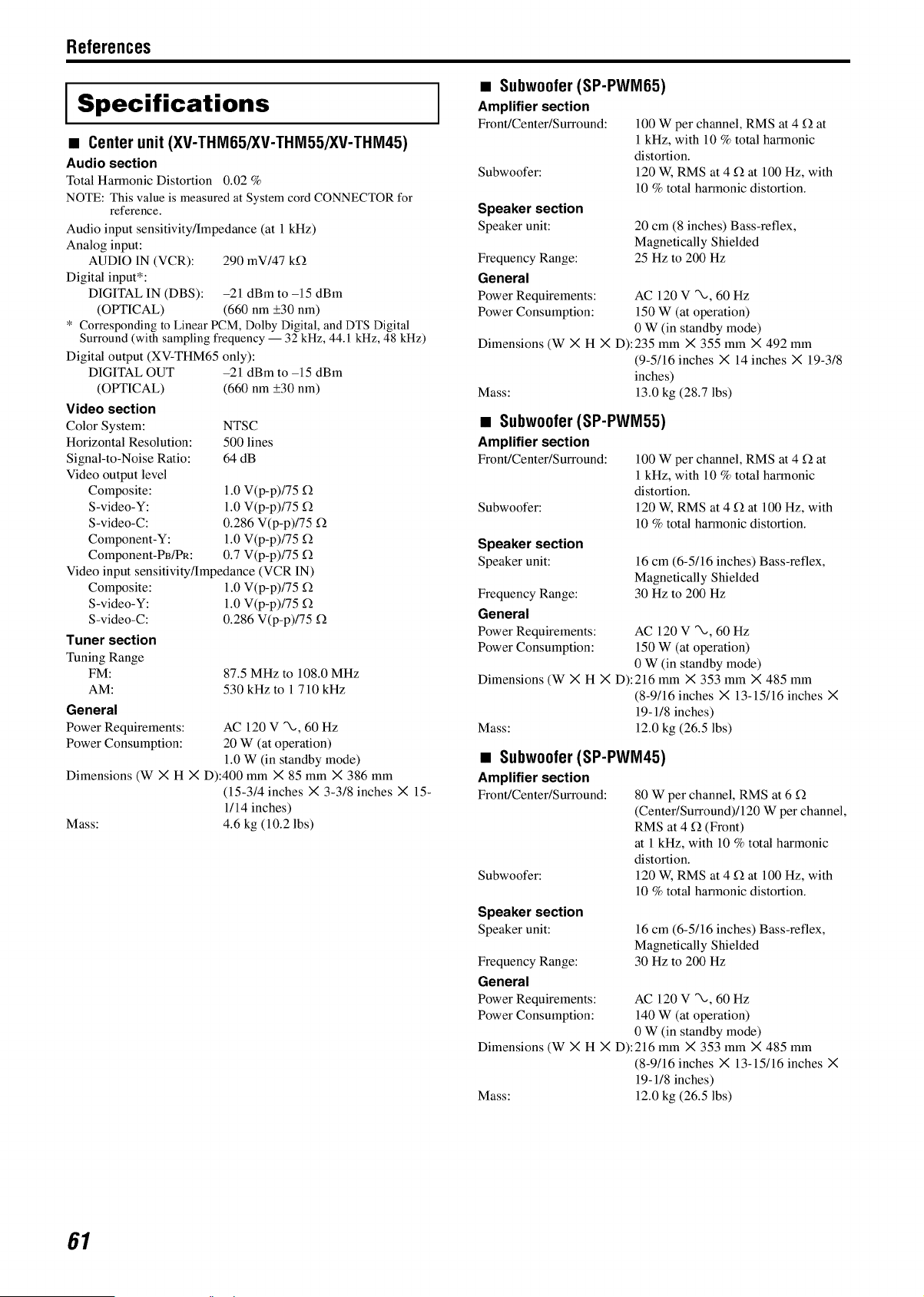
References
I Specifications
• Center unit (XV-THM65/XV-THM55/XV-THM45)
Audio section
Total Harmonic Distortion 0.02 °7o
NOTE: This value is measured at System cord CONNECTOR for
reference.
Audio input sensitivity/Impedance (at 1 kHz)
Analog input:
AUDIO IN (VCR): 290 mV/47 k_
Digital input*:
DIGITAL IN (DBS): -21 dBm to -15 dBm
(OPTICAL) (660 nm +30 nm)
* Corresponding to Linear PCM, Dolby Digital, and DTS Digital
Surround (with sampling frequency -- 32 kHz, 44.1 kHz, 48 kHz)
Digital output (XV-THM65 only):
DIGITAL OUT -21 dBm to -15 dBm
(OPTICAL) (660 nm +30 nm)
Video section
Color System: NTSC
Horizontal Resolution: 500 lines
Signal-to-Noise Ratio: 64 dB
Video output level
Composite: 1.0 V(p-p)/75
S-video-Y: 1.0 V(p-p)/75
S-video-C: 0.286 V(p-p)/75
Component-Y: 1.0 V(p-p)/75
Component-PB/PR: 0.7 V(p-p)/75 _)
Video input sensitivity!Impedance (VCR IN)
Composite:
S-video-Y:
S-video-C:
Tuner section
Tuning Range
FM:
AM:
General
Power Requirements:
Power Consumption:
1.0 V(p-p)/75
1.0 V(p-p)/75
0.286 V(p-p)/75
87.5 MHz to 108.0 MHz
530 kHz to 1 710 kHz
AC 120 V %., 60 Hz
20 W (at operation)
1.0 W (in standby mode)
Dimensions (W X H X D):400 mm X 85 mm X 386 mm
(15-3/4 inches X 3-3/8 inches X 15-
1/14 inches)
Mass: 4.6 kg (10.2 lbs)
• Subwoofer (SP-PWM65)
Amplifier section
Front/Center/Surround:
Subwoo_r:
Speaker section
Speaker unit:
Frequency Range:
General
Power Requirements:
Power Consumption:
100 W per channel, RMS at 4 _ at
1 kHz, with l0 % total harmonic
distortion.
120 W, RMS at 4 _ at 100 Hz, with
10 % total harmonic distortion.
20 cm (8 inches) Bass-reflex,
Magnetically Shielded
25 Hz to 200 Hz
AC 120 V %`, 60 Hz
150 W (at operation)
0 W (in standby mode)
Dimensions (W X H X D):235 mm X 355 mm X 492 mm
(9-5/16 inches X 14 inches X 19-3/8
inches)
Mass: 13.0 kg (28.7 lbs)
• Subwoofer (SP-PWM55)
Amplifier section
Front/Center/Surround:
Subwoofer:
Speaker section
Speaker unit:
Frequency Range:
General
Power Requirements:
Power Consumption:
100 W per channel, RMS at 4 _ at
1 kHz, with l0 % total harmonic
distortion.
120 W, RMS at 4 _ at 100 Hz, with
10 % total harmonic distortion.
16 cm (6-5/16 inches) Bass-reflex,
Magnetically Shielded
30 Hz to 200 Hz
AC 120 V %`, 60 Hz
150 W (at operation)
0 W (in standby mode)
Dimensions (W X H X D):216 mm X 353 mm X 485 mm
(8-9/16 inches X 13-15/16 inches X
19-1/8 inches)
Mass: 12.0 kg (26.5 lbs)
• Subwoofer (SP-PWM45)
Amplifier section
Front/Center/Surround:
Subwoo_r:
Speaker section
Speaker unit:
Frequency Range:
General
Power Requirements:
Power Consumption:
80 W per channel, RMS at 6
(Center/Surround)/120 W per channel,
RMS at 4 _ (Front)
at 1 kHz, with 10 % total harmonic
distortion.
120 W, RMS at 4 _ at 100 Hz, with
10 % total harmonic distortion.
16 cm (6-5/16 inches) Bass-reflex,
Magnetically Shielded
30 Hz to 200 Hz
AC 120 V %`, 60 Hz
140 W (at operation)
0 W (in standby mode)
Dimensions (W X H X D):216 mm X 353 mm X 485 mm
(8-9/16 inches X 13-15/16 inches X
19-1/8 inches)
Mass: 12.0 kg (26.5 lbs)
61
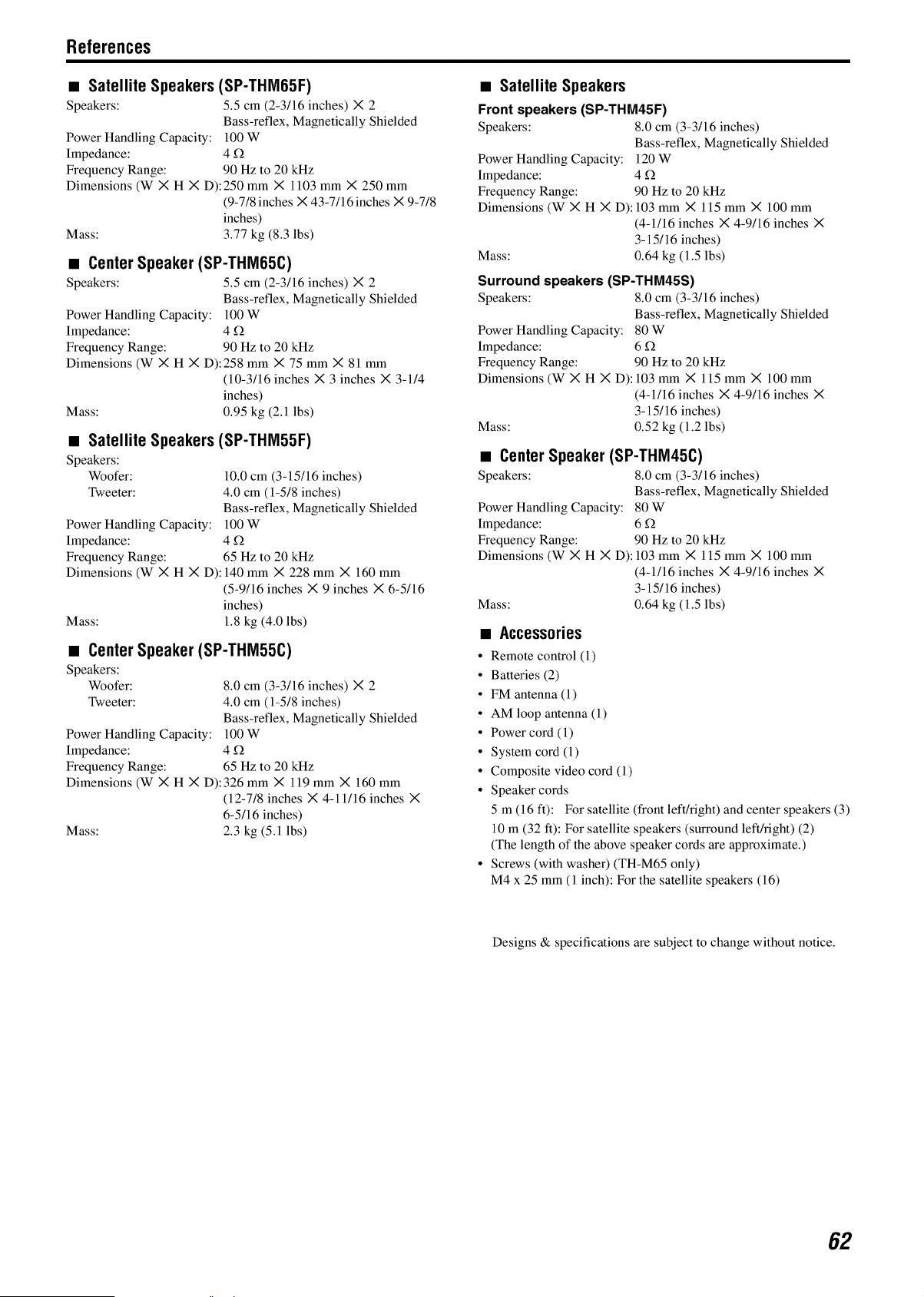
References
• Satellite Speakers (SP-THM65F)
Speakers: 5.5 cm (2-3/16 inches) X 2
Bass-reflex, Magnetically Shielded
Power Handling Capacity: 100 W
Impedance: 4 _1
Frequency Range: 90 Hz to 20 kHz
Dimensions (W X H X D):250 mm X 1103 mm X 250mm
(9-7/8 inches X 43-7/16 inches X 9-7/8
inches)
Mass: 3.77 kg (8.3 lbs)
• Center Speaker (SP-THM65C)
Speakers: 5.5 cm (2-3/16 inches) X 2
Bass-reflex, Magnetically Shielded
Power Handling Capacity: 100W
Impedance: 4
Frequency Range: 90 Hz to 20 kHz
Dimensions (W X H X D):258 mm X 75 mm X 81 mm
(10-3/16 inches X 3 inches X 3-1/4
inches)
Mass: 0.95 kg (2.1 lbs)
• Satellite Speakers
Speakers:
Woofer:
Tweeter:
Power Handling Capacity:
Impedance:
Frequency Range:
(SP-THM55F)
10.0 cm (3-15/16 inches)
4.0 cm ( 1-5/8 inches)
Bass-reflex, Magnetically Shielded
100 W
4f2
65 Hz to 20 kHz
Dimensions (W X H X D): 140 mm X 228 mm X 160 mm
(5-9/16 inches X 9 inches X 6-5/16
inches)
Mass: 1.8 kg (4.0 lbs)
• CenterSpeaker(SP-THM55C)
Speakers:
Woofer:
Tweeter:
Power Handling Capacity:
Impedance:
Frequency Range:
Dimensions (W X H X D):
Mass:
8.0 cm (3-3/16 inches) X 2
4.0 cm (1-5/8 inches)
Bass-reflex, Magnetically Shielded
100 W
4_
65 Hz to 20 kHz
326mm X ll9mm X 160mm
(12-7/8 inches X 4-11116 inches X
6-5/16 inches)
2.3 kg (5.1 lbs)
• Satellite Speakers
Front speakers (SP-THM45F)
Speakers: 8.0 cm (3-3/16 inches)
Bass-reflex, Magnetically Shielded
Power Handling Capacity: 120 W
Impedance: 4 _)
Frequency Range: 90 Hz to 20 kHz
Dimensions (W X H X D): 103 mm X 115 mm X 100mm
(4-1/16 inches X 4-9/16 inches X
3-15/16 inches)
Mass: 0.64 kg (1.5 lbs)
Surround speakers (SP-THM45S)
Speakers: 8.0 cm (3-3/16 inches)
Bass-reflex, Magnetically Shielded
Power Handling Capacity: 80 W
Impedance: 6 _1
Frequency Range: 90 Hz to 20 kHz
Dimensions (W X H X D): 103 mm X 115 mm X 100 mm
(4-1/16 inches X 4-9/16 inches X
3-15/16 inches)
Mass: 0.52 kg (1.2 lbs)
• Center Speaker (SP-THM45C)
Speakers: 8.0 cm (3-3/16 inches)
Bass-reflex, Magnetically Shielded
Power Handling Capacity: 80 W
Impedance: 6 _)
Frequency Range: 90 Hz to 20 kHz
Dimensions (W X H X D): 103 mm X 115 mm X 100mm
(4-1/16 inches X 4-9/16 inches X
3-15/16 inches)
Mass: 0.64 kg (1.5 lbs)
• Accessories
• Remote control (l)
° Batteries (2)
° FM antenna (1)
• AM loop antenna (1)
• Powercord (1)
° System cord (1)
• Composite video cord (1)
• Speaker cords
5 m (16 It): For satellite (front left/right) and center speakers (3)
10 m (32 It): For satellite speakers (surround left/right) (2)
(The length of the above speaker cords are approximate.)
° Screws (with washer) (TH-M65 only)
M4 x 25 mm (1 inch): For the satellite speakers (16)
Designs & specifications are subject to change without notice.
02
Authorized Service Centers
HOW TO LOCATE YOUR JVC SERVICE CENTER
TOLL FREE: 1 (800) 537-5722
http://www.jvc.com
Dear Customer,
In order to receive the most satisfaction from your purchase, please read the instruction booklet before operating
the unit. In the event that repairs are necessary, please call 1 (800) 537-5722 for your nearest authorized servicer
or visit our website at www.JVC.com
Remember to retain your Bill of Sale for Warranty Service.
Do not service the television yourself
Caution
To prevent electrical shock, do not open the cabinet. There are no user serviceable parts inside. Please
refer to qualified service personnel for repairs.
Accessories
To purchase accessories for your JVC product, please call toll free: 1 (800)882-2345 or on the web at
www.JVC.com
63
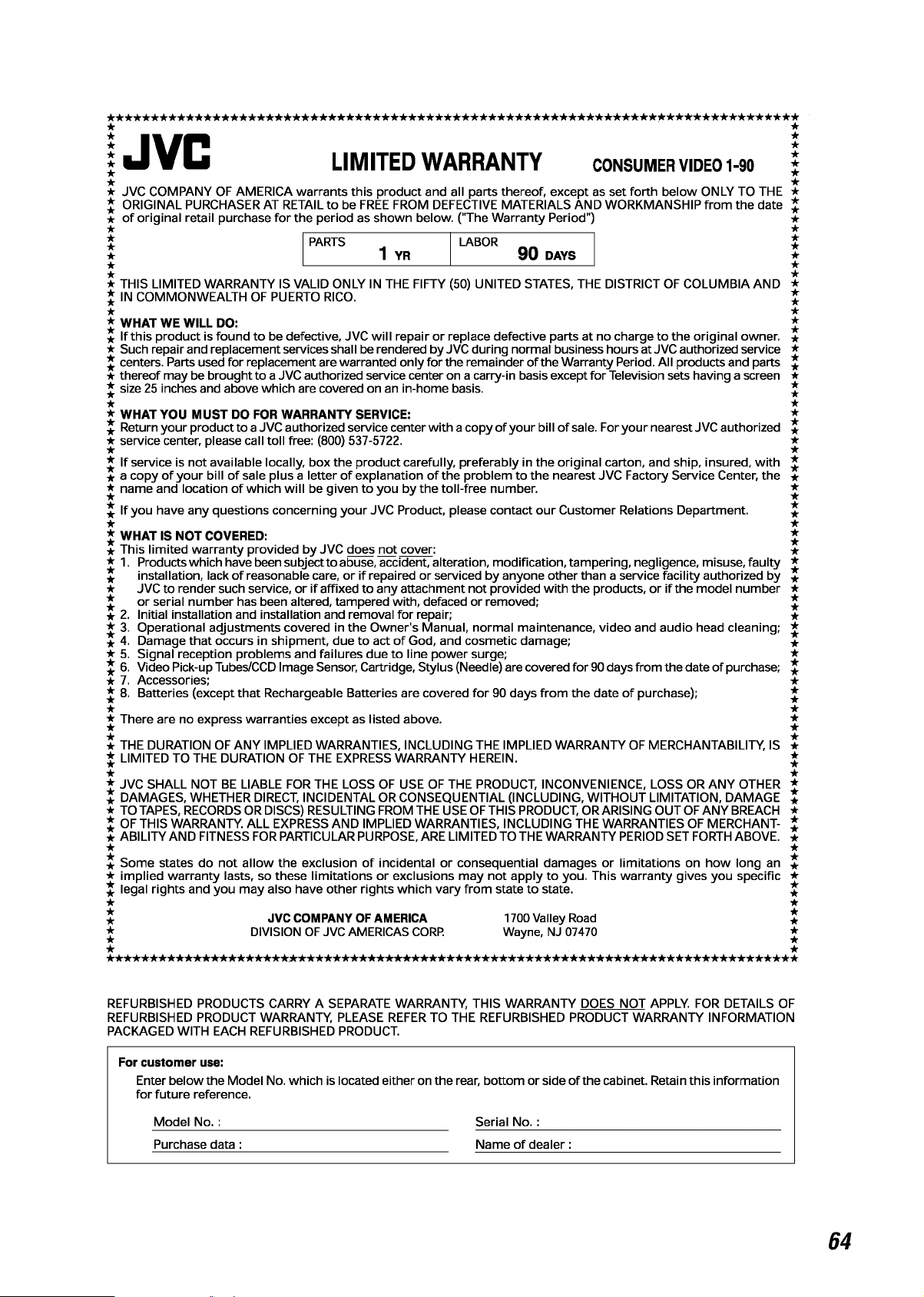
_r _r
'JVC "
_r
* LIMITED WARRANTY CONSUMER VIDEO 1-90 *
Yr 4r
Yr #r
* JVC COMPANY OF AMERICA warrants this product and all parts thereof, except as set forth below ONLY TO THE *
#r
* ORIGINAL PURCHASER AT RETAIL to be FREE FROM DEFECTIVE MATERIALS AND WORKMANSHIP from the date .
_r
* of original retail purchase for the period as shown below. ("The Warranty Period") *
_r _r
_. PARTS LABOR
. 1 YR 90 DAYS *
_r _r
_r #r
* THIS LIMITED WARRANTY IS VALID ONLY IN THE FIFTY (50) UNITED STATES, THE DISTRICT OF COLUMBIA AND *
* IN COMMONWEALTH OF PUERTO RICO. *
* WHAT WE WILL DO: *
yr *
. If this product is found to be defective, JVC will repair or replace defective parts at no charge to the original owner..
* Such repair and replacement services shall be rendered by JVC during normal business hours at JVC authorized service *
_r
* centers. Parrs used for replacement are warranted only for the remainder of the Warranty Period. All products and parts .
4r
* thereof may be brought to a JVC authorized service center on a carry-in basis except for Television sets having a screen *
* size 25 inches and above which are covered on an in-home basis. *
* WHAT YOU MUST DO FOR WARRANTY SERVICE: *
_r _r. Return your product to a JVC authorized service center with a copy of your bill of sale. For your nearest JVC authorized *
* service center, please call toll free: (800) 537-5722. *
_r _r
* If service is not available locally, box the product carefully, preferably in the original carton, and ship, insured, with .
_r
. a copy of your bill of sale plus a letter of explanation of the problem to the nearest JVC Factory Service Center, the .
* name and location of which will be given to you by the toll-free number. *
. If you have any questions concerning your JVC Product, please contact our Customer Relations DeparLment. .
_r _r
* WHAT IS NOT COVERED: *
_r _r
. This limited warranty provided by JVC does not cover: .
* 1. Productswhich have been subjectto abuse, accident, alteration, modification, tampering, negligence, misuse, faulty *
_r _r
. installation, lack of reasonable care, or if repaired or serviced by anyone other than a service facility authorized by *
* JVC to render such service, or if affixed to any attachment not provided with the products, or if the model number *
_r _r
. or serial number has been altered, tampered with. defaced or removed; .
.2. Initial installation and installation and removal for repair; .
* 3. Operational adjustments covered in the Owner's Manual, normal maintenance, video and audio head cleaning; *
_r _r
.4. Damage that occurs in shipment, due to act of God, and cosmetic damage; .
* 5. Signal reception problems and failures due to line power surge; *
* 6. Video Pick-up Tubes/CCD Image Sensor, Cartridge, Stylus (Needle) are covered for 90 days from the date of purchase; *
_r _r
.7. Accessories; *
* 8. Batteries (except that Rechargeable Batteries are covered for 90 days from the date of purchase); *
_r _r
* There are no express warranties except as listed above. *
_r _r
* THE DURATION OF ANY IMPLIED WARRANTIES, INCLUDING THE IMPLIED WARRANTY OF MERCHANTABILITY, IS *
* LIMITED TO THE DURATION OF THE EXPRESS WARRANTY HEREIN. *
_r _r
* JVC SHALL NOT BE LIABLE FOR THE LOSS OF USE OF THE PRODUCT, INCONVENIENCE, LOSS OR ANY OTHER *
. DAMAGES, WHETHER DIRECT, INCIDENTAL OR CONSEQUENTIAL (INCLUDING. WITHOUT LIMITATION, DAMAGE .*
* TO TAPES, RECORDS OR DISCS) RESULTING FROM THE USE OF THIS PRODUCT, ORARISING OUT OF ANY BREACH *
* OF THIS WARRANTY. ALL EXPRESS AND IMPLIED WARRANTIES. INCLUDING THE WARRANTIES OF MERCHANT- .
* ABILITY AND FITNESS FOR PARTICULAR PU RPOSE, ARE LIMITED TO THE WARRANTY PERIOD SET FORTH ABOVE. *
_r _r
. Some states do not allow the exclusion of incidental or consequential damages or limitations on how long an .
* implied warranty lasts, so these limitations or exclusions may not apply to you. This warranty gives you specific *
_r
* legal rights and you may also have other rights which vary from state to state.
. JVC COMPANY OF AMERICA 1700 Valley Road .
* DIVISION OF JVC AMERICAS CORR Wayne, NJ 07470 *
REFURBISHED PRODUCTS CARRY A SEPARATE WARRANTY, THIS WARRANTY DOES NOT APPLY. FOR DETAILS OF
REFURBISHED PRODUCT WARRANTY, PLEASE REFER TO THE REFURBISHED PRODUCT WARRANTY INFORMATION
PACKAGED WITH EACH REFURBISHED PRODUCT.
For customer use:
Enter below the Model No. which is located either on the rear, bottom or side of the cabinet. Retain this information
for future reference.
Model No. : Serial No. :
Purchase data : Name of dealer :
64
,:F
"1-
II
O1
m
63
m
r-
-4
"1"
m
m
.<
-4
m
JVC
VICTOR COMPANY OF JAPAN, LIMITED
EN
© 2003 VICTOR COMPANY OF JAPAN, LIMITED
_ 0303SKMIDEJEM