
FULL MANUAL
HW-S800B / HW-S801B
Imagine the possibilities
Thank you for purchasing this Samsung product.
To receive more complete service, please register your product at
www.samsung.com/register
Para evitar cualquier avería o daños, lea detalladamente este manual de instrucciones antes de conectar y utilizar este aparato.
Conserve el manual para referencia futura. (Sólo México)
ENG - 2
SAFETY INFORMATION
SAFETY WARNINGS
TO REDUCE THE RISK OF ELECTRIC SHOCK, DO NOT REMOVE THE
COVER (OR BACK).
NO USER-SERVICEABLE PARTS ARE INSIDE. REFER SERVICING TO
QUALIFIED SERVICE PERSONNEL.
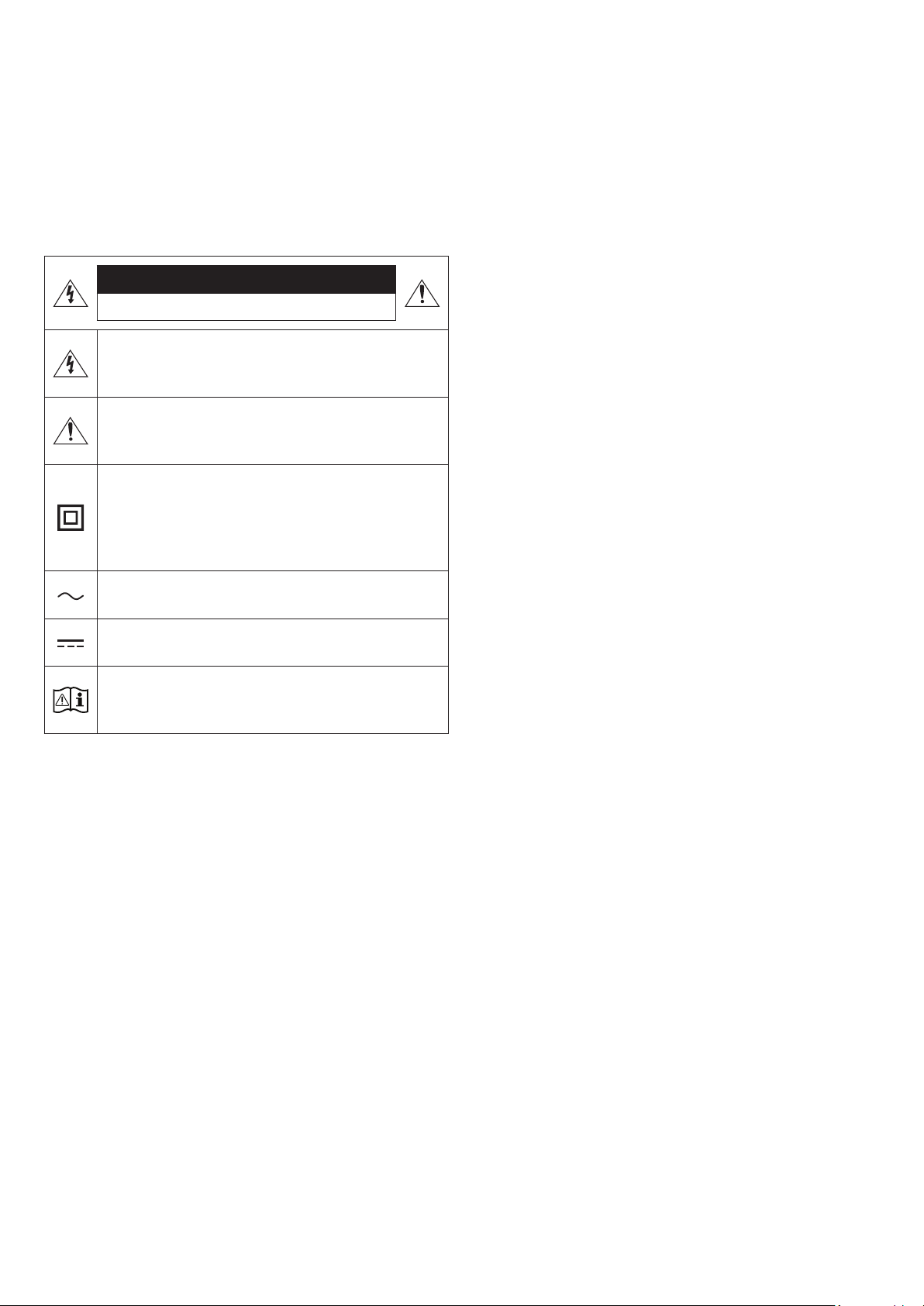
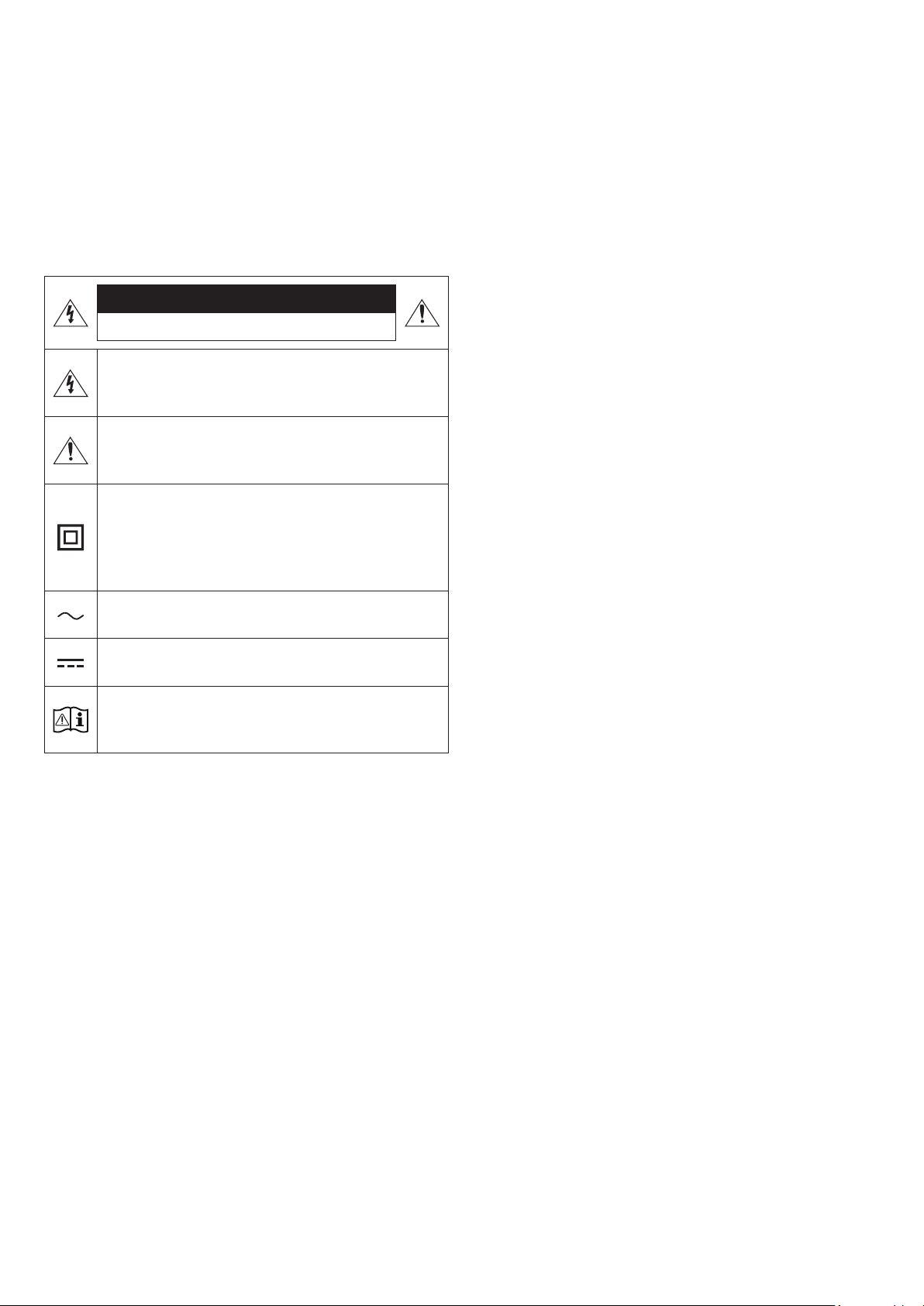
Refer to the table below for an explanation of symbols which may be
on your Samsung product.
CAUTION
RISK OF ELECTRIC SHOCK. DO NOT OPEN.
This symbol indicates that high voltage is present inside.
It is dangerous to make any kind of contact with any
internal part of this product.
This symbol indicates that this product has included
important literature concerning operation and
maintenance.
Class II product : This symbol indicates that a safety
connection to electrical earth (ground) is not required.
If this symbol is not present on a product with a power
cord, the product MUST have a reliable connection to
protective earth (ground).
AC voltage : Rated voltage marked with this symbol is AC
voltage.
DC voltage : Rated voltage marked with this symbol is DC
voltage.
Caution. Consult Instructions for use : This symbol
instructs the user to consult the user manual for further
safety related information.
WARNING
• To reduce the risk of re or electric shock, do not expose this
appliance to rain or moisture.
CAUTION
• TO PREVENT ELECTRIC SHOCK, MATCH WIDE BLADE OF PLUG TO
WIDE SLOT, FULLY INSERT.
• This apparatus shall always be connected to a AC outlet with a
protective grounding connection.
• To disconnect the apparatus from the mains, the plug must be
pulled out from the mains socket, therefore the mains plug shall
be readily operable.
• Do not expose this apparatus to dripping or splashing. Do not put
objects lled with liquids, such as vases, on the apparatus.
• To turn this apparatus off completely, you must pull the power
plug out of the wall socket. Consequently, the power plug must be
easily and readily accessible at all times.

ENG - 3
PRECAUTIONS
1. Ensure that the AC power supply in your house complies with the
power requirements listed on the identication sticker located
on the bottom of your product. Install your product horizontally,
on a suitable base (furniture), with enough space around it for
ventilation (7~10 cm). Make sure the ventilation slots are not
covered. Do not place the unit on ampliers or other equipment
which may become hot. This unit is designed for continuous use.
To fully turn off the unit, disconnect the AC plug from the wall
outlet. Unplug the unit if you intend to leave it unused for a long
period of time.
2. During thunderstorms, disconnect the AC plug from the wall
outlet. Voltage peaks due to lightning could damage the unit.
3. Do not expose the unit to direct sunlight or other heat sources.
This could lead to overheating and cause the unit to malfunction.
4. Protect the product from moisture (i.e. vases), and excess heat
(e.g. a replace) or equipment creating strong magnetic or electric
elds. Unplug the power cable from the AC wall socket if the unit
malfunctions. Your product is not intended for industrial use. It is
for personal use only. Condensation may occur if your product has
been stored in cold temperatures. If transporting the unit during
the winter, wait approximately 2 hours until the unit has reached
room temperature before using.
5. Fire or explosion may occur, resulting in damage to the remote
control or personal injury.
• Do not apply shock to the remote control.
• Be careful not to let foreign substances such as metal, liquid, or
dust come in contact with the charging terminal of the remote
control.
• When the remote control is damaged or you smell smoke or
burning fumes, immediately stop operation and then repair it at
the Samsung service center.
• Do not arbitrarily disassemble the remote control.
• Be careful not to let infants or pets suck or bite the remote
control. Fire or explosion may occur, resulting in damage to the
remote control or personal injury.

ENG - 4
CONTENTS
01 Checking the Components 6
02 Product Overview 7
Top Panel of the Soundbar. . . . . . . . . . . . . . . . . . . . . . . . . . . . . . . . . . . . . . . . . . . . . . . . . . . . . . . . . . . . . . . . . . . . . . . . . . . . . . . . . . . . . . . . . . . . . . . . . . . . . .7
Rear Panel of the Soundbar. . . . . . . . . . . . . . . . . . . . . . . . . . . . . . . . . . . . . . . . . . . . . . . . . . . . . . . . . . . . . . . . . . . . . . . . . . . . . . . . . . . . . . . . . . . . . . . . . . . . 8
03 Using the Soundbar Remote Control 9
About the Remote control . . . . . . . . . . . . . . . . . . . . . . . . . . . . . . . . . . . . . . . . . . . . . . . . . . . . . . . . . . . . . . . . . . . . . . . . . . . . . . . . . . . . . . . . . . . . . . . . . . . . . 9
How to Use the Remote Control . . . . . . . . . . . . . . . . . . . . . . . . . . . . . . . . . . . . . . . . . . . . . . . . . . . . . . . . . . . . . . . . . . . . . . . . . . . . . . . . . . . . . . . . . . . . . . . . 9
Active Voice Amplier (AVA) . . . . . . . . . . . . . . . . . . . . . . . . . . . . . . . . . . . . . . . . . . . . . . . . . . . . . . . . . . . . . . . . . . . . . . . . . . . . . . . . . . . . . . . . . . . . . . . . . . .11
Using the Hidden Buttons (Buttons with more than one function). . . . . . . . . . . . . . . . . . . . . . . . . . . . . . . . . . . . . . . . . . . . . . . . . . . . . . . . . . . . . . . . .11
Output specications for the different sound effect modes . . . . . . . . . . . . . . . . . . . . . . . . . . . . . . . . . . . . . . . . . . . . . . . . . . . . . . . . . . . . . . . . . . . . . . .12
Adjusting the Soundbar volume with a TV remote control . . . . . . . . . . . . . . . . . . . . . . . . . . . . . . . . . . . . . . . . . . . . . . . . . . . . . . . . . . . . . . . . . . . . . . . 13
04 Connecting the Soundbar 14
Connecting the power and units. . . . . . . . . . . . . . . . . . . . . . . . . . . . . . . . . . . . . . . . . . . . . . . . . . . . . . . . . . . . . . . . . . . . . . . . . . . . . . . . . . . . . . . . . . . . . . . 14
‒ Manually connecting the Subwoofer. . . . . . . . . . . . . . . . . . . . . . . . . . . . . . . . . . . . . . . . . . . . . . . . . . . . . . . . . . . . . . . . . . . . . . . . . . . . . . . . . . . . . . . . 15
‒ LED Indicator Lights on the Rear of Subwoofer. . . . . . . . . . . . . . . . . . . . . . . . . . . . . . . . . . . . . . . . . . . . . . . . . . . . . . . . . . . . . . . . . . . . . . . . . . . . . . . 16
Connecting an SWA-9500S (Sold Separately) to your Soundbar . . . . . . . . . . . . . . . . . . . . . . . . . . . . . . . . . . . . . . . . . . . . . . . . . . . . . . . . . . . . . . . . . . 16
05 Connecting to a TV 17
Connecting the TV that supports HDMI ARC (Audio Return Channel) . . . . . . . . . . . . . . . . . . . . . . . . . . . . . . . . . . . . . . . . . . . . . . . . . . . . . . . . . . . . . .17
Connecting via Bluetooth. . . . . . . . . . . . . . . . . . . . . . . . . . . . . . . . . . . . . . . . . . . . . . . . . . . . . . . . . . . . . . . . . . . . . . . . . . . . . . . . . . . . . . . . . . . . . . . . . . . . . 18
Connecting via Wi-Fi . . . . . . . . . . . . . . . . . . . . . . . . . . . . . . . . . . . . . . . . . . . . . . . . . . . . . . . . . . . . . . . . . . . . . . . . . . . . . . . . . . . . . . . . . . . . . . . . . . . . . . . . . 19
Connecting to a TV that supports Dolby Atmos . . . . . . . . . . . . . . . . . . . . . . . . . . . . . . . . . . . . . . . . . . . . . . . . . . . . . . . . . . . . . . . . . . . . . . . . . . . . . . . . . 20
Using the Q-Symphony Function . . . . . . . . . . . . . . . . . . . . . . . . . . . . . . . . . . . . . . . . . . . . . . . . . . . . . . . . . . . . . . . . . . . . . . . . . . . . . . . . . . . . . . . . . . . . . . .21
Using the Spacet sound . . . . . . . . . . . . . . . . . . . . . . . . . . . . . . . . . . . . . . . . . . . . . . . . . . . . . . . . . . . . . . . . . . . . . . . . . . . . . . . . . . . . . . . . . . . . . . . . . . . . . 22
06 Connecting a Mobile Device 23
Method 1. Connecting via Bluetooth . . . . . . . . . . . . . . . . . . . . . . . . . . . . . . . . . . . . . . . . . . . . . . . . . . . . . . . . . . . . . . . . . . . . . . . . . . . . . . . . . . . . . . . . . . . 23
Method 2. Connecting via Wi-Fi (Wireless Network). . . . . . . . . . . . . . . . . . . . . . . . . . . . . . . . . . . . . . . . . . . . . . . . . . . . . . . . . . . . . . . . . . . . . . . . . . . . . 25
Using the Tap Sound . . . . . . . . . . . . . . . . . . . . . . . . . . . . . . . . . . . . . . . . . . . . . . . . . . . . . . . . . . . . . . . . . . . . . . . . . . . . . . . . . . . . . . . . . . . . . . . . . . . . . . . . . 26
07 Connecting via Apple Airplay 2 27
08 Installing the Wall Mount 28
Installation Precautions . . . . . . . . . . . . . . . . . . . . . . . . . . . . . . . . . . . . . . . . . . . . . . . . . . . . . . . . . . . . . . . . . . . . . . . . . . . . . . . . . . . . . . . . . . . . . . . . . . . . . . 28
Wallmount Components. . . . . . . . . . . . . . . . . . . . . . . . . . . . . . . . . . . . . . . . . . . . . . . . . . . . . . . . . . . . . . . . . . . . . . . . . . . . . . . . . . . . . . . . . . . . . . . . . . . . . . 28
09 Installing the Soundbar in front of TV 29

ENG - 5
10 Software Update 30
Auto Update. . . . . . . . . . . . . . . . . . . . . . . . . . . . . . . . . . . . . . . . . . . . . . . . . . . . . . . . . . . . . . . . . . . . . . . . . . . . . . . . . . . . . . . . . . . . . . . . . . . . . . . . . . . . . . . . . 30
USB Update . . . . . . . . . . . . . . . . . . . . . . . . . . . . . . . . . . . . . . . . . . . . . . . . . . . . . . . . . . . . . . . . . . . . . . . . . . . . . . . . . . . . . . . . . . . . . . . . . . . . . . . . . . . . . . . . . 30
Reset . . . . . . . . . . . . . . . . . . . . . . . . . . . . . . . . . . . . . . . . . . . . . . . . . . . . . . . . . . . . . . . . . . . . . . . . . . . . . . . . . . . . . . . . . . . . . . . . . . . . . . . . . . . . . . . . . . . . . . . 30
11 Troubleshooting 31
12 License 32
13 Open Source License Notice 33
14 Important Notes About Service 33
15 Specications and Guide 34
Specications . . . . . . . . . . . . . . . . . . . . . . . . . . . . . . . . . . . . . . . . . . . . . . . . . . . . . . . . . . . . . . . . . . . . . . . . . . . . . . . . . . . . . . . . . . . . . . . . . . . . . . . . . . . . . . . 34
ENG - 6
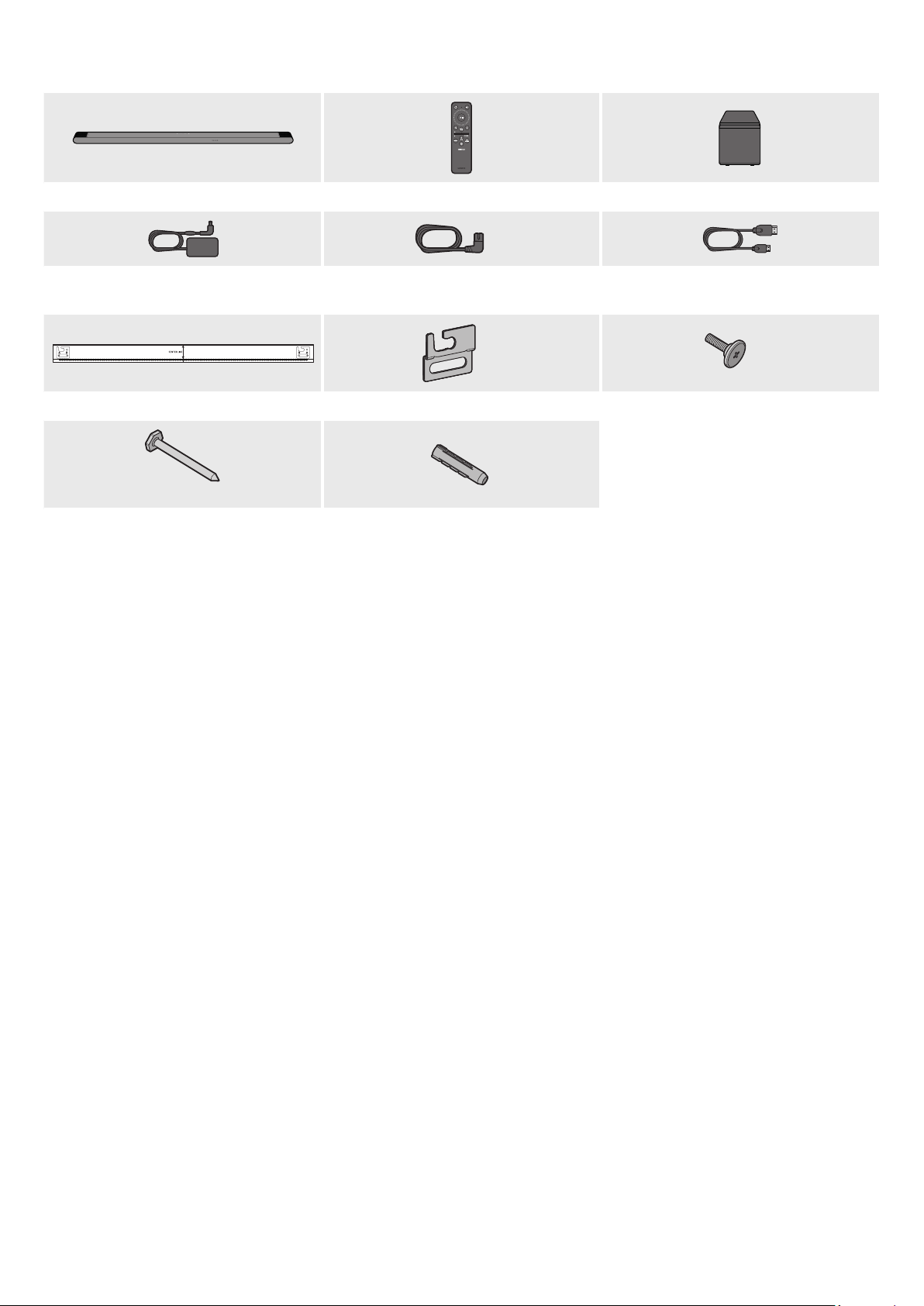
01 CHECKING THE COMPONENTS
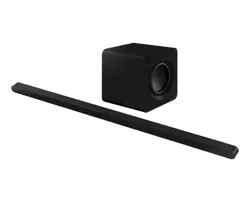
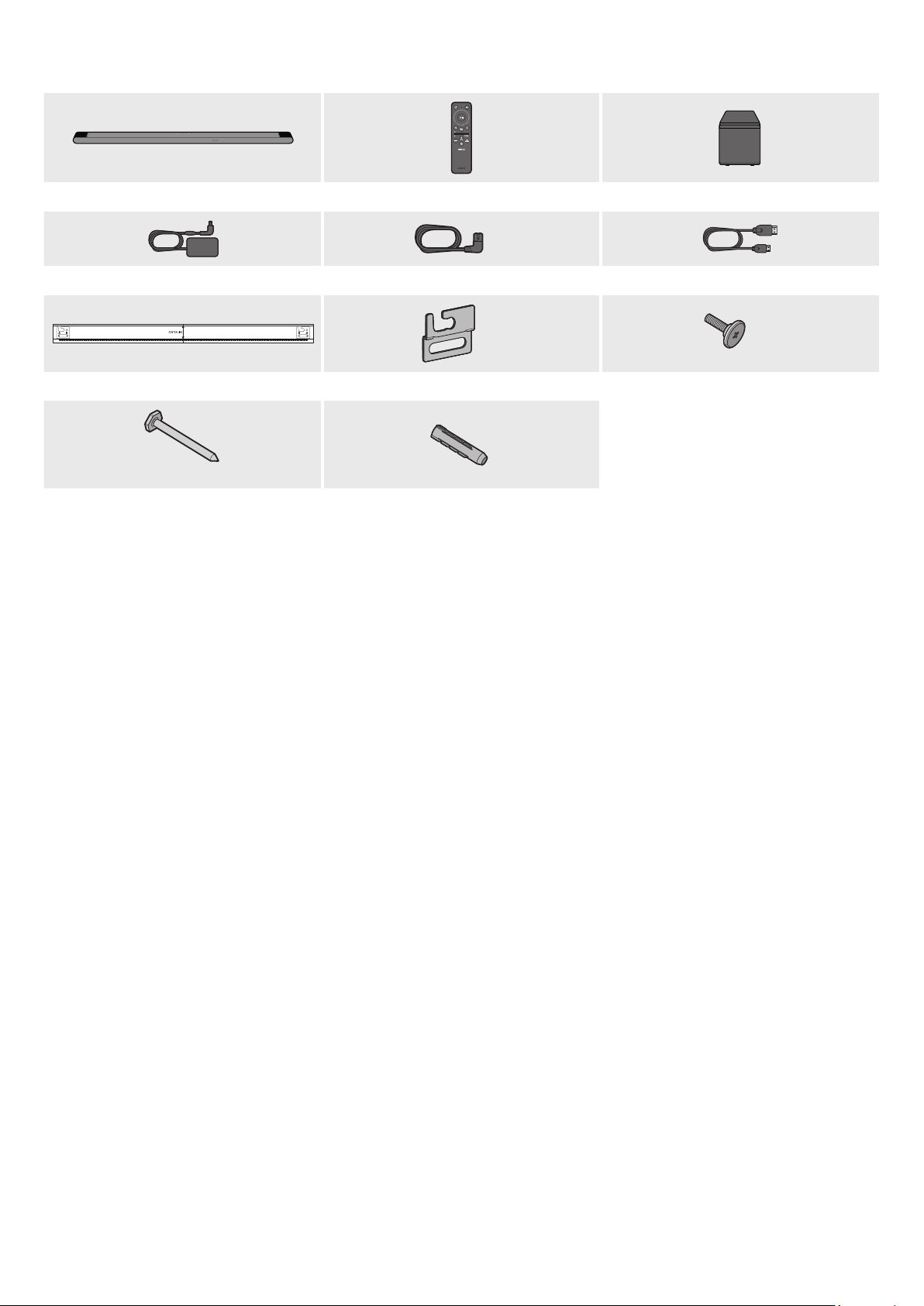
Soundbar Main Unit Soundbar Remote Control Subwoofer
x 2
AC/DC Adapter (Soundbar) Power Cord (Subwoofer, Soundbar) HDMI to Micro HDMI Cable
AH81-15127A-01
A TYPE
:
740mm
B TYPE
:
700mm
x 2
x 2
Wall Mount Guide Bracket-Wall Mount Holder-Screw
x 4
(M5 X L55)
x 4
Screw Screw Anchor
• For more information about the power supply and power consumption, refer to the label attached to the product. (Label: Bottom of the
Soundbar Main Unit)
• To purchase additional components or optional cables, contact a Samsung Service Center or Samsung Customer Care.
• For more information about the wallmount or rubber-foot, see pages 28~29.
• Design, specications, and App screen are subject to change without prior notice.
• The appearance of the accessories may differ slightly from the illustrations above.
ENG - 7
02 PRODUCT OVERVIEW
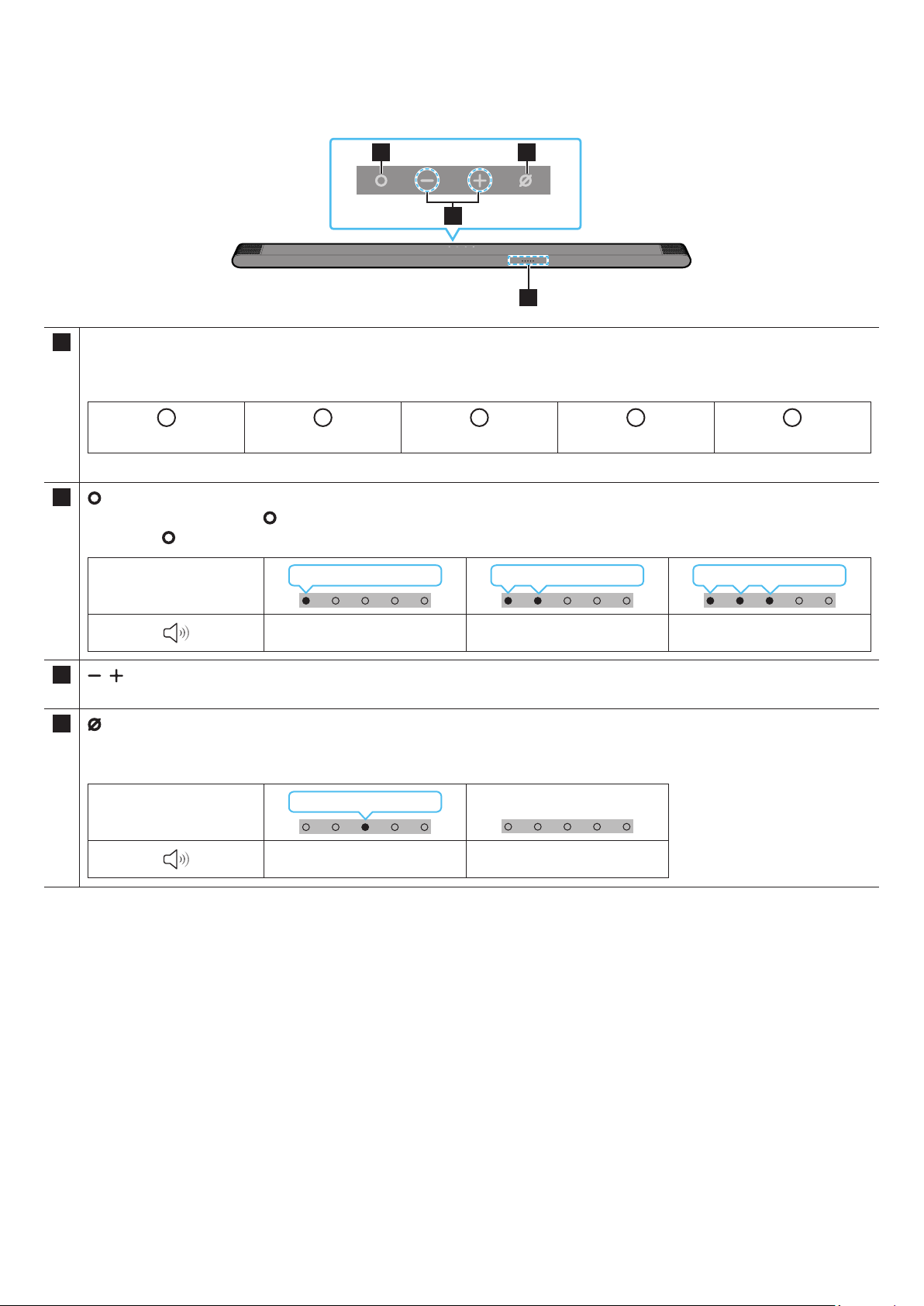
Top Panel of the Soundbar
2 4
3
1
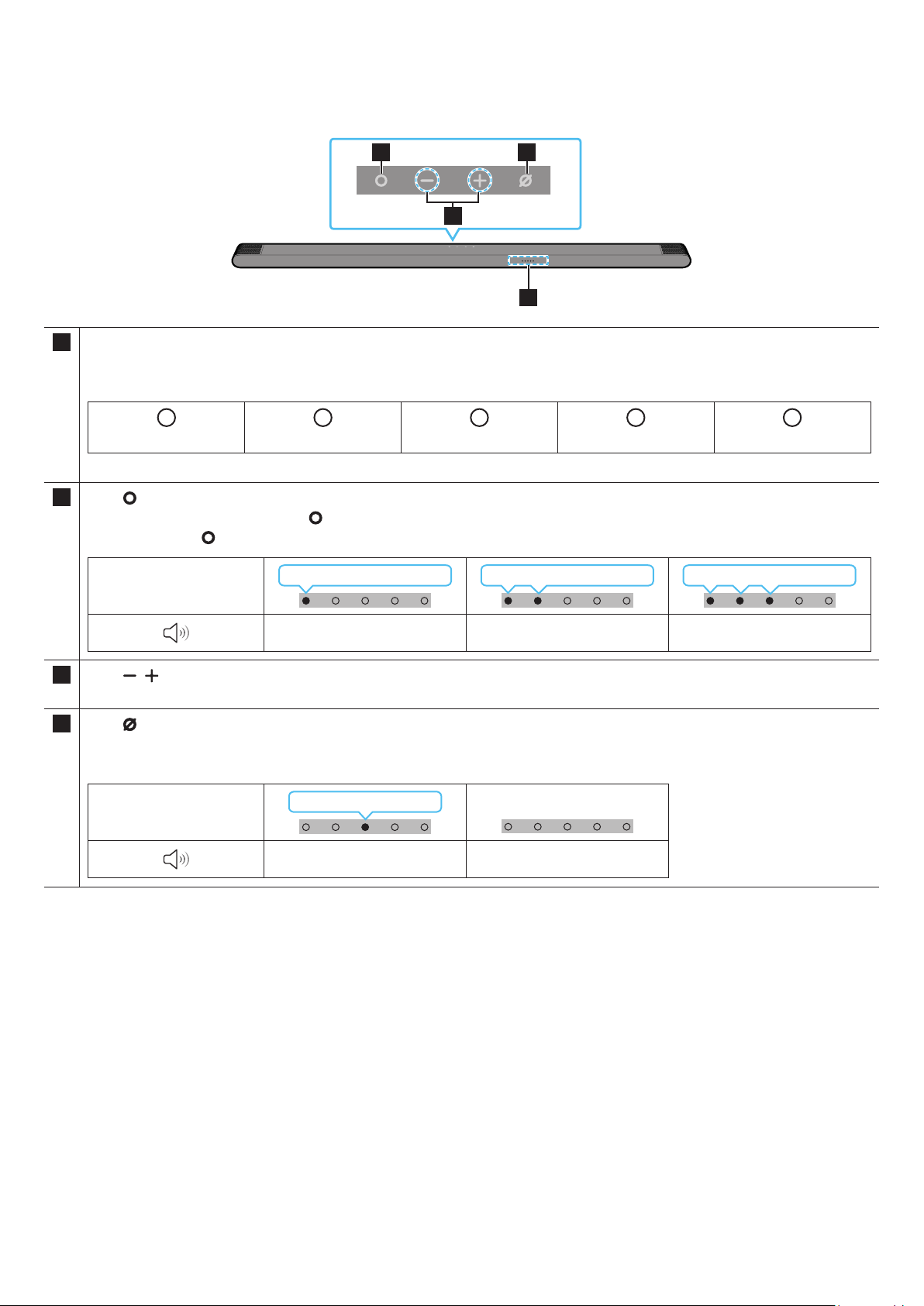
1 LED indicator
The LED Indicator ashes, glows, or changes color depending on the Soundbar’s current mode or status. The color of the LED indicator
and the number of lights indicate the active mode as described below.
W
White LED
W
White LED
M
Multicolor LED
W
White LED
W
White LED
• The Multicolor LED changes to White, Cyan, Green, Red, and Blue depending on the mode or status.
2
(Multi Function) Button
• In standby mode, press the (Multi Function) button to turn on the Soundbar.
• Press the (Multi Function) button to change the mode. Each time you change the mode, the LED lights in white and then turns off.
LED indicator
White On → Off White On → Off White On → Off
“TV ARC” “Wi-Fi” “Bluetooth”
3
(Volume) Button
Adjusts the volume.
4
(Mic On/Off) Button
Press the button to turn the microphone on or off.
When the microphone is off, the LED indicator will light red.
LED indicator
Red On
“Mic Off” “Mic On”
• When you plug in the AC cord, the power button will begin working in 4 to 6 seconds.
• When you turn on this unit, there will be a 4 to 5 second delay before it produces sound.
• If you hear sounds from both the TV and Soundbar, go to the Settings menu for the TV audio and change the TV speaker to External Speaker.
• You can turn on and off audio feedback by using SmartThings app. To learn about using the SmartThings app, refer to “Method 2. Connecting
via Wi-Fi (Wireless Network)”.
ENG - 8
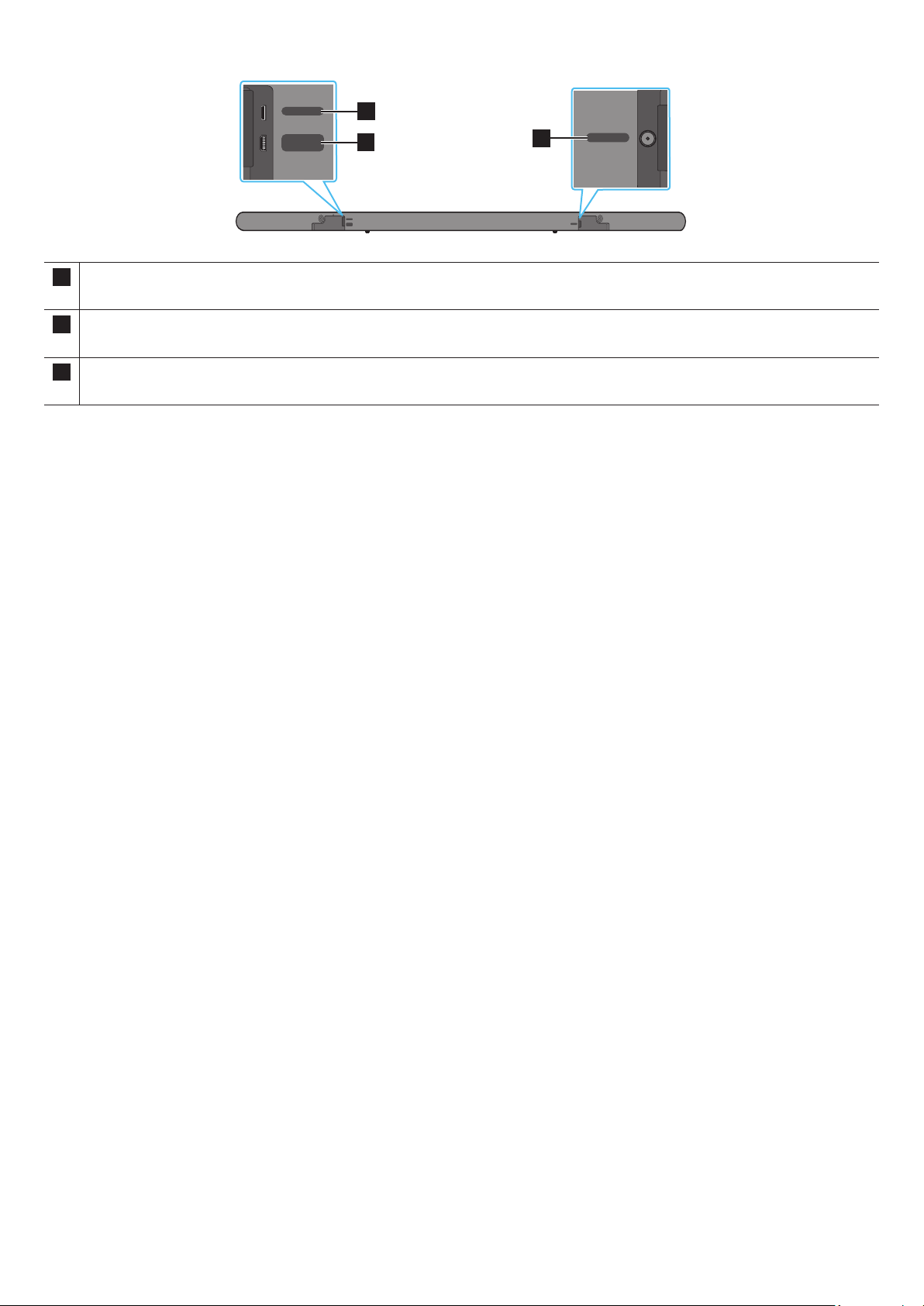
Rear Panel of the Soundbar
DC 19V
SERVICE
HDMI
(ARC)
DC 19V
SERVICE
HDMI
(ARC)
DC 19V
SERVICE
HDMI
(ARC)
DC 19V
SERVICE
HDMI
(ARC)
DC 19V
SERVICE
HDMI
(ARC)
DC 19V
SERVICE
HDMI
(ARC)
3
1
2
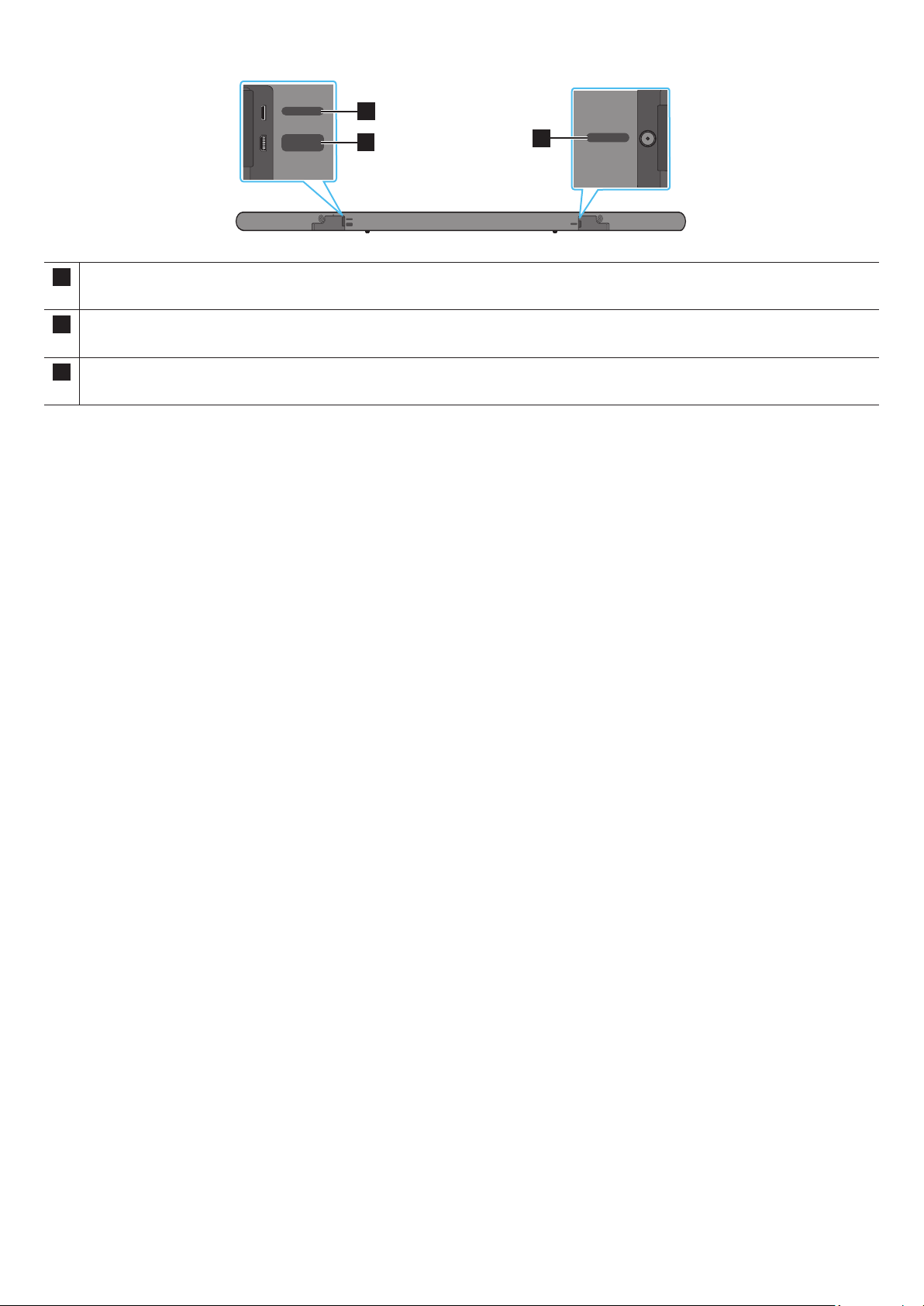
1 SERVICE
Connect a USB storage device to upgrade the product’s software.
2 HDMI (ARC)
Connect to the HDMI (ARC) port on a TV. (See page 17)
3 DC 19V
Connect the AC/DC power adapter. (Power Supply In) (See page 14)
• When disconnecting the power cable of the AC/DC power adaptor from a wall outlet, pull the plug.
Do not pull the cable.
• Do not connect this unit or other components to an AC outlet until all connections between components are complete.
ENG - 9
03 USING THE SOUNDBAR REMOTE CONTROL
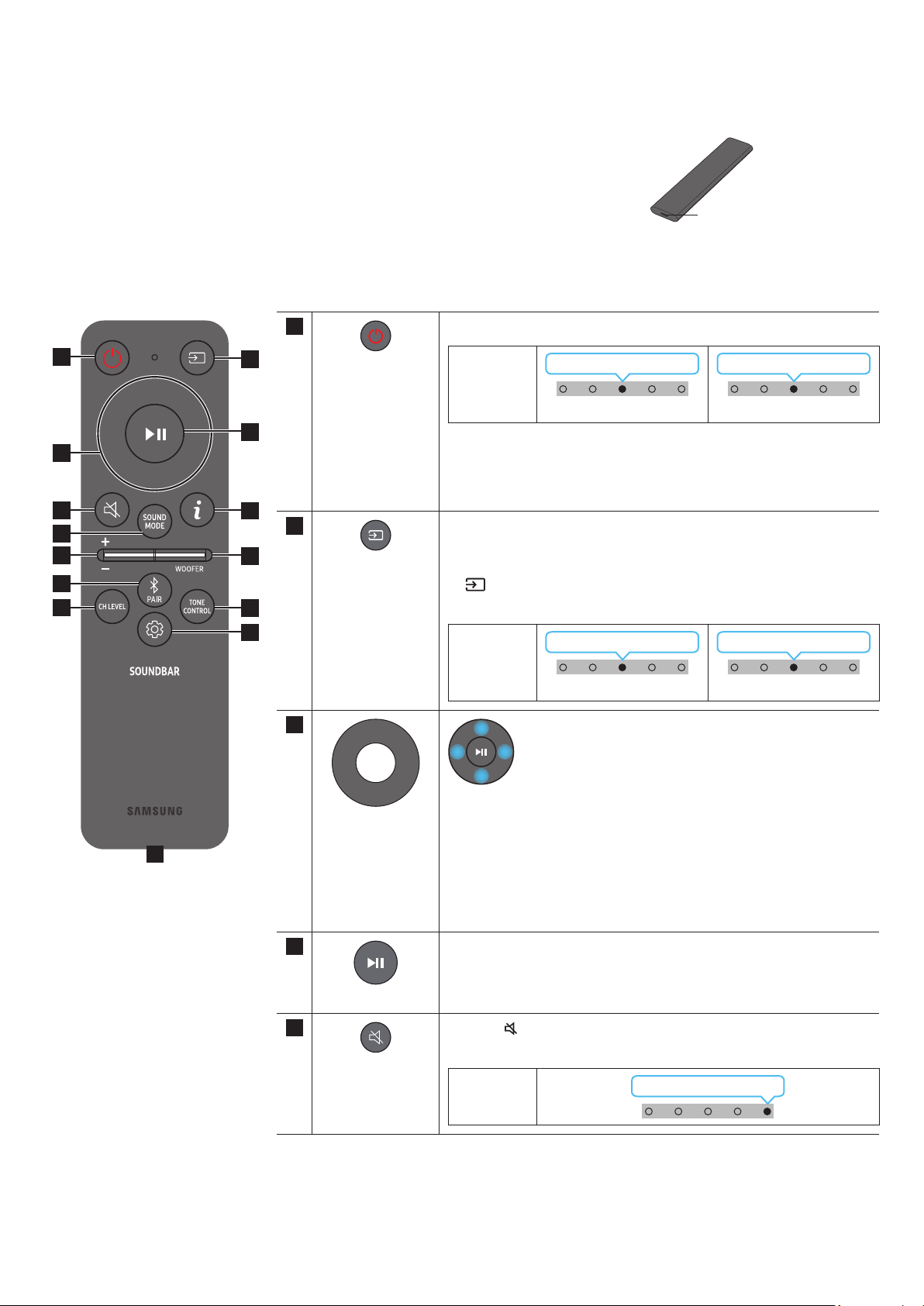
About the Remote control
• Use the Remote less than 6 m from the product. The usable distance may vary with the wireless
environmental conditions.
• When the remote control does not work due to low battery, charge it by using the USB-C type port.
• The illustration differs with the respective Remote Control model.
USB port (C-type) for
charging
How to Use the Remote Control
1
3
5
8
11
13
7
10
12
2
4
9
6
14
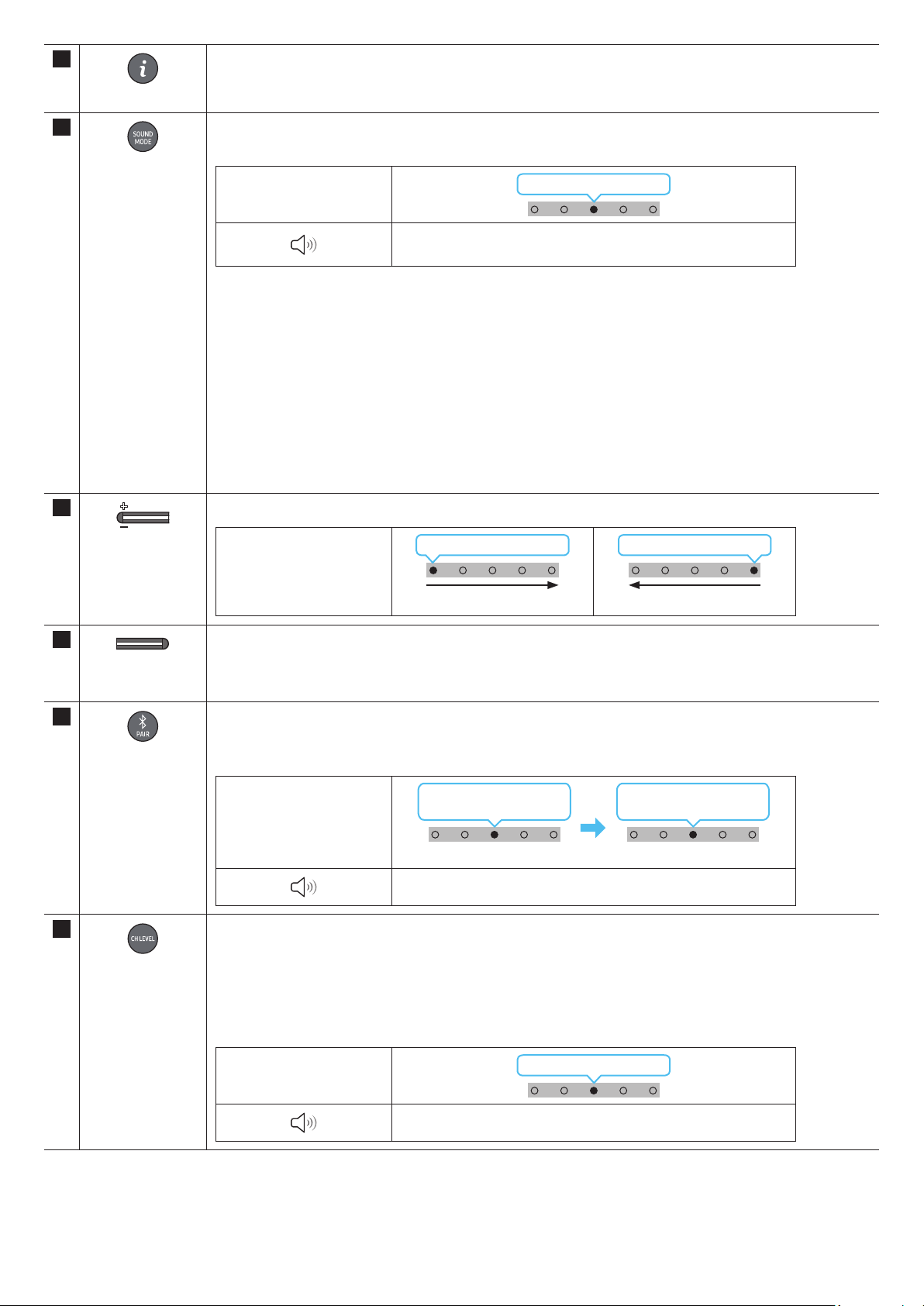
1
Power
Turns the Soundbar on and off.
LED
indicator
Cyan Blinks X1
On
Red Blinks X3
Off
• Auto Power Down Function
The unit turns off automatically in the following situations:
• In “TV ARC” / “Wi-Fi” / “Bluetooth” mode if there is no audio signal
for 18 minutes.
2
Source
Press to select a source connected to the Soundbar.
• Audio Feedback On/Off
You can turn on or off the Audio Feedback. Press and hold the
(Source) button on the remote control for 5 seconds while the
Soundbar is off (Standby mode).
LED
indicator
Cyan Blinks X1
On
Red Blinks X1
Off
3
Up/Down/Left/
Right
Press the indicated areas to select Up/Down/Left/Right.
Press Up/Down/Left/Right on the button to select or set functions.
• Music Skip
Press the Right button to select the next music le. Press the Left
button to select the previous music le.
• ID SET
Press and hold the Up button for 5 seconds to complete ID SET (when
connecting to a wireless subwoofer or wireless rear speakers).
4
Play / Pause
You can also play or pause music by pressing the button.
5
Mute
Press the
(Mute) button to mute the sound.
Press it again to unmute the sound.
LED
indicator
Blinks X Repeatly
ENG - 10
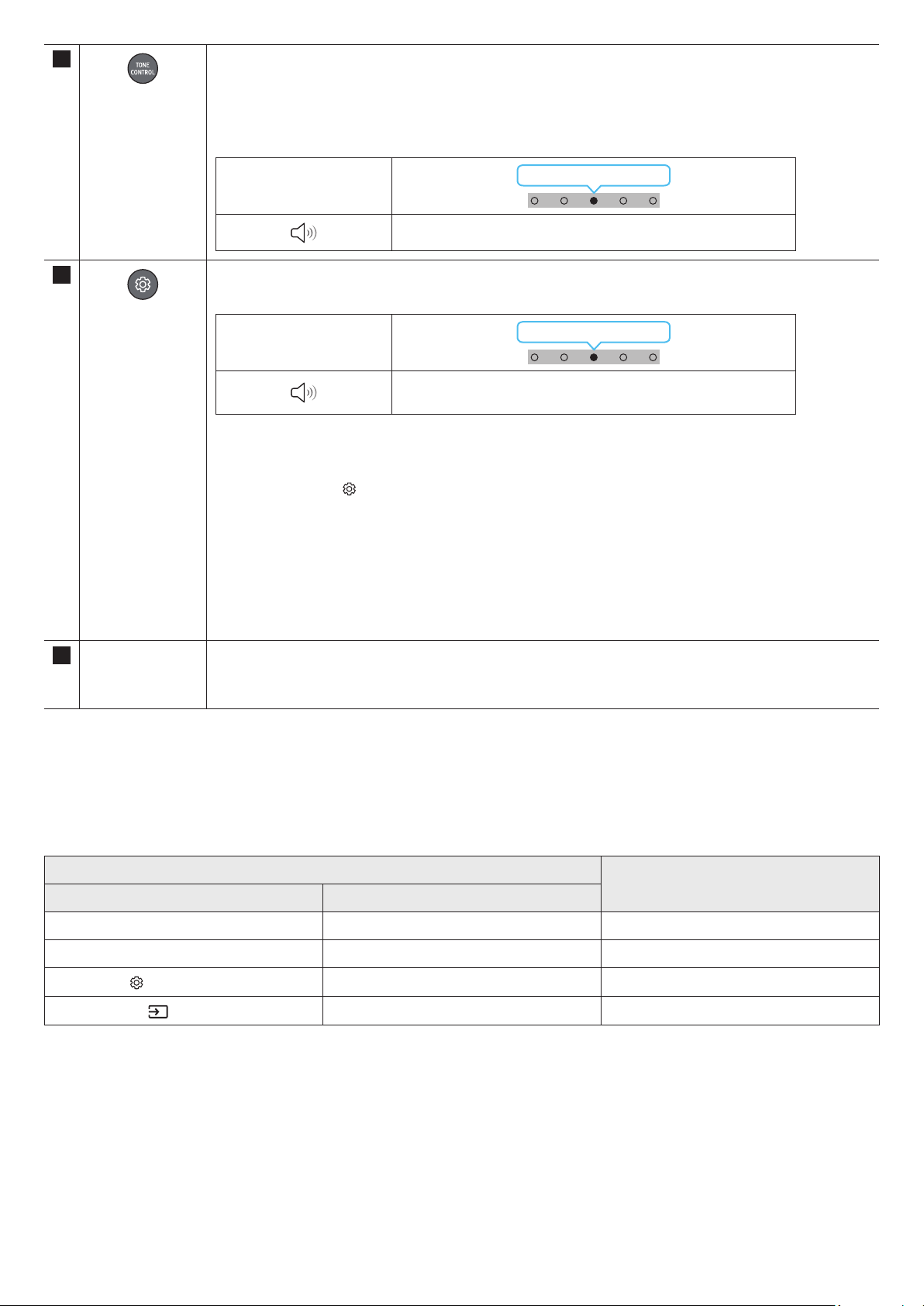
6
Info
Press the button to display information about the current function. (See page 7)
When connected to Dolby Atmos®, the LED indicator blinks cyan 3 times.
7
SOUND MODE
By pressing the button, you can select the desired audio mode. Each time the mode changes, the Multicolor LED
blinks in white.
LED indicator
White Blinks X1
“Surround” → “Game” → “Standard” → “Adaptive Sound” →
“DTS Virtual:X”
• Surround
Provides a wider sound eld than standard.
• Game
Provides stereoscopic sound to immerse you in the action while gaming.
• Standard
Outputs the original sound.
• Adaptive Sound
Analyzes the content in real time and automatically provides the optimal sound eld based on the
characteristics of the content.
• DTS Virtual:X
Immersive 3D sound from any content.
8
VOLUME
Push the button up or down to adjust the volume.
LED indicator
White moves to right X1
Volume Up
White moves to left X1
Volume Down
9
WOOFER (BASS)
LEVEL
Push the button up or down to adjust the level of the woofer (bass) to -12 or between -6 to +6. To set the woofer
(bass) volume level to 0 (Default), press the button.
10
Bluetooth PAIR
Switch the Soundbar to Bluetooth pairing mode.
When you press the button, the LED display changes as shown below.
• Until pairing is complete, the Multicolor LED changes as Red → Green → Blue in turn.
LED indicator
Red → Green →
Blue Blinks
Pairing
Cyan Blinks X3
Connection is complete
“Ready to connect via Bluetooth.”
11
CH LEVEL
By pressing the button, you can adjust the volume of the each speaker.
• To control the volume of the each speaker select “Center Level” or “Front Top Level” in Sound Settings, and
then adjust the volume between -6~+6 by using the Up/Down buttons.
• If the Rear Speakers (sold separately) are connected, the setting “Rear Level” and “Rear Top Level” is
supported. To adjust the volume of the “Rear Level” and “Rear Top Level” between -6 to +6 by using the Up/
Down buttons.
LED indicator
White Blinks X1
“Center Level” → “Front Top Level”
ENG - 11
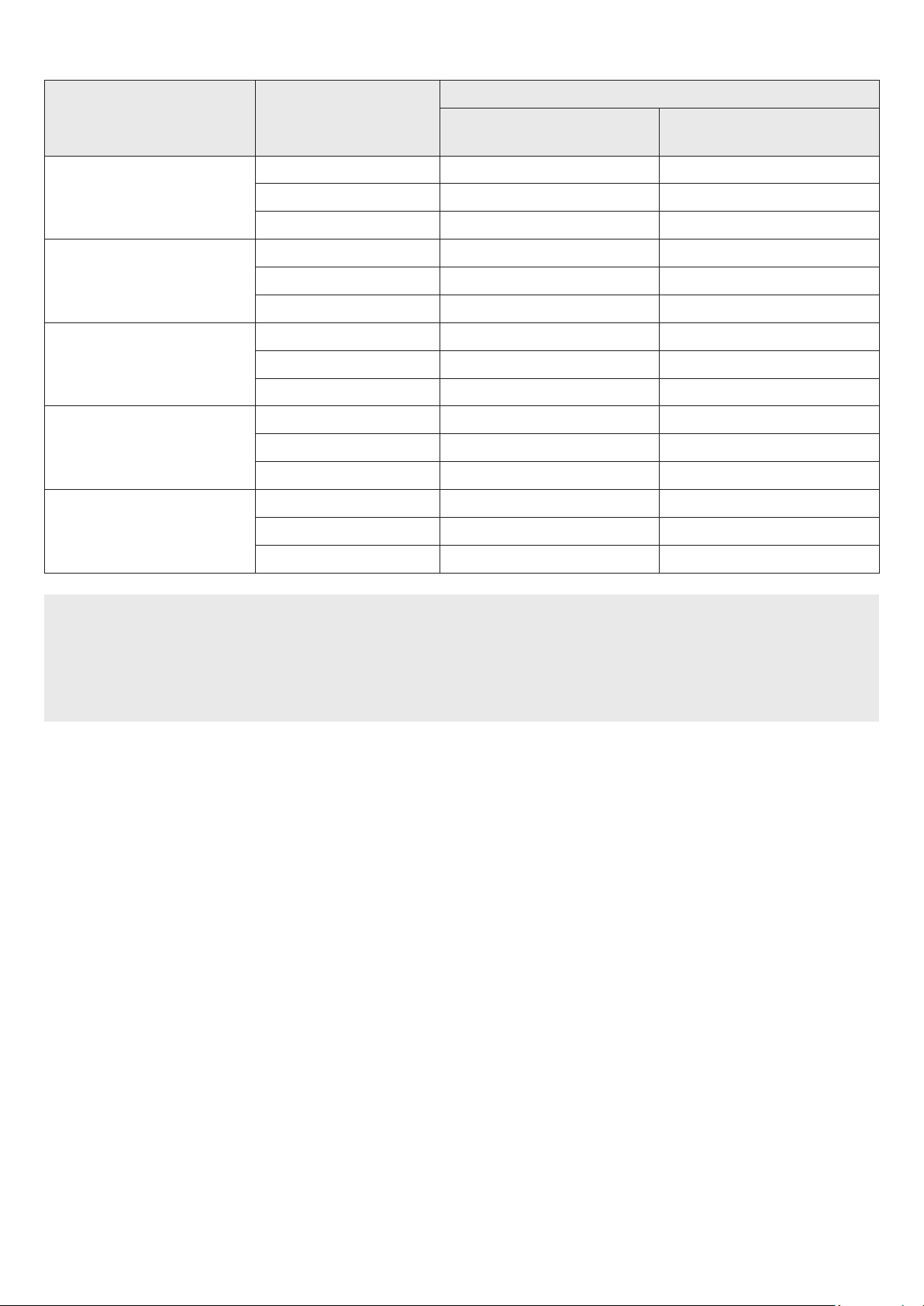
12
TONE CONTROL
By pressing the button, you can adjust the volume of the treble or bass sound. The dered item can be adjusted
using the Up/Down buttons. This function is enabled in Sound mode excluding in Standard mode.
• To control the volume of the treble or bass sound, select “Treble” or “Bass” in Sound Settings, and then adjust
the volume between -6~+6 by using the Up/Down buttons.
• Once the bass level is changed, the woofer level will be also adjusted accordingly.
LED indicator
White Blinks X1
“Treble” → “Bass”
13
Sound Control
By pressing the button, you can set the audio function. The desired item can be adjusted using the Up/Down
buttons. Each time the mode changes, the Multicolor LED blinks in white.
LED indicator
White Blinks X1
“SpaceFit Sound” → “Active Voice Amplier” → “Voice
enhancement” → “Night Mode” → “Sync” → “Virtual”
• Voice enhancement makes it easier to hear spoken dialog in movies and TV.
• Night Mode is optimized for night time viewing with the settings adjusted to bring the volume down but keep
the dialog clear.
• Press and hold the
(Sound Control) button for about 5 seconds to adjust the sound for each frequency band.
150Hz, 300Hz, 600Hz, 1.2kHz, 2.5kHz, 5kHz, and 10kHz are selectable using the Left/Right buttons and each
can be adjusted to a setting between -6 to +6 using the Up/Down buttons.
(Make sure the Sound mode is set to “STANDARD”.)
• If the video on the TV and audio from the Soundbar are not synchronized, select “Sync” in Sound Control, and
then set the audio delay between 0~300 milliseconds by using the Up/Down buttons.
• “Sync” is only supported for some functions.
• The Virtual function can be turned On/Off by using the Up/Down buttons.
14 USB port (C-type)
for charging
The LED lights while charging. When fully charged, the LED turns off.
• The USB Cable is not provided.
• When the remote control does not work due to low battery, charge it by using the USB-C type port.
Active Voice Amplier (AVA)
• Analyzes external noise in real time while soundbar is playing, so that voice audio can always be heard clearly.
• No data is saved during the analysis.
Using the Hidden Buttons (Buttons with more than one function)
Hidden Button
Reference page
Remote Control Button Function
WOOFER (Up) TV remote control On/Off (Standby) page 13
Up ID SET page 9
(Sound Control)
7 Band EQ page 11
(Source)
Audio Feedback On/Off (Standby) page 9
ENG - 12
Output specications for the different sound effect modes
Effect Input
Output
With Subwoofer Only
With Subwoofer & Wireless Rear
Speaker Kit
Surround
2.0 ch 3.1.2 ch 5.1.4 ch
5.1 ch 3.1.2 ch 5.1.4 ch
Dolby Atmos® 3.1.2 ch 5.1.4 ch
Game
2.0 ch 3.1.2 ch 5.1.4 ch
5.1 ch 3.1.2 ch 5.1.4 ch
Dolby Atmos® 3.1.2 ch 5.1.4 ch
Standard
2.0 ch 2.1 ch 2.1 ch
5.1 ch 3.1 ch 5.1 ch
Dolby Atmos® 3.1.2 ch 5.1.4 ch
Adaptive Sound
2.0 ch 3.1.2 ch 5.1.4 ch
5.1 ch 3.1.2 ch 5.1.4 ch
Dolby Atmos® 3.1.2 ch 5.1.4 ch
DTS Virtual:X
2.0 ch 3.1.2 ch 5.1.4 ch
5.1 ch 3.1.2 ch 5.1.4 ch
Dolby Atmos® 3.1.2 ch 5.1.4 ch
• The Samsung Wireless Rear Speaker Kit can be purchased separately. To purchase a Kit, contact the vendor you purchases the Soundbar
from.
• The Surround Speakers will not produce sounds for 2 channel output while STANDARD mode is in use. To enable sound for the Surround
Speakers, change the effect mode to SURROUND.
• When the input source is Dolby Atmos® the Subwoofer-only setup provides 3.1.2 channel audio, while the Subwoofer & Wireless Rear
Speaker Kit setup provides 5.1.4 channel audio.
ENG - 13
Adjusting the Soundbar volume with a TV remote control
Adjust the Soundbar volume using the TV’s remote control.
• This function can be used with IR remote controls only. Bluetooth remote controls (remote controls that require pairing) are not
supported.
• Set the TV speaker to External Speaker to use this function.
• Manufacturers supporting this function:
Samsung, VIZIO, LG, Sony, Sharp, PHILIPS, PANASONIC, TOSHIBA, Hisense, RCA
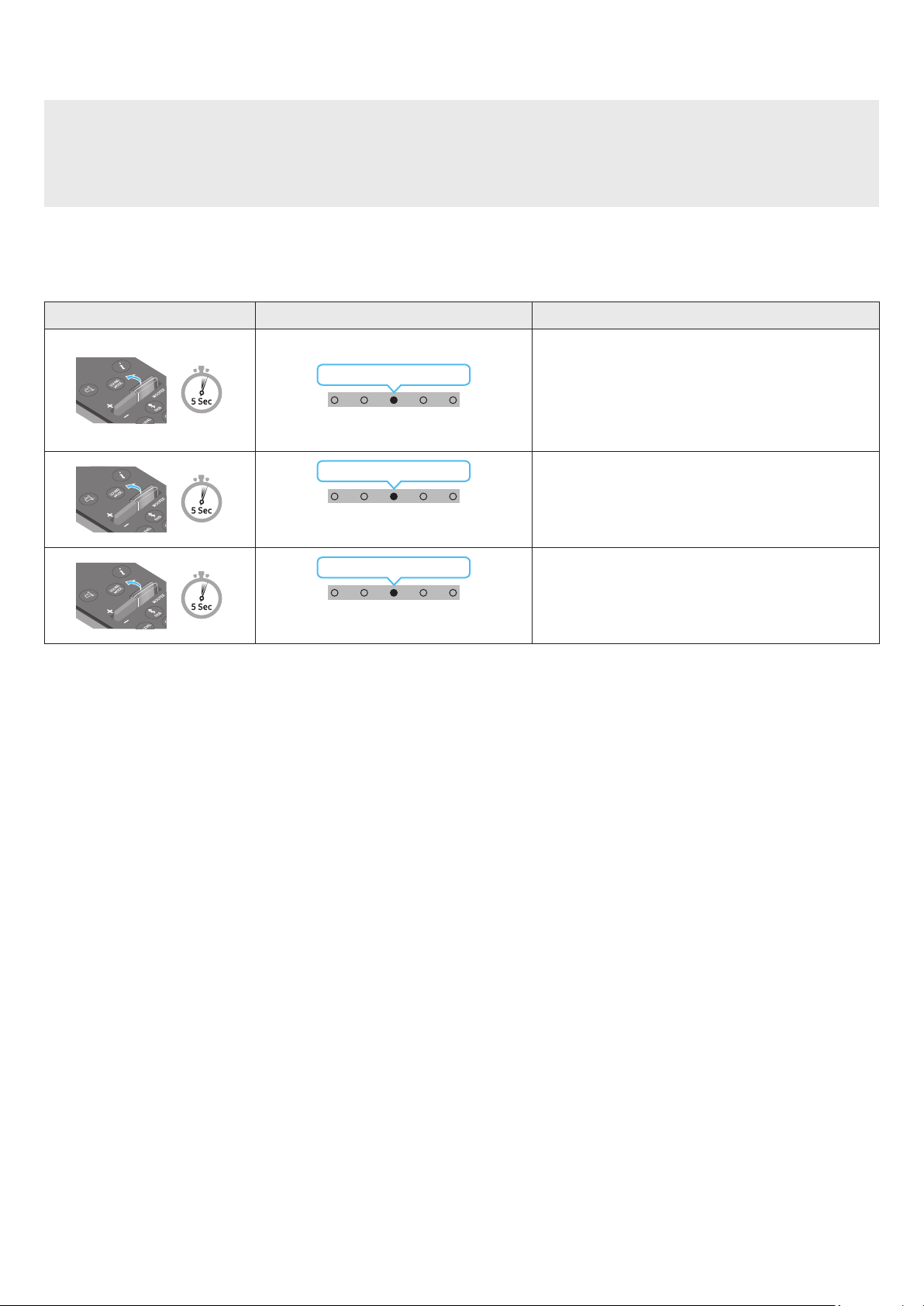
1. Turn Off the Soundbar.
2. Push up and hold the WOOFER button for 5 seconds.
Each time you push the WOOFER button up and hold it for 5 seconds, the mode switches in the following order: “OFF-TV REMOTE” (Default
mode), “SAMSUNG-TV REMOTE”, “ALL-TV REMOTE”.
Remote Control Button LED Indicator Status
(Default mode)
Red Blinks X1
“Off-TV Remote”
(Default mode)
Disable the TV remote control.
Cyan Blinks X1
“Samsung-TV Remote”
Enable a Samsung TV’s IR remote control.
Blue Blinks X1
“All-TV Remote”
Enable a third-party TV’s IR remote control.
ENG - 14
04 CONNECTING THE SOUNDBAR
Connecting the power and units
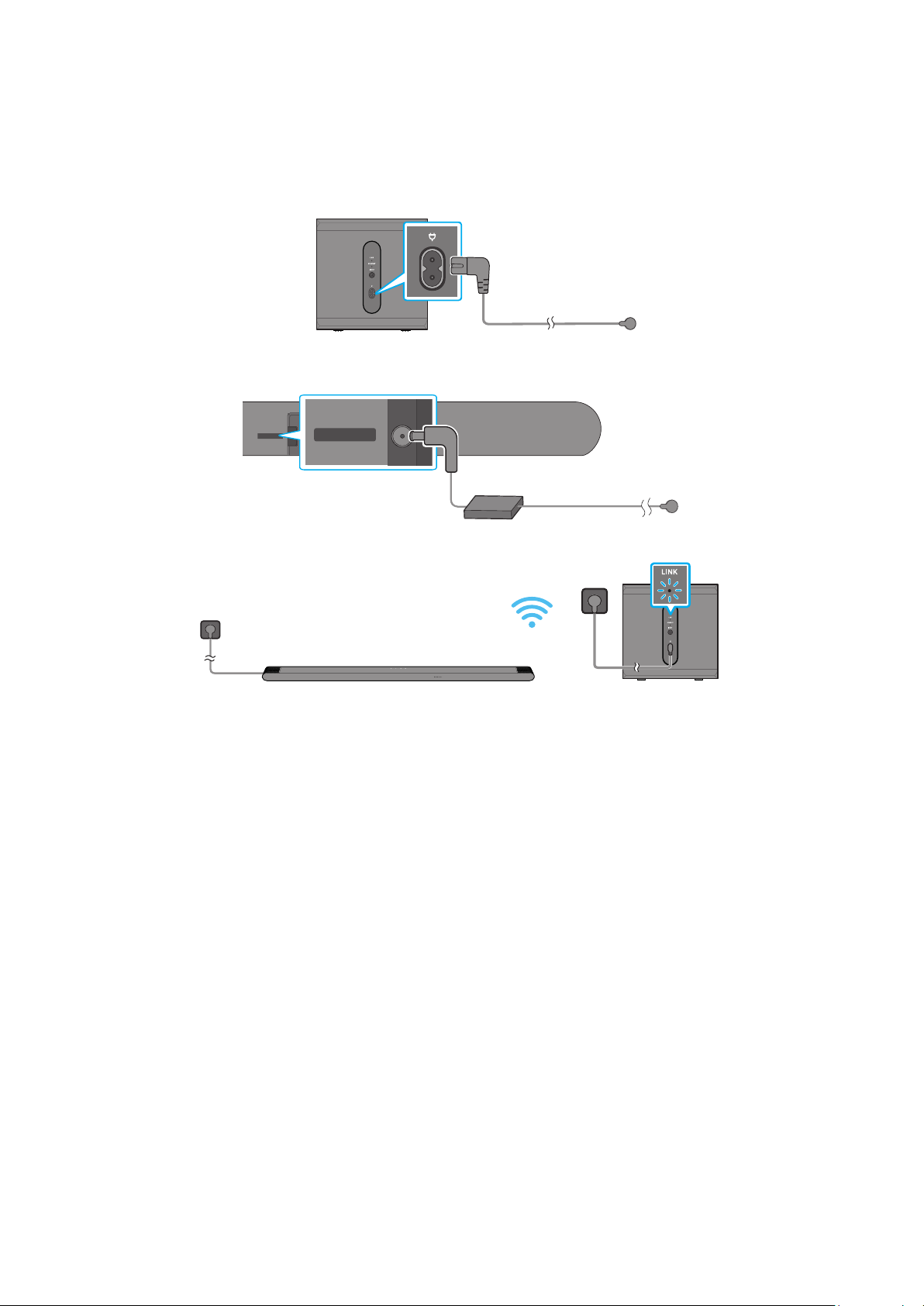
Use the Power cord to connect the Subwoofer and Soundbar to an electrical outlet in the following order:
• For more information about the required electrical power and power consumption, refer to the label attached to the product. (Label: Bottom
of the Soundbar Main Unit)
1. Connect the Power cord to the Subwoofer.
Rear of Subwoofer
Power Cord
2. Connect the Power cord to the Soundbar.
Rear of the Soundbar
Main Unit
DC 19V
DC 19V
Power Cord
AC/DC Adapter
3. Connect power to the Soundbar and Subwoofer. The Subwoofer is automatically connected when the Soundbar is turned on.
LINK LED - Blue is On
NOTE
• Connect the Subwoofer power before connecting to the Soundbar. The Subwoofer will be automatically connected when turning on the
Soundbar.
• If you unplug and reconnect the power cord when the product is turned on, the Soundbar turns on automatically.
ENG - 15
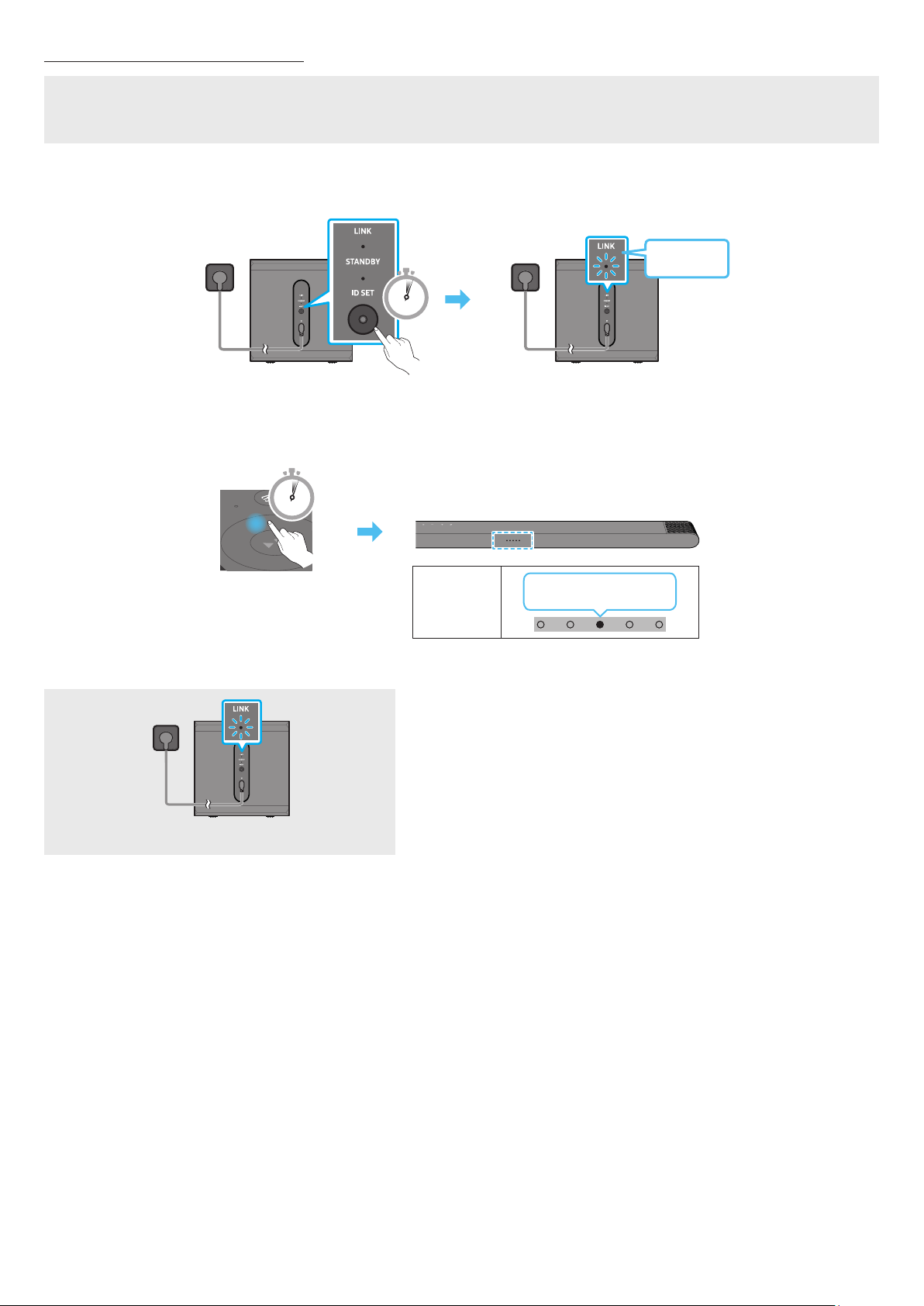
Manually connecting the Subwoofer
Before performing the manual connection procedure below:
• Check whether the power cables for the Soundbar and subwoofer is connected properly.
• Make sure that the Soundbar is turned off.
1. Turn off the Soundbar main.
2. Press and hold ID SET on the rear of the subwoofer for at least 5 seconds.
• The red indicator at the rear of each speaker turns off and the blue indicator blinks.
5 Sec
Rear of Subwoofer
Blinking
blue fast
Rear of Subwoofer
3. Press the Up button on the remote control for 5 seconds.
• The Soundbar will automatically power on when ID SET is complete.
5 Sec
LED
indicator
Red → Green →
Blue Blinks
4. Check if the LINK LED is solid blue (connection complete).
LINK LED - Blue is On
The LINK LED indicator stops blinking and glows a solid blue when a connection
is established between the Soundbar and the Wireless Subwoofer.
ENG - 16
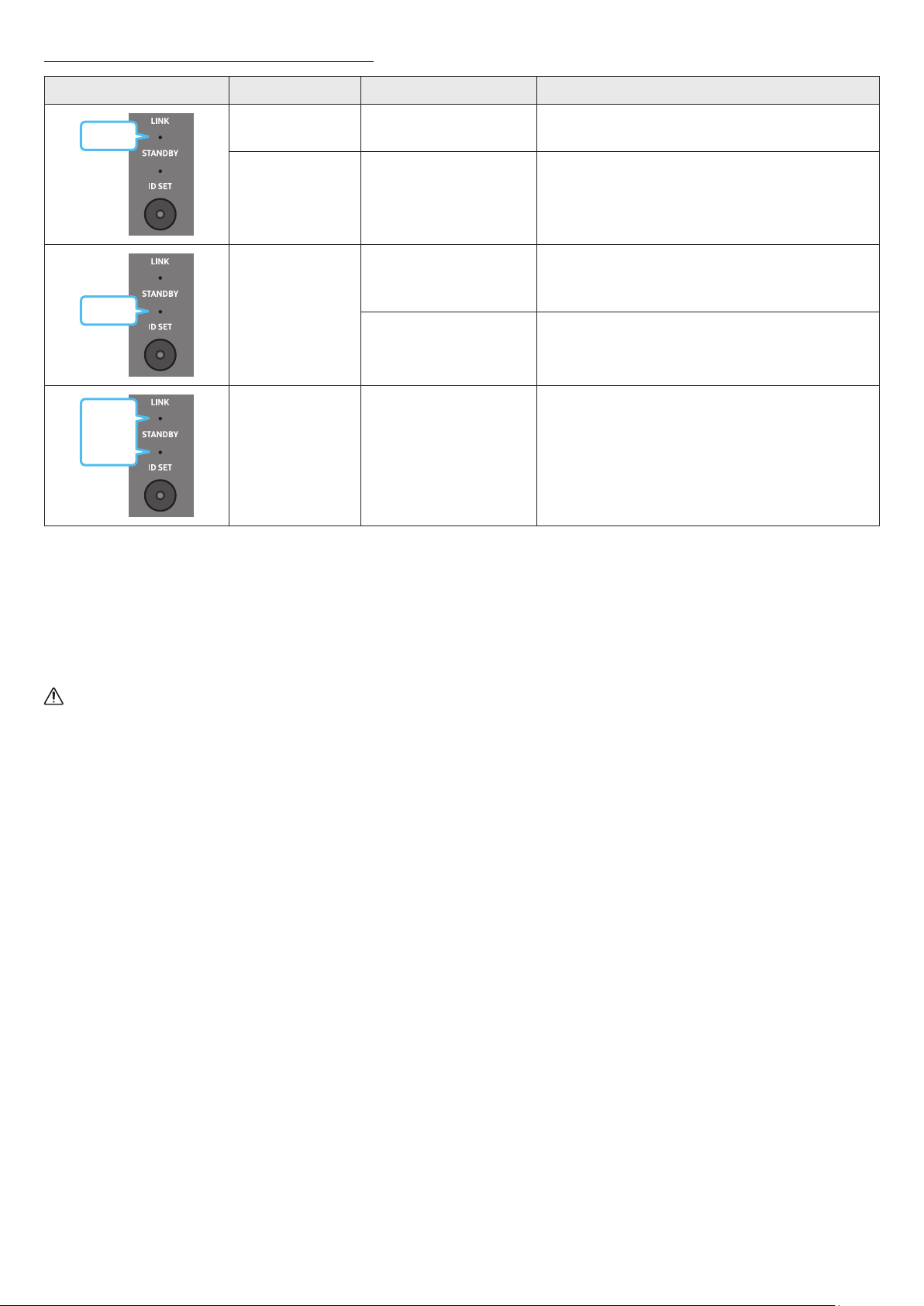
LED Indicator Lights on the Rear of Subwoofer
LED Status Description Resolution
Blue
On
Successfully connected
(normal operation)
-
Blinking Recovering the connection
Check if the power cable attached to the main Soundbar
unit is connected properly or wait about 5 minutes.
If blinking persists, try manually connecting the
subwoofer. See page 15.
Red
On
Standby (with the
Soundbar main unit turned
off)
Check if the power cable attached to the main Soundbar
unit is connected properly.
Connection failed
Connect again. See the instructions for manual
connection on page 15.
Red and
blue
Blinking Malfunction
See the contact information for the Samsung Service
Center in this manual.
NOTE
• If the main unit is powered off, the wireless subwoofer will go into stand-by mode and the STANDBY LED on the rear of the sub-woofer will
turn red after blinking in blue several times.
• If you use a device that uses the same frequency as the Soundbar near the Soundbar, interference may cause some sound interruption.
• The maximum transmission distance of the main unit’s wireless signal is about 10 m, but may vary depending on your operating environment.
If a steel-concrete or metallic wall is between the main unit and the wireless subwoofer, the system may not operate at all because the
wireless signal cannot penetrate metal.
CAUTION
• Wireless receiving antennas are built into the wireless subwoofer. Keep the unit away from water and moisture.
• For optimal listening performance, make sure that the area around the wireless subwoofer is clear of any obstructions.
Connecting an SWA-9500S (Sold Separately) to your Soundbar
Expand to true wireless surround sound by connecting the Samsung Wireless Rear Speaker Kit (SWA-9500S, sold separately) to your Soundbar.
For detailed information on connections, see the Samsung Wireless Rear Speaker Kit manual.
ENG - 17
05 CONNECTING TO A TV
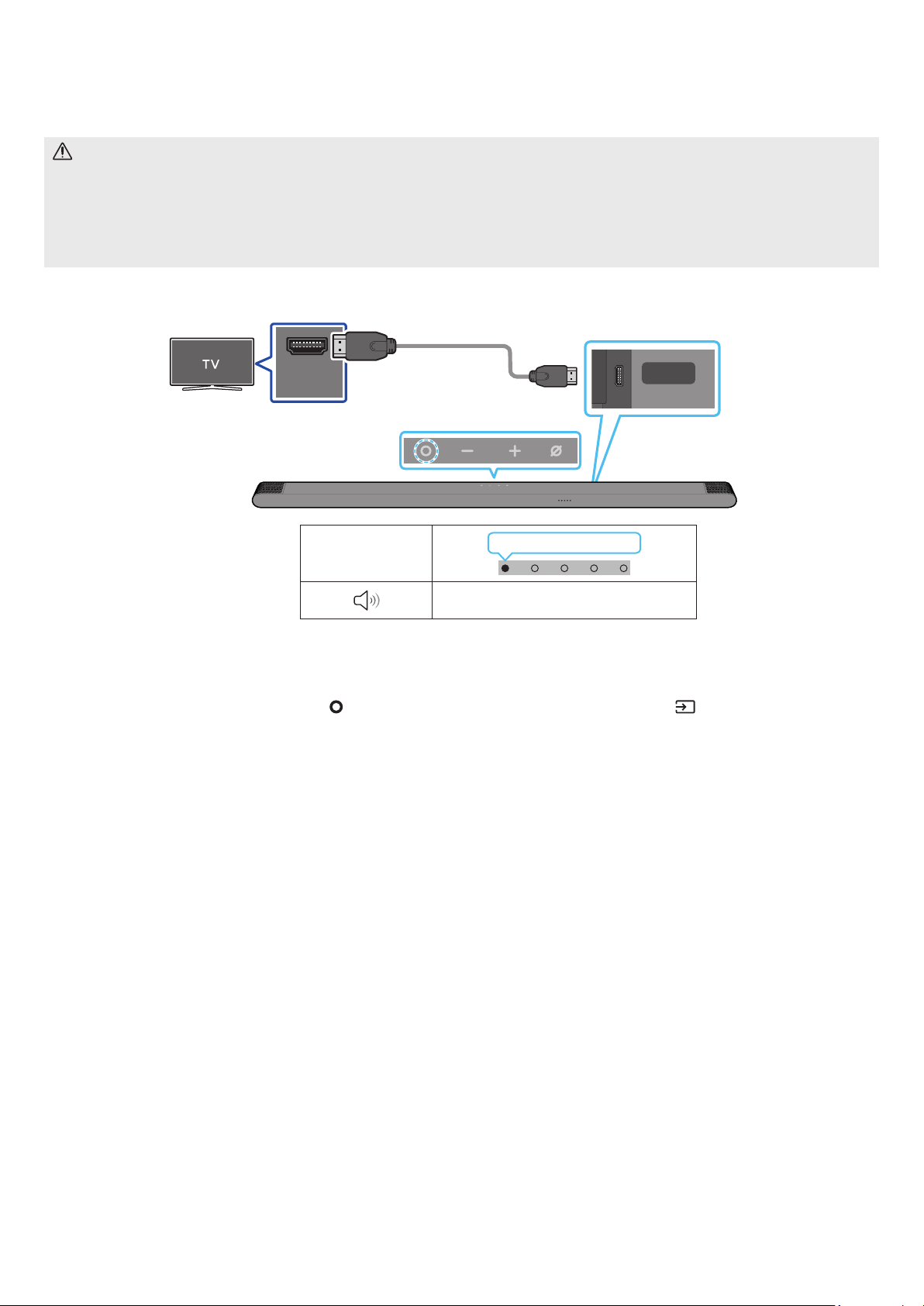
Connecting the TV that supports HDMI ARC (Audio Return Channel)
CAUTION
• When using an HDMI to Micro HDMI cable, take caution not to break the cable terminal.
• When the HDMI cable is connected, the HDMI signal is received rst.
• To connect the HDMI cable between the TV and Soundbar, be sure to connect the terminals marked ARC. Otherwise, the TV sound may not
be output.
• The recommended cable is High Speed HDMI Cable with Ethernet.
HDMI IN
(ARC)
SERVICE
HDMI
(ARC)
Connect to the HDMI IN (ARC)
or (eARC) port of your TV.
Connect to the HDMI (ARC)
port of the Soundbar main
unit.
HDMI to Micro
HDMI Cable
Rear of the Soundbar
Top of the Soundbar
LED indicator
White On → Off
“TV ARC”
1. With the Soundbar and TV turned off, connect the HDMI cable as shown in the gure.
2. Turn on the Soundbar and TV.
3. Your TV will output sound via the Soundbar.
• When the TV sound is not output, press the
(Multi Function) button at the top of the Soundbar or the (Source) button on the remote
control to select the “TV ARC” mode.
• When the sound is not output, check the HDMI cable connection again.
• Use the volume buttons on the TV’s remote control to change the volume on the Soundbar.
NOTE
• We recommend you use a coreless HDMI cable if possible. If you use a cored HDMI cable, use one whose diameter is less than 14 mm.
• This function is not available if the HDMI cable does not support ARC.
• When the audio in a broadcast is encoded in Dolby Digital and the “Digital Output Audio Format” on your TV is set to PCM, we recommend that
you change the setting to Dolby Digital. When the setting on the TV is changed, you will experience better sound quality. (The TV menu may
use different words for Dolby Digital and PCM depending on the TV manufacturer.)
ENG - 18
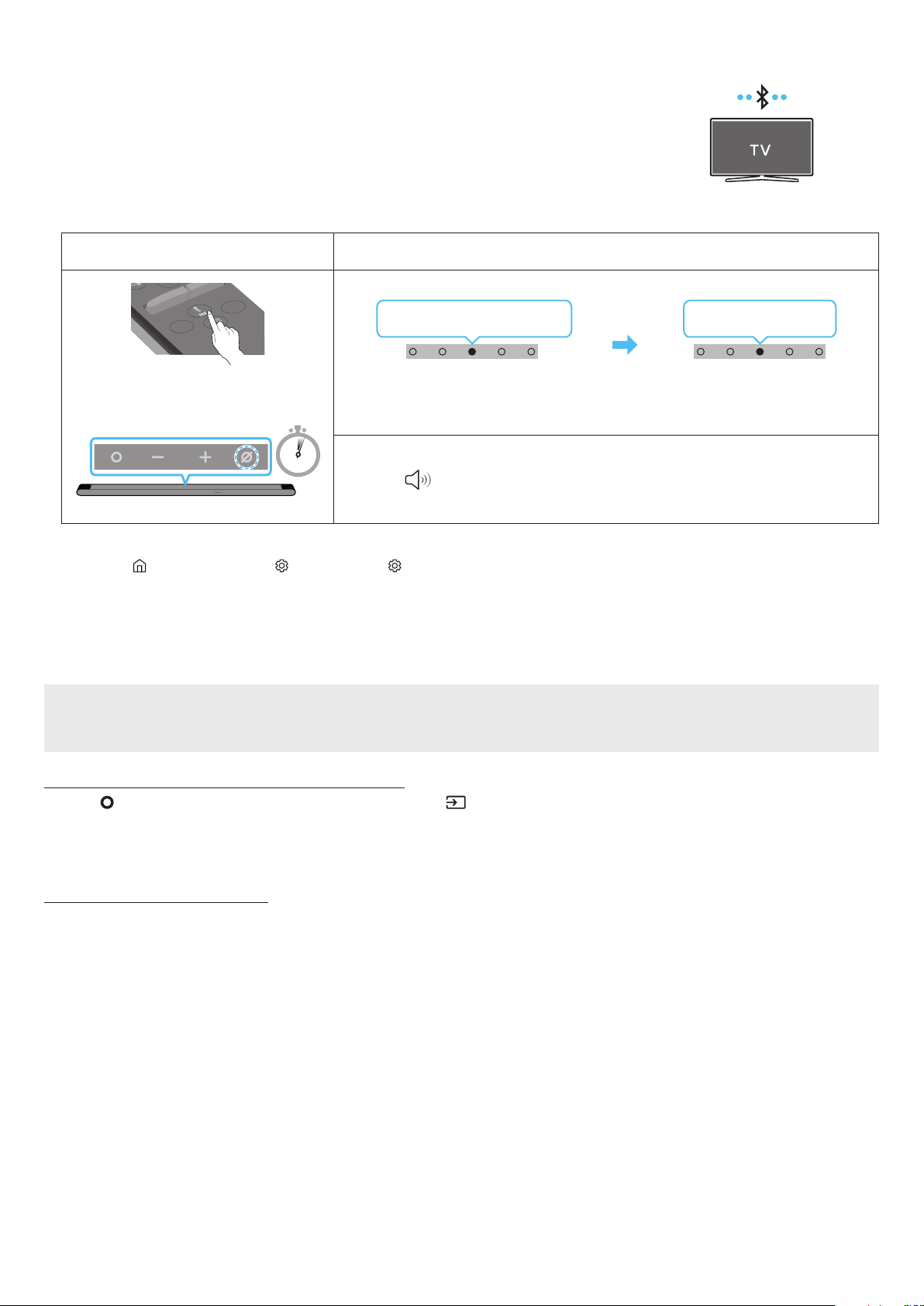
Connecting via Bluetooth
When a Samsung TV is connected using Bluetooth, you can hear stereo sound without the hassle of
cabling.
• Only one Samsung TV can be connected at a time.
• Samsung TV that supports Bluetooth can be connected. Check the specications of your TV.
The initial connection
1.
Bluetooth Pairing button LED Indicator
SOUNDBAR
SOUND
MODE
WOOFER
+
_
CH LEVEL
TONE
CONTROL
(OR)
When in “Bluetooth” mode
5 Sec
Red → Green → Blue Blinks
Pairing
Cyan Blinks X3
Connection is complete
• Until pairing is complete, the Multicolor LED changes as Red → Green → Blue in turn.
“Ready to connect via Bluetooth.”
1.
2. Select Bluetooth mode on the Samsung TV.
(e.g. Home ( ) → Menu → Settings ( ) → All Settings ( ) → Sound → Sound Output → Bluetooth Speaker List → [AV] Samsung Soundbar
S***B (Bluetooth))
3. Select “[AV] Samsung Soundbar S***B” from the list on TV’s screen.
An available Soundbar is indicated with “Need Pairing” or “Paired” on the TV’s Bluetooth device list. To connect the Samsung TV to the
Soundbar, select the message, and then establish a connection.
4. You can now hear Samsung TV sound from the Soundbar.
If the device fails to connect
• If you have an existing Soundbar (e.g., [AV] Samsung Soundbar S***B) on the list of speakers on the Samsung TV, delete it.
• Then repeat steps 1 through 3.
Disconnecting the Soundbar from the Samsung TV
Press the (Multi Function) button at the top of the Soundbar or the (Source) button on the remote control to select the mode other than
“Bluetooth”.
• Disconnecting takes time because the Samsung TV must receive a response from the Soundbar.
(The time required may differ, depending on the Samsung TV model.)
Notes on Bluetooth connection
• Locate a new device within 1 m to connect via Bluetooth communication.
• If asked for a PIN code when connecting a Bluetooth device, enter <0000>.
• The Soundbar automatically turns off after 18 minutes in the Ready state.
• The Soundbar may not perform Bluetooth search or connection correctly under the following circumstances:
‒ If there is a strong electrical eld around the Soundbar.
‒ If several Bluetooth devices are simultaneously paired with the Soundbar.
‒ If the Bluetooth device is turned off, not in place, or malfunctions.
• Electronic devices may cause radio interference. Devices that generate electromagnetic waves must be kept away from the Soundbar main
unit - e.g., microwaves, wireless LAN devices, etc.

ENG - 19
Connecting via Wi-Fi
Pre-connection Checklist
• Wi-Fi connection is available only on Samsung TV.
• Check whether the wireless router (Wi-Fi) is turned on and the TV is connected to the router.
• The TV and Soundbar must be connected to the same wireless network (Wi-Fi).
• If your wireless router (Wi-Fi) uses a DFS channel, you will not be able to establish a Wi-Fi connection between the TV and Soundbar.
Contact your Internet service provider for details.
• Because the menus may differ depending on the year of manufacture, refer to your TV manual.
• To connect the TV to the Soundbar via Wi-Fi, connect the Soundbar to the wireless router rst. See page 25, for details on how to
establish a Wi-Fi connection.
1. For more information about Wi-Fi connection to the Soundbar, see page 25, “Method 2. Connecting via Wi-Fi (Wireless Network)”.
2. Change the input source of the TV by using the Audio menu to Soundbar.
• Samsung TVs released in 2017 or later
Sound → Sound Output → [AV] Samsung Soundbar S***B (Wi-Fi)
ENG - 20
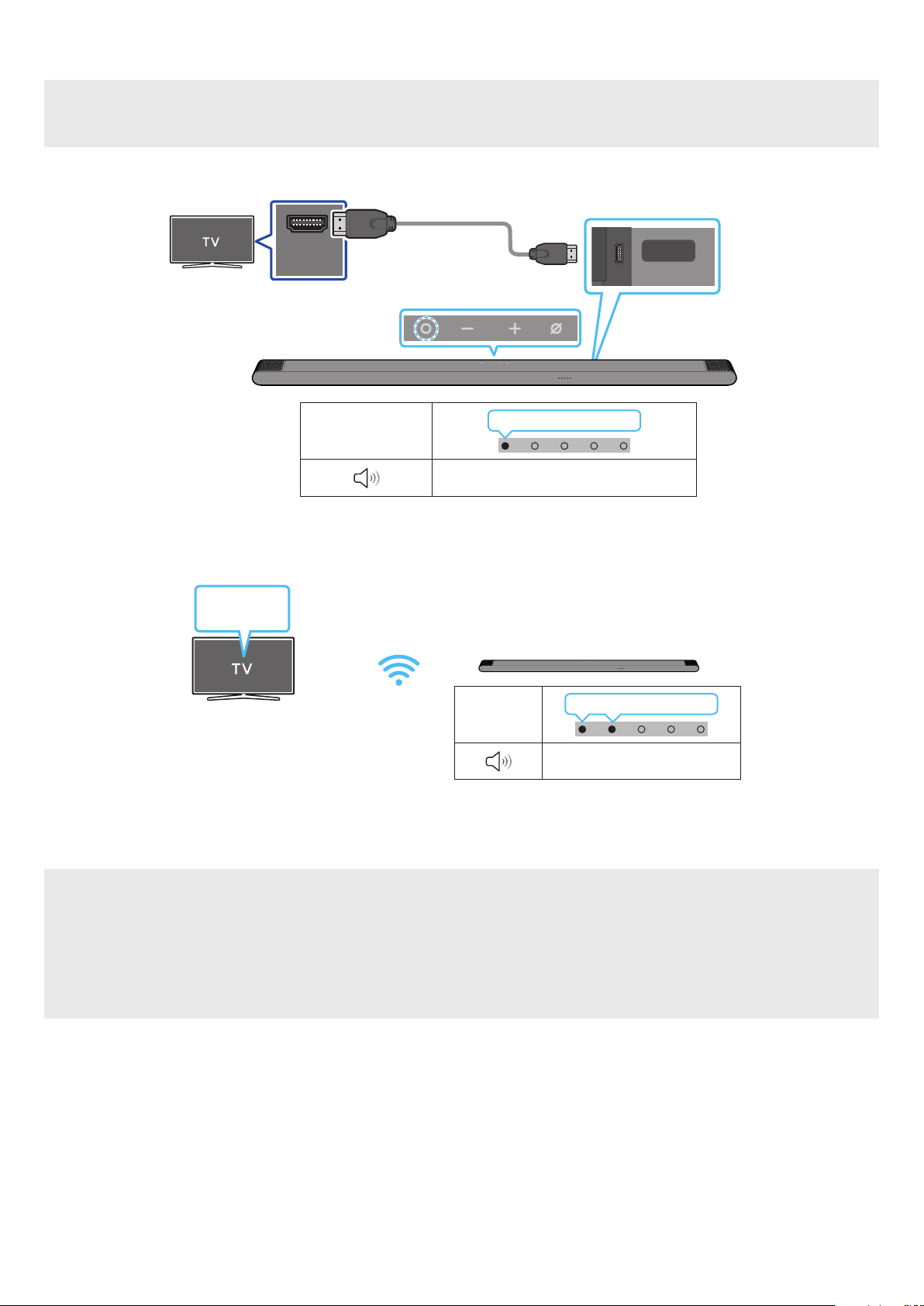
Connecting to a TV that supports Dolby Atmos
Pre-connection Checklist
• Dolby Atmos® is supported in “TV ARC” or “Wi-Fi” mode.
• Make sure that the content supports Dolby Atmos®.
HDMI IN
(ARC)
SERVICE
HDMI
(ARC)
Connect to the HDMI IN
(ARC) port of your TV.
HDMI to Micro
HDMI Cable
Rear of the Soundbar
Top of the Soundbar
LED indicator
White On → Off
“TV ARC”
1. With the Soundbar and TV turned off, connect the HDMI cable as shown in the gure.
2. Turn on the Soundbar and TV.
3. TV sound is output from the Soundbar.
LED
indicator
White On → Off
“Wi-Fi”
TV menu
Wi-Fi
1. Connect the Soundbar and TV to the same wireless network (Wi-Fi).
2. For sound output of the TV, select Soundbar.
3. TV sound is output from the Soundbar.
NOTE
• When you use Dolby Atmos®: If the input source is Dolby Atmos®, refer to “Output specications for the different sound effect modes” on
page 12.
• Conguring Dolby Atmos® on your BD player or other device connected to the TV.
Open the audio output options on the settings menu of your BD player or other device and make sure that “No Encoding” is selected for
Bitstream. For example, on a Samsung BD Player, go to Home Menu → Sound → Digital Output and then select Bitstream (unprocessed).
• This function is available in some Samsung TVs and some Soundbar models.
ENG - 21
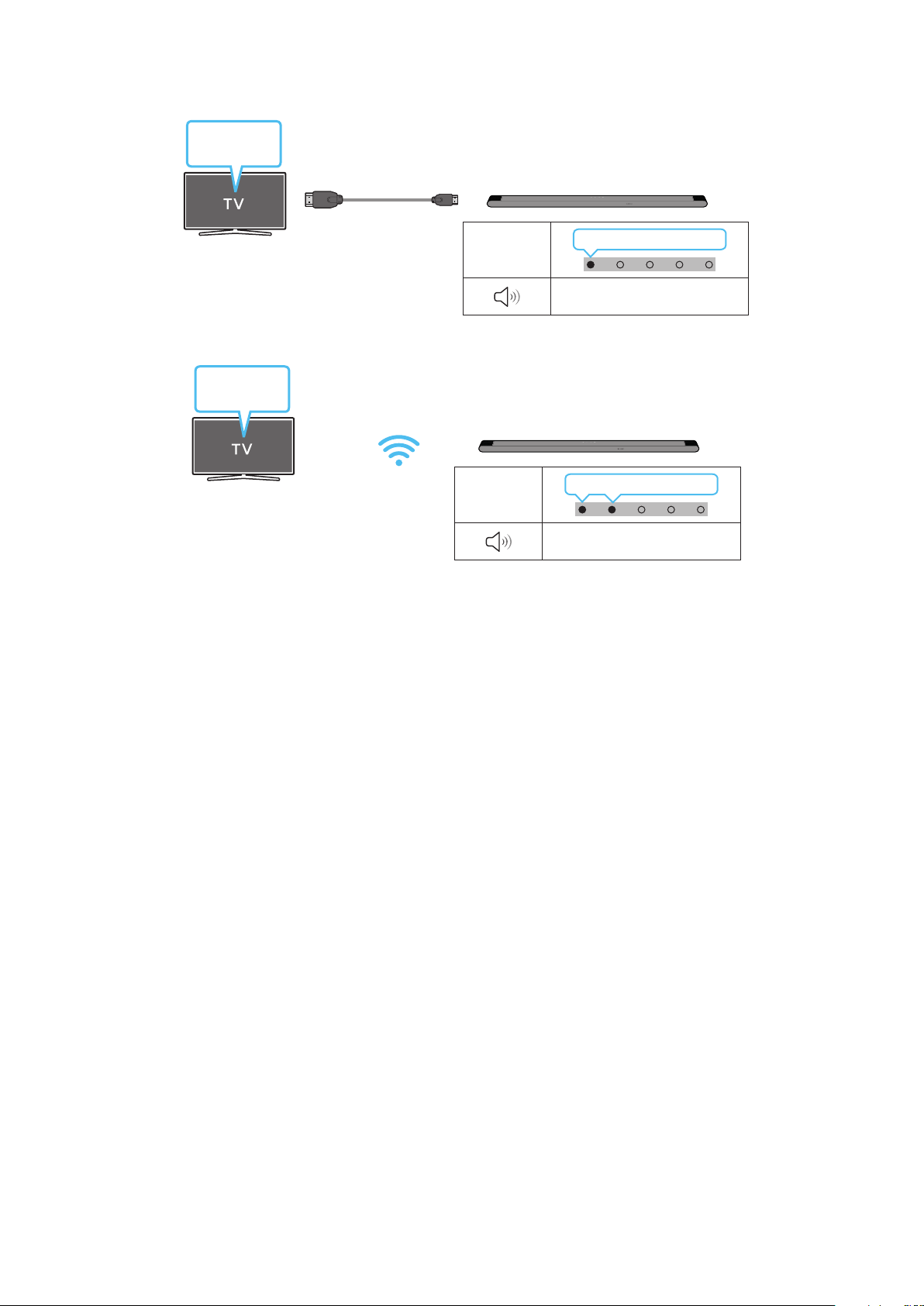
Using the Q-Symphony Function
For Q-Symphony, the Soundbar syncs with a Samsung TV to output sound through two devices for optimum surround effect. When the Soundbar
is connected, the menu, “TV+Soundbar” appears under the Sound Output menu of the TV. Select the corresponding menu.
TV menu
HDMI to Micro HDMI Cable
LED
indicator
White On → Off
“TV ARC”
• TV menu example: TV + [AV] Soundbar series name (HDMI)
LED
indicator
White On → Off
“Wi-Fi”
TV menu
Wi-Fi
• TV menu example: TV + [AV] Soundbar series name (Wi-Fi)
NOTE
• It can operate according to the Codec supported by TV.
• This function is supported only when the HDMI Cable or Wi-Fi is connected.
• Ensure that your TV and Soundbar are connected to the same wireless router/frequency.
• This function is available in some Samsung TVs and some Soundbar models.

ENG - 22
Using the Spacet sound
Provides optimized sound quality by analyzing the listening spaces.
Method 1. Connecting via Soundbar
To enable this function, turn on the SpaceFit Sound mode with the remote control of the Soundbar.
( (Sound Control) → “SpaceFit Sound Off” → ( Up ) → “SpaceFit Sound On”)
• This is available in all Sound modes.
Method 2. Connecting via TV
To enable this function, turn on the Adaptive Sound+ mode on your Samsung TV menu.
(Home ( ) → Menu → Settings ( ) → All Settings ( ) → General → Intelligent Mode Settings → Adaptive Sound+)
• The sound mode on your Soundbar will automatically change to Adaptive Sound+ if you enable the Adaptive Sound+ mode on your TV.
NOTE
This function works when the Soundbar connects to some of the Samsung TVs.

ENG - 23
06 CONNECTING A MOBILE DEVICE
Method 1. Connecting via Bluetooth
When a mobile device is connected using Bluetooth, you can hear stereo sound without the hassle of
cabling.
• When you connect a paired Bluetooth device with the Soundbar off, the Soundbar automatically
turns on.
Mobile device
The initial connection
When connecting to a new Bluetooth device, make sure the device is within 1 m distance.
1.
Bluetooth Pairing button LED Indicator
SOUNDBAR
SOUND
MODE
WOOFER
+
_
CH LEVEL
TONE
CONTROL
(OR)
When in “Bluetooth” mode
5 Sec
Red → Green → Blue Blinks
Pairing
Cyan Blinks X3
Connection is complete
• Until pairing is complete, the Multicolor LED changes as Red → Green → Blue in turn.
“Ready to connect via Bluetooth.”
1.
2. On your device, select “[AV] Samsung Soundbar S***B” from the list that appears.
3. Play music les from the device connected via Bluetooth through the Soundbar.
If the device fails to connect
• If you have an existing Soundbar (e.g., “[AV] Samsung Soundbar S***B”) in the list of speakers on the Mobile device, delete it.
• Repeat steps 1 and 2.
Notes on Bluetooth connection
• Locate a new device within 1 m to connect via Bluetooth communication.
• If asked for a PIN code when connecting a Bluetooth device, enter <0000>.
• The Soundbar automatically turns off after 18 minutes in the Ready state.
• The Soundbar may not perform Bluetooth search or connection correctly under the following circumstances:
‒ If there is a strong electrical eld around the Soundbar.
‒ If several Bluetooth devices are simultaneously paired with the Soundbar.
‒ If the Bluetooth device is turned off, not in place, or malfunctions.
• Electronic devices may cause radio interference. Devices that generate electromagnetic waves must be kept away from the Soundbar main
unit - e.g., microwaves, wireless LAN devices, etc.
• The Soundbar supports SBC data (44.1kHz, 48kHz).
• Connect only to a Bluetooth device that supports the A2DP (AV) function.
• You cannot connect the Soundbar to a Bluetooth device that supports only the HF (Hands Free) function.
• When connecting the Soundbar to a Bluetooth device, place them as close to each other as possible.
• The farther the Soundbar and Bluetooth device are from each other, the lower the sound quality will become.
The Bluetooth connection may break when the devices are out of the effective range.
• The Bluetooth connection may not function as intended in areas with poor reception.

ENG - 24
• A Bluetooth device may experience noise or malfunction under in the following conditions:
‒ When the body is in contact with the signal transceiver on the Bluetooth device or Soundbar
‒ In corners or when there is an obstacle in proximity, such as a wall or partition, where electrical changes may occur.
‒ When exposed to radio interferences by other products operating on the same frequency ranges, such as medical equipment, microwave
ovens, and wireless LAN devices.
‒ Obstacles such as doors and walls may still impact the sound quality even when the devices are within the effective range.
• Note that your Soundbar cannot be paired with other Bluetooth devices while using the Bluetooth option.
• This wireless device may cause electrical interference during operation.
Disconnecting the Bluetooth device from a Soundbar
You can disconnect a Bluetooth device from the Soundbar. For instructions, see the Bluetooth device’s user manual.
• The Soundbar will be disconnected.
• If the Soundbar is disconnected from the Bluetooth device, the multicolor LED indicator on the Soundbar blinks “Red” three times.
Disconnecting the Soundbar from the Bluetooth device
Press the (Multi Function) button on the top of the Soundbar or the (Source) button on the remote control to switch the mode from
“Bluetooth”.
• Disconnecting takes time because the Bluetooth device must receive a response from the Soundbar. (Disconnection time may differ,
depending on the Bluetooth device)
ENG - 25
Method 2. Connecting via Wi-Fi (Wireless Network)
To connect a Soundbar to a mobile device via a wireless network (Wi-Fi), the SmartThings app is required.
The initial connection
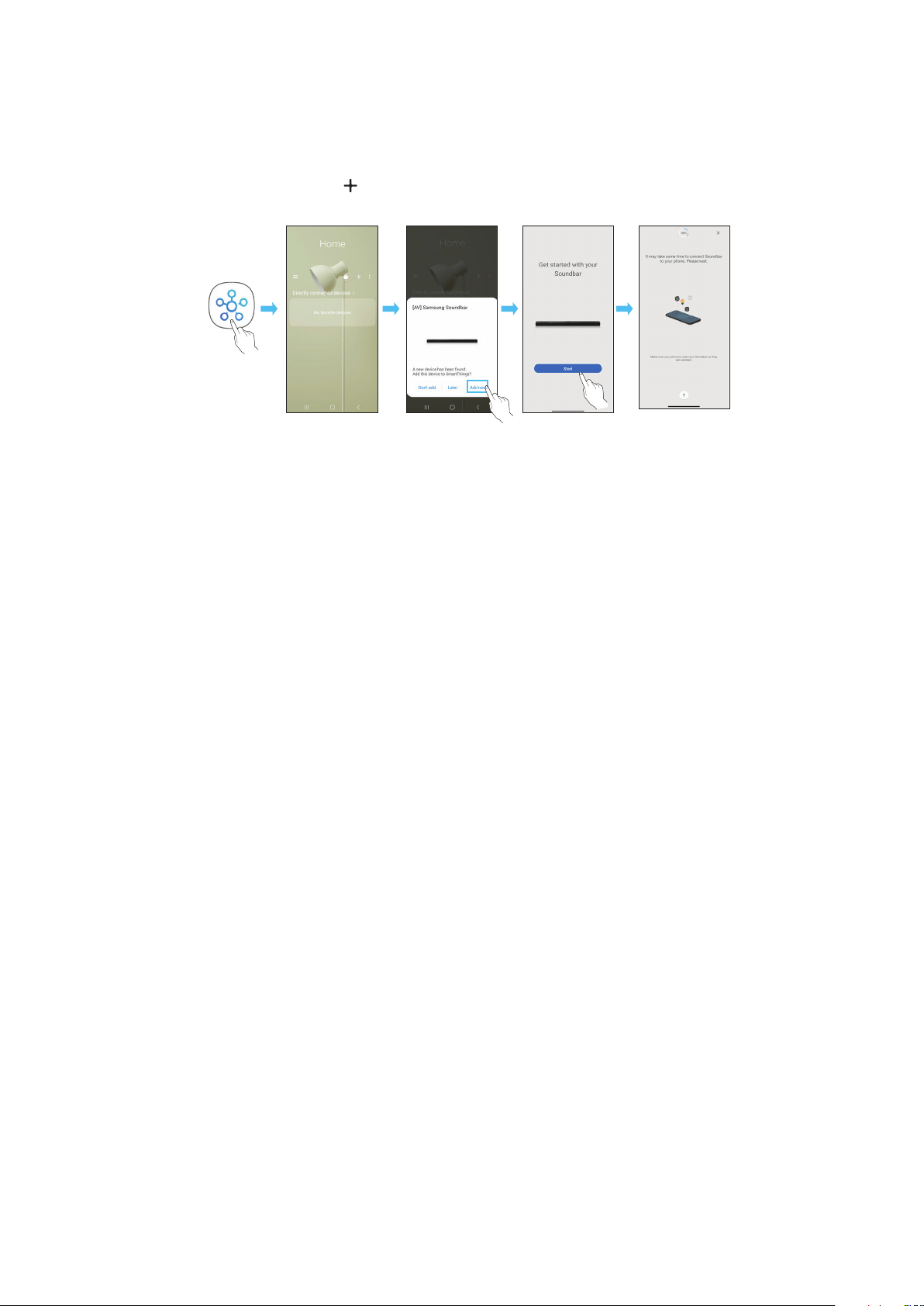
1. Install and launch the SmartThings app from your mobile device (smartphone or tablet).
2. On the app, follow the screen instructions to add the Soundbar.
• The automatic pop-up (the second screenshot below) may not show on some devices.
If the pop-up window does not appear, press “ ” on the Home screen. The Soundbar is added to the app.
• The illustration below may differ with the app version.
Launch App Auto pop-up Add device
SmartThings
App
ENG - 26
Using the Tap Sound
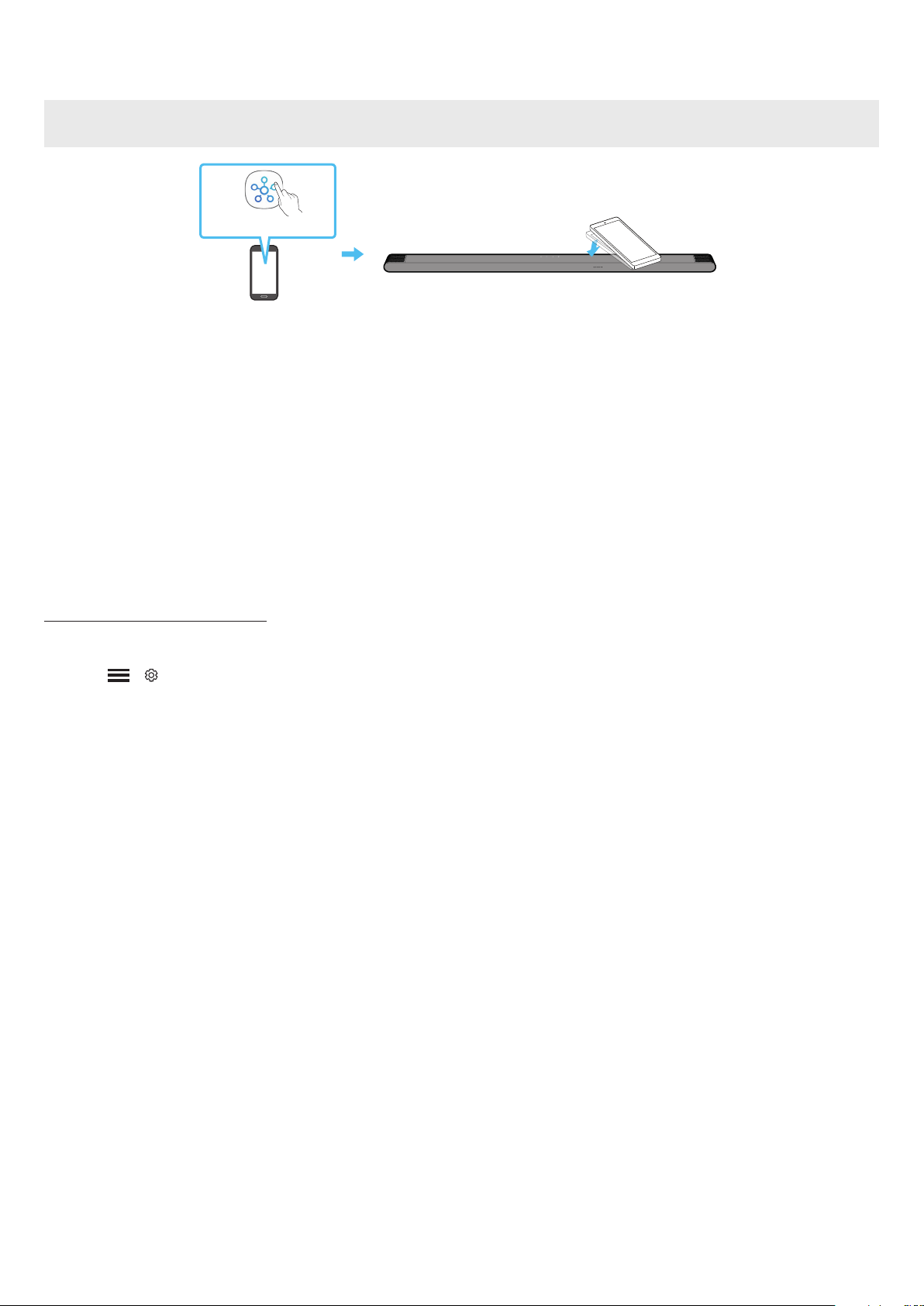
Tap the Soundbar with your mobile device to play the sound of content on the mobile device through the Soundbar.
• This function may not be supported, depending on the mobile device.
• This function is only compatible with Samsung mobile devices with Android 8.1 or later.
Top of the Soundbar
Mobile device
SmartThings App
1. Turn on the Tap Sound function on your mobile device.
• For details on how to turn on the function, refer to “Setting the Tap Sound function” below.
2. Tap the Soundbar with the mobile device. Select “Start now” in the displayed message window.
A connection is established between the mobile device and Soundbar via Bluetooth.
3. Play the sound of content on the mobile device through the Soundbar.
• This function connects a mobile device to the Soundbar via Bluetooth by detecting vibration that occurs when the device touches the
Soundbar.
• Make sure the mobile device does not tap a sharp corner of the Soundbar. The Soundbar or mobile device may become scratched or
damaged.
• It is recommended that the mobile device be covered with a case. Lightly tap the wide area in the upper portion of the Soundbar, without
using excessive force.
• To use this function, update the SmartThings app to the latest version.
The function may not be supported, depending on the app version.
Setting the Tap Sound function
Use the SmartThings app to turn on the Tap View, Tap Sound function.
1. On the mobile device, run the SmartThings app.
2. Select ( → ) in the SmartThings app screen displayed on the mobile device.
3. Set “Tap View, Tap Sound” to On to allow the function to work when a mobile device moves close to the Soundbar. The function is turned on.
NOTE
• When the mobile device is in power-saving mode, the Tap Sound function does not work.
• The Tap Sound function may not work if there are devices near the Soundbar that cause radio interference such as electric devices. Make sure
devices that may cause radio interference are placed at a sufcient distance away from the Soundbar.

ENG - 27
07 CONNECTING VIA APPLE AIRPLAY 2
• This feature may not be available in some countries.
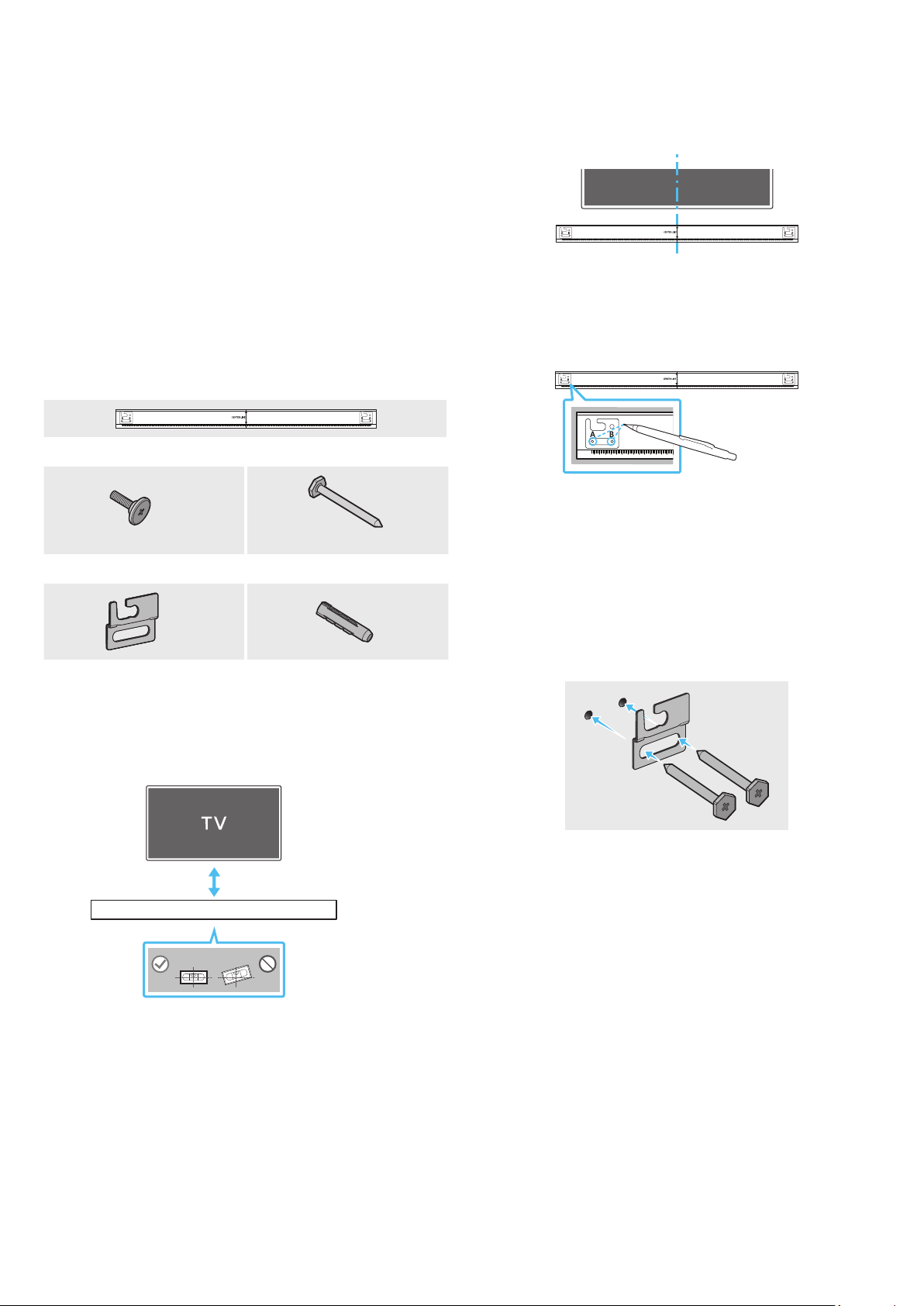
• This Samsung Soundbar supports AirPlay 2 and requires iOS 11.4 or later.
With AirPlay 2, you can stream music, podcasts, and other audio from your Apple devices to the Samsung Soundbar.
• Make sure the Soundbar is powered on and connected to the same Wi-Fi network as your Apple device.
• Select
from an AirPlay-supported app or Control Center on your iPhone, iPad, or Mac.
• Select the Soundbar from the list of available devices to play the current audio to.
ENG - 28
08 INSTALLING THE WALL
MOUNT
Installation Precautions
• Install on a vertical wall only.
• Do not install in a place with high temperature or humidity.
• Verify whether the wall is strong enough to support the product’s
weight. If not, reinforce the wall or choose another installation
point.
• Connect cables from the unit to external devices before you install
the Soundbar on the wall.
• Make sure the unit is turned off and unplugged before you install
it. Otherwise, it may cause an electric shock.
Wallmount Components
AH81-15127A-01
A TYPE
:
740mm
B TYPE
:
700mm
Wall Mount Guide
x 2
x 4
(M5 X L55)
Holder-Screw Screw
x 2
x 4
Bracket-Wall Mount Screw Anchor
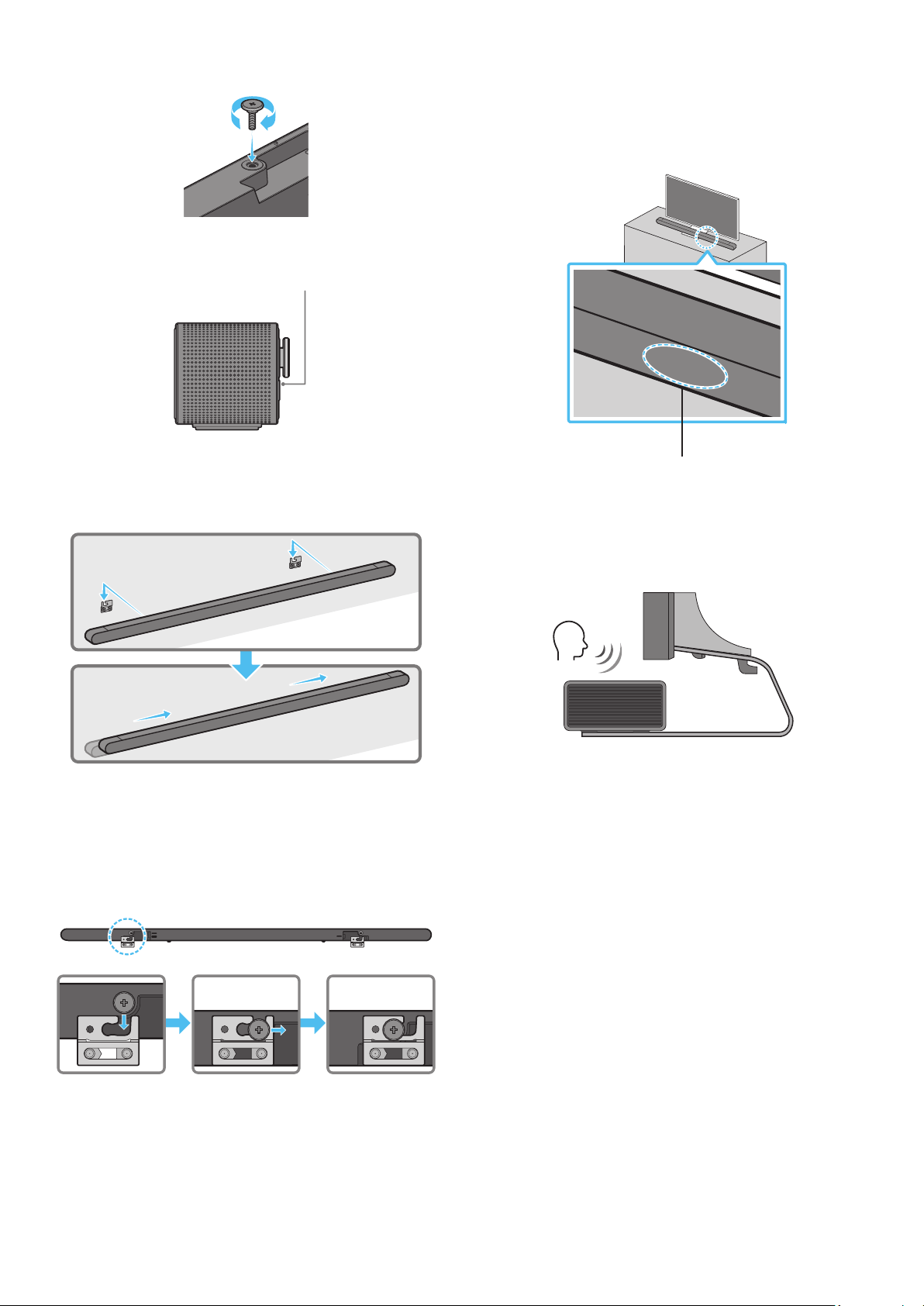
1. Place the Wall Mount Guide against the wall surface.
• The Wall Mount Guide must be level.
• If your TV is mounted on the wall, install the Soundbar at least
5 cm below the TV.
5 cm or more
2. Align the Wall Mount Guide’s Center Line with the center of your
TV (if you are mounting the Soundbar below your TV), and then x
the Wall Mount Guide to the wall using tape.
• If you are not mounting below a TV, place the Center Line in the
center of the installation area.
AH81-15127A-01
A TYPE
:
740mm
B TYPE
:
700mm
Center Line
3. Push a pen tip or sharpened pencil tip through the center of the
A-TYPE and B-TYPE images on each end of the Guide to mark the
holes for the supporting screws, and then remove the Wall Mount
Guide.
AH81-15127A-01
A TYPE
:
740mm
B TYPE
:
700mm
4. Using an appropriately sized drill bit, drill a hole in the wall at each
marking.
• If the markings do not correspond to the positions of studs,
make sure you insert appropriate anchors or mollies into the
holes before you insert the support screws. If you use anchors
or mollies, make sure the holes you drill are large enough for
the anchors or mollies you use.
5. Push a screw (not supplied) through each Screw, and then screw
each screw rmly into a support screw hole.
ENG - 29
6. Install the 2 Bracket-Wall Mounts in the correct orientation on the
rear of the Soundbar using 2 Holder-screws.
• When assembling, make sure the hanger part of the Bracket-
Wall Mounts are located behind the rear of the Soundbar.
Rear of Soundbar
Right end of Soundbar
7. Install the Soundbar with the attached Bracket-Wall Mounts by
hanging the Bracket-Wall Mounts on the Holder-Screws on the
wall.
8. Slide the Soundbar down as shown below so that the Bracket-Wall
Mounts rest securely on the Holder-Screws.
• Insert the Holder-Screws into the wide (rear) part of the
Bracket-Wall Mounts, and then slide the Bracket-Wall Mounts
down so that the Bracket-Wall Mounts rest securely on the
Holder-Screws.
SERVICE
HDMI
(ARC)
SERVICE
HDMI
(ARC)
SERVICE
HDMI
(ARC)
DC 19V
09 INSTALLING THE
SOUNDBAR IN FRONT OF
TV
Microphones
As illustrated in the image, align the center of the Soundbar with the
center of the TV, carefully place the Soundbar onto the TV stand.
At this time, place the microphones at the front of the stand not to
interfere with voice recognition.
Right end of Soundbar
TV
NOTE
• Make sure the Soundbar is placed on a at and solid surface.
• Insufcient gap from the TV may cause voice recognition and
acoustic problems.
• The illustration above differs with the respective model.
ENG - 30
10 SOFTWARE UPDATE
Auto Update
When the Soundbar is connected to the Internet, software updates
automatically occur even when the Soundbar is turned off.
• To use the Auto Update function, the Soundbar must be connected
to the Internet.
The Wi-Fi connection to the Soundbar will be terminated if
the Soundbar’s power cord is disconnected or the power is cut
off. If the power is cut off, when the power comes back on or
you reconnect the power cord, turn on the Soundbar, and then
reconnect it to the Internet.
USB Update
Rear of the Soundbar
SERVICE
HDMI
(ARC)
SERVICE
HDMI
(ARC)
Micro USB to USB
adapter Cable
(not supplied)
Samsung may offer updates for the Soundbar’s system rmware in
the future.
When an update is available, you can update the Soundbar by
connecting the USB drive that contains the update rmware to the
SERVICE port of the Soundbar.
1. Go to (www.samsung.com) → search for the model name from the
customer support menu option.
• For more information about update, refer to Upgrade Guide.
2. Download the upgrade le (USB type).
3. Unzip the le to create a folder with the le name.
4. Store the created folder in a USB and then connect it to the
Soundbar.
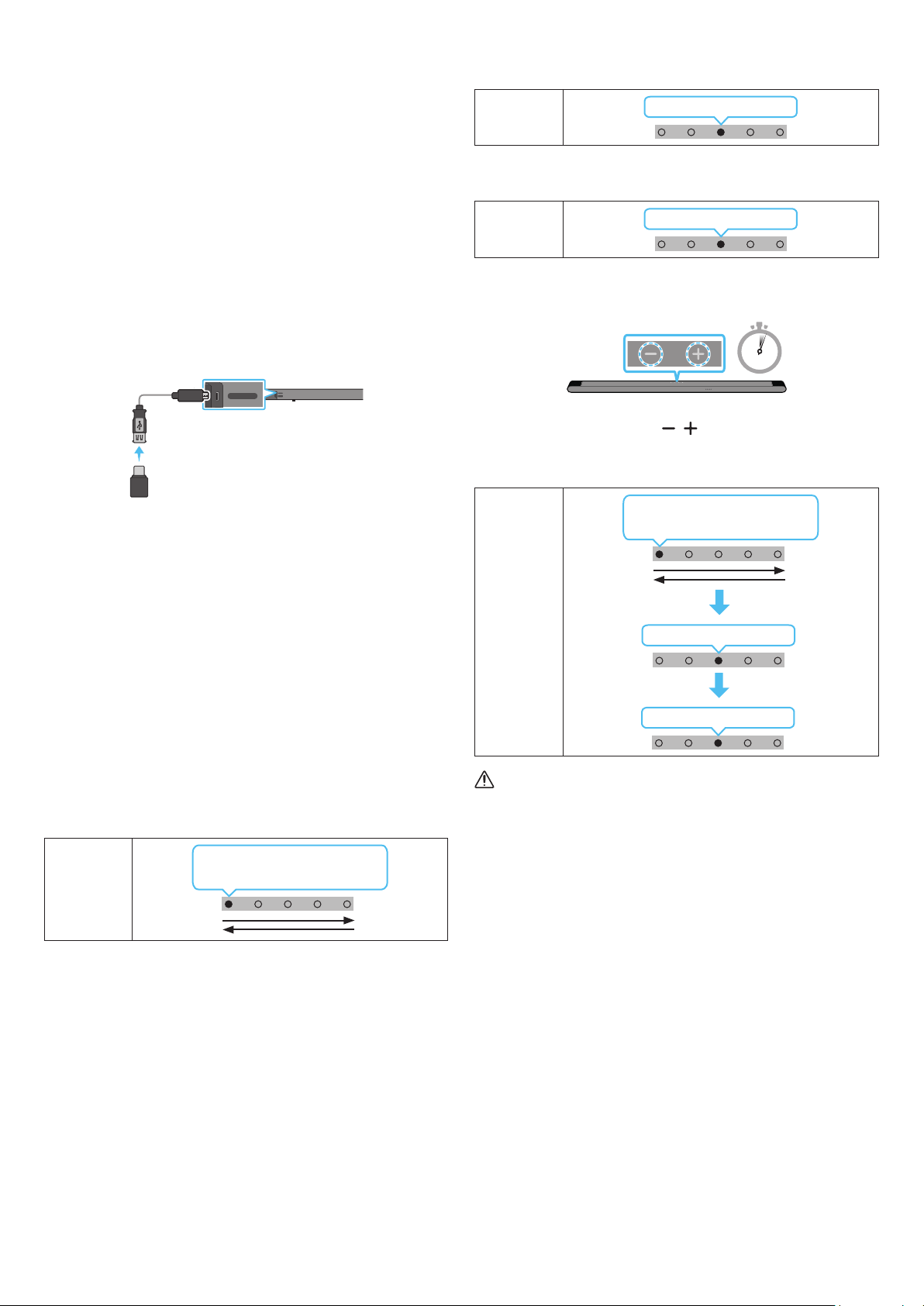
5. Turn on the Soundbar. Then the product is updated within
3 minutes.
LED
indicator
White moves from left to
right and right to left
• During update, do not turn it off or remove the USB.
• If the yellow LED is on after the software update is completed,
this means that an additional update is in progress. When this
happens, don’t turn off the power or remove the USB.
• If update does not proceed, reconnect the Soundbar power cord.
• When the latest version is installed, no update is performed.
• Depending on the USB type, update may not be supported.
• If there is no update le available, the indicator blinks red
3 times.
LED
indicator
Red Blinks X3
• If the update le is in the same or lower version than the
existing, the indicator blinks cyan 3 times.
LED
indicator
Cyan Blinks X3
Reset
5 Sec
With the Soundbar on, press the (Volume) buttons on the body
at the same time for at least 5 seconds. The LED display changes as
shown below and then the Soundbar is reset.
LED
indicator
Cyan Blinks X3
Red Blinks → Off
White moves from left to
right and right to left
CAUTION
• All the settings of the Soundbar are reset. Be sure to perform
this only when a reset is required.

ENG - 31
11 TROUBLESHOOTING
Before seeking assistance, check the following.
Soundbar does not turn on.
• Check whether the power cord of the Soundbar is correctly
inserted into the outlet.
Soundbar works erratically.
• After removing the power cord, insert it again.
• Power cycle the external device and try again.
• If there is no signal, the Soundbar automatically turns off after a
certain period of time. Turn on the power. (See page 9.)
Remote control does not work
• Point the remote directly at the soundbar.
• Recharge the remote control.
The Soundbar indicator turns solid red.
• The microphone is turned off.
Turn on the microphone. (See page 7.)
Sound is not output from the soundbar.
• The volume of the Soundbar is too low or muted. Adjust the
volume.
• When any external device (STB, Bluetooth device, mobile device,
etc.) is connected, adjust the volume of the external device.
• For sound output of the TV, select Soundbar. (Samsung TV:
Home (
) → Menu → Settings ( ) → All Settings ( ) → Sound
→ Sound Output → Select Soundbar)
• The cable connection to the Soundbar may not be loose. Remove
the cable and connect again.
• Remove the power cord completely, reconnect, and turn the
power on.
• Reset the product and try again. (See page 30.)
Sound is not output from the subwoofer.
• Check whether the LED indicator on the rear of the Subwoofer
is on in blue. Reconnect the Soundbar and Subwoofer if the
indicator is blinking in blue or turned red. (See page 15.)
• You may experience an issue if there is an obstacle between the
Soundbar and Subwoofer. Move devices to an area away from
obstacles.
• Other devices sending radio frequency signals in proximity may
interrupt the connection.
Keep your speaker away from such devices.
• Remove and reconnect the power plug.
In case there is sound jitter, delays, or noise from the Subwoofer
• If there are any objects between the Soundbar and Subwoofer, this
could cause a problem. Please reposition these to a place without
such an object.
• There may be sound jitter or delays when the Subwoofer is far from
the Soundbar. Please place them near the Soundbar.
• There may be sound jitter or delays when the Soundbar is near an
instrument or electrical device that can cause radio interference.
Place the Soundbar far from such devices that can cause radio
interference. (E.g., wireless router)
• Change the TV network connection status from wireless to wired.
The Subwoofer volume is too low
• The original volume of the content you are playing may be low.
Try adjusting the Subwoofer level. (See page 10.)
• Bring the Subwoofer speaker closer to you.
If the TV is not connected via HDMI (ARC).
• Check whether the HDMI cable is correctly connected to the ARC
terminal. (See page 17.)
• Connection may not be possible due to the connected external
device (set-top box, game console, etc.). Directly connect the
Soundbar.
• HDMI-CEC may not be activated on the TV. Turn on the CEC on
the TV menu. (Samsung TV: Home (
) → Menu → Settings ( )
→ All Settings ( ) → Connection → External Device Manager →
Anynet+ (HDMI-CEC) ON)
There is no sound in when connecting to the TV in HDMI (ARC)
mode
• Your device is unable to play the input signal. Change the TV’s
audio output to PCM or Dolby Digital. (For a Samsung TV:
Home (
) → Menu → Settings ( ) → All Settings ( ) → Sound
→ Expert Settings → Digital Output Audio Format)
Soundbar will not connect via Bluetooth.
• When connecting a new device, switch to “Bluetooth Pairing”
for connection. (Press the
PAIR button on the remote control
or press the (Mic On/Off) button on the body for at least
5 seconds.)
• If the Soundbar is connected to another device, disconnect that
device rst to switch the device.
• Reconnect it after removing the Bluetooth speaker list on the
device to connect. (Samsung TV: Home ( ) → Menu →
Settings ( ) → All Settings ( ) → Sound → Sound Output →
Bluetooth Speaker List)
• Remove and reconnect the power plug, then try again.
• Reset the product and try again. (For more information, refer to
“Reset”.)
ENG - 32
Sound drops out when connected via Bluetooth.
• Some devices can cause radio interference if they are located too
close to the Soundbar. e. g. microwaves, wireless routers, etc.
• If your device that is connected via Bluetooth moves too far away
from the soundbar, it may cause the sound to drop out. Move the
device closer to the soundbar.
• If a part of your body is in contact with the Bluetooth transceiver
or the product is installed on metal furniture, the sound may drop
out. Check the installation environment and conditions for use.
Soundbar will not connect to Wi-Fi.
• Check whether your wireless router is on.
• Turn off the router, turn it back on, and then try again.
• The soundbar will not connect if the wireless signal is too weak.
Try moving the router closer to the soundbar, or eliminating
any obstacles that are between the soundbar and the router, if
possible.
• If your wireless router is new, you will need to recongure the
speaker’s network settings.
The soundbar does not turn on automatically with the TV.
• When you turn off the Soundbar while watching TV, power
synchronization with the TV is disabled. First turn off the TV.
The AVA function is not available in the following cases.
• The AVA function will not be available using Q-symphony
function.
• The AVA function will not be available when the microphone is
turned off.
After connecting the TV to the Soundbar, I switched the Soundbar
mode. Then no sound is output from the TV.
• If you connect your Soundbar to a mobile device while the
Soundbar is connected to the TV, the Soundbar outputs sound
from the mobile device while keeping the TV connection. So the
TV sound will not be delivered anywhere.
• Disconnect the mobile device, and the TV sound will be output
from the Soundbar again.
12 LICENSE
Dolby, Dolby Atmos, and the double-D symbol are registered
trademarks of Dolby Laboratories Licensing Corporation.
Manufactured under license from Dolby Laboratories. Condential
unpublished works. Copyright © 2012-2021 Dolby Laboratories. All
rights reserved.
For DTS patents, see http://patents.dts.com. Manufactured under
license from DTS, Inc. (for companies headquartered in the U.S./
Japan/ Taiwan) or under license from DTS Licensing Limited (for
all other companies). DTS, Digital Surround, Virtual:X, and the DTS
logo are registered trademarks or trademarks of DTS, Inc. in the
United States and other countries. © 2021 DTS, Inc. ALL RIGHTS
RESERVED.
The terms HDMI and HDMI High-Denition Multimedia Interface,
and the HDMI Logo are trademarks or registered trademarks of
HDMI Licensing Administrator, Inc. in the United States and other
countries.
• Use your phone, tablet or computer as a remote control for
Spotify. Go to spotify.com/connect to learn how
• The Spotify Software is subject to third party licenses found
here: https://www.spotify.com/connect/third-party-licenses.
• Apple, Airplay, iPhone, iPad, and Mac are trademarks of Apple
Inc., registered in the U.S. and other countries.
• Use of the Works with Apple badge means that an accessory
has been designed to work specically with the technology
identied in the badge and has been certied by the developer
to meet Apple performance standards.

ENG - 33
[ENERGY STAR]
ENERGY STAR qualied model only
• Your Samsung product is ENERGY STAR qualied in its
factory default setting. Change to certain features, settings
and functionality in this product can change the power
consumption, possibly beyond the limits required for ENERGY
STAR qualication.
• Environmental Protection Agency and Department of Energy.
ENERGY STAR is a joint program of the Government agencies,
designed to promote energy efcient products and practices.
Refer to www.energystar.gov for more information of the ENERGY
STAR Program.
ENERGY STAR qualied model only
(Applicable to Thin Client models only)
As an ENERGY STAR® Partner, SAMSUNG has determined that
this product meets the ENERGY STAR® guidelines for energy
efciency.
• The ENERGY STAR Program has been to reduced greenhouse
gas emissions and save energy through voluntary labeling.
• Power management setting of this product have been enabled
by default, and have various timing setting from 1 minutes to
5 hours.
• The product can wake with a button press on the chassis from
sleep mode.
ENERGY STAR qualied model only (The other models)
• As an ENERGY STAR Partner, Samsung has determined that this
product or product models meets the ENERGY STAR guideline
for energy efciency.
13 OPEN SOURCE LICENSE
NOTICE
To send inquiries and requests for questions regarding open sources,
contact Samsung Open Source (http://opensource.samsung.com)
14 IMPORTANT NOTES
ABOUT SERVICE
Figures and illustrations in this User Manual are provided for
reference only and may differ from actual product appearance.

ENG - 34
15 SPECIFICATIONS AND GUIDE
Specications
Model Name HW-S800B / HW-S801B
Weight 1.4 kg
Dimensions (W x H x D) 1160.0 x 38.0 x 39.9 mm
Operating Temperature Range +5°C to +35°C
Operating Humidity Range 10 % ~ 75 %
AMPLIFIER
Rated Output power (20W x 2) + (10W x 2) + (20W x 2) + (10W x 1) + (10W x 2)
Supported play formats
Dolby 5.1ch / Dolby Digital Plus / Dolby ATMOS (Dolby Digital Plus) /
DTS 5.1ch / LPCM 2ch
Subwoofer Name
HW-S800B : PS-WB85D
HW-S801B : PS-WB86D
Weight 6.4 kg
Dimensions (W x H x D) 238.0 x 240.8 x 238.0 mm
AMPLIFIER
Rated Output power 200 W
NOTE
• Samsung Electronics Co., Ltd reserves the right to change the specications without notice.
• Weight and dimensions are approximate.
Precaution : The Soundbar will restart automatically if you turn on/turn off Wi-Fi.
To deactivate Wi-Fi connection:
Press and hold the CH LEVEL button on the remote control of the Soundbar for more
than 30 seconds to turn on or off the Wi-Fi connection.
To deactivate Bluetooth connection:
Press and hold the TONE CONTROL button on the remote control of the Soundbar for
more than 30 seconds to turn on or off the Bluetooth connection.
SPA - 2
INFORMACIÓN DE SEGURIDAD
ADVERTENCIAS DE SEGURIDAD
PARA REDUCIR EL RIESGO DE DESCARGA ELÉCTRICA, NO QUITE LA TAPA
(O LA PARTE TRASERA).
NO CONTIENE PIEZAS QUE PUEDAN SER REPARADAS O REEMPLAZADAS
POR EL USUARIO. TODAS LAS REPARACIONES DEBEN SER REALIZADAS
POR PERSONAL CAPACITADO.
Consulte la tabla a continuación para obtener una explicación de los
símbolos que podrían aparecer en su producto Samsung.
PRECAUCIÓN
RIESGO DE DESCARGA ELÉCTRICA. NO ABRIR.
Este símbolo indica que hay alta tensión en el interior del
producto. Es peligroso hacer contacto con cualquier pieza
interna de este producto.
Este símbolo indica que, con este producto, se incluye
documentación importante correspondiente a su
funcionamiento y mantenimiento.
Producto de Clase II: Este símbolo indica que no se requiere
una conexión de seguridad de puesta a tierra (toma de tierra).
Si un producto con un cable de alimentación no tiene este
símbolo, el producto DEBE tener una conexión segura a una
puesta a tierra.
Tensión de CA: La tensión nominal marcada con este símbolo
es tensión de CA.
Tensión de CC: La tensión nominal marcada con este símbolo
es tensión de CC.
Precaución. Consulte las instrucciones antes de usar: Este
símbolo indica que se debe consultar el manual del usuario
para obtener más información relativa a la seguridad.
ADVERTENCIA
• Para reducir el riesgo de incendio o descarga eléctrica, no exponga este
dispositivo a la lluvia o la humedad.
PRECAUCIÓN
• A FIN DE EVITAR UNA DESCARGA ELÉCTRICA, HAGA COINCIDIR EL
CONTACTO MÁS ANCHO DEL ENCHUFE CON LA RANURA ANCHA E
INSERTE EL ENCHUFE POR COMPLETO.
• Este aparato debe conectarse siempre a un tomacorriente de CA que
tenga conexión a tierra por protección.
• Para desconectar el aparato de la red eléctrica, debe sacar el enchufe de
la toma de alimentación; por lo tanto, el enchufe de alimentación debe
poder accionarse fácilmente.
• No exponga este aparato a goteos o salpicaduras. No coloque objetos
llenos de líquidos, por ejemplo, un orero, sobre el aparato.
• Para apagar este aparato por completo, debe sacar el enchufe del
tomacorriente de la pared. Por lo tanto, el enchufe debe estar ubicado
de forma tal que siempre se pueda acceder a él fácil y rápidamente.

SPA - 3
PRECAUCIONES
1. Asegúrese de que el suministro eléctrico de CA en su hogar cumpla con
los requisitos de energía enumerados en la etiqueta de identicación
ubicada en la parte inferior de su producto. Instale su producto de
manera horizontal, sobre una base adecuada (mueble), con suciente
espacio alrededor para su ventilación (7 a 10 cm). Asegúrese de que las
ranuras de ventilación no estén cubiertas. No coloque la unidad sobre
amplicadores u otros equipos que puedan calentarse. Esta unidad está
diseñada para uso continuo.
Para apagar la unidad por completo, desconecte el enchufe de CA de
la toma de corriente. Desenchufe la unidad si tiene intenciones de no
utilizarla por un período largo de tiempo.
2. En caso de haber tormenta eléctrica, desconecte el enchufe de CA del
tomacorriente. Los cambios de voltaje que se producen a causa de la
actividad eléctrica de la tormenta pueden dañar la unidad.
3. No exponga la unidad a la luz solar directa ni a otras fuentes de calor.
Esto puede causar sobrecalentamiento y el mal funcionamiento de la
unidad.
4. Proteja el producto contra la humedad (por ejemplo, los oreros)
y el exceso de temperatura (por ejemplo, una chimenea) o equipos
que generen campos eléctricos o magnéticos fuertes. Desconecte
el cable de alimentación de la toma de corriente de CA si la unidad
no funciona correctamente. Su producto no está diseñado para uso
industrial. Es para uso personal únicamente. Si el producto ha sido
almacenado a bajas temperaturas, puede producirse el fenómeno de
la condensación. Si transporta la unidad durante el invierno, espere 2
horas aproximadamente hasta que la unidad alcance la temperatura
ambiente antes de utilizarla.
5. Puede ocurrir un incendio o una explosión y dañar el control remoto o
causar lesiones personales.
• Proteja el control remoto contra las descargas eléctricas.
• Tenga cuidado de que la terminal de carga del control remoto no
tenga contacto con sustancias tales como metal, líquido o polvo.
• Si el control remoto se daña o siento olor a humo o vapores de
ignición, detenga el funcionamiento de inmediato y haga reparar el
producto en el centro de servicios Samsung.
• No desensamble el control remoto de manera arbitraria.
• No permita que los niños o las mascotas chupen o muerdan el
control remoto. Puede ocurrir un incendio o una explosión y dañar el
control remoto o causar lesiones personales.

SPA - 4
CONTENIDO
01 Vericación de los componentes 6
02 Información general del producto 7
Panel superior de la Soundbar . . . . . . . . . . . . . . . . . . . . . . . . . . . . . . . . . . . . . . . . . . . . . . . . . . . . . . . . . . . . . . . . . . . . . . . . . . . . . . . . . . . . . . . . . . . . . . . . . . . . . . . . . . . . . 7
Panel posterior de la Soundbar . . . . . . . . . . . . . . . . . . . . . . . . . . . . . . . . . . . . . . . . . . . . . . . . . . . . . . . . . . . . . . . . . . . . . . . . . . . . . . . . . . . . . . . . . . . . . . . . . . . . . . . . . . . . 8
03 Uso del control remoto de la Soundbar 9
Acerca del control remoto. . . . . . . . . . . . . . . . . . . . . . . . . . . . . . . . . . . . . . . . . . . . . . . . . . . . . . . . . . . . . . . . . . . . . . . . . . . . . . . . . . . . . . . . . . . . . . . . . . . . . . . . . . . . . . . . . 9
Cómo usar el control remoto. . . . . . . . . . . . . . . . . . . . . . . . . . . . . . . . . . . . . . . . . . . . . . . . . . . . . . . . . . . . . . . . . . . . . . . . . . . . . . . . . . . . . . . . . . . . . . . . . . . . . . . . . . . . . . . 9
Amplicador de voz activo (AVA). . . . . . . . . . . . . . . . . . . . . . . . . . . . . . . . . . . . . . . . . . . . . . . . . . . . . . . . . . . . . . . . . . . . . . . . . . . . . . . . . . . . . . . . . . . . . . . . . . . . . . . . . . 11
Uso de los botones ocultos (botones con más de una función). . . . . . . . . . . . . . . . . . . . . . . . . . . . . . . . . . . . . . . . . . . . . . . . . . . . . . . . . . . . . . . . . . . . . . . . . . . . . . . 11
Especicaciones de salida para los diferentes modos de efectos de sonido. . . . . . . . . . . . . . . . . . . . . . . . . . . . . . . . . . . . . . . . . . . . . . . . . . . . . . . . . . . . . . . . . . . 12
Ajuste del volumen de la Soundbar con un control remoto de TV . . . . . . . . . . . . . . . . . . . . . . . . . . . . . . . . . . . . . . . . . . . . . . . . . . . . . . . . . . . . . . . . . . . . . . . . . . . . 13
04 Conexión de la Soundbar 14
Conexión de las unidades a la fuente de alimentación . . . . . . . . . . . . . . . . . . . . . . . . . . . . . . . . . . . . . . . . . . . . . . . . . . . . . . . . . . . . . . . . . . . . . . . . . . . . . . . . . . . . . . 14
‒ Conexión manual del Subwoofer. . . . . . . . . . . . . . . . . . . . . . . . . . . . . . . . . . . . . . . . . . . . . . . . . . . . . . . . . . . . . . . . . . . . . . . . . . . . . . . . . . . . . . . . . . . . . . . . . . . . . . . 15
‒ Luces del indicador LED en la parte posterior del Subwoofer . . . . . . . . . . . . . . . . . . . . . . . . . . . . . . . . . . . . . . . . . . . . . . . . . . . . . . . . . . . . . . . . . . . . . . . . . . . . . 16
Cómo conectar la Soundbar a un SWA-9500S (se vende por separado) . . . . . . . . . . . . . . . . . . . . . . . . . . . . . . . . . . . . . . . . . . . . . . . . . . . . . . . . . . . . . . . . . . . . . . . 16
05 Conexión a un TV 17
Conexión al TV que es compatible con HDMI ARC (Retorno del canal de audio) . . . . . . . . . . . . . . . . . . . . . . . . . . . . . . . . . . . . . . . . . . . . . . . . . . . . . . . . . . . . . . . 17
Conexión a través de Bluetooth. . . . . . . . . . . . . . . . . . . . . . . . . . . . . . . . . . . . . . . . . . . . . . . . . . . . . . . . . . . . . . . . . . . . . . . . . . . . . . . . . . . . . . . . . . . . . . . . . . . . . . . . . . . 18
Conexión mediante Wi-Fi. . . . . . . . . . . . . . . . . . . . . . . . . . . . . . . . . . . . . . . . . . . . . . . . . . . . . . . . . . . . . . . . . . . . . . . . . . . . . . . . . . . . . . . . . . . . . . . . . . . . . . . . . . . . . . . . . 19
Conexión a un TV que admita Dolby Atmos . . . . . . . . . . . . . . . . . . . . . . . . . . . . . . . . . . . . . . . . . . . . . . . . . . . . . . . . . . . . . . . . . . . . . . . . . . . . . . . . . . . . . . . . . . . . . . . .20
Cómo utilizar la función Q-Symphony . . . . . . . . . . . . . . . . . . . . . . . . . . . . . . . . . . . . . . . . . . . . . . . . . . . . . . . . . . . . . . . . . . . . . . . . . . . . . . . . . . . . . . . . . . . . . . . . . . . . . 21
Uso del sonido Spacet . . . . . . . . . . . . . . . . . . . . . . . . . . . . . . . . . . . . . . . . . . . . . . . . . . . . . . . . . . . . . . . . . . . . . . . . . . . . . . . . . . . . . . . . . . . . . . . . . . . . . . . . . . . . . . . . . . 22
06 Conexión a un dispositivo móvil 23
Método 1. Conexión a través de Bluetooth . . . . . . . . . . . . . . . . . . . . . . . . . . . . . . . . . . . . . . . . . . . . . . . . . . . . . . . . . . . . . . . . . . . . . . . . . . . . . . . . . . . . . . . . . . . . . . . . . 23
Método 2. Conexión a través de wi (Red inalámbrica). . . . . . . . . . . . . . . . . . . . . . . . . . . . . . . . . . . . . . . . . . . . . . . . . . . . . . . . . . . . . . . . . . . . . . . . . . . . . . . . . . . . . . 25
Uso de Tap Sound. . . . . . . . . . . . . . . . . . . . . . . . . . . . . . . . . . . . . . . . . . . . . . . . . . . . . . . . . . . . . . . . . . . . . . . . . . . . . . . . . . . . . . . . . . . . . . . . . . . . . . . . . . . . . . . . . . . . . . . . 26
07 Conexión mediante Apple AirPlay 2 27
08 Instalación del soporte de montaje en la pared 28
Precauciones durante la instalación. . . . . . . . . . . . . . . . . . . . . . . . . . . . . . . . . . . . . . . . . . . . . . . . . . . . . . . . . . . . . . . . . . . . . . . . . . . . . . . . . . . . . . . . . . . . . . . . . . . . . . . 28
Componentes para montaje en la pared . . . . . . . . . . . . . . . . . . . . . . . . . . . . . . . . . . . . . . . . . . . . . . . . . . . . . . . . . . . . . . . . . . . . . . . . . . . . . . . . . . . . . . . . . . . . . . . . . . . 28
09 Instalación de la Soundbar frente al TV 29

SPA - 5
10 Actualización de software 30
Actualización automática . . . . . . . . . . . . . . . . . . . . . . . . . . . . . . . . . . . . . . . . . . . . . . . . . . . . . . . . . . . . . . . . . . . . . . . . . . . . . . . . . . . . . . . . . . . . . . . . . . . . . . . . . . . . . . . .30
Actualización mediante USB. . . . . . . . . . . . . . . . . . . . . . . . . . . . . . . . . . . . . . . . . . . . . . . . . . . . . . . . . . . . . . . . . . . . . . . . . . . . . . . . . . . . . . . . . . . . . . . . . . . . . . . . . . . . . .30
Restablecer . . . . . . . . . . . . . . . . . . . . . . . . . . . . . . . . . . . . . . . . . . . . . . . . . . . . . . . . . . . . . . . . . . . . . . . . . . . . . . . . . . . . . . . . . . . . . . . . . . . . . . . . . . . . . . . . . . . . . . . . . . . . .30
11 Resolución de problemas 31
12 Licencia 32
13 Aviso sobre la licencia de código abierto 33
14 Notas importantes sobre el servicio 33
15 Especicaciones y guía 34
Especicaciones. . . . . . . . . . . . . . . . . . . . . . . . . . . . . . . . . . . . . . . . . . . . . . . . . . . . . . . . . . . . . . . . . . . . . . . . . . . . . . . . . . . . . . . . . . . . . . . . . . . . . . . . . . . . . . . . . . . . . . . . .34
SPA - 6
01 VERIFICACIÓN DE LOS COMPONENTES
Unidad principal de la Soundbar Control remoto de la Soundbar Altavoz de graves
x 2
Adaptador de CA/CC (Soundbar)
Cable de alimentación
(altavoz de graves, Soundbar)
Cable HDMI a Micro HDMI
AH81-15127A-01
A TYPE
:
740mm
B TYPE
:
700mm
x 2
x 2
Guía de montaje en la pared Soporte de montaje en la pared Tornillo de sujeción
x 4
(M5 x L55)
x 4
Tornillo Anclaje de tornillo
• Para obtener más información acerca del suministro eléctrico y el consumo de energía, consulte la etiqueta del producto. (Etiqueta: parte inferior de la
unidad principal de la Soundbar)
• Para comprar componentes adicionales o cables opcionales, póngase en contacto con un Centro de soporte técnico de Samsung o con el Centro de
atención al cliente de Samsung.
• Para obtener más información sobre el montaje en la pared o el pie de goma, consulte las páginas 28~29.
• El diseño, las especicaciones y la pantalla de la aplicación están sujetos a cambios sin previo aviso.
• La apariencia de los accesorios puede diferir ligeramente de las ilustraciones de arriba.
SPA - 7
02 INFORMACIÓN GENERAL DEL PRODUCTO
Panel superior de la Soundbar
2 4
3
1
1 Indicador LED
El indicador LED destella, brilla o cambia de color según el modo o estado actual de la Soundbar. El color del indicador LED y la cantidad de luces
indican el modo activo como se describe a continuación.
W
LED blanco
W
LED blanco
M
LED multicolor
W
LED blanco
W
LED blanco
• El LED multicolor puede ser blanco, cian, verde, rojo o azul según el modo o estado.
2
Botón
(Multifunción)
• En modo de espera, presione el botón (Multifunción) para encender la Soundbar.
• Presione el botón (Multifunción) para cambiar el modo. Cada vez que cambia el modo, el LED se ilumina de color blanco y, luego, se apaga.
Indicador LED
Blanco Encendido → Apagado Blanco Encendido → Apagado Blanco Encendido → Apagado
"TV ARC" "Wi-Fi" "Bluetooth"
3
Botón
(Volumen)
Permite ajustar el volumen.
4
Botón
(Micrófono encendido/apagado)
Presione el botón para encender o apagar el micrófono.
Cuando el micrófono está apagado, el indicador LED será de color rojo.
Indicador LED
Rojo encendido
"Mic Off" "Mic On"
• Cuando conecte el cable de CA, el botón de encendido comenzará a funcionar luego de 4 a 6 segundos.
• Cuando encienda esta unidad, habrá un retraso de 4 a 5 segundos antes de que emita sonido.
• Si oye sonidos tanto del TV como de la Soundbar, vaya al menú Conguración, busque la opción de audio del TV y cambie el altavoz del TV a Altavoz
externo.
• Puede activar y desactivar las noticaciones de audio mediante la aplicación SmartThings. Para obtener información sobre cómo usar la aplicación
SmartThings, consulte "Método 2. Conexión a través de wi (Red inalámbrica)".
SPA - 8
Panel posterior de la Soundbar
DC 19V
SERVICE
HDMI
(ARC)
DC 19V
SERVICE
HDMI
(ARC)
DC 19V
SERVICE
HDMI
(ARC)
DC 19V
SERVICE
HDMI
(ARC)
DC 19V
SERVICE
HDMI
(ARC)
DC 19V
SERVICE
HDMI
(ARC)
3
1
2
1 SERVICE
Conecte un dispositivo de almacenamiento USB para actualizar el software del producto.
2 HDMI (ARC)
Conéctese al puerto HDMI (ARC) en un TV. (Consulte la página 17).
3 DC 19V
Conecte el adaptador eléctrico de CA/CC. (Suministro eléctrico de entrada). (Consulte la página 14).
• Cuando desconecte el cable de alimentación del adaptador de energía CA/CC de una toma de la pared, tire del enchufe.
No tire del cable.
• No conecte esta unidad ni otros componentes a un tomacorriente de CA antes de completar todas las conexiones entre los componentes.
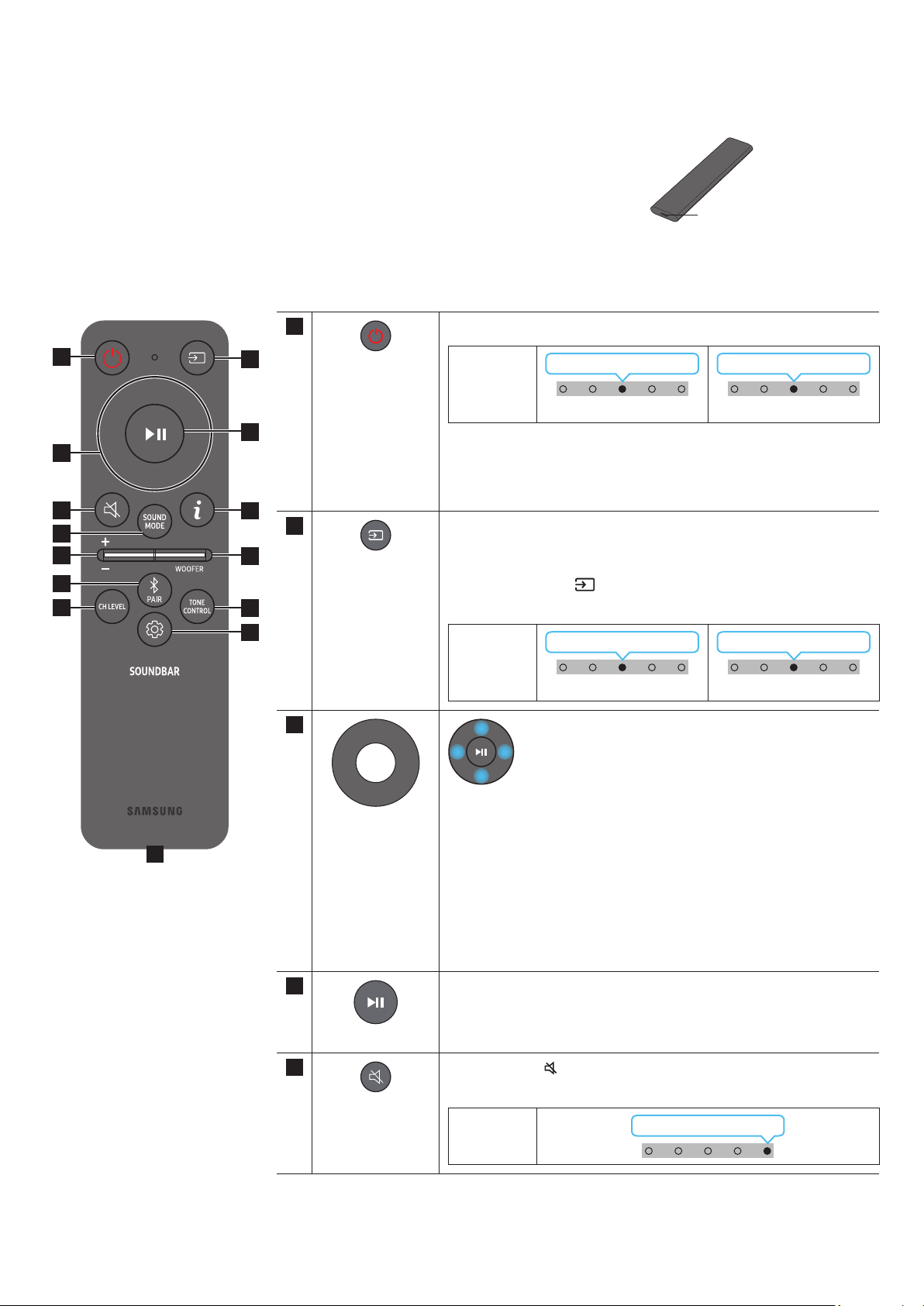
SPA - 9
03 USO DEL CONTROL REMOTO DE LA SOUNDBAR
Acerca del control remoto
• Utilice el control remoto a una distancia inferior a 6 m del producto. Esta distancia puede variar según las
condiciones ambientales de la señal inalámbrica.
• Si el control remoto no funciona debido a que la carga de la batería es baja, cárguela usando el puerto de
tipo USB-C.
• La ilustración diere del modelo de control remoto respectivo.
Puerto USB (type-C)
para cargar
Cómo usar el control remoto
1
3
5
8
11
13
7
10
12
2
4
9
6
14
1
Alimentación
Enciende y apaga la Soundbar.
Indicador
LED
1 parpadeo en color cian
Encendido
3 parpadeos en color rojo
Apagado
• Función Auto Power Down
La unidad se apaga automáticamente en las siguientes situaciones:
• En el modo "TV ARC" / "Wi-Fi" / "Bluetooth" si no hay señal de audio por
18 minutos.
2
Fuente
Presione aquí para elegir una fuente conectada a la Soundbar.
• Comentarios de audio activados/desactivados
Puede activar o desactivar la función Comentarios de audio. Mantenga
presionado el botón
(Fuente) del control remoto durante 5 segundos
mientras la Soundbar está apagada (modo de espera).
Indicador
LED
1 parpadeo en color cian
Encendido
1 parpadeo en rojo
Apagado
3
Arriba/abajo/
izquierda/derecha
Presione las áreas indicadas para seleccionar Arriba/abajo/
izquierda/derecha.
Presione arriba/abajo/izquierda/derecha en el botón para seleccionar o
congurar las funciones.
• Omitir música
Para seleccionar el siguiente archivo de música, presione el botón Derecha.
Para seleccionar el archivo de música anterior, presione el botón Izquierda.
• ID SET
Mantenga presionado el botón Arriba durante 5 segundos para completar
ID SET (al establecer la conexión con un altavoz de graves inalámbrico o
altavoces traseros inalámbricos).
4
Reproducir/pausar
También puede presionar este botón para reproducir o pausar música.
5
Silenciar
Presione el botón
(Silenciar) para silenciar el sonido.
Vuelva a presionarlo para reanudar el sonido.
Indicador
LED
Parpadeos constantes
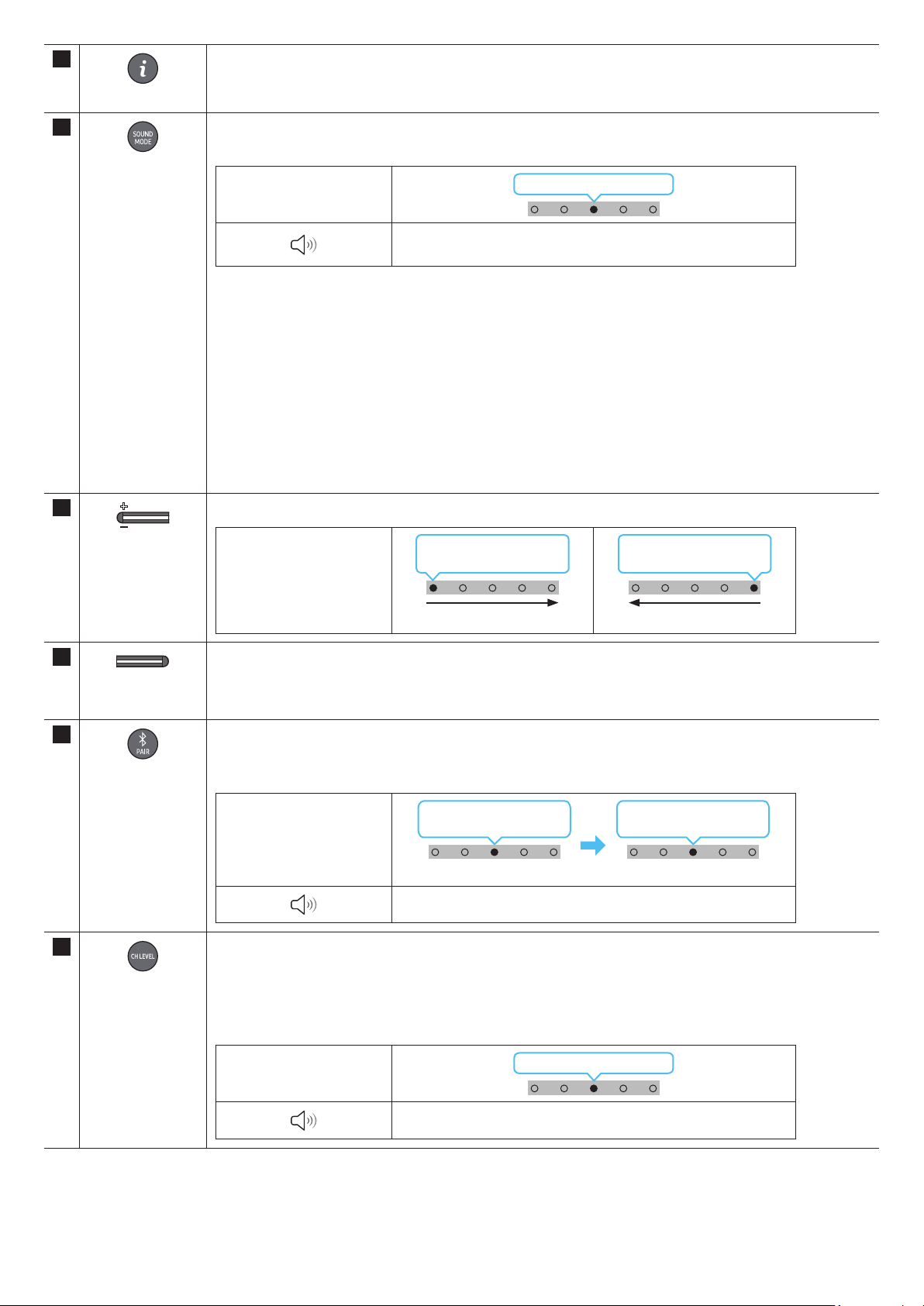
SPA - 10
6
Información
Presione el botón para mostrar información detallada acerca de la función actual. (Consulte la página 7).
Si hay conexión a Dolby Atmos®, el indicador LED parpadea de color cian 3 veces.
7
SOUND MODE
Puede seleccionar el modo de audio que desea presionando el botón. Cada vez que cambia el modo, el LED multicolor
parpadea en blanco.
Indicador LED
1 parpadeo en color blanco
"Surround" → "Game" → "Standard" → "Adaptive Sound" →
"DTS Virtual:X"
• Surround
Proporciona un campo sonoro más amplio que el estándar.
• Game
Proporciona sonido estereoscópico para sumergirlo en la acción mientras juega.
• Standard
Emite el sonido original.
• Adaptive Sound
Analiza el contenido en tiempo real y automáticamente proporciona el campo sonoro óptimo según las características
del sonido.
• DTS Virtual:X
Sonido 3D envolvente desde cualquier contenido.
8
VOLUMEN
Mueva el botón hacia arriba o hacia abajo para ajustar el volumen.
Indicador LED
El color blanco se mueve
hacia la derecha X1
Sube el volumen
1 movimiento del color
blanco hacia la izquierda
Baja el volumen
9
NIVEL DE WOOFER
(BASS)
Pulse este botón para subir o bajar el nivel de los graves (bajos) a -12 o entre -6 y +6. Para congurar el nivel de volumen de
graves (bajos) en 0 (Predeterminado), presione el botón.
10
Bluetooth PAIR
Cambie la Soundbar a modo de conexión Bluetooth.
Cuando presiona el botón, el LED cambia como se muestra a continuación.
• Hasta que no se complete el emparejamiento, el LED multicolor cambia a Rojo → Verde → Azul sucesivamente.
Indicador LED
Parpadeo Rojo →
Verde → Azul
Emparejamiento
3 parpadeos en color cian
Se completó la conexión
"Ready to connect via Bluetooth".
11
CH LEVEL
Puede presionar este botón para ajustar el volumen de cada altavoz.
• Para controlar el volumen de cada altavoz, seleccione "Center Level" o "Front Top Level" en Ajustes de sonido, y luego
ajuste el volumen entre -6~ y +6 mediante los botones Arriba/Abajo.
• Cuando se conectan los altavoces traseros (que se venden por separado), se admite la conguración "Rear Level" y
"Rear Top Level". Para ajustar el volumen de "Rear Level" y "Rear Top Level" entre -6 y +6, use los botones Arriba/Abajo.
Indicador LED
1 parpadeo en color blanco
“Center Level” → “Front Top Level”
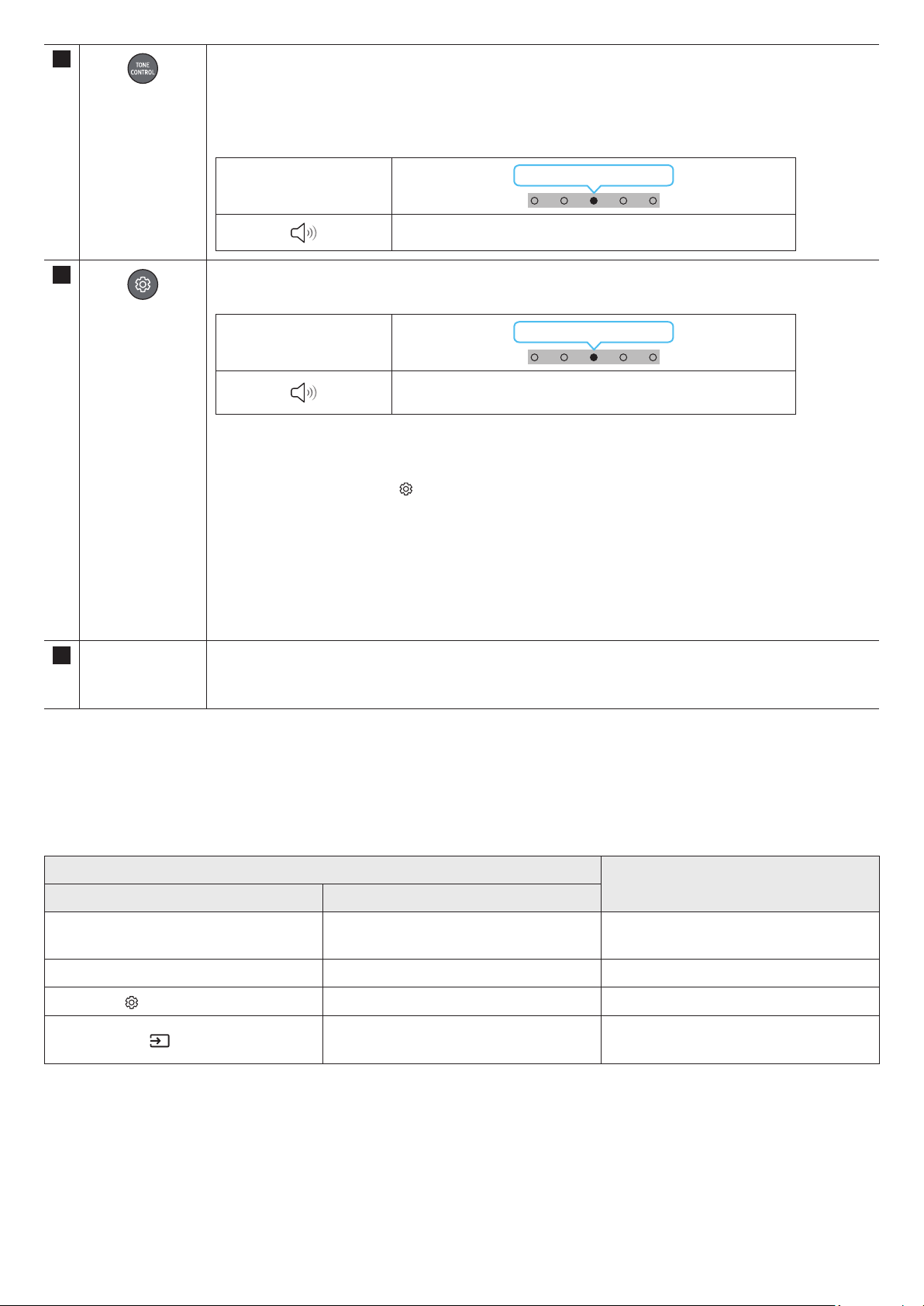
SPA - 11
12
TONE CONTROL
Presione este botón para ajustar el volumen de los sonidos graves o agudos. Se puede ajustar el elemento deseado con los
botones Arriba/Abajo. Esta función se activa en el modo Sound, excepto en el modo Standard.
• Para controlar el volumen de los sonidos agudos o bajos, seleccione "Treble" o "Bass" en Ajustes de sonido, y luego
ajuste el volumen entre -6~ y +6 con los botones Arriba/Abajo.
• Una vez modicado el nivel de bajos, el nivel del graves se ajustará según corresponda.
Indicador LED
1 parpadeo en color blanco
"Treble" → "Bass"
13
Control de sonido
Puede presionar el botón para establecer la función de audio. Se puede ajustar el elemento deseado con los botones
Arriba/Abajo. Cada vez que cambia el modo, el LED multicolor parpadea en blanco.
Indicador LED
1 parpadeo en color blanco
"SpaceFit Sound" → "Active Voice Amplier" → "Voice enhancement" →
"Night Mode" → "Sync" → "Virtual"
• Voice enhancement hace que sea más fácil oír el diálogo hablado en las películas y contenido de TV.
• Night Mode está optimizado para ver contenido por la noche, ya que la conguración se ajusta para bajar el volumen,
pero mantener la claridad del diálogo.
• Mantenga presionado el botón
(Control de sonido) durante aproximadamente 5 segundos para ajustar el sonido
de cada banda de frecuencia. Puede elegir 150 Hz, 300 Hz, 600 Hz, 1.2 kHz, 2.5 kHz, 5 kHz y 10 kHz usando los botones
Izquierda/Derecha y puede congurar cada uno entre -6 y +6 con los botones Arriba/Abajo.
(Asegúrese de que el modo de sonido se establezca como “STANDARD”.)
• Si el video del TV y el audio de la Soundbar no están sincronizados, seleccione "Sync" en Control de sonido y, luego,
dena la demora de audio entre 0 y 300 milisegundos utilizando los botones Arriba/Abajo.
• La opción "Sync" solo es compatible con algunas funciones.
• La función Virtual se puede congurar en On/Off con los botones Arriba/Abajo.
14 Puerto USB (type-C)
para cargar
El LED se ilumina mientras se realiza la carga. Cuando la batería esté totalmente cargada, el LED se apagará.
• El cable USB no se incluye.
• Si el control remoto no funciona debido a que la carga de la batería es baja, cárguela usando el puerto de tipo USB-C.
Amplicador de voz activo (AVA)
• Analiza el ruido externo en tiempo real mientras se está reproduciendo la Soundbar, para que el audio de voz siempre pueda oírse con claridad.
• No se guardan datos durante este análisis.
Uso de los botones ocultos (botones con más de una función)
Botones ocultos
Página de referencia
Botones del control remoto Función
WOOFER (Arriba)
Control remoto del televisor encendido/apagado
(modo de espera)
página 13
Arriba ID SET página 9
(Control de sonido)
Ecualización de 7 bandas página 11
(Fuente)
Comentarios de audio activados/desactivados
(modo de espera)
página 9
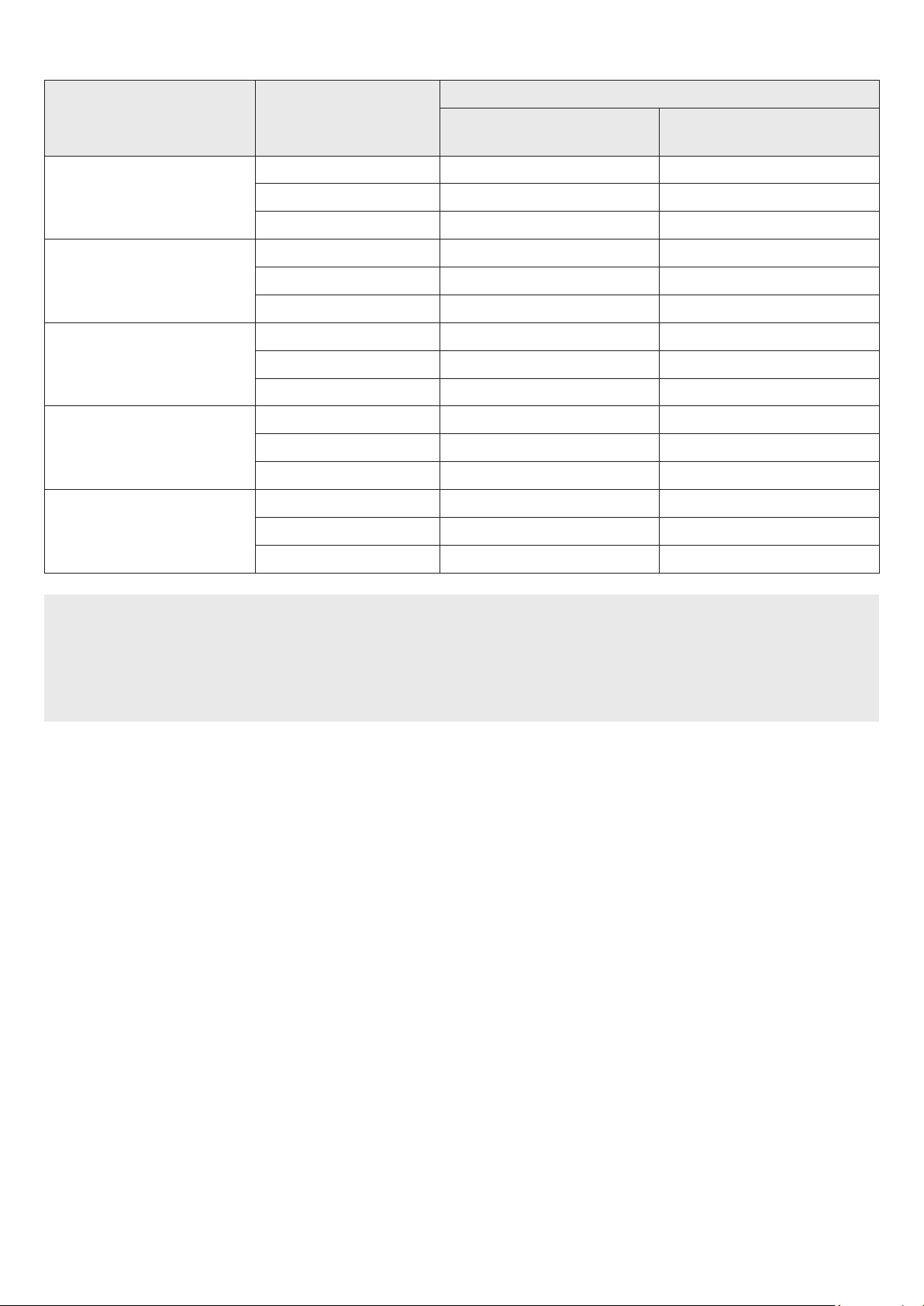
SPA - 12
Especicaciones de salida para los diferentes modos de efectos de sonido
Efecto Entrada
Salida
Con subwoofer únicamente
Con subwoofer y Wireless Kit de
parlante posterior inalámbrico
Surround
2.0 canales 3.1.2 canales 5.1.4 canales
5.1 canales 3.1.2 canales 5.1.4 canales
Dolby Atmos® 3.1.2 canales 5.1.4 canales
Game
2.0 canales 3.1.2 canales 5.1.4 canales
5.1 canales 3.1.2 canales 5.1.4 canales
Dolby Atmos® 3.1.2 canales 5.1.4 canales
Standard
2.0 canales 2.1 canales 2.1 canales
5.1 canales 3.1 canales 5.1 canales
Dolby Atmos® 3.1.2 canales 5.1.4 canales
Adaptive Sound
2.0 canales 3.1.2 canales 5.1.4 canales
5.1 canales 3.1.2 canales 5.1.4 canales
Dolby Atmos® 3.1.2 canales 5.1.4 canales
DTS Virtual:X
2.0 canales 3.1.2 canales 5.1.4 canales
5.1 canales 3.1.2 canales 5.1.4 canales
Dolby Atmos® 3.1.2 canales 5.1.4 canales
• El kit de altavoz trasero inalámbrico de Samsung se puede comprar por separado. Para comprar un kit, comuníquese con el vendedor a quien le
compró la Soundbar.
• Los altavoces surround no emitirán sonido para la salida de 2 canales mientras el modo STANDARD esté en uso. Para habilitar el sonido hacia los
altavoces surround, cambie el modo de efecto a SURROUND.
• Cuando la fuente de entrada es Dolby Atmos®, la conguración que incluye solo el altavoz de graves proporciona audio de canal 3.1.2, mientras que la
conguración del kit de altavoz trasero inalámbrico y altavoz de graves proporciona audio de canal 5.1.4.
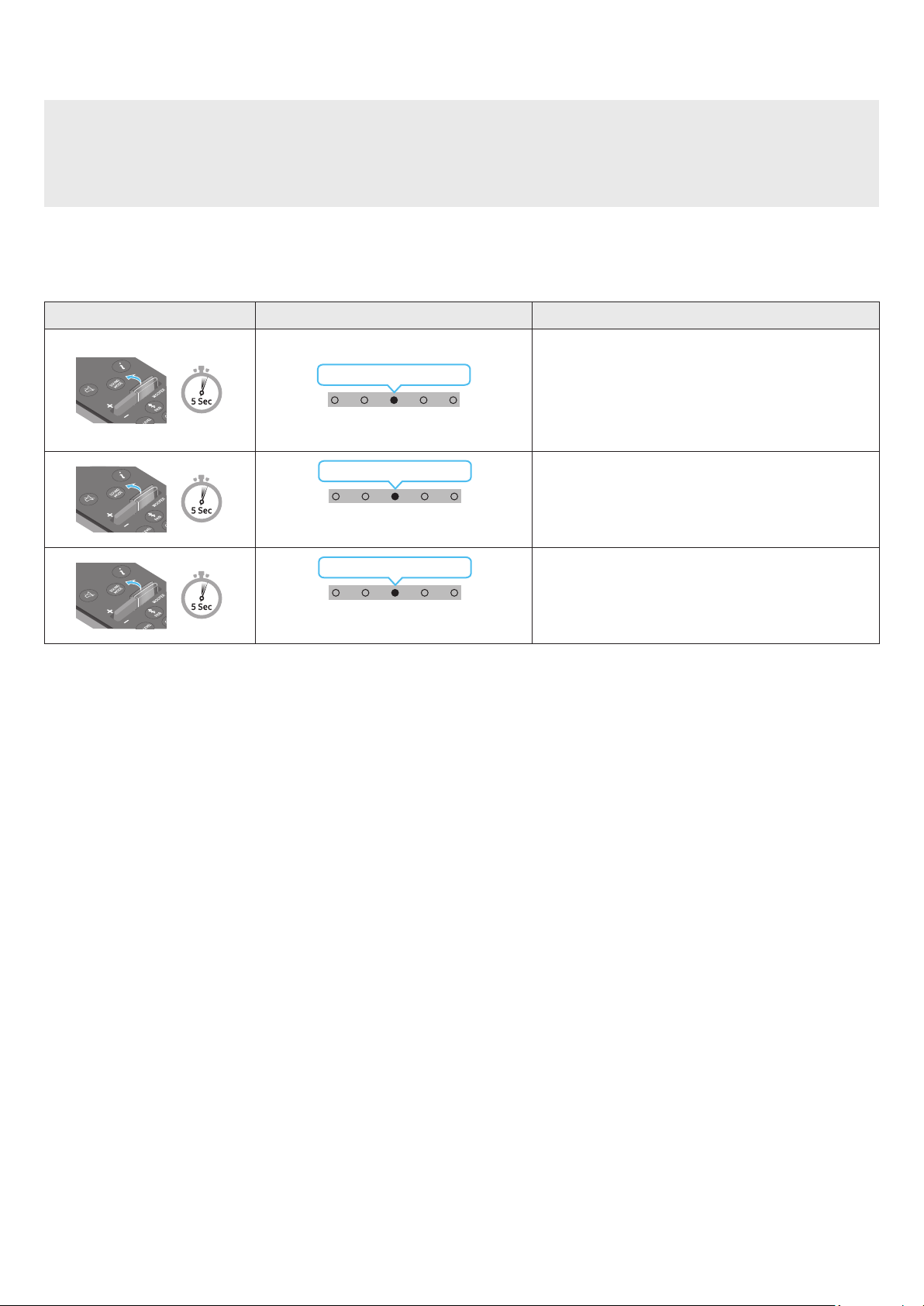
SPA - 13
Ajuste del volumen de la Soundbar con un control remoto de TV
Ajuste el volumen de la Soundbar utilizando el control remoto del TV.
• Esta función solo se puede usar con controles remotos IR. Los controles remotos Bluetooth (controles remotos que requieren emparejamiento) no son
compatibles.
• Congure el altavoz del TV en Altavoz externo para usar esta función.
• Fabricantes que admiten esta función:
Samsung, VIZIO, LG, Sony, Sharp, PHILIPS, PANASONIC, TOSHIBA, Hisense, RCA
1. Apague la Soundbar.
2. Mantenga presionado el botón WOOFER durante 5 segundos.
Cada vez que mantiene presionado el botón WOOFER durante 5 segundos, el modo cambia en el siguiente orden: “OFF-TV REMOTE” (Modo
predeterminado), “SAMSUNG-TV REMOTE”, “ALL-TV REMOTE”.
Botones del control remoto Indicador LED Estado
(Modo predeterminado)
1 parpadeo en rojo
"Off-TV Remote"
(Modo predeterminado)
Deshabilita el control remoto del TV.
1 parpadeo en color cian
"Samsung-TV Remote"
Habilita el control remoto IR de un TV Samsung.
1 parpadeo en azul
"All-TV Remote"
Habilita el control remoto IR de un TV de otra marca.
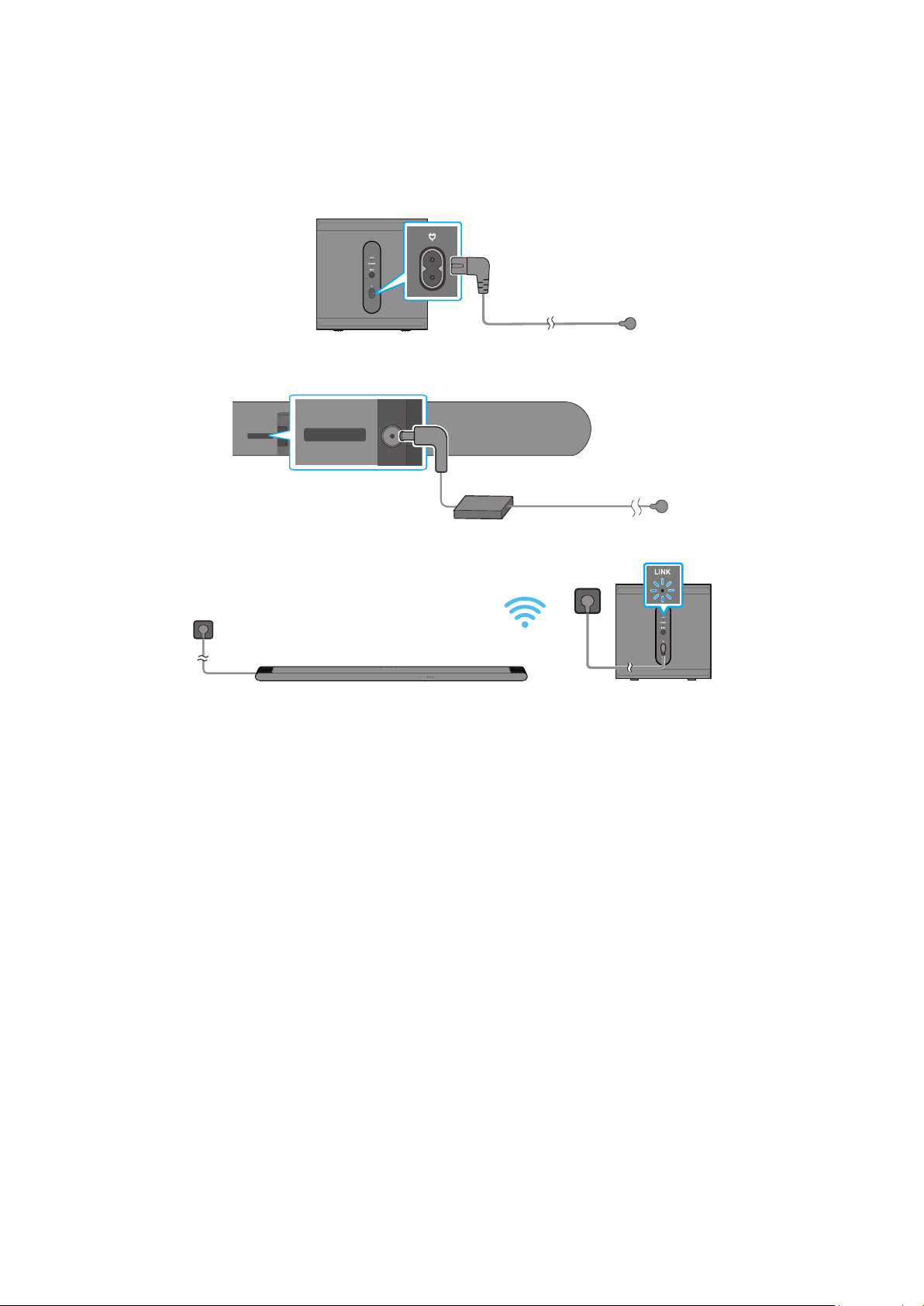
SPA - 14
04 CONEXIÓN DE LA SOUNDBAR
Conexión de las unidades a la fuente de alimentación
Use el cable de alimentación para conectar el Altavoz de graves y el Soundbar a un enchufe eléctrico en el siguiente orden:
• Para obtener más información acerca del suministro eléctrico necesario y el consumo de energía, consulte la etiqueta del producto. (Etiqueta: parte
inferior de la unidad principal de la Soundbar)
1. Conecte el cable de alimentación al altavoz de graves.
Parte posterior del Subwoofer
Cable de alimentación
2. Conecte el cable de alimentación al Soundbar.
Parte posterior de la unidad
principal de la Soundbar
DC 19V
DC 19V
Cable de alimentación
Adaptador de CA/CC
3. Conecte la alimentación a la Soundbar y al altavoz de graves. El altavoz de graves se conecta automáticamente cuando se enciende la Soundbar.
LINK LED: azul signica encendido
NOTA
• Conecte la alimentación del Subwoofer antes de conectarlo a la Soundbar. El Subwoofer se conectará automáticamente cuando se encienda la Soundbar.
• Si desenchufa el cable de alimentación y vuelve a conectarlo cuando el producto está encendido, la Soundbar se encenderá automáticamente.
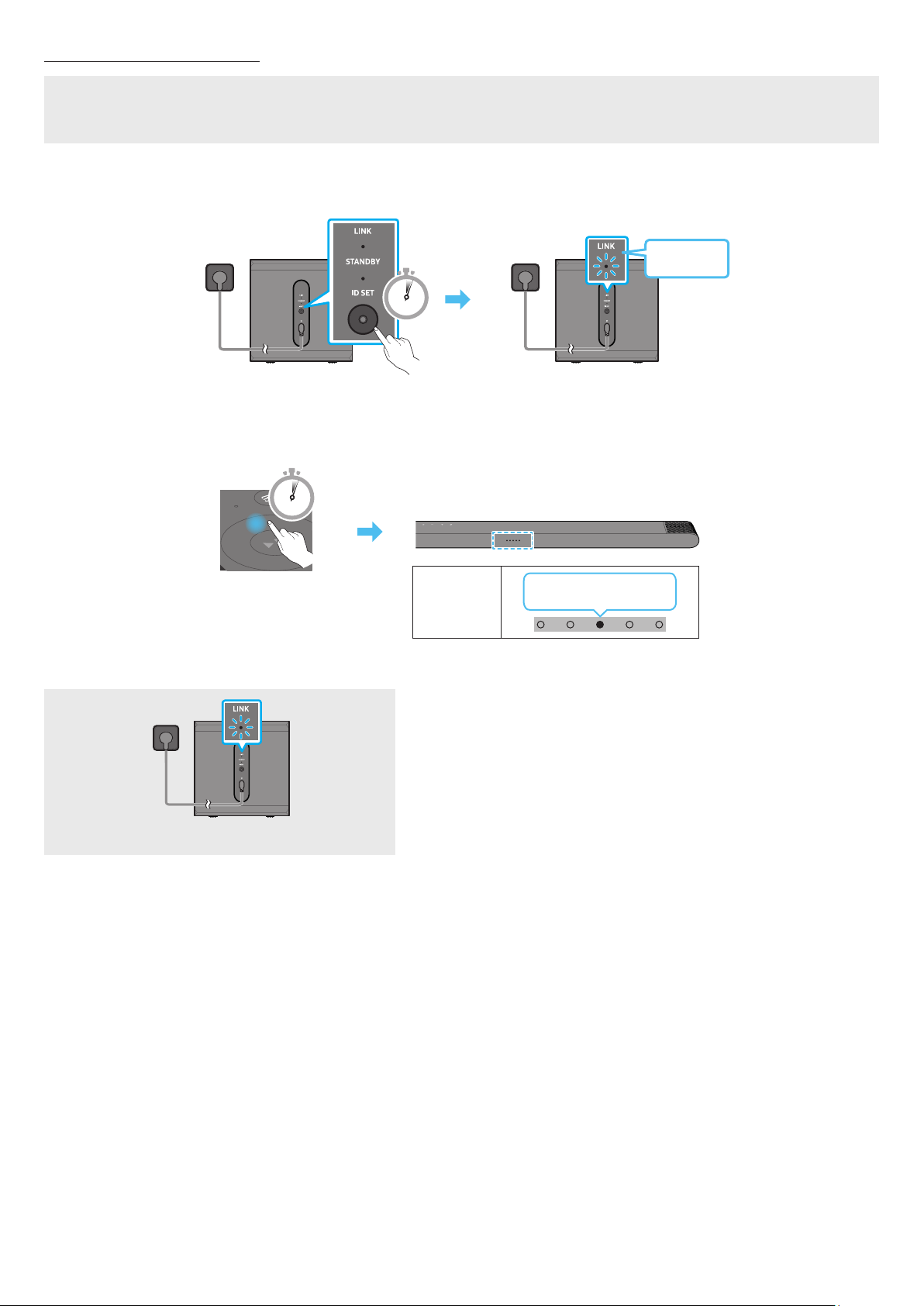
SPA - 15
Conexión manual del Subwoofer
Antes de realizar la conexión manual que se indica a continuación, siga estos pasos:
• Compruebe si los cables de alimentación para la Soundbar y el altavoz de graves están conectados correctamente.
• Asegúrese de que la Soundbar esté apagada.
1. Apague la unidad principal de la Soundbar.
2. Mantenga presionado el botón ID SET en la parte posterior del subwoofer, al menos, 5 segundos.
• El indicador rojo de la parte posterior de cada parlante se apaga y el indicador azul parpadea.
5 Sec
Parte posterior del Subwoofer
Parpadeo
azul rápido
Parte posterior del Subwoofer
3. Presione el botón Arriba en el control remoto durante 5 segundos.
• La Soundbar se enciende automáticamente cuando se completa la ID SET.
5 Sec
Indicador
LED
Parpadeo Rojo →
Verde → Azul
4. Compruebe si el LINK LED es azul (conexión completa).
LINK LED: azul signica encendido
El indicador LINK LED deja de parpadear y queda encendido en azul cuando se
establece una conexión entre la Soundbar y el altavoz de graves inalámbrico.
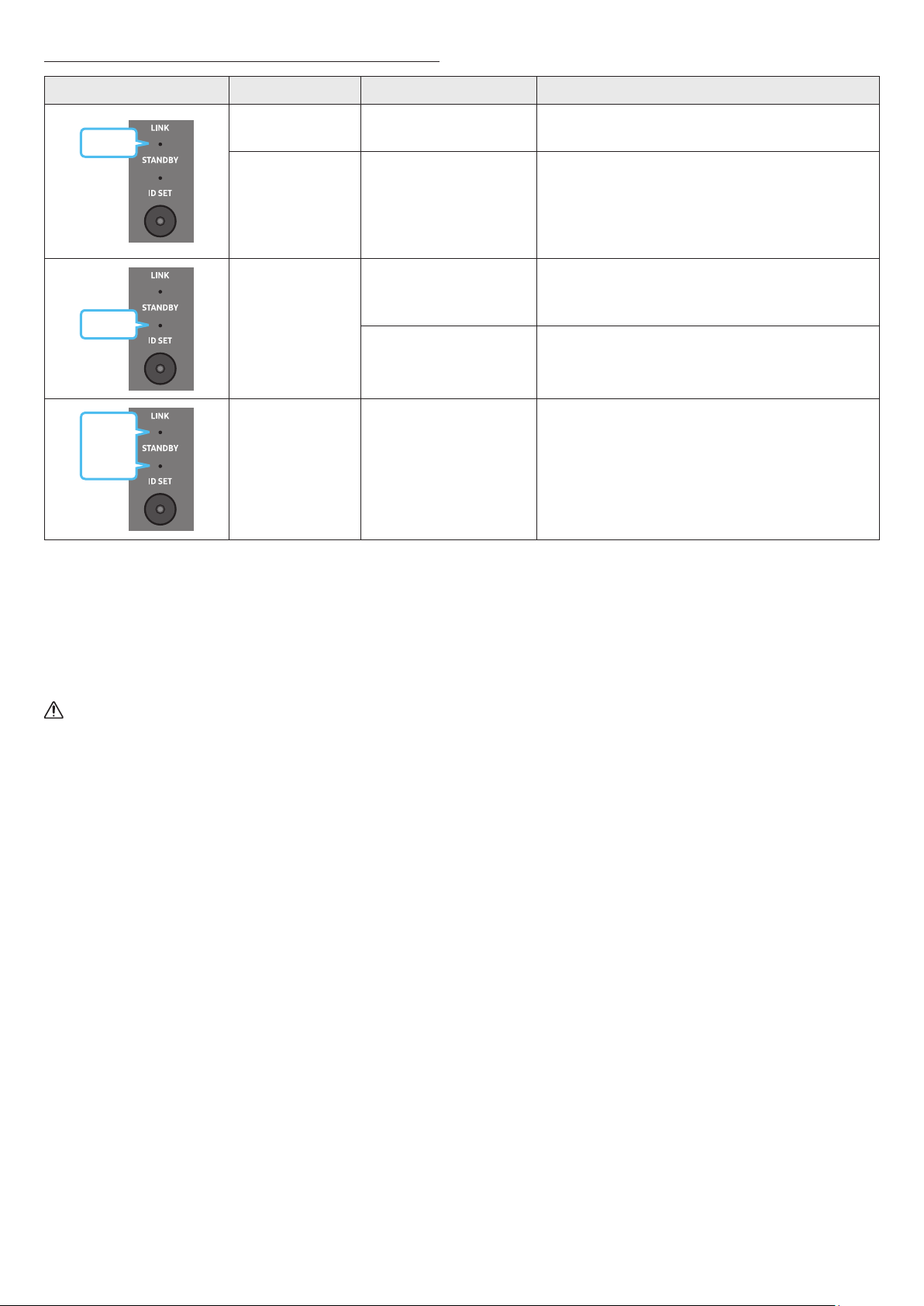
SPA - 16
Luces del indicador LED en la parte posterior del Subwoofer
LED Estado Descripción Resolución
Azul
Encendido
Conectado correctamente
(operación normal)
-
Parpadeante Recuperando la conexión
Compruebe si el cable de alimentación conectado a
la unidad principal de la Soundbar está conectado
correctamente o espere unos 5 minutos. Si el parpadeo
continua, intente conectar el subwoofer de forma manual.
Consulte la página 15.
Rojo
Encendido
Modo Standby (con la unidad
principal de la Soundbar
apagada)
Compruebe si el cable de alimentación conectado a
la unidad principal de la Soundbar está conectado
correctamente.
Se produjo un error en la
conexión
Conecte de nuevo. Consulte las instrucciones de conexión
manual en la página 15.
Rojo y
azul
Parpadeante Problema de funcionamiento
Consulte la información de contacto del Centro de soporte
técnico de Samsung en este manual.
NOTA
• Si la unidad principal está apagada, el altavoz de graves inalámbrico se pondrá en modo de espera y el STANDBY LED que se encuentra en la parte
posterior del altavoz de graves se pondrá rojo luego de parpadear en azul varias veces.
• Si cerca de la Soundbar, utiliza algún dispositivo que usa la misma frecuencia que la Soundbar, las interferencias pueden interrumpir el sonido.
• La distancia de transmisión máxima de la señal inalámbrica de la unidad principal es de aproximadamente 10 metros, pero puede variar según el entorno
operativo. Si hay una pared metálica o de acero y hormigón entre la unidad principal y el altavoz de graves inalámbrico, es posible que el sistema no
funcione debido a que la señal inalámbrica no puede penetrar el metal.
PRECAUCIÓN
• Las antenas inalámbricas están incorporadas en el subwoofer inalámbrico. Mantenga la unidad lejos del agua y la humedad.
• Para obtener un rendimiento óptimo de escucha, asegúrese de que no haya obstrucciones en el área alrededor de la ubicación del altavoz de graves
inalámbrico.
Cómo conectar la Soundbar a un SWA-9500S (se vende por separado)
Conecte el kit de altavoz trasero inalámbrico de Samsung (SWA-9500S; se vende por separado) a la Soundbar para lograr un verdadero sonido surround
inalámbrico.
Para obtener información más detallada sobre las conexiones, consulte el manual del kit de altavoz trasero inalámbrico de Samsung.
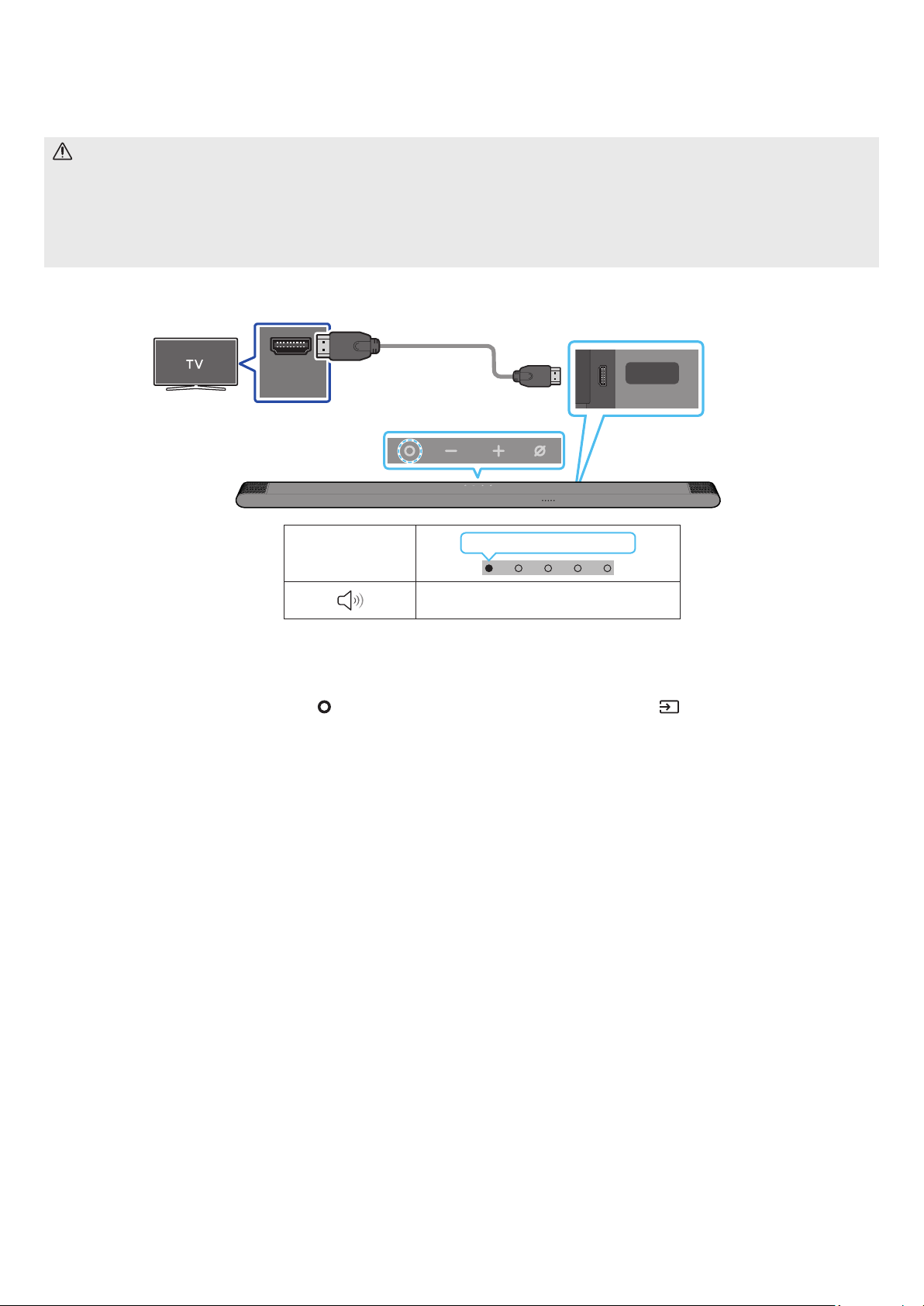
SPA - 17
05 CONEXIÓN A UN TV
Conexión al TV que es compatible con HDMI ARC (Retorno del canal de audio)
PRECAUCIÓN
• Si usa un cable HDMI a Micro HDMI, tenga cuidado de no romper el terminal del cable.
• Cuando el cable HDMI está conectado, la señal HDMI se recibe primero.
• Para conectar el cable HDMI entre el TV y la Soundbar, asegúrese de conectar las terminales marcadas como ARC. De lo contrario, es posible que el
sonido del TV no se escuche.
• El cable recomendado es High Speed HDMI Cable with Ethernet.
HDMI IN
(ARC)
SERVICE
HDMI
(ARC)
Conéctelo al puerto HDMI IN
(ARC) o (eARC) en su TV.
Conéctelo al puerto HDMI
(ARC) de la unidad principal
de la Soundbar.
Cable HDMI a
Micro HDMI
Parte posterior de la Soundbar
Parte superior de la Soundbar
Indicador LED
Blanco Encendido → Apagado
"TV ARC"
1. Con la Soundbar y el TV apagados, conecte el cable HDMI como se indica en la imagen.
2. Encienda la Soundbar y el TV.
3. El TV emitirá sonido a través de la Soundbar.
• Si no sale el sonido del TV, presione el botón
(Multifunción) en la parte superior de la Soundbar o el botón (Fuente) del control remoto para
seleccionar el modo "TV ARC".
• Si el sonido no sale, revise la conexión del cable HDMI nuevamente.
• Use los botones de volumen en el control remoto del TV para cambiar el volumen de la Soundbar.
NOTA
• Le recomendamos que use un cable HDMI sin núcleo, si es posible. Si usa un cable HDMI con núcleo, use uno cuyo diámetro sea menor de 14 mm.
• Esta función no está disponible si el cable HDMI no es compatible con ARC.
• Cuando el audio en una transmisión está codicado en Dolby Digital y el “Formato de audio de salida digital” de su TV está congurado como PCM, le
recomendamos que cambie la conguración a Dolby Digital. Cuando cambie la conguración en el TV, la calidad del sonido será mejor. (Es posible que en
el menú del TV se usen palabras distintas para Dolby Digital y PCM según el fabricante del TV.)
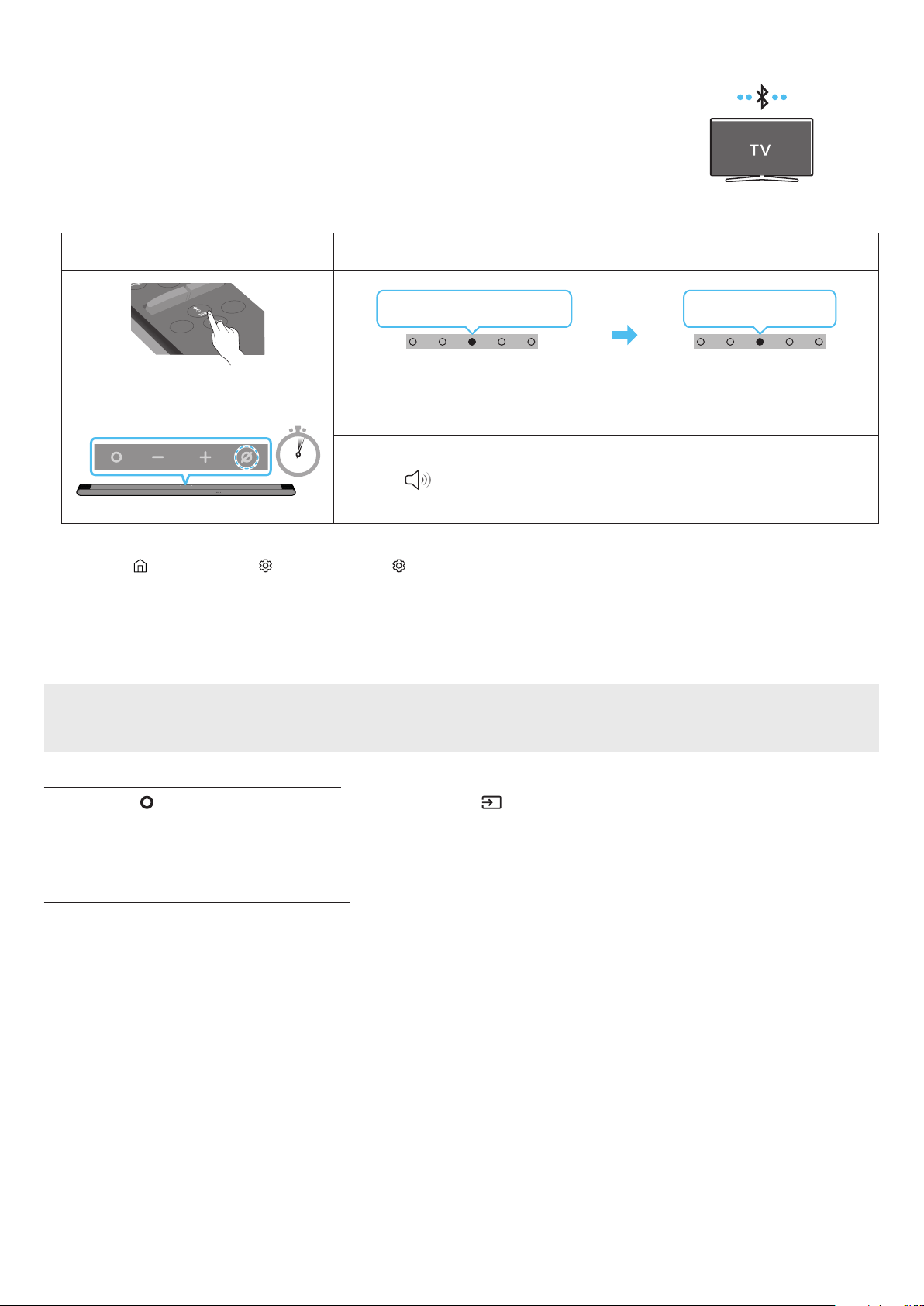
SPA - 18
Conexión a través de Bluetooth
Cuando se conecta un TV Samsung a través de Bluetooth, puede escuchar sonido en estéreo sin cables de por
medio.
• Solo se puede conectar un TV Samsung por vez.
• Se puede conectar un TV Samsung que sea compatible con Bluetooth. Compruebe las especicaciones de su
TV.
La conexión inicial
1.
Botón de emparejamiento con Bluetooth Indicador LED
SOUNDBAR
SOUND
MODE
WOOFER
+
_
CH LEVEL
TONE
CONTROL
(O)
Cuando está en modo "Bluetooth"
5 Sec
Parpadeo Rojo → Verde → Azul
Emparejamiento
3 parpadeos en color cian
Se completó la conexión
• Hasta que no se complete el emparejamiento, el LED multicolor cambia a Rojo → Verde → Azul
sucesivamente.
"Ready to connect via Bluetooth".
1.
2. Seleccione el modo Bluetooth en el TV Samsung.
(p. ej., Inicio ( ) → Menú → Cong. ( ) → Todos los ajustes ( ) → Sonido → Salida de sonido → Lista de altavoces Bluetooth → [AV] Samsung Soundbar
S***B (Bluetooth))
3. Seleccione "[AV] Samsung Soundbar S***B" de la lista que aparece en la pantalla del TV.
Se indicará la Soundbar disponible con “Se debe emparejar” o “Emparejada” en la lista de dispositivos Bluetooth del TV. Para conectar el TV Samsung a la
Soundbar, seleccione el mensaje y establezca una conexión.
4. Podrá escuchar el sonido del TV Samsung en la Soundbar.
Si el dispositivo no se puede conectar
• Si ya tiene una Soundbar existente (p. ej., [AV] Samsung Soundbar S***B) en la lista de altavoces del TV Samsung, elimínela.
• Luego, repita los pasos 1 a 3.
Desconexión de la Soundbar del TV Samsung
Presione el botón (Multifunción) en la parte superior de la Soundbar o el botón (Fuente) en el control remoto para seleccionar otro modo que no sea
"Bluetooth".
• La desconexión toma tiempo porque el TV Samsung debe recibir la respuesta de la Soundbar.
(El tiempo requerido puede variar según el modelo del TV Samsung).
Notas sobre la conexión a través de Bluetooth
• Ubique un dispositivo nuevo en un radio de 1 m para conectarlo a través de Bluetooth.
• Si le pide un código PIN cuando conecta un dispositivo Bluetooth, ingrese <0000>.
• La Soundbar se apaga automáticamente después de estar 18 minutos en estado Listo.
• Es posible que la Soundbar no realice la conexión o la búsqueda de Bluetooth correctamente en los siguientes casos:
‒ Si hay un campo eléctrico fuerte cerca de la Soundbar.
‒ Si varios dispositivos Bluetooth se emparejan en simultáneo con la Soundbar.
‒ Si el dispositivo Bluetooth se apaga, no está en el lugar o no funciona correctamente.
• Los dispositivos electrónicos pueden ocasionar interferencias de radio. Los dispositivos que generan ondas electromagnéticas deberán mantenerse
alejados de la unidad principal de la Soundbar, p. ej., dispositivos con redes LAN inalámbricas, microondas, etc.

SPA - 19
Conexión mediante Wi-Fi
Lista de vericación previa a la conexión
• La conexión Wi-Fi solo está disponible en el TV Samsung.
• Compruebe si el enrutador inalámbrico (Wi-Fi) está encendido y si el TV está conectado al router.
• El TV y la Soundbar deben estar conectados a la misma red inalámbrica (Wi-Fi).
• Si su enrutador inalámbrico (Wi-Fi) usa un canal de DFS, no podrá establecer una conexión Wi-Fi entre el TV y la Soundbar. Comuníquese con su
proveedor de servicio de Internet para obtener más detalles.
• Dado que los menús pueden ser diferentes según el año de fabricación, consulte el manual correspondiente a su TV.
• Para conectar el TV a la Soundbar mediante Wi-Fi, conecte primero la Soundbar al enrutador inalámbrico. Consulte la página 25 para ver detalles
sobre cómo establecer una conexión Wi-Fi.
1. Para obtener más información sobre cómo establecer una conexión Wi-Fi con la Soundbar, consulte la página 25, "Método 2. Conexión a través de wi
(Red inalámbrica)".
2. Cambie la fuente de entrada del TV a la Soundbar mediante el menú de audio.
• TV Samsung lanzados a la venta en el año 2017 o posterior
Sonido → Salida de sonido → [AV] Samsung Soundbar S***B (Wi-Fi)
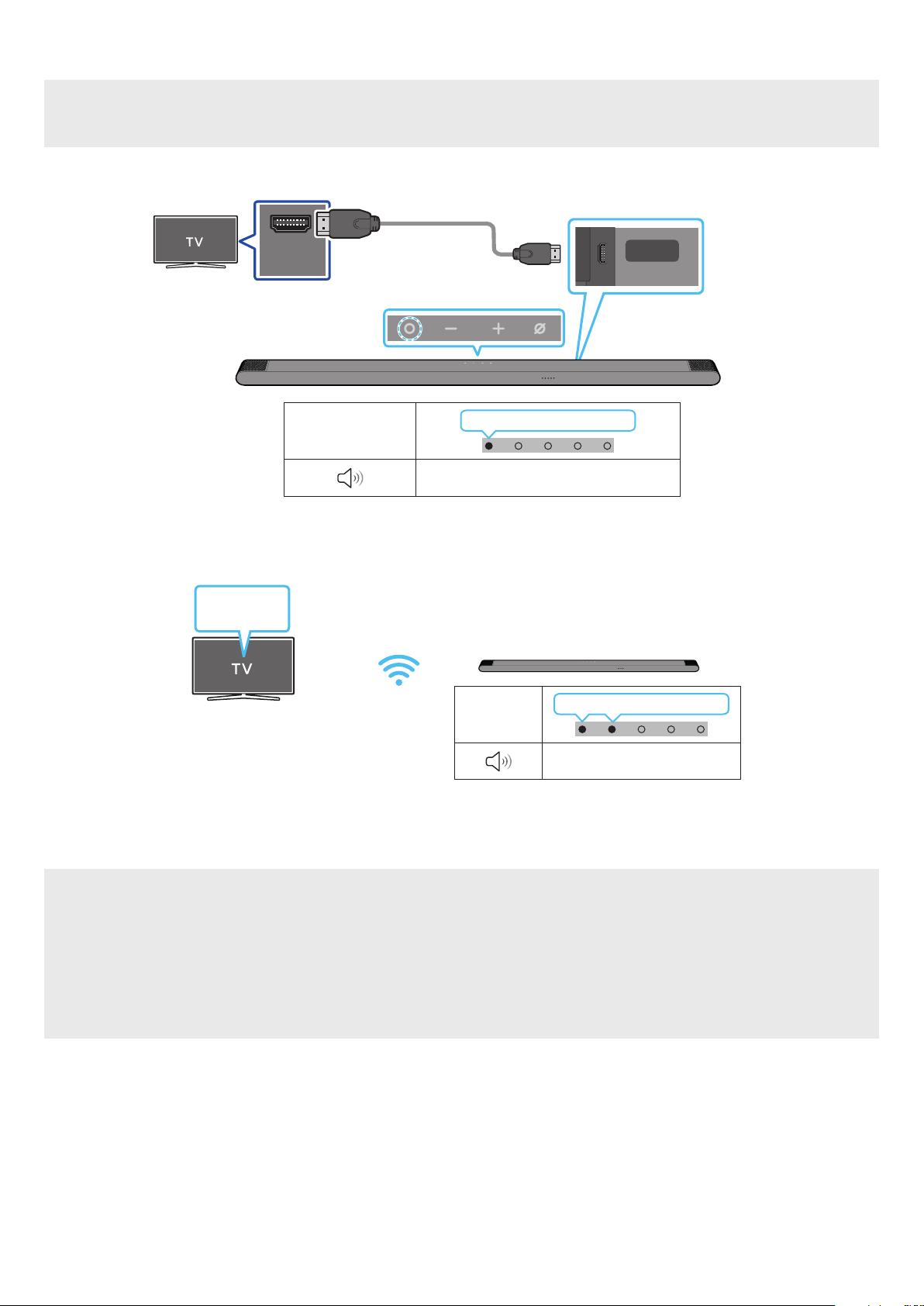
SPA - 20
Conexión a un TV que admita Dolby Atmos
Lista de vericación previa a la conexión
• Dolby Atmos® es compatible con el modo "TV ARC" o "Wi-Fi".
• Asegúrese de que el contenido admita Dolby Atmos®.
HDMI IN
(ARC)
SERVICE
HDMI
(ARC)
Conéctelo al puerto HDMI IN
(ARC) en su TV.
Cable HDMI a
Micro HDMI
Parte posterior de la Soundbar
Parte superior de la Soundbar
Indicador LED
Blanco Encendido → Apagado
"TV ARC"
1. Con la Soundbar y el TV apagados, conecte el cable HDMI como se indica en la imagen.
2. Encienda la Soundbar y el TV.
3. El sonido del TV saldrá de la Soundbar.
Indicador
LED
Blanco Encendido → Apagado
"Wi-Fi"
Menú del
TV
Wi-Fi
1. Conecte la Soundbar y el TV a la misma red inalámbrica (Wi-Fi).
2. Para la salida del sonido del TV, seleccione Soundbar.
3. El sonido del TV saldrá de la Soundbar.
NOTA
• Cuando use Dolby Atmos®: Si la fuente de entrada es Dolby Atmos®, consulte “Especicaciones de salida para los diferentes modos de efectos de
sonido” en página 12.
• Cómo congurar Dolby Atmos® en un reproductor de BD u otro dispositivo conectado al TV.
Abra las opciones de salida de audio en el menú de conguraciones de su reproductor de Blu-ray u otro dispositivo, y asegúrese de que esté
seleccionada la opción “Sin codicación” para el ujo de bit. Por ejemplo, en un reproductor de Blu-ray de Samsung, vaya a Menú de inicio → Sonido →
Salida digital y luego seleccione Flujo de bit (no procesado).
• Esta función está disponible en algunos TV Samsung y en algunos modelos de Soundbar.
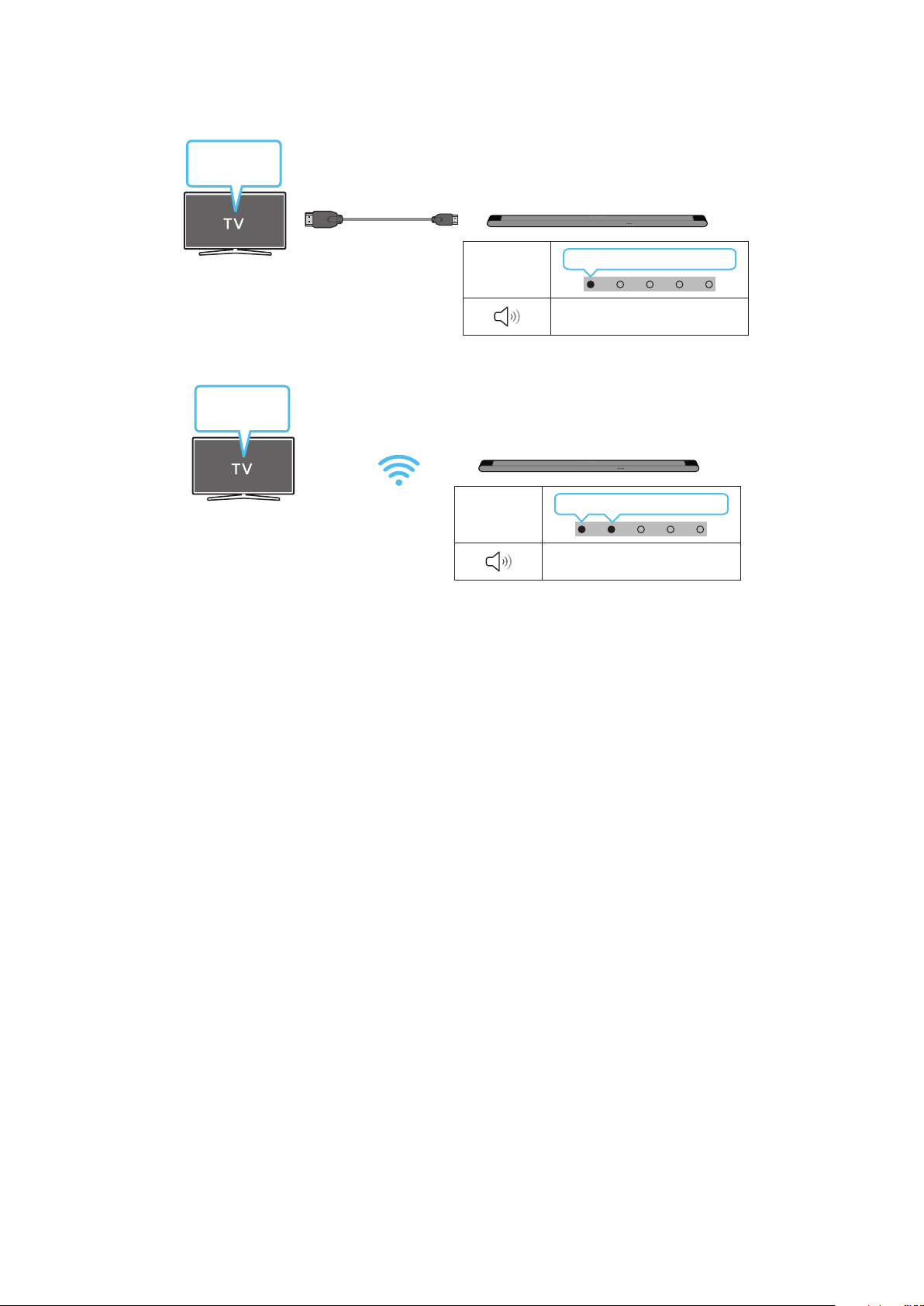
SPA - 21
Cómo utilizar la función Q-Symphony
En el caso de Q-Symphony, la Soundbar se sincroniza con un TV Samsung para emitir el sonido a través de dos dispositivos a n de brindar un efecto
envolvente óptimo. Cuando la Soundbar está conectada, aparece el menú "TV+Soundbar" debajo del menú Salida de sonido del TV. Seleccione el menú
correspondiente.
Menú del
TV
Cable HDMI a Micro HDMI
Indicador
LED
Blanco Encendido → Apagado
"TV ARC"
• Ejemplo del menú del TV: TV + [AV] nombre de la serie de la Soundbar (HDMI)
Indicador
LED
Blanco Encendido → Apagado
"Wi-Fi"
Menú del
TV
Wi-Fi
• Ejemplo del menú del TV: TV + [AV] Soundbar (nombre de serie) (Wi-Fi)
NOTA
• Puede funcionar según el códec que admita el TV.
• Esta función solo se admite cuando se conecta el cable HDMI o Wi-Fi.
• Asegúrese de que el TV y la Soundbar se encuentren conectados a la misma frecuencia o enrutador inalámbrico.
• Esta función está disponible en algunos TV Samsung y en algunos modelos de Soundbar.

SPA - 22
Uso del sonido Spacet
Brinda una calidad de sonido optimizada mediante el análisis de los espacios de escucha.
Método 1. Conexión mediante la Soundbar
Para habilitar esta función, active el modo SpaceFit Sound con el control remoto de la Soundbar.
( (Control de sonido) → "SpaceFit Sound Off" → ( Arriba ) → "SpaceFit Sound On")
• Este menú está disponible en todos los modos de Sonido.
Método 2. Conexión mediante un TV
Para habilitar esta función, active el modo Sonido adaptable+ en el menú de su TV Samsung.
(Inicio ( ) → Menú → Cong. ( ) → Todos los ajustes ( ) → General → Conguración del Modo inteligente → Sonido adaptable+)
• El modo de sonido en su Soundbar automáticamente pasará a ser Sonido adaptable+ si habilita el modo Sonido adaptable+ en su TV.
NOTA
Esta función solo está disponible cuando la Soundbar se conecta a un TV Samsung.
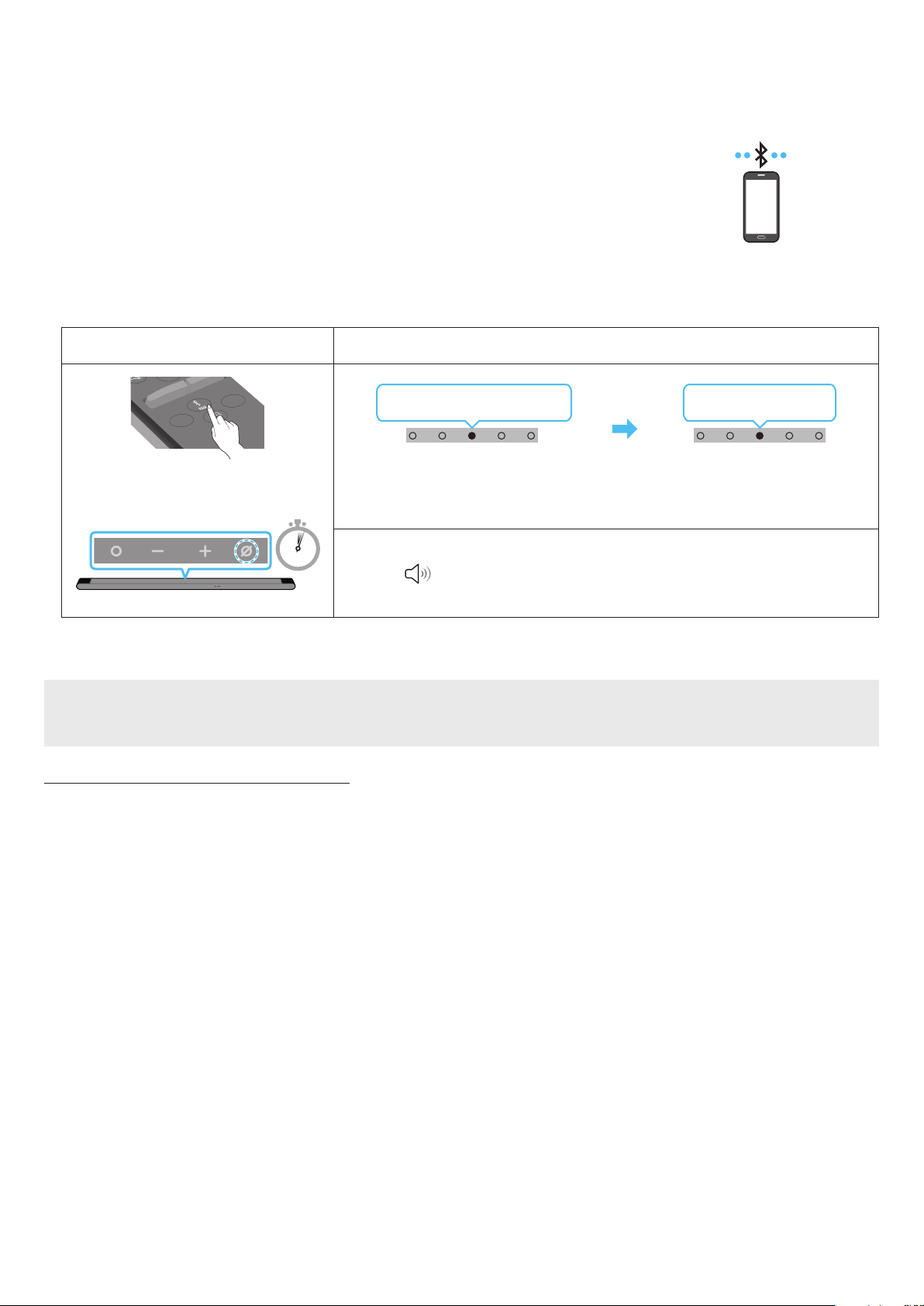
SPA - 23
06 CONEXIÓN A UN DISPOSITIVO MÓVIL
Método 1. Conexión a través de Bluetooth
Cuando se conecta un dispositivo móvil a través de Bluetooth, puede escuchar sonido en estéreo sin cables de
por medio.
• Cuando conecta un dispositivo Bluetooth emparejado y la Soundbar está apagada, la Soundbar se enciende
automáticamente.
Dispositivo móvil
La conexión inicial
Cuando conecte un dispositivo Bluetooth nuevo, asegúrese de que el dispositivo esté en un radio de 1 m de distancia.
1.
Botón de emparejamiento con Bluetooth Indicador LED
SOUNDBAR
SOUND
MODE
WOOFER
+
_
CH LEVEL
TONE
CONTROL
(O)
Cuando está en modo "Bluetooth"
5 Sec
Parpadeo Rojo → Verde → Azul
Emparejamiento
3 parpadeos en color cian
Se completó la conexión
• Hasta que no se complete el emparejamiento, el LED multicolor cambia a Rojo → Verde → Azul
sucesivamente.
"Ready to connect via Bluetooth".
1.
2. En su dispositivo, seleccione "[AV] Samsung Soundbar S***B" de la lista que aparece.
3. Reproduzca archivos de música desde el dispositivo conectado por Bluetooth a través de la Soundbar.
Si el dispositivo no se puede conectar
• Si ya tiene una Soundbar existente (p. ej., "[AV] Samsung Soundbar S***B") en la lista de altavoces del dispositivo móvil, elimínela.
• Repita los pasos 1 y 2.
Notas sobre la conexión a través de Bluetooth
• Ubique un dispositivo nuevo en un radio de 1 m para conectarlo a través de Bluetooth.
• Si le pide un código PIN cuando conecta un dispositivo Bluetooth, ingrese <0000>.
• La Soundbar se apaga automáticamente después de estar 18 minutos en estado Listo.
• Es posible que la Soundbar no realice la conexión o la búsqueda de Bluetooth correctamente en los siguientes casos:
‒ Si hay un campo eléctrico fuerte cerca de la Soundbar.
‒ Si varios dispositivos Bluetooth se emparejan en simultáneo con la Soundbar.
‒ Si el dispositivo Bluetooth se apaga, no está en el lugar o no funciona correctamente.
• Los dispositivos electrónicos pueden ocasionar interferencias de radio. Los dispositivos que generan ondas electromagnéticas deberán mantenerse
alejados de la unidad principal de la Soundbar, p. ej., dispositivos con redes LAN inalámbricas, microondas, etc.
• La Soundbar admite datos SBC (44.1 kHz, 48 kHz).
• Conéctese solo a un dispositivo Bluetooth que admita la función A2DP (AV).
• No puede conectar la Soundbar a un dispositivo Bluetooth que solo admita la función HF (manos libres).
• Cuando conecte la Soundbar a un dispositivo Bluetooth, colóquelos lo más cerca posible entre sí.
• Cuanto más lejos estén la Soundbar y el dispositivo Bluetooth, menor será la calidad del sonido.
La conexión Bluetooth se puede interrumpir cuando los dispositivos están fuera del alcance efectivo.
• La conexión Bluetooth puede no funcionar según lo previsto en zonas con poca señal.

SPA - 24
• Un dispositivo Bluetooth puede presentar ruido o puede no funcionar correctamente en las siguientes condiciones:
‒ Si una parte de su cuerpo está en contacto con el transceptor de señal del dispositivo Bluetooth o la Soundbar
‒ En esquinas o lugares donde hay un obstáculo cerca, como en las paredes o divisiones, donde puedan producirse cambios eléctricos.
‒ Cuando se expone a interferencias de radio de otros productos que operan en los mismos rangos de frecuencia, como equipos médicos, hornos
microondas y dispositivos de LAN inalámbrica.
‒ Los obstáculos como puertas y paredes pueden afectar la calidad del sonido incluso cuando los dispositivos están dentro del alcance efectivo.
• Tenga en cuenta que la Soundbar no se puede emparejar con otros dispositivos Bluetooth mientras usa la opción Bluetooth.
• Este dispositivo inalámbrico puede causar interferencia eléctrica durante el funcionamiento.
Desconexión del dispositivo Bluetooth de una Soundbar
Puede desconectar un dispositivo Bluetooth de la Soundbar. Para obtener instrucciones, consulte el manual de usuario del dispositivo Bluetooth.
• La Soundbar se desconectará.
• Si la Soundbar se desconecta del dispositivo Bluetooth, el indicador LED multicolor de la Soundbar parpadea en color "Rojo" tres veces.
Desconexión de la Soundbar del dispositivo Bluetooth
Presione el botón (Multifunción) en la parte superior de la Soundbar o el botón (Fuente) en el control remoto para salir del modo "Bluetooth".
• La desconexión toma tiempo porque el dispositivo Bluetooth debe recibir la respuesta de la Soundbar. (El tiempo de desconexión puede variar según el
modelo de dispositivo Bluetooth).
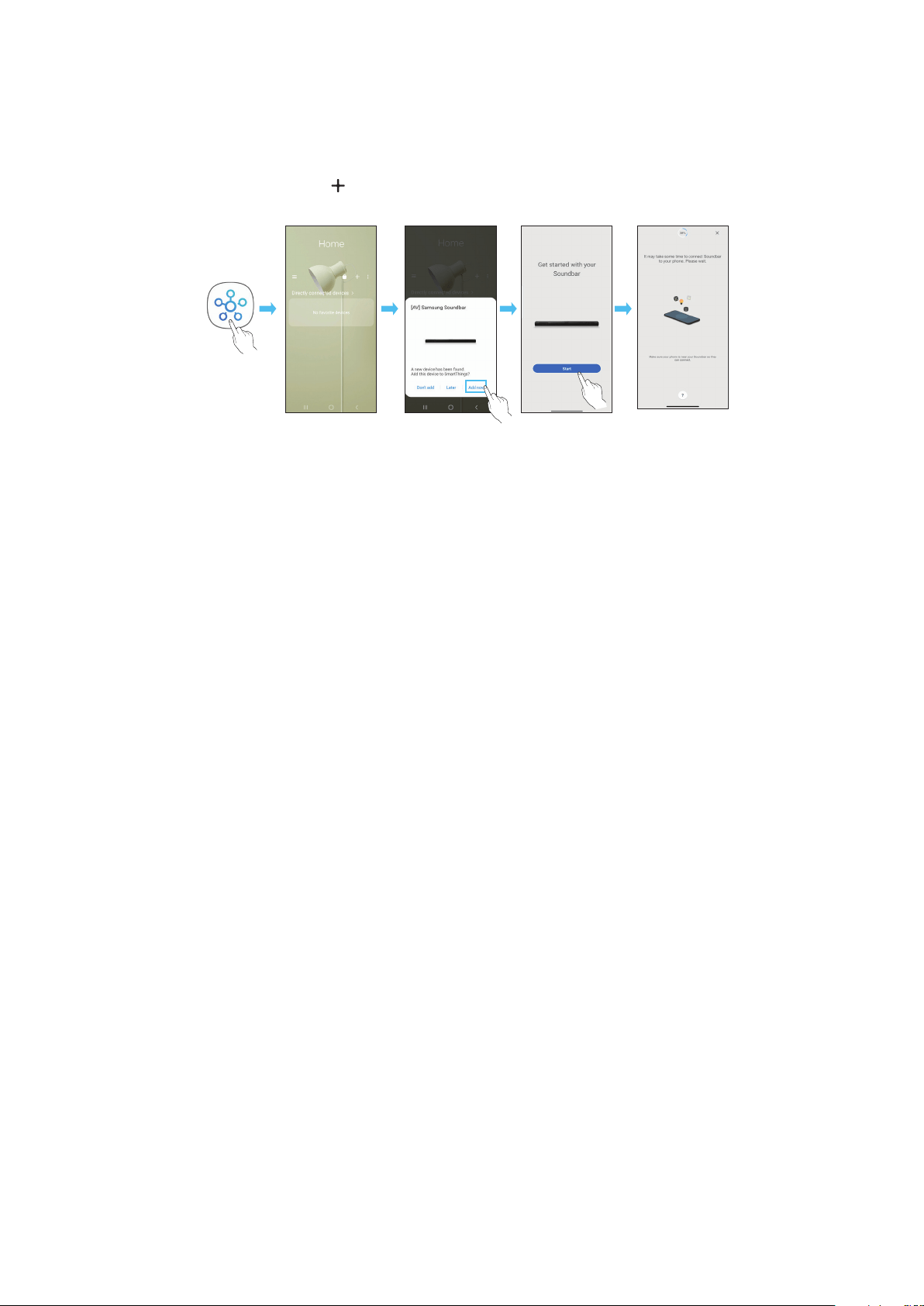
SPA - 25
Método 2. Conexión a través de wi (Red inalámbrica)
Para conectar la Soundbar a un dispositivo móvil a través de una red inalámbrica (wi), se necesita la aplicación SmartThings.
La conexión inicial
1. Instale e inicie la aplicación SmartThings en su dispositivo móvil (teléfono inteligente o tableta).
2. En la aplicación, siga las instrucciones de la pantalla para agregar la Soundbar.
• Es posible que la ventana emergente automática (la segunda captura de pantalla a continuación) no se muestre en algunos dispositivos.
Si no aparece la ventana emergente, presione “ ” en la pantalla Home. La Soundbar se agrega a la aplicación.
• La imagen que se muestra abajo puede ser diferente según la versión de la aplicación.
Inicie la
aplicación
Ventana
emergente
automática
Agregar
dispositivo
Aplicación
SmartThings
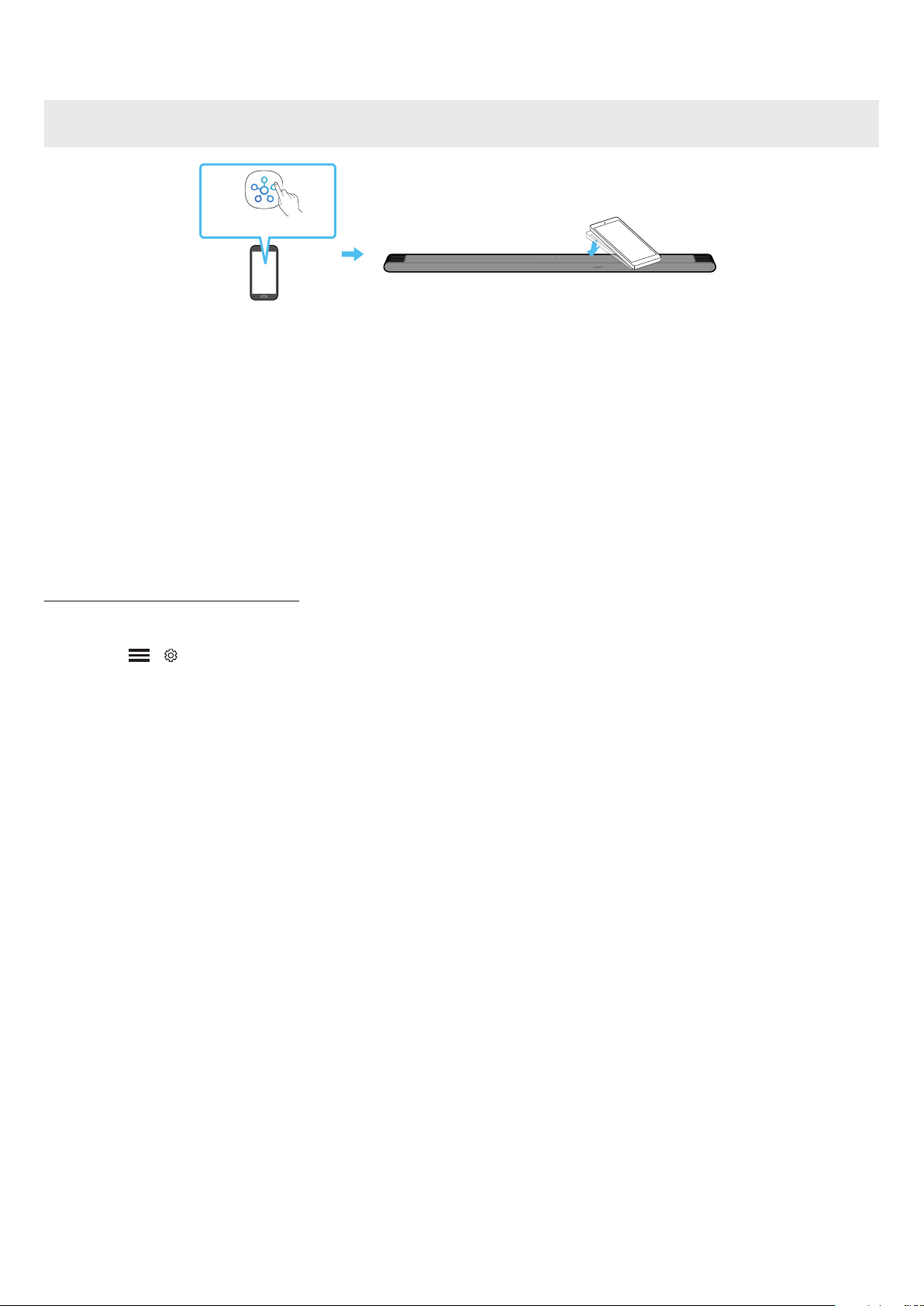
SPA - 26
Uso de Tap Sound
Toque la Soundbar con su dispositivo móvil para reproducir el sonido del contenido del dispositivo móvil a través de la Soundbar.
• Es posible que esta función no sea compatible, según el dispositivo móvil.
• Esta función solo es compatible con dispositivos móviles Samsung con Android 8.1 o una versión posterior.
Parte superior de la Soundbar
Dispositivo móvil
Aplicación SmartThings
1. Active la función Tap Sound en su dispositivo móvil.
• Para obtener información detallada acerca de cómo activar la función, consulte “Conguración de la función Tap Sound” a continuación.
2. Toque la Soundbar con el dispositivo móvil. Seleccione “Start now” en la ventana de visualización.
Se establece una conexión entre el dispositivo móvil y la Soundbar a través de Bluetooth.
3. Reproduzca el sonido del contenido del dispositivo móvil a través de la Soundbar.
• Esta función conecta un dispositivo móvil a la Soundbar a través de Bluetooth detectando vibraciones que se producen cuando el dispositivo toca la
Soundbar.
• Asegúrese de que el dispositivo móvil no toque una esquina na de la Soundbar. La Soundbar o el dispositivo móvil podrían rayarse o dañarse.
• Se recomienda cubrir el dispositivo móvil con una funda. Toque ligeramente el área ancha en la parte superior de la Soundbar sin aplicar fuerza
excesiva.
• Para utilizar esta función, actualice la aplicación SmartThings a la última versión.
Es posible que la función no sea compatible, según la versión de la aplicación.
Conguración de la función Tap Sound
Utilice la aplicación SmartThings para activar la función Tap View, Tap Sound.
1. En el dispositivo móvil, ejecute la aplicación SmartThings.
2. Seleccione ( → ) en la pantalla de la aplicación SmartThings que aparece en el dispositivo móvil.
3. Congure “Tap View, Tap Sound” a Activado para permitir que la función pueda usarse cuando acerca un dispositivo móvil a la Soundbar. La función está
activada.
NOTA
• Cuando el dispositivo móvil está en modo ahorro de energía, la función Tap Sound no funciona.
• Es posible que la función Tap Sound no funcione si hay dispositivos cerca de la Soundbar que generan interferencias de radio como dispositivos
eléctricos. Asegúrese de que los dispositivos que pueden generar interferencias de radio estén colocados a suciente distancia de la Soundbar.

SPA - 27
07 CONEXIÓN MEDIANTE APPLE AIRPLAY 2
• Es posible que esta función no esté disponible en algunos países.
• La Samsung Soundbar admite AirPlay 2 y requiere iOS 11.4 o posterior.
Con AirPlay 2, puede transmitir música, podcasts y otro tipo de audio desde sus dispositivos Apple a la Samsung Soundbar.
• Asegúrese de que la Soundbar esté encendida y conectada a la misma red Wi-Fi que su dispositivo Apple.
• Seleccione
en una aplicación compatible con AirPlay o en el Centro de control de su iPhone, iPad o Mac.
• Seleccione la Soundbar en la lista de dispositivos disponibles para reproducir el sonido actual en ella.
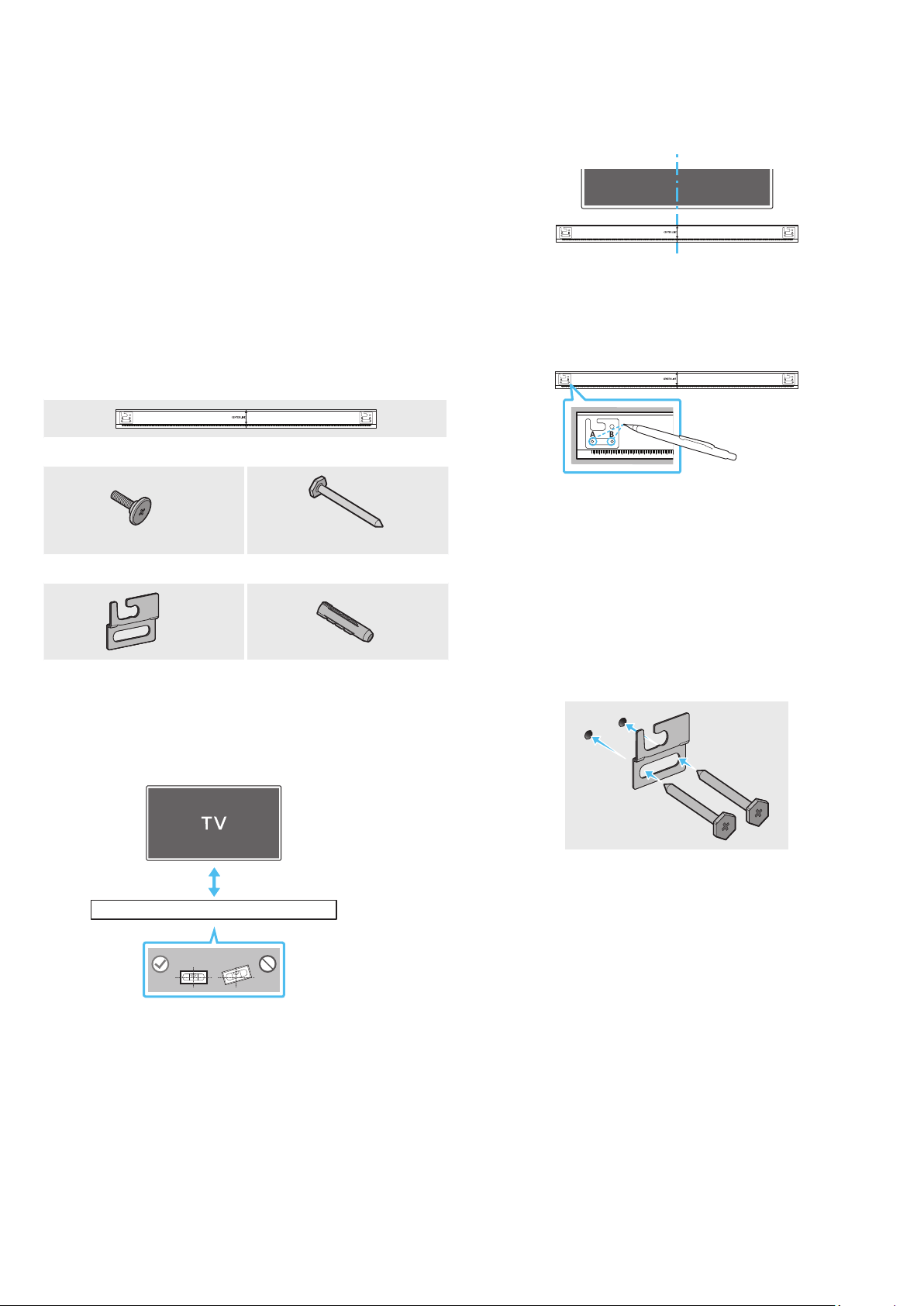
SPA - 28
08 INSTALACIÓN DEL SOPORTE
DE MONTAJE EN LA PARED
Precauciones durante la instalación
• Instálelo solo en una pared vertical.
• No lo instale en un lugar con altas temperaturas o humedad.
• Verique si la pared es lo sucientemente resistente como para
soportar el peso del producto. Si no lo es, refuerce la pared o elija otro
lugar para realizar la instalación.
• Conecte los cables de la unidad a los dispositivos externos antes de
instalar la Soundbar en la pared.
• Asegúrese de que la unidad esté apagada y desconéctela antes de
instalarla. De lo contrario, se puede producir una descarga eléctrica.
Componentes para montaje en la pared
AH81-15127A-01
A TYPE
:
740mm
B TYPE
:
700mm
Guía de montaje en la pared
x 2
x 4
(M5 x L55)
Tornillo de sujeción Tornillo
x 2
x 4
Soporte de montaje en la pared Anclaje de tornillo
1. Coloque la Guía para montaje en la pared sobre la supercie de la pared.
• La Guía de montaje en la pared debe estar nivelada.
• Si su TV está montado en la pared, instale la Soundbar al menos 5 cm
debajo del TV.
5 cm o más
2. Haga coincidir la Línea central de la guía de montaje en la pared con el
centro del TV (si va a montar la Soundbar debajo del TV) y luego je la
Guía de montaje en la pared a la pared con cinta adhesiva.
• Si no la va a montar debajo de un TV, coloque la Línea central en el
centro del área de instalación.
AH81-15127A-01
A TYPE
:
740mm
B TYPE
:
700mm
Línea central
3. Pase la punta de un bolígrafo o la punta de un lápiz no por el centro de
las imágenes A-TYPE y B-TYPE en cada extremo de la Guía para marcar
los oricios en donde irán los tornillos de sujeción. Luego, quite la Guía
de montaje en la pared.
AH81-15127A-01
A TYPE
:
740mm
B TYPE
:
700mm
4. Utilizando una broca del tamaño adecuado, taladre un oricio en la
pared en cada una de las marcas.
• Si las marcas no coinciden con la posición de los pernos, asegúrese
de colocar tacos o pernos de expansión tipo Molly adecuados
dentro de los oricios antes de colocar los tornillos de soporte. Si
utiliza tacos o pernos de expansión tipo Molly, asegúrese de que los
oricios que taladre sean lo sucientemente grandes para los tacos
o pernos que va a utilizar.
5. Pase un tornillo (no suministrado) por cada Oricio para tornillo y luego
atornille cada uno con rmeza en ese oricio para soporte del tornillo.
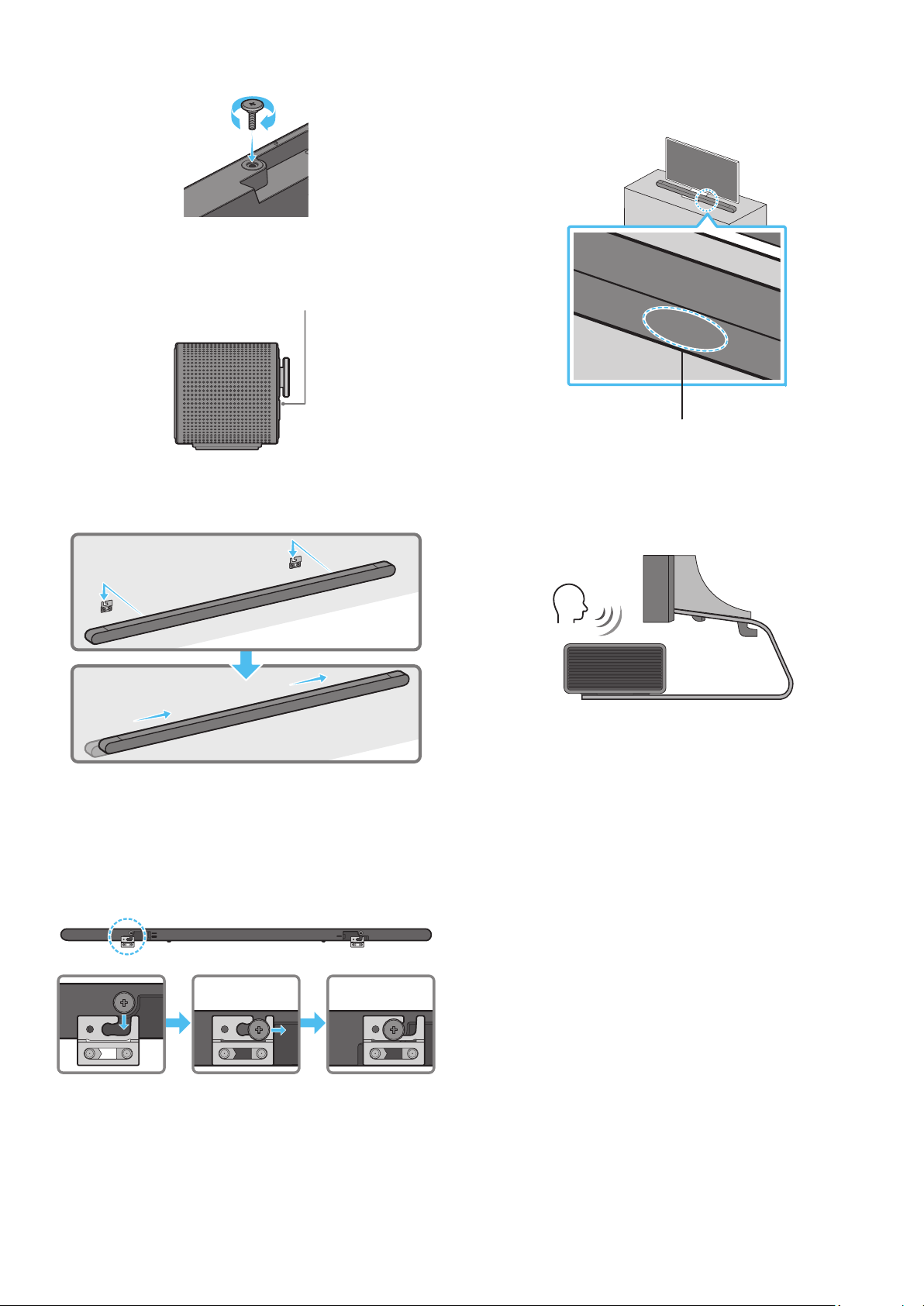
SPA - 29
6. Instale los 2 soportes de pared en la orientación correcta en la parte
posterior de la Soundbar utilizando 2 tornillos de sujeción.
• Al realizar el montaje, asegúrese de que la parte de los ganchos
para colgar Soportes de pared queden ubicados detrás de la parte
posterior de la Soundbar.
Parte posterior de la Soundbar
Extremo derecho de la Soundbar
7. Para instalar la Soundbar con los Soportes de pared ya colocados,
cuélguelos en los Tornillos de sujeción que están en la pared.
8. Deslice la Soundbar hacia abajo como se muestra a continuación de
manera que los Soportes de pared queden asentados de forma segura
sobre los Tornillos de sujeción.
• Inserte los Tornillos de sujeción en la parte ancha (posterior) de los
Soportes de pared y luego deslícelos hacia abajo de manera que
queden asentados de manera segura sobre los Tornillos de sujeción.
SERVICE
HDMI
(ARC)
SERVICE
HDMI
(ARC)
SERVICE
HDMI
(ARC)
DC 19V
09 INSTALACIÓN DE LA
SOUNDBAR FRENTE AL TV
Micrófonos
Como se indica en la imagen, alinee el centro de la Soundbar con el centro
del TV, y coloque con cuidado la Soundbar en el soporte para TV.
En este momento, coloque los micrófonos en la parte delantera del soporte
a n de que no intereran con el reconocimiento de voz.
Extremo derecho de la Soundbar
TV
NOTA
• Asegúrese de que la Soundbar esté colocada sobre una supercie plana
y sólida.
• Si no hay espacio suciente desde el TV, puede haber problemas
acústicos y con el reconocimiento de voz.
• La ilustración de arriba diere del modelo de respectivo.
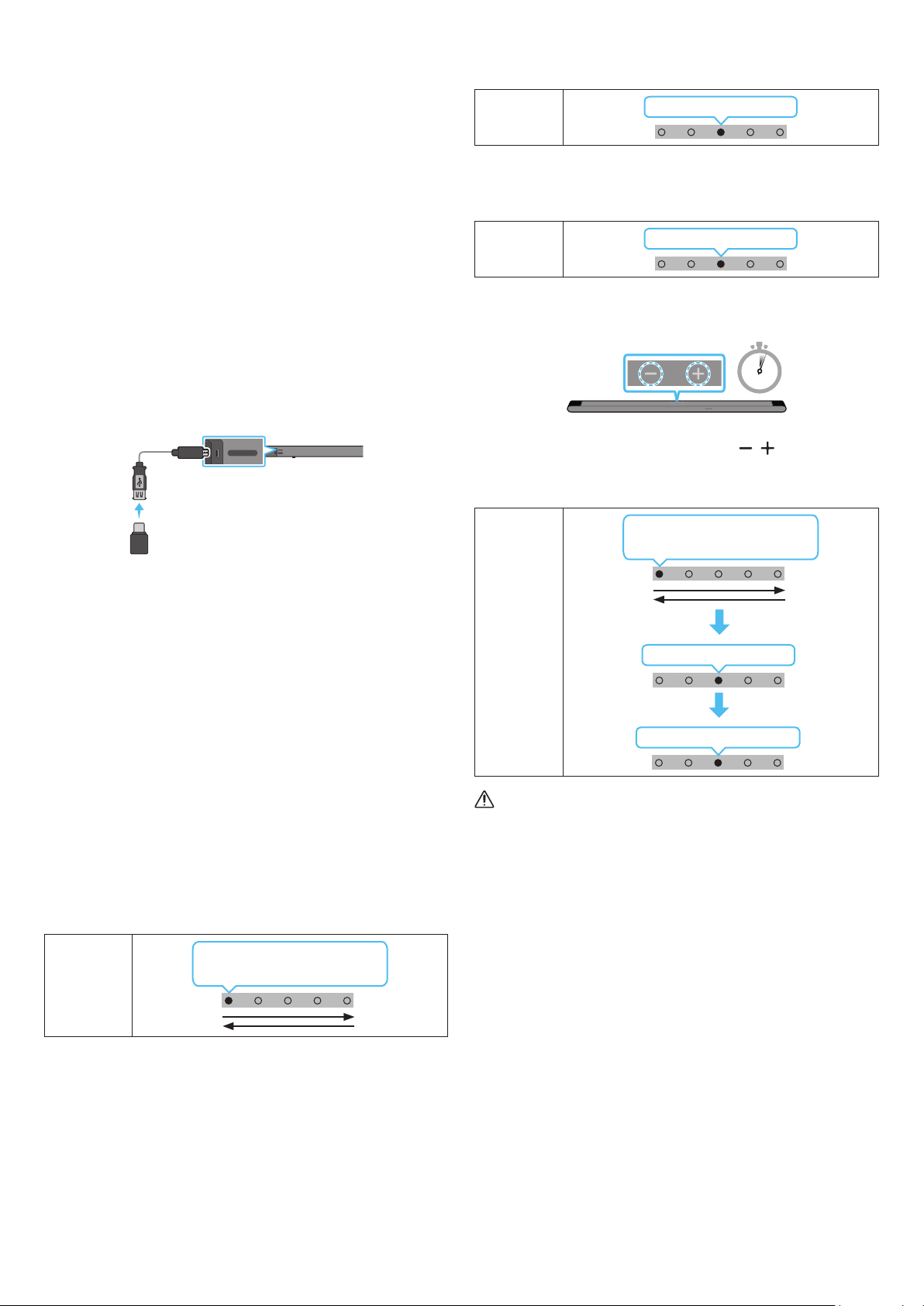
SPA - 30
10 ACTUALIZACIÓN DE
SOFTWARE
Actualización automática
Cuando la Soundbar está conectada a Internet, las actualizaciones de
software se realizan de forma automática, incluso cuando la Soundbar está
apagada.
• Para usar la función de actualización automática, la Soundbar debe estar
conectada a Internet.
La conexión wi de la Soundbar se anulará si se desconecta el cable de
alimentación o si se corta la corriente eléctrica. Si se corta la corriente
eléctrica, cuando se restaure, o si usted vuelve a conectar el cable de
alimentación, encienda la Soundbar y, luego, vuelva a conectarla a
Internet.
Actualización mediante USB
Parte posterior de la Soundbar
SERVICE
HDMI
(ARC)
SERVICE
HDMI
(ARC)
Cable adaptador de
micro USB a USB
(no suministrado)
Es posible que Samsung ofrezca actualizaciones para el rmware del
sistema de la Soundbar en el futuro.
Cuando haya una actualización disponible, puede actualizar la Soundbar
conectando la unidad USB que contiene el rmware de actualización al
puerto SERVICE de la Soundbar.
1. Vaya a (www.samsung.com) → busque el nombre del modelo en la
opción del menú de atención al cliente.
• Para obtener más información sobre la actualización, consulte la
Guía de Actualización.
2. Descargue el archivo de actualización (por ejemplo, en una memoria
USB).
3. Descomprima el archivo para crear una carpeta con el nombre del
archivo.
4. Guarde la carpeta creada en una memoria USB y luego conéctela a la
Soundbar.
5. Encienda la Soundbar. Luego, el producto se actualiza en 3 minutos.
Indicador
LED
El blanco se mueve de izquierda a
derecha y de derecha a izquierda
• Durante la actualización, no lo apague ni retire la memoria USB.
• Si el LED amarillo está encendido después de nalizada la
actualización de software, eso signica que hay otra actualización en
curso. Si esto sucede, no apague la Soundbar ni quite el USB.
• Si la actualización no avanza, vuelva a conectar el cable de
alimentación de la Soundbar.
• Cuando está instalada la última versión, no se realiza ninguna
actualización.
• Según el tipo de memoria USB, es posible que no se admita la
actualización.
• Si no hay ningún archivo de actualización disponible, el indicador
parpadea 3 veces en color rojo.
Indicador
LED
3 parpadeos en color rojo
• Si el archivo de actualización se encuentra en la misma versión que
la existente o en una inferior, el indicador parpadea 3 veces en color
cian.
Indicador
LED
3 parpadeos en color cian
Restablecer
5 Sec
Con la Soundbar encendida, presione los botones (Volumen) al
mismo tiempo durante un mínimo de 5 segundos. El indicador LED cambia
como se muestra a continuación y, luego, se reinicia la Soundbar.
Indicador
LED
3 parpadeos en color cian
Parpadeos rojos → Apagado
El blanco se mueve de izquierda a
derecha y de derecha a izquierda
PRECAUCIÓN
• Todas las conguraciones de la Soundbar se restablecen.
Asegúrese de realizar esto solo cuando sea necesario restablecer la
conguración.

SPA - 31
11 RESOLUCIÓN DE
PROBLEMAS
Antes de buscar ayuda, compruebe lo siguiente.
La Soundbar no se enciende.
• Compruebe si el cable de alimentación de la Soundbar se insertó
correctamente en el enchufe.
La Soundbar funciona de forma errática.
• Después de quitar el cable de alimentación, vuelva a insertarlo.
• Reinicie el dispositivo externo e intente nuevamente.
• Si no hay señal, la Soundbar se apaga automáticamente después de un
período determinado. Encienda la Soundbar (Consulte la página 9).
El control remoto no funciona
• Apunte el control remoto directamente a la Soundbar.
• Vuelva a cargar el control remoto.
El indicador de la Soundbar se enciende en color rojo jo.
• El micrófono está apagado.
Encienda el micrófono. (Consulte la página 7).
No sale sonido de la Soundbar.
• El volumen de la Soundbar está muy bajo o en silencio. Ajuste el
volumen.
• Cuando hay un dispositivo externo (STB, dispositivo Bluetooth,
dispositivo móvil, etc.) conectado, ajuste el volumen del dispositivo
externo.
• Para la salida del sonido del TV, seleccione Soundbar. (TV Samsung:
Inicio (
) → Menú → Cong. ( ) → Todos los ajustes ( ) → Sonido
→ Salida de sonido → Seleccione la Soundbar)
• La conexión del cable a la Soundbar no debe estar oja. Retire el cable
y vuelva a conectar.
• Retire el cable de alimentación por completo, vuelva a conectarlo y
enciéndalo.
• Reinicie el producto e intente nuevamente. (Consulte la página 30).
No sale sonido del altavoz de graves.
• Compruebe si el indicador LED en la parte posterior del altavoz de
graves está encendido en color azul. Vuelva a conectar la Soundbar
y el altavoz de graves si el indicador parpadea en azul o está en rojo.
(Consulte la página 15).
• Puede haber problemas de funcionamiento si hay un obstáculo entre
la Soundbar y el altavoz de graves. Mueva los dispositivos a un área
alejada de los obstáculos.
• Otros dispositivos que envían señales de radiofrecuencia en las
proximidades pueden interrumpir la conexión.
Mantenga su altavoz alejado de tales dispositivos.
• Retire y vuelva a conectar el enchufe de alimentación.
En caso de que el sonido del altavoz de graves tenga interferencias,
ruido o retrasos
• Si hay algún objeto entre la Soundbar y el altavoz de graves, eso podría
causar un problema. Cambie los altavoces a otro lugar donde ese objeto
no se interponga.
• Puede haber interferencias o retrasos en el sonido si el altavoz de
graves está lejos de la Soundbar. Acérquelos a la Soundbar.
• Puede haber interferencias o retrasos en el sonido si la Soundbar está
cerca de un instrumento o dispositivo eléctrico que pueda causar
interferencia de radio. Aleje la Soundbar de tales dispositivos (por
ejemplo, un router inalámbrico).
• Cambie el estado de la conexión de red del TV de inalámbrico a
cableado.
El volumen del altavoz de graves es demasiado bajo
• El volumen original del contenido que está reproduciendo puede
ser bajo. Intente ajustar el nivel del altavoz de graves. (Consulte la
página 10).
• Acerque el altavoz de graves hacia usted.
Si el TV no está conectado a través de HDMI (ARC).
• Compruebe si el cable HDMI se conectó correctamente a la terminal
ARC (Consulte la página 17).
• Es posible que no se pueda realizar la conexión debido a un dispositivo
externo conectado (decodicador, consola de juegos, etc.). Conecte la
Soundbar directamente.
• Es posible que HDMI-CEC no esté activado en el TV. Encienda el CEC
en el menú del TV. (TV Samsung: Inicio (
) → Menú → Cong. ( )
→ Todos los ajustes ( ) → Conexión → External Device Manager →
Anynet+ (HDMI-CEC) ON)
No hay sonido cuando se conecta el TV en modo HDMI (ARC).
• Es posible que su dispositivo no pueda reproducir la señal de entrada.
Cambie la salida de audio del TV a PCM o Dolby Digital. (Si se trata de
un TV Samsung: Inicio (
) → Menú → Cong. ( ) → Todos los ajustes
( ) → Sonido → Conguración experta → Formato de audio de salida
digital)
La Soundbar no se conecta mediante Bluetooth
• Cuando conecte un dispositivo nuevo, cambie "Bluetooth Pairing"
para establecer la conexión. (Presione el botón
PAIR del control
remoto o presione el botón (Micrófono encendido/apagado) en el
cuerpo de la Soundbar por al menos 5 segundos).
• Si la Soundbar está conectada a otro dispositivo, primero desconéctelo
para poder cambiarlo.
• Vuelva a conectarlo después de quitar la lista de parlantes Bluetooth
del dispositivo al que se quiere conectar. (TV Samsung: Inicio ( ) →
Menú → Cong. ( ) → Todos los ajustes ( ) → Sonido → Salida de
sonido → Lista de altavoces Bluetooth)
• Retire y vuelva a conectar el enchufe de alimentación; luego, intente
nuevamente.
• Reinicie el producto e intente nuevamente. (Para obtener más
información, consulte "Restablecer").
SPA - 32
No hay sonido cuando se conecta mediante Bluetooth.
• Algunos dispositivos, p. ej., microondas, enrutador inalámbrico, etc.,
pueden generar interferencias de radio si están ubicados demasiado
cerca de la Soundbar.
• Si el dispositivo que está conectado mediante Bluetooth se aleja
demasiado de la Soundbar, eso puede hacer que no haya sonido.
Acerque el dispositivo a la Soundbar.
• Si parte de su cuerpo está en contacto con el transceptor Bluetooth o
si el producto está sobre un mueble de metal, eso puede hacer que no
haya sonido. Compruebe el entorno de instalación y las condiciones
de uso.
La Soundbar no se conecta mediante Wi-Fi
• Compruebe si su enrutador inalámbrico está encendido.
• Apague el enrutador, vuelva a encenderlo e intente nuevamente.
• La Soundbar no se conecta si la señal inalámbrica es demasiado débil.
Intente acercar el enrutador a la Soundbar o eliminar los obstáculos
que pudiera haber entre la Soundbar y el enrutador de ser posible.
• Si su enrutador inalámbrico es nuevo, deberá volver a congurar la red
del altavoz.
La Soundbar no se enciende automáticamente con el TV.
• Cuando apaga la Soundbar mientras mira TV, se desactiva la
sincronización de encendido con el TV. Primero, apague el TV.
La función AVA no está disponible en los siguientes casos.
• La función AVA no está disponible cuando se usa la función
Q-symphony.
• La función AVA no está disponible cuando el micrófono está apagado.
Después de conectar el TV a la Soundbar, cambié el modo de la
Soundbar. Desde entonces, no hay salida de sonido desde el TV.
• Si conecta la Soundbar a un dispositivo móvil mientras esta está
conectada al TV, la Soundbar transmite el sonido del dispositivo móvil
mientras se mantenga la conexión con el TV. Por eso, dejará de salir el
sonido proveniente del TV.
• Desconecte el dispositivo móvil y el sonido del TV volverá a
reproducirse desde la Soundbar.
12 LICENCIA
Dolby, Dolby Atmos, and the double-D symbol are registered
trademarks of Dolby Laboratories Licensing Corporation. Manufactured
under license from Dolby Laboratories. Condential unpublished works.
Copyright © 2012-2021 Dolby Laboratories. All rights reserved.
For DTS patents, see http://patents.dts.com. Manufactured under license
from DTS, Inc. (for companies headquartered in the U.S./Japan/ Taiwan)
or under license from DTS Licensing Limited (for all other companies).
DTS, Digital Surround, Virtual:X, and the DTS logo are registered
trademarks or trademarks of DTS, Inc. in the United States and other
countries. © 2021 DTS, Inc. ALL RIGHTS RESERVED.
The terms HDMI and HDMI High-Denition Multimedia Interface,
and the HDMI Logo are trademarks or registered trademarks of HDMI
Licensing Administrator, Inc. in the United States and other countries.
• Usa tu teléfono, tablet o computadora como control remoto de
Spotify. Para más información, entra a spotify.com/connect
• El software de Spotify está sujeto a licencias de terceros que puedes
encontrar aquí: https://www.spotify.com/connect/third-party-
licenses.
• Apple, Airplay, iPhone, iPad, and Mac are trademarks of Apple Inc.,
registered in the U.S. and other countries.
• Use of the Works with Apple badge means that an accessory has
been designed to work specically with the technology identied
in the badge and has been certied by the developer to meet Apple
performance standards.

SPA - 33
[ENERGY STAR]
Solo para modelo calicado como ENERGY STAR
• Su producto Samsung está calicado como ENERGY STAR en su
conguración predeterminada de fábrica. El cambio de ciertas
funciones, ajustes y funcionalidades en este producto puede
modicar el consumo de energía, posiblemente más allá de los
límites requeridos para la calicación de ENERGY STAR.
• Agencia de Protección Ambiental y Departamento de Energía.
ENERGY STAR es un programa conjunto de las agencias
gubernamentales, diseñado para promover productos y prácticas
que faciliten el uso eciente de la energía.
Consulte www.energystar.gov para ver más información sobre el
programa ENERGY STAR.
Solo para modelo calicado como ENERGY STAR
(Solo aplicable a los modelos Thin Client)
Como socio de ENERGY STAR®, SAMSUNG determinó que este producto
cumple los lineamientos de ENERGY STAR® en cuanto al uso eciente
de la energía.
• El objetivo del programa ENERGY STAR es reducir las emisiones de
los gases de invernadero y ahorrar energía mediante el etiquetado
voluntario.
• La conguración de administración de energía de este producto se
habilitó de forma predeterminada y tiene varios ajustes de tiempo,
desde 1 minuto hasta 5 horas.
• El producto puede activarse con solo presionar un botón en su
chasis para sacarlo del modo de suspensión.
Solo para modelo calicado como ENERGY STAR (Los otros modelos)
• Como socio de ENERGY STAR, Samsung determinó que este producto
o los modelos del producto cumplen los lineamientos de ENERGY
STAR en cuanto al uso eciente de la energía.
13 AVISO SOBRE LA LICENCIA
DE CÓDIGO ABIERTO
Para enviar consultas y solicitudes relacionadas con el código abierto,
comuníquese con Samsung Open Source
(http://opensource.samsung.com).
14 NOTAS IMPORTANTES
SOBRE EL SERVICIO
Las guras e ilustraciones se proporcionan en este manual de usuario solo
a modo de referencia y pueden ser diferentes del aspecto real del producto.
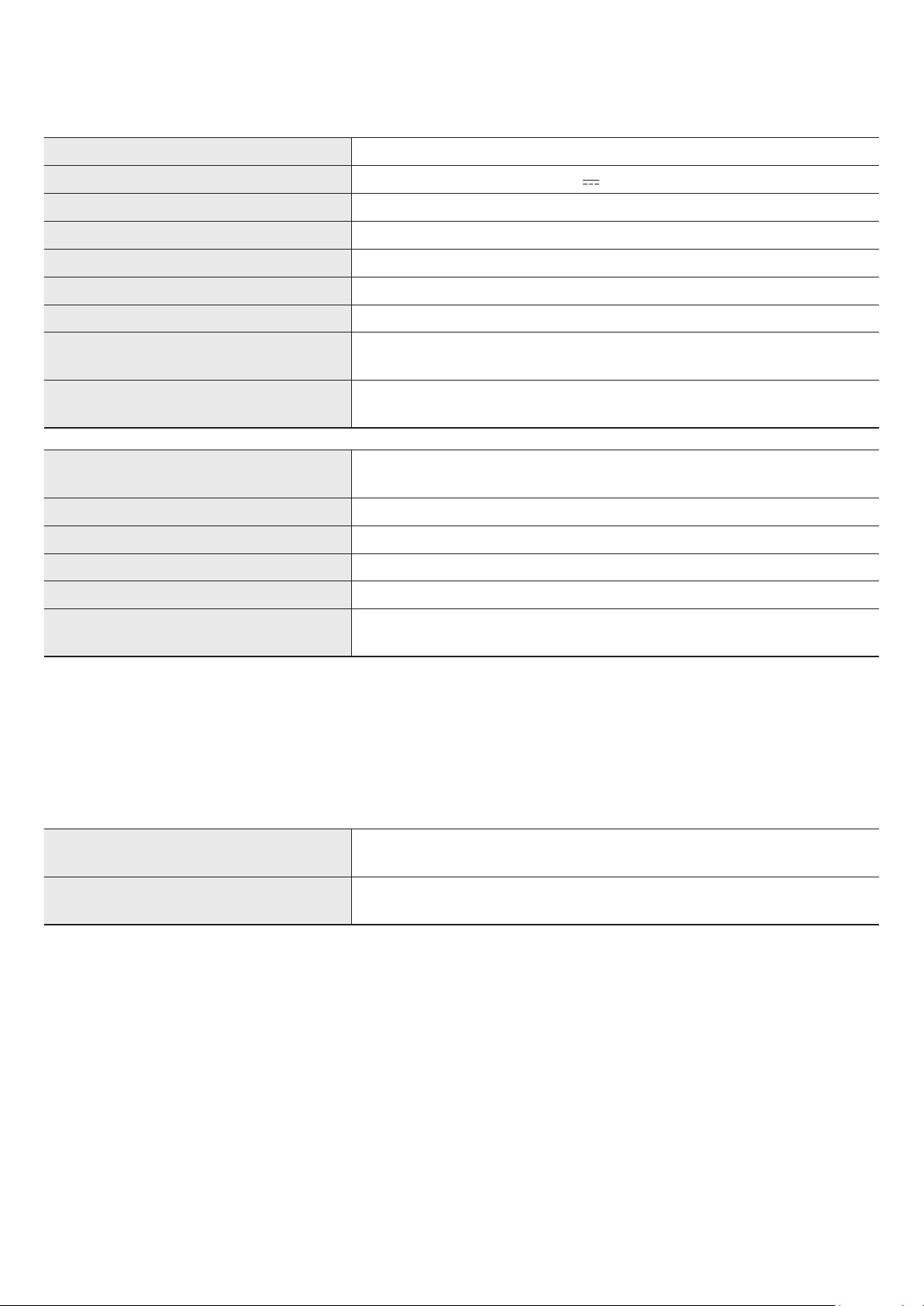
SPA - 34
15 ESPECIFICACIONES Y GUÍA
Especicaciones
Nombre del modelo
HW-S800B / HW-S801B
Requisitos de electricidad 19 V
(solo México)
Consumo de energía 28 W (solo México)
Peso
1.4 kg
Dimensiones (An. x Al. x Prof.)
1160.0 x 38.0 x 39.9 mm
Rango de temperatura de funcionamiento
De +5°C a +35°C
Rango de humedad de funcionamiento
10 % ~ 75 %
AMPLIFICADOR
Potencia de salida nominal
(20W x 2) + (10W x 2) + (20W x 2) + (10W x 1) + (10W x 2)
Formatos de reproducción admitidos
Dolby 5.1ch / Dolby Digital Plus / Dolby ATMOS (Dolby Digital Plus) /
DTS 5.1ch / LPCM 2ch
Nombre del altavoz de graves
HW-S800B : PS-WB85D
HW-S801B : PS-WB86D
Requisitos de electricidad AC 100-240 V ~ 50/60 Hz (solo México)
Consumo de energía 26 W (solo México)
Peso
6.4 kg
Dimensiones (An. x Al. x Prof.)
238.0 x 240.8 x 238.0 mm
AMPLIFICADOR
Potencia de salida nominal
200 W
NOTA
• Samsung Electronics Co., Ltd se reserva el derecho de cambiar las especicaciones sin previo aviso.
• El peso y las dimensiones son aproximados.
• La operación de este equipo está sujeta a las siguientes dos condiciones:
(1) es posible que este equipo o dispositivo no cause interferencia perjudicial y
(2) este equipo o dispositivo debe aceptar cualquier interferencia, incluyendo la que pueda causar su operación no deseada.
Precaución : La Soundbar se reiniciará automáticamente si conecta/desconecta el servicio wi.
Para desactivar la conexión de Wi-Fi:
Mantenga presionado el botón CH LEVEL en el control remoto de la Soundbar durante más de
30 segundos para encender o apagar la conexión de Wi-Fi.
Para desactivar la conexión de Bluetooth:
Mantenga presionado el botón TONE CONTROL en el control remoto de la Soundbar durante
más de 30 segundos para encender o apagar la conexión de Bluetooth.
© 2022 Samsung Electronics Co., Ltd. All rights reserved.
Contact SAMSUNG WORLD WIDE
If you have any questions or comments relating to Samsung products, please contact the SAMSUNG customer care Center.
Country Samsung Service Center
Web Site
MEXICO 800-SAMSUNG
www.samsung.com/mx/support
BRAZIL
0800 555 0000 (Demais cidades e regiões)
4004-0000 (Capitais e grandes centros)
www.samsung.com/br/support
COSTA RICA 00-800-1-SAMSUNG (726-7864)
www.samsung.com/latin/support (Spanish)
www.samsung.com/latin_en/support (English)
DOMINICAN REPUBLIC 1-800-751-2676
ECUADOR 1-800-SAMSUN (72-6786)
EL SALVADOR 8000-SAMSUNG (726-7864)
GUATEMALA 1-800-299-0033
HONDURAS 800-2791-9111
JAMAICA 1-800-SAMSUNG (726-7864)
www.samsung.com/latin_en/support (English)
NICARAGUA 001-800-5077267
www.samsung.com/latin/support (Spanish)
www.samsung.com/latin_en/support (English)
PANAMA 800-0101
PUERTO RICO 1-800-682-3180
TRINIDAD & TOBAGO 1-800-SAMSUNG(726-7864)
VENEZUELA 0-800-100-5303
COLOMBIA
Bogotá en el 600 12 72
Sin costo en todo el pais 01 8000 112 112
Y desde tu celular #726
www.samsung.com/co/support
CHILE 800 726 786
www.samsung.com/cl/support
BOLIVIA 800 107 260
PERU 080077708 Desde teléfonos jos, públicos o celulares
www.samsung.com/pe/support
ARGENTINA 0800-555-SAMS(7267)
www.samsung.com/ar
URUGUAY 0800-SAMS(7267)
www.samsung.com/uy
PARAGUAY 0800-11-SAMS(7267)
www.samsung.com/py
--------------SOLO MÉXICO---------------
IMPORTADO POR : SAMSUNG ELECTRONICS MÉXICO S.A. DE C.V.
GENERAL MARIANO ESCOBEDO 476 PISO 8
COL. ANZURES, DELEGACIÓN MIGUEL HIDALGO MÉXICO, CIUDAD DE MÉXICO C.P. 11590
TEL : 01 (55) 5747-5100 / 01 800 726 7864