Mobile Scanner
User’s Manual
Regulatory model: FF-2109B
Avision Inc.

User’s Manual
ii
Trademarks
Mac, and Mac OS are trademarks of Apple Computer, Inc.,
registered in the United States.
Microsoft is a U.S. registered trademark of Microsoft
Corporation.
Windows 7 and Windows 8 are either registered trademarks or
trademarks of Microsoft Corporation in the United States and/or
other countries.
Other brands and product names herein are trademarks or
registered trademarks of their respective holders.
Copyright
All rights reserved. No part of this publication may be
reproduced, transmitted, transcribed, stored in a retrieval
system, or translated into any language or computer language,
in any form or by any means, electronic, mechanical, magnetic,
optical, chemical, manual, or otherwise, without the prior
written permission of Avision Inc.
Material scanned by this product may be protected by
governmental laws and other regulations, such as copyright
laws, the customer is solely responsible for complying with all
such laws and regulations.
Warranty
The information contained in this document is subject to
change without notice.
Avision makes no warranty of any kind with regard to this
material, including, but not limited to, the implied warranties
of fitness for a particular purpose.
Avision shall not be liable for errors contained herein or for
incidental or consequential damages in connection with the
furnishing, performance, or use of this material.

User’s Manual
iii
FCC Radio Frequency Interference Statement
This product has been tested and found to comply with the
limits for a class B digital device, pursuant to Part 15 of the
FCC rules. Operation is subject to the following two
conditions: (1) this device may not cause harmful
interference, and (2) this device must accept any
interference received, including interference that may
cause undesired operation. The FCC Class B limits are
designed to provide reasonable protection against harmful
interference in a residential installation. This equipment
generates, uses, and can radiate radio frequency energy
and, if not installed and used in accordance with the
instructions, may cause harmful interference to radio
communications. However, there is no guarantee that
interference will not occur in a particular installation. If this
equipment does cause harmful interference to radio or
television reception, which can be determined by turning
the equipment off and on, the user is encouraged to try to
correct the interference by one or more of the following
measures:
Reorient or relocate the receiving antenna.
Increase the separation between the equipment and
receiver.
Connect the equipment into an outlet on a circuit
different from that to which the receiver is connected.
Consult your point of purchase or service representative
for additional suggestions.

User’s Manual
iv
European Union Regulatory Notice
Products bearing the CE marking comply with the following EU
Directives:
Low Voltage Directive 2014/35/EC
EMC Directive 2014/30/EC
Restriction of the use of certain hazardous substances
(RoHS) Directive 2011/65/EU
This product satisfies the Class B limits of EN55032, EN55035,
and safety requirements of EN62368-1.
*This machine is certified as Class 1 LED product.

User’s Manual
v
Disposal of Waste Equipment by Users in Private Union
This symbol on the product or on its packaging indicates that
the product can not be disposed of with your other household
waste. Instead it should be sent to appropriate facilities for
recovery and recycling in an effort to protect human health and
the environment. Fore more information about where you can
drop off your waste equipment for recycling, please contact
your local city office, your household waste disposal service or
the shop where you purchased the product.
System Requirements
Windows
CPU:
Intel
®
Core™ 2 Duo or higher
Memory:
32 bit: 2 GB
64 bit: 4 GB
Optical Drive:
DVD-ROM Drive
USB Port:
USB 2.0
Compatible
Operating
System:
Microsoft Windows 7, Windows 8 (32 bits/64
bits), Windows 10 (32 bits/64 bits)

User’s Manual
vi
Macintosh
OS:
Mac OS X 10.7 or later
Computer:
Recommended: Intel
®
Core
TM
Duo
Processor 2.4 GHz or higher
Minimum: Intel
®
Core
TM
Duo Processor
1.83 GHz
PowerPC G5 1.6 GHz
Memory:
Recommended: 1 GB or more
Minimum: 512 MB
User’s Manual
vii
Product Safety Guide
Please clearly read all these instructions, and follow all instructions
and warnings before installing and using the device.
The following indications are used in this document to obviate any
chance of accident or damage to you and/or the device.
WARNING
Indicates potentially hazardous situations, which
if instructions are not followed, could result in
death or serious injury.
CAUTION
Indicates a potentially hazardous situation
which, if instructions are not followed, may
result in minor or moderate injury or damage to
property.
WARNING
Use only the USB cable that came with your device and avoid
abrasions, cuts, fraying, crimping, and kinking. Using any
other USB cable could cause fire, electrical shock, or injury.
Place the device close enough to the computer so that the
interface cable can easily reach between the device and the
computer.
Do not place or store the device:
Outdoors
Near excessive dirt or dust, water, or heat sources
In locations subject to shocks, vibrations, high
temperature or humidity, direct sunlight, strong light
sources, or rapid changes in temperature or humidity
Do not use the device with wet hands.
Never disassemble, modify, or attempt to repair the device or
device option by yourself, except as specifically explained in
the device's documentation. This could cause fire, electrical
shock, or injury.

User’s Manual
viii
Unplug the device and the USB cable, and refer servicing to
qualified service personnel under the following conditions:
Liquid has entered the device.
Object has entered the device.
The device has been dropped, or the case has been
damaged.
The device does not operate normally (i.e. appearance of
smoke, strange smell, odd noise, etc.), or exhibits a
distinct change in performance.
Unplug the device and the USB cable before cleaning.
CAUTION:
Do not locate the device on rackety or aslope tables. Do not
locate the device on unstable surface. The device may fall
down and this may result in injury.
Do not place heavy objects on the unit. It may cause
unbalance and the device may fall down. This may result in
injury.
Store the AC Power cord/USB cable bundled out of the reach
of children to avoid the risk of injury.
Keep plastic bags bundled out of the reach of children or
throw them away to avoid the danger of suffocation.
If you are not going to use the device for a long period,
unplug the USB cable from the electrical outlet.
User’s Manual
1-1
1. Introduction
Congratulations on your purchase of the color sheet-fed
image scanner. Avision is one of the leading companies to
make high quality color image scanner.
Before you install and operate the new scanner, please take
a few minutes to read through this manual. It provides
proper instructions for you to unpack, install, operate and
maintain the scanner.
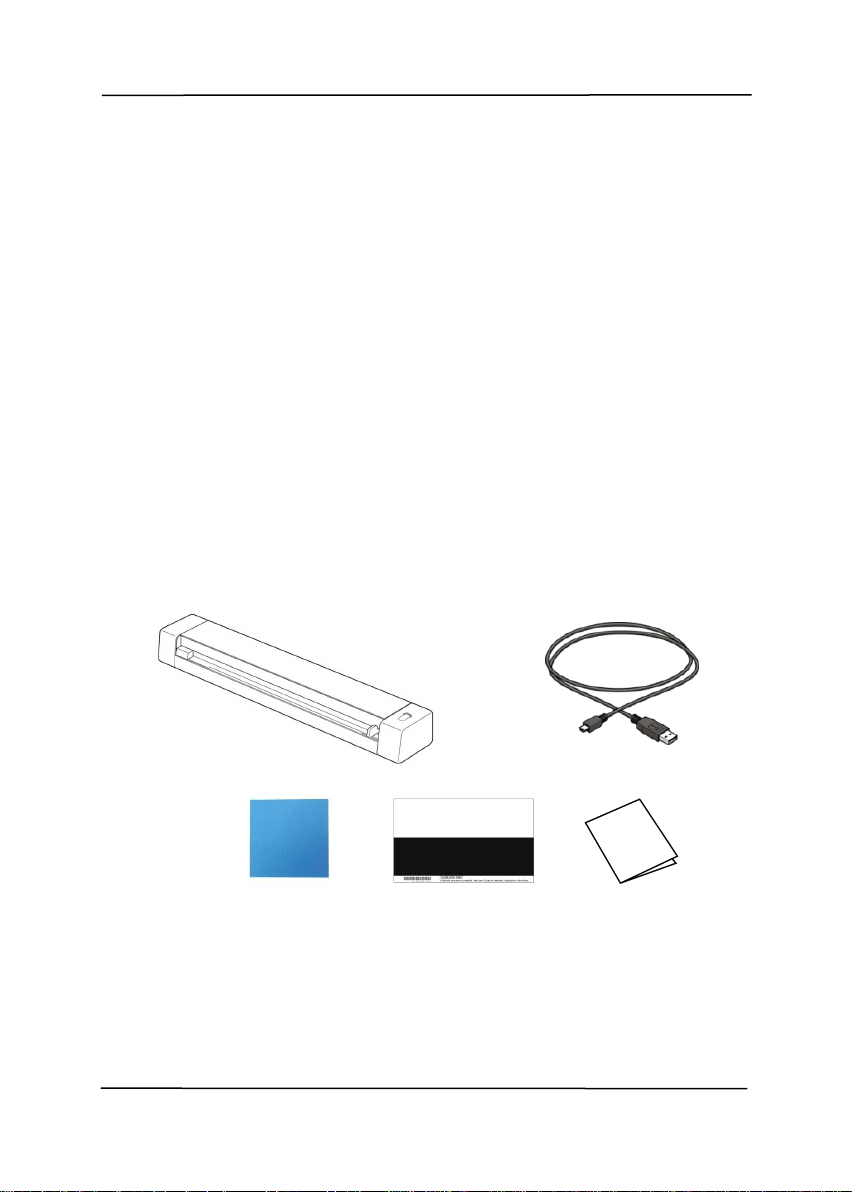
1.1 Package Contents
The following figure illustrates the package contents. Please
check all the items against the checklist. If there is anything
missing, please contact your authorized local dealer
immediately.
1. Scanner Main Unit
2. USB Cable
3. Cleaning Cloth
4. Calibration Sheet
5. Quick Guide
User’s Manual
1-2
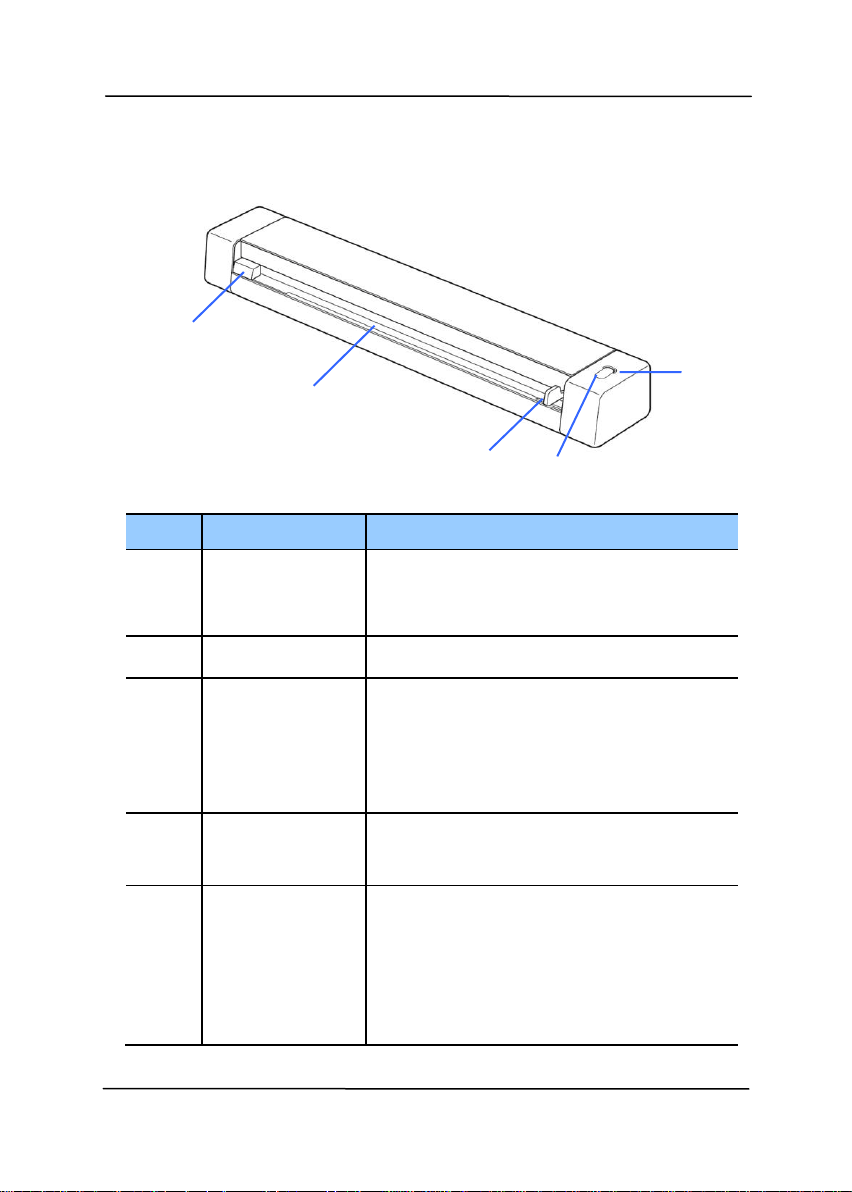
1.2 Top view
Item
Name
Description
1
Feeder slot
left edge
Insert original into the feed slot,
printed side UP and aligned with
the left edge to begin scanning.
2
Feed slot
Feed your original to the slot.
3
Sliding
paper guide
Slide the guide up to the right
edge of the original before
inserting original into the feed slot
to ensure proper alignment when
scanning.
4
Scan button
Press to start a scan using Button
Manager V2.
5
Status
Indicator
Light
A solid blue light indicates
ready status.
A flashing blue light indicates
scanning status.
A flashing red light indicates
error status.
3
3
1
2
5
4
User’s Manual
1-3
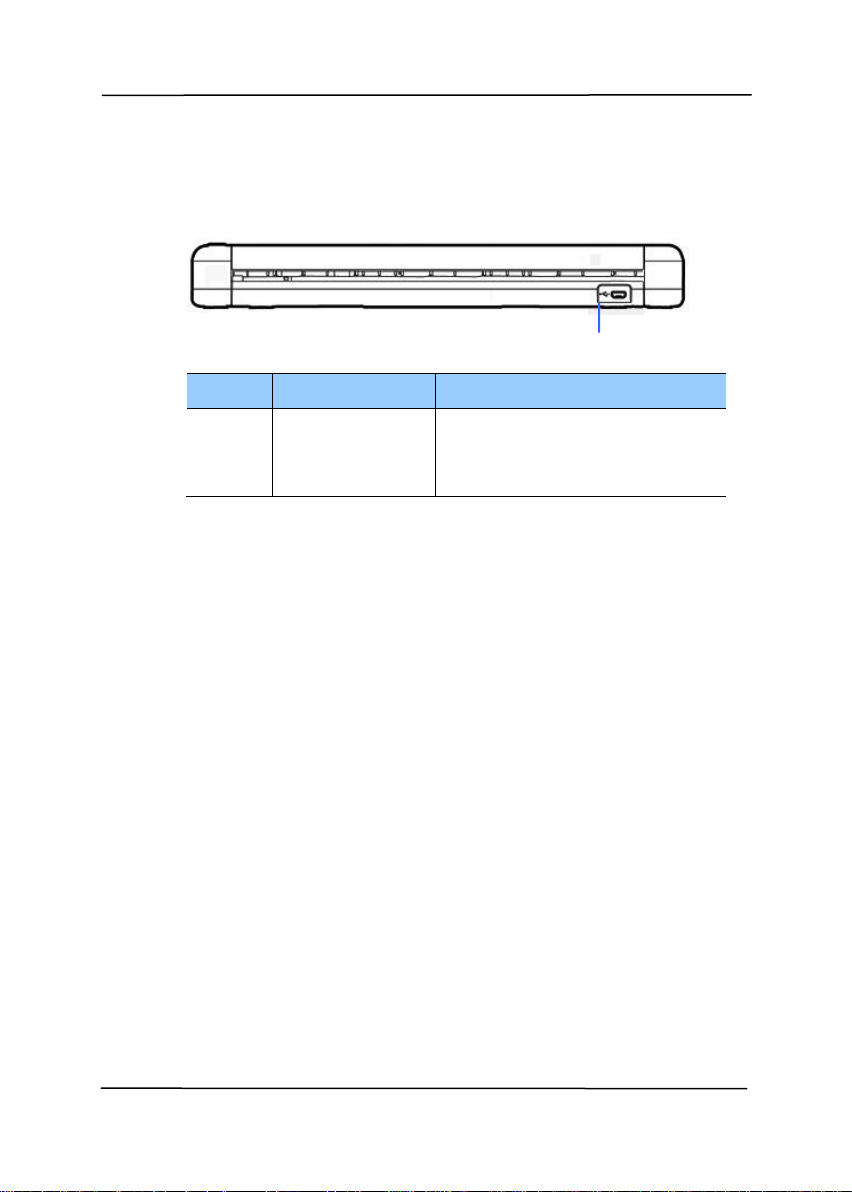
1.3 Rear view
Item
Name
Description
1
Micro USB
port
Connect to a computer via
a micro USB cable.
1

User’s Manual
2-1
2. Scanner Installation
2.1 Precautions
Keep the scanner out of direct sunlight. Direct exposure
to the sun or excessive heat may cause damage to the
unit.
Do not install the scanner in a humid or dusty place.
Place the scanner securely on an even, flat surface.
Tilted or uneven surfaces may cause mechanical or
paper-feeding problems.
Retain the scanner box and packing materials for
shipping purposes.
User’s Manual
2-2
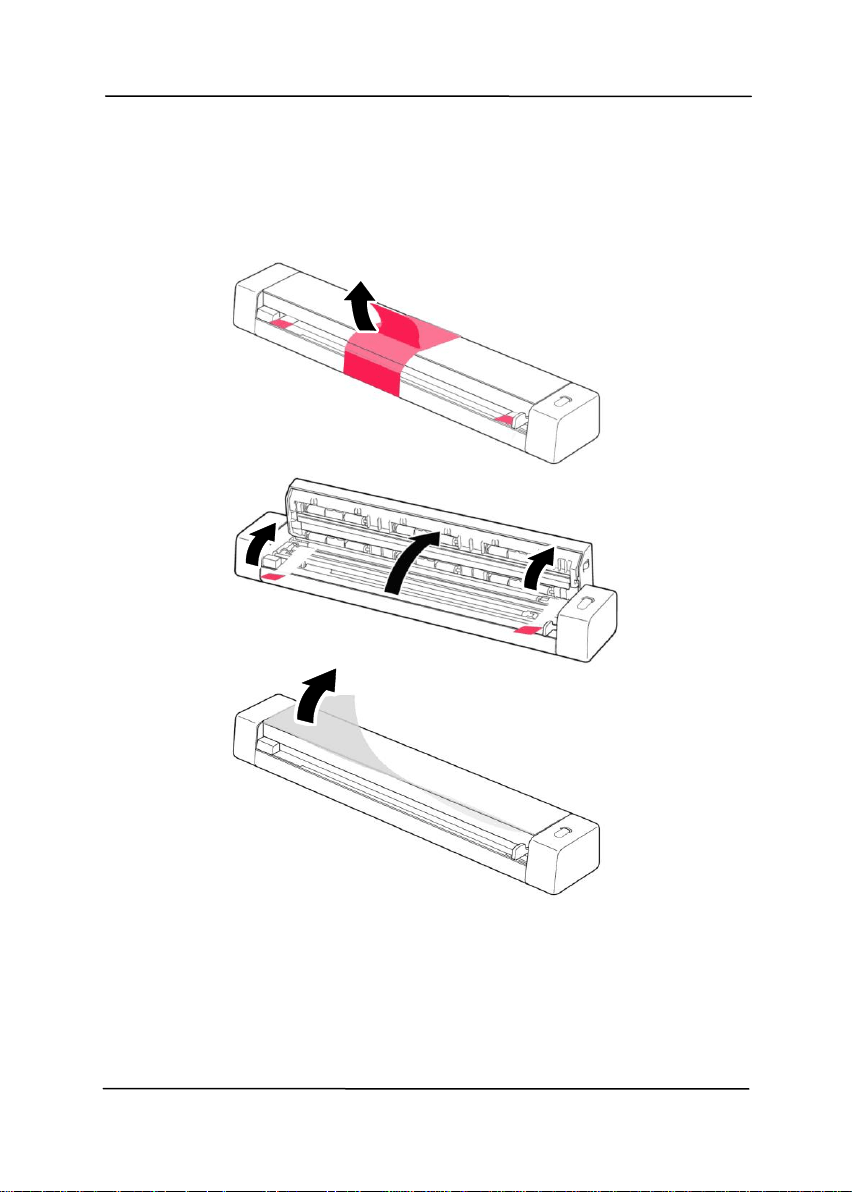
2.2 Removing the Protective Tape
Remove the tapes and protective film on the scanner and inside
the document feeder as illustrated in below.

User’s Manual
2-3
2.3 Installing the Scanner Driver
Windows
NOTE:
1. To ensure your computer can identify the USB scanner,
please install scanner driver first before connecting the
scanner to your computer.
2. The scanner driver contains TWAIN, and WIA driver. After
the installation of scanner driver is completed, this scanner
allows you to scan via a TWAIN, or a WIA interface. Start
your TWAIN-compliant image editing software application
to select a TWAIN or WIA user interface. You may also
launch Microsoft’s Scanner and Camera Wizard to scan via
a WIA user interface.
1. Download the scanner driver on the Avision web site at
https://www.avision.com/eu/download/.
2. Unzip the file and double click [setup.exe] file.
3. Follow the instructions on the screen to complete the
installation.
Mac OS:
The Avision color image scanner comes with the following
scanning software applications to help you complete your scan
and enhance your scanned image.
Avision TWAIN scanner driver
Avision ICA scanner driver
Avision Capture Tool software application
User’s Manual
2-4
Note:
After installing the Avision’s scanning software,
connect the scanner to the computer. If you connect
the scanner to your computer before installing the
Avision’s scanning software, the Avision scanning
software may not run properly.
1. Download the scanner driver on Avision web site at
https://www.avision.com/eu/download/.
2. Check that the scanner is not connected to your computer.
3. Turn your computer on, and log in with an account that has
admin rights.
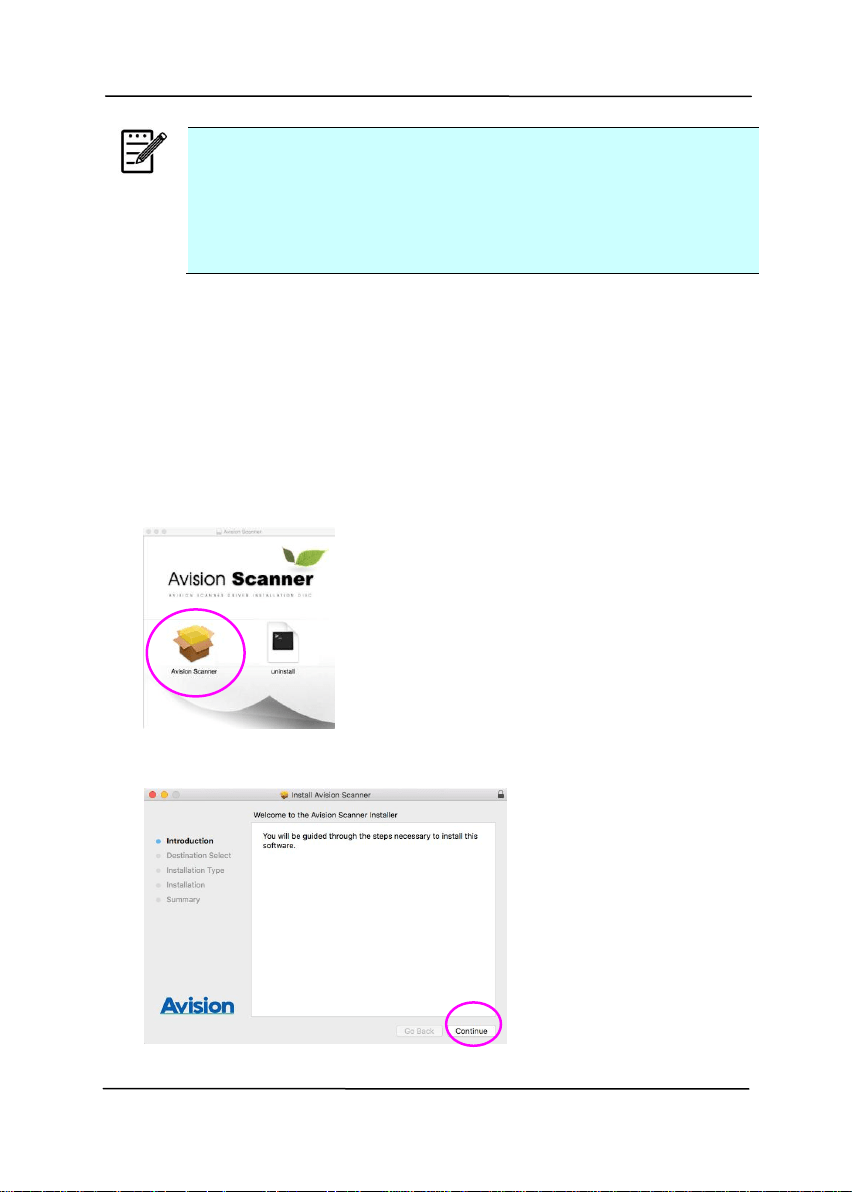
4. Double-click [Avision Scanner.dmg] and then the [Avision
Scanner] icon and follow the on-screen instructions to
complete the installation.
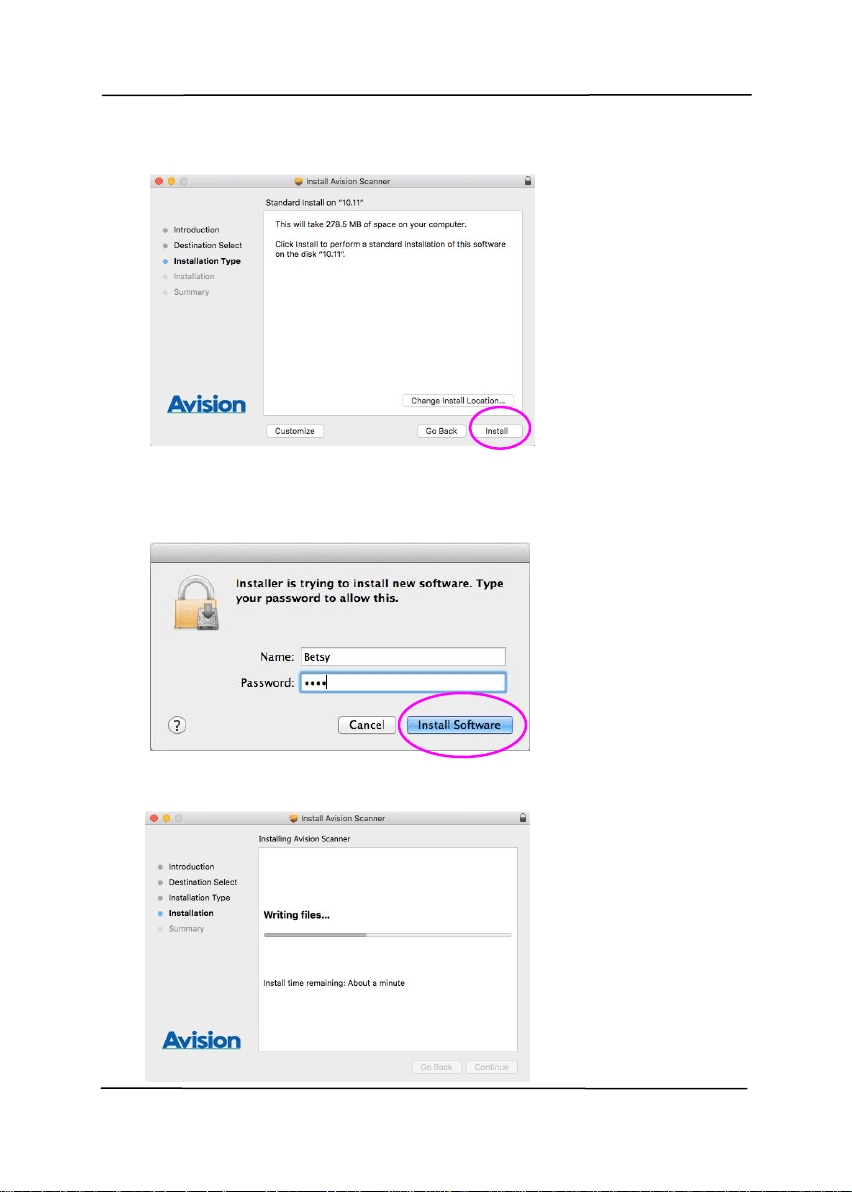
5. Click the [Continue] button on the Welcome window.
User’s Manual
2-5
6. Click the [Install] button on the installation screen.
7. Log in with a password that has admin rights and click the
[Install Software] button.
8. The computer begins installing the software.
User’s Manual
2-6
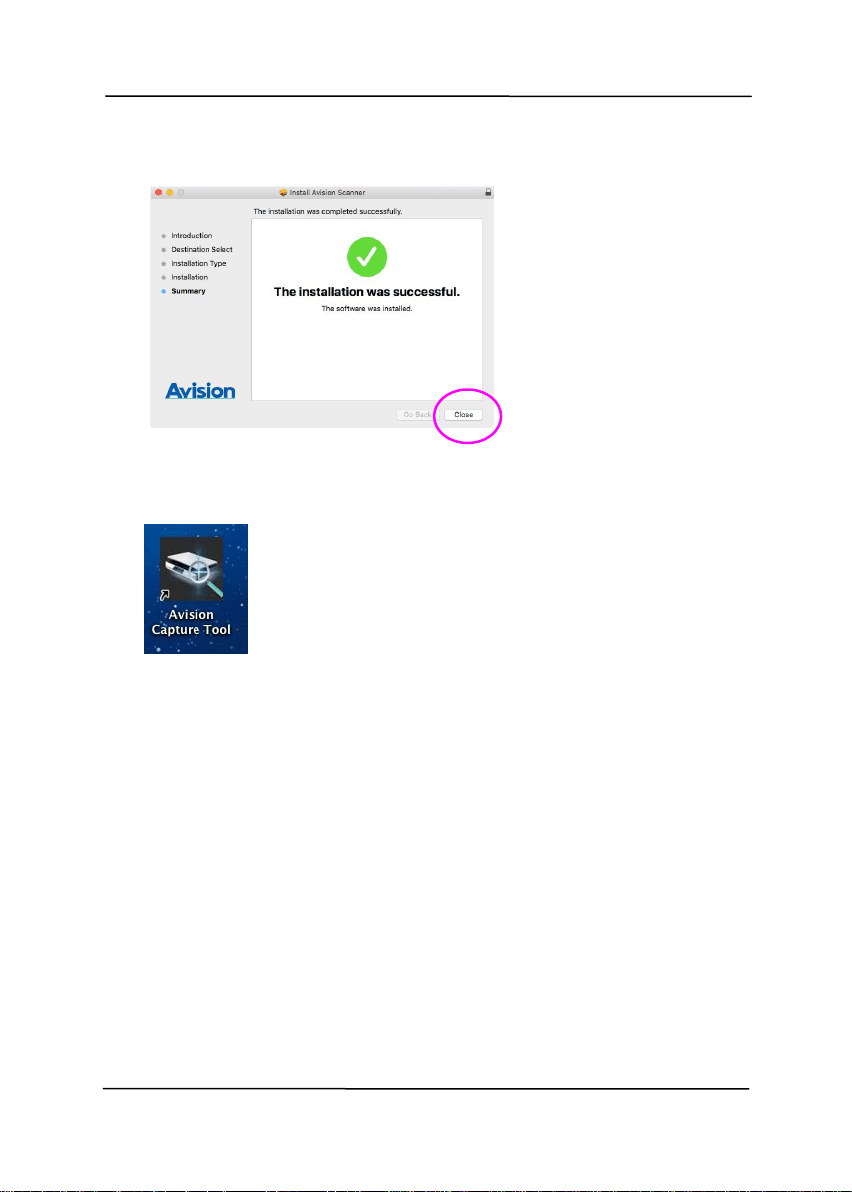
9. Click the [Close] button when the [Installation was successful]
dialog box is prompted.
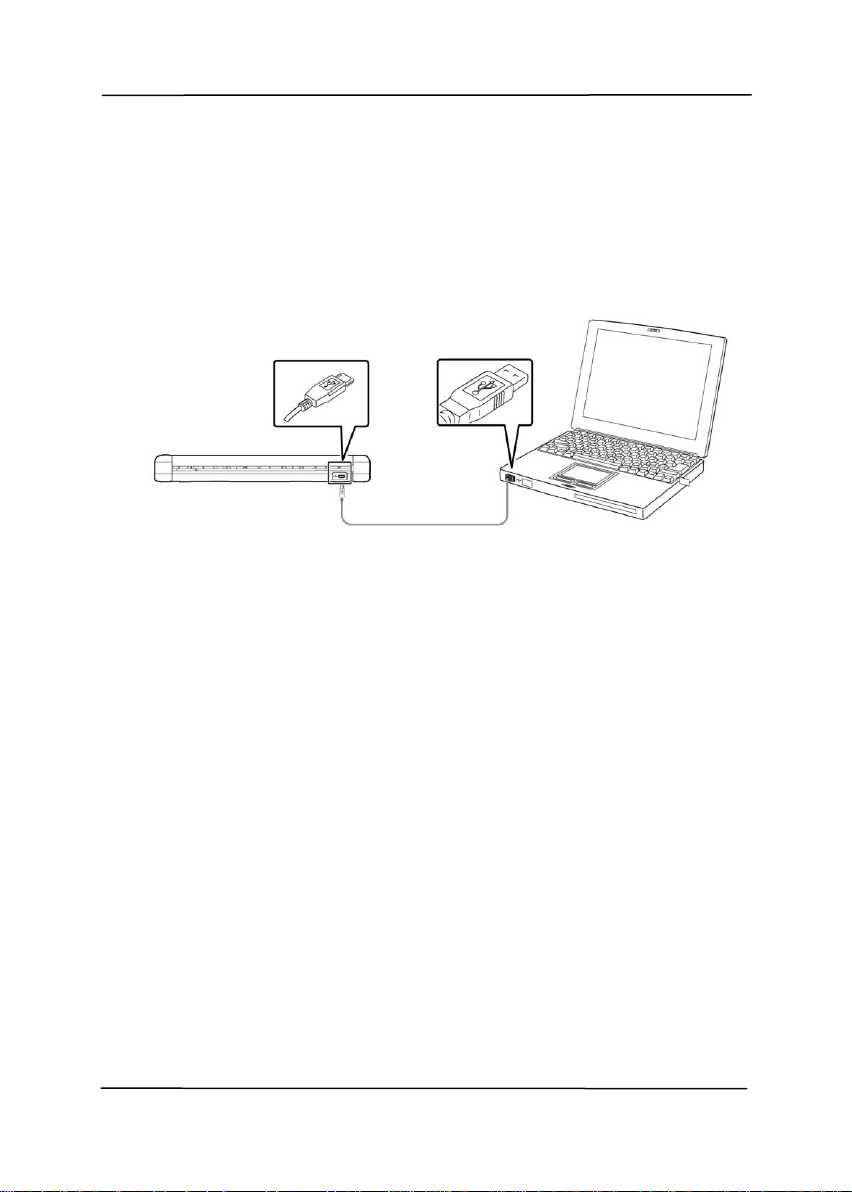
10. If installation is successful, you will find the application icon
display on your desktop, the Avision Capture Tool.
User’s Manual
2-7
2.4 Connecting to the Computer
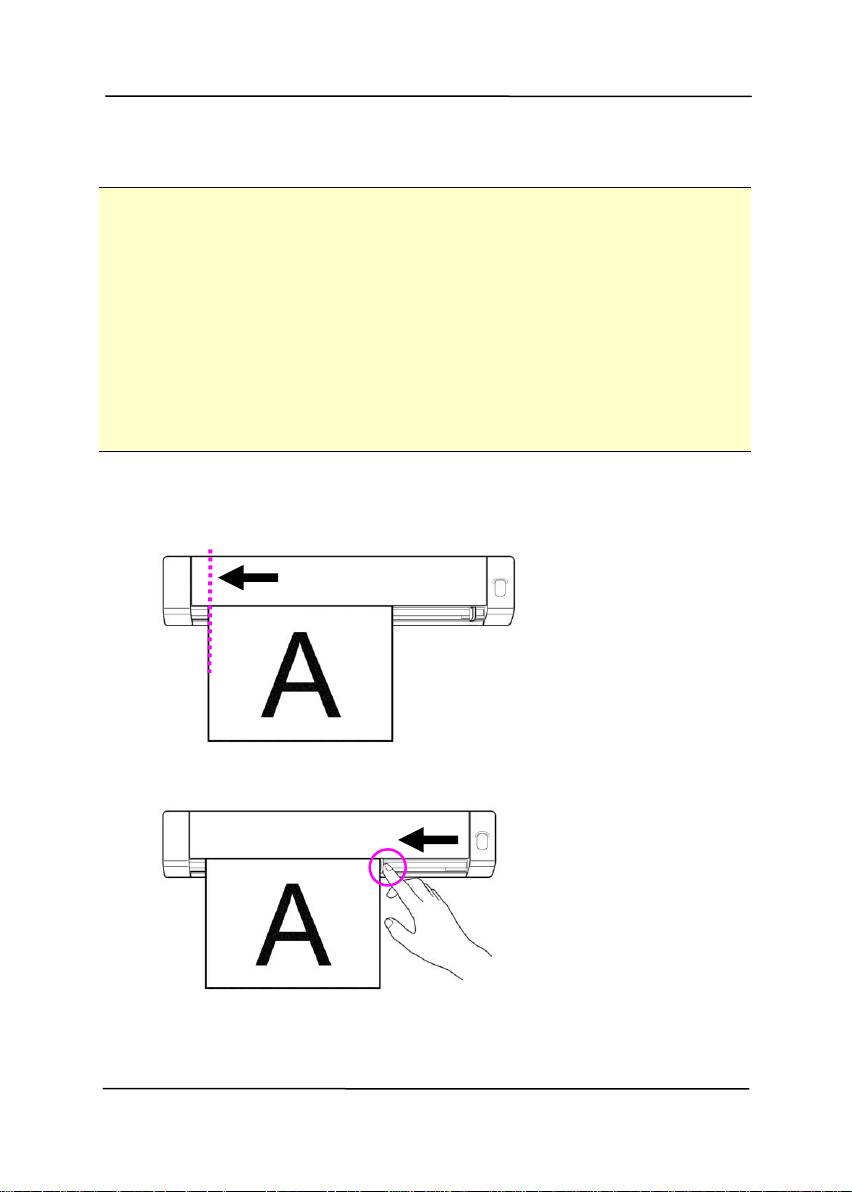
1. Connect the micro USB connector to the USB port of the
scanner.
2. Connect the other USB connector to the USB port on your
computer.
3. The computer should detect a new USB device and prompt
a “New Hardware Found” message.
4. When the Finish dialog is prompted, click the Finish
button.

User’s Manual
3-1
3. Completing Your First
Scan
3.1 Suitable and unsuitable original types
Suitable Original
The scanner is designed to obtain the best scanning results
with the following types of originals:
Photos and documents (3”x5”, 4”x6”, 5”x7”, 8.5”x14”) (76
x 127mm, 102 x 152 mm, 127 x 177 mm, 216 x 356 mm)
Business cards [standard 3.5”x 2” (88 x 50 mm)or larger]
Long page (8.5”x36”) (216 x 914 mm) for 300 dpi only
Unsuitable Original Type
Do not use the following types of originals for scanning, or the
scanner may malfunction or cause the original to jam in the
slot.
Originals thicker than 0.8 mm
Originals with either side shorter than 50 mm
Originals with lots of black or dark colors
Originals with dark colors surrounding the edges
Printed media (newspapers, magazines, etc.)
Soft and thin materials (thin paper, cloth, etc.)
Originals that are curled or wrinkled
Originals with staples or paper clips
User’s Manual
3-2
3.2 Insert Your Document
Important!
Insert only one page at a time, and insert the next one
only when the previous one is done. Otherwise, the
scanner may malfunction.
The paper detector is quite sensitive. Please do not push
your document into the feeding slot or the top of your
image will be cut. Simply let go the photo (card) when it
begins to feed into the slot.
Document(s) should be free of staples, paper clips, paper
sticky notes.
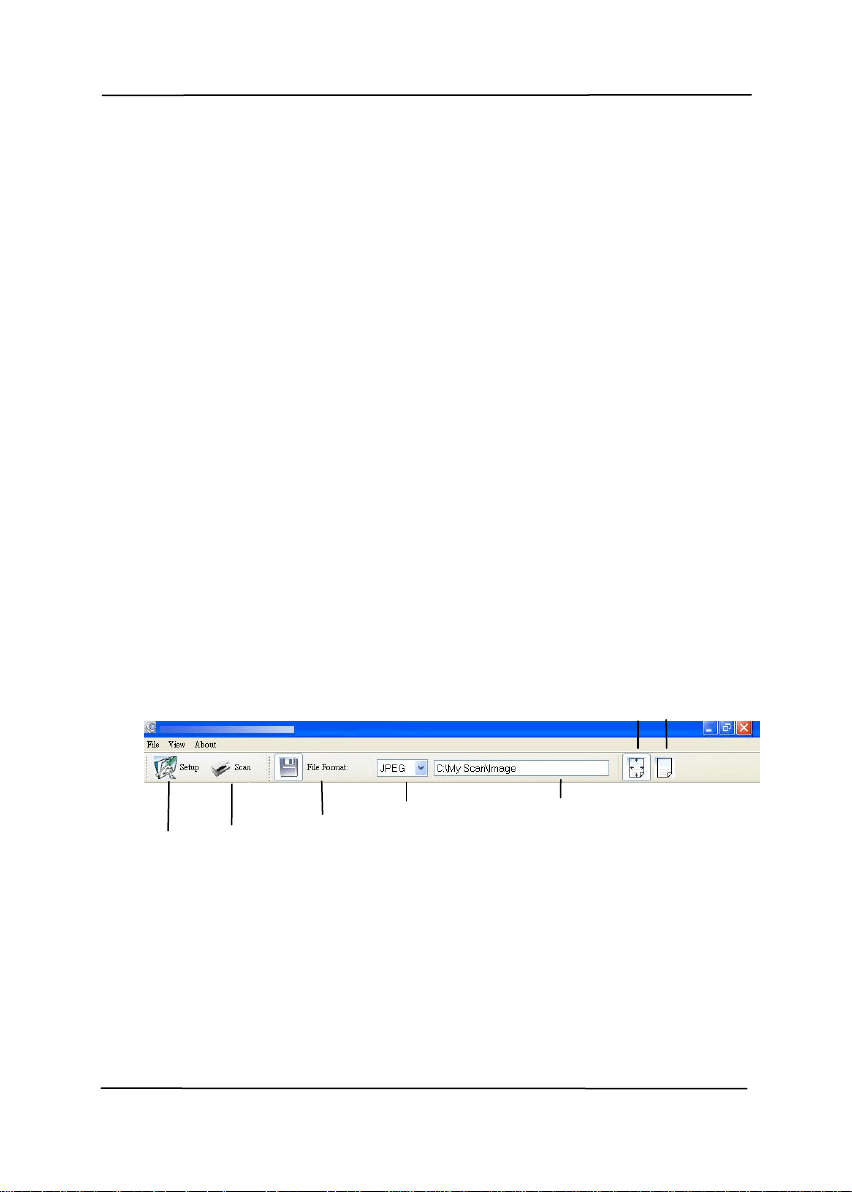
1. Insert your document FACE UP to the feeder and align it
to the left edge of the feeder.
2. Slide the guide lever against the right side of the original.
3. Gently push the original into the feed slot.
User’s Manual
3-3
3.3 Verifying Your Scanner Installation
To verify if your scanner installation is correct, Avision provides
you a useful test program called Avision Capture Tool. With
this tool, you can perform simple scans and view the captured
images. In addition, it helps you complete your scan at a rated
speed.
The following procedure describes how to verify your scanner
installation. If the installation is not correct, please review the
preceding section to check if the cable connection and scanner
driver have been successfully installed.
Before you begin, be sure the scanner is on.
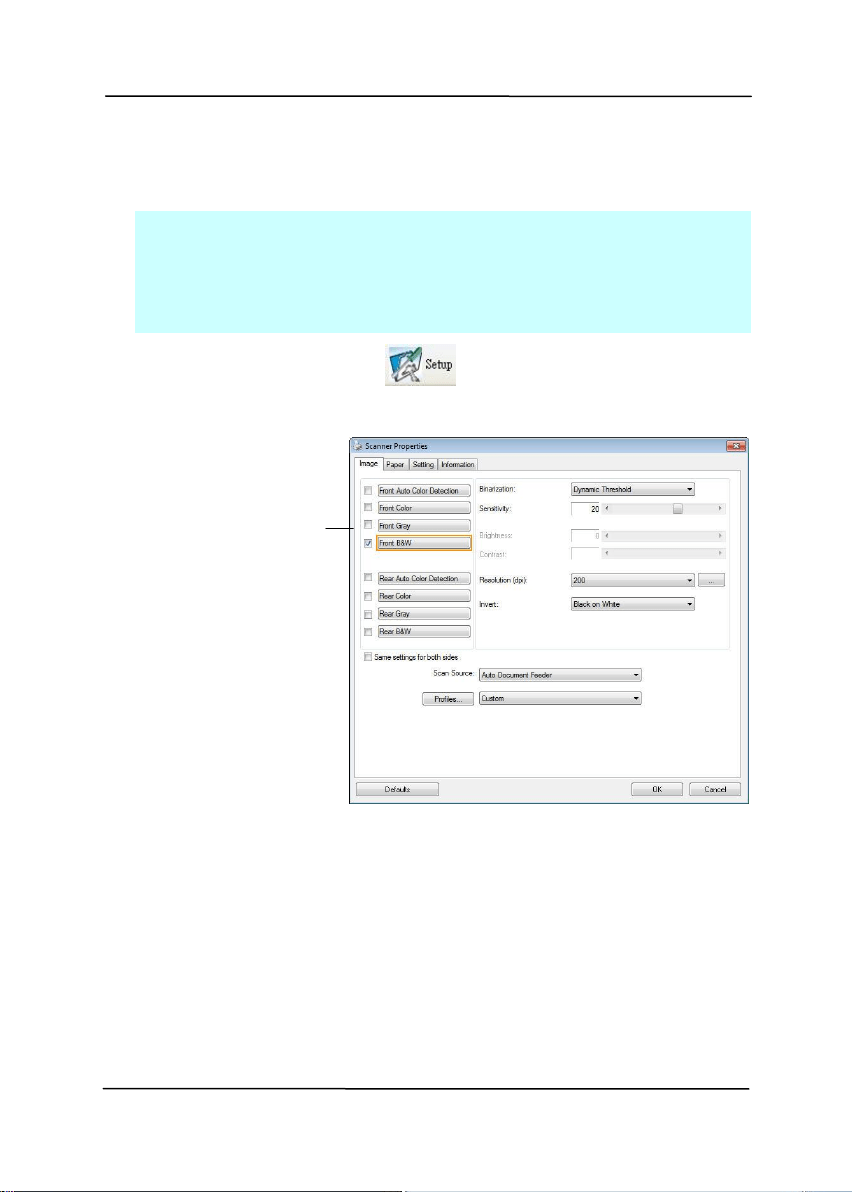
1. Select Start>Programs>Avision XXXX Scanner>Avision
Capture Tool (XXXX: your scanner model). The Select
Scanner Model dialog box will be displayed.
2. Select your driver type and scanner model and click OK.
The following Avision Capture Tool dialog box will be
displayed.
3. Choose your desired file format from the File Format drop
down list box. (Default is BMP, other choice includes TIFF,
MTIFF, PDF, MPDF, GIF, and JPEG.) The supported file
formats vary depending on your scanner model.
Setup
Actual Size
Fit Page
Scan
File Format
Save File Path
User’s Manual
3-4
4. Type your desired folder name and file name in the File
Path box. (Default is C:\My Scan\Image.)
Note: If you do not wish to save the scanned image,
deselect the Save button since default is Save Enable. In
this case, the thumbnail view will be disabled. And
therefore, after viewing all the scanned images, only the
last one will remain on the screen.
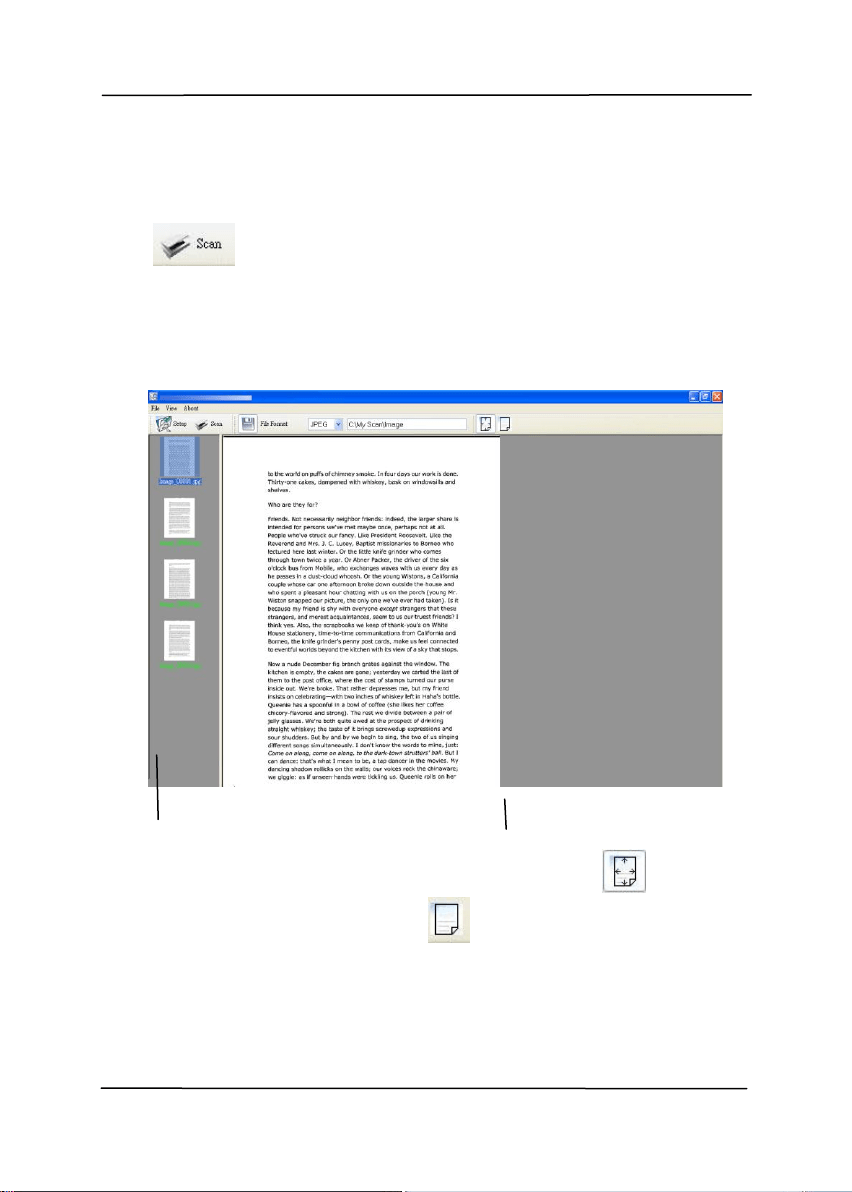
5. Click the Setup button ( ) or choose Setup from the
File menu to prompt the Scanner Properties dialog box.
6. From the Image Selection Box, choose your desired image
type for your scanned image. (Default is Front B&W) If
you have a duplex scanner, choose Front and Rear to scan
both sides of your document.
7. Click OK to quit the Scanner Properties dialog box. (To
learn more details about the Scanner Properties dialog box,
please see the subsequent chapter, Using the Scanner
Properties Dialog Box.)
Image
Selection
Box
User’s Manual
3-5
8. Place your document face down on the document glass or
face up in the auto document feeder.
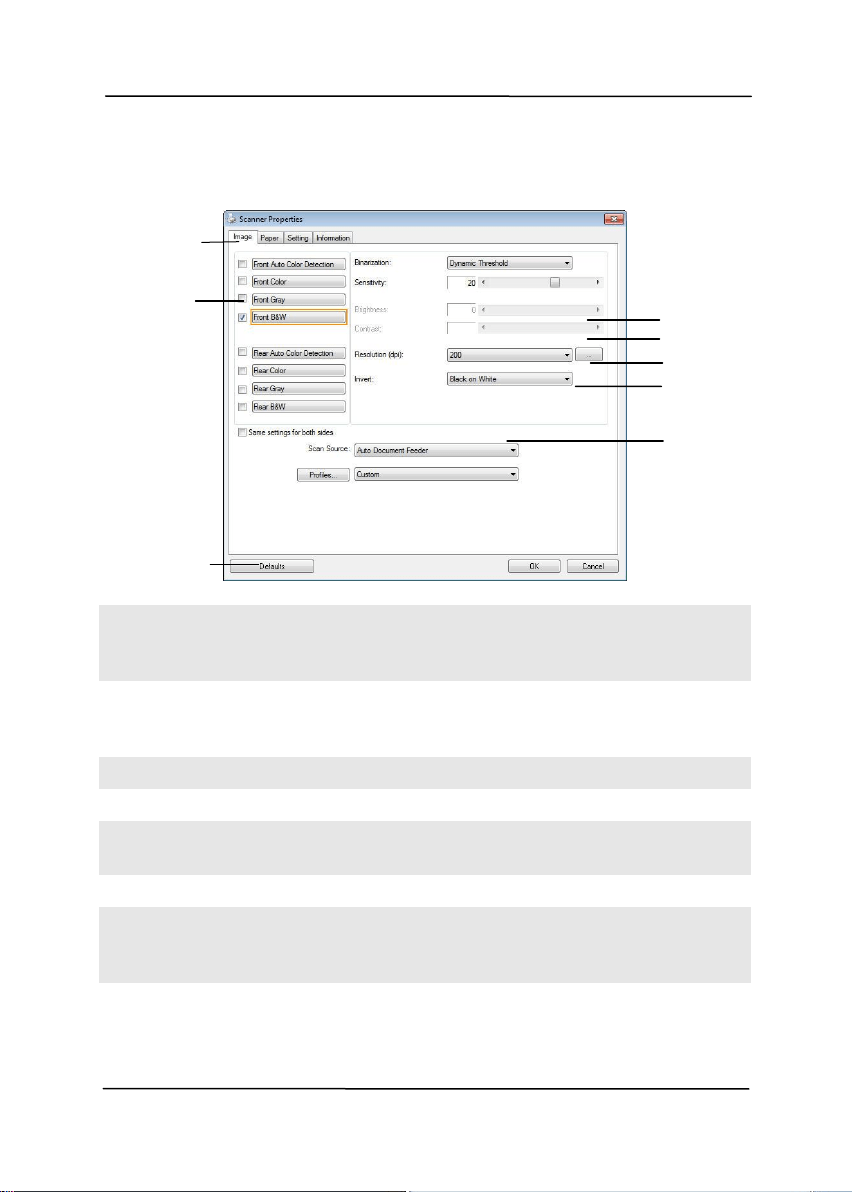
9. In the Scan Validation dialog box, click the Scan button
( ) or choose Scan from the File menu.
10. The document will be scanned and displayed in the Scan
Validation screen. After the scanned images have been
displayed, your scanner installation verification is
completed.
11. You can view the scanned image in Fit Page ( ) or
Actual Size (100%) button ( ) from the Viewing toolbars
at the right side.
12. Click the Close box or Quit from the File menu to exit the
Scan Validation Tool.
Fit Page View
Thumbnail View
User’s Manual
3-6
3.4 A Glance of the Scanner Properties Dialog Box
Windows:
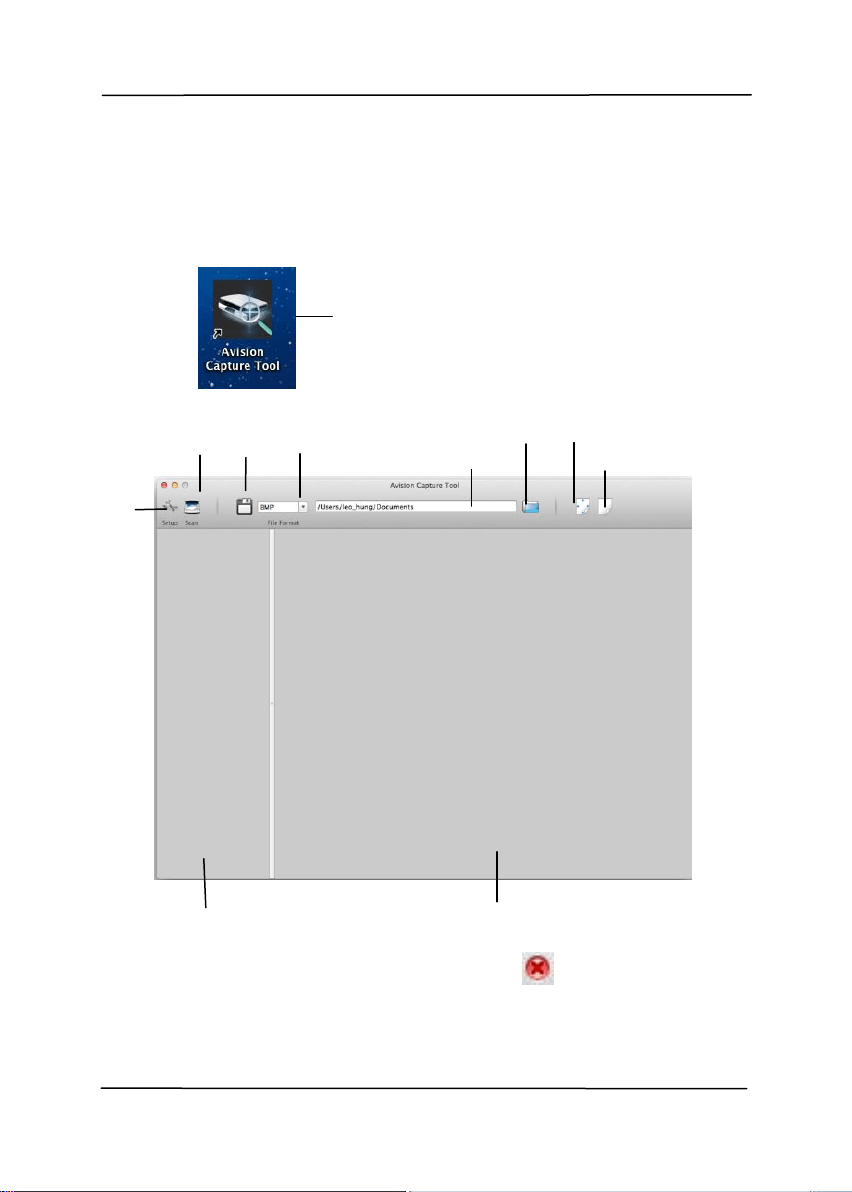
1. Tab Options
Choice: Image, Compression, Color Dropout,
Paper, Multi-Feed Detection, Preview, Options,
Settings, Information.
2. Image
Selection Box
Choose your image type and the side of
document you wish to scan. Options vary
based on type of scanner.
3. Brightness
Adjust the brightness level from –100 to +100.
4. Contrast
Adjust the contrast level from –100 to +100.
5. Resolution
Determine the quality of the scanned image.
The industry standard is 200 dpi.
6. Invert
Reverse the color of your scanned image.
7. Scan Source
Choice: Auto Document Feeder, Flatbed,
Flatbed (Book), Automatic (varies due to
different scanner model)
8. Defaults
Reset all values on the tabs to the factory
default settings.
3
4
5
6
7
1
2
8
User’s Manual
3-7
Mac OS:
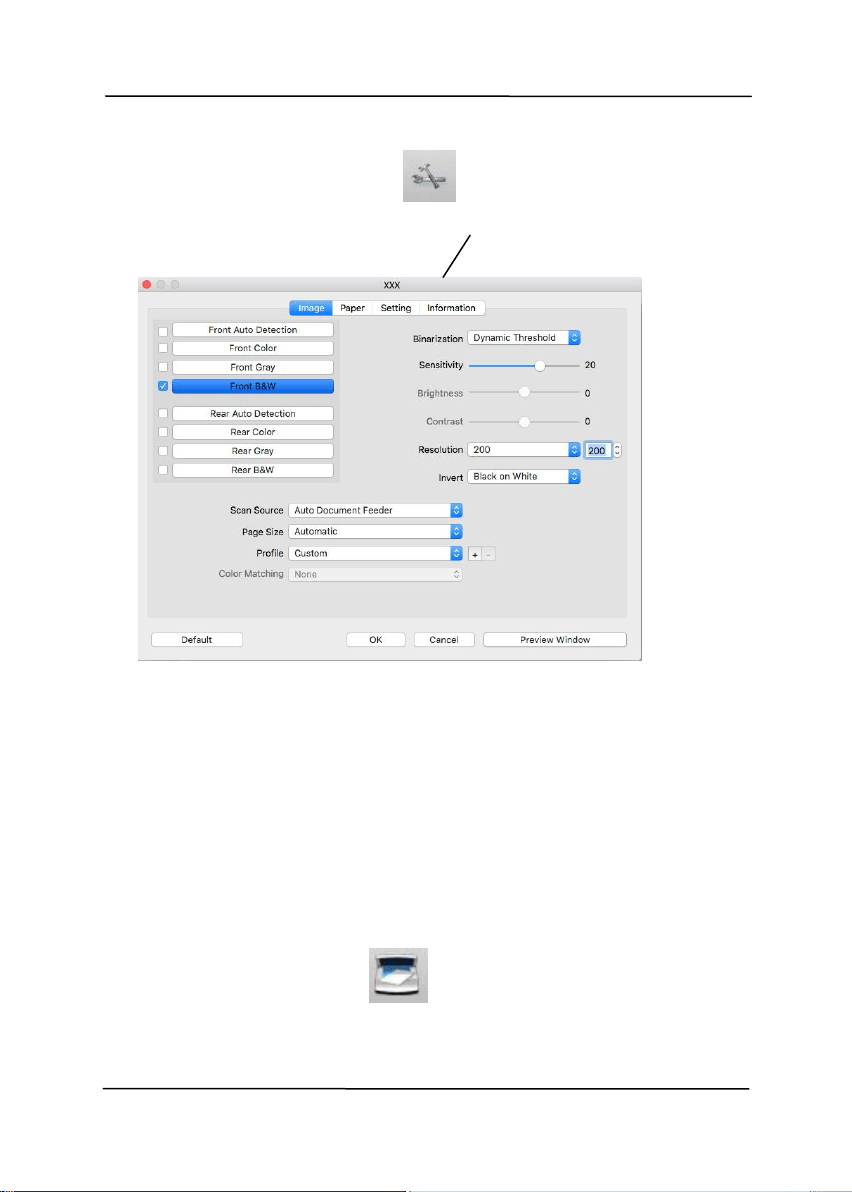
1. Double-click the [Avision Capture Tool] icon on your
desktop. The following [Avision Capture Tool] main
window will be displayed.
To leave the TWAIN user interface, click ( ) on the upper-left
corner.
The [Avision Capture
Tool] icon
Scan Save File Format
Setup
File Path Actual Size
Image-Display
Window
Thumbnail View
Browse Fit Page
User’s Manual
3-8
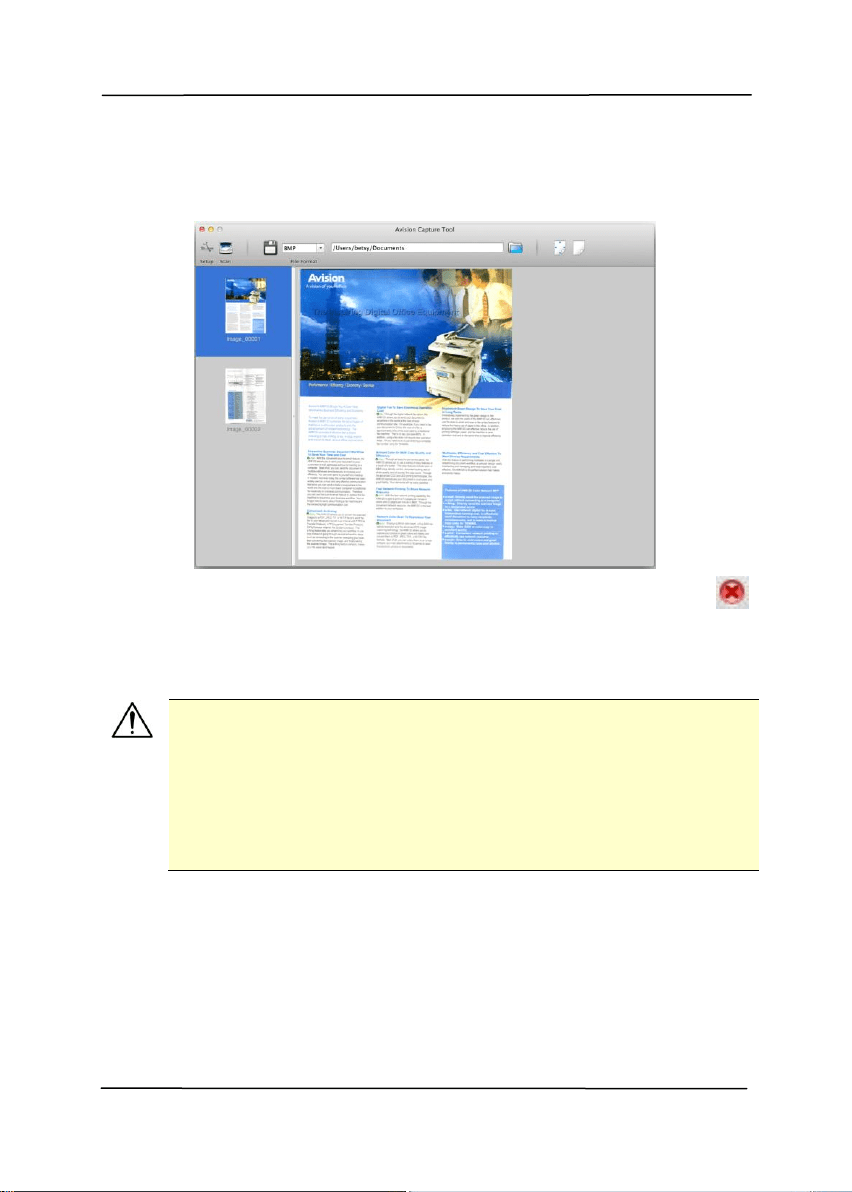
To scan a page,
1. Click the [Setup] button ( ) to access the Avision
Scanner Properties dialog box.
2. From the Image Selection Box, choose your desired image
type for your scanned image. (Default is Front B&W) If
you have a duplex scanner, choose Front and Rear to scan
both sides of your document.
3. Click OK to quit the Avision Scanner Properties dialog box.
(To learn more details about using the Avision Scanner
Properties dialog box, please see the subsequent chapter,
Using the Avision Properties Dialog Box.)
4. Place your document face down on the document glass or
face up in the auto document feeder.
5. Click the Scan button ( ).
This indicates the
scanner model
User’s Manual
3-9
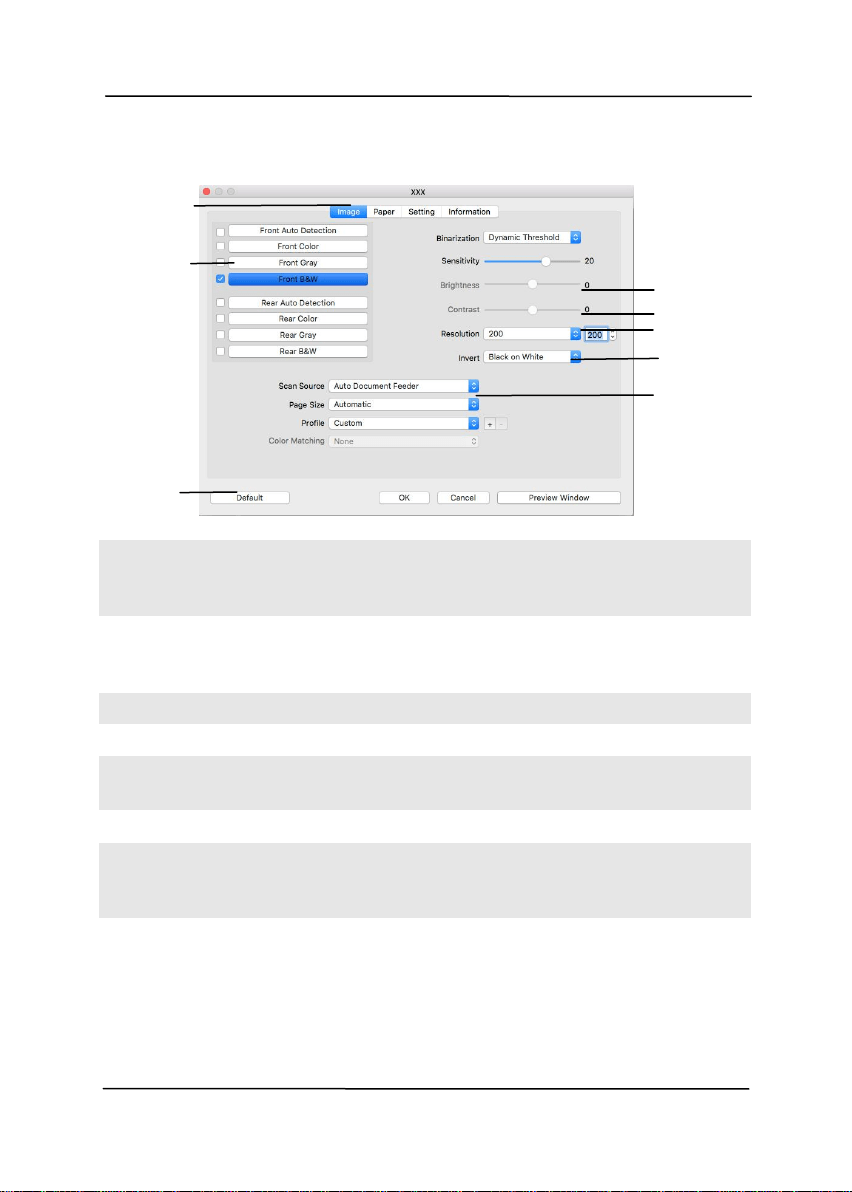
6. The document will be scanned and displayed in the main
window of Avision Capture Tool.
7. To leave the main window of Avision Capture Tool, click ( )
on the upper-left corner.
Important!
Please note the scanner buttons do not work if you
start a scan via the Avision Capture Tool.
To perform your first scan, we recommend you to
use the default scan settings. When you become
more familiar with the software, change the scan
settings to fit your own purpose.
User’s Manual
3-10
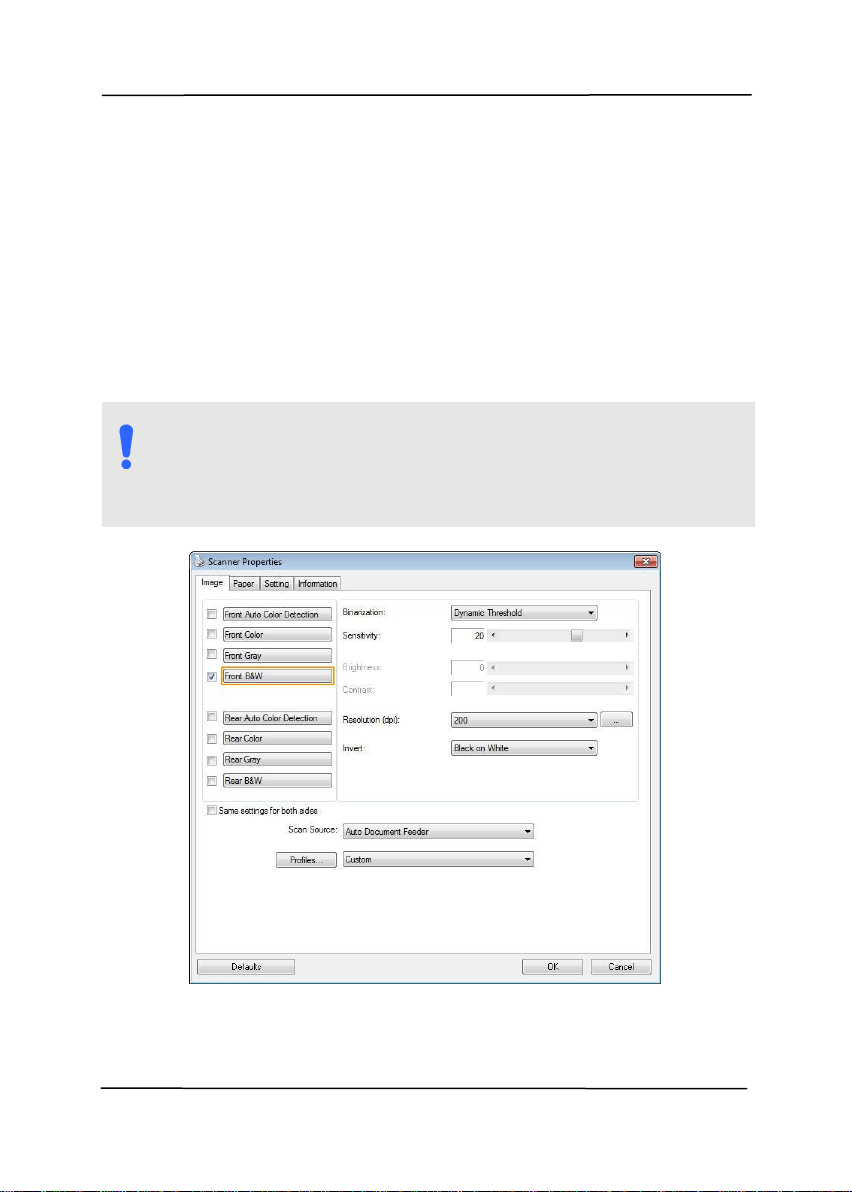
A Glance of the User Interface
1. Tab Options
Choice: Image, Compression, Color Dropout,
Paper, Multi-Feed Detection, Preview, Options,
Settings, Information.
2. Image
Selection Box
Choose your image type and the side of
document you wish to scan. Options vary
based on type of scanner.
3. Brightness
Adjust the brightness level from –100 to +100.
4. Contrast
Adjust the contrast level from –100 to +100.
5. Resolution
Determine the quality of the scanned image.
The industry standard is 200 dpi.
6. Invert
Reverse the color of your scanned image.
7. Scan Source
Choice: Auto Document Feeder, Flatbed,
Flatbed (Book), Automatic (varies due to
different scanner model)
8. Defaults
Reset all values on the tabs to the factory
default settings.
1
2
8
3
4
5
6
7
User’s Manual
4-1
4. Using the Scanner
Properties Dialog Box
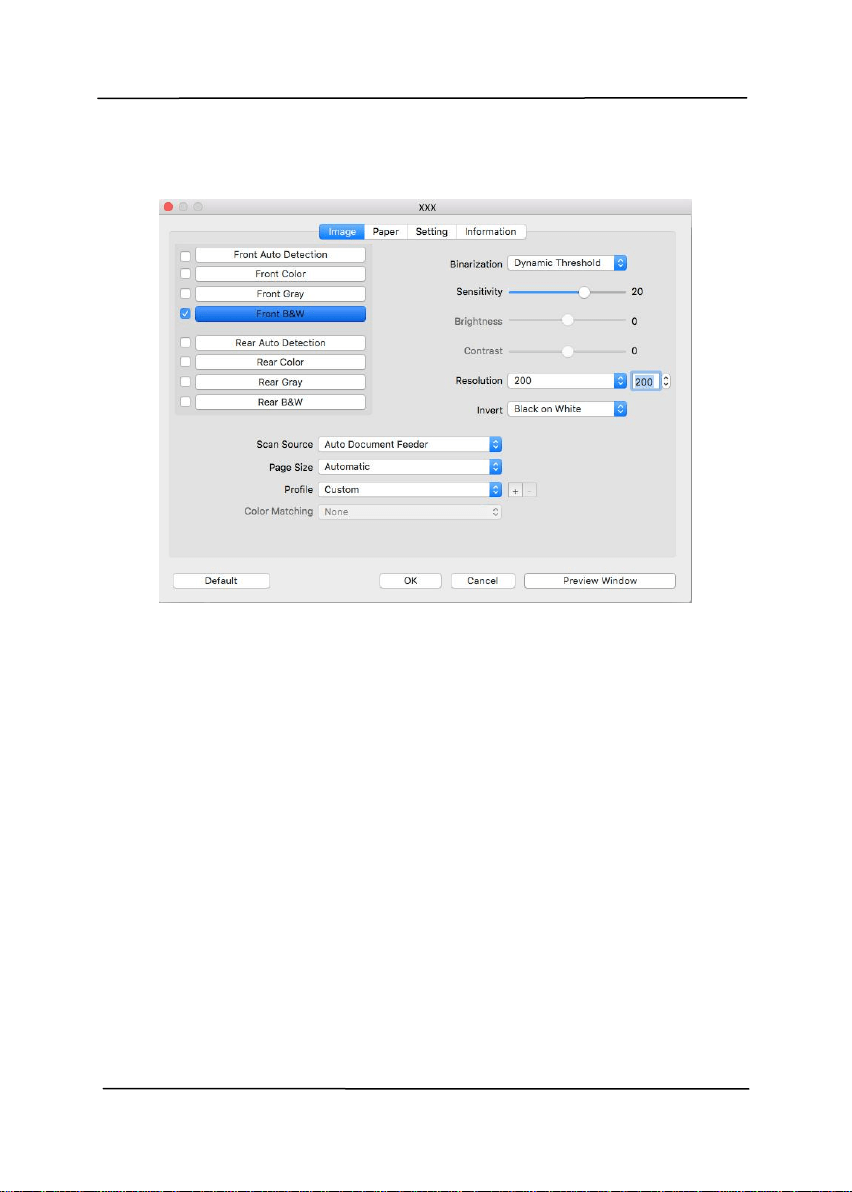
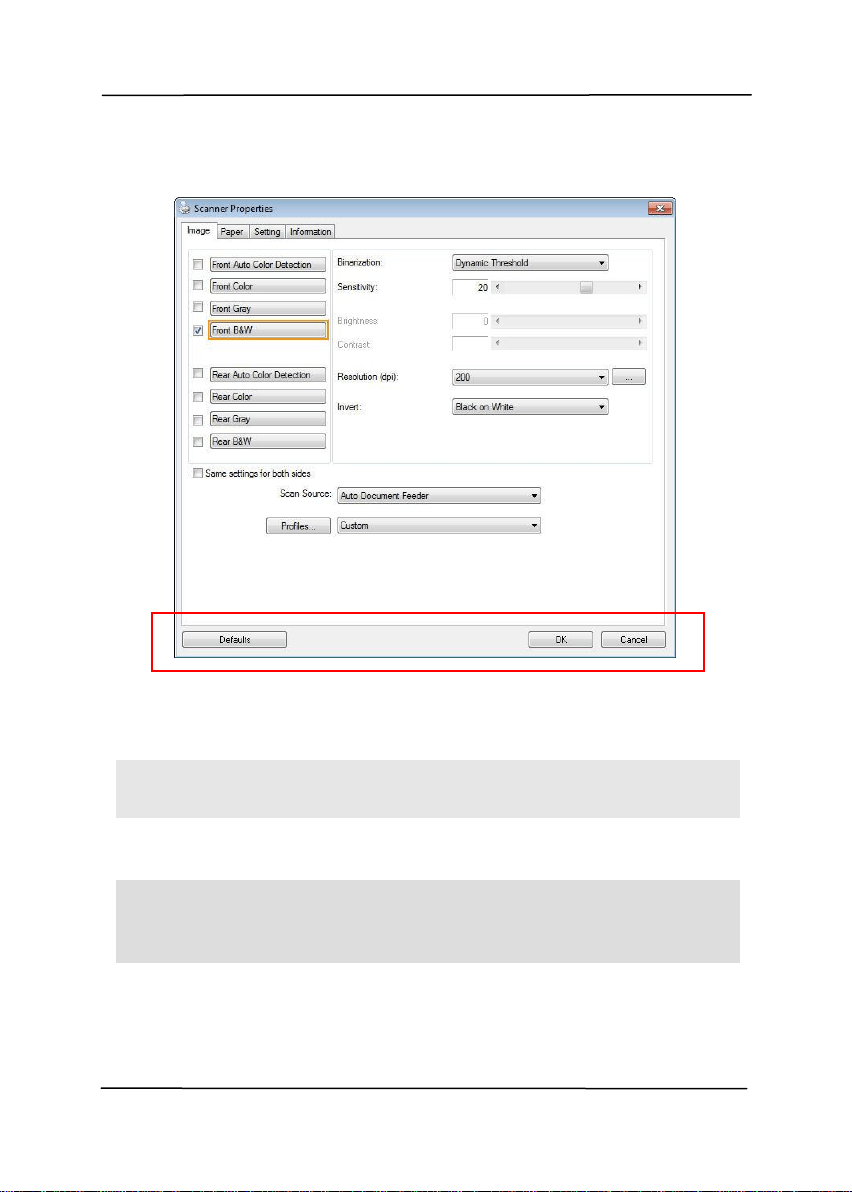
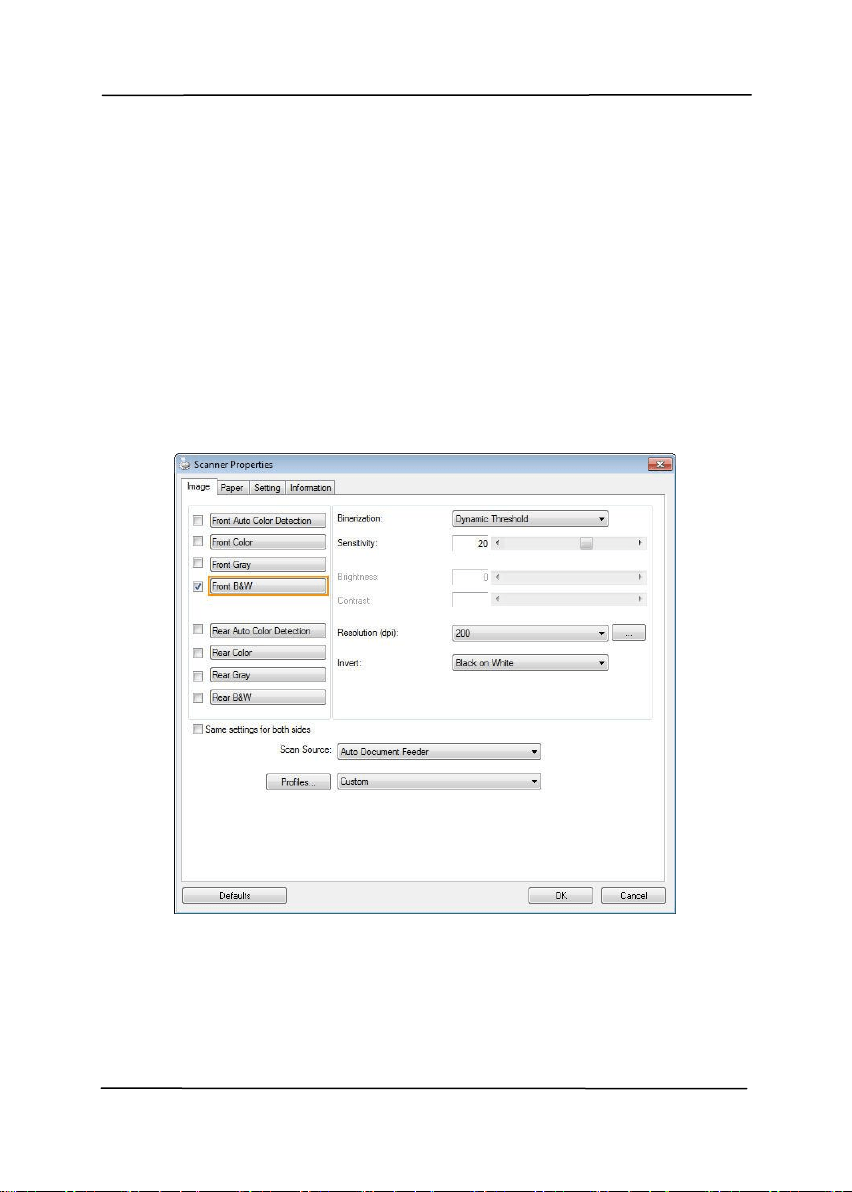
The Scanner Properties dialog box allows you to configure the
scanner’s settings. It consists of several tabbed windows each
of which will be described in this chapter.
NOTE:
In this chapter, all options are available based on a
duplex (double-side) scanner. If you have purchased a
simplex (single-side) scanner, all options are available
for single sided only.
The Scanner Properties dialog box (Windows)
User’s Manual
4-2
The Scanner Properties dialog box (Mac OS)
User’s Manual
4-3
4.1 Buttons on the Scanner Properties Dialog Box
The buttons on the Scanner Properties dialog box
BUTTONS
DESCRIPTION
Defaults
Click the Defaults button, the factory default
settings will be shown on each tab.
Cancel
Click the Cancel button to leave the Scanner
Properties dialog box.
Preview
Window
(Mac)
Click to show a preview image in a low
resolution.

User’s Manual
4-4
The following table shows the default settings:
TAB NAME
DEFAULT SETTINGS
Image
Image:Front B&W
Binarization:Dynamic Threshold
Resolution:200 dpi
Invert:Blank on White
Scan Source:Auto Document Feeder
Threshold:None
Brightness:None
Contrast:None
Compression
None
Color Dropout
None
Paper
Cropping:Automatic
Deskew:Yes
Orientation:Portrait
OverScan:0.00
Note: The availability of this option
varies due to scanner model.
Unit:Inch
Multi-Feed
Detection
None
Preview
None
Options
Rotation Degrees:None
Blank Page Removal:None
Edge Fill:White,0 mm
Image Control Option:None
Setting
Enable Energy Saver:Enable, 15
minutes after last scan action
Show Scanning Progress:Yes
Show Warning Message:Yes
Save Settings after Closing:Yes
Imprinter
Digital Imprinter
User’s Manual
4-5
4.2 Showing or Hiding Tabs
Windows
The [Scanner Properties] dialog box is displayed in default
with three basic tabs - Image, Paper, and Information. To
show more tabs, click the [Scanner Properties] icon to access
more scan settings.
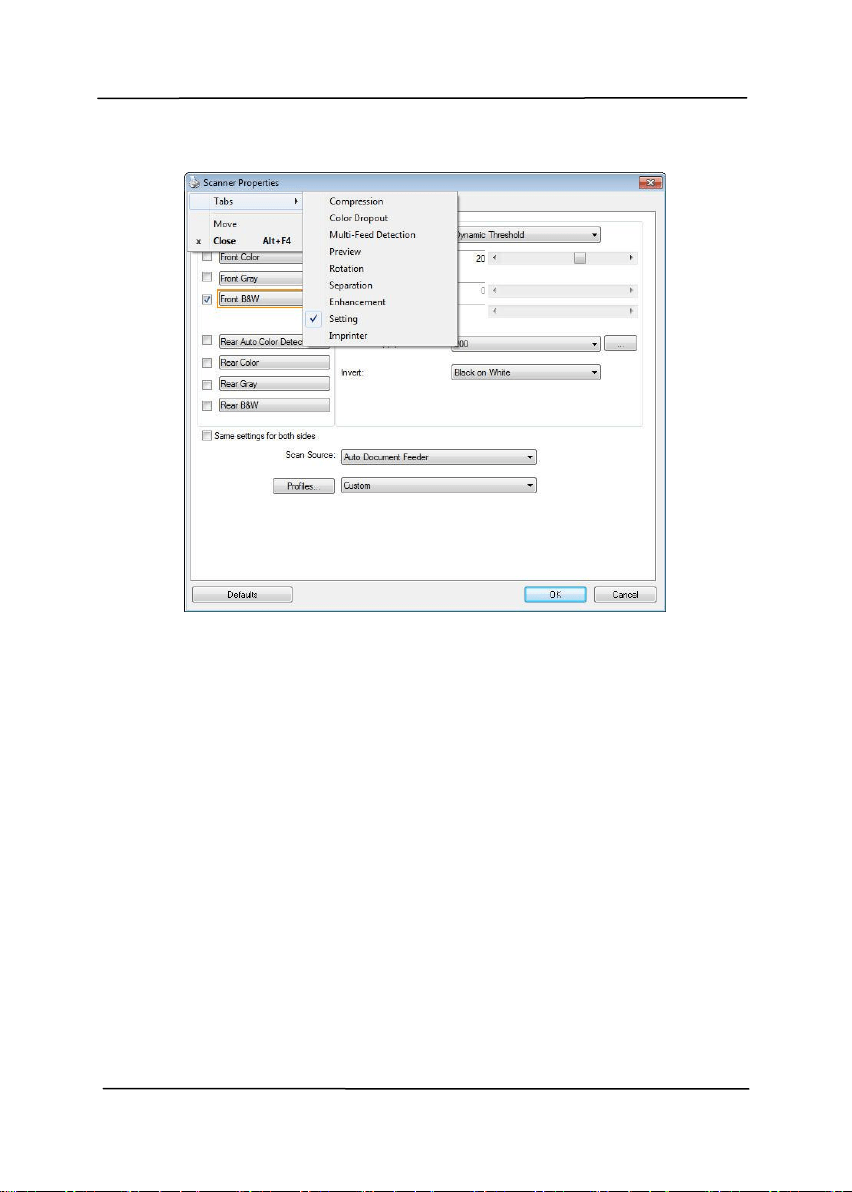
To show more tabs,
1. Click the [Scanner Properties] icon ( ) on the upper
left corner, and choose [Tab] to show available tab names.
The available tabs include Compression, Color Drop out,
Preview, Rotation, Separation, Multi-Feed, Options,
Settings, and Imprinter. (Note: the options vary based on
scanner model.)
2. Choose the tab you want to display. The selected tab will
be shown with a check mark and then displayed in the
[Scanner Properties] dialog box.
3. To access the settings, click the selected tab on the top of
the [Scanner Properties] dialog box. The page of the
selected tab will be displayed.
To hide a tab window,
1. Click the [Scanner Properties] icon ( ) on the upper
left corner, and choose [Tabs] to show available tab
names.
2. Choose the tab you want to hide. Then, the selected tab
will be hided in the [Scanner Properties] dialog box.
Note: The [Image], [Paper], and [Information] tab can
not be hided since they preprogrammed to be displayed by
default.
User’s Manual
4-6
(Windows)

User’s Manual
4-7
Mac OS
The [Scanner Properties] dialog box is displayed in default
with four basic tabs - Image, Paper, Setting, and Information.
To show more tabs, click the [Setting] tab to access more scan
settings.
To show more tabs,
1. Click the [Setting] tab, the available tab names will be
displayed. These tabs include Color Drop out, Rotation,
Separation, Enhancement, and Imprinter. (Note: the
options vary based on scanner model.)
2. Choose the tab you want to display. The selected tab will
be shown with a check mark and then displayed in the
[Scanner Properties] dialog box.
3. To access the settings, click the selected tab on the top of
the [Scanner Properties] dialog box. The page of the
selected tab will be displayed.
To hide a tab window,
1. Click the [Setting] tab to show available tab names.
2. Choose the tab you want to hide by deselecting the tabs
which have been shown with a check mark. Then, the
selected tab will be hided in the [Scanner Properties]
dialog box.
Note: The [Image], [Paper], [Setting], and
[Information] tab can not be hided since they
preprogrammed to be displayed by default.

User’s Manual
4-8
(Mac OS)
User’s Manual
4-9
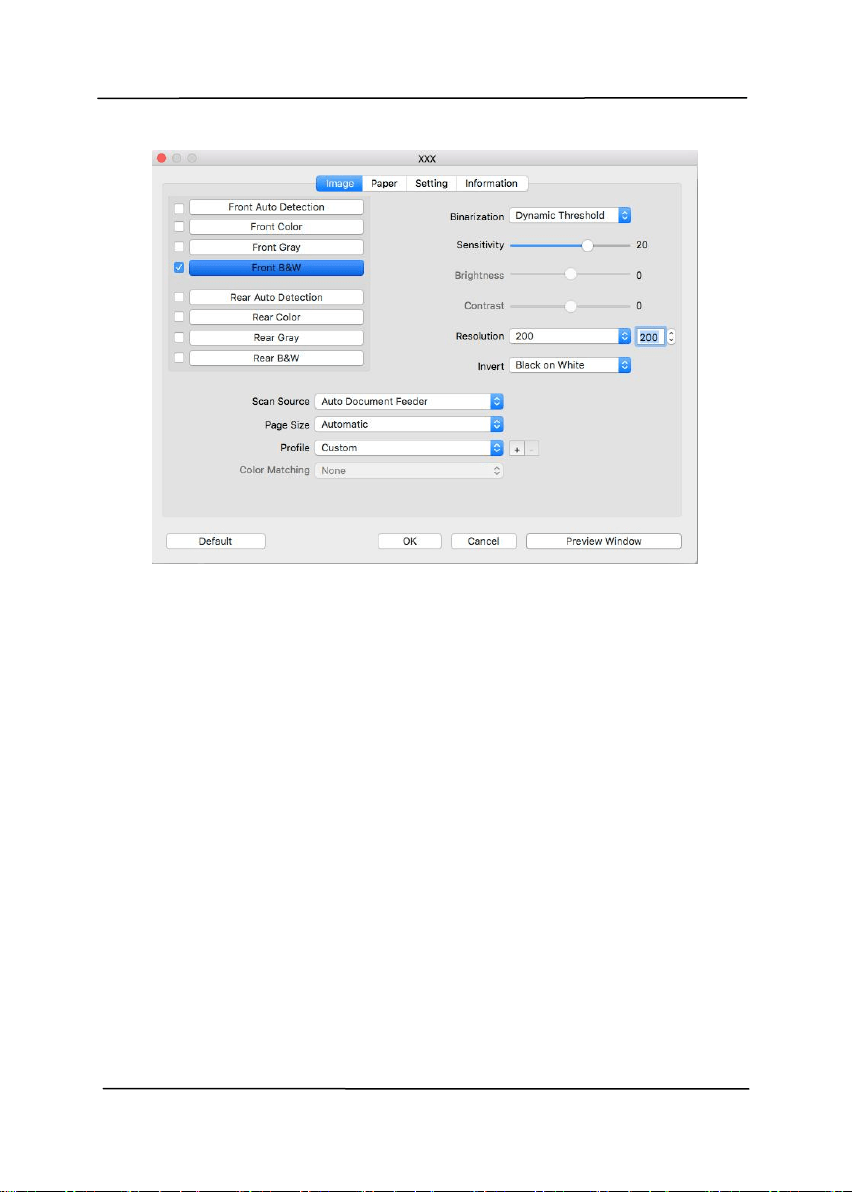
4.3 The Image Tab
The Image tab allows you to choose the front side and (or) the
rear side of your document, the type of image, and to set
several basic scan settings. Note that except for the resolution,
you can set individual scan settings for the front side and the
rear side. For example, all settings in the Image tab,
Compression tab, Color Dropout tab can be set individually for
the front and the rear side. However, the settings in the Paper
tab, the Option tab, and the Setting tab have to be set the
same for the front and rear side.
The Image tab dialog box (Windows)
User’s Manual
4-10
The Image tab dialog box (Mac)

User’s Manual
4-11
4.3.1 The Image Selection Box
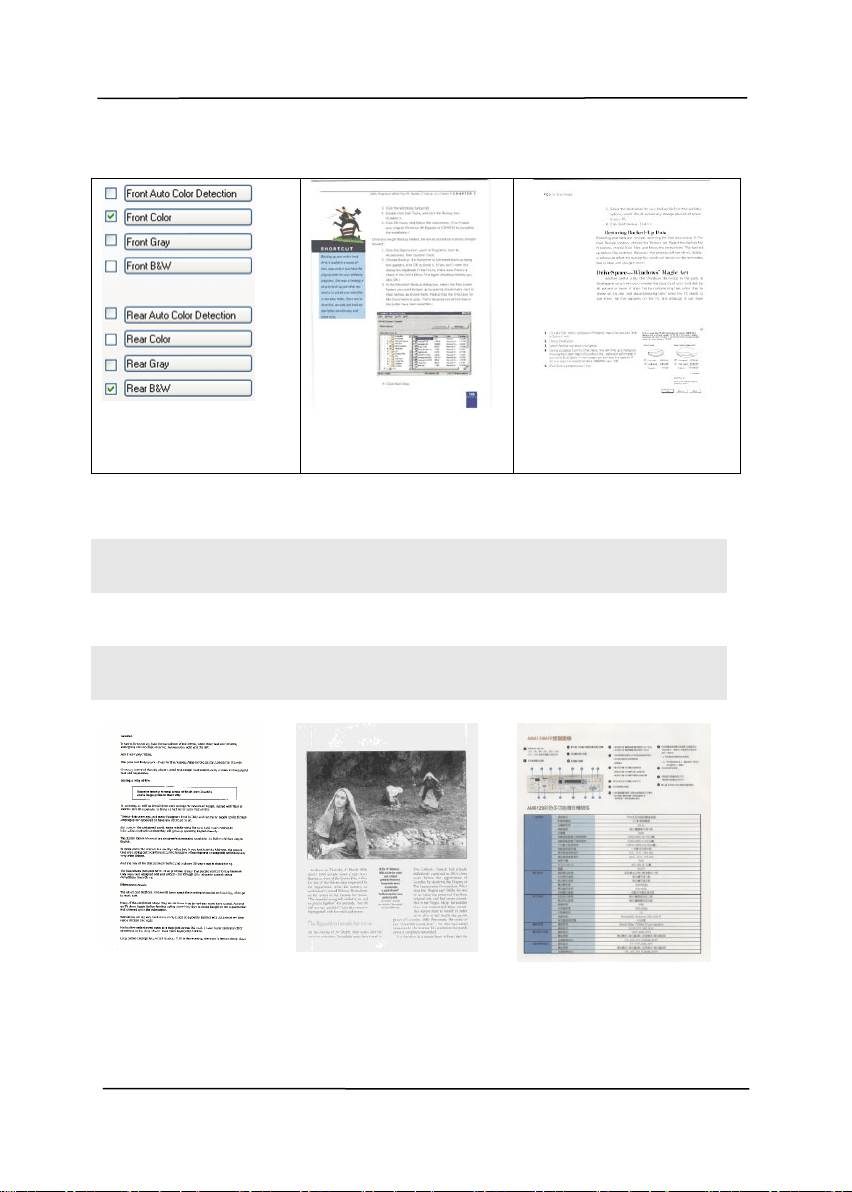
The Image Selection box includes the
image type and document side option. If
you wish to scan both the front side and
the rear side of your color document, you
can check both Front Color and Rear Color
at the same time. Note the options vary
based on type of scanner.
Example 1:Scanning a two-sided color document, both
sides in color
Side/Image
Selection
Front
Rear
User’s Manual
4-12
Example 2:Scanning a two-sided color document, one
in B&W, the other in color
Side/Image
Selection
Front
Rear
IMAGE TYPE
DESCRIPTION
Color
Choose Color if you wish to scan a color
image for your original in color.
Gray
Choose Gray image if your original contains
actual shades of gray.
B&W
Choose B&W if your original contains only
text, pencil or ink sketch.
B&W
Gray
Color
User’s Manual
4-13
Front/Rear Auto Color Detection:
Click to automatically detect and scan the front or the rear
page of your color document in color image mode. If your
document is in colors, the scanner will automatically scan the
document into a color image. If your document is non-color,
you can choose the output to be either B&W or Gray from the
Non-Color Selection option. This option is useful when you
have a mixture of color and non-color document.
Note: If you choose Front Rear Auto Color Detection, you can
not specify the image mode of your rear page and vice versas.
Modes of Auto Color Detection:
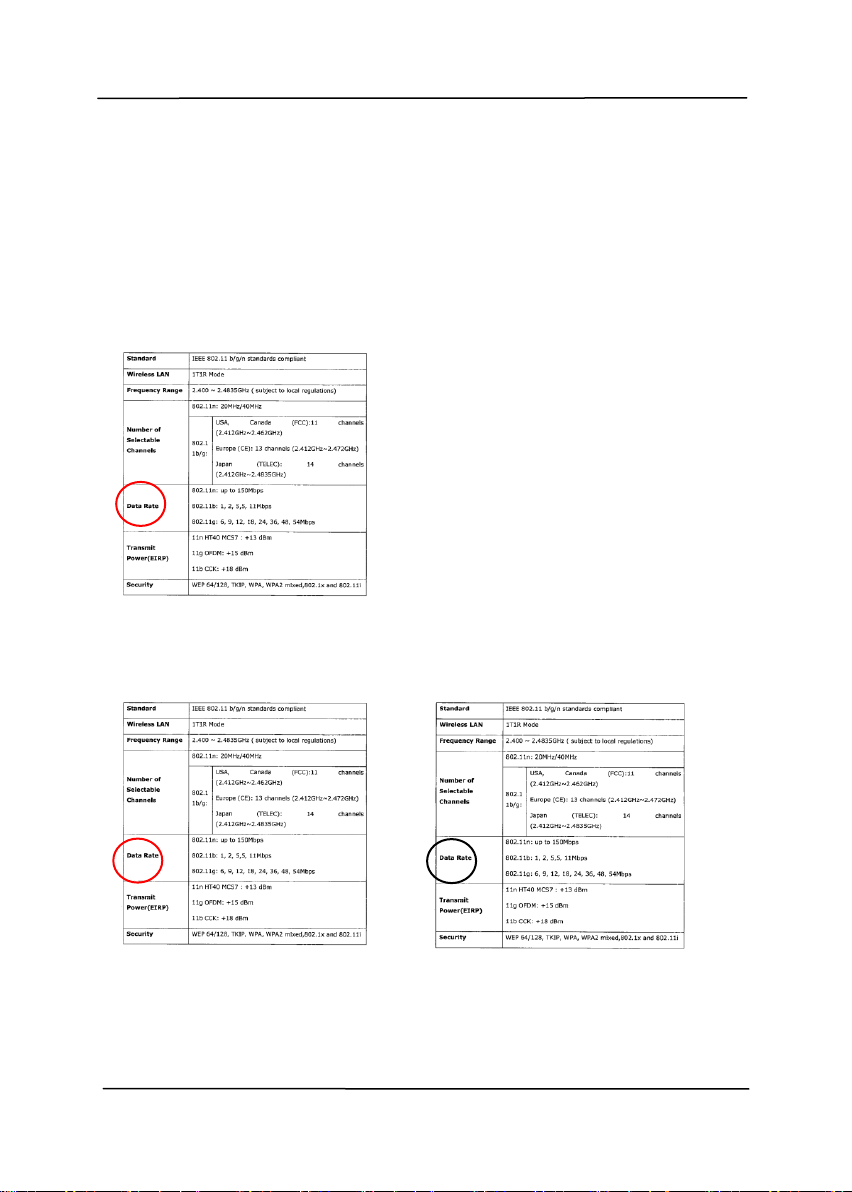
If [Front/Rear Auto Color Detection] is selected, its modes
will be displayed. Choice includes Normal, Ignore Paper
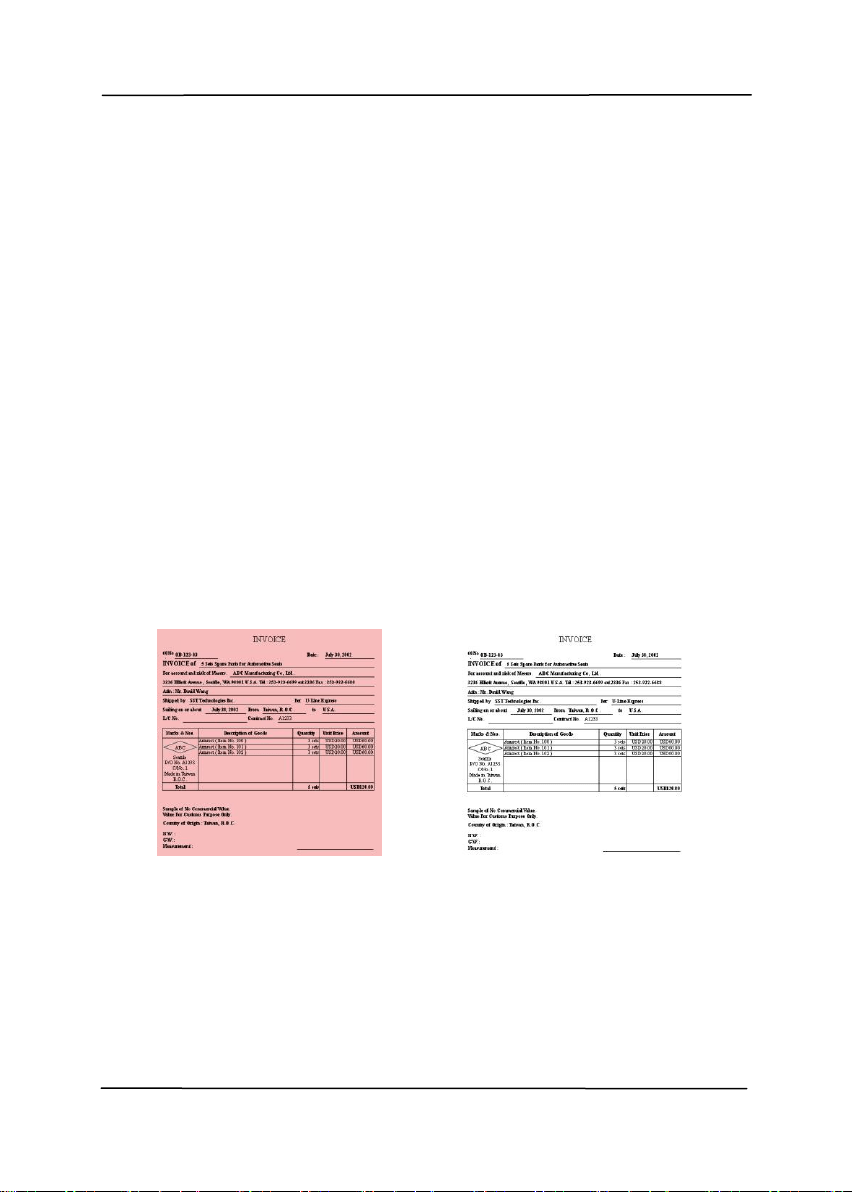
Color. For paper with background color such as invoices,
choosing [Ignore Paper Color] will automatically remove the
background color and enhance the detection accuracy.
Normal
Ignore single
background color
User’s Manual
4-14
Sensitivity of Auto Color Detection
If your documents contain primarily B&W text and small
amount of light or pale colors and you do not wish them to be
recognized as color image to save the file size, you can
increase the sensitivity value by moving the bar to the right to
let these images to be detected as B&W. The value ranges from
1 to 100. The default is 37.
Original
Sensitivity: 1
(The image is recognized
as a color one)
Sensitivity: 100
(The image is recognized
as a black and white one)

User’s Manual
4-15
Same settings on both sides:
Click to apply same scan settings for both sides of your
documents. After checking this option, any settings you have
changed will automatically applied to both the front side and
the rear side. For example, if you choose your ideal resolution
to be 300 dpi, this will be applied both to the front side and
rear side of your document.

User’s Manual
4-16
4.3.2 Other Image Options
Binarization
This is the process of converting a
grayscale or color image to a bi-tonal
image. There are several different
methods of performing this conversion.
Options: Dynamic Threshold,
Dynamic Threshold (AD), Fixed
Processing, Halftone 1~5, Error
Diffusion.
Dynamic Threshold: Selecting
Dynamic Threshold allows the scanner
to dynamically evaluate each document
to determine the optimal threshold value
to produce the highest quality image.
This is used to scan mixed document
containing faint text, shaded background,
or color background with a single setting.
If Dynamic Threshold is selected,
Threshold, Brightness, and Contrast are
not available.
Dynamic Threshold (AD): Selecting
Dynamic Threshold (AD) to perform
the enhanced mode of the Dynamic
Threshold feature. However, using this
mode may slow down your scanning
speed.
Sensitivity of Dynamic Threshold
Occasionally your scanned image may
contain small dots or speckles. To remove
these spots, increase the sensitivity value
by moving the bar to the right. The value
ranges from 1 to 30. The default is 20.
User’s Manual
4-17
Fixed Processing: Used for black-and-
white and other high contrast documents. A
single level is set to determine the black-
and-white transition. The threshold is
programmable over the entire density
range. Fixed Processing sets Contrast to
0. If Fixed Processing is selected,
Contrast is not available.
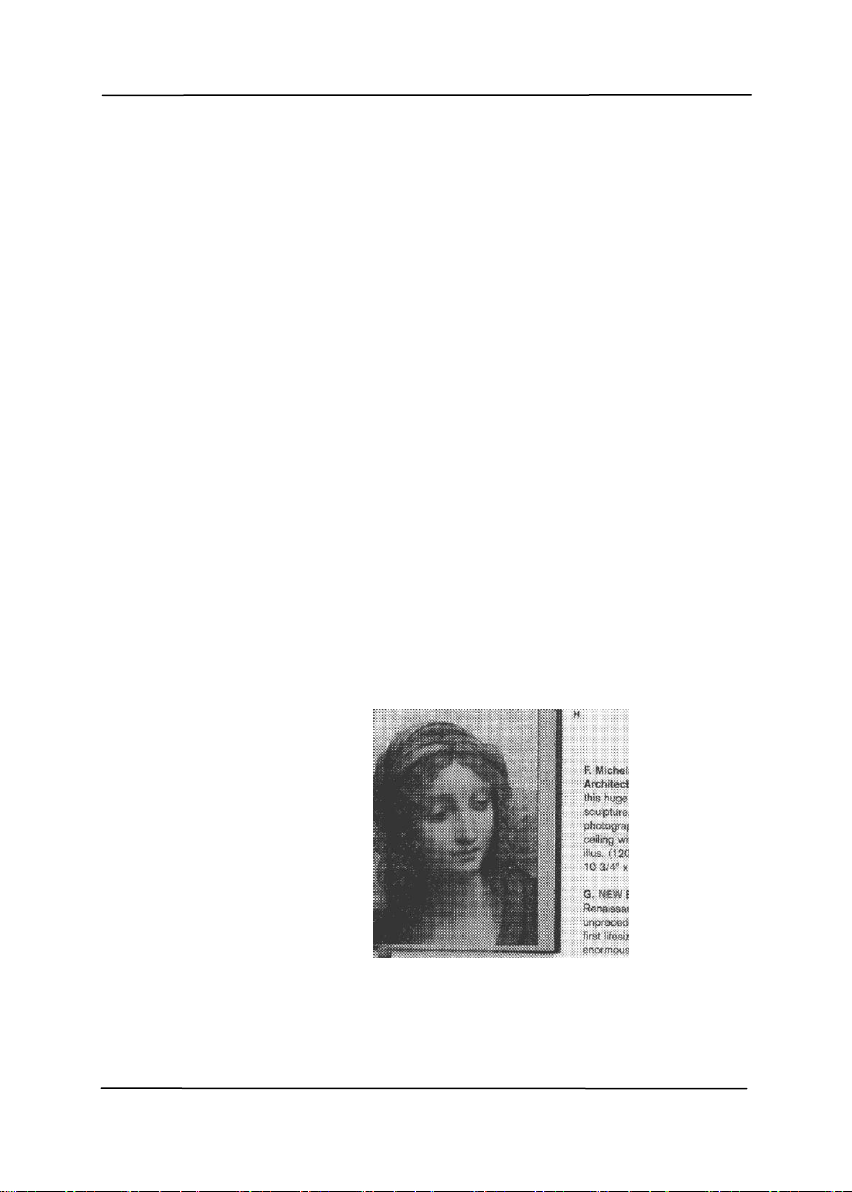
Halftone: In addition to the black and
white display, Halftone can present a
somehow gray shade of image by using
different size of dots. Halftone image looks
like the picture we have seen in the
newspaper. Options include Halftone 1,
Halftone 2, Halftone 3, Halftone 4,
Halftone 5.
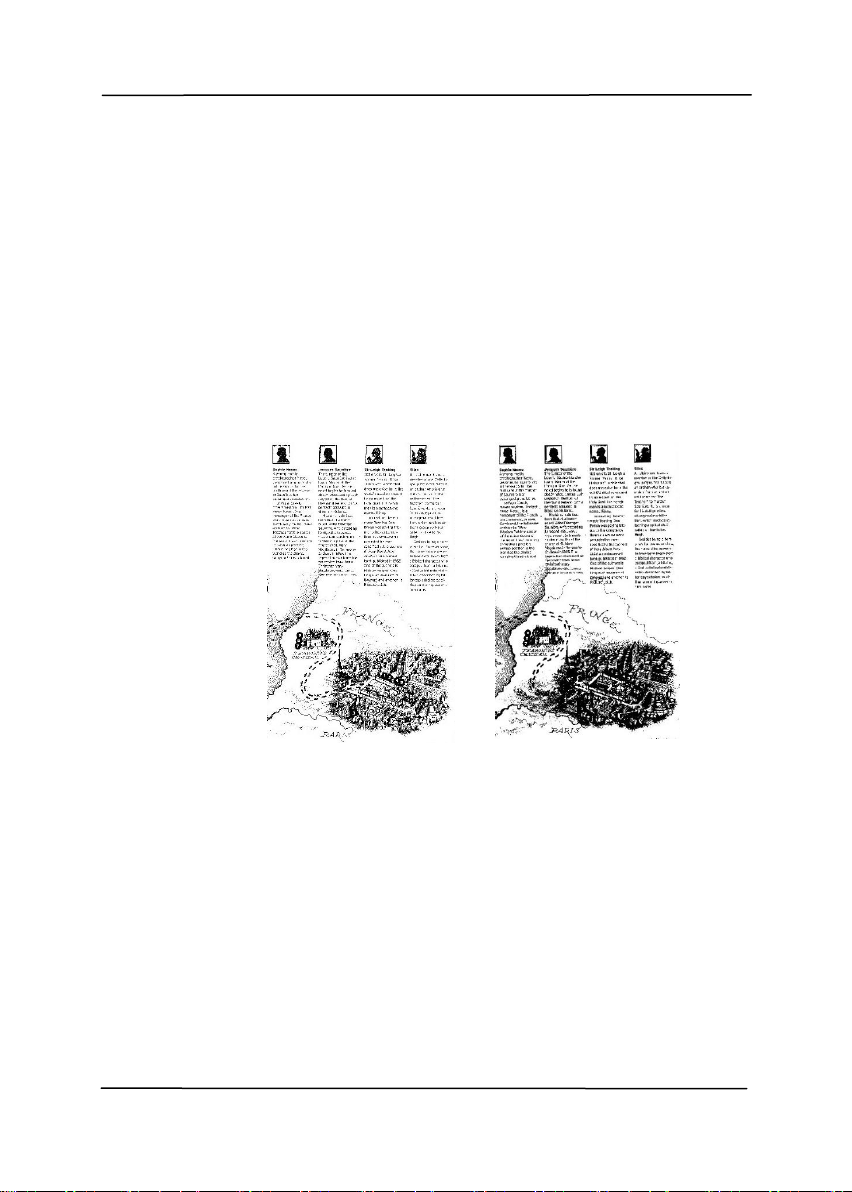
Error Diffusion: Error Diffusion is a type of
Halftone. Error Diffusion gives good image
texture and makes text in images more
readable than Halftone.
Halftone Image

User’s Manual
4-18
Error Diffusion Image
Dynamic Threshold
Dynamic Threshold (AD)
User’s Manual
4-19
Threshold
Used to convert a grayscale image to a
bi-tonal image. The value ranges from 0 to
255. A low threshold value produces a lighter
image, and can be used to subdue
backgrounds and subtle, unneeded
information. A high threshold value produces
a darker image, and can be used to help pick
up faint images.
Adjust the threshold setting by dragging the
Threshold sliding bar to the left or right to
achieve the desired threshold setting.
200 dpi,
Threshold:50,
Brightness: 0
200 dpi,
Threshold:100,
Brightness: 0

User’s Manual
4-20
Gray
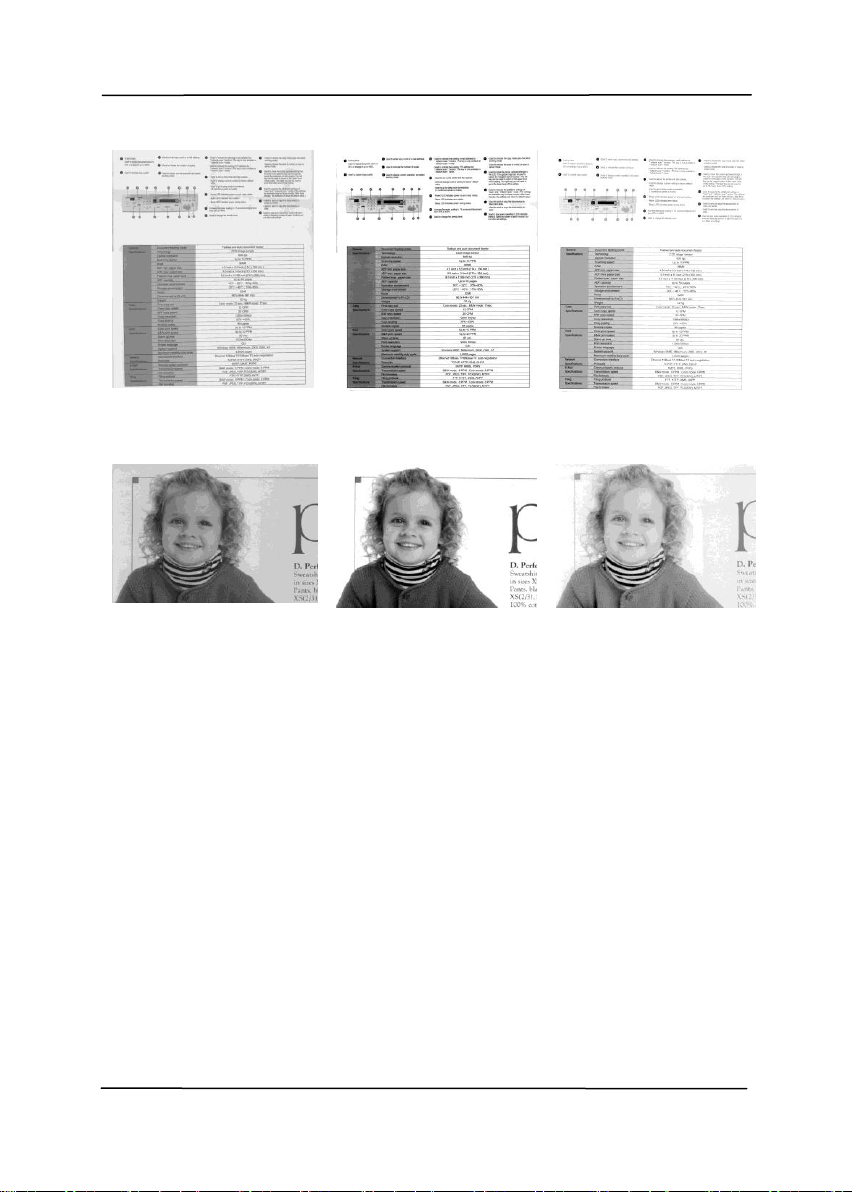
Document Type: Choice: Normal, Photo, Document
Three options of document type are provided when you choose
Gray as the image type for your scanned document. Choice:
Normal, Photo, Document.
Document: Choose Document if your original contains
pure text or a mixture of text and graphic since it is an
optimal setting for regular business document. When
using Document, only Threshold can be adjusted.
Photo: Choose Photo if your original contains photo to
reproduce your photo in vivid grayscale image. When
using Photo, no Threshold and Contrast can be adjusted.
Normal: When using Normal, Threshold, Brightness, and
Contrast can be adjusted.
Threshold: The value ranges from 0 to 255. The default is
230. A low threshold value produces a lighter image, and can
be used to subdue backgrounds and subtle, unneeded
information. A high threshold value produces a darker image,
and can be used to help pick up faint images. Adjust the
threshold setting by dragging the Threshold sliding bar to the
left or right to achieve the desired threshold setting.
User’s Manual
4-21
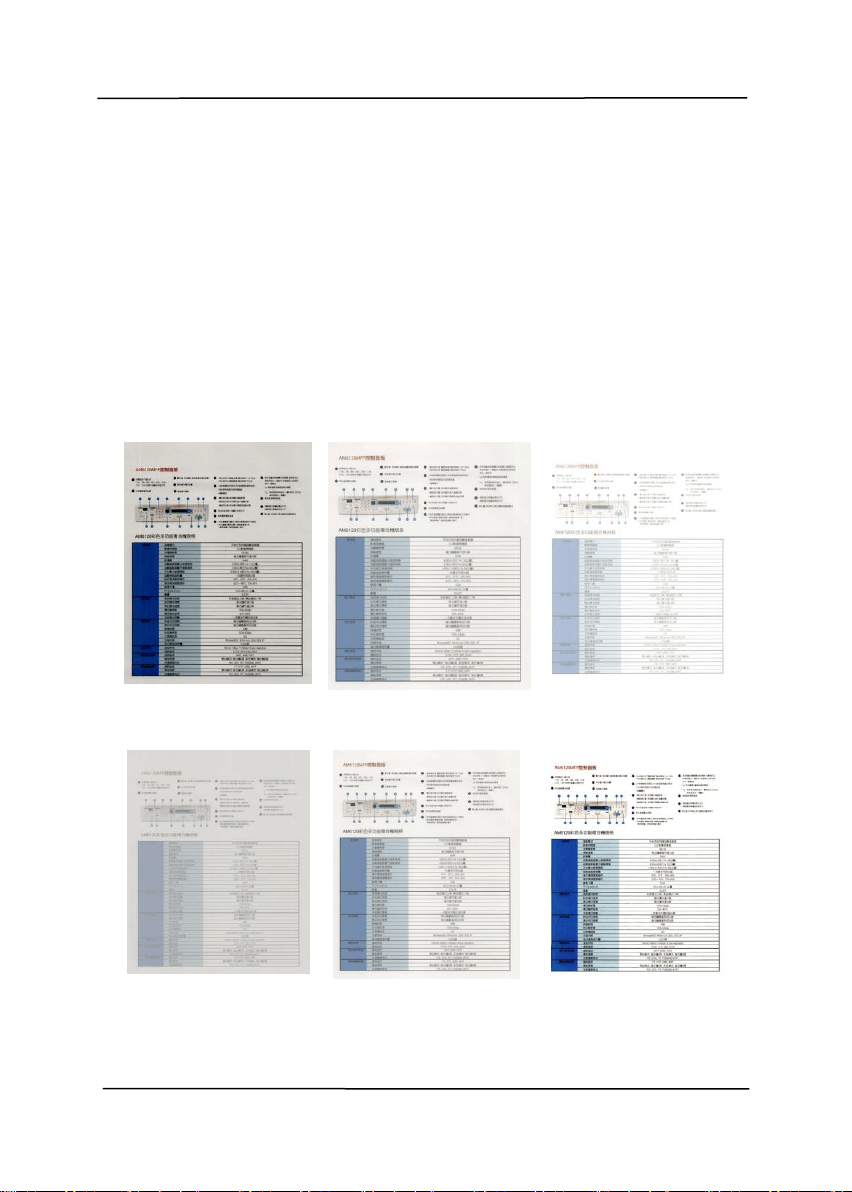
Normal
Photo
Document
(Threshold: 230)
Normal
Photo
Document
(Threshold: 230)
User’s Manual
4-22
Brightness
Adjusts the lightness or darkness of an
image. The higher the value, the brighter
the image. Drag the slider to the right or
left to increase or decrease the brightness.
The range is from –100 to +100.
Contrast
Adjusts the range between the darkest
and the lightest shades in the image. The
higher the contrast, the bigger the
different grayscale. Drag the slider to the
right or left to increase or decrease the
contrast. The range is from –100 to
+100.
Brightness: -50
Brightness: 0
(Normal)
Brightness: +50
Contrast: -50
Contrast: 0
(Normal)
Contrast: +50
User’s Manual
4-23
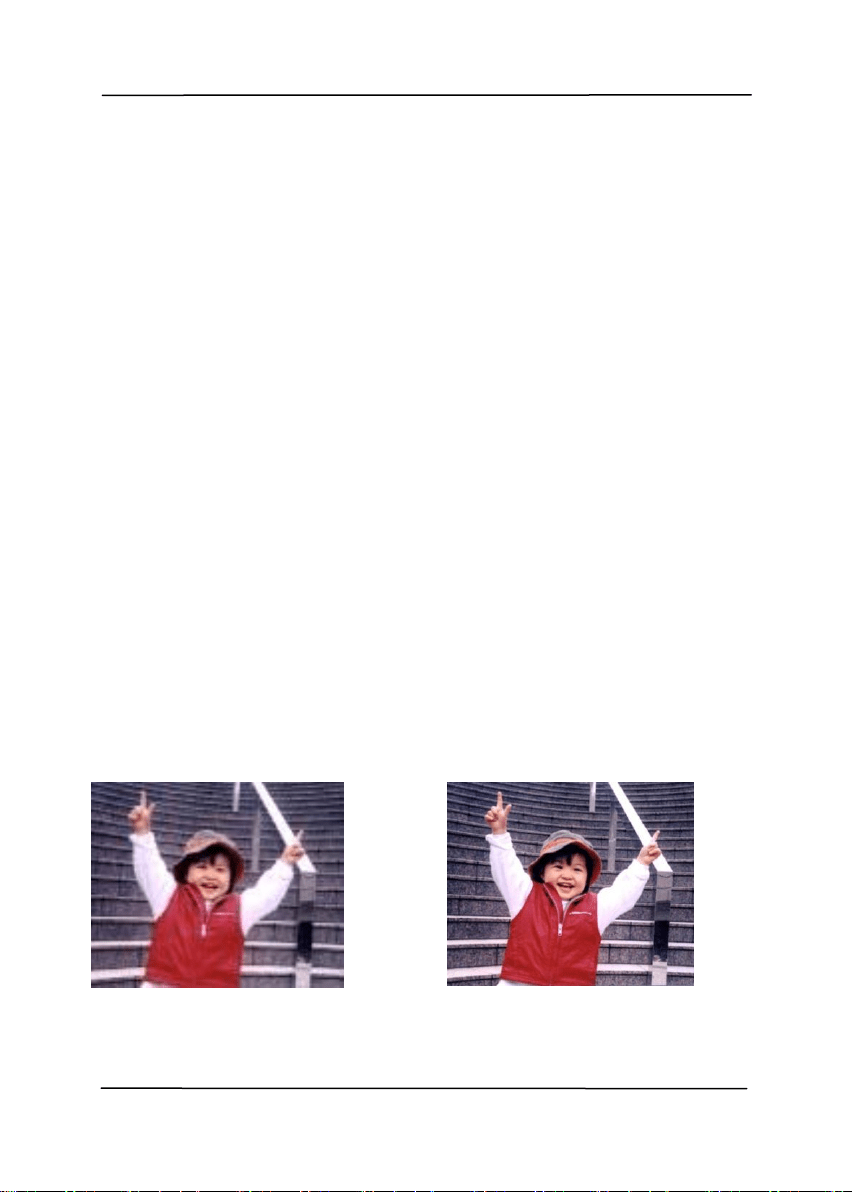
Resolution
A good control of the resolution results a
good detail of an image that scans. The
resolution is measured by dots per inch
(dpi). Normally, the greater the dpi number,
the higher the resolution and the image file
size. Be aware that greater resolution takes
more time to scan, and more disk space for
the scanning image. For your information,
an A4 size color image scanned at 300 dpi at
True Color mode consumes approximately 25
MB of disk space. A higher resolution
(usually means over 600 dpi) is only
recommended when you need to scan a
small area at True Color mode.
Choose a resolution value from the drop
down list. The default value is 200 dpi.
Available resolutions are 75, 100, 150, 200,
300, 400 and 600. Or you may choose your
desired value by clicking the box in the right
side of the drop down list and press the
arrow key to select your desired value and
then click the Add button to include it in the
drop down list. Note: The resolution is up to
300 dpi if an imprinter or a MICR reader is
installed or connected to the scanner.
Resolution: 75 dpi
Resolution: 150 dpi
User’s Manual
4-24
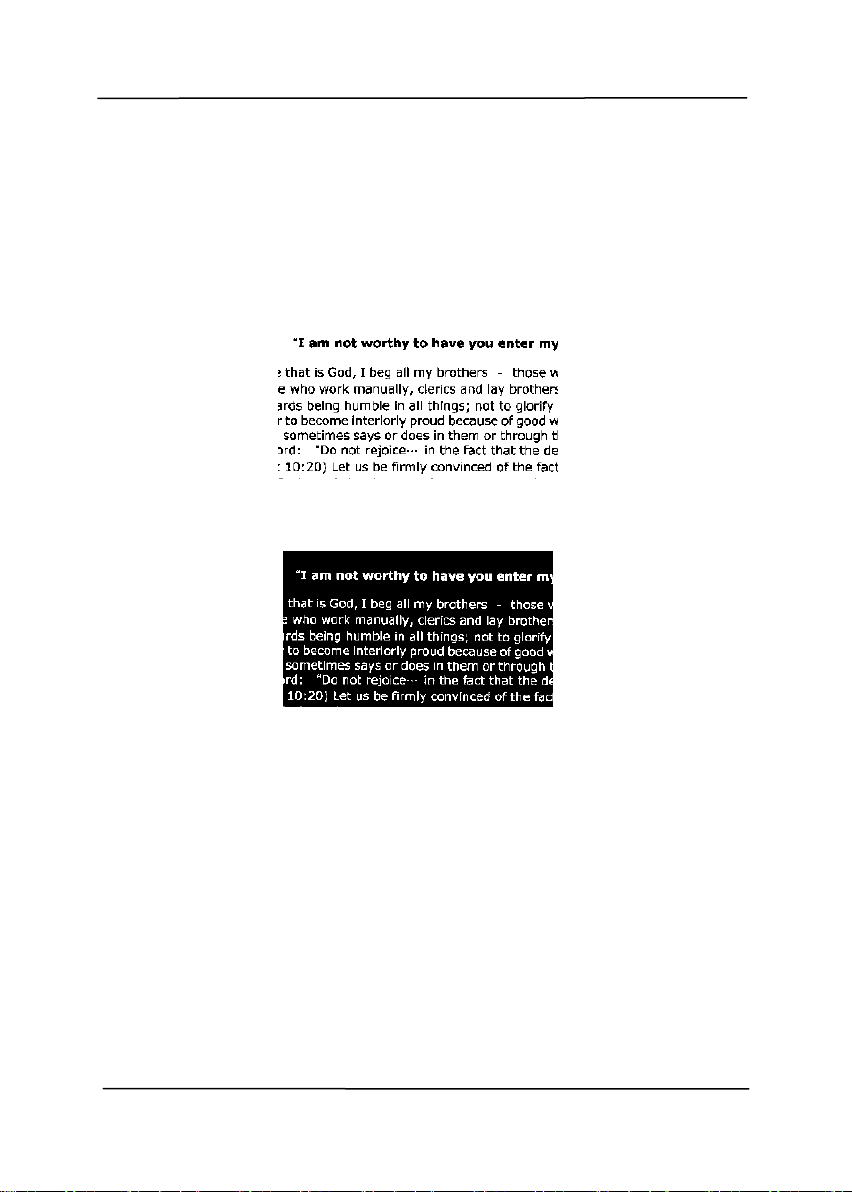
Invert
Reverses the brightness and the colors in the
image. The default setting is Black on a White
background. Reverse mode is White on a Black
background. For color images, each pixel will be
changed into its complementary color at the
command of Invert.
Black on White
White on Black

User’s Manual
4-25
Scan
Source
Choice:
Auto Document Feeder: Used to scan
multiple pages.
Flatbed: Used to scan a single page. For
example, pages from newspaper clipping,
paper with wrinkles or curls.
Flatbed (book): Used to scan several
inside pages from book.
Automatic: Allow the scanner automatically
set its scan source. If Automatic is selected
and there is document in both the auto
document feeder (ADF) and the flatbed, then
the scan source will be automatically set to
ADF. If Automatic is selected and there is
document only in flatbed, then the scan
source will be set to flatbed.
Merge Two Sides into One Image:
If you have a sheet-fed duplex scanner with
front input tray, you can scan an A3 size
document with an innovative method. Thus,
fold your A3 size document into A4, and then
load the paper in the front tray. Choose
Merge Two Sides from the Scan Source
option and then the scanner is able to scan
both sides of your document and merge two
A4 images into one A3 image.
When you select Merge Two Sides into One
Image, the Cropping or Multi-feed function
will be disabled.
Note: This feature must be used with a
carrier sheet. Regarding how to load a
document with a Carrier Sheet, refer to
Section 4.6.2, Other Paper Selection.
Note the options vary based on type of
scanner.
User’s Manual
4-26
NOTE:
If you have purchased a duplex sheet-fed
scanner, choose [Merge Two Sides] on the
[Scan Source], then the scanner is able to
scan both sides of your document and
merge them into a single image.
If “Merge Two Sides into One Image” is
selected, its choice will be available including
“Merge Horizontally”, “Merge Vertically”, “Merge
Vertically (Back Side Flip)”. If the reverse side
of your document is upside down, choose
“Merge Vertically (Back Side Flip)” and the back
side will be automatically rotated 180 degrees
and merged.
Note the options vary based on type of
scanner.
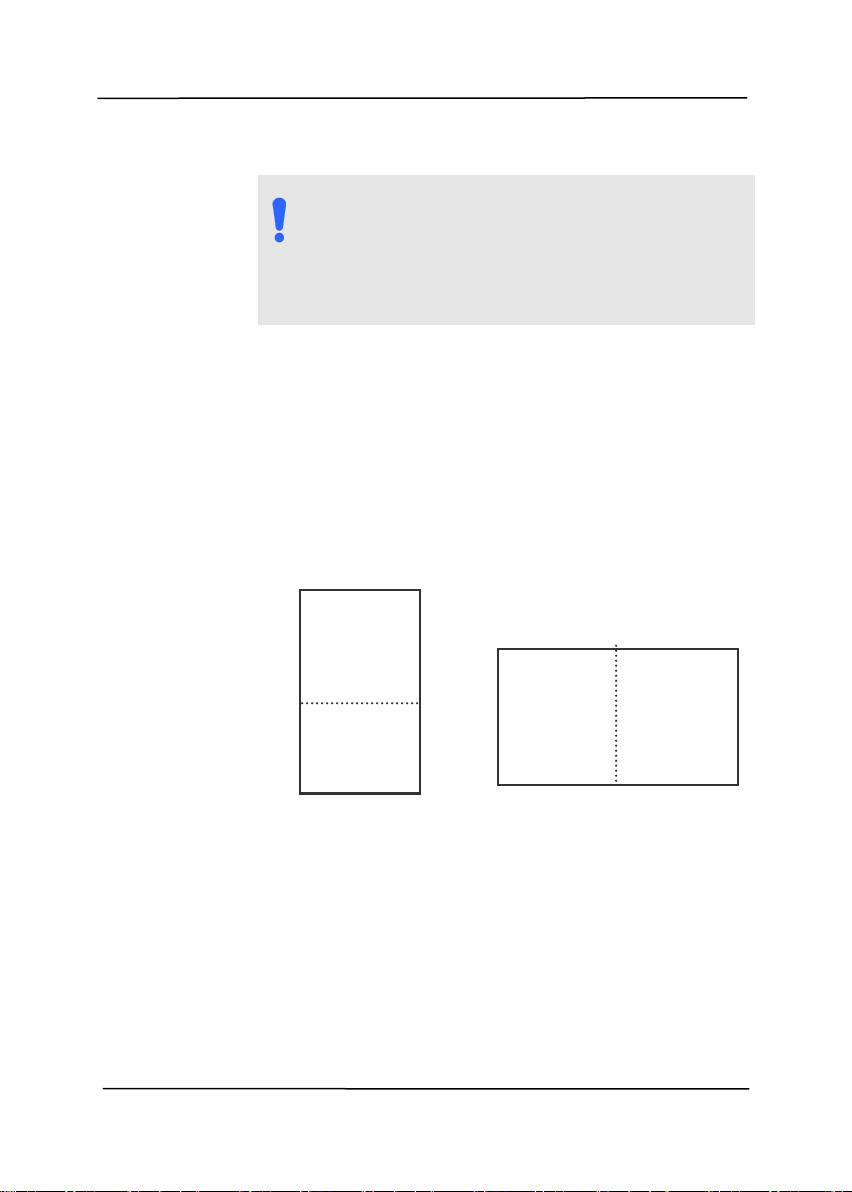
Front
Side
Rear
Side
Merge Vertically
Front
Side
Rear
Side
Merge Horizontally

User’s Manual
4-27
Color
Matching
The purpose of Color Matching is getting the
accurate color. This option uses the default
parameters (ICC profile) to adjust the colors
of the image.
Choice: None, Document, Photo
None: Choose “None” to disable this
option.
Document: Choose “Document” if your
original contains pure text or a mixture of
text and graphic since it is an optimal
setting for regular business document.
Photo: Choose “Photo” if your original
contains photo to reproduce your photo in
vivid color image.
Normal
After Color Matching

User’s Manual
4-28
4.3.3 Scanning color images
The following options are available for scanning color images.
Brightness
Contrast
Resolution
Invert
4.3.4 Scanning grayscale images
The following options are available for scanning gray images.
Brightness
Contrast
Resolution
Invert
4.3.5 Scanning B&W images
The following options are available for scanning B&W images.
Binarization (Dynamic Threshold)
Resolution
Invert
Or
Binarization (Fix Processing)
Threshold
Brightness
Resolution
Invert
User’s Manual
4-29
4.3.6 Editing Profiles
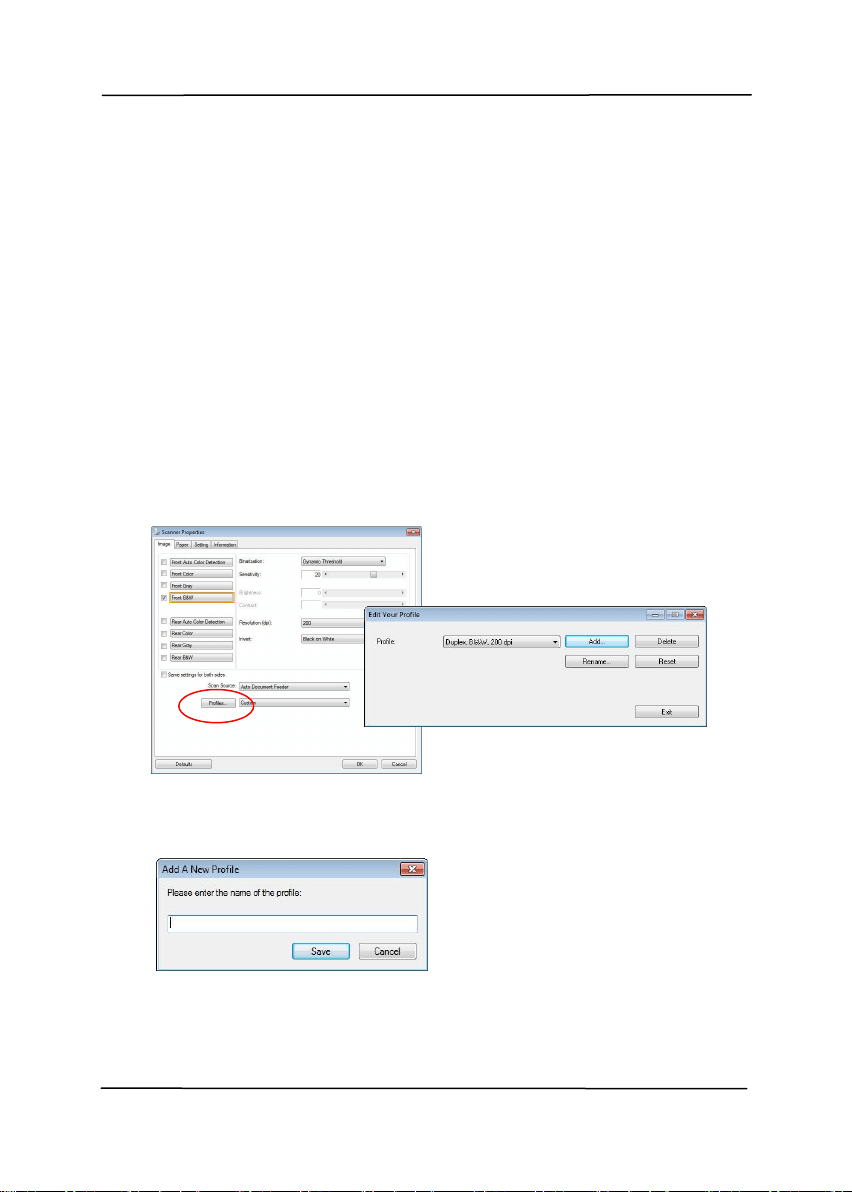
The Scanner Properties dialog box allows you to change and
save your frequently used scan settings into a profile. You can
edit these profiles by renaming or deleting them.
Windows:
To add a new profile
1. Customize your settings. (For example, change your
resolution, image type, cropping method, scan size, or
other scan settings.)
2. Click the Image tab and then choose “Profiles” to prompt
the “Edit Your Profile” dialog box.
3. Click “Add” to enter the name of the profile and then
choose “Save”.
4. The new profile will be saved and shown in the “Profiles”
dropdown list box.
User’s Manual
4-30
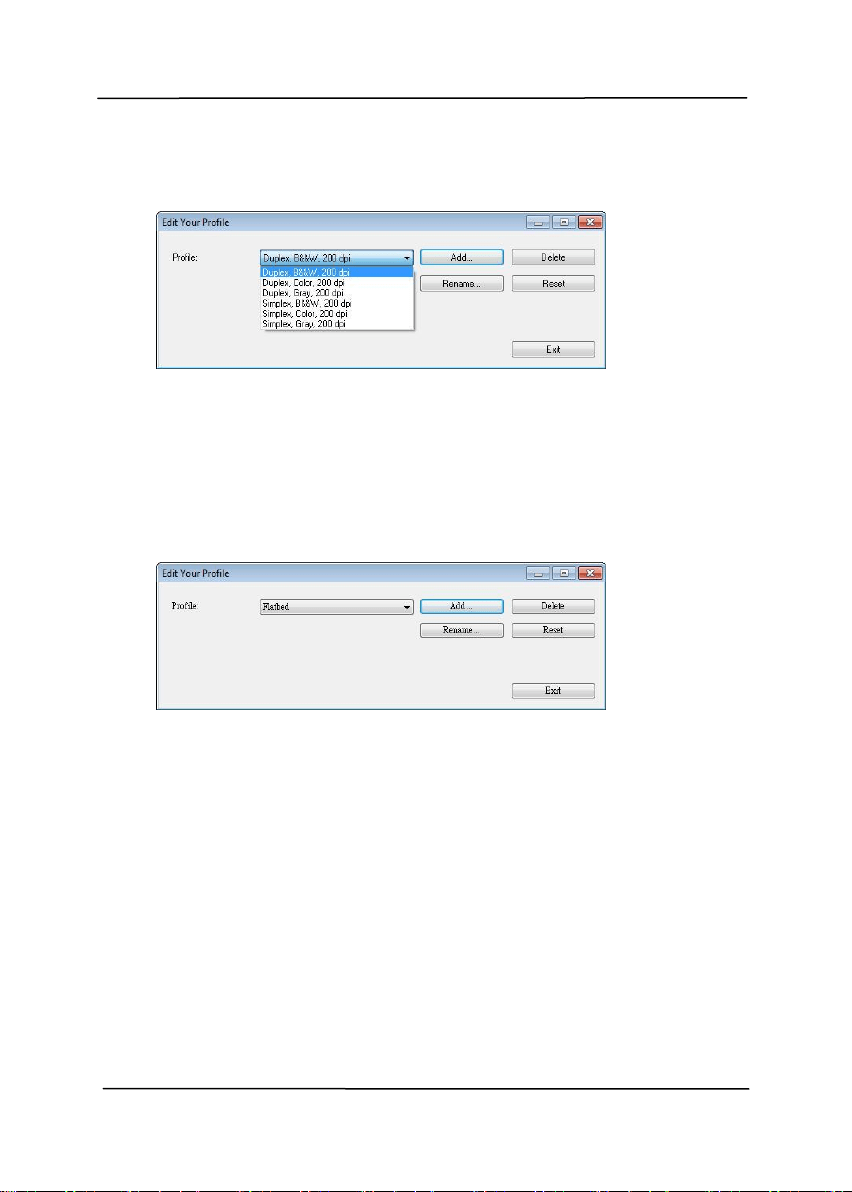
5. From the Image tab dialog box, choose your favorable
profile from the “Profiles” dropdown list box.
6. Your favorable profile will be immediately loaded and
displayed on Scanner Properties dialog box.
To delete a profile,
1. From the Image tab dialog box, click “Profiles” to prompt
the Edit Your Profile dialog box.
2. Choose the profile you want to delete from the dropdown
list box.
3. Click “Delete”. A Confirm message “Are you sure you want
to delete this profile?” is prompted.
4. Choose “Yes” to delete or “Cancel” to quit.
User’s Manual
4-31
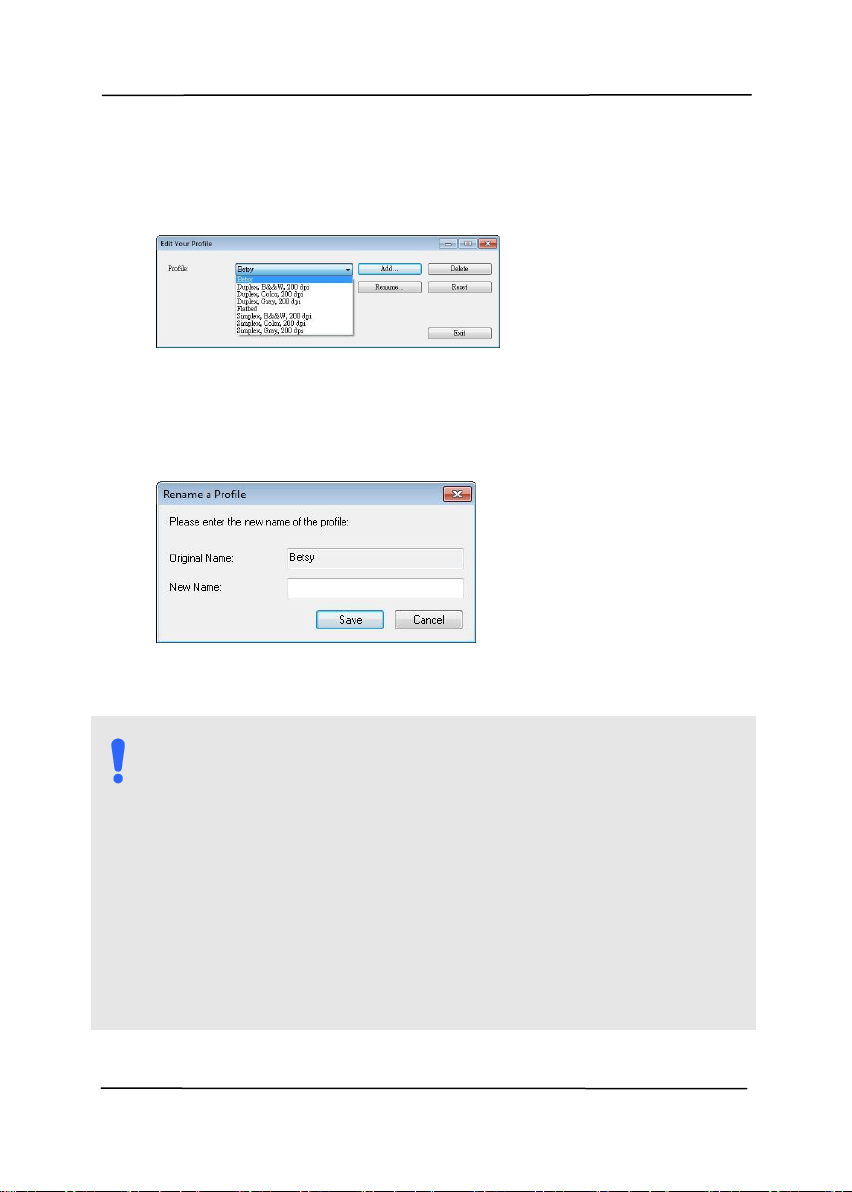
To rename a profile,
1. From the Image tab dialog box, click “Profiles” to prompt
the Edit Your Profile dialog box.
2. Choose the profile you want to rename from the dropdown
list box and then click the Rename button.
3. Enter new name for the profile.
4. Choose “Save” to save the new profile or “Cancel” to quit.
NOTE:
1. The preset default profiles include Flatbed, Simplex-
B&W, 200 dpi, Simplex-Gray, 200 dpi, Simplex-
Color, 200 dpi, Duplex-B&W, 200 dpi, Duplex-Gray,
200 dpi, Duplex-Color, 200 dpi. If you have a
simplex or a sheetfed scanner, the duplex or the
flatbed option will not be available.
2. If any setting for a current profile has been changed,
a [*] sign will be marked before the name of current
profile, for example, [* Duplex, Color, 200 dpi]. If
desire, click the [OK] or [Scan] button and a dialog
box will be prompted to let you save the new profile.
User’s Manual
4-32
Mac OS
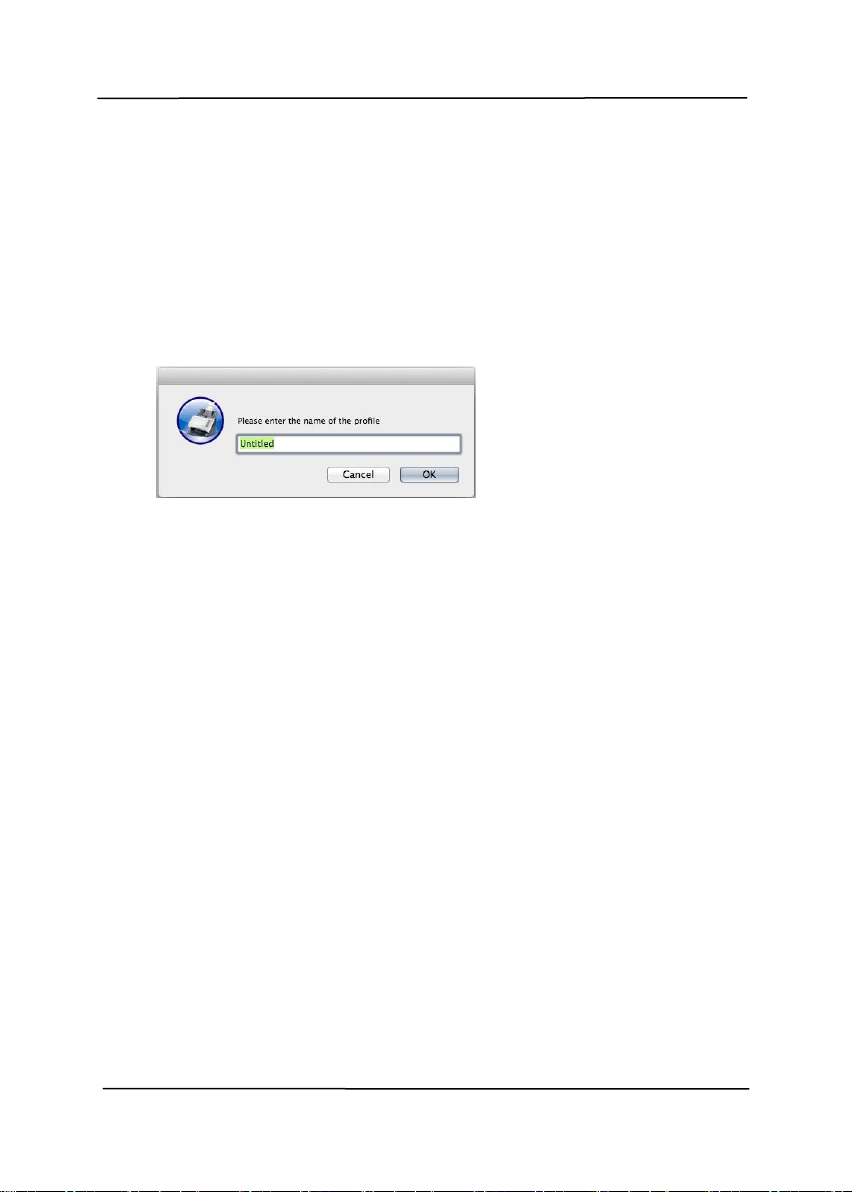
To load a profile (Mac)
1. Customize your settings. (For example, change your
resolution, image type, cropping method, scan size, or
other scan settings.)
2. Click the Image tab and click “+” on the Profile to enter
the name of the profile and then choose “OK”.
3. The new profile will be saved and shown in the “Profiles”
dropdown list box.
To load a profile,
1. From the Image tab dialog box, choose your favorable
profile from the “Profiles” dropdown list box.
2. Your favorable profile will be immediately loaded and
displayed on Scanner Properties dialog box.
To delete a profile,
1. Choose the profile you want to delete from the dropdown
list box.
2. Click “-”. A Confirm message “Are you sure you want to
delete this profile?” is prompted.
3. Choose “OK” to delete or “Cancel” to quit.

User’s Manual
4-33
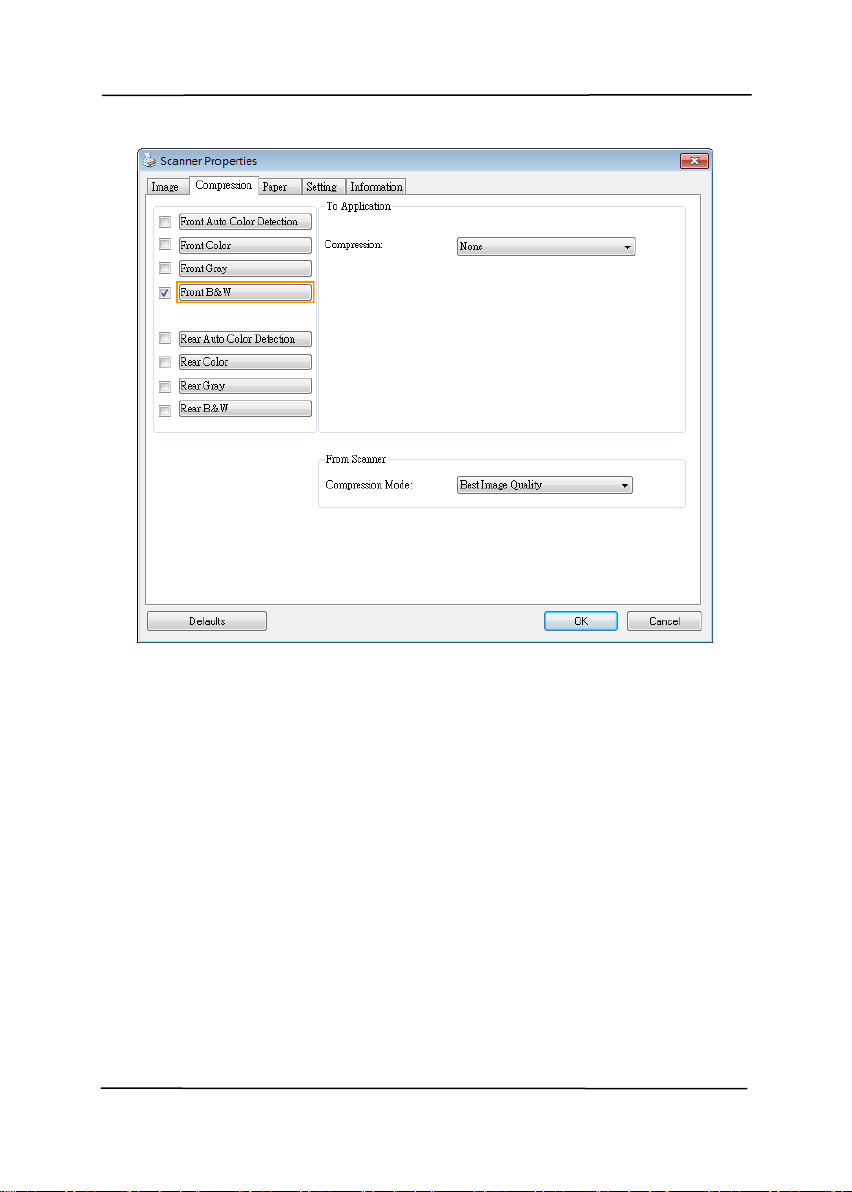
4.4 The Compression Tab
* The feature is only available for Windows operating system.
The Compression tab allows you to compress your scanned
image and choose the level of compression. Bi-tonal images
are normally compressed using CCITT standard called Group 4
(G4). Color and grayscale images are often compressed using
JPEG technology. Move the JPEG Quality slider to the right or
left to increase or decrease the level of compression. Note the
greater the compression level, the lower image quality. Default
is 50%.
Note that the compression depends on your image editing
application. If your image editing application does not support
the type of compression format, then either a warning
message will appear or the image quality of the compressed file
will not be acceptable.
JPEG (Joint Photographic Editor Group). This group developed
and lent their name to a file compression standard for color and
grayscale images that is widely used by scanners, and software
applications. On Microsoft Windows-based systems, a file with
the extension .jpg has normally been compressed using this
standard.
For scanning color or gray images, the following compressions
are available:
None
JPEG
For scanning B&W images, the following compressions are
available:
None
G4
User’s Manual
4-34
Compression:
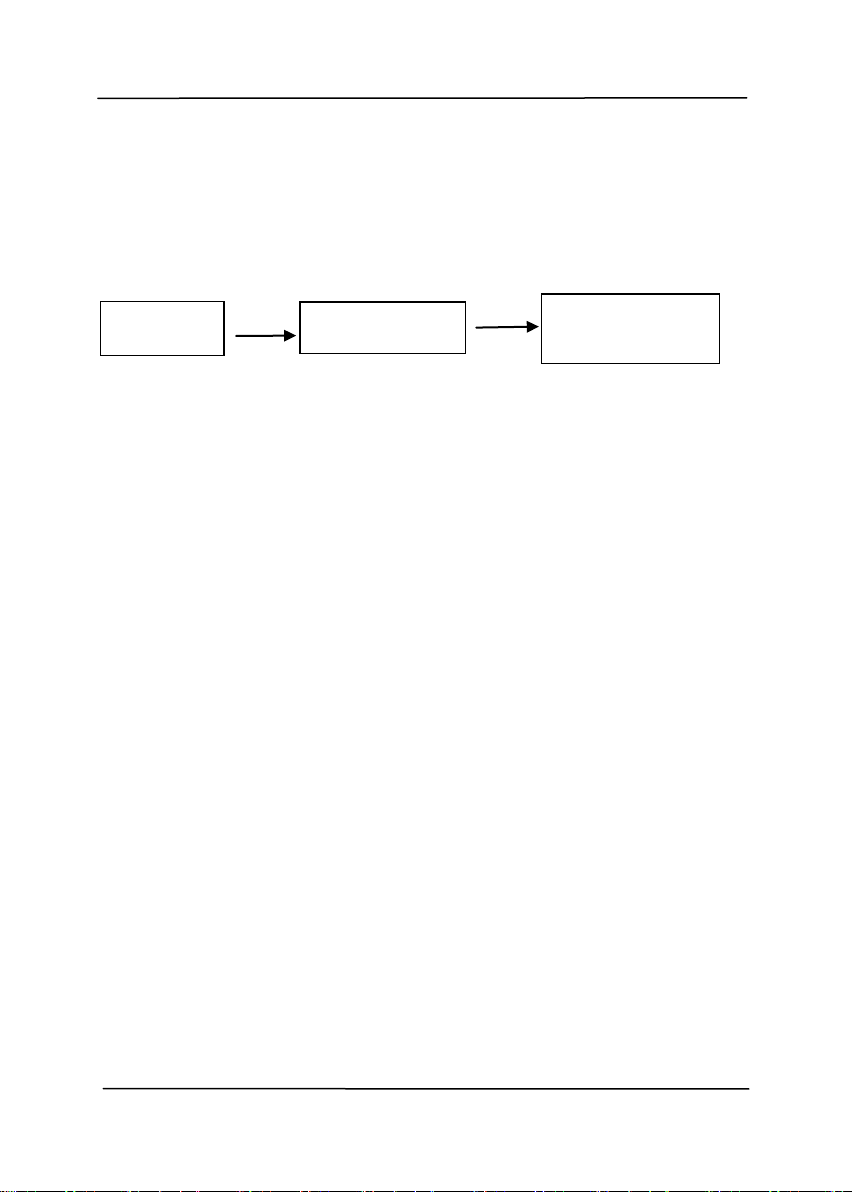
To complete your scan at a rated speed, the scanned image is
compressed by default during transmission. However, if you
wish to obtain the highest image quality, you can choose to
uncompress the image data before it is outputted.
To Application:
Choose if you wish to compress the image data and transfer it
from the TWAIN driver to the application. Note Bi-tonal images
are normally compressed using CCITT standard called Group 4
(G4). Color and grayscale images are often compressed using
JPEG technology. Move the [Image Quality] slider to the
right or left to increase or decrease your image quality. Note
the greater the image quality, the lower the compression level.
Default is 50%.
Note that the compression depends on your image editing
application. If your image editing application does not support
the type of compression format, then the image of the
compressed file will look abnormal.
From Scanner: (Note: The availability of this feature
varies due to scanner model.)
Choose if you wish to compress the scanned image and transfer
it from the scanner to the TWAIN driver.
Choice: Uncompressed, *Best Image Quality (Low Compression
Level), Better Image Quality (Normal Compression Level),
Normal Image Quality (High Compression Level). (*: Factory
Default)
Scanned
Image
Scanned
Image
Scanner
Scanner Driver
Image Editing
Application
User’s Manual
4-35
The Compression tab dialog box

User’s Manual
4-36
4.5 The Color Dropout Tab
4.5.1 Color Dropout Selection
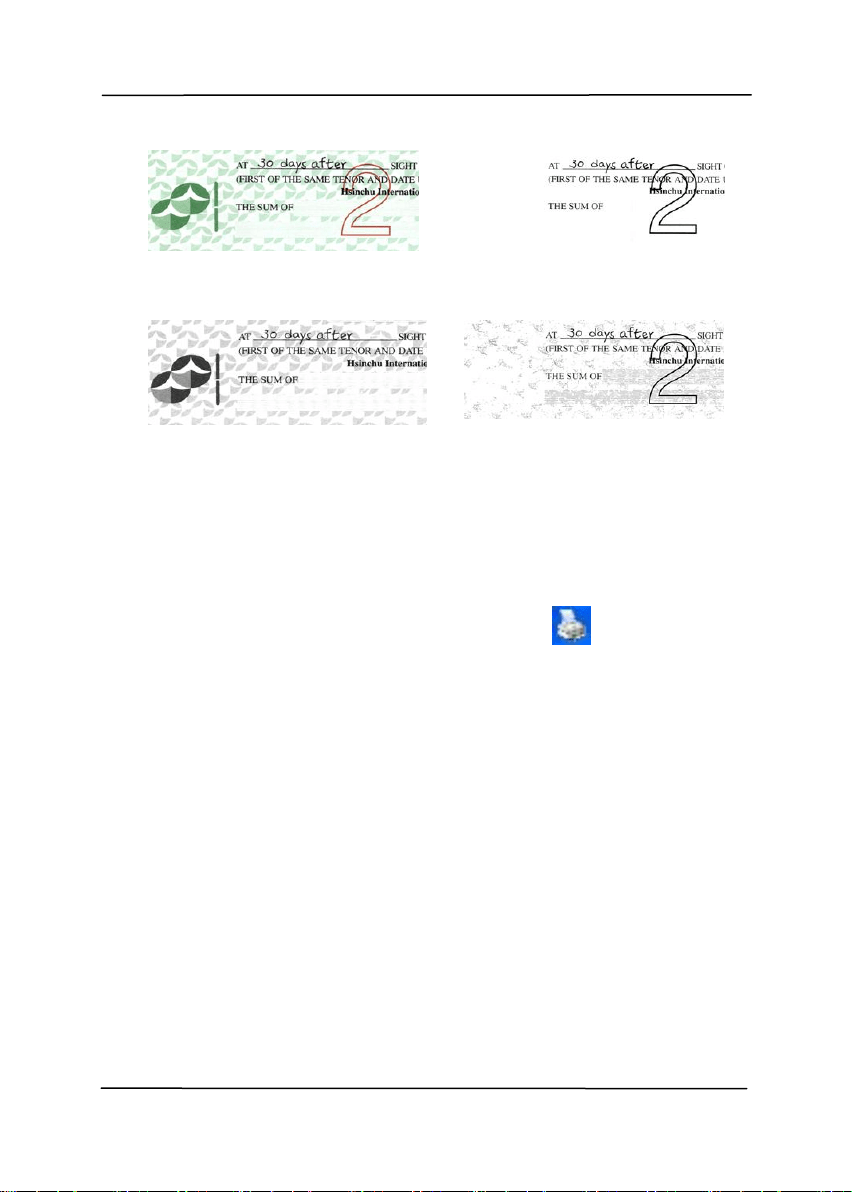
The [Color Dropout] tab allows you to select either green,
red, blue, or a color of your choice to remove the details of the
selected color from a scanned image. This feature is used to
sharpen your text when using OCR (Optical Character
Recognition) software. Note this feature applies only to the
gray or black and white image.
Choice: None, Auto, Remove Red, Remove Green,
Remove Blue, Custom
- None: Does not remove any color.
- Auto: Automatically outputs the image with the details of
the primary color removed.
- Remove Red/Remove Green/Remove Blue: Outputs
the image with the details of the specified color removed.
- Custom: Specify the color you wish to remove by entering
its RGB (Red, Green, and Blue) value respectively.
Advanced Options:
- Quality Mode: Range: 0~20. Default: 10
When [Quality Mode] is selected, you can determine the
color to be dropped out using the [Filter Threshold] slider. A
lower value will drop more of the selected color out, while a
higher value will leave more of the selected color in.
- Normal Mode: Use an optimized setting to determine the
color.
User’s Manual
4-37
Original
Auto/Remove Green
(normal mode)
Remove Red (normal
mode)
Remove Green (quality
mode: Threshold: 18)
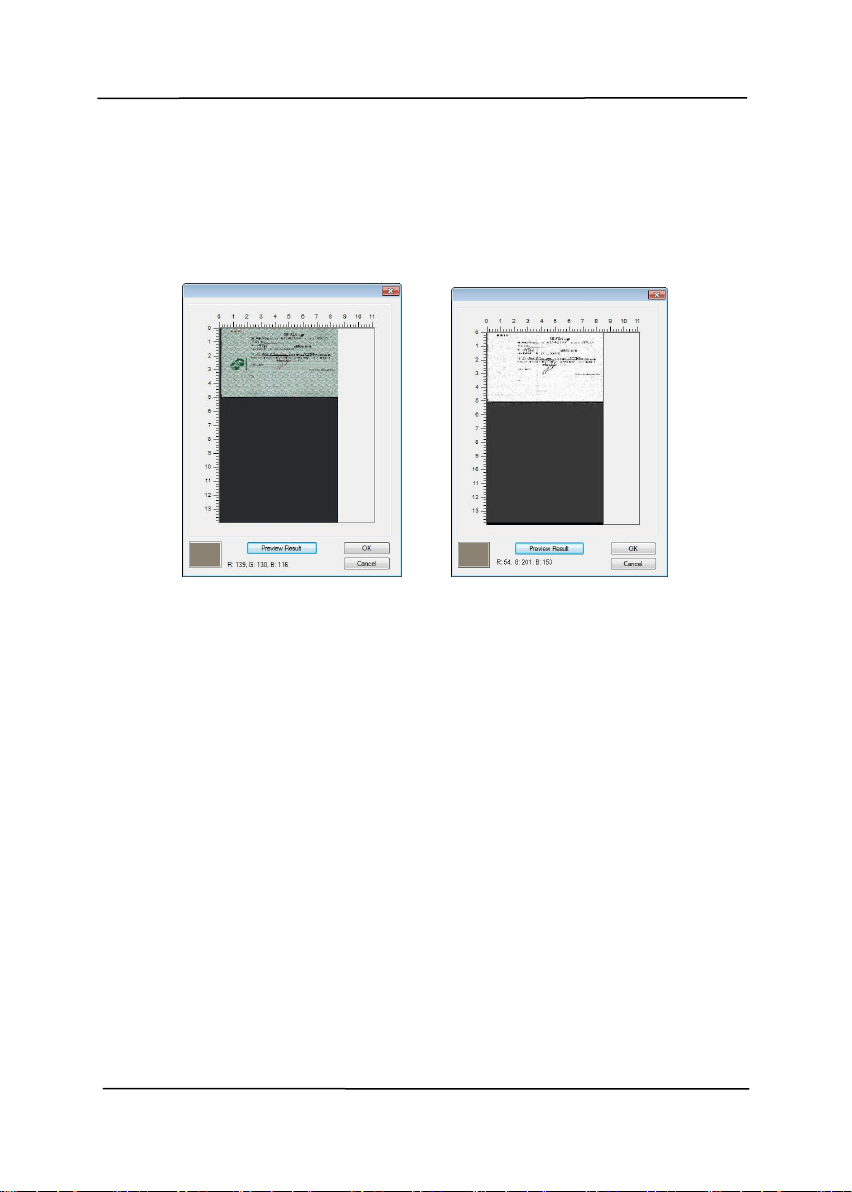
Preview the color dropout result:
To preview the color dropout result, please follow these steps:
1. Click the [Scanner Properties] icon ( ) on the upper
left corner, and choose [Tab] to show available tab
names.
2. Choose [Preview] to show the Preview tab.
3. Click the [Preview] tab to show the Preview page.
4. Load your document to the scanner and click the
[Preview] button to get a preview image.
5. On the [Image] tab, click [Gray] or [Black and White]
image mode and then choose [Custom] on the [Color
Dropout] tab. A [Preview window] button will be
displayed.
6. Click the [Preview window] button to prompt the
[Preview] window with the previewed image.
User’s Manual
4-38
7. Move your cursor over the preview image. Your mouse
cursor now becomes an Eyedropper.
8. Click to select a color which you wish to remove.
9. Click and hold your mouse button to view the result
after removing the specified color. If the result is
satisfactory, click [OK] to close the Preview window.
The Preview Window The Color dropout result

User’s Manual
4-39
The Color Dropout dialog box (Windows)
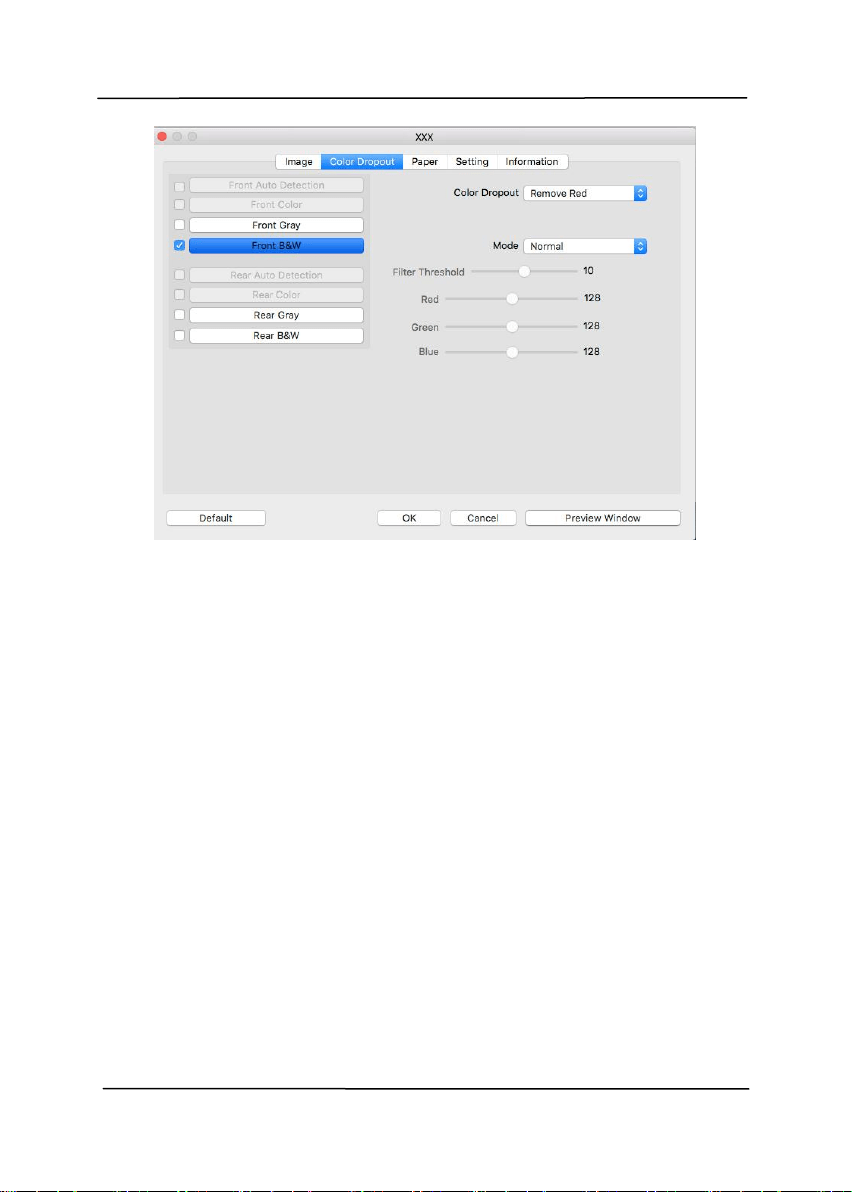
User’s Manual
4-40
The Color Dropout dialog box (Mac OS)
User’s Manual
4-41
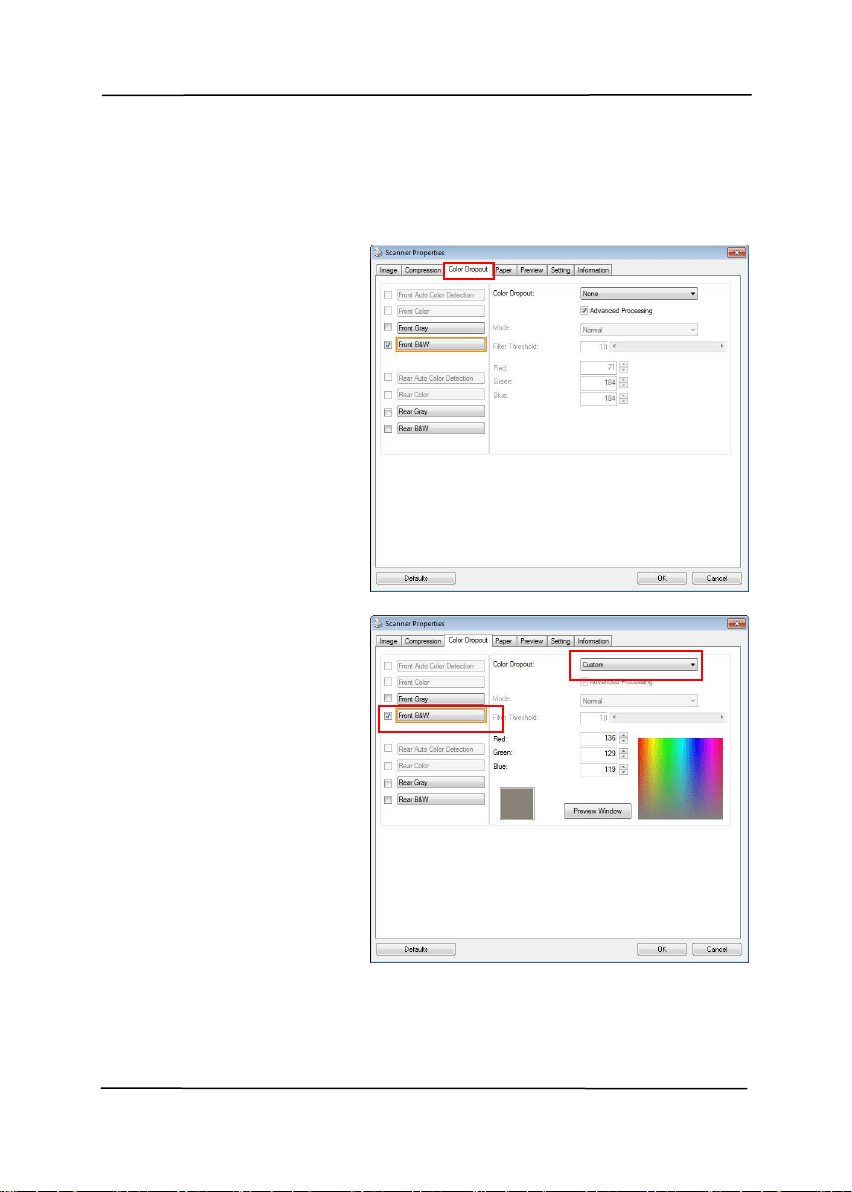
Windows:
To select a color on the Color palette,
1. Click the Color
Dropout tab from
the Scanner
Properties dialog
box.
2. Choose Gray or
B&W from the
Image Selection
box and click
“Custom” from the
Color Dropout
drop-down menu.
The Color palette
appears.

User’s Manual
4-42
3. Move your cursor
over the palette. The
cursor becomes a
cross sign.
4. Click to choose a color. The RGB values are changed
simultaneously.
User’s Manual
4-43
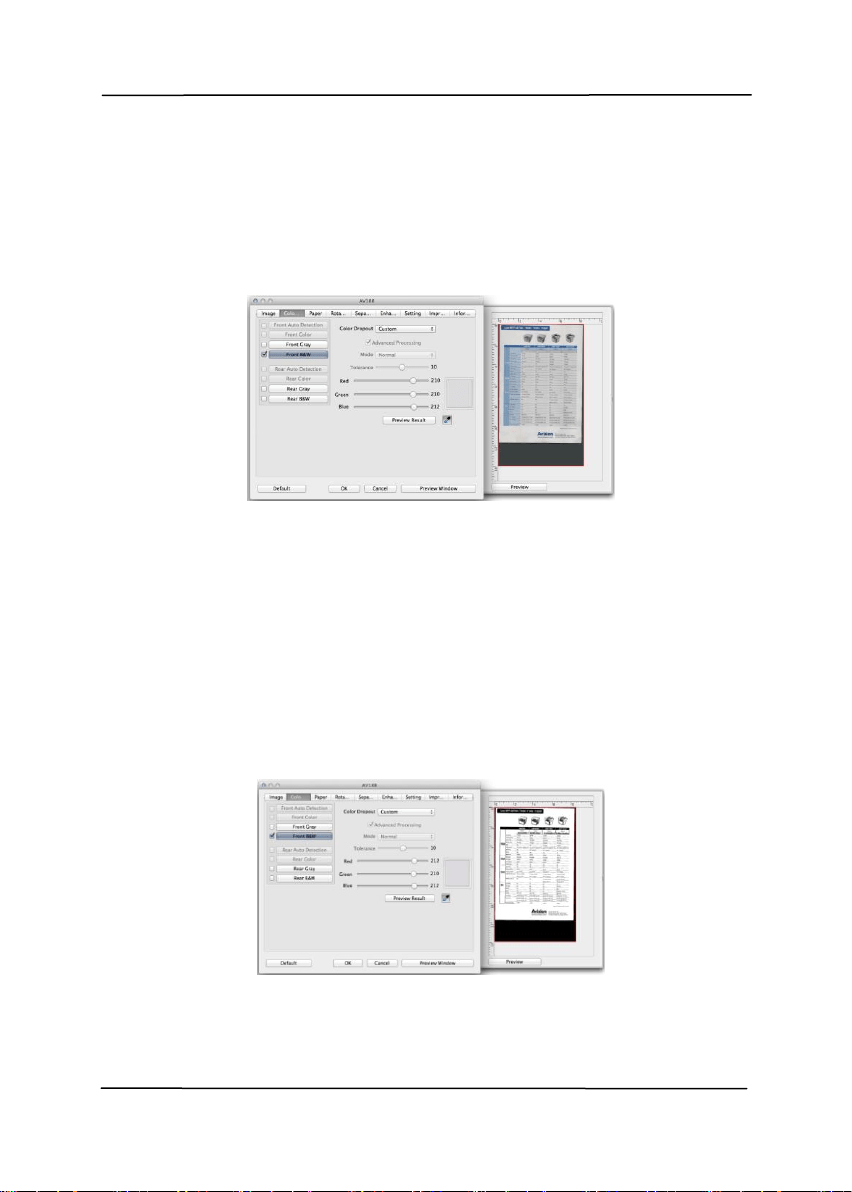
Mac OS:
To preview the color dropout result, please follow these steps:
1. Choose [Preview Window] to show the Preview tab.
2. Load your document to the scanner and click the
[Preview] button to get a preview image.
3. On the [Image] tab, click [Gray] or [Black and White]
image mode and then choose [Custom] on the [Color
Dropout] tab. An [Eyedropper] button will be displayed.
4. Click the [Eyedropper] button and move your cursor over
the preview image. Your mouse cursor now becomes an
Eyedropper.
5. Click to select a color which you wish to remove.
6. Click and hold your mouse button to view the result after
removing the specified color.
7. If the result is satisfactory, click [OK] to close the Avision
Scanner Properties dialog box.
User’s Manual
4-44
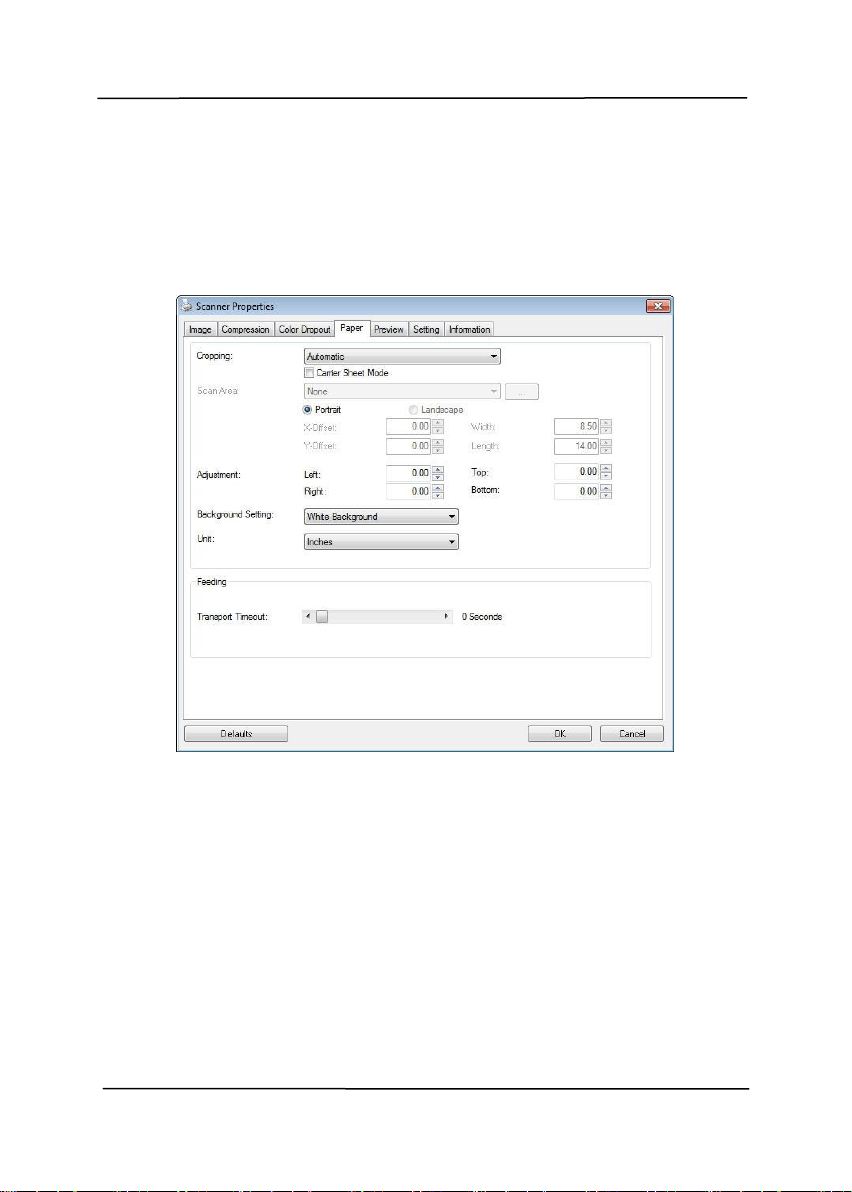
4.6 The Paper Tab
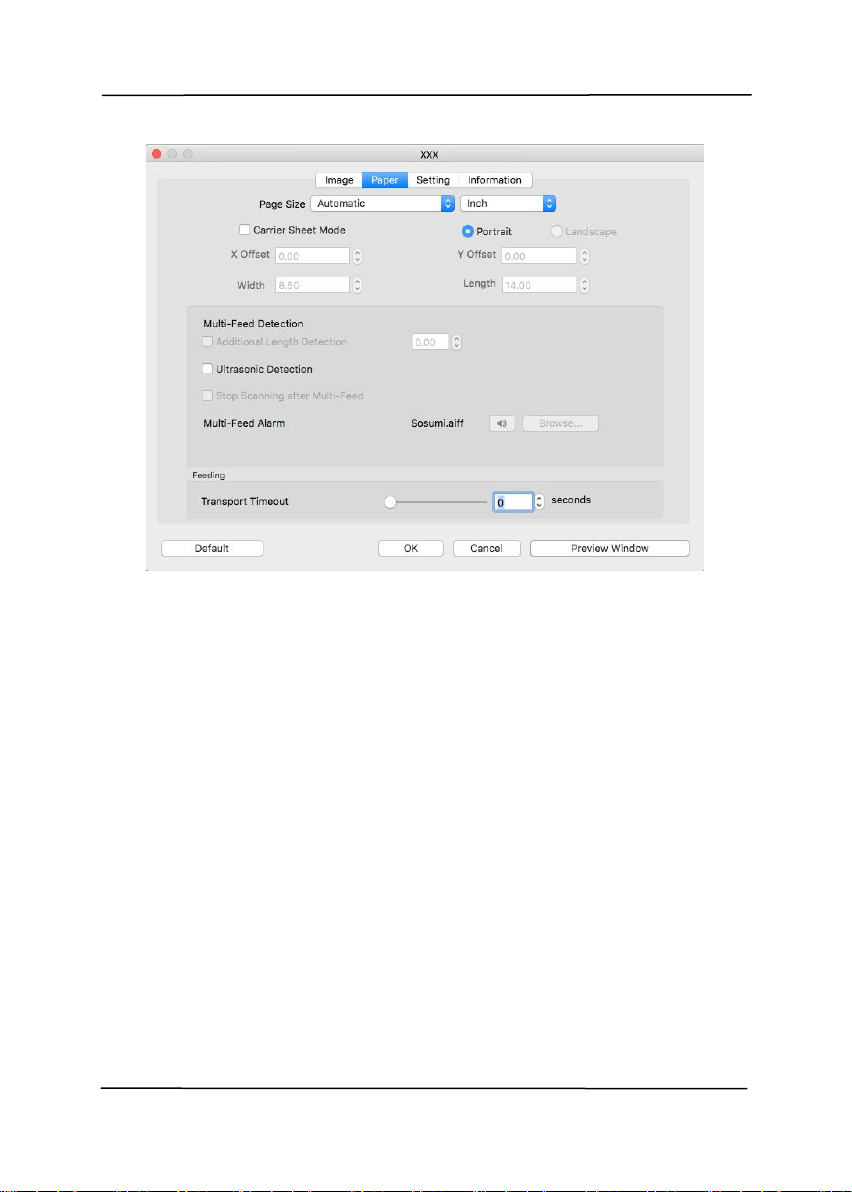
The Paper tab allows you to define values relating to image
output (i.e., Auto Crop or not, Scan Area, OverScan, Multi-Feed
Detection).
The Paper tab dialog box (Windows)
User’s Manual
4-45
The Paper tab dialog box (Mac OS)

User’s Manual
4-46
4.6.1 Cropping
Cropping allows you to capture a portion of the document
being scanned. Choice: Automatic, *Automatic (36”),
Fixed to Transport, *EOP (End of Page) Detection,
*Automatic Multiple, *Relative to Documents.
* Windows only
OPTIONS
DESCRIPTION
Automatic
Automatic adjusts the cropping window
according to different document sizes and
automatically straighten a skewed
document. Use this option for batches of
mixed-sized documents.
Automatic
(36”)
Automatically adjusts the cropping window
according to different document sizes
smaller than 36” and automatically
straighten a skewed image. Use this option
for batches of mixed-sized document.
Note: The availability of this feature
varies due to scanner model.
Fixed to
Transport
This feature allows you to define the area or
zone to be imaged. Use for batches of
same-sized documents. If you select this
option, you can use the arrow keys to define
the x and y offset values, width and length
to redefine your scanned area. The Display
window will show image placement as you
change the values.
EOP (End
of Page)
Detection
This feature allows you to define the area or
zone to be imaged. Use for batches of
same-width but different length documents.
If you select this option, you can use the
arrow keys to define the x and y offset
values, width and length to redefine your
scanned area. The Display window will show
image placement as you change the values.

User’s Manual
4-47
Automatic
Multiple
This option allows you to place various
sized documents such as photos, ID Cards,
or business cards on the flatbed (if
available) and lets you create multiple
individually cropped images in one scan.
Note: To correctly create multiple images,
please make sure there is at least 12mm
(0.5”) of space between each document.
Relative to
Document
This option allows you to crop different
areas on your documents and deliver these
images in B&W, Gray, or Color separately.
For example, there are applications which
require you to store the entire document in
B&W and a part of the document in color to
save storage space. This is useful for
documents where a photograph or
signature appears in a consistent area on
the document such as resumes, and so on.
The following options are only available when Fixed to
Transport is selected.
X-Offset — the distance from the left end of the
scanner to the left edge of the scanning area.
Y-Offset — the position from the top end of the
document to the top end of the scanning area.
Width — the width of the scanning area.
Length — the length of the scanning area.
Center: automatically calculates the x-offset for center-
fed feeding based upon document size selected.
— relocate the scan area by click the arrow key on
the cross sign while retain the scan size. View the result
from the Display window.

User’s Manual
4-48
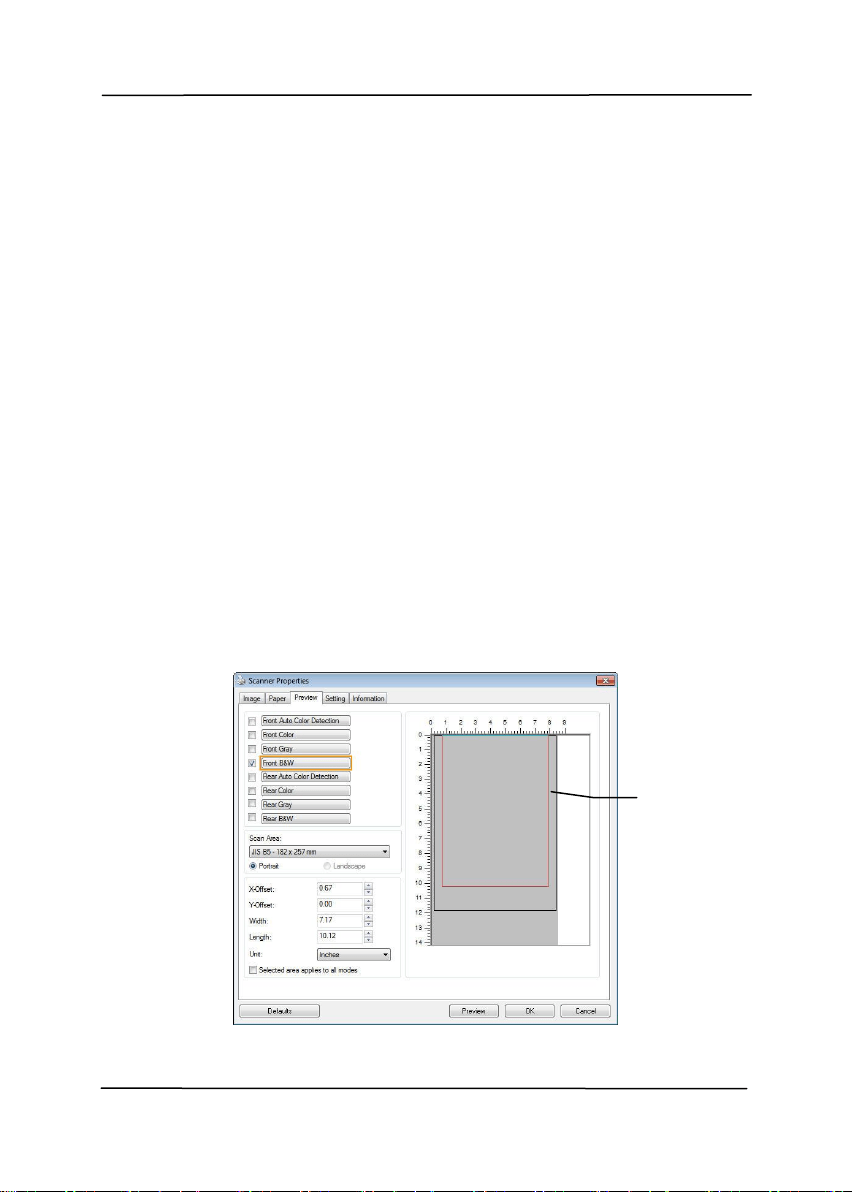
The Adjustment option is available when Automatic is
selected.
Adjustment —adds a positive/negative margin value
Top/Bottom or toward left/right of the image.
Adjustment is used when the automatic document feeder
is used. Adjustment reduces the possibility of corner
clipping on skewed images. To set Adjustment values, use
the UP/Down buttons to select where you want to apply
Adjustment values: Top/Bottom or Left/Right, and then
select the amount of inches/mm/pixels applied. Select a
value within the range of 0.00 to 1.00 / -1.00.
User’s Manual
4-49
Relative to Document: (used for batches of same-sized
documents)
This option allows you to crop different areas on your
documents and deliver these images in B&W, Gray, or Color
separately. For example, there are applications which require
you to store the entire document in B&W and a part of the
document in color to save storage space. This is useful for
documents where a photograph or signature appears in a
consistent area on the document such as resumes, and so on.
The following procedure describes how to reproduce the entire
document in B&W and a portion of document (picture) in color.
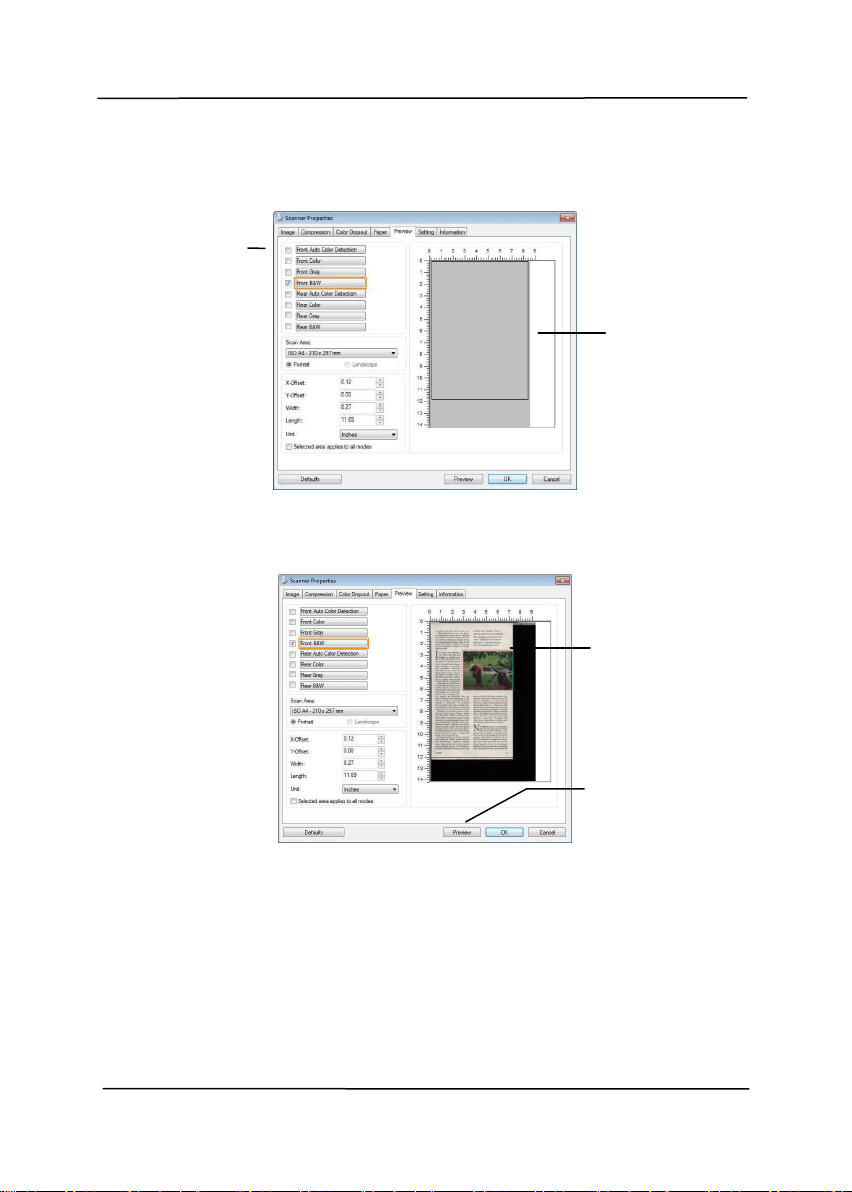
1. On the Paper tab, choose “Relative to Document” or “Fixed
to Transport” from the Cropping option.
2. Choose your scan size from the Scan Area option. The
selected scan size will be displayed in a red rectangular
box. This is also the scan size of your entire document.
(For example, ISO B5. If you have not chosen a scan area
and leave the selection as None, then the default area will
be the scanner’s maximum.)
A red
rectangular
box
User’s Manual
4-50
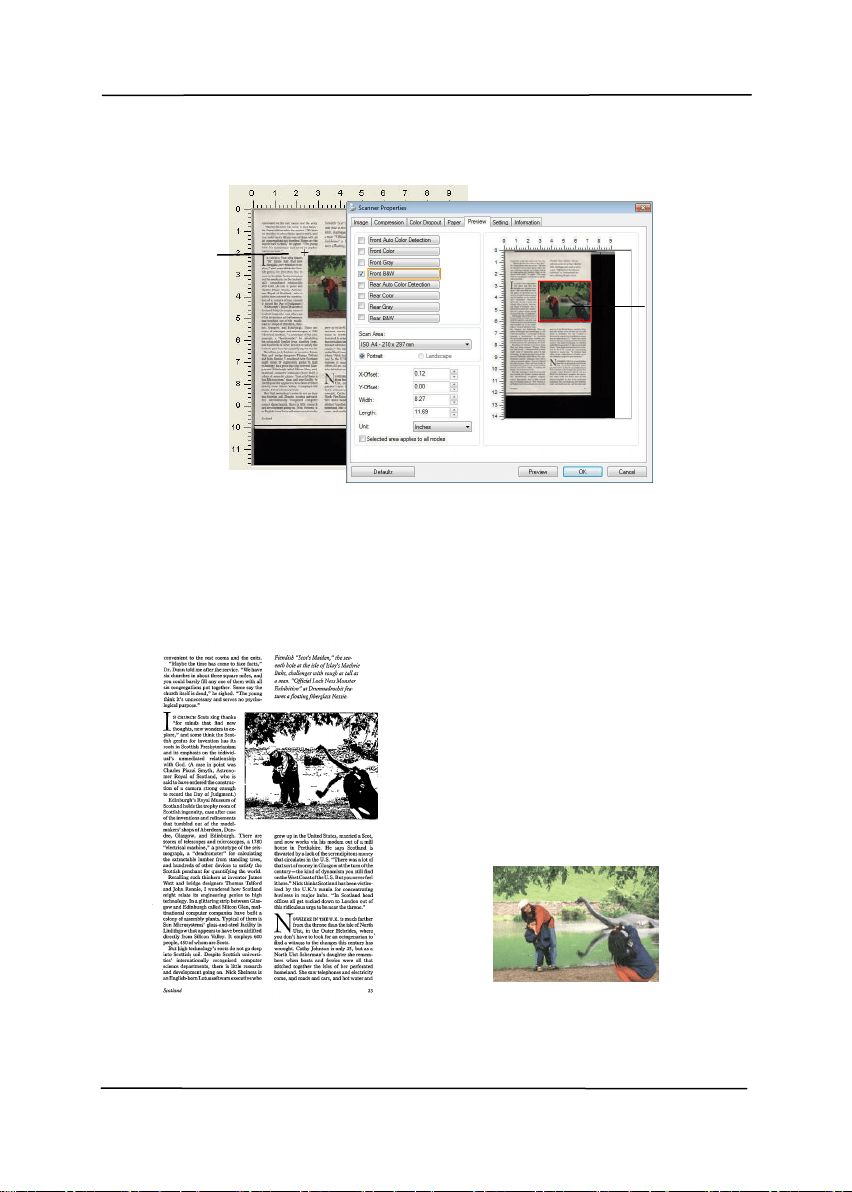
3. Click the Preview tab to display the Preview window. A
black rectangular box appears to indicate the max. scan
size your have just selected.
4. Click the Preview button to view the entire image in low
resolution to correctly crop your relative scan area.
5. Select image type from the Image Selection box. The
selected image will appear in highlighted color. (For
example, Front Color)
6. Place your cursor on the Preview window and click your
left mouse button. A cross sign will appear as illustrated.
Create your relative scan size diagonally by dragging the
left mouse button to your preferable size. The selected
area will appear in a red box as illustrated.
A black
rectangular
box
The Preview
Image
The Preview
Button
The Image
Selection
Box
User’s Manual
4-51
7. Check the B&W image from the Image Selection box to
scan the entire document.
8. Click the Scan button to start scanning the document in
two image types and sizes. (See the result in below.)
The entire document in B&W The relative area in color
The
Relative
Area
A Cross
Sign
User’s Manual
4-52
4.6.2 Other Paper Selection
Carrier Sheet Mode:
Check this option to automatically crop the scan window
according to your document size when scanning non-standard
document (fragile, irregular-size document) with a carrier sheet
(optional). Note: The availability of this option varies due to
scanner model.
Loading Documents Using a Carrier Sheet
A Carrier Sheet is a plastic sheet specifically used for loading
non-standard document onto the scanner. It allows you to scan
document that can not be scanned in the regular way. Also,
documents larger than A4 size, such as A3 and B4, can be
scanned by folding in half, inserting into the Carrier Sheet, and
scanning in duplex mode. You can also scan documents that
can be damaged quite easily such as photographs, or irregular
size documents that are difficult to load directly such as
clippings.
To scan document using a Carrier Sheet,
For documents larger than A4/Letter size, such as A3
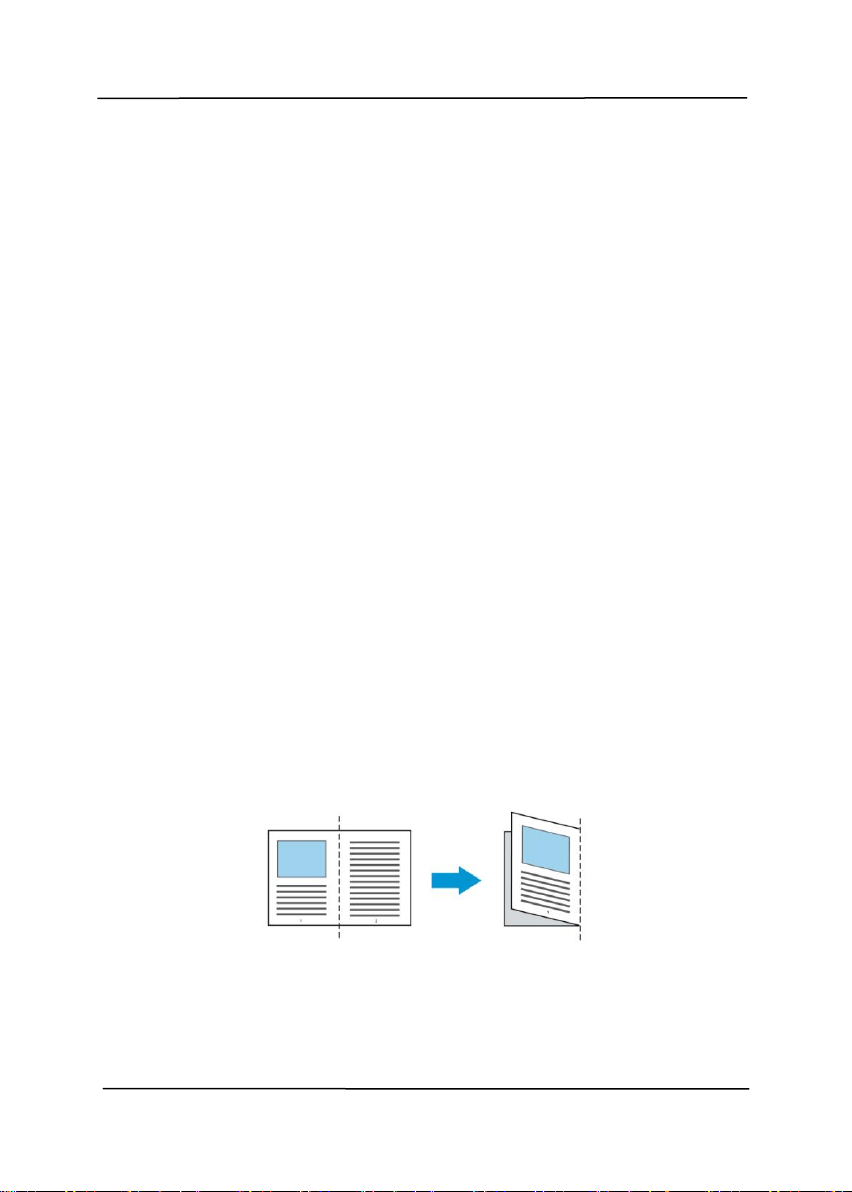
a. Fold the sheet to be scanned in half.
b. Fold the sheet tightly and smooth out crease. Otherwise,
the sheet may be skewed during scanning.
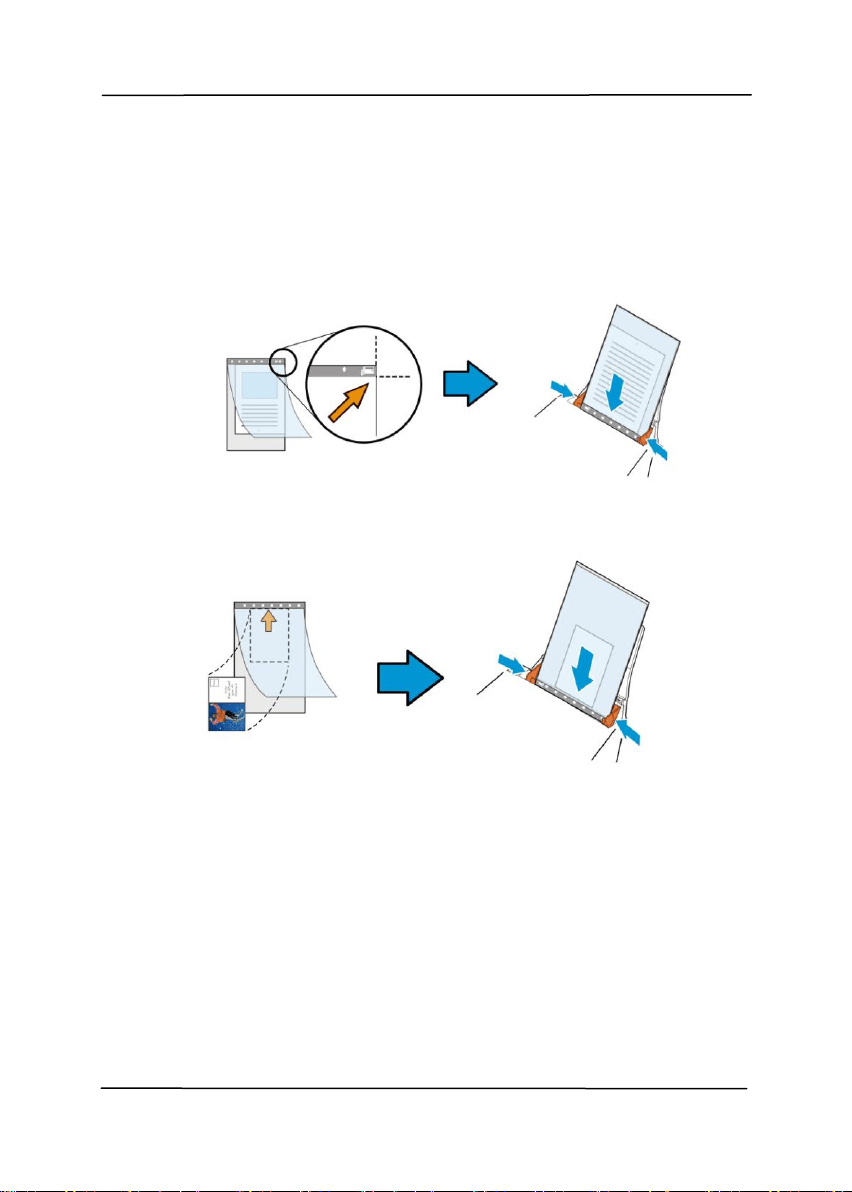
1. Open the Carrier Sheet and place the document
inside.
Align the top of the document to the top of the Carrier
Sheet (the printed area).
User’s Manual
4-53
For documents larger than A4/letter size, such as
A3
Align the top of the document to the top of the Carrier
Sheet (the printed section) and the folded portion to the
right edge of the Carrier Sheet so that the document fits
into the Carrier Sheet at the upper corner.
For non-standard document
Center your document in the Carrier Sheet.
2. Load the Carrier Sheet with the gray section (printed
section) facing downwards.
3. Adjust the paper guides to the width of the Carrier Sheet.
Adjust the paper guides so that there is no space
between the guides and the Carrier sheet. Space between
the guides and Carrier Sheet may cause the Carrier Sheet
to become unaligned during scanning, and skew the
scanned image.
4. Start the scan.
User’s Manual
4-54
NOTICE:
[Carrier Sheet] is available for the models that
support the Carrier Sheet.
Some functions are disabled when [Carrier Sheet] is
checked.
This option may not work properly on some
applications.
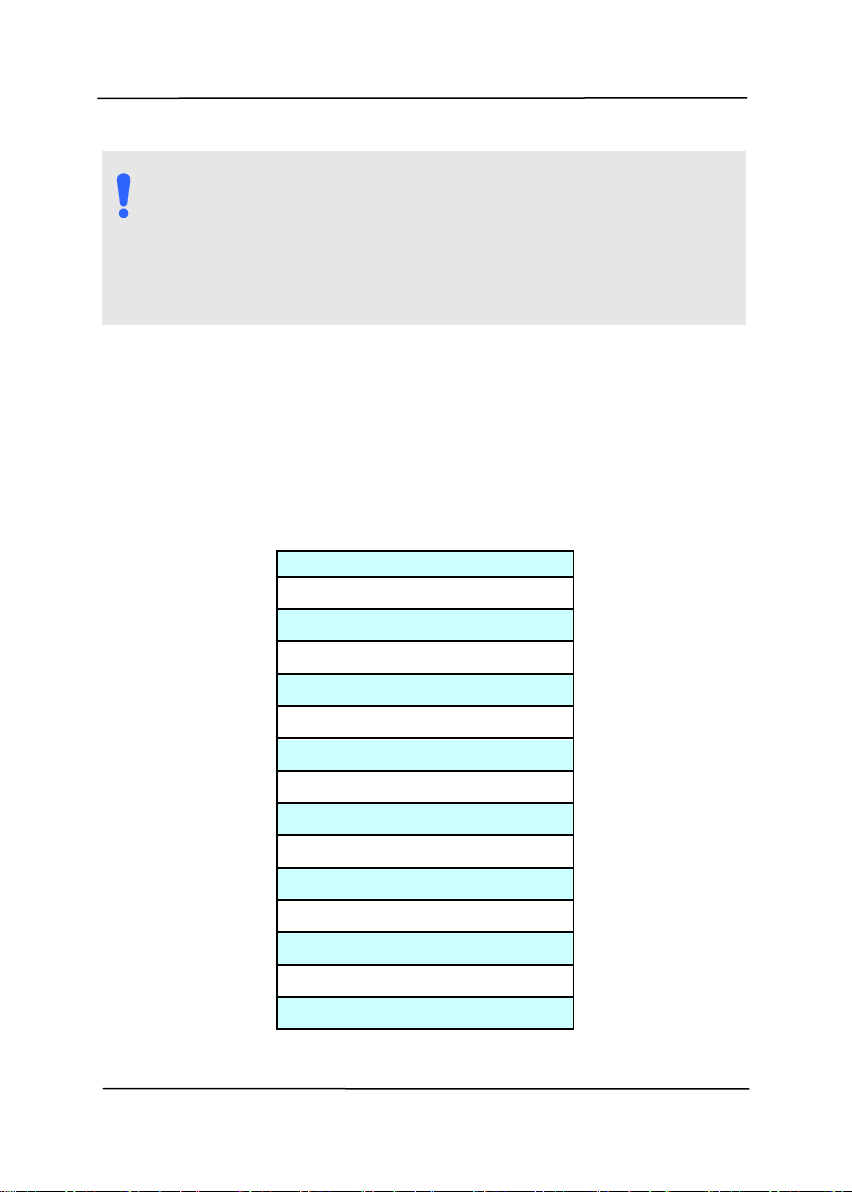
Scan Area
Choose your desired paper size with the drop-down list box. Or
you may select a custom paper size by clicking the Scan Area
box and then click Add to include in the choice.
Choices are listed below:
None
US Letter- 8.5”x 11”
US Legal – 8.5” x 14”
ISO A4 – 21 x 29.7 cm
ISO A5 – 14.8 x 21 cm
ISO A6 – 10.5 x 14.8cm
ISO A7 – 7.4 x 10/5 cm
ISO B5 – 17.6 x 25 cm
ISO B6 – 12.5 x 17.6 cm
ISO B7 – 8.8 x 12.5 cm
JIS B5 – 18.2 x 25.7 cm
JIS B6 – 12.8 x 18.2 cm
JIS B7 – 9.1 x 12.8 cm
Scanner Maximum
Long Page (<118”)

User’s Manual
4-55
Long Page (<118”):
When you need to scan documents whose length exceeds
scanner maximum, please choose Long Page. Note if Long
Page is selected, the Multi-Feed Detection will not be
available. (Note: This option and the maximum allowable
document length vary due to type of scanner.)
When Long Page (<118”) is selected, be sure to specify your
document size in the Length and Width field.
Notice when scanning long page document:
1. Pull out the extension in the ADF Paper Tray.
2. Secure enough space around the Output Tray to prevent
the ejected paper from falling off the Output Tray.
3. To ensure the performance, in color mode, set the
resolution to be 300 dpi or lower; in Black and White
mode, set the resolution to be 600 dpi or lower.
4. Depending on your system environments, application, or
your specified paper size, there may be insufficient
memory to perform scanning.
OverScan
Overscan allows you to add a specific margin at top and bottom
or right and left (Options vary based on the type of scanner) of
the edge of the image. This is used to reduce possible corner
clipping on the skewed images and often applied to a batch of
skewed document to be scanned in the auto document feeder.
Select a value between 0 and +5 mm. Note the overscan
result will not be shown in the Display window and that the
availability of the function varies based on type of scanner.
Pre-Feed
Choice: Enable, Disable. If enable is selected, you can set the
amount of time the scanner starts pre-feeding your paper after
your documents has been loaded into the feeder. The default is
disabled. Note: The availability of this option varies due to
scanner model.

User’s Manual
4-56
Transport Timeout
Set the amount of time the scanner will wait and then start
auto scan after the first scan job is completed. If you have
many separate documents need to be scanned at the same
scan settings, this feature is especially useful. The default is 0.
The value ranges from 0 to 30 seconds.
NOTE:
Within the specified timeout period, if you load your
document to the feeder, the scanner starts scanning
automatically.
If your scanner has a flatbed option and you place
your paper on the flatbed, after the timeout period,
you need to click the Scan button on the TWAIN user
interface to start scanning.

User’s Manual
4-57
Background
Setting
This option allows you to set your scan
background. Choice: White Background,
Black Background.
Note: For a sheet-fed scanner with an auto
document feeder, this option is currently
available only in the “Auto crop” mode. For a
scanner with a flatbed platen, this option is
available either in the “Auto crop” or the
“Fixed to Transport” mode.
White Background
Black Background
User’s Manual
4-58
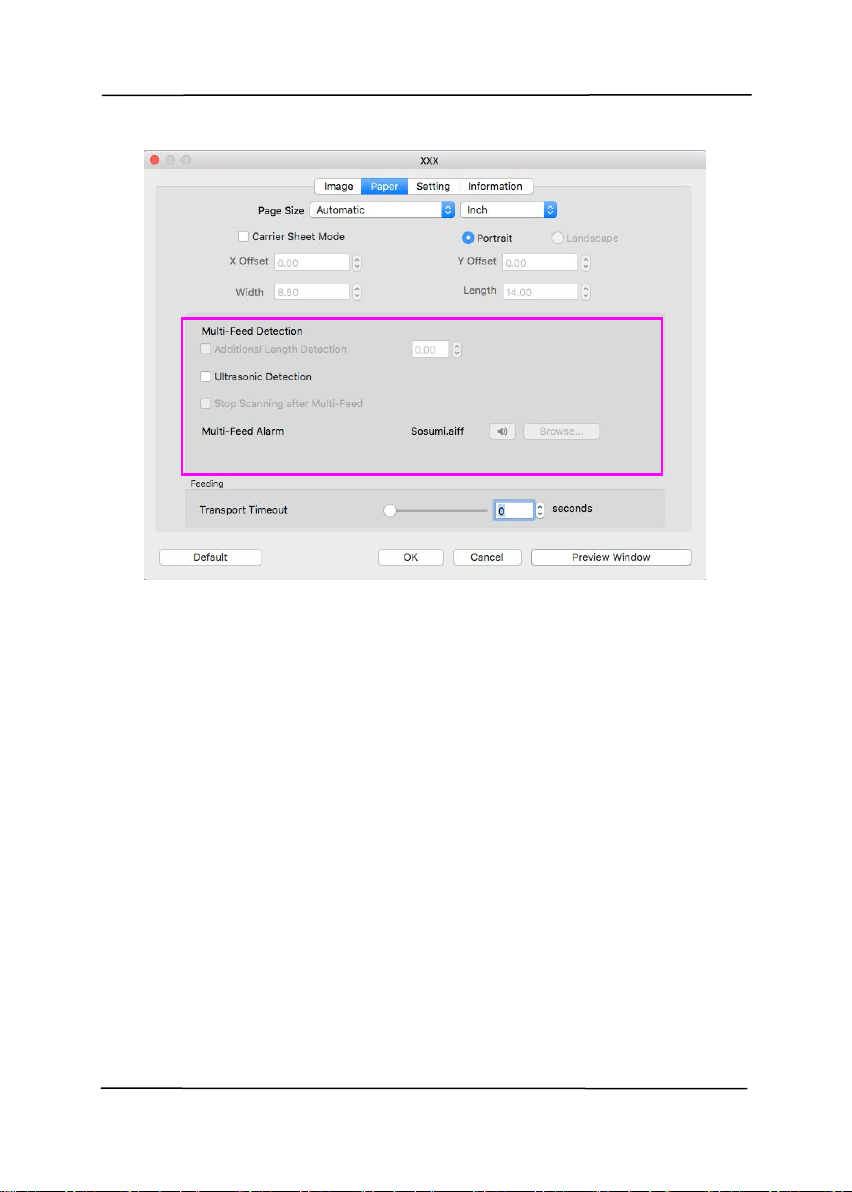
4.7 The Multi-Feed Detection Tab
Multi-Feed Detection
Multi-Feed Detection allows you to detect overlapped document
that go through the auto document feeder. Multi-Feed usually
occurs due to stapled documents, adhesives on documents, or
electro-statically charged document. Note: The availability of
the function varies based on type of scanner.
The Multi-Feed Detection Tab (Windows)
User’s Manual
4-59
The Multi-Feed Detection Tab (Mac)

User’s Manual
4-60
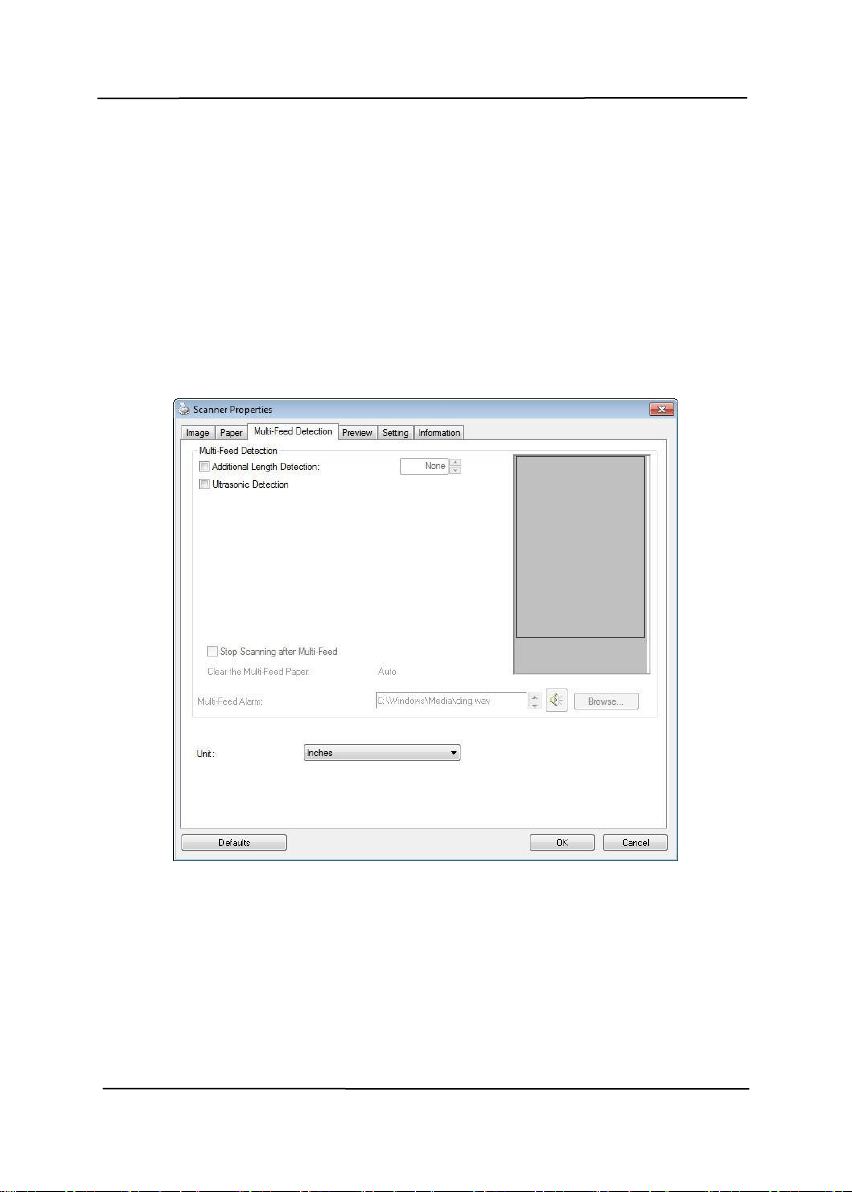
Additional Length Detection
Additional Length Detection allows you to define the length of
document being multi-fed. This value indicates the additional
length exceeding your scan area. The Display window will
show the size of the document as you change the value. A
value of 0 indicates no additional length detection. The
Additional Length Detection is best used when scanning same-
size documents in the auto document feeder.
Ultrasonic Detection
Ultrasonic Detection allows you to set overlapped document by
detecting paper thickness between documents. Note: The
availability of the function varies based on type of scanner.
There are two options available if Multi-Feed is detected.
Stop Scanning after Multi-Feed
If this is selected, the scanner will stop the feeder and
prompt a multi-feed warning message. In addition,
the multi-feed paper will be ejected from the scanner
automatically.
Note: The availability of the [Auto Clear Multi-Feed
Paper] feature varies based on scanner type. If your
scanner does not support this feature, remove the
multi-feed paper manually.
If this is not selected, the scanner will continue
scanning the entire document though multi-feed is
detected. After the entire document has been scanned,
a multi-feed dialog box will be prompted to indicate
the page number which has been detected multi-feed
and need to be rescanned.

User’s Manual
4-61
Multi-Feed Alarm
If a wave file is added, the scanner will make a sound
alarm if multi-feed is detected yet no Warning dialog box
will be displayed.
How to add the sound alarm:
1. Click the Browse button on the right side of the speaker
icon. The Open dialog box appears.
2. Choose your wave file.
3. Click the Open button. The wave file is added.
Units
Defines the primary measurement system. Inches,
Millimeters, and Pixels are available.
User’s Manual
4-62
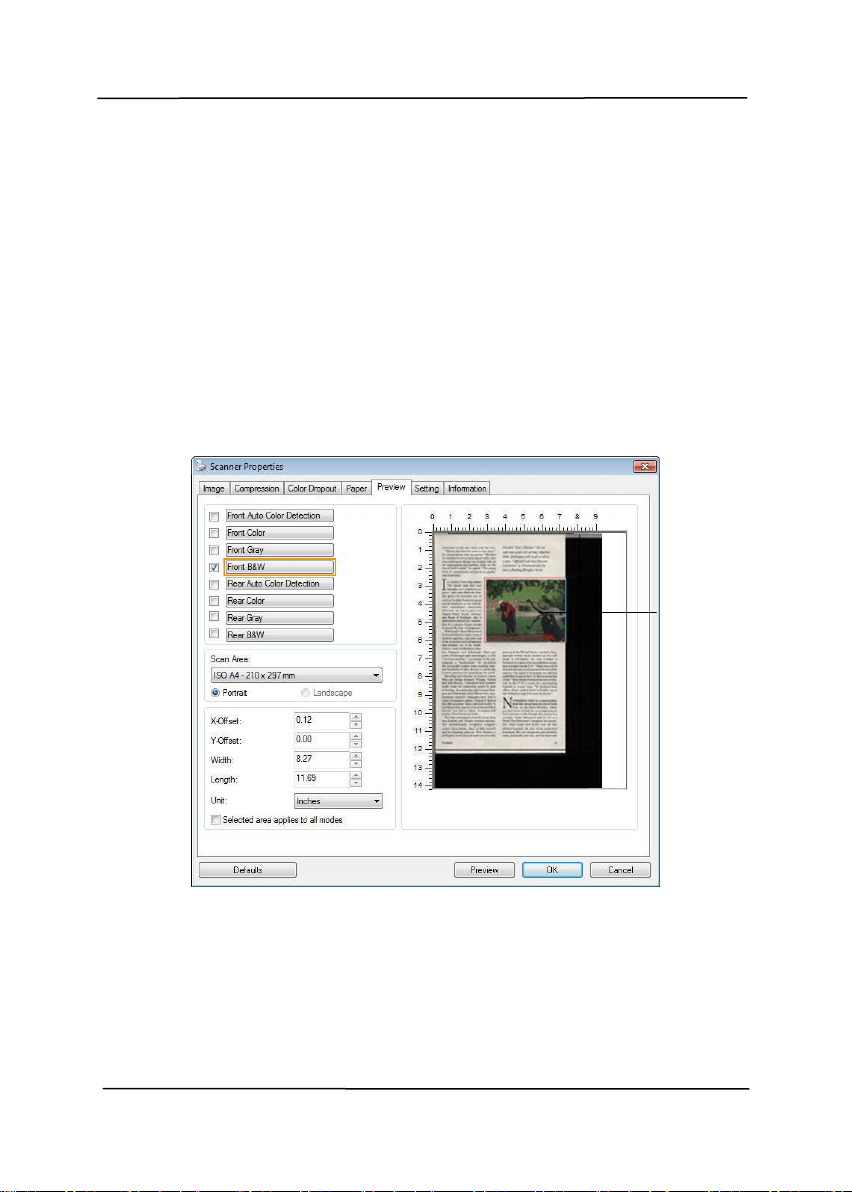
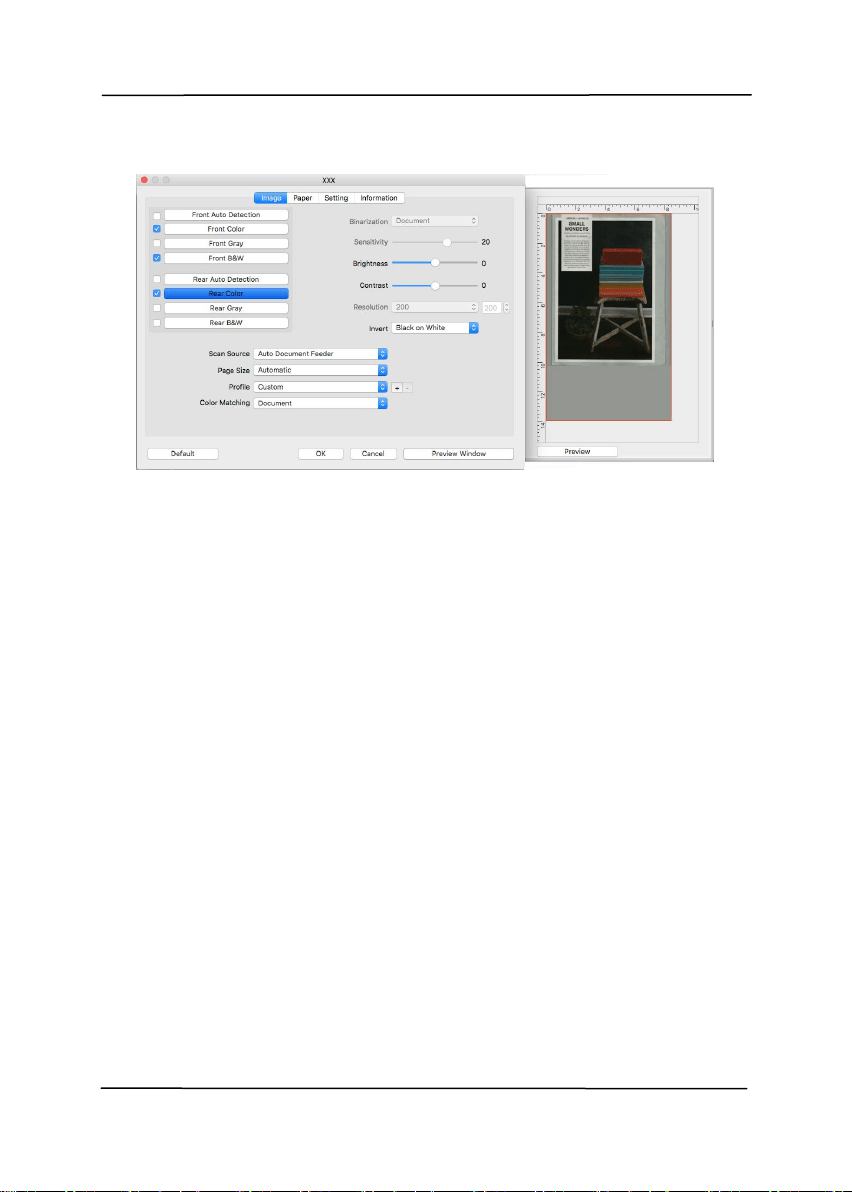
4.8 The Preview Tab
The Preview tab allows you to preview (a low-resolution scan)
your image before final scan. This preview image lets you
allocate your scan area. You can choose your scan area by the
“Scan Area” drop down list box or placing your cursor on the
Display window and dragging it diagonally on the Display
window. Then, a red rectangle box will appear to indicate the
selected area.
Note: If you choose “Automatic Cropping” on the “Paper Tab”,
then to select a scan area on the Preview tab is not allowed.
The Preview Tab (Windows)
The Display
Window
User’s Manual
4-63
The Preview Tab (Mac)
User’s Manual
4-64
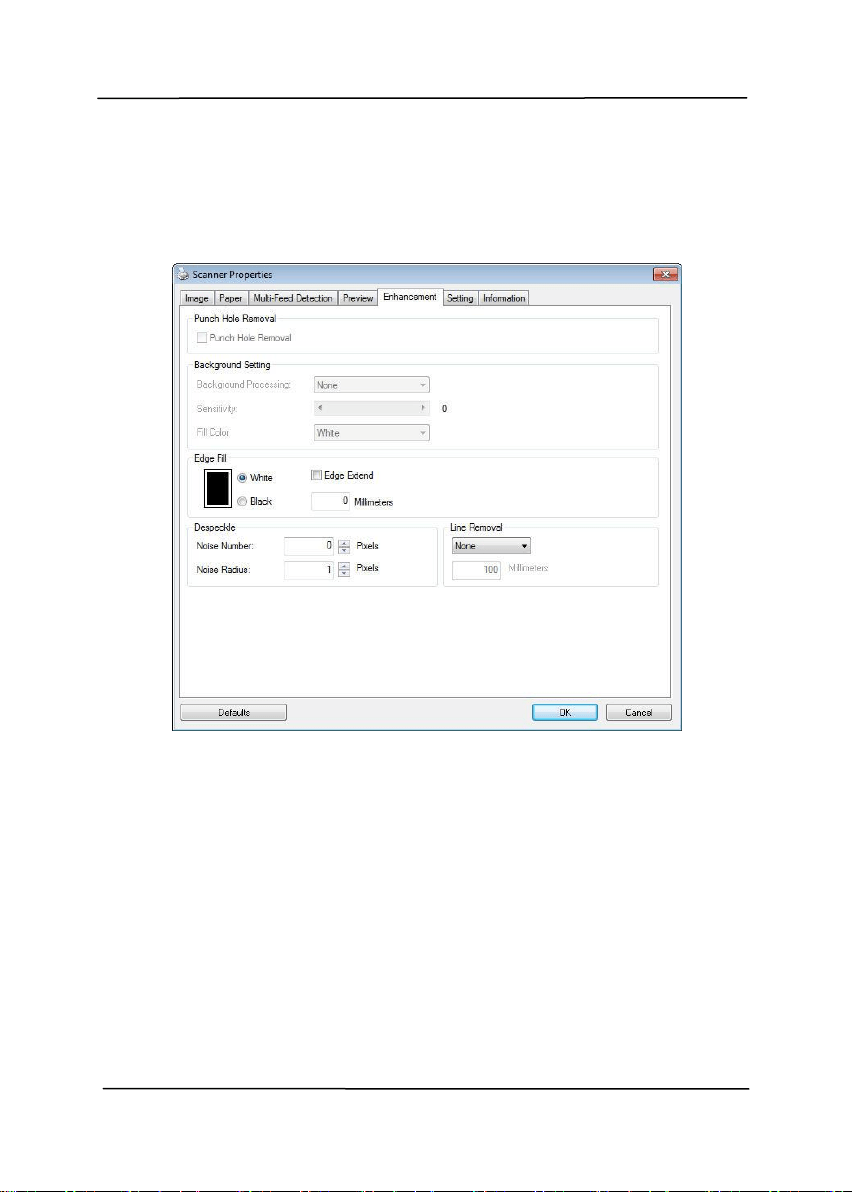
4.9 The Enhancement Tab
The Enhancement tab allows you to set following additional
image processing settings.
The Enhancement tab dialog box (Windows)

User’s Manual
4-65
The Enhancement tab dialog box (Mac OS)
User’s Manual
4-66
Punch
Hole
Removal
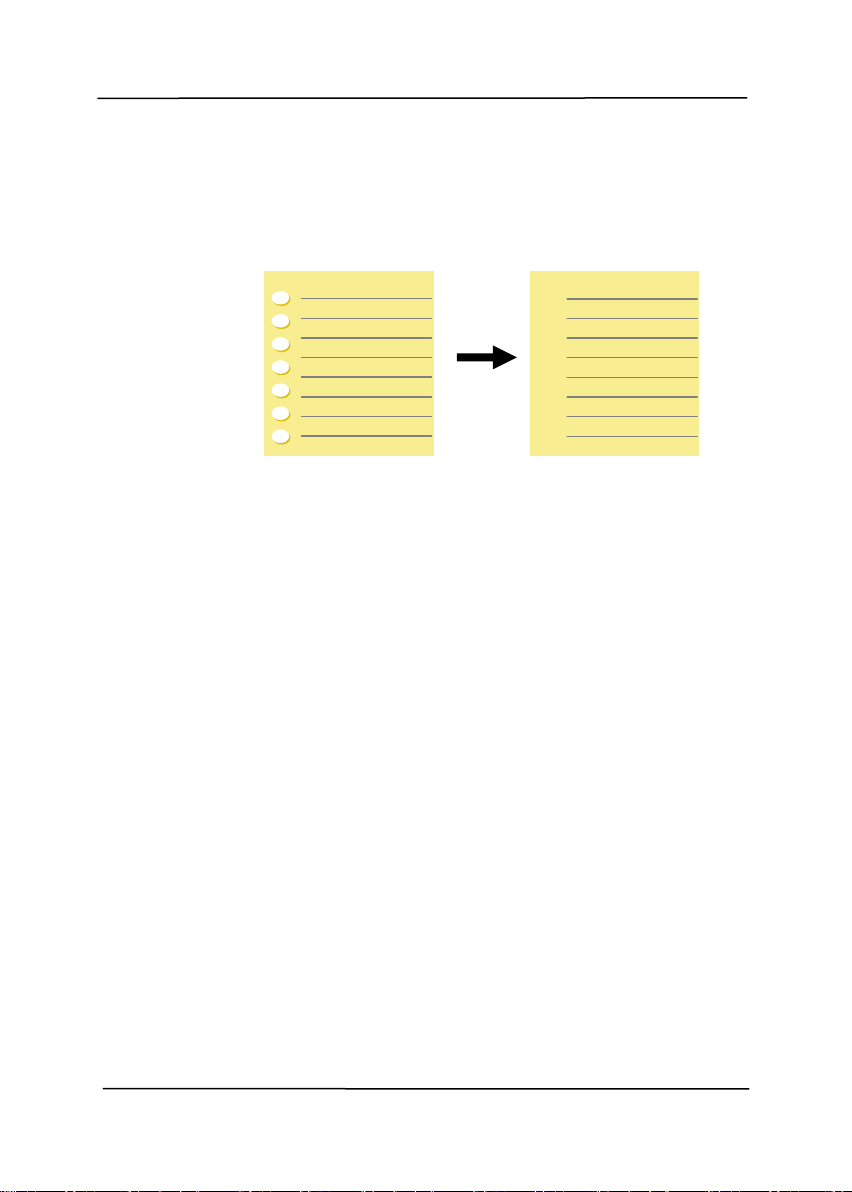
You can remove punch holes from the output
scanned image when scanning punched document.
Note the availability of this feature varies
depending on your scanner model.
Punch holes can not be removed when:
Resolution is set lower than 150dpi
The hole is near the edge of the document
The holes are not aligned along the edge of the
document
Punch Hole Removal is available only when
“Auto Crop” is enabled. If either “Fixed to
Transport”, “EOP (End of Page) Detection”,
“Automatic Multiple”, “Relative to Documents” is
selected from the Cropping option on the Paper
tab, the Punch Hole Removal option will be
disabled.
Original
Output image

User’s Manual
4-67
Shadow Removal
When 「Flatbed」on the 「Scan
Source」 option is selected on the
「Image」tab, the 「Shadow
Removal」option will be enabled. Click
to remove the shadow on the book spine
when scanning a book.
Before Shadow
Removal
After Shadow Removal

User’s Manual
4-68
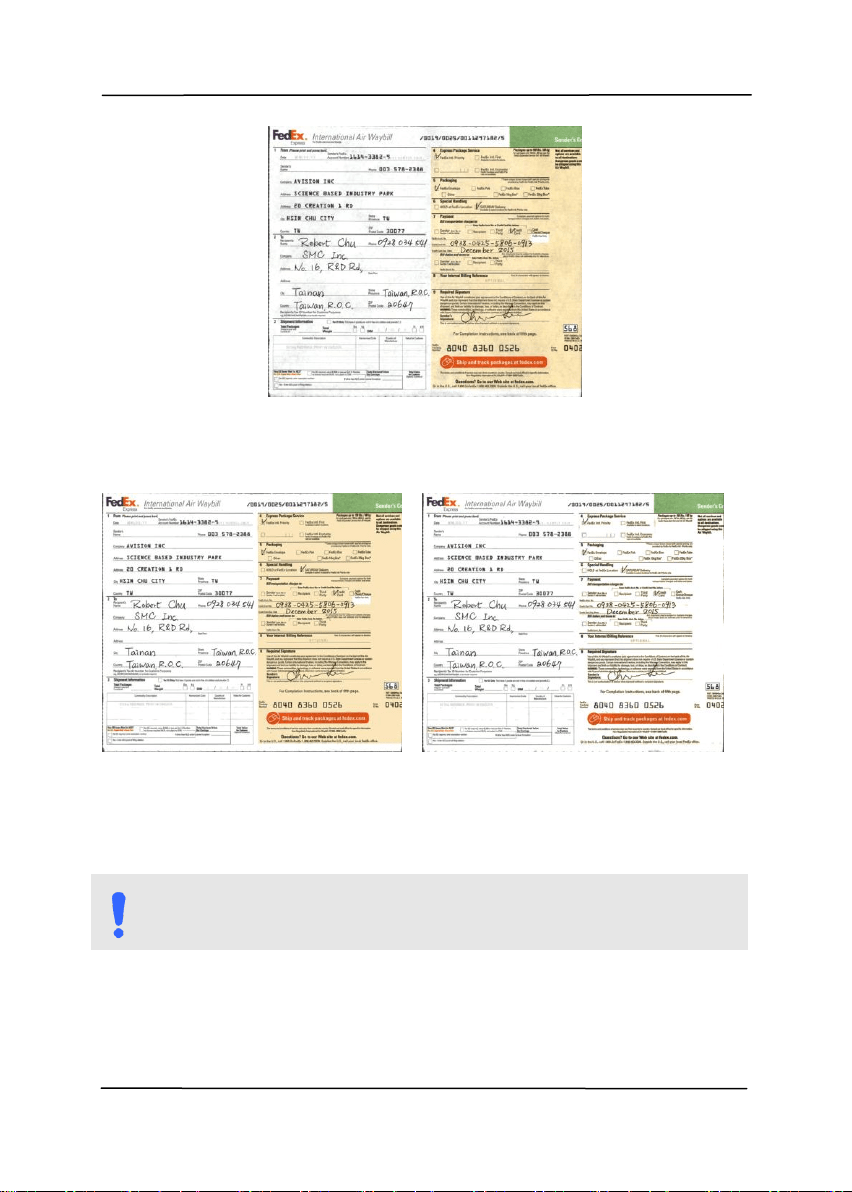
Background Processing: The [Background Processing]
option allows you to smooth background color or remove it to
make image clearer. The option is especially useful for
documents with color forms such as invoices.
Choices: None (default), Smooth, Removal
- None - no background processing will be performed
(default)
- Smooth - produces images with a more uniform
background color. This option improves image quality.
- Removal - identifies the background color and then
removes it.
Sensitivity: Choice: 0, 1, 2, 3, 4. Default: 0
- The higher the value, the more background color will be
kept.
Mode: Auto, Moiré
If [Smooth] is selected in the [Background Processing]
option, then the choices for the [Mode] option includes Auto,
and Moiré.
- Auto - uses the factory preprogrammed mode to proceed
background smoothing.
- Moiré – Remove the moiré patterns that appear on the
background of the image when scanning printed material.
If [Removal] is selected in the [Background Processing]
option, then the [Mode] option will be replaced with [Fill
Color]. Choices: White, Auto.
- White - identifies the background color and substitutes it
with white.
- Auto - identifies the background color and substitutes it
with the color of the largest background zone.
User’s Manual
4-69
Background Processing: None
Background Processing:
Smooth
Background Processing:
Removal
Fill Color: White
NOTE:
Background color in small zone will not be processed or
removed.
User’s Manual
4-70
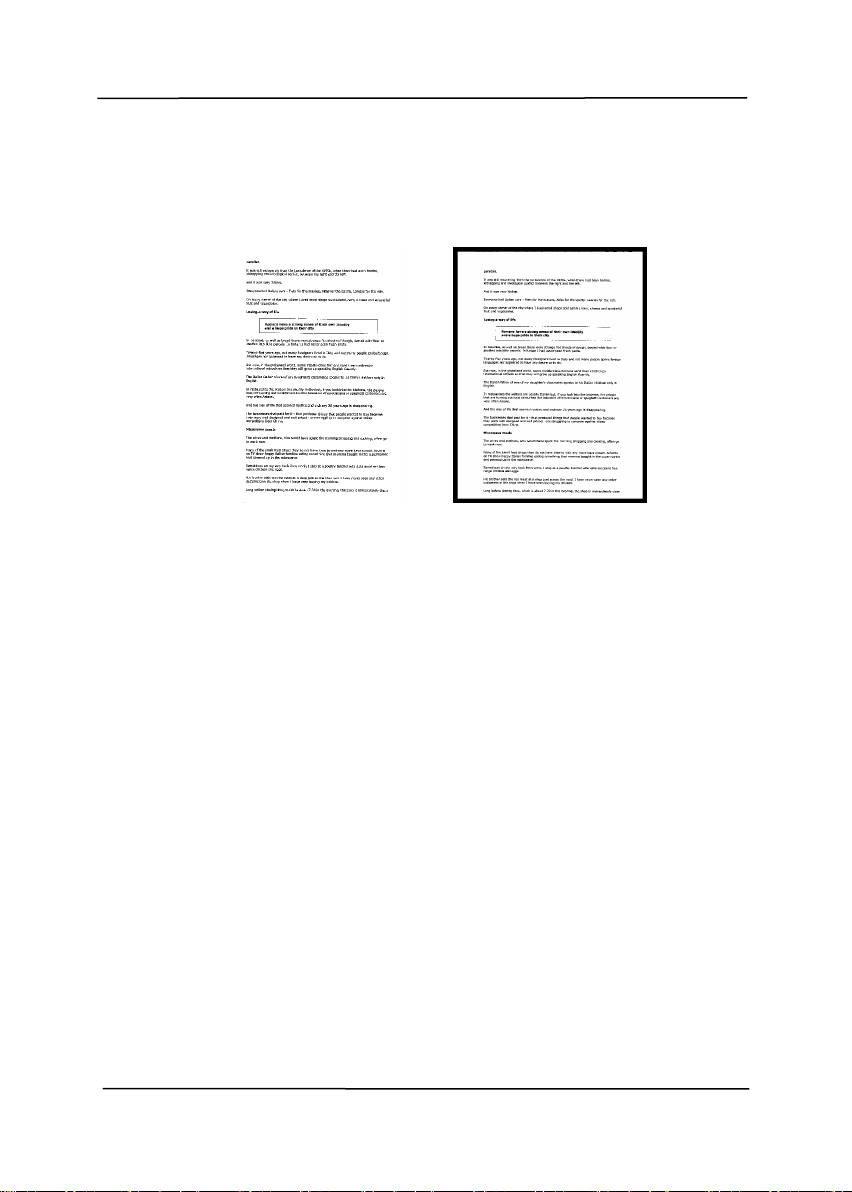
Edge
Fill
Check White or Black if you wish to add white or
black edge on the border of your scanned image.
Enter the value from 0 to 5 mm. Default value is 0.
Original
Edge Fill: 5mm (Black)
If you want to add a white or black frame on the
edges of the scanned image, check "Edge
Extension".
The default value is 0. The maximum value is half of
the short side of the selected scan area.
For example, if you choose an A4 size (8.26
"X11.69"), then the maximum value of the white or
black box is 4.14" (half of "8.26").
User’s Manual
4-71
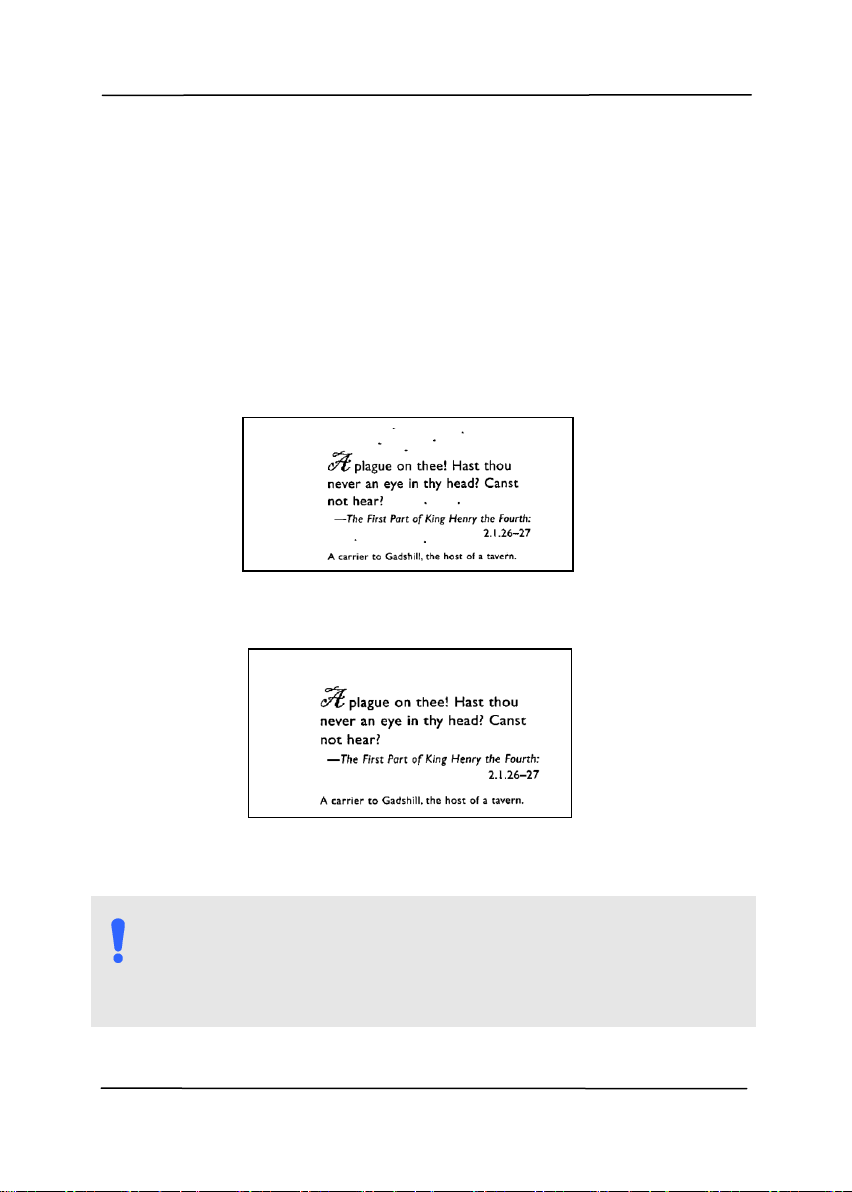
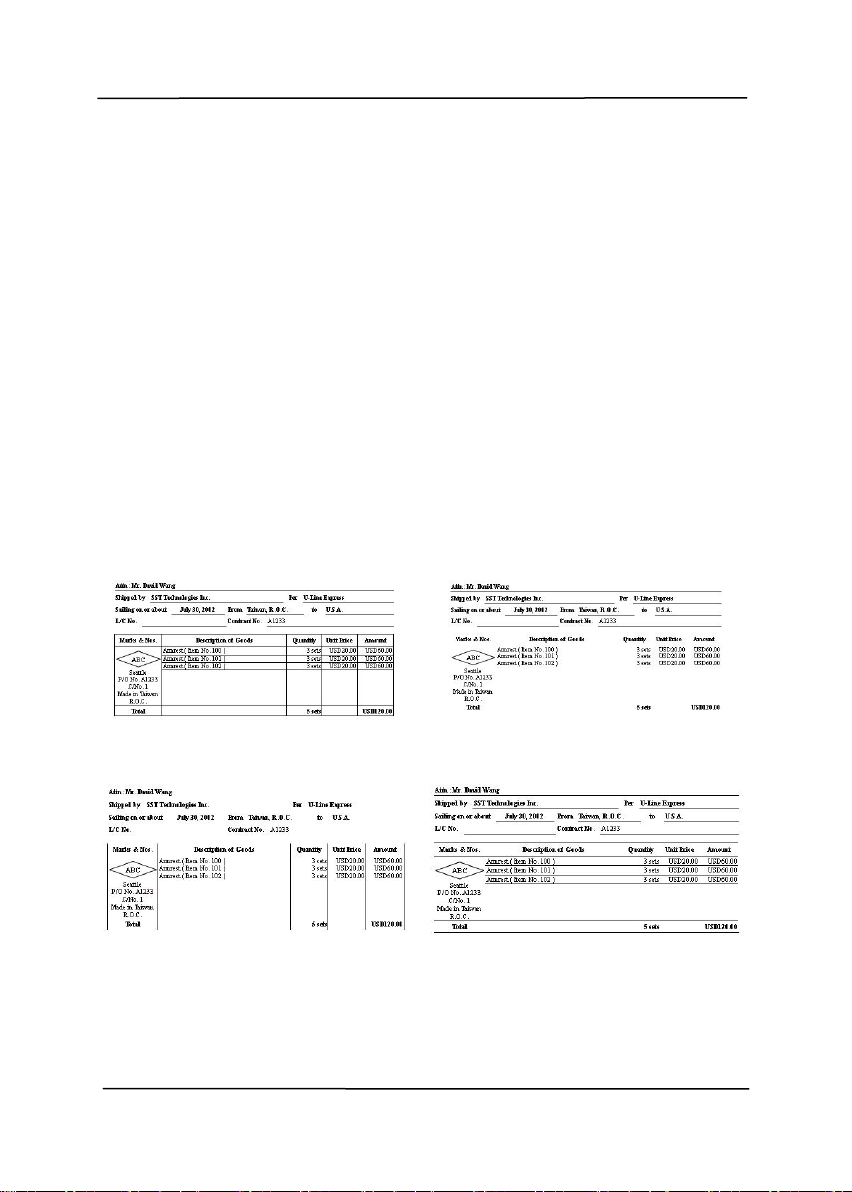
Despeckle
Occasionally small dots or specks appear in the background of
a scanned image. Remove unwanted speckles provides a
cleaner image for OCR (Optical Character Recognition)
processing, and also helps to reduce compressed file size.
Define the speckles (also known as image noise) you wish to
remove by specifying its number (size) and radius (range). The
measuring unit is pixel. The higher the number, the more
speckles will be removed.
Before Despeckle
(noise number:0, noise radius:1)
After Despeckle
(noise number:22, noise radius:10)
NOTE:
The function is currently available for Black and White
image only.
To scan at rated speed, it is recommended to set the
noise radius up to 10 pixels.
User’s Manual
4-72
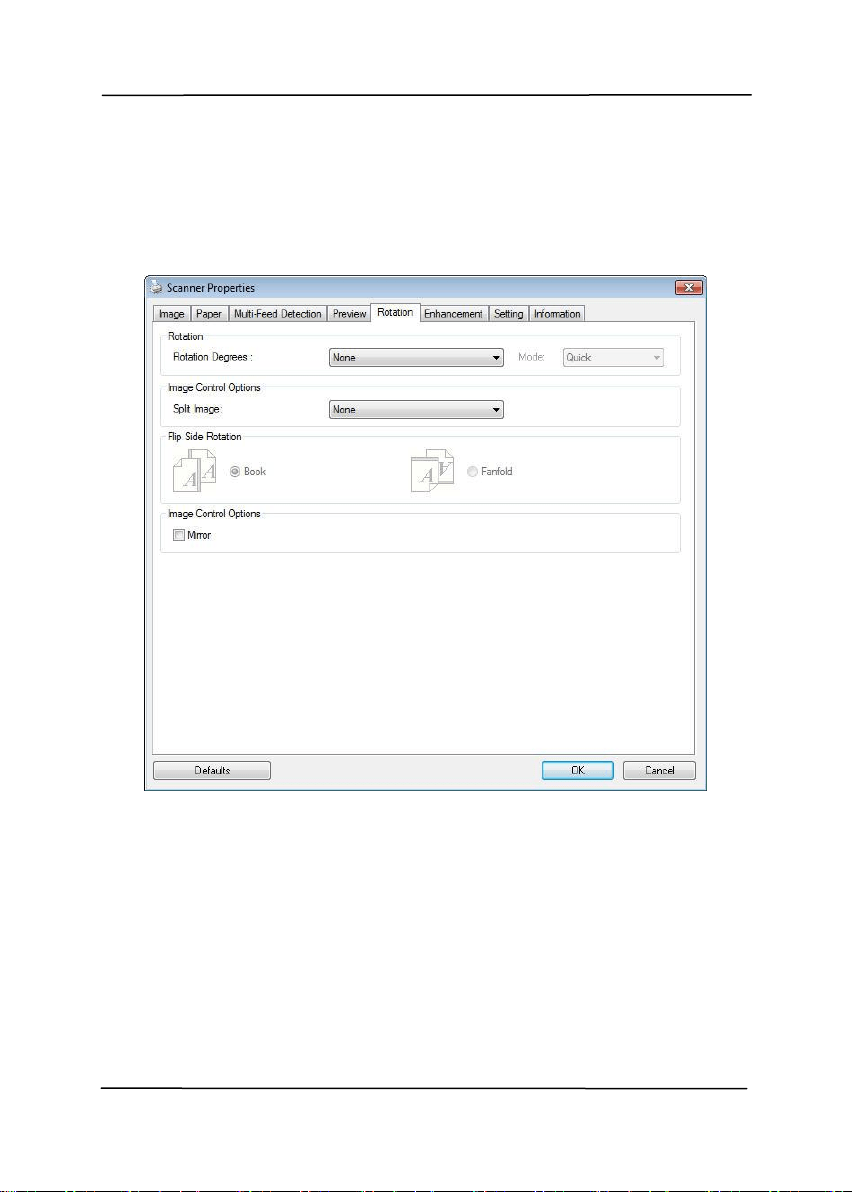
Line Removal: When Black and White image mode is
selected on the [Image] tab, the [Line Removal] option will
be enabled. Line Removal erases lines on the image and then
reconstructs characters so the OCR (Optical Character
Recognition) accuracy can be improved.
Choices: None, Form, Horizontal, Vertical
None – the default mode which does not remove any line.
Form – remove any form in the document.
Horizontal – select [Horizontal] and then enter the length of
horizontal line to remove only the horizontal line exceeding
your specified length.
Vertical – select [Vertical] and then enter the length of
vertical line to remove only the vertical line exceeding your
specified length.
None
Remove Form
Remove Horizontal Line
(over 30 mm)
Remove Vertical Line
(over 70 mm)
User’s Manual
4-73
4.10 The Rotation Tab
The Rotation tab allows you to set the following image rotating
options:
The Rotation Tab (Windows)

User’s Manual
4-74
The Rotation Tab (Mac OS)
User’s Manual
4-75
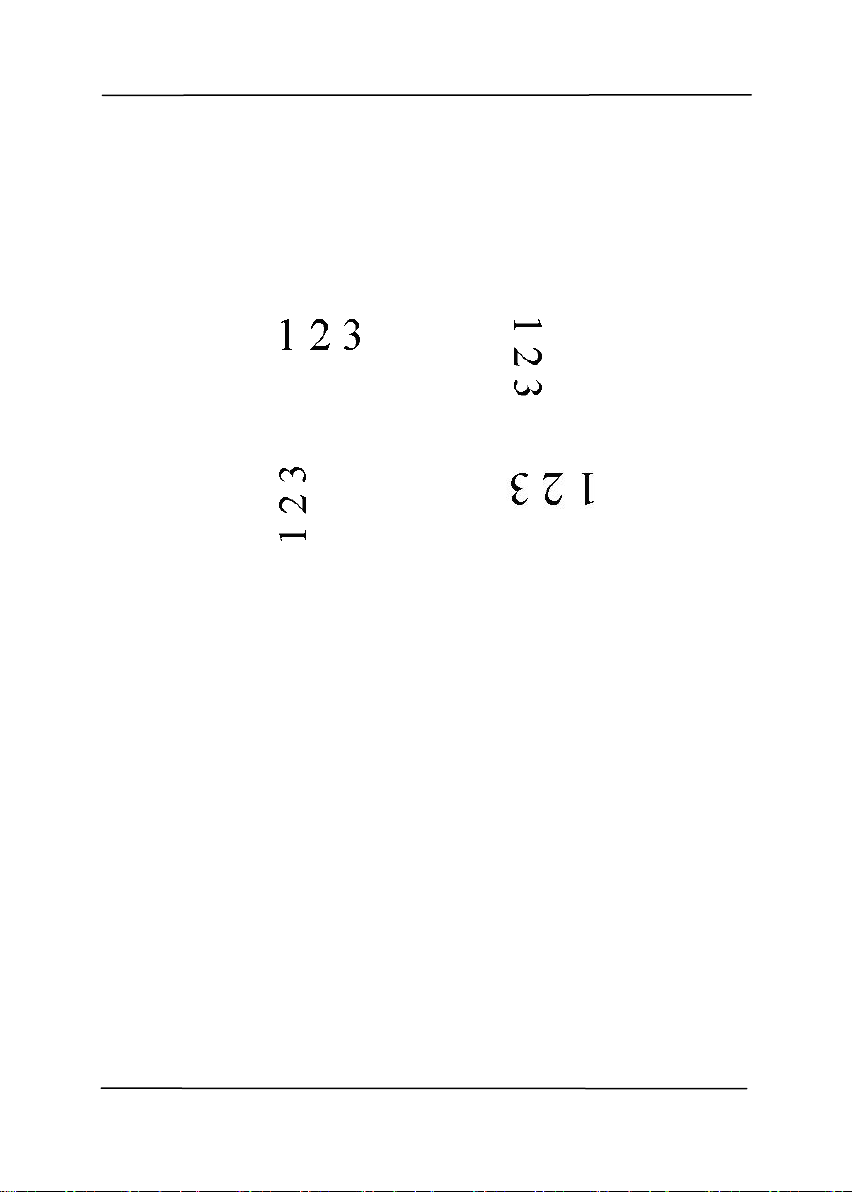
Rotate
Image
Choose the rotation angle from the drop down
list if you wish to rotate your scanned image.
Choice: None, 90°CW(clockwise),
90°CCW(counter clockwise), 180°, Auto
based on contents. Auto rotate every
even page.
Original
Rotate 90°CW
Rotate 90°CCW
Rotate 180°
Auto based on contents: Automatically
rotate images based on the contents of
document. When「Auto based on
contents」 is selected, its modes will be
enabled to let you select more options.
Mode: Quick, Full Text, Complexity
Quick – the default mode to let you rotate
images at the fastest speed.
Full Text – the enhanced mode for
documents with mixed text orientation.
Complexity – the enhanced mode yet at the
slowest speed for document with complex
image or text orientation.
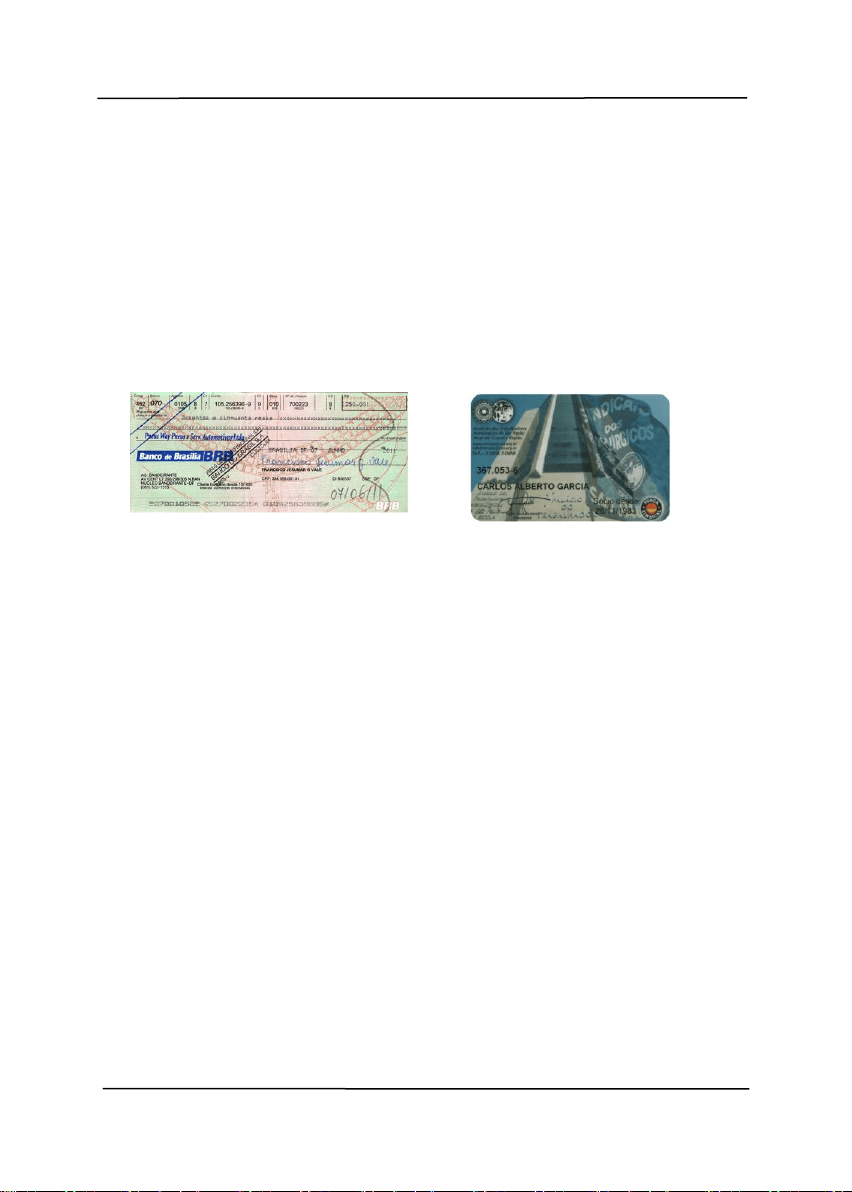
User’s Manual
4-76
Auto rotate every even page:
Automatically rotate 180° on every even
page. This is especially useful when you scan
the inside pages from a book. As a result, if
you choose “Flatbed (book)” from the “Scan
Source” option, “auto rotate every even page”
will be selected as default.
Note: This option varies based on type of
scanner.
Document with various
text orientations
Document with dark or
complex background
User’s Manual
4-77
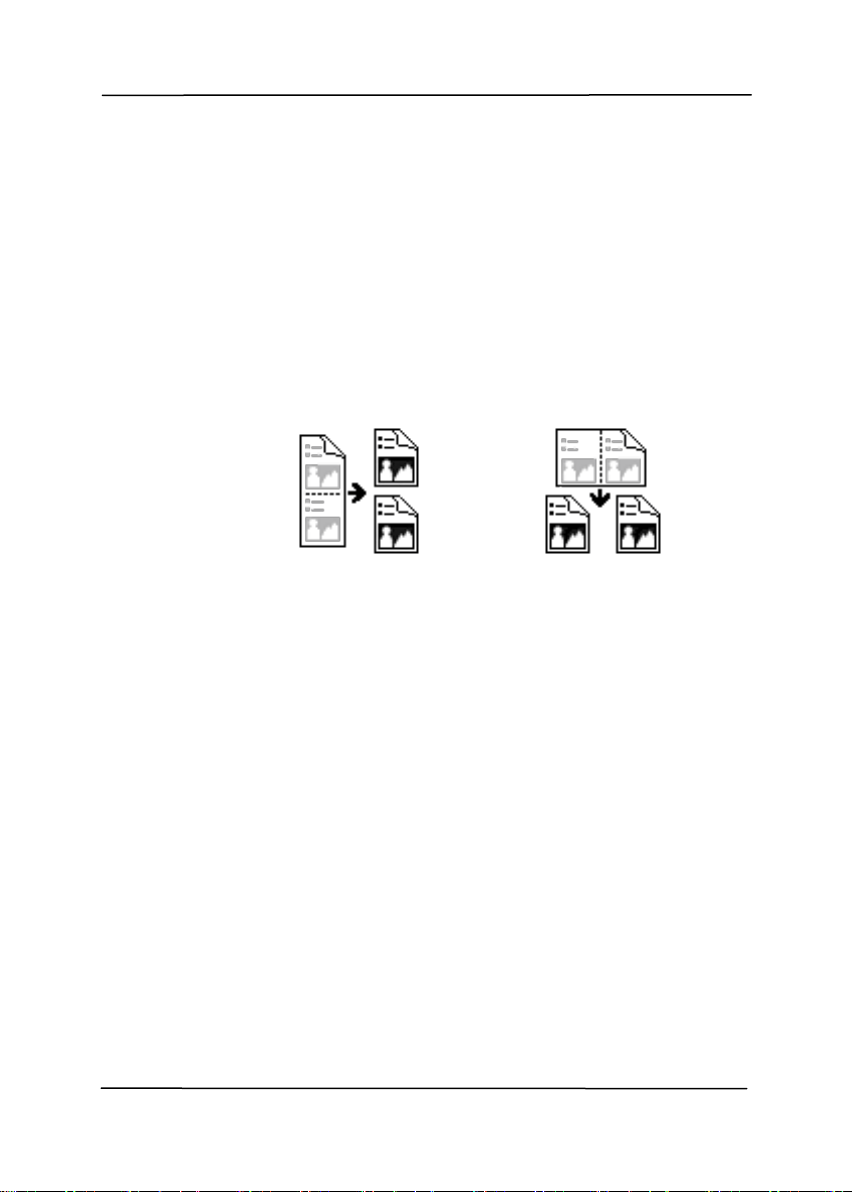
Split
Image
By splitting an image, two separate images are
created horizontally or vertically. This is useful
for documents containing two pages per image
when you want to save them as two images
(one page for one image). Choice: None,
Horizontal, Vertical. Default is None.
Horizontal: Divide one image into the upper
half and the lower half.
Vertical: Divide one image into the left half and
the right half.
Split Horizontally
Split Vertical

User’s Manual
4-78
Flip Side
Rotation
Select “fanfold” to rotate the image of the
reverse side to 180 degrees.
This is applied to double-sided document
which are viewed in portrait are sometime
fed into the scanner in landscape or vice
versa.
Choice: Book, Fanfold.
If “Book” is selected, the image of the
reverse side will not be rotated.
The following illustration shows the documents which should
be viewed in portrait are fed into the scanner in landscape
User’s Manual
4-79
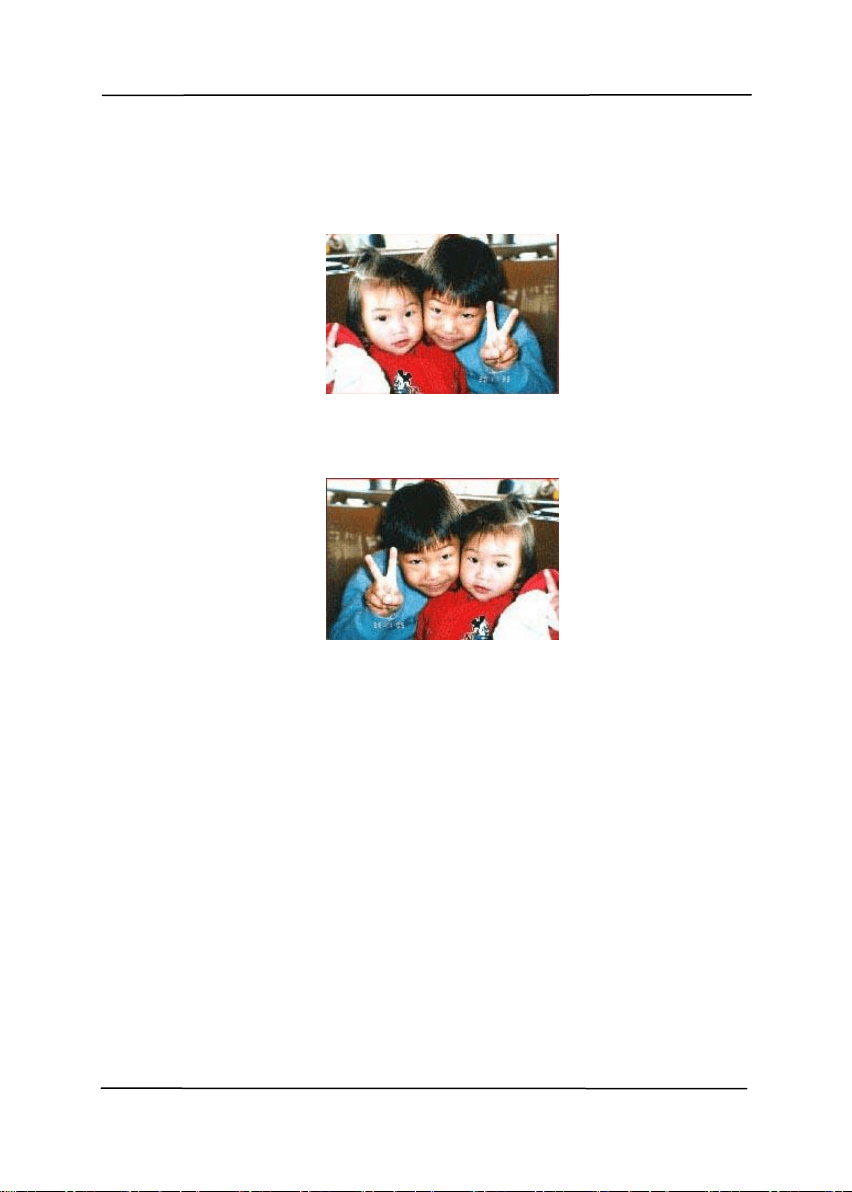
Image
Control
Option
Check the Mirror box if you wish to reverse the right
and left side of your image.
Original
The Mirror Effect
User’s Manual
4-80
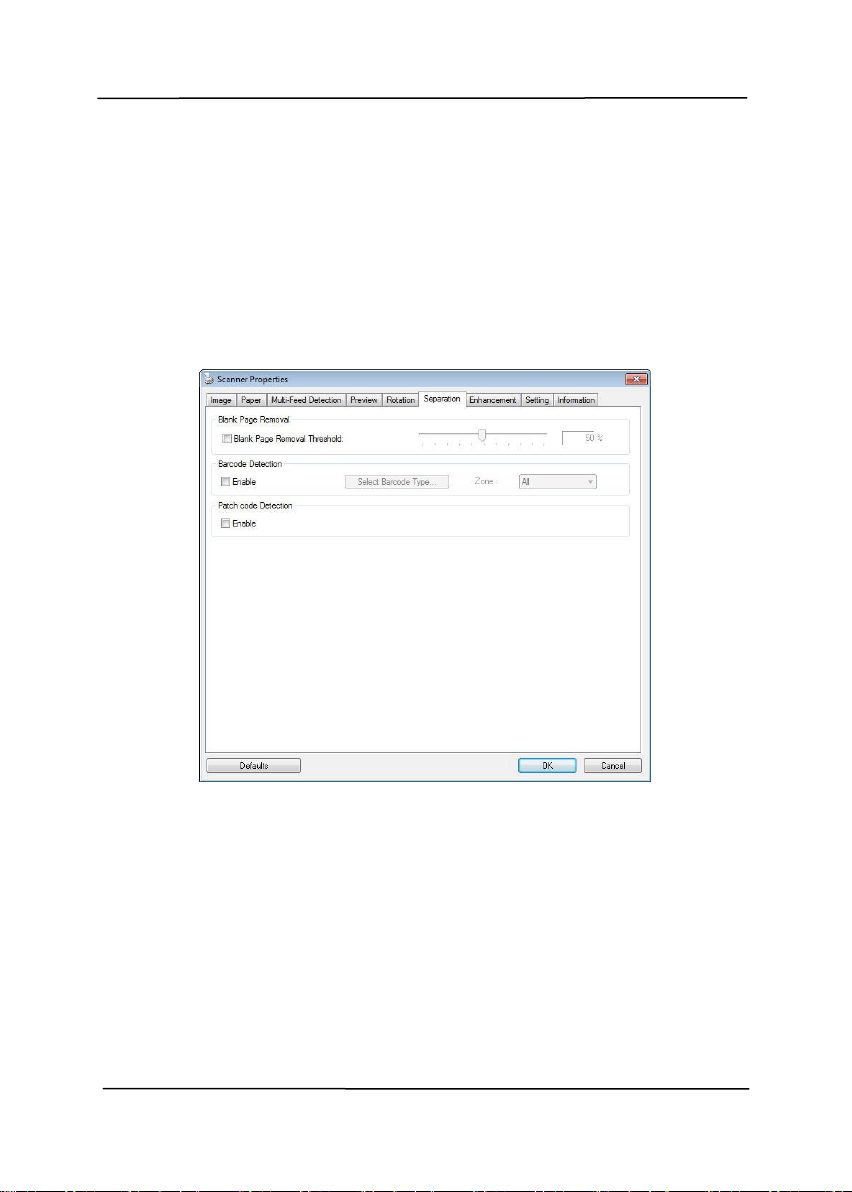
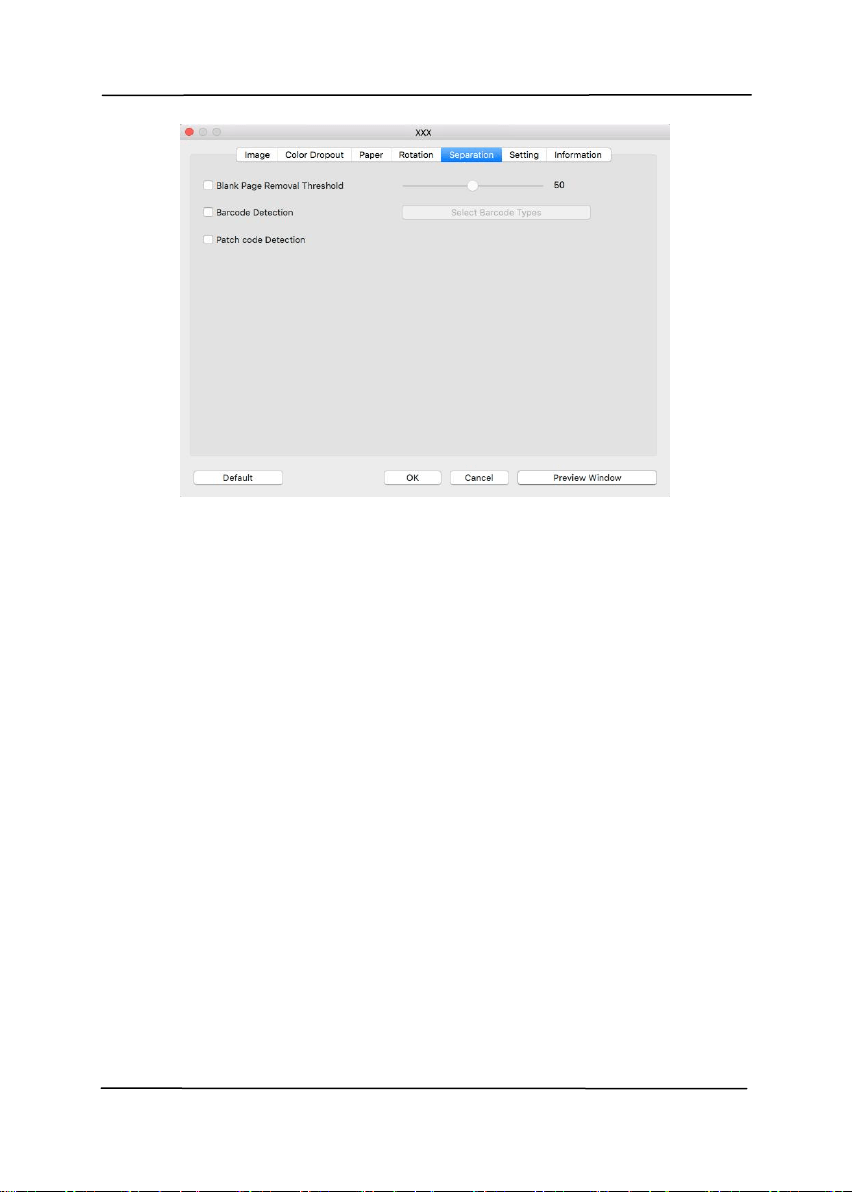
4.11 The Separation Tab
The Separation tab allows you to enable the detection engine to
detect the blank page, barcode, and patch code and then notify
the software application which supports document separation to
separate your multi-page documents. Choices: Blank Page
Removal, Barcode Detection, Patch Code Detection.
The Separation Tab (Windows)
User’s Manual
4-81
The Separation Tab (Mac OS)
Blank Page
Removal
Choices: None, Blank Page Removal Threshold,
Image Size.
None – Do not remove the blank pages.
Threshold - Move the slider to the left or right
to define your threshold for the blank page.
Image Size – Range: 1~ 10000 KB. Specify
your desired image size to detect the page as a
blank page. For example, if 3 KB is selected,
any page less than 3 KB will be recognized as
blank page.
When the bar code has been detected successfully,a file
[avbarcode.ini] will be created and stored in the following path
(Windows):
Windows 7, Windows 8, Windows 10:
C:\ProgramData\%PRODUCTNAME%

User’s Manual
4-82
Barcode Detection:
Check [Enable] to detect barcode and notify the software
application for advanced processing. Please note the whole
document will be checked and no specific detection area needs
to be designated.
Barcode Types:
The following barcode types can be detected.
Two-dimensional codes
Aztec
DataMatrix
PDF417
QR Code
One-dimensional barcodes:
Add-2
Add-5
Australian Post 4-State
BCD Matrix
Codabar
Code 128
Code 32
Code 39
Code 93
DataLogic 2 of 5
EAN 128
EAN-13
EAN-8
GS1 DataBar
Industrial 2 of 5
Intelligent Mail
Interleaved 2 of 5
Inverted 2 of 5

User’s Manual
4-83
IATA 2 of 5
Matrix 2 of 5
PostNet
Royal Post 4-State
UPC-A
UPC-E
Barcode Zone:
Specify the barcode zone to be detected.
Select 「All」 to checks the whole document and detects
barcodes. Or you may speed up the process by specifying a
detection area since only the specified area is checked.
Choice: All, Top, Bottom, Left, Right, Bottom Right,
Bottom Left, Top Right, Top Left
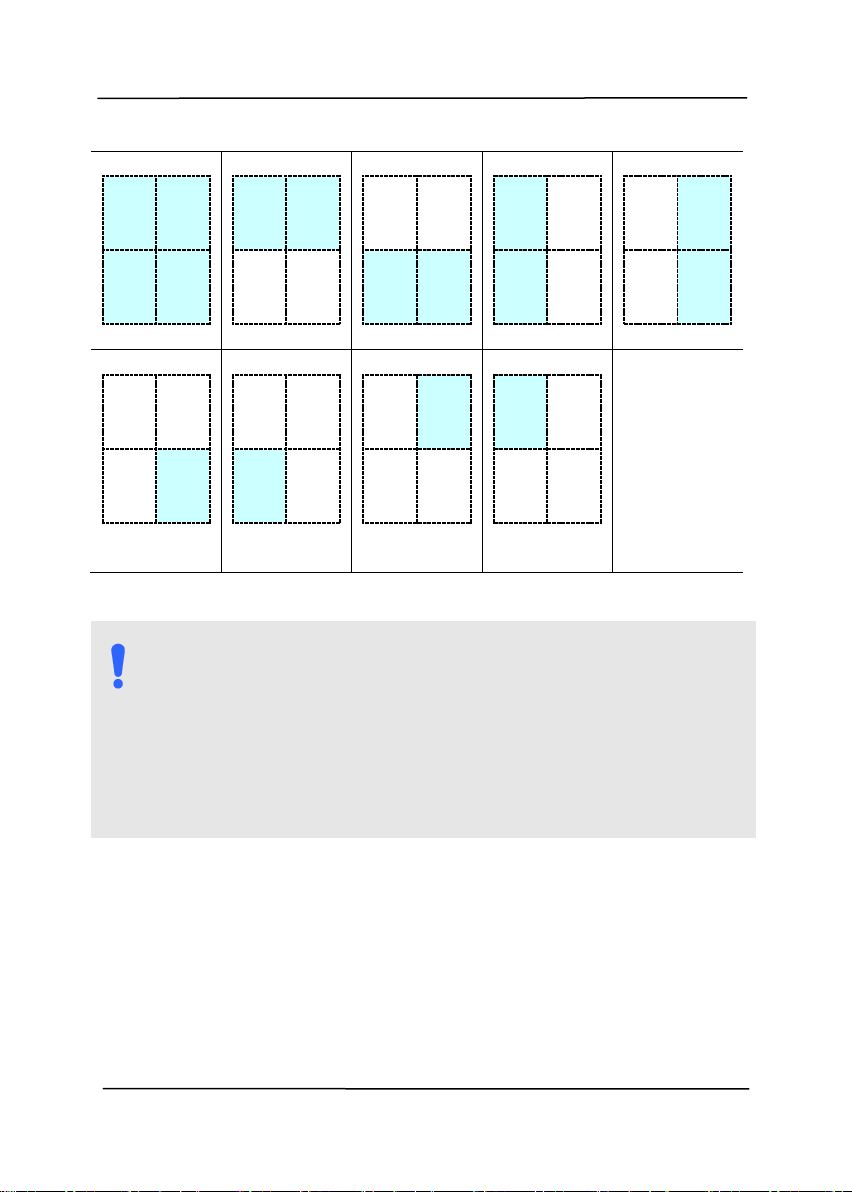
User’s Manual
4-84
Choice for barcode zone on a page:
All
Top
Bottom
Left
Right
Bottom
Right
Bottom
Left
Top Right
Top Left
NOTE:
Recommended resolution: 200~600 dpi for regular
barcode, 300~600 dpi for QR code.
Skewed barcodes may not be recognized correctly.
Using the same sheet repeatedly may decrease the
recognition accuracy due to accumulated dirt on the
sheets. If the sheet is not recognized correctly or gets
smudged, replace it with a new sheet.
Patch code Detection:
Check [Enable] to detect patch codes and notify the software
application for advanced processing.
A patch code is a pattern of parallel, alternating black bars and
spaces (i.e. a barcode) that is printed on a document. Patch
code sheet is most commonly used as a document separator in
a stack of document.
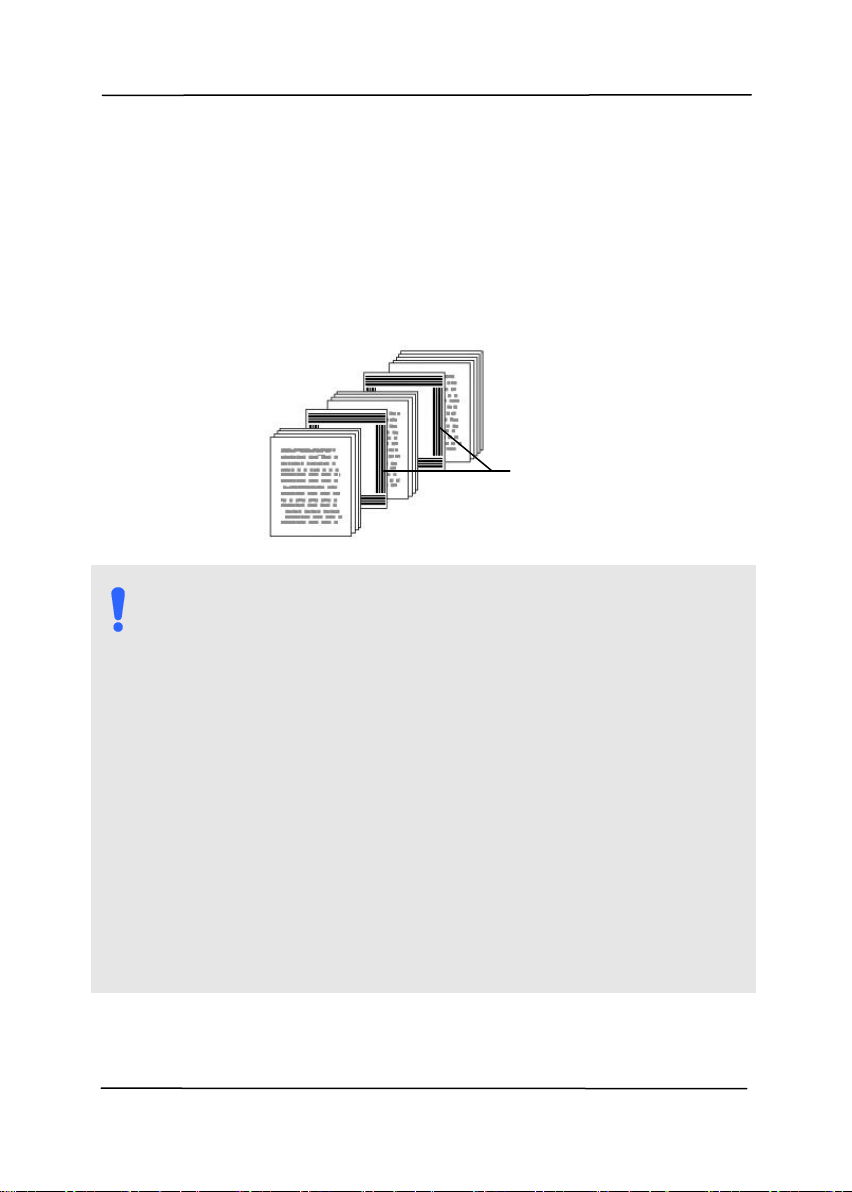
User’s Manual
4-85
You can find various sizes of patch codes (PDF) by choosing
[Start] menu>[All Programs]>[Avision Scanner
Series]>[Patch code] in succession.
Simply print the PDF file to produce the patch code sheet.
Insert the patch code sheets to wherever you want the file to
separate.
NOTES TO PRINT THE PATCH CODES:
Use blank white paper.
Set the scaling to 100%. The sheet is not recognized
correctly when printed in a size smaller than the
original.
Do not use toner saving mode. The sheet is not
recognized correctly when the print is too light.
Do not use thin paper in order to avoid bleed-through
from the back.
When you copy a patch code sheet that you printed
out, make sure to copy by the same size and
brightness as the original copy.
Use the same sheet repeatedly may decrease the
recognition accuracy due to accumulated dirt on the
sheets. If the sheet is not recognized correctly or gets
smudged, replace it with a new sheet.
Patch code sheet
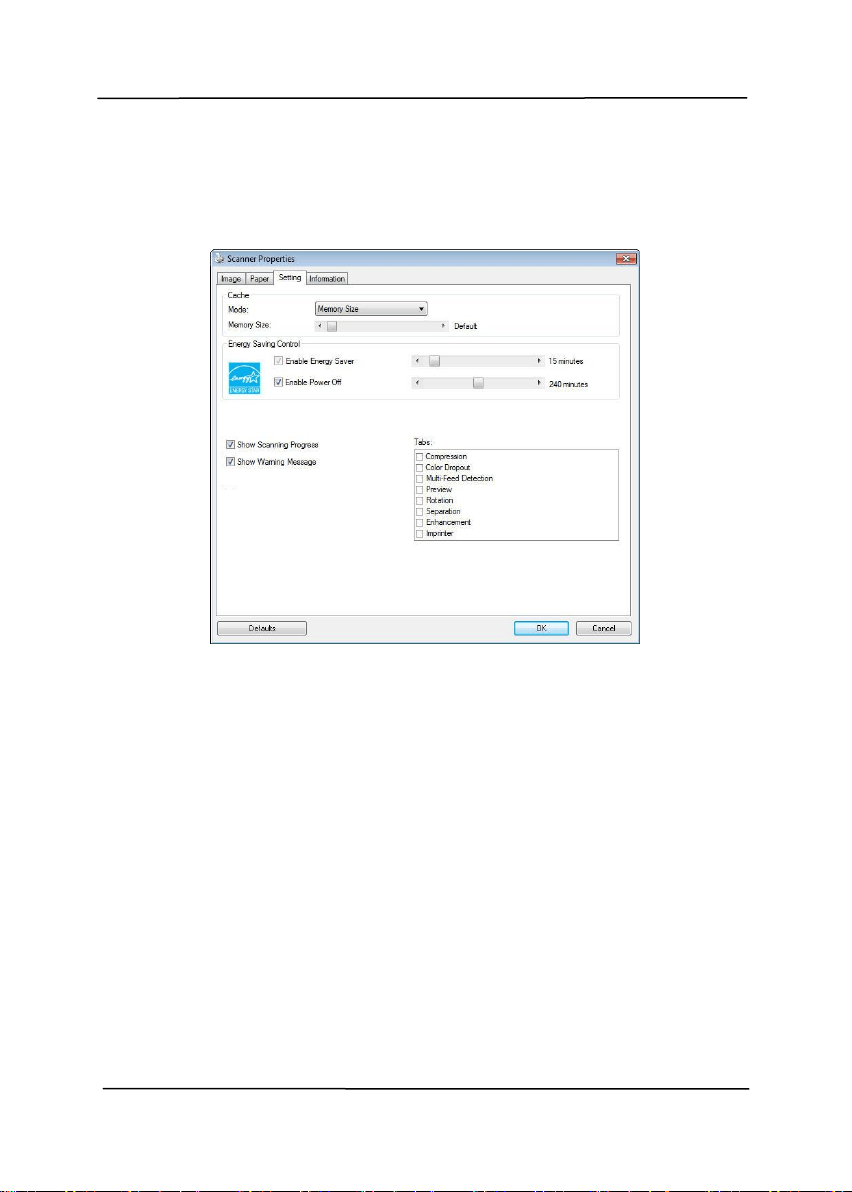
User’s Manual
4-86
4.12 The Setting Tab
The Setting tab allows you to set the following settings:
The Setting tab dialog box (Windows)
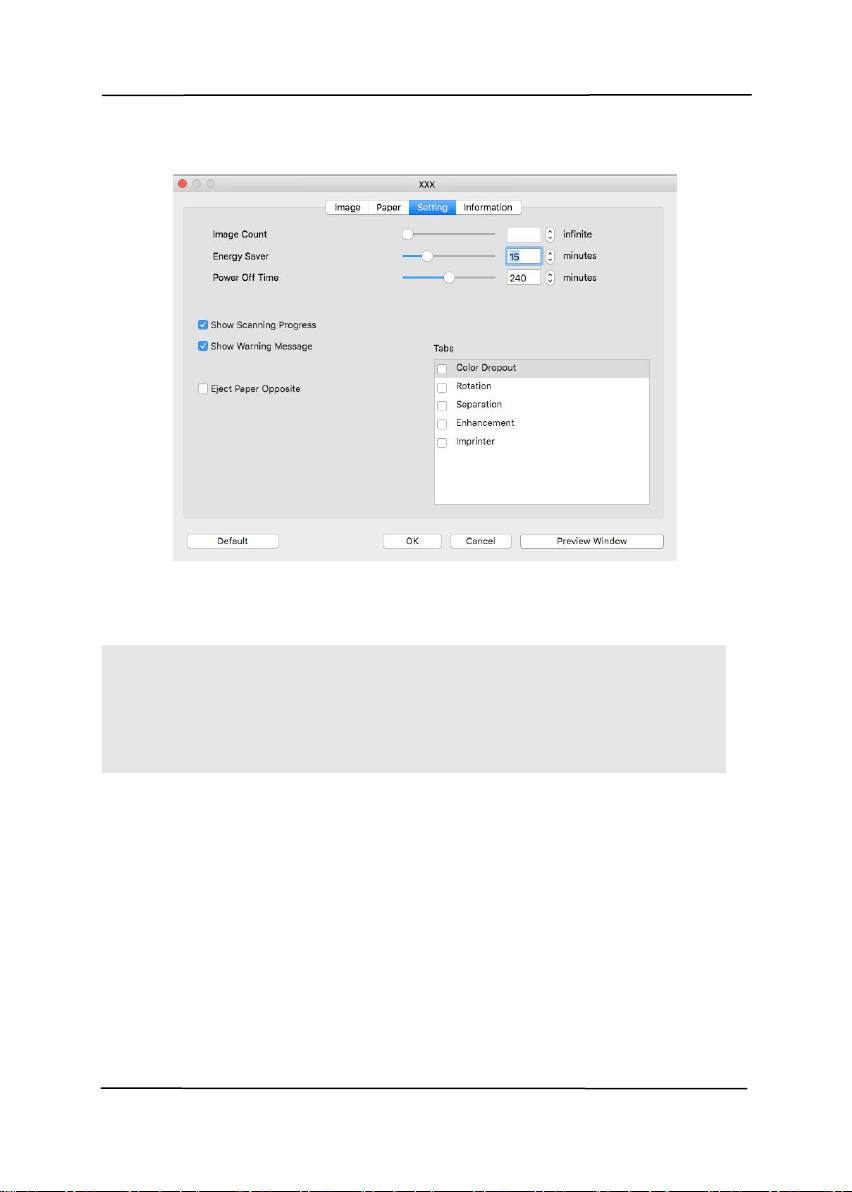
User’s Manual
4-87
The Setting tab dialog box (Mac OS)
Energy Saving
Control
Check the Enable Energy Saver box
and move the slider to set the amount
of time to start the energy saver after
your last action. The range is from 1 to
60 minutes.
Enable Power
Off
Check the Enable Power Off box and
move the slider to set the amount of
time to automatically turn off the
scanner after your last action. The
range is from 1 to 480 minutes. The
default is 240 minutes (4 hours). Note
the value of “Power Off” has to be
greater than or equal to the value of
“Energy Saving”.

User’s Manual
4-88
Cache
Mode: None, Page Number, Memory
Size.
This option allows you to assign a specified
memory size from the available RAM to
process the image data. By specifying a
smaller memory size, you can free more
memory for other applications you are
running. By specifying a larger memory
size, you can have more memory to
process the image data especially when you
have a large amount of documents needed
to be scanned.
You can also specify your memory size by
the page number. For your information, an
A4 color document scanning at 300 dpi
consumes approximates 24MB.
Image Count
When the selected cache mode is “none”,
the image count option allows you to assign
number of pages you need to scan. For
example, if you wish to scan the first two
pages, simply move the page slider to 2,
and the scan action will be stopped when
the scanning of the first two pages have
been completed.
Show
Scanning
Progress
Check and the scanning progress bar will
be shown during scanning.

User’s Manual
4-89
Show Warning
Message
Check to show the warning messages
such as “ADF pad count exceeds
50,000 scans (the number varies based
on type of scanner). Please replace the
ADF pad and reset the pad count.”
Save Settings
after Closing
Check to save your scanner properties
settings after leaving the dialog box.
Next time when you open the Scanner
Properties dialog box, the previously
saved settings will be shown.
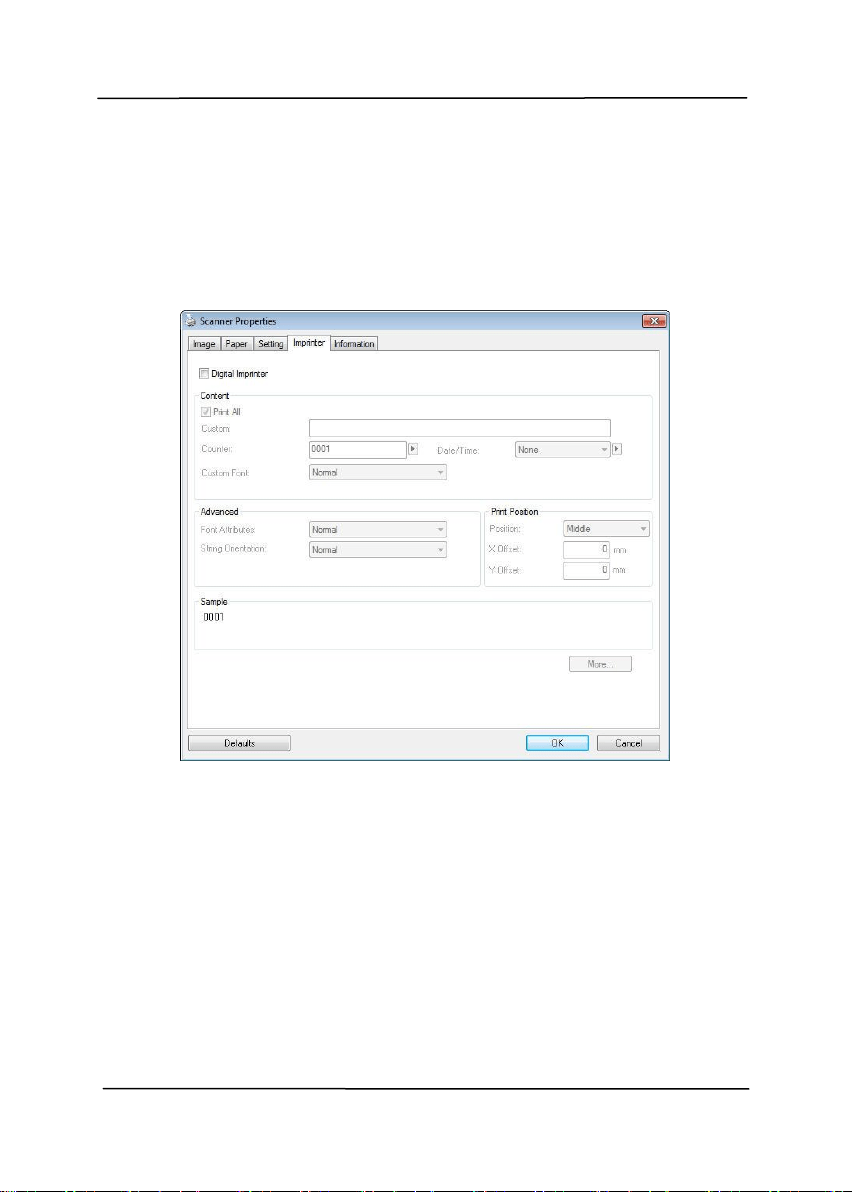
User’s Manual
4-90
4.13 The Imprinter Tab
The Imprinter tab allows you to print alphanumeric characters,
date, time, document count and custom message on your
scanned image if digital imprinter is selected or at the back of
your document if external imprinter is selected.
The Imprinter Dialog Box (Windows)
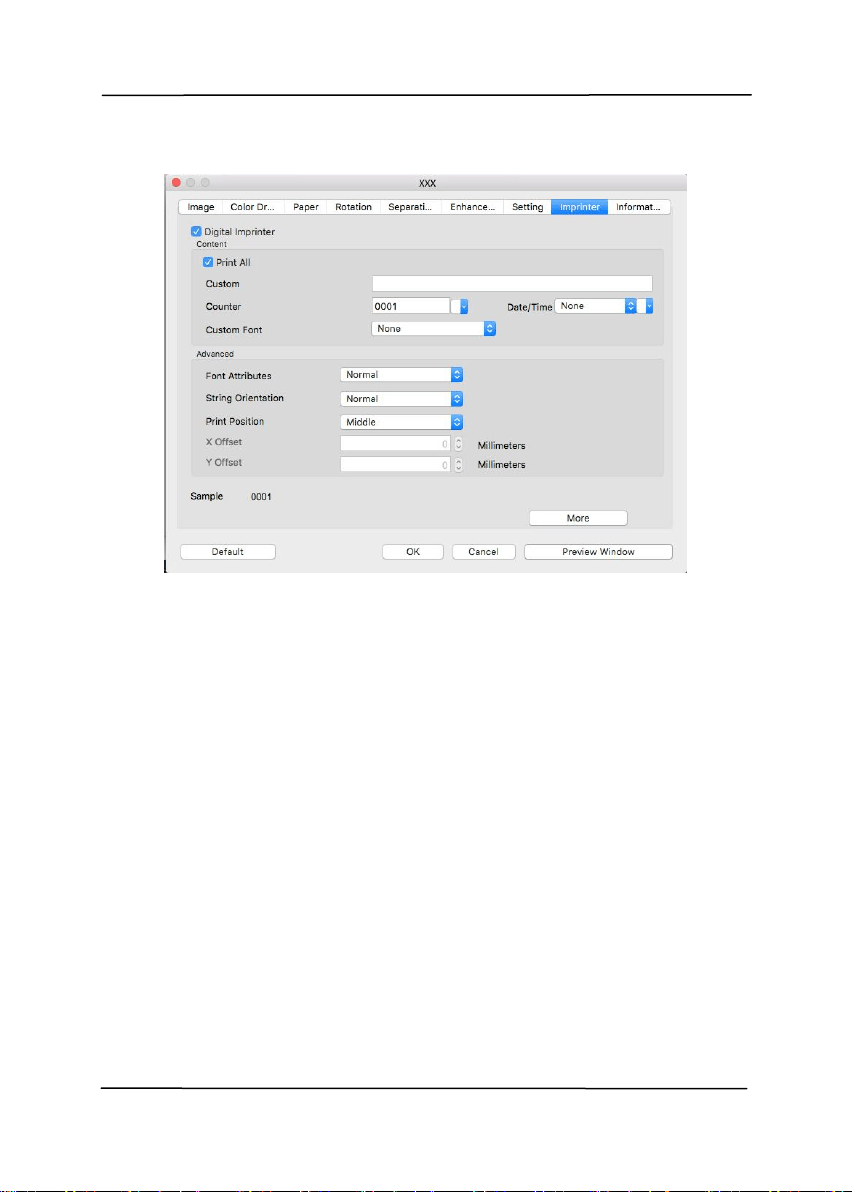
User’s Manual
4-91
The Imprinter Dialog Box (Mac OS)
Choice: External Imprinter, Digital Imprinter. If you have
installed an external imprinter, choose external imprinter. If
you do not have an imprinter, choose digital imprinter. Note
External Imprinter provides a vertical and rear-side print
capability while digital printer provides a horizontal and front-
side print capability.

User’s Manual
4-92
Contents
Print All
Check Print All to automatically print the
text at all pages of your documents.
Uncheck Print All to print the text for the
first page of your documents only.
Custom
Enter your custom text to be included in your
print string.
Counter
Show the document count for the scan
session. This value is increased sequentially
by the scanner.
Date/Time
Choose if you wish to include the date and
time in your print string.
Format: YYYYMMDDHHSS For example,
20090402170645-check0001 indicates year,
month, date, hour, seconds, your custom
text and the counter.
Custom
Font
Choose your desired font.
Choice: Normal, Fixed Width
Fixed Width (Mono spaced) fonts have a
fixed character spacing. So each character
occupies the same width.
Advanced
Font
Attributes
Choose your font attributes. Choice:
Normal, Underline, Double, and Bold.
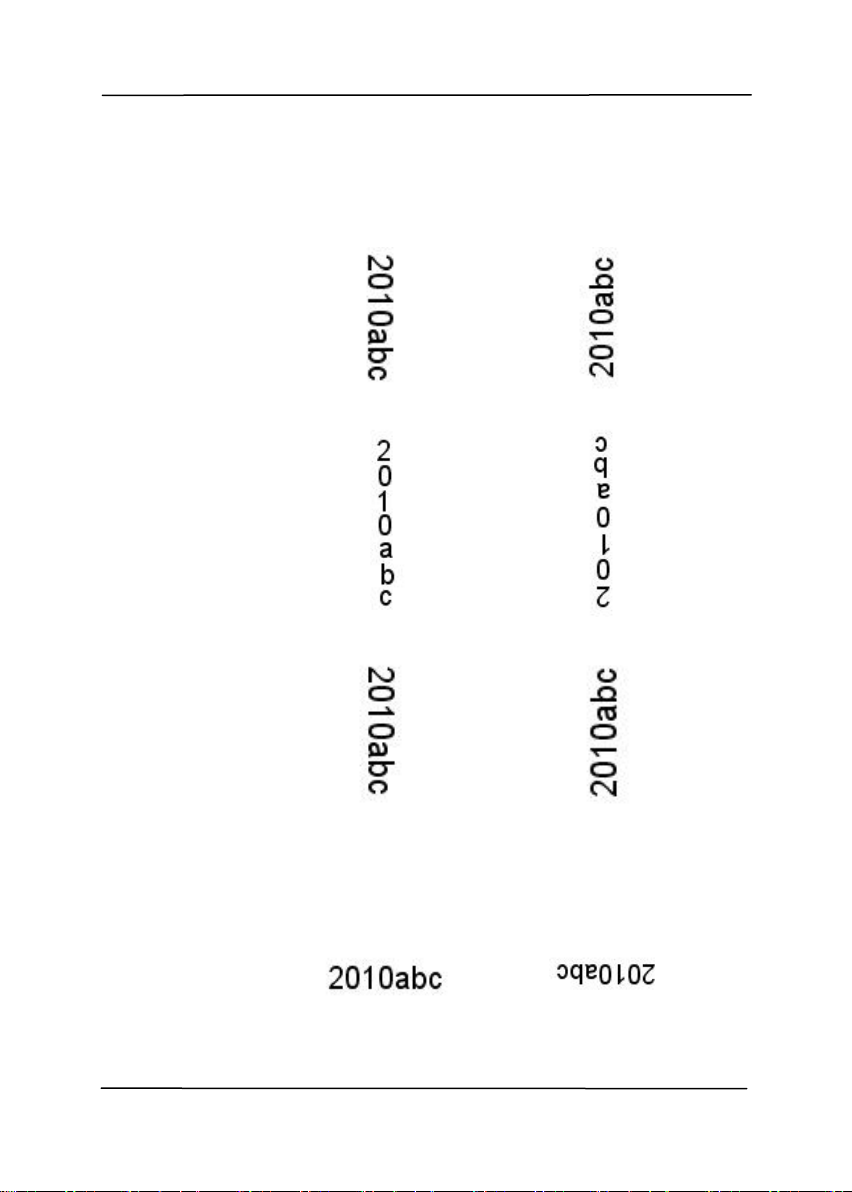
User’s Manual
4-93
String
Orientation
Choose your string orientation.
Choice: Normal, Rotated, Vertical,
Vertical Inversion, 90 degrees CW, 90
degrees CCW
Normal
Rotated
Vertical
Vertical Inversion
90 degrees CW
90 degrees CCW
If you check the digital imprinter to stamp
text on your scanned image, the illustration of
normal and rotated string is shown below:
Normal
Rotated
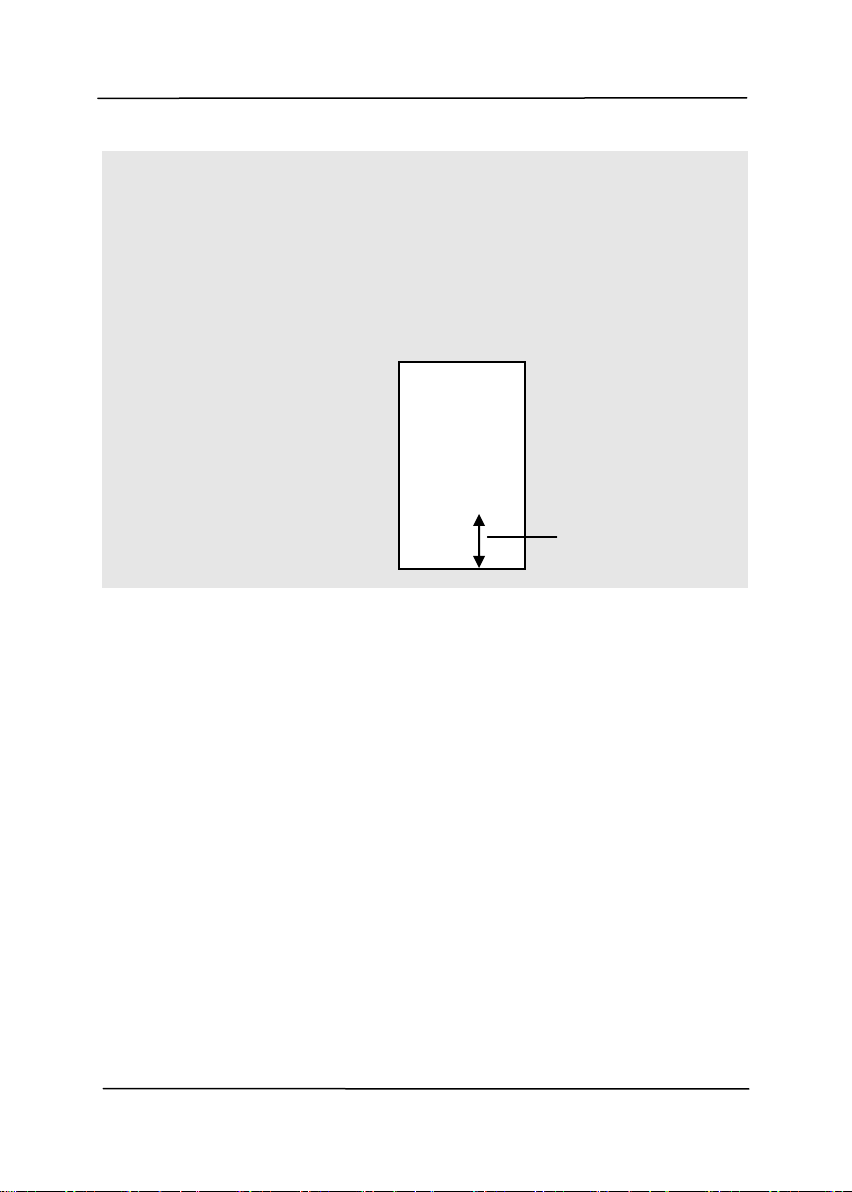
User’s Manual
4-94
Print
Position
Choose the position you wish to print your
string. Move the slider to the right to increase
the value or to the left to decrease the value.
Range: 0~355mm, default:0 mm
The value indicates the height from the
bottom of your paper to the last letter of your
string. This option is available only if an
external imprinter is installed.
Print Position (for digital imprinter)
Choose the position of your printed string. Choice: Top,
Middle, Bottom, Custom. If Custom is selected, enter the X
and Y offset value to specify the position.
More: Click the [More] button to display more font options.
This option is available for digital imprinter (stamp text on your
scanned image) only. This function is not available on some
models.
Font size: Move the slider to change the font size from 1 to
10. Density: Move the slider to change the source density from
0 to 255. The selected density will appear at the same time.
Transparency: Move the slider to choose an appropriate
transparency value from 0% (not transparent) to 100%
(completely transparent) so that your text can be partially
transparent and you can see the background image.
The value of
Print Position
0001abc 2010
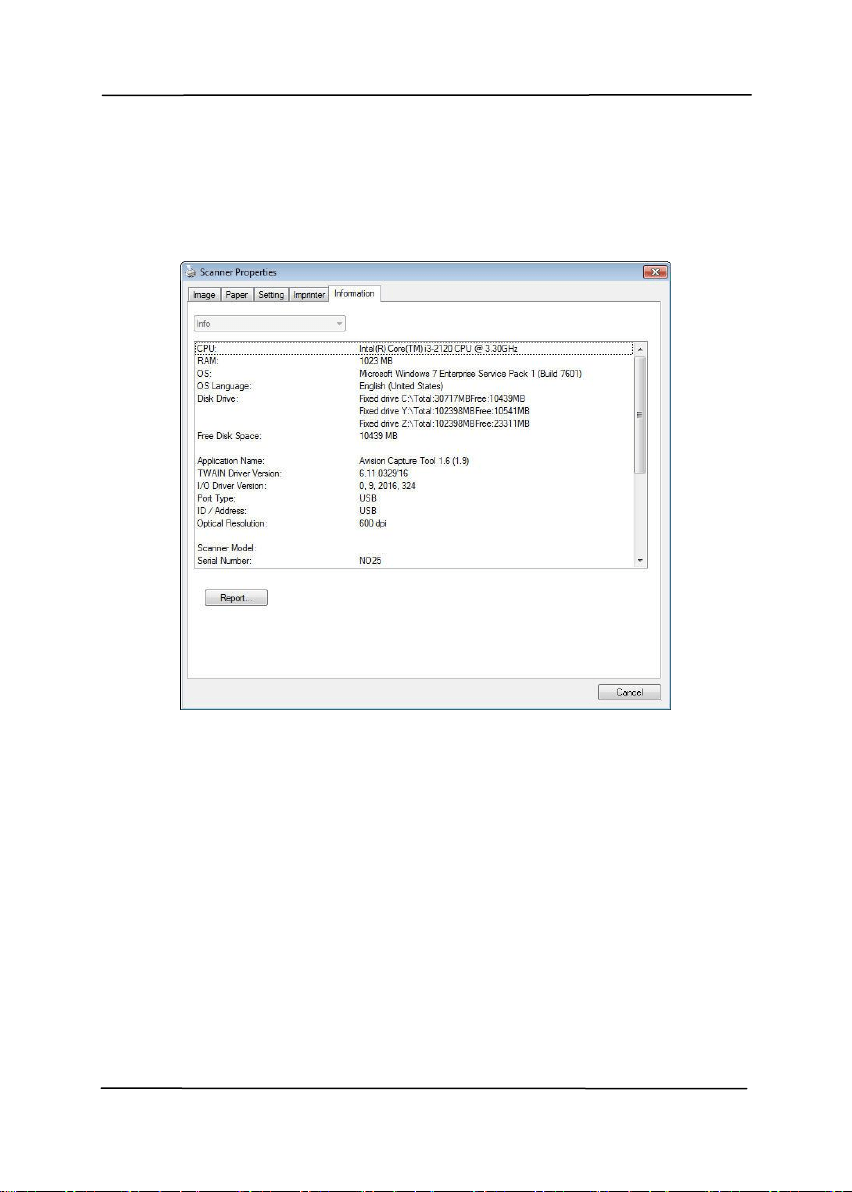
User’s Manual
4-95
4.14 The Information Tab
The Information tab displays the following system and scanner
information.
The Information tab dialog box (Windows)
The “Report” button:(Windows only)
If you encounter any error message while using the scanner,
click the Report button. A report.txt file [Windows XP:
C:\Documents and Settings\All Users\Application
Data\%PRODUCTNAME%; Vista, Windows 7, Windows 8,
Windows 10: C:\ProgramData\%PRODUCTNAME% (C: system
drive)] will be generated. Please send this file to the nearest
service center for trouble shooting.
xxxx
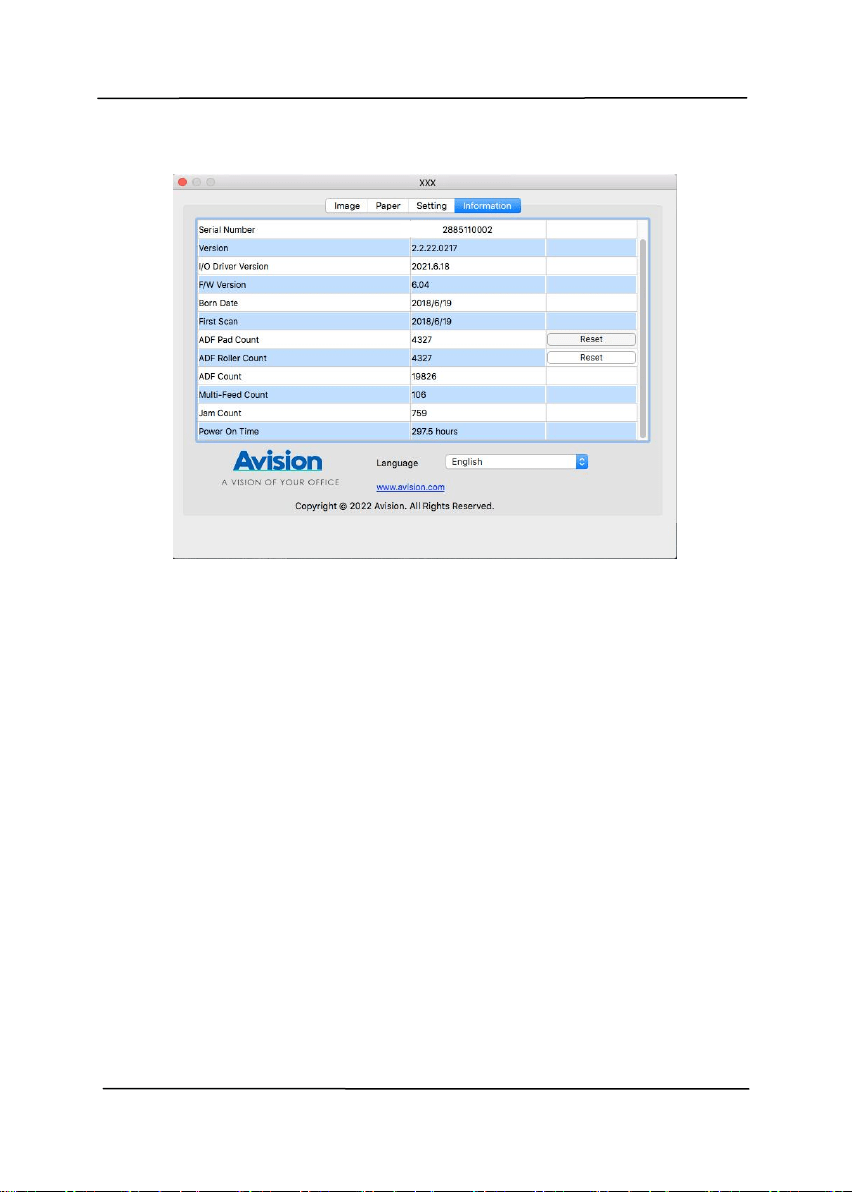
User’s Manual
4-96
The Information tab dialog box (Mac)

User’s Manual
5-1
5. Maintenance
5.1 Calibrating the scanner
Calibrate only if the scanned image looks fuzzy, the color looks
abnormal (e.g., darker than normal), after more than 8,000
scans, or the scanner has been stored without use for a long
time. The calibration process resets the Contact Image Sensor
to resume its color and sharpness precision.
1. Turn on the scanner.
2. Start your TWAIN-compliant image editing software
application such as Avision Capture Tool by choosing
Start>Programs>Avision XXXX Scanner>Avision Capture
Tool (XXXX indicates your scanner model). The Select
Scanner Model dialog box will be displayed.
3. Select your driver type and scanner model and click OK.
The Avision Capture Tool dialog box will be displayed.
4. Click the “Setup” button to prompt the TWAIN user
interface.
5. Click the “Settings” tab and then click the “Calibration”
button. An “Insert calibration sheet” dialog box appears.
6. Hold the edges of the calibration sheet (included) and
insert it with the text face up and the white area feeding
first to the feeder of the scanner as shown.
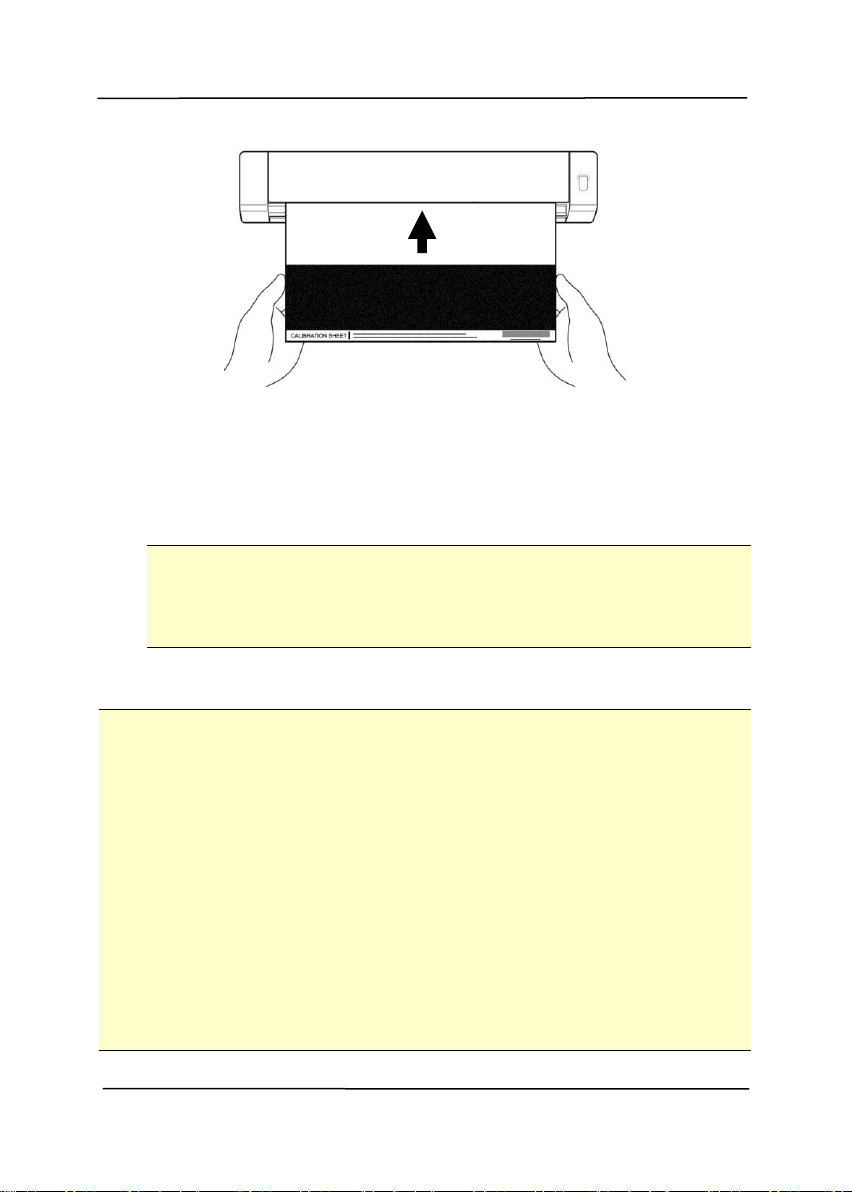
User’s Manual
5-2
7. Click the “OK” button on the “Insert calibration sheet”
dialog box to start calibrating the scanner.
8. After the calibration process is finished, the scanner powers
off automatically.
Warning: If the calibration process failed, the Red LED
will be flashing and an error message will be displayed on
the screen. Power off the scanner and then repeat the
calibration step again.
9. Power on the scanner to proceed with normal use.
Warning:
Do not interrupt the calibration sequence or try to shut off
the device while it is calibrating. If you stop the calibration
before it has completed, a calibration error may occur. As a
result, when you next power up the unit, an error message
may be displayed, and you will have to power off the unit
and repeat the instructions in this section.
Calibrate the scanner only when color of the scanned image
looks abnormal.
Keep the calibration sheet from dust and debris. Any dirt
may make the calibration chart invalid or impact the
calibration result.
Use only the included calibration sheet to calibrate the
scanner.
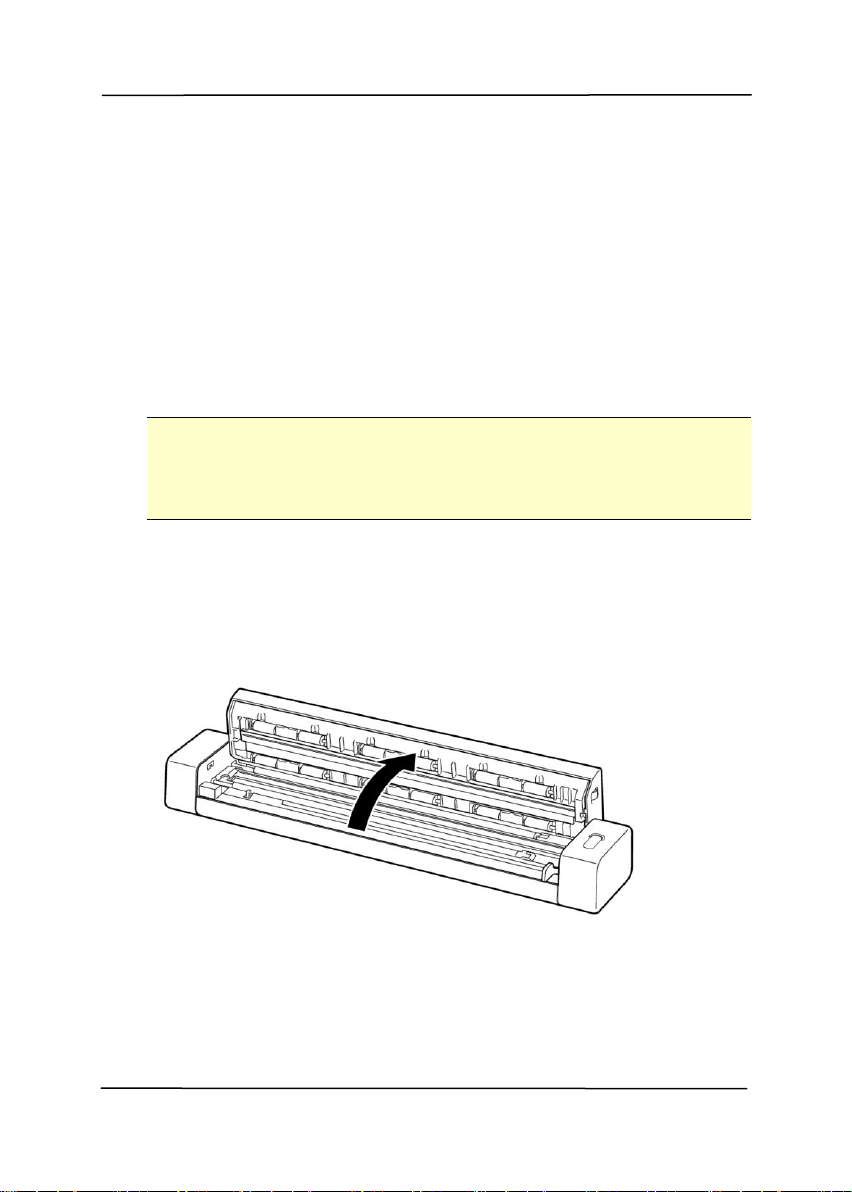
User’s Manual
5-3
5.2 Cleaning the scanner
In order to maintain the scanned image quality and prevent
dust accumulation, it is recommended that you clean the
scanner (outer casing and feed rollers) approximately every
200 scans, or if vertical lines or stripes appear on the scanned
image.
Use only the recommended and supplied tools to clean the
scanner.
Warning: Do not use any solvents or corrosive liquid (i.e.,
alcohol, kerosene, etc.) to clean any part of the scanner,
otherwise the plastic material may be permanently
damaged.
1. Open the cover by holding the scanner with one thumb
placing on the feeder and another thumb placing on the
cover. Carefully and firmly press your thumb into the
feeder and then raise the cover. This will cause the top of
the scanner to release from the bottom of the scanner.
2. Gently wipe the glass and feeding rollers on the scanner,
and the CIS cover with the cleaning cloth (included).

User’s Manual
5-4
Glass
Rollers

User’s Manual
6-1
6. Troubleshooting
6.1 Clearing the Error Conditions
If there is error during scanning, the LED light will be flashing
in red color. Refer to the following table to clear the error
conditions.
The
Number of
Times the
Red LED
Blinks
Description
How to restore
4
(Continued)
Paper jam
Remove paper and try
again. The Red LED light
does not stop blinking
unless the paper is
removed.
6
(Continued)
Cover open
Close cover and then try
again. The RED LED light
does not stop blinking
unless the cover has been
closed.
8
(Continued)
Calibration fails
Recalibrate the scanner
(see the “Calibrate
Scanner” section).
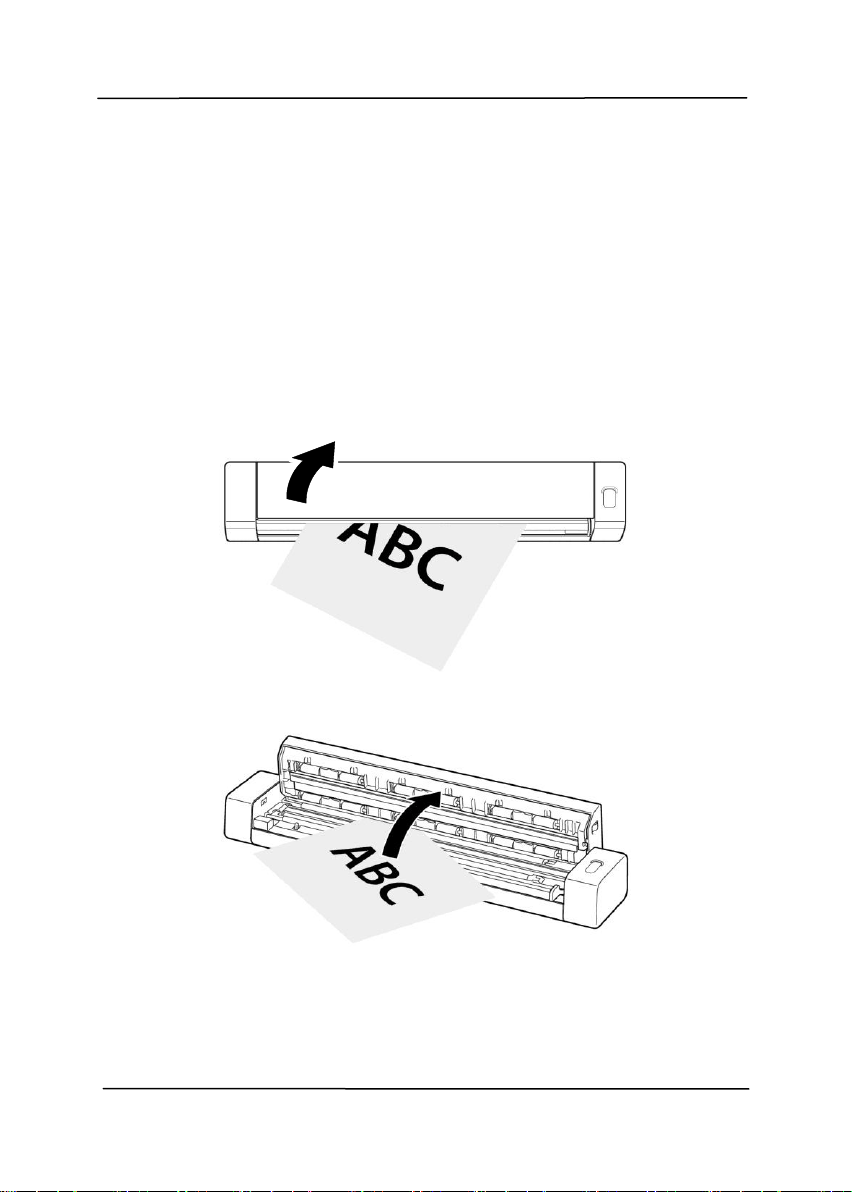
User’s Manual
6-2
6.2 Clearing a Paper Jam
To clear a jam from the feeder, follow these steps to remove
the item:
1. Open the cover by holding the scanner with one thumb
placing on the feeder and another thumb placing on the
cover. Carefully and firmly press your thumb into the
feeder and then raise the cover. This will cause the top of
the scanner to release from the bottom of the scanner.
2. Remove the item.
3. Close the cover and reinsert the item to rescan.

User’s Manual
6-3
6.3 Questions and Answers
Question:
Why does not my scanner turn on?
Answer:
Ensure the micro USB cable is securely
connected to the scanner to the USB
slot in your computer.
Question:
Why doesn’t my computer
recognize my scanner when it’s
connected via USB cable?
Answer:
Make sure the cable connection is
correct and secure. Restart the
computer if necessary.
Question:
Should the scanner feel warm to
the touch?
Answer:
It is normal for the scanner to emit a
small amount of heat after prolonged
use. However, if there are strange
odors coming from the scanner or the
scanner feels a little bit hot to the
touch, turn the scanner off
immediately.

User’s Manual
6-4
Question:
Why there are strange lines on the
scanned document?
Answer:
Please check the following:
1. Are there scratches on the original
or is the original clean?
2. Remove any stains or dust from the
original before scanning.
3. Clean the rollers and glass with the
included cleaning cloth.
Question:
Why does my scanned image
always come out too dark?
Answer:
1. Please adjust the screen settings to
sRGB.
2. Please adjust the brightness
settings on the screen from
application software.
Question:
When I choose optical resolution
to be 600 dpi, the "auto crop" and
"deskew" functions will be
disabled.
Answer:
Since to perform auto crop and deskew
consumes great deal of system
memory, it is suggested if you wish to
perform "auto crop" and "deskew"
functions, please choose your optical
resolution to be smaller than 600 dpi
to prevent a error message.

User’s Manual
6-5
Question:
What should I do if the status
indicator blinks rapidly and no
scan is possible?
Answer:
Check the following:
Is there a jam in the feeder? Open
the cover and gently pull out the
item.
Is the cover open? Make sure the
cover is snapped firmly in place.
Did you insert the next original
before the scanning process of the
previous one was completed? Turn
the scanner off and back on and try
again. Make sure that you scan the
next original only after the
scanning process of the previous
one has completed.
Does the length of the original
exceed the maximum acceptable
size?

User’s Manual
6-6
6.4 Technical Service
Before contact Avision, please prepare the following
information:
Scanner serial & revision number (located on the bottom of
the scanner);
Hardware configuration (e.g., your host CPU type, RAM size,
free disk space, display card, interface card);
The name and version of your scanning software application;
The version of your scanner driver.
Please call us at:
Headquarter
Avision Inc.
No. 20, Creation Road I, Science-Based Industrial Park,
Hsinchu 300, Taiwan, ROC
TEL: +886 (3) 578-2388
FAX: +886 (3) 577-7017
E-MAIL: servi[email protected]
Web Site: http://www.avision.com.tw

User’s Manual
6-7
US and Canada Area
Avision Labs, Inc.
6815 Mowry Ave., Newark CA 94560, USA
TEL: +1 (510) 739-2369
FAX: +1 (510) 739-6060
E-MAIL: support@avision-labs.com
Web Site: http://www.avision.com
China Area
Shanghai Technical Support Center
7A, No.1010, Kaixuan Road, Shanghai 200052 P.R.C.
TEL :+86-21-62816680
FAX :+86-21-62818856
E-MAIL :sal[email protected]
Web Site:http://www.avision.com.cn
Europe Area
Avision Europe GmbH
Bischofstr. 101 D-47809 Krefeld Germany
TEL: +49-2151-56981-40
FAX: +49-2151-56981-42
E-MAIL: info@avision-europe.com
Web Site: http://www.avision.de
Espaço Brasil
Avision Brasil Ltda.
Avenida Jabaquara, 2958 - Cj. 75 - Mirandópolis –
CEP: 04046-500 - São Paulo, Brasil
TEL: +55-11-2925-5025
E-MAIL: suporte@avision.com.br
Web Site: http://www.avision.com.br

User’s Manual
7-1
7. Specifications
All specifications are subject to change without notice.
Model Number: FF-2109B
Image Technology: Contact Image Sensor (CIS)
Optical Resolution: 600 dpi
Scanning Modes: Black & White/Gray/Color
Max. Paper Size: 8.5” x 14” (width x length)
Min. Paper Size: 2.5” x 2.5” (width x length)
Paper Weight: 60~107 g/m
2
(16~28 lbs)
ID Card Thickness: Up to 0.8 mm
Interface: Micro USB port
USB Power: 5Vdc, 500mA
Operating Temperature: 10ºC ~ 35ºC
Humidity: 15%~85% RH
Dimensions: (HxWxD) 290 x 52 x 35 mm
Weight: 370g