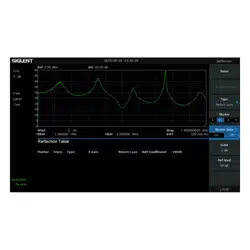

68
SSA3000X
Spectrum Analyzer
User Manual
UM0703X-E03B

SIGLENT
SSA3000X User Manual
Copyright and Declaration
Copyright
SIGLENT TECHNOLOGIES CO., LTD All Rights Reserved.
Trademark Information
SIGLENT is the registered trademark of SIGLENT TECHNOLOGIES CO., LTD
Declaration
◆ SIGLENT products are protected by patent law worldwide
◆ SIGLENT reserves the right to modify or change parts of or all the specifications
or pricing policies at company’s sole decision.
◆ Information in this publication replaces all previously corresponding material.
◆ Any way of copying, extracting or translating the contents of this manual is not
allowed without the permission of SIGLENT.
◆ SIGLENT will not be responsible for losses caused by either incidental or
consequential in connection with the furnishing, use or performance of this
manual as well as any information contained.
Product Certification
SIGLENT guarantees this product conforms to the national and industrial standards in
China as well as the ISO9001: 2008 standard and the ISO14001: 2004 standard.
Other international standard conformance certification is in progress.

SIGLENT
SSA3000X User Manual III
Safety Information
General Safety Summary
Carefully read the following safety precautions to avoid any personal injury or damage to the
instrument and any products connected to it. To avoid potential hazards, please use the
instrument as specified.
Use Proper AC Power Line
Only the power cord designed for the instrument and authorized by local country should be used.
Ground the Instrument
The instrument is grounded through the protective earth conductor of the power line. To avoid electric
shock, please make sure the instrument is grounded correctly before connecting its input or output
terminals.
Connect the Probe Correctly.
If a probe is used, do not connect the ground lead to high voltage since it has isobaric electric potential
as the ground.
Look Over All Terminals’ Ratings
To avoid fire or electric shock, please look over all ratings and sign instruction of the instrument. Before
connecting the instrument, please read the manual carefully to gain more information about the ratings.
Use Proper Overvoltage Protection
Make sure that no overvoltage (such as that caused by a thunderstorm) can reach the product, or else
the operator might be exposed to danger of electrical shock.
Electrostatic Prevention
Operate the instrument in an electrostatic discharge protective area environment to avoid damages
induced by static discharge. Always ground both the internal and external conductors of the cable to
release static before connecting.
Maintain Proper Ventilation
Inadequate ventilation may cause increasing of the instrument’s temperature, which will eventually
damage the instrument. So keep well ventilated and inspect the intake and fan regularly.
Avoid Exposed Circuit or Components
Do not touch exposed contacts or components when the power is on.
SIGLENT
SSA3000X User Manual
Do Not Operate Without Covers
Do not operate the instrument with covers or panels removed.
Use proper Fuse.
Use only the specified fuse.
Keep Product Surfaces Clean and Dry.
To avoid the influence of dust and/or moisture in the air, please keep the surface of the device clean
and dry.
Do Not Operate in Wet Conditions.
In order to avoid short circuiting to the interior of the device or electric shock, please do not operate the
instrument in a humid environment.
Do Not Operate in an Explosive Atmosphere.
In order to avoid damage to the device or personal injury, it is important to operate the device away
from an explosive atmosphere.
Any parts of the device and its accessories are not allowed to be changed or replaced, other than
authorized by the manufacturer or his agent.
Make sure not to position the equipment so that it is difficult to operate the disconnecting device
(detachable plug).
Safety Terms and Symbols
Terms in this Manual. These terms may appear in this manual:
WARNING
Warning statements indicate the conditions or practices that could
result in injury or loss of life.
CAUTION
Caution statements indicate the conditions or practices that could
result in damage to this product or other property.
Terms on the product.
DANGER Indicates direct injuries or hazards that may happen.
WARNING Indicates potential injuries or hazards that may happen.
CAUTION Indicates potential damages to the instrument or other property that may happen.
SIGLENT
SSA3000X User Manual V
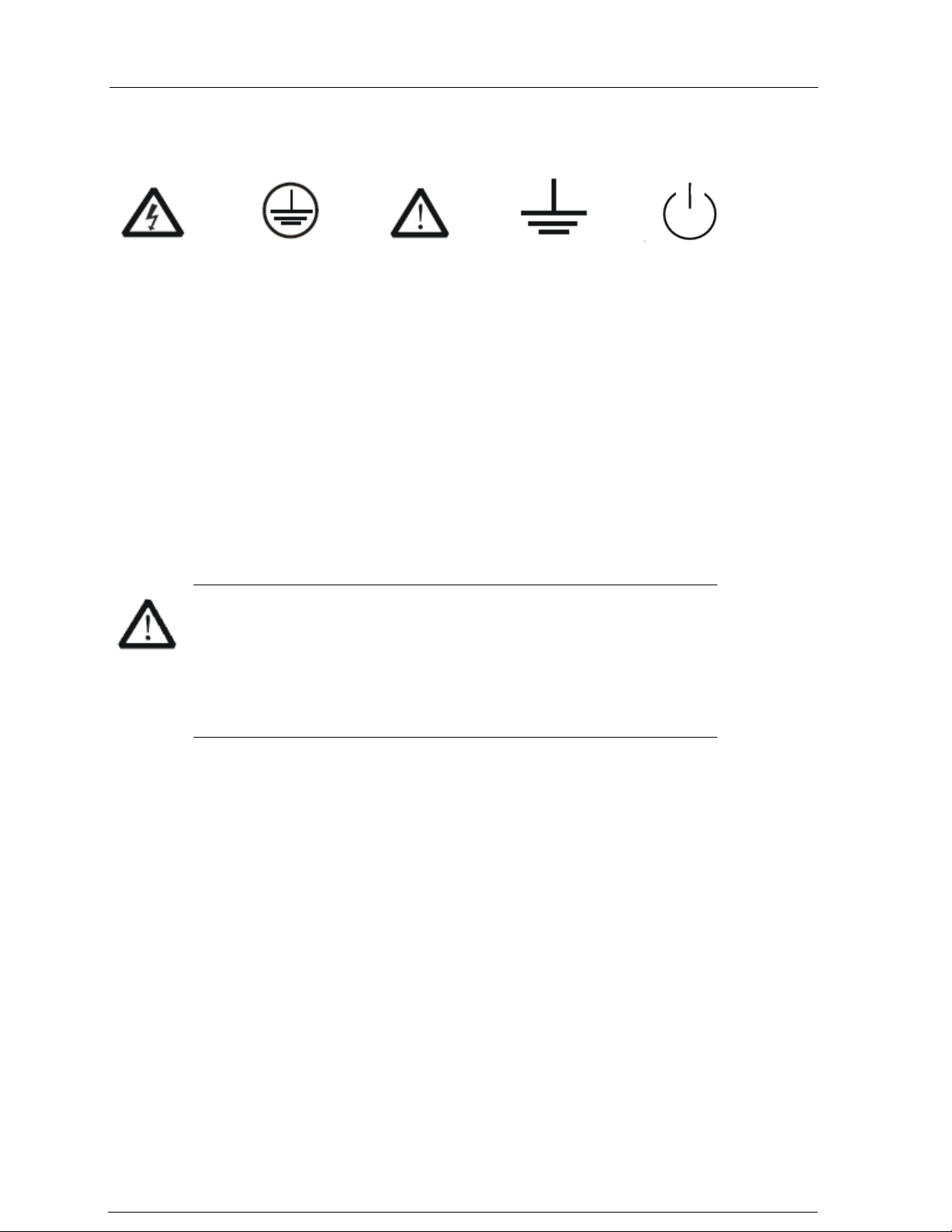
Symbols on the product.
Hazardous protective Earth Warning Test Power Switch
Voltage Terminal Ground
If find such symbols on the product, consult the manual to find out the nature of the potential
hazard and the actions which have to be taken
Measurement Category
Measurement Categories
This analyzer can make measurements in other circuits that are not directly connected to mains.
WARNING
This analyzer can only be used for measurements within its specified measurement
categories.
Not to use the product for measurements within other measurement
categories, such as CAT II, CAT III, CAT IV.
Not to use the equipment for measurements on mains circuits
Measurement Category Definitions
Measurement category II is for measurements performed on circuits directly connected to the low
voltage installation. Examples are measurements on household appliances, portable tools and
similar equipment.
Measurement category III is for measurements performed in the building installation. Examples
are measurements on distribution boards, circuit-breakers, wiring, including cables, bus-bars,
junction boxes, switches, socket-outlets in the fixed installation, and equipment for industrial use
and some other equipment, for example. Stationary motors with permanent connection to the fixed
installation.
Measurement category IV is for measurements performed at the source of the low-voltage
installation. Examples are electricity meters and measurements on primary over current protection
devices and ripple control units.
SIGLENT
SSA3000X User Manual
Working Environment
Temperature
Operating: 0℃ to +40℃
Non-operation: -20℃ to +70℃
Humidity
Under +35℃: ≤80% relative humidity
+35℃ to +40℃: ≤60% relative humidity
WARNING
To avoid short circuit inside the instrument or electric shock,
please do not operate in humid environment.
Altitude
Operating: less than 3 km
Non-operation: less than 15 km
Degree of protection
IP20
Installation (overvoltage) Category
This product is powered by mains conforming to installation (overvoltage) category II.
WARNING
Make sure that no overvoltage (such as that caused by thunderbolt) can reach the
product, or else the operator might expose to danger of electric shock.
Installation (overvoltage) Category Definitions
Installation (overvoltage) category I refers to signal level which is applicable to equipment
measurement terminals connected to the source circuit. In these terminals, precautions are done
to limit the transient voltage to the corresponding low level.
Installation (overvoltage) category II refers to the local power distribution level which is applicable
to equipment connected to the AC line (AC power).
SIGLENT
SSA3000X User Manual VII
Ventilation Requirement
This analyzer uses fan to force cooling. Please make sure that the air intake and exhaust areas
are free from obstructions and have free air. When using the analyzer in a bench-top or rack
setting, provide at least 10 cm clearance beside, above and behind the instrument for adequate
ventilation.
WARNING
Inadequate ventilation may cause temperature increase which would damage the
instrument. So please keep the instrument well ventilated during operation and
inspect the intake and fan regularly.
General Care and Cleaning
Care
Do not store or leave the instrument in direct sunshine for long periods of time.
WARNING
To avoid damages to the instrument or probe, please do not leave them in fog, liquid,
or solvent.
Cleaning
Please perform the following steps to clean the instrument and probe regularly according to its
operating conditions.
1. Disconnect the instrument from all power sources, and then clean it with a soft wet cloth.
2. Clean the loose dust on the outside of the instrument and probe with a soft cloth. When
cleaning the LCD, take care to avoid scarifying it.
WARNING
To avoid damages to the surface of the instrument and probe, please do not use any
corrosive liquid or chemical cleanser.
WARNING
Make sure that the instrument is completely dry before restarting it to avoid short
circuits or personal injuries.

SIGLENT
SSA3000X User Manual
L'information de sûreté
Résumé général de sûreté
Lisez soigneusement les mesures de sécurité suivantes pour éviter n'importe quelles blessures ou
les dommages à l'instrument et à tous les produits se sont reliés à eux. Pour éviter des risques,
utilisez svp l'instrument comme indiqué.
Employez la ligne à haute tension appropriée
Seulement le cordon de secteur conçu pour l'instrument et autorisé par le pays local a pu être
employé.
A rectifié l'instrument.
L'instrument est fondu par le conducteur protecteur de terra de la ligne à haute tension. Pour
éviter la décharge électrique, le conducteur moulu doit être relié à la terre. Assurez-vous que
l'instrument est fondu correctement avant de relier ses bornes d'entrée ou de rendement.
Reliez le fil de signal correctement.
Le potentiel de l'au sol de fil de signal est égal à la terre, ainsi ne relie pas le fil de signal à une
tension.
Regardez estimations au-dessus de toutes les bornes des'
Pour éviter le feu ou la décharge électrique, regardez svp au-dessus de toutes les estimations et
instruction de signe de l'instrument. Avant de relier l'instrument, lisez svp le manuel
soigneusement pour obtenir plus d'informations sur les estimations.
Employez la protection appropriée de surtension
Assurez-vous qu'aucune surtension (comme cela provoqué par un orage) ne peut atteindre le
produit, ou bien l'opérateur pourrait exposer au danger du choc électrique.
Empêchement électrostatique
Fonctionnez dans un environnement protecteur de secteur de décharge électrostatique pour
éviter des dommages induits par décharge statique. A toujours rectifié les conducteurs internes et
externes du câble pour libérer la charge statique avant de se relier.
La ventilation insatisfaisante de ventilation
bonne de subsistance peut causer l'augmentation de la température, qui endommagera par la
suite l'instrument. Gardez ainsi la ventilation bonne et inspectez la prise et éventez régulièrement.
Évitez le circuit ou les composants exposés
ne touchent pas les contacts ou les composants exposés quand le courant passe.

SIGLENT
SSA3000X User Manual IX
Employez l'utilisation appropriée
de fusible seulement le fusible indiqué.
Ne fonctionnez pas sans couvertures
n'actionnent pas l'instrument des couvertures ou des panneaux étant coupés.
Ne fonctionnez pas avec des échecs suspectés.
Si vous suspectez les dommages se produisent à l'instrument, l'ont inspecté par le personnel de
service qualifié avant d'autres opérations. N'importe quel entretien, ajustement ou remplacement
particulièrement aux circuits ou aux accessoires doivent être exécutés par le personnel autorisé
par SIGLENT.
Ne fonctionnez pas en conditions humides.
Afin d'éviter de court-circuiter à l'intérieur du dispositif ou de la décharge électrique, svp ne
fonctionnez pas dans un environnement humide.
Do Not Operate in an Explosive Atmosphere.
Ne fonctionnez pas dans une atmosphère explosive.
Afin d'éviter d'endommager le dispositif ou les blessures, il est important d'utiliser le dispositif loin
à partir d'une atmosphère explosive.
Maintenez les surfaces de produit propres et sèches.
Pour éviter l'influence de la poussière et/ou de l'humidité en air, maintenez svp la surface du
dispositif propre et sèche.
En manipulant la sûreté
manipulez svp avec soin pendant le transport pour éviter d'endommager des boutons, des
interfaces de bouton et d'autres parties sur les panneaux.
Le corps ou l'opérateur responsable devrait se référer au manuel d'instruction pour préserver la
protection se permettent par l'équipement. Si l'équipement est utilisé en quelque sorte non indiqué
par le fabricant, la protection fournie par l'équipement peut être altérée.
On ne permet à aucune pièce du dispositif et de ses accessoires d'être changé ou remplacé, autre
qu'autorisé par le fabricant ou son agent.
Pas placez l'équipement de sorte qu'il soit difficile d'utiliser le dispositif débranchant (prise
détachable).
SIGLENT
SSA3000X User Manual
Limites et symboles de sûreté
Limites en ce manuel. Ces limites peuvent apparaître en ce manuel :
Les rapports
d'avertissement D'AVERTISSEMENT indiquent les conditions ou les
pratiques qui pourraient avoir comme conséquence les dommages ou la
perte de la ie.
Les rapports
d'attention d'ATTENTION indiquent les conditions ou les pratiques qui
pourraient avoir comme consequenceles dommages à ce produit ou à
toute autre propriété.
Limites sur le produit. Ces limites peuvent apparaître sur le produit :
Le DANGER indique les dommages ou les risques directs qui peuvent se produire.
Dommages ou risques potentiels de WARNINGIndicates qui peuvent se produire.
L'ATTENTION indique des dommages potentiels à l'instrument ou à toute autre propriété qui
peuvent se produire.
Si la trouvaille de tels symboles sur le produit, consultent le manuel pour découvrir la nature du
risque et des actions qui doivent être pris.
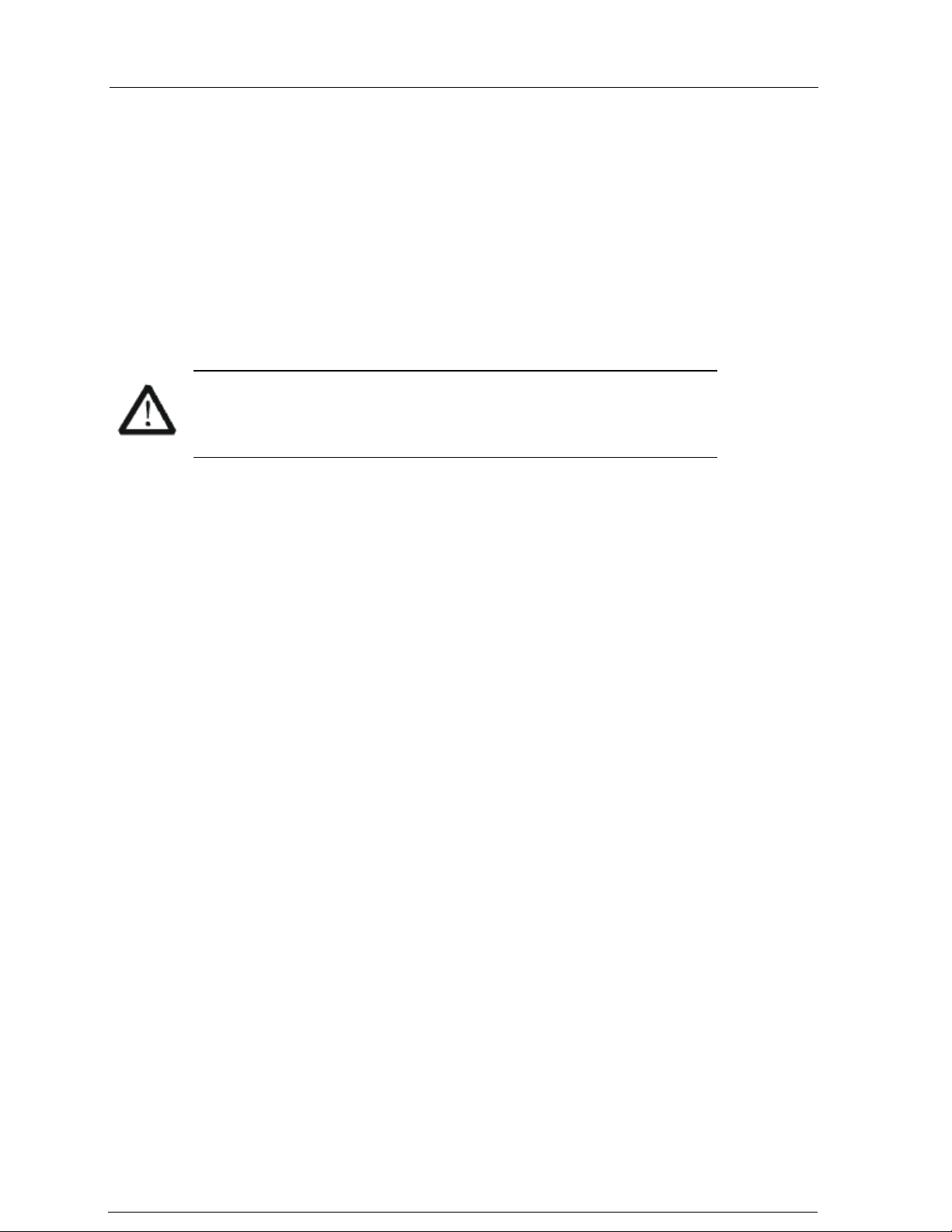
Symboles sur le produit. Ces symboles peuvent apparaître sur le produit :
Dangereux Protecteur Avertissement Châssis Puissance
Tension Au sol de la terre Ground Switch
SIGLENT
SSA3000X User Manual XI
Catégorie de mesure
Les analyzers peuvent faire des mesures dans d'autres circuits qui ne sont pas directement reliés
aux forces. Pour ne pas employer le produit pour des mesures dans d'autres catégories de
mesure, telles que le CAT II, CAT III, CAT IV.
Ne pas utiliser l'équipement pour des mesures sur des forces circuite, pour ne pas utiliser
l'équipement pour des mesures sur la tension excèdent la gamme de tension décrivent dans le
manuel.
Les rapports
cet analyzers peut seulement être employé pour des mesures dans
ses catégories indiquées de mesure.
La catégorie II de mesure
de définitions de catégorie de mesure est pour des mesures effectuées sur des circuits
directement reliés à l'installation de basse tension. Les exemples sont des mesures sur des
appareils électroménagers, des outils portatifs et l'équipement semblable.
La catégorie III de mesure est pour des mesures effectuées dans l'installation de bâtiment. Les
exemples sont des mesures sur des conseils de distribution, des disjoncteurs, le câblage, y
compris des câbles, des barres omnibus, des boîtes de jonction, des commutateurs, des
douille-sorties dans l'installation fixe, et l'équipement à l'utilisation industrielle et à un autre
équipement,
par exemple. Moteurs stationnaires avec le raccordement permanent à l'installation fixe.
La catégorie IV de mesure est pour des mesures effectuées à la source d'installation de basse
tension.Les exemples sont des mètres et des mesures de l'électricité sur les dispositifs de
protection d'excédent primaire et les unités de commande courants d'ondulation.
SIGLENT
SSA3000X User Manual
Environnement de fonctionnement
Température
En fonctionnement: 0 à + 40
Non-fonctionnement: -20 à + 70
Humidité
Moins de + 35: humidité relative ≤80%
+ 35 à + 40 : humidité relative ≤60%
EN AVERTISSANT
d'éviter le court-circuit à l'intérieur de l'instrument ou de la décharge électrique, svp ne
fonctionnez pas dans l'environnement humide.
Opération
d'altitude : moins de 3 kilomètres
de non-fonctionnement : moins de 15 kilomètres
Degré de protection
IP20
La catégorie d'installation (surtension)
ce produit est actionnée par des forces conformément à la catégorie II. d'installation (surtension).
EN AVERTISSANT
assurez-vous qu'aucune surtension (comme cela provoqué par coup de
foudre) ne peut atteindre le produit, ou bien l'opérateur pourrait
exposer au danger de la décharge électrique.
La catégorie II d'installation de définitions de catégorie d'installation (surtension) (surtension) se
rapporte au niveau local de distribution d'énergie qui est applicable à l'équipement relié à la ligne à
C.A. (courant alternatif).
Condition de ventilation
This analyzer uses fan to force cooling. Please make sure that the air intake and exhaust areas
are free from obstructions and have free air. When using the analyzer in a bench-top or rack
setting, provide at least 10 cm clearance beside, above and behind the instrument for adequate
ventilation.
SIGLENT
SSA3000X User Manual XIII
Cet analyzer utilise le ventilateur pour forcer le refroidissement. Veuillez s'assurer que les
secteurs d'entrée et d'échappement d'air sont exempts des obstructions et ont l'air libre. À l'aide
de l'analyzer dans un mettre hors jeu-dessus ou un arrangement de support, fournissez au moins
le dégagement de 10 centimètres près, au-dessus et derrière de l'instrument pour à ventilation
proportionnée.
La ventilation insatisfaisante peut causer l'augmentation de la température qui
endommagerait l'instrument. Veuillez ainsi la subsistance l'instrument bien aéré lors
du fonctionnement et inspectez la prise et éventez régulièrement.
Soin général et nettoyage
Ne stockez pas ou ne laissez pas l'instrument en soleil direct pendant de longues périodes.
Pour éviter d'endommager l'instrument, svp ne les laissez pas dans le brouillard, le
liquide, ou le dissolvant.
nettoyage
Veuillez exécuter les étapes suivantes pour nettoyer l'instrument régulièrement selon ses
conditions de fonctionnement.
1. Démontez l'instrument de toutes les sources d'énergie, et puis nettoyez-le avec un tissu humide
mou.
2. Nettoyez la poussière lâche sur l'extérieur de l'instrument avec un tissu mou. En nettoyant
l'affichage à cristaux liquides, salut pour éviter de le scarifier.
Pour éviter d'endommager la surface de l'instrument, svp n'utilisez aucune épierreuse
corrosive de liquide ou de produit chimique.
Assurez-vous que l'instrument est complètement sec avant de le remettre en marche
pour éviter des courts-circuits ou des blessures.

SIGLENT
SSA3000X User Manual
Allgemeine Sicherheitshinweise
Um Verletzungen oder Schäden am Gerät und den damit verbundenen Produkten zu vermeiden,
lesen Sie die folgenden Sicherheitshinweise sorgfältig durch.
Um mögliche Gefahren zu vermeiden, verwenden Sie bitte das Gerät wie angegeben.
Wartungsarbeiten an diesem Gerät dürfen nur von qualifiziertem Reparaturpersonal
durchgeführt werden.
Verwendung eines geeigneten Netzkabels
Verwenden Sie nur das für das Gerät vorgesehene und von den örtlichen Behörden zugelassene
Netzkabel.
Erdung des Gerätes
Das Gerät ist über den Schutzleiter des Netzkabels geerdet. Um einen elektrischen Schlag zu
vermeiden, vergewissern Sie sich bitte, bevor Sie seine Eingangs- oder Ausgangsklemmen
anschließen, dass das Gerät korrekt geerdet ist.
Anschluss der Signalleitung
Die Masse der Signalleitung ist auf dem gleichen Potential wie die Erdung des Gerätes. Schließen Sie
daher die Masseleitung nie an eine Hochspannung an. Berühren Sie keine freiliegenden Kontakte
oder Komponenten.
Verschaffen Sie sich einen Überblick über alle Anschluss-Ratings
Um Brände oder Stromschläge zu vermeiden, lesen Sie bitte alle Bemerkungen und Anweisungen des
Gerätes. Bevor Sie das Gerät anschließen, lesen Sie bitte das Handbuch sorgfältig durch, um weitere
Informationen über die Nennleistungen zu erhalten.
Betreiben Sie kein Gerät, bei dem der Verdacht besteht, dass es defekt ist.
Wenn Sie vermuten, dass das Produkt beschädigt ist, lassen Sie es bitte von qualifiziertem
Fachpersonal überprüfen. Vermeiden Sie den Kontakt mit freiliegenden Stromkreisen oder Drähten.
Berühren Sie keine freiliegenden Kontakte oder Komponenten, wenn das Gerät eingeschaltet ist.
Verwenden Sie einen geeigneten Überspannungsschutz
Stellen Sie sicher, dass keine Überspannung (z.B. durch ein Gewitter) auf das Produkt gelangen kann,
da sonst der Bediener der Gefahr eines Stromschlags ausgesetzt sein kann.
Nicht ohne Abdeckungen betreiben
Betreiben Sie das Gerät nicht bei abgenommenen Abdeckungen oder Platten.
Halten Sie die Oberfläche des Gerätes sauber und trocken.
Nicht unter nassen/feuchten Bedingungen betreiben.
Betreiben Sie das Gerät nicht in einer explosiven Atmosphäre.
SIGLENT
SSA3000X User Manual XV
Vermeiden Sie es, dieses Gerät einem Feuer auszusetzen.
Sicherheitshinweise und Symbole
In diesem Produkt verwendete Begriffe. Diese Begriffe können im Produkt erscheinen:
GEFAHR weist auf eine mögliche, sofortige und direkte Verletzung oder Gefährdung hin.
WARNUNG weist auf möglicherweise auftretende Verletzungen oder Gefahren hin
VORSICHT weist auf möglicherweise auftretende Schäden am Gerät oder anderen
Gegenständen
hin
In diesem Produkt verwendete Symbole. Diese Symbole können auf dem Produkt erscheinen:
Gefährliche Schutzerde Sicherheitswarnung Erdung Netzschalter
Spannung

SIGLENT
SSA3000X User Manual
Contents
Copyright and Declaration ...................................................................................................... II
Safety Information .................................................................................................................. III
General Safety Summary ............................................................................................... III
Safety Terms and Symbols ............................................................................................ IV
Measurement Category ................................................................................................... V
Working Environment ..................................................................................................... VI
Ventilation Requirement ................................................................................................ VII
General Care and Cleaning ........................................................................................... VII
L'information de sûreté ........................................................................................................ VIII
Résumé général de sûreté ........................................................................................... VIII
Limites et symboles de sûreté........................................................................................ X
Catégorie de mesure....................................................................................................... XI
Environnement de fonctionnement ............................................................................. XII
Condition de ventilation ................................................................................................ XII
Soin général et nettoyage ............................................................................................ XIII
Allgemeine Sicherheitshinweise ........................................................................................ XIV
Sicherheitshinweise und Symbole ............................................................................... XV
Chapter 1 Quick Start ........................................................................................................... 0
1.1 General Inspection .................................................................................................. 1
1.2 Appearance and Dimension .................................................................................... 1
1.3 Preparing for Use .................................................................................................... 2
1.3.1 Adjust the Supporting Legs .......................................................................... 2
1.3.2 Connect to AC Power Supply ....................................................................... 2
1.4 Front Panel .............................................................................................................. 3
1.4.1 Front Panel Function Keys ........................................................................... 3
1.4.2 Front Panel Key Backlight ............................................................................ 5
1.4.3 Using the Numeric Keyboard ....................................................................... 5
1.4.4 Front Panel Connectors ............................................................................... 6
1.5 Rear Panel .............................................................................................................. 8
1.6 Display Annotations ............................................................................................... 10
1.7 Firmware Operation ............................................................................................... 11
1.7.1 Check System Information .......................................................................... 11
1.7.2 Load Option ................................................................................................. 11
1.7.3 Firmware Upgrade...................................................................................... 12
1.8 Menu Operation .................................................................................................... 12
1.9 Parameter Setting ................................................................................................. 13
1.10 Using Built-in Help ................................................................................................. 14
1.11 Using the Security Lock ........................................................................................ 14
Chapter 2 Front Panel Operation ........................................................................................ 15
2.1 Basic Settings ........................................................................................................ 16
2.1.1 Frequency................................................................................................... 16
2.1.2 Span ........................................................................................................... 19

SIGLENT
SSA3000X User Manual XVII
2.1.3 Amplitude.................................................................................................... 21
2.1.4 Auto Tune ................................................................................................... 24
2.2 Sweep and Functions ............................................................................................ 26
2.2.1 BW .............................................................................................................. 26
2.2.2 Trace ........................................................................................................... 28
2.2.3 Detect ......................................................................................................... 30
2.2.4 Sweep ......................................................................................................... 31
2.2.5 Trigger ........................................................................................................ 33
2.2.6 Limit ............................................................................................................ 34
2.2.7 TG(Tracking Generator) ........................................................................ 35
2.2.8 Demod ........................................................................................................ 37
2.3 Marker ................................................................................................................... 40
2.3.1 Marker ........................................................................................................ 40
2.3.2 Marker -> .................................................................................................... 43
2.3.3 Marker Fn ................................................................................................... 44
2.3.4 Peak ........................................................................................................... 46
2.4 Measurement ........................................................................................................ 49
2.4.1 Meas ........................................................................................................... 49
2.4.2 Meas setup ................................................................................................. 50
2.5 System .................................................................................................................. 57
2.5.1 System ........................................................................................................ 57
2.5.2 Display ........................................................................................................ 59
2.5.3 File .............................................................................................................. 60
2.6 Shortcut Key .......................................................................................................... 63
2.6.1 Preset ......................................................................................................... 63
2.6.2 Couple ........................................................................................................ 66
2.6.3 Help ............................................................................................................ 66
2.6.4 Save ........................................................................................................... 66
Chapter 3 Remote Control .................................................................................................. 67
3.1 Remotely Operating the Analyzer ......................................................................... 67
3.1.1 Connecting the Analyzer via the USB Device port .................................... 67
3.1.2 Connecting the Analyzer via the LAN port ................................................. 67
3.1.3 Connecting the Analyzer via the USB Host port ........................................ 68
3.2 Build Communication ............................................................................................ 69
3.2.1 Build Communication Using VISA .............................................................. 69
3.2.2 Build Communication Using Sockets/Telnet .............................................. 71
3.3 Remote Control Capabilities ................................................................................. 72
3.3.1 User-defined Programming ........................................................................ 72
3.3.2 Send SCPI Commands via NI MAX ........................................................... 72
3.3.3 EasySpectrum Software ............................................................................. 74
Chapter 4 Troubleshooting and Service ............................................................................. 76
4.1 Service Summary .................................................................................................. 76
4.2 Troubleshooting ..................................................................................................... 76
4.3 Contact Us ............................................................................................................. 78

SIGLENT
SSA3000X User Manual 0
Chapter 1 Quick Start
This chapter guides users to quickly get familiar with the appearance, dimensions, front/rear panel and
the user interface, as well as announcements during first use of the analyzer.
Subjects in this chapter:
◆ General Inspection
◆ Appearance and Dimension
◆ Preparing for Use
◆ Front Panel
◆ Rear Panel
◆ Display Annotations
◆ Firmware Operation
◆ Menu Operation
◆ Parameter Setting
◆ Using Built-in Help
◆ Using the Security Lock
SIGLENT
SSA3000X User Manual 1
1.1 General Inspection
1. Inspect the shipping container
Keep the damaged shipping container or cushioning material until the contents of the shipment have
been completely checked and the instrument has passed both electrical and mechanical tests.
The consigner or carrier will be responsible for damages to the instrument resulting from shipment.
SIGLENT will not provide free maintenance or replacement.
2. Inspect the instrument
If the instrument is found to be damaged, defective or fails in electrical or mechanical tests, please
contact SIGLENT.
3. Check the accessories
Please check the accessories according to the packing list in the box. If the accessories are incomplete
or damaged, please contact your SIGLENT sales representative.
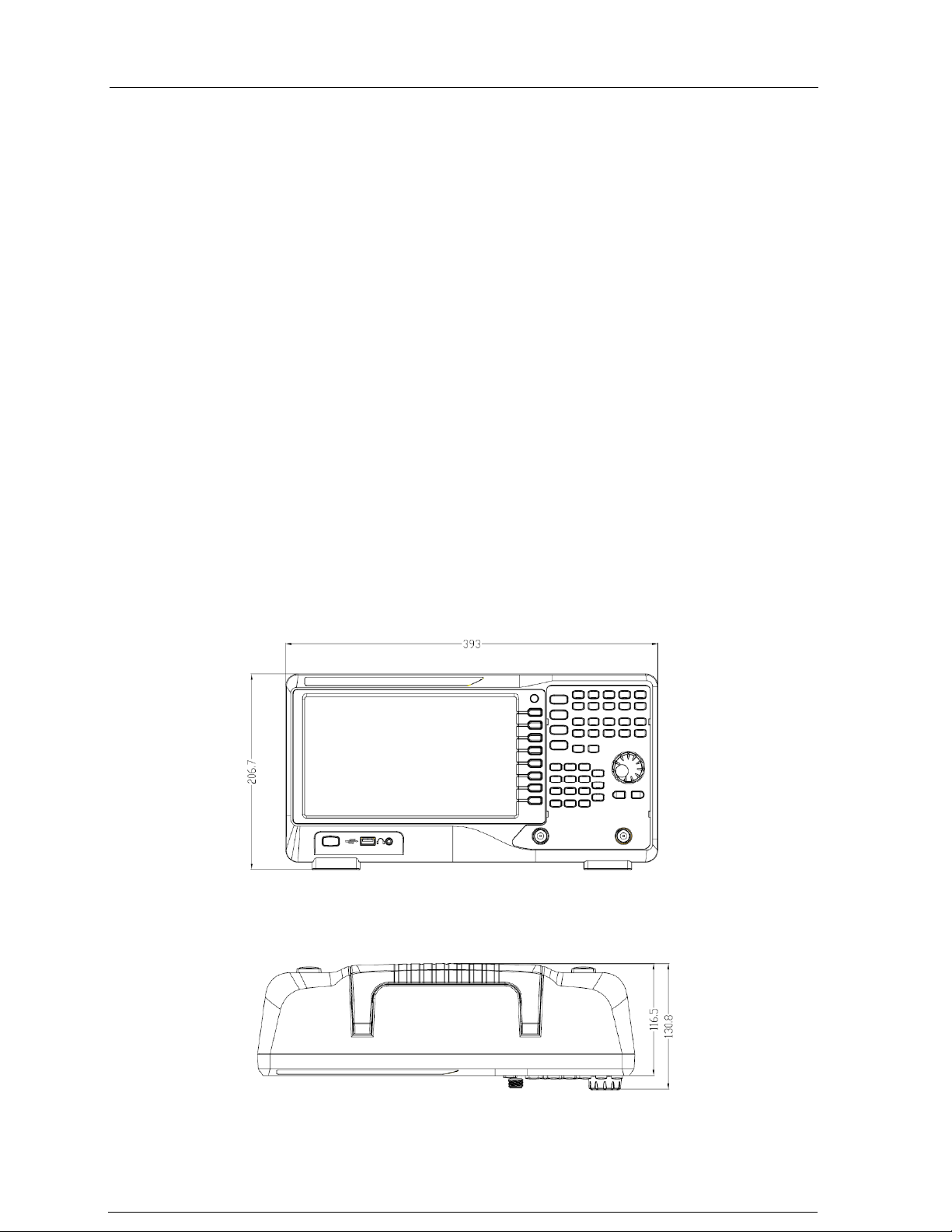
1.2 Appearance and Dimension
Figure 1-1 Front View
Figure 1-2 Top View
SIGLENT
SSA3000X User Manual 2
1.3 Preparing for Use
1.3.1 Adjust the Supporting Legs
Adjust the supporting legs properly to use them as stands to tilt the Spectrum Analyzer upwards for
stable placement as well as easier operation and observation of the instrument.
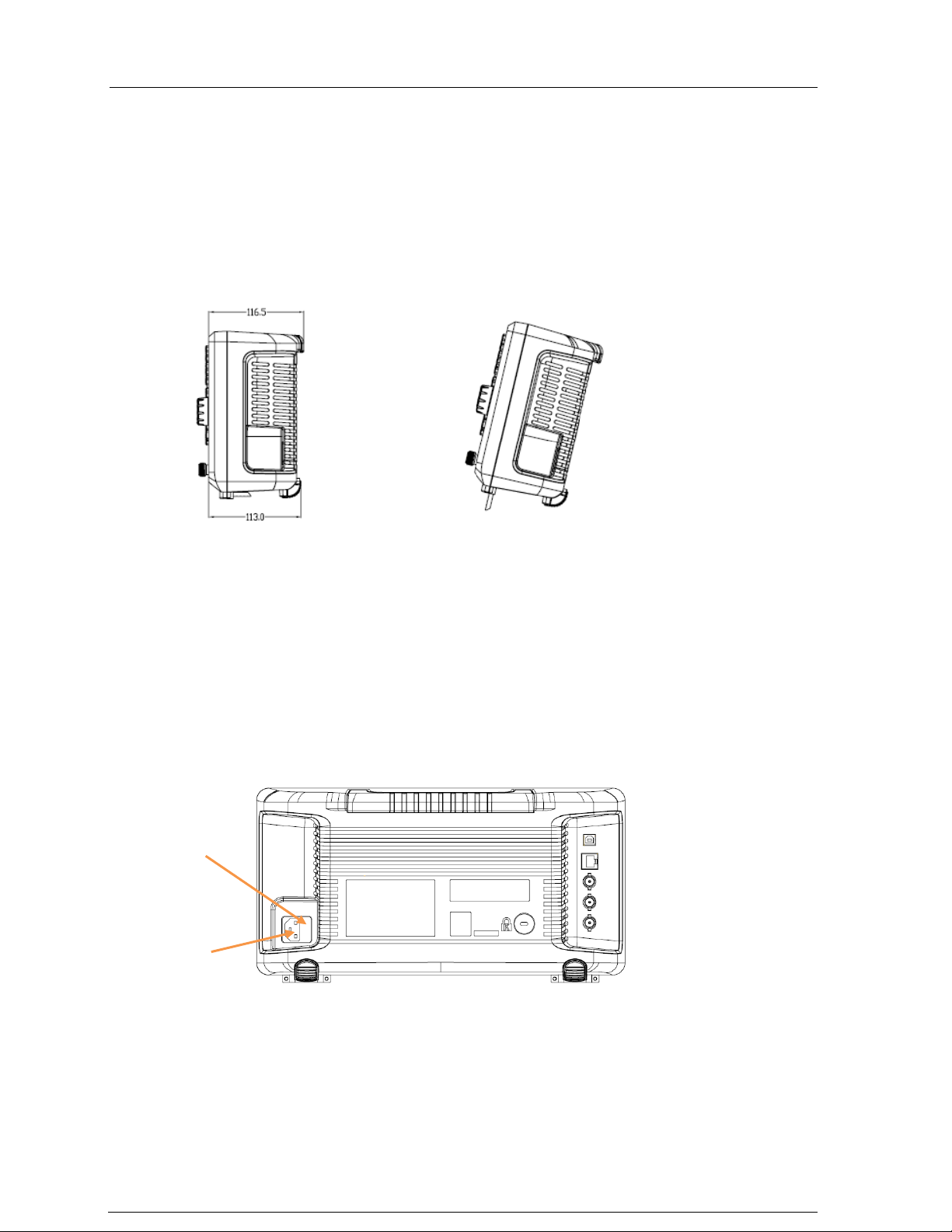
Figure 1-3 Before adjusting Figure1-4 After adjusting
1.3.2 Connect to AC Power Supply
The spectrum analyzer accepts 100-240V, 50/60 or 100-120VA 400Hz AC power supply. Please use
the power cord provided as accessories to connect the instrument to the power source as shown in the
figure below. Before power on, make sure the spectrum analyzer is protected by fuse.
Figure 1-5 Power Cord Connection
The Plug
The Fuse
SIGLENT
SSA3000X User Manual 3
1.4 Front Panel
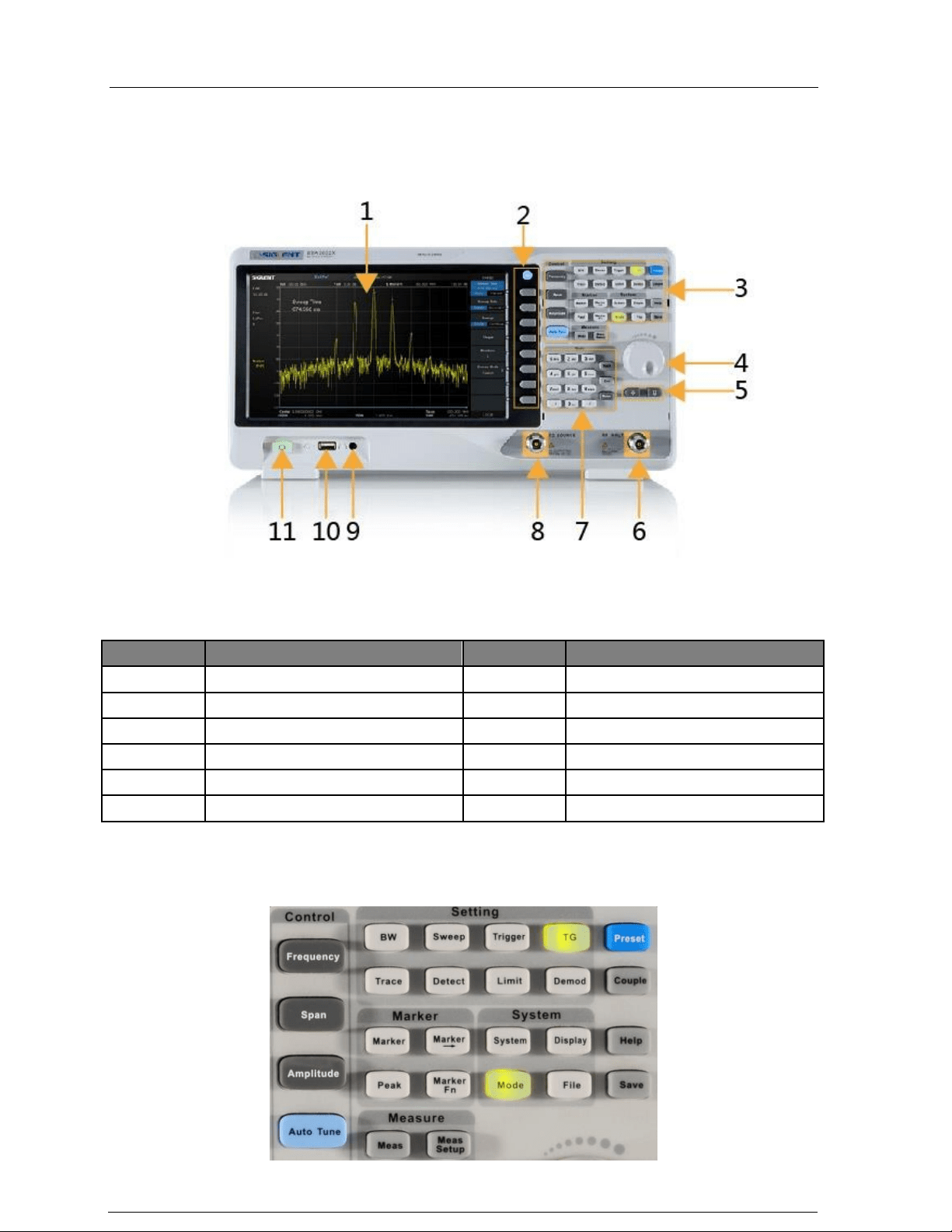
Figure 1-6 the Front Panel
Table 1-1 Front Panel Description
NO.
Description
NO.
Description
1
User Graphical Interface
2
Menu Control Keys
3
Function Keys
4
Knob
5
Arrow Keys
6
RF Input
7
Numeric Keyboard
8
TG Output
9
Earphone interface
10
USB Host
11
Power Switch
1.4.1 Front Panel Function Keys
Figure 1-7 Function Keys area
SIGLENT
SSA3000X User Manual 4
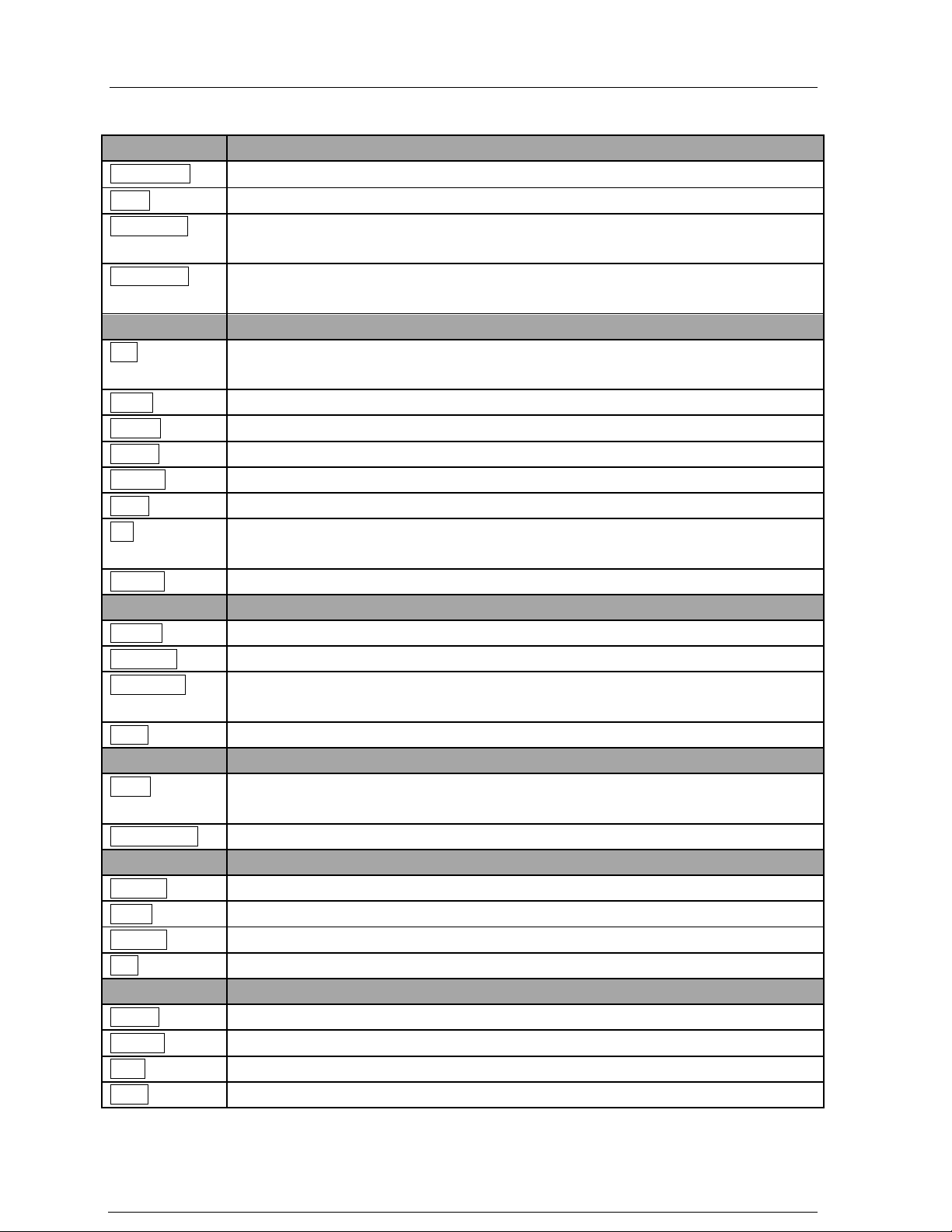
Table 1-2 Function keys description
Control Keys
Description
Frequency
Set the parameters of frequency, and Peak→CF, CF→Step.
Span
Set the parameters of span, and X-scale (Log-Linear) setup.
Amplitude
Set the parameters of amplitude, including Ref Level, Attenuator, Preamp, etc; and
Correction setup.
Auto Tune
Scan the full span rapidly and move the biggest signal to center freq, and
automatically sets the optimal parameters according to the signal.
Control Keys
Description
BW
Set the parameters of RBW and VBW, Average Type (Log power, Power, Voltage),
and Filter Type (-3 dB Gauss\ -6 dB EMI).
Trace
Select Trace, Trace setup and Trace math.
Sweep
Set the parameters of sweep, and EMI QPD Dwell Time.
Detect
Select the Detector type for each trace independently.
Trigger
Select triggers in Free Trigger, Video Trigger and External Trigger.
Limit
Set the Pass\Fail Limit.
TG
Set the parameters of tracking generator. Including TG Level, TG level offset,
Normalization setup. The backlight LED is on when TG source is on.
Demod
Set the demodulation parameters of the AM and FM for audio listening
Marker Keys
Description
Marker
Set the Markers and Marker Table
Marker->
Set other system parameters on the basis of the current marker value.
Marker Fn
Special functions of the marker such as noise marker, N dB bandwidth measurement
and frequency counter.
Peak
Search for the peak signal, peak search configuration and peak table.
Meas Keys
Description
Meas
In spectrum analyzer mode, select the Advanced Measurement function
In non spectrum analyzer mode, select corresponding settings.
Meas Setup
Set the measurement parameters.
System Keys
Description
System
Set the system parameters
Mode
Select the working modes.
Display
Set the display parameters.
File
Use the file system and files
Shortcut Keys
Description
Preset
Sets the system to certain status
Couple
Set the parameters of some functions between auto and manual.
Help
Turn on the built-in help
Save
Save Shortcut Key
SIGLENT
SSA3000X User Manual 5
1.4.2 Front Panel Key Backlight
The on/off state and the color of the backlights of some keys at the front panel indicate the working
state of the spectrum analyzer. The states are as listed below.
1. Power Switch
◆ Flash on and off alternatively, in breathing state: indicate the unit is in stand-by state.
◆ Constant on: indicate the instrument is in normal operating state.
2. Mode
When the function is Spec Analyzer, the backlight is turn off. When in the other mode, the backlight of
Mode turns on.
3. TG
When the TG source is on, the backlight of TG turns on and turns off when the function is off.
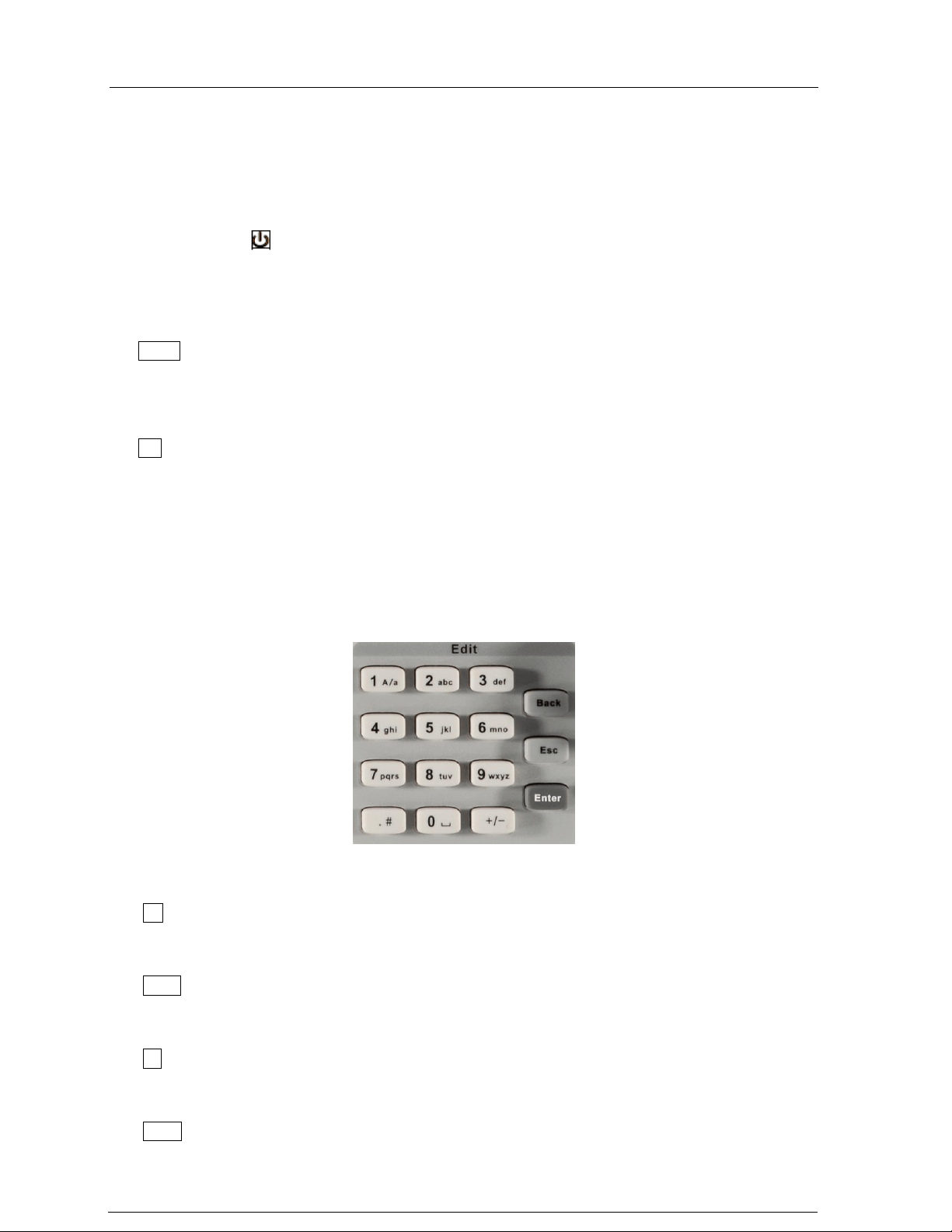
1.4.3 Using the Numeric Keyboard
The analyzer provides a numeric keyboard at the front panel. The numeric keyboard which supports
English uppercase/lowercase characters, numbers and common symbols (including decimal point, #,
space and +/-) are mainly used to edit file or folder name and set parameters.
Figure 1-8 Numeric Keyboards
1. +/-
In number input, set the sign of number; in file input, switch in number and letter.
2. 1 A/a
In number input, enter number 1; in file input, switch between uppercase and lowercase letter.
3. . #
In number input, a decimal point. In English input, special character.
4. Back
In parameter editing, press this key to delete the character on the left of the cursor.
SIGLENT
SSA3000X User Manual 6
5. Esc
◆ During parameter editing process, press this key to clear the inputs in the active function area and
exit parameter input.
◆ When the instrument is in remote mode, use this key to return to local mode.
6. Enter
In parameter editing, the system will complete the input and insert a default unit for the parameter.
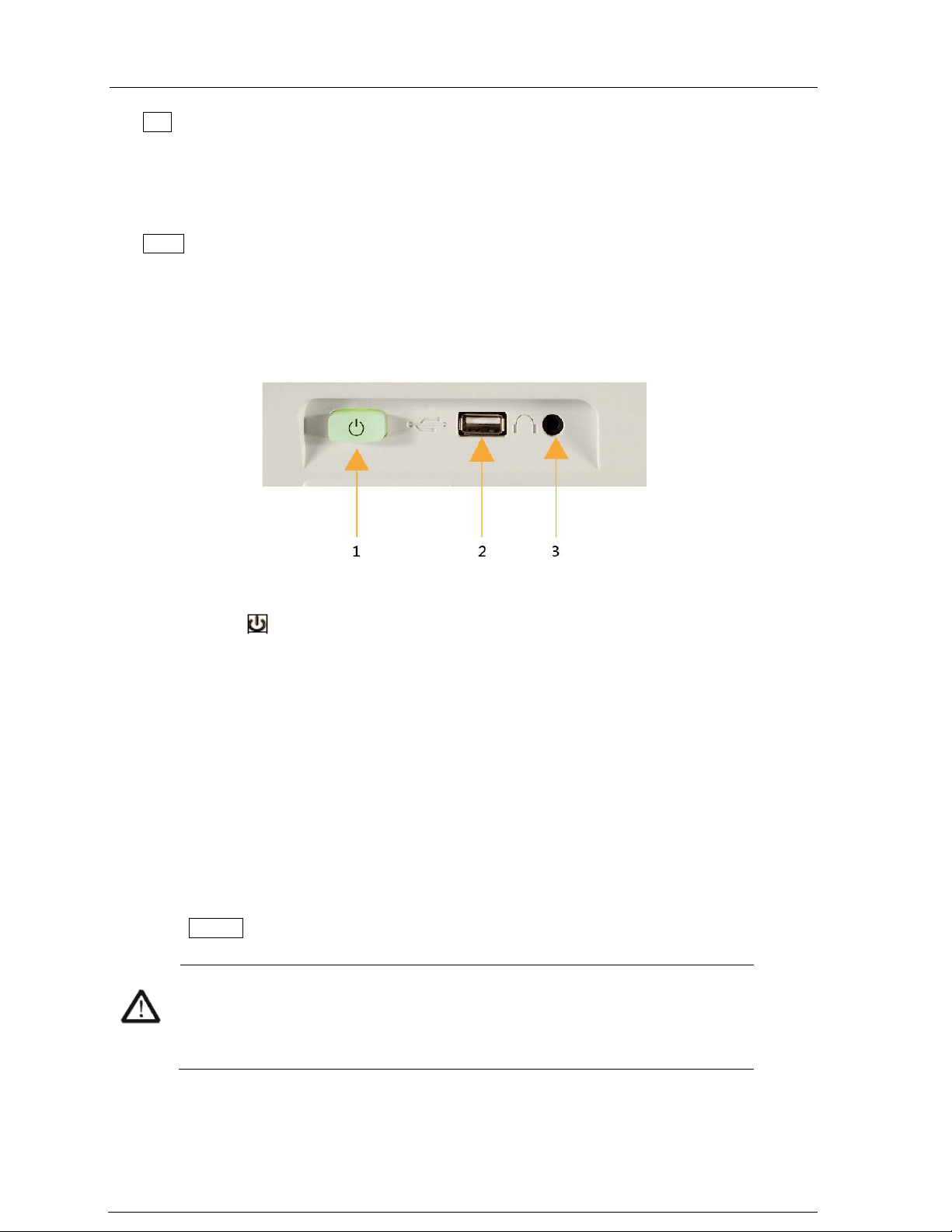
1.4.4 Front Panel Connectors
Figure 1-9 Front Panel Connectors (1)
1. Power Switch
Power up / Power down the instrument.
2. USB Host
◆ The analyzer can serve as a “host” device to connect external USB devices. This interface is
available for USB storage devices.
◆ Read and store the instrument state or trace in the USB storage device or store the contents
currently displayed on the screen in the USB storage device in .png or .jpg or .bmp format.
3. Earphone Jack
The analyzer provides AM and FM demodulations. Insert a 3.5 mm earphone to the jack to acquire the
audio output of the demodulated signal. You can turn on or off the earphone output and adjust the
volume via Demod ->Volume.
CAUTION
Protect your hearing. Please turn the volume down to zero before using the
earphone. Gradually turn the volume up to a comfortable level after putting
in the earphone..
SIGLENT
SSA3000X User Manual 7
Figure 1-10 Front Panel Connectors (2)
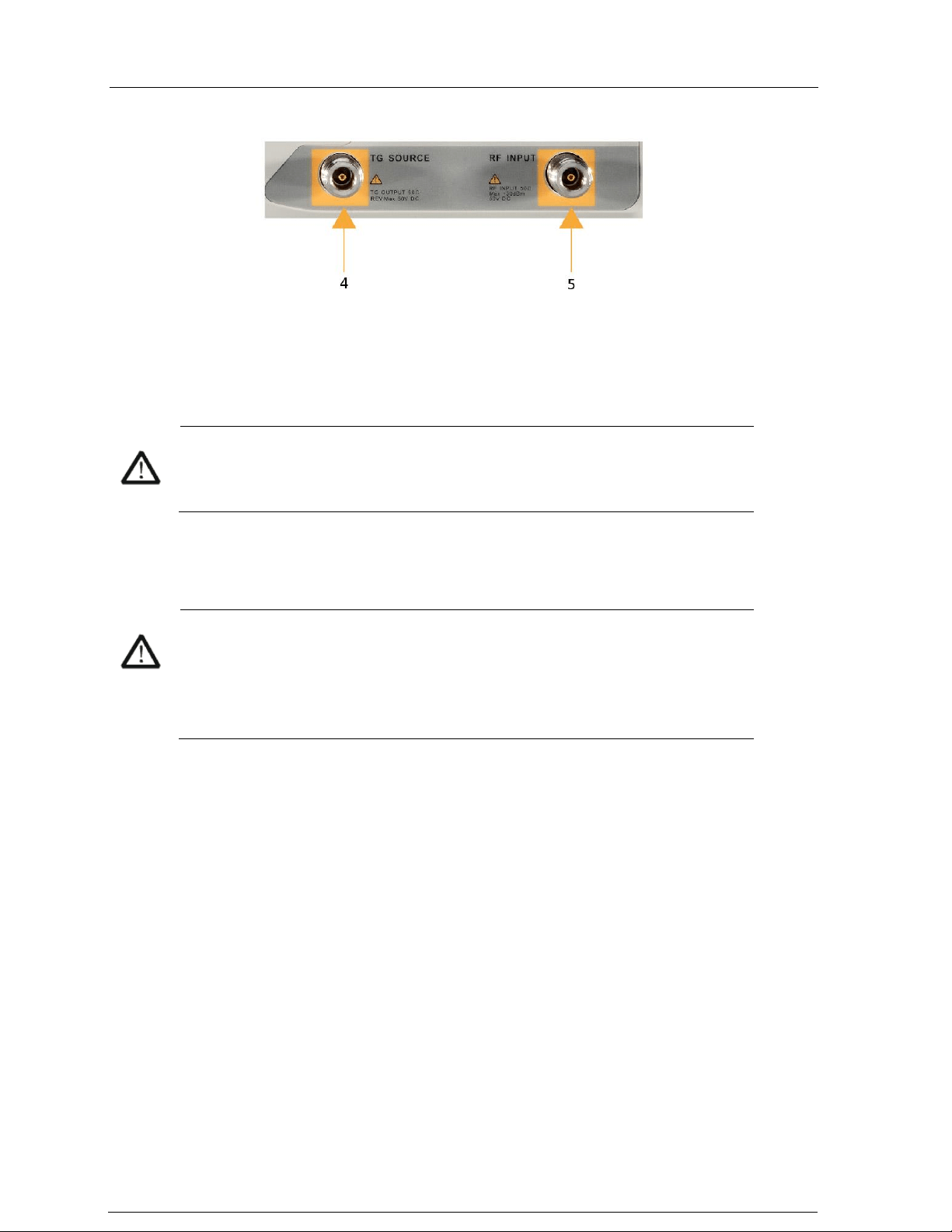
4. TG SOURCE
The TG SOURCE can be connected to a receiver through a cable with an N-male connector.
CAUTION
To avoid damage to the tracking generator, the reverse DC voltage cannot
exceed 50 V
5. RF INPUT
The RF INPUT can be connected to a DUT through a cable with an N-male connector.
CAUTION
To avoid damage to the instrument, for the signal input from the RF input
terminal, the DC voltage component and the maximum continuous power of
the AC (RF) signal component cannot exceed 50 V and +30 dBm
respectively.
SIGLENT
SSA3000X User Manual 8
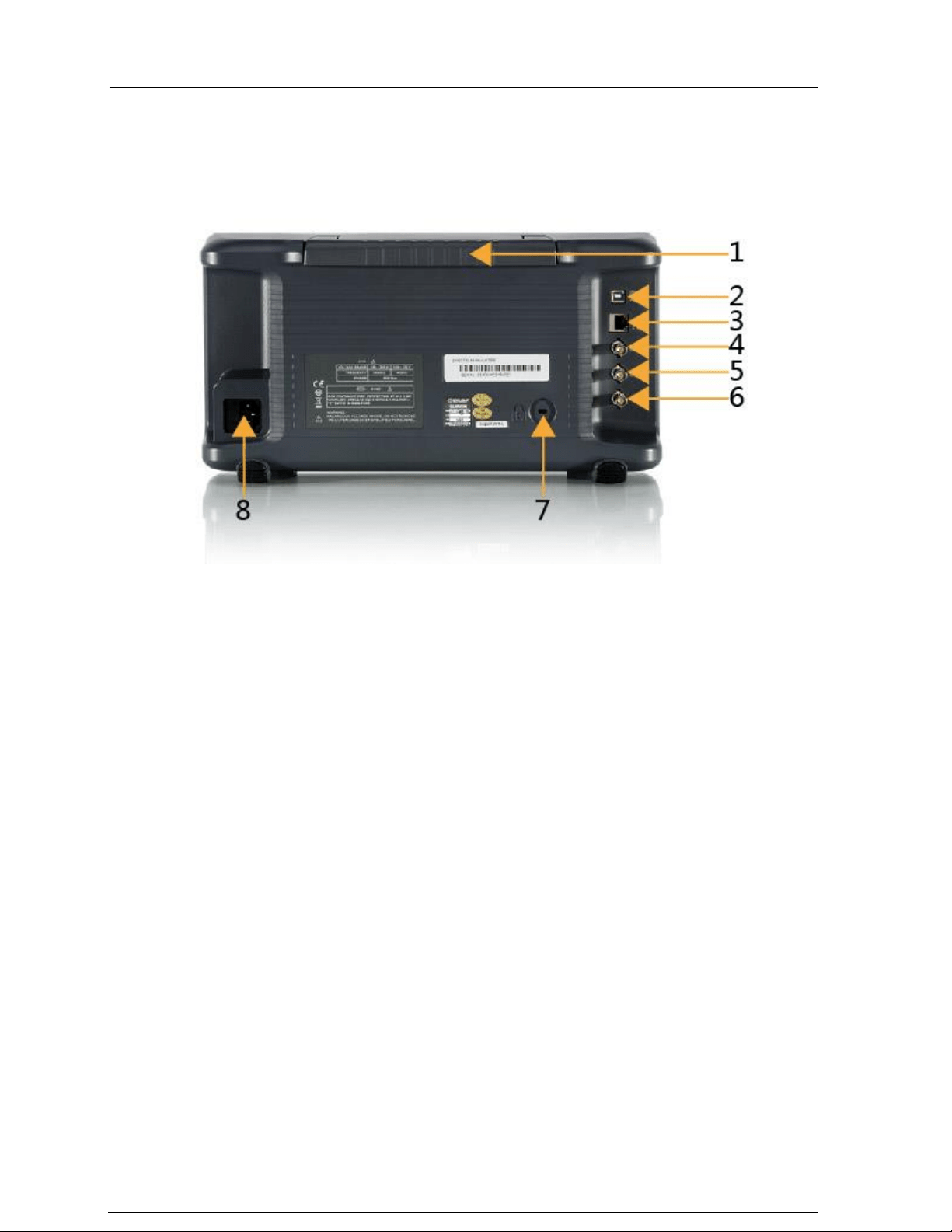
1.5 Rear Panel
Figure 1-11 Rear Panel
1. Handle
Pull up the handle vertically for easy carrying of the instrument. When you do not need the handle,
press it down.
2. USB Device Interface
The analyzer can serve as a “slave” device to connect external USB devices. Through this interface, a
PC can be connected to control the analyzer remotely through programming or PC software.
3. LAN Interface
Through this interface, the analyzer can be connected to your local network for remote control.
4. REF IN 10MHz
The analyzer can use internal or external reference source.
◆ When a 10 MHz external clock signal is received through the [10MHz IN] connector, this signal is
used as the external reference source and “Ext Ref” is displayed in the status bar of the user
interface. When the external reference is lost, transfinite or not connected, the instrument switches
to its internal reference source automatically and “Ext Ref” on the screen disappears.
◆ The [10MHz IN] and [10MHz OUT] connectors are usually used to build synchronization among
multiple instruments.
5. REF OUT 10MHz
The analyzer can use internal or external reference source.
◆ When internal reference source is used, the [10MHz OUT] connector can output a 10 MHz clock

SIGLENT
SSA3000X User Manual 9
signal generated by the analyzer. This signal can be used to synchronize other instruments.
◆ The [10MHz OUT] and [10MHz IN] connectors are usually used to build synchronization among
multiple instruments.
6. Trigger in
In external trigger mode, the connector receives an external trigger signal through a BNC cable.
7. Security Lock Hole
If needed, you can use a security lock (buy it yourself) to lock the analyzer to a desired location.
8. AC Power Supply and Fuse
The spectrum analyzer accepts 100-240V, 50/60 or 100-120VA 400Hz power supply. Please use the
power cord provided as accessories to connect the instrument. Before power on, make sure the
spectrum analyzer is protected by fuse.
SIGLENT
SSA3000X User Manual 10
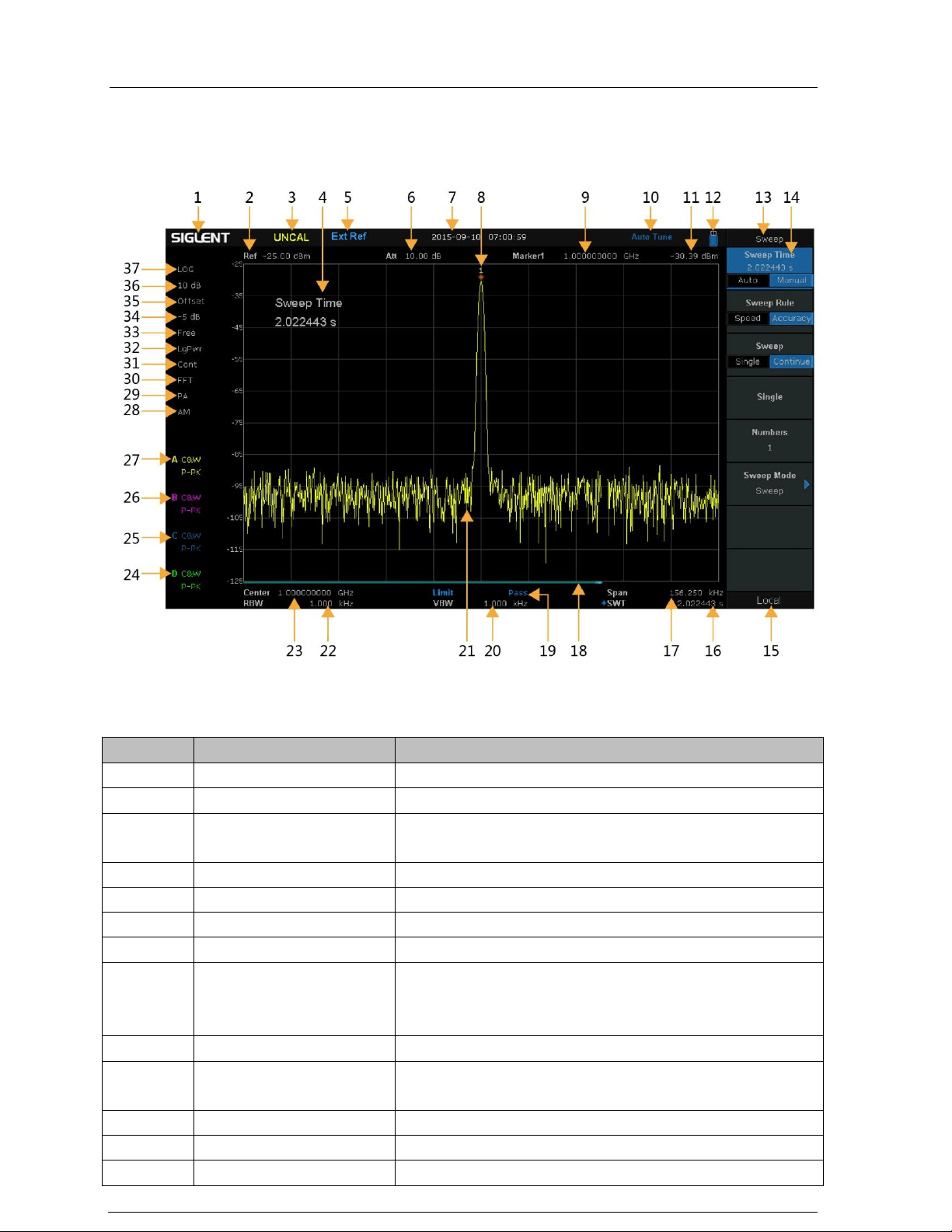
1.6 Display Annotations
Figure 1-12 User Interface
Table 1-3 User Interface labels
NO.
Name
Description
1
SIGLENT
Logo of SIGLENT
2
Ref
Reference level
3
UNCAL
When the sweep time less than the auto couple time, the
measure result may be inaccuracy, then appear “UNCAL”
4
Active function area
Current parameter and its value
5
EXT REF
Ext 10 MHz reference clock detected indicator
6
Att
Attenuator Value
7
Day and time
System time
8, 9, 11
Maker parameter
8:current active marker;
9:current marker frequency value;
11:current marker amplitude value;
10
Auto Tune
Automatically sets the optimal parameters
12
USB storage device
identification
The identification is displayed when a USB disk is inserted
13
Menu title
Function of the current menu.
14
Menu items
Menu items of the current function
15
Operation status
Local is local mode, Remote is remote mode, Upgrade
SIGLENT
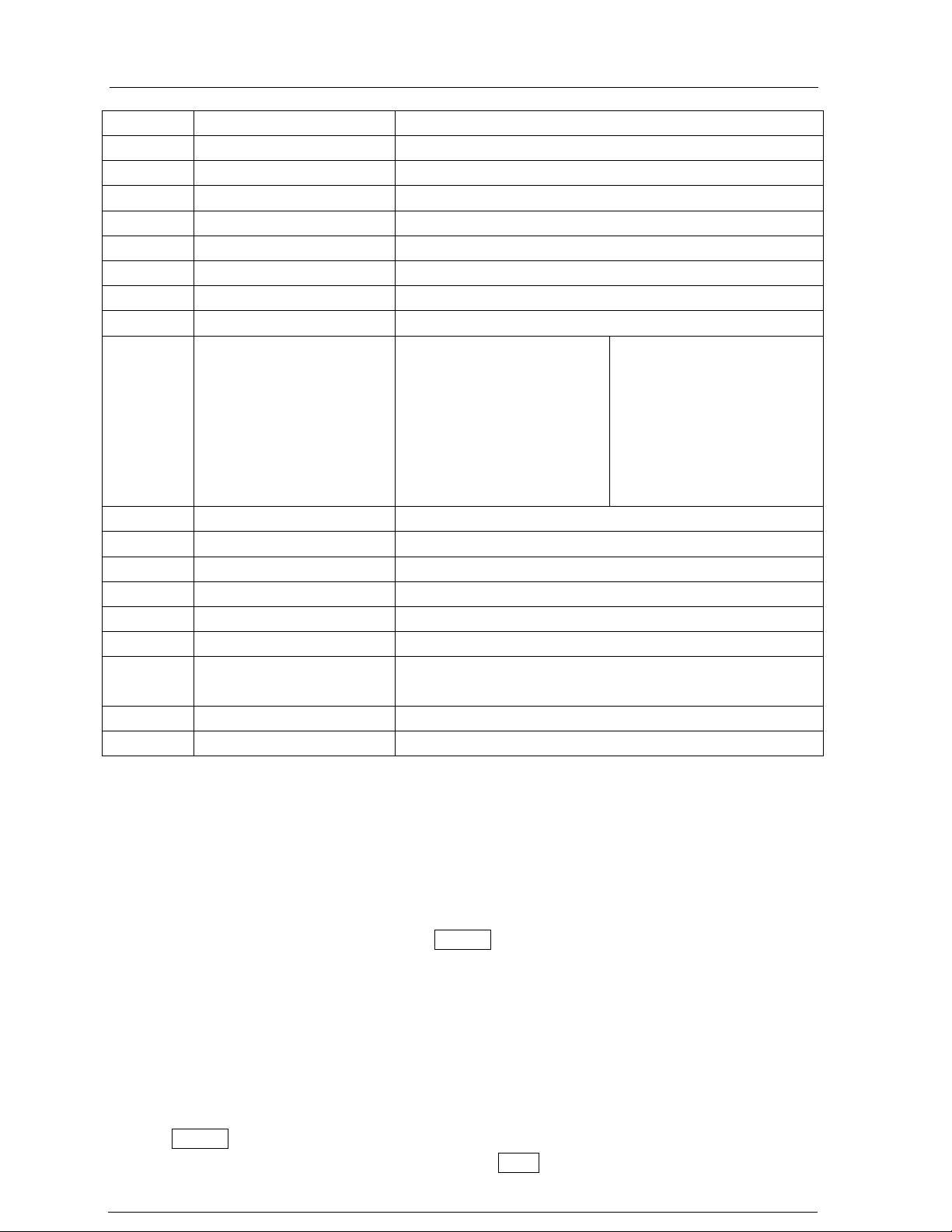
SSA3000X User Manual 11
means the instrument is upgrading
16
Sweep time
Sweep time
17
Span/Stop Frequency
The frequency range of the current sweep
18
Sweep progress bar
Sweep progress bar
19
Pass/Fail status
Pass/Fail status
20
VBW
Video bandwidth
21
Spectrum trace
Spectrum trace
22
RBW
Resolution bandwidth
23
Center/Start frequency
The frequency range of the current sweep
24, 25, 26,
27
Trace
A\B\C\D
status
Trace type:
C&W: Clear Write
MaxH: Max Hold
MinH: Min Hold
View: View
AVG: Video average.
Detect type:
P-PK: Positive peak
N-PK: Positive peak
Samp: Sample
Norm: Normal
AVG: average
Q-PK: Quasi-peak
28
AM or FM
AM or FM identification
29
PA
Enable or disable Preamplifier
30
FFT
Sweep mode is FFT
31
Single or Continue
Sweep mode single or continue
32
Average type
Log power, Power, Voltage
33
Trigger type
Free, Video, External trigger
34, 35
Ref offset
34:Ref offset identification;
35:Ref offset value
36
Scale/Div
Scale value
37
Scale type
Logarithm or linearity
1.7 Firmware Operation
1.7.1 Check System Information
Users can get the system information by press System->“System Info”, including
◆ Product Model, Serial and Host ID
◆ Software Version and Hardware Version
◆ Option Information
1.7.2 Load Option
Refer to the procedures below to activate the options you have purchased.
1, Press System ->“Load Option”
2, Enter the license key in the onscreen window. Press Enter to confirm your input and terminate the
license key input. Or
SIGLENT
SSA3000X User Manual 12
3, Load the .lic file provided by pressing File ->“Load” from internal memory or USB stick.
The option will be enabled after rebooting.
1.7.3 Firmware Upgrade
Follow this procedure to update the instrument firmware:
1. Download the firmware package from an official SIGLENT website. www.siglentamerica.com,
http://www.siglent.com/ens, https://www.siglenteu.com
2. Extract and copy the .ADS file into the root directory of a USB stick.
3. Plug the USB stick into the USB Host connector. Press System->“System Info”-> “Firmware
Update”; find the .ADS file in USB stick.
4. Press the “Load”, the analyzer will perform the update process automatically.
Remarks:
◆ The upgrade process will take several minutes. When the upgrade is completed, the machine will
reboot.
◆ Any interruption during the update process will result in update failure and system data loss. This
is not covered under the warranty and the user will bear repair costs and shipping.
◆ Do not remove the USB storage device until the update is finished.
1.8 Menu Operation
There are 7 types of menus according to their operation modes. Each type of menu and its operation
method are introduced below.
1. Parameter Input
When selected, use the numeric keys to modify the parameters.
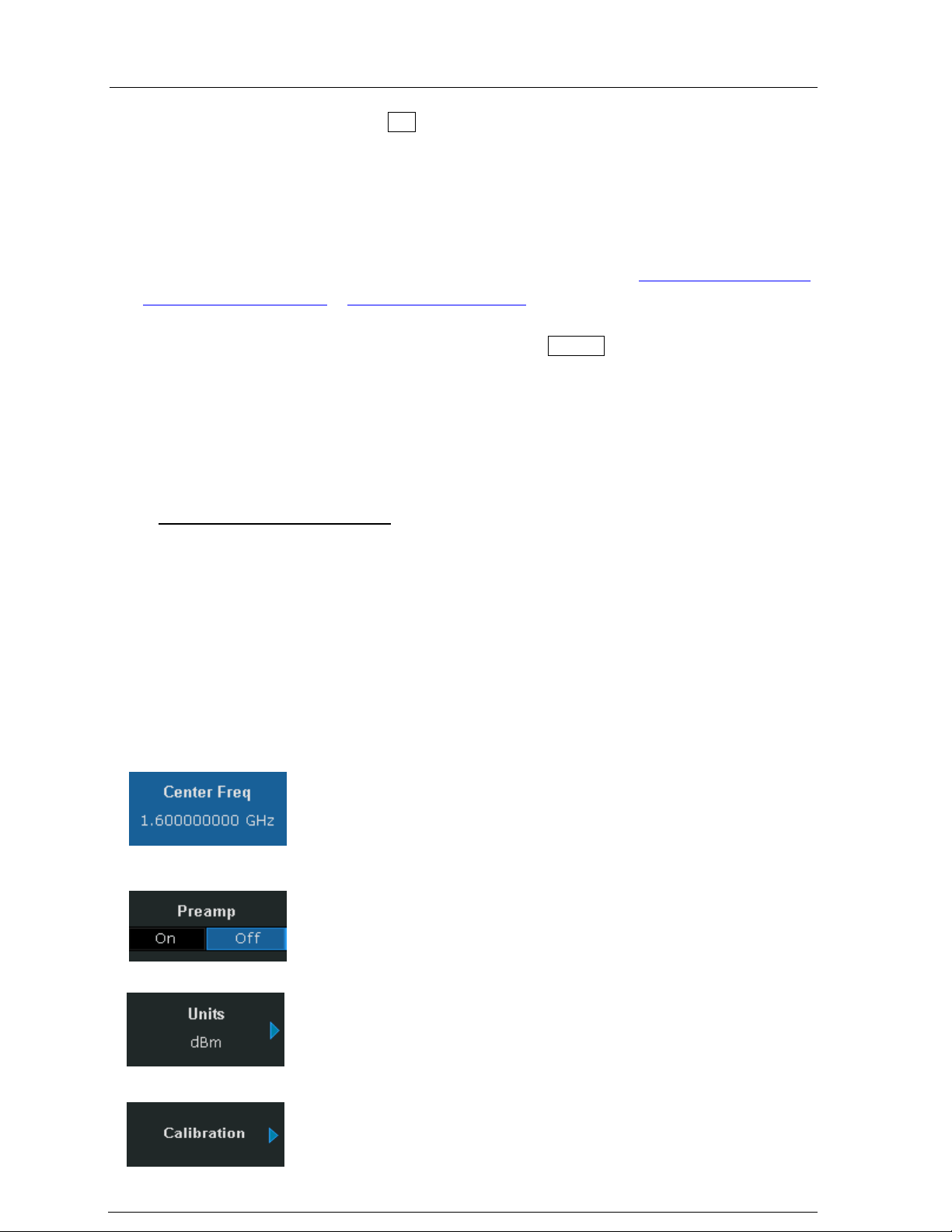
For example, select Center Freq, input the desired figure and press Enter
to change the center frequency.
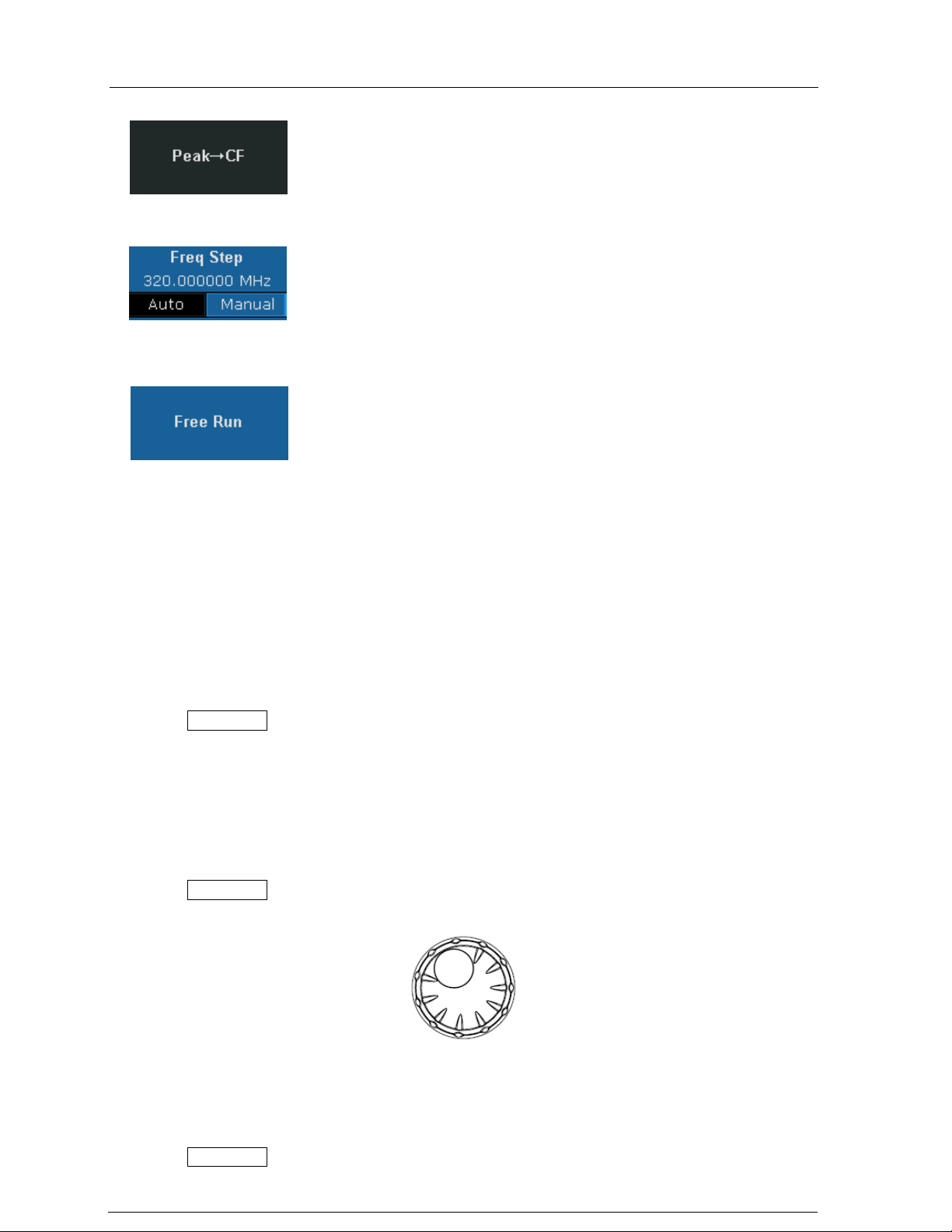
2. State switching
Press the corresponding menu key to switch between the sub-options.
For example, press Preamp to enable or disable the amplifier.
3. Enter Lower Menu(with parameter)
Press the corresponding menu key to enter the lower menu and change the
option currently selected.
For example, press Units to enter the lower menu. Select dBm and return
to the previous menu. The unit of Y-axis changes to dBm.
4. Enter Lower Menu (without parameter)
Press the corresponding menu key to enter the lower menu.
For example, press Calibration to enter the lower menu directly.
5. Direct Execution
SIGLENT
SSA3000X User Manual 13
Press the key to execute the corresponding function.
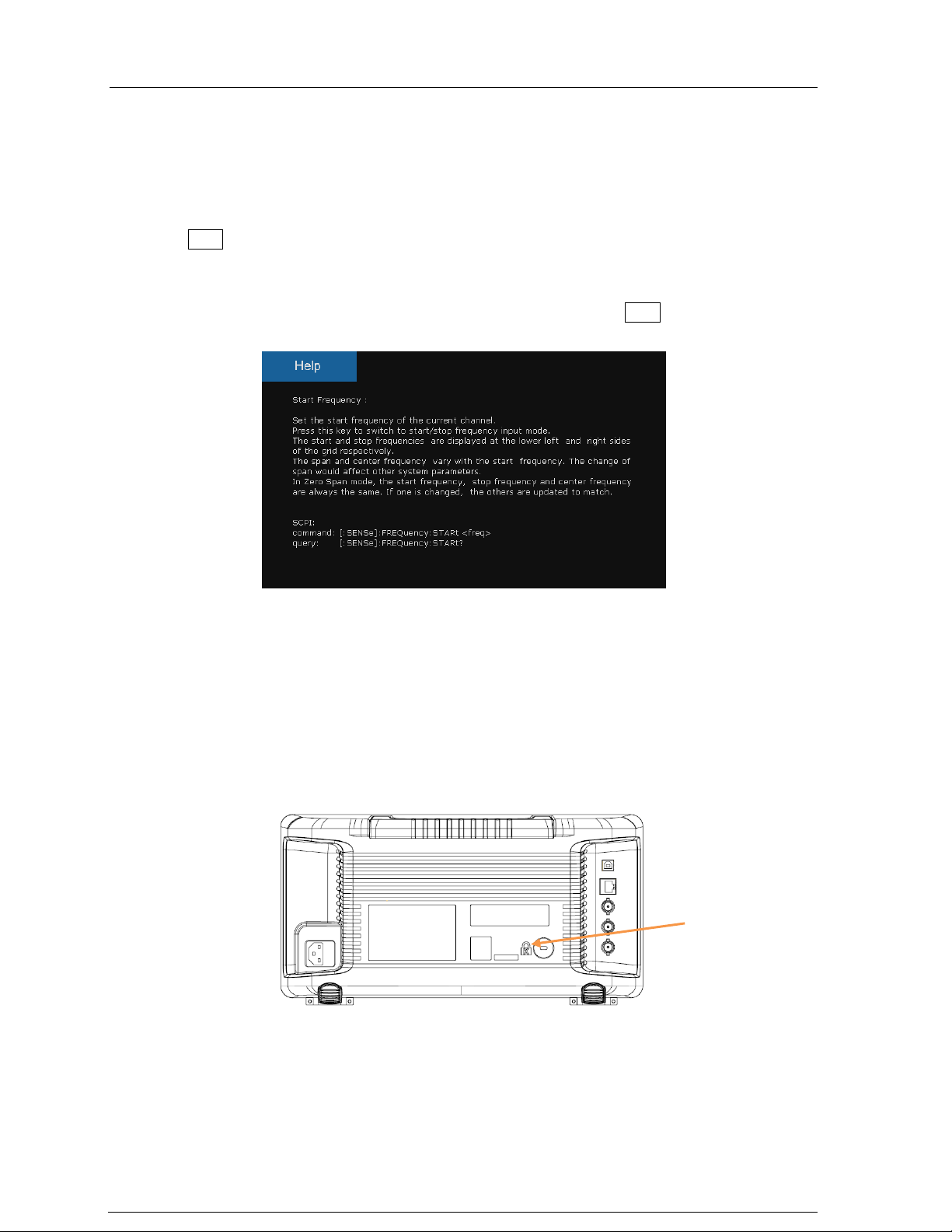
For example, press Peak->CF to execute a peak search and set the
center frequency of the analyzer to the frequency of the current peak
signal.
6. Function Switch + Parameter Input
Press the corresponding menu key to switch between functions; change
the parameter directly using the numeric keys.
For example, press Freq Step to switch between Auto and Manual; if
Manual is selected, you can directly input the desired number to change
the Freq Step.
7. State Selection
Press the corresponding menu key to modify the parameter and return to
the menu one level up.
For example, press Trig Type ->Free Run to select free trigger and the
analyzer is in Free Run state at present.
1.9 Parameter Setting
Users can enter the desired parameter values using the numeric keys, knob or Arrow keys. This
section describes the three methods of parameter setting through an example (to set the center
frequency to 100 MHz).
1. Use the numeric keyboard
◆ Press Frequency->“Center Freq”
◆ Input 100 using the numeric keys;
◆ Select the desired unit (MHz) from the popup menu.
2. Use the knob
When the parameter is editable (namely when the parameter is selected), turn the knob clockwise to
increase or counterclockwise to decrease the parameter value at the specified step.
◆ Press Frequency->“Center Freq”
◆ Rotate the knob until the parameter is set to the desired value (100 MHz).
Figure 1-13 Knob
3. Use the arrow keys
When the parameter is editable (namely when the parameter is selected), you can increase or
decrease the parameter value at the specific step using the direction keys.
◆ Press Frequency -> “Center Freq”
◆ Press the up/down Arrow key until the parameter is set to the desired value (100 MHz).
SIGLENT
SSA3000X User Manual 14
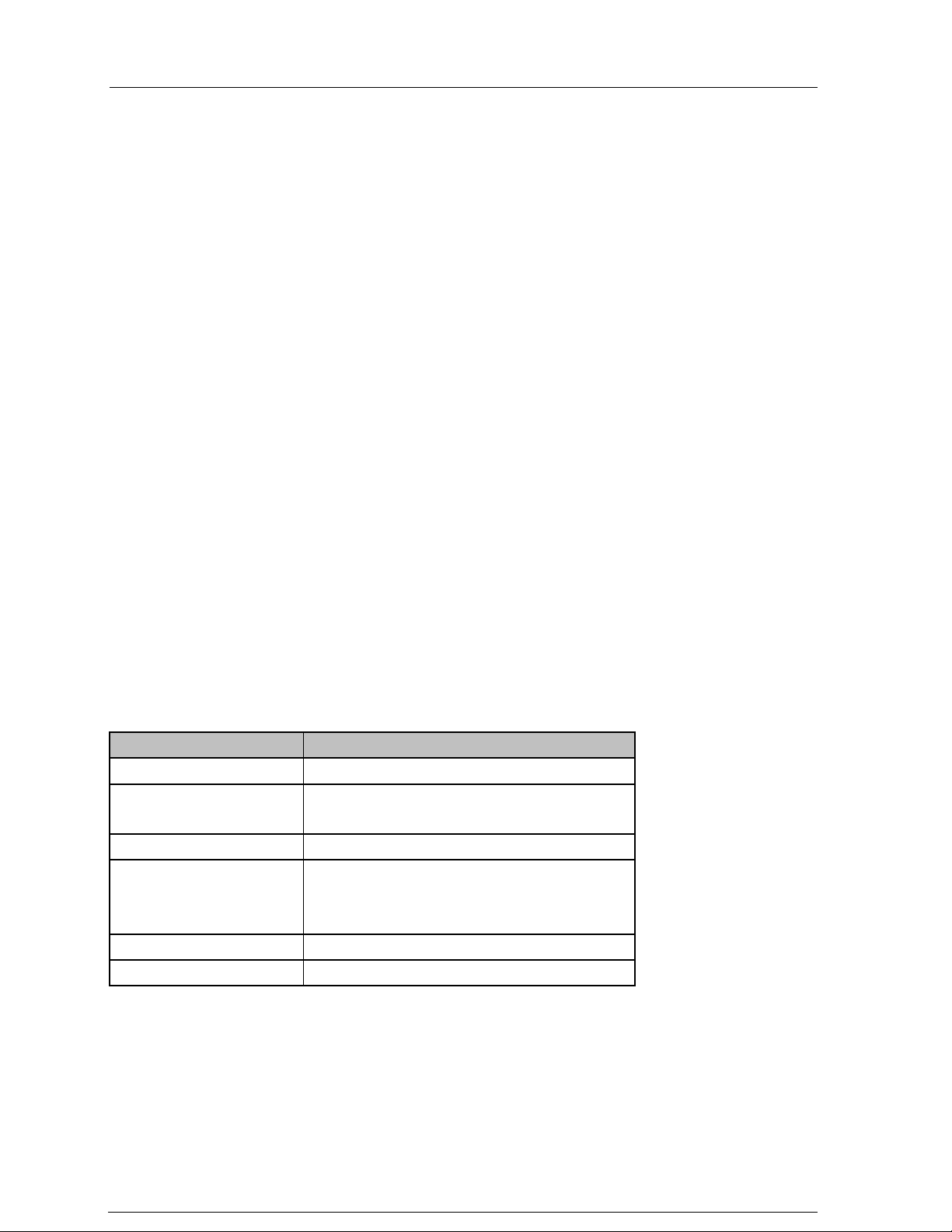
1.10 Using Built-in Help
The built-in help system provides information about every function key at the front panel and every
menu soft key.
◆ Press Help and a prompt about how to obtain help information will be shown at the center of the
screen. Then, press the key that you want to get help of and the relevant help information will be
shown at the center of the screen.
◆ When the help information show at the center of the screen. Press the Help button; it will close the
help information.
Figure 1-14 help information
1.11 Using the Security Lock
If needed, you can use the security lock (please buy it yourself) to lock the Spectrum Analyzer to a fixed
location. The method is as follows, align the lock with the lock hole and plug it into the lock hole
vertically, turn the key clockwise to lock the Spectrum Analyzer and then pull the key out.
Figure 1-15 Security Lock

SIGLENT
SSA3000X User Manual 15
Chapter 2 Front Panel Operation
This chapter describes in detail the function keys at the front panel and the associated functions.
Subjects in this chapter:
◆ Basic Settings
◆ Sweep and Function
◆ Marker
◆ Measurement
◆ System
◆ Shortcut Key
SIGLENT
SSA3000X User Manual 16
2.1 Basic Settings
2.1.1 Frequency
Set the frequency parameters and functions of the analyzer. Restart sweeping every time when the
frequency parameters are modified.
The frequency range of a channel can be expressed by either of three groups of parameters: Start
Frequency, Center Frequency and Stop Frequency. If any of the parameters is changed, the others
would be adjusted automatically in order to ensure the coupling relationship among them
startstopspan
stopstartcenter
fff
)/2f(ff
−=
+=
, The
sp an
f
is span.
2.1.1.1 Center Frequency
Set the center frequency of the current channel. The center frequency and span values are displayed
at the lower left and right sides of the grid respectively. In process of using pay attention to the
following points:
◆ The start and stop frequencies vary with the center frequency when the span is constant (except
the Start Frequency and Stop Frequency to the border).
◆ In Zero Span, the start frequency, stop frequency and center frequency are always the same.
Table 2-1 Center Frequency
Parameter
Explanation
Default
Full Span/2
Range
Zero Span, 0 Hz ~ Full Span
Nonzero Span, 50 Hz ~ (Full Span -50Hz)
Unit
GHz\MHz\kHz\Hz
Knob Step
Span>0, step=Span/200
Span=0, step=RBW/100
Min 1 Hz
Direction Key Step
Freq step
Related to
Start Freq, Stop Freq
2.1.1.2 Start Frequency
Set the start frequency of the current channel. The start and stop frequencies are displayed at the
lower right sides of the grid respectively. In process of using pay attention to the following points:
◆ The span and center frequency vary with the start frequency when the Span did not reach the
minimum (The parameters vary with the span, please refer to “Span”);
◆ In Zero Span, the start frequency, stop frequency and center frequency are always the same.
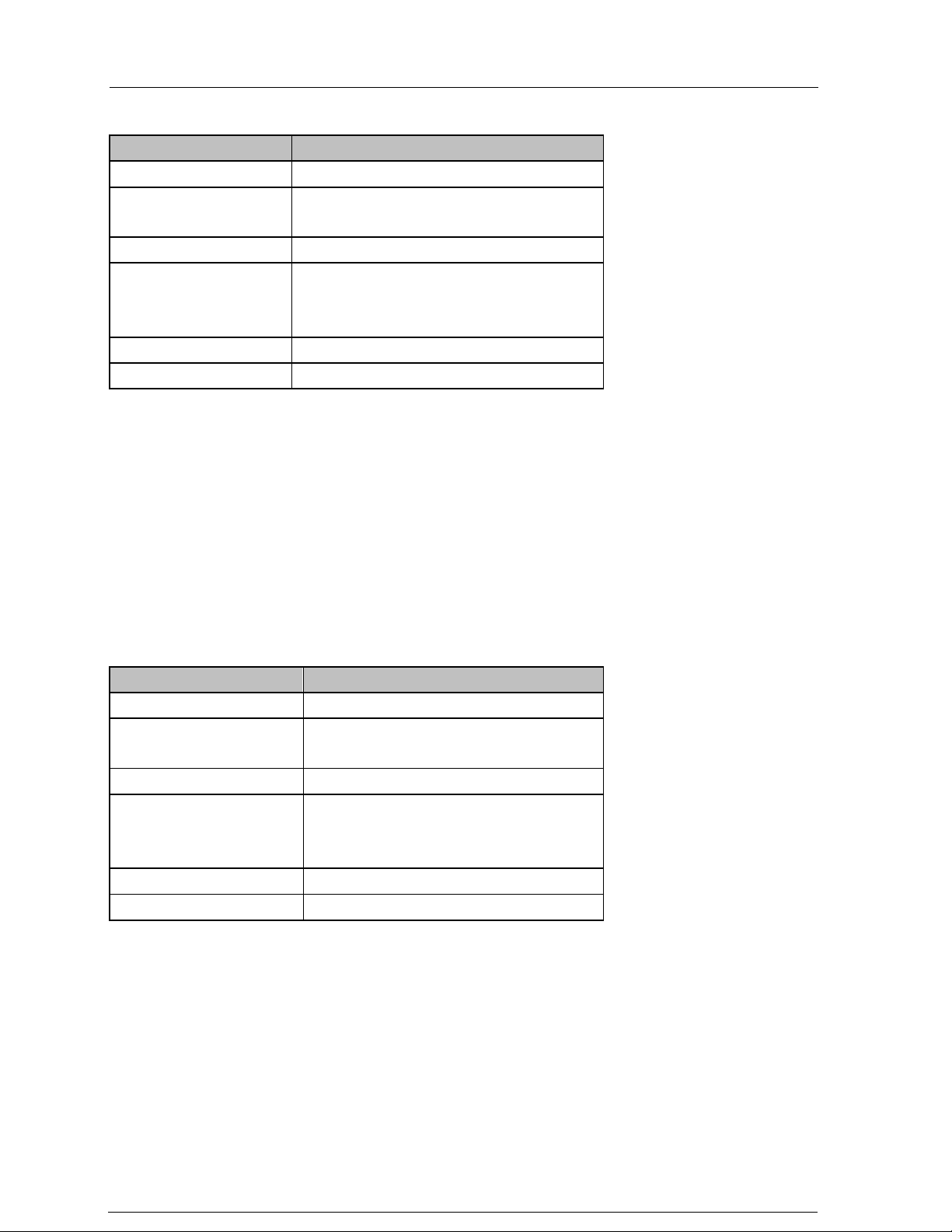
SIGLENT
SSA3000X User Manual 17
Table 2-2 Start Frequency
Parameter
Explanation
Default
0 GHz
Range
Zero Span, 0 Hz ~ Full Span
Nonzero Span, 0 Hz ~ (Full Span-100Hz)
Unit
GHz\MHz\kHz\Hz
Knob Step
Span>0, step=Span/200
Span=0, step=RBW/100
Min 1 Hz
Direction Key Step
Freq step
Related to
Center Freq, Span
2.1.1.3 Stop Frequency
Set the stop frequency of the current channel. The start and stop frequencies are displayed at the
lower right sides of the grid respectively. In process of using pay attention to the following points:
◆ The span and center frequency vary with the stop frequency. The charge of span would affect
other system parameters. For more details, please refer to “Span”.
◆ In Zero Span mode, the start frequency, stop frequency and center frequency are always the
same.
Table 2-3 Stop Frequency
Parameter
Explanation
Default
Full Span
Range
Zero Span: 0 Hz ~ Full Span
Nonzero Span: 100 Hz ~ Full Span
Unit
GHz, MHz, kHz, Hz
Knob Step
Span>0, step=Span/200
Span=0, step=RBW/100
Min 1 Hz
Direction Key Step
Freq step
Related to
Center Freq, Span
2.1.1.4 Freq Step
Set the step of the center frequency. Start frequency and stop frequency vary with the step frequency
through arrow keys. In process of using pay attention to the following points:
◆ At a fixed step change the value of the center frequency can reach the purpose of continuous
measurement channel switch.
◆ There are two kinds of frequency step mode:Auto and manual. In Auto mode, the Freq step is
1/10 of the span in Non-zero span mode or equals the RBW while in Zero span mode; in Manual
mode; you can set the step using the numeric keys.
Table 2-4 Frequency step
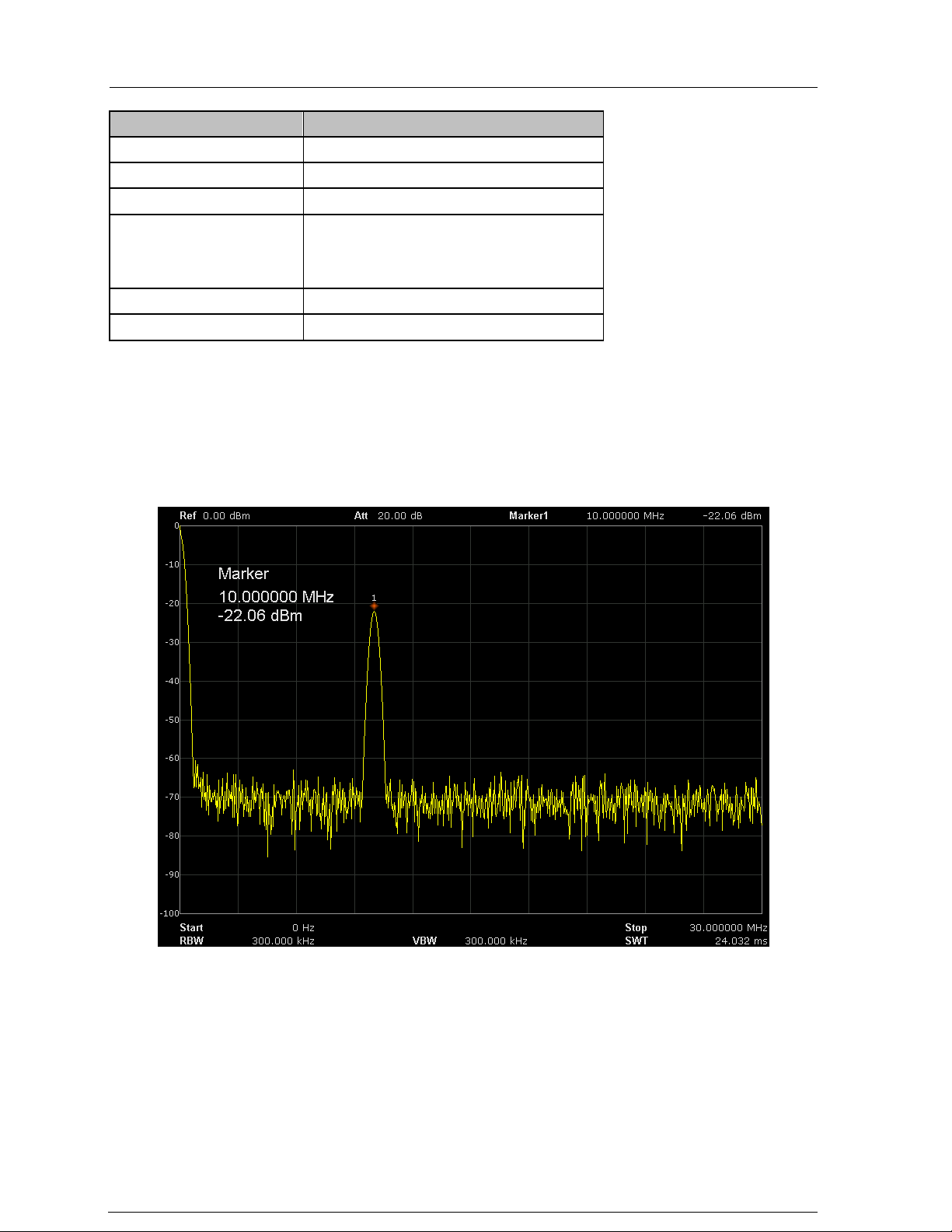
SIGLENT
SSA3000X User Manual 18
Parameter
Explanation
Default
Full Span/10
Range
1Hz ~ Full Span
Unit
GHz, MHz, kHz, Hz
Knob Step
Span>0, Step=Span/200
Span=0, Step=100
min 1 Hz
Direction Key Step
1-2-5 sequence step
Relation
RBW, Span and related parameters
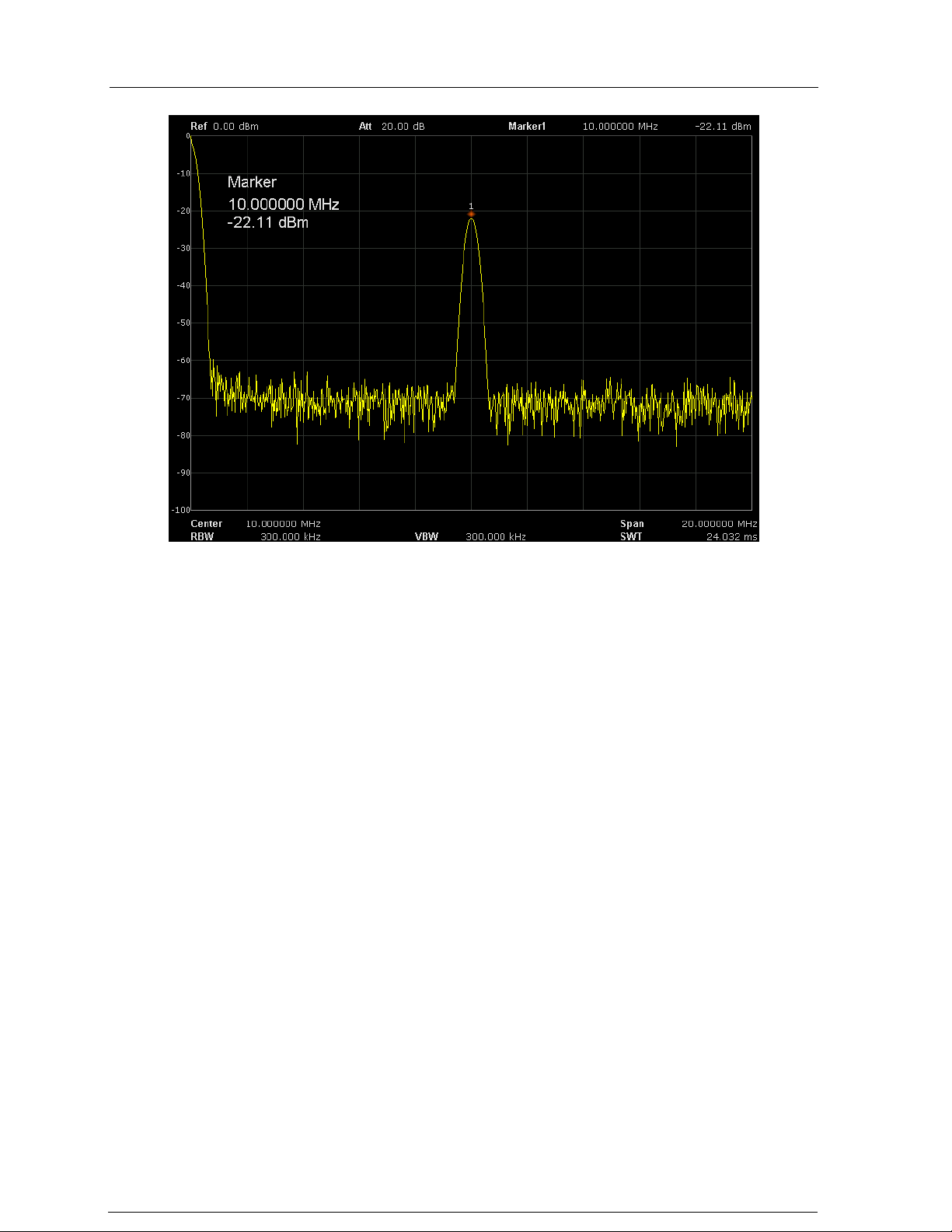
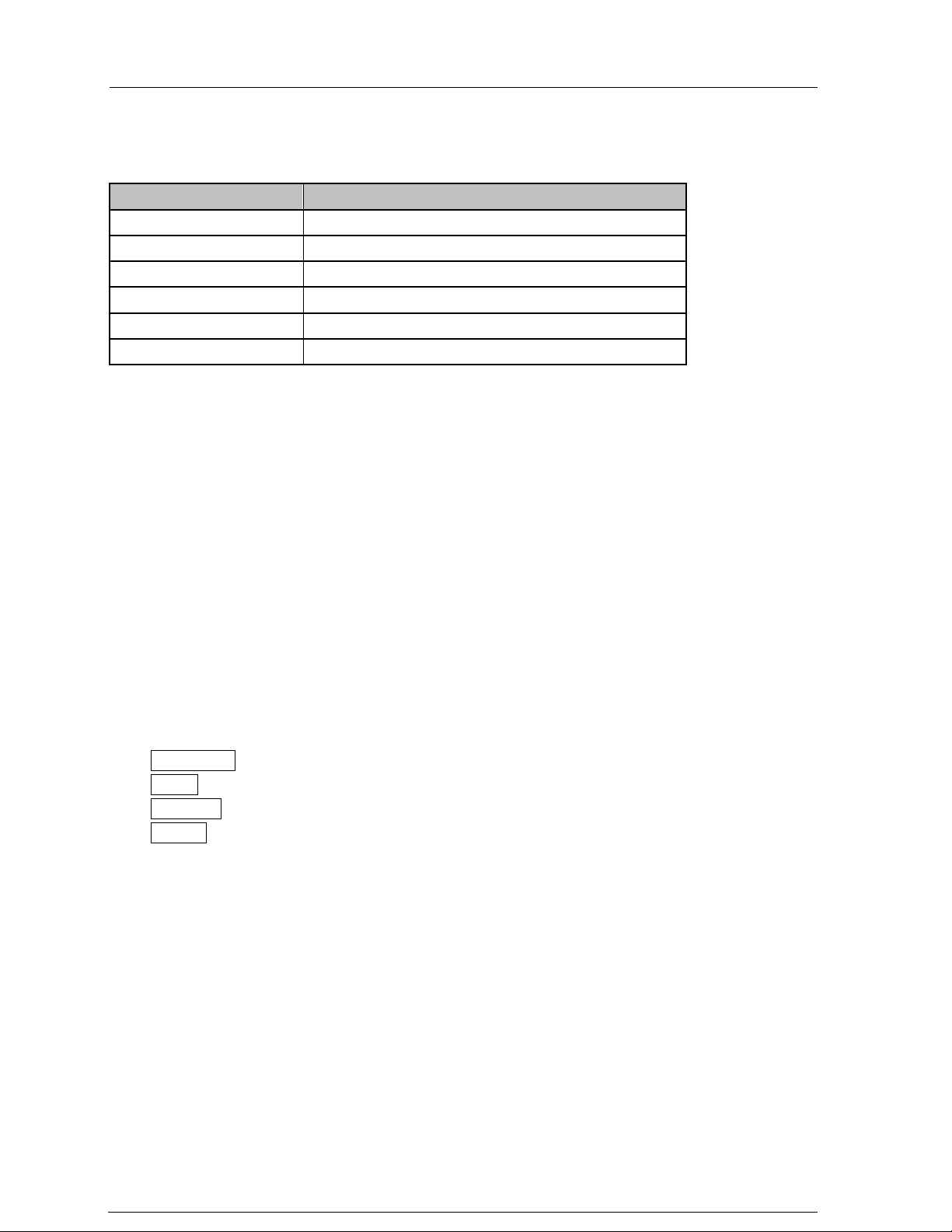
2.1.1.5 Peak -> CF
Execute a peak search and use the frequency of the current peak as the center frequency (CF) of the
analyzer. The function is invalid in Zero Span mode.
Figure 2-1 before Peak -> CF
SIGLENT
SSA3000X User Manual 19
Figure 2-2 after Peak -> CF
2.1.1.6 CF -> Step
Set the current center frequency as the CF step. At this point, the CF step will switch to “Manual”
mode automatically. This function is usually used with channel switching. Take harmonic waveform
measurement for example: locate a signal at the center frequency of a channel, execute CF->Step
and then press the down direction key continuously to measure each order of harmonic in sequence
2.1.2 Span
Set the span of the analyzer. The change of this parameter will affect the frequency parameters and
restart the sweep.
2.1.2.1 Span
Set the frequency range of the current channel. The center frequency and span are displayed at the
low left and right sides of the grid respectively. In process of using pay attention to the following points:
◆ The start and stop frequency vary with the span when the center frequency is constant.
◆ In manual span mode. The span can be set down to 100Hz and up to the full span described in
Specifications. When the span is set to the maximum, the analyzer enters full span mode.
◆ Modifying the span in non-zero span mode may cause an automatic change in both CF step and
RBW if they are in Auto mode. Besides, the charge of RBW may influence VBW (in Auto VBW
mode).
◆ Variation in the span, RBW or VBW would cause a change in the sweep time.
SIGLENT
SSA3000X User Manual 20
◆ In non-zero span mode, neither is “Video” trigger nor “1/time” readout function valid.
Table 2-5 Span
Parameter
Explanation
Default
Maximum bandwidth
Range
0 Hz~ 3.2 GHz
Unit
GHz, MHz, kHz, Hz
Knob Step
Span/200, Min = 1 Hz
Direction Key Step
In 1-2-5 sequence
Related to
Start Freq, Stop Freq, Freq Step, RBW, Sweep time
Note: 0 Hz is available only in zero span.
2.1.2.2 Full Span
Set the span of the analyzer to the maximum.
2.1.2.3 Zero Span
Set the span of the analyzer to 0Hz. Both the start and stop frequencies will equal the center frequency
and the horizontal axis will denote time. The analyzer measures the time domain characteristics of the
amplitude of the corresponding frequency point on the input signal. In process of using pay attention to
the following points:
The following functions are invalid in Zero span mode: Peak ->CF, Signal Track, Zoom In and Zoom
Out.
◆ Frequency: Peak->CF;
◆ SPAN: Zoom In and Zoom Out;
◆ Marker-> : M ->CF, M->CF step, M->Start Freq, M->Stop Freq, M->CF and M->Span;
◆ Marker: Frequency, Period and 1/Time(valid in Delta marker type);
2.1.2.4 Zoom In
Set the span to half of its current value. At this point, the signal on the screen is zoomed in to observe
signal details.
2.1.2.5 Zoom Out
Set the span to twice the current value. At this point, the signal on the screen is zoomed out to gain
more information about the signal.
SIGLENT
SSA3000X User Manual 21
2.1.2.6 Last Span
Set the span to the previous span setting.
2.1.2.7 X-Scale
Set the scale type of X-axis to Lin or Log.
In Log scale type, the frequency scale of X-axis is displayed in the logarithmic form.
If the scale type of X-axis is in the logarithmic type form, the scale type will be switched into Lin when
turning on Meas.
2.1.3 Amplitude
Set the amplitude parameters of the analyzer. Through modifying these parameters, signals under
measurement can be displayed in a proper mode for easier observation and minimum error.
2.1.3.1 Ref Level
Set the maximum power or voltage can be currently displayed in the window. The value is displayed at
the upper left corner of the screen grid.
The maximum reference level available is affected by the maximum mixing level; input attenuation is
adjusted under a constant maximum mixing level in order to fulfill the following condition:
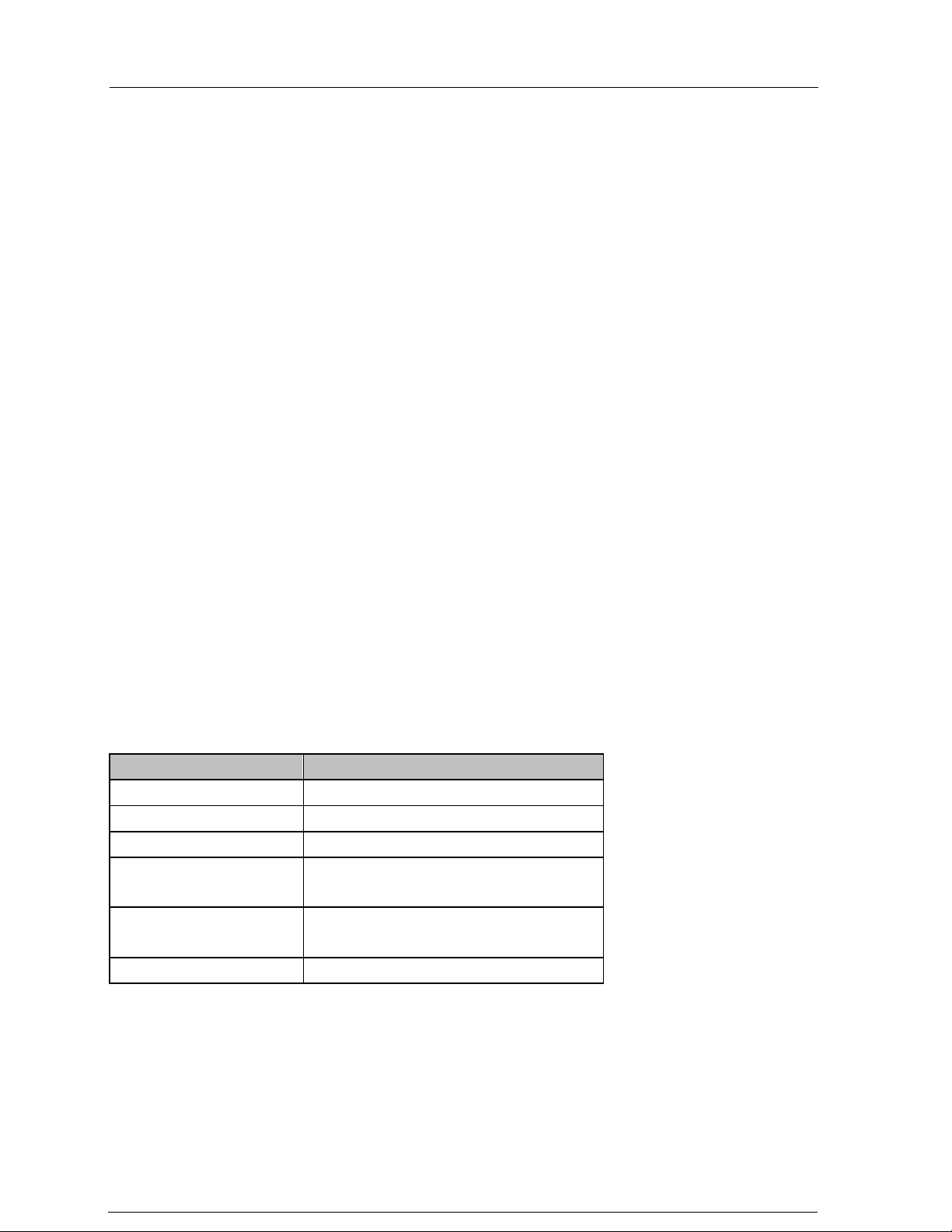
Ref <= ATT – PA - 20dBm
Table 2-6 Ref Level
Parameter
Explanation
Default
0 dBm
Range
-100 dBm ~ 30 dBm
Unit
dBm, dBmV, dBuV, V, W
Knob Step
In Log scale mode, step = Scale/10
In Lin scale mode, step = 0.1 dB
Direction Key Step
In Log scale mode, step = Scale
In Lin scale mode, step = 1 dB
Related to
Attenuator, Preamp, Ref Offset
2.1.3.2 Attenuator
Set the front attenuator of the RF input in order to ensure big signals (or small signals) to pass through
the mixer with low distortion (or low noise).
Ref <= ATT – PA - 20dBm
Input attenuation can be set up for automatic and manual two kinds of patterns.
◆ Automatic mode attenuation value according to the state of preamplifier and value of the current
SIGLENT
SSA3000X User Manual 22
reference level automatic adjustment.
◆ Open the preamplifier; maximum input attenuation can be set to 51dB. When setting parameters
do not meet the above formula, can adjust the reference level.
Table 2-7 Attenuator
Parameter
Explanation
Default
20 dB
Range
0 ~ 51 dB
Unit
dB
Knob Step
1 dB
Direction Key Step
5 dB
Related to
Preamp, Ref level
2.1.3.3 RF Preamp
Turn on or off the preamplifier located at the front of the RF signal path. When signal under
measurement is small, turning on the preamplifier can reduce the displayed noise level; there for, you
can distinguish small signals from the noise.
The corresponding icon “PA” will appear at the left side of the screen when the preamplifier is turned
on.
2.1.3.4 Units
Set the unit of the Y-axis to dBm, dBmV, dBuV, Volts (RMS) and Watts. The default is dBm。
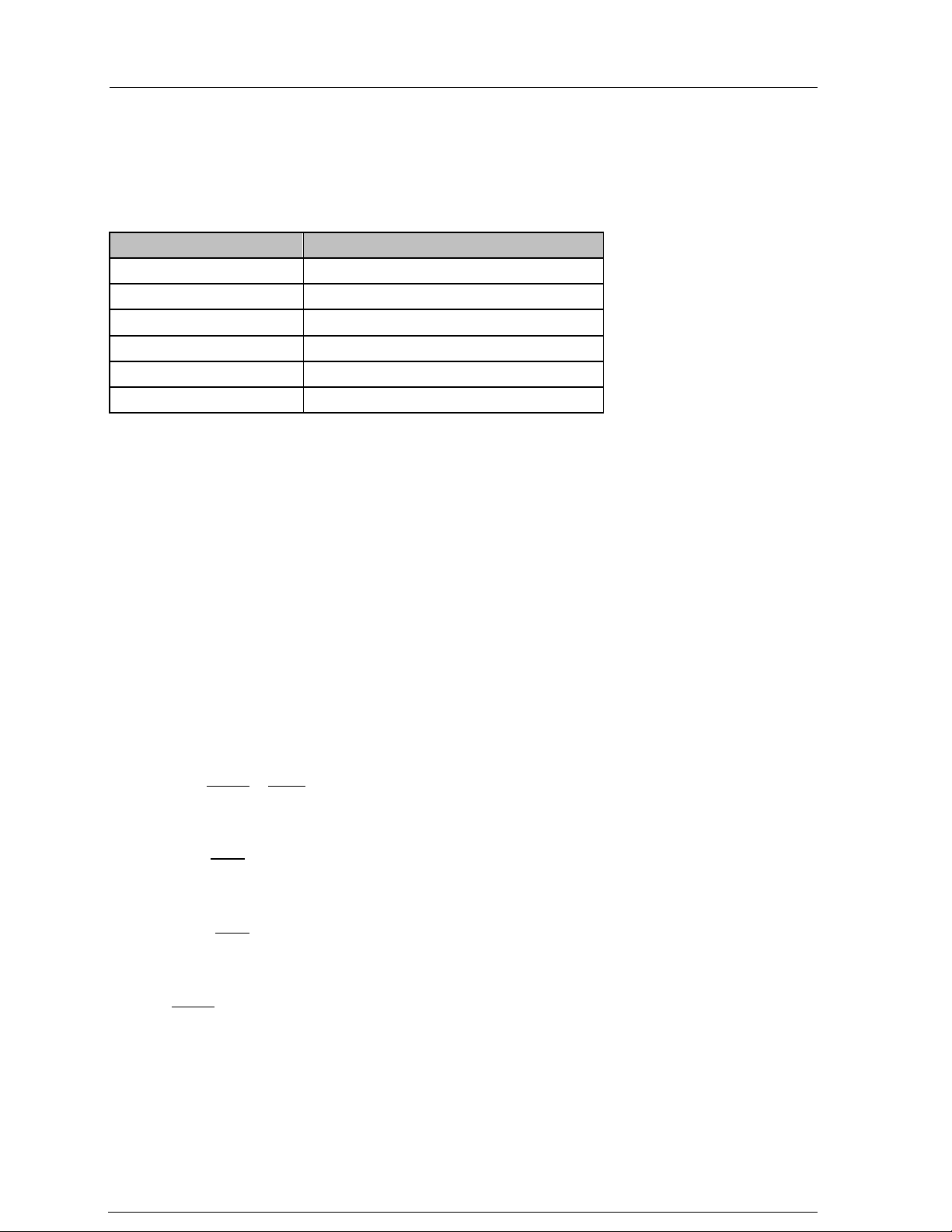
The conversion relationships between units are as follows.
μ
μ
Wherein, R denotes the reference resistance. Default value is 50Ω, setting by “Correction -> RF input”.
The “75 Ω” resistance is just a numeric value, not a real resistance.
2.1.3.5 Scale
Set the logarithmic units per vertical grid division on the display. This function is only available when the
SIGLENT
SSA3000X User Manual 23
scale type is set to “log”. In process of using pay attention to the following points:
◆ By changing the scale, the amplitude range available is adjusted。
◆ The Minimum range: reference level –10 × current scale value;
◆ The Maximum range: the reference level.
Table 2-8 Scale
Parameter
Explanation
Default
10 dB
Range
1 dB ~ 20 dB
Unit
dB
Knob Step
1 dB
Direction Key Step
1-2-5 sequence
Related to
Scale Type
2.1.3.6 Scale Type
Set the scale type of Y-axis to Lin or Log. The default is Log.
◆ In Lin mode, Scale value cannot be changed. Display area for reference level of 0%. In process of
using pay attention to the following points:
◆ In Log scale type, the Y-axis denotes the logarithmic coordinate; the value shown at the top of the
grid is the reference level and each grid represents the scale value. The unit of Y-axis will
automatically switch to the default unit (dBm) in Log scale type is changed from Lin to Log.
◆ In Lin scale type, the Y-axis denotes the liner coordinate; the values shown at the top of the grid
and the bottom of the grid are the reference level and the scale setting function is invalid. The unit
of Y-axis will automatically switch to the default unit (Volts) in Lin scale type when the scale type is
charged from Log to Lin.
2.1.3.7 Ref Offset
Assign an offset to the reference level to compensate for gains or losses generated between the device
under measurement and the analyzer.
The change of this value changes both the reference level readout and the amplitude readout of the
marker; but does not impact the position of the curve on the screen.
Table 2-9 Ref Offset
Parameter
Explanation
Default
0dB
Range
-100dB ~ 100dB
Unit
dB
Knob Step
1dB
Direction Key Step
10dB
SIGLENT
SSA3000X User Manual 24
2.1.3.8 Correction
Correct the amplitude in order to compensate for the gain or loss from external devices such as
Antenna and Cable. When using this function, you can view the correction data table and save or load
the current correction data. When amplitude correction is turn on, both the trace and related
measurement results will be corrected.
1. RF Input
Set the input impedance for voltage-to-power conversions. The default is 50Ω. To measure a 75Ω
device, you should use a 75Ω to 50Ω adapter to connect the analyzer with the system under test and
then set the input impedance to 75Ω.
2. Apply Correction
Enable or disable amplitude correction and the default are Off. The spectrum analyzer provides four
correction factors and you can edit them separately.
3. Edit Correction Factor
Table 2-10 Edit Correction table
Function
Explanation
Correction
Select the correction factor on or off.
Add Point
Add a point into correction table.
Point Num
Select a point to edit by point num.
Frequency
Edit the frequency value for the current selected point.
Amplitude
Edit the amplitude value for the current selected point.
Del Point
Delete the selected correction point.
Del All
Clear all data of the correction table.
Save/Load
Save or load correction data. You can save the current correction data
into or load correction data from a .COR file.
2.1.4 Auto Tune
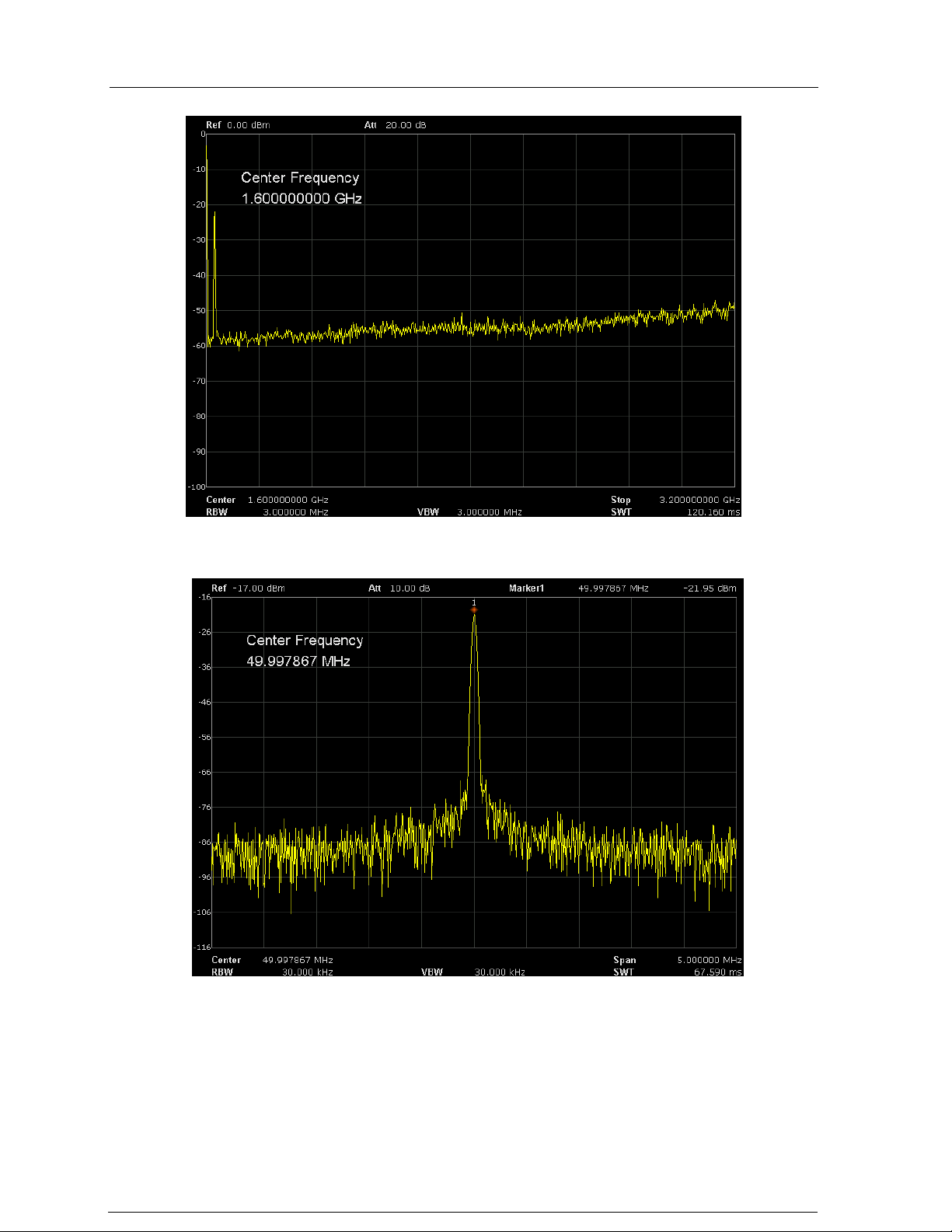
Search for signals automatically throughout the full frequency range; adjust the frequency and
amplitude for optimum display effect of the signal to realize one-key signal search and auto setting of
parameters.
◆ In the process of auto search, The “Auto Tune” is shown in the status bar on the screen until the
search is finished.
◆ Some parameters such as the reference level, scale, input attenuation and maximum mixing level
may be changed during the auto search.
SIGLENT
SSA3000X User Manual 25
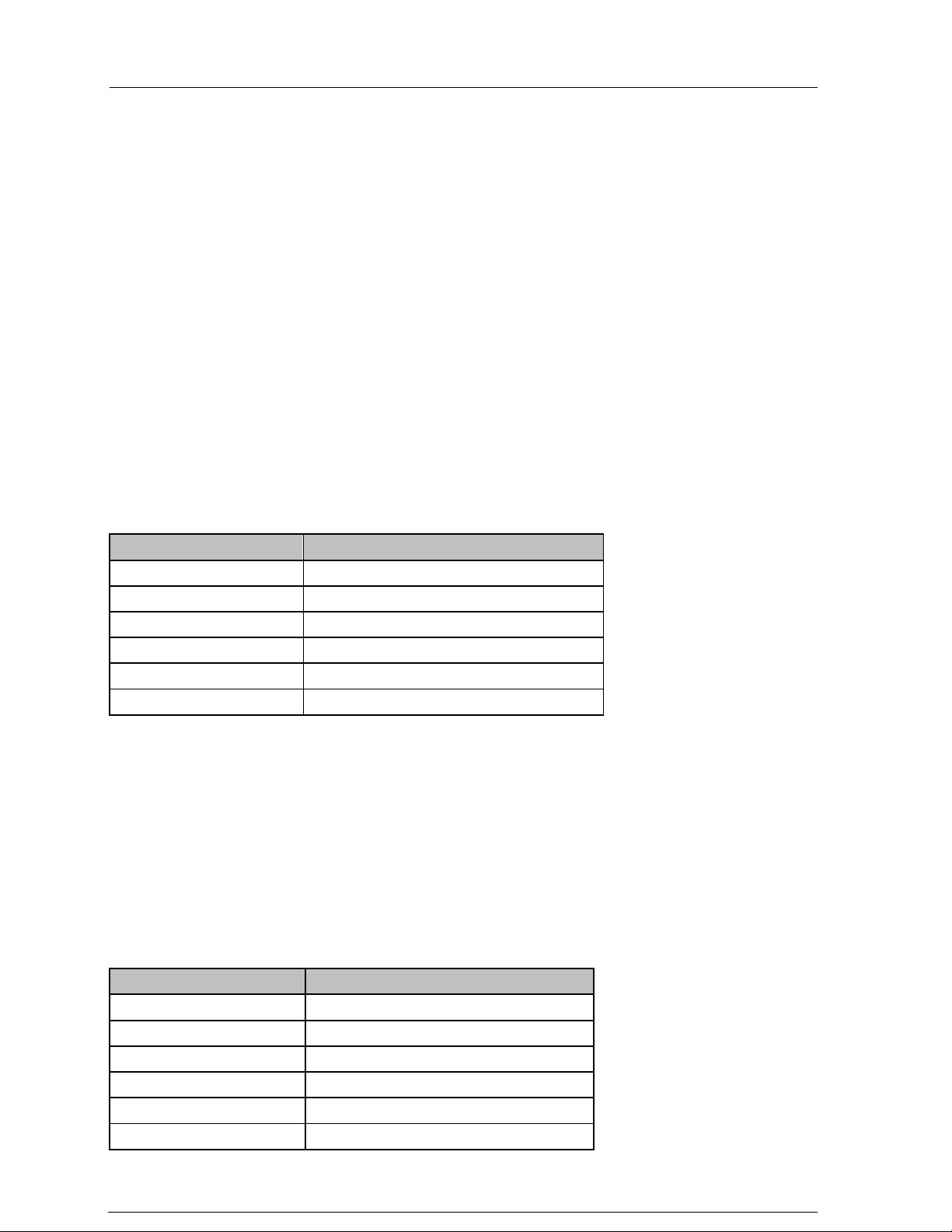
Figure 2-3 before Auto Tune
Figure 2-4 after Auto Tune
SIGLENT
SSA3000X User Manual 26
2.2 Sweep and Functions
2.2.1 BW
Set the RBW (Resolution Bandwidth), VBW (Video Bandwidth), average type parameters of the
analyzer and filter shape.
2.2.1.1 Resolution Bandwidth
Set the resolution bandwidth in order to distinguish between signals which are close in frequency.
◆ Reducing RBW will increase the frequency resolution, but will increase the sweep time (Sweep
Time is affected by a combination of RBW and VBW when it is in Auto mode).
◆ RBW varies with the span (non-zero span) in Auto RBW mode.
Table 2-11 RBW
Parameter
Explanation
Default
1MHz
Range
10Hz ~ 1MHz
Unit
MHz, kHz, Hz
Knob Step
in 1, 3, 10 sequence
Direction Key Step
in 1, 3, 10 sequence
Relation
Span, RBW, VBW, Sweep Time
2.2.1.2 Video Bandwidth
Set the desired video bandwidth in order to filter out the noise outside the video band.
◆ Reducing the VBW will smooth the spectrum line to highlight small signals from noise, but will
increase the sweep time (Sweep Time is affected by a combination of RBW and VBW when it is in
Auto mode).
◆ VBW varies with RBW when it is set to Auto. While in Manual mode, VBW is not affected by RBW.
Table 2-12 VBW
Parameter
Explanation
Default
1MHz
Range
1Hz ~ 3MHz
Unit
MHz, kHz, Hz
Knob Step
in 1, 3, 10 sequence
Direction Key Step
in 1, 3, 10 sequence
Relation
RBW, V/R Ratio, Sweep Time
SIGLENT
SSA3000X User Manual 27
2.2.1.3 V/R Ratio
Set the ratio of VBW to RBW. This value is different while measuring different kinds of signals:
◆ Sine signal: use 1 to 3 (for faster sweeps)
◆ Pulse signal: use 10 (to reduce the influence on the amplitude of transient signals)
◆ Noise signal: generally use 0.1 (to obtain the average of noises)
Table 2-13 V/R Ratio
Parameter
Explanation
Default
1
Range
0.001 ~ 1000
Unit
N/A
Knob Step
in 1, 3, 10 sequence
Direction Key Step
in 1, 3, 10 sequence
Relation
RBW,VBW
2.2.1.4 Average Type
Choose one of the following averaging types: log power (video), power (RMS), or voltage averaging.
When trace average is on, the average type is shown on the left side of the display.
1. Log Power
Select the logarithmic (decibel) scale for all filtering and averaging processes. This scale is "Video"
because it is the most common display and analysis scale for the video signal within a spectrum
analyzer. This scale is excellent for finding CW signals near noise.
2. Power Average
In this average type, all filtering and averaging processes work on the power (the square of the
magnitude) of the signal, instead of its log or envelope voltage. This scale is best for measuring the true
time power of complex signals.
3. Voltage Average
In this Average type, all filtering and averaging processes work on the voltage of the envelope of the
signal. This scale is good for observing rise and fall behavior of AM or pulse-modulated signals such as
radar and TDMA transmitters.
2.2.1.5 Filter
Set the RBW filter type. The analyzer supports two kinds of RBW filters: “Gauss” (-3 dB bandwidth) and
“EMI” (-6 dB bandwidth).
When “EMI” is selected, resolution bandwidth can be 200 Hz, 9 kHz or 120 kHz only.
“Quasi-Peak” detector is available only in “EMI” filter.
SIGLENT
SSA3000X User Manual 28
2.2.2 Trace
The sweep signal is displayed as a trace on the screen.
2.2.2.1 Select Trace
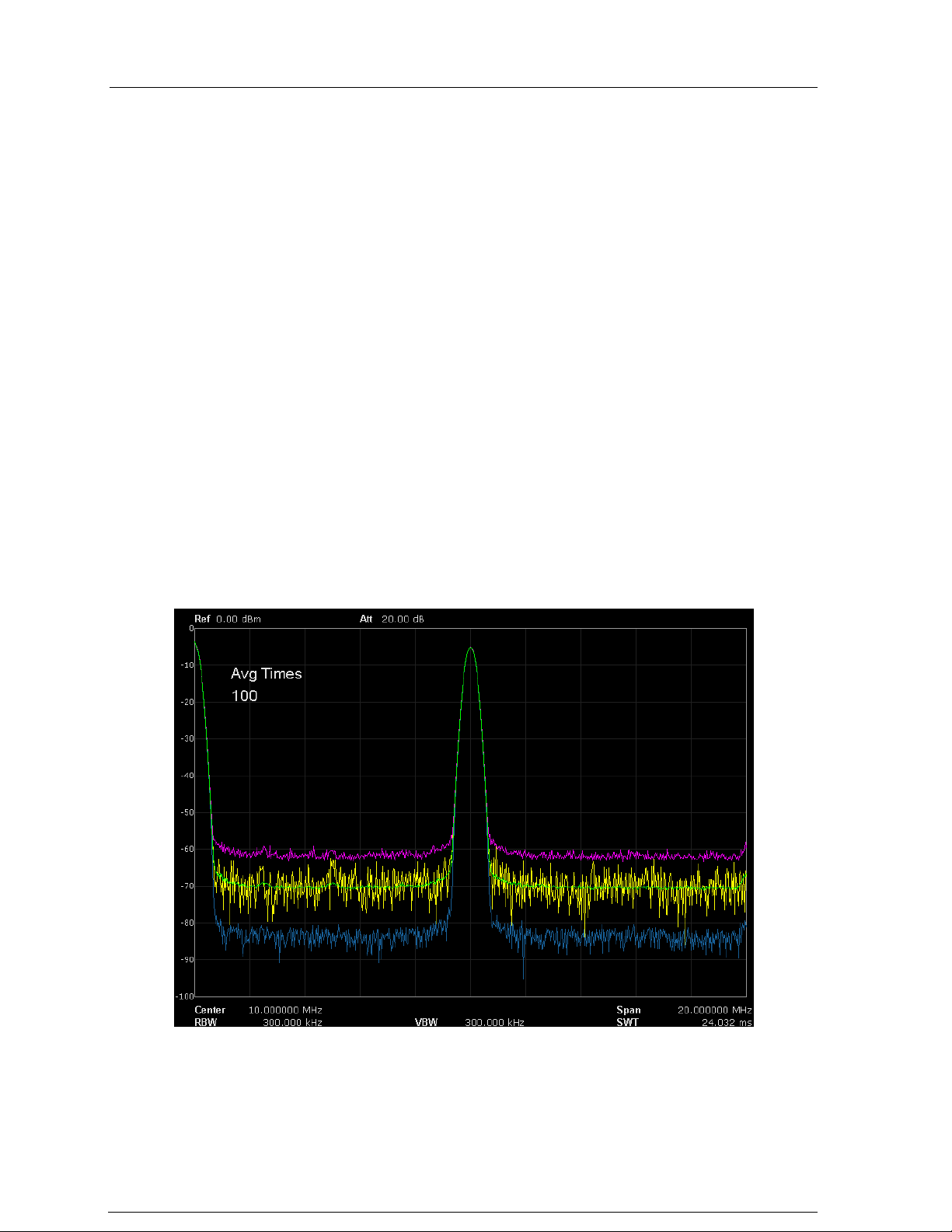
Spectrum Analyzer allows for up to four traces to be displayed at the same time. Each trace has its own
color (Trace 1 - Yellow, Trace 2 - Purple, Trace 3 - Light blue and Trace 4 - Green). All traces can be set
parameter independently.
As a default, spectrum analyzer will choose Trace A and set the type of the trace as Clear Write
2.2.2.2 Trace Type
Set the type of the current trace or disable it.
The system calculates the sampled data using a specific operation method according to the trace type
selected and displays the result. Trace types include Clear Write, Max Hold, Min Hold, View, Average
and Bank.
The corresponding icon of the trace type will be displayed in the status bar at the left of the screen.
Take Trace 1,2,3,4 as an example and the icons are as shown in the figure below.
Figure 2-5 Trace Type
1. Clear Write
Erases any data previously stored in the selected trace, and display the data sampled in real-time of
each point on the trace.
SIGLENT
SSA3000X User Manual 29
2. Max Hold
Retains the maximum level for each trace point of the selected trace. Updates the data if a new
maximum level is detected in successive sweeps.
3. Min Hold
Display the minimum from multiple sweeps for each point of the trace and update the data if a new
minimum is generated in successive sweeps.
4. View
Holds and displays the amplitude data of the selected trace. The trace data is not updated as the
analyzer sweeps.
5. Bank
Disable the trace display and all measurements of this trace.
2.2.2.3 Average Times
Set the number of averages of the selected trace. More averages can reduce the noise and the
influence of other random signals; thus highlighting the stable signal characteristics. The larger the
number of averages is, the smoother the trace will be.
Table 2-14 Average Times
Parameter
Explanation
Default
100
Range
1 ~ 999
Unit
N/A
Knob Step
1
Direction Key Step
5
2.2.2.4 Math
Set the computational method of the math trace.
2.2.2.5 Variable X, Y
Variable X, Y can choose trace A, B, C.
2.2.2.6 Output Z
The result Z will show on screen in trace A, B, C as you choose.

SIGLENT
SSA3000X User Manual 30
2.2.2.7 Calculation Type
Spectrum Analyzer provides the calculation types as shown below:
Power : X-Y+Offset
Power : X+Y+Offset
Log : X+Offset
Log : X-Y+Ref
2.2.3 Detect
The analyzer displays the sweep signal on the screen in the form of trace. For each trace point, the
analyzer always captures all the data within a specific time interval and processes (Peak, Average, etc.)
the capture data using the detector currently selected, then display the processed data (one point) on
the screen.
◆ Select an appropriate detector type according to the actual application in order to ensure the
accuracy of the measurement.
◆ The available types are Pos Peak, Neg Peak, Sample, Normal, Average and Quasi Peak. The
default is Pos peak.
1. Positive Peak
For each trace point, Positive Peak detector displays the maximum value of data sampled within the
corresponding time interval.
2. Negative Peak
For each trace point, Negative Peak detector displays the minimum value of data sampled within the
corresponding time interval.
3. Sample
For each trace point, Sample detector displays the transient level corresponding to the central time
point of the corresponding time interval. This detector type is applicable to noise or noise-like signal.
4. Normal
Normal detector (also called rosenfell detector) displays the maximum value and the minimum value of
the sample data segment in turn; namely for an odd-numbered data point, the maximum value is
displayed; for an even-numbered data point, the minimum value is displayed. In this way, the amplitude
variation range of the signal is clearly shown.
5. Average
For each trace point, Average detector displays the average value of data sampled within the
corresponding time interval.
6. Quasi Peak
Quasi-Peak detector, which is a weighted form of peak detector, is used for EMC pulse testing ruled by
CISPR. For single frequency point, the detector detects the peaks within QPD dwell time. The peaks
SIGLENT
SSA3000X User Manual 31
detected are weighted using circuit with specified charge and discharge structures as well as the
display time constant specified in the CISPR 16 standards.
The measurement time for QPD is far longer than Peak Detector.
2.2.4 Sweep
Set parameters about the Sweep functions, including sweep time, sweep rule, sweep mode, number of
sweep, etc.
2.2.4.1 Sweep Time
Set the time needed for the spectrum analyzer to finish a sweep within the span range. The sweep time
can be set in “Auto” or “Manual” mode and the default is “Auto”.
◆ In non-zero span, the analyzer selects the shortest sweep time on the basis of the current RBW
and VBW settings if Auto is selected.
◆ Decreasing the sweep time would speed the measurement. However, an error may be caused if
the specified sweep time is less than the minimum sweep time in Auto coupling; at this point,
“UNCAL” is shown in the status bar on the screen
Table 2-15 Sweep Time
Parameter
Explanation
Default
N/A
Range
900 us ~ 3 ks(Quasi Peak:900 us ~ 30 ks)
Unit
ks, s, ms, us
Knob Step
Sweep time/100, min =1 ms
Direction Key Step
in 1,3 sequence
2.2.4.2 Sweep Rule
The analyzer provides two sweep time rules to meet the different sweep time requirements:
Speed: Activates the default fast sweep time rule.
Accuracy: Activates the normal sweep time rule to ensure the measurement accuracy. Speed sweep
time rule provides a fast measurement function that decreases the sweep time. Using Fast Sweep will
decrease the measurement accuracy.
2.2.4.3 Sweep
Set sweep mode in single or continuous, the default is continuous. The corresponding icon of the
sweep will be displayed in the status bar at the left of the screen.
1. Single
Set the sweep mode to “Single”. The number on the parameter icon denotes the current sweep
number.
SIGLENT
SSA3000X User Manual 32
2. Numbers
Set the number of sweeps for a single sweep. In single sweep mode, the system executes the specified
number of sweeps and the number shown on the icon in the status bar at the left of the screen varies
with the process of the sweep.
3. Continue
Set the sweep mode to “Continue”. The character Cont on the parameter icon denotes the
analyzer is sweeping continuously.
◆ If the instrument is in single sweep mode and no measurement function is enabled, press this key
and the system will enter continuous sweep mode and sweep continuously if the trigger conditions
are satisfied.
◆ If the instrument is in single sweep mode and a measurement function is on, press this key and the
system will enter continuous sweep mode and measure continuously if the trigger conditions are
satisfied.
◆ In continuous sweep mode, the system will send a trigger initialization signal automatically and
enter the trigger condition judgment directly after each sweep.
Table 2-16 Sweep Times
Parameter
Explanation
Default
1
Range
1 ~ 9999
Unit
N/A
Knob Step
1
Direction Key Step
1
2.2.4.4 Sweep Mode
Sweep mode includes auto, sweep and FFT.
1. Auto
When the sweep mode is auto, the analyzer selects the sweep mode automatically between
Sweep and FFT Mode in the shortest time.
2. Sweep
Work in point-by-point scanning. The Sweep mode is only available when RBW is in 30 Hz – 1 MHz
3. FFT
Work in FFT scanning. The FFT mode is only available when RBW is in 1 Hz - 30 kHz.
When TG is on, the sweep mode is forced to Sweep.
SIGLENT
SSA3000X User Manual 33
2.2.4.5 QPD Dwell Time
Dwell time is the measurement time at a single frequency. QPD detector gets its weighted envelope
response during dwell time. The longer dwell time is, the more sufficiently QPD detector responses to a
single frequency, the more accuracy the QPD detector envelope is.
Table 2-17 QPD Dwell Times
Parameter
Explanation
Default
50 ms
Range
0 s ~ 10 s
Unit
ks, s, ms, us
Knob Step
N/A
Direction Key Step
N/A
2.2.5 Trigger
The trigger type can be Free Run, Video or External.
1. Free Run
The trigger conditions are satisfied at any time and the analyzer generates trigger signals continuously.
2. Video Trigger
A trigger signal will be generated when the system detects a video signal of which the voltage exceeds
the specified video trigger level.
Set the trigger level in video trigger. At this point, the trigger level line (Trig Line) and value are
displayed on the screen.
Table 2-18 Trigger Setup
Parameter
Explanation
Default
0 dBm
Range
-300 dBm ~ 50 dBm
Unit
dBm
Knob Step
1 dB
Direction Key Step
10 dB
3. External
In this mode, an external signal (TTL signal) is input from the [TRIGGER IN] connector at the rear panel
and trigger signals are generated when this signal fulfills the specified trigger edge condition.
Set the trigger edge in external trigger to the rising (Pos) or falling (Neg) edge of the pulse.
SIGLENT
SSA3000X User Manual 34
2.2.6 Limit
The analyzer supports Pass/Fail test function. In this function, the measured curve is compared with
the pre-edited curve. If the related rules are met, the result is “Pass”; or else is “Fail”.
2.2.6.1 Limit1
Select enable or disable limit1.
2.2.6.2 Limit1 Edit
Edit the properties of the limit1 lines.
Table 2-19 Limit1 Edit Menu
Function
Explanation
Type
Select the desired limit line (upper or lower) for editing
Mode
Select the line or point for editing. Set the number of the point to be edited if you selected
the point type. The range from 1 to 100
Add point
Add a new point for editing.
X-axis
Edit the X-axis value (frequency or time) of the current point. If the X-axis unit is
frequency and the Ref Freq is enabled, edit the frequency difference between the
frequency of the current point and the center frequency.
Amplitude
Edit the amplitude of the current point or line. If the Ref AMPT is enabled, edit the
amplitude difference between the amplitude of the current point and the reference level.
Del Point
Delete the point you are editing.
Del All
Delete all point.
Save/Recall
Save or load the limit file.
2.2.6.3 Limit2
Select enable or disable limit2.
2.2.6.4 Limit2 Edit
Edit the properties of the limit2 lines.
Table 2-20 Limit2 Edit Menu
Function
Explanation
Type
Select the desired limit line (upper or lower) for editing
Mode
Select the line or point for editing. Set the number of the point to be edited if you selected
the point type. The range from 1 to 100
SIGLENT
SSA3000X User Manual 35
Add point
Add a new point for editing.
X-axis
Edit the X-axis value (frequency or time) of the current point. If the X-axis unit is
frequency and the Ref Freq is enabled, edit the frequency difference between the
frequency of the current point and the center frequency.
Amplitude
Edit the amplitude of the current point or line. If the Ref AMPT is enabled, edit the
amplitude difference between the amplitude of the current point and the reference level.
Del Point
Delete the point you are editing.
Del All
Delete all point.
Save/Recall
Save or load the limit file.
2.2.6.5 Test
Enable or disable the limit test function.
2.2.6.6 Setup
1. Fail to stop
Select whether the instrument will continue or stop operation when a failure occurs.
2. Buzzer
Turn on or off the buzzer. When the buzzer is on, it beeps when a failure occurs.
3. X Axis
Set the X-axis unit to frequency or time unit.
Note that all the points of the current limit line will be deleted when the X-axis unit changes.
2.2.7 TG(Tracking Generator)
Set the parameters related to the tracking generator.
2.2.7.1 TG
When the TG is enabled, a signal with the same frequency of the current sweep signal will be output
from the [TG SOURCE] connector at the front panel. The power of the signal could be set through the
menu.
2.2.7.2 TG Level
Set the output power of the signal of the tracking generator.
Table 2-21 TG Level
Parameter
Explanation
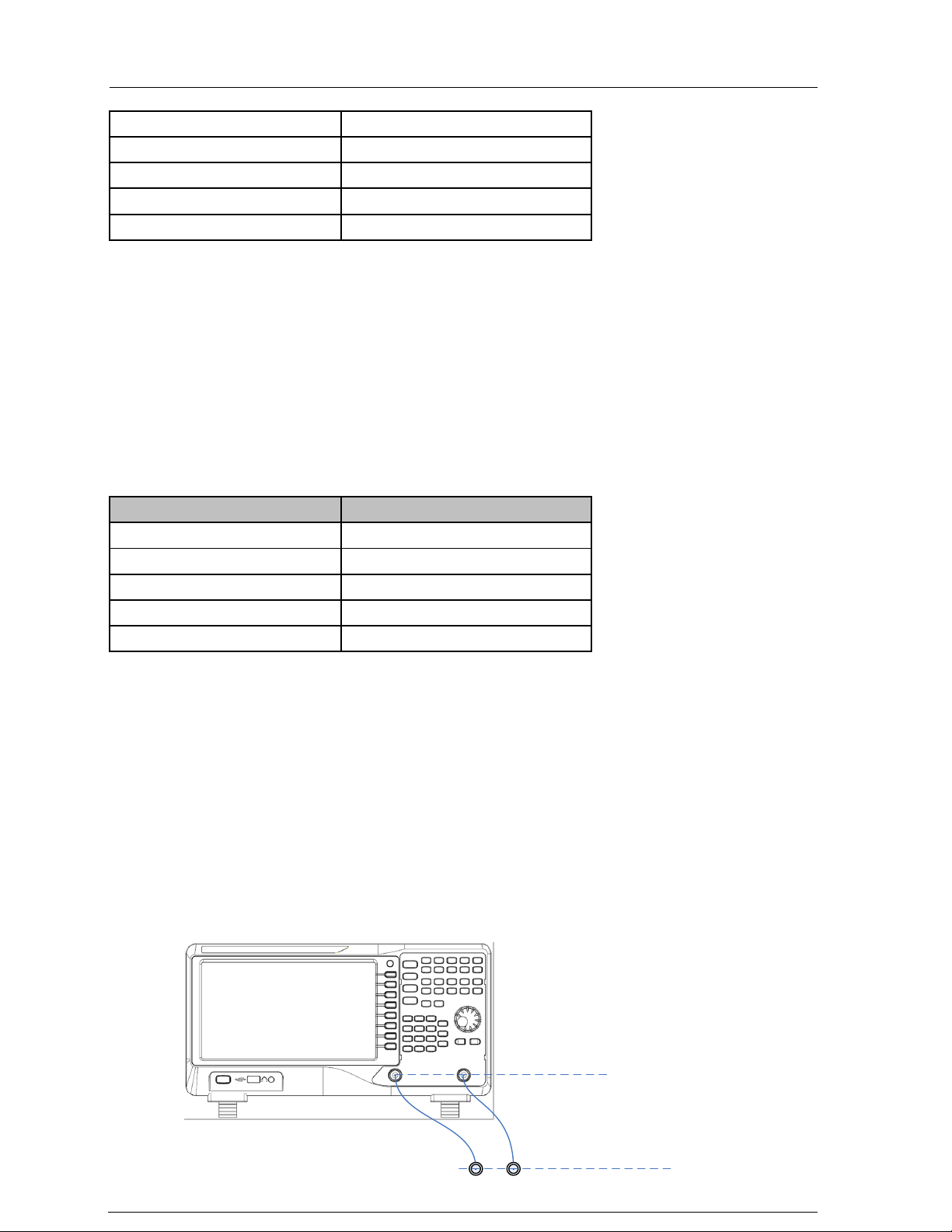
SIGLENT
SSA3000X User Manual 36
Default
0 dB
Range
-20 dBm ~ 0 dBm
Unit
dBm
Knob Step
1 dB
Direction Key Step
10 dB
2.2.7.3 TG Level Offset
Assign a certain offset to the output power of the TG when gains or losses occur between the TG
output and external device in order to display the actual power value.
◆ This parameter only changes the readout of the TG output power, rather than the actual value.
◆ The offset could be either a positive (gain in the external output) or a negative (loss in the external
output).
Table 2-22 TG Level Offset
Parameter
Explanation
Default
0 dB
Range
-200 dB ~ 200 dB
Unit
dB
Knob Step
1 dB
Direction Key Step
10 dB
2.2.7.4 Normalize
Normalization can eliminate the error of TG Level. Before using this function, connect the [TG
SOURCE] output terminal of the TG with the [RF INPUT] input terminal of the analyzer.
When enabled, the reference trace will be stored automatically after the current sweep finishes if no
reference trace is stored before. During the reference trace storage, the corresponding prompt
message is displayed.
When normalization is enabled, the corresponding value of the reference trace will be subtracted from
the trace data after every sweep.
Default
reference plane
Normalized
reference plane
SIGLENT
SSA3000X User Manual 37
Figure 2-6 Normalization
2.2.7.5 Norm Ref Level
Adjust the vertical position of the trace on the screen by adjusting the reference level when
normalization is enabled.
Different from the Ref Level function in the AMPT menu, this parameter has no influence on the
reference level of the analyzer.
Table 2-23 Reference level under normalization
Parameter
Explanation
Default
0 dB
Range
-200 dB ~ 200 dB
Unit
dB
Knob Step
1 dB
Direction Key Step
10 dB
2.2.7.6 Norm Ref Pos
Adjust the vertical position of the normalization reference level on the screen by adjusting the reference
position when normalization is enabled.
The function of this menu is similar to that of Norm Ref Level. When it is set to 0%, the normalization
reference level is displayed at the bottom of the screen grid and at the top when it is set to 100%.
Table 2-24 TG reference position under normalization
Parameter
Explanation
Default
100%
Range
0 ~ 100%
Unit
100%
Knob Step
1%
Direction Key Step
10%
2.2.7.7 Ref Trace
Set whether to display the reference trace or not. If “View” is selected, the reference trace saved (Trace
D) will be shown in “View” type.
Note: When normalization is enabled, the unit of Y-axis is “dB” and will not be influenced by the
definition in AMPT->Units. At this point, “(dB)” is displayed under the Y-axis scale in the user interface.
2.2.8 Demod
Press Demod at the front panel to enter the demodulation setting menu. Both AM and FM
SIGLENT
SSA3000X User Manual 38
demodulations are available in this device.
2.2.8.1 Demod (AM/FM)
Set the demodulation type to AM or FM; or disable the demodulation function. The default is off.
◆ The system will enable a marker automatically, place it at the center frequency and perform AM (or
FM) demodulation on this frequency point after you enable AM (or FM) demodulation.
◆ Analyzer provides earphone jack and the demodulated signal can be output in audio frequency
(AF) mode through the earphone. The frequency and intensity of AF denotes the frequency and
amplitude of the signal respectively.
2.2.8.2 Earphone
Set the status of the earphone. When it is on, the demodulated signal can be heard through the
earphone during the demodulation. By default, it is off.
2.2.8.3 Volume
Set the volume of the earphone.
Table 2-25 Volume
Parameter
Explanation
Default
6
Range
0 ~ 10
Unit
N/A
Knob Step
1
Direction Key Step
1
2.2.8.4 Demod Time
Set the time for the analyzer to complete a signal demodulation after each sweep. If Earphone is set to
“On”, you will hear the demodulated signal through the earphone during the demodulation. A longer
demod dwell time would be better to demodulate audio signal.
Table 2-26 Demod time
Parameter
Explanation
Default
5 s
Range
5 ms ~ 1000 s
Unit
ks, s, ms
Knob Step
0 ms ~ 100 ms, step=1 ms;
100 ms ~ 1 s, step =10 ms;

SIGLENT
SSA3000X User Manual 39
1 s ~ 10 s, step =100 ms;
10 s ~ 100 s, step =1 s;
100 s ~ 1000 s, step =10 s
Direction Key Step
1-2-5 step
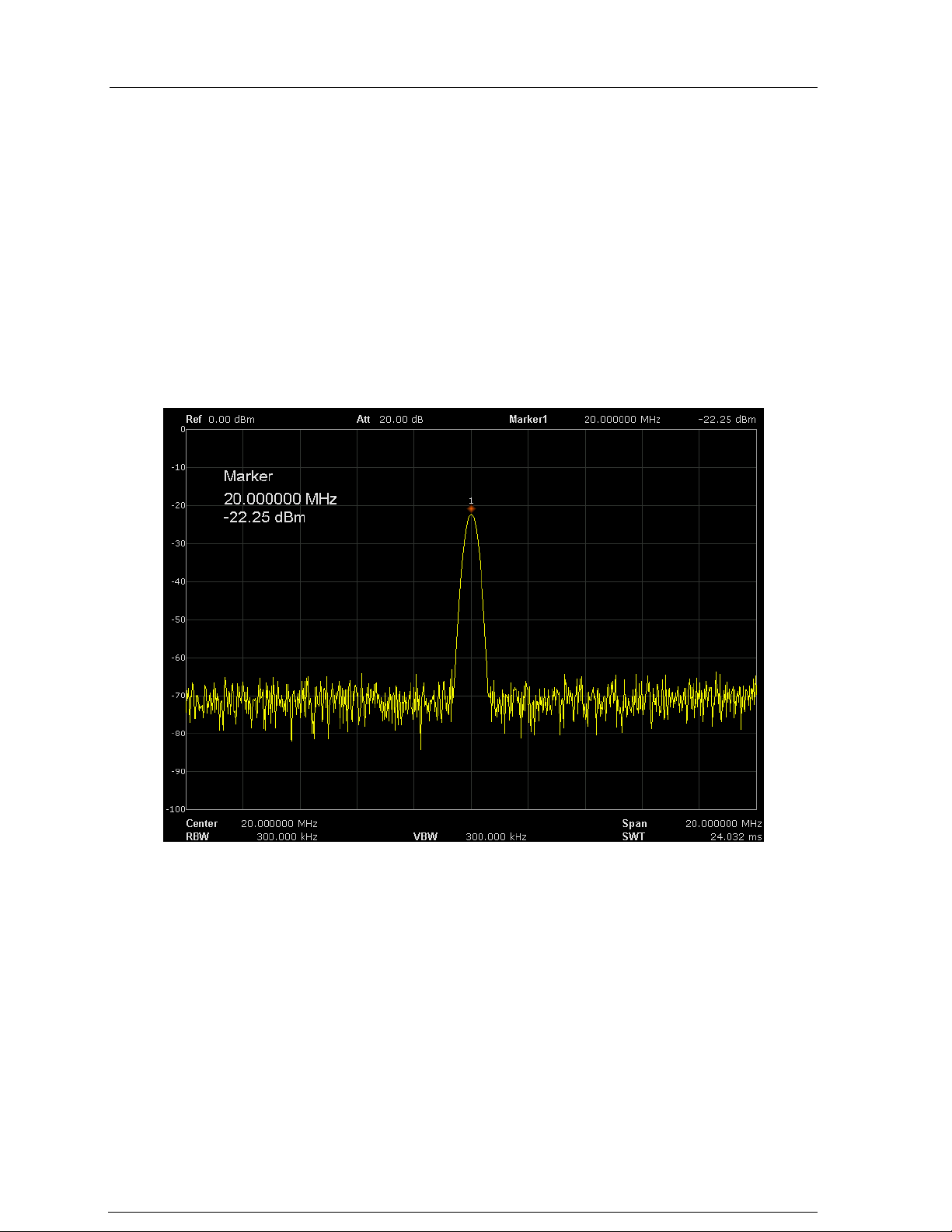
SIGLENT
SSA3000X User Manual 40
2.3 Marker
2.3.1 Marker
The marker appears as a rhombic sign (as shown below) for identifying the point on the trace. You can
easily read the amplitude, frequency and sweep time of the marked point on the trace.
◆ The analyzer allows for up to four pairs of markers to be displayed at one time, but only one pair or
a single marker is active every time.
◆ You can use the numeric keys, knob or direction keys to modify the desired frequency or time as
well as view the readouts of different points on the trace.
Figure 2-7 Marker
2.3.1.1 Select Marker
Select one of the four markers and the default is Marker1.
When a marker is selected, you can set its type, trace to be marked, readout type and other related
parameters. The enabled marker will appear on the trace selected through the Select Trace option and
the readouts of this marker are also displayed in the active function area and at the upper right corner
of the screen.
SIGLENT
SSA3000X User Manual 41
Table 2-27 Marker parameters
Parameter
Explanation
Default
Center Frequency
Range
0 ~ Full Span
Unit
Readout = Frequency , units available are GHz, MHz, kHz, Hz
Readout = Time, units available are s, ms, us, ns, ps
Knob Step
Readout = Frequency (or Period), Step = Span/(Sweep Points - 1)
Direction Key Step
Readout = Frequency (or Period), Step = Span/10
2.3.1.2 Select Trace
Select the trace to be marked by the current marker from A, B, C, D.
2.3.1.3 Normal
One of the marker types. It is used to measure the X (Frequency or Time) and Y (Amplitude) values of a
certain point on the trace. When selected, a marker with the number of the current marker (such as “1”)
appears on the trace.
◆ If no active marker exists currently, a marker will be enabled automatically at the center frequency
of the current trace.
◆ You can use the numeric keys, knob or direction keys to move the marker. The readouts of the
marker will be displayed at the upper right corner of the screen.
◆ The readout resolution of the X-axis (frequency or time) is related to the span. For higher readout
resolution, reduce the span.
2.3.1.4 Delta
One of the marker types. It is used to measure the delta values of X (Frequency or Time) and Y
(Amplitude) between the reference point and a certain point on the trace. When selected, a pair of
markers appears on the trace: Reference Marker (marked by a combination of the marker number and
letter “r”, such as “1r”) and the Delta Marker (marked by the marker number, such as “1”).
◆ A reference marker will be activated at the position of the current marker if an active marker
currently exists; or else both the reference marker and delta marker will be simultaneously
activated at the center frequency.
◆ The location of the reference marker is always fixed (both on the X-axis and the Y-axis); while the
Delta Marker is active. You can use the numeric keys, knob or direction keys to change the
location of the Delta Marker.
◆ The frequency (or time) delta and amplitude delta between the two markers are displayed at the
upper right corner of the screen.
◆ There are two methods for defining a point as the reference point:
a) Open a “Normal” marker and locate it onto a point. Then, switch the marker type to “Delta”; at
this time, this point is the reference point. You can modify the location of the delta point to achieve
delta measurement.

SIGLENT
SSA3000X User Manual 42
b) Open a “Delta” marker and locate it onto a point. Then, reselect the Delta menu to locate the
reference marker onto this point. You can modify the location of the delta point to achieve delta
measurement.
The application of “Delta” marker
Measure the signal-noise ratio of single spectrum signal: Place the reference and delta Markers onto
the signal and noise respectively, the amplitude in the measurement result is the signal-noise ratio.
2.3.1.5 Delta Pair
One of the marker types. When selected, a pair of markers will appear on the trace: Reference Marker
(marked by a combination of the marker number and letter “R”, such as “1R”) and the Delta Marker
(marked by the marker number, such as “1”).
◆ You can use the numeric keys, knob or direction keys to set the locations of the reference marker
(selecting “Ref”), the delta marker (selecting “Delta”), the span of marker pair(selecting “Span”)
and the center of marker pair(selecting “Center”) respectively.
◆ This is different from the Delta type marker in that you can modify both the reference (selecting
“Ref”) and delta (selecting “Delta”) points or modify both them at the same time (selecting “Span”
or “Center”). Additionally, both the X and Y values of the reference marker are stable for “Delta”
marker during the sweep; but the Y value of the reference marker updates along with the sweep
for “Delta Pair” marker
◆ If “Span” is selected, setting the “Span Pair” will keep the center position of the two markers
unchanged and move them towards the two sides (value increases) or the middle (value
decreases).
◆ If “Center” is selected, setting the “Span Pair” will keep the relative distance between the two
markers unchanged and move their center position left (value decreases) or right (value
increases).
2.3.1.6 Relative To
Relative to be used to measure the delta values of X (Frequency or Time) and Y (Amplitude) between
two markers which mark on different traces.
2.3.1.7 Off
Turn off the marker currently selected. The marker information displayed on the screen and functions
based on the marker will also be turned off.
2.3.1.8 Marker Table
Enable or disable the Marker Table.
Display all the markers enabled on the lower portion of the screen, including marker number, trace
number, marker readout type, X-axis readout and amplitude. Through this table you can view the
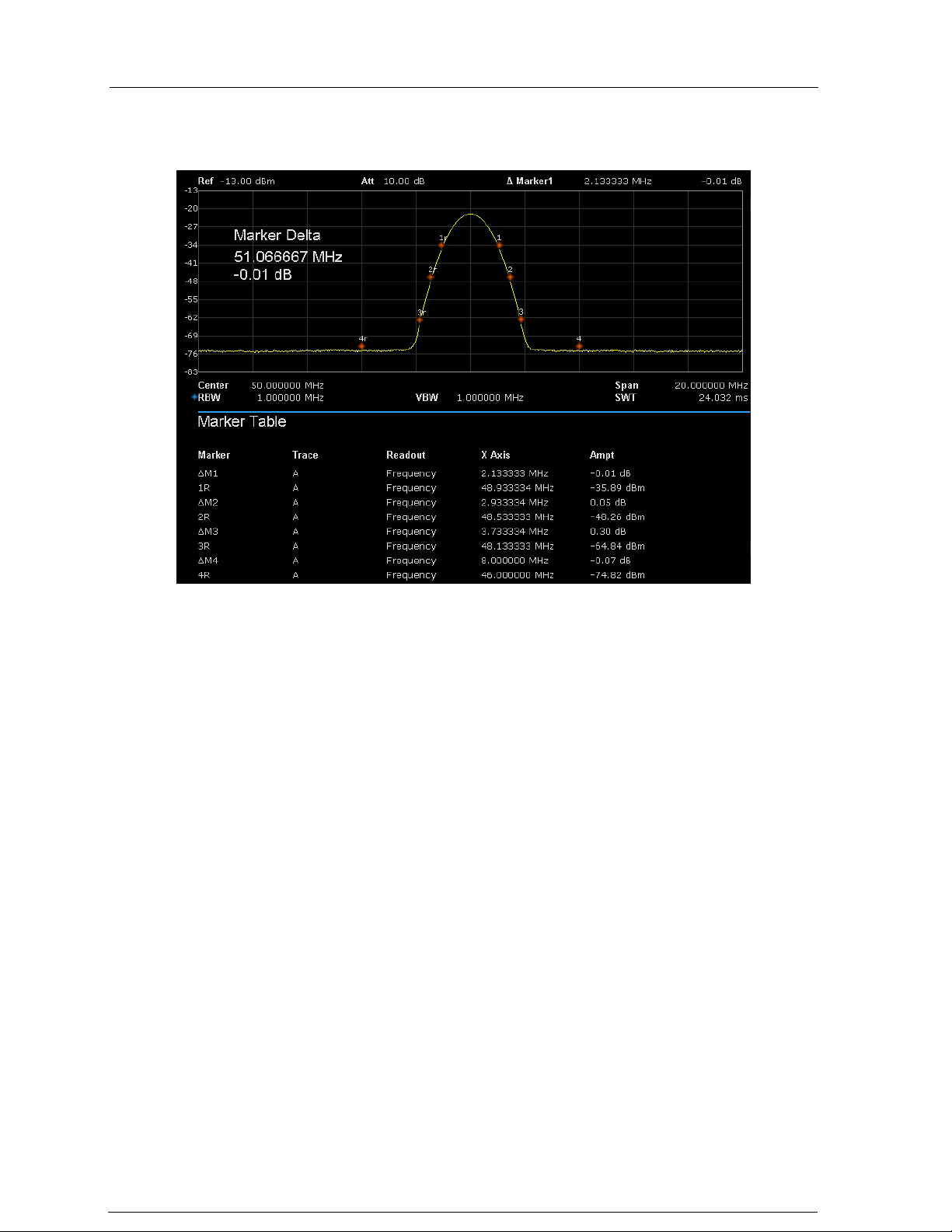
SIGLENT
SSA3000X User Manual 43
measurement values of multiple points. The table allows for up to eight markers to be displayed at one
time.
Figure 2-8 Marker table
2.3.2 Marker ->
1. M->CF
Set the center frequency of the analyzer to the frequency of the current marker.
◆ If Normal marker is selected, the center frequency will be set to the frequency of the current
marker.
◆ If Delta or Delta Pair marker is selected, the center frequency will be set to the frequency of the
Delta Marker.
◆ The function is invalid in Zero span mode.
2. M -> CF Step
Set the center frequency step of the analyzer to the frequency of the current marker.
◆ If Normal marker is selected, the center frequency step will be set to the frequency of the current
marker.
◆ If Delta or Delta Pair marker is selected, the center frequency step will be set to the frequency of
the Delta Marker.
◆ The function is invalid in Zero span mode.
3. M -> Start Freq
Set the start frequency of the analyzer to the frequency of the current marker.

SIGLENT
SSA3000X User Manual 44
◆ If Normal marker is selected, the start frequency will be set to the frequency of the current marker.
◆ If Delta or Delta Pair marker is selected, the start frequency will be set to the frequency of the
Delta Marker.
◆ The function is invalid in Zero span mode.
4. M -> Stop Freq
Set the stop frequency of the analyzer to the frequency of the current marker.
◆ If Normal marker is selected, the stop frequency will be set to the frequency of the current marker.
◆ If Delta or Delta Pair marker is selected, the stop frequency will be set to the frequency of the
Delta Marker.
◆ The function is invalid in Zero span mode.
5. M ->Ref Level
Set the reference level of the analyzer to the amplitude of the current marker.
◆ If Normal marker is selected, the reference level will be set to the amplitude of the current marker.
◆ If Delta or Delta Pair marker is selected, the reference level will be set to the amplitude of the
Delta Marker.
6. ΔM->Span
Set the span of the analyzer to the frequency difference between the two markers in Delta, or Delta
Pair marker type.
◆ If Normal marker is selected, this function is invalid.
◆ The function is invalid in Zero span mode.
7. ΔM->CF
Set the center frequency of the analyzer to the frequency difference between the two markers in Delta,
or Delta Pair, marker type.
◆ If Normal marker is selected, this function is invalid.
◆ The function is invalid in Zero span mode.
2.3.3 Marker Fn
Special marker functions including Noise Marker, N dB BW and Freq Counter.
2.3.3.1 Select Marker
Select one of the four markers (1, 2, 3, and 4) and the default is Marker1.
2.3.3.2 Noise Marker
Execute the Noise marker function for the selected marker and read the noise power spectral density.
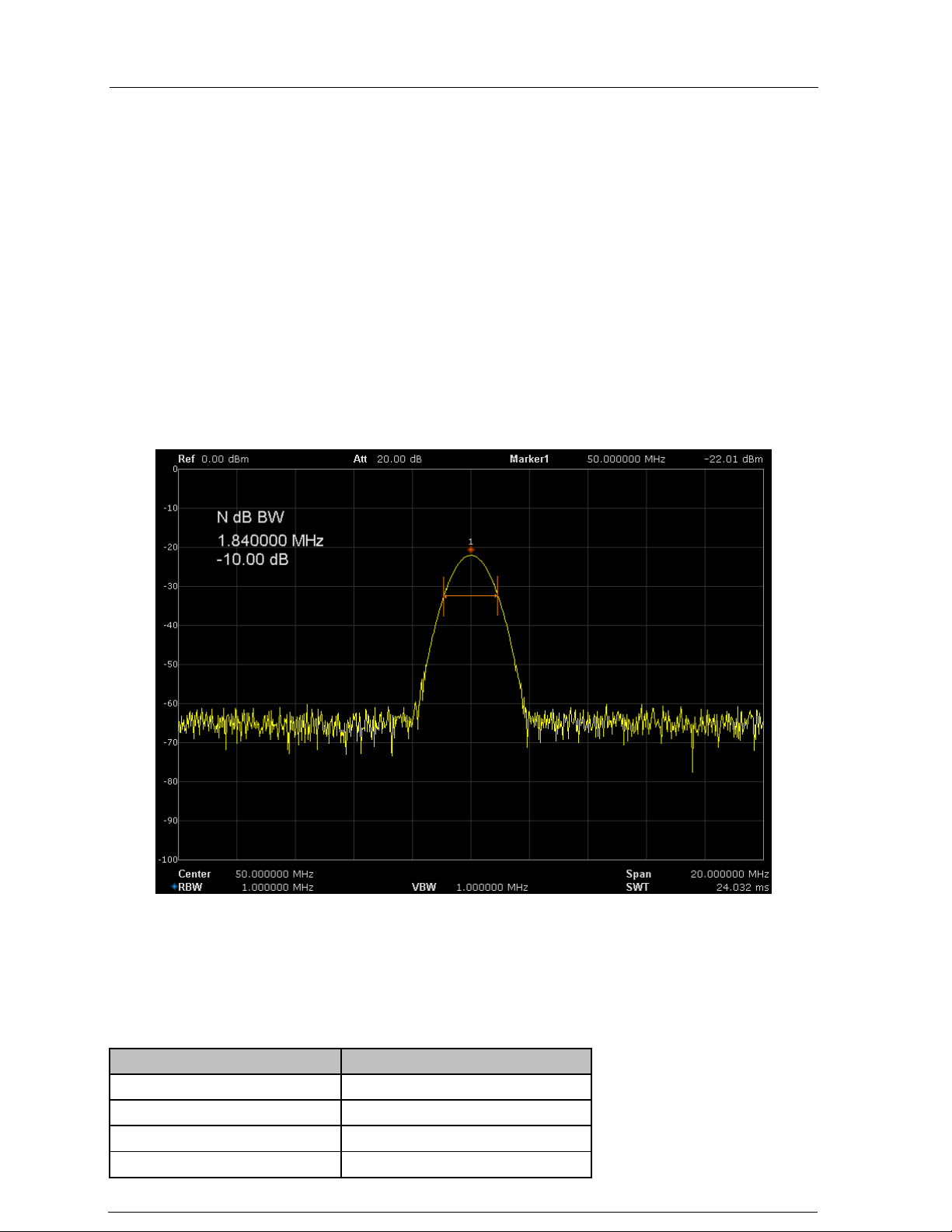
SIGLENT
SSA3000X User Manual 45
◆ If the current marker is “Off” in the Marker menu, pressing Noise Marker will first set it to Normal
type automatically; then measure the average noise level at the marked point and normalize this
value to 1 Hz bandwidth. During this process, certain compensation is always made on the basis
of the detection and trace types. The measurement will be more precise if RMS Avg or Sample
detection type is used.
◆ This function can be used for measuring the C/N ratio.
2.3.3.3 N dB BW
Enable the N dB BW measurement or set the value of N dB. The N dB BW denotes the frequency
difference between two points that are located on both sides of the current marker and with N dB fall
(N<0) or rise (N>0) in amplitude as shown in the figure on the next page.
Figure 2-9 N dB BW
When the measurement starts, the analyzer will search for the two points which are located at both
sides of the current point with N dB fall or rise in amplitude and display the frequency difference
between the two points in the active function area. "----" would be displayed if the search fails.
Table 2-28 N dB Noise
Parameter
Explanation
Default
-3 dB
Range
-100 dB ~ 100 dB
Unit
dB
Knob Step
0.1 dB

SIGLENT
SSA3000X User Manual 46
Direction Key Step
1 dB
2.3.3.4 Freq Counter
Turn on or off the frequency counter. The frequency readout is accuracy is up to 0.01 Hz.
◆ The function is invalid when selecting marker 2, 3, 4.
◆ If marker 1 is selected but no active, turning on the frequency counter will open marker 1 Normal
marker automatically.
◆ The frequency counter measures the frequency near the center frequency in Zero span mode.
2.3.3.5 Off
Turn off the noise marker enabled, N dB BW measurement or Frequency Counter, but not the marker
itself.
2.3.3.6 Read Out
Select a desired readout type of the X-axis for the marker and different markers can use different
readout types. This setting will change the readout type and affect the marker readings in the active
function area and at the upper right corner of the screen, but will not change the actual value.
1. Frequency
In this type, Normal marker shows the absolute frequency; while Delta marker and Delta Pair marker
show the frequency difference between the delta marker and reference marker. The default readout
mode in non-zero span mode is “Frequency”.
Note: This type is invalid in Zero span mode.
2. Period
In this type, Normal marker shows the reciprocal of frequency; while Delta marker and Delta Pair
marker show the reciprocal of frequency difference. When the frequency difference is zero, the
reciprocal is infinite and 100 Ts is displayed.
Note: This type is invalid in Zero span mode.
3. Δ Time
In this type, Normal marker shows the time difference between the marker and the start of the sweep;
while Delta marker and Delta Pair marker show the sweep time difference between the delta marker
and reference marker.
The default readout mode in Zero span mode is Δ Time.
2.3.4 Peak
Open the peak search setting menu and execute peak search.

SIGLENT
SSA3000X User Manual 47
2.3.4.1 Peak -> CF
Execute peak search and set the center frequency of the analyzer to the frequency of the peak.
2.3.4.2 Next Peak
Search for and mark the peak whose amplitude is closest to that of the current peak and which meets
the peak search condition.
2.3.4.3 Next Left Peak
Search for and mark the nearest peak which is located at the left side of the current peak and meets the
peak search condition.
2.3.4.4 Next Right Peak
Search for and mark the nearest peak which is located at the right side of the current peak and meets
the peak search condition.
2.3.4.5 Peak Peak
Execute peak search and minimum search at the same time and mark the results with delta pair
markers. Wherein, the result of peak search is marked with the delta marker and the result of minimum
search is marked with the reference marker.
2.3.4.6 Count Peak
Enable or disable continuous peak search and the default are Off. When enabled, the system will
always execute a peak search automatically after each sweep in order to track the signal under
measurement.
2.3.4.7 Peak Table
Open the peak table (in the lower window) which lists the peaks (with frequency and amplitude) that
meet the peak search condition. Up to 16 peaks can be displayed in the table.
2.3.4.8 Search Comfit
Define the conditions of peak search for various peak searches. A real peak should meet the
requirements of both the “Peak Excursion” and “Peak Threshold”.
SIGLENT
SSA3000X User Manual 48
1. Peak Threshold
Assign a minimum for the peak amplitude. Peaks whose amplitudes are greater than the specified peak
threshold are treated as real peaks.
Table 2-29 Peak Threshold
Parameter
Explanation
Default
-160 dBm
Range
-200 dBm ~ 200 dBm
Unit
dBm
Knob Step
1 dB
Direction Key Step
5 dB
2. Peak Excursion
Set the excursion between the peak and the minimum amplitude on both sides of it. Peaks whose
excursions are beyond the specified excursion are treated as real peaks.
Table 2-30 Peak Excursion
Parameter
Explanation
Default
15 dB
Range
0 dB ~ 200 dB
Unit
dB
Knob Step
1 dB
Direction Key Step
5 dB
3. Peak Type
Set the peak search condition. The available options are Maximum and Minimum

SIGLENT
SSA3000X User Manual 49
2.4 Measurement
2.4.1 Meas
Provide measurement function, the screen will be divided into two parts, the above part is measure
screen, displaying trace, the other part is used to display result of a measurement.
2.4.1.1 Channel Power
Measure the power and power density within the specified channel bandwidth. When this function is
enabled, the span and resolution bandwidth are automatically adjusted to smaller values. Select
Channel Power and press Meas Setup to set the corresponding parameters.
2.4.1.2 ACPR
Measure the powers of the main channel and adjacent channels as well as the power difference
between the main channel and each of the adjacent channels. When this function is enabled, the span
and resolution bandwidth of the analyzer are adjusted to smaller values automatically.
Select ACPR and press Meas Setup to set the corresponding parameters.
2.4.1.3 Occupied BW
Integrate the power within the whole span and calculate the bandwidth occupied by this power
according to the specified power ratio. The OBW function also indicates the difference (namely
“Transmit Freq Error”) between the center frequency of the channel under measurement and the center
frequency of the analyzer. Select Occupied BW and press Meas Setup to set the corresponding
parameters.
2.4.1.4 T-Power
The system enters zero span mode and calculates the power within the time domain. The types of
powers available include Peak, Average and RMS. Select T-Power and press Meas Setup to set the
corresponding parameters.
2.4.1.5 TOI
Automatic measurement of IP3 (Third order Intercept Point), including the power of fundamental wave
and the Third order in the power, and calculate the adjustable Intercept Point
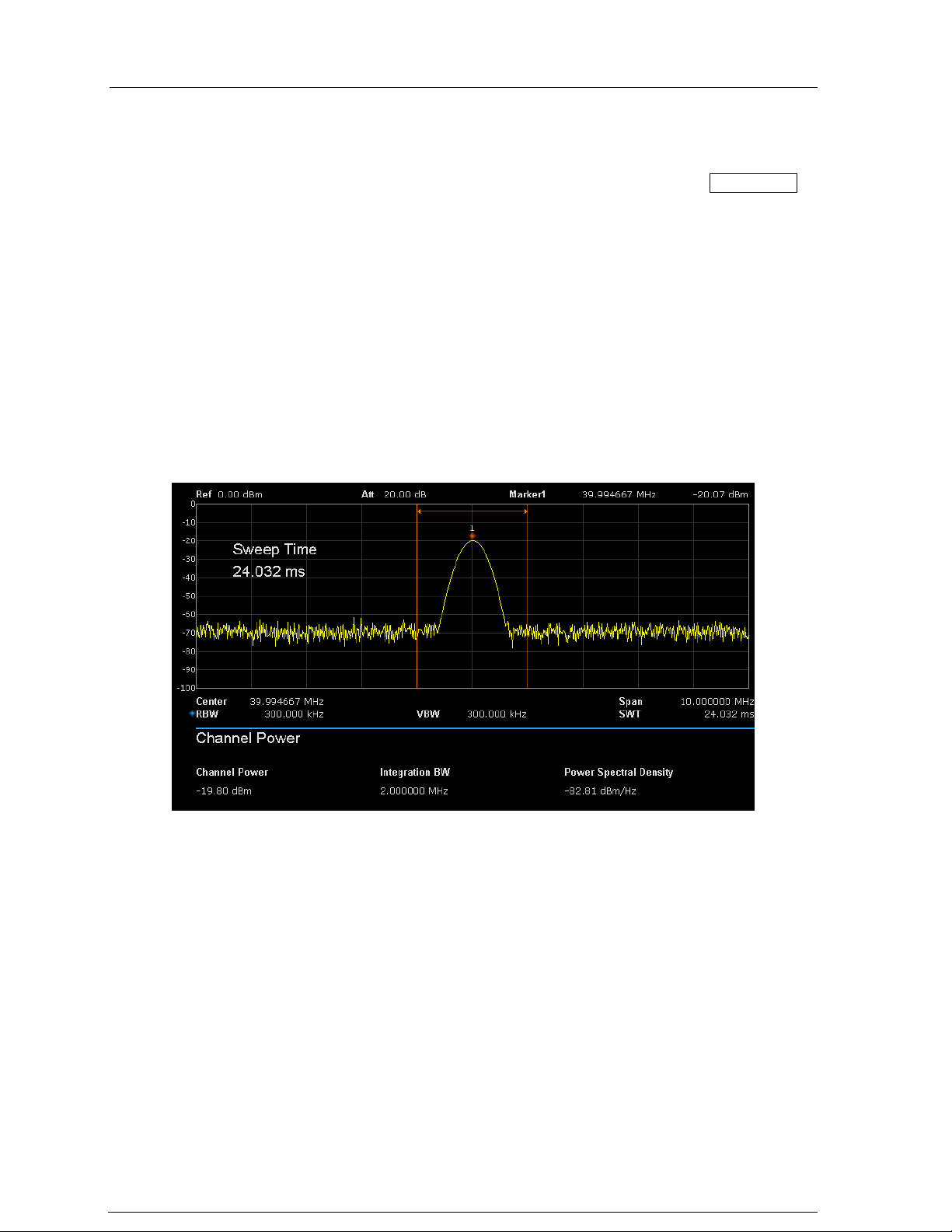
SIGLENT
SSA3000X User Manual 50
2.4.1.6 Spectrum Monitor
Display the power of spectrum in color spectrum. Select Spectrum Monitor and press Meas Setup to
set the corresponding parameters.
2.4.1.7 Meas Off
Turn off all the Meas function.
2.4.2 Meas setup
2.4.2.1 Channel Power
Figure 2-10 Channel Power
Measurement Results: channel power and power spectral density.
◆ Channel Power: power within the integration bandwidth.
◆ Power Spectral Density: power (in dBm/Hz) normalized to 1Hz within the integration bandwidth.
Measurement Parameters: Center Freq, integration bandwidth, Span, Span power.
1. Center Freq
Sets the center frequency, this center frequency which is the same with the center frequency of the
analyzer. Modifying this parameter will change the center frequency of the analyzer.
2. Integration bandwidth
Set the frequency width of the channel to be tested and the power of the channel is the power integral
within this bandwidth. You can use the numeric keys, knob or direction keys to modify this parameter.
SIGLENT
SSA3000X User Manual 51
Table 2-31 Integration BW
Parameter
Explanation
Default
2 MHz
Range
100 Hz ~ Span
Unit
GHz, MHz, kHz, Hz
Knob Step
Integration BW/100, the minimum is 1 Hz
Direction Key Step
In 1-1.5-2-3-5-7.5 sequence
3. Span
Set the frequency range of the channel. This span which is the same with the span of the analyzer is
the frequency range of the sweep. Modifying this parameter will change the span of the analyzer.
The channel power span is related to the integration bandwidth and the range available is from
integration bandwidth to integration bandwidth×20.
Table 2-32 Channel Power Span for Chan Power Measurement
Parameter
Explanation
Default
3 MHz
Range
100 Hz ~ Span
Unit
GHz, MHz, kHz, Hz
Knob Step
Channel Power Span/100, the minimum is 1Hz
Direction Key Step
In 1-1.5-2-3-5-7.5 sequence
4. Span Power
Set the integrated bandwidth to the sweep span of display. The channel power and power spectral
density display on the screen simultaneously.
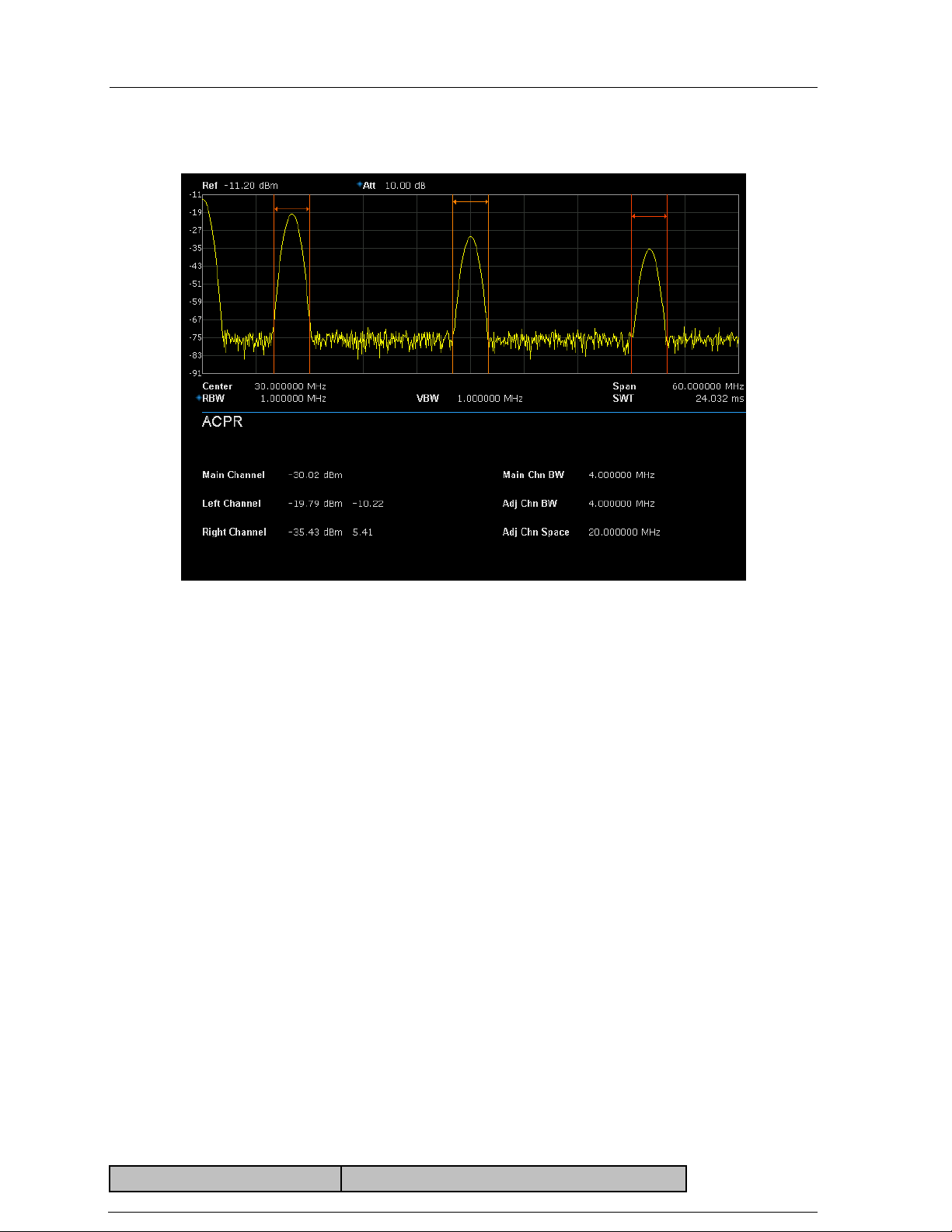
SIGLENT
SSA3000X User Manual 52
2.4.2.2 ACPR
Figure 2-11 ACPR
Adjacent Channel Power Measurement: Main CH Power, Left channel power and Right channel power.
◆ Main CH Power: display the power within the bandwidth of the main power
◆ Left channel power : display the power of left channel and the power difference between the left
channel and the main channel (in dBc)
◆ Right channel power: display the power of the right channel and the power difference between the
right channel and the main channel(in dBc)
Measurement parameter: center frequency, main channel bandwidth, adjacent channel bandwidth
and channel spacing
1. Center Frequency
Sets the center frequency, this center frequency which is the same with the center frequency of the
analyzer. Modifying this parameter will change the center frequency of the analyzer.
2. Main channel bandwidth
Set the bandwidth of the main channel and the power of the main channel is the power integral within
this bandwidth. You can use the numeric keys, knob and direction keys to modify this parameter.
Table 2-33 Main channel bandwidth
Parameter
Explanation
SIGLENT
SSA3000X User Manual 53
Default
2 MHz
Range
100 Hz ~ Sweep Span
Unit
GHz, MHz, kHz, Hz
Knob Step
Integration BW /100, the minimum is 1 Hz
Direction Key Step
In 1-1.5-2-3-5-7.5 Sequence
3. Adjacent channel bandwidth
Set the frequency width of the adjacent channels.
The adjacent channel bandwidth is related to the main channel bandwidth and the range available is
from main channel bandwidth/20 to main channel bandwidth×20.
Table 2-34 adjacent channel bandwidth
Parameter
Explanation
Default
2 MHz
Range
100 Hz ~ Sweep Span
Unit
GHz, MHz, kHz, Hz
Knob Step
Integration BW /100, the minimum is 1 Hz
Direction Key Step
In 1-1.5-2-3-5-7.5 Sequence
4. Adjacent Channel space
Set the difference between the center frequency of the main channel and the center frequency of the
adjacent channels.
Adjusting this parameter will also adjust the distance between the upper/lower channel and the main
channel.
Table 2-35 Adjacent channel space
Parameter
Explanation
Default
2 MHz
Range
33 Hz ~ full span
Unit
GHz, MHz, kHz, Hz
Knob Step
Integration BW /100, the minimum is 1 Hz
Direction Key Step
In 1-1.5-2-3-5-7.5 Sequence
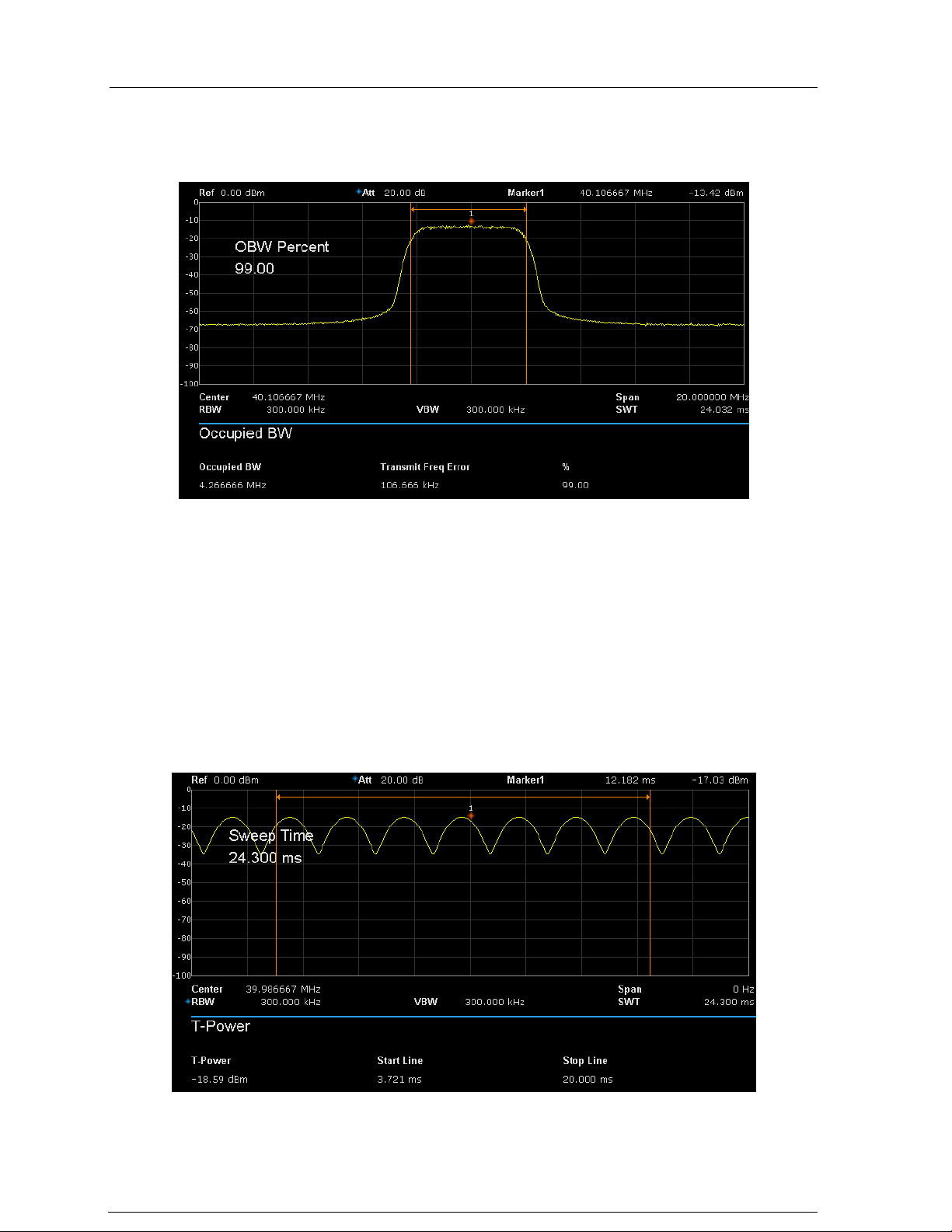
SIGLENT
SSA3000X User Manual 54
2.4.2.3 OBW
Figure 2-12 OBW
OBW measurement: occupied bandwidth and transmit frequency error.
◆ Occupied Bandwidth: integrate the power within the whole span and then calculate the bandwidth
occupied by the power according to the specified power ratio.
◆ Transmit Frequency Error: difference between the center frequency of the channel and the center
frequency of the analyzer.
2.4.2.4 T-Power
Figure 2-13 T-Power
T-Power: namely the power of the signal from the start line to the stop line.
Measurement Parameter: center frequency, start line, stop line.
SIGLENT
SSA3000X User Manual 55
1. Center Frequency
Sets the center frequency, this center frequency which is the same with the center frequency of the
analyzer. Modifying this parameter will change the center frequency of the analyzer.
2. Start line
Set the left margin (in time unit) of T-Power measurement. The data calculated under this measurement
is between the start line and stop line. You can use the numeric keys, knob or direction keys to modify
this parameter.
Table 2-36 start line
Parameter
Explanation
Default
1ms
Range
0 s ~ stop line
Unit
ks, s, ms, us, ns
Knob Step
Sweep time/751
Direction Key Step
In 1-1.5-2-3-5-7.5 Sequence
3. Stop line
Set the right margin (in time unit) of T-Power measurement. The data calculated under this
measurement is between the start line and stop line. You can use the numeric keys, knob or direction
keys to modify this parameter.
Table 2-37 stop line
Parameter
Explanation
Default
24.032ms
Range
Start line ~ sweep time
Unit
ks, s, ms, us, ns
Knob Step
Sweep time /751
Direction Key Step
In 1-1.5-2-3-5-7.5 Sequence
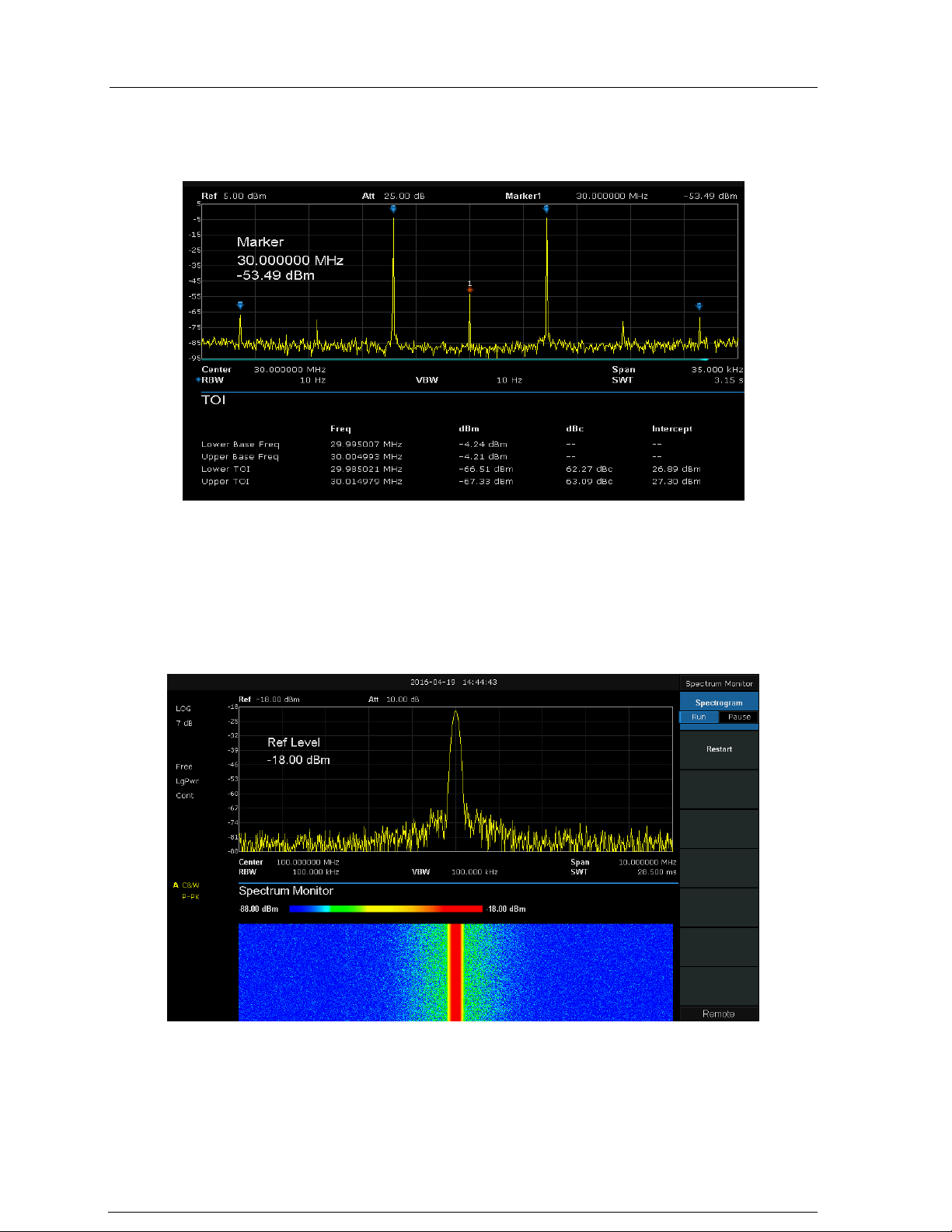
SIGLENT
SSA3000X User Manual 56
2.4.2.5 TOI
Figure 2-14 TOI
TOI is automatic measurement; do not need to set parameters.
2.4.2.6 Spectrum Monitor
Figure 2-15 Spectrum Monitor
Display the power of spectrum in color spectrum.
Spectrogram: Sets the meas state of spectrum monitor.

SIGLENT
SSA3000X User Manual 57
2.5 System
2.5.1 System
Set the system parameters.
2.5.1.1 Language
The analyzer supports multi-language menu, Chinese and English build-in help and popup messages.
Press this key to select the desired display language.
2.5.1.2 Power On/Preset
1. Power On
Set the power on setting to Default, Last or one of user.
◆ Def: Load the default settings, for more details please refer to Table 2-40.
◆ Last: When Last is selected, settings before the last power-off would be recalled automatically at
power on.
◆ User: If power on set to user, the device will recall the specified configuration after power on.
2. Preset
Set the preset type to Default, Last or one of User.
◆ Def : When press Preset, load the default settings, for more details please refer to Table 2-40.
◆ Last: When press Preset, load the last power-off settings.
◆ User : When press Preset, load the specified configuration type.
3. User Config
Save the current instrument setting as user-defined setting into the internal non-volatile memory.
4. Factory
When factory is selected, the device will recall the initial config.
5. Reset & Clear
When Reset & Clear is selected, the device will recall the initial config and all user data and settings
will be erased.
2.5.1.3 Interface Config
The analyzer supports communications through LAN, USB and USB-GPIB as standard interface.
1. LAN
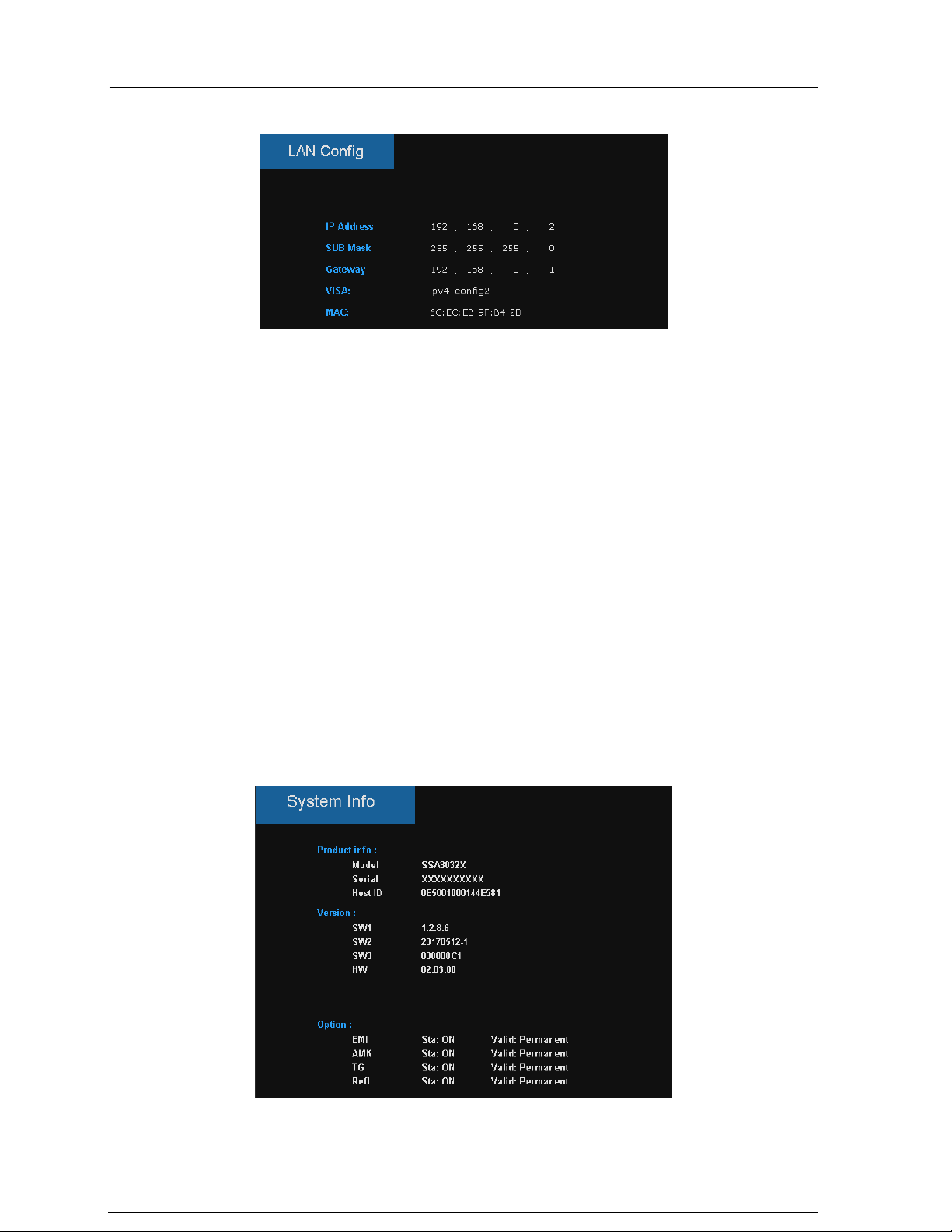
SIGLENT
SSA3000X User Manual 58
Config or reset related parameters of LAN. As default, the IP config is DHCP.
Figure 2-16 Static IP Config
2. GPIB
Config GPIB port number. The analyzer provides a USB-GPIB port on the front board.
2.5.1.4 Calibration
Auto Cal
When Auto Cal opens, the analyzer will process self-calibration regularly. Within half an hour after
power-on, the device executes a self-calibration every 10 minutes.
2.5.1.5 System Info
1. System Info
◆ Product Model, Serial and HOST ID
◆ Software Version and Hardware Version
◆ Option Information
Figure 2-17 System Info
2. Load Option
Load license, enter license here to load options.
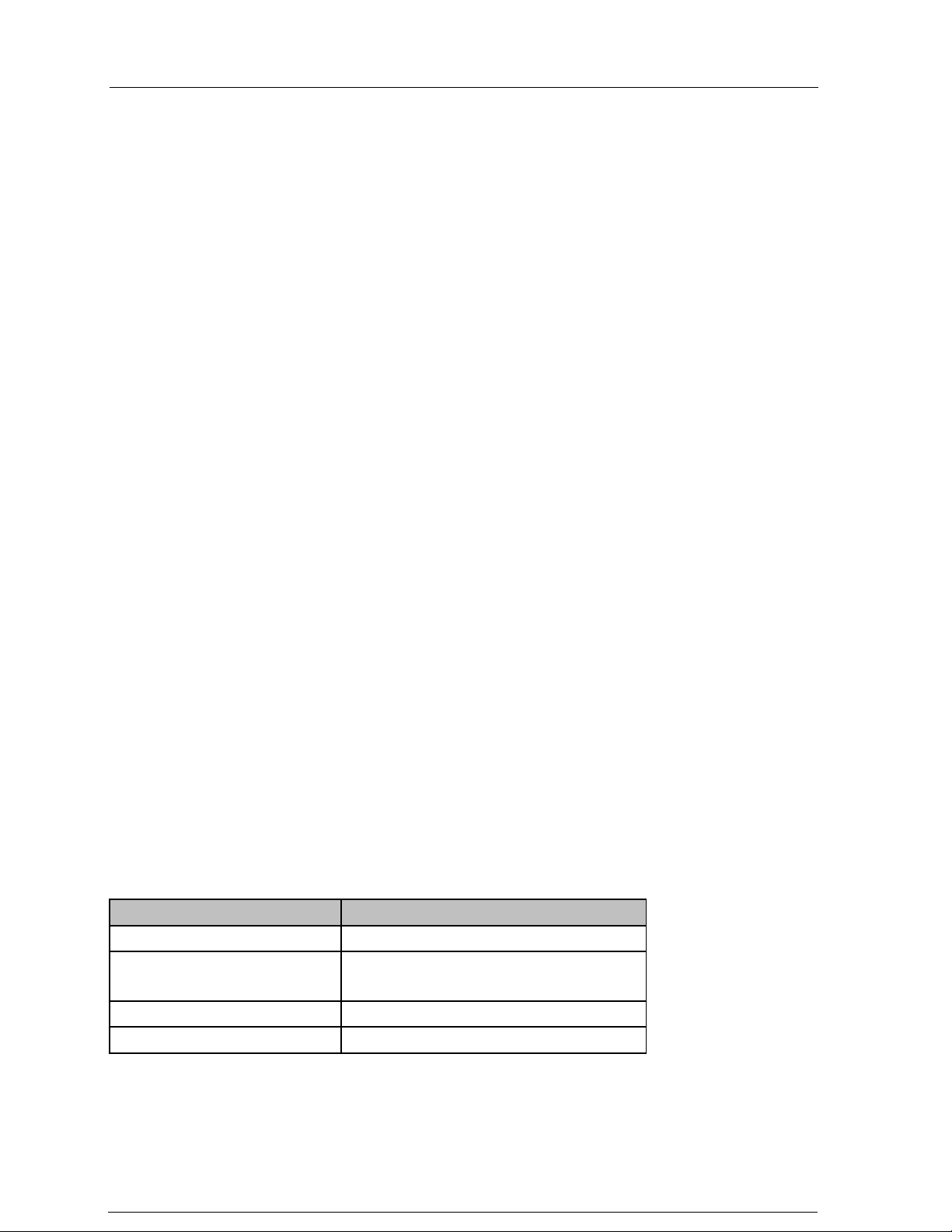
SIGLENT
SSA3000X User Manual 59
3. Firmware Update
Update firmware from .ADS file in storage. After firmware updated, the analyzer will be reboot.
2.5.1.6 Data and Time
Display the data and time On or Off. The system time is displayed in “ymd”, “mdy”, “dmy” format in user
interface.
2.5.1.7 Self Test
1. Screen Test
Test whether the screen has a dot defect using five colors: White, Red, Green, Blue and Black. Press
any key to switch the screen color and exit the test.
2. Keyboard Test
Enter the keyboard test interface. Press the function keys at the front panel one by one and observe
whether the corresponding key is checked. If not, an error may have occurred in that key. To exit the
test, press “<-“four times.
3. LCD Test
If the keys at the front panel are transparent, when the key is pressed, the corresponding backlight will
turn on when testing it.
2.5.2 Display
1. Display Line
Open or Close Display Line or move the location.
Table 2-38 Grid brightness
Parameter
Explanation
Default
0 dBm
Range
REF Level + REF Offset – 10*Scale/Div ~
REF Level + REF Offset
Knob Step
1 dB
Direction Key Step
10 B
2. Grid brightness
Control the display grid brightness.
Table 2-39 Grid brightness

SIGLENT
SSA3000X User Manual 60
Parameter
Explanation
Default
30%
Range
0 ~ 100%
Unit
None
Knob Step
1%
Direction Key Step
1%
3. Screen Text
Open or close the current parameter and its value in the wave area.
4. Screenshot
Select the screenshot type to normal and color inverse.
The color of trace is not inversed in inverse mode.
2.5.3 File
2.5.3.1 Browser
Browser type including “Dir” and “File”,
Dir: when selected, use the knob or direction keys to browser directory in system
File: when selected, use the knob or direction keys to switch among files or folders under the current
directory.
2.5.3.2 Open/Load
Open the current folder or load current file
2.5.3.3 View Type
User can define the file type be browsed, included “All Type”, “STA”, “TRC”, “COR”, “CSV”, “LIM”,
“PIC(JPG/BMP/PNG)”.
2.5.3.4 Save Type
User can define the file type be saved, included “STA”, “TRC”, “COR”, “CSV”, “LIM”, “JPG,”
“BMP”, “PNG”.
2.5.3.5 Save
Save file in current directory, the file type is set in "Save Type".

SIGLENT
SSA3000X User Manual 61
An external U disk has the priority to be written in first.
1. STA(Status)
STA files can be used to save and recall the instrument configuration. They are saved in binary
format, which is designed to be used by the analyzer, not read by humans.
2. TRC(Trace)
TRC files store the active (visible) trace data and scaling factors that were in place when the data
was saved. They are saved in binary format, which is designed to be used by SSA3X instruments,
not read by humans.
NOTE: When you first recall trace files, the instrument will adjust the display parameters
(horizontal and vertical scaling, for example) to match the settings used during data collection. The
trace data will not change, even if you adjust the parameters.
3. COR(Correction)
COR files store the data used to mathematically adjust the displayed input signal based on
external factors (Cable loss, Amplifier/Antenna gain, etc.). They are saved in ASCII format, which
can be read by humans.
4. CSV(Comma-Separated Variable)
CSV files store instrument configuration (scaling, units, etc..) and raw data (amplitude and
frequency values) in ASCII format, commonly viewed in spreadsheet programs like Microsoft
®
Excel
®
. This file type can be read by humans.
5. LIM(limit)
LIM files store the line or point data used to configure and display lines used for visual indication of
a user-defined limit. This is a binary file intended for use with SSA3X instruments and is not
readable by humans.
6. BMP(Bitmap)/JPG(JPEG)/PNG
Picture files capture the display of the instrument (screenshot) as an image file. All of the details of
the display are captured exactly. What you see on the display is in the file. These are readable
using image programs.
2.5.3.6 Create Folder
Create a new folder in current directory.
2.5.3.7 Operate
Open/Load: Open the selected folder or directory, Load the selected file.
Select All: Select all the files in current directory
Cut: Cut the Selected file or folder, and delete the primary one after paste.
Copy: Copy the Selected file or folder for paste.

SIGLENT
SSA3000X User Manual 62
Paste: Paste the file cut or copied before into the current.
Delete: Delete selected file or directory.
Rename the selected file or folder.

SIGLENT
SSA3000X User Manual 63
2.6 Shortcut Key
2.6.1 Preset
Recall the preset setting and restore the analyzer to a specified status.
◆ Press System ->Pwr On/Preset ->Preset to select “Def”, “Last” or “User”.
◆ Press Preset to load the factory settings listed in the following table (except items marked with “**”)
or User-defined settings.
Table 2-40 Factory Settings
Parameter
Default
Frequency
Center Freq
1.6 GHz
Start Freq
0 Hz
Stop Freq
3.2 GHz
Freq Step
Auto
Span
Span
3.2 GHz
X Scale\
Linear
Amplitude
Ref Level
0 dBm
Attenuator
Auto, 20 dB
Preamp
Off
Units
dBm
Scale/Div
10 dB
Scale Type
Log
Ref Offset
0 dBm
Corrections
Off
BW
RBW
Auto, 1 MHz
VBW
Auto, 1 MHz
VBW/RBW
1
Avg Type
Log Pwr
Filter
Gauss
Sweep
Sweep Time
Auto
Sweep Rule
Speed
Sweep
Continue
Sweep Mode
Auto
Numbers
1
Trig

SIGLENT
SSA3000X User Manual 64
Trigger Type
Free Run
Video Trigger
0 dBm
External Trigger
Rising
TG
TG
Off
TG Level
-20 dBm
TG Lvl Offset
0 dB
Normalize
Off
Norm Ref Lvl
0 dB
Norm Ref Pos
100%
Ref Trace
Blank
Trace
Select Trace
A
Trace Type of Trace A
Clear Write
Avg Times
100
Variable X
A
Variable Y
B
Constant
0 dB
Output Z
C
Math Type
Off
Detect
Select Trace
A
Detect Type of Trace A
Pos Peak
Limit
Limit1
Off, Limit Upper, 0 dBm
Limit2
Off, Limit Lower, -100 dBm
Test
Stop
Fail to stop
Off
Buzzer
Off
X Axis
Freq
Demod
Demod Mode
Close
Earphone
Off
Volume
6
Demod Time
5.00 s
Marker
Select Marker
1
Select Trace
A
Marker Type
Normal
Delta Pair
Delta
Relative To
Off
Marker Table
Off
Marker Fn

SIGLENT
SSA3000X User Manual 65
Select Marker
1
Marker Fn
Off
N dB BW
-3 dB
Read Out
Frequency
Peak
Cont Peak
Off
Peak Table
Off
Peak Threshold
-160 dBm
Peak Excursion
15 dB
Peak Type
Max
Mode
Mode
Spec Analyzer
Measure
Meas Type
Off
Measure Setup
Channel Power
Center Freq
1.6 GHz
Integration BW
2 MHz
Span
3.2 GHz
ACPR
Center Freq
1.6 GHz
Main Channel
1 MHz
Adjacent Chn
1 MHz
Adj Chn Space
3 MHz
Occupied BW
Method
%
dBc
26
%
99
T-Power
Center Freq
1.6 GHz
Start Line
0 s
Stop Line
20 ms
System**
Language
English
Power On
Def
Preset
Def
IP Config
DPCH
Auto Cal
Close
Date & Time
On
Set Format
ymd
Display**
Display Line
Off, 0 dBm
Grid Brightness
30%

SIGLENT
SSA3000X User Manual 66
Screen Text
On
Screenshot
Inverse
2.6.2 Couple
Set related parameters according to the coupling relationship.
Auto all: Set Related parameters automatically according to the coupling relationship.
1. RBW
RBW have couple relationship with span. Please refer to the introduction of the "Resolution
Bandwidth".
2. VBW
VBW have coupling relationship with VBW. Please refer to the introduction of "VBW".
4. Attenuation
Input attenuation has coupling relationship with Ref Level, preamp. Please refer to introduction of the
"amplitude".
5. Freq step
Freq step have coupling relationship with RBW at the zero span, when in none-zero mode, Freq step
have coupling relationship with Span. please refer to the introduction of the "Freq Step".
6. Sweep time
Sweep time have coupling relationship with RBW, VBW and span. Please refer to the introduction of
"Sweep Time".
2.6.3 Help
After press Help, press any key to show help information. Press Help second time to close help
information
2.6.4 Save
Quick saving a file, according to “File->Save Type” settings.
Default file type is “PNG”
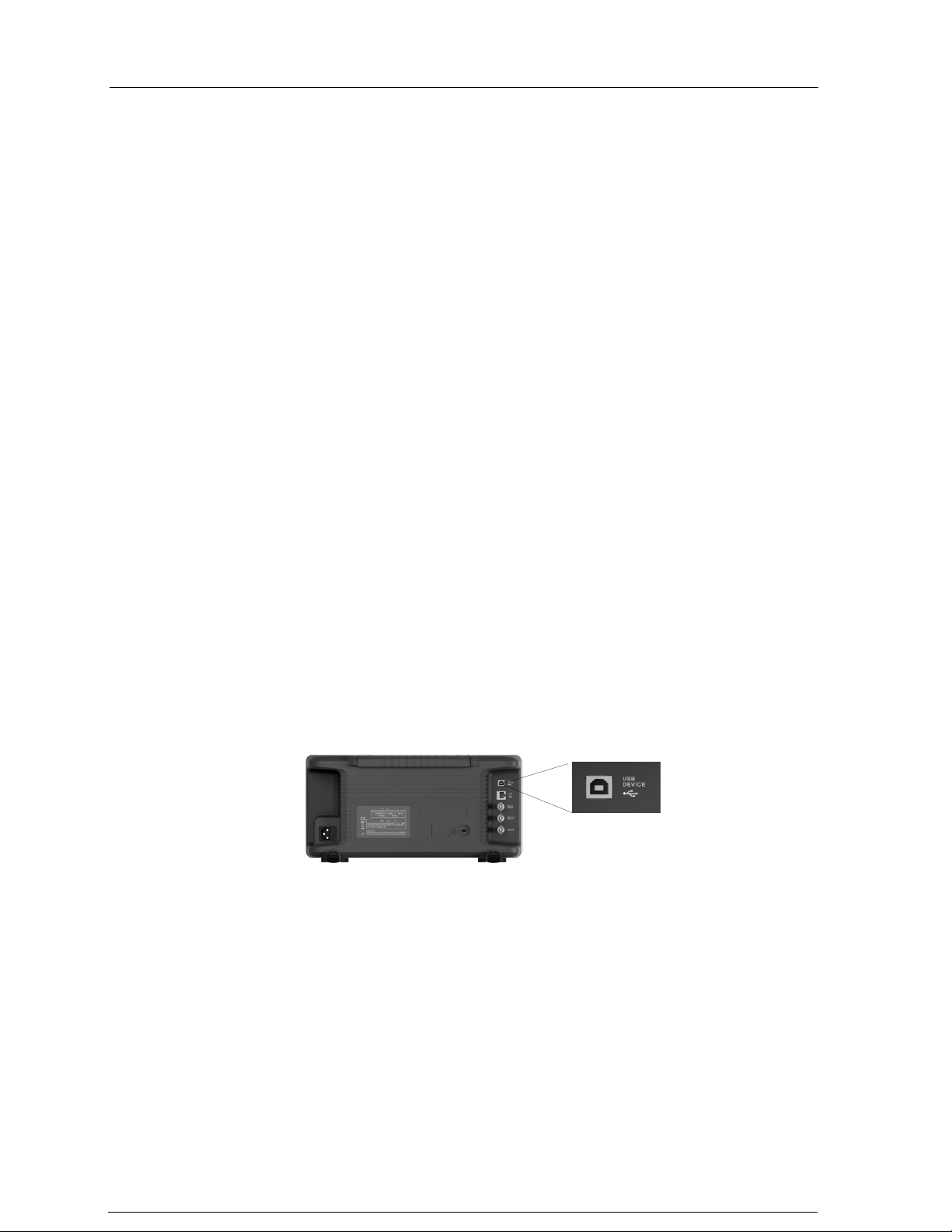
SIGLENT
SSA3000X User Manual 67
Chapter 3 Remote Control
The SSA3000X Series Spectrum Analyzer support LAN, USB Device, and GPIB--USB Host
interfaces. By using these interfaces, in combination with programming languages and/or NI-VISA
software, users can remotely control the analyzer based on SCPI (Standard Commands for
Programmable Instruments) command set, and interoperate with other programmable
instruments.
This chapter introduces how to build communication between the spectrum analyzer and a
controller computer with these interfaces.
3.1 Remotely Operating the Analyzer
The analyzer provides both the USB and LAN connection which allows you to set up a remote
operation environment with a controller computer. A controller computer could be a personal
computer (PC) or a minicomputer. Some intelligent instruments also function as controllers.
3.1.1 Connecting the Analyzer via the USB Device port
Refer to the following steps to finish the connection via USB-Device:
1. Install NI-VISA on your PC for USB-TMC driver.
2. Connect the analyzer USB Device port to a PC with a USB A-B cable.
3. Switch on the analyzer
The analyzer will be detected automatically as a new USB hardware.
3.1.2 Connecting the Analyzer via the LAN port
Refer to the following steps to finish the connection via LAN:
1. Install NI-VISA on your PC for VXI driver. Or without NI-VISA, using socket or telnet in
your PC’s Operating System.
2. Connect the analyzer to PC or the local area network with a LAN cable
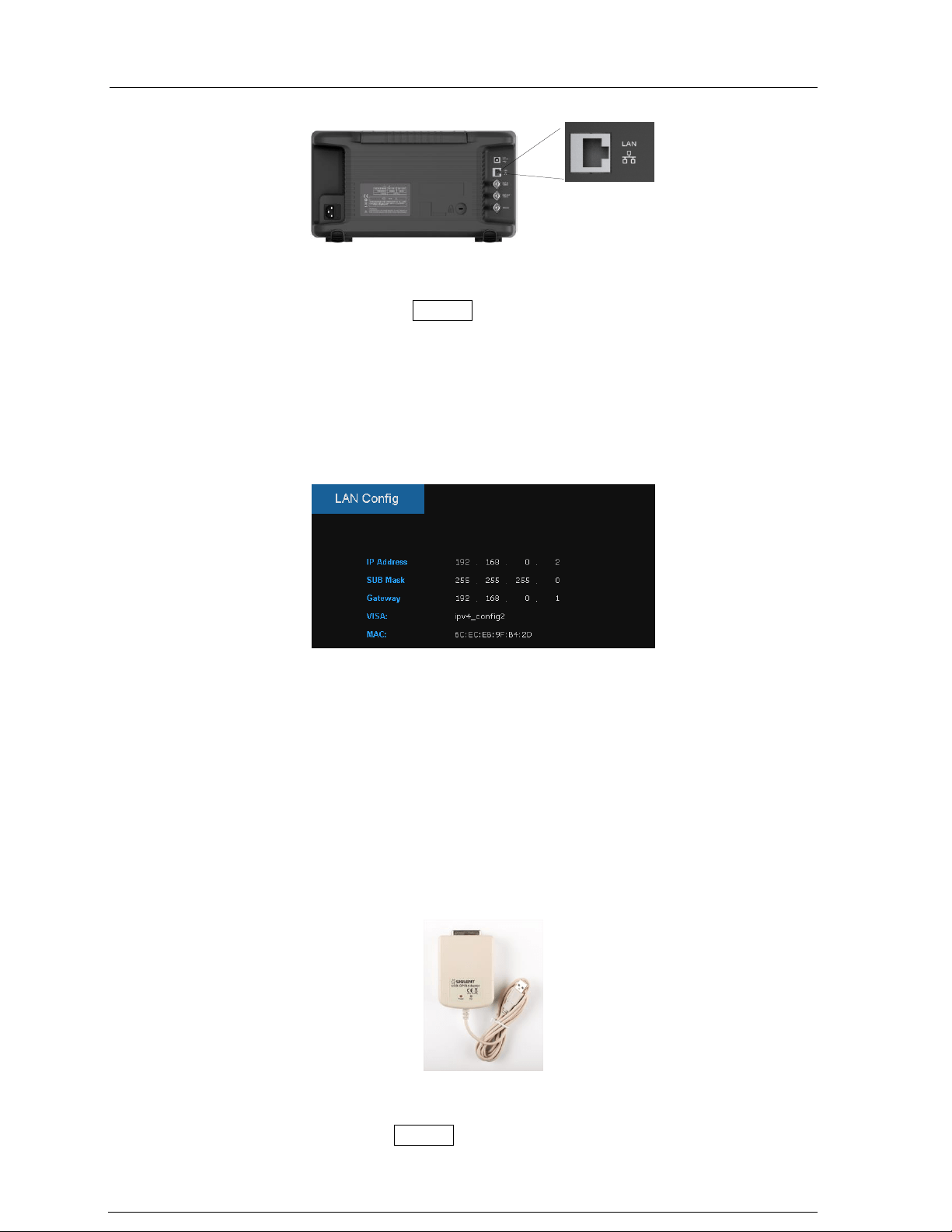
SIGLENT
SSA3000X User Manual 68
3. Switch on the analyzer
4. Press button on the front panel System →Interface→LAN to enter the LAN Config
function menu.
5. Select the IP Config between Static and DHCP
◆ DHCP: the DHCP server in the current network will assign the network parameters
automatically (IP address, subnet mask, gate way) for the analyzer.
◆ Static: you can set the IP address, subnet mask, gate way manually. Press Apply.
The analyzer will be detected automatically or manually as a new LAN point.
3.1.3 Connecting the Analyzer via the USB Host port
Refer to the following steps to finish the connection via USB:
1. Install NI-VISA on your PC for GPIB driver.
2. Connect the analyzer USB Host port to a PC’s GPIB card port, with SIGLENT
USB-GPIB adaptor.
3. Switch on the analyzer
4. Press button on the front panel System→Interface→GPIB to enter the GPIB number.
The analyzer will be detected automatically as a new GPIB point.
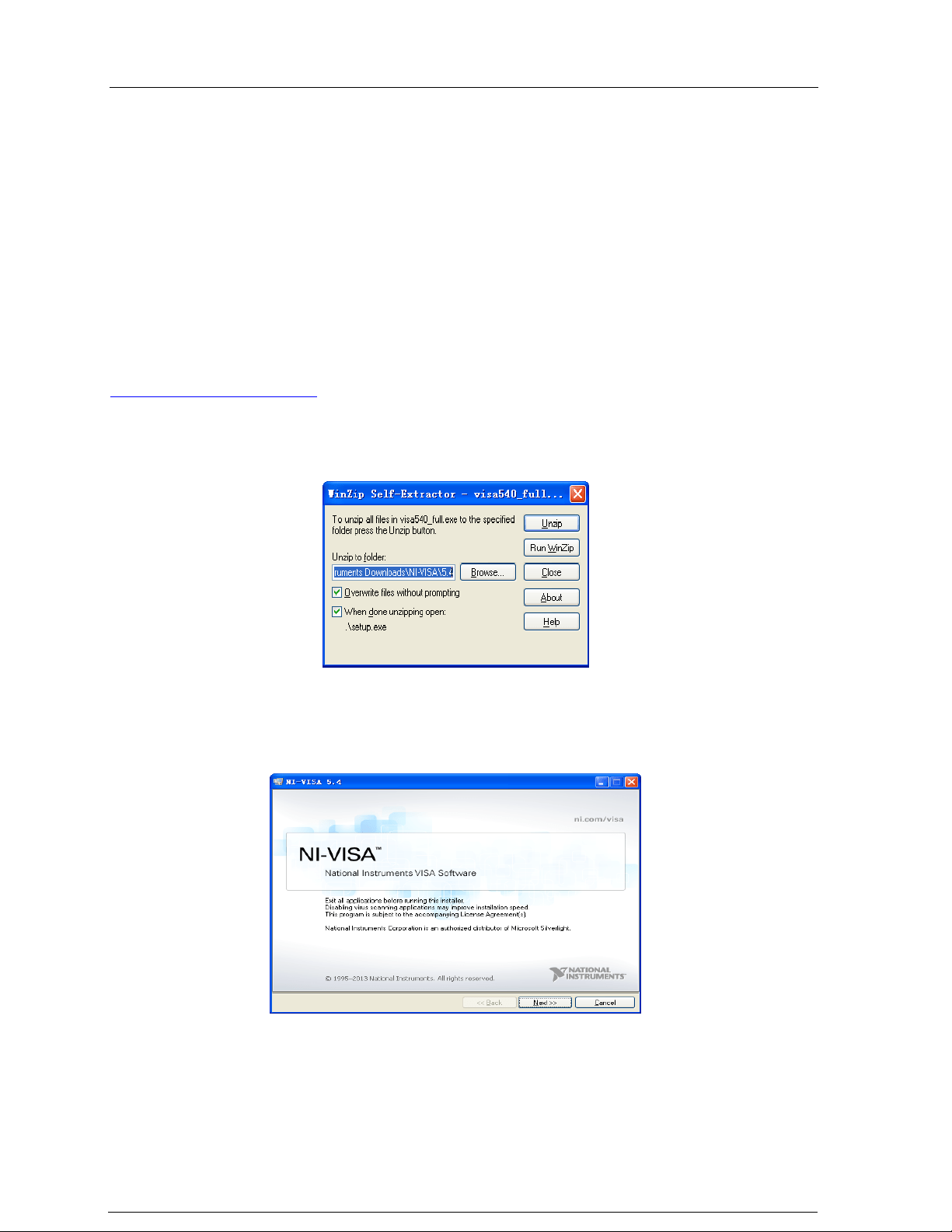
SIGLENT
SSA3000X User Manual 69
3.2 Build Communication
3.2.1 Build Communication Using VISA
NI-VISA includes a Run-Time Engine version and a Full version. The Run-Time Engine version
provides NI device drivers such as USB-TMC, VXI, GPIB, etc. The full version includes the
Run-Time Engine and a software tool named NI MAX that provides a user interface to control the
device.
You can get NI-VISA full version from:
http://www.ni.com/download/.
After download you can follow the steps below to install it:
a. Double click the visa_full.exe, dialog shown as below:
b. Click Unzip, the installation process will automatically launch after unzipping files. If your
computer needs to install .NET Framework 4, its setup process will auto start.
c. The NI-VISA installing dialog is shown above. Click Next to start the installation process.
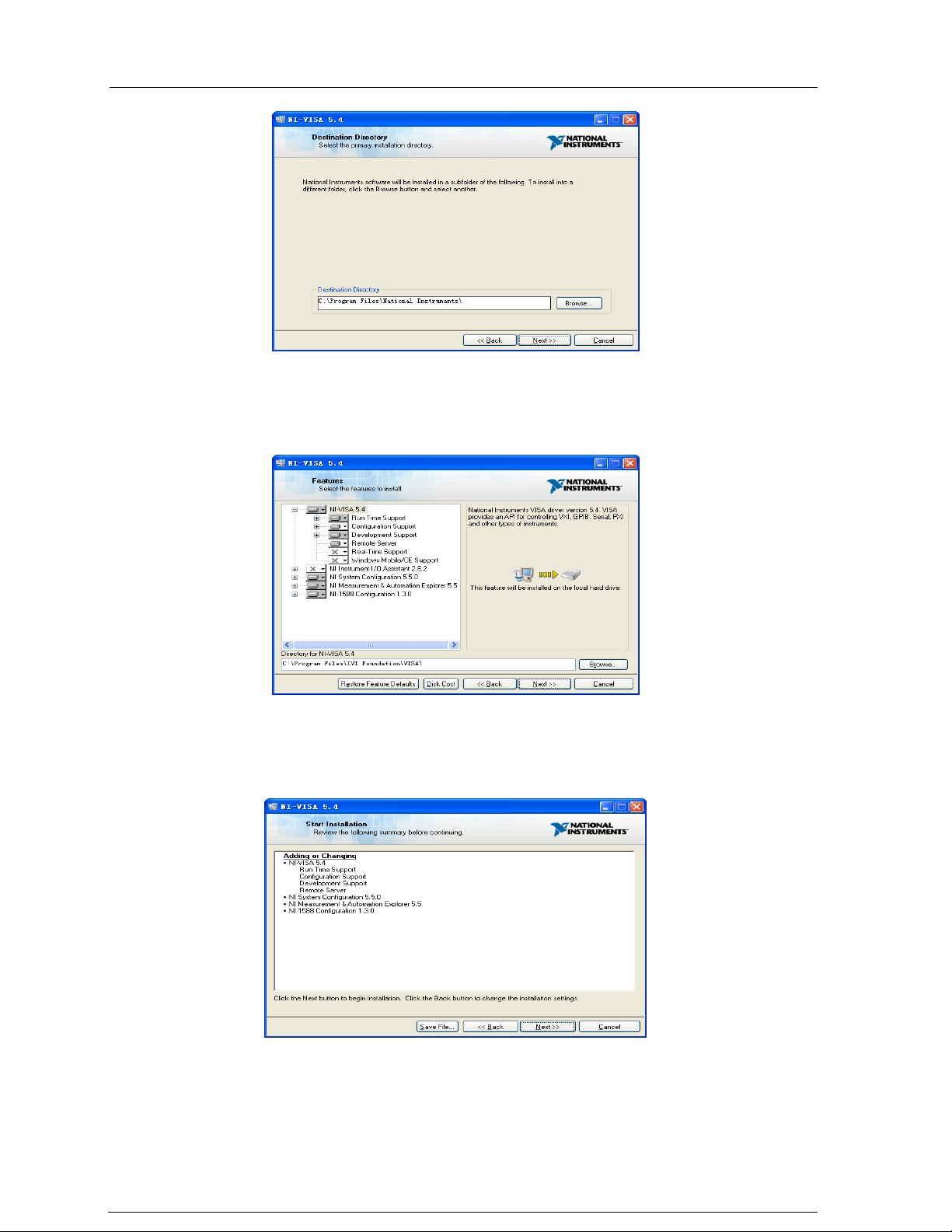
SIGLENT
SSA3000X User Manual 70
Set the install path, default path is “C:\Program Files\National Instruments\”, you can change it.
Click Next, dialog shown as above.
d. Click Next twice, in the License Agreement dialog, select the “ I accept the above 2 License
Agreement(s).” ,and click Next, dialog shown as below:
e. Click Next to run installation.
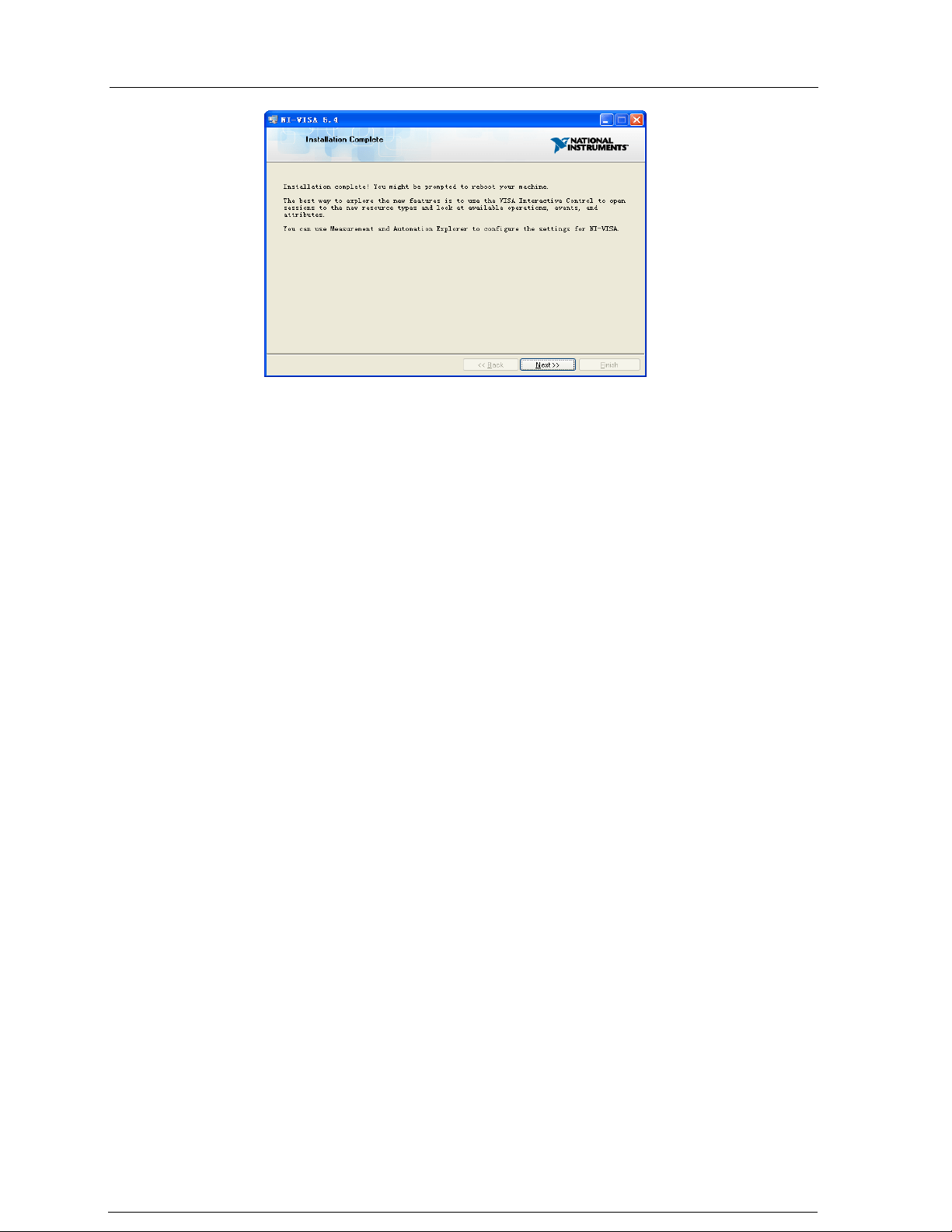
SIGLENT
SSA3000X User Manual 71
Now the installation is complete, reboot your PC.
3.2.2 Build Communication Using Sockets/Telnet
Through LAN interface, VXI-11, Sockets and Telnet protocols can be used to communicate with
the spectrum analyzer. VXI-11 is provided in NI-VISA, while Sockets and Telnet are commonly
included in PC’s OS initially.
Sockets LAN is a method used to communicate with the spectrum analyzer over the LAN interface
using the Transmission Control Protocol/Internet Protocol (TCP/IP). A socket is a fundamental
technology used for computer networking and allows applications to communicate using standard
mechanisms built into network hardware and operating systems. The method accesses a port on
the spectrum analyzer from which bidirectional communication with a network computer can be
established.
Before you can use sockets LAN, you must select the analyzer’s sockets port number to use:
◆ Standard mode. Available on port 5025. Use this port for programming.
◆ Telnet mode. The telnet SCPI service is available on port 5024.
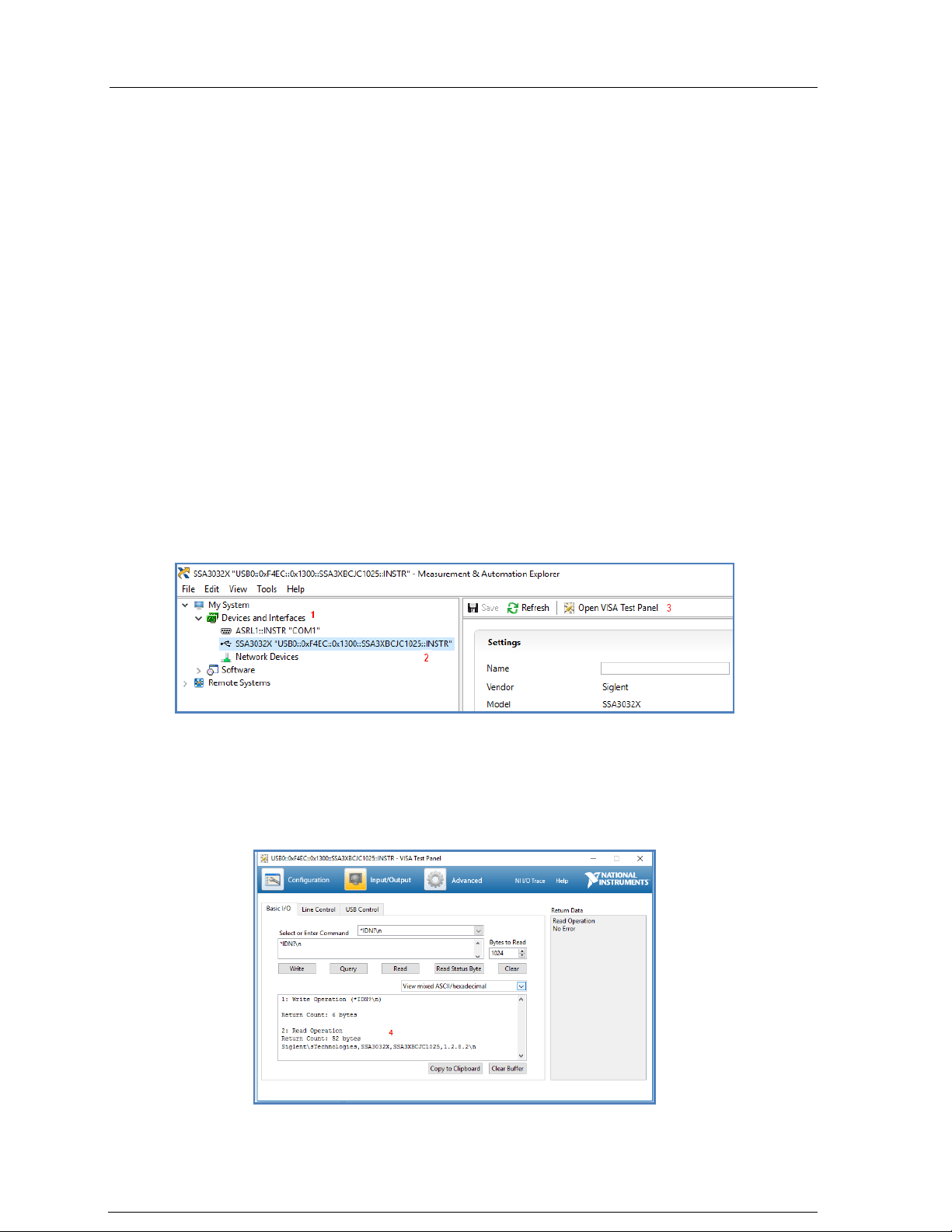
SIGLENT
SSA3000X User Manual 72
3.3 Remote Control Capabilities
3.3.1 User-defined Programming
Users can use SCPI commands to program and control the spectrum analyzer. For details, refer
to the introductions in “Programming Examples”.
3.3.2 Send SCPI Commands via NI MAX
Users can control the spectrum analyzer remotely by sending SCPI commands via NI-MAX
software.
3.3.2.1 Using USB
Run NI MAX software.
1, Click “Device and interface” at the upper left corner of the software;
2, Find the “USBTMC” device symbol
3, Click “Open VISA Test Panel” option button, then the following interface will appear.
4, Click the “Input/Output” option button and click the “Query” option button in order to view the
operation information.
NOTE: The *IDN? command (known as the Identification Query) returns the instrument
manufacturer, instrument model, serial number, and other identification information.
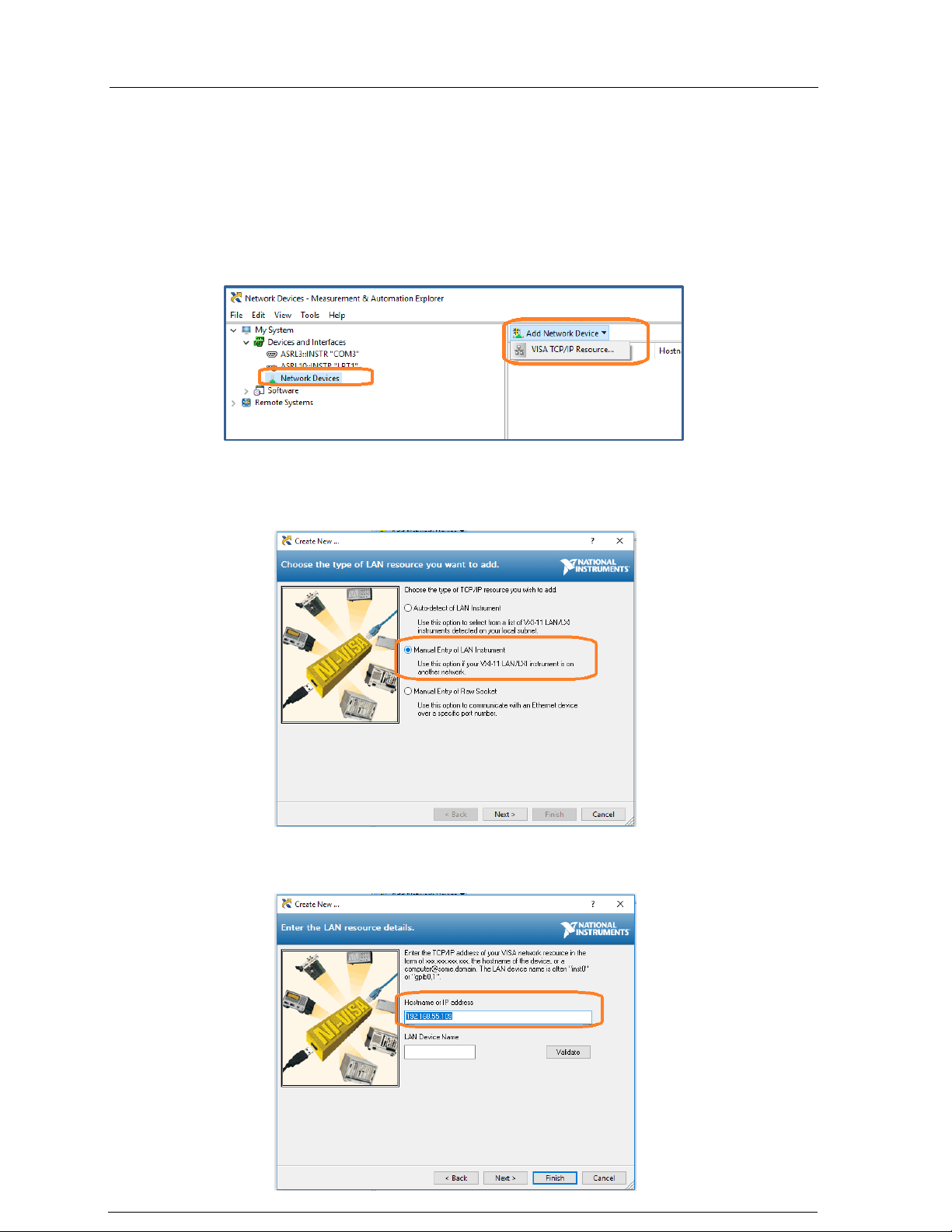
SIGLENT
SSA3000X User Manual 73
3.3.2.2 Using LAN
Select, Add Network Device, and select VISA TCP/IP Resource as shown:
Run NI MAX software.
1, Click “Device and interface” at the upper left corner of the software;
2, Find the “Network Devices” symbol; click “Add Network Devices”;
3. Select Manual Entry of LAN instrument, select Next, and enter the IP address as shown. Click
Finish to establish the connection:
NOTE: Leave the LAN Device Name BLANK or the connection will fail.
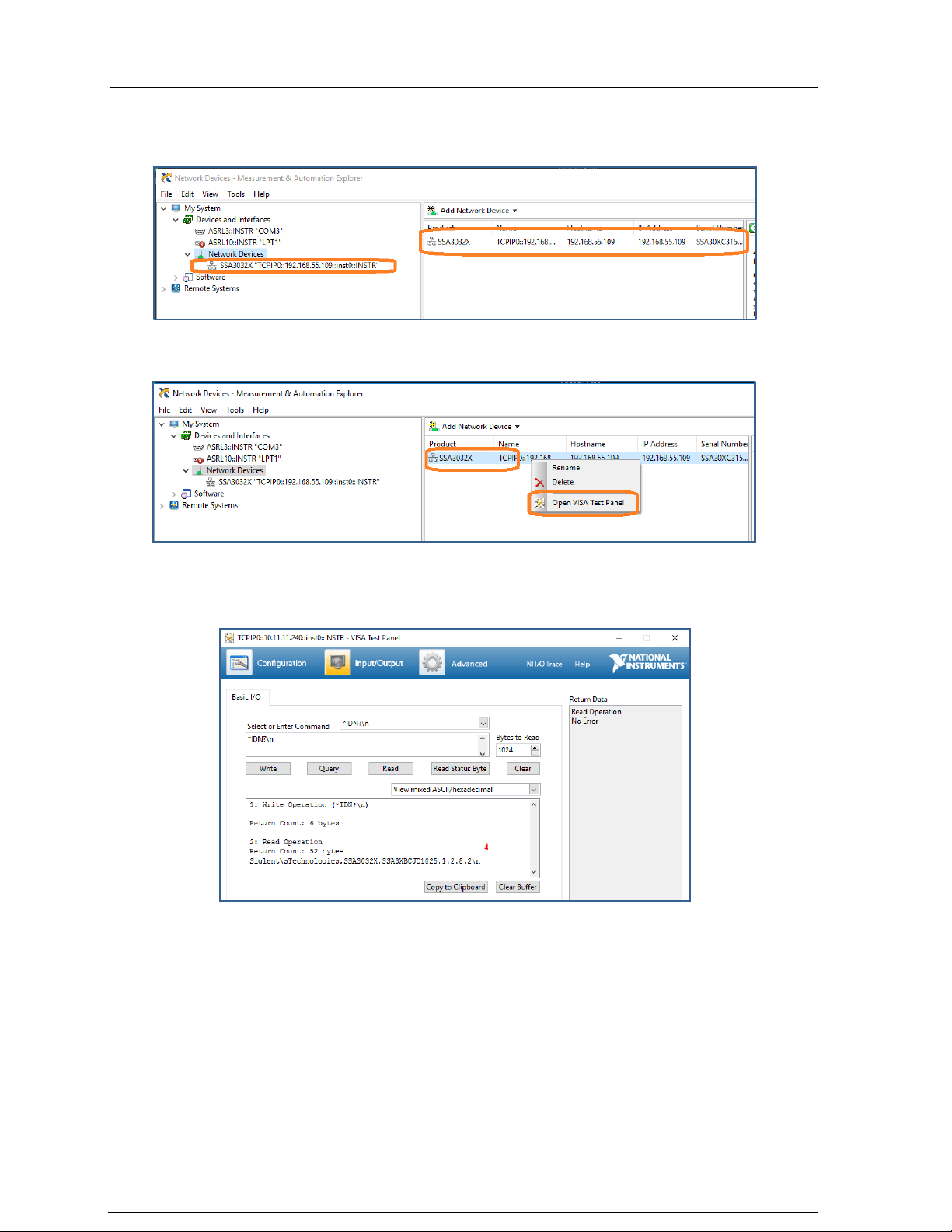
SIGLENT
SSA3000X User Manual 74
4. After a brief scan, the connection should be shown under Network Devices:
5. Right-click on the product and select Open NI-VISA Test Panel:
6. Click “Input/Output” option button and click “Query” option button. If everything is OK, you will
see the Read operation information returned as shown below.
3.3.3 EasySpectrum Software
Users can control the spectrum analyzer remotely by EasySpectrum. PC software
EasySpectrum is an easy-to-use, PC-Windows-based remote control tool for Siglent’s spectrum
analyzer. You can download it from Siglent’s website. To connect the analyzer via the USB/LAN
port to a PC, you need install the NI VISA first.
It is able to be used as:
◆ A monitor to display and control the trace scans simultaneously with the analyzer;
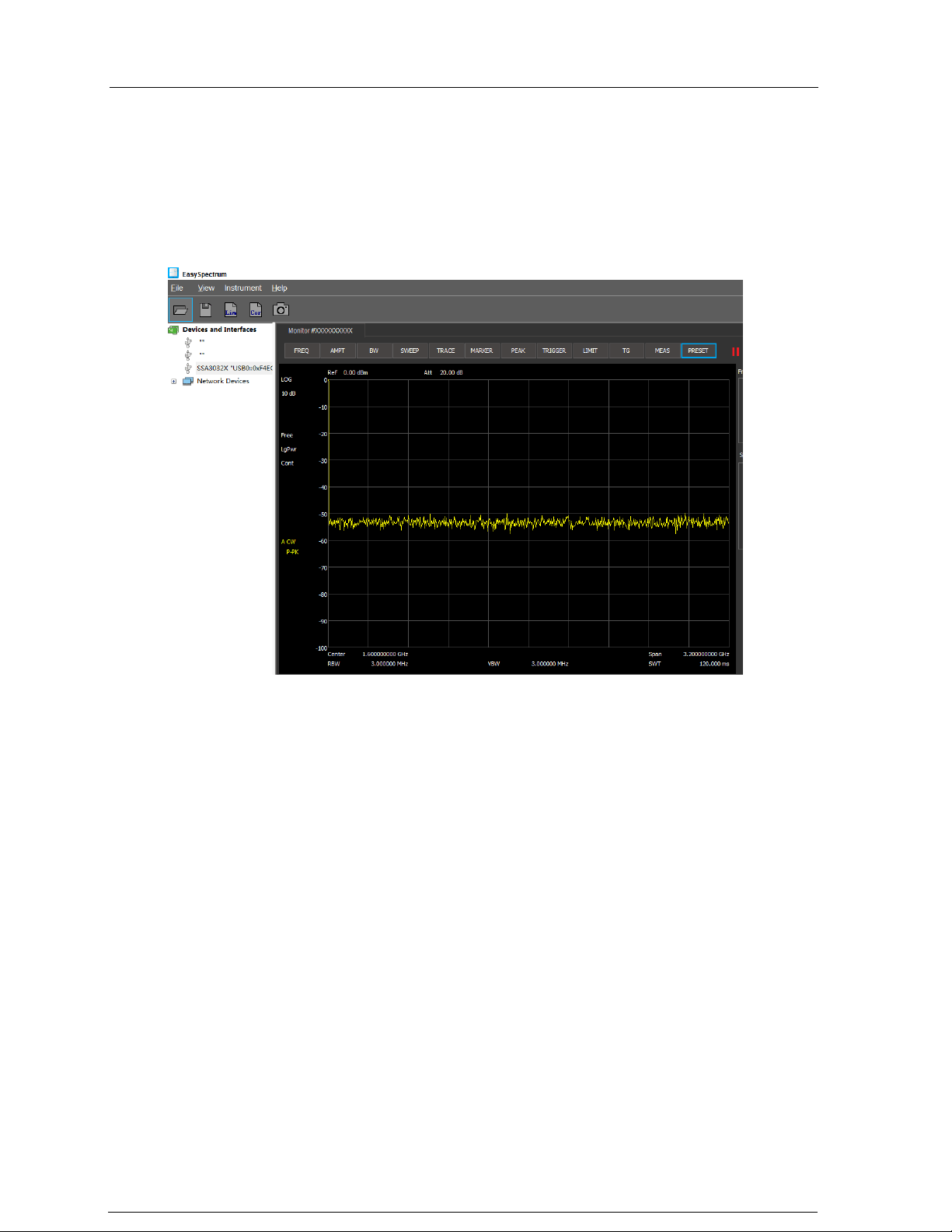
SIGLENT
SSA3000X User Manual 75
◆ A file maker to get user defined Limit/Correction files, and load them to the analyzer;
◆ An EMI receiver to perform EMI Pre-compliance test including pre scan, peak search, final
scan and report generating.
For the further description of the software, please refer to the online help embedded in this
software.

SIGLENT
SSA3000X User Manual 76
Chapter 4 Troubleshooting and Service
4.1 Service Summary
SIGLENT warrants that the products that it manufactures and sells will be free from defects in materials
and workmanship for a period of three years (accessories for a period of one year) from the date of
shipment from an authorized Siglent distributor. If the product proves defective within the respective
period, SIGLENT will provide repair or replacement as described in the complete warranty statement.
To arrange for service or obtain a copy of the complete warranty statement, please contact your
nearest Siglent sales and service office. Except as provided in this summary or the applicable warranty
statement, SIGLENT makes no warranty of any kind, express or implied, including without limitation the
implied warranties of merchantability and fitness for a particular purpose. In no event shall SIGLENT be
liable for indirect, special or consequential damages.
4.2 Troubleshooting
Before calling SIGLENT, or returning an analyzer for service, perform the quick checks listed below.
This check may eliminate the problem.
If the problem remains still, please contact SIGLENT and provide your device information in the back of
the analyzer.
1. The Power Switch is still dark after power on:
(1) Check: whether the power supply is according to 1.3.2;
(2) Check: the power has been connected correctly;
(3) Check: whether the power fuse is burned. If a new fuse needs to be installed, please use a
specified fuse.
2. The analyzer’s screen is still dark (no display) after power on:
(1) Check: whether the fan is running while the screen is dark, maybe the LCD cable is loose;
(2) Check: whether the fan is not running while screen is dark, maybe it has failed to start up;
Do not disassemble the instrument by yourself and contact SIGLENT.
3. The key is unresponsive or gives a wrong response:
(1) Press all the keys at the front panel to check if all of them are normal after power on.
(2) Press System ->Self Test ->Key Test to check if all the keys are working properly.
(3) If a key is not working, the numeric keyboard connection might be loose or the numeric

SIGLENT
SSA3000X User Manual 77
keyboard is broken.
Do not disassemble the instrument by yourself and contact SIGLENT.
4. The spectrum lines on the screen do not update for a long period of time:
(1) Check whether the screen is locked; if so, press Esc to unlock it.
(2) Verify whether all the trigger conditions have been met and whether there is a valid trigger
signal inputting.
(3) Check whether the analyzer is in single sweep.
(4) Check whether the current sweep time is too long.
5. Wrong measurement results or poor precision:
To calculate the system errors and check the measurement results and precision, refer to the
introductions in “Specifications”. To reach these specifications, please:
(1) Check whether all the external devices are successfully connected and are working normally.
(2) Get some knowledge of the signal under measurement and set appropriate instrument
parameters.
(3) Make measurements under proper conditions; for example, warm-up the instrument
appropriately and operate the instrument under the specified environment temperature.
(4) Calibrate the instrument regularly to reduce or avoid errors that might occur over time.
If you need a specific calibration after the stated calibration period, contact SIGLENT or get paid
service from authorized measurement agencies.
6. Pop-up Message:
The instrument may display prompt messages, error messages or state messages according to the
current working status. These messages are displayed to help you to use the instrument correctly and
are not instrument failures.

SIGLENT
SSA3000X User Manual 78
4.3 Contact Us
China:
SIGLENT TECHNOLOGIES CO., LTD.
Add: Bldg No.4 & No.5, Antongda Industrial Zone, 3rd Liuxian Road, Bao'an District,
Shenzhen, 518101, China.
Tel: + 86 755 3661 5186
Fax: + 86 755 3359 1582
Email: sales@siglent.com;
Website: http://www.siglent.com/ens/
USA:
SIGLENT Technologies America, Inc
6557 Cochran Rd Solon, Ohio 44139
Tel: 440-398-5800
Toll Free: 877-515-5551
Fax: 440-399-1211
Email: [email protected]om
Website: www.siglentamerica.com
Europe:
SIGLENT TECHNOLOGIES EUROPE GmbH
ADD: Liebigstrasse 2-20, Gebaeude 14, 22113 Hamburg Germany
Tel: +49(0)-819-95946
Fax: +49(0)-819-95947
Email: info-eu@siglent.com
Website: www.siglenteu.com
