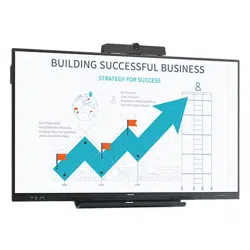

PN-LC862
PN-LC752
PN-LC652
LCD MONITOR
OPERATION MANUAL
IMPORTANT:
To aid reporting in case of loss or theft, please record the
product’s model and serial numbers in the space provided.
The numbers are located in the rear of the product.
Model No.:
Serial No.:
U.S.A. ONLY
3
E
IMPORTANT INFORMATION
WARNING: TO REDUCE THE RISK OF FIRE OR ELECTRIC SHOCK, DO NOT EXPOSE THIS PRODUCT
TO RAIN OR MOISTURE.
CAUTION: TO REDUCE THE RISK OF ELECTRIC
SHOCK, DO NOT REMOVE COVER.
NO USER-SERVICEABLE PARTS
INSIDE.
REFER SERVICING TO QUALIFIED
SERVICE PERSONNEL.
The lightning flash with arrowhead symbol, within
a triangle, is intended to alert the user to the
presence of uninsulated “dangerous voltage”
within the product’s enclosure that may be of
sufficient magnitude to constitute a risk of electric
shock to persons.
The exclamation point within a triangle is
intended to alert the user to the presence of
important operating and maintenance (servicing)
instructions in the literature accompanying the
product.
WARNING:
FCC Regulations state that any unauthorized changes or modifications to this equipment not expressly approved by the
manufacturer could void the user’s authority to operate this equipment.
NOTE:
This equipment has been tested and found to comply with the limits for a Class B digital device, pursuant to Part 15 of
the FCC Rules. These limits are designed to provide reasonable protection against harmful interference in a residential
installation.
This equipment generates, uses and can radiate radio frequency energy and, if not installed and used in accordance with the
instructions, may cause harmful interference to radio communications. However, there is no guarantee that interference will
not occur in a particular installation.
If this equipment does cause harmful interference to radio or television reception, which can be determined by turning the
equipment off and on, the user is encouraged to try to correct the interference by one or more of the following measures:
- Reorient or relocate the receiving antenna.
- Increase the separation between the equipment and receiver.
- Connect the equipment into an outlet on a circuit different from that to which the receiver is connected.
- Consult the dealer or an experienced radio/TV technician for help.
U.S.A. ONLY
To maintain compliance with EMC regulations, use shielded cables to connect to the following terminals: USB port, Mini AV
input terminal, HDMI input terminal, HDMI output terminal, D-sub input terminal, DisplayPort input terminal, RS-232C input
terminal, USB Type C port and TOUCH PANEL terminal.
CAUTION
RISK OF ELECTRIC
SHOCK
DO NOT OPEN

4
E
Thank you for your purchase of a SHARP LCD product. To ensure safety and many years of trouble-free operation of your
product, please read the Safety Precautions carefully before using this product.
SAFETY PRECAUTIONS
Electricity is used to perform many useful functions, but it can also cause personal injuries and property damage if improperly
handled. This product has been engineered and manufactured with the highest priority on safety. However, improper use can
result in electric shock and/or fire. In order to prevent potential danger, please observe the following instructions when installing,
operating and cleaning the product. To ensure your safety and prolong the service life of your LCD product, please read the
following precautions carefully before using the product.
1. Read instructions — All operating instructions must be read and understood before the product is operated.
2. Keep this manual in a safe place — These safety and operating instructions must be kept in a safe place for future
reference.
3. Observe warnings — All warnings on the product and in the instructions must be observed closely.
4. Follow instructions — All operating instructions must be followed.
5. Cleaning — Unplug the power cord from the power outlet before cleaning the product. Use a dry cloth to clean the product.
Do not use liquid cleaners or aerosol cleaners. Do not use dirty cloths. Doing so may damage the product.
6. Attachments — Do not use attachments not recommended by the manufacturer. Use of inadequate attachments can result
in accidents.
7. Water and moisture — Do not use the product near water. Do not install the product in a place where water may splash onto
it. Be careful of equipment which drains water such as an air-conditioner.
8. Ventilation — The vents and other openings in the cabinet are designed for ventilation.
Do not cover or block these vents and openings since insufficient ventilation can cause overheating and/or shorten the life
of the product. Do not place the product on a sofa, rug or other similar surface, since they can block ventilation openings.
Do not place the product in an enclosed place such as a bookcase or rack, unless proper ventilation is provided or the
manufacturer’s instructions are followed.
9. Power cord protection — The power cords must be routed properly to prevent people from stepping on them or objects from
resting on them.
10. The screen used in this product is made of glass. Therefore, it can break when the product is dropped or applied with
impact. Be careful not to be injured by broken glass pieces in case the screen breaks.
11. Overloading — Do not overload power outlets or extension cords. Overloading can cause fire or electric shock.
12. Entering of objects and liquids — Never insert an object into the product through vents or openings. High voltage flows in
the product, and inserting an object can cause electric shock and/or short internal parts.
For the same reason, do not spill water or liquid on the product.
13. Servicing — Do not attempt to service the product yourself. Removing covers can expose you to high voltage and other
dangerous conditions. Request a qualified service person to perform servicing.
14. Repair — If any of the following conditions occurs, unplug the power cord from the power outlet, and request a qualified
service person to perform repairs.
a. When the power cord or plug is damaged.
b. When a liquid was spilled on the product or when objects have fallen into the product.
c. When the product has been exposed to rain or water.
d. When the product does not operate properly as described in the operating instructions.
Do not touch the controls other than those described in the operating instructions. Improper adjustment of controls
not described in the instructions can cause damage, which often requires extensive adjustment work by a qualified
technician.
e. When the product has been dropped or damaged.
f. When the product displays an abnormal condition. Any noticeable abnormality in the product indicates that the product
needs servicing.
15. Replacement parts — In case the product needs replacement parts, make sure that the service person uses replacement
parts specified by the manufacturer, or those with the same characteristics and performance as the original parts. Use of
unauthorized parts can result in fire, electric shock and/or other danger.
16. Safety checks — Upon completion of service or repair work, request the service technician to perform safety checks to
ensure that the product is in proper operating condition.
17. Wall mounting — When mounting the product on a wall, be sure to install the product according to the method
recommended by the manufacturer.
18. Heat sources — Keep the product away from heat sources such as radiators, heaters, stoves and other heat-generating
products (including amplifiers).
DEAR SHARP CUSTOMER
5
E
SAFETY PRECAUTIONS (Continued)
19. Batteries — Incorrect use of batteries may cause the batteries to burst or ignite. A leaky battery may corrode the equipment,
dirty your hands or spoil your clothing. In order to avoid these problems, make sure to observe the precautions below:
• Use the specified batteries only.
• Install the batteries with due attention to the plus (+) and minus (-) sides of the batteries according to the instructions in the
compartment.
• Do not mix old and new batteries.
• Do not mix batteries of different types. Voltage specifications of batteries of the same shape may vary.
• Replace an exhausted battery with a new one promptly.
• If you will not use the remote control for a long time, remove the batteries.
• If leaked battery fluid gets on your skin or clothing, rinse immediately and thoroughly. If it gets into your eye, bathe your
eye well rather than rubbing and seek medical treatment immediately. Leaked battery fluid that gets into your eye or your
clothing may cause a skin irritation or damage your eye.
20. Usage of the monitor must not be accompanied by fatal risks or dangers that, could lead directly to death, personal injury,
severe physical damage or other loss, including nuclear reaction control in nuclear facility, medical life support system, and
missile launch control in a weapon system.
21. Do not stay in contact with the parts of the product that become hot for long periods of time. Doing so may result in
low-temperature burns.
22. Do not modify this product.
WARNING:
An apparatus with CLASS I construction shall be connected to a MAIN socket outlet with a protective earthing connection.
STABILITY HAZARD
If a monitor is not positioned in a sufficiently stable location, it can be potentially hazardous due to falling. Many injuries,
particularly to children, can be avoided by taking simple precautions such as:
• Using fixing devices like wall mount brackets recommended by the manufacturer.
• Only using furniture that can safely support the monitor.
• Ensuring the monitor is not overhanging the edge of the supporting furniture.
• Not placing the monitor on tall furniture (for example, cupboards or bookcases) without anchoring both the furniture and the
monitor to a suitable support.
• Not standing the monitors on cloth or other materials placed between the monitor and supporting furniture.
• Educating children about the dangers of climbing on furniture to reach the monitor or its controls.
• This equipment is not suitable for use in locations where children are likely to be present unsupervised.
Especially for child safety
- Don’t allow children to climb on or play with the monitor.
- Don’t place the monitor on furniture that can easily be used as steps, such as a chest of drawers.
- Remember that children can become excited while watching a program, especially on a “larger than life” monitor. Care
should be taken to place or install the monitor where it cannot be pushed, pulled over, or knocked down.
- Care should be taken to route all cords and cables connected to the monitor so that they cannot be pulled or grabbed by
curious children.
6
E
-
The TFT color LCD panel used in this monitor is made with
the application of high precision technology. However, there
may be minute points on the screen where pixels never light
or are permanently lit. Also, if the screen is viewed from an
acute angle there may be uneven colors or brightness. Please
note that these are not malfunctions but common phenomena
of LCDs and will not affect the performance of the monitor.
- Do not display a still picture for a long period, as this could
cause a residual image.
- Never rub or tap the monitor with hard objects.
- Please understand that our company bears no responsibility
for errors made during use by the customer or a third party,
nor for any other malfunctions or damage to this product
arising during use, except where indemnity liability is
recognized under law.
- This monitor and its accessories may be upgraded without
advance notice.
- Do not use the monitor where there is a lot of dust, where
humidity is high, or where the monitor may come into contact
with oil or steam. Do not use in an environment where
there are corrosive gases (sulfur dioxide, hydrogen sulfide,
nitrogen dioxide, chlorine, ammonia, ozone, etc.). As this
could lead to fire.
- Ensure that the monitor does not come into contact with
water or other fluids. Ensure that no objects such as paper
clips or pins enter the monitor as this could lead to fire or
electric shock.
- Do not place the monitor on top of unstable objects or in
unsafe places. Do not allow the monitor to receive strong
shocks or to strongly vibrate. Causing the monitor to fall or
topple over may damage it.
- Do not use the monitor near heating equipment or in places
where there is likelihood of high temperature, as this may
lead to generation of excessive heat and outbreak of fire.
- Do not use the monitor in places where it may be exposed to
direct sunlight. Risk of cabinet deformation and failure if the
monitor is used in direct sunlight.
- Please be sure to constantly remove dust and garbage that
has attached to the ventilation opening. If dust collects in the
ventilation opening or the inside of the monitor, it may lead to
excessive heat, outbreak of fire, or malfunction.
Please request a cleaning of the inside of the monitor from
an authorized servicing dealer or service center.
- The power outlet shall be installed near the equipment and
shall be easily accessible.
- Continuous operating time and warranty.
This product is designed for a maximum daily use of 16
hours. Continual use in excess of 16 hours per day is not
covered by the warranty.
- Do not touch the screen when turning on the monitor, it will
lead to a malfunction. When this occurs, turn the monitor
power off and then on.
- Do not operate the screen with a hard or pointed object such
as a fingernail or pencil.
- Depending on the application used, the touch pen may not
function.
- If another USB device is connected to the computer to which
the touch panel is connected, do not operate the USB device
during touch panel input. Input may not take place correctly.
- To maintain stable operation, this monitor must be restarted
once a day.
If “Power save mode” is on, turn off the power.
If “Power save mode” is off, turn off the main power.
This monitor can be restarted at the specified time. (See
page 52.)
- If you or a third party uses the product incorrectly, or if the
product is subjected to the effects of static electricity or
electrical noise, or if the product malfunctions or is repaired,
there is a risk that saved data will be corrupted or lost.
- Always back up important data to a USB flash drive.
- We bear no responsibility for protection of internal memory
recorded content or related damages.
The Power Cord
- Use only the power cord supplied with the monitor.
- Do not damage the power cord nor place heavy objects on
it, stretch it or over bend it. Also, do not add extension cords.
Damage to the cord may result in fire or electric shock.
- Do not use the power cord with a power tap.
Adding an extension cord may lead to fire as a result of
overheating.
- Do not remove or insert the power plug with wet hands.
Doing so could result in electric shock.
- Unplug the power cord if it is not used for a long time.
-
Do not attempt to repair the power cord if it is broken or
malfunctioning. Refer the servicing to the service representative.
Network
- When you use a network, your communication data is
exposed to the risks of being stolen or illegally accessed.
To avoid these risks, you need to use this monitor in a secure
network environment.
Manual Scope
- Microsoft and Windows are trademarks of the Microsoft
group of companies.
- Apple, Mac and macOS are trademarks of Apple Inc.,
registered in the U.S. and other countries.
- The terms HDMI, HDMI High-Definition Multimedia Interface,
HDMI Trade dress and the HDMI Logos are trademarks or
registered trademarks of HDMI Licensing Administrator, Inc.
- DisplayPort is a registered trademark of Video Electronics
Standards Association.
- Google, Chrome OS and Android are trademarks or
registered trademarks of Google LLC.
- Ethernet is a registered trademark of Xerox Corporation.
- VESA is either registered trademark or trademark of Video
Electronics Standards Association in the United States and/
or other countries.
- Bluetooth is a registered trademark of Bluetooth SIG, Inc.
- Arm and Cortex are registered trademarks of Arm Limited (or
its subsidiaries) in the US and/or elsewhere.
- All other brand and product names are trademarks or
registered trademarks of their respective holders.
- Illustrations in this manual may not exactly represent the
actual product or display.
LED Backlight
● TheLEDbacklightinthisproducthasalimitedlifetime.
* If the screen gets dark or does not turn on, it may be
necessary to replace the LED backlight.
* This LED backlight is exclusive to this product and must
be replaced by an authorized servicing dealer or service
center. Please contact an authorized servicing dealer or
service center for assistance.
TIPS AND SAFETY INSTRUCTIONS
7
E
MOUNTING PRECAUTIONS
• This product is for use indoors.
• A mounting bracket compliant with VESA specifications is
required.
• Since the monitor is heavy, consult your dealer before
installing, removing or moving the monitor.
• Mounting the monitor on the wall requires special expertise
and the work must be performed by an authorized dealer.
You should never attempt to perform any of this work
yourself. Our company will bear no responsibility for
accidents or injuries caused by improper mounting or
mishandling.
• Use the monitor with the surface perpendicular to a level
surface.
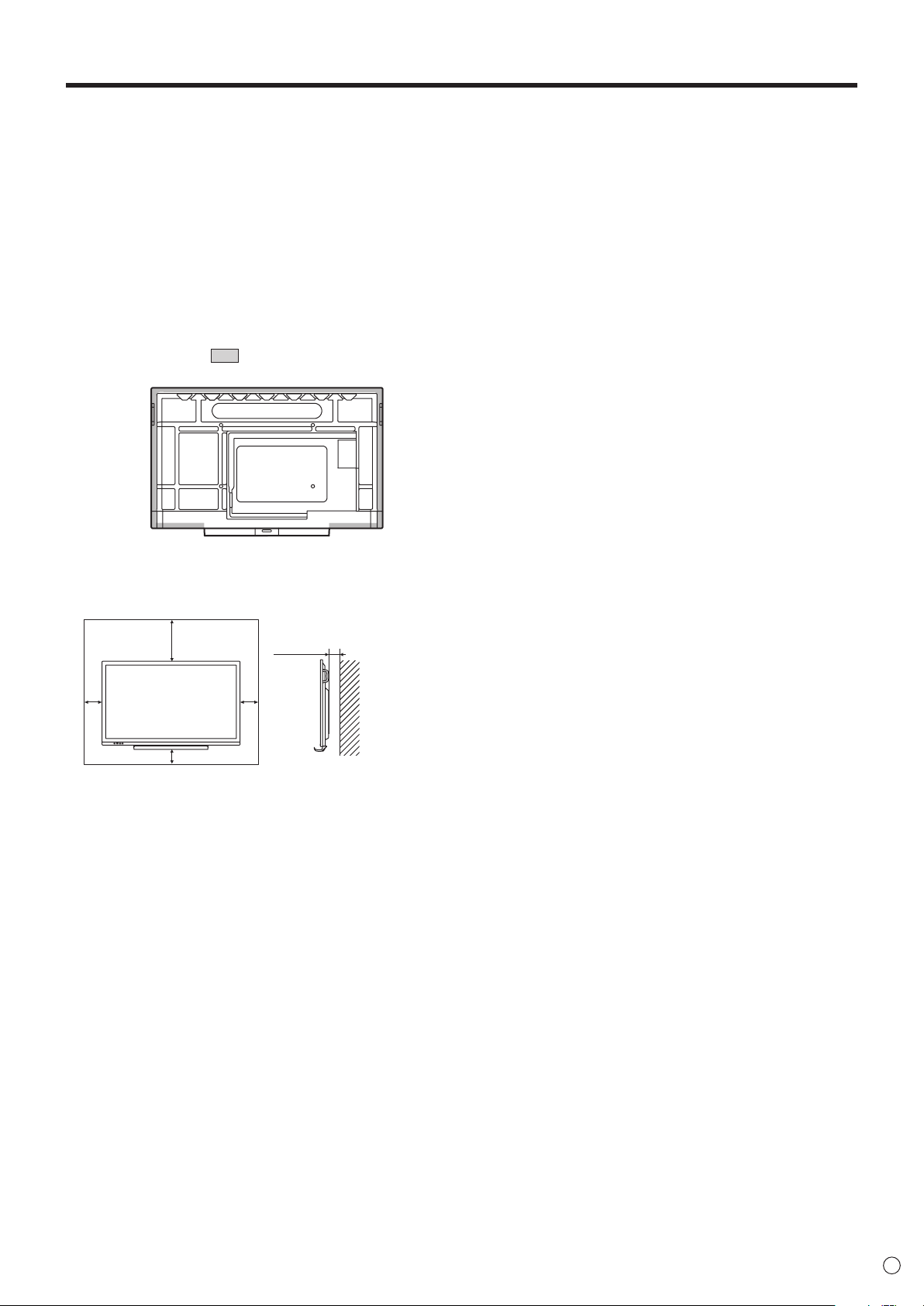
• When moving the monitor, be sure to hold the handles or
the parts marked by
below. Do not grasp the screen
or tray. This may cause product damage, failure, or injury.
• This monitor should be used at an ambient temperature
between 41°F (5°C) and 95°F (35°C). Provide enough
space around the monitor to prevent heat from
accumulating inside.
Unit: inch [mm]
7-7/8 [200]
2 [50]
2
[50]
2
[50]
1-7/16 [35]
• If it is difficult to provide sufficient space for any reason
such as the installation of the monitor inside a housing or
of several units side-by-side, or if the ambient temperature
may be outside of the range of 41°F (5°C) to 95°F (35°C),
install a fan or take other measures to keep the ambient
temperature within the required range.
• When installing two or more monitor units side-by-side,
provide space of at least 3/16 inch (5 mm) around them
to prevent stress on the adjacent unit or structure due to
thermal expansion.
• Temperature condition may change when using the monitor
together with the optional equipments recommended by
SHARP. In such cases, please check the temperature
condition specified by the optional equipments.
• Do not block any ventilation openings. If the temperature
inside the monitor rises, this could lead to a malfunction.
• Do not place the monitor on a device which generates heat.
• Do not use the product in locations where the unit is
exposed to direct sunlight or other strong light. Since this
product operates with infrared rays, such light may cause a
malfunction.
• When using multiple monitors closely, be sure the infrared
transmitter/receiver does not affect the other ones.

8
E
Contents
IMPORTANT INFORMATION ............................................ 3
DEAR SHARP CUSTOMER ..............................................4
SAFETY PRECAUTIONS ..................................................4
TIPS AND SAFETY INSTRUCTIONS ...............................6
MOUNTING PRECAUTIONS ............................................7
Supplied Components ..................................................... 9
System Requirements .....................................................9
Part Names .....................................................................10
Connecting Peripheral Equipment ...............................12
Connecting the Power Cord .........................................14
Binding Cables ............................................................... 14
Preparing the Remote Control Unit .............................. 15
Installing the batteries ................................................15
Remote control operation range .................................15
Mounting a web camera ................................................16
Attaching the wireless adapter ..................................... 16
Turning Power On/Off .................................................... 17
Turning on the main power.........................................17
Turning power on .......................................................17
Turning power off .......................................................18
Sleep (Backlight off) ...................................................18
Touch Pen ....................................................................... 19
Touch action ................................................................... 20
Touch action ...............................................................20
Cautionary points .......................................................20
Basic Operation .............................................................21
About the home screen of APPLICATION mode ........ 21
Using the remote control unit .....................................26
Overlay board (Annotation) ........................................29
Freeze ........................................................................30
Whiteboard .....................................................................31
Drawing ......................................................................33
Erasing a drawn line ...................................................33
Selecting a drawn line ................................................34
Opening a file or application on the current sheet ......34
Opening a file .............................................................35
Saving ........................................................................35
Settings ......................................................................35
Wireless Display (EShare) ............................................36
File Manager ...................................................................37
PDF Viewer .....................................................................41
Web Browser ..................................................................42
Printing ...........................................................................43
Updating the Software (Update) ...................................44
Menu Items .....................................................................45
Displaying the menu screen ....................................... 45
Menu item details .......................................................46
Adjustments for computer screen display ..................52
Reset/Functional Restriction Setting
(Function menu) ............................................................. 53
Troubleshooting .............................................................54
Specifications ...............................................................56
Intellectual Property Rights and Other Matters ..........61
Mounting Precautions
(For SHARP dealers and service engineers) ............... 62
9
E
Hardware Must have a USB 2.0 compliant port.
Operating system
Windows 10, Windows 11
macOS v11, v12, v13
Google Chrome OS Version 104 or later
To use the touch panel with an HDMI / D-sub / DisplayPort connection, connect the supplied USB cable to the computer.
The touch panel and touch pen operate with the standard driver of each operating system. On the Mac, operation is only
possible in mouse mode.
The Information Display Downloader can also be downloaded from the following website.
https://business.sharpusa.com/product-downloads
When the Information Display Downloader is installed, you can check and download the most recent versions of the software
programs.
To install the software, see the manual for each.
Pen Software setup program and Touch Viewer setup program can be downloaded using Information Display Downloader.
Supplied Components
If any component should be missing, please contact your dealer.
Liquid Crystal Display Monitor: 1
Remote control unit: 1
Cable clamp: 3
Power cord: 1
Remote control unit battery: 2
Setup Manual: 1
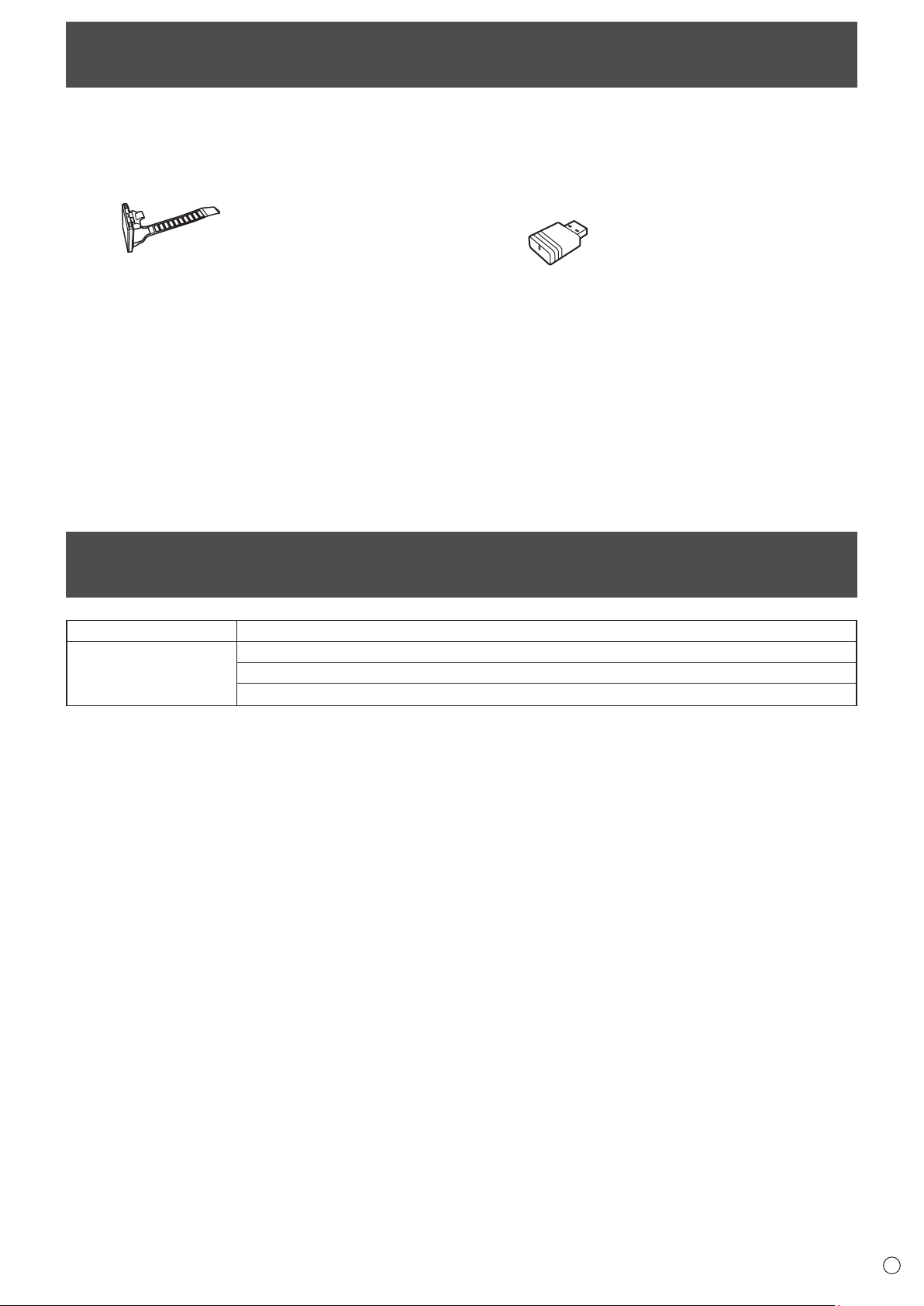
Touch pen: 2
Camera mount: 1
Camera mount screw (M3x6): 1
Camera screw (inch thread): 1
Tray: 1
Tray mounting screws (M3x8): 4
USB cable: 1
Wireless adapter: 1
Cover SHARP logo: 1
Place this sticker onto the SHARP logo to cover the logo.
* For environmental protection!
Do not dispose of batteries in household waste. Follow the disposal instructions for your area.
System Requirements
10
E
Part Names
n
Front view
13
1111 12
13
1 2 3
45 67 108 9
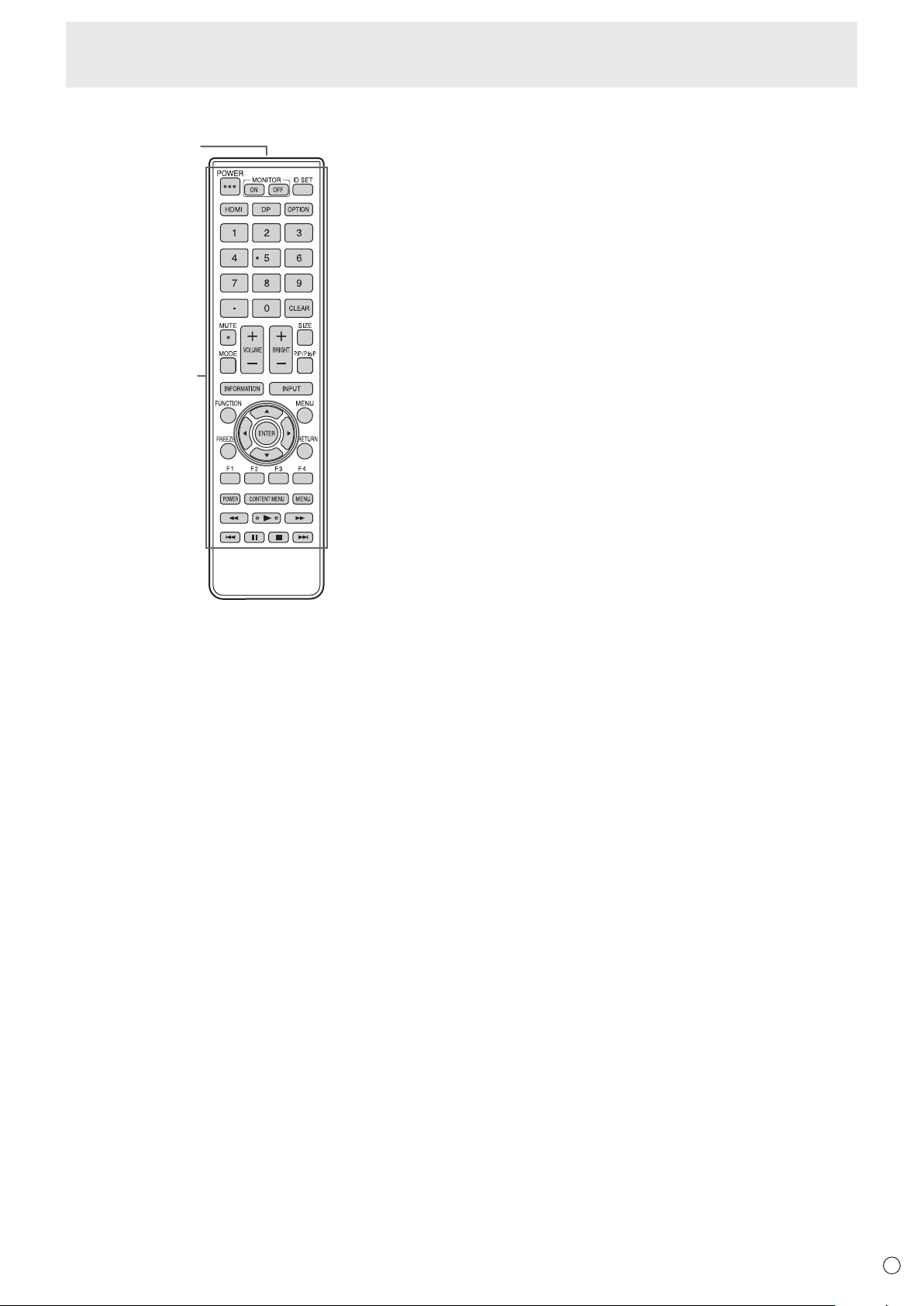
1. HDMI1 input terminal (See page 12.)
2. TOUCH PANEL1 terminal (See page 13.)
3. USB port (USB 3.0 compliant) (See page 13.)
4. Remote control sensor (See page 15.)
5. Power LED (See page 17.)
6. POWER button (See page 17.)
7. HOME button (See page 21.)
8. FREEZE button (See page 30.)
9. INPUT button (See page 23.)
10. VOLUME +/- (Volume adjustment) buttons (See page
22.)
11. Speakers
12. Tray
The load capacity of the tray is 1 kg (2.2 lbs.).
13. Infrared transmitter/receiver
Caution
• Consult your SHARP dealer for attachment/detachment of optional parts.
14. HDMI output terminal (See page 13.)
15. USB port for APPLICATION mode
(USB 3.0 compliant) (See page 13.)
16. USB Type C port (See page 12.)
17. TOUCH PANEL2 terminal (See page 13.)
18. HDMI2 input terminal (See page 12.)
19. HDMI3 input terminal (See page 12.)
20. RS-232C input terminal (See page 13.)
21. LAN terminal (See page 13.)
22. Audio output terminal (See page 13.)
23. Digital audio output (optical) terminal (See page 13.)
24. Audio input terminal (See page 13.)
25. D-sub input terminal (See page 12.)
26. Mini AV input terminal (See page 12.)
27. DisplayPort input terminal (See page 12.)
28. Main power switch (See page 17.)
29. AC input terminal (See page 14.)
30. Handles (4 on the PN-LC862)
31. Expansion slot
This section is used to connect optional hardware for
function expansion. Offering this attachment location
is not a guarantee that future compatible hardware
attachments will be released.
If a Windows computer is using the OPS slot, this monitor
will not enter standby state while displaying the Windows
Login screen.
* If you turn off the monitor while OPS Module is in
sleep mode, the OPS module may malfunction. Do not
perform the following operations or settings on the OPS
Module.
• Go to sleep mode.
• Turn off the monitor.
32. Vents
n
Rear view
20 21 22 2423 25 26
27
28 28
29
30
32 31
30
PN-LC652
16
15
14
3
17
18
19
11
E
Part Names
n
Remote control unit
2
1
1. Signal transmitter
2. Operation buttons (See page 26.)
12
E
7
8
51012 1314 15
16
2
6
1
11
3
4
16
17
9
Connecting Peripheral Equipment
Caution
• Be sure to turn off the main power switch and disconnect
the plug from the power outlet before connecting/
disconnecting cables. Also, read the manual of the
equipment to be connected.
• Be careful not to confuse the input terminal with the output
terminal when connecting cables. Accidentally reversing
cables connected to the input and output terminals may
cause malfunctions and other problems.
• Do not use any cable that has a damaged or deformed
terminal. Using such cables may cause malfunctions.
TIPS
• Operation is not guaranteed for all connected devices.
• Use the automatic screen adjustment when a computer
screen is displayed for the first time using D-SUB or when
the setting of the computer is changed. The screen is
adjusted automatically using “Auto” on the Input menu.
• If the audio output from the playback device is connected
directly to speakers or other devices, the video on the
monitor may appear delayed from the audio portion.
Audio should be played through this monitor by connecting
the playback device to the monitor’s audio input, and
connecting the monitor’s audio output to the speakers or
other devices.
• Line speakers (connected to the audio output terminal),
USB speakers, and Bluetooth speakers cannot be used at
the same time.
When connecting speakers, use only one of them.
The TOUCH PANEL terminal is USB3.0 Type B.
Although the connector shape is different, the supplied
USB cable (USB 2.0 Type B) can be connected to the
TOUCH PANEL terminal.
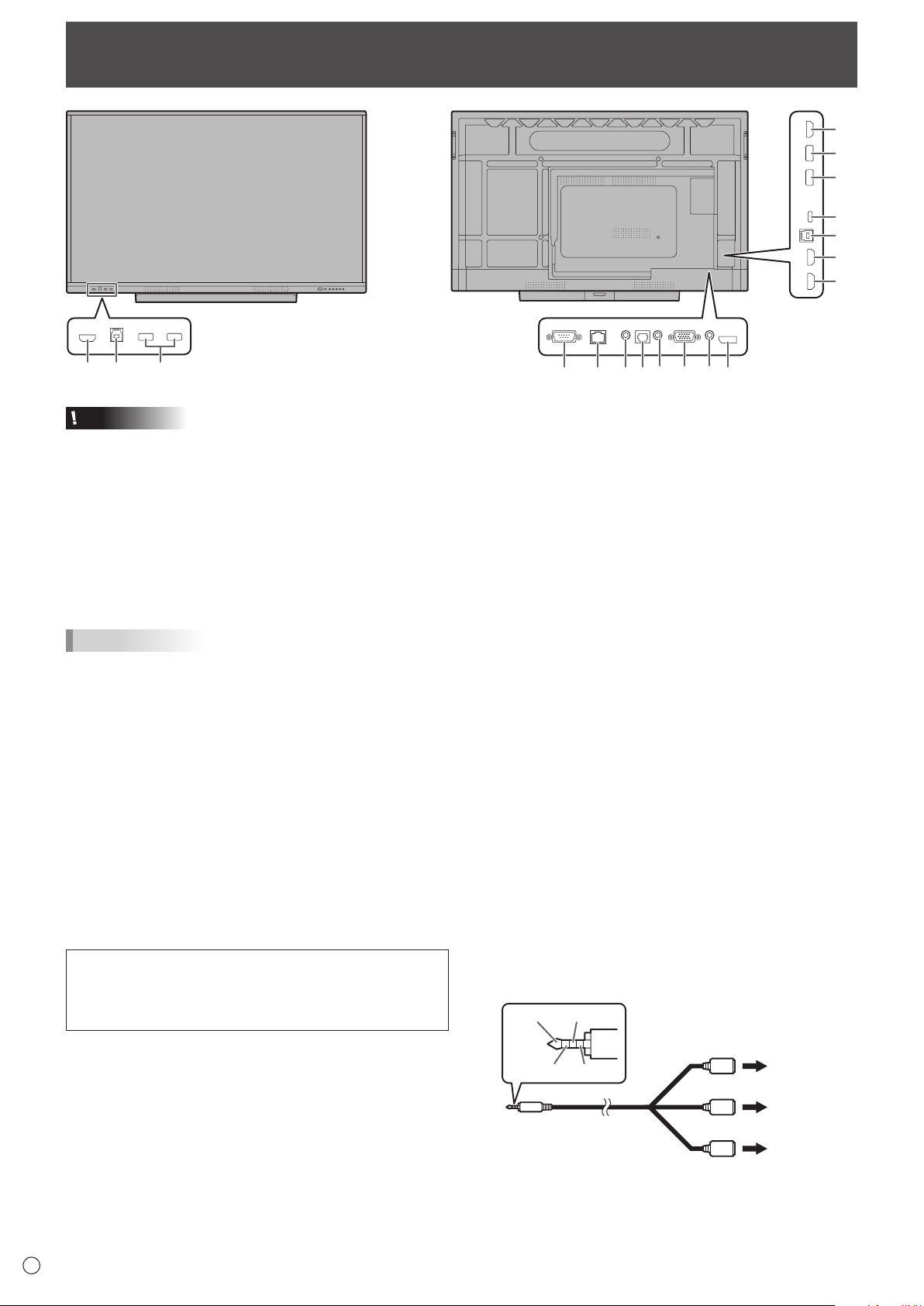
1. HDMI1 input terminal
2. HDMI2 input terminal
• Use a commercially available HDMI cable (conforming to
the HDMI standard) that supports 4K.
3. HDMI3 input terminal (support ARC)
• Use a commercially available HDMI cable (conforming to
the HDMI standard) that supports 4K. When connecting
to ARC-compatible devices, please use cable that support
even more ARC.
4. USB Type C port
• Connect to the computer with a commercially available
USB cable (Type C, conforming to the USB standard).
• You can connect a device that supports DisplayPort
alternate mode. In order to supply power to connected
devices, it is necessary to support the Power delivery
standard.
• For USB Power Delivery 65W charging, please use a
cable that supports a current rating of 5A. Charging is
limited to 60W when using a cable that supports a current
rating of 3A.
• Be sure to clamp the USB Type C cable (commercially
available) by using the supplied cable clamp (see page
14). When clamping the USB Type C cable, take care not
to stress the USB Type C cable. Do not bend the USB
Type C cable excessively.
• There is no need to connect the USB cable to the TOUCH
PANEL terminal.
• When input mode is changed to USB-C, this monitor will
be recognized by the connected computer.
5. D-sub input terminal
6. Mini AV input terminal
• A conversion cable must be purchased separately.
Video
Audio (L)
Audio (R)
Video Audio (R)
Audio (L) GND
7. DisplayPort input terminal
• Use a commercially available DisplayPort cable
(conforming to the DisplayPort standard) that supports 4K.
13
E
Connecting Peripheral Equipment
8. TOUCH PANEL1 terminal
• To use the touch panel with a computer connected to
an HDMI1 input terminal, connect the touch panel to the
computer with a USB cable (USB2.0 Type B or USB3.0
Type B).
9. TOUCH PANEL2 terminal
• To use the touch panel with a computer connected to the
video input terminal on the rear of the monitor, connect
the touch panel to the computer with a USB cable (USB2.0
Type B or USB3.0 Type B).
10. Audio input terminal
• Use an audio cable without resistance.
11. HDMI output terminal
• The screen displayed on this monitor and the audio output
from this monitor can be output to an external device.
• Use a commercially available HDMI cable (conforming to
the HDMI standard) that supports 4K.
• When the input video is encrypted with copyright
protection, the video cannot be output.
• When outputting the APPLICATION mode screen, the
external device must support HDCP.
12. Audio output terminal
• Audio that is input into the monitor is output.
• The output sound varies depending on the input mode.
• “Bass”, “Treble”, and “Balance” cannot be adjusted in the
“Audio” of the General menu.
13. Digital audio output (optical) terminal
• Audio that is input into the monitor is output.
• Connect using a commercially available audio digital
cable.
• The output sound varies depending on the input mode.
14. RS-232C input terminal
• You can control the monitor from a computer by
connecting a commercially available RS-232 straight
cable between these terminals and the computer.
For details, please refer to the manual on the following
website.
https://business.sharpusa.com/product-downloads
15. LAN terminal
• You can connect to a network by using a commercially
available LAN cable.
• This monitor can be controlled via a network from a
computer on the network. For details, please refer to the
manual on the following website.
https://business.sharpusa.com/product-downloads
16. USB port (USB 3.0 compliant, Type-A)
• When the input mode is HDMI1, the USB port can be
used for a computer connected to the TOUCH PANEL1
terminal.
• When the input mode is HDMI2, HDMI3, DisplayPort
or D-SUB, the USB port can be used for a computer
connected to the TOUCH PANEL2 terminal.
• When the input mode is APPLICATION, the USB port can
be used for APPLICATION mode.
• When the input mode is OPS, the USB port can be used
for the computer of the expansion slot.
* Do not switch the input mode when a USB flash drive is
connected. This could corrupt the data on the USB flash
drive. Switch the input mode after removing the USB flash
drive. To save data to the USB flash drive, connect the
USB flash drive to the USB port for APPLICATION mode
(see below).
17. USB port for APPLICATION mode (USB3.0 compliant,
Type-A)
• The USB port can be used for APPLICATION mode.
(The USB connection does not change even if the input
mode is changed.)
• Connect to this port when using the wireless adapter
(supplied). (See page 16.)
n
USB port in the APPLICATION mode
• Connect USB devices (memory device, keyboard, mouse)
that you want to use in APPLICATION mode.
Supported USB flash drives
File System FAT32
Capacity
Up to 64 GB
(The maximum file size is 4 GB)
• A USB flash drive that is encrypted or has a security
function cannot be used.
• Use a USB flash drive with a shape that can be inserted in
the USB port. Some USB flash drives with special shapes
cannot be inserted. Do not forcibly insert a USB flash drive.
This may damage the connector or cause failure.
TIPS
• You can prohibit the use of USB flash drive. (See page 51.)
n
How to remove a USB flash drive
1. Start “File Manager”. (See page 37.)
2. Select the USB flash drive to remove, and then touch
.
TIPS
• To remove a USB flash drive connected to a computer,
refer to the manual of the computer.
14
E
Connecting the Power Cord
Caution
• Use only the power cord supplied with the monitor.
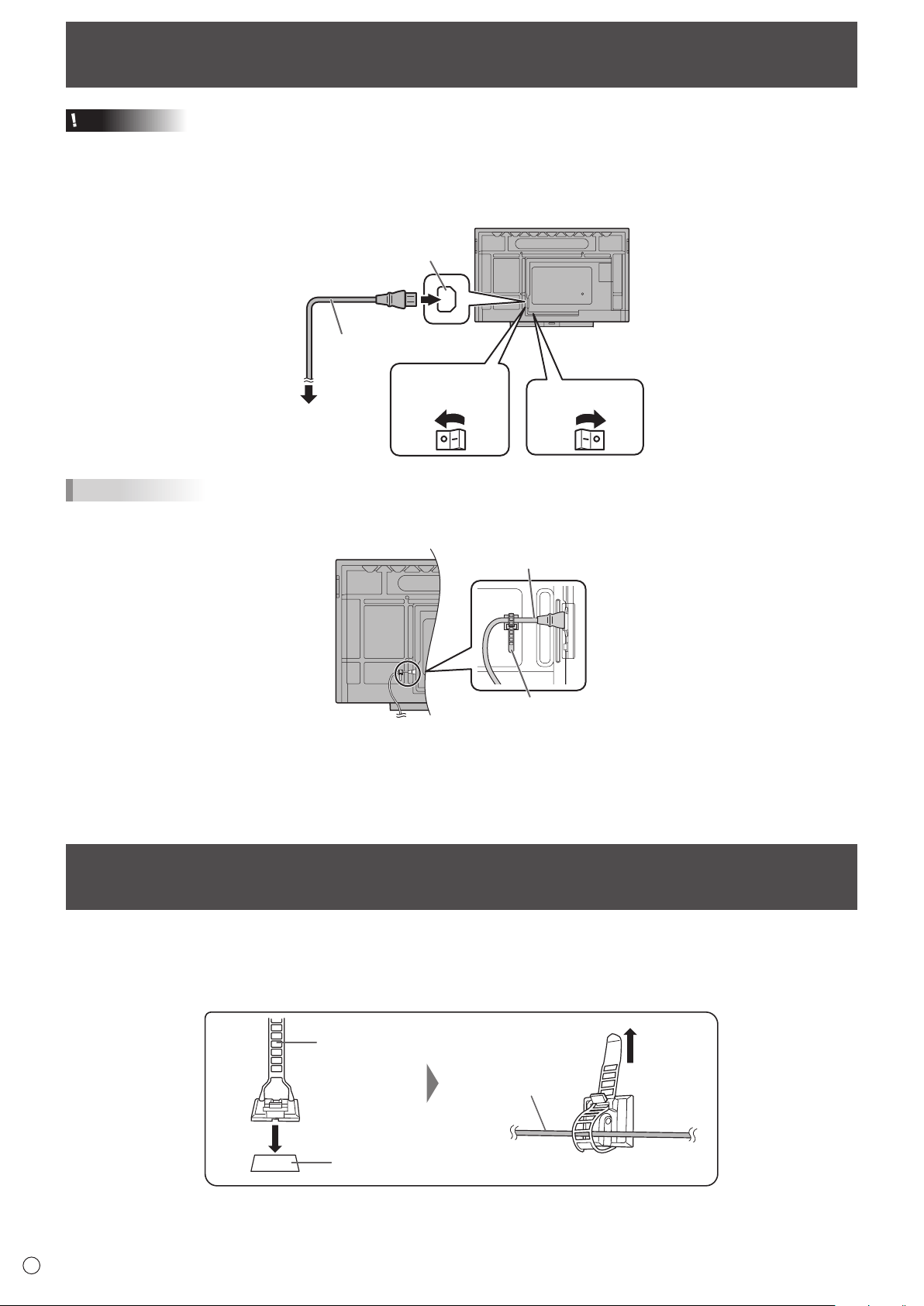
1. Turn off the main power switch.
2. Plug the power cord (supplied) into the AC input terminal.
3. Plug the power cord (supplied) into the power outlet.
Main power switch
PN-LC652
11
Main power switch
Power cord (Supplied)
2 AC input
terminal
For power outlet
3
TIPS
• Be sure to clamp the power cord (supplied) by using the supplied cable clamp. When clamping the power cord, take care not
to stress the terminal of the power cord. Do not bend the power cord excessively.
Cable clamp (Supplied)
Power cord (Supplied)
Binding Cables
The supplied cable clamps can be used to clamp the power cord and cables connected to the back of the monitor.
Attach the supplied cable clamps to a flat surface, removing any dust or dirt before attaching.
Do not attach over a vent.
Cable clamp
Affixing point
Cable
15
E
Preparing the Remote Control Unit
Remote control operation range
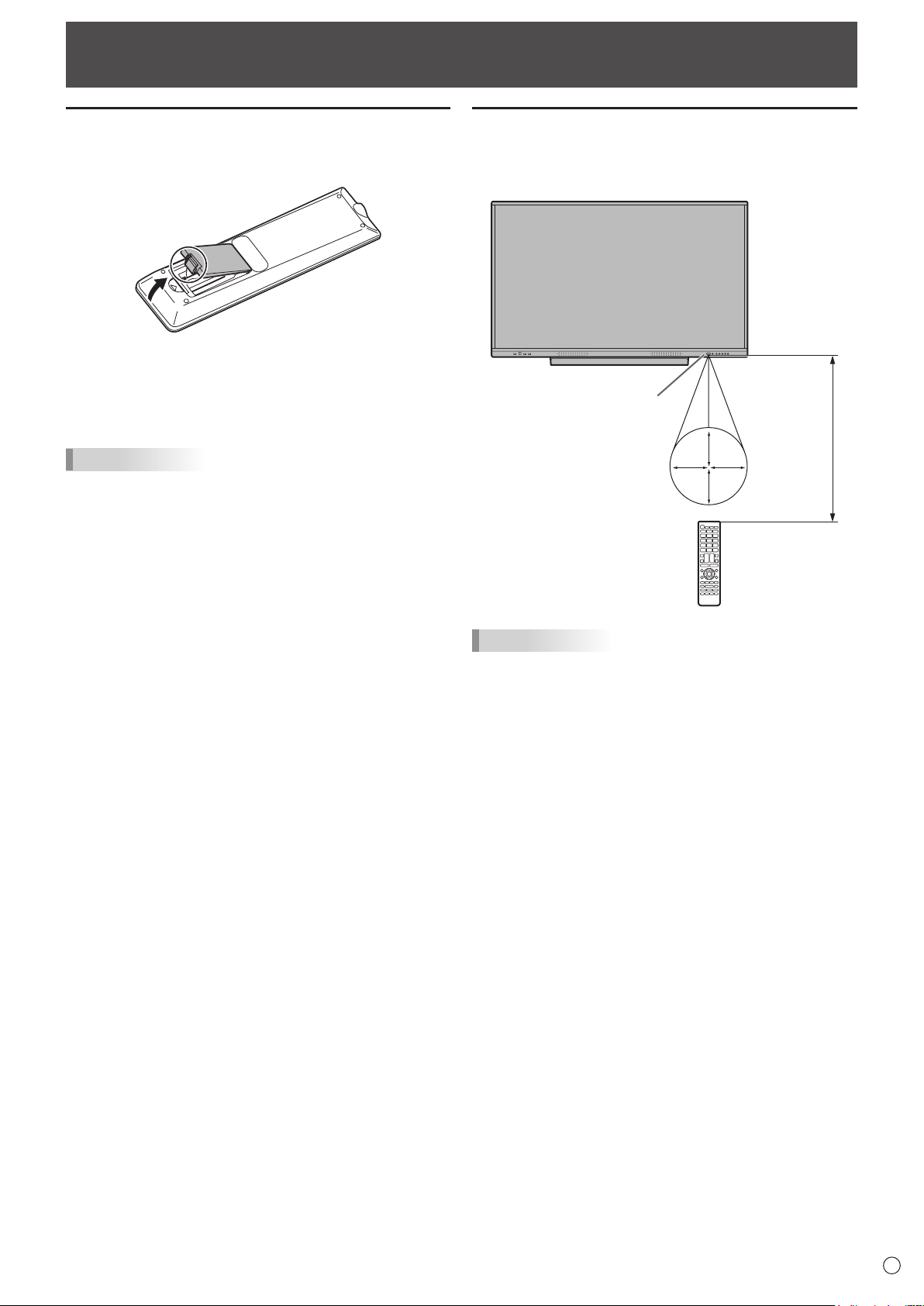
The operation range of the remote control unit is approx. 16.4
feet (5 m) at an angle of approx 10° from the center to the top/
bottom/right/left of the remote control sensor.
10
°1
0°
10°
10°
Remote
control sensor
16.4
feet
(5 m)
TIPS
• Do not expose the remote control unit to shock by dropping
or stepping on it. This could lead to a malfunction.
• Do not expose the remote control unit to liquids, and do not
place it in an area with high humidity.
• The remote control unit may not work properly if the remote
control sensor is under direct sunlight or strong lighting.
• Objects between the remote control unit and the remote
control sensor may prevent proper operation.
• Replace the batteries when they run low as this may
shorten the remote control’s operation range.
• If a fluorescent light is illuminated near the remote control
unit, it may interfere with proper operation.
• Do not use it with the remote control of other equipment
such as air conditioner, stereo components, etc.
Installing the batteries
1. Placeyourfingeronthepartmarkedwiththe▲,and
then pull the cover off.
2. See the instructions in the compartment and put in the
batteries (R03 or LR03 (“AAA” size) x 2) with their plus
(+) and minus (-) sides oriented correctly.
3. Close the cover.
TIPS
• When the batteries become exhausted, replace them with
new (commercially available) batteries.
• The supplied batteries may become exhausted quickly
depending on how they are stored.
• If you will not be using the remote control for a long time,
remove the batteries.
• Use manganese or alkaline batteries only.
16
E
Mounting a web camera
1
23
4
Camera mount (supplied)
Camera screw
(inch thread) (supplied)
Camera mount screw
(M3x6) (supplied)
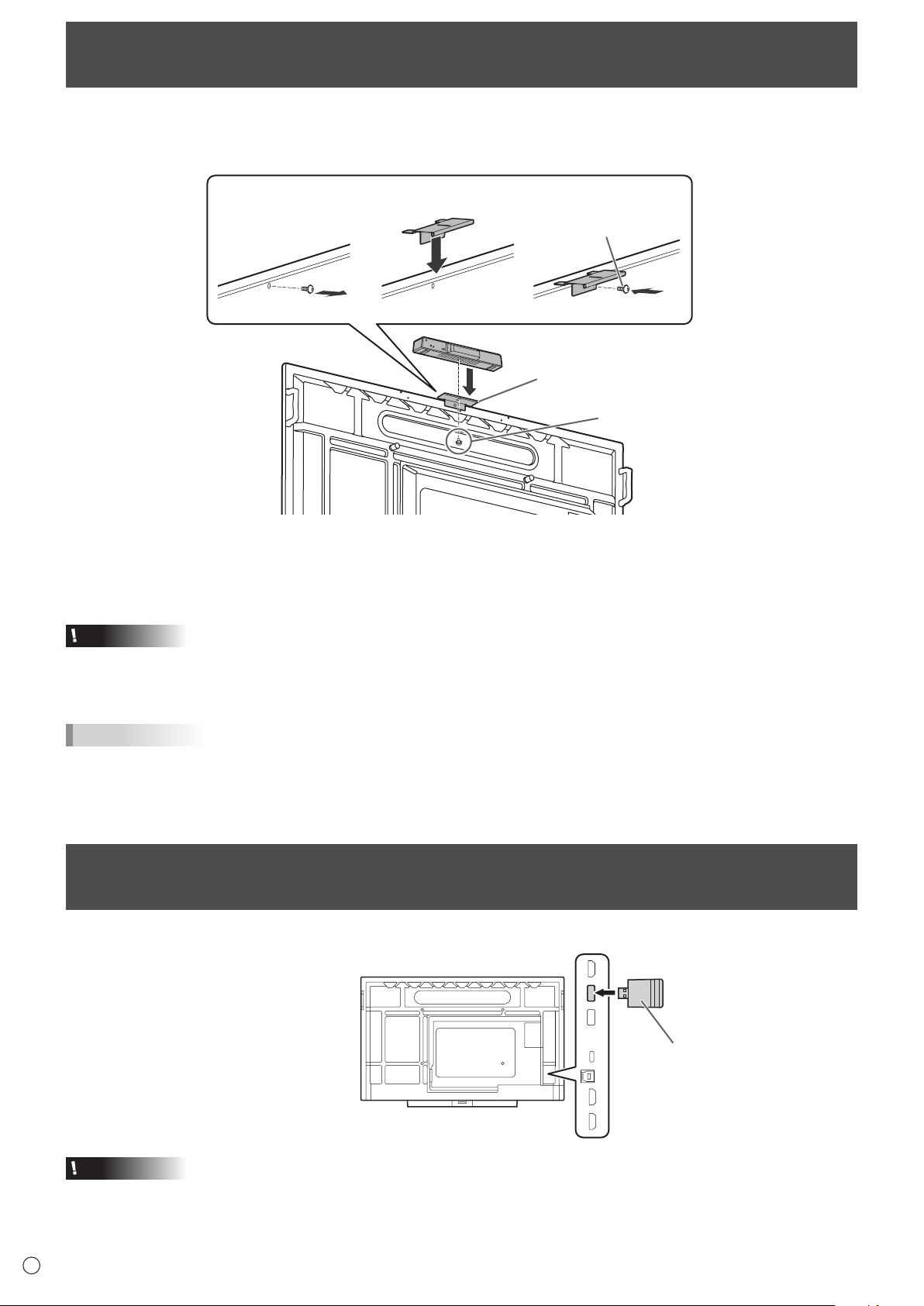
It is possible to mount the PN-ZCMS1 Video-Conferencing Soundbar (optional) or a commercially available web camera (1.1 kg
(2.4 lbs.) or less).
1. Remove the screw from this monitor.
2. Place the camera mount (supplied) on top of this monitor.
3. Attach the camera mount (supplied) with the camera mount screw (M3x6) (supplied).
4. Attach the web camera on the camera mount with the camera screw (inch thread) (supplied).
Caution
• Fix the camera mount and the web camera firmly. Dropping the camera mount or the web camera may cause product
damage, failure, or injury.
• Remove the web camera when moving this monitor.
TIPS
• Store the removed screws.
After removing the camera mount, put back the removed screws.
Attaching the wireless adapter
1. Connect the supplied wireless adapter to the USB port for APPLICATION mode.
Wireless adapter
(supplied)
Caution
• When a wireless adapter is connected, please do not connect other USB device to the side USB port. That may cause
malfunctions as the terminals may interfere with each other. Please use the front USB port for connecting other device.
17
E
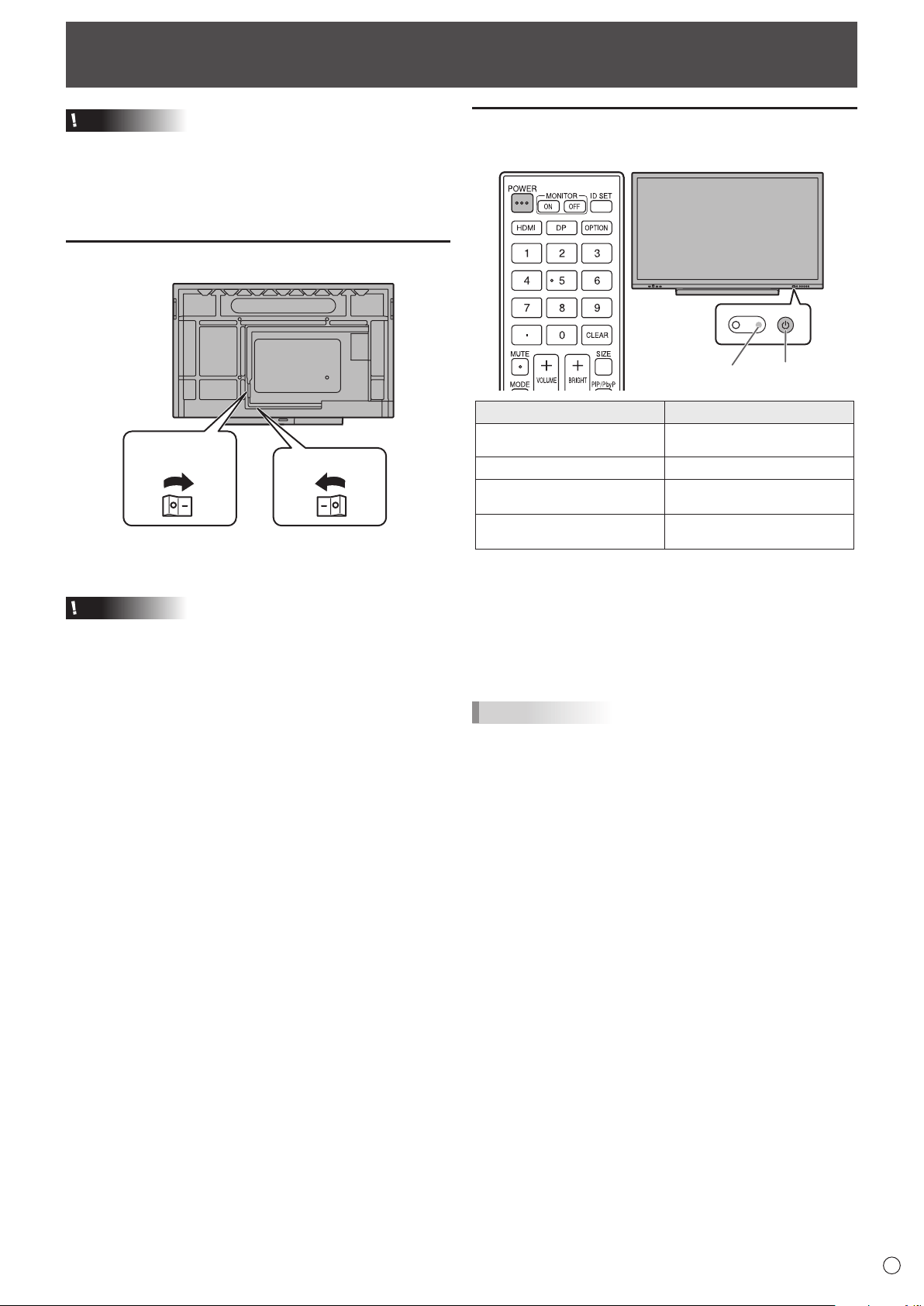
Caution
• Turn on the monitor first before turning on the computer or
playback device.
• When switching the main power switch or the POWER
button off and back on, always wait for at least 5 seconds.
A short interval may result in a malfunction.
Turning on the main power
Main power switchMain power switch
PN-LC652
When you turn on the main power, the monitor enters standby
state.
Off mode, when main power is off.
Caution
• The main power must be turned on/off with the main power
switch. Do not connect/disconnect the power cord or turn
the breaker on/off while the main power switch is on.
• For a complete electrical disconnection, pull out the main
plug.
Turning Power On/Off
Turning power on
1. Press the POWER button.
Power LED
POWER button
Status Status of the monitor
Blue lit
Power on
Sleep state (Backlight off)
Orange lit Power off (Standby state*
1
)
Orange flashing (at approx. 2
seconds interval)
Power off (Standby state*
2
)
Orange flashing (at approx. 1
second interval)
Input signal waiting state
*1 When “Power save mode” is set to on.
Standby mode when “Wake On LAN” is set to off.
Networked standby mode when “Wake On LAN” is set to
on.
Networked standby mode allows the monitor to be turned
on via network (LAN, RS-232C, and HDMI CEC).
*2 When “Power save mode” is set to off.
TIPS
• When the main power switch is off, the monitor cannot be
turned on.
• To disable the logo screen from displaying when turning the
power on, set “Logo screen” to off on the Setup menu. (See
page 46.)
• You can fix the input mode that appears after startup. Set
“Start input mode” of “Others” on the Input menu. (See
page 50.)
18
E
Turning Power On/Off
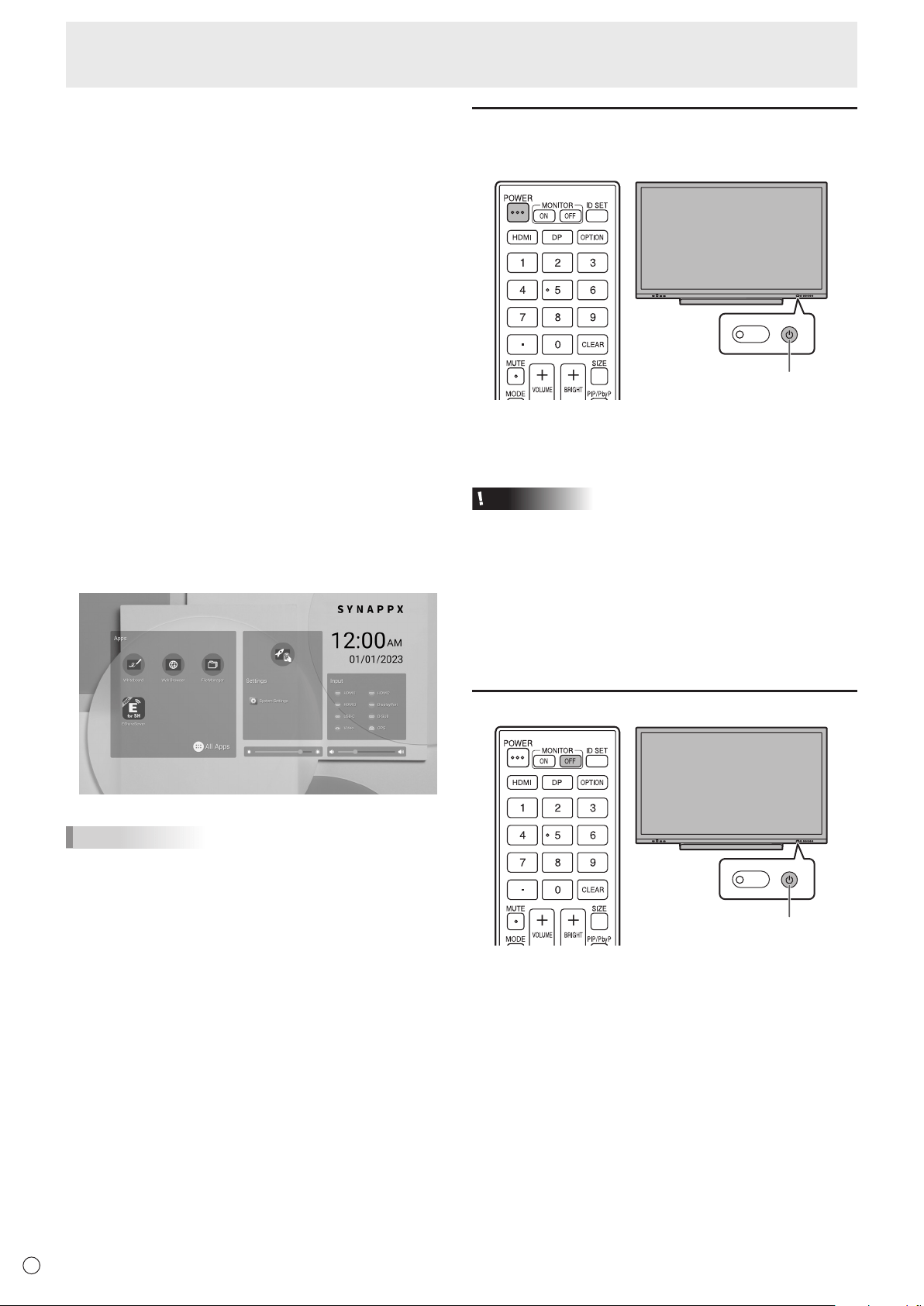
n
Operations after first power-on
When you turn on the power for the first time, the language
settings screen appears. Be sure to set the date and time.
1. Select a language, and then touch “Next”.
2. Select the time zone, and then touch “Next”.
3. Set the date and time, and then touch “Next”.
The power save mode settings screen appears.
4. Configure the settings according to the screen.
YES:
• “Power save mode” is set to on and “Wake On LAN” is
set to off.
• Current consumption is reduced while the monitor is in
standby state. APPLICATION mode is also shut down.
Note, however, that the startup time from standby state
becomes longer.
NO:
• “Power save mode” is set to off.
• Startup time from standby state is reduced. Note,
however, that more power will be consumed in standby
state. APPLICATION mode continues to run in standby
state.
Even after being set, you can change the “Power save
mode”. (See page 46.)
The home screen of APPLICATION mode appears. (See page
21.)
TIPS
The clock stops if the main power remains off for about 3
days.*
(*Approximate time. The actual time varies depending on the
state of the monitor.)
Turning power off
1. Press the POWER button on the remote control unit.
Or, press and hold the POWER button on the monitor.
POWER button
A confirmation screen appears.
2. Select “Power off”.
The power will turn off. (Standby state)
Caution
• When the power is turned off, the application data that is
not saved is lost.
• A message is displayed before the power turns off. Save
any data you need.
• If the monitor will be turned off by schedule, “Off if no
operation” or computer control, save any data you need in
advance. The power will turn off even if there is unsaved
data. (The data will be lost.)
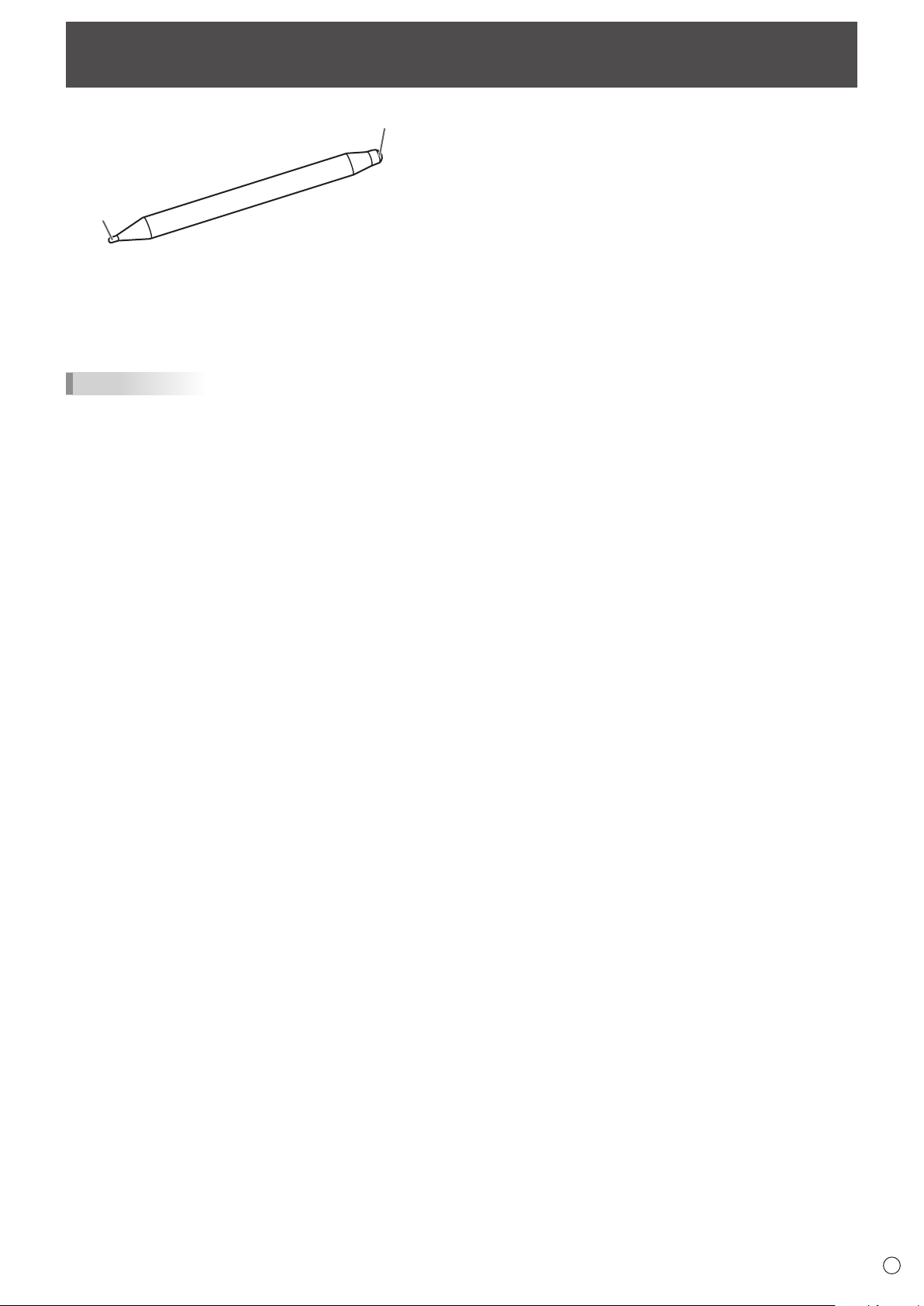
Sleep (Backlight off)
POWER button
1. Press the MONITOR OFF button on the remote control
unit.
Or, press the POWER button on the monitor.
The backlight will turn off.
Does not output the sound.
The previous state can be restored by touching the screen or
pressing any button (excluding MONITOR OFF, PIP/PbyP).
19
E
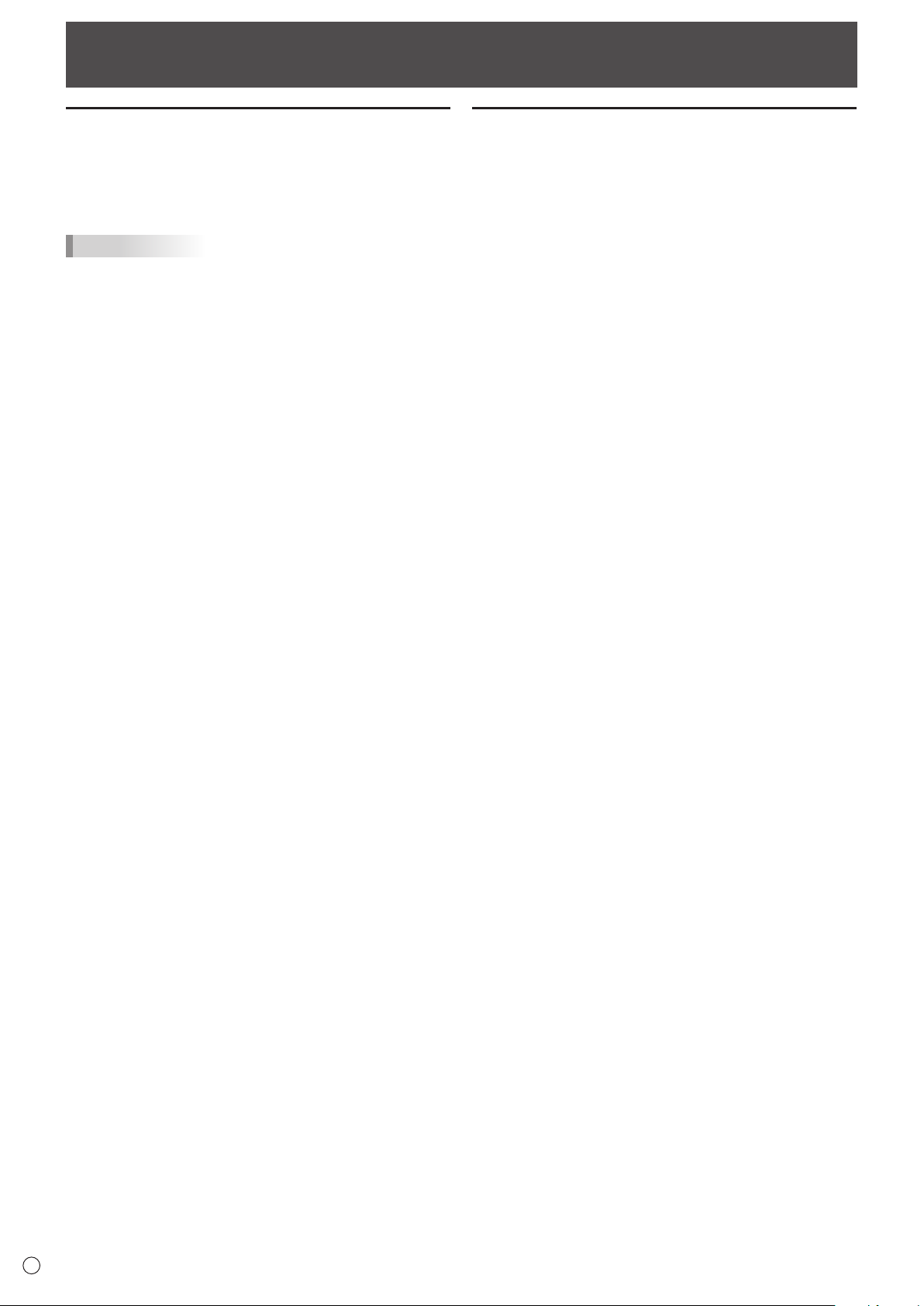
Touch Pen
Pen tip (thin)
Pen tip (thick)
The following pre-installed software recognizes the side of the touch pen that is touching the screen, enabling the two sides to
be used as different pens.
• Whiteboard
For details on how to use the touch pen in Whiteboard, refer to “Whiteboard” (see page 31).
TIPS
• When touching with the pen tip (thin), if the touch pen is tilted too much, it may be recognized as the pen tip (thick).
• In case of an overlay board (see page 29) and Whiteboard (see page 31), multiple touch pens can be used simultaneously. In
other use cases, multiple touch pens cannot be used simultaneously.
• When multiple touch pens are used, lines may break.
- When touched simultaneously.
- When touch pens are moved near each other.
• If the pen tip becomes worn or damaged, replace the touch pen. To purchase a new touch pen, consult your dealer.
• The touch pen has a built-in magnet. Do not move close watch or magnetic card to it.
20
E
Touch action
Touch action
Touch actions that can be used with this monitor differ
according to operating system and application. The functions
of touch actions are also different. For details, check operating
system Help and the application’s support documentation.
TIPS
• On the Mac, the actions are the equivalent mouse actions.
• For the procedures for using the touch pen in the Pen
Software, see the Pen Software Operation Manual.
•
The screen may not respond correctly in the following cases:
- Touch gesture is too quick.
- The distance between the two points is too short.
- The two points intersect.
• In Windows 10/11, input panel functions can be used.
For details, see Windows Help.
Input panel: A software keyboard and an input panel with
handwriting recognition appear on the screen.
• In Windows 10/11, the ink function of Microsoft Office
can be used. Handwritten comments can be written, and
handwriting can be recognized.
For details, see Microsoft Office Help.
Cautionary points
• Do not use the touch pen for any purpose other than touch
panel operation.
• Do not press hard on the pen tip.
• Operation will not take place correctly if there is an obstacle
between the infrared transmitter/receiver and the touch pen
or your finger. Operation will not take place correctly if your
fingers or your sleeve is near the screen.
• When touching with the touch pen, if the touch pen is tilted
too much, the touch position may not be correctly detected.
• If the touch pen does not work at the edge of the screen,
move it slowly.
• This may not operate correctly if there is an inverter
fluorescent light nearby.
• If there is dirt or foreign matter on the tip of the touch pen,
remove it. Foreign matter may damage the screen.
• The touch pen position may occasionally deviate in the
login screen. In this case, use the keyboard or mouse.
• If the USB cable becomes disconnected, the touch
panel may not operate correctly after the USB cable is
reconnected. In this case, restart the computer.
• When removing the pen tip or your finger from the screen,
remove a sufficient distance. If the distance is not sufficient,
a touch may be detected even if the screen is not touched.
21
E
Basic Operation
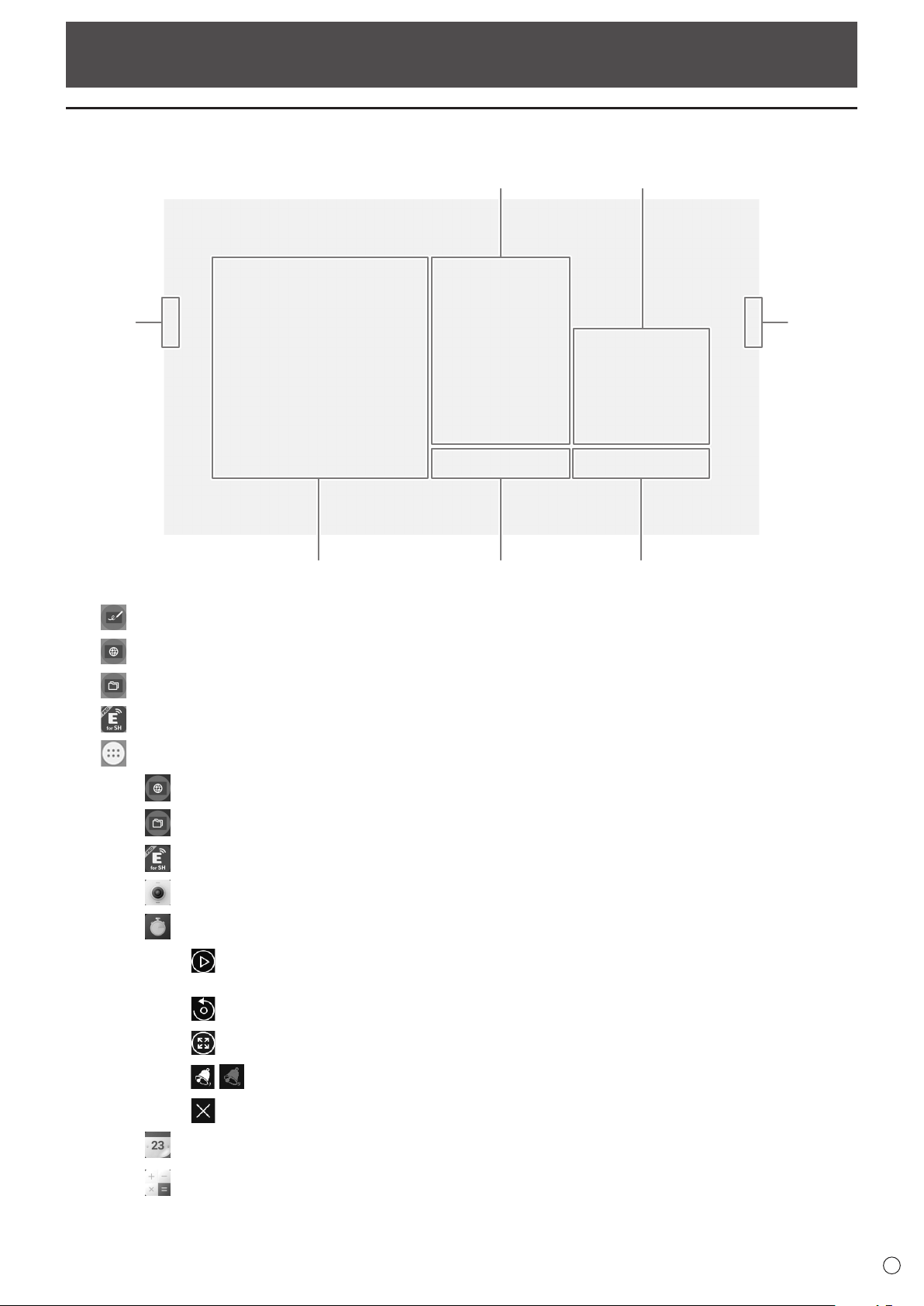
About the home screen of APPLICATION mode
This screen appears when the HOME button is pressed or the input mode is changed to APPLICATION.
(3)
(6) (5)
(4)(1)
(2)(2)
(1) Start “Whiteboard”. (See page 31.)
Start “Web Browser”. (See page 42.)
Start “File Manager”. (See page 37.)
Start “EShareServer”. (See page 36.)
Display the list of applications.
Start “Web Browser”. (See page 42.)
Start “File Manager”. (See page 37.)
Start “EShareServer”. (See page 36.)
Take images or videos when the web camera is connected.
Start “Timer”.
This can be used as a countdown timer by setting the time and touching it.
This can be used as a stopwatch by touching it without setting the time.
Resets the elapsed time.
Timer is displayed in full screen.
Switches the Alarm ON/OFF.
Exit “Timer”.
Start “Calendar”.
Touching “Capture to Whiteboard” will display the Whiteboard incorporated with the Calendar.
Start “Calculator”.
22
E
Basic Operation
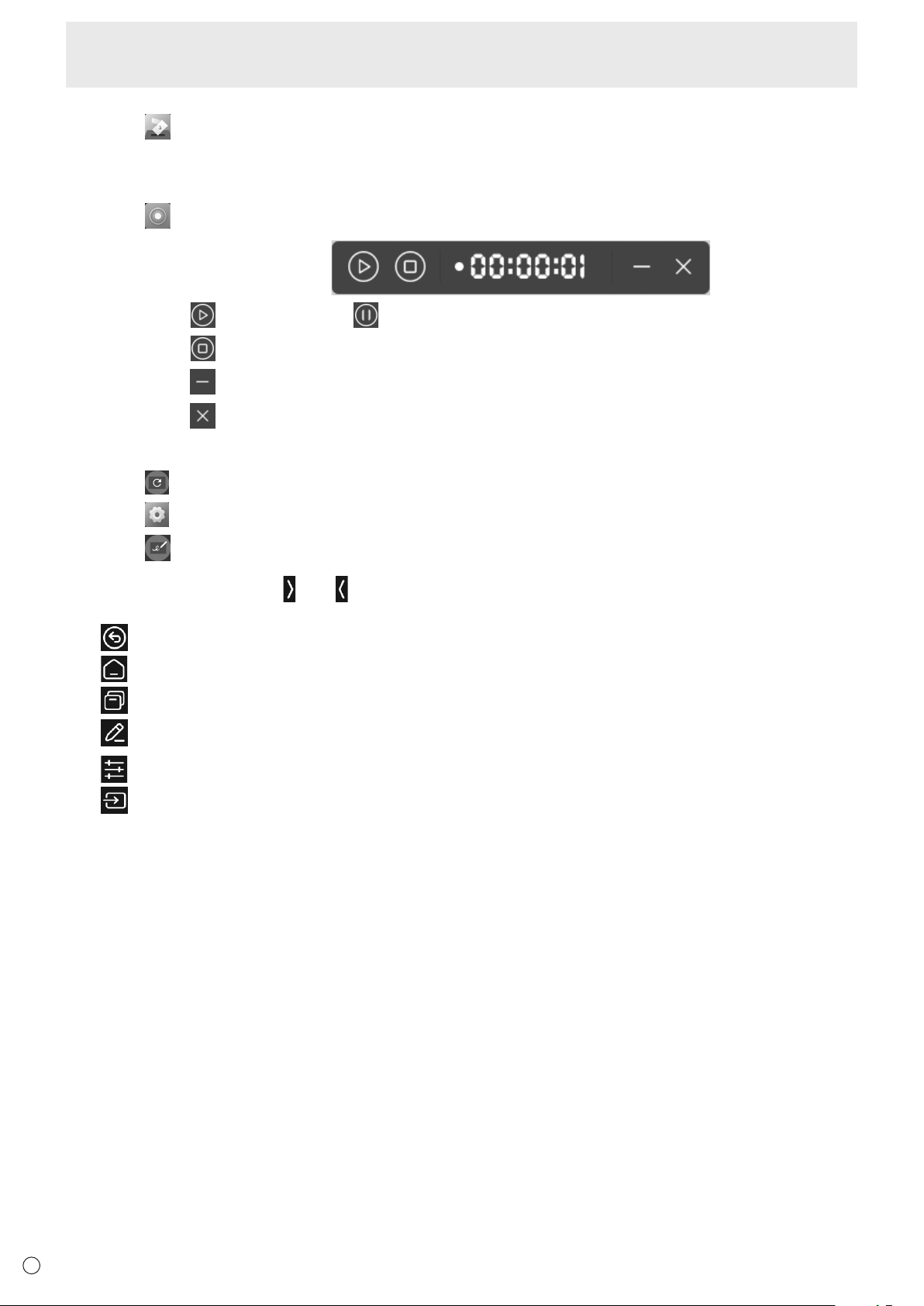
Vote and count using the internet.
After setting the subject and options, a QR code will appear.
Scan with a device such as a smartphone and vote on the displayed page.
Touch “END VOTING”, the result will be displayed.
The result can be saved as image file or inserted into Whiteboard.
Start “Screen Record”. Records the screen displayed on this monitor.
Set recording settings in “Screen record” of General menu. (See page 49.)
Starts the recording. Pauses recording.
Stops recording and displays the file storage screen.
“Screen record” is displayed in small size.
Exit “Screen Record”.
If something was recorded, make sure to save your data. Displays the file storage screen.
To play the recording, select the data stored via “File Manager”.
Start “Updater”. (See page 44.)
Display the setting menu. (See page 45.)
Start “Whiteboard”. (See page 31.)
(2)
When you touch the screen, “
” and “ ” appear.
Touch to view the sidebar.
Go back to previous screen.
Return to home screen of APPLICATION mode.
Display a preview of the application being executed.
Start “Overlay board”. (See page 29.)
Display “Control Panel”. (See page 24.)
Display “Input” menu. (See page 27.)
(3) Adjust the brightness.
(4) Adjust the volume.
23
E
Basic Operation
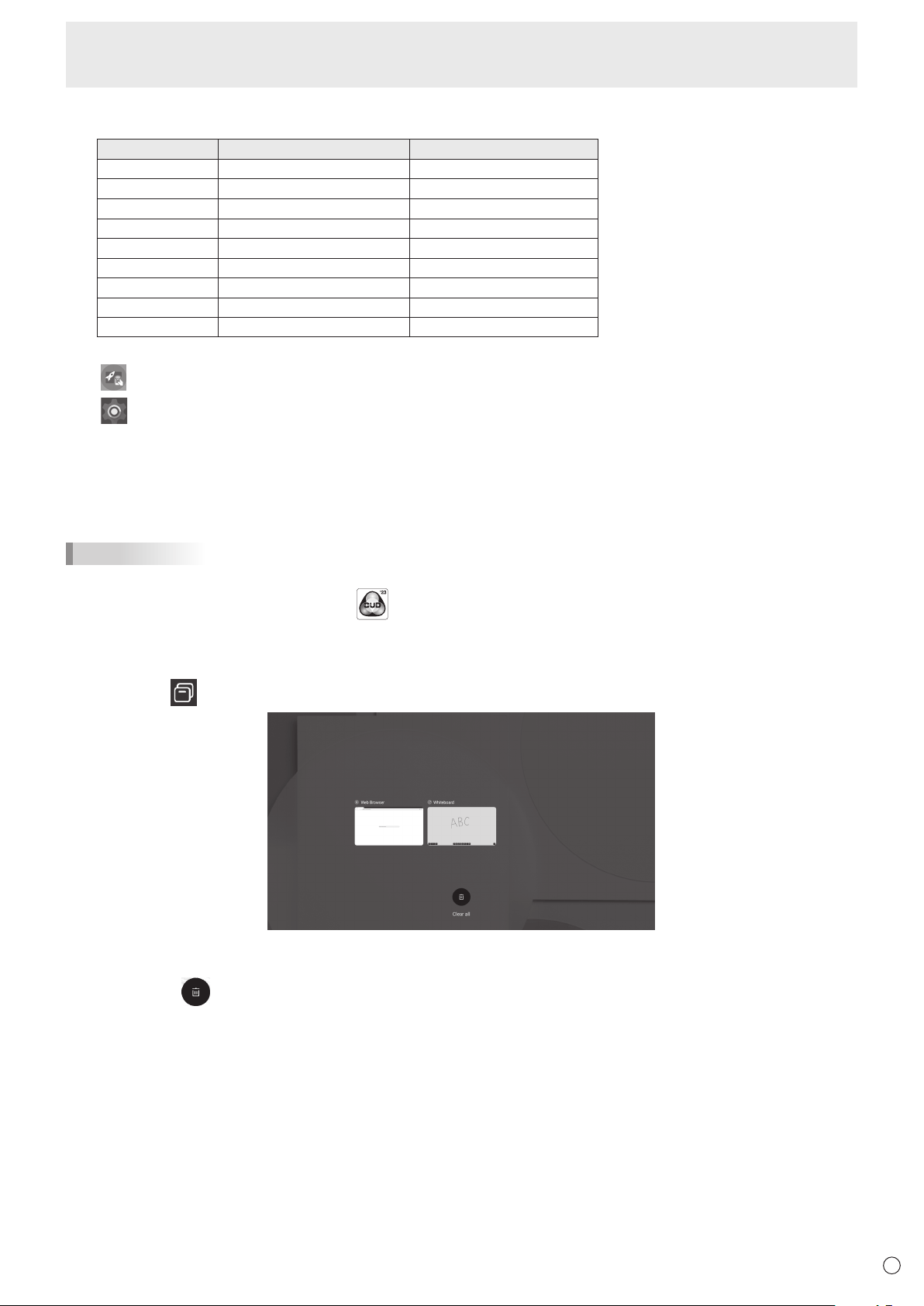
(5) Change the input mode.
Input mode Video Audio
APPLICATION APPLICATION APPLICATION
HDMI1 HDMI1 input terminal HDMI1 input terminal
HDMI2 HDMI2 input terminal HDMI2 input terminal
HDMI3 HDMI3 input terminal HDMI3 input terminal
DisplayPort DisplayPort input terminal DisplayPort input terminal
USB-C USB Type C port USB Type C port
D-SUB D-sub input terminal Audio input terminal
Video Mini AV input terminal Mini AV input terminal
OPS Expansion slot Expansion slot
The icon of the terminal that is not connected is grayed out.
(6)
Switch the input mode to a computer on which “Synappx” is installed. *
Display the setting menu. (See page 45.)
* Set which input mode to switch in “Synappx settings” on the Setup menu.
When use the Chromecast device in Synappx, set “Support Chromecast device” to on. (See page 36.)
When use the Miracast device in Synappx, set “Support Miracast device” to on. (See page 36.)
When use the Telnet in Synappx, set “Monitor Control via Network” to on. (See page 47.)
Synappx applications work with your current office technology to bring smart home convenience into the workplace.
Have a smooth meeting. Share or print information right where it’s needed. For details on Synappx, see the Synappx manual.
TIPS
• When a confirmation screen to allow access appears when the application is started for the first time, select “Allow”.
• When “Color Universal Design” is set to on,
is displayed.
n
List display of startup applications (recent app bars)
When you touch on the sidebar, display a preview of the application being executed.
• When you touch the preview, the display switches to that application.
• Swipe up on the preview to exit the application.
• Touch and hold
to exit all applications.
24
E
Basic Operation
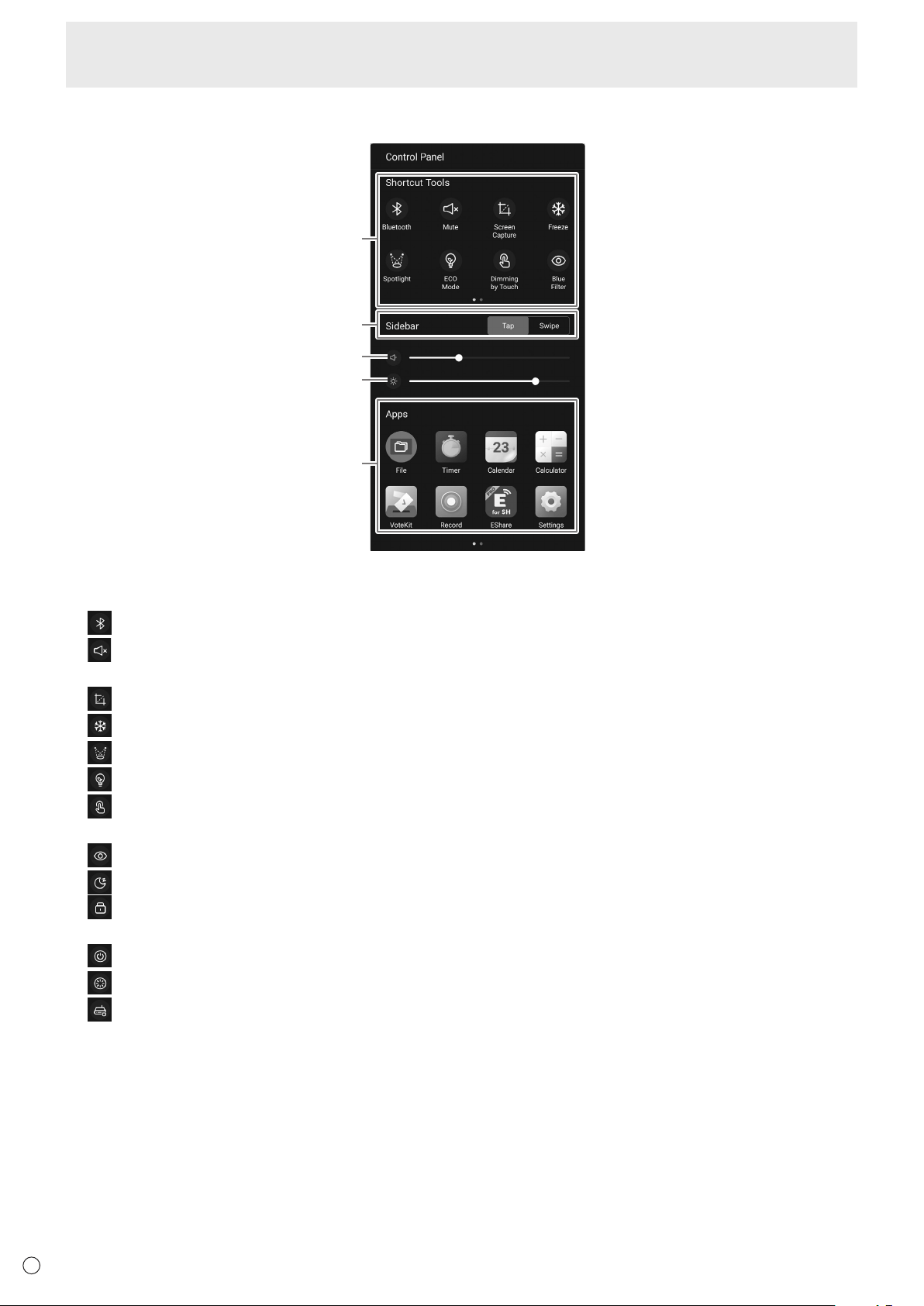
■ControlPanel
(1)
(2)
(3)
(4)
(5)
(1) Shortcut Tools
Various operations can be performed.
: Turns Bluetooth on/off when attaching a wireless adapter.
: Temporarily mutes audio.
Touching again will return it back to the original volume.
: Save the image of the display of the dragged area, or import it in to the Whiteboard.
: Displays a still image of what is displayed on this monitor. (See page 30.)
: Hides the entire screen and displays only the touched areas.
: Turning this on will fixate the screen brightness to 25. This turns off when you adjust the screen brightness.
: Turning on will dim the screen brightness when touched. Reduces screen brightness during operation. The screen will
return to the original brightness about 5 seconds after being touched.
: Turns the low blue light display on/off.
: Turn off the screen display (backlight off) and output only the sound.
: Lock the screen.
If you want to lock the screen, “Screen lock” is set to on and set the unlock method. (See page 51.)
: Turn off this monitor.
: Restart APPLICATION mode.
: Turns off the power of the expansion slot device.
25
E
Basic Operation
(2) Sidebar
Set how the sidebar is displayed.
Tap: Touch the screen.
Swipe: Swipe inward from the outside of the screen (from either left or right).
(3) Adjust the volume.
(4) Adjust the brightness.
(5) Apps
Display the applications installed on this monitor.
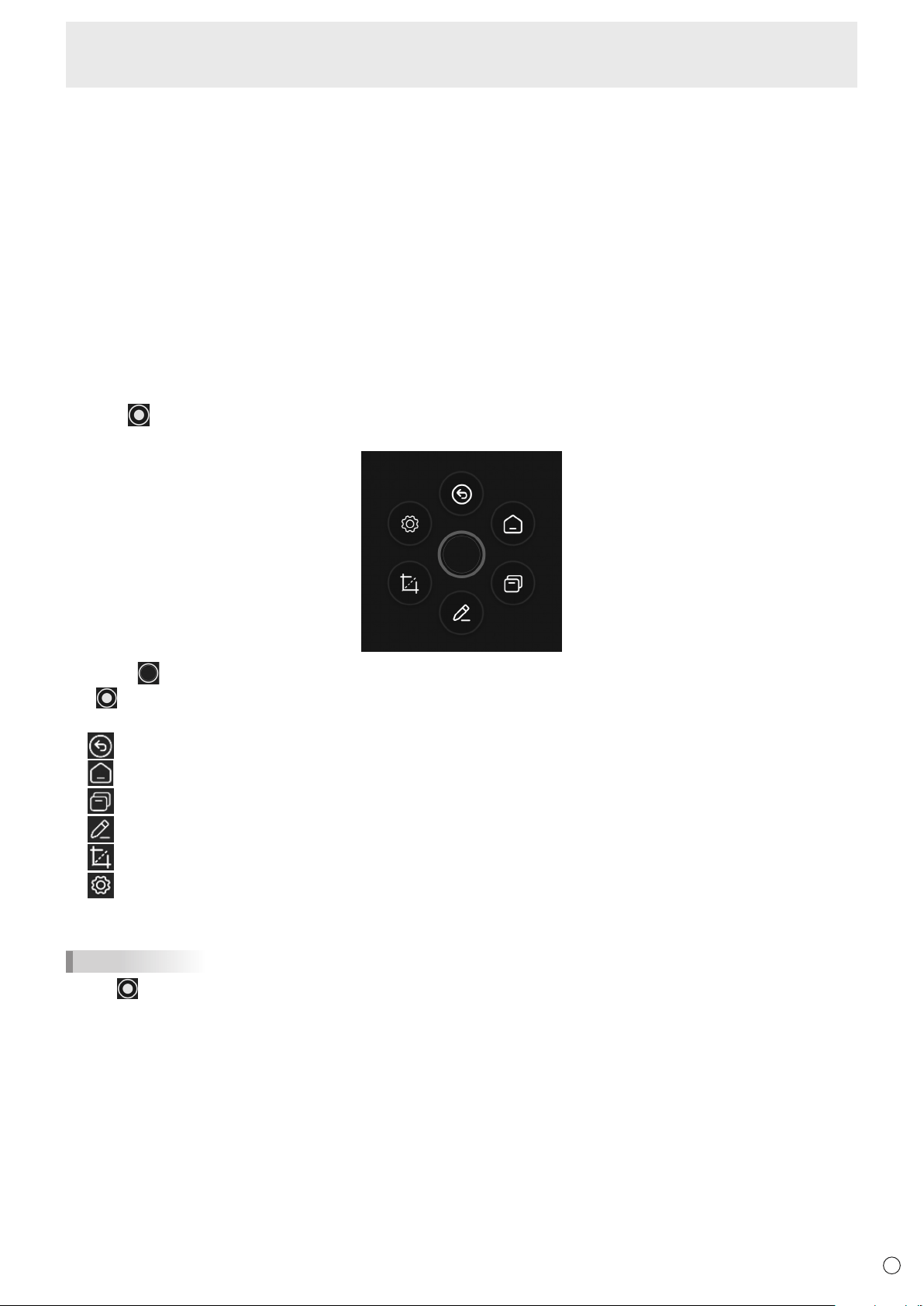
■Compass
“Compass” on the General menu is set to on to use the Compass. (See page 48.)
1. Touch .
• A shortcut will appear.
• Touch to close the shortcut.
•
will appear when you long press the screen using 5 fingers when “Actions” is set to “Fade away”.
2. Touch the shortcut you want to use.
: Go back to previous screen.
: Return to home screen of APPLICATION mode.
: Display a preview of the application being executed.
: Start “Overlay board”. (See page 29.)
: Save the image of the display of the dragged area, or import it in to the Whiteboard.
: Display the setting menu. (See page 45.)
Factory setting. This setting can be changed. (See page 48.)
TIPS
• Drag to move the Compass.
26
E
Using the remote control unit
1
2
3
4
5
6
7
8
9
10
11
12
13
14
15
16
17
18
19
20
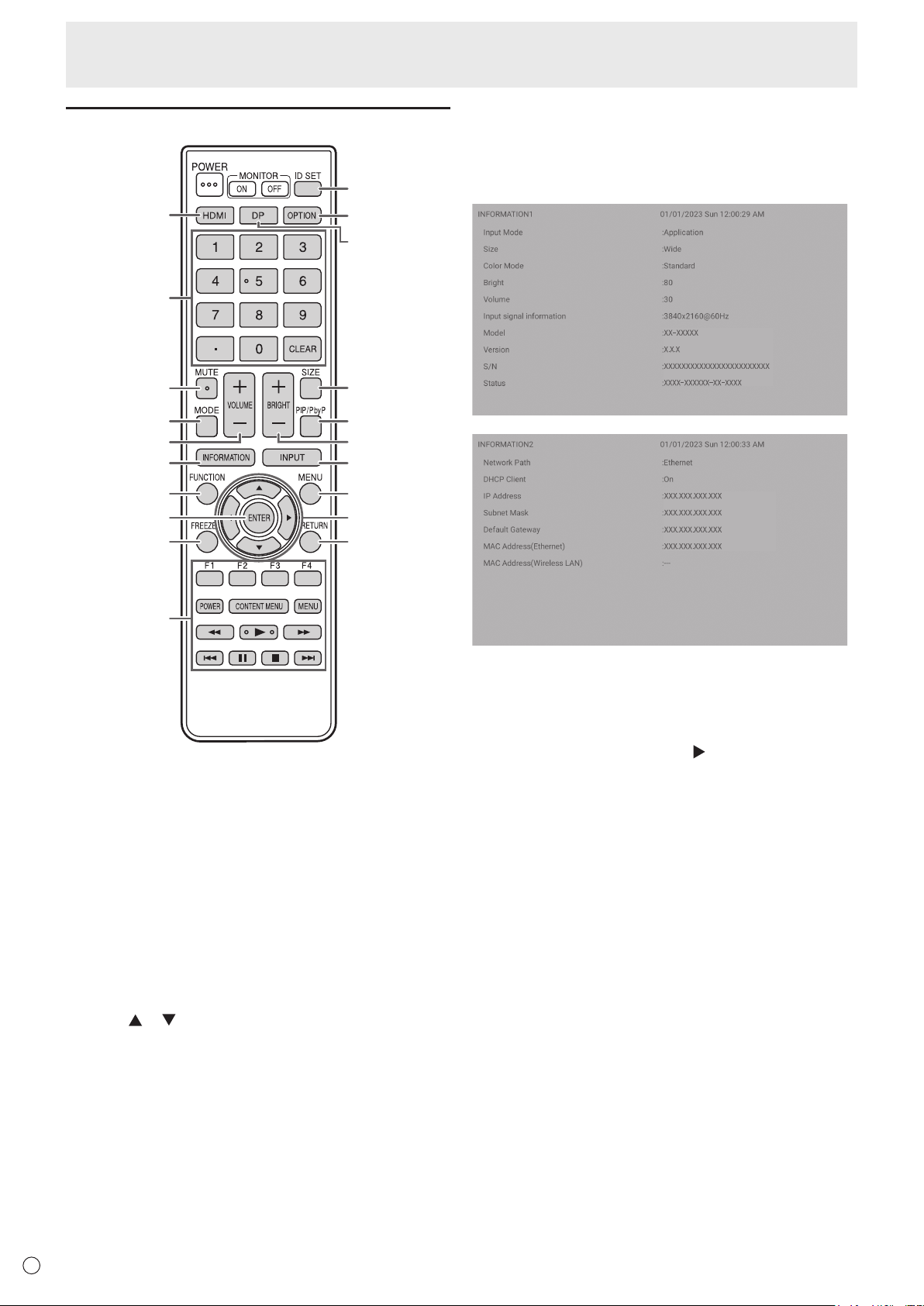
1. HDMI
Switch the input mode to HDMI1, HDMI2 or HDMI3.
2. Numeric input buttons
These buttons are used for setting such as LAN setting.
3. MUTE
Turns off the volume temporarily.
Press the MUTE button again to turn the sound back to the
previous level.
4. MODE (Color mode selection)
In video input mode (other than “APPLICATION”), the color
mode changes.
The menu is displayed.
Press the
or button to select the color mode.
• High Illuminance is a display with colors suited to bright
locations.
5. VOLUME +/- (Volume adjustment)
Press + or - to adjust the volume.
6. INFORMATION
Displays monitor information.
Thedisplaychangesfrom“INFORMATION1”→
“INFORMATION2”→cleardisplay,andsooneverytimeyou
press this button.
When displaying “INFORMATION”, the display changes from
“INFORMATION1”→“INFORMATION2”→“INFORMATION1”,
and so on every time you press the
button.
Pressing the RETURN button disappears the display.
• The display disappears automatically after about 15
seconds.
7. FUNCTION
Display the Function menu. (See page 53.)
8. ENTER
Confirms the setting.
9. FREEZE
Freezes the video shown on the monitor. (See page 30.)
In some cases a residual image may occur. Do not freeze the
video for a long time.
Basic Operation
27
E
Basic Operation
10. Buttons for playing the files or operating the HDMI-
connected device
When used for playing the files, the buttons that can be used
vary depending on the file that is played.
When “HDMI CEC link” is set to on, you can operate devices
that support HDMI CEC when the input mode is HDMI.
CONTENT MENU button
• When input mode is APPLICATION
- The home screen of APPLICATION mode appears.
• When “HDMI CEC link” is set to on and input mode is HDMI
- Operate devices that support HDMI CEC.
• When “HDMI CEC link” is set to off and input mode is other
than APPLICATION
- The input mode changes to APPLICATION.
11. ID SET
This is not used with this monitor.
12. OPTION
Switch the input mode to APPLICATION or OPS.
13. DP (DisplayPort)
Switch the input mode to DisplayPort or USB-C.
14. SIZE (Screen size selection)
In video input mode (other than APPLICATION), each time
you press this button, screen size is changed. (See page 28.)
15. PIP/PbyP
This is not used with this monitor.
16. BRIGHT +/- (Brightness adjustment)
Press + or - to adjust the brightness.
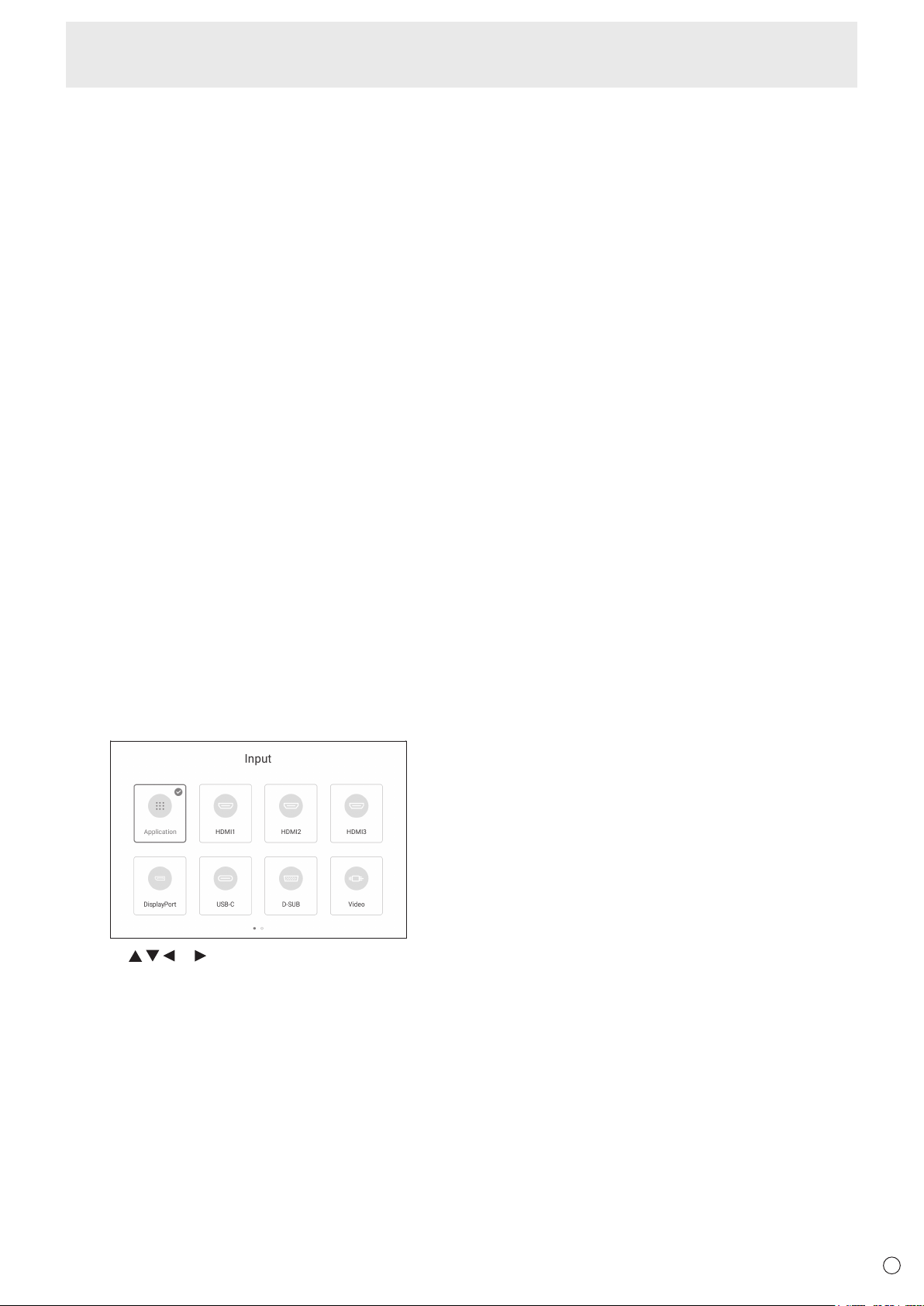
17. INPUT (Input mode selection)
The menu is displayed.
Press the or button to select the input mode, and
press the ENTER button to enter.
• For the input modes that can be selected, see “About the
home screen of APPLICATION mode” (see page 23).
18. MENU
The “Picture” screen of the General menu is displayed. (See
page 48.)
19. Cursor
These buttons are used to perform operations such as
selecting items, changing adjustment values, and moving the
cursor.
20. RETURN
Returns to the previous screen.
28
E
Basic Operation
n
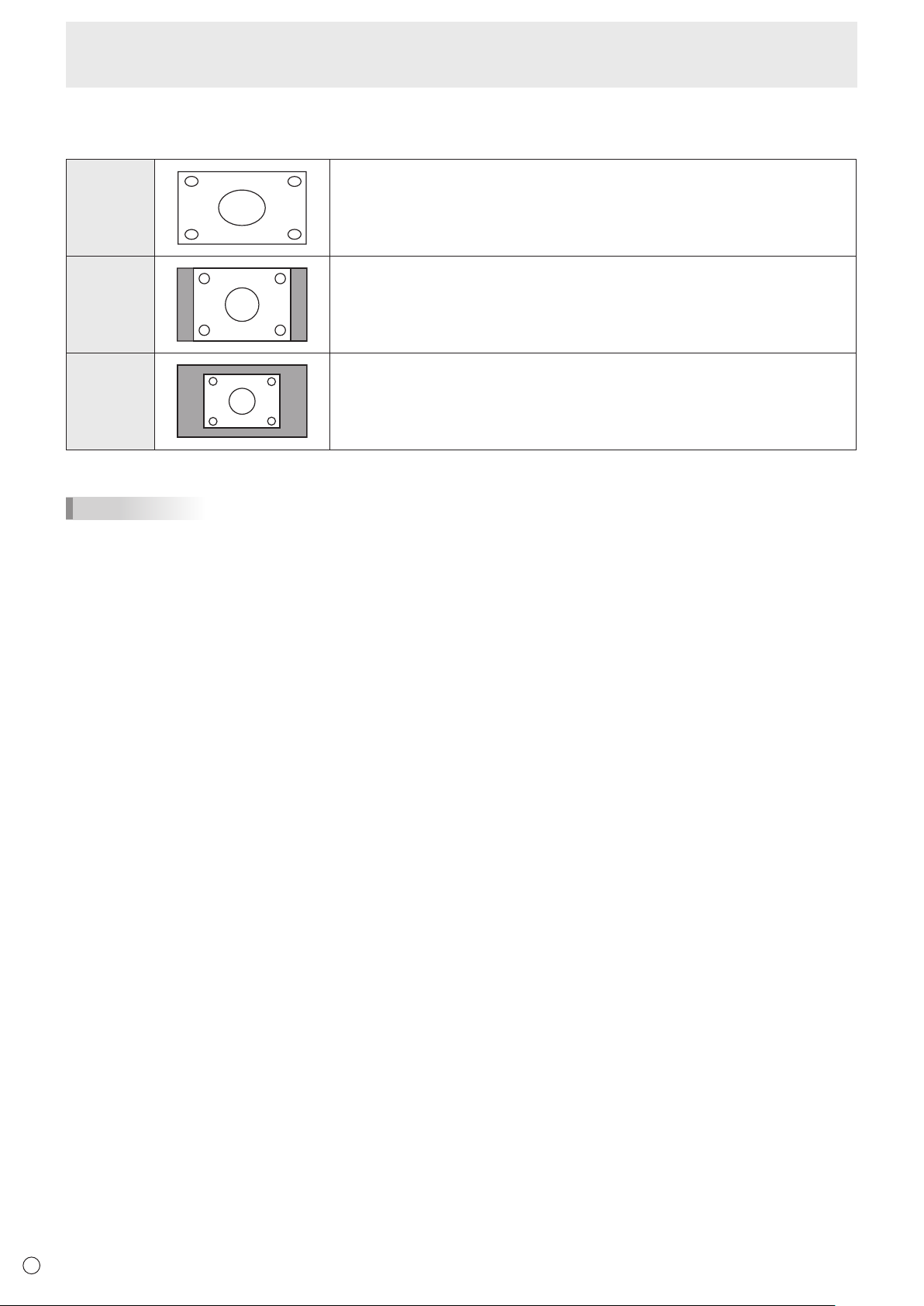
Switching the screen size
Even when the screen size is changed, the display may remain the same depending on the input signal.
Wide Displays image so it fills the entire screen.
4:3*
Displays the image with an aspect ratio of 4:3.
Use with 4:3 signals such as 640 × 480, 800 × 600, or 1024 × 768.
When showing such as 16:9 video, the width of the image will be shrunk.
Dot by Dot
Displays the dots of the input signals as the corresponding dots on the screen.
* Do not appear when the input mode is D-SUB.
TIPS
• Using this monitor’s screen-size switching function to compress or expand the screen for commercial or public viewing in
establishments like cafes or hotels may infringe on the rights of the creators, as protected by Copyright Law, so please be
careful.
• The appearance of the original video may change if you select a screen size with a different aspect ratio than the original
image (e.g. TV broadcast or video input from external equipment).
• When playing commercial software, parts of the image (like subtitles) may be cropped. In this case select the optimal screen
size using the screen-size switching function of this monitor. With some software, there may be noise or distortion at the
edges of the screen. This is due to the characteristics of the software, and is not a malfunction.
• Depending on the original video size, black bands may remain at the edges of the screen.
29
E
Basic Operation
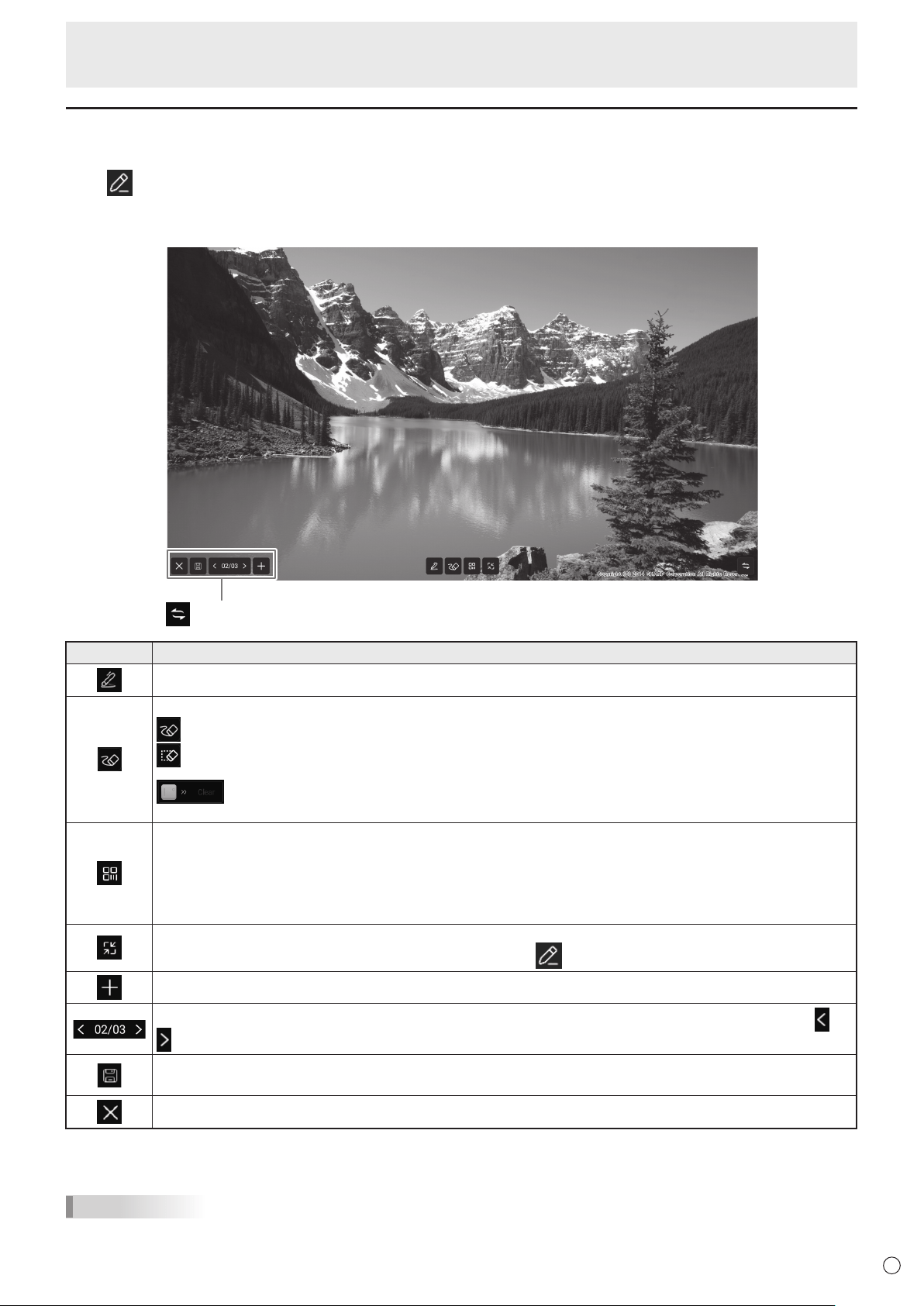
Overlay board (Annotation)
You can draw characters or lines on the images being displayed on this monitor.
Touch
on the sidebar or Compass.
In this application, the data of one screen is referred to as a “sheet”.
A maximum of 20 sheets can be opened.
Tool Function
Draws a line. You can change the settings (color, opacity, thickness).
Erase a line that you drew.
: The lines in the touched areas will be erased.
: The lines in the dragged area will be erased.
Lines will be completely erased if even some of their portions are contained inside the said area.
: All lines on the sheet will be erased.
Slide the switch to the right.
Display an image of the screen that is currently displayed on this monitor on a device such as a smartphone via
the internet.
Scan the QR code displayed.
A password can be requested when displaying image.
Touch “ENCRYPTION” and enter the displayed password.
Minimize the overlay board.
The minimized overlay board can be redisplayed by touching
of sidebar or Compass.
Add a sheet.
Shows the current sheet number and the total number of sheets. You can change the sheet displayed with or
.
Save the sheet as an image file or PDF file.
Data will be stored in “/Annotation”.
Exit the application.
You can erase an area of the screen that you touch with your palm.
Touch the screen with your palm, and when the cursor is appear, move your palm.
TIPS
• Cannot be saved when HDCP-compliant images input from the HDMI input terminal / DisplayPort input terminal / USB Type-C
port / OPS are being displayed.
: Switches the display position to the left and right.
30
E
Basic Operation
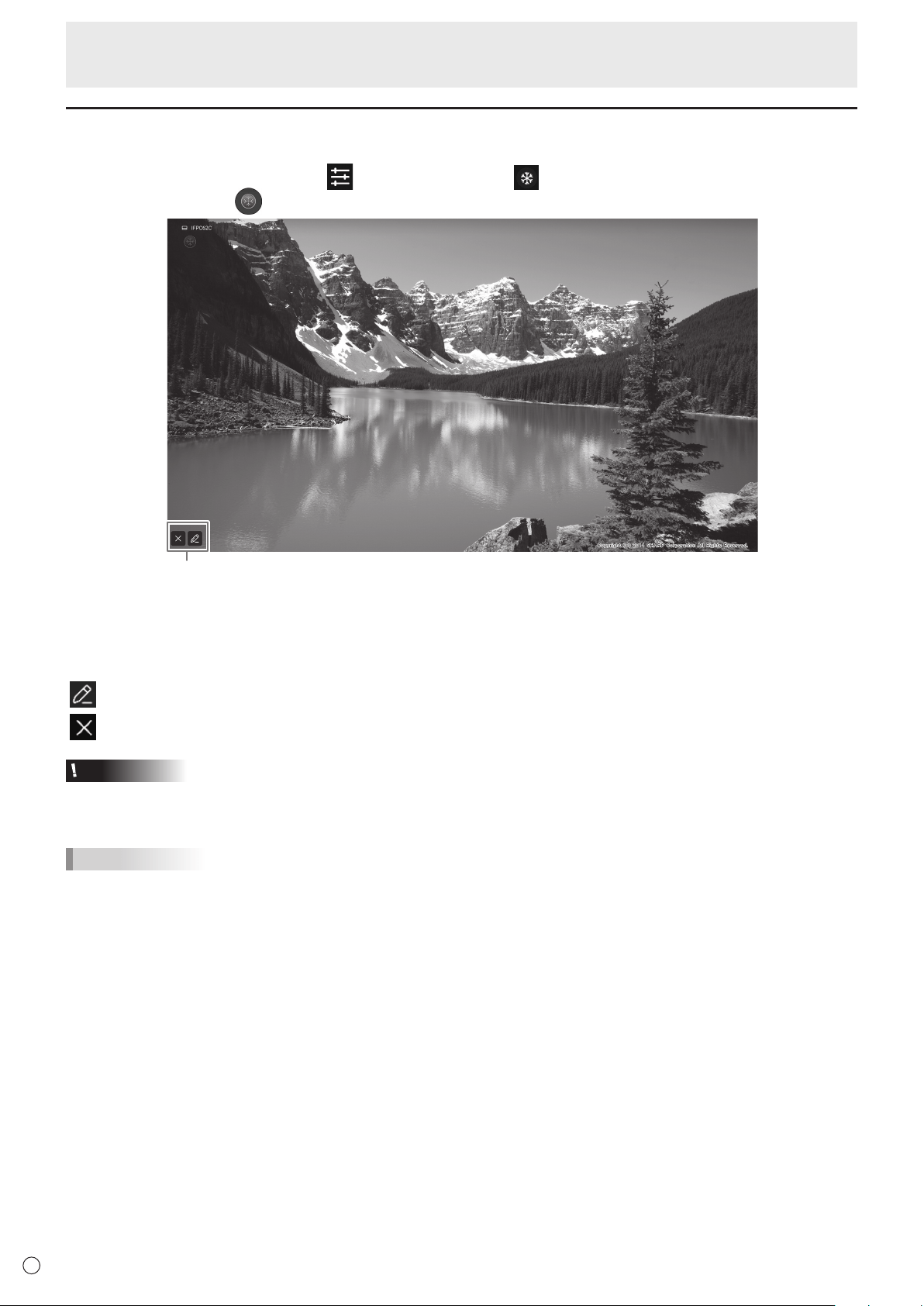
Freeze
Freezes the video shown on the monitor.
Either press the FREEZE button, or touch
on the sidebar and touch .
In the case of a still image,
is displayed at the top left of the screen.
Settings window
Settings window:
Touch to operate.
The overlay board will be displayed. (See page 29.)
Cancel the still state.
Caution
• In some cases a residual image may occur. Do not freeze the video for a long time.
TIPS
• If you want to mute the audio from a still image, set “Mute with freeze” on the General menu to on.
• To cancel, press any button other than the POWER button, MUTE button or VOLUME button on the remote control unit.
Freeze is also canceled when the input signal changes (switching to no signal, changing the resolution, etc.).
31
E
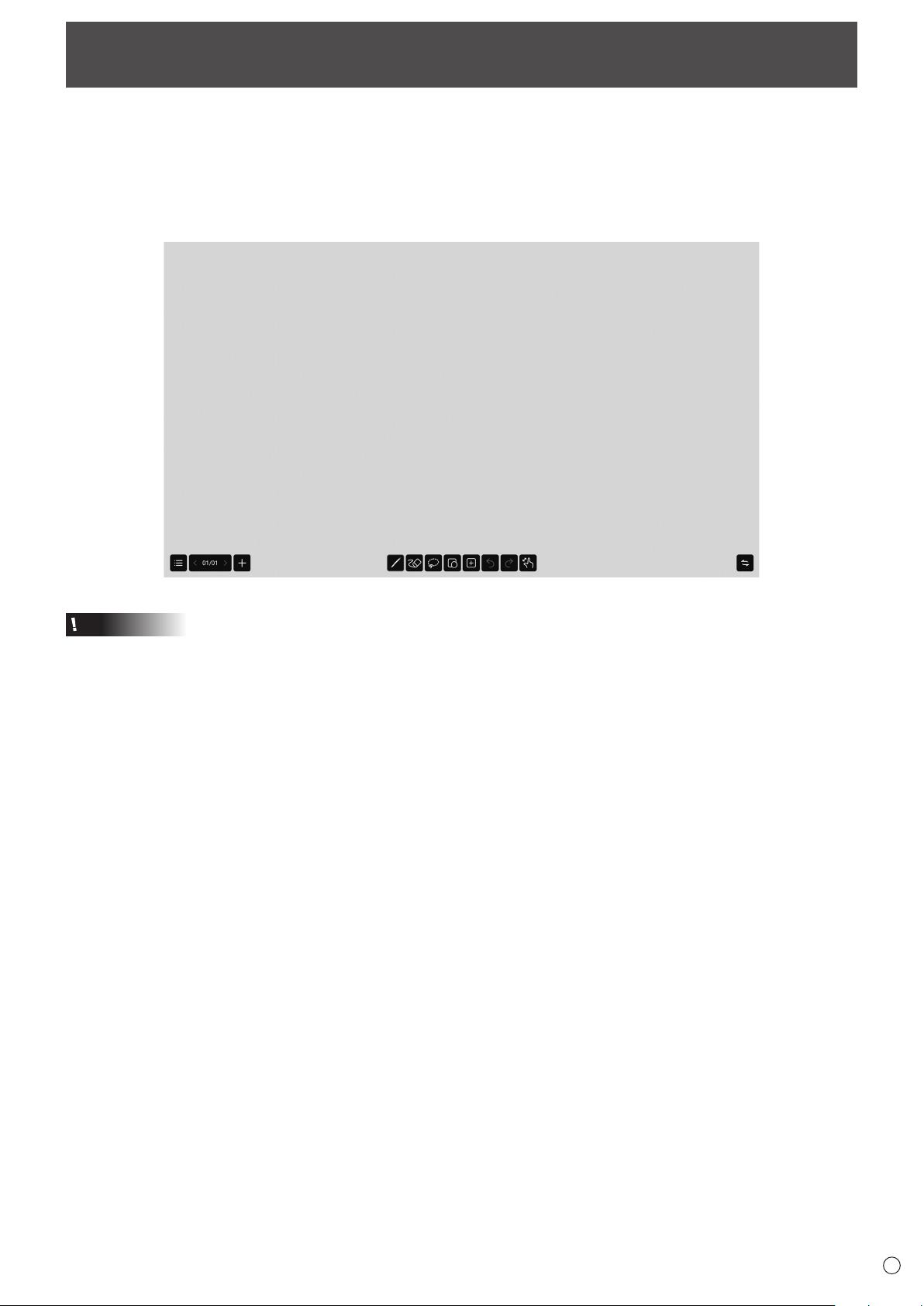
Whiteboard
• You can write letters or draw lines on the screen as a whiteboard.
• You can print or save content written on the screen.
• You can display an image or PDF file, and write/draw letters and lines on the image.
• In this application, the data of one screen is referred to as a “sheet”.
• A maximum of 20 sheets can be opened.
1. On the home screen of APPLICATION mode, touch “Whiteboard”.
Caution
• When the power is turned off, any data in Whiteboard is lost.
• A message is displayed before the power turns OFF. Save any data you need.
32
E
Whiteboard
n
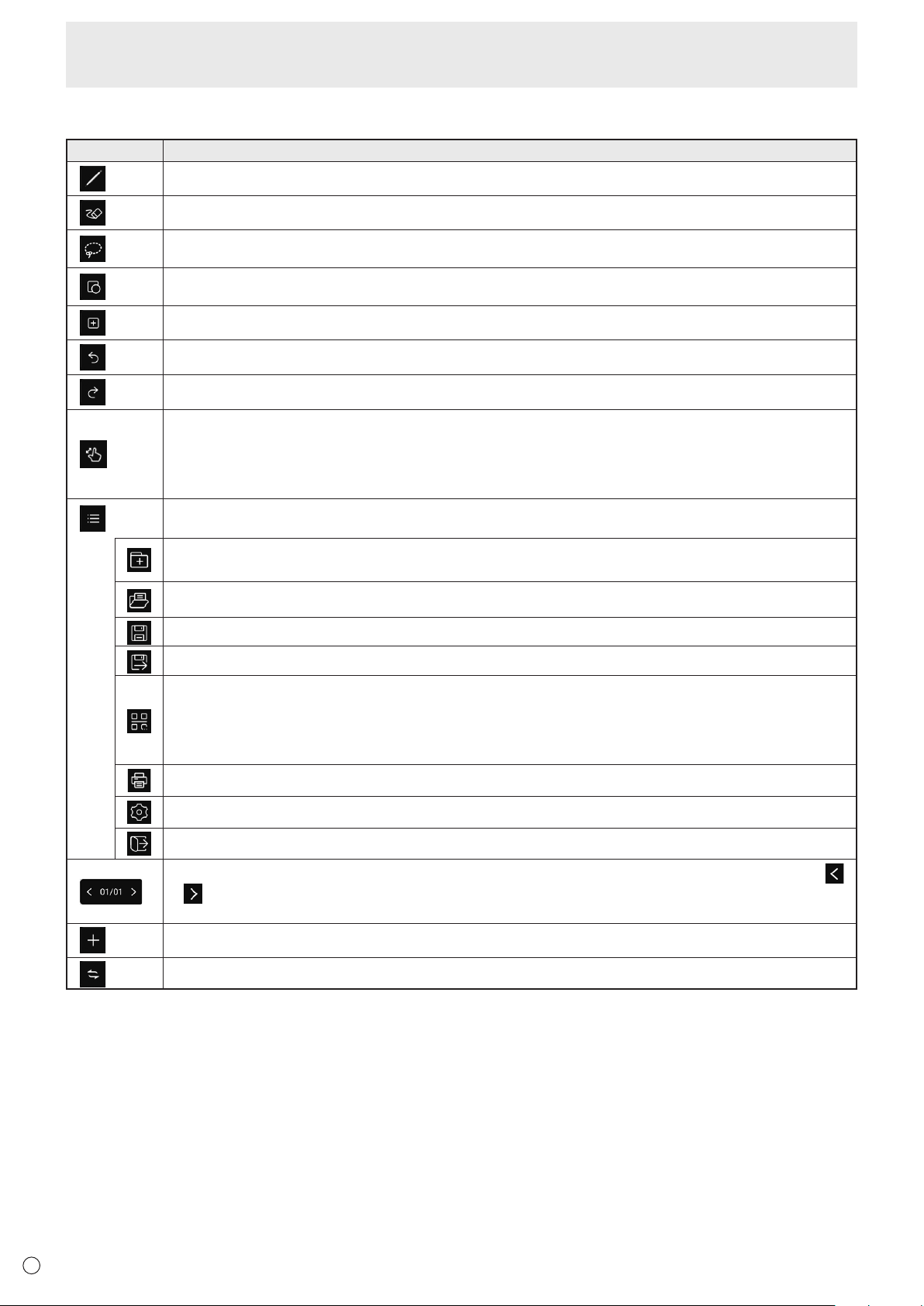
Function list
Tool Function
Draw lines. (See page 33.)
Erase a line that you drew. (See page 33.)
Select a drawn line.
You can move, zoom in on, or zoom out on the selected line. (See page 34.)
Draw a figure.
After selecting a figure, drag an area to include the figure.
Insert the file on the sheet. You can also call up an application. (See page 34.)
Undo the previous drawing or edit. You can repeat undo a maximum of 20 times.
Redo an undone action.
Selects the behaviors of the multi-finger operation.
It changes every time you touch it.
When set to off, each can be used for drawing (maximum 20).
When set to on, it can be zoomed in/out by pinching. The display position can be moved by dragging it with 3
fingers.
The menu will appear.
Touch again to close the menu.
Close the current whiteboard and create a new whiteboard.
A message appears if the current whiteboard has not been saved. Save the whiteboard you need.
Open the whiteboard.
Save the whiteboard.
Save the whiteboard as a different whiteboard.
Display an image of the screen that is currently displayed on this monitor on a device such as a smartphone
via the internet.
Scan the QR code displayed.
A password can be requested when displaying image.
“Encryption” is set to on and enter the displayed password.
Print a sheet. (See page 43.)
Change the settings of this application. (See page 35.)
Exit this application.
Shows the current sheet number and the total number of sheets. You can change the sheet displayed with
or
.
Touching this will zoom out all sheets. The sheet can be moved or deleted.
Add a new sheet behind the currently displayed sheet.
Switches the display position of the menu and sheet number to the left and right.
33
E
Whiteboard
Drawing
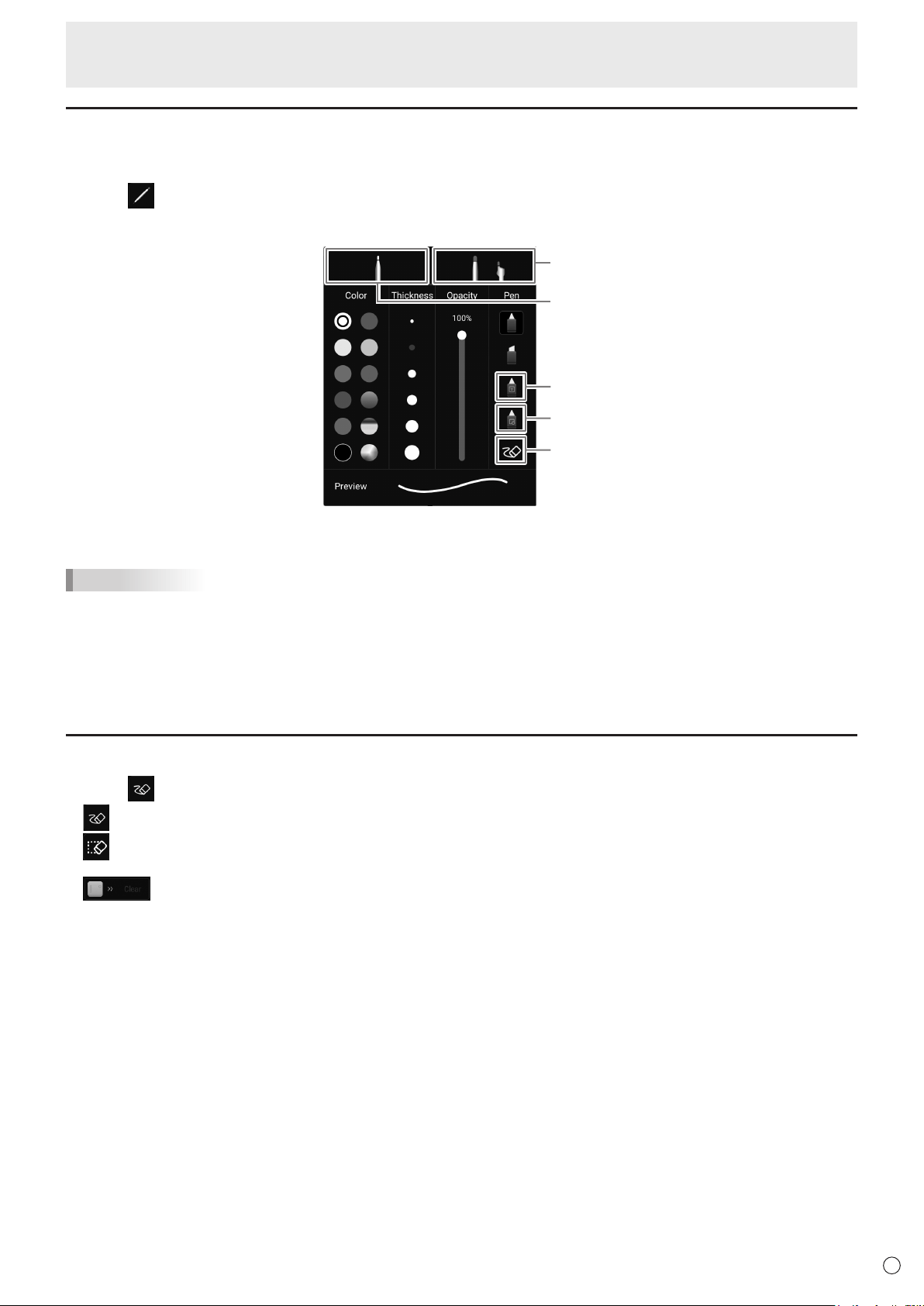
The side of the touch pen (supplied) that is touching the screen, enabling the two sides to be used as different pens.
1. Touch
.
The line setting (color, thickness, opacity, nib) can be changed.
Recognizes and formats the drawn figures. *2
Erasing a drawn line.
Recognizes and formats the drawn characters.*1
Configure the settings for drawing with
the thin nib of the touch pen (supplied).
Configure the settings for drawing with the
thick nib of the touch pen (supplied) or finger.
2. Draw.
TIPS
• Depending on the drawn shape, it may not be correctly formatted.
*1 Write the characters in one line. Even if you write characters in multiple lines, they will be formatted in one line.
The recognized characters differ depending on the “Language” setting of “Language & keyboard” in the System menu.
*2 Recognizes straight lines, circles, arrows, triangles, rectangles and star shapes.
Arrows, triangles, rectangles and star shapes will not be recognized if drawn diagonally. Draw it horizontally or vertically,
and rotate it after it is recognized.
Erasing a drawn line
1. Touch .
: The lines in the touched areas will be erased.
: The lines in the dragged area will be erased.
Lines will be completely erased if even some of their portions are contained inside the said area.
: All lines on the sheet will be erased.
Slide the switch to the right.
You can erase an area of the screen that you touch with your palm.
Touch the screen with your palm, and when the cursor is appear, move your palm.
34
E
Whiteboard
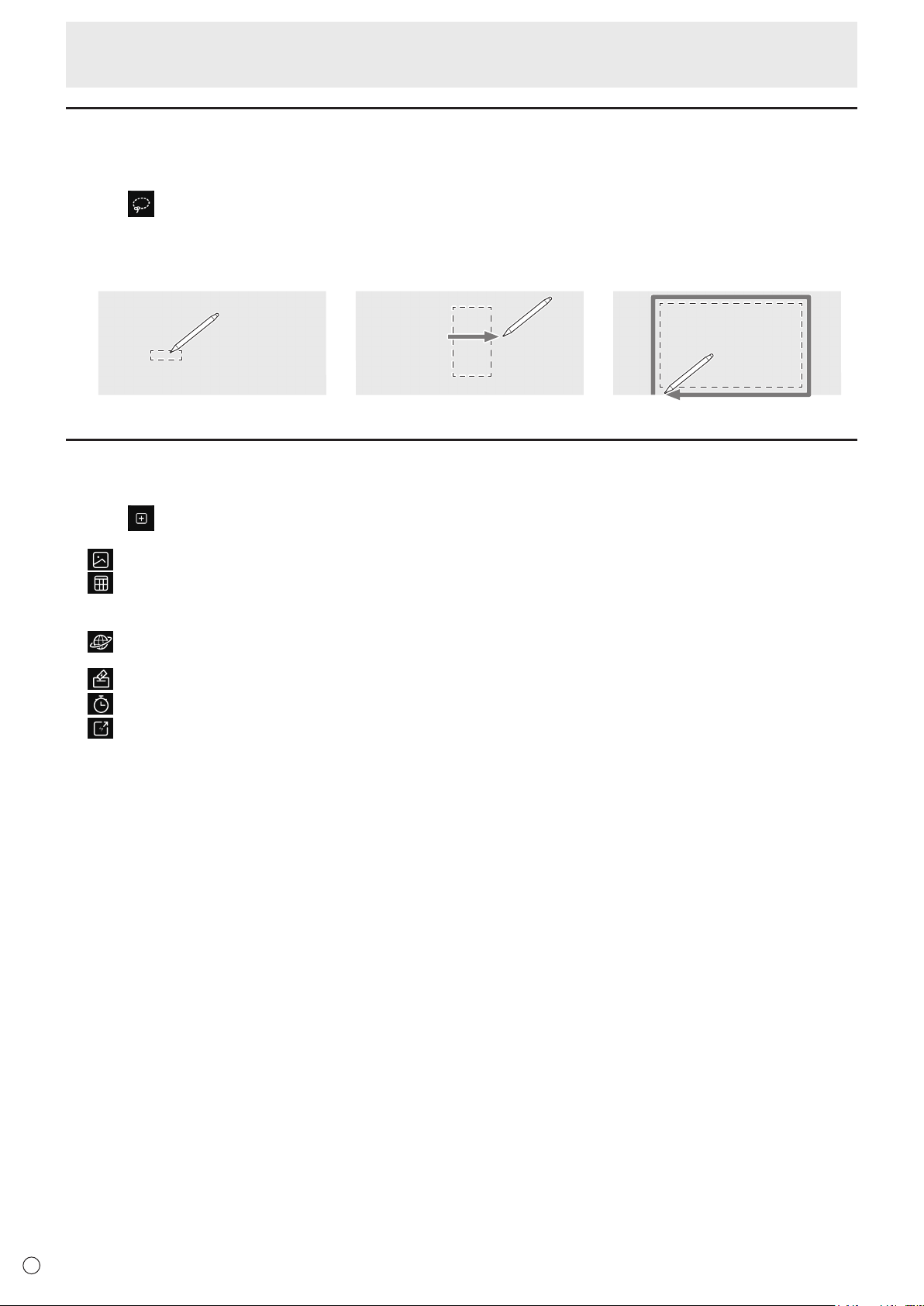
Selecting a drawn line
Select a drawn line.
Selected lines can be moved, enlarged/reduced and rotated.
1. Touch
.
2. Select a line. (See below.)
Selection method:
Touch a line. Trace over the line you wish to select. Enclose the line you wish to select.
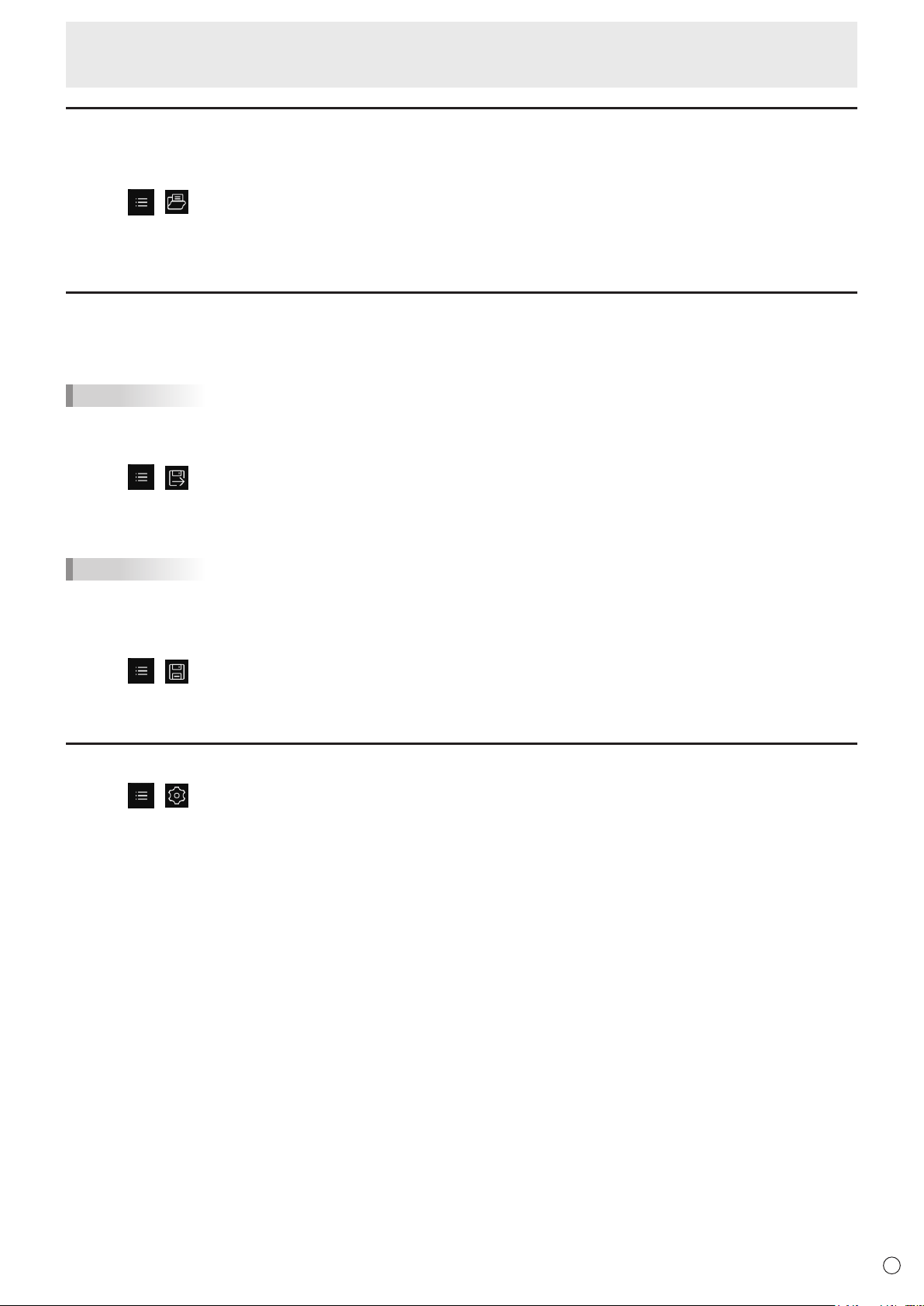
Opening a file or application on the current sheet
Depending on memory usage and other factors, it may not be possible to open a file even if it is in a supported format.
1. Touch
.
2. Insert.
: Insert an image file.
: Set the number of rows and columns and insert the table.
The table width and height are automatically adjusted when drawn within the table.
Rows and columns can be added by selecting the table using the selection tool.
: The Web Browser appears.
Long pressing an image displayed in the Web Browser will incorporate the image into the sheet.
: Vote and count using the internet. (See page 22.)
: Displayed the Timer.
: Transfers the screen of a mobile device such as a smartphone and incorporates it into the sheet.
35
E
Whiteboard
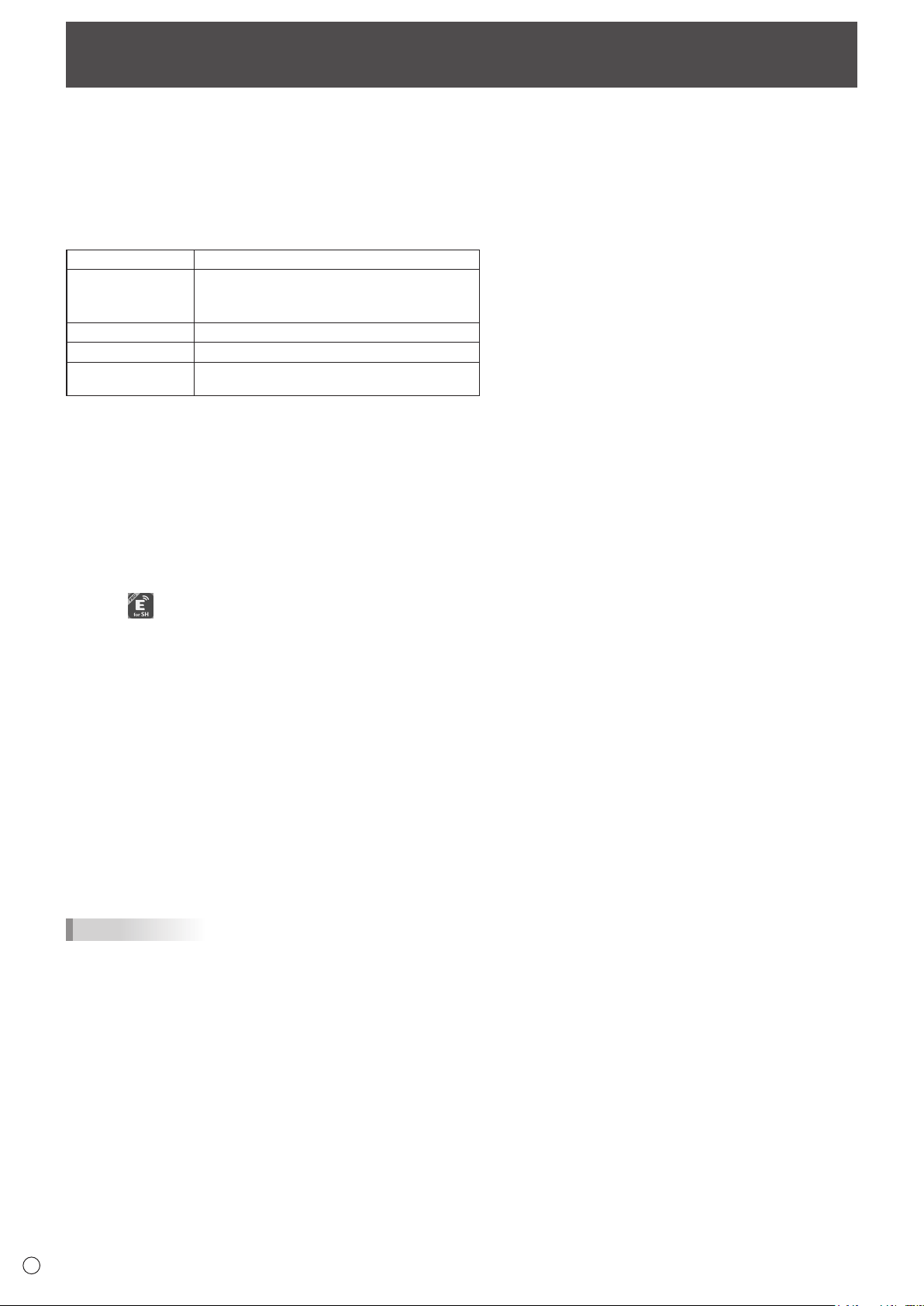
Opening a file
Data of this application that is saved is opened as a new whiteboard.
The current whiteboard closes. The whiteboard data that is not saved is lost.
1. Touch
, .
If the current whiteboard has not been saved, a confirmation screen is appear. If you need it, touch “Yes” and save.
2. Select the file.
Saving
You can save the whiteboard to this monitor’s built-in memory (internal memory) or to a USB flash drive.
You can save in formats other than the source file format such as in a PDF or an image format.
TIPS
• When you save a sheet in PDF format or image, the sheet cannot be re-edited using this application.
Save as new
1. Touch
, .
2. Specify the file name, save format, and save location (when connected to a USB flash drive).
3. Touch “Save”.
TIPS
• Data will be stored in “/whiteboard”.
Overwrite
Data that have not been saved even once in the source file format will be saved as new.
1. Touch
, .
2. Touch “Yes”.
Settings
1. Touch , .
2. Configure the setting.
Time display switch:
Configures whether or not to display the time on the upper right area of the screen.
Background Settings:
Set the whiteboard background.
36
E
Wireless Display (EShare)
• You can display the image of another device on the same network on this monitor. Connect the monitor (with a wireless
adapter connected) and the device to the access point of the network or wireless router.
You can write/draw letters and lines on the image displayed on this monitor using Overlay board.
• Software must be downloaded to the other device.
For details, see below.
• Connections to all devices is not guaranteed.
Supported devices:
Windows Windows 10 or later
Chrome OS*
1
Eshare: Chrome OS version 87 or later*
2
Must support Google Play.
Google Cast: Chrome OS version 92 or later
macOS macOS v10.15 or later
Android*
1
Android 9 or later
iOS/iPadOS*
1
iOS 14 or later
iPadOS 14 or later
*1: Touch operation cannot be used.
*2: Audio cannot be sent.
n
Wireless LAN connection settings
“Wireless LAN” on the Network menu is set to on and connect to an access point. (See page 47.)
n
Start EShareServer
To use this application, it is necessary to authenticate. Uses the Internet for authentication. Therefore, when starting this
application for the first time, connect this monitor to the Internet.
1. Touch
in the home screen of APPLICATION mode.
n
Display the image that appears on the other device
The following explanation uses Windows (device) as an example.
1. Access the address shown in EShare on the monitor with your browser, and download the software to the other
device whose image is to be displayed.
A warning screen may be displayed, but continue downloading.
2. Install and start the software you downloaded.
3. Check the name of the display shown in EShare on the monitor and click “Connect”.
4. Select “Share screen”.
• You can select “Screen Mirror” (Windows) or “TV Mirror” (Android) to display the image that appears on the monitor on the
other device.
• The other device connects to the monitor, and the image from the other device appears on the monitor.
5. Start Overlay board.
You can draw on the displayed image and save the displayed image.
TIPS
• The manual for this application can be downloaded from our website. (Provided only In English.)
https://business.sharpusa.com/product-downloads
37
E
File Manager
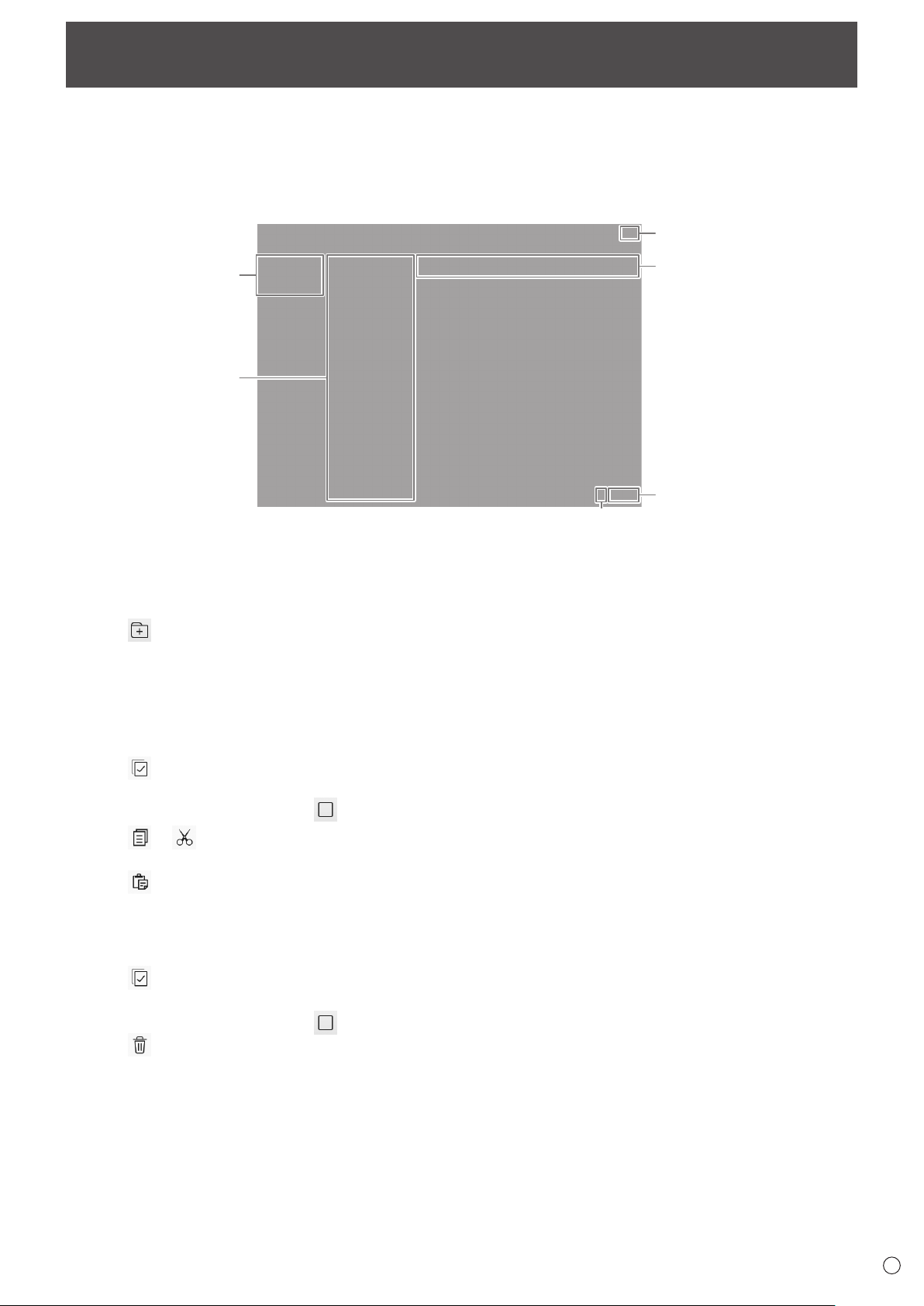
Manages the files and folders in the internal storage and the USB flash drive connected to the monitor.
You can also display or play back the files.
1. On the home screen of APPLICATION mode, touch “File Manager”.
Changes the display
method.
Remove the USB flash drive.
Selects the type of
file to display.
Selects the device
to display.
Sorts files by name/
volume/date.
Exit File Manager.
n
File operation
Creating a new folder
1. Touch
.
A dialog box for the input of the folder name appears.
2. Input the folder name.
3. Once input is complete, touch “OK”.
Copying/Moving
1. Display the file/folder to be copied/moved.
2. Touch
to select the file/folder to be copied/moved.
• You can even select multiple files/folders.
You can select all files/folders with
at the bottom.
3. Touch
or .
4. Display the file list of the copy/move destination.
5. Touch
.
The file/folder is copied/moved.
Deleting
1. Display the file/folder to be deleted.
2. Touch
to select the file/folder to be deleted.
• You can even select multiple files/folders.
You can select all files/folders with
at the bottom.
3. Touch
.
A confirmation screen appears.
4. Touch “OK”.
38
E
File Manager
Renaming
1. Display the file/folder to be renamed.
2. Touch
to select the file/folder to be renamed.
3. Touch
.
4. Enter the new name, and then touch “OK”.
n
File display/playback
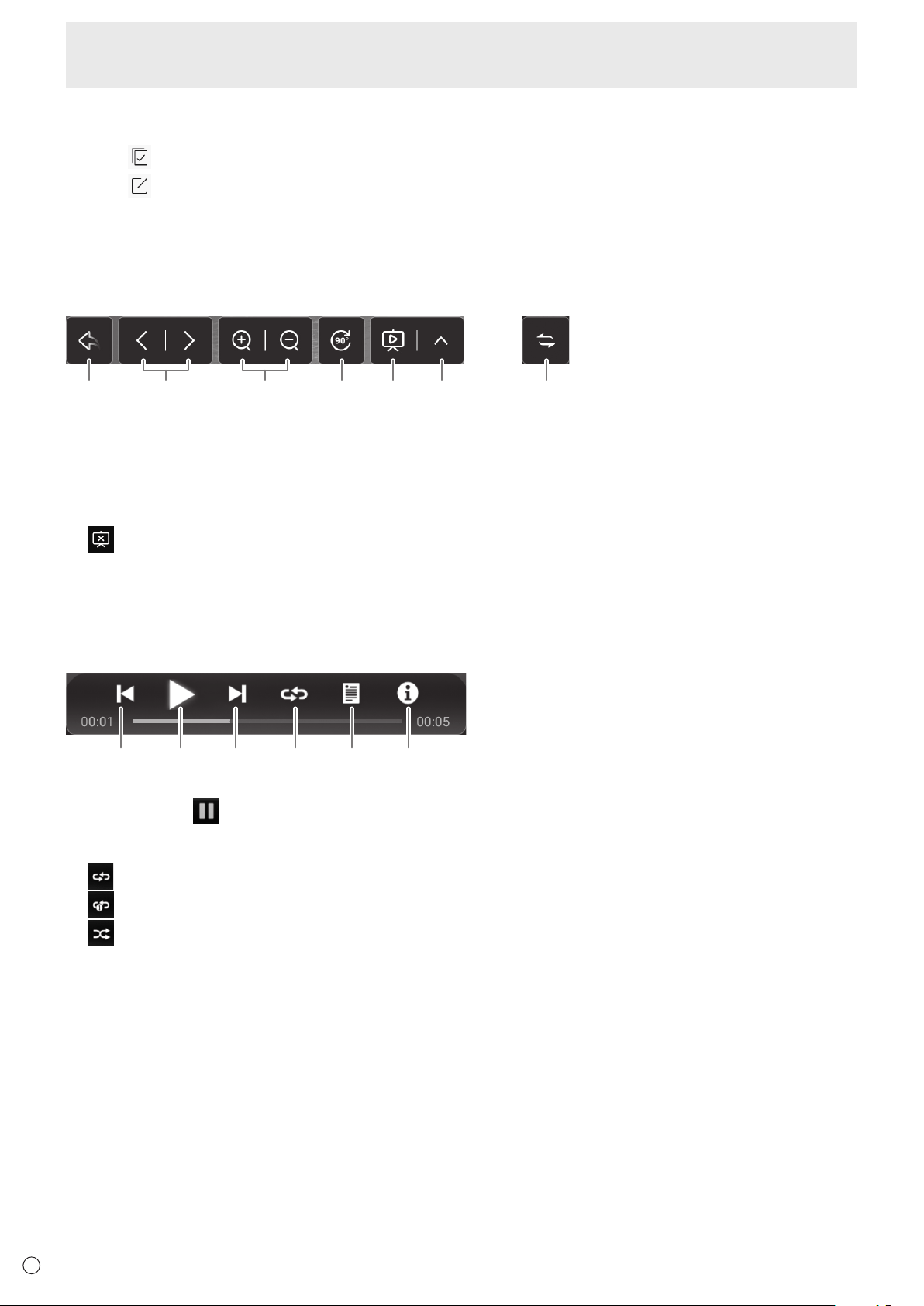
Image files
(1) (2) (3) (4) (5) (6) (7)
(1) Returns to the list of files.
(2) Displays the previous/next image.
(3) Zoom in/out on the image.
You can also zoom in/out by pinching.
(4) Rotates the image by 90°.
(5) Starts the slide show. Sequentially displays the images inside the same folder.
Ends the slide show.
(6) Configures the slide show
Play in loop: Configures whether to repeat playbacks.
Play interval: Configures the playback interval.
(7) Horizontally moves the display position of the operation bar.
Music files
(1) (2) (1) (3) (4) (5)
(1) Plays the previous/next music.
(2) Plays the music.
Pause the playback.
(3) Plays a music repeatedly.
It changes every time you touch it.
Sequentially plays the music on the list, and when the last music is played, it starts all over from the first music.
Repeatedly plays the music that is currently being played.
Randomly and repeatedly plays the music on the list.
(4) Displays a list of music files in the same folder.
When a music is chosen from the list, it plays that music.
(5) Displays information about the music.
39
E
Video files
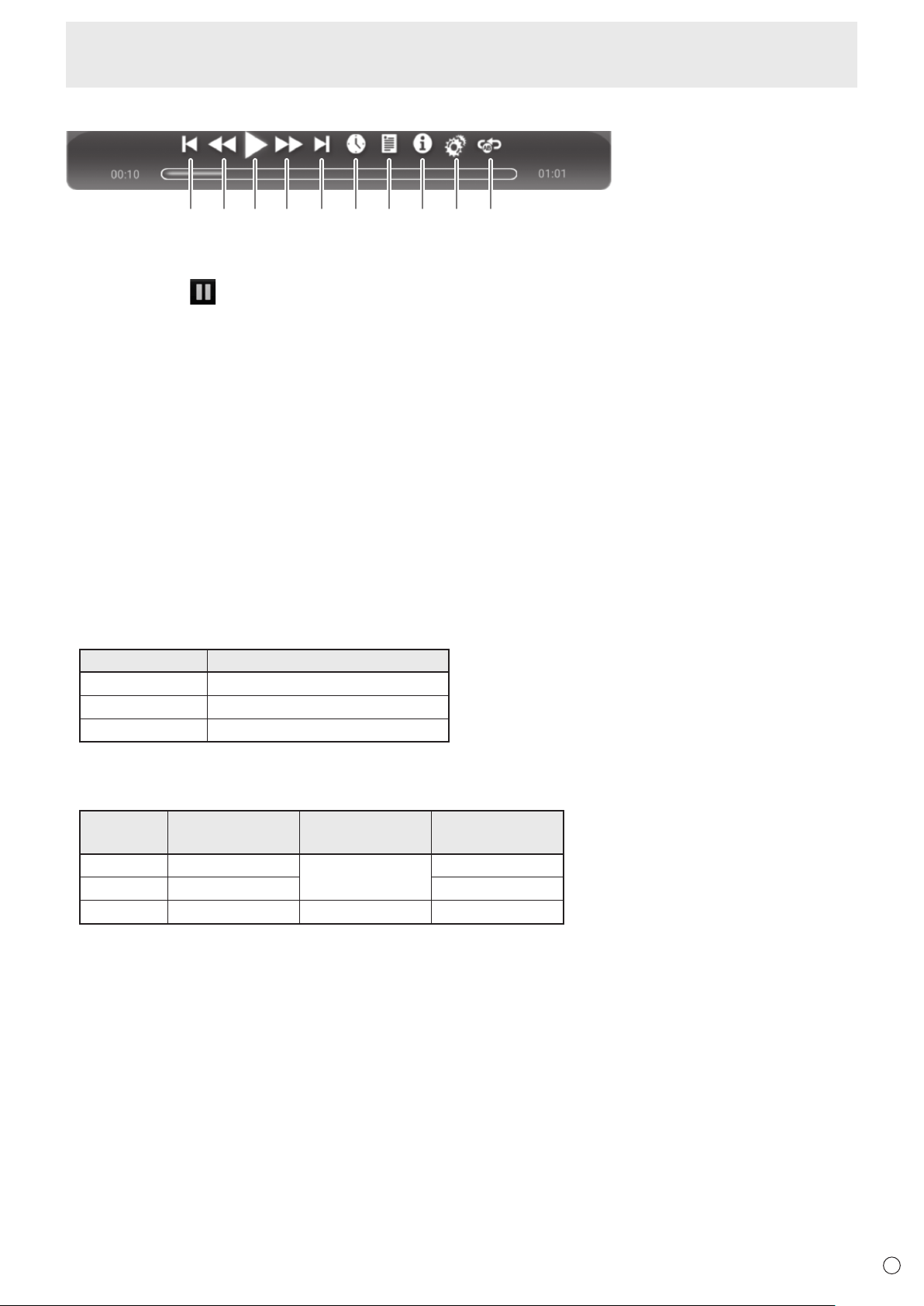
(1) (2) (2) (1)(3) (4) (5) (6) (7) (8)
(1) Plays the previous/next video.
(2) Change the speed of video playback.
(3) Plays the video.
Pause the playback.
(4) Moves the play position to the specified time.
(5) Displays a list of video files in the same folder.
(6) Displays information about the video.
When a video is chosen from the list, it plays that video.
(7) Configures settings related to video playback.
(8) Repeats the playback at the specified position.
1) “Section replay” is set to on.
2) Touch “Set starting point A” at the repeat start position.
3) Touch “Set starting point B” at the repeat end position.
n
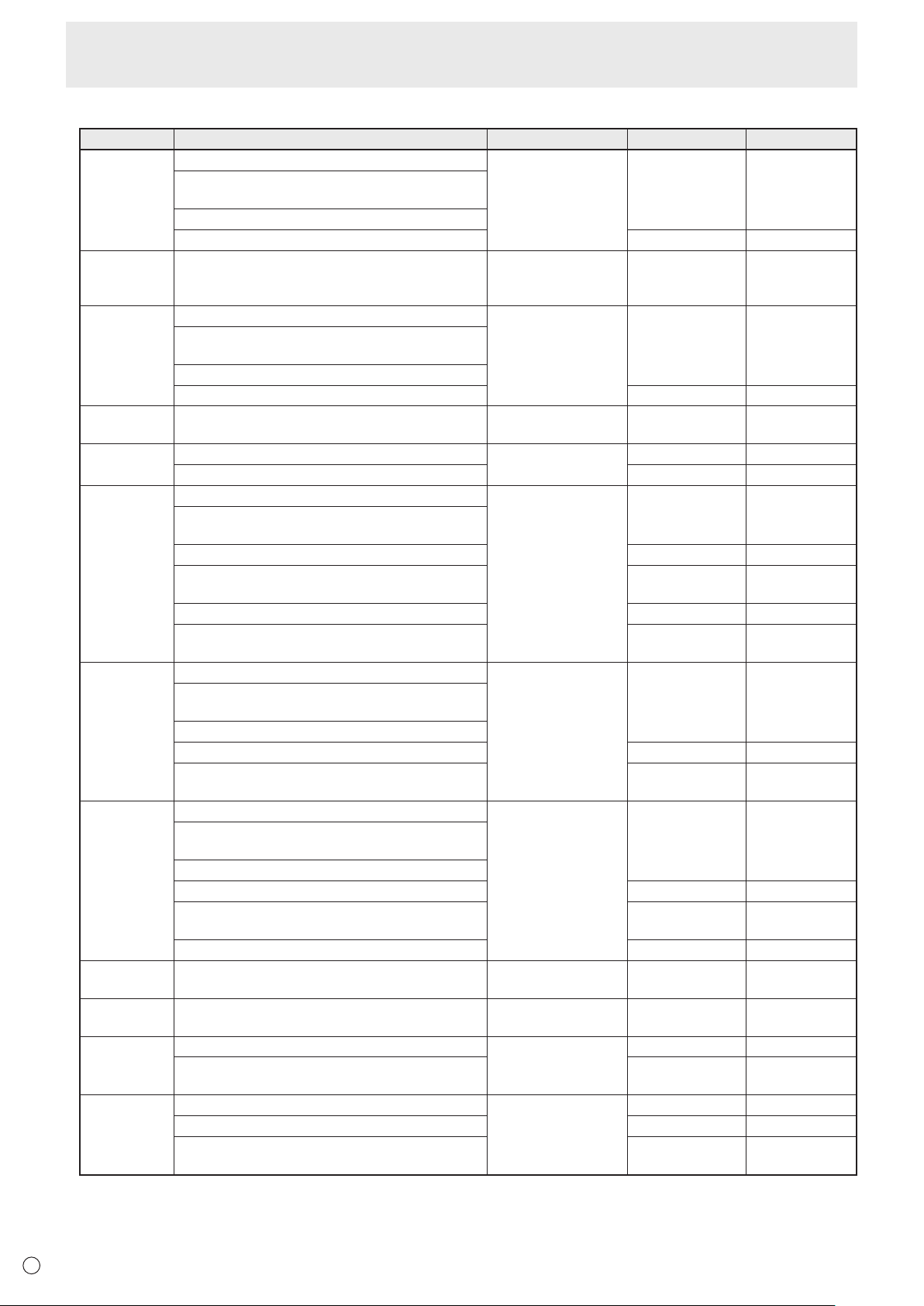
Supported formats
The types of files that can be played are as follows.
(Not all files are guaranteed to be played back.)
Image files
Extension Max. resolution
*.bmp 15360×8640
*.jpg (*.jpeg) 1920×1080*
*.png 1920x1080
* Progressive JPEG: 1024x768
Music files
Extension Audio coding Sample rate Bit rate
*.aac AAC-LC
8k - 48kHz
16k - 576kbps
*.mp3 MPEG1/2 layer3 8k - 320kbps
*.ogg Vorbis 6k - 48kHz 8k - 500kbps
File Manager
40
E
Video files
Extension Video coding Audio coding Max. resolution Maximum bit rate
*.3gp (*.3GP2)
mpeg1/2 (MP @HL)
Mpeg1/2 Layer1/2/3,
AAC-LC, vorbis, LPCM,
AMR-NB
1920x1080@60fps 80Mbps
Mpeg-4 (Simple Profile, Advanced Simple Profile@
Level 5) *
1
H.263
H.264 (Main, High, High10@Level 6.0) 4096x2304@60fps 200Mbps
*.asf (*.asx) H.264 (Main, High, High10@Level 6.0)
Mpeg1/2 Layer1/2/3,
AAC-LC, vorbis, LPCM,
AMR-NB
4096x2304@60fps 200Mbps
*.avi
mpeg1/2 (MP @HL)
Mpeg1/2 Layer1/2/3,
AAC-LC, vorbis, LPCM,
AMR-NB
1920x1080@60fps 80Mbps
Mpeg-4 (Simple Profile, Advanced Simple Profile@
Level 5)
H.263
H.264 (Main, High, High10@Level 6.0) 4096x2304@60fps 200Mbps
*.dat mpeg1/2 (MP @HL)
Mpeg1/2 Layer1/2/3,
AAC-LC, LPCM
1920x1080@60fps 80Mbps
*.flv
H.263
Mpeg1/2 Layer1/2/3,
AAC-LC, LPCM
1920x1080@60fps 80Mbps
H.264 (Main, High, High10@Level 6.0) 4096x2304@60fps 200Mbps
*.mkv
mpeg1/2 (MP @HL)
Mpeg1/2 Layer1/2/3,
AAC-LC, LPCM, opus
1920x1080@60fps 80Mbps
Mpeg-4 (Simple Profile, Advanced Simple Profile@
Level 5) *
1
H.264 (BP, MP, HP @Level 5.1) 4096x2304@60fps 160Mbps
H.265 (Main/Main10 Profile, High Tier @Level 6.1)
4096x2304@60fps
8192x4320@30fps
200Mbps
vp8 1920x1080@60fps 60Mbps
vp9 (Profile 0 (420 8bit), Profile 2 (420 10bit))
4096x2304@60fps
8192x4320@30fps
60Mbps
*.mov
mpeg1/2 (MP @HL)
Mpeg1/2 Layer1/2/3,
AAC-LC, vorbis, LPCM,
AMR-NB
1920x1080@60fps 80Mbps
Mpeg-4 (Simple Profile, Advanced Simple Profile@
Level 5) *
1
H.263
H.264 (Main, High, High10@Level 6.0) 4096x2304@60fps 200Mbps
H.265 (Main/Main10 Profile, High Tier @Level 6.1)
4096x2304@60fps
8192x4320@30fps
200Mbps
*.mp4
mpeg1/2 (MP @HL)
Mpeg1/2 Layer1/2/3,
AAC-LC, vorbis, LPCM,
AMR-NB
1920x1080@60fps 80Mbps
Mpeg-4 (Simple Profile, Advanced Simple Profile@
Level 5)
H.263
H.264 (Main, High, High10@Level 6.0) 4096x2304@60fps 200Mbps
H.265 (Main/Main10 Profile, High Tier @Level 6.1)
4096x2304@60fps
8192x4320@30fps
200Mbps
vp8 1920x1080@60fps 60Mbps
*.VOB mpeg1/2 (MP @HL)
Mpeg1/2 Layer1/2/3,
AAC-LC, LPCM
1920x1080@60fps 80Mbps
*.mpg (*.mpeg) mpeg1/2 (MP @HL)
Mpeg1/2 Layer1/2/3,
AAC-LC, LPCM
1920x1080@60fps 80Mbps
*.webm
vp8
Mpeg1/2 Layer1/2/3,
AAC-LC, LPCM, opus
1920x1080@60fps 60Mbps
vp9 (Profile 0 (420 8bit), Profile 2 (420 10bit))
4096x2304@60fps
8192x4320@30fps
60Mbps
*.ts
mpeg1/2 (MP @HL)
Mpeg1/2 Layer1/2/3,
AAC-LC, LPCM
1920x1080@60fps 80Mbps
H.264 (Main, High, High10@Level 6.0) 4096x2304@60fps 200Mbps
H.265 (Main/Main10 Profile, High Tier @Level 6.1)
4096x2304@60fps
8192x4320@30fps
200Mbps
*1 GMC is not supported.
File Manager
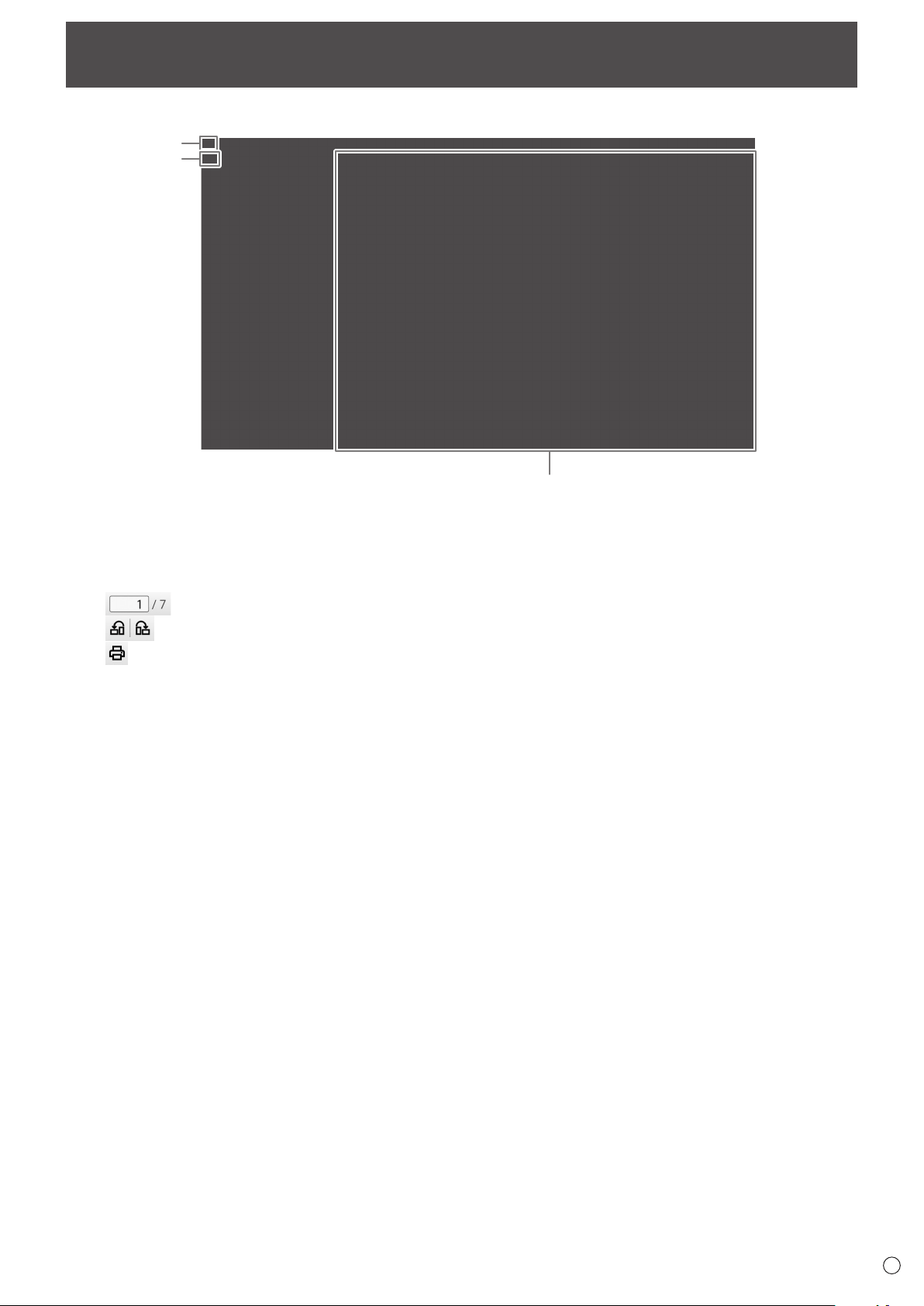
41
E
PDF Viewer
Starts when a PDF file is opened on an application such as “File Manager”, etc.
(1)
(3)
(2)
(1) Displays the PDF.
Zoom-in or zoom-out the display by pinching.
Magnify the display by double-tap.
: Displays the current page / total number of pages.
: Rotate the page view 90°. All pages rotate.
: Performs printing. (See page 43.)
(2) Close / display the bookmark.
(3) Exit the application.
42
E
Web Browser
View the website.
1. On the home screen of APPLICATION mode, touch “Web Browser”.
Exiting
Close the Web Browser from the recent app bar.
TIPS
• The manual for this application can be downloaded from our website. (Provided only in English.)
https://business.sharpusa.com/product-downloads
• If a large-sized website is displayed, the Web Browser may close.
• If the application does not work properly, make sure that the date and time are set correctly.
• A password is required when changing the Web Browser setting. (Factory setting) (See page 45.)
Caution
• Take proper care when browsing websites.
In a malicious website, the input contents may be stolen and fraudulent applications may be downloaded.
If a fraudulent application is installed, it may result in a virus infection or stealing of communication details.
• Be sure to log out from a website that you have used by logging in.
If you remain logged in, your personal information such as the ID may be known by a third person.
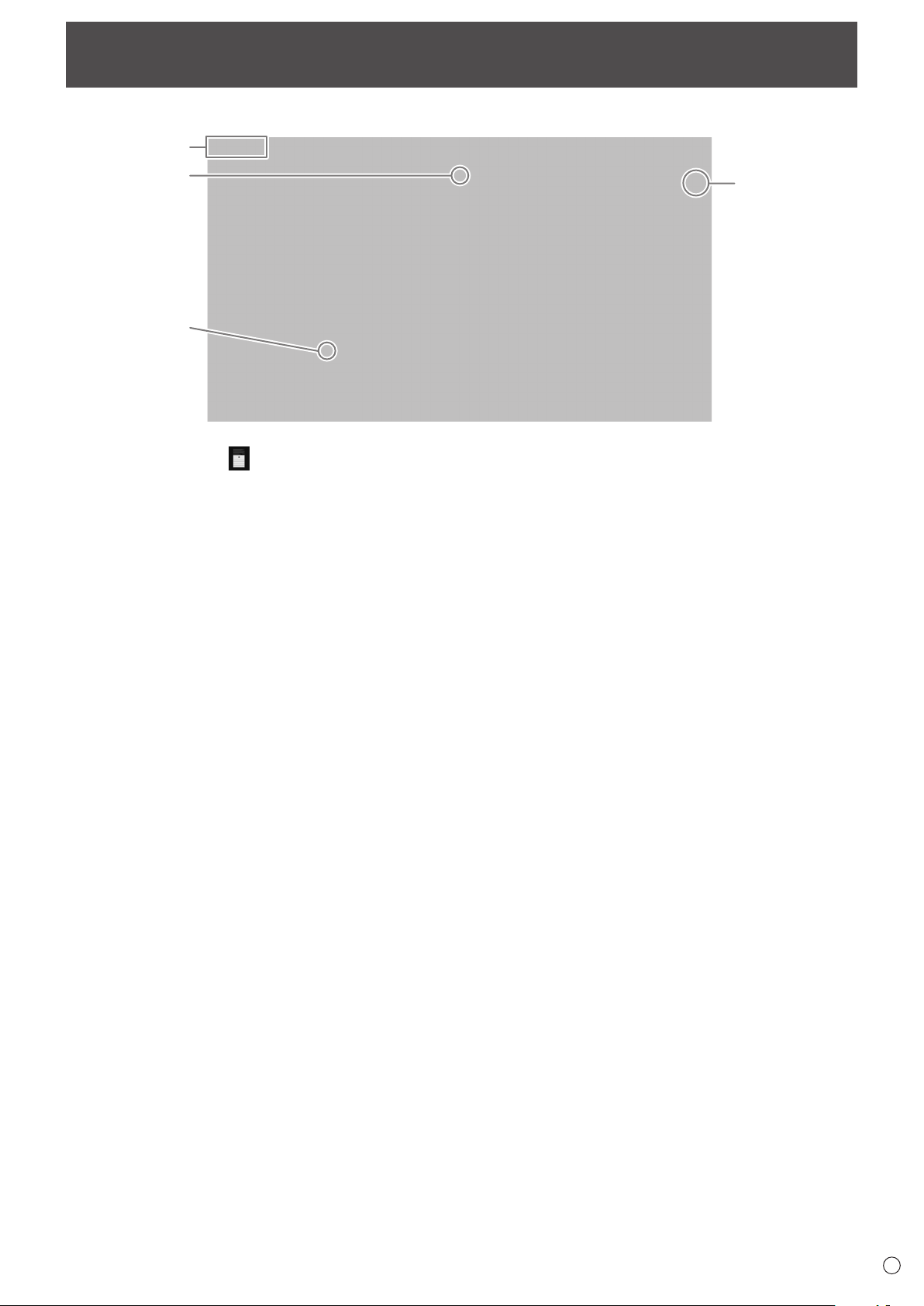
43
E
Printing
You can print with SHARP MFP that supports the Sharp Print Service Plugin on the same network on this monitor.
(4
)
(1)
(3)
(2)
(1) Select an MFP with .
(2) Set the printing settings.
(3) Check the page to you want to print.
(4) Print.
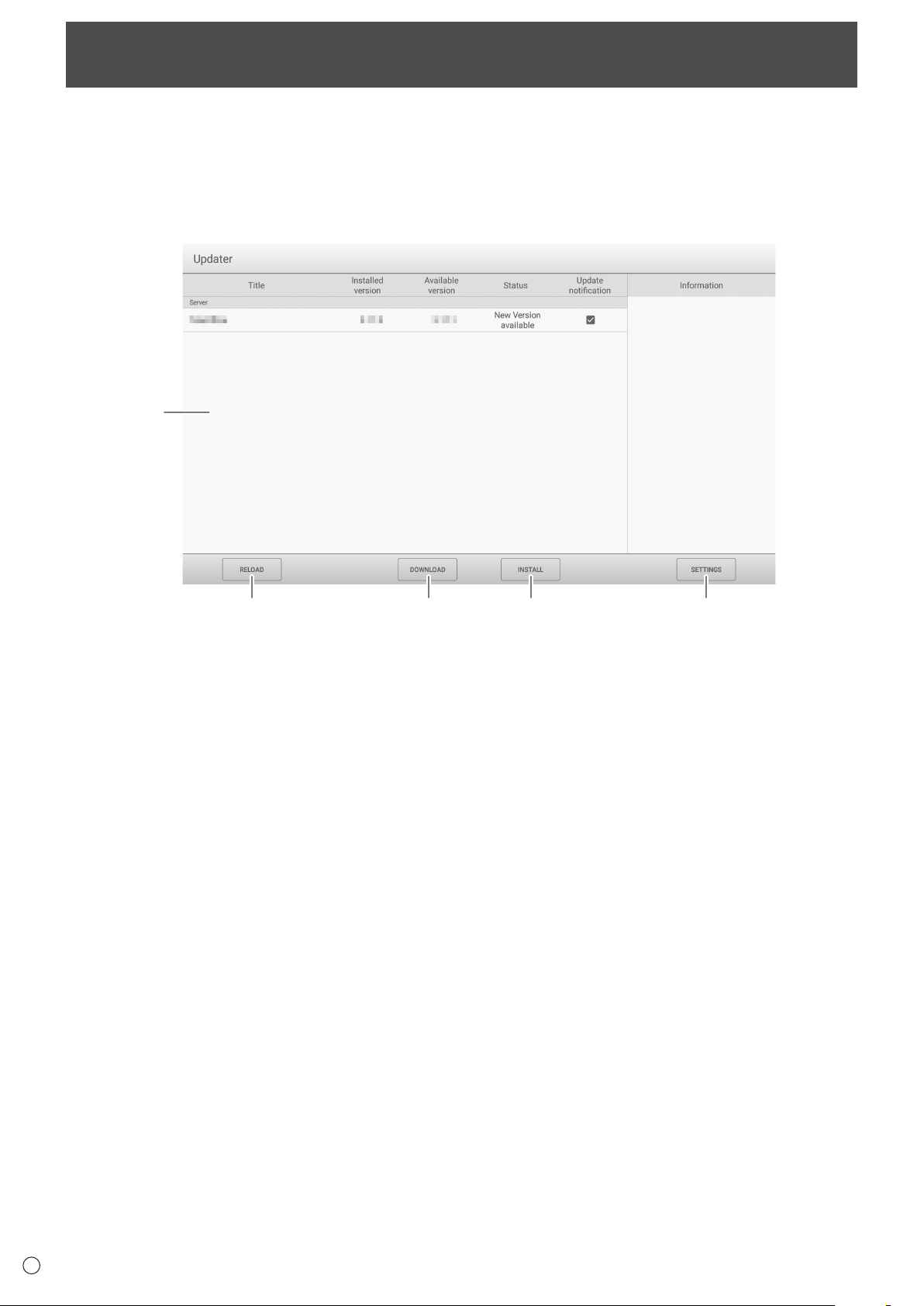
44
E
Updating the Software (Update)
Update applications that are factory-installed in APPLICATION mode. (A network environment that allows access to the internet
is required.)
On the home screen of APPLICATION mode, touch “All Apps”, and then touch “Updater”.
When you use Updater, a password is required. (Factory setting) (See page 45.)
The “Export Law Assurances” appears. Select “OK”.
To use the software distributed by the Updater, you must agree to the “Export Law Assurances”.
1
2 3 4 5
1. Information area
Shows information on already downloaded software and software that can be downloaded.
Update notification: Displayed when “Notify new versions” is set to on. Update of software that unchecked will not be
notified.
2. RELOAD
Refresh the information in the information area.
3. DOWNLOAD
Download the selected software.
4. INSTALL
Install the selected software.
5. SETTINGS
Configure settings for Update.
• Hide updated items ....................................... Set whether or not to hide updated softwares in the information area.
• Notify new versions ....................................... Set whether or not to display a message if updated software exists.
• Scheduled installation ................................... Set whether or not to update the software automatically.
• Scheduled installation day ............................ When “Scheduled installation” is set to on, set the day of week to update
the software automatically.
• Scheduled installation time ........................... When “Scheduled installation” is set to on, set the time to update the
software automatically.
• About Updater. ..............................................Display the information of this application.
• Reset ............................................................Initialize the “SETTINGS”.
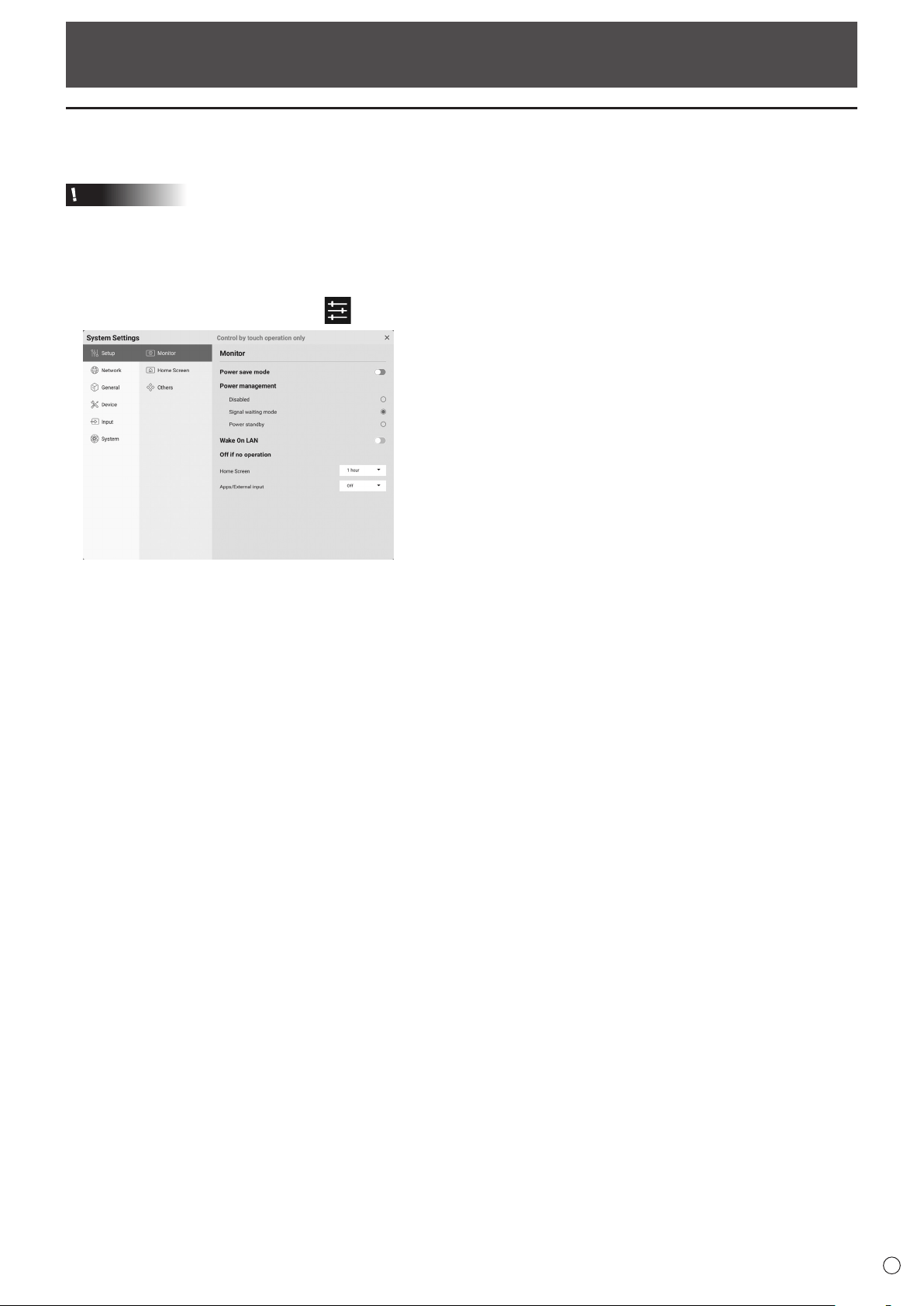
45
E
Menu Items
Displaying the menu screen
Adjusts the images and sound. Makes settings for this monitor.
Caution
• Do not turn the main power switch off while the menu items are being displayed. Doing so may initialize the settings.
Touch to operate.
1. On the home screen of APPLICATION mode, touch “System Settings”.
If you want to adjust input video, touch
on the sidebar and touch “System Settings”.
2. Set each item. (See page 46.)
3. Once the settings are complete, touch “X”.
n
Password
• A password is required in the following cases. A screen for the input of the password appears. (Factory setting)
- When setting the Network menu or System menu.
- When setting the Function menu.
- When changing the Web Browser setting.
- When using Updater.
• When using these for the first time, a screen for the set of the password appears. Set a password.
46
E
Menu item details
n
Setup
Monitor
Power save mode
When set to off, startup time from standby state is reduced. Note, however, that more power will be consumed in standby
state. APPLICATION mode continues to run in standby state.
When set to on, current consumption is reduced while the monitor is in standby state. APPLICATION mode is also shut
down. Note, however, that the startup time from standby state becomes longer.
If set to on, configure whether the Wake On LAN should be enabled. (See below.)
Power management
Sets whether or not to move to input signal waiting state or standby state in the no signal state.
Disabled ...................... Do not move.
Signal waiting mode.... Move to input signal waiting state.
Power standby ............ If the no signal state continues for approximately 5 minutes, the monitor moves to the standby state.
The application data that is not saved is lost.
Wake On LAN
This configures whether or not to enable the Wake On LAN when the “Power save mode” is set to on.
When set to on, standby state is networked standby mode.
When set to off, standby state is standby mode.
Off if no operation
Determines whether or not to set the monitor to go into standby state when there is no operation. If a switch is to be made, it
also configures the time until the switch is made.
Home screen .............. Sets the operation while the home screen of APPLICATION mode is displayed.
Apps/External input..... Sets the operation while a screen other than the home screen of APPLICATION mode is displayed
(i.e., application screen, external input).
Home screen
App icon layout on home screen
Sets the icons of the applications to be arranged on the home screen of APPLICATION mode.
Synappx settings
Synappx setting.............. Sets whether or not to display the “Synappx” icon on the home screen of APPLICATION mode.
Input for Synappx ........... When “Synappx setting” is set to on, sets the input terminal to which the computer on which
Synappx is installed is connected.
Others
Sidebar
Sets whether or not to display the sidebar.
Logo screen
Sets whether or not to display the logo screen when turning the power on.
Startup animation
Sets whether or not to display the animation when turning the power on.
Color Universal Design
The following applications are designed with Color Universal Design to enable better visibility for most people, regardless of
differences of color vision between individuals.
When set to on, the screen is displayed conforming to Color Universal Design.
• Overlay board
• Whiteboard
Menu Items
47
E
Menu Items
n
Network
Wireless LAN
Sets whether or not to use a wireless LAN when attaching a wireless adapter. To use a wireless LAN, set the access points.
You cannot use the “Access point” when using a “Wireless LAN”.
Cannot be used simultaneously with Ethernet. Ethernet is preferred if there is a connection on Ethernet.
Ethernet
Sets whether or not to use a LAN terminal.
To use a LAN terminal, set the IP address, etc.
Access point
Sets whether or not to use this monitor as an access point when attaching a wireless adapter.
To change the settings, touch “Change”. You can change “Access point name”, “Encryption mode” and “Password”.
After completing the settings, touch “Save”.
You cannot use the “Wireless LAN” when using a “Access point”.
Communication settings
Monitor control via network
Sets whether or not to control this monitor via network.
Advanced:
User name ............................. Sets an account name when connecting to this monitor.
Password ............................... Sets a password when connecting to this monitor.
Port ........................................ Sets the port number to be used.
Auto logout time (minutes) ..... Sets the time to logout automatically by minutes when there is no communication.
Reset .........................................Initialize the “Monitor control via network” settings.
Command Format
Select the command format.
For details of each command, see the manual on the following website.
https://business.sharpusa.com/product-downloads
48
E
Menu Items
n
General
Custom
Wallpaper
Sets the background of the home screen of APPLICATION mode.
Audio
Volume
Adjusts the volume.
Max volume
Sets the maximum volume that cannot be exceeded.
Balance
Adjusts the balance of the audio sound between right and left.
Sound mode
Selects the sound mode.
Bass ........................ Adjusts the volume of bass-level sound. You can set this when the “Sound mode” is set to “Custom”.
Treble ...................... Adjusts the volume of treble-level sound. You can set this when the “Sound mode” is set to “Custom”.
Mute with freeze
Set whether or not audio turns off during freeze.
Audio output
Sets the volume of sound output from the audio output terminal.
The volume from the digital audio output (optical) terminal is fixed regardless of the setting.
Variable1 ................. You can adjust the volume from the speakers of this monitor and the audio output terminal
simultaneously by using “Volume”.
Variable2 ................. You can adjust the volume from the audio output terminal by using “Volume”.
Sound will not be output from the speakers of this monitor.
Fixed ....................... Fixes the volume from the audio output terminal. Adjust the volume by using an external device.
Picture
Brightness
Adjusts the brightness.
Color mode (HDMI/D-SUB/USB-C/DisplayPort/Video/OPS)
Selects color mode for the screen.
Black level (HDMI/D-SUB/USB-C/DisplayPort/Video/OPS)
Adjusts the entire brightness of the video signals. You can set this when the “Color mode” is set to “Custom”.
Contrast (HDMI/D-SUB/USB-C/DisplayPort/Video/OPS)
Adjusts the difference between the bright and dark portions of the image. You can set this when the “Color mode” is set to
“Custom”.
Hue (HDMI/D-SUB/USB-C/DisplayPort/Video/OPS)
Adjusts the hue. You can set this when the “Color mode” is set to “Custom”.
Sharpness (HDMI/D-SUB/USB-C/DisplayPort/Video/OPS)
Adjusts the sharpness of the image. You can set this when the “Color mode” is set to “Custom”.
RGB input range (HDMI/OPS)
Sets the RGB input signal range.
When using HDMI or OPS set to “Auto”, the RGB input signal range is detected automatically. Use “Auto” normally.
If the RGB input signal range cannot be set appropriately even when using “Auto”, set according to the image. When the
setting is different, images will be displayed with washed out blacks and compressed gradients.
White balance
Selects the white balance.
Compass
Set whether or not to use Compass.
Auto hide
Configures the time until the shortcut closes. When “Always-On” is selected, shortcut is displayed until the close operation is
performed.
Actions
Set whether or not to display the compass (
) when the shortcut is closed.
Compass style
Select the Compass display method.
Circle ...................... Displays the shortcuts in a circular array.
List ......................... Displays the shortcuts in a horizontal line.
Custom compass
Changes the applications displayed in Compass.
49
E
Menu Items
Screen record
Configure the settings for “Screen record”. (See page 22.)
Resolution
Select the resolution of the video file to be recorded.
Volume source
Select the audio to record.
Time limit
Set the maximum recording time.
n
Device
Bluetooth
Set whether or not to use a commercially available Bluetooth device when attaching a wireless adapter.
File received
Display the list of received files in File Manager.
Bluetooth name
Changes the name of this monitor as a Bluetooth device.
Paired device
Displays a list of paired devices.
Available device
Displays a list of available devices. Select the device to connect.
Printer
Displays a list of connected printers. Select a printer to use.
Microphone
Displays a list of connected microphones. Select a microphone to use.
Camera
Displays a list of connected cameras. Select a camera to use.
50
E
n
Input
Input settings
Size (HDMI/D-SUB/USB-C/DisplayPort/Video/OPS)
Changes the screen size. (See page 28.)
PC mode (HDMI)
Configures the contents to be displayed on the HDMI input terminal.
Auto ........................ Switches automatically.
PC ........................... Displays as a computer.
Video ....................... Displays as an AV device.
CEC settings (HDMI)
Makes settings for linkage with devices connected to HDMI input terminal through HDMI CEC.
HDMI CEC link
When this setting is set to on, the link will be used.
When this setting is set to off, the link will not be used.
Auto power on ............ When “HDMI CEC link” is set to on, sets whether or not to turn this monitor ON by linking to the
operation of the devices.
HDMI modes (HDMI)
“HDMI modes” settings determines how the video signal is processed and decoded at the HDMI input.
Mode1 ..................... Normally used.
This will support most common color spaces and other encoding signals.
Mode2 ..................... Used when proper display cannot be performed in “Mode1”, such as when a device that is not
compatible with 4K is connected.
VGA image (D-SUB)
The “Clock”, “Phase”, “H Position”, and “V Position” are automatically adjusted.
Executed when “Auto” is touched. Use this automatic adjustment when you use the “D-SUB” to display a computer screen
for the first time or when you change the setting of the computer. (See page 52.)
H position (D-SUB)
Adjust the horizontal position of the image.
V position (D-SUB)
Adjust the vertical position of the image.
Clock (D-SUB)
Adjusts frequency for sampling clock for applicable video. Adjust when there is flickering in the form of vertical stripes.
When using the adjustment pattern (see page 52), make adjustments so that no vertical stripe noise appears in it.
Phase (D-SUB)
Adjusts sampling clock phase for applicable video. Useful when small characters appear with low contrast and/or there are
flickers at corners. When using the adjustment pattern (see page 52), make adjustments so that no horizontal stripe noise
appears in it.
* Adjustments to “Phase” should be made only after “Clock” has been correctly set.
Others
No signal auto input select
Configures whether or not to automatically switch to a different input mode when signals become absent in the current input
mode.
The “Last input mode” is the previous input mode.
Connect auto input select
Sets whether or not the input into the input terminal automatically changes when a video signal is input into that terminal.
The input via the expansion slot is ignored. (With some input signals, the input may not change.)
Start input mode
You can set the input mode that will be in effect when the power is turned on.
When this is set to “Last input mode”, the input mode when the power was last turned off will appear.
Startup app
When “Start input mode” is set to “APPLICATION”, sets the applications to be started automatically.
Input mode name
You can change the input mode name for each input terminal.
Menu Items
51
E
Menu Items
n
System
Date & Time
Automatic date & time
Sets whether or not to set the data & time automatically via network.
Date & Time
Sets the date and time when “Automatic date & time” is set to off.
Date format
Sets the display format for the date.
Use 24-hour format
Sets whether or not to display the time in the 24-hour format.
Time zone
Sets the time zone.
Language & keyboard
Virtual keyboard
Selects the keyboard to display on the screen.
Language
Sets the display language for the screen.
Schedule
Add schedule (See page 52)
Power can be turned ON at the specified time.
Power can be turned OFF at the specified time.
This monitor can be restarted at the specified time.
System update
Confirms the firmware version and updates the firmware.
If you connect the USB flash drive containing the firmware to this monitor and then touch “Check”, the firmware will be updated.
Security
Lock admin password
Sets whether or not a password is necessary in the following cases.
• When setting the Network menu or System menu.
• When setting the Function menu.
• When changing the Web Browser setting.
• When using Updater.
Screen lock
Set whether or not to lock the screen in the following cases.
• When the main power is turned off.
• When this monitor enters standby state, input signal waiting state or backlight off.
Set the time until the screen is locked in the “Auto screen lock”.
• When locking the screen in Control Panel (see page 24).
If you lock the screen, set the unlock method.
Pattern lock ................Set the pattern to be entered when unlocking.
Password lock............Set the password to be entered when unlocking.
Auto screen lock
Sets the time until the screen is locked.
Enable USB drive
Sets whether or not to allow the use of a USB flash drive.
About
Displays the information of this monitor.
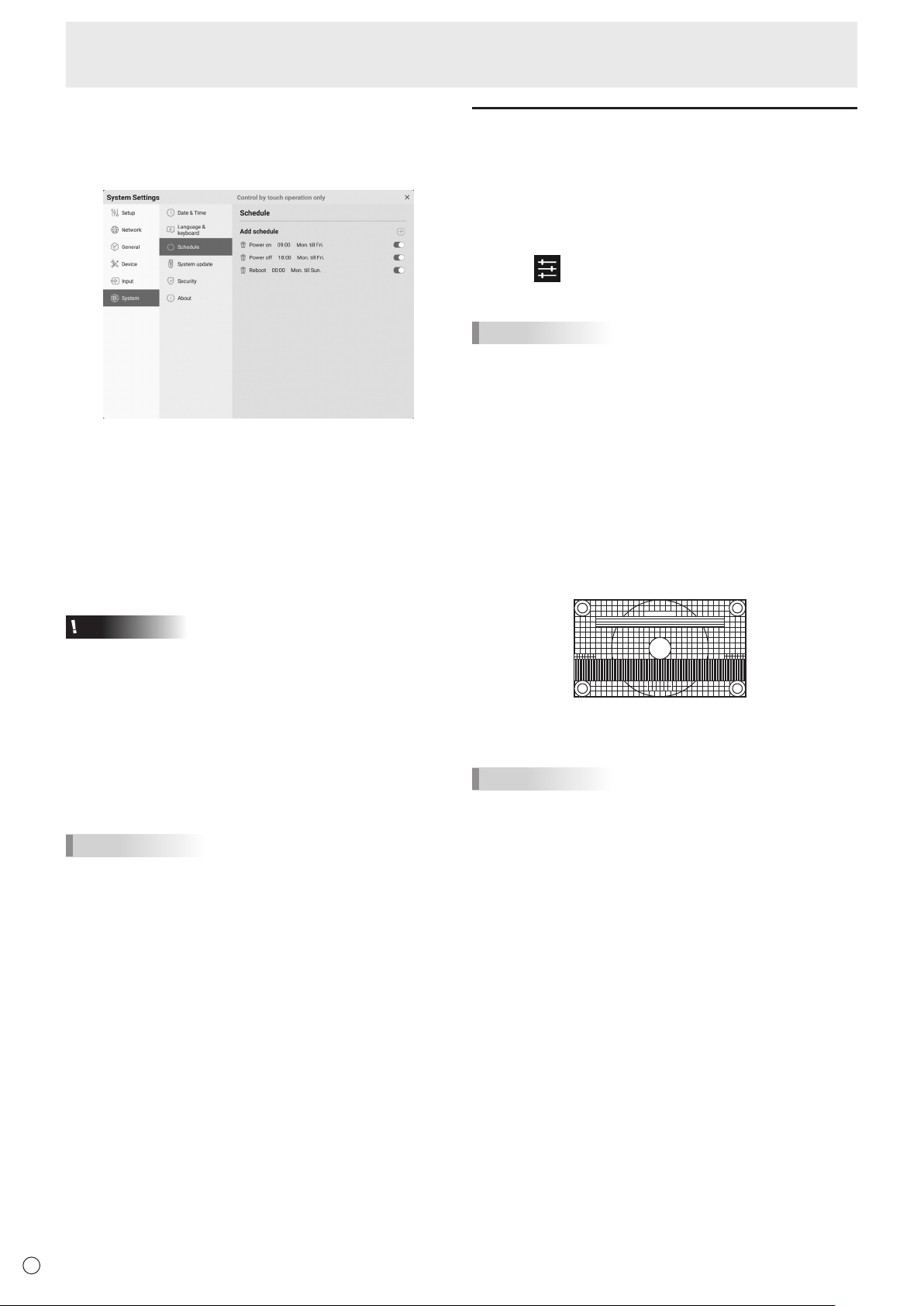
52
E
n
Schedule
You can set the time to switch the monitor on and off.
Set this function with “Power status” in the System menu. (See
page 51.)
1. Touch “+” for the “Add schedule”.
2. Select “Power on”, “Power off” or “Reboot”.
3. Set the time and day of implementation.
When “Reboot” is selected, set the time of implementation.
Restart will occur daily.
4. Touch “Save”.
The schedule is displayed as a list.
5. Turn on the schedule.
You can also turn off the schedule.
Caution
• Do not switch off the main power after setting the schedule.
• Specify the correct date and time. (See page 51.)
Schedule does not function unless the date and time are
specified.
• Check regularly that the set date and time are correct.
• In the power off schedule, a message is displayed on the
screen when it is time to turn off. If you select “Cancel”, you
can stop the power from turning off.
• Each schedule must be set at an interval of 6 minutes or
more.
TIPS
• Up to 15 “Schedule” items can be registered.
Adjustments for computer screen display
n
Automatic adjustment
When you use the “D-SUB” to display a computer screen for
the first time, or when you change the setting of the computer,
use the automatic screen adjustment.
1. Switch the input to “D-SUB” and display the
adjustment pattern. (See the description below.)
2.
Touch on the sidebar and touch “System Settings”.
3. Touch “Auto” on the Input menu.
TIPS
• If the screen cannot be adjusted properly with one
automatic adjustment, repeat the automatic adjustment two
or three times. Try manual adjustment if necessary.
n
Screen display for adjustment
Before making adjustments, display an image to brighten the
entire screen. If you are using a Windows computer, use the
adjustment pattern. Download the adjustment pattern by using
Information Display Downloader.
Opening the adjustment pattern
1. Double-click [Adj_uty.exe] downloaded.
The adjustment pattern will appear.
Adjust the screen automatically or manually.
2. When adjustment is finished, press the [Esc] on the
computer’s keyboard to quit the adjustment program.
TIPS
• If the display mode on the computer you are using is 65000
colors, the color levels in the color pattern may appear
differently or grayscale may appear to be colored. (This
is due to the specifications of the input signal and is not a
malfunction.)
Menu Items
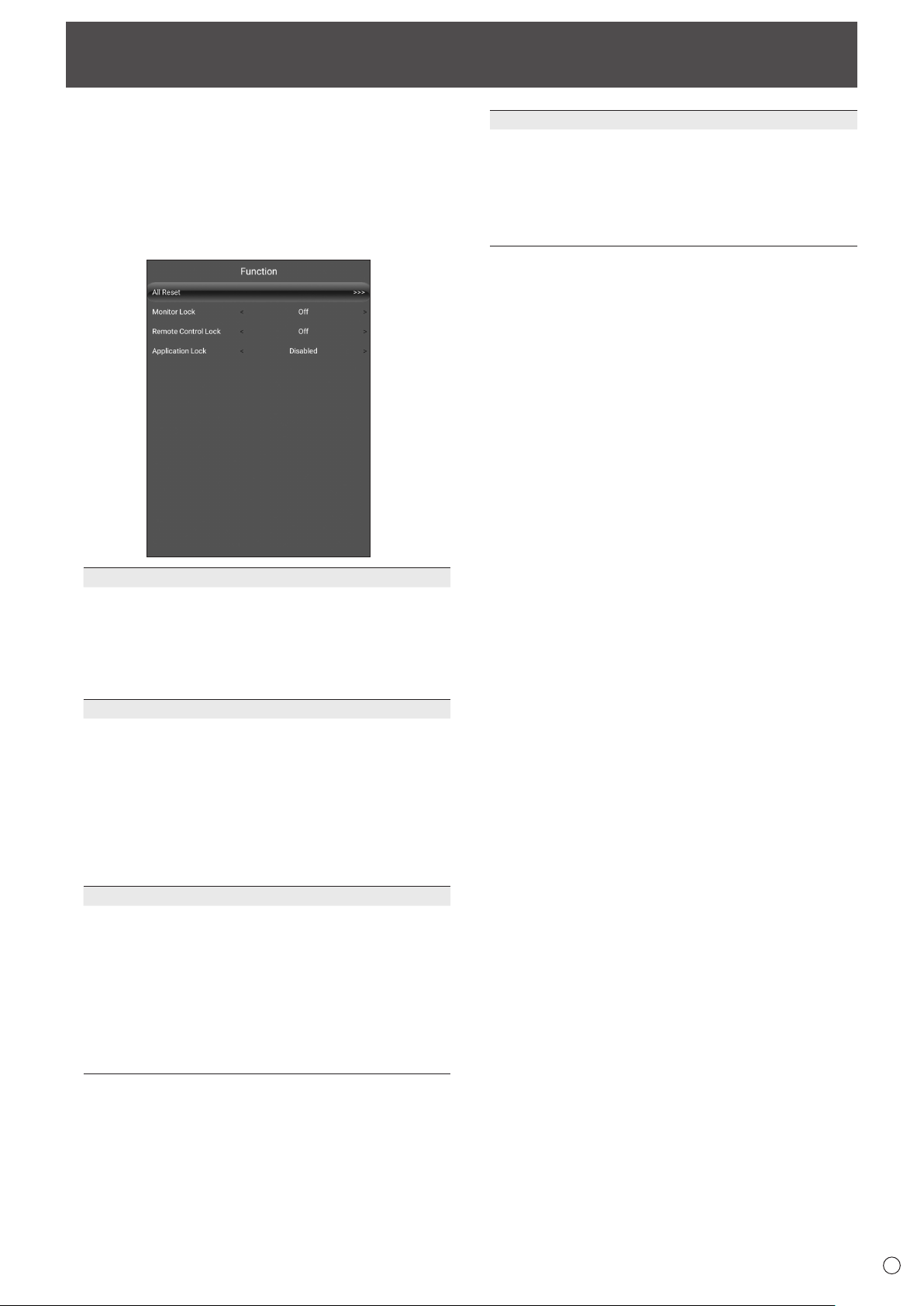
53
E
Reset/Functional Restriction Setting (Function menu)
You can reset the settings to the factory default settings or
restrict operations. When you use Function menu, a password
is required. (Factory setting) (See page 45.)
Perform the operation from the remote control unit.
1. Press the FUNCTION button, and then press the MENU
button within 10 seconds.
The Function menu appears.
All reset
Resets the settings to the factory default settings.
In APPLICATION mode, only the settings of the factory-
installed applications are initialized.
If you select “All reset”, a confirmation message is
displayed. Select “All Reset”.
This monitor restarts when initialization ends.
Monitor lock
You can disable operations on the monitor that use buttons.
Off:
Enables operation.
All buttons:
Locks monitor buttons operation.
Touch:
Locks touch operation.
All buttons & touch:
Locks monitor buttons and touch operation.
Remote control lock
You can disable operations on the remote control unit that
use buttons.
Off:
Enables operation.
All buttons:
Locks all button operations.
Except power & volume:
Locks operations other than power operation and
VOLUME +/-.
Application lock
Sets whether or not to lock the use of the following
application.
• Updater
• Computer control
• EShareServer
• Web Browser
Closing the Function menu
• Press the RETURN button on the remote control unit.

54
E
Troubleshooting
If you are experiencing any problem with your display, before
calling for service, please review the following troubleshooting
tips.
There is no picture or sound.
• The power LED is off.
- Is power supplied to this monitor?
- Is the power cord disconnected? (See page 14.)
- Is the main power switch off? (See page 17.)
• The power LED lights or flashes (2 seconds interval)
orange.
- This monitor is in standby state. Turn on the power. (See
page 17.)
• The power LED flashes orange (1 second interval).
- There is no input signal.
- Is an input mode selected that is appropriate for the input
terminal to which the cable is connected? (See page 23.)
- If any external equipment is connected, make sure the
equipment is operating (playing back).
Remote control does not work.
• Are the batteries inserted with polarity (+,-) aligned? (See
page 15.)
• Are the batteries exhausted?
• Point the remote control unit toward the monitor’s remote
control sensor. (See page 15.)
• Is operation disabled? (See page 53.)
The remote control unit’s buttons for operating the
HDMI-connected device do not work.
• When the input mode is APPLICATION, these buttons
operate the application in APPLICATION mode.
• Is “HDMI CEC link” set to on of “CEC settings” on the Input
menu?
• Switch to a different input mode, and then try switching the
input mode back to “HDMI”.
Sound from left and right speakers is reversed.
Sound is heard from only one side.
• Are audio cables connected properly?
• Check the setting of “Balance” of "Audio" on the General
menu. (See page 48.)
There is a picture but no sound.
• Is the sound muted?
• Make sure the volume is not set to minimum.
• Are audio cables connected properly?
• Is the setting of “Audio output” of “Audio” on the General
menu correct?
Unstable video.
• The signal may be incompatible.
•
Try the automatic screen adjustment when “D-SUB” is in use.
The video from the HDMI input terminal does not appear
properly.
• Does the HDMI cable support 4K, and is it HDMI standard
compliant? The monitor will not work with cables that are
not standard compliant.
• Is the input signal compatible with this monitor? (See pages
58 and 59.)
• If the connected device does not support 4K, set “HDMI
modes” to “Mode2”.
The video from the DisplayPort does not appear properly.
• Does the DisplayPort cable support 4K, and is it
DisplayPort standard compliant? The monitor will not work
with cables that are not standard compliant.
• Is the input signal compatible with this monitor? (See pages
58 and 59.)
The video from D-Sub input terminal does not appear
correctly.
• Is the input signal compatible with this monitor? (See page
58.)
The video from the USB Type-C does not appear properly.
• Is the input signal compatible with this monitor? (See pages
58 and 59.)
Control buttons do not work.
There is no picture.
• Load noises from outside may be interfering with normal
operation. Turn off the main power and turn it on after
waiting at least 5 seconds, and then check the operation.
The input mode changes automatically.
• When “Connect auto input select” is set to on, the input
mode automatically changes to that terminal when a video
signal is input into the input terminal.
For this reason, the input mode may change when the
computer wakes up from system standby.
The touch panel does not respond.
• Is the USB cable connected properly?
• Have you disabled touch control? (See pages 24 and 53.)

55
E
Troubleshooting
The response of the touch panel is slow.
Some parts of the screen do not respond.
A different place is touched.
• Is the screen exposed to direct sunlight or other strong
light? The touch panel uses infrared rays and thus may not
operate correctly.
• Is there an obstacle between the infrared transmitter/
receiver and the touch pen or your finger? An obstacle will
prevent correct operation. If your fingers or a sleeve are too
close to the screen, correct operation will not be possible.
• Is the infrared transmitter/receiver dirty? Gently wipe off
any dirt with a soft cloth.
• If the touch panel is touched with a small tip less than
about 1/8 inch (3 mm) x 1/8 inch (3 mm), the touch may not
be detected by infrared and correct operation will not take
place.
• Do not touch the touch panel when turning on the monitor.
If you touch the touch panel, this may be detected as an
element failure in the infrared transmitter/receiver and
incorrect operation will result.
• Set the screen size to “Wide”. (See page 28.)
The screen is dark.
• When the internal temperature of the monitor rises
excessively, the brightness of the backlight automatically
decreases in order to prevent a further temperature rise.
• Remove the cause of the excessive temperature rise.
The monitor makes a cracking sound.
• You may occasionally hear a cracking sound from the
monitor. This happens when the cabinet slightly expands
and contracts according to change in temperature. This
does not affect the monitor’s performance.
Power LED is flashing in orange and blue alternately.
• When the internal temperature of the monitor rises
excessively, the brightness of the backlight decreases
automatically in order to prevent high-temperature-related
problems. When this occurs, the Power LED flashes
orange and blue alternately.
• If the internal temperature rises further, the monitor
automatically enters standby state. (The Power LED
flashes orange and blue alternately.)
• Remove the cause of the excessive temperature rise.
- If the monitor enters standby state due to a rise in
temperature, to return to normal display, turn the
power switch off and then back on again. The monitor,
however, will enter standby state again if the cause of the
temperature rise is not eliminated.
- Check whether the monitor is placed at a location where
a quick rise in temperature is likely. Internal temperature
rises quickly if the vents on the monitor are blocked.
- Internal temperature rises quickly if dust accumulates
inside the monitor or around the vents. Remove dust if
possible. Ask SHARP dealer about removing internal dust.
No sound is heard from the speaker.
Mic cannot be used.
Web camera cannot be used.
• Check if another device is connected via the USB or
Bluetooth.
• If more than one equivalent devices are connected, they
will be used in the following order:
Bluetooth > USB > Internal (speaker only)
• Remove unnecessary devices.
• The mic of the Bluetooth headset cannot be used. This
monitor does not support HSP/HFP.
• Is another application using the device?
The device may not work at the same time in multiple
applications. In this case, close the application.
• Do not switch the input mode while using the device.
The connection will change according to the input
mode switching, so speaker, mic or camera may not be
recognized correctly and may not operate.
In this case, turn this monitor or device power off and then
on.
The Bluetooth device cannot be connected.
The connection with the Bluetooth device is lost.
• Connect the USB extension cable (commercially available)
to the USB port for APPLICATION mode, and connect the
wireless adapter (supplied) to the USB extension cable
(commercially available). Place the wireless adapter
(supplied) where it can be seen from the front of this
monitor.
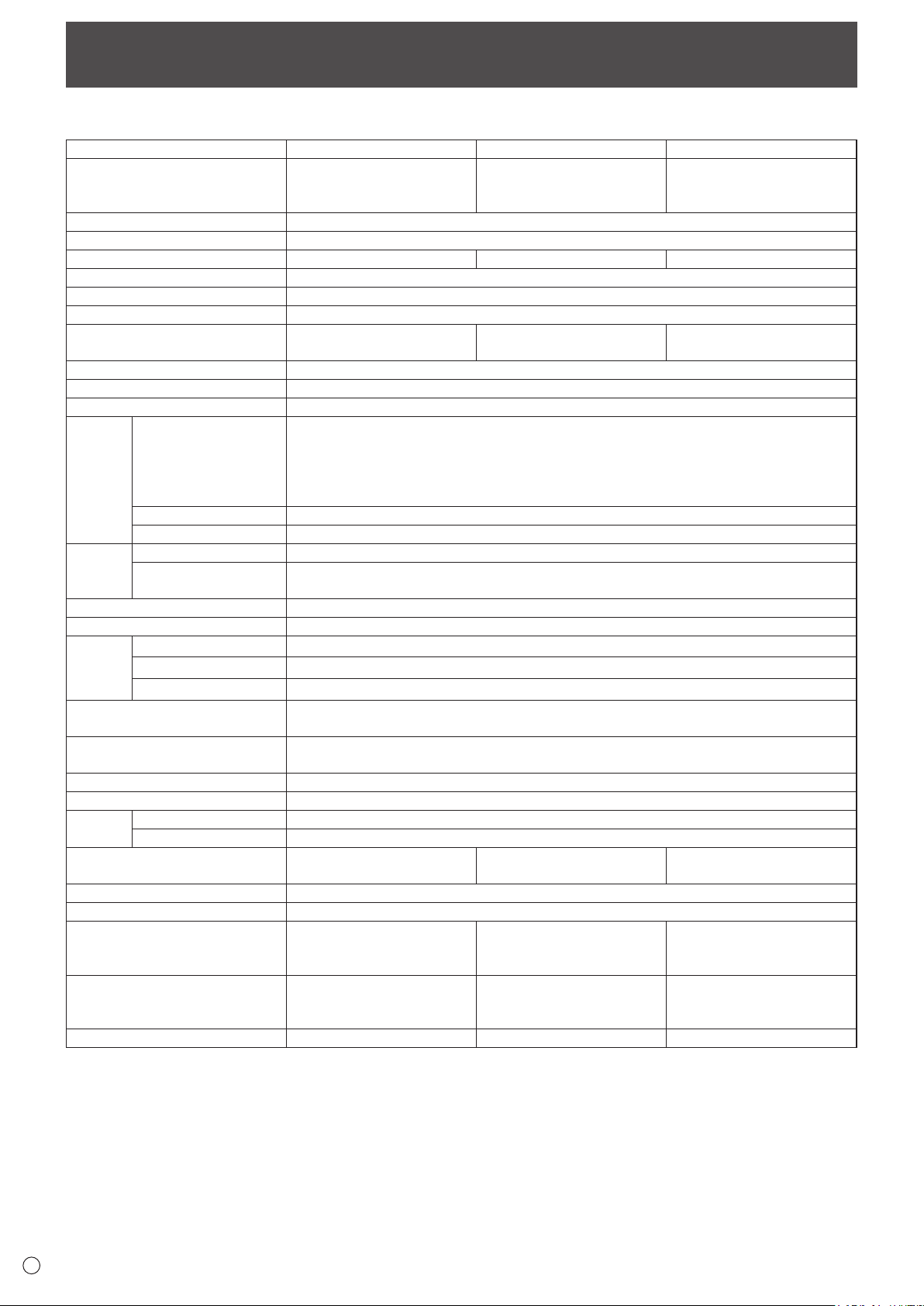
56
E
Specifications
n
Product Specifications
Model
PN-LC862 PN-LC752
PN-LC652
LCD component
86" Class [85-9/16 inch
(217.4 cm) diagonal] TFT
LCD
75" Class [74-1/2 inch
(189.3 cm) diagonal] TFT
LCD
65" Class [64-1/2 inch
(163.9 cm) diagonal] TFT
LCD
Max. resolution (pixels)
3840 x 2160
Max. colors
Approx. 1.07 billion colors
Pixel pitch
0.494 mm (H) × 0.494 mm (V) 0.430 mm (H) × 0.430 mm (V) 0.372 mm (H) × 0.372 mm (V)
Brightness (typical) 450 cd/m
2
*
1
Contrast ratio (typical) 1200: 1
Viewing angle
178° right/left/up/down (contrast ratio ≥ 10)
Screen active area inch (mm)
74-5/8 (W) x 41-15/16 (H)
(1895.0 x 1066.0)
64-15/16 (W) x 36-9/16 (H)
(1649.7 x 927.9)
56-1/4 (W) x 31-5/8 (H)
(1428.5 x 803.5)
Computer input signal
Analog RGB (0.7 Vp-p) [75 Ω]
Sync signal
Horizontal/vertical separate (TTL: positive/negative)
Plug and play
VESA DDC2B
Input
terminals
Video Mini D-sub 15 pin, 3 rows x 1
Mini AV in x 1
HDMI x 3
DisplayPort x 1
USB Type-C x 1
Serial (RS-232C)
D-sub 9 pin x 1
Audio
3.5 mm mini stereo jack x 1
Output
terminals
Video HDMI x 1
Audio
3.5 mm mini stereo jack x 1
Digital audio output (optical) x 1
USB port USB 3.0 compliant x 4
LAN terminal 10 BASE-T/100 BASE-TX/1000 BASE-T
System CPU Arm Cortex-A55 processor (Quad-Core)
Memory 4GB
Storage 16GB
Wireless LAN IEEE802.11ac/n/a/g/b compliant
Encryption mode: Enhanced Open, WEP, WPA, WPA2
Bluetooth 4.2 compliant
Supported protocols: A2DP, AVRCP, GATT, HID
Expansion slot 19V, 4.74A (power supplied when expanding the functions with an optional part)
Speaker output 15 W + 15 W
Touch
Panel
Detection method Infrared blocking detection method
Computer connector USB (3.0 compliant) (Type B) x 2
Power requirement AC 100 - 240 V, 5.6 A,
50/60 Hz
AC 100 - 240 V
, 4.7 A,
50/60 Hz
AC 100 - 240 V, 4.4
A,
50/60 Hz
Operating temperature
*
2
*
3
41°F to 95°F (5°C to 35°C)
Operating humidity
*
3
20% to 80% (no condensation)
Power consumption*
4
(Max / networked standby mode
*
5
/
standby mode
*
5
/ off mode)
260 W
(500 W/2 W/0.5 W/0 W)
200 W
(420 W/2 W/0.5 W/0 W)
180 W
(390 W/2 W/0.5 W/0 W)
Dimensions inch (mm)
(excluding protrusions)
Approx. 77-1/2 (W) x 3-7/16
(D) x 46-1/16 (H) (1967.9 x
87.1 x 1170.2)
Approx. 67-13/16 (W) x
3-7/16 (D) x 40-5/8 (H)
(1722.5 × 87.1 × 1032.1)
Approx. 59-1/2 (W) x 3-3/8
(D) x 36-1/8 (H) (1511.6 ×
85.9 × 917.9)
Weight lbs. (kg)
Approx. 143.3 (65) Approx. 112.4 (51) Approx. 84.9 (38.5)
*1 Brightness will depend on input mode and other picture settings. Brightness level will decrease over time. Due to the nature of the
equipment, it is not possible to precisely maintain a constant level of brightness. This is the brightness of the LCD panel, not the
brightness of the product.
*2 Temperature condition may change when using the monitor together with the optional equipments recommended by SHARP. In such
cases, please check the temperature condition specified by the optional equipments.
*3 In addition, check the requirements of the computer and other devices to be connected, and make sure that all requirements are satisfied.
*4 Factory setting. (When no optional part is attached.)
*5 When no optional part is attached.
As a part of our policy of continuous improvement, SHARP reserves the right to make design and specification changes for product improvement
without prior notice. The performance specification figures indicated are nominal values of production units. There may be some deviations from
these values in individual units.
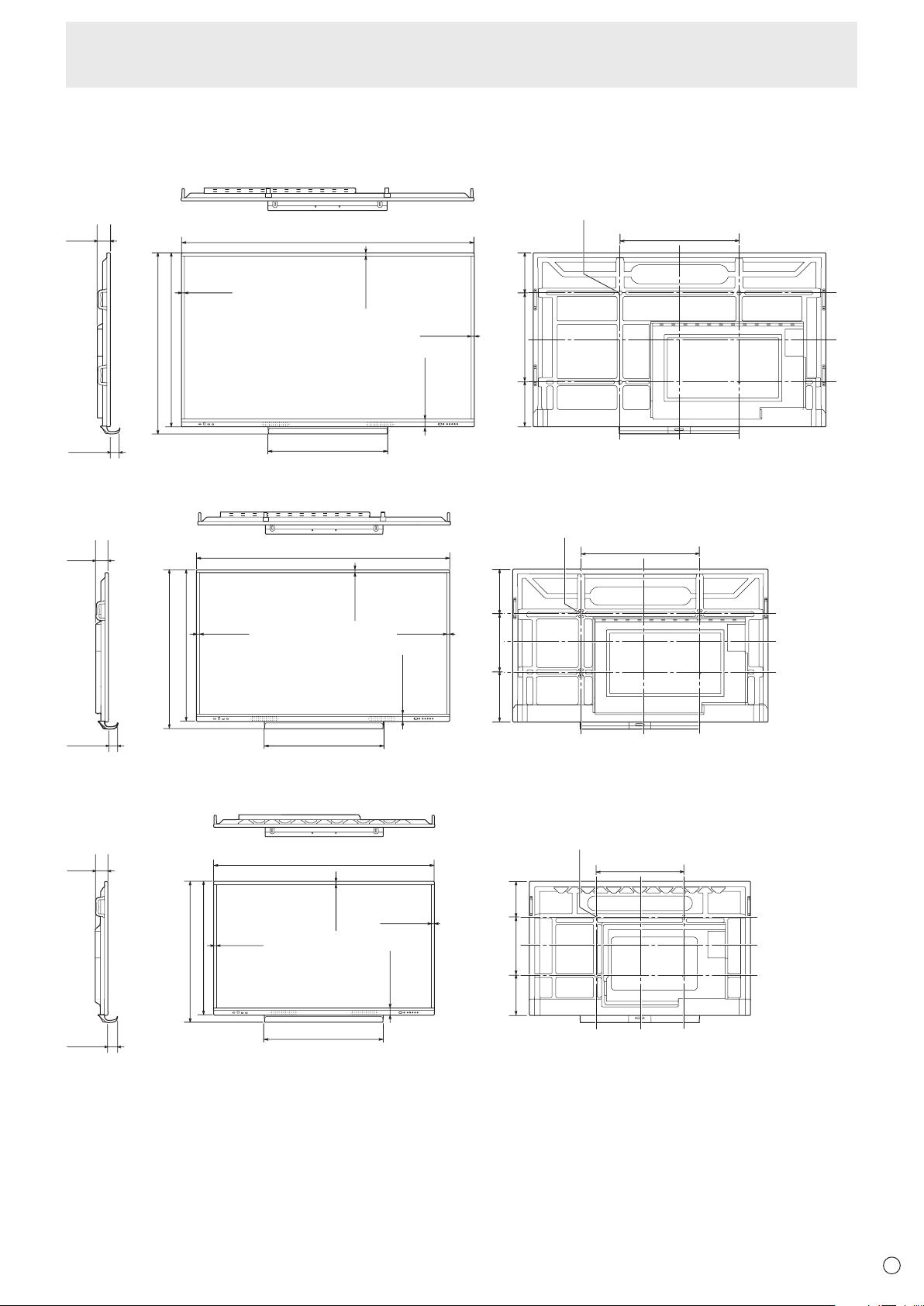
57
E
Specifications
n
Dimensional Drawings
Note that the values shown are approximate values.
Unit: inch [mm]
Screw holes for mounting brackets*
46-1/16 [1170.2]
47-15/16 [1217.7]
77-1/2 [1967.9]
31-3/4 [806]
2-1/8 [53.2]
7/8 [21.9]
7/8 [21.9]
7/8 [21.9]
31-1/2 [800]
10-5/8
[269.4]
23-5/8 [600]
11-13/16
[300.8]
3-7/16
[87.1]
2-9/16
[64.5]
[PN-LC862]
3-7/16
[87.1]
40-5/8 [1032.1]
42-1/2 [1079.7]
67-13/16 [1722.5]
31-3/4 [806]
[PN-LC752]
2-1/8 [53.2]
7/8 [21.9]
7/8 [21.9]
7/8 [21.9]
15-3/4 [400]
11-13/16
[300.4]
13-1/16
[331.7]
31-1/2 [800]
2-1/2
[63.4]
Screw holes for mounting brackets*
Unit: inch [mm]
Unit: inch [mm]
36-1/8 [917.9]
38 [965.6]
59-1/2 [1511.6]
31-3/4 [806]
[PN-LC652]
2-1/8 [53.2]
7/8 [21.9]
7/8 [21.9]
7/8 [21.9]
15-3/4 [400]
23-5/8 [600]
Screw holes for mounting brackets*
9-9/16
[243.3]
10-13/16
[274.6]
3-3/8
[85.9]
2-9/16
[64.5]
* When mounting the monitor, be sure to use a wall-mount bracket that complies with the VESA-compatible mounting method.
SHARP recommends using M8 screws and tighten the screws.
Note that screw hole depth of the monitor is 9/16 inch (15 mm). Loose mounting may cause the product to fall, resulting in
serious personal injuries as well as damage to the product. The screw and hole should come together with over 3/8 inch (10 mm)
length of thread. Use a bracket which has been approved for UL1678 standard, and which can endure at least 4 times or more
the weight of the monitor.
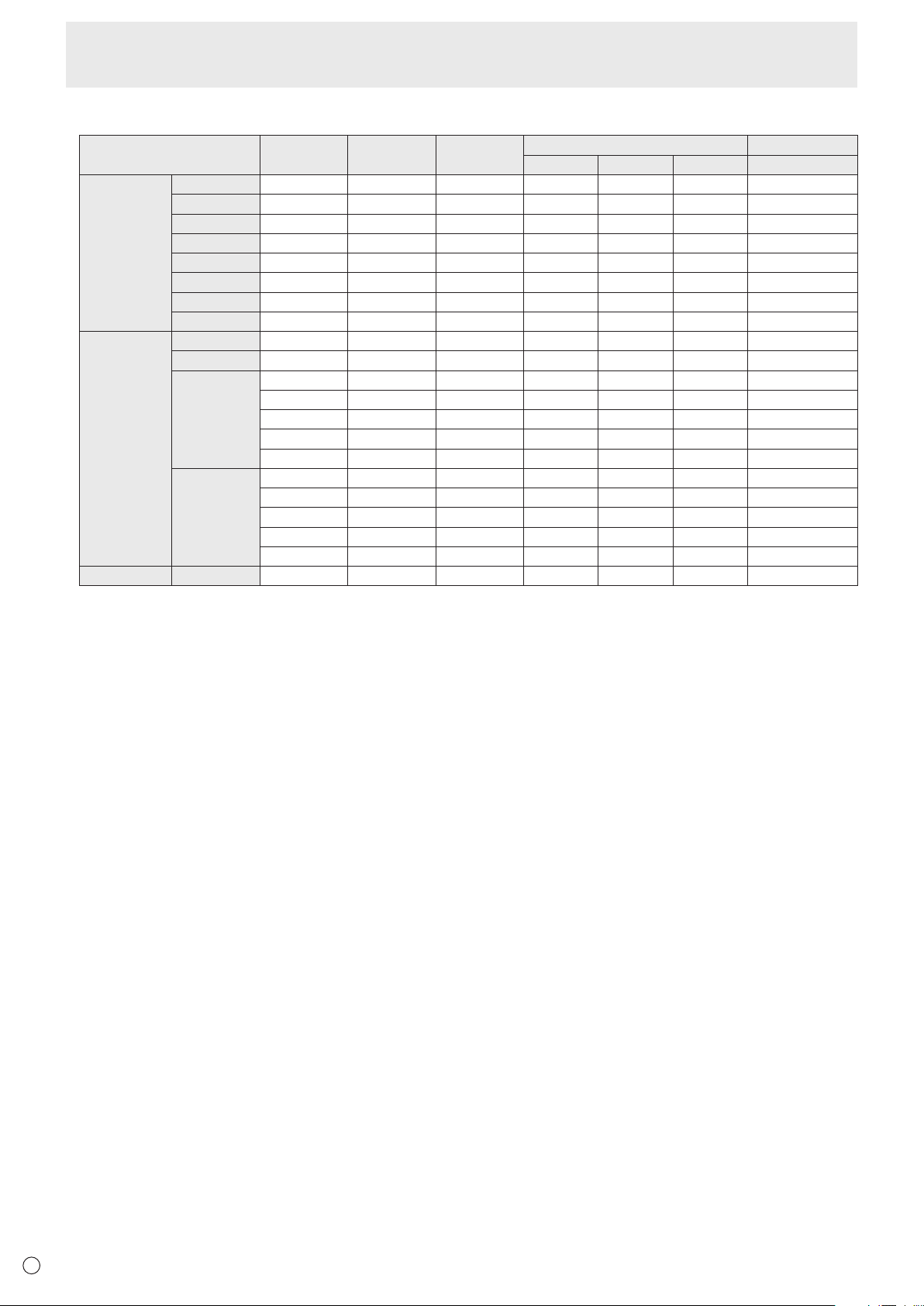
58
E
n
Compatible signal timing (PC)
Screen resolution Hsync Vsync
Frequency
Digital Analog
HDMI DisplayPort USB-C D-SUB
VESA 640 × 480 31.5kHz 60Hz 25.175MHz Yes Yes Yes Yes
800 × 600 37.9kHz 60Hz 40MHz Yes Yes Yes Yes
1024 × 768 48.4kHz 60Hz 65MHz Yes Yes Yes Yes
1280 × 960 60kHz 60Hz 108MHz Yes Yes Yes Yes
1280 × 1024 64kHz 60Hz 108MHz Yes Yes Yes Yes
1360 × 768 47.7kHz 60Hz 85.5MHz Yes Yes Yes Yes
1440 × 900 55.9kHz 60Hz 106.5MHz Yes Yes Yes Yes
1680 × 1050 65.3kHz 60Hz 146.25MHz Yes Yes Yes Ye s
Wide 1280 × 720 44.7kHz 60Hz 74.4MHz Yes Yes Yes Yes
1920 × 1080 67.5kHz 60Hz 148.5MHz Yes Yes Yes Ye s
3840 × 2160 54kHz 24Hz 297MHz Yes Yes Yes -
56.25kHz 25Hz 297MHz Yes Yes Yes -
67.5kHz 30Hz 297MHz Yes Yes Yes -
112.5kHz 50Hz 594MHz Yes Yes Yes -
135kHz 60Hz 594MHz Yes Yes Yes -
4096 × 2160 54kHz 24Hz 297MHz Yes Yes Yes -
56kHz 25Hz 297MHz Yes Yes Yes -
67kHz 30Hz 297MHz Yes Yes Yes -
112.5kHz 50Hz 594MHz Yes Yes Yes -
135kHz 60Hz 594MHz Yes Yes Yes -
US TEXT 720 × 400 31.5kHz 70Hz 28.3MHz Yes Yes Yes Yes
• Depending on the connected computer, images may not be displayed properly even if the compatible signal described above is input.
Specifications
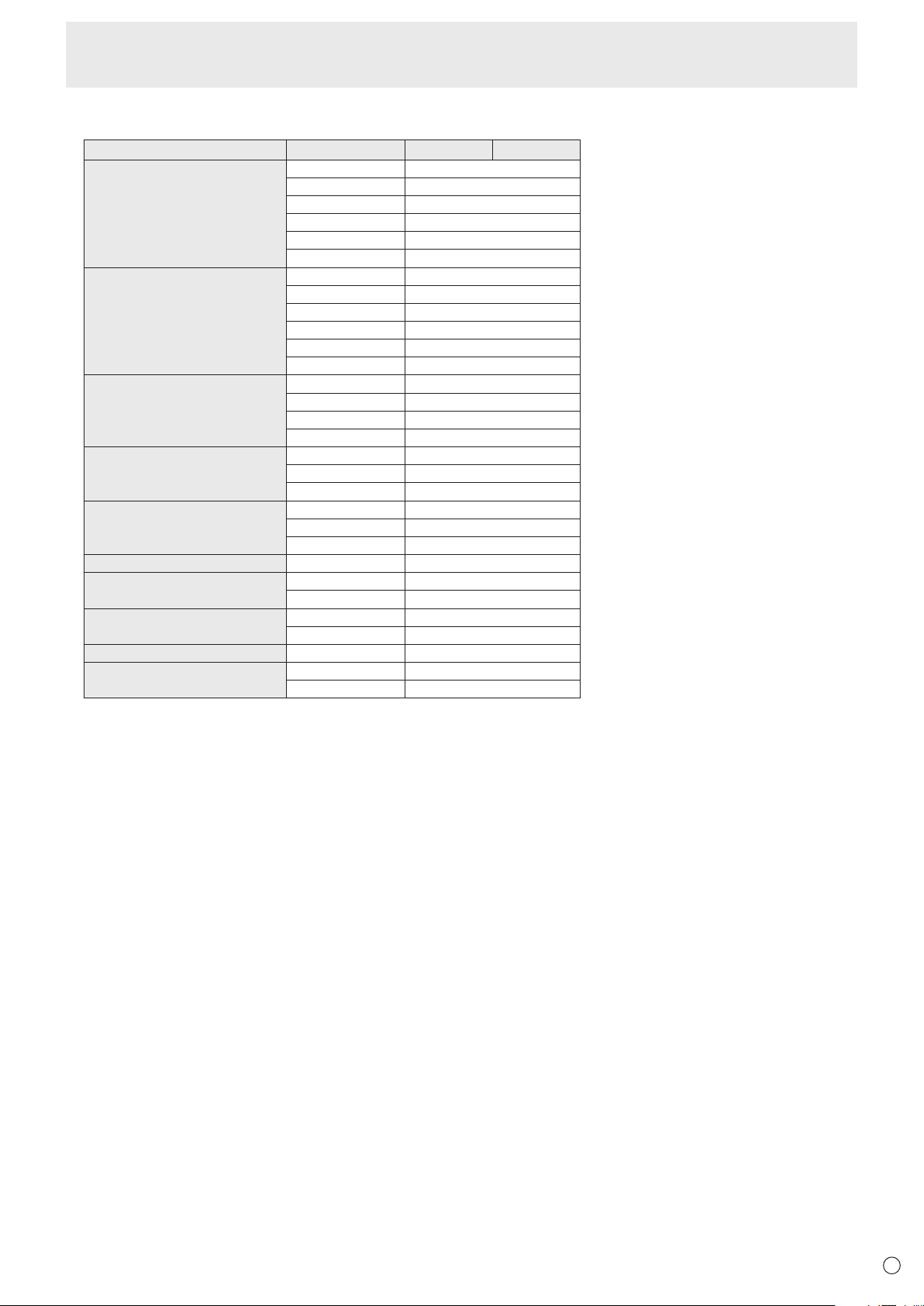
59
E
n
Compatible signal timing (AV)
Screen resolution Frequency HDMI USB-C
4096 × 2160p 24Hz Yes
25Hz Yes
30Hz Yes
50Hz Yes
59.94Hz Yes
60Hz Yes
3840 × 2160p 24Hz Yes
25Hz Yes
30Hz Yes
50Hz Yes
59.94Hz Yes
60Hz Yes
1920 × 1080p 24Hz Yes
50Hz Yes
59.94Hz Yes
60Hz Yes
1920 × 1080i 50Hz Yes
59.94Hz Yes
60Hz Yes
1280 × 720p 50Hz Yes
59.94Hz Yes
60Hz Yes
720 × 576p 50Hz Yes
720 × 480p 59.94Hz Yes
60Hz Yes
640 × 480p(VGA) 59.94Hz Yes
60Hz Yes
720(1440) × 576i 50Hz Yes
720(1440) × 480i 59.94Hz Yes
60Hz Yes
n
DDC (plug and play)
The monitor supports the VESA DDC (Display Data Channel) standard.
DDC is a signal standard for plug and play between monitors and computers. Information about resolution and other parameters
is exchanged between the two. This function can be used if the computer supports DDC and it has been configured to detect
plug-and-play monitors.
There are several types of DDC, depending on the communication method used. This monitor supports DDC2B.
Specifications
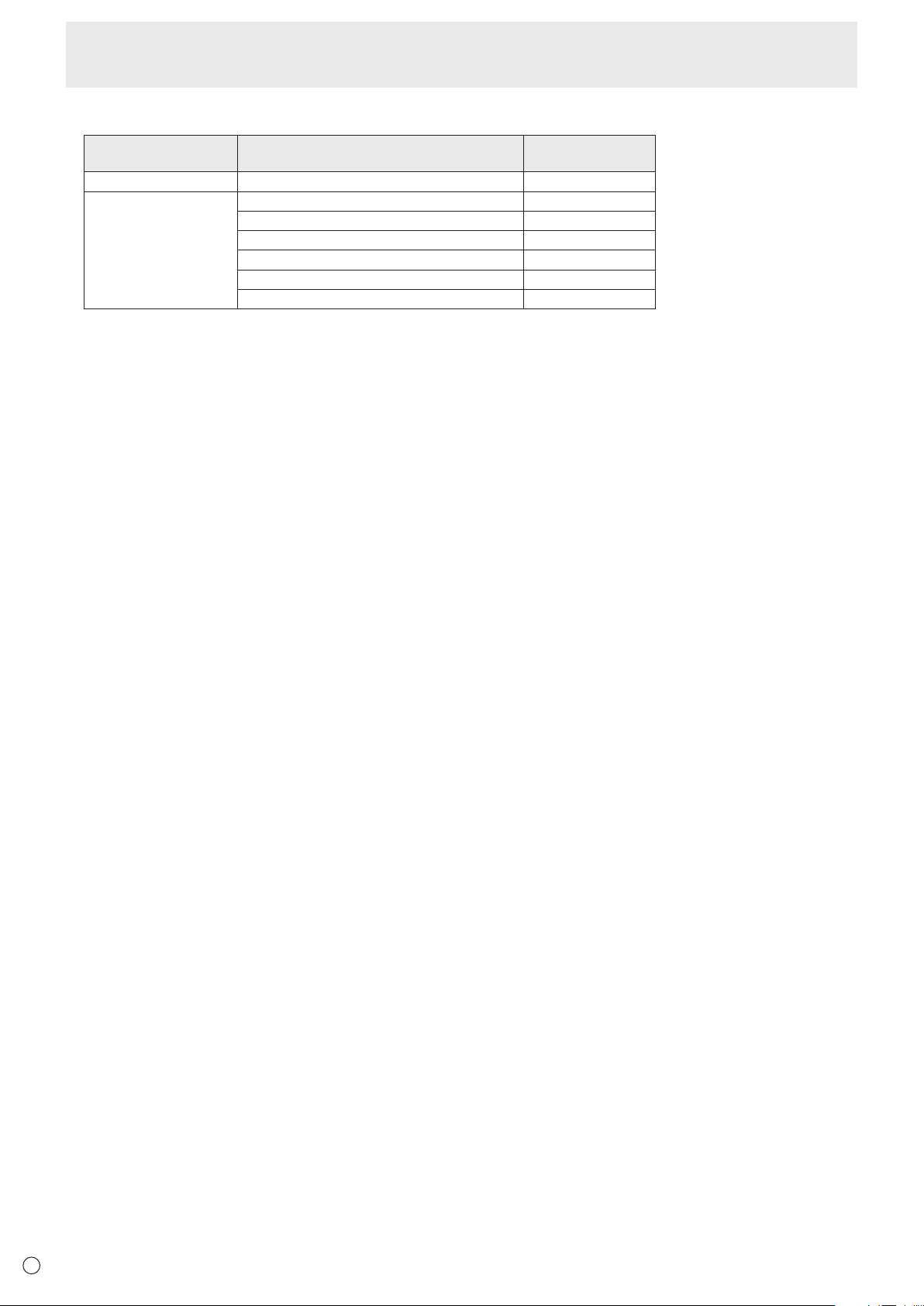
60
E
n
Channels that can be used in wireless LAN
Standard Channel
Frequency band
(center frequency)
IEEE802.11n/g/b 1-11ch 2412-2462MHz
IEEE802.11ac/n/a 36/40/44/48ch 5180-5240MHz
52/56/60/64ch 5260-5320MHz
100/104/108/112/116ch 5500-5580MHz
132/136/140ch 5660-5700MHz
149/153/157/161ch 5745-5805MHz
165ch 5825MHz
This device is restricted to indoor use due to its operation in the 5.15 GHz to 5.25 GHz frequency range. FCC requires this product to be used
indoors for frequency range 5.15 GHz to 5.25 GHz to reduce the potential for harmful interference to co-channel Mobile Satellite systems.
High power radars are allocated as primary users of the 5.25 GHz to 5.35 GHz and 5.65 GHz to 5.85 GHz bands. These radar stations can
cause interference with and/or damage this device.
Specifications

61
E
n
Information on the software license for this product
Software composition
The software included in this product is comprised of various software components whose individual copyrights are held by
SHARP or by third parties.
Software developed by SHARP and open source software
The copyrights for the software components and various relevant documents included with this product that were developed or
written by SHARP are owned by SHARP and are protected by the Copyright Act, international treaties, and other relevant laws.
This product also makes use of freely distributed software and software components whose copyrights are held by third parties.
These include software components covered by a GNU General Public License (hereafter GPL), a GNU Lesser General Public
License (hereafter LGPL) or other license agreement.
Obtaining source code
Some of the open source software licensors require the distributor to provide the source code with the executable software
components. GPL and LGPL include similar requirements. For information on obtaining the source code for the open source
software and for obtaining the GPL, LGPL, and other license agreement information, visit the following website:
https://jp.sharp/business/lcd-display/support/download/source_e.html
We are unable to answer any questions about the source code for the open source software. The source code for the software
components whose copyrights are held by SHARP is not distributed.
About the MPEG-4 AVC, MPEG-4 Visual license included in this product
1. MPEG AVC
THIS PRODUCT IS LICENSED UNDER THE AVC PATENT PORTFOLIO LICENSE FOR THE PERSONAL USE OF
A CONSUMER OR OTHER USES IN WHICH IT DOES NOT RECEIVE REMUNERATION TO (i) ENCODE VIDEO IN
COMPLIANCE WITH THE AVC STANDARD (“AVC VIDEO”) AND/OR (ii) DECODE AVC VIDEO THAT WAS ENCODED BY
A CONSUMER ENGAGED IN A PERSONAL ACTIVITY AND/OR WAS OBTAINED FROM A VIDEO PROVIDER LICENSED
TO PROVIDE AVC VIDEO. NO LICENSE IS GRANTED OR SHALL BE IMPLIED FOR ANY OTHER USE. ADDITIONAL
INFORMATION MAY BE OBTAINED FROM MPEG LA, L.L.C. SEE HTTP://WWW.MPEGLA.COM
2. MPEG-4 Visual
THIS PRODUCT IS LICENSED UNDER THE MPEG-4 VISUAL PATENT PORTFOLIO LICENSE FOR THE PERSONAL AND
NON-COMMERCIAL USE OF A CONSUMER FOR (i) ENCODING VIDEO IN COMPLIANCE WITH THE MPEG-4 VISUAL
STANDARD (“MPEG-4 VIDEO”) AND/OR (ii) DECODING MPEG-4 VIDEO THAT WAS ENCODED BY A CONSUMER
ENGAGED IN A PERSONAL AND NONCOMMERCIAL ACTIVITY AND/OR WAS OBTAINED FROM A VIDEO PROVIDER
LICENSED BY MPEG LA TO PROVIDE MPEG-4 VIDEO. NO LICENSE IS GRANTED OR SHALL BE IMPLIED FOR
ANY OTHER USE. ADDITIONAL INFORMATION INCLUDING THAT RELATING TO PROMOTIONAL, INTERNAL AND
COMMERCIAL USES AND LICENSING MAY BE OBTAINED FROM MPEG LA, LLC. SEE HTTP://WWW.MPEGLA.COM.
Intellectual Property Rights and Other Matters
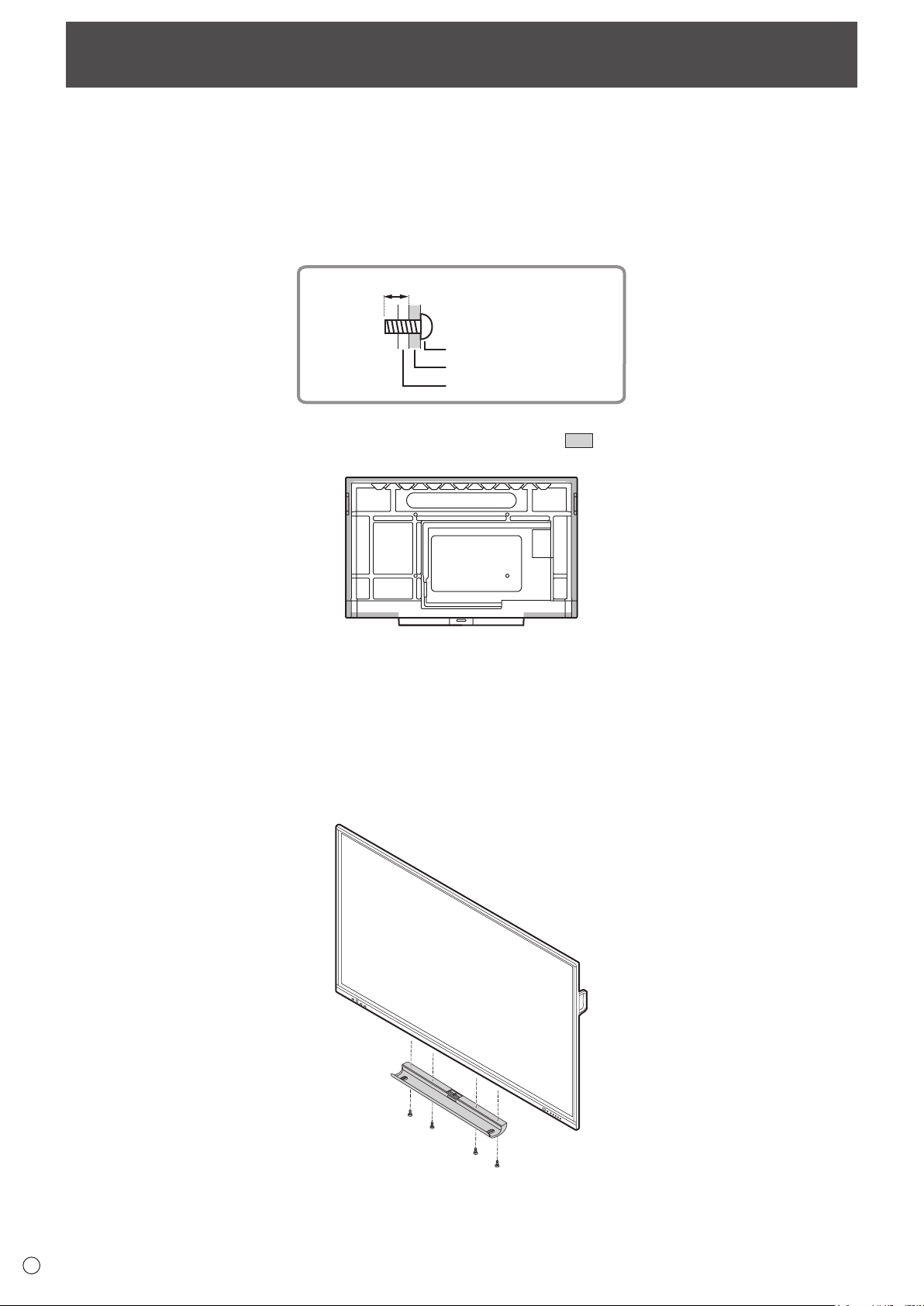
62
E
• When installing, removing or moving the monitor, ensure that this is carried out by at least 4 people. (PN-LC652: at least 2
people.)
• Be sure to use a wall-mount bracket designed or designated for mounting the monitor.
• This monitor is designed to be installed on a concrete wall or pillar. Reinforced work might be necessary for some materials
such as plaster / thin plastic board / wood before starting installation.
• This monitor and bracket must be installed on a wall which can endure at least 4 times or more the weight of the monitor.
Install by the most suitable method for the material and the structure.
• To attach a VESA-compliant mounting bracket, use M8 screws that are 3/8 inch (10 mm) to 9/16 inch (15 mm) longer than the
thickness of the mounting bracket.
Screws (M8)
Mounting bracket
Monitor mounting
3/8 - 9/16 inch (10-15 mm)
• Do not use an impact driver.
• When moving the monitor, be sure to hold the handles or the parts marked by
below. Do not grasp the screen or tray.
This may cause product damage, failure, or injury.
• If you need to temporarily place the monitor on a table or other surface during installation, spread a thick soft cloth on the
table to prevent damage to the screen and table.
• Prior to repacking or removal, remove the tray.
• After mounting, please carefully ensure the monitor is secure, and not able to come loose from the wall or mount.
• Do not use any screw holes other than those for mounting brackets, located on the rear of the monitor, for installation.
n
Attaching the Tray
Secure the tray using 4 tray mounting screws (M3x8) (supplied).
Mounting Precautions
(For SHARP dealers and service engineers)

PN-LC862-LC752-LC652 Mu EN23D(1)