USER/INSTALLATION GUIDE
NZ AU
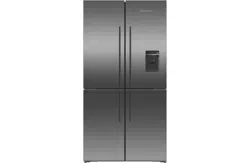
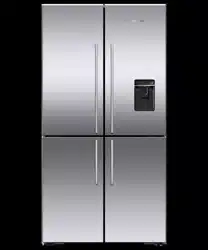
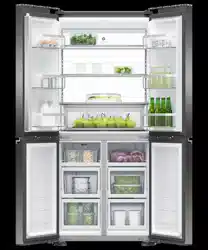
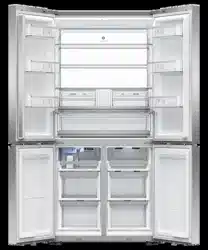
FREESTANDING QUAD DOOR
REFRIGERATOR FREEZER
CONTEMPORARY
RF70QZUVB1, RF70QNUVX1 & RF70QNUVB1 models


3
CONTENTS
Registration
To register your product visit our website: fisherpaykel.com/register
Safety and warnings 5
Before you begin 9
Using the control panel 10
Using your appliance 11
Wi-Fi connection 22
Care and cleaning 23
Foodcare 33
Moving or storing your appliance 34
ActiveSmart™ sounds 35
Troubleshooting 36
Manufacturer’s Warranty and Service guide 41
Installation guide

5
WARNING!
Electric Shock Hazard
Failure to follow this advise may result in
death, electric shock, fire or injury to persons.
• Read and follow the safety and warnings
outlined in this user guide before operating
this appliance.
WARNING!
Risk of fire/flammable material
This refrigerator contains flammable refrigerant
isobutane (R600a).
READ AND SAVE THIS GUIDE
Use this appliance only for the intended purpose as described in this user guide.
When using this appliance always exercise basic safety precautions
including the following:
General
z
This product has been designed for use in a normal domestic (residential) environment.
z
This appliance can be used by children aged 8years and above and persons with
reduced physical, sensory or mental capabilities or lack of experience and knowledge
if they have been given supervision or instruction concerning use of the appliance in a
safe way and understand the hazards involved.
z
Children aged 3 to 8 years may load and unload this appliance under supervision.
z
Children should be supervised to ensure that they do not play with the appliance.
z
Cleaning and user maintenance shall not be made by children without supervision.
z
Do not use mechanical devices or other means to accelerate the defrosting process,
other than those recommended by the manufacturer.
z
Do not damage the refrigerant circuit.
z
In case of damage to the refrigerant circuit, ventilate the area by opening all windows.
Do not operate electrical equipment or any other equipment that may produce arcs,
sparks or flames in the area. Contact your Fisher&Paykel trained and supported
service technician immediately to arrange for the appliance to be repaired.
z
It is hazardous for anyone other than an Authorised Service Person to service this
appliance. In Queensland – the authorized Service Person MUST hold a Gas Work
Authorisation for hydrocarbon refrigerants, to carry out Servicing or repairs which
involve the removal of covers
z
Opening the door for long periods can cause a significant increase of the temperature
in the compartments of the appliance.
z
This refrigerating appliance is intended to be used at ambient temperatures ranging
from 16°C to 43°C. The product performance may be compromised when operating
outside of this temperature range.
SAFETY AND WARNINGS

6
Electrical
z
This appliance must be installed in accordance with the installation instructions
before use.
z
To allow disconnection of the appliance from the supply after installation, incorporate a
switch in the fixed wiring in accordance with the wiring rules.
z
Never unplug your refrigerator by pulling on the power cord. Always grip the plug
firmly and pull straight out from the outlet.
z
Do not plug in any other appliance at the same power point as your refrigerator or use
extension cords or double adapters.
z
Repair or replace immediately all electric service cords that have become frayed or
otherwise damaged. Do not use a cord that shows cracks or abrasion along its length or
at either the plug or appliance end.
z
If the power supply cord is damaged, it must only be replaced by your Fisher&Paykel
trained and supported service technician because special purpose tools are required.
z
When moving your appliance away from the wall, be careful not to roll over or damage
the power cord.
z
Do not use electrical appliances inside the food storage compartments of the appliance,
unless they are of the type recommended by the manufacturer.
z
When positioning the appliance, ensure the power cord is not trapped or damaged.
z
Do not locate multiple portable socket-outlets or portable power supplies at the rear of
the appliance.
Servicing
z
The LED light cannot be serviced by the user. Contact your Fisher & Paykel trained and
supported service technican.
z
Your refrigerator is designed to operate for many years without the need for service
checks. However, if your refrigerator is malfunctioning, have it attended to by your
Fisher&Paykel trained and supported service technician as soon as possible. All
electrical repairs must be carried out by an adequately trained service technician or
qualified electrician.
z
It is hazardous for anyone other than a Fisher&Paykel trained and supported service
technician to service thisappliance.
Cleaning
z
Many commercially available cleaning products contain solvents that may attack the
plastic components of your refrigerator and cause them tocrack.
z
Avoid using anti-bacterial cleaning products on either the interior or exterior
of the cabinet as they may cause rusting of metal components and cracking of
plastic components.
z
Please refer to the ‘Care and cleaning’ section of this user guide for further information.
Disposal
z
Extreme care must be taken when disposing of your old appliance to avoid hazards:
z
The flammable refrigerant gas must be safely removed.
z
The thermal insulation foam in this appliance contains flammable insulation blowing
gases, any exposed foam may be highly flammable and must be carefully treated
during disposal.
z
The doors and panels should be removed and the shelves left in place so that
children may not easily climb inside.
SAFETY AND WARNINGS

7
z
Your Fisher&Paykel trained and supported service technician will be able
to give advice on environmentally friendly methods of disposing of your old
refrigerator or freezer.
Food Safety
z
Regularly clean surfaces that come into contact with food.
z
Ensure any raw meat or fish is stored in sealed containers to prevent
cross-contamination.
z
Immediately clean any drips or spills on surfaces.
z
If the appliance will be left empty for long periods, switch off, defrost, clean, dry, and
leave the door open to prevent mould developing within the appliance.
z
Opening the door for long periods can cause a significant increase of the temperature
in the compartments of the appliance.
Storing food and drinks
z
Do not store explosive substances such as aerosol cans with a flammable propellant in
this appliance.
z
Never store volatile or flammable materials in your refrigerator as they may explode.
z
Never freeze liquids in glass containers. Liquid expands during freezing, which may
cause the container to explode.
z
Never freeze carbonated drinks. They may explode.
z
Do not consume food if it is too cold. Food removed from the freezer compartment
may be cold enough to cause damage when brought into contact with bare skin, eg
frozen ice cubes.
Power failure—food safety
z
Do not refreeze frozen foods that have thawed completely. The food may be dangerous
to eat. Follow the recommendations below if you discover food in your freezer
has thawed:
z
Ice crystals still visible—food may be refrozen but should be stored for a shorter
period than recommended.
z
Thawed but refrigerator cold—refreezing generally not recommended. Fruits
and some cooked food can be refrozen but use as soon as possible. Meat, fish,
poultry—use immediately or cook then refreeze. Vegetables—discard as they usually
go limp and soggy.
z
Thawed and warmer than 5°C—discard all food.
Water filter
z
The water filter cartridge needs to be changed when the replacement indicator icon
illuminates. This will happen every 6 months.
z
If the water filtration system has been allowed to freeze, replace filter cartridge. Failure
to replace the disposable filter at recommended intervals may lead to reduced filter
performance and failure of the filter, causing property damage from water leakage
or flooding.
z
When installing the product use new tubing supplied with the refrigerator, DO NOT
reuse any existing water connections.
z
The water system is designed to operate between 138–827kPa (20–120psi). DO NOT
install if water pressure exceeds 827kPa (120psi).
SAFETY AND WARNINGS

8
z
In cases of excessively reduced filter life—we recommend that you consult a local
plumber or your water supplier for advice on suitable filtration requirements for the
water supplied to your home.
z
Filter replacement is the consumer’s responsibility and will not be covered by the
warranty except in the case of faulty parts or materials within the filter cartridge.
z
To reduce the risk associated with choking:
z
DO NOT allow children under 3 years of age to have access to small parts during the
installation of the water filter.
z
If using the automatic icemaker after an extended period of no use, or if the ice has
developed an unpleasant taste of odour, dispose of ice in the storage container.
If the problem persists, replace the water filter cartridge and refer to the flushing
instructions detailed in the guide provided with your filter or your installation guide for
your appliance.
z
If the water tank has not been used for an extended period of time, or has developed
an unpleasant taste or odour, flush the water system. If the problem persists, replace
the water filter cartridge and refer to the flushing instructions detailed in the guide
provided with your filter or your installation guide for your appliance.
z
To avoid serious illness or death, only connect your water filter to safe drinking water.
Ice making
z
Avoid contact with the moving parts of the ice maker ejector mechanism, and do not
place your fingers on the automatic ice-making mechanism while the appliance is
inoperation.
SAFETY AND WARNINGS
9
BEFORE YOU BEGIN
z
Ensure the installer has completed the final checklist in the installation guide.
z
Read this guide, taking special note of the safety and warnings section.
z
Remove all packaging and dispose of it responsibly. Recycle items that you can.
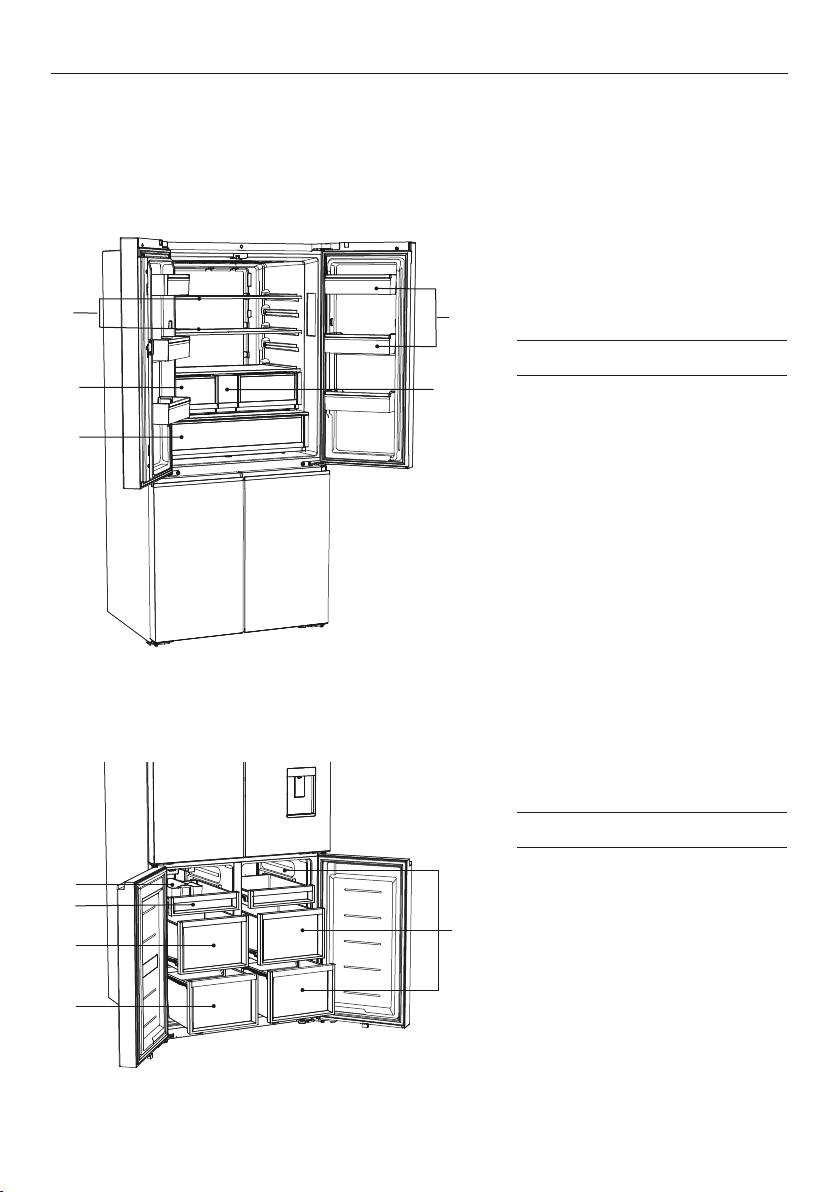
Refrigerator features
1 Adjustable shelving
2 Humidity control bins – small
3 Humidity control bin – large
4 Door shelves
5 Water filter
Freezer features
1 Ice storage bin with scoop
2 Tray
3 Mid bin
4 Bottom bin
5 Variable Temperature Zone
Freezer compartment
5
2
3
1
1
3
4
Fridge compartment
5
4
2
10
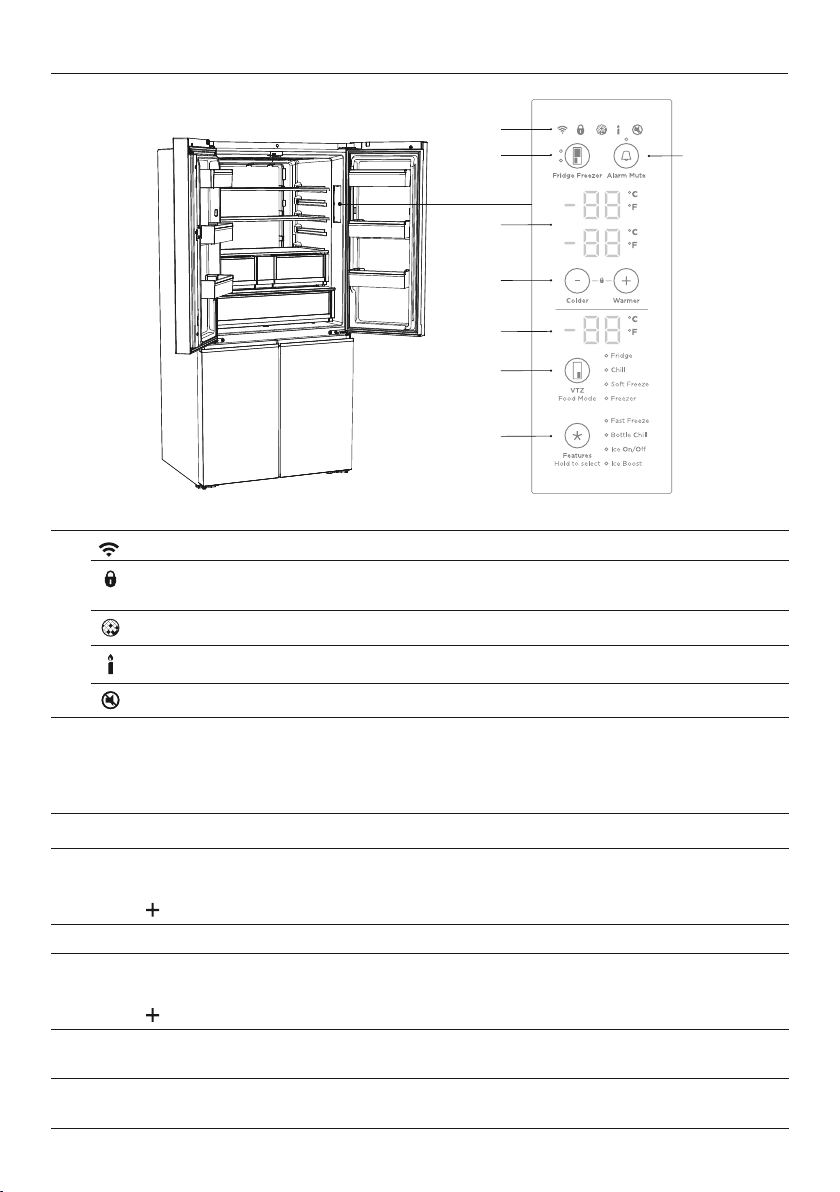
1
Illuminates when Wi-Fi is enabled.
Illuminates to indicate that the keys on the control panel are locked. When the
door is closed the display is automatically locked.
Illuminates when the water filter needs replacing.
IIluminates to indicate that Sabbath mode is activated.
Illuminates to indicate key press sounds are deactivated.
2
Fridge/Freezer activates control panel when pressed. Allows you to select the fridge
or freezer compartment to adjust the temperature.
z
Upper light to indicate the fridge compartment is selected.
z
Lower light to indicate the freezer compartment is selected.
3
Alarm mute deactivates the door alarm for 20minutes.
4
Displays the set temperature of the Fridge/Freezer compartments.
To change between Celsius and Fahrenheit on the display:
Press
for sixseconds.
5
Allows you to adjust the temperature of the selected compartment.
6
Displays the set temperature of the Variable Temperature Zone (VTZ).
To change between Celsius and Fahrenheit on the display:
Press
for sixseconds.
7
Allows you to select the food mode for the Variable Temperature Zone (VTZ) — FRIDGE,
CHILL, SOFT FREEZE
, FREEZER. Lights illuminate to indicate which food mode is selected.
8
Allows you to scroll and select features: FAST FREEZE, BOTTLE CHILL, ICE ON/OFF,
ICE BOOST.
1
2
3
4
5
8
7
6
USING THE CONTROL PANEL
11
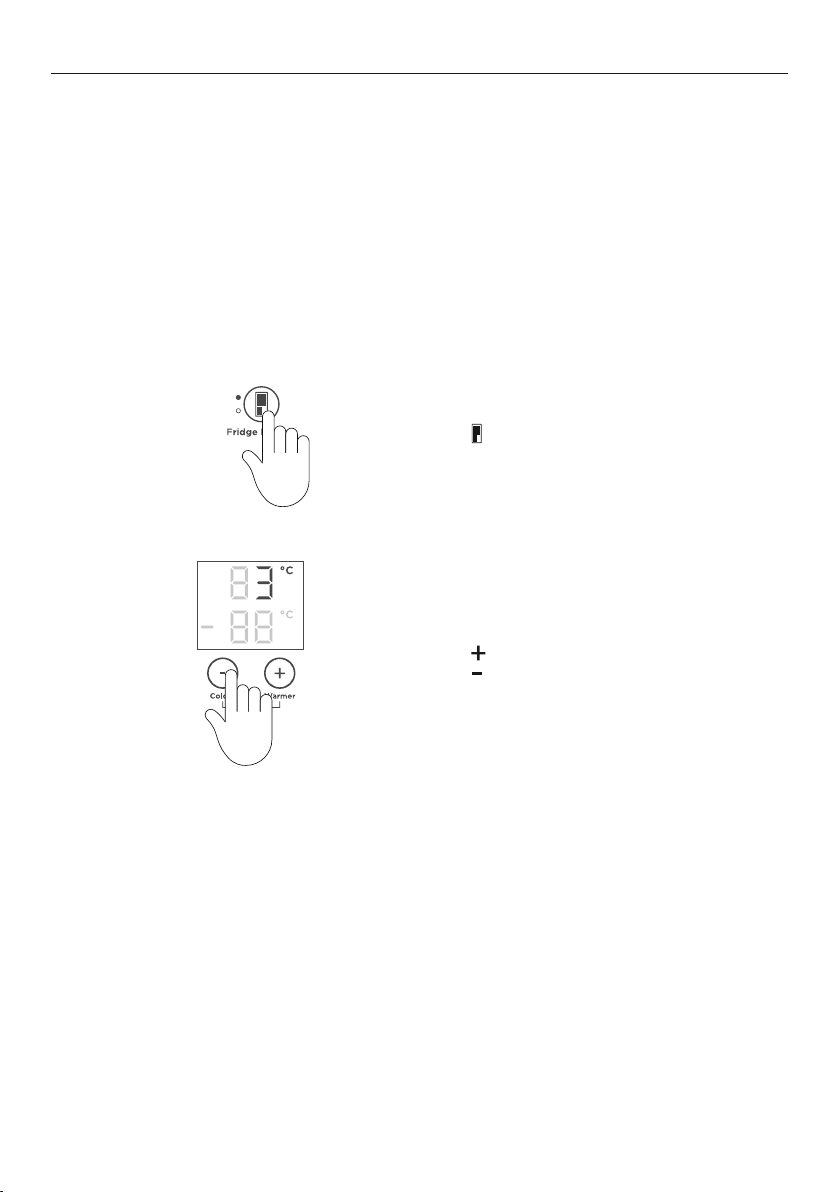
How to adjust the temperature—Fridge compartment
Press
once.
The fridge compartment light will illuminate.
Press to increase the temperature,
press to decrease the temperature.
1
2
Temperature control
When you turn your refrigerator on for the first time, the cooling system will automatically
cool all compartments to their set temperatures within 2–3 hours.
The internal control panel enables you to change and control the temperature of all
compartments accurately and independently. The internal control panel default setting is to
show the set temperature for the fridge compartment.
For common foodstuffs, the factory default setting provides the optimum setting
for foodcare.
USING YOUR APPLIANCE
12
1
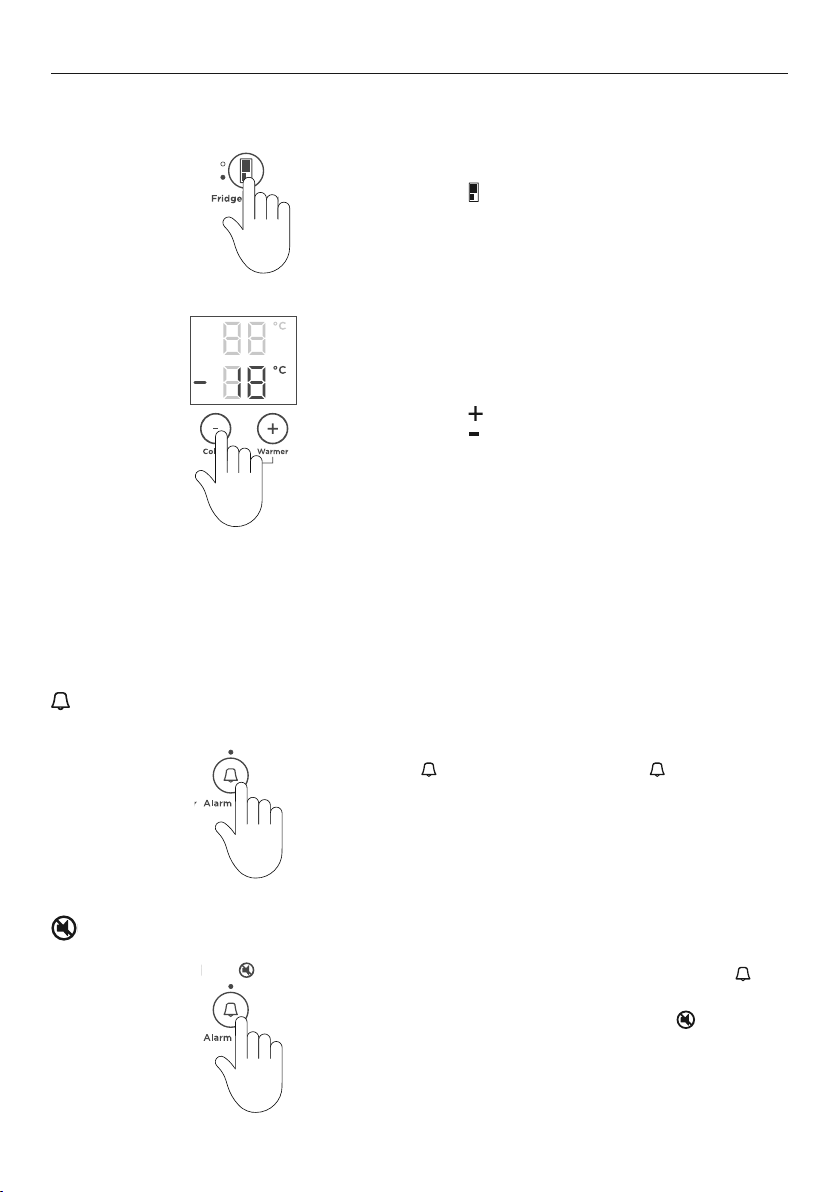
Key mute
To activate/deactivate KEY MUTE, press for
fourseconds.
Once
KEY MUTE is activated the icon on
the internal control panel illuminates, all key
sounds are silenced.
Door alarms and the
BOTTLE CHILL alarm are
still operational.
Door alarms
If the fridge compartment door is left open, the alarm will beep after 90seconds, if the
freezer compartment door is left open the alarm will beep after 60seconds. If either of the
doors remains open, subsequent beeps will sound every 30 seconds for fiveminutes and
the internal light(s) will turn off.
Alarm mute
To activate/deactivate ALARM MUTE, press
once. The light above the button
will illuminate to indicate the refrigerator
is muted.
ALARM MUTE will automatically deactivate
after 20minutes or when the door is closed.
BOTTLE CHILL alarm is still operational.
1
Press twice to adjust the frozen food
compartment temperature.
The freezer compartment light will illuminate.
How to adjust the temperature—Freezer compartment
Press
to increase the temperature,
press to decrease the temperature.
1
2
USING YOUR APPLIANCE
13
Key lock
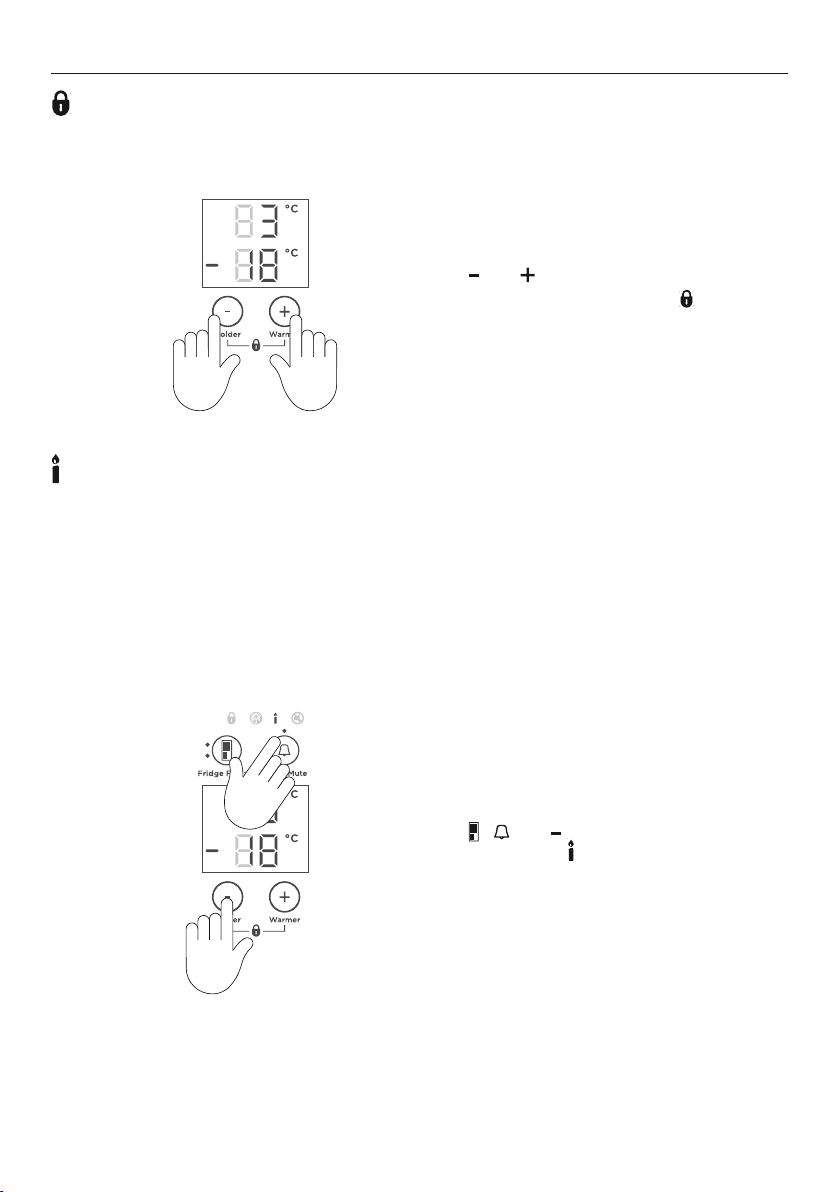
KEY LOCK allows you to disable the buttons on the internal control panel. This is useful
when cleaning your refrigerator.
To activate/deactivate KEY LOCK,
press and together for fourseconds.
When
KEY LOCK is activated the icon on
the internal control panel will illuminate.
Pressing any of the buttons will sound several
beeps to tell you that they are disabled.
1
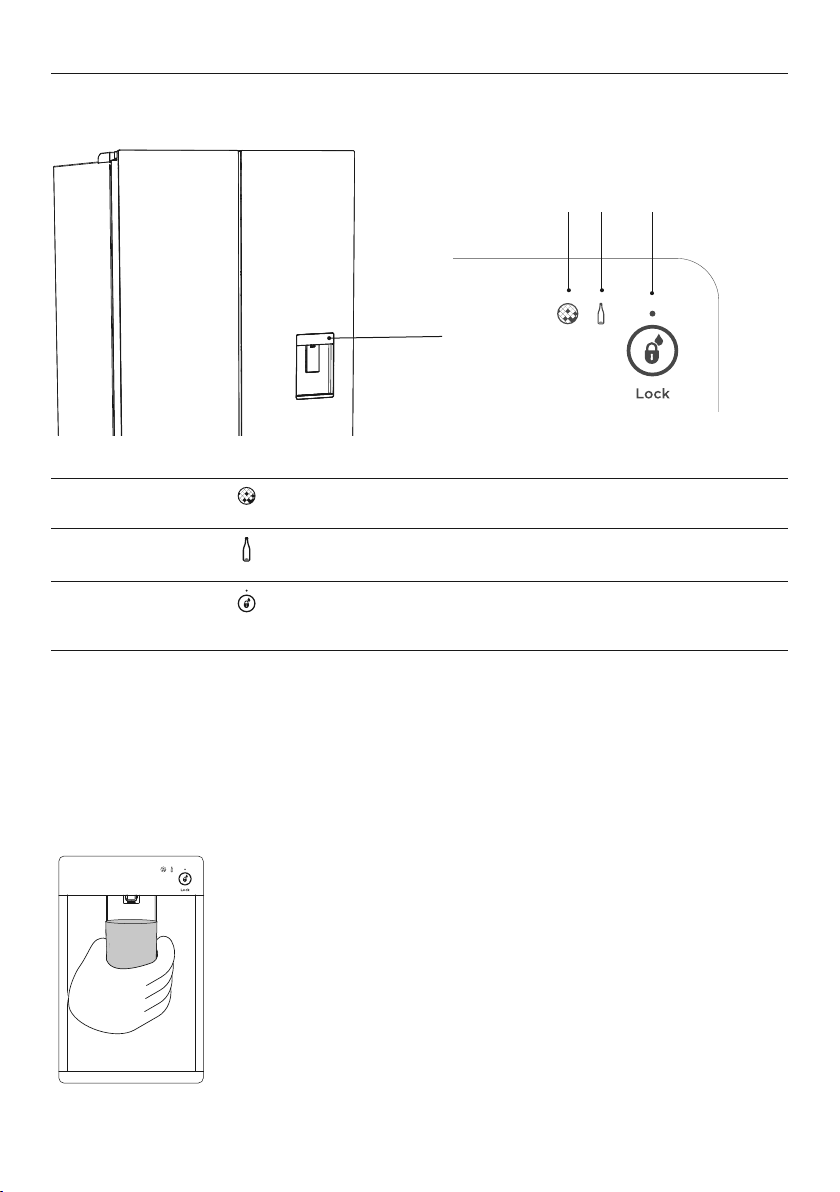
Sabbath mode
In
SABBATH MODE, alarms, lights and displays are deactivated for 80 hours.
Once in Sabbath mode:
z
The interior light will not turn on when you open the refrigerator.
z
The door alarms will not operate.
z
The display will not illuminate, except the Sabbath mode icon.
z
The internal and external control panels will not operate.
z
Sabbath mode automatically deactivates after 80 hours.
To activate/deactivate SABBATH MODE,
press , and together for
fourseconds. The icon on the internal
control panel will illuminate when
SABBATH MODE is activated.
1
If you turn off your refrigerator while in SABBATH MODE it will resume automatically once
the refrigerator is switched on again.
USING YOUR APPLIANCE
14
Using your water dispenser
Ensure you have followed the steps outlined in your installation guide prior to your first use
of the water dispenser.
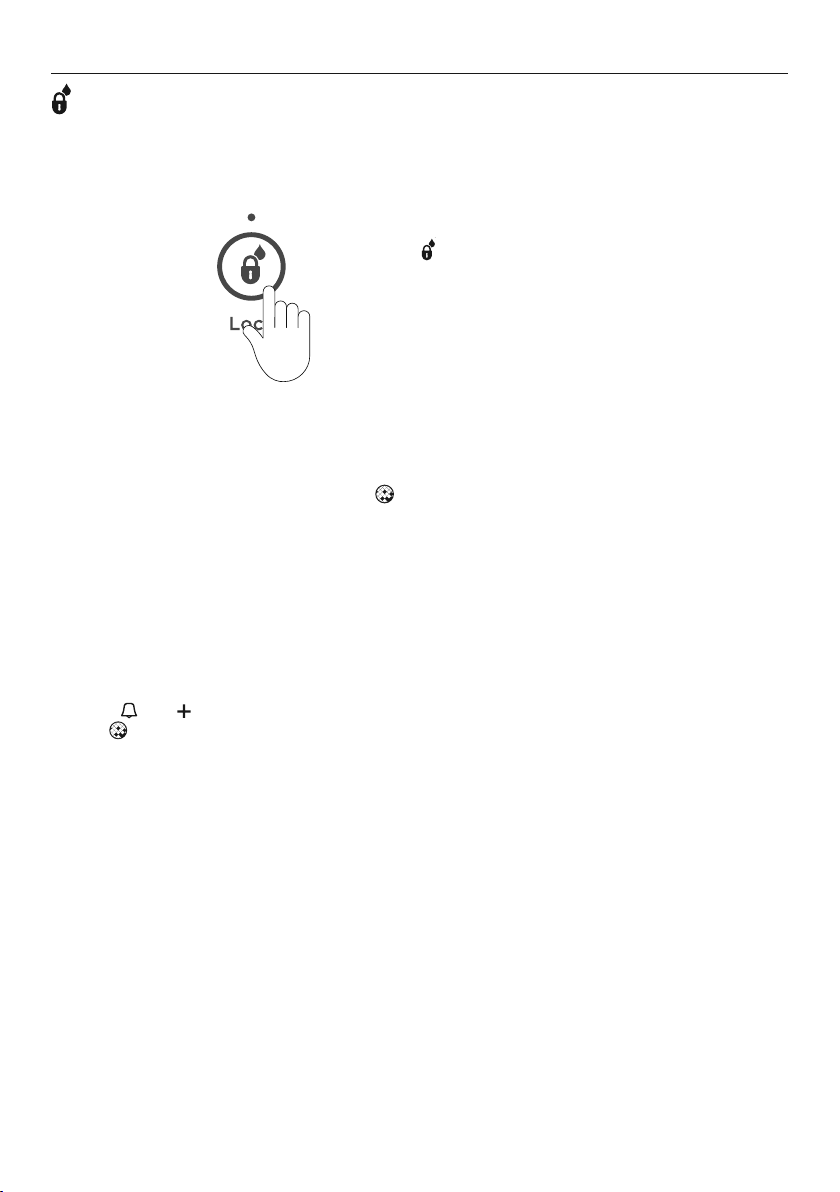
1 To dispense water, gently press the dispensing pad with a
glass or container.
2 To stop the flow of water, simply pull your glass or container
away from the dispensing pad.
Pressing hard against the dispensing pad will not increase the
flow or dispense more water.
Dispensing
Your water dispenser is designed for one-handed operation.
1
Filter change
indicator
Icon will illuminate when water filter requires changing.
2
Bottle Chill
indicator
An alarm will sound and BOTTLE CHILL will flash after the
elapsed time to remind you to remove your beverage.
3
Dispenser lock
button and
LED light
Locks/unlocks the water dispenser. The LED above the lock
button will illuminate when dispenser is locked.
Water dispensing
3
2
1
USING YOUR APPLIANCE
15
Dispenser lock
The
DISPENSER LOCK is located on the external display and can be activated to prevent
water from being dispensed. Thisisuseful when you are cleaning the external display or
when there are small children around.
To activate/deactivate DISPENSER LOCK, press
for fourseconds.
When activated the light above the button
will illuminate.
When the dispenser pad is pressed, several
beeps will sound to alert the user that water
cannot be dispensed.
1
USING YOUR APPLIANCE
Water filter
The water supplied to your refrigerator is filtered to remove impurities through a filter
located internally between the vegetable bins in the refrigerator.
z
There is a replacement indicator icon on the internal control panel and external
display which will appear when the filter needs replacing. The icon will flash, as a
reminder, when water isdispensed.
z
Replacement filter cartridges are available from your Fisher & Paykel dealer, online or
from a Fisher & Paykel service technician. The details of the replacement filter cartridge
are labelled on the cartridge.
Changing the water filter cartridge
Guidance of how to replace your water filter can be found at fisherpaykel.com/water-filter.
To reset the filter indicator:
z
Press and together for 4 seconds.
z
The on the control panel will turn off when reset.
Do not reset indicator before filter is changed or filter monitoring will be inaccurate.

16
Glass shelves
There are two glass shelves that can be repositioned in the fridge compartment. For
details on how to remove and replace glass shelving please refer to ‘Cleaning and care –
glass shelves’.
USING YOUR APPLIANCE
Humidity control lids
The humidity control lids are fitted to the bins in your fridge compartment.
These lids provide a humid microclimate to extend the storage times of fruit and vegetables.
The lids have specially designed grooves that retain moisture to prevent condensation from
dripping onto the fruit and vegetables at times of high humidity.
Information about your ice maker
Your automatic ice maker will produce eight cubes of ice every 2–3hours, depending on
the freezer compartment temperature and the number of door openings.
The ice tray will fill with water. When cubes are frozen, they will be ejected from the ice tray
into the ice storage bin. Ice making will continue until the storage bin is full. Ice making will
resume once you start to use the stored ice.
Your Ice & Water product comes with a smaller ice bin inside a tray. Attached to the ice
storage bin is the scoop for the ice. This scoop provides hygienic access to the ice. For
maximum ice storage, level the stored cubes with the ice scoop. Do not remove the ice bin
when using the ice making function.
If ice is not used often, old cubes will become cloudy, taste stale, will shrink and may
stick together. Empty the ice storage bin periodically and wash in lukewarm water. Dry
thoroughly and place back into the correct position.
Turn your ice maker off if:
z
There is no water supply for several hours.
z
You are removing the ice storage bin for a period of time.
z
You are going on holiday/vacation.
17
USING YOUR APPLIANCE
FOOD MODES
FREEZER
(-18°C)
For general frozen food items that
require storage between 1–12 months.
Meat, poultry, seafood,
pre-cooked foods and leftovers,
some fruits and vegetable, ice
cream, and other frozen desserts.
SOFT FREEZE
(-7°C)
Allows easy portioning of food and
the ability to heat, cook or serve foods
straight from the compartment without
waiting for it to thaw.
Meats, seafood, soups, sauces,
pureed foods, bread, desserts
and pastries.
Not recommended for storage of
creamy desserts such as ice cream.
CHILL
(0°C)
An extension of FRIDGE MODE providing
the perfect storage zone for highly
perishable food to ensure they retain
their vital freshness and quality. These
items will last slightly longer here
compared with storage at
FRIDGE MODE.
Highly perishable meats,
poultryand seafood.
Alcoholic beverages such asbeer.
FRIDGE
(3°C)
The ideal mode for fresh everyday
foods such as fruit and vegetables,
dairy products, meats and drinks.
Fruit and vegetables, dairy
products, jams and chutneys/
preserves, meats and drinks.
Variable temperature zone
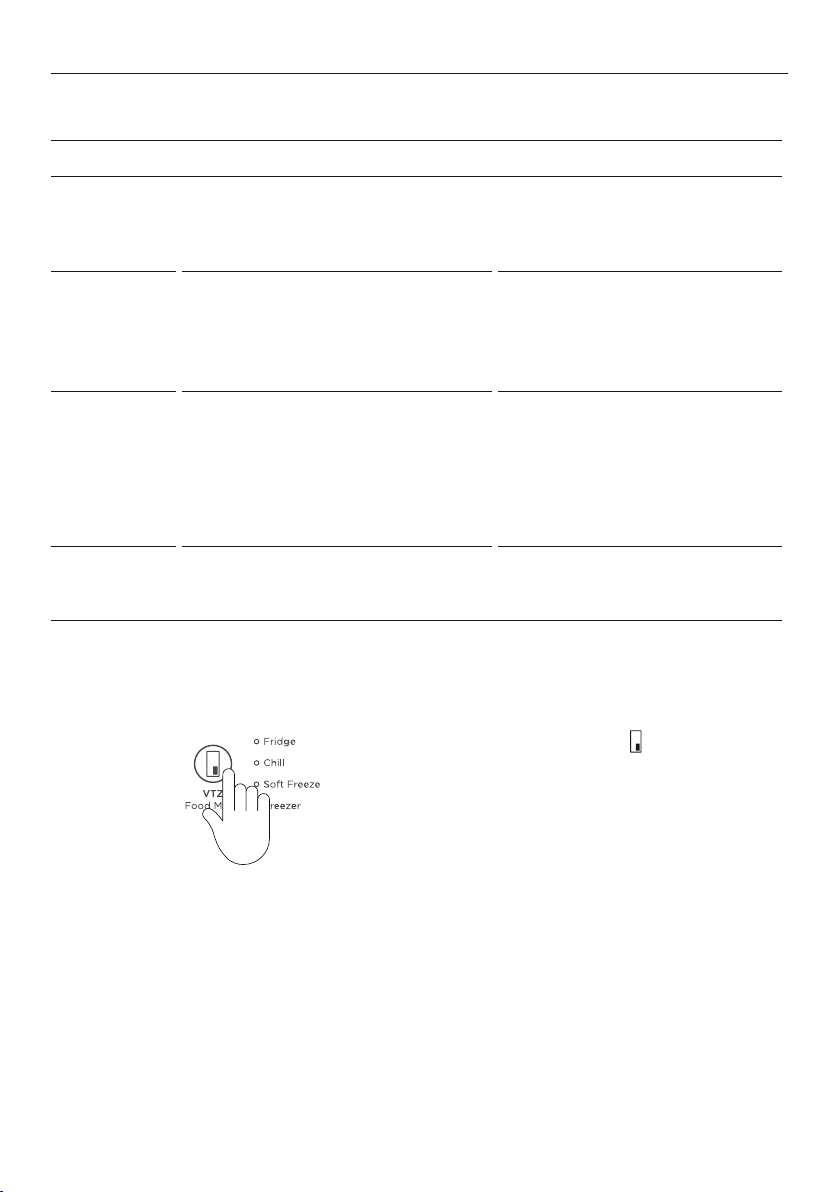
Changing the Food Mode
Press the
VTZ FOOD MODE button.
The digital display for the Fridge/Freezer
compartment will not be illuminated.
The
FOOD MODE scrolls from top to bottom
(warmest setting to coldest setting).
The
FOOD MODE selected will illuminate.
1
The FOOD MODE will be activated once the control panel is locked.
The Variable Temperature Zone display will automatically lock after 10 seconds or once the
door is closed.
18
Adjusting the temperature
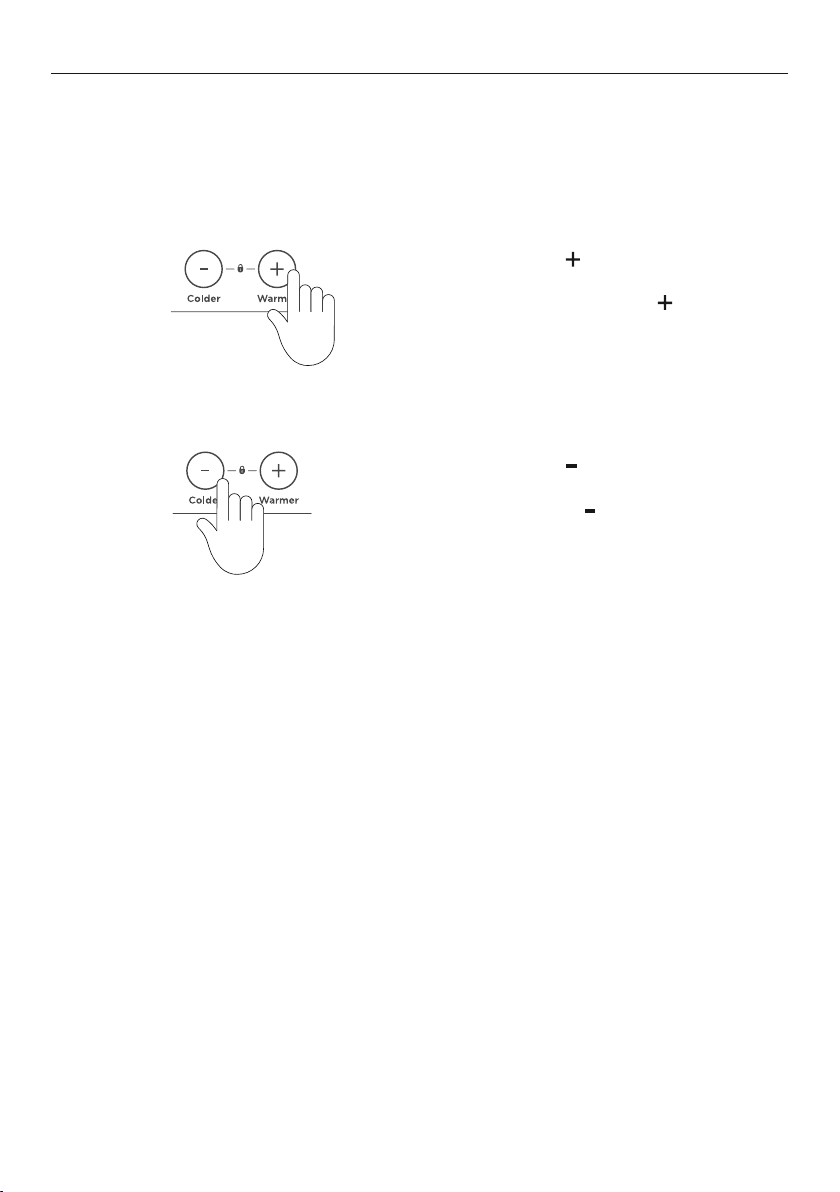
To increase the temperature of your selected
FOOD MODE press .
The digital display will change, at the
warmest setting pressing the
button will
sound the invalid button press melody. The
digital display will not change.
To decrease the temperature of your selected
FOOD MODE press .
The digital display will change, at the coldest
setting pressing the
button will sound
the invalid button press melody. The digital
display will not change.
1
2
Each FOOD MODE will automatically default to the recommended temperature setting for
that food mode, which is illuminated on the digital display. Once you have selected the
required FOOD MODE the temperature can be adjusted as desired.
If you adjust the temperature for a
FOOD MODE this adjustment will be remembered for the
next time you use this FOOD MODE.
USING YOUR APPLIANCE
19
For best results activate the function before it is required. Alternatively, activate it
whenplacing food into the freezer.
2
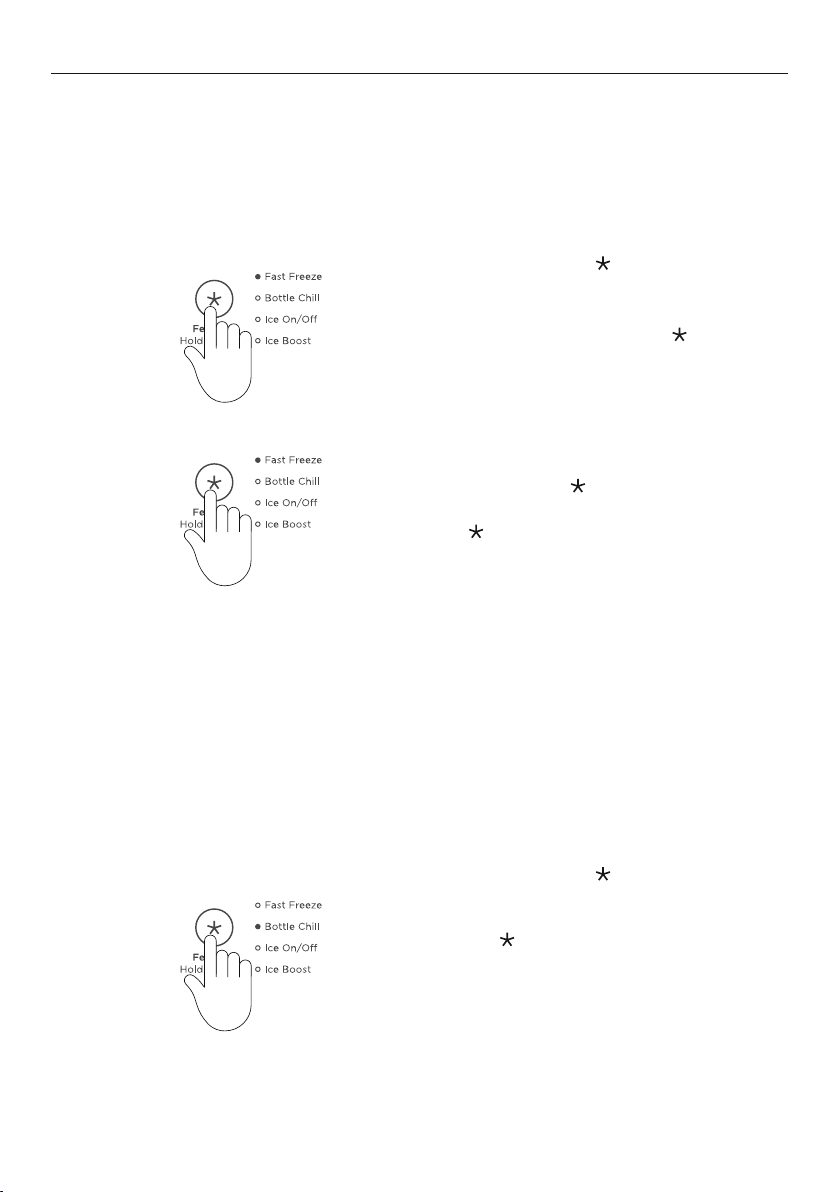
To activate, press the button to scroll
through the features to FAST FREEZE.
The light next to the feature will flash.
To select the feature, press the
button for
two seconds until flashing light turns solid.
To activate, press the
button, scroll to
BOTTLE CHILL. The light next to the feature
will flash.
Press the
button for two seconds until the
flashing light turns solid.
An alarm will sound after 15minutes to
remind you to remove your beverage.
1
1
To deactivate before the 12 hours has
elasped, press the button and scroll to
FAST FREEZE.
Press
button for two seconds.
USING YOUR APPLIANCE
Features
Fast Freeze
FAST FREEZE boosts freezing speed by dropping the lower left freezer compartment to its
coldest temperature for 12 hours, helping retain freshness, texture and taste during the
freezing process.
Bottle Chill
BOTTLE CHILL rapidly chills your beverages in the freezer for a set time of 15 minutes.
Depending on bottle size, you may need to return it to the freezer and reset.
20
USING YOUR APPLIANCE
To deactivate before the time has elapsed,
press the button, scroll to BOTTLE CHILL.
Press
button for two seconds.
When
BOTTLE CHILL is deactivated the light
will not illuminate.
3
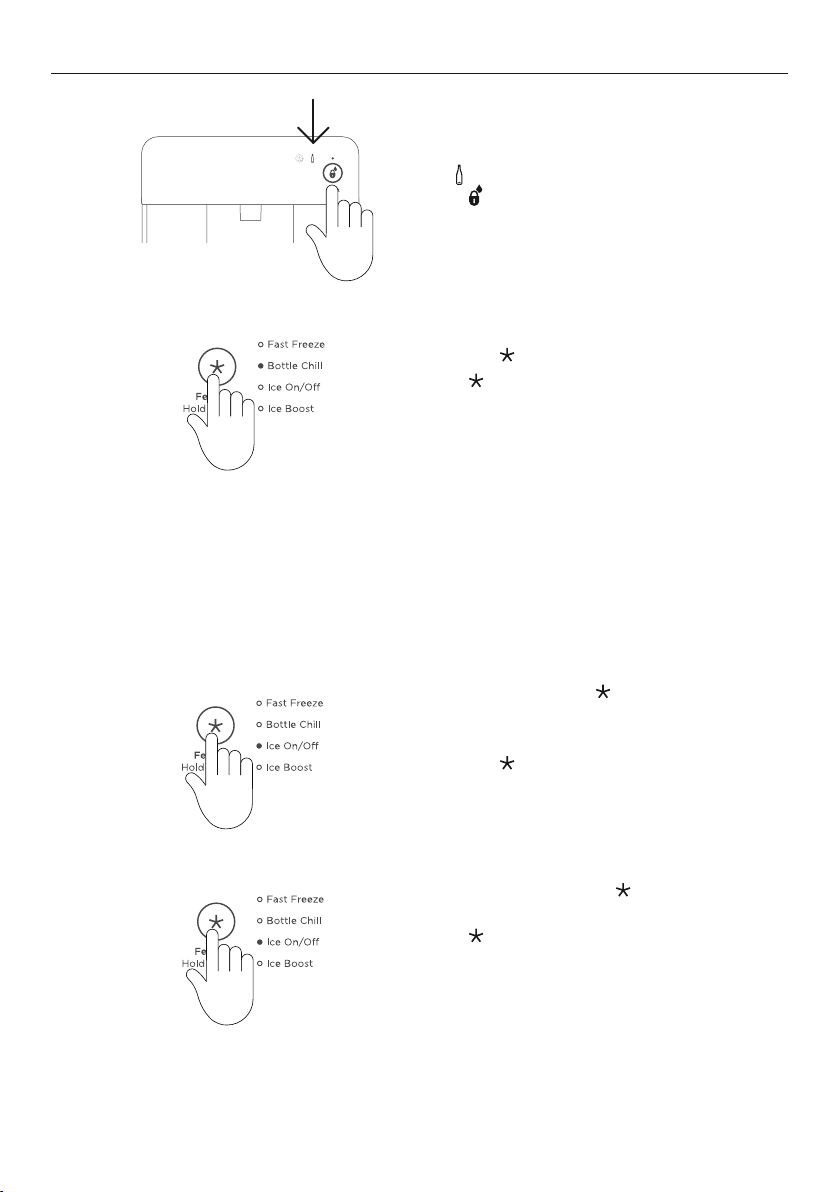
To activate, press the button, scroll to
ICE ON/OFF. The light next to the feature
will flash.
Press the
button for two seconds until
the light turns solid.
1
Ice On/Off
ICE ON/OFF activates automatic ice – this is only available in the lower left compartment.
Your ice maker is designed to automatically dispense ice into the ice storage bin below
until it detects the bin is full. The more ice you use, the more it makes. Before first use the
automatic ice systems needs to be flushed.
To deactivate, press the
button, scroll
to ICE ON/OFF.
Press
button for two seconds.
When
ICE ON/OFF is deactivated the light
will not illuminate.
2
2
The icon will flash on the external display.
Press
on the external display to silence
the alarm.

21
2
To activate, press the button, scroll to
ICE BOOST. The light next to the feature
will flash.
Press the
button for two seconds until the
light turns solid.
1
To deactivate, press the button, scroll
to ICE BOOST.
Press
button for two seconds.
When
ICE BOOST is deactivated the light will
not illuminate.
Deactivating ice making automatically
deactivates the ‘Ice Boost’ function
USING YOUR APPLIANCE
Ice Boost
ICE BOOST increases ice production by up to 30% and will automatically deactivate
after 24 hours.
Press and hold , and together for
fourseconds.
The ice tray will flip twice and empty the
water into the bin below. Repeat the cycle
to help remove any dust in the ice tray
collected during manufacture and transport.
To flush the automatic icemaker
1
Empty the water in the bin and return the bin correctly. Ensure that the scoop is located in
front of the bin.
Once your ice maker is turned on, discard the first full bin of ice. This will flush away any
impurities in the water line and ensure the best ice quality.
Carrying out the above steps after a holiday/vacation or extended periods of not using ice.
+
22
WI-FI CONNECTION
Your appliance may be connected to your home wireless network and operated remotely
using the app.
Getting started
z
Ensure your home Wi-Fi network is turned on.
z
You will be given step by step guidance on your mobile device.
z
It may take up to 10 minutes to connect your appliance.
On your mobile device:
1 Download the app from www.fisherpaykel.com/connect
2 Register and create an account.
3 Add your appliance and set up the Wi-Fi connection.
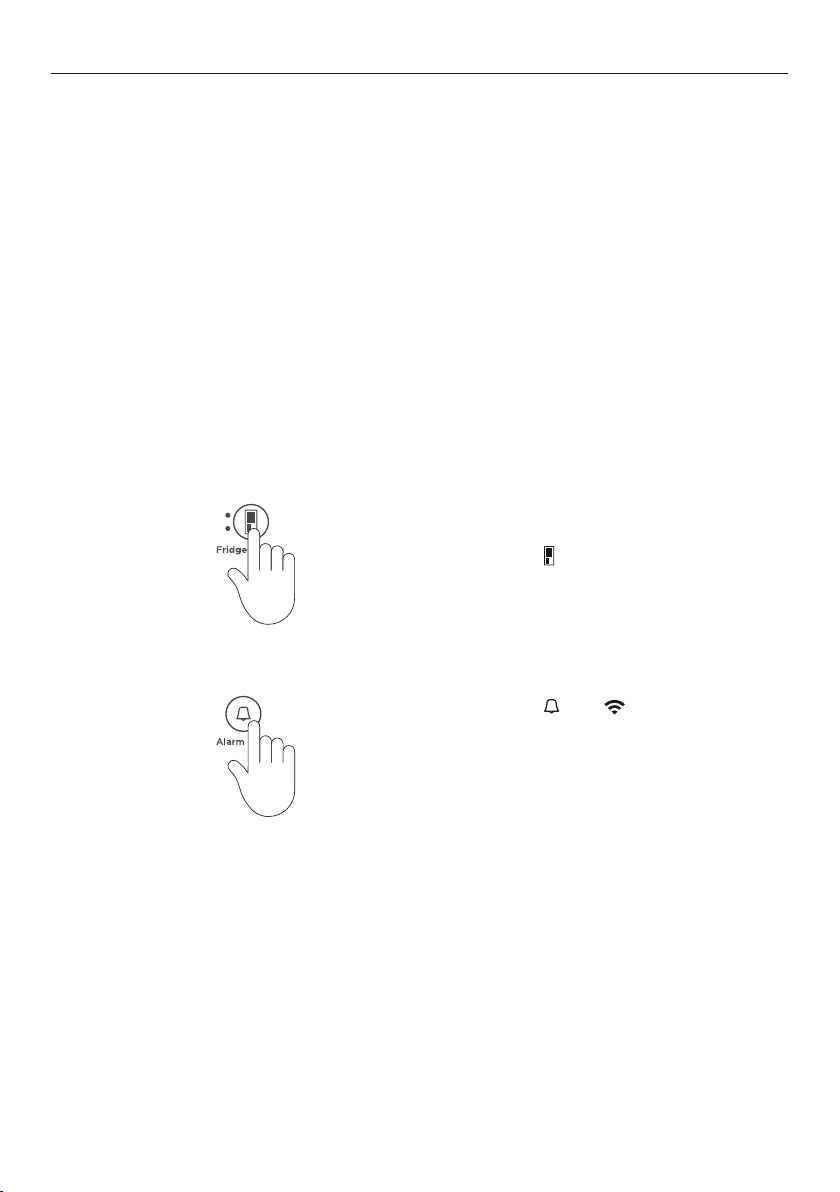
Press and hold
until both lights next to the
button appear.
1
Connecting to Wi-Fi
Press and hold
until starts flashing.
Follow the prompts in the app to
complete set-up.
2
23
CARE AND CLEANING
Cabinet surround
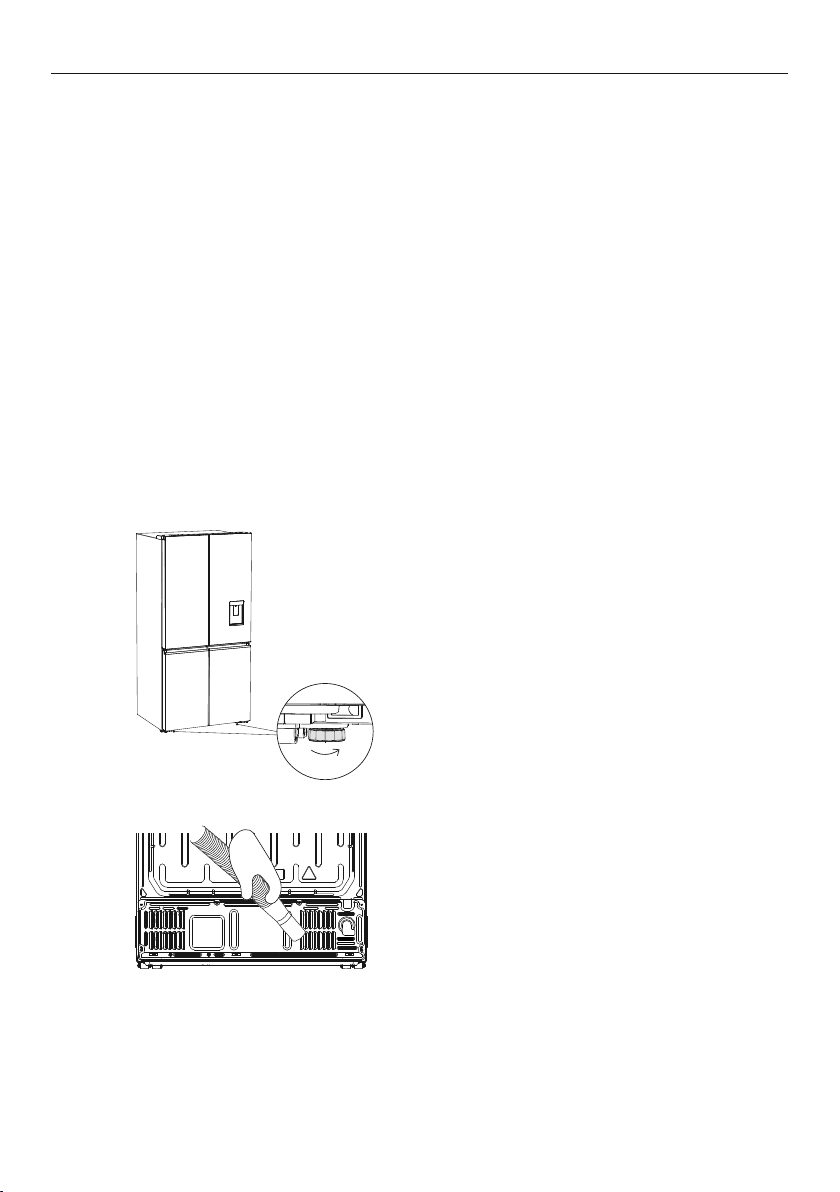
To maximise operating efficiency regularly vacuum the flooring around your refrigerator.
Cleaning behind your refrigerator is required once or twice a year.
Vacuum the flooring behind your
refrigerator and the rear compartment cover
(wherefitted) to remove dust.
Useadry lint-free cloth to clean the
refrigerator walls and surrounding cabinetry.
After cleaning, plug in and switch on.
Pushtherefrigerator into position and wind
feetdown.
1
Wind up the feet and carefully ease
the refrigerator out of its position.
Switch off andunplug.
2
Exterior
Clean the full surface of the exterior door with liquid dishwashing detergent dissolved in
warm water and a soft cloth. Wipe with a clean damp cloth to remove excess detergent.
Dry the door with a lint-free cloth.
Clean off any oil or grease as soon as possible for ease of removal. Do not use any abrasive
stainless steel cleaner, glass cleaners, solvents or scourer pads as these will damage the
door surface. Do not write or draw on the doors.
Door gasket
Clean the magnetic door gasket every three months with a toothbrush, and liquid detergent
dissolved in warm water.
24
CARE AND CLEANING
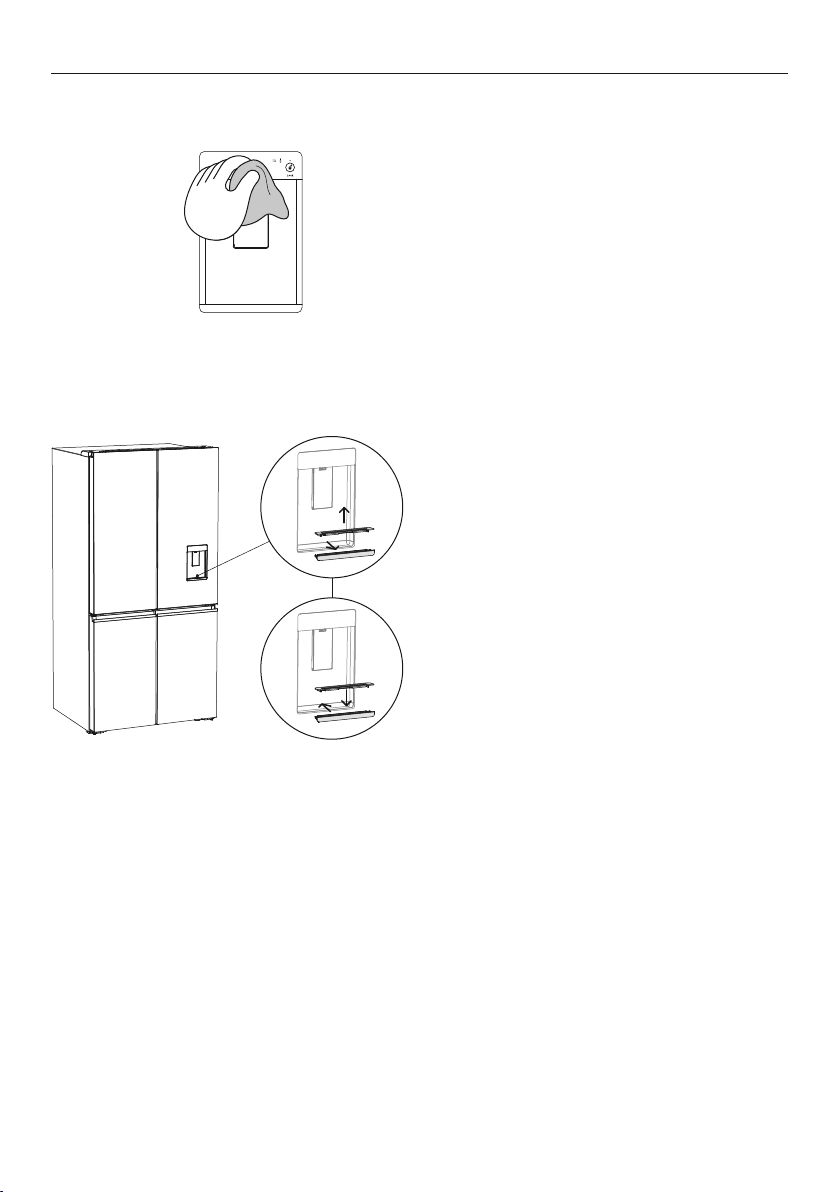
Drip tray
Remove the drip tray from the
dispenser panel.
Pull the two halves of the tray apart.
Clean with liquid detergent dissolved in water
and a soft lint-free cloth.
Rinse with clean water and dry with a clean,
lint-free cloth.
Securely clip the two halves together.
Re-insert the drip tray back into the
dispenser panel, rounded sides first.
1
2
Interior
Do not use harsh chemicals, abrasives, ammonia, chlorine, bleach, concentrated detergents,
solvents or abrasive scouring pads on any part of your refrigerator. Some ofthese
chemicals may dissolve, damage and/or discolour the interior of yourrefrigerator.
Remove the shelves from the cabinet and door. Take care while removing shelves to
prevent damaging the interior surfaces. Wipe all interior surfaces, using only liquid
dishwashing detergent dissolved in warm water or baking soda dissolved in warm water
(add1tspofbaking soda to every 500ml of water) and a soft lint-free cloth. Rinse with
clean water and dry with a clean, lint-free cloth.
Add a few drops of vanilla essence or vinegar to the water before cleaning to help remove
“stale refrigerator” smell.
External display and water dispenser
Activate the
DISPENSER LOCK to prevent
water from dispensing when cleaning. Press
for four seconds.
Clean the pad and external display with a
damp, soft lint-free cloth.
1
25
CARE AND CLEANING
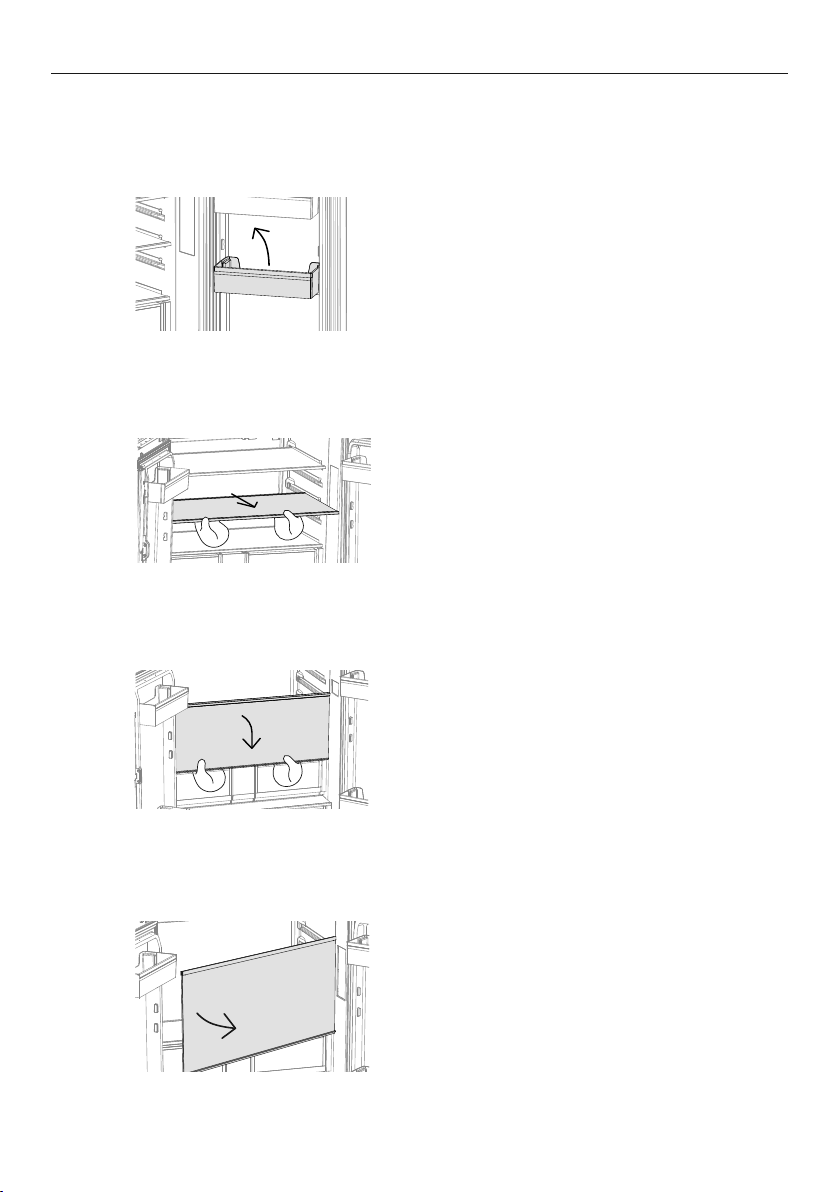
Glass shelves – Refrigerator
To remove
Remove the shelf from the compartment.
1
As you pull the shelf towards you, tilt the
front downwards and lower until it is vertical.
3
Remove all door shelves.
2
Lift the shelf slightly and pull towards you.
4
26
CARE AND CLEANING
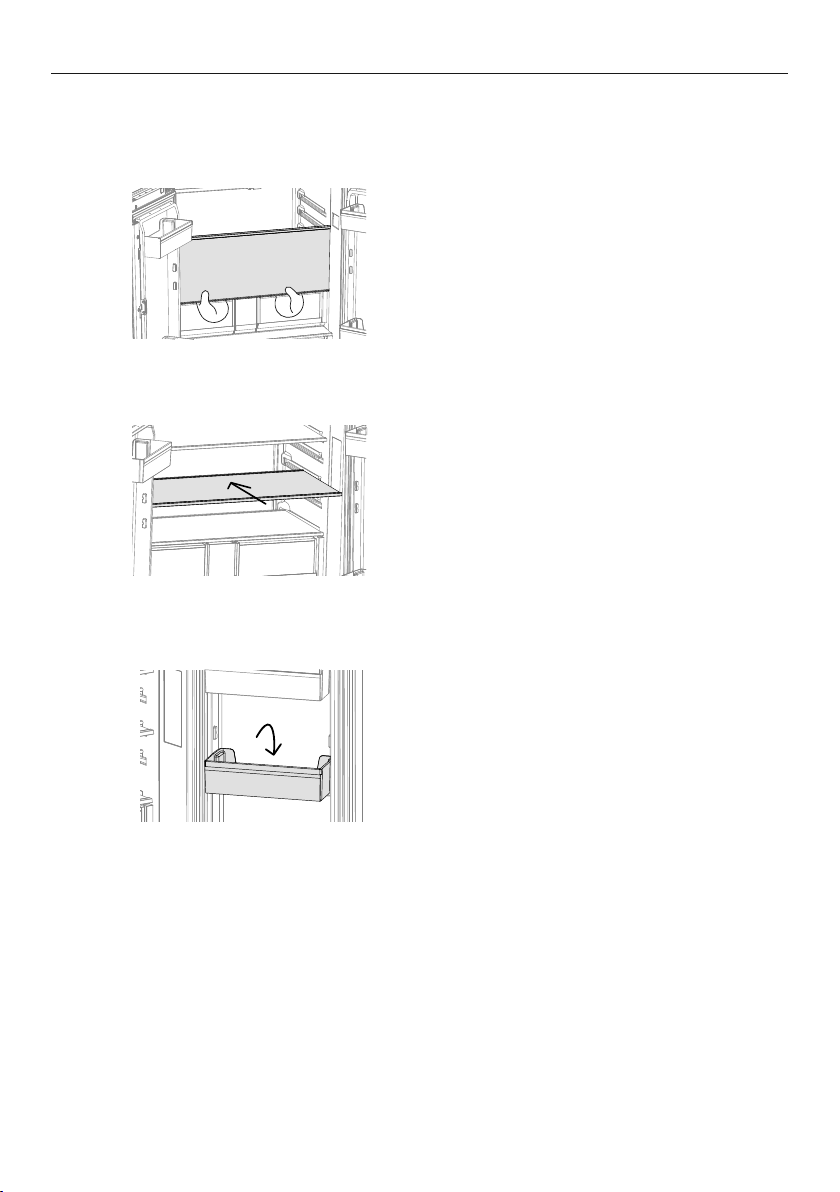
Holding the shelf vertical, manouvre the shelf
back into the compartment.
Tilt the shelf back into the compartment,
guide the shelf onto the shelf supports and
slide into the compartment.
Glass shelves – Refrigerator
To replace
1
2
Re-install the door shelves.
3
27
CARE AND CLEANING
1
2
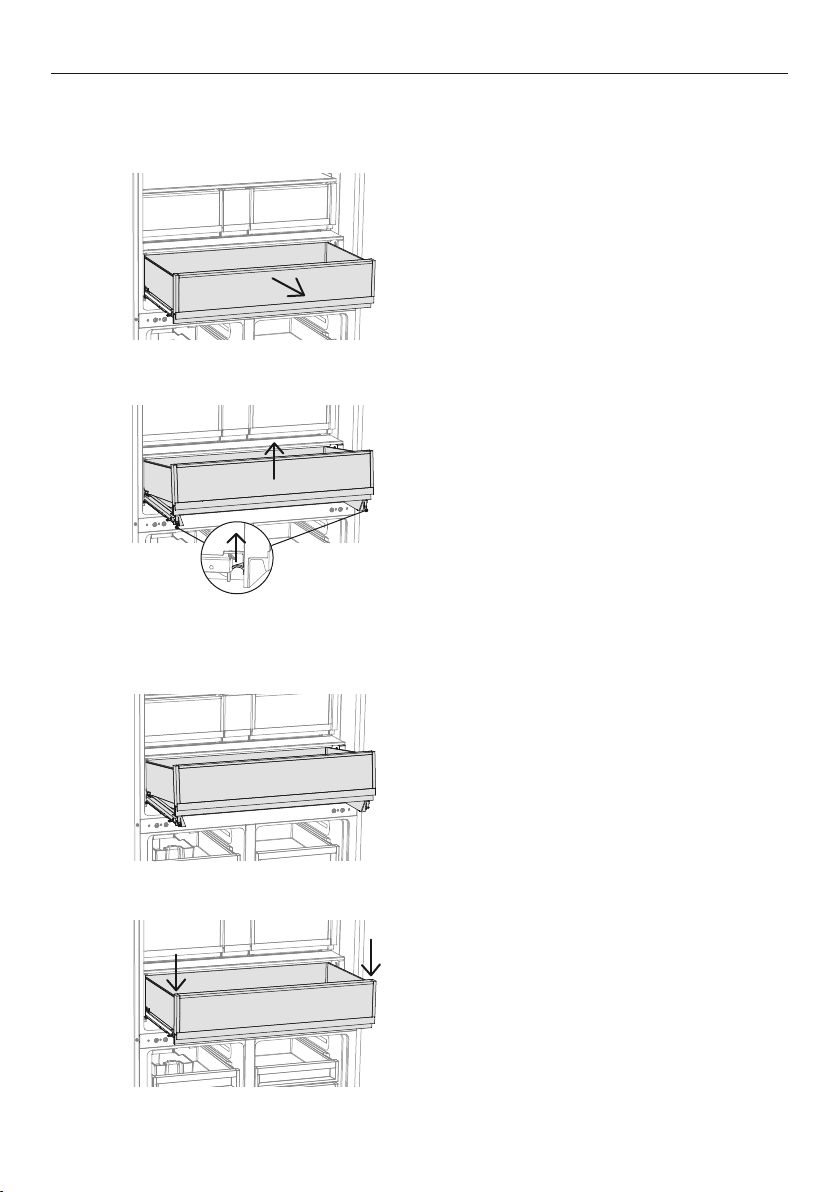
Humidity control bin – large
To remove
Remove food from the bin.
Pull the bin out to full extension.
1
2
How to replace
Extend the runners out from the refrigerator.
Place the bin on top of the runners.
Gently push the bin down on both sides
at the same time, until you feel it click
into place.
At the same time, on the left and right
hand sides push the clip up and lift the bin
to release.
Push the slides back into the compartment.
28
CARE AND CLEANING
1
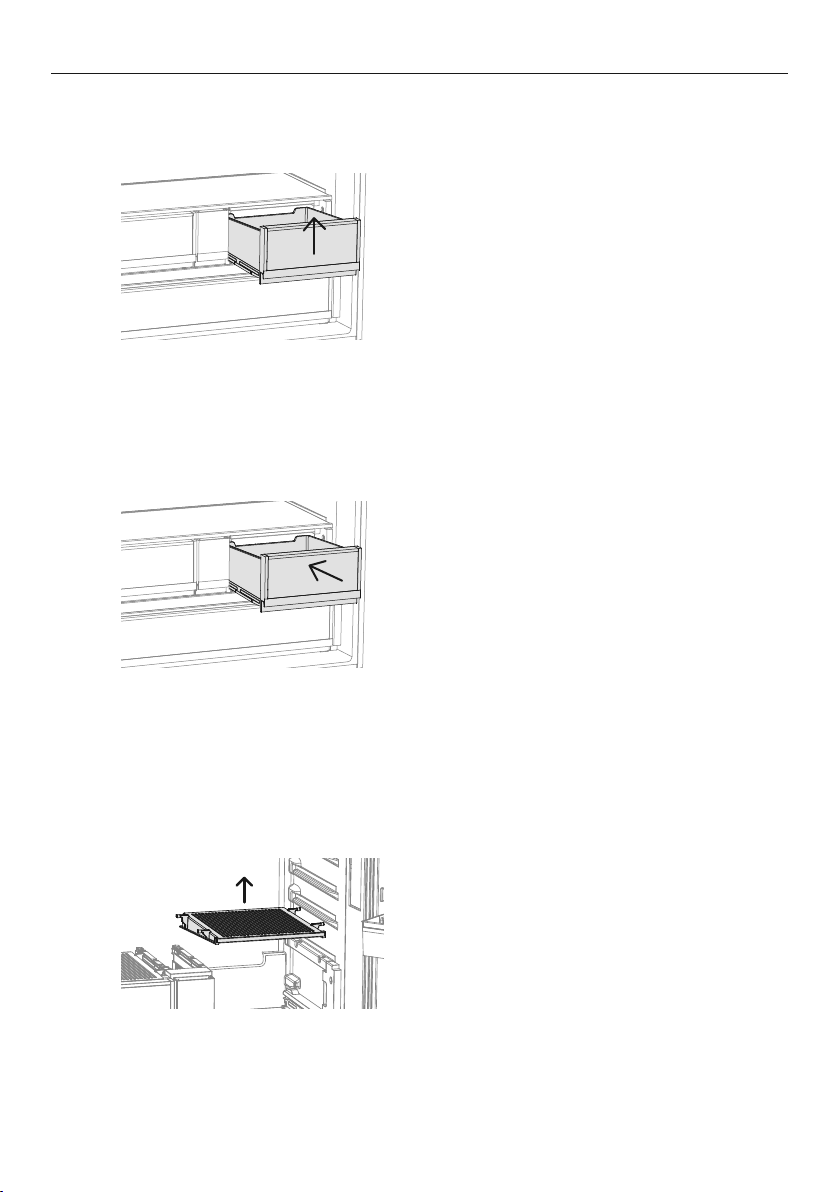
Humidity control bin – small
To remove
2
How to replace
Line up the bin in position and push the bin
back over the ledge.
Remove food from the bin. Lift the bin up at
the front and pull out over the ledge.
Humidity control lid – small
To remove
Remove the glass shelf sitting on top of
the humidity control lid, follow the steps in
section ‘Glass shelving’.
Hold the humidity control lid and lift
straight up.
1
29
CARE AND CLEANING
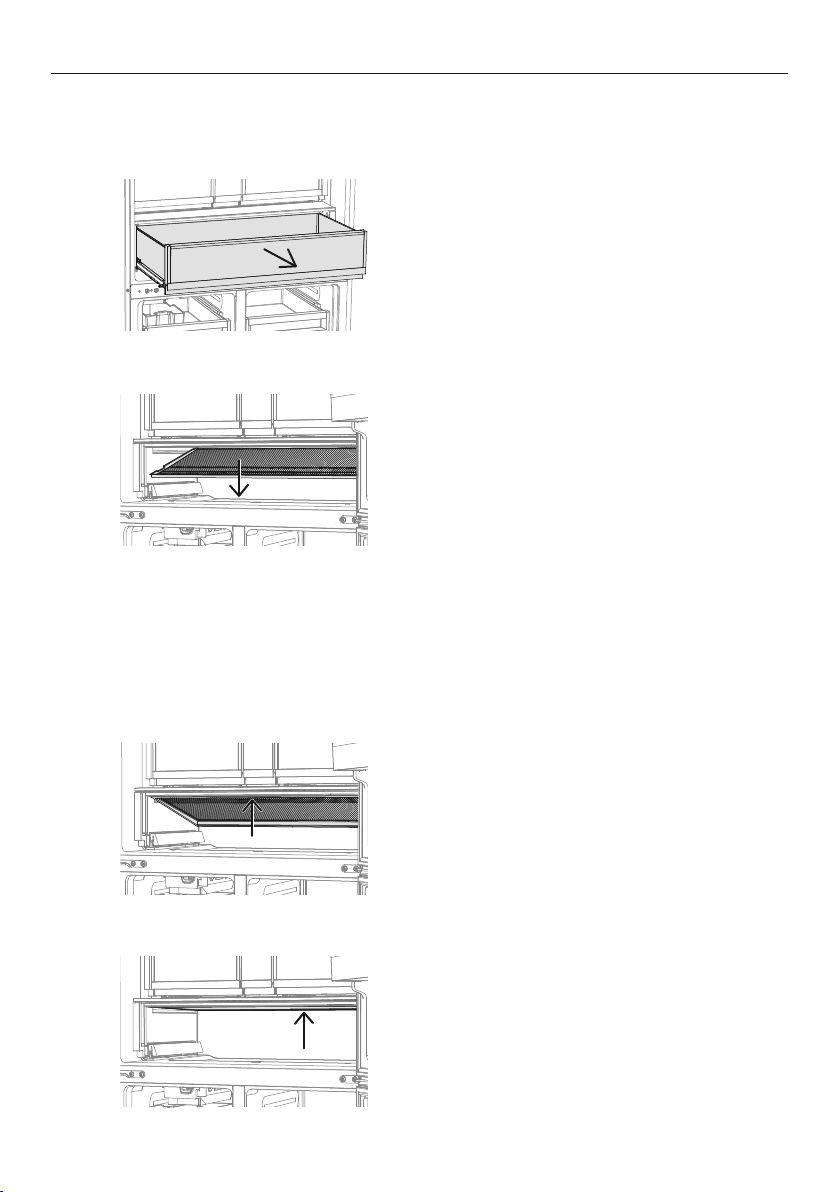
Humidity control lid large
To remove
Remove the large humidity bin, refer to
the section ‘Humidity bin large’.
1
Locate the lip at the front of the humidity
control lid and firmly pull down in the
middle. Then pull the lid down at the
back sides to dislodge.
2
Humidity control lid large
To replace
Put the humidity lid into the correct
position. Slot the front of the humidity lid
back into place.
1
Once the front is in place, push the
back and sides of the humidity lid
into position.
2
30
CARE AND CLEANING
1
2
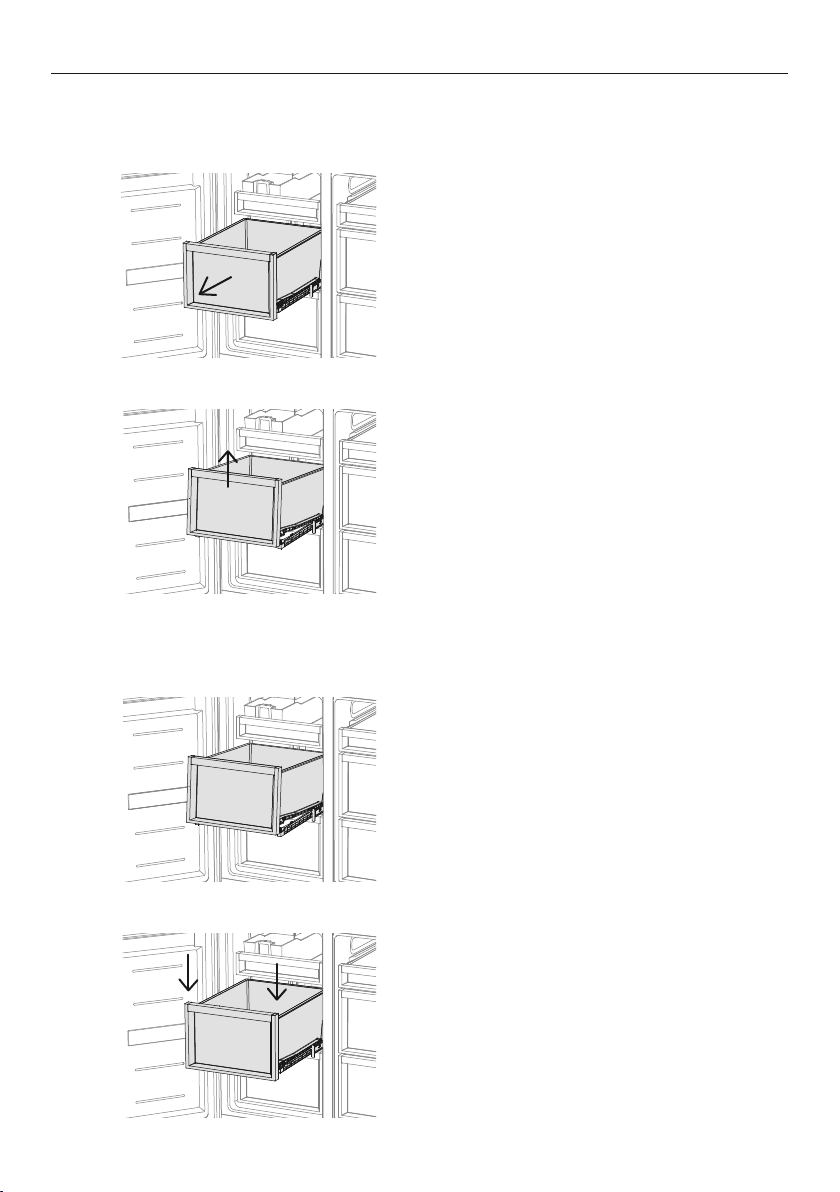
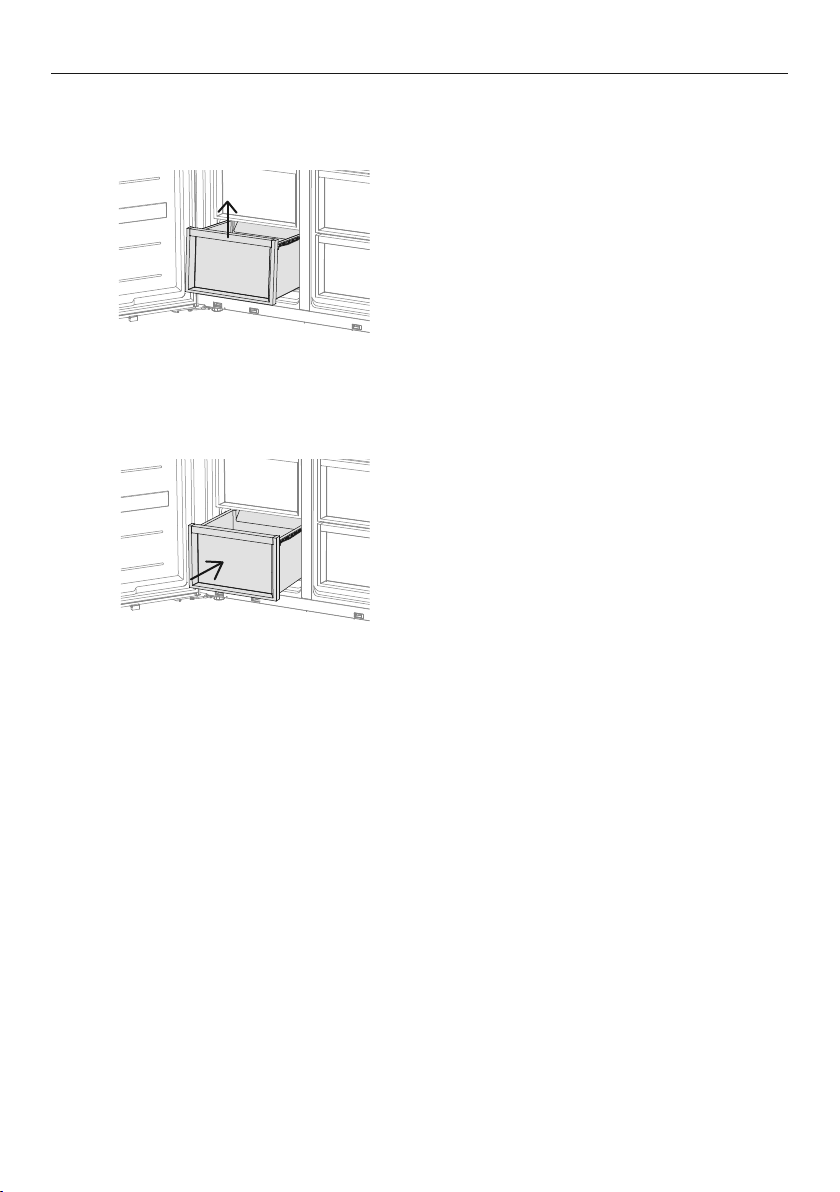
Freezer VTZ mid bin
To remove
Remove food from the bin.
Pull the bin out to full extension.
1
2
How to replace
Extend the runners out from the refrigerator.
Place the bin on top of the runners.
Gently push the bin down on both sides
at the same time, until you feel it click
into place.
Lift up the bin to dislodge.
Push the slides back into the compartment.
31
CARE AND CLEANING
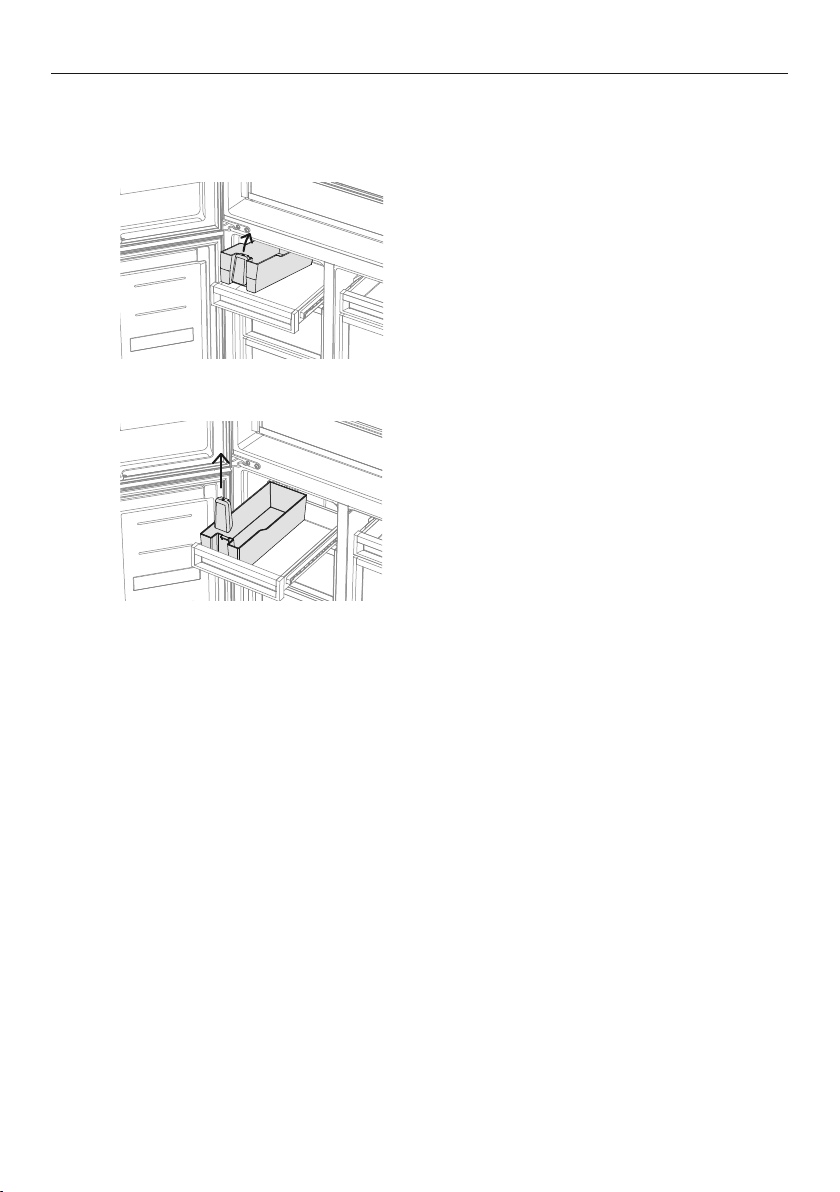
Freezer VTZ tray and large bottom bin
To remove
Remove food from the tray or bin. Lift
the tray/bin up at the front and pull out
over the ledge.
1
Line up the tray/bin in position and push
the bin back over the ledge.
1
How to replace
32
Ice storage bin
To remove
1
2
Clean your ice bin and discard any old ice in the bottom of the bin regularly.
Ensure that the ice scoop is placed
in the correct position, in the front of
the bin.
Pull out the tray. Tilt the front of the
ice bin up to remove.
CARE AND CLEANING

33
FOODCARE
For best food care
z
Store only high-quality, fresh food in your refrigerator.
z
Store perishable foods in the refrigerator immediately after purchase. Storingatroom
temperature increases the rate of deterioration and can allow harmfulmicrobialgrowth.
z
Foods such as meat, poultry and seafood should be well wrapped or sealed in
suitablepackaging to prevent dehydration, colour deterioration, loss of flavour, and
transfer ofodour.
z
We recommend storing these foods on the bottom shelf of your refrigerator orinone of
the bins to prevent potential spills and cross-contamination with otherfoods.
z
Ensure hot foods and beverages are cooled sufficiently before placing them into
therefrigerator. Hot items may cause other foods to warm to unsafe temperatures. Hot
items mayalso cause sealed items to sweat/condensate—which is undesirable.
z
Beverages are best stored standing upright in the door shelves.
z
Ensure raw and cooked foods are stored separately to avoid cross-contamination.
z
Consume food items within the recommended storage times. Discard foods that
showsign of spoilage.
z
Keep door openings to a minimum to maintain optimum storage temperatures inside
your refrigerator.
z
We recommend using FAST FREEZE when you are adding food items toyour appliance,
such as after grocery shopping. This feature will ensure the food isfrozen within the
shortest period of time, locking in the freshness andextending the shelf life of your food.
z
For storage of general household foods in the most efficient manner, it is recommended
to use the product in the factory configuration supplied. Moving the shelves and bins will
have a minimal impact on efficiency.
z
Storing at temperatures other than settings recommended may impact the storage life.
Items stored in your refrigerator
z
Eggs should be stored in their carton to avoid absorption of strong odours through
theirporous shell structure.
z
Do not store chill sensitive items such as fruits and vegetables in a compartment
when it is set to Chill mode. Cold temperatures may result in damage such as chill or
freezing injury.
Items stored in your freezer
z
We recommend cooling carbonated beverages only when the BOTTLE CHILL
function isactive.
z
Do not store carbonated drinks without this function in the freezer.
Failure toremove beverages could lead to freezing liquid and the likelihood
ofbottle/canexplosion.
z
Ensure air is removed from packaging to avoid large formation of ice crystals and
prevent freezer burn.
z
Defrosting food repeatedly is not recommended. Frozen foods that will be used
regularly should be stored in smaller quantities.
z
Do not store foods to be frozen in contact with food for storage. If defrosting
frozen food in the refrigerator compartment ensure frozen items are not in contact
with fresh foods.
34
MOVING OR STORING YOUR APPLIANCE
If your refrigerator is turned off for any reason, wait 10 minutes before turning it back on.
This will allow the refrigeration system pressures to equalise before restarting.
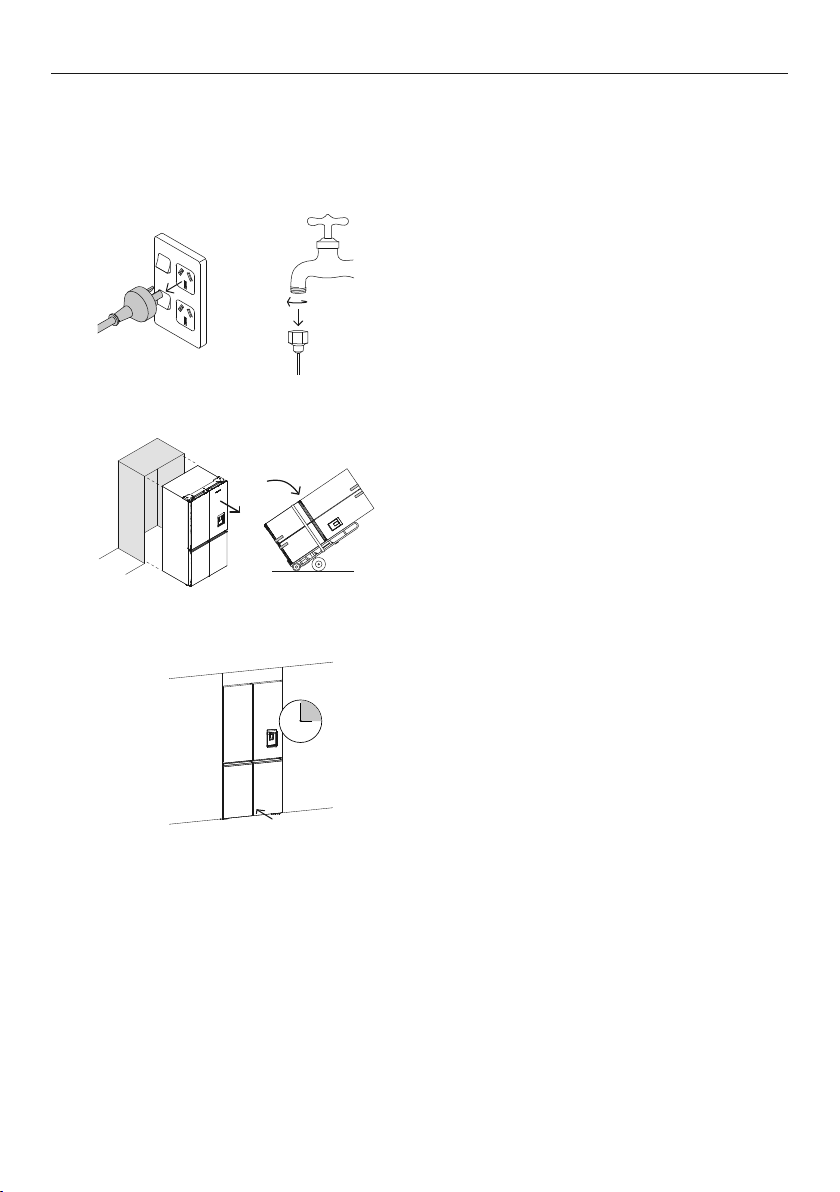
Moving your refrigerator
1
Relocate and install. If the refrigerator has
been left on its side for any length of time,
leave it standing upright as long as you can
(a few hours) before turning on.
Ease the refrigerator out of its position.
Tuck the power cord away, tape the shelves
in place and tape the doors closed. If the
cabinet needs to be placed at an angle or
laid down, carefully lay it on its side (the right
hand side when viewed from the front).
2
3
Turn off the power supply to the refrigerator.
Unplug the power cord, turn off water
supply at the isolation valve or mains supply
depending on your installation. Disconnect
the water hose.
Turn the adjustable feet to the right side as
far as they will turn.

35
ACTIVESMART™ SOUNDS
Normal refrigerator sounds
Your refrigerator is designed with innovative ActiveSmart™ features that can produce
sounds that may be different from your old refrigerator.
Normal operational sounds include:
z
Fan air flow sound. ActiveSmart™ refrigerators have fans which change speed depending
on demand. During cooling periods, such as after frequent door openings, fans circulate
the cold air in the fridge and freezer compartments producing some air flow sound. This
is quite normal.
z
Cracking or popping sound which may occur when the defrost function is operating.
z
Running water sound. This is the liquid refrigerant in the system and can be heard as a
boiling or gurgling noise.
z
An audible hissing sound after closing the freezer door. This is due to the pressure
difference between the warm air that has entered the cabinet and suddenly cooled, and
the outside air pressure.
z
Other sounds may be heard for the following reasons:
z
Cabinet not level.
z
Floor uneven or weak.
z
Bottles or jars rattling on shelves.
z
If this is your first refrigerator with an ice maker, you will hear occasional sounds that
may be unfamiliar. They are normal ice making sounds and are not cause for concern.
z
The following sounds are normal with the operation of an ice maker:
z
Motor operation (low humming).
z
Running water as the ice maker and/or water tank fills.
z
Water valve opening and closing (hissing sound).
z
Ice being loosened from the ice moulding tray (cracking).
z
Ice dropping into bin (clunking).
36
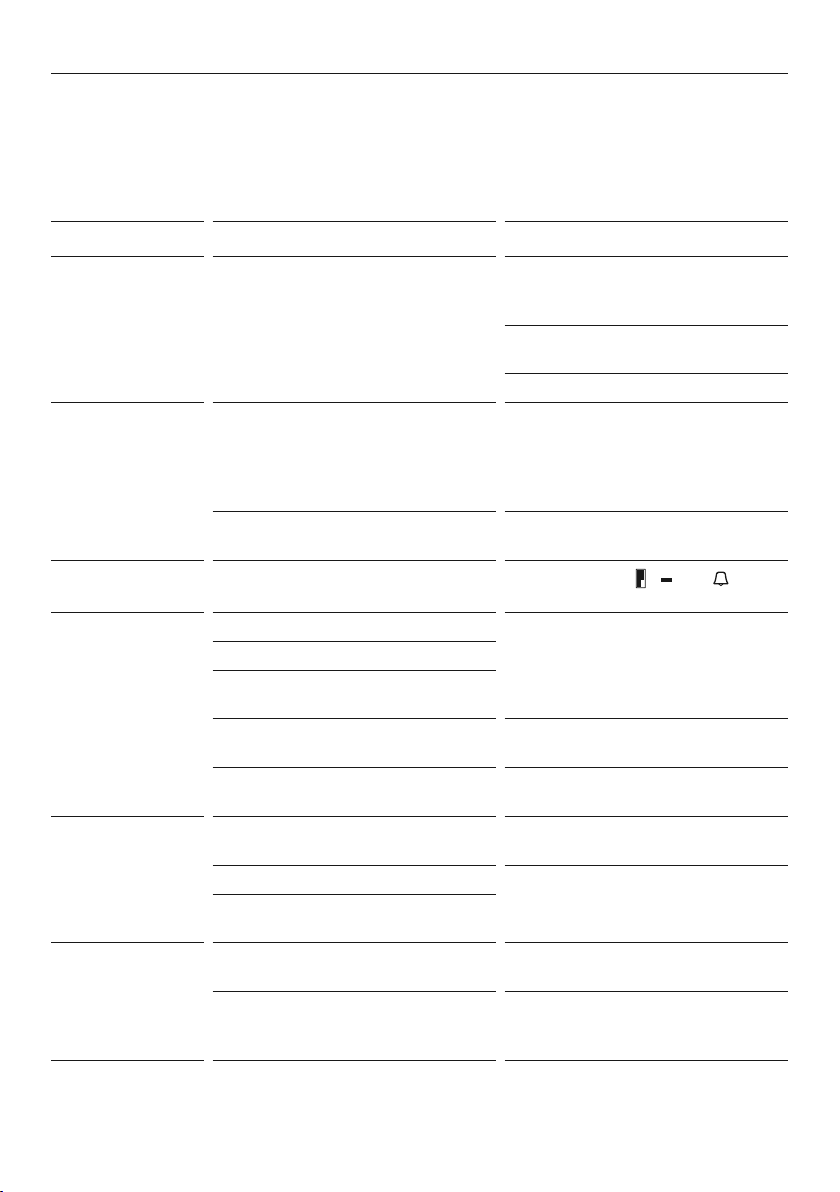
TROUBLESHOOTING
If there is a problem with your refrigerator, please check the following points before
contacting your local Fisher&Paykel trained and supported service technician or the
Customer Care Centre.
Product parts and accessories can be purchased through Fisher&Paykel Customer Care
Centre or online at fisherpaykel.com (this service is available to selected markets only).
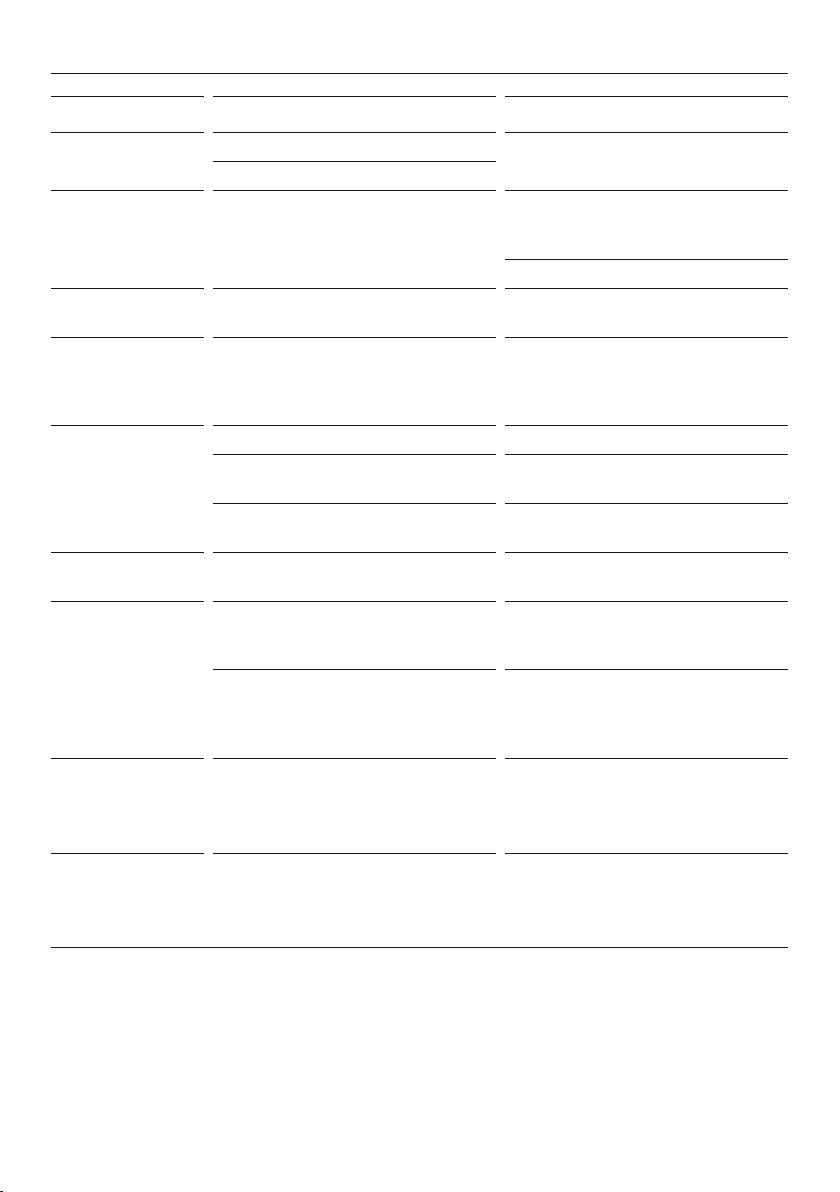
PROBLEM POSSIBLE CAUSES WHAT TO DO
Refrigerator does
not operate
No electricity at power outlet. Check that the plug is
correctly connected and power
switched on.
Check another refrigerator at the
same outlet.
Check house fuse.
Light
not working
Light not functioning. The LED light cannot be
serviced by the user. Contact
your Fisher&Paykel Dealer or
Fisher&Paykel trained and
supported service technician.
Refrigerator not working. Check refrigerator is turned on
at wall.
Light and display
not working
Product in
SABBATH MODE.
Press and hold
, and
together for four seconds.
Motor operates
for long periods
Hot weather. Minimise door openings to allow
temperature to stabilise.
Frequent door openings.
Large amount of food
recentlyadded.
Temperature control set toolow. Refer to section
‘Temperature control’.
Doors not sealing properly. Check that cabinet is level and
gasket seals are clean.
Storage
compartments
too warm
Temperature setting not correct. Refer to section
‘Temperature control’.
Frequent door openings. Minimise door openings to allow
temperature to stabilise.
Large amount of food
recentlyadded.
Food freezing in
the refrigerator
Temperature setting not correct. Refer to section
‘Temperature control’.
Food placed directly in front of
air outlets.
Move chill sensitive foods
away from the centre back of
the shelves.
37
TROUBLESHOOTING
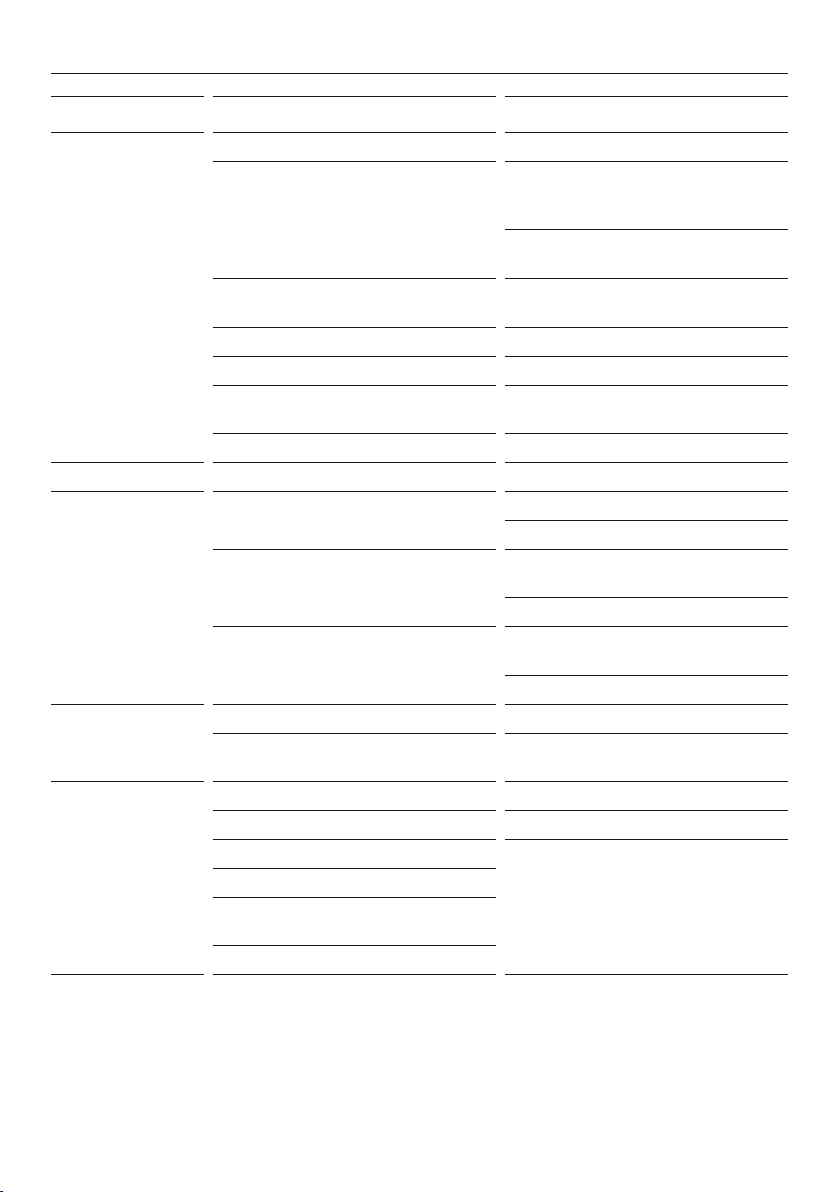
PROBLEM POSSIBLE CAUSES WHAT TO DO
Unfamiliar noises Cabinet not stable or level. Refer to your Installation guide
or ‘ActiveSmart™ sounds’.
Freezer is defrosting.
Water in the
vegetable bins
Condensation is formed by
the water produced by fruit
and vegetables.
A small amount of condensation
is beneficial for fruit and
vegetable storage.
Wipe out water with a cloth.
Exterior of
cabinet is warm
This is normal.
Condensation
on outside of
refrigerator/
freezer
Not unusual during periods of
high humidity.
Wipe dry.
Condensation
inside fridge
compartment
Frequent or long door openings. Minimise door openings.
Door gasket leaking. Check that gasket is sitting flat
and sealing tightly.
Not unusual during periods of
high humidity.
Wipe dry.
Door out of
alignment
With time and usage, movement
may occur.
Refer to your installation guide.
Tray/bin does
not slide in and
out evenly
Packaging trapped. Check to ensure no food or
packaging is trapped behind
the tray/bin.
Runners not extending fully. Holding onto sides of tray/
bin, extend the runners fully by
using a firm pull—this will reset
the runner.
Refrigerator
operating
inefficiently
Accumulation of dust
on or behind the rear
compartment cover.
Refer to section
‘Care and cleaning’.
If problem persists please
contact Customer Care.
Cannot adjust
temperature
in frozen food
compartment
Either
BOTTLE CHILL, FAST FREEZE
or ICE BOOST is activated.
Deactivate BOTTLE CHILL,
FAST FREEZE
or ICE BOOST if
function is not desired.
38
TROUBLESHOOTING
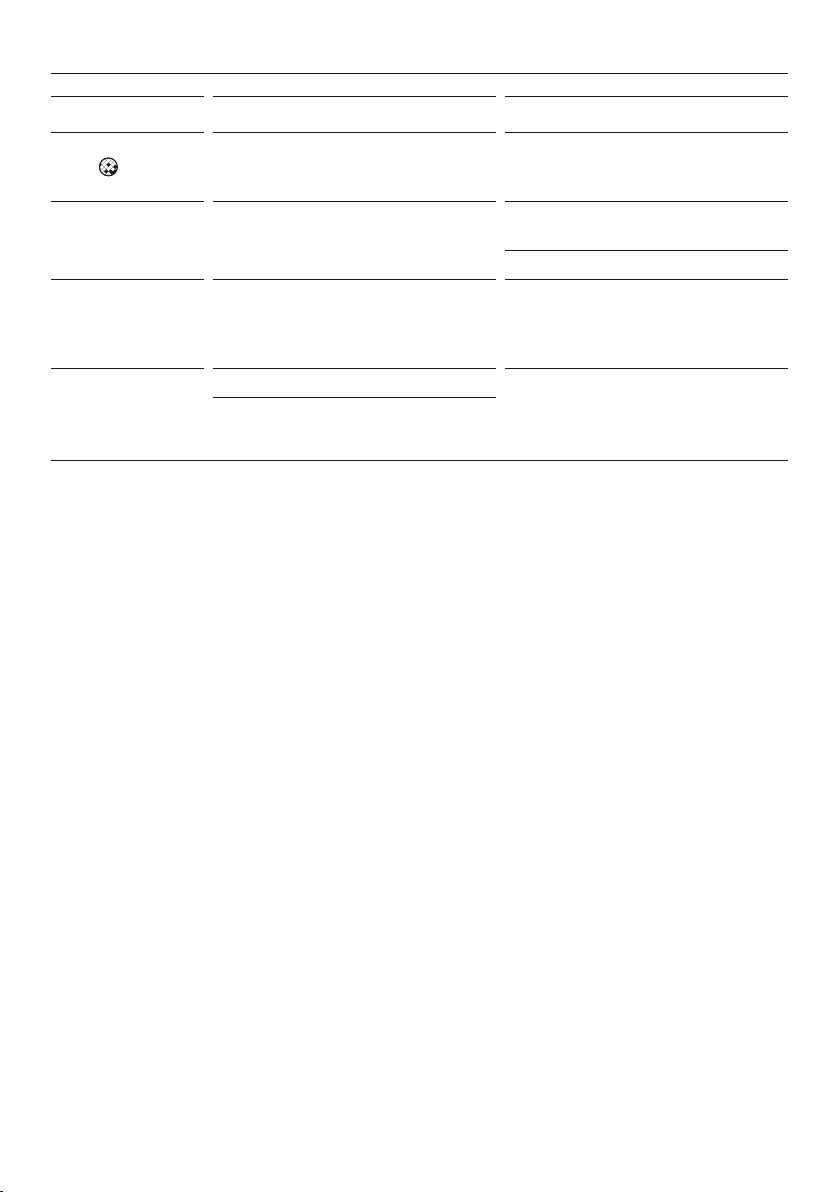
PROBLEM POSSIBLE CAUSES WHAT TO DO
Automatic ice
maker does
notwork
Ice maker has not been turned on. Switch on ice maker.
Bin is in the wrong way or there
is no bin in place.
Place bin so scoop is in the front
of the ice bin. Refer to section
‘Care and cleaning’.
Ice bin sits directly under ice
maker on top left side of freezer.
Water supply turned off or
not connected.
Connect water supply.
Freezer compartment not working. Contact Customer Care.
Water pressure too low. Check water pressure.
Water line kinked/squashed. Check water line for
kinks/squashing.
Filter clogged. Water filter may need replacing.
Knob not in correct position. Check knob is in lock position.
Ice cubes have
odour/taste
Unsealed packages may be
transmitting odour/taste.
Old cubes need to be discarded.
Ensure food packaging is sealed.
Interior of freezer needs cleaning. Ice storage bin needs to be
emptied and washed.
Clean refrigerator.
Poor taste from incoming water. Filter may need to be replaced
with new one.
Force 2–3 ice tray flips.
Slow ice cube
freezing
Door may have been left ajar. Close door.
Freezer compartment too warm. Turn temperature to a
colder setting.
Wet ice/
iceclumping
Low water pressure. Check water pressure.
Filter blocked. Replace filter.
Long freezer door openings. Gently tap ice with scoop to
unstick or, if large clumps occur,
empty ice bin and make new ice.
High ambient temperature.
Ice bin left out of freezer
compartment for a length of time.
Ice will stick together over time.
39
TROUBLESHOOTING
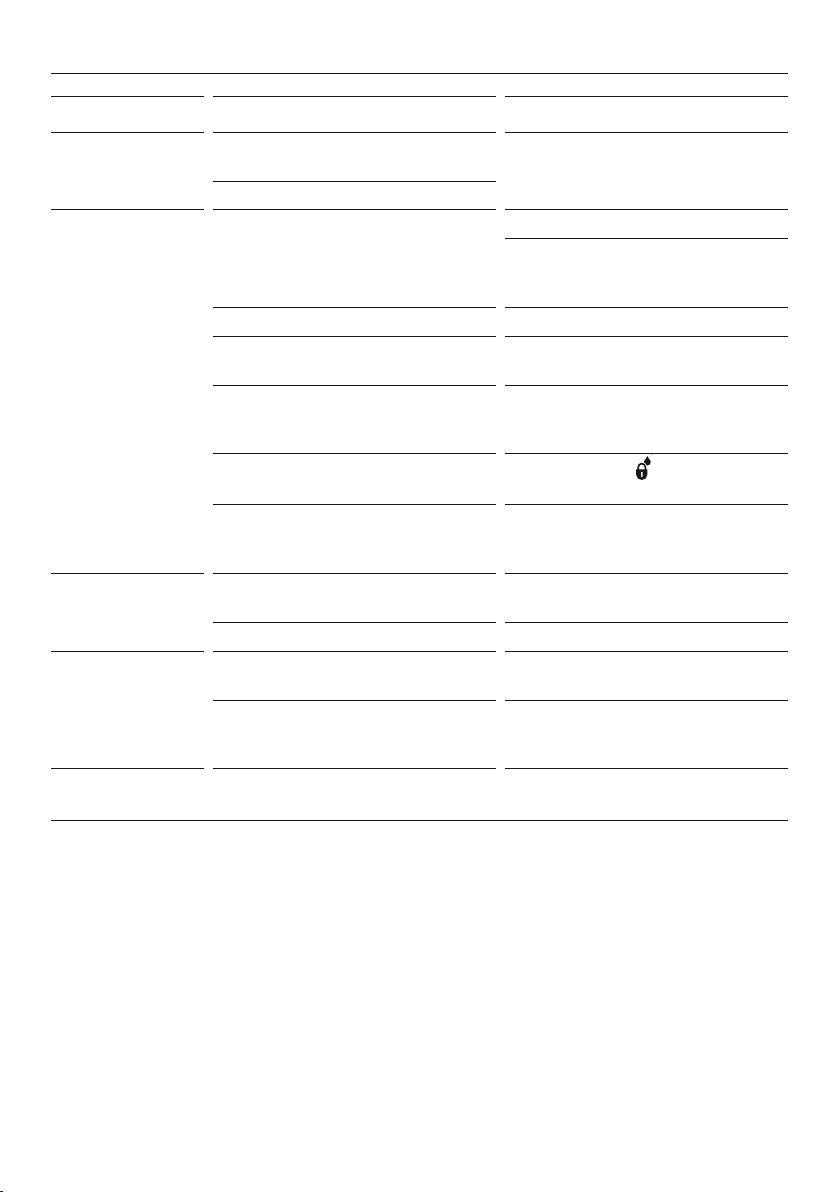
PROBLEM POSSIBLE CAUSES WHAT TO DO
Filter warning
light
is flashing
Filter needs replacing. Replace filter as soon as possible.
Ice build up
inside freezer
compartment
Freezer door not closing tightly. Arrange items in freezer so door
can close tightly.
Check and clean door gasket seal.
Ice maker
makes unfamiliar
sounds or
seems too loud
Normal ice maker operation. Refer to section
‘ActiveSmart™ sounds’.
Ice boost
function not
increasing rate of
ice production
Ambient temperature very warm. Minimise door openings.
Refrigerator is in high usage.
40
PROBLEM POSSIBLE CAUSES WHAT TO DO
Water has poor
taste/odour
Refrigerator not used for an
extended period.
Dispense 4L of water so fresh
water supply is replenished.
New filter installed.
Water dispenser
does not work
Water supply turned off or
not connected.
Turn water on.
Press dispenser for fourminutes
to remove trapped air from water
line and to fill the water system.
Supply line may be blocked. Check supply for kinks or leaks.
On first installation there may be
air in water system.
To remove air, run 3L of water
through the dispenser.
Filter may be blocked and
need replacing.
Replace filter (see your ‘Service
& Warranty’ document provided
with your refrigerator).
DISPENSER LOCK activated.
Press and hold for
fourseconds.
Water frozen in tank. Increase temperature to a
warmer setting in fridge
compartment andfreezer.
Water in first
glass is warm
Water dispenser not used for
extended period.
Discard first glass of
water dispensed.
Tank capacity used recently. Allow water time to cool.
Drips overflow
drip-shelf
Air trapped in tank. Flush 3L water through dispenser,
stopping intermittently.
New filter installed. Dispense 4L of water through
the dispenser, and then another
4L after four minutes.
Water flow rate
has slowed down
Filter cartridge is restricted. Replace filter as soon as possible.
TROUBLESHOOTING
41
Complete and keep for safe reference:
Model
Serial No.
Purchase Date
Purchaser
Dealer
Suburb
Tow n
Country
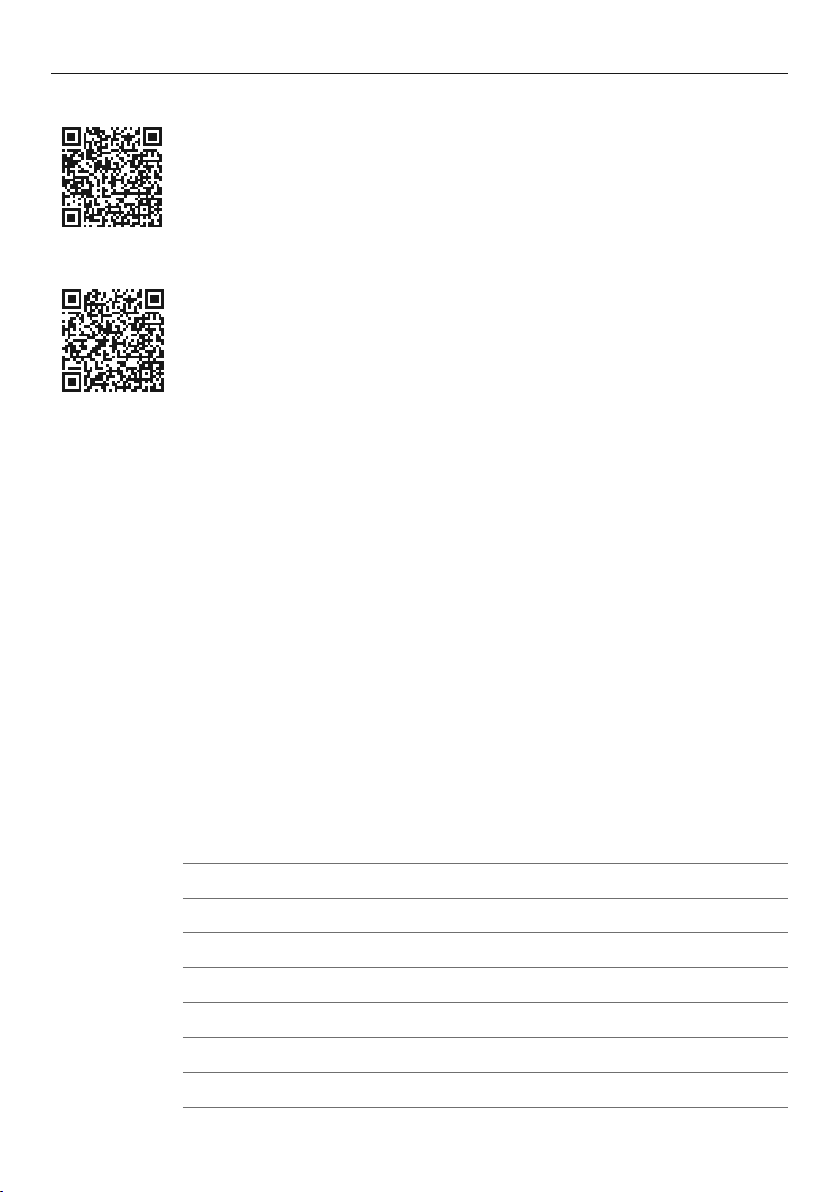
To access your Warranty and Service Guide
Scan the QR code with your smartphone to access your warranty
and book a service, or view online at https://www.fisherpaykel.
com/nz/help-and-support/warranty-information
This product has been designed for use in a domestic (residential) environment. This
product is not designed for any commercial use. Any commercial use by the customer will
affect this products Manufacturer’s Warranty.
To access your Warranty and Service Guide
Scan the QR code with your smartphone to access your warranty
and book a service, refer to your separate warranty and service
book or view online at https://www.fisherpaykel.com/au/help-and-
support/warranty-information
NZ
AU
MANUFACTURER’S WARRANTY AND SERVICE GUIDE

41084A 10.22
FISHERPAYKEL.COM
© Fisher & Paykel Appliances 2022. All rights reserved.
The models shown in this guide may not be available in all markets
and are subject to change at any time.
The product specifications in this guide apply to the specific products and
models described at the date of issue. Under our policy of continuous product
improvement, these specifications may change at any time.
For current details about model and specification availability in your country,
please go to our website or contact your local Fisher&Paykel dealer.