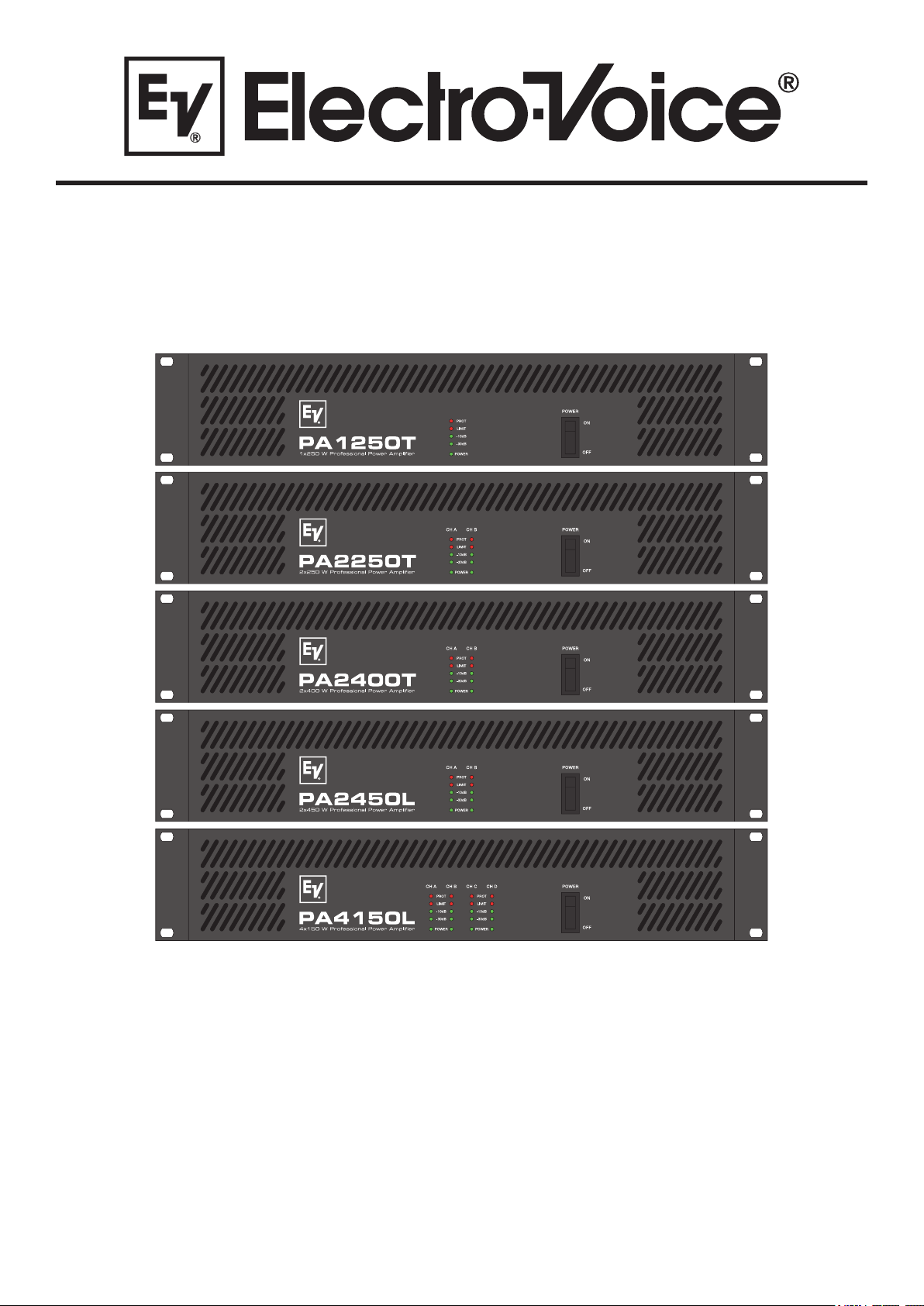
OWNER‘S MANUAL
BEDIENUNGSANLEITUNG
MODE D‘EMPLOI
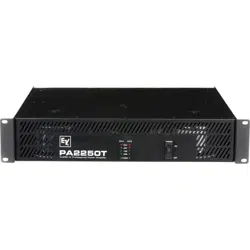
P A 1 2 5 0 T
P A 2 2 5 0 T
P A 2 4 0 0 T
P A 2 4 5 0 L
P A 4 1 5 0 L
P A S E R IE S

CONTENTS
ENGLISH
IMPORTANT SAFETY INSTRUCTIONS
......
3
IMPORTANT SERVICE INSTRUCTIONS
......
3
DESCRIPTION
......
4
Unpacking & Warranty
......
4
Installation Notes
......
4
FRONT PANEL
......
5
Mains Switch
......
5
Protect
......
5
Limiter
......
5
Level Indication
......
5
Power
......
5
REAR PANEL
......
6
Audio Signal Inputs
......
6
Level Controls
......
6
Mode Switch
......
6
High Pass Filter
......
6
Loudspeaker Outputs
......
7
Mains Fuse
......
8
Mains Socket
......
8
Voltage Selector
......
8
LF CONNECTION CORDS
......
8
MAINS OPERATION & RESULTING
TEMPERATURE
......
9
NOTES
......
11
DEUTSCH
INHALT
......
12
WICHTIGE SICHERHEITSHINWEISE
......
13
WICHTIGE SERVICEHINWEISE
......
13
BESCHREIBUNG
......
14
Auspacken & Garantie
......
14
Installationshinweise
......
14
FRONTSEITE
......
15
Netzschalter
......
15
Protect
......
15
Limiter
......
15
Pegelanzeigen
......
15
Power
......
15
RÜCKSEITE
......
16
Signaleingänge
......
16
Level Regler
......
16
Mode Schalter
......
16
Hochpass lter
......
16
Lautsprecherausgänge
......
17
Netzsicherung
......
18
Netzbuchse
......
18
Spannungswahlschalter
......
18
NF-VERBINDUNGSKABEL
......
18
NETZBETRIEB & WÄRMEENTWICKLUNG
......
19
NOTIZEN
......
21
2
FRANCAISE
TABLE DES MATI
É
RES
......
22
I
NSTRUCTIONS DE SÉCURITÉ
IMPORTANTES
.
.....
23
INSTRUCTIONS DE RÉPARATION
IMPORTANTES
......
23
INTRODUCTION
......
24
Déballage et garantie
......
24
Remarques concernant l’installation
......
24
FACE AVANT
......
25
Interrupteur secteur
......
25
Protect
......
25
Limiteur
......
25
Indicateur de niveau
......
25
Power
......
25
PANNEAU ARRIÈRE
......
26
Entrées Signal Audio
......
26
Contrôles de niveau
......
26
Sélecteur de Mode
......
26
Filtre Passe-Haut
......
26
Sorties Haut-Parleur
......
27
Fusible secteur
......
28
Prise secteur
......
28
Sélecteur de tension
......
28
CORDONS DE CONNEXION AUDIO
......
28
ALIMENTATION SECTEUR ET
TEMPÉRATURE RÉSULTANTE
......
29
NOTICES
......
31
APPENDIX / ANHANG / APPENDICE
TECHNICAL SPECIFICATIONS
......
32
BLOCK DIAGRAMM
......
33
PA2450L / PA4150L
......
33
PA4150L
......
34
PA2400T / PA2250T
......
35
PA1250T
......
36
DIMENSIONS
......
37
IMPORTANT SAFETY INSTRUCTIONS
1. Read these instructions.
2. Keep these instructions.
3. Heed all warnings.
4. Follow all instructions.
5. Do not use this apparatus near water.
6. Clean only with a dry cloth.
7. Do not cover any ventilation openings. Install in accordance with the manufacturer’s instructions.
8. Do not install near heat sources such as radiators, heat registers, stoves, or other apparatus (including amplifiers) that produce heat.
9. Do not defeat the safety purpose of the polarized or the grounding-type plug. A polarized plug has two blades with one wider than the other. A grounding type
plug has two blades and a third grounding prong. The wide blade or the third prong are provided for your safety. If the provided plug does not fit into your out-
let, consult an electrician for replacement of the obsolete outlet.
10. Protect the power cord from being walked on or pinched particularly at plugs, convenience receptacles, and the point where they exit from the apparatus.
11. Only use attachments/accessories specified by the manufacturer.
12. Use only with the cart, tripod, bracket, or table specified by the manufacturer, or sold with the apparatus. When a cart is used, use caution
when moving the cart/apparatus combination to avoid injury from tip-over.
13. Unplug this apparatus during lightning storms or when unused for a long period of time.
14. Refer all servicing to qualified service personnel. Servicing is required when the apparatus has been damaged in any way, such as power-
supply cord or plug is damaged, liquid has been spilled or orbjects have fallen into the apparatus, the apparatus has been exposed to rain or
moisture, does not operate normally, or has been dropped.
15. Do not expose this equipment to dripping or splashing and ensure that no objects filled with liquids, such as vases, are placed on the equipment.
16. To completely disconnect this equipment from the AC Mains, disconnect the power supply cord plug from the AC receptacle.
17. The mains plug of the power supply cord shall remain readily operable.
18. No naked flame sources, such as lighted candles, should be placed on the apparatus.
19. The product should be connected to a mains socket outlet with a protective earthing connection.
IMPORTANT SERVICE INSTRUCTIONS
CAUTION: These servicing instructions are for use by qualified personnel only. To reduce the risk of
electric shock, do not perform any servicing other than that contained in the Operating Instructions
unless you are qualified to do so. Refer all servicing to qualified service personnel.
WEEE RECYCLING/DISPOSAL INSTRUCTIONS
The Wheelie Bin symbol found on the product or in the manual indicates that this product must not be disposed of with other waste. It is in our category the
manufacturer’s responsibility to properly dispose of their waste electrical and electronic equipment (WEEE) at the end of its life. Due to the differences in each EU
country’s management of WEEE, please contact your local distributor. We are committed to facilitate our own electronic-waste-management-system, for the free
of charge return of all EVI Audio GmbH products: Telex, DYNACORD, Electro-Voice and RTS. Arrangements are made with the dealer where you purchased the
equipment from, for the returning of all unusable equipment at no cost, to the factory in Straubing, for environmental protective disposal.
Due to line current harmonics, we recommend that you contact your supply authority before connection.
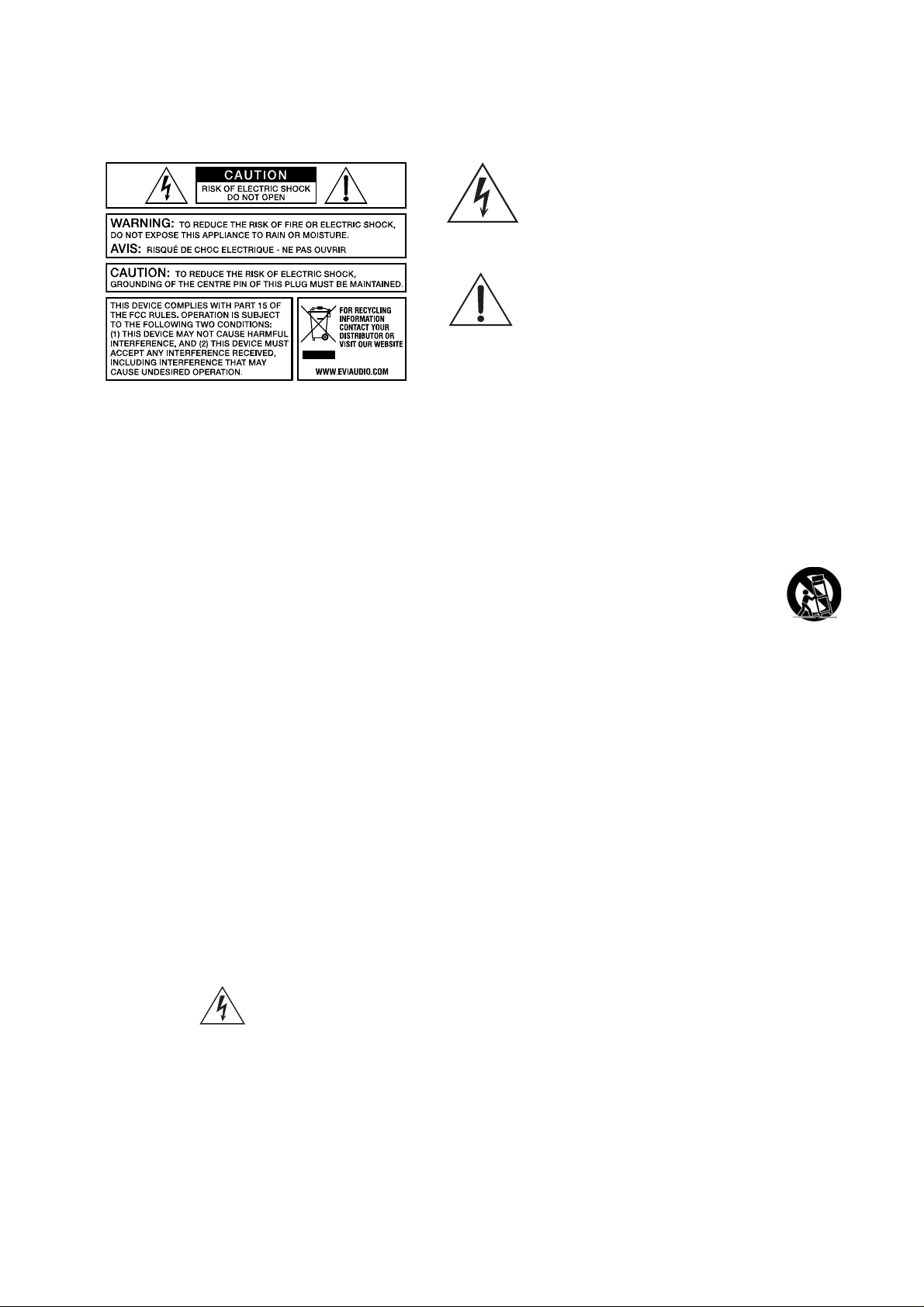
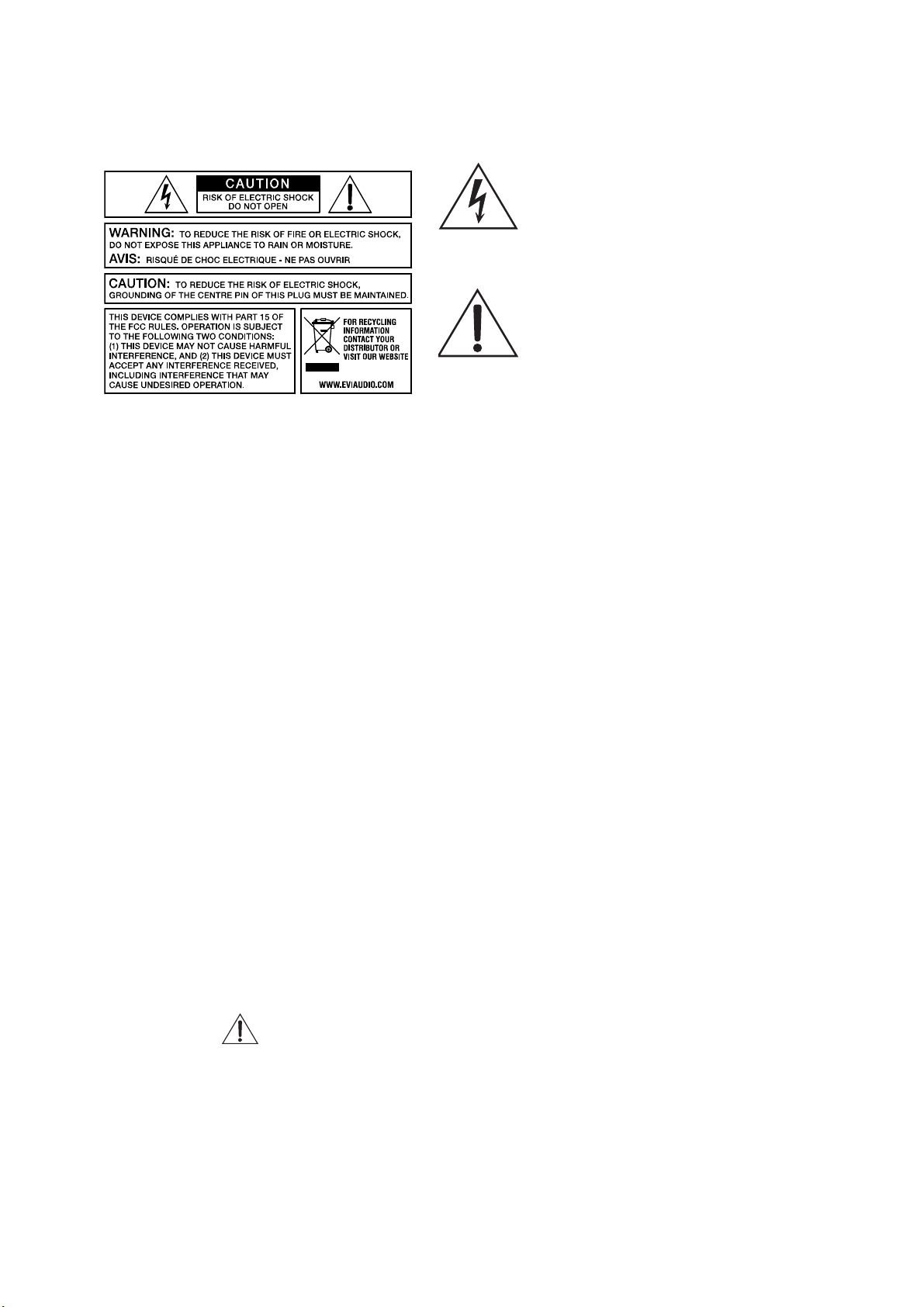
The lightning flash with arrowhead symbol, within an equilateral
triangle is intended to alert the user to the presence of uninsulated
”dangerous voltage” within the product’s enclosure that may be of
sufficent magnitude to constitute a risk of electric shock to per-
sons.
The exclamation point within an equilateral triangle is intended to
alert the user to the presence of important operating and
maintance (servicing) instructions in the literature accompanying
the appliance.
servicing the appliance.
1.
2. Use of a mains separator transformer is mandatory during maintenance while the appliance is opened, needs to be operated and is connected to the mains.
3. Switch off the power before retrofitting any extensions, changing the mains voltage or the output voltage.
4. The minimum distance between parts carrying mains voltage and any accessible metal piece (metal enclosure), respectively between the mains poles has to
be 3 mm and needs to be minded at all times. The minimum distance between parts carrying mains voltage and any switches or breakers that are not con-
nected to the mains (secondary parts) has to be 6 mm and needs to be minded at all times.
5. Replacing special components that are marked in the circuit diagram using the security symbol (Note) is only permissible when using original parts.
6. Altering the circuitry without prior consent or advice is not legitimate.
7. Any work security regulations that are applicable at the locations where the appliance is being serviced have to be strictly obeyed. This applies also to any
regulations about the work place itself.
8. All instructions concerning the handling of MOS-circuits have to be observed.
WEEE RECYCLING/DISPOSAL INSTRUCTIONS
NOTE: SAFETY COMPONENT (MUST BE REPLACED BY ORIGINAL PART)
Security regulations as stated in the IEC 62368-1: 2018, EN 62368-1:2020+A11:2020, UL 62368-1:2019 and CAN/CSA C22.2 No. 62368-1:2019. have to be obeyed when

Congratulations
on your ElectroVoice PA series power ampli er purchase! The ElectroVoice PA-Series
power amp line combines outstanding audio performance, exceptional reliability and secure operational
safety in a compact 2RU chassis design.
All models in the PA Series provide several protection circuits which not only prevent the power
ampli er itself but also the connected loudspeaker systems from being damaged. These protections
include Dynamic Audio Limiters, Inrush Current Limiter, Short Circuit Protection and Thermal Overload
Protection. All PA-Series power amps feature different hi-pass lters with switch selectable cut-off
frequency to attenuate unwanted low-frequency signals.
In nitely variable low-noise high performance fans guarantee absolute thermal stability while keeping fan
noise to a minimum. Direct “ ow-thru” chassis design allows for a smooth ow of air from front-to-rear,
which allows trouble-free operation even in smaller amp-racks.
Compact high density power supply units with low-leakage toroidal transformers provide extensive
headroom far above the listed power rating. Premium phoenix style screw-lock connectors prevent
accidental disconnection resulting in a more secure connection of audio signal and speaker cables.
All PA series “T” version models are equipped with high performance output transformers also provide
oating outputs for 50V, 70V and 100V installations. These models also provide voltage limiters to
protect the loudspeaker outputs against over-voltage.
Unpacking & Warranty
Carefully open the packaging and take out the power ampli er. Next to the power ampli er itself, the
package also includes this owner’s manual, a mains cord, a warranty certi cate, four attachable feet as
well as screwlock connectors for all inputs and outputs. The warranty period is 36 months starting
from the date when receiving the appliance from the dealer. Keep the original invoice, which states
the purchase/delivery date together with the warranty certi cate at a safe place.
Installation Notes
First of all, please make sure to check that the voltage selector on the amp’s rear is set to the correct
position matching the installation site’s local mains voltage.
Generally, installing or mounting power amps should be carried out in a way that guarantees continuously
unopposed front-to-rear air circulation. When including an appliance in a closed cabinet or rack shelf
system make sure to provide suf cient ventilation. Leave an air duct of at least 2.5“ x 13“ (up to
the cabinet’s top ventilation louvers) for air circulation between the rear of the power ampli er and
the cabinet’s/rack’s rear wall. Make sure to leave at least 4“ of space above the cabinet or rack
shelf system. Since temperatures inside of a cabinet or rack shelf system can easily rise up to 105 degrees
during operation, carefully considering the environmental temperature maximum values of all other
appliances installed in the same rack shelf system is mandatory (also refer to “Mains Operation &
Resulting Temperature”).
When installing the power amp in a cabinet or rack shelf system, make sure to make use of the
rear mounting facilities to x the appliance in place and keep the front panel from bending. If
this is not possible, please use mounting-rails instead.
Caution:
For problem-free operation do not exceed the environmental temperature maximum
of 105 Deg. F.
The power ampli er has to be protected against: moisture (dripping or splashing water), direct sunlight,
high temperatures or the direct in uence of heat sources, high humidity, extensive dust and vibrations.
Condensation on internal parts may occur after transporting the power ampli er from a cold into a warmer
environment. In that case operation is only permissible after the appliance has gained the new temp-
erature (after approximately one hour). If objects or liquids have intruded the power amp’s enclosure,
disconnect the appliance from the mains immediately and contact an authorised service center for
inspection before continuing to operate the unit.
Do not use any sprays or solvents for cleaning the appliance, because they might severely damage
the surface of the enclosure or lead to dangerous re hazard.
DESCRIPTION
4
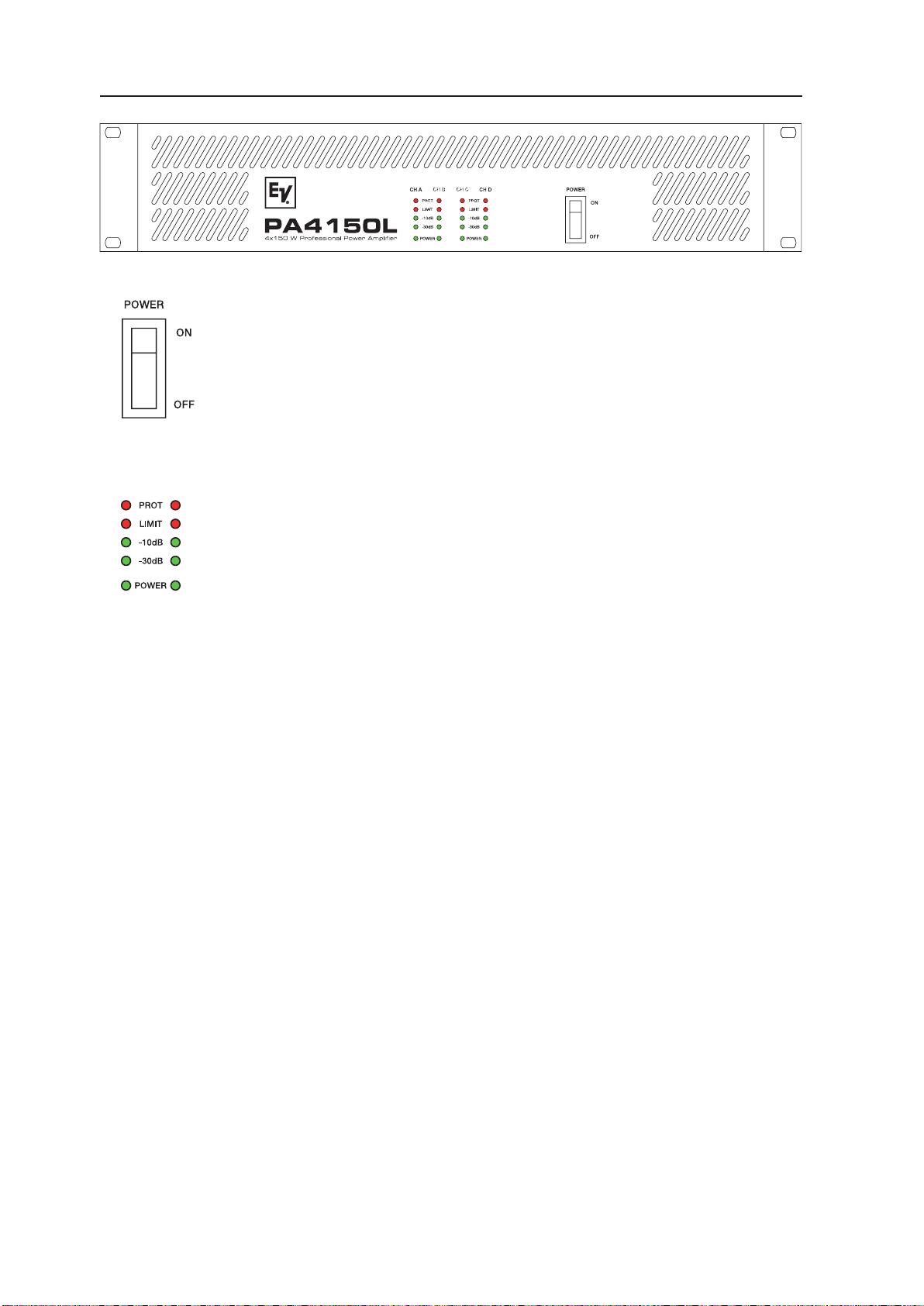
FRONT PANEL
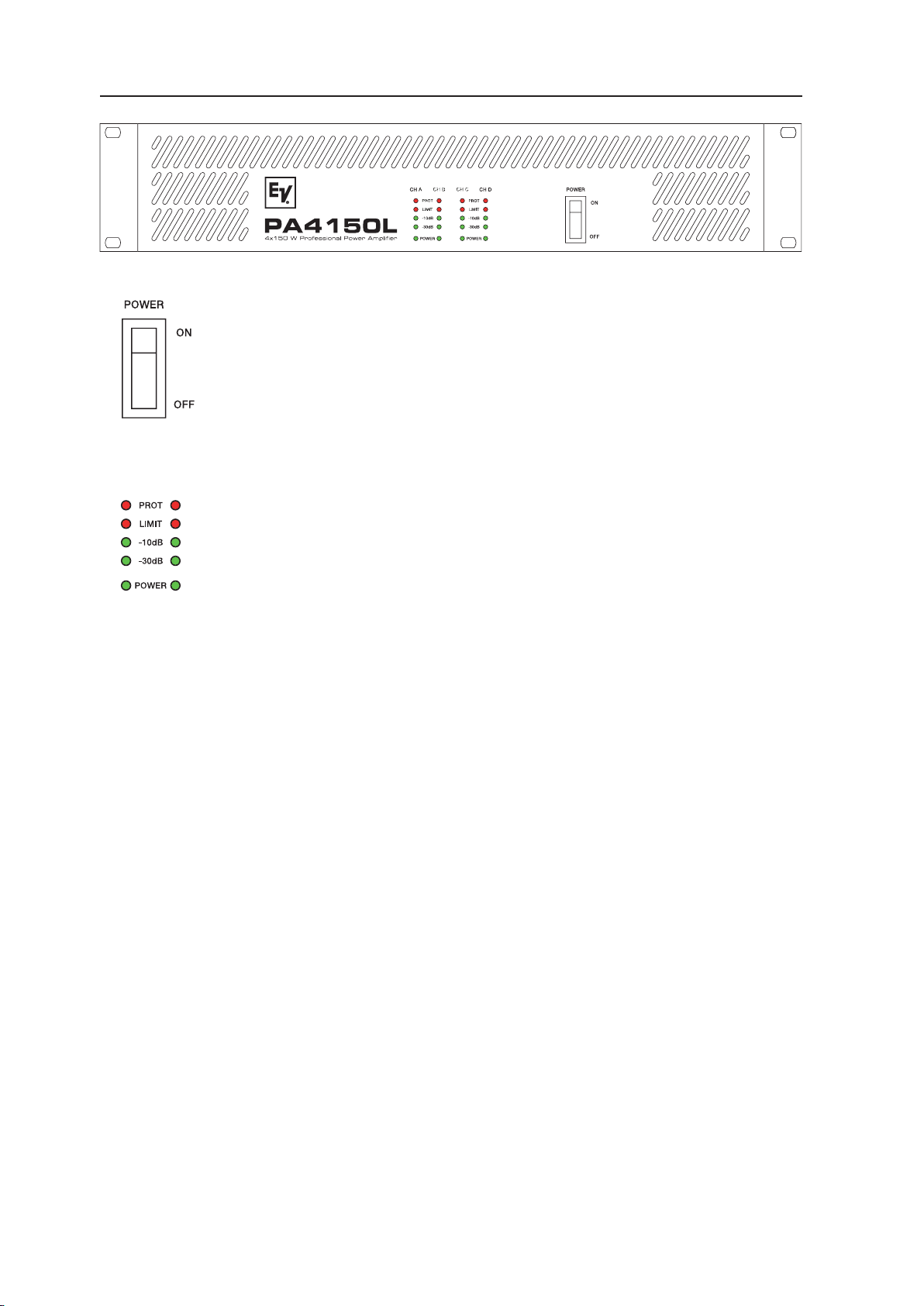
Mains Switch
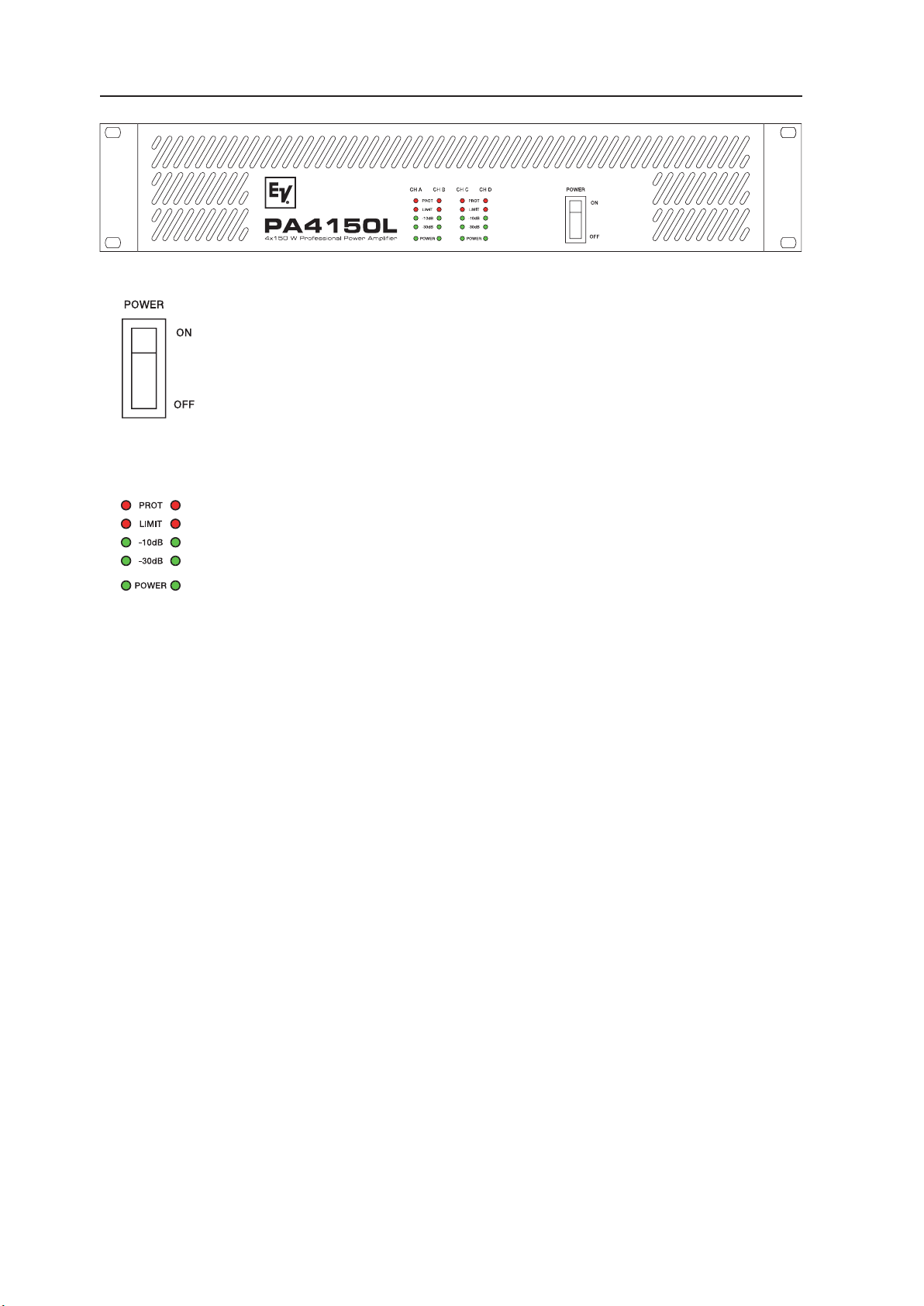
Use the mains switch to switch the unit’s power on. A soft-start function prevents inrush
current peaks on the mains, additionally preventing the mains line protection switch from
activating during the amp’s power-on operation. Loudspeaker outputs are activated via
relay switching with a delay of approx. 2 seconds, which effectively eliminates eventual
power-on noise.
During this delay period, the Protect LED lights to con rm
correct
operation of the
protection circuitry.
Protect (PROT)
A lit Protect LED indicates that one of the integrated protections against thermal overload,
short-circuit … has been activated. The audio channels’ protection circuits operate in-
dependent from each other. At the occurrence of failure or overload conditions the
affected power amp channel is separated from the load connected via output relay,
preventing the connected loudspeaker systems and the power ampli er itself from
being damaged. Whatever caused the fault – e.g. a short-circuited speaker cable – needs
to be remedied. In case of thermal overload you have to wait until the power ampli er
automatically returns to normal operation.
Limiter
The Limit indicator lights as soon as the integrated dynamic limiter is being activated
and the power amp is driven at the clipping limit or generally at its maximum capacity.
Short-term blinking is not a problem, because the internal limiter trims input levels of up
to +21dBu down to a THD+N of approximately 1%. If, on the other hand, this LED lights
constantly, reducing the volume is strongly recommended to prevent the connected
loudspeaker systems from being damaged by probable overload.
Level Indication
The level indicators signify the power ampli er’s current modulation. The -30dB LED
starts lighting at approx. 30dB below full modulation while the -10dB LED lights at
approx. 10dB below full modulation. Shorted speaker cables or the activation of a
protection circuit causes these indicators to go out.
Power
The Power indicator lights when switching the power ampli er on. If the power on LED
does not light please check to make sure the unit is plugged in or that the primary
fuse is not blown. If the fuse is blown please contact an authorized service center.
5
REAR PANEL
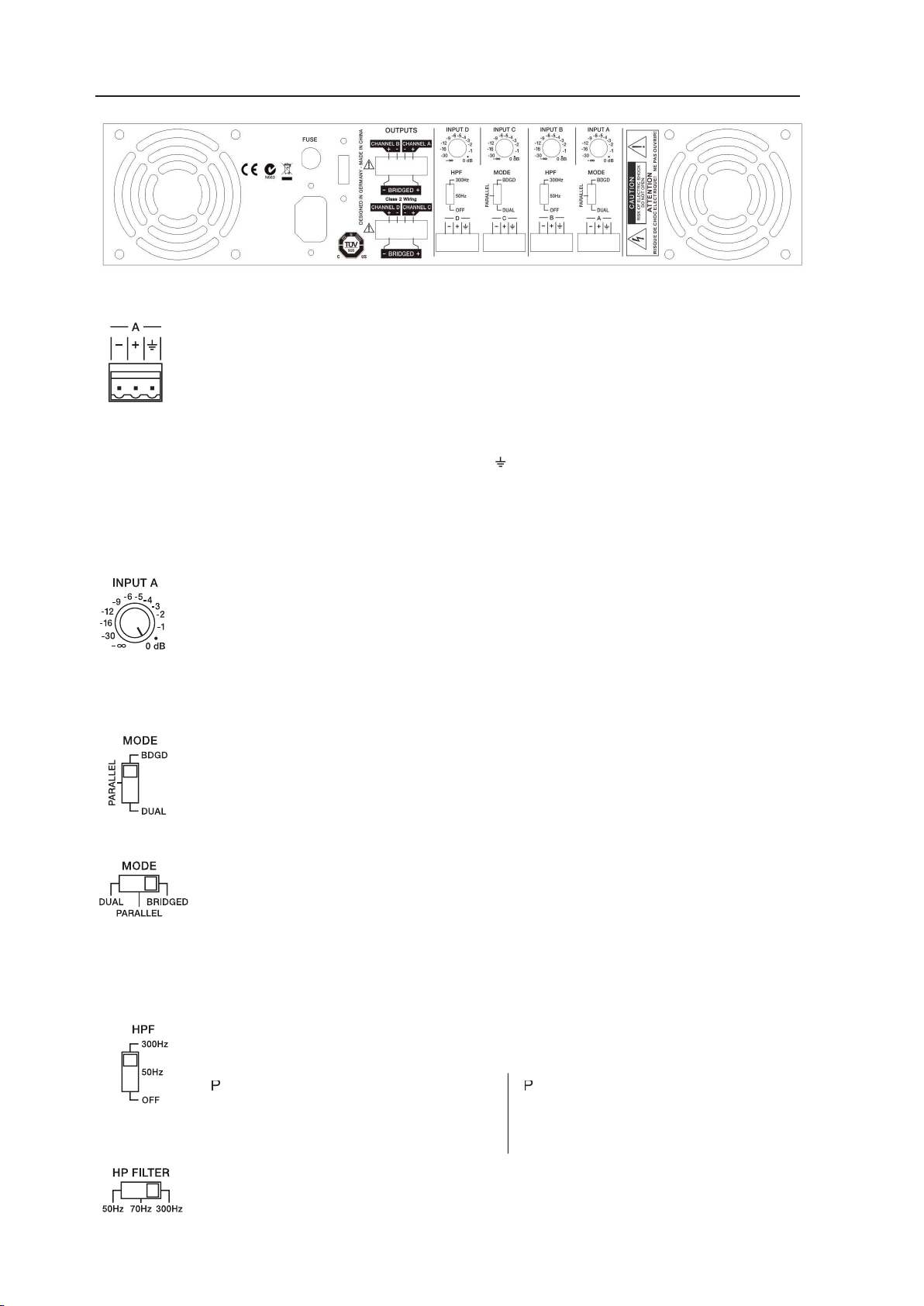
Audio Signal Inputs
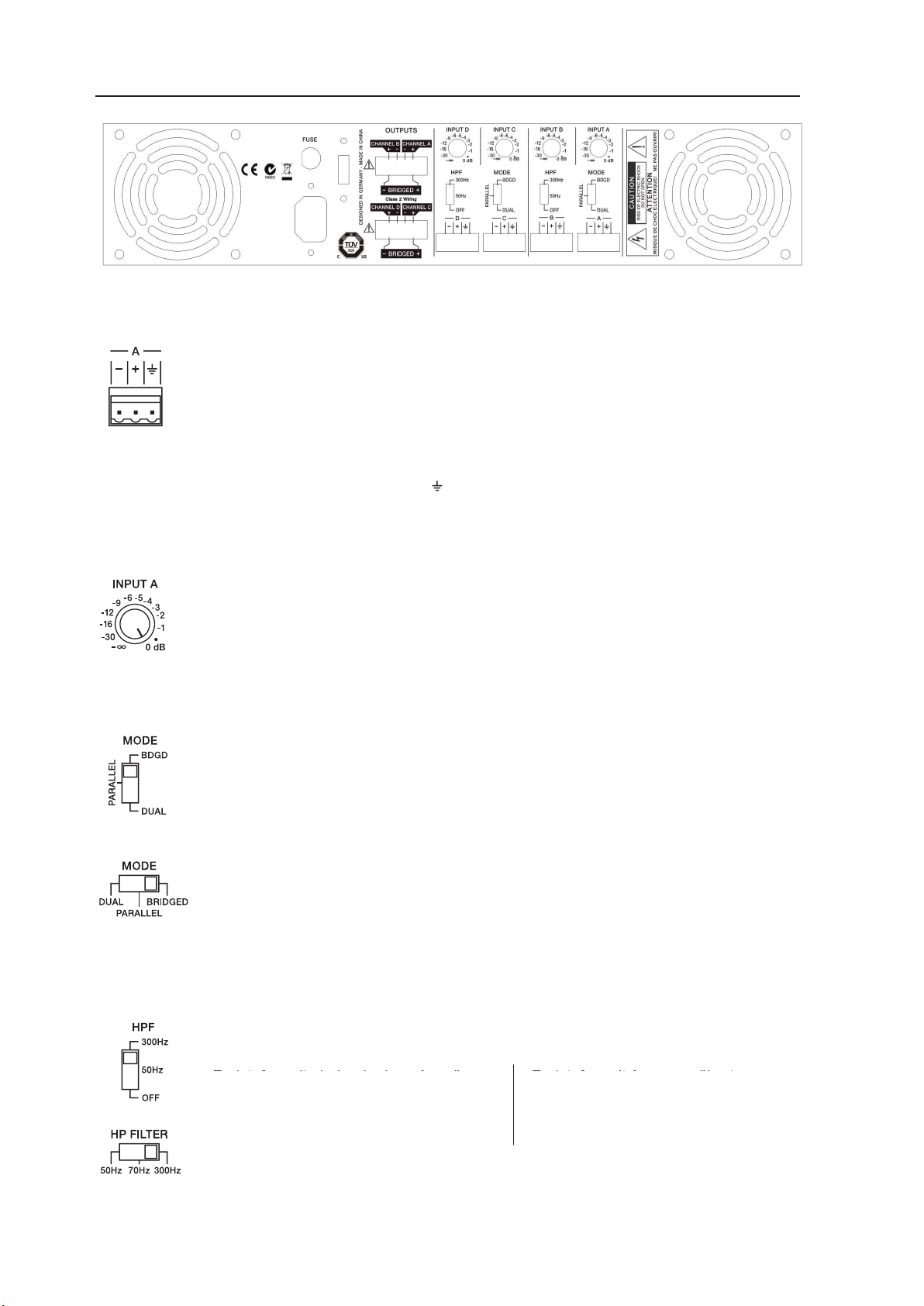
The electronically balanced inputs facilitate the connection of external signal sources
(e.g. mixing consoles). When screwed to the power amp, the screwlock connectors
provided with the unit prevent
accidental
disconnection.
Choosing balanced cables (2 conductors for audio signals + separate shielding mesh)
for LF-signal connection is generally recommended, even when the connected signal
source does not provide balanced output signals. This is possible by jointly connecting
“–” conductor and shield on the source side (also refer to “LF-Connection Cords).
CAUTION: The connector marked with a symbol is for connecting the audio cable’s
shielding mesh only.
It is not suited for the connection of the mains cord protective earthing con-
ductor.
Level Controls
The Level Controls allow setting the according power amp channel’s overall
ampli cation. To prevent distortion in mixing consoles connected to the amp, setting
these controls to a value between -6dB and 0dB is generally recommended. A scale
provides direct indication of the varying additional control attenuation applied to the xed
internal ampli cation.
Mode Switch
The Mode Switch allows selecting the power amp’s mode of operation. With the four-
channel model it is possible to independently select channels A and B or C and D.
The single-channel model comes without mode switch.
DUAL:
The power amp channels work independently from each other, each re-
producing the audio signals fed to the corresponding input.
PARALLEL:
Both channels reproduce the audio signal fed to input A (or C). However,
using the level controls allows individually setting the channel volumes.
BDGD:
Audio signals need to be fed to channel A (or C) when in Bridged Mode.
Power amps A and B (or C and D) now work in push-pull operation
delivering doubled output voltage. Please keep in mind to correctly
connect the loudspeaker systems for Bridged Mode operation. (also refer
to “Loudspeaker Outputs”)
High Pass Filter (HPF)
The Hi-Pass lter allows effective attenuation of low bass audio signals. You can choose
from three cut-off frequency settings:
Power Amps with low impedance outputsPower Amps with low impedance outputs
Power Amps with output transformerPower Amps with output transformer
300Hz, 12dB/oct., BW
300Hz, 12dB/oct., BW
300Hz, 12dB/oct., BW
300Hz, 12dB/oct., BW
50Hz, 12dB/oct., BW
70Hz, 12dB/oct., BW
OFF (no Hi-Pass lter)
OFF (no Hi-Pass lter)
50Hz, 18dB/oct., BW
50Hz, 18dB/oct., BW
As a basic principle, all models with output transformer have a 50Hz Hi-Pass lter in the
audio signal path to protect the transformer from being driven into saturation by high
level low-frequency signals.
6
100V
25W
100V
25W
16 x 25W
100V
6W
100V
6W
66 x 6W
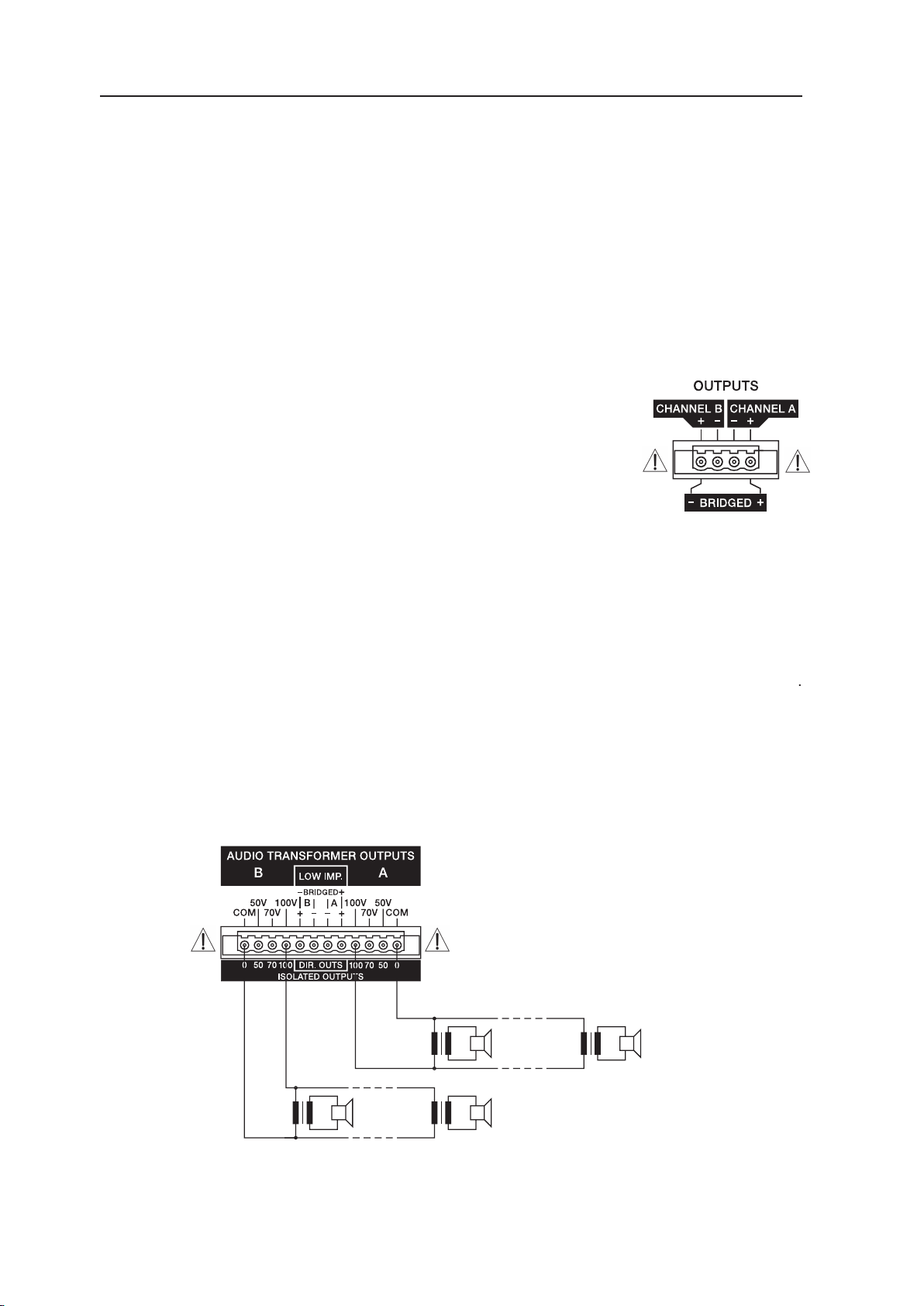
PA2450L & PA4150L
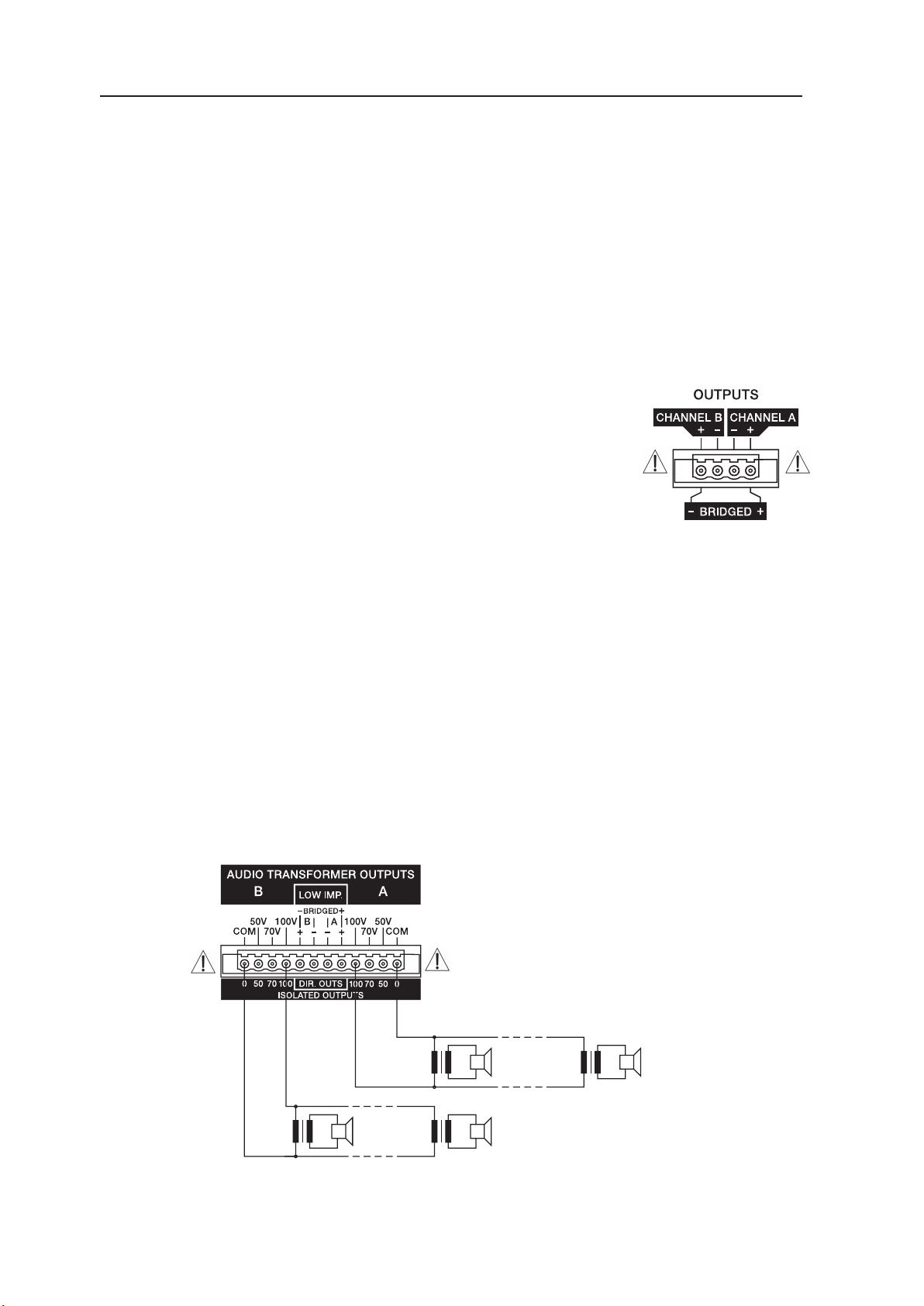
Loudspeaker systems connected to channels A and B (or C and D) have to be
connected according to the polarity indicated. Please, make sure to mind the
minimal impedance of 4 ohms per channel.
For bridged operation, the load has to be connected according to the BRIDGED-
label and the Mode switch needs to be set to “Bridged”. Please, make sure to
keep in mind that in Bridged Mode the minimal impedance is 8 ohms and that
the input audio signal has to be fed to channel A (or C).
REAR PANEL
Loudspeaker Outputs
The speaker output jacks are suitable for connecting speaker cables with a maximum diameter of 2.5
mm
2
. The provided screwlock connectors can be screwed to the power amp to prevent inadvertent
disconnection. Power amps offer low impedance outputs and / or oating outputs (ISOLATED
OUTPUTS) with nominal voltages of 50V, 70V and 100V, depending on the amp model.
Caution:
The symbol of a FLASH at the loudspeaker connectors indicates that these outputs
may carry high voltages which, when getting in contact with, can cause serious harm.
Establishing connections at these outputs is only permissible for skilled persons who
have been instructed on how to do so.
Never connect a hot output to a ground or another hot output! Always turn off the
ampli er before making connections!
PA1250T, PA2250T & PA2400T
Integrated audio output transformers convert the power amp’s nominal output voltage to 50V, 70V and
100V. The ampli er models PA2250T and PA2400T present all voltages simultaneously at the oating
outputs so that the power amp channels can be used in any combination of possible output voltages.
Mixed operation of low-impedance speaker systems and oating loudspeaker lines on a single power
amp channel is possible as well.
The use of loudspeaker systems with 100V or 70V matching transformers to reduce the effects of cable
loss is recommended when the distance between power amp and speaker systems exceeds
165 feet
.
In addition, this also facilitates distributing the output power among loudspeakers.
As many loudspeaker systems as possible can be connected, as long as the speaker network’s overall
power consumption does not exceed the power amp’s rated output power while at the same time not
falling below the nominal load impedance of the power amp outputs. Please refer to speci cations in
the appendix for individual values of the rated output power and nominal load impedance of power amp
outputs.
Con guration example: PA2400T with 100V speaker systems connected.
Maximum working loads with 25W/100V and 6W/100V loudspeaker systems.
7
REAR PANEL
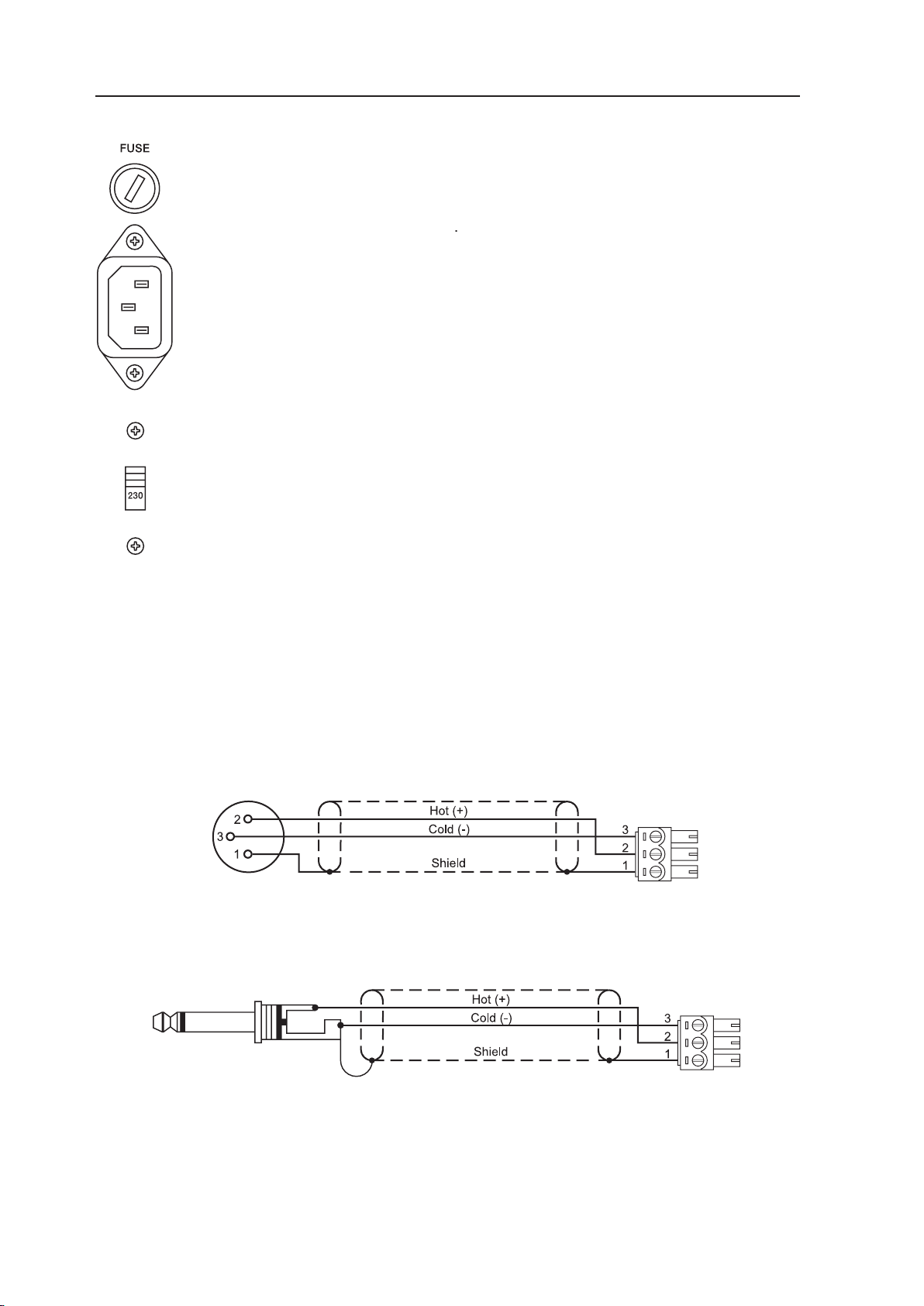
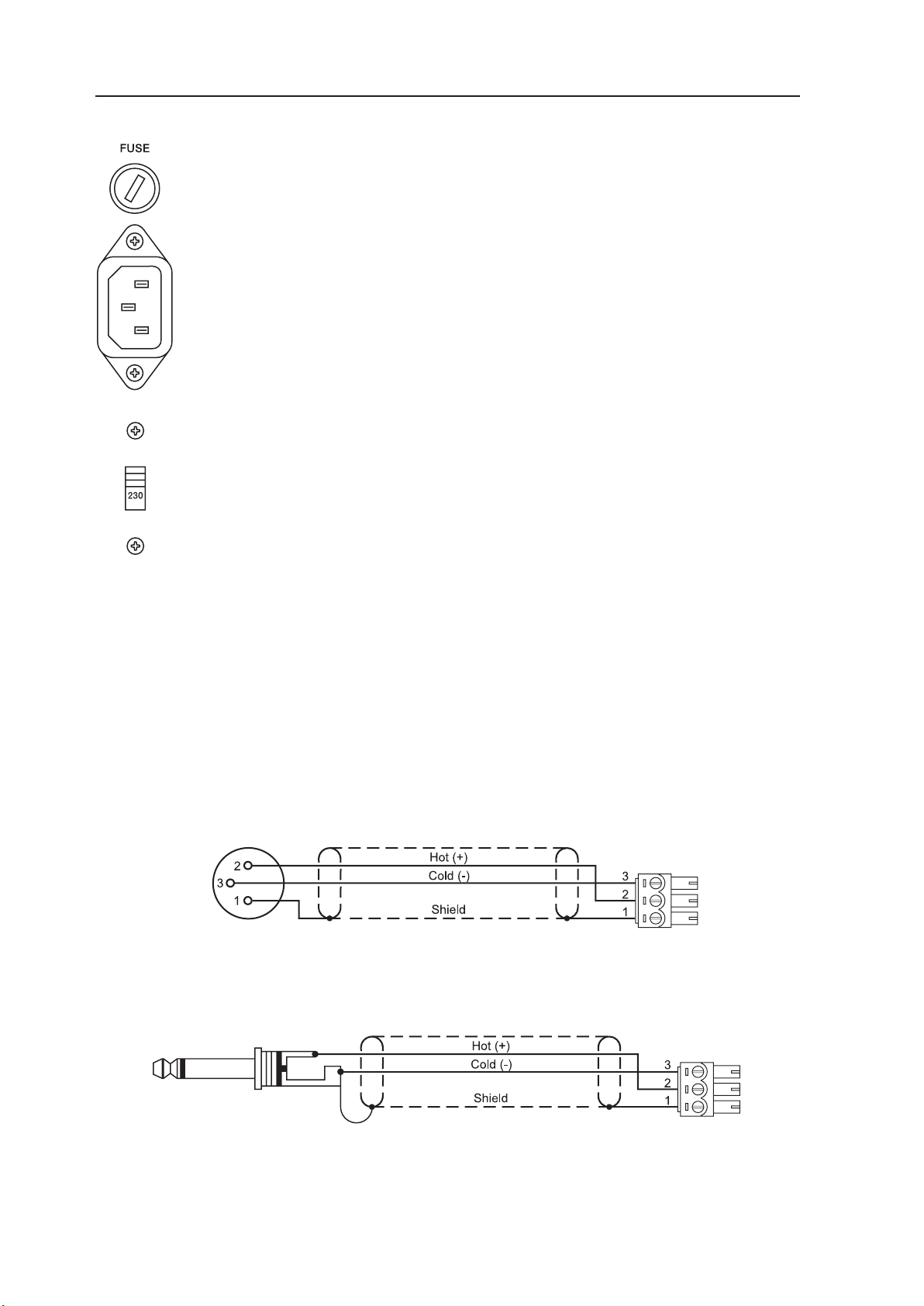
Mains Fuse
Under normal circumstance, the mains fuse blows only in the event of failure. When
replacing the fuse, make sure to use a fuse of the same type with identical prearcing
amperage, voltage and blow characteristics. If the mains fuse blows repeatedly, please
contact
an authorized service centre
.
Mains Socket
Please, make sure to check whether the voltage selector shows the correct mains
voltage that matches the local mains supply at the installation site. An appropriate mains
cord is included in the package.
Caution:
This appliance has no user serviceable parts inside. Leave servicing to
a quali ed professional.
Voltage Selector
Covered selector switch which shows the correct mains voltage for the unit.
LF-connection cords
Choosing balanced cables (two conductors for audio signals plus separate shielding mesh) is
recommended for LF-signal connection. Although connecting unbalanced cables to the power ampli er
inputs is possible as well, using balanced cables is always preferable.
A great number of today’s audio appliances provide balanced outputs carried out via XLR-type
connectors. With balanced cabling, the shield interconnects all metal enclosure parts and therefore
ef ciently eliminates the introduction of external interference – mostly noise and hum.
Wiring examples
8
XLR-female
amp input
connector
amp input
connector
phone jack
Cable to connect signal source with balanced XLR outputs.
Cable to connect signal source with unbalanced outputs.
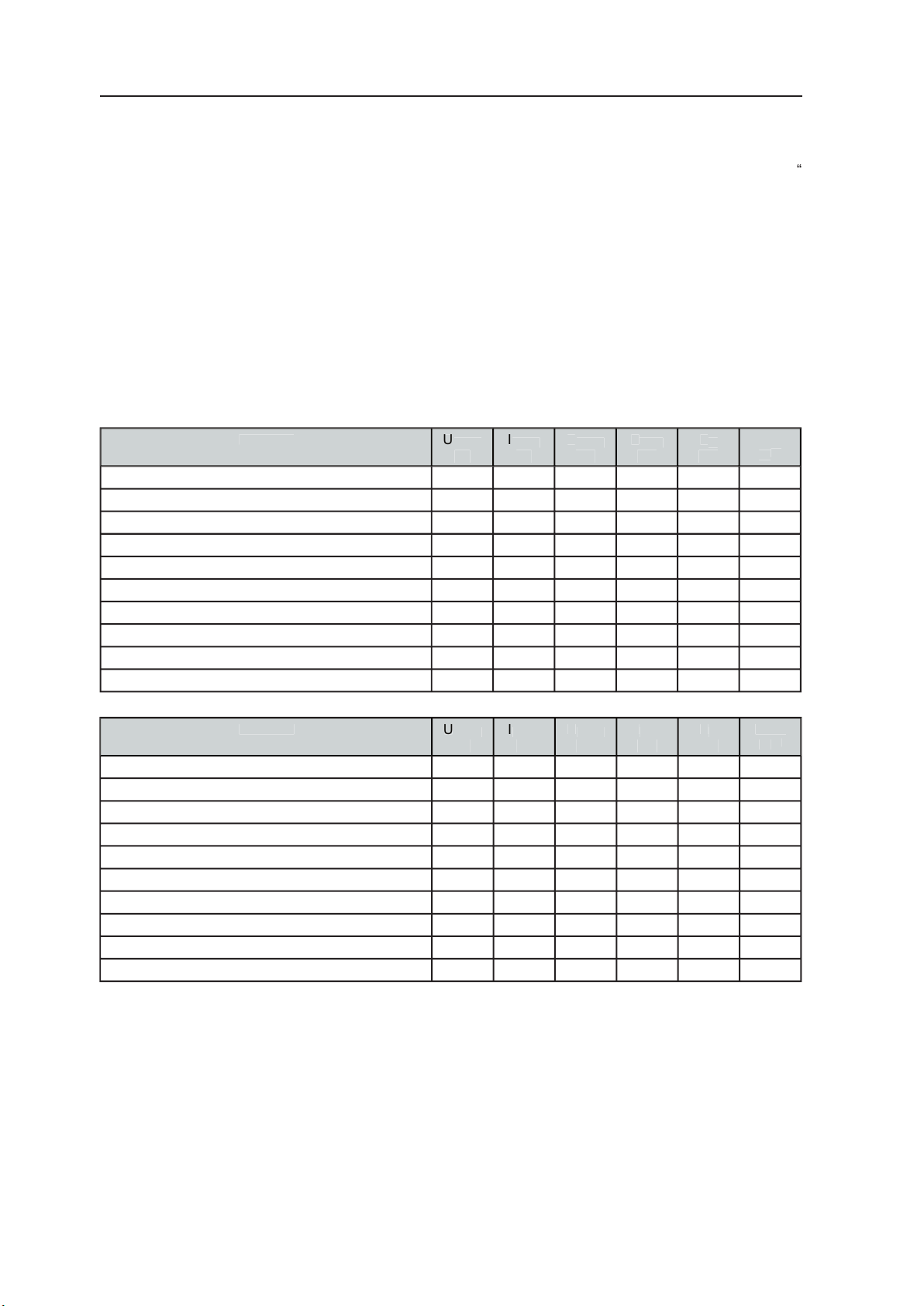
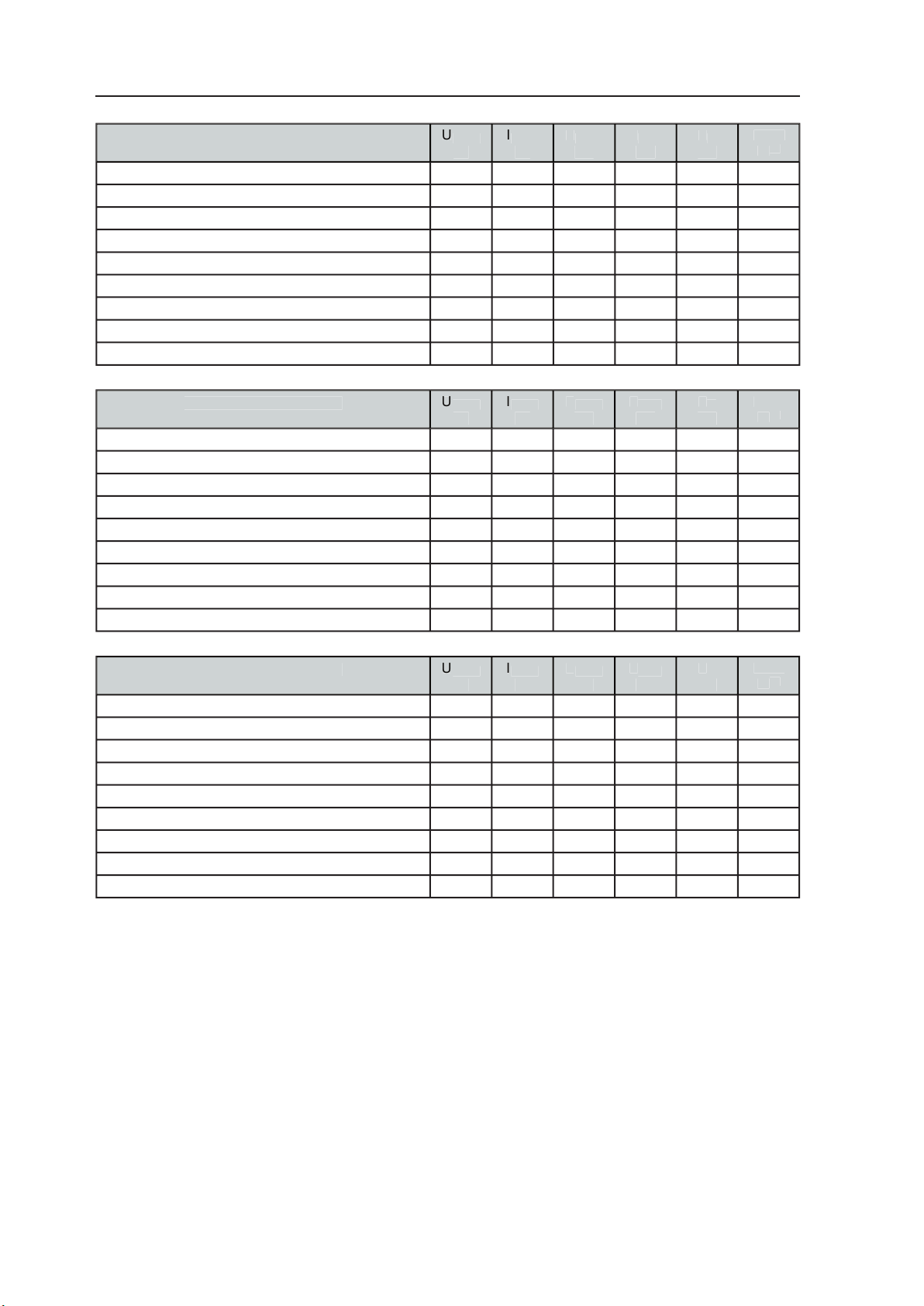
MAINS OPERATION & RESULTING TEMPERATURE
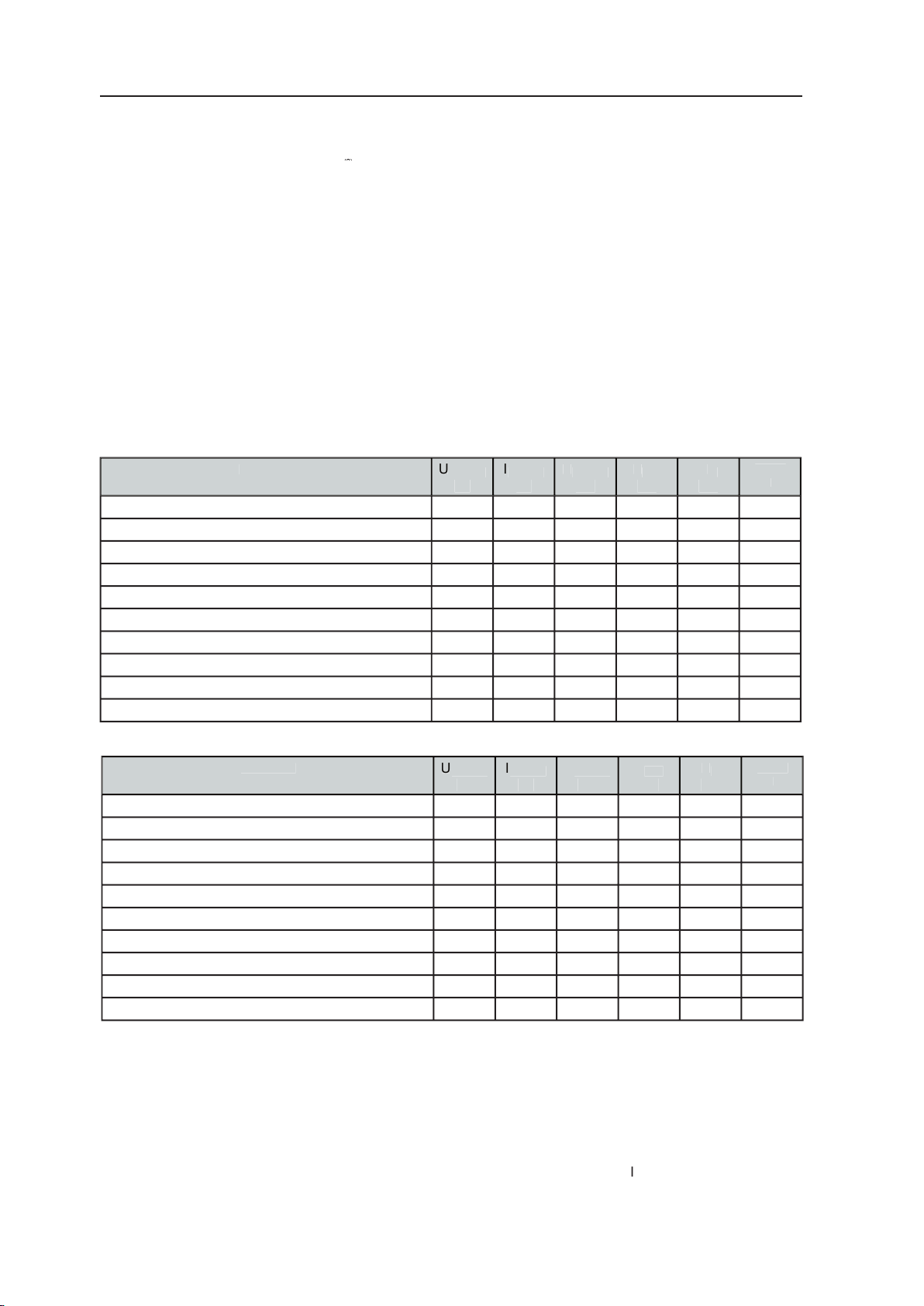
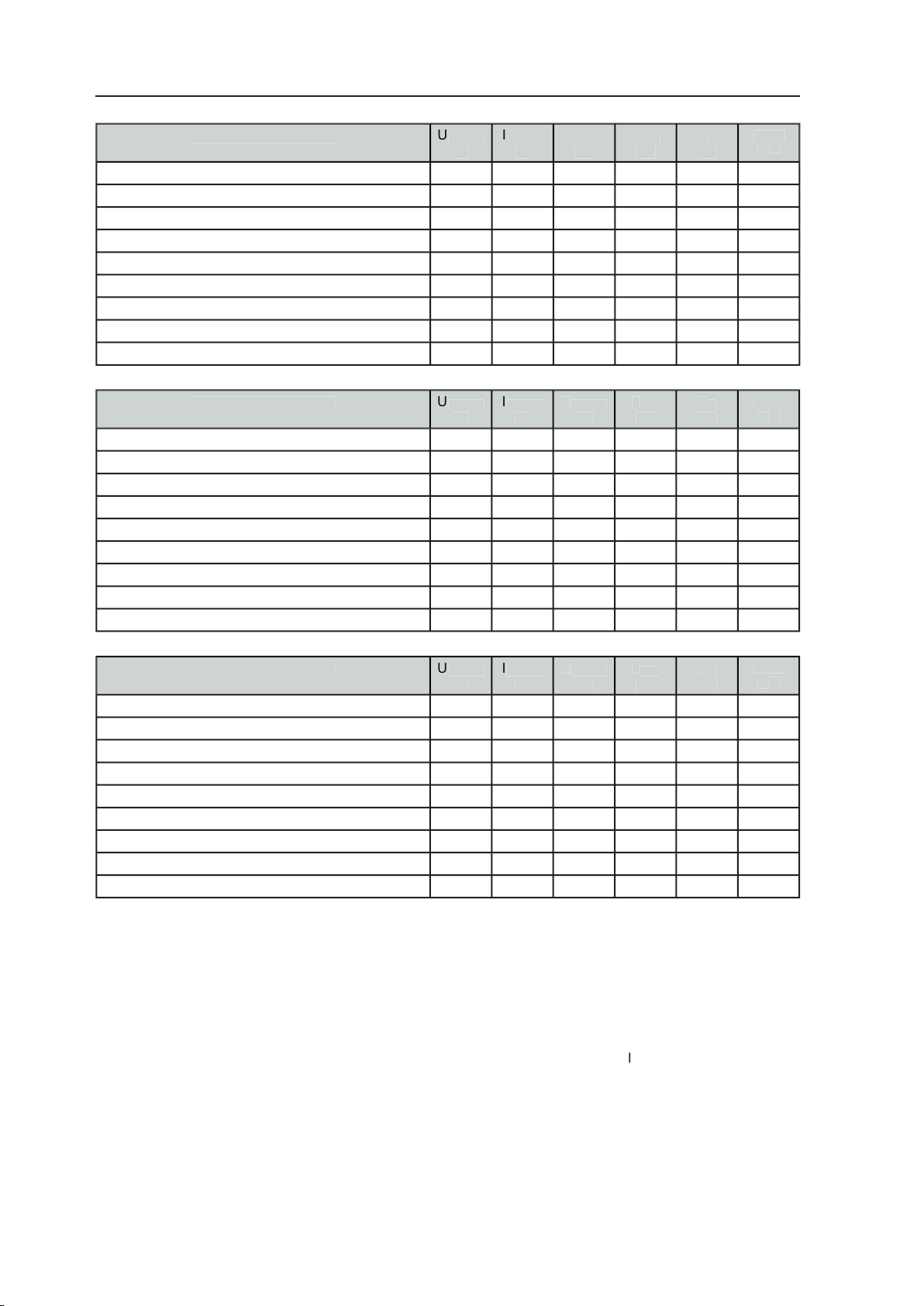
Mains Operation
The following tables provide a useful aid in determining power supply and cabling requirements. Column
“1/8 max. output power into 4 ohms
(2)
The following tables provide a useful aid in determining power supply and cabling requirements. Column
(2)
The following tables provide a useful aid in determining power supply and cabling requirements. Column
” states the values to be used for normal operation. These results
were measured with the power ampli er being operated at maximum output and a Pink Noise signal
driving the power amp at maximum modulation.
Temperatures inside of the power ampli er
The power drawn from the mains network is converted into acoustic output to feed the connected
loudspeaker systems plus heat. The difference between drawn power and dispensed power is referred
to as leakage power or dissipation (P
D
). The amount of heat resulting from power dissipation might
remain inside of a rack-shelf and needs to be diverted using appropriate measures. The following table
is meant as auxiliary means for calculating temperatures inside of a rack-shelf system/cabinet and the
ventilation efforts necessary.
The column “P
D
” lists the leakage power in relation to different operational states. The column “BTU/hr”
shows the dispensed heat amount per hour.
PA2450L
U
mains
[V]
I
mains
[A]
P
mains
[W]
P
out
[W]
P
D
[W]
BTU/
hr
(3)
idle
230
0,2
28
0
28
96
Max. output power into 8ohms
(1)
230
5,4
923
2x300
323
1102
Max. output power into 4ohms
(1)
230
8,8
1605
2x480
645
2201
1/3 max. output power into 4ohms
(1)
230
5,6
953
2x160
633
2160
1/8 max. output power into 4ohms
(1)
230
3,7
598
2x60
478
1631
1/8 max. output power into 4ohms
(2)
230
3,2
530
2x60
410
1399
1/8 max. output power into 4ohms
(2)
(4)
253
3,6
629
2x73
484
1651
Normal Mode (-10dB) into 4ohms
(1)
230
3,2
550
2x48
454
1549
Rated output power (0dB, rated) into 4ohms
(1)
230
8,1
1482
2x450
582
1986
Alert-Mode (-3dB) into 4ohms
(1)
230
6,1
1065
2x225
615
2098
PA4150L
U
mains
[V]
I
mains
[A]
P
mains
[W]
P
out
[W]
P
D
[W]
BTU/
hr
(3)
idle
230
0,4
54,7
0
55
187
Max. output power into 8ohms
(1)
230
3,9
653
4x100
253
863
Max. output power into 4ohms
(1)
230
6,3
1126
4x160
486
1658
1/3 max. output power into 4ohms
(1)
230
4,0
665
4x53
452
1541
1/8 max. output power into 4ohms
(1)
230
2,7
428
4x20
348
1187
1/8 max. output power into 4ohms
(2)
230
2,4
385
4x20
305
1041
1/8 max. output power into 4ohms
(2)
(4)
253
2,6
450
4x24
353
1205
Normal Mode (-10dB) into 4ohms
(1)
230
2,4
385
4x16
321
1095
Rated output power (0dB, rated) into 4ohms
(1)
230
6,1
1080
4x150
490
1638
Alert-Mode (-3dB) into 4ohms
(1)
230
4,6
790
4x75
490
1672
(1)
Sine wave 1kHz
(2)
(3)
1BTU = 1055.06J = 1055.06Ws
(4)
10% mains over voltage
(5)
P
D
= Power dissipation
The following factors allow direct proportional calculation of the mains current (
I
mains)
for different mains
supply voltages: 100V = 2,3; 120V = 1,9; 220V = 1,05; 240V = 0,96
9
according to EN62368 applied at the input, which approximately represents the strain of an audio signal
Pink noise acc. to EN 62368
MAINS OPERATION & RESULTING TEMPERATURE
PA2400T - 100V output
U
mains
[V]
I
mains
[A]
P
mains
[W]
P
out
[W]
P
D
[W]
BTU/
hr
(3)
idle
230
0,3
44,3
0
44
151
Max. output power into 25ohms
(1)
230
8,9
1643
2x430
783
2672
1/3 max. output power into 25ohms
(1)
230
5,5
952
2x143
665
2270
1/8 max. output power into 25ohms
(1)
230
3,7
602
2x54
495
1687
1/8 max. output power into 25ohms
(2)
230
3,3
545
2x54
438
1493
1/8 max. output power into 25ohms
(2)
(4)
253
3,7
646
2x65
516
1760
Normal-Mode (-10dB) into 25ohms
(1)
230
3,3
540
2x43
454
1549
Rated output power (0dB, rated) into 25ohms
(1)
230
8,5
1550
2x400
750
2559
Alert-Mode (-3dB) into 25ohms
(1)
230
6,3
1119
2x200
719
2453
PA2250T - 100V output
U
mains
[V]
I
mains
[A]
P
mains
[W]
P
out
[W]
P
D
[W]
BTU/
hr
(3)
idle
230
0,2
31,6
0
32
108
Max. output power into 40ohms
(1)
230
5,5
960
2x270
420
1433
1/3 max. output power into 40ohms
(1)
230
3,5
571
2x90
391
1334
1/8 max. output power into 40ohms
(1)
230
2,3
365
2x34
298
1015
1/8 max. output power into 40ohms
(2)
230
2,1
330
2x34
263
896
1/8 max. output power into 40ohms
(2)
(4)
253
2,3
385
2x41
303
1035
Normal-Mode (-10dB) into 40ohms
(1)
230
2,1
328
2x27
274
935
Rated output power (0dB, rated) into 40ohms
(1)
230
5,4
929
2x250
429
1464
Alert-Mode (-3dB) into 40ohms
(1)
230
4,0
668
2x125
418
1426
PA1250T - 100V output
U
mains
[V]
I
mains
[A]
P
mains
[W]
P
out
[W]
P
D
[W]
BTU/
hr
(3)
idle
230
0,2
21,7
0
22
74
Max. output power into 40ohms
(1)
230
2,8
487
1x270
217
740
1/3 max. output power into 40ohms
(1)
230
1,8
289
1x90
199
679
1/8 max. output power into 40ohms
(1)
230
1,2
182
1x34
148
506
1/8 max. output power into 40ohms
(2)
230
1,1
170
1x34
136
465
1/8 max. output power into 40ohms
(2)
(4)
253
1,2
197
1x41
156
533
Normal-Mode (-10dB) into 40ohms
(1)
230
1,1
164
1x27
137
467
Rated output power (0dB, rated) into 40ohms
(1)
230
2,7
471
1x250
221
754
Alert-Mode (-3dB) into 40ohms
(1)
230
2,0
339
1x125
214
730
(1)
Sine wave 1kHz
(2)
(3)
1BTU = 1055.06J = 1055.06Ws
(4)
10% mains over voltage
(5)
P
D
= Power dissipation
The following factors allow direct proportional calculation of the mains current (
I
mains)
for different mains
supply voltages: 100V = 2,3; 120V = 1,9; 220V = 1,05; 240V = 0,96
For power amp models with integrated transformers, the listed values for the 100V outputs are equally
applicable for the 70V, 50V and for the low-impedance outputs as long as the connected load is
equivalent as well.
10
Pink noise acc. to EN 62368

NOTES
11

INHALT
WICHTIGE SICHERHEITSHINWEISE
.......................
13
WICHTIGE SERVICEHINWEISE
.......................
13
BESCHREIBUNG
.......................
14
Auspacken & Garantie
.......................
14
Installationshinweise
.......................
14
FRONTSEITE
.......................
15
Netzschalter
.......................
15
Protect
.......................
15
Limiter
.......................
15
Pegelanzeigen
.......................
15
Power
.......................
15
RÜCKSEITE
.......................
16
Signaleingänge
.......................
16
Level Regler
.......................
16
Mode Schalter
.......................
16
Hochpass lter
.......................
16
Lautsprecherausgänge
.......................
17
Netzsicherung
.......................
18
Netzbuchse
.......................
18
Spannungswahlschalter
.......................
18
NF-VERBINDUNGSKABEL
.......................
18
NETZBETRIEB & WÄRMEENTWICKLUNG
.......................
19
NOTIZEN
.......................
21
TECHNISCHE DATEN
.......................
32
BLOCK DIAGRAMM
.......................
33
PA2450L / PA4150L
.......................
33
PA4150L
.......................
34
PA2400T / PA2250T
.......................
35
PA1250T
.......................
36
ABMESSUNGEN
.......................
37
12
WICHTIGE SICHERHEITSHINWEISE
1. Lesen Sie diese Hinweise.
2. Heben Sie diese Hinweise auf.
3. Beachten Sie alle Warnungen.
4. Richten Sie sich nach den Anweisungen.
5. Betreiben Sie das Gerät nicht in unmittelbarer Nähe von Wasser.
6. Verwenden Sie zum Reinigen des Gerätes ausschließlich ein trockenes Tuch.
7. Verdecken Sie keine Lüftungsschlitze. Beachten Sie bei der Installation des Gerätes stets die entsprechenden Hinweise des Herstellers.
8. Vermeiden Sie die Installation des Gerätes in der Nähe von Heizkörpern, Wärmespeichern, Öfen oder anderer Wärmequellen.
9. Achtung: Gerät nur an Netzsteckdose mit Schutzleiteranschluss betreiben. Setzen Sie die Funktion des Schutzleiteranschlusses des
mitgelieferten Netzanschlusskabels nicht außer Kraft. Sollte der Stecker des mitgelieferten Kabels nicht in Ihre Netzsteckdose passen, setzen
Sie sich mit Ihrem Elektriker in Verbindung.
10. Sorgen Sie dafür, dass das Netzkabel nicht betreten wird. Schützen Sie das Netzkabel vor Quetschungen insbesondere am Gerätestecker und
am Netzstecker.
11. Verwenden Sie mit dem Gerät ausschließlich Zubehör/Erweiterungen, die vom Hersteller hierzu vorgesehen sind.
12. Verwenden Sie zusammen mit dieser Komponente nur vom Hersteller dazu vorgesehene oder andere geeignete Lastkarren,
Stative, Befestigungsklammern oder Tische, die Sie zusammen mit dem Gerät erworben haben. Achten Sie beim Transport mittels
Lastkarren darauf, dass das transportierte Equipment und der Karren nicht umfallen und möglicherweise Personen- und/oder
Sachschäden verursachen können.
13. Ziehen Sie bei Blitzschlaggefahr oder bei längerem Nichtgebrauch den Netzstecker.
14. Überlassen Sie sämtliche Servicearbeiten und Reparaturen einem ausgebildeten Kundendiensttechniker. Servicearbeiten sind
notwendig, sobald das Gerät auf irgendeine Weise beschädigt wurde, wie z.B. eine Beschädigung des Netzkabels oder des Netzsteckers, wenn
eine Flüssigkeit in das Gerät geschüttet wurde oder ein Gegenstand in das Gerät gefallen ist, wenn das Gerät Regen oder Feuchtigkeit
ausgesetzt wurde, oder wenn es nicht normal arbeitet oder fallengelassen wurde.
15. Stellen Sie bitte sicher, dass kein Tropf- oder Spritzwasser ins Geräteinnere eindringen kann. Platzieren Sie keine mit Flüssigkeiten gefüllten
Objekte, wie Vasen oder Trinkgefäße, auf dem Gerät.
16. Um das Gerät komplett spannungsfrei zu schalten, muss der Netzstecker gezogen werden.
17. Beim Einbau des Gerätes ist zu beachten, dass der Netzstecker leicht zugänglich bleibt.
18. Stellen Sie keine offenen Brandquellen, wie z.B. brennende Kerzen auf das Gerät.
19. Dieses SCHUTZKLASSE I Gerät muss an eine NETZ-Steckdose mit Schutzleiter-Anschluss angeschlossen werden.
WICHTIGE SERVICEHINWEISE
ACHTUNG: Diese Servicehinweise sind ausschließlich zur Verwendung durch qualifiziertes Servicepersonal. Um die Gefahr
eines elektrischen Schlages zu vermeiden, führen Sie keine Wartungsarbeiten durch, die nicht in der
Bedienungsanleitung beschrieben sind, außer Sie sind hierfür qualifiziert. Überlassen Sie sämtliche
Servicearbeiten und Reparaturen einem ausgebildeten Kundendiensttechniker.
Hinweise zur Entsorgung/Wiederverwendung gemäß WEEE
Das auf unserem Produkt und im Handbuch abgedruckte Mülltonnensymbol weist daraufhin, dass dieses Produkt nicht gemeinsam mit dem Haushaltsmüll entsorgt werden darf. Für
die korrekte Entsorgung der Elektro- und Elektronik-Altgeräte (WEEE) am Ende ihrer Nutzungsdauer ist in unserer Kategorie der Hersteller verantwortlich. Aufgrund
unterschiedlicher Regelungen zur WEEE-Umsetzung in den einzelnen EU-Staaten bitten wir Sie, sich an Ihren örtlichen Händler zu wenden. Wir haben ein eigenes System zur
Verarbeitung elektronischer Abfälle und gewährleisten die kostenfreie Entgegennahme aller Produkte der EVI Audio GmbH: Telex, DYNACORD, Electro-Voice und RTS. Wir haben mit
dem Händler, bei dem Sie Ihr Produkt gekauft haben, eine Vereinbarung getroffen, dass alle nicht mehr verwenbaren Geräte zur umweltgerechten Entsorgung
kostenfrei
an das Werk
in Straubing zurückgeschickt werden.
Bitte kontaktieren Sie vor dem Anschluss an die Spannungsversorgung Ihr Energieversorgungsunternehmen bezüglich Oberwellen.
Das Blitzsymbol innerhalb eines gleichseitigen
Dreiecks soll den Anwender auf nicht isolierte Lei-
tungen und Kontakte im Geräteinneren hinweisen,
an denen hohe Spannungen anliegen, die im Fall
einer Berührung zu lebensgefährlichen Strom-
schlägen führen können.
Das Ausrufezeichen innerhalb eines gleichseitigen
Dreiecks soll den Anwender auf wichtige Bedie-
nungs- sowie Servicehinweise in der zum Gerät
gehörenden Literatur aufmerksam machen.
CAN/CSA C22.2 No. 62368-1:2019.einzuhalten.
1.
2. Bei allen Arbeiten, bei denen das geöffnete Gerät mit Netzspannung verbunden ist und betrieben wird, ist ein Netz-Trenntransformator zu
verwenden.
3. Vor einem Umbau mit Nachrüstsätzen, Umschaltung der Netzspannung oder sonstigen Modifikationen ist das Gerät stromlos zu schalten.
4. Die Mindestabstände zwischen netzspannungsführenden Teilen und berührbaren Metallteilen (Metallgehäuse) bzw. zwischen den Netzpolen
betragen 3 mm und sind unbedingt einzuhalten.
5. Die Mindestabstände zwischen netzspannungsführenden Teilen und Schaltungsteilen, die nicht mit dem Netz verbunden sind (sekundär),
betragen 6 mm und sind unbedingt einzuhalten.
6. Spezielle Bauteile, die im Stromlaufplan mit dem Sicherheitssymbol gekennzeichnet sind, (Note) dürfen nur durch Originalteile ersetzt werden.
7. Eigenmächtige Schaltungsänderungen dürfen nicht vorgenommen werden.
8. Die am Reparaturort gültigen Schutzbestimmungen der Berufsgenossenschaften sind einzuhalten. Hierzu gehört auch die Beschaffenheit des
Arbeitsplatzes.
9. Die Vorschriften im Umgang mit MOS-Bauteilen sind zu beachten.
NOTE: SAFETY COMPONENT (MUST BE REPLACED BY ORIGINAL PART)
Bei Reparaturarbeiten im Gerät sind die Sicherheitsbestimmungen nach
IEC 62368-1: 2018, EN 62368-1:2020+A11:2020, UL 62368-1:2019 and

Herzlichen Glückwunsch!
Sie haben sich mit einer Endstufe von Electro-Voice für ein Gerät modern-
ster Technologie entschieden. Die Endstufen der PA-Serie vereinen überragende Audio Performance
mit höchster Zuverlässigkeit und Betriebssicherheit.
Zahlreiche Schutzschaltungen, die für jeden Kanal individuell vorhanden sind, schützen nicht nur die
Endstufen, sondern auch die angeschlossenen Lautsprecher. Zu diesen Protections gehören dynami-
sche Audio-Limiter, Einschalt- und Kurzschlußstrombegrenzung
und Temperaturüberwachung der End-
stufenblöcke.
Zur Unterdrückung von tieffrequenten Signalen sind alle Endstufen der PA-Serie mit verschiedenen
Hochpass ltern ausgestattet, deren Trennfrequenz über Schalter gewählt werden kann.
Die thermische Stabilität wird durch stufenlose Hochleistungslüfter mit niedrigem Geräuschpegel ge-
währleistet. Die Luftführung ist Front-to-Rear, was den problemlosen Betrieb in grossen und schmalen
Endstufenracks ermöglicht.
Durch grosszügig dimensionierte Netzteile mit streuarmen Ringkerntransformatoren wird ein grosser
Headroom, weit oberhalb der ausgewiesenen Nennleistung, erzielt. Hochwertige Schraubsteckverbin-
der, die vor unbeabsichtigtem Entfernen geschützt werden können, garantieren eine sichere Verbindung
von Signal- und Lautsprecherleitungen.
Modelle, die mit Hochleistungs-Ausgangstransformatoren bestückt sind, stellen zusätzlich zu den nieder-
ohmigen Ausgängen, die Lautsprecherausgänge erdfrei, für 50V, 70V und 100V Installationen zur Ver-
fügung. Zum Schutz vor zu hoher Spannung am Lautsprecherausgang sind diese Geräte zusätzlich mit
Spannungslimitern ausgestattet.
Auspacken und Garantie
Öffnen Sie die Verpackung und entnehmen Sie die Endstufe. Zusätzlich zu dieser Bedienungsanleitung
liegen dem Gerät ein Netzkabel, die Garantiekarte, vier Gerätefüsse und Schraub-Steckverbinder für
alle Ein- und Ausgänge bei. Sie haben auf das Gerät 36 Monate Garantie, die ab dem Zeitpunkt der
Aushändigung durch den Händler gilt. Bewahren Sie zur Garantiekarte auch den Kaufbeleg, der den
Termin der Übergabe festlegt, auf.
Installationshinweise
Prüfen Sie als Erstes, ob der Spannungswahlschalter auf der Geräterückseite in der richtigen Position
für die Netzspannung in Ihrem Land steht.
Generell sind die Endstufen so aufzustellen oder zu montieren, dass die Luftzufuhr an der Frontseite
und die Entlüftung an der Geräterückseite nicht behindert wird. Für den Einbau in Gehäuse und Ge-
stellschränke ist zu beachten, daß eine ausreichende Belüftung der Geräte möglich ist. Zwischen der
Endstufen Rückseite und der Schrank/Rack-Innenseite ist ein freier Luftkanal bis zur oberen Rack- oder
Schrankentlüftung von mindestens 60mm x 330mm vorzusehen. Oberhalb des Schrankes soll ein freier
Raum von mindestens 100mm für die Entlüftung vorgesehen werden. Da beim Betrieb die Temperatur
im Gehäuse- oder Schrank bis zu 40°C ansteigen kann, muß die maximal zulässige Umgebungstempe-
ratur der übrigen im Gestellschrank be ndlichen Geräte beachtet werden (siehe „NETZBETRIEB UND
WÄRMEENTWICKLUNG“).
Um ein Verwinden der Frontblende zu verhindern, sollte die Endstufe beim Einbau in Gestellschränke in
jedem Fall auch über die rückseitigen Befestigungsmöglichkeiten mit dem Rack verschraubt werden. Ist
dies nicht möglich sollten Einbauschienen verwendet werden.
Achtung:
Die maximale Umgebungstemperatur von +40°C soll für störungsfreien Betrieb nicht
überschritten werden.
Die Endstufe ist zu schützen vor: Tropf- oder Spritzwasser, direkter Sonnenbestrahlung, hoher Umge-
bungstemperatur oder unmittelbarer Einwirkung von Wärmequellen, hoher Luftfeuchtigkeit, starken
Staubablagerungen und starken Vibrationen. Wenn die Endstufe direkt von einem kalten an einen
warmen Ort gebracht wird, kann sich Feuchtigkeit auf elektronischen Bauteilen niederschlagen. Das
Gerät darf erst in Betrieb genommen werden, wenn es sich auf die geänderte Temperatur erwärmt hat
(nach etwa einer Stunde). Sollte ein fester Gegenstand oder Flüssigkeit in das Gehäuse gelangen,
trennen Sie bitte das Gerät vom Netz und lassen es von einer autorisierten Servicestelle überprüfen,
bevor Sie es weiterverwenden.
Zur Reinigung des Gerätes dürfen keine Sprühmittel verwendet werden, da diese dem Gerät schaden
oder sich plötzlich entzünden können.
BESCHREIBUNG
14
15
FRONTSEITE
Netzschalter
Mit dem Netzschalter wird das Gerät eingeschaltet. Eine Softstart-Schaltung vermei-
det dabei Einschaltstromspitzen auf der Netzleitung. Dadurch wird verhindert, dass der
Leitungsschutzschalter des Stromnetzes beim Einschalten der Endstufe anspricht. Die
Lautsprecher werden über die Ausgangsrelais um ca. 2 Sekunden verzögert zugeschal-
tet, wodurch etwaige Einschaltgeräusche effektiv unterdrückt werden.
Zur Bestätigung der einwandfreien Funktion aller Schutzschaltungen, leuchtet während
dieser Verzögerung die Protect LED.
Protect (PROT)
Leuchtet eine der Protect Anzeigen, dann hat eine der internen Schutzschaltungen wie
Übertemperatur, Kurzschluss, ... angesprochen.
Die Schutzschaltungen der einzelnen
Kanäle arbeiten unabhängig voneinander.
Der jeweilige Endstufenkanal wird in diesem
Fall über das Ausgangsrelais von der Last getrennt, um Schäden an den Lautsprechern
oder der Endstufe selbst zu verhindern. Die Fehlerursache, beispielsweise eine kurzge-
schlossene Lautsprecherleitung,
muss beseitigt werden. Bei Überhitzung muss einige
Zeit gewartet werden, bis die Endstufe sich selbständig wieder in den normalen Be-
triebszustand schaltet.
Limiter
Leuchtet eine der Limit LED‘s, so spricht der dynamische Limiter des jeweiligen Kanals an.
Ist dies der Fall, wird die Endstufe an der Aussteuerungsgrenze oder generell im Grenz-
bereich betrieben. Kurzzeitiges Au euchten ist dabei unproblematisch, da der interne
Limiter Eingangspegel bis +21dBu auf einen Klirrfaktor von ca. 1% ausregeln kann.
Leuchtet diese LED jedoch dauerhaft, sollte die Lautstärke reduziert werden um
Überlastungsschäden der angeschlossenen Lautsprecherboxen zu vermeiden.
Pegelanzeigen
An den Pegelanzeigen wird die momentane Aussteuerung der Endstufe dargestellt.
Die -30dB LED beginnt ca. 30dB unter Vollaussteuerung zu leuchten. Die -10dB LED
entsprechend ca. 10dB unter Vollaussteuerung. Bei Kurzschluss von Lautsprecher-
leitungen oder Ansprechen einer Schutzschaltung verlöschen diese Anzeigen.
Power
Die Power Anzeige leuchtet auf, wenn die Endstufe eingeschaltet ist. Falls die LED
nicht leuchtet, ist das Gerät nicht mit dem Stromnetz verbunden, oder die Primär-
sicherung defekt. In diesem Fall wenden Sie sich bitte an eine EV Servicestelle.
16
RÜCKSEITE
Signaleingänge
An den elektronisch symmetrischen Eingängen werden die Signalquellen (z.B. Mischpult)
angeschlossen. Die im Lieferumfang enthaltenen Steckverbinder können mit der End-
stufe verschraubt werden um ein versehentliches Entfernen zu verhindern.
Die verwendeten NF-Kabel sollten generell symmetrisch (2 Signaladern + Schirmge e-
cht) ausgeführt sein, auch wenn die Signalquelle kein symmetrisches Ausgangssignal
zur Verfügung stellt. In diesem Fall werden „-“ - Leitung und Schirmge echt auf der Quellen-
seite verbunden (siehe „NF-Verbindungskabel“).
Achtung:
Der Anschluß mit dem Symbol ist zur Verbindung mit dem Schirmge echt
des Signalkabels gedacht.
Über diesen Anschluß darf keine Schutzleiterverbindung hergestellt werden.
Level Regler
Mit den Level Reglern kann die Gesamtverstärkung des jeweiligen Endstufenkanals ein-
gestellt werden. Zur Vermeidung von Verzerrungen in vorgeschalteten Mischpulten sollten
diese Regler normalerweise zwischen -6dB und 0dB stehen. Die Beschriftung zeigt un-
mittelbar die zusätzliche Reglerdämpfung mit der die intern-festgelegte Verstärkung
verändert wird.
Mode Schalter
Mit dem Mode Schalter kann die Betriebsart der Endstufe eingestellt werden. Beim vier-
kanaligen Modell kann für die Kanäle A und B, sowie C und D separat gewählt werden.
Das einkanalige Modell hat keinen Mode Schalter.
DUAL:
Die Endstufenkanäle arbeiten unabhängig voneinander und geben das am
jeweiligen Eingang eingespeiste Signal wieder.
PARALLEL:
Beide Kanäle geben das am Eingang A (bzw. C) anliegende Signal wieder.
Die Lautstärke der Kanäle kann jedoch weiterhin unabhängig voneinander
über die Level-Regler eingestellt werden.
BDGD:
Im Bridged Modus muss in den Kanal A (bzw. C) eingespeist werden. Die
Endstufen A und B (bzw. C und D) arbeiten dann im Gegentakt mit doppel-
ter Ausgangsspannung. Beachten Sie, dass die Lautsprecher im Bridged
Betrieb entsprechend angeschlossen werden müssen (siehe „Lautsprech-
erausgänge“).
Hochpass lter (HPF)
Mit dem Hochpass lter können tieffrequente Signale unterdrückt werden. Die Einsatzfre-
quenz ist in drei Stufen schaltbar:
Endstufen mit niederohmigen Ausgängen
Endstufen mit niederohmigen Ausgängen
Endstufen mit Ausgangsübertrager
Endstufen mit Ausgangsübertrager
300Hz, 12dB/oct., BW
300Hz, 12dB/oct., BW
300Hz, 12dB/oct., BW
300Hz, 12dB/oct., BW
50Hz, 12dB/oct., BW
70Hz, 12dB/oct., BW
OFF (kein Hochpass lter)
OFF (kein Hochpass lter)
50Hz, 18dB/oct., BW
50Hz, 18dB/oct., BW
Alle Modelle mit Ausgangsübertrager haben generell ein 50Hz Hochpass lter im Signal-
weg, da tieffrequente Signale mit hohem Pegel den Übertrager in die Sättigung treiben
können.
17
100V
25W
100V
25W
16 x 25W
100V
6W
100V
6W
66 x 6W
PA2450L & PA4150L
Lautsprecher für Kanal A & B (bzw. C & D) werden entsprechend der angege-
benen Polarität angeschlossen. Beachten Sie, dass die minimale Impe-
danz für jeden Kanal 4 Ohm beträgt.
Für den Brückenbetrieb muß die Last gemäß dem Aufdruck BRIDGED an-
geschlossen und der Mode Schalter auf Bridged gestellt werden. Beachten
sie, dass die minimale Impedanz im Brückenbetrieb 8 Ohm beträgt und das
Eingangssignal an Kanal A (bzw. C) eingespeist werden muss.
RÜCKSEITE
Lautsprecherausgänge
An den Ausgangsbuchsen können Lautsprecherkabel mit einem maximalen Querschnitt von 2.5mm² an-
geschlossen werden. Die im Lieferumfang enthaltenen Steckverbinder können mit der Endstufe ver-
schraubt werden um ein versehentliches Entfernen zu verhindern. Je nach Typ der Endstufe stehen
niederohmige Ausgänge und / oder potentialfreie Ausgänge (ISOLATED OUTPUTS) mit den Nenn-
spannungen 50V, 70V und 100V zur Verfügung.
Vorsicht:
Die mit dem Blitzsymbol gekennzeichneten Ausgänge können BERÜHRUNGSGE-
FÄHRLICHE Spannungen annehmen. An diese ANSCHLUSSSTELLEN angeschlossene Leitung-
en, müssen durch eine UNTERWIESENE PERSON verlegt werden.
Verbinden Sie niemals einen Endstufenausgang mit Masse oder einen anderen Endstufenaus-
gang. Schalten Sie das Gerät immer aus, bevor Sie Leitungen anschliessen.
PA1250T, PA2250T & PA2400T
Über eingebaute Audio-Ausgangsübertrager wird die Nennausgangsspannung der Endstufe auf die
Spannungen 50V, 70V und 100V für Lautsprechernetze transformiert. Bei den Modellen PA2250T und
PA2400T stehen alle Spannungen gleichzeitig potentialfrei zur Verfügung. Die Endstufenkanäle können
in beliebigen Kombinationen der möglichen Ausgangsspannungen verwendet werden. Ein gemischter
Betrieb an einem Endstufenkanal von niederohmigen Lautsprechersystemen und erdfreien Lautspre-
cherlinien ist möglich.
Wenn die Entfernung zwischen Endstufe und Lautsprecher mehr als 50m beträgt, wird empfohlen,
Lautsprecher mit 100V oder 70V Anpassungsübertrager zu verwenden um die Leitungsverluste zu
verringern. Dadurch wird auch eine einfache Verteilung der Ausgangsleistung auf die einzelnen
Systeme ermöglicht.
Es können maximal so viele Lautsprecher angeschlossen werden, bis die Gesamtleistungsauf-
nahme des Lautsprechernetzes dem Nennleistungswert der Endstufe entspricht, wobei der Nenn-
lastwiderstand der Endstufenausgänge nicht unterschritten werden soll. Die Nennleistungswerte
sowie die Nennlastwiderstände der einzelnen Ausgänge entnehmen Sie bitte den Technischen
Daten im Anhang.
Beispielbeschaltung PA2400T mit 100V Lautsprechern. Maximale Auslastung mit
Lautsprechern 25W/100V und 6W/100V.
18
RÜCKSEITE
Netzsicherung
Die Netzsicherung löst unter normalen Umständen nur bei einem Fehlerfall aus. Die
Sicherung darf nur gegen eine gleichwertige Sicherung mit gleicher Strom-,
Spannungs- und Auslösecharakteristik getauscht werden. Sollte die Netzsicherung
wiederholt durchbrennen, kontaktieren Sie bitte eine Servicestelle.
Netzbuchse
Prüfen Sie bitte vor dem Anschließen, ob der Spannungswahlschalter die für Ihr
Land geltende Netzspannung zeigt. Ein passendes Netzkabel ist im Lieferumfang
enthalten.
Achtung:
Das Gerät enthält keine vom Anwender zu wartenden Teile. Servicear-
beiten dürfen nur von quali zertem Fachpersonal durchgeführt werden.
Spannungswahlschalter
Abgedeckter Schiebeschalter der Ihnen die passende Netzspannung für das Gerät
zeigt.
NF-Verbindungskabel
Als NF-Verbindung wählen Sie am besten symmetrisch ausgelegte Kabel (2 Signaladern + Schirmge-
echt). Obwohl alle Endstufeneingänge auch unsymmetrisch beleget werden können, stellt ein
symmetrisch ausgeführtes NF Verbindungskabel die bessere Alternative zu einer unsymmetrischen
Verbindung dar.
Die meisten Audiogeräte verfügen über symmetrisch aufgebaute XLR-Ausgänge. Der Schirm im Kabel
verbindet bei symmetrischer Signalführung alle metallischen Gehäuse und verhindert dadurch
lückenlos ein Einkoppeln von externen Störsignalen, im wesentlichen Brummen, auf den Audio-
signalpfad.
Beispiele für NF-Kabel
XLR-Stecker
Endstufen-
eingang
Endstufen-
eingang
Mono-
Klinkenstecker
Anschlusskabel für Geräte mit symmetrischen XLR-Ausgängen
Anschlusskabel für Geräte mit unsymmetrischen Ausgängen
19
NETZBETRIEB & WÄRMEENTWICKLUNG
Netzbetrieb
Mit Hilfe der folgenden Tabellen können die Anforderungen für Stromversorgung und Zuleitungen bestim-
mt werden. Für normalen Betrieb können die Werte der Spalte „
1/8 max. Ausgangsleistung an 4Ohm
(2)
“
Ausgangsleistung betrieben. Dies entspricht etwa der Belastung wenn die Endstufe mit Musiksignal an
der Aussteuerungsgrenze betrieben wird.
Wärmeentwicklung in der Endstufe
Die vom Stromnetz aufgenommene Leistung wird in Ausgangsleistung für die Lautsprecher & Wärme
umgewandelt. Die Differenz aus aufgenommener Leistung und abgegebener Leistung nennt
man Verlustleistung (P
V
). Die durch Verluste entstehende Wärmemenge verbleibt u.U. im Rack und
muss durch geeignete Massnahmen abgeleitet werden. Zur Berechnung der Wärmeverhältnisse
im Rack/Schrank bzw. nötiger Abluftmassnahmen kann die nachfolgende Tabelle benutzt werden.
Die Spalte P
V
zeigt die Verlustleistung bei verschiedenen Betriebszuständen. Die Spalte BTU/hr
zeigt die abgegebene Wärmemenge je Stunde.
PA2450L
U
Netz
[V]
I
Netz
[A]
P
Netz
[W]
P
Aus
[W]
P
V
[W]
BTU/
hr
(3)
Leerlauf
230
0,2
28
0
28
96
Max. Ausgangsleistung an 8Ohm
(1)
230
5,4
923
2x300
323
1102
Max. Ausgangsleistung an 4Ohm
(1)
230
8,8
1605
2x480
645
2201
1/3 max. Ausgangsleistung an 4Ohm
(1)
230
5,6
953
2x160
633
2160
1/8 max. Ausgangsleistung an 4Ohm
(1)
230
3,7
598
2x60
478
1631
1/8 max. Ausgangsleistung an 4Ohm
(2)
230
3,2
530
2x60
410
1399
1/8 max. Ausgangsleistung an 4Ohm
(2)
(4)
253
3,6
629
2x73
484
1651
Normal-Modus (-10dB) an 4Ohm
(1)
230
3,2
550
2x48
454
1549
Nennleistung (0dB, rated) an 4Ohm
(1)
230
8,1
1482
2x450
582
1986
Alarm-Modus (-3dB) an 4Ohm
(1)
230
6,1
1065
2x225
615
2098
PA4150L
U
Netz
[V]
I
Netz
[A]
P
Netz
[W]
P
Aus
[W]
P
V
[W]
BTU/
hr
(3)
Leerlauf
230
0,4
54,7
0
55
187
Max. Ausgangsleistung an 8Ohm
(1)
230
3,9
653
4x100
253
863
Max. Ausgangsleistung an 4Ohm
(1)
230
6,3
1126
4x160
486
1658
1/3 max. Ausgangsleistung an 4Ohm
(1)
230
4,0
665
4x53
452
1541
1/8 max. Ausgangsleistung an 4Ohm
(1)
230
2,7
428
4x20
348
1187
1/8 max. Ausgangsleistung an 4Ohm
(2)
230
2,4
385
4x20
305
1041
1/8 max. Ausgangsleistung an 4Ohm
(2)
(4)
253
2,6
450
4x24
353
1205
Normal-Modus (-10dB) an 4Ohm
(1)
230
2,4
385
4x16
321
1095
Nennleistung (0dB, rated) an 4Ohm
(1)
230
6,1
1080
4x150
490
1638
Alarm-Modus (-3dB) an 4Ohm
(1)
230
4,6
790
4x75
490
1672
(1)
Sinusaussteuerung 1kHz
(2)
(3)
1BTU = 1055.06J = 1055.06Ws
(4)
10% Netzüberspannung
(5)
P
V
= Verlustleistung
Die Stromaufnahmen für andere Netze können mit folgenden Faktoren direkt proportional umge-
rechnet werden: 100V = 2,3; 120V = 1,9; 220V = 1,05; 240V = 0,96
verwendet werden. Die Endstufe wurde hier mit Rosa Rauschen gem. EN62368 bei der maximalen
Rosa Rauschen gemäß EN 62368
20
NETZBETRIEB & WÄRMEENTWICKLUNG
PA2400T - 100V Ausgang
U
Netz
[V]
I
Netz
[A]
P
Netz
[W]
P
Aus
[W]
P
V
[W]
BTU/
hr
(3)
Leerlauf
230
0,3
44,3
0
44
151
Max. Ausgangsleistung an 25Ohm
(1)
230
8,9
1643
2x430
783
2672
1/3 max. Ausgangsleistung an 25Ohm
(1)
230
5,5
952
2x143
665
2270
1/8 max. Ausgangsleistung an 25Ohm
(1)
230
3,7
602
2x54
495
1687
1/8 max. Ausgangsleistung an 25Ohm
(2)
230
3,3
545
2x54
438
1493
1/8 max. Ausgangsleistung an 25Ohm
(2)
(4)
253
3,7
646
2x65
516
1760
Normal-Modus (-10dB) an 25Ohm
(1)
230
3,3
540
2x43
454
1549
Nennleistung (0dB, rated) an 25Ohm
(1)
230
8,5
1550
2x400
750
2559
Alarm-Modus (-3dB) an 25Ohm
(1)
230
6,3
1119
2x200
719
2453
PA2250T - 100V Ausgang
U
Netz
[V]
I
Netz
[A]
P
Netz
[W]
P
Aus
[W]
P
V
[W]
BTU/
hr
(3)
Leerlauf
230
0,2
31,6
0
32
108
Max. Ausgangsleistung an 40Ohm
(1)
230
5,5
960
2x270
420
1433
1/3 max. Ausgangsleistung an 40Ohm
(1)
230
3,5
571
2x90
391
1334
1/8 max. Ausgangsleistung an 40Ohm
(1)
230
2,3
365
2x34
298
1015
1/8 max. Ausgangsleistung an 40Ohm
(2)
230
2,1
330
2x34
263
896
1/8 max. Ausgangsleistung an 40Ohm
(2)
(4)
253
2,3
385
2x41
303
1035
Normal-Modus (-10dB) an 40Ohm
(1)
230
2,1
328
2x27
274
935
Nennleistung (0dB, rated) an 40Ohm
(1)
230
5,4
929
2x250
429
1464
Alarm-Modus (-3dB) an 40Ohm
(1)
230
4,0
668
2x125
418
1426
PA1250T - 100V Ausgang
U
Netz
[V]
I
Netz
[A]
P
Netz
[W]
P
Aus
[W]
P
V
[W]
BTU/
hr
(3)
Leerlauf
230
0,2
21,7
0
22
74
Max. Ausgangsleistung an 40Ohm
(1)
230
2,8
487
1x270
217
740
1/3 max. Ausgangsleistung an 40Ohm
(1)
230
1,8
289
1x90
199
679
1/8 max. Ausgangsleistung an 40Ohm
(1)
230
1,2
182
1x34
148
506
1/8 max. Ausgangsleistung an 40Ohm
(2)
230
1,1
170
1x34
136
465
1/8 max. Ausgangsleistung an 40Ohm
(2)
(4)
253
1,2
197
1x41
156
533
Normal-Modus (-10dB) an 40Ohm
(1)
230
1,1
164
1x27
137
467
Nennleistung (0dB, rated) an 40Ohm
(1)
230
2,7
471
1x250
221
754
Alarm-Modus (-3dB) an 40Ohm
(1)
230
2,0
339
1x125
214
730
(1)
Sinusaussteuerung 1kHz
(2)
(3)
1BTU = 1055.06J = 1055.06Ws
(4)
10% Netzüberspannung
(5)
P
d
= Verlustleistung
Die Stromaufnahmen für andere Netze können mit folgenden Faktoren direkt proportional umge-
rechnet werden: 100V = 2,3; 120V = 1,9; 220V = 1,05; 240V = 0,96
Bei den Übertragermodellen können die angegebenen Werte der 100V Ausgänge, bei äquivalenter
Belastung, auch für die 70V & 50V Ausgänge, sowie für die niederohmigen Ausgänge verwendet
werden.
Rosa Rauschen gemäß EN 62368

21
NOTIZEN

TABLE DES MATI
É
TABLE DES MATI
É
TABLE DES MATI
RES
É
RES
É
I
NSTRUCTIONS DE SÉCURITÉ
IMPORTANTES
.....
..................
23
INSTRUCTIONS DE RÉPARATION
IMPORTANTES
..........
.............
23
INTRODUCTION
.......................
24
Déballage et garantie
.......................
24
Remarques concernant l’installation
.......................
24
FACE AVANT
.......................
25
Interrupteur secteur
.......................
25
Protect
.......................
25
Limiteur
.......................
25
Indicateur de niveau
.......................
25
Power
.......................
25
PANNEAU ARRIÈRE
.......................
26
Entrées Signal Audio
.......................
26
Contrôles de niveau
.......................
26
Sélecteur de Mode
.......................
26
Filtre Passe-Haut
.......................
26
Sorties Haut-Parleur
.......................
27
Fusible secteur
.......................
28
Prise secteur
.......................
28
Sélecteur de tension
.......................
28
CORDONS DE CONNEXION AUDIO
.......................
28
ALIMENTATION SECTEUR ET
TEMPÉRATURE RÉSULTANTE
.......................
29
NOTICES
.......................
31
DONN
É
ES TECHNIQUE
.......................
32
DIAGRAMME BLOC
.......................
33
PA2450L / PA4150L
.......................
33
PA4150L
.......................
34
PA2400T / PA2250T
.......................
35
PA1250T
.......................
36
DIMENSION
.......................
37
22
IMPORTANT INFORMATIONS DE SÉCURITÉ
1. Lisez ces instructions.
2. Conservez ces instructions.
3. Tenez compte des avertissements.
4. Respectez toutes les instructions.
5. Ne pas utiliser cet appareil près d’un point d’eau.
6. Nettoyer uniquement à l’aide d’un chiffon sec.
7. Ne bloquez aucun des orifices de ventilation. Installez-le en respectant les instructions du fabricant.
8. Ne l’installez pas près de sources de chaleur telles que radiateurs, poêles, ou autres appareils produisant de la chaleur.
9. Utilisez uniquement les accessoires spécifiés par le fabricant.
10. Adressez-vous toujours à un personnel qualifié pour toutes les réparations. Une révision est nécessaire lorsque l’appareil a été
endommagé d’une manière quelconque: sa prise ou son cordon d’alimentation sont abimés, du liquide a été renversé ou des
objets sont tombés à l’intérieur, l’appareil a été exposé à la pluie ou à l’humidité, son fonctionnement est anormal ou il a subi
une chute.
11. Ne pas exposer cet appareil à la pluie ni aux éclaboussures et veiller à ce qu’aucun récipient, tel que vase, verre, etc., ne soit
posé sur cet appareil.
12. Pour déconnecter complètement cet appareil du secteur, il faut débrancher le cordon d’alimentation.
INSTRUCTIONS DE RÉPARATION IMPORTANTES
ATTENTION: Ces instructions de maintenance s’adressent uniquement à des techniciens qualifiés. Pour réduire le risque
d’électrocution, n’effectuez aucune opération de maintenance autre que celles contenues dans les instructions
d’utilisation, à moins d’être qualifié pour le faire. Confiez toutes ces interventions à un personnel qualifié.
Gestion du REEE (recyclage des équipements électriques et électroniques) (applicable dans les états membres de l'Union
Européenne et autres pays Européens, avec des réglementations nationales spécifiques sur la gestion du REEE). Le sym-
bole apposé sur le produit ou sur son emballage indique que ce produit ne peut pas être traité comme un déchet domestique
normal, mais doit être conditionné et retourné à son revendeur d'origine.
En raison des harmoniques du courant, nous vous recommandons de contacter votre compagnie d’électricité avant con-
nexion.
Le symbole „éclair“ à l’intérieur d’un triangle
signale à l’utilisateur la présence dans
l’appareil de câbles et de contacts qui ne
sont pas isolés, dans lesquels circule un
courant électrique à haute tension, et qu’on
ne doit en aucun cas toucher afin d’éviter de
recevoir une décharge électrique qui pour-
rait être mortelle.
Le symbole „point d’exclamation“ à l’inté-
rieur d’un triangle signale à l’utilisateur les
consignes importantes concernant la main-
tenance et l’emploi de l’appareil, il vous
invite à lire le mode d’emploi accompagnant
cet appareil.
1.
2. L’usage d’un transformateur d’isolation est obligatoire pendant la maintenance lorsque l’appareil est ouvert, qu’il doit fonctionner
et est branché sur le secteur.
3. Mettez hors tension avant de brancher toute extension, changer la tension secteur ou celle de sortie en fonction.
4. La distance minimum entre les éléments sous tension secteur et toute pièce de métal accessible (boîtier métallique), doit être
de 3 mm entre phase. Ceci doit être respecté en permanence. La distance minimum entre les éléments sous tension secteur et
tout commutateur ou interrupteur non connecté au secteur (éléments secondaires) doit être de 6 mm. Ceci doit être respecté en
permanence.
5. Le remplacement de composants spéciaux qui sont marqués d’un symbole de sécurité (Remarque) sur le schéma de principe
n’est autorisé qu’en utilisant des pièces d’origine.
6. La modification des circuits sans autorisation ou avis préalable n’est pas permise.
7. Toutes les règlementations concernant la sécurité du travail en vigueur dans le pays où l’appareil est réparé doivent être
strictement observées. Ceci s’applique également aux règlementations concernant le lieu de travail lui-même.
8. Toutes les instructions concernant la manipulation de circuits MOS doivent être respectées.
REMARQUE: COMPOSANT DE SÉCURITÉ (NE DOIT ÊTRE REMPLACÉ QUE PART UNE PIÈCE
D’ORIGINE)
UL 62368-1:2019 and CAN/CSA C22.2 No. 62368-1:2019.
IEC 62368-1: 2018, EN 62368-1:2020+A11:2020,
La règlementation concernant la sécurité stipulée dans les articles
doit être respectée lors des réparations.

Félicitations !
En achetant un ampli cateur de puissance Electro-Voice vous avez choisi un appareil
employant la technologie la plus avancée qui soit. Les ampli cateurs de puissance PA-Series associent
des performances audio inégalées, à un fonctionnement able et durable.
Les différents circuits de protection des voies évitent non seulement que l’ampli cateur de puissance
lui-même ne soit endommagé, mais également les haut-aprleurs qui lui sont connectés. Ces protections
incluent des limiteurs audio dynamiques, un limiteur de courant, un circuit de protection contre les
courts-circuits et une protection contre la surchauffe thermique.
Tous les ampli cateurs de puissance de la Série PA sont équipés de différents ltres passe-haut avec
fréquence de coupure réglable par switch permettant d’atténuer les signaux de fréquence basse
indésirables. Des ventilateurs très performants à puissance variable, inusables et très silencieux
garantissent une stabilité thermique absolue. Le ux d’air va de l’avant vers l’arrière, ce qui permet un
fonctionnement able, même avec des armoires de rack exiguës. .
Les unités d’alimentation convenablement dimensionnées avec transformateurs toroïdaux à faible perte
fournissent suf samment de réserve, bien au-delà de la puissance mentionnée. Des connecteurs à vis
de première qualité évitent tout débranchement accidentel, ce qui garantit un branchement sécurisé du
signal audio et des câbles de haut-parleurs.
En plus des entrées basse impédance, tous les modèles d’ampli cateur sont équipés de transformateurs
de sortie très performants ainsi que de sorties ottantes pour les installations en 50V, 70V et 100V. Ces
modèles sont également munis de limiteurs de tension a n de protéger les sorties haut-paleur contre
les surtensions.
Déballage et garantie
Ouvrez avec précautions l’emballage et sortez l’ampli cateur de puissance. En plus de l’ampli cateur
de puissance lui-même, l’emballage contient également le présent mode d’emploi, un cordon secteur
ainsi que le certi cat de garantie, quatre pieds amovibles ainsi que des connecteurs à verrouillage pour
toutes les entrées et sorties. La période de garantie est de 36 mois à compter de la date de réception
de l’appareil livré par le revendeur. Conservez en lieu sûr l’original de la facture, qui doit mentionner la
date d’achat et de livraison ainsi que le certi cat de garantie.
Remarques concernant l’installation
Véri ez tout d’abord que le sélecteur de tension situé à l’arrière de l’ampli est bien réglé sur la position
correcte, correspondant à la tension secteur du site d’installation.
Généralement, l’installation ou le montage en rack des amplis de puissance doit être effectué de manière
à assurer une circulation constante de l’air de l’avant vers l’arrière. L’installation d’appareils ayant une
circulation d’air contraire dans une même armoire fermée n’est pas recommandée. Si un appareil doit
être installé dans une armoire fermée, veillez à ce qu’il y ait une ventilation suf sante. Laissez un espace
d’au moins 60mm x 330mm (au-dessus des ouîes de ventilation) pour permettre la circulation de l’air
entre l’arrière de l’ampli cateur de puissance et le fond de l’armoire. Veillez à laisser au moins 100 mm
d’espace libre au-dessus de l’armoire ou du rack. Comme les températures à l’intérieur de l’armoire
peuvent facilement atteindre les 40°C en fonctionnement, n’oubliez pas que la température ambiante
maximale doit aussi pouvoir être supportée par tous les autres appareils installés dans cette armoire
(reportez-vous également au § “Fonctionnement sur le secteur et température résultante”).
When installing the power amp in a cabinet or rack shelf system, make sure to additionally make use of
the rear mounting facilities to x the appliance in place and keep the front panel from bending. If
this is not possible, please use mounting-rails instead.
Attention:
Pour assurer un fonctionnement sans problème et en toute sécurité, ne pas faire
fonctionner l’ampli cateur de puissance au-delà d’une température de +40°C.
L’ampli cateur de puissance doit être protégé contre : d’éventuels éclaboussures ou fuites de liquides,
les rayons directs du soleil, les températures élevées ou l’in uence directe de sources de chaleur, une
humidité élevée, trop de poussières et de vibrations.
De la condensation peut se former sur les éléments internes lorsque l’ampli cateur de puissance est
transporté d’un endroit froid à un endroit chaud. Dans ce cas, il faut attendre que l’appareil se soit adapté
à la nouvelle température pour le faire fonctionner (après approximativement une heure). Si des corps
étrangers ou du liquide ont pénétré dans le châssis de l’ampli cateur de puissance débranchez-le
immédiatement du secteur et contactez un service technique agréé qui procédera à une inspection avant
de le remettre en marche.
Ne pas utiliser de sprays ou de solvents pour nettoyer l’appareil, ils pourraient sérieusement endommager
la surface du boîtier ou provoquer des risques d’incendie.
INTRODUCTION
24
FACE AVANT
Interrupteur secteur
Utilisez l’interrupteur secteur
pour mettre l’appareil sous tension. La fonction de
temporisation Soft-Start le protège des sautes de courant, ce qui de plus évite
l’activation du circuit de protection interne lors de la mise sous tension. Les sorties haut-
parleur sont activées via une commutation par relais avec un délai d’approximativement
2 secondes de manière à atténuer éliminer d’éventuels bruits de commutation. Le
témoin Protect s’allume pendant cette période, ce qui con rme le bon fonctionnement
du circuit de protection.
Protect (PROT)
Le témoin PROTECT s’allume pour indiquer qu’un des circuits de protection interne,
contre une surchauffe, un court-circuit… a été activé. Les relais de sortie déconnectent les
charges connectées aux amplis de puissance, mais les signaux d’entrée sont aussi
interrompus, pour éviter d’endommager les haut-parleurs et les ampli cateurs de
puissance eux-mêmes.
Quelle que soit la cause du problème – par ex. un court-circuit dans un câble de haut-
parleur – elle doit être résolue. En cas de surchauffe il vous faudra attendre que
l’ampli cateur de puissance revienne automatiquement en mode de fonctionnement
normal.
Limiteur
Le témoin Limit s’allume dès que le limiteur dynamique intégré est activé et que
l’ampli cateur de puissance arrive à la limite de l’écrêtage ou plus généralement
à sa capacité maximum. Un clignotement rapide n’est pas un problème, car le
limiteur interne gère les niveaux d’entrée de plus de +21dBu jusqu’à un rapport
S/B d’approximativement 1%. Si par contre ce témoin s’allume en permanence,
il est recommandé de réduire le volume pour éviter que les haut-parleurs connectés
ne soient endommagés par une probable saturation.
Indicateur de niveau
Ces indicateurs de niveau représentent la modulation actuelle de ampli cateur de
puissance. Le témoin -30dB commence à s’allumer vers 30dB en-dessous de la
modulation totale, alors que le témoin -10dB s’allume aux environs de 10dB en-dessous
de la modulation totale. Des câbles de haut-parleur en court-circuit oo l’activation d’un
des circuits de protection provoquera l’extinction de ces indicateurs.
Power
Ce témoin s’allume lors de la mise sous tension de l’ampli cateur de puissance. Les
différentes causes pour lesquelles le témoin POWER ne s’allume pas sont les
suivantes : l’appareil n’est pas branché sur le secteur ou un fusible est défectueux.
Dans ce dernier cas, veuillez contacter un service après-vente agréé.
25
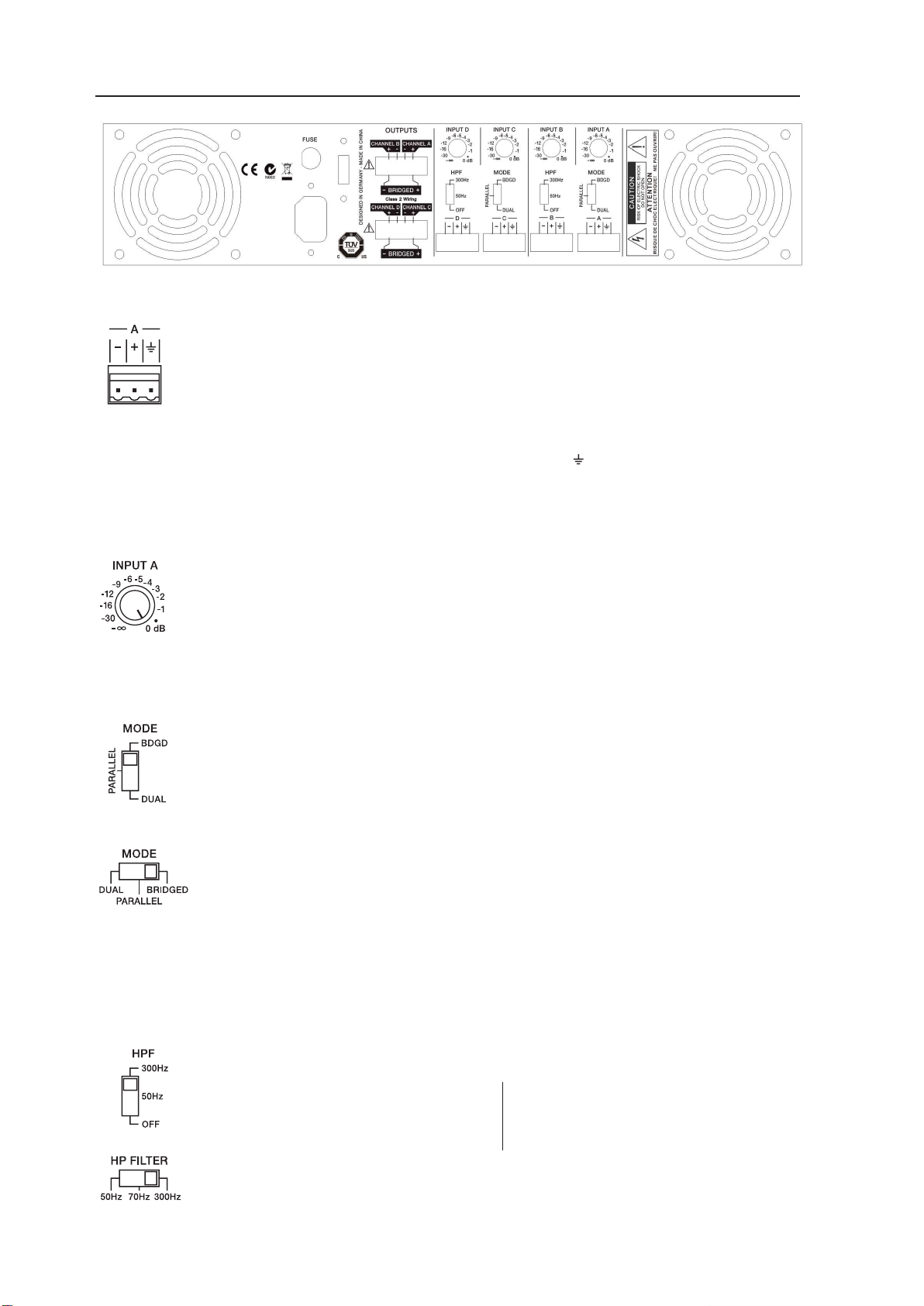
PANNEAU ARRIÈRE
Entrées Signal Audio
Les entrées symétrisées électroniquement facilitent la connexion de sources de signal
externes (ex. des consoles de mixage). Lorsqu’ils sont vissés à l’ampli de puissance, les
connecteurs à vis fournis avec l’appareil empechent tout débranchement accidentel.
Il est recommandé de choisir des câbles symétrisés (2 conducteurs pour les signaux
audio + tresse de masse séparée), même si la source de signal connectée ne fournit
pas de signaux de sortie symétrisés. Dans ce cas, reliez un conducteur “–” et la tresse
séparée à la source (reportez-vous également à “Cordons de connexion audio).
ATTENTION: Le connecteur marqué d‘un symbole sert uniquement àbrancher la
tresse de blindage du câble audio.
Il ne convient pas pour la terre ou la masse du cordon secteur.
Contrôles de niveau
Les contrôles de niveau (Level) permettent le réglage adéquat de l’ampli cation générale
des voies de l’ampli de puissance. Pour éviter toute distorsion dans les consoles de
mixage connectées à l’ampli, il est généralement recommandé de régler ces contrôles
sur une valeur comprise entre -6dB et 0dB. La graduation donne une indication directe
de l’atténuation appliquée à l’ampli cation interne xée.
Sélecteur de Mode
Le sélecteur de Mode permet de choisir le mode opératoire de l’ampli de puissance.
Sur les modèles à quatre canaux il est possible de sélectionner indépendamment les
canaux A et B ou C et D. Le modèle à un seul canal n’a pas de sélecteur de mode.
DUAL:
Les canaux de l’ampli de puissance fonctionnent indépendamment les
uns des autres, chacun d’eux reproduisant les signaux audio arrivant sur
l’entrée correspondante.
PARALLEL:
Les deux canaux reproduisent le signal audio arrivant sur l’entrée A (ou
C). Toutefois, les contrôles de niveau permettent le réglage séparé du
volume de chaque canal.
BDGD:
Les signaux audio doivent arriver sur le canal A (ou C) en Mode Bridged.
Les amplis de puissance A et B (ou C et D) fonctionnent désormais en
mode “push-pull”, délivrant ainsi une tension sortie double. Veillez à
connecter correctement les haut-parleurs pour un fonctionnement en
mode Bridged. (Reportez-vous également à “Sorties haut-parleurs”)
Filtre Passe-Haut (HPF)
Le ltre Passe-Haut permet une atténuation ef cace des signaux audio à fréquence
basse. Vous avez le choix entre trois réglages de fréquence de coupure :
Amplis de puissance avec sortie basse impédance
Amplis de puissance avec transformateur de sortie
Amplis de puissance avec transformateur de sortie
300Hz, 12dB/oct., BW
300Hz, 12dB/oct., BW
300Hz, 12dB/oct., BW
300Hz, 12dB/oct., BW
50Hz, 12dB/oct., BW
70Hz, 12dB/oct., BW
OFF
OFF
50Hz, 18dB/oct., BW
50Hz, 18dB/oct., BW
Par principe, tous les modèles équipés de transformateur de sortie ont un ltre Passe-
Haut de 50Hz intégré dans le parcours du signal audio a n de protéger le transformateur
de toute saturation due à de forts signaux basse fréquence.
26
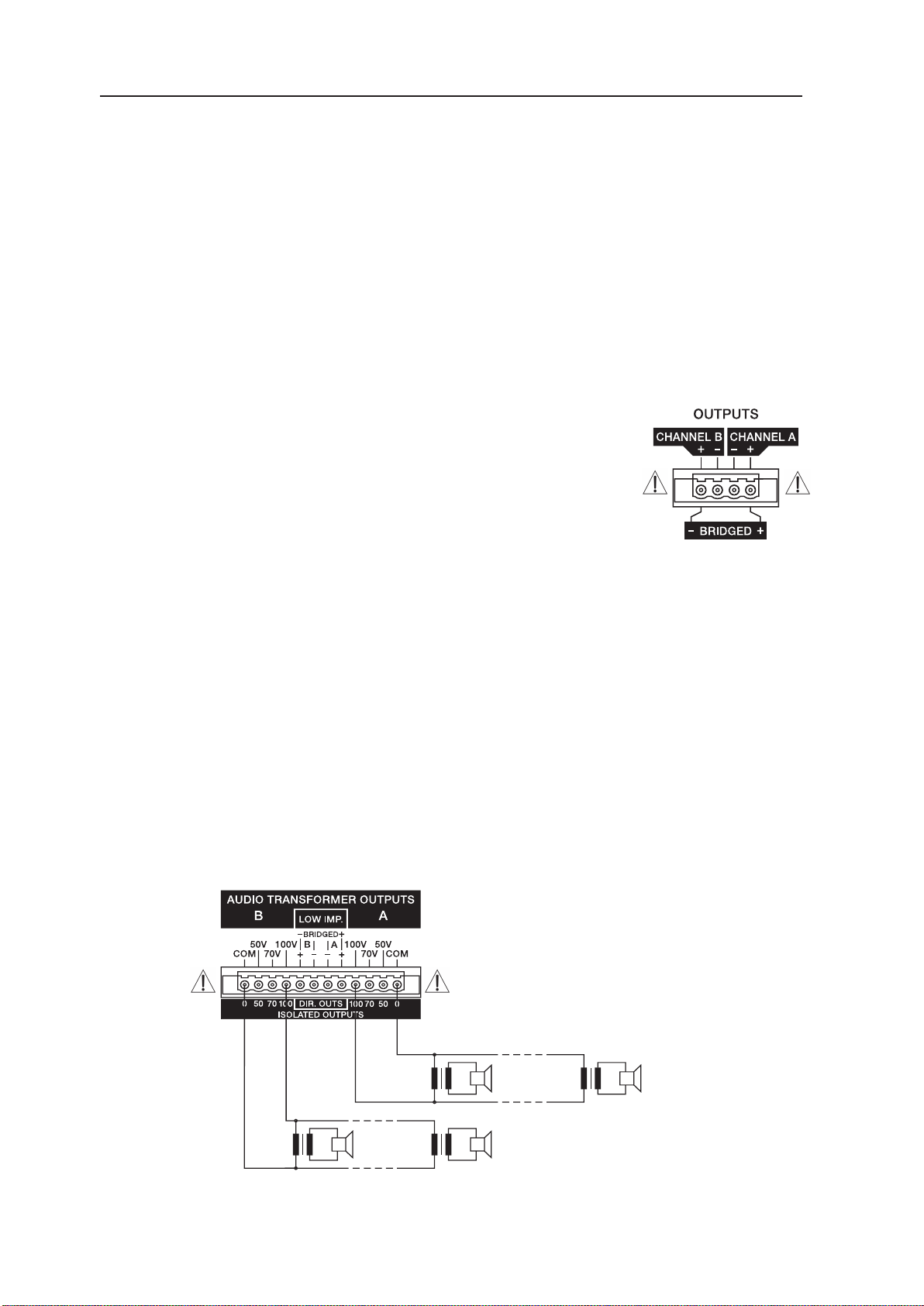
100V
25W
100V
25W
16 x 25W
100V
6W
100V
6W
66 x 6W
PA2450L & PA4150L
Les haut-parleurs connectés aux canaux A et B (ou C et D) doivent être
branchés en respectant la polarité indiquée. Veuillez vous assurer qu’il y a bien
une impédance minimale de 4 ohms par canal.
Pour le fonctionnement en mode Bridged, la charge doit être connectée sur la
prise potant la mention BRIDGED et le sélecteur de Mode doit être réglé sur
“Bridged”. N’oubliez pas qu’en Mode Bridged l’impédance minimale est de 8
ohms et que le signal d’entrée audio doit arriver sur le canal A (ou C).
PANNEAU ARRIÈRE
Sorties Haut-Parleur
Les prises des sorties haut-parleur sont adaptées au branchement de câbles de haut-parleur ayant
un diamètre maximum de 2.5 mm
2
. Les connecteurs à vis fournis peuvent être vissés sur l‘ampli de
puissance a n d‘éviter tout débranchement accidentel. Les amplis de puissance sont équipés de sorties
basse impédance et / ou de sorties ottantes (SORTIES ISOLÉES) ayant des tensions nominales de
50V, 70V et 100V, en fonction du modèle.
Attention:
Le symbole représentant un ÉCLAIR sur les prises haut-parleur indique que ces sor-
ties peuvent véhiculer des tensions élevées qui peuvent causer de sérieuses bles-
sures en cas de contact. Le branchement de ces sorties ne doit être effectué que par
des personnes autorisées ayant reçu toutes les instructions pour le faire sans dan-
ger.
Ne jamais connecter une sortie sous tension à la terre ou à une autre sortie sous ten-
sion ! Toujours éteindre l’ampli cateur avant d’établir les branchements !
PA1250T, PA2250T & PA2400T
Les transformateurs de sortie audio intcorporés convertissent la tension de sortie nominale de l‘ampli
de puissance en 50V, 70V et 100V. Les modèles d‘ampli cateur PA2250T et PA2400T présentent toutes
ces tensions simultanément sur leurs sorties ottantes a n que les canaux de l‘ampli de puissance
puissent être utilisés dans toutes les combinaisons de tensions de sortie possibles. Le fonctionnement
mixte de haut-parleurs à basse impédance et de lignes de haut-parleurs à impédance ottante sur un
même canal de l‘ampli est également possible.
L’usage de haut-parleurs avec transformateurs 100V ou 70V pour réduire les effets de la déperdition
dans les câbles est recommandé lorsque la distance entre l’ampli de puissance et les haut-parleurs
dépasse les 50 mètres. De plus, cela facilite la répartition de la puissance de sortie entre les haut-
parleurs.
Vous pouvez brancher autant de haut-parleurs que possible, tant que la consommation électrique totale
du réseau ne dépasse pas la puissance de sortie normale de l’ampli de puissance, d’autre part il ne faut
pas être en-deça de l’impédance de charge nominale des sorties de l’ampli de puissance. Veuillez vous
reporter aux caractéristiques techniques mentionnées en annexe pour connaître les valeurs spéci ques
de puissance en sortie et d’impédance de charge nominale des sorties de l’ampli de puissance.
Exemple de con guration : PA2400T avec haut-parleur de 100V connecté.
Charges de travail maximum avec haut-parleurs de 25W/100V et 6W/100V.
27
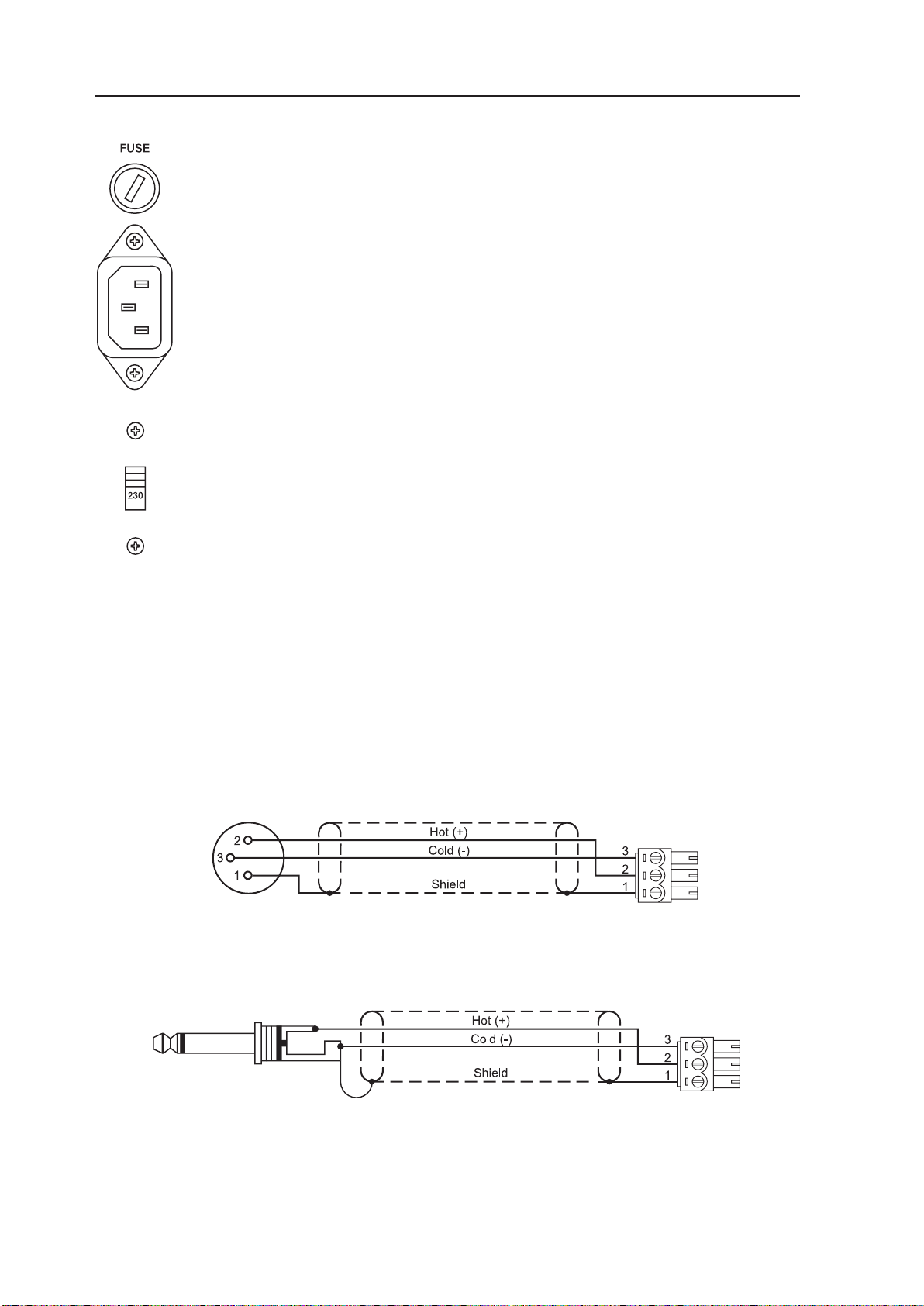
PANNEAU ARRIÈRE
Fusible secteur
Dans des circonstances normales, le fusible secteur ne saute qu’en cas de panne.
Remplacer ce fusible en utilisant uniquement un fusible neuf de même type et de même
ampérage, tension et ayant les mêmes caractéristiques de fusion. Si le fusible secteur
saute de façon répétitive, veuillez contacter le revendeur qui vous a fourni l’ampli de
puissance.
Prises secteur
Veuillez vous assurer que le sélecteur de tension indique bien la tension secteur cor-
recte correspondant à la tension secteur locale du site d’installation. Un cordon secteur
approprié est fourni avec l’appareil.
Attention:
Cet appareil ne contient aucune pièce réparable par l’utiliateur à
l’intérieur. Con er les réparations à un professionnel quali é.
Sélecteur de tension
Sélecteur dissimulé indiquant la tension secteur correcte pour l‘appareil.
CORDONS DE CONNEXION AUDIO
Il est recommandé de choisir des câbles symétrisés (ayant deux conducteurs pour le signal audio plus
une tresse de masse séparée) pour le signal audio. Bien que la connexion de câbles non symétrisés
soit tout à fait possible aux entrées de l’ampli cateur de puissance, l’utilisation de câbles symétrisés
est toujours préférable.
Un grand nombre d’appareils audio est aujourd’hui équipé de sorties symétrisées via des connecteurs
XLR. Avec un câblage symétrisé, le blindage relie toutes les parties métalliques du châssis et élimine
donc plus ef cacement la présence d’interférences externes – la plupart du temps il s’agit de bruits
parasites et de ron ements.
Câbles basses fréquence
XLR femelle
Connecteur
d‘entrée ampli (IN)
Connecteur
d‘entrée ampli (IN)
Prise Jack
Câble permettant de relier le signal source avec les sorties XLR symétrisées
Câble permettant de relier le signal source avec des sorties non symétrisées
28
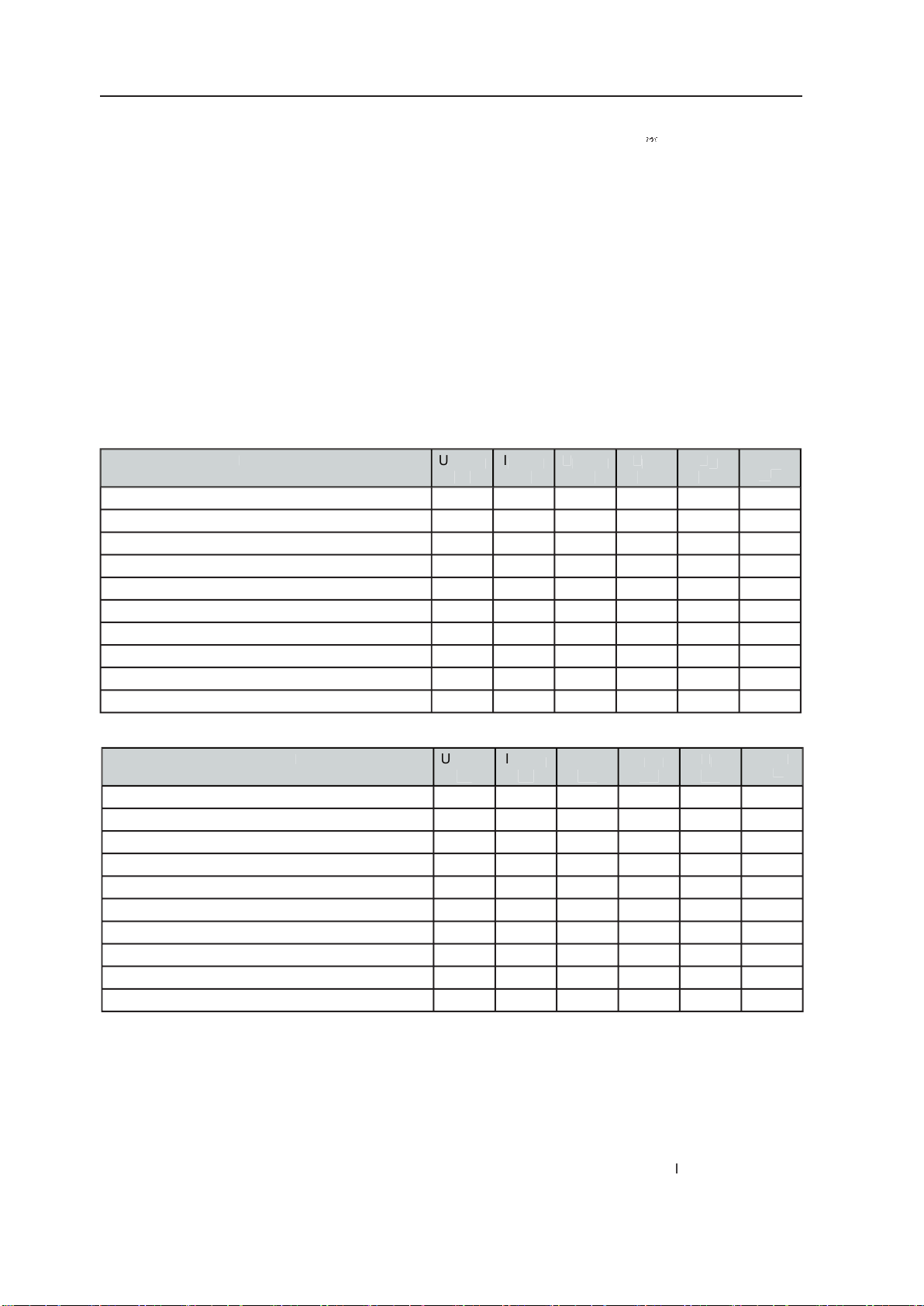
ALIMENTATION SECTEUR ET TEMPÉRATURE RÉSULTANTE
Fonctionnement sur le secteur
Les tableaux suivants vous apporteront une aide précieuse dans la détermination du choix de
l’alimentation et des câbles. La colonne “1/8 max. output power into 4 ohms
(2)
Les tableaux suivants vous apporteront une aide précieuse dans la détermination du choix de
(2)
Les tableaux suivants vous apporteront une aide précieuse dans la détermination du choix de
” indique les valeurs
à utiliser pour un fonctionnement normal. Ces résultats ont été mesurés alors que l’ampli cateur de
appliqué à l’entrée, ce qui représente approximativement la même contrainte qu’un signal audio
amenant l’ampli de puissance à une modulation maximum.
Températures à l’intérieur de l’ampli cateur de puissance
Le courant secteur est converti en signal de sortie a n d’alimenter les haut-parleurs connectés mais
aussi en chaleur. La différence entre le courant utilisé et la puissance restituée est appelée perte
de puissance ou dissipation (P
D
). La quantité de chaleur résultant de la dissipation de puissance a
tendance à rester prisonnière du rack et doit être expulsée par des moyens appropriés. Le tableau
suivant a pour objet de vous aider à calculer les températures à l’intérieur d’une armoire de rack et les
moyens de ventilation nécessaires.
La colonne “PD” indique la dissipation en fonction des différent modes de fonctionnement. La colonne
“BTU/hr” indique la quantité de chaleur dispensée par heure.
29
PA2450L
U
mains
[V]
I
mains
[A]
P
mains
[W]
P
out
[W]
P
D
[W]
BTU/
hr
(3)
idle
230
0,2
28
0
28
96
Max. output power into 8ohms
(1)
230
5,4
923
2x300
323
1102
Max. output power into 4ohms
(1)
230
8,8
1605
2x480
645
2201
1/3 max. output power into 4ohms
(1)
230
5,6
953
2x160
633
2160
1/8 max. output power into 4ohms
(1)
230
3,7
598
2x60
478
1631
1/8 max. output power into 4ohms
(2)
230
3,2
530
2x60
410
1399
1/8 max. output power into 4ohms
(2)
(4)
253
3,6
629
2x73
484
1651
Normal Mode (-10dB) into 4ohms
(1)
230
3,2
550
2x48
454
1549
Rated output power (0dB, rated) into 4ohms
(1)
230
8,1
1482
2x450
582
1986
Alert-Mode (-3dB) into 4ohms
(1)
230
6,1
1065
2x225
615
2098
PA4150L
U
mains
[V]
I
mains
[A]
P
mains
[W]
P
out
[W]
P
D
[W]
BTU/
hr
(3)
idle
230
0,4
54,7
0
55
187
Max. output power into 8ohms
(1)
230
3,9
653
4x100
253
863
Max. output power into 4ohms
(1)
230
6,3
1126
4x160
486
1658
1/3 max. output power into 4ohms
(1)
230
4,0
665
4x53
452
1541
1/8 max. output power into 4ohms
(1)
230
2,7
428
4x20
348
1187
1/8 max. output power into 4ohms
(2)
230
2,4
385
4x20
305
1041
1/8 max. output power into 4ohms
(2)
(4)
253
2,6
450
4x24
353
1205
Normal Mode (-10dB) into 4ohms
(1)
230
2,4
385
4x16
321
1095
Rated output power (0dB, rated) into 4ohms
(1)
230
6,1
1080
4x150
490
1638
Alert-Mode (-3dB) into 4ohms
(1)
230
4,6
790
4x75
490
1672
(1)
Onde sinus 1 kHz
(2)
(3)
1BTU = 1055.06J = 1055.06Ws
(4)
10% au-dessus de la tension secteur
(5)
P
D
= Dissipation de la puissance
Les facteurs suivants permettent un calcul proportionnel direct du courant secteur (
I
mains)
en fonction
des différentes tensions : 100V = 2,3; 120V = 1,9; 220V = 1,05; 240V = 0,96
puissance opérait à son maximum en sortie avec un bruit rose correspondant à la norme EN62368
Bruit rose selon norme EN 62368
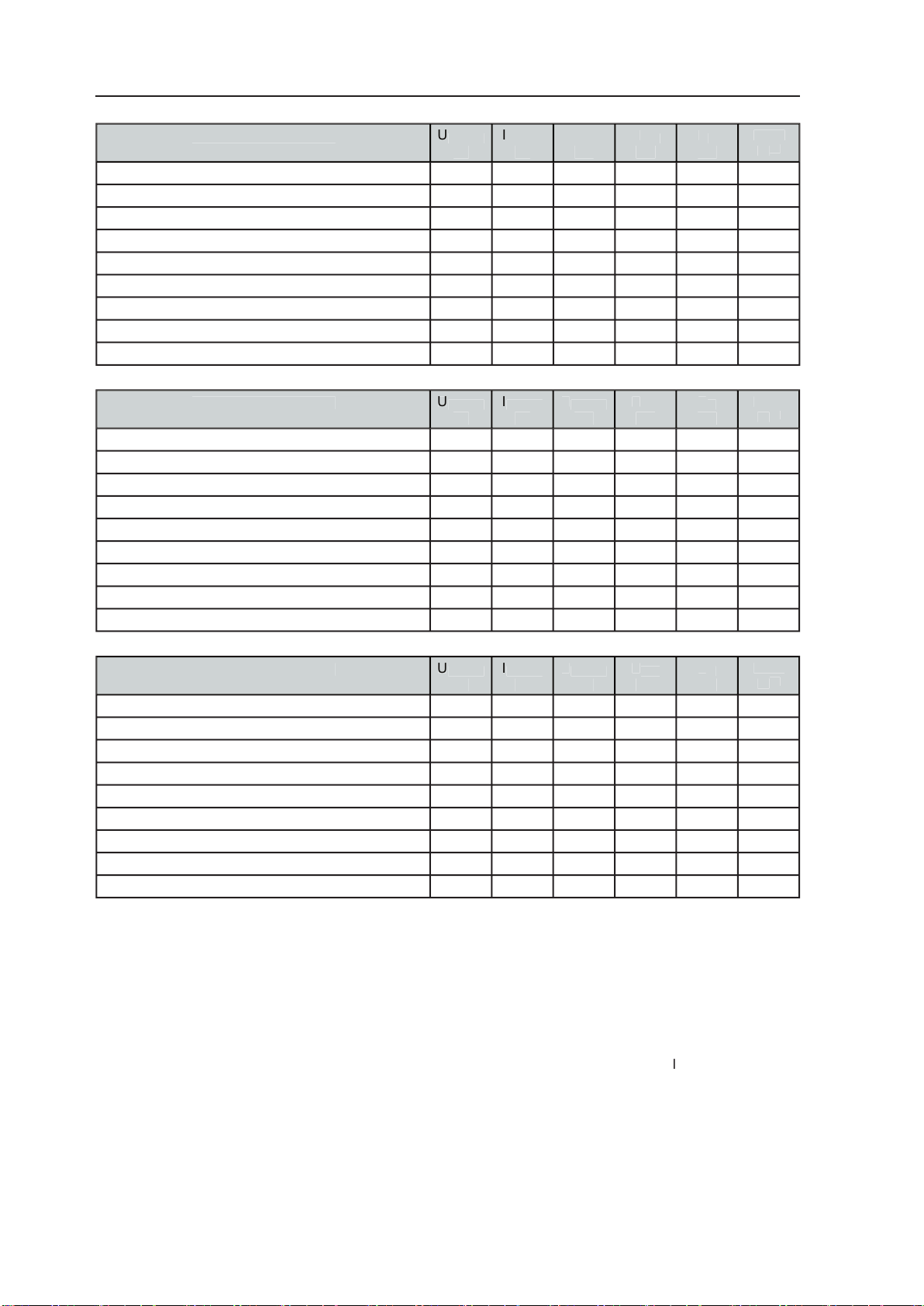
ALIMENTATION SECTEUR ET TEMPÉRATURE RÉSULTANTE
30
PA2400T - 100V output
U
mains
[V]
I
mains
[A]
P
mains
[W]
P
out
[W]
P
D
[W]
BTU/
hr
(3)
idle
230
0,3
44,3
0
44
151
Max. output power into 25ohms
(1)
230
8,9
1643
2x430
783
2672
1/3 max. output power into 25ohms
(1)
230
5,5
952
2x143
665
2270
1/8 max. output power into 25ohms
(1)
230
3,7
602
2x54
495
1687
1/8 max. output power into 25ohms
(2)
230
3,3
545
2x54
438
1493
1/8 max. output power into 25ohms
(2)
(4)
253
3,7
646
2x65
516
1760
Normal-Mode (-10dB) into 25ohms
(1)
230
3,3
540
2x43
454
1549
Rated output power (0dB, rated) into 25ohms
(1)
230
8,5
1550
2x400
750
2559
Alert-Mode (-3dB) into 25ohms
(1)
230
6,3
1119
2x200
719
2453
PA2250T - 100V output
U
mains
[V]
I
mains
[A]
P
mains
[W]
P
out
[W]
P
D
[W]
BTU/
hr
(3)
idle
230
0,2
31,6
0
32
108
Max. output power into 40ohms
(1)
230
5,5
960
2x270
420
1433
1/3 max. output power into 40ohms
(1)
230
3,5
571
2x90
391
1334
1/8 max. output power into 40ohms
(1)
230
2,3
365
2x34
298
1015
1/8 max. output power into 40ohms
(2)
230
2,1
330
2x34
263
896
1/8 max. output power into 40ohms
(2)
(4)
253
2,3
385
2x41
303
1035
Normal-Mode (-10dB) into 40ohms
(1)
230
2,1
328
2x27
274
935
Rated output power (0dB, rated) into 40ohms
(1)
230
5,4
929
2x250
429
1464
Alert-Mode (-3dB) into 40ohms
(1)
230
4,0
668
2x125
418
1426
PA1250T - 100V output
U
mains
[V]
I
mains
[A]
P
mains
[W]
P
out
[W]
P
D
[W]
BTU/
hr
(3)
idle
230
0,2
21,7
0
22
74
Max. output power into 40ohms
(1)
230
2,8
487
1x270
217
740
1/3 max. output power into 40ohms
(1)
230
1,8
289
1x90
199
679
1/8 max. output power into 40ohms
(1)
230
1,2
182
1x34
148
506
1/8 max. output power into 40ohms
(2)
230
1,1
170
1x34
136
465
1/8 max. output power into 40ohms
(2)
(4)
253
1,2
197
1x41
156
533
Normal-Mode (-10dB) into 40ohms
(1)
230
1,1
164
1x27
137
467
Rated output power (0dB, rated) into 40ohms
(1)
230
2,7
471
1x250
221
754
Alert-Mode (-3dB) into 40ohms
(1)
230
2,0
339
1x125
214
730
(1)
Onde sinus 1 kHz
(2)
(3)
1BTU = 1055.06J = 1055.06Ws
(4)
10% au-dessus de la tension secteur
(5)
P
D
= Dissipation de la puissance
Les facteurs suivants permettent un calcul proportionnel direct du courant secteur (
I
mains)
en fonction
des différentes tensions : 100V = 2,3; 120V = 1,9; 220V = 1,05; 240V = 0,96
Pour les modèles d’ampli de puissance équipés de transformateurs intégrés, les valeurs mentionnées
pour les sorties en 100V sont également applicables aux sorties en 70V, 50V et basse impédance, tant
que la charge connectée est aussi équivalente.
Bruit rose selon norme EN 62368

NOTICES
31

32
TECHNICAL SPECIFICATIONS
������
��
�
�
�
�
�
�
�
�
�
�����
�
� �
� �
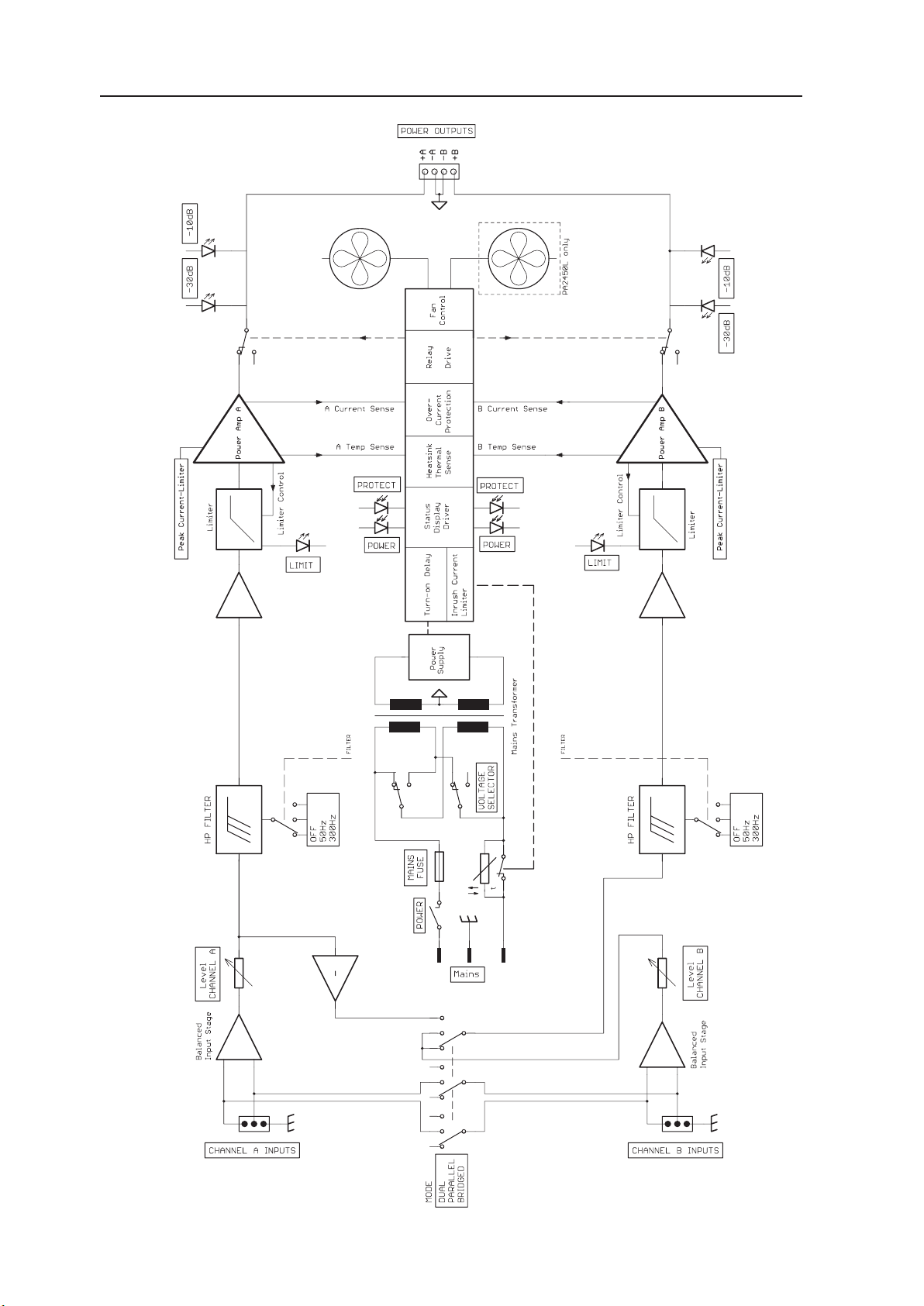
33
BLOCK DIAGRAM PA2450L / PA4150L CH. A/B
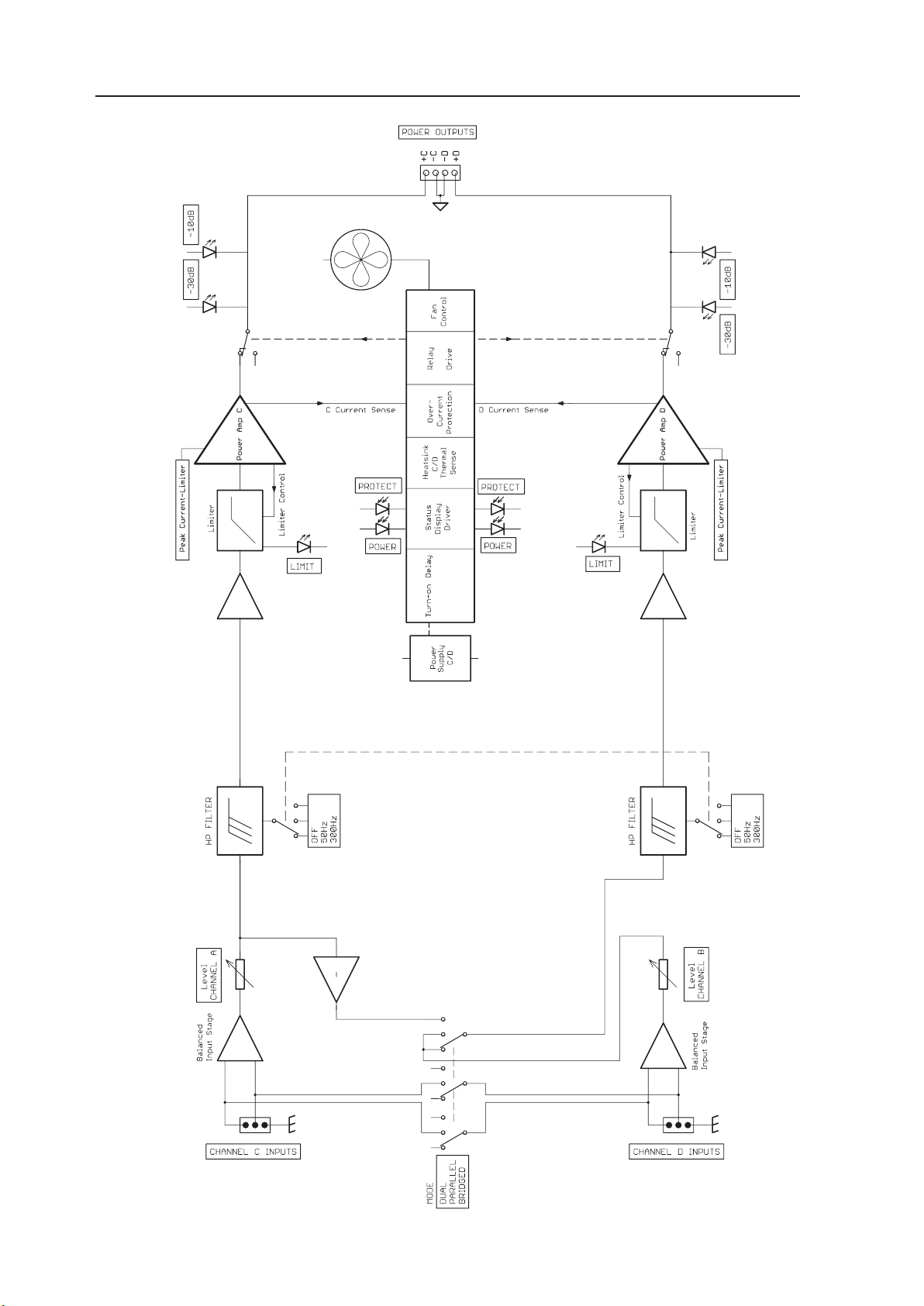
34
BLOCK DIAGRAM PA4150L CH. C/D
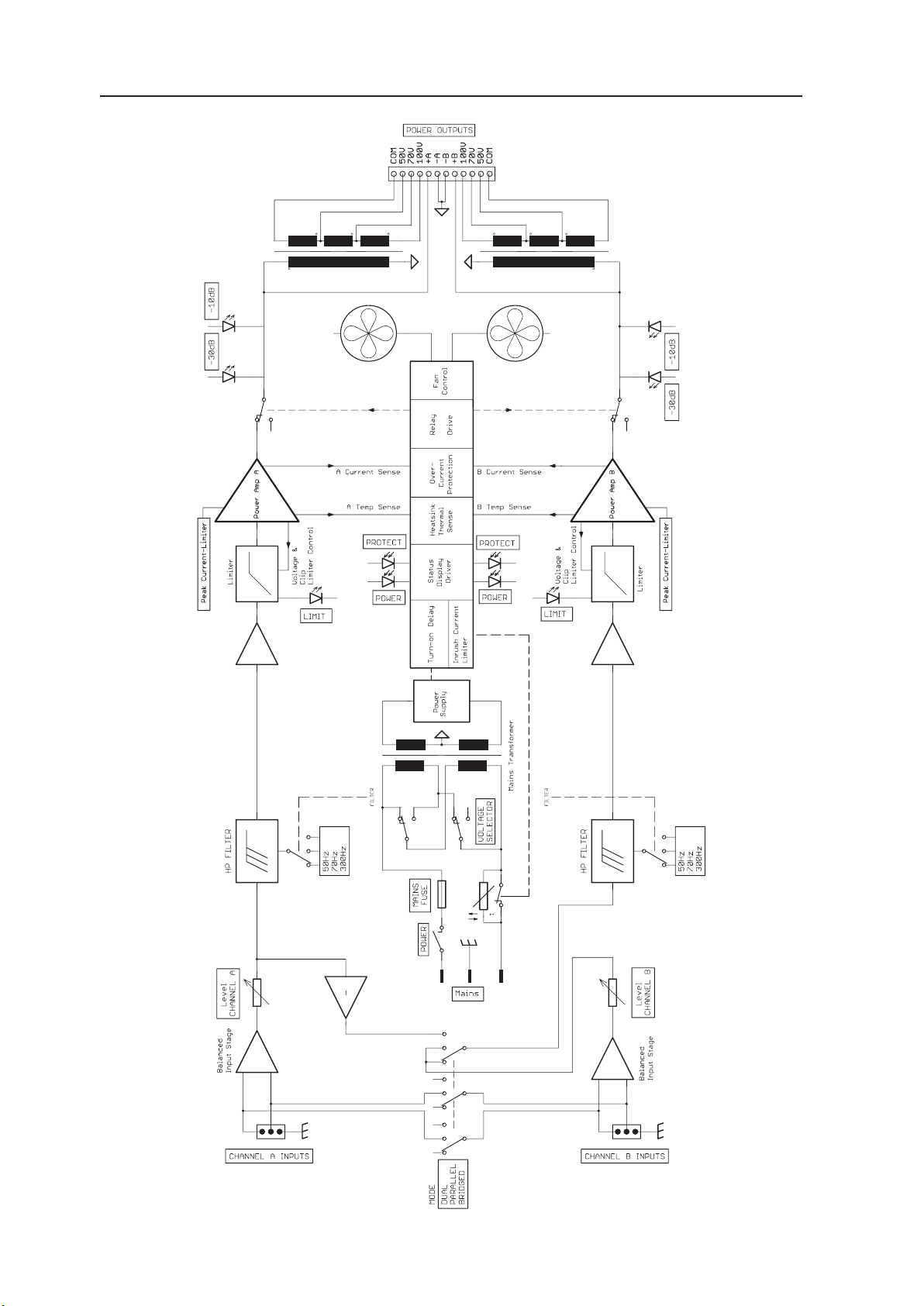
35
BLOCK DIAGRAM PA2400T / PA2250T
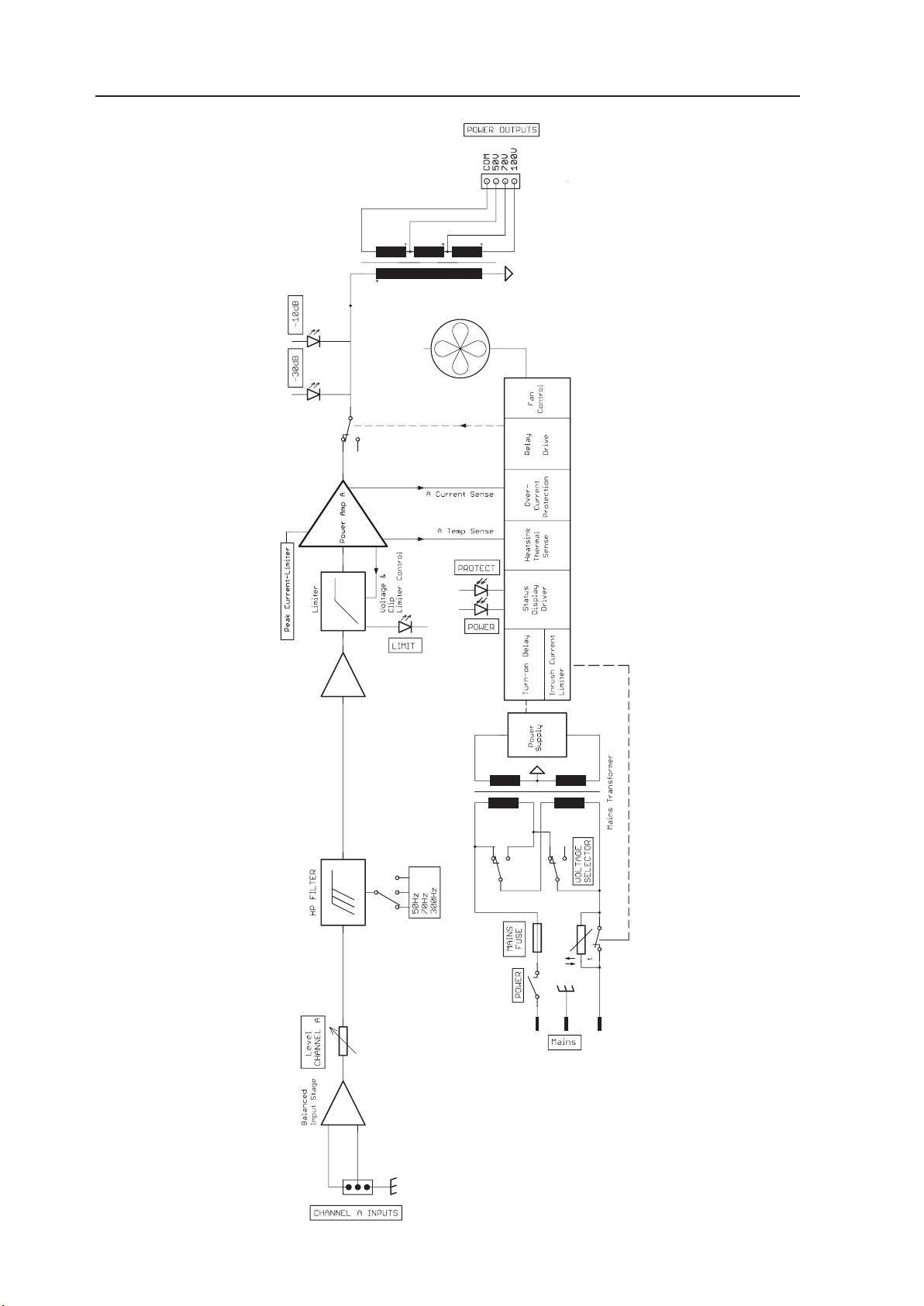
36
BLOCK DIAGRAM PA1250T
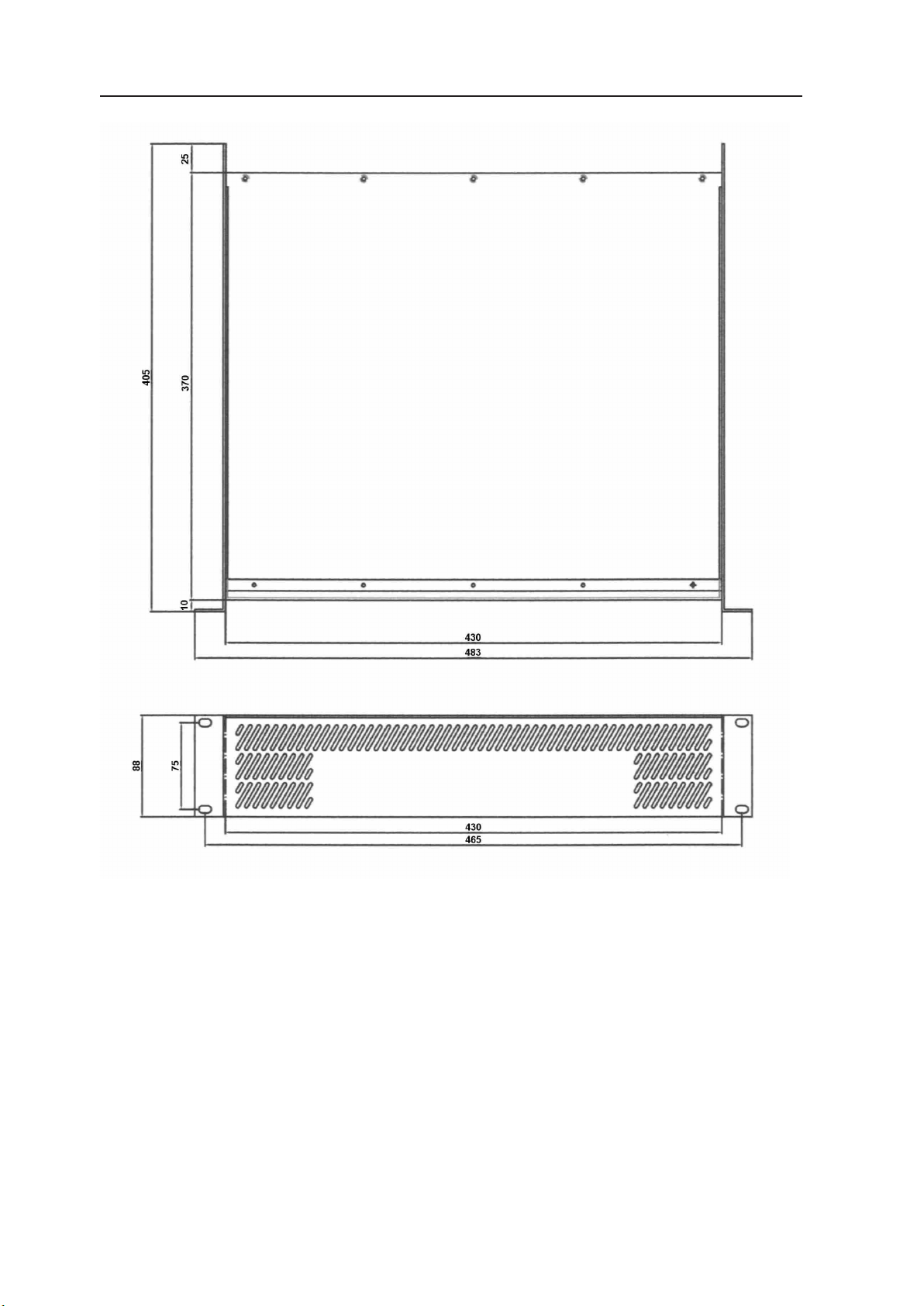
37
DIMENSIONS
PA series ampli er dimensions in mm.

NOTES/NOTIZEN/NOTICES
38

NOTES/NOTIZEN/NOTICES
39

Part Number F01U120167 Rev 02
© Bosch Communications Systems 03/2021
Manufacturer Bosch Security Systems, LLC
12000 Portland Avenue South, Burnsville, MN 55337 U.S.A. and Canada only. For customer orders, contact Customer Service at:
Phone: 952/844-4051, Fax: 952/884-0043 800/392-3497 Fax: 800/955-6831
Europe, Africa, and Middle East only. For customer orders, contact Customer Service at:
www.electrovoice.com
+49 9421-706 0 Fax: +49 9421-706 265
Other International locations. For customer orders, Contract Costumer Service at:
+ 1 952 884-4051 Fax: + 1 952 887-9212
For warranty repair or service information, contact the Service Repair department at:
800/685-2606
For technical assistance, contact Technical Support at: 866/78AUDIO
Specifications subject to change without notice.