IIIIIHIIIIIIIlUlIIIIIIIIIIIIlUlIIIIIIIIII
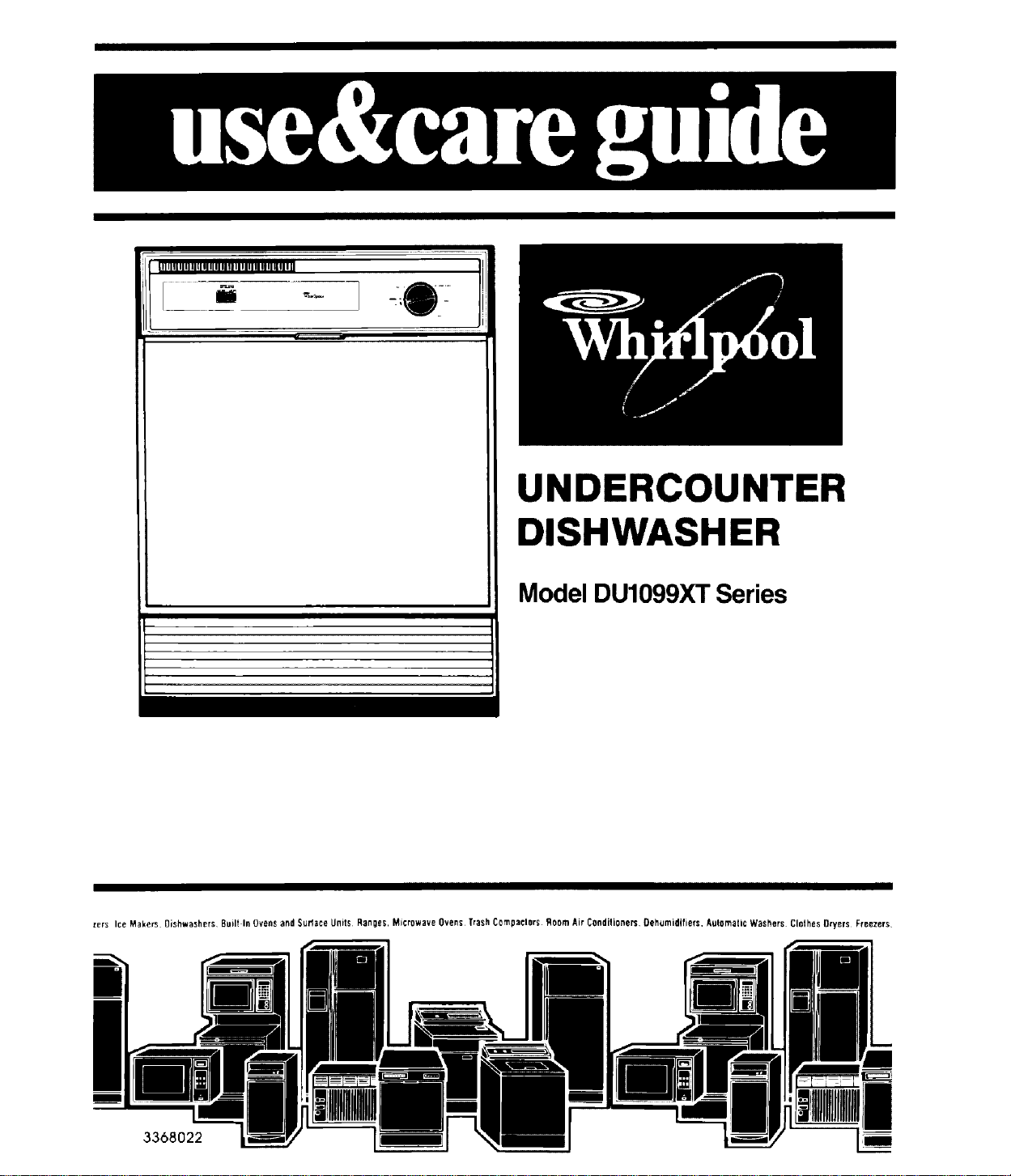
UNDERCOUNTER
DISHWASHER
Model DU1099XT Series
_ers Ice Makers Oishwashers Built In Ovens and SuMace Uilits RallOes Microwave Ovens Trash C0mpaelors Room Air Coflditioner_ Dehumidifiers, Automatic Washers Clothes Dryers Freezers
3368022
Contents
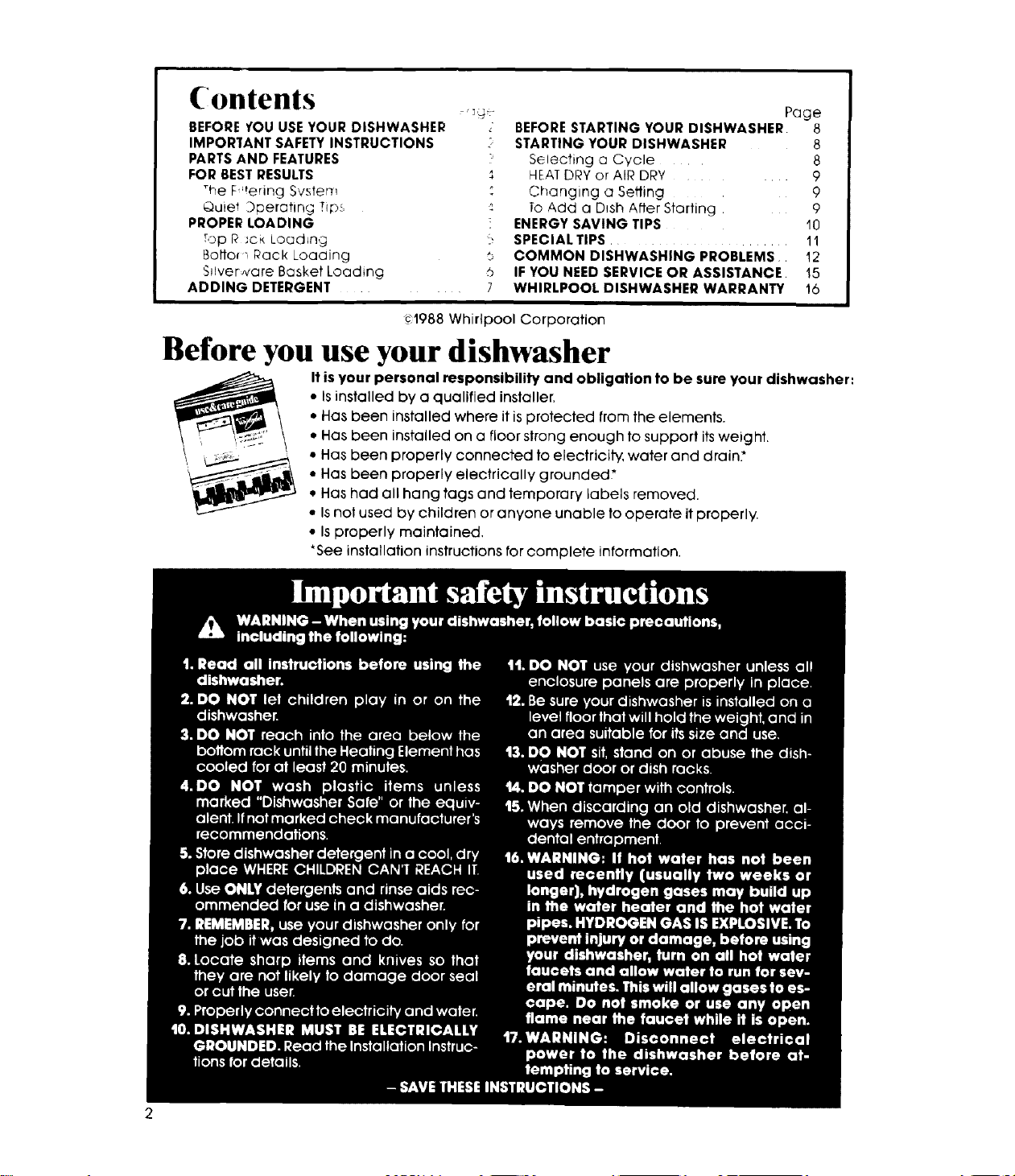
BEFORE YOU USEYOUR DISHWASHER
IMPORTANT SAFETY INSTRUCTIONS :_
PARTS AND FEATURES
FOR BESTRESULTS
The F 'tering System
Quiet Dperating h_)s
PROPER LOADING :.
fop R :cK Loading :,
Bolto_ _Pack Loading 0
SHverware Basket Loading 6
ADDING DETERGENT ......... 7
Page
BEFORE STARTING YOUR DISHWASHER 8
STARTING YOUR DISHWASHER 8
Selecting a Cycle .... 8
HEAl DRY or AIR DRY .......... 9
Changing aSetting ..... 9
To Add a Dish After Starting 9
ENERGY SAVING TIPS ..... 10
SPECIAL TIPS ......................... 11
COMMON DISHWASHING PROBLEMS.. 12
IF YOU NEED SERVICE OR ASSISTANCE. 15
WHIRLPOOL DISHWASHER WARRANTY 16
Jc:1988Whirlpool Corporation
Before you use your dishwasher
It isyour personal responsibility and obligation to be sure your dishwasher:
•Is installed by a qualified installer.
•Has been installed where it is protected from the elements.
• Has been installed on a floor strong enough to support itsweight.
• Has been properly connected to electricity, water and draint'
• Has been properly electrically grounded;*
•Has had all hang tags and temporary labels removed.
• Isnol used by children or anyone unable to operate it properly.
• Is properly maintained.
•See installation instructions for complete information.
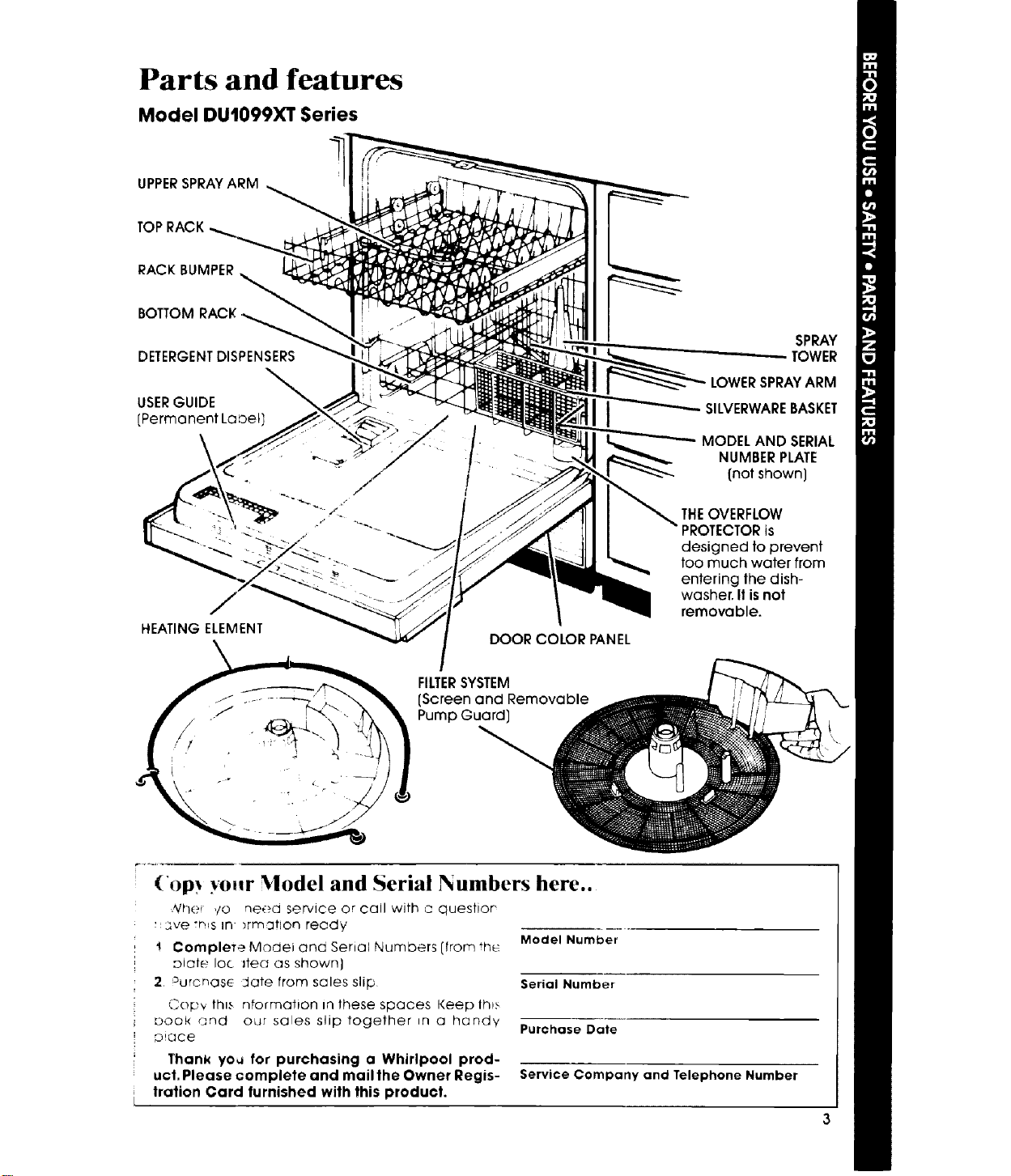
Parts and features
Model DU1099XT Series
UPPERSPRAYARM
TOP RACK
RACK BUMPER
BOTTOM
DETERGENTDISPENSERS
USERGUIDE
[Permanent Laoel
HEATING ELEMENT DOOR COLOR PANEL
SPRAY
TOWER
LOWERSPRAYARM
SILVERWAREBASKET
MODEL AND SERIAL
NUMBER PLATE
(not shown]
THEOVERFLOW
PROTECTORis
designed to prevent
too much water from
entering the dish-
washer. II is not
removable.
FILTERSYSTEM
(Screen and Removable
Pump Guard]
(Op_ yo.r Model and Serial Numbers here..
,_/he_ ,/o need service or call with a questior
'2,re :r_s ID )rmation ready
'! Complete Model and Serial Numbers (from th_
oldie Ioc #ea as shown}
2, Durcnasc date from sales slip
Copy this nformation in these spaces Keep lh_s
book and our sales slip together in a handy
o!ace
Thank yoa for purchasing a Whirlpool prod-
uct. Please complete and mail the Owner Regis-
tration Card furnished with this product.
Model Number
Serial Number
Purchase Date
Service Company and Telephone Number
For Best Results
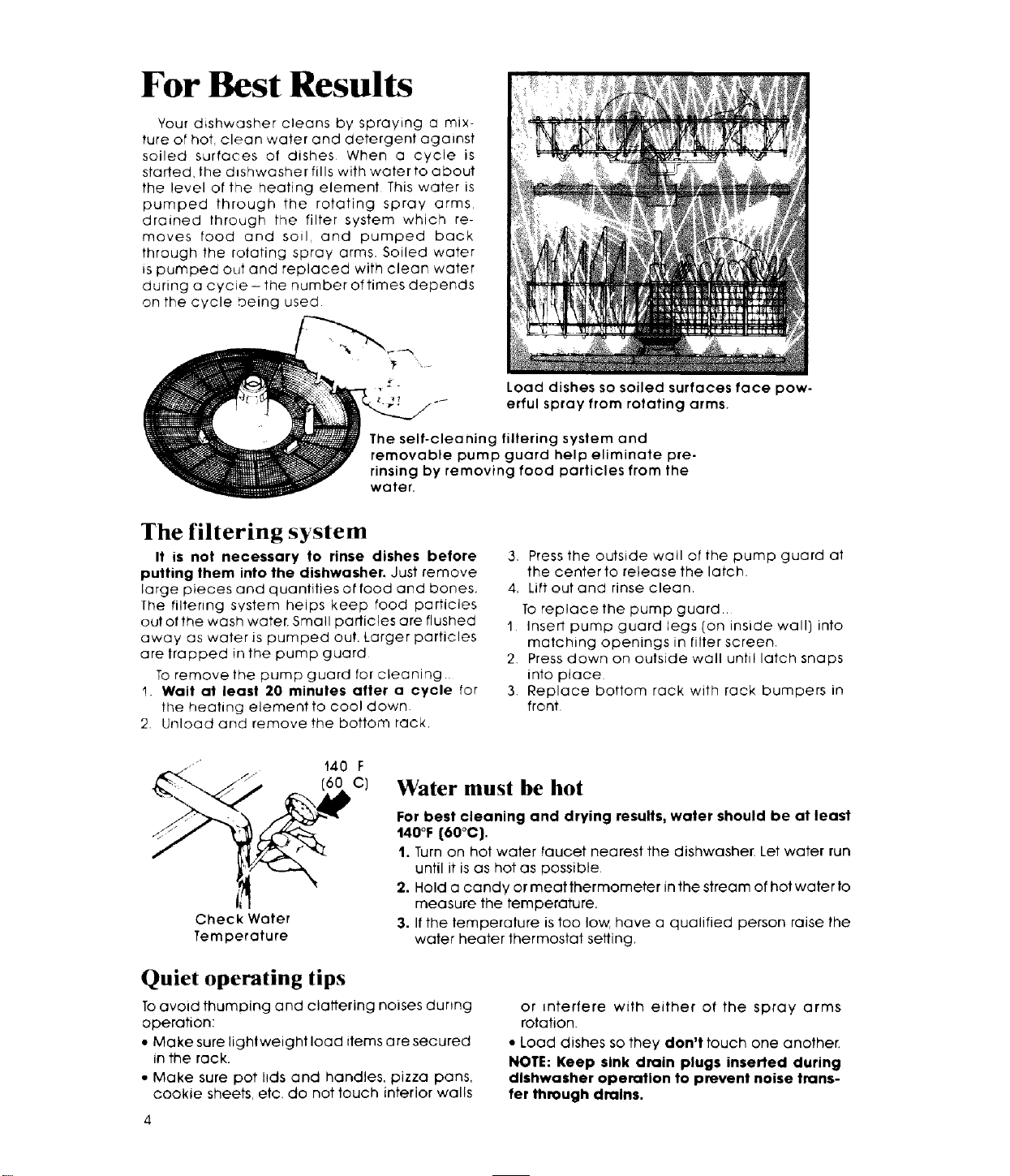
Your dishwasher cleans by spraying a mix-
ture of hot, clean water and detergent against
soiled surfaces of dishes When a cycle is
started, the dishwasher fills with water to about
the level of the heating element This water is
pumped through the rotating spray arms,
drained through the filter system which re-
moves food and soil, and pumped back
through the rotating spray arms. Soiled water
bspumped out and replaced with clean water
during a cycie-the number of times depends
on the cycle oeing used.
Load dishes so soiled surfaces face pow-
erful spray from rotating arms.
The self-cleaning filtering system and
removable pump guard help eliminate pre-
rinsing by removing food particles from the
water.
The filtering system
It is not necessary to rinse dishes before
putting them into the dishwasher. Just remove
large pieces and quantities of food and bones,
The filtering system helps keep food particles
out of the wash water. Small particles are flushed
away as water is pumped out. Larger particles
are trapped in the pump guard
To remove the pump guard for cleaning..
IWait at least 20 minutes after a cycle tar
the heating element to cool down.
2. Unload and remove the bottom rack.
3. Press the outside wail of the pump guard at
the center to release the latch.
4. Lift out and rinse clean.
To replace the pump guard..
1 Insert pump guard legs (on inside wall] into
matching openings in filter screen.
2. Press down on outside wall until latch snaps
into place
3. Replace bottom rack with rack bumpers in
front
Check Water
Temperature
140 FWater must be hot
For best cleaning and drying results, water should be at least
140°F {60°C).
t. Turn on hot water faucet nearest the dishwasher, Let water run
until it is as hot as possible.
2. Hold a candy or meat thermometer in the stream of hot water to
measure the temperature,
3. It the temperature is too low, have a qualified person raise the
water heater thermostat setting,
Quiet operating tips
To avoid thumping and clattering noises dunng
operation:
*Make sure lightweight load items are secured
in the rack.
• Make sure pot lids and handles, pizza pans,
cookie sheets, et¢, do not touch interior walls
or interfere with either of the spray arms
rotation.
•Load dishes so they don't touch one another.
NOTE: Keep sink drain plugs inserted during
dlshwasher operation to prevent noise trans-
fer through dralns.
Proper loading
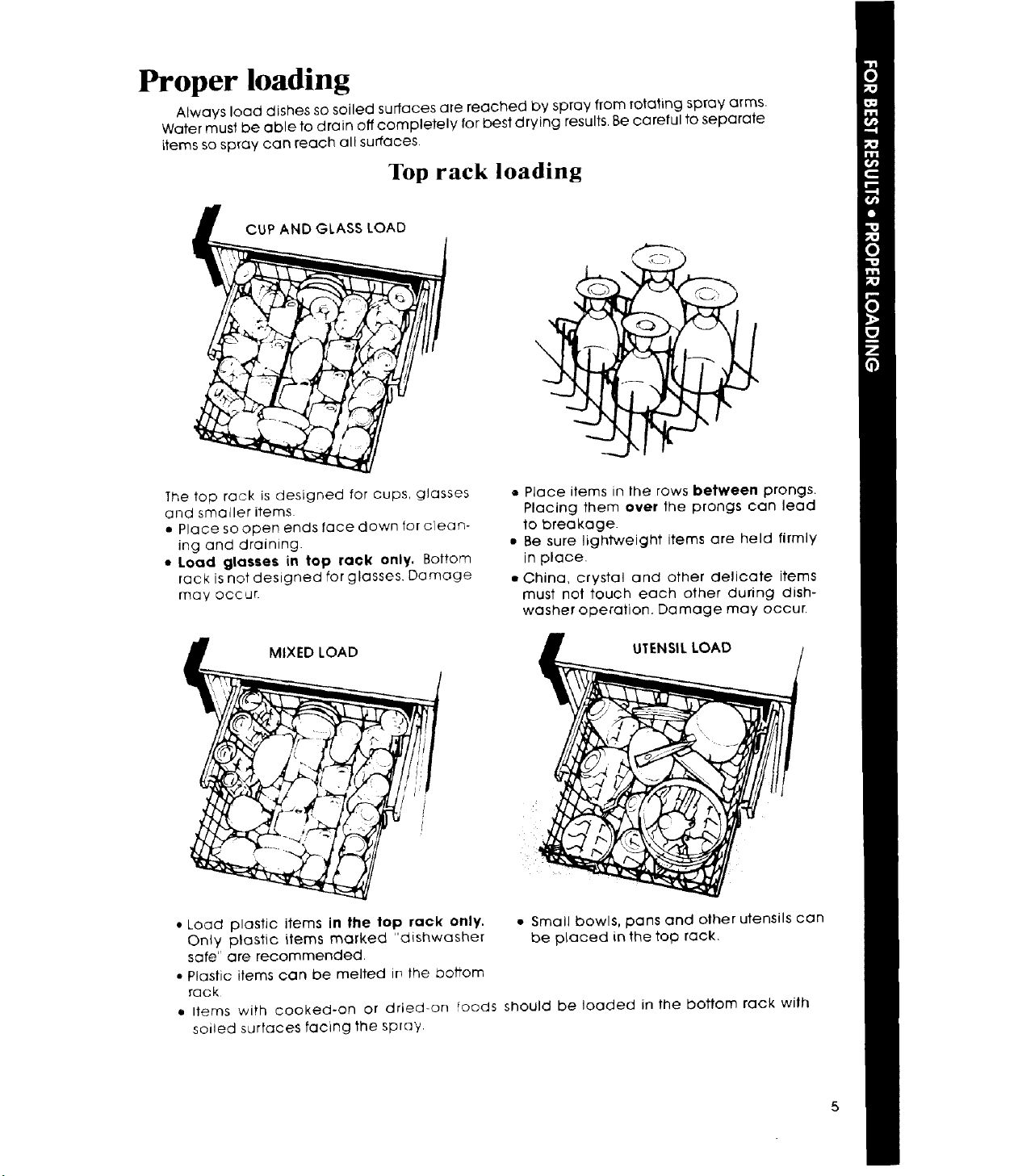
Always load dishes so soiled surfaces are reached by spray from rolating spray arms.
Water must be able to drain off completely for best drying results. Be careful to separate
items so spray can reach all surfaces.
Top rack leading
The top rack is designed for cups, glasses
and smaller items.
a Place so open ends face down for clean-
ing and draining.
• Load glosses in top rock only. Bottom
rack is not designed for glasses. Damage
mQy occur.
Ii
•Place items in the rows between prongs.
Placing them over the prongs can lead
to breakage.
• Be sure lightweight items are held firmly
in place.
• China, crystal and other delioate items
must not touch each other during dish-
washer operation. Damage may occur.
MIXED LOAD UTENSIL LOAD
•Load plastic items in the top rack only. •Small bowls, pans and other utensils can
Only plastic items marked "dishwasher be placed in the top rack.
safe" are recommended.
• Plastic items can be melted in the bottom
rack
• Items with cooked-on or dried-on roods should be loaded in the bottom rack wilh
soiled surfaces facing the spray
Bottom rack loading
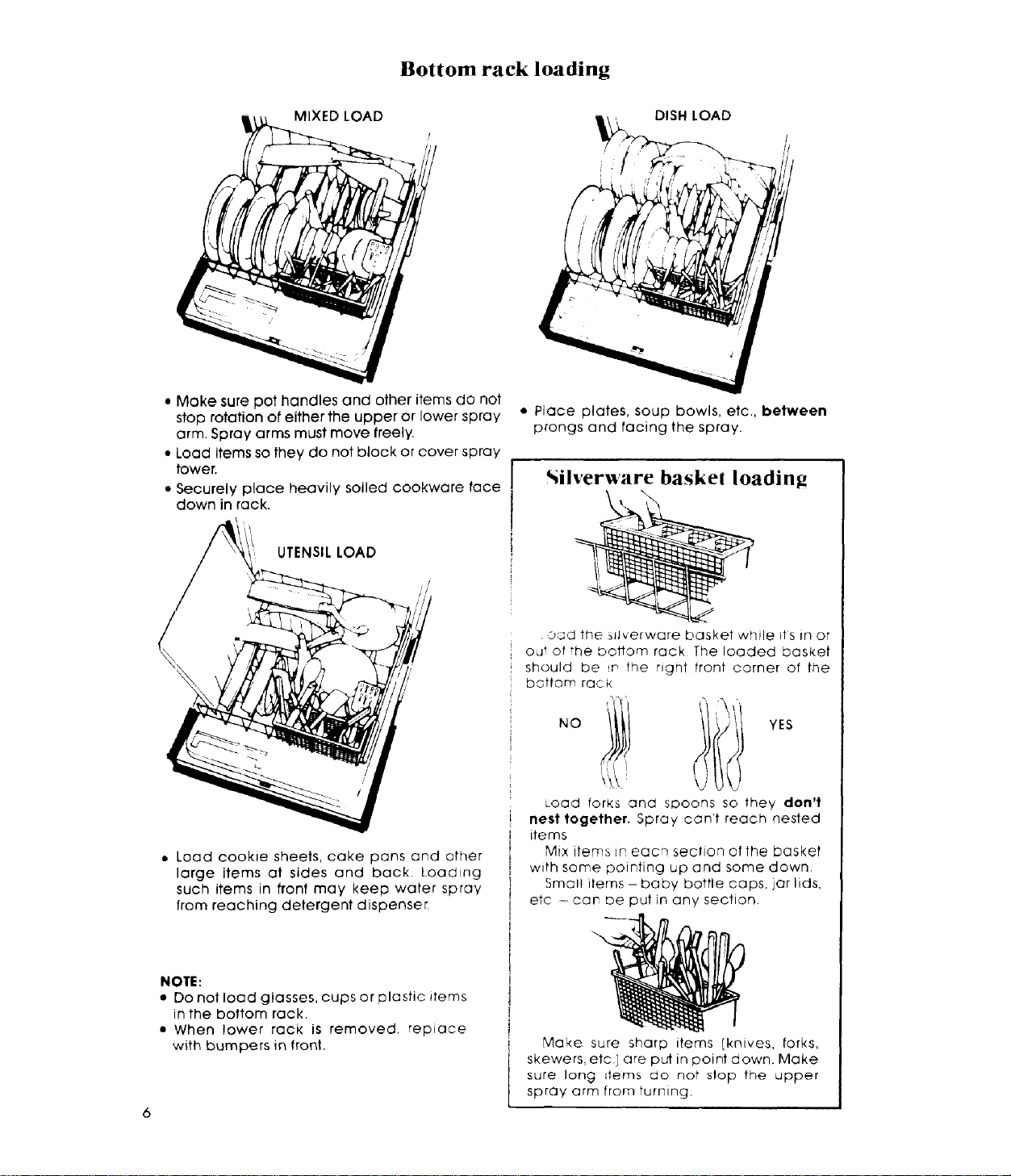
MIXED LOAD
/
DISH LOAD
• Make sure pot handles and other items do not
stop rotation of either the upper or lower spray
arm. Spray arms must move freely.
• Load items so they do not block or cover spray
tower.
• Securely place heavily soiled cookware face
down in rack.
UTENSIL LOAD
•Load cookie sheets, cake pans and other
large items at sides and back. Loading
such items in fronl may keep wafer spray
from reaching detergent dispenser
NOTE:
• Do not load glasses, cups or _Dlastic items
in the bottom rack.
• When lower rack is removed, repJace
with bumpers in front.
• Place plates, soup bowls, etc,, between
prongs and facing the spray.
ilverware basket loading
odd tiqe sdverware basket while ds in or
ou! of the boflom rack lhe loaded basket
should be n the right front corner of the
bottom rack,,,,,
LOad forks and spoons so they don't
nest together. Spray can't reach nested
items
Mix items _n each section of the basket
with some pointing up and some down.
Small items -baby battle caps, jar lids,
etc - car" de put in any section
Make sure sharp items (knives, larks,
skewers, etc] are put in point down. Make
sure long items do not slop the upper
spray arm from turning.
Adding detergent
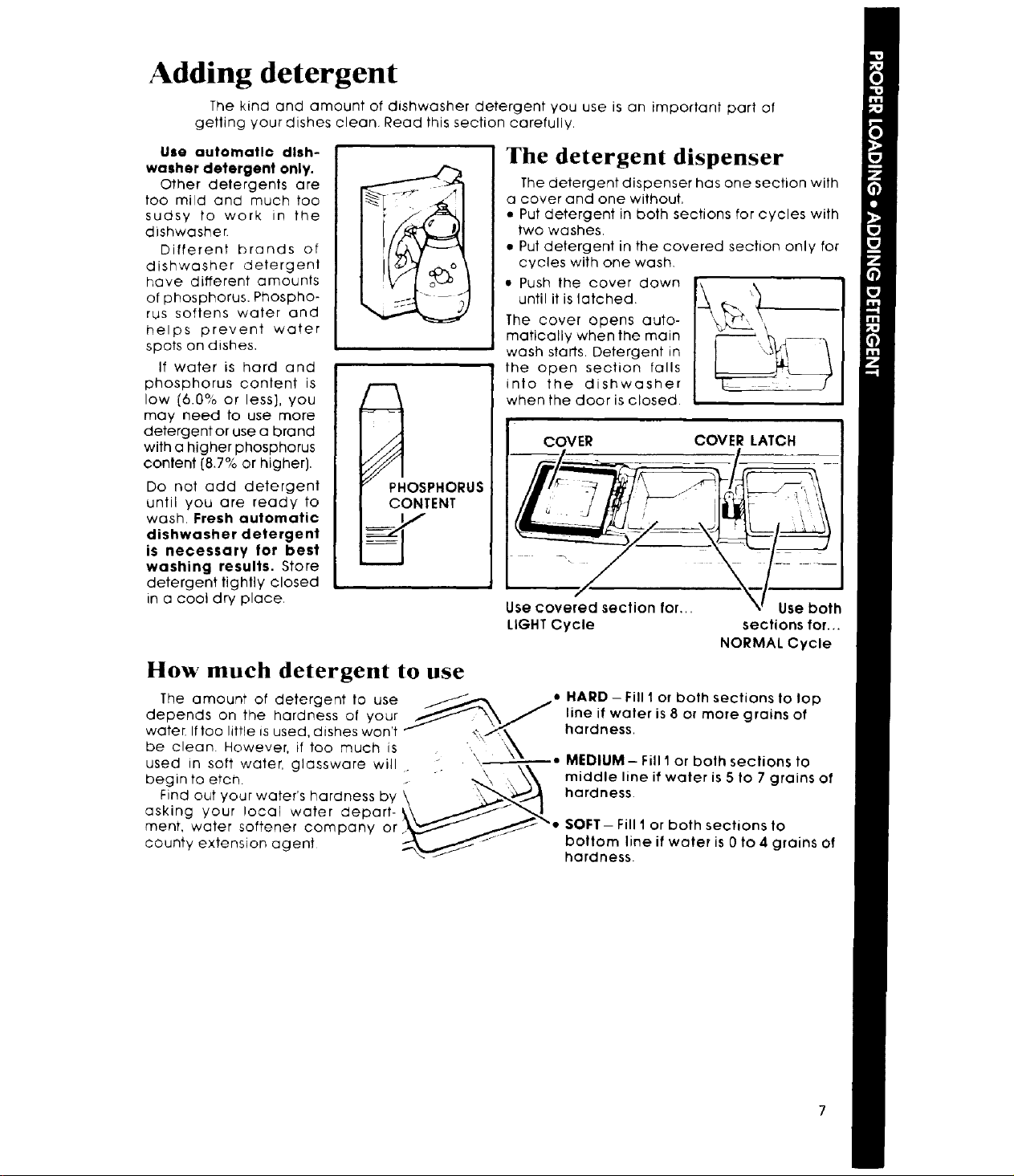
The kind and amount of dishwasher detergent you use is an important part of
getling your dishes clean. Read this section carefully.
Use automatic dlsh-
washer detergent only.
Other detergents are
too mild and much too
sudsy to work in the
dishwasher.
Different brands of
dishwasher detergent
have different amounts
of phosphorus. Phospho-
rus softens water and
helps prevent water
spots on dishes.
If water is hard and
phosphorus conlent is
low [6.0°,'0 or less], you
may need to use more
detergent or use a brand
with a higher phosphorus
content [8.7% or higher].
Do not add detergent
until you are ready to
wash. Fresh automatic
dishwasher detergent
is necessary for best
washing results. Store
detergent tightly closed
nn a cool dry place.
PHOSPHORUS
CONTENT
J
The detergent dispenser
The detergent dispenser has one section with
a cover and one without.
• Put detergent in both sections for cycles with
two washes.
• Put detergent in the covered section only for
cycles with one wash
• Push the cover down
until it is latched
The cover opens auto-
matically when the main
wash staffs. Detergent in
the open section falls
into the dishwasher
when the door is closed.
COVER COVER LATCH
Use covered section for... Use both
LIGHT Cycle sections for...
NORMAL Cycle
How much detergent to use
The amount of detergent to use __,• HARD- Fill 1 or both sections to lop
depends on the hardness of your __,,_'_ line if waler is 8or more grains oi
water: Iftoo little is used, dishes won't hardness.
be clean. However, if too much is " " _X
used in soft water, glassware will • MEDIUM- Fill 1or bolh sections to
begin to etcl_ ; " "-,._\ , XX middle line if water is 5 Io 7grains of
Find out your water's hardness by \ _..._ hardness.
_sk In?LY?Urr s!°f?eQ_eW _ toeL denP¢ _ } ,o._F,,,torbothsect,oos,o
county extension agent ___ .... bottom line if water is O to 4 grains of
hardness
Before starting
your dishwasher
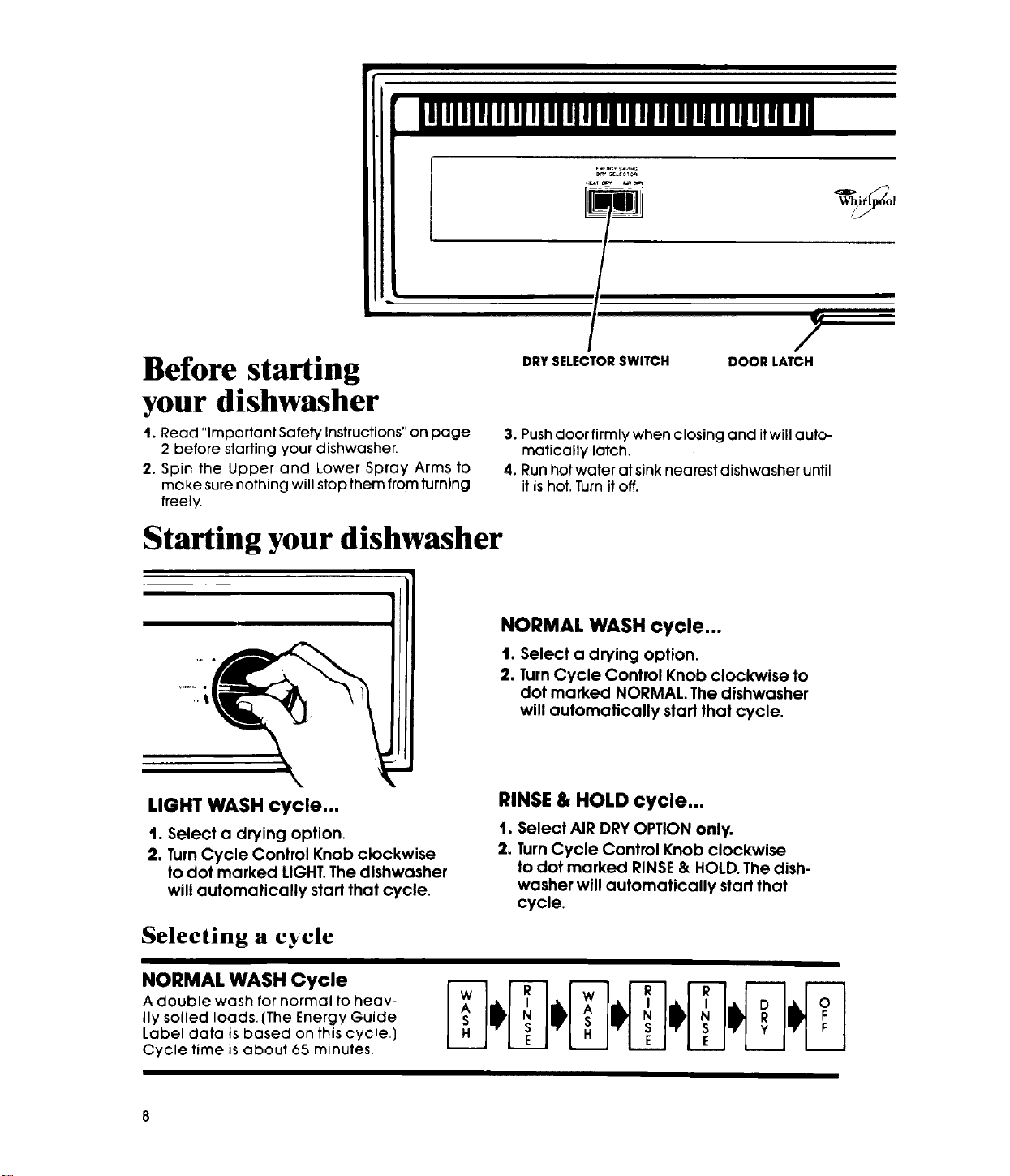
1. Read "Important Safety Instructions" on page
2 before starting your dishwasher.
2. Spin the Upper and Lower Spray Arms to
make sure nothing will stop them from turning
freely.
DRY SELECTOR SWITCH
W.m
/
DOOR LATCH
3. Push door firmly when closing and it will auto-
matically latch.
4. Run hot water at sink nearest dishwasher until
it is hot. Turn it off.
Starting your dishwasher
NORMAL WASH cycle...
1. Select a drying option.
2. Turn Cycle Control Knob clockwise to
dot marked NORMAL. The dishwasher
will automatically stad that cycle.
LIGHT WASH cycle...
I. Select a drying option.
2. Turn Cycle Control Knob clockwise
to dot marked LIGHT. The dishwasher
will automatically start that cycle.
Selecting a cycle
RINSE & HOLD cycle...
1. Select AIR DRY OPTION only.
2. Turn Cycle Control Knob clockwise
to dot marked RINSE & HOLD. The dish-
washer will automatically start that
cycle.
NORMAL WASH Cycle
A double wash for normal to heav-
ily soiled loads. [The Energy Guide
Label data is based on this cycle.]
Cycle time is about 65 minutes.
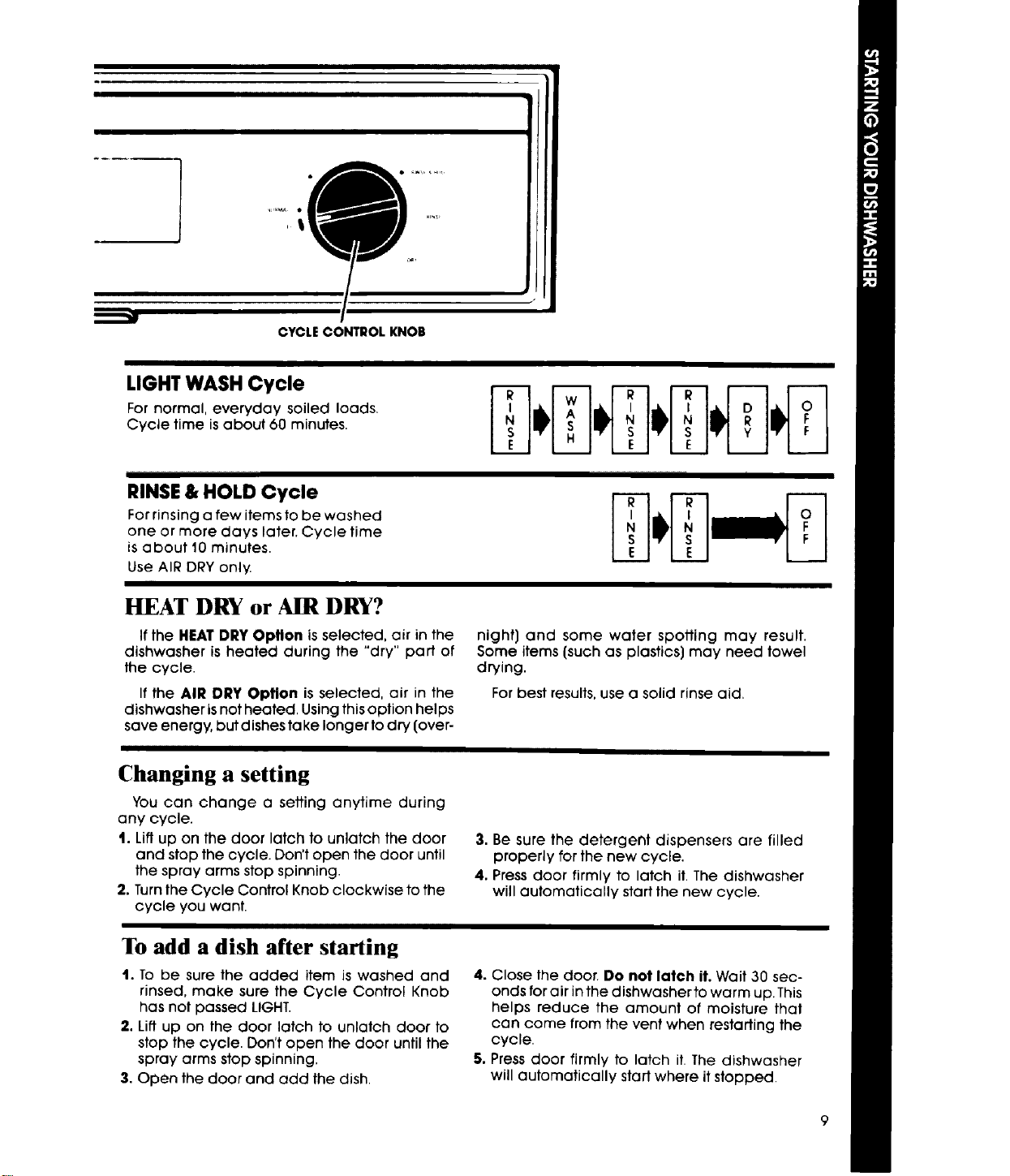
CYCLE CONTROL KNOB
LIGHT WASH Cycle
For normal, everyday soiled loads.
Cycle time is about 60 minutes
RINSE & HOLD Cycle
For rinsing a few items to be washed
one or more days later. Cycle time
is about 10 minutes.
Use AIR DRY only
HEAT DRY or AIR DRY?
If the HEAT DRY Option isselected, air in the
dishwasher is heated during the "dry" part of
the cycle
If the AIR DRY Option is selected, air in the
dishwasher isnot heated. Using this option helps
save energy, but dishes take longer to dry (over-
night) and some water spotting may result.
Some items (such as plastics) may need towel
drying.
For best results, use a solid rinse aid.
Changing a setting
You can change a setting anytime during
any cycle.
1. Liftup on the door latch to unlatch the door
and stop the cycle. Don't open the door until
the spray arms stop spinning.
2. Turn the Cycle Control Knob clockwise to the
cycle you want.
3. Be sure the detergent dispensers are filled
properly for the new cycle.
4. Press door firmly to latch it. The dishwasher
will automatically start the new cycle.
To add a dish after starting
1. To be sure the added item is washed and
rinsed, make sure the Cycle Control Knob
has not passed LIGHT.
2. Lift up on the door latch to unlatch door to
stop the cycle. Don't open the door until the
spray arms stop spinning.
3. Open the door and add the dish.
4. Close the door Do not latch it. Wait 30 sec-
onds for air in the dishwasher to warm up. This
helps reduce the amount of moisture that
can come from the vent when restarting the
cycle.
5. Press door firmly to latch it. The dishwasher
will automatically start where it stopped
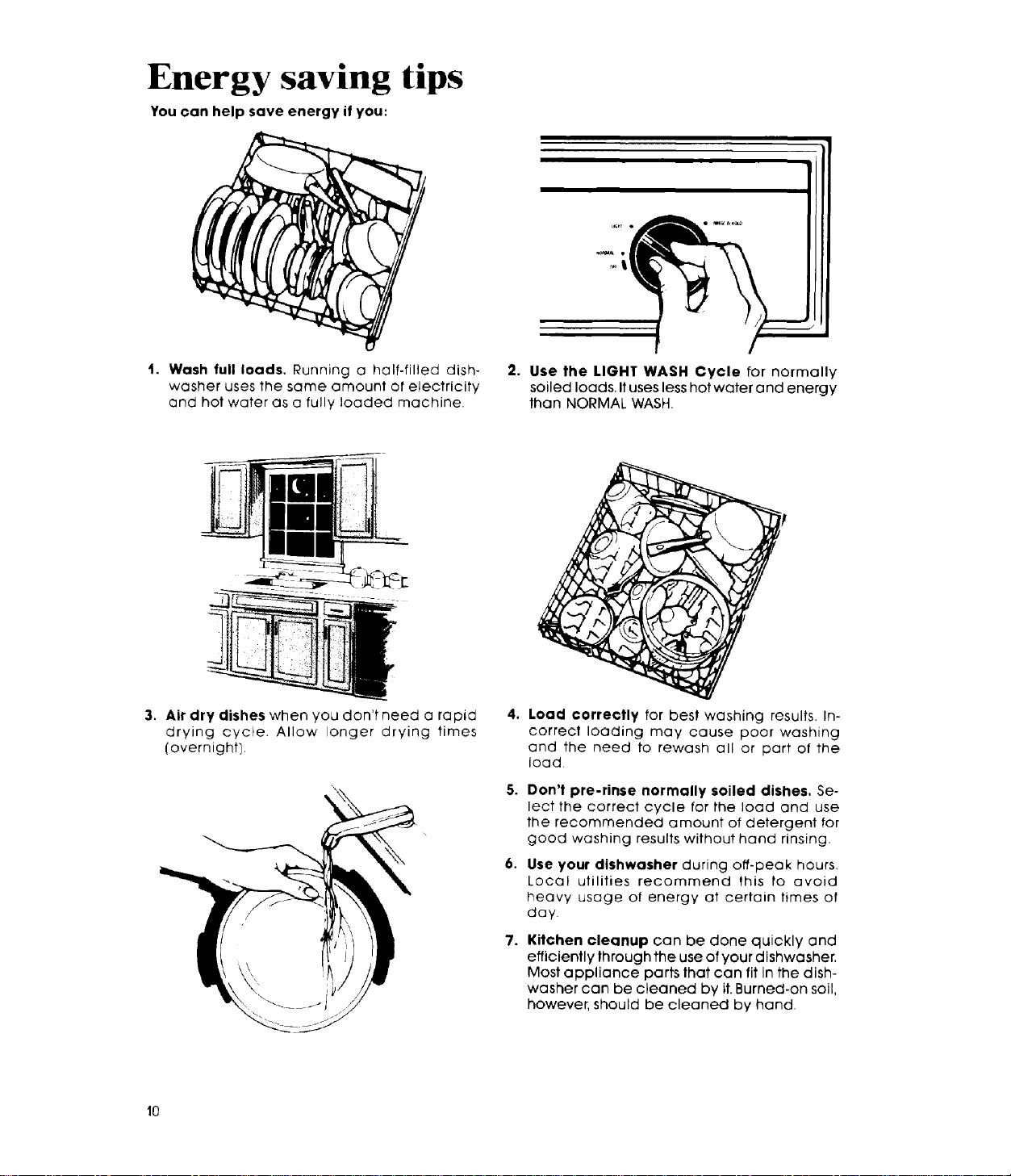
Energy saving tips
You can help save energy if you:
I, Wash full loads. Running a half-filled dish- 2. Use the LIGHT WASH Cycle for normally
washer uses the same amount of electricity soiled loads. It uses less hot water and energy
and hot water as a fully loaded machine, than NORMAL WASH.
3. Airdry dishes when you don't need a rapid
drying cycle. Allow longer drying times
(overnight].
4.
5.
7.
Load correctly for best washing results. In-
correct loading may cause poor washing
and the need to rewash all or part of the
load
Don't pre-rinse normally soiled dishes. Se-
lect the correct cycle for the load and use
the recommended amount of detergent for
good washing results without hand rinsing.
Use your dishwasher during off-peak hours.
Local utilities recommend this to avoid
heavy usage of energy at certain times of
day.
Kitchen cleanup can be done quickly and
efficiently through the use of your dishwasher.
Most appliance parts that can fit in the dish-
washer can be cleaned by it. Burned-on soil,
however, should be cleaned by hand.
10
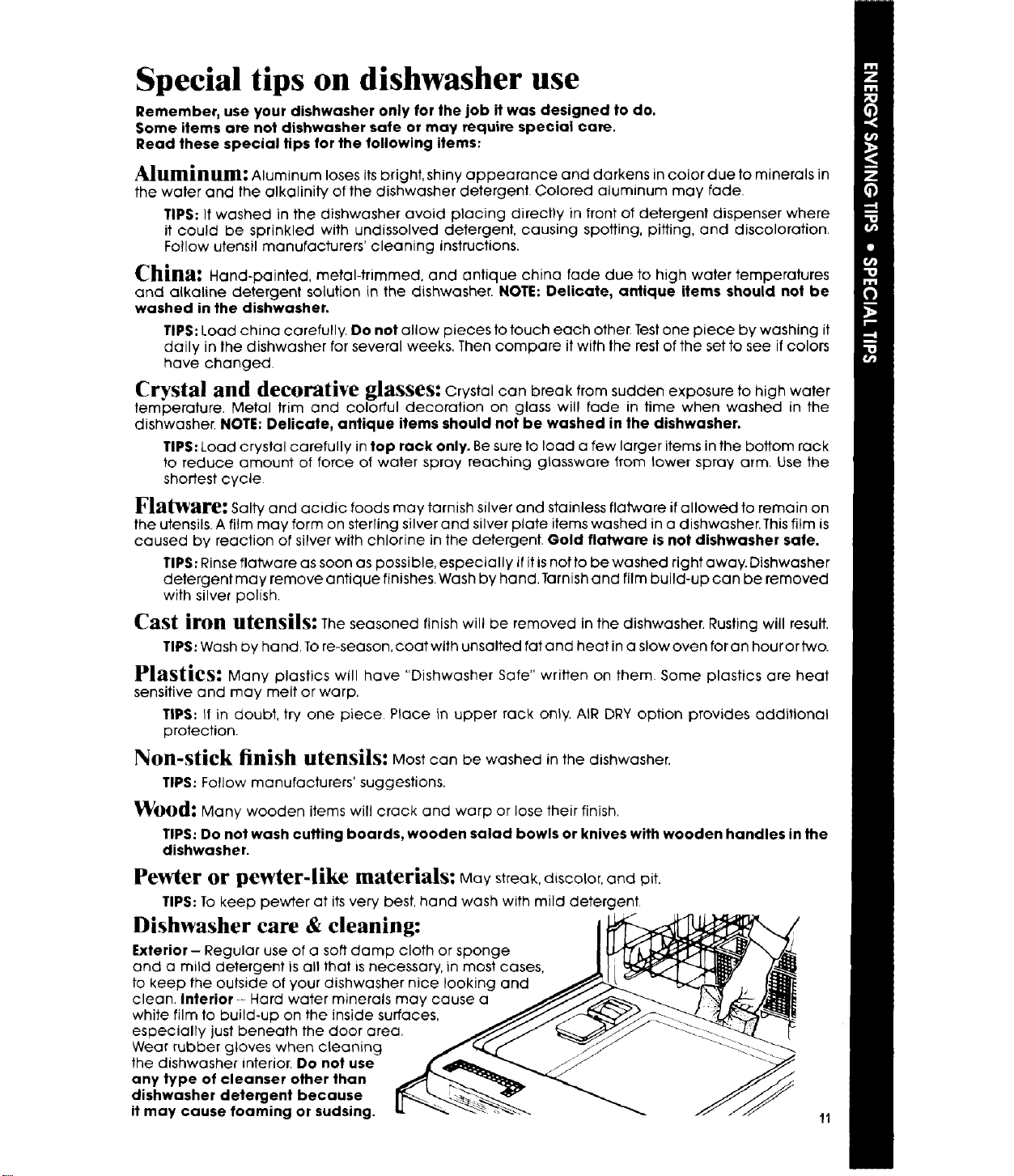
Special tips on dishwasher use
Remember, use your dishwasher only for the job it was designed to do.
Some items ate not dishwasher safe or may require special care.
Read these special tips for the following items:
Aluminum: Aluminum loses its bright, shiny appearance and darkens in color due to minerals in
the water and the alkalinity of the dishwasher detergent Colored aluminum may fade.
TIPS: It washed in the dishwasher avoid placing directly in front of detergent dispenser where
it could be sprinkled with undissolved detergent, causing spotting, pitting, and discoloration.
Follow utensil manufacturers' cleaning instructions.
China: Hand-painted, metal-trJmmed_ and antique china fade due to high water temperatures
and a_kaline detergent solution in the dishwasher. NOTE: Delicate, antique items should not be
washed in the dishwasher.
TIPS: Load china carefully, Do not allow pieces to touch each other Testone piece by washing it
daily in the dishwasher for several weeks, Then compare it with the rest of the set to see if colors
have changed.
Crystal and decorative glasses: Crystal can break from sudden exposure to high water
temperature. Metal trim and colorful decoration on glass will fade in time when washed in the
dishwasher NOTE: Delicate, antique items should not be washed in the dishwasher.
TIPS: Load crystal carefully in top rack only. Be sure to load a few larger items in the bottom rack
to reduce amount of force of water spray reaching glassware from lower spray arm. Use the
shortest cycle.
Flat_¥are.* Salty and acidic foods may tarnish silver and stainless flatware if allowed to remain on
the utensils. A film may form on sterling silver and silver plate items washed in a dishwasher. This film is
caused by reaction of silver with chlorine in the detergent. Gold flatware is not dishwasher sale.
TIPS: Rinse flatware as soon as possible, especially if it is not to be washed right away. Dishwasher
detergent may remove antique finishes. Wash by hand. Tarnish and film build-up can be removed
with silver polish.
Cast iron utensils: The seasoned finish will be removed in the dishwasher. Rusting will result,
TIPS: Wash by hand. To re-season, coat with unsalted fat and heat in a slow oven torah hour or two.
Plastics** Many plastics will have "Dishwasher Safe" written on them. Some plastics are heat
sensitive and may melt or warp,
TIPS: if in doubt, try one piece. Place in upper rack only. AIR DRY option provides additional
protection.
Non-stick finish utensils: Most can be washed in the dishwasher.
TIPS: Follow manufacturers' suggestions.
Wood: Many wooden items will crack and warp or lose their finish,
TIPS: Do not wash cutting boards, wooden salad bowls or knives with wooden handles in the
dishwasher.
Pewter or pcwter-like materials: May streak, discolor, and pit.
TIPS: To keep pewter at its very best, hand wash with mild detergent
Dishwasher care & cleaning:
Exterior - Regular use of a soft damp cloth or sponge
and a mild detergent is all that is necessary, in most cases,
to Keep the outside of your dishwasher nice looking and
clean. Interior Hard water minerals may cause a
white film to build-up on the inside surfaces,
especially just beneath the door area,
Wear rubber gloves when cleaning
the dishwasher interior. Do not use
any type of cleanser other than
dishwasher detergent because
it may cause foaming or sudsing.
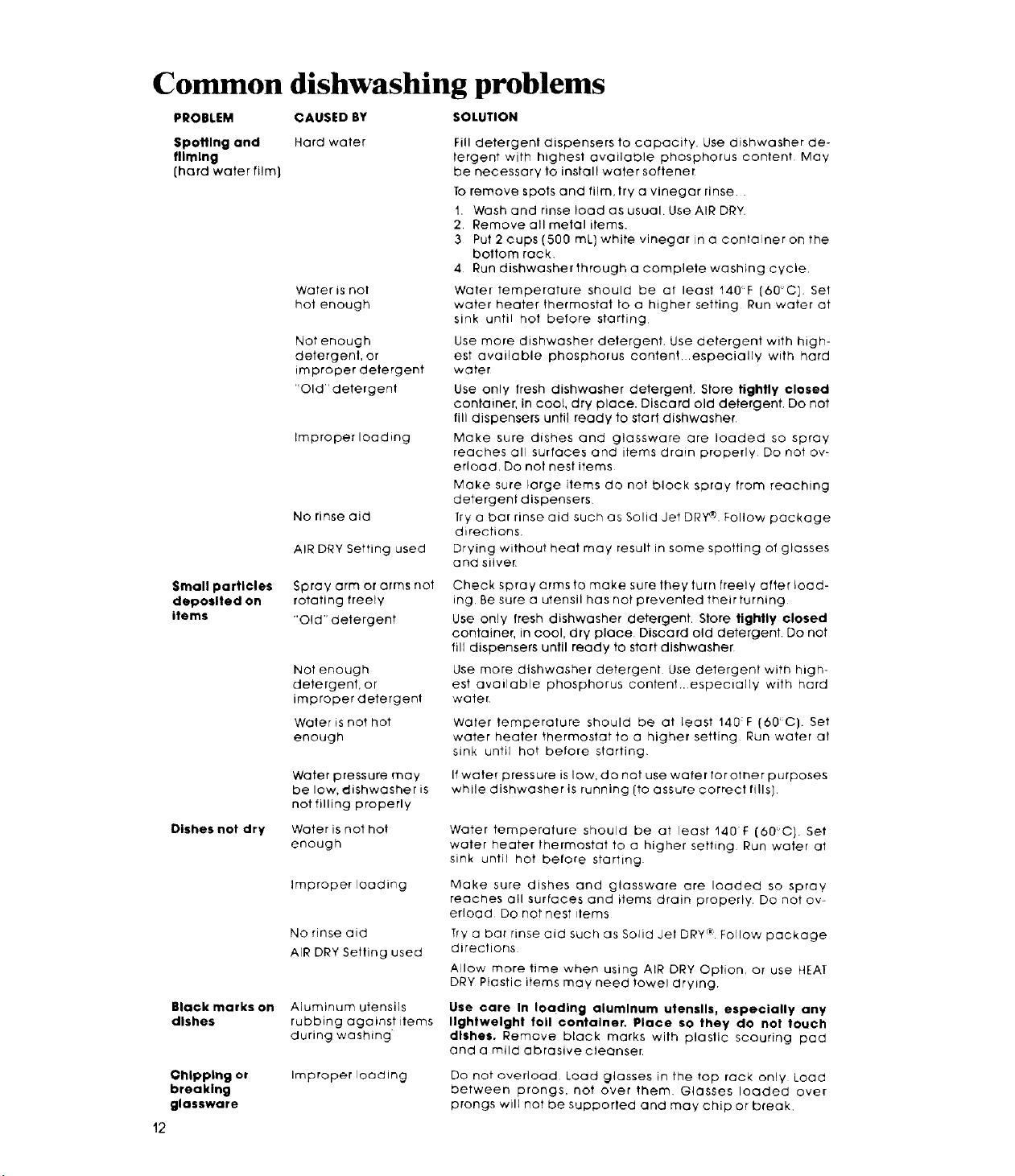
Common dishwashing problems
PROBLEM CAUSED BY SOLUTION
Spofllng and
filming
{hard water film}
Small particles
deposited on
items
Dishes not dry
Black marks on
dishes
Chipping or
breaking
glassware
12
Hard water
Water is nol
hot enough
Not enough
detergent, or
improper detergent
"Old" detergent
Improper loading
No rinse aid
AIR DRY Setting used
Spray arm or arms not
rotating freely
"Old" detergent
Not enough
detergent, or
improper detergent
Water is not hot
enough
Water pressure may
be low, dishwasher is
not filling properly
Water is not hot
enough
Improper loading
No rinse aid
AIR DRY Setting used
Aluminum utensils
rubbing against items
during washing
Improper loading
Fill detergent dispensers to capacity. Use dishwasher de-
tergent with highest available phosphorus content May
be necessary to install water softener
To remove spols and film, hy a vinegar rinse.
1. Wash and rinse load as usual. Use AIR DRY.
2. Remove all metal items.
3 Put 2 cups (500 mL] white vinegar in a container on the
bottom rack.
4 Run dishwasher through a complete washing cycle
Water temperature should be at least 140F (60 C]. Set
water heater thermostat tad higher setting Run water at
sink until hot before starting
Use more dishwasher detergent. Use detergent with high-
est available phosphorus content..especially with hard
water
Use only fresh dishwasher detergent. Store tightly closed
container, in opal, dry place. Discard old detergent. Do not
fill dispensers until ready to start dishwasher.
Make sure dishes and glassware are loaded so spray
reaches all surfaces and items drain properly Do not ov-
erload. Do not nest items
Make sure large items do not block spray from reaching
detergent dispensers
lry a bar rinse aid such as Solid Jet DRY®. Follow package
directions
Drying without heat may result in some spotting of glasses
and silver.
Check spray arms to make sure they turn freely after toad-
ing Be sure a utensil has not prevented their turning
Use only fresh dishwasher detergent. Store tightly closed
container, in cool, dry place. Discard old detergent. Do not
fill dispensers until ready to start dishwasher
Use more dishwasher detergent Use detergent with high-
est available phosphorus contenf...especially with hard
water
Water temperalure should be at least 140:F (6OC). Set
water heater thermostat to a higher setting Run water at
sink until hot before starting.
If water pressure is low, do not use water tar other purposes
while dishwasher is running (to assure correct fills].
Water temperature should be at least 14OF (60°C) Set
water heater thermostat to a higher setting Run water at
sink until hot before starting.
Make sure dishes and glassware are loaded so spray
reaches all surfaces and items drain properly. Do not ov-
erload Do not nestilems
Try a bar rinse aid such as Solid Jet DRY:":.Follow package
direclJons
Allow more time when using AIR DRY Option, or use HEAT
DRY Plastic items may need towel drying.
Use care In loading aluminum utenslls, especially any
llghtwelght foil container. Place so they do not touch
dishes. Remove black marks with plastic scouring pad
and a mild abrasive cleanse[
Do not overload Load glasses in the top rack only Load
between prongs, not over them Glasses loaded over
prongs will not be supported and may chip or break
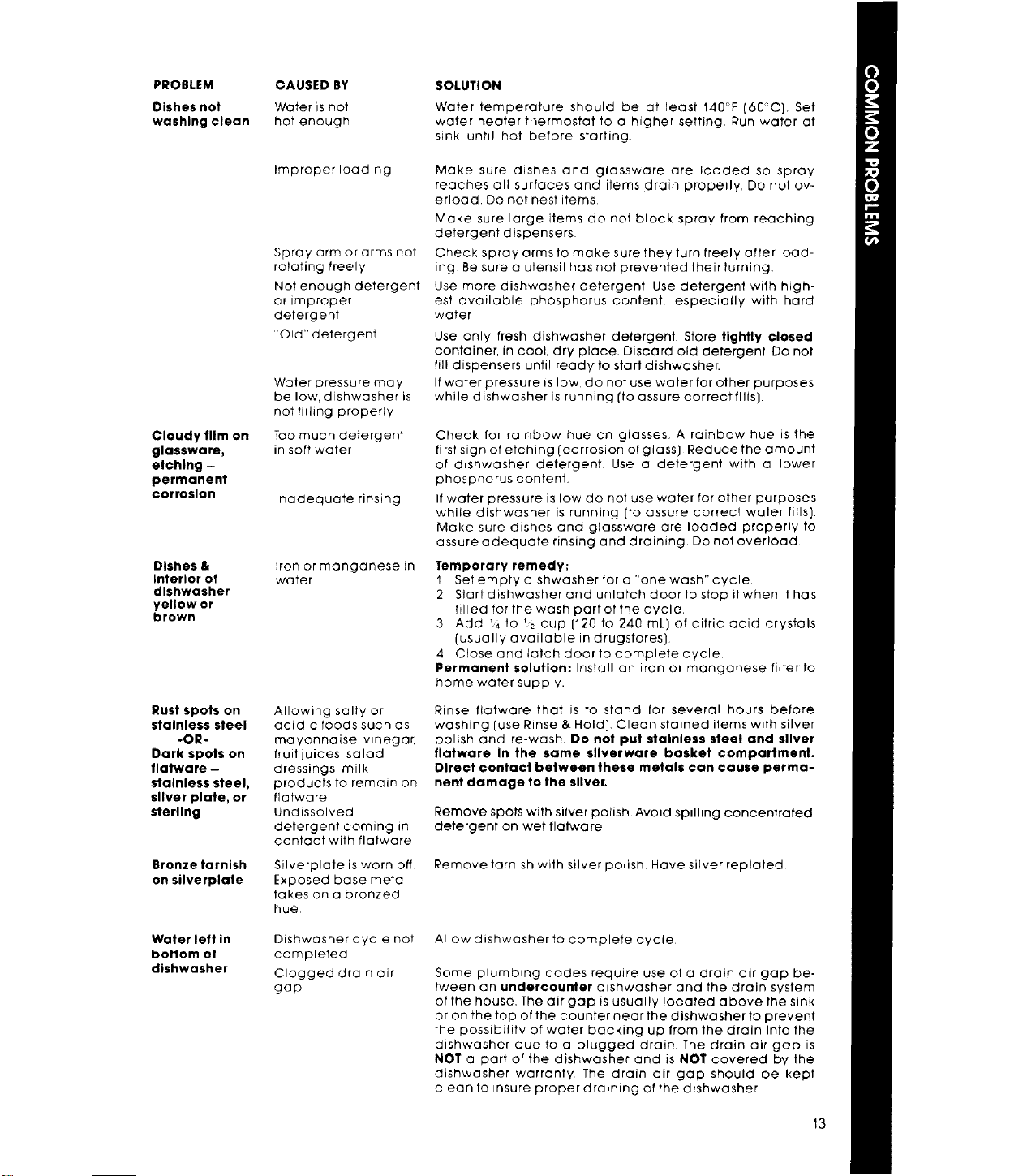
PROBLEM
Dishes not
washing clean
CAUSED BY
Water is not
hot enough
SOLUTION
Water temperature should be at least 140°F [60°C]. Set
water heater thermostat to a higher setting Run water at
sink until hot before starting.
Cloudy film on
glassware,
etchlng -
permanent
correslon
Dishes &
Interior of
dishwasher
yellow or
brown
Rust spots on
stalnless steel
-OR-
Dark spots on
flatware -
stainless steel,
sllver plate, or
sterllng
Bronze tarnish
on silverplate
improper loading
Spray arm or arms not
rotating freely
Not enough detergent
or improper
detergent
"Old" detergent
Water pressure may
be low, dishwasher is
not filling properly
Too much detergent
in soft water
Inadequate rinsing
iron or manganese in
water
Allowing salty or
acidic foods such as
mayonnaise, vinegar
fruit juices, salad
dressings, milk
products to remain on
flatware
Undissolved
delergent coming in
contact with flatware
SilverpJate is worn off
Exposed base metal
lakes on a bronzed
hue
Make sure dishes and glassware are loaded so spray
reaches all surfaces and items .drain properly, Do not ov-
erload, Do not nest items
Make sure large items do not block spray from reaching
detergent dispensers
Check spray arms to make sure they turn freely after load-
ing Be sure a utensil has not prevented their turning
Use more dishwasher detergent. Use detergent with high-
est available phosphorus content..especially with hard
water
Use only fresh dishwasher detergent. Store tightly closed
container, in cool, dry place. Discard old detergent. Do not
fill dispensers until ready to starl dishwasher.
If water pressure is low, do not use waler for other purposes
while dishwasher is running [to assure correct fills)
Check for rainbow hue on glasses, A rainbow hue is the
first sign of etching (corrosion of glass] Reduce the amount
of dishwasher detergent Use a detergent with a lower
phosphorus content.
If water pressure is low do not use water for other purposes
while dishwasher is running (to assure correct water fills].
Make sure dishes and glassware are loaded properly to
assure adequate rinsing and draining Do not overload
Temporary remedy:
1 Set empty dishwasher for a "one wash" cycle
2 Start dishwasher and unlatch door to stop it when Jlhas
filled for the wash part of the cycle.
3. Add '& to '2 cup [120 to 240 mL] of citric acid crystals
(usually available in drugstores]
4. Close and talch door to complete cycle.
Permanent solution: Install an iron or manganese filter to
home wafer supply.
Rinse flatware that is to stand for several hours before
washing [use Rinse & Hold). Clean stained items with silver
polish and re-wash, Do not put stainless steel and sliver
flatware In the same sllverware basket compartment.
Direct contact between these metals can cause perma-
nerrt damage to the sllver.
Remove spots with silver polish. Avoid spilling concentrated
detergent on wet flatwa re.
Remove tarnish with silver polish Have silverreplated
Water left in
bottom of
dishwasher
Dishwasher cycle not
completed
Clogged drain air
gap
Allow dishwasher to complete cycle
Some plumbing codes require use of a drain air gap be-
tween an undercounter dishwasher and the drain system
of the house, The air gap is usually located above the sink
or on the top of the counter near the dishwasher to prevent
the possibility of water backing up from the drain into the
dishwasher due to a plugged drain, The drain air gap is
NOT a part of the dishwasher and is NOT covered by the
dishwasher warranty The drain air gap should be kepl
clean to insure proper draining of the dishwasher
13
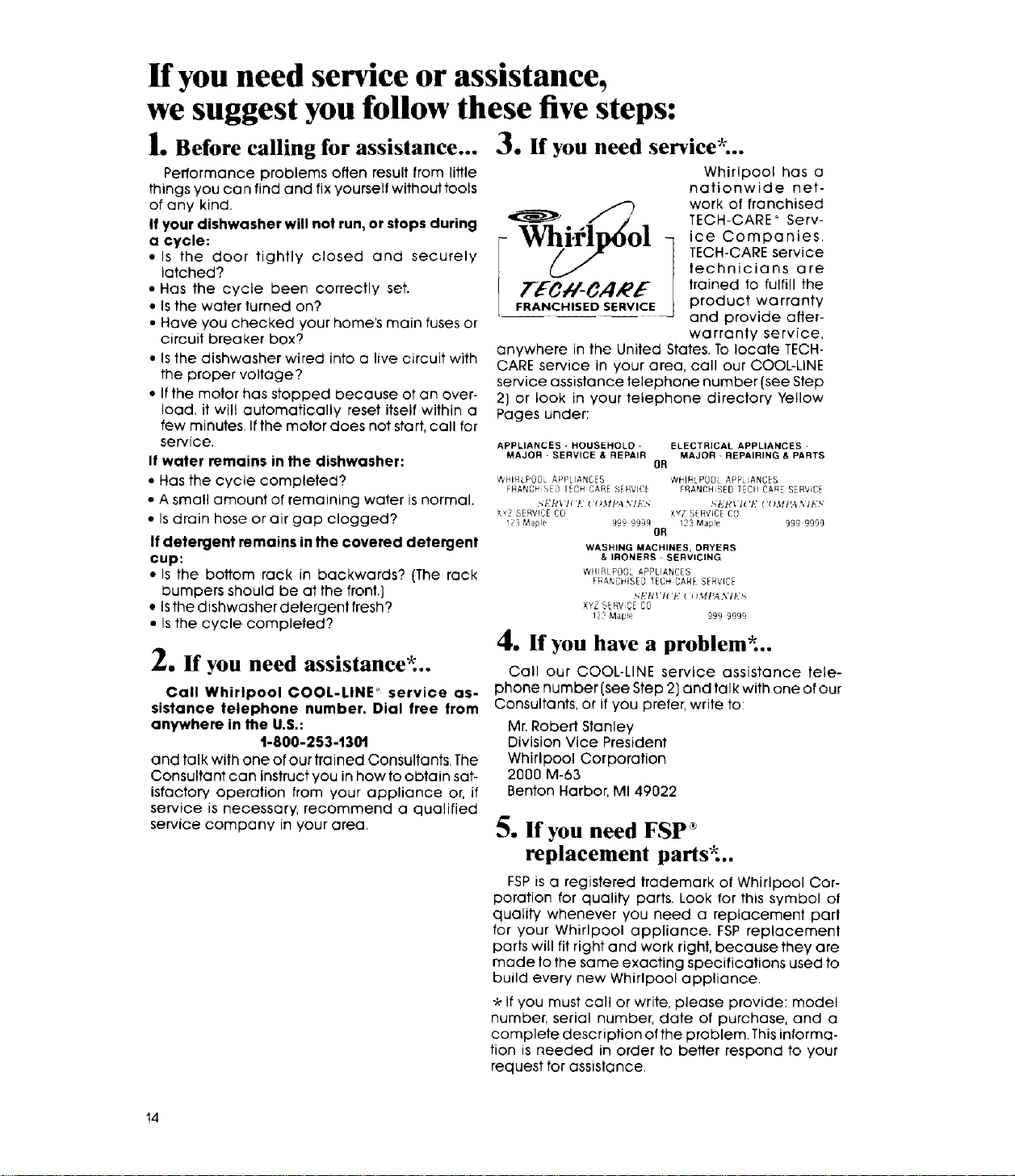
If you need service or assistance,
we suggest you follow these five steps:
|. Before calling for assistance...
Performance problems often result from little
things you can find and fix yourself without tools
of any kind.
If your dishwasher will not run, or stops during
a cycle:
•Is the door tightly closed and securely
latched?
• Has the cycle been correctly set.
• Is the water turned on?
• Have you checked your home's main fuses or
circuit breaker box?
• Is the dishwasher wired into a live circuit with
the proper voltage?
• If the motor has stopped because of an over-
load, it will automatically reset itself within a
few minutes, If the motor does not start, call for
service.
If water remains in the dishwasher:
• Has the cycle completed?
• A small amount of remaining water is normal.
•Is drain hose or air gap clogged?
If detergent remains in the covered detergent
cup:
• Is the bottom rack in backwards? (The rack
bumpers should be at the front,]
•Isthe dishwasher detergent fresh?
• Is the cycle completed?
2. ifyouneed assistance*...
Call Whirlpool COOL-LINE °service as-
sistance telephone number. Dial free from
anywhere in the U.S.:
1-800-253-1301
and talk with one of our trained Consultants, The
Consultant can instruct you in how to obtain sat-
isfactory operation from your appliance or, if
service is necessary, recommend a qualified
service company in your area.
3. If you need service*...
!TEeH ARE /
FRANCHISED SERVICE
L FRAI -- __
Whirlpool has a
nationwide net-
work of franchised
TECH-CARE * Serv-
ice Companies,
TECH-CARE service
lechnicians are
trained to fulfill the
product warranty
and provide afteF
warranty service,
anywhere in the United States. To locate TECH-
CARE service in your area, call our COOL-LINE
service assistance telephone number (see Step
2] or look in your telephone directory Yellow
Pages under:
APPLIANCES -HOUSEHOLD -
MAJOR -SERVICE & REPAIR OR
WHIRLPO0_ APPLIANCES
FRANCHSE [£CH CARE SERVI(]E
._,b_RV/( A ('f_MPA \'IA'.q
XYZ SERVICE CO XYZ S_RVICE CO
!23 Maple 999 9999 123 Maple
OR
WASHING MACHINES, DRYERS
& IRONERS SERVICING
WHIRLPO0_ APPLIANCES
FRANCHISED IECH CARE SERVICE
'_EI_YI( "b: (I)_tlt4.\'lE'_
XYZ S_.RV CE CO
1,_ Male 999 9999
4. If you have a problem*...
ELECTRICAL APPLIANCES •
MAJOR - REPAIRING & PARTS
WHIRLPOOL APPL ANCES
FRANCH ,_EDTECH CARE SER_;CE
.R_V/UE U_MPA _IE._"
999 9999
Call our COOL-LINE service assistance tele-
phone number [see Step 2] and talk with one of our
Consultants, or if you prefer, write to:
Mr. Robert Stanley
Division Vice President
Whirlpool Corporation
2000 M-63
Benton Harbor, MI 49022
5. If you need FSP*
replacement parts*...
FSPis a registered trademark of Whirlpool Cor-
poration for quality parts. Look for this symbol of
qualify whenever you need a replacement part
for your Whirlpool appliance. FSP replacement
parts will fit right and work right, because they are
made 1othe same exacting specifications used to
build every new Whirlpool appliance,
If you must call or write, please provide: model
number, serial number, date of purchase, and a
complete description of the problem. This informa-
tion is needed in order to better respond to your
request for assistance_
14
Notes
t5
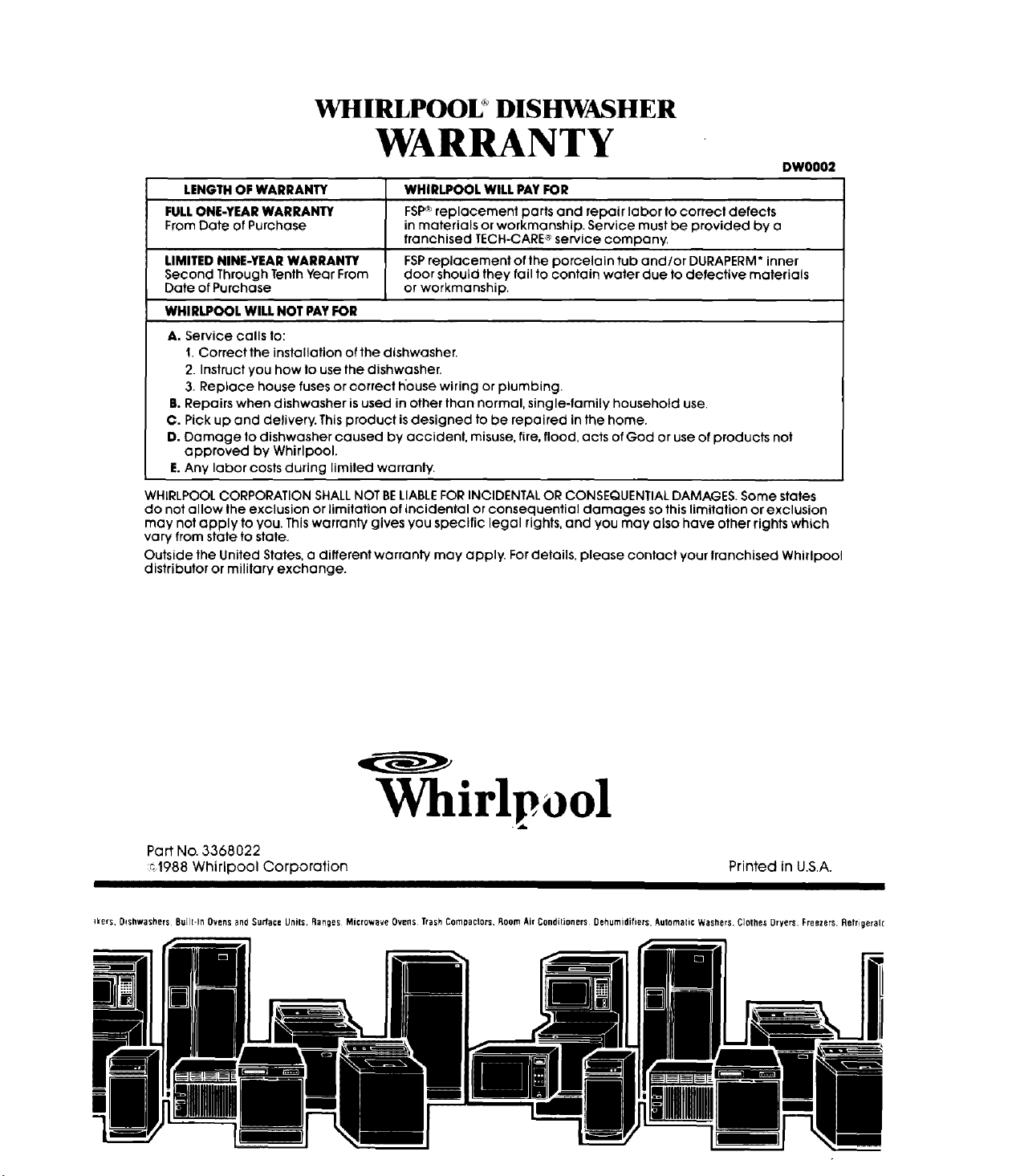
WHI POOU DISHWASHER
WARRANTY DW0002
LENGTH OF WARRANTY WHIRLPOOL WILL PAY FOR
FULLONE-YEAR WARRANTY FSP®replacement parts and repair labor to correct defects
From Date of Purchase in materials or workmanship. Service must be provided by a
franchised TECH-CARE ®service company
LIMITED NINE-YEAR WARRANTY FSPreplacement of the porcelain tub and/or DURAPERM" inner
Second Through Tenth Year From door should they fail to contain water due to defective materials
Date of Purchase or workmanship.
WHIRLPOOL WILL NOT PAY FOR
A. Service calls to:
1. Correct the installation of the dishwasher.
2. Instruct you how to use the dishwasher.
3. Replace house fuses or correct house wiring or plumbing.
B. Repairs when dishwasher is used in other than normal, single-family household use.
C. Pick up and delivery. This product is designed to be repaired in the home.
D. Damage Io dishwasher caused by accident, misuse, fire, flood, acts of God or use of products not
approved by Whirlpool.
E.Any labor costs during limiled warranty.
WHIRLPOOL CORPORATION SHALLNOT BELIABLEFOR INCIDENTAL OR CONSEQUENTIAL DAMAGES. Some states
do not allow the exclusion or limitation of incidental or consequential damages so this limitation or exclusion
may not apply to you. This warranty gives you specific legal rights, and you may also have other rights which
vary from state to state.
Outside the United States, a different warranty may apply. For details, please contact your lranchised Whirlpool
distributor or mililary exchange.
Part No, 3368022
¢1988 Whirlpool Corporation
Whirlpool
Printed in U.S,A.
_kers, D_sllwashers BuilHn Ovens anOSurface Unils, Aanges Microwave Ovens Trash ComDaciors, Room Air Conditioners Dehumidifiers. Aulomati¢ Washers, C]olhes Dryer_, Freezers. Relrigeral£