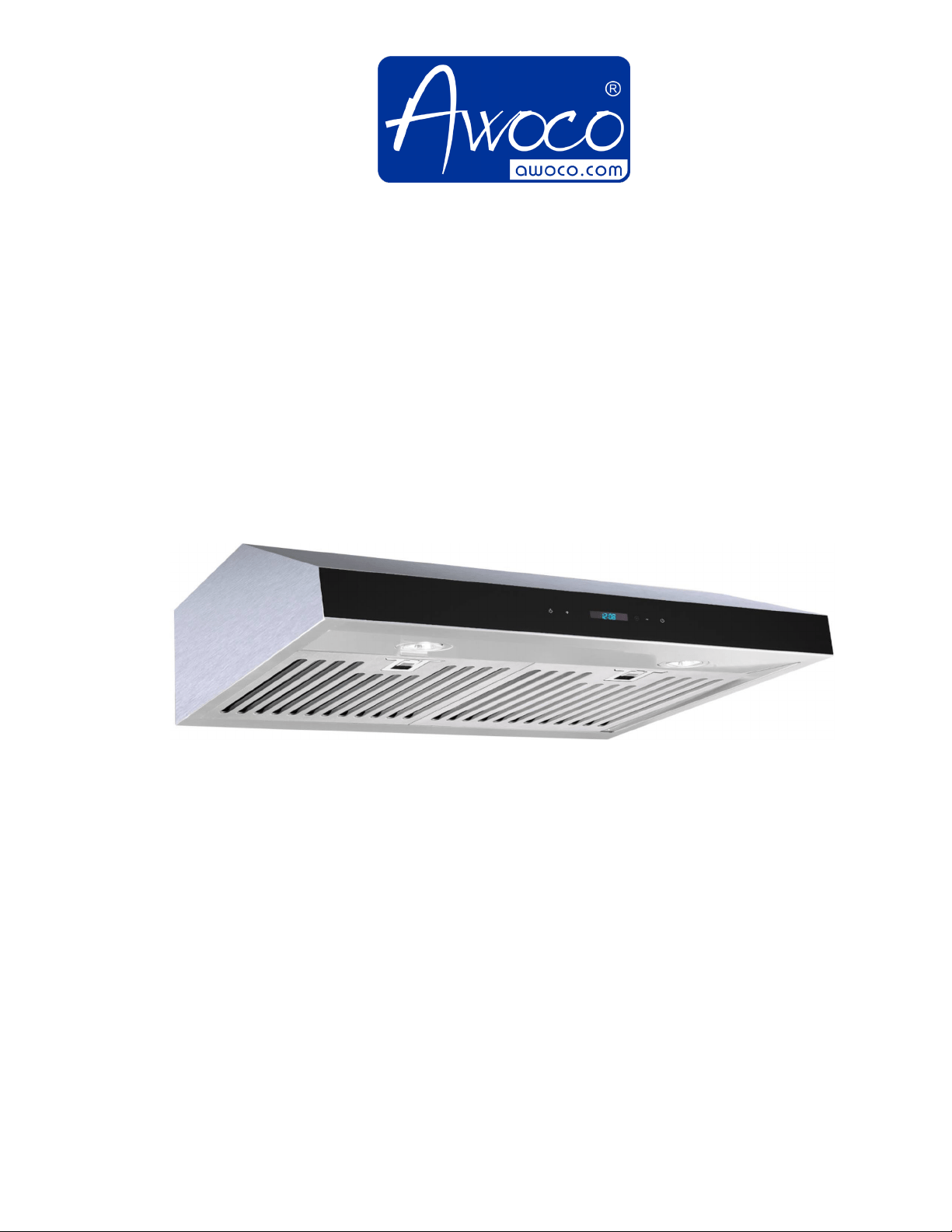
INSTRUCTION
MANUAL
Model No.: RH-R06-G30, RH-R06-G36

1
Table of Contents
Safety Information ..................................................................................................................................................... 2
Warranty ................................................................................................................................................................... 3
Pre-Installation .......................................................................................................................................................... 4
Installation ................................................................................................................................................................. 8
Operation ................................................................................................................................................................ 10
Maintenance ........................................................................................................................................................... 11
Maintenance Tips ................................................................................................................................................... 12
Troubleshooting ......................................................................................................................................................
13
Wiring Diagram ....................................................................................................................................................... 14
Awoco Contact ........................................................................................................................................................ 15

2
Safety Information
WARNING
SUITABLE FOR USE IN HOUSEHOLD COOKING AREA.
TO REDUCE THE RISK OF FIRE, ELECTRICAL SHOCK, OR INJURY
TO PERSONS, OBSERVE THE FOLLOWING:
1. Use this unit only in the manner intended by the manufacturer. If
you have any questions, contact Awoco customer service at the
email address or telephone number listed in the manual.
2. Before servicing or cleaning the unit, unplug the power cord or
switch off the power at the service panel and lock the service
panel to prevent the power from being switched on accidentally.
3. Installation work and electrical wiring must be done by qualified
personnel in accordance with all applicable codes and standards,
including fire-rated construction codes and standards.
4. Sufficient air is needed for proper combustion and exhausting of
gases through the flue (chimney) of fuel burning equipment to
prevent back drafting. Follow the heating equipment
manufacturer's guidelines and safety standards such as those
published by the National Fire Protection Association (NFPA),
and the American Society for Heating, Refrigeration and Air
Conditioning Engineers (ASHRAE), and the local code
authorities.
5. When cutting or drilling into the wall or ceiling, do not damage the
electrical wirings and other hidden utilities.
6. Ducted fans must always be vented to the outdoors.
7. Do not use this unit with any solid-state speed control device.
8. To reduce the risk of fire, use only metal ductwork.
9. This unit must be grounded.
TO REDUCE THE RISK OF A RANGE TOP GREASE FIRE:
1. Never leave surface units unattended at high settings. Boil overs
cause smoking and greasy spillovers may ignite. Heat oils
slowly on low or medium settings.
2. Always turn the hood ON when cooking at high heat or when
cooking flaming foods.
3. Clean the ventilating fans frequently. Grease should not be
allowed to accumulate on the fans or filters.
4. Use proper pan size. Always use cookware appropriate for the
size of the surface element.
TO REDUCE THE RISK OF INJURY TO PERSONS IN THE EVENT
OF A RANGE TOP GREASE FIRE, OBSERVE THE FOLLOWING*:
1. SMOTHER FLAMES with a close-fitting lid, cookie sheet or
metal tray, then turn off the burner. BE CAREFUL TO PREVENT
BURNS. IF THE FLAMES DO NOT GO OUT IMMEDIATELY,
EVACUATE AND CALL THE FIRE DEPARTMENT.
2. NEVER PICK UP A FLAMING PAN -You may be burned.
3. DO NOT USE WATER, including wet dishcloths or towels - This
could cause a violent steam explosion.
4. Use an extinguisher ONLY if:
a. You own a Class ABC extinguisher, and you know how to
operate it.
b. The fire is small and contained in the area where it started.
c. The fire department has been called.
d. You can fight the fire with your back to an exit.
*Based on "Kitchen Fire Safety Tips" published by NFPA.
CAUTION
1. For general ventilating use only. Do not use to exhaust
hazardous or explosive materials and vapors.
2. To avoid motor bearing damage and noisy and/or unbalanced
impellers, keep drywall sprays, construction dusts, etc. off the
power unit.
3. For the best result of capturing cooking impurities, your range
hood should be mounted so that the bottom of the hood is 24"-
30" above the cooking surface (ideal 27"). The minimum hood
distance above the cooktop must not be less than 24". Any
installation with less than 24” minimum hood distance may
cause overheat and damage to the range hood. Such damage
IS NOT covered by the warranty.
4. Two installers are recommended because of the larger size and
weight of this hood.
5. To reduce the risk of fire and to properly ventilate, be sure to
duct the air outside - Do not exhaust the air into spaces within
walls and ceiling or into the attic, crawl space or garage.
6. Make sure to keep the kitchen window (or one nearby) opened
to allow fresh air to enter the house so that there’s enough air
for the hood to work at maximum capacity.
Caution:
This hood is capable of exhausting large volume of air in a short
period of time. A small confined area with low level of air may
cause dizziness, faint or worst - suffocation.
7. Use with approved cord-connection kit only.
8. Please read specification label in product for further information
and requirements.
READ THESE INSTRUCTIONS BEFORE THE INSTALLATION.
SAVE THIS MANUAL FOR FUTURE REFERENCE.
Installer:
Leave this manual with the homeowner.
Homeowner:
Use and Care information on Page 11-12.

3
Warranty
This range hood is warranted to the original purchaser to be free of defects in material and workmanship for two (2) years
from the date of purchase.
Our obligation shall be limited to the repair or replacement of a unit (at our discretion) that may prove, by our sole
examination, to be defective under normal use and service during the warranty period. We may issue credit in the amount
of the invoice value of the defective product (or a percentage of it according to use) in lieu of repair or replacement. Any
failure of this product that is not traceable to a defect in material or workmanship is not covered by this warranty. These
non-warrantable items include but not limited to:
□ Change in color or finish due to chemical usage.
□ Improper installation not in accordance with the instructions.
□ Dents, bumps, and scratches incurred during handling or installation.
□ Damage caused by failure to follow the care and cleaning guidelines, including damage caused using abrasive
cleaners.
□ Alterations made to the unit by the purchaser or installer.
□ Damage caused by accidental impact, fire, flood, freezing, and normal wear.
□ Bends and warping caused by forced connections, over-tightened fittings, and inadequate support during
installation.
A thorough inspection and power on test must be made before the installation and any damage must be promptly
reported. We will not be liable for failures or damages that could have been discovered or avoided by proper inspection
and testing prior to the installation.
Incidental repairs that would involve a minimum of time and effort on behalf of the purchaser will not be considered
warranty work and no compensation will be deemed forth coming.
This warranty is non-transferable and shall be voided if the unit is removed from its initial installation or if it is not installed
following the instructions.
Under no circumstance shall we be held liable for personal injury or property damage resulted from improper
installation or use of this product. We will not be held liable for inconvenience caused by loss of use of this product,
costs incurred for labor or materials, removal and installation of replacement units, or any other incidental or
consequential damages. Costs related to obtaining access for repair or replacement are the responsibility of the user.
This warranty does not extend to commercial and institutional installation or use.
WARRANTY CLAIM PRODEDURE
Before you make your claim call, please ensure that you have:
□ Model number of the range hood
□ Proof of purchase, such as Order ID, invoice or packing slip number
□ Details regarding the defect
□ Name(s) and address(es) of the owner
Claims must be filled out in writing and returned within six (6) months of the appearance of a defect. Failure to comply
with this stipulation will make this warranty null and void. We reserve the right to a thirty-day (30) delay following the
receipt of a claim to inspect the product. We assume no responsibility for labor costs in removing or replacing a previously
installed product, transportation, or the return of the product.

4
Pre-
installation
TOOLS REQUIRED
HARDWARE EXAMPLE

5
Pre-
installation (continued)
PACKAGE CONTENTS

6
Pre-
installation (continued)
SPECIFICATIONS
Model No.
Dimension
Voltage
Speeds
Lamps
RH-R06-G30
29-3/4”W x 22”D x 7”H
120V/60Hz
6
2 x 3W LED
RH-R06-G36
35-3/4”W x 22”D x 7”H
120V/60Hz
6
2 x 3W LED
PLANNING INSTALLATION
• Before proceeding to install, please make sure you have thoroughly inspected the range hood for any
possible damages or missing parts.
• If you identify that there are missing or damaged parts, we advise you to contact the relevant personnel
as soon as possible to have the issues rectified.
• It is recommended to keep the original product packaging in the case of a defective or damaged
product that needs to be returned unless you are completely satisfied.
• We recommend testing the range hood by establishing a temporary connection to an outlet and
turn on the fans and lights to ensure the hood is working properly prior to the installation.
Please note:
• If you fail to read the instructions carefully on how to install properly, we will not be responsible for any
damages incurred during the improper installation.
• We highly recommend reading this manual carefully before proceeding to install or using the range
hood.
• You should use this range hood in ducted mode only, meaning always venting the exhaust to the
outside.
• We recommend hiring a certified technician to complete the installation of this range hood.
• Please check to ensure the main voltage is in line with the required voltage outlined on the rating plate
inside the hood.
• Check the domestic power supply to ensure there’s a proper grounding system before the installation.
• Do not connect the range hood to any exhaust ducts carrying combustible fumes, such as ducts from
the fireplace, boiler or any other similar places or equipment.

7
Pre-
installation (continued)
• While using the hood with non-electrical appliances, make sure there’s an opening that would allow the
clean air to enter the kitchen to prevent the backflow of the exhaust gas.
• The clearance between the cooking surface and the bottom of the range hood is between 24” and 30”.
Depending on the range type in use, this distance may vary. Under no circumstances should it exceed
the maximum height of 30”.
• Carefully remove the plastic protective film from the surface of the hood before the installation.
CAUTION
Please hire a certified technician to eliminate the risks of fire or electrical shock. Use safety gloves to prevent
cuts from sharp edges. Make sure to not damage the hood when using an electrical screwdriver. To avoid
malfunction, ensure that no debris enters the opening vent.
NOTE:
This installation requires two or more persons as the hood is heavy and it may cause physical injuries if worked
on alone.

8
Installation
Overview
This appliance requires a ductwork that leads to
outdoors through the wall or roof.
• For installation without an existing ductwork,
determine the route to run the ductwork and
source the ducts and wall/roof cap locally.
• For installation with an existing ductwork,
simply follow the installation instructions in
this manual to mount the range hood to the
desired location, then connect it to the
ductwork and make sure all connections are
sealed airtight.
Installation Preparation
1. If you need to remove the range, be sure to turn
off the range’s power from the main switch.
Turn off the main gas supply in case it’s a gas
range.
2. Disengage the baffle filter from the hood by
pulling the latch outward and slowly pull the
filter down and away from the hood while still
holding the latch.
3. Remove the bottom cover by carefully
unscrewing the eight (8) screws as shown
below to view the hood’s top screw holes:
4. This range hood comes with 3 adapters: 1
vertical rectangular adapter, 1 vertical round
adapter and 1 horizontal rectangular adapter.
The vertical rectangular adapter is pre-installed
by default. Depends on the type of ductwork in
use, choose and follow one of the instructions
below:
i) Vertical Discharge:
• Vertical Rectangular Ductwork:
There’s no need to change the pre-
installed adapter.
• Vertical Round Ductwork: Follow
the instruction diagram as shown
below to replace the pre-installed
rectangular adapter with the round
adapter.
ii) Horizontal Discharge:
(1) Remove the pre-installed vertical
rectangular adapter and cover the
vent opening with the shutoff plate.
(2) Remove the large shutoff plate on
the back of the hood and the small
shutoff plate inside the back of the
hood.

9
Installation (continued)
(3) Attach the horizontal rectangular
adapter to the back of the hood.
Then fasten the adapter using the
same screws from the shutoff plate.
(4) Create an opening for the adapter
and the power cord:
(a) If installing the hood with the
vertical/top adapter, measure
and cut an opening that is
slightly larger than the adapter at
the bottom of the cabinet. If the
cabinet has a recessed bottom,
use a 4” wide wood filler on both
sides. Also measure and cut an
opening for the power cord at the
bottom of the cabinet.
(b) If installing the hood with
horizontal/back adapter,
measure and cut an opening that
is slightly larger than the adapter
on the wall. Then measure and
cut an opening for the power
cord at the bottom of the cabinet.
(5) Hold the hood in position under the
cabinet. Make sure the adapter
connects with the ductwork and the
air damper opens and closes freely.
Stuck or half opened air damper
could reduce the hood’s
performance and generate loud
noise.
(6) The ductwork from the hood to the
roof cap or wall cap should be as
short and straight as possible.
Aluminum ducts with uniform sizes
are recommended.
(7) If an elbow is required, a minimum of
12” straight run is needed before the
elbow.
(8) Proper clearance is crucial for the
hood to be able to work at maximum
capacity as too much clearance
would decrease the hood’s overall
performance and too little may result
in fire hazard and cause damage to
the hood.
Hood Installation
1. Remove all protective films from the hood.
2. Hold the hood in position, reach inside the hood
from the bottom, insert and tighten the screws
for each pre-drilled mounting holes.
Caution:
Make sure the hood is firmly secured to the
cabinet before removing the support.
3. For a more secure installation, create and use
as many mounting holes as necessary.
Ductwork
1. After the hood is properly mounted, connect the
duct to the hood adapter.
2. Seal all connections with aluminum foil tape
and make sure it’s completely airtight.
3. Reinstall the bottom cover and tighten all
screws.
4. Reinstall the baffle filters.
After Installation Test Run
1. Plug the power cable to a power outlet nearby.
2. Turn on the hood and check if it’s working
properly. Should any issues arise, refer to Page
13 for troubleshooting.

10
Operation
This hood can be manually operated with the buttons on the front control panel.
1 – On/Off
3 – Down
5 – Delayed Shutoff Timer
2 – Lamp
4 – Up
Setting the Speed
1. Turn on the hood by touching the On/Off (1)
button.
2. Touch the Down (3) button to decrease the
speed or the Up (4) button to increase the
speed.
Turn On/Off the Lamps
This hood is equipped with two LED lamps:
1. Touch the Lamp (2) button once, the lamps will
turn on.
2. Touch the Lamp (2) button again, the lamps will
turn off immediately.
Caution
The lamps are hot when in use. DO NOT touch
them when they are on. Give them a few minutes to
cool down. For how to replace a broken lamp, refer
to Page 11 for detail instructions.
Setting the Clock
1. Touch and hold the On/Off (1) button for three
seconds and the Hour indicator will flash.
2. Touch the Down (3) button or the Up (4) button
to set the hour value.
3. When done setting the hour value, touch the
On/Off (1) button once and the Minute indicator
will flash.
4. Touch the Down (3) button or the Up (4) button
to set the minute value.
Note
The system will automatically exit the setting mode
and retain the set values when the hood is inactive
for more than 5 seconds.
Setting the Delayed Shutoff Timer
This hood come with a delayed shutoff function to
allow the hood to keep running even when the
cooking is done to vent out the remaining exhaust
air and it will automatically shut itself off when the
timer is up.
1. Touch the Delayed Shutoff Timer (5) button
once and the timer display will flash.
2. Touch the Down (3) button or the Up (4) button
to set the timer that fits your need. The timer
can be set to 1 minute minimum and 15
minutes maximum.
Note
The system will automatically exit the setting mode
and retain the set values when the hood is inactive
for more than 3 seconds.

11
Maintenance
Baffle Filters
1. Clean the baffle filters frequently. Depending on the hood usage, the cleaning cycle can range from every
few days to every few weeks.
2. The baffle filters are easy to clean and are dishwasher safe.
3. How to clean:
a) Unplug the power cord from the wall outlet.
b) Gently pull the latch to disengage the filter.
c) Keep holding the latch and slowly pull the filter downwards.
d) Pull the filter toward the user and remove it completely.
e) Repeat step b) ~ d) to remove the rest of the filters.
f) Soap the filters in a warm detergent solution for some time depending on how greasy they are.
g) Brush off the remaining grease residues and rinse repeatedly until all residues are gone.
h) Leave the filters at a safe location and let them dry completely.
i) Reinstall the filters.
Lamps
1. This hood uses two 110VAC GU10 LED bulbs.
2. How to replace the broken lamp:
a) Unplug the hood or turn off the breaker.
b) Twist the bulb to open position then gently pull out the defective LED bulb.
c) Disconnect the LED wires.
d) Connect the wires with the new LED bulb.
e) Align and snap the new LED bulb into position, twist it to lock position.
f) Plug in power cord or turn on the breaker if hard wired.
g) Check if the new LED bulb is working properly.

12
Maintenance Tips
Clean and maintain the hood regularly so that it is at its optimal state to perform at its maximum capacity.
Do DO NOT
• Wipe the hood body with a soft cloth and
warm cleaning solution.
• Clean the hood in the direction of the original
polish line on the hood.
• Rub repeatedly on the tough spots until they
are gone.
• You can use a non-abrasive stainless steel
polisher for a finer touch if desired.
• Check the ducts regularly to make sure they
are not clogged or leaking.
• Do not clean the hood with abrasive or
detergents containing corrosive agents, such
as chloride, iodide, fluoride, and some other
agents. These will damage the hood surface.
• Do not leave soaps or other detergents on
the hood body for too long. Wipe off any
excess cleaning solution with a clean cloth or
paper towel.
• Do not leave the hood dirty for too long as the
dirt particles can go through the fans and
cause damage to the motors.
• Do not let any debris (especially the
construction type) enter the hood. When
cleaning or renovating the kitchen/house,
make sure to cover the hood properly to
avoid any debris lodge into the hood.
• Cleaning agents such as alcohol and other
flammable agents should not be used near
the range or the stove as these may cause
fire or explosion.

13
Troubleshooting
DANGER: Unplug the power cord or turn off the power breaker before servicing this range hood. Failure to do
so can cause serious personal injuries or death.
Below are some possible solutions to some common issues. If your issue isn’t listed, please contact the seller
or Awoco for a solution.
Issue Solution
The hood won’t turn on
• Check if the hood is plugged in and the
power breaker is turned back on.
• Check if the wall outlet has power.
• Check if the front control panel is connected
to the circuit board.
• Contact Awoco, replace the circuit board if
needed.
The hood vibrates when it’s running
• Check if the hood is firmly mounted to the
wall and the cabinet.
• Check if the motors are loose.
• Check if the fan wheels are damaged or
unbalanced.
The hood has poor performance
• Check if the air damper at the vent adapter
can be open freely.
• Make sure the duct size is at least 6” round or
3-1/4” x 10” rectangular.
• Check if the ducts are clogged.
• Check if the damper is stuck.
• Make sure the kitchen window is opened to
let enough fresh air in.
The fam won’t spin but the lamps are working fine
• Manually spin the fan to see if it’s unbalanced
and touching the casing.
• If the fan is balanced and spins, then the
motor might be defective and needs to be
replaced.
The lamp won’t turn on
• If one bulb is off, swap to the good bulb to
that position to check if the bulb is defective.
• Check if the hood is plugged in and the
power breaker is turned back on.
• Check if you can change to a different speed.
• Check if the lamp is connected to the circuit
board.
• If the issue persists, the lamp might be
defective and needs to be replaced.
14
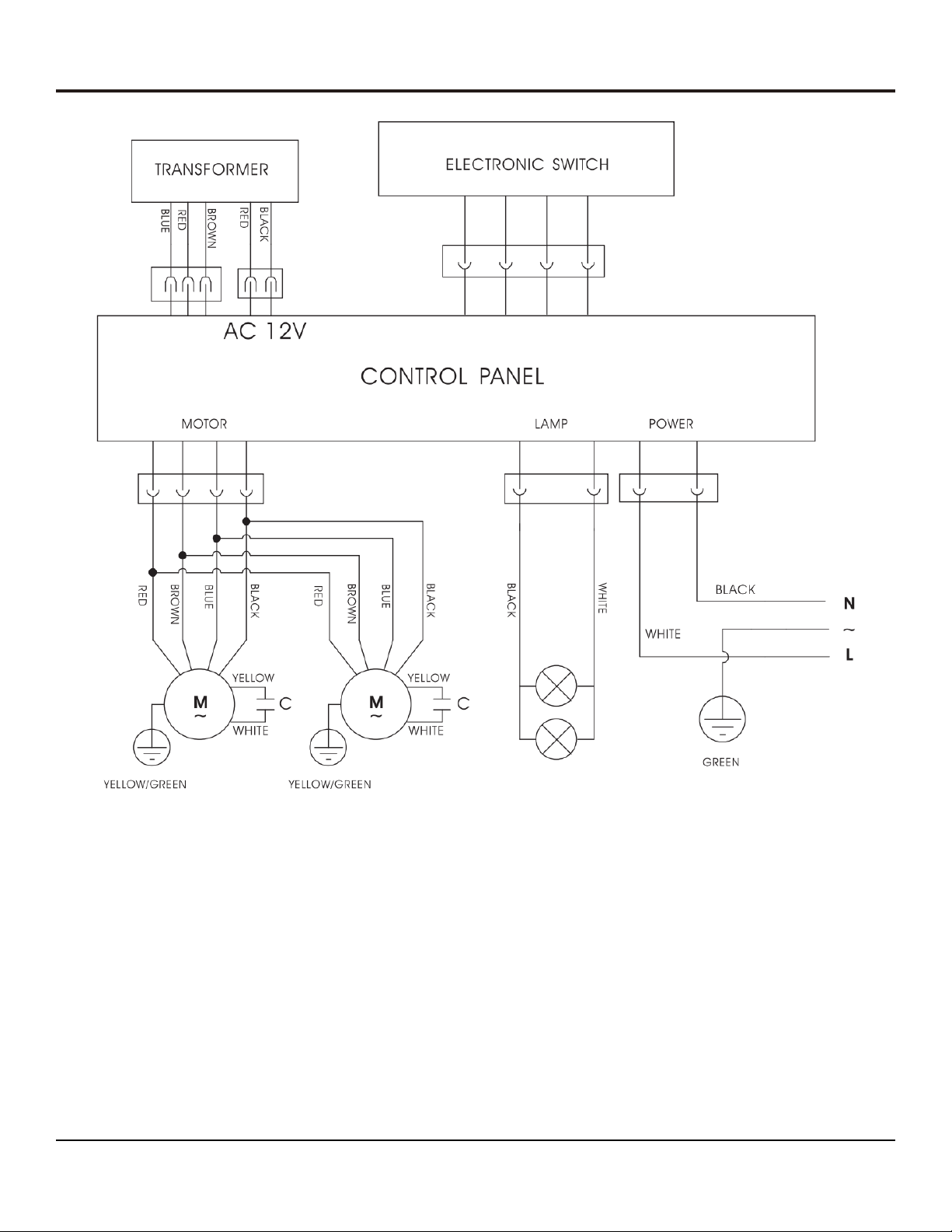
Wiring Diagram

15