UNPACKING
After unpacking unit, inspect carefully for any damage
that may have occurred during transit. Check for loose,
missing, or damaged parts. If any damage is observed,
a shipping damage claim must be filed with carrier. Do
not use the Airvac Cooling System Refiller if broken,
bent, cracked or damaged parts (including labels) are
noted. Any Airvac Cooling System Refiller that appears
damaged in any way, operates abnormally or is missing
parts should be removed from service immediately. If
you suspect that the Airvac Cooling System Refiller was
subjected to a shock load (a load that was dropped
suddenly, unexpectedly, etc.) immediately discontinue
use until it has been checked by a factory authorized
service center.
Please read and save these instructions. Read through this owner’s manual carefully before using product. Protect yourself and others by observing
all safety information, warnings, and cautions. Failure to comply with instructions could result in personal injury and/or damage to product or property.
Please retain instructions for future reference.
Operating Instructions and Parts Manual 24444
08/15
2015 OEMTOOLS
AIRVAC COOLING SYSTEM REFILLER
The following safety information is provided as a guideline to help you operate your Airvac Cooling System Refiller under the safest possible conditions. Any
tool or piece of equipment can be potentially dangerous to use when safety or safe handling instructions are not known or not followed. The following safety
instructions are to provide the user with the information necessary for safe use and operation. Please read and retain these instructions for the continued safe
use of your service system. Failure to follow instructions listed below may result in serious injury. In addition, make certain that anyone that uses the equipment
understands and follows these safety instructions as well.
Explanation of Safety Signal Words
CAUTION
WARNING
: Indicates a potentially hazardous situation which, if not avoided, could result in death or serious injury.
: Indicates a potentially hazardous situation which, if not avoided, may result in minor or moderate injury.
: Used without the safety alert symbol indicates a potentially hazardous situation which, if not avoided, may result in property damage.
: Provide clarity and helpful information.
WARNING
CAUTION
NOTES
Thank you very much for choosing an OEMTOOLS Product!
For future reference, please complete the owner’s record below:
Model: _______________ Purchase Date: _______________
Save the receipt, warranty and these instructions. It is important that you read the entire manual to become familiar with this product before you begin
using it. This product is designed for certain applications only. OEMTOOLS cannot be responsible for issues arising from modification. We strongly
recommend this product is not modified and/or used for any application other than that for which it was designed. If you have any questions
relative to a particular application, DO NOT use the product until you have first contacted OEMTOOLS to determine if it can or should be
performed on the product.
2
Operating Instructions and Parts Manual 24444
08/15
2015 OEMTOOLS
AIRVAC COOLING SYSTEM REFILLER
IMPORTANT INSTRUCTIONS
AND SAFETY RULES
1. Know your tool. Read this manual carefully. Learn the tool’s
applications and limitations, as well as, potential hazards specific
to it.
2. Keep work area clean and well lit. Cluttered or dark work areas
invite accidents.
3. Keep children away. All children should be kept away from the work
area. Never let a child handle a tool without strict adult supervision.
4. Do not operate this tool if under the influence of alcohol or drugs.
Read warning labels on prescriptions to determine if your judgment
or reflexes are impaired while taking drugs. If there is any doubt, do
not attempt to operate.
5. Use safety equipment. Eye protection should be worn at all times
when operating this tool. Use ANSI approved safety glasses.
Everyday eyeglasses are NOT safety glasses. Dust mask, non-skid
safety shoes, hard hat or hearing protection should be used in
appropriate conditions.
6. Wear proper apparel. Loose clothing, gloves, neck-ties, rings,
bracelets or other jewelry may present a potential hazard when
operating this tool. Keep all apparel clear of the tool.
7. Don’t overreach. Keep proper footing and balance at all times when
operating this tool.
8. Check for damage. Check your tool regularly. If part of the tool is
damaged it should be carefully inspected to make sure that it can
perform its intended function correctly. If in doubt, the part should
be repaired. Refer all servicing to a qualified technician. Consult
your dealer for advice.
9. Keep away from flammables. Do not attempt to operate this tool
near flammable materials or combustibles. Failure to comply may
cause serious injury or death.
10. Store idle tools out of the reach of children and untrained persons.
Tools may be dangerous in the hands of untrained users.
11. Maintain tools with care.
12. Keep tools dry and clean.
13. Do not use a damaged tool. Tag damaged tools “Do not use” until
repaired.
14. Use only accessories that are recommended by the manufacturer
for your model. Accessories that may be suitable for one tool may
become hazardous when used on another tool.
15. Tool service must be performed only by qualified repair personnel.
Service or maintenance performed by unqualified personnel could
result in a risk of injury.
16. When servicing a tool, use only identical replacement parts. Use of
unauthorized parts or failure to follow maintenance instructions may
create a risk of injury.
17. Maintain a safe working environment. Keep the work area well lit.
Make sure there is adequate surrounding workspace. Keep the work
area free of obstructions, grease, oil, trash, and other debris.
Do not use this product in a damp or wet location.
18. Maintain labels and nameplates on this product. These carry
important information. If unreadable or missing, contact OEMTOOLS
for a replacement.
19. Before use, read and understand all warnings, safety precautions,
and instructions as outlined in the vehicle manufacturer’s service
manual. It is beyond the scope of this manual to properly describe
the correct procedure and test data for each vehicle.
20. Always perform vehicle service in a properly ventilated area. Never
run an engine without proper ventilation for its exhaust. Stop work
and take necessary steps to improve ventilation in the work area
if you develop momentary eye, nose, or throat irritation as this
indicates inadequate ventilation.
• Engine parts that are in motion and unexpected movement of a vehicle
can injure or kill. When working near moving engine parts, wear snug
fit clothing and keep hands and fingers away from moving parts. Keep
hoses and tools clear of moving parts. Always stay clear of moving
engine parts. Hoses and tools can be thrown through the air if not kept
clear of moving engine parts. The unexpected movement of a vehicle
can injure or kill. When working on vehicles always set the parking
brake or block the wheels.
• Avoid accidental fire and/or explosion. Do not smoke near engine fuel
and battery components.
• For safety purposes and the prevention of damage to expensive
components it is advised that the user have an understanding of basic
automotive repair and a working knowledge of automotive systems.
• We believe the information contained herein to be reliable. However,
general technical information is given by us without charge and
the user shall employ such information at his own discretion and
risk. We assume no responsibility for results or damages incurred
from the use of such information in whole or in part. Always refer to
specific instructions and technical information supplied by vehicle
manufacturer.
NOTE: The manufacturer declines any and all responsibility for damage
to vehicles or components if said damage is the result of unskillful
handling by the operator or of failure to observe the basic safety rules set
forth in the instruction manual.
Read Rules for Safe Operation and Instructions Carefully.
IMPORTANT SAFETY INSTRUCTIONS
The warnings, precautions, and instructions discussed in this manual
cannot cover all possible conditions and situations that may occur. The
operator must understand that common sense and caution are factors
which cannot be built into this product, but must be supplied by the
operator.
Used oil, antifreeze, brake fluid and transmission fluid contains chemical
compounds that can be harmful to humans and other animals. When
managed properly, used fluids may be of beneficial use. Used fluids
may be blended and recycled as a heating or industrial fuel and also
may be re-refined and made into new lubricants. Persons who perform
maintenance on their own vehicles are responsible for managing the used
fluids in a manner that is protective of human health and the environment
and to follow all local laws and regulations concerning their disposal.
DISPOSAL
At the end of the useful life of the Airvac Cooling System Refiller, dispose
of the components according to all state, federal, and local regulations.
WARNING
WARNING
3
Operating Instructions and Parts Manual 24444
08/15
2015 OEMTOOLS
AIRVAC COOLING SYSTEM REFILLER
PURPOSE
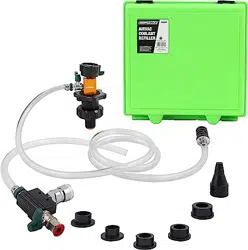
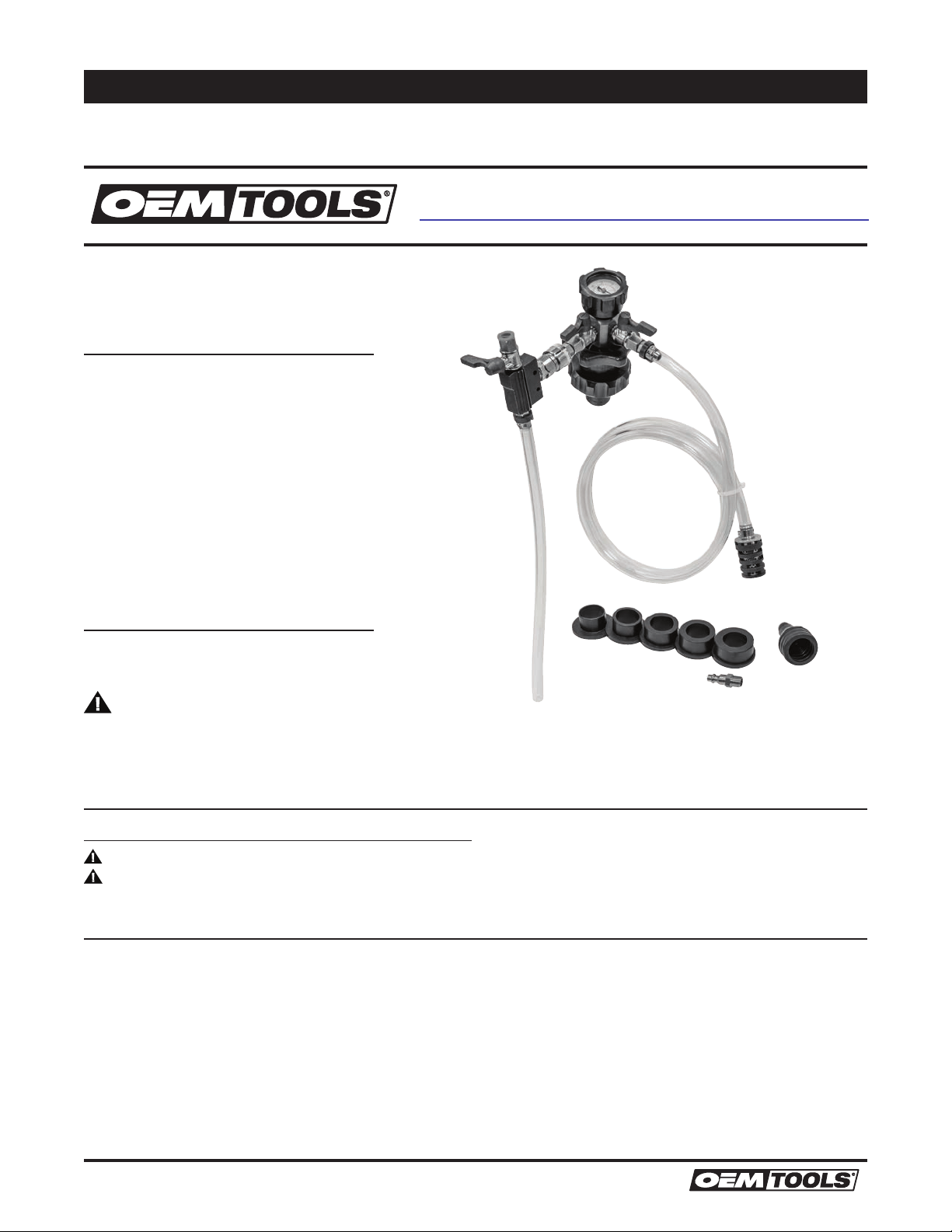
The OEMTOOLS Airvac Cooling System Refiller provides a quick and
easy way to fill automotive cooling systems while preventing spills and
trapped air. It uses shop air to create a vacuum and remove excess air
from the system. It refills the entire cooling system in seconds, including
the heater core. It also eliminates time consuming bleeding and purging
while allowing the user to check for leaks while under vacuum. Adapters
are included to fit radiators or surge tanks on most domestic and import
cars and light trucks.
CAUTION
This equipment is intended only for professional use by personnel trained
in performing the service functions for which it is has been designed.
This equipment is designed for servicing a variety of vehicles in a safe,
convenient manner. However, differences in vehicle makes and models
may make it impossible to use this equipment as it is intended.
DO NOT attempt to force the use of this equipment on an application for
which it is not designed to perform.The procedures documented in this
manual are to serve as guidelines for the use of this equipment.
In addition to these guidelines, always follow the manufacturer’s
recommended procedures when servicing each unique vehicle.
The use of this equipment is simple and straightforward if you follow the
instructions. However, always keep in mind that you are working with a
system that may be under pressure, with fluid that is just waiting to be
expelled. When operating this equipment, use common sense, and always
stop to think before disconnecting a hose or other component.
WARNING
Some vehicle manufacturers provide specific instructions to fill and bleed
their cooling systems. It is important to understand and follow the vehicle
manufacturer’s instructions to prevent damage to components and
possible injury.
NOTE: It is best if the vehicle cooling system is completely drained
before starting.
NOTE: On some vehicles, it will be necessary to clamp overflow hoses
to create a vacuum.
OPERATION:
1. Select the proper sized Cooling System Adapter (2-6) that fits your
cooling system. It should fit snug in the radiator or expansion tank
opening.
2. Install the Cooling System Adapter on to the Expansion Adapter (9)
on the Cooling System Adapter Assembly (7).
3. Insert the Cooling System Adapter Assembly into your radiator or
expansion tank and turn the Expansion Knob (12) clockwise until
snug, making sure all components are positively engaged to prevent
leaks.
4. Close both Valves (13,14) on the Cooling System Adapter Assembly.
Connect the Venturi Assembly (10) to the Airvac using the quick
coupler.
5. Connect shop air to the Venturi Assembly using the quick coupler
(not included).
6. Open the Ball Valve #3 (15) on the Venturi Assembly and Ball
Valve #1 (13) on the Cooling System Adapter Assembly (Ball Valve
#2 remains closed) and you will see the Gauge start to register
a vacuum.
7. Once the system reaches full vacuum (at least 24 on the Gauge),
close Ball Valve #1 on the Cooling System Adapter Assembly and
disconnect shop air. After 20 seconds, the Gauge should not move.
This indicates the system has no leaks under vacuum.
8. Place Pickup Tube into the coolant supply, open Ball Valve #2 (14)
and coolant will begin to flow into the vehicle cooling system. Once
the Gauge reaches zero, system is full.
NOTE: This works best if the coolant supply is at the same level as the
Airvac unit. Be sure not to let the Pickup Tube come out of the coolant
supply or you will let air into the system and you will have to start over.
9. Remove the Airvac Assembly from the vehicle by rotating the
Expansion Knob counterclockwise.
10. Fill the expansion tank to the proper level and top off the radiator if
necessary.
WARNING
MAINTENANCE:
1. Always store the Airvac Cooling System Refiller in a well-protected
area where it will not be exposed to inclement weather, corrosive
vapors, abrasive dust, or any other harmful elements.
2. Keep the Airvac Cooling System Refiller clean for better and safer
performance.
4
Operating Instructions and Parts Manual 24444
08/15
2015 OEMTOOLS
AIRVAC COOLING SYSTEM REFILLER
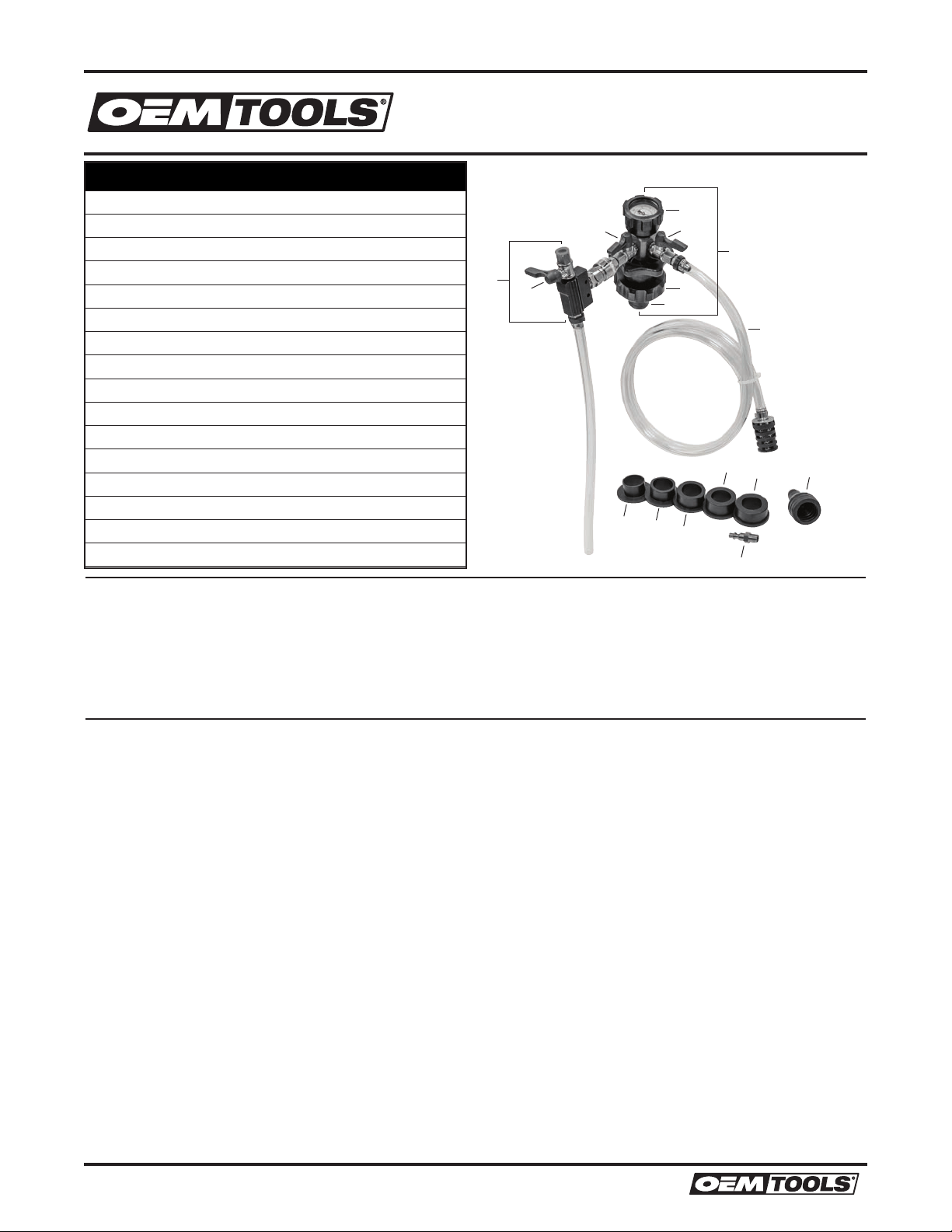
Figure Description Quantity
1 Adapter – Tapered Cone 1
2 Adapter – 31 mm 1
3 Adapter – 35 mm 1
4 Adapter – 40 mm 1
5 Adapter – 42 mm 1
6 Adapter – 45 mm 1
7 Cooling System Adapter Assembly 1
8 Gauge 1
9 Expansion Adapter 1
10 Venturi Assembly 1
11 Pickup Tube with Filter 1
12 Expansion Knob 1
13 Ball Valve #1 1
14 Ball Valve #2 1
15 Venturi Assembly Ball Valve #3 1
16 1/4" Male Plug 1
NOTE: Not all components of the Airvac Cooling System Refi ller are replacement items, but are illustrated as a convenient reference for location and
position in the assembly sequence.
Please read the following carefully.
OEMTOOLS and/or its distributors have provided the parts list and assembly diagram as a reference only. Neither OEMTOOLS and/or its distributors
make any representation or warranty of any kind to the buyer and/or user of this tool that he or she is qualifi ed to do any repairs or replace any parts
of this product. OEMTOOLS and its distributors expressly state that all repairs or parts replacement should be done by certifi ed or licensed technicians.
The buyer assumes all risk and liability arising out of his or her repairs or parts replacement to the original production.
8
7
11
10
14
15
13
12
9
3
2
4
16
5
6
1