A MESSAGE TO OUR CUSTOMERS
Thank you for selecting this DCSProfessional Gas Range or Professional Cooktop. Because of this appliance's
unique features we have developed this Use and Care Guide. tt contains valuable information on how to
properly operate and maintain your new appliance for years of safe and enjoyable cooking.
To help serve you better, please fill out and submit your Ownership Registration Card by visiting our website
at www.dcsappfiances.com and selecting "Customer Service"on the home page and then select"Ownership
Registration"or submit the enclosed Ownership Registration Card to the address below. In addition, keep
this guide handy, as it will help answer questions that may arise as you use your new appliance.
For your convenience, product questions can be answered by a DCS Customer Service Representative by
phone: 1-888-281-5698, Fax: 714-372-7004, email: supportC_dcsappliances.com, or by mail:
DCS
Attention: Customer Service
5800 Skylab Road
Huntington Beach, CA 92647
WARNING
If the information in this manual is not followed exactly, a fire or explosion
may result causing property damage, personal injury or death. To reduce the
risk of injury to persons in the event of a rangetop grease fire, observe the
following: Smother flames with a close-fitting lid, cookie sheet, or metal tray,
then turn off the burner Be careful to prevent burns. If the flames do not go out
immediately evacuate and call the fire department. Never pick up a flaming
pan - you may be burned. DO NOT USE WATER, including wet dishcloths or
towels - a violent steam explosion will result. Use an extinguisher ONLY if:
[] You know you have a Class ABC extinguisher, and you already know how to
operate it.
[] The fire is small and contained in the area where it started.
[] The fire department is being called.
[] You can fight the fire with your back to an exit.
PRECAUTION
Do not store or use gasoline or other flammable vapors and liquids in the
vidnity of this or any other appliance.
FOR YOUR SAFETY
IF YOU SMELL GAS:
[] Do not try to light any appliance.
[] Do not touch any electrical switch; do not use any phone in your building.
[] Immediately call your gas supplier from a neighbor's phone. Follow the gas
upplier's instructions.
[] If you cannot reach your gas supplie_ carl the fire department.
[] Installation and service must be performed by a qualified installe_ service
agency or the gas supplier
PLEASE RETAIN THIS MANUAL FOR FUTURE REFERENCE.
TABLE OF CONTENTS
SAFETY PRACTICES......................................................................................................................................................3-5
MODEL IDENTIFICATION .........................................................................................................................................6-7
BEFORE USING YOUR APPLIANCE ...................................................................................................................8-9
COOKTOP USE ............................................................................................................................................................ioq3
Burner Use ........................................................................... lO
Burner Efficiency and Fhme Characteristics ............................................ 11
GRILL USE .......................................................................................................................................................................13q4
GRIDDLE USE ...............................................................................................................................................................15q6
OVEN USE .......................................................................................................................................................................16-22
Convection Baking ................................................................... 17
Regular Baking ....................................................................... 17
Broiling .............................................................................. 17
Converting Recipes to Convection Baking .............................................. 18
Preheating ........................................................................... 18
Setting Oven for Baking ............................................................... 18
Baking ............................................................................ 19-20
Broiling-Oven ........................................................................ 20
Broiling-Use of Meat Thermometer .................................................... 21
Slow Cooking / Low Temperature Cooking ............................................. 21
CARE AND MAINTENANCE ...............................................................................................................................22-27
Cleaning Range, Cooktop and Burners .............................................. 22-23
Oven and Door interior ............................................................... 25
Oven Light Buib Rephcement ......................................................... 27
HOW TO OBTAIN SERVICE........................................................................................................................................30
WARRANTY ..........................................................................................................................................................................31

SAFETY PRACTICES AND PRECAUTIONS
When properly cared for, your new DCS Appliance is designed to be a safe, re[hb[e cooking app[hnce.
When using this restaurant caliber app[hnce, use it with extreme care, as this type of appliance
provides intense heat and can increase the accident potential Basic safety precautions must be
followed when using kitchen app[hnces, including the following:
[] Read this Use and Care Manual thoroughly before using your new app[hnce. This wiN[ help to
reduce the risk of fire, e[ectdc shock, or injury to persons.
[] Begin by insuring proper instaHHation and servicing. Follow the installation instructions which came
with this appliance. Be sure to have a qualified technician install and ground this appliance before
using.
[] Have the installer show you where the gas supply shut off valve is located so you wi[[ know how
and where to turn off the gas to the appliance.
[] If you smell gas, the installer may not have done a properjob of checking for leaks. You can have a
small leak and therefore a faint gas smell if the connections are not completely tight. Finding a gas
leak is not a "do-it-yourseff" procedure. Some leaks can only be found with the burner control in
the ON position; for your protection it must be done by a qualified service technician.
[] If by some chance a burner goes out and gas escapes, open a window or a door to let the room air
out. Do not attempt to use the appliance until the gas has had time to dissipate. Follow the
instructions on page 1,"For Your Safety- if You Smell Gas'.'
[] This appliance has been factory assembled for natural or LP gas. It should be correctly adjusted
from the factory for the type of gas that is used.
[] Do not repair or replace any part of this appliance unless it is specifically recommended in this
manual A[[ other servicing should be referred to a qualified technician.
[] Children should not be Heft alone or unattended in an area where appliances are in use. They
should never be allowed to turn knobs, push buttons, sit or stand on any part of an appliance.
[] Children in walkers, or children crawling can be attracted to the round oven door handle and may
grab and open the oven door. This can result in injury from the door being pulled open on a child,
or severe burns if the oven is in use and hot.
CAUTION:
Do not store items of interest to children above or at the back of any appfiance.
Children coMd be seriously injured if they should climb onto the appfiance to
reach these items,
[] Never store anything in the oven or on the cooktop. Flammable materials can catch fire, plastic
items may melt or ignite and other types of items could be ruined.
[] Do not hang articles from any part of the appliance or place anything against the oven. Some
fabrics are quite fiammab[e and may catch on fire.
[] ff the appliance is near a window be certain the curtains do not Now over or near the cooktop
burners; they could catch on fire.
[] Do not use water on grease fires. Turn a[[ burners OFF,then smother fire with baking soda or use a
dry chemical or foam-type fire extinguisher.
[] Never let clothing, pot holders, or other fiammab[e materials come in contact with, or get too dose
to, any burner or burner grate until it has cooled. Fabric may ignite and result in persona[ injury.
[] Be certain to use only dry pot holders: moist or damp pot holders on hot surfaces may cause burns
from steam. Do not use a towel or other bulky cloth in place of pot holders. Do not let pot holders
touch hot burners, or burner grates.
SAFETY PRACTICE AND PRECAUTIONS
[] For personal safety, wear proper apparel Loose fitting garments or hanging sleeves should never
be worn while using this appliance. Some synthetic fabrics are highly flammable and should not
be worn while cooking.
[] Do not use aluminum foil to line any part of the oven or cooktop. Using a foil liner could result in
a fire hazard, or the obstruction of the flow of combustion and ventilation air. Foil is an excellent
heat insulator and heat will be trapped underneath it. This trapped heat can upset the cooking
performance and can damage the finish of the oven or the cooktop parts.
WARNING:
This appliance is for cooking. Based on safety considerations, never use the
oven or cooktop to warm or heat a room. Also, such use can damage the
cooktop or oven parts.
[] When using the cooktop: Do not touch the burner grates or the immediate surrounding area.
Areas adjacent to the burners may become hot enough to cause burns.
[] When using the oven: Do not touch the interior surfaces of the oven, the exterior area immediateHy
surrounding the door or the back trim. The drip tray handHes directHy above the oven door may be
hot if the oven has been operated with the door open, or if something has prevented the door from
sealing. Always use caution when pulling out the drip trays (GD & GL models only) when the oven
has been on,or is currently on. The drip trays get hot when the oven is on. Do not remove drip trays
until they are coo[.
[] Never leave the cooktop unattended when using high flame settings. When cooking with high
flame settings, boil overs may cause smoking and greasy spill overs may ignite. More importantly,
if the burner flames are smothered bya severe boil over which effects the igniter, unburned gas will
escape into the room.
[] Only certain types of glass, heat-proofglass<eramic, ceramic, earthen ware, or other glazed utensils
are suitable for cooktop use. This type of utensil may break with sudden temperature changes. Use
only on low or medium flames settings according to the manufacturer's directions.
[] Do not heat unopened food containers; a build up of pressure may cause the container to burst.
[] During cooking, set the burner control so that the flame heats only the bottom of the pan and does
not extend beyond the bottom of the pan. This could heat and/or melt the handles.
[] Always use utensils that have flat bottoms large enough to cover the burner.The use of undersized
utensils will expose a portion of the flame to direct contact and may result in ignition of clothing.
[] To minimize burns, ignition of flammable materials and unintentional spill overs, position handles
of utensils inward so they do not extend over adjacent work areas, cooking areas, or the edge of the
cooktop.
[] Hold the handle of the pan to prevent movement of the utensil when stirring or turning food.
[] Grease is flammable. Let hot grease cool before attempting to handle it. Avoid letting grease
deposits collect around the cooktop burners.Clean after each use or boil over.
[] For proper lighting and performance of the cooktop burners, keep the burner ports clean. It may
be necessary to clean these when there is a boil over or when the burner does not light, even
though the electronic igniters click.
[] Do not use the grill for cooking excessively fatty meats or products which promote flare-ups. Do
not use cooking utensils on the grill.
SAFETY PRACTICES AND PRECAUTIONS
Clean the cooktop with caution, Avoid steam burns; do not use a wet sponge or cloth to dean the
cooktop while it is hot. Some cHeaners produce noxious fumes if appHied to a hot surface, FoHHow
directions provided by the cHeaner manufacturer,
Be sure aHHthe range and/or cooktop controHs are turned offand the appHhnce is cooH before using
any type of aerosoH cHeaner on or around the appHiance, The chemicaH that produces the spraying
action couHd, in the presence of heat, ignite or cause metaH parts to corrode,
PHaceoven racks in desired position while the oven is cook Hfa rack must be moved whiHe the oven
is hot, do not Hetthe pot hoHders contact the hot interior of the oven,
Use care when opening the oven door; Het hot air or steam escape before removing or repHadng
foods,
[]
[]
[] Do not rub, damage, move or remove the door gasket. Htis essential for a good sea[ during baking.
Wash gasket with hot water onHy.
[] CHeanthe ventiHator hood and fiHters above the range or cooktop frequently so grease from cooking
vapors does not accumuHate on them.
[] Turn the ventiHator OFF in case of fire or when intentionaHHy"flaming" [iquor or other spirits on the
cooktop. The Mower, if in operation, couHd unsafeHy spread the flames.
[] DO NOT obstruct the flow of combustion or ventiHation air to the appHiance. Be sure a fresh air
suppHy is avaiHabHe.
[] For safety reasons and to avoid damage to the appHiance, never sit, stand, or Meanon the oven door
or cooking surface.
[] Service shouHd onHy be done by authorized technicians. Technicians must disconnect the power
suppHy before servicing this appHiance.
WARNING:
California Proposition 65-The burning of gas cooking fuel generates some by-
products which are known by the State of Cafifornia to cause cancer or
reproductive harm. California law requires businesses to warn customers of
potential exposure to such substances. To minimize exposure to these
substances, always operate this unit according to the instructions contained in
this booklet and provide good ventilation to the room when cooking with gas.
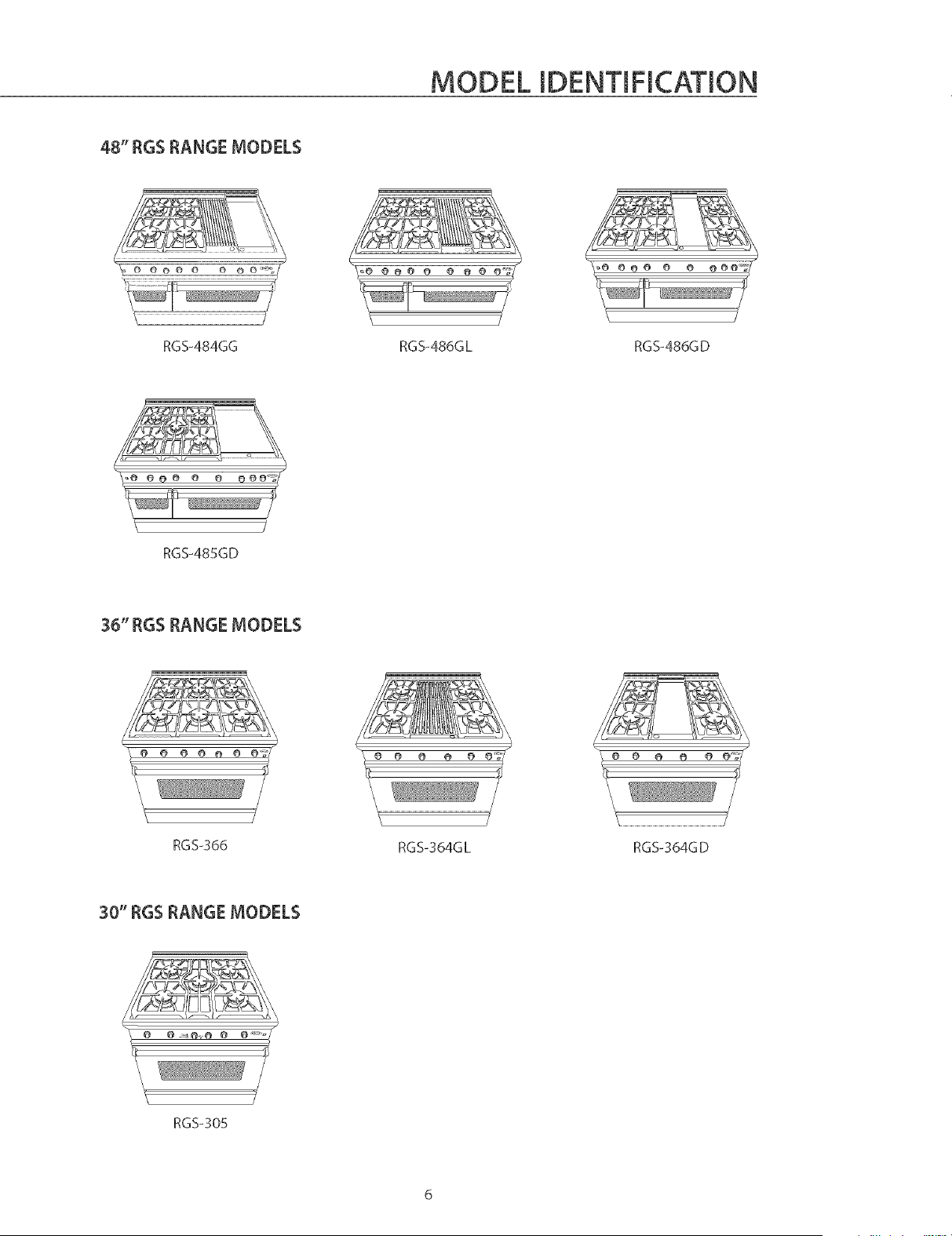
MODEL iDENTiFiCATiON
48" RG$ RANGE MODELS
RGS=484GG fiGS=486GL
7
RGS=486GD
RGS=485GD
36" RGS RANGE MODELS
\ /
RGS=355
/
/
RGS=364GL RGS=364GD
30" RGS RANGE MODELS
\
7
RGS=305
MODEL iDENTiFiCATiON
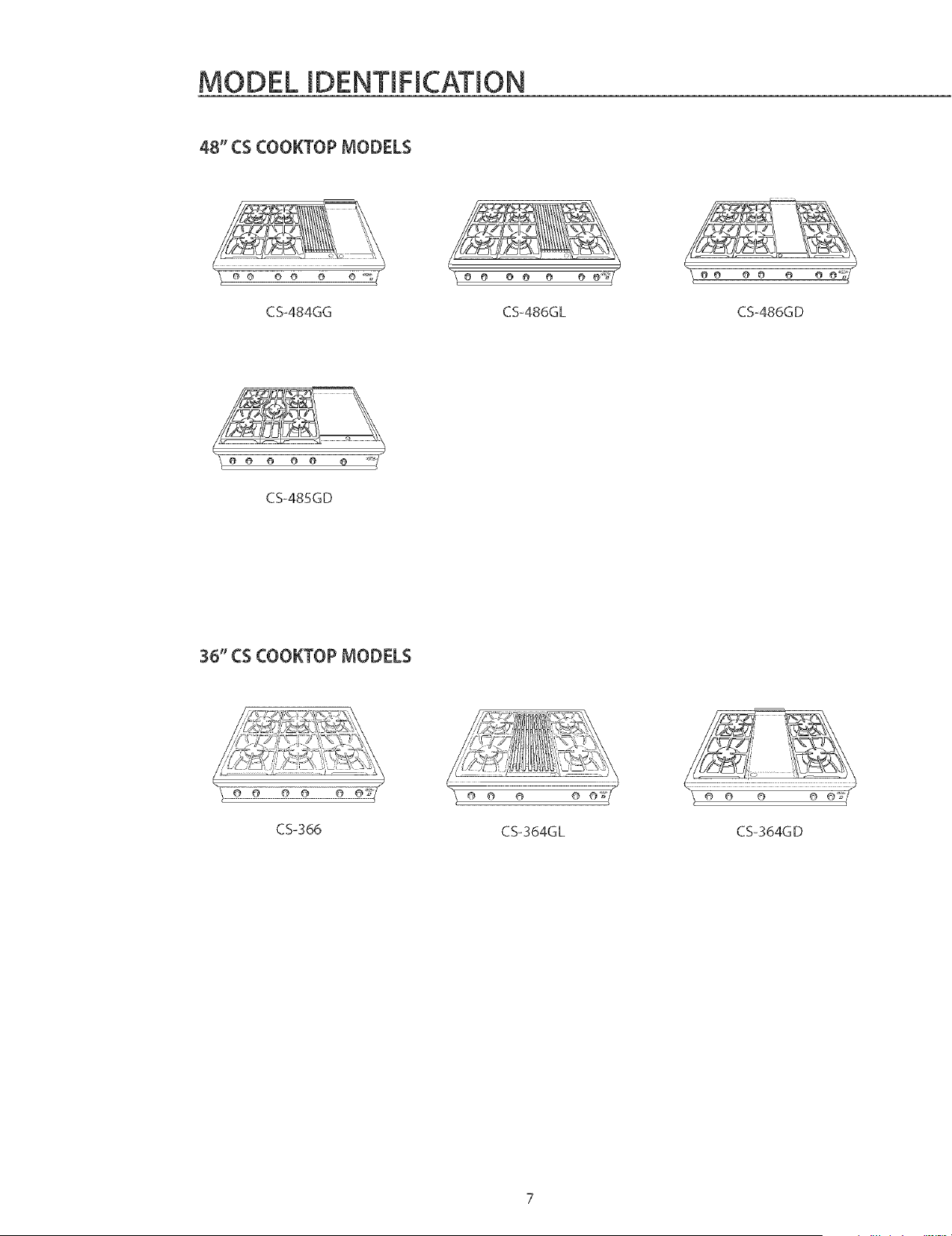
48" CS COOKTOP MODELS
"_0 @ @ @ @
@
CS-486GL
_ @ @ @ @ @ @
CS-485GD
36" CS COOl(TOP MODELS
"_ @ @ @ @ @ @'s'_
CS-366
O@ @ @
CS-364GL CS-364GD
BEFOREUSING YOUR APPLIANCE
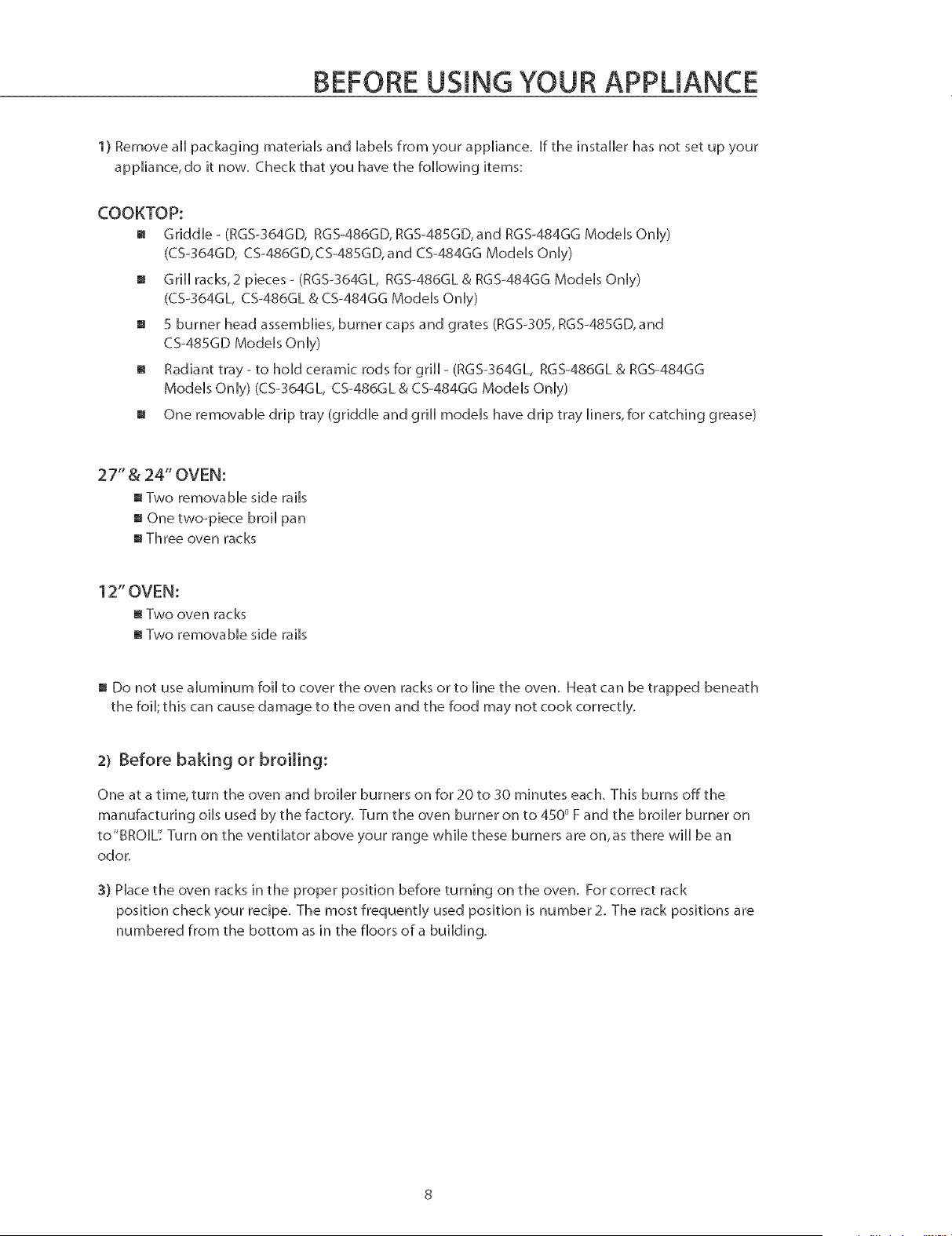
1) Remove a[[ packaging materh[s and labels from your appliance, ffthe installer has not set up your
appHiance, do it now. Check that you have the foHHowing items:
COOKTOP:
[] GriddHe - (RGS-364GD, RGS-486GD, RGS-485GD, and RGS-484GG ModeHs OnHy)
(CS-364GD, CS-486GD, CS-485GD, and CS-484GG Modds OnHy)
[] GrH[ racks,2 pieces - (RGS-364GL, RGS-486GL & RGS-484GG Modds OnHy)
(CS-364GL, CS-486GL & CS-484GG Modds OnHy)
[] 5 burner head assemHies, burner caps and grates (RGS-305, RGS-485GD, and
CS-485GD Modds OnHy)
[] Radiant tray- to hoHd ceramic rods for grH[- (RGS-364GL, RGS-486GL & RGS-484GG
Modek OnHy) (CS-364GL, CS-486GL & CS-484GG ModeHs OnHy)
[] One removaNe drip tray (griddle and grill models have drip tray liners, for catching grease)
27" & 24" OVEN:
[] Two removable side rails
[] One two-piece broil pan
[] Three oven racks
12"OVEN:
[] Two oven racks
[] Two removable side rails
[] Do not use aluminum foil to cover the oven racks or to line the oven. Heat can be trapped beneath
the foil; this can cause damage to the oven and the food may not cook correctly.
2} Before baking or broiling:
One at a time, turn the oven and broiler burners on for 20 to 30 minutes each. This burns off the
manufacturing oils used by the factory. Turn the oven burner on to 4500 Fand the broiler burner on
to"gROlE Turn on the ventilator above your range while these burners are on,as there will be an
odor.
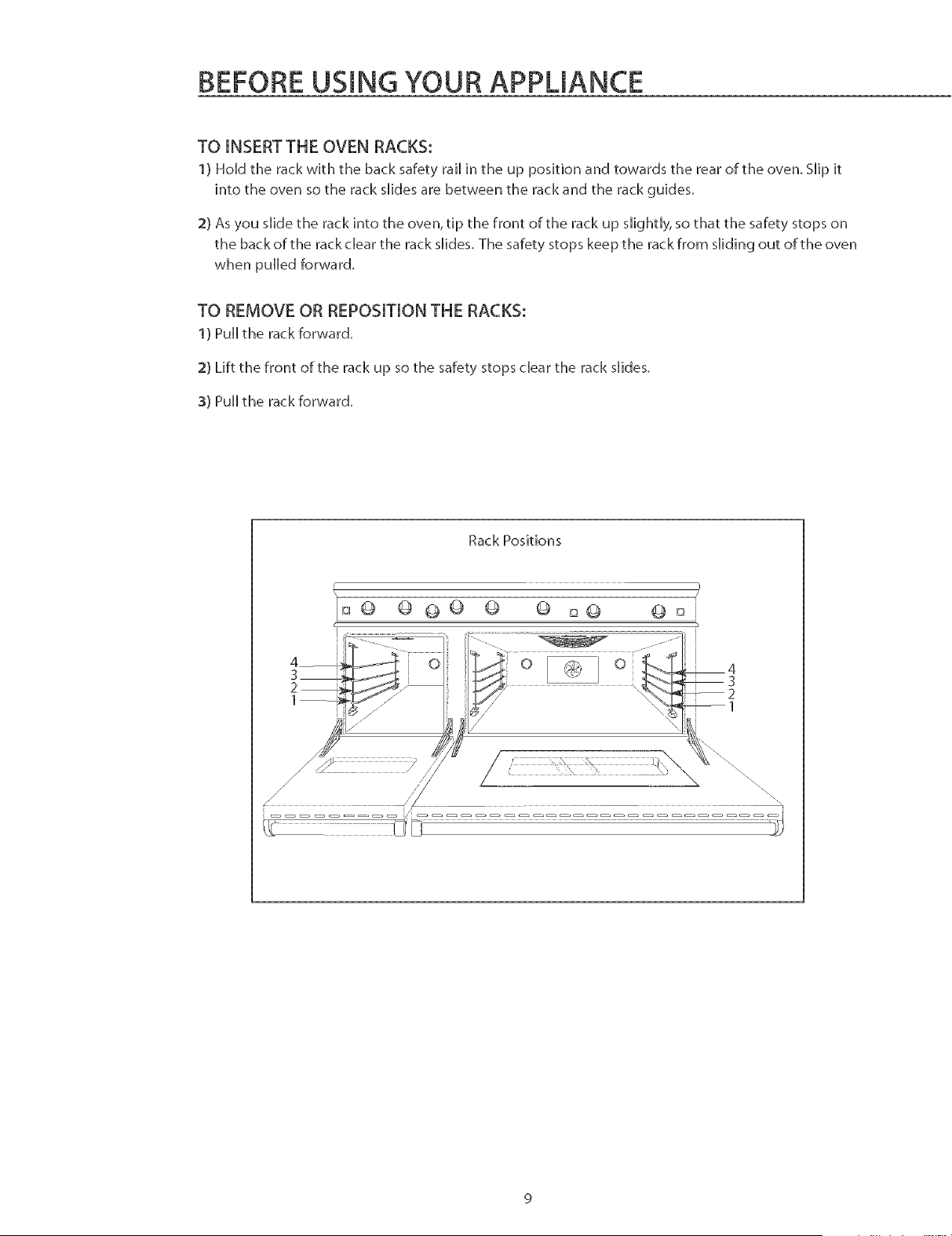
3) Place the oven racks in the proper position before turning on the oven. For correct rack
position check your recipe. The most frequently used position is number 2. The rack positions are
numbered from the bottom as in the floors of a building.
BEFORE USING YOUR APPLIANCE
TO INSERT THE OVEN RACKS:
1) HoHd the rack with the back safety rail in the up position and towards the rear of the oven. SHipit
into the oven so the rack sHides are between the rack and the rack guides.
2} As you sHidethe rack into the oven, tip the front of the rack up slightly, so that the safety stops on
the back of the rack dear the rack sHides.The safety stops keep the rack from sHiding out of the oven
when pulled forward.
TO REMOVE OR REPOSITION THE RACKS:
1) Pull the rack forward.
2) Lift the front of the rack up so the safety stops dear the rack sHides.
3) Pull the rack forward.
Rack Positions
COOKTOP USE
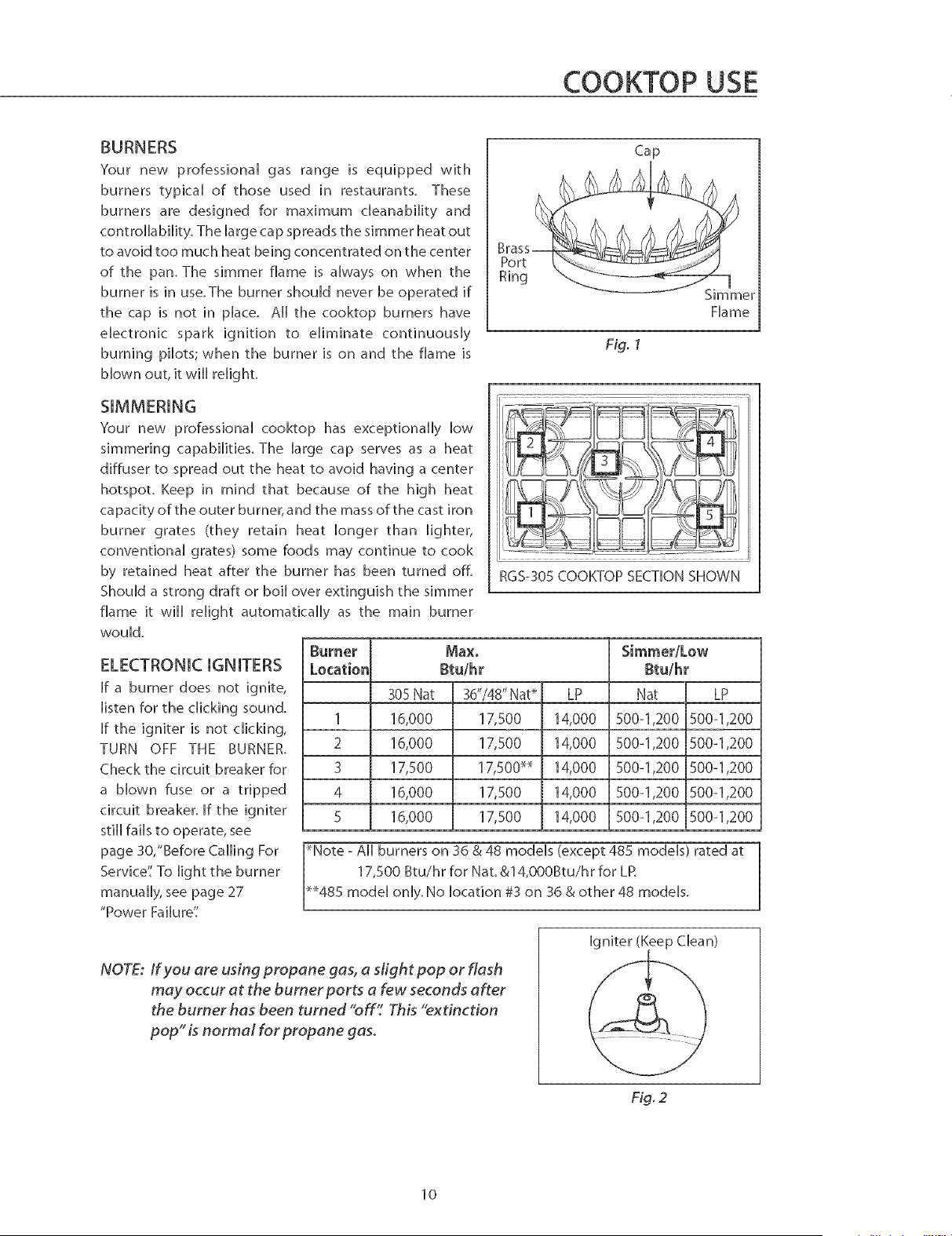
BURNERS
Your new professional gas range is equipped with
burners typica[ of those used in restaurants. These
burners are designed for maximum cHeanabHity and
controHHabHity. The [arge cap spreads the simmer heat out
to avoid too much heat being concentrated on the center
of the pan. The simmer flame is aHways on when the
burner is in use.The burner shouHd never be operated if
the cap is not in pHace. AH[ the cooktop burners have
eHectronic spark ignition to eHiminate continuousHy
burning pilots; when the burner is on and the flame is
bHown out, it wH[ reHight.
Port
Ring
Cap
Simmer
FHame
Fig. 1
SIMMERING
Your new professionaH cooktop has exceptionaHHy How
simmering capabiHities, The Harge cap serves as a heat
diffuser to spread out the heat to avoid having a center
hotspot, Keep in mind that because of the high heat
capacity of the outer burner, and the mass of the cast iron
burner grates (they retain heat Monger than Highter,
conventionaH grates) some foods may continue to cook
by retained heat after the burner has been turned off,
ShouHd a strong draft or boiH over extinguish the simmer
flame it wiHH reHight automaticaHHy as the main burner
€_12; .......
RGS-305 COOKTOP SECTHONSHOWN
wouHd.
ELECTRONIC IGNITERS
ff a burner does not ignite,
Histen for the cHicking sound,
ff the igniter is not cHicking,
TURN OFF THE BURNER,
Check the circuit breaker for
a bHown fuse or a tripped
circuit breaker, Hfthe igniter
stiHHfaiHsto operate, see
Burner Max.
Location 8tu/hr
305 Nat 36"/48" Nat* LP Nat LP
1 16,000 17,500 14,000 500-1,200 500-1,200
2 16,000 17,500 14,000 500-1,200 500-1,200
3 17,500 17,500 _* 14,000 500-1,200 500-1,200
4 16,000 17,500 14,000 500-1,200 500-1,200
5 16,000 17,500 14,000 500-1,200 500-1,200
Note- M[burners on 36 & 48 modems (except 485 modems) rated at 117,500 Btu/hr for Nat. &l 4,000Btu/hr for LR
/
[__485 modem onHy.No Hocation #3 on 36 & other 48 modems.
page 30,"Before Ca[ling For
Service" To light the burner
manually, see page 27
"Power Failure':
NOTE: If you are using propene gas, a slight pop or flash
may occur at the bumer ports a few seconds after
the burner has been turned "off': This "extinction
pop" is normal for propane gas.
Hgniter (Keep Clean)
@
Fig. 2
10
COOKTOP USE
BURNER EFFICIENCY AND FLAME
CHARACTERISTICS
Htis necessary to keep the burner ports and the
igniters dean for proper Hightin 9 and efficient
performance of the cooktop burners. The
burner flame shouHd burn compHeteHy around
the burner with no excessive noise or Hifting.The
flame shouHd be bHue in coHorand stabile with no
yeHHowtips. An improper air-gas mixture may
cause either a burner flutter or a yeHHowtipped
flame. A technician shouHd adjust the flame.
Durin 9 initiaH use, foreign particHes in the 9as
Hine,or dust in the air around the appHhnce may
cause an orange flame.This wHHdisappear with
use.
Proper Flame Height
Fig°3
FLAME HEIGHT
The correct height of the flame mainly depends on the size of the bottom of the cooking utensil, the
material of the cooking utensil, the amount and type of food and the amount of liquid in the utensil.
Following are some basic rules for selecting flame height.
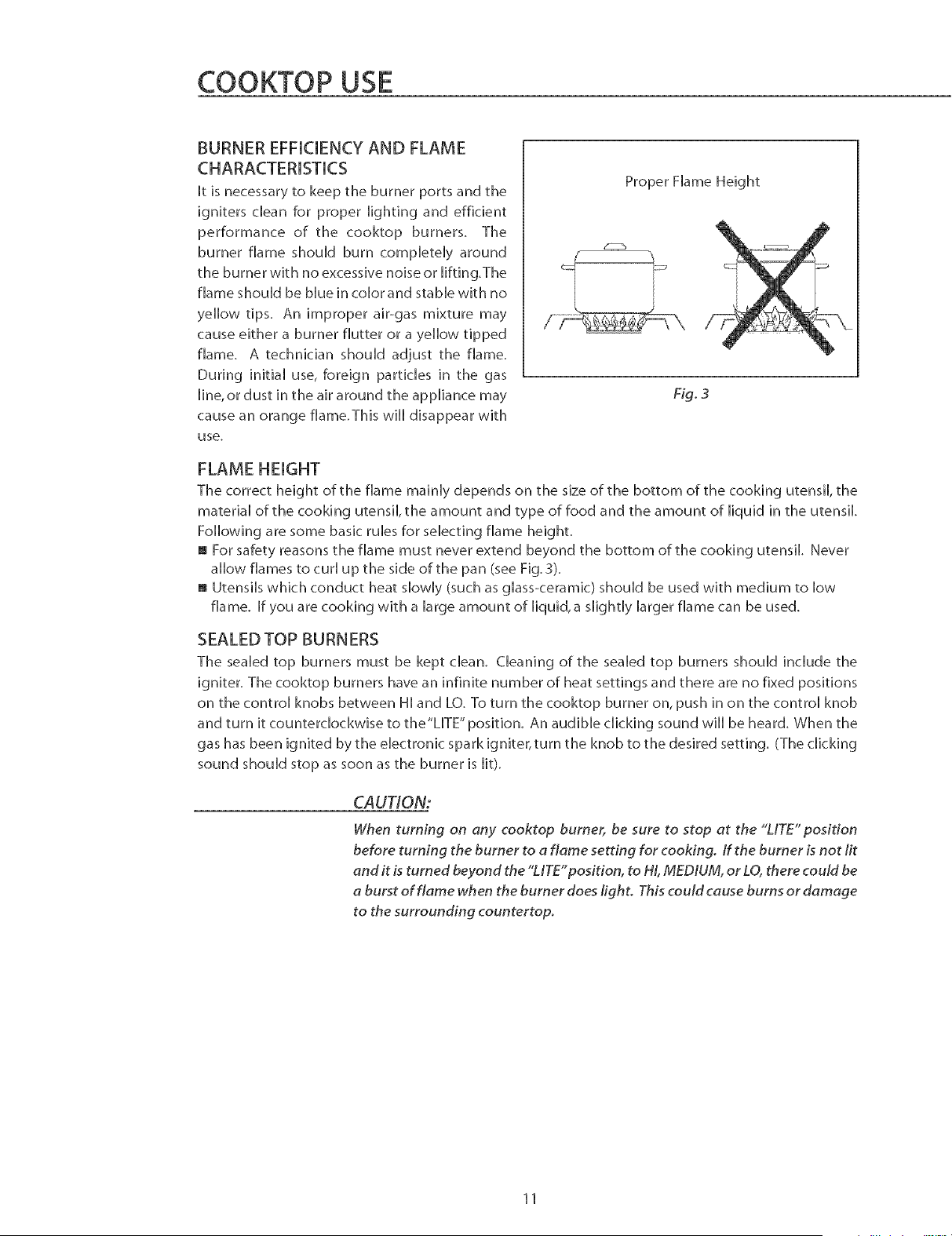
m For safety reasons the flame must never extend beyond the bottom of the cooking utensil. Never
allow flames to curl up the side of the pan (see Fig.3).
[] Utensils which conduct heat slowly (such as ghss+ceramic) should be used with medium to low
flame. If you are cooking with a large amount of liquid, a slightly larger flame can be used.
SEALED TOP BURNERS
The sealed top burners must be kept clean. Cleaning of the sealed top burners should include the
igniter. The cooktop burners have an infinite number of heat settings and there are no fixed positions
on the control knobs between HI and LO. To turn the cooktop burner on, push in on the control knob
and turn it counterclockwise to the'LITE" position. An audible clicking sound will be heard. When the
gas has been ignited by the electronic spark igniter, turn the knob to the desired setting. (The clicking
sound should stop as soon as the burner is lit).
CAUTION:
When turning on any cooktop burneg be sure to stop at the "LITE" position
before turning the burner to a flame setting for cooking. If the burner is not lit
and it is turned beyond the "LITE" position, to HI, MEDIUM, or LO, there could be
a burst of flame when the burner does fight. This could cause burns or damage
to the surrounding countertop.
11
COOKTOP USE
BURNER GRATES
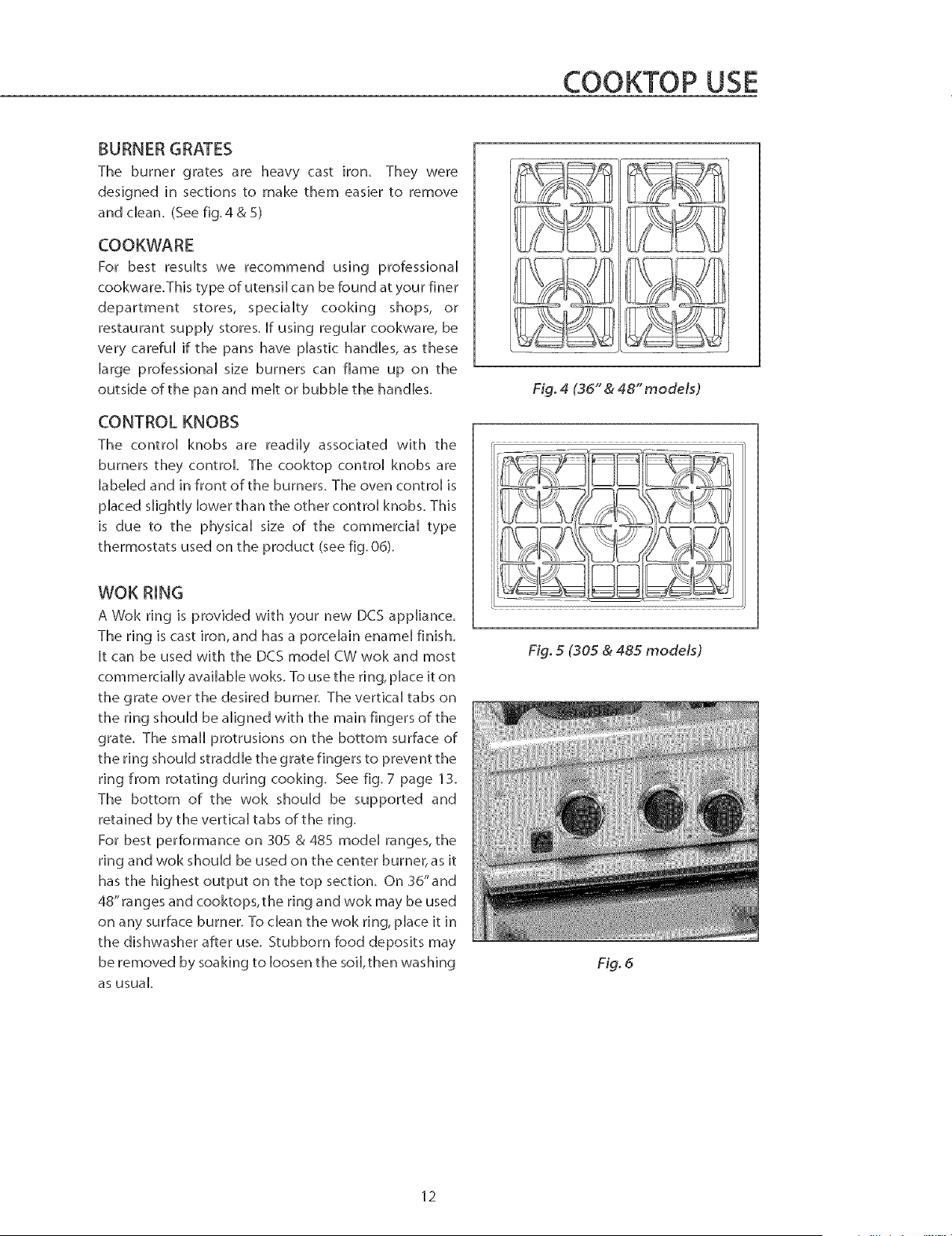
The burner grates are heavy cast iron. They were
designed in sections to make them easier to remove
and dean. (See fig.4 & 5)
COOKWARE
For best resuHts we recommend using professionaH
cookware.This type of utensil can be found at your finer
department stores, speciality cooking shops, or
restaurant suppHy stores. Hfusing reguHar cookware, be
very carefuH if the pans have pHastic handHes, as these
Harge professionaH size burners can flame up on the
outside of the pan and merit or bubbHe the handHes.
CONTROL KNOBS
The controH knobs are readily associated with the
burners they control The cooktop controH knobs are
HabeHedand in front of the burners. The oven controH is
pHaced sHightHyHower than the other controH knobs. This
is due to the physical size of the commercial type
thermostats used on the product (see fig. 06).
WOK RING
A Wok ring is provided with your new DCS appliance.
The ring is cast iron, and has a porcelain enamel finish.
It can be used with the DCS model CW wok and most
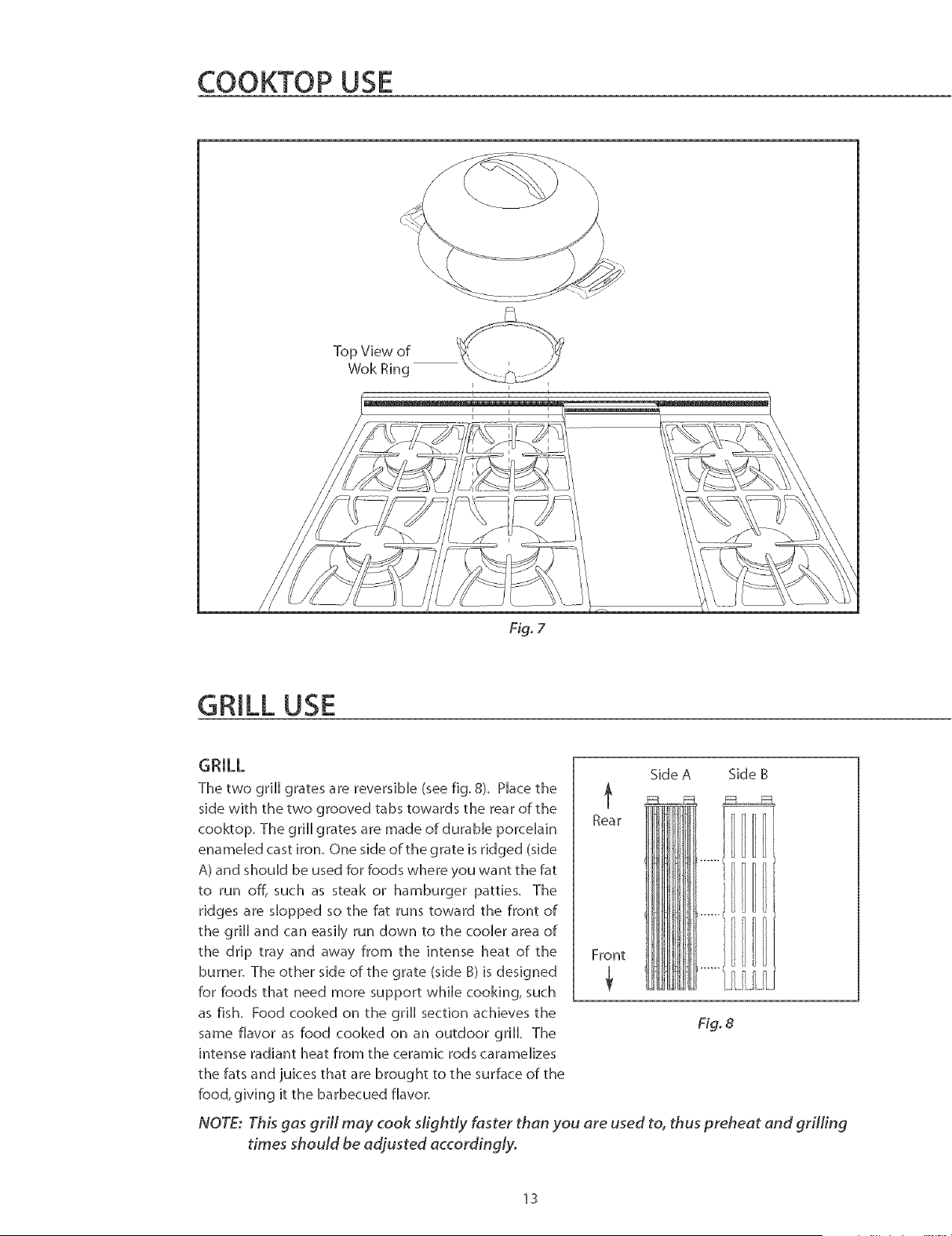
commercially available woks. To use the ring, place it on
the grate over the desired burner. The vertical tabs on
the ring should be aligned with the main fingers of the
grate. The small protrusions on the bottom surface of
the ring should straddle the grate fingers to prevent the
ring from rotating during cooking. See fig. 7 page 13.
The bottom of the wok should be supported and
retained by the vertical tabs of the ring.
For best performance on 305 & 485 model ranges, the
ring and wok should be used on the center burner, as it
has the highest output on the top section. On 36"and
48"ranges and cooktops, the ring and wok may be used
on any surface burner. To clean the wok ring, place it in
the dishwasher after use. Stubborn food deposits may
be removed by soaking to loosen the soil, then washing
as usual
ii'¸ ; "i..... i_ i
Fig. 4 (36" & 48" models)
Fig. 5 (305 & 485 models)
Fig, 6
12
COOKTOP USE
Top View of
Wok Ring
Fig. 7
GRILL USE
GRILL
The two grHHgrates are reversibHe (see fig. 8). PHacethe
side with the two grooved tabs towards the rear of the
cooktop. The griMMgrates are made of durabHe porceHMn
enamelled cast iron. One side of the grate is ridged (side
A) and shouHd be used for foods where you want the fat
to run off, such as steak or hamburger patties. The
ridges are shopped so the fat runs toward the front of
the griMMand can easily run down to the cooHer area of
the drip tray and away from the intense heat of the
burner. The other side of the grate (side B) is designed
for foods that need more support while cooking, such
as fish. Food cooked on the griMMsection achieves the
same flavor as food cooked on an outdoor griMM.The
intense radiant heat from the ceramic rods caramelizes
the fats and juices that are brought to the surface of the
food, giving it the barbecued flavor.
Side A Side B
Rear
Front
Fig. 8
NOTE: This gas grill may cook slightly faster then you are used to, thus preheat and grilling
times should be adjusted accordingly.
13
GRILL USE
CERAMIC RODS
The layer of ceramic rods, under the grH[ racks, wi[[ last for many years with proper care. They are
shipped from the factor}, pre-assemb[ed on the radiant tray, read}, to be set in place into the fire box,
under the grH[ racks. Be sure to remove an}, packaging material from the radiant tray and rods before
using the grill Burned food partk[es and ash can be emptied off the radiant tray when coo[ by
shaking over a waste receptacle. Chipping or cracking of the ceramic rods may occur as they may get
brittle with age, depending on frequency of use. This is normal and does not affect the cooking. Do
not replace the radiant tray/ceramic rods with alternates. Contact DCS for genuine factory-direct
replacement parts.
USE OF THE GRILL
Before starting to cook on the grH[, be sure the drip tray and [iners are in pHace and that you have the
grH[ racks turned to the side you want for cooking. Preheat the grH[ for 10 minutes with the contro[
knob set on HL When the grH[ is preheated, turn the knob down to medium to How,place the food on
the grill. Cook it to the aloneness desired. During cooking, it may be necessary to adjust the heat
setting. The control knob may be set to any position between HI and LO. For proper searing and
browning, the grill requires high to medium heat. When cooking, you will use medium to low heat the
entire cooking time. With large pieces of meat or poultry, you may need to turn the heat to low setting
after the food has been seared. This lower heat setting will allow the food to cook through without
burning the outside. When using a sugary marinade or barbecue sauce, it may be necessary to turn
the heat setting down near the end of the cooking time. Do not leave the grill unattended while it is
turned on. When you are finished cooking, allow the grill and the drip trays to cool before cleaning
them. They should be cleaned each time they are used.
NOTE: The Ionger you preheat the grill, the darker the grifl marks.
EXCESSIVE FLARE UPS AND FLAMING
Occasionally grease drippings ignite. These drippings will create minor puffs of flame for a second or
two. This is normal when cooking on a grill. You may find it handy to have a spray bottle filled with
water to lightly spray the flare-up. If the flame becomes excessive, remove the food from the grill.
Lower the heat setting. Replace the food when the flare-up subsides. To prevent flare-ups from
happening, trim the fat from around the edges of steaks and chops, use hamburger that is lean,
remove the fat that is on poultry, etc. When turning any kind of meat or poultry, the melted fat will
drop onto the ceramic rods and it may create a flare-up. If this happens, use a long handled spatula to
move the food to another area.
GRILLING HINTS
The doneness of meat is affected by the thickness of the cut. It is impossible to cook a thin piece of
meat to a rare doneness. A steak should be at least 1-inch thick to have it turn out rare and juicy.The
cooking time is affected by the temperature of the meat when you start to cook it, the size and shape
of the cut and the kind of meat you are cooking. The degree of aloneness desired also affects the time.
When turning the meat over, always use a spatula or tongs as it wi[[ not puncture the meat allowing
the juices to run out, This will help to keep the meat iuicy, Turn the meat only once, as juices are lost
when the meat is repeatedly turned, Be sure to trim any excess fat from meat or poultry, To prevent
steaks or chops from curling while they are being cooked, slit the fat around the edges at about 2-inch
intervals, To test for doneness, make a small cut in the center of the meat,
14
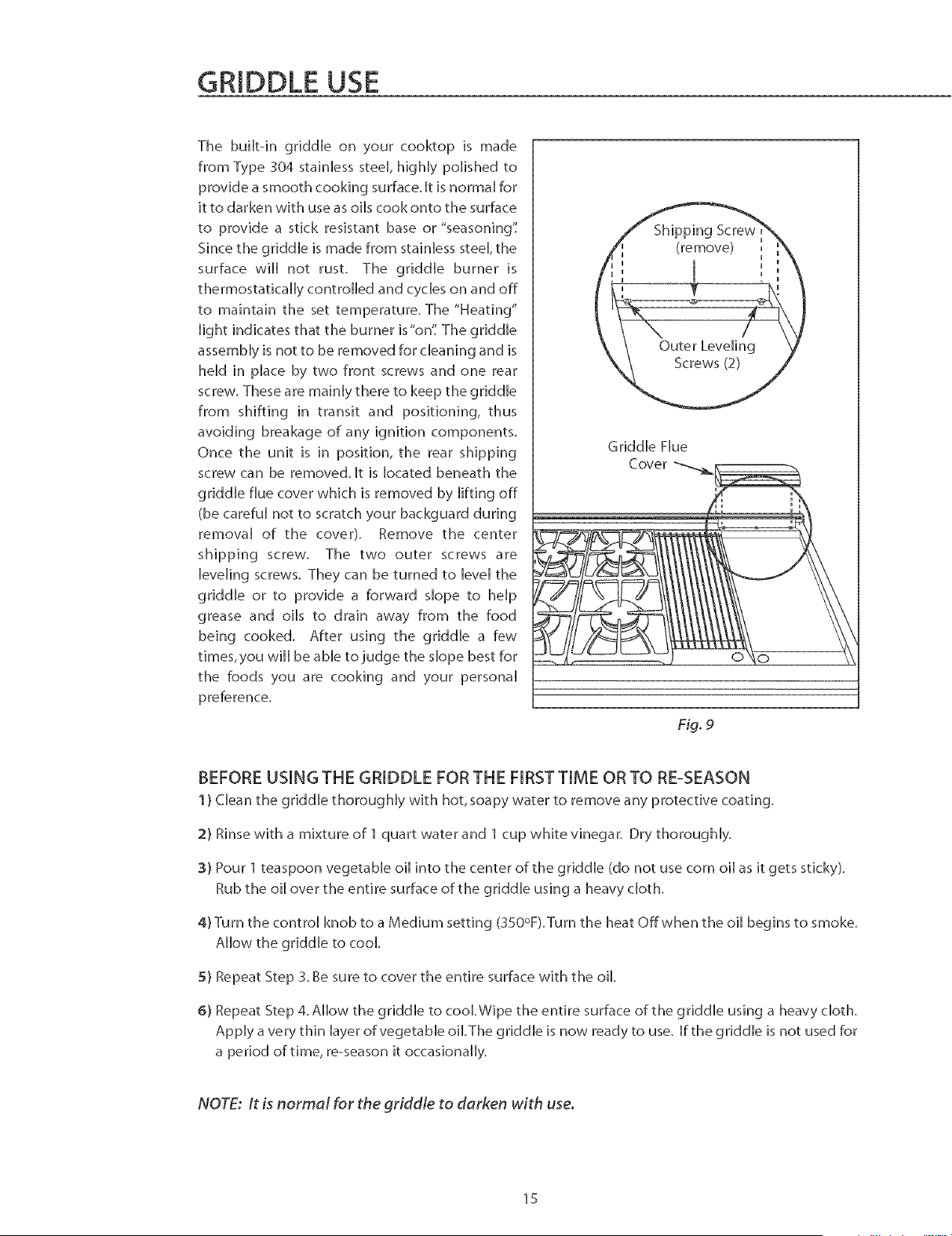
GRIDDLE USE
The buHtdn griddHe on your cooktop is made
from Type 304 stMnHess steeH, highHy poHished to
provide a smooth cooking surface. Htis normaH for
it to darken with use as oils cook onto the surface
to provide a stick resistant base or "seasoning':
Since the griddHe is made from stMnHess steeH,the
surface wHH not rust. The gdddHe burner is
thermostaticaHHy controHHed and cycHeson and off
to maintain the set temperature. The "Heating"
Hight indicates that the burner is"on': The griddHe
assembHy is not to be removed for cHeaning and is
heHd in pHace by two front screws and one rear
screw. These are mainHy there to keep the griddHe
from shifting in transit and positioning, thus
avoiding breakage of any ignition components.
Once the unit is in position, the rear shipping
screw can be removed. Ht is Hocated beneath the
griddHe flue cover which is removed by Miffing off
(be carefuH not to scratch your backguard during
removaH of the cover). Remove the center
shipping screw. The two outer screws are
HeveHingscrews. They can be turned to HeveHthe
griddHe or to provide a forward sHope to hemp
grease and oiHs to drain away from the food
being cooked. After using the griddHe a few
times, you wiHHbe abHetojudge the sHope best for
the foods you are cooking and your personaH
preference.
Shipping
(remove)
H
H u
H
Outer Leve[inc
Screws (2)
GriddHe Hue
Cover
o
Fig. 9
BEFORE USING THE GRIDDLE FOR THE FIRST TIME ORTO RE-SEASON
1 ) CHean the griddHe thoroughHy with hot, soapy water to remove any protective coating.
2) Rinse with a mixture of 1 quart water and 1 cup white vinegar. Dry thoroughly.
3) Pour 1 teaspoon vegetabHe oiH into the center of the griddHe (do not use corn oiHas it gets sticky).
Rub the oiHover the entire surface of the griddHe using a heavy cHoth.
4) Turn the controH knob to a Medium setting (3SO°F).Turn the heat Offwhen the oiH begins to smoke.
AHHowthe griddHe to cooH.
5) Repeat Step 3. Be sure to cover the entire surface with the oiH.
5) Repeat Step 4. AHHowthe griddHe to cooH.Wipe the entire surface of the griddHe using a heavy cHoth.
AppHy a very thin HayerofvegetabHe oH.The griddHe is now ready to use. Hfthe griddHe is not used for
a period of time, re-season it occasionally.
NOTE: It is normal for the griddle to darken with use.
15

GRIDDLE USE
USE OF THE GRIDDLE
Before starting to cook on the griddie, be sure the drip tray and iiners are in phce. Preheat griddie for
15 minutes with the controi knob set to the temperature suggested on the cooking chart. When the
griddie is preheated, the HEATING Hight will turn off. Phce the food on the griddie and cook to desired
doneness.
NOTE: When the griddle is properly seasoned it can be used without any additional
shortening. However, it can be used for flavor. A light mist of non-stick vegetable
spray, applied before cooking to a cool griddle, makes delicate foods easier to turn.
GRIDDLE COOKING CHART
FOOD TEMPERATURE
Eggs 225°F to 250°F
Bacon, Ham, Pork Chops 300°F to 325°F
Sausage,GrJJJedCheeseSandwiches 325°F to 350°F
Pancakes,French Toast 350°F to 375°F
Hash Brown Potatoes 400°F to 425°F
OVEN USE
OVEN BURNERS
Your new professional RGS range is equipped with bake and broil oven burners. The oven broiler
burner is 19,000 Btu/hr on RGS models.
The oven baking burner is 30,000 Btu/hr., 12"oven is 18,000 Btu/hr.
ELECTRIC GLOW IGNITER
The oven bake and broil burners are equipped with an electric glow igniter and safety system which
lights the gas. There will be a delay after the control knob has been turned on to when you actually
hear the burner come on. The burner will ignite within 4 seconds after the gas reaches the burner.
16

OVEN USE
OVEN
Your hrge new oven can be used in three cooking modes: convection bake, reguhr bake or broiLTo
heip you decide which way to cook your food, read this information first. Remember, this is a new oven
and the thermostat has been checked for accuracy.Your oid oven may have had a thermostat that over
the years got a iittie hot or a iitde coid. Check your recipes for the correct time and temperature and
don't use the oid time or temperature you were using to compensate for your old oven being offtem -
perature. Models RGS-484GG, RGS-486GL, RGS-485GD, and RGS-486GD have two ovens. The oven on
the right side is the convection oven. The smaller oven, on the left side, can be used in standard bake
only. This oven is ideal for baking small amounts of food, when you don't want to heat the large oven.
CONVECTION BAKING
Convection Baking is baking with the fan at the back of the oven circulating the hot air in a continuous
pattern around the food. This circulating hot air heats and browns the surface of the food more
effectively than in a standard oven.This allows most foods to be cooked at lower oven temperatures
or in less time, if baked at the regular temperature.The air is recircuhted and reheated. Uncovered,
longer cooking foods such as large pieces of meat or other foods that can be cooked in low sided
baking utensils or air leavened foods, are where you will see the most savings in cooking time. Using
multiple racks (3) at the same time will achieve a good time saving, as you can cook more food at the
same time.The number of recipes requiring preheating of the oven is reduced considerably because
the heat reaches the food faster as the hot air circulates around the food.
Foods Suitable for Convection
m Appetizers m Breads m Oven Meals (1 to 3 racks)
[] Cookies [] Main Dishes [] Roasts
R Pies E Poultry
[] Air Leavened Foods (Angel Food Cake, souffles, cream puffs, meringue shells)
REGULAR BAKING
Bake is baking with hot air;there is no fan. The air movement comes from natural convection. As the
air heats, it moves to the top of the oven. This oven mode is the same as you have been using for
baking on one or two racks.
Foods Suitable for Bake
[] Appetizers [] Pies, Cakes [] Breads t Poultry
[] Desserts []Main Dishes [] Oven Meals (1 to 2 racks)
[] Roasts
BROIL
Broiling is cooking by intense infrared radiation supplied by the broil burner located at the top of the
oven. Since broiling is cooking by radiant heat, it is not necessary to use the convection fan in the broil
mode.Your new oven is equipped with an oven rack fitted especially with a broil pan Iocator formed
into the center grid support.To use this Iocator, place the oven rack in the desired position with the
Iocator rod to the top.
Foods Suitable for Broil
[] Top Browning: Casseroles, Breads
[] Appetizers [] Meats [] Poultry
[] Fish
17
OVEN USE
CONVERTING RECIPESTO CONVECTION BAKING
Low sided baking utensils will give the best resuHts as the hot air can reach aH sides of the food easier.
The oven temperature can be Heftthe same as the recipe and the food cooked a shorter period of time.
The temperature can be Howered 25°F and the food will probaNy take the same Hength of time to cook
as the recipe states. Hfyou find that food is adequateHy browned on the outside, but not done in the
center, Hower the temperature another 25°F and add to the baking time. When reducing the
temperature aHways check the food for doneness, a minute to two before the minimum time stated in
the recipe, as time can always be added. Some recipes will cook faster than others. There is no way to
predict exactly how long each recipe will take when you convert it to convection. Convection will be
easier to use after you have used it a few times as you will begin to understand the way it bakes.
SELECTING UTENSILS FOR CONVECTION BAKING
Cooking by convection does not require any specially designed baking utensils. You probably have
many utensils in your kitchen that are suitable to use. When choosing a baking utensil, consider the
material, the size and the shape, as they a[[ affect the baking time, the palatability and the appearance
of the finished product. Metal bakeware (aluminum, steel and cast iron) all result in the fastest cooking
time and the best end product. Aluminum pans work best for all types of baked goods. For the best
browning, use a pan with a dark or dull finish that absorbs heat, when baking pies and breads. A shiny
finish works best for cakes and cookies, since it reflects some of the heat and provides a more tender
surface. Cookie sheets with only one lip will give the best results, as the heated air can circulate all
around the sides of the food. For roasting, use the bottom of the broil pan and elevate the meat on a
metal roasting rack. Glass-ceramic or glass utensils do not conduct heat as well as metal, but they can
be used. Use them for foods that do not require a dark brown crust or crisping, such as souffles.
Baked items cook more quickly and evenly if they are individually smaller in size, i.e. two or three small
foods do better than one large piece. When single food items are baked, always center the food on the
rack. If several foods are being baked, space them evenly on the rack or racks.
SETTING THE OVEN FOR BAKING
Decide if you are going to use BAKE or CONVECTION BAKE. These cooking modes are for baking,
roasting or warming using one, two or three racks. If you are going to use regular Bake, simply turn the
control knob to the temperature used in the recipe. To use Convection Bake, push the Convection
Switch (located on the control panel) and turn the control knob to the temperature desired. Models
RGS-484GG, RGS-485GD, RGS-486GL and RGS-486GD have two ovens. The oven on the left side can be
used for regular bake only; simply turn the control knob to the temperature desired.
PREHEATING
Preheating takes about 10 to 15 minutes depending on the temperature set. Preheating is usually
necessary for foods baked at high temperature for a short period of time, i.e. drop cookies. The oven
heating light will turn offwhen the oven has reached temperature.
CONDENSATION
During any cooking process there is a certain amount of moisture that evaporates from the food. The
amount of moisture that condenses on the oven depends on the moisture content of the food. The
moisture will condense on any surface that is cooler than the inside of the oven, such as the control
panel or the top of the door.
18
OVEN USE
TO GET THE BEST RESULTS
Baking:
[] Follow the recipe amounts and ingredients, including the size and shape of the baking utensil
recommended in the recipe.
[] Do not open the open door"just to peek'_use the interior oven light and look through the window.
[] Do not use the oven for storage, especially when baking in the oven. Extra utensils, not being used
for baking, can affect the food product, the baking time, the browning and end result.
[] ffyou are using ghss utensils, lower the temperature 25°F.
[] Use a minute timer, set for the minimum time suggested in the recipe.
Convection Baking:
[] Follow the first three recommendations above.
[] Metal utensils give better results, in convection, than do ghss baking utensils. If you use glass, it
usually is not necessary to lower the temperature an additional 2S°F.
[] Use a minute timer, set for less than the minimum time suggested in the recipe, the first time you
use a recipe in the convection mode. Be sure to note the new baking time on your recipe, for future
reference.
[] Be sure to read the basic information on convection before using the oven for the first time.
See page 17.
[] Keep in mind that convection baking results vary, depending on type of product, in many cases,
standard bake yields superior results over convection.
OVEN RACKS
Models RGS-484GG, RGS-48SGD, RGS-486GL and RGS-486GD have two ovens. The oven on the right side
has (2) standard and (1) broil Iocator rack and 4 rack positions. The left side oven has 2 oven racks and
4 rack positions.
CAUTION:
Aluminum foil should never be used to cover the oven racks or to line the oven
bottom. The trapped heat can damage the porcelain and the heated air cannot
adequately reach the food being baked.
BAKING
One or two racks can be used simultaneously during bake. Place the rack(s) in the desired position
before turning the oven on. Store any unused racks out of the oven. Rack position 2 (second from bot-
tom) will probably be used the most for single rack baking. If you are using two racks simultaneously,
be sure to check the food on the bottom rack sooner than the minimum time.The food on the lower
rack position may cook slightly faster than the food on the upper rack, particularly if you are using large
baking utensils, if you are using two racks simultaneously, be sure to stagger the baking utensils so that
one is not directly above the other and the heated air can circulate freely around each pan. Allow at
[east 1"of space between the oven waIB and the pans. If using large or commercial size baking utensils,
the food may take a few extra minutes as the air cannot circulate as freely as it does with a smaller pan.
When using commercial size baking utensils, use only one rack as the heat does not have the room to
circulate.
19
OVEN USE
CONVECTION RAKING
One to three racks can be used simultaneously during
convection baking. Place the rack/s in the desired
position before turning the oven on. Store the unused
racks out of the oven. Rack position 2 (second from
bottom) wH[ probably be used the most for single rack
baking. When baking on more than one rack, you do not
need to stagger the pans. However, allow at [east ]-inch
of space between the oven wails and the pans so the
heated air can circulate.
OFF
BROIL
o \ J
450 _0--
\
300 °
1500
HIGH ALTITUDE RAKING
[Recipes and baking times vary if you are baking at a
high altitude. For accurate information write to the
Agriculture Extension Service, Colorado State University,
Fort Collins, Colorado 80521. Specify the type of
information and the baking mode (convection bake or
ba ke) you need, i.e., ca kes, cookies, b read s,etc. There may
be a cost for the bulletins.
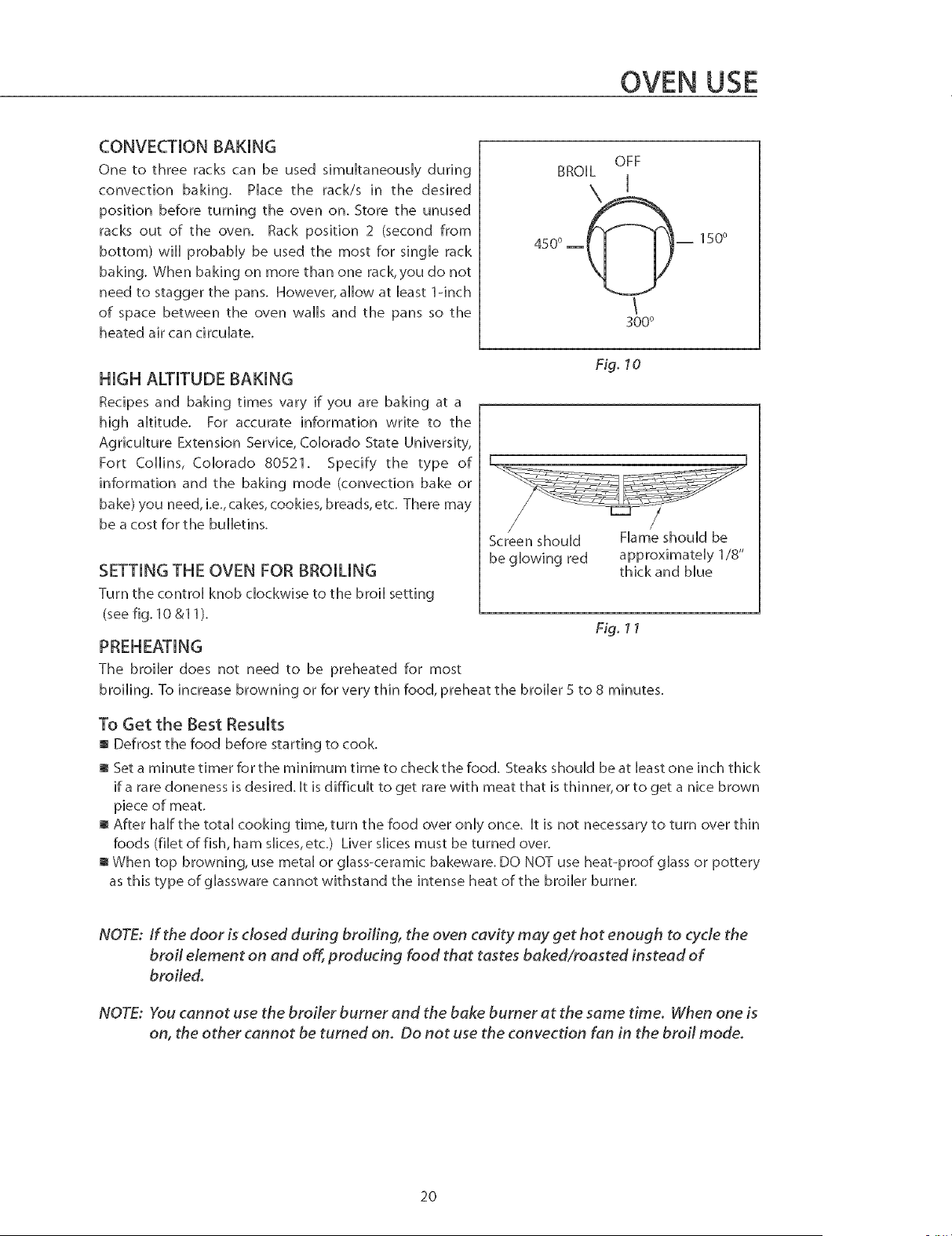
SETTING THE OVEN FOR RROIUNG
Turn the control knob clockwise to the broil setting
(see fig. 10 &l 1).
Screen should
be glowing red
Fig. 10
Flame should be
approximately 1/8"
thick and blue
Fig. 1 1
PREHEATING
The broiler does not need to be preheated for most
broiling. To increase browning or for very thin food, preheat the broiler 5 to 8 minutes.
To Get the Rest Results
[] Defrost the food before starting to cook.
[] Set a minute timer for the minimum time to check the food. Steaks should be at least one inch thick
if a rare aloneness is desired. It is difficult to get rare with meat that is thinner, or to get a nice brown
piece of meat.
[] After half the total cooking time, turn the food over only once. It is not necessary to turn over thin
foods (filet offish, ham slices, etc.) Liver slices must be turned over.
[] When top browning, use metal or glass-ceramic bakeware. DO NOT use heat-proof glass or pottery
as this type of glassware cannot withstand the intense heat of the broiler burner.
NOTE: If the door is closed during broiling, the oven cavity may get hot enough to cycle the
broil element on and off, producing food that tastes baked/roasted instead of
broiled.
NOTE: You cannot use the broiler burner and the bake burner at the same time. When one is
on, the other cannot be turned on. Do not use the convection fun in the broil mode.
2O

OVEN USE
OVEN RACK POSITION
The rack position depends on the type and thickness of the food. Thick pieces of meat or poultry
wouHd typicaHHy be broiHed on rack position 2; steaks, chops and hamburger, wouHd be broiled on rack
position 3. Hftop browning casseroHes or bread, the thickness of the food wouHd indicate the rack
position. The casseroHes wouHd typicaHHy be browned on rack position 1 or 2 and the bread on rack
position 3.
USING A MEAT THERMOMETER TO BROIL
To accurateHy determine the aloneness of a thick steak or chop (1-1/2 inches thick or more), use a meat
thermometer. Hnsert the point of the thermometer into the side of the meat to the center. Cook the
first side to 90°F for rare meat. Cook the first side to 100°F for medium to well done. Cook the second
side to the desired degree for the aloneness you want, 135°F to HO°F for rare, 150°F to 155°F for
medium and 160°F to 165°F for well done. If you are cooking pork, cook to 170°F. A large two-piece
broil pan comes with your new range. When you are broiling, always use both pieces. Do not cover the
grid with aluminum foil. This slotted grid allows the grease drippings to flow into the bottom of the
pan, keeping it away from the intense heat of the infrared broiler burner. This helps to minimize the
smoking and spattering of the grease.
USING THE OVEN FOR SLOW COOKING OR LOW TEMPERATURES
The oven can be used to keep hot food hot, to dehydrate food, to warm plates, for slow cooking (as in
a crock pot), and to defrost foods.
You can keep hot, cooked food at serving temperature. Set the oven to the temperature suggested in
the chart. Rare meat must be eaten when it is removed from the oven, as it continues cooking from its
own heat.
[] To keep food moist, it must be covered with aluminum foil or a lid.
[] To dehydrate food, follow suggestions in a recipe.
[] To warm plates, check with the dishware manufacturer for the recommended temperature.
[] To use the oven as a slow cooker set the oven control knob to 225°F, place the food in the oven in
a pan with a tight fitting lid. Follow recipes for this type of cooking.
[] To thaw uncooked frozen food, set the oven control knob to "warm" Be sure the food is tightly
wrapped in foil. Thaw the food lust enough to handle it. Cook immediately. Do not refreeze.
[] To thaw frozen cooked food, set the oven control knob to 170°F. Loosen the freezer wrapping.
[] Do not use plastic wrap or wax paper in the oven.
FOOD SAFETY: According to the United States Department of Agriculture you should not
hold foods at temperatures between 40°F to 140°F for longer than 2 hours°
21
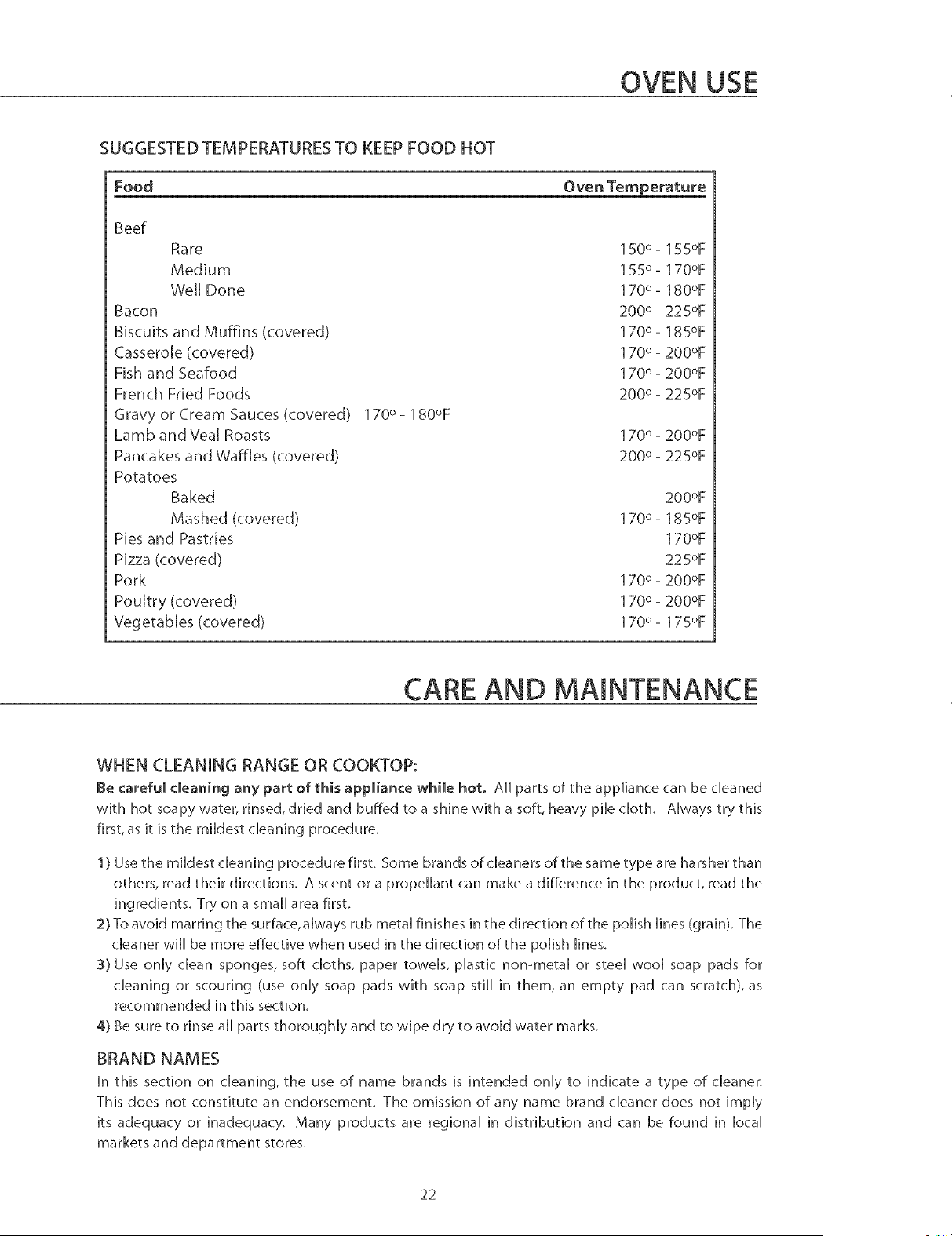
OVEN USE
SUGGESTED TEMPERATURES TO KEEP FOOD HOT
Food Oven Temperature
Beef
Rare 150°- 155°F
Medium 155° - 170°F
Well Done 170° - 180°F
Bacon 200 ° - 225°F
Biscuits and Muffins (covered) 170° - 185°F
Casserole (covered) 170° - 200°F
Fish and Seafood 170° - 200°F
French Fried Foods 200 °- 225°F
Gravy or Cream Sauces (covered) 170° - 180°F
Lamb and Veal Roasts 170° - 200°F
Pancakes and Waffles (covered) 200 ° - 225°F
Potatoes
Baked 200°F
Mashed (covered) 170° - 185°F
Pies and Pastries 170°F
Pizza (covered) 225°F
Pork 170° - 200°F
Poultry (covered) 170° - 200°F
Vegetables (covered) 170° - 175°F
CARE AND MAINTENANCE
WHEN CLEANING RANGE OR COOKTOP:
Be careful cleaning any part of this appliance while hot. All parts of the appliance can be cleaned
with hot soapy water, rinsed, dried and buffed to a shine with a soft, heavy pile c[oth. AHways try this
first, as it is the mHdest cHeaning procedure.
1) Use the mHdest cleaning procedure first. Some brands of cleaners of the same type are harsher than
others, read their directions. A scent or a propellant can make a difference in the product, read the
ingredients. Try on a small area first.
2) To avoid marring the surface, always rub metal finishes in the direction of the polish lines (grain). The
cleaner will be more effective when used in the direction of the polish lines.
3) Use only clean sponges, soft cloths, paper towels, plastic non-metal or steel wool soap pads for
cleaning or scouring (use only soap pads with soap still in them, an empty pad can scratch), as
recommended in this section.
4) Be sure to rinse all parts thoroughly and to wipe dry to avoid water marks.
BRAND NAMES
In this section on cleaning, the use of name brands is intended only to indicate a type of cleaner.
This does not constitute an endorsement. The omission of any name brand cleaner does not imply
its adequacy or inadequacy. Many products are regional in distribution and can be found in local
markets and department stores.
22
CARE AND MAINTENANCE
COOKTOP
Turn offal[ the burners and allow the
grates to coo[ before starting to dean
the cooktop. If you wipe offany part
of the cooktop while it is hot, do so
carefully as using a wet sponge or
cloth can result in steam burns.
BURNER GRATES
When lifting the grates, be careful as
they are heavy. Place them on a
protected surface so they won't
scratch the surface they are [aid on.
The burner grates are matte porcelain
enamel over cast iron.When coo[, they
may be placed in the dishwasher, or
wiped dean while on the cooktop
using hot soapy water, then rinsed and
wiped dry. The burner grates wi[[ not
rust as they are matte porcelain
enamel on both sides for durability.
The occasional use of mild abrasive
cleansers such as BomAmi °, Soft
Scrub _) or a soapfi[[ed steel woo[ pad
BrassRing
Locating Pin
Main
Burner
Port
Ring
Locating
Notch
Simmer
Ring
Locating Pin
Hole inside
FO. 12
is okay. Abrasive cleansers, used vigorously or too often, can eventually harm the enamel. Apply with
a damp sponge, rinse thoroughly and dry. The porcelain may pop off the edge of the grates due to
rapid temperature change when the burners are turned on. Do not be concerned as this does not
result in the deterioration of the grates. The cast iron soon darkens to blend with the porcelain enamel
Be careful when wiping an area where the porcelain has popped off, as the edges may be sharp.
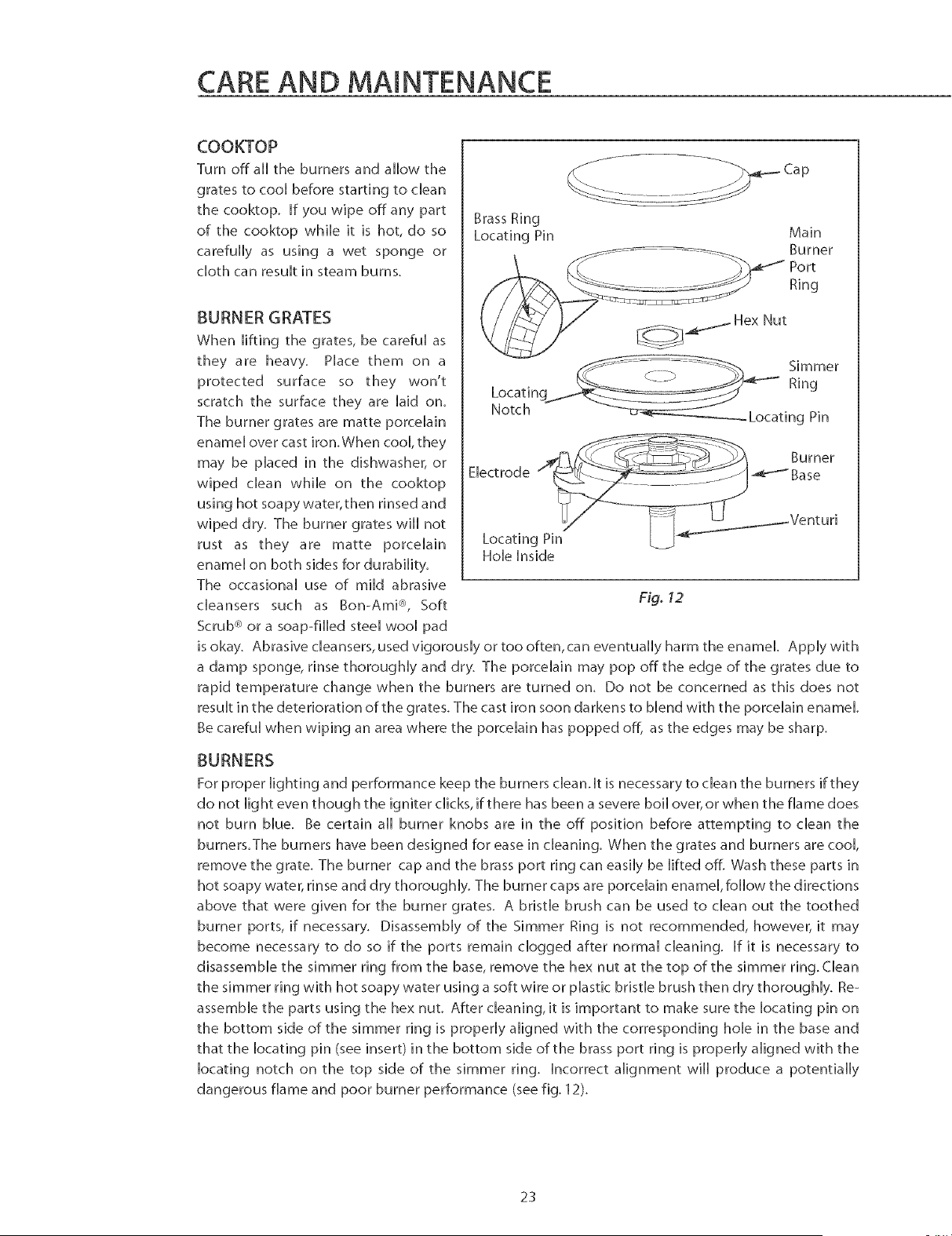
BURNERS
For proper lighting and performance keep the burners dean. It is necessary to dean the burners if they
do not light even though the igniter dicks, if there has been a severe boil over, or when the flame does
not burn blue. Be certain a[[ burner knobs are in the off position before attempting to dean the
burners.The burners have been designed for ease in cleaning. When the grates and burners are coo[,
remove the grate. The burner cap and the brass port ring can easily be lifted off. Wash these parts in
hot soapy water, rinse and dry thoroughly. The burner caps are porcelain enamel, follow the directions
above that were given for the burner grates. A bristle brush can be used to dean out the toothed
burner ports, if necessary. Disassembly of the Simmer Ring is not recommended, however, it may
become necessary to do so if the ports remain dogged after normal cleaning. If it is necessary to
disassemble the simmer ring from the base, remove the hex nut at the top of the simmer ring. Clean
the simmer ring with hot soapy water using a soft wire or plastic bristle brush then dry thoroughly. Be-
assemble the parts using the hex nut. After cleaning, it is important to make sure the locating pin on
the bottom side of the simmer ring is properly aligned with the corresponding hole in the base and
that the locating pin (see insert) in the bottom side of the brass port ring is properly aligned with the
locating notch on the top side of the simmer ring. Incorrect alignment wi[[ produce a potentially
dangerous flame and poor burner performance (see fig. 12).
23
CARE AND MAINTENANCE
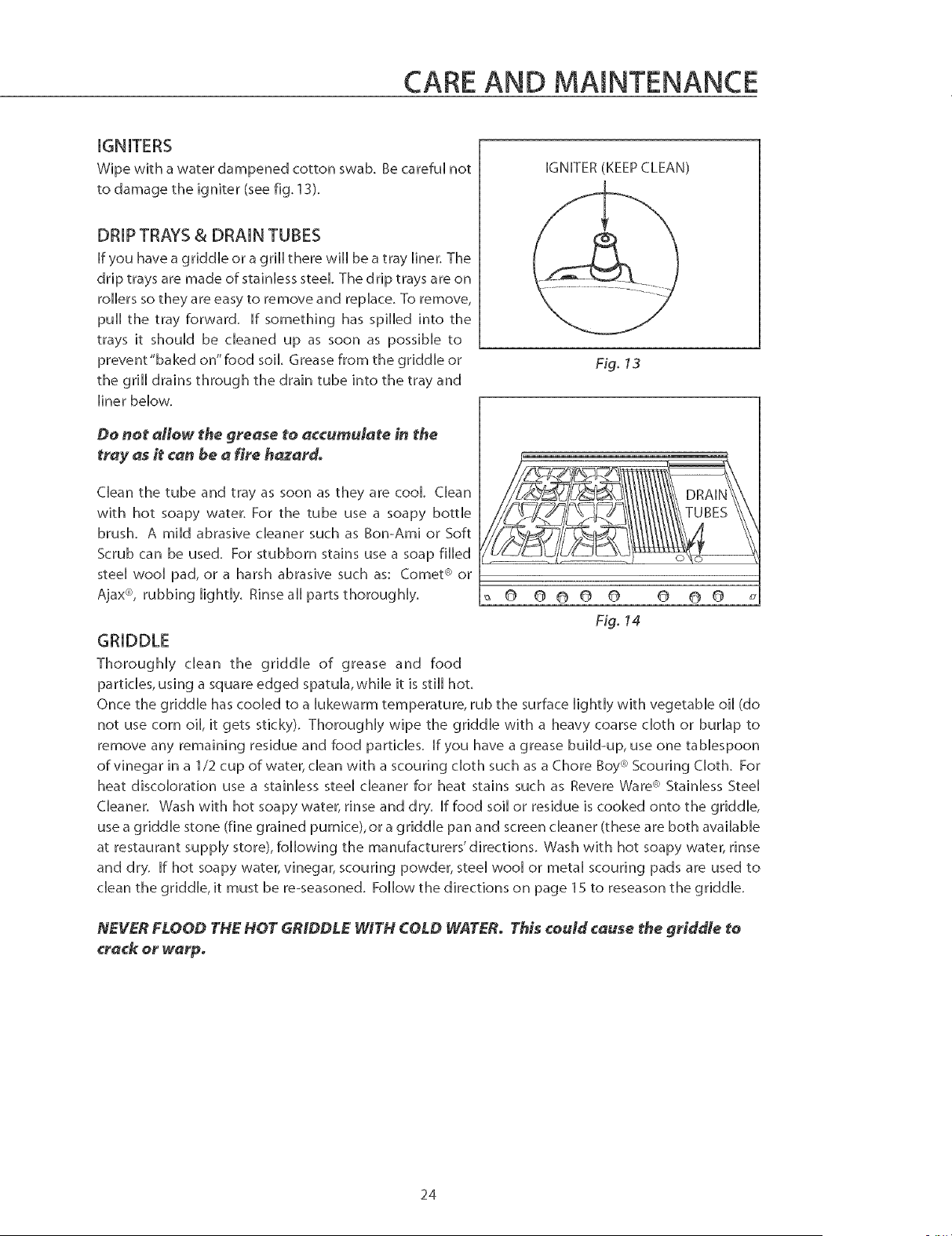
IGNITERS
Wipe with a water dampened cotton swab. Be carefu[ not
to damage the igniter (see fig. 13).
DRIP TRAYS & DRAIN TUBES
ffyou have a griddHe or a grH[ there wH[ be a tray [iner. The
drip trays are made of stainHess steel The drip trays are on
rollers so they are easy to remove and rephce. To remove,
pu[[ the tray forward, ff something has spilled into the
tray, s it should be cleaned up as soon as possible to
prevent"baked on"food soil Grease from the griddle or
the grill drains through the drain tube into the tray and
liner below.
Do #or allow the grease to accumulate in the
tray as it can be a fire hazardo
Clean the tube and tray as soon as they are coo[. Clean
with hot soapy water. For the tube use a soapy bottle
brush. A mild abrasive cleaner such as Bon-Ami or Soft
Scrub can be used. For stubborn stains use a soap filled
steel wool pad, or a harsh abrasive such as: Comet ° or
Ajax ¢_, rubbing lightly. Rinse all parts thoroughly.
IGNITER (KEEP CLEAN)
Fig. 13
0 000 0 0 0
Fig. 14
GRIDDLE
Thoroughly clean the griddle of grease and food
particles, using a square edged spatula,while it is still hot.
Once the griddle has cooled to a lukewarm temperature, rub the surface lightly with vegetable oil (do
not use corn oil, it gets sticky). Thoroughly wipe the griddle with a heavy coarse cloth or burlap to
remove any remaining residue and food particles. If you have a grease build-up, use one tablespoon
of vinegar in a 1/2 cup of water, clean with a scouring cloth such as a Chore Boy #_Scouring Cloth. For
heat discoloration use a stainless steel cleaner for heat stains such as Revere Ware #_Stainless Steel
Cleaner. Wash with hot soapy water, rinse and dry. If food soil or residue is cooked onto the griddle,
use a griddle stone (fine grained pumice), or a griddle pan and screen cleaner (these are both available
at restaurant supply store), following the manufacturers' directions. Wash with hot soapy water, rinse
and dry,. If hot soapy water, vinegar, scouring powder, steel wool or metal scouring pads are used to
clean the griddle, it must be re-seasoned. Follow the directions on page 15 to reseason the griddle.
24

CARE AND MAINTENANCE
GRILL
Ciean the grHi immedhteiy after cooking. Turn off the
burner. To protect your hand from steam and heat, wear
a barbecue mitt. Scrub the grHi by dipping a brass bnsfle
barbecue brush frequendy into a bowi of water. The
steam created softens the food particies and assists the
cieaning process. The food particles will drop into the
drip tray or into the radiant tray holding the radiants. Be
sure to clean the drain tube, drip tray and liner after they
have cooled. Follow directions above. The radiant tray
and radiants should be removed periodically (when
cool) and shaken over a layer of newspaper, which can
be thrown away.
CONTROL KNOBS - COOKTOP AND OVEN
These are plastic and can be cleaned in hot, soapy water.
To remove the knobs from the control panel, grasp the
knob and pull straight back towards you and away from
the grill. Wash, do not soak. Rinse and dry thoroughly. It
is important to replace these knobs on the correct gas
valve on the control panel. The cooktop and grill control
knobs are similar; the cooktop knobs have a setting for
"Simmer'[ the grill does not. The oven and griddle
control knobs are similar; they both have temperatures
on them. The oven knob has a "Broil" setting, the griddle
does not.
Door Hinge Roller
\
Un-Lock
FO. 1S
OVEN AND DOOR INTERIOR
if in the event the oven door comes offtrack, or becomes misaligned, realignment can be achieved by
following this simple procedure: Open the door and hold it all the way open. Close the hinge latches
(see fig. 15). Once both hinges are locked, gently lift the door up and partially out until the door is
evenly aligned. Evenly slide the door back into place and check to assure the hinges rest in the center
of each door hinge roller. With the oven door fully open, unlock hinge latches and the door is ready to
close again. Be sure the oven and door are cool before you start to clean them. They are porcelain
enamel, it is acid resistant, but not acid proof. Therefore, acid foods, such as vinegar, rhubarb, alcohol,
citric juices or milk, should be wiped and not allowed to bake on. Try mild cleaners, such as: Bon-Ami,
ammonia or ammonia and water or Soft Scrub. Apply the powders on a damp sponge or cloth. Rub
lightly. Rinse thoroughly and dry. If food has burned onto the oven and is difficult to remove, soak the
spots with a cloth saturated with household ammonia. Allow it to soak for an hour or two, with the
door closed. The food soil should be easy to remove with a damp soapy cloth or mild abrasive. A
solution of 3 tablespoons ammonia in a 1/2 cup of water may be placed in a warm (not hot) oven over
night. This loosens the spills and hardened residue so they are easily wiped up with a dean damp
sponge or cloth. For stubborn stains, a soap filled steel wool pad can be used. The occasional use of
abrasive cleaners is okay, if used too often or vigorously they can eventually harm the enamel. Dampen
the pad, rub the surface lightly, rinse thoroughly and dry. Commercial oven cleaners, such as Easy Off ®
or Dow ® can be used on the oven interior.
25

CARE AND MAINTENANCE
Follow the manufacturer's directions. Commerda[ oven cleaners are corrosive to the thermostat bulb
and infrared broiler burner. Do not spray or wipe this type cleaner onto the oven thermostat bulb (#9
& #25 pg. 28 & 29) or broiler burner. If some cleaner gets onto the bulb or broiler burner, wipe it off
immediately with a dean damp cloth.
BACKGUARD
This is made of stainless steel Use the mi[dest cleaning procedure first. Hot soapy water, rinse and dry.
If the pane[ has food soil remaining, try a genera[ kitchen cleaner, such as Fantastik _, Simple Green ° or
Formula 409_L For hard to dean soil use a stainless steel cleaner such as, Bon-Ami, Cameo _, or Bar
Keepers Friend. Apply cleaner with a damp sponge, rinse thoroughly and dry. Always scrub lightly in
the direction of the grain. Do not use a steel woo[ pad, it will scratch the surface. To touch up
noticeable scratches in the stainless steel, sand very lightly with dry 100 grit emery paper, rubbing in
the direction of the grain. After cleaning use a stainless steel polish, such as Stainless Steel Magic_]f
the rear top burners are used extensively on high it is possible for the vertical stainless steel pane[ to
discolor from the burner heat. This discoloration can be removed by using Revere Ware Stainless Steel
Cleaner.
OVEN RACKS AND RACK SUPPORTS
The oven racks and [adder racks are chrome plated steel Chrome cleaners, such as Soft Scrub, Cameo
or Bar Keepers Friend can be applied with a damp sponge following package directions. Rinse and dry.
Powdered cleaners such as Bon-Ami or Comet are applied with a damp sponge or cloth, rubbed lightly,
rinsed and dried. For hard to remove food soil use a dampened soap filled steel wool pad, rinse and dry.
Harsh Cleaners which are commercial oven cleaners, such as Easy Offor Dow can be used on the racks.
However, some commercial oven cleaners cause darkening and discoloration.Test the cleaner on a
small pa rt of the rack and check for an}, discoloration before clea ning the entire rack. Apply a generous
coating. Allow to stand for 15 to 20 minutes. Rinse thoroughly and dry. After being cleaned, if the racks
do not slide easily, pour a small amount of cooking oil on a paper towel and rub it lightly over the side
raHs.
FRAME, SIDES, DOOR EXTERIOR, HEAT DEFLECTOR
These parts are made of stainless steel, follow the directions for the Backguard (above). Take care when
cleaning the door top, and do not let water or cleaners run down the vents. If water or cleaners spill
into the vents, they may streak the glass inside the door.
DOOR GASKET
Use warm soapy water and rub softly, blot dry with a cloth. Do not rub. Do not remove or damage the
mesh.
26
CARE AND MAINTENANCE
To Replace the Light Bulb:
] ) Turn off circuit breaker.
2) Be sure the oven Hight buHb switch is in the off position. The bottom of the switch is pressed in.
Let the cover and the buHb cooH compHeteHy.
3) Remove the Hight cover. Turn the cover to the Heft (countercHockwise) to unscrew it.
4) Remove the burnt out buHb. RepHace it with a 40 watt appHhnce Hight buHb only.
5) RepHacecover. Turn circuit breaker back on (See Caution).
CAUTION:
Be sure the Oven fight switch is in the OFF position and the cover is cool. If the
bulb comes loose from the base, turnoff thepower to the oven at the circuit
breaker panel before attempting to remove the bulb base from the socket.
POWER FAILURE
The broiler and oven burners cannot be turned on during a power failure. To light the cooktop burners,
turn the control knob to'LFE'[ hold a lighted match to the port ring. After the flame is burning all the
way around the burner, adjust the flame. It is necessary to light each burner separately, each time you
want to use it.
27
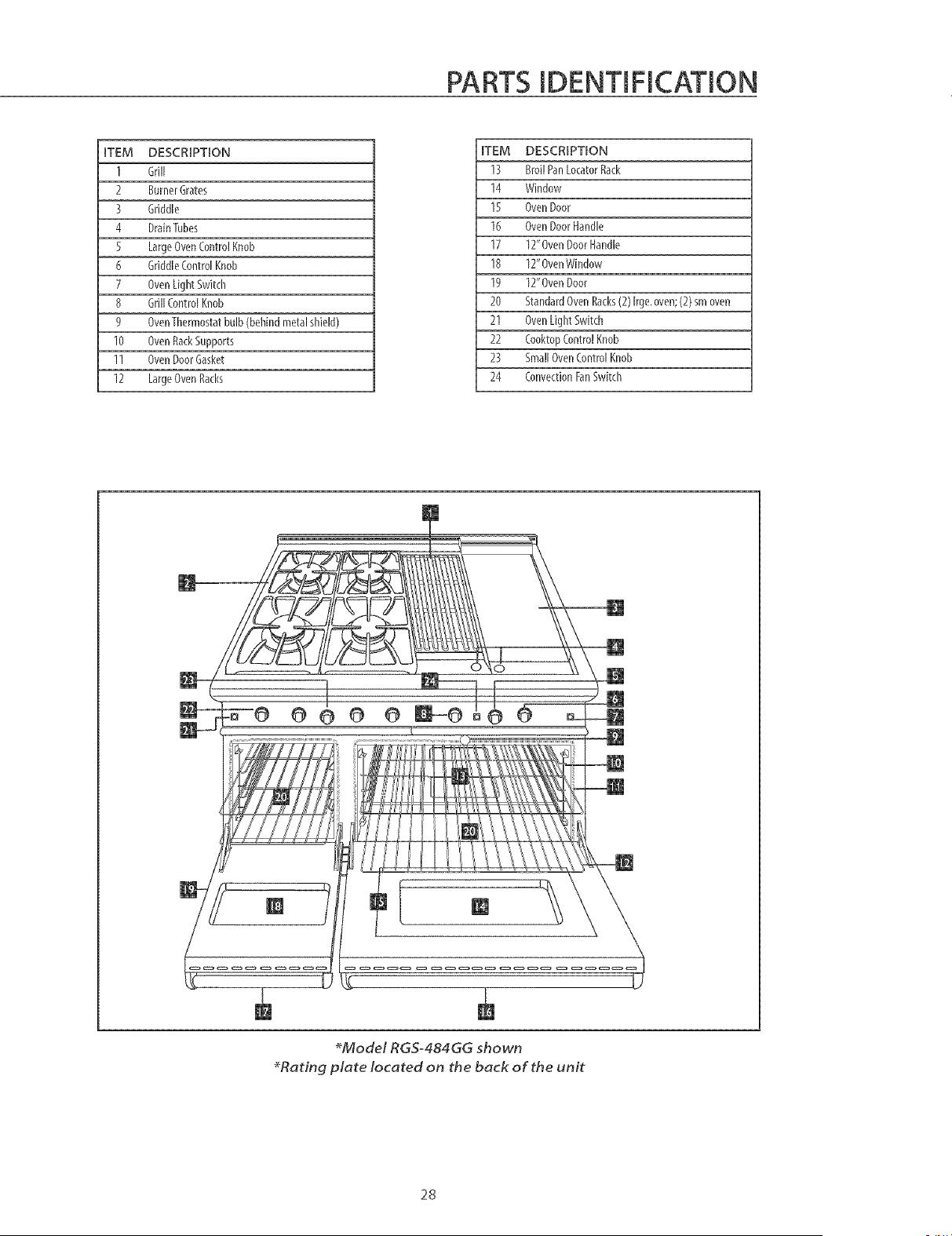
PARTS IDENTIFICATION
ITEM DESCRIPTION
1 Grill
2 BurnerGrates
3 GrNd[e
4 DrainTubes
5 LargeOvenControlKnob
6 GriddleControlKnob
7 OvenLightSwitch
8 GrillControlKnob
9 OvenThermostatbulb(behindmetalshield)
10 OvenRackSupports
11 OvenDoorGasket
12 LargeOvenRacks
ITEM DESCRIPTION
13 Broil PanLocatorRack
14 Window
15 OvenDoor
16 OvenDoorHandle
17 12"OvenDoorHandle
18 12"OvenWindow
19 12"OvenDoor
20 StandardOvenRacks(2) kge.oven;(2) smoven
21 OvenLight Switch
22 CooktopControlKnob
23 SmallOvenControlKnob
24 ConvectionFanSwitch
_Model RGS-484GG shown
_Rating plate located on the back of the unit
28
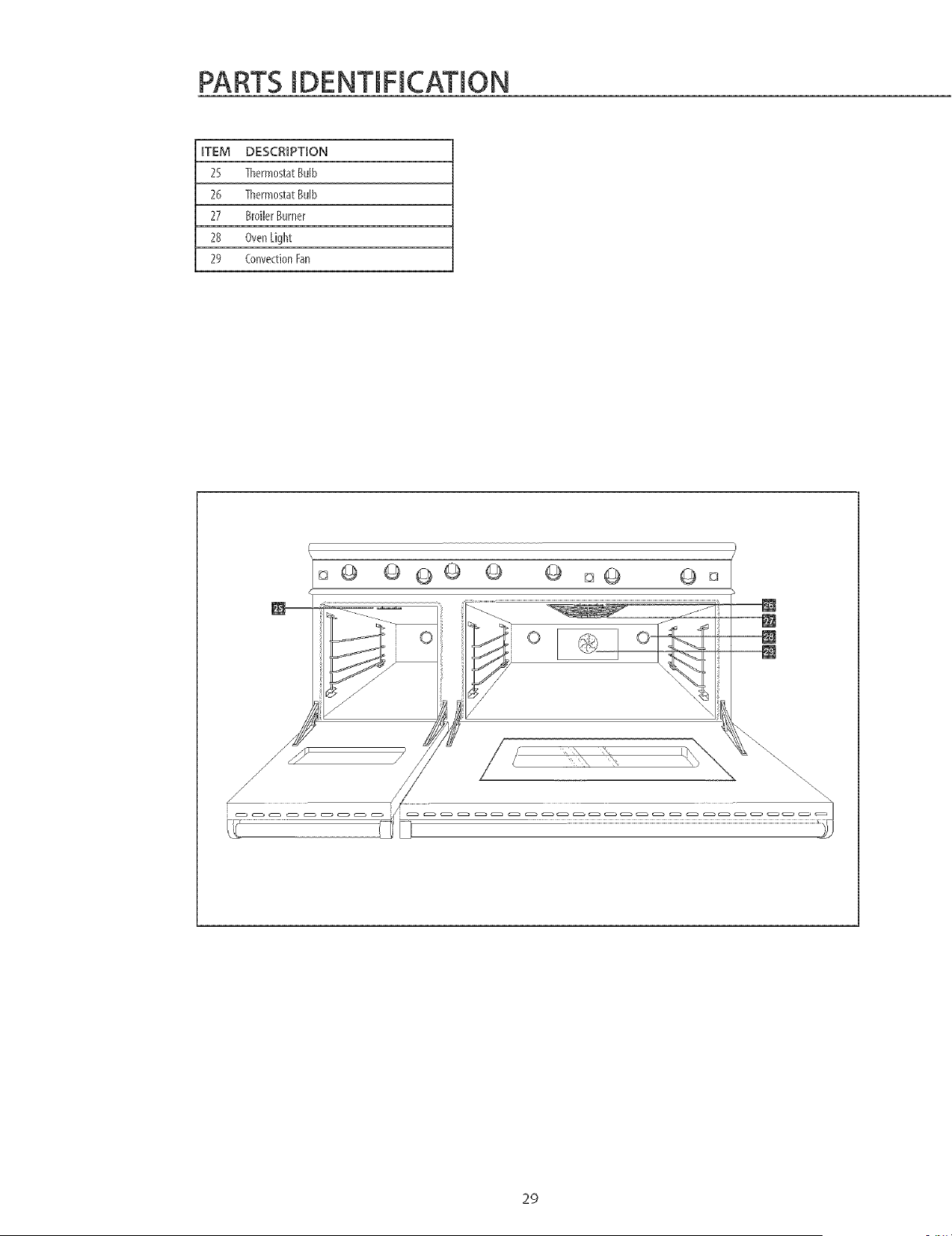
PARTS iDENTiFiCATiON
ITEM DESCRIPTION
25 ThermostatBulb
26 ThermostatBulb
27 BroilerBurner
28 OvenLight
29 ConvectionFan
DO © ©© © © _© ©D /
O
\\
\\
\\
\
\\\
\
29
HOW TO OBTAIN SERVICE
HOW TO OBTAIN SERVICE:
Before You Call for Service
t [s the circuit breaker tripped or the fuse blown?
[] [s there a power outage in the area?
IF THE COOKTOP BURNERS DO NOT LIGHT
[] [s the two piece burner put together correctHy?
[] Hsthe burner head assembHy aHigned correctHy?
[] [s the manua[ shut-offvaHve open?This is usuaHHy[ocated where the gas comes out of the waHL
For warranty service, contact DCS Customer Service at (888) 281-5698. Before you ca[[, please have the
following information ready:
[] Mode[ Number (located on rating plate backside of unit).
[] Seria[ Number
[] Date of installation
[] A brief description of the probHem
Your satisfaction is of the utmost importance to us. ffa problem cannot be resolved to your satisfaction,
please write, fax, or emaH us at:
Write:
DCS
Attention: Consumer Relations
5800 Sky[ab Road
Huntington Beach, CA 92647
Fax us at: (714) 372-7004
emai[: support@dcsa pp[ia nces.com
3O
Length of Warranty:
One (I) Year FuJI parts and Labor Covers the entire product.
Five (5) Year Surface burners, 9dddHe burners, grHHburner, oven burners.
Ten (1 O) Year Limited PorceHain oven Miner,porceHain inner door panel
DCS Will Pay For
AHHrepair Habor and parts found to be defective due to matedaHs or workmanship for one fuHHyear"HN
HOME" warranty during the first year of ownership. This does not appHy if the unit was subjected to
other than normaH househoHd use+ Service must be provided by Authorized Factory Agent during
normaH working hours. No charges wHHbe made for repair or repHacement at the Hocafion of initiaH
instaHHation or factory for parts returned pre-paid, through the deaHer and chimed within the warranty
period, and found by DCS to be defective.
RepJacement wiJ[ be EO+B+DCS, and DCS wiJ[ not be [iabJe for any transportation costs, [abor costs, or
export duties. This warranty shaH[ not appHy, nor can we assume responsibiJity for damage that might
resuJt from faiJure to foJJow manufactures instructions or [oca[ codes, where the appJiance has been
tampered with or aJtered in anyway or which, in our judgement, has been subjected to misuse,
negJigence, or accident. HmpJied warranty shaH[ not extend beyond the duration of this written
warranty. This warranty is in [ieu of aM[warranties expressed or impJied and aM[other obJigations or
[iabiJity in connection with the sameof this appJiance+
DCS Will Not Pay For
m Installation or start+up+
[] Shipping damage.
[] Service by an unauthorized agency.
[] Damage or repairs due to service by an unauthorized agency or the use of unauthorized parts.
[] Service during other than norma[ working hours.
[] Improper installation, such as improper hook-up, etc.
[] Service visits to teach you how to use the appHiance; correct the instaHHation; reset circuit
breakers or repHace home fuses.
[] Repairs due to other than norma[ househoHd use+
[] Damage caused from accident, abuse, aHteration, misuse, incorrect instaHHation or instaHHation not
in accordance with [oca[ codes.
[] Units installed in non-residentia[ application such as day care centers, bed and breakfast
centers, churches, nursing homes, restaurants, hoteHs, schooHs,etc.
This warranty applies to appliances used in residentiaH applications; it does not cover their use in
commercia[ situations. This warranty is for products purchased and retained in the 50 states of the
U+S+A+,the District of CoHumbia and Canada. This warranty appHies even if you shouHd move during the
warranty period. ShouHd the appHiance be solid by the origina[ purchaser during the warranty period,
the new owner continues to be protected unti[ the expiration date of the origina[ purchaser's warranty
period. This warranty gives you specific [ega[ rights.You may aHsohave other rights which vary from
state to state.
31

32