
G
UIDE TO INSTALLATION AND USE
W
ashing Machine

1
EN
C
ONTENTS
Safety instructions ................................................................... 2
Installation ............................................................................... 5
Operation .............................................................................. 11
Maintenance ......................................................................... 23
Troubleshooting .................................................................... 27
Availability of spare parts ...................................................... 29

2
EN
S
afety instructions
•
This appliance is designed to be used for domestic
applications only
•
The appliance must be connected to the mains water
supply using the brand new connection fittings supplied
with the appliance. Never reuse old fittings.
•
Never obstruct the ventilation openings.
•
This appliance can be used by children aged 8 years and
over and by individuals with physical, sensory or reduced
mental capacity, or lack of experience and knowledge
under supervision or if they have been given instructions
on how to use the appliance safely and have fully
understood the risks involved. Children must not be
allowed to play with the appliance. Cleaning and
maintenance operations must not be carried out by
children without supervision.
•
Children under the age of three should be kept away from
the appliance unless they are under constant supervision.
• If the power cord is damaged, it should be replaced by
the manufacturer, its after-sales service department or a
similarly qualified person, so as to avoid danger.
•
Regarding the instructions for installing the appliance and
making its electrical connections, please refer to the
appropriate section in this guide.
•
WARNING: Do not connect the appliance to hot water.
•
The maximum weight of dry laundry is 9 kilograms.
•
Maximum water supply pressure: 1 MPa
•
Minimum water supply pressure: 0.05MPa
Wa
rning!
Product installation
• This washing machine is intended for indoor use only.
• It is not designed for built-in installation.
• Never obstruct the openings.
• This washing machine must not be installed in
bathrooms, very damp rooms or in rooms where there

3
EN
are explosive gasses or caustic substances.
• If the washing machine has only one water inlet valve,
connect it to a cold water source only.
• The power plug must remain accessible after the
appliance is installed.
• Remove all packaging materials and the transit bolts
before using the appliance. Failure to do so may
seriously damage your washing machine.
Appliance damage hazard!
• Your appliance is for household (domestic) use only and
is designed solely for machine washable textiles.
• Do not climb on the top of the washing machine.
• Do not lean against the door of the washing machine.
Care when handling the washing machine:
1. The transit bolts must be refitted to the washing machine
by a qualified person.
2. Drain any water from the appliance before moving the
washing machine.
3. Handle the appliance with care. Never lift the appliance
by grabbing projecting parts. The door must not be used
as a handle when moving the appliance.
4. This appliance is heavy. Carry it with care.
• Do not close the door using excessive force. If the door is
hard to close, make sure that the drum is not overloaded
and that the laundry is properly distributed.
• Do not wash carpets.
Operation of the appliance
• Before using the appliance for the first time, perform a
complete wash cycle empty.
• Use of inflammable and explosive solvents is prohibited.
Never use fuel and alcohol, etc. as detergents. Only
choose detergents that are suitable for machine washing.
• Empty the pockets of your clothes. Cutting and rigid
objects like coins, pins, nails, screws, stones, etc. may
seriously damage this appliance.

4
EN
• Check that the water inside the drum has been drained
before opening the door. Do not open the door if you can
still see water inside the washing machine.
• Be careful to avoid injury when draining very hot washing
water.
• Never add water by hand during washing.
• Once the washing cycle has finished, wait two minutes
before opening the door.

5
EN
Installation
Description of the product
1.
Top panel
6.
Drain hose
2.
Control panel
7.
Water supply hose
3.
Power cord
8.
Detergent compartment
4.
Drum
9.
Window
5.
Filter
Note!
•
The illustration of the accessories is provided for
reference purposes only. Please refer to
the actual
product.
6
EN
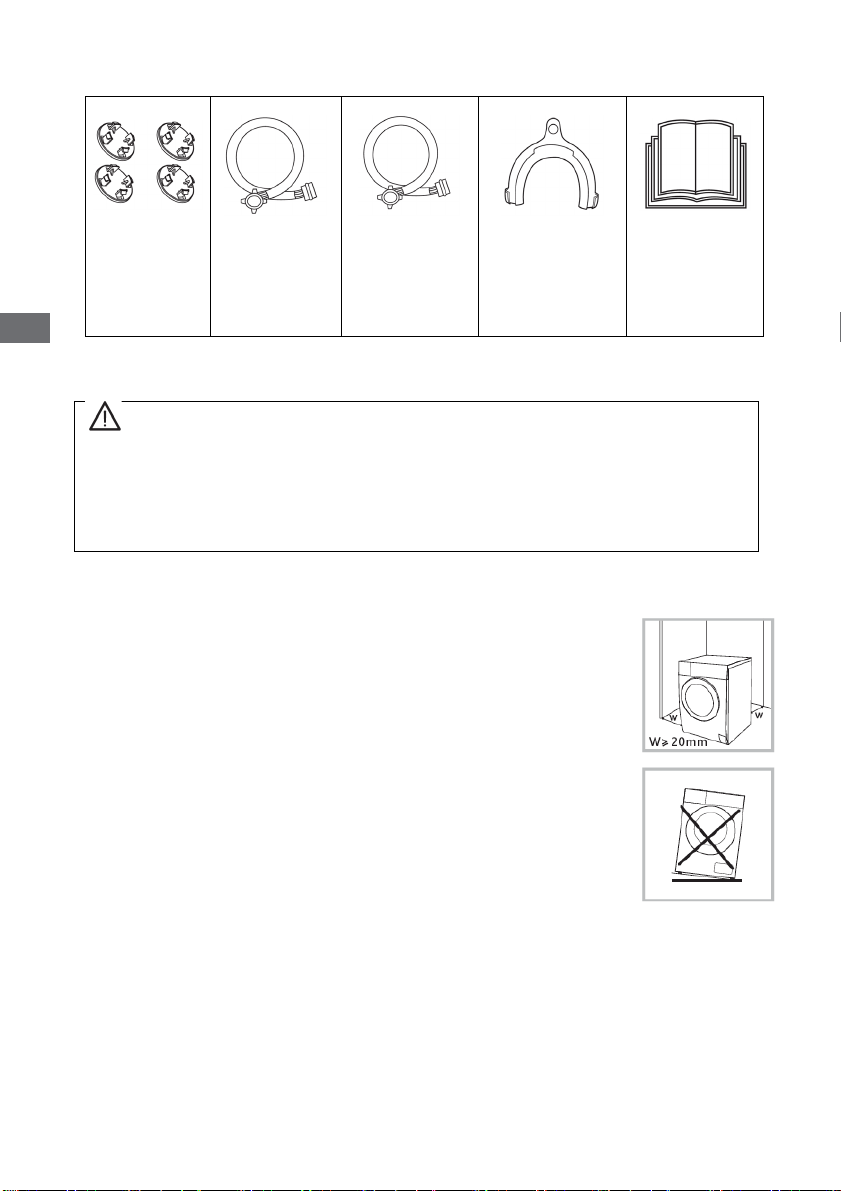
Accessories
Transit bolt
hole covers
Cold water
supply hose
Drain hose
(optional)
Drain hose
holder (optional)
User guide
Installation location
Warning!
•
It is important that the product be stabilised so that it will
not move!
•
Ensure that the appliance is not resting on the power
cord.
To install your washing machine, choose a location that is:
1. On a hard, dry, flat surface
2. Not exposed to direct sunlight
3. Adequately ventilated
4. In a room at ambient temperature
5. Away from heat sources
The washing machine is designed to operate at
ambient temperature. If it is used in a room where
the temperature is below 0°C, the water inlet
valve and the drainage system may be damaged.
7
EN
Unpacking the washing machine
Warning!
• Packaging materials (e.g. plastic film, polystyrene) can be
hazardous to children.
•
There is a suffocation hazard! Keep all packaging
materials away from children.
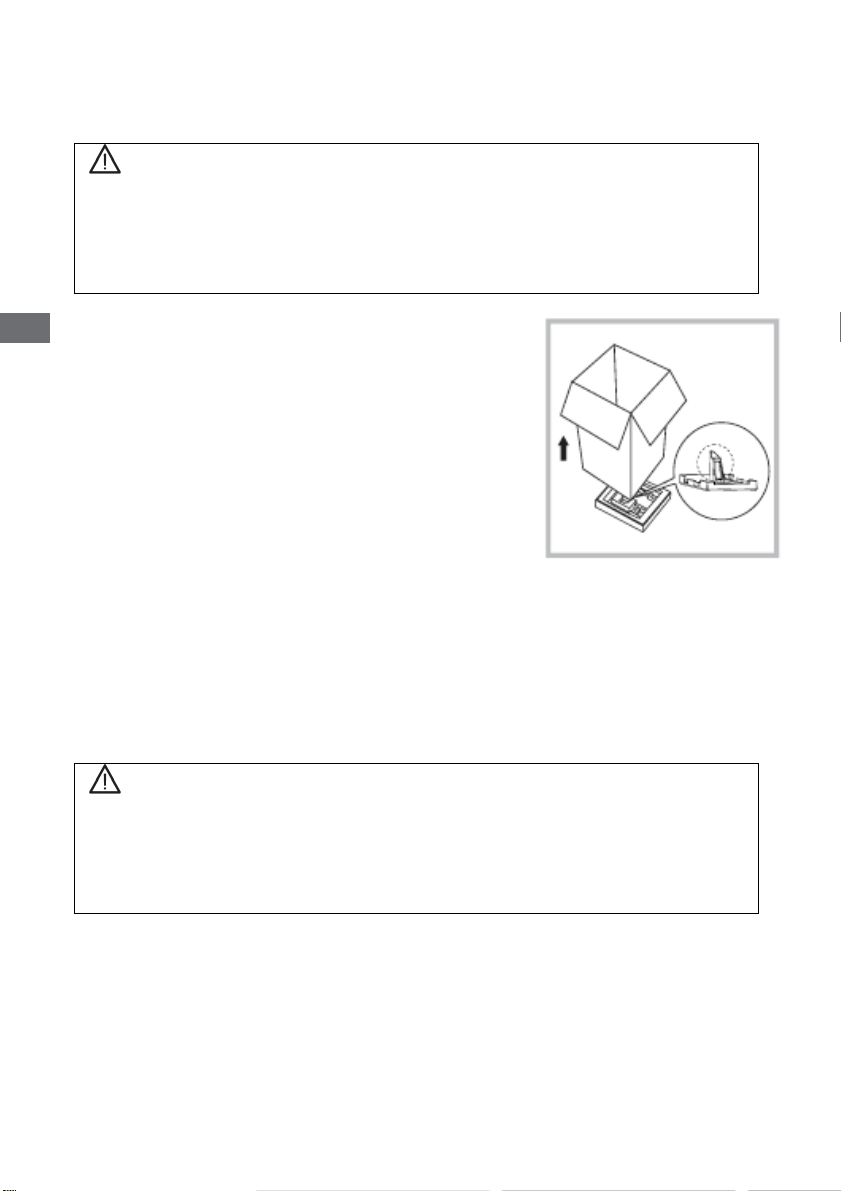
1. Remove the cardboard box and the
polystyrene wrapping.
2. Lift the washing machine and
remove the packaging under it.
Don't forget to remove the small
foam triangle at the same time as
the lower packaging. If you cannot
do so, lay the washing machine on
its side and remove the small foam
triangle by hand.
3. Remove the adhesive tape that holds the power cord and
the drain hose in place.
4. Remove the water supply hose from the drum.
Remove the transit bolts
Warning!
•
You need to remove all of the transit bolts located at the
back of the washing machine before using it.
• You'll need the transit bolts again if you move the washing
machine. Keep them in a safe place.
8
EN
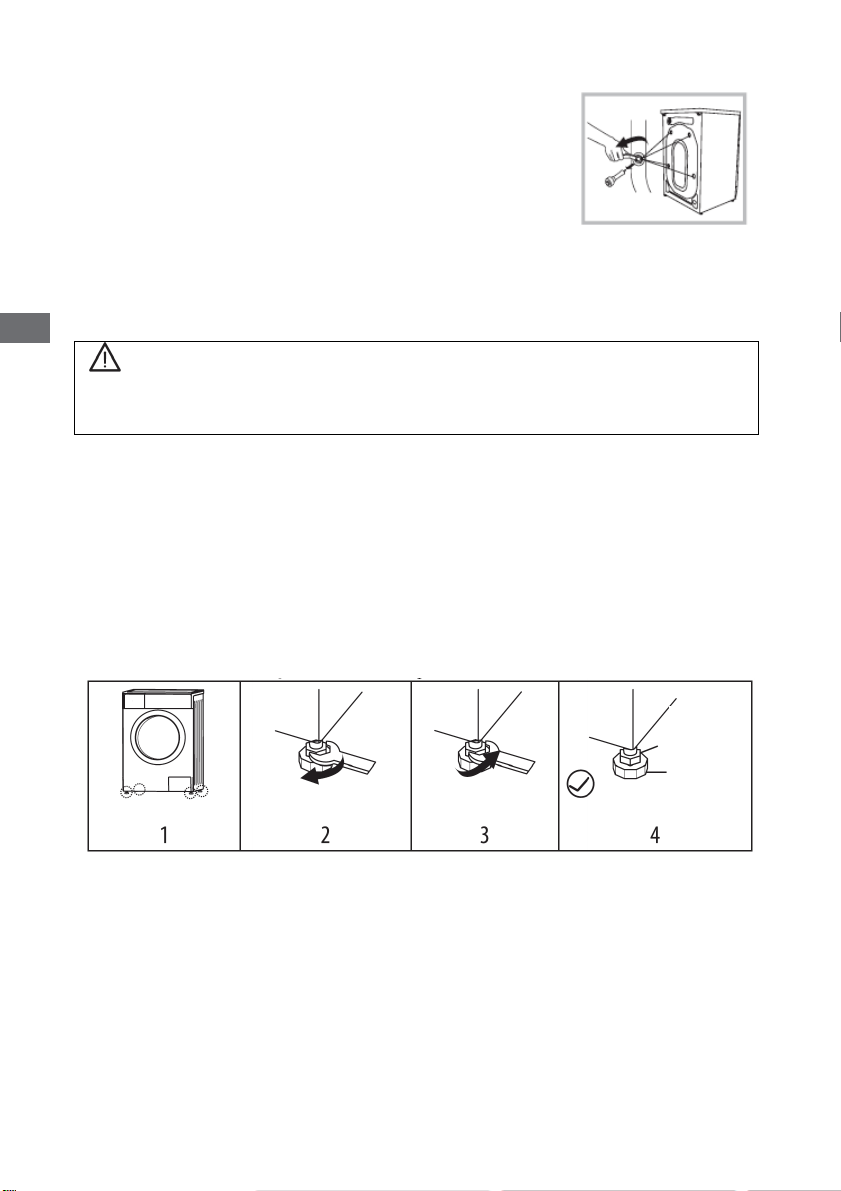
Proceed as follows to remove the transit bolts:
1. Use a spanner to loosen the four
transit bolts then pull them out.
2. Push the four transit bolt cover caps
provided for this purpose into the
holes.
3. Keep the transit bolts in a safe place
for future reuse.
Adjusting the levelling feet
Warning!
• The lock nuts on the four levelling feet must be tightened
against the washing machine body.
1. Check that the feet are still firmly attached to the washing
machine. If this is not the case, return them to their
original position and tighten the nuts.
2. Slacken the lock nut and turn the foot until it touches the
floor.
3. Adjust the feet and lock them into position using a
spanner. Check that the washing machine is stable.
Up
Down
Foot lock
nut
9
EN
Connecting the Water Supply Hose
Warning!
• Follow the instructions in this section to avoid water leaks
or water damage.
• Don't twist, squash, modify or cut the water supply hose.
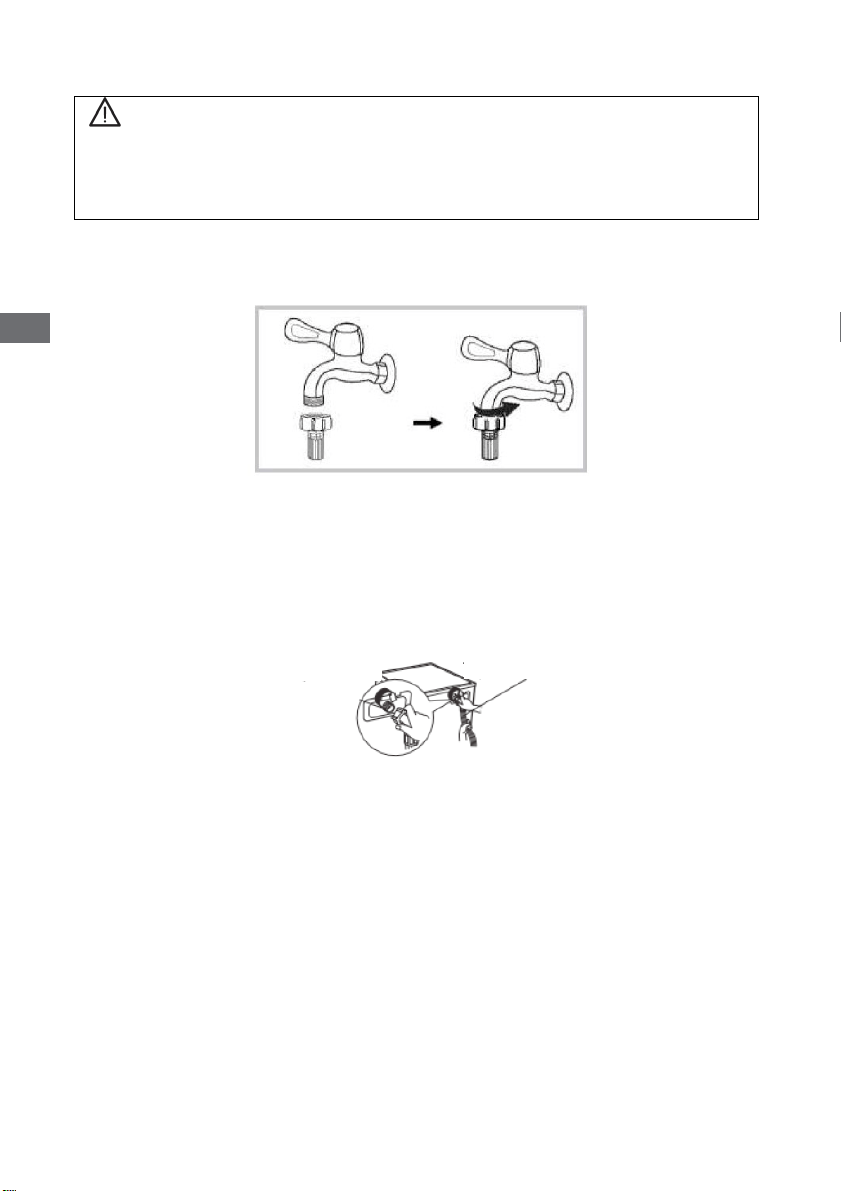
Connecting the water supply hose to a threaded tap
Threaded tap and water supply hose
Connect the other end of the water supply hose to the water
supply valve located on the back of the washing machine then
tighten down the hose by turning it clockwise.
Water supply hose
10
EN
Drain hose
Warning!
• Do not twist or extend the drain hose.
•
Position the drain hose correctly. If you do not perform
this operation correctly a water leak may occur.
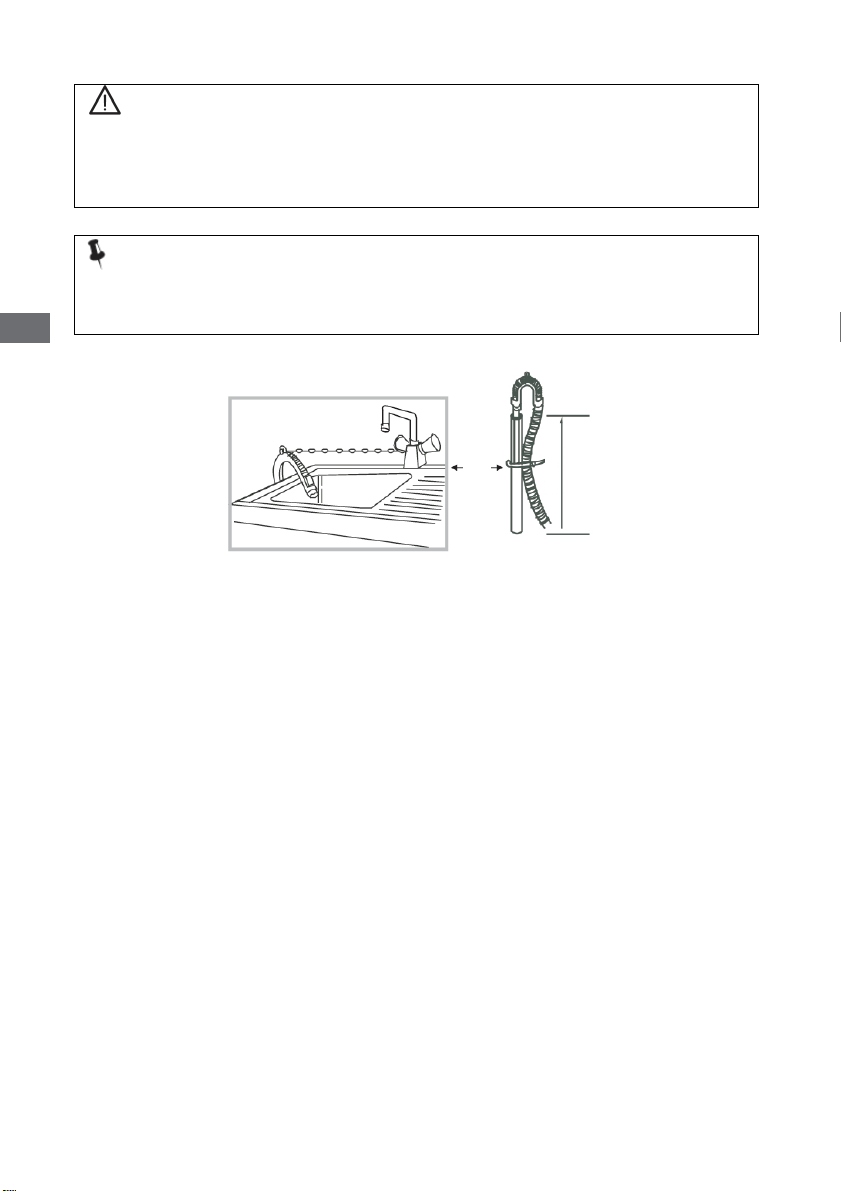
Note!
•
If the washing machine is provided with a drain hose
holder, install it as follows:
OR
Min. 60 cm
Max. 100cm
11
EN
Warning!
•
When you install a drain hose, attach it properly using a
cord.
• If the drain hose is too long, never attempt to insert part of
it into the washing machine by forcing it as this will cause
unusual noises.
Operation
Quick start
Warning!
•
Before using your washing machine for the first time,
always ensure that it is correctly installed.
•
Before using your washing machine for the first time,
perform a complete wash cycle empty.
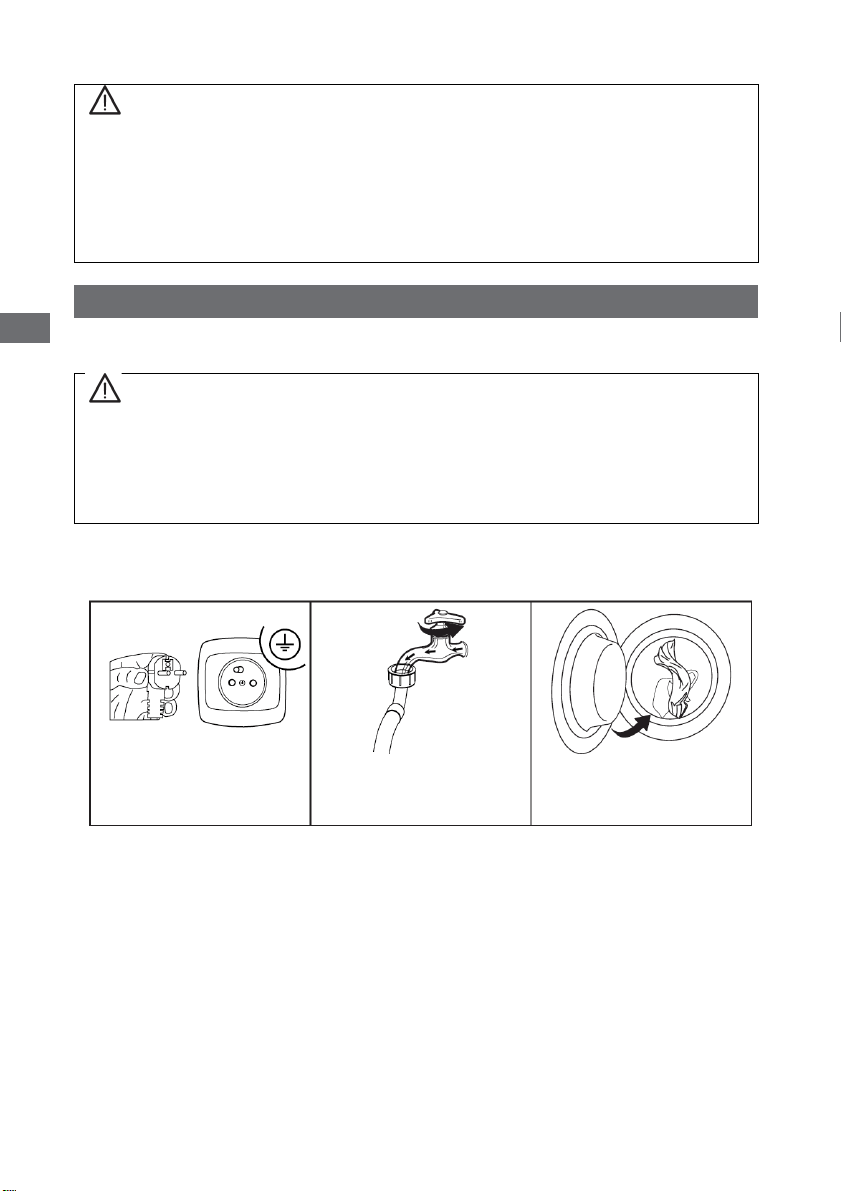
1. Before washing
2. Open the tap
3. Load the washing
machine
1. Connect the
power cord
12
EN
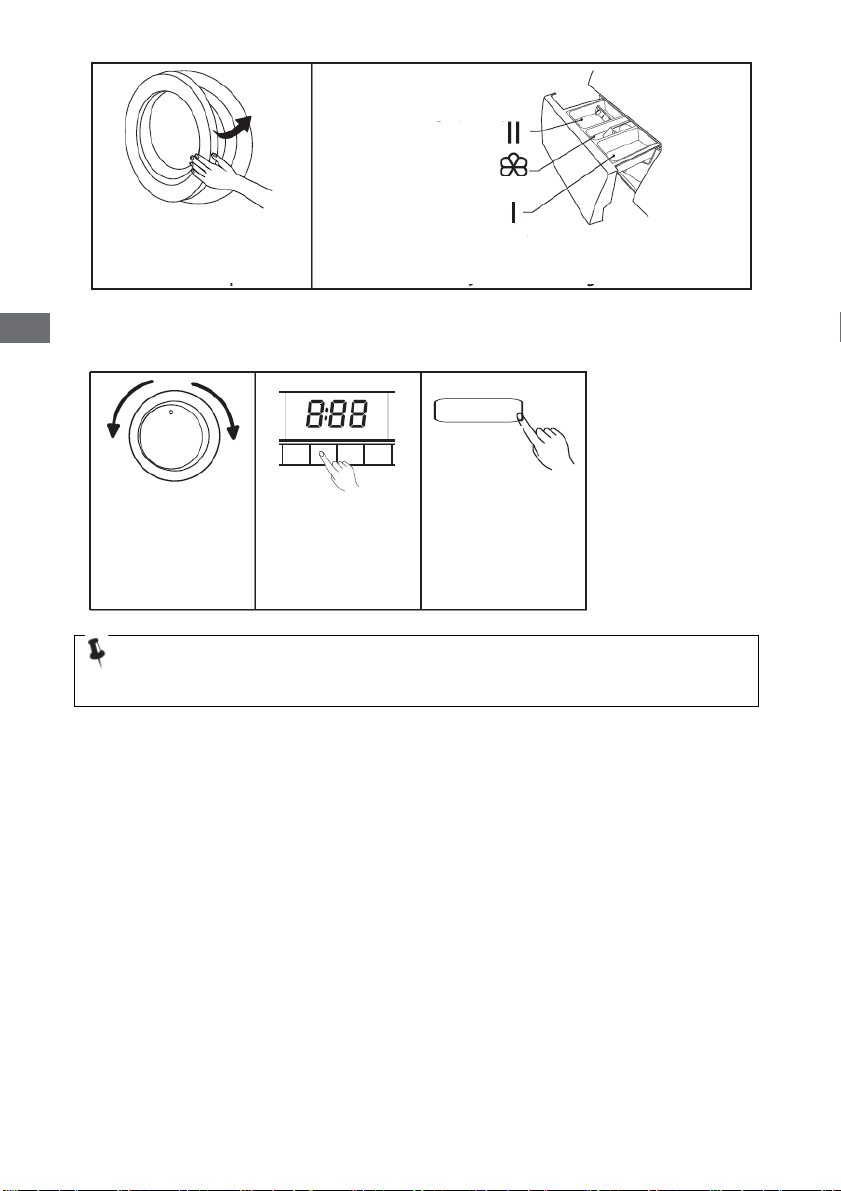
2. Washing
Note!
• If you use the default settings, you can skip step 3.
3. After washing
An audible beep is heard or End is displayed on-screen.
4. Close the door
Main wash detergent
Softener
Prewash
5. Add detergent
2. Select a
function or the
default settings
3. Start the
programme
1. Select the
programme
Start/Pause

13
EN
Before every wash
• Always read the washing labels on garments and the
explanations on how to use the detergent before washing.
Choose detergent that produces little or no foam for
optimum washing and to avoid any overflowing.
Refer to the instructions provided by the detergent maker
as shown on the detergent packaging.
Always read the garment
labels
Empty the pockets of
your clothes
Attach long
strings/ribbands, close
zippers and button
buttons
Place small size clothes
in pillowcases
If clothes have raise
fabric or suffer from
piling, turn them inside
out
Sort clothes by texture
Choosing the correct detergent
A washing care label symbol shows the right choice of detergent,
temperature and wash cycle.
14
EN
Type of textile
Programme
Detergent
White cotton
Cotton temp. ≤ 90°C
Detergent with whitening product
Colours made of linen or cotton
Cotton temp. ≤ 60°C
Colours without whitening product
Mixed fibres
Mixed temp. ≤ 60°C Colour wash
Synthetics
Synthetics temp. ≤ 60°C Colour/delicate wash
Delicate textiles
Wool temp. ≤ 40°C Detergent for delicate textiles
Wool
Wool temp. ≤ 40°C Detergent for wool
Warning!
•
If there are not enough clothes in the washing machine
this may unbalance the drum and cause the unbalance
detection to trigger, significantly reducing the spin speed.
•
Add a few clothes to remove the unbalance so that the
washing machine can spin at the
speed you have
selected.
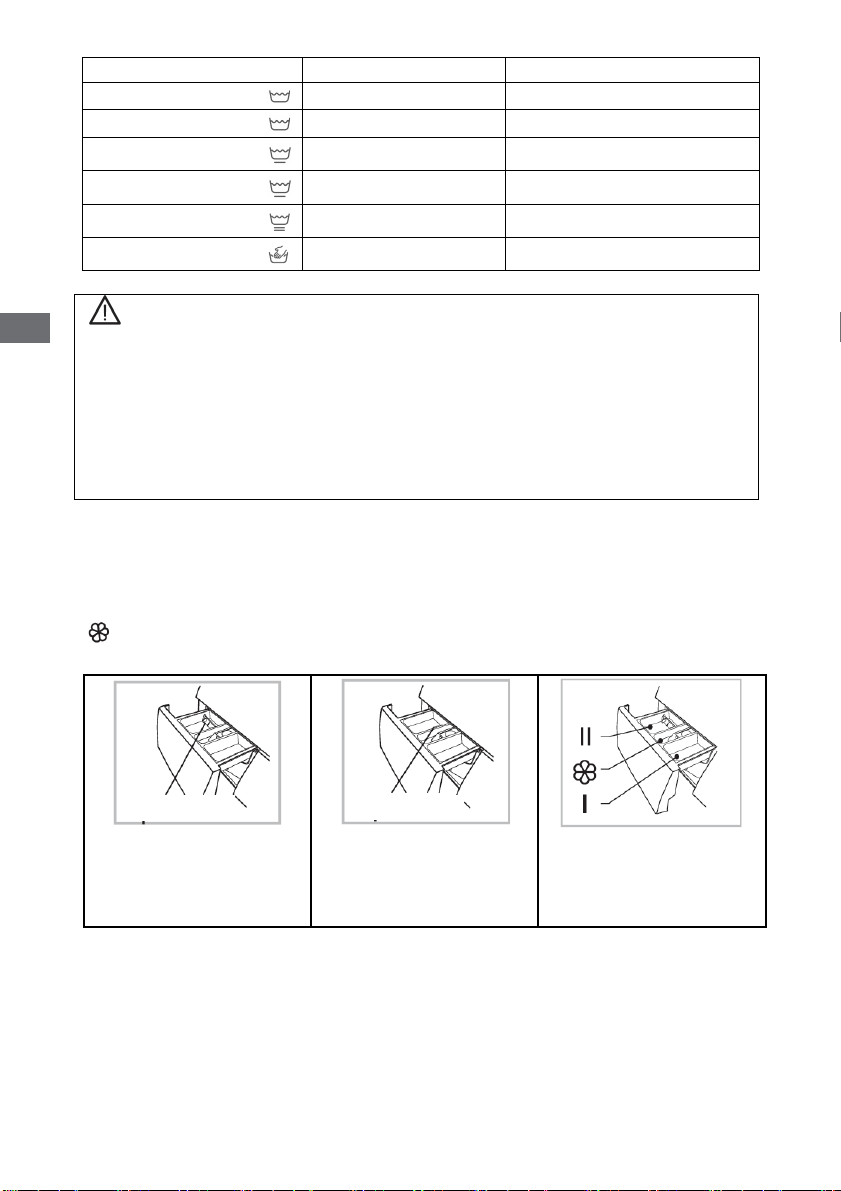
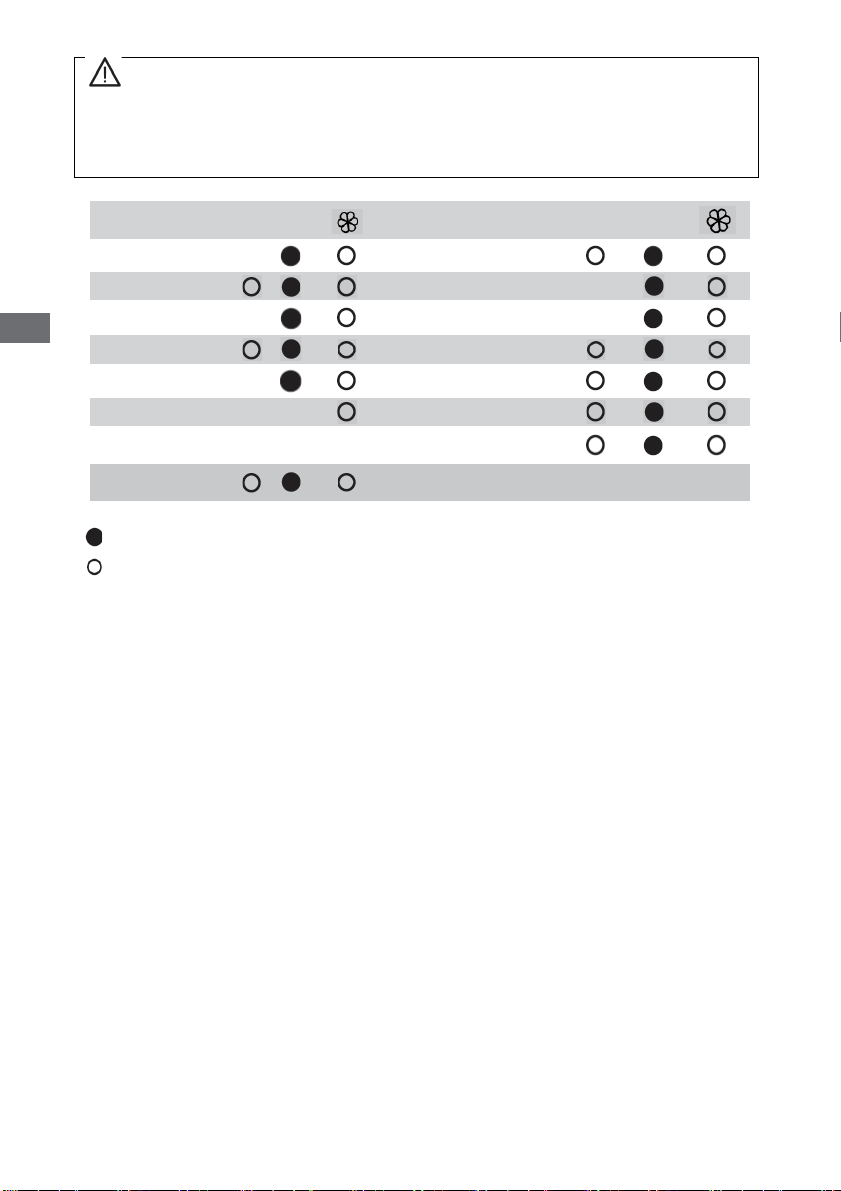
Detergent compartment
I
Prewash detergent
II
Main wash detergent
Softener
Liquid detergent Powdered detergent
Pull on the detergent tray
to open it
Separator
Separator
15
EN
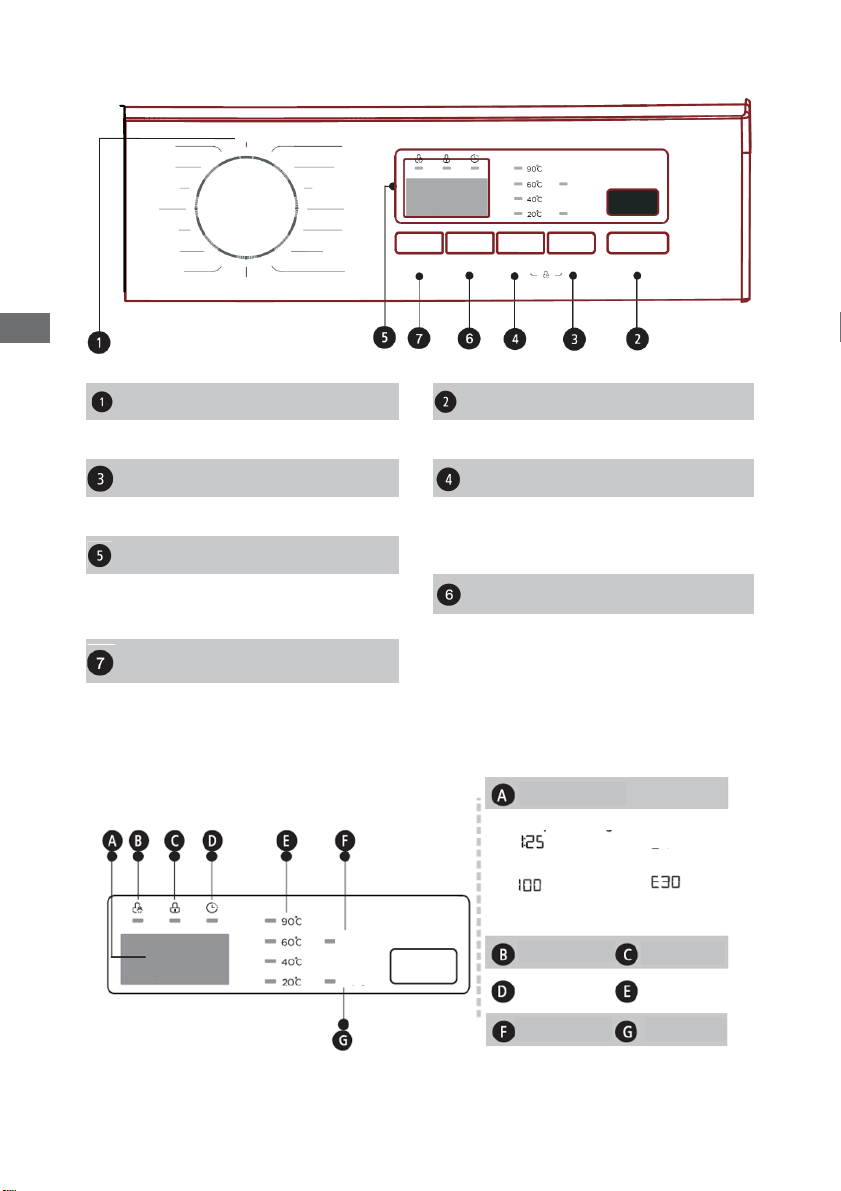
Warning!
• You only need to put detergent in c
ompartment I if you
selected the Prewash
function on washing machines
provided with this function.
Programme
I II
Programme I II
ECO 40
-60
Sportswear
Cotton
Wool
Quick 15’
20°C
Rapid 45'
Mix
Intensive
Jeans
Rinse and Spin
Baby care
Spin only
Synthetics
Bed linen
Must Do
Optional
Washing products
• Use washing products designed especially for washing machines:
- Powdered detergents for all kinds of textiles except delicate ones.
For these detergents, we recommend first diluting them with some water to
avoid clogging the detergent pipe causing water to overflow when washing
starts.
- Liquid detergents for all low temperature programmes for all kinds of
textiles or specialist liquid detergents (e.g. for woollens).
• Choose the detergent with care to match the required washing
temperature, to optimise washing while saving water and energy.
Excess dosages may cause poor rinsing and leave residual traces of
detergent. On the other hand, an inadequate dosage may cause poor
washing results.
16
EN
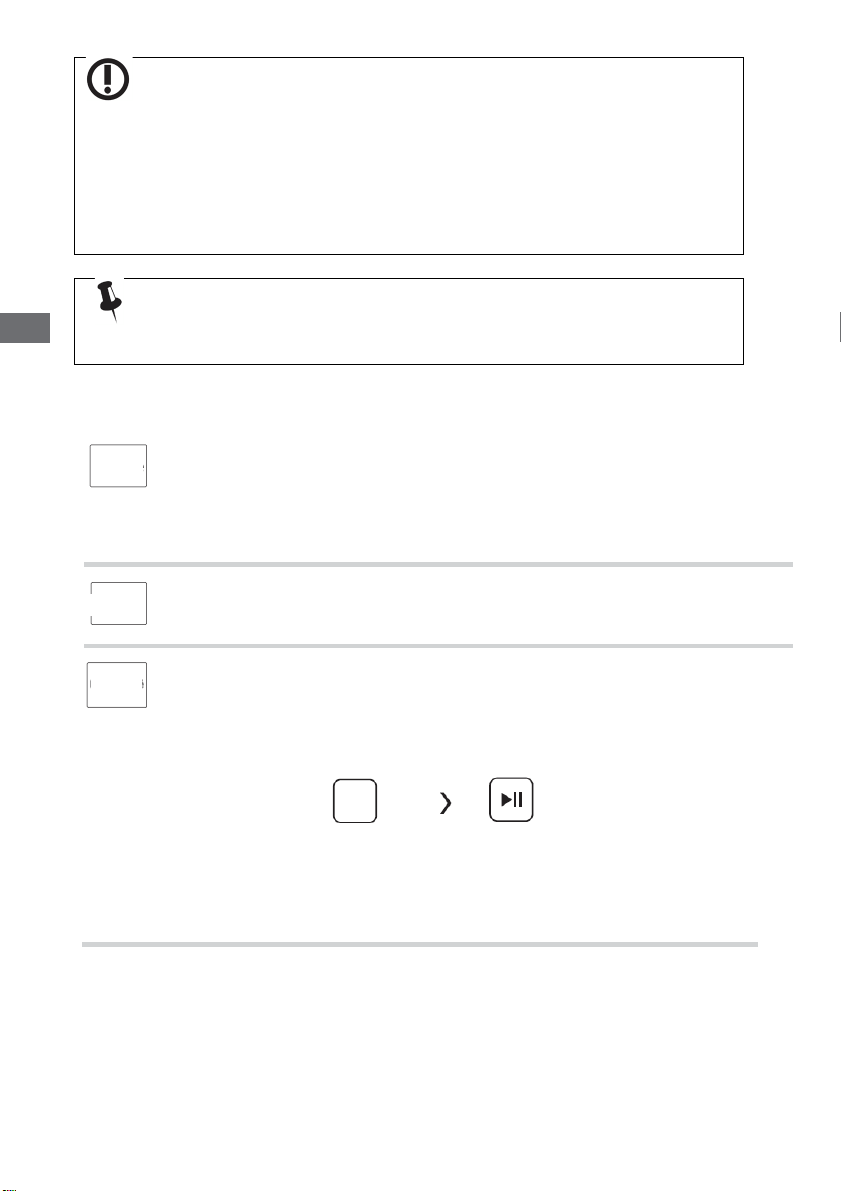
The control panel
Program dial
Start/Pause button
You can select the programme of your choice to match
your washing requirements.
Press to start the selected wash cycle.
Press during the cycle to pause it.
Options button
Temperature button
Successively press the button
to select the Prewash or Rinse Plus options.
Press this button to choose the desired temperature: the
light that matches your choice will come on. If no light is on,
then the water is at ambient temperature.
Display
The display shows the settings, the time remaining and
information on washing in progress.
It remains lit for the
entire cycle.
Spin speed button
Choose the spin speed for the selected washing
programme.
Delayed start/Pause button
This button is used to delay starting a washing cycle.
Press and hold the button until the desired time is
displayed (up to 24
hours).
Quick 15’
Rapid 45’
Sportswear
W ool
Baby car e
Bed linen
Rinse and Spin
Spin only
Off
Cotton
Intensive
Synthetics
Mix
Jeans
ECO 40
-60
20°C
Delayed start
Spin speed
Options
Start/Pause
Drum clean
Prewash
Rinse Plus
Drum clean
Prewash
Rinse
Pl
Temperature
Display
Child safety
Door lock
Delayed start
Temperature
Prewash
Rinse Plus
Delayed start
Error
Wash time
Spin speed
End
End
2 hours
17
EN
Warning!
•
To change a setting after starting the washing cycle, turn the mode selector to the
OFF position. Select the programme, the spin speed and the options again, then
press the Start / Pause button.
(Ensure that the child safety function is disabled or the initially selected programme
will continue to run.) Just before leaving the factory, the appliance is subject to a
last check when water is poured into the drum.
• Consequently, there may be water drops or condensation inside the washing
machine. This is not an indication of a malfunction.
Note!
•
When the appliance is started and used for the first time. There may be a slight
smell when the motor runs for the first time.
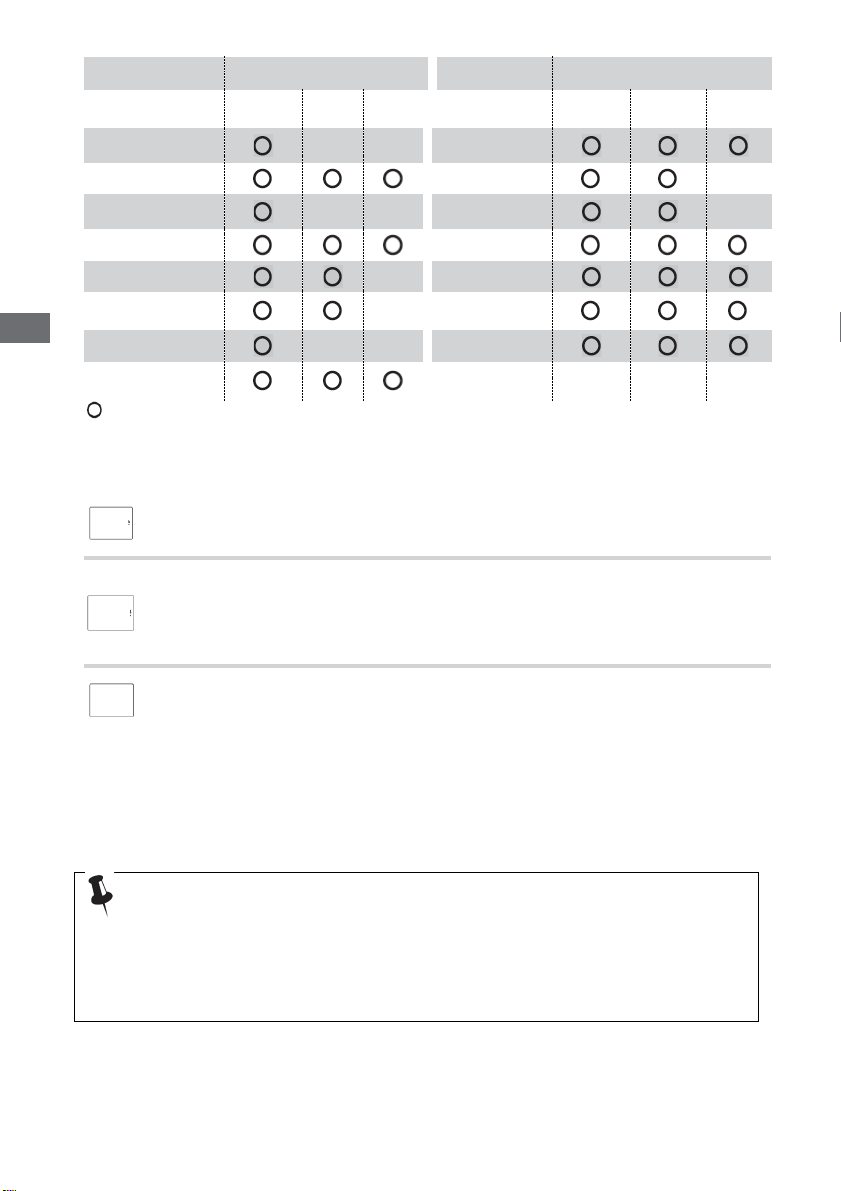
Options
Prewash
The Prewash option lets you perform an additional wash before the main wash.
This is a suitable option for eliminating dirt from your laundry.
You will need to place detergent in compartment (1) after choosing this option.
Rinse Plus
When this option is selected, your laundry will get an extra rinse.
Delayed start
Setting the delayed start function:
1. Choose the time by pressing the Delayed start function (you can select a delay
from 0 to 24 hours).
2. Press the Start/Pause button to start the Delayed start function.
Cancelling the delayed start function:
Press the Delayed start button until 0H is displayed. This operation cannot be
performed once the washing cycle is started. If the program has already started,
place the selector in the Off position to reset it.
Prewash
Rinse Plus
Delayed start
Delayed
start
Setting the time
Start/Pause
18
EN
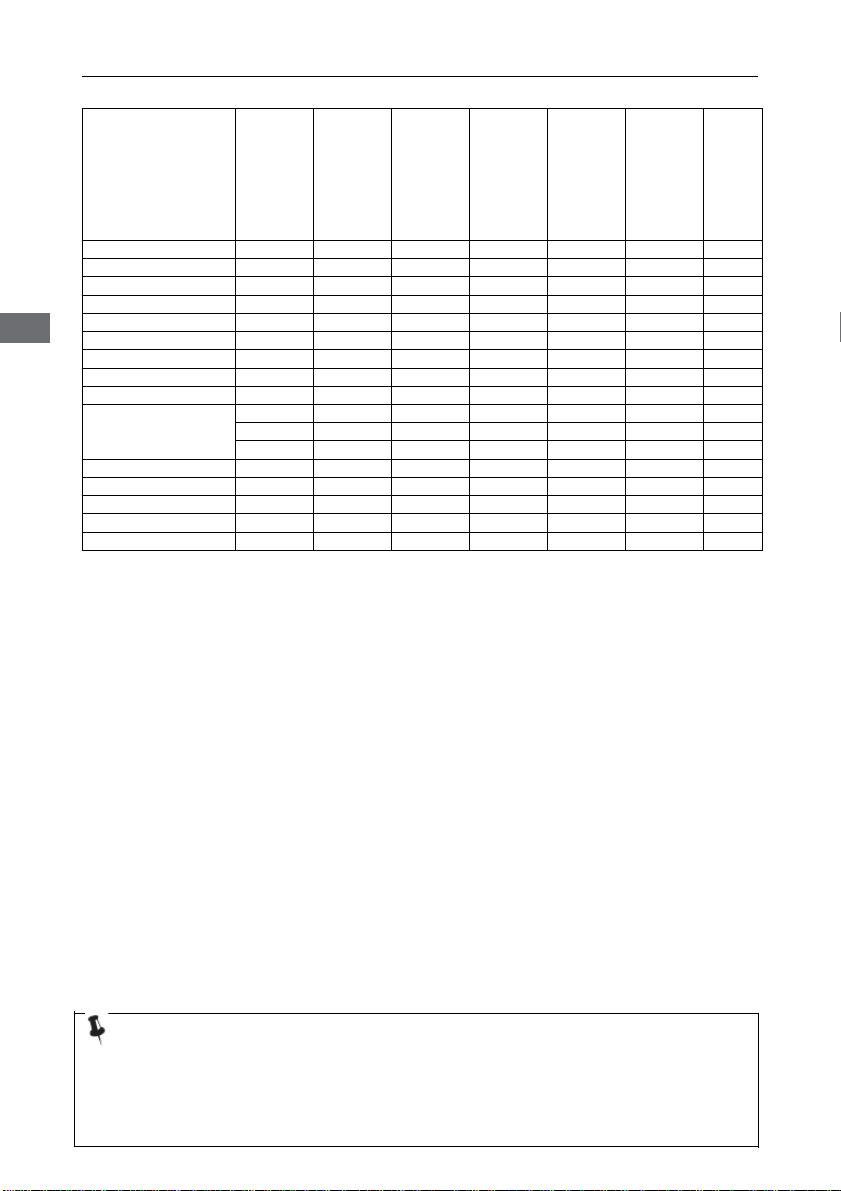
Programme Options Programme Options
Delayed
start
Rinse
Plus
Prewash Delayed start Rinse Plus Prewash
ECO 40-60
Sportswear
Cotton
Wool
Quick 15’
20°C
Rapid 45'
Mix
Intensive
Jeans
Rinse and Spin
Baby care
Spin only
Synthetics
Bed linen
Optional
Other options
Temperature
Press the Temperature button until the desired temperature is obtained. (Cold, 20°C,
30°C, 40°C, 60°C, 90°C).
Spin speed
Press the spin speed button until the desired spin speed is displayed.
0-400-600-800-1000-1200 1400
Drum clean
After 25 washing cycles, the Drum clean light comes on showing that cleaning is
recommended.
This special programme is used to disinfect the machine at a temperature of 90°C. Press
the button to start the programme.
Once the drum clean has been run, a new 25-cycle count starts.
If you do not wish to run a drum clean cycle, press the Drum clean button for three
seconds. The light will go out and you can start a normal wash cycle.
Note!
•
This program is run with the machine empty. Do not place any
laundry in the machine during this cycle.
We recommend using this programme to
improve hygiene and to
extend the life of your washing machine.
Temperature
Spin speed
Drum
clean
19
EN
Warning!
• If a power break occurs when the washing machine is running, the
internal memory saves the selected program. Once the power has
returned, press the Start/Pause button to resume the programme.
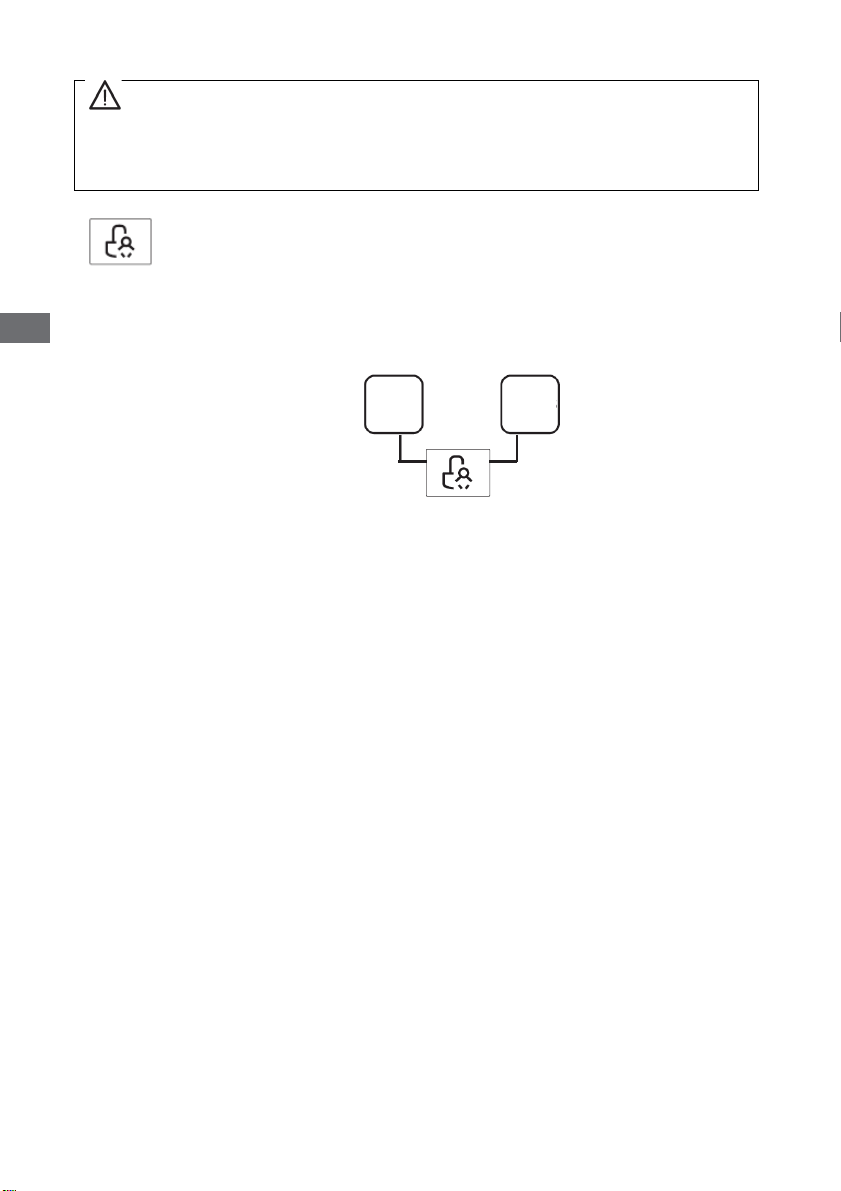
Child safety lock
This function is used to lock the buttons so that the current
program cannot be changed especially when a child plays with
the keys.
Press Temperature and Options at the same time for three
seconds, until a beep is heard.
Temp.
Options
20
EN
Warning!
• To disable to Child safety lock, press the same two buttons for three
seconds.
• The Child safety lock function will lock all of the buttons except for the
selector.
• When you switch the appliance off, the Child safety lock is disabled.
• The Child safety function remains active when the washing machine
restarts after a power break.
Switching off the audible beep
Press the button for three seconds to switch off the audible
beep
Perform the same action to restart it.
The last setting will be retained until the next reset.
Warning!
• After switching off the audible beep, the appliance no longer makes
any sound.
Spin speed

21
EN
Programmes
T
he programmes are adapted to the kind of laundry.
P
rogrammes
C
otton
T
his programme is suited to a load consisting of resistant white or
c
oloured cotton.
S
ynthetics
T
his programme is ideal for a load consisting of resistant synthetics.
B
aby care
T
his program improves rinse performance to remove as much
det
ergent residue as possible. This serves to better protect a baby's
s
kin.
R
apid 45'
T
his programme is used to quickly wash a small load of laundry that
i
s not very dirty.
Mi
x
T
his programme is ideal for a load consisting of mixed fibres.
20°
C
T
his low temperature washing programme is recommended for
w
ashing and protecting colours.
J
eans
T
his programme is specially intended for washing jeans.
I
t reduces colour washout and its more intensive rinse avoids any
r
esidual traces of detergent.
Q
uick 15’
T
his programme is used to very quickly wash a small load of laundry
t
hat is not very dirty.
I
ntensive
T
his programme is intended for dirty laundry, increasing the drum
r
otation rate and cycle time.
W
ool
T
his programme is specially intended for protecting your woollens.
T
hanks to longer soaking periods, your woollens will be washed
gent
ly.
S
pin only
T
his programme is used to only spin your clothes by choosing the
des
ired spin speed.
R
inse and Spin
T
his programme is used to simply rinse and spin your clothes.
E
CO 40-60
T
his programme is used to wash your laundry at 40°C (a temperature
t
hat cannot be changed), while optimising water and power
c
onsumption.
S
portswear
T
his washing programme is used to preserve the elastic fibres in
s
portswear so that they do not stretch and they retain their technical
pr
operties.
B
ed linen
T
his programme is specially intended for washing bedding.
T
his intensive cycle ensure in-depth washing and additional rinsing.
22
EN
Washing programme table
WFB190WA
Cycle
Rated capacity in
kg
Cycle duration in
hours:minutes
Power
consumption
in kWh
Water consumption
in litres
Temperature in °C
Remaining
moisture content
Spin speed
Cotton 9.0 2:40
1.15
75 40 60.0% 1200
Synthetics 4.5 2:20
0.7
60 40 35.0% 1200
Baby care 9.0 1:43 1.5 70 60 70.0% 800
Jeans 9.0 1:45 1.5 70 60 70.0% 800
Mix 9.0 1:20 0.9 70 40 70.0% 1200
20 °C 4.5 1:01
0.25
60 20 65.0% 600
Rinse and Spin 9.0 0:20 0.065 25 15 60.0% 800
Spin only 9.0 0:12 0.055 - - 60.0% 800
Intensive 9.0 3:48
1.2
70 40 70.0% 800
ECO 40-60
9.0 3:48 1.295
64
39 53.0% 1200
4.5 2:54 0.848 50 35 53.0% 1200
2.5 2:54
0
.
51
38
24 53.0% 1200
Bed linen 9.0 1:48
1
70 40 70.0% 800
Wool 2.0 1:07
0.5
55 40 80.0% 600
Sportswear 4.0 0:45
0.25
50 20 65.0% 800
Rapid 45' 2.0 0:45 0.75 40 40 70.0% 800
Quick 15’ 2.0 0:15 0.05 40 15 75.0% 800
The EU energy efficiency classification is: E.
Energy efficiency test programme: ECO 40-60.
Speed: the highest; other settings are set to their default
values.
Half-load for a washing machine with a capacity of 9.0kg:
4.5kg.
ECO 40-60 is the recommended program designed to
minimize water consumption for normally soiled load at rated
capacity.
The ECO 40-60 program is suitable for washing cotton items
that are normally dirty and suitable for washing in the same
cycle at 40°C or 60°C. This is the programme used to assess
compliance with the European Union's eco-design regulations.
Note!
• The values provided for programmes other than the ECO
40-60 program are provided as an indication only.
For WELS (Water Efficiency Labeling Scheme) Singapore,
ECO 40-60 is the recommended program for normally soiled
load equal to the rated capacity.
23
EN
Maintenance
Cleaning and Care
Warning!
• Always switch off the appliance and turn off the water tap
before any maintenance operations.
Cleaning the exterior of your washing
machine
Suitable maintenance will optimise the service
life of your washing machine. Appliance
surfaces can be cleaned with neutral non-
abrasive detergents diluted where necessary. If
the water overflows, wipe it up immediately.
Never use sharp objects.
Note!
•
Do not use formic acid and its diluted solvents or
equivalents such as alcohol, solvents or chemicals, etc.
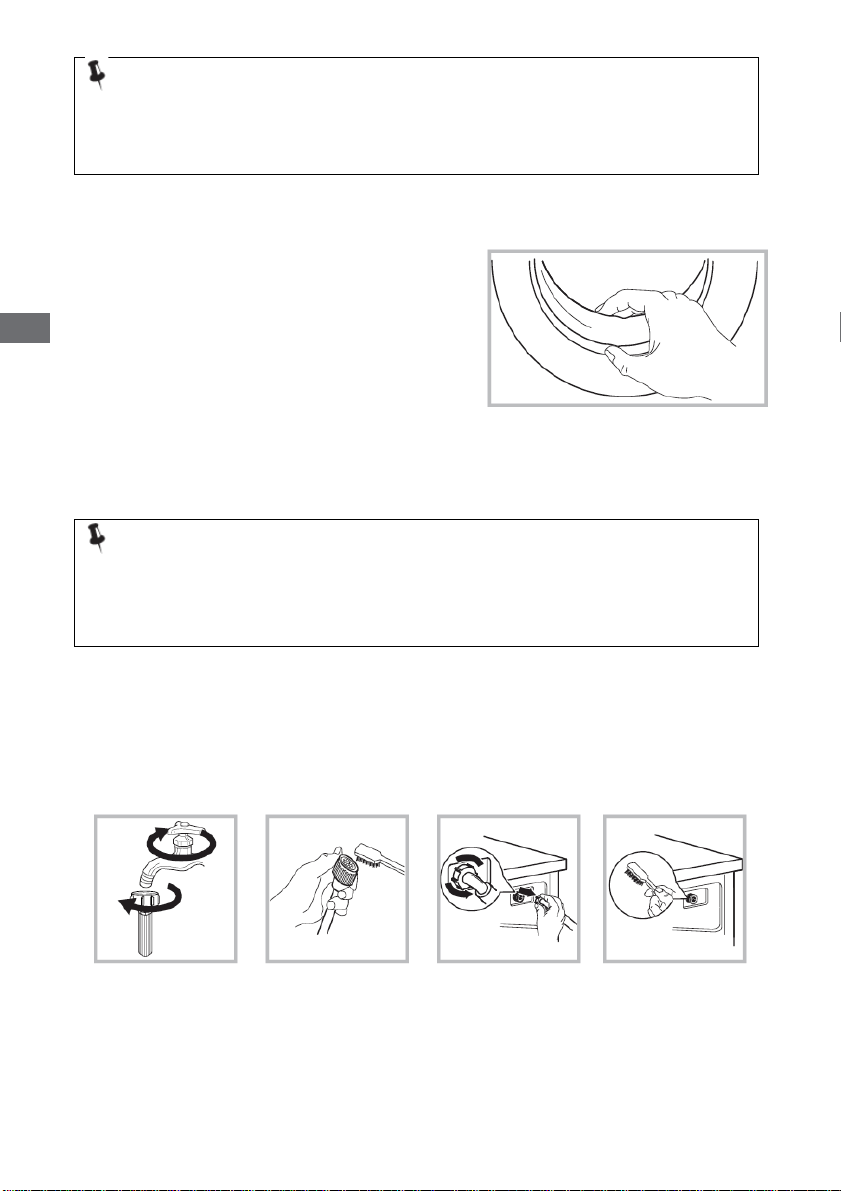
Cleaning the drum
Any rust left inside the drum by metal articles must be removed
immediately with chlorine-free detergent.
Never use steel wool.
24
EN
Note!
• Do no
t put laundry in the washing machine during the
drum cleaning.
Cleaning the door and window seal
Wipe the window and seal after
each wash to remove lint and
stains. If lint builds up, it can cause
leaks.
Remove coins, buttons and other
objects trapped in the seal after
every wash.
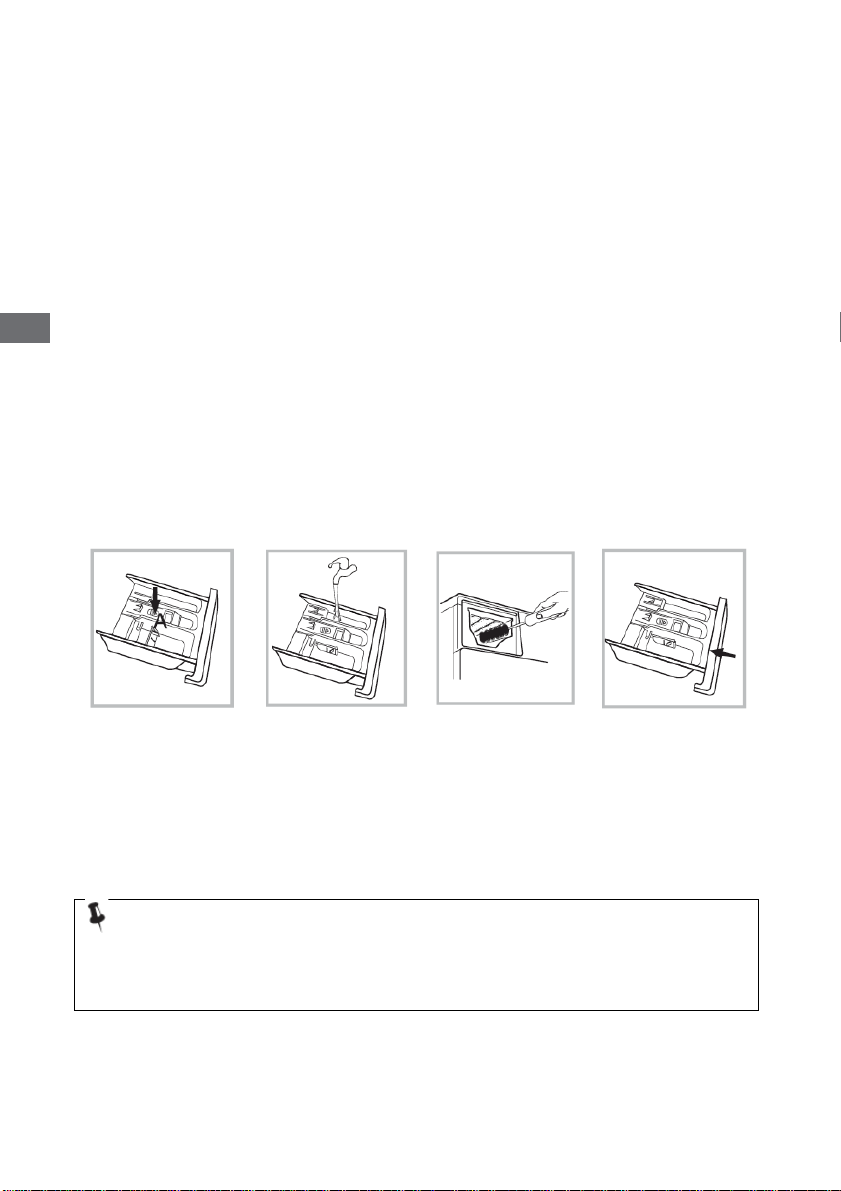
Cleaning the water supply hose filter
Note!
• If there is hardly any water in the appliance and the tap is
open, then the water supply hose filter needs to be
cleaned.
1. Close the tap
2. Remove the Water Inlet Hose from the tap.
3. Clean the filter.
4. Reconnect the water inlet hose.
25
EN
Cleaning the washing machine filter
1. Unscrew the water inlet hose from the back of the
machine.
2. Remove the filter using a pair of pliers.
3. Use a brush to clean the filter.
4. Refit the filter once cleaning is finished.
5. Reconnect the water inlet hose.
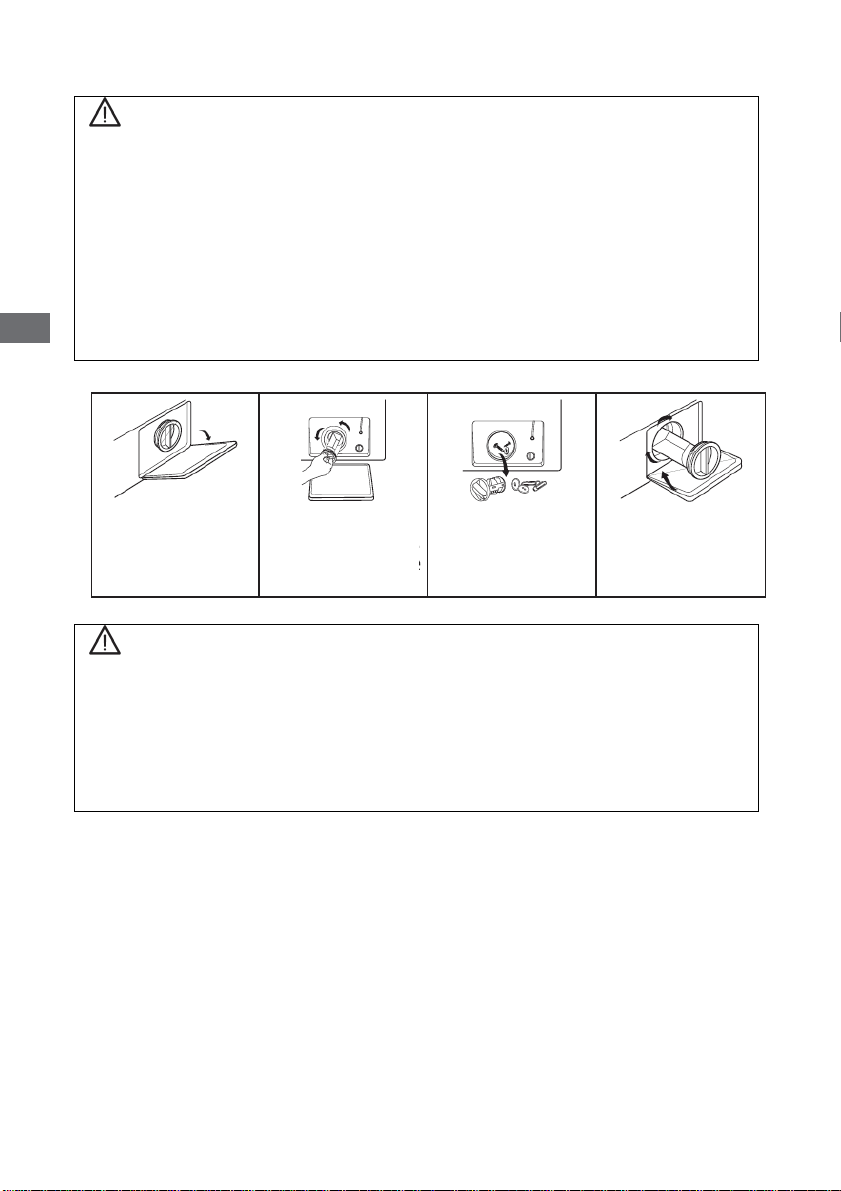
Cleaning the detergent compartment
If you observe any dirtying of the detergent drawer, clean it.
To do this:
1. Press down on the clip inside the detergent drawer as
shown by the arrow.
2. Release the drawer and remove it so that you can wash it
out with water.
3. Clip the drawer back into place and close it.
1. Open the detergent
drawer by pressing on
A
2. Clean the detergent
drawer under running
water
3. Clean the inside of
the compartment
where the detergent
draw fits, using an old
toothbrush, for
example.
4. Refit the detergent
drawer
Note!
•
Do not use alcohol, solvents or chemicals to clean the
washing machine.
26
EN
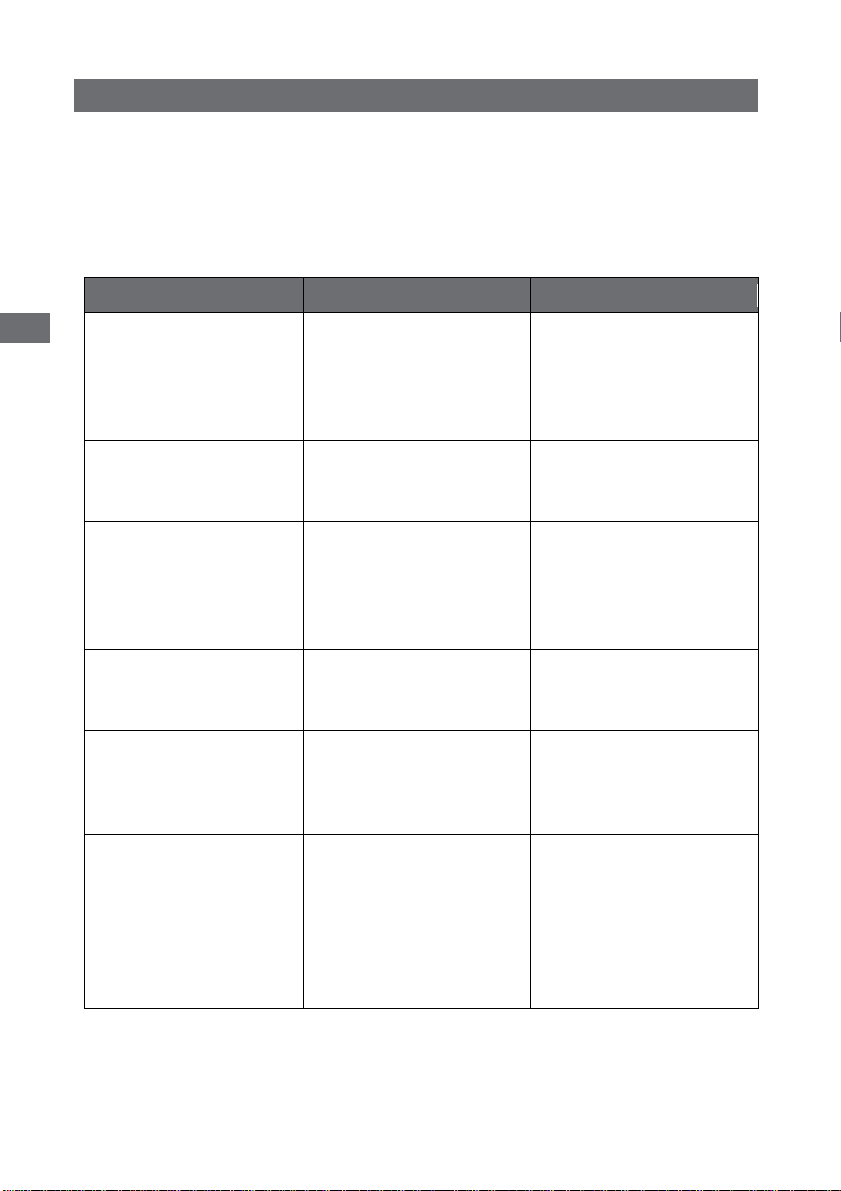
Cleaning the drain pump filter
Warning!
• Beware of hot water!
•
Disconnect the appliance to avoid any electric shock
hazard.
• The drain pump filter filters out lint and other small debris
present in the laundry.
•
Clean the filter regularly to ensure proper washing
machine operation.
Warning!
•
Ensure that the filter is properly refitted to avoid any
leakage.
• When the washing machine is running, never remove the
filter. This operation must only be performed with the
washing machine switched off.
Preventing scale build-up
If you live in an area with hard water, we recommend using a
washing machine descaling product. Regularly check for any
scale build-up in the drum. If necessary, run an empty drum
washing cycle with a descaling product. Refer to the
instructions provided by on the product packaging.
1. Open the service
flap
2. Remove the filter
by turning it counter
clockwise
3. Remove any
debris
4.
Refit the filter then
close the service
cover
27
EN
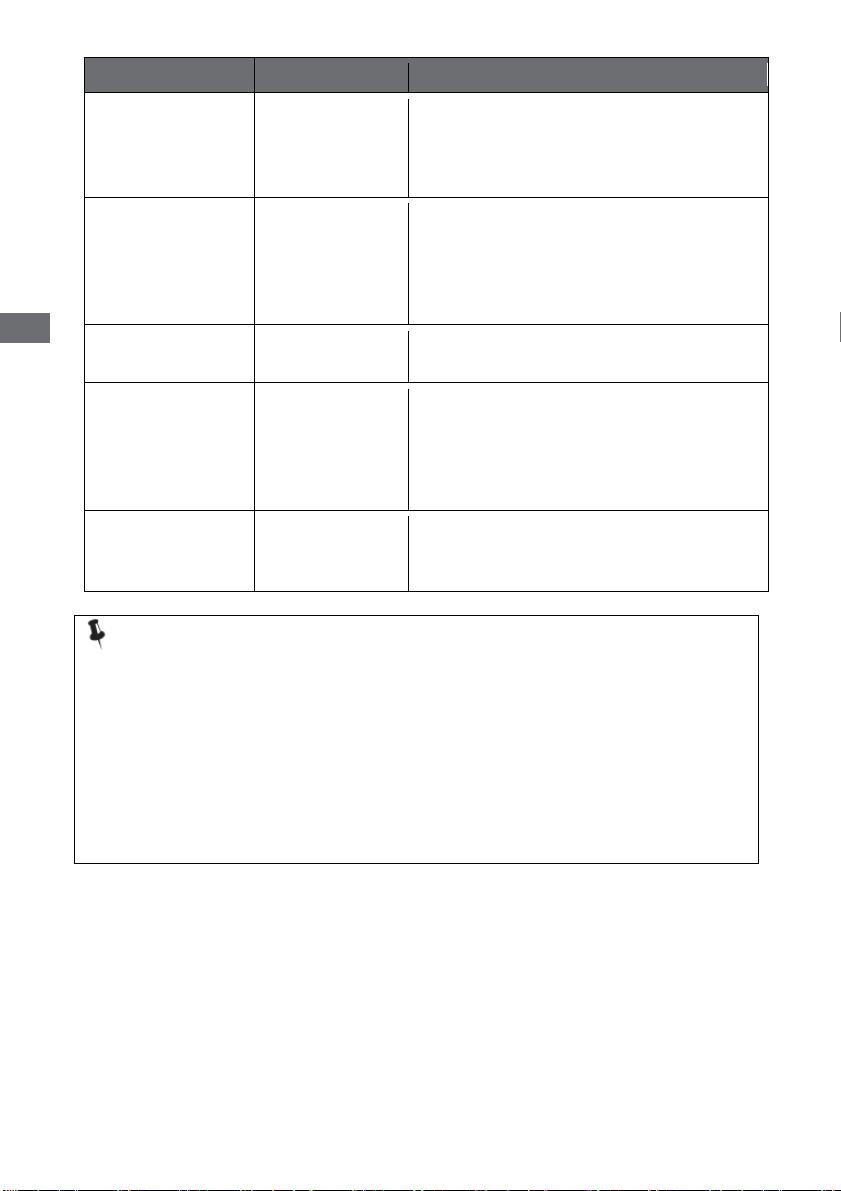
Troubleshooting
The washing machine cannot start up or stops during
operation.
First attempt to solve the problem. If you cannot, then contact
the service centre.
Description
Cause
Solution
Washing machine
cannot start up
The door is not properly
closed
Switch the washing
machine back on after
closing the door
Check whether any
clothes are trapped
Door cannot be
opened
Washing machine's
safety protection
system is working
Disconnect the power,
reconnect it and switch
the machine back on
Water leakage
The connection
between the washing
machine and the water
supply hose or the drain
hose is not tight
Check the water pipes
and tighten the
connections
Clean the drain hose
Detergent residues in
the detergent
compartment
The detergent is
dampened and
agglomerated
Clean and dry the
compartment
Washing machine
lights or display do not
light up
The appliance is not
switched on. Circuit
problem. Connection
problem.
Check that the power is
on and that the power
cord is properly
connected.
Unusual noise
Make sure that the
transit bolts have been
removed
Make sure that the
washing machine is
installed on a solid and
level floor
28
EN
Description
Cause
Solution
E30
The door is not
properly closed
Close the door properly and restart the
washing machine
Check whether any clothes are
trapped
E10
Problem adding
water during
washing
Check whether the water pressure is
too low
Straighten the water supply hose
Check the water supply filter is not
blocked
E21
Water drainage
takes too long
Check if the drain hose is blocked
E12
Water leakage
Run another programme
If error code E12 is still displayed, turn
off the water supply, disconnect the
washing machine and call your after
sales service
EXX
Others
Do not hesitate to reset the washing
machine contact our after sales
service if the issues remain
Note!
• Once this check is complete, start the washing machine. If
the problem occurs again or if the error codes are
displayed again, contact your after sales service.
• Any attempt made by the user or a non-professional to
repair the appliance may affect user safety and void the
appliance warranty.
29
EN
Performing your own repairs
Some repairs may be carried out by the user in certain cases.
The sav.groupebrandt.com website offers you the option of
ordering certain spare parts as well as bringing you access to
technical data and safety instructions to guide you through
troubleshooting. In line with the stipulations of Article L441-5 of
the French Consumer Code (Code de la Consommation), the
manufacturer cannot be held liable for any damage that occurs
while performing your own repairs insomuch as this damage is
linked to improper procedures by the user or any failure by the
latter to follow the instructions for repairing the product.
Availability of spare parts
The minimum length of time for making available spare parts
listed in European Regulation 2019-2023-EU and accessible
especially to the appliance user is 14 years under the terms
set out in the above regulation.
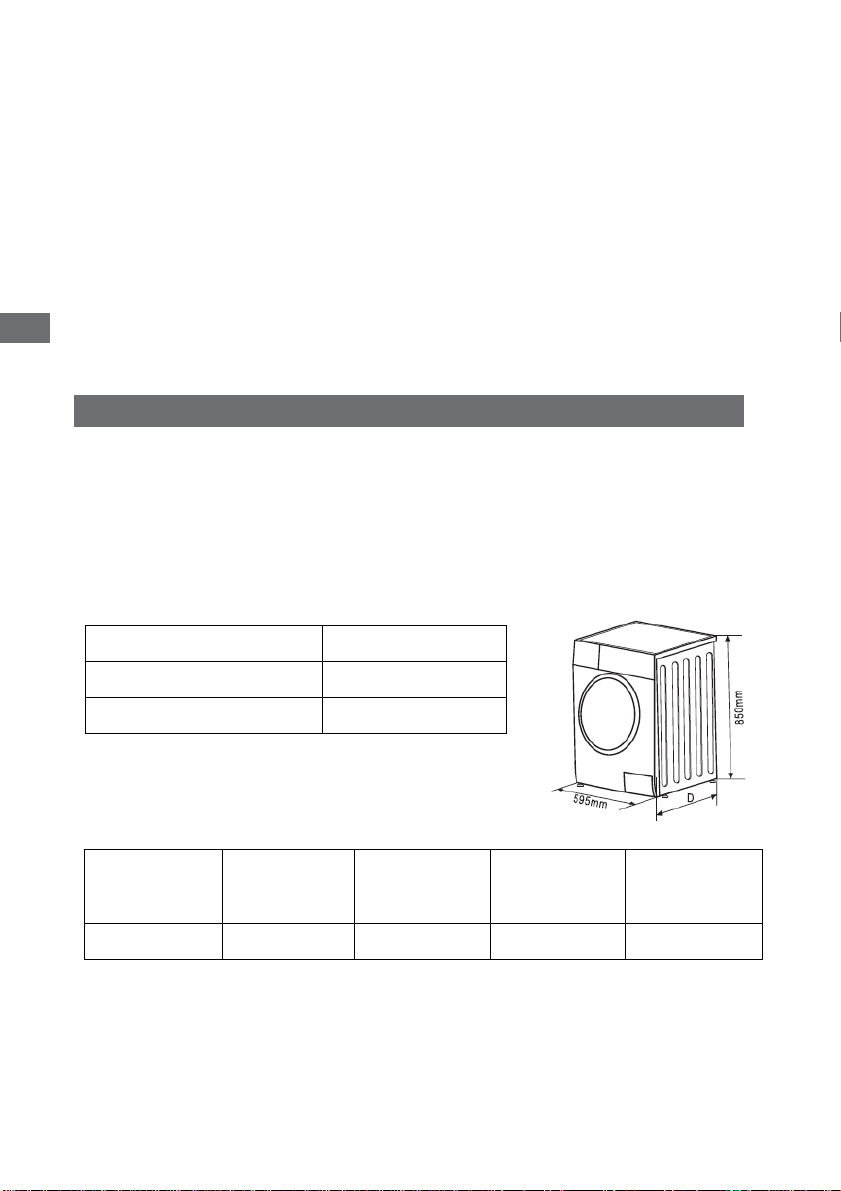
Technical specifications
Power supply 220-
240V~/50Hz
Maximum current 10 A
Stan
dard water pressure
0.05 MPa
-1 MPa
Model Was
hing
capaci
ty
Dim
ensions
(W x D x
H
mm)
Net w
eight
Rated
power
WFB
190WA
9.0kg 595*565*
850
71kg 2000W

30
EN
General information on regulation
EU 2019-2023
• When using the test programmes, wash the specified load
using the maximum spin speed.
•
The actual parameters will depend on how the appliance
is used and may differ from the preset parameters.
•
This domestic washing machine is equipped with a
system for managing energy consumption. The time spent
in the mode left to run is less than one minute.
•
The most effective programs from a power and water
consumption point of view are generally those that run at
low temperature for a longer duration.
•
Loading the domestic washing machine to the maximum
capacity stated by the manufacturer for each programme
contributes to saving power and water.
• The noise and remaining moisture content are influenced
by the
spin speed: the higher the spin speed during the
spin phase, the higher the noise level and the lower the
remaining moisture content of the laundry.
•
To access the data on your model, stored in the product
database in line with regulation (EU) 2019/2014 and data
relating to energy labelling, please connect to the
dedicated website at https://eprel.ec.europa.eu/
Find the reference of your appliance on the website by
entering the service reference shown on the ID plate on
your appliance. Another way to access this information is
to flash the QR code found on the energy label on your
product.

31
EN
AFTER-SALES SERVICE
Any repairs to your appliance must be made by a qualified professional accredited
to work on the brand. When calling, please provide the full references of your
appliance (commercial reference, service reference, serial number), so that we can
handle your call more efficiently. This information can be found on the data plate.
This symbol on the product or in the instructions means that
your electrical and electronic equipment should be disposed
at the end of its life separately from your household waste.
There are separate collection systems for recycling in the
European Union.
For more information, please contact the local authority or
your retailer where you purchased the product.