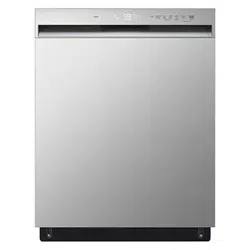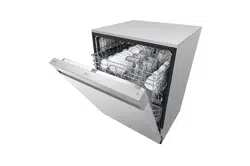
OWNER'S MANUAL
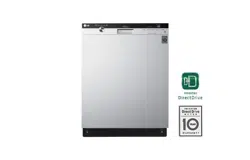
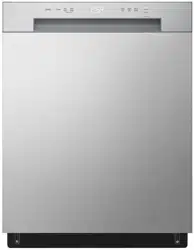
DISHWASHER
ENGLISH
LDFC242**
MFL69261741
Rev.00_012023
www.lg.com
Copyright © 2023 LG Electronics Inc. All Rights Reserved.
Read this owner’s manual thoroughly before operating the appliance
and keep it handy for reference at all times. This abridged owner's
manual addresses user safety, precautions, and installation
information.
To view the complete owner's manual, you may:
1. Online manual: Visit the LG website at: http://gscs-manual.lge.com/
Total/HQ/GatewayPage/main.html or scan the QR code above; or
2. Printable PDF manual: Visit lg.com and search for your model
number; or
3. Call or write to customer service as provided in your Limited
Warranty.
Scan to see the online manual.
en-us_main.book.book Page 1 Friday, January 20, 2023 8:33 AM

TABLE OF CONTENTS
2
3 IMPORTANT SAFETY
INSTRUCTIONS
3 READ ALL INSTRUCTIONS BEFORE USE
3 WARNING STATEMENTS
6 CAUTION STATEMENTS
7 PRODUCT OVERVIEW
7 Product Features
9 INSTALLATION
9 Before Installing
10 Preparing Cabinet Opening
11 Preparing Water and Electrical Connections
12 Preparing Dishwasher
13 Sliding Dishwasher into Cabinet Opening
15 Connecting Water Supply Line and Power
17 Connecting the Drain Hose
18 Leveling Dishwasher
19 Securing Dishwasher in Cabinet Opening
20 Final Installation Check
22 OPERATION
22 Before Using
23 Control Panel
24 Wash Cycles
24 Options and Extra Functions
25 Loading the Dishwasher
26 Loading the Silverware Basket
26 Loading the Lower Rack
27 Loading the Upper Rack
27 Adding Cleaning Products
29 SMART FUNCTIONS
29 LG ThinQ Application
30 MAINTENANCE
30 Cleaning and Care
34 TROUBLESHOOTING
34 Before Calling for Service
36 LIMITED WARRANTY
36 USA
en-us_main.book.book Page 2 Friday, January 20, 2023 8:33 AM
3IMPORTANT SAFETY INSTRUCTIONS
ENGLISH
IMPORTANT SAFETY INSTRUCTIONS
READ ALL INSTRUCTIONS BEFORE USE
Safety Messages
Your safety and the safety of others are very important.
We have provided many important safety messages in this manual and on your appliance. Always read and
follow all safety messages.
All safety messages will tell you what the potential hazard is, tell you how to reduce the chance of injury,
and tell you what may happen if the instructions are not followed.
WARNING STATEMENTS
WARNING
• To reduce the risk of explosion, fire, death, electric shock, scalding or injury to persons when using this
product, follow basic precautions, including the following:
Installation
• Connect to a properly rated, protected, and sized power circuit to avoid electrical overload.
• To reduce the risk of severe injury or death, follow all installation instructions.
• The appliance must be installed and electrically grounded by qualified service personnel in accordance
with local codes.
• Disconnect the power supply line, house fuse or circuit breaker before installing or servicing the
appliance.
• When moving or installing the product in a different location, call qualified service personnel for
installation and service.
• Keep packing materials out of the reach of children. Packaging material can be dangerous for children.
There is a risk of suffocation.
• Moving or installation of the appliance requires two or more people.
• This appliance is not designed for maritime use or for mobile installations such as in RVs, trailers, or
aircraft.
• Store and install the appliance where it will not be exposed to temperatures below freezing or exposed
to outdoor weather conditions.
• This appliance must be positioned near to an electrical power supply.
• Do not, under any circumstances, cut or remove the ground from the power supply line.
This is the safety alert symbol.
This symbol alerts you to potential hazards that can kill or injure you and others. All safety messages
will follow the safety alert symbol and either the word WARNING or CAUTION.
These words mean:
WARNING
You may be killed or seriously injured if you do not follow instructions.
CAUTION
You may be injured or cause damage to the product if you do not follow instructions.
en-us_main.book.book Page 3 Friday, January 20, 2023 8:33 AM
4 IMPORTANT SAFETY INSTRUCTIONS
• When installing or moving the appliance, be careful not to pinch, crush, or damage the power supply
line.
• Do not install the appliance in humid spaces.
• Destroy the carton, plastic bag, and other packing materials after the appliance is unpacked. Children
might use them for play. Cartons covered with rugs, bedspreads, or plastic sheets can become airtight
chambers.
• Never attempt to operate this appliance if it is damaged, malfunctioning, partially disassembled, or has
missing or broken parts, including a damaged power supply line.
• Adhere to all industry recommended safety procedures including the use of long-sleeved gloves and
safety glasses.
• The installer must ensure that the dishwasher is completely enclosed at the time of installation.
• Use new hoses when connecting the appliance to the water supply. Do not reuse old hoses.
• After installing, check the hose connection for leaks.
• Do not damage or place heavy items on the power supply line of the appliance.
Operation
• Repair or immediately replace all power supply lines that have become frayed or otherwise damaged. Do
not use a power supply line that shows cracks or abrasion damage along its length or at either end.
• If you detect a strange sound, a chemical or burning smell, or smoke coming from the appliance, unplug
it immediately, and contact an LG Electronics customer information center.
• Never unplug the appliance by pulling on the power supply line.
• Do not use an extension cable or adapter with this appliance.
• Do not grasp the power supply line or touch the appliance controls with wet hands.
• Do not modify or extend the power cable.
• If the product has been submerged, contact an LG Electronics customer information center for
instructions before resuming use.
• Do not store or use gasoline or other flammable vapors and liquids in the vicinity of this or any other
appliance.
• Keep the area underneath and around your appliances free of combustible materials (lint, paper, rags,
etc.), gasoline, chemicals and other flammable vapors and liquids.
• This appliance is not intended for use by persons (including children) with reduced physical, sensory or
mental capabilities, or lack of experience and knowledge, unless they have been given supervision or
instruction concerning the use of the appliance by a person responsible for their safety.
• If the electrical supply line is damaged, it must only be replaced by the manufacturer or its service agent
or a similar qualified person in order to avoid a hazard.
• Do not abuse, sit on, or stand on the door of the appliance.
• Read all instructions before using the appliance and save these instructions.
• Use this appliance only for its intended purpose.
• Do not allow children to play on, in or with the appliance. Close supervision of children is necessary when
the appliance is used near children.
• Do not tamper with controls.
• In the event of a gas leak (propane gas, LP gas, etc.) do not operate this or any other appliance. Open a
window or door to ventilate the area immediately.
• Under certain conditions, hydrogen gas may be produced in a hot-water system that has not been used
for two weeks or more. HYDROGEN GAS IS EXPLOSIVE. If the hot-water system has not been used for
such a period, before using the appliance turn on all hot water faucets and let the water flow from each
for several minutes. This will release any accumulated hydrogen gas. As the gas is flammable, do not
smoke or use an open flame during this time.
en-us_main.book.book Page 4 Friday, January 20, 2023 8:33 AM
5IMPORTANT SAFETY INSTRUCTIONS
ENGLISH
• Fix the drain hose securely in place.
• Use only detergents or wetting agents recommended for use in a dishwasher and keep them out of the
reach of children.
• Do not let children eat detergent or dishwasher rinse agent.
• When loading items to be washed:
- Locate sharp items so that they are not likely to damage the door seal.
- Load sharp knives with the handles up to reduce the risk of cuts or other injuries.
• Do not wash plastic items unless they are marked "dishwasher safe" or the equivalent. For plastic items
not so marked, check the manufacturer’s recommendations.
• Do not touch the HEATING ELEMENT during or immediately after use.
• Do not operate your dishwasher unless all ENCLOSURE panels are properly in place.
• Do not abuse, sit on, or stand on the door or dish rack of the dishwasher.
• Do not install or store the dishwasher where it will be exposed to weather conditions.
• After cleaning the dishes, turn off the water supply. Before cleaning, turn the water supply back on and
check the connections.
• Do not open the appliance door while it is operating. For safety reasons, the drain pump operates if the
door is opened, resulting in a longer cycle time.
• Be careful not to catch your hand when closing the door of the product.
• Do not plug the dishwasher into a damaged outlet.
• Do not install or keep the dishwasher near electrical components or exposed flames.
• Do not wash dishes exposed to gasoline, solvents or other flammable materials.
• When cleaning, do not spray water on the product directly.
• Do not press buttons with a sharp object such as an awl or pin.
• Do not use solvent-based detergent.
• Do not come into contact with the steam outlet.
• Small parts, such as rack clips and filter retaining posts can be a choke hazard to small children if
removed from the dishwasher. Keep out of reach of small children.
Maintenance
• Do not repair or replace any part of the appliance. All repairs and servicing must be performed by
qualified service personnel unless specifically recommended in this Owner’s Manual. Use only
authorized factory parts.
• Do not disassemble or repair the appliance by yourself.
• Remove any dust or foreign matter from the power supply line.
• Disconnect this appliance from the power supply before cleaning and attempting any user maintenance.
Turning the controls to the OFF position does not disconnect this appliance from the power supply.
• Remove the door before the appliance is removed from service or discarded to avoid the danger of
children or small animals getting trapped inside.
• Unplug the appliance before cleaning to avoid the risk of electric shock.
• Before discarding the appliance, cut off the power supply line and destroy the appliance's control panel.
Grounding Instructions
• For a permanently connected dishwasher: This appliance must be connected to a grounded metal,
permanent wiring system, or an equipment-grounding conductor must be run with the circuit
conductors and connected to the equipment-grounding terminal or lead to the appliance.
• Connect the ground wire to the green ground connector in the terminal box.
en-us_main.book.book Page 5 Friday, January 20, 2023 8:33 AM
6 IMPORTANT SAFETY INSTRUCTIONS
SAVE THESE INSTRUCTIONS
Tip Over Hazard
• Do not use the dishwasher until completely installed.
• Do not push down on the open dishwasher door.
• Failure to follow these instructions may result in serious injury or cuts.
CAUTION STATEMENTS
CAUTION
• To reduce the risk of minor or moderate injury to persons, malfunction, or damage to the product or
property when using this product, follow basic precautions, including the following:
Installation
• Install the product on a firm and level floor.
• This dishwasher must be connected to a hot water supply with a temperature range between 120 °F (49
°C) and 149 °F (65 °C). This temperature range provides the best washing results and shortest cycle time.
The temperature should not exceed 149°F (65 °C) to prevent damage to dishes.
• Do not put the drain hose under the dishwasher during installation.
Operation
• Do not place objects on top of the appliance.
• Turn off the water faucets and unplug the appliance if the appliance is to be left for an extended period
of time, such as during vacations.
• Do not store or spill liquid detergents, cleaners, or bleaches (chlorine bleach, oxygen bleach) on the
appliance. Doing so may result in corrosion, discoloration or damage to the surface of the appliance.
• Do not touch draining water which may be hot.
• If the drain hose and the water supply hose are frozen in winter, defrost before using the appliance.
• Do not put hands, feet, or metal objects below or behind the appliance.
Maintenance
• If cooking oil is spilled on the exterior of the product, wipe it off immediately. Do not clean the exterior of
the product with cleaners which contain alcohol, thinners, bleach, benzene, flammable liquids, or
abrasives. These substances may discolor or damage the appliance.
en-us_main.book.book Page 6 Friday, January 20, 2023 8:33 AM
7PRODUCT OVERVIEW
ENGLISH
PRODUCT OVERVIEW
Product Features
The images in this guide may be different from the actual components and accessories, which are subject
to change by the manufacturer without prior notice for product improvement purposes.
NOTE
• For your safety and for extended product life, use only authorized components. The manufacturer is not
responsible for product malfunction or accidents caused by the use of separately purchased
unauthorized components or parts.
• Do not remove the safety cover at any time.
• To ensure reliability, each LG dishwasher goes through thorough quality control before it leaves the
factory.
• You may find water droplets or water spots from this process inside your new dishwasher.
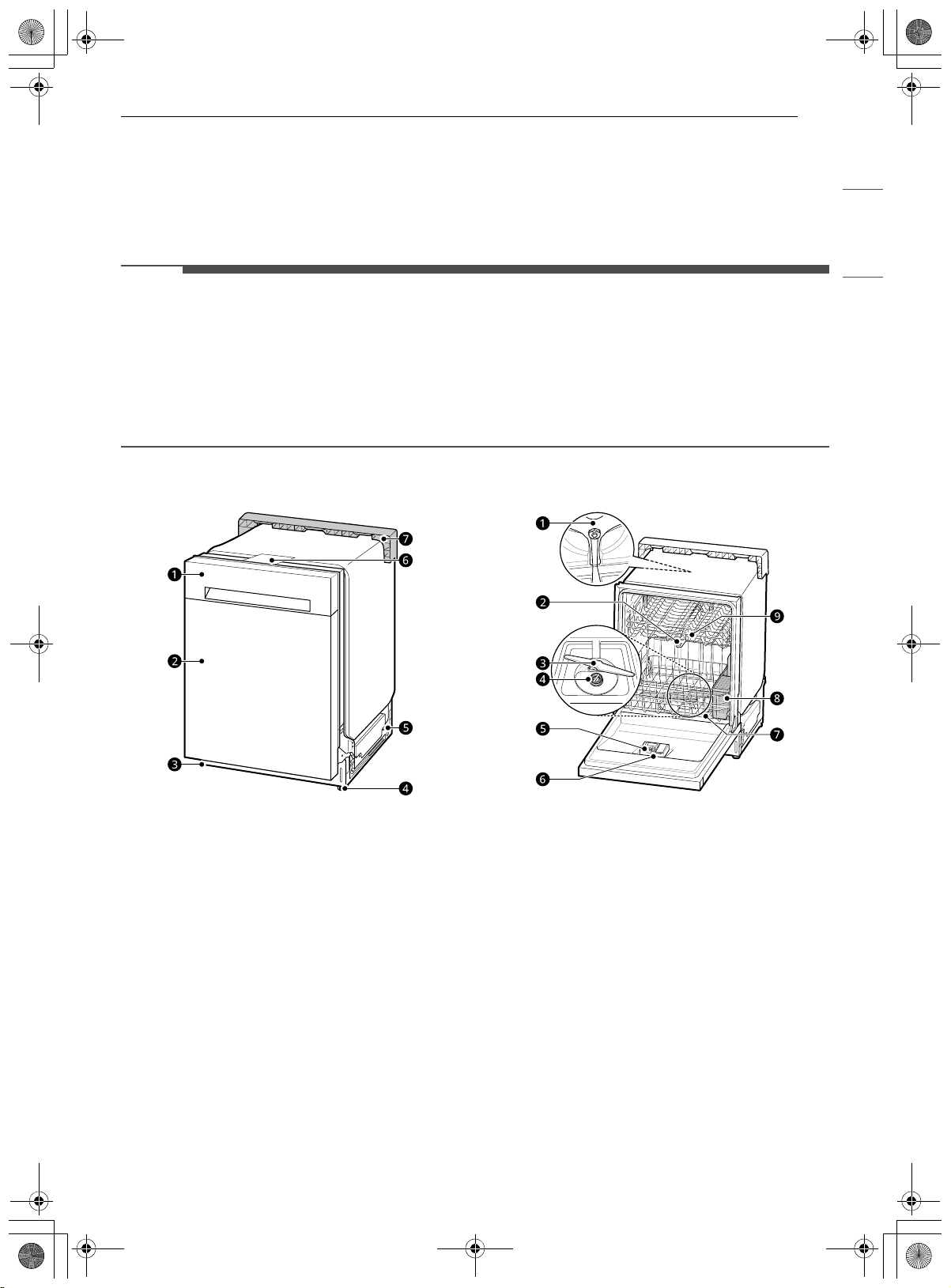
Front View
a Control Panel & Door Handle
b Front Cover
c Lower Cover
d Leveling Feet
e Base
f Safety Cover
g Shipping Brace
Interior View
a Top Wash Impeller
b Upper Spray Arm
c Lower Spray Arm
d Filtration System
e Detergent and Rinse Aid Dispenser
f Drying Vent Cover
g Lower Rack
h Silverware Basket
i Upper Rack
en-us_main.book.book Page 7 Friday, January 20, 2023 8:33 AM
8 PRODUCT OVERVIEW
NOTE
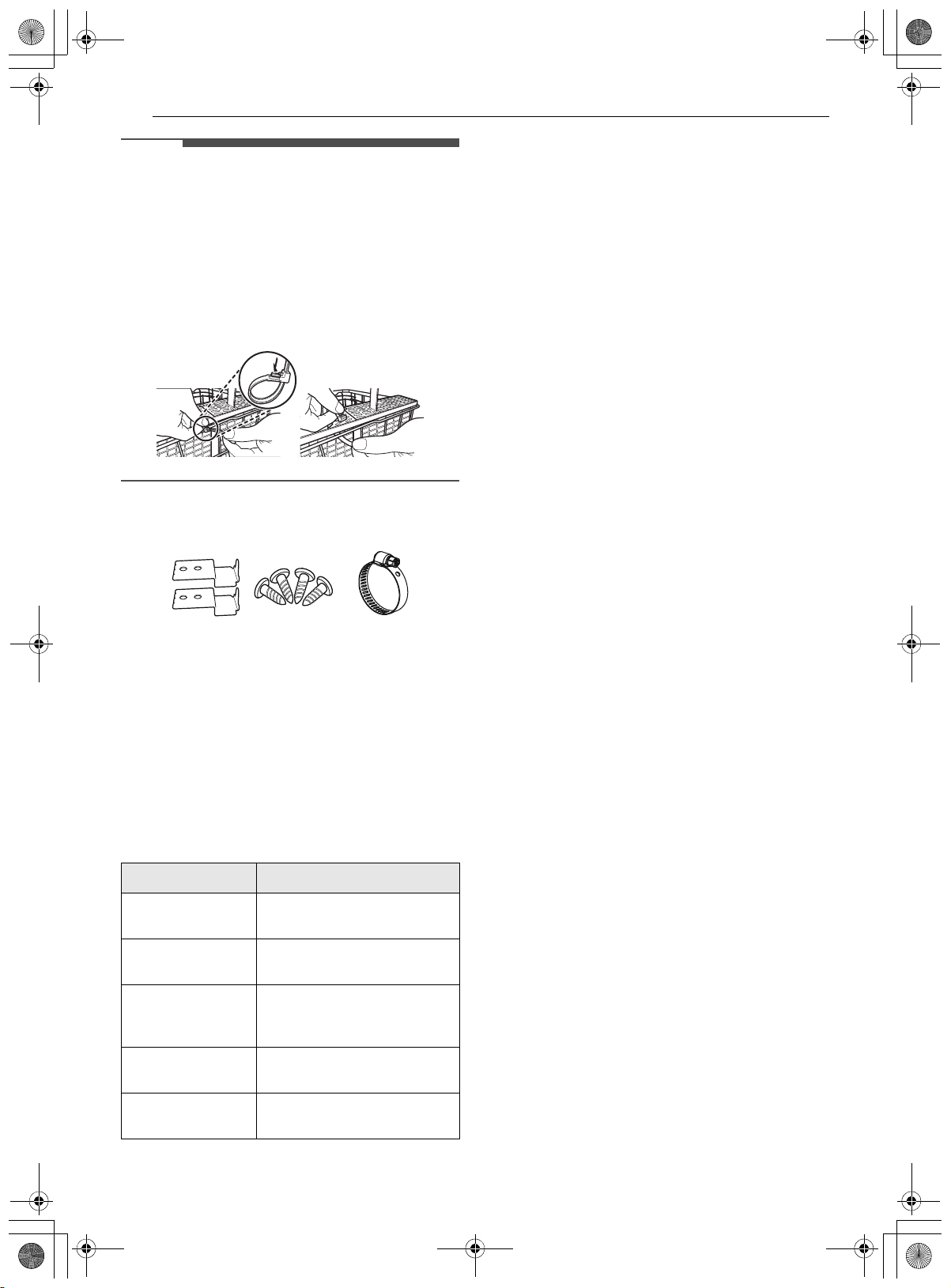
• The silverware basket ships installed at the back
of the bottom rack. For best performance, install
it along the right side.
• Remove all packing materials from the exterior
and interior of the dishwasher before installing
the appliance.
• Press the tab to remove the cable tie by hand.
Cutting the tie with a knife or scissors may
damage the rack or the silverware basket.
Accessories
a Installation Brackets (2 ea)
b Wood Screws (4 ea)
c Hose Clamp
Product Specifications
The appearance and specifications listed in this
manual may vary due to constant product
improvements.
Model LDFC242**
Electrical
Requirements
120 V, 60 Hz AC only,
15 A circuit breaker
Water Pressure 20 psi - 80 psi
(140 kPa - 550 kPa)
Dimensions
(Width X Depth X
Height)
23 3/4” X 24 5/8” X 33 5/8”
(603 mm X 625 mm X 854
mm)
Inlet Water
Temperature
120 ℉ - 149 ℉
(49 ℃ - 65 ℃)
Net Weight 66 lbs. - 75 lbs.
(30 kg - 34 kg)
a
b
c
en-us_main.book.book Page 8 Friday, January 20, 2023 8:33 AM
9INSTALLATION
ENGLISH
INSTALLATION
Before Installing
Online Installation Guide
This QR code is for reference only. For complete
installation instructions, see the owner's manual
supplied with each dishwasher.
English
https://www.lg.com/us/support/video-tutorials/lg-
dishwasher-installation-CT10000009-
1366643457088
French
https://www.lg.com/ca_fr/soutien/aide-produit/
CT20100059-20152463332979
WARNING
• DISCLAIMER - This Guide is strictly confidential
and shall not be copied, disclosed, distributed,
disseminated, publicized or reproduced, in
whole or in part, without the prior written
authorization of LG Electronics.
The Guide may contain inaccuracies and/or
typographical errors and may be changed or
updated at any time by LGE without notice.
Parts not Provided
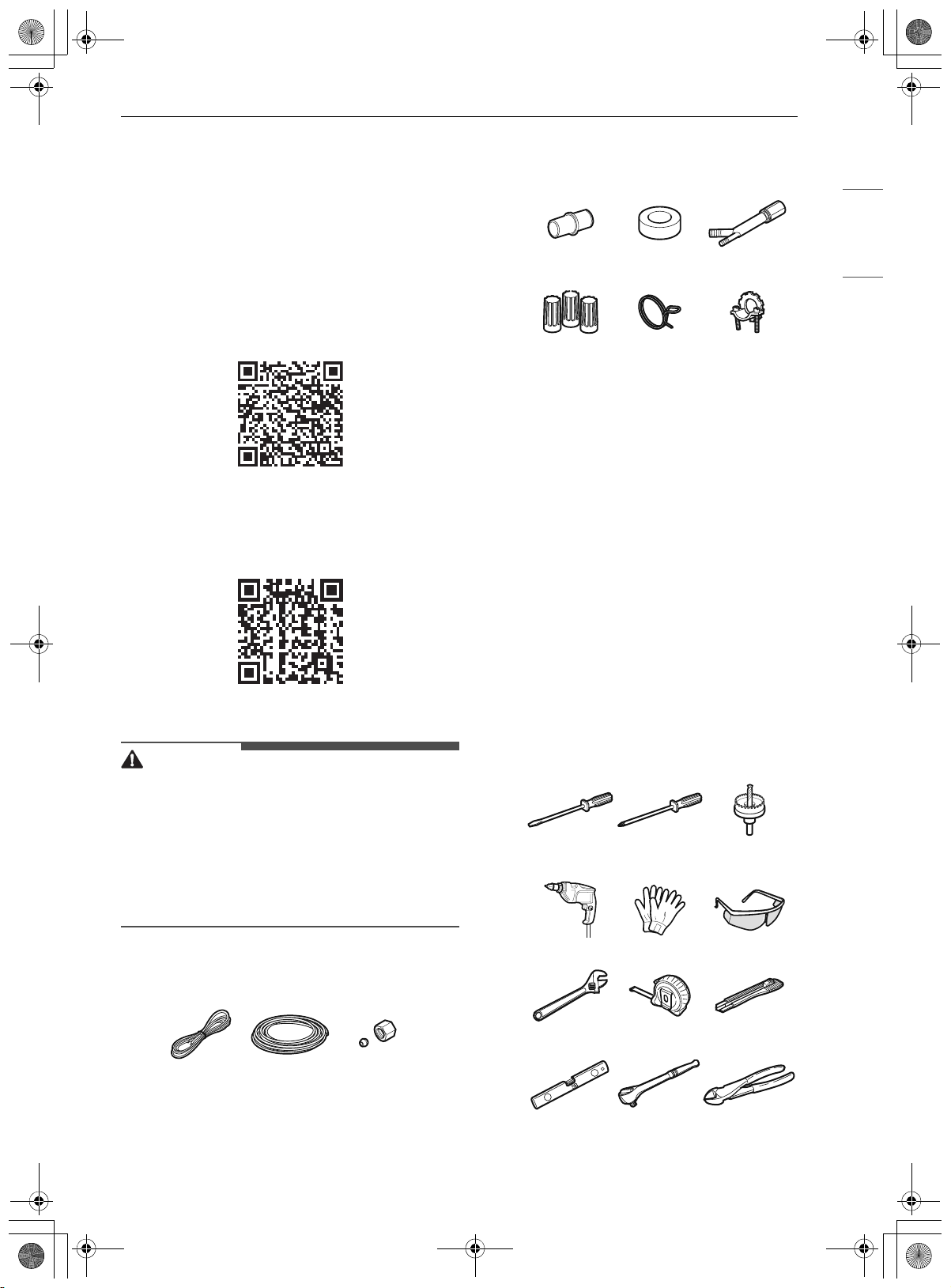
a Electrical Cable
• 16 AWG, with 2 conductors and 1 ground
b Water Supply Tube
• Minimum 3/8″ O.D. copper tubing or
stainless steel braided water supply line
c Fittings for Tube
d Coupler
e Electrical Tape
f Air Gap
g Wire Nuts for 16-Gauge Wiring
h Hose Clamp
i 3/8″ UL Approved Strain Relief
Tools Needed
abc
def
ghi
abc
def
ghi
klj
en-us_main.book.book Page 9 Friday, January 20, 2023 8:33 AM
10 INSTALLATION
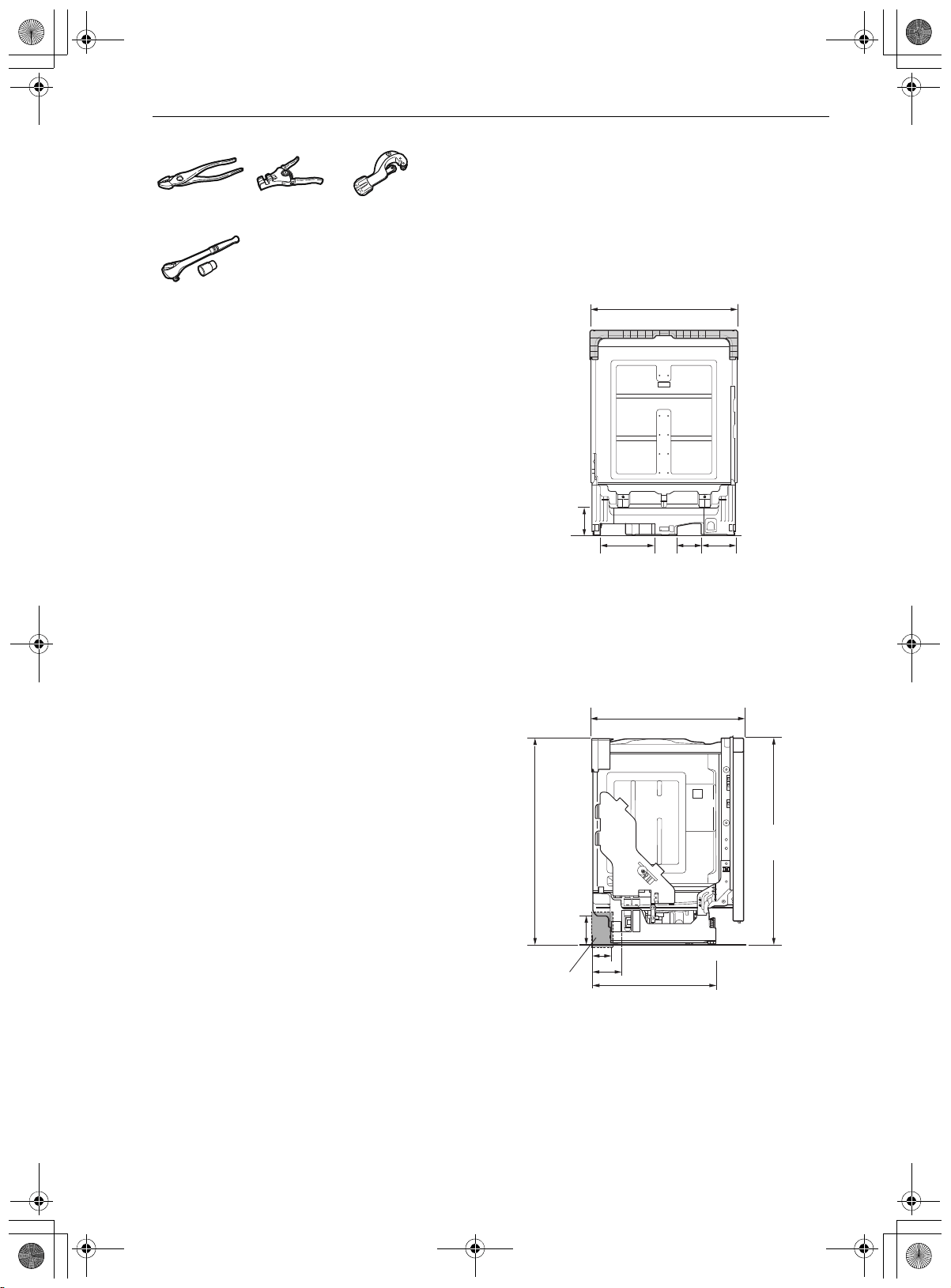
a Flat-Blade Screwdriver
b Phillips Screwdriver
c Hole Saw min. 2 1/2” bit
d Electric Drill
e Gloves
f Safety Glasses
g Adjustable Wrench
h Tape Measure
i Utility Knife
j Level
k 1/4” Square Drive Wrench
l Nipper
m Pliers
n Wire Stripper
o Tubing Cutter
p 3/8” Square Drive Wrench + 1/2” Socket
Installation Overview
Please read the following installation instructions
first after purchasing this dishwasher or
transporting it to another location.
a Preparing Cabinet Opening
b Preparing Water and Electrical Connections
c Preparing Dishwasher
d Sliding Dishwasher into Cabinet Opening
e Connecting Water Supply Line and Power
f Connecting the Drain Hose
g Leveling Dishwasher
h Securing Dishwasher in Cabinet Opening
i Final Installation Check
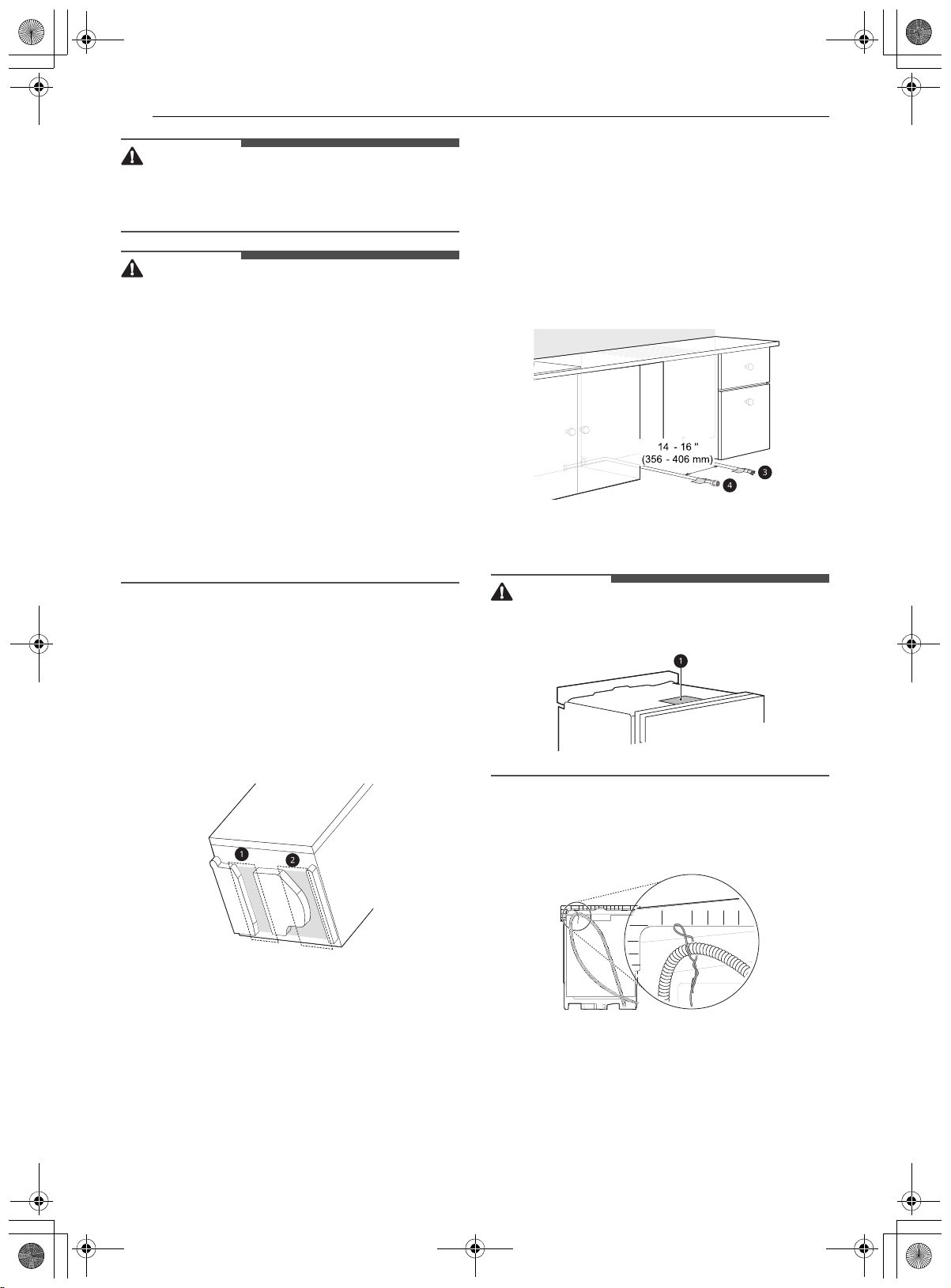
Product Dimensions
Back View
Side View
For easiest installation, see marked areas a for
water and electrical clearances in base of
dishwasher. Water supply hose, drain hose and
electric cable should be passed through this area.
Preparing Cabinet Opening
This dishwasher is designed to fit a standard
dishwasher opening. An opening may be needed
on both sides to route plumbing and electrical
connections.
mno
p
23 /4" (603 mm)
3
9 /8"
(238 mm)
3
4 /16"
(119 mm)
5
/4"
(134 mm)
11
1
4 /2"
(115 mm)
1
33 /16"
(846 mm)
5
4 /2"
(115 mm)
1
33 /8"
(854 mm)
5
2 /16" (75 mm)
15
20 /16" (512 mm)
3
24 /8" (625 mm)
5
4 /4" (120 mm)
3
a
en-us_main.book.book Page 10 Friday, January 20, 2023 8:33 AM

11INSTALLATION
ENGLISH
• To ensure proper drainage, install the
dishwasher no more than 12 ft. (3.65 m) from
the sink.
• The location must have sufficient space for the
dishwasher door to open easily and provide at
least 0.1” (2 mm) between the dishwasher and
the cabinet sides.
• If installing the dishwasher in a corner, leave a
minimum of 2” (50 mm) between the dishwasher
and the adjacent wall.
• The adjacent wall must be free of obstructions.
• For flush installations only, you may remove the
cabinet brace
a inside the cabinet.
Choosing the Proper Location
1 Select a location as close to the sink as
possible for easy connections to water supply
line, drain hose and electrical connection.
2 To allow for proper clearance of plumbing
and electrical, use the template included with
the literature to determine the clearance on
the side of the cabinet where the cabinet
meets the back wall. Using a 2 1/2” diameter
hole saw, drill a hole in the target area as
shown on the template.
WARNING
• Installation damage is not covered by the
warranty, and leaks caused by improper
installation may result in property damage.
• Do not use existing holes unless they are in the
target area.
• Failure to properly locate the hole for the water
and drain lines may prevent the dishwasher
from installing flush with the cabinets and could
result in kinked, pinched, crushed, stressed or
damaged lines.
Preparing Water and
Electrical Connections
WARNING
• Water Connection
- Do not reuse an old hose. Use only a new hose
when installing the dishwasher. The old hose
could leak or burst causing flooding and
property damage. Contact an LG Customer
Information Center for assistance in buying a
new hose.
• Electrical Connection
- Use a time-delay fuse or circuit breaker.
- Operate this appliance with the correct voltage
as shown in this manual and on the rating
plate.
- The wiring must be grounded properly. If in
doubt, have it checked by a qualified
electrician.
- Connect the appliance using 3-wires, including
a ground wire.
- The appliance and outlet must be positioned
so that the plug is easily accessible.
- Do not use an extension cable or adapter with
this dishwasher.
- Do not overload the outlet with more than one
appliance.
- The included 16AWG wire nuts should be used.
3.5
''
2.5
''
4
''
en-us_main.book.book Page 11 Friday, January 20, 2023 8:33 AM
12 INSTALLATION
WARNING
- It is the personal responsibility and obligation
of the product owner to have a proper outlet
installed by a qualified electrician.
CAUTION
• When connecting the dishwasher water supply
line to the house water supply, sealing tape or
compound should be used on pipe threads to
avoid leaks. Tape or compound should not be
used on compression fittings.
• Connect the dishwasher to a hot water supply
with a temperature range between 120 °F (49 ℃)
and 149 °F (65 ℃). This temperature range
provides the best washing results and shortest
cycle time. To prevent damage to dishes, the
temperature should not exceed 149 °F (65 ℃).
• Water supply pressure must be between 20 psi
and 80 psi (140–550 kPa). If the water supply
pressure exceeds 80 psi, a pressure reducing
valve must be installed. Otherwise premature
failure of the inlet valve may occur.
Routing Water Supply Line and
Electrical Wiring
There are 2 channels in the bottom of the
dishwasher for routing the water and electrical
connections.
• As shown in the bottom view below, channel
a
is for the water supply line, and channel
b is for
the electrical cable.
1 Turn off the house water supply and the
circuit breaker or dedicated power before
connecting the dishwasher.
2 Run the water supply line along the floor 6 1/
2" – 7 3/4" (165 mm – 197 mm) from the left
side of the opening and tape it in place in
front of the opening.
3 Run the electrical cable c along the floor 14"
– 16" (356 mm – 406 mm) from the water
supply line
d and tape it in place.
• The electrical outlet must be within 4 ft.
(1.22 m) of either side of the dishwasher.
• The best location for the electrical conduit is
on the right side of the back wall. Re-route
the electrical cable before installation if the
electrical conduit pipe is longer than 3" (76
mm) and is centered on the back wall.
Preparing Dishwasher
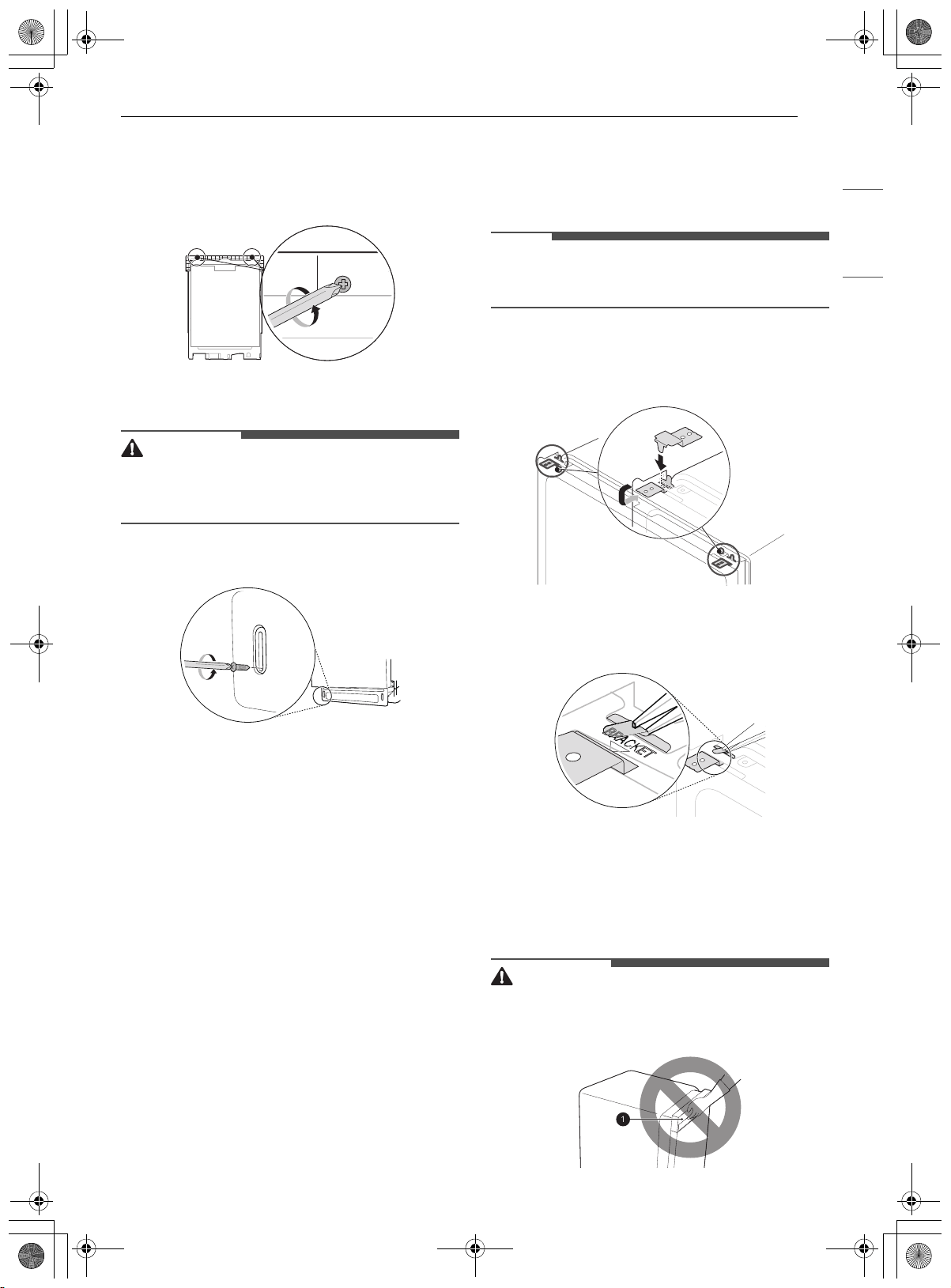
WARNING
• Do not remove safety cover a. Removal can
result in fire, electric shock or death.
Releasing Drain Hose
Remove the twist tie holding the drain hose to the
back of the shipping brace.
en-us_main.book.book Page 12 Friday, January 20, 2023 8:33 AM
13INSTALLATION
ENGLISH
Removable Shipping Brace
The rear shipping brace can be removed if
additional clearance is needed when installing the
dishwasher under a low countertop.
Removing Lower Cover
CAUTION
• If you lay the dishwasher on its back, do so
carefully to avoid damaging the drain hose and
the tub.
1 Remove the screws at either side which attach
the lower cover to the dishwasher.
2 Remove the lower cover.
3 If there is insulation padding behind the lower
cover, remove it.
4 Set the parts aside until the installation is
complete.
Removing Packing Materials from
the Interior
Remove all packing materials from the interior of
the dishwasher before installing the appliance.
Attaching Installation Brackets
For countertops made of wood or other materials
that will not be damaged by drilling, use the metal
installation brackets provided.
For countertops made of granite, marble, or other
materials that could be damaged by drilling, use
the wood screws to attach the dishwasher to the
cabinet. See installation instructions in Securing
Dishwasher to Cabinet Opening.
NOTE
• Installation brackets and screws can be found in
the silverware basket.
1 Insert the tabbed end of the installation
brackets into the slots in the upper frame.
Rotate the brackets until the tabbed ends are
facing up.
2 Bend the tabs on the brackets to secure them
to the frame using a pair of needle nose
pliers.
Sliding Dishwasher into
Cabinet Opening
How to Slide Dishwasher
CAUTION
• Do not pull or lift the dishwasher using the
handle
a. Doing so can damage the door and
hinges.
en-us_main.book.book Page 13 Friday, January 20, 2023 8:33 AM
14 INSTALLATION
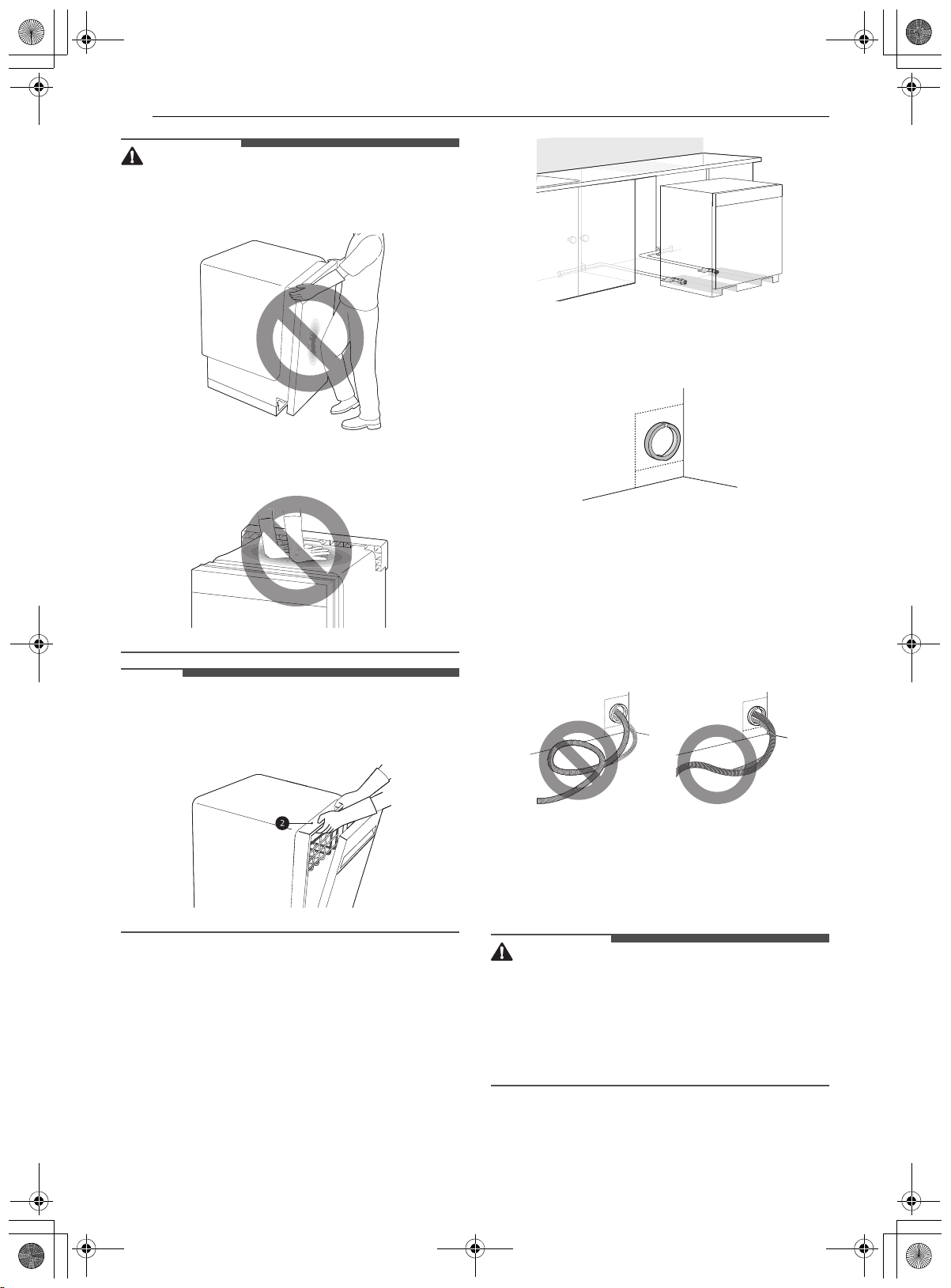
CAUTION
• Do not push the door of the dishwasher with
knees when sliding the dishwasher into position.
Doing so can damage the front cover.
• Do not push the top of the dishwasher. Doing so
can damage the interior of the dishwasher.
NOTE
• Open the door and grab the body frame and the
top front opening
b of the tub to move or lift the
dishwasher.
1 Align the dishwasher with the opening. Make
sure the water supply line and electrical cable
are in the correct positions to slide into their
channels properly.
2 Smooth out or pad the edges of the hole
drilled for the water supply to avoid damaging
the drain hose.
3 Make sure the drain hose is straight before
feeding the end of it through the hole for the
water supply. As you slide the dishwasher into
the opening, you will want to slowly pull on
the drain hose from inside the cabinet to take
up some slack. Be careful not to kink, pinch,
crush or stress the drain hose during
installation to avoid leaking and water
damage.
4 Gradually slide the dishwasher into the
opening, making sure that the water supply
line and electrical cable are passing freely
through the channels and do not get caught
under the dishwasher.
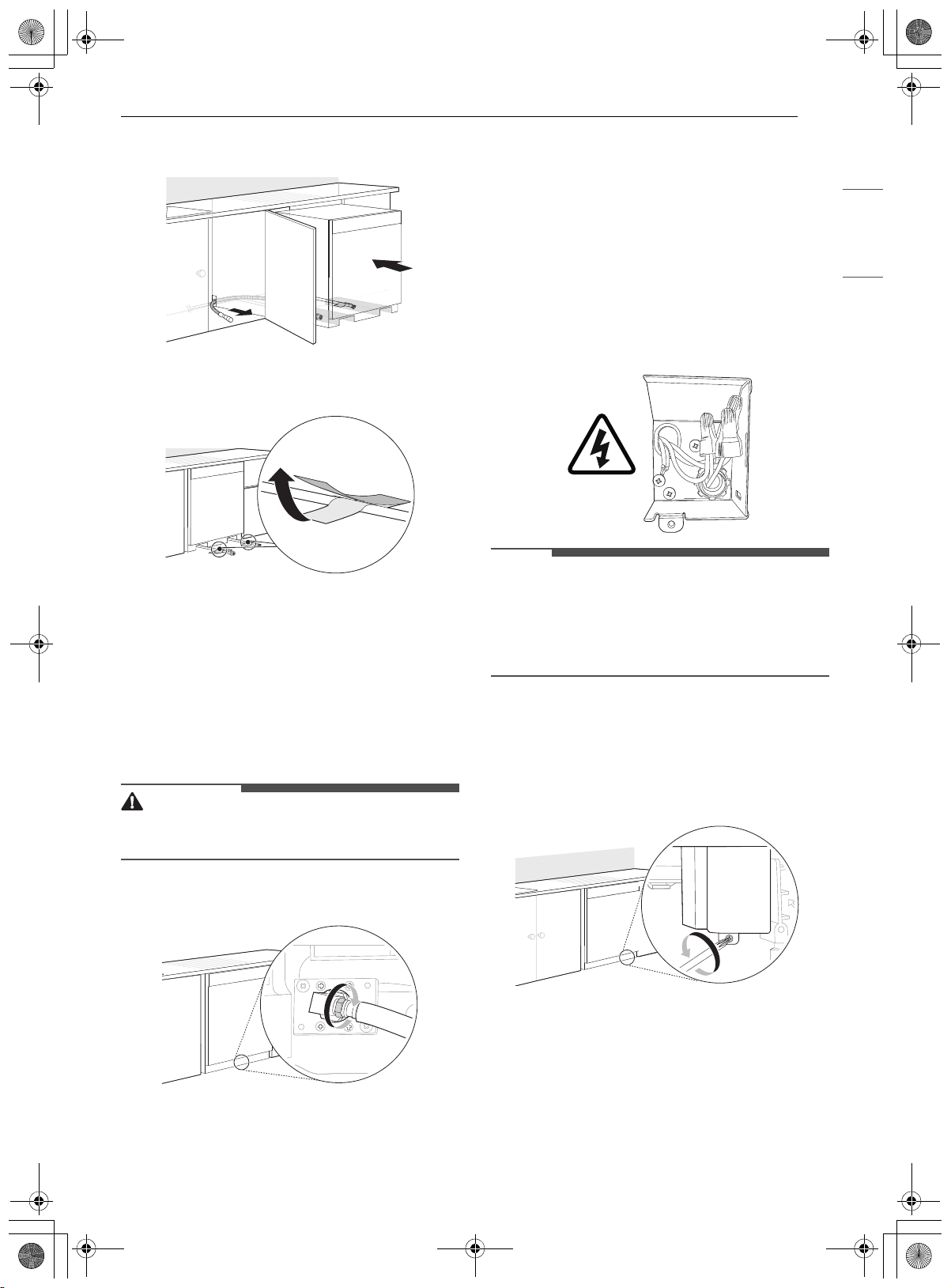
CAUTION
• To avoid malfunctions or leakage, it is important
that the drain hose not get kinked, pinched,
stressed or crushed behind or under the
dishwasher or inside the neighboring cabinet.
• Damage resulting from improper installation is
not covered under the warranty.
• As you slide the dishwasher into the
opening, stop periodically (or have an
assistant help) to take up the slack by
en-us_main.book.book Page 14 Friday, January 20, 2023 8:33 AM
15INSTALLATION
ENGLISH
pulling the drain hose farther into the
cabinet.
5 Remove the tape from the water supply line
and the electrical cable.
Connecting Water Supply
Line and Power
Connecting Water Supply Line
1 With the home water supply turned off,
connect the water supply line to the inlet valve
on the left front of the dishwasher.
CAUTION
• Tape or compound should not be used on
dishwasher inlet valve.
2 Tighten the compression nut.
3 Slide the water supply line back through the
channel, pulling gently from inside the
cabinet to make sure the line is not kinked,
pinched, stressed or crushed.
Connecting Power
The dishwasher should have a dedicated properly
grounded branch circuit to connect the 3 wire
setup which includes the ground wire.
If a 3-prong power supply is used, it should be in
an accessible location adjacent to the dishwasher
within 4 ft. (1.22 m) of the dishwasher side and not
behind the dishwasher.
NOTE
• The best location for the electrical conduit is on
the right side of the back wall. Re-route the
electrical cable before installation if the electrical
conduit pipe is longer than 3” (76 mm) and is
centered on the back wall.
1 Turn off electrical power to the unit at the
circuit breaker.
2 Use a Phillips screwdriver to remove the
screw from the junction box cover and
remove the cover.
3 Use a Phillips screwdriver to remove 2 screws
a.
en-us_main.book.book Page 15 Friday, January 20, 2023 8:33 AM
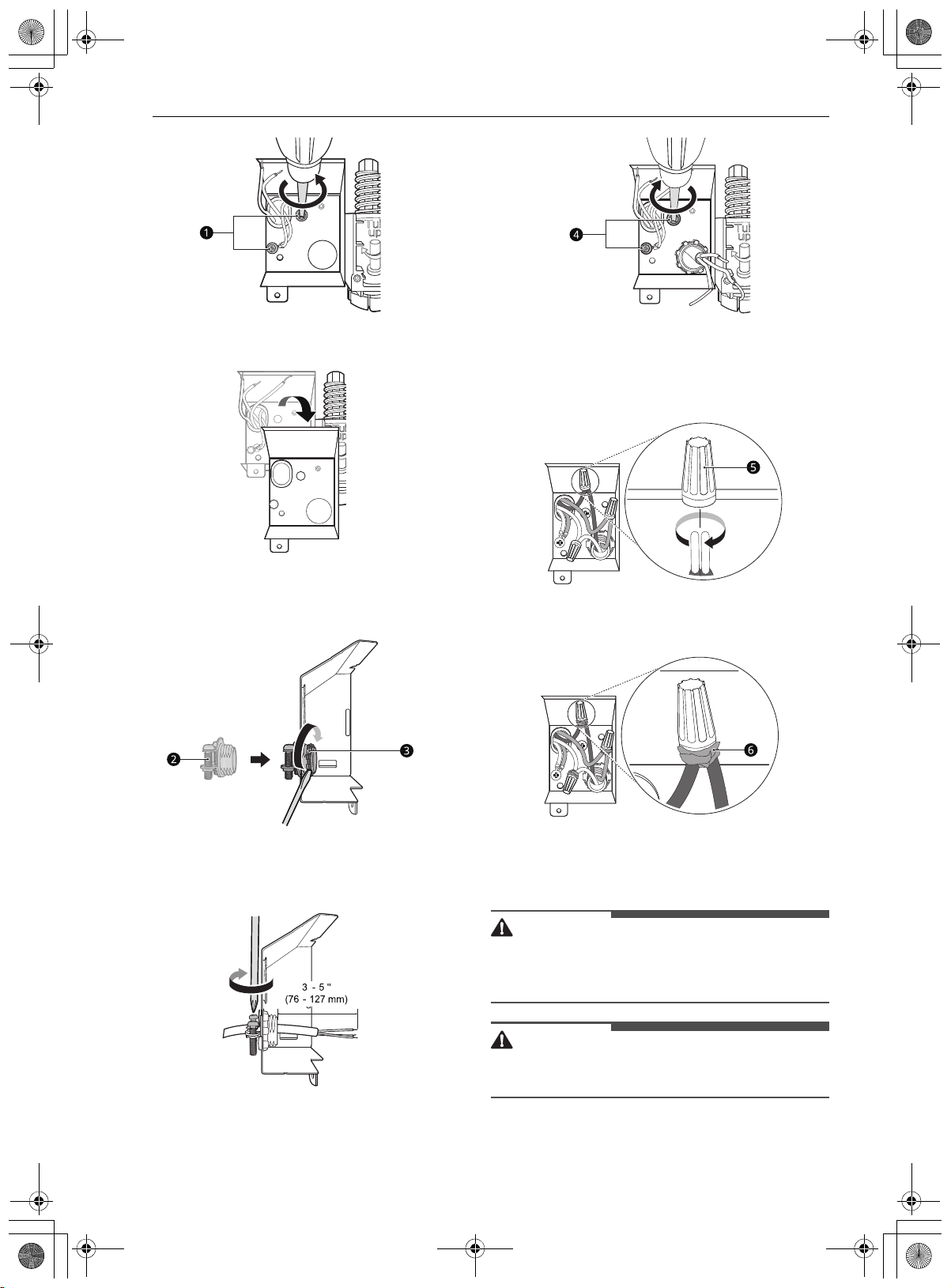
16 INSTALLATION
4 Remove the junction box from the appliance.
5 Insert a 3/8” strain relief b through the hole
in the junction box. Tighten the ring nut
c to
secure it in place.
6 Insert the electrical cable through the hole in
the strain relief. Tighten 2 screws to secure
the cable.
7 Pull the existing wires through the openings
in the junction box. Tighten 2 screws d to
reassemble the junction box in the appliance.
8 Pair the white, black, and green wires to the
matching colored wires from the dishwasher.
Then twist on the provided wire nuts e tightly
to connect the corresponding wires.
9 Wrap electrical tape f around each
connection.
10 Fold the connected wires back into the
junction box and screw on the junction box
cover.
WARNING
• Verify that the black wire is hot (120 V). If not, or
if you are unsure of the power supply, have it
checked by a licensed electrician.
CAUTION
• Do not leave stripped wire exposed. Trim
stripped wire to fit completely inside wire nuts.
en-us_main.book.book Page 16 Friday, January 20, 2023 8:33 AM
17INSTALLATION
ENGLISH
Connecting the Drain Hose
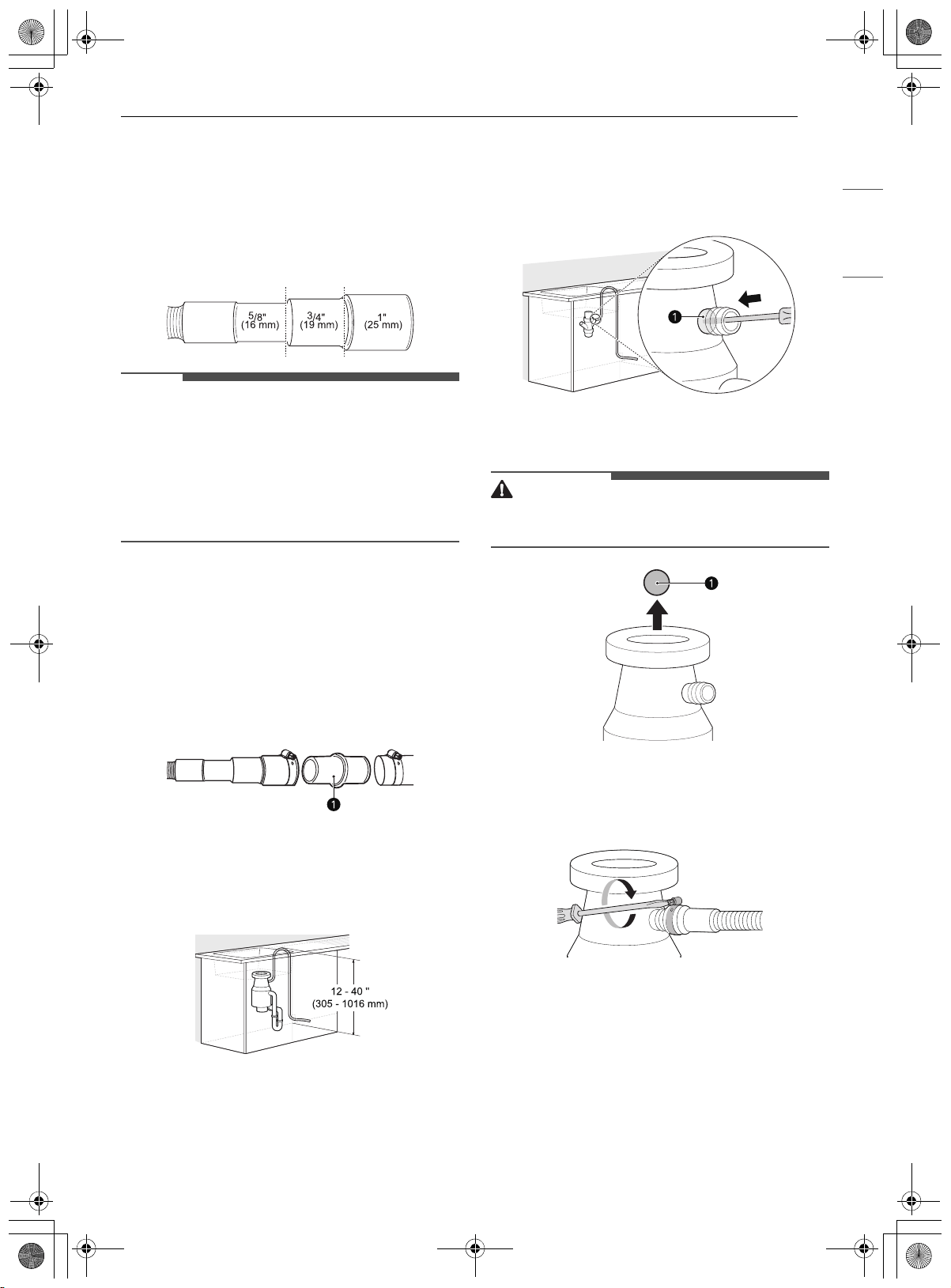
If the end of the drain hose does not fit the drain
line, use a heat and detergent resistant adapter
(not supplied). These may be obtained from a local
plumbing supply store.
• Cut the adapter so the end matches the size of
the drain connection.
NOTE
• For drain hose installation, use the screw style
hose clamp provided with this dishwasher in the
silverware basket.
• If connecting the dishwasher’s drain hose to the
garbage disposal, be sure to follow your
garbage disposal’s manual for proper
installation instructions.
Drain Hose Requirements
• Follow local codes and ordinances.
• Do not exceed 12 ft. (3.65 m) distance to drain.
• Do not connect drain hoses from other
appliances to the dishwasher’s drain hose.
• If an extension drain hose is required, use a 5/8"
or 7/8" inside diameter, 2-3 ft. length hose and a
coupler
a for connecting the two hose ends.
Height of the Drain Hose
The height of the drain hose end must be at least
12" (305 mm) and within 40" (1016 mm) from the
base of the dishwasher to avoid water being
siphoned from the tub.
Connecting to Disposal without Air
Gap
1 Remove the knockout plug on the disposal
with a hammer and screwdriver.
2 Remove the knockout plug a from the
disposal.
CAUTION
• If the knockout plug has not been removed, the
dishwasher will not be able to drain properly.
3 Attach the drain hose to the disposal with the
hose clamp provided. Move the hose clamp
into position and tighten it with a flat-blade
screwdriver.
Connecting Waste Tee without Air
Gap
The height of the drain hose end must be at least
12” (305 mm) and within 40” (1016 mm) from the
base of the dishwasher to avoid water being
siphoned from the tub.
en-us_main.book.book Page 17 Friday, January 20, 2023 8:33 AM
18 INSTALLATION
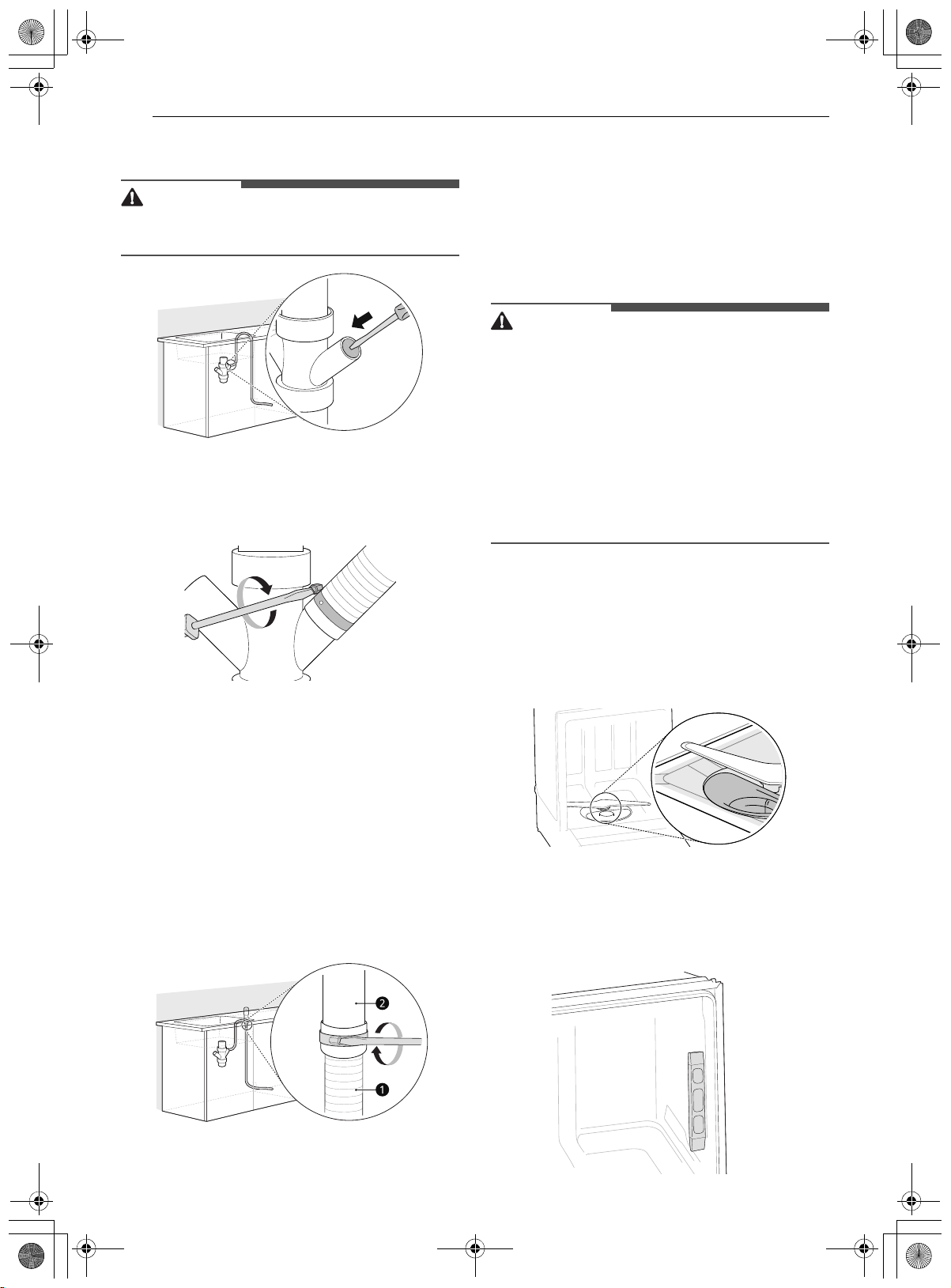
1 Remove the knockout plug with a hammer
and screwdriver.
CAUTION
• If the knockout plug has not been removed, the
dishwasher will not be able to drain properly.
2 Attach the drain hose to the waste tee with
the hose clamp provided. Move the clamp into
position and tighten it with a flat-blade
screwdriver.
Connecting to Disposal or Waste
Tee with Air Gap
1 Remove the knockout plug with a hammer
and screwdriver.
2 Connect the end of the drain hose a to the air
gap b with the hose clamp provided. Move
the clamp into position and tighten it with a
flat-blade screwdriver.
• This avoids water being siphoned from the
tub.
3 If it is not connected, attach the rubber hose
connector to the disposal or waste tee with a
hose clamp (not provided).
Leveling Dishwasher
Check that the dishwasher is level and adjust the
leveling feet if necessary.
CAUTION
• Failure to level the dishwasher may result in
leakage, problems closing the door, or noise.
• Where the cabinet opening is narrower than
recommended (see Preparing Cabinet
Opening), the dishwasher must be carefully
leveled and aligned so that the dishwasher is
supported fully by the 3 leveling feet and is not
hanging from the installation brackets. Failure to
do so can result in leaks from the front of the
dishwasher,
AE errors, difficulty in closing the
door, or failure to operate.
Checking Leveling
To check that the tub is level from front to back,
remove the lower rack and pour 169 oz. (5 L) of
water into the bottom of the tub. The water level
should be near the center of both tub lower
indentations at the front.
With the lower rack removed, place a level on the
inside wall of the tub to check that the dishwasher
is level from side to side.
• If you do not have a level, try using a
smartphone level application instead.
en-us_main.book.book Page 18 Friday, January 20, 2023 8:33 AM
19INSTALLATION
ENGLISH
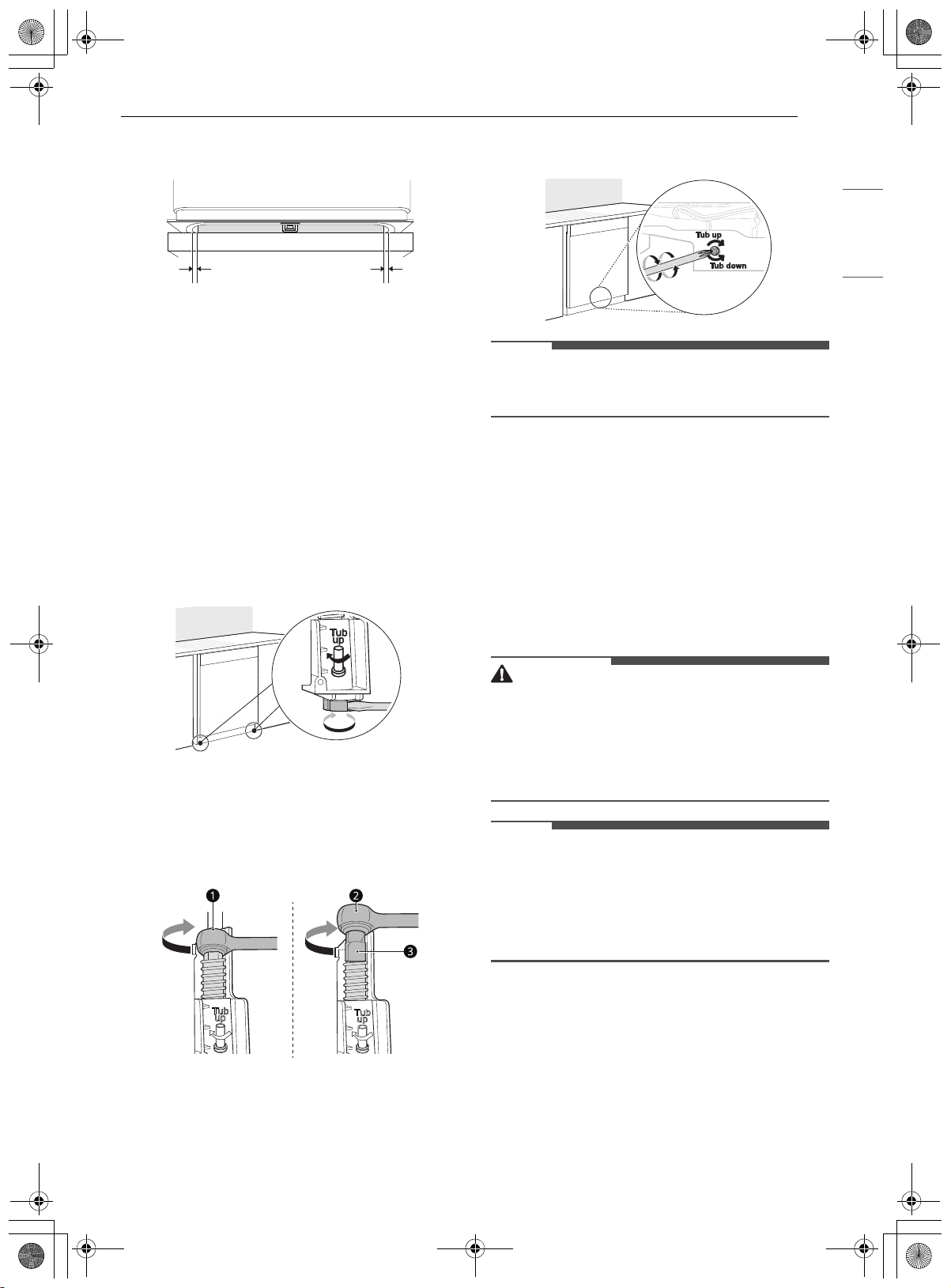
Make sure that the gap between the tub walls and
the door liner is the same on either side.
Adjusting Leveling Feet
Adjust as needed until the dishwasher is
completely leveled.
• Adjust the front and rear leveling feet until they
are all in firm contact with the floor. Failure to
level the dishwasher may prevent the door from
closing properly and the dishwasher will not turn
on.
Adjusting Front Leveling Feet
Use a flat-blade screwdriver to turn the front
leveling feet and adjust the front of the tub.
• Turn the front leveling feet clockwise to raise the
front of the tub and counterclockwise to lower it.
• The adjustments work identically for both front
leveling feet.
• When a flat-blade screwdriver is unavailable, use
a 1/4" square drive wrench
a or 3/8" square
drive wrench
b with 1/2" socket c to turn the
front leveling feet and adjust the front of the tub.
Adjusting Rear Leveling Foot
Use a Phillips screwdriver to adjust the rear
leveling foot and the rear of the tub using the
center screw at the base of the appliance in the
front.
• Turn the center screw clockwise to raise the rear
of the tub and counterclockwise to lower it.
NOTE
• To avoid damaging the screw, do not use an
electric screwdriver.
Securing Dishwasher in
Cabinet Opening
There are 2 options for securing the dishwasher. If
the countertop is made of wood or a material that
can safely be drilled into, secure the dishwasher to
the countertop with the provided brackets. If the
countertop is granite, marble, or a material that
cannot be drilled into, secure the dishwasher to
the cabinet frame with the provided wood screws.
CAUTION
• Ensure the dishwasher is level and all leveling
feet are in firm contact with the floor before
attaching the dishwasher to the countertop or
cabinet. If the dishwasher is not leveled
properly, the door may not close properly or
water may leak.
NOTE
• Installation brackets and screws can be found in
the silverware basket.
• Use a magnetic screwdriver.
• Cover the filter hole with towels to prevent
screws from falling down into the pump.
en-us_main.book.book Page 19 Friday, January 20, 2023 8:33 AM
20 INSTALLATION
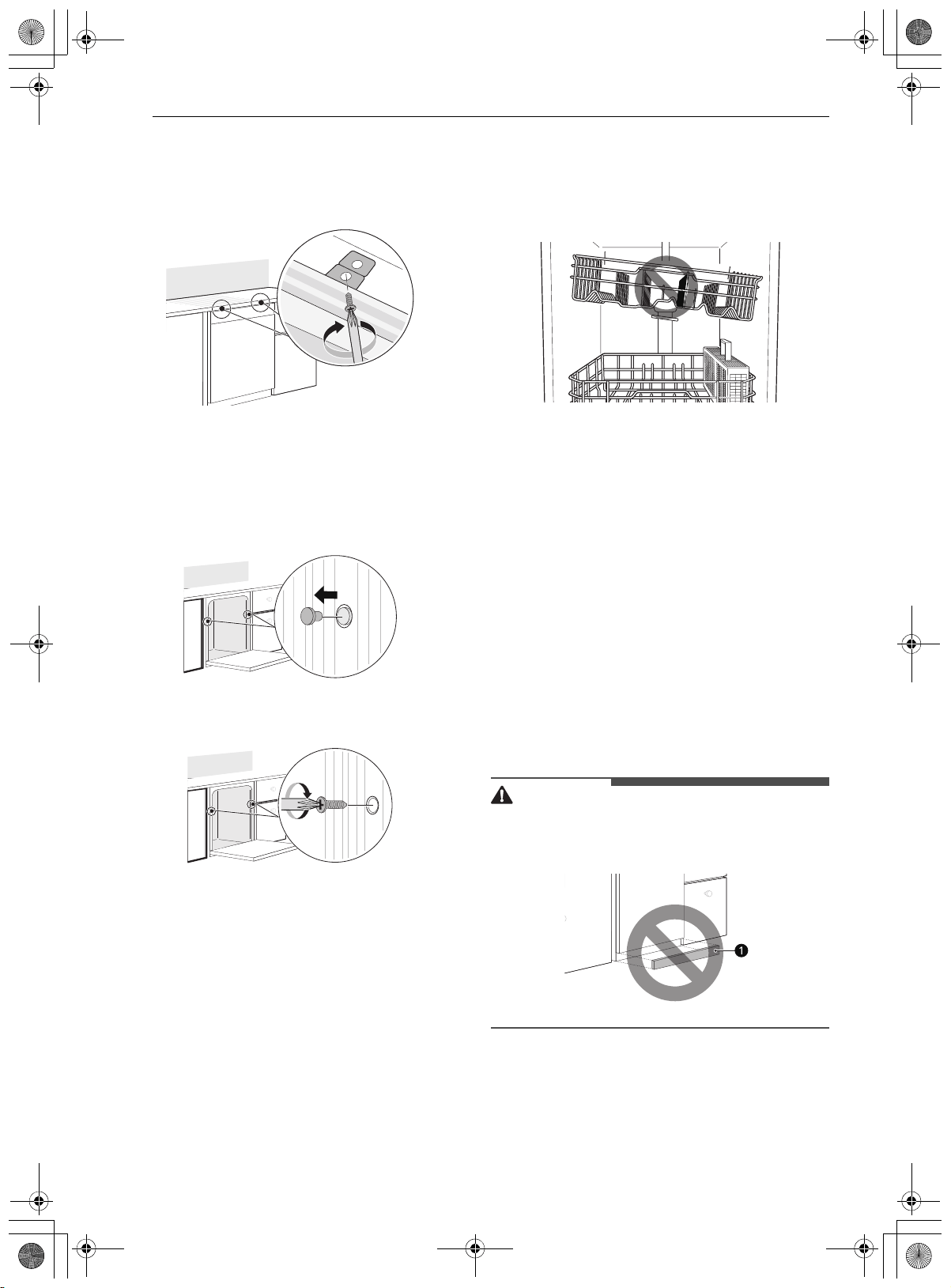
Securing Dishwasher to Countertop
Use the bracket screws provided to secure the
brackets at the top of the dishwasher to the
underside of the wood countertop.
Securing Dishwasher to Cabinet Frame
If desired, the dishwasher can also be secured to
the cabinet frame using the instructions which
follow.
1 Remove the 2 plastic caps from the mounting
bracket access holes.
2 Drive a wood screw through the mounting
bracket and into the cabinet frame.
3 Reinstall the plastic caps.
Final Installation Check
Testing the Dishwasher
Check if the dishwasher is properly installed.
1 Turn on the circuit breaker.
2 Turn on the house water supply.
3 Make sure that the door opens and closes
smoothly.
• If necessary, level the dishwasher again.
• If the door will not close, make sure the rack
is level.
• Make sure that all packaging materials have
been removed.
4 Power on the dishwasher and run a Turbo
cycle to verify proper operation.
5 Check for leaks at the drain hose and water
supply connection.
6 If a water leak is detected, press and hold the
Start button for 3 seconds to cancel the wash
cycle and automatically drain the water from
the dishwasher. Tighten all water connections
and run another cycle. Repeat until no leaks
are detected.
7 Replace the lower cover.
CAUTION
• Only install the lower cover provided with the
dishwasher. Do not install cabinet baseboard a
as it may cause noise and leakage.
8 Remove the protective film from the door, if
present. Leaving the film on may cause
discoloration or condensation on the door.
en-us_main.book.book Page 20 Friday, January 20, 2023 8:33 AM
21INSTALLATION
ENGLISH
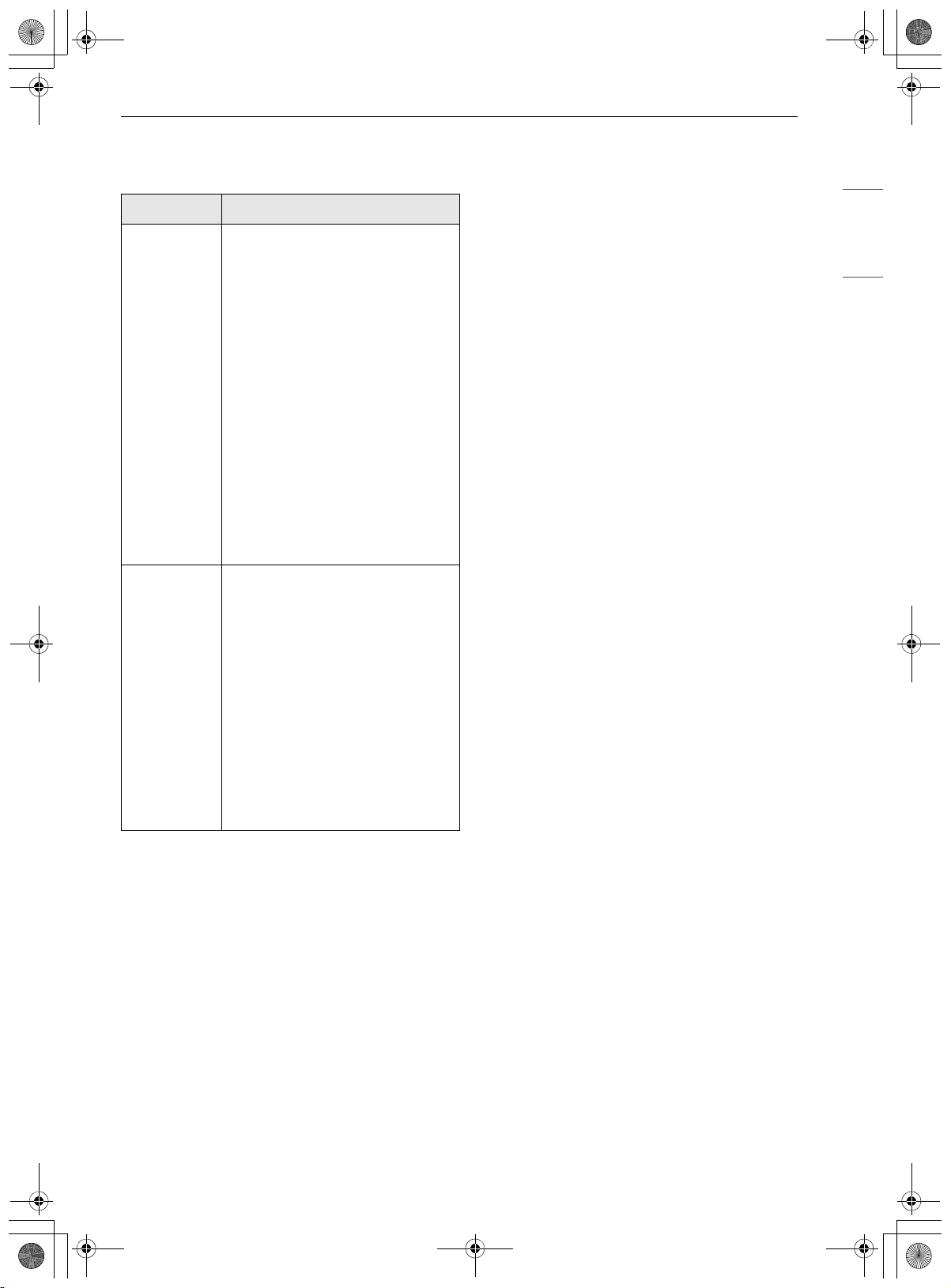
Installation Check Error Codes
Refer to the chart below before calling for service.
Error Code Possible Cause and Solution
OE
Drain hose is kinked or pinched.
• Feed the drain and water
supply hoses through the hole
under the sink. Then gradually
slide the dishwasher into the
cabinet while pulling on the
hoses under the sink to take up
any slack. This helps avoid
kinking the hoses or trapping
them beneath the dishwasher.
Drain hose is connected to the
disposal without removing the
knockout plug.
• Remove the knockout plug
from the disposal.
Waste tee or disposal is clogged.
• Remove knockout plug on the
waste tee or disposal.
IE
Water supply line is kinked
under dishwasher.
• Feed the drain and water
supply hoses through the hole
under the sink. Then gradually
slide the dishwasher into the
cabinet while pulling on the
hoses under the sink to take up
any slack. This helps avoid
kinking the hoses or trapping
them beneath the dishwasher.
House water supply is not turned
on.
• Turn the water faucet on.
en-us_main.book.book Page 21 Friday, January 20, 2023 8:33 AM
22 OPERATION
OPERATION
Before Using
WARNING
• To reduce the risk of fire, electric shock, or injury to persons, read the SAFETY INSTRUCTIONS before
operating this appliance.
NOTE
• Connect to the hot water supply only. The water supply temperature should be a minimum of 120 °F (49
°C) for better washing performance and shorter cycle time.
• Follow the instructions for loading the dishwasher to ensure effective cleaning.
• Remove insoluble items such as bones, toothpicks, and pieces of paper while loading the dishwasher.
Quick Start
1) Load the dishes.
2) Add the detergent.
3) Turn on the dishwasher.
4) Check the rinse aid.
5) Select the cycle and options.
6) Operate the dishwasher.
• Method 1
- Press the Start button and then close the
door in less than four seconds to operate
the dishwasher. If the door is not closed
within four seconds, the white LED with
time flashes, an audible tone is heard, and
the cycle does not start.
• Method 2
- Close the door first and then press the
Start button to operate the dishwasher.
NOTE
• If the door is opened during the cycle, the
dishwasher will stop. To resume the cycle, see
methods 1 and 2 above.
• If the door is opened during the cycle and is not
closed within four seconds after selecting the
Start button, or if the door is closed without
pressing the Start button, the white LED with
time flashes, an audible tone is heard, and the
cycle does not start.
7) End of cycle.
• When the cycle is complete, a chime will
sound and the display will show
ENd until the
door is opened or Power is pressed. To save
energy, press and hold Extra Dry and Night
Dry simultaneously for three seconds to set
the ENd display to automatically turn off a
few minutes after the cycle ends.
• It is normal for the dishwasher to chime
continuously if you open it during operation
or just after the cycle ends. The dishwasher
is letting you know that the interior
temperatures of the unit are hot and to use
caution when reaching inside. Once the unit
has cooled down, the chiming will stop.
For more details, refer to the online owner's
manual.
CAUTION
• Do not open the door during operation or
immediately after it has completed the wash
cycle as the escaping steam may cause scalding
as the door is opened.
Auto-Off
The dishwasher automatically turns off after four
minutes of inactivity if paused or if no cycle is
started.
en-us_main.book.book Page 22 Friday, January 20, 2023 8:33 AM
23OPERATION
ENGLISH
Control Panel
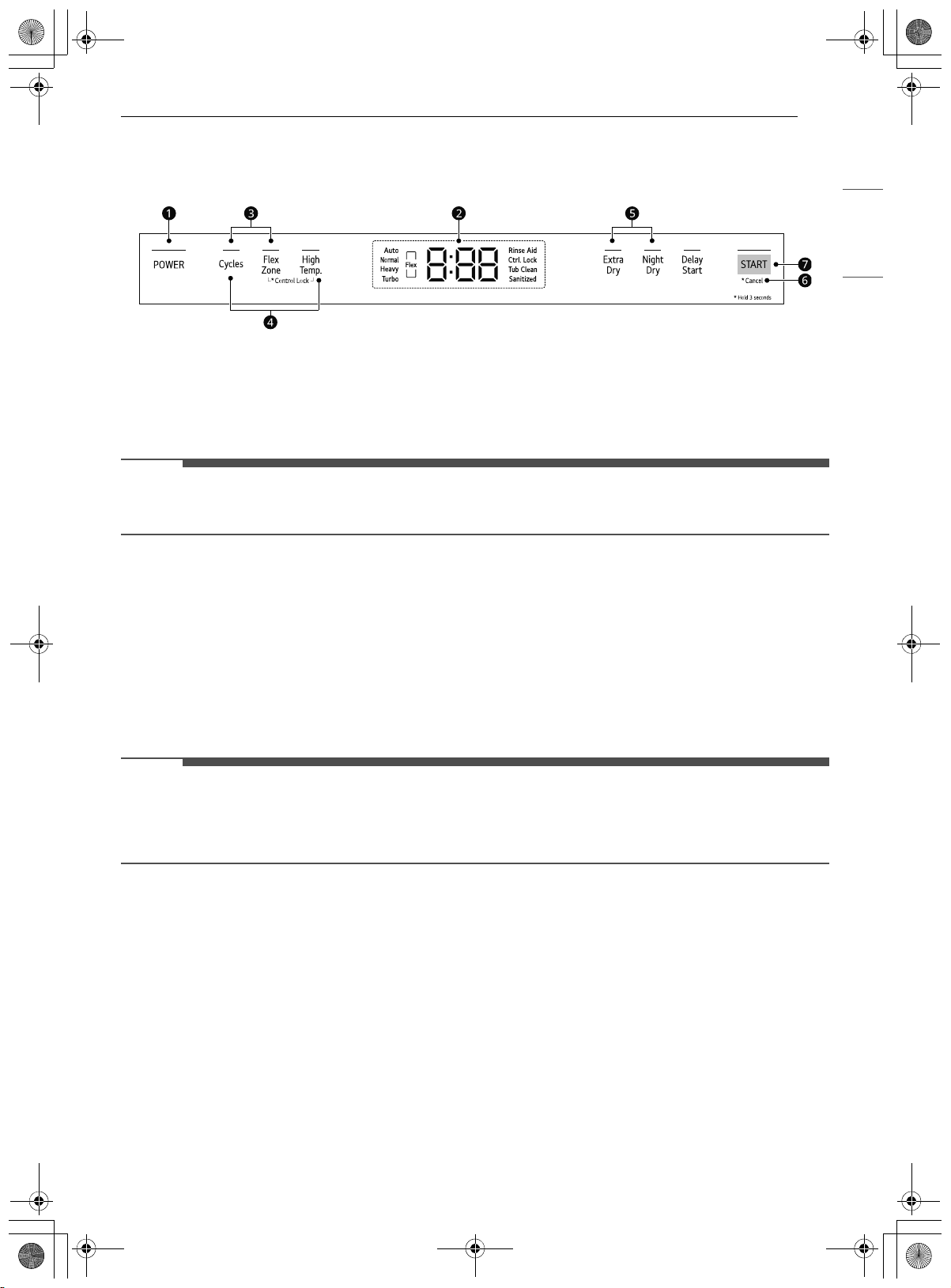
Control Panel Features
a Power On/Off Button
• Press this button to turn the washer on or off.
• If there is a power surge, power outage, or disruption of any kind, power is automatically turned off
for safety.
• When power is connected again, the dishwasher will turn on automatically and resume the cycle.
NOTE
• When opening or closing the product door, keep fingers and hands away from the control panel to avoid
activating buttons.
b Display
• Rinse Aid
- This LED illuminates when the rinse aid level is low. The LED automatically shuts off when the rinse
aid is refilled or the level is set to 0.
- Refer to the Rinse Aid Dispenser Adjustment section.
•
8:88 : Digital Display
- The digital display on the control panel shows the ESTIMATED cycle time. When the cycle and
options are selected, the display shows the total estimated time to complete those selections.
During operation, the display shows the remaining estimated operating time.
NOTE
• The estimated time shown on the display does not include delay times for heating water, etc.
•If Delay Start is selected, the display shows the delay time in hours.
• Cycle time may vary depending on the soil level of your load.
• Ctrl. Lock, CL : Control Lock
- The Control Lock feature helps prevent settings from being changed during a cycle. Selecting this
feature locks all of the buttons, except for the Power button, on the control panel. This feature
does not lock the door.
- While a cycle is running, press and hold Flex Zone and High Temp. simultaneously for three
seconds to activate or deactivate Control Lock.
- To start a new cycle, deactivate Control Lock.
• Tub Clean
- The Tub Clean LED flashes every 30 cycles. To activate or deactivate the LED, press and hold the
Cycles and High Temp. buttons for three seconds.
- Select the Auto cycle and follow the instructions in the Maintenance section to clean the tub.
• Sanitized
- If the High Temp. option is added to a cycle, the Sanitized LED stays lit at the end of the cycle if the
heated rinse reached the proper temperature.
en-us_main.book.book Page 23 Friday, January 20, 2023 8:33 AM
24 OPERATION
c Chime On/Off Button
• To activate or deactivate the button sounds, press and hold Cycles and Flex Zone simultaneously for
three seconds. The error alert sound cannot be turned off.
d Tub Clean Reminder On/Off Button
• To activate or deactivate the Tub Clean Reminder, press and hold Cycles and High Temp.
simultaneously for three seconds. Please refer to the Tub Clean LED description under Display b.
e End Notification On/Off Button
• To activate or deactivate the End Notification, press and hold Extra Dry and Night Dry
simultaneously for three seconds. Turn the notification ON to display ENd at the end of the cycle until
you press the POWER button or open the door. Turn the notification OFF to turn the machine off 30
seconds after the end of the cycle.
f Cancel Button
• The drain pump activates and the cycle cancels. Once the dishwasher finishes draining, the power
turns off.
•Press and hold Start for three seconds to activate.
g Start Button
• To operate the machine, either press Start and close the door within four seconds or close the door
and press Start.
• If more than 4 seconds have passed since pressing Start, an alarm will sound when the door is
closed.
Wash Cycles
Select your desired cycle.
Selecting the Cycle
The default cycle is Auto. You can also customize
these settings using the Cycles button.
• Press the Cycles button repeatedly to select the
Normal, Heavy, or Turbo cycle.
Auto
This cycle senses the soil amount and soil
toughness and is optimized to achieve the best
cleaning.
Normal
This cycle is for daily, regular, or typical use to
completely wash a full load of normally soiled
dishes. The energy usage label is based on this
cycle without any options. Select the Night Dry
option if leaving dishes overnight.
• After the cycle ends, the fan runs for an hour to
help vent the warm, moist air in the tub. You can
stop the fan by opening the door after the cycle
ends.
Heavy
This cycle is for heavily soiled dishes and dishes
with hardened on soil. This cycle defaults to the
strongest spray intensity and uses it to wash
heavily soiled dishes.
Turbo
This cycle will clean heavily soiled dishes in an hour
using slightly more energy and water.
• This cycle does not have drying. Select the Extra
Dry and Night Dry option or another cycle for
better drying.
Options and Extra Functions
Select the desired cycle and then select the options
for that cycle.
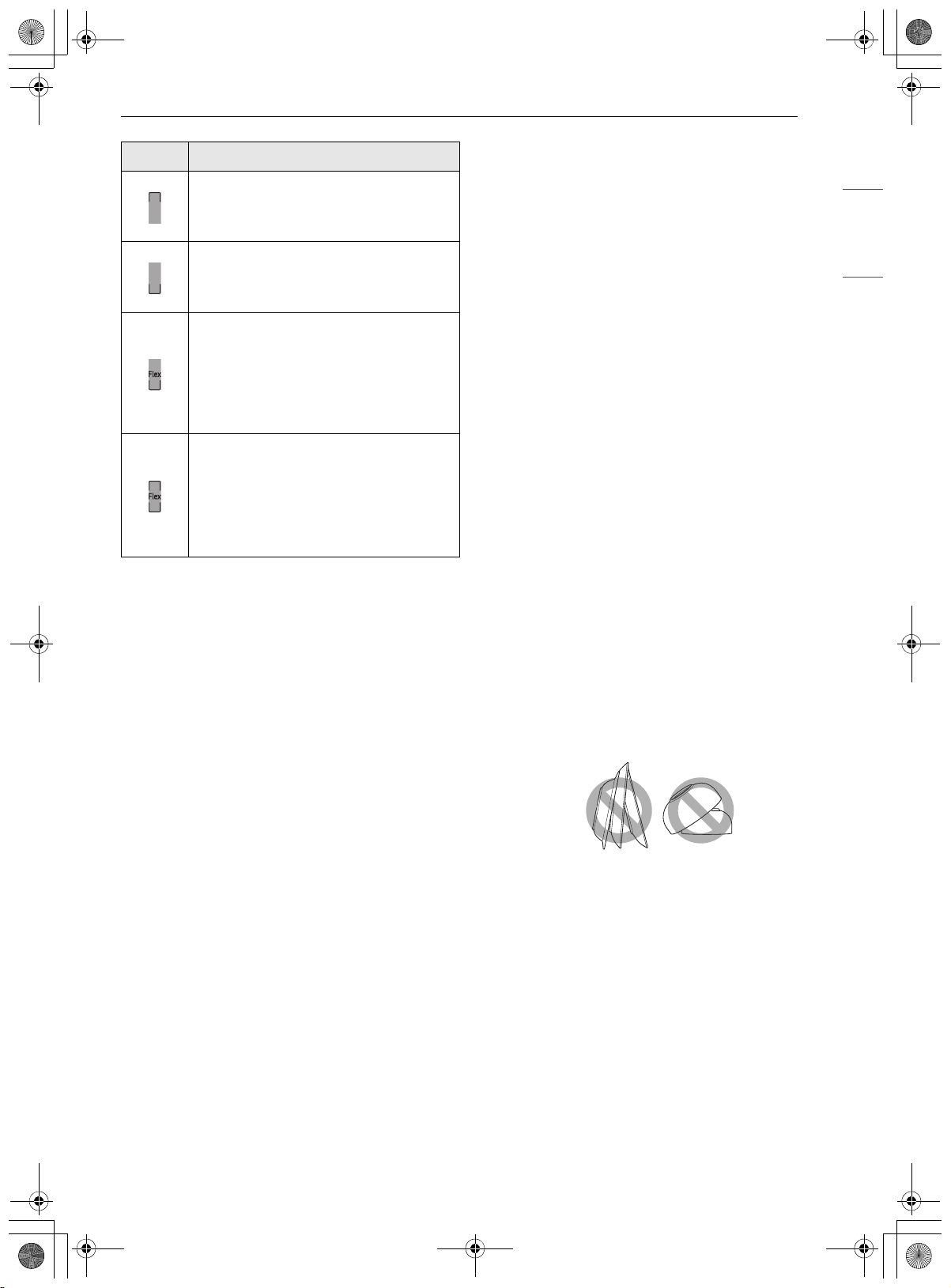
Using the Flexible Zone
This option adjusts the wash intensity to target
different zones inside the dishwasher. Set it to
wash just the upper rack or lower rack, or set the
intensity to soft for the upper spray arm and
strong for the lower spray arm.
The Flex Zone is off by default. Press the Flex
Zone button to customize settings.
•Press the Flex Zone button repeatedly to select
the 4 modes for cleaning the dishes.
en-us_main.book.book Page 24 Friday, January 20, 2023 8:33 AM
25OPERATION
ENGLISH
High Temp.
Raises the main wash temperature to improve
cleaning.
If the High Temp. option is added to a cycle, the
Sanitized LED stays lit at the end of the cycle if the
heated rinse reached the proper temperature. If
the dishwasher could not properly use the heated
rinse because the High Temp. option was not
selected, the cycle was interrupted or the water
could not be heated to the required temperature,
the indicator will not light up at the end of the
cycle. Open and close the door or press POWER to
turn the indicator off.
Extra Dry
Select the Extra Dry option for better drying
performance. This option adds extra drying time to
the cycle and raises the heated rinse temperature.
• When the rinse aid is empty, the Extra Dry
option is selected automatically.
Night Dry
Dishes are often left in the dishwasher overnight
after the cycle ends. This can result in the steam
inside the tub condensing on dishes, leaving them
wet. This option runs the ventilation fan
periodically to help vent the steam from the tub.
•The Night Dry option is selected by default for
all cycles for which it is available, except the
Normal cycle.
Delay Start
This feature delays the start of a selected cycle.
Each time the Delay Start button is pressed, the
delay time increases by an hour. The delay time
can be set from 1 to 12 hours, in one-hour
increments.
Cycle/Option Guide
The cycle guide shows the available options for
each cycle.
To see the Cycle/Option Guide, refer to the online
owner's manual.
Loading the Dishwasher
The extra tall tub allows loading of dishes, pans, or
other utensils up to 14" high. For effective washing
performance, always follow these instructions.
• Remove large particles of food debris from
plates including bones before loading.
• Items with burnt on food should be soaked prior
to loading in the dishwasher.
• Deep pots or dishes should be placed upside
down.
• Make sure that all items do not touch each other.
Non-Dishwasher Safe Items
The combination of high water temperature and
dishwasher detergents may damage certain items.
Do not wash the following items in the dishwasher.
• Copper or anodized aluminum
• Hand painted silver or gold leaf china
• Wood or bone handled utensils
• Iron or non-rustproof utensils
• Plastic items which are not dishwasher safe
• Sterling silver or gold-plated flatware or delicate
or metal-rimmed china
• Fragile items such as crystal glasses
Mode Description
Small loads & light soil
• Use just the upper rack to save
energy and time.
Small loads & heavy soil
• Use just the lower rack to save
energy and time.
Small loads & heavy soil & light/sensitive
dishes
• Focus on lower rack, but also
operate lightly to wash some light
or sensitive dishes in the upper
rack.
Various conditions
• Place heavily soiled dishes like
plates and bowls in the lower rack
and lightly soiled dishes like cups
and small plates in the upper rack to
get the best results.
en-us_main.book.book Page 25 Friday, January 20, 2023 8:33 AM

26 OPERATION
CAUTION
• Do not place pots or pans with plastic handles in
the appliance as the handles may deteriorate
due to the heat and detergent.
• Waterproof or long-lasting lipstick smudges on
glasses may not be removed during the wash.
Loading the Silverware
Basket
The silverware basket has separators to avoid
scratching and tarnishing of delicate silverware.
Loading Silverware into the Basket
Loading 10 Place Settings
Loading 12 Place Settings
Silverware Loading Tips:
• For best cleaning results, use the top separators
in the basket when loading silverware. The
separators will prevent nesting of silverware.
• Load sharp items, such as knives, pointing down.
• When unloading the dishwasher, it is best to
start with the silverware basket. Doing so will
prevent water droplets from falling on your
silverware from the upper rack.
WARNING
• Be careful when loading and unloading sharp
items. Load sharp knives with the handles up to
reduce the risk of personal injury.
Loading the Lower Rack
Loading Dishes into the Lower Rack
Loading 10 Place Settings
Loading 12 Place Settings
Lower Rack Loading Tips:
For details, refer to the online owner's manual.
Folding Down the Lower Tines
Fold tines down to fit larger dishes; pull tines back
up to fit smaller dishes.
1
5
4
4
4
4
4
5
5
5
5
3
3
6
2
2
3
3465
5
5
51
5
4
4
4
4
3
2
6
2
2
2
2
2
2
1
5
4
4
4
4
4
5
5
1
5
3
6
2
3
3
465
5
1
51
5
4
4
4
42
6
2
2
2
2
2
2
en-us_main.book.book Page 26 Friday, January 20, 2023 8:33 AM
27OPERATION
ENGLISH
For more details, refer to the online owner's
manual.
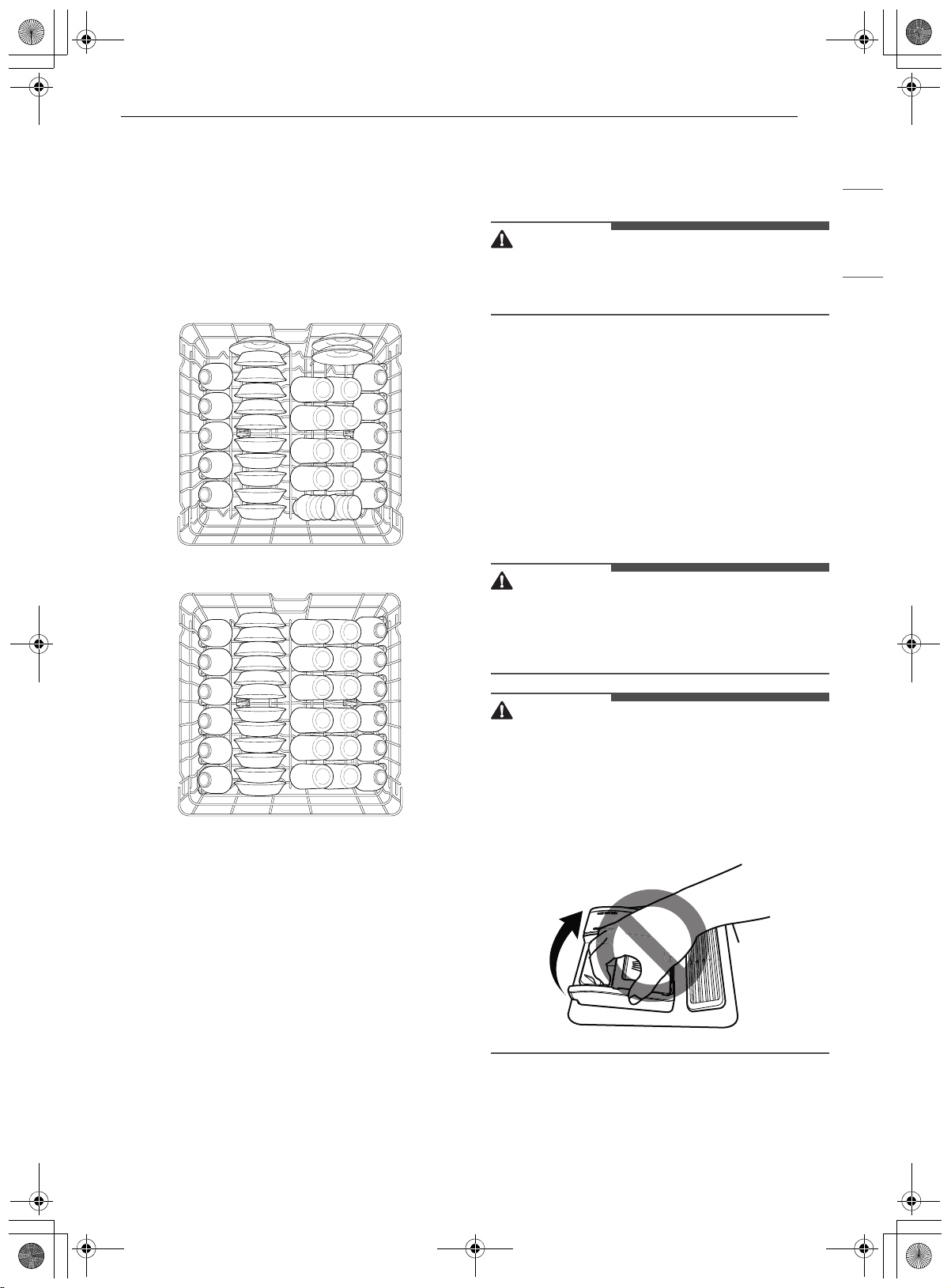
Loading the Upper Rack
Loading Dishes into the Upper Rack
Loading 10 Place Settings
Loading 12 Place Settings
Upper Rack Loading Tips:
For details, refer to the online owner's manual.
Folding Down the Upper Tines
Fold tines down to fit larger dishes; pull tines back
up to fit smaller dishes.
For more details, refer to the online owner's
manual.
Height Adjustable Upper Rack
The upper rack adjusts up and down. Raise the
upper rack to allow items up to 14" tall in the lower
rack. Lower the upper rack to allow dishes up to
12" tall in the upper rack. The dishwasher ships
with the upper rack raised.
For more details, refer to the online owner's
manual.
WARNING
• Before adjusting, ensure the rack is empty of all
dishes. Otherwise dishes may get damaged or
you may get injured.
Adding Cleaning Products
Adding Detergent to the Dispenser
• Remove the label on the dispenser prior to
running the dishwasher for the first time.
• The amount of detergent needed depends on
the cycle, load size, and soil level of dishes.
• Put detergent into the detergent compartment
before starting any cycle, except the Rinse cycle.
WARNING
• Dishwasher detergent and rinse aid contain
chemical components, like all other household
detergent. So, they must be kept out of the
reach of children.
CAUTION
• Use only detergent intended for dishwashers.
Incorrect detergent may cause the dishwasher
to fill with suds during operation. Excess suds
may reduce wash performance and may cause
the dishwasher to leak.
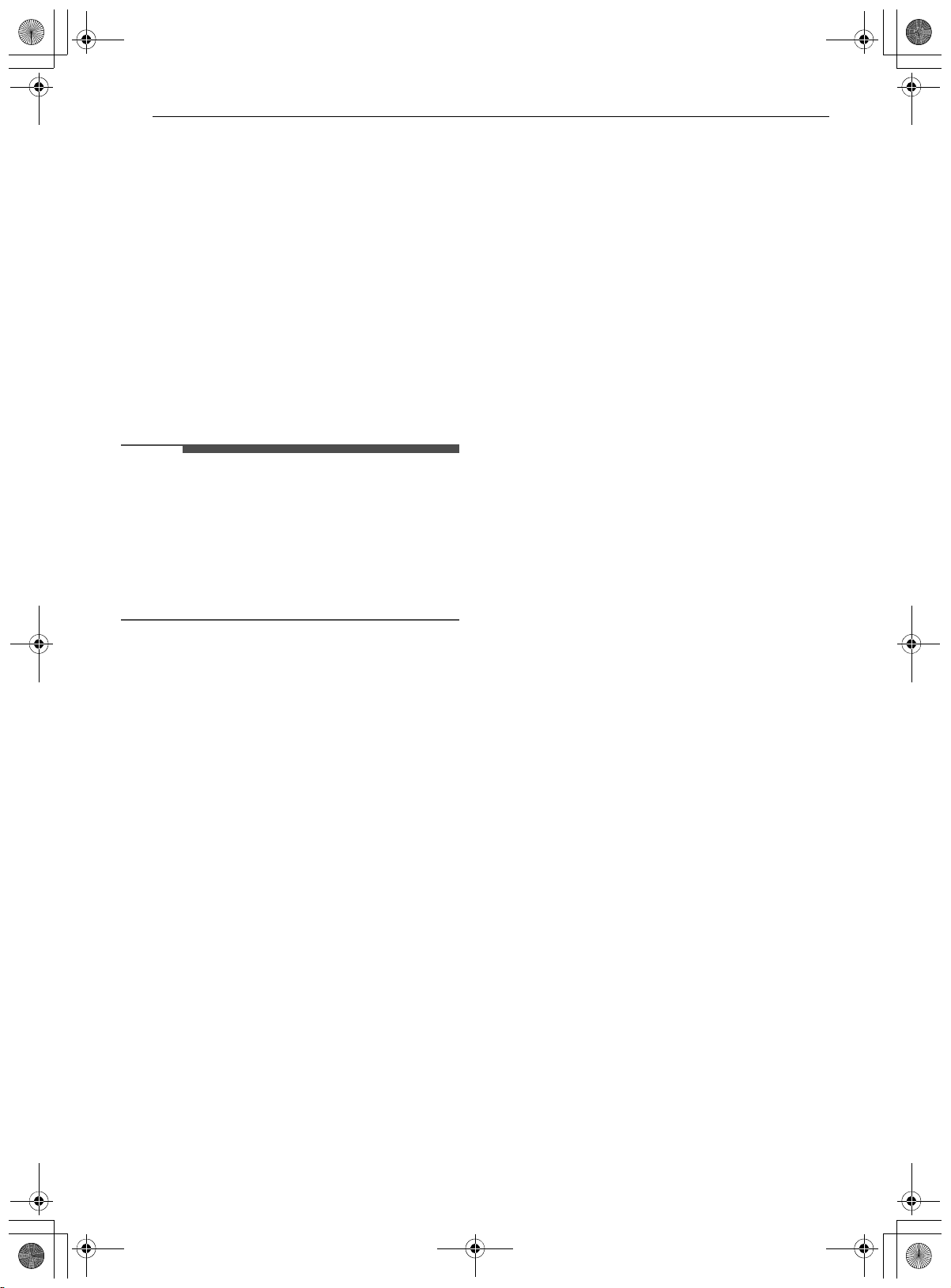
• To avoid damaging the dispenser, do not pull up
on the dispenser to close the dishwasher door.
For more details, refer to the online owner's
manual.
en-us_main.book.book Page 27 Friday, January 20, 2023 8:33 AM
28 OPERATION
Adding Rinse Aid to the Dispenser
The Rinse Aid LED appears in the display when
more rinse aid is needed.
The use of rinse aid is recommended to prevent
water spots on dishes and to enhance drying
performance.
For more details, refer to the online owner's
manual.
Rinse Aid Dispenser Adjustment
The dispenser has five adjustment levels. The
dishwasher is programmed at the factory for a
rinse aid dispenser level of 2. This can be checked
and adjusted from the control panel.
NOTE
• Adjust the setting higher if you have hard water
and notice calcium buildup on your dishes.
• Setting the rinse aid control too low will
contribute to spotting and streaking on dishes
and poor drying performance.
• Setting the control too high can cause foaming,
which will cause poor wash performance.
1 Ensure the appliance is off.
2 Press Power and Delay Start simultaneously
to check the current setting.
3 Press Delay Start to change the rinse aid
dispenser setting. Each press of the button
changes the setting one step from L0 to L4.
4 Once the desired rinse aid dispenser setting is
selected, press Start to save.
Refilling the Rinse Aid
How often the dispenser needs to be refilled
depends on how often dishes are washed and the
rinse aid setting used.
•The Rinse Aid LED flashes when more rinse aid
is needed, unless the rinse aid dispenser setting
is set to L0.
en-us_main.book.book Page 28 Friday, January 20, 2023 8:33 AM
29SMART FUNCTIONS
ENGLISH
SMART FUNCTIONS
LG ThinQ Application
The LG ThinQ application allows you to
communicate with the appliance using a
smartphone.
LG ThinQ Application Features
• Smart Diagnosis
- This function provides useful information for
diagnosing and solving issues with the
appliance based on the pattern of use. Select
Smart Diagnosis in the app and follow the
instructions. For additional information, refer
to the online owner's manual.
Installing the LG ThinQ Application
Search for the LG ThinQ application from the
Google Play Store or Apple App Store on a
smartphone. Follow instructions to download and
install the application.
en-us_main.book.book Page 29 Friday, January 20, 2023 8:33 AM
30 MAINTENANCE
MAINTENANCE
To maintain performance and prevent trouble, it is important to check the outside and inside of the
dishwasher, including filters and spray arms, at regular intervals.
WARNING
• When cleaning the outside and inside of the dishwasher, do not use benzene or thinner. Otherwise, it
may cause fire or explosion.
• To prevent injury during care and maintenance or cleaning, wear gloves and/or protective clothing.
Cleaning and Care
Cleaning the Exterior
• Do not use scrub pads or abrasive cleaners on
the exterior of the dishwasher.
• Most soil can be removed using a soft, damp
cloth or sponge. A mild soap can be used to help
release stubborn soil. Rinse and wipe dry with a
soft cloth after cleaning.
• Stainless steel surfaces can be polished using a
stainless steel cleaner. Follow the instructions on
the cleaner, and wipe in the direction of the
grain.
CAUTION
• If cooking oil is spilled on the exterior of the
product, wipe it off immediately. Do not clean
the exterior of the product with cleaners which
contain alcohol, thinners, bleach, benzene,
flammable liquids, or abrasives. These
substances may discolor or damage the
appliance.
Cleaning the Interior
• Clean the interior of the dishwasher periodically
with a soft, damp cloth or sponge to remove
food and dirt particles.
• To remove white spots and odor from inside the
dishwasher, run an empty cycle, without
detergent, with one cup of white vinegar in a
dishwasher safe glass or bowl placed on the
upper rack. (Vinegar is an acid and with constant
use it could damage the appliance.)
• Cleaning the Tub
- Run the Auto cycle once a month or after
every 30 cycles to eliminate residual soil, odor,
white spots and other dirt inside the appliance.
1 Remove all dishes from the appliance.
2 Add 3 tbsp. (40 g) of citric acid to the
detergent dispenser or follow the
manufacturer’s instructions if using a
dishwasher cleaning agent. Do not use
dishwasher detergent.
3 Press Cycles to select the Auto cycle.
4 Press Start.
NOTE
•Run the Auto cycle once a month, or more often
if needed, to remove detergent buildup and
other residue.
• If you have not used the dishwasher for a long
time, refresh the inside by running the Auto
cycle without detergent. When the cycle is
finished, clean the inside and outside of the
dishwasher according to the MAINTENANCE
instructions.
Clogged Drain Air Gap or In-Sink
Disposal
Check the drain air gap or in-sink disposal if the
dishwasher is not draining well.
NOTE
• The drain air gap and disposal are external
plumbing devices that are not part of the
dishwasher.
• The warranty provided with the dishwasher does
not cover service costs directly associated with
the cleaning or repair of the external drain air
gap and disposal.
Cleaning the Air Gap
1 Turn off the dishwasher.
en-us_main.book.book Page 30 Friday, January 20, 2023 8:33 AM
31MAINTENANCE
ENGLISH
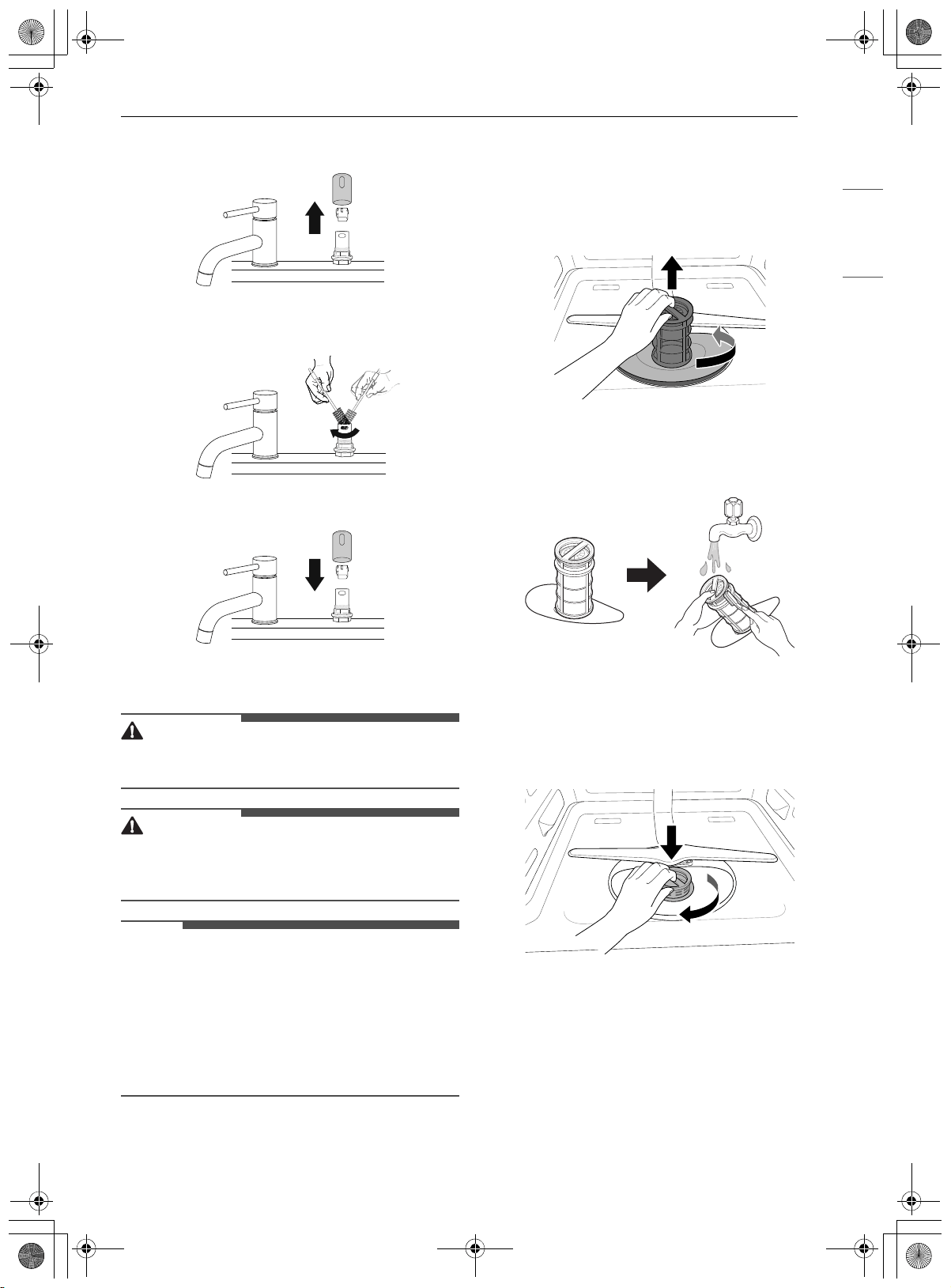
2 Remove the air gap cover and the plastic cap
underneath it.
3 Clean out any debris with a toothpick or
brush.
4 Replace the plastic cap and air gap cover.
Cleaning the Filters
WARNING
• Be cautious of sharp edges when handling the
stainless steel filter.
CAUTION
• Remove food residue caught in filters to prevent
the buildup of odor-causing bacteria and
possible drainage problems.
NOTE
• For best wash performance, clean the filter after
each load. If food debris remains in the filter, it
may cause an odor.
• In areas with hard water, clean the filter at least
once a month with a soft brush.
• Clean the filters using non-abrasive materials
and warm running water.
1 Remove the lower rack and position the
bottom spray arm so a wider vee is open to
the front.
2 Turn the inner filter counter-clockwise and
take out the assembled inner filter and
stainless steel filter.
With the filters removed, check the sump
opening and remove any foreign materials, if
needed.
3 Clean the filters with a soft brush under
running water. Reassemble the filters before
reinstalling them.
4 To replace the assembled filters, position the
spray arm so the wider vee is toward the
front. Fit the filters back into the filter holder
and secure them by turning the inner filter
clockwise until it clicks into place.
en-us_main.book.book Page 31 Friday, January 20, 2023 8:33 AM
32 MAINTENANCE
NOTE
• Make sure the filter is assembled correctly
before starting a cycle. When assembling, rotate
the filter firmly until it clicks.
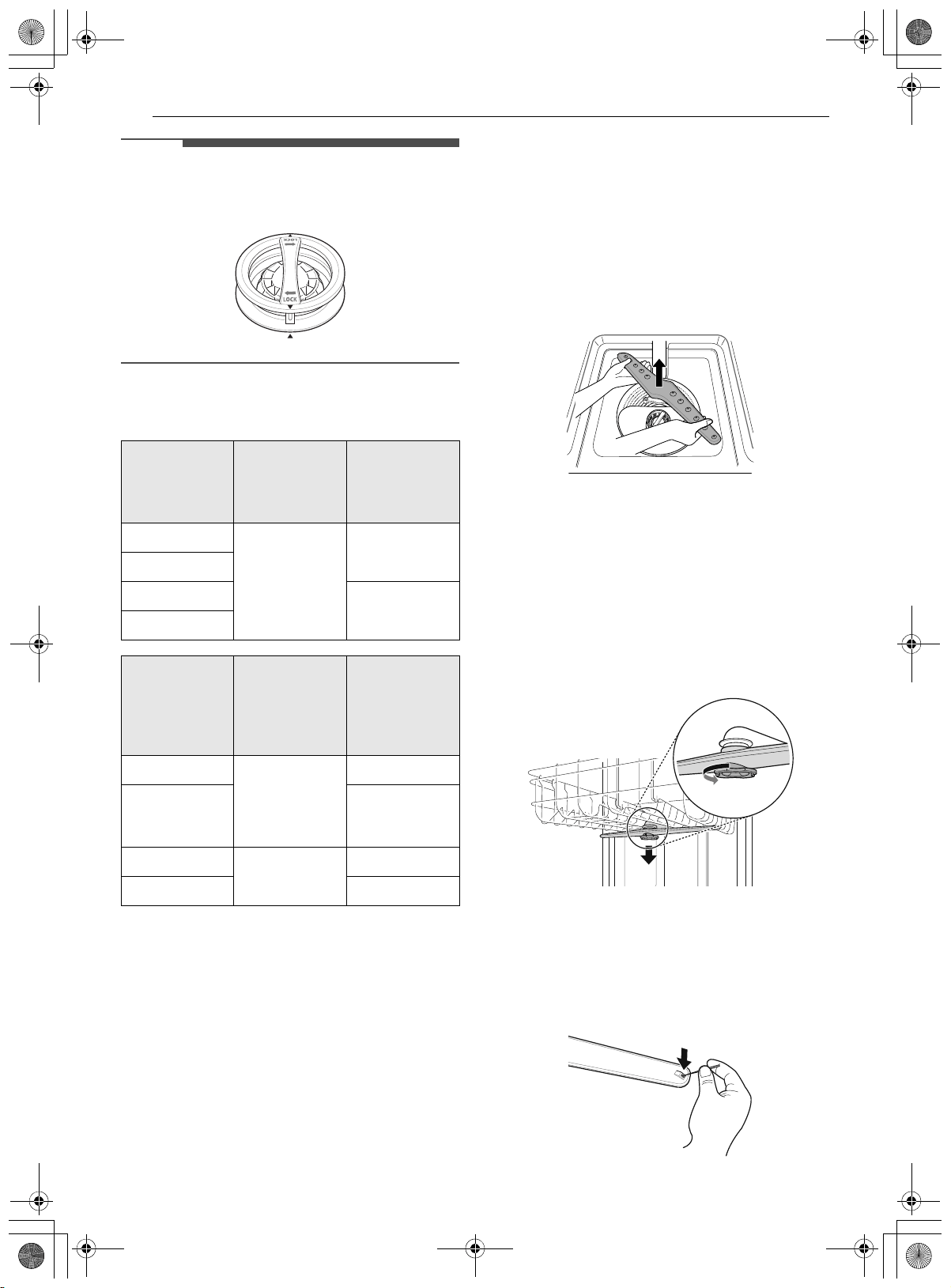
Recommended Filter Cleaning
Schedule
Cleaning the Spray Arm
If the spray arm holes are blocked by any food
residue, dishes may not be cleaned well due to
improper water spray.
It is recommended that the spray arms be cleaned
once every two weeks.
Cleaning the Lower Spray Arm
1 Make sure that the water jet holes are not
blocked by food particles.
2 When cleaning is necessary, remove the lower
spray arm by pulling up.
3 Remove food particles by rinsing or shaking
the spray arm.
4 After cleaning the lower spray arm, replace it
by pushing down until it clips into place. Be
sure that the spray arm is able to turn freely.
Cleaning the Upper Spray Arm
1 Pull the upper rack forward. Make sure that
the water jet holes are not blocked by food
particles.
2 When cleaning is necessary, remove the
upper spray arm by turning the nut on the
bottom of the spray arm 1/8 turn counter-
clockwise and pulling down.
3 Remove food particles by rinsing or shaking
the spray arm.
4 If any food residue blocks the spray arm
holes, remove it with a pin or any sharp tool.
Number of
Loads Per
Week
If you wash
dishes before
loading
If you scrape
and rinse
dishes before
loading
1 - 3
Every 6 months
Once a year
4 - 7
8 - 12
Every 6 months
13 - 14
Number of
Loads Per
Week
If you only
scrape dishes
before
loading
If you do not
scrape or
rinse dishes
before
loading
1 - 3
Four times a
year
Once a month
4 - 7
Twice a
month(every
15 days)
8 - 12
Every 1.5
months
Every week
13 - 14 Twice a week
en-us_main.book.book Page 32 Friday, January 20, 2023 8:33 AM

33MAINTENANCE
ENGLISH
5 After removing the food residue, clean the
spray arms under running water.
6 After cleaning the upper spray arm, press it
up into place. Turn the nut 1/8 turn clockwise
to make sure that the nut locks back into
place.
7 After assembly, make sure that the spray
arms rotate freely.
Seasonal Maintenance and Storage
• If you will be absent for an extended period of
time during warmer months, close the water
valve and disconnect the power supply line, or
turn off the circuit breaker. Clean the filter, tub
and dispenser to prevent odor.
• If you will be absent for an extended period of
time during colder months and there is a
possibility of freezing temperatures, winterize
the water supply lines and the dishwasher itself.
Winterization must be performed by qualified
service personnel.
en-us_main.book.book Page 33 Friday, January 20, 2023 8:33 AM
34 TROUBLESHOOTING
TROUBLESHOOTING
The washer is equipped with an automatic error-monitoring system to detect and diagnose problems at an
early stage. If the washer does not function properly or does not function at all, check the following before
you call for service.
Before Calling for Service
For more troubleshooting, refer to the online owner's manual.
User Support Videos
For further assistance, there are videos and tutorials available through the LG.com website.
1 On the www.lg.com home page, click on the Support menu tab to bring up the menu selections.
Select Video Tutorials.
2 Select a product category and then pick a topic or search a keyword.
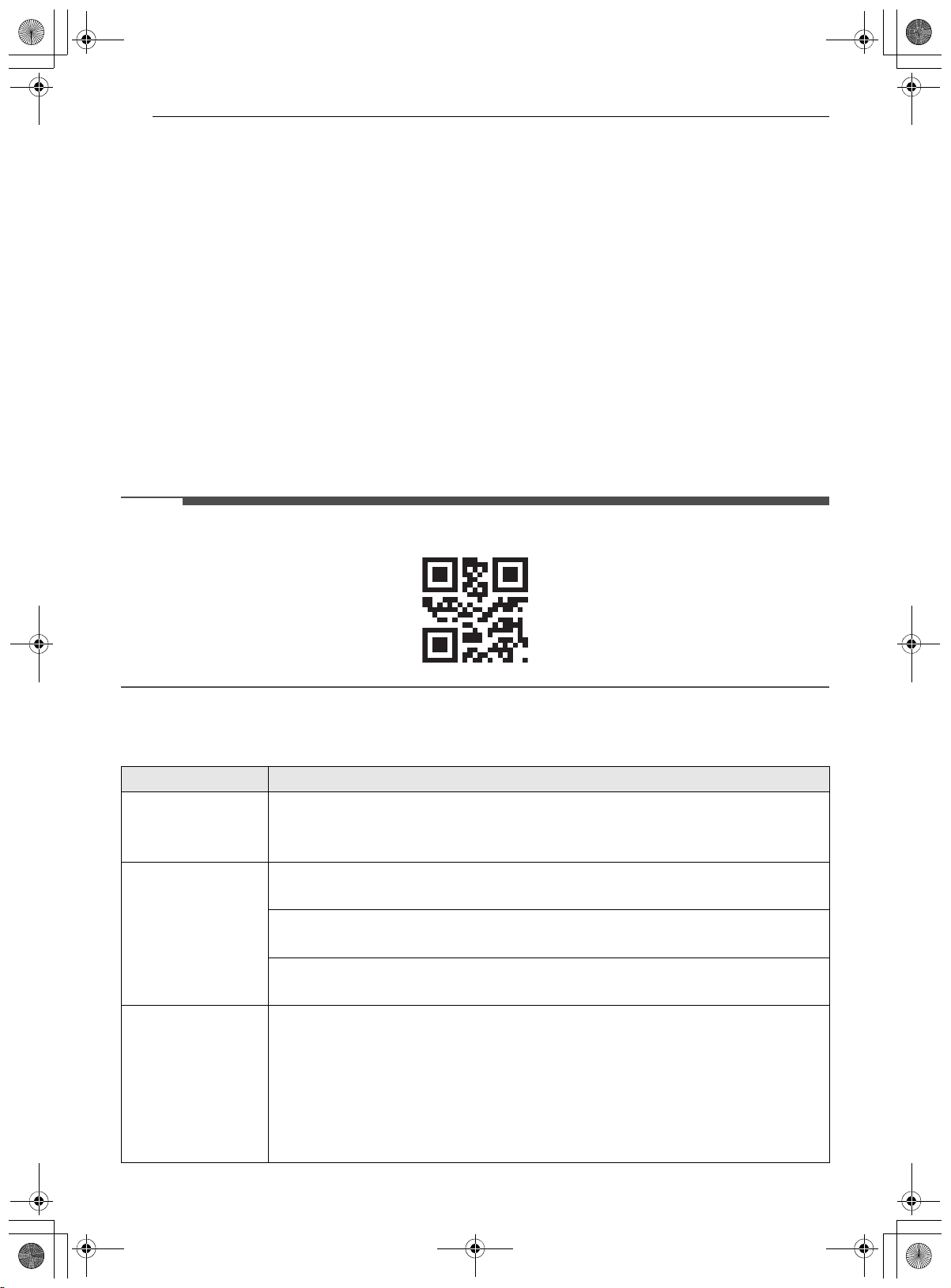
NOTE
• Scan this QR code to quickly access the video search page on the LG website.
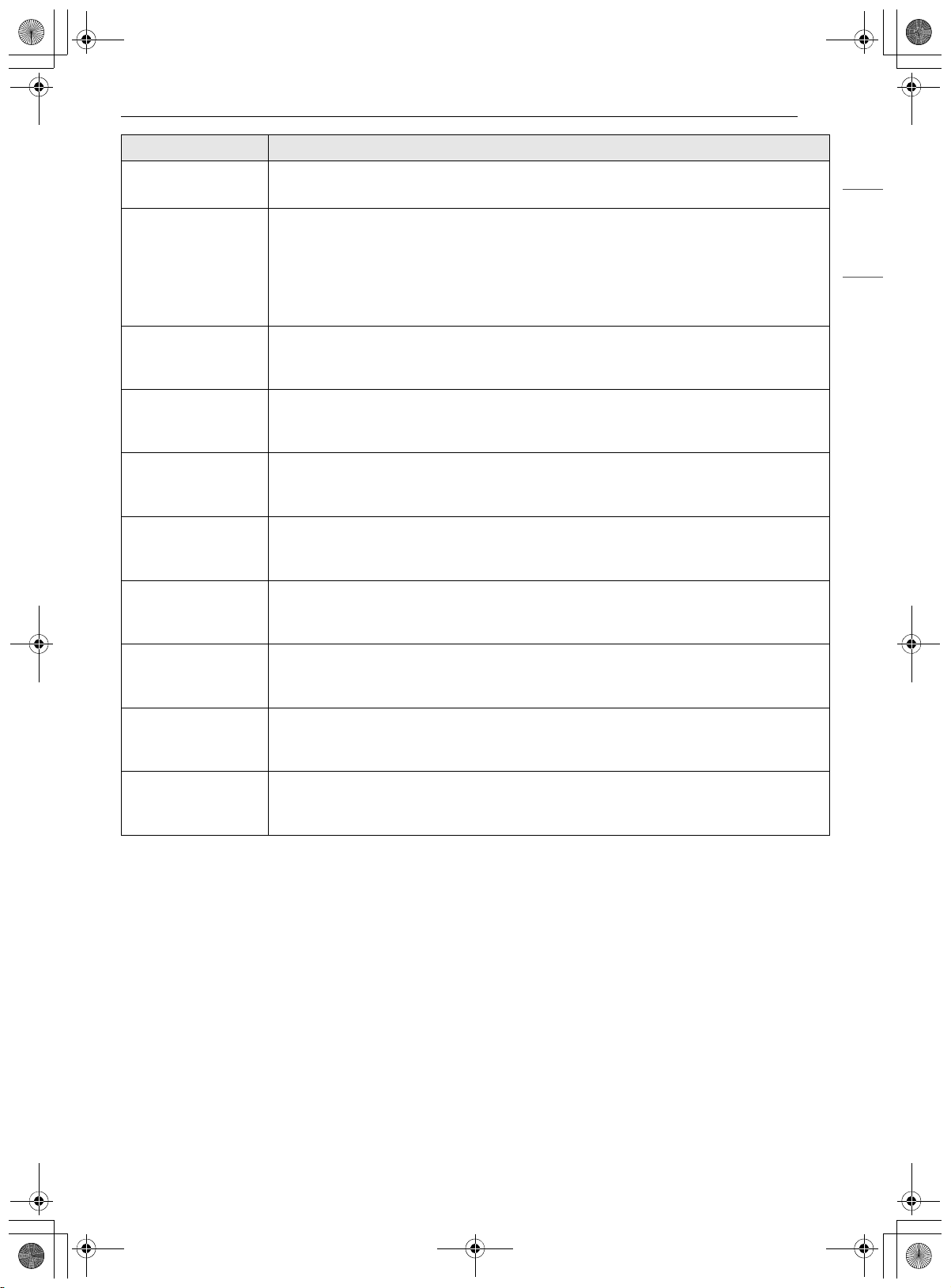
Error Messages
Problem Possible Cause & Solution
IE
Water inlet problem.
• Check for a clogged, kinked or frozen water inlet hose.
• Check water supply.
OE
Drainage Problem.
• Check for a clogged, kinked or frozen water drain hose.
Air gap or disposal is clogged.
• Clean air gap or disposal.
Filters are clogged.
• Clean filters.
bE
Oversudsing caused by improper detergent, such as liquid dish soap.
• Do not use hand dishwashing liquids. Only use detergents which are designed for use in
automatic dishwashers.
•A
bE error can appear if dishes soiled with a lot of foamy food, such as whipped cream, are
loaded in the appliance. To clear the error, turn the appliance off and start a new cycle.
• To remove detergent residue in the tub, pour approximately 4 oz ~ 8 oz (100 ml ~ 200 ml)
of milk into a shallow bowl, place it in the upper rack and then run the appliance on the
Auto cycle.
en-us_main.book.book Page 34 Friday, January 20, 2023 8:33 AM
35TROUBLESHOOTING
ENGLISH
bE
Failure to level dishwasher.
• Make sure that the appliance is properly leveled.
AE
Water leakage
• Turn off the water supply to the dishwasher and call an LG Electronics Customer
Information Center at 1-800-243-0000 (U.S.A.) or 1-888-542-2623 (Canada).
• The dishwasher makes an alert sound for 10 seconds, and runs the drain pump
intermittently. If power is turned off to the machine, the machine powers back on
automatically until the AE error is resolved.
FE
Excessive Water supplied.
• Please call an LG Electronics Customer Information Center at 1-800-243-0000 (U.S.A.) 1-
888-542-2623 (Canada).
HE
Heater circuit failure.
• Please call an LG Electronics Customer Information Center at 1-800-243-0000 (U.S.A.) 1-
888-542-2623 (Canada).
tE
Water temperature sensor error
• Please call an LG Electronics Customer Information Center at 1-800-243-0000 (U.S.A.) 1-
888-542-2623 (Canada).
LE
Wash motor error
• Please call an LG Electronics Customer Information Center at 1-800-243-0000 (U.S.A.) 1-
888-542-2623 (Canada).
NE
Vario motor error
• Please call an LG Electronics Customer Information Center at 1-800-243-0000 (U.S.A.) 1-
888-542-2623 (Canada).
N:#, U:#, d:#, t#
(# is a number.)
Test mode is selected.
• This is not an error code. This code is used when testing the dishwasher. Power the unit off
and on and the code will disappear.
LO, L1, Lz, L3, L4
Rinse aid level setting mode is selected.
• This is not an error code. This code indicates the current rinse aid level. For more
information, refer to the Adding Cleaning Products section.
CL
Control Lock is activated.
• This is not an error code. This code indicates that the control lock is activated. Press and
hold Flex Zone and High Temp. buttons simultaneously for three seconds.
Problem Possible Cause & Solution
en-us_main.book.book Page 35 Friday, January 20, 2023 8:33 AM
36 LIMITED WARRANTY
LIMITED WARRANTY
USA
TERMS AND CONDITIONS
ARBITRATION NOTICE: THIS LIMITED WARRANTY CONTAINS AN ARBITRATION PROVISION THAT
REQUIRES YOU AND LG ELECTRONICS (“LG”) TO RESOLVE DISPUTES BY BINDING ARBITRATION
INSTEAD OF IN COURT, UNLESS YOU CHOOSE TO OPT OUT. IN ARBITRATION, CLASS ACTIONS AND
JURY TRIALS ARE NOT PERMITTED. PLEASE SEE THE SECTION TITLED “PROCEDURE FOR RESOLVING
DISPUTES” BELOW.
Should your LG Dishwasher (“Product”) fail due to a defect in materials or workmanship under normal and
proper use, during the warranty period set forth below, LG will, at its option, repair or replace the Product.
This limited warranty is valid only to the original retail purchaser of the Product (“You”) and applies only
when purchased lawfully and used within the United States including U.S. Territories.
† Main control board is located on the bottom right of the dishwasher when viewed from the front.
• Replacement Products and parts are warranted for the remaining portion of the original warranty period
or ninety (90) days, whichever is greater.
• Replacement Products and parts may be new, reconditioned, refurbished, or otherwise factory
remanufactured.
• Replaced Product or part(s) will be the property of LG.
• Proof of original retail purchase specifying the Product model and date of purchase is required to obtain
warranty service under this limited warranty.
EXCEPT TO THE EXTENT PROHIBITED BY APPLICABLE LAW, ANY IMPLIED WARRANTY OF
MERCHANTABILITY OR FITNESS FOR A PARTICULAR PURPOSE ON THE PRODUCT IS LIMITED IN
DURATION TO THE DURATION OF THE ABOVE LIMITED WARRANTY. UNDER NO CIRCUMSTANCES
SHALL LG OR ITS U.S. DISTRIBUTORS/DEALERS BE LIABLE FOR ANY INDIRECT, INCIDENTAL,
CONSEQUENTIAL, SPECIAL, OR PUNITIVE DAMAGES, INCLUDING, WITHOUT LIMITATION, LOST
GOODWILL, LOST REVENUES OR PROFITS, WORK STOPPAGE, IMPAIRMENT OF OTHER GOODS, COST OF
REMOVAL AND REINSTALLATION OF THE PRODUCT, LOSS OF USE, OR ANY OTHER DAMAGES WHETHER
BASED IN CONTRACT, TORT, OR OTHERWISE. LG’S TOTAL LIABILITY, IF ANY, SHALL NOT EXCEED THE
PURCHASE PRICE PAID BY YOU FOR THE PRODUCT.
SOME STATES DO NOT ALLOW THE EXCLUSION OR LIMITATION OF INCIDENTAL OR CONSEQUENTIAL
DAMAGES OR LIMITATIONS ON HOW LONG AN IMPLIED WARRANTY LASTS, SO THE ABOVE
EXCLUSIONS OR LIMITATIONS MAY NOT APPLY TO YOU. THIS LIMITED WARRANTY GIVES YOU
SPECIFIC LEGAL RIGHTS AND YOU MAY ALSO HAVE OTHER RIGHTS THAT VARY FROM STATE TO STATE.
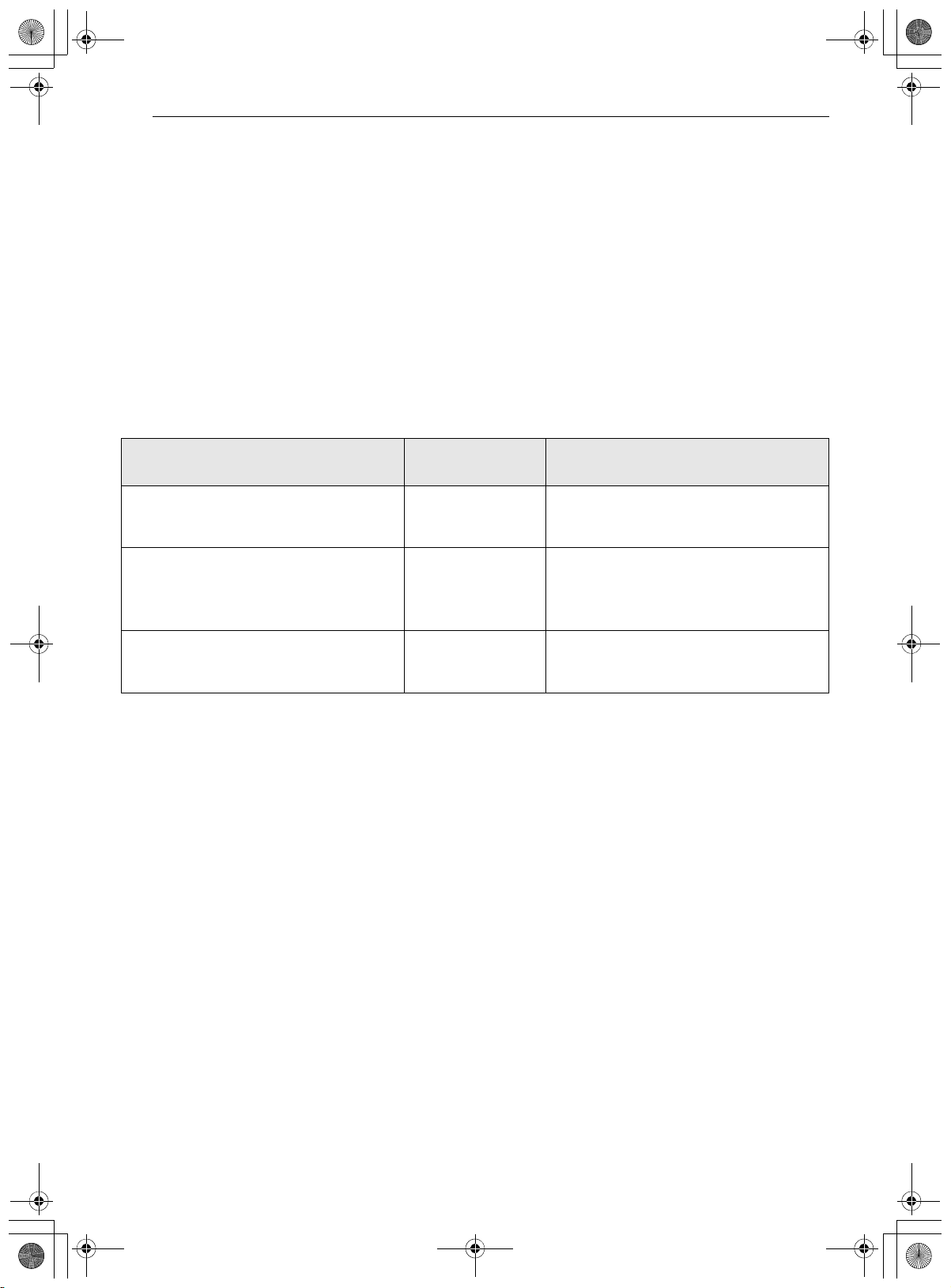
Warranty Period
Scope of
Warranty
HOW SERVICE IS HANDLED
One (1) year from date of original retail
purchase
Labor / Parts LG will also provide, free of charge, all
labor and on-site service to replace the
defective part.
Two (2) years from date of original retail
purchase
Main control
board
†
/ Racks /
Stainless Steel Door
Liner / Tub
Main control board, dishwasher racks,
stainless steel door liner, tub. Customer
will be responsible for any labor or in-
home service to replace defective parts.
Ten (10) years from date of original retail
purchase
Direct Drive Motor Direct Drive motor. Customer will be
responsible for any labor or in-home
service to replace defective parts.
en-us_main.book.book Page 36 Friday, January 20, 2023 8:33 AM
37LIMITED WARRANTY
ENGLISH
THIS LIMITED WARRANTY DOES NOT COVER:
• Service trips to deliver, pick up, or install, educate how to operate, correct wiring, or correct
unauthorized repairs.
• Damage or failure of the Product to perform during power failures and interrupted or inadequate
electrical service.
• Damage or failure of the Product caused by leaky or broken water pipes, frozen water pipes, restricted
drain lines, inadequate or interrupted water supply or inadequate supply of air.
• Damage or failure of the Product resulting from operating the Product in a corrosive atmosphere or
contrary to the Product owner’s manual.
• Damage or failure of the Product caused by accidents, pests and vermin, lightning, wind, fire, floods, acts
of nature, or any other causes beyond the control of LG.
• Damage or failure of the Product caused by unauthorized modification or alteration, or if the Product is
used for other than the intended purpose, or any water leakage where the Product was not properly
installed.
• Damage or failure of the Product caused by incorrect electrical current, voltage, or plumbing codes.
• Damage or failure of the Product caused by transportation, storage, and/or handling, including
scratches, dents, chips, and/or other damage to the finish of the Product, unless such damage is
reported within one (1) week of delivery.
• Damage or failure of the Product resulting from misuse, abuse, improper installation, repair, or
maintenance. Improper repair includes the use of parts not authorized by LG. Improper installation or
maintenance includes installation or maintenance contrary to the Product owner’s manual.
• Damage or failure of the Product caused by the use of parts, components, accessories, consumable
cleaning products, or any other products or services that were not authorized by LG.
• Damage or missing items to any display or open box Product.
• Refurbished Product or any Product sold “As Is”, “Where Is”, “With all Faults”, or similar disclaimer.
• Products with original serial numbers that have been removed, altered, or cannot be readily determined.
• Increases in utility costs and additional utility expenses.
• Any noises associated with normal operation.
• Products used for other than normal and proper household use (e.g., commercial or industrial use) or
contrary to the Product owner’s manual.
• Costs associated with removal and reinstallation of the Product for repairs, or the removal and
reinstallation of the Product if it is installed in an inaccessible location or not installed in accordance with
the Product Owner's manual.
• Accessories, removable components, or consumable parts (e.g. Shelves, door bins, drawers, water/air
filters, racks, light bulbs, batteries, etc., as applicable), except for internal/functional parts covered under
this limited warranty.
The cost of repair or replacement under these excluded circumstances shall be borne by You.
TO OBTAIN WARRANTY SERVICE AND ADDITIONAL INFORMATION
Call 1-800-243-0000 and select the appropriate option from the menu.
Or visit our website at http://www.lg.com
Or by mail: LG Electronics Customer Service P.O. Box 240007 Huntsville, AL 35813 ATTN: CIC
PROCEDURE FOR RESOLVING DISPUTES:
ALL DISPUTES BETWEEN YOU AND LG ARISING OUT OF OR RELATING IN ANY WAY TO THIS LIMITED
WARRANTY OR THE PRODUCT SHALL BE RESOLVED EXCLUSIVELY THROUGH BINDING ARBITRATION, AND
NOT IN A COURT OF GENERAL JURISDICTION. BINDING ARBITRATION MEANS THAT YOU AND LG ARE EACH
WAIVING THE RIGHT TO A JURY TRIAL AND TO BRING OR PARTICIPATE IN A CLASS ACTION.
Definitions. For the purposes of this section, references to “LG” mean LG Electronics U.S.A., Inc., its
parents, subsidiaries and affiliates, and each of their officers, directors, employees, agents, beneficiaries,
en-us_main.book.book Page 37 Friday, January 20, 2023 8:33 AM

38 LIMITED WARRANTY
predecessors in interest, successors, assigns and suppliers; references to “dispute” or “claim” shall include
any dispute, claim or controversy of any kind whatsoever (whether based in contract, tort, statute,
regulation, ordinance, fraud, misrepresentation or any other legal or equitable theory) arising out of or
relating in any way to the sale, condition or performance of the product or this Limited Warranty.
Notice of Dispute. In the event you intend to commence an arbitration proceeding, you must first notify
LG in writing at least 30 days in advance of initiating the arbitration by sending a letter to LG at LG
Electronics, USA, Inc. Attn: Legal Department- Arbitration 111 Sylvan Avenue, Englewood Cliffs, NJ 07632.
You and LG agree to engage in good faith discussions in an attempt to amicably resolve your claim. The
notice must provide your name, address, and telephone number; identify the product that is the subject of
the claim; and describe the nature of the claim and the relief being sought. If you and LG are unable to
resolve the dispute within 30 days, either party may proceed to file a claim for arbitration.
Agreement to Binding Arbitration and Class Action Waiver. Upon failure to resolve the dispute during
the 30 day period after sending written notice to LG, you and LG agree to resolve any claims between us
only by binding arbitration on an individual basis, unless you opt out as provided below. Any dispute
between you and LG shall not be combined or consolidated with a dispute involving any other person’s or
entity’s product or claim. More specifically, without limitation of the foregoing, any dispute between you
and LG shall not under any circumstances proceed as part of a class or representative action. Instead of
arbitration, either party may bring an individual action in small claims court, but that small claims court
action may not be brought on a class or representative basis.
Arbitration Rules and Procedures. To begin arbitration of a claim, either you or LG must make a written
demand for arbitration. The arbitration will be administered by the American Arbitration Association
(“AAA”) and will be conducted before a single arbitrator under the AAA’s Consumer Arbitration Rules that
are in effect at the time the arbitration is initiated (referred to as the “AAA Rules”) and under the
procedures set forth in this section. The AAA Rules are available online at www.adr.org/consumer. Send a
copy of your written demand for arbitration, as well as a copy of this provision, to the AAA in the manner
described in the AAA Rules. You must also send a copy of your written demand to LG at LG Electronics,
USA, Inc. Attn: Legal Department- Arbitration 111 Sylvan Avenue, Englewood Cliffs, NJ 07632. If there is a
conflict between the AAA Rules and the rules set forth in this section, the rules set forth in this section will
govern. This arbitration provision is governed by the Federal Arbitration Act. Judgment may be entered on
the arbitrator’s award in any court of competent jurisdiction. All issues are for the arbitrator to decide,
except that issues relating to the scope and enforceability of the arbitration provision and to the
arbitrability of the dispute are for the court to decide. The arbitrator is bound by the terms of this
provision.
Governing Law. The law of the state of your residence shall govern this Limited Warranty and any
disputes between us except to the extent that such law is preempted by or inconsistent with applicable
federal law.
Fees/Costs. You do not need to pay any fee to begin an arbitration. Upon receipt of your written demand
for arbitration, LG will promptly pay all arbitration filin
g fees to the AAA unle
ss you seek more than $25,000
in damages, in which case the payment of these fees will be governed by the AAA Rules. Except as
otherwise provided for herein, LG will pay all AAA filing, administration and arbitrator fees for any
arbitration initiated in accordance with the AAA Rules and this arbitration provision. If you prevail in the
arbitration, LG will pay your attorneys’ fees and expenses as long as they are reasonable, by considering
factors including, but not limited to, the purchase amount and claim amount. Notwithstanding the
foregoing, if applicable law allows for an award of reasonable attorneys’ fees and expenses, an arbitrator
can award them to the same extent that a court would. If the arbitrator finds either the substance of your
claim or the relief sought in the demand is frivolous or brought for an improper purpose (as measured by
the standards set forth in Federal Rule of Civil Procedure 11(b)), then the payment of all arbitration fees will
be governed by the AAA Rules. In such a situation, you agree to reimburse LG for all monies previously
disbursed by it that are otherwise your obligation to pay under the AAA Rules. Except as otherwise
provided for, LG waives any rights it may have to seek attorneys’ fees and expenses from you if LG prevails
in the arbitration.
Hearings and Location. If your claim is for $25,000 or less, you may choose to have the arbitration
conducted solely on the basis of (1) documents submitted to the arbitrator, (2) through a telephonic
hearing, or (3) by an in-person hearing as established by the AAA Rules. If your claim exceeds $25,000, the
right to a hearing will be determined by the AAA Rules. Any in-person arbitration hearings will be held at a
location within the federal judicial district in which you reside unless we both agree to another location or
we agree to a telephonic arbitration.
en-us_main.book.book Page 38 Friday, January 20, 2023 8:33 AM
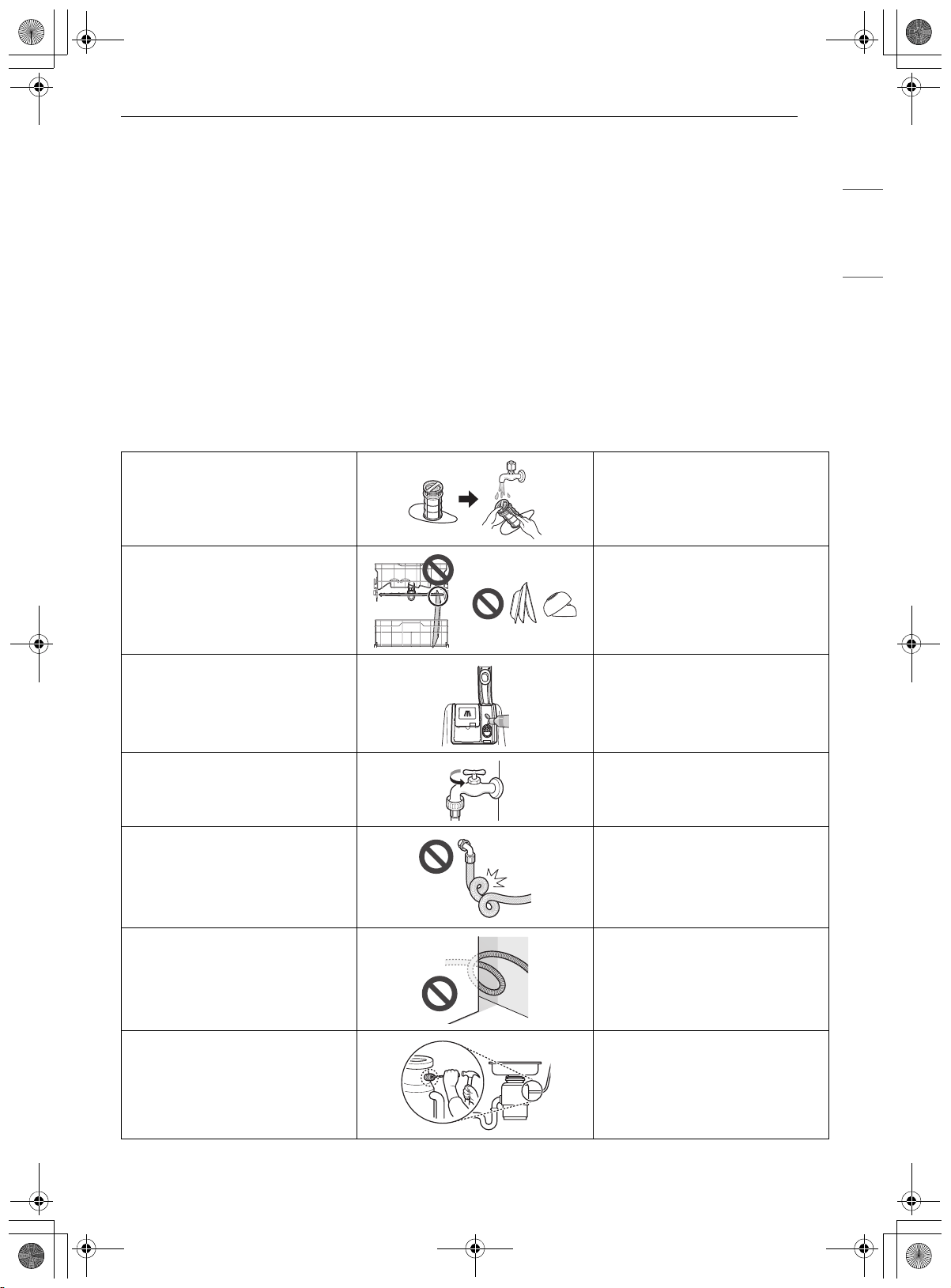
39LIMITED WARRANTY
ENGLISH
Opt Out. You may opt out of this dispute resolution procedure. If you opt out, neither you nor LG can
require the other to participate in an arbitration proceeding. To opt out, you must send notice to LG no
later than 30 calendar days from the date of the first consumer purchaser’s purchase of the product by
either: (i) sending an e-mail to opto[email protected], with the subject line: “Arbitration Opt Out” or (ii) calling 1-
800-980-2973. You must include in the opt out e-mail or provide by telephone: (a) your name and address;
(b) the date on which the product was purchased; (c) the product model name or model number; and (d)
the serial number (the serial number can be found (i) on the product; or (ii) online by accessing https://
www.lg.com/us/support/repair-service/schedule-repair-continued and clicking on “Find My Model & Serial
Number”).
You may only opt out of the dispute resolution procedure in the manner described above (that is, by e-mail
or telephone); no other form of notice will be effective to opt out of this dispute resolution procedure.
Opting out of this dispute resolution procedure will not affect the coverage of the Limited Warranty in any
way, and you will continue to enjoy the full benefits of the Limited Warranty. If you keep this product and
do not opt out, then you accept all terms and conditions of the arbitration provision described above.
Warranty Exceptions
Poor wash results caused by
debris remaining in the filter.
Clean the filter regularly.
Poor wash results caused by
improper loading or over stacking:
wash arm won't rotate or soap
dispenser is held closed.
Make certain that no dishes or
utensils are in the path of the
spray arms.
Do not place one dish on top of
another.
Poor drying results caused by lack
of rinse aid.
Use rinse aid or combination
detergent.
Water is not supplied because the
water tap is not turned on.
IE error
Check and turn on the water tap.
Water is not supplied because the
inlet hose is kinked.
IE error
Reinstall the inlet hose.
Not draining because drain hose is
kinked.
OE error
Reinstall the drain hose.
The knockout plug in the garbage
disposal is not removed.
OE error
Remove the plug on the disposal.
en-us_main.book.book Page 39 Friday, January 20, 2023 8:33 AM
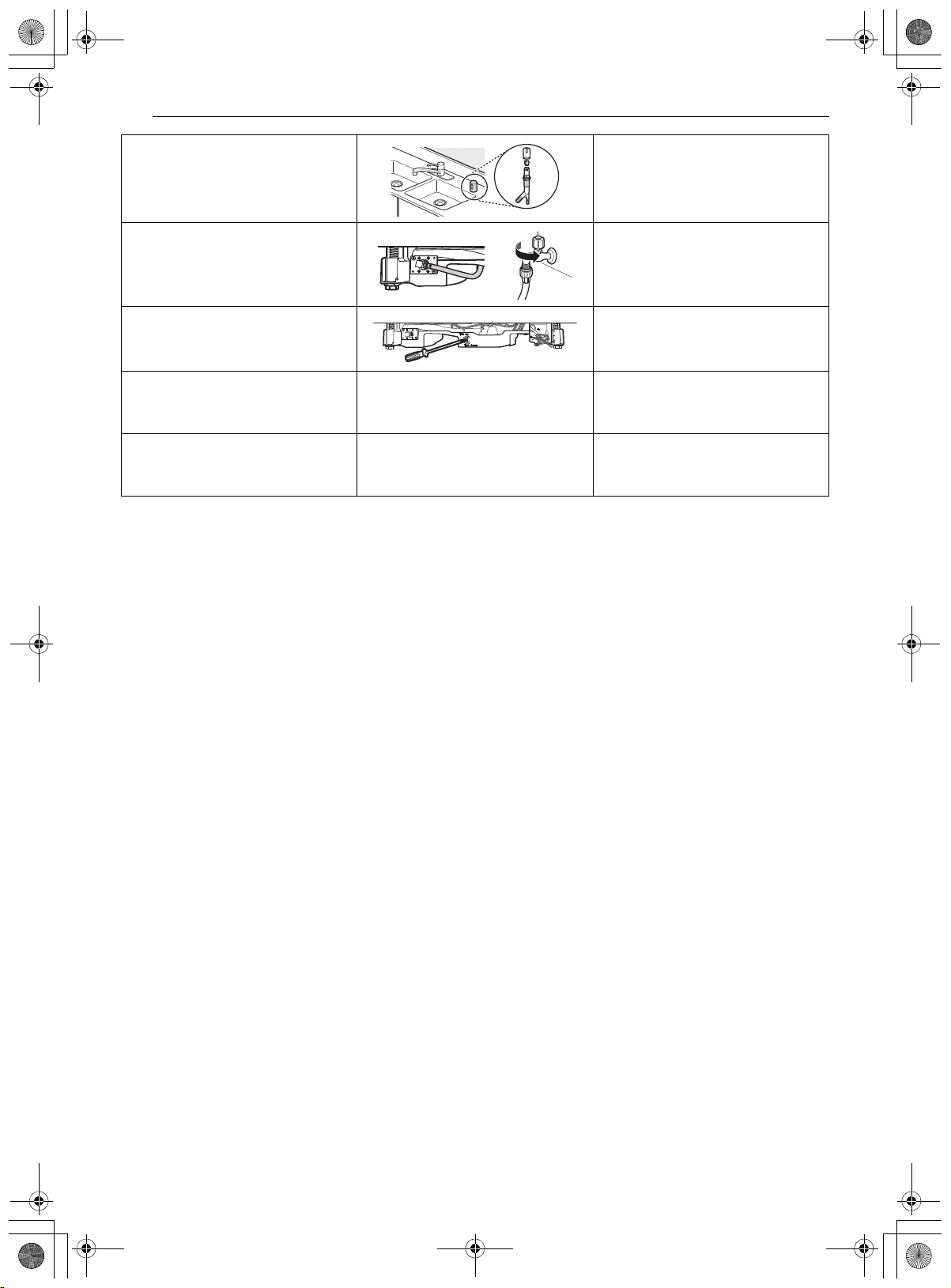
40 LIMITED WARRANTY
The disposal or air gap is blocked
by debris.
OE error
Clean the disposal or the air gap.
Inlet valve and drain hose
connection problem caused by
improper installation.
External leakage
Reinstall the hose.
Door movement or closing
compromised by incorrect
leveling.
Adjust the lower front leveling feet
to the required height.
No power due to loose connection
of power supply line or electrical
outlet problem.
Reconnect the power supply line
or repair the electrical outlet.
Pick-up, electrical wiring,
plumbing.
Installation
You will be charged for the
installation.
en-us_main.book.book Page 40 Friday, January 20, 2023 8:33 AM
MANUAL DEL PROPIETARIO
LAVAVAJILLAS
ESPAÑOL
LDFC242**
www.lg.com
Copyright © 2023 LG Electronics Inc. Todos los derechos reservados
Escanee el código QR para ver el manual.
Lea el manual del propietario detenidamente previo a operar el
electrodoméstico y mantengalo al alcance para futuras referencias.
Este manual del propietario abreviado aborda la seguridad del
usuario, las precauciones y la información de instalación.
Para ver el manual del propietario completo, puede
1. Manual en línea: visite el sitio web de LG en: http://gscs-manual.lge.
com/Total/HQ/GatewayPage/main.html o escanee el código QR que
se encuentra en la parte superior; o
2. Manual en PDF imprimible: Visite lg.com y busque su número de
modelo; o
3. Llame o escriba al servicio de atención al cliente según lo dispuesto
en su Garantía limitada.
es-us_main.book.book Page 1 Friday, January 20, 2023 8:45 AM

ÍNDICE
2
3 INSTRUCCIONES IMPORTANTES
DE SEGURIDAD
3 LEA TODAS LAS INSTRUCCIONES ANTES DE
UTILIZAR
3 MENSAJES DE ADVERTENCIA
6MENSAJES DE PRECAUCIÓN
7 DESCRIPCIÓN GENERAL DEL
PRODUCTO
7 Características del producto
9INSTALACIÓN
9 Antes de la instalación
11 Preparación de la abertura para el gabinete
12 Preparación de las conexiones eléctricas y de
agua
13 Preparación del lavavajillas
14 Deslizamiento del lavavajillas en la abertura
del gabinete
16 Conexión de la línea de suministro de agua y
energía eléctrica
17 Conexión de la manguera de desagüe
19 Nivelado del lavavajillas
21 Sujeción del lavavajillas en la abertura del
gabinete
21 Verificación final de la instalación
23 FUNCIONAMIENTO
23 Antes de usar
24 Panel de control
25 Ciclos de lavado
26 Opciones y funciones adicionales
27 Carga del lavavajillas
27 Carga en el cesto para cubiertos
28 Carga en la bandeja inferior
28 Carga en la bandeja superior
29 Agregado de productos de limpieza
31 FUNCIONES INTELIGENTES
31 Aplicación LG ThinQ
32 MANTENIMIENTO
32 Limpieza y cuidado
36 SOLUCIÓN DE PROBLEMAS
36 Antes de llamar al servicio técnico
38 GARANTÍA LIMITADA
38 EE. UU.
es-us_main.book.book Page 2 Friday, January 20, 2023 8:45 AM
3INSTRUCCIONES IMPORTANTES DE SEGURIDAD
ESPAÑOL
INSTRUCCIONES IMPORTANTES DE SEGURIDAD
LEA TODAS LAS INSTRUCCIONES ANTES DE UTILIZAR
Mensajes de seguridad
Su seguridad y la de los demás son muy importantes.
Tanto en este manual como en el equipo, hemos proporcionado muchos mensajes de seguridad
importantes. Siempre debe leer y respetar todos los mensajes de seguridad.
Todos los mensajes de seguridad le indicarán cuáles son los peligros potenciales, cómo reducir la
posibilidad de lesiones y qué podría suceder si no sigue las instrucciones.
MENSAJES DE ADVERTENCIA
ADVERTENCIA
• Para disminuir el riesgo de explosiones, incendios, descargas eléctricas, quemaduras, lesiones o muerte
para las personas que usen este artefacto, siga las precauciones básicas, incluidas las siguientes:
Instalación
• Debe conectarse a un circuito de alimentación de clasificación y tamaño adecuados y debidamente
protegido para evitar la sobrecarga eléctrica.
• Para reducir el riesgo de lesiones graves o muerte, siga todas las instrucciones de instalación.
• El artefacto debe ser instalado y conectado a tierra por personal de servicio calificado, de acuerdo con
los códigos locales.
• Desconecte la línea de alimentación, el fusible del hogar o el interruptor de corriente antes de instalar o
reparar el artefacto.
• Cuando traslade o instale el producto en un lugar diferente, llame a personal de servicio calificado para
la instalación y el mantenimiento.
• Mantenga los materiales de empaque fuera del alcance de los niños. Los materiales de empaque
pueden ser peligrosos para los niños. Corren riesgo de asfixia.
• El traslado o la instalación del artefacto requieren de dos o más personas.
• Este artefacto no ha sido diseñado para ser usado en embarcaciones o instalaciones móviles, tales como
casas rodantes, remolques o aeronaves.
• Almacene e instale el artefacto donde no esté expuesto a temperaturas bajo cero ni a la intemperie.
• Debe posicionar este artefacto cerca de una fuente de suministro eléctrico.
• En ninguna circunstancia debe cortar o quitar la tercera clavija (tierra) de la línea de alimentación.
Este es el símbolo de alerta de seguridad.
Este símbolo le advierte sobre posibles riesgos que pueden ocasionar lesiones o la muerte a usted o
a otros. El símbolo de alerta de seguridad siempre estará acompañado de las palabras
"ADVERTENCIA" o "PRECAUCIÓN" y seguido de un mensaje de seguridad importante.
Estos términos significan lo siguiente:
ADVERTENCIA
El incumplimiento de las instrucciones podría causarle la muerte o lesiones graves.
PRECAUCIÓN
El incumplimiento de las instrucciones podría causarle lesiones o daños al producto.
es-us_main.book.book Page 3 Friday, January 20, 2023 8:45 AM
4 INSTRUCCIONES IMPORTANTES DE SEGURIDAD
• Cuando traslade o instale el aparato, tenga especial cuidado en no apretar, aplastar o dañar la línea de
alimentación.
• No instale el artefacto en lugares húmedos.
• Destruya el cartón, la bolsa de plástico y los demás materiales de empaque luego de desempacar el
artefacto. Estos materiales podrían utilizarlos los niños para jugar. Las cajas de cartón cubiertas con
tapetes, colchas o láminas plásticas pueden convertirse en cámaras herméticas.
• Nunca intente operar este artefacto si se encuentra dañado, si no funciona correctamente, si no está
ensamblado por completo o si tiene piezas faltantes o rotas, incluido una línea de alimentación dañada.
• Cumpla con todos los procedimientos de seguridad del sector recomendados, incluido el uso de guantes
de manga larga y gafas de seguridad.
• El instalador debe asegurarse de que el lavavajillas esté completamente cerrado al momento de la
instalación.
• Use mangueras nuevas cuando conecte el aparato al suministro de agua. No reutilice mangueras viejas.
• Después de instalar el lavavajillas, verifique que no haya fugas en la conexión de la manguera.
• No dañe la línea de alimentación del artefacto ni coloque objetos pesados sobre él.
FUNCIONAMIENTO
• Repare o reemplace de inmediato todas las líneas de alimentación deshilachados o dañados de otra
forma. No use un cable que exhiba roturas o abrasión en su longitud o en sus extremos.
• Si detecta un sonido extraño, olor a quemado o a químico, o humo provenientes del artefacto,
desconéctelo de inmediato y contáctese con un Centro de Información al Cliente de LG Electronics.
• Nunca desconecte el artefacto tirando de la línea de alimentación.
• No use un cable de extensión ni un adaptador con este artefacto.
• No sujete la línea de alimentación ni toque los controles del artefacto con las manos húmedas.
• No modifique ni extienda el cable de alimentación.
• Si el producto se ha mojado accidentalmente, comuníquese con el Centro de Información al Cliente de
LG Electronics para que le den instrucciones antes de reanudar el uso.
• No almacene ni use gasolina u otros líquidos o vapores inflamables cerca de este artefacto ni de ningún
otro.
• Mantenga el área debajo de los artefactos y sus alrededores libre de materiales combustibles (pelusa,
papel, trapos, etc.), gasolina, productos químicos y otros vapores o líquidos inflamables.
• Este artefacto no ha sido diseñado para ser utilizado por personas con capacidades físicas, sensoriales o
mentales disminuidas (incluidos niños) o que no cuenten con la experiencia o los conocimientos
necesarios para operarlo, salvo que una persona responsable de su seguridad les brinde la supervisión o
la instrucción pertinente en cuanto al uso del artefacto.
• Si se daña la línea de alimentación eléctrica, solo el fabricante está autorizado para reemplazarlo, o bien
su agente de servicio técnico o una persona de calificación similar para prevenir riesgos.
• No maltrate la puerta, no se siente ni se pare sobre ella.
• Lea todas las instrucciones antes de usar el artefacto y consérvelas.
• Use el artefacto únicamente para el fin previsto.
• No permita que los niños jueguen con el artefacto. Es necesario supervisar atentamente a los niños
cuando el artefacto esté en funcionamiento cerca de ellos.
• No utilice indebidamente los controles.
• En el caso de que se produzca una fuga de gas (gas propano, gas licuado de petróleo, etc.), no ponga en
funcionamiento este artefacto ni ningún otro. Abra una puerta o una ventana para ventilar el área de
inmediato.
• Bajo ciertas condiciones, podría producirse gas hidrógeno en un sistema de agua caliente que no ha sido
utilizado por dos semanas o más. EL GAS HIDRÓGENO ES EXPLOSIVO. Si el sistema de agua caliente no
se ha usado durante ese período de tiempo, abra todas las llaves de agua caliente y deje que fluya varios
es-us_main.book.book Page 4 Friday, January 20, 2023 8:45 AM
5INSTRUCCIONES IMPORTANTES DE SEGURIDAD
ESPAÑOL
minutos antes de usar el artefacto. Esto eliminará el gas hidrógeno acumulado. Dado que el gas
hidrógeno es inflamable, no fume ni use ninguna llama abierta durante este proceso.
• Fije la manguera de desagüe en su sitio de manera segura.
• Solo use detergentes y agentes de enjuague recomendados para lavavajillas. Mantenga dichos
productos fuera del alcance de los niños.
• No permita que los niños ingieran detergente o agentes de enjuague para vajilla.
• Cuando cargue objetos para su lavado:
- Cargue los objetos cortantes de tal forma que no dañen el sello de la puerta.
- Cargue los cuchillos filosos con el mango hacia arriba para disminuir el riesgo de heridas cortantes u
otras lesiones.
• No lave artículos de plástico a menos que contengan la indicación de que son "seguros para lavar con
lavavajillas" o una indicación equivalente. Para los artículos de plástico que no contengan tal indicación,
consulte las recomendaciones del fabricante.
• No toque el ELEMENTO CALENTADOR durante el uso o inmediatamente después.
• No ponga en funcionamiento el lavavajillas a menos que todos los paneles del CERRAMIENTO estén en el
lugar adecuado.
• No maltrate la puerta o las bandejas del lavavajillas, no se siente ni se pare sobre ellas.
• No instale ni almacene el lavavajillas en lugares expuestos a la intemperie.
• Después de limpiar la vajilla, cierre el suministro de agua. Antes de limpiar, vuelva a abrir el suministro
de agua y revise el estado de las conexiones.
• No abra la puerta del artefacto durante la operación. Por motivos de seguridad, la bomba de purga
opera si la puerta está abierta, lo que genera un tiempo de ciclo más largo.
• Tenga cuidado de no apretarse la mano al cerrar la puerta.
• No enchufe el lavavajillas en un tomacorriente dañado.
• No instale ni coloque el lavavajillas cerca de componentes eléctricos o llamas expuestas.
• No lave vajilla que haya estado expuesta a gasolina, solventes u otros materiales inflamables.
• Al limpiar, no rocíe agua directamente sobre el producto.
• No presione los botones con objetos punzantes o filosos como un alfiler o un punzón.
• No utilice detergente con base solvente.
• No haga contacto con la salida de vapor.
• Si se extraen del lavavajillas, las piezas pequeñas como los ganchos de las bandejas y los postes de
retención del filtro pueden presentar riesgo de asfixia para niños pequeños. Mantenga dichas piezas
fuera del alcance de los niños.
Mantenimiento
• No repare ni reemplace ninguna pieza del artefacto. Todas las reparaciones y el servicio de
mantenimiento deben ser realizados por un miembro del personal de servicio calificado, a menos que se
recomiende lo contrario en este Manual del propietario. Use solamente piezas de fábrica autorizadas.
• No desarme ni repare el artefacto por su cuenta.
• Quite el polvo o los materiales extraños de las clavijas de la línea de alimentación.
• Desconecte el artefacto del suministro eléctrico antes de limpiarlo o de realizar cualquier tipo de
mantenimiento que pueda realizar el usuario. Colocar los controles en la posición de apagado no
desconecta el artefacto del suministro eléctrico.
• Quite la puerta antes de sacar de servicio o desechar el artefacto para evitar el riesgo de que niños o
animales pequeños queden atrapados adentro.
• Desconecte el artefacto antes de limpiar para evitar el riesgo de descargas eléctricas.
• Antes de desechar el producto, corte la línea de alimentación y destruya el panel de control del producto.
es-us_main.book.book Page 5 Friday, January 20, 2023 8:45 AM
6 INSTRUCCIONES IMPORTANTES DE SEGURIDAD
GUARDE ESTAS INSTRUCCIONES
Instrucciones de conexión a tierra
• Para conectar el lavavajillas de modo permanente: Este artefacto debe estar conectado a un sistema
permanente de cableado de metal con descarga a tierra, o bien debe instalarse un conductor de puesta
a tierra del equipo con los conductores de circuito y conectarse a un terminal de puesta a tierra del
equipo o a un extremo del dispositivo.
• Conecte el cable a tierra al conector a tierra de color verde en la caja de conexiones eléctricas.
Riesgo de vuelco
• No use el lavavajillas hasta que esté instalado por completo.
• No empuje hacia abajo la puerta del lavavajillas cuando esté abierta.
• El incumplimiento de estas instrucciones podría causar heridas o cortes graves.
MENSAJES DE PRECAUCIÓN
PRECAUCIÓN
• Para reducir el riesgo de lesiones leves o moderadas a personas, el mal funcionamiento o daño al
producto o propiedad cuando use este producto, siga las precauciones básicas, incluidas las siguientes:
Instalación
• Instale el producto sobre un piso firme y nivelado.
• El lavavajillas debe estar conectado a un suministro de agua caliente con un rango de temperatura entre
120 °F (49 °C) y 149 °F (65 °C). Este rango de temperatura brinda los mejores resultados de lavado y el
ciclo más corto. La temperatura no debe superar los 149 °F (65 °C) para evitar dañar la vajilla.
• No coloque la manguera de desagüe debajo del lavavajillas durante la instalación.
FUNCIONAMIENTO
• No coloque ningún objeto encima del artefacto.
• Cierre las llaves de agua y desconecte el artefacto si este no será usado por un periodo de tiempo
prolongado, por ejemplo, durante las vacaciones.
• No almacene ni vierta limpiadores, blanqueadores (blanqueador con cloro, blanqueador oxigenado, etc.)
ni detergentes líquidos encima del artefacto. Si lo hace, podría ocasionar corrosión, decoloración o daño
de la superficie del artefacto.
• No toque el agua de desagüe, ya que podría estar caliente.
• Si la manguera de desagüe y la manguera de suministro de agua se congelan en invierno, descongélelas
antes de usar el artefacto.
• No coloque las manos, pies u objetos metálicos debajo ni detrás del artefacto.
Mantenimiento
• En caso de derramar aceite de cocina en el exterior del producto, límpielo de inmediato. No limpie el
exterior del producto con productos de limpieza que contengan alcohol, diluyentes, blanqueadores,
benceno, líquidos inflamables o abrasivos. Estas sustancias pueden decolorar o dañar el
electrodoméstico.
es-us_main.book.book Page 6 Friday, January 20, 2023 8:45 AM
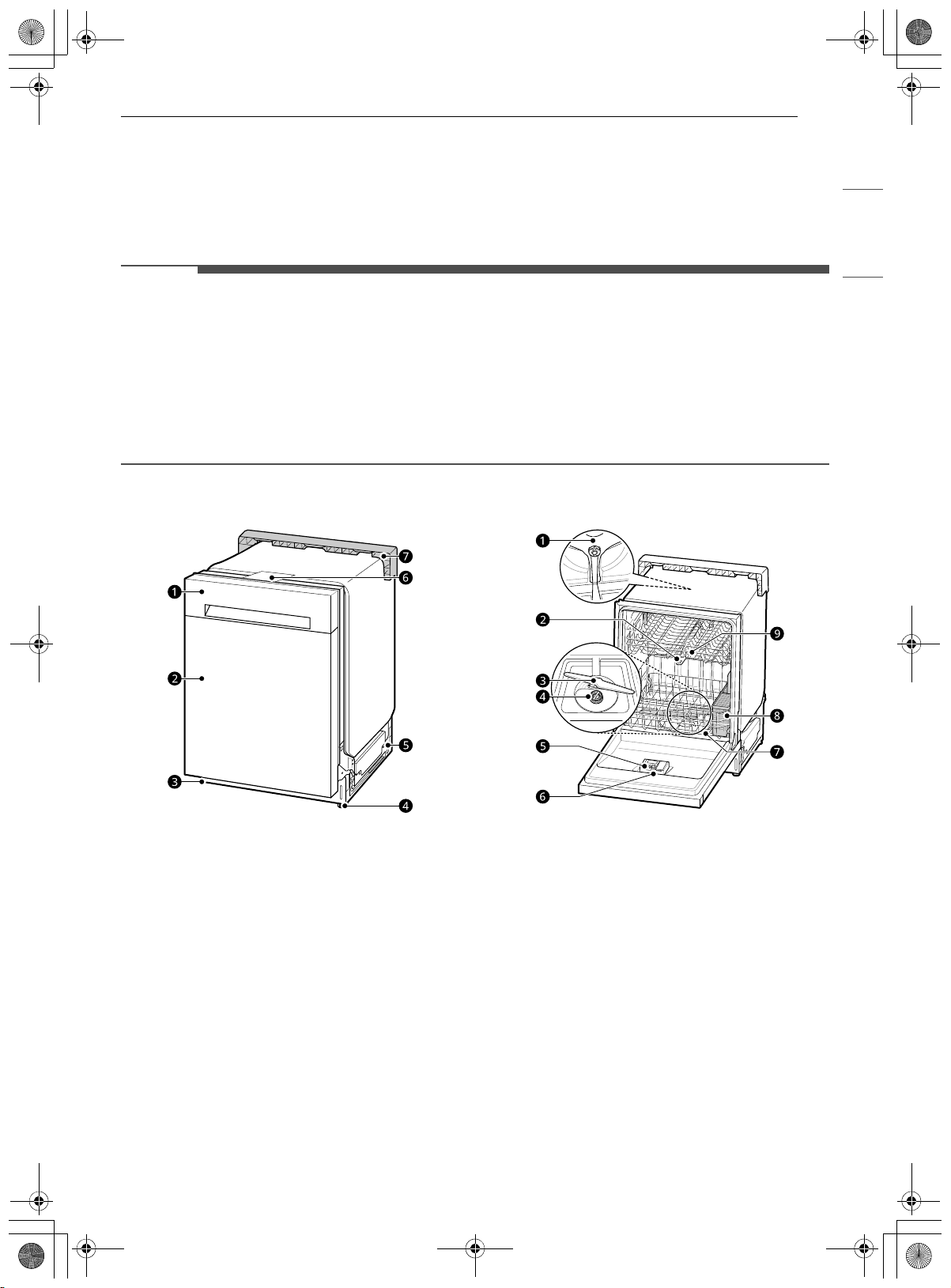
7DESCRIPCIÓN GENERAL DEL PRODUCTO
ESPAÑOL
DESCRIPCIÓN GENERAL DEL PRODUCTO
Características del producto
Las ilustraciones en esta guía pueden diferir de los componentes y accesorios reales, los cuales están
sujetos a cambios sin previo aviso por parte del fabricante a fin de introducir mejoras en el producto.
NOTA
• Para su seguridad y para prolongar la vida útil del producto, use solo componentes autorizados. El
fabricante no se hace responsable del mal funcionamiento del producto o de accidentes provocados por
el uso de componentes o piezas no autorizados adquiridos por separado.
• No retire la cubierta de seguridad en ningún momento.
• Para garantizar la fiabilidat, cada lavavajillas se somete a un extenso control de calidad antes de salir de
fábrica.
• Puede encontrar gotas de agua o manchas de agua como resultado de este proceso en su nuevo
lavavajillas.
Vista frontal
a Panel de control y manija de la puerta
b Cubierta frontal
c Cubierta inferior
d Patas de nivelación
e Base
f Cubierta de seguridad
g Soporte de embalaje
Vista interior
a Rotor superior de lavado
b Brazo rociador superior
c Brazo rociador inferior
d Sistema de filtrado
e Dispensador de detergente y abrillantador
f Cubierta de ventilación de secado
g Bandeja inferior
h Cesto para cubiertos
i Bandeja superior
es-us_main.book.book Page 7 Friday, January 20, 2023 8:45 AM
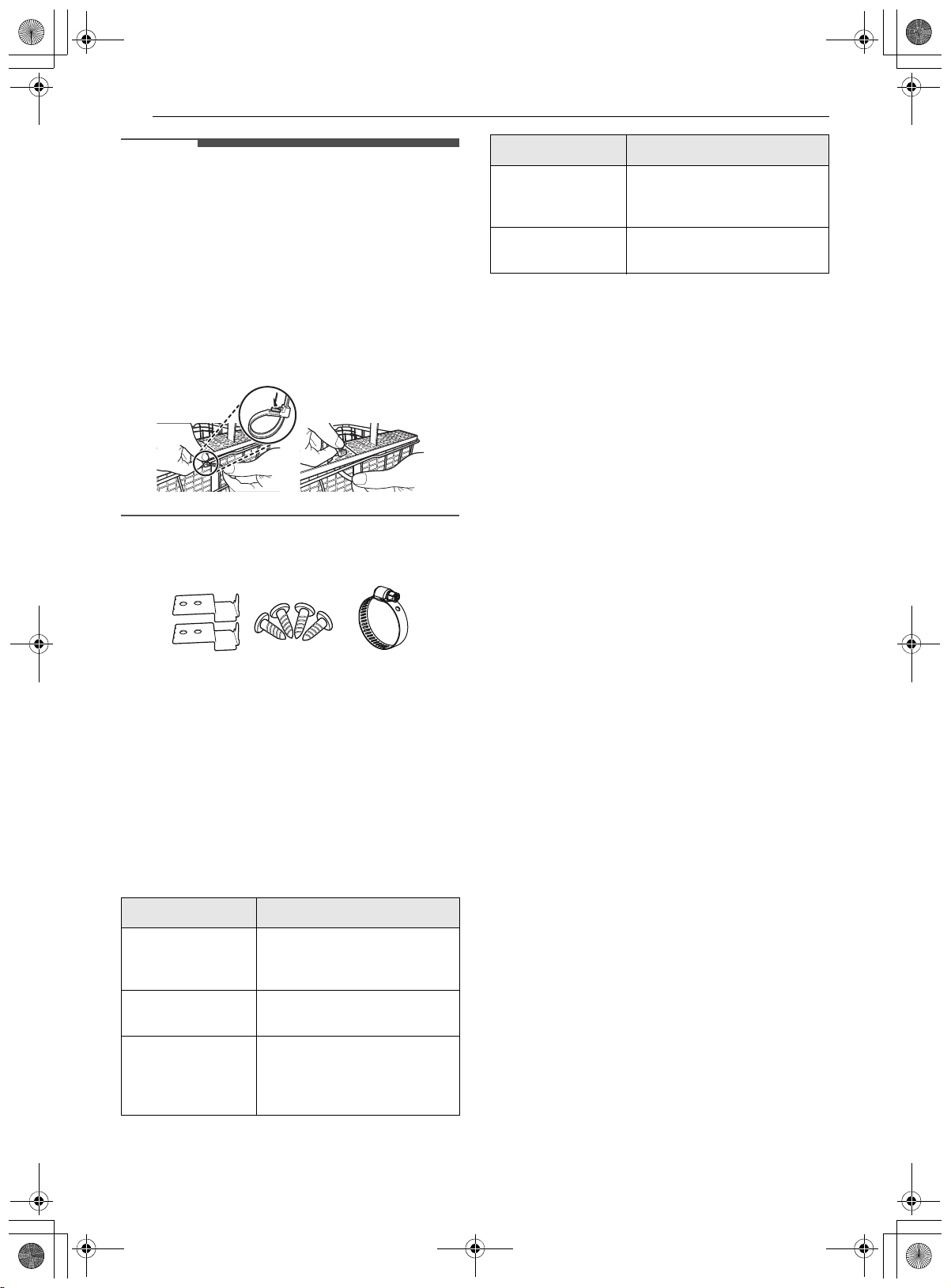
8 DESCRIPCIÓN GENERAL DEL PRODUCTO
NOTA
• El cesto para cubiertos se envía instalado en la
parte posterior de la bandeja del fondo. Para
obtener un mejor desempeño, instálelo a lo
largo del lado derecho.
• Retire todos los materiales de empaque del
exterior y el interior del lavavajillas antes de
instalar el artefacto.
• Presione la lengüeta para quitar la atadura del
cable con la mano. Cortar la atadura con un
cuchillo o tijeras puede dañar el estante o la
canasta de cubiertos.
Accesorios
a Soportes de instalación (2 c/u)
b Tornillos de madera (4 c/u)
c Abrazadera para manguera
Especificaciones del producto
La apariencia y las especificaciones detalladas en
este manual podrían variar debido a mejoras
constantes en el producto.
Modelo LDFC242**
Requisitos
eléctricos
120 V~ CA, 60 Hz solo,
interruptor de corriente de
15 A
Presión de agua 20 psi - 80 psi
(140 kPa - 550 kPa)
Dimensiones
(Ancho X
Profundidad X
Altura)
23 3/4” X 24 5/8” X 33 5/8”
(603 mm X 625 mm X 854
mm)
a
b
c
Temperatura de
entrada
del agua
120 ℉ - 149 ℉
(49 ℃ - 65 ℃)
Peso neto 66 lbs. - 75 lbs.
(30 kg - 34 kg)
Modelo LDFC242**
es-us_main.book.book Page 8 Friday, January 20, 2023 8:45 AM

9INSTALACIÓN
ESPAÑOL
INSTALACIÓN
Antes de la instalación
Guía de instalación en línea
Este código QR es solo para referencia. Para
obtener instrucciones de instalación completas,
consulte el manual del propietario suministrado
con cada lavavajillas.
Inglés
https://www.lg.com/us/support/video-tutorials/lg-
dishwasher-installation-CT10000009-
1366643457088
Francés
https://www.lg.com/ca_fr/soutien/aide-produit/
CT20100059-20152463332979
ADVERTENCIA
• AVISO LEGAL - Esta Guía es estrictamente
confidencial y no debe copiarse, divulgarse,
distribuirse, difundirse, publicarse ni
reproducirse, en su totalidad o parcialmente, sin
contar con el consentimiento previo y por escrito
de LG Electronics.
La Guía puede contener imprecisiones o errores
tipográficos, y LGE puede modificarla o
actualizarla en cualquier momento y sin aviso
previo.
Piezas no incluidas
a Cable eléctrico
• 16 AWG, con 2 conductores y 1 tierra
b Tubería de suministro de agua
• Línea de suministro de agua con un mínimo
de 3/8″ de diámetro exterior, tubería de
cobre o acero inoxidable trenzado
c Accesorios para tubería
d Acoplador
e Cinta aislante
f Trampa de aire
g Tuercas para cableado calibre 16
h Abrazadera para manguera
i Aliviador de tensión de 3/8″ aprobado por UL
Herramientas necesarias
abc
def
ghi
abc
def
ghi
klj
es-us_main.book.book Page 9 Friday, January 20, 2023 8:45 AM
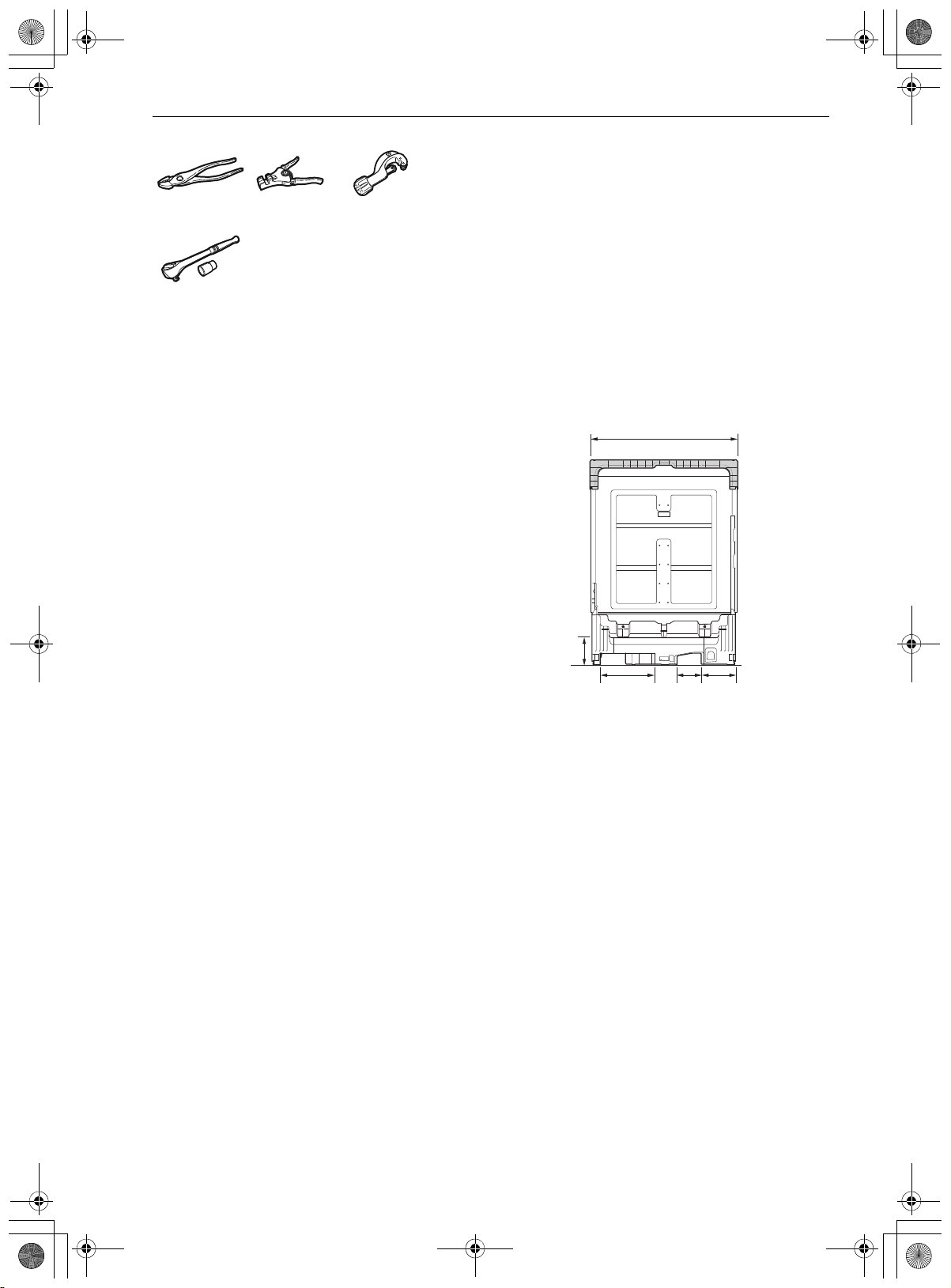
10 INSTALACIÓN
a Destornillador de hoja plana
b Destornillador Phillips
c Broca con sierra de perforación de 2 1/2” mín.
d Taladro eléctrico
e Guantes
f Gafas de seguridad
g Llave ajustable
h Cinta medidora
i Cuchilla
j Nivel
k Llave con accionamiento cuadrado de 1/4”
l Tenazas
m Pinzas
n Pelacables
o Cortador de tubería
p Llave con accionamiento cuadrado de 3/8” y
casquillo de 1/2”
Descripción general de la
instalación
Lea las siguientes instrucciones de instalación
inmediatamente después de adquirir el lavavajillas
o transportarlo a otra ubicación.
a Preparación de la abertura para el gabinete
b Preparación de las conexiones eléctricas y de
agua
c Preparación del lavavajillas
d Deslizamiento del lavavajillas en la abertura del
gabinete
e Conexión de la línea de suministro de agua y
energía eléctrica
f Conexión de la manguera de desagüe
g Nivelado del lavavajillas
h Sujeción del lavavajillas en la abertura del
gabinete
i Verificación final de la instalación
Dimensiones del producto
Vista posterior
Vista lateral
Para una instalación más sencilla, observe las
áreas marcadas con a para los espacios libres
correspondientes a la línea eléctrica y la línea de
suministro de agua en la base del lavavajillas. La
manguera de suministro de agua, la manguera de
mno
p
23 /4" (603 mm)
3
9 /8"
(238 mm)
3
4 /16"
(119 mm)
5
/4"
(134 mm)
11
1
4 /2"
(115 mm)
1
es-us_main.book.book Page 10 Friday, January 20, 2023 8:45 AM
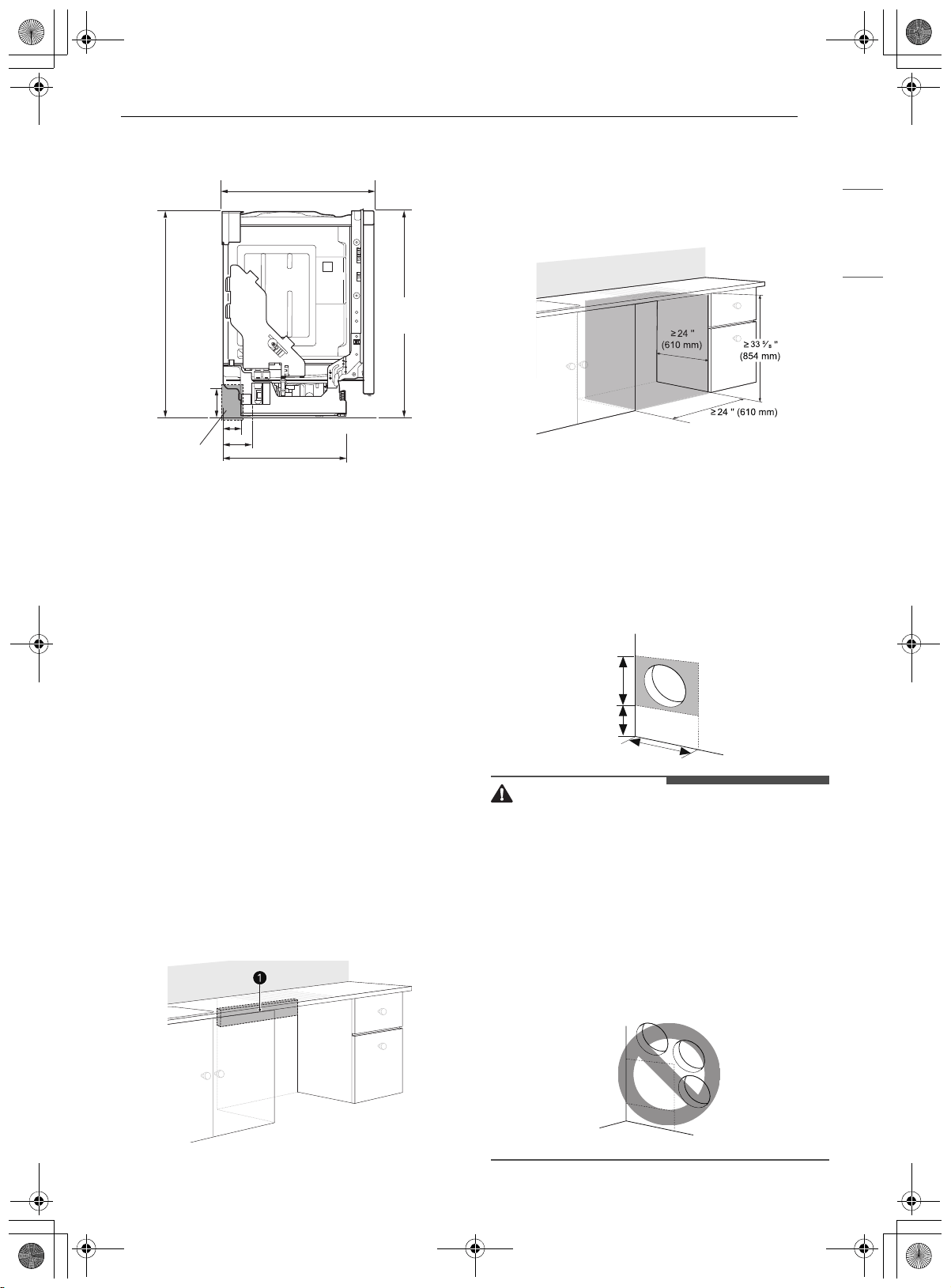
11INSTALACIÓN
ESPAÑOL
desagüe y el cable eléctrico deben pasar a través
de esta área.
Preparación de la abertura
para el gabinete
Este lavavajillas está diseñado para ajustarse a una
abertura estándar para lavavajillas. Es posible que
sea necesario hacer una abertura en ambos lados
para pasar las conexiones de fontanería y
eléctricas.
• Para asegurar un desagüe adecuado, el
lavavajillas no se debe instalar a más de 12 pies
(3.65 m) de distancia del fregadero.
• La ubicación debe tener espacio suficiente para
que la puerta del lavavajillas se abra fácilmente y
debe dejarse una distancia de, al menos, 0.1” (2
mm) entre el lavavajillas y los lados del gabinete.
• Si instala el lavavajillas en un rincón, deje un
mínimo de 2” (50 mm) entre el lavavajillas y el
muro adyacente.
• El muro adyacente debe estar libre de
obstáculos.
• Solamente para instalaciones al ras: puede
retirar el soporte del gabinete
a del interior del
gabinete.
Elección de la ubicación adecuada
1 Seleccione una ubicación tan cercana al
fregadero como sea posible para facilitar la
conexión de la línea de suministro de agua, la
manguera de desagüe y la conexión eléctrica.
2 Para dejar el espacio adecuado para tareas de
fontanería y electricidad, use la plantilla
incluida con el material impreso para
determinar el espacio libre del lado del
gabinete donde el lavavajillas hace contacto
con el muro posterior. Con una sierra de
perforación de 2 1/2” de diámetro, haga un
agujero en el área objetivo según se muestra
en la plantilla.
ADVERTENCIA
• El daño durante la instalación no está cubierto
por la garantía, y las fugas causadas por la
instalación inadecuada podrían dañar la
propiedad.
• No use los orificios existentes, a menos que se
encuentren en el área objetivo.
• Si no se realiza la perforación para las líneas de
agua y desagüe en las ubicaciones adecuadas,
esto podría impedir que el lavavajillas quede al
ras de los gabinetes y podría plegar, aplastar,
tensionar o dañar las líneas.
33 /16"
(846 mm)
5
4 /2"
(115 mm)
1
33 /8"
(854 mm)
5
2 /16" (75 mm)
15
20 /16" (512 mm)
3
24 /8" (625 mm)
5
4 /4" (120 mm)
3
a
3.5
''
2.5
''
4
''
es-us_main.book.book Page 11 Friday, January 20, 2023 8:45 AM
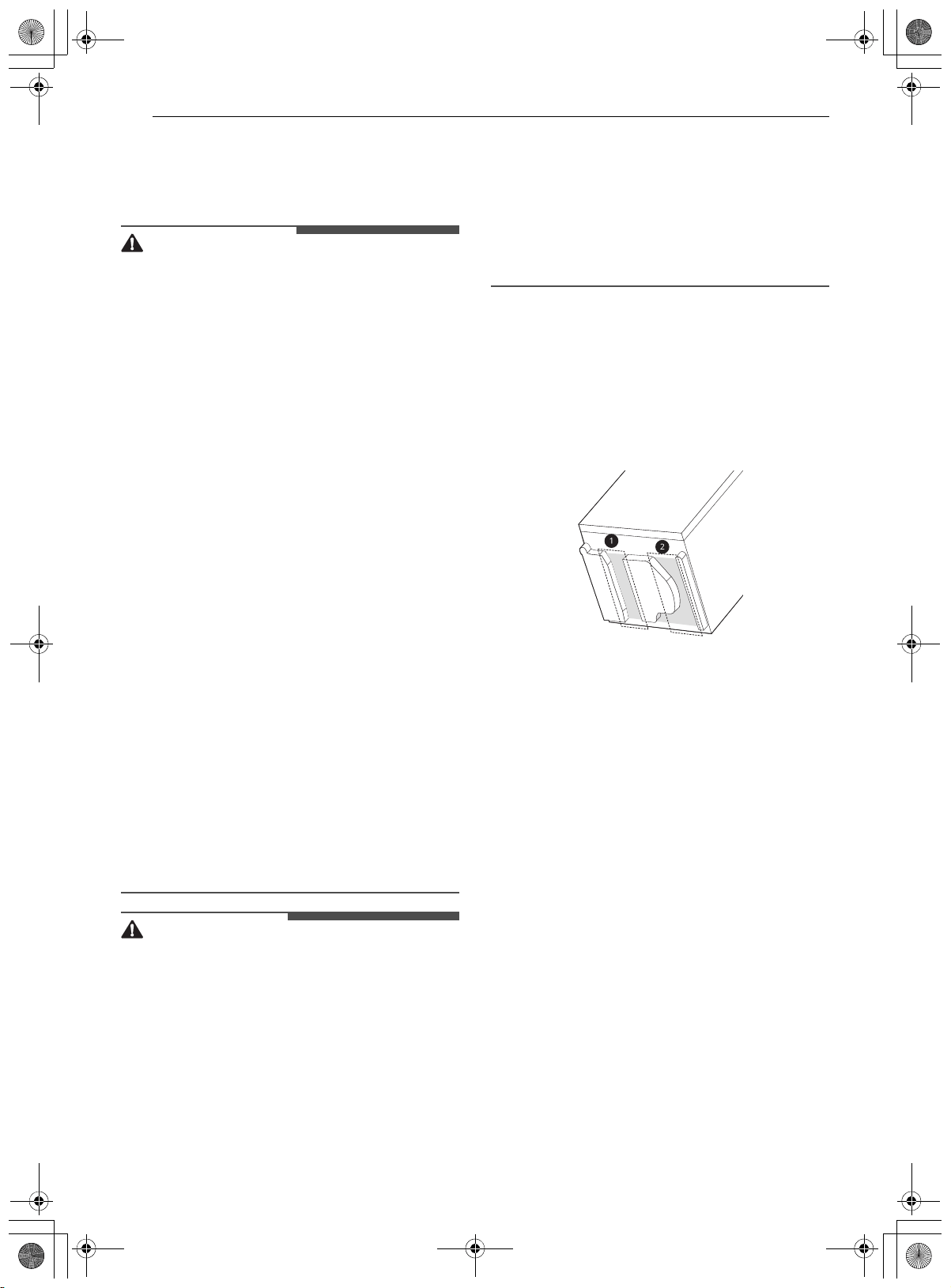
12 INSTALACIÓN
Preparación de las
conexiones eléctricas y de
agua
ADVERTENCIA
• Conexión de agua
- No reutilice una manguera vieja. Emplee solo
una manguera nueva cuando instale el
lavavajillas. La manguera vieja podría
presentar fugas o explotar, causando
inundaciones y daños a la propiedad. Póngase
en contacto con un Centro de información al
cliente de LG para obtener ayuda en la compra
de una nueva manguera.
• Conexión eléctrica
- Utilice un interruptor de corriente o fusible de
acción retardada.
- Este artefacto debe operarse con el voltaje
correcto, que se indica en este manual y en la
placa de datos técnicos.
- El cableado debe tener una conexión a tierra
adecuada. Si tiene dudas, solicite que lo
verifique un electricista calificado.
- Conecte el artefacto con una conexión de 3
cables, incluido un cable de conexión a tierra.
- El artefacto y el tomacorriente deben
colocarse de manera que el enchufe sea de
fácil acceso.
- No use un cable de extensión ni un adaptador
con este lavavajillas.
- No sobrecargue el tomacorriente con más de
un artefacto.
- Deben utilizarse las tuercas para cable 16AWG
que se incluyen.
- Es obligación y responsabilidad personal del
propietario del producto que un electricista
calificado instale un tomacorriente adecuado.
PRECAUCIÓN
• Cuando conecte la línea de suministro de agua
del lavavajillas al suministro de agua de la
vivienda, se debe usar cinta o compuesto de
sellado en las roscas de la tubería para evitar
fugas. No se debe emplear cinta ni compuesto
en los accesorios de compresión.
• Conecte el lavavajillas a un suministro de agua
caliente con un rango de temperatura entre
120 °F (49 °C) y 149 °F (65 °C). Este rango de
temperatura brinda los mejores resultados de
lavado y el ciclo más corto. Para evitar daños en
la vajilla, la temperatura no debe superar los
149 °F (65 °C).
• La presión del suministro de agua debe ser de
entre 20 psi y 80 psi (de 140 a 550 kPa). Si la
presión del suministro de agua es mayor a 80
psi, debe instalarse una válvula reductora de
presión, de manera que se evite el fallo
prematuro de la válvula de entrada.
Cómo pasar la línea de suministro
de agua y el cableado eléctrico
Hay 2 canales en la base del lavavajillas para pasar
la conexión de agua y la conexión eléctrica.
• Como se muestra en la vista inferior debajo, el
canal
a es para la línea de suministro de agua, y
el canal
b es para el cable eléctrico.
1 Corte el suministro de agua de la vivienda y
apague el interruptor de corriente o la fuente
de energía dedicada antes de conectar el
lavavajillas.
2 Pase la línea de suministro de agua a lo largo
del piso a 6 1/2" – 7 3/4" (165 mm – 197 mm)
del lado izquierdo de la abertura y fíjela con
cinta adhesiva delante de la abertura.
3 Pase el cable eléctrico c a lo largo del piso a
14" – 16" (356 mm – 406 mm) de la línea de
suministro de agua d y fíjelo en su sitio con
cinta adhesiva.
• El tomacorriente debe estar a 4 pies (1.22
m) de cualquiera de los lados del
lavavajillas.
• La mejor ubicación para el conducto
eléctrico es sobre el lado derecho de la
pared posterior. Redirija el cable eléctrico
antes de realizar la instalación en caso de
que la longitud de la tubería del conducto
es-us_main.book.book Page 12 Friday, January 20, 2023 8:45 AM
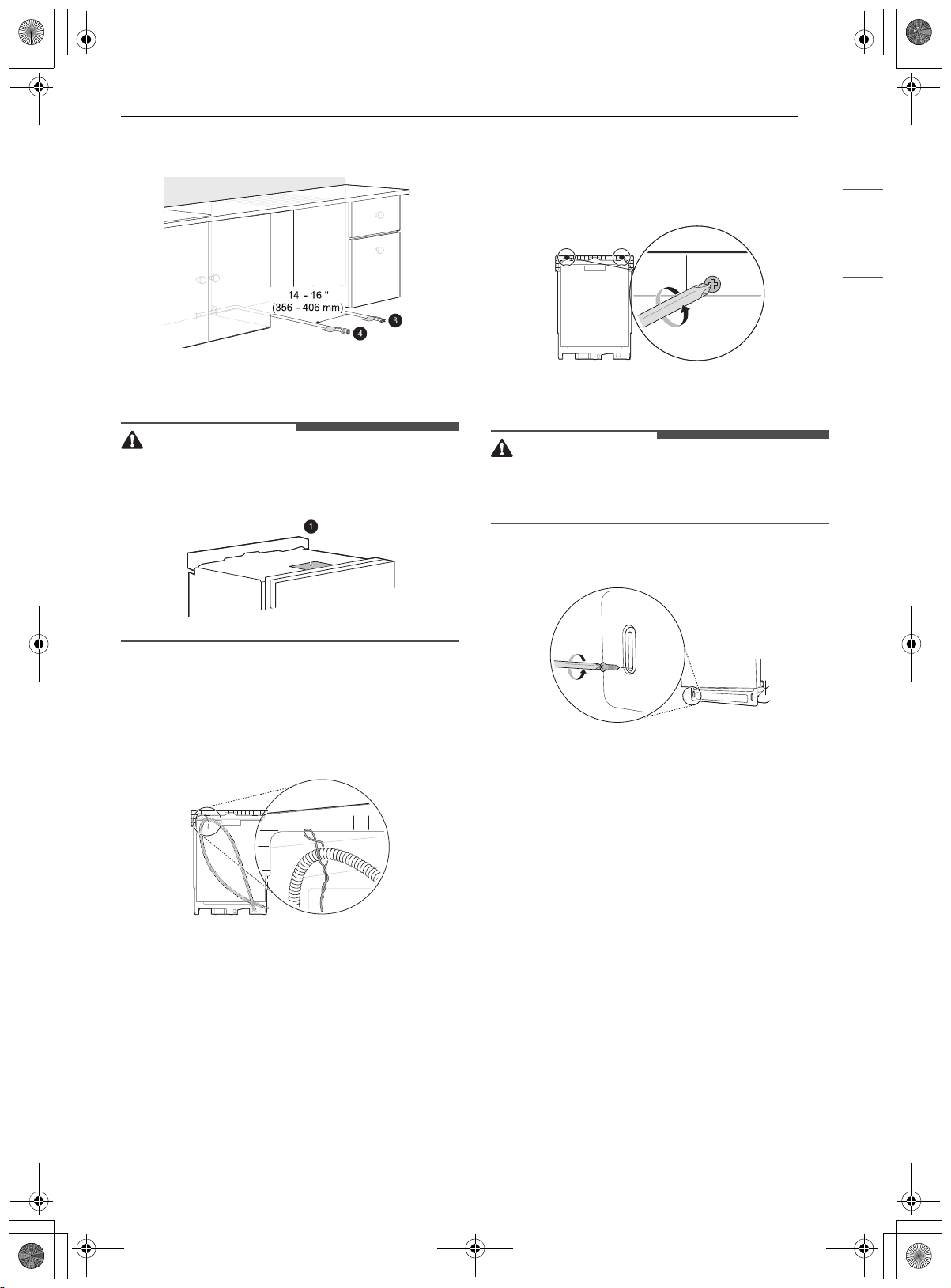
13INSTALACIÓN
ESPAÑOL
eléctrico sea mayor a 3" (76 mm) y esté
centrada en la pared posterior.
Preparación del lavavajillas
ADVERTENCIA
• No retire la cubierta de seguridad a. Si lo hace,
puede ocasionar incendios, descargas eléctricas
o la muerte.
Para soltar la manguera de
desagüe
Retire la atadura que sujeta la manguera de
desagüe a la parte posterior de la abrazadera de
envío.
Abrazadera de envío removible
La abrazadera de envío trasera puede ser
removida, si es necesario más espacio libre, al
instalar el lavaplatos debajo de un mostrador bajo.
Extracción de la cubierta inferior
PRECAUCIÓN
• Si recuesta el lavaplatos por la parte trasera,
hágalo con precaución de no dañar la manguera
de drenaje y la cuba.
1 Retire los tornillos ubicados a ambos lados
que sujetan la cubierta inferior al lavavajillas.
2 Retire la cubierta inferior.
3 Si hubiera material aislante detrás de la
cubierta inferior, retírelo.
4 Reserve las piezas hasta que se complete la
instalación.
Retiro de los materiales de
empaque del interior
Retire todos los materiales de empaque del
interior del lavavajillas antes de instalarlo.
Colocación de los soportes de
instalación
Para mostradores de madera u otros materiales
que no se dañen al taladrar, utilice los soportes de
instalación metálicos suministrados.
es-us_main.book.book Page 13 Friday, January 20, 2023 8:45 AM
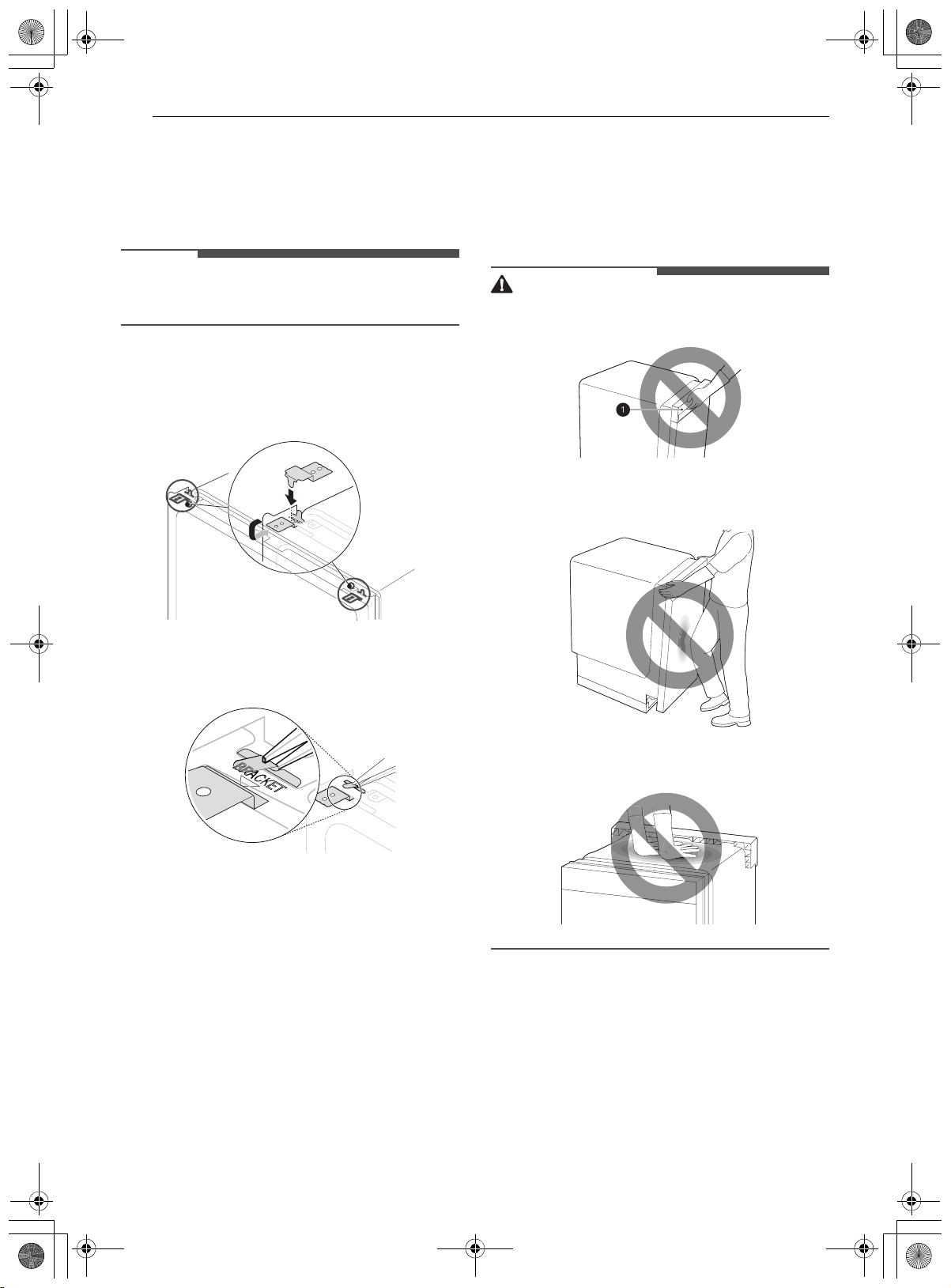
14 INSTALACIÓN
Para mostradores de granito, mármol u otro
material que podría dañarse al taladrar, utilice los
tornillos para madera para sujetar el lavavajillas al
gabinete. Consulte las instrucciones de instalación
en la sección Sujeción del lavavajillas en la
abertura del gabinete.
NOTA
• Los soportes de instalación y los tornillos se
pueden encontrar en el cesto para cubiertos.
1 Inserte el extremo con lengüeta de los
soportes de instalación en las ranuras del
bastidor superior. Gire los soportes hasta que
los extremos con lengüeta queden hacia
arriba.
2 Doble las lengüetas de los soportes con un
par de pinzas de punta para fijarlos al
bastidor.
Deslizamiento del
lavavajillas en la abertura
del gabinete
Cómo deslizar el lavavajillas
PRECAUCIÓN
• No tire ni levante el lavavajillas usando la manija
a; hacerlo podría dañar la puerta y las bisagras.
• No empuje la puerta del lavavajillas con las
rodillas cuando lo deslice en su lugar. Hacerlo
podría dañar la cubierta frontal.
• No empuje la parte superior del lavavajillas.
Hacerlo podría dañar el interior del artefacto.
es-us_main.book.book Page 14 Friday, January 20, 2023 8:45 AM
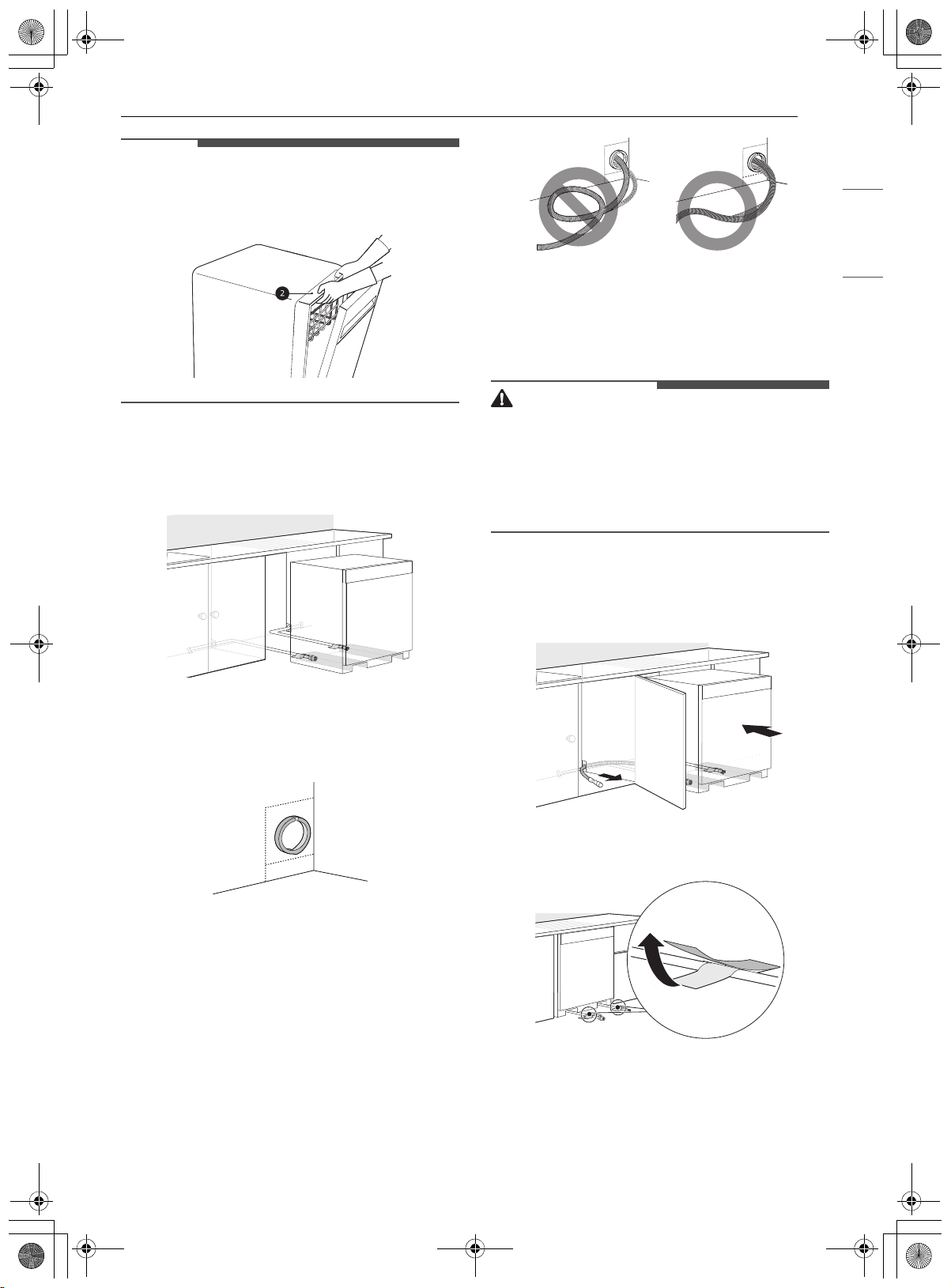
15INSTALACIÓN
ESPAÑOL
NOTA
• Abra la puerta y sujete el bastidor del cuerpo del
lavavajillas y la abertura superior frontal
b de la
cuba para mover o levantar el lavavajillas.
1 Alinee el lavavajillas con la abertura.
Asegúrese de que la línea de suministro de
agua y el cable eléctrico estén en la posición
correcta para que puedan deslizarse sin
problemas en sus canales.
2 Suavice o acolche los bordes del orificio
taladrado para el paso de la línea de
suministro de agua a fin de evitar dañar la
manguera de desagüe.
3 Asegúrese de enderezar la manguera de
desagüe antes de insertar su extremo a través
del orificio para el suministro de agua. A
medida que desliza el lavavajillas en la
abertura, es conveniente que tire lentamente
de la manguera de desagüe desde el interior
del gabinete para enderezarla. Para evitar
fugas o daños ocasionados por el agua, tenga
cuidado de no plegar, aplastar o tensar
demasiado la manguera de desagüe durante
la instalación.
4 Gradualmente, deslice el lavavajillas en la
abertura, asegurándose de que la línea de
suministro de agua y el cable eléctrico pasan
libremente por los canales y no quedan
atrapados bajo el lavavajillas.
PRECAUCIÓN
• Para evitar fallas o fugas, es importante que la
manguera de desagüe no quede plegada,
tirante ni aplastada detrás o debajo del
lavavajillas o dentro del gabinete adyacente.
• La garantía no cubre los daños derivados de una
instalación inadecuada.
• A medida que desliza el lavavajillas en la
abertura, deténgase periódicamente (o
solicítele a otra persona que lo ayude) para
tensar la manguera de desagüe, tirando de
ella hacia el interior del gabinete.
5 Retire la cinta de la línea de suministro de
agua y el cable eléctrico.
es-us_main.book.book Page 15 Friday, January 20, 2023 8:45 AM
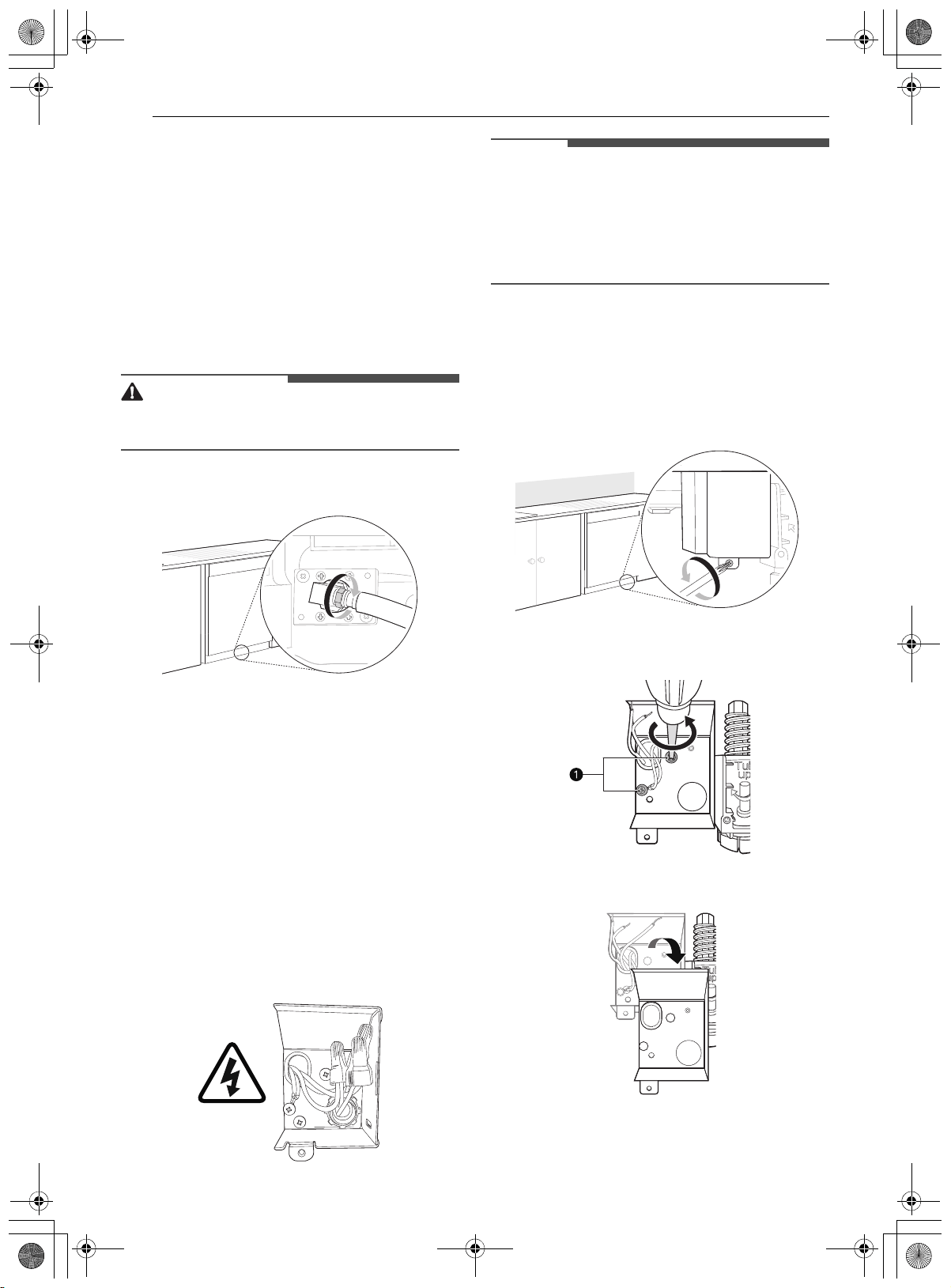
16 INSTALACIÓN
Conexión de la línea de
suministro de agua y
energía eléctrica
Conexión de la línea de suministro
de agua
1 Con el suministro de agua de la vivienda
cerrado, conecte la línea de suministro de
agua a la válvula de entrada en la parte
delantera izquierda del lavavajillas.
PRECAUCIÓN
• No se debe utilizar cinta ni compuesto en la
válvula de entrada del lavavajillas.
2 Apriete la tuerca de compresión.
3 Deslice la línea de suministro de agua en el
canal tirando suavemente desde el interior
del gabinete para asegurarse de que la línea
no quede plegada, tirante o aplastada.
Conexión de la alimentación
eléctrica
El lavavajillas debe tener un circuito con la debida
conexión a tierra para conectar la configuración de
3 cables que incluye el cable a tierra.
Si se usa una línea de alimentación de 3 clavijas,
debe estar en un lugar accesible adyacente al
lavavajillas, a no más de 4 pies (1220 mm) del lado
del artefacto, nunca detrás del mismo.
NOTA
• La mejor ubicación para el conducto eléctrico es
sobre el lado derecho de la pared posterior.
Redirija el cable eléctrico antes de realizar la
instalación en caso de que la longitud de la
tubería del conducto eléctrico sea mayor a 3” (76
mm) y esté centrada en la pared posterior.
1 Desde el interruptor de corriente, apague el
suministro de energía eléctrica que va a la
unidad.
2 Use un destornillador Phillips para quitar el
tornillo de la cubierta de la caja de empalmes
y retire la cubierta.
3 Utilice un destornillador Phillips para retirar 2
tornillos a.
4 Retire la caja de empalmes del artefacto.
5 Inserte un aliviador de tensión b de 3/8” a
través del orificio de la caja de empalmes.
es-us_main.book.book Page 16 Friday, January 20, 2023 8:45 AM

17INSTALACIÓN
ESPAÑOL
Apriete la tuerca redonda c para asegurarlo
en su sitio.
6 Inserte el cable eléctrico a través del orificio
del aliviador de tensión. Ajuste los 2 tornillos
para asegurarlo.
7 Tire de los cables existentes a través de las
aberturas de la caja de empalmes. Ajuste los 2
tornillos
d para volver a ensamblar la caja de
empalmes en el artefacto.
8 Haga coincidir los cables blanco, negro y
verde con los cables de los colores
correspondientes del lavavajillas. Luego, gire
las tuercas para cables
e suministradas y
apriételas firmemente para conectar los
cables correspondientes.
9 Envuelva cada conexión con cinta aislante f.
10 Pliegue los cables conectados, introdúzcalos
nuevamente dentro de la caja de empalmes y
atornille la cubierta de la caja.
ADVERTENCIA
• Verifique que el cable negro esté caliente (120 V).
De no ser así o si no está seguro de que haya
suministro eléctrico, solicite que lo verifique un
electricista calificado.
PRECAUCIÓN
• No deje expuesto ningún cable pelado. Recorte
el cable pelado para que quepa completamente
dentro de las tuercas para cable.
Conexión de la manguera de
desagüe
Si el extremo de la manguera de desagüe no se
adapta a la línea de desagüe, use un adaptador
resistente al calor y al detergente (no está
incluido). Este accesorio se puede comprar en una
tienda local de artículos de fontanería.
• Corte el adaptador para que el extremo coincida
con el tamaño de la conexión de desagüe.
es-us_main.book.book Page 17 Friday, January 20, 2023 8:45 AM
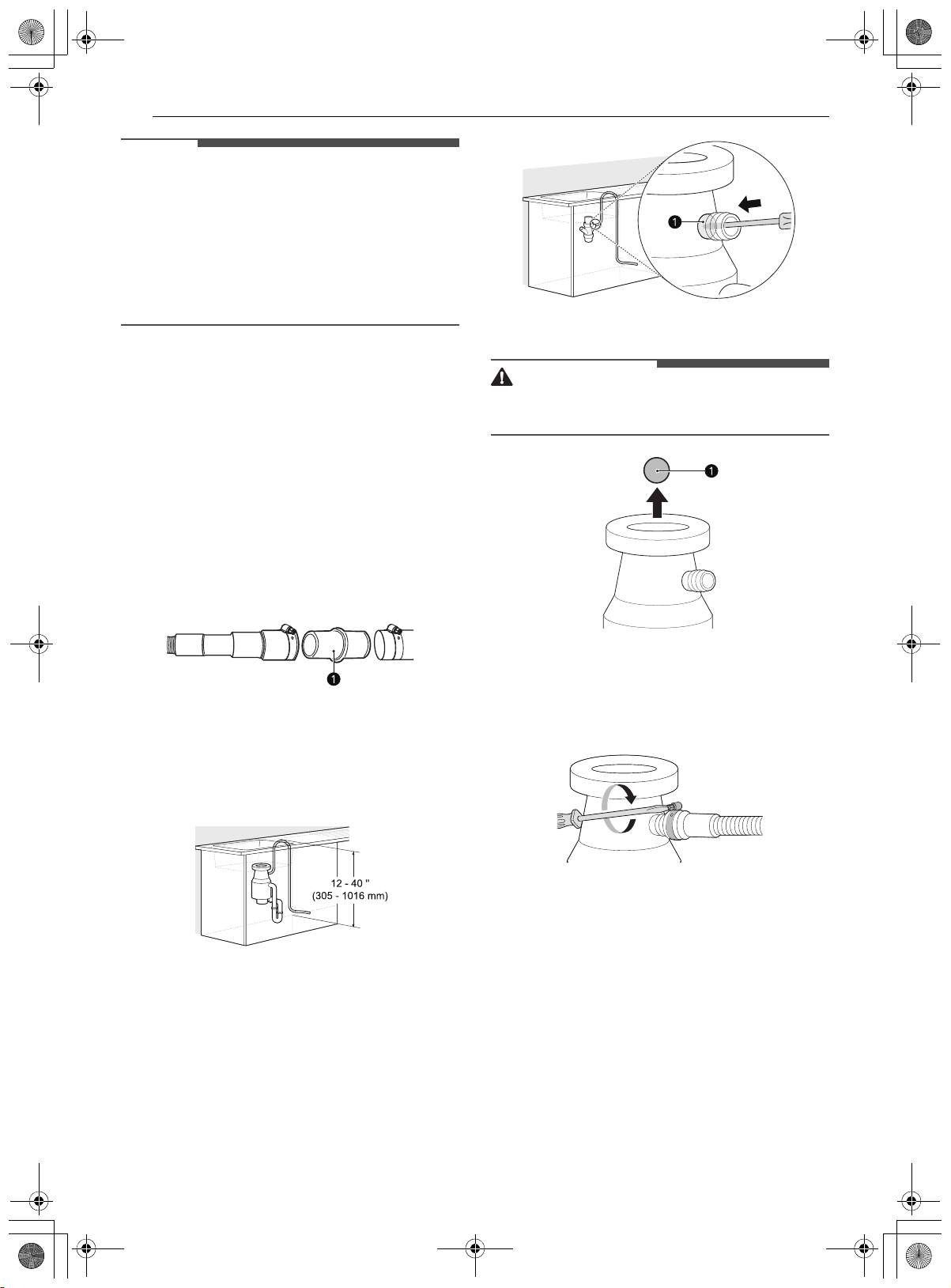
18 INSTALACIÓN
NOTA
• Para la instalación de la manguera de desagüe,
use la abrazadera para manguera con tornillo
incluida en el cesto para cubiertos de este
lavavajillas.
• Si conecta la manguera de desagüe del
lavavajillas al triturador de basura, asegúrese de
seguir las instrucciones de instalación
adecuadas según el manual del triturador.
Requisitos para la manguera de
desagüe
• Cumpla los códigos y las ordenanzas locales.
• La distancia al desagüe no debe superar los
12 pies (3.65 m).
• No conecte mangueras de desagüe de otros
artefactos a la manguera de desagüe del
lavavajillas.
• Si es necesario utilizar una extensión en la
manguera de desagüe, use una manguera de
diámetro interior de 5/8" o 7/8" y de 2 a 3 pies de
longitud y un acople
a para conectar los dos
extremos.
Altura de la manguera de desagüe
La altura del extremo de la manguera de desagüe
debe ser, como mínimo, de 12" (305 mm) y no
debe superar las 40" (1016 mm) desde la base del
lavavajillas para evitar que el agua haga sifón
desde la cuba.
Conexión al triturador sin trampa
de aire
1 Extraiga el tapón ciego del triturador con un
martillo y un destornillador.
2 Retire el tapón ciego a del triturador.
PRECAUCIÓN
• Si no se ha extraído el tapón ciego, el lavavajillas
no podrá desagotar correctamente.
3 Sujete la manguera de desagüe al triturador
con la abrazadera para manguera
suministrada. Mueva la abrazadera a la
posición correcta y apriétela con un
destornillador de hoja plana.
Conexión a la pieza en T para
desechos sin trampa de aire
La altura del extremo de la manguera de desagüe
debe ser, como mínimo, de 12” (305 mm) y no
debe superar las 40” (1016 mm) desde la base del
lavavajillas para evitar que el agua haga sifón
desde la cuba.
es-us_main.book.book Page 18 Friday, January 20, 2023 8:45 AM
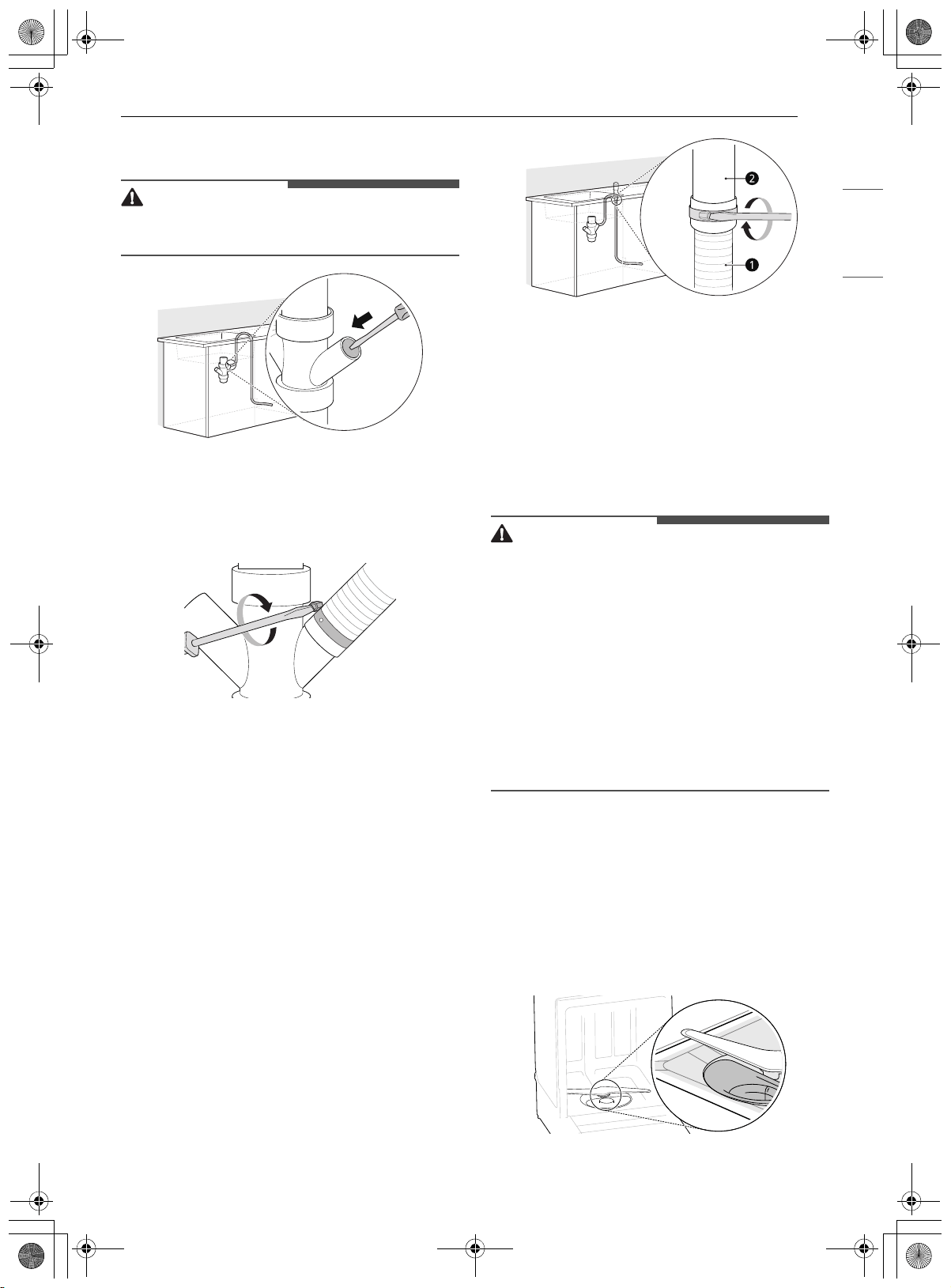
19INSTALACIÓN
ESPAÑOL
1 Extraiga el tapón ciego con un martillo y un
destornillador.
PRECAUCIÓN
• Si no se ha extraído el tapón ciego, el lavavajillas
no podrá desagotar correctamente.
2 Sujete la manguera de desagüe a la pieza en T
para desechos con la abrazadera para
manguera suministrada. Mueva la abrazadera
a la posición correcta y apriétela con un
destornillador de hoja plana.
Conexión al triturador o a la pieza
en T para desechos con trampa de
aire
1 Extraiga el tapón ciego con un martillo y un
destornillador.
2 Conecte el extremo de la manguera de
desagüe a a la trampa de aire b con la
abrazadera para manguera suministrada.
Mueva la abrazadera a la posición correcta y
apriétela con un destornillador de hoja plana.
• Esto impide que el agua haga sifón desde la
cuba.
3 Si no está conectado, acople el conector de la
manguera de caucho a la pieza en T para
desechos o al triturador con una abrazadera
para manguera (no incluida).
Nivelado del lavavajillas
Verifique que el lavavajillas esté nivelado y ajuste
las patas de nivelación si es necesario.
PRECAUCIÓN
• Si el lavavajillas no está bien nivelado, pueden
producirse fugas, problemas para cerrar la
puerta o ruidos.
• Si la abertura del gabinete es más angosta de lo
recomendado (ver Preparación de la abertura
del gabinete), el lavavajillas debe nivelarse y
alinearse cuidadosamente para que este se
apoye completamente en las 3 patas de
nivelación y no quede colgado de los soportes
de instalación. De lo contrario, el lavavajillas
puede no funcionar o pueden producirse fugas
desde la parte frontal del lavavajillas, errores
AE
y dificultad para cerrar la puerta.
Cómo comprobar que el lavavajillas
esté nivelado
Para verificar que la cuba esté nivelada de
adelante hacia atrás, retire la bandeja inferior y
vierta 169 oz. (5 L) de agua en el fondo de la cuba.
El nivel del agua debe quedar cerca del centro de
las dos muescas inferiores que presenta la cuba en
la parte delantera.
es-us_main.book.book Page 19 Friday, January 20, 2023 8:45 AM
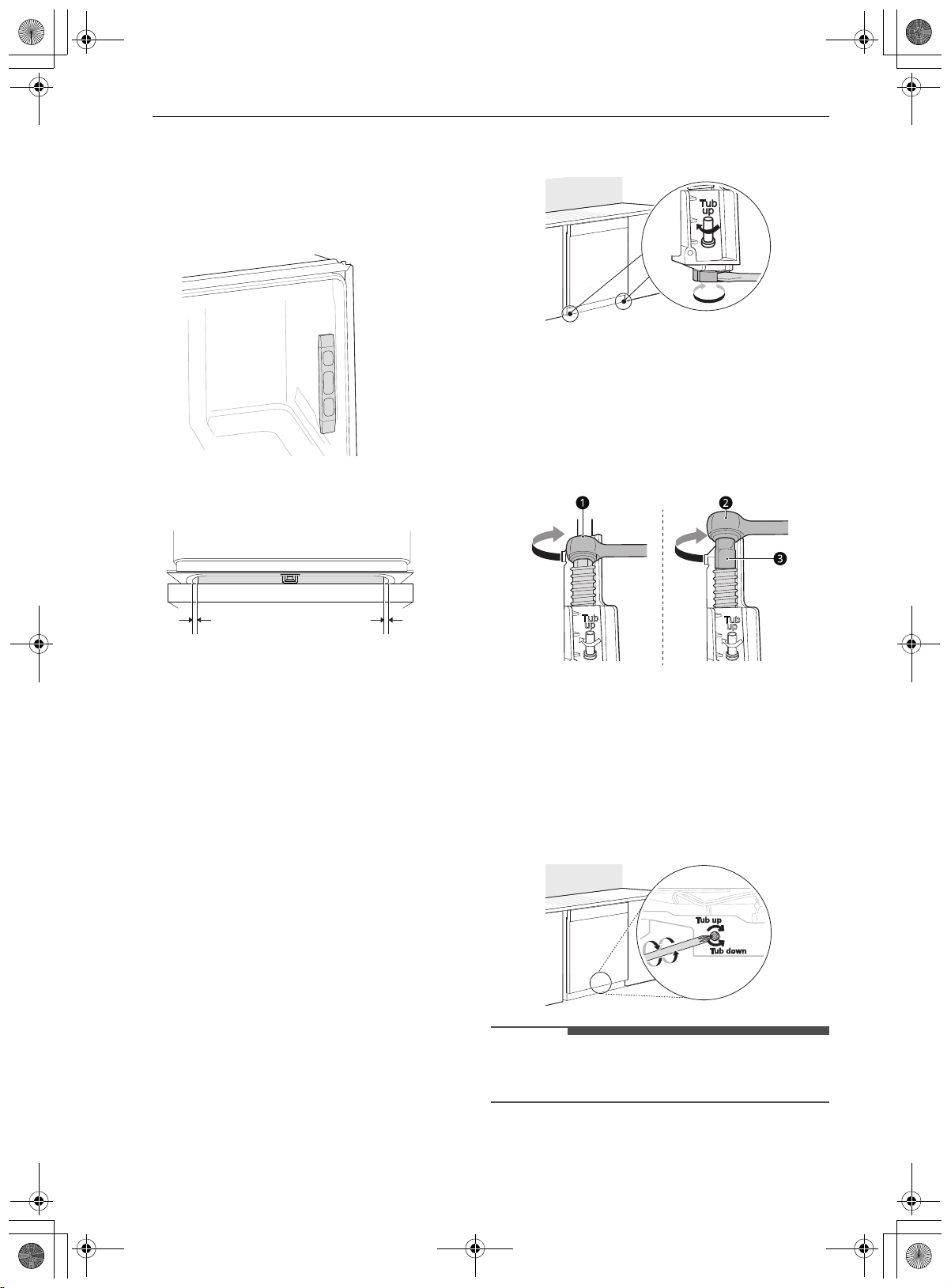
20 INSTALACIÓN
Tras extraer la bandeja inferior, coloque un nivel
en la pared interior de la cuba para verificar que el
lavavajillas esté nivelado de lado a lado.
• Si no tiene un nivel, en su lugar puede utilizar
una aplicación de nivel de un teléfono
inteligente.
Asegúrese de que el espacio entre las paredes de
la cuba y el revestimiento de la puerta sea el
mismo de cada lado.
Ajuste de las patas de nivelación
Ajuste según sea necesario hasta que el
lavavajillas esté completamente nivelado.
• Ajuste las patas de nivelación delanteras y
traseras hasta que hagan contacto firme con el
piso. Si el lavavajillas no está bien nivelado,
puede impedir que la puerta cierre
correctamente y el artefacto no se encenderá.
Ajuste de las patas de nivelación
delanteras
Use un destornillador de punta plana para girar las
patas de nivelación delanteras y ajustar la parte
frontal de la cuba.
• Haga girar las patas de nivelación delanteras en
el sentido de las agujas del reloj para levantar la
parte frontal de la cuba y en el sentido contrario
a las agujas del reloj para bajarla.
• Los ajustes funcionan de la misma forma para
ambas patas de nivelación.
• Cuando no disponga de un destornillador de
punta plana, use una llave con accionamiento
cuadrado de 1/4"
a o una llave con
accionamiento cuadrado de 3/8"
b con casquillo
de 1/2"
c para girar las patas de nivelación
delanteras y ajustar el frente de la cuba.
Ajuste de la pata de nivelación trasera
Use un destornillador Phillips para ajustar la pata
de nivelación trasera y la parte posterior de la cuba
girando el tornillo central que se encuentra en la
parte delantera de la base del artefacto.
• Haga girar el tornillo central en el sentido de las
agujas del reloj para levantar la parte posterior
de la cuba y en el sentido contrario a las agujas
del reloj para bajarla.
NOTA
• Para evitar producir daños en el tornillo, no
utilice un destornillador eléctrico.
es-us_main.book.book Page 20 Friday, January 20, 2023 8:45 AM
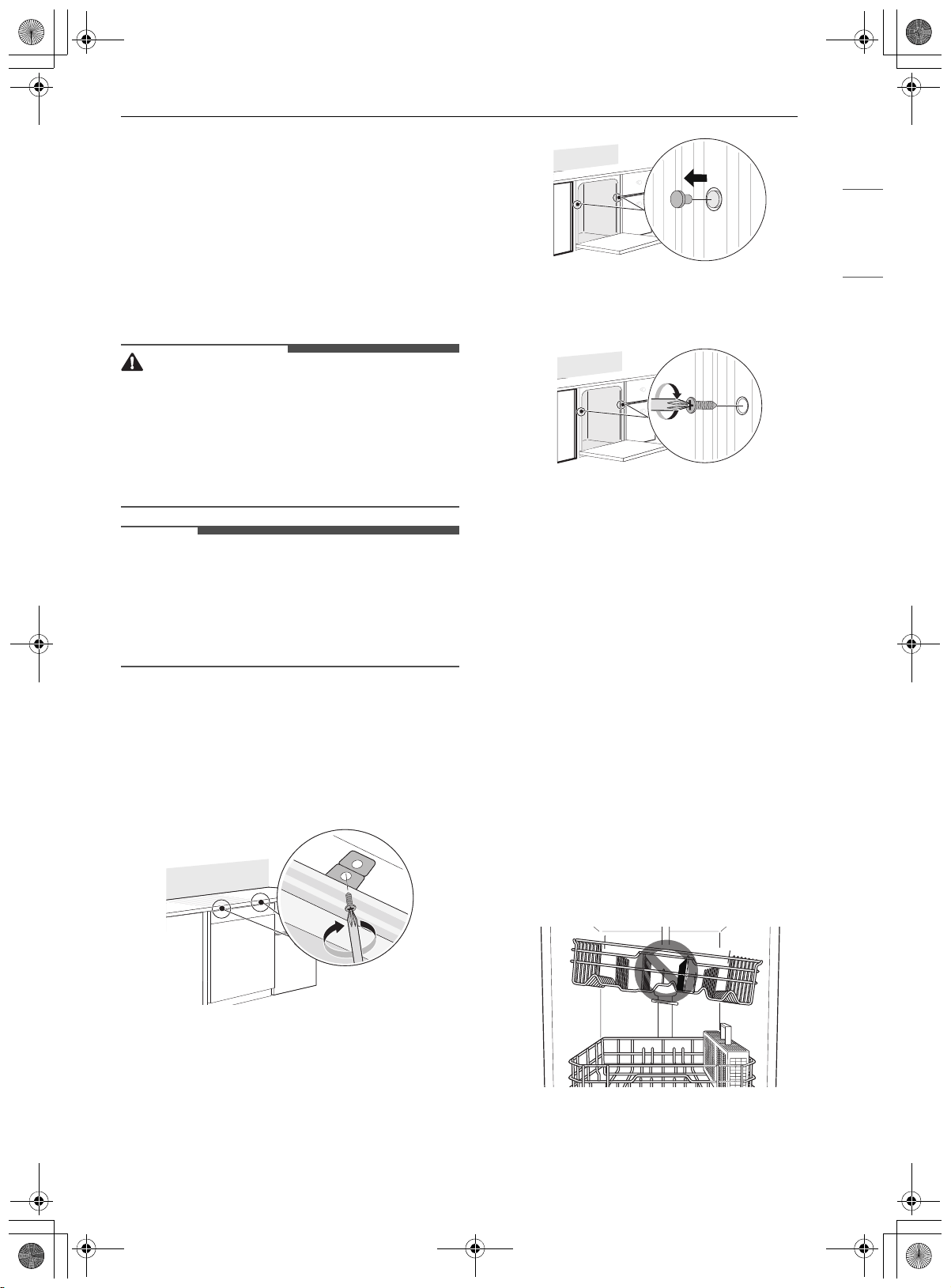
21INSTALACIÓN
ESPAÑOL
Sujeción del lavavajillas en
la abertura del gabinete
Hay 2 opciones para sujetar el lavavajillas en su
sitio. Si el mostrador es de madera o de un
material que puede taladrarse con seguridad,
sujete el lavavajillas al mostrador con los soportes
proporcionados. Si el mostrador es de granito,
mármol o un material que no se puede taladrar,
sujete el lavavajillas al bastidor del gabinete con
los tornillos para madera provistos.
PRECAUCIÓN
• Asegúrese de que el lavavajillas esté nivelado y
que todas las patas de nivelación estén en
contacto firme con el piso antes de fijar el
lavavajillas al mostrador o al gabinete. Si el
lavavajillas no está nivelado correctamente, es
posible que la puerta no se cierre de forma
adecuada o que haya fugas de agua.
NOTA
• Los soportes de instalación y los tornillos se
pueden encontrar en el cesto para cubiertos.
• Utilice un destornillador magnético.
• Cubra la boca del filtro con toallas para evitar
que los tornillos caigan dentro de la bomba.
Fijación del lavavajillas al
mostrador
Use los tornillos para los soportes proporcionados
a fin de asegurar los soportes de la parte superior
del lavavajillas a la parte inferior del mostrador de
madera.
Sujeción del lavavajillas al bastidor del
gabinete
Si se desea, el lavavajillas también puede
asegurarse al marco del gabinete. Para ello, siga
las instrucciones a continuación.
1 Retire las 2 tapas plásticas de los orificios de
acceso en los soportes de montaje.
2 Coloque un tornillo para madera a través del
soporte de montaje y hacia el interior del
bastidor del gabinete.
3 Reinstale las tapas plásticas.
Verificación final de la
instalación
Prueba del lavavajillas
Verifique si el lavavajillas está instalado
correctamente.
1 Encienda el interruptor de corriente.
2 Abra el suministro de agua de la vivienda.
3 Asegúrese de que la puerta se abre y cierra
suavemente.
• Si es necesario, nivele el lavavajillas
nuevamente.
• Si la puerta no cierra, compruebe que la
bandeja esté nivelada.
• Asegúrese de que se hayan retirado todos
los materiales de empaque.
es-us_main.book.book Page 21 Friday, January 20, 2023 8:45 AM
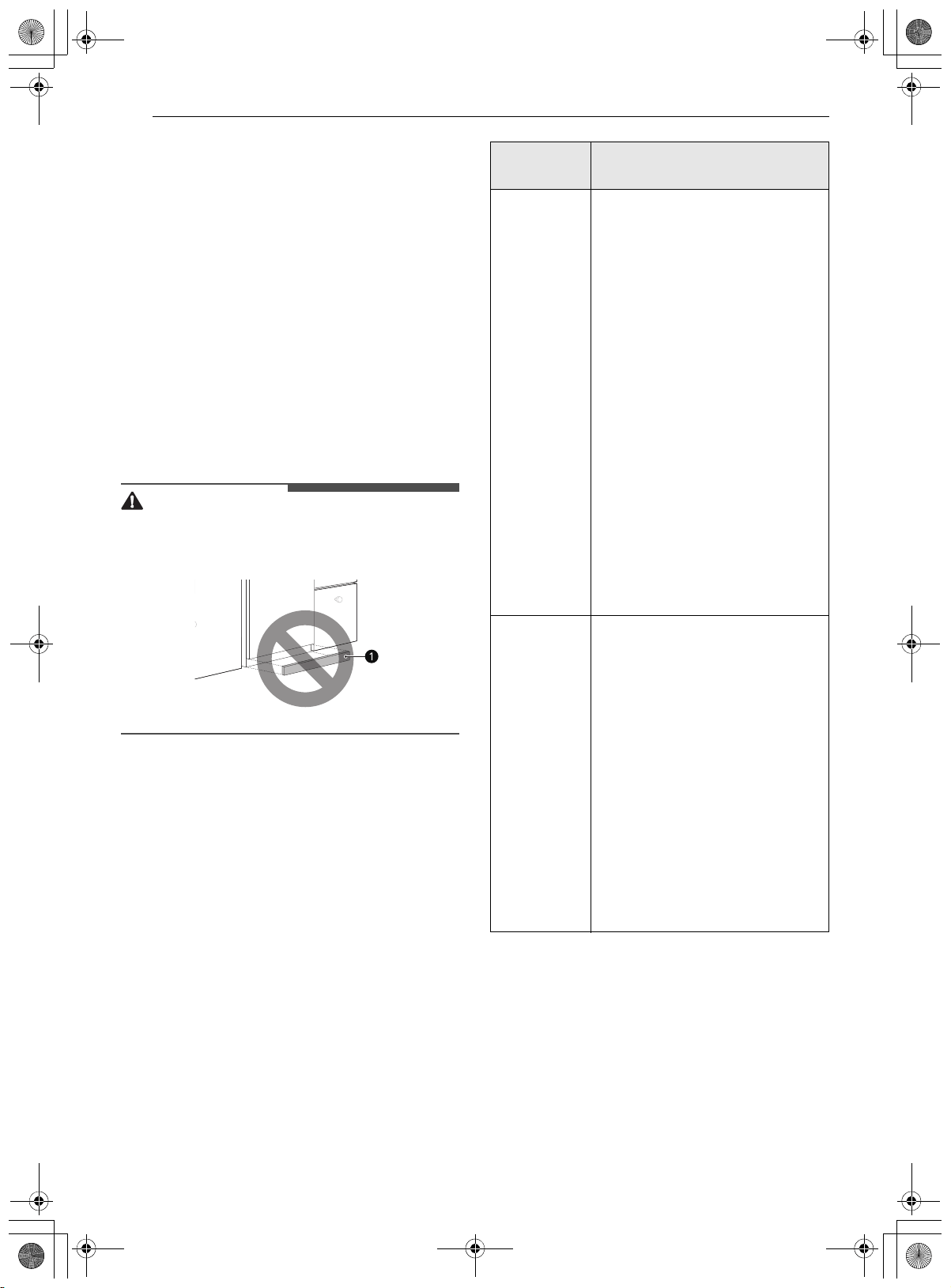
22 INSTALACIÓN
4 Encienda el lavavajillas y ejecute un ciclo
Turbo para verificar que el funcionamiento
sea correcto.
5 Verifique si la manguera de desagüe o la
conexión de suministro de agua presentan
fugas.
6 Si se detecta una fuga de agua, mantenga
presionado el botón START (INICIO) durante
3 segundos para cancelar el ciclo de lavado y
desagotar automáticamente el agua del
lavavajillas. Ajuste todas las conexiones de
agua y ejecute otro ciclo. Repita hasta que no
se detecten fugas.
7 Vuelva a colocar la cubierta inferior.
PRECAUCIÓN
• Solo instale la cubierta inferior suministrada con
el lavavajillas. No instale el zócalo del gabinete
a ya que esto podría ocasionar ruidos y fugas.
8 Retire la película protectora de la puerta, si la
hubiera. Dejar la película puede ocasionar
descoloración o condensación en la puerta.
Códigos de error de verificación de
instalación
Consulte la siguiente tabla antes de solicitar
servicio técnico.
Código de
error
Causa posible y solución
OE
La manguera de desagüe está
plegada o presionada.
• Inserte las mangueras de
desagüe y suministro a través
del orificio bajo el fregadero.
Gradualmente, deslice el
lavavajillas dentro del gabinete
mientras tira de las mangueras
por debajo del fregadero para
tensarlas. Esto sirve para evitar
que las mangueras queden
plegadas o presionadas detrás
del lavavajillas.
La manguera de desagüe está
conectada al triturador sin que
se haya extraído el tapón ciego.
• Retire el tapón ciego del
triturador.
La pieza en T para desechos o el
triturador están obstruidos.
• Retire el tapón ciego de la
pieza en T para desechos o el
triturador.
IE
La línea de suministro de agua
está plegada debajo del
lavavajillas.
• Inserte las mangueras de
desagüe y suministro a través
del orificio bajo el fregadero.
Gradualmente, deslice el
lavavajillas dentro del gabinete
mientras tira de las mangueras
por debajo del fregadero para
tensarlas. Esto sirve para evitar
que las mangueras queden
plegadas o presionadas detrás
del lavavajillas.
El suministro de agua de la
vivienda no está abierto.
• Abra la llave de agua.
es-us_main.book.book Page 22 Friday, January 20, 2023 8:45 AM
23FUNCIONAMIENTO
ESPAÑOL
FUNCIONAMIENTO
Antes de usar
ADVERTENCIA
• Para reducir el riesgo de incendios, descargas eléctricas o lesiones a las personas, lea las
INSTRUCCIONES DE SEGURIDAD antes de operar este artefacto.
NOTA
• Conecte al suministro de agua caliente solamente. La temperatura del suministro de agua debería ser de
un mínimo de 120 °F (49 °C) para un mejor lavado y una duración más breve del ciclo.
• Siga las instrucciones para cargar el lavavajillas para asegurar una limpieza eficaz.
• Quite los elementos insolubles como huesos, palillos y pedazos de papel cuando cargue el lavavajillas.
Comienzo rápido
1) Cargue la vajilla.
2) Agregue el detergente.
3) Encienda el lavavajillas.
4) Verifique el abrillantador.
5) Seleccione el ciclo y las opciones
6) Operación del lavavajillas.
• Método 1
- Presione el botón de START (INICIO) y
luego cierre la puerta antes de que
transcurran cuatro segundos para operar
el lavavajillas. Si la puerta no se cierra
dentro de los cuatro segundos, la luz LED
blanca con la hora parpadea, suena una
alarma y el ciclo no se inicia.
• Método 2
- Cierre la puerta primero y luego presione
el botón START (INICIO) para hacer
funcionar el lavavajillas.
NOTA
• Si se abre la puerta durante el ciclo, el lavavajillas
se detendrá. Para reanudar el ciclo, consulte los
métodos 1 y 2 mencionados anteriormente.
• Si se abre la puerta durante el ciclo y no se cierra
dentro de los cuatro segundos de haber
seleccionado el botón de START (INICIO), o si se
cierra la puerta sin presionar el botón de START
(INICIO), la luz LED blanca con la hora parpadea,
suena una alarma y el ciclo no se inicia.
7) Fin de ciclo.
• Cuando el ciclo haya finalizado, se emitirá un
sonido y la pantalla mostrará
ENd hasta que
se abra la puerta o hasta que se presione
POWER (Encendido). A fin de ahorrar
energía, mantenga presionado Extra Dry
(Extra Seco) y Night Dry (Secado nocturno)
simultáneamente durante 3 segundos para
configurar que la visualización de
ENd para
que se apague automáticamente pocos
minutos después de que finalice el ciclo.
• Es normal que el lavavajillas suene
continuamente si se abre durante el
funcionamiento o justo después de terminar
el ciclo. El lavavajillas le informa que las
temperaturas interiores de la unidad son
altas y debe tener cuidado al introducir las
manos en el interior. Cuando la unidad se
enfría, el pitido se detiene.
Para obtener más información, consulte el manual
del propietario disponible en línea.
PRECAUCIÓN
• No abra la puerta durante la operación ni
inmediatamente después de que se haya
completado el ciclo de lavado, ya que el vapor
que surge del interior puede provocar
quemaduras cuando se abra la puerta.
Apagado automático
El lavavajillas se apaga automáticamente luego de
cuatro minutos de inactividad en caso de que se lo
pause o si no se inicia un ciclo.
es-us_main.book.book Page 23 Friday, January 20, 2023 8:45 AM
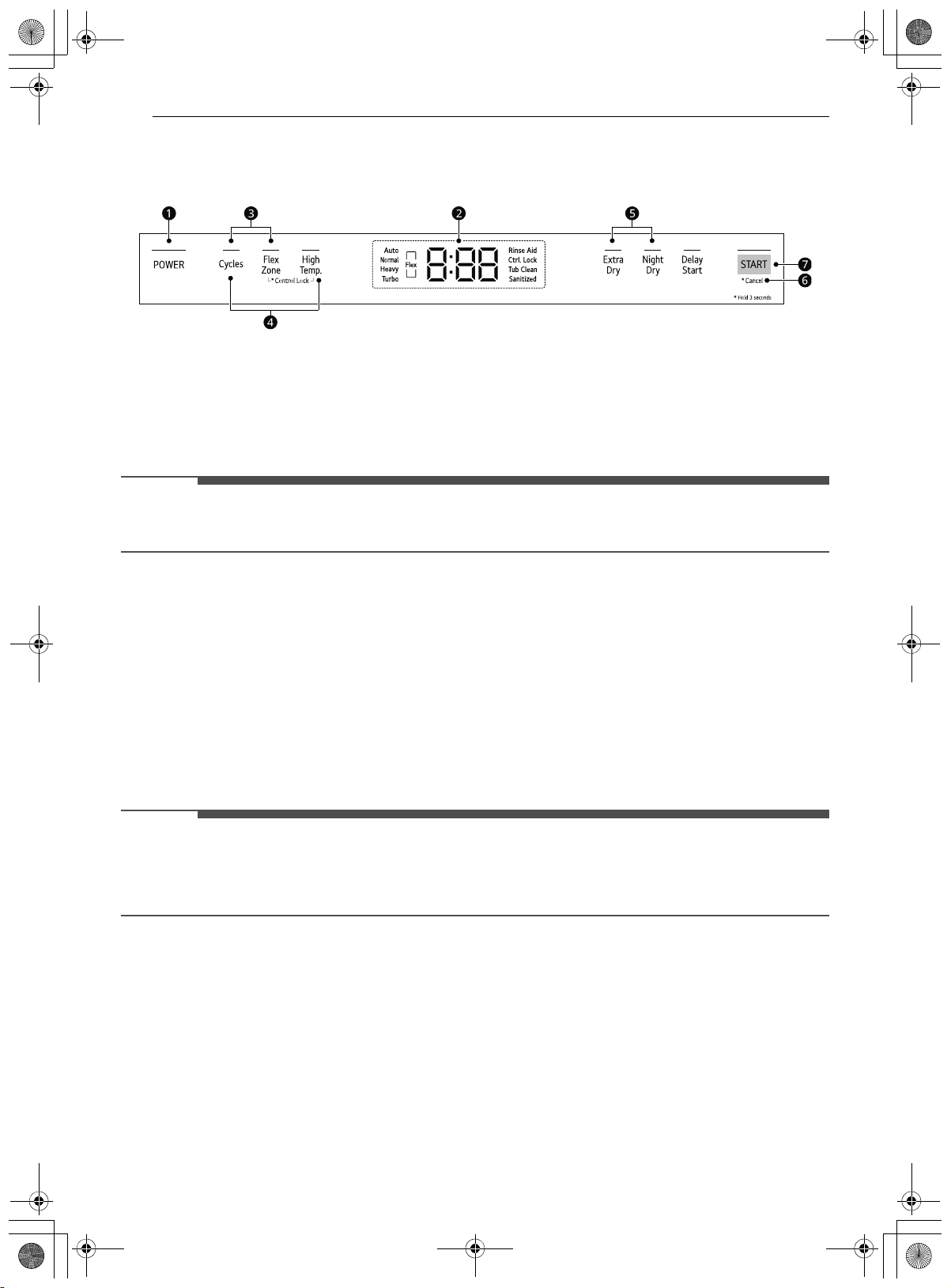
24 FUNCIONAMIENTO
Panel de control
Funciones del panel de control
a Botón de Power (Encendido)
• Presione este botón para encender o apagar la lavadora.
• Si se produce una sobrecarga eléctrica, un apagón o una interrupción del suministro eléctrico de
cualquier clase, la energía se apaga de manera automática por cuestiones de seguridad.
• Cuando se vuelve a conectar la electricidad, el lavavajillas se enciende automáticamente y el ciclo se
reanuda.
NOTA
• A l abrir o cerrar la puerta del producto, mantenga los dedos y las manos alejados del panel de control
para evitar activar los botones.
b Pantalla
• Rinse Aid (Abrillantador)
- Este luz LED se enciende cuando el nivel de abrillantador es bajo. La luz LED se apaga
automáticamente cuando el compartimiento del abrillantador se vuelve a llenar o el nivel se
configura en 0.
- Refiérase a la sección de Ajuste de Dispensador de Asistencia de Enjuague.
•
8:88 : Pantalla digital
- La pantalla digital del panel de control muestra el tiempo ESTIMADO del ciclo. Cuando se
seleccionan el ciclo y las opciones, la pantalla muestra el tiempo estimativo total para completar
dichas selecciones. Durante el funcionamiento, la pantalla muestra el tiempo de funcionamiento
estimativo restante.
NOTA
• El tiempo estimado en pantalla no incluye los tiempos de retraso para calentar agua, etc.
• Si se selecciona Delay Start (Inicio retardado), la pantalla muestra el tiempo de retraso en horas.
• El tiempo del ciclo podría variar según el nivel de suciedad de su carga.
• Ctrl. Lock, CL : Control Lock (Bloqueo de control)
- La función de Control Lock (Bloqueo de control) ayuda a evitar que se cambien los ajustes
durante un ciclo. La selección de esta función bloquea todos los botones, excepto el botón POWER
(Encendido) del panel de control. Esta función no bloquea la puerta.
- Mientras un ciclo está activo, mantenga presionados Flex Zone (Zona Flexible) y High Temp. (Alta
temperatura) simultáneamente por tres segundos para activar o desactivar la función Control
Lock (Bloqueo de control).
- Para comenzar un nuevo ciclo, desactive el Control Lock (Bloqueo de control).
• Tub Clean (Limpieza de la tina)
- El ícono LED Tub Clean (Limpieza de la tina) parpadea cada 30 ciclos. Para activar o desactivar el
ícono LED, presione los botones Cycles (Ciclos) y High Temp. (Alta temperatura) durante tres
segundos.
es-us_main.book.book Page 24 Friday, January 20, 2023 8:45 AM
25FUNCIONAMIENTO
ESPAÑOL
- Seleccione el ciclo Auto (Automático) y siga las instrucciones en la sección de Mantenimiento para
limpiar la cuba.
• Sanitized (Desinfección)
- Si la opción High Temp. (Alta temperatura) se agrega a un ciclo, el indicador LED Sanitized
(Desinfección) permanece encendido al final del ciclo si el enjuague caliente alcanzó la
temperatura adecuada.
c Pitido del botón de Encendido/Apagado
• Para activar o desactivar los sonidos del botón, mantenga presionados Cycles (Ciclos) y Flex Zone
(Zona Flexible) en forma simultánea por tres segundos. El sonido de alerta de error no puede
apagarse.
d Botón de Encendido/Apagado del recordatorio de Tub Clean (Limpieza de la tina)
• Para activar o desactivar el recordatorio de Tub Clean (Limpieza de la tina), mantenga presionados
los botones Cycles (Ciclos) y High Temp. (Alta temperatura) simultáneamente durante tres
segundos. Consulte la descripción del LED Tub Clean (Limpieza de la tina) en la pantalla b.
e Botón de Encendido/Apagado de la notificación de finalización
• Para activar o desactivar la notificación de finalización, mantenga presionados los botones Extra Dry
(Extra Seco) y Night Dry (Secado nocturno) simultáneamente durante tres segundos. ENCIENDA la
notificación para mostrar ENd (Finalización) al final del ciclo hasta que presione el botón de
ENCENDIDO o abra la puerta. APAGUE la notificación para que la máquina se apague 30 segundos
después del final del ciclo.
f Botón de Cancel (Cancelar)
• La bomba de desagüe se activa y se cancela el ciclo. Después de que se termina de desagotar el
lavavajillas, se apaga la electricidad.
• Mantenga presionado el botón START (INICIO) durante tres segundos para activarlo.
g Botón de Start (INICIO)
• Para operar la máquina puede presionar START (INICIO) y cerrar la puerta antes de que transcurran
cuatro segundos o cerrar la puerta y presionar START (INICIO).
• Si han transcurrido más de 4 segundos desde que presionó START (INICIO), sonará una alarma
cuando se cierre la puerta.
Ciclos de lavado
Seleccione el ciclo que desee.
Selección del ciclo
El ciclo predeterminado es Auto (Automático)
(Automático). También puede personalizar esta
configuración usando el botón Cycles (Ciclos)
(Ciclos).
• Presione el botón Cycles (Ciclos) varias veces
para seleccionar el ciclo Normal, Heavy
(Pesado) (Pesado), o Turbo.
Auto (Automático)
Este ciclo detecta la cantidad de suciedad y la
dificultad de la suciedad y se optimiza para lograr
la mejor limpieza.
Normal
Este ciclo es de uso diario, regular o típico para
lavar íntegramente una carga completa de vajilla
con suciedad normal. La etiqueta de consumo de
energía se basa en este ciclo sin ninguna opción.
Seleccione la opción Night Dry (Secado nocturno)
si deja la vajilla en el lavavajillas toda la noche.
• Después de finalizado el ciclo, el ventilador
trabaja por una hora para ayudar a ventilar el
aire caliente y húmedo de la cuba. Puede
detener el ventilador abriendo la puerta luego
de que el ciclo haya finalizado.
Heavy (Pesado)
Este ciclo se utiliza para lavar vajilla con mucha
suciedad y con residuos endurecidos. Este ciclo
está predeterminado para funcionar con la
intensidad de aspersión más elevada y se utiliza
para lavar vajilla muy sucia.
es-us_main.book.book Page 25 Friday, January 20, 2023 8:45 AM
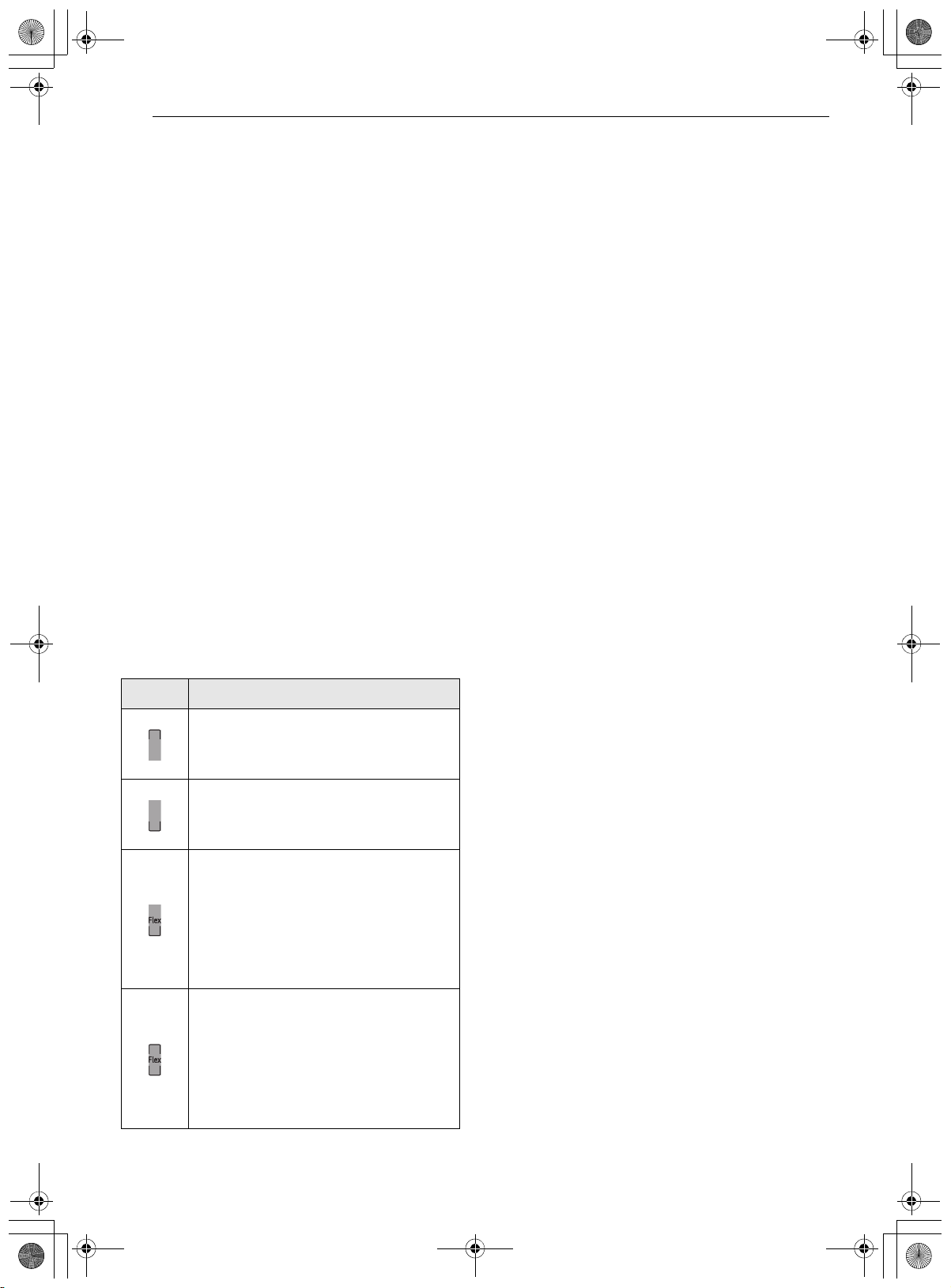
26 FUNCIONAMIENTO
Turbo
Este ciclo limpiará platos profundamente sucios en
una hora usando un poco más de energía y agua.
• Este ciclo no tiene secado. Seleccione Extra Dry
(Extra Seco) y la opción Night Dry (Secado
nocturno) u otro ciclo para un mejor secado.
Opciones y funciones
adicionales
Seleccione el ciclo deseado y luego, seleccione las
opciones para ese ciclo.
Uso de Zona flexible
Esta opción ajusta la intensidad del lavado para
abordar diferentes zonas dentro del lavavajillas.
Configúrela para lavar solo la bandeja superior o
inferior o ajuste la intensidad en suave para el
brazo rociador superior y en fuerte para el brazo
rociador inferior.
La opción Flex Zone (Zona Flexible) (Zona flexible)
viene apagada de manera predeterminada.
Presione el botón Flex Zone (Zona Flexible) para
personalizar la configuración.
• Presione el botón Flex Zone (Zona Flexible)
varias veces para seleccionar los 4 modos de
limpieza de la vajilla.
High Temp. (Alta temperatura)
Eleva la temperatura de lavado principal para
mejorar la limpieza.
Si la opción High Temp. (Alta temperatura) se
agrega a un ciclo, el indicador LED Sanitized
(Desinfección) permanece encendido al final del
ciclo si el enjuague caliente alcanzó la temperatura
adecuada. Si el lavavajillas no pudo usar el
enjuague caliente adecuadamente porque no se
seleccionó la opción High Temp. (Alta
temperatura), se interrumpió el ciclo o el agua no
pudo calentarse a la temperatura requerida, el
indicador no se encenderá al final del ciclo. Abra y
cierre la puerta o presione el botón POWER
(Encendido) para apagar el indicador.
Extra Dry (Extra Seco)
Seleccione la opción Extra Dry (Extra Seco) para
un mejor desempeño de secado. Esta opción
agrega tiempo de secado extra al ciclo e
incrementa la temperatura de enjuague caliente.
• Cuando la asistencia de enjuague está vacante,
la opción Extra Dry (Extra Seco) es seleccionada
automáticamente.
Night Dry (Secado nocturno)
A menudo, los platos quedan en el lavavajillas
durante toda la noche una vez que finaliza el ciclo.
Esto puede provocar que el vapor dentro de la
cuba se condense sobre la vajilla y la deje húmeda.
Esta opción hace que el ventilador funcione
periódicamente para ayudar a ventilar el vapor de
la cuba.
• La opción de Night Dry (Secado nocturno) se
selecciona por defecto con todos los ciclos para
los que está disponible, excepto para el ciclo
Normal.
Delay Start (Inicio retardado)
Esta función retarda el inicio de un ciclo
seleccionado. Cada vez que presione el botón
Delay Start (Inicio retardado), el tiempo de
retardo aumenta en una hora. Es posible
configurar el tiempo de retardo entre 1 y 12 horas,
en incrementos de una hora.
Guía de ciclos y opciones
La guía de ciclos muestra las opciones disponibles
para cada ciclo.
Modo Descripción
Cargas pequeñas y suciedad leve
• Use la bandeja superior para
ahorrar energía y tiempo.
Cargas pequeñas y suciedad difícil
• Use solo la bandeja inferior para
ahorrar energía y tiempo.
Cargas pequeñas y suciedad difícil y
vajilla liviana/delicada
• Concentre todo en la bandeja
inferior, pero también coloque
vajilla liviana o delicada en la
bandeja superior para un lavado
leve.
Diferentes condiciones
• Coloque la vajilla con suciedad
difícil, como platos y tazones, en la
bandeja inferior y la vajilla con
suciedad leve, como tazas y platos
pequeños en la bandeja superior
para obtener mejores resultados.
es-us_main.book.book Page 26 Friday, January 20, 2023 8:45 AM
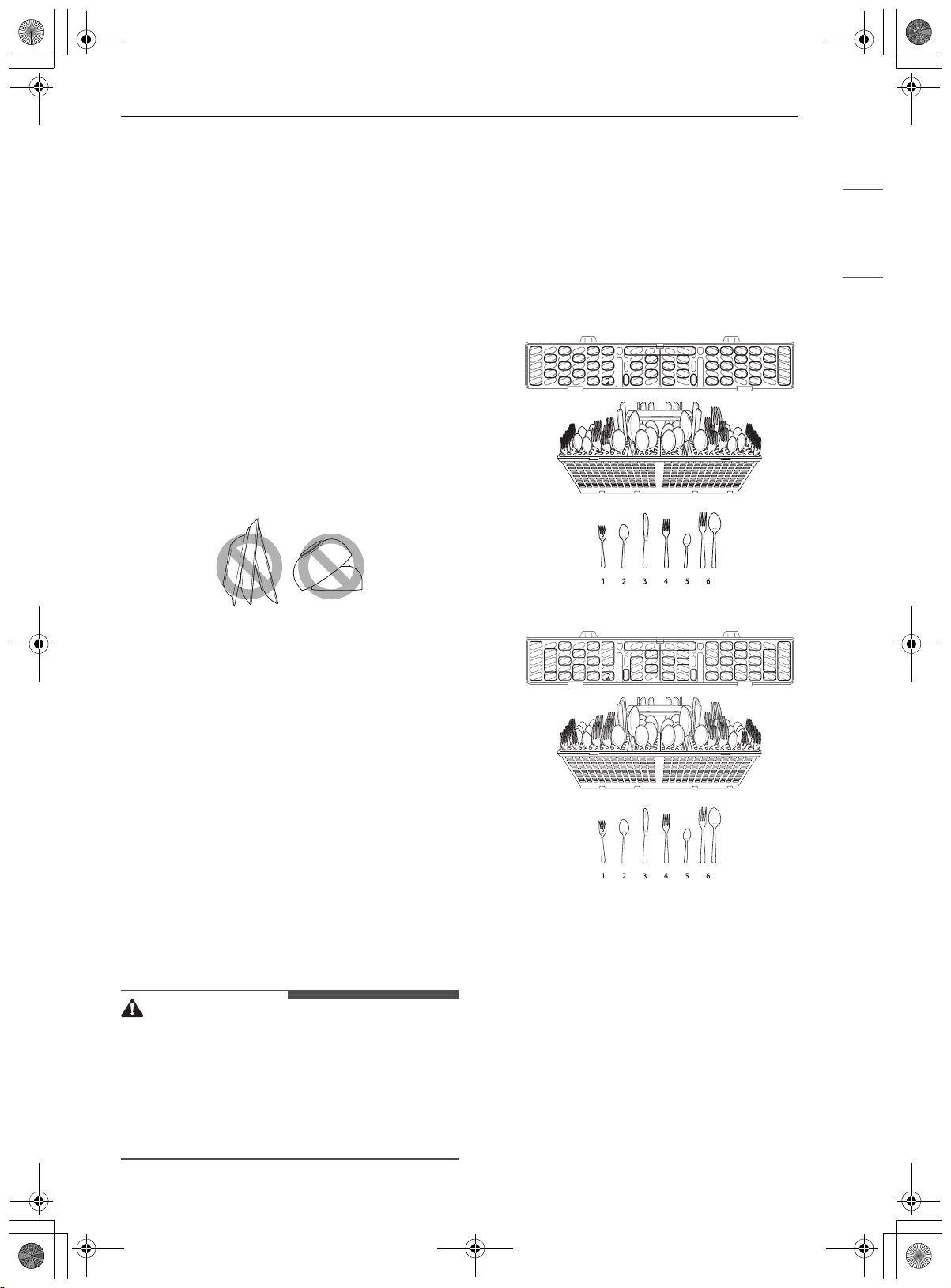
27FUNCIONAMIENTO
ESPAÑOL
Para ver la guía de ciclos y opciones, consulte el
manual del propietario disponible en línea.
Carga del lavavajillas
La cuba extra alta permite la carga de platos,
sartenes u otros utensilios de hasta 14" de alto.
Para un resultado de lavado efectivo, siga siempre
instrucciones que se encuentran a continuación.
• Retire las partículas grandes de restos de
comida de los platos, incluidos huesos, antes de
cargar el artefacto.
• Las piezas con comida quemada deben
remojarse antes de ser cargados en el
lavavajillas.
• Los platos o recipientes profundos deben
colocarse invertidos.
• Asegúrese de que las piezas de la vajilla no se
toquen entre sí.
Objetos no adecuados para el
lavavajillas
La combinación de agua a altas temperaturas y de
detergentes para lavavajillas puede dañar ciertos
objetos. No lave los siguientes objetos en el
lavavajillas:
• Cobre o aluminio anodizado
• Porcelana pintada a mano con oro o plata
• Utensilios con mangos de madera o hueso
• Utensilios de hierro o de material que pueda
oxidarse
• Objetos de plástico que no sean aptos para
lavavajillas
• Cubiertos de plata o chapados en oro o
porcelana fina o con bordes de metal
• Piezas frágiles como, por ejemplo, copas de
cristal
PRECAUCIÓN
• No coloque ollas y sartenes con manijas
plásticas en el artefacto ya que las manijas
pueden deteriorarse debido al calor y al
detergente.
• Puede que no se quiten de los vasos las
manchas de lápiz labial de larga duración o a
prueba de agua.
Carga en el cesto para
cubiertos
El cesto de cubiertos cuenta con separadores para
evitar que se raspen y manchen los cubiertos
delicados.
Carga de cubiertos en el cesto
Carga de 10 posiciones
Carga de 12 posiciones
Sugerencias para la carga de
cubiertos:
• Para obtener mejores resultados de limpieza,
utilice los separadores superiores del cesto
cuando cargue los cubiertos. Los separadores
evitan que los cubiertos se amontonen.
• Cargue los objetos filosos, como por ejemplo los
cuchillos, apuntando hacia abajo.
• Cuando se descarga el lavavajillas, lo mejor es
comenzar por el cesto de cubiertos. Esto evitará
que caigan gotas de agua sobre los cubiertos
desde la bandeja superior.
1
5
4
4
4
4
4
5
5
5
5
3
3
6
2
2
3
3465
5
5
51
5
4
4
4
4
3
2
6
2
2
2
2
2
2
1
5
4
4
4
4
4
5
5
1
5
3
6
2
3
3
465
5
1
51
5
4
4
4
42
6
2
2
2
2
2
2
es-us_main.book.book Page 27 Friday, January 20, 2023 8:45 AM
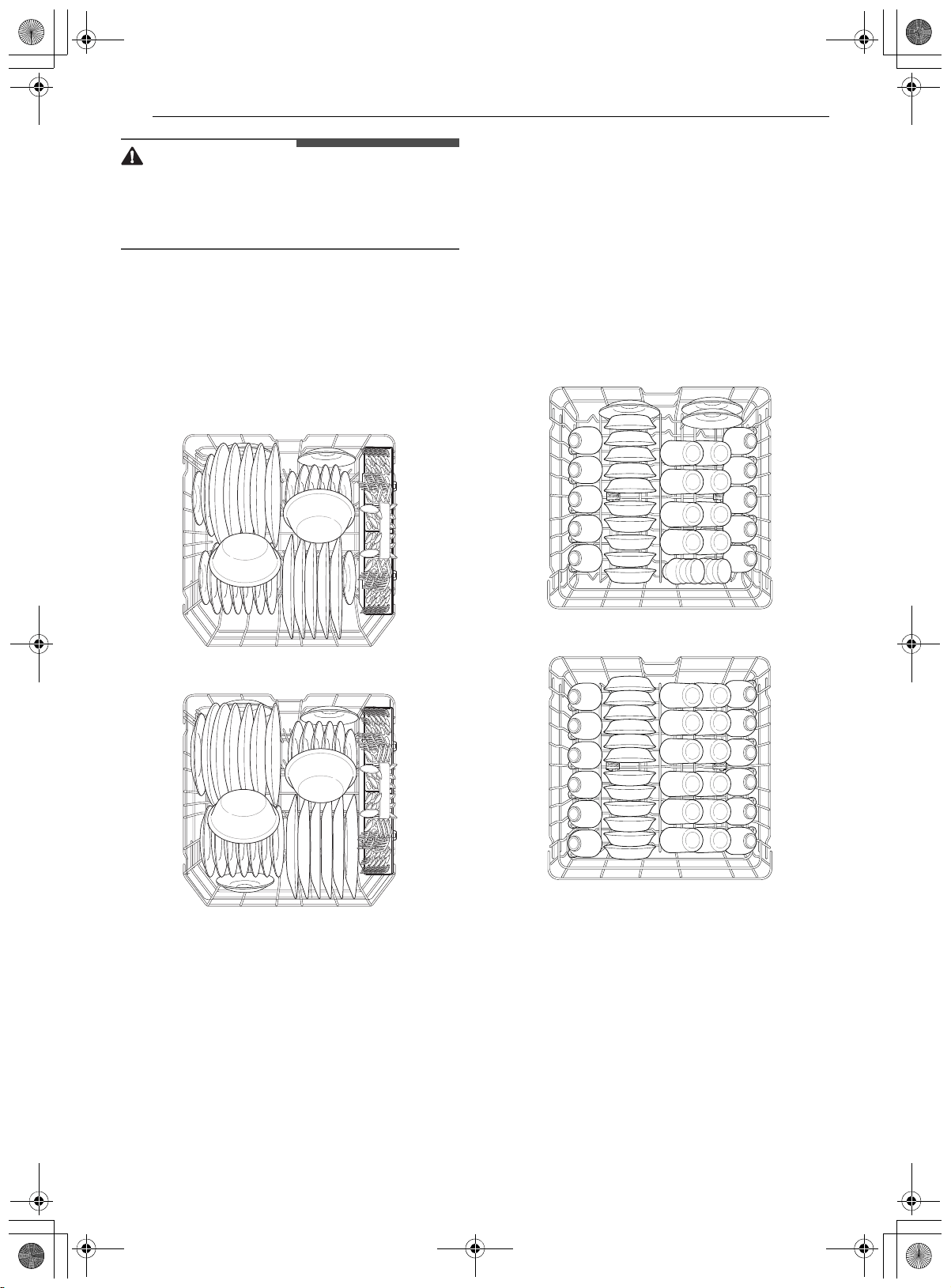
28 FUNCIONAMIENTO
ADVERTENCIA
• Tenga cuidado al cargar y descargar objetos
filosos. Cargue los cuchillos filosos con los
mangos hacia arriba para disminuir el riesgo de
lesiones personales.
Carga en la bandeja inferior
Carga de platos en la bandeja
inferior
Carga de 10 posiciones
Carga de 12 posiciones
Sugerencias de carga para la
bandeja inferior:
Para obtener información, consulte el manual del
propietario disponible en línea.
Plegado de las puntas separadoras
inferiores
Pliegue las puntas separadoras hacia abajo para
acomodar la vajilla más grande; despliegue las
puntas separadoras hacia arriba para acomodar la
vajilla más pequeña.
Para obtener más información, consulte el manual
del propietario disponible en línea.
Carga en la bandeja superior
Carga de platos en la bandeja
superior
Carga de 10 posiciones
Carga de 12 posiciones
Sugerencias de carga para la
bandeja superior:
Para obtener información, consulte el manual del
propietario disponible en línea.
Plegado de las puntas separadoras
superiores
Pliegue las puntas separadoras hacia abajo para
acomodar la vajilla más grande; despliegue las
puntas separadoras hacia arriba para acomodar la
vajilla más pequeña.
es-us_main.book.book Page 28 Friday, January 20, 2023 8:45 AM
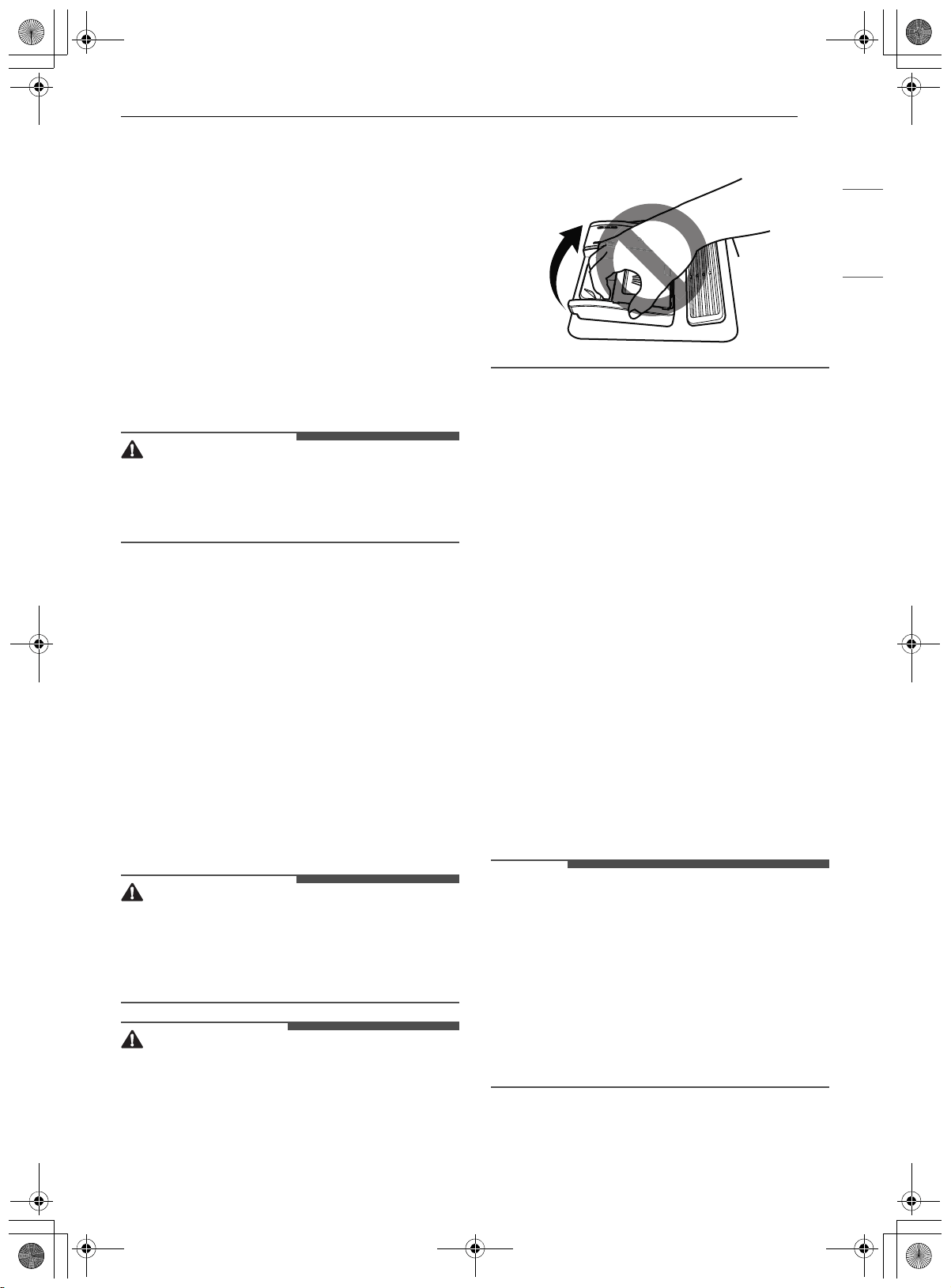
29FUNCIONAMIENTO
ESPAÑOL
Para obtener más información, consulte el manual
del propietario disponible en línea.
Bandeja superior con altura
ajustable
La bandeja superior se ajusta hacia arriba y hacia
abajo. Suba la bandeja superior para dar lugar a
objetos de hasta 14" de altura en la bandeja
inferior. Baje la bandeja superior para dar lugar a
objetos de hasta 12" de altura en la bandeja
superior. El lavavajillas se envía con la bandeja
superior subida.
Para obtener más información, consulte el manual
del propietario disponible en línea.
ADVERTENCIA
• Antes de ajustar, asegúrese de que el estante no
contenga vajilla de ningún tipo. De lo contrario,
los platos pueden dañarse o usted puede sufrir
lesiones.
Agregado de productos de
limpieza
Cómo agregar detergente en el
dispensador
• Retire la etiqueta del dispensador antes de hacer
funcionar el lavavajillas por primera vez.
• La cantidad de detergente necesario depende
del ciclo, el tamaño de la carga y el nivel de
suciedad de la vajilla.
• Ponga el detergente en el compartimiento para
detergente antes de comenzar cualquier ciclo,
salvo para el ciclo de Rinse (Enjuague).
ADVERTENCIA
• El detergente y el abrillantador para lavavajillas
contienen componentes químicos, como todos
los detergentes de uso doméstico. Por lo tanto,
deben mantenerse fuera del alcance de los
niños.
PRECAUCIÓN
• Solamente utilice detergente especial para
lavavajillas. El detergente incorrecto podría
hacer que el lavavajillas presente espumación
durante el funcionamiento. La espumación
excesiva podría reducir el rendimiento de lavado
y generar fugas en el lavavajillas.
• Para evitar dañar el dispensador, no tire de éste
para cerrar la puerta del lavaplatos.
Para obtener más información, consulte el manual
del propietario disponible en línea.
Cómo agregar abrillantador en el
dispensador
La luz LED de Rinse Aid (Abrillantador) aparece
en la pantalla cuando se necesita más
abrillantador.
Se recomienda utilizar abrillantador para evitar
que queden marcas de agua en la vajilla y para
mejorar el rendimiento del secado.
Para obtener más información, consulte el manual
del propietario disponible en línea.
Ajuste del dispensador de
abrillantador
El dispensador tiene cinco niveles de ajuste. El
lavavajillas se programa en la fábrica para un nivel
de dispensador de abrillantador de 2. Esto puede
comprobarse o ajustarse desde el panel de
control.
NOTA
• Ajuste la configuración a un nivel más elevado si
tiene agua dura o si nota la formación de calcio
en su vajilla.
• Ajustar el control del abrillantador a un nivel
demasiado bajo producirá manchas y vetas en la
vajilla, así como también un bajo rendimiento de
secado.
• Ajustar el control a un nivel demasiado elevado
puede causar espumación, lo que resultará en
un mal lavado.
1 Asegúrese de que el artefacto esté apagado.
es-us_main.book.book Page 29 Friday, January 20, 2023 8:45 AM
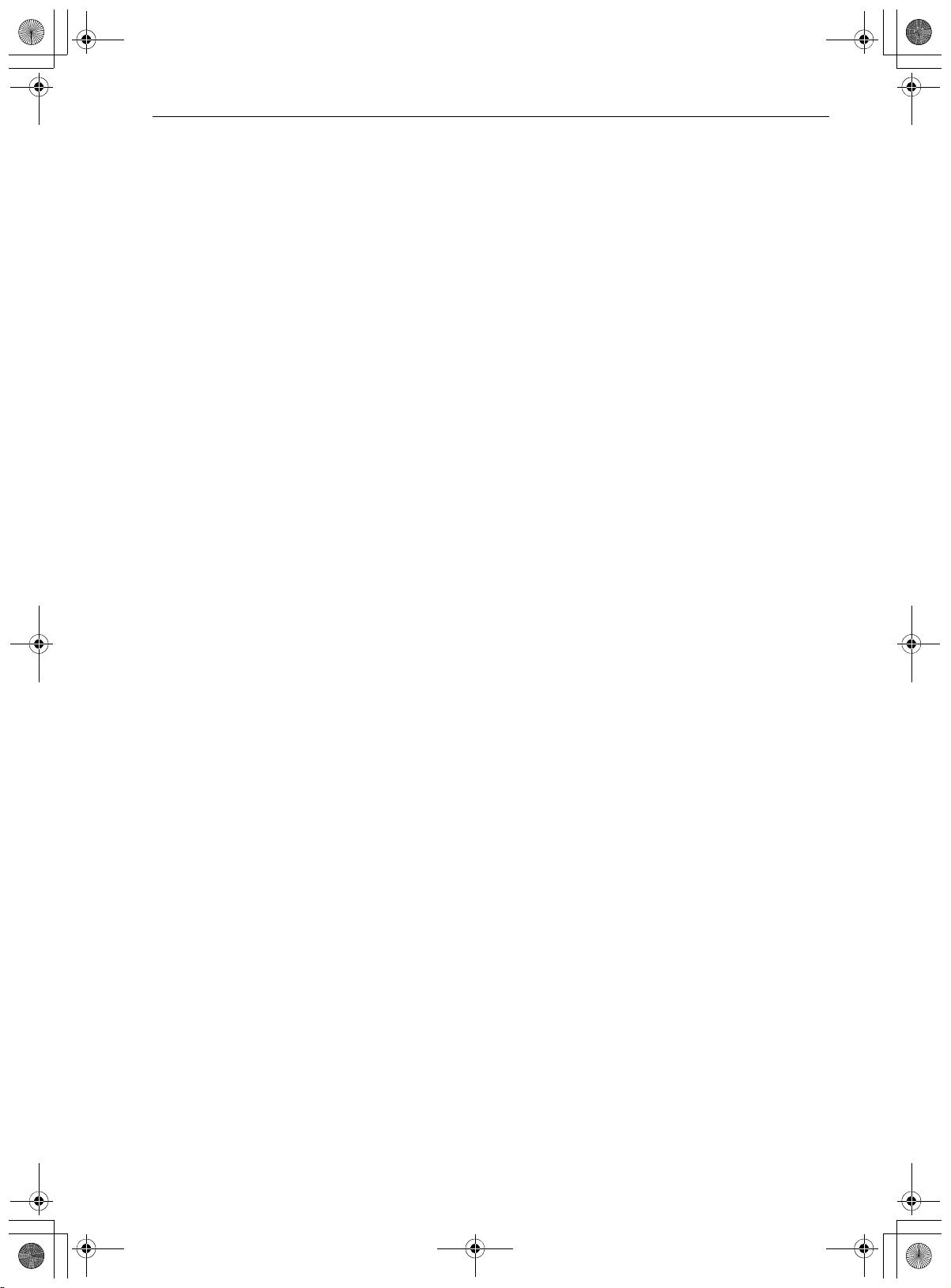
30 FUNCIONAMIENTO
2 Presione los botones POWER (Encendido) y
Delay Start (Inicio retardado)
simultáneamente para verificar el ajuste
actual.
3 Presione Delay Start (Inicio retardado) para
cambiar el ajuste del dispensador de
abrillantador. Cada vez que presione el botón,
el nivel se irá modificando, de Nivel 0 (L0) a
Nivel 4 (L4).
4 Una vez que haya seleccionado el ajuste del
dispensador de abrillantador deseado,
presione START (INICIO) para guardar.
Recarga del abrillantador
La frecuencia con la que se debe recargar el
dispensador depende de la frecuencia con la que
se lave la vajilla y el ajuste de abrillantador
utilizado.
• La luz LED de Rinse Aid (Abrillantador)
parpadea cuando se necesita más abrillantador,
a menos que el ajuste del dispensador de
abrillantador esté configurado en L0.
es-us_main.book.book Page 30 Friday, January 20, 2023 8:45 AM
31FUNCIONES INTELIGENTES
ESPAÑOL
FUNCIONES INTELIGENTES
Aplicación LG ThinQ
La aplicación LG ThinQ le permite comunicarse
con el electrodoméstico usando un teléfono
inteligente.
Funciones de la aplicación LG ThinQ
• Smart Diagnosis
- Esta función brinda información útil para
diagnosticar y resolver problemas con el
electrodoméstico conforme a su patrón de
uso. Seleccione Smart Diagnosis en la
aplicación y siga las instrucciones. Para
obtener información adicional, consulte el
manual del propietario disponible en línea.
Instalación de la aplicación LG
ThinQ
Busque la aplicación LG ThinQ en la tienda Google
Play o App Store desde su teléfono inteligente.
Siga las instrucciones para descargar e instalar la
aplicación.
es-us_main.book.book Page 31 Friday, January 20, 2023 8:45 AM
32 MANTENIMIENTO
MANTENIMIENTO
Para mantener el rendimiento y evitar problemas, es importante verificar el exterior y el interior del
lavavajillas, incluidos los filtros y los brazos rociadores, a intervalos regulares.
ADVERTENCIA
• Cuando limpie el exterior y el interior del lavavajillas, no utilice benceno ni solvente. De lo contrario,
podría ocasionar un incendio o una explosión.
• Para evitar lesiones físicas durante el cuidado y el mantenimiento o limpieza, use guantes y/o prendas
protectoras.
Limpieza y cuidado
Limpieza del exterior
• No utilice escobillas ni limpiadores abrasivos
para limpiar el exterior del lavavajillas.
• La mayor parte de la suciedad se puede retirar
con un paño húmedo suave o una esponja. Se
puede usar un jabón suave para ayudar a
desprender la suciedad difícil. Enjuague y seque
con un paño suave después de la limpieza.
• Las superficies de acero inoxidable se pueden
pulir con un limpiador de acero inoxidable. Siga
las instrucciones del limpiador y limpie en la
dirección de la veta.
PRECAUCIÓN
• En caso de derramar aceite de cocina en el
exterior del producto, límpielo de inmediato. No
limpie el exterior del producto con productos de
limpieza que contengan alcohol, diluyentes,
blanqueadores, benceno, líquidos inflamables o
abrasivos. Estas sustancias pueden decolorar o
dañar el electrodoméstico.
Limpieza del interior
• Limpie el interior del lavavajillas periódicamente
con un trapo o una esponja suaves y
humedecidos para eliminar las partículas de
alimentos y suciedad.
• Para eliminar manchas blancas y olores del
interior del lavavajillas, ejecute un ciclo con la
máquina vacía, sin detergente, colocando la
cantidad correspondiente a una taza de vinagre
blanco en un recipiente apto para lavavajillas en
el estante superior. (El vinagre es un ácido y su
uso constante podría dañar el artefacto).
• Limpiando el Tambor
- Ejecute el ciclo Auto (Automático) una vez al
mes o después de cada 30 ciclos para eliminar
la suciedad residual, el olor, las manchas
blancas y otra suciedad dentro del
electrodoméstico.
1 Retire todos los platos del
electrodoméstico.
2 Agregue 3 cucharadas (40 g) de ácido cítrico
al dispensador de detergente o siga las
instrucciones del fabricante si usa un
agente de limpieza para lavavajillas. No use
detergente para lavavajillas.
4 Presione START (INICIO).
NOTA
• Ejecute el ciclo del Auto (Automático) una vez
por mes, o con más frecuencia si es necesario,
para limpiar residuos o acumulación de
detergente.
• Si no ha utilizado el lavavajillas durante mucho
tiempo, refresque el interior ejecutando el ciclo
Auto (Automático) sin detergente. Cuando el
ciclo haya finalizado, limpie el interior y el
exterior del lavavajillas siguiendo las
instrucciones de la sección MANTENIMIENTO.
Trampa de aire del desagüe o
triturador del fregadero obstruidos
Verifique la trampa de aire del desagüe o el
triturador del fregadero si el lavavajillas no
desagota correctamente.
es-us_main.book.book Page 32 Friday, January 20, 2023 8:45 AM
ciclo Auto (Automático).
3 Presione Cycles (Ciclos) para seleccionar el
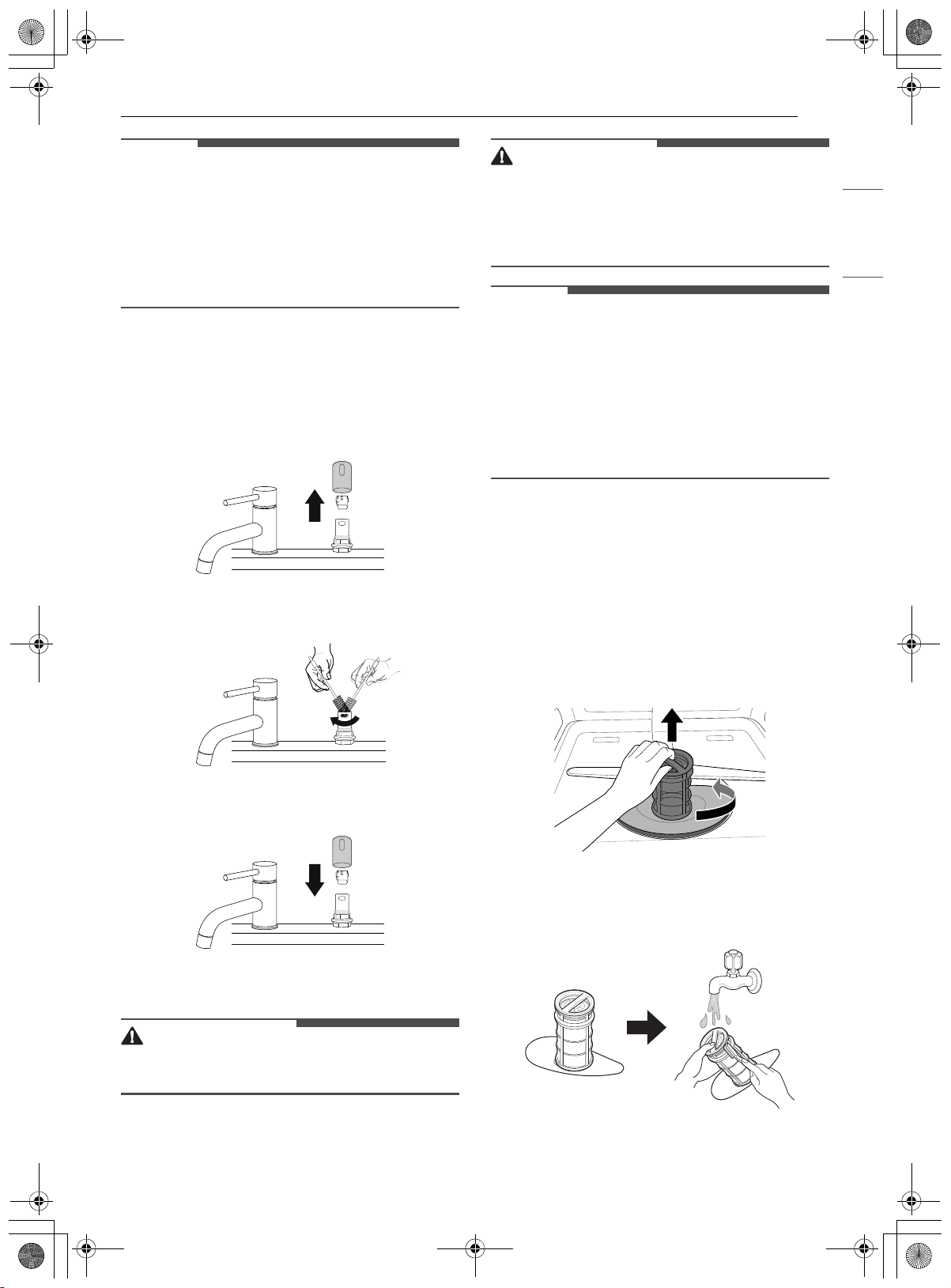
33MANTENIMIENTO
ESPAÑOL
NOTA
• La trampa de aire del desagüe y el triturador son
dispositivos de fontanería externos y no forman
parte del lavavajillas.
• La garantía del lavavajillas no cubre los costos de
servicio directamente relacionados con la
limpieza o la reparación de la trampa de aire de
desagüe externa y el triturador.
Limpieza de la trampa de aire
1 Apague el lavavajillas.
2 Retire la cubierta de la trampa de aire y la
tapa plástica que se encuentra debajo.
3 Limpie quitando cualquier desecho con un
palillo o cepillo.
4 Vuelva a colocar la tapa plástica y la cobertura
de la trampa de aire.
Limpieza de los filtros
ADVERTENCIA
• Tenga cuidado con los bordes filosos al
manipular el filtro de acero inoxidable.
PRECAUCIÓN
• Retire los restos de comida que se encuentren
atascados en los filtros para evitar la
acumulación de bacterias que generan malos
olores así como también posibles problemas en
el desagote.
NOTA
• Para lograr los mejores resultados de lavado,
limpie el filtro después de cada carga. Si el filtro
sigue sucio, puede causar olores.
• En áreas donde hay agua dura, limpie el filtro
utilizando un cepillo suave una vez al mes, como
mínimo.
• Limpie los filtros utilizando materiales no
abrasivos y agua corriente tibia.
1 Retire el estante inferior y coloque brazo
rociador del fondo de modo que se abra una V
más amplia hacia adelante.
2 Gire el filtro interno en sentido contrario a las
agujas del reloj y quite el filtro interno
ensamblado y el filtro de acero inoxidable.
Con los filtros quitados, verifique la apertura
del sumidero y elimine cualquier material
extraño, si es necesario.
3 Limpie los filtros con un cepillo de cerdas
suaves bajo el chorro de agua. Ensamble de
nuevo los filtros antes de volver a instalarlos.
4 Para volver a colocar los filtros ensamblados,
coloque el brazo rociador de modo que la V
es-us_main.book.book Page 33 Friday, January 20, 2023 8:45 AM
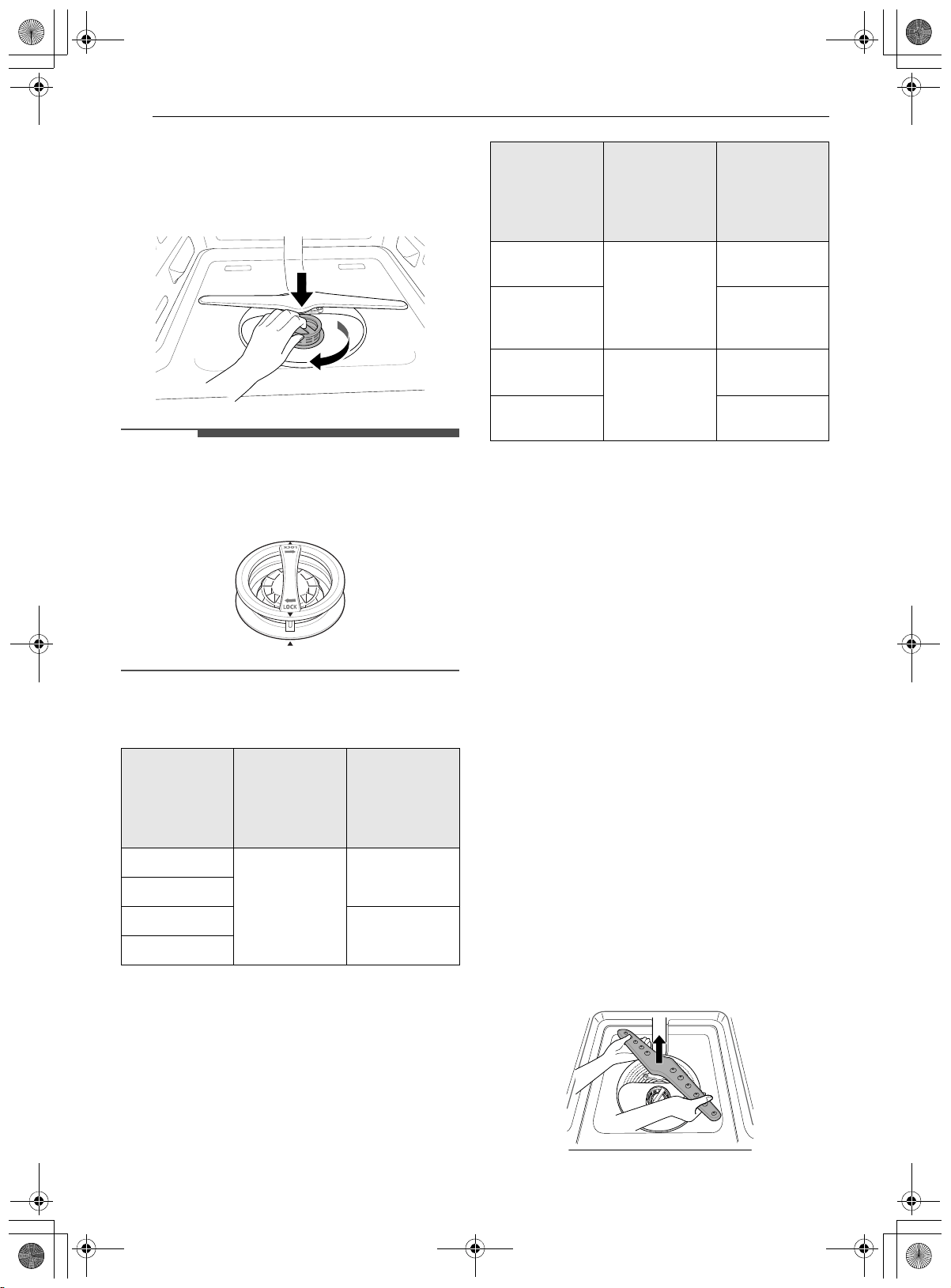
34 MANTENIMIENTO
más amplia apunte hacia adelante. Encaje los
filtros nuevamente en el soporte de filtros y
asegúrelos haciendo girar el filtro interior en
el sentido de las agujas del reloj hasta que
haga clic en su lugar.
NOTA
• Asegúrese de que el filtro esté correctamente
ensamblado antes de comenzar un ciclo. Cuando
ensamble el filtro, rótelo con firmeza hasta que
haga clic.
Programa de limpieza del filtro
recomendada
Limpieza del brazo rociador
Si los orificios de los brazos rociadores se
encuentran bloqueados por algún residuo de
comida, es posible que la vajilla no se lave
correctamente debido a que el rociado no se
efectuará de forma adecuada.
Se recomienda limpiar los brazos rociadores cada
dos semanas.
Limpieza del brazo rociador inferior
1 Asegúrese de que los orificios propulsores de
agua no estén obstruidos con partículas de
alimentos.
2 Cuando sea necesario hacer una limpieza,
retire el brazo aspersor inferior. Para ello, tire
de él hacia arriba.
3 Enjuague o sacuda el brazo rociador para
quitar las partículas de alimentos.
4 Después de limpiar el brazo aspersor inferior,
vuelva a colocarlo empujándolo hacia abajo
hasta que encaje en su sitio. Asegúrese de
que el brazo aspersor pueda girar libremente.
Cantidad de
cargas por
semana
Si lava la
vajilla antes
de cargarla
Si quita los
residuos y
enjuaga la
vajilla antes
de cargarla
1 - 3
Cada 6 meses
Una vez por
año
4 - 7
8 - 12
Cada 6 meses
13 - 14
Cantidad de
cargas por
semana
Si solo quita
los residuos
de la vajilla
antes de
cargarla
Si no quita
los residuos y
enjuaga la
vajilla antes
de cargarla
1 - 3
Cuatro veces
por año
Una vez por
mes
4 - 7
Dos veces por
mes (cada 15
días)
8 - 12
Cada 1.5
meses
Todas las
semanas
13 - 14
Dos veces por
semana
es-us_main.book.book Page 34 Friday, January 20, 2023 8:45 AM
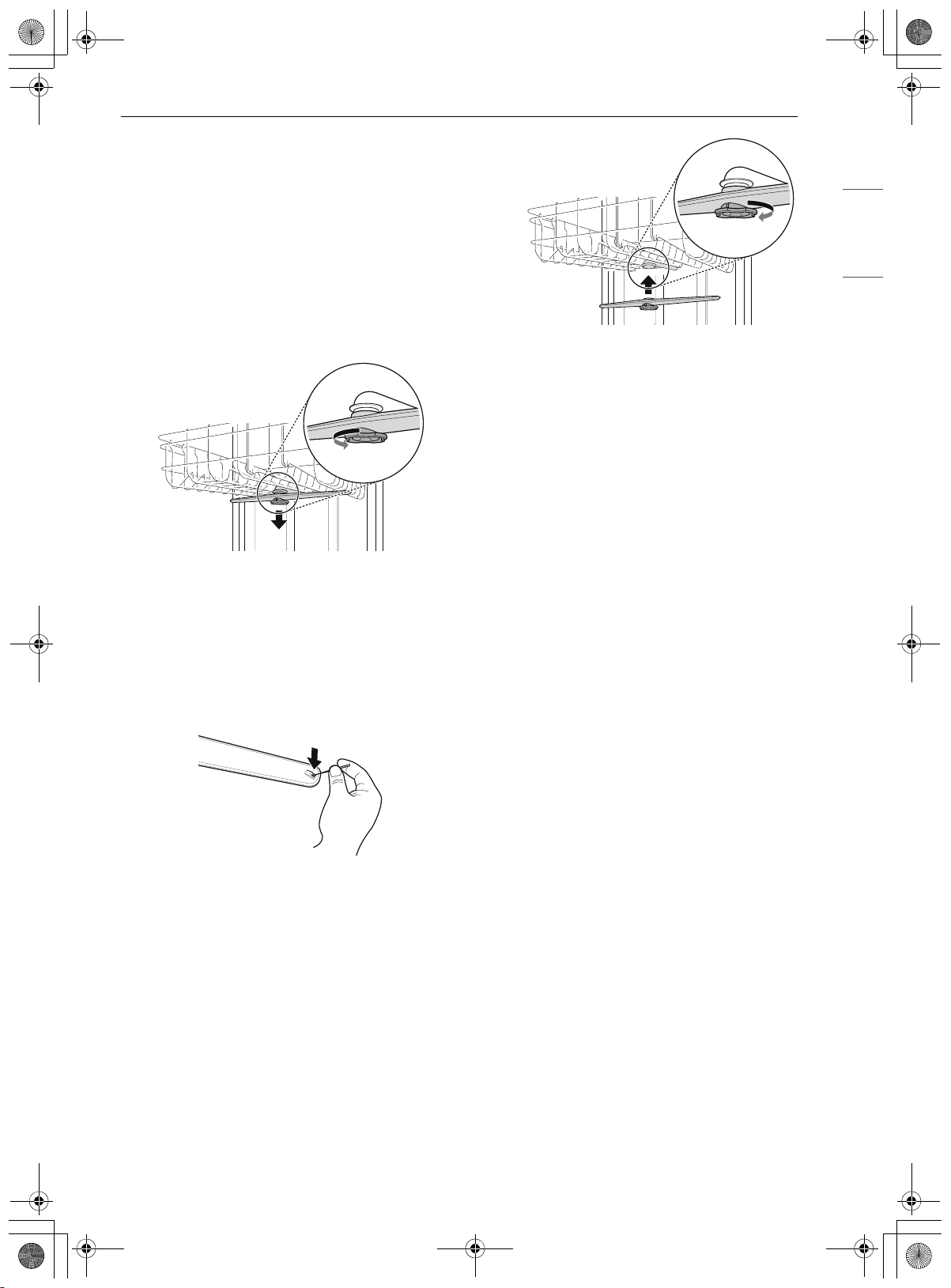
35MANTENIMIENTO
ESPAÑOL
Limpieza del brazo rociador superior
1 Tire de la bandeja superior hacia fuera.
Asegúrese de que los orificios propulsores de
agua no estén obstruidos con partículas de
alimentos.
2 Cuando sea necesario realizar una limpieza,
extraiga el brazo rociador superior girando la
tuerca ubicada en la parte inferior del brazo
1/8 de giro en sentido contrario a las agujas
del reloj y tire de él hacia abajo.
3 Enjuague o sacuda el brazo rociador para
quitar las partículas de alimentos.
4 Si algún residuo de comida bloquea los
orificios de los brazos rociadores, elimine la
suciedad utilizando un alfiler o alguna
herramienta punzante.
5 Cuando haya quitado los residuos de comida,
limpie los brazos rociadores bajo el chorro de
agua.
6 Luego de limpiar el brazo rociador superior,
vuelva a colocarlo en su lugar. Gire la tuerca
1/8 de giro en sentido de las agujas del reloj
para asegurarse de que la tuerca se bloquee
nuevamente en su lugar.
7 Luego de ensamblar, asegúrese de que los
brazos rociadores giren libremente.
Mantenimiento estacional y
almacenamiento
• En caso de que vaya a ausentarse por un
extenso período de tiempo durante los meses
más calurosos, cierre la válvula de agua,
desenchufe la línea de alimentación o apague el
interruptor de corriente. Limpie el filtro, la cuba
y el dosificador para evitar olores.
• En caso de que vaya a ausentarse por un
extenso período de tiempo durante los meses
más fríos y exista la posibilidad de que haya
temperaturas heladas, prepare las líneas de
suministro de agua y el mismo lavavajillas para
el invierno. La preparación para el invierno debe
ser realizada por personal de servicio calificado.
es-us_main.book.book Page 35 Friday, January 20, 2023 8:45 AM
36 SOLUCIÓN DE PROBLEMAS
SOLUCIÓN DE PROBLEMAS
La lavadora está equipada con un sistema automático de detección de errores para detectar y diagnosticar
problemas en una etapa temprana. Si la lavadora no funciona correctamente o no funciona en absoluto,
compruebe lo siguiente antes de llamar al servicio técnico.
Antes de llamar al servicio técnico
Para obtener más información sobre la solución de problemas, consulte el manual del propietario
disponible en línea.
Videos de soporte para el usuario
Si necesita más ayuda, puede encontrar videos y tutoriales en el sitio web LG.com.
1 En la página principal de www.lg.com, haga clic en la pestaña Soporte del menú para mostrar las
selecciones del menú. Seleccione Video Tutorials.
2 Selecciona una categoría de producto y luego elija un tema o busque una palabra clave.
NOTA
• Escanee este código QR para accesar rápidamente a la página búsqueda de video en el sitio web de LG.
Mensajes de error
Problemas Causas posibles y solución
IE
Hay un problema en la entrada de agua.
• Controle que la manguera del agua no esté obstruida, plegada o congelada.
• Controle el suministro de agua.
OE
Hay un problema en el desagüe.
• Controle que la manguera de desagüe de agua no esté obstruida, plegada o congelada.
La trampa de aire o el triturador están obstruidos.
• Limpie la trampa de aire o el triturador.
Los filtros están obstruidos.
• Limpie los filtros.
es-us_main.book.book Page 36 Friday, January 20, 2023 8:45 AM
37SOLUCIÓN DE PROBLEMAS
ESPAÑOL
bE
Exceso de espuma causada por el uso de un detergente inadecuado, como jabón líquido
para vajilla.
• No utilice detergente para lavar vajillas a mano. Utilice solo detergentes diseñados para su
uso en lavavajillas automáticos.
• Un error
bE puede aparecer sise cargan platos sucios con muchos alimentos espumosos,
como cremabatida, en el aparato. Para borrar el error, apague el aparato y comience un
nuevo ciclo.
• Para remover el residuo de detergente en la bañera, vierta aproximadamente 4 oz ~ 8 oz
(100 ml ~ 200 ml) de leche en un recipiente poco profundo, colóquelo en el estante
superior y ejecute el ciclo Auto (Automático) en el electrodoméstico.
fallo al nivelar el lavaplatos.
• Asegúrese de que el electrodoméstico haya sido nivelado apropiadamente.
AE
Pérdida de agua.
• Corte el suministro de agua al lavavajillas y comuníquese con un Centro de Información al
Cliente de LG llamando al 1-800-243-0000 (EE. UU.) o al 1-888-542-2623 (Canadá).
• El lavavajillas emite un sonido de alerta durante 10 segundos y la bomba de desagüe
funciona de manera intermitente. Si se apaga el artefacto, este vuelve a encenderse
automáticamente hasta que se resuelve el error AE.
FE
Excesiva cantidad de agua.
• Comuníquese con un centro de información al cliente de LG Electronics llamando al: 1-800-
243-0000 (EE. UU.) 1-888-542-2623 (Canadá).
HE
Fallas en el circuito de calentamiento.
• Comuníquese con un centro de información al cliente de LG Electronics llamando al: 1-800-
243-0000 (EE. UU.) 1-888-542-2623 (Canadá).
tE
Problema con el sensor de temperatura del agua
• Comuníquese con un centro de información al cliente de LG Electronics llamando al: 1-800-
243-0000 (EE. UU.) 1-888-542-2623 (Canadá).
LE
Problema con el motor de lavado
• Comuníquese con un centro de información al cliente de LG Electronics llamando al: 1-800-
243-0000 (EE. UU.) 1-888-542-2623 (Canadá).
NE
Problema con el motor Vario.
• Comuníquese con un centro de información al cliente de LG Electronics llamando al: 1-800-
243-0000 (EE. UU.) 1-888-542-2623 (Canadá).
N:#, U:#, d:#, t#
(# es un número).
Modo prueba seleccionado.
• Éste no es un código de error. Este código se utiliza al probar el lavavajillas. Apague y
encienda la unidad y el código desaparecerá.
LO, L1, Lz, L3, L4
El modo configuración Nivel de Asistencia de Enjuague se encuentra seleccionado.
• Este no es un código de error. Este código indica el nivel de asistencia de enjuague actual.
Para obtener más información, consulte la sección Adding Cleaning Agents (Agregado de
agentes de limpieza).
CL
Control Lock (Bloqueo de control) está activado.
• Este no es un código de error. Este código indica que el bloqueo de control está activado.
Mantenga presionados Flex Zone (Zona Flexible) y High Temp. (Alta temperatura)
simultáneamente por tres segundos.
Problemas Causas posibles y solución
es-us_main.book.book Page 37 Friday, January 20, 2023 8:45 AM
38 GARANTÍA LIMITADA
GARANTÍA LIMITADA
EE. UU.
TÉRMINOS Y CONDICIONES
AVISO DE ARBITRAJE: ESTA GARANTÍA LIMITADA CONTIENE UNA CLÁUSULA DE ARBITRAJE QUE LE
DEMANDA A USTED Y A LG ELECTRONICS (“LG”) RESOLVER CONFLICTOS A TRAVÉS DE UN ARBITRAJE
VINCULANTE EN LUGAR DE HACERLO EN EL TRIBUNAL, A MENOS QUE USTED DECIDA NO PARTICIPAR.
EN EL ARBITRAJE NO ESTÁN PERMITIDAS LAS ACCIONES COLECTIVAS NI LOS JUICIOS CON JURADO.
POR FAVOR, VEA A CONTINUACIÓN LA SECCIÓN “PROCEDIMIENTO PARA RESOLVER CONFLICTOS”.
En caso de que su Lavavajillas LG (“Producto”) presente alguna falla por defectos de materiales o de
fabricación bajo uso apropiado y normal durante el período de garantía establecido más abajo, será
reparado o reemplazado por LG, a su opción. Esta garantía limitada es válida únicamente para el
comprador final original del Producto (“Usted”), y para productos comprados legalmente y utilizados
dentro de los Estados Unidos, incluidos los territorios norteamericanos.
† La placa control principal está ubicada en la parte inferior derecha del lavavajillas, desde la vista frontal.
• Los Productos y las piezas de repuesto están cubiertos durante el tiempo restante del período original
de garantía o noventa (90) días, lo que resulte mayor.
• Los Productos y las piezas de repuesto pueden ser nuevos, reparados, reacondicionados, o
reconstruidos por la fábrica.
• Los Productos o piezas reemplazados serán propiedad de LG.
• Es necesario presentar prueba de la compra minorista especificando el modelo del Producto y la fecha
de compra para obtener el servicio de garantía conforme a la presente garantía limitada.
SALVO LO PROHIBIDO POR LA LEY, TODA GARANTÍA DE COMERCIALIZACIÓN O IDONEIDAD
IMPLÍCITA, PARA UN PROPÓSITO PARTICULAR EN EL PRODUCTO, ESTÁ LIMITADA A LA DURACIÓN DE
LA GARANTÍA ARRIBA EXPRESADA. BAJO NINGUNA CIRCUNSTANCIA DEBERÁ LG O SUS
DISTRIBUIDORES/REPRESENTANTES SER RESPONSABLE POR CUALQUIER DAÑO INDIRECTO,
INCIDENTAL, CONSECUENTE, ESPECIAL, O PUNITIVO, LO CUAL INCLUYE PERO NO SE LIMITA A,
PÉRDIDA DE FONDOS DEL COMERCIO, GANANCIAS PERDIDAS, INTERRUPCIÓN DEL TRABAJO,
DETERIORO DE OTROS BIENES, COSTO DE REMOVER Y REINSTALAR EL PRODUCTO, PÉRDIDA DE USO, O
CUALQUIER OTRO DAÑO YA SEA BASADO EN CONTRATO, PERJUICIO, U OTROS. LA RESPONSABILIDAD
TOTAL DE LG, EN CASO EXISTA, NO EXCEDERÁ EL PRECIO QUE USTED PAGÓ POR ADQUIRIR EL
PRODUCTO.
ALGUNOS ESTADOS NO PERMITEN LA EXCLUSIÓN O LIMITACIÓN DE DAÑOS INCIDENTALES O
EMERGENTES, O LIMITACIONES A LA DURACIÓN DE LA GARANTÍA IMPLÍCITA, POR LO QUE LA
Período de garantía
Alcance de la
garantía
CÓMO SE MANEJA EL SERVICIO
TÉCNICO
Un (1) año a partir de la fecha de compra
minorista original
Mano de obra /
Piezas
LG también brindará, sin costo alguno,
todos los servicios de mano de obra y en
sitio para reemplazar la pieza defectuosa.
Dos (2) años a partir de la fecha de compra
minorista original
Placa control
principal
†
/ Bandeja
/ Revestimiento de
la puerta de acero
inoxidable / Cuba
Panel de control principal, estante para
lavavajillas, revestimiento de acero
inoxidable de la puerta y bañera. El cliente
será responsable del costo de mano de
obra o servicio en el hogar para
reemplazar las piezas defectuosas.
Diez (10) años a partir de la fecha de
compra minorista original
Motor Direct Drive Motor Direct Drive. El cliente será
responsable del costo de mano de obra o
servicio en el hogar para reemplazar las
piezas defectuosas.
es-us_main.book.book Page 38 Friday, January 20, 2023 8:45 AM
39GARANTÍA LIMITADA
ESPAÑOL
EXCLUSIONES O LIMITACIONES ANTERIORES PODRÍAN NO CORRESPONDER EN SU CASO. ESTA
GARANTÍA LIMITADA LE OTORGA DERECHOS LEGALES ESPECÍFICOS, Y ES POSIBLE QUE USTED CUENTE
CON OTROS DERECHOS, QUE VARÍAN SEGÚN EL ESTADO.
ESTA GARANTÍA LIMITADA NO CUBRE LO SIGUIENTE:
• Viajes del servicio técnico para entregar, buscar o instalar el producto, instruir al cliente sobre la
operación del mismo, corregir el cableado o las reparaciones/instalaciones no autorizadas.
• Daño o fallo del producto al operar durante fallas e interrupciones del suministro eléctrico, o resultado
de un servicio eléctrico inadecuado.
• Daños o fallos del Producto causados por tuberías de agua rotas o con fugas, tuberías de agua
congeladas, líneas de desagüe obstruidas, suministro de agua inadecuado o interrumpido, o suministro
de aire inadecuado.
• Daños o fallos del Producto causados por operar el Producto en una atmósfera corrosiva o contraria a
las instrucciones detalladas en el manual del usuario del Producto.
• Daños o fallos del Producto causados por accidentes, pestes y alimañas, rayos, viento, incendio,
inundaciones, causas de fuerza mayor, o cualquier otra causa fuera del control de LG.
• Daños o fallos del Producto causados por modificaciones o alteraciones no autorizadas, o por utilizar el
Producto para fines distintos de lo previsto, o pérdida de agua cuando el Producto no se instaló
adecuadamente.
• Daños o fallos del Producto causados por corriente eléctrica o voltaje incorrectos, o códigos de cañería.
• Daños o fallos del Producto causados por el transporte, almacenamiento o manipulación, incluidos
rayas, muescas, astillados u otros daños al acabado, a menos que tales defectos se informen en el plazo
de una (1) semana a partir de la entrega.
• Daños o fallos del Producto causados por mal uso, abuso, instalación, reparación o mantenimiento
incorrectos. Una reparación incorrecta incluye el uso de piezas no autorizadas, aprobadas o
especificadas por LG. La instalación o el mantenimiento inadecuado incluye aquellos contrarios a lo
especificado en el manual del usuario del Producto.
• Daños o fallos del Producto causados por el uso de piezas, componentes, accesorios, productos de
limpieza consumibles, u otros productos o servicios no autorizados por LG.
• Daños o artículos faltantes con la caja abierta o que hayan estado en exhibición.
• Productos reacondicionados o cualquier producto vendido con los avisos "En el estado actual", "En el
sitio actual", "Con todos sus defectos" o similares.
• Productos cuyos números de serie originales hayan sido retirados, alterados o no se puedan determinar
fácilmente.
• Aumentos en los costos de los servicios públicos y otros gastos adicionales de dichos servicios.
• Cualquier ruido asociado con la operación normal.
• Productos utilizados de otra forma que no sea uso doméstico usual y normal (p. ej., uso comercial o
industrial) o de forma contraria al manual del usuario del Producto.
• Costos asociados con la remoción y reinstalación del Producto para reparaciones o la remoción y
reinstalación del Producto si está instalado en una ubicación inalcanzable o no está instalado de acuerdo
con el Manual del propietario del producto.
• Accesorios, componentes extraíbles o partes consumibles (por ejemplo, estantes, compartimentos de la
puerta, cajones, filtros de agua o aire, rejillas, bombillas, baterías, etc. según corresponda), excepto las
partes internas/funcionales cubiertas por esta garantía limitada.
El costo de reparación o reemplazo en estas circunstancias excluidas estará a cargo de Usted.
PARA OBTENER SERVICIO EN GARANTÍA E INFORMACIÓN ADICIONAL
Llame al 1-800-243-0000 y seleccione la opción apropiada desde el menú.
O visite nuestro sitio web en http://www.lg.com
O por correo: LG Electronics Customer Service P.O. Box 240007 Huntsville, AL 35813 ATTN: CIC
es-us_main.book.book Page 39 Friday, January 20, 2023 8:45 AM
40 GARANTÍA LIMITADA
PROCEDIMIENTO PARA RESOLVER CONFLICTOS:
TODOS LOS CONFLICTOS ENTRE USTED Y LG QUE SURJAN FUERA DE O RELACIONADOS DE ALGUNA
MANERA CON ESTA GARANTÍA LIMITADA O CON EL PRODUCTO, SE RESOLVERÁN EXCLUSIVAMENTE A
TRAVÉS DE UN ARBITRAJE VINCULANTE Y NO EN UNA CORTE DE JURISDICCIÓN GENERAL. ARBITRAJE
VINCULANTE SIGNIFICA QUE USTED Y LG RENUNCIAN AL DERECHO DE UN JUICIO CON JURADO Y A
REALIZAR O PARTICIPAR EN UNA DEMANDA COLECTIVA.
Definiciones. Para el propósito de esta sección, las referencias a “LG” significan: LG Electronics U.S.A., Inc.,
sus empresas matrices, subsidiarias y filiales y cada uno de sus directivos, directores, empleados, agentes,
beneficiarios, predecesores en interés, sucesores, cesionarios y proveedores; las referencias a “conflicto” o
“reclamación” incluirán cualquier conflicto, reclamo o controversia de cualquier tipo, sin importar (ya sea
basado en contrato, agravio, estatuto, regulación, ordenanza, fraude, falsa representación o cualquier
teoría legal o equitativa) que surja de o esté relacionada con cualquier forma de venta, condición o
desempeño del producto o de esta Garantía Limitada.
Aviso de disputa. En caso de que usted desee iniciar un procedimiento de arbitraje, primero debe
notificar a LG por escrito al menos 30 días antes de iniciar el arbitraje enviando una carta a LG a LG
Electronics, USA, Inc. Atención: Legal Department- Arbitration 111 Sylvan Avenue, Englewood Cliffs, NJ
07632. Usted y LG aceptan participar en discusiones de buena fe en un intento de resolver su reclamo de
manera amistosa. En la carta debe proporcionar su nombre, dirección y número de teléfono; identificar el
producto que es objeto de la reclamación; y describir la naturaleza del reclamo y el remedio que busca. Si
usted y LG no pueden resolver la disputa dentro de 30 días, cualquiera de las partes puede proceder a
presentar una demanda de arbitraje.
Acuerdo de arbitraje vinculante y renuncia de demanda colectiva. En caso de no resolver la disputa
durante el período de 30 días después de enviar una notificación por escrito a LG, Usted y LG se
comprometen a resolver cualquier reclamo entre nosotros, solamente a través de arbitraje vinculante
sobre una base individual, a menos que usted se excluya, conforme a lo dispuesto a continuación.
Cualquier conflicto entre usted y LG no estarán combinados o consolidados con una controversia
relacionada con cualquier otro producto o reclamo de otra persona o entidad. Más específicamente y sin
prejuicio de lo anterior, no procederá bajo ninguna circunstancia cualquier disputa entre usted y LG como
parte de una acción colectiva o representativa. En lugar del arbitraje, cualquiera de las partes podrá iniciar
una acción individual en la corte de reclamos menores, pero tales acciones en la corte de reclamos
menores no podrán ser realizadas en una acción colectiva o representativa.
Normas y procedimientos de arbitraje. Para comenzar con el arbitraje de un reclamo, usted o LG deben
realizar una demanda escrita para arbitraje. El arbitraje será administrado por la Asociación Americana de
Arbitraje (AAA) y se llevará a cabo ante un árbitro único bajo las Normas de Arbitraje del Consumidor de la
AAA, que tienen efecto al momento de inicio del arbitraje (en adelante “Normas de la AAA”) y bajo los
procedimientos establecidos en esta sección. Las Normas de la AAA están disponibles en línea en
www.adr.org/consumer. Envíe una copia de su solicitud de arbitraje por escrito, así como una copia de
esta disposición, a la AAA de la forma descrita en las Normas de la AAA. También debe enviar una copia de
su solicitud por escrito a LG en LG Electronics, USA, Inc. Atención: Legal Department- Arbitration 111
Sylvan Avenue, Englewood Cliffs, NJ 07632. Si hay un conflicto entre las Normas de la AAA y las reglas
establecidas en esta sección, prevalecerán dichas reglas de esta sección. Esta disposición de arbitraje se
rige por la Ley Federal de Arbitraje. El juicio se puede introducir en el laudo arbitral en cualquier tribunal
de jurisdicción competente. Todos son temas para que el árbitro tome sus decisiones, excepto aquellos
asuntos relativos al alcance y aplicabilidad de la cláusula de arbitraje y de la cap
acidad de
arbitraje de la
controversia para que el tribunal decida. El árbitro se regirá por los términos de esta disposición.
Legislación vigente. La legislación del estado de su residencia regirá esta Garantía Limitada, así como
todas las disputas entre nosotros, salvo que sea invalidada o inconsistente con leyes federales aplicables.
Tarifas / Costos. Usted no debe pagar ninguna tarifa para comenzar un arbitraje. Al recibir su solicitud de
arbitraje por escrito, LG pagará todos los gastos administrativos rápidamente a la AAA, a menos que usted
solicite más de $25,000.00 por daños, en cuyo caso el pago de estos gastos se regirá por las Normas de la
AAA. Salvo disposición contraria prevista en el presente documento, LG pagará a la AAA todos los gastos
documentales, administrativos y de arbitraje para cualquier arbitraje iniciado, de conformidad con las
Normas de la AAA y esta disposición de arbitraje. Si usted prevalece en el arbitraje, LG pagará los
honorarios y gastos de sus abogados, siempre y cuando sean razonables, considerando factores que
incluyen, entre otros, el monto de la compra y el monto del reclamo. No obstante lo anterior, si la ley
aplicable permite una adjudicación de honorarios y gastos razonables de abogados, un árbitro puede
otorgarlos en la misma medida que lo haría un tribunal. Si el árbitro considera que la sustancia de su
es-us_main.book.book Page 40 Friday, January 20, 2023 8:45 AM
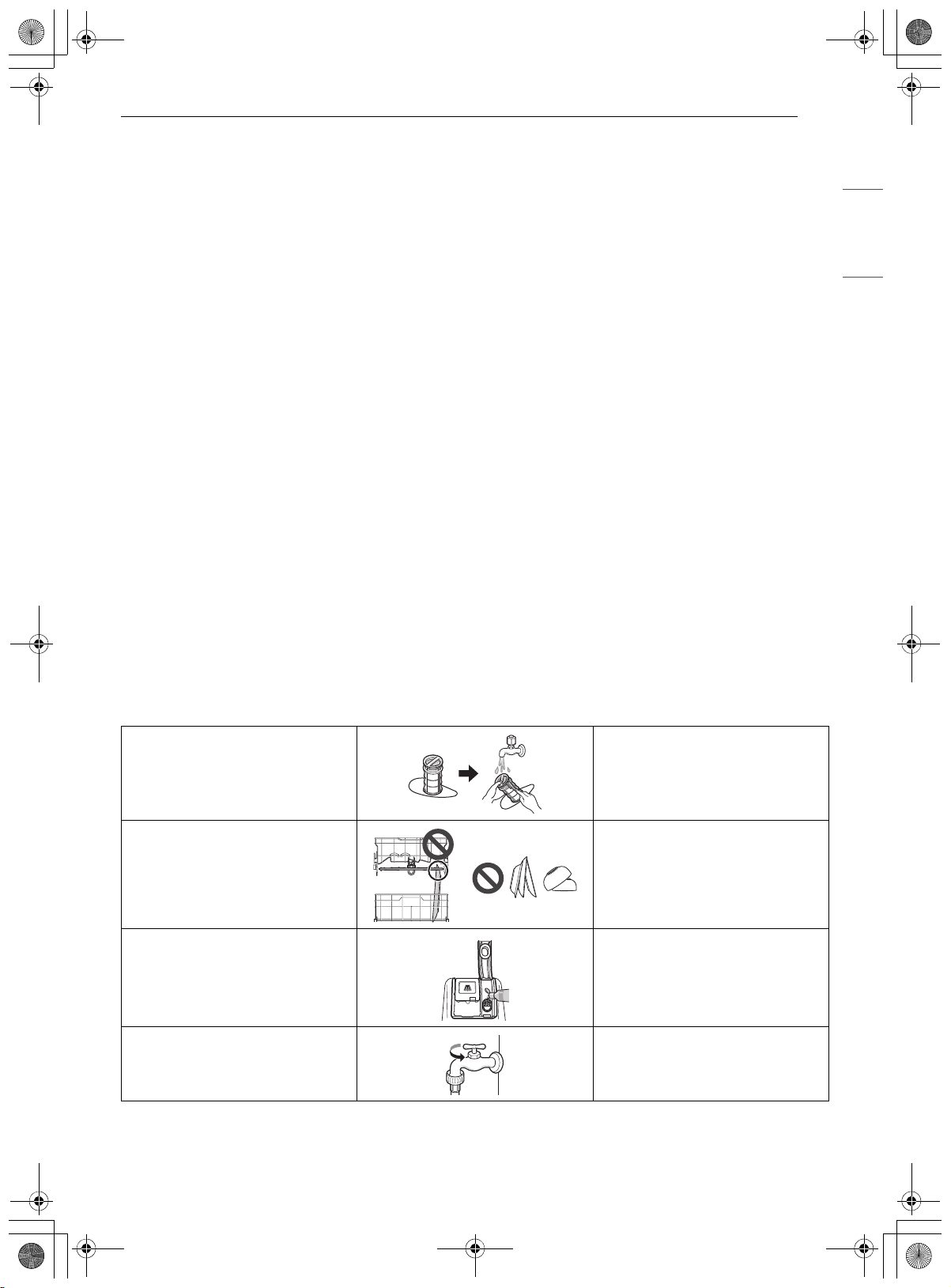
41GARANTÍA LIMITADA
ESPAÑOL
reclamo o la reparación solicitada en la demanda es frívola o se utiliza para un propósito inadecuado
(calificado según las normas establecidas en la Norma Federal de Procedimiento Civil 11 (b)), el pago de
todos los honorarios de arbitraje se regirá por las Normas de la AAA. En tal situación usted se compromete
a reembolsar a LG todos los fondos erogados previamente por ella, cuyo pago es, por otra parte, su
obligación, según las Normas de la AAA. Salvo disposición contraria, LG renuncia a cualquier derecho que
pudiera tener para solicitarle los honorarios y gastos de sus abogados, si LG prevalece en el arbitraje.
Audiencias y ubicación. Si su reclamo es por $25,000 o menos, usted puede optar que el arbitraje sea
realizado únicamente sobre la base de: (1) documentos presentados al árbitro, (2) a través de una
audiencia telefónica o (3) por una audiencia en persona, según lo establecido por las Normas de la AAA. Si
su reclamo excede $25,000, el derecho a una audiencia estará determinado por las Normas de la AAA.
Cualquier audiencia de arbitraje en persona se realizará en un lugar dentro del distrito judicial federal en
el cual resida, a menos que ambos acuerden otra ubicación o estemos de acuerdo con el arbitraje
telefónico.
Exclusión. Usted puede quedarse fuera de este procedimiento de resolución de la disputa. Si se excluye, ni
usted ni LG pueden solicitar al otro que participe en un procedimiento de arbitraje. Para excluirse usted
debe enviar una notificación a LG, en un lapso de hasta 30 días continuos, contados a partir de la fecha de
la primera compra del consumidor del producto, ya sea por: (i) el envío de un correo electrónico a
[email protected]m con el siguiente Asunto: “Exclusión del arbitraje” o (ii) llamada al 1-800-980-2973. Debe
incluir en el correo electrónico de exclusión o suministrar por teléfono: (a) su nombre y dirección; (b) la
fecha en la cual el producto fue comprado; (c) el nombre o el número del modelo del producto; y (d) el
número del serial (el número del serial puede ser hallado (i) en el producto, o (ii) en la dirección de https://
www.lg.com/us/support/repair-service/schedule-repair-continued al hacer clic en “Find My Model & Serial
Number”).
Sólo puede excluirse del procedimiento de resolución de conflictos en la forma descrita anteriormente (es
decir, por correo electrónico o por teléfono); ninguna otra forma de notificación será efectiva para hacerlo.
Excluirse de este procedimiento de resolución de controversias no afectará de ninguna manera la
cobertura de la Garantía Limitada, por lo que usted continuará disfrutando de todos sus beneficios. Si
conserva este producto y no se excluye, usted acepta todos los términos y condiciones de la cláusula de
arbitraje descrita anteriormente.
Excepciones a la garantía
Resultados deficientes de lavado
causados por desechos
remanentes en el filtro.
Limpie el filtro con regularidad.
Resultados deficientes de lavado
causados por una carga incorrecta
o exceso de apilado: el brazo de
lavado no gira o el dispensador de
jabón queda cerrado.
Asegúrese de que no haya vajilla ni
utensilios que bloqueen los brazos
rociadores.
No apile la vajilla.
Resultados deficientes de secado
causados por falta de
abrillantador.
Use abrillantador o detergente
combinado.
No se suministra agua porque el
grifo no está abierto.
Error IE
Verifique y abra la llave de agua.
es-us_main.book.book Page 41 Friday, January 20, 2023 8:45 AM
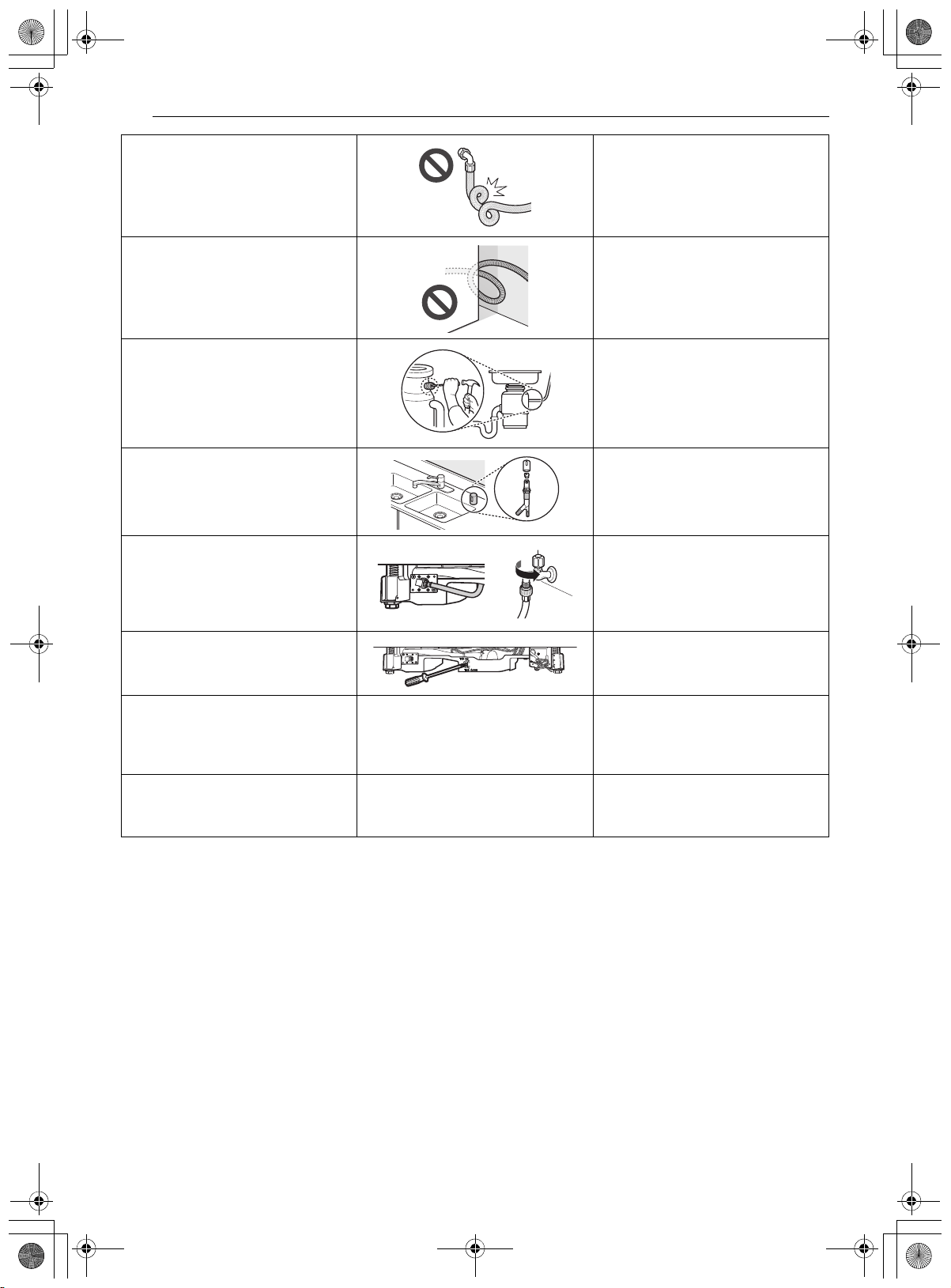
42 GARANTÍA LIMITADA
No hay suministro de agua,
porque la manguera de entrada
está plegada.
Error IE
Vuelva a instalar la manguera de
entrada.
No hay desagüe porque la
manguera de desagüe está
plegada.
Error OE
Vuelva a instalar la manguera de
desagüe.
El tapón ciego del triturador no se
ha extraído.
Error OE
Retire el tapón del triturador.
El triturador o la trampa de aire
están bloqueados por desechos.
Error OE
Limpie el triturador o la trampa de
aire.
Problema en la conexión de la
válvula de entrada y la manguera
de desagüe causado por una
instalación inadecuada.
Fuga externa
Reinstale la manguera.
Movimiento de la puerta o cierre
comprometido debido a nivelación
incorrecta.
Ajuste las patas de nivelación
delanteras inferiores a la altura
requerida.
No hay energía eléctrica debido a
una conexión floja de la línea de
alimentación o a un problema en
el tomacorriente eléctrico.
Reconecte la línea de alimentación
o repare el tomacorriente.
Retiro, cableado eléctrico,
fontanería.
Instalación
Deberá pagar la instalación.
es-us_main.book.book Page 42 Friday, January 20, 2023 8:45 AM
43Memorándum
es-us_main.book.book Page 43 Friday, January 20, 2023 8:45 AM
LG Customer Information Center
Register your product Online!
www.lg.com
For inquiries or comments,
visit www.lg.com or call:
1-800-243-0000
U.S.A.
1-888-542-2623
CANADA
es-us_main.book.book Page 43 Friday, January 20, 2023 8:45 AM