OWNER'S MANUAL
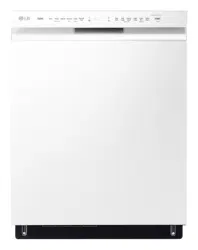
DISHWASHER
Read this owner's manual thoroughly before operating the
appliance and keep it handy for reference at all times.
ENGLISH
LDFN343**
MFL69261733
Rev.03_020121
www.lg.com
Copyright © 2020-2021 LG Electronics Inc. All Rights Reserved.

TABLE OF CONTENTS
2
3 IMPORTANT SAFETY
INSTRUCTIONS
3 READ ALL INSTRUCTIONS BEFORE USE
3 WARNING STATEMENTS
6 CAUTION STATEMENTS
7 PRODUCT OVERVIEW
7 Product Features
9 INSTALLATION
9 Before Installing
10 Preparing Cabinet Opening
11 Preparing Water and Electrical Connections
12 Preparing Dishwasher
13 Sliding Dishwasher into Cabinet Opening
14 Connecting Water Supply Line and Power
16 Connecting the Drain Hose
17 Leveling Dishwasher
19 Securing Dishwasher in Cabinet Opening
19 Final Installation Check
21 OPERATION
21 Before Using
23 Control Panel
24 Wash Cycles
24 Options and Extra Functions
26 Loading the Dishwasher
26 Loading the Silverware Basket
27 Loading the Lower Rack
28 Loading the Upper Rack
30 Adding Cleaning Products
33 SMART FUNCTIONS
33 LG ThinQ Application
33 Smart Diagnosis
TM
Function
34 MAINTENANCE
34 Cleaning and Care
37 TROUBLESHOOTING
37 Before Calling for Service
43 LIMITED WARRANTY
43 USA
3IMPORTANT SAFETY INSTRUCTIONS
ENGLISH
IMPORTANT SAFETY INSTRUCTIONS
READ ALL INSTRUCTIONS BEFORE USE
Safety Messages
Your safety and the safety of others are very important.
We have provided many important safety messages in this manual and on your appliance. Always read and
follow all safety messages.
All safety messages will tell you what the potential hazard is, tell you how to reduce the chance of injury,
and tell you what may happen if the instructions are not followed.
WARNING STATEMENTS
WARNING
• To reduce the risk of explosion, fire, death, electric shock, scalding or injury to persons when using this
product, follow basic precautions, including the following:
Installation
• Connect to a properly rated, protected, and sized power circuit to avoid electrical overload.
• To reduce the risk of severe injury or death, follow all installation instructions.
• The appliance must be installed and electrically grounded by qualified service personnel in accordance
with local codes.
• Disconnect the power supply line, house fuse or circuit breaker before installing or servicing the
appliance.
• When moving or installing the product in a different location, call qualified service personnel for
installation and service.
• Keep packing materials out of the reach of children. Packaging material can be dangerous for children.
There is a risk of suffocation.
• Moving or installation of the appliance requires two or more people.
• This appliance is not designed for maritime use or for mobile installations such as in RVs, trailers, or
aircraft.
• Store and install the appliance where it will not be exposed to temperatures below freezing or exposed
to outdoor weather conditions.
• This appliance must be positioned near to an electrical power supply.
• Do not, under any circumstances, cut or remove the ground from the power supply line.
This is the safety alert symbol.
This symbol alerts you to potential hazards that can kill or injure you and others. All safety messages
will follow the safety alert symbol and either the word WARNING or CAUTION.
These words mean:
WARNING
You may be killed or seriously injured if you do not follow instructions.
CAUTION
You may be injured or cause damage to the product if you do not follow instructions.

4 IMPORTANT SAFETY INSTRUCTIONS
• When installing or moving the appliance, be careful not to pinch, crush, or damage the power supply
line.
• Do not install the appliance in humid spaces.
• Destroy the carton, plastic bag, and other packing materials after the appliance is unpacked. Children
might use them for play. Cartons covered with rugs, bedspreads, or plastic sheets can become airtight
chambers.
• Never attempt to operate this appliance if it is damaged, malfunctioning, partially disassembled, or has
missing or broken parts, including a damaged power supply line.
• Adhere to all industry recommended safety procedures including the use of long-sleeved gloves and
safety glasses.
• The installer must ensure that the dishwasher is completely enclosed at the time of installation.
• Use new hoses when connecting the appliance to the water supply. Do not reuse old hoses.
• After installing, check the hose connection for leaks.
• Do not damage or place heavy items on the power supply line of the appliance.
Operation
• Repair or immediately replace all power supply lines that have become frayed or otherwise damaged. Do
not use a power supply line that shows cracks or abrasion damage along its length or at either end.
• If you detect a strange sound, a chemical or burning smell, or smoke coming from the appliance, unplug
it immediately, and contact an LG Electronics customer information center.
• Never unplug the appliance by pulling on the power supply line.
• Do not use an extension cable or adapter with this appliance.
• Do not grasp the power supply line or touch the appliance controls with wet hands.
• Do not modify or extend the power cable.
• If the product has been submerged, contact an LG Electronics customer information center for
instructions before resuming use.
• Do not store or use gasoline or other flammable vapors and liquids in the vicinity of this or any other
appliance.
• Keep the area underneath and around your appliances free of combustible materials (lint, paper, rags,
etc.), gasoline, chemicals and other flammable vapors and liquids.
• This appliance is not intended for use by persons (including children) with reduced physical, sensory or
mental capabilities, or lack of experience and knowledge, unless they have been given supervision or
instruction concerning the use of the appliance by a person responsible for their safety.
• If the electrical supply line is damaged, it must only be replaced by the manufacturer or its service agent
or a similar qualified person in order to avoid a hazard.
• Do not abuse, sit on, or stand on the door of the appliance.
• Read all instructions before using the appliance and save these instructions.
• Use this appliance only for its intended purpose.
• Do not allow children to play on, in or with the appliance. Close supervision of children is necessary when
the appliance is used near children.
• Do not tamper with controls.
• In the event of a gas leak (propane gas, LP gas, etc.) do not operate this or any other appliance. Open a
window or door to ventilate the area immediately.
• Under certain conditions, hydrogen gas may be produced in a hot-water system that has not been used
for two weeks or more. HYDROGEN GAS IS EXPLOSIVE. If the hot-water system has not been used for
such a period, before using the appliance turn on all hot water faucets and let the water flow from each
for several minutes. This will release any accumulated hydrogen gas. As the gas is flammable, do not
smoke or use an open flame during this time.

5IMPORTANT SAFETY INSTRUCTIONS
ENGLISH
• Fix the drain hose securely in place.
• Use only detergents or wetting agents recommended for use in a dishwasher and keep them out of the
reach of children.
• Do not let children eat detergent or dishwasher rinse agent.
• When loading items to be washed:
- Locate sharp items so that they are not likely to damage the door seal.
- Load sharp knives with the handles up to reduce the risk of cuts or other injuries.
• Do not wash plastic items unless they are marked "dishwasher safe" or the equivalent. For plastic items
not so marked, check the manufacturer’s recommendations.
• Do not touch the HEATING ELEMENT during or immediately after use.
• Do not operate your dishwasher unless all ENCLOSURE panels are properly in place.
• Do not abuse, sit on, or stand on the door or dish rack of the dishwasher.
• Do not install or store the dishwasher where it will be exposed to weather conditions.
• After cleaning the dishes, turn off the water supply. Before cleaning, turn the water supply back on and
check the connections.
• Do not open the appliance door while it is operating. For safety reasons, the drain pump operates if the
door is opened, resulting in a longer cycle time.
• Be careful not to catch your hand when closing the door of the product.
• Do not plug the dishwasher into a damaged outlet.
• Do not install or keep the dishwasher near electrical components or exposed flames.
• Do not wash dishes exposed to gasoline, solvents or other flammable materials.
• When cleaning, do not spray water on the product directly.
• Do not press buttons with a sharp object such as an awl or pin.
• Do not use solvent-based detergent.
• Do not come into contact with the steam outlet.
• Small parts, such as rack clips and filter retaining posts can be a choke hazard to small children if
removed from the dishwasher. Keep out of reach of small children.
Maintenance
• Do not repair or replace any part of the appliance. All repairs and servicing must be performed by
qualified service personnel unless specifically recommended in this Owner’s Manual. Use only
authorized factory parts.
• Do not disassemble or repair the appliance by yourself.
• Remove any dust or foreign matter from the power supply line.
• Disconnect this appliance from the power supply before cleaning and attempting any user maintenance.
Turning the controls to the OFF position does not disconnect this appliance from the power supply.
• Remove the door before the appliance is removed from service or discarded to avoid the danger of
children or small animals getting trapped inside.
• Unplug the appliance before cleaning to avoid the risk of electric shock.
• Before discarding the appliance, cut off the power supply line and destroy the appliance's control panel.
Grounding Instructions
• For a permanently connected dishwasher: This appliance must be connected to a grounded metal,
permanent wiring system, or an equipment-grounding conductor must be run with the circuit
conductors and connected to the equipment-grounding terminal or lead to the appliance.
• Connect the ground wire to the green ground connector in the terminal box.
6 IMPORTANT SAFETY INSTRUCTIONS
SAVE THESE INSTRUCTIONS
Tip Over Hazard
• Do not use the dishwasher until completely installed.
• Do not push down on the open dishwasher door.
• Failure to follow these instructions may result in serious injury or cuts.
CAUTION STATEMENTS
CAUTION
• To reduce the risk of minor or moderate injury to persons, malfunction, or damage to the product or
property when using this product, follow basic precautions, including the following:
Installation
• Install the product on a firm and level floor.
• This dishwasher must be connected to a hot water supply with a temperature range between 120 °F (49
°C) and 149 °F (65 °C). This temperature range provides the best washing results and shortest cycle time.
The temperature should not exceed 149°F (65 °C) to prevent damage to dishes.
• Do not put the drain hose under the dishwasher during installation.
Operation
• Do not place objects on top of the appliance.
• Turn off the water faucets and unplug the appliance if the appliance is to be left for an extended period
of time, such as during vacations.
• Do not store or spill liquid detergents, cleaners, or bleaches (chlorine bleach, oxygen bleach) on the
appliance. Doing so may result in corrosion, discoloration or damage to the surface of the appliance.
• Do not touch draining water which may be hot.
• If the drain hose and the water supply hose are frozen in winter, defrost before using the appliance.
• Do not put hands, feet, or metal objects below or behind the appliance.
Maintenance
• If cooking oil is spilled on the exterior of the product, wipe it off immediately. Do not clean the exterior of
the product with cleaners which contain alcohol, thinners, bleach, benzene, flammable liquids, or
abrasives. These substances may discolor or damage the appliance.
7PRODUCT OVERVIEW
ENGLISH
PRODUCT OVERVIEW
Product Features
The images in this guide may be different from the actual components and accessories, which are subject
to change by the manufacturer without prior notice for product improvement purposes.
NOTE
• For your safety and for extended product life, use only authorized components. The manufacturer is not
responsible for product malfunction or accidents caused by the use of separately purchased
unauthorized components or parts.
• Do not remove the safety cover at any time.
• To ensure reliability, each LG dishwasher goes through thorough quality control before it leaves the
factory.
• You may find water droplets or water spots from this process inside your new dishwasher.
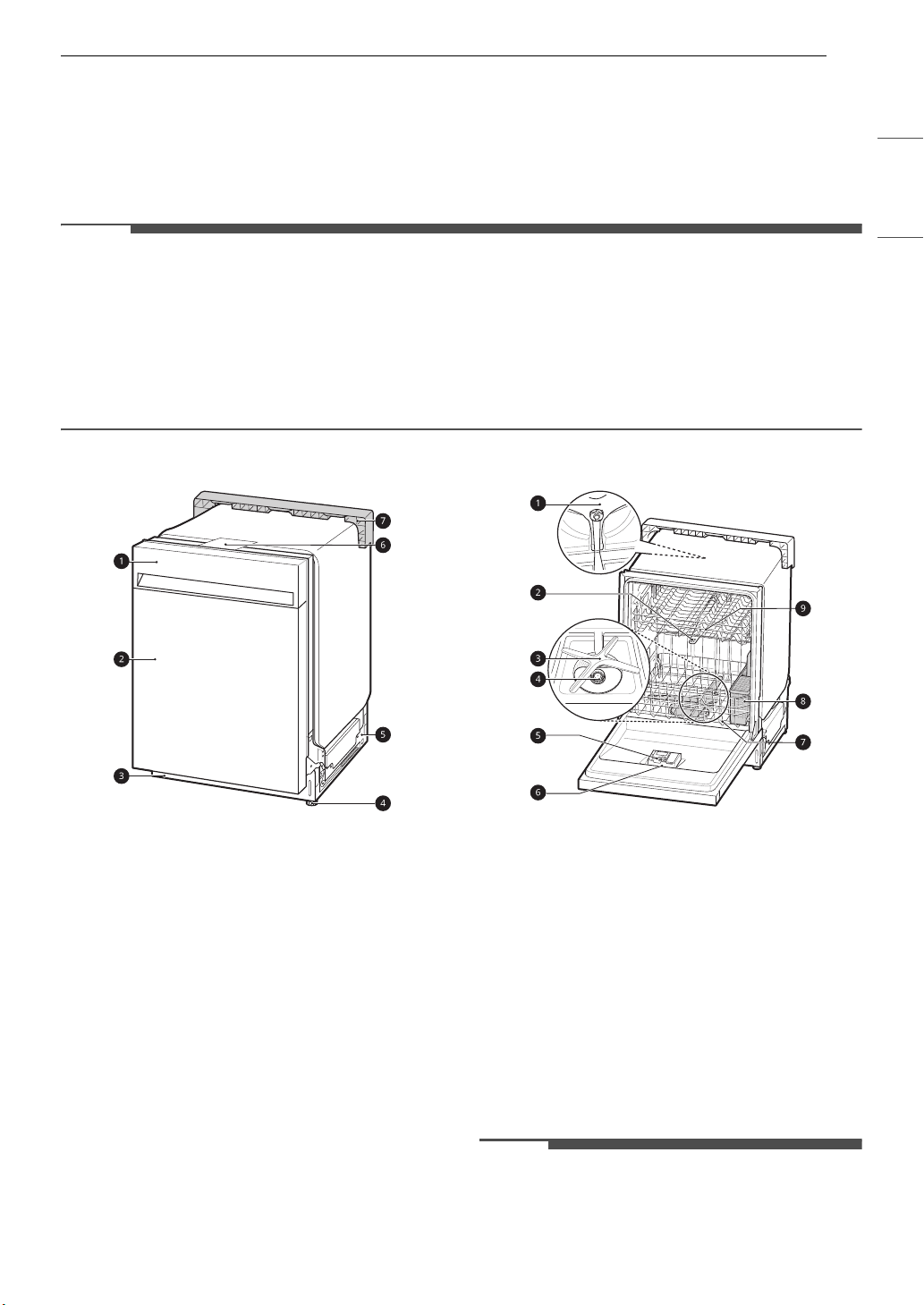
Front View
a Control Panel & Door Handle
b Front Cover
c Lower Cover
d Leveling Feet
e Base
f Safety Cover
g Shipping Brace
Interior View
a Top Wash Impeller
b Upper Spray Arm
c Lower Spray Arm
d Filtration System
e Detergent and Rinse Aid Dispenser
f Drying Vent Cover
g Lower Rack
h Silverware Basket
i Upper Rack
NOTE
• The silverware basket ships installed at the back
of the bottom rack. For best performance, install
it along the right side.
8 PRODUCT OVERVIEW
NOTE
• Remove all packing materials from the exterior
and interior of the dishwasher before installing
the appliance.
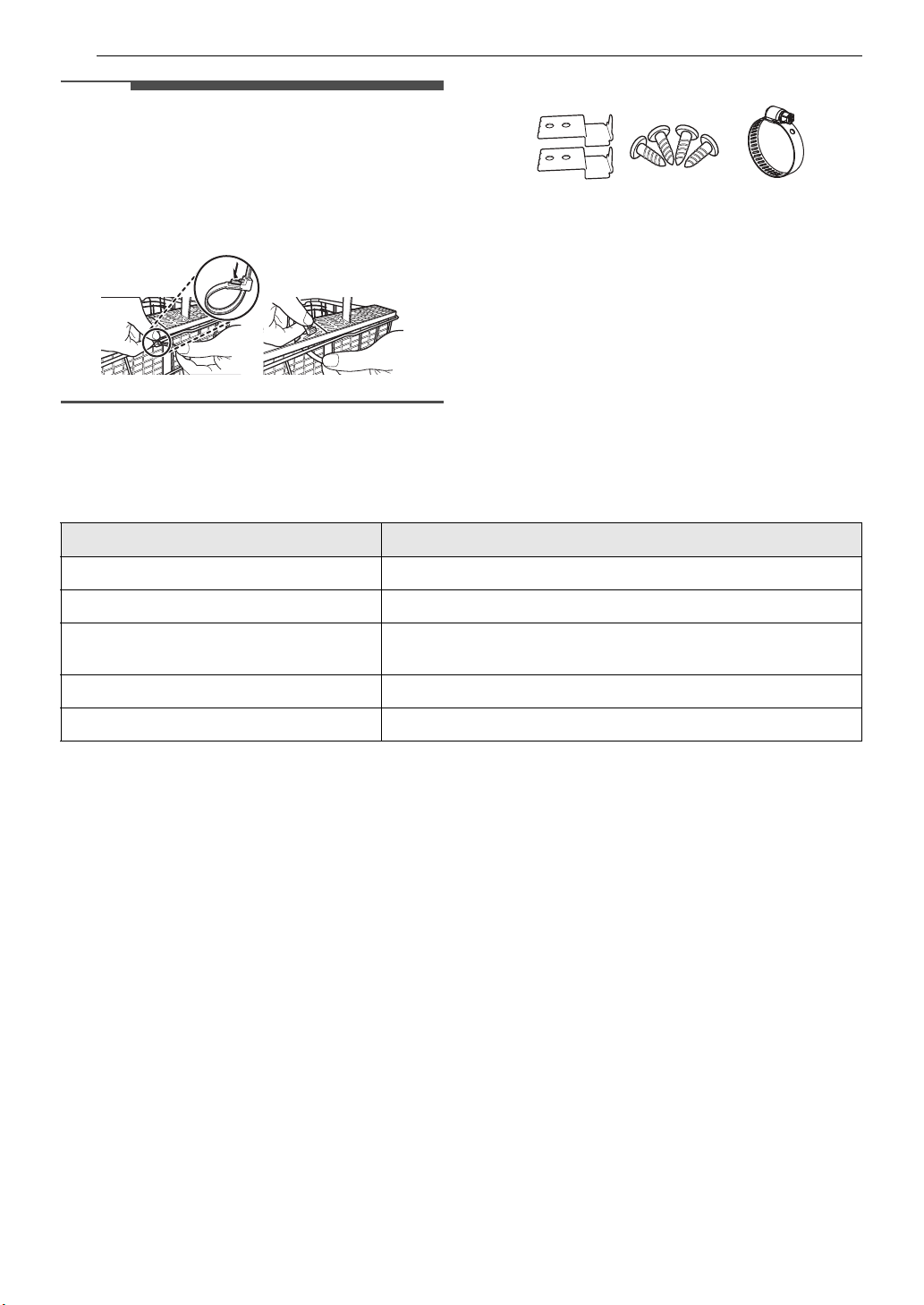
• Press the tab to remove the cable tie by hand.
Cutting the tie with a knife or scissors may
damage the rack or the silverware basket.
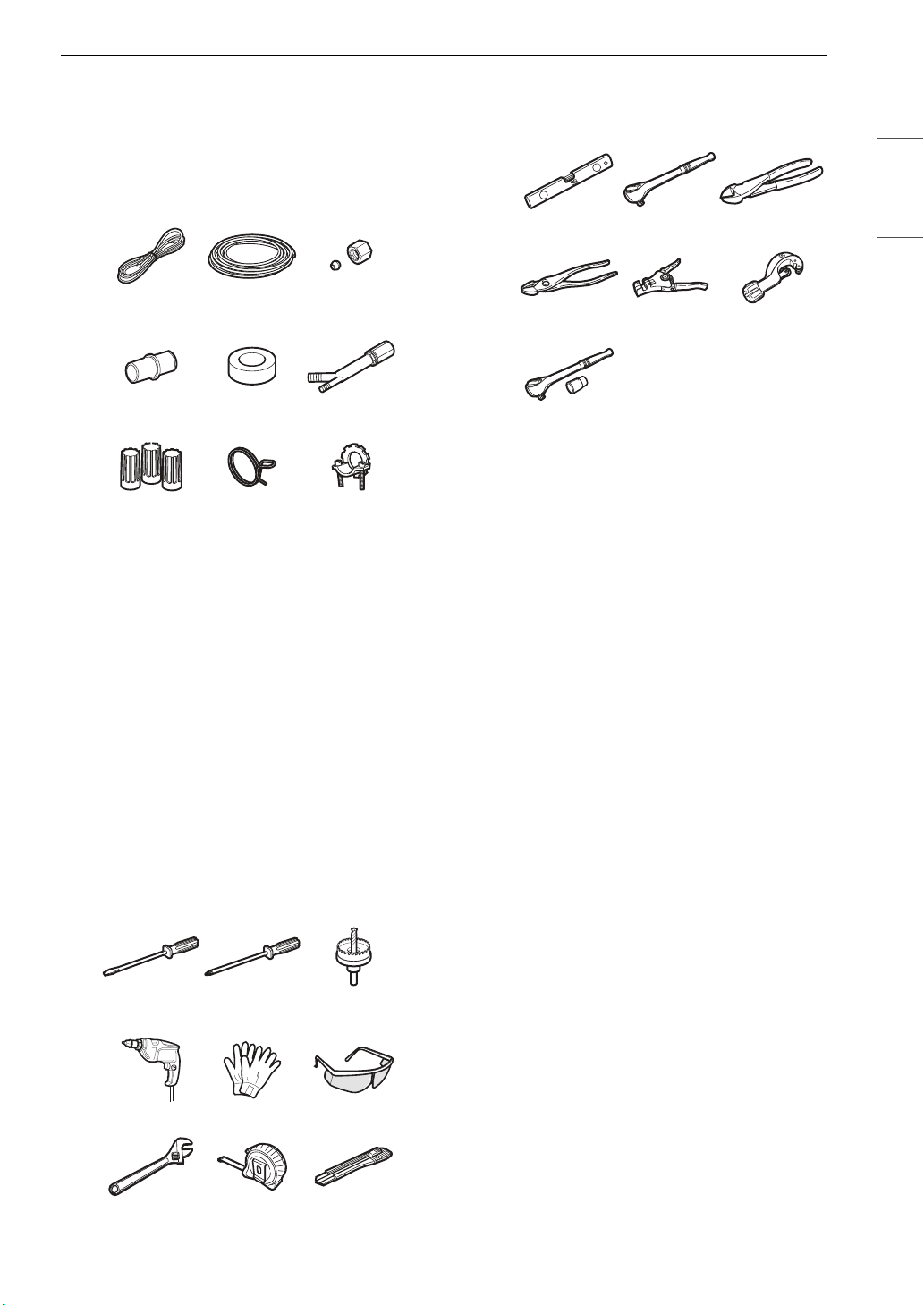
Accessories
a Installation Brackets (2 ea)
b Wood Screws (4 ea)
c Hose Clamp
Product Specifications
The appearance and specifications listed in this manual may vary due to constant product improvements.
a
b
c
Model LDFN343**
Electrical Requirements 120 V, 60 Hz AC only, minimum 15 A circuit breaker
Min. / Max. Water Pressure 20 psi - 80 psi (140 kPa - 550 kPa)
Dimensions
(Width X Depth X Height)
23 3/4” X 24 5/8” X 33 5/8”
(603 mm X 625 mm X 854 mm)
Inlet Water Temperature 120 °F (49 °C) minimum, 149 °F (65 °C) maximum
Net Weight 70 lbs. (31.8 kg)
9INSTALLATION
ENGLISH
INSTALLATION
Before Installing
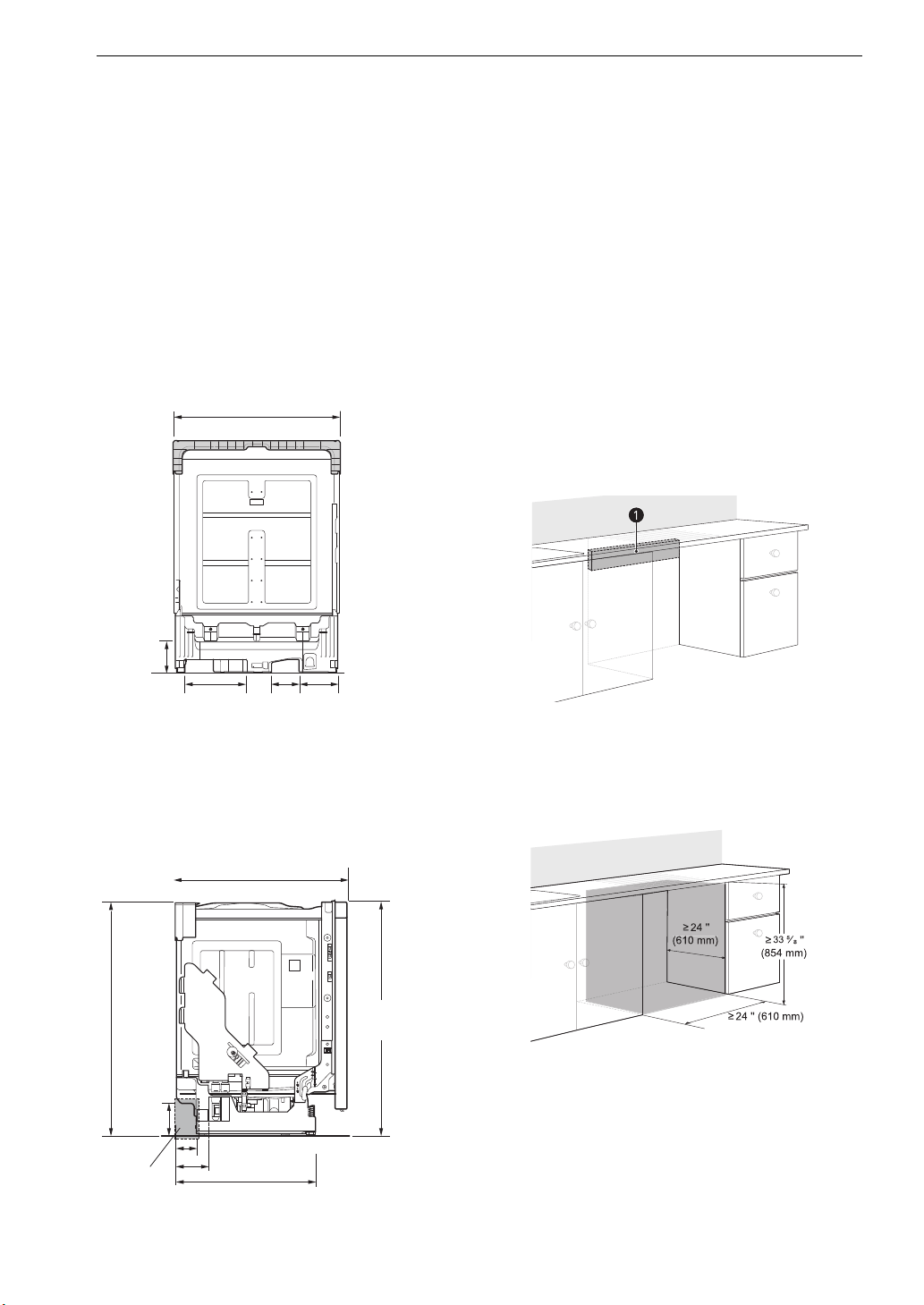
Parts not Provided
a Electrical Cable
b Water Supply Tube
c Fittings for Tube
d Coupler
e Electrical Tape
f Air Gap
g Wire Nuts for 16-Gauge Wiring
h Hose Clamp
i UL Approved Strain Relief
Tools Needed
a Flat-Blade Screwdriver
b Phillips Screwdriver
c Hole Saw min. 2 1/2” bit
d Electric Drill
e Gloves
f Safety Glasses
g Adjustable Wrench
h Tape Measure
i Utility Knife
j Level
k 1/4” Square Drive Wrench
l Nipper
m Pliers
n Wire Stripper
o Tubing Cutter
p 3/8” Square Drive Wrench + 1/2” Socket
Installation Overview
Please read the following installation instructions
first after purchasing this dishwasher or
transporting it to another location.
a Preparing Cabinet Opening
b Preparing Water and Electrical Connections
c Preparing Dishwasher
abc
def
ghi
abc
def
ghi
klj
mno
p
10 INSTALLATION
d Sliding the Dishwasher into Cabinet Opening
e Connecting Water Supply Line and Power
f Connecting the Drain Hose
g Leveling the Dishwasher
h Securing Dishwasher in Cabinet Opening
i Final Installation Check
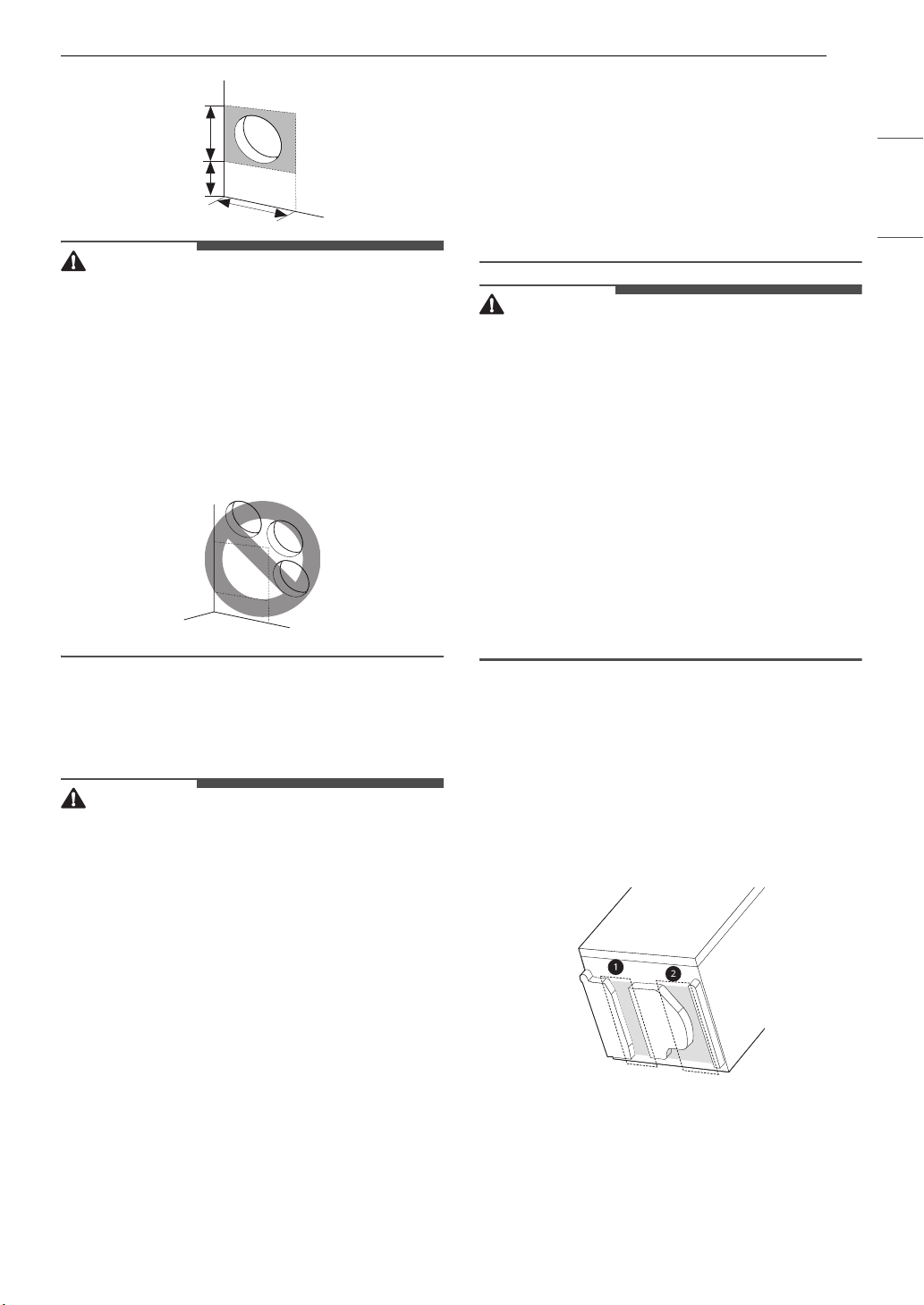
Product Dimensions
Back View
Side View
For easiest installation, see marked areas a for
water and electrical clearances in base of
dishwasher. Water supply hose, drain hose and
electric cable should be passed through this area.
Preparing Cabinet Opening
This dishwasher is designed to fit a standard
dishwasher opening. An opening may be needed
on both sides to route plumbing and electrical
connections.
• To ensure proper drainage, install the
dishwasher no more than 12 ft. (3.65 m) from
the sink.
• The location must have sufficient space for the
dishwasher door to open easily and provide at
least 0.1” (2 mm) between the dishwasher and
the cabinet sides.
• If installing the dishwasher in a corner, leave a
minimum of 2” (50 mm) between the dishwasher
and the adjacent wall.
• The adjacent wall must be free of obstructions.
• For flush installations only, you may remove the
cabinet brace
a inside the cabinet.
Choosing the Proper Location
1 Select a location as close to the sink as
possible for easy connections to water supply
line, drain hose and electrical connection.
2 To allow for proper clearance of plumbing
and electrical, use the template included with
the literature to determine the clearance on
the side of the cabinet where the cabinet
meets the back wall. Using a 2 1/2” diameter
hole saw, drill a hole in the target area as
shown on the template.
23 /4" (603 mm)
3
9 /8"
(238 mm)
3
4 /16"
(119 mm)
5
/4"
(134 mm)
11
1
4 /2"
(115 mm)
1
33 /16"
(846 mm)
5
4 /2"
(115 mm)
1
33 /8"
(854 mm)
5
2 /16" (75 mm)
15
20 /16" (512 mm)
3
24 /8" (625 mm)
5
4 /4" (120 mm)
3
a
11INSTALLATION
ENGLISH
WARNING
• Installation damage is not covered by the
warranty, and leaks caused by improper
installation may result in property damage.
• Do not use existing holes unless they are in the
target area.
• Failure to properly locate the hole for the water
and drain lines may prevent the dishwasher
from installing flush with the cabinets and could
result in kinked, pinched, crushed, stressed or
damaged lines.
Preparing Water and
Electrical Connections
WARNING
• Water Connection
- Do not reuse an old hose. Use only a new hose
when installing the dishwasher. The old hose
could leak or burst causing flooding and
property damage. Contact an LG Customer
Information Center for assistance in buying a
new hose.
• Electrical Connection
- Use a time-delay fuse or circuit breaker.
- Operate this appliance with the correct voltage
as shown in this manual and on the rating
plate.
- The wiring must be grounded properly. If in
doubt, have it checked by a qualified
electrician.
- Connect the appliance using 3-wires, including
a ground wire.
- The appliance and outlet must be positioned
so that the plug is easily accessible.
- Do not use an extension cable or adapter with
this dishwasher.
- Do not overload the outlet with more than one
appliance.
- The included 16AWG wire nuts should be used.
- It is the personal responsibility and obligation
of the product owner to have a proper outlet
installed by a qualified electrician.
CAUTION
• When connecting the dishwasher water supply
line to the house water supply, sealing tape or
compound should be used on pipe threads to
avoid leaks. Tape or compound should not be
used on compression fittings.
• Connect the dishwasher to a hot water supply
with a temperature range between 120 °F (49 ℃)
and 149 °F (65 ℃). This temperature range
provides the best washing results and shortest
cycle time. To prevent damage to dishes, the
temperature should not exceed 149 °F (65 ℃).
• Water supply pressure must be between 20 psi
and 80 psi (140–550 kPa). If the water supply
pressure exceeds 80 psi, a pressure reducing
valve must be installed. Otherwise premature
failure of the inlet valve may occur.
Routing Water Supply Line and
Electrical Wiring
There are 2 channels in the bottom of the
dishwasher for routing the water and electrical
connections.
• As shown in the bottom view below, channel
a
is for the water supply line, and channel
b is for
the electrical cable.
1 Turn off the house water supply and the
circuit breaker or dedicated power before
connecting the dishwasher.
2 Run the water supply line along the floor 6 1/
2" – 7 3/4" (165 mm – 197 mm) from the left
3.5
''
2.5
''
4
''
12 INSTALLATION
side of the opening and tape it in place in
front of the opening.
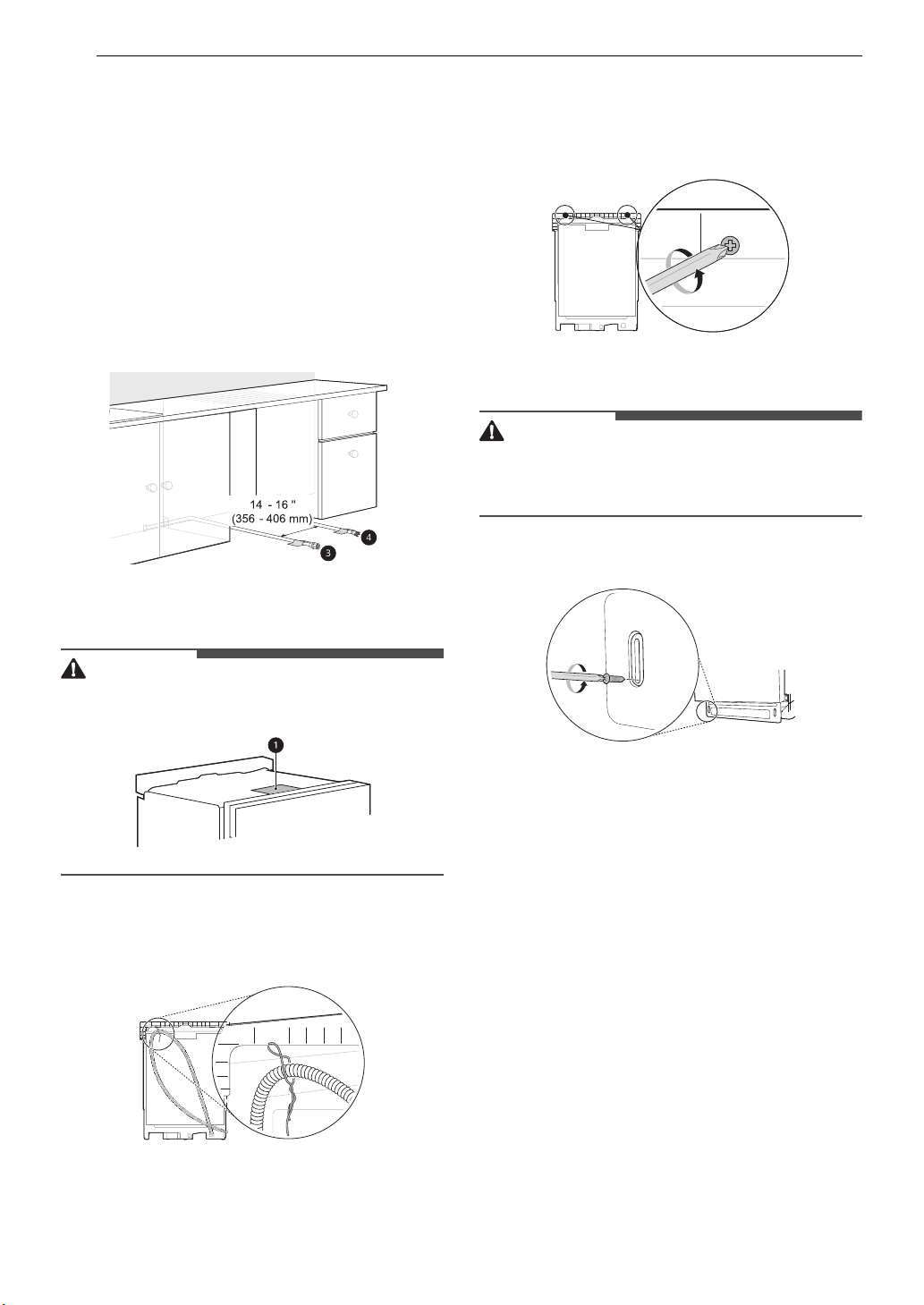
3 Run the electrical cable c along the floor 14"
– 16" (356 mm – 406 mm) from the water
supply line d and tape it in place.
• The electrical outlet must be within 4 ft.
(1.22 m) of either side of the dishwasher.
• The best location for the electrical conduit is
on the right side of the back wall. Re-route
the electrical cable before installation if the
electrical conduit pipe is longer than 3" (76
mm) and is centered on the back wall.
Preparing Dishwasher
WARNING
• Do not remove safety cover. Removal can result
in fire, electric shock or death.
Releasing Drain Hose
Remove the twist tie holding the drain hose to the
back of the shipping brace.
Removable Shipping Brace
The rear shipping brace can be removed if
additional clearance is needed when installing the
dishwasher under a low countertop.
Removing Lower Cover
CAUTION
• If you lay the dishwasher on its back, do so
carefully to avoid damaging the drain hose and
the tub.
1 Remove the screws at either side which attach
the lower cover to the dishwasher.
2 Remove the lower cover.
3 If there is insulation padding behind the lower
cover, remove it.
4 Set the parts aside until the installation is
complete.
Removing Packing Materials from
the Interior
Remove all packing materials from the interior of
the dishwasher before installing the appliance.
Attaching Installation Brackets
For countertops made of wood or other materials
that will not be damaged by drilling, use the metal
installation brackets provided.
13INSTALLATION
ENGLISH
For countertops made of granite, marble, or other
materials that could be damaged by drilling, use
the wood screws to attach the dishwasher to the
cabinet. See installation instructions in Securing
Dishwasher to Cabinet Opening.
NOTE
• Installation brackets and screws can be found in
the silverware basket.
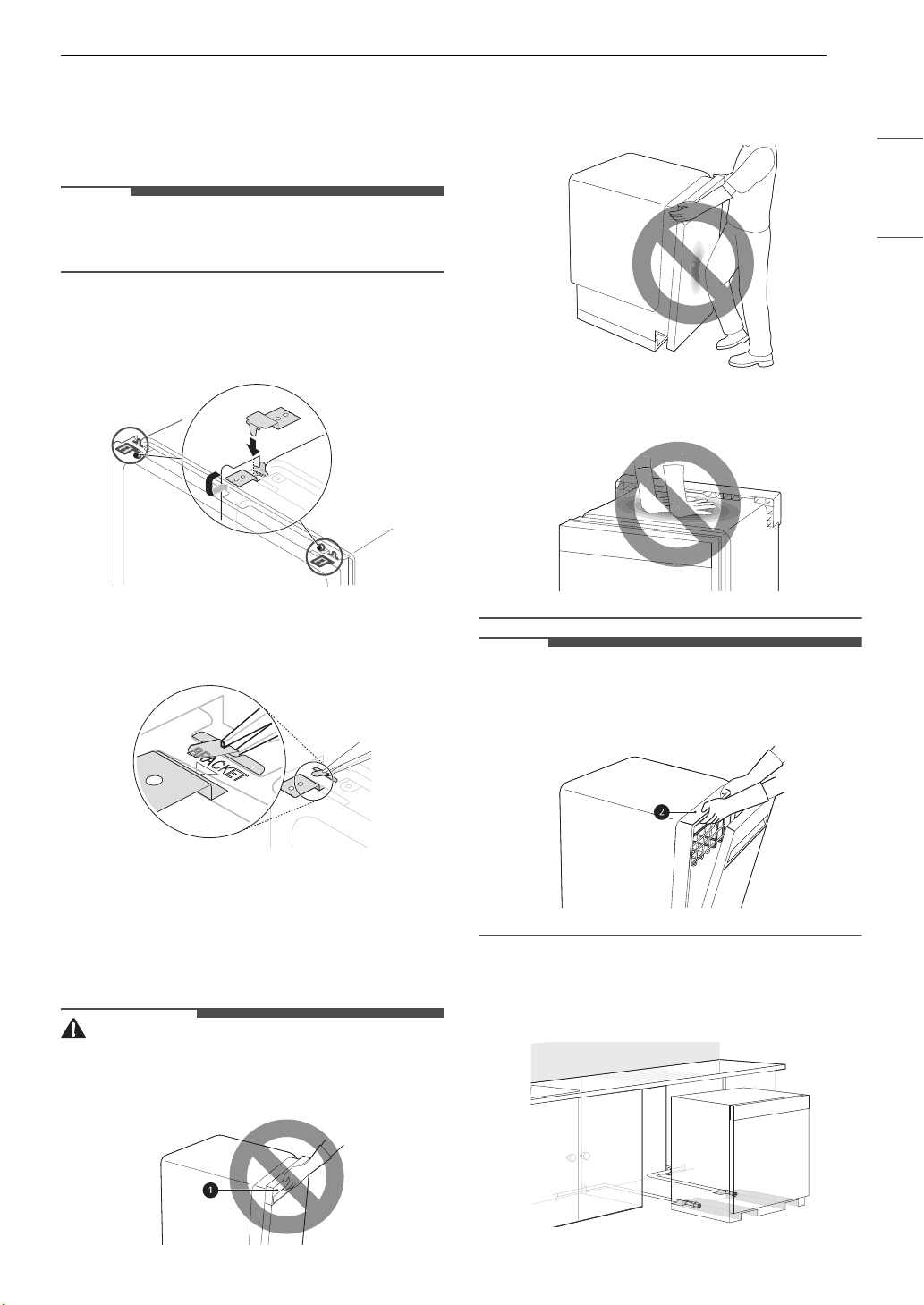
1 Insert the tabbed end of the installation
brackets into the slots in the upper frame.
Rotate the brackets until the tabbed ends are
facing up.
2 Bend the tabs on the brackets to secure them
to the frame using a pair of needle nose
pliers.
Sliding Dishwasher into
Cabinet Opening
How to Slide Dishwasher
CAUTION
• Do not pull or lift the dishwasher using the
handle
a. Doing so can damage the door and
hinges.
• Do not push the door of the dishwasher with
knees when sliding the dishwasher into position.
Doing so can damage the front cover.
• Do not push the top of the dishwasher. Doing so
can damage the interior of the dishwasher.
NOTE
• Open the door and grab the body frame and the
top front opening
b of the tub to move or lift the
dishwasher.
1 Align the dishwasher with the opening. Make
sure the water supply line and electrical cable
are in the correct positions to slide into their
channels properly.
14 INSTALLATION
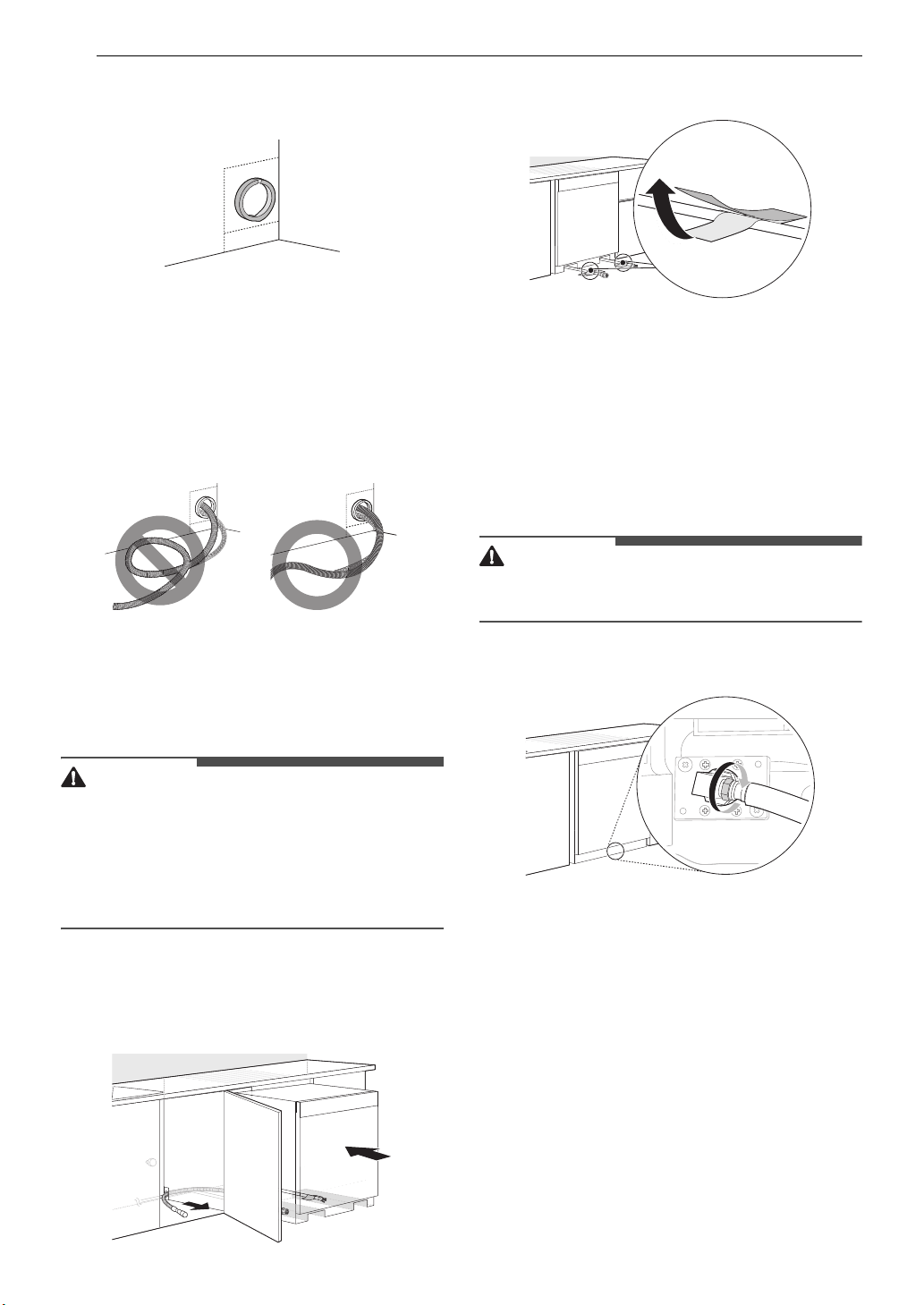
2 Smooth out or pad the edges of the hole
drilled for the water supply to avoid damaging
the drain hose.
3 Make sure the drain hose is straight before
feeding the end of it through the hole for the
water supply. As you slide the dishwasher into
the opening, you will want to slowly pull on
the drain hose from inside the cabinet to take
up some slack. Be careful not to kink, pinch,
crush or stress the drain hose during
installation to avoid leaking and water
damage.
4 Gradually slide the dishwasher into the
opening, making sure that the water supply
line and electrical cable are passing freely
through the channels and do not get caught
under the dishwasher.
CAUTION
• To avoid malfunctions or leakage, it is important
that the drain hose not get kinked, pinched,
stressed or crushed behind or under the
dishwasher or inside the neighboring cabinet.
• Damage resulting from improper installation is
not covered under the warranty.
• As you slide the dishwasher into the
opening, stop periodically (or have an
assistant help) to take up the slack by
pulling the drain hose farther into the
cabinet.
5 Remove the tape from the water supply line
and the electrical cable.
Connecting Water Supply
Line and Power
Connecting Water Supply Line
1 With the home water supply turned off,
connect the water supply line to the inlet valve
on the left front of the dishwasher.
CAUTION
• Tape or compound should not be used on
dishwasher inlet valve.
2 Tighten the compression nut.
3 Slide the water supply line back through the
channel, pulling gently from inside the
cabinet to make sure the line is not kinked,
pinched, stressed or crushed.
Connecting Power
The dishwasher should have a dedicated properly
grounded branch circuit to connect the 3 wire
setup which includes the ground wire.
If a 3-prong power supply is used, it should be in
an accessible location adjacent to the dishwasher
15INSTALLATION
ENGLISH
within 4 ft. (1.22 m) of the dishwasher side and not
behind the dishwasher.
NOTE
• The best location for the electrical conduit is on
the right side of the back wall. Re-route the
electrical cable before installation if the electrical
conduit pipe is longer than 3” (76 mm) and is
centered on the back wall.
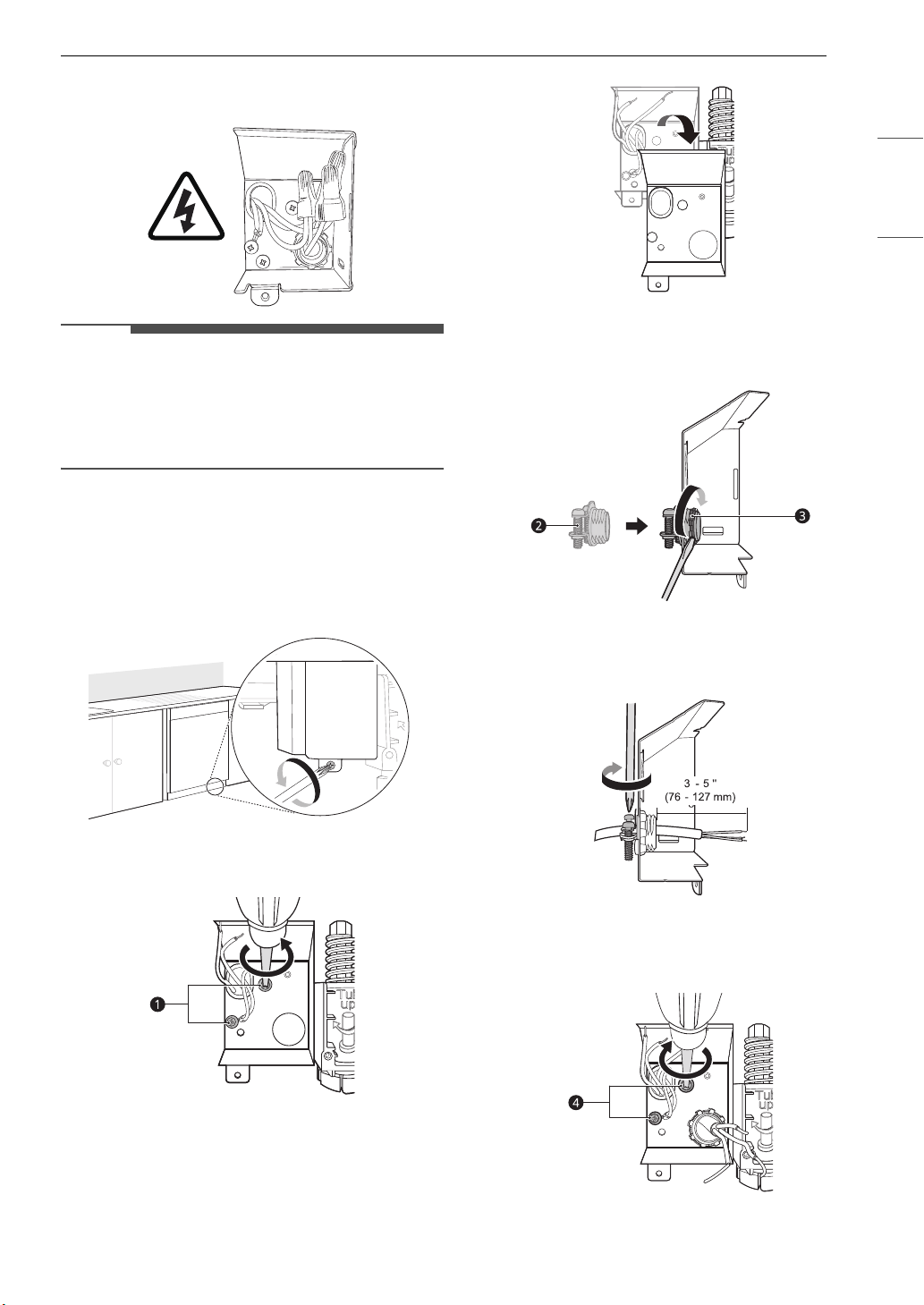
1 Turn off electrical power to the unit at the
circuit breaker.
2 Use a Phillips screwdriver to remove the
screw from the junction box cover and
remove the cover.
3 Use a Phillips screwdriver to remove 2 screws
a.
4 Remove the junction box from the appliance.
5 Insert a strain relief b through the hole in the
junction box. Tighten the ring nut c to secure
it in place.
6 Insert the electrical cable through the hole in
the strain relief. Tighten 2 screws to secure
the cable.
7 Pull the existing wires through the openings
in the junction box. Tighten 2 screws d to
reassemble the junction box in the appliance.
16 INSTALLATION
8 Pair the white, black, and green wires to the
matching colored wires from the dishwasher.
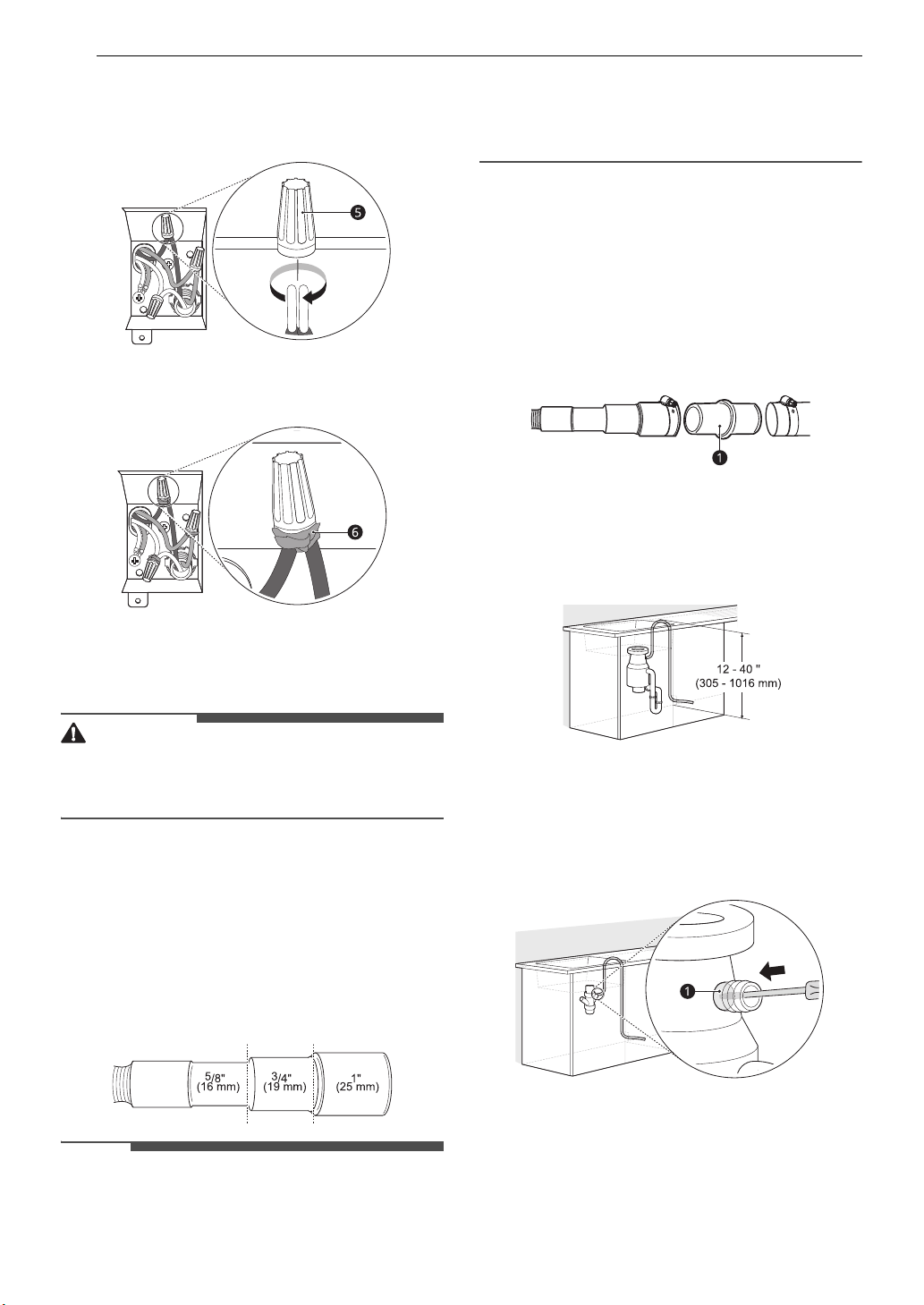
Then twist on the provided wire nuts e tightly
to connect the corresponding wires.
9 Wrap electrical tape f around each
connection.
10 Fold the connected wires back into the
junction box and screw on the junction box
cover.
WARNING
• Verify that the black wire is hot (120 V). If not, or
if you are unsure of the power supply, have it
checked by a licensed electrician.
Connecting the Drain Hose
If the end of the drain hose does not fit the drain
line, use a heat and detergent resistant adapter
(not supplied). These may be obtained from a local
plumbing supply store.
• Cut the adapter so the end matches the size of
the drain connection.
NOTE
• For drain hose installation, use the screw style
hose clamp provided with this dishwasher in the
silverware basket.
• If connecting the dishwasher’s drain hose to the
garbage disposal, be sure to follow your
garbage disposal’s manual for proper
installation instructions.
Drain Hose Requirements
• Follow local codes and ordinances.
• Do not exceed 12 ft. (3.65 m) distance to drain.
• Do not connect drain hoses from other
appliances to the dishwasher’s drain hose.
• If an extension drain hose is required, use a 5/8"
or 7/8" inside diameter, 2-3 ft. length hose and a
coupler for connecting the two hose ends.
Height of the Drain Hose
The height of the drain hose end must be at least
12" (305 mm) and within 40" (1016 mm) from the
base of the dishwasher to avoid water being
siphoned from the tub.
Connecting to Disposal without Air
Gap
1 Remove the knockout plug on the disposal
with a hammer and screwdriver.
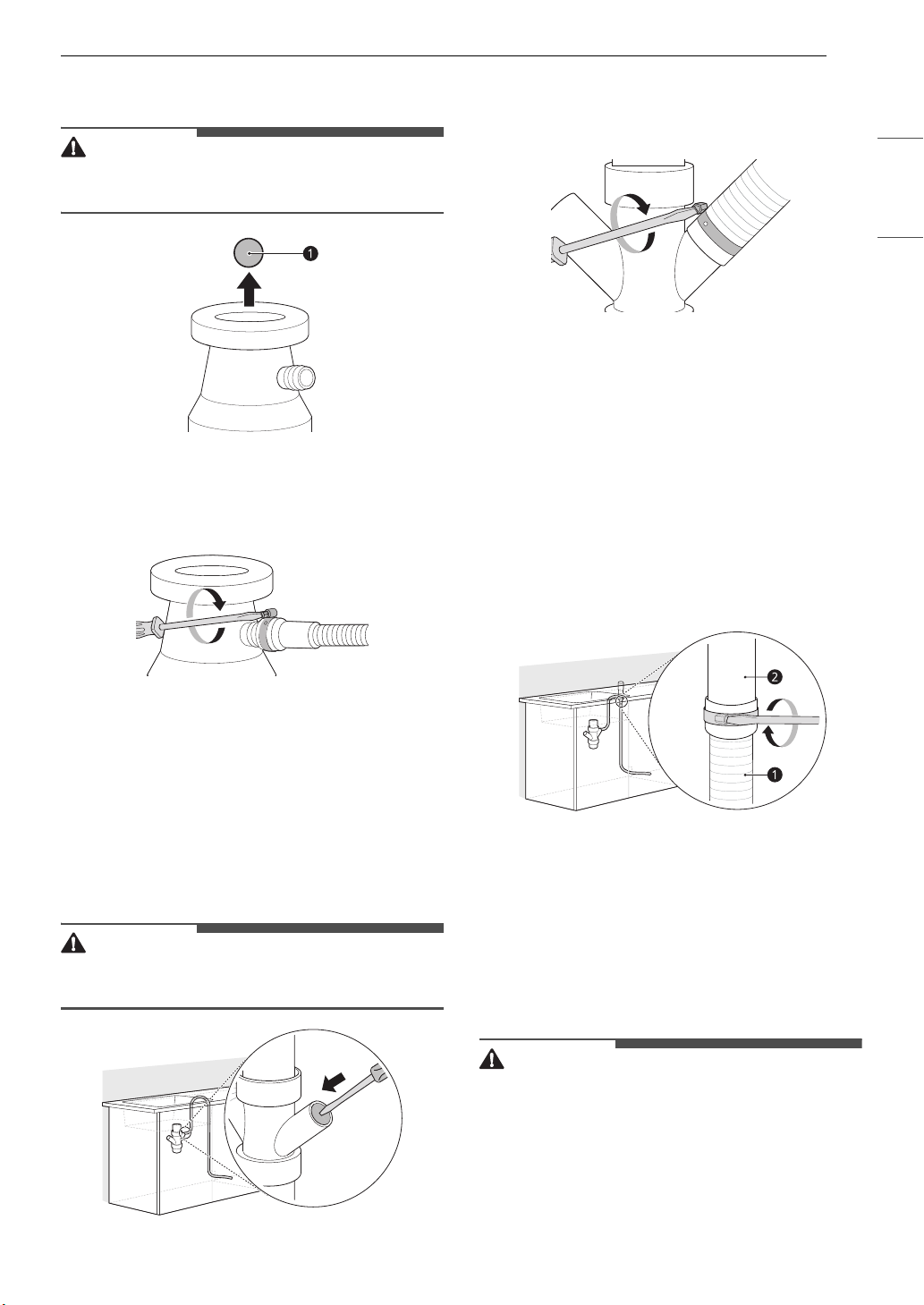
17INSTALLATION
ENGLISH
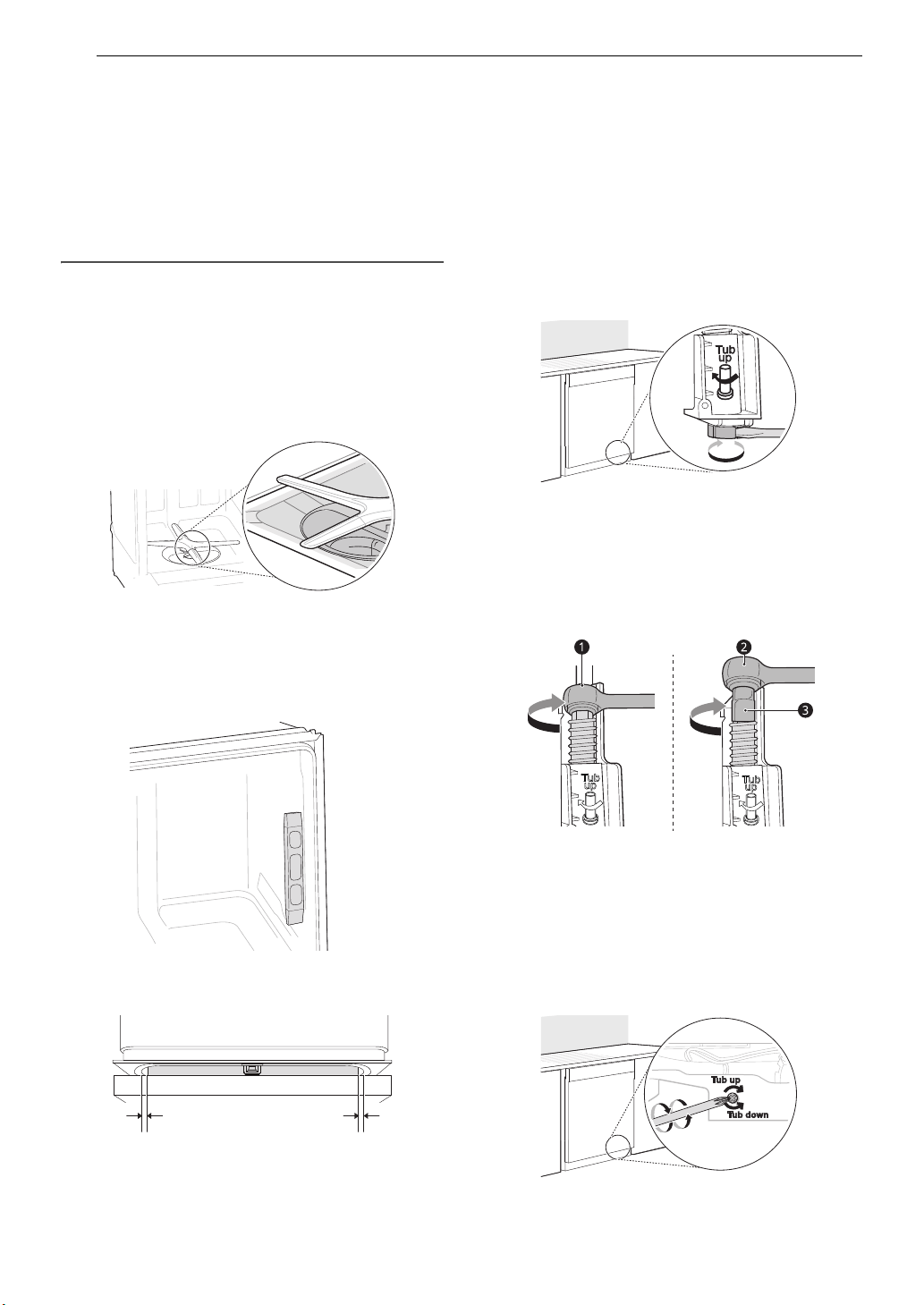
2 Remove the knockout plug a from the
disposal.
WARNING
• If the knockout plug has not been removed, the
dishwasher will not be able to drain properly.
3 Attach the drain hose to the disposal with the
hose clamp provided. Move the hose clamp
into position and tighten it with a flat-blade
screwdriver.
Connecting Waste Tee without Air
Gap
The height of the drain hose end must be at least
12” (305 mm) and within 40” (1016 mm) from the
base of the dishwasher to avoid water being
siphoned from the tub.
1 Remove the knockout plug with a hammer
and screwdriver.
CAUTION
• If the knockout plug has not been removed, the
dishwasher will not be able to drain properly.
2 Attach the drain hose to the waste tee with
the hose clamp provided. Move the clamp into
position and tighten it with a flat-blade
screwdriver.
Connecting to Disposal or Waste
Tee with Air Gap
1 Remove the knockout plug with a hammer
and screwdriver.
2 Connect the end of the drain hose a to the air
gap b with the hose clamp provided. Move
the clamp into position and tighten it with a
flat-blade screwdriver.
• This avoids water being siphoned from the
tub.
3 If it is not connected, attach the rubber hose
connector to the disposal or waste tee with a
hose clamp (not provided).
Leveling Dishwasher
Check that the dishwasher is level and adjust the
leveling feet if necessary.
CAUTION
• Failure to level the dishwasher may result in
leakage, problems closing the door, or noise.
18 INSTALLATION
• Where the cabinet opening is narrower than
recommended (see Preparing Cabinet
Opening), the dishwasher must be carefully
leveled and aligned so that the dishwasher is
supported fully by the 3 leveling feet and is not
hanging from the installation brackets. Failure to
do so can result in leaks from the front of the
dishwasher,
AE errors, difficulty in closing the
door, or failure to operate.
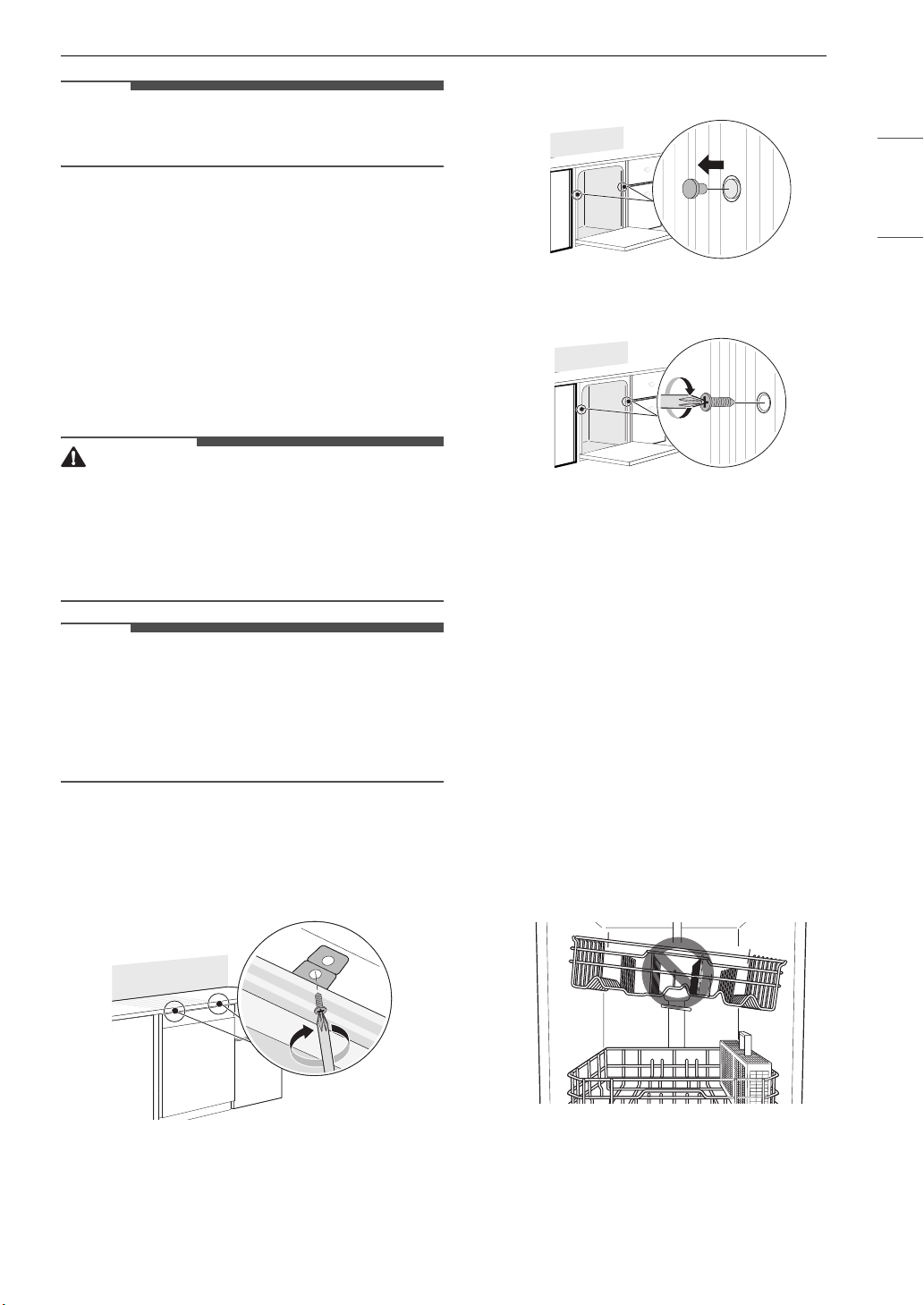
Checking Leveling
To check that the tub is level from front to back,
remove the lower rack and pour 169 oz. (5 L) of
water into the bottom of the tub. The water level
should be near the center of both tub lower
indentations at the front.
With the lower rack removed, place a level on the
inside wall of the tub to check that the dishwasher
is level from side to side.
• If you do not have a level, try using a
smartphone level application instead.
Make sure that the gap between the tub walls and
the door liner is the same on either side.
Adjusting Leveling Feet
Adjust as needed until the dishwasher is
completely leveled.
• Adjust the front and rear leveling feet until they
are all in firm contact with the floor. Failure to
level the dishwasher may prevent the door from
closing properly and the dishwasher will not turn
on.
Adjusting Front Leveling Feet
Use a flat-blade screwdriver to turn the front
leveling feet and adjust the front of the tub.
• Turn the front leveling feet clockwise to raise the
front of the tub and counterclockwise to lower it.
• The adjustments work identically for both front
leveling feet.
• When a flat-blade screwdriver is unavailable, use
a 1/4" square drive wrench a or 3/8" square
drive wrench
b with 1/2" socket c to turn the
front leveling feet and adjust the front of the tub.
Adjusting Rear Leveling Foot
Use a Phillips screwdriver to adjust the rear
leveling foot and the rear of the tub using the
center screw at the base of the appliance in the
front.
• Turn the center screw clockwise to raise the rear
of the tub and counterclockwise to lower it.
19INSTALLATION
ENGLISH
NOTE
• To avoid damaging the screw, do not use an
electric screwdriver.
Securing Dishwasher in
Cabinet Opening
There are 2 options for securing the dishwasher. If
the countertop is made of wood or a material that
can safely be drilled into, secure the dishwasher to
the countertop with the provided brackets. If the
countertop is granite, marble, or a material that
cannot be drilled into, secure the dishwasher to
the cabinet frame with the provided wood screws.
CAUTION
• Ensure the dishwasher is level and all leveling
feet are in firm contact with the floor before
attaching the dishwasher to the countertop or
cabinet. If the dishwasher is not leveled
properly, the door may not close properly or
water may leak.
NOTE
• Installation brackets and screws can be found in
the silverware basket.
• Use a magnetic screwdriver.
• Cover the filter hole with towels to prevent
screws from falling down into the pump.
Securing Dishwasher to Countertop
Use the bracket screws provided to secure the
brackets at the top of the dishwasher to the
underside of the wood countertop.
Securing Dishwasher to Cabinet Frame
If desired, the dishwasher can also be secured to
the cabinet frame using the instructions which
follow.
1 Remove the 2 plastic caps from the mounting
bracket access holes.
2 Drive a wood screw through the mounting
bracket and into the cabinet frame.
3 Reinstall the plastic caps.
Final Installation Check
Testing the Dishwasher
Check if the dishwasher is properly installed.
1 Turn on the circuit breaker.
2 Turn on the house water supply.
3 Make sure that the door opens and closes
smoothly.
• If necessary, level the dishwasher again.
• If the door will not close, make sure the rack
is level.
• Make sure that all packaging materials have
been removed.
4 Power on the dishwasher and run a Turbo
cycle to verify proper operation.
20 INSTALLATION
5 Check for leaks at the drain hose and water
supply connection.
6 If a water leak is detected, press and hold the
Start button for 3 seconds to cancel the wash
cycle and automatically drain the water from
the dishwasher. Tighten all water connections
and run another cycle. Repeat until no leaks
are detected.
7 Replace the lower cover.
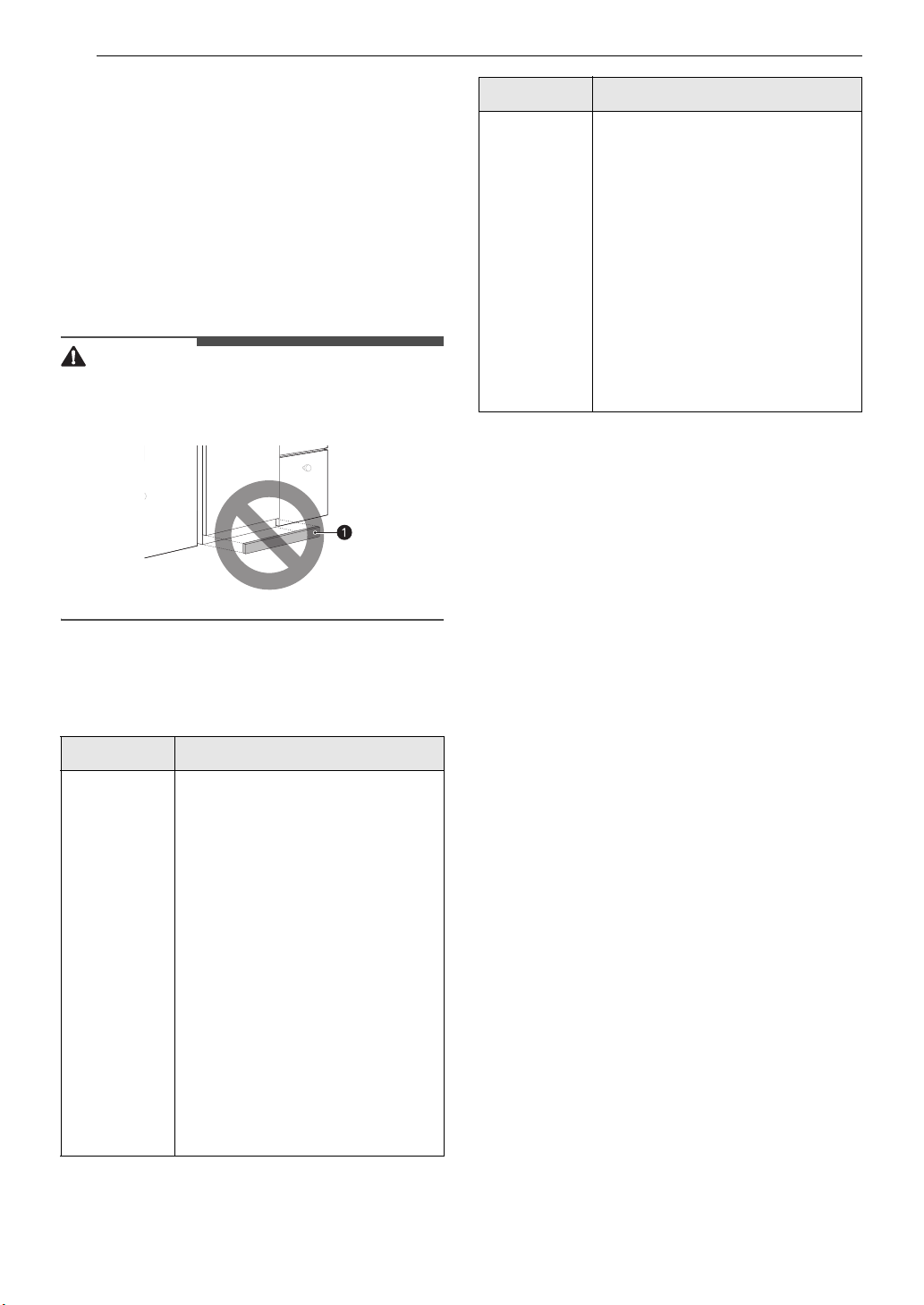
CAUTION
• Only install the lower cover provided with the
dishwasher. Do not install cabinet baseboard
a
as it may cause noise and leakage.
Installation Check Error Codes
Refer to the chart below before calling for service.
Error Code Possible Cause and Solution
OE
Drain hose is kinked or pinched.
• Feed the drain and water
supply hoses through the hole
under the sink. Then gradually
slide the dishwasher into the
cabinet while pulling on the
hoses under the sink to take up
any slack. This helps avoid
kinking the hoses or trapping
them beneath the dishwasher.
Drain hose is connected to the
disposal without removing the
knockout plug.
• Remove the knockout plug
from the disposal.
Waste tee or disposal is clogged.
• Remove knockout plug on the
waste tee or disposal.
IE
Water supply line is kinked
under dishwasher.
• Feed the drain and water
supply hoses through the hole
under the sink. Then gradually
slide the dishwasher into the
cabinet while pulling on the
hoses under the sink to take up
any slack. This helps avoid
kinking the hoses or trapping
them beneath the dishwasher.
House water supply is not turned
on.
• Turn the water faucet on.
Error Code Possible Cause and Solution
21OPERATION
ENGLISH
OPERATION
Before Using
WARNING
• To reduce the risk of fire, electric shock, or injury to persons, read the SAFETY INSTRUCTIONS before
operating this appliance.
NOTE
• Connect to the hot water supply only. The water supply temperature should be a minimum of 120 °F (49
°C) for better washing performance and shorter cycle time.
• Follow the instructions for loading the dishwasher to ensure effective cleaning.
• Remove insoluble items such as bones, toothpicks, and pieces of paper while loading the dishwasher.
Quick Start
1 Load the dishes.
• Pull each rack out and load the dishes as
described in this manual.
• Only load items that are dishwasher-safe.
• Scrape the dishes free of excess food,
bones, and any other hard, non-soluble
residue. Remove solid, burned-on scraps
from dishes prior to loading in the
dishwasher.
• Place items with deep dish bottoms at an
angle to help water run off and speed the
drying process.
• Do not load items that are not heat-
resistant or have decorative metal trim.
2 Measure the detergent.
• Using the guidelines in this manual, fill the
detergent cup with the recommended
amount of detergent and close the lid. If a
prewash is desired, the recess on top of the
lid should also be filled with detergent.
3 Close the door.
4 Turn on the dishwasher.
• To turn on the display panel, press the
Power button.
5 Check the rinse aid.
•The Rinse Aid
e icon will flash if the level of
rinse aid in the dishwasher is low. Add rinse
aid if the level is low to maintain the
effectiveness of the dry cycle.
6 Select the cycle and options.
• Select the cycle and options that best fit the
load by referring to the Cycle Guide. The
display will show the estimated time for the
cycle and options selected.
7 Operate the dishwasher.
• Method 1
- Press the Start button and then close the
door in less than four seconds to operate
the dishwasher. If the door is not closed
within four seconds, the white LED with
time flashes, an audible tone is heard, and
the cycle does not start.
• Method 2
- Close the door first and then press the
Start button to operate the dishwasher.
NOTE
• If the door is opened during the cycle, the
dishwasher will stop. To resume the cycle, see
methods 1 and 2 above.
• If the door is opened during the cycle and is not
closed within four seconds after selecting the
Start button, or if the door is closed without
pressing the Start button, the white LED with
time flashes, an audible tone is heard, and the
cycle does not start.
22 OPERATION
8 End of cycle.
• When the cycle is complete, a chime will
sound and the display will show ENd until
the door is opened or Power is pressed. To
save energy, press and hold High Temp for
three seconds to set the ENd display to
automatically turn off a few minutes after
the cycle ends.
CAUTION
• Do not open the door during operation or
immediately after it has completed the wash
cycle as the escaping steam may cause scalding
as the door is opened.
NOTE
• Empty the lower rack first and then the upper
rack. This will avoid water dripping from the
upper rack onto dishes in the lower rack.
Auto-Off
The dishwasher automatically turns off after four
minutes of inactivity if paused or if no cycle is
started.
23OPERATION
ENGLISH
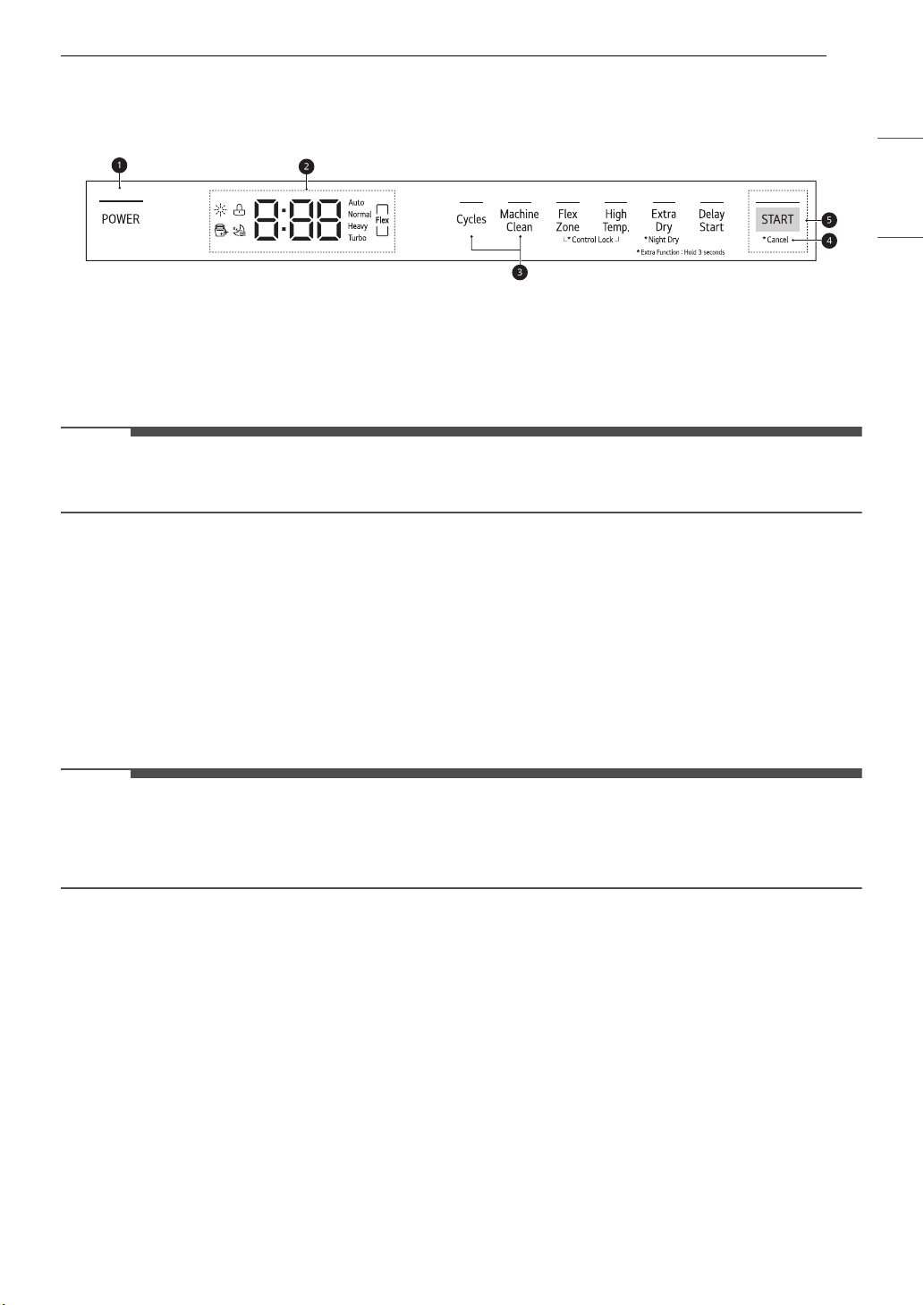
Control Panel
Control Panel Features
a Power On/Off Button
• Press this button to turn the washer on or off.
• If there is a power surge, power outage, or disruption of any kind, power is automatically turned off
for safety.
• When power is connected again, the dishwasher will turn on automatically and resume the cycle.
NOTE
• When opening or closing the product door, keep fingers and hands away from the control panel to avoid
activating buttons.
b Display
•
e : Rinse Aid Icon
- This icon illuminates when the rinse aid level is low. The LED automatically shuts off when the rinse
aid is refilled or the level is set to 0.
- Refer to the Rinse Aid Dispenser Adjustment section.
•
8:88 : Digital Display
- The digital display on the control panel shows the ESTIMATED cycle time. When the cycle and
options are selected, the display shows the total estimated time to complete those selections.
During operation, the display shows the remaining estimated operating time.
NOTE
• The estimated time shown on the display does not include delay times for heating water, etc.
•If Delay Start is selected, the display shows the delay time in hours.
• Cycle time may vary depending on the soil level of your load.
• k, CL : Control Lock
- The Control Lock feature helps prevent settings from being changed during a cycle. Selecting this
feature locks all of the buttons, except for the Power button, on the control panel. This feature
does not lock the door.
- While a cycle is running, press and hold Flex Zone and High Temp. simultaneously for three
seconds to activate or deactivate Control Lock.
- To start a new cycle, deactivate Control Lock.
•
a: Machine Clean
- The Machine Clean icon flashes every 30 cycles. To activate or deactivate the icon, press and hold
the Machine Clean and Flex Zone buttons for three seconds.
- If the High Temp. option is added to a cycle, the Machine Clean icon stays lit at the end of the cycle
if the dishes were properly sanitized.
•
m: Night Dry
- This indicator lights up when Night Dry is selected.
24 OPERATION
c Chime On/Off Button
• To activate or deactivate the button sounds, press and hold Cycles and Machine Clean
simultaneously for three seconds. The error alert sound cannot be turned off.
d Cancel Button
• The drain pump activates and the cycle cancels. Once the dishwasher finishes draining, the power
turns off.
•Press and hold Start for three seconds to activate.
e Start Button
• To operate the machine, either press Start and close the door within four seconds or close the door
and press Start.
• An alert will sound if the door is closed more than 4 seconds after the Start button is pressed.
Wash Cycles
Select your desired cycle.
Selecting the Cycle
The default cycle is Auto. You can also customize
these settings using the Cycles button.
• Press the Cycles button repeatedly to select the
Normal, Heavy, or Turbo cycle.
Auto
This cycle senses the soil amount and soil
toughness and is optimized to achieve the best
cleaning.
Normal
This cycle is for moderately soiled, everyday loads.
Select the Night Dry option if leaving dishes
overnight. Press and hold Extra Dry for three
seconds to activate Night Dry.
• After the cycle ends, the fan runs for an hour to
help vent the warm, moist air in the tub. You can
stop the fan by opening the door after the cycle
ends.
Heavy
This cycle is for heavily soiled dishes and dishes
with hardened on soil. This cycle defaults to the
strongest spray intensity and uses it to wash
heavily soiled dishes.
Turbo
This cycle will clean heavily soiled dishes in an hour
using slightly more energy and water.
• This cycle does not have drying. Select the Extra
Dry and Night Dry option or another cycle for
better drying.
Machine Clean
This cycle is for cleaning the inside of the
dishwasher. Use the cycle without dishes in the
machine. It eliminates residual soils, odor, white
spots, and other dirt. Add citric acid or another
cleaning agent for more effective results.
Options and Extra Functions
Select the desired cycle button and then select the
options for that cycle.
Using the Flexible Zone
This option adjusts the wash intensity to target
different zones inside the dishwasher. Set it to
wash just the upper rack or lower rack, or set the
intensity to soft for the upper spray arm and
strong for the lower spray arm.
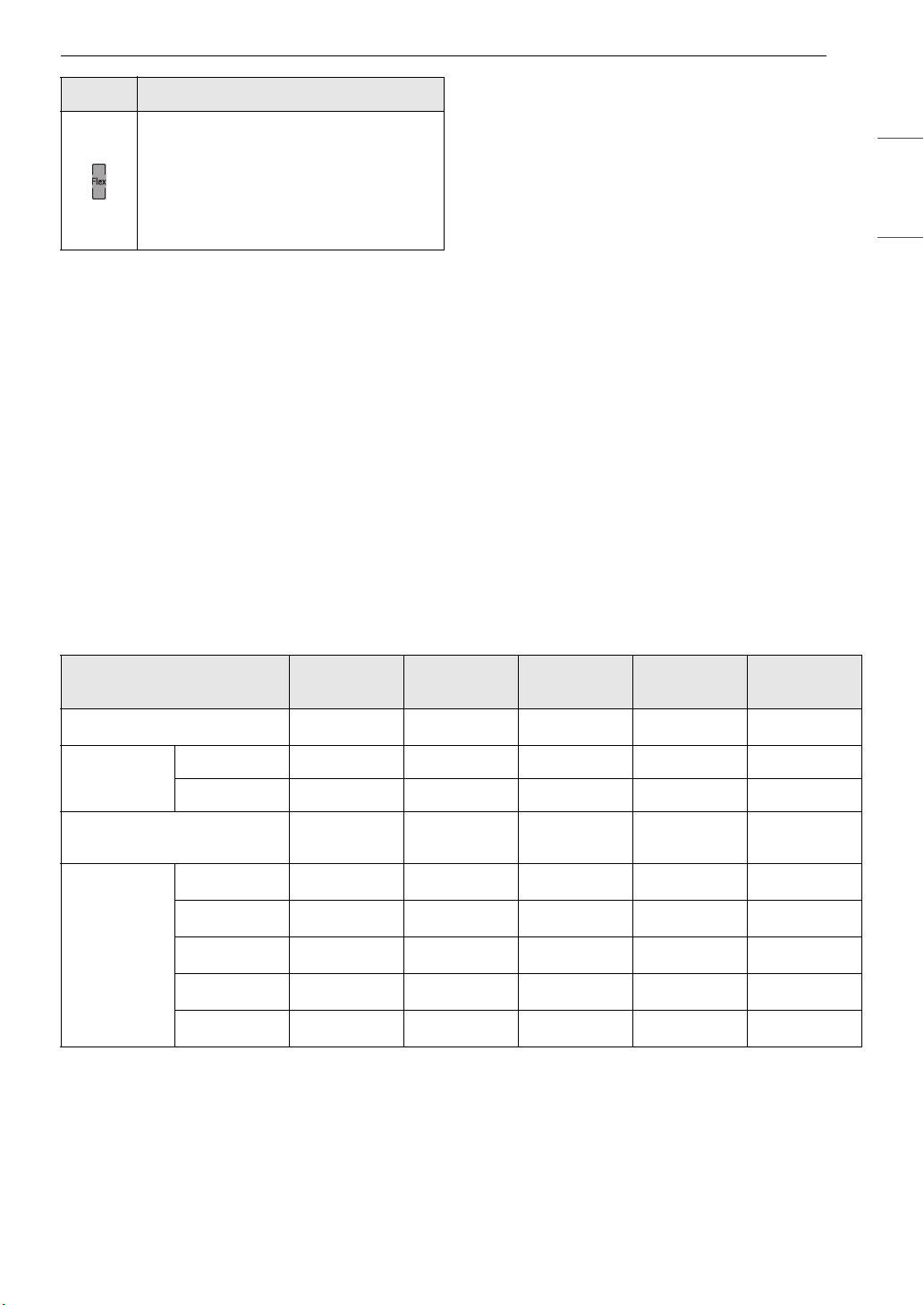
The Flex Zone is off by default. Press the Flex
Zone button to customize settings.
•Press the Flex Zone button repeatedly to select
the 4 modes for cleaning the dishes.
Mode Description
Small loads & light soil
• Use just the upper rack to save
energy and time.
Small loads & heavy soil
• Use just the lower rack to save
energy and time.
Small loads & heavy soil & light/sensitive
dishes
• Focus on lower rack, but also
operate lightly to wash some light
or sensitive dishes in the upper
rack.
25OPERATION
ENGLISH
High Temp
Raises the main wash temperature to improve
cleaning.
Extra Dry
Select the Extra Dry option for better drying
performance. This option adds extra drying time to
the cycle and raises the heated rinse temperature.
• When the rinse aid is empty, the Extra Dry
option is selected automatically.
Night Dry
Dishes are often left in the dishwasher overnight
after the cycle ends. This can result in the steam
inside the tub condensing on dishes, leaving them
wet. This option runs the ventilation fan
periodically to help vent the steam from the tub.
• Press and hold Extra Dry for three seconds to
activate.
•The Night Dry option is selected by default for
all cycles for which it is available, except the
Normal cycle.
• To add the Night Dry option to the Normal
cycle, press and hold Extra Dry for 3 seconds.
Delay Start
This feature delays the start of a selected cycle.
Each time the Delay Start button is pressed, the
delay time increases by an hour. The delay time
can be set from 1 to 12 hours, in one-hour
increments.
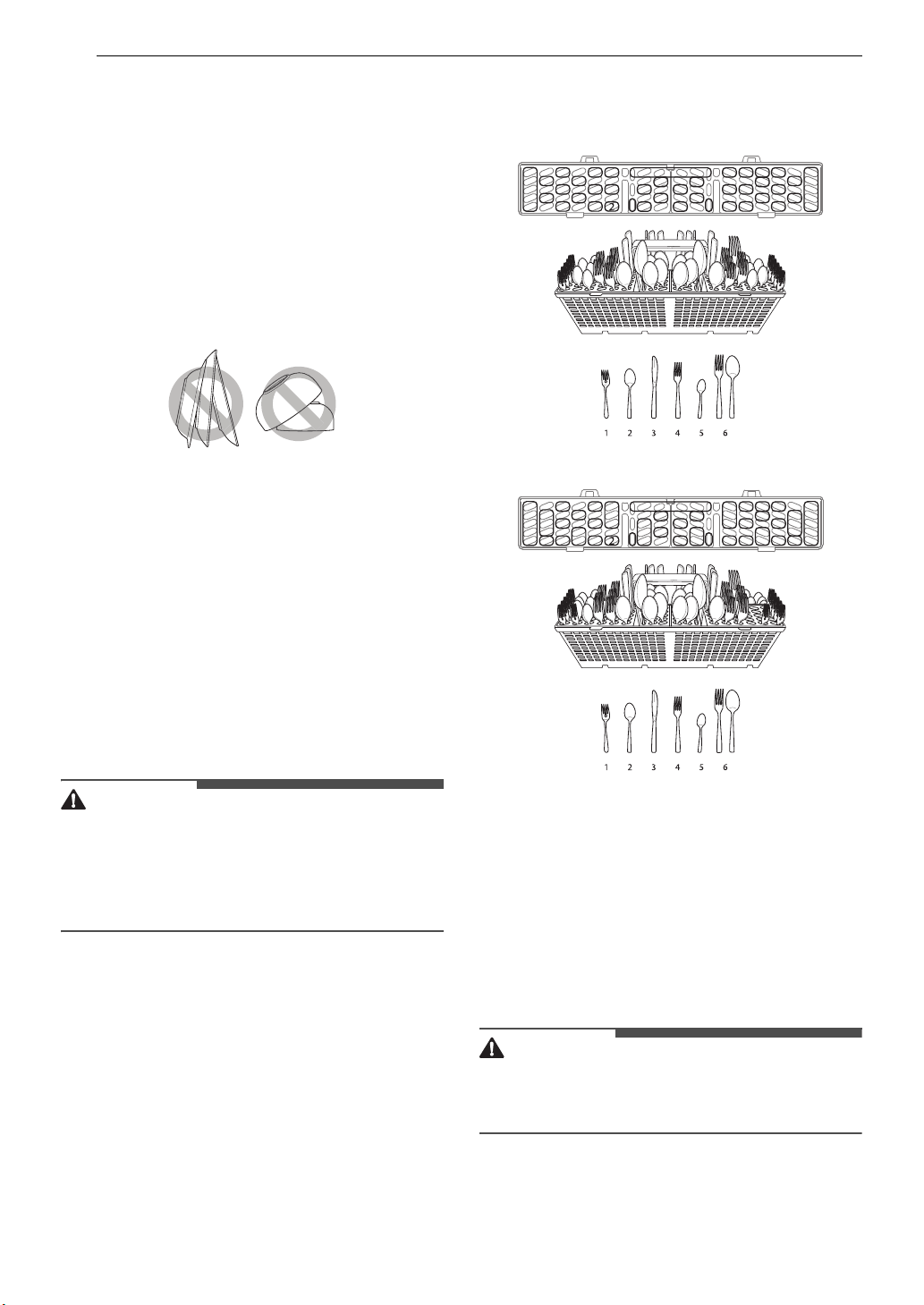
Cycle/Option Guide
The cycle guide below shows the available options for each cycle.
* Actual water consumption will vary depending on soil level and hardness of water.
** The actual running time and cycle time displayed may change depending on options chosen, soil level,
water temperature, and hardness of water. Therefore, display time and actual running time can be
different.
*** Some Flex Zone modes cannot be selected when using the Turbo cycle.
**** Default setting
Various conditions
• Place heavily soiled dishes like
plates and bowls in the lower rack
and lightly soiled dishes like cups
and small plates in the upper rack to
get the best results.
Mode Description
Cycle Auto Normal Heavy Turbo
Machine
Clean
Soil Level All levels All levels Heavy Heavy
Water
Usage*
(L) 13.8 - 25 9.2 - 19.5 26.9 27.5 12.3
(gal) 3.6 - 6.6 2.4 - 5.2 7.1 7.3 3.2
Wash Time with Options
(Mins.)**
89 - 192 98 - 190 140 - 214 59 - 121 82
Available
Options
Flex Zone
####***
High Temp.
####
Extra Dry
####
Night Dry
#**** ##**** #****
Delay Start
#####
26 OPERATION
Loading the Dishwasher
The extra tall tub allows loading of dishes, pans, or
other utensils up to 14" high. For effective washing
performance, always follow these instructions.
• Remove large particles of food debris from
plates including bones before loading.
• Items with burnt on food should be soaked prior
to loading in the dishwasher.
• Deep pots or dishes should be placed upside
down.
• Make sure that all items do not touch each other.
Non-Dishwasher Safe Items
The combination of high water temperature and
dishwasher detergents may damage certain items.
Do not wash the following items in the dishwasher.
• Copper or anodised aluminum
• Hand painted silver or gold leaf china
• Wood or bone handled utensils
• Iron or non-rustproof utensils
• Plastic items which are not dishwasher safe
• Sterling silver or gold-plated flatware or delicate
or metal-rimmed china
• Fragile items such as crystal glasses
CAUTION
• Do not place pots or pans with plastic handles in
the appliance as the handles may deteriorate
due to the heat and detergent.
• Waterproof or long-lasting lipstick smudges on
glasses may not be removed during the wash.
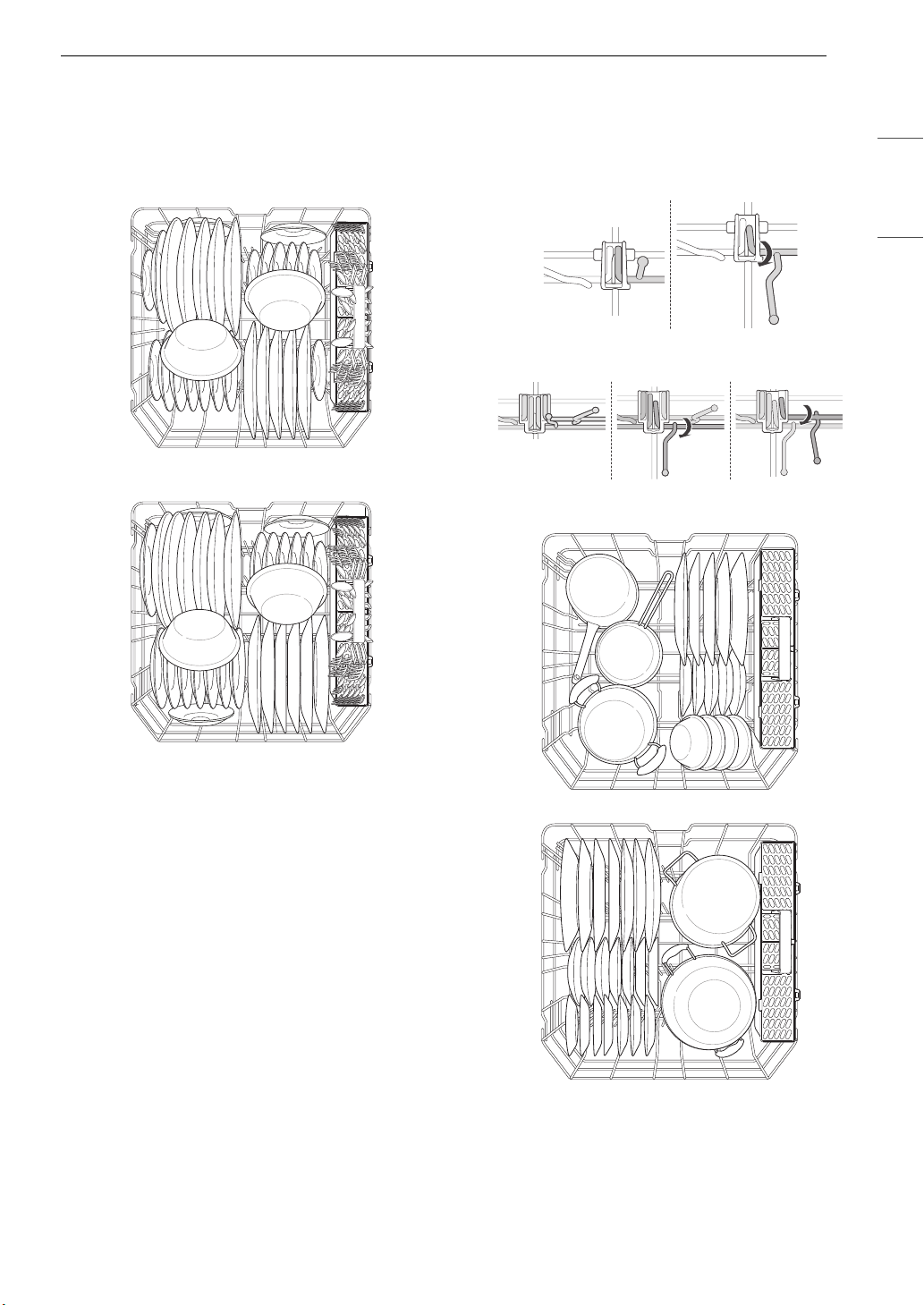
Loading the Silverware
Basket
The silverware basket has separators to avoid
scratching and tarnishing of delicate silverware.
Loading Silverware into the Basket
Loading 10 Place Settings
Loading 12 Place Settings
Silverware Loading Tips:
• For best cleaning results, use the top separators
in the basket when loading silverware. The
separators will prevent nesting of silverware.
• Load sharp items, such as knives, pointing down.
• When unloading the dishwasher, it is best to
start with the silverware basket. Doing so will
prevent water droplets from falling on your
silverware from the upper rack.
WARNING
• Be careful when loading and unloading sharp
items. Load sharp knives with the handles up to
reduce the risk of personal injury.
1
5
4
4
4
4
4
5
5
5
5
3
3
6
2
2
3
3465
5
5
51
5
4
4
4
4
3
2
6
2
2
2
2
2
2
1
5
4
4
4
4
4
5
5
1
5
3
6
2
3
3
465
5
1
51
5
4
4
4
42
6
2
2
2
2
2
2
27OPERATION
ENGLISH
Loading the Lower Rack
Loading Dishes into the Lower Rack
Loading 10 Place Settings
Loading 12 Place Settings
Lower Rack Loading Tips:
• Plates should be positioned upright and facing
the center of the rack, and pots, pans and large
dishes must be turned upside down.
• Load dinner plates, dishes, soup bowls, etc.
between the tines.
• Load cookie sheets, cake pans and other large
items at the sides or back of the rack. Loading
these items in the front of the dishwasher can
prevent the water spray from reaching the
detergent dispenser.
• Make sure that pot handles and other large
items do not stop the rotation of the spray arms.
• The lower rack should not be used for small
items such as cups, wine glasses, or small plates.
These items should be loaded in the upper rack.
• Make sure that large items do not interfere with
the rotation of the spray arms, and do not
prevent the detergent dispenser from opening.
Folding Down the Lower Tines
Fold tines down to fit larger dishes; pull tines back
up to fit smaller dishes.
Case 1
Case 2
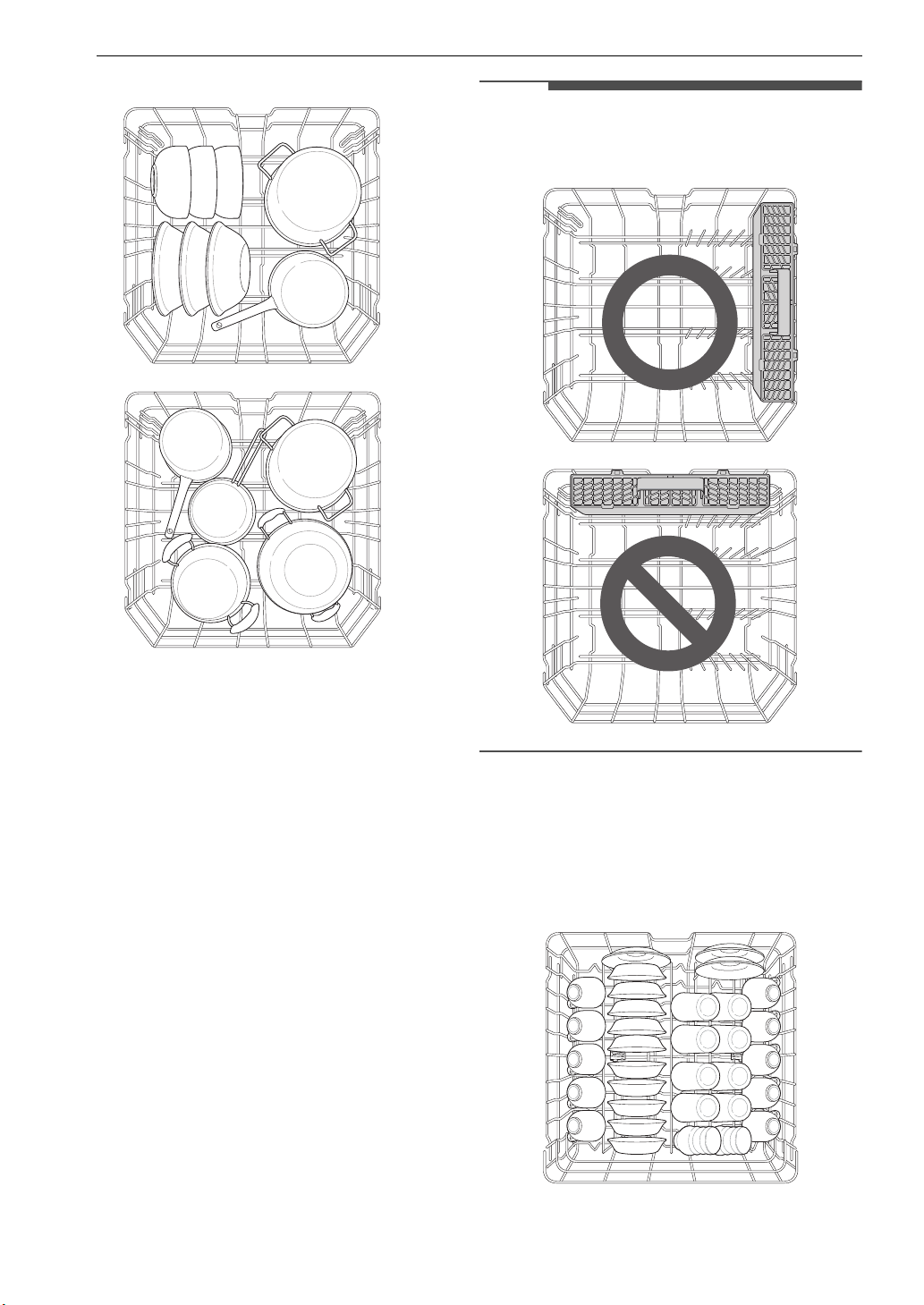
Loading Dishes & Pots
28 OPERATION
Loading Pots & Bowls
NOTE
• The silverware basket ships installed at the back
of the bottom rack. For best performance, install
it along the right side as shown.
Loading the Upper Rack
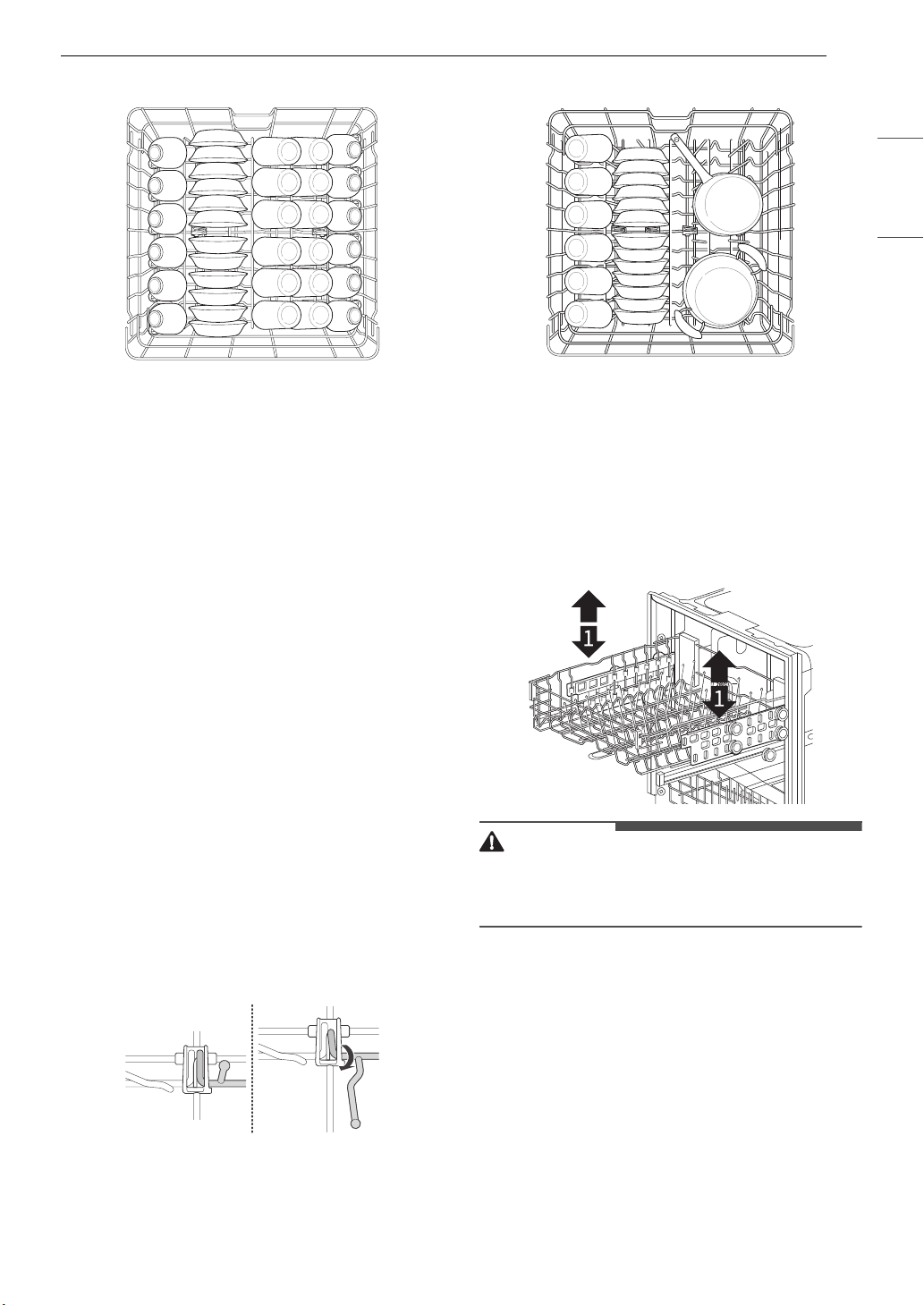
Loading Dishes into the Upper Rack
Loading 10 Place Settings
29OPERATION
ENGLISH
Loading 12 Place Settings
Upper Rack Loading Tips:
• Place cups and glasses in the rows between the
rack tines. Placing them over the rack tines can
lead to breakage and water spots.
• To avoid chipping, do not let stemware touch
other items.
• Place items so that the open end faces down for
cleaning and drying.
• Do not stack items on top of each other.
• Use the upper rack for small or delicate items
such as small plates, cups, saucers, glasses, and
dishwasher-safe plastic items.
• Cups, glasses, and bowls must be positioned
upside down.
• Make sure items do not interfere with the
rotation of the spray arms above and below the
upper rack.
• When loading larger items in the upper rack,
such as wine glasses or taller cups, it may be
necessary to remove the cutlery rack if one is
present.
Folding Down the Upper Tines
Fold tines down to fit larger dishes; pull tines back
up to fit smaller dishes.
Loading Dishes & Pots
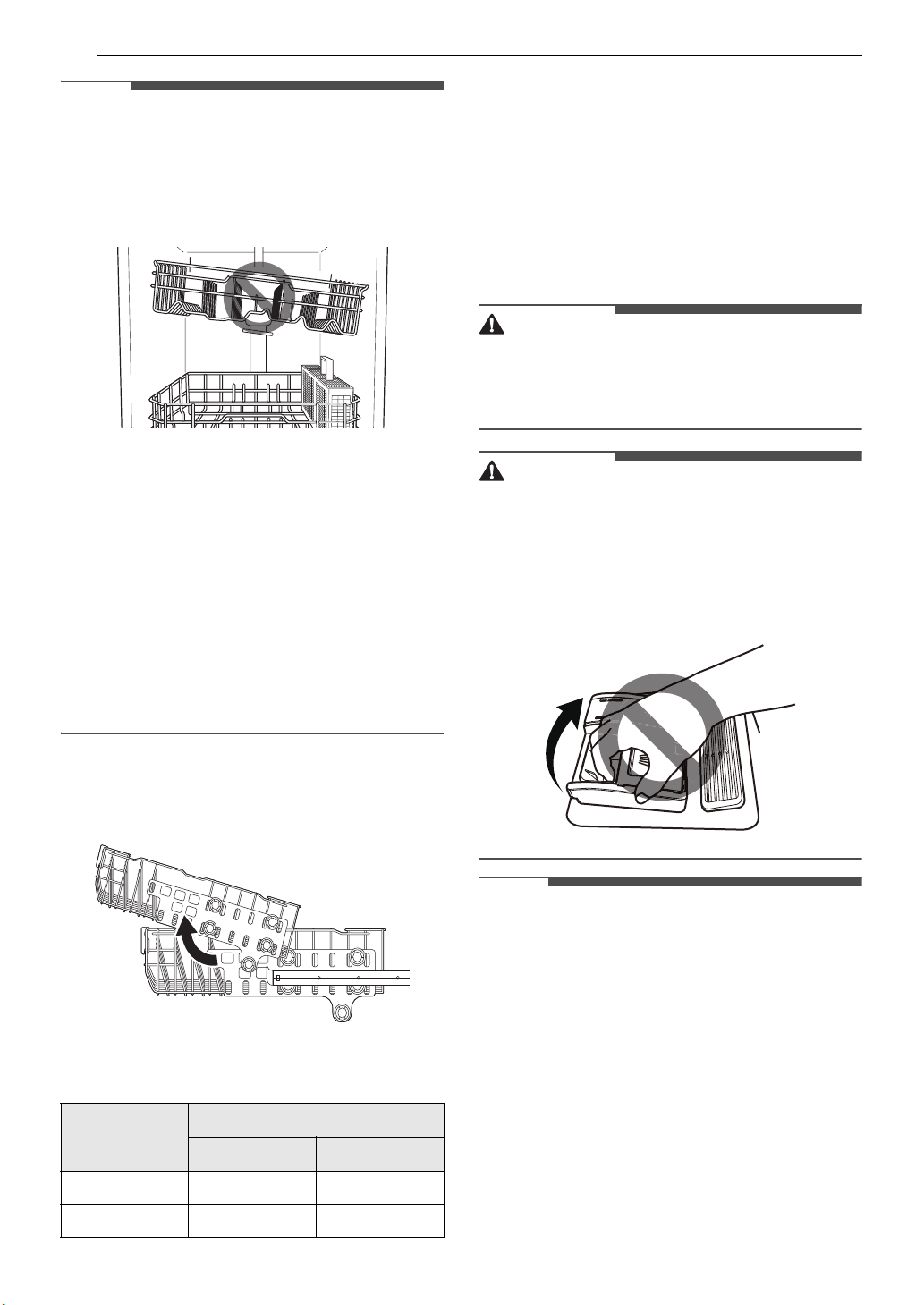
Height Adjustable Upper Rack
The upper rack adjusts up and down. Raise the
upper rack to allow items up to 14" tall in the lower
rack. Lower the upper rack to allow dishes up to
12" tall in the upper rack. The dishwasher ships
with the upper rack raised.
There are two available positions for adjusting the
height of the upper rack to create more space.
WARNING
• Before adjusting, ensure the rack is empty of all
dishes. Otherwise dishes may get damaged or
you may get injured.
2
2
30 OPERATION
NOTE
• Before pushing the upper rack into the
dishwasher, ensure the rack height is the same
on both sides. If the height is not the same on
both sides, the dishwasher door will not shut
and the upper spray arm will not connect to the
water inlet.
• There is a 2 5/8 inches (56 mm) gain in height
when the upper rack is moved to the lower
position.
• After adjusting the rack levels, check that the
spray arms are free to rotate.
• When the upper rack is in the lower position,
make sure the rack and the spray arm do not hit
the items on the lower rack.
• When the upper rack is in the lower position,
push in the upper rack first, and the lower rack
later.
• Pull out the lower rack first, and the upper rack
later.
Lowering or Raising the Rack
Pull the rack to the front and completely remove it
from the rail, then reinsert it at the desired height.
Possible plate size according to the
upper rack position
Adding Cleaning Products
Adding Detergent to the Dispenser
• Remove the label on the dispenser prior to
running the dishwasher for the first time.
• The amount of detergent needed depends on
the cycle, load size, and soil level of dishes.
• Put detergent into the detergent compartment
before starting any cycle, except the Rinse cycle.
WARNING
• Dishwasher detergent and rinse aid contain
chemical components, like all other household
detergent. So, they must be kept out of the
reach of children.
CAUTION
• Use only detergent intended for dishwashers.
Incorrect detergent may cause the dishwasher
to fill with suds during operation. Excess suds
may reduce wash performance and may cause
the dishwasher to leak.
• To avoid damaging the dispenser, do not pull up
on the dispenser to close the dishwasher door.
NOTE
• After completion of the wash program, check
whether the detergent was completely washed
out.
• Some dishwasher detergent tablets may become
stuck in the dispenser due to their excessive size.
Tablets can be placed onto the base of the wash
tub next to the filter before starting the cycle.
• Too much detergent can leave a film on dishes
and in the dishwasher, resulting in poor wash
performance.
• If dishwasher detergent tablets are used without
liquid rinse aid, the dishes and dishwasher
interior will have excessive moisture. Select the
Extra Dry option for better drying performance.
Upper Rack
Position
Plate Size in. (mm)
Upper Rack Lower Rack
Upper 9 (230) 12 1/2 (320)
Lower 11 1/4 (286) 10 3/8 (264)
31OPERATION
ENGLISH
• Using liquid rinse aid improves drying
performance by allowing water to drain off of
dishes after the final rinse.
• Do not use detergent tablets for shorter wash
cycles. The tablet may not dissolve completely,
causing detergent residue on dishes and
inefficient cleaning.
• Using a wash booster helps remove spots,
residue, and the white film caused by hard
water. It does not help remove excess detergent
residue.
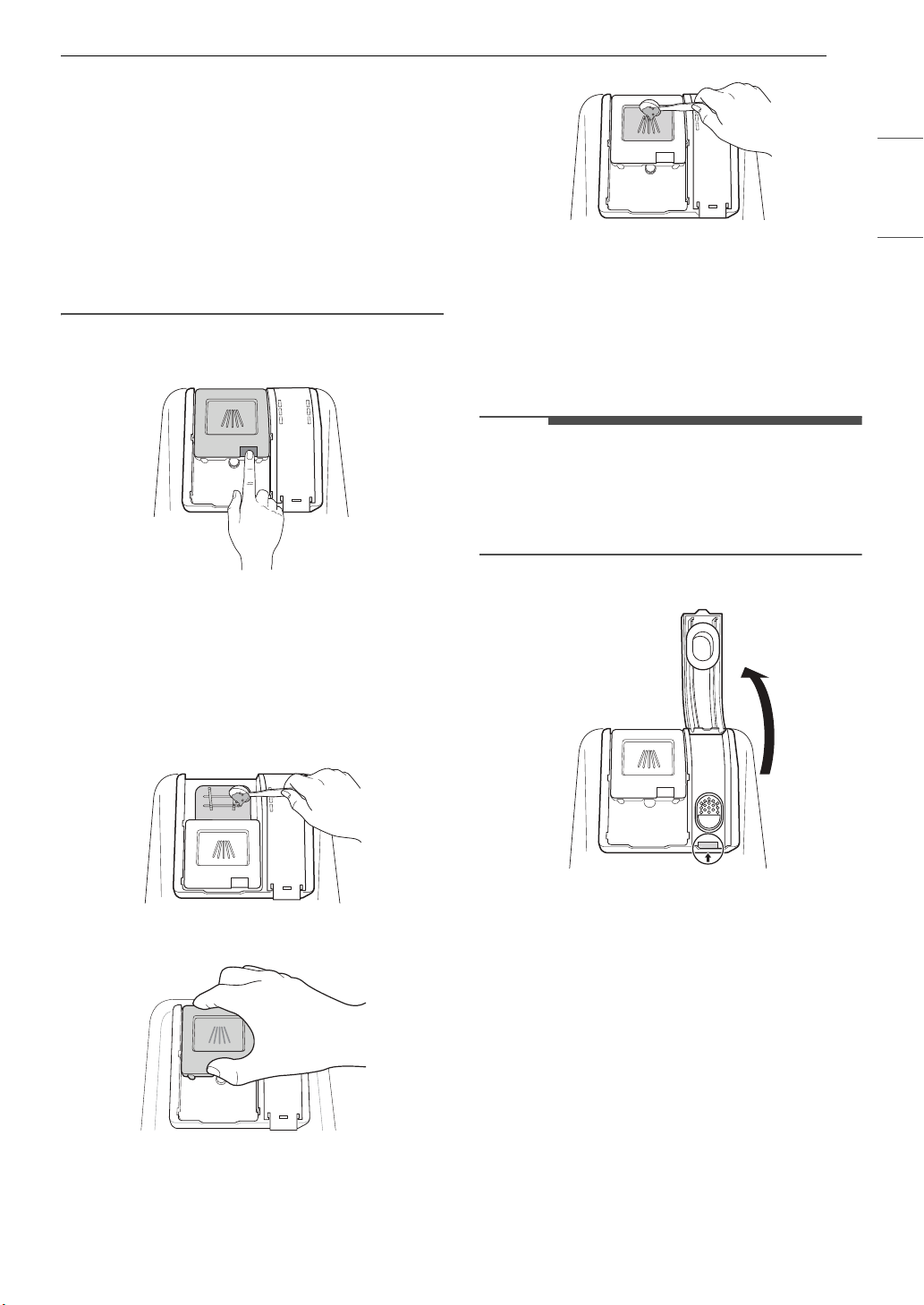
1 Push the button on the dispenser lid to open
the cover.
2 Add dishwashing detergent to the main wash
compartment until the level is between the
lines marked 15 and 25.
• Fill to over the 25 line for hard water or
heavily soiled loads.
• Fill to the 15 line for soft water or lightly
soiled loads.
3 Slide the detergent lid closed until it clicks.
4 If a prewash is desired, fill the recessed
prewash compartment area on the lid with
detergent.
Adding Rinse Aid to the Dispenser
The Rinse Aid e icon appears in the display when
more rinse aid is needed.
The use of rinse aid is recommended to prevent
water spots on dishes and to enhance drying
performance.
NOTE
• Only use liquid rinse aid in the dishwasher.
• Do not overfill the rinse aid dispenser.
• Wipe off any spilled rinse aid around the
dispenser.
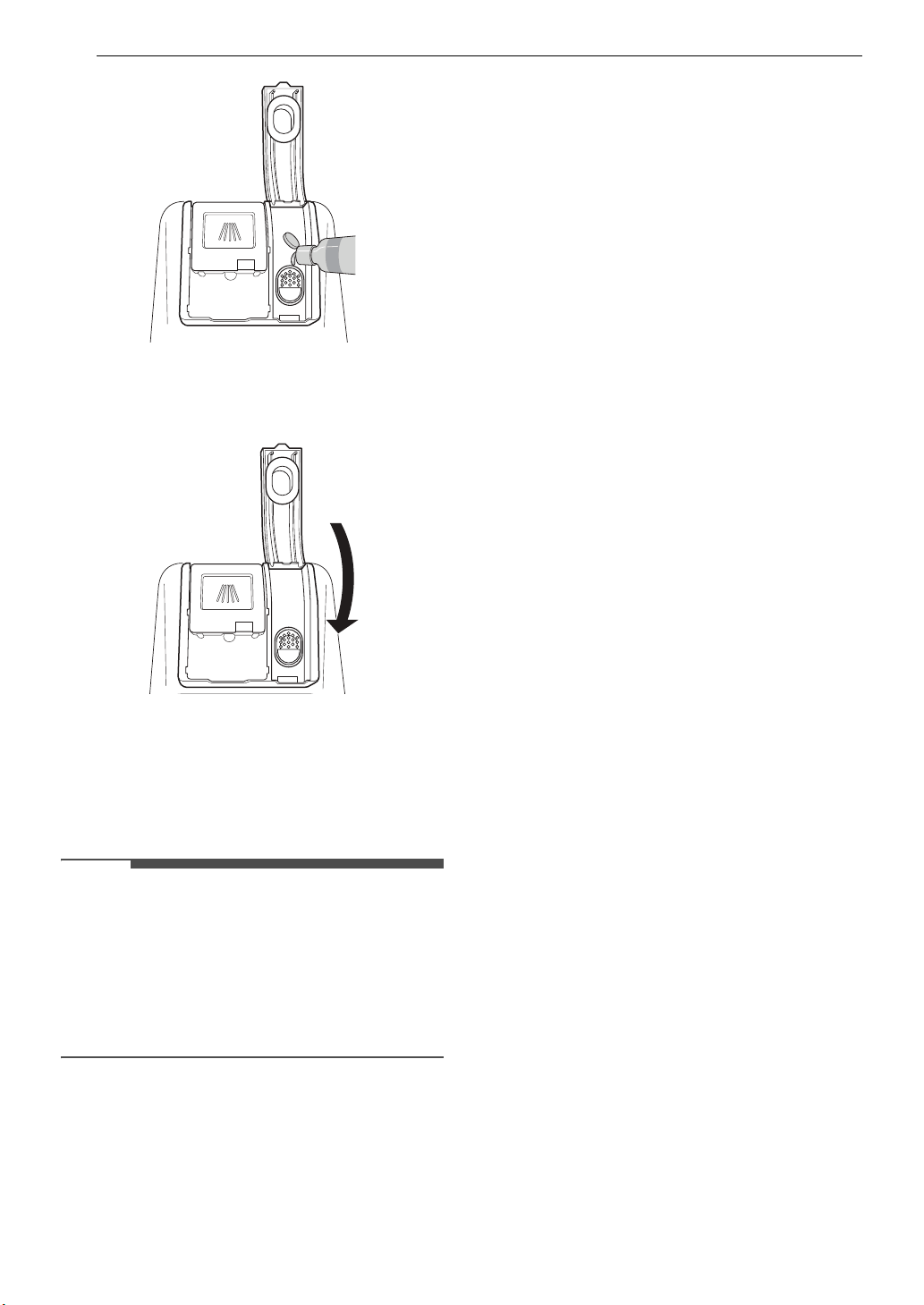
1 Open the rinse aid lid by lifting up the flap.
2 Add a liquid rinse aid to the maximum fill
level. Allow the rinse aid to settle in the
dispenser while filling, or air bubbles may
result in poor drying performance. Avoid
overfilling the dispenser.
۱٥
۲٥
32 OPERATION
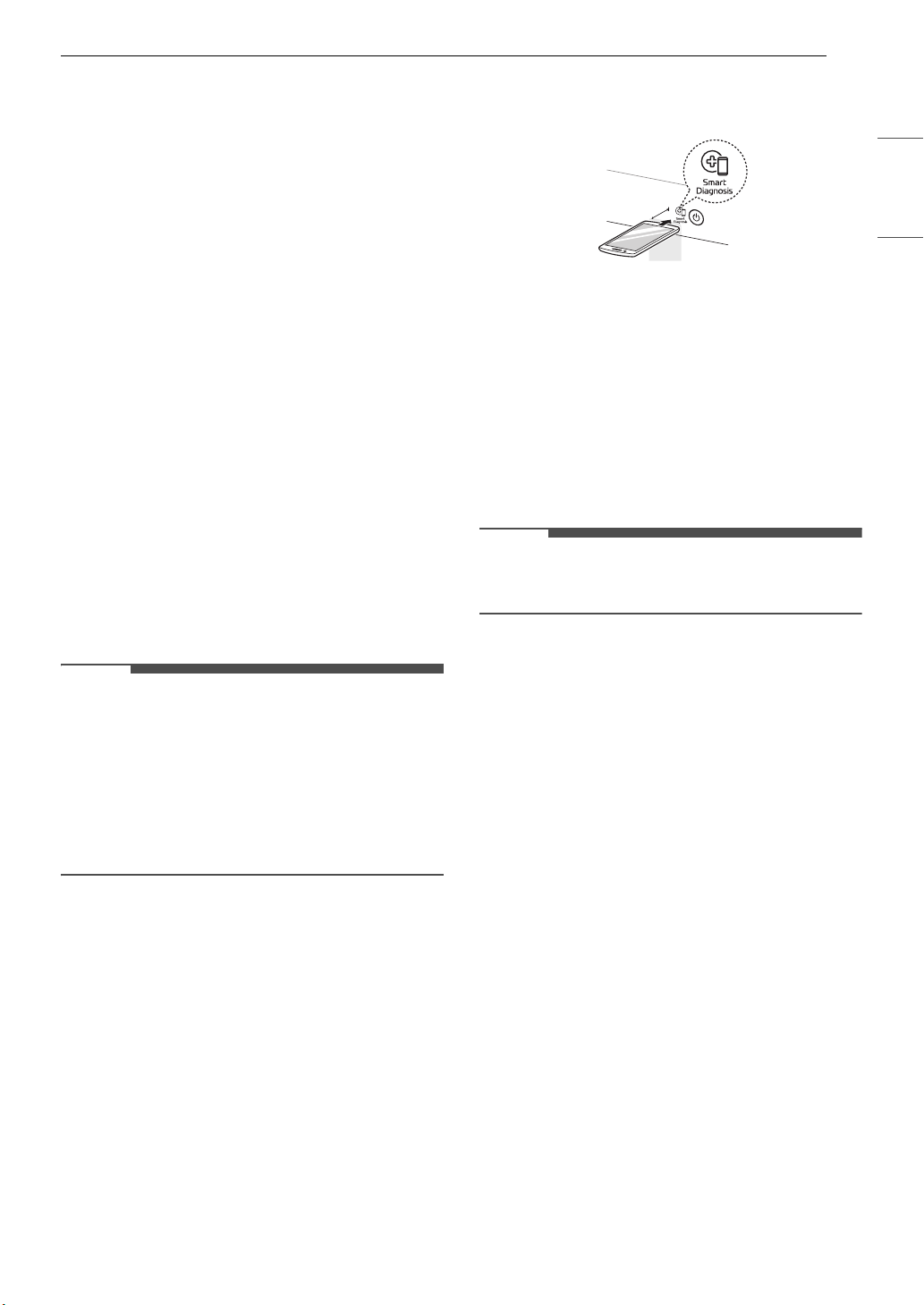
3 Close the lid to lock the dispenser. Rinse aid is
dispensed automatically during the final rinse
cycle.
Rinse Aid Dispenser Adjustment
The dispenser has five adjustment levels. The
dishwasher is programmed at the factory for a
rinse aid dispenser level of 2. This can be checked
and adjusted from the control panel.
NOTE
• Adjust the setting higher if you have hard water
and notice calcium buildup on your dishes.
• Setting the rinse aid control too low will
contribute to spotting and streaking on dishes
and poor drying performance.
• Setting the control too high can cause foaming,
which will cause poor wash performance.
1 Ensure the appliance is off.
2 Press Power and Delay Start simultaneously
to check the current setting.
3 Press Delay Start to change the rinse aid
dispenser setting. Each press of the button
changes the setting one step from L0 to L4.
4 Once the desired rinse aid dispenser setting is
selected, press Start to save.
Refilling the Rinse Aid
How often the dispenser needs to be refilled
depends on how often dishes are washed and the
rinse aid setting used.
•The Rinse Aid
e icon flashes when more rinse
aid is needed, unless the rinse aid dispenser
setting is set to L0.
33SMART FUNCTIONS
ENGLISH
SMART FUNCTIONS
LG ThinQ Application
The LG ThinQ application allows you to
communicate with the appliance using a
smartphone.
LG ThinQ Application Features
• Smart Diagnosis
- This function provides useful information for
diagnosing and solving issues with the
appliance based on the pattern of use.
Installing the LG ThinQ Application
Search for the LG ThinQ application from the
Google Play Store or Apple App Store on a
smartphone. Follow instructions to download and
install the application.
Smart Diagnosis
TM
Function
Use this feature to help you diagnose and solve
problems with your appliance.
NOTE
• For reasons not attributable to LGE’s negligence,
the service may not operate due to external
factors such as, but not limited to, Wi-Fi
unavailability, Wi-Fi disconnection, local app
store policy, or app unavailability.
• The feature may be subject to change without
prior notice and may have a different form
depending on where you are located.
Using Audible Diagnosis to
Diagnose Issues
Follow the instructions below to use the audible
diagnosis method.
• Launch the LG ThinQ application and select the
Smart Diagnosis feature in the menu. Follow
the instructions for audible diagnosis provided
in the LG ThinQ application.
1 Press the POWER button to turn on the
appliance.
• Do not press any other buttons.
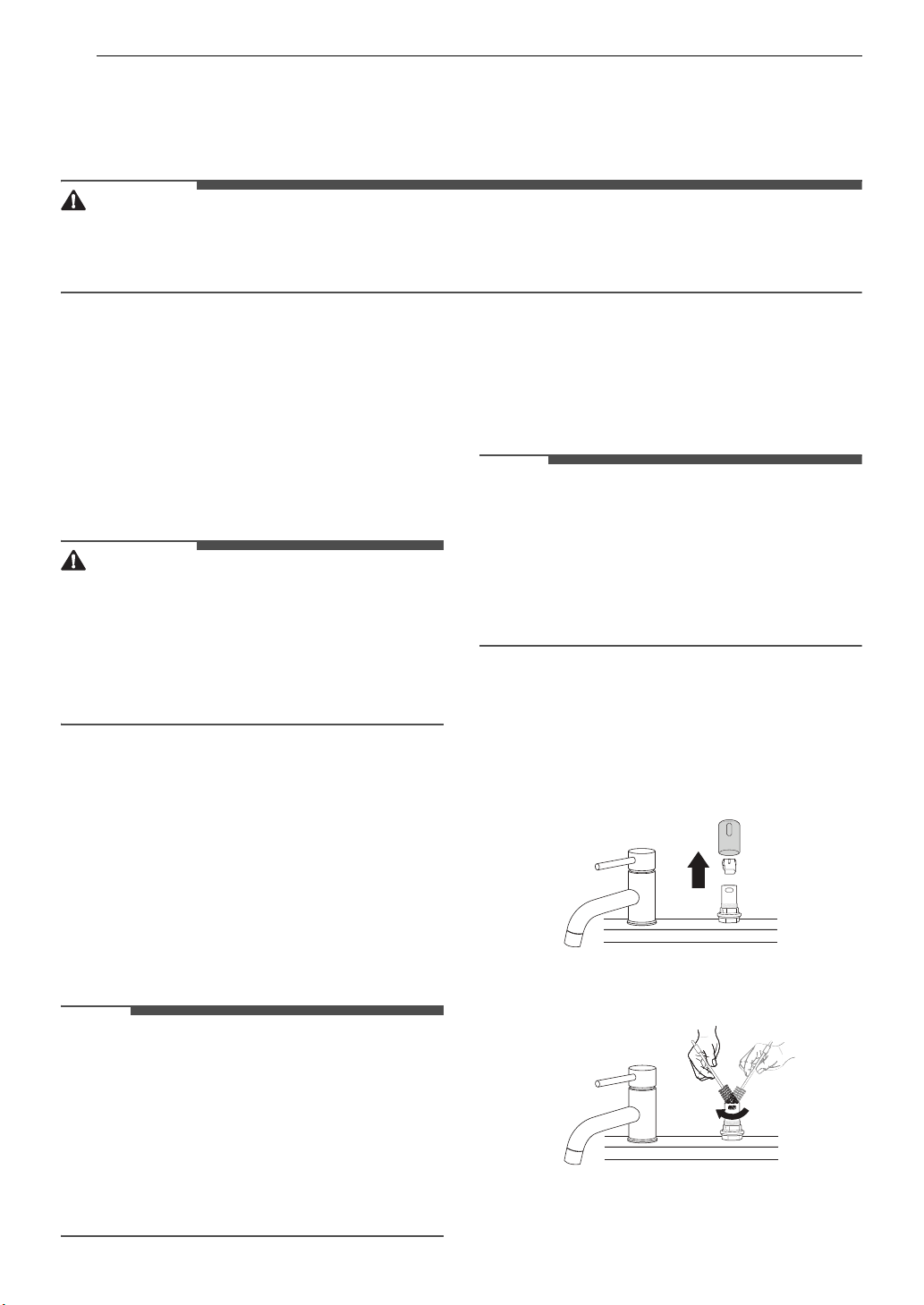
2 Place the mouthpiece of your smartphone
close to the d logo.
3 Press and hold the Delay Start button for 3
seconds or longer while holding the
smartphone mouthpiece to the logo until the
data transfer is complete.
• Keep the smartphone in place until the data
transfer has finished. Time remaining for
data transfer is displayed.
4 After the data transfer is complete, the
diagnosis will be displayed in the application.
NOTE
• For best results, do not move the smartphone
while the tones are being transmitted.
Max.
10 mm
34 MAINTENANCE
MAINTENANCE
To maintain performance and prevent trouble, it is important to check the outside and inside of the
dishwasher, including filters and spray arms, at regular intervals.
WARNING
• When cleaning the outside and inside of the dishwasher, do not use benzene or thinner. Otherwise, it
may cause fire or explosion.
• To prevent injury during care and maintenance or cleaning, wear gloves and/or protective clothing.
Cleaning and Care
Cleaning the Exterior
In most cases, the exterior of the dishwasher can
be cleaned with a soft damp cloth or sponge, then
dried with a soft cloth. If the dishwasher has a
stainless steel exterior, use a stainless steel
cleaner.
CAUTION
• If cooking oil is spilled on the exterior of the
product, wipe it off immediately. Do not clean
the exterior of the product with cleaners which
contain alcohol, thinners, bleach, benzene,
flammable liquids, or abrasives. These
substances may discolor or damage the
appliance.
Cleaning the Interior
• Clean the interior of the dishwasher periodically
with a soft, damp cloth or sponge to remove
food and dirt particles.
• To remove white spots and odor from inside the
dishwasher, run an empty cycle, without
detergent, with one cup of white vinegar in a
dishwasher safe glass or bowl placed on the
upper rack. (Vinegar is an acid and with constant
use it could damage the appliance.)
NOTE
•Run the Machine Clean cycle once a month, or
more often if needed, to remove detergent
buildup and other residue.
• If you have not used the dishwasher for a long
time, refresh the inside by running the Machine
Clean cycle without detergent. When the cycle is
finished, clean the inside and outside of the
dishwasher according to the MAINTENANCE
instructions.
Clogged Drain Air Gap or In-Sink
Disposal
Check the drain air gap or in-sink disposal if the
dishwasher is not draining well.
NOTE
• The drain air gap and disposal are external
plumbing devices that are not part of the
dishwasher.
• The warranty provided with the dishwasher does
not cover service costs directly associated with
the cleaning or repair of the external drain air
gap and disposal.
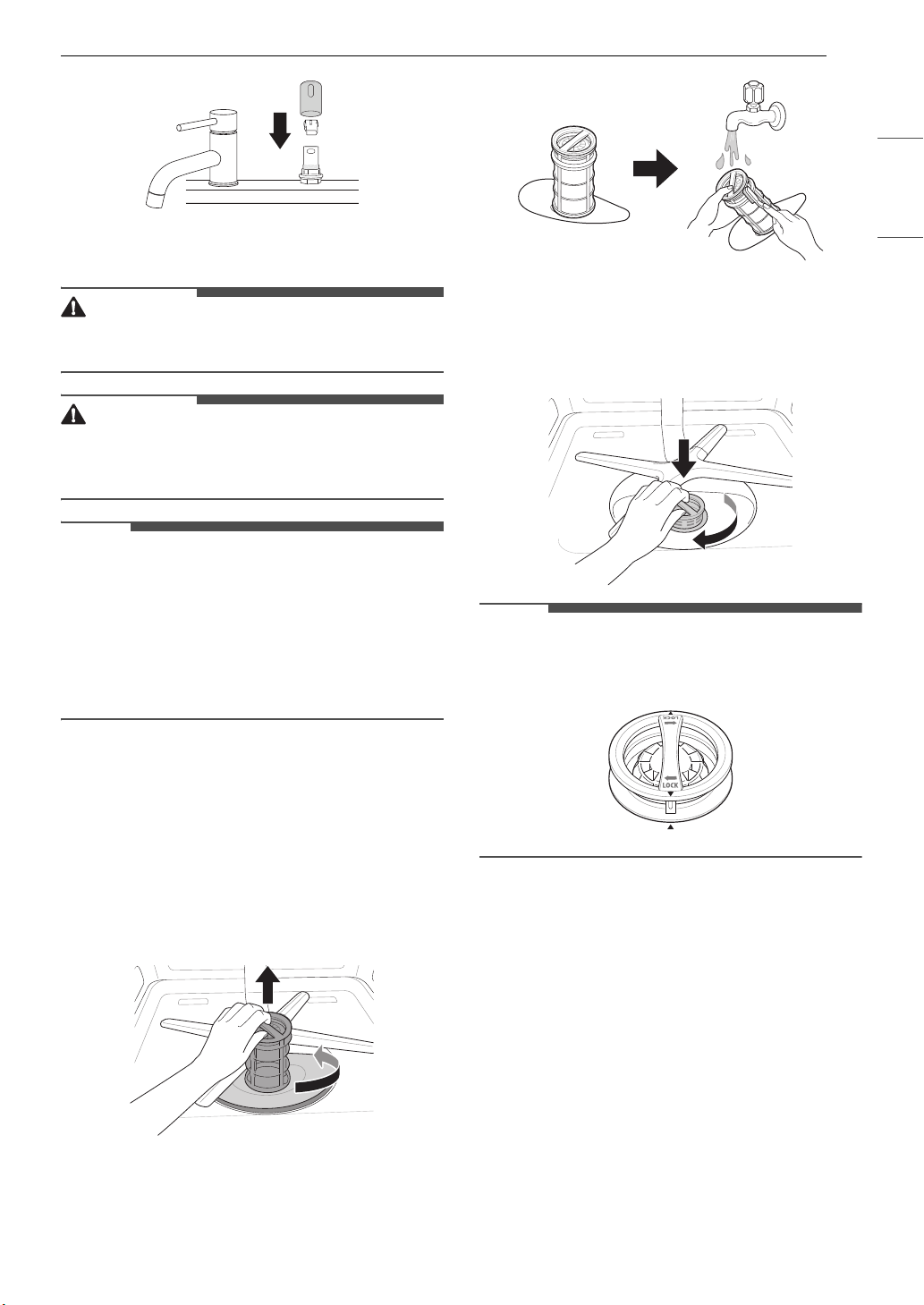
Cleaning the Air Gap
1 Turn off the dishwasher.
2 Remove the air gap cover and the plastic cap
underneath it.
3 Clean out any debris with a toothpick or
brush.
4 Replace the plastic cap and air gap cover.
35MAINTENANCE
ENGLISH
Cleaning the Filters
WARNING
• Be cautious of sharp edges when handling the
stainless steel filter.
CAUTION
• Remove food residue caught in filters to prevent
the buildup of odor-causing bacteria and
possible drainage problems.
NOTE
• For best wash performance, clean the filter after
each load. If food debris remains in the filter, it
may cause an odor.
• In areas with hard water, clean the filter at least
once a month with a soft brush.
• Clean the filters using non-abrasive materials
and warm running water.
1 Remove the lower rack and position the
bottom spray arm so a wider vee is open to
the front.
2 Turn the inner filter counter-clockwise and
take out the assembled inner filter and
stainless steel filter.
With the filters removed, check the sump
opening and remove any foreign materials, if
needed.
3 Clean the filters with a soft brush under
running water. Reassemble the filters before
reinstalling them.
4 To replace the assembled filters, position the
spray arm so the wider vee is toward the
front. Fit the filters back into the filter holder
and secure them by turning the inner filter
clockwise until it clicks into place.
NOTE
• Make sure the filter is assembled correctly
before starting a cycle. When assembling, rotate
the filter firmly until it clicks.
Cleaning the Spray Arm
If the spray arm holes are blocked by any food
residue, dishes may not be cleaned well due to
improper water spray.
It is recommended that the spray arms be cleaned
once every two weeks.
Cleaning the Lower Spray Arm
1 Make sure that the water jet holes are not
blocked by food particles.
2 If any food residue blocks the spray arm
holes, remove it with a pin or any sharp tool.
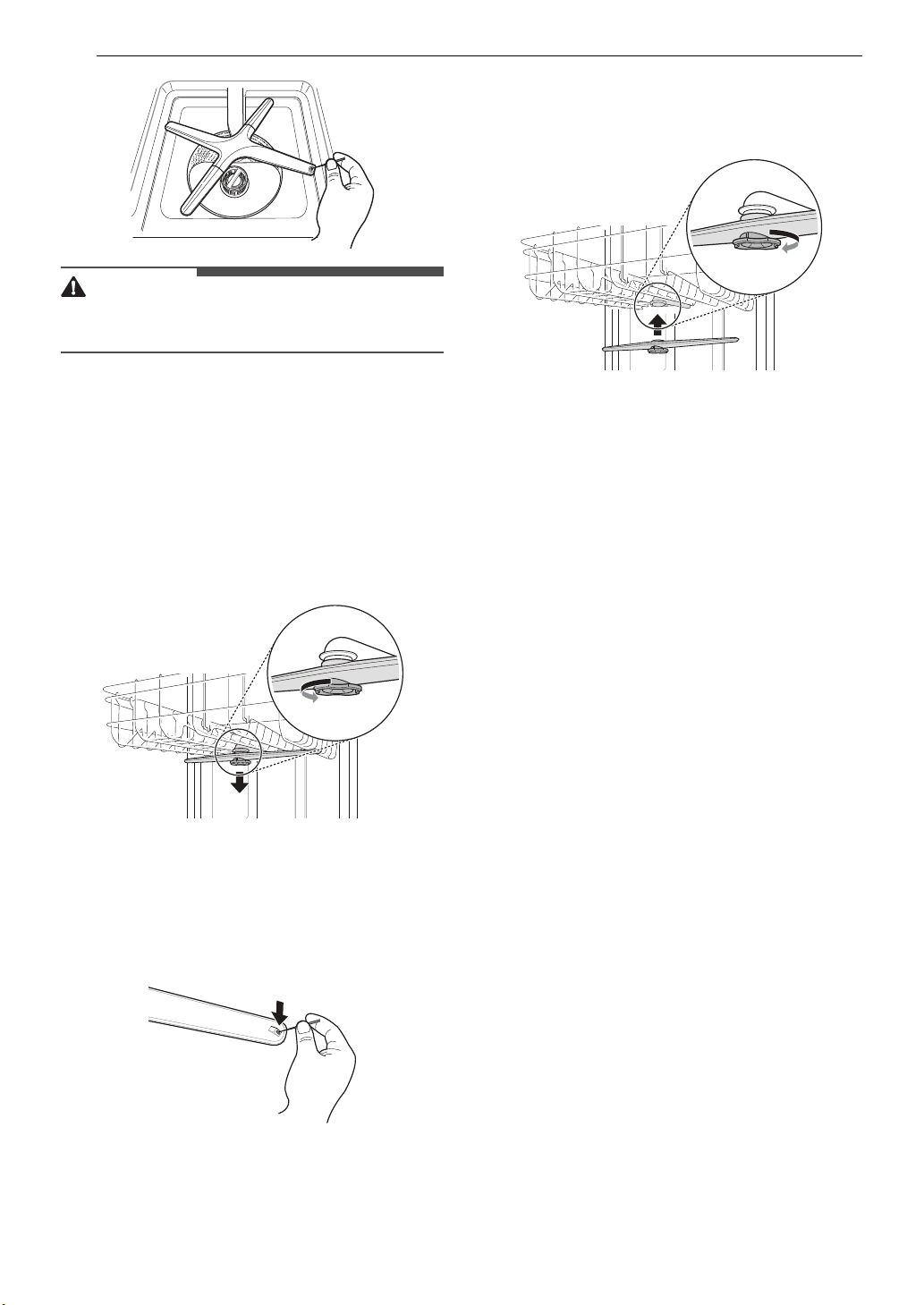
36 MAINTENANCE
CAUTION
• To avoid breaking the rolling spray arm sections,
do not pull or manually rotate them.
Cleaning the Upper Spray Arm
1 Pull the upper rack forward. Make sure that
the water jet holes are not blocked by food
particles.
2 When cleaning is necessary, remove the
upper spray arm by turning the nut on the
bottom of the spray arm 1/8 turn counter-
clockwise and pulling down.
3 Remove food particles by rinsing or shaking
the spray arm.
4 If any food residue blocks the spray arm
holes, remove it with a pin or any sharp tool.
5 After removing the food residue, clean the
spray arms under running water.
6 After cleaning the upper spray arm, press it
up into place. Turn the nut 1/8 turn clockwise
to make sure that the nut locks back into
place.
7 After assembly, make sure that the spray
arms rotate freely.
Seasonal Maintenance and Storage
• If you will be absent for an extended period of
time during warmer months, close the water
valve and disconnect the power supply line, or
turn off the circuit breaker. Clean the filter, tub
and dispenser to prevent odor.
• If you will be absent for an extended period of
time during colder months and there is a
possibility of freezing temperatures, winterize
the water supply lines and the dishwasher itself.
Winterization must be performed by qualified
service personnel.

37TROUBLESHOOTING
ENGLISH
TROUBLESHOOTING
The washer is equipped with an automatic error-monitoring system to detect and diagnose problems at an
early stage. If the washer does not function properly or does not function at all, check the following before
you call for service.
Before Calling for Service
FAQs
Q: Does this dishwasher require a rinse aid to be used?
A: Rinse aid is strongly recommended to enhance the drying performance of the dishwasher. In order
to be more energy efficient, the hybrid drying system does not use a heating element to assist in
drying, so a rinse aid plays an integral role in the drying process. If a rinse aid is not used, water may
remain on the dishes and the tub. Rinse aid helps to ensure that the majority of the water has been
sheeted off of the dishes at the end of the rinse and that the load is ready for the dry cycle.
Q: What can be done if my dishes have a cloudy, white film on them after a wash?
A: The cloudy film is usually caused by minerals in the water reacting with the dishwasher detergent.
First, be certain not to use too much detergent. Refer to Adding Detergent to the Dispenser section
for recommended detergent amounts. Add an extra rinse to the cycle. LG Dishwashers use less
water than traditional dishwashers, so adding an extra rinse aids in rinsing the film away. If the water
supply is hard, it may be necessary to add a performance booster that addresses the hard water
condition.
Q: How do I remove white film on the tub?
A: Measure 3 tbsp. (40 g) of citric acid powder and use it to fill the main detergent compartment. Run a
Machine Clean cycle. Do not use detergent.
Q: What steps can I take to improve drying results?
A: Drying performance is directly affected by the amount of heat that remains in the tub after the
heated rinse is performed. If your dishwasher is far away from your home’s hot water heater, it may
be necessary to run the hot water tap in the sink before starting a wash cycle, to ensure that cool
water is purged from the hot water lines. This will ensure your dishwasher has a consistent supply of
hot water from start to finish. Using the High Temp. setting also aids in keeping the inner drum
temperature and dishes hotter before drying begins.
LG dishwashers are designed to be used in conjunction with a rinse aid. Using a rinse aid will
maximize the amount of water that has already been sheeted away from the dishes before the dry
cycle begins. If a rinse aid is used and the performance still needs a boost, adjust the amount of rinse
aid used. 2 is the default setting, but if necessary set the level to 3 so more rinse aid is used.
Water tends to bead rather than sheet off plastic and nonstick surfaces, making them more difficult
to dry. If washing plastic items in a Normal cycle, select the Extra Dry or Night Dry option or both for
better drying results. When the rinse aid is empty, the Extra Dry option is selected automatically.
Allow the dishwasher to completely finish the dry cycle before opening the door. If the door is
opened in the middle of the dry cycle, the heat that is necessary for the hybrid dry system to work
will escape. This will cause all of the dishes inside to remain wet once the cycle finishes.
Q: What is the hybrid drying system?

38 TROUBLESHOOTING
User Support Videos
For further assistance, there are videos and tutorials available through the LG.com website.
A: The dishwasher does not rely on a heating element for the drying process; instead, it relies on the
heat that is retained by the dishes and the tub during the wash and rinse cycles to turn the moisture
in the tub into humidity.
Warm, moist air in the dishwasher is then pulled into a condensing duct in the door by a fan. The air
then cools, which causes the humidity to condense. Room temperature air is also drawn into the duct
to help the air cool down faster. When this moisture condenses into a liquid, it is drained out.
NOTE
• Rinse aid is required to enhance the drying performance. If no rinse aid is used, water may
remain on the dishes and the tub.
Q: Why am I hearing a whistling sound from the dishwasher?
A: It is important to determine the duration of the noise and when it happens (what part of the cycle).
When water is drawn into the dishwasher, a whistling noise can be heard. This is normal. If the water
pressure is too high, it will be louder, so it may be necessary to adjust the water valve to lower the
pressure if the noise is too loud.
Q: What kinds of dishes can be placed in the dishwasher?
A: Ensure that the dishes you place in the dishwasher are dishwasher safe. Plastic dishware will not dry
as effectively as glass and metal dishware. Plastic items do not retain heat as well as glass and metal
dishware. Plastic cups and dishes may require some hand drying before being put away at the end of
the cycle.
Q: Can I run a drain only cycle?
A: To drain standing water, press and hold Start for three seconds until the cycle stops. Once the
dishwasher finishes draining, the power turns off.
Q: Why does my dishwasher continuously chime if I open the door during a cycle or right after the
cycle has finished?
A: This is normal. The dishwasher is letting you know that the interior temperatures of the unit are hot
and to use caution when reaching inside. Once the unit has cooled down, the chiming will stop.
Q: What is Control Lock and how is it activated?
A: Control Lock is a feature that prevents the controls from being changed during the cycle. It does not
prevent the door from being opened or the unit from being powered off. To activate or deactivate,
press and hold Flex Zone and High Temp. simultaneously for three seconds.
Q: Can I add an extension to the drain hose?
A: If a drain hose extension is required, use a 5/8" or 7/8" inside diameter, 2 ft ~ 3 ft. length hose and a
coupler to connect the two hose ends.
Q: An LED is blinking, the machine is chiming, and the dishwasher won't start. What is wrong with
the dishwasher?
A: This is a safety feature. The door must be closed within four seconds of pressing the Start button. If
the door is not closed within four seconds, an LED flashes, an audible alert sounds, and the
dishwasher does not operate. To start the dishwasher, open the door and either close the door and
press Start (front controls).
Q: Should I pre-rinse dishes before loading them?
A: No, you don't need to pre-rinse the dishes before loading especially if using the Normal and Auto
cycles. The dishwasher washes dishes clean without pre-rinsing.
39TROUBLESHOOTING
ENGLISH
1 On the www.lg.com home page, click on the Support menu tab to bring up the menu selections.
Select Video Tutorials.
2 Select a product category and then pick a topic or search a keyword.
NOTE
• Scan this QR code to quickly access the video search page on the LG website.
Error Messages
Problem Possible Cause & Solution
IE
Water inlet problem.
• Check for a clogged, kinked or frozen water inlet hose.
• Check water supply.
OE
Drainage Problem.
• Check for a clogged, kinked or frozen water drain hose.
Air gap or disposal is clogged.
• Clean air gap or disposal.
Filters are clogged.
• Clean filters.
bE
Oversudsing caused by improper detergent, such as liquid dish soap.
• Do not use hand dishwashing liquids. Only use detergents which are designed for use in
automatic dishwashers.
• To remove detergent residue in the tub, pour approximately 4 oz ~ 8 oz (100 ml ~ 200 ml)
of milk into a shallow bowl, place it in the upper rack and then run the appliance on the
Auto cycle.
Failure to level dishwasher.
• Make sure that the appliance is properly leveled.
AE
Water leakage
• Turn off the water supply to the dishwasher and call an LG Electronics Customer
Information Center at 1-800-243-0000 (U.S.A.) or 1-888-542-2623 (Canada).
• The dishwasher makes an alert sound for 10 seconds, and runs the drain pump
intermittently. If power is turned off to the machine, the machine powers back on
automatically until the AE error is resolved.
FE
Excessive Water supplied.
• Please call an LG Electronics Customer Information Center at 1-800-243-0000 (U.S.A.) 1-
888-542-2623 (Canada).
HE
Heater circuit failure.
• Please call an LG Electronics Customer Information Center at 1-800-243-0000 (U.S.A.) 1-
888-542-2623 (Canada).
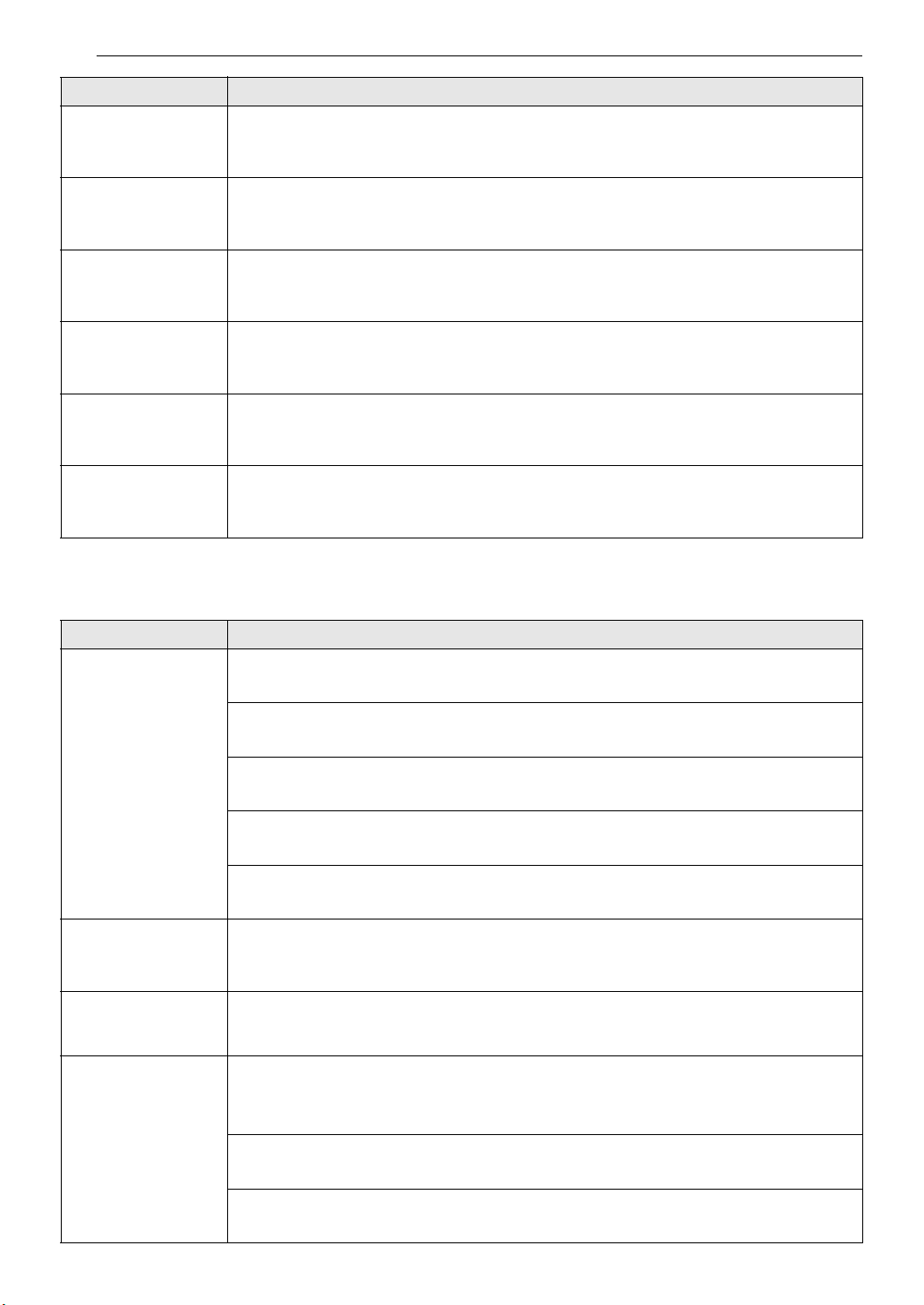
40 TROUBLESHOOTING
Operation
tE
Thermistor failure.
• Please call an LG Electronics Customer Information Center at 1-800-243-0000 (U.S.A.) 1-
888-542-2623 (Canada).
LE
Motor trouble
• Please call an LG Electronics Customer Information Center at 1-800-243-0000 (U.S.A.) 1-
888-542-2623 (Canada).
NE
Vario motor trouble
• Please call an LG Electronics Customer Information Center at 1-800-243-0000 (U.S.A.) 1-
888-542-2623 (Canada).
N:#, U:#, d:#, t#
(# is a number.)
Test mode is selected.
• This is not an error code. This code is used when testing the dishwasher. Power the unit off
and on and the code will disappear.
LO, L1, Lz, L3, L4
Rinse aid level setting mode is selected.
• This is not an error code. This code indicates the current rinse aid level. For more
information, refer to the Adding Cleaning Agents section.
CL
Control Lock is activated.
• This is not an error code. This code indicates that the control lock is activated. Press and
hold Flex Zone and High Temp. buttons simultaneously for three seconds.
Problem Possible Cause & Solution
Dishwasher will not
operate.
Start button is not pressed.
• Press the Start button.
Door is not completely closed.
• Make sure that the door is completely closed and latched.
Power supply or power supply line is not connected.
• Connect the power supply or power supply line properly.
Fuse is blown or circuit breaker tripped.
• Replace the fuse or reset the circuit breaker.
Control Lock is activated.
•Deactivate Control Lock.
Dishwasher operates
too long.
Dishwasher is connected to cold water.
• Check the water supply connection or water heater setting. (Heating cold water takes
longer.)
Water remains in tub
after completion of
cycle.
Drain hose is kinked or clogged.
• Adjust hose or clear blockage.
Noise Some level of noise is normal during operation.
• Detergent cover opening.
• Drain pump at the beginning of drain cycle.
The dishwasher is not level.
• Adjust leveling feet.
Nozzle arm knocking against dishes.
• Reposition the dishes.
Problem Possible Cause & Solution
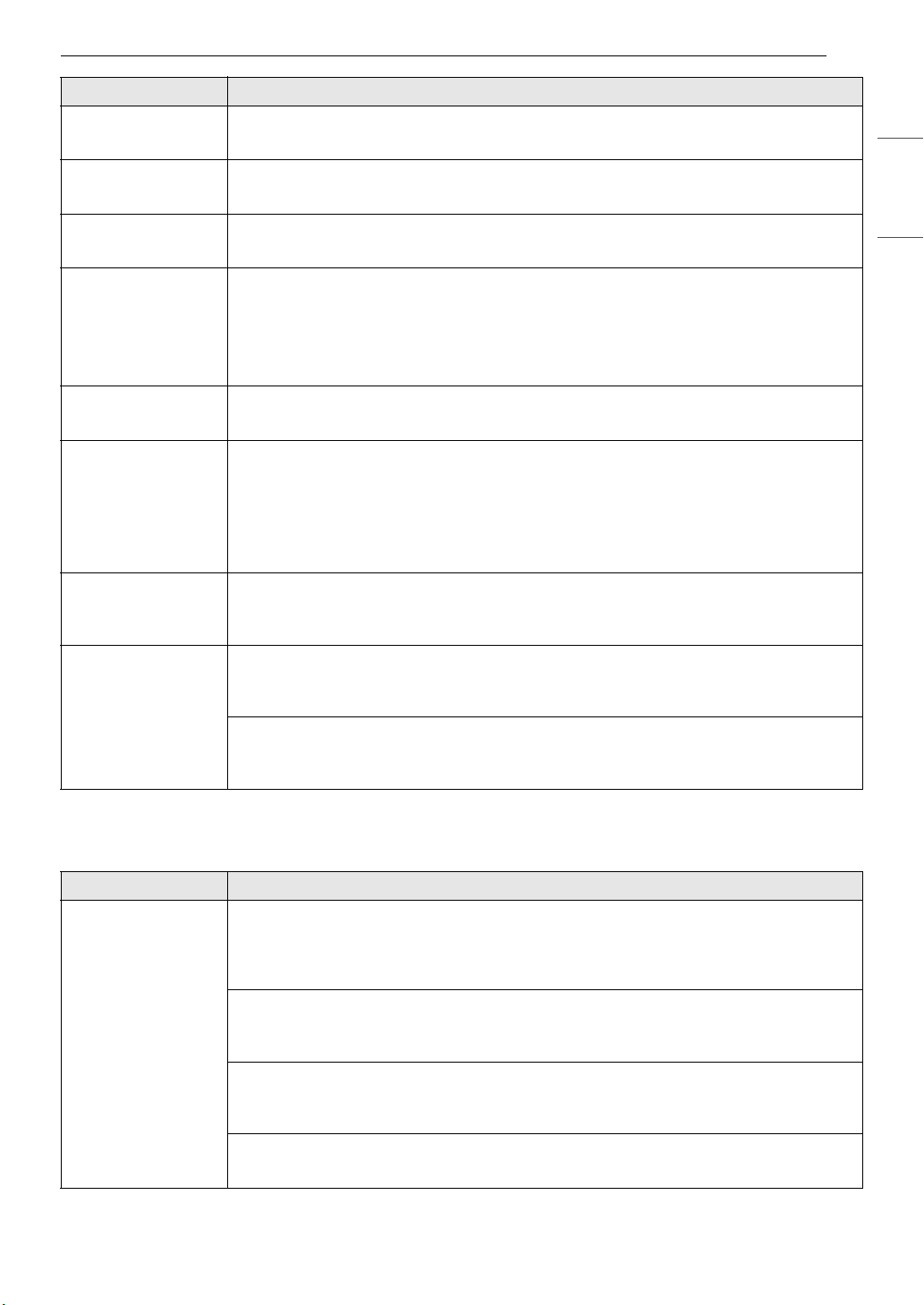
41TROUBLESHOOTING
ENGLISH
Performance
Lights do not
illuminate.
Power is not connected.
• Connect power supply.
Spray arms do not
rotate smoothly.
Holes of spray arms are blocked by food particles.
• Clean the holes of spray arms.
Upper rack is
crooked.
Rack is poorly adjusted.
• See the Height Adjustable Upper Rack section.
Dishwasher
continuously chimes
when the door is
opened, during or
right after a cycle
has completed.
This is a safety measure. Contact with escaping steam or the hot contents of the
dishwasher could result in injury.
• Close the door until the dishwasher and dishes have cooled down. The chiming will stop if
the door is closed or the interior temperature has cooled.
Door does not close
completely.
Cutlery rack is not properly loaded.
• Push the door handle to close the door properly until it clicks.
Dishwasher chimes if
panel is touched
during operation.
Bumping into or touching the control panel during operation may result in a disabled
button sound. Only the Power, Start, and Control Lock buttons are enabled during
operation to prevent cycle settings from being changed inadvertently.
• Button sounds can be turned off by pressing and holding Cycles and Machine Clean
buttons for three seconds.
• The end of cycle chime and safety alert sounds will still sound.
Dishwasher did not
finish cycle.
Door was opened during cycle.
• If the door is opened during a cycle, the Start key must be pressed within 4 minutes or the
machine turns off and all settings are lost.
Leaking in front of
appliance
Dishwasher not leveled properly.
• Verify the appliance is level from side to side and from front to back. See leveling
instructions in the Installation section.
Wrong detergent used.
• If excessive sudsing is causing the leak, allow the foam to subside for 24 hours then clean
the inside of the tub with milk.
Problem Possible Cause & Solution
Odor The previous cycle was stopped before completion and residual water remains in the
dishwasher.
• Turn on the power, run the Cancel cycle option to remove the residual water, then run the
Turbo cycle using detergent but with the dishwasher empty.
There is food in the bottom of the appliance or in the filter.
• Clean the filter and the interior according to the Maintenance section of the owner’s
manual.
Unwashed dishes are left in the appliance for a long time.
• Run a cycle with one cup of white vinegar in a dishwasher safe glass or bowl placed on the
upper rack. (Vinegar is an acid, and with constant use it could damage your appliance.)
After cleaning, the appliance smells like detergent.
• This is normal.
Problem Possible Cause & Solution
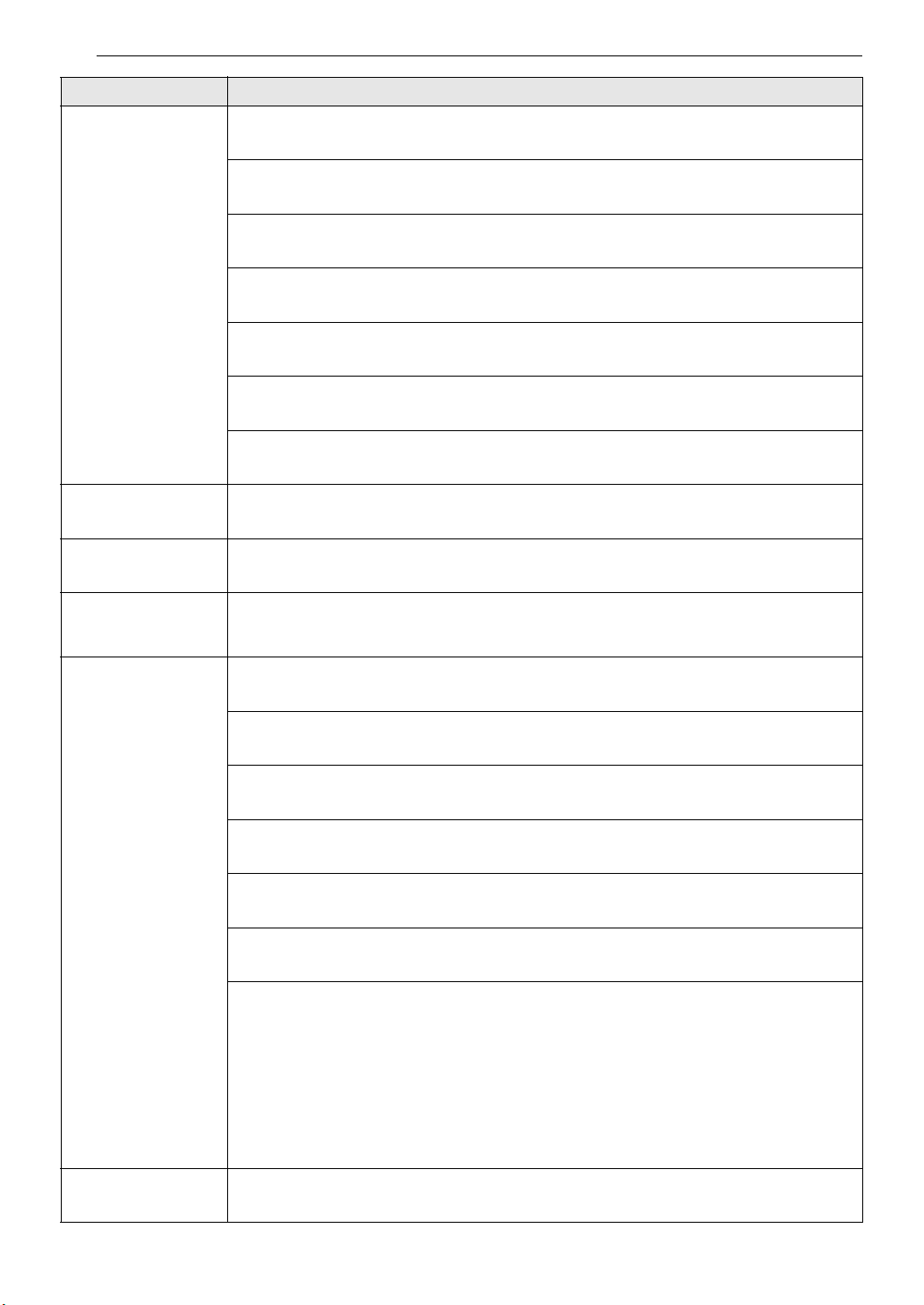
42 TROUBLESHOOTING
Food soil remains on
dishes.
Improper cycle selection.
• Select correct cycle based on soil level and type of dishware being washed.
Water temperature is too low.
• Check water supply connection or water heater setting.
Dishwashing detergent was not used.
• Use recommended detergent.
Low inlet water pressure.
• Water pressure should be between 20 and 80 psi.
Water jet holes on spray arms blocked.
• Clean the spray arms.
Improper loading of dishes.
• Make sure dishes do not block spray arm rotation or interfere with detergent dispenser.
Filters are clogged.
• Clean filters.
Cloudiness on
glassware.
Combination of excessive detergent and hard water.
• Use less detergent and use a rinse aid to minimize the problem.
Black or gray marks
on dishes.
Aluminum items rubbing dishes during cycle.
• Reposition the dishes.
Yellow or brown film
on inside surfaces of
dishwasher.
Coffee or tea stains.
• Eliminate the stain by using a stain removal product.
Spots and filming on
dishes.
Low water temperature.
• Water supply should be at least 120 °F for best wash performance.
Overloading.
• Do not overload the dishwasher.
Improper loading.
• See the Operation section.
Insufficient water pressure.
• Water pressure should be between 20 and 80 psi.
Insufficient detergent.
• Add the recommended amount of detergent. See the Operation section.
Rinse aid dispenser is empty.
• Refill rinse aid dispenser.
Hard water buildup in the tub.
• Remove all dishes, silverware and silverware holder from dishwasher. Only racks should
remain in tub. For best results, use citric acid powder (can be found in canning sections of
most grocery stores or online). Measure 3 tablespoons (40 g) of citric acid powder. Fill main
wash compartment with measured powder. If you cannot find citric acid powder, pour
approximately one cup (200 ml - 300 ml) of white vinegar into shallow bowl and place in
upper rack. Run Machine Clean cycle. Do not use detergent.
• Adjust the water hardness level setting to match the water supply conditions in your
area.In areas with hard water, remember to refill the softener with dishwasher salt.
Dishes don’t dry. Rinse aid dispenser empty.
• Check and refill the rinse aid dispenser if empty.
Problem Possible Cause & Solution
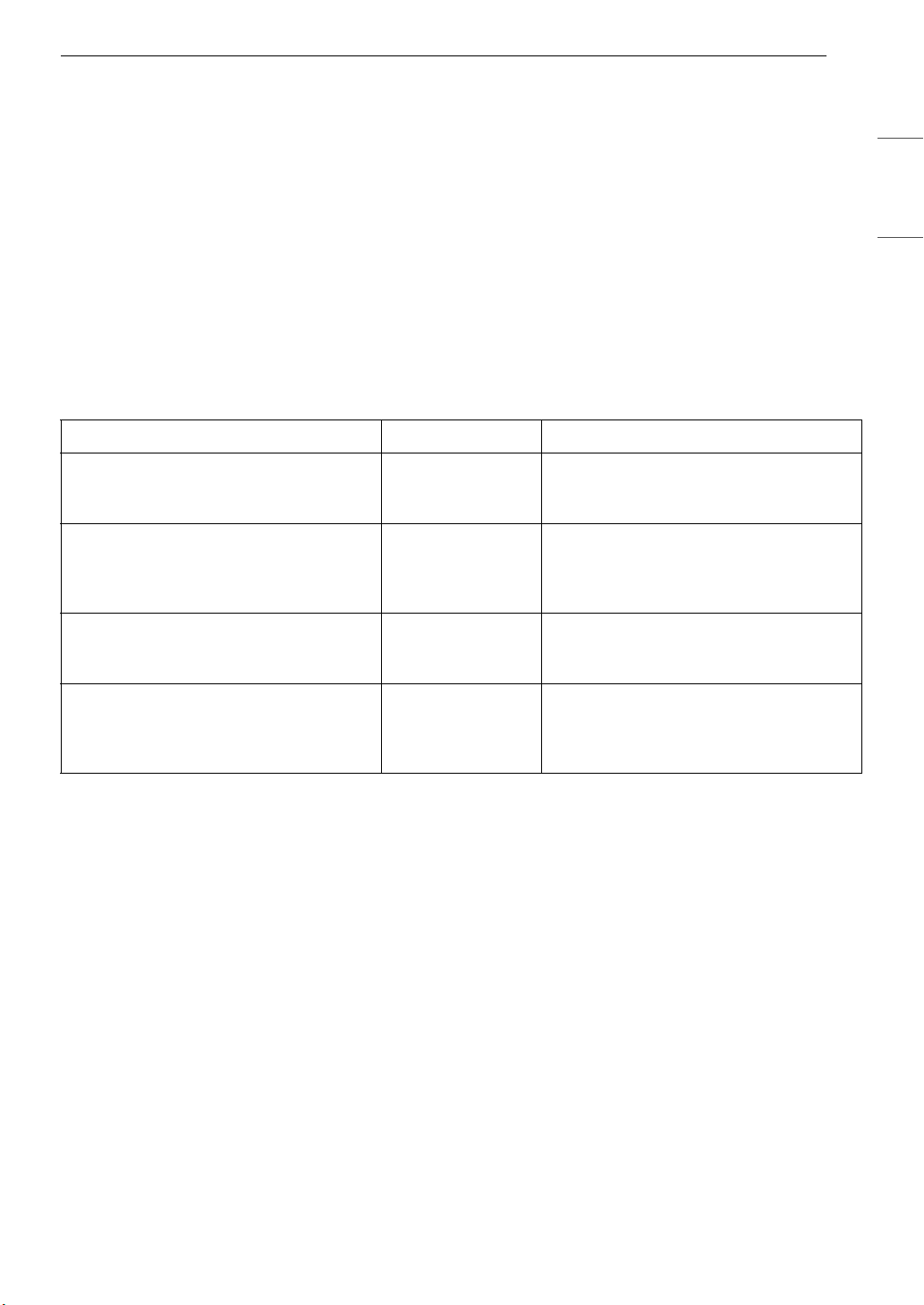
43LIMITED WARRANTY
ENGLISH
LIMITED WARRANTY
USA
TERMS AND CONDITIONS
ARBITRATION NOTICE: THIS LIMITED WARRANTY CONTAINS AN ARBITRATION PROVISION THAT
REQUIRES YOU AND LG TO RESOLVE DISPUTES BY BINDING ARBITRATION INSTEAD OF IN COURT, UNLESS
YOU CHOOSE TO OPT OUT. IN ARBITRATION, CLASS ACTIONS AND JURY TRIALS ARE NOT PERMITTED.
PLEASE SEE THE SECTION TITLED “PROCEDURE FOR RESOLVING DISPUTES” BELOW.
Should your LG Dishwasher fail due to a defect in materials or workmanship under normal home use,
during the warranty period set forth below, LG will at its option repair or replace the product. This limited
warranty is valid only to the original retail purchaser of the product and applies only when purchased and
used within the United States, including U.S. Territories. Proof of original retail purchase is required to
obtain warranty service under this limited warranty.
† Main control board is located on the bottom right of the dishwasher when viewed from the front.
• Replacement products and parts are warranted for the remaining portion of the original warranty period
or ninety (90) days, whichever is greater.
• Replacement products and parts may be new or remanufactured.
THIS WARRANTY IS IN LIEU OF ANY OTHER WARRANTY, EXPRESS OR IMPLIED, INCLUDING WITHOUT
LIMITATION, ANY WARRANTY OF MERCHANTABILITY OR FITNESS FOR A PARTICULAR PURPOSE. TO
THE EXTENT ANY IMPLIED WARRANTY IS REQUIRED BY LAW, IT IS LIMITED IN DURATION TO THE
EXPRESS WARRANTY PERIOD ABOVE. NEITHER THE MANUFACTURER NOR ITS U.S. DISTRIBUTOR
SHALL BE LIABLE FOR ANY INCIDENTAL, CONSEQUENTIAL, INDIRECT, SPECIAL, OR PUNITIVE
DAMAGES OF ANY NATURE, INCLUDING WITHOUT LIMITATION, LOST REVENUES OR PROFITS, OR ANY
OTHER DAMAGE WHETHER BASED IN CONTRACT, TORT, OR OTHERWISE.
Some states do not allow the exclusion or limitation of incidental or consequential damages or limitations
on how long an implied warranty lasts, so the above exclusion or limitation may not apply to you. This
warranty gives you specific legal rights and you may also have other rights that vary from state to state.
THIS LIMITED WARRANTY DOES NOT COVER:
• Service trips to deliver, pick up, or install or repair the product; instruction to the customer on operation
of the product; repair or replacement of fuses or correction of wiring or plumbing, or correction of
unauthorized repairs/installation.
Warranty Period Scope of Warranty HOW SERVICE IS HANDLED
One (1) year from date of original retail
purchase
Labor / Parts LG will also provide, free of charge, all
labor and on-site service to replace the
defective part.
Five (5) years from date of original retail
purchase
Main control
board
†
/ Racks
Main control board and dishwasher racks.
Customer will be responsible for any labor
or in-home service to replace defective
parts.
Ten (10) years from date of original retail
purchase
Direct Drive Motor Direct Drive motor. Customer will be
responsible for any labor or in-home
service to replace defective parts.
Limited Lifetime Tub Stainless steel door liner and tub.
Customer will be responsible for any labor
or in-home service to replace defective
parts.

44 LIMITED WARRANTY
• Failure of the product to perform during power failures and interrupted or inadequate electrical service.
• Damage caused by leaky or broken water pipes, frozen water pipes, restricted drain lines, inadequate or
interrupted water supply or inadequate supply of air.
• Damage resulting from operating the product in a corrosive atmosphere or contrary to the instructions
outlined in the product’s owner’s manual.
• Damage to the product caused by accidents, pests and vermin, lightning, wind, fire, floods, or acts of
God.
• Damage or failure caused by unauthorized modification or alteration, or if it is used for other than the
intended purpose, or any water leakage where the unit was not properly installed.
• Damage or failure caused by incorrect electrical current, voltage, or plumbing codes, commercial or
industrial use, or use of accessories, components, or consumable cleaning products that are not
approved by LG.
• Damage caused by transportation and handling, including scratches, dents, chips, and/or other damage
to the finish of your product, unless such damage results from defects in materials or workmanship and
is reported within one (1) week of delivery.
• Damage or missing items to any display, open box, discounted, or refurbished product.
• Products with original serial numbers that have been removed, altered, or cannot be readily determined.
Model and serial numbers, along with original retail sales receipts, are required for warranty validation.
• Increases in utility costs and additional utility expenses.
• Repairs when your product is used for other than normal and usual household use (e.g. commercial use,
in offices and recreational facilities) or contrary to the instructions outlined in the product’s owner’s
manual.
• Costs associated with removal of your product from your home for repairs.
The cost of repair or replacement under these excluded circumstances shall be borne by the
consumer.
TO OBTAIN WARRANTY SERVICE AND ADDITIONAL INFORMATION
For additional product information, visit the LG website at http://www.lg.com
For assistance using this product or to schedule service, contact LG Electronics at 1-800-243-0000.
For further assistance, write: LG Electronics, 201 James Record Road, Huntsville, Alabama 35813

45LIMITED WARRANTY
ENGLISH
PROCEDURE FOR RESOLVING DISPUTES:
ALL DISPUTES BETWEEN YOU AND LG ARISING OUT OF OR RELATING IN ANY WAY TO THIS LIMITED
WARRANTY OR THE PRODUCT SHALL BE RESOLVED EXCLUSIVELY THROUGH BINDING ARBITRATION, AND
NOT IN A COURT OF GENERAL JURISDICTION. BINDING ARBITRATION MEANS THAT YOU AND LG ARE EACH
WAIVING THE RIGHT TO A JURY TRIAL AND TO BRING OR PARTICIPATE IN A CLASS ACTION.
Definitions. For the purposes of this section, references to “LG” mean LG Electronics U.S.A., Inc., its
parents, subsidiaries and affiliates, and each of their officers, directors, employees, agents, beneficiaries,
predecessors in interest, successors, assigns and suppliers; references to “dispute” or “claim” shall include
any dispute, claim or controversy of any kind whatsoever (whether based in contract, tort, statute,
regulation, ordinance, fraud, misrepresentation or any other legal or equitable theory) arising out of or
relating in any way to the sale, condition or performance of the product or this Limited Warranty.
Notice of Dispute. In the event you intend to commence an arbitration proceeding, you must first notify
LG in writing at least 30 days in advance of initiating the arbitration by sending a letter to LG at LG
Electronics, USA, Inc. Attn: Legal Department- Arbitration 111 Sylvan Avenue, Englewood Cliffs, NJ 07632.
You and LG agree to engage in good faith discussions in an attempt to amicably resolve your claim. The
notice must provide your name, address, and telephone number; identify the product that is the subject of
the claim; and describe the nature of the claim and the relief being sought. If you and LG are unable to
resolve the dispute within 30 days, either party may proceed to file a claim for arbitration.
Agreement to Binding Arbitration and Class Action Waiver. Upon failure to resolve the dispute during
the 30 day period after sending written notice to LG, you and LG agree to resolve any claims between us
only by binding arbitration on an individual basis, unless you opt out as provided below. Any dispute
between you and LG shall not be combined or consolidated with a dispute involving any other person’s or
entity’s product or claim. More specifically, without limitation of the foregoing, any dispute between you
and LG shall not under any circumstances proceed as part of a class or representative action. Instead of
arbitration, either party may bring an individual action in small claims court, but that small claims court
action may not be brought on a class or representative basis.
Arbitration Rules and Procedures. To begin arbitration of a claim, either you or LG must make a written
demand for arbitration. The arbitration will be administered by the American Arbitration Association
(“AAA”) and will be conducted before a single arbitrator under the AAA’s Consumer Arbitration Rules that
are in effect at the time the arbitration is initiated (referred to as the “AAA Rules”) and under the
procedures set forth in this section. The AAA Rules are available online at www.adr.org/consumer. Send a
copy of your written demand for arbitration, as well as a copy of this provision, to the AAA in the manner
described in the AAA Rules. You must also send a copy of your written demand to LG at LG Electronics,
USA, Inc. Attn: Legal Department- Arbitration 111 Sylvan Avenue, Englewood Cliffs, NJ 07632. If there is a
conflict between the AAA Rules and the rules set forth in this section, the rules set forth in this section will
govern. This arbitration provision is governed by the Federal Arbitration Act. Judgment may be entered on
the arbitrator’s award in any court of competent jurisdiction. All issues are for the arbitrator to decide,
except that issues relating to the scope and enforceability of the arbitration provision and to the
arbitrability of the dispute are for the court to decide. The arbitrator is bound by the terms of this
provision.
Governing Law. The law of the state of your residence shall govern this Limited Warranty and any
disputes between us except to the extent that such law is preempted by or inconsistent with applicable
federal law.
Fees/Costs. You do not need to pay any fee to begin an arbitration. Upon receipt of your written demand
for arbitration, LG will promptly pay all arbitration filing fees to the AAA unless you seek more than $25,000
in damages, in which case the payment of these fees will be governed by the AAA Rules. Except as
otherwise provided for herein, LG will pay all AAA filing, administration and arbitrator fees for any
arbitration initiated in accordance with the AAA Rules and this arbitration provision. If you prevail in the
arbitration, LG will pay your attorneys’ fees and expenses as long as they are reasonable, by considering
factors including, but not limited to, the purchase amount and claim amount. Notwithstanding the
foregoing, if applicable law allows for an award of reasonable attorneys’ fees and expenses, an arbitrator
can award them to the same extent that a court would. If the arbitrator finds either the substance of your
claim or the relief sought in the demand is frivolous or brought for an improper purpose (as measured by
the standards set forth in Federal Rule of Civil Procedure 11(b)), then the payment of all arbitration fees will
be governed by the AAA Rules. In such a situation, you agree to reimburse LG for all monies previously
disbursed by it that are otherwise your obligation to pay under the AAA Rules. Except as otherwise

46 LIMITED WARRANTY
provided for, LG waives any rights it may have to seek attorneys’ fees and expenses from you if LG prevails
in the arbitration.
Hearings and Location. If your claim is for $25,000 or less, you may choose to have the arbitration
conducted solely on the basis of (1) documents submitted to the arbitrator, (2) through a telephonic
hearing, or (3) by an in-person hearing as established by the AAA Rules. If your claim exceeds $25,000, the
right to a hearing will be determined by the AAA Rules. Any in-person arbitration hearings will be held at a
location within the federal judicial district in which you reside unless we both agree to another location or
we agree to a telephonic arbitration.
Opt Out. You may opt out of this dispute resolution procedure. If you opt out, neither you nor LG can
require the other to participate in an arbitration proceeding. To opt out, you must send notice to LG no
later than 30 calendar days from the date of the first consumer purchaser’s purchase of the product by
either: (i) sending an e-mail to opto[email protected], with the subject line: “Arbitration Opt Out” or (ii) calling 1-
800-980-2973. You must include in the opt out e-mail or provide by telephone: (a) your name and address;
(b) the date on which the product was purchased; (c) the product model name or model number; and (d)
the serial number (the serial number can be found (i) on the product; or (ii) online by accessing https://
www.lg.com/us/support/repair-service/schedule-repair-continued and clicking on “Find My Model & Serial
Number”).
You may only opt out of the dispute resolution procedure in the manner described above (that is, by e-mail
or telephone); no other form of notice will be effective to opt out of this dispute resolution procedure.
Opting out of this dispute resolution procedure will not affect the coverage of the Limited Warranty in any
way, and you will continue to enjoy the full benefits of the Limited Warranty. If you keep this product and
do not opt out, then you accept all terms and conditions of the arbitration provision described above.

47Memo
LG Customer Information Center
Register your product Online!
www.lg.com
For inquiries or comments,
visit www.lg.com or call:
1-800-243-0000
U.S.A.
1-888-542-2623
CANADA