AINT7000
OPERATION MANUAL
APPLIANCES
FOR LIVING

Congratulations, you are now the proud owner of an ARTUSI cooking appliance. Thank you for purchasing ARTUSI
and welcome to the ARTUSI Family.
This instruction manual has been specially created to inform you of the full range of features your ARTUSI appliance
has to offer and serves as an introduction to getting the very best out of your ARTUSI appliance.
We present detailed information on each of the features your ARTUSI appliance consists of. Once you have read
this section you will be able to choose the most appropriate settings for your appliance when cooking different types
of food.
We ask you to read the instructions in this booklet very carefully as this will allow you to get the best results from
using your appliance. KEEP THE DOCUMENTATION OF THIS PRODUCT FOR FUTURE REFERENCE.
TO REGISTER YOUR PRODUCT WITH ARTUSI, PLEASE FILL OUT THE WARRANTY CARD AT THE END OF
THIS BOOKLET AND POST IT TO:
REPLY PAID 83617
LEICHHARDT NSW 2040
Dear Artusi Customer, please read this user manual carefully before using the product and, keep it permanently at
your disposal.
Note: This user manual is prepared for more than one model. Some of the features specified in this Manual may not
be available on your appliance.
All our appliances are only for domestic use, not for commercial use. Products marked with (*) are optional.
“THIS APPLIANCE SHALL BE INSTALLED IN ACCORDANCE WITH THE REGULA TIONS FORCE AND ONLY
USED IN A WELL VENTILATED SPACE. READ THE INSTRUCTIONS BEFORE INSTALLING OR USING THIS
APPLIANCE”
“Conforms with the WEEE Regulations.”

2
Contents:
3 Important information
5 Important notes
5 Before first use
6 Important notes on use of the fridge
7 Important notes on use of the freezer
8 Crisper drawer humidity adjustment
9 Storage
10 Control panel
12 Defrosting the freezer
12 Defrosting the fridge
13 Care and cleaning
14 Troubleshooting
16 Installation preparation
17 Cabinet dimensions
17 Ventilation requirements
19 Installation into the cabinet
20 Mounting the fascia doors
22 Reversing the appliance doors
23 Electrical information
25 Climate range
26 Practical tips
3
Important
The manufacturer cannot be held responsible for injuries or losses
caused by incorrect use or installation of this product. Please note
that we reserve the right to invalidate the guarantee supplied with this
product following incorrect installation or misuse of the appliance.
This appliance is not designed to be used by people (including
children) with reduced physical, sensorial or mental capacity, or
who lack experience or knowledge about it, unless they have had
supervision or instructions on how to use the appliance by someone
who is responsible for their safety.
Under no circumstances should any external covers be removed for
servicing or maintenance except by suitably qualifi
ed personnel.
Appliance information:
Please enter the details on the appliance rating plate below for
reference, to assist ........ in the event of a fault with your appliance and
to register your appliance for guarantee purposes.
Appliance Model
Serial Number
EU Declarations of Conformity:
This appliance has been designed, constructed and marketed in
compliance with safety requirements of EU Directive 2014/35/EU (Low
voltage) and requirements of EU Directive 2014/30/EU (EMC).

4
This appliance has been manufactured to the strictest standards and
complies with all applicable legislation, including Electrical safety (LVD)
and Electromagnetic interference compatibility (EMC). Parts intended
to come into contact with food conform to 1935/2004/EC.
This refrigeration appliance is intended for use as a built-in appliance.
IMPORTANT INFORMATION FOR CORRECT DISPOSAL OF THE
PRODUCT IN ACCORDANCE WITH EC DIRECTIVE 2012/19/EU.
At the end of its working life, the product must not be disposed of as
urban waste. The refrigeration system contains insulating gases and
refrigerants, which require specialised waste disposal. The valuable
materials contained in this appliance can be recycle. It must be taken
to a special local authority dierentiated waste collection centre or to
a dealer providing this service.
Before disposing of an old appliance, remove the door seals etc. to
reduce the risk of child entrapment.
Disposing of a household appliance separately avoids possible
negative consequences for the environment and health deriving from
inappropriate disposal and enables the constituent materials to be
recovered to obtain significant savings in energy and resources. As a
reminder of the need to dispose of household appliances separately,
the product is marked with a crossed-out wheeled dustbin.

5
Important
• Never store inflammable or explosive items and strong corrosive
acids or alkalis in the appliance.
• This is a household appliance, which is produced in accordance
with the national standard. It is intended for food storage only, not
for storage of blood, medicine and biological products.
• To prevent risk of fire, keep the appliance away from petrol or any
other inflammables.
• To prevent risk of electromagnetic interference or other accidents,
do not place a microwave oven on top of the refrigerator or use
any electric appliance inside the refrigerator.
• Do not allow children to play with or near the appliance.
• The internal surface of freezer compartment is very cold when the
appliance is running. Do not touch the surface especially when
hands are wet.
• Do not splash water onto the appliance. Keep it away from places
of high humidity that may have adverse effect on the electric
insulation performance.
• This appliance is designed to be used in ambient temperatures
between 16
and 43˚C. Use outside of this range may cause the
appliance to fail.
Before first use
You must allow the fridge to settle for at least twenty four hours
prior to switching the power on.
It is recommended that you clean the interior of the appliance prior to
first use, using a solution of bicarbonate of soda and warm water and
then thoroughly drying the interior.

6
The fridge may have an odour to it at first use. This will disappear as
the appliance cools.
Please note:
If you switch the appliance o, you should allow five minutes
before switching it on again to prevent unnecessary damage to the
compressor.
Never store inflammable or explosive items and strong corrosive
acids or alkalis in the appliance.
This fridge cools your food by making the inside back of the cavity
cold. It is normal for frost to build up on this surface; it then dissipates
and drains through a small drain at the bottom, where it evaporates
harmlessly.
Fridge use
• Never put liquids in the refrigerator uncovered.
• Never put hot foods in the refrigerator. Warm food should be
allowed to cool to room temperature before being put into the
refrigerator.
• Nothing should rest against the rear wall of the refrigerator, as this
will cause frost and possible condensation problems which will be
dicult to remove.
• Make sure food is clean and any extra water is wiped away before
putting into the fridge.
•
Wrap or cover food before putting into the fridge. This will
help prevent the loss of moisture, keep food fresh and avoid
unpleasant odours.

7
• Sort foods prior to storing. Any foods to be used soon should be
stored at the front of the shelf to prevent deterioration caused by
the door being open for prolonged periods.
•
Do not overfill the fridge. There should be sucient space
between the foods to allow the cool air to circulate.
•
Thawing frozen foods in the fridge compartment will help to keep
the temperature low and save energy.
•
Never store raw meats on shelves above cooked meats or other
produce. This will help to prevent juices from raw meat contaminating
other foodstus.
Freezer use
• The freezer compartments are designed to store only frozen food.
• Never put hot or warm foods in the freezer, allow them to cool fully
before putting them into the freezer.
• Follow the instructions on the food packaging for storage of frozen
food. If no information is provided, foods should not be stored for
more than three months after the purchase date.
• Store food in small packages (ideally less than 1kg). This reduces
the freezing time and improves the quality of the food after
thawing.
•
Wrap food before putting into the freezer. To stop the wrapping
sticking together, ensure it is dry.
• Label the food before freezing with information including type of
food and dates of storage and expiry.
•
Once food is thawed, it must not be refrozen. Only defrost as
much food as is required to prevent wastage.
8
• Bottled or canned drinks should not be stored in the freezer
compartments as they could explode.
• The maximum amount of fresh food that can be frozen within a 24
hour period is 3.8 kg for this Model
• Do not attempt to freeze more than the maximum amount.
• To freeze fresh food more quickly, switch on the super freeze
function a few hours prior to placing the food in the freezer.
Note: If the appliance does not have a freezer compartment (
)it
is not suitable for freezing foodstus.
Crisper drawer humidity adjustment
The crisper drawer within this appliance features a humidity level
adjustment slider. Vegetables and similar produce that are subject to
wilting (e.g. rocket, spinach leaves, herbs such as basil etc.) should
be kept in the crisper drawer and the adjustment slider kept closed
(fully to the left - high). By keeping the adjustment slider closed, water
vapour is held in the drawer and subsequently greens are kept crisper
and fresher for longer.
By contrast, fruits that are susceptible to rotting should be stored in
the crisper drawer with the humidity adjustment slider fully open (to
the right - low). This will allow gases, emitted by certain produce and
that accelerate the rotting process, to exit the crisper drawer. The
drawer is marked high and low with vegetable and fruit symbols to aid
you.
9
Storage
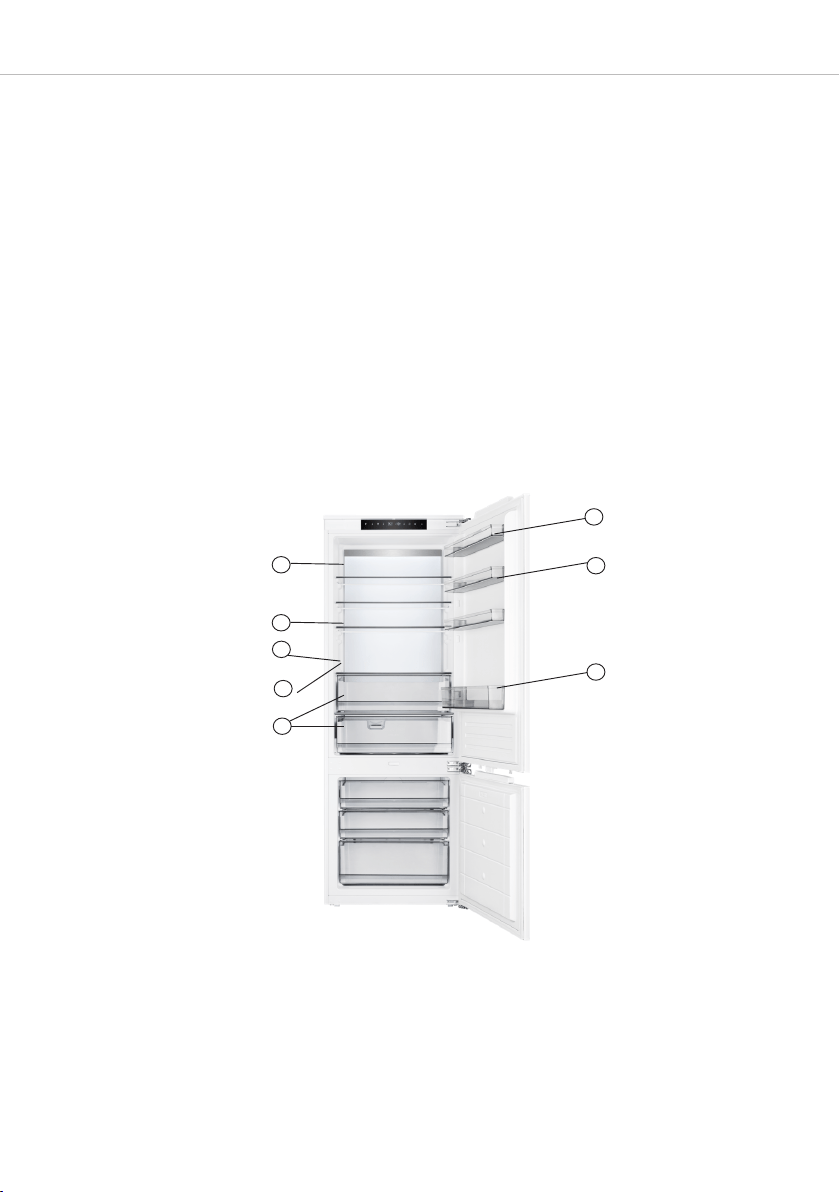
The fridge section is for short term food storage. Although low
temperatures can be maintained, extended periods of food storage
is not recommended. As the cold air circulates within the fridge, the
temperature can vary between the dierent sections. As such, foods
should be stored in dierent sections according to type. Section 7 is
the coldest part of the fridge.
1. Butter, cheeses etc.
2. Food in jars and bottles
3. Drinks, e.g. milk
4. Cooked food
5. Ready meals etc
6. Y
ogurts, preserves etc
7. Fresh meat and fish
8. Fruit and vegetables
The fridge shelves can be moved according to the storage
requirements within the fridge section. To move the shelf, lift up the
rear section and then pull it outwards. To replace, slide the shelf back
into the slot, and then lower the rear section.
6
7
8
4
5
1
3
2
10
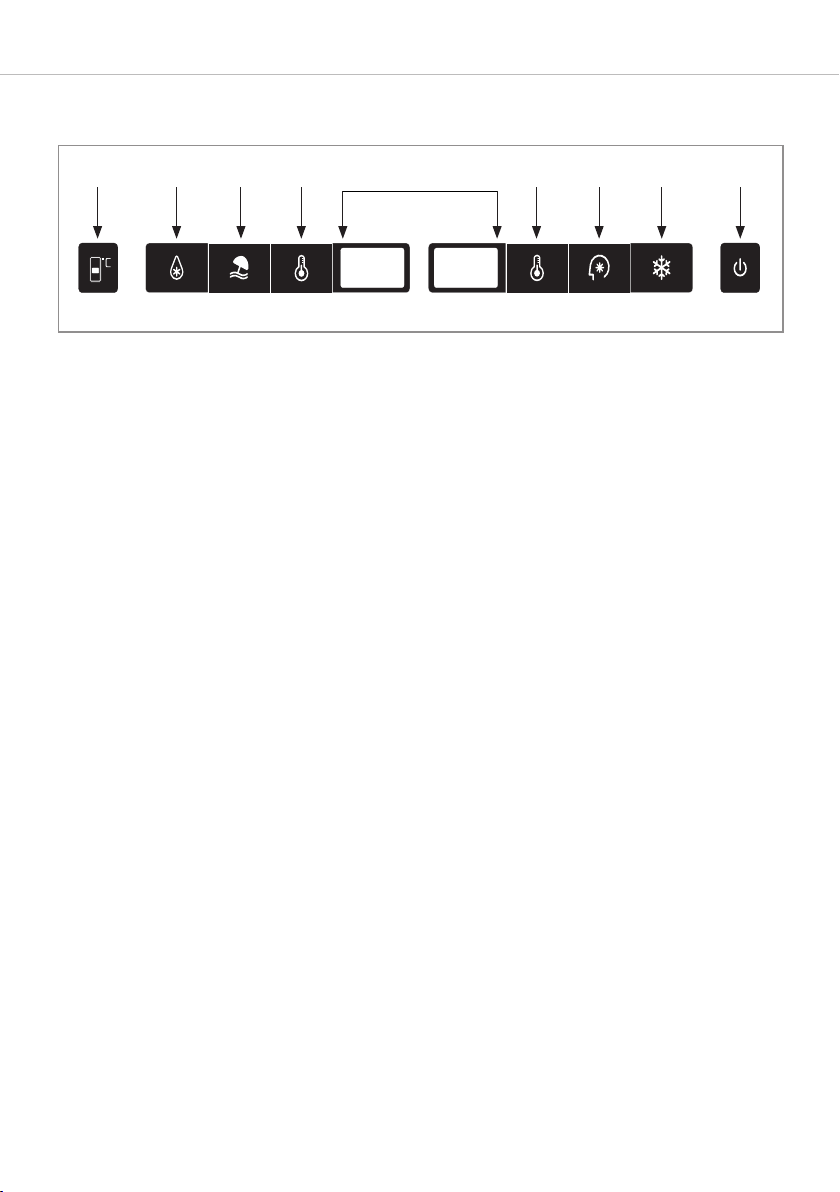
Control Panel
A. Fresh zone temperature adjustment sensor
This button is used to adjust the temperature within the adapt
zone. Press this button once to alter the display to show the current
temperature in the adapt zone, and then as many times as necessary
until the desired level is selected. The settings range from -2°C and
3°C
B. Fast cooling function
Pressing this button will cause the fridge to operate at 2°C and
automatically turns o after 2 and a half hours, during this time the
button will be illuminated
C. Holiday function
Pressing this button activates the holiday function and the fridge
temperature will operate at 17°C and the freezer at -18°C
Fig. 3
A B C D Display E F G H

11
D. Fridge temperature adjustment
This button is used to adjust the temperature within the fridge. Press
this button once to activate adjustment, and then as many times as
necessary until the desired level is selected
Display
This is where you can see the current temperature in the fridge (left)
and freezer (right)
E. Freezer temperature adjustment
This button is used to adjust the temperature within the freezer. Press
this button once to activate adjustment, and then as many times as
necessary until the desired level is selected
F. Smart function
This button automatically sets the fridge temperature to 5°C and the
freezer temperature to -18°C
G. Fast freezing function
Pressing this button automatically starts the freezer working at
a temperature of -25°C. After 6 hours the function stops and the
temperature will revert back to its previous setting
H. On/o button
Hold this button down for 3 seconds to switch the appliance on or o

12
Defrosting the freezer
The freezer has a no frost system which is designed to prevent the
heavy build up of ice. Under normal use, there should be no need to
regularly defrost the freezer system.
To help in times of service or cleaning, the appliance has a forced
defrost mode which can be activated by touching and holding
sensors E and H in Fig. 3 for approximately 3 seconds. The
refrigerator temperature adjustment sensor (A) will flash to confirm
that the forced defrost function is active. This function should
automatically deactivate once the freezer temperature has reached
between 10 and 12°C.
Please note: If you are regularly finding a heavy build up of ice, or
pools of water, in the freezer section then it is likely that the door is
not sealing properly. This could be due to a defective door seal or an
incorrectly fitted, or overly heavy, decor door. For more information
see the troubleshooting section on ice on page 14.
Defrosting the fridge
The fridge is self-defrosting. Any water created will run out of the
fridge through the channel at the back of the fridge. The defrosted
water is collected in the evaporating tray at the back of the appliance
and dissipated by evaporation.

13
Care and cleaning
Always disconnect the appliance from the power supply before any
cleaning or maintenance.
The fridge and freezer sections should be cleaned using a solution
of bicarbonate of soda and lukewarm water. Do not use abrasive
products or detergents. After washing, rinse and dry thoroughly.
Clean the shelves and balconies separately by hand with a mild
solution of washing up liquid and water. Do not put them in the
dishwasher.
If the appliance is not to be used for prolonged periods of time, unplug
and clean the appliance. The doors should be left slightly ajar to
prevent the formation of mildew and unpleasant odours.

14
T
roubleshooting
If you have any problems with your appliance, you should check
the troubleshooting prior to calling ...Customer Care.
If the appliance is not working, check:
• That there is power to the appliance.
• The house fuses are intact and the fuse in the plug has not blown.
• The fridge has not been turned o (page 10).
• The plug socket is functioning fine. To check this, plug another
electrical appliance in to see if the socket is faulty.
If the appliance is working, but not very well, check:
• The appliance is not overloaded.
• The thermostat is set to an appropriate temperature.
• The doors are closing properly.
• The cooling system at the rear of the appliance is clean and free of
dust, and not touching the rear wall.
• There is enough ventilation at the side and rear walls.
If the appliance is noisy, check:
• The appliance is level and stable.
• The side and rear walls are clear, and there is nothing resting on the
appliance.
• Note: The cooling gas in the refrigerator may make a slight bubbling
or gurgling noise, even when the compressor is not running.
If the appliance is beeping, check:
• That the doors are closed. An alarm will sound after 60 seconds of
a door being open.
If there’s water in the base of the refrigerator compartment, check:
• The drain hole at the back of the compartment is clear (page 11).

15
If ice has formed on the back wall of the fridge:
• It is normal for some ice droplets to form on the back wall of the
fridge. This does not constitute a fault with the appliance.
•
Ensure that no items inside the fridge are in contact with the back
wall.
• Check that there is some resistance when opening the door of the
appliance. If it opens at the slightest touch it may mean that the door
seal needs to be replaced.
• Check the door seal for any kinks, debris or damage. If you notice
any, and are unable to resolve the issue yourself, contact ...
Customer Care so that the seal can be replaced.
• This can be due to the decor door(s) not being properly fitted. If you
are at all unsure, ask your fitter to check the decor doors.
If excessive ice has formed in the freezer:
• Check that there is some resistance when opening the door of the
appliance. If it opens at the slightest touch it may mean that the door
seal needs to be replaced.
•
Check the door seal for any kinks, debris or damage. If you notice
any, and are unable to resolve the issue yourself, contact ...
Customer Care so that the seal can be replaced.
• This can be due to the decor door(s) not being properly fitted. If you
are at all unsure, ask your fitter to check the decor doors.
If one or more of the LED units within the appliance is not working:
• Contact ... Customer Care to arrange a service visit.

16
Installation preparation
This appliance must never be installed close to heat sources, e.g.
heating elements or cookers, nor in damp places.
Seek the help of another individual, or two, when installing this
appliance. This appliance may have sharp edges. Wear adequate
PPE for the task and environment.
• To ensure the appliance is level, you should use the height
adjustable feet at the front of the appliance.
• The cooling system at the rear of the appliance must not touch the
rear wall. The greater the gap, the better.
• The appliance must be installed with adequate ventilation. Ensure
that there is clearance above the appliance to allow air to escape
and that there is space between the rear of the appliance and the
wall.
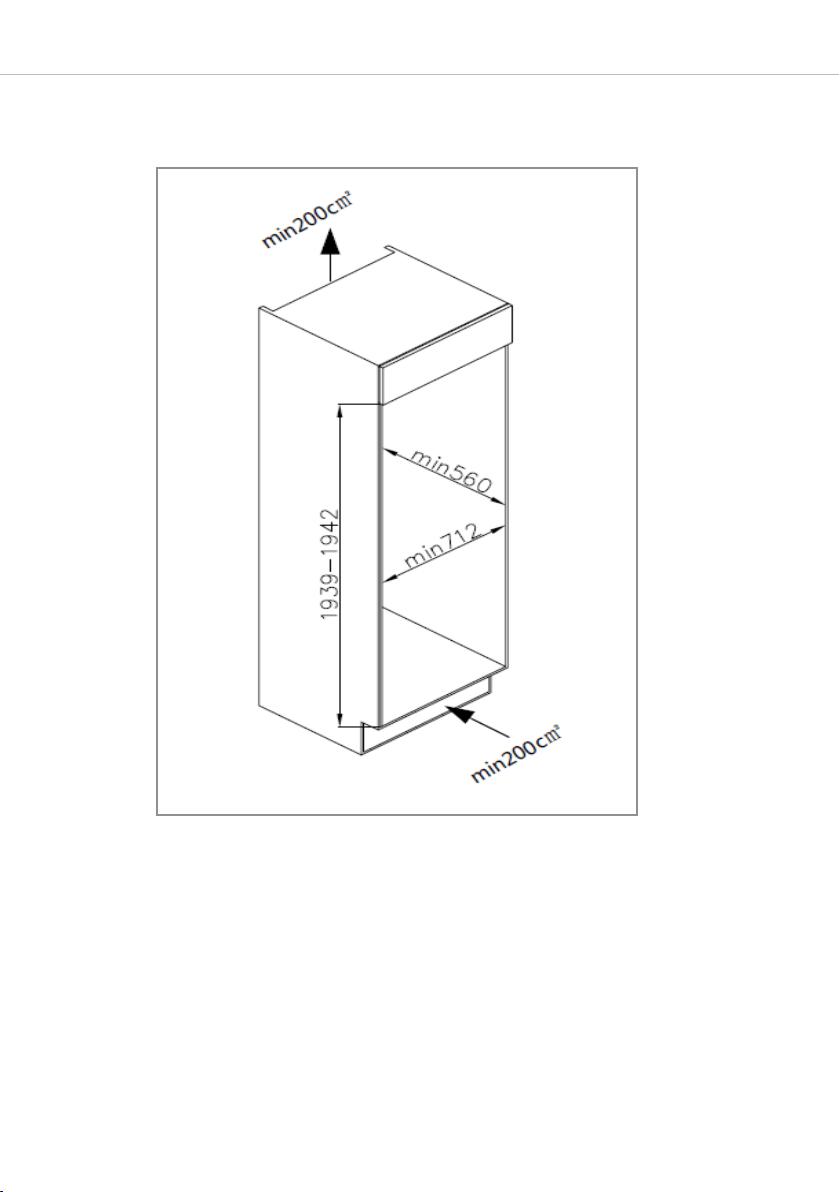
Fig. 6
17
Ventilation
The main consideration when installing any refrigeration unit into
a fitted kitchen is ventilation. The heat removed from the cooling
compartment needs to be dissipated into the atmosphere. Incorrect
ventilation can lead to premature compressor failure, excessive
power consumption, total system failure and may invalidate the
warranty provided with the appliance. For products intended to be
installed into a tall housing unit, the requirements on the following
page need to be met:
Cabinet dimensions
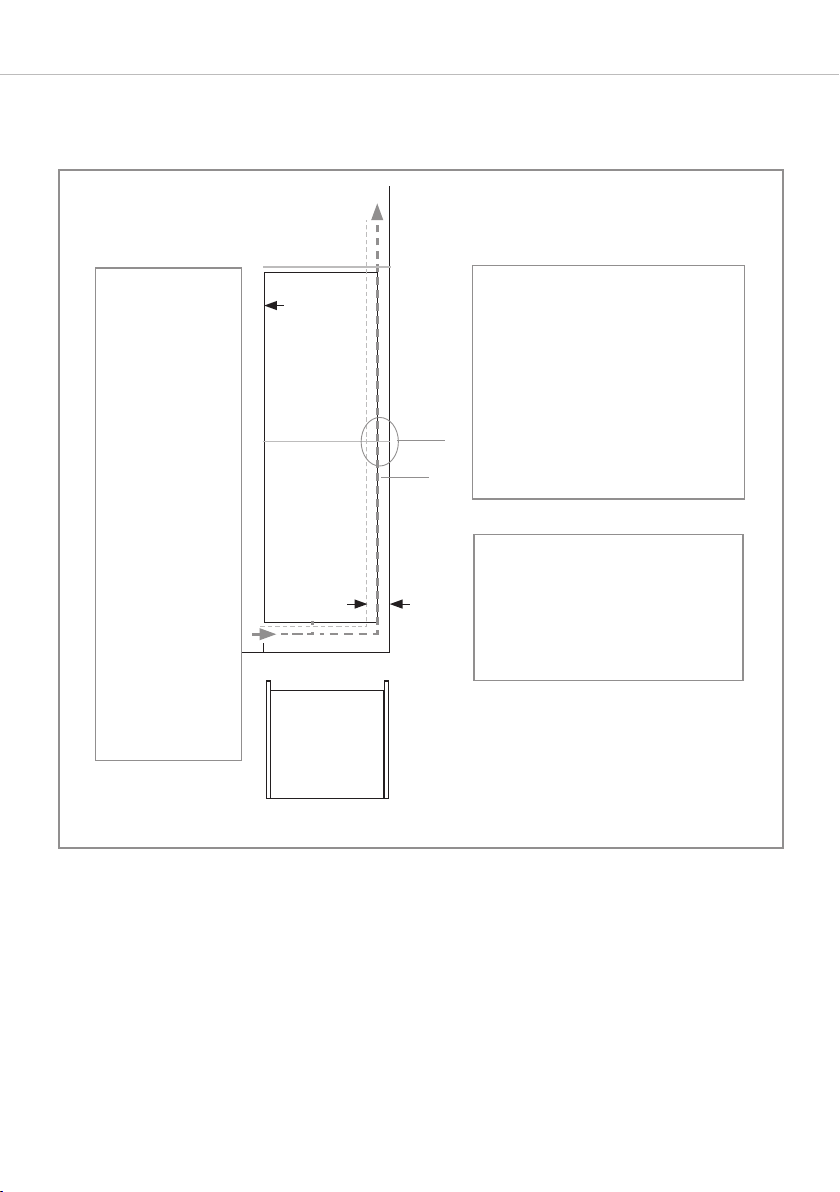
18
The open channel at the rear is clearly shown. For the correct
operation of the appliance it is important that the top of the housing
unit is not blocked o. A channel depth of 40-50mm is normal with
most units.
A ventilation hole is required in the plinth of the unit; this allows air to
plan view of rear ventilation gap
The top of the cabinet needs to be
vented into the room
Recommended size of vent opening:
500 x 40mm
If the furniture does not allow free air
into the room then a plinth vent, or other
means of ventilation needs to be pro-
vided to ensure a natural flow of air
There should be space at the rear of the
cabinet to allow cool air to be drawn over
the condenser.
Recommended:
500 x 40mm
An air intake
should be provided
somewhere in
the cabinet run to
allow free air in.
In this example, a
plinth vent is shown
underneath the
refrigerator .
A cutout should be
made in the plinth
below the fridge/
freezer and this
finished neatly using
the air vent grille
supplied.
Alternatively, a thin
section of the plinth
can be removed
to allow air into the
unit (recommended
600mm x 10mm).
Refrigerator
outline
Min 30mm
Fig. 7

19
be drawn over the compressor & heat exchange. A decorative grille
is supplied with the appliance to finish this vent neatly. Alternatively
the required air flow can be achieved by removal of a thin section of
plinth (600mm x 10mm minimum).
As a rule, the more air that can get in and out, the better and more
ecient the operation of the product.
Installation into the cabinet
To ensure the appliance is level, you should use the height adjustable
feet at the front of the appliance. The ventilation system at the bottom
of the appliance must not be blocked
Push the appliance carefully into the cavity, make sure the appliance
is in the central position of the cavity. Following the steps on the next
page to fit the decor door, ensuring the door can be opened and
closed properly then tighten the screws on the top, hinge side and the
bottom.

20
Mounting the fascia doors
2
1
Fig. 9 - Fitting the decor door bracket
Remove the white decorative cover (Fig. 8) by lifting it upwards.
Obtain the below measurements:
Dimension B =
Measure
from the underside surface
of kitchen unit to the bottom
of fixing bracket.
Dimension C =
Measure
from the underside surface
of kitchen unit to the top of
next unit door.
Unscrew and remove the
nuts and washers from the
top of the appliance door to remove
the bracket.
Fig. 10 - Fitting the decor door
bracket
Subtract C from B and put the
fixing bracket (2) in place using this
measurement for vertical position
and place to the centre for horizontal
position. Secure the fixing bracket (2)
using screws(1).
Fig. 11 - Fitting the decor door
Place the decor door onto the
appliance door by inserting
adjustment bolts into the slots on the
fixing bracket.
Fig. 8
Fig. 9
Fig. 10
Fig. 11
21
Locate the washers and screw the
nuts onto the adjustment bolts.
Fig. 12 - Aligning the decor door
Close the door and check the
alignment with the other unit doors.
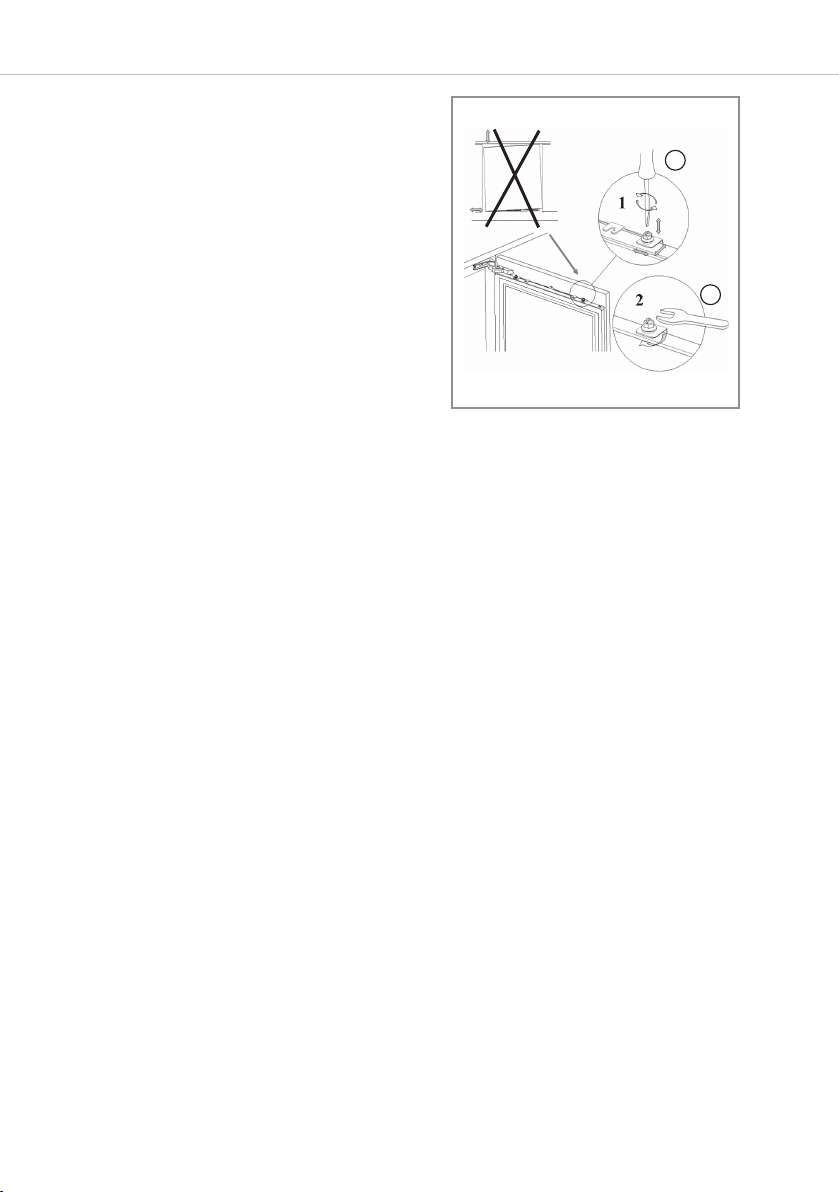
Adjust the decor door by screwing or
unscrewing the adjustment bolts for
vertical adjustment and by the help
of the slots on the fixing bracket for
other directions. Lock the screws into place as shown in Fig. 12.
Fitting the decor door base fixings
With the appliance door open, locate the metal decor door base
fixing brackets and screw the fixings to the decor door. You may
need to remove and re-fit these brackets depending upon the
decor door used.
Fitting the decorative cover
Re-fit the decorative cover, that you removed in the first step, on to
the decor door fixing bracket. Check that the whole door assembly
operates smoothly and that the door seal of the refrigerator is still
creating a seal.
Important: After completing the installation, check that the
appliance is secured within the unit and that the door(s) close
and open properly. If there is no resistance from the door seals
when opening the doors, then it is probable that the appliance
and/or decor doors are not fitted properly.
10
8
Fig. 12
1.
2.
3.
4.
5.
6.
7.
Carefully prise o the white cover caps for the side that you wish
to switch the hinges to
With the door closed remove the hinge caps and the screws from
the top hinge attaching the hinge to the door, support the door
whilst doing this, then remove the screws from the lower hinge
Support the door at the bottom and open the hinges away from the
appliance door. Carefully lift the appliance door away, ensuring not
to damage the hinges or the door. Place the door somewhere
safe where it will not cause or receive damage
Repeat steps 1 to 3 for the lower door if necessary
With the top hinge open, remove
the screws that fix the hinge to the
appliance cabinet, do the same with
the lower hinge.
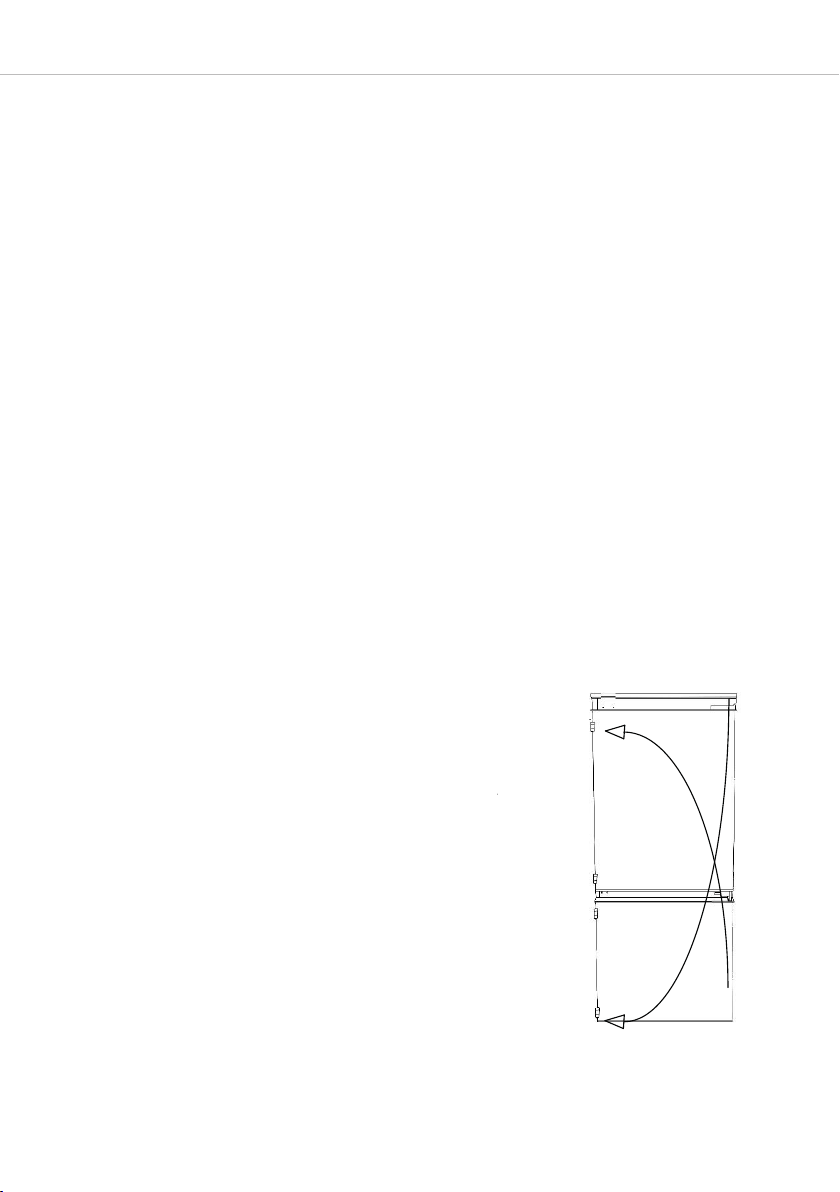
Flip the top hinge 180 degrees
and reattach the the hinge on the
diagonally opposite corner of the
appliance cabinet as shown in fig. 13
S w a p t h e p r e v i o u s b o t t o m h i n g e t o
the opposite side at the top.
Refit the upper door and the “new”
top hinge and fix securely to the
appliance. Repeat this process for the
bottom door if necessary
22
Reversing the appliance doors
We recommend you seek the help of another individual to support the
doors whilst performing this operation.
8. Fit the central cover caps and top
hinge cover pieces in place to
complete the process.
Fig. 13

23
Ensuring the door seals correctly:
It is normal for the seal to be compressed after the door has been
reversed. With the door closed, use a hair dryer to expand the seal
and fill the gap between the door and the body of the appliance.
Take care not to use the hair dryer too close to the appliance, which
could damage the seal. A distance of approximately 10cm should be
adequate.
When completed, allow the seal and door to cool before touching them.
Once done, the seal should remain in position
Electrical information
Warning! This appliance must be earthed.
If in doubt regarding the electrical connection of this appliance,
consult a qualified electrician. Do not shorten the supply cable, the
appliance may require removing for servicing.
N.B. Ensure that the plug socket is situated in an easily accessible
place after installation.
E & O E. All instructions, dimensions and illustrations are provided for guidance only. ... reserve the
right to change specifications without prior notice.

24
25
Climate range
The information about the climate range of the appliance is provided
on the rating plate. It indicates at which ambient temperature (that is
room temperature in which the appliance is working) is optimal for the
operation of the appliance.
Climate class Allowable ambient temperature
SN Extended Temperate This refrigeration appliance is intended for
use at an ambient temperature ranging
between 10°C and 32°C
N Temperate This refrigeration appliance is intended for
use at an ambient temperature ranging
between 16°C and 32°C
ST Sub Tropical This refrigeration appliance is intended for
use at an ambient temperature ranging
between 16°C and 38°C
T Tropical This refrigeration appliance is intended for
use at an ambient temperature ranging
between 16°C and 43°C

26
Practical tips
Due to the natural circulation of the air in the appliance, there are
dierent temperature zones in the refrigerator chamber. The coldest
area is directly above the vegetable drawers. Use this area for all
delicate and highly perishable food such as:
• Fish, meat, poultry
• Sausage products, ready meals
• Dishes or baked goods containing eggs or cream
• Fresh dough, cake mixtures
• Pre-packed vegetables and other fresh food with a label stating it
should be stored at a temperature of approximately 4°C
The warmest area is in the top section of the door. Use this area for
storing butter and cheese.
To achieve the most eective food preservation for the longest
possible time and to avoid wasting any food, position the products as
shown on page 9. In addition this figure illustrates the layout of
drawers, baskets and shelves, which allows the most ecient use of
energy.
Optimal temperature and storage conditions will extend product shelf
life and optimise electricity consumption. Optimal storage temperature
range should be stated on the food packaging.

Warranty Card
Worldwide Appliances Pty Limited
A.B.N. 45868077422
Distributed by Eurolinx pty Ltd
48-50 Moore Street, Leichhardt N.S.W 2040
Locked Bag 3000, Annandale, N.S.W 2038
WARRANTY REGISTRATION
Your ongoing satisfaction with your artusi
product is important to us. We ask that you
complete the enclosed Warranty Registration
Card and return it to us so that we have a record
of the artusi product purchased by you.
PRIVACY
Worldwide Appliances respects your
privacy and is committed to handling your
personal information in accordance with the
National Privacy Principles and the Privacy
Act 1988 (Cth). A copy of the Worldwide
Appliances Privacy Policy is available at
www.artusi.com.au. Worldwide Appliances will
not disclose any personal information set out
in the Warranty Registration Card (“Personal
Information”) without your consent unless
required by:
1. law;
2. any Worldwide Appliances related company;
3. any service provider which provide services
to artusi or assist artusi in providing services
(including repair and warranty services) to
customers. Our purpose in collecting the
Personal Information is
to keep a record of the artusi product purchased
by you, in order to provide a better warranty
service to you in the unlikely event that there is
a problem with your artusi product. Worldwide
Appliances may contact you at any one or more
of the address, email address or telephone
numbers set out in the Warranty Registration
Card. Please contact artusi on 1300 694
583 should you not wish to be contacted by
Worldwide Appliances.
WARRANTY
1. Warranty
Worldwide Appliances warrants that each artusi
product will remain, for a period of either 12
months or 24 months of warranty. All Warranties
are valid from the original date of purchase, And
warranty claims must be accompanied by the
proof of purchase.
All Built-in Appliances – Limited to Ovens,
Gas, Induction and Electric Cooktops, and All
Rangehoods. Freestanding Cookers - Gas and
Electric Models (900mm Width).
artusi.com.au
Dishwashers - Freestanding, Fully Integrated,
Semi Integrated and built-in. All Wine coolers. All
Dryers. Freestanding Cookers - Gas and Electric
Models in 50cm, 54cm and 60cm Widths
Portable Appliances* – Benchtop Models and
Portable Gas Models
2. What is not Covered by the Warranty.
The Warranty does not apply if an artusi product
is defective by a factor other than a defect arising
in the manufacture of the artusi product, including
but not limited to:
(a) damage through misuse (including failure
to maintain, service or use with proper care),
neglect, accident or ordinary wear and tear
(including deterioration of parts and accessories
and glass breakage);
(b) use for purpose for which the artusi product
was not sold or designed;
(c) use or installation which is not in accordance
installation;
(d) use or operation after a defect has occurred or
been discovered;
(e) damage through freight, transportation or
handling in transit (other than when Worldwide
Appliances is responsible);
(f) damage through exposure to chemicals, dusts,
residues, excessive voltage, heat, atmospheric
conditions or other forces or environmental
factors outside the control or Worldwide
Appliances;
purchaser or any person other than Worldwide
Appliances, an employee of Worldwide
Appliances or an authorised artusi service
contractor*;
(h) use of parts, components or accessories
approved by artusi.
(i) damage to surface coatings caused by cleaning
or maintenance using products not recommended
in the artusi product handbook provided to the
purchaser upon purchase of the artusi product;
(j) damage to the base of an electric oven due to
items having been placed on the base of the oven
cavity or covering the base, such as aluminium
foil (this impedes the transfer of heat from the
element to the oven cavity and can result in
irreparable damage); or
(k) damages, dents or other cosmetic
artusi in respect of an artusi product purchased
as a “factory second” or from display
The Warranty does not extend to light globes
used in artusi products.
3. Domestic Use
Each artusi product is made for domestic use.
This Warranty may not extend to artusi products
used for commercial purposes.
Continued over...
Artusi Warranty May 2016.indd 1 14/07/2016 4:37 PM
4. Time for Claim under the Warranty
You must make any claim under this Warranty
within twenty eight (28) days after the occurrence
of an event which gives rise to a claim pursuant
to the Warranty, by booking a service call on the
telephone number below.
5. Proof of Purchase
Customers must retain proof of purchase in order
to be eligible to make a warranty claim in respect
of an artusi product.
6. Claiming under the Warranty
Customers will bear the cost of claiming under
this Warranty unless Worldwide Appliances
determines the expenses are reasonable, in which
case the customer must claim those expenses
by providing written evidence of each expense
to Worldwide Appliances at the address on the
Warranty Registration Card.
7. Statutory Rights
statutory rights.
(b) The limitations on the Warranty set out in this
document do not exclude or limit the application
of the consumer guarantees set out in the Act or
any other equivalent or corresponding legislation
in the relevant jurisdiction where to do so would:
(i) contravene the law of the relevant jurisdiction;
or
(ii) cause any part of the Warranty to be void.
(c) Worldwide Appliances excludes indirect or
consequential loss of any kind (including, without
limitation, loss of use of the artusi product) and
(other than expressly provided for in these terms
and conditions) subject to all terms,
conditions and warranties implied by custom, the
general law, the Act or other statute.
(d) The liability of Worldwide Appliances to you
for a breach of any express or non-excludable
implied term, condition or warranty is limited at
the option of Worldwide Appliances to:
(i) replacing or repairing the defective part of the
artusi product;
(ii) paying the cost of replacing or repairing the
defective part of the artusi product;
(iii) replacing the artusi product; or
(iv) paying the cost of replacing the artusi
product.
(e) Our goods come with guarantees that cannot
be excluded under the Australian Consumer
Law. You are entitled to a replacement or refund
for a major failure and for compensation for any
other reasonably foreseeable loss or damage.
You are also entitled to have the goods repaired
or replaced if the goods fail to be of acceptable
quality and the failure does not amount to a
major failure.
8. Defects
Any part of an artusi product deemed to be
defective and replaced by Worldwide Appliances
is the property of Worldwide Appliances.
Worldwide Appliances reserves the right to
inspect and test artusi products in order to
determine the extent of any defect and the
validity of a claim under the Warranty.
All warranty service calls must be booked via
the customer care department. The team can
[email protected]om.au
Warranty Card continued
artusi.com.au
2
Please complete and send to ARTUSI at: REPLY PAID 83617
LEICHHARDT NSW 2040
Last Name: First Name:
Address:
State: Postcode: Email:
Home Phone: Mobile:
Purchase Date: / / (Please attach proof of purchase to validate warranty)
MODEL NUMBER
SERIAL NUMBER
(if you cannot locate the serial number please call ARTUSI on 1300 856 411)
1
2
3
4
WARRANTY REGISTRATION CARD
01052016
01082016
Warranty Card tear off
Artusi Warranty May 2016.indd 2 14/07/2016 4:37 PM

AR
TUSI.COM.AUP: 1300 649 583
NS
W & ACT (HEAD OFFICE)
48-50 MOORE STREET
LEICHHARDT
F 02 8569 4699
QLD
1/42 CAVENDISH ROAD
COORPAROO
F 07 3397 0850
VIC, TAS & SA
1211 TOORAK ROAD
CAMBERWELL
F 03 9809 2155
WA & NT
UNIT 10/55 HOWE STREET
OSBORNE PARK
F 08 9201 9188
NZ
PO BOX 11.160
SOCKBURN CHRISTCHURCH
F 03 344 5906
ARTUSI OFFICES ARE OPEN DAILY FROM 9AM–5PM AND SATURDAYS 10AM–4PM
DIS
CLAIMER
W
orldwide Appliances PTY LTD, trading as ARTUSI, is continually seeking ways to improve the design specifications, aesthetics and production
techniques of its products. As a result alterations to our products and designs take place continually. Whilst every effort is made to produce
information and literature that is up to date, this brochure should not be regarded as an infallible guide to the current specifications, nor does it
constitute an offer for the sale of any particular product. Product dimensions indicated in our literature is indicative only. Actual product only
should be used to define dimension cutouts. Distributors, and retailers are not agents of ARTUSI and are not authorised to bind ARTUSI by any
express or implied undertaking or representation.
AR
TUSI.COM.AUP: 1300 649 583
NS
W & ACT (HEAD OFFICE)
48-50 MOORE STREET
LEICHHARDT
F 02 8569 4699
QLD
1/42 CAVENDISH ROAD
COORPAROO
F 07 3397 0850
VIC, TAS & SA
1211 TOORAK ROAD
CAMBERWELL
F 03 9809 2155
WA & NT
UNIT 10/55 HOWE STREET
OSBORNE PARK
F 08 9201 9188
NZ
PO BOX 11.160
SOCKBURN CHRISTCHURCH
F 03 344 5906
ARTUSI OFFICES ARE OPEN DAILY FROM 9AM–5PM AND SATURDAYS 10AM–4PM
DIS
CLAIMER
W
orldwide Appliances PTY LTD, trading as ARTUSI, is continually seeking ways to improve the design specifications, aesthetics and production
techniques of its products. As a result alterations to our products and designs take place continually. Whilst every effort is made to produce
information and literature that is up to date, this brochure should not be regarded as an infallible guide to the current specifications, nor does it
constitute an offer for the sale of any particular product. Product dimensions indicated in our literature is indicative only. Actual product only
should be used to define dimension cutouts. Distributors, and retailers are not agents of ARTUSI and are not authorised to bind ARTUSI by any
express or implied undertaking or representation.