
Copyright and Declaration
Copyright
SIGLENT TECHNOLOGIES CO., LTD. All Rights Reserved.
Trademark Information
SIGLENT is the registered trademark of SIGLENT TECHNOLOGIES CO., LTD.
Declaration
SIGLENT products are protected by patent law in and outside of the P.R.C.
SIGLENT reserves the right to modify or change parts of or all the specifications or
pricing policies at company’s sole decision.
Information in this publication replaces all previously corresponding material.
Any way of copying, extracting or translating the contents of this manual is not
allowed without the permission of SIGLENT.
Product Certification
SIGLENT guarantees this product conforms to the national and industrial standards
in China and other international standards. Conformance certification is in
progress.
Contact Us
If you have any problem or requirement when using our products, please contact
SIGLENT TECHNOLOGIES CO., LTD
Add:3//F, Bldg No.4, Antongda Industrial Zone, 3rd Liuxian Road, Bao’an District,
Shenzhen, 518101, P.R.China
Tel:400-878-0807
E-mail:sales@siglent.com
http://www.siglent.com
Introduction
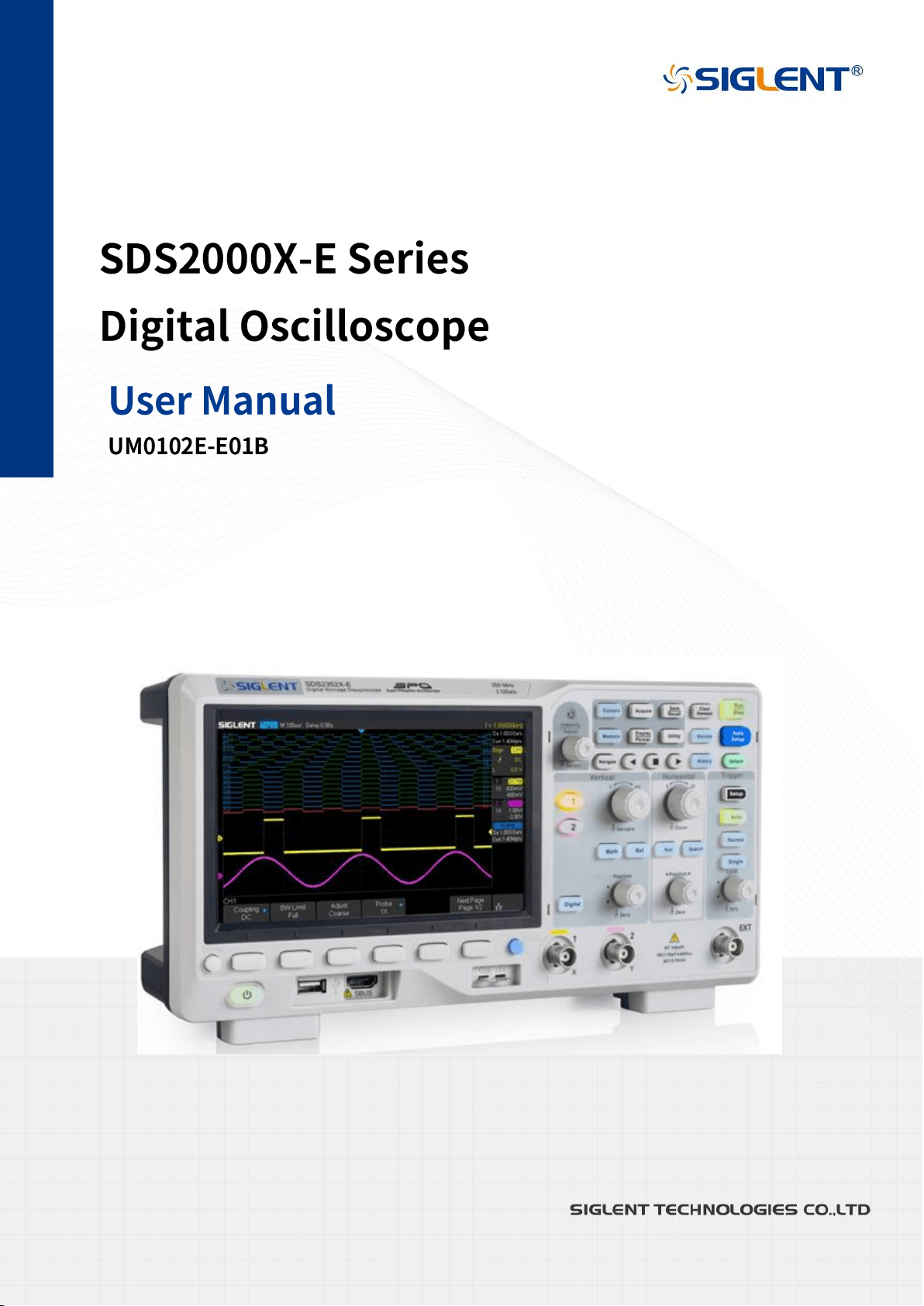
This user manual includes important safety and installation information related to
the SDS2000X-E series oscilloscopes and includes simple tutorials for basic
operation of the oscilloscope.
The series includes the following models:
Model
Analog Bandwidth
SDS2352X-E
350 MHz bandwidth, 2-channel, 2 GSa/s Sample rate
SDS2202X-E
200 MHz bandwidth, 2-channel, 2 GSa/s Sample rate
SDS2102X-E
100 MHz bandwidth, 2-channel, 2 GSa/s Sample rate
Safety Information
Measurement Category
Measurement Categories
This oscilloscope can make measurements in other circuits that are not directly
connected to mains.
WARNING
This oscilloscope can only be used for measurements within its specified
measurement categories.
Not to use the product for measurements within other measurement
categories, such as CAT II, CAT III, CAT IV.
Do not use the equipment for measurements on mains circuits.
Measurement Category Definitions
Measurement category II is for measurements performed on circuits directly
connected to the low voltage installation. Examples are measurements on
household appliances, portable tools and similar equipment.
Measurement category III is for measurements performed in the building
installation. Examples are measurements on distribution boards, circuit-breakers,
wiring, including cables, bus-bars, junction boxes, switches, socket-outlets in the
fixed installation, and equipment for industrial use and some other equipment, for
example. Stationary motors with permanent connection to the fixed installation.
Measurement category IV is for measurements performed at the source of the
low-voltage installation. Examples are electricity meters and measurements on
primary over current protection devices and ripple control units.

General Safety Summary
Carefully read the following safety precautions to avoid any personal injury or
damage to the instrument and any products connected to it. To avoid potential
hazards, please use the instrument as specified.
Use Proper Power Line
Only the power cord designed for the instrument and authorized by the local
country should be used.
Ground the Instrument
The instrument is grounded through the protective earth conductor of the power
line. To avoid electric shock, please make sure the instrument is grounded correctly
before connecting its input or output terminals.
Connect the Signal Wire Correctly
The potential of the signal wire is equal to the earth, so do not connect the signal
wire to a high voltage.
Look Over All Terminals’ Ratings
To avoid fire or electric shock, please look over all ratings and read the instructions
for the instrument. Before connecting the instrument, please read the manual
carefully to gain more information about important ratings.
Use Proper Overvoltage Protection
Make sure that no overvoltage (such as that caused by a thunderstorm) can reach
the product, or else the operator might expose to danger of electrical shock.
Electrostatic Prevention
Operate in an electrostatic discharge protective area environment to avoid
damages induced by static discharge. Always ground both the internal and
external conductors of the cable to release static before connecting.
Keep Well Ventilation
Inadequate ventilation may cause an increasing in operting temperature, which
will eventually damage the instrument. So keep well ventilation and inspect the
intake and fan regularly.
Avoid Circuit or Components Exposed
Do not touch exposed contacts or components when the power is on.
Use proper Fuse

Use only the specified fuse.
Do Not Operate Without Covers
Do not operate the instrument with covers or panels removed.
Do Not Operate With Suspected Failures.
If you suspect damage occurs to the instrument, have it inspected by qualified
service personnel before further operations. Any maintenance, adjustment or
replacement especially to circuits or accessories must be performed by SIGLENT
authorized personnel.
Do Not Operate in Wet Conditions.
In order to avoid short circuiting to the interior of the device or electric shock,
please do not operate in a humid environment.
Do Not Operate in an Explosive Atmosphere.
In order to avoid damages to the device or personal injuries, it is important to
operate the device away from an explosive atmosphere.
Keep Product Surfaces Clean and Dry.
To avoid the influence of dust and/or moisture in air, please keep the surface of the
device clean and dry.
Handling Safety
Please handle with care during transportation to avoid damaging buttons, knob
interfaces and other parts on the panels.
Only probe assemblies which meet the manufacturer’s specifications shall be used.
When using SIGLENT probe assemblies, the probe assemblies shall be insulated
from the measured circuits by double or reinforced insulation.
All probe assemblies should meet the requirements of UL 61010-031 and
CAN/CSA-C22.2 No. 61010-031-07.
Do not position the equipment so that it is difficult to disconnect an attached device
(detachable plug).
If the equipment is used in a manner not specified by the manufacturer, the
protection provided by the equipment may be impaired.
Safety Terms and Symbols
Terms in this Manual. These terms may appear in this manual:
WARNING
Warning statements indicate the conditions or practices that
could result in injury or loss of life.
CAUTION
Caution statements indicate the conditions or practices that
could result in damage to this product or other property.
Terms on the product. These terms may appear on the product:
DANGER Indicates direct injuries or hazards that may happen.
WARNING Indicates potential injuries or hazards that may happen.
CAUTION Indicates potential damage to the instrument or other property that may
happen.
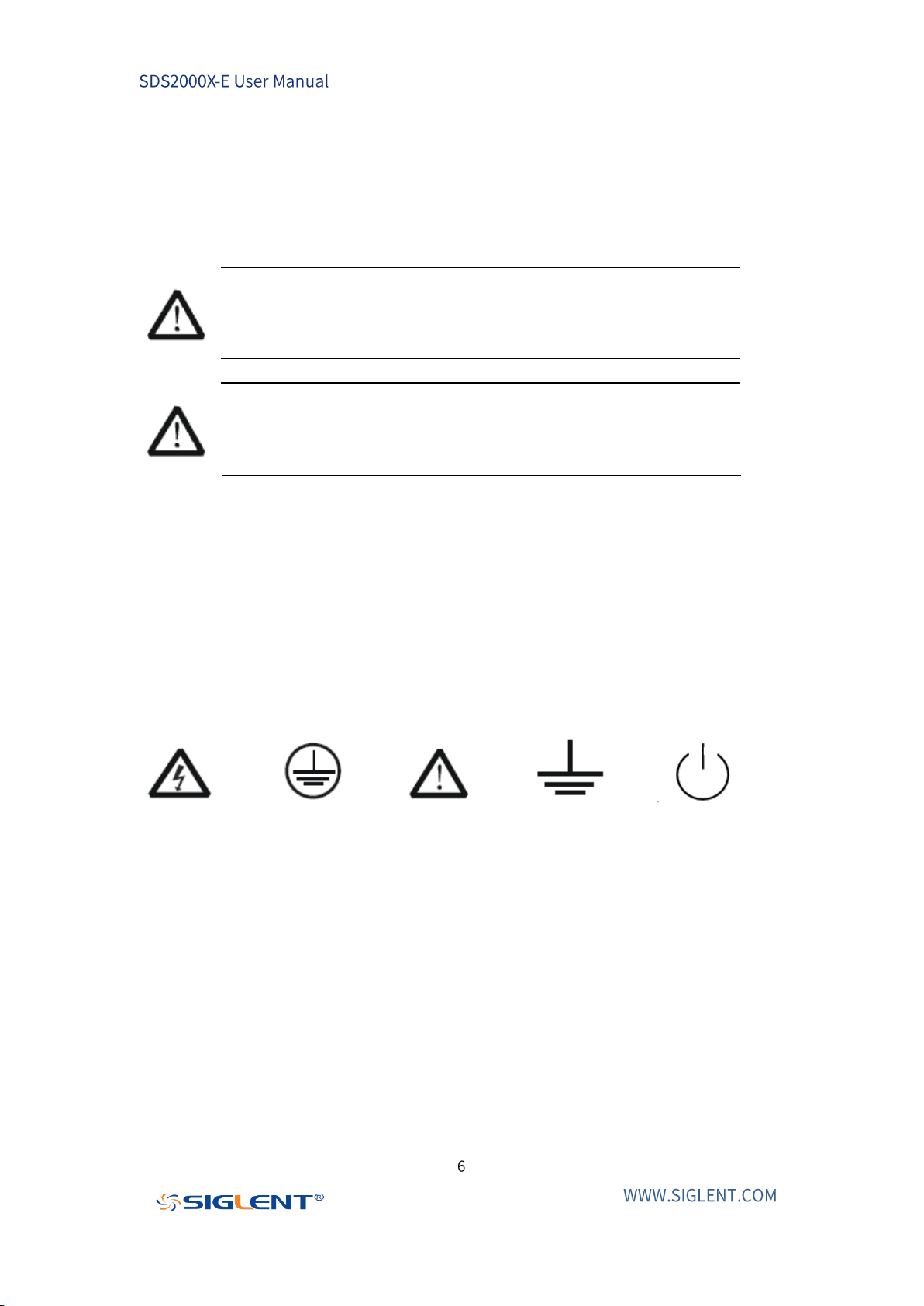
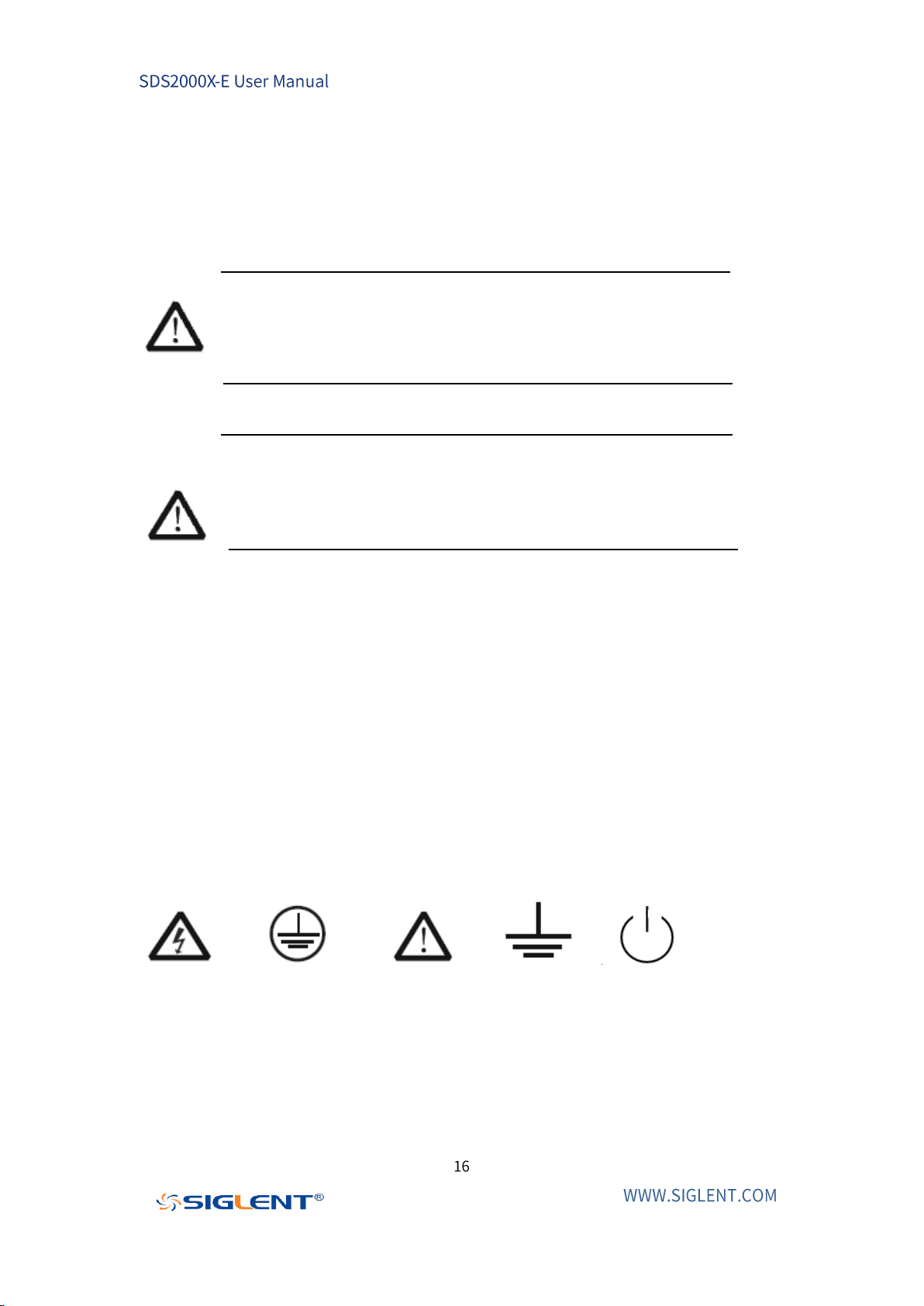
Symbols on the product. These symbols may appear on the product:
Hazardous protective Earth Warning Test Power Switch
Voltage Terminal Ground
If find such symbols on the product, consult the manual to find out the nature of the
potential hazard and the actions which have to be taken.
Working Environment
Environment
This instrument is intended for indoor use and should be operated in a clean, dry
environment.
Temperature
Operating: 0℃ to +40℃
Non-operation:-20℃ to +60℃
Note: Direct sunlight, radiators, and other heat sources should be taken into
account when assessing the ambient temperature.
Humidity
Operating: 85% RH, 40 ℃, 24 hours
Non-operating: 85% RH, 65 ℃, 24 hours
Altitude
Operating: less than 3 Km
Non-operation: less than 15 Km
Installation (overvoltage) Category
This product is powered by mains conforming to installation (overvoltage) category
II.
WARNING
Make sure that no overvoltage (such as that caused by thunderbolt) can
reach the product, or else the operator might expose to danger of
electric
shock.
Installation (overvoltage) Category Definitions
Installation (overvoltage) category I refers to signal level which is applicable to
equipment measurement terminals connected to the source circuit. In these
terminals, precautions are done to limit the transient voltage to the corresponding
low level.
Installation (overvoltage) category II refers to the local power distribution level
which is applicable to equipment connected to the AC line (AC power).
Degree of Pollution

The oscilloscopes may be operated in environments of Pollution Degree II.
Note: Degree of Pollution II refers to a working environment which is dry and
non-conductive pollution occurs. Occasional temporary conductivity caused by
condensation is expected.
IP Rating
IP20 (as defined in IEC 60529).
Ventilation Requirement
This oscilloscope uses a fan to force cooling. Please make sure that the air intake
and exhaust areas are free from obstructions and have free air. When using the
oscilloscope in a bench-top or rack setting, provide at least 10 cm clearance beside,
above and behind the instrument for adequate ventilation.
WARNING
Inadequate ventilation may cause temperature increase which would
damage the instrument. So please keep the instrument well ventilated
during operation and inspect the intake and fan regularly.
AC Power and Ground Connections
The instrument operates with a single-phase, 100 to 240 Vrms (+/-10%) AC power
at 50/60 Hz (+/-5%), or single-phase 100 - 120 Vrms (+/-10%) AC power at 400Hz
(+/-5%).
No manual voltage selection is required because the instrument automatically
adapts to line voltage.
Depending on the type and number of options and accessories (probes, PC port
plug-in, etc.), the instrument can consume up to 50 W of power.
Note: The instrument automatically adapts to the AC line input within the following
ranges:
Voltage Range:
90 - 264 Vrms
90 - 132 Vrms
Frequency Range:
47 - 63 Hz
380 - 420 Hz
The instrument includes a grounded cord set containing a molded three-terminal
polarized plug and a standard IEC320 (Type C13) connector for making line voltage
and safety ground connection. The AC inlet ground terminal is connected directly to
the frame of the instrument. For adequate protection against electrical shock
hazard, the power cord plug must be inserted into a mating AC outlet containing a
safety ground contact. Use only the power cord specified for this instrument and
certified for the country of use.
WARNING
Electrical Shock Hazard!
Any interruption of the protective ground conductor within or outside of
the scope or disconnection of the safety ground terminal creates a
hazardous situation.
Intentional interruption is prohibited.
The position of the oscilloscope should allow easy access to the socket. To make
the oscilloscope completely power off, unplug the instrument power cord from the
AC socket.
The power cord should be unplugged from the AC outlet if the scope is not to be
used for an extended period of time.
CAUTION
The outer shells of the front panel terminals (CH1, CH2, CH3, CH4, EXT)
are connected to the instrument’s chassis and therefore to the safety
ground.
General Care and Cleaning
Care
Do not store or leave the instrument in direct sunshine for long periods of time.
WARNING
To avoid damage to the instrument or probe, please do not leave
them in areas that contain fog, liquid, or solvent.
Cleaning
Please perform the following steps to clean the instrument and probe:.
Disconnect the instrument from all power sources, and then clean it with a soft wet
cloth.
Clean the loose dust on the outside of the instrument and probe with a soft cloth.
When cleaning the LCD, take care to avoid scratching it.
WARNING
To avoid damage to the surface of the instrument and probe, please
do not use any corrosive liquid or chemical cleanser.
WARNING
Make sure that the instrument is completely dry before restarting it
to avoid short circuits or personal injuries.

L'information de sûreté
Résumé général de sûreté
Lisez soigneusement les mesures de sécurité suivantes pour éviter n'importe
quelles blessures ou les dommages à l'instrument et à tous les produits se sont
reliés à eux. Pour éviter des risques, utilisez svp l'instrument comme indiqué.
Employez la ligne à haute tension appropriée
Seulement le cordon de secteur conçu pour l'instrument et autorisé par le pays
local a pu être employé.
A rectifié l'instrument.
L'instrument est fondu par le conducteur protecteur de terra de la ligne à haute
tension. Pour éviter la décharge électrique, le conducteur moulu doit être relié à la
terre. Assurez-vous que l'instrument est fondu correctement avant de relier ses
bornes d'entrée ou de rendement.
Reliez le fil de signal correctement.
Le potentiel de l'au sol de fil de signal est égal à la terre, ainsi ne relie pas le fil de
signal à une tension.
Regardez estimations au-dessus de toutes les bornes des'
Pour éviter le feu ou la décharge électrique, regardez svp au-dessus de toutes les
estimations et instruction de signe de l'instrument. Avant de relier l'instrument,
lisez svp le manuel soigneusement pour obtenir plus d'informations sur les
estimations.
Employez la protection appropriée de surtension
Assurez-vous qu'aucune surtension (comme cela provoqué par un orage) ne peut
atteindre le produit, ou bien l'opérateur pourrait exposer au danger du choc
électrique.
Empêchement électrostatique
Fonctionnez dans un environnement protecteur de secteur de décharge
électrostatique pour éviter des dommages induits par décharge statique. A
toujours rectifié les conducteurs internes et externes du câble pour libérer la
charge statique avant de se relier.

La ventilation insatisfaisante de ventilation
bonne de subsistance peut causer l'augmentation de la température, qui
endommagera par la suite l'instrument. Gardez ainsi la ventilation bonne et
inspectez la prise et éventez régulièrement.
Évitez le circuit ou les composants exposés
ne touchent pas les contacts ou les composants exposés quand le courant passe.
Employez l'utilisation appropriée
de fusible seulement le fusible indiqué.
Ne fonctionnez pas sans couvertures
n'actionnent pas l'instrument des couvertures ou des panneaux étant coupés.
Ne fonctionnez pas avec des échecs suspectés.
Si vous suspectez les dommages se produisent à l'instrument, l'ont inspecté par le
personnel de service qualifié avant d'autres opérations. N'importe quel entretien,
ajustement ou remplacement particulièrement aux circuits ou aux accessoires
doivent être exécutés par le personnel autorisé par SIGLENT.
Ne fonctionnez pas en conditions humides.
Afin d'éviter de court-circuiter à l'intérieur du dispositif ou de la décharge
électrique, svp ne fonctionnez pas dans un environnement humide.
Do Not Operate in an Explosive Atmosphere.
Ne fonctionnez pas dans une atmosphère explosive.
Afin d'éviter d'endommager le dispositif ou les blessures, il est important d'utiliser
le dispositif loin à partir d'une atmosphère explosive.
Maintenez les surfaces de produit propres et sèches.
Pour éviter l'influence de la poussière et/ou de l'humidité en air, maintenez svp la
surface du dispositif propre et sèche.
En manipulant la sûreté
manipulez svp avec soin pendant le transport pour éviter d'endommager des
boutons, des interfaces de bouton et d'autres parties sur les panneaux.
Sondez seulement les ensembles qui répondent aux caractéristiques du fabricant
seront employés.
Quand des sondes de l'utilisation 5X/10X/50X/100X/500X/1000X, les sondes
seront isolées des circuits mesurés par le double ou l'isolation renforcée.
Toutes les sondes devraient répondre aux exigences de l'UL 61010-031 et du
CAN/CS A-C22.2 No. 61010-031-07

Le corps ou l'opérateur responsable devrait se référer au manuel d'instruction pour
préserver la protection se permettent par l'équipement. Si l'équipement est utilisé
en quelque sorte non indiqué par le fabricant, la protection fournie par
l'équipement peut être altérée.
On ne permet à aucune pièce du dispositif et de ses accessoires d'être changé ou
remplacé, autre qu'autorisé par le fabricant ou son agent.
Pas placez l'équipement de sorte qu'il soit difficile d'utiliser le dispositif
débranchant (prise détachable).
Limites et symboles de sûreté
Limites en ce manuel. Ces limites peuvent apparaître en ce manuel :
Les rapports
d'avertissement D'AVERTISSEMENT indiquent les conditions ou les
pratiques qui pourraient avoir comme conséquence les dommages
ou la perte de la ie.
Les rapports
d'attention d'ATTENTION indiquent les conditions ou les pratiques
qui pourraient avoir comme consequence les dommages à ce
produit ou à toute autre propriété.
Limites sur le produit. Ces limites peuvent apparaître sur le produit :
Le DANGER indique les dommages ou les risques directs qui peuvent se produire.
Dommages ou risques potentiels de WARNINGIndicates qui peuvent se produire.
L'ATTENTION indique des dommages potentiels à l'instrument ou à toute autre
propriété qui peuvent se produire.
Si la trouvaille de tels symboles sur le produit, consultent le manuel pour découvrir
la nature du risque et des actions qui doivent être pris.
Symboles sur le produit. Ces symboles peuvent apparaître sur le produit :
Dangereux Protecteur Avertissement Châssis Puissance
Tension Au sol de la terre Ground Switch
Catégorie de mesure
Les oscilloscopes peuvent faire des mesures dans d'autres circuits qui ne sont pas
directement reliés aux forces. Pour ne pas employer le produit pour des mesures
dans d'autres catégories de mesure, telles que le CAT II, CAT III, CAT IV.
Ne pas utiliser l'équipement pour des mesures sur des forces circuite, pour ne pas
utiliser l'équipement pour des mesures sur la tension excèdent la gamme de
tension décrivent dans le manuel.
EN AVERTISSANT
cet oscilloscope peut seulement être employé pour des mesures dans
ses catégories indiquées de mesure.
La catégorie II de mesure
de définitions de catégorie de mesure est pour des mesures effectuées sur des
circuits directement reliés à l'installation de basse tension. Les exemples sont des
mesures sur des appareils électroménagers, des outils portatifs et l'équipement
semblable.
La catégorie III de mesure est pour des mesures effectuées dans l'installation de
bâtiment. Les exemples sont des mesures sur des conseils de distribution, des
disjoncteurs, le câblage, y compris des câbles, des barres omnibus, des boîtes de
jonction, des commutateurs, des douille-sorties dans l'installation fixe, et
l'équipement à l'utilisation industrielle et à un autre équipement,
par exemple. Moteurs stationnaires avec le raccordement permanent à
l'installation fixe.
La catégorie IV de mesure est pour des mesures effectuées à la source
d'installation de basse tension.Les exemples sont des mètres et des mesures de
l'électricité sur les dispositifs de protection d'excédent primaire et les unités de
commande courants d'ondulation.
Environnement de fonctionnement
Environnement
Cet instrument est utilisé à l 'intérieur des locaux et doit être utilisé dans un
environnement propre et sec.
Température ambiante
En fonctionnement: 0 ℃ à +40 ℃
Hors fonctionnement: -20 ℃ à +60 ℃
Note: pour évaluer la température de l'environnement, il convient de tenir compte
des rayonnements solaires directs, des radiateurs thermiques et d'autres sources
de chaleur.
Humidité
Fonctionnement: 85% HR, 40 ℃, 24 heures
Hors fonctionnement: 85% HR, 65 ℃, 24 heures
EN AVERTISSANT
d'éviter le court-circuit à l'intérieur de l'instrument ou de la
décharge électrique, svp ne fonctionnez pas dans l'environnement
humide.
Altitude
d'altitude : moins de 3 kilomètres
de non-fonctionnement : moins de 15 kilomètres
Catégorie d 'installation (surtension)
Ce produit est alimenté par une alimentation électrique conforme à l 'installation
(surtension) Catégorie II.
EN AVERTISSANT
assurez-vous qu'aucune surtension (comme cela provoqué par coup de
foudre) ne peut atteindre le produit, ou bien l'opérateur pourrait
exposer au danger de la décharge électrique.

Installation (overvoltage) Category Definitions Définition de catégorie d
'installation (surtension)
La catégorie II d'installation (surtension) est un niveau de signal applicable aux
terminaux de mesure d' équipement reliés au circuit source.Dans ces bornes, des
mesures préventives sont prises pour limiter la tension transitoire à un niveau
inférieur correspondant.
La catégorie II d'installation (surtension) désigne le niveau local de distribution d
'énergie d' un équipement conçu pour accéder à un circuit alternatif (alimentation
alternative).
Degré de pollution
Un oscilloscope peut être utilisé dans un environnement Pollution Degree II.
Note: Pollution Degree II signifie que le milieu de travail est sec et qu'il y a une
pollution non conductrice.Parfois, la condensation produit une conductivité
temporaire.
IP Rating
IP20 (as defined in IEC 60529).
Condition de ventilation
This oscilloscope uses fan to force cooling. Please make sure that the air intake and
exhaust areas are free from obstructions and have free air. When using the
oscilloscope in a bench-top or rack setting, provide at least 10 cm clearance beside,
above and behind the instrument for adequate ventilation.
Cet oscilloscope utilise le ventilateur pour forcer le refroidissement. Veuillez
s'assurer que les secteurs d'entrée et d'échappement d'air sont exempts des
obstructions et ont l'air libre. À l'aide de l'oscilloscope dans un mettre hors
jeu-dessus ou un arrangement de support, fournissez au moins le dégagement de
10 centimètres près, au-dessus et derrière de l'instrument pour à ventilation
proportionnée.
EN AVERTISSANT
La ventilation insatisfaisante peut causer l'augmentation de la
température qui endommagerait l'instrument. Veuillez ainsi la
subsistance l'instrument bien aéré lors du fonctionnement et
inspectez la prise et éventez régulièrement.
Connexions d'alimentation et de terre
L'instrument fonctionne avec une alimentation CA monophasée de 100 à 240 Vrms
(+/- 10%) à 50/60 Hz (+/- 5%) ou monophasée 100-120 Vrms (+/- 10%)
Alimentation AC à 400 Hz (+/- 5%).
Aucune sélection manuelle de la tension n'est requise car l'instrument s'adapte
automatiquement à la tension de ligne.
Selon le type et le nombre d'options et d'accessoires (sondes, plug-in de port PC,
etc.), l'instrument peut consommer jusqu'à 50 W d'énergie.
Remarque: l'instrument s'adapte automatiquement à l'entrée de ligne CA dans les
plages suivantes:
Plage de tension:
90 - 264 Vrms
90 - 132 Vrms
Gamme de
fréquences:
47 - 63 Hz
380 - 420 Hz
L'instrument comprend un jeu de cordons mis à la terre contenant une fiche
polarisée à trois bornes moulée et un connecteur standard IEC320 (Type C13) pour
établir la tension de ligne et la connexion de mise à la terre de sécurité. La borne
de mise à la terre de l'entrée CA est directement connectée au châssis de
l'instrument. Pour une protection adéquate contre les risques d'électrocution, la
fiche du cordon d'alimentation doit être insérée dans une prise secteur
correspondante contenant un contact de sécurité avec la terre. Utilisez uniquement
le cordon d'alimentation spécifié pour cet instrument et certifié pour le pays
d'utilisation.
EN AVERTISSANT: risque de choc électrique!
Toute interruption du conducteur de terre de protection à l'intérieur ou à
l'extérieur de la portée ou la déconnexion de la borne de terre de
sécurité crée une situation dangereuse.
L'interruption intentionnelle est interdite.
La position de l'oscilloscope doit permettre un accès facile à la prise. Pour éteindre
complètement l'oscilloscope, débranchez le cordon d'alimentation de l'instrument
de la prise secteur.
Le cordon d'alimentation doit être débranché de la prise secteur si la lunette ne
doit pas être utilisée pendant une période prolongée.
EN AVERTISSANT: les enveloppes extérieures des bornes du panneau
avant (CH1, CH2, CH3, CH4, EXT) sont connectées au châssis de
l'instrument et donc à la terre de sécurité.
Soin général et nettoyage
Ne stockez pas ou ne laissez pas l'instrument en soleil direct pendant de longues
périodes.
EN AVERTISSANT
Pour éviter d'endommager l'instrument, svp ne les laissez pas
dans le brouillard, le liquide, ou le dissolvant.
nettoyage
Veuillez exécuter les étapes suivantes pour nettoyer l'instrument régulièrement
selon ses conditions de fonctionnement.
1. Démontez l'instrument de toutes les sources d'énergie, et puis nettoyez-le avec
un tissu humide mou.
2. Nettoyez la poussière lâche sur l'extérieur de l'instrument avec un tissu mou. En
nettoyant l'affichage à cristaux liquides, salut pour éviter de le scarifier.
EN AVERTISSANT
Pour éviter d'endommager la surface de l'instrument, svp
n'utilisez aucune épierreuse corrosive de liquide ou de produit
chimique.
EN AVERTISSANT
Assurez-vous que l'instrument est complètement sec avant de le
remettre en marche pour éviter des courts-circuits ou des
blessures.
Conformité en matière de sécurité
La présente section présente les normes de sécurité applicables aux produits.
U.S. nationally recognized testing laboratory listing
■ UL 61010-1:2012/R:2018-11. Prescriptions en matière de sécurité pour les

appareils électriques utilisés en laboratoire et de mesure - partie 1: prescriptions g
énérales.
■ UL 61010-2-030:2018. Prescriptions de sécurité pour les appareils électriques
de mesure, de contrôle et de laboratoire - partie 2 - 030: prescriptions spéciales
pour les circuits d 'essai et de mesure.
Canadian certification
■ CAN/CSA-C22.2 No. 61010-1:2012/A1:2018-11. Prescriptions en matière de sé
curité pour les appareils électriques utilisés en laboratoire et de mesure - partie 1:
prescriptions générales.
■ CAN/CSA-C22.2 No. 61010-2-030:2018. Prescriptions de s é curit é pour les
appareils électriques de mesure, de contrôle et de laboratoire - partie 2 - 030:
prescriptions spéciales pour les circuits d 'essai et de mesure.

Document Overview
This manual introduces how to use the digital oscilloscope in details.
Quick Start
Provide information about preparations
before using the instrument and a brief
introduction of the instrument.
Vertical System
Introduce the functions of the vertical
system of the oscilloscope.
Horizontal System
Introduce the functions of the horizontal
system of the oscilloscope.
Sample System
Introduce the functions of the sample
system of the oscilloscope.
Trigger
Introduce the trigger mode, trigger
coupling, trigger hold off, external trigger
and various trigger types of the
oscilloscope.
Serial Trigger and Decode
Introduce how to trigger the input signal.
Reference Waveform
Introduce how to save and display REF
waveform.
Math
Introduce the math operation function of the
oscilloscope.
Cursors
Introduce how to use cursors to make
measurements.
Measure
Introduce how to use measure function to
measure the waveform parameters.
History
Introduce how to use and set historical
waveform functions.
Search
Introduce the oscilloscope search function
Navigate
Introduce Describe how to use the waveform
navigation function of the oscilloscope
Display
Introduce how to set the display of the
oscilloscope.
Save and Recall
Introduce how to save and recall the
measurement result and the setting of the
oscilloscope.
Digital Channels
Introduce the oscilloscope's digital channel
System Function Setting
Introduce how to set the system setup.
Bode Plot II
Introduce how to use the Bode plot function
Factory Setup
Introduce the Default setup of the
oscilloscope
Troubleshooting
Introduce how to deal with common failures
of the oscilloscope.

Table of Content
Copyright and Declaration .....................................................................................1
Safety Information .................................................................................................3
Measurement Category ...................................................................................3
General Safety Summary .................................................................................4
Safety Terms and Symbols ...............................................................................6
Working Environment ......................................................................................7
Ventilation Requirement ..................................................................................9
General Care and Cleaning ............................................................................ 12
L'information de sûreté ........................................................................................ 13
Résumé général de sûreté ............................................................................. 13
Limites et symboles de sûreté ........................................................................ 16
Catégorie de mesure ..................................................................................... 17
Environnement de fonctionnement ................................................................ 18
Condition de ventilation ................................................................................ 20
Soin général et nettoyage ............................................................................. 21
Document Overview ............................................................................................. 25
Quick Start ........................................................................................................... 35
General Inspection ........................................................................................ 36
Appearance and Dimensions ......................................................................... 37
Prepare for Using .......................................................................................... 38
Adjust the Supporting Legs ..................................................................... 38
Connect the Power Supply....................................................................... 39
Power-on Inspection ............................................................................... 39
Connect the Probe ................................................................................... 39
Function Inspection ................................................................................. 40
Probe Compensation ..................................................................................... 41
Front Panel Overview..................................................................................... 42
Rear Panel Overview ..................................................................................... 43
Front Panel Function Overview ...................................................................... 44
Horizontal ............................................................................................... 44
Vertical ................................................................................................... 45
Trigger .................................................................................................... 46
Run Control ............................................................................................. 47
Universal Knob........................................................................................ 48
Menu ...................................................................................................... 49
Help .............................................................................................................. 51
User Interface ................................................................................................ 52
Security Lock ................................................................................................. 55
Vertical System .................................................................................................... 56

Enable the Channel ....................................................................................... 57
Vertical Scale ................................................................................................. 58
Vertical Position ............................................................................................. 59
Coupling ....................................................................................................... 60
Bandwidth Limit ............................................................................................ 60
Probe ............................................................................................................ 61
Input Impedance ........................................................................................... 61
Unit ............................................................................................................... 62
Deskew ......................................................................................................... 62
Invert............................................................................................................. 62
Trace Visible/Hidden ..................................................................................... 63
Horizontal System ................................................................................................ 64
Horizontal Scale ............................................................................................ 65
Trigger Delay ................................................................................................. 66
Roll ............................................................................................................... 67
Zoom ............................................................................................................ 68
Sample System .................................................................................................... 70
Run Control ................................................................................................... 71
Overview ....................................................................................................... 72
Sampling Theory ..................................................................................... 72
Sample Rate ........................................................................................... 72
Bandwidth and Sample Rate ................................................................... 73
Memory Depth ............................................................................................... 75
Sampling Mode ............................................................................................. 75
Interpolation Method ..................................................................................... 76
Acquisition Mode ........................................................................................... 78
Normal ................................................................................................... 78
Peak Detect ............................................................................................. 78
Average .................................................................................................. 80
Eres ........................................................................................................ 81
Horizontal Format ......................................................................................... 82
Sequence Mode ............................................................................................. 84
Trigger ................................................................................................................. 86
Trigger Source ............................................................................................... 88
Trigger Mode ................................................................................................. 89
Trigger Level ................................................................................................. 91
Trigger Coupling ............................................................................................ 92
Holdoff .......................................................................................................... 93
Noise Rejection .............................................................................................. 94
Trigger Type .................................................................................................. 96
Edge Trigger ........................................................................................... 97
Slope Trigger .......................................................................................... 99
Pulse Trigger ......................................................................................... 101
Video Trigger ........................................................................................ 103

Window Trigger .................................................................................... 106
Interval Trigger ..................................................................................... 109
Dropout Trigger .................................................................................... 111
Runt Trigger .......................................................................................... 114
Pattern Trigger ...................................................................................... 116
Serial Trigger and Decode .................................................................................. 118
I2C Trigger and Serial Decode ...................................................................... 119
Setup for I2C Signals ............................................................................. 119
I2C Trigger ............................................................................................ 120
I2C Serial Decode .................................................................................. 123
SPI Trigger and Serial Decode ...................................................................... 125
Setup for SPI Signals ............................................................................. 125
SPI Trigger ............................................................................................ 128
SPI Serial Decode .................................................................................. 129
UART Trigger and Serial Decode .................................................................. 131
Setup for UART Signals .......................................................................... 131
UART Trigger ......................................................................................... 132
UART Serial Decode ............................................................................... 133
CAN Trigger and Serial Decode .................................................................... 135
Setup for CAN Signals ........................................................................... 135
CAN Trigger .......................................................................................... 136
CAN Serial Decode ................................................................................ 137
LIN Trigger and Serial Decode ...................................................................... 139
Setup for LIN Signals ............................................................................. 139
LIN Trigger ............................................................................................ 140
LIN Serial Decode .................................................................................. 142
Reference Waveform .......................................................................................... 144
Save REF Waveform to Internal Memory ....................................................... 145
Display REF Waveform ................................................................................. 145
Adjust REF Waveform ................................................................................... 146
Clear REF Waveform .................................................................................... 146
Math .................................................................................................................. 147
Units for Math Waveforms ........................................................................... 148
Math Operators ........................................................................................... 148
Addition or Subtraction ......................................................................... 148
Multiplication and Division .................................................................... 150
FFT Operation ....................................................................................... 151
Math Function Operation ....................................................................... 156
Cursors .............................................................................................................. 160
X Cursors ..................................................................................................... 160
Y Cursors ..................................................................................................... 160
Make Cursor Measurements ......................................................................... 161
Measure ............................................................................................................. 163
Type of Measurements ................................................................................ 164

Voltage Measurements ......................................................................... 164
Time Measurements .............................................................................. 166
Delay Measurements............................................................................. 167
Automatic Measurement .............................................................................. 168
All Measurement ......................................................................................... 170
Gate Measurement ...................................................................................... 171
Clear Measurement Parameters ................................................................... 171
History ............................................................................................................... 172
Search ............................................................................................................... 174
Setting ........................................................................................................ 174
Results ........................................................................................................ 176
Navigate ............................................................................................................ 178
Time Navigate ............................................................................................. 178
History Frame Navigate ............................................................................... 178
Search Event Navigate ................................................................................. 178
Display .............................................................................................................. 180
Display Type ................................................................................................ 181
Color Display ............................................................................................... 182
Persistence .................................................................................................. 183
Clear the Display ......................................................................................... 184
Grid Type ..................................................................................................... 184
Intensity ...................................................................................................... 184
Grid Brightness ............................................................................................ 185
Transparence .............................................................................................. 185
Save and Recall ................................................................................................. 187
Save Type .................................................................................................... 188
Internal Save and Recall .............................................................................. 190
External Save and Recall ............................................................................. 191
Disk Management ........................................................................................ 194
Create a New File or Folder ................................................................... 195
Delete a File or Folder ........................................................................... 196
Rename a File or Folder ........................................................................ 196
Digital Channels (Option) ................................................................................... 197
Connect the Digital Probes ........................................................................... 198
Acquire Digital Waveform ............................................................................ 199
Digital Channels Height ............................................................................... 199
Digital Channels Position ............................................................................. 200
Single Digital Channel ................................................................................. 200
All Digital Channels ..................................................................................... 201
Logic Threshold ........................................................................................... 201
Digital Bus ................................................................................................... 202
Deskew ....................................................................................................... 203
System Setting ............................................................................................. 204
System Status ....................................................................................... 204

Update ................................................................................................. 204
Remove Device ............................................................................................ 205
System Function Setting ..................................................................................... 206
View System Status ...................................................................................... 207
Perform Self Cal ........................................................................................... 208
Quick-Cal .................................................................................................... 209
Language .................................................................................................... 209
Pass/Fail Test .............................................................................................. 210
Set and Perform Pass/Fail Test .............................................................. 210
Save and Recall Test Mask ..................................................................... 211
Arbitrary Waveform Generator(Option) ........................................................ 214
Output .................................................................................................. 215
Wave .................................................................................................... 215
Setting .................................................................................................. 218
Systems ................................................................................................ 219
Remove Device ..................................................................................... 221
IO Set .......................................................................................................... 222
USB Device ............................................................................................ 222
LAN ....................................................................................................... 222
WLAN (Option) ...................................................................................... 223
Web Server .................................................................................................. 225
Update Firmware and Configuration ............................................................ 226
Do Self-Test ................................................................................................. 227
Screen Test ........................................................................................... 227
Keyboard Test ....................................................................................... 228
LED Test ................................................................................................ 229
Screen Saver ............................................................................................... 230
Reference Position ....................................................................................... 231
Power On Line ............................................................................................. 231
Option Management ................................................................................... 232
Bode Plot II ........................................................................................................ 234
Perform Bode Plot ....................................................................................... 234
Setting ........................................................................................................ 234
Example ...................................................................................................... 238
Simple Sweep Operation ....................................................................... 238
Vari-level Sweep Operation .................................................................. 240
Factory Setup ..................................................................................................... 243
Troubleshooting ................................................................................................ 244

Content of Figure
Figure 1 Front View ........................................................................................ 37
Figure 2 Top View .......................................................................................... 37
Figure 3 Adjust the Supporting Legs............................................................... 38
Figure 4 Connect the Power Supply ................................................................ 39
Figure 5 Functional Inspection ....................................................................... 40
Figure 6 Front Panel ...................................................................................... 42
Figure 7 Rear Panel ....................................................................................... 43
Figure 8 Help Message .................................................................................. 51
Figure 9 User Interface ................................................................................... 52
Figure 10 Security Lock .................................................................................. 55
Figure 11 Split Screen Zoom .......................................................................... 68
Figure 12 Display in Dots ............................................................................... 76
Figure 13 x Interpolation ................................................................................ 77
Figure 14 Sin(x)/x Interpolation ..................................................................... 77
Figure 15 Normal Mode ................................................................................. 78
Figure 16 Pulse With 0.01% Duty, Normal Mode ............................................. 79
Figure 17 Pulse With 0.01% Duty, Peak Detect Mode ....................................... 79
Figure 18 With Random Noise, Normal Mode ................................................. 80
Figure 19 With Random Noise, Average Mode ................................................ 81
Figure 20 SEQUENCE Function Menu .............................................................. 84
Figure 21 HISTORY Function Menu .................................................................. 85
Figure 22 Noise Rejection disabled ................................................................ 94
Figure 23 Noise Rejection enabled ................................................................. 95
Figure 24 Edge Trigger................................................................................... 97
Figure 25 Slope Trigger ................................................................................ 100
Figure 26 Pulse Trigger ................................................................................ 102
Figure 27 Video Trigger................................................................................ 105
Figure 28 Absolute Window Trigger ............................................................. 107
Figure 29 Relative Window Trigger ............................................................... 108
Figure 30 Interval Trigger ............................................................................. 110
Figure 31 Edge Dropout Trigger ................................................................... 112
Figure 32 State Dropout Trigger ................................................................... 113
Figure 33 Runt Trigger ................................................................................. 115
Figure 34 Pattern Trigger ............................................................................. 117
Figure 35 I2C DECODE Menu ......................................................................... 119
Figure 36 I2C SIGNAL Menu .......................................................................... 119
Figure 37 I2C TRIGGER Menu ........................................................................ 122
Figure 38 I2C Decode Bus Display ................................................................ 123
Figure 39 I2C Decode List Display ................................................................. 124
Figure 40 SPI SIGNAL Menu .......................................................................... 125

Figure 41 CLK Menu ..................................................................................... 125
Figure 42 MISO Menu ................................................................................... 126
Figure 43 MOSI Menu ................................................................................... 126
Figure 44 SPI TRIG SET Menu ........................................................................ 128
Figure 45 SPI Decode Bus Display ................................................................ 129
Figure 46 SPI Decode List Display ................................................................. 130
Figure 47 UART SIGNAL Menu ....................................................................... 131
Figure 48 BUS CONFIG Menu ........................................................................ 131
Figure 49 UART TRIG SET Menu ..................................................................... 132
Figure 50 UART Trigger ................................................................................ 132
Figure 51 UART Decode................................................................................ 133
Figure 52 UART Decode Bus Display ............................................................. 134
Figure 53 UART Decode List Display ............................................................. 134
Figure 54 CAN SIGNAL Menu ........................................................................ 135
Figure 55 CAN Trigger .................................................................................. 137
Figure 56 CAN Decode Bus Display ............................................................... 138
Figure 57 CAN Decode List Display ............................................................... 138
Figure 58 LIN SIGNAL Menu .......................................................................... 139
Figure 59 LIN Trigger ................................................................................... 141
Figure 60 LIN Decode ................................................................................... 142
Figure 61 LIN Decode Bus Display ................................................................ 143
Figure 62 LIN Decode List Display ................................................................. 143
Figure 63 Reference Waveform .................................................................... 146
Figure 64 CH1+CH1 Waveform...................................................................... 149
Figure 65 CH1*CH1 Waveform ...................................................................... 150
Figure 66 FFT Menu ...................................................................................... 151
Figure 67 FFT CONFIG Menu ......................................................................... 151
Figure 68 VERTICAL Menu ............................................................................. 152
Figure 69 HORIZONTAL Menu ....................................................................... 153
Figure 70 FFT Peaks Menu ............................................................................ 153
Figure 71 SEARCH Menu ............................................................................... 153
Figure 72 FFT Markers Menu ......................................................................... 154
Figure 73 Marker Control Menu .................................................................... 154
Figure 74 FFT Waveform .............................................................................. 155
Figure 75 Different Function Operation ........................................................ 156
Figure 76 Integral without Offset.................................................................. 158
Figure 77 Integral with Offset ....................................................................... 159
Figure 78 Square Root ................................................................................. 159
Figure 79 Measure Pulse Width .................................................................... 162
Figure 80 Voltage Measurements ................................................................. 164
Figure 81 Overshoot .................................................................................... 165
Figure 82 Preshoot ...................................................................................... 165
Figure 83 Time Measurements ..................................................................... 166
Figure 84 Select the Measurement Parameter .............................................. 168

Figure 85 Adding the Measurement ............................................................. 169
Figure 86 All Parameters Measurement ........................................................ 170
Figure 87 Gate measurement ....................................................................... 171
Figure 88 History ......................................................................................... 172
Figure 89 Search Menu ................................................................................ 174
Figure 90 Search In Run ............................................................................... 176
Figure 91 Search In Stop .............................................................................. 176
Figure 92 Vectors Display ............................................................................. 181
Figure 93 Dots Display ................................................................................. 182
Figure 94 Color Temperature ....................................................................... 182
Figure 95 Persist Set to Infinite ..................................................................... 183
Figure 96 SAVE/RECALL Fail System ............................................................. 191
Figure 97 Select Save Location ..................................................................... 192
Figure 98 File Name Dialogue ...................................................................... 192
Figure 99 Input Keyboard ............................................................................ 195
Figure 100 Digital Function Menu ................................................................. 199
Figure 101 Medium Display Type ................................................................. 199
Figure 102 Low Display Type ........................................................................ 200
Figure 103 THRESHOLDS Function Menu ....................................................... 201
Figure 104 DIGITAL BUS Function Menu ........................................................ 202
Figure 105 Digital Bus .................................................................................. 203
Figure 106 Digital System Information Interface ........................................... 204
Figure 107 Digital Update Interface .............................................................. 205
Figure 108 System Status ............................................................................. 207
Figure 109 Do Self Cal .................................................................................. 208
Figure 110 Pass/Fail Test ............................................................................. 210
Figure 111 AWG Menu Interface ................................................................... 215
Figure 112 Wave Type Interface ................................................................... 215
Figure 113 Built-in Arb interface .................................................................. 217
Figure 114 AWG Setting Interface ................................................................. 218
Figure 115 AWG System Information Interface .............................................. 219
Figure 116 AWG Update Interface ................................................................ 220
Figure 117 LAN Setting Interface .................................................................. 223
Figure 118 WIFI setting menu ....................................................................... 224
Figure 119 Web server interface ................................................................... 225
Figure 120 Screen Test ................................................................................. 227
Figure 121 Keyboard Test ............................................................................ 228
Figure 122 LED Test ...................................................................................... 229
Figure 123 Screen Saver Interface ................................................................ 230
Figure 124 OPTION Function Menu ............................................................... 232
Figure 125 LABEL Function Interface ............................................................ 232
Figure 126 Option Information ..................................................................... 233
Figure 127 BODE PLOT II Menu ..................................................................... 234
Figure 128 CONFIGURE Menu ....................................................................... 234

Figure 129 VARI-LEVEL Menu ........................................................................ 235
Figure 130 DISPLAY Menu ............................................................................ 236
Figure 131 DATA Menu ................................................................................. 237
Figure 132 Bode Plot List On ........................................................................ 237
Figure 133 Bode Plot Interface Connection ................................................... 238
Figure 134 Sweep Configure Menu ............................................................... 238
Figure 135 Set Sweep Parameters Menu ...................................................... 238
Figure 136 Set Stimulus Menu ...................................................................... 239
Figure 137 Set Channel Menu ....................................................................... 239
Figure 138 Bode Plot Sweep Curve ............................................................... 239
Figure 139 Bode Plot Interface Connection ................................................... 240
Figure 141 Set Vari-level Parameters Menu .................................................. 241
Figure 143 Bode Plot Sweep Curve ............................................................... 242

Quick Start
This chapter introduces the preparations when using the oscilloscope for the first
time, the front panel, rear panel and user interface of the oscilloscope.
The contents of this chapter:
General Inspection
Appearance and Dimensions
Prepare for Using
Front Panel Overview
Rear Panel Overview
Front Panel Function Overview
Help
User Interface
Security Lock

General Inspection
1. Inspect the shipping container for damage.
Keep the damaged shipping container or cushioning material until the
contents of the shipment have been checked for completeness and the
instrument has passed both electrical and mechanical tests.
The consigner or carrier shall be liable for the damage to instrument resulting
from shipment. SIGLENT is not responsible for free maintenance/rework or
replacement of the unit.
2. Inspect the instrument.
In case of any damage, or defect, or failure, notify your SIGLENT sales
representative.
3. Check the Accessories.
Please check the accessories according to the packing lists. If the accessories
are incomplete or damaged, please contact your SIGLENT sales representative.
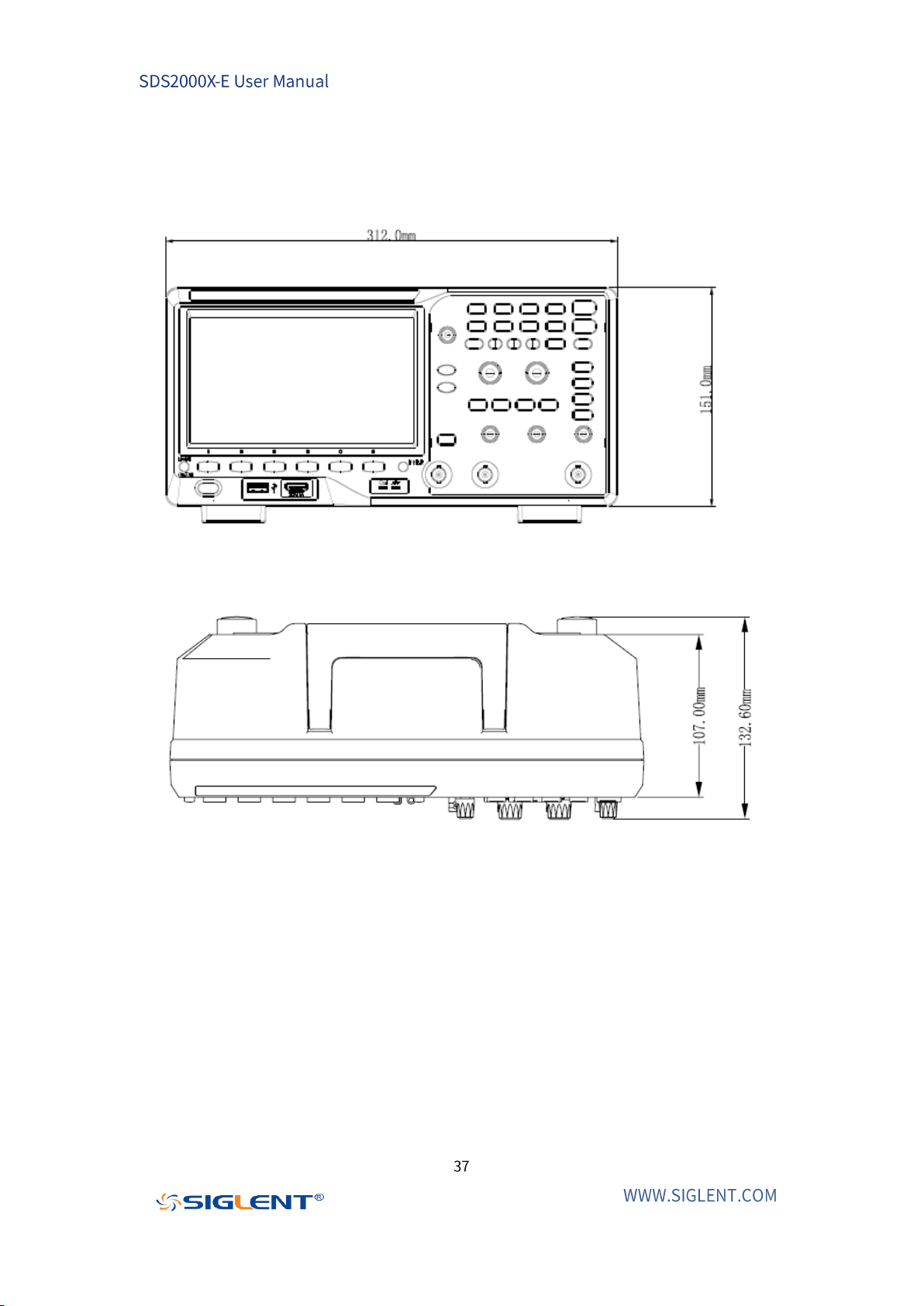
Appearance and Dimensions
Figure 1 Front View
Figure 2 Top View
Prepare for Using
Adjust the Supporting Legs
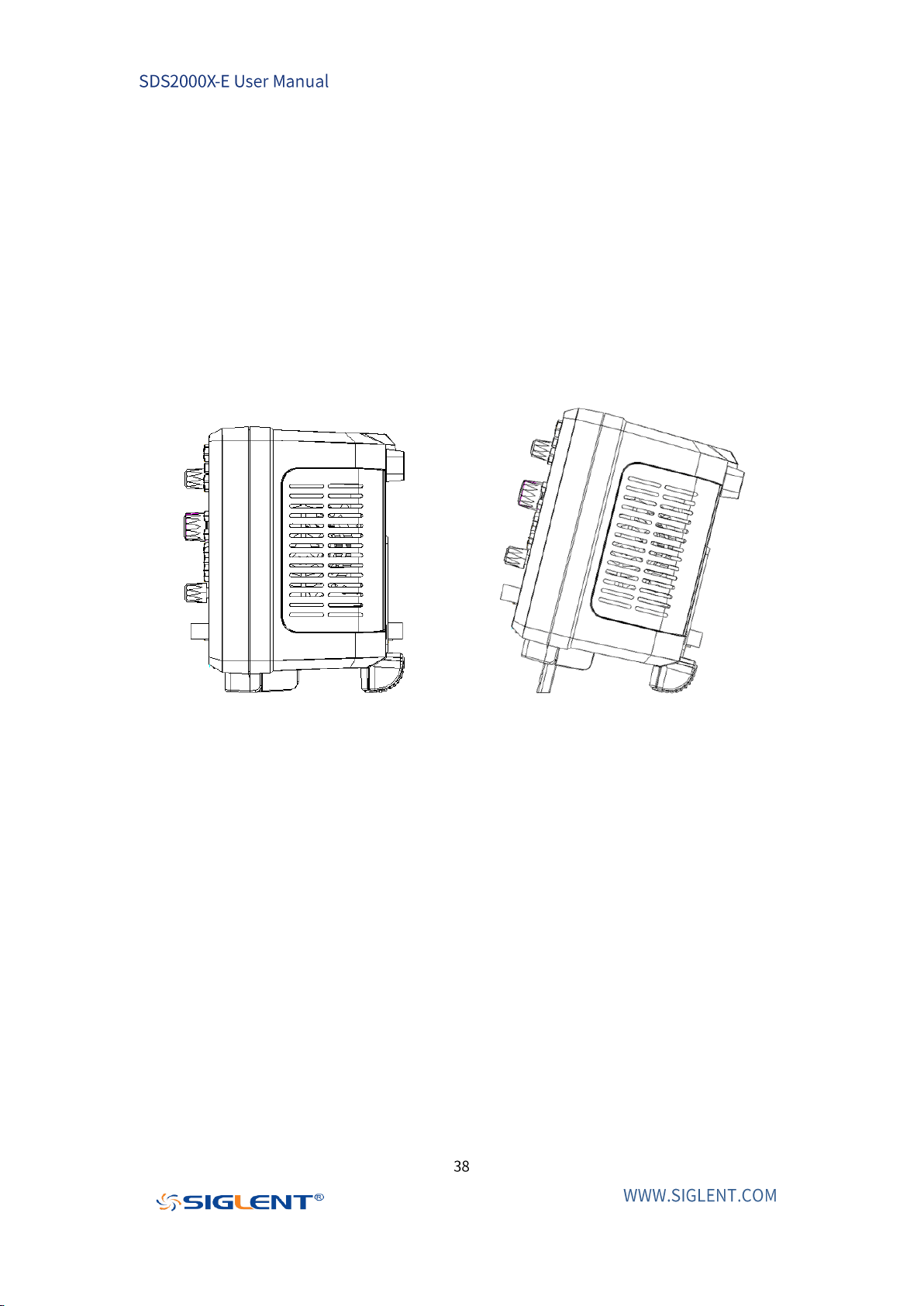
Adjust the supporting legs properly to use them as stands to tilt the oscilloscope
upwards for stable placement of the oscilloscope as well as better operation and
observation.
Figure 3 Adjust the Supporting Legs
Connect the Power Supply
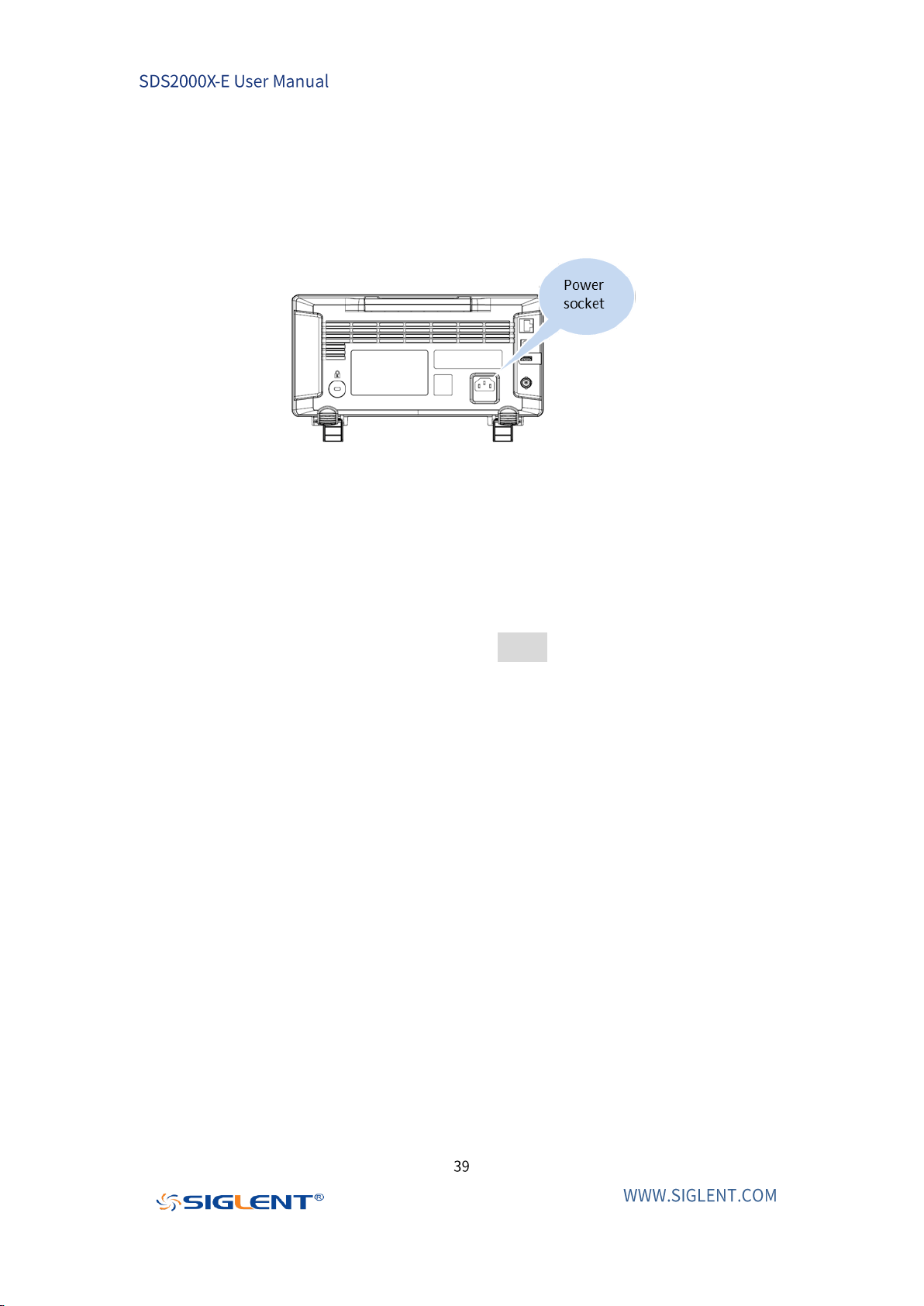
The power requirements of the oscilloscope are 100-240 Vrms, 50/60Hz or 100-120
Vrms, 440 Hz. Please use the power cord supplied with the instrument to connect
the oscilloscope to the power source.
Figure 4 Connect the Power Supply
Power-on Inspection
When the oscilloscope is energized, press the power key at the lower-left corner of
the front panel to start the oscilloscope. During the start-up process, the
oscilloscope performs a series of self-tests and you can hear the sound of relay
switching. After the self-test is finished, the welcome screen is displayed.
Connect the Probe
Connect the BNC terminal of the probe to a channel BNC connector of the
oscilloscope at the front panel.
Connect the probe tip to the circuit point to be tested and connect the ground
alligator clip of the probe to the circuit ground terminal.
Function Inspection
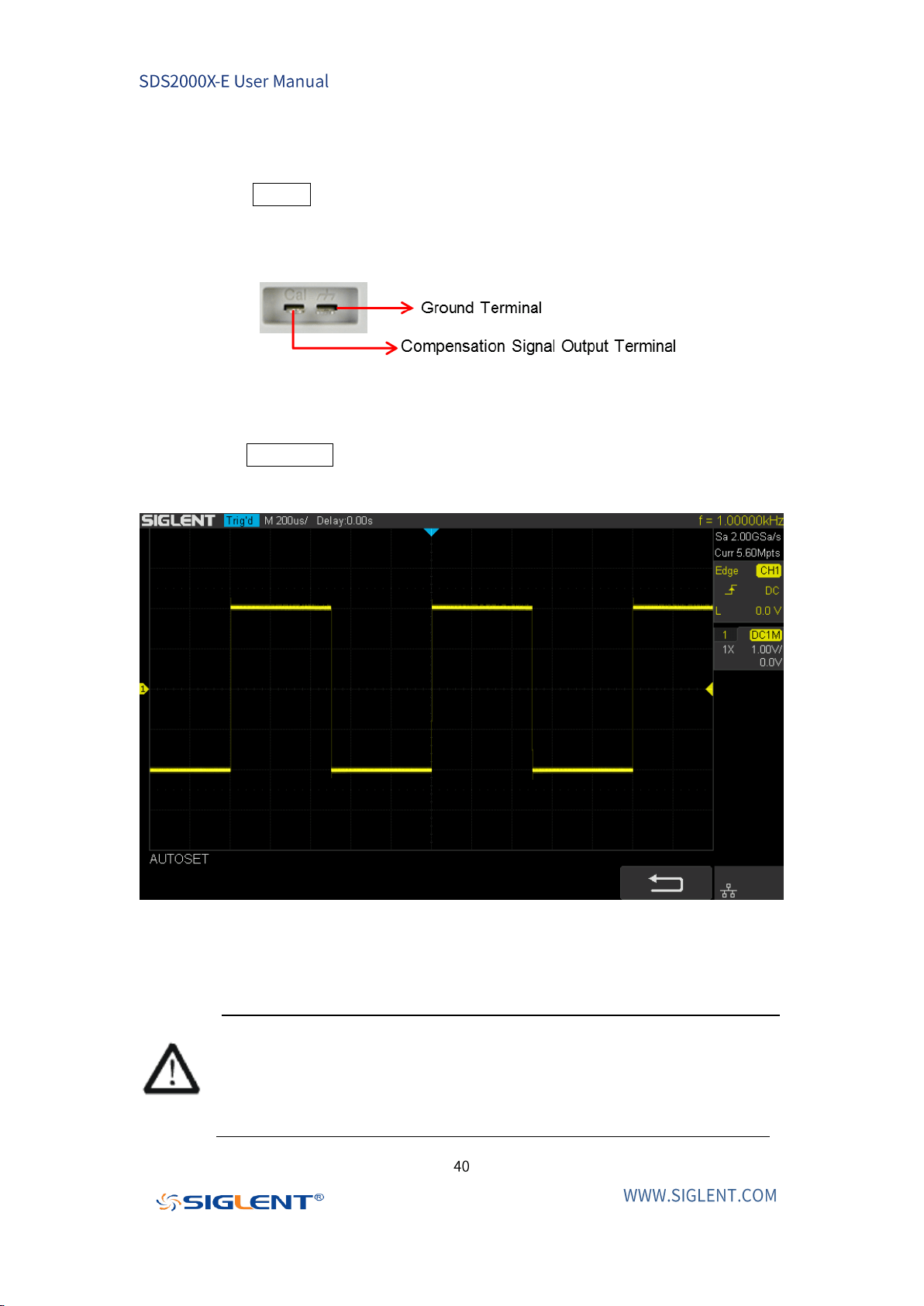
1. Press the Default button on the front panel to restore the instrument to its
default configuration.
2. Connect the ground alligator clip of the probe to the “Ground Terminal”
under the probe compensation signal output terminal.
Compensation Signal
3. Use the probe to connect the input terminal of CH1 of the oscilloscope and the
“Compensation Signal Output Terminal” of the probe.
4. Press the Auto Setup.
5. Observe the waveform on the display. In normal operating conditions, the
display should be a square waveform as shown in the figure below:
Figure 5 Functional Inspection
6. Use the same method to test the other channels. If the square waveforms
actually shown do not match that in the figure above, please perform “Probe
Compensation” in the next section.
WARNING
To avoid electric shock while using probes, please make sure that the
insulated wire of the probe is in good condition and do not touch the
metallic part of the probe when the probe is connected to high voltage
source.
Probe Compensation
When the probes are used for the first time, you should compensate the probes to
match the input channels of the oscilloscope. Non-compensated or poorly
compensated probes may cause measurement inaccuracy or error. The probe
compensation procedures are as follows.
1. Perform steps 1, 2, 3 and 4 of “Function Inspection” in the previous section.
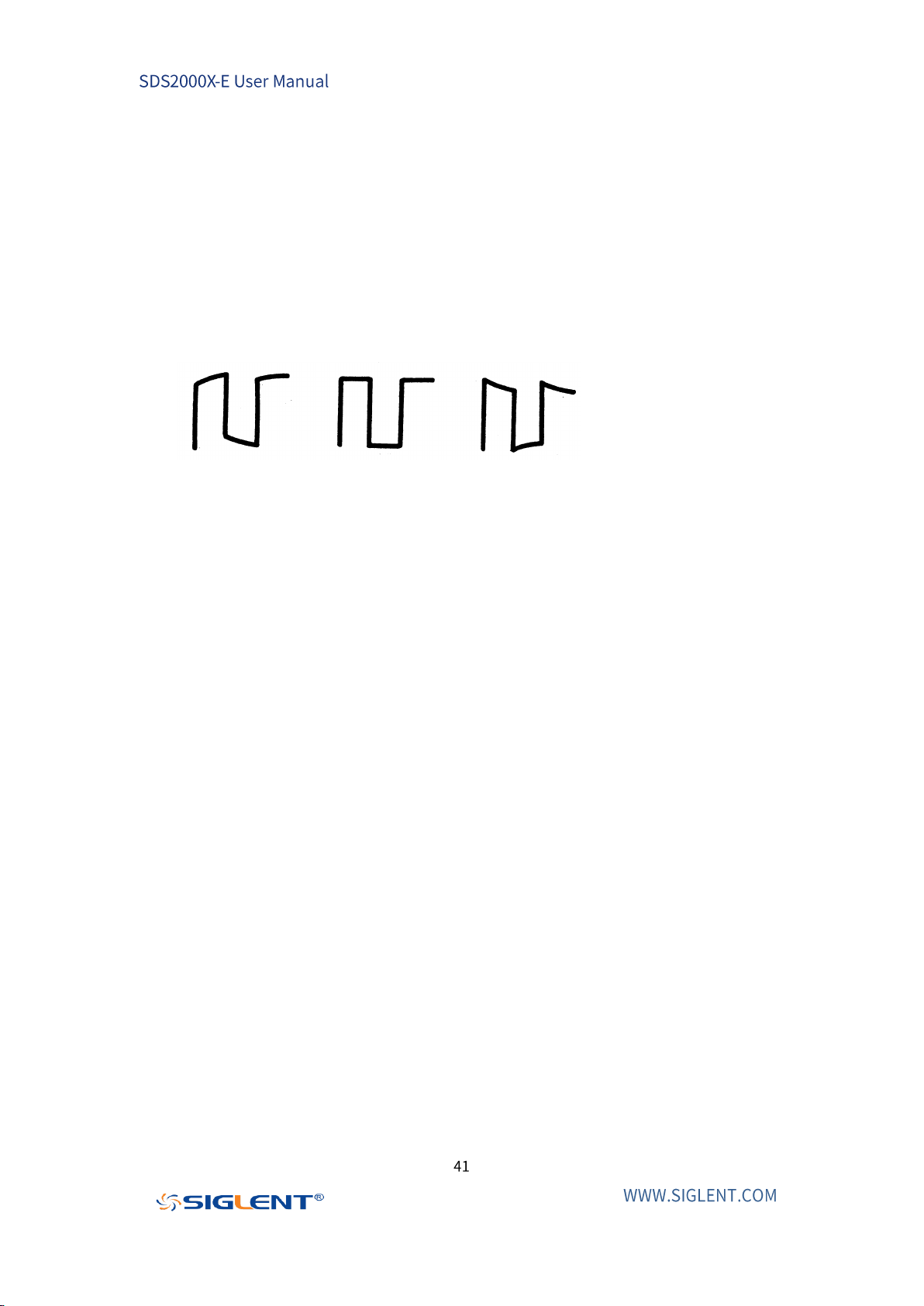
2. Check the waveforms displayed and compare them with the following:
Under Perfectly Over
Compensated Compensated Compensated
3. Use a nonmetallic driver to adjust the low-frequency compensation adjustment
hole on the probe until the waveform displayed is as the “Perfectly
compensated” in the figure above.
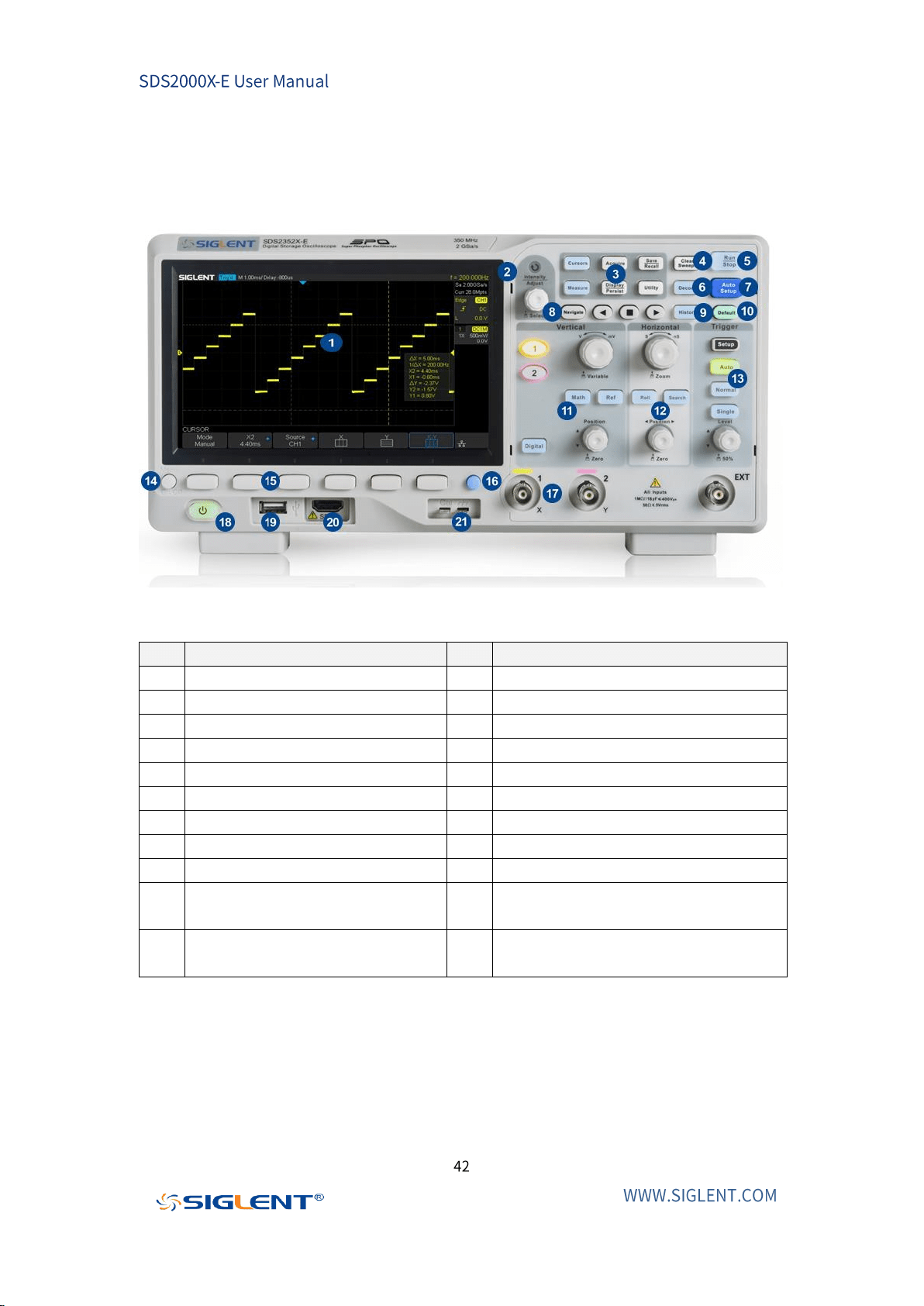
Front Panel Overview
Figure 6 Front Panel
No.
Description
No.
Description
1
LCD Display
12
Horizontal Control
2
Universal Knob
13
Trigger Control
3
Common Function Menus
14
Menu on/off
4
Clear Sweeps
15
Menu Softkey
5
Run/Stop
16
One- Button shortcut for Save
6
Decode
17
Analog Channel
7
Auto Setup
18
Power Button
8
Navigate
19
USB Host
9
History
20
Digital Inputs
10
Default
21
Probe Compensation/ Ground
Terminal
11
Vertical Control, Math, REF and
Digital
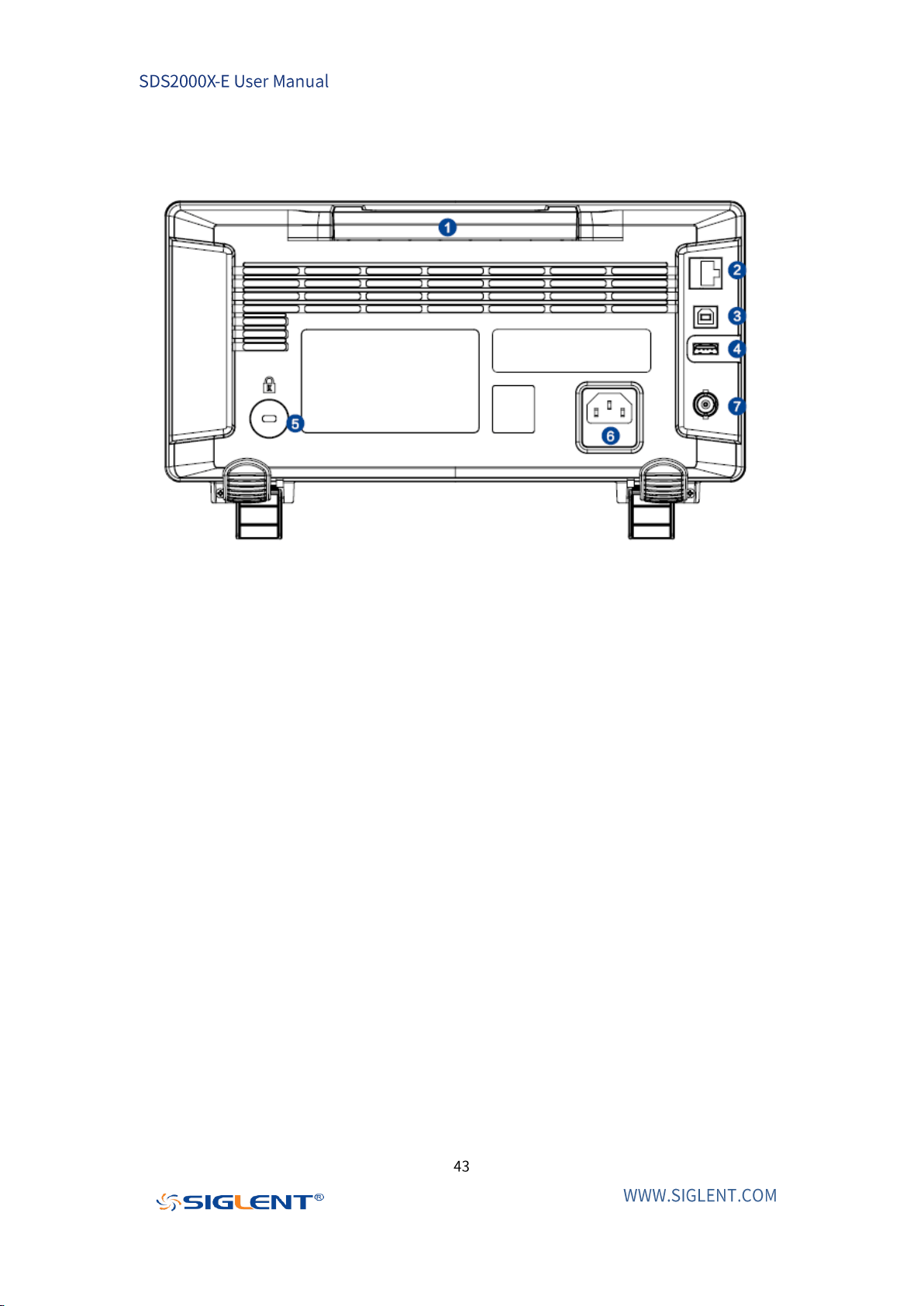
Rear Panel Overview
Figure 7 Rear Panel
1. Handle
Pull up the handle vertically for easy carrying of the instrument. When you do
not need the handle, press it down.
2. LAN
The instrument can be connected to network via this interface to perform
remote control.
3. USB Device
The oscilloscope supports remote control via computer and accepts SCPI
remote control commands. Users can control the oscilloscope through this
interface.
4. USB Host
Communicate with external function generators (SIGLENT SDG and SAG1021)
5. Safety Lock Hole
You can lock the instrument to a fixed location using the security lock (not
included) via the lock hole.
6. AC Power Socket
AC power input terminal. The power requirements of this oscilloscope are
100-240 V, 50/60/440 Hz. Use the power cord provided with the instrument to
connect it to AC power.
7. Pass/Fail or Trigger Out
The BNC port can output a signal that reflects the current waveform capture
rate of the oscilloscope at each trigger or a pass/fail test pulse.
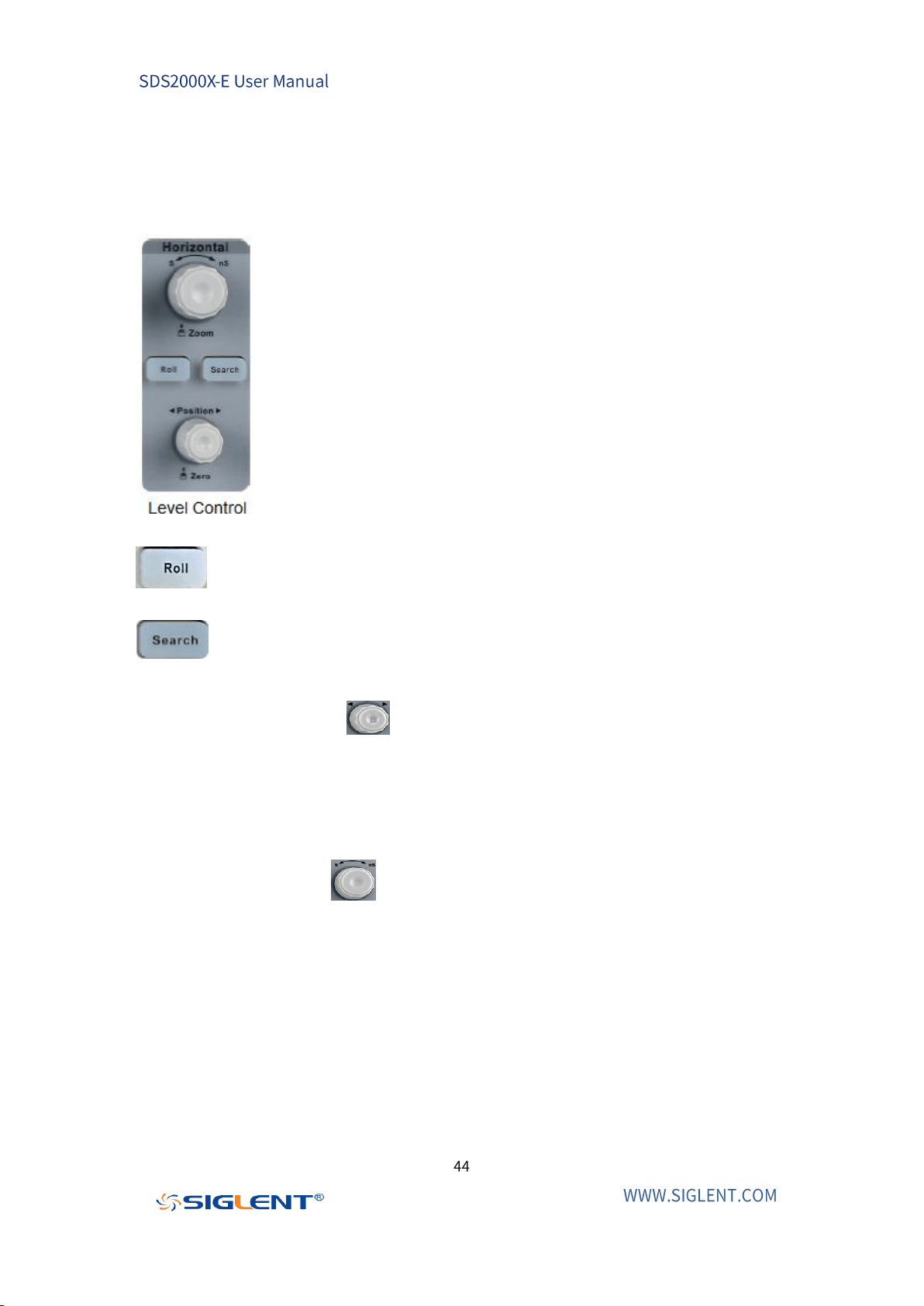
Front Panel Function Overview
Horizontal
:Quickly enter the roll mode. The time base range is from 50 ms/div to
100 s/div.
:Enable or disable search function. This function can search for the
events that users specify in the acquired data, the results are displayed
with white triangle symbol.
Horizontal Position Knob : Adjust horizontal position. The trigger point would
move left or right relative to the center of the screen when you turn the knob.
During the modification, waveforms of all the channels would move left or right
and the trigger position message at the upper-right corner of the screen would
change accordingly. Press down this knob to quickly reset the trigger delay to zero.
Horizontal Scale Knob : Adjust the horizontal time base. Turn clockwise to
reduce the time base and turn counterclockwise to increase the time base. During
the modification, waveforms of all the channels will be displayed in expanded or
compressed mode and the time base message at the upper-left side of the screen
will change accordingly. Press down this knob to quickly turn on the Zoom
function.
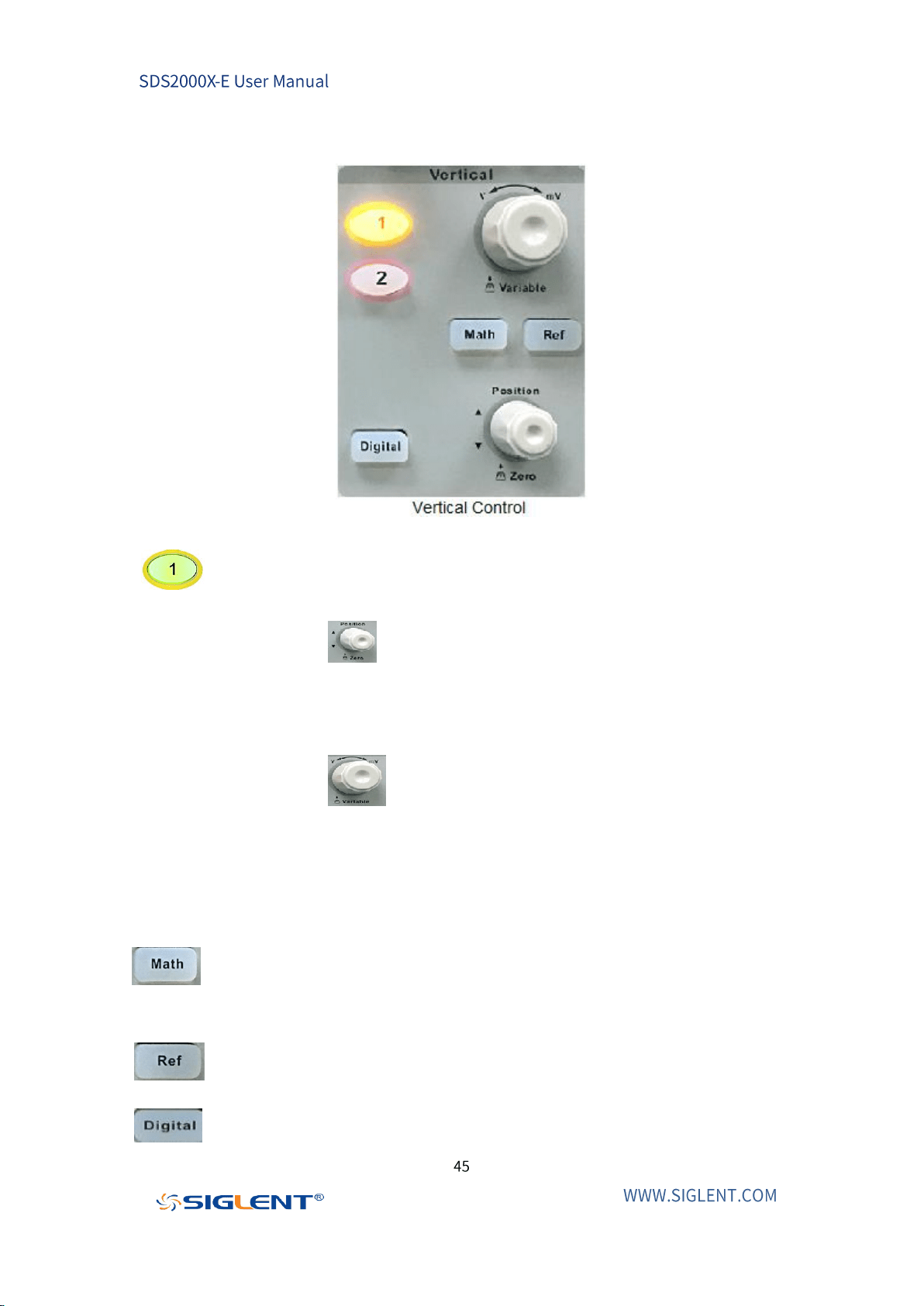
Vertical
:Analog input channels. The two channels are marked by different colors
which are also used to mark both the corresponding waveforms on the
screen and the channel input connectors.
Vertical Position Knob : Adjust the vertical position of the current channel
waveform. Turn clockwise to increase the position and turn counterclockwise to
decrease. During modification, the waveform should move up and down and the
position message at the lower-left corner of the screen should change accordingly.
Press down this knob to quickly reset the vertical position to zero.
Vertical Variable Knob : Adjust the vertical scale of the current channel.
Turn clockwise to decrease the scale and turn counterclockwise to increase. During
the modification, the amplitude of the waveform should enlarge or reduce and the
scale information at the right side of the screen will change accordingly. Press
down this knob to quickly switch the vertical scale adjustment modes between
“Coarse” and “Fine”.
: Press the button to enter the MATH function menu. The oscilloscope
provides addition, subtraction, multiplication, FFT, differential, integral
and square root operations.
: Press the button to enter the REF function menu. A reference waveform
can be displayed and compared against other waveforms.
: Press the button to open the digital channel function menu (Optional
function). The SDS2000X-E supports 16 digital channels.
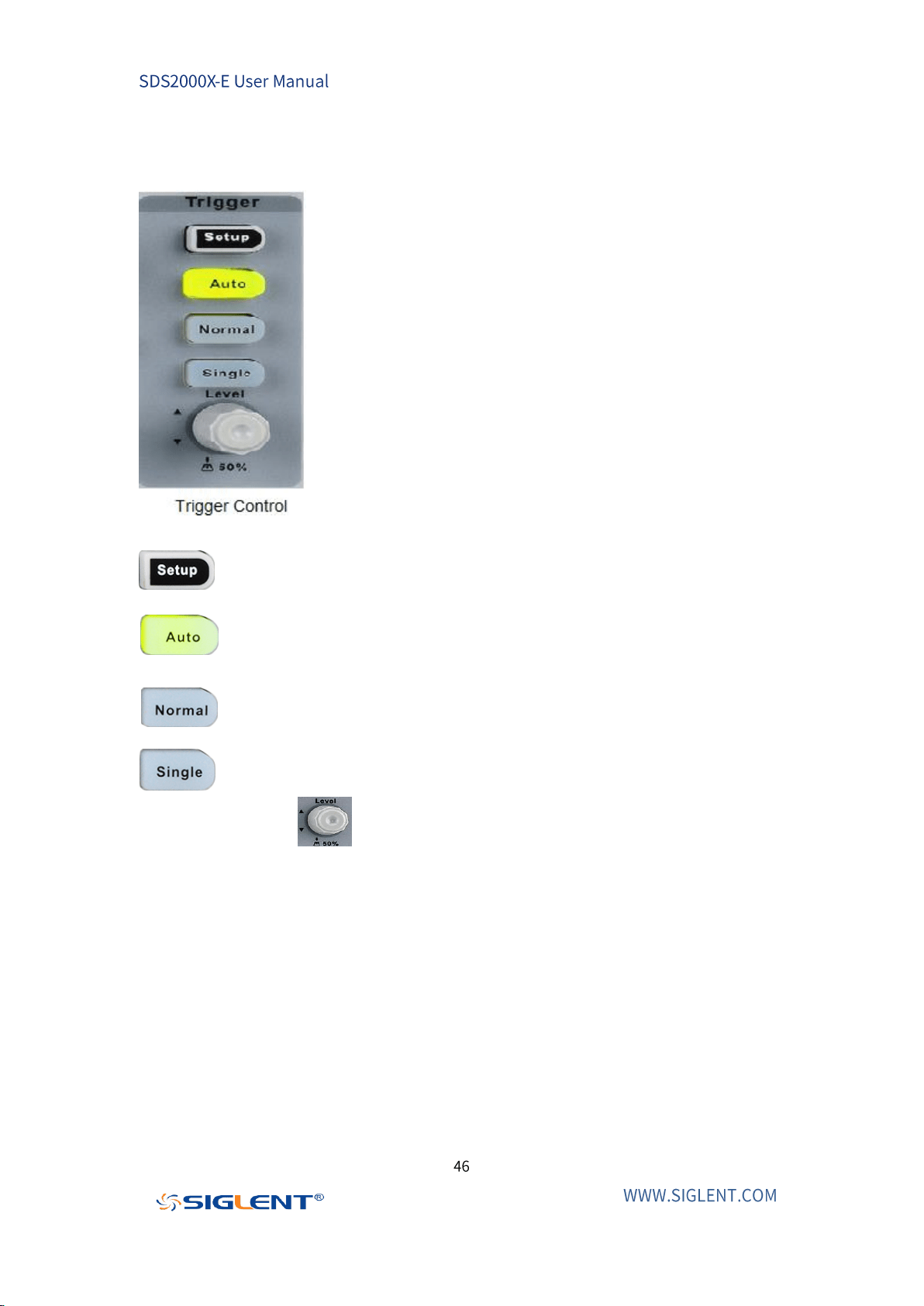
Trigger
: Press the button to enter the TRIGGER function menu. The oscilloscope
provides abundant advanced trigger functions.
: Press the button to set the trigger mode to Auto.
: Press the button to set the trigger mode to Normal.
: Press the button to set the trigger mode to Single.
Trigger Level Knob : Adjust the trigger level. Turn clockwise to increase the
level and turn counterclockwise to reduce the level. During modification, the trigger
level line will move up and down and the value in the trigger level message box at
the up-right corner of the screen will change accordingly. Press down the knob to
quickly reset the trigger level to center of the waveform.
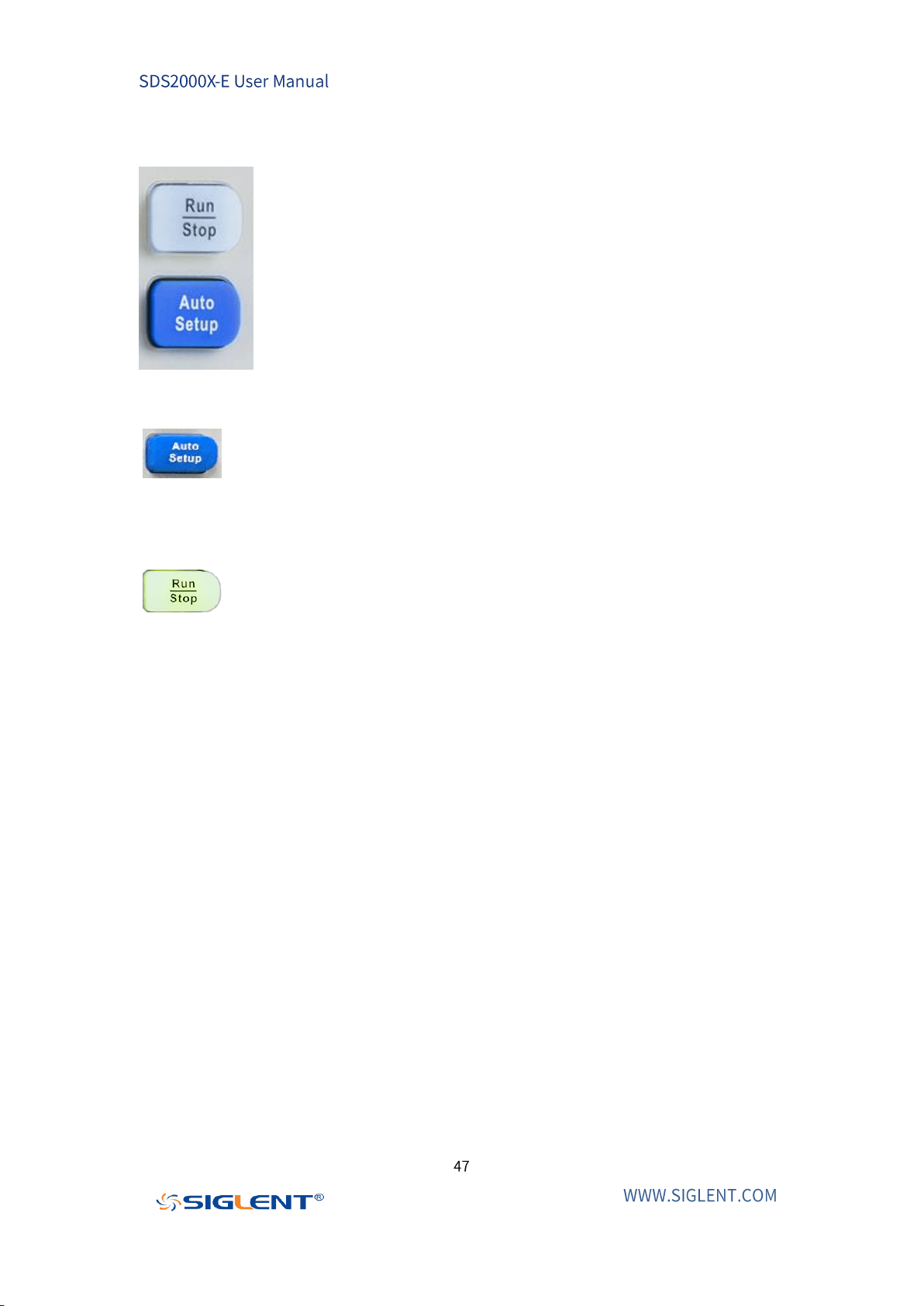
Run Control
: Press this key to enable the waveform auto setting function. The
oscilloscope will automatically adjust the vertical scale, horizontal time
base and trigger mode according to the input signal to help configure
the instrument to display some waveform information. The oscilloscope
may have difficulty showing slow signals (< 100 Hz).
: Press the button to set the acquisition state to Run or Stop.
In RUN state, the key is illuminated in yellow.
In Stop state, the key is illuminated in red.
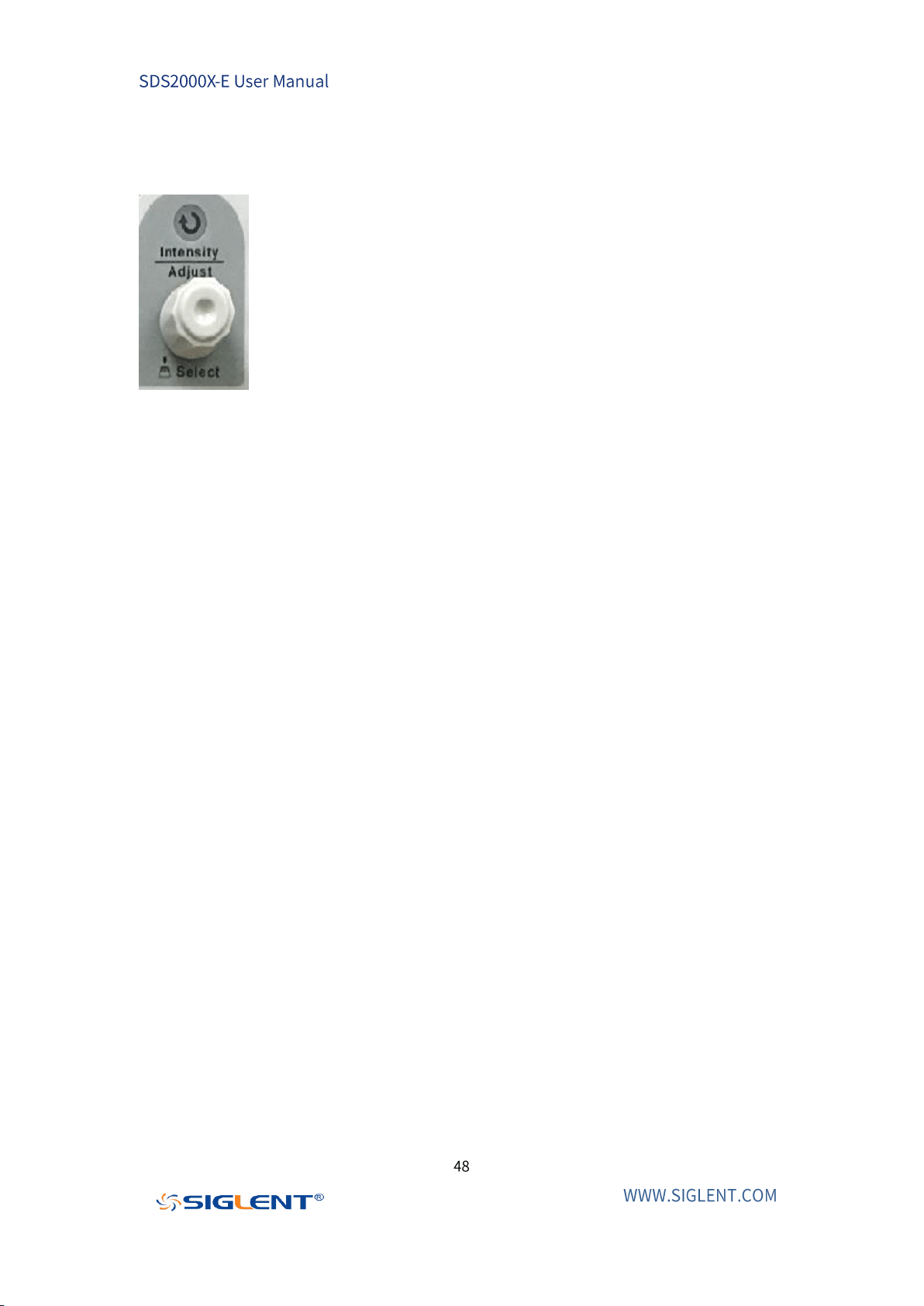
Universal Knob
1. Select the desired submenu.
In menu operation, press any menu softkey and turn the Universal Knob to
select the desired submenu under the menu and push down the knob to
confirm the current submenu. Turn clockwise to increase the display intensity
and counterclockwise to decrease.
2. Modify parameters.
After having chosen a parameter, turn the Universal Knob to modify the value.
Turn clockwise to increase the intensity and counterclockwise to reduce. In
addition, it can also be used to adjust scale and offset of MATH and REF. Press
this button to display the virtual menu, you can directly select the desired
value.
3. Choose file or directory or input filename.
After having entered the file system, turn the Universal Knob to select the
desired file or directory. When inputting filename, turn the Universal Knob to
select the desired character and the push the knob to confirm.
4. Call out the virtual keyboard
Press the knob to call up the virtual keyboard; turn the Universal Knob
clockwise or counterclockwise to select the desired value on the virtual
keyboard.
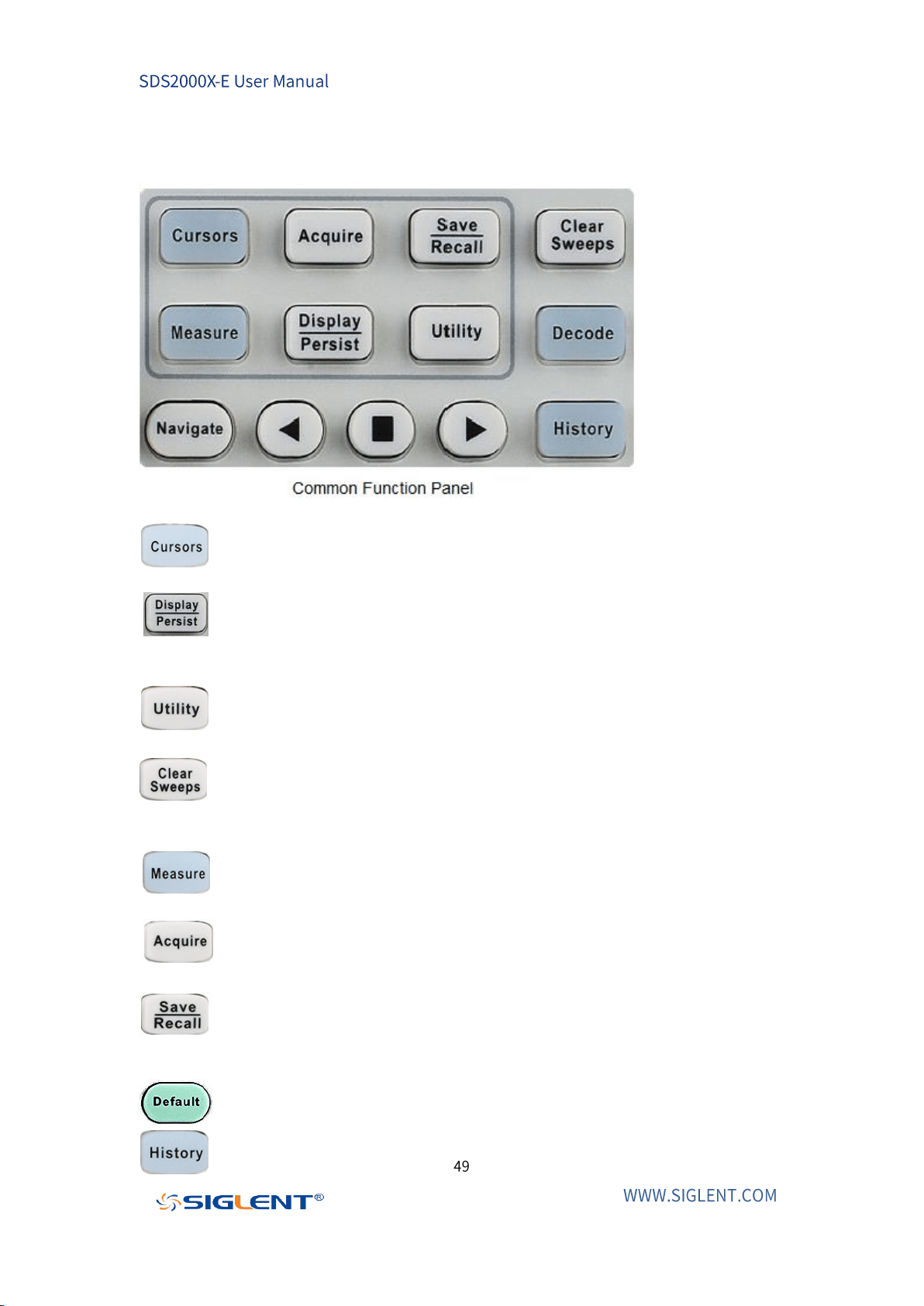
Menu
: Press to enter the CURSOR function menu. The oscilloscope provides
manual and track cursor mode.
: Press to enter the DISPLAY function menu and quickly enable the
persistance function. User can set the grid, intensity, graticule,
transparence.
: Press to enter the UTILITY function menu to look at the system
status, perform a selfcalibration, set the sound, language and so on.
: The button is a shortcut key for clear function. When the measurement
statistics is ON, press the button to clear the count and recount it. When
persist is enabled, press the button to clear persist.
: Press to enter the MEASURE function menu to set the
measurement parameters, all measurement, statistics and set the gate.
: Press to enter the ACQUIRE function menu to set the acquisition
mode, memory depth, wave interpolation and so on.
: Press to enter the SAVE/RECALL function menu to save setups,
waveforms, pictures, CSV files, binary data, matlab files, and default key
presets to internal memory or USB flash drive.
: Press to reset the oscilloscope to the user default setup.
: Press to enter the history mode. In history mode, it can record up-to
80000 frames/trigger events. If sequence function is enabled, it only
records the frames which you set, the most you can set is 80000.
: Press to enter the DECODE function menu. The oscilloscope supports
I2C, SPI, UART, CAN and LIN serial bus decode.
: Press to turn off/on the navigate function. SDS2000X-E supports three
navigate types: time, search event, history frame.
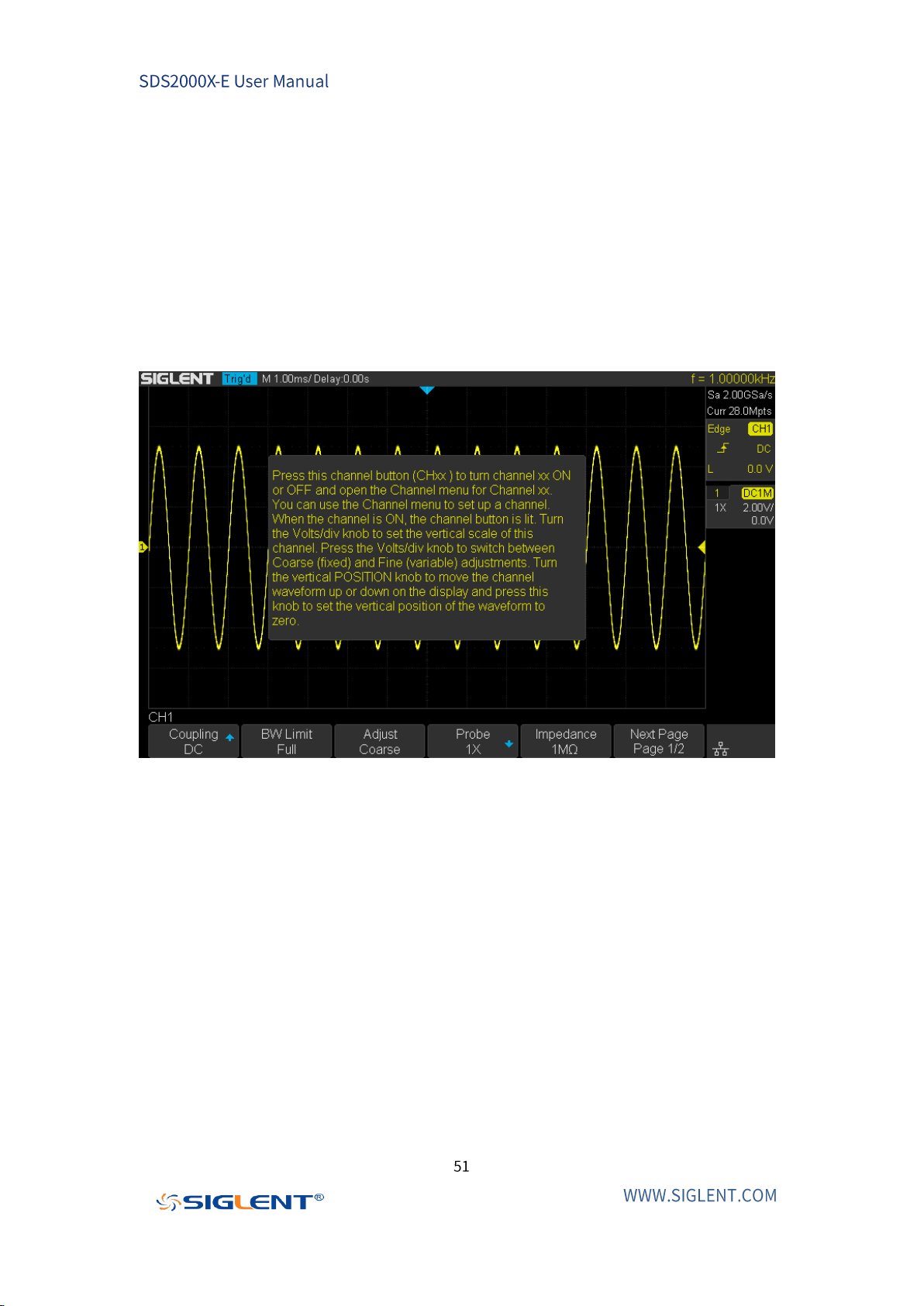
Help
The oscilloscope has an on line help function that supplies multi-language help
information.
You can access the help function by pressing any button for 2 seconds and a help
window will open with a brief explaination of the selected function. Also all of the
submenus include help information.
Figure 8 Help Message

User Interface
Figure 9 User Interface
1. Product Logo
SIGLENT is the registered trademark of SIGLENT TECHNOLOGIES CO., LTD.
2. Channel Label/Waveform
Different channels are marked by different colors and the color of the
waveform matches the color of the channel.
3. Trigger Status
Available trigger status includes: Ready, Auto, Stop, Arm, Trig’d, FStop.
4. Horizontal Time Base
Represent the time per grid on the horizontal axis on the screen.
Use the Horizontal Scale Knob to adjust the parameter. The available range is
from 500 ps to 100 s.
5. Trigger Position
Turn the Horizontal Position Knob to adjust the parameter. Push the knob to set
the value to 0 automatically.
6. Trigger Delay Label
Indicate the trigger delay on the waveform.
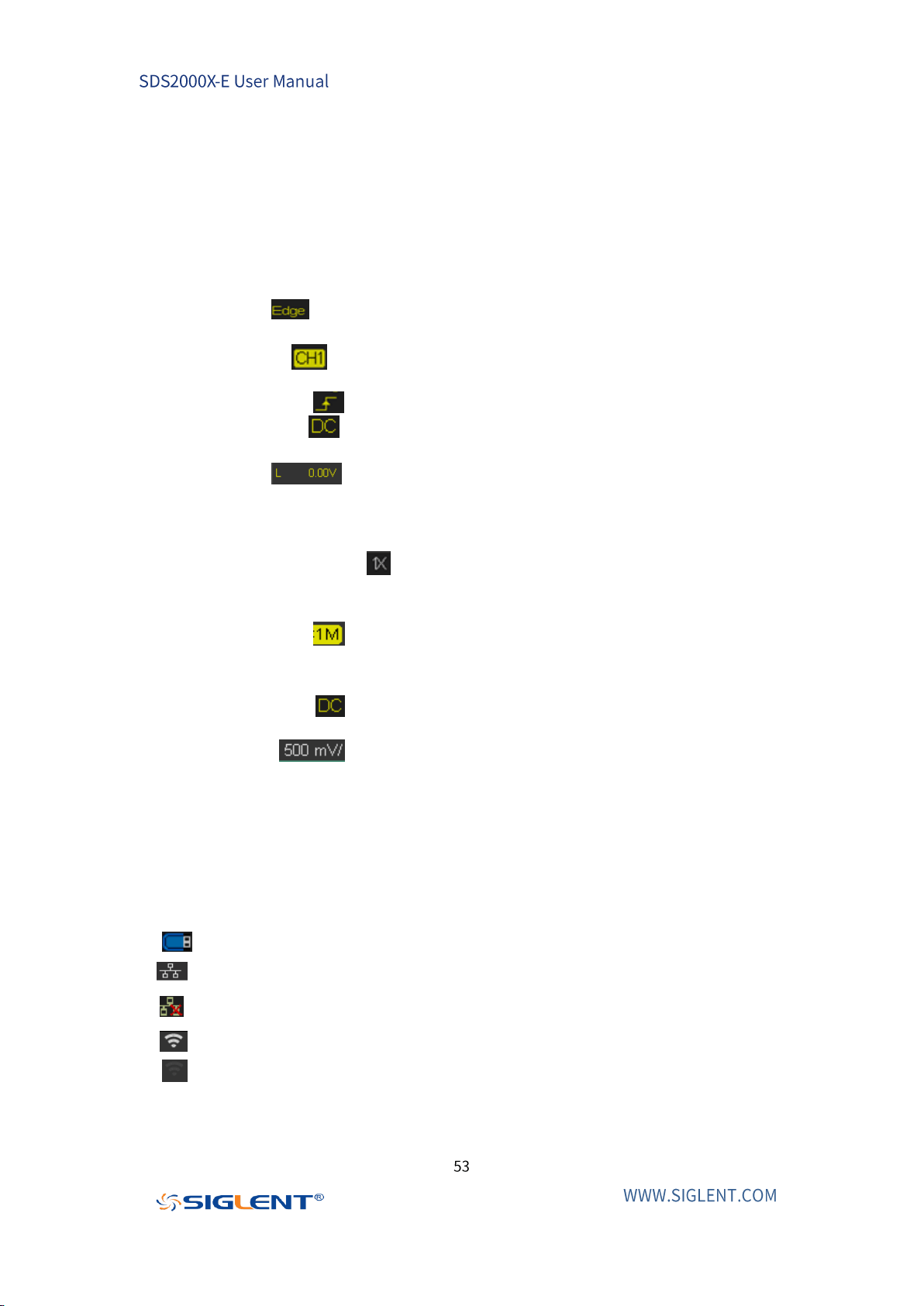
7. Frequency Counter
Display the frequency value of the trigger channel.
8. Sampling Rate/ Memory Depth
Display the current sampling rate and memory depth. Sa means the current
sampling rate and Curr means the current memory depth.
9. Trigger Setup
Trigger Type : Display the current trigger type. The trigger type name may
be abbreviated if the name is too long to display.
Trigger source : Display the currently trigger source. Different channels
display in colors that match the channel selection.
Trigger condition : Display the current trigger condition.
Trigger coupling : Display the current trigger coupling mode. Available
trigger coupling modes include: DC, AC, HF Reject, LF Reject.
Trigger level : Display the current value of the trigger level. Push the
knob to set the trigger to the 50% of the waveform amplitude automatically.
10. Channel Setup
Probe attenuation factor : Display the current probe attenuation factor of
the channel. Available probe attenuation factors: 0.1X, 0.2X, 0.5X,
1X, …properties 2000X, 5000X, 10000X, Custom A, Custom B, Custom C, Custom
D.
Input impedance : Display the current input impedance of the channel.
Available Input impedances include: 50Ω, 1MΩ.
Channel coupling : Display the current channel coupling of the channel.
Channel coupling that available: DC, AC, and GND.
Vertical Scale : Display the current vertical scale of the channel. Turn
the Vertical Scale Knob to adjust the value.
11. Trigger Level Label
Display the position of trigger level, the color is the same to the trigger channel.
It can move from +4 div to -4 div of the screen center.
12. I/O status
Indicates that the USB Host is connected.
Indicates that the LAN port is connected.
Indicates that the LAN port is disconnected.
Indicates that the WLAN port is connected.
Indicates that the WLAN port is disconnected.
13. Menu
Display the corresponding function menu of the selected button. Press the

corresponding softkey to set the oscilloscope.
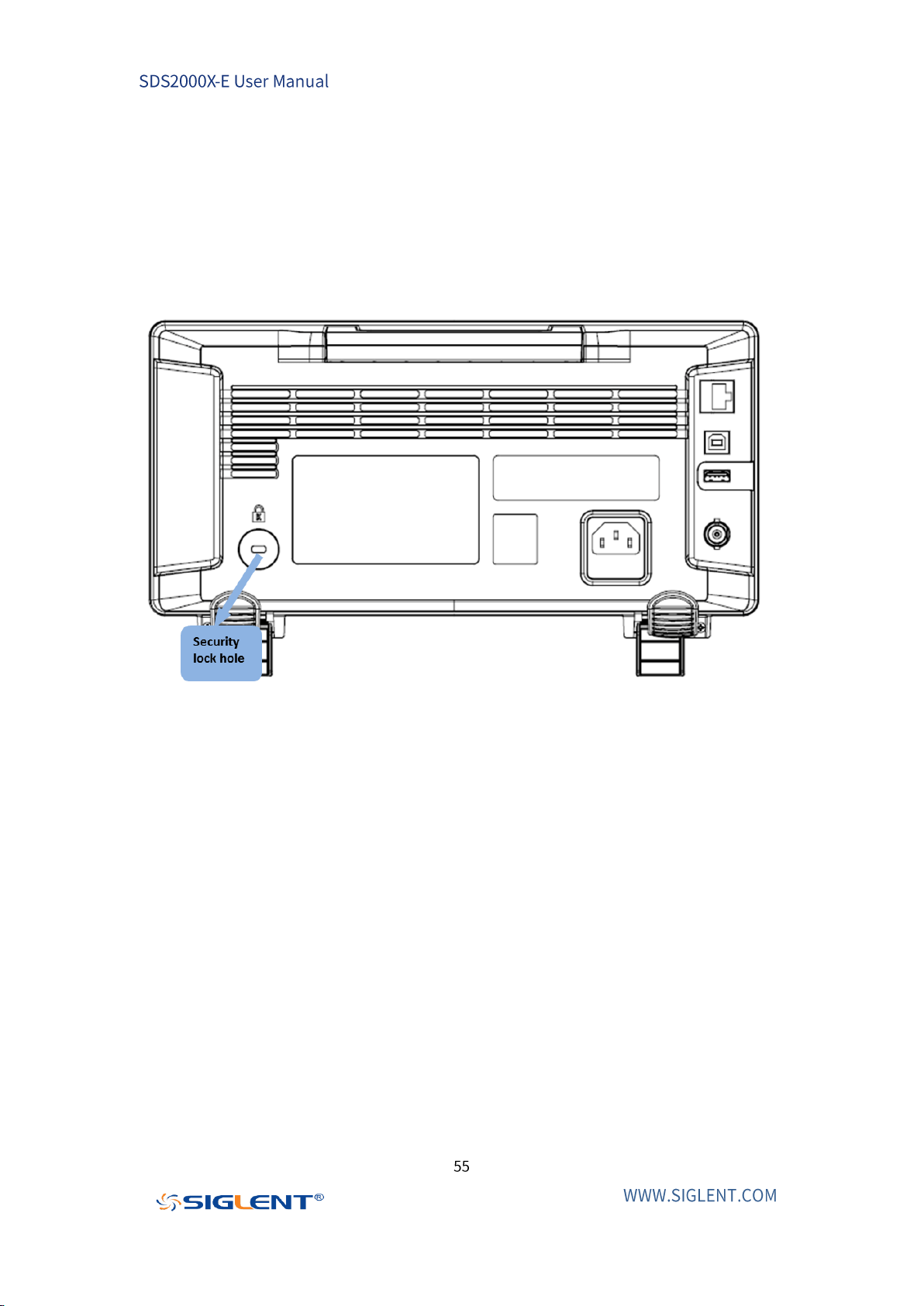
Security Lock
If needed, you can use the security lock (not included) to lock the oscilloscope to a
fixed location. The method is as follows, align the lock with the lock hole and plug
it into the lock hole vertically, turn the key clockwise to lock the oscilloscope and
then pull the key out.
Figure 10 Security Lock

Vertical System
This chapter introduces how to set the vertical system of the oscilloscope.
The contents of this chapter:
Enable the Channel
Vertical Scale
Vertical Position
Coupling
Bandwidth Limit
Probe
Input Impedance
Unit
Deskew
Invert
Trace Visible/Hidden
Enable the Channel
The oscilloscope provides 2 analog input channels and provides a vertical control
system for each channel. As the vertical system setting methods are the same, this
chapter takes CH1 as an example to introduce the setting method of the vertical
system.
Connect a signal to the CH1 channel input connector; and then press the CH1
button in the vertical control area (Vertical) on the front panel to enable CH1.
The channel setting menu is displayed at the bottom of the screen and the channel
label at the right side of the screen. The information displayed in the channel label
is related to the current channel setting.
After the channel is turned on, modify the parameters such as the vertical scale, the
horizontal time base and the trigger mode according to the input signal to make
the waveform display easy to observe and measure.
Note: If multiple channels are turned on at the same time, you should view the
channel menu before turning off the channel. For example: If Channel 1 and
Channel 2 are turned on and the oscilloscope displays the Channel 2 menu,
press CH1 to display the Channel 1 menu, then press CH1 again to turn off
Channel 1.

Vertical Scale
The vertical scale can be adjusted in Coarse or Fine mode.
Coarse adjustment (take counterclockwise as an example): Set the vertical
scale in 1-2-5 steps namely 500 uV/div, 1 mV/div, 2 mV/div, 5 mV/div, 10
mV/div …10 V/div.
Fine adjustment: Further adjust the vertical scale within a relatively smaller
range to improve vertical resolution. For example: 2 V/div, 1.98 V/div, 1.96
V/div, 1.94 V/div …1 V/div.
If the amplitude of the input waveform is a little bit greater than full scale
under the current scale and the amplitude would be a little bit lower if the next
scale is used, fine adjustment can be used to improve the amplitude of
waveform display to view signal details.
Press the CH1 button on the front panel; then press the Adjust softkey to select the
desired mode. Turn the Vertical Variable Knob to adjust the vertical scale
(clockwise to reduce the scale and counterclockwise to increase).
The scale information in the channel label at the right side of the screen will
change accordingly during the adjustment. The adjustable range of the vertical
scale is related to the probe ratio currently set. By default, the probe attenuation
factor is 1X and the adjustable range of the vertical scale is from 500 uV/div to 10
V/div.
Note: Push the Vertical Variable Knob to quickly switch between Coarse and Fine
adjustments.
Vertical Position
Turn the Vertical Position Knob to adjust the vertical position of the channel
waveform. Turn the knob clockwise to increase the vertical position (the channel
waveform moves up) while counterclockwise will reduce the vertical position (the
waveform moves down). Push the knob to set the vertical position of the channel
waveform to zero.
During the adjustment, the vertical position information Volts Pos displays at the
bottom of the screen. The table below shows the range of vertical position
according to the volt scale.
Volt Scale
Range of Vertical Position
500 μV/div ~ 100 mV/div
± 2 V
102 mV/div ~ 1 V/div
± 20 V
1.02 V/div ~ 10 V/div
± 200 V
You can also adjust the vertical position of the channel waveform by following the
steps below:
1. Press CH1 button on the front panel to enter the CH1 function menu.
2. Press the Next Page softkey to enter the second page of the CH1 function
menu.
3. Press the Offset softkey and turn the Universal Knob to change the vertical
position of the CH1 waveform.
Coupling
Set the coupling mode to filter out undesired signals. For example, the signal under
test is a square waveform with DC offset.
When the coupling mode is set to DC: The DC and AC components of the signal
under test can both pass the channel.
When the coupling mode is set to AC: The DC components of the signal under
test are blocked.
When the coupling mode is set to GND: The DC and AC components of the
signal under test are both blocked.
Press the CH1 button on the front panel; then press the Coupling softkey and turn
the Universal Knob to select the desired coupling mode. The default setup is DC.
The current coupling mode is displayed in the channel label at the right side of the
screen. You can also press the Coupling softkey continuously to switch the coupling
mode.
Bandwidth Limit
Set the bandwidth limit to reduce display noise. For example, the signal under test
is a pulse with high frequency oscillation.
When the bandwidth limit is set to Full, the high frequency components of the
signal under test can pass the channel.
When the bandwidth limit is set to 20M, the high frequency components that
exceed 20 MHz are attenuated.
Press the CH1 button on the front panel; then press the BW Limit softkey to select
Full or 20M. The default setup is Full. When bandwidth limit is enabled, the
character B will be displayed in the channel label at the right side of the screen.
Probe
Set the probe attenuation factor to match the type of the probe that you are using
to ensure correct vertical readouts.
Press the CH1 button on the front panel; then press the Probe softkey and turn the
Universal Knob to select the desired value and push the knob to confirm. The
default setup is 1X.
The current probe attenuation factor is displayed in the channel label at the right
side of the screen. You can also press the Probe softkey continuously to switch the
probe attenuation factor.
The table shows the probe attenuation factor:
Menu
Attenuation Factor
0.1X
0.1 : 1
0.2X
0.2 : 1
0.5X
0.5 : 1
1X
1 : 1
2X
2 : 1
…
…
5000X
5000 : 1
10000X
10000 : 1
Custom
1000000:1~0.000001:1
You can also press the Probe softkey, select Custom, and press the Custom softkey
to rotate the Universal Knob to select the desired probe attenuation ratio.
Input Impedance
Set the input impedance of the current input channel. Choices include 1 MΩ, 50 Ω.
The default input impedance of the oscilloscope is 1 MΩ.
The 1 MΩ selection is for use with many passive probes and for general- purpose
measurements. The higher impedance minimizes the loading effect of the
oscilloscope on the device–under-test.
The current channel input impedance is displayed in the channel label at the right
side of the screen.
Unit
Select the amplitude display unit for the current channel. The available units are
volts denoted by “V” and amps shown as “A”. When the unit is changed, the
unit displayed in the channel label will change accordingly.
1. Press CH1 button on the front panel to enter the CH1 function menu.
2. Press the Next Page softkey to enter the second page of the CH1 function
menu.
3. Press the Unit softkey to select the desired unit V or A.
The default setup is V.
Deskew
Deskew allows you to add or subtract a mathematical time delay to a channels
time data. This can be helpful in coordinating signals that may have different cable
lengths or other causes of time skew between channels.
The valid deskew range of each analog channel is ±100 ns.
1. Press CH1 button on the front panel to enter the CH1 function menu.
2. Press the Next Page softkey to enter the second page of the CH1 function
menu.
3. Press the Deskew softkey. Then turn the Universal Knob to change deskew.
Invert
When Invert is set to On, the voltage values of the displayed waveform are inverted.
Invert affects how a channel is displayed and it keeps the trigger settings.
Inverting a channel also changes the result of any math function selected and
measure function.
1. Press CH1 button on the front panel to enter the CH1 function menu.
2. Press the Next Page softkey to enter the second page of the CH1 function
menu.
3. Press the Invert softkey to turn on or off the invert display.
Trace Visible/Hidden
Set whether the current channel waveform is visible.
1. Press CH1 button on the front panel to enter the CH1 function menu.
2. Press the Next Page softkey to enter the second page of the CH1 function
menu.
3. Press the Trace softkey to visible or hidden the channel waveform.

Horizontal System
This chapter introduces how to set the horizontal system of the oscilloscope.
The contents of this chapter:
Horizontal Scale
Trigger Delay
Roll
Zoom

Horizontal Scale
Turn the Horizontal Scale Knob on the front panel to adjust the horizontal time
base. Turn clockwise to reduce the horizontal time base and turn counterclockwise
to increase.
The time base information at the upper left corner of the screen will change
accordingly during the adjustment. The range of the horizontal scale is from 500
ps/div to 100 s/div.
The Horizontal Scale Knob works (in the Normal time mode) while acquisitions are
running or when they are stopped. When in run mode, adjusting the Horizontal
Scale Knob changes the sample rate. When stopped, adjusting the Horizontal Scale
Knob lets you zoom into acquired data.

Trigger Delay
Turn the Position Knob on the front panel to adjust the trigger delay of the
waveform. During modification, all waveforms will move left or right and the
trigger delay message at the upper-right corner of the screen will change
accordingly. Press down this knob to quickly reset the trigger delay.
Changing the delay time moves the trigger point (solid inverted triangle)
horizontally and indicates how far it is from the time reference point. These
reference points are indicated along the top of the display grid.
All events displayed left of the trigger point happened before the trigger occurred.
These events are called pre- trigger information, and they show events that led up
to the trigger point.
Everything to the right of the trigger point is called post- trigger information. The
amount of delay range (pre- trigger and post- trigger information) available
depends on the time/div selected and memory depth.
The Position Knob works (in the Normal time mode) while acquisitions are running
or when they are stopped.
Roll
Press the Roll button to enter the roll mode.
In the Roll mode the waveform moves slowly across the screen from right to left. It
only operates on time base settings of 50 ms/div and slower. If the current time
base setting is faster than the 50 ms/div limit, it will be set to 50 ms/div when Roll
mode is entered.
If you would like to stop the display in Roll mode, press the Run/Stop button. To
clear the display and restart an acquisition in Roll mode, press the Run/Stop button
again.
Use Roll mode on low- frequency waveforms to yield a display much like a strip
chart recorder. It allows the waveform to roll across the display.
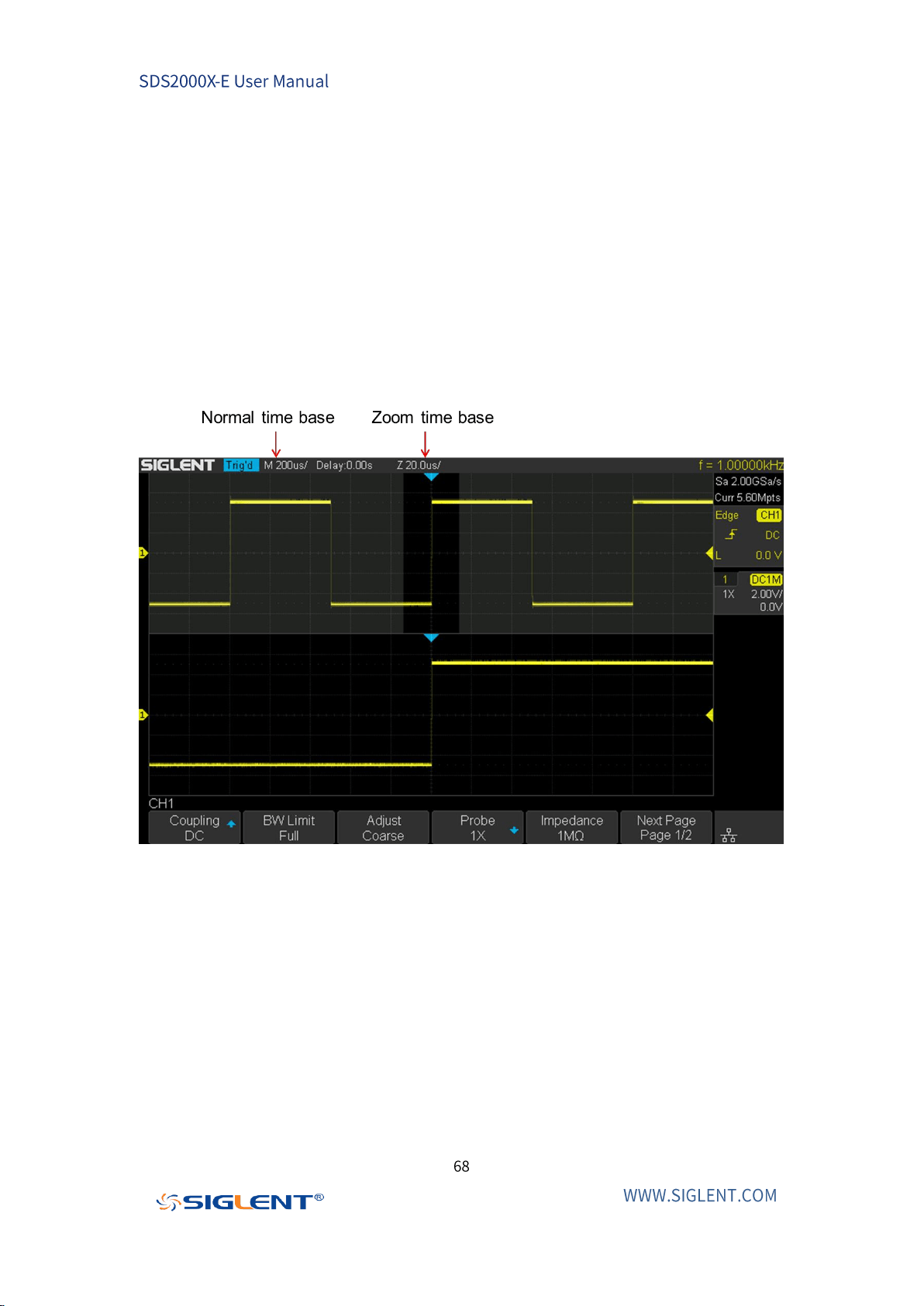
Zoom
Zoom is a horizontally expanded version of the normal display. You can use Zoom
to locate and horizontally expand part of the normal window for a more detailed
(higher- resolution) analysis of signals.
Press the Horizontal Scale Knob on the front panel to turn on the zoom function,
and press the button again to turn off the function. When the Zoom function is on,
the display divides in half. The top half of the display shows the normal time base
window and the bottom half displays a faster Zoom time base window.
Figure 11 Split Screen Zoom
The area of the normal display that is expanded is outlined with a box and the rest
of the normal display shows aghosted background. The box shows the portion of
the normal sweep that is expanded in the lower half.
To change the time base for the Zoom window, turn the Horizontal Scale Knob. The
Horizontal Scale Knob controls the size of the box. The Horizontal Position Knob
sets the left- to- right position of the zoom window. The delay value, which is the
time displayed relative to the trigger point is momentarily displayed in the upper-
right corner of the display when the Horizontal Position Knob is turned. Negative
delay values indicate you're looking at a portion of the waveform before the trigger

event, and positive values indicate you're looking at the waveform after the trigger
event.
To change the time base of the normal window, turn off Zoom; then, turn the
Horizontal Scale Knob.

Sample System
This chapter introduces how to use the run control and set the sampling system of
the oscilloscope.
The contents of this chapter:
Run Control
Overview
Memory Depth
Sampling Mode
Interpolation Method
Acquisition Mode
Horizontal Format
Sequence Mode
Run Control
Press the Run/Stop or Single button on the front panel to run or stop the sampling
system of the scope.
When the Run/Stop button is green, the oscilloscope is running, that is,
acquiring data when trigger conditions are met. To stop acquiring data, press
the Run/Stop button. When stopped, the last acquired waveform is displayed.
When the Run/Stop button is red, data acquisition is stopped. A red "Stop" is
displayed next to the trademark logo in the status line at the top of the display.
To start acquiring data, press Run/Stop.
To capture and display a single acquisition (whether the oscilloscope is
running or stopped), press Single. The Single run control lets you view single-
shot events without subsequent waveform data overwriting the display. Use
Single when you want maximum memory depth for pan and zoom.
When you press Single, the display is cleared, the trigger mode is temporarily set to
Normal (to keep the oscilloscope from auto- triggering immediately), the trigger
circuitry is armed, the Single key is illuminated, and the oscilloscope waits until a
user defined trigger condition occurs before it displays a waveform.
When the oscilloscope triggers, the single acquisition is displayed and the
oscilloscope is stopped (the Run/Stop button is illuminated in red).
Press Single again to acquire another waveform.
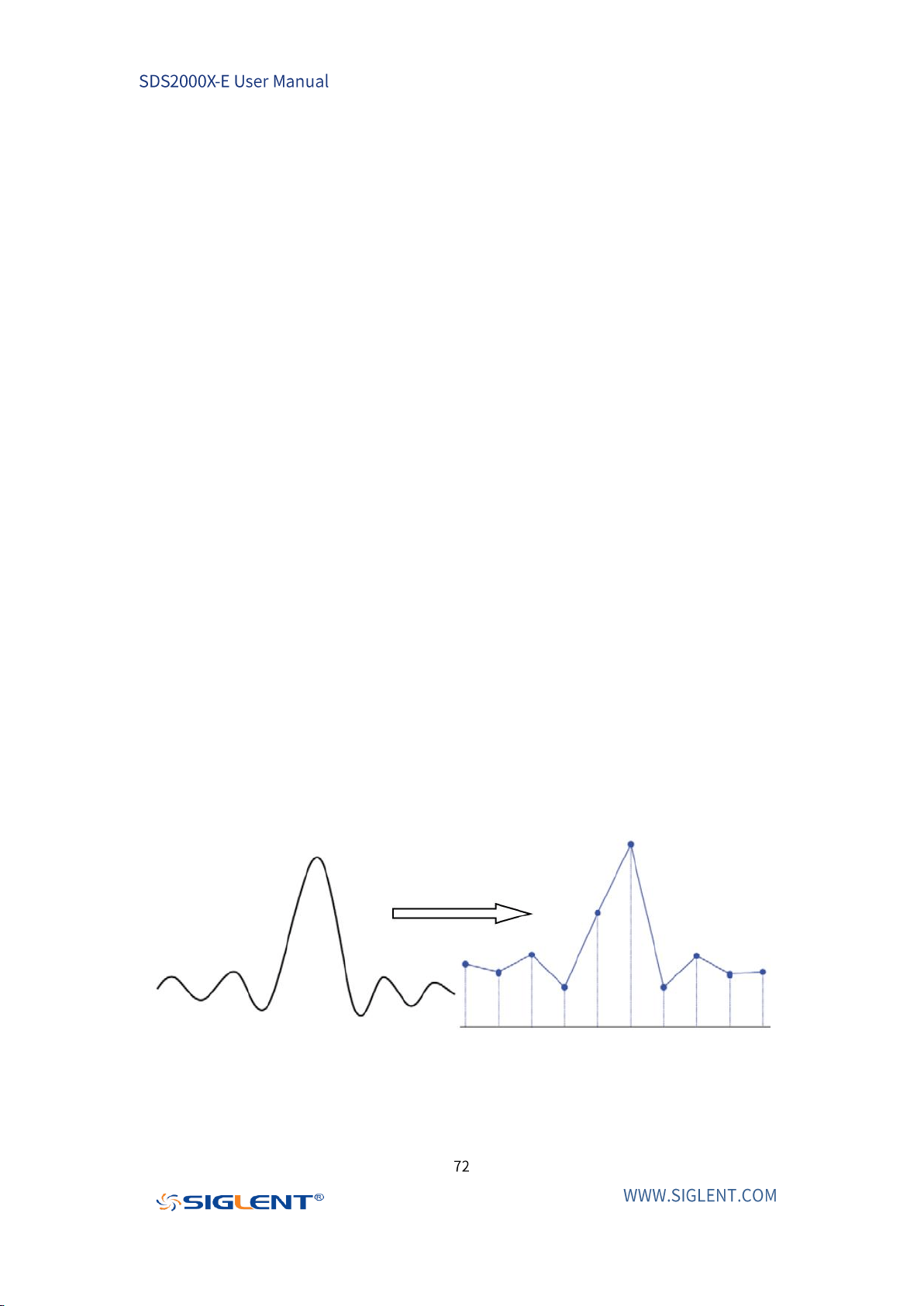
Overview
To understand the oscilloscope's sampling and acquisition modes, it is helpful to
understand sampling theory, sample rate, oscilloscope bandwidth and sample
rate.
Sampling Theory
The Nyquist sampling theorem states that for a limited bandwidth (band- limited)
signal with maximum frequency f
MAX
, the equally spaced sampling frequency f
S
must be greater than twice the maximum frequency f
MAX
, in order to have the signal
be uniquely reconstructed without aliasing.
f
MAX
= f
S/2
= Nyquist frequency (f
N
) = folding frequency
Sample Rate
The maximum sample rate of the oscilloscope is 2 GSa/s. The actual sample rate of
the oscilloscope is determined by the horizontal scale and memory depth. Turn the
Horizontal Scale Knob to adjust the sample rate.
The actual sample rate is displayed in the information area at the upper- right
corner of the screen.
The influence on the waveform when the sample rate is too low:
1. Waveform Distortion: When the sample rate is too low, some waveform details
are lost and the waveform displayed is rather different from the actual signal.
2. Waveform Confusion: When the sample rate is lower than twice the actual
signal frequency (Nyquist Frequency), the frequency of the waveform rebuilt
from the sample data is lower than the actual signal frequency. The most
common aliasing effect is the jitter on fast edges.
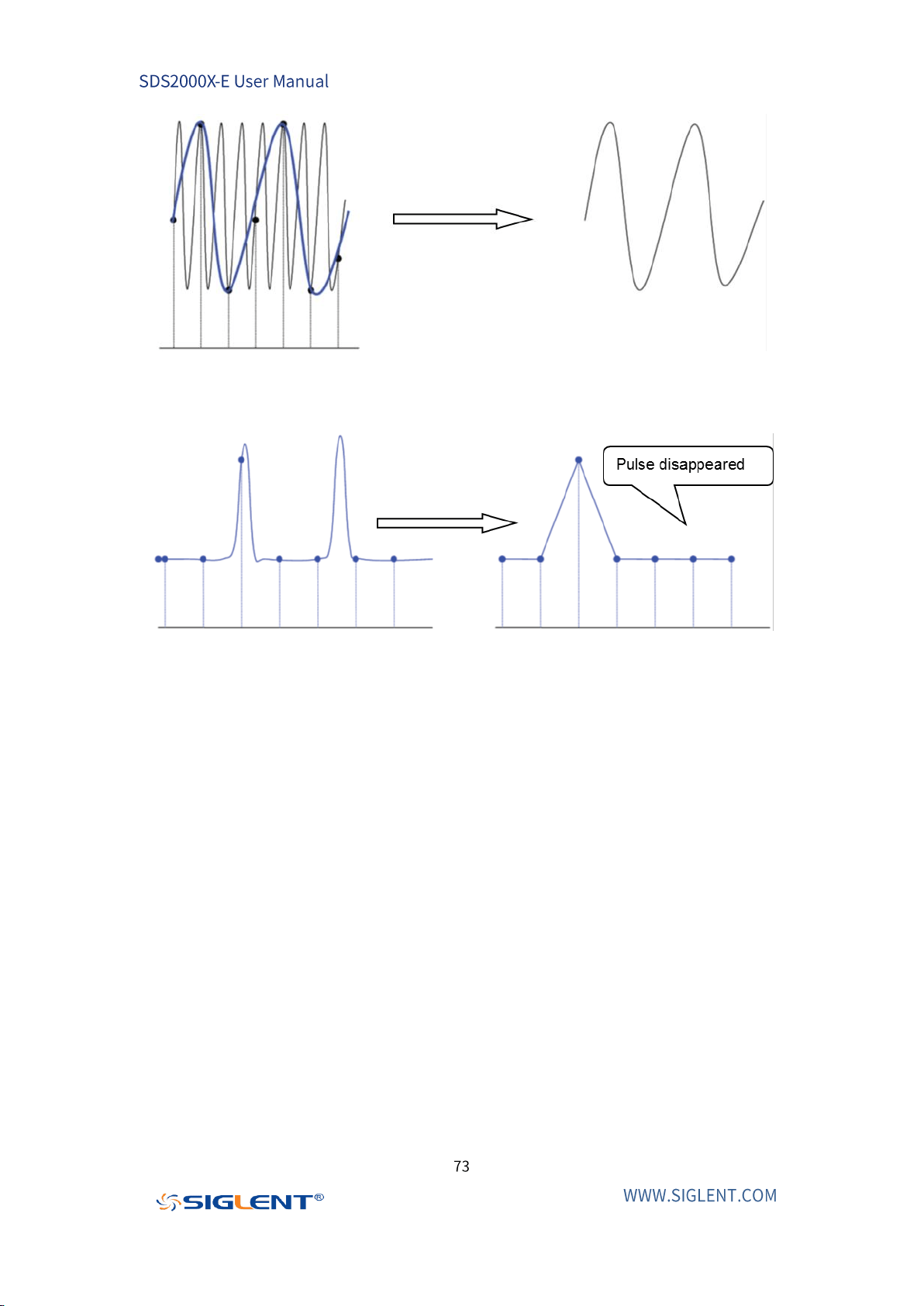
3. Waveform Leakage: When the sample rate is too low, the waveform rebuilt
from the sample data does not reflect all the actual signal information.
Bandwidth and Sample Rate
An oscilloscope's bandwidth is typically described as the lowest frequency at which
input signal sine waves are attenuated by 3 dB (- 30% amplitude error).
At the oscilloscope bandwidth, sampling theory says the required sample rate is f
S
= 2f
BW
. However, the theory assumes there are no frequency components above f
MAX
(f
BW
in this case) and it requires a system with an ideal brick- wall frequency
response.
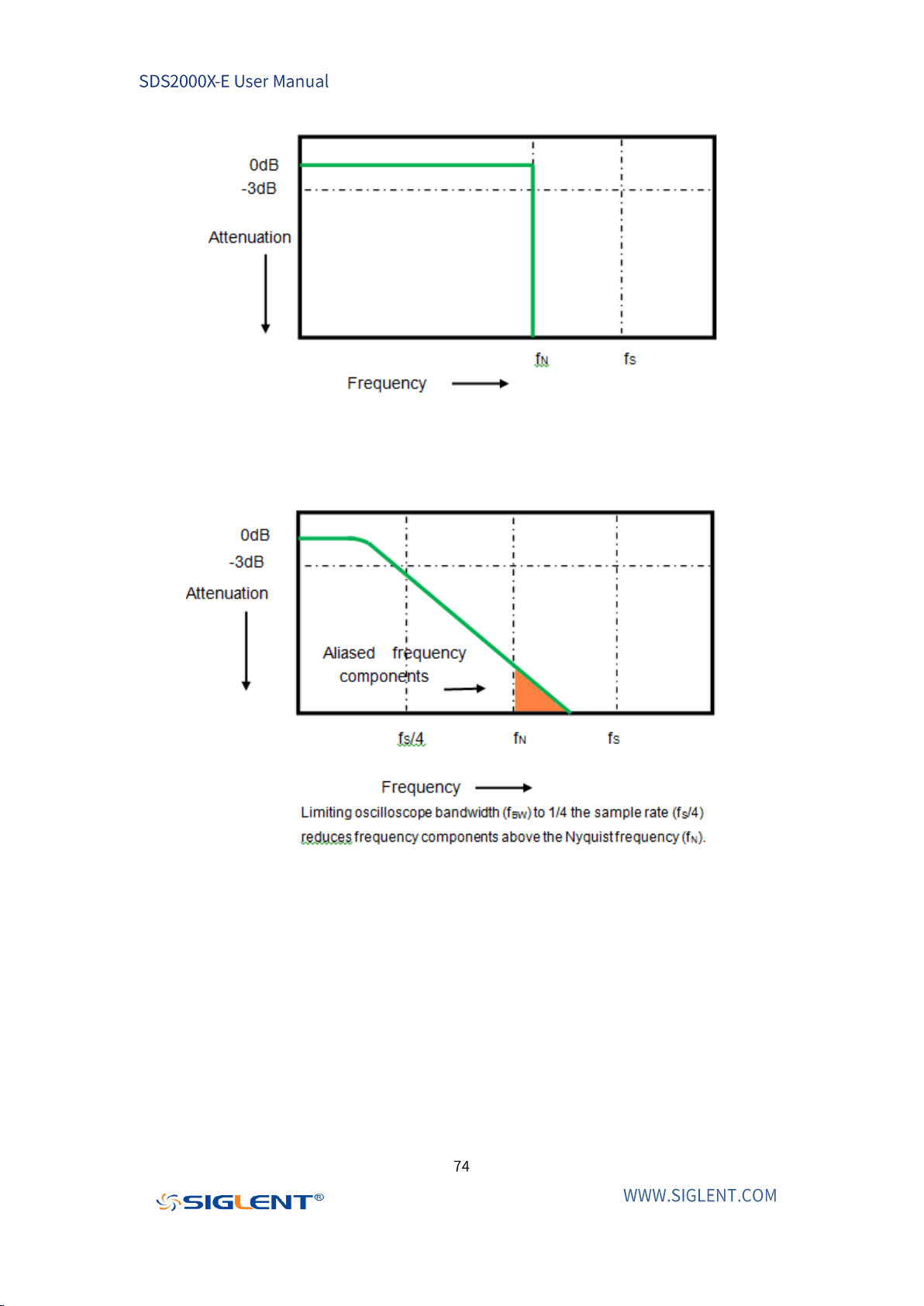
However, digital signals have frequency components above the fundamental
frequency (square waves are made up of sine waves at the fundamental frequency
and an infinite number of odd harmonics), and typically, for 500 MHz bandwidths
and below, oscilloscopes have a Gaussian frequency response.
So, in practice, an oscilloscope's sample rate should be four or more times its
bandwidth: f
S
= 4fBW. This way, there is less aliasing, and aliased frequency
components have a greater amount of attenuation.
Memory Depth
Memory depth refers to the number of waveform points that the oscilloscope can
store in a single trigger sample and it reflects the storage ability of the sample
memory. The oscilloscope provides up to 28 Mpts memory depth.
Press the Acquire button on the front panel; press the Mem Depth softkey and then
turn the Universal Knob to select the desired value and push down the knob to
confirm. Press the Mem Depth softkey continually can also select the desired value.
The actual memory depth is displayed in the information area at the upper- right
corner of the screen. Aavailable memory depths include: 28k, 280k, 2.8M, 28M.
Since the oscilloscope has two acquisition memories, when only one channel is on,
the maximal memory depth is up to 28 Mpts.
The relation of memory depth, sample rate and waveform length fulfills the
equation below:
Memory depth = sample rate (Sa/s) × waveform length (s/div × div)
Sampling Mode
The oscilloscope only supports real-time sample. In this mode, the oscilloscope
samples and displays waveform within a trigger event. The maximum real-time
sample rate is 2 GSa/s.
Press the Run/Stop button to stop the sample, the oscilloscope will hold the last
display. At this point, you can still use the vertical control and horizontal control to
pan and zoom the waveform.
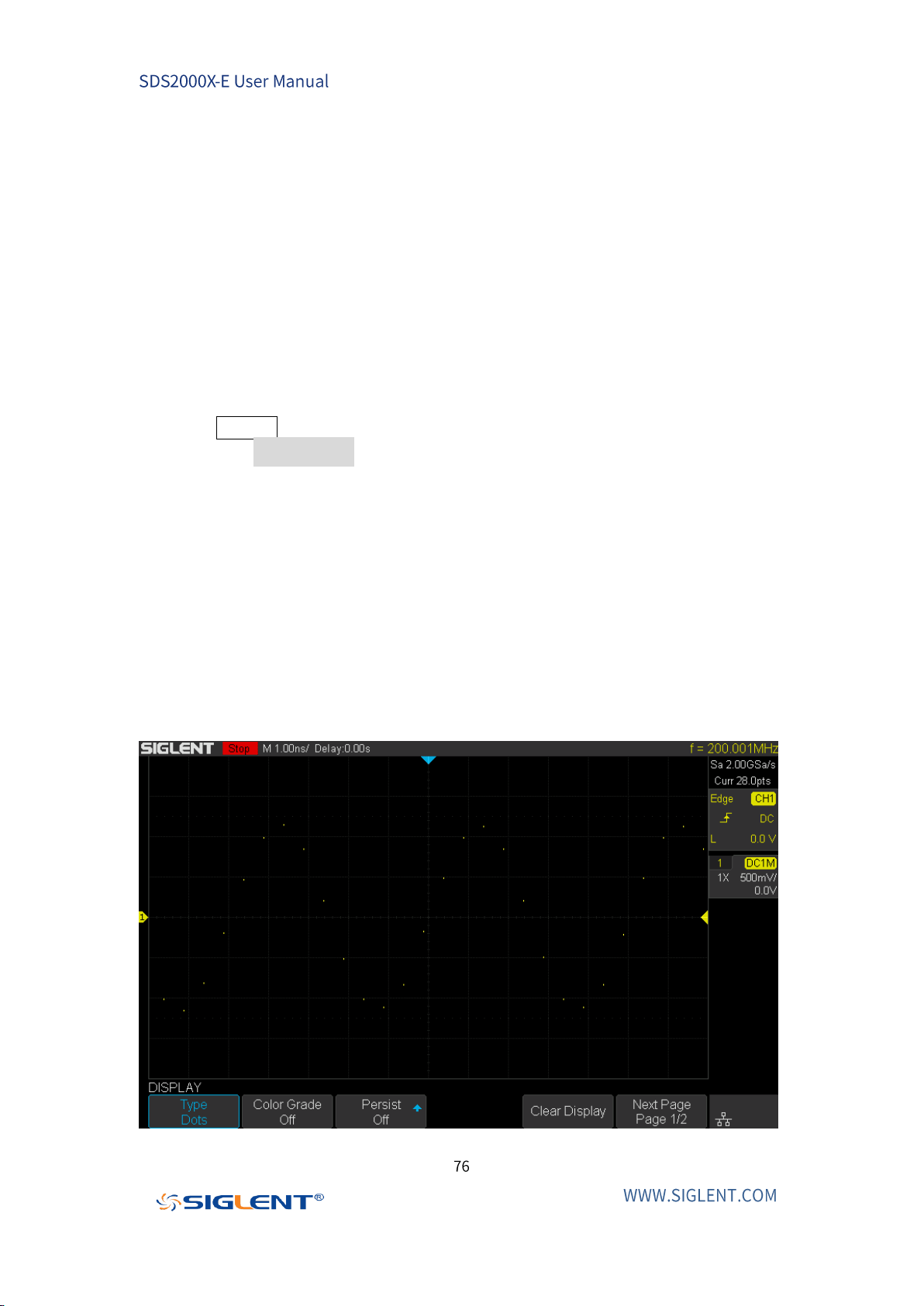
Interpolation Method
Under real-time sampling, the oscilloscope acquires the discrete sample values of
the waveform being displayed. In general, a waveform of dots display type is very
difficult to observe. In order to increase the visibility of the signal, the digital
oscilloscope usually uses interpolation to “connect the dots” on the displayed
waveform.
Interpolation is a processing method to “connect all the sampling points” to
reconstruct an accurate waveform, the interpolation method can fill out the gaps
between points.
Press the Acquire button on the front panel to enter the ACQUIRE Function menu;
then press the Interpolation softkey to select Sinx/x or X.
X: The adjacent sample points are directly connected on a straight line. This
method is only confined to rebuild on the edge of signals, such as square
wave.
Sinx/x: Connecting the sampling points with curves has better versatility.
Sin(x)/x interpolation method uses mathematical processing to calculate
results in the actual sample interval. This method more closely replicates more
realistic shapes than pure square waves and pulses. When the sampling rate is
3 to 5 times the bandwidth of the signal, sinx/x is the recommended
interpolation method.
Figure 12 Display in Dots
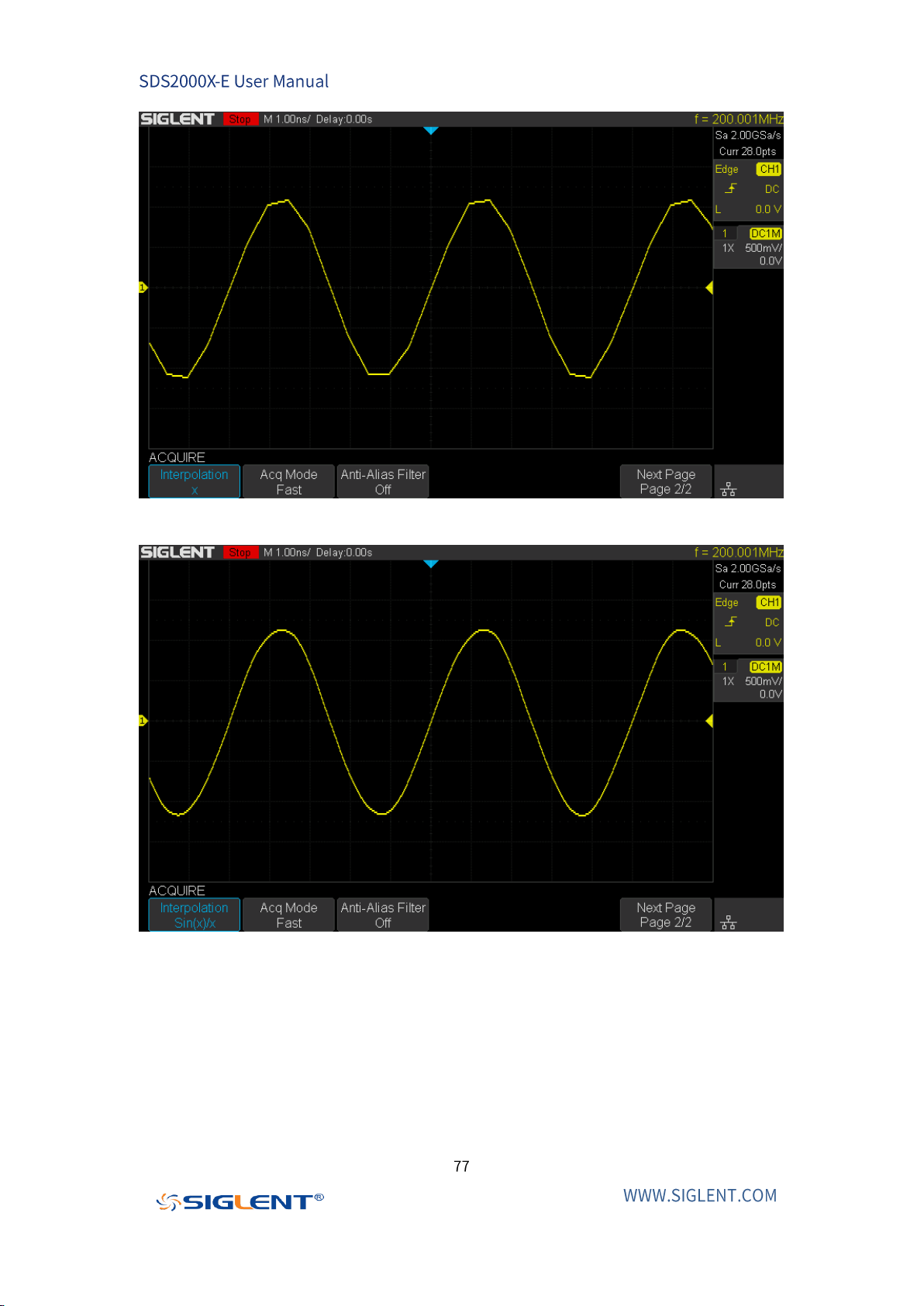
Figure 13 x Interpolation
Figure 14 Sin(x)/x Interpolation
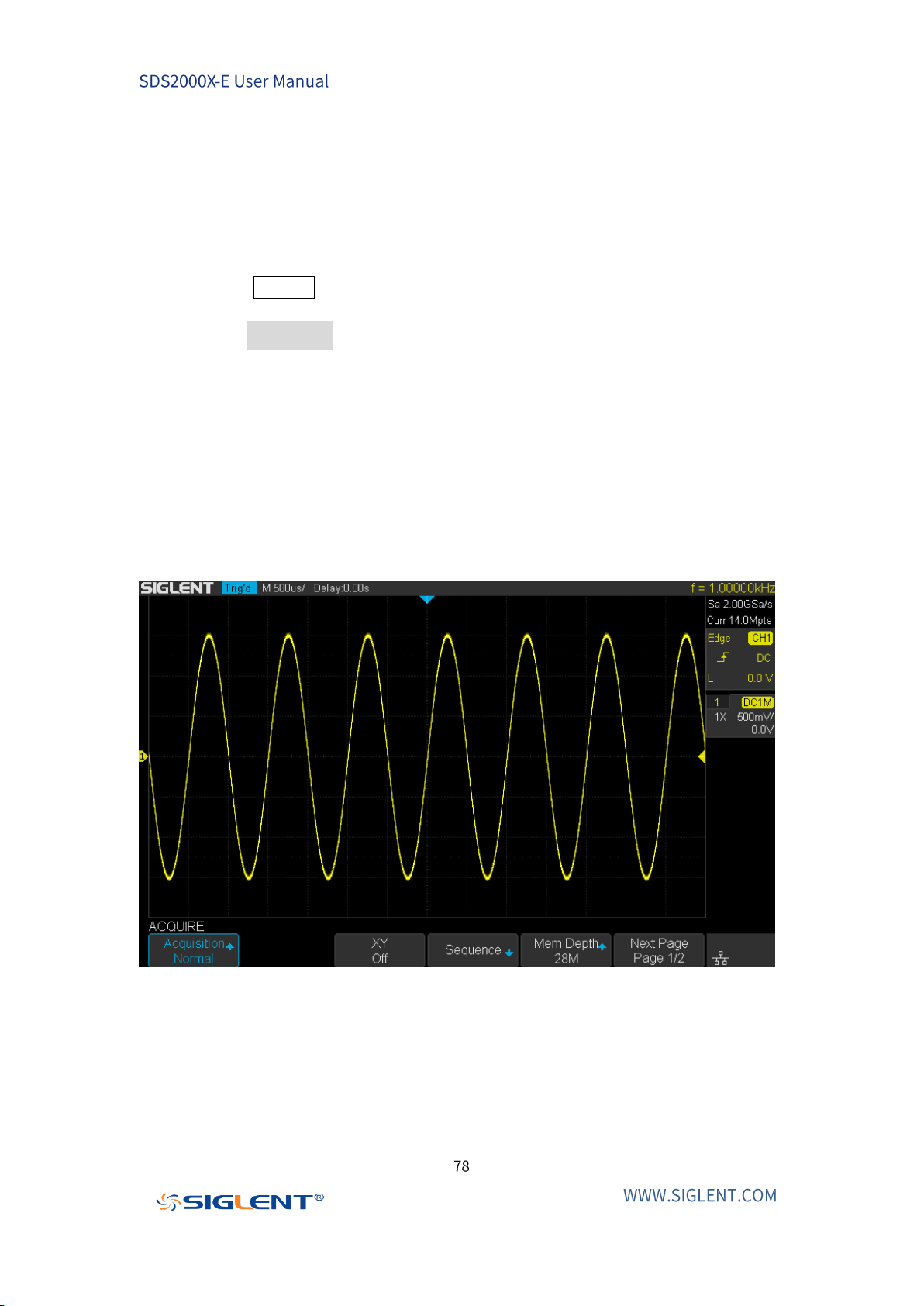
Acquisition Mode
The acquisition mode is used to control how to generate waveform points from
sample points. The oscilloscope provides the following acquisition mode: Normal,
Peak Detect, Average and Eres.
1. Press the Acquire button on the front panel to enter the ACQUIRE function
menu;
2. Press the Acquisition softkey; then turn the Universal Knob to select the desired
acquisition mode and push down the knob to confirm. The default setup is
Normal.
Normal
In this mode, the oscilloscope samples the signal at equal time intervals to rebuild
the waveform. For most of the waveforms, the best display effect can be obtained
using this mode. It is the default acquisition mode.
Figure 15 Normal Mode
Peak Detect
In this mode, the oscilloscope acquires the maximum and minimum values of the
signal within the sample interval to get the envelope of the signal or the narrow
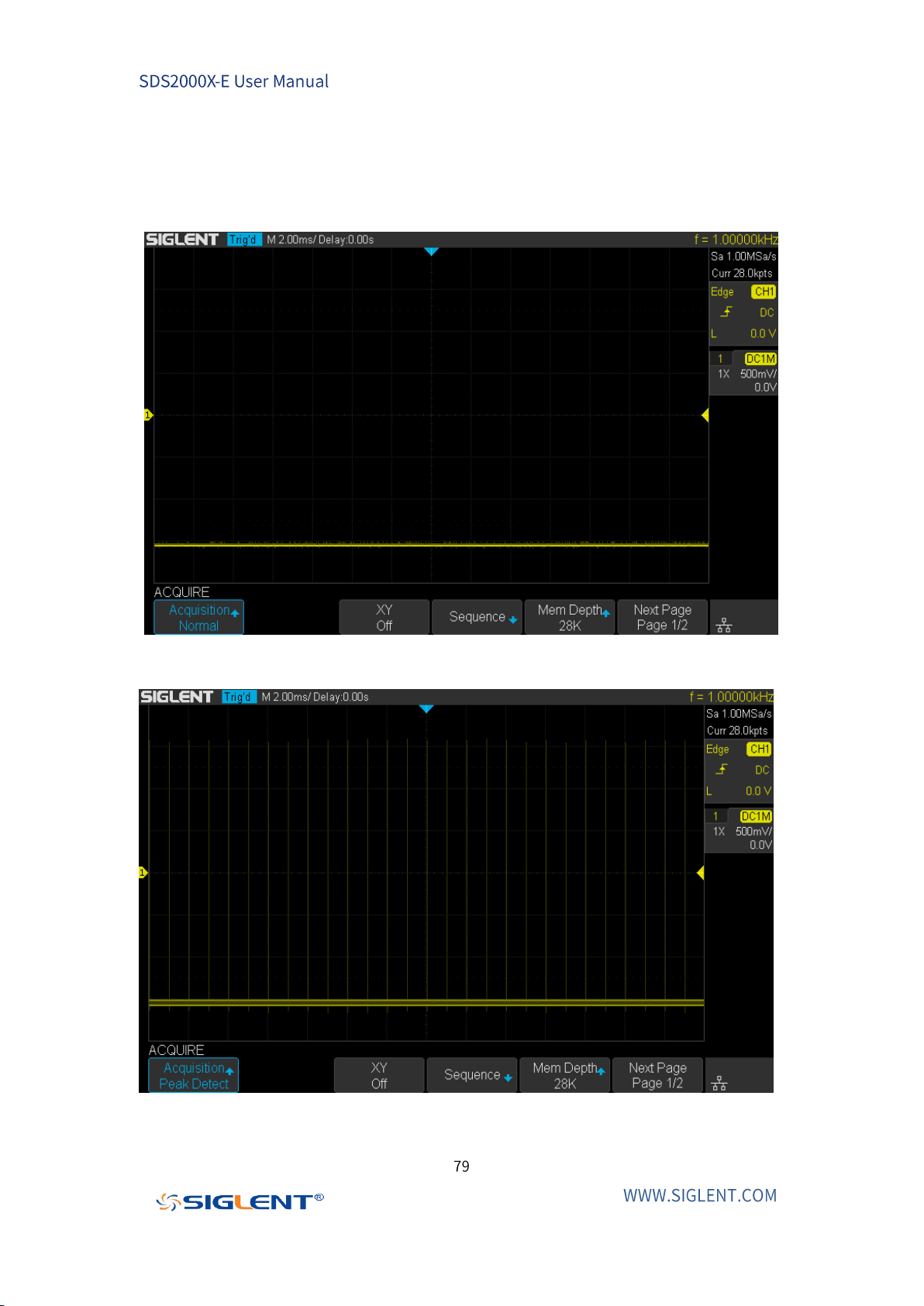
pulse of the signal that might be lost. In this mode, signal confusion can be
prevented but the noise displayed would be larger.
In this mode, the oscilloscope can display all the pulses with pulse widths at least
as wide as the sample period.
Figure 16 Pulse With 0.01% Duty, Normal Mode
Figure 17 Pulse With 0.01% Duty, Peak Detect Mode
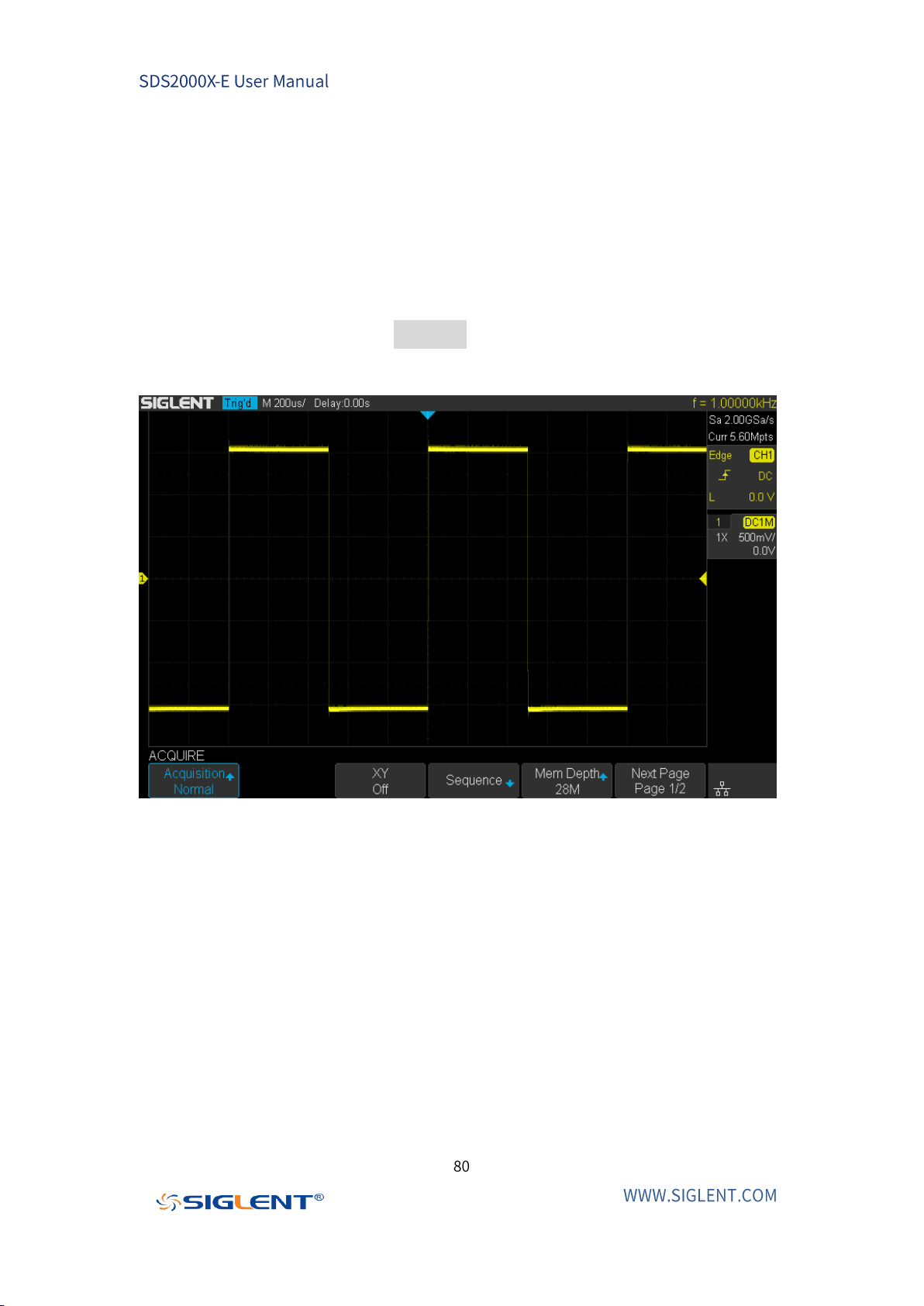
Average
In this mode, the oscilloscope averages the waveforms from multiple samples to
reduce the random noise of the input signal and improve the vertical resolution.
The greater the number of averages is, the lower the noise will be and the higher
the vertical resolution will be but the slower the response of the displayed
waveform to the waveform changes will be.
The available range of averages is from 4 to 1024 and the default is 16. When
Average mode is selected, press Averages and turn the Universal Knob or press the
softkey continually to set the desired average time.
Figure 18 With Random Noise, Normal Mode
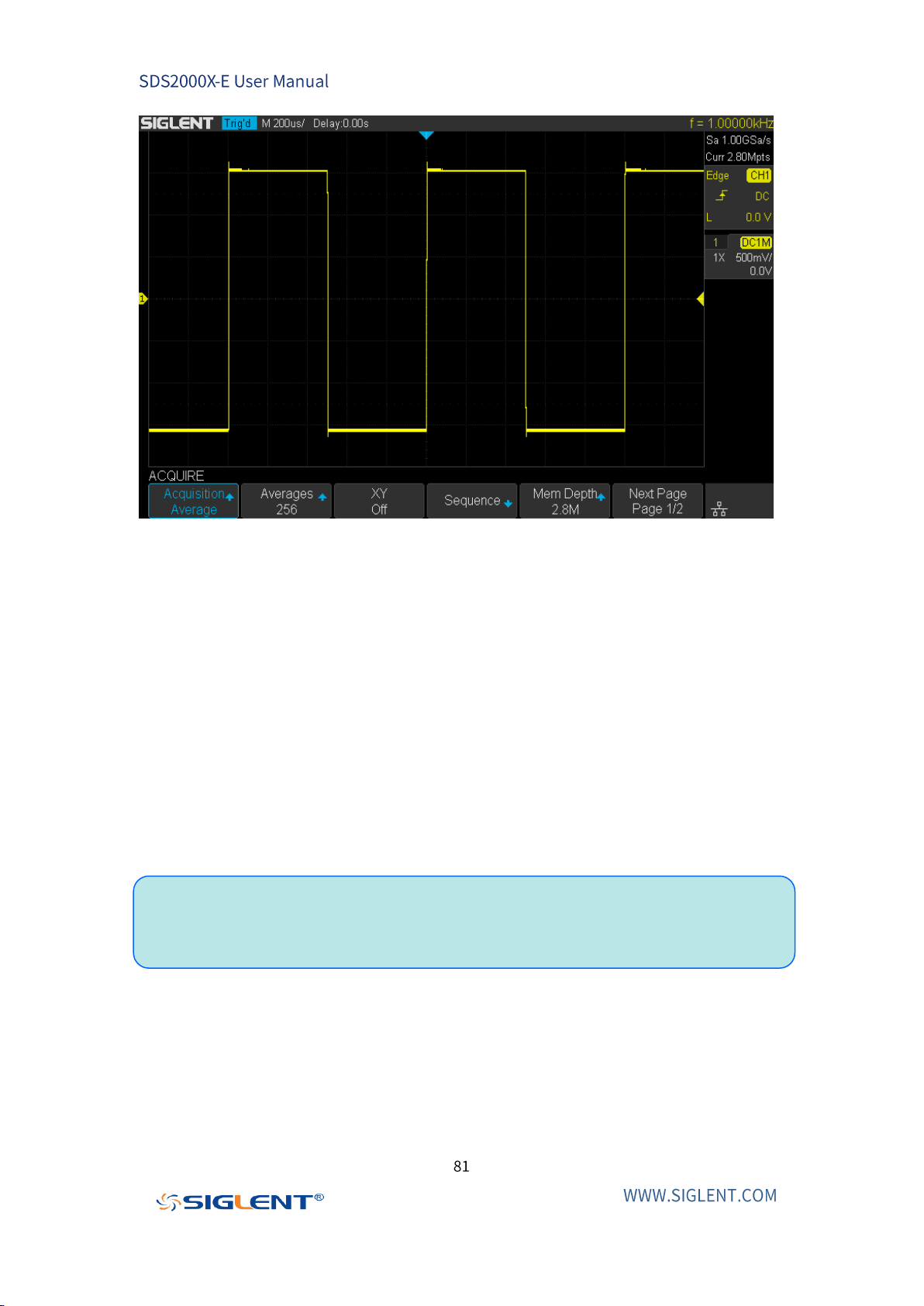
Figure 19 With Random Noise, Average Mode
Eres
This mode uses oversampling to average the neighboring points of the sample
waveform to reduce the random noise on the input signal and generate much
smoother waveforms on the screen. This is generally used when the sample rate of
the digital converter is higher than the storage rate of the acquisition memory.
Eres mode can be used on both single-shot and repetitive signals and it does not
slow waveform update. This mode limits the oscilloscope's real-time bandwidth
because it effectively acts like a low-pass filter.
Note: “Average” and “Eres” modes use different averaging methods. The
former uses “Waveform Average” and the latter uses “Dot Average”.
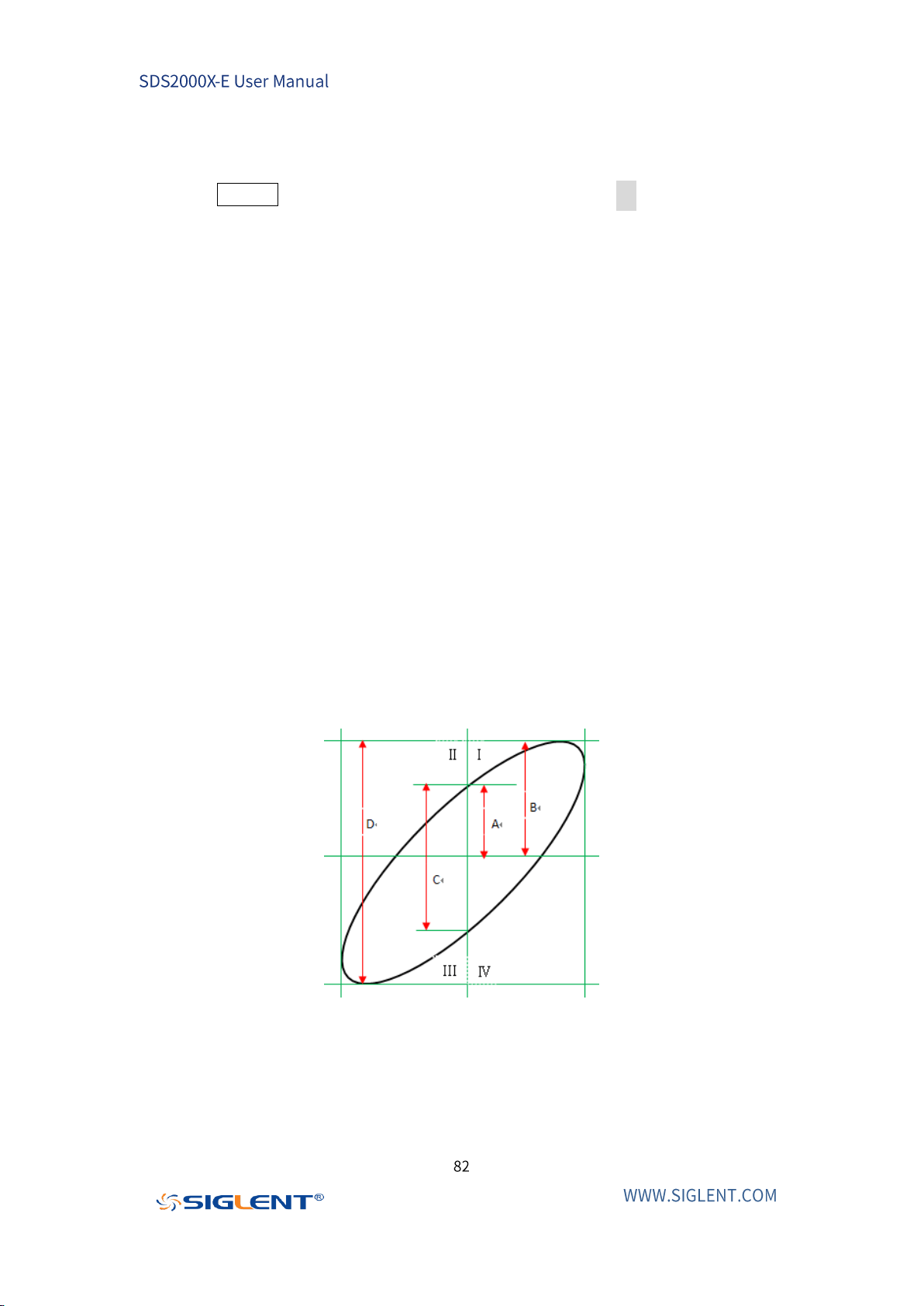
Horizontal Format
Press the Acquire button on the front panel; then press the XY soft key to set the
XY(On) or YT(Off) mode. The default setup is YT.
YT
Display channel Y input amplitude (typically voltage) vs. time. This is the normal
viewing mode for the oscilloscope. In the Normal time mode, signal events
occurring before the trigger are plotted to the left of the trigger point and signal
events after the trigger plotted to the right of the trigger point.
XY
XY mode changes the display from a volt- versus- time display to a volt- versus-
volt display. Channel 1 amplitude is plotted on the X- axis and Channel 2 amplitude
is plotted on the Y- axis, the two channels will be turned on or off together.
You can use XY mode to compare frequency and phase relationships between two
signals. XY mode can also be used with transducers to display strain versus
displacement, flow versus pressure, volts versus current, or voltage versus
frequency.
The phase deviation between two signals with the same frequency can be easily
measured via Lissajous method. The figure below shows the measurement
schematic diagram of the phase deviation.
According to sinθ=A/B or C/D (wherein, θ is the phase deviation angle between the
two channels and the definitions of A, B, C and D are as shown in the figure above),
the phase deviation angle is obtained, that is: θ=±arcsin (A/B) or ±arcsin (C/D)
If the principal axis of the ellipse is within quadrant I and III, the phase deviation

angle obtained should be within quadrant I and IV, namely within (0 to π/2) or
(3π/2 to 2π). If the principal axis of the ellipse is within quadrant II and IV, the
phase deviation angle obtained should be within quadrant II and III, namely within
(π/2 to π) or (π to 3π/2).
X-Y function can be used to measure the phase deviation occurred when the signal
under test passes through a circuit network. Connect the oscilloscope to the circuit
to monitor the input and output signals of the circuit.
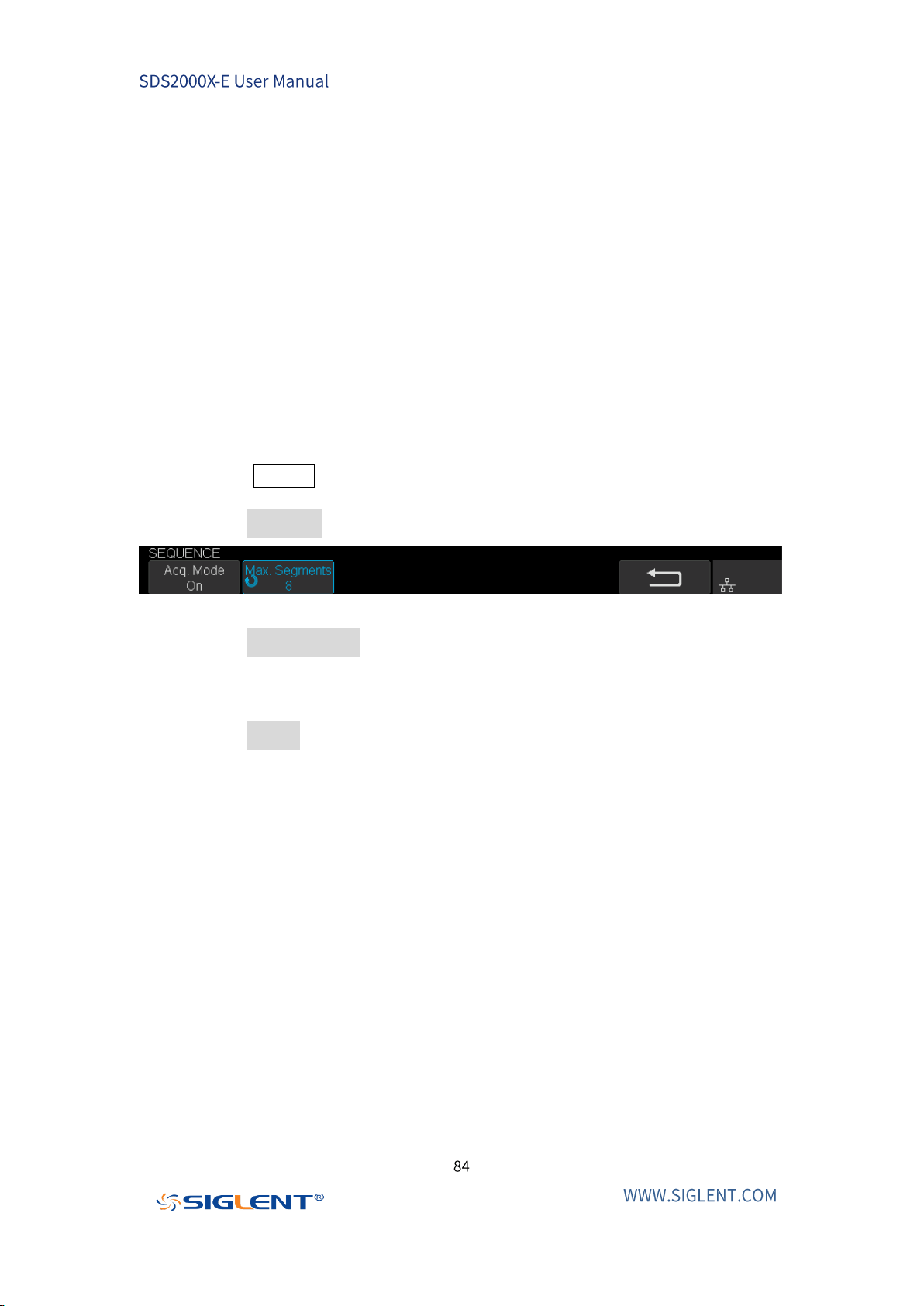
Sequence Mode
Sequence Mode provides faster data collection, but does not display waveforms
during sampling process. It improves the waveform capture rate, delivering up-to
400,000 wfs/s. So it can capture the small probability events effectively.
The oscilloscope runs and fills a memory segment for each trigger event and
continues to trigger until memory is filled. After the memory buffer has been filled,
it then displays the waveforms on the screen.
To use the sequence mode, the Horizontal Format must be set to YT.
Do the following steps to use the sequence mode.
1. Press the Acquire button on the front panel to enter the ACQUIRE function
menu;
2. Press the Sequence softkey to enter the SEQUENCE function menu.
Figure 20 SEQUENCE Function Menu
3. Press the Max Segments softkey; and then turn the Universal Knob to select the
desired value.
Do the following steps to replay the sequence waveform under history mode:
1. Press the History softkey to enable HISTORY function.
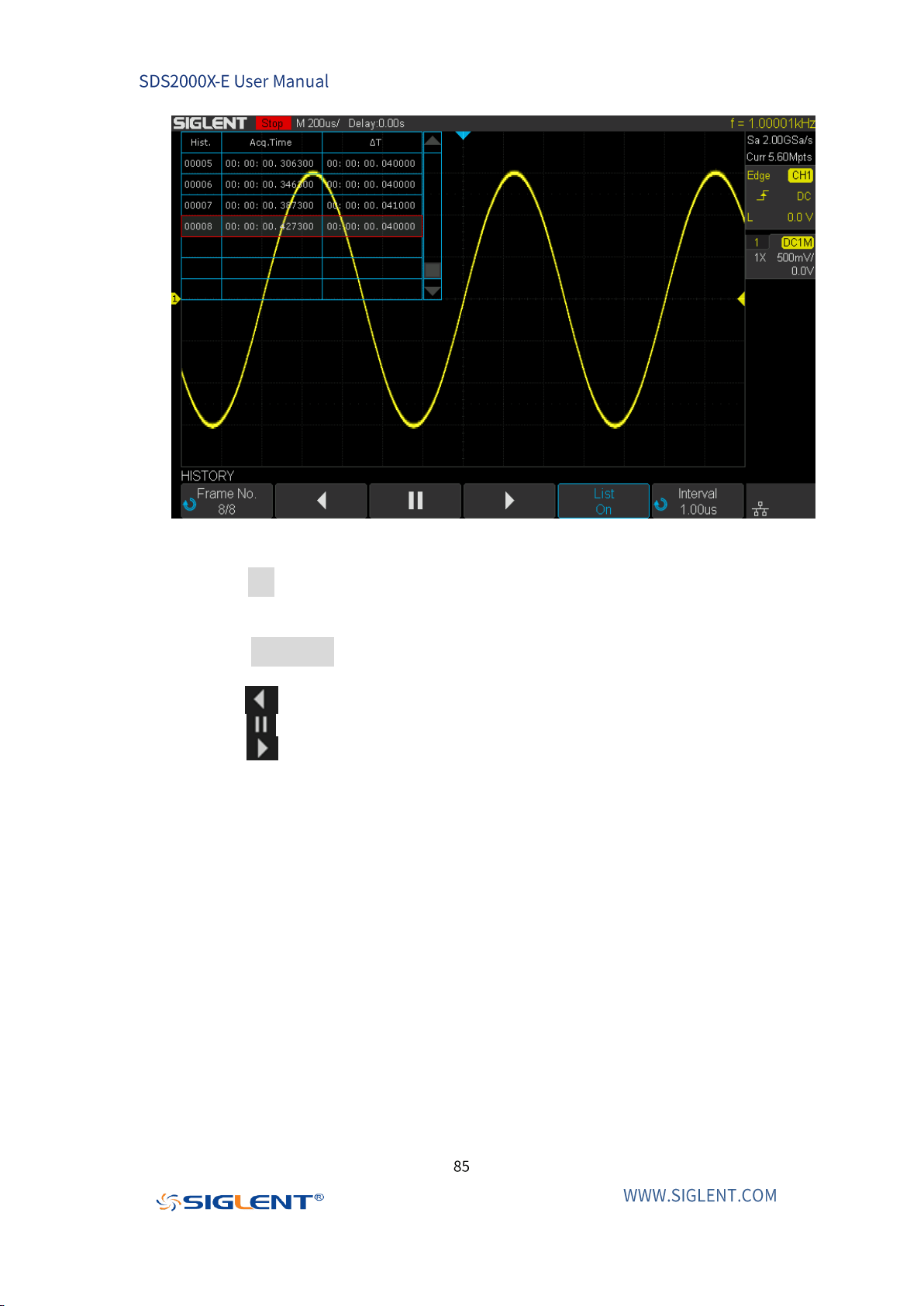
Figure 21 HISTORY Function Menu
2. Press the List softkey to turn on the list display. The list records the acquisition
time of every frame and shows the frame number that displaying on the
screen.
3. Press the Frame No. softkey; and then turn the Universal Knob to select the
frame to display.
4. Press the softkey to replay the waveform from the current frame to 1.
5. Press the softkey to stop replay.
6. Press the softkey to replay the waveform from the current frame to the last
frame.
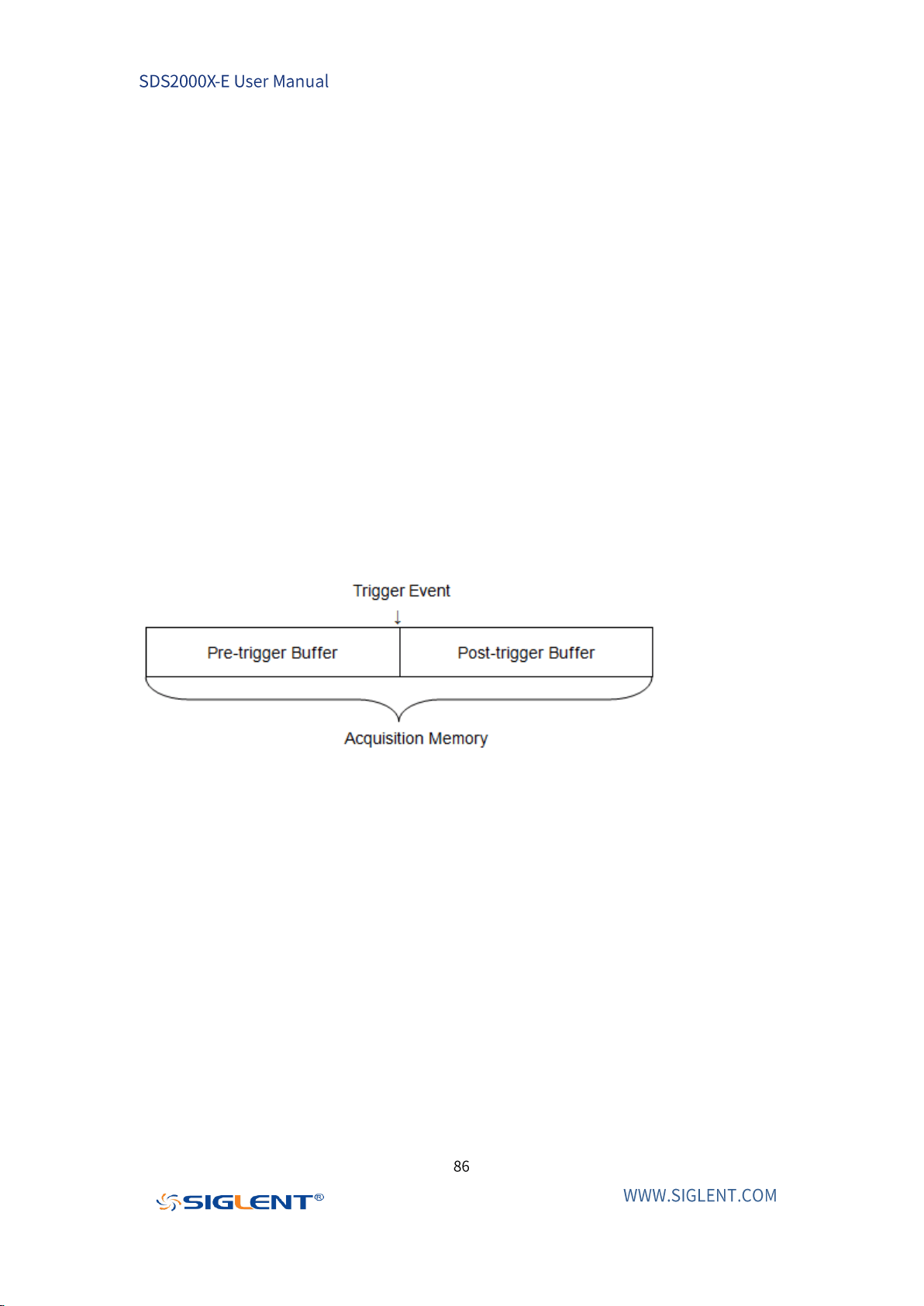
Trigger
The trigger mode is the most useful setting to help isolate signals of interest. When
a waveform in the waveform stream meets the trigger condition, the oscilloscope
captures this waveform as well as the neighboring part and displays them on the
screen. For digital oscilloscopes, the waveforms will be displayed continuously no
matter whether it is stably triggered, but only stable triggers can ensure a stable
display. The trigger circuit ensures that every time base sweep or acquisition starts
from the input signal and the user-defined trigger condition, namely every sweep
is synchronous to the acquisition and the waveforms acquired overlap to display
stable waveform.
The following is the schematic diagram of the acquisition memory. As shown in the
figure below, the position of the trigger event is determined by the reference time
point and the delay setting.
Trigger settings should be based on the features of the input signal, thus you need
to have some knowledge of the signal under test to quickly capture the desired
waveform.
The oscilloscope provides abundant advanced trigger functions which can help
you to focus on the desired waveform details. These trigger types are edge, slope,
pulse, video, window, interval, dropout, runt, pattern and serial trigger. This
chapter will mainly introduce all these trigger functions which mentioned above in
details and tell you how to set the trigger conditions to capture desired waveform.
The contents of this chapter:
Trigger Source

Trigger Mode
Trigger Level
Trigger Coupling
Holdoff
Noise Rejection
Trigger Type
Trigger Source
The oscilloscope’s trigger source includes analog channels, EXT, EXT/5 and the AC
Line.
Press the Setup button on the front panel to enter the TRIGGER function menu;
press the Source softkey and then turn the Universal Knob to select the desired
trigger source.
The current trigger source is displayed at the upper right corner of the screen.
Select channel with signal input as trigger source to obtain stable trigger.
Analog channel input:
Signals input from analog channels can all be used as the trigger source.
External trigger input:
The external trigger source can be used to connect an external trigger signal to the
EXT TRIG channel, when the oscilloscope collects data simultaneously on multiple
analog channels. The trigger signal (such as an external clock/signal of the circuit
to be tested) should be connected to EXT and EXT/5 trigger source via the [EXT TRIG]
connector. EXT/5 trigger source attenuates the signal by a factor of 5. It extends the
trigger level. You can set the trigger condition within the range of the trigger level
(-600 mV to +600 mV).
AC line:
The trigger signal is obtained from the AC power input of the oscilloscope. This kind
of trigger can be used to display the relationship between a signal (such as an
illuminating device) and power (power supply device). For example, it is mainly
used in the power industry to stably trigger the waveform output from the
transformer of a transformer substation.
Trigger Mode
The oscilloscope’s trigger mode includes auto, normal and single. The trigger
mode affects the way in which the oscilloscope searches for the trigger.
After the oscilloscope starts running, the oscilloscope operates by first filling the
pre-trigger buffer. It starts searching for a trigger after the pre-trigger buffer is
filled and continues to flow data through this buffer while it searches for the trigger.
While searching for the trigger, the oscilloscope overflows the pre-trigger buffer
and the first data put into the buffer is first pushed out (First Input First Out, FIFO).
When a trigger is found, the pre- trigger buffer contains the events that occurred
just before the trigger. Then, the oscilloscope fills the post- trigger buffer and
displays the acquisition memory.
Press the Auto, Normal and the Single buttons on the front panel to select the
desired trigger mode, and the corresponding status light will be lighted.
In the Auto trigger mode (the default setting), if the specified trigger conditions
are not found, triggers are forced and acquisitions are made so that signal
activity is displayed on the oscilloscope. The waveforms may not be stable on
the display.
The Auto trigger mode is appropriate when:
Checking DC signals or signals with unknown levels or activity.
When trigger conditions occur often enough that forced triggers are
unnecessary.
In the Normal trigger mode, triggers and acquisitions only occur when the
specified trigger conditions are found. Otherwise, the oscilloscope holds the
original waveform and waits for the next trigger.
The Normal trigger mode is appropriate when:
You only want to acquire specific events specified by the trigger settings.
Triggering on an infrequent signal from a serial bus (for example, I2C, SPI,
CAN, LIN, etc.) or another signal that arrives in bursts. The Normal trigger
mode lets you stabilize the display by preventing the oscilloscope from
auto- triggering.
In the Single trigger mode, the oscilloscope waits for a trigger and displays the
waveform when the trigger condition is met and then stops.
The Single trigger mode is appropriate when:
To capture single event or a periodic signal.
To capture burst or other unusual signals.
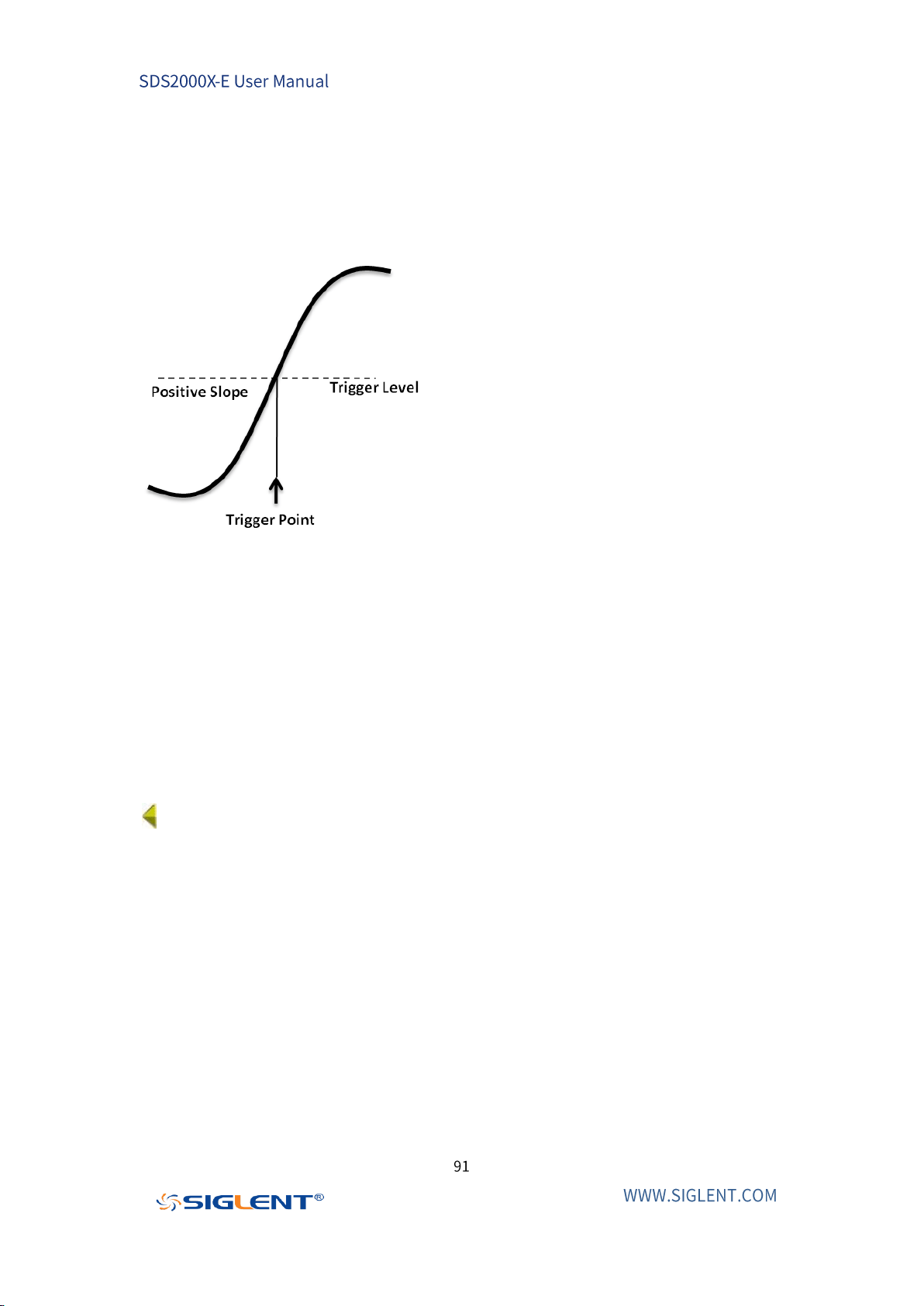
Trigger Level
Trigger level and slope define the trigger point,
You can adjust the trigger level for a selected analog channel by turning the
Trigger Level Knob.
You can push the Trigger Level Knob to set the level to the waveform's 50% value
immediately. If AC coupling is used, pushing the Trigger Level knob sets the trigger
level to about 0 V.
The position of the trigger level for the analog channel is indicated by the trigger
level icon
(if the analog channel is on) at the left side of the display. The value of the
analog channel trigger level is displayed in the upper- right corner of the display.
Trigger Coupling
Press the Setup button on the front panel to enter the TRIGGER function menu, and
then press the Coupling softkey and turn the Universal Knob or press the Coupling
softkey continually to select the desired coupling mode.
The oscilloscope provides 4 kinds of trigger coupling modes:
DC: Allow DC and AC components into the trigger path.
AC: Block all the DC components and attenuate signals lower than 10 Hz. Use
AC coupling to get a stable edge trigger when your waveform has a large DC
offset.
LF Reject: Block the DC components and reject the low frequency components
lower than 6 kHz. Low frequency reject removes any unwanted low frequency
components from a trigger waveform, such as power line frequencies, etc. that
can interfere with proper triggering. Use LF Reject coupling to get a stable
edge trigger when your waveform has low frequency noise.
HF Reject: Reject signals with frequency components higher than 200 kHz.
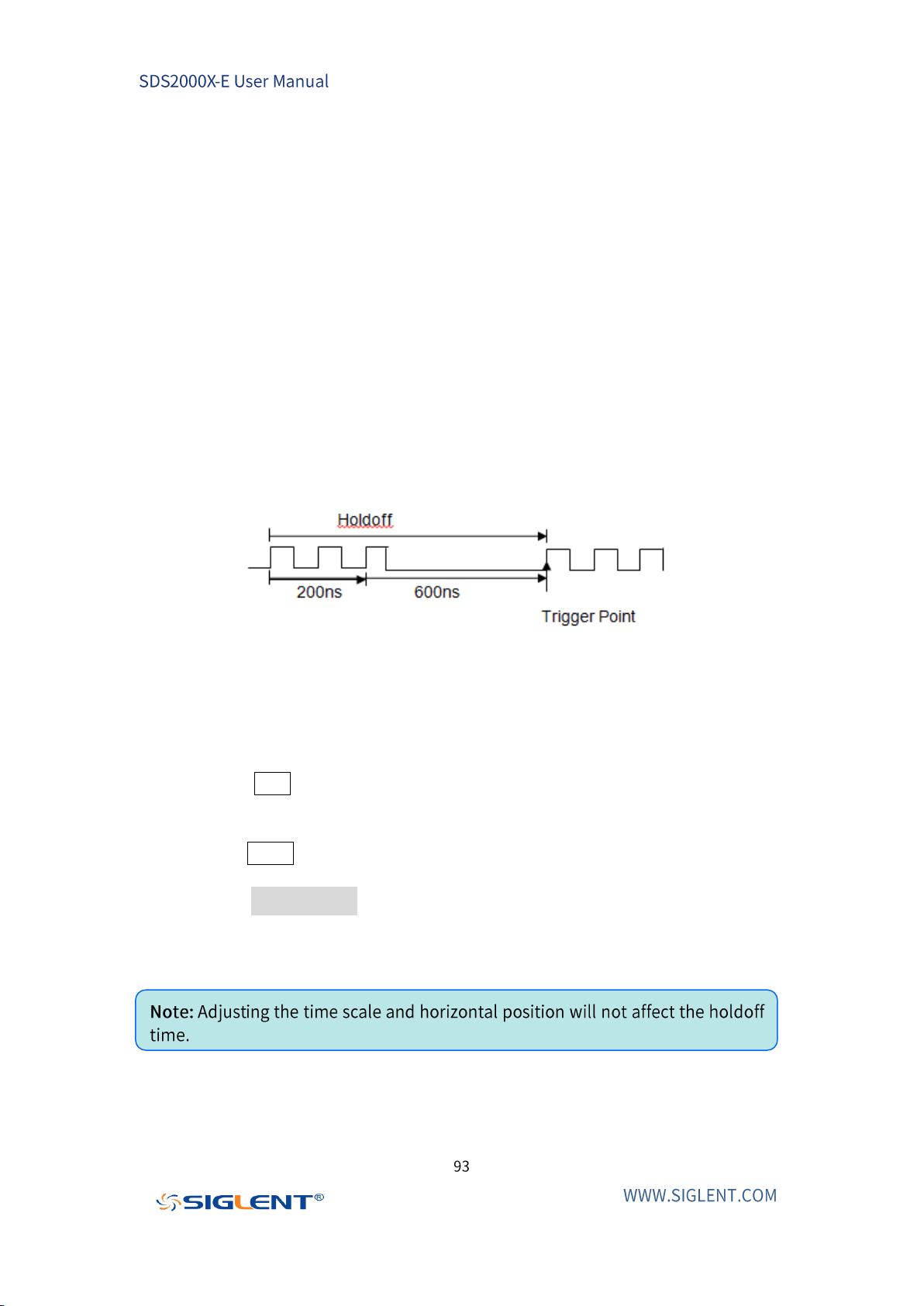
Holdoff
Trigger holdoff can be used to stably trigger complex waveforms (such as a series
of pulses). Holdoff time is the amount of time that the oscilloscope waits before
re-arming the trigger circuitry. The oscilloscope will not trigger until the holdoff
time expires.
Use the holdoff to trigger on repetitive waveforms that have multiple edges (or
other events) between waveform repetitions. You can also use holdoff to trigger on
the first edge of a burst when you know the minimum time between bursts.
For example, to get a stable trigger on the repetitive pulse burst shown below, set
the holdoff time to be >200 ns but <600 ns.
The correct holdoff setting is typically slightly less than one repetition of the
waveform. Set the holdoff to this time to generate a unique trigger point for a
repetitive waveform. Only edge trigger and serial trigger have a holdoff option.
The holdoff time of the oscilloscope is adjustable from 80ns to 1.5s.
1. Press the Stop button, and then use the Horizontal Position Knob and the
Horizontal Scale Knob to find where the waveform repeats. Measure this time
using cursors; then, set the holdoff.
2. Press the Setup button on the front panel to enter the TRIGGER function menu.
The default trigger type is edge.
3. Press the Holdoff Close softkey; and then turn the Universal Knob to set the
desired holdoff time.
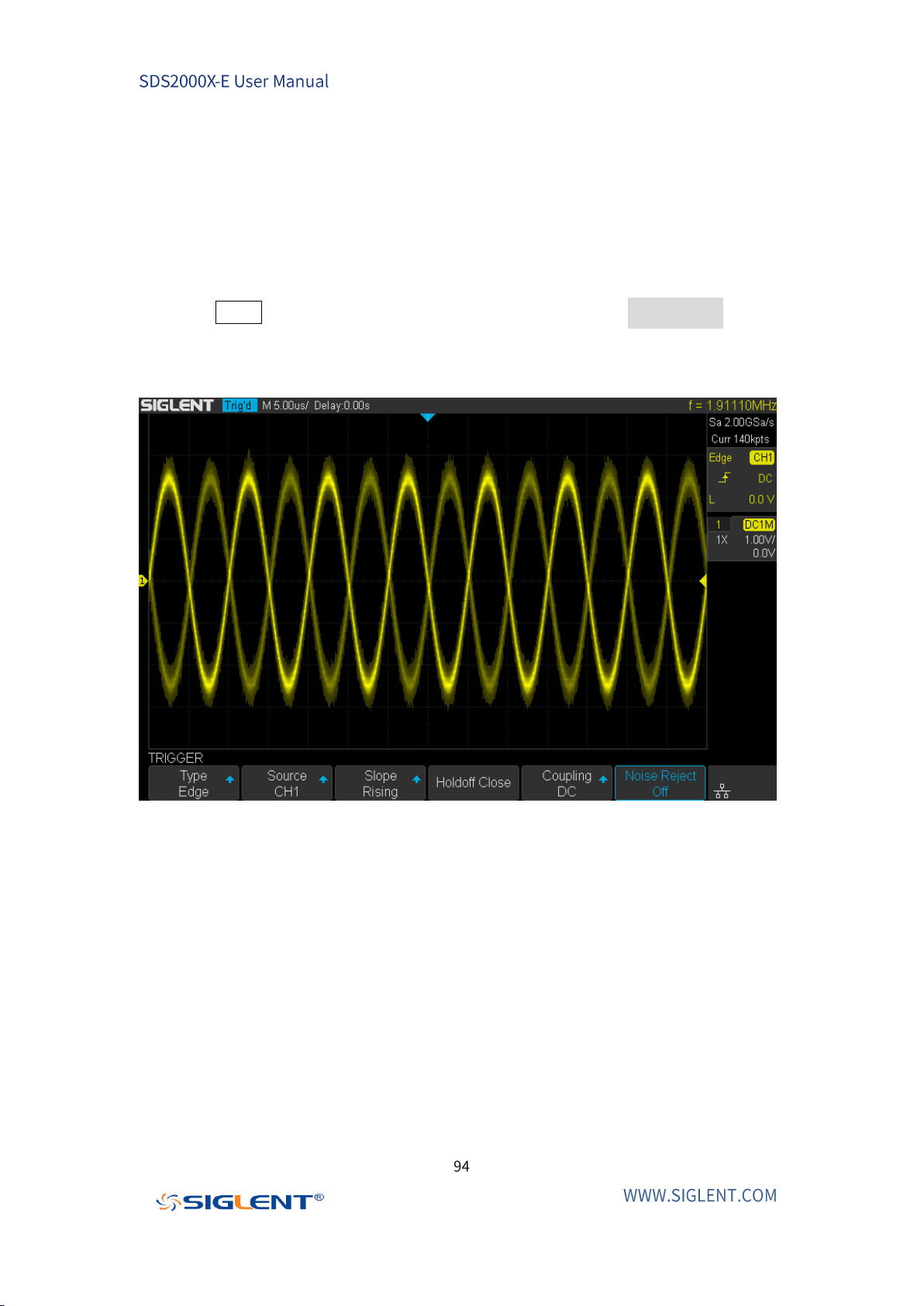
Noise Rejection
Noise Reject adds additional hysteresis to the trigger circuitry. By increasing the
trigger hysteresis band, you reduce the possibility of triggering on noise. However,
this also decreases the trigger sensitivity so that a slightly larger signal is required
to trigger the oscilloscope.
Press the Setup button on the front panel, and then press the Noise Reject softkey
continually to set the option to On or Off to turn on or off the noise rejection
function.
Figure 22 Noise Rejection disabled

Figure 23 Noise Rejection enabled
If the signal you are probing is noisy, you can set up the oscilloscope to reduce the
noise in the trigger path and on the displayed waveform. First, stabilize the
displayed waveform by removing the noise from the trigger path. Second, reduce
the noise on the displayed waveform.
1. Connect a signal to the oscilloscope and obtain a stable display.
2. Remove the noise from the trigger path by setting trigger coupling to LF Reject,
HF Reject or turning on Noise Reject.
3. Set the Acquisition option to Average to reduce noise on the displayed
waveform.

Trigger Type
The oscilloscope provides abundant advanced trigger functions, including various
serial bus triggers.
Edge trigger
Slope trigger
Pulse trigger
Video trigger
Window trigger
Interval trigger
Dropout trigger
Runt trigger
Pattern trigger
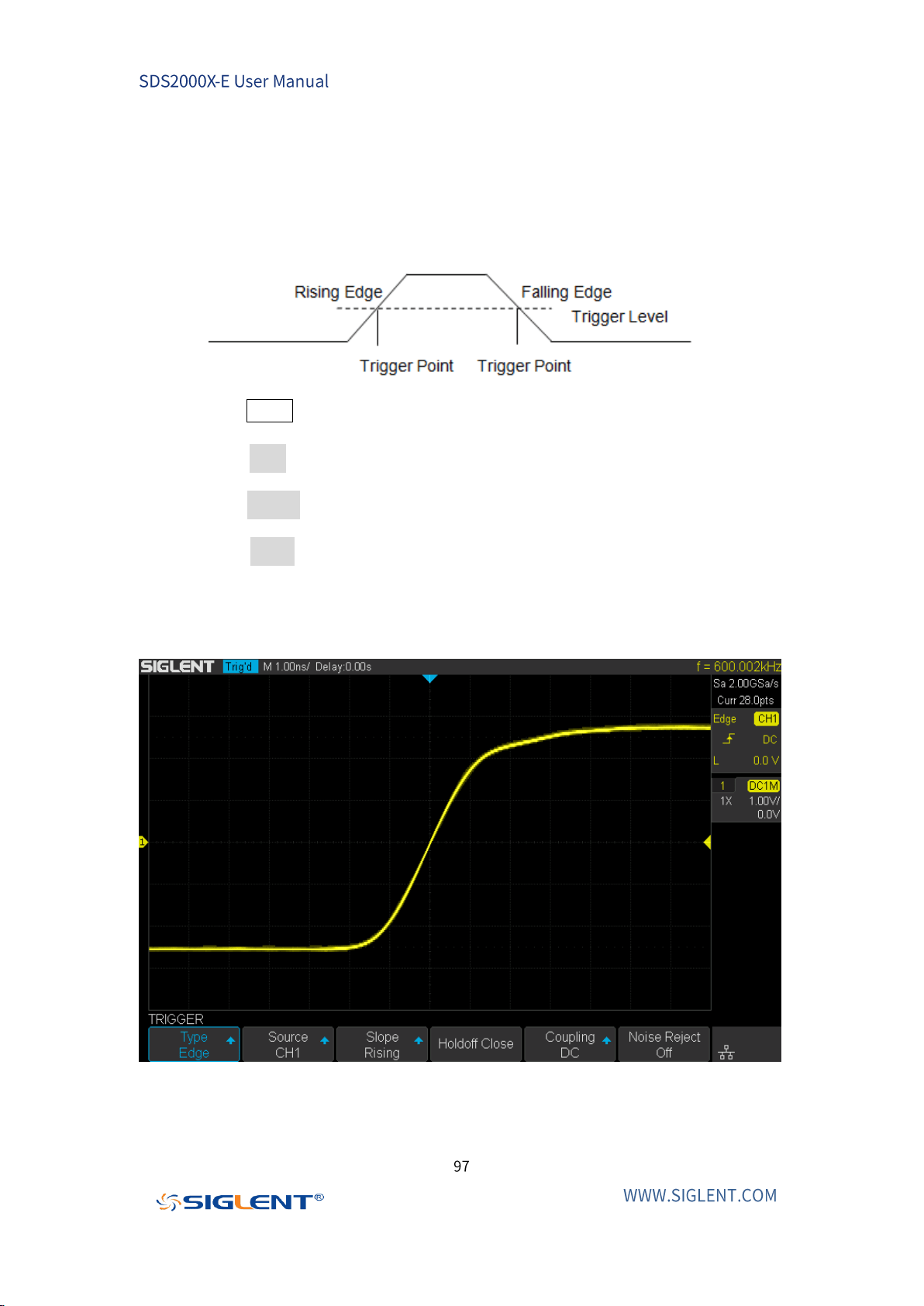
Edge Trigger
Edge trigger distinguishes the trigger points by seeking the specified edge (rising,
falling, alter) and trigger level.
1. Press the Setup button on the front panel to enter the TRIGGER system function
menu.
2. Press the Type softkey; turn the Universal Knob to select Edge and then push
the knob to confirm.
3. Press the Source softkey; turn the Universal Knob to select the deserted trigger
source.
4. Press the Slope softkey; turn the Universal Knob to select the desired trigger
edge (Rising, Falling or Alter), and then press down the knob to confirm. The
current trigger slope is displayed at the upper right corner of the screen.
5. Turn the Trigger Level Knob to adjust the trigger level to obtain a stable trigger.
Figure 24 Edge Trigger
Holdoff, coupling and noise reject can be set in edge trigger, see the sections
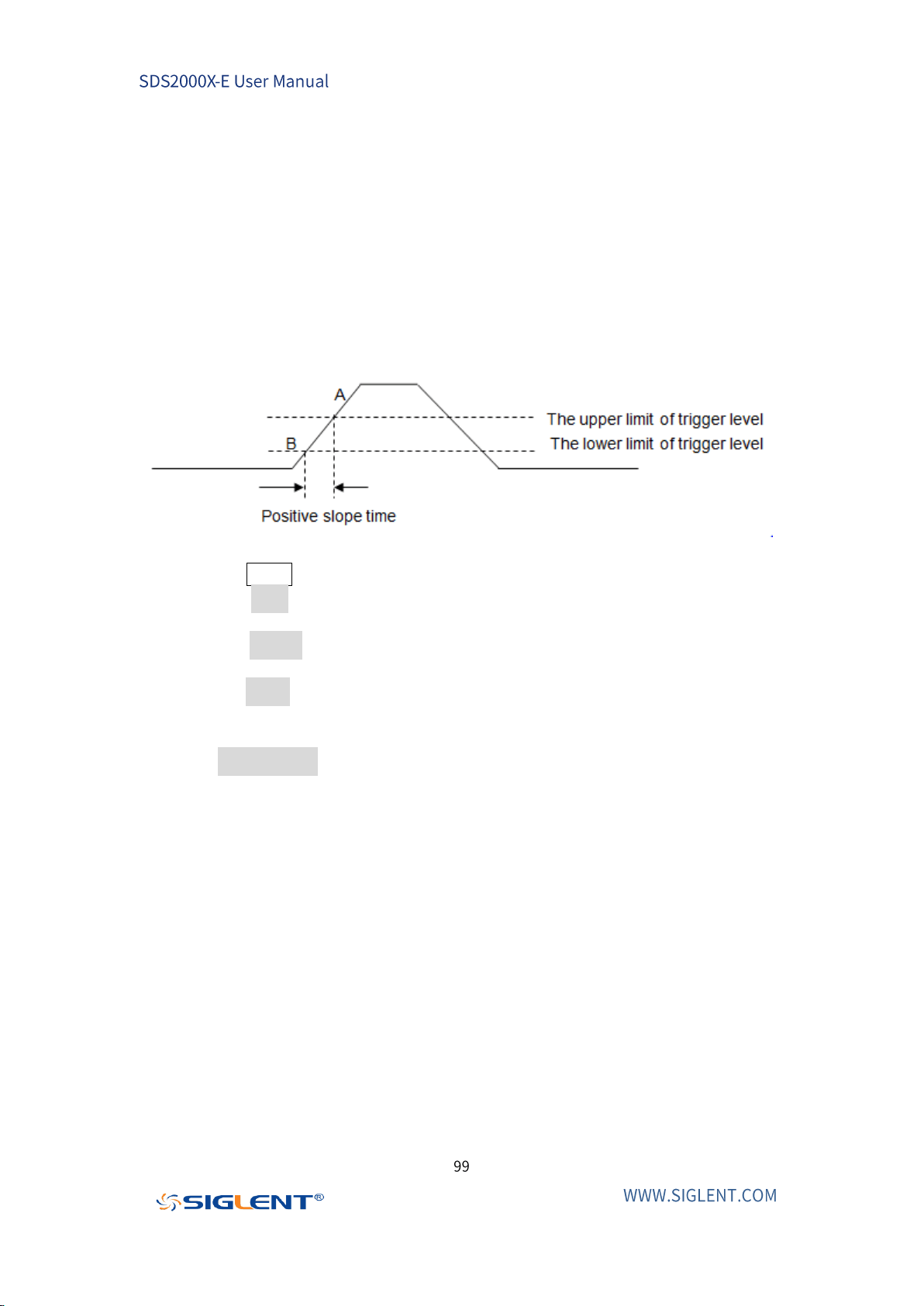
Slope Trigger
The slope trigger looks for a rising or falling transition from one level to another
level in greater than or less than a certain amount of time.
In the oscilloscope, positive slope time is defined as the time difference between
the two crossing points of trigger level line A and B with the positive edge as shown
in the figure below.
1. Press the Setup button on the front panel to enter the TRIGGER function menu.
2. Press the Type softkey; turn the Universal Knob to set select Slope and then
push the knob to confirm.
3. Press the Source softkey; turn the Universal Knob to select CH1 or CH2 as the
trigger source.
4. Press the Slope softkey; turn the Universal Knob to set select the desired trigger
edge (Rising or Falling), and then push down the knob to confirm. The current
trigger slope is displayed at the upper right corner of the screen.
5. Press Lower Upper softkey to select the Lower or Upper trigger level; then turn
the Trigger Level Knob to adjust the position. The trigger level values are
displayed at the upper right corner of the screen.
6. The lower trigger level cannot be greater than the upper trigger level. In the
trigger state message box, L1 indicates the upper trigger level while L2
indicates the lower trigger level.
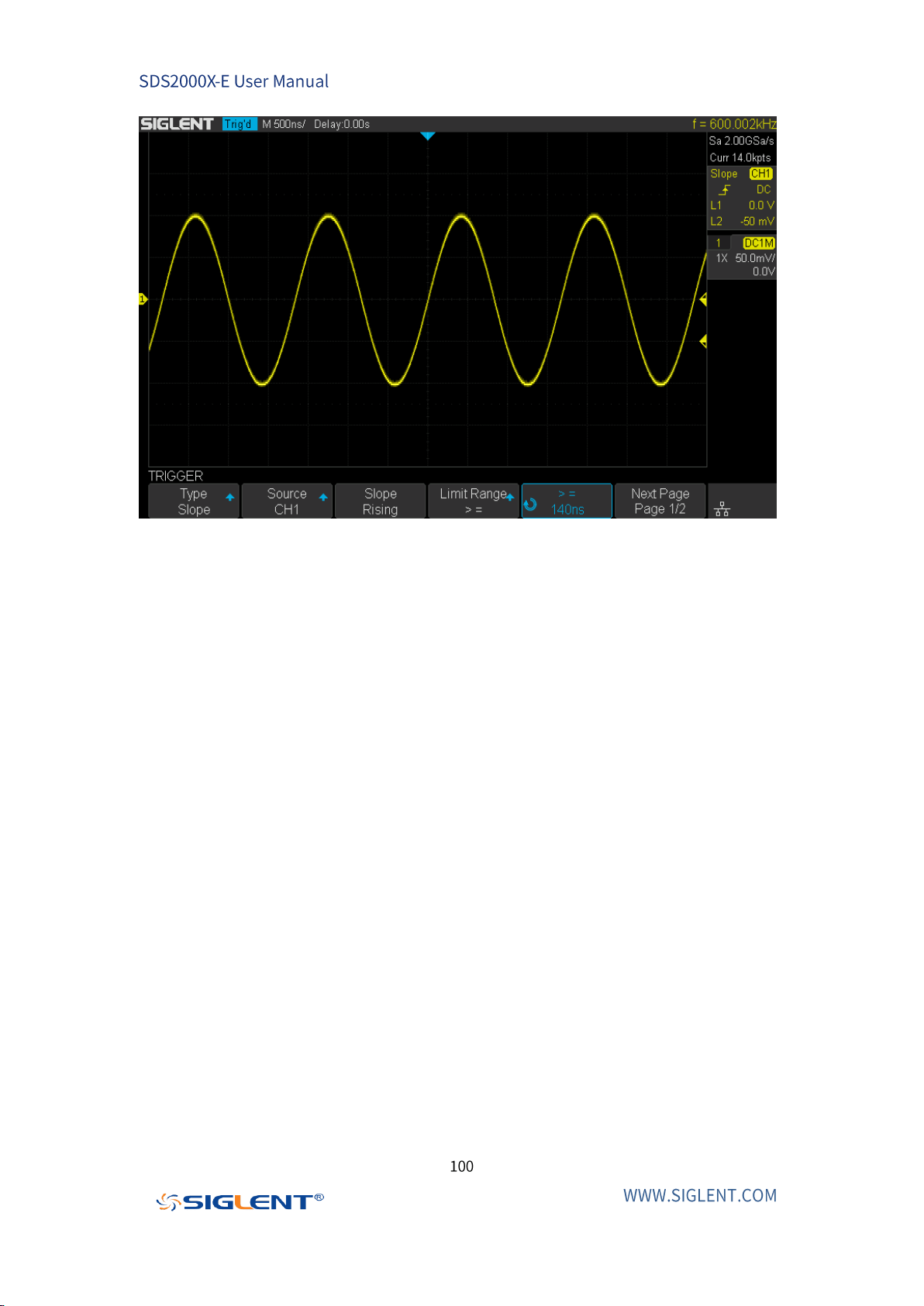
Figure 25 Slope Trigger
7. Press the Limit Range softkey; then turn the Universal Knob to select the
desired slope condition, and push down the knob to confirm.
<= (less than a time value): Trigger when the positive or negative slope
time of the input signal is lower than the specified time value.
>= (greater than a time value): Trigger when the positive or negative slope
time of the input signal is greater than the specified time value.
[--,--] (within a range of time value):Trigger when the positive or negative
slope time of the input signal is greater than the specified lower limit of
time and lower than the specified upper limit of time value.
--][-- (outside a range of time value): Trigger when the positive or negative
slope time of the input signal is greater than the specified upper limit of
time and lower than the specified lower limit of time value.
Coupling and noise reject can be set in slope trigger, see the sections "Trigger
Coupling" and "Noise Rejection" for details.
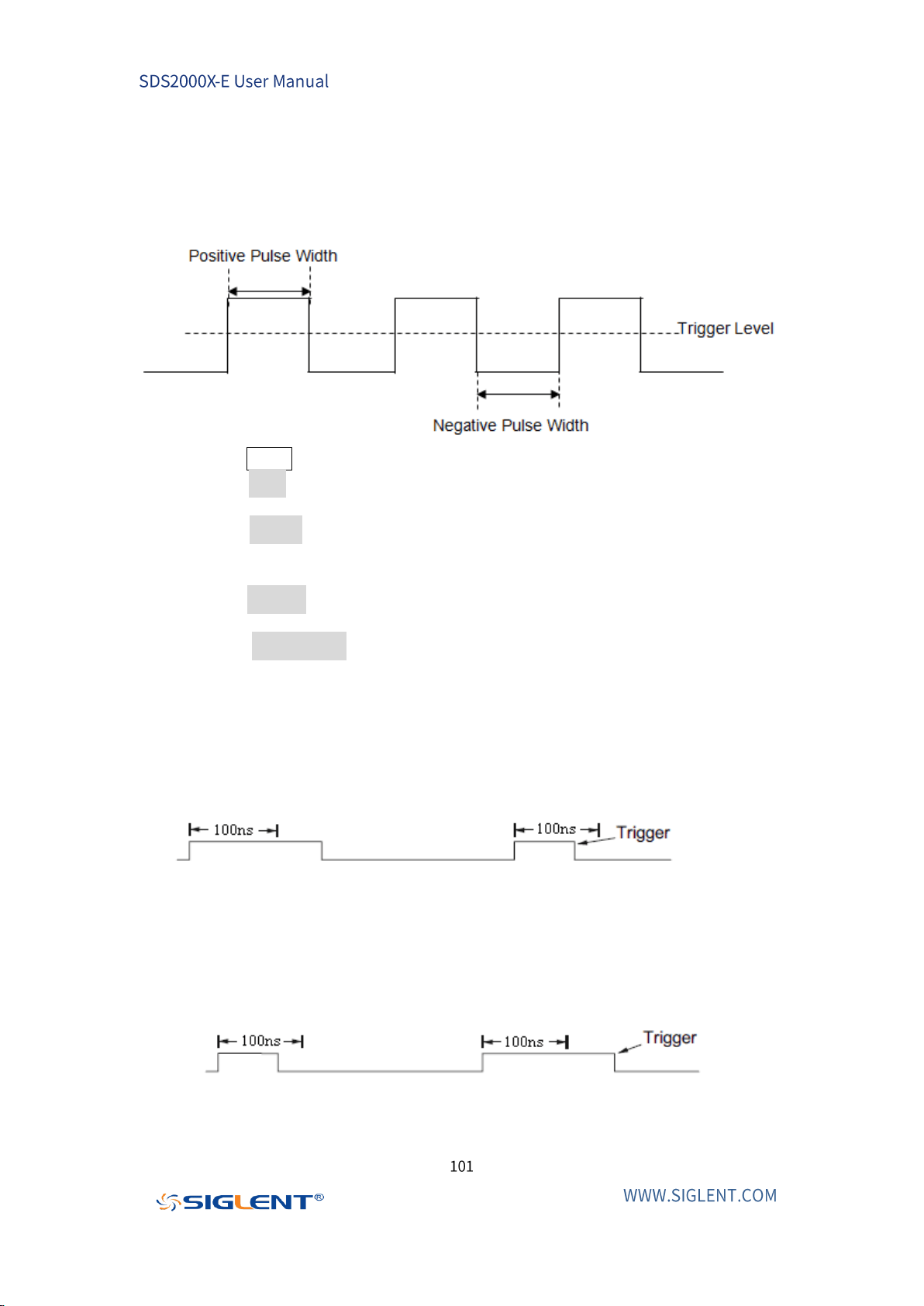
Pulse Trigger
Trigger on the positive or negative pulse with a specified width.
1. Press the Setup button on the front panel to enter the TRIGGER function menu.
2. Press the Type softkey; turn the Universal Knob to select Pulse and then push
the knob to confirm.
3. Press the Source softkey; turn the Universal Knob to select CH1 or CH2 as the
trigger source.
4. Turn the Trigger Level Knob to adjust the trigger level to the desired place.
5. Press the Polarity softkey to select Positive or Negative pulse that to trigger on.
The current trigger polarity is displayed at the upper right corner of the screen.
6. Press the Limit Range softkey; turn the Universal Knob to select the desired
condition.
<= (less than a time value): Trigger when the positive or negative pulse time of
the input signal is lower than the specified time value.
For example, for a positive pulse, if you set t (pulse real width) ≤ 100 ns, the
waveform will trigger.
>= (greater than a time value): Trigger when the positive or negative pulse time
of the input signal is greater than the specified time value.
For example, for a positive pulse, if you set t (pulse real width) ≥ 100 ns, the
waveform will trigger.
[--,--] (within a range of time value):Trigger when the positive or negative
pulse time of the input signal is greater than the specified lower limit of time
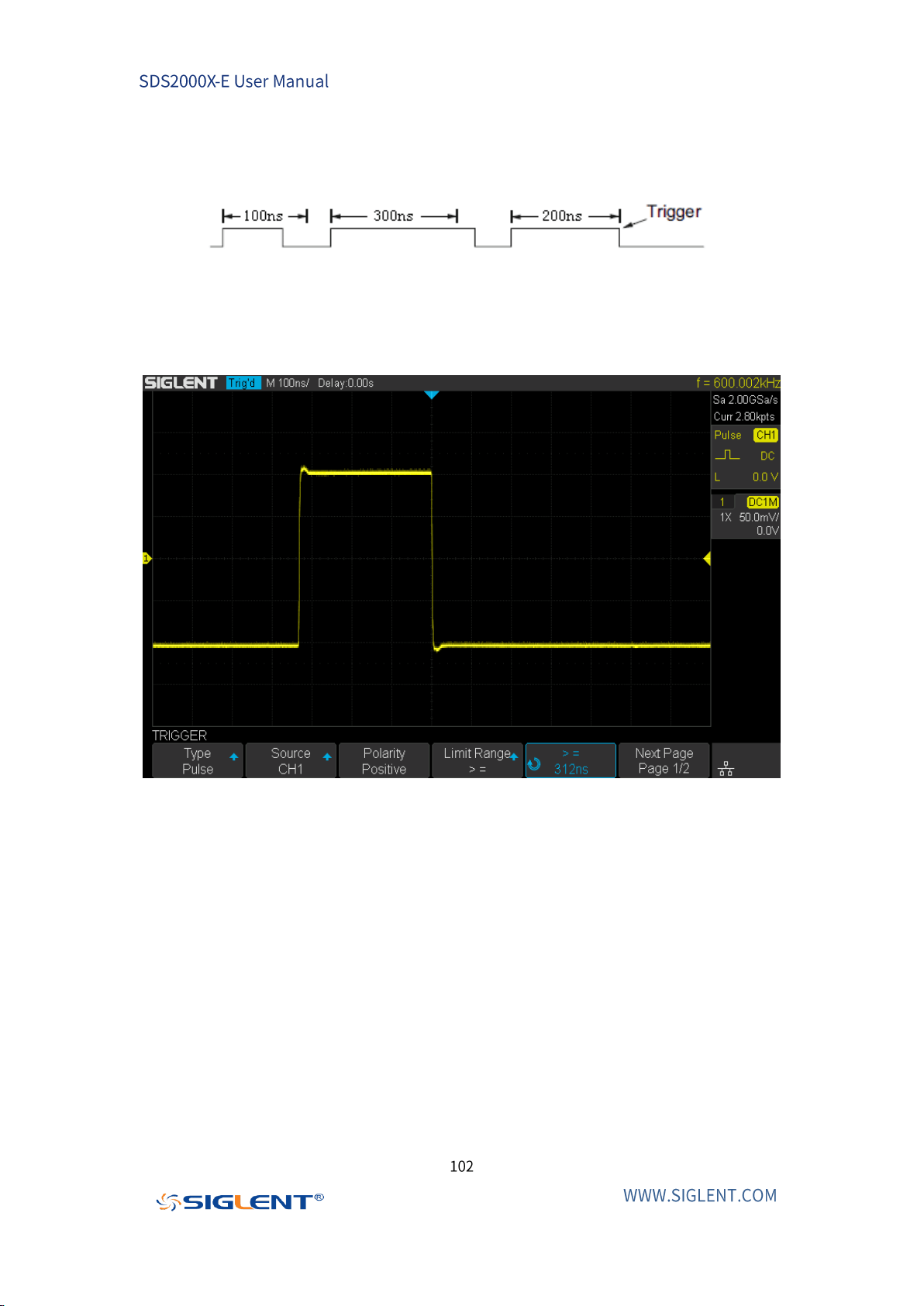
and lower than the specified upper limit of the set time value.
For example, for a positive pulse, if you set t (pulse real width) ≥ 100 ns and t
≤ 300 ns, the waveform will trigger.
--][-- (outside a range of time value): Trigger when the positive or negative
pulse time of the input signal is greater than the specified upper limit of time
and lower than the specified lower limit of time value.
Figure 26 Pulse Trigger
Coupling and noise reject can be set in pulse trigger, see the sections "Trigger
Coupling" and "Noise Rejection" for details.
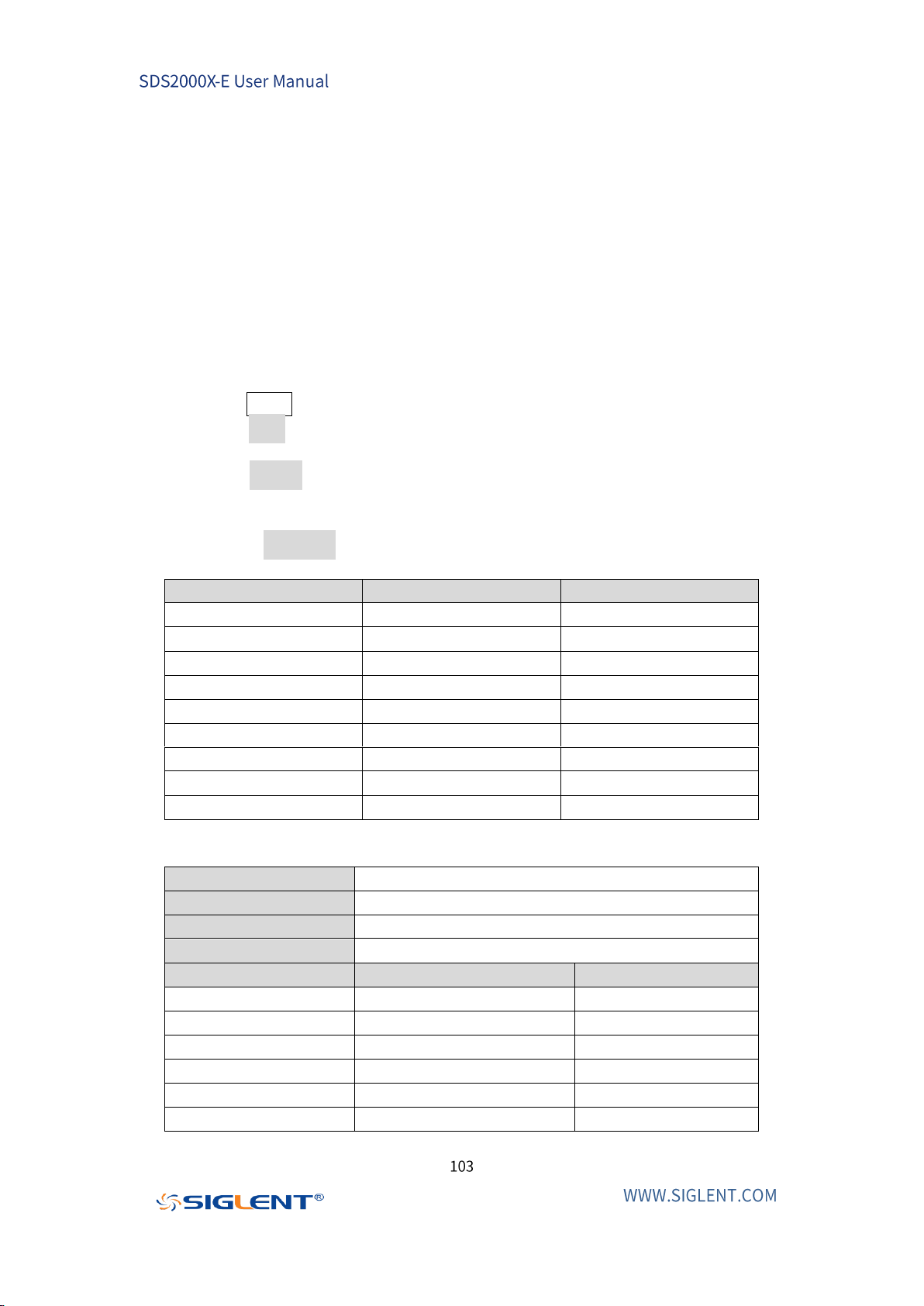
Video Trigger
Video triggering can be used to capture the complicated waveforms of most
standard analog video signals. The trigger circuitry detects the vertical and
horizontal interval of the waveform and produces triggers based on the video
trigger settings you have selected.
The oscilloscope supports standard video signal field or line of NTSC (National
Television Standards Committee), PAL (Phase Alternating Line) HDTV (High
Definition Television) and custom video signal triggers.
1. Press the Setup button on the front panel to enter the TRIGGER function menu.
2. Press the Type softkey; then turn the Universal Knob to select Video and push
down the knob to confirm.
3. Press the Source softkey; turn the Universal Knob to select CH1 or CH2 as the
trigger source. Turn the Trigger Level Knob does not change the trigger level
because the trigger level is automatically set to the sync pulse.
4. Press the Standard softkey to select the desired video standard. The
oscilloscope supports the following video standards.
Standard
Type
Sync Pulse
NTSC
Interlaced
BI-level
PAL
Interlaced
BI-level
HDTV 720P/50
Progressive
Tri-level
HDTV 720P/60
Progressive
Tri-level
HDTV 1080P/50
Progressive
Tri-level
HDTV 1080P/60
Progressive
Tri-level
HDTV 1080i/50
Progressive
Tri-level
HDTV 1080i/50
Progressive
Tri-level
Custom
The table below shows the parameters of the Custom video trigger.
Frame Rate
25 Hz, 30 Hz, 50 Hz, 60 Hz
Of Lines
300~2000
Of Fields
1, 2, 3, 4
Interlace
1:1, 2:1, 4:1, 8:1
Trigger Position
Line
Field
(line value)/1
1
(line value)/2
2
(line value)/3
3
(line value)/4
4
(line value)/5
5
(line value)/6
6
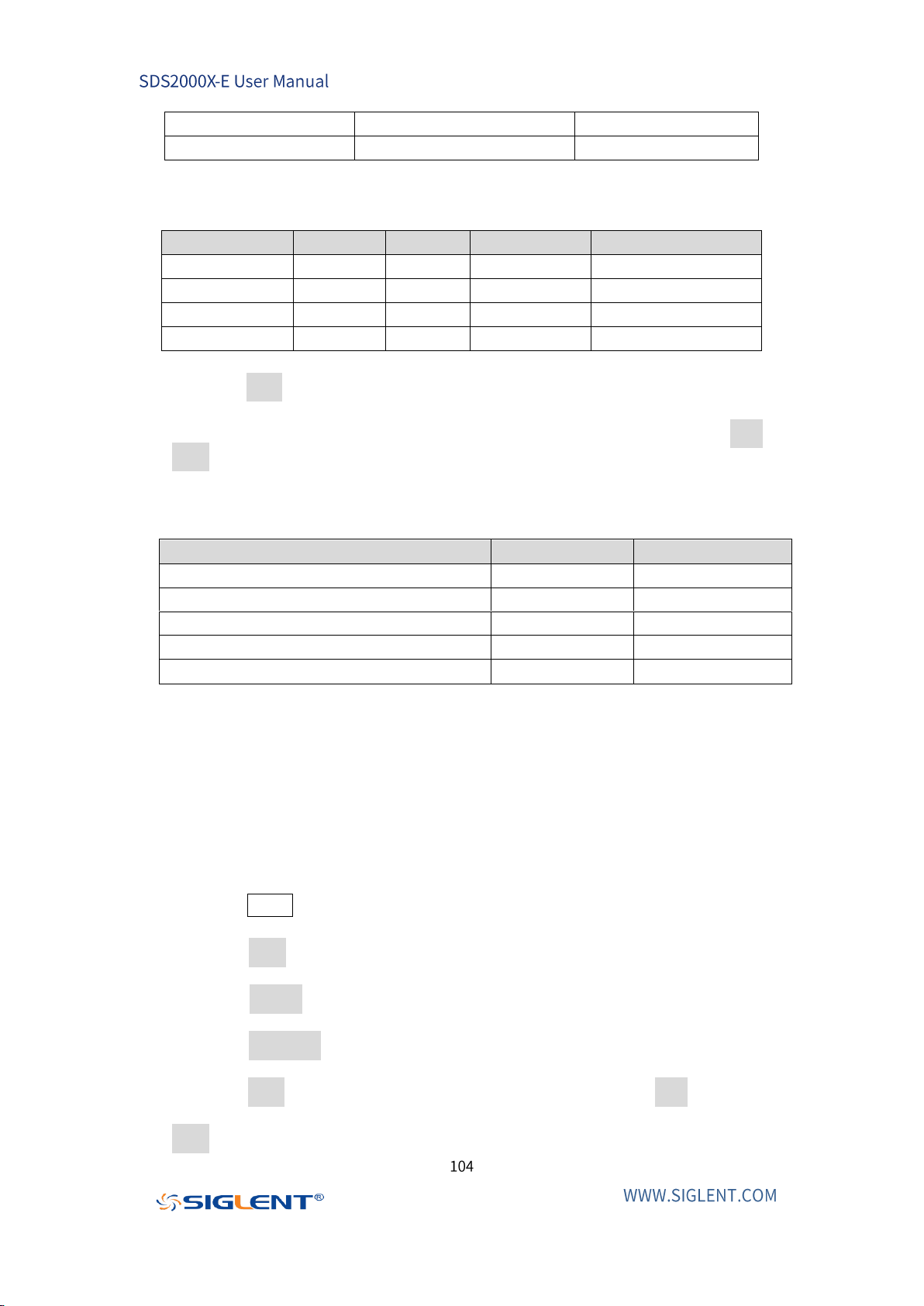
(line value)/7
7
(line value)/8
8
The table below takes Of Lines as 800 as an example to explain the relation
between Of Lines, Of Fields, Interlace, Trigger Line and Trigger Field.
Of Lines
Of Fields
Interlace
Trigger Line
Trigger Field
800
1
1:1
800
1
800
1,2,4 or 8
2:1
400
1, 1~2, 1~4, 1~8
800
1,2,4 or 8
4:1
200
1, 1~2, 1~4, 1~8
800
1,2,4 or 8
8:1
100
1, 1~2, 1~4, 1~8
1. Press the Sync softkey to select Any or Select trigger mode.
Any: Trigger on any of the horizontal sync pulses.
Select: Trigger on the appointed line and field you have set. Press the Line or
Field softkey; then turn the Universal Knob to set the value.
The following table lists the line numbers per field for each video standard.
Standard
Field 1
Field 2
NTSC
1 to 262
1 to 263
PAL
1 to 312
1 to 313
HDTV 720P/50, HDTV 720P/60
1 to 750
HDTV 1080P/50, HDTV 1080P/60
1 to 1125
HDTV 1080iP/50, HDTV 1080i/60
1 to 562
1 to 563
The following are exercises to familiarize you with video triggering.
To trigger on a specific line of video.
To use custom video trigger.
To Trigger on a Specific Line of Video
Video triggering requires greater than 1/2 division of sync amplitude with any
analog channel as the trigger source.
The example below set to trigger on field 2, line 124 using the NTSC video standard.
1. Press the Setup button on the front panel to enter the TRIGGER system function
menu.
2. Press the Type softkey; then use the Universal Knob to select Video and push
down the knob to confirm.
3. Press the Source softkey; turn the Universal Knob to select CH1 as the trigger
source, and press the knob to confirm.
4. Press the Standard softkey; turn the Universal Knob to select NTSC, and press
the knob to confirm.
5. Press the Sync softkey and set the option to Select; press the Line softkey and
then turn the universal to select 022 and push the knob to confirm; press the
Field softkey and then turn the Universal Knob to select 1 and push the knob to
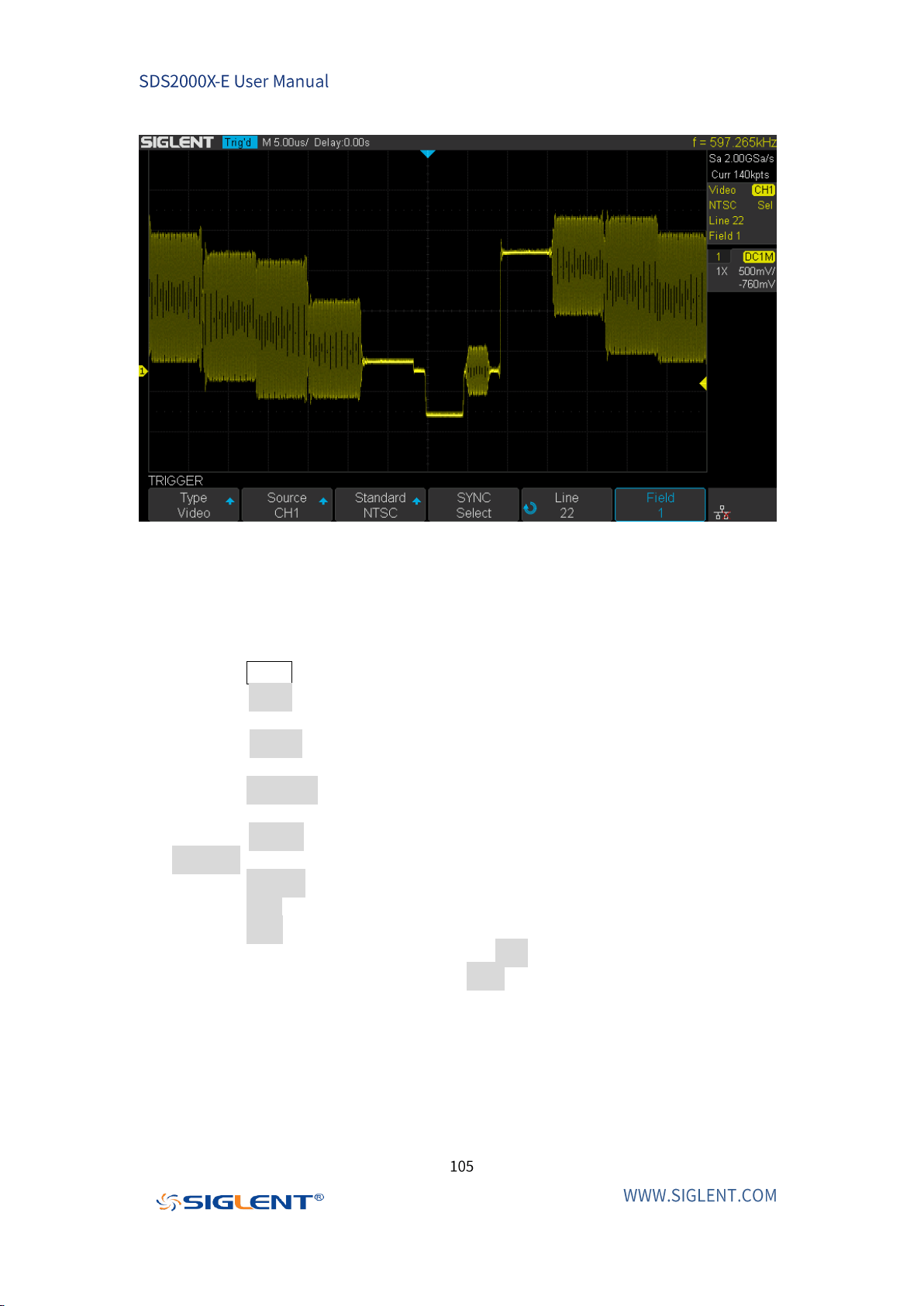
confirm.
Figure 27 Video Trigger
To Use Custom Video Trigger
Custom video trigger supports frame rates of 25 Hz, 30 Hz, 50 Hz and 60 Hz, and the
line range is available from 300 to 2000. The steps below show how to set a custom
trigger.
1. Press the Setup button on the front panel to enter the TRIGGER function menu.
2. Press the Type softkey; then use the Universal Knob to select Video and push
down the knob to confirm.
3. Press the Source softkey; turn the Universal Knob to select CH1 as the trigger
source, and push down the knob to confirm.
4. Press the Standard softkey; turn the Universal Knob to select Custom, and push
down the knob to confirm.
5. Press the Setting softkey to enter the custom setting function menu. Press the
Interlace softkey; turn the Universal Knob to select the desired value.
6. Press the Of Field softkey; turn the Universal Knob to select the desired value.
7. Press the Sync softkey to enter the TRIG ON menu to set the line and field.
Press the Type softkey to select Select or Any.
If the Type option set to Select, press the Line softkey; turn the Universal Knob
to select the desired value. Press the Field softkey; turn the Universal Knob to
select the desired value.

Window Trigger
Windows trigger provides a high trigger level and a low trigger level. The
instrument triggers when the input signal passes through the high trigger level or
the low trigger level.
There are two kinds of window types: Absolute and Relative. They have different
trigger level adjustment methods. Under the Absolute window type, the lower and
the upper trigger levels can be adjusted respectively via the Level Knob; under
Relative window type, adjust the Center value to set the window center; adjust the
Delta value to set the window range, the lower and the upper trigger levels always
move together.
If the lower and the upper trigger levels are both within the waveform
amplitude range, the oscilloscope will trigger on both rising and falling edge.
If the upper trigger level is within the waveform amplitude range while the
lower trigger level is out of the waveform amplitude range, the oscilloscope
will trigger on rising edge only.
If the lower trigger level is within the waveform amplitude range while the
upper trigger level is out of the waveform amplitude range, the oscilloscope
will trigger on falling edge only.
To set window trigger via Absolute window type:
1. Press the Setup button on the front panel to enter the TRIGGER function menu.
2. Press the Type softkey; then use the Universal Knob to select Window and push
down the knob to confirm.
3. Press the Source softkey; turn the Universal Knob to select CH1 or CH2 as the
trigger source.
4. Press the Window Type softkey to select Absolute.
5. Press the Lower Upper softkey to select Lower or Upper trigger level; then turn
the Trigger Level Knob to adjust the position. The trigger level values are
displayed at the upper right corner of the screen.
The Lower trigger level cannot be greater than the upper trigger level. In the
trigger state message box, L1 means the upper trigger level while L2 means
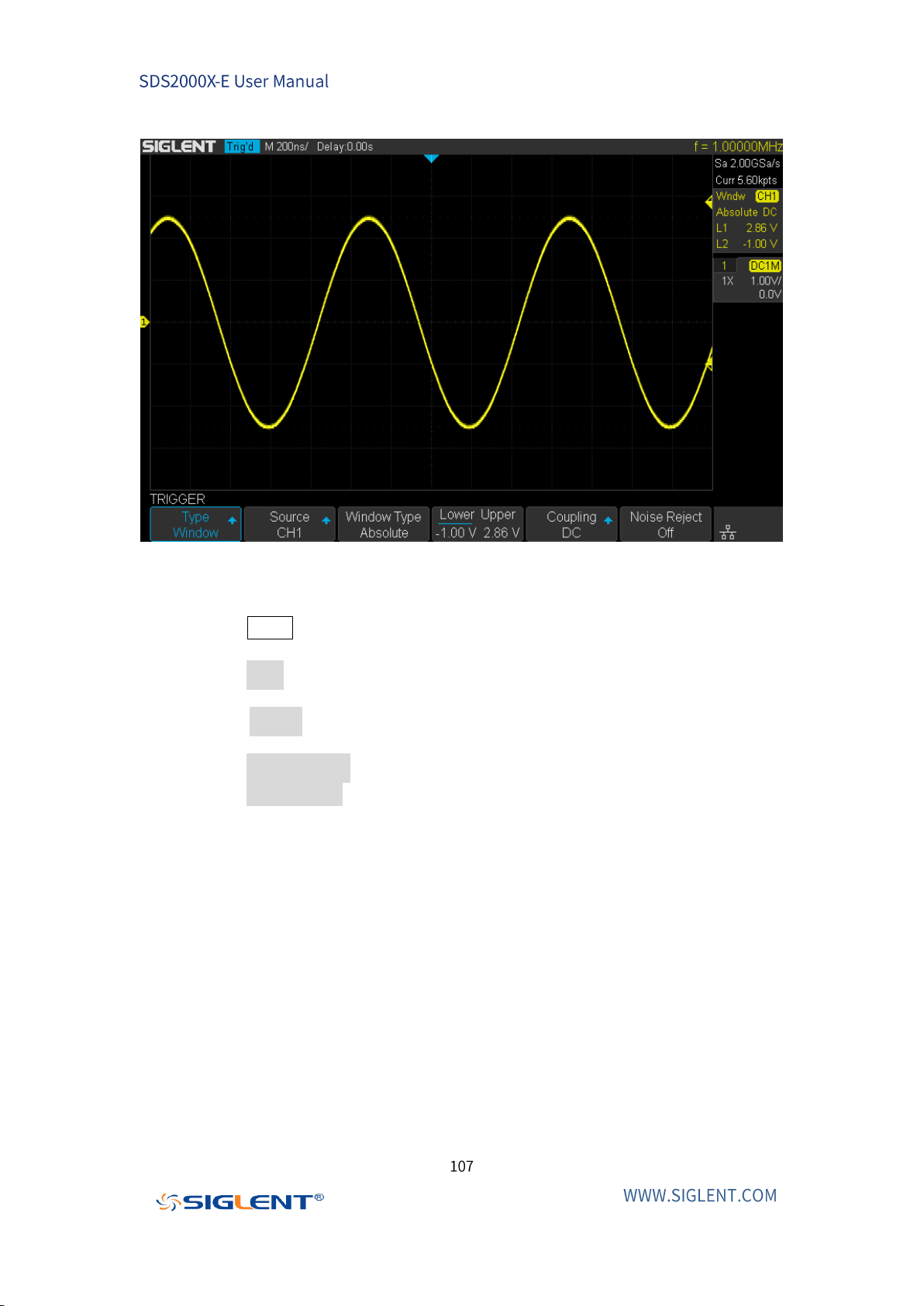
the lower trigger level.
Figure 28 Absolute Window Trigger
To set window trigger via Relative window type:
1. Press the Setup button on the front panel to enter the TRIGGER system function
menu.
2. Press the Type softkey; then use the Universal Knob to select Window and push
down the knob to confirm.
3. Press the Source softkey; turn the Universal Knob to select CH1 or CH2 as the
trigger source.
4. Press the Window Type softkey to select Relative.
5. Press the Center Delta softkey to select Center or Delta trigger level mode; then
turn the Trigger Level Knob to adjust the position. The Center and Delta values
are displayed at the upper right corner of the screen.
In the trigger state message box, C means Center, the center value of the lower
and upper trigger levels; D means Delta, the difference between the lower (or
upper) trigger level and the trigger level center.
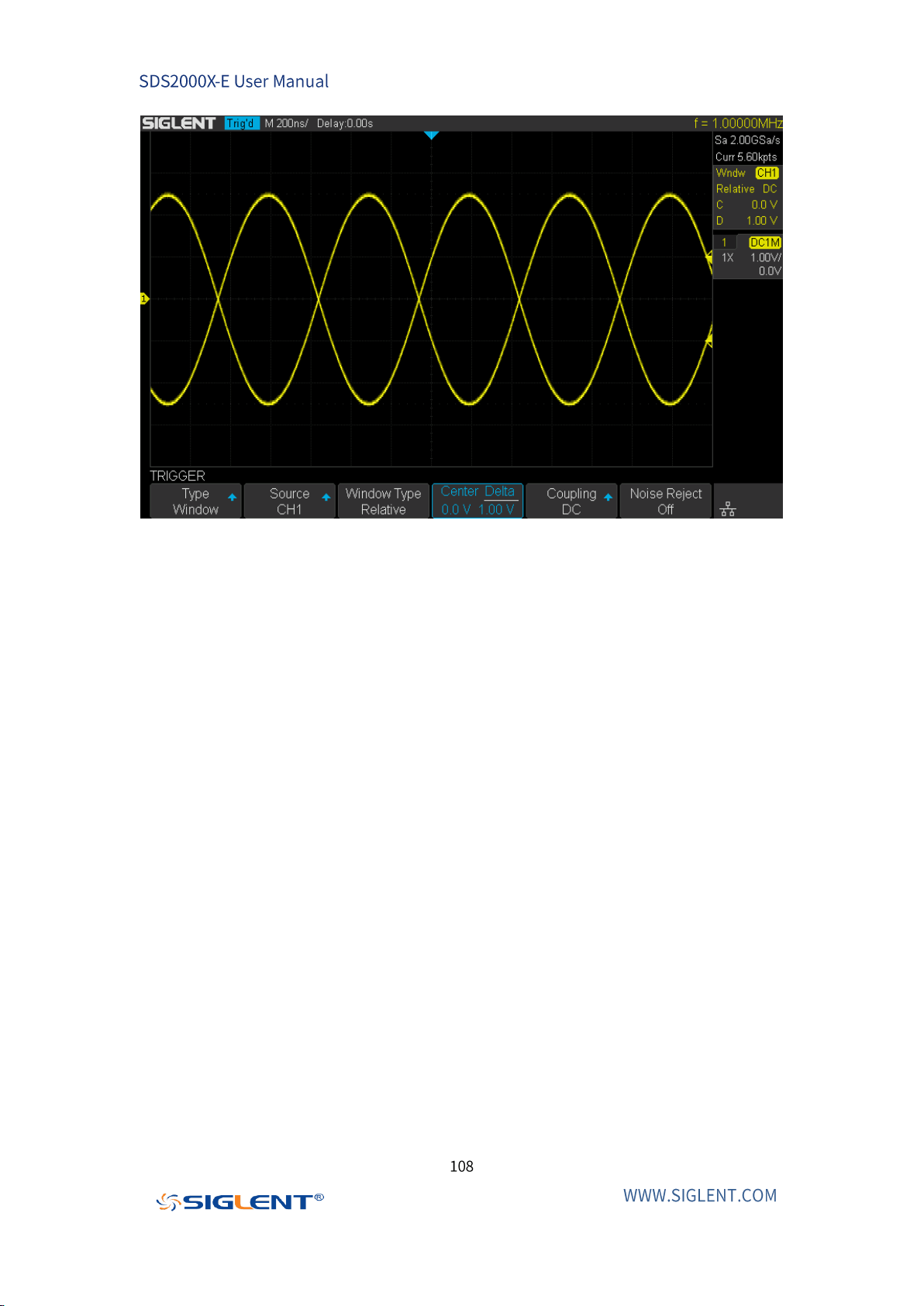
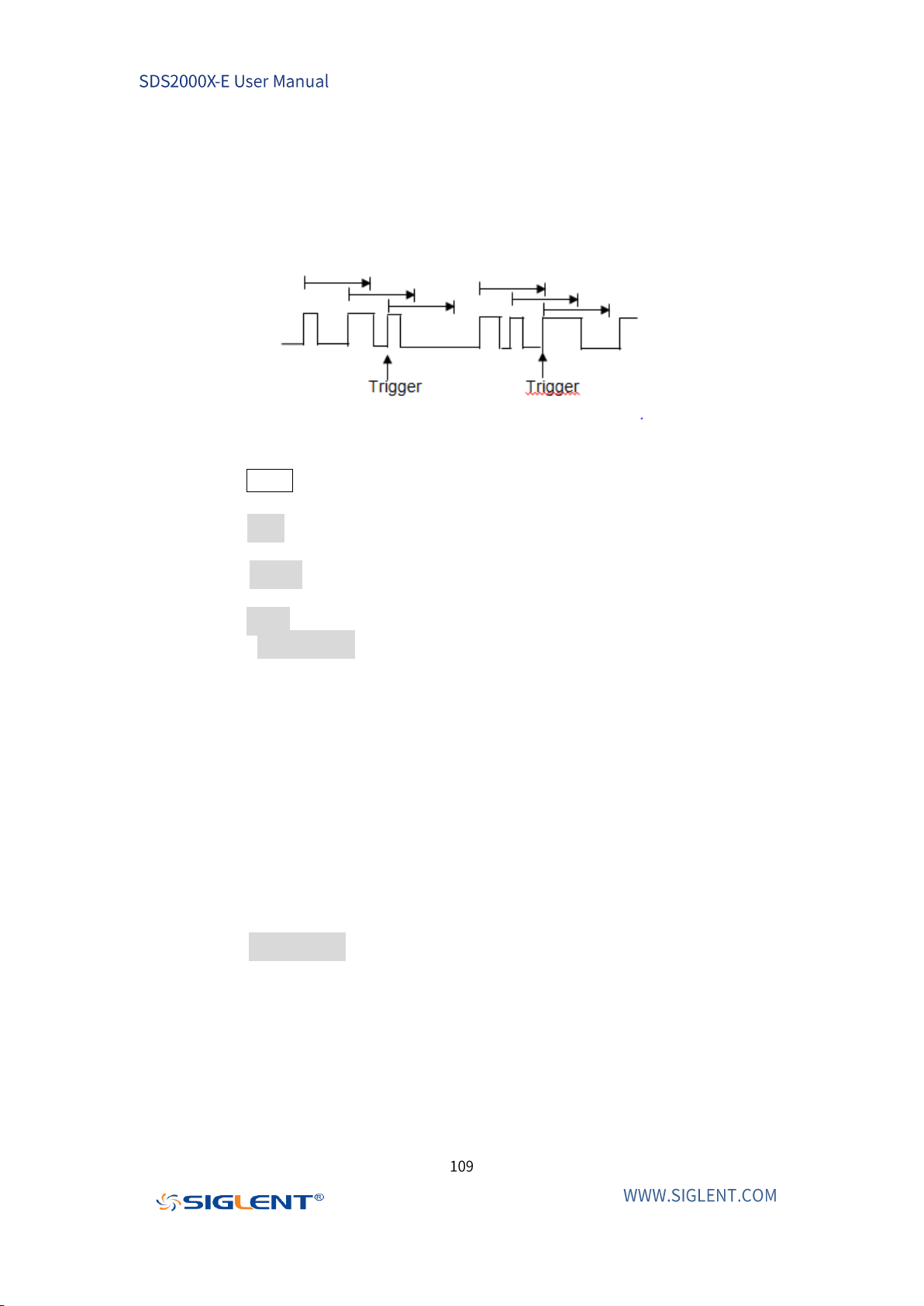
Interval Trigger
Trigger when the times difference between the neighboring rising or falling edges
meets the time limit (<=, >=, [--,--], --][--).
To set interval trigger:
1. Press the Setup button on the front panel to enter the TRIGGER system function
menu.
2. Press the Type softkey; then use the Universal Knob to select Interval and push
down the knob to confirm.
3. Press the Source softkey; turn the Universal Knob to select CH1 or CH2 as the
trigger source.
4. Press the Slope softkey to select Rising or Falling edge.
5. Press the Limit Range softkey; turn the Universal Knob to select desired
condition.
<= (less than a time value): Trigger when the positive or negative pulse time of
the input signal is lower than the specified time value.
>= (greater than a time value): Trigger when the positive or negative pulse time
of the input signal is greater than the specified time value.
[--,--] (within a range of time value):Trigger when the positive or negative
pulse time of the input signal is greater than the specified lower limit of time
and lower than the specified upper limit of time value.
--][-- (outside a range of time value): Trigger when the positive or negative
pulse time of the input signal is greater than the specified upper limit of time
and lower than the specified lower limit of time value.
1. Press the Time Setting softkey (<=, >=, [--,--],--][--), turn the Universal Knob to
select the desired value.
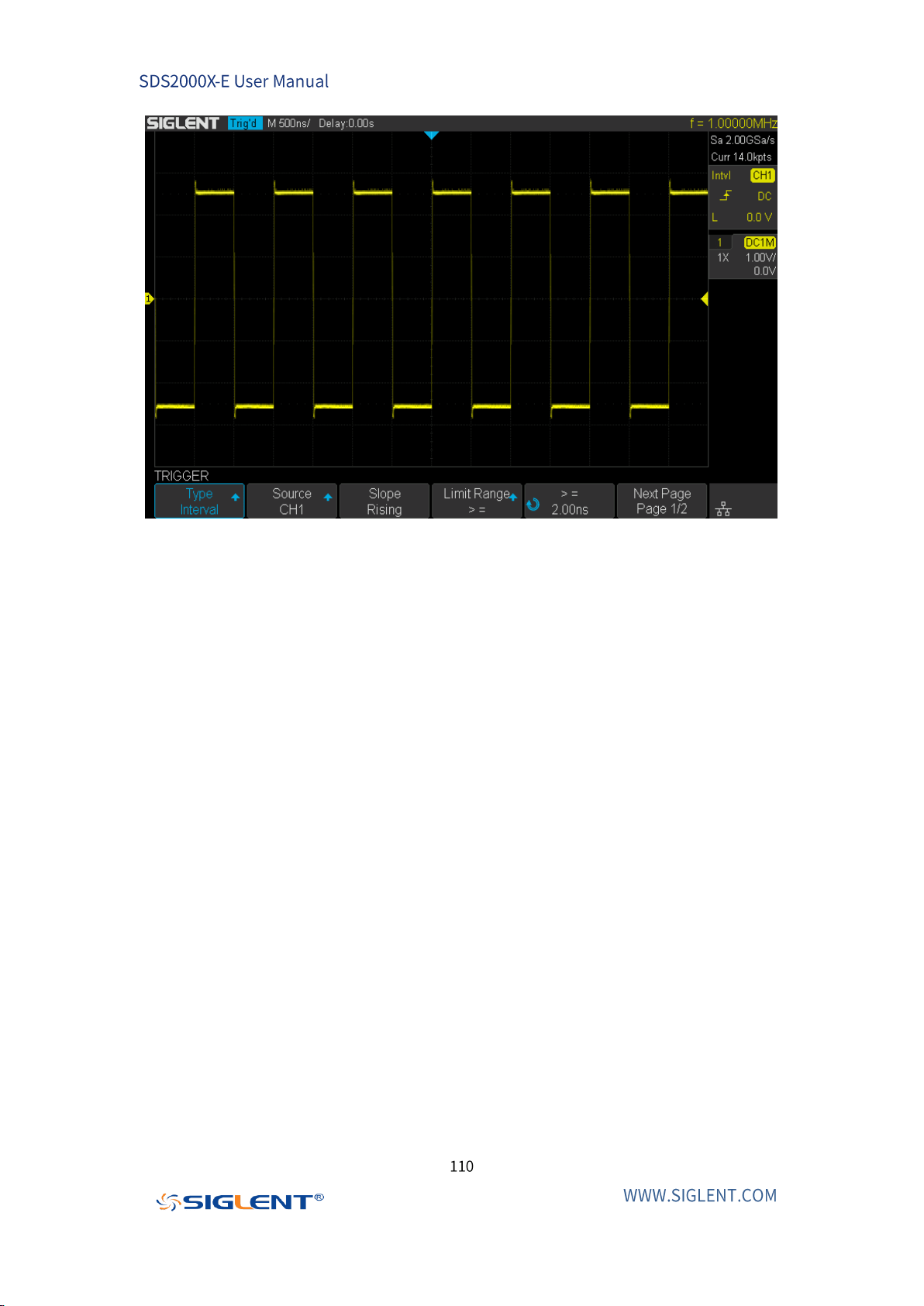
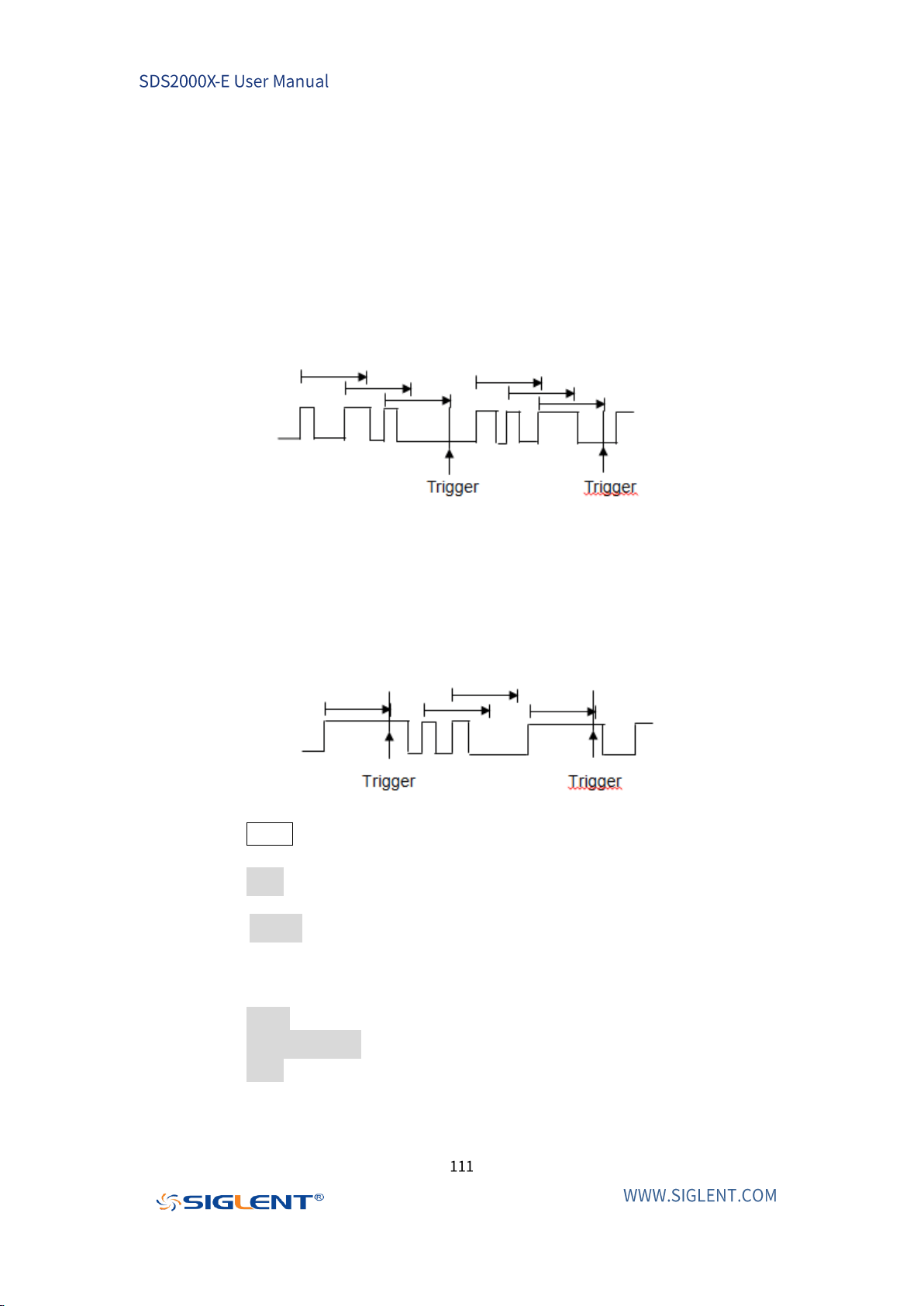
Dropout Trigger
Dropout trigger includes two types: edge and state.
Edge
Trigger when the time interval (△T) from when the rising edge (or falling edge) of
the input signal passes through the trigger level to when the neighboring rising
edge (or falling edge) passes through the trigger level is greater than the timeout
time set, as shown in the figure below.
State
Trigger when the time interval (△T) from when the rising edge (or falling edge) of
the input signal passes through the trigger level to when the neighboring falling
edge (or rising edge) passes through the trigger level is greater than the timeout
time set, as shown in the figure below.
To set edge Dropout trigger:
1. Press the Setup button on the front panel to enter the TRIGGER system function
menu.
2. Press the Type softkey; then use the Universal Knob to select Dropout and push
down the knob to confirm.
3. Press the Source softkey; turn the Universal Knob to select CH1 or CH2 as the
trigger source. The current trigger source is displayed in the upper right corner
of the screen. Select channel with signal input as trigger source to obtain
stable trigger.
4. Press the Slope softkey to select Rising or Falling edge.
5. Press the OverTime Type softkey to select Edge.
6. Press the Time softkey; turn the universal to select the desired value.
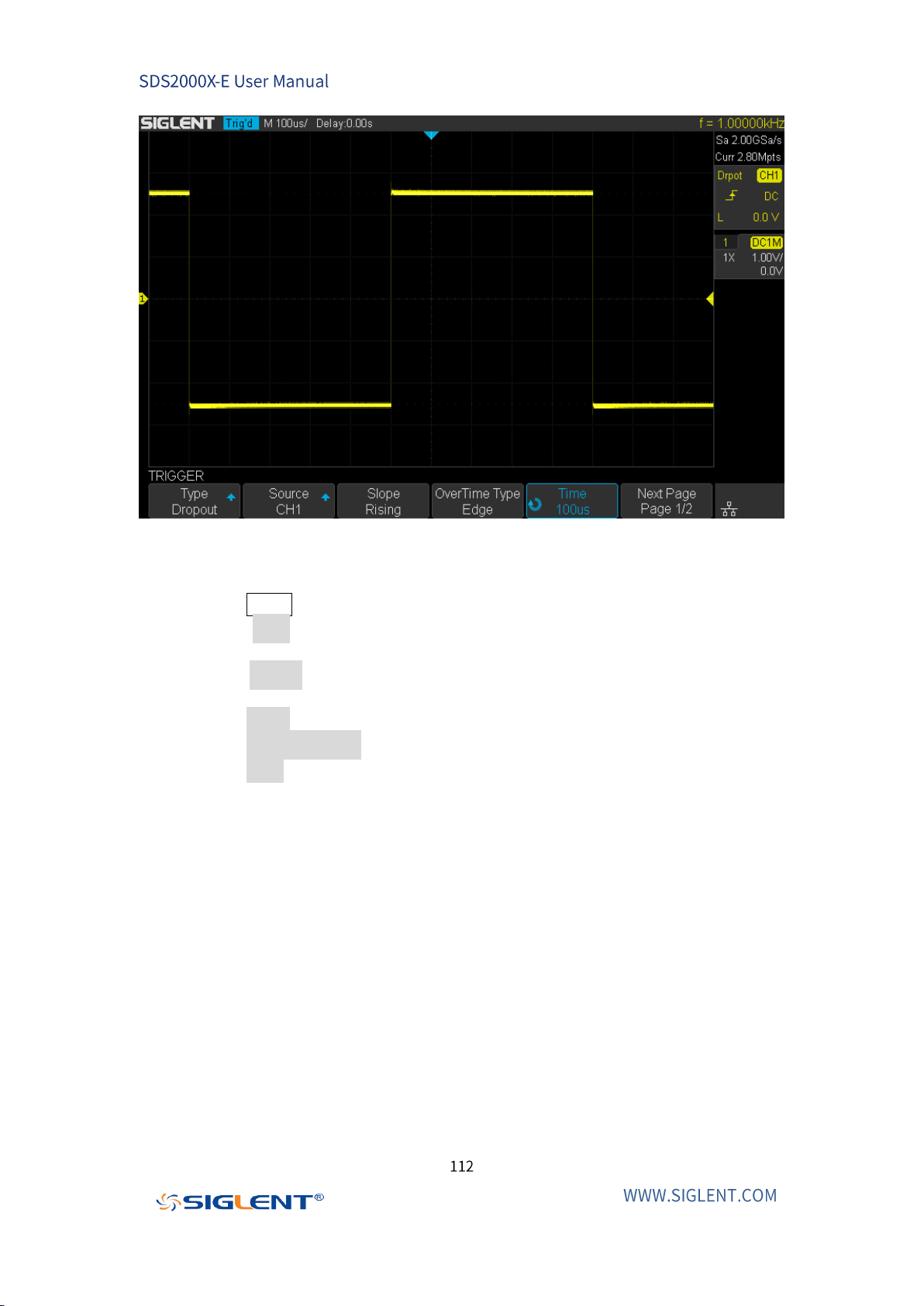
Figure 31 Edge Dropout Trigger
To set state Dropout trigger:
1. Press the Setup button to enter the TRIGGER system function menu.
2. Press the Type softkey; then turn the Universal Knob to select Dropout and
push down the knob to confirm.
3. Press the Source softkey; turn the Universal Knob to select CH1 or CH2 as the
trigger source.
4. Press the Slope softkey to select Rising or Falling edge.
5. Press the OverTime Type softkey to select State.
6. Press the Time softkey; turn the Universal Knob to select the desired value.
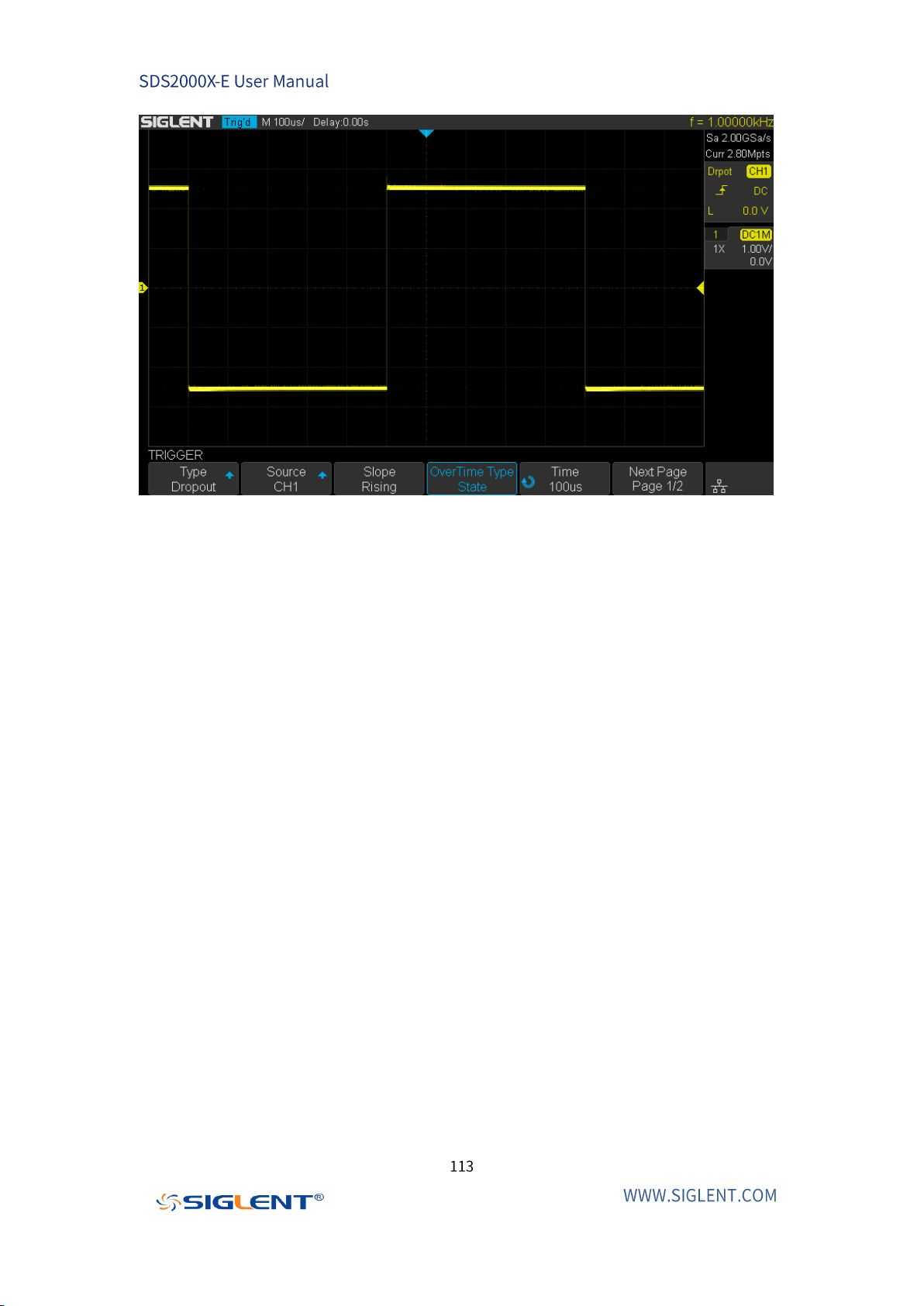
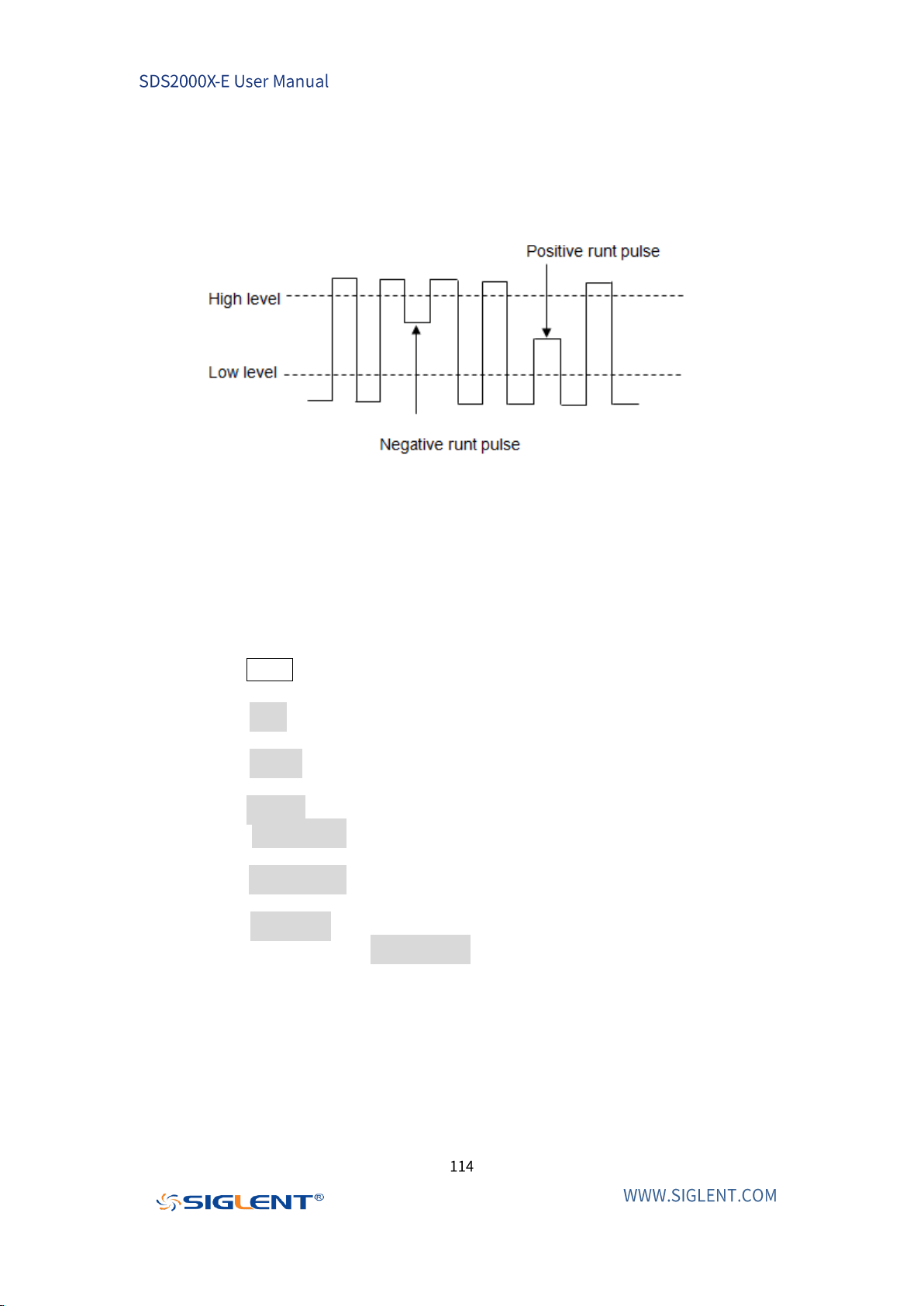
Runt Trigger
The Runt trigger looks for pulses that cross one threshold but not another as shown
in the picture below.
A positive runt pulse across through a lower threshold but not an upper
threshold.
A negative runt pulse across through an upper threshold but not a lower
threshold.
To trigger on runt pulse:
1. Press the Setup button on the front panel to enter the TRIGGER system function
menu.
2. Press the Type softkey; then turn the Universal Knob to select Runt and push
down the knob to confirm.
3. Press the Source softkey; turn the Universal Knob to select CH1 or CH2 as the
trigger source.
4. Press the Polarity softkey to select Positive or Negative pulse to trigger.
5. Press the Limit Range softkey; turn the Universal Knob to select the desired
condition (<=, >=, [--,--] or --][--).
6. Press the Time Setting softkey, and then turn the Universal Knob to select the
desired value.
7. Press the Next Page softkey to enter the second page of the TRIGGER system
function menu. Press the Lower Upper softkey to select Lower or Upper trigger
level, and the turn the Universal Knob to set the position.
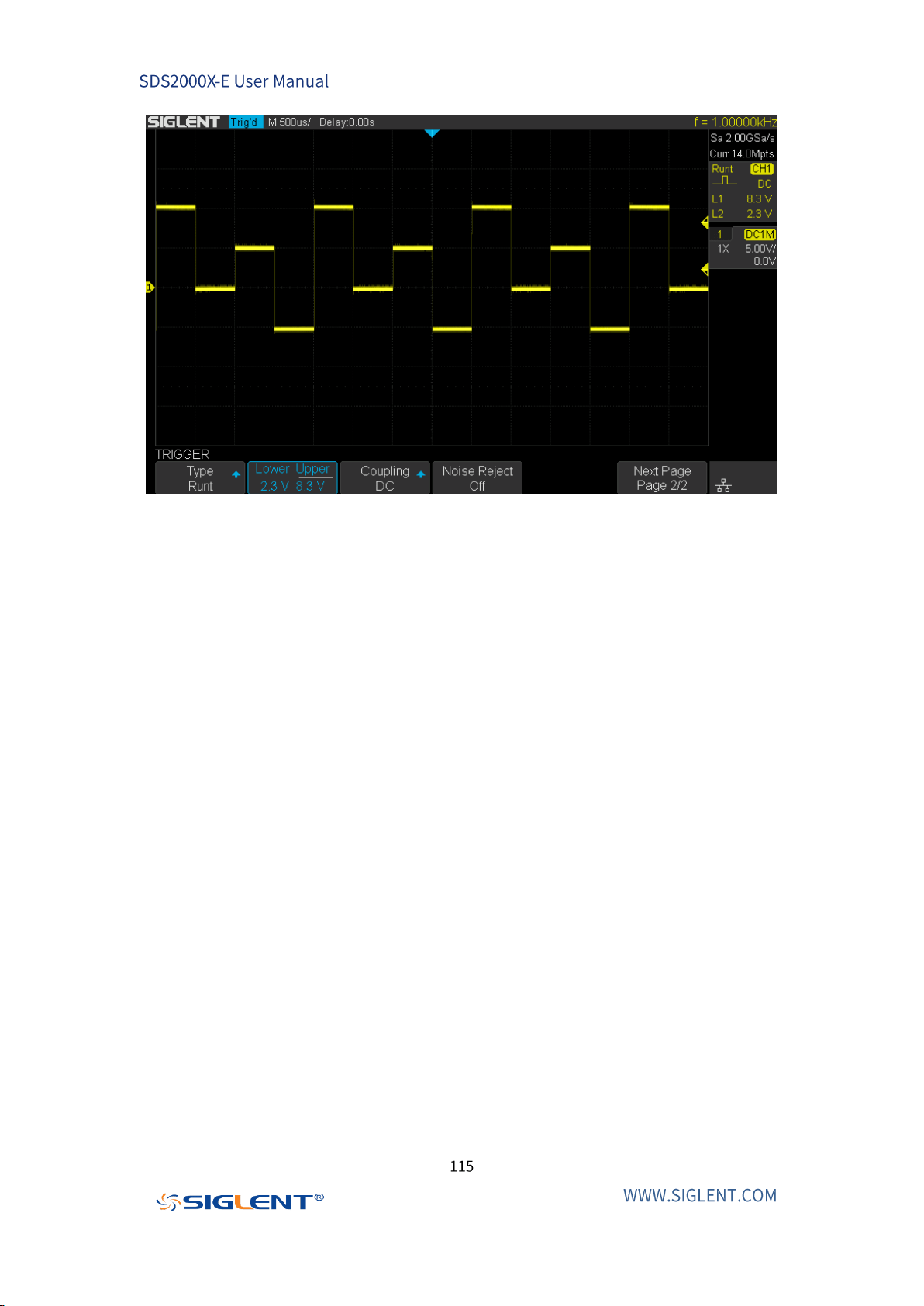
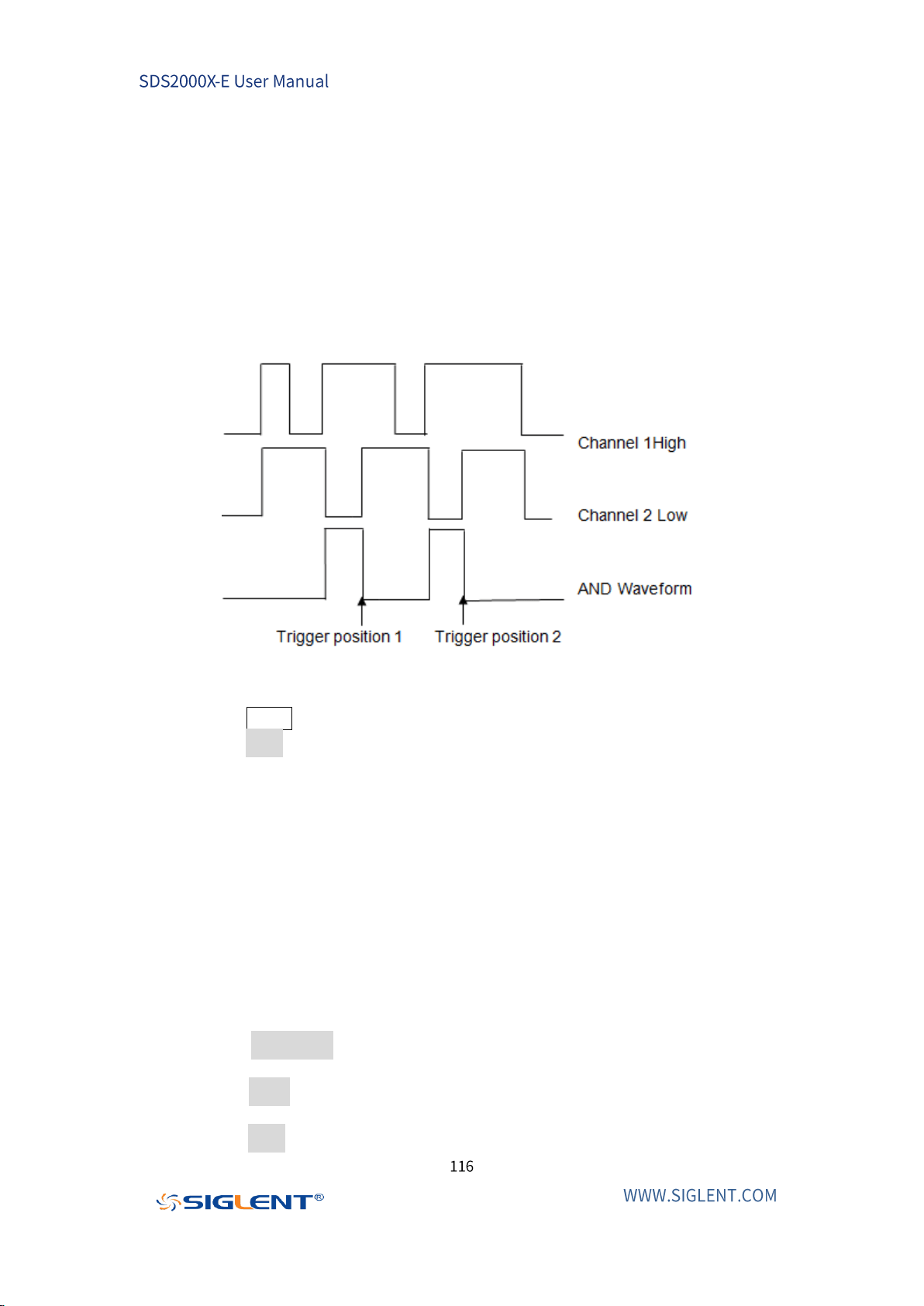
Pattern Trigger
The Pattern trigger identifies a trigger condition by looking for a specified pattern.
The pattern trigger can be expanded to incorporate delays similar to other triggers.
Pattern durations are evaluated using a timer. The timer starts on the last edge that
makes the pattern “true”. Potential triggers occur on the first edge that makes
the pattern false, provided that the time qualifier criterion has been met. The
oscilloscope provides 4 patterns: logical AND, OR, NAND and NOR combination of
the channels. Each channel can set to low, high or invalid.
Do the following steps to set pattern trigger:
1. Press the Setup button on the front panel to enter the TRIGGER function menu.
2. Press the Type softkey; turn the Universal Knob to select Pattern, and then push
down the knob to confirm.
3. Press each channel softkey to select Invalid, High or Low.
Low sets the pattern to low on the selected channel. A low is a voltage
level that is less than the channel's trigger level or threshold level.
High sets the pattern to high on the selected channel. A high is a voltage
level that is greater than the channel's trigger level or threshold level.
Invalid sets the pattern to don't care on the selected channel. Any channel
set to don't care is ignored and is not used as part of the pattern.
However, if all channels in the pattern are set to Invalid, the oscilloscope
will not trigger.
Adjust the trigger level for the selected analog channel by turning the Trigger
Level knob. Invalid doesn’t need to set trigger level.
4. Press the Next Page softkey to enter the second page of the pattern trigger
menu.
5. Press the Logic softkey and then turn the Universal Knob to select the desired
logic combination AND, OR, NAND or NOR.
6. Press the Time softkey; then turn the Universal Knob to select the desired time
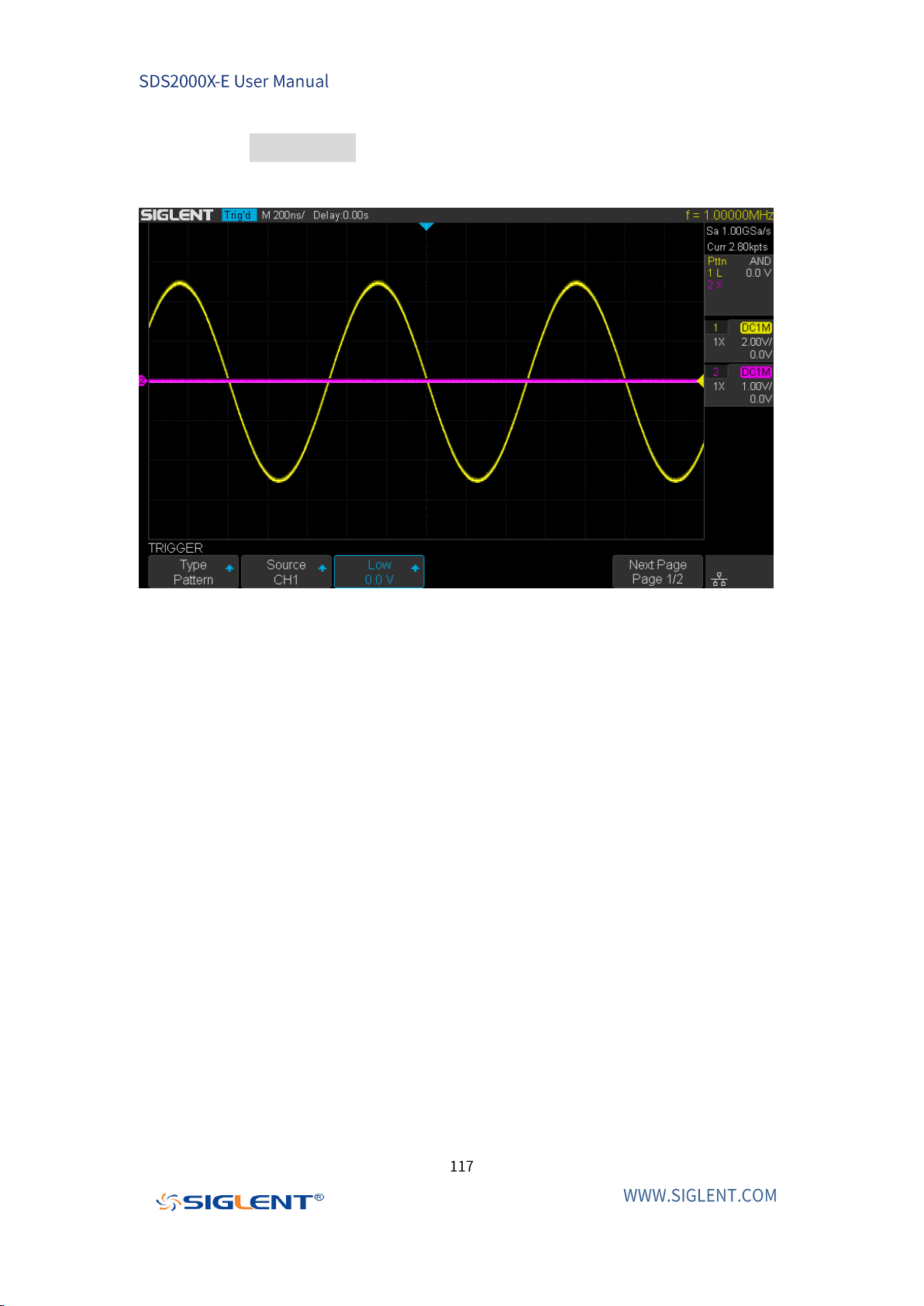

Serial Trigger and Decode
The oscilloscope provides I2C, SPI, UART, CAN and LIN serial trigger and decode.
This chapter introduces the method of triggering and decoding these serial signals
in detail.
The contents of this chapter:
I2C Trigger and Serial Decode
SPI Trigger and Serial Decode
UART Trigger and Serial Decode
CAN Trigger and Serial Decode
LIN Trigger and Serial Decode
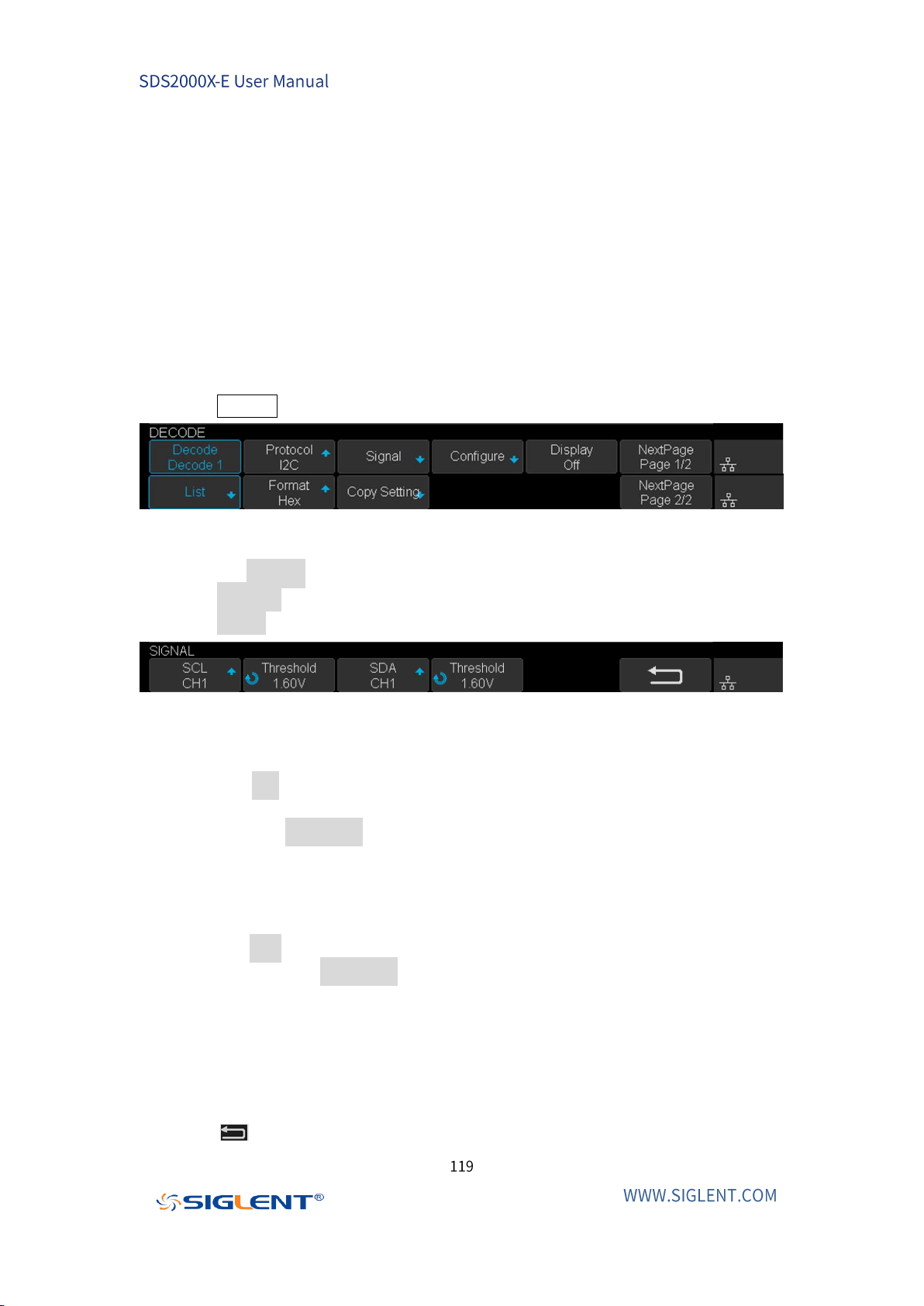
I2C Trigger and Serial Decode
Please read “Setup for I2C Signals”, “I2C Trigger” and “I2C Serial Decode” to
trigger and decode the signals.
Setup for I2C Signals
Setting the I2C (Inter-IC bus) signal includes two steps: connecting the serial data
signal (SDA) and serial clock signal (SCL) to oscilloscope, specifying the threshold
voltage of each input signal.
1. Press Decode key to enter the DECODE function menu as Figure 35 shows.
Figure 35 I2C DECODE Menu
2. Press the Decode softkey and select the desired slot (Decode1 or Decode2).
3. Press Protocol softkey and then select I2C by turning Universal Knob.
4. Press Signal softkey to enter the SIGNAL menu as Figure 36 shows.
Figure 36 I2C SIGNAL Menu
5. Set SCL (I2C’s clock signal):
a. Press SCL softkey to select the channel that is connected to the I2C clock
signal.
b. Press first Threshold softkey to set the I2C clock signal’s threshold voltage
level by Universal Knob. The threshold voltage level is for decoding, and it
will be regard as the trigger voltage level when set the trigger type to
serial.
6. Set SDA (I2C’s data signal):
a. Press SDA to select the channel that is connected to the I2C data signal.
b. Press second Threshold softkey to set the I2C data signal’s threshold
voltage level by Universal Knob. The threshold voltage level is for
decoding, and it will be regard as the trigger voltage level when set the
trigger type to serial.
(Tip: SDA should keep stable during the whole high clock cycle, otherwise it
will be interpreted as a start or stop condition (data transitioning while the
clock is high).)
7. Press softkey to return previous menu.

I2C Trigger
This part introduces the eight kinds of trigger conditions (Start, Stop, Restart, No
Ack, EEPROM, 7 Addr&Data, 10 Addr&Data and Data Length) and the methods of
setting them.
Trigger conditions:
Start Condition— The oscilloscope will be triggered when the SDA signal
transitions from high to low while the SCL clock is high. If it is chosen as the
condition of trigger (including frame triggers), a restart will be treated as a
“Start condition”.
Stop Condition— The oscilloscope will be triggered when SDA transitions
from low to high while the SCL is high.
Restart— The oscilloscope will be triggered when another “Start
condition” occurs before a “Stop condition”.
No Ack— The oscilloscope will be triggered when SDA data is high during
any SCL’s ACK bit.
EEPROM — The trigger searches for the EEPROM control byte (the value is
1010xxx) on the SDA bus. And there is a Read bit and an ACK bit behind the
EEPROM. Using Limit Range softkey to set the qualifier and Data1 softkey to
set the data’s value. If EEPROM’s data is greater (less, equal) than Data1,
the oscilloscope will be triggered at the edge of ACK bit behind the Data
byte. It’s unnecessary that the Data byte musts follow the EEPROM.
7 Address & Data — The oscilloscope will be triggered when the following
conditions are satisfied.
The address’s length must be 7 bits and the address’s value is the
same as set value.
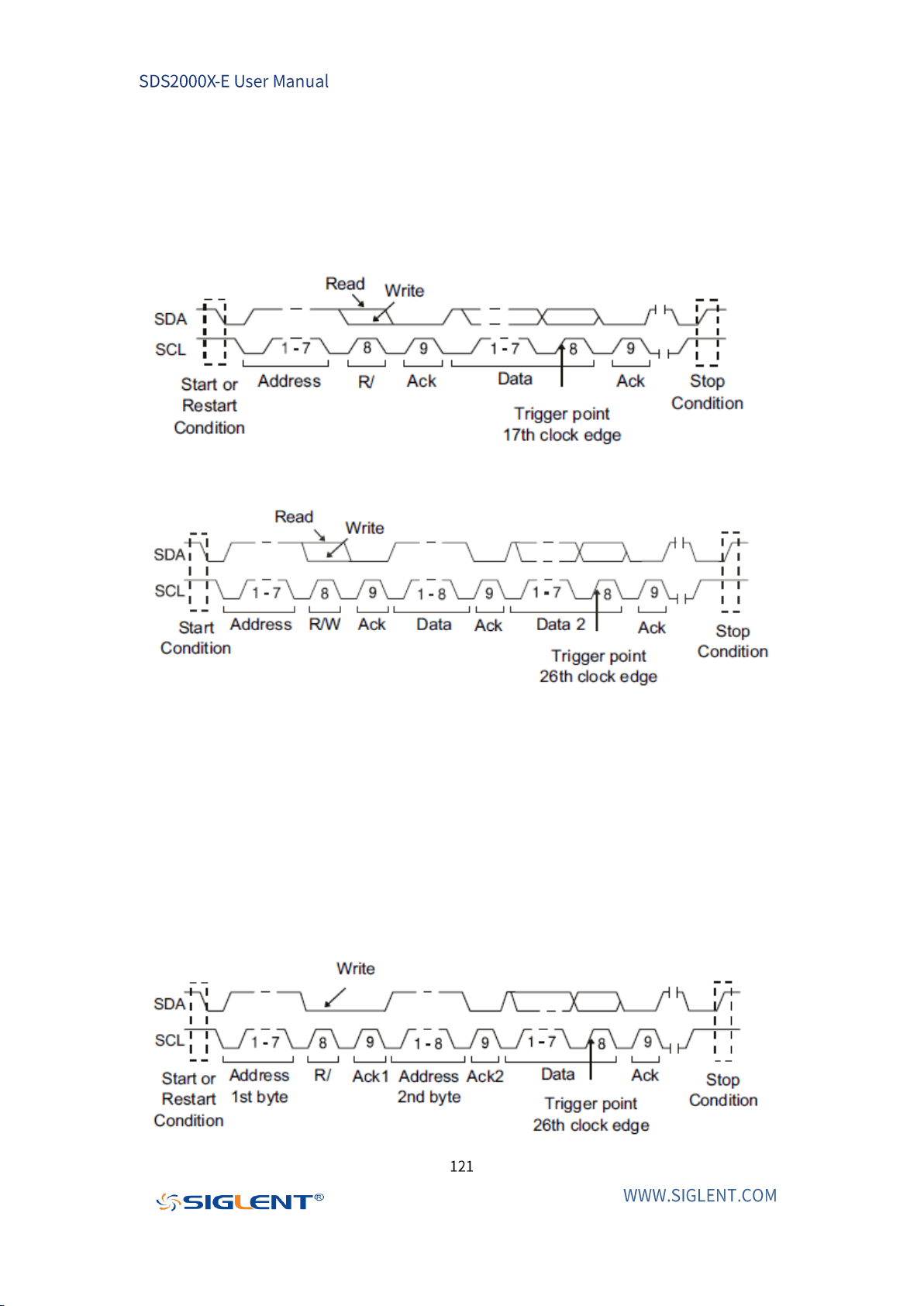
If you have set either Data1’s or Data2’s value, and the signal has a
data is the same as that value. If you have set both Data1’s and
Data2’s value, the signal should have two consecutive data values, the
first data’s value is Data1, second data value is Data2.
(Note: If the data’s value is 0xXX, any data value will be matched.)
10 Address & Data — The oscilloscope will be triggered when the following
conditions are satisfied.
The address’s length must be 10 bits and the address’s value is the
same as set value.
If you have set either Data1’s or Data2’s value, and the signal has a
data is the same as that value. If you have set both Data1’s and
Data2’s value, the signal should has two consecutive data values, the
first data’s value is Data1, second data value is Data2.
(Note: If the set value is 0xXX, any data value will be matched.)
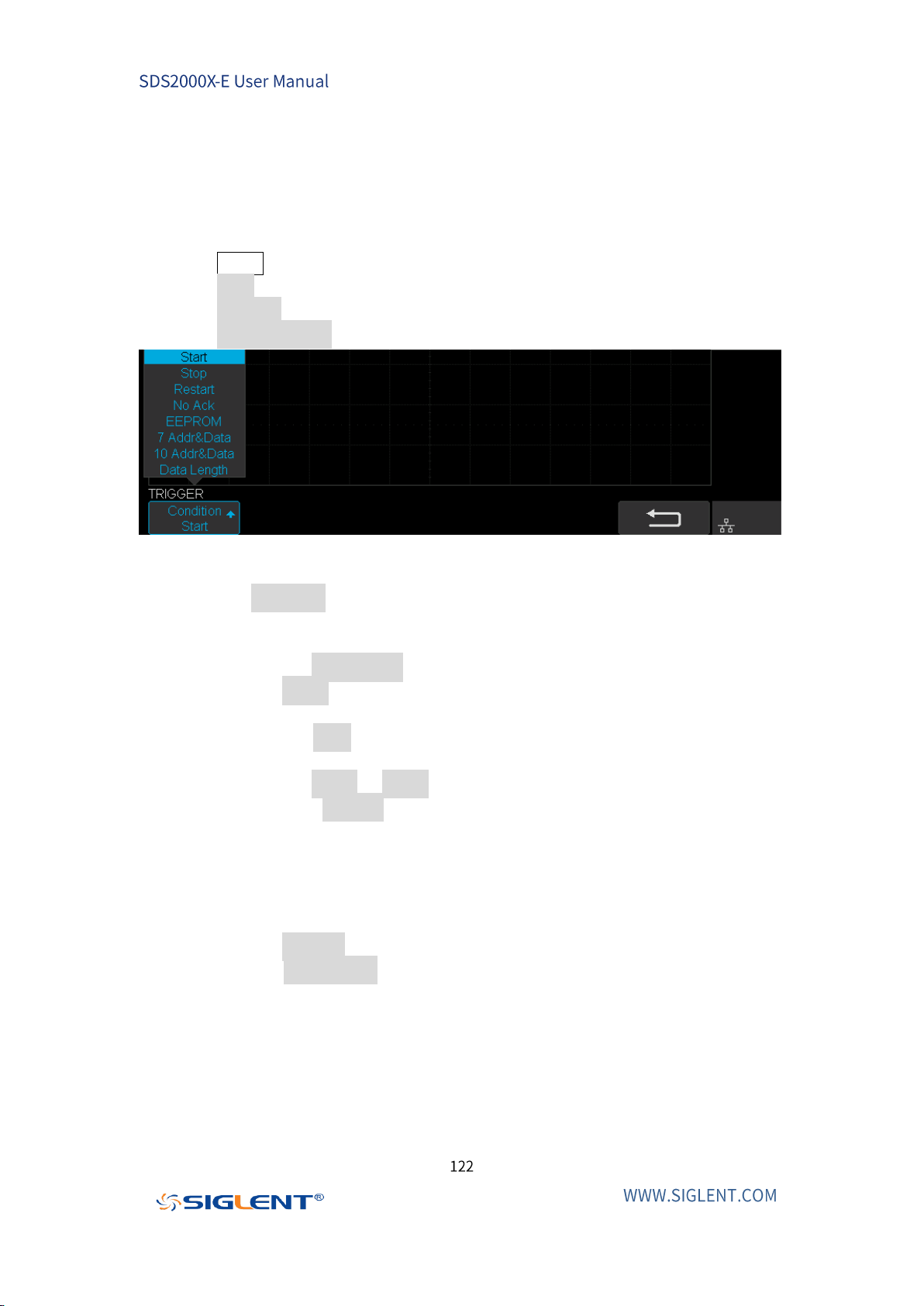
Data Length — When SDA data’s length is equal to the value of Byte Length
and address’s length is the same as set value, the oscilloscope will be
triggered. Byte length is in the range of 1 to 12 bits.
Operation steps:
1. Press Setup to enter the TRIGGER function menu.
2. Press Type and select Serial.
3. Press Protocol and select I2C.
4. Press Trigger Setting softkey.
Figure 37 I2C TRIGGER Menu
5. Press the Condition softkey and turn the Universal Knob to select the trigger
condition:
If you select the EEPROM condition:
a. Press the Limit Range softkey to set the qualifier ( = ,< or >).
b. Press Data1 softkey and set its value by turning the Universal Knob.
If you select 7 Addr & Data or 10 Addr & Data condition:
a. Press the Addr softkey and turn the Universal Knob to select the 7- bit
or 10- bit device address.
b. Press the Data1 or Data2 softkey and set the value about them.
c. Press The R/W bit softkey and select write-frame or read-frame to
trigger the oscilloscope.
(Tips: If device address is 7-bit, the value of address is in range of 0x00 to
0x7F.If device’s address is 10-bit, the value of address is in range of 0x00 to
0x3FF.)
If you select the Data Length condition:
a. Press Address to set the SDA address length to 7 or 10 bit.
b. Press Byte Length softkey and set the byte length by Universal Knob.
The range of the Byte Length is 1 to 12.
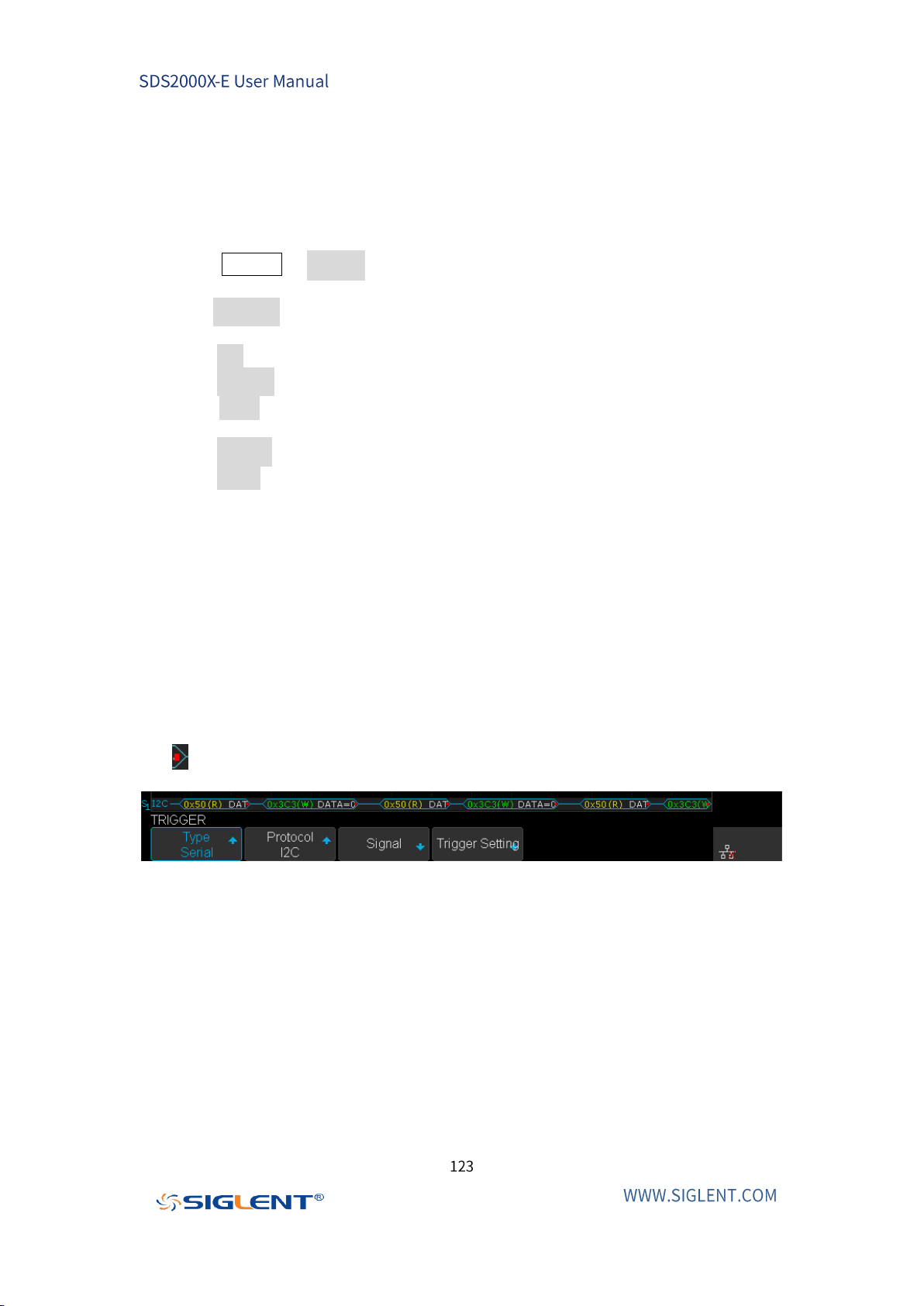
I2C Serial Decode
After completing the setup of I2C signal and trigger, we will decode I2C signals.
Operation steps as follows.
1. Press Decode→ Decode. Select one of the options from the Decode1 and
Decode2.
2. Press Display and select On to enable onscreen display of the result of
decoding.
3. Press List to enter the LIST function menu.
4. Press Display and choose the same options as the first step.
5. Press Lines and set the number of lines by Universal Knob. The range of the
lines is 1 to 7.
6. Press Format to change the character encoding format of the decoding’s result.
7. Press Scroll and turn the Universal Knob to view all frames.
Interpreting I2C Decode
The frames of decoding result:
The address value is displayed at the beginning of a frame. The write address
is displayed in green, and read address in yellow.
W/R bit is represented by (W) and (R), following the address value.
The data value is displayed in white.
"~A" after a data or address bits indicates no acknowledgement. For example,
DB~A.
indicates there is not enough space on the display to show the complete
content of a frame, and some content is hidden.
Figure 38 I2C Decode Bus Display
The lists of decoding result:
Time (timestamp) — The horizontal displacement between current frame and
trigger position.
Address — The address of a frame.
R/W — The type of a frame (write or read).
Data — The value of data.
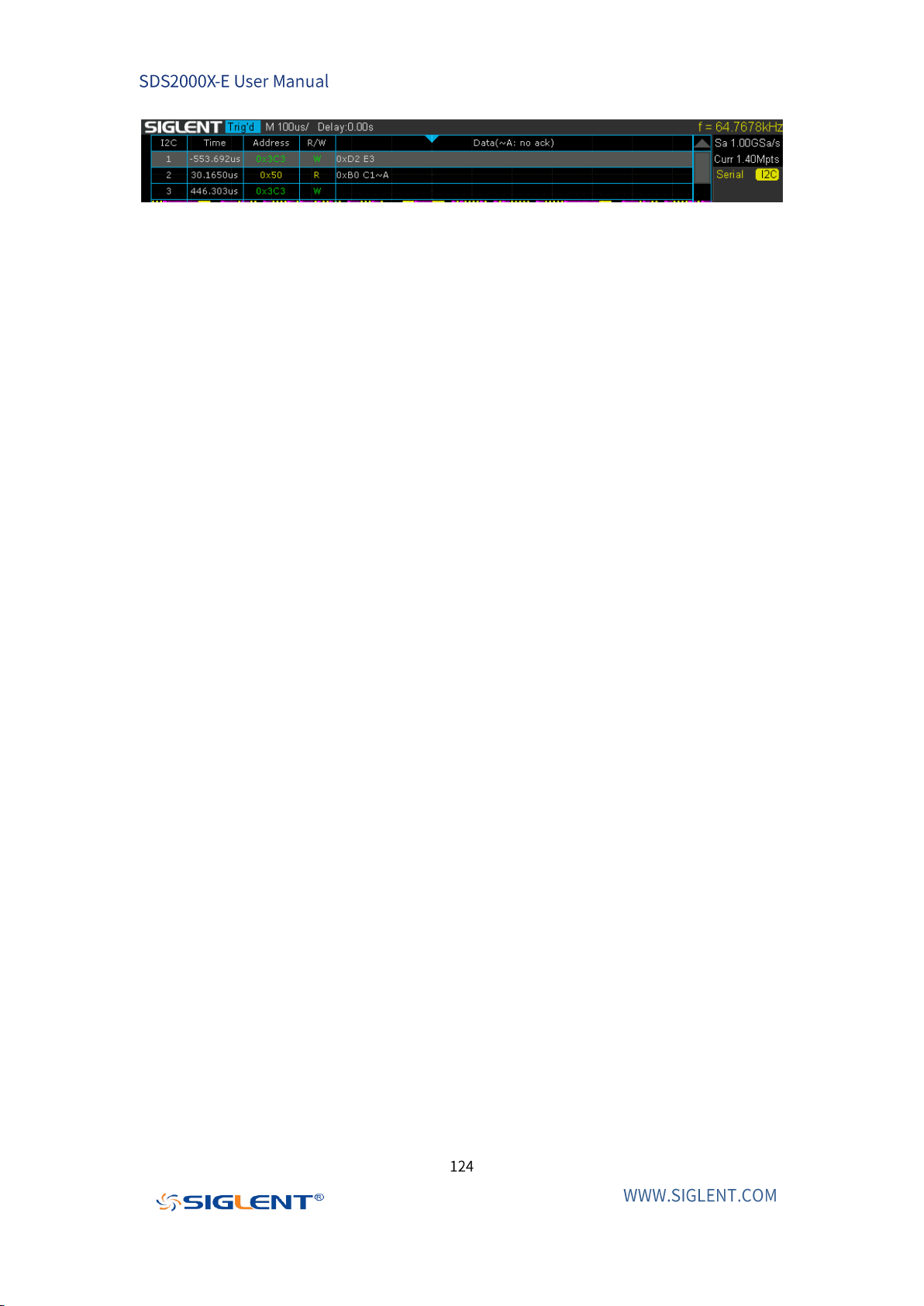
Figure 39 I2C Decode List Display
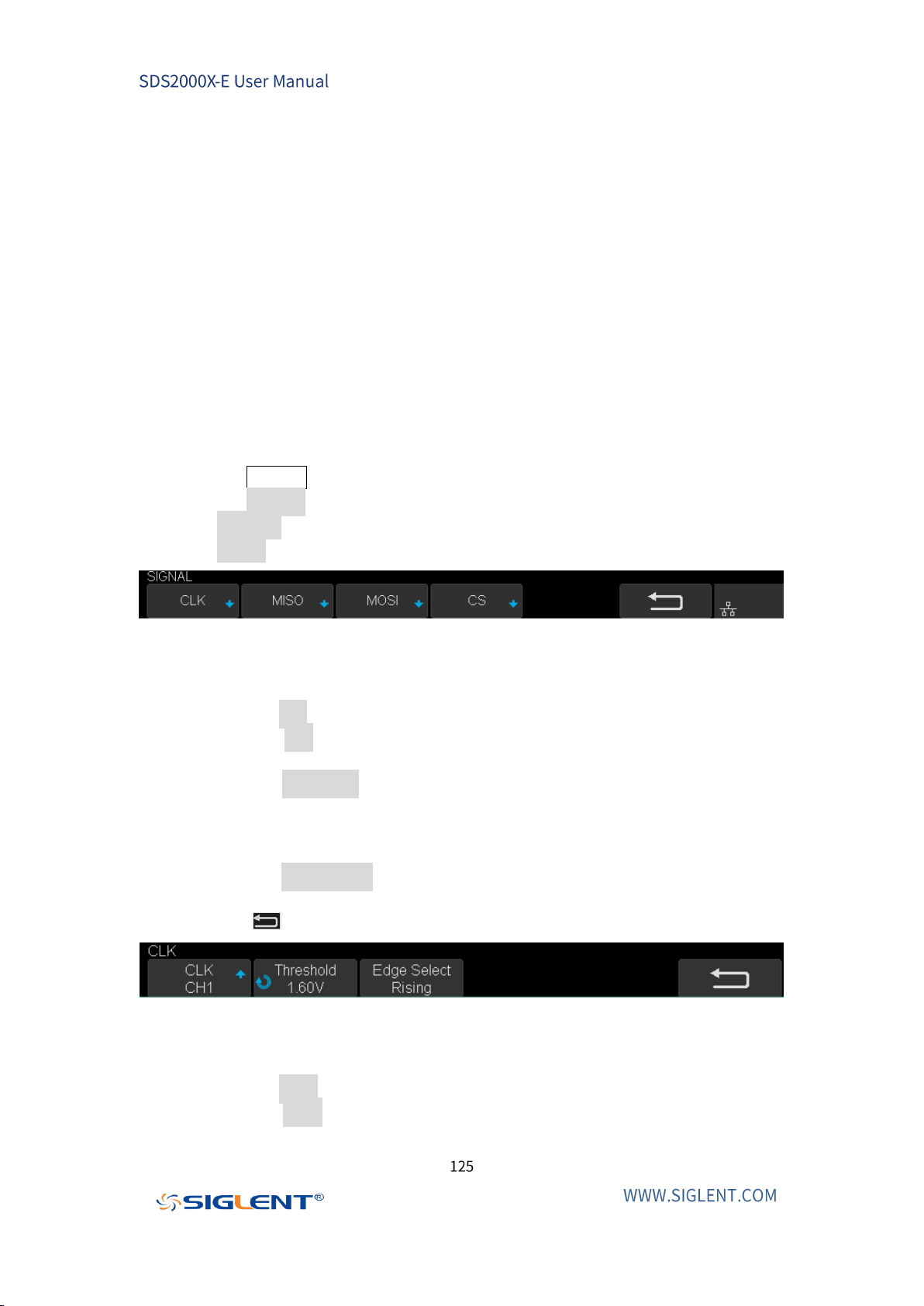
SPI Trigger and Serial Decode
Please read “Setup for SPI Signals”, “SPI Trigger” and “SPI Serial Decode” to
trigger and decode the signals.
Setup for SPI Signals
Setting the SPI (Serial Peripheral Interface) signal includes two steps: connecting
the CLK, MISO, MOSI and CS signals to the correct channels of the oscilloscope and
specifying the parameters of each input signal.
Note: You need to set the CS Type to CLK Timeout due to channel limitations.
1. Press the Decode key to enter the DECODE function menu.
2. Press the Decode softkey and select the desired slot (Decode1 or Decode2).
3. Press Protocol softkey and then select SPI by turning Universal Knob.
4. Press Signal softkey to enter the SIGNAL menu as Figure 38 shows.
Figure 40 SPI SIGNAL Menu
5. Set CLK (clock signal):
a. Press the CLK softkey to enter CLK menu.
b. Press the CLK softkey to select the channel that is connected to the SPI
clock signal.
c. Press the Threshold softkey to set the SPI clock signal’s threshold voltage
level by Universal Knob. The threshold voltage level is for decoding, and it
will be regard as the trigger voltage level when set the trigger type to
serial.
d. Press the Edge Select softkey to set the oscilloscope will samples at clock
signal’s rising edge or falling edge.
e. Press softkey to return previous menu.
Figure 41 CLK Menu
6. Set MISO:
a. Press the MISO softkey to enter the MISO menu.
b. Press the MISO softkey to select the channel that is connected to the SPI
MISO signal.
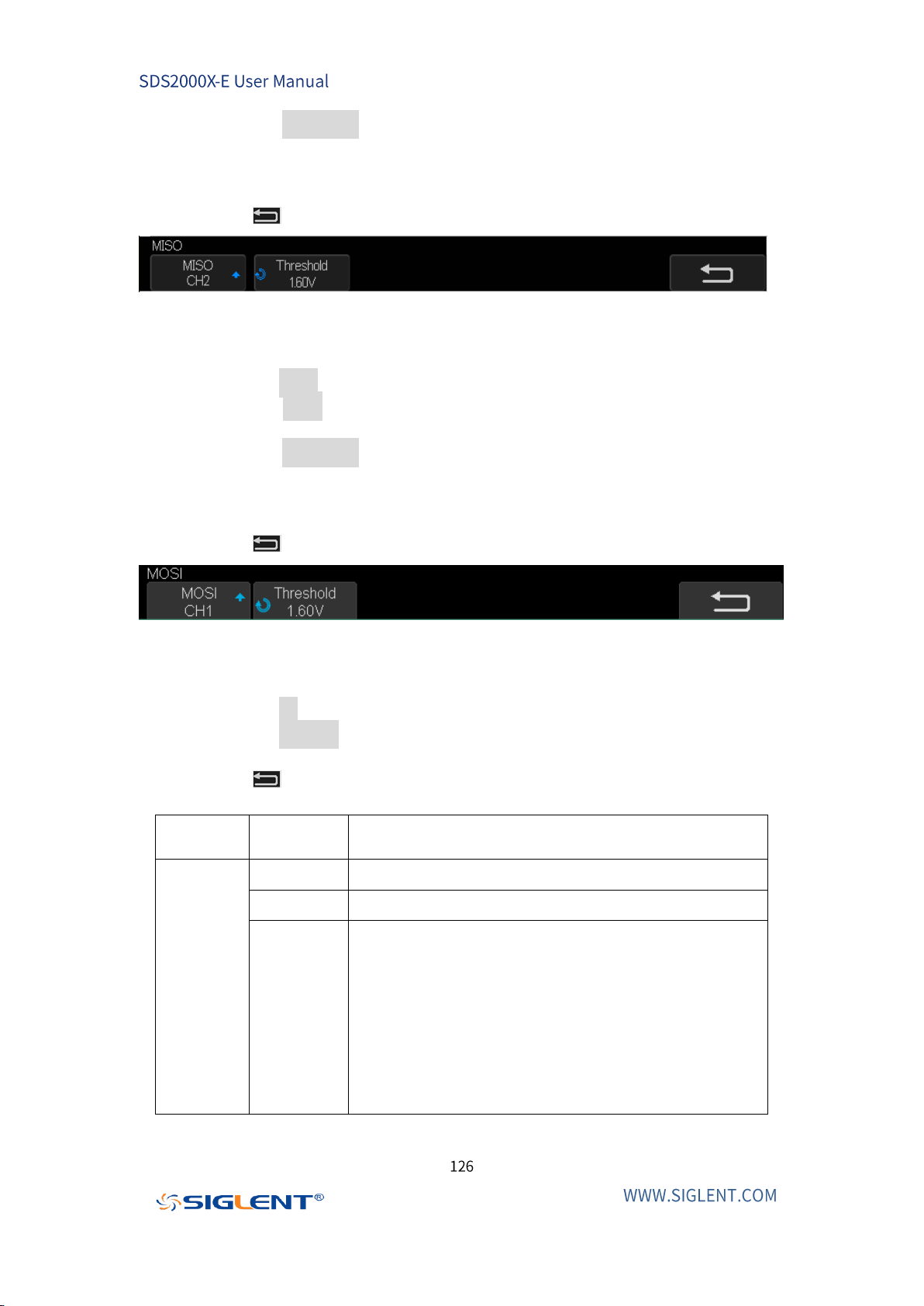
c. Press the Threshold softkey to set the SPI MISO signal’s threshold voltage
level by Universal Knob. The threshold voltage level is for decoding, and it
will be used as the trigger voltage level when the trigger type is set to
serial.
d. Press softkey to return previous menu.
Figure 42 MISO Menu
7. Set MOSI:
a. Press the MOSI softkey to enter the MOSI menu.
b. Press the MOSI softkey to select the channel that is connected to the SPI
MOSI signal.
c. Press the Threshold softkey to set the SPI MOSI signal’s threshold voltage
level by Universal Knob. The threshold voltage level is for decoding, and it
will be used as the trigger voltage level when the trigger type is set to
serial.
d. Press softkey to return previous menu.
Figure 43 MOSI Menu
8. Set CS:
a. Press the CS softkey to enter the MOSI menu.
b. Press the CS Type softkey to select the chip select type.
c. Modify the CS Type’s value.
d. Press softkey to return previous menu.
Function
Menu
Settings
Explanation
CS Type
~CS
Low voltage level of CS signal is available
CS
High voltage level of CS signal is available
CLK
Timeout
If the time between two edges of clock signal is less
than (or equal to) the value of timeout, the signal
between the two edges is treated as a frame. The
range of clock timeout is 100 ns-5 ms. This setting is
suitable for case where CS signal is not connected,
or the number of oscilloscope channels is
insufficient (such as two-channel oscilloscopes).
Table 1 Menu Explanations of the CS Type Parameters
9. Press the Bit Order softkey to select the bit order (LSB or MSB).
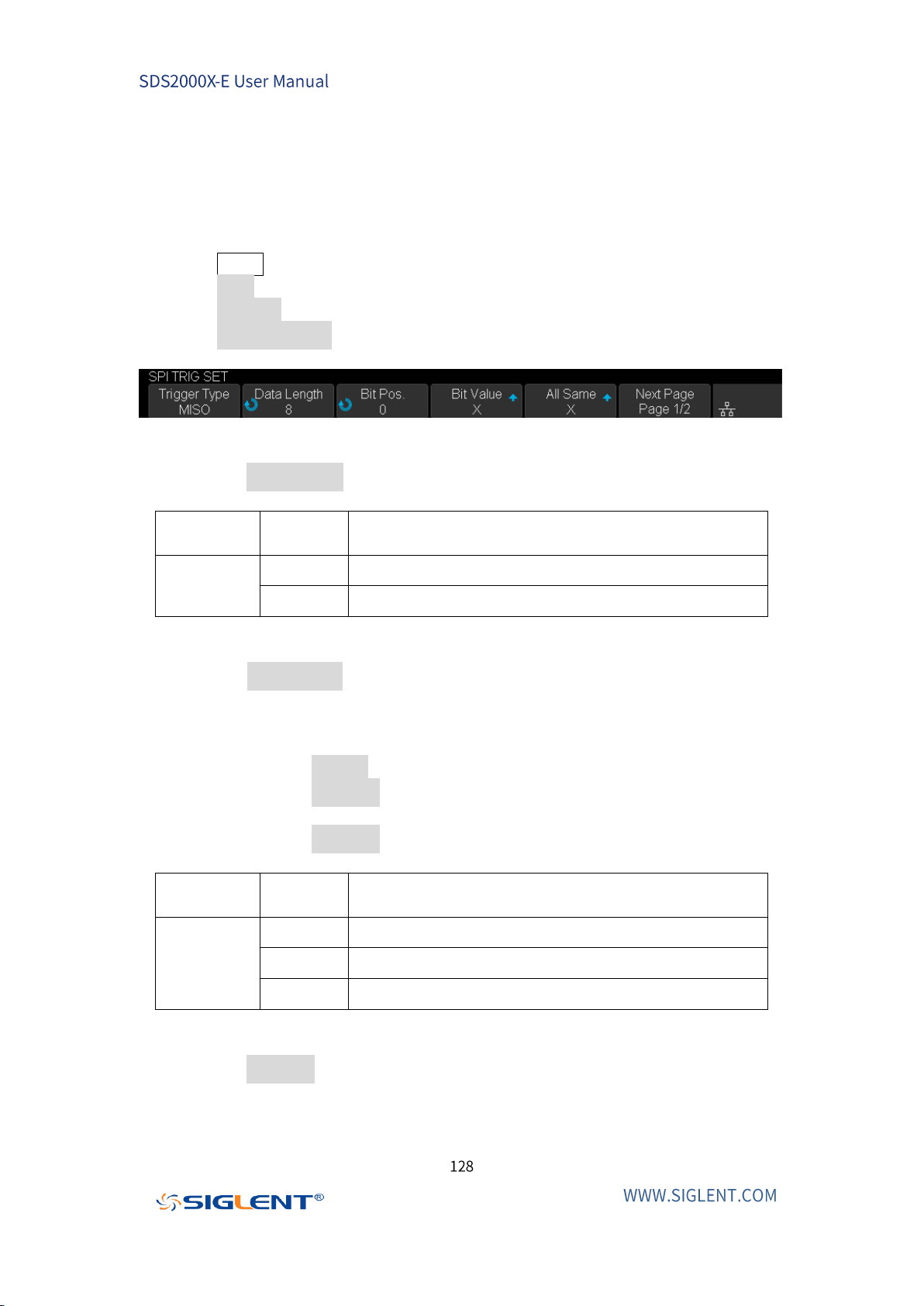
SPI Trigger
This part will provide a brief introduction and description for the operation of the
SPI trigger.
1. Press Setup key to enter the TRIGGER function menu.
2. Press Type and select Serial.
3. Press Protocol and select SPI.
4. Press Trigger Setting softkey.
Figure 44 SPI TRIG SET Menu
5. Press the Trigger Type softkey to select the trigger condition.
Function
Menu
Settings
Explanation
Trigger
Type
MISO
Master-In, Slave-Out
MOSI
Master-Out, Slave-In
Table 2 Menu Explanations of the SPI trigger type
6. Press the Data Length softkey, and turn the Universal Knob to set the length of
a data. The range of data length is 4 to 96 bits.
7. Set the value of the trigger data.
Set the value of a bit:
a. Press the Bit Pos. softkey to select a bit in data.
b. Press the Bit Value softkey to set the value of the selected bit.
Set the value of all bits:
a. Press the All Same softkey to set the value of all bits.
Function
Menu
Settings
Explanation
Bit Value
0
High voltage level
1
Low voltage level
X
Don’t care the voltage level
Table 3 Menu Explanations of the SPI Bit value
8. Press the Bit Order softkey to set the bit order (MSB or LSB).
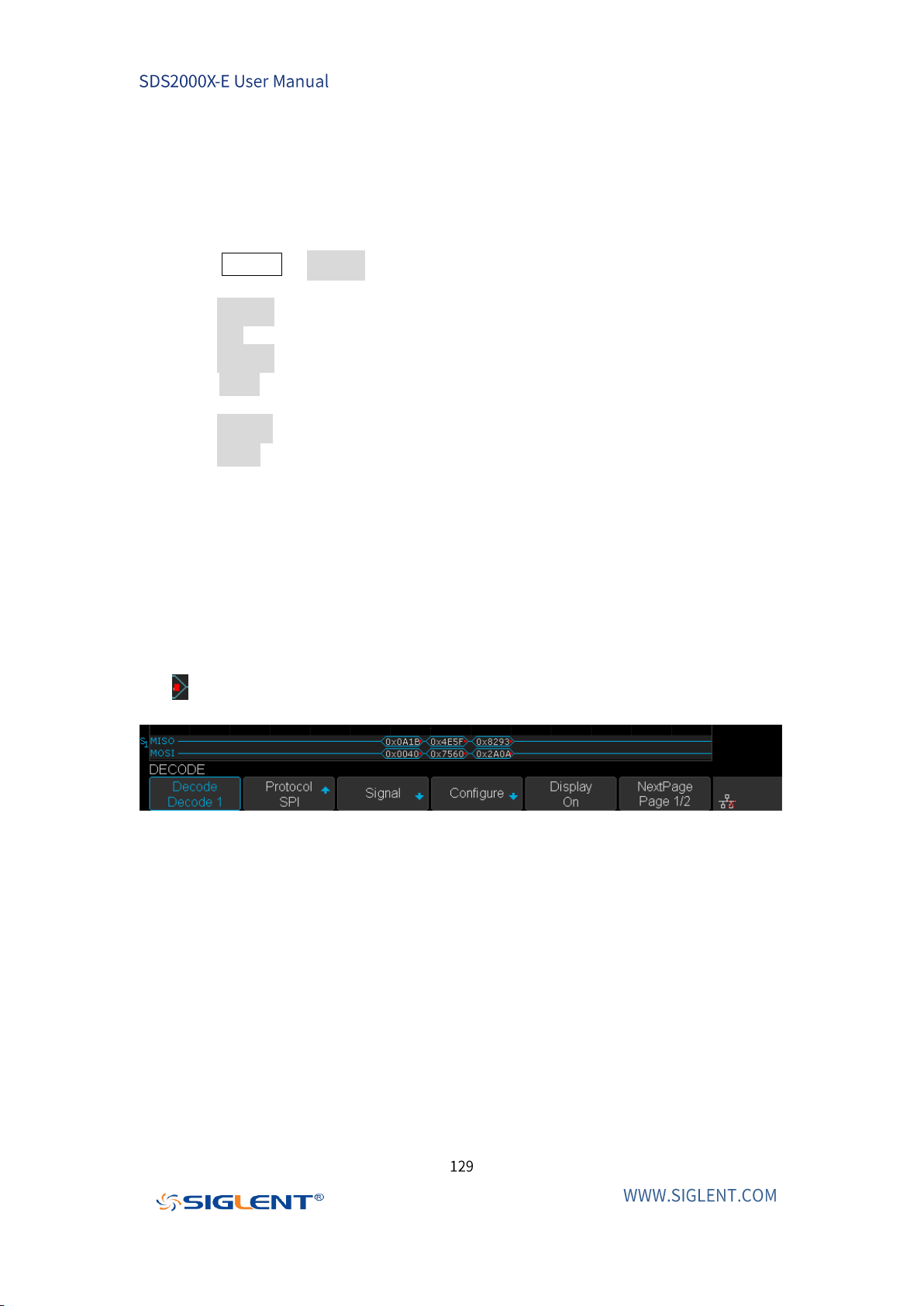
SPI Serial Decode
After completing the setup of SPI signal and trigger, the scope can decode SPI
signals. Operation steps are as follows.
1. Press Decode→ Decode. Select one of the options from the Decode1 and
Decode2.
2. Press Display and select On to display the result of decoding.
3. Press List to enter the LIST function menu.
4. Press Display and choose the same options as the first step.
5. Press Lines and set the number of lines by Universal Knob. The range of the
lines is 1 to 7.
6. Press Format to change the character encoding format of the decoder’s result.
7. Press Scroll and turn the Universal Knob to view all frames.
Interpreting SPI Decode
The frames of decoding result:
The data values are displayed in frames and are shown in white. Support 4~96
bit data display.
MISO — The decoding result of the “Master-In, Slave-Out” line.
MOSI — The decoding result of the “Master-Out, Slave-In” line.
indicates there is not enough space on the display to show the complete
content of a frame, and some content is hidden.
Figure 45 SPI Decode Bus Display
The lists of decoding result:
Time (timestamp) — The horizontal displacement between current frame and
trigger position.
MISO — The decoding result of the “Master-In, Slave-Out” line.
MOSI —The decoding result of the “Master-Out, Slave-In” line.
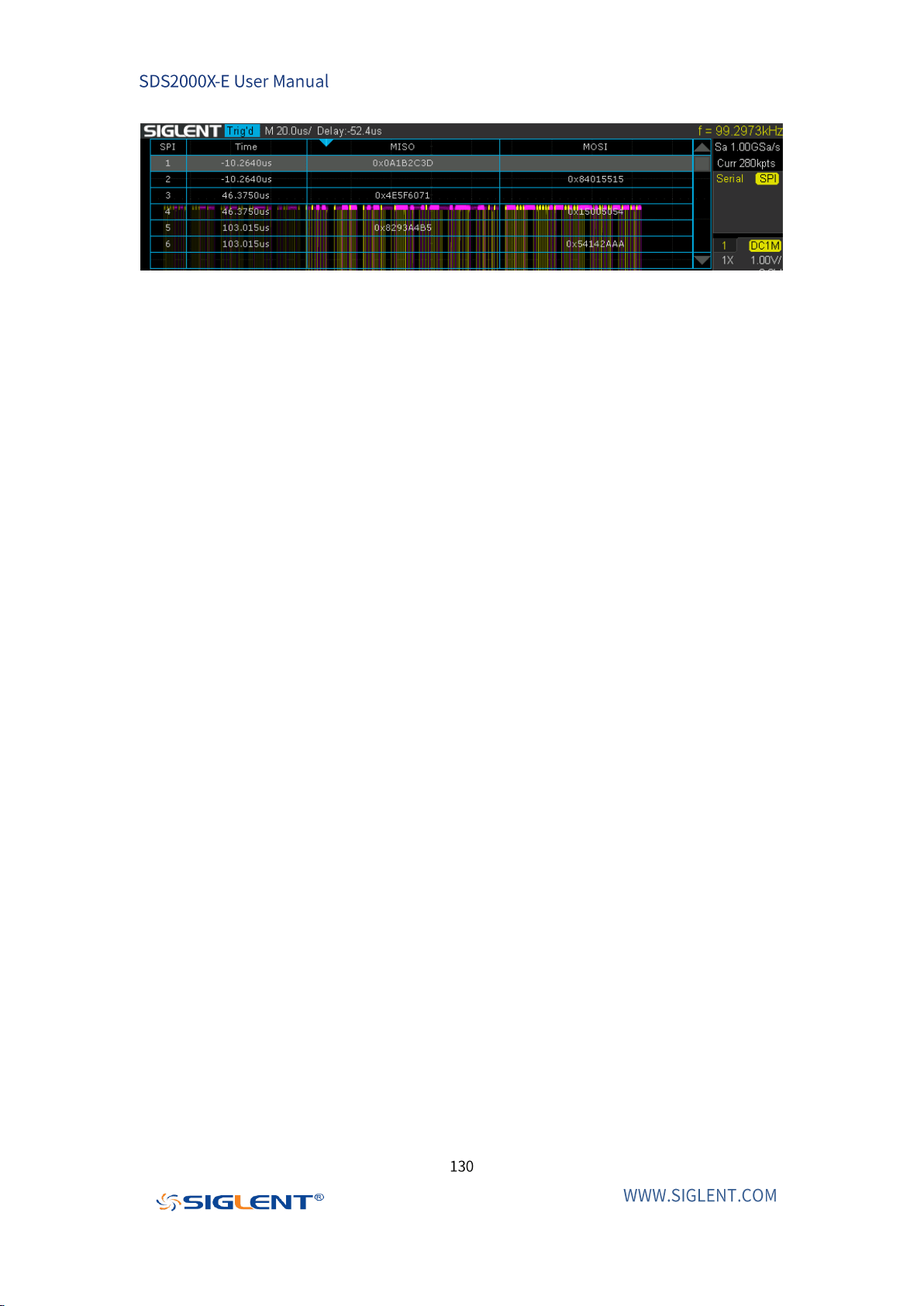
Figure 46 SPI Decode List Display
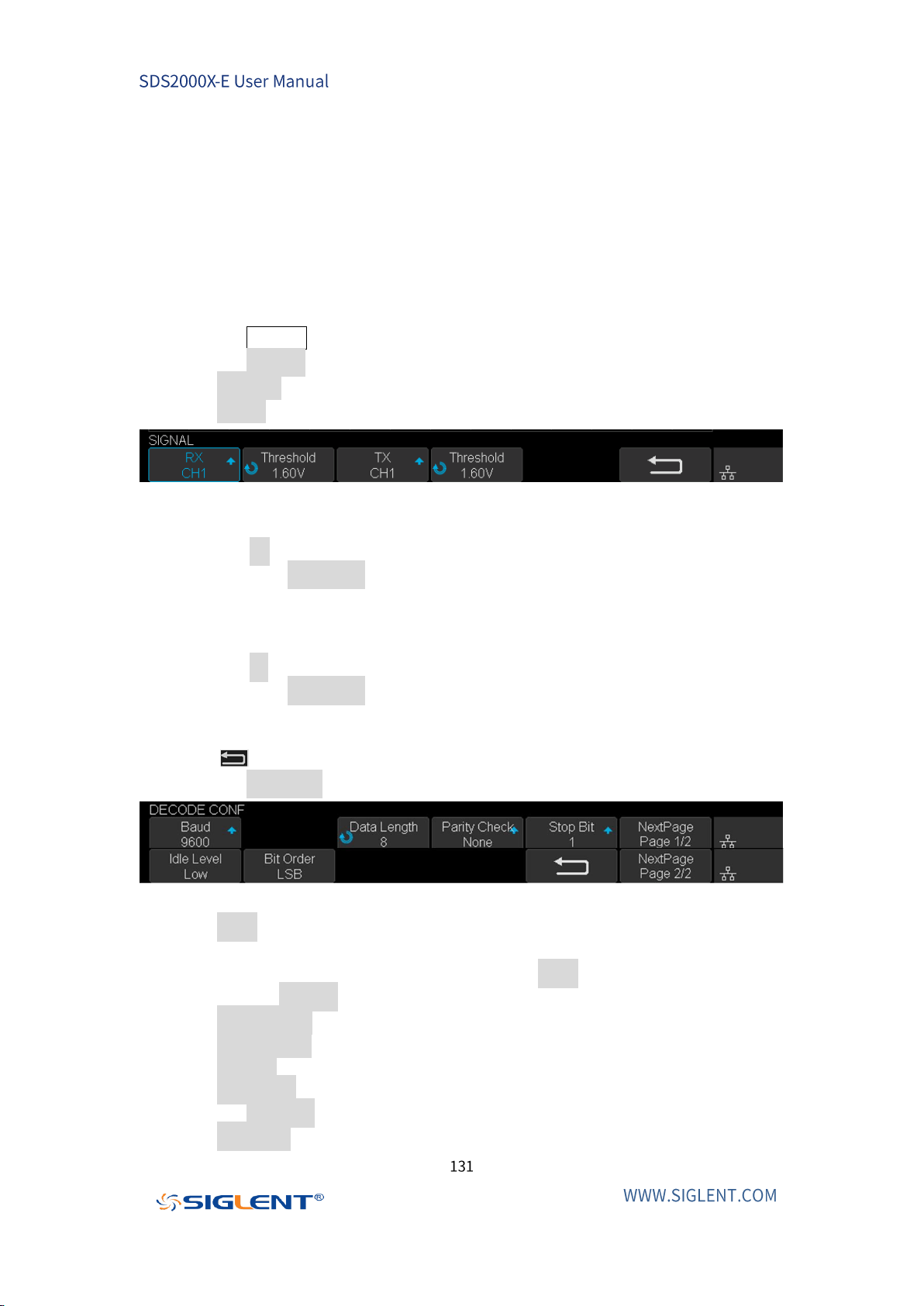
UART Trigger and Serial Decode
Please read “Setup for UART Signals”, “UART Trigger” and “UART Serial
Decode” to trigger and decode the signals.
Setup for UART Signals
1. Press the Decode key to enter the DECODE function menu.
2. Press the Decode softkey and select the desired slot (Decode1 or Decode2).
3. Press Protocol softkey and then select UART by turning Universal Knob.
4. Press Signal softkey to enter the SIGNAL menu as Figure 43 shows.
Figure 47 UART SIGNAL Menu
5. Set RX:
a. Press RX to select the channel that is connected to the RX signal.
b. Press first Threshold key to set the RX signal’s threshold voltage level by
Universal Knob. The threshold voltage level is for decoding, and it will be
used as the trigger voltage level when the trigger type is set to serial.
6. Set TX:
a. Press TX to select the channel that is connected to the TX signal.
b. Press first Threshold key to set the TX signal’s threshold voltage level by
Universal Knob. The threshold voltage level is for decoding, and it will be
used as the trigger voltage level when the trigger type is set to serial.
7. Press softkey to return previous menu.
8. Press the Configure softkey to enter BUS CONFIG menu.
Figure 48 BUS CONFIG Menu
9. Press Baud softkey to set baud rate.
The baud rate can be set as predefined value.
If the desired baud rate is not listed, press Baud and select custom option,
press the Custom and turn the Universal Knob to set the desired baud rate.
10. Press Data Length softkey and set byte bits (5-8) by Universal Knob.
11. Press Parity Check softkey to set the type of parity check (Even, Odd or None).
12. Press Stop Bit softkey to set the length of the stop bit (1, 1.5 or 2 bits).
13. Press Next Page softkey.
14. Press the Bit Order softkey to select the bit order (LSB or MSB).
15. Press Idle Level softkey to set the idle level (Low or High).
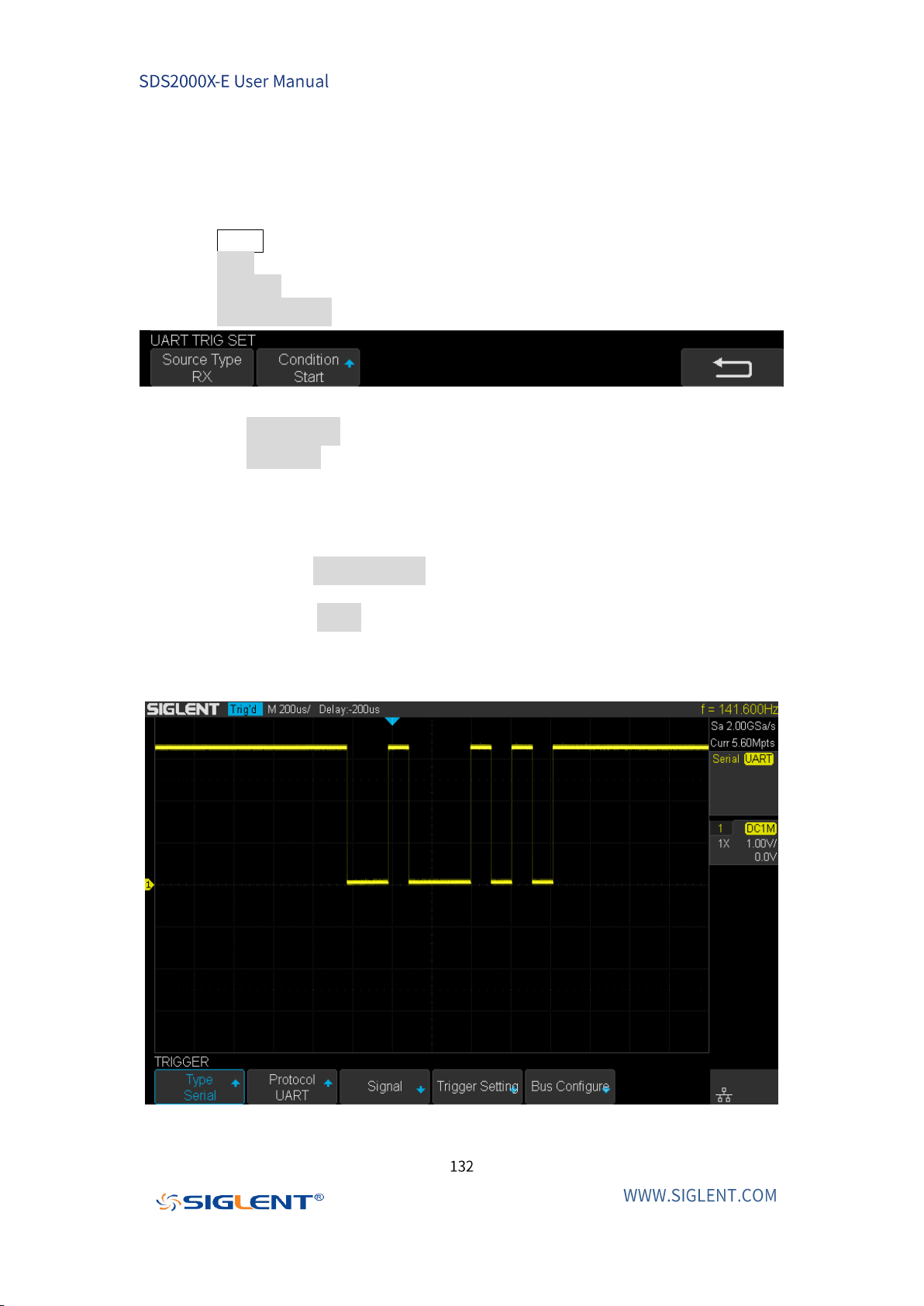
UART Trigger
This part shows a brief introduction and description for the operation of the UART
trigger.
1. Press Setup key to enter the TRIGGER function menu.
2. Press Type and select Serial.
3. Press Protocol and select UART.
4. Press Trigger Setting softkey to enter UART TRIG SET menu.
Figure 49 UART TRIG SET Menu
5. Press the Source Type softkey to select the source of trigger (RX or TX).
6. Press the Condition softkey and set up the desired trigger condition:
Start — The oscilloscope will be triggered at the position of the start bit.
Stop —The oscilloscope will be triggered at the position of the stop bit.
Data — The oscilloscope will be triggered when a byte which is equal to
(greater or less than) the specified data is identified.
a. Press the Compare Type softkey and choose an equality qualifier (>, <
or =).
b. Press the Value softkey to set data’s value. The data value range is
from 0x00 to 0xff.
Error — If the parity check has been set, and the parity bit check is an error,
the oscilloscope will be triggered.
Figure 50 UART Trigger
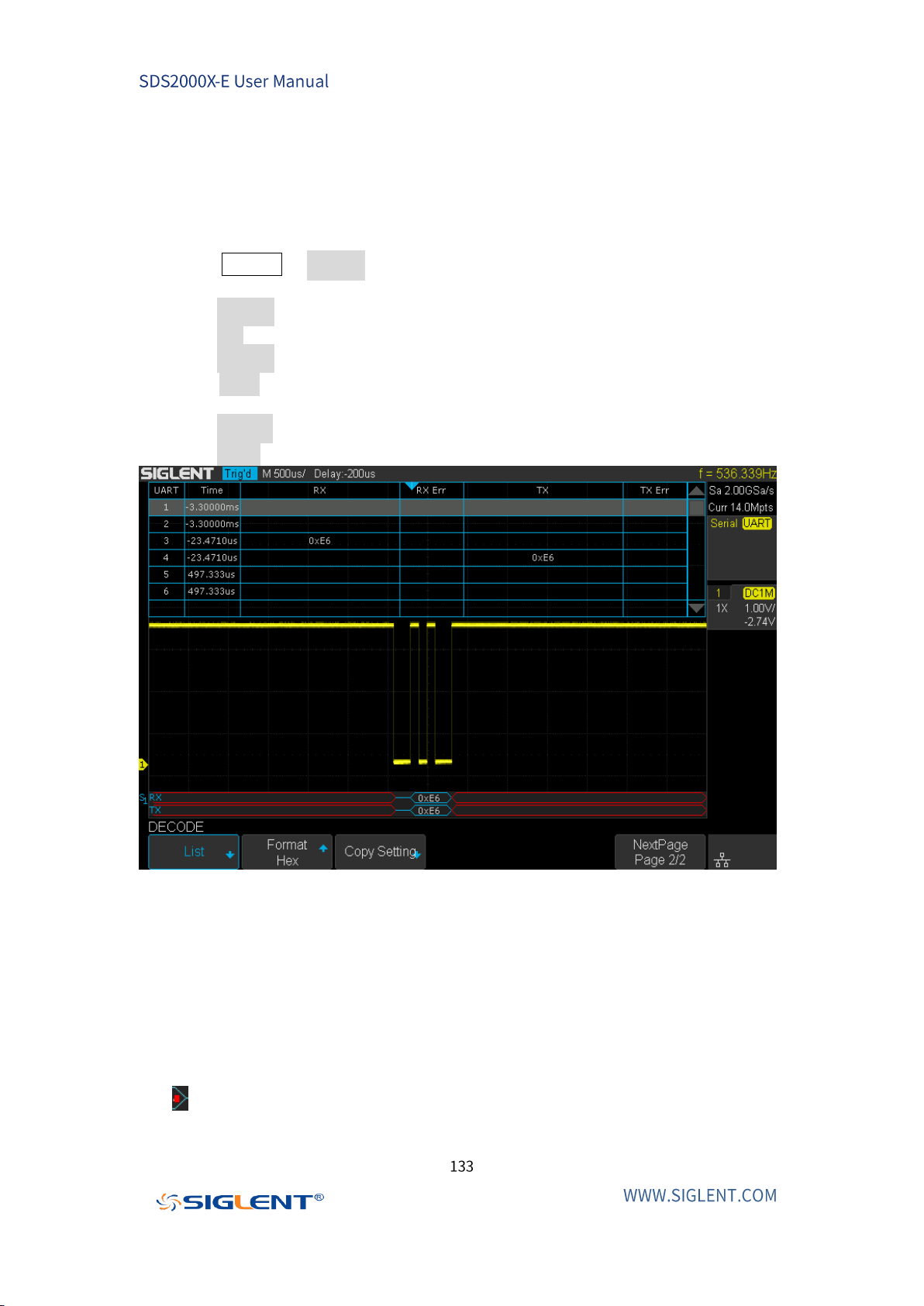
UART Serial Decode
After completing the setup of UART signal and trigger, the scope can decode UART
signals. Operation steps are as follows.
1. Press Decode→ Decode. Select one of the options from the Decode1 and
Decode2.
2. Press Display and select On to display the result of decoding.
3. Press List to enter the LIST function menu.
4. Press Display and choose the same options as the first step.
5. Press Lines and set the number of lines by Universal Knob. The range of the
lines is 1 to 7.
6. Press Format to change the character encoding format of the decoding result.
7. Press Scroll and turn the Universal Knob to view all frames.
Figure 51 UART Decode
Interpreting UART Decode
The frames of decoding result:
RX — The decoding result of the data received.
TX — The decoding result of the data transmitted.
indicates there is not enough space on the display to show the complete
content of a frame, and some content is hidden.
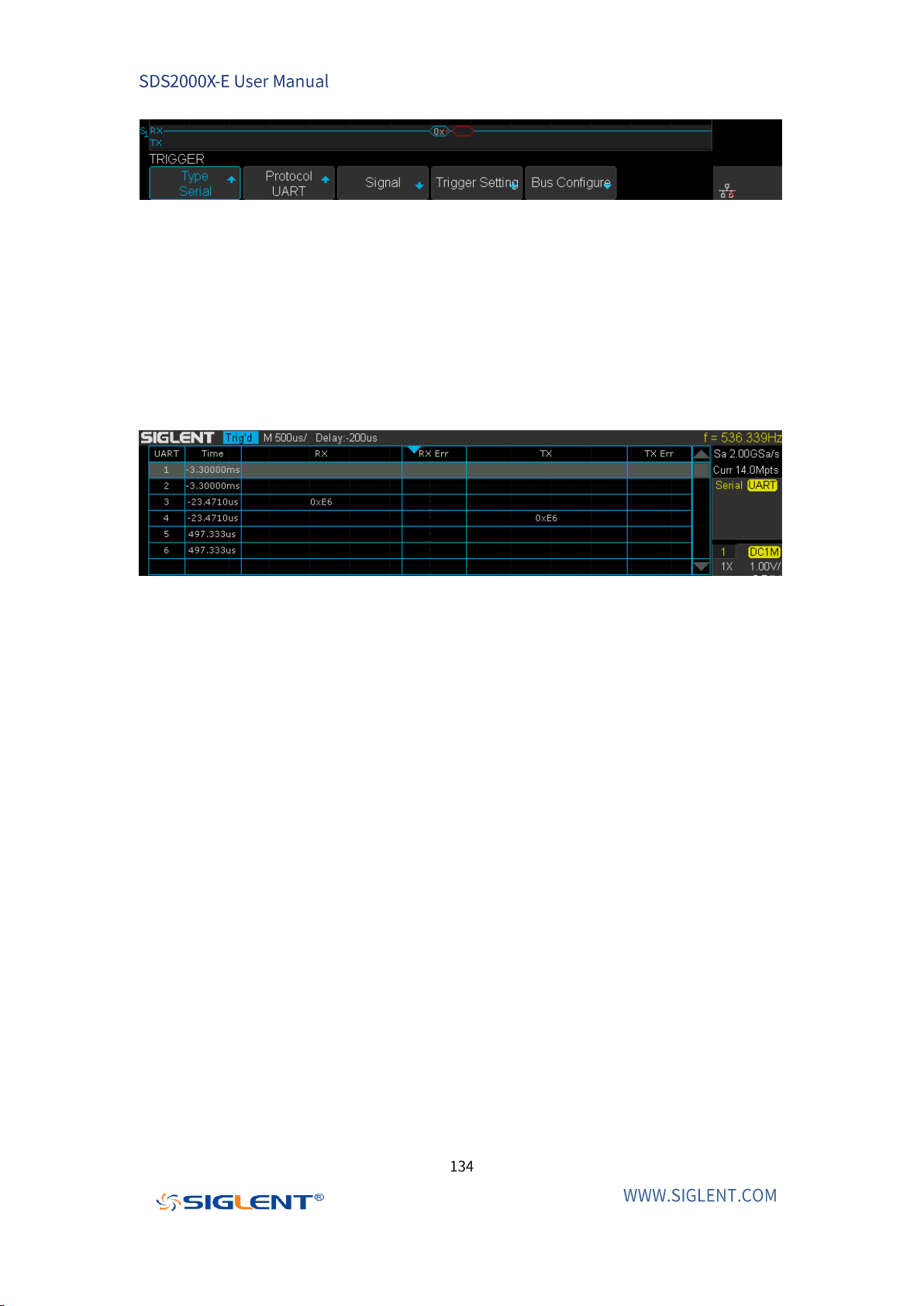
Figure 52 UART Decode Bus Display
The lists of decoding result:
Time (timestamp) — The horizontal displacement between current frame and
trigger position.
RX — The receiving channel.
TX — The transmitting channel.
RX Err— Parity error or unknown error in the data received.
TX Err— Parity error or unknown error in the data transmitted.
Figure 53 UART Decode List Display
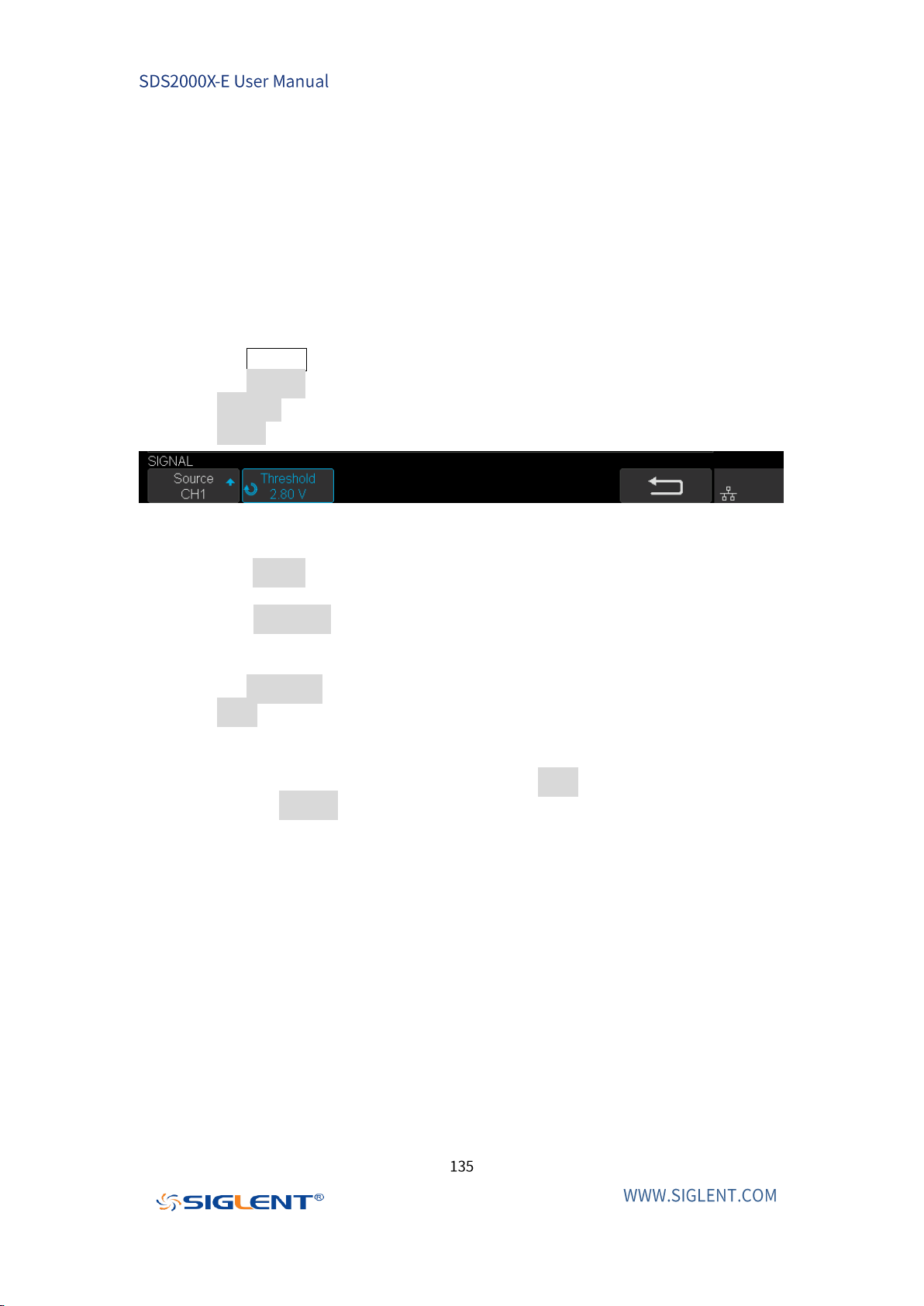
CAN Trigger and Serial Decode
The oscilloscope can also decode CAN signals. The following sections “Setup for
CAN Signals”, “CAN Trigger” and “CAN Serial Decode” provide instructions for
triggering and decoding the CAN signals.
Setup for CAN Signals
1. Press the Decode key to enter the DECODE function menu.
2. Press the Decode softkey and select the desired slot (Decode1 or Decode2).
3. Press Protocol softkey and then select CAN by turning Universal Knob.
4. Press Signal softkey to enter the SIGNAL menu as Figure 48 shows.
Figure 54 CAN SIGNAL Menu
a. Press Source softkey to select the channel that is connected to the CAN
signal.
b. Press Threshold key to set the CAN signal’s threshold voltage level by
Universal Knob. The threshold voltage level is for decoding, and it will be
regard as the trigger voltage level when set the trigger type to serial.
5. Press the Configure softkey to enter the BUS CONFIG menu.
6. Press Baud to set baud rate by Universal Knob.
The baud rate can be set as a predefined value (from 5 kb/s to 1 Mb/s) or
custom value (from 5 kb/s to 1 Mb/s).
If the desired baud rate is not listed, press Baud and select custom option,
press the Custom and turn the Universal Knob to set the desired baud rate.
CAN Trigger
This part will provide a brief introduction and description for the operation of the
CAN trigger.
Trigger conditions:
Start— The oscilloscope will be triggered at the start bit of a frame.
Remote — The oscilloscope will be triggered by a remote frame with specified
ID.
ID — The oscilloscope will be triggered by a remote or data frame that has the
specified ID.
ID+DATA— The oscilloscope will be triggered by data frame that has the
specified ID and data.
Error — The oscilloscope will be triggered by an error frame.
Operation steps:
1. Press Setup to enter the TRIGGER function menu.
2. Press Type and select Serial.
3. Press Protocol and select CAN.
4. Press Trigger Setting to enter the CAN TRIG SET menu.
5. Press Condition and select the trigger condition by Universal Knob:
If you select the Remote and ID condition:
a. Press ID Bits to set the length of the ID (11 or 29 bits).
b. Press Curr ID Byte and use Universal Knob to select the byte that you
want to set.
c. Press the ID and set the ID’s value by Universal Knob.
(Tips: In order to make it convenient for the operator to set the parameters,
the ID bit is split into several bytes. For example, if the ID’s length is 11 bits,
it will be split into two bytes, a byte includes 8 bits. If “1st byte” is
selected, only the 8 least significant bits can be changed.)
If you select the ID+DATA condition:
a. Press ID bits softkey to select the ID’s length (11 or 29 bits).
b. Press Curr ID Byte softkey and use Universal Knob to select the byte
that you want to modify.
c. Press the ID softkey and set the ID’s value by Universal Knob.
d. Press Data softkey and set the value of the first byte by Universal
Knob.
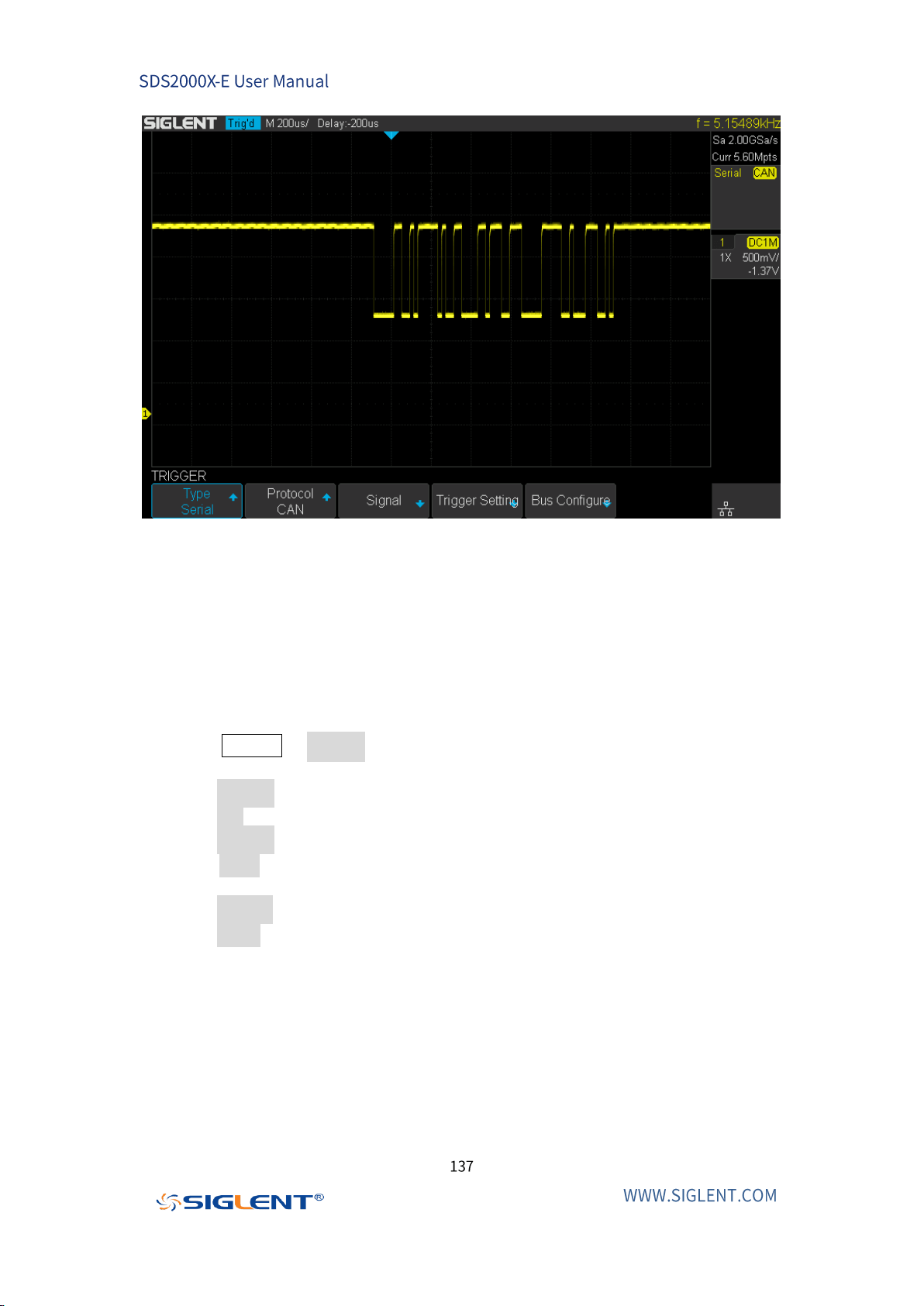
Figure 55 CAN Trigger
CAN Serial Decode
After completing the setup of can signal and trigger, we will decode CAN signals.
Operation steps as follows.
1. Press Decode→ Decode. Select one of the options from the Decode1 and
Decode2.
2. Press Display and select On to display the result of decoding.
3. Press List to enter the LIST function menu.
4. Press Display and choose the same options as the first step.
5. Press Lines and set the number of lines by Universal Knob. The range of the
lines is 1 to 7.
6. Press Format to change the character encoding format of the decoder’s result.
7. Press Scroll and turn the Universal Knob to view all frames.
Interpreting CAN Decode
The frame of decoding result:
The Arbitration field is displayed in frame.
The Control field is displayed in frame.
The Data field is displayed in frame.
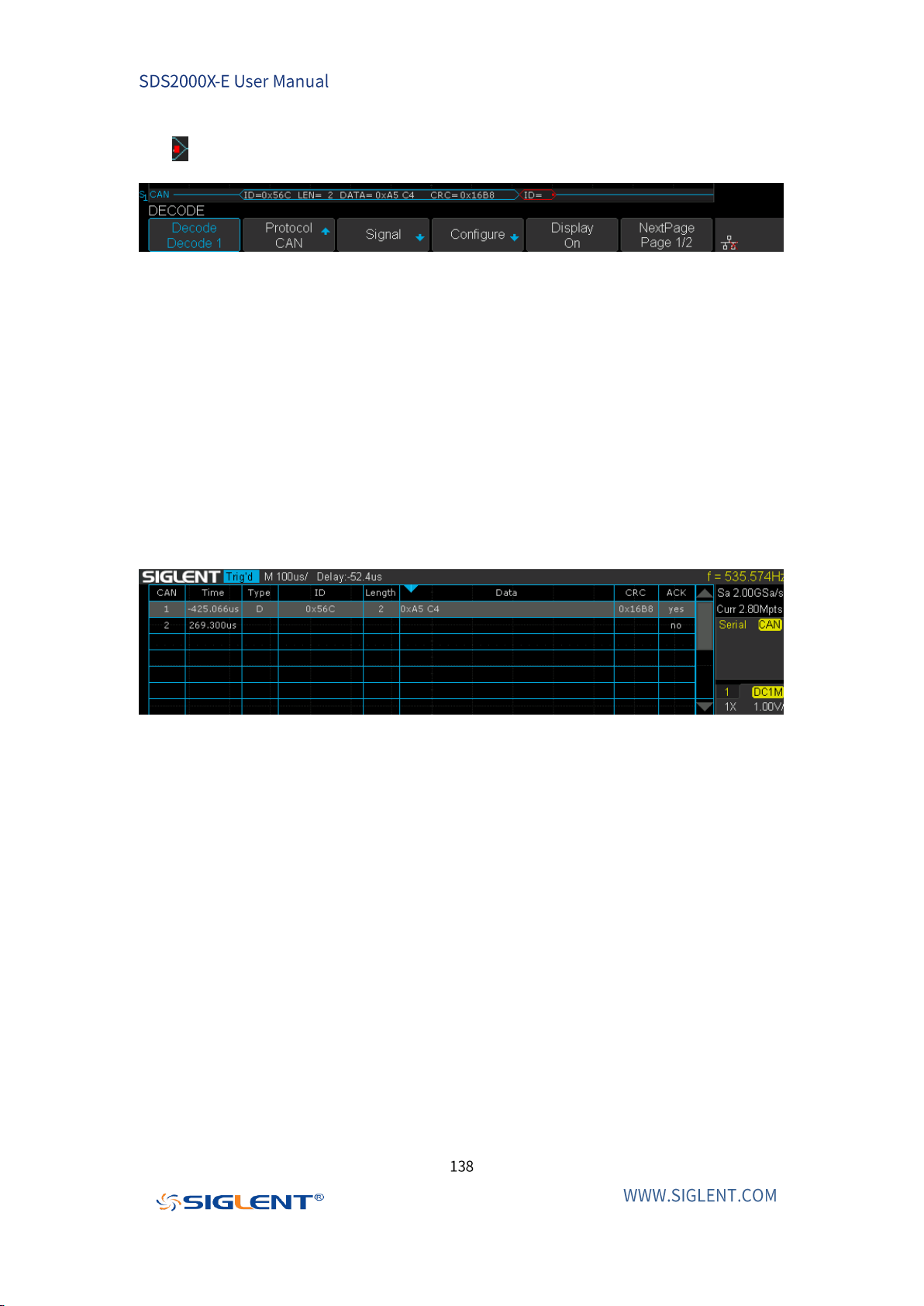
The CRC field is displayed in frame.
indicates there is not enough space on the display to show complete
content of a frame and some content is hidden.
Figure 56 CAN Decode Bus Display
The list of decoding result:
Time (timestamp) — The horizontal displacement between the current frame
and trigger position.
Type — The type of frames, “D” represents data frame, “R” represents
remote frame.
ID — The id of frames, the oscilloscope can automatically detect the length of
frame’s id (11bits or 29 bits).
Length — The length of data field.
Data — The value of data field.
CRC — The value of the CRC (Cyclic Redundancy Check) field.
ACK — Acknowledgment bit.
Figure 57 CAN Decode List Display
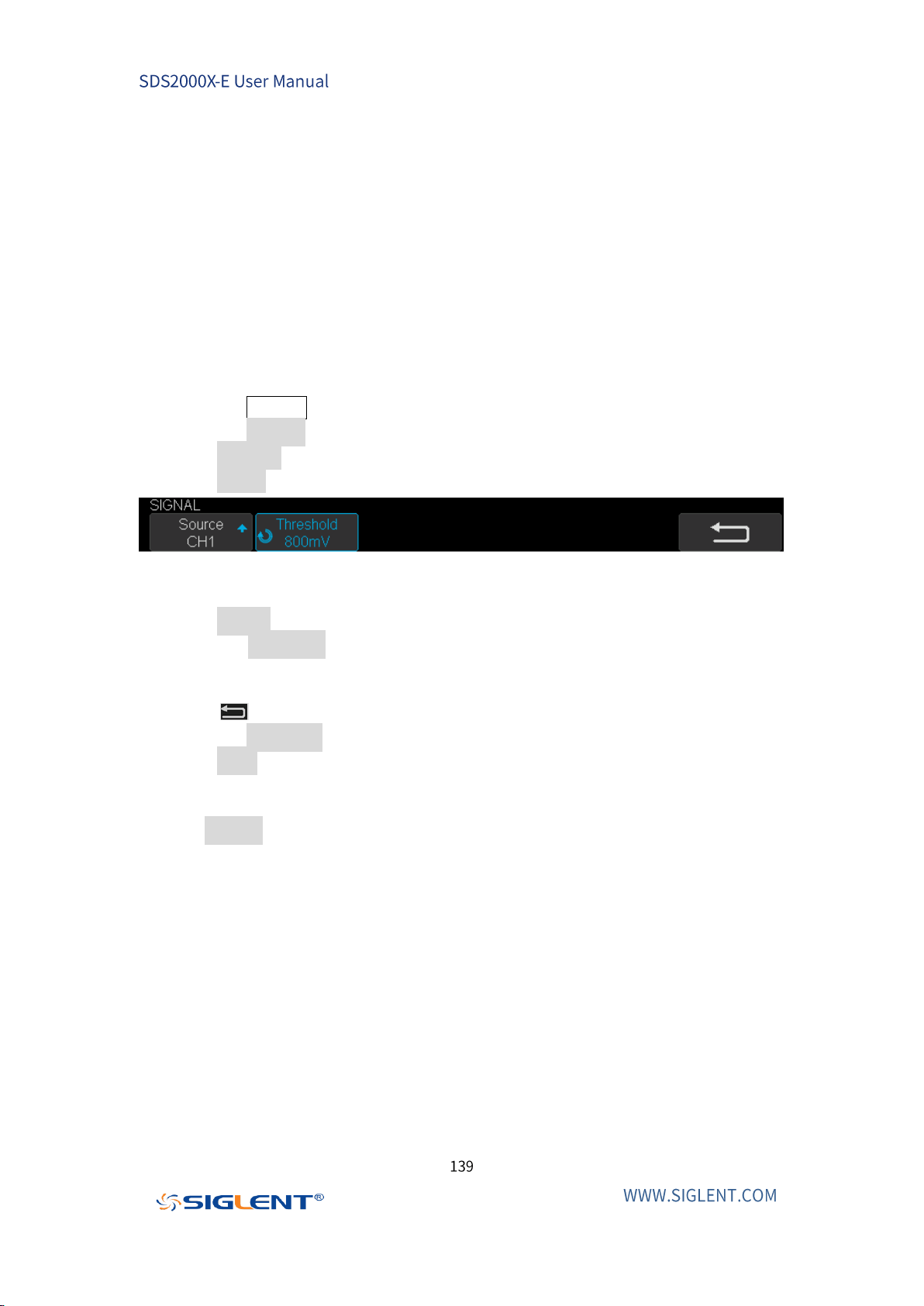
LIN Trigger and Serial Decode
The following section describes “Setup for LIN Signals”, “LIN Trigger” and “LIN
Serial Decode” and includes instructions ontriggering and decoding LIN signals.
Setup for LIN Signals
There are two steps of setting the LIN signal: connecting the signal to oscilloscope
and specifying the parameters of each input signal.
1. Press the Decode key to enter the DECODE function menu.
2. Press the Decode softkey and select the desired slot (Serial 1 or Serial 2).
3. Press Protocol softkey and then select LIN by turning Universal Knob.
4. Press Signal softkey to enter the SIGNAL menu as Figure 50 shows.
Figure 58 LIN SIGNAL Menu
5. Press Source softkey to select the channel that is connected to the LIN signal.
6. Press the Threshold softkey and set the LIN signal’s threshold voltage level by
the Universal Knob. The threshold voltage level is for decoding, and it will be
used as the trigger voltage level when the trigger type is set to serial.
7. Press softkey to return previous menu.
8. Press the Configure softkey to enter the BUS CONFIG menu.
9. Press Baud softkey to set baud rate.
The baud rate can be set as predefined value.
If the desired baud rate is not listed, select custom option, press the
Custom and turn the Universal Knob to set the desired baud rate.

LIN Trigger
This part will provide a brief introduction and description for the operation of the
LIN trigger.
Trigger conditions:
Break — The oscilloscope will be triggered at the position of the break
field’s break delimiter.
ID (Frame ID) — The oscilloscope will be triggered at the position of the
identifier field’s stop bit, if the value of a frame’s ID is equal to specified
value.
(Note: If the data’s value is 0xXX, any data value will be matched.)
ID + DATA (Frame ID and Data) — The oscilloscope triggers when a frame
with an ID and data equal to the selected values is detected. Use the
Universal Knob to select the value for the ID, Data1 and Data2.
a. The ID’s value is the same as set value.
b. If you have set either Data1’s or Data2’s value, and the signal has a
data is the same as that value. If you have set both Data1’s and
Data2’s value, the signal should has two consecutive data, the first
data’s value is Data1, second data value is Data2.
(Note: If the data’s value is 0xXX, any data value will be matched.)
Data Error — The oscilloscope will be triggered when errors (such as ID
check error, checksum error, sync byte field error) are detected.
Operation steps:
1. Press Setup to enter the TRIGGER function menu.
2. Press Type and select Serial.
3. Press Protocol and select LIN.
4. Press Trigger Setting softkey to enter LIN TRIG SET menu.
5. Press Condition and select the trigger condition by Universal Knob:
If you select ID condition:
a. Press ID softkey and set its value by turning the Universal Knob.
If you select ID+DATA condition:
a. Press ID softkey and set its value by turning the Universal Knob.
b. Press DATA1 softkey and set its value by turning the Universal Knob.
c. Press DATA2 softkey and set its value by turning the Universal Knob.
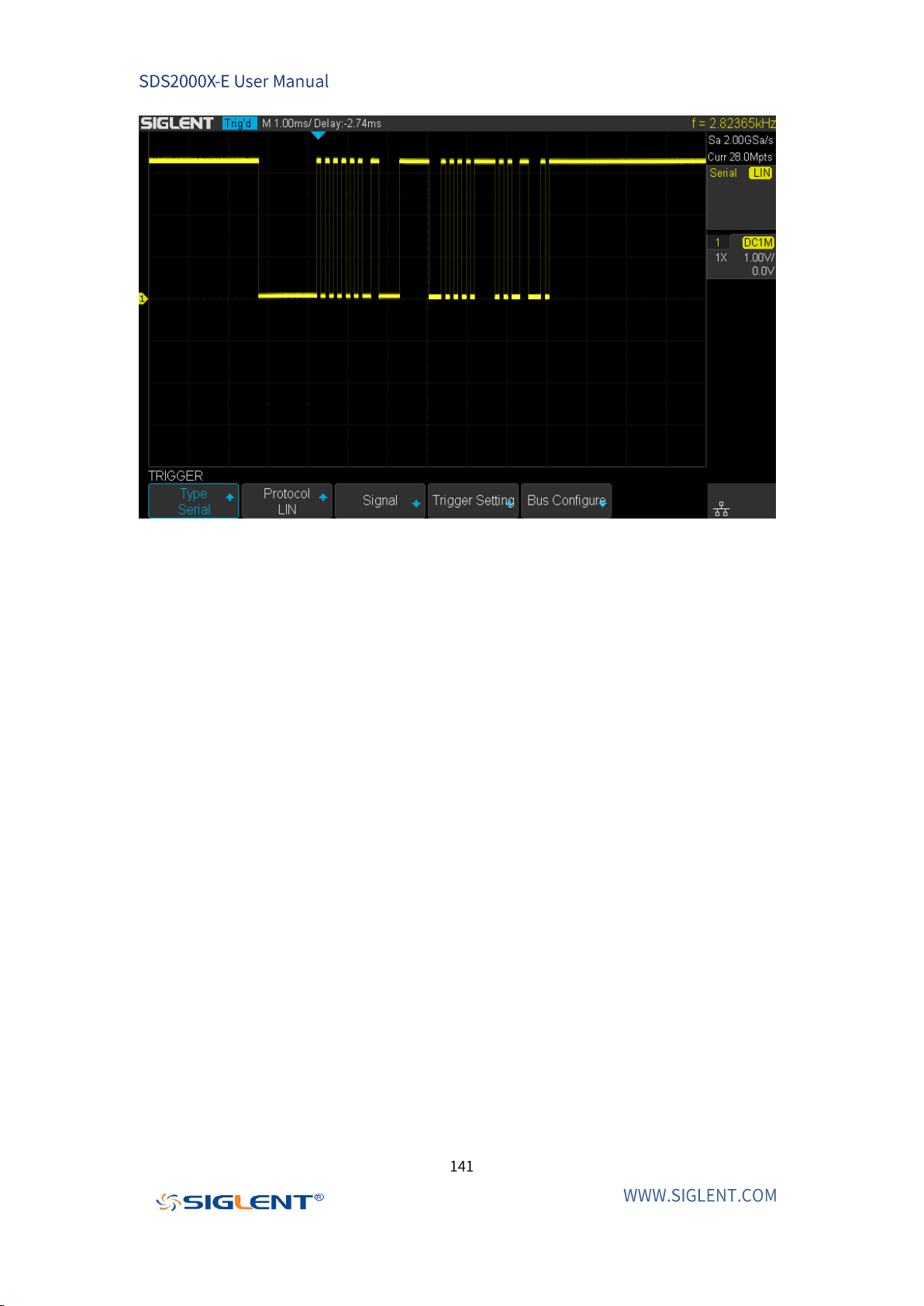
Figure 59 LIN Trigger

LIN Serial Decode
After completing the setup of the LIN signal and trigger, we will decode LIN signals.
Operation steps are as follows.
1. Press Decode→ Decode. Select one of the options from the Decode1 and
Decode2.
2. Press Display and select On to display the result of decoding.
3. Press List to enter the LIST function menu.
4. Press Display and choose the same options as the first step.
5. Press Lines and set the number of lines by Universal Knob. The range of the
lines is 1 to 7.
6. Press Format to change the character encoding format of the decoder’s result.
7. Press Scroll and turn the Universal Knob to view all frames.
Figure 60 LIN Decode
Interpreting LIN Decode
The frame of decoding result:
Protected Identifier Field is displayed in frame.
Data Length is displayed in frame.
Data Field is displayed in frame.
Checksum Field is displayed in frame.
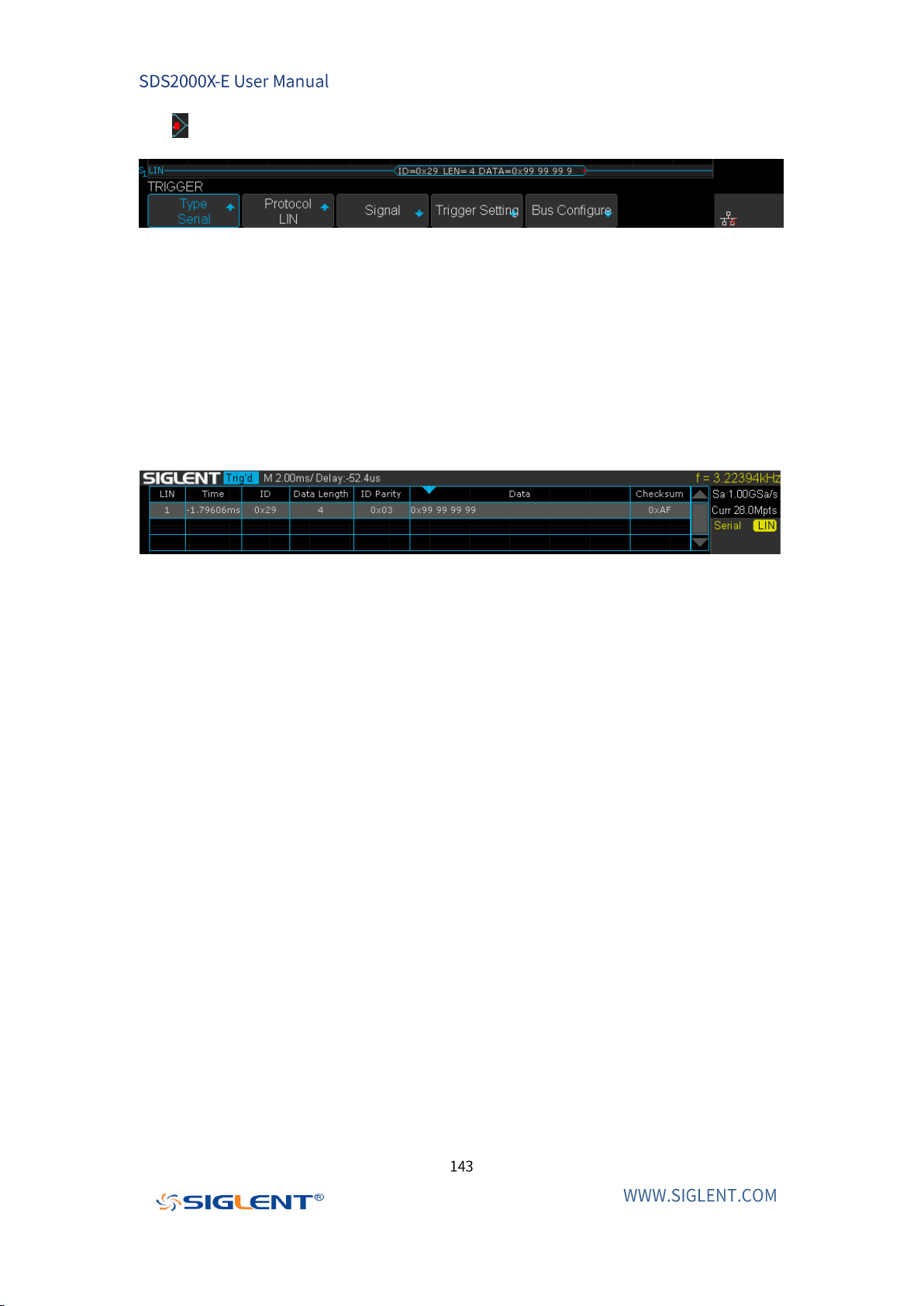
indicates there is not enough space on the display to show complete
content of a frame and some content is hidden.
Figure 61 LIN Decode Bus Display
The list of decoding result:
Time (timestamp) — The horizontal displacement between the current frame
and trigger position.
ID — The value of the frame’s protected identifier field.
Data Length — The length of the data field.
ID Parity — The two check bits of the protected identifier field.
Data — The value of the data field.
Checksum— The value of the checksum field.
Figure 62 LIN Decode List Display

Reference Waveform
The oscilloscope can save analog or math waveforms to the reference waveform
locations in the oscilloscope. Then, a reference waveform can be displayed and
compared against other waveforms. All reference waveforms can be displayed at
one time.
The contents of this chapter:
Save REF Waveform to Internal Memory
Display REF Waveform
Adjust REF Waveform
Clear REF Waveform
Save REF Waveform to Internal Memory
Do the following steps to save the REF waveform to internal memory:
1. Press the REF button on the front to enter the REF WAVE function menu. Note
that when the time horizontal format is in X-Y mode, REF function cannot be
enabled.
2. Press the Source softkey; then, turn the Universal Knob to select the source of
reference channel. The source includes analog channel and math waveforms.
3. Press the Location softkey; then, turn the Universal Knob to select the position
to save the REF waveform. The source includes analog channel and math
waveforms.
4. Press the Save softkey to save the channel or math waveform to the appointed
location. The vertical scale information and the vertical offset of the waveform
will be saved at the same time. It will pop out the message “Saved to internal
file REFA” when the waveform has been saved successfully.
Display REF Waveform
To the following steps to display REF waveform:
1. Press the REF button on the front to enter the REF WAVE function menu.
2. Press the Location softkey; then, turn the Universal Knob to select the REF
waveform that you want to display.
3. Press the Display softkey to select On to display the REF waveform on the
screen. Only saved location can be displayed. The oscilloscope can display two
reference waveforms at a time.
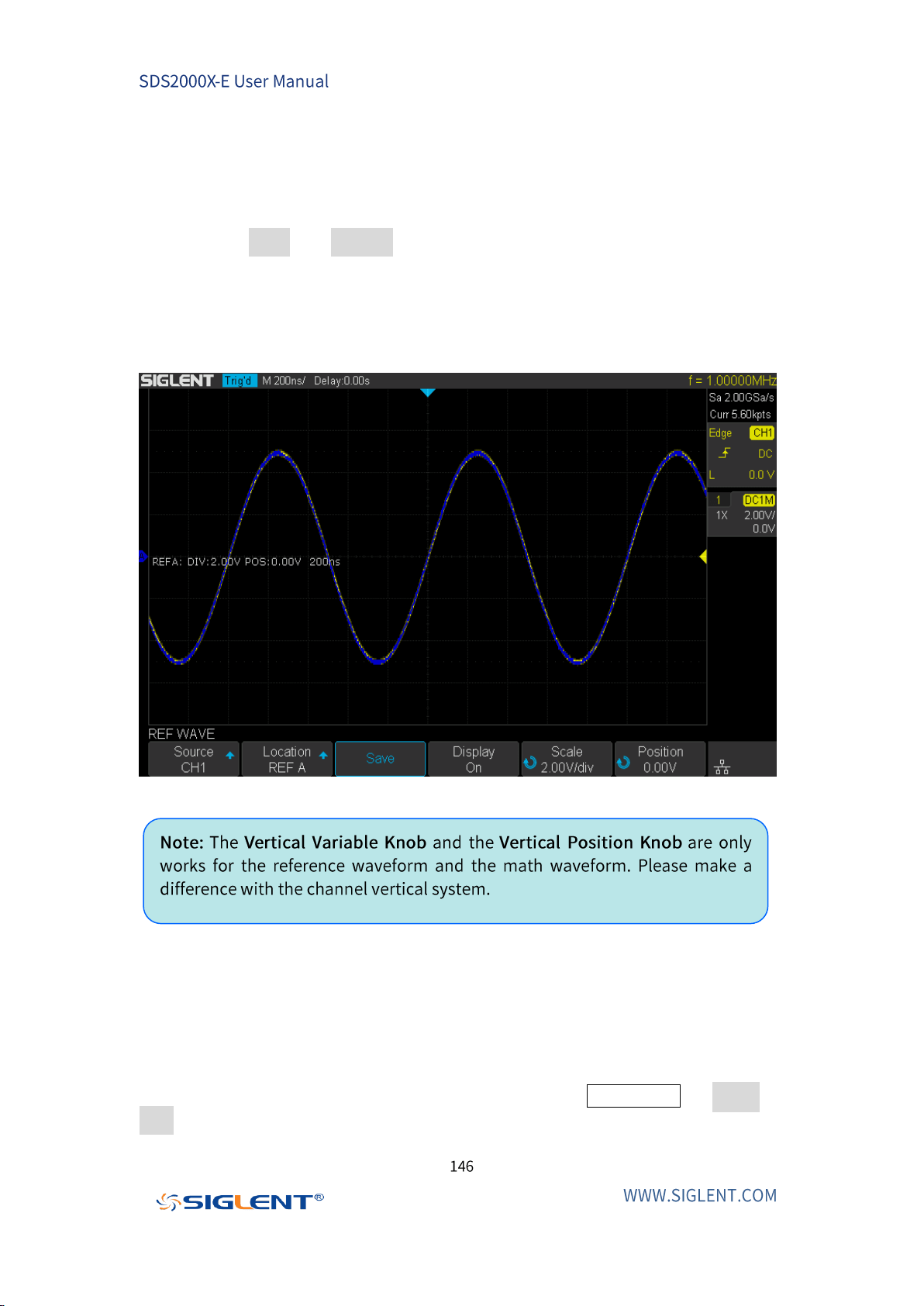
Adjust REF Waveform
1. Please refer to the “To Display REF Waveform” above to display the desired
reference waveform.
2. Press the Scale and Position softkey and turn the Universal knob to adjust the
vertical scale and position of the reference waveform. The vertical scale and
position information display at the middle of the screen.
The initial values display at the middle of the screen is the setup that when the
reference waveform been saved.
Figure 63 Reference Waveform
Clear REF Waveform
The oscilloscope does not have the “Clear” option under the REF WAVE function
menu. To clear the appointed reference waveform, you can save a new reference
waveform to the same location to cover it. Or follow the Save/Recall → Recall →
type and select Security Erase to clear the stored waveform.
Math
The oscilloscope supports many math operations between analog channels
including addition (+), subtraction (-), multiplication (*), division (/), FFT,
differential (d/dt), integral (∫dt), square root (√). The resulting math waveform is
displayed in white and labeled with “M”. You can use cursors to measure math
waveforms.
The contents of this chapter:
Units for Math Waveforms
Math Operators
Units for Math Waveforms
Use the channel function menu to set the unit of each channel to “V” or “A”.
The oscilloscope math operation includes units as below:
Math Operation
Unit
Addition (+)or subtraction (-)
V, A or U
multiplication (*)
V
∧
2, A
∧
2 or W (Volt-Amp)
division (/)
None, Sie or Ω
FFT
dBVrms, Vrms, dBm, dBArms, Arms
differential (d/dt)
V/S or A/S (V/second or A/second)
integral (∫dt)
Wb or C
square root ( )
V
∧
1/2 or A
∧
1/2
Math Operators
The oscilloscope supports the following math operations: Addition, subtraction,
multiplication, division), FFT (Fourier transform) operation and math function
operations including differential, integral, and square root.
Addition or Subtraction
Math operators perform arithmetic operations (addition or subtraction) on any two
analog input channels. When you select addition or subtraction, the Source A and
Source B values are added or subtracted point-by-point, and the result is
displayed.
1. Press the Math button on the front panel to enter the MATH function menu.
2. Press the Source A and Source B softkey respectively, and then turn the
Universal Knob to select the source to do math operation. The device supports
addition and subtraction between analog channels.
3. Press the Operator softkey and then turn the universal to select + or - to make
addition or subtraction operation. The resulting math waveform is displayed in
white and labeled with an “M” icon as shown below.
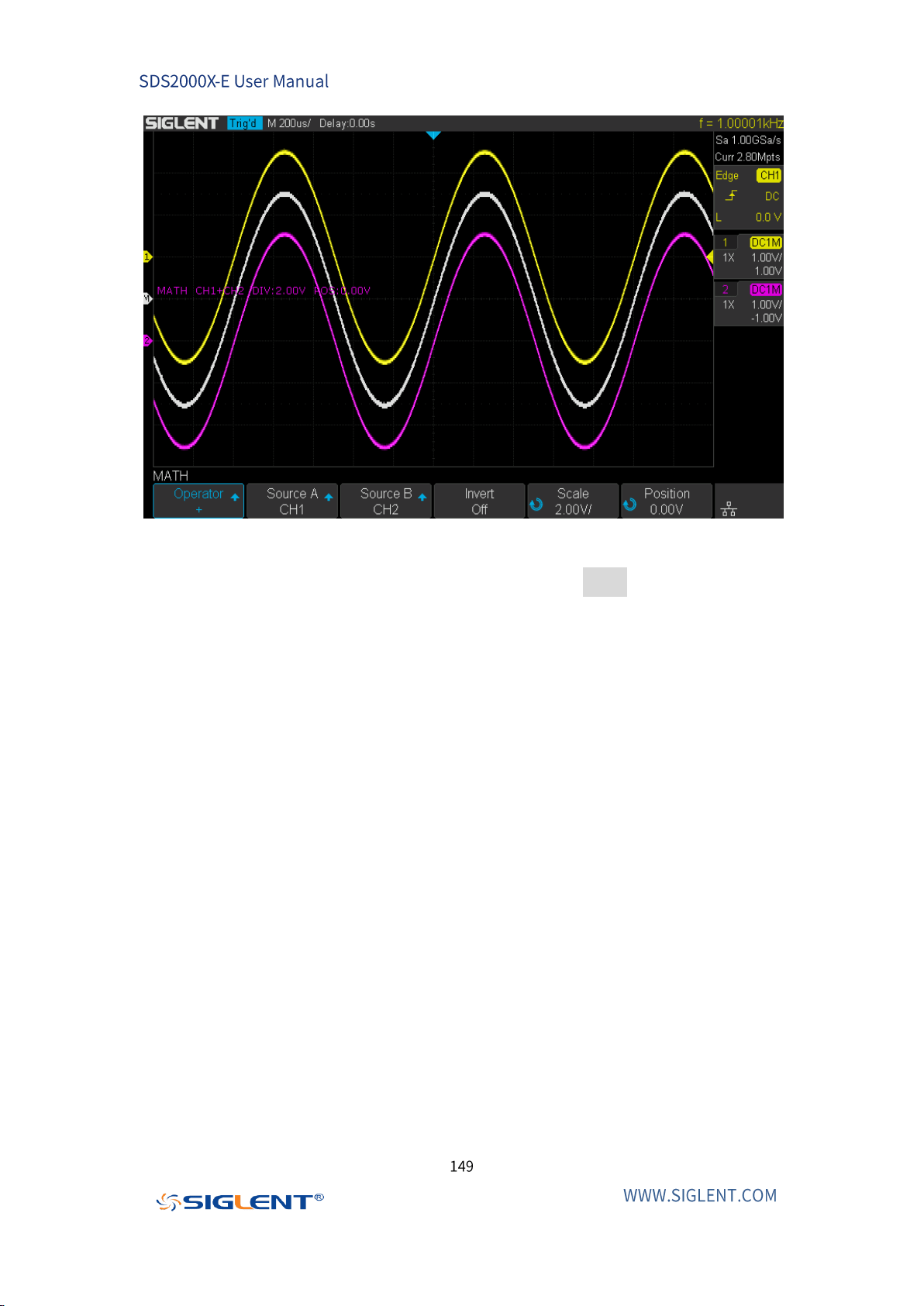
Figure 64 CH1+CH1 Waveform
4. If you want to invert the math waveform, press the Invert softkey and set the
option to On to invert the display of the math waveform.
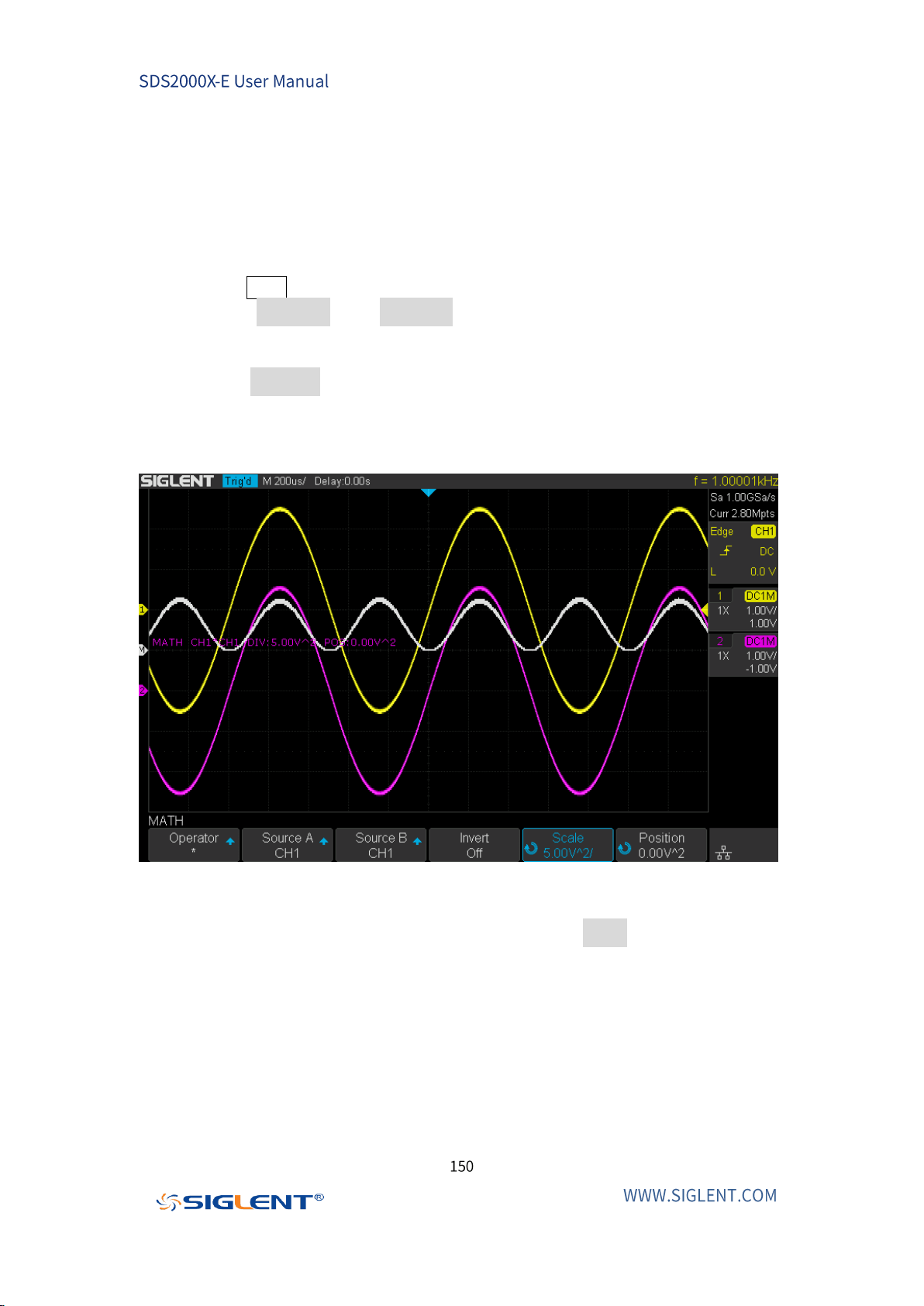
Multiplication and Division
Math operators perform arithmetic multiplication or division on any two analog
input channels. When you select multiplication or division, the Source A and Source
B values are multiplied or divided point by point and the result is displayed.
1. Press the Math button on the front panel to enter the MATH function menu.
2. Press the Source A and Source B softkey respectively, and then turn the
Universal Knob to select the source to do math operation. The device supports
multiplication and division between analog channels.
3. Press the Operator softkey and then turn the universal to select * or to make
multiplication or division operation. The resulting math waveform is displayed
in white and labeled with an “M” icon as shown.
Figure 65 CH1*CH1 Waveform
4. If you want to invert the math waveform, press the Invert softkey and set the
option to On to invert the display of the math waveform.
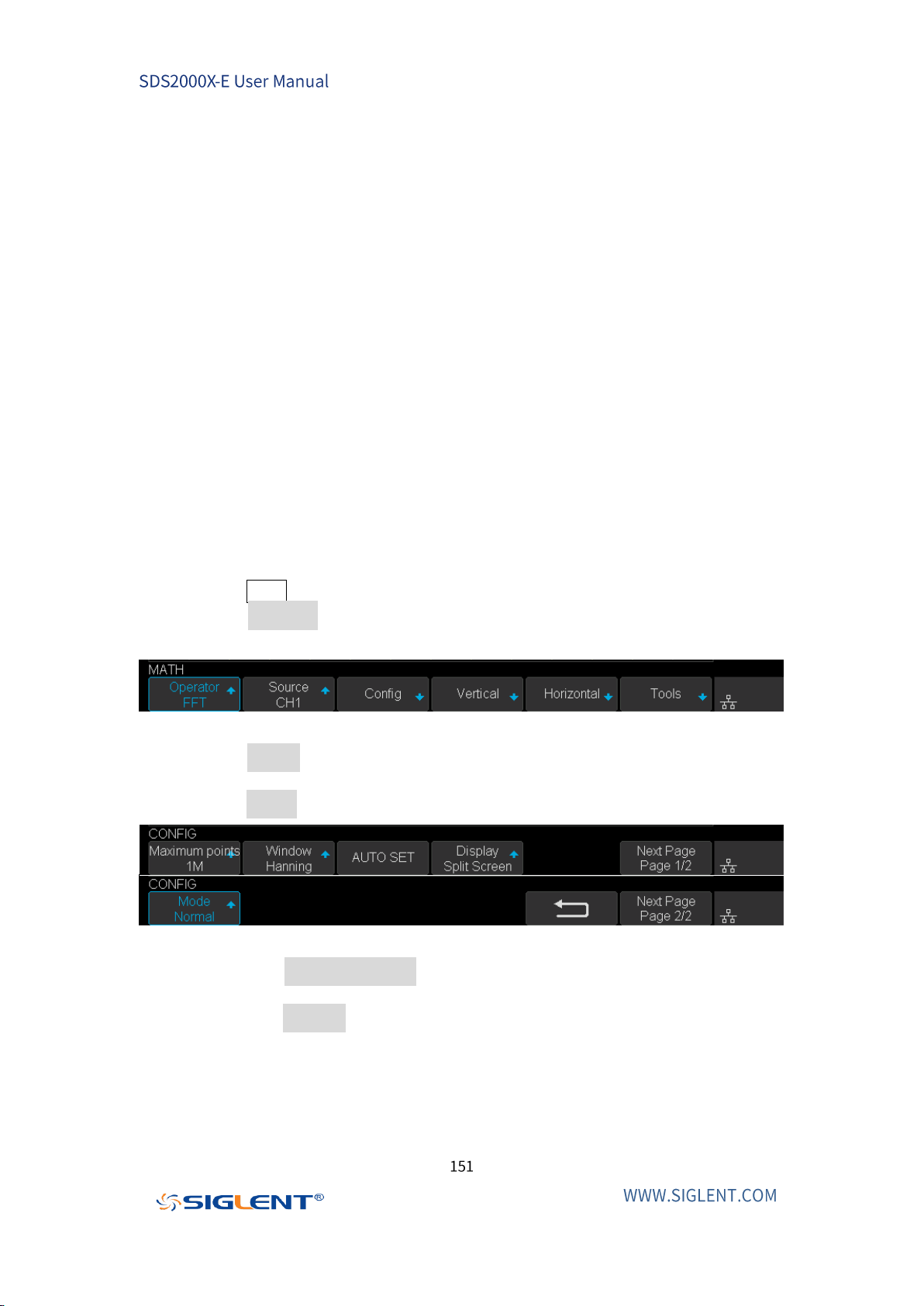
FFT Operation
FFT is used to compute the fast Fourier transform using analog input channels. FFT
takes the digitized time record of the specified source and transforms it to the
frequency domain. When the FFT function is selected, the FFT spectrum is plotted
on the oscilloscope display as magnitude in dBV versus frequency. The readout for
the horizontal axis changes from time to frequency (Hertz) and the vertical readout
changes from V to dB.
FFT operation can facilitate the following works:
Measure harmonic components and distortion in the device under test
Measure the characteristics of the noise in DC power
Analyze vibration
To display a FFT waveform:
1. Press the Math button on the front panel to open the MATH function menu.
2. Press the Operator softkey and then turn the Universal Knob to select FFT. The
resulting math waveform is displayed in white and labeled with “M”.
Figure 66 FFT Menu
3. Press the Source softkey, and then turn the Universal Knob to select the source
to do FFT operation. Analog channels can be used as the source.
4. Press the Config softkey to enter CONFIG menu.
Figure 67 FFT CONFIG Menu
Press the Maximum points softkey, and then turn the Universal Knob to
select the Maximum points.
Press the Window softkey, and then turn the Universal Knob to select an
appropriate window.
Spectral leakage can be considerably decreased when a window function
is used. The oscilloscope provides five windows (Rectangle, Blackman,
Hanning, Hamming and Flattop) which have different characteristics and
are applicable to measure different waveforms. You need to select the
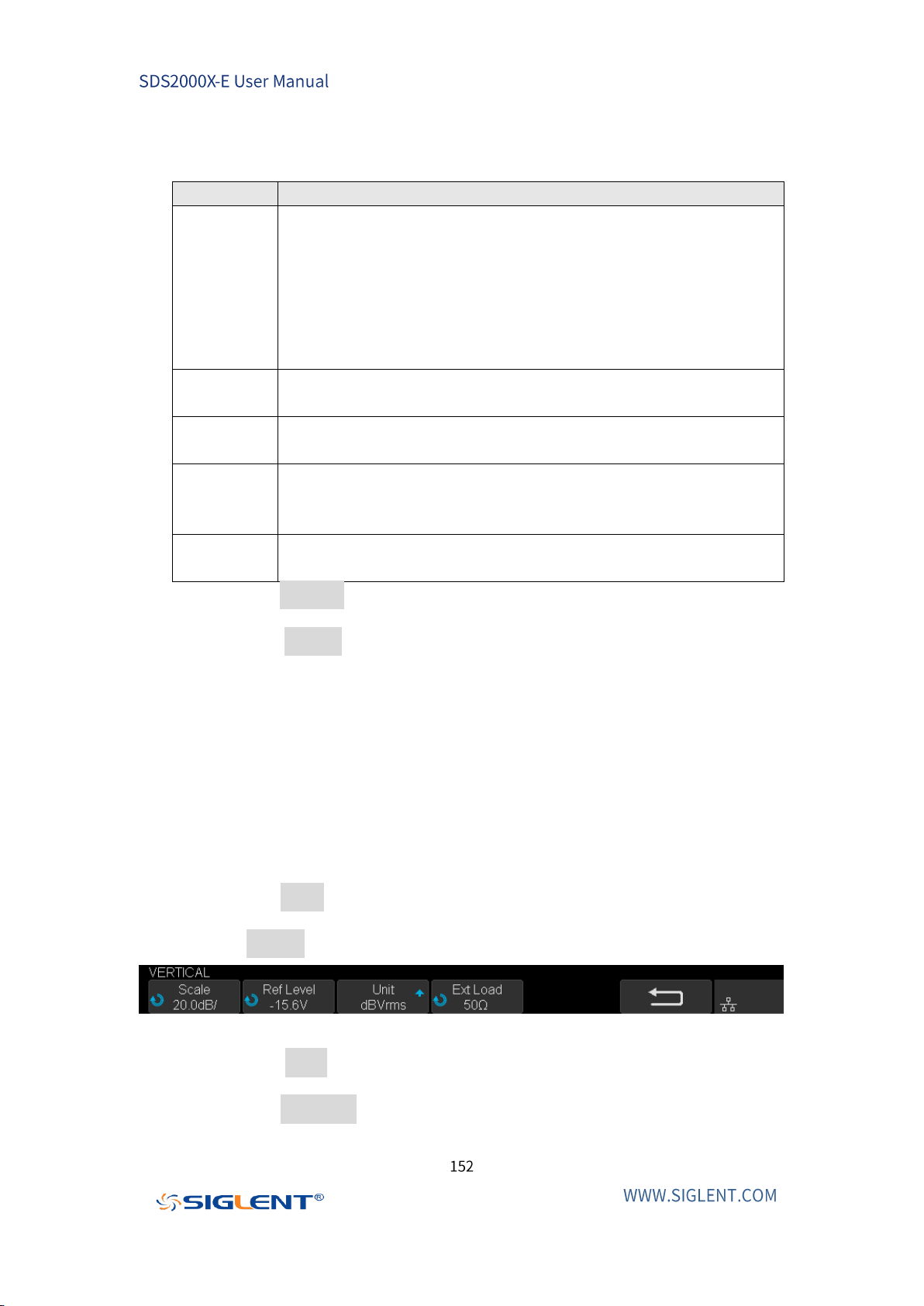
window function according to different waveforms and their
characteristics. Please read the table below carefully to make an
appropriate option according to the input signal.
Window
Applications and Characteristics
Rectangle
These are normally used when the signal is transient
(completely contained in the time-domain window) or known
to have a fundamental frequency component that is an integer
multiple of the fundamental frequency of the window. Signals
other than these types will show varying amounts of spectral
leakage and scallop loss, which can be corrected by selecting
another type of window.
Hanning
These reduce leakage and improve amplitude accuracy.
However, frequency resolution is also reduced.
Hamming
These reduce leakage and improve amplitude accuracy.
However, frequency resolution is also reduced.
Flat Top
This window provides excellent amplitude accuracy with
moderate reduction of leakage, but with reduced frequency
resolution.
Blackman
It reduces the leakage to a minimum, but with reduced
frequency resolution.
Press the Auto set softkey to automatically set the appropriate parameters
for the FFT measurement.
Press the Display softkey to select Split, Full Screen or Exclusive display
mode.
Split: the source channel and the FFT operation results are displayed
separately. The time domain and frequency domain signals are displayed
clearly.
Full Screen: the source channel and the FFT operation results are displayed
in the same window to view the frequency spectrum more clearly and to
perform more precise measurements.
Exclusive: the waveforms of channels are disabled, only the FFT operation
results are displayed in the window to view the frequency spectrum more
clearly and to perform more precise measurements.
Press the Mode softkey to select Normal, Max-Hold or Average. When you
select Average, it is necessary to set the average times.
5. Press the Vertical softkey to enter VERTICAL menu.
Figure 68 VERTICAL Menu
Press the Scale softkey, and then turn the Universal Knob to select the
desired vertical FFT scale
Press the Ref Level softkey, and then turn the Universal Knob to select the
desired vertical FFT offset.
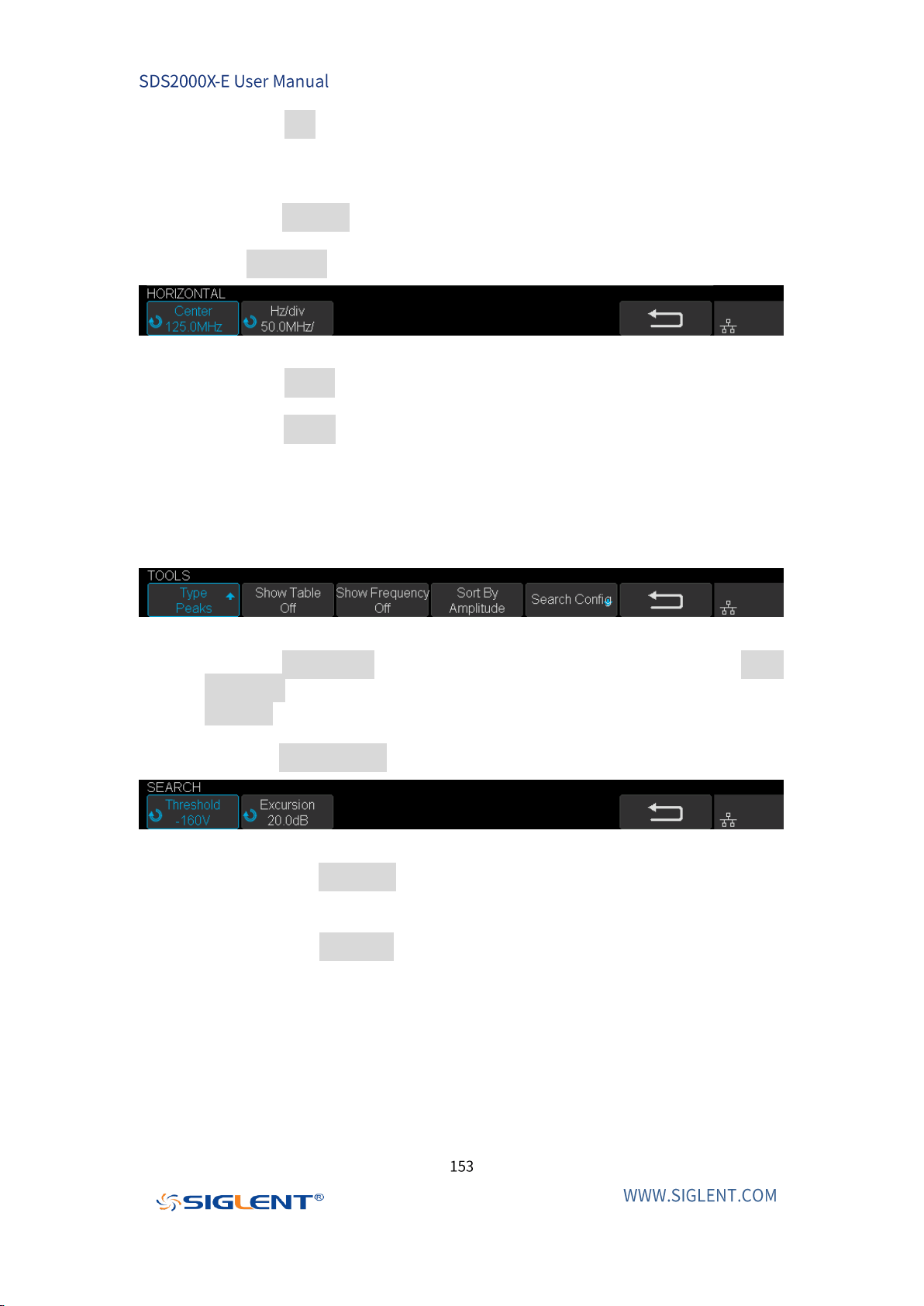
Press the Unit softkey to select the unit of vertical axis. The units of the
vertical axis can be dBVrms, dBm, Vrms or dBArms, Arms, which use a
logarithmic scale or a linear scale to display vertical amplitude
respectively.
Press the Ext Lode softkey and then turn the Universal Knob to select the
external load value.
6. Press the Horizontal softkey to enter HORIZONTAL menu.
Figure 69 HORIZONTAL Menu
Press the Center softkey, and then turn the Universal Knob to select the
desired center frequency.
Press the Hz/div softkey, and then turn the Universal Knob to select the
desired resolution frequency.
7. Press the Tools softkey to enter TOOLS menu. Press Type softkey to select the
type of tools. The type of the tools can be Peaks, Markers, or Off.
Peaks: Automatically mark the peak of the current FFT waveform according to
the search configuration.
Figure 70 FFT Peaks Menu
Press the Show Table softkey to display a table of peak, and press Show
Frequency softkey to display the frequency value of the peak. Press the
Sort By softkey continuously to set the table sorting by Amplitude or
Frequency.
Press the Search Config softkey to set search configuration.
Figure 71 SEARCH Menu
a. Press the Threshold softkey and turn the Universal knob to set the
minimum peak amplitude. Only peaks larger than the peak limit can
be judged as peaks.
b. Press the Excursion softkey and turn the Universal knob to set the
difference between the peak value and the minimum Amplitude on
both sides. Only when the difference is greater than the peak value of
peak offset can the peak value be determined.
Markers: Customize the marker locations on the FFT waveform based on search
configuration.
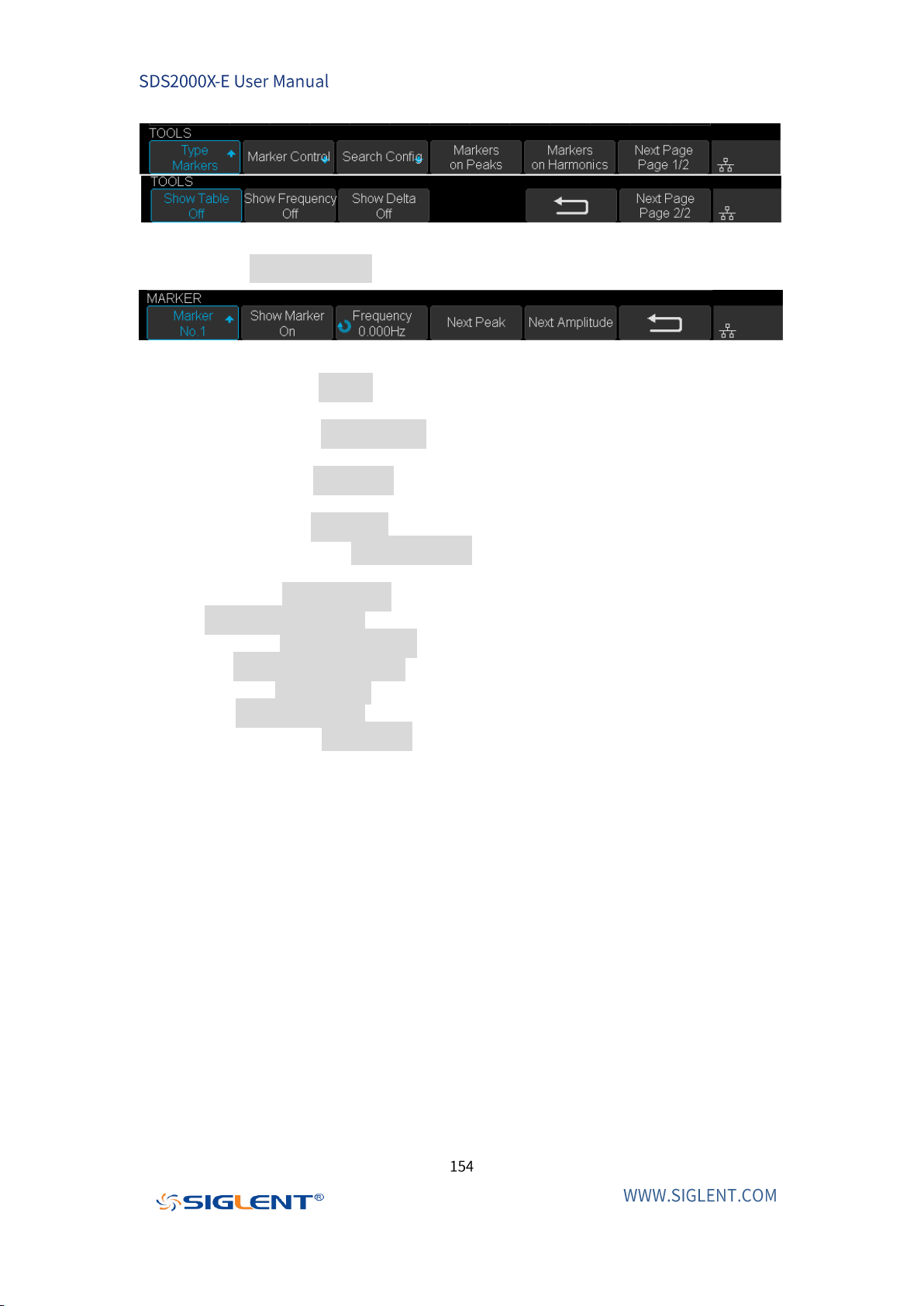
Figure 72 FFT Markers Menu
Press Markers Control softkey to enter MARKER Menu.
Figure 73 Marker Control Menu
a. Press the Marker softkey continuously to select the marker number
from NO.1~NO.8.
b. Press the Show Marker softkey continuously to turn on or off the
selected mark.
c. Press the Frequency softkey to set the frequency value of the selected
marker.
d. Press the Next Peak softkey to move the selected mark to the next peak.
And press the Next Amplitude softkey to move the selected marker to
the next peak with lower amplitude.(Up to 10 peaks are supported)
Press the Search Config softkey to enter the SEARCH menu. Similar to the
search configuration for peak markers.
Press the Markers on Peaks softkey to set the markers on peaks, and press
the Markers on harmonics softkey to set the markers on harmonics.
Press the Show Table softkey to show the amplitude of the markers; press
the Show Frequency softkey to show the frequency value of the markers,
and press the Show Delta softkey to show the delta amplitude between
markers.
The following figure shows the FFT waveform displayed on the split screen and the
peak tool is turned on:
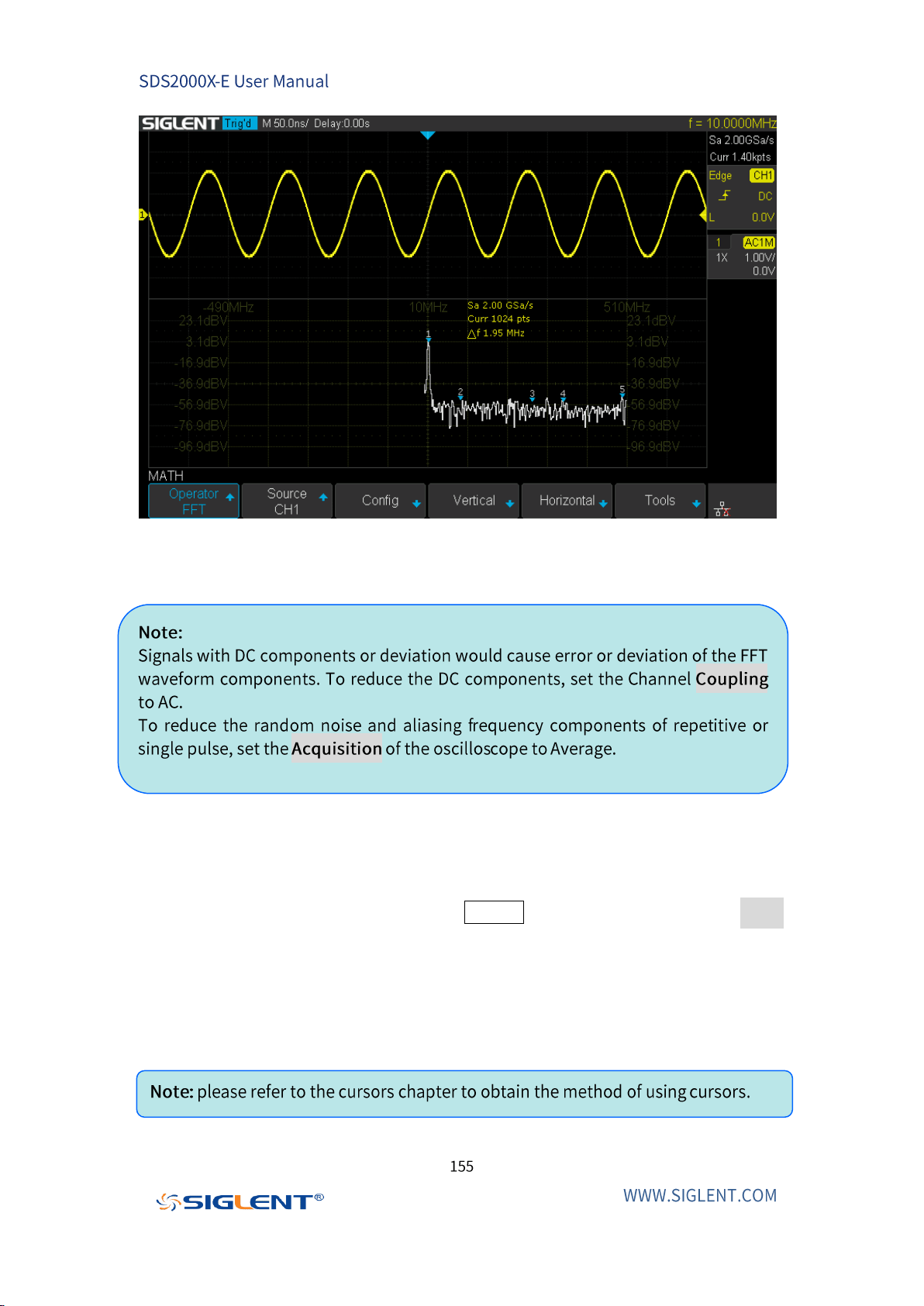
Figure 74 FFT Waveform
To measure FFT waveform:
To make cursor measurements, press the Cursors button, and then press the Mode
softkey to select On to turn the cursors, Use the X1 and X2 cursors to measure
frequency values and the difference between two frequency values (ΔX). Use the
Y1 and Y2 cursors to measure amplitude in dB and difference in amplitude (ΔY).
You can find the frequency value at the first occurrence of the waveform maximum
by using the X at Max Y measurement.
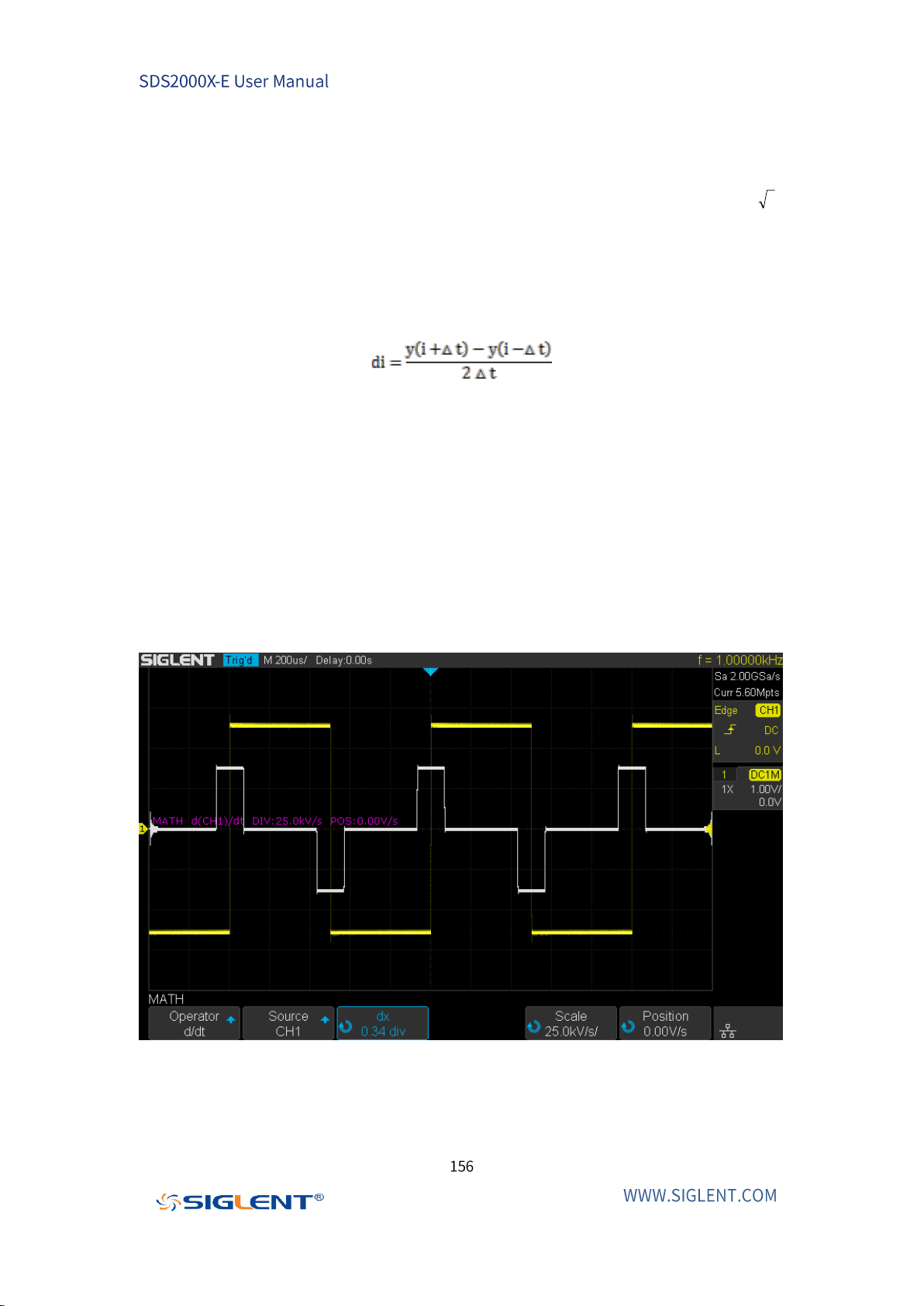
Math Function Operation
The oscilloscope supports differential (d/dt), integral (∫dt) and square root ( )
math functions.
Differentiate
d/dt (differentiate) calculates the discrete time derivative of the selected source.
Where:
d = differential waveform.
y = channel 1, 2 data points.
i = data point index.
Δ t = point- to- point time difference.
The dx option under d/dt math function operation menu shows the point- to- point
time difference, and it ranges from 0.02div to 0.40div. “div” indicates the number
of the pixel points that each division has. The oscilloscope has 50 pixel points per
division. Take 0.2div as an example: 0.2*50=10. To calculate the discrete time
derivative of the selected source, and the Δ t is the point- to- point time difference.
Figure 75 Different Function Operation
You can use differentiate to measure the instantaneous slope of a waveform. For
example, the slew rate of an operational amplifier may be measured using the
differentiate function.
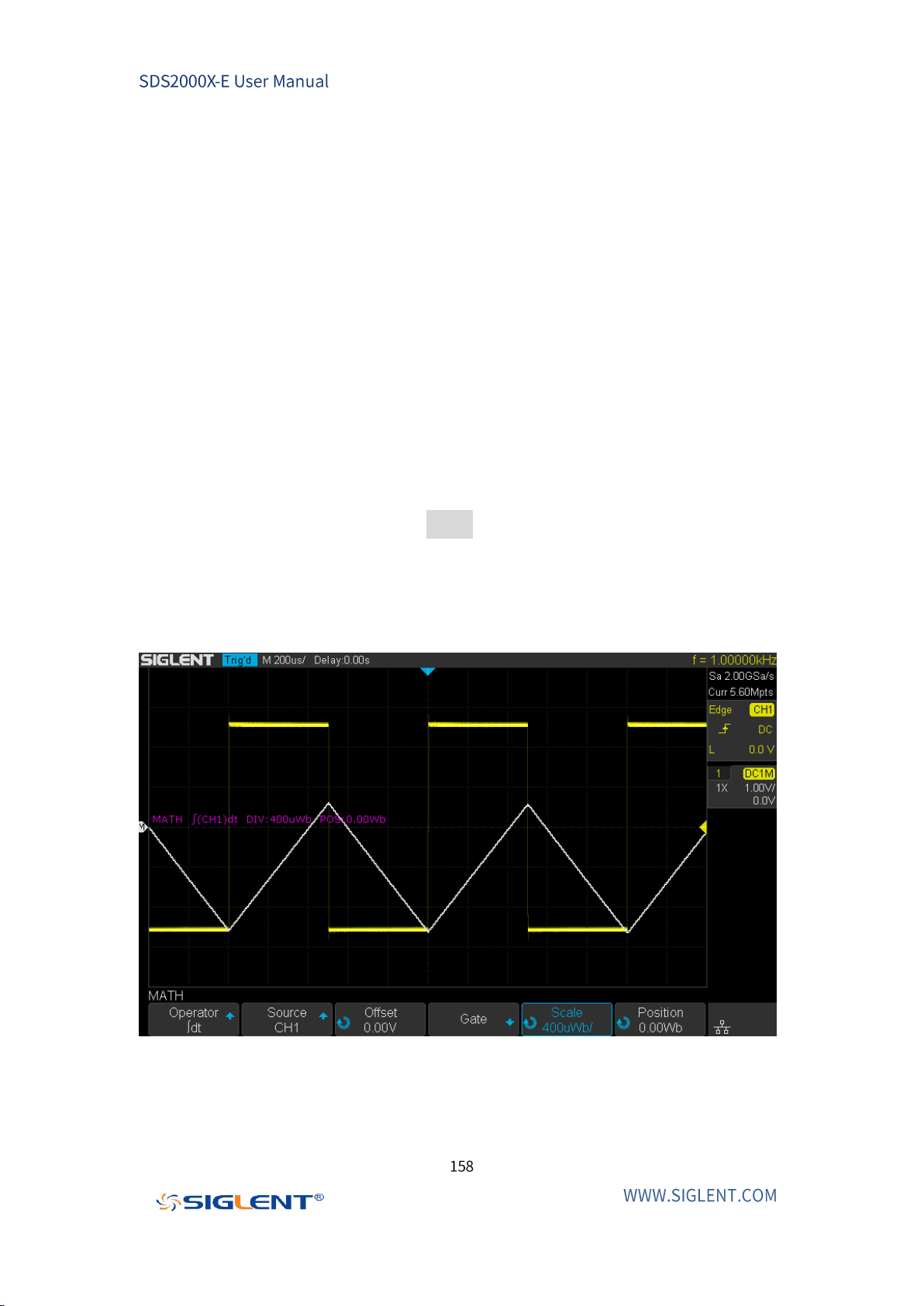
Integrate
dt (integrate) calculates the integral of the selected source. You can use integrate
to calculate the energy of a pulse in volt- seconds or measure the area under a
waveform.
dt plots the integral of the source using the "Trapezoidal Rule". The equation is:
n
0i
i0n
ytcI
Where:
I = integrated waveform.
Δt = point- to- point time difference.
y = channel 1, 2 data points.
c
o
= arbitrary constant.
i = data point index.
The integrate operator provides an Offset softkey that lets you enter a DC offset
correction factor for the input signal. Small DC offset in the integrate function input
(or even small oscilloscope calibration errors) can cause the integrate function
output to "ramp" up or down. This DC offset correction lets you level the integrate
waveform.
Figure 76 Integral without Offset
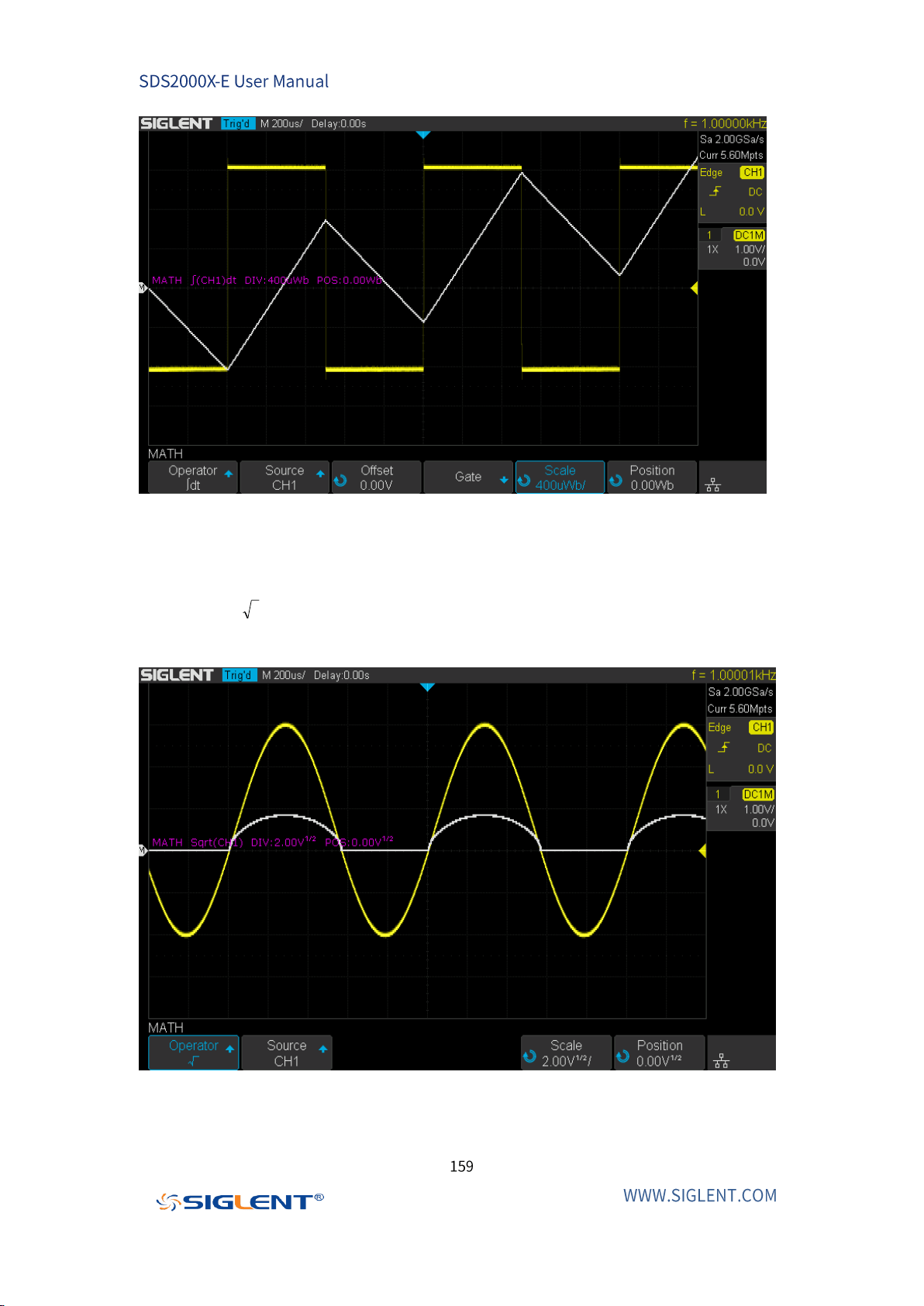
Figure 77 Integral with Offset
Square Root
Square root ( ) calculates the square root of the selected source.
Where the transform is undefined for a particular input, holes (zero values) appear
in the function output.
Figure 78 Square Root

Cursors
Cursors are horizontal and vertical markers that indicate X- axis values and Y- axis
values on a selected waveform source. You can use cursors to make custom
voltage, time measurements on oscilloscope signals.
X Cursors
X cursors are vertical dashed lines that adjust horizontally and can be used to
measure time (when the source is FFT waveform, X cursors measure frequency)
X1 cursor is the left (default position) vertical dotted line; it can be moved to any
place on the screen.
X2 cursor is the right (default position) vertical dotted line; it can be moved to any
place on the screen.
Use the Universal Knob to set the X1 and X2 cursor values and the values are
displayed in the cursors box in the upper-left corner of the screen along with the
difference between X1 and X2 (△T) and 1/△T.
When set cursor type to X2-X1, use the Universal Knob will move the X1 and X2
cursors together. The value under the menu option is the difference between the X1
and X2 cursors.
Y Cursors
Y cursors are horizontal dotted lines that adjust vertically and can be used to
measure voltage (V) or current (A). When the cursor source is the math function, the
unit will match the math function.
Y1 cursor is the top (default position) horizontal dotted line; it can be moved to any
vertical place of the screen.
Y2 cursor is the down (default position) horizontal dotted line; it can be moved to
any vertical place of the screen.
Use the Universal Knob to set the Y1 and Y2 cursor values and the values are
displayed in the cursors box in the top left corner of the screen along with the
difference between Y1 and Y2 (△Y).
When set cursor type to Y2-Y1, use the Universal Knob will move the Y1 and Y2
cursors together. The value under the menu option is the difference between the Y1
and Y2 cursors.
Make Cursor Measurements
1. Press the Cursors button on the front panel to enter the CURSOR function
menu.
2. Press the Mode softkey and set the option to On.
3. Press the Source softkey, and then use the Universal Knob to select the desired
source. Only analog channels, math waveforms and reference waveforms that
are displayed are available for cursors.
4. Press the X Ref and Y Ref softkey to set the reference of X cursors and Y cursors.
Position: when the horizontal/vertical scale is changed, the X/Y cursors
remain fixed to the grid position on the display.
Delay/Offset: when the horizontal/vertical is changed, the value of X/Y
cursors remain fixed.
5. To make cursor measurements:
To measure the horizontal time, use the Universal Knob to move the X1
and X2 cursors to desired place. If necessary, set the cursor type to X2-X1,
move X1 and X2 cursors together.
To measure vertical voltage or current, use the Universal Knob to move the
Y1 and Y2 cursors to desired place. If necessary, set the cursor type to
“Y2-Y1”, move Y1 and Y2 cursors together.
To adjust the transparence of the cursors message box, press the
Display/Persist softkey and go to the second page, press the Transparence
(20% to 80%) softkey and then turn the Universal Knob to adjust the
transparence to the desired value.
Cursor examples:
Use cursors to measure pulse width:
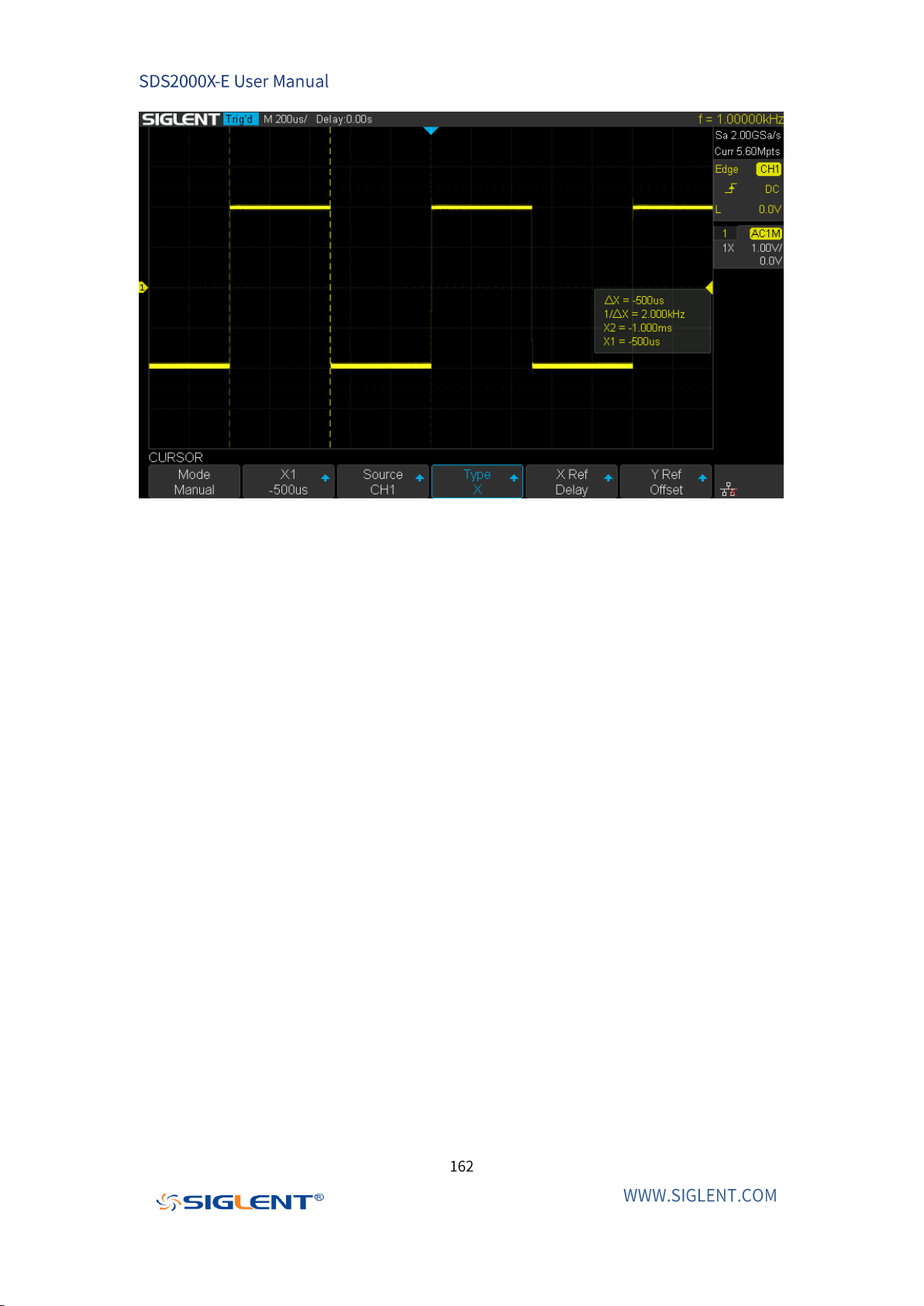
Figure 79 Measure Pulse Width

Measure
The oscilloscope provides measurements of 38 waveform parameters and the
statistics. It contains voltage, time and delay parameters.
Voltage, time and delay parameters are under Type option. The results of the last
four selected measurements are displayed at the bottom of screen and above the
menu.
The contents of this chapter:
Type of Measurements
Voltage Measurements
Time Measurements
Delay Measurements
Automatic Measurement
All Measurement
Gate Measurement
Clear Measurement Parameters
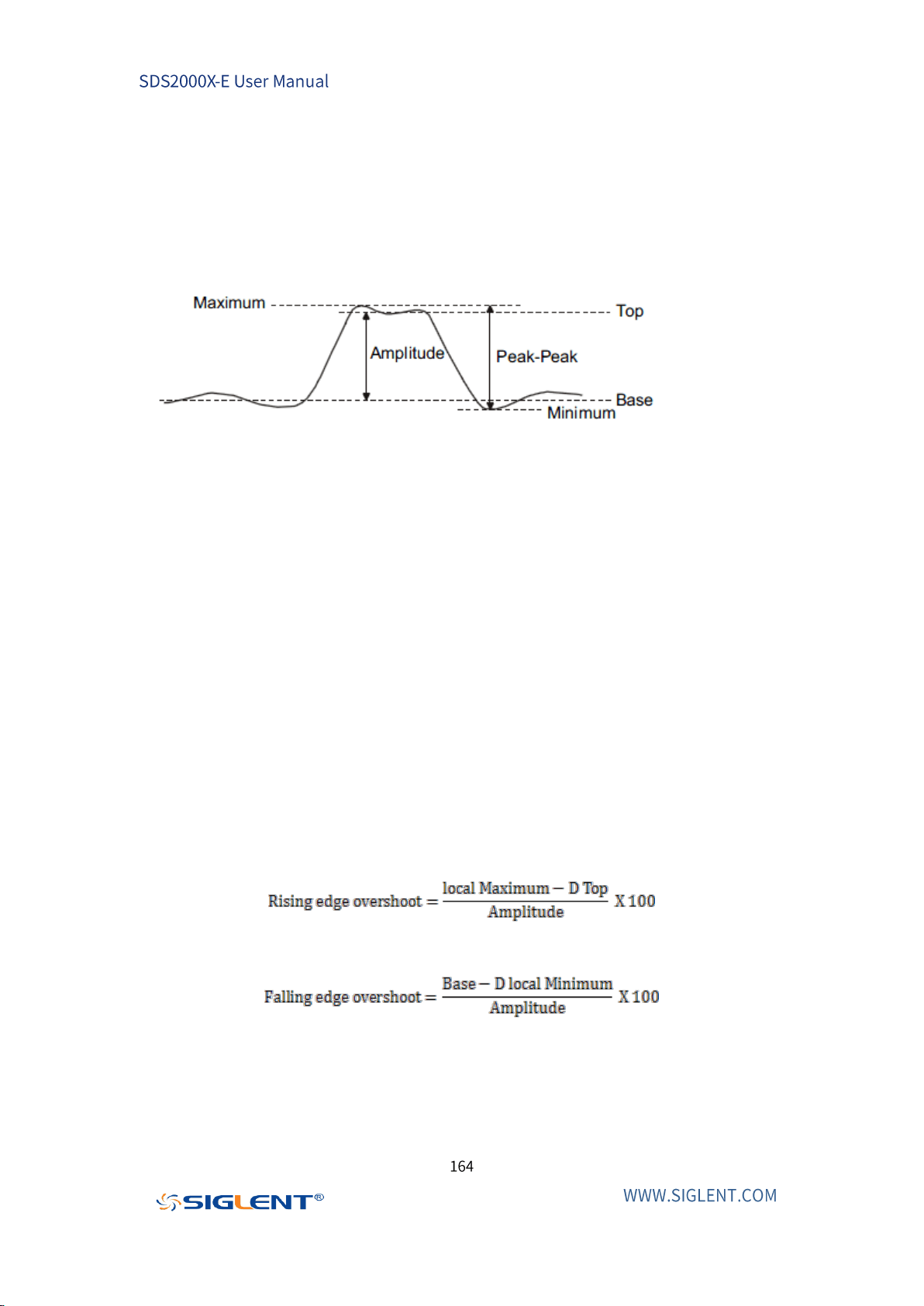
Type of Measurements
Voltage Measurements
Voltage measurements include 17 kinds of voltage parameter measurements.
Figure 80 Voltage Measurements
1. Peak-Peak: Difference between maximum and minimum data values.
2. Maximum: Highest value of the input waveform.
3. Minimum: Lowest value of the input waveform.
4. Amplitude: Difference between the top and the base in a bimodal signal, or
between max and min in a unimodal signal.
5. Top: Value of most probable higher state in a bimodal waveform.
6. Base: Value of most probable lower state in a bimodal waveform.
7. Mean: Average of data values in the first cycle.
8. Cycle mean: Average of all data values.
9. Stdev: Standard deviation of all data values.
10. Cycle Stdev: Standard deviation of all data values in the first cycle.
11. RMS: Root mean square of all data values.
12. Cycle RMS: Root mean square of all data values in the first cycle.
13. Overshoot: Overshoot is distortion that follows a major edge transition
expressed as a percentage of amplitude. ROV means rising edge overshoot
and FOV means falling edge overshoot.
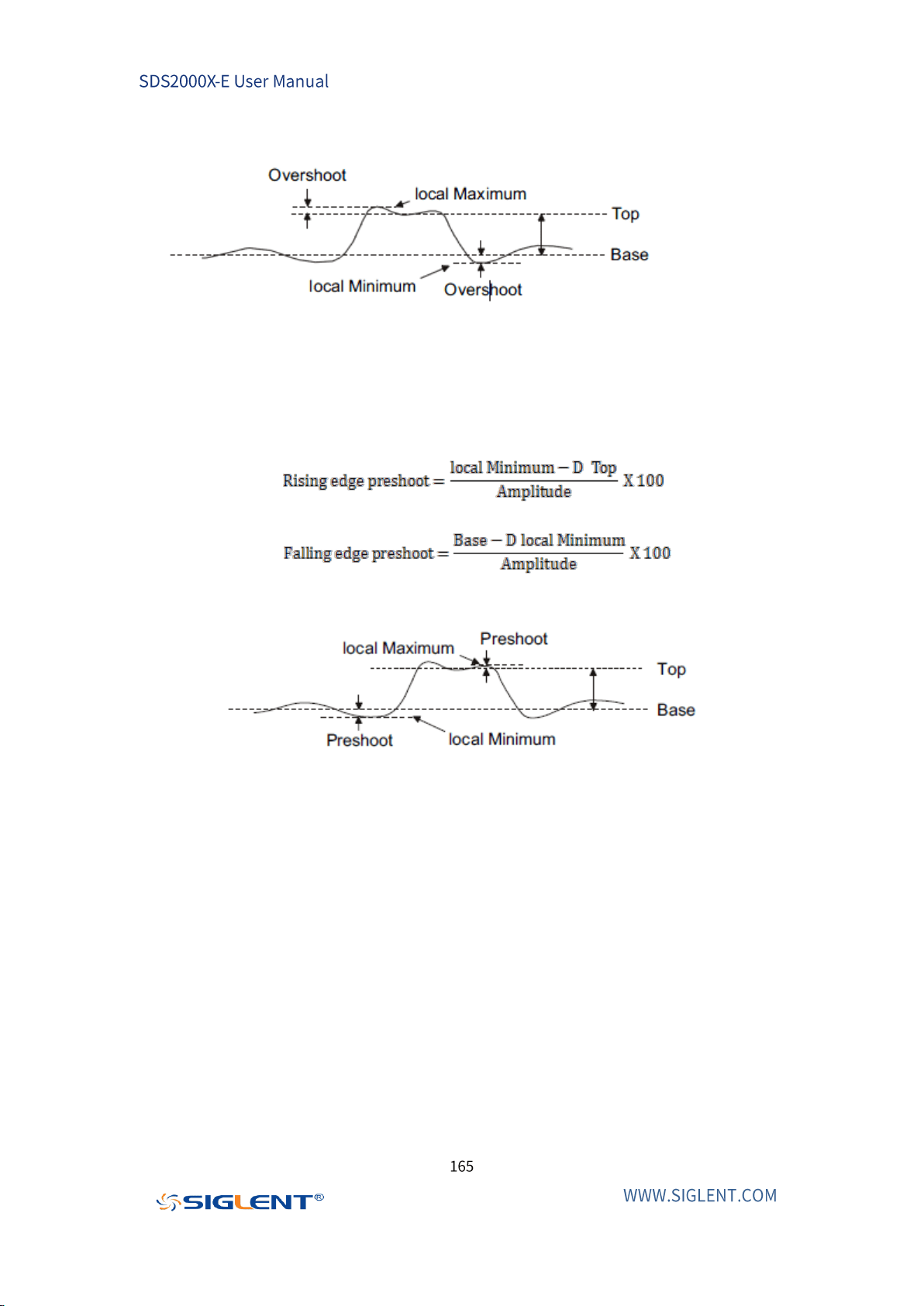
Figure 81 Overshoot
14. Preshoot: Preshoot is distortion that precedes a major edge transition
expressed as a percentage of amplitude. RPRE means rising edge preshoot
and FPRE means falling edge preshoot.
Figure 82 Preshoot
15. Level@X: The voltage value between the trigger point and the vertical position
of the channel.
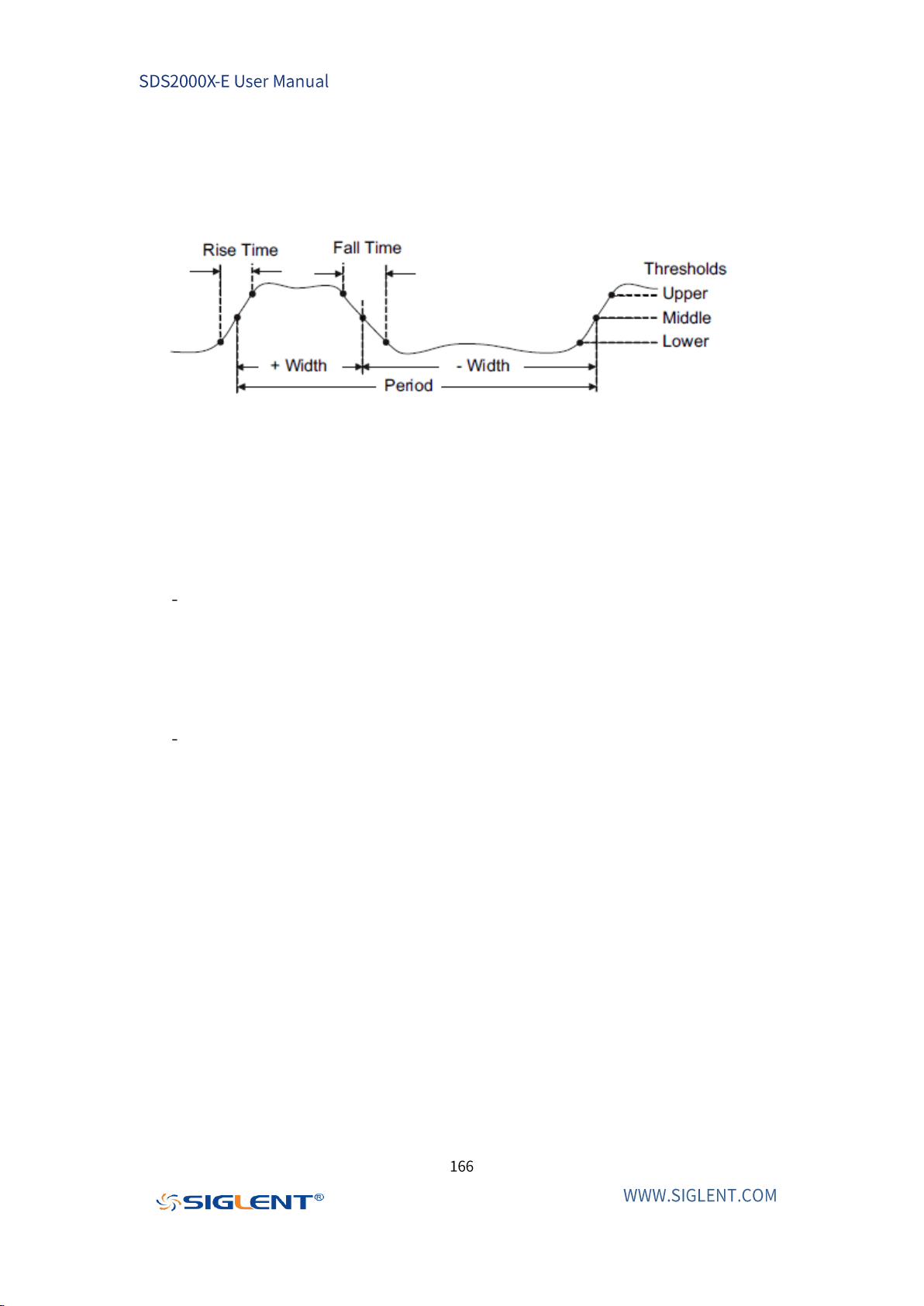
Time Measurements
Time measurements include 11 kinds of time parameter measurements.
Figure 83 Time Measurements
1. Period: Period for every cycle in the waveform at the 50% level and positive
slope.
2. Freq: Frequency for every cycle in the waveform at the 50% level and positive
slope.
3. + Width: Width measured at 50% level and positive slope.
Width: Width measured at 50% level and negative slope.
4. Rise Time: Duration of rising edge from 10-90%.
5. Fall Time: Duration of falling edge from 90-10%.
6. BWid: Time from the first rising edge to the last falling edge, or the first falling
edge to the last rising edge at the 50% crossing.
7. + Duty: Ratio of positive width to period.
Duty: Ratio of negative width to period.
8. Delay:Time from the trigger to the first transition at the 50% crossing.
9. Time@Level:The maximum value of the time statistics from the point of 50%
amplitude of each rising edge to the trigger position.

Delay Measurements
Delay measurements measure the time different between arbitrary two channels,
including 10 kinds of delay measurements.
1. Phase: Calculate the phase difference between two edges.
2. FRFR: Time between the first rising edges of the two channels.
3. FRFF: Time from the first rising edge of channel A and the first falling edge of
channel B.
4. FFFR: Time from the first falling edge of channel A and the first rising edge of
channel B.
5. FFFF: Time from the first falling edge of channel A and the first falling edge of
channel B.
6. FRLR: Time from the first rising edge of channel A and the last rising edge of
channel B.
7. FRLF: Time from the first rising edge of channel A and the last falling edge of
channel B.
8. FFLR: Time from the first falling edge of channel A and the last rising edge of
channel B.
9. FFLF: Time from the first falling edge of channel A and the last falling edge of
channel B.
10. Skew:Time of source A edge minus time of nearest source B edge.
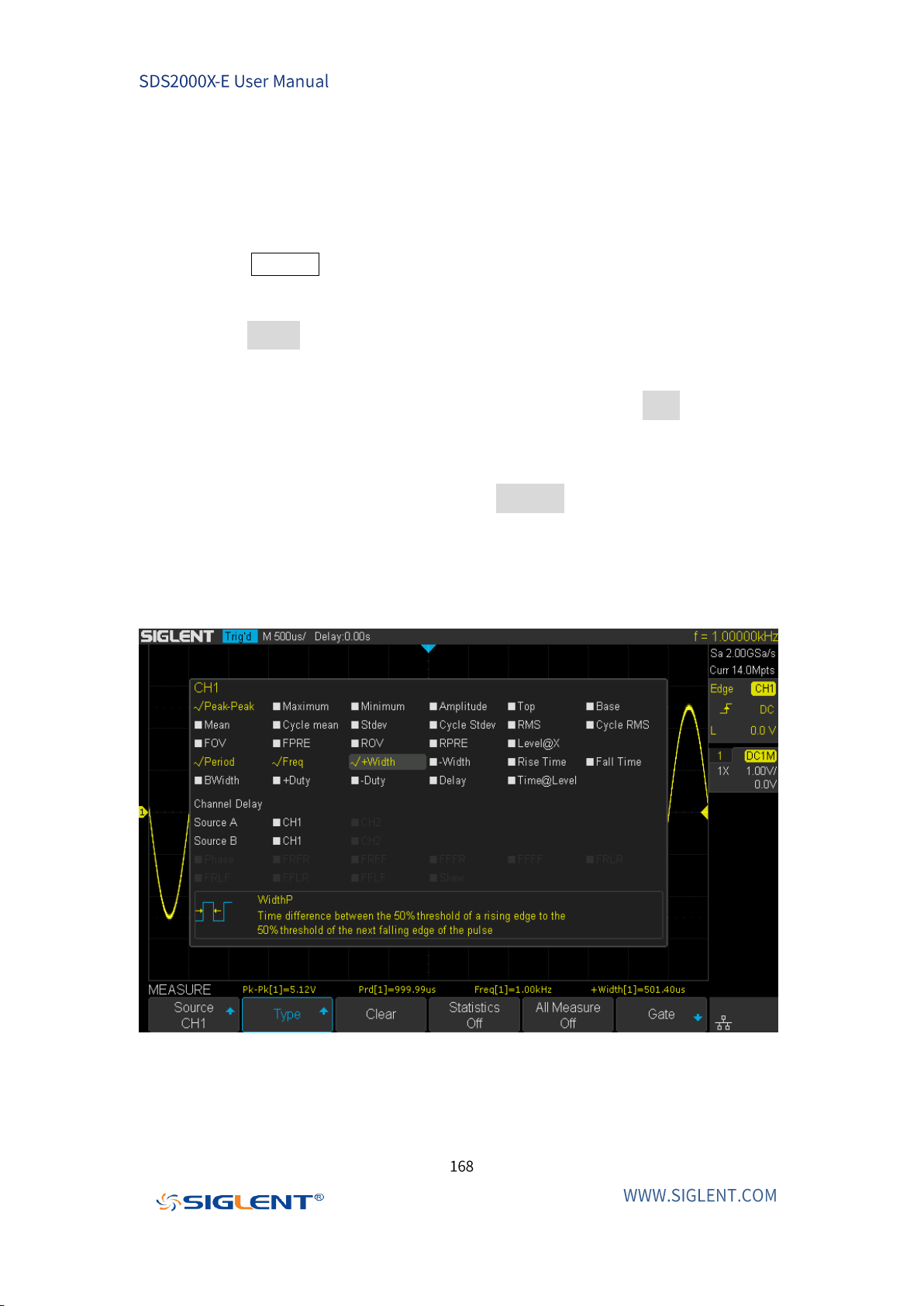
Automatic Measurement
Perform the steps below and select voltage or time parameters to make automatic
measurement.
1. Press the Measure button on the front panel to enter the MEASURE function
menu. At the same, the Peak-Peak and Period are enabled with the current
trigger channel.
2. Press the Source softkey, and then use the Universal Knob to select the desired
channel. Only analog channels that are displayed are available for
measurements.
3. To select and display measurement parameters. Press the Type softkey, and
then turn the Universal Knob to select the desired measurement parameter.
4. Press the Universal Knob to add the measurement parameter, the parameters
and value will be shown above the menu, and the statistics status will update.
5. To turn off the statistic function, press the Statistics softkey to select Off.
The measurement display area can display 4 measurement parameters at most,
and the measurements will be arranged according to the selection order. If a fifth
measurement parameter is selected, it will overwrite the first measurement.
Figure 84 Select the Measurement Parameter
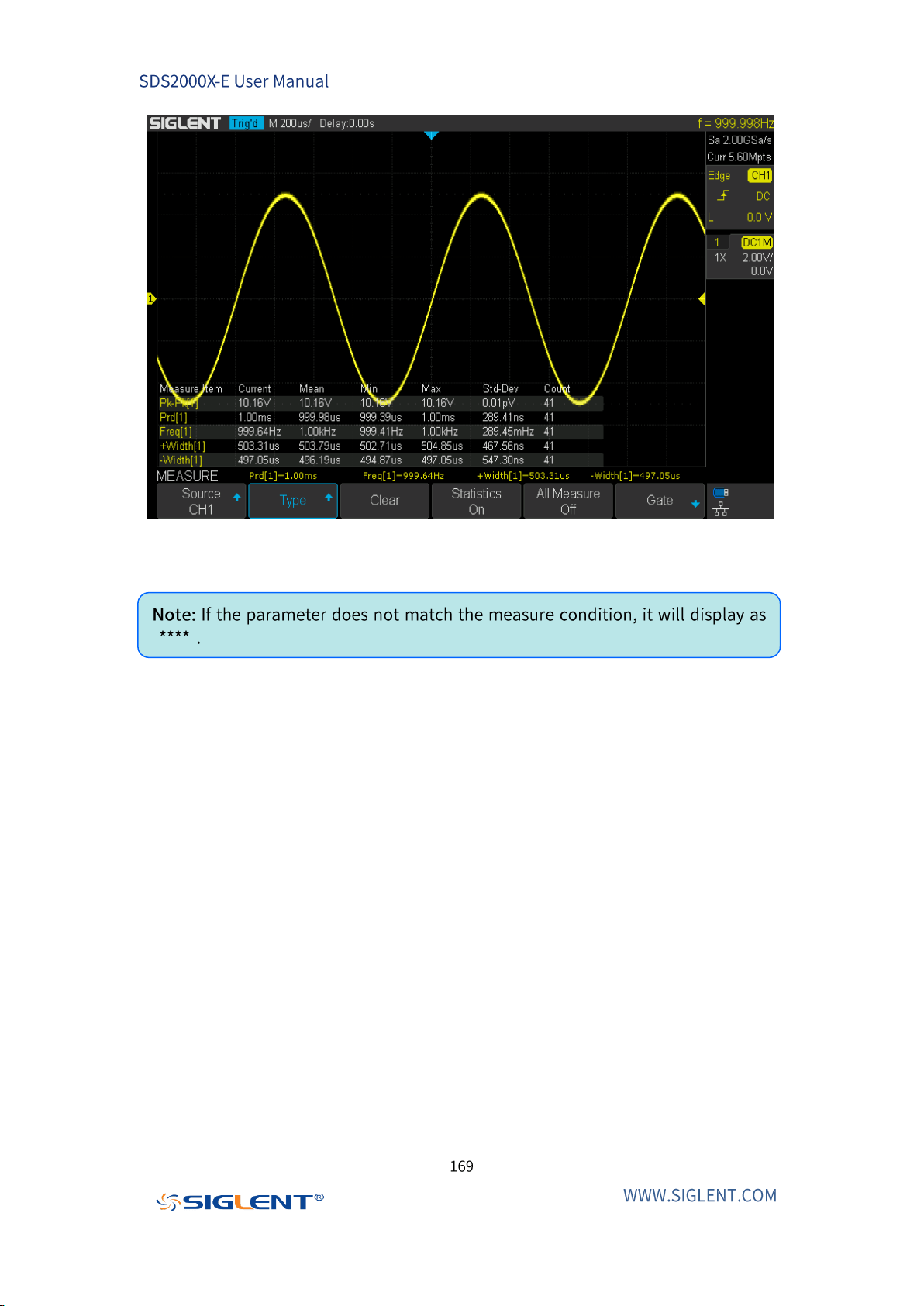
“ ”
Figure 85 Adding the Measurement
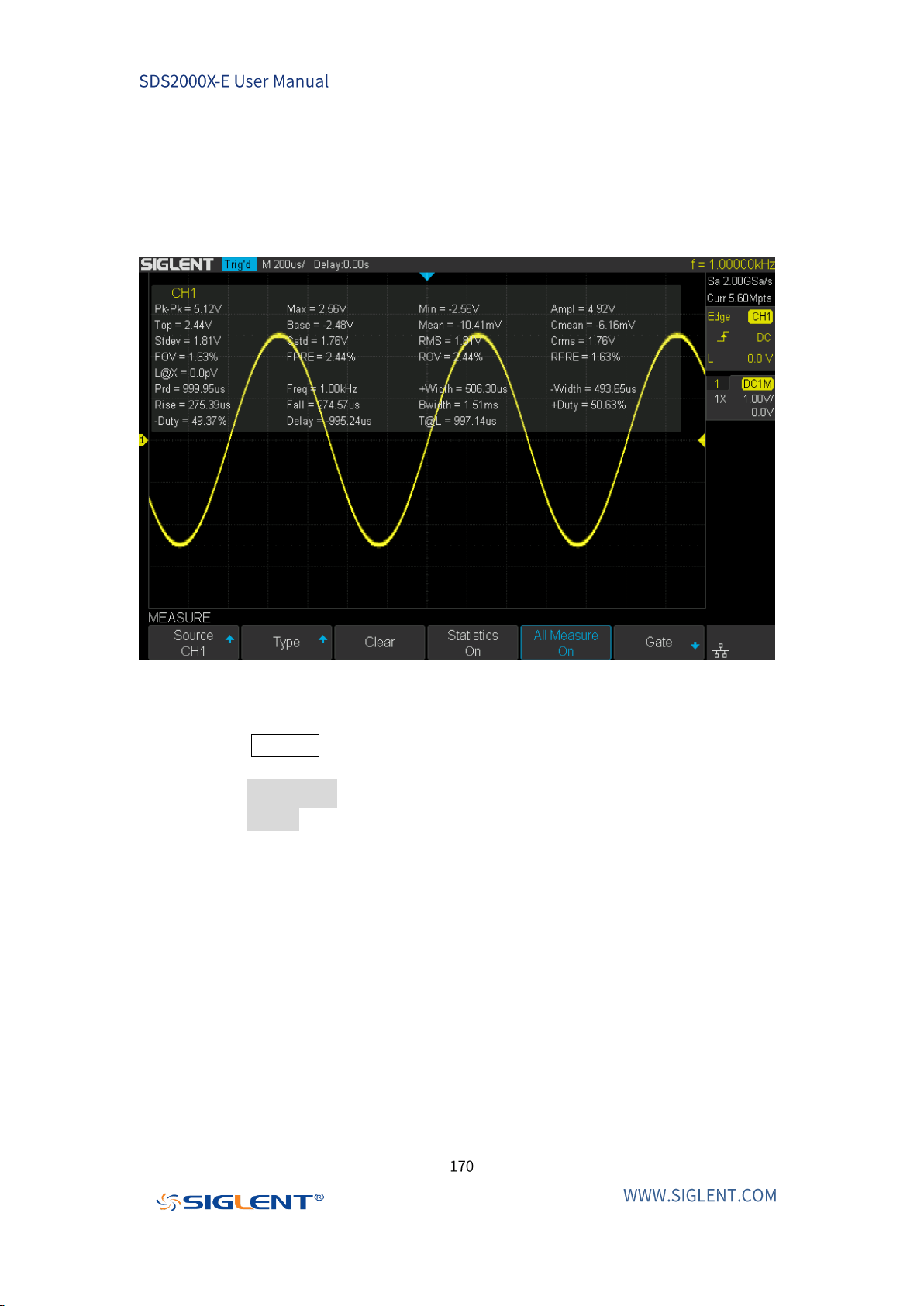
All Measurement
All measurement could measure all the voltage, time and delay parameters of the
current measurement source and display the results on the screen.
Figure 86 All Parameters Measurement
Do the following steps to make all parameters measurement.
1. Press the Measure button on the front panel to enter the MEASURE function
menu.
2. Press the All Measure softkey to select On.
3. Press the Source softkey to select the measure source.
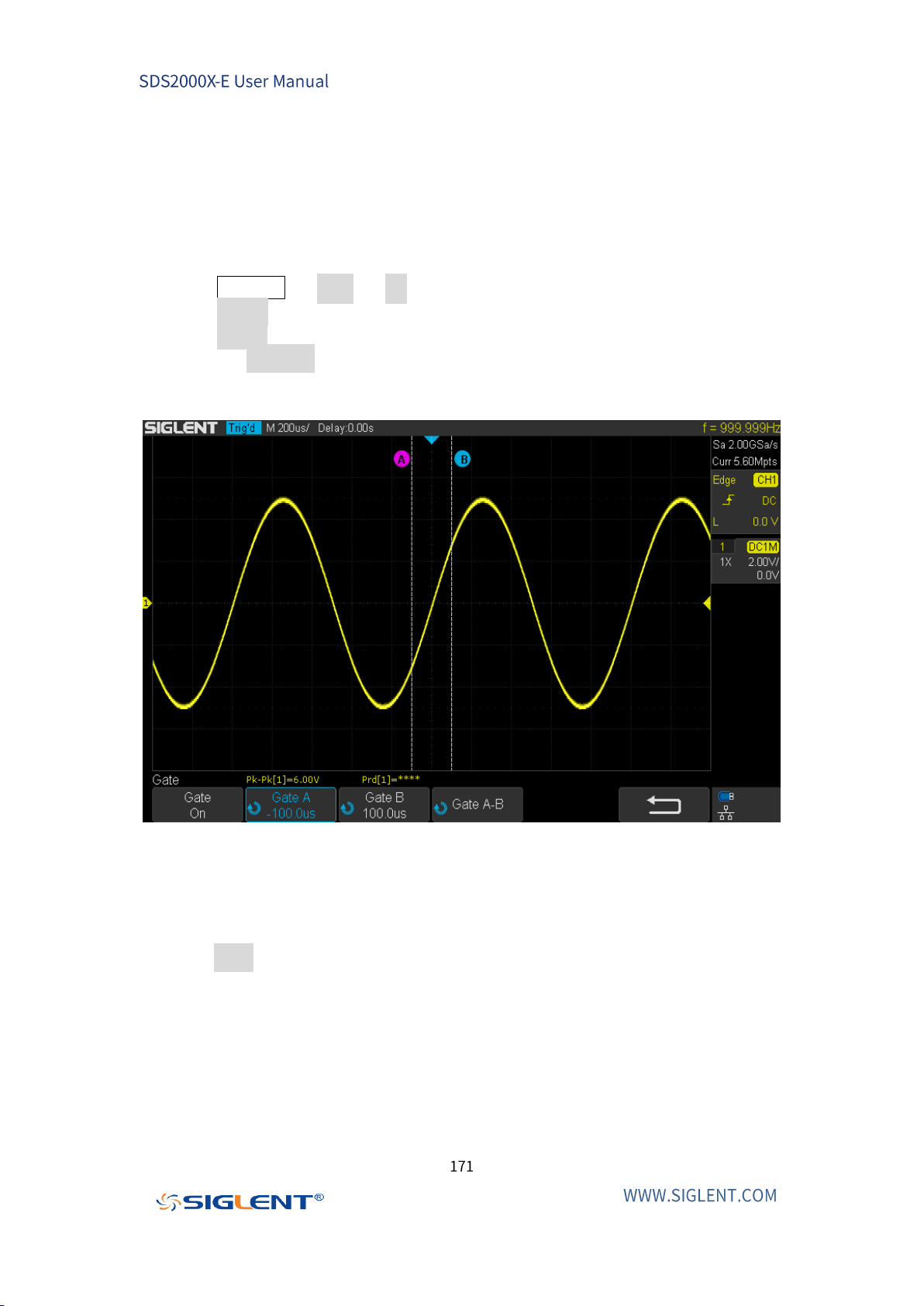
Gate Measurement
The SDS2000X-E supports gated measurements and performs the selected
measurement within the upper and lower limits of the gate. Setting the gate will
affect the measurement of all voltage, time, and delay parameters.
1. Press Measure → Gate → On to open the gate measurement.
2. Press Gate A to move the position of gate A by the Universal Knob.
3. Press Gate B to move the position of gate B by the Universal Knob.
4. Press the Gate A-B to move the positions of the gate A and B simultaneously by
the Universal Knob.
Figure 87 Gate measurement
Clear Measurement Parameters
Press the Clear softkey to clear all the measurement parameters that are displaying
on the screen.
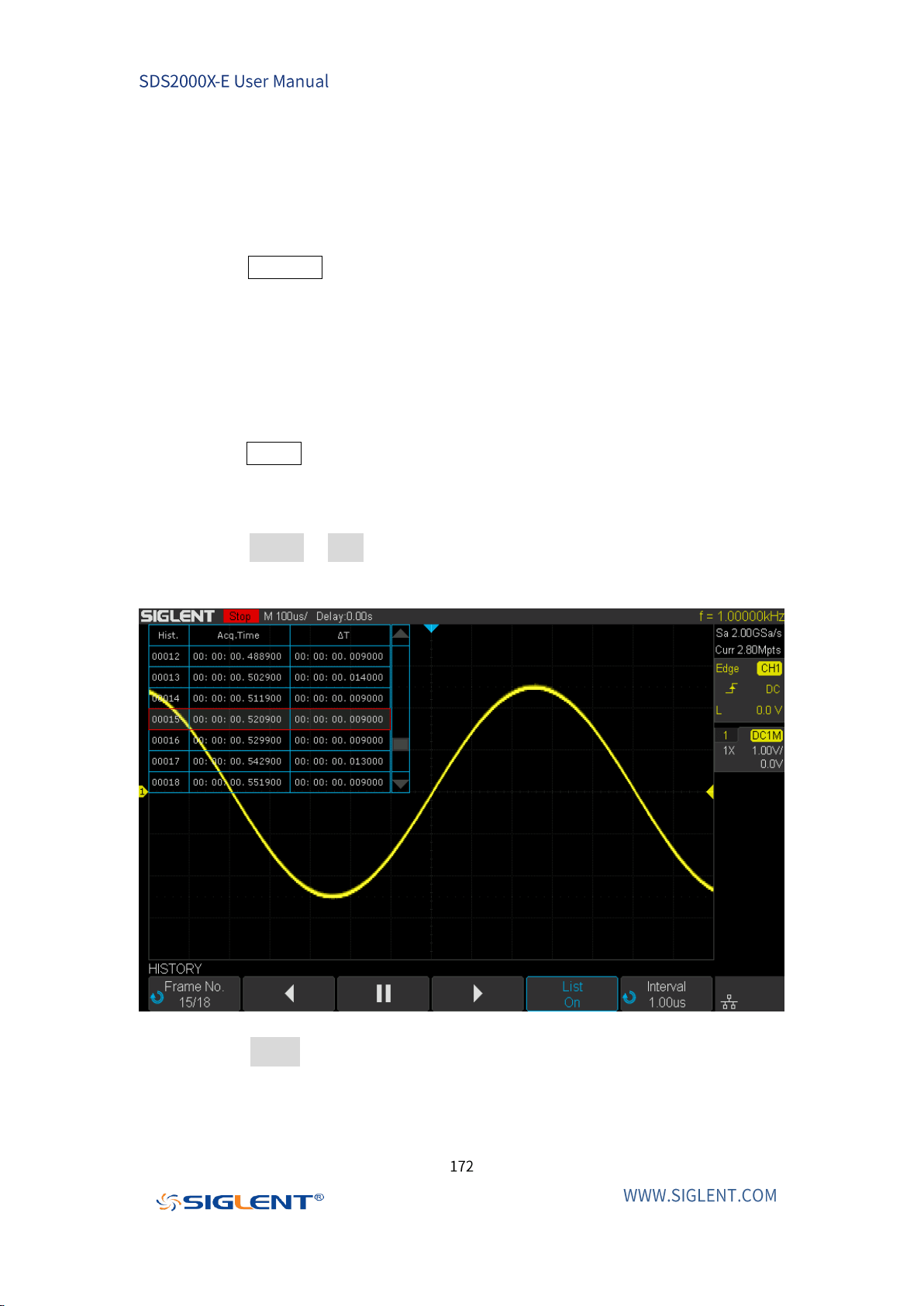
History
The history function can record the waveforms of the input channels before
pressing the Run/Stop button. In the run state, the oscilloscope records input
waveforms continuously. After the memory reaches the maximum frame, the new
frames will cover the old frames. The first frames acquired are the first to be
covered.. in a circular buffer configuration.
To use the History function, the horizontal format must be set to YT.
Do the following steps to record and replay waveform:
1. Press the History button on the front panel to enable the History function.
When in the run state, the waveform will enter the stop state.
When in the stop state, and then enable the History function, the
oscilloscope will stay in the stop state.
Press History or Stop button to turn off the History function.
2. Press the List softkey to turn on or off the list display. The list records the
timestamp of every frame. It is accurate to microseconds.
Figure 88 History
3. Press the Frame softkey; then turn the Universal Knob to select the frame to
display.
The format of the Frame is A/B; A is the current frame number and B is the
maximum frame number you can set.
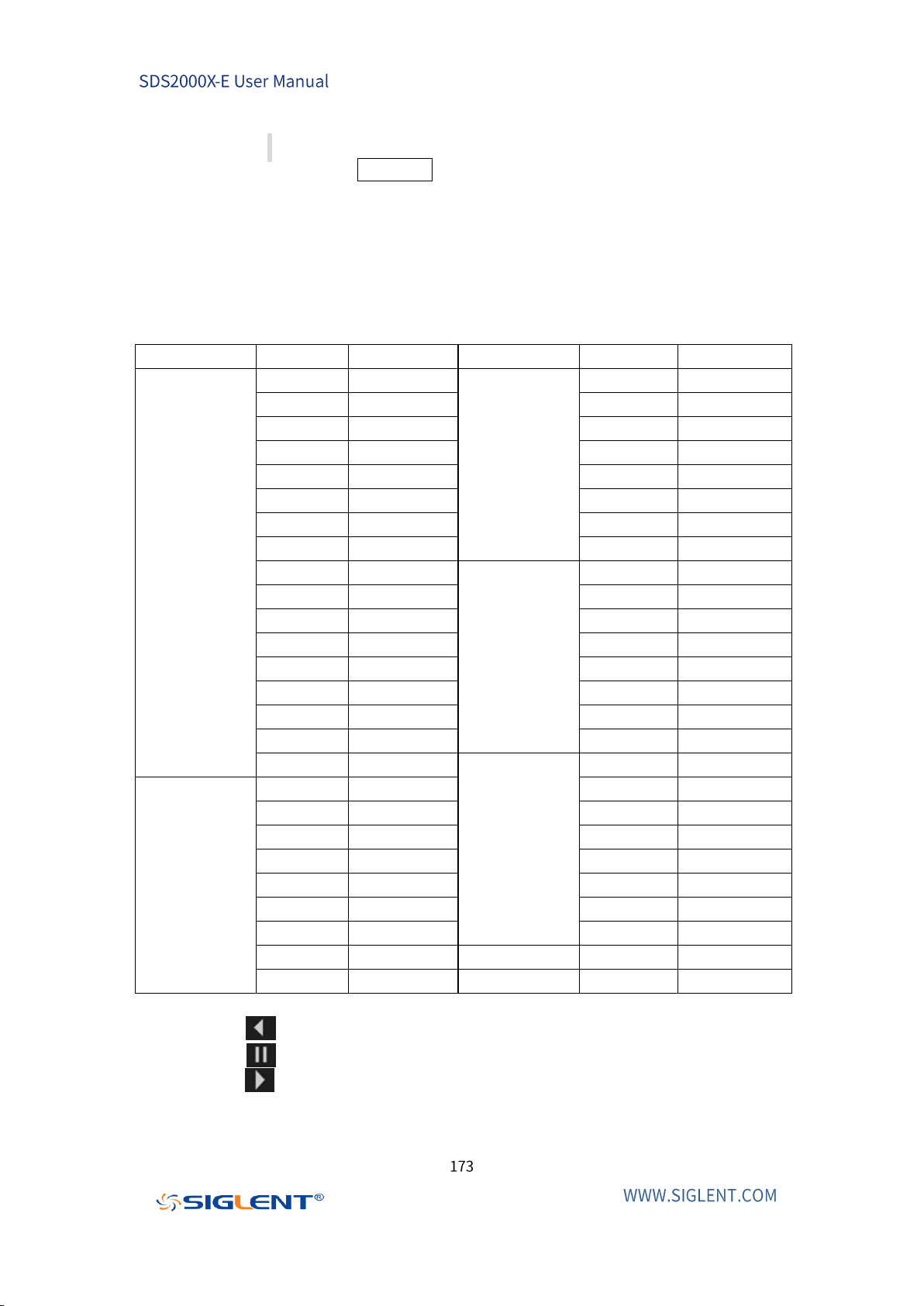
The maximum frame number is determined by the current sampling point
(Current value) and sample rate.
When pressing the Run/Stop button or enabling the history function, you
may not get the maximal frames. This is because the memory buffer has
not filled. So if you want to get the maximum frames, please wait for a
long enough time to allow the scope to collect the number of trigger
events required.
The table shows the maximal frame according to the sampling rate and current
sampling point’s number.
Sample Rate
Curr (pts)
Max. Frame
Sample Rate
Curr (pts)
Max. Frame
2 GSa/s
≦140
80000
1 GSa/s
140k
392
280
70894
280k
195
560
50710
700k
77
1.4k
29140
1.4M
38
2.8k
16943
2.8M
18
5.6k
9222
7M
6
14k
3912
14M
2
28k
1962
28M
1
56k
981
500 MSa/s
14k
3795
140k
392
35k
1519
280k
195
140k
379
560k
97
350k
151
1.4M
38
1.4M
37
2.8M
18
3.5M
14
5.6M
8
14M
2
14M
2
35M
1
28M
1
≤200 MSa/s
14k
3567
1 GSa/s
≦140
80000
28k
1785
280
70894
140k
356
700
45526
280k
177
1.4k
29140
1.4M
35
2.8k
16943
2.8M
16
7k
7574
14M
2
14k
3912
28M
1
28k
1962
70k
785
4. Press the softkey to replay the waveform from the current frame to 1.
5. Press the softkey to stop the replay.
6. Press the softkey to replay the waveform from the current frame to the
last frame.
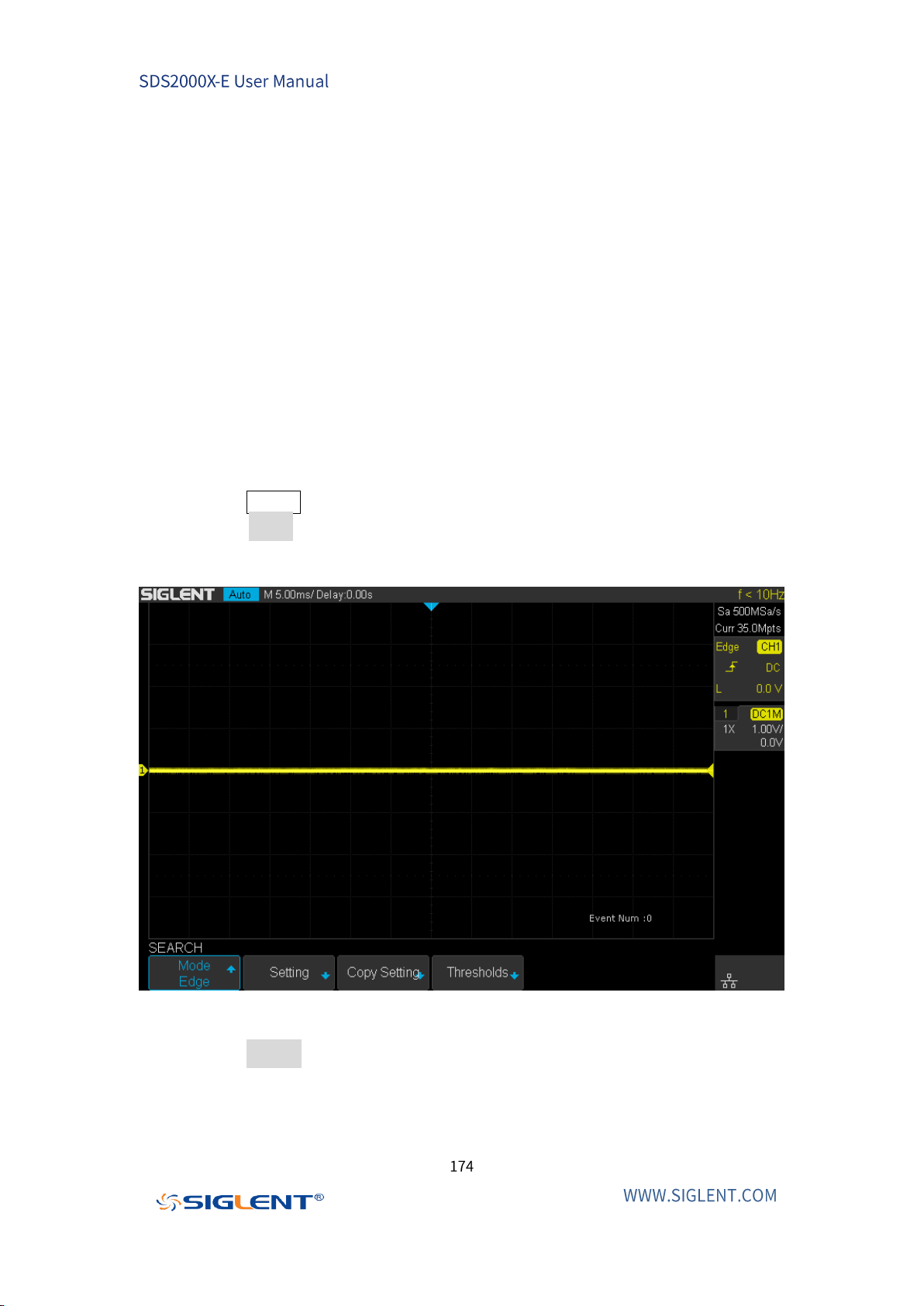
Search
SDS2000X-E provides an active search function that can search for the events that
users specify in the acquired data. This is similar to applying a “second trigger”
to the collected data set. Each event that meets this “secondary trigger” search
criteria will be displayed with white triangle symbols for easy identification. In the
YT mode or the Roll mode with the acquisition in stop, the maximum search events
number is 700. In Roll mode with active acquisition (running), the maximum search
events number is unlimited. The waveform can be zoomed when the search
function is enabled.
Setting
1. Press the Search button on the front panel to enter the SEARCH function menu
2. Press the Mode softkey and then use the Universal Knob to select the desired
search type. SDS2000X-E provides five search types: Edge, Slope, Pulse,
Interval, and Runt.
Figure 89 Search Menu
3. Press the Setting softkey to enter the SETTING function menu. The setting menu
is different according to every search type. The details are shown in the
following table.
Search Mode
Setting Menu Description
Edge
Slope includes Rising, Falling, Either.
Slope
Slope includes Rising, Falling
Limit Range includes four types: <=, >=, [--,--] and --][-- . Users
can select the desired type and then input the time value.
Pulse
Polarity includes Positive and Negative
Limit Range includes four types: <=, >=, [--,--] and --][-- . Users
can select the desired type and then input the time value.
Interval
Slope includes Rising, Falling
Limit Range includes four types: <=, >=, [--,--] and --][-- . Users
can select the desired type and then input the time value.
Runt
Polarity includes Positive and Negative
Limit Range includes four types: <=, >=, [--,--] and --][-- . Users
can select the desired type and then input the time value
4. Press Copy softkey to enter COPY function menu.
Copy from Trig : Copy the trigger setup for the selected search type to the
search setup
Copy to Trig: Copy the setup for the selected search type to the same
trigger type
Cancel Copy: Undo a copy
5. Press Thresholds softkey to enter THRESHOLDS function menu, and then to set
channel search thresholds.
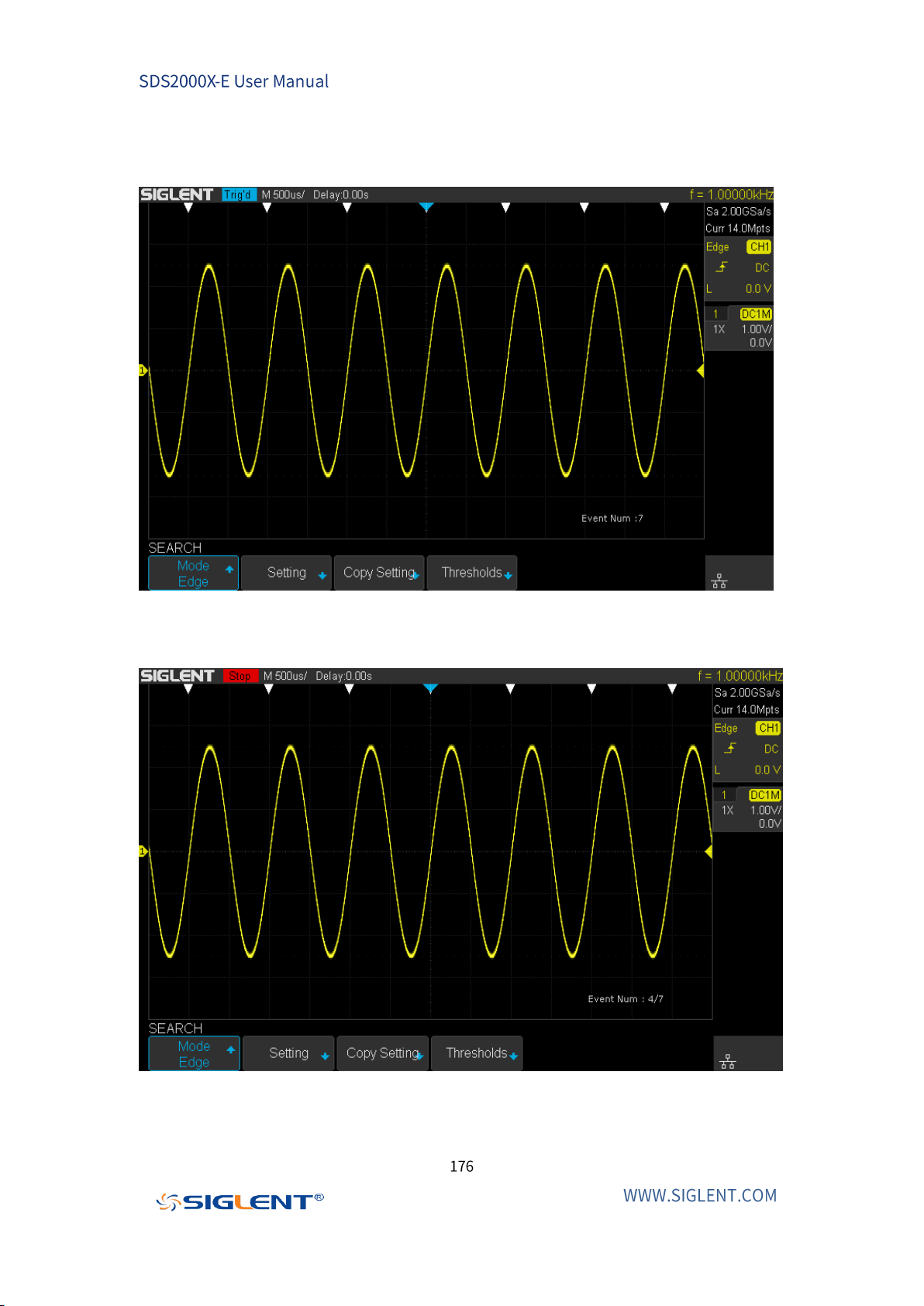
Results
Figure 90 Search In Run
When the acquisition is started, “Event Num:7” means the total number of
events.
Figure 91 Search In Stop
When the acquisition is stop,” Event Num:4/7” indicates the current event
number/total events number. The current event is the closest event to the middle of

the screen.
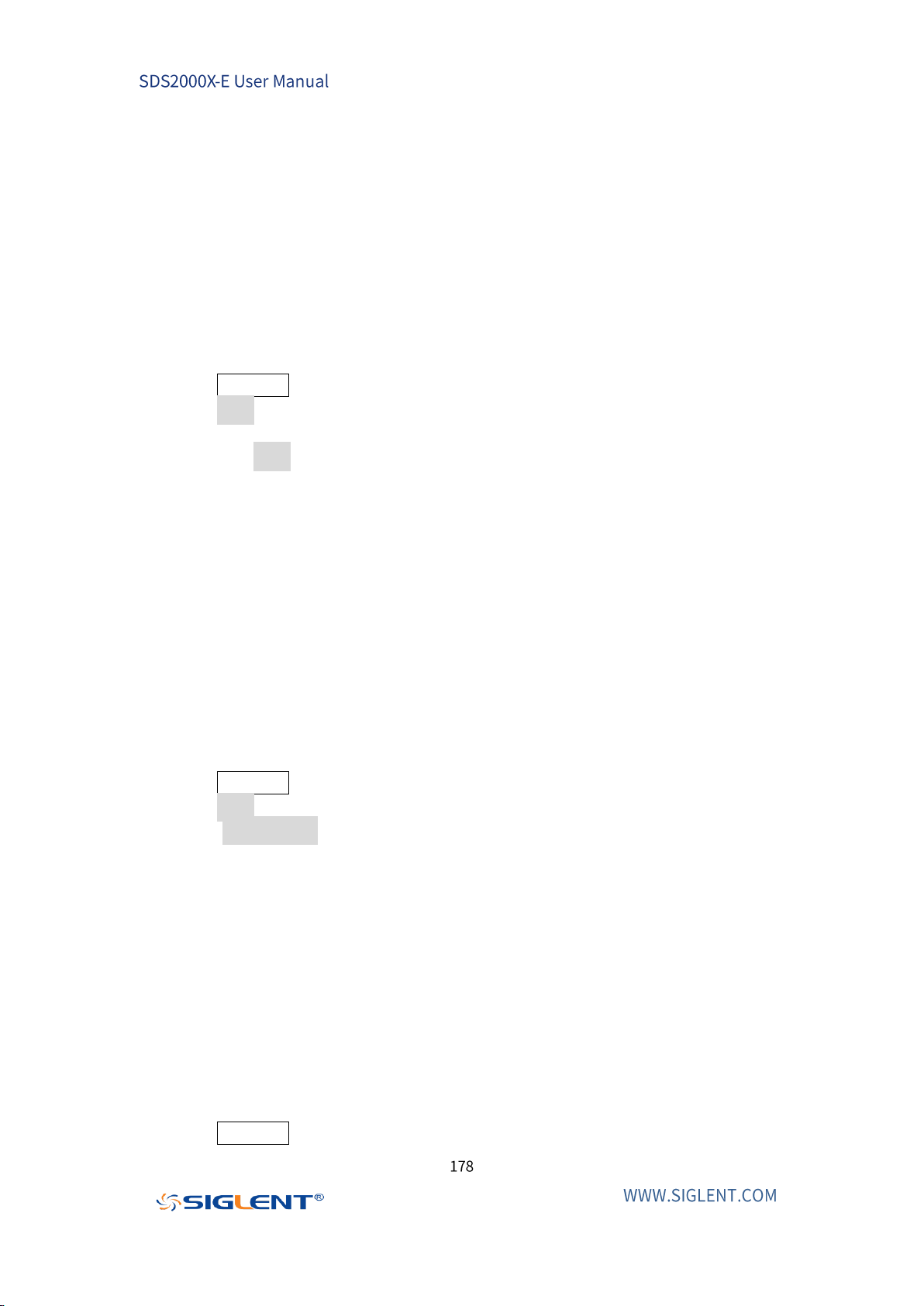
Navigate
SDS2000X-E provides three navigation type: Search Event, Time, and History
Frame.
Time Navigate
1. Press Navigate on the front panel to enter the NAVIGATE function menu.
2. Press Type softkey In the NAVIGATE function menu, then, select Time.
3. There are two ways to navigate time.
a. Press Time softkey, then, turn the Universal Knob to select the desired
value or press the Universal Knob then enter the value by the pop-up
keyboard.
b. Press the navigation keys ◀ ■◀ on the front panel to play backward,
stop, or play forward in time. You can press the ◀ or ◀ keys multiple
times to speed up the playback. There are three speed levels: Low,
Medium, and High Speed.
History Frame Navigate
When the History function is enabled, you can use the navigation controls to play
through the acquired frames.
1. Press Navigate on the front panel to enter the NAVIGATE function menu.
2. Press Type In the Navigate Menu, then,select History Frame.
3. Press Frame Num softekey; then, there are two ways to navigate history
frames.
a. Turn the Universal Knob to select the desired number or press the
Universal Knob then enter the number by the pop-up keyboard.
b. Press the navigation keys ◀ ■◀ on the front panel to play backward,
stop, or play forward.
Search Event Navigate
When the Search function is enabled and acquisitions are stopped, you can use the
navigation controls to go through search events.
1. Press Navigate on the front panel to enter the NAVIGATE function menu..

2. Press Type in the NAVIGATE function menu; then, select Search Event.
3. There are two ways to navigate search events.
a. Press Event Num softekey, then, turn the Universal Knob to select the
desired value or press the Universal Knob then enter the value by the
pop-up keyboard.
b. Press the navigation keys ◀ ◀ on the front panel to go to the previous or
next search event.

Display
You can set the display type, color, persistence, grid type, waveform intensity, grid
brightness and transparence.
The contents of this chapter:
Display Type
Color Display
Persistence
Clear the Display
Grid Type
Intensity
Grid Brightness
Transparence
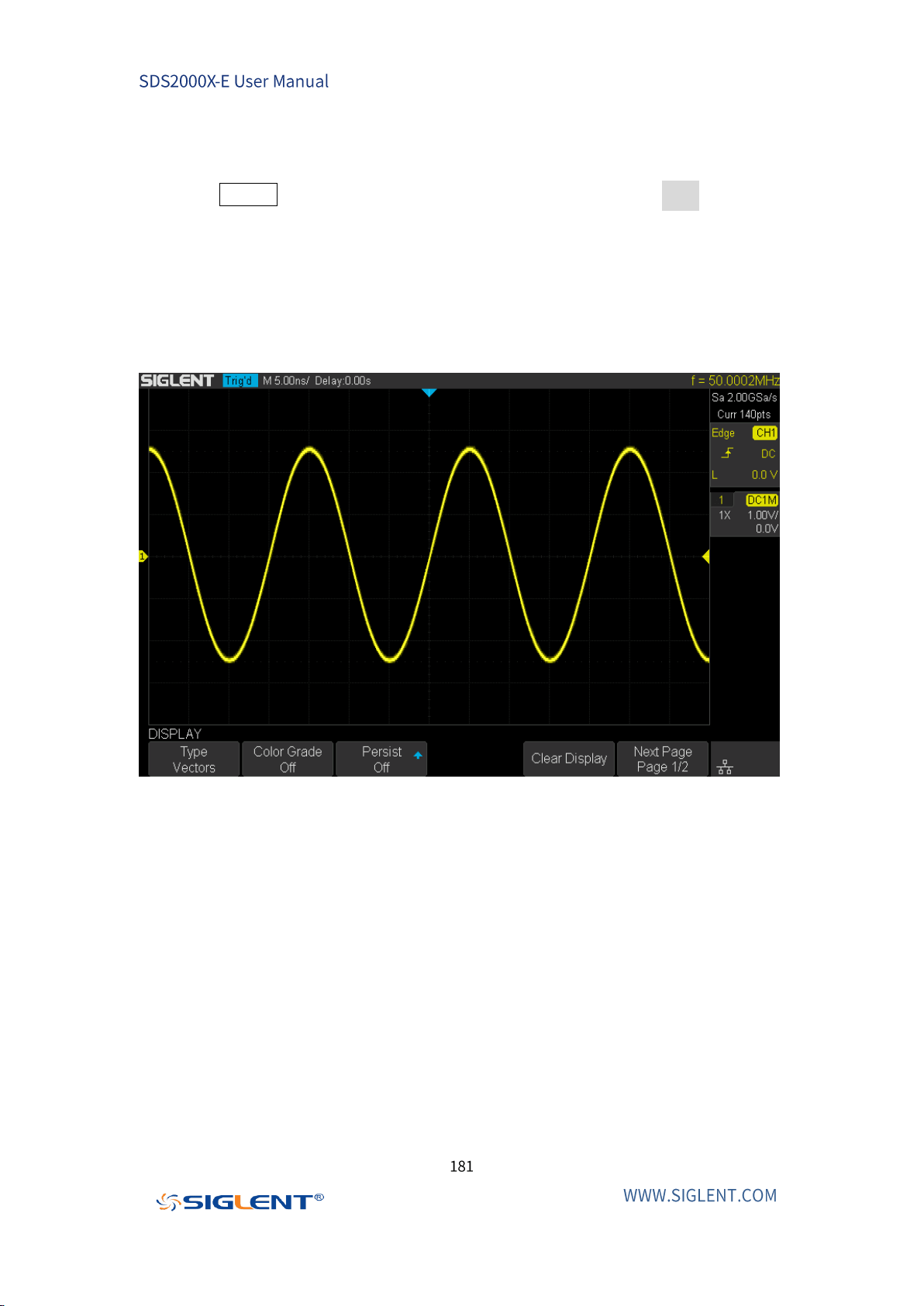
Display Type
Press the Display button on the front panel, and then press the Type softkey to
select Vectors or Dots display type.
Vectors: The sample points are connected by lines and displayed. Normally,
this mode can provide the most vivid waveform to view the steep edge of the
waveform (such as Sine waveform).
Dots: Display the sample points directly with no point interpolation/lines
drawn. You can directly view each sample point and use the cursor to measure
the X and Y values of the sample point.
Figure 92 Vectors Display
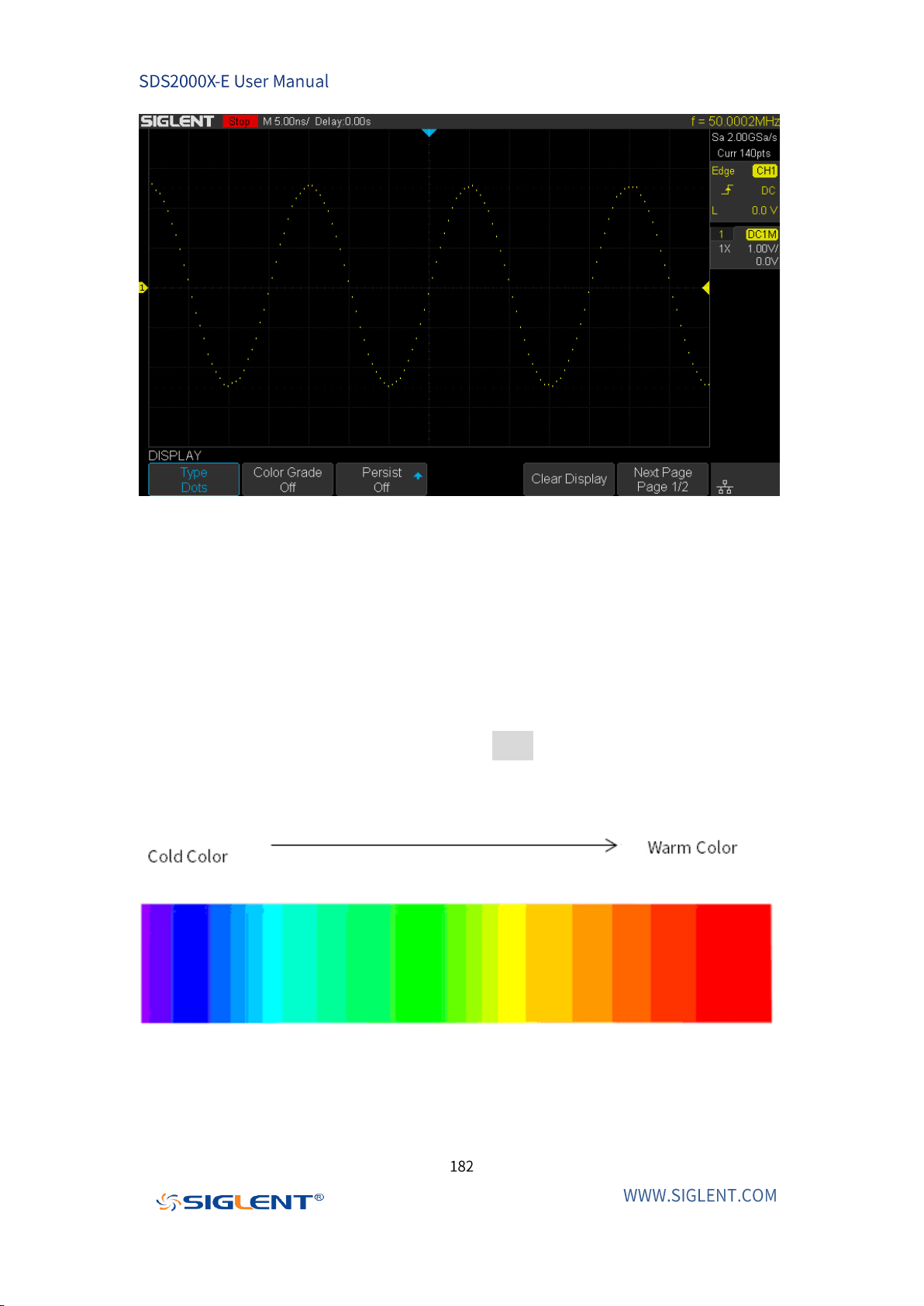
Figure 93 Dots Display
Color Display
The SIGLENT color temperature display assigns the color temperature to the
frequency of occurence for a waveform. The greater the frequency of occurrence,
the warmer the color is (red). If the frequency of occurrence is low, the colder the
color is (blue/violet).
The picture below shows the change of color from cold to warm. Press the Display
button on the front panel, and then press the Color softkey and set the option to On
to turn on the color temperature function. You can compare the waveform’s color
with the picture below to just the probability that the waveform appears.
Figure 94 Color Temperature
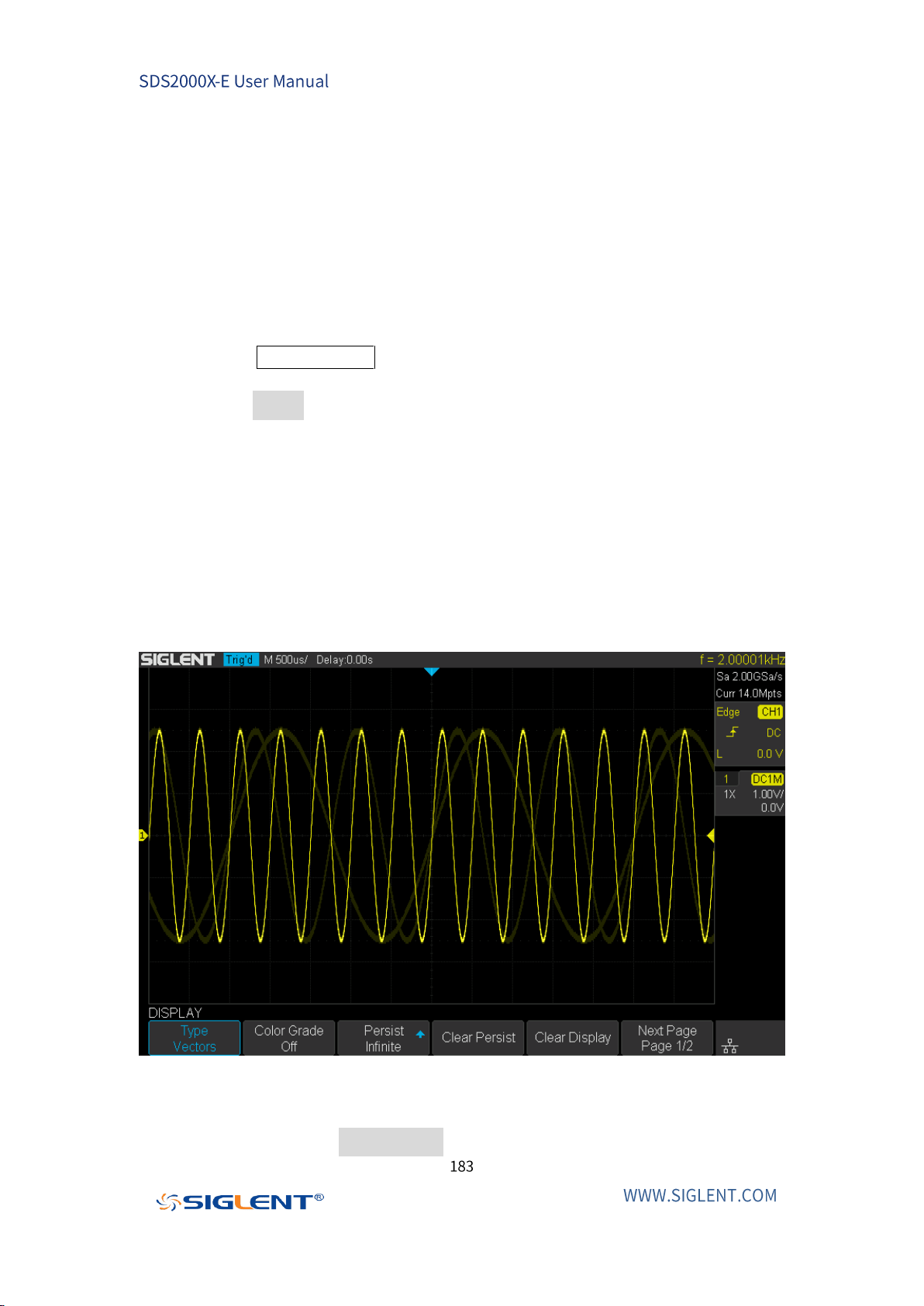
Persistence
With persistence, the oscilloscope updates the display with new acquisitions, but
does not immediately erase the results of previous acquisitions. All previous
acquisitions are displayed with reduced intensity. New acquisitions are shown in
their normal color with normal intensity.
Do the following steps to set and clear persistence:
1. Press the Display/Persist button on the front panel to enter the DISPLAY
function menu.
2. Press the Persist softkey; then turn the Universal Knob to select the desires
option.
Off —Turn of persistence.
Variable persistence time (1, 5, 10, and 30 seconds ) — Select different
persistence time, the results of previous acquisitions are erased after a
certain amount of time.
Infinite — Select “Infinite” results of previous acquisitions are never
erased. Use infinite persistence to measure noise and jitter, to see the
worst- case extremes of varying waveforms, to look for timing violations,
or to capture events that occur infrequently.
Figure 95 Persist Set to Infinite
3. When the Persist is On, to erase the results of previous acquisitions from the
display, press the Clear Persist softkey. The oscilloscope will start to
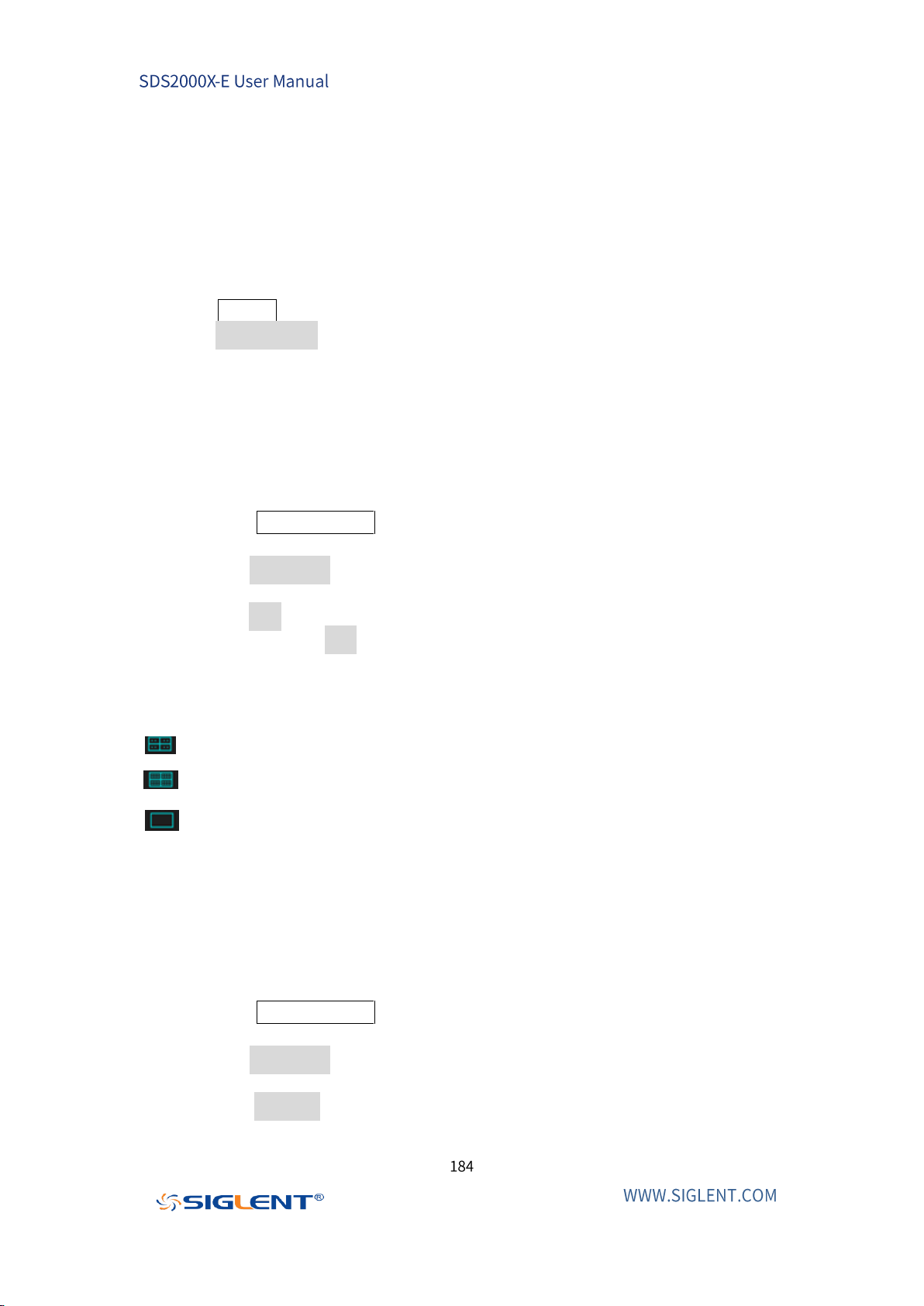
accumulate acquisitions again.
4. To return to the normal display mode, turn off persist and the previous
acquisitions will be clear at once.
Clear the Display
Press the Display button on the front panel to enter the DISPLAY function menu;
press the Clear Display softkey to clear all the waveforms displaying on the screen
and acquire and display new waveforms.
Grid Type
To select grid type
1. Press the Display/Persist button on the front panel to enter the DISPLAY
function menu.
2. Press the Next Page softkey to go to the second page of the Display function
menu.
3. Press the Grid softkey; and then turn the Universal Knob to select the desired
grid type. Press the Grid softkey continually can also select the grid type.
There are 3 kinds of grid types that are available. Select the grid type according to
your really demand.
Display 14X8 grid type
Display 2X2 grid type
Display without grid
Intensity
Do the following steps to adjust waveform intensity:
1. Press the Display/Persist button on the front panel to enter the DISPLAY
function menu.
2. Press the Next Page softkey to go to the second page of the Display function
menu.
3. Press the Intensity softkey; and then turn the Universal Knob to select the
desired value. The default value is 50%, and the range is from 0% to 100%.
Increasing the intensity lets you see the maximum amount of noise and
infrequently occurring events. Reducing the intensity can expose more detail in
complex signals as shown in the following figures.
Grid Brightness
Do the following steps to adjust the grid brightness:
1. Press the Display button on the front panel to enter the DISPLAY function
menu.
2. Press the Next Page softkey to go to the second page of the Display function
menu.
3. Press the Graticule softkey; and then turn the Universal Knob to select the
desired value. The default value is 40%, and the range is from 0% to 100%.
Transparence
Transparence can be used to adjust the transparency value of the message box
that outlines cursor, measure, Pass/Fail and all pop-up menus to an appropriate
value to observe the data more conveniently.
Under Cursor or Measure or any other menu operation, if want to change the
transparency of the message box, do the following steps:
1. Press the Display button on the front panel to enter the DISPLAY function
menu.
2. Press the Next Page softkey to go to the second page of the Display function
menu.
3. Press the Transparence softkey; and then turn the Universal Knob to select the
desired value. The default value is 80%, and the range is from 20% to 80%.


Save and Recall
Oscilloscope setups, waveforms, pictures, and CSV files can be saved to internal
oscilloscope memory or to a USB storage device. The saved setups, waveforms can
be recalled later. The oscilloscope provides an USB Host interface on the front
panel to connect an USB device for external storage.
The contents of this chapter
Save Type
Internal Save and Recall
External Save and Recall
Disk Management

Save Type
The oscilloscope supports setups, waveforms, pictures and CSV files storage. The
default save type is setups.
1. Setups
The default storage type of the oscilloscope. Setups store the settings of the
oscilloscope in internal or external memory. Setup files terminate with “*.set” file
extension. At most 20 setting files (from No.1~No.20) can be stored to internal
memory. The stored settings can be recalled.
2. Reference
The oscilloscope saves the waveform data in external memory with the “*.ref” file
extension. The data of the channel is you select channel. At recall, the data will be
displayed on the screen by REFA or REFB.
3. BMP
The oscilloscope saves the screen image in external memory with the “*.bmp” file
extension. You can specify the file name and saving directory under the same
directory using the same file name. The recall of images is not supported.
4. JPG
The oscilloscope saves the screen image in external memory with the “*.jpg” file
extension. You can specify the file name and saving directory under the same
directory using the same file name. The recall of images is not supported.
5. PNG
The oscilloscope saves the screen image in external memory with the “*.png” file
extension. You can specify the file name and saving directory under the same
directory using the same file name. The recall of image is not supported.
6. Binary
The oscilloscope saves the waveform data in external memory with the “*.bin”
file extension. The data of all the channels turned on can be saved in the same file.
The recall of binary is not supported.
7. CSV
The oscilloscope saves the waveform data in external memory with the “*.csv”
file extension. The stored files contain the waveform data of the displayed analog
channels and the main setting information of the oscilloscope. The recall of CSV
files is not supported.
Set the save type to CSV, and set the Para Save option to On or Off to turn on or of

the parameters storage function.
8. Matlab
The oscilloscope saves the waveform data in external memory with the “*.dat”
file extension. The data of all the channels turned on can be saved in the same file.
The recall of Matlab file is not supported.
9. To Default Key
The oscilloscope saves the factory config and user set config. You can select the
default function as the factory config or user set config.
Internal Save and Recall
Internal save and recall support Setups in Save/Recall. In the following part, the
save and recall method and procedures are introduced.
Save the specified oscilloscope setting in internal memory.
1. Connect the signal to the oscilloscope and obtain a stable display.
2. Press Save/Recall button on the front panel to enter the SAVE/RECALL
function menu.
3. Press Save softkey to enter the SAVE function menu.
4. Press the Type softkey and then turn the Universal Knob to select Setups;
and then press the knob to confirm.
5. Press the Save To softkey to select Internal to save the current setup of the
oscilloscope to the internal memory.
6. Press the Setup softkey button; and then turn the Universal Knob to select
the location to save. The internal memory can save as many as 20 setup
files, from No.1~No.20.
7. Press the Press To Save softkey to save the current setup to the appointed
location. After a few seconds, it will pop-up the message “Saved to
internal file NO.1!”
Load the specified type of file in internal memory.
If want to recall the setup after having finished the steps above, please do the
following steps:
1. Press Recall softkey enter the RECALLING function menu.
2. Press Type softkey and then turn the Universal Knob to select Setups; and
then press the knob to confirm.
3. Press the Recall from softkey to select Internal.
4. Press Setup softkey button; and then turn the Universal Knob to select the
location to recall. The internal memory can recall as many as 20 setup files,
from No.1~No.20.
5. Press the Press To Recall softkey to recall the current setup form the
appointed location. After a few seconds, it will pop-up the message
“Recalled file successfully!”
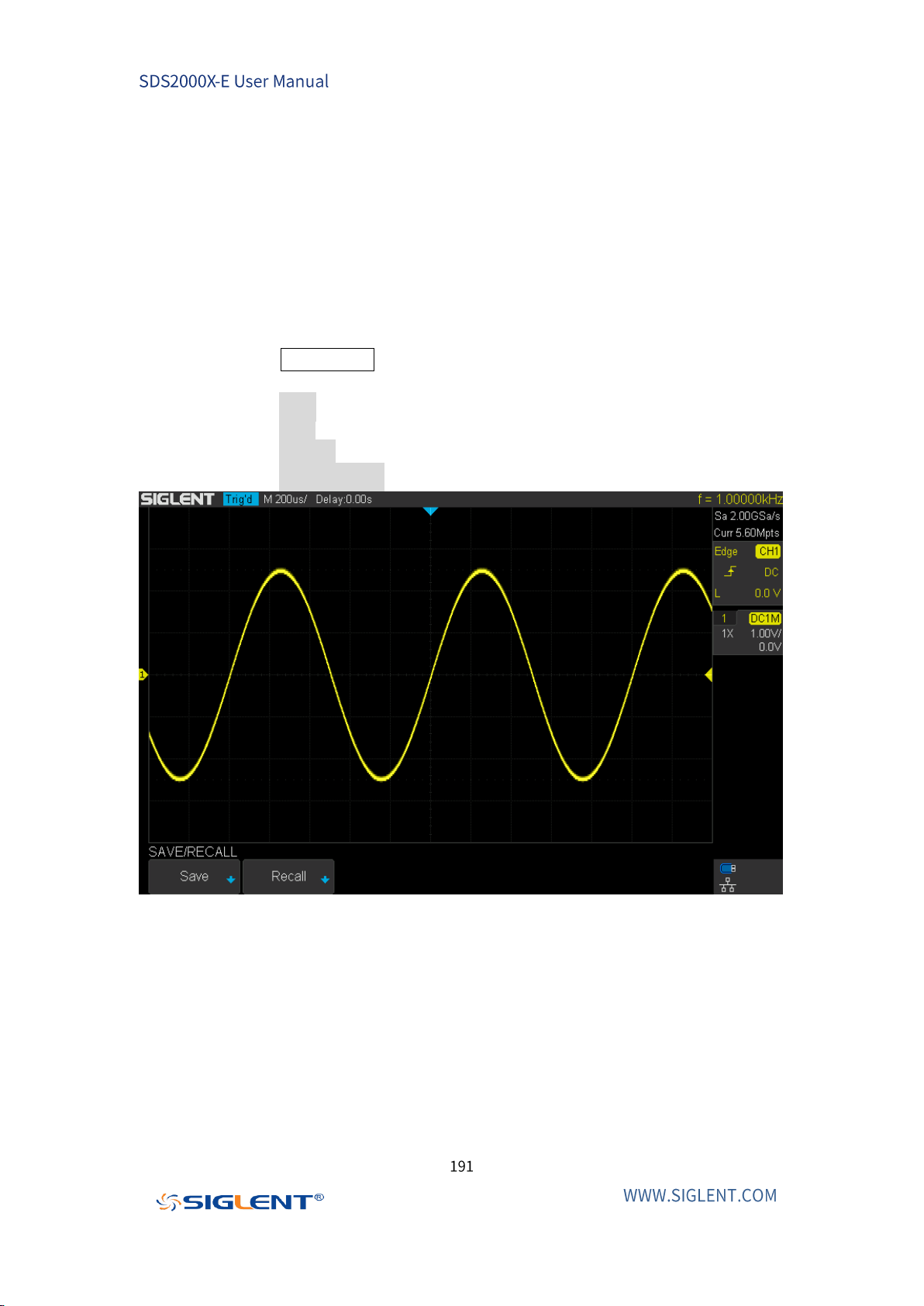
External Save and Recall
Before using external storage and recall, make sure that the USB flash device is
connected correctly. External storage supports all the types of files in save, but only
support settings and reference waveform recall.
Save the specified type of file in the external USB flash device.
1. Press the Save/Recall button on the front panel to enter the SAVE/RECALL
function menu.
2. Press the Save softkey to enter the SAVE menu.
3. Press the Type softkey to select Setup and then press the knob to confirm.
4. Press the Save to softkey to select External.
5. Press the Press To Save softkey to enter the SAVE/RECALL file system.
Figure 96 SAVE/RECALL Fail System
6. Use the Universal Knob to select the desired location. File can be stored
under the root directory or in a certain folder under the root directory of
the USB storage device.
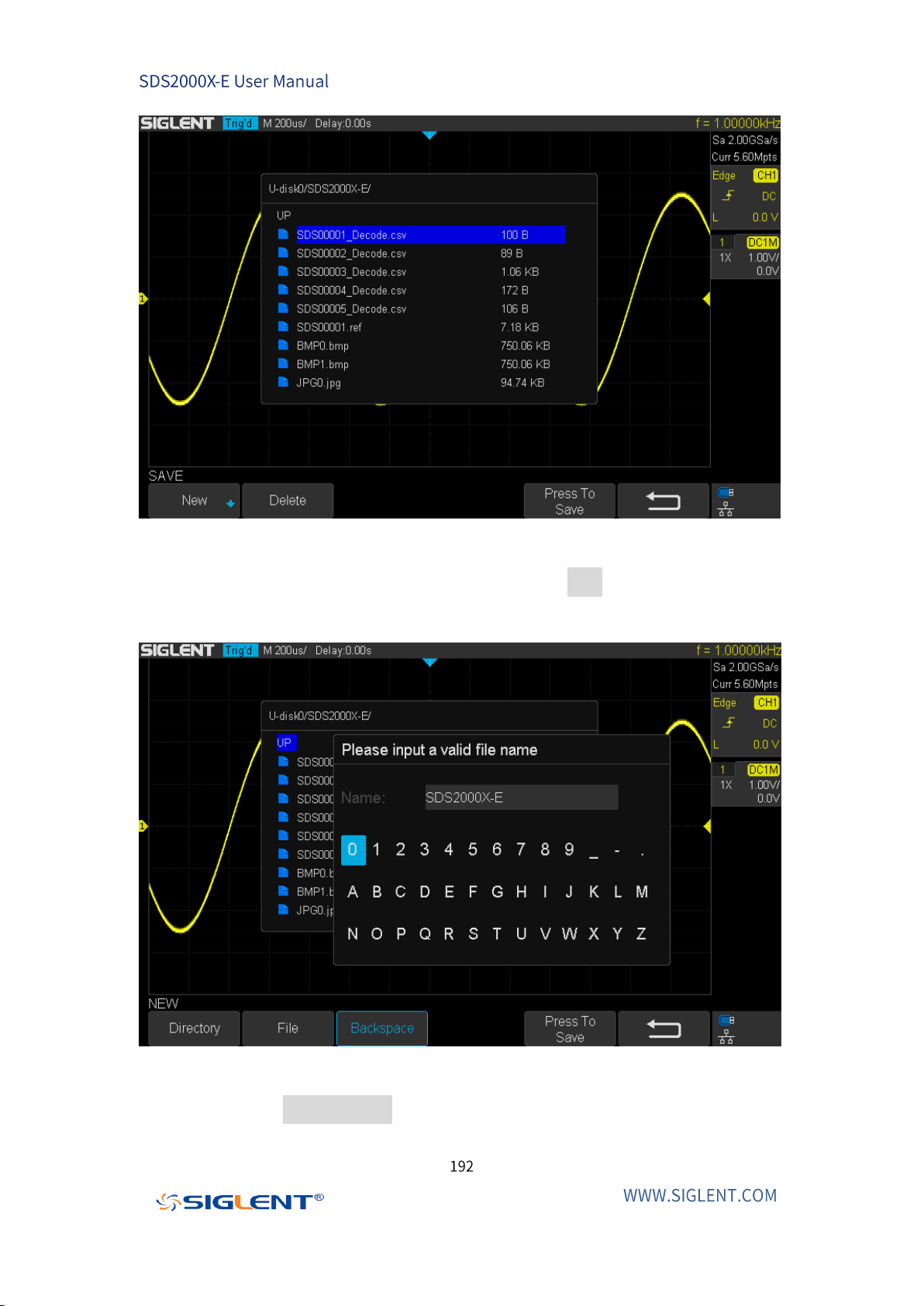
Figure 97 Select Save Location
7. After the save position is selected, press the New softkey to turn on the
interface as shown in the figure below. Refer to the descriptions in “To
Create a new file or folder” to create a new file name.
Figure 98 File Name Dialogue
8. Press the Press To Save softkey to save the current setup to the external
USB storage device.
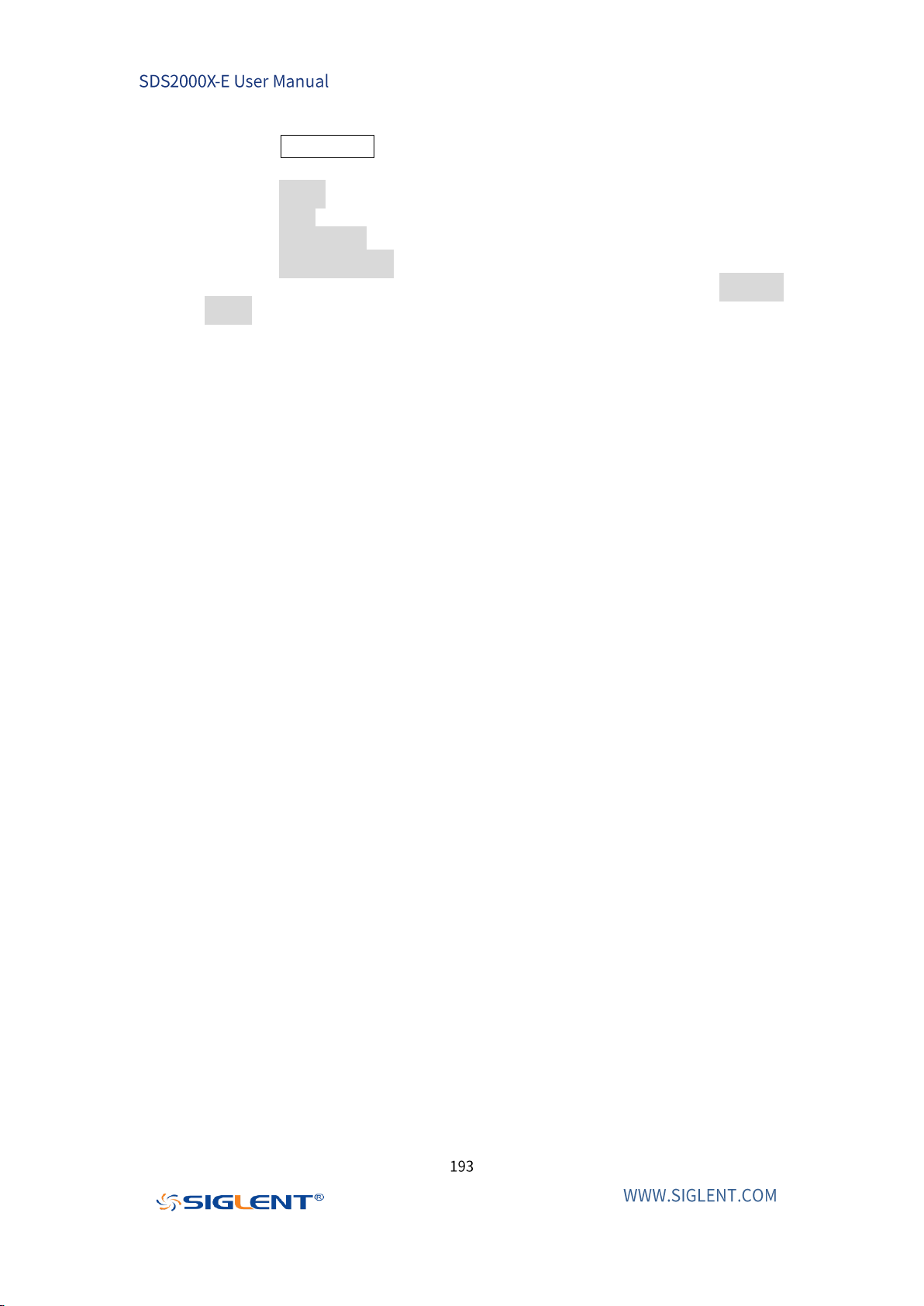
Load the specified type of file in the external USB storage device.
1. Press the Save/Recall button on the front panel to enter the SAVE/RECALL
function menu.
2. Press the Recall softkey to enter the RECALL menu.
3. Press the Type softkey to select Setup or Waveform.
4. Press the Recall from softkey to select External.
5. Press the Press To Recall softkey to enter the SAVE/RECALL file system.
6. Turn the Universal Knob to select the file to be recalled, press the Press To
Recall softkey to recall the waveform or setup.

Disk Management
Disk management aims at the save and recall operations after the oscilloscope is
connected with a USB storage device. Before using an external disk, make sure that
the USB storage device is connected correctly.
Execute the following operations through the disk management menu:
Create a New File or Folder
Delete a File or Folder
Rename a File or Folder
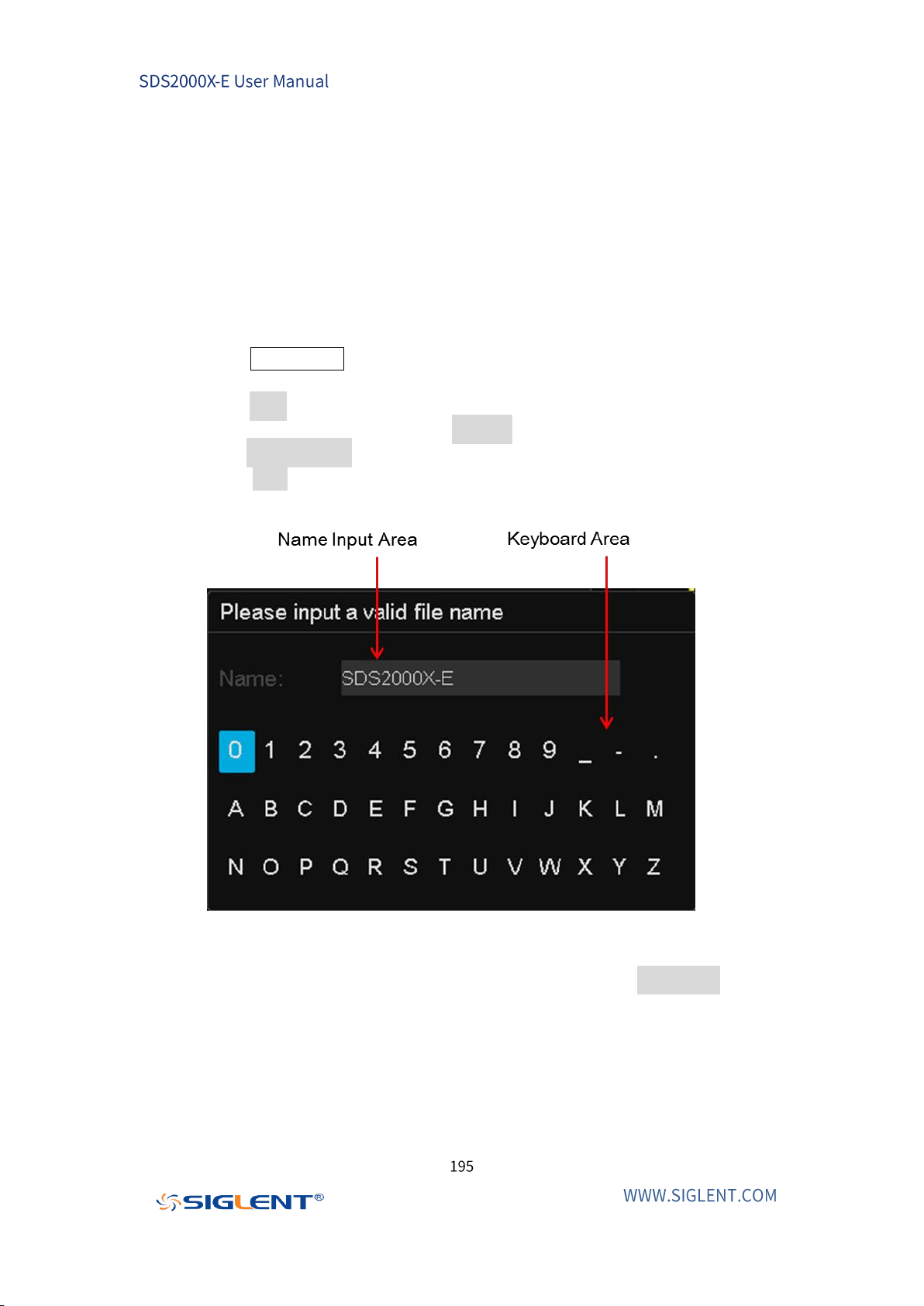
Create a New File or Folder
This operation is only valid in external storage. The oscilloscope supports English
as the input language. The file name or folder name can contain letters, numbers,
underscores and spaces. Let’s use an example to introduce how to create a file or
folder.
Example: create a file or folder named “SDS2000X-E”:
1. Press the Save/Recall button on the front to enter the SAVE/RECALL function
menu.
2. Press the Save softkey, and then turn the Universal Knob to select one of the
type (if select Setups, please set the Save To option to External).
3. Press the Press To Save softkey to enter the SAVE/RECAL file system.
4. Press the New softkey to open the interface shown as the picture below. It
divides into two parts: name input area and keyboard area.
Figure 99 Input Keyboard
5. To delete the name in the name input area, press the Backspace softkey
continuously to delete the character one by one.
Delete a File or Folder
This operation is only valid in external storage.
1. Press the Save/Recall button on the front to enter the SAVE/RECALL function
menu.
2. Press the Save softkey, and then turn the Universal Knob to select one of the
type (if select Setups, please set the Save To option to External).
3. Press the Press To Save or Press To Recall softkey to enter the SAVE/RECAL file
system.
4. Turn the Universal Knob to select the file or folder to be deleted, and then press
the Delete softkey. Then the file or folder will be deleted.
Rename a File or Folder
This operation is only valid with external storage (U disk storage), and only files of
the corresponding type format can be renamed.
1. Press the Save/Recall button on the front to enter the SAVE/RECALL function
menu.
2. Press the Save softkey, and then turn the Universal Knob to select one of the
type (if select Setups, please set the Save To option to External).
3. Press the Press To Save or Press To Recall softkey to enter the SAVE/RECAL file
system.
4. Turn the Universal Knob to select the file or folder to be rename, and then
press the Rename softkey. For details, see the instructions in "Create a New File
or Folder."

Digital Channels (Option)
This chapter describes how to use the digital channels of the scope as a
Mixed-Single Oscilloscope (MSO).
To perform MSO operations, the oscilloscope must have the digital channels
enabled (Part number SDS2000X-E-16LA) and the external module (Part number
SLA1016).
This chapter contains the following items:
Connect the Digital Probes
Acquire Digital Waveform
Digital Channels Height
Digital Channels Position
Single Digital Channel
All Digital Channels
Logic Threshold
Digital Bus
Deskew
System Setting
Remove Device
’
Connect the Digital Probes
1. If necessary, turn off the power supply to the device-under-test.
Turning off the power to the device-under-test prevents damage that
might occur if you accidentally short lines together while connecting
probes. You can leave the oscilloscope powered on because no voltage
appears at the probes.
2. Connect one of the digital probe cable ports to the digital channels connector
on the front panel of the SDS2000X-E, and the other one to the digital channels
connector of the digital probe.
The digital probe cable is keyed so you can connect it only one way. You
do not need to power-off the oscilloscope to insert the probe.
3. Connect a fly line to one of the digital probe ground pins, connect a grabber to
the fly line, and then connect the grabber to a ground trace/pin from the
device-under-test. The ground lead improves signal fidelity to the oscilloscope,
ensuring accurate measurements.
4. Connect a fly line to one of the digital probe digital channel pins; connect a
grabber to the fly line, and then connect the grabber to a node in the circuit you
want to test.
5. Repeat step 4 until you have connected all points of interest.
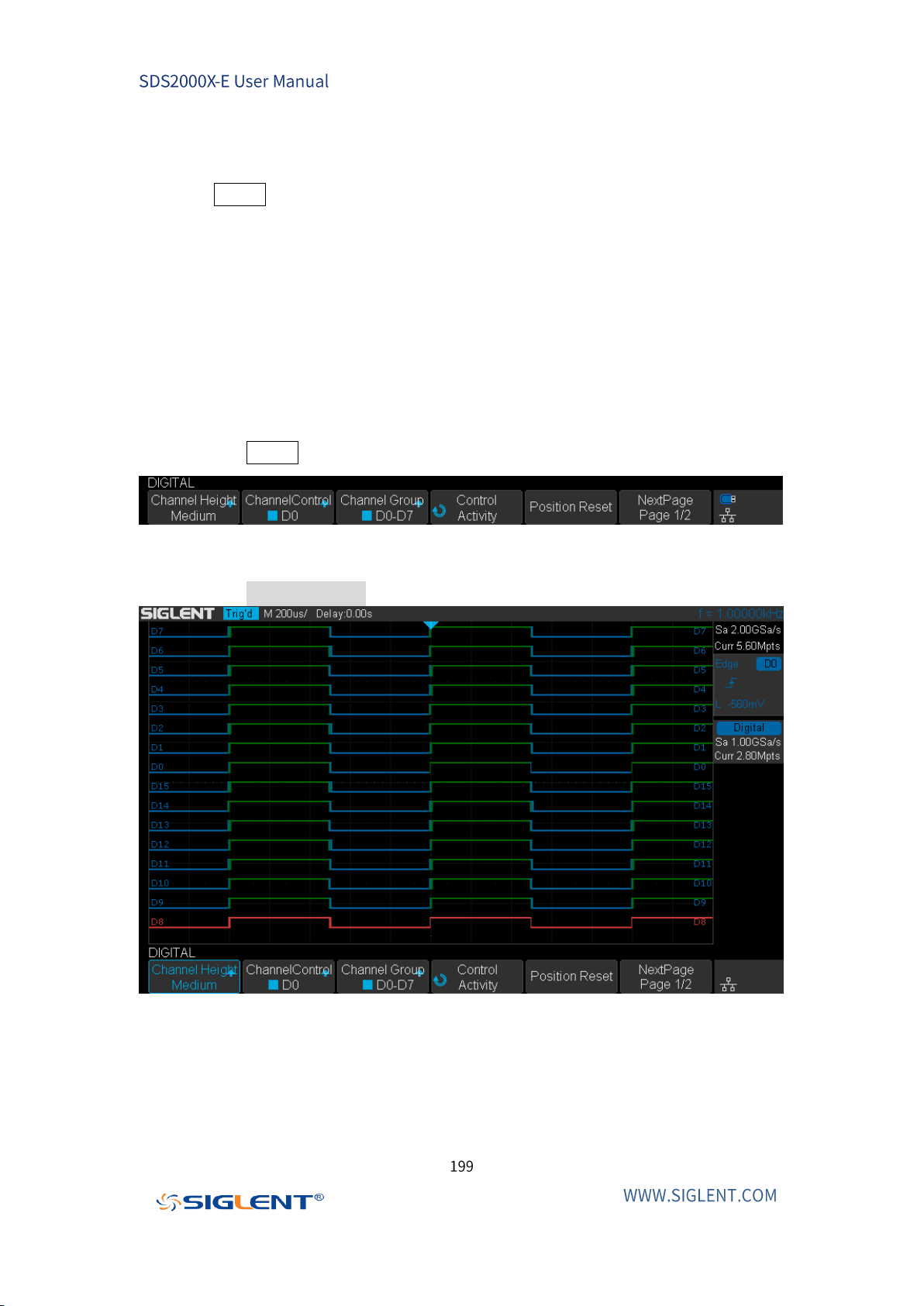
Acquire Digital Waveform
Press the Digital button on the front panel to open the digital channels and start
acquiring digital channel waveforms.
For digital channels, each time the oscilloscope takes a sample it compares the
input voltage to the logic threshold. If the voltage is above the threshold, the
oscilloscope stores a 1 in the sample memory; otherwise, it stores a 0.
Digital Channels Height
1. Press the Digital button on the front panel to open the DIGITAL function menu.
Figure 100 Digital Function Menu
2. Press the Channel Height softkey to select Low,Medium,High display type.
Figure 101 Medium Display Type
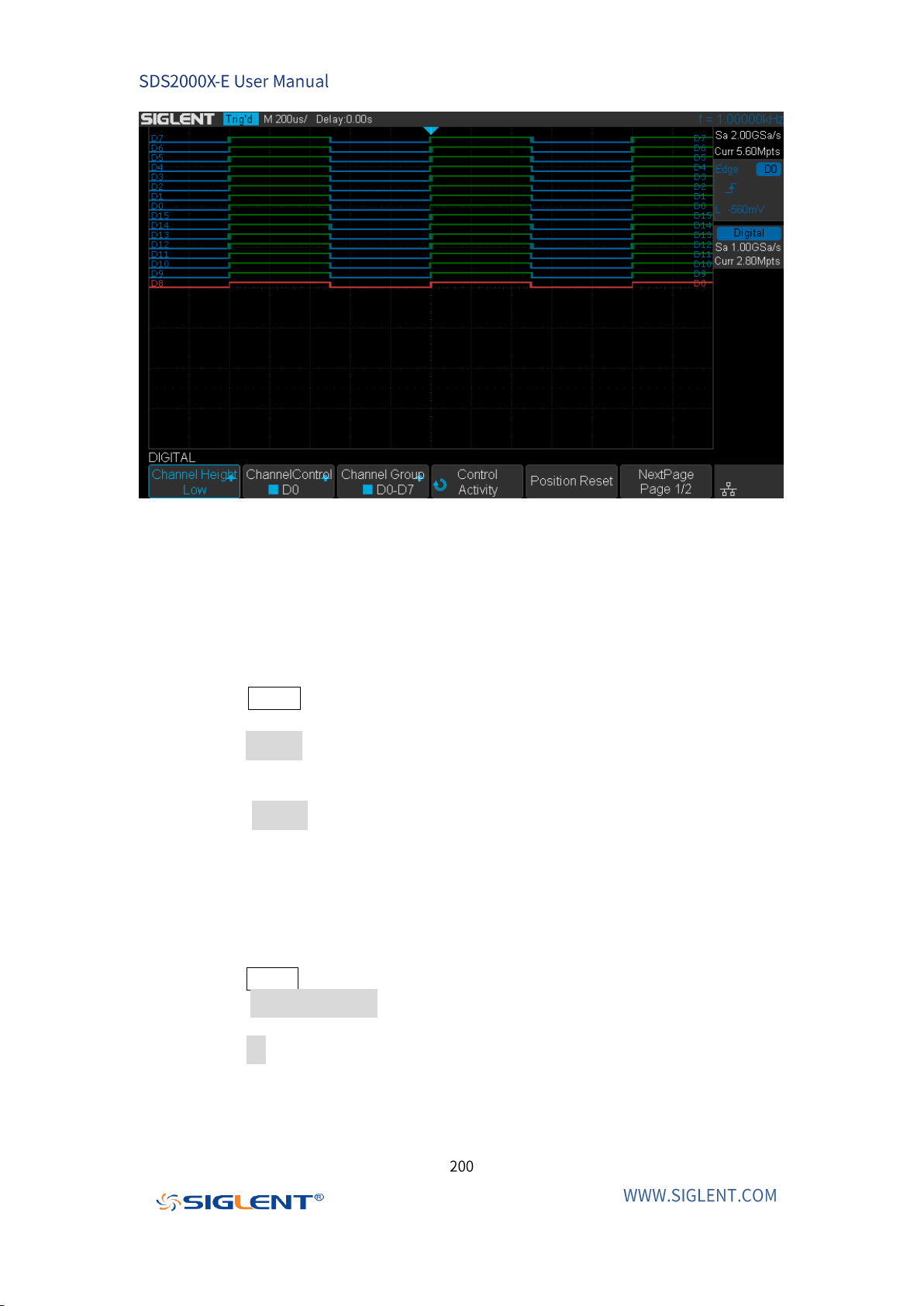
Figure 102 Low Display Type
The display type control lets you spread out or compress the digital traces vertically
on the display for more convenient viewing.
Digital Channels Position
1. Press the Digital button on the front panel to open the DIGITAL function menu
and display the digital channel waveforms.
2. Press the Control softkey select the Active then turn the Universal Knob to select
the channel that you wish to reposition. The selected waveform is highlighted
in red.
3. Press the Control softkey select the Position then turn the Universal Knob to
move the selected channel to any position.
Single Digital Channel
1. Press the Digital button on the front panel to open the DIGITAL function menu.
2. Press the Channel Control softkey, then turn the Universal Knob to select the
desired channel such as Dx and push down the knob to confirm.
3. Press the Dx softkey to select On or Off to switch the selected channel on or off.
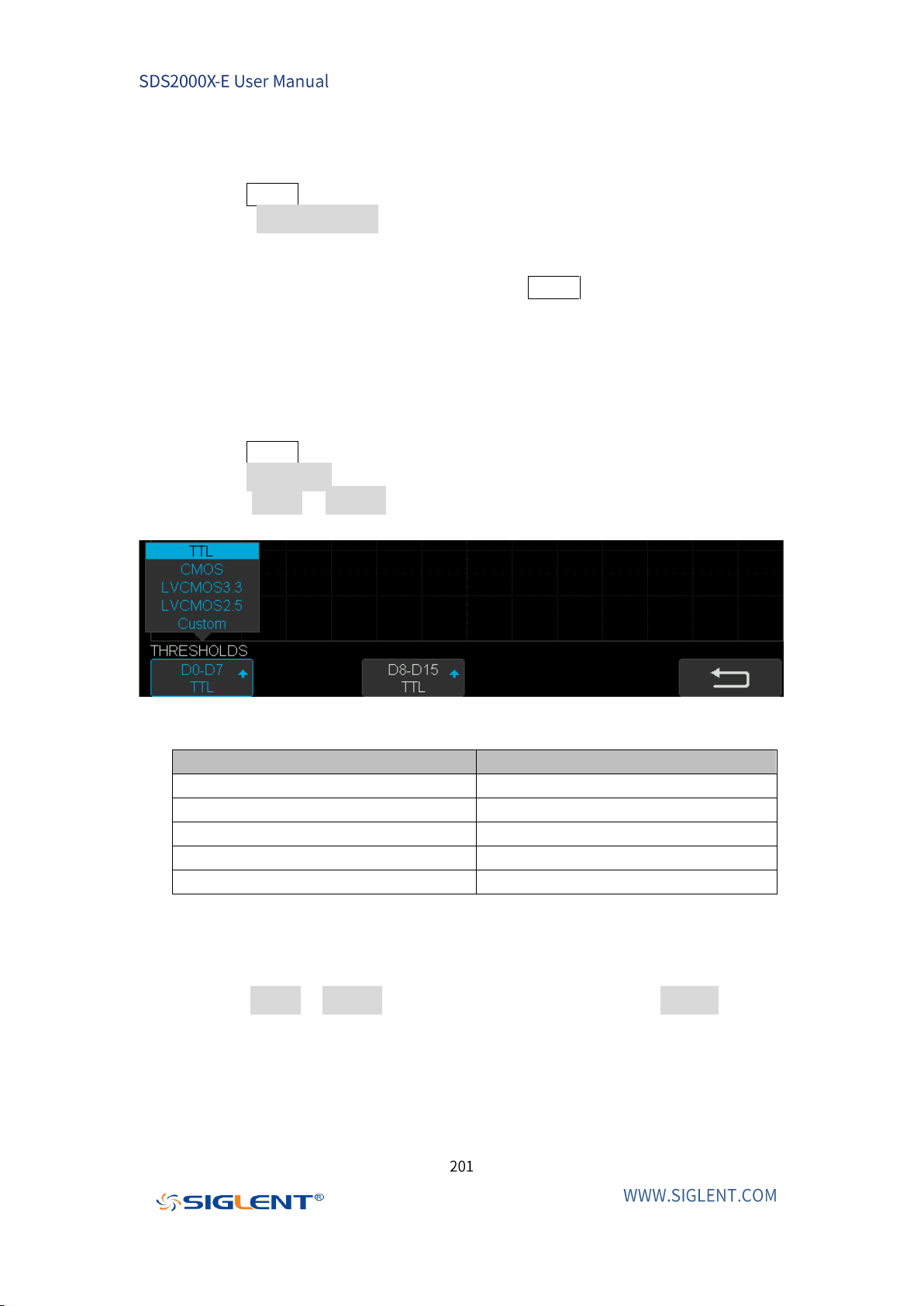
All Digital Channels
1. Press the Digital button on the front panel to open the DIGITAL function menu.
2. Press the Channel Group softkey to select On or Off to switch all digital
channels which in this group on or off.
Also, under the DIGITAL function menu, press the Digital button on the front panel
to switch all digital channels off.
Logic Threshold
1. Press the Digital button on the front panel to open the DIGITAL function menu.
2. Press the Thresholds softkey to enter the THRESHOLDS menu.
3. Press the D0~D7or D8~D15 softkey, then turn the Universal Knob to select a
logic family preset or select Custom to define your own threshold.
Figure 103 THRESHOLDS Function Menu
Logic Family
Threshold Voltage
TTL
1.5 V
CMOS
1.65 V
LVCMOS3.3
1.65 V
LVCMOS2.5
1.25 V
Custom
Variable from -8 V to +8 V
The threshold you set applies to all channels.
Values greater than the set threshold are high (1) and values less than the
set threshold are low (0).
If the D0~D7or D8~D15 softkey is set to Custom, press the Custom softkey,
then turn the Universal Knob to select the desired value and push down
the knob to confirm.
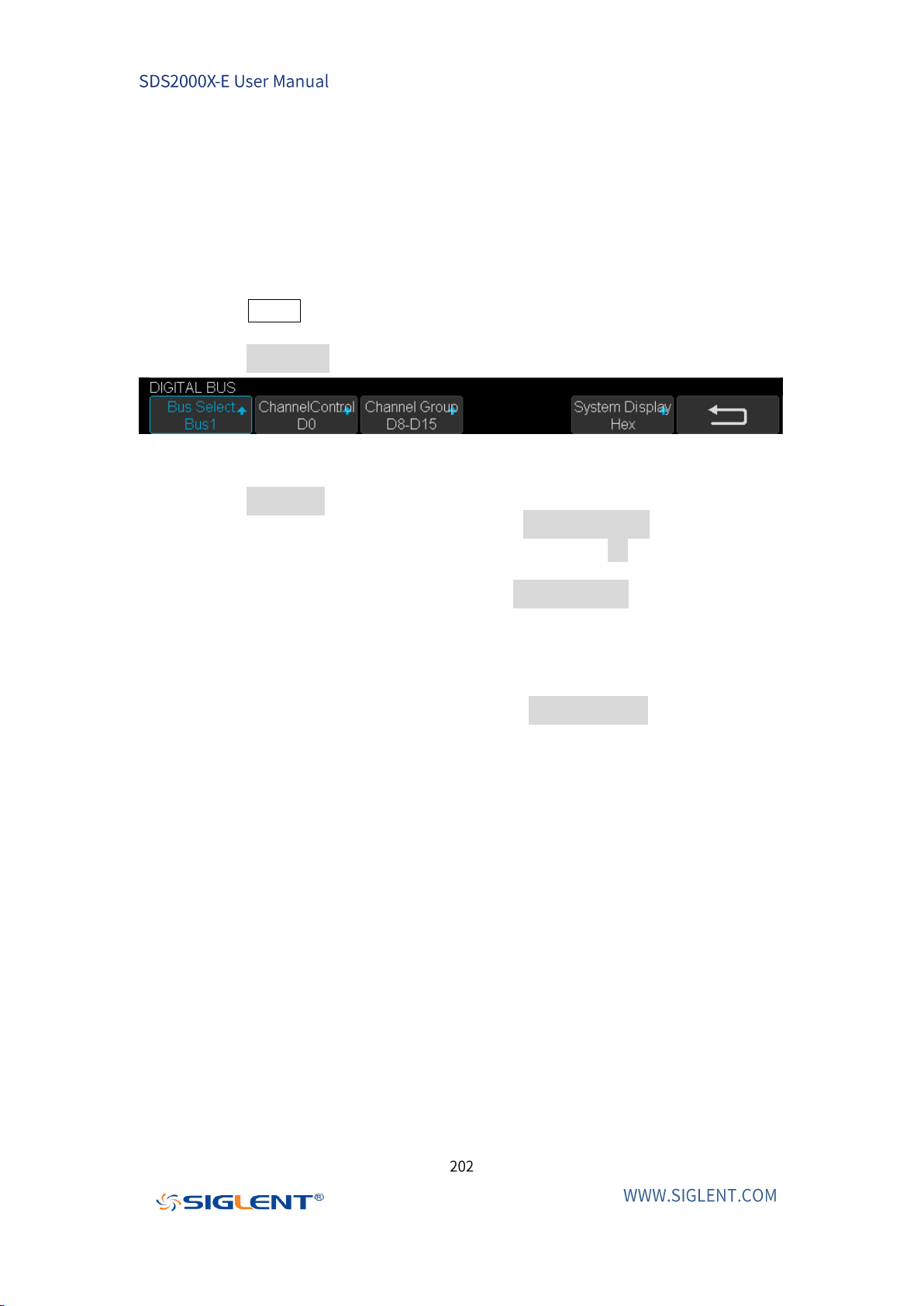
Digital Bus
Digital channels may be grouped and displayed as a bus, with each value
displayed at the bottom of the display in hex or binary. You can create up two
buses.
To configure and display each bus, do the following steps:
1. Press the Digital button on the front panel to open the DIGITAL function menu
and display the digital channel waveforms.
2. Press the Digital Bus softkey to enter the DIGITAL BUS function menu.
Figure 104 DIGITAL BUS Function Menu
3. Press the Bus Select softkey to select Bus1 or Bus 2.
4. Under the DIGITAL function menu, press the Channel Control softkey, turn the
Universal Knob to select such as DX, and then press the Dx softkey to select On
or Off to set the channel to be included or excluded in the bus.
5. Under the DIGITAL function menu, press the Channel Group softkey to select On
or Off to include or exclude all digital channels in this group.
6. Under the DIGITAL function menu, a status indicator is displayed in the status
line at the bottom of the display. Light blue shows the digital channel is
included in the bus while black shows it is excluded in the bus.
7. Under the DIGITAL function menu, press the System Display softkey to select
Binary or Hex to display the bus values.
The Sampling rate of digital channels is displayed at the right of the
display.
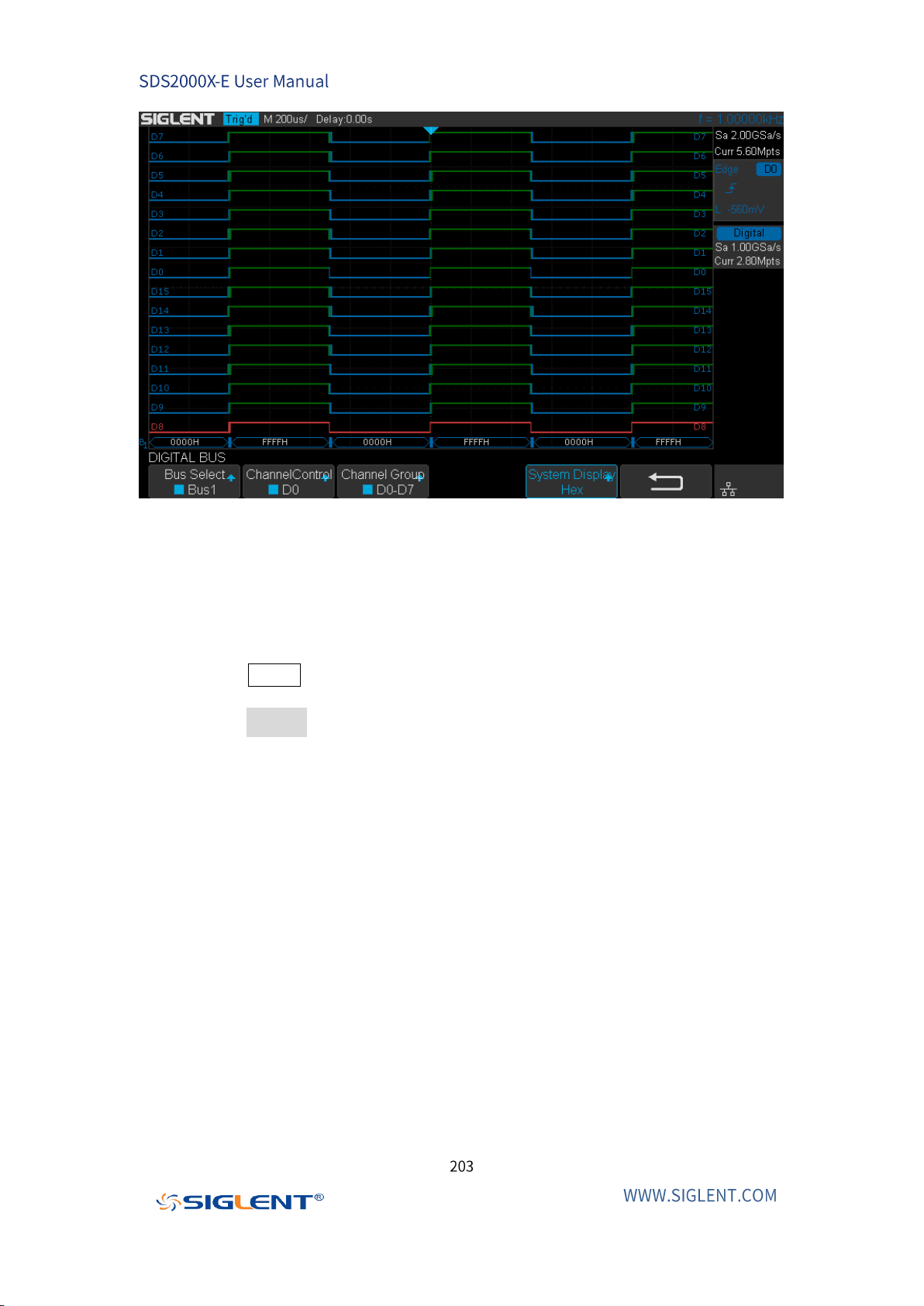
Figure 105 Digital Bus
Deskew
1. Press the Digital button on the front panel to open the DIGITAL function menu
and display the digital channel waveforms.
2. Press the Deskew softkey, and then turn the Universal Knob to select to change
deskew.
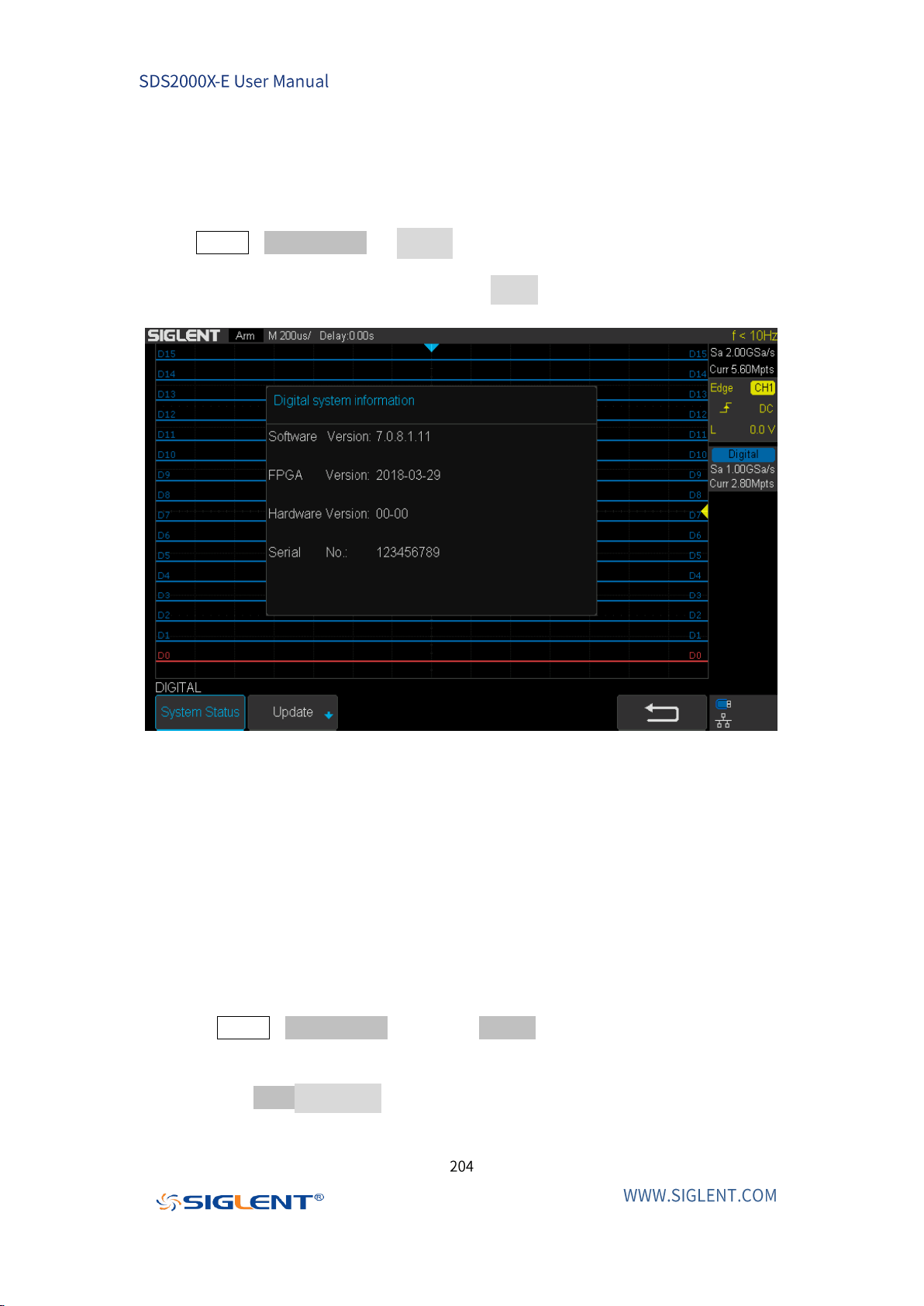
System Setting
System Status
Press Digital→NextPage2/2 → System ,then select the System Status option to
view the digital system information , including software version, hardware version,
and serial number. After finished, press the return softkey to quit the interface of
system information.
Figure 106 Digital System Information Interface
Update
The software version file of the Digital can be updated directly via U-disk. Follow
the steps below:
1. Insert U-disk with firmware update file (*.ads file extension) to USB host
interface on the front panel of the oscilloscope. Then the scope will display
“USB flash drive detected!” .
2. Press Digital→NextPage2/2→System →Update.
3. Expand the U disk directory, Select the firmware file (*.ads file extension), then
press the Press to update, an upgrade progress bar will be display on the
interface.
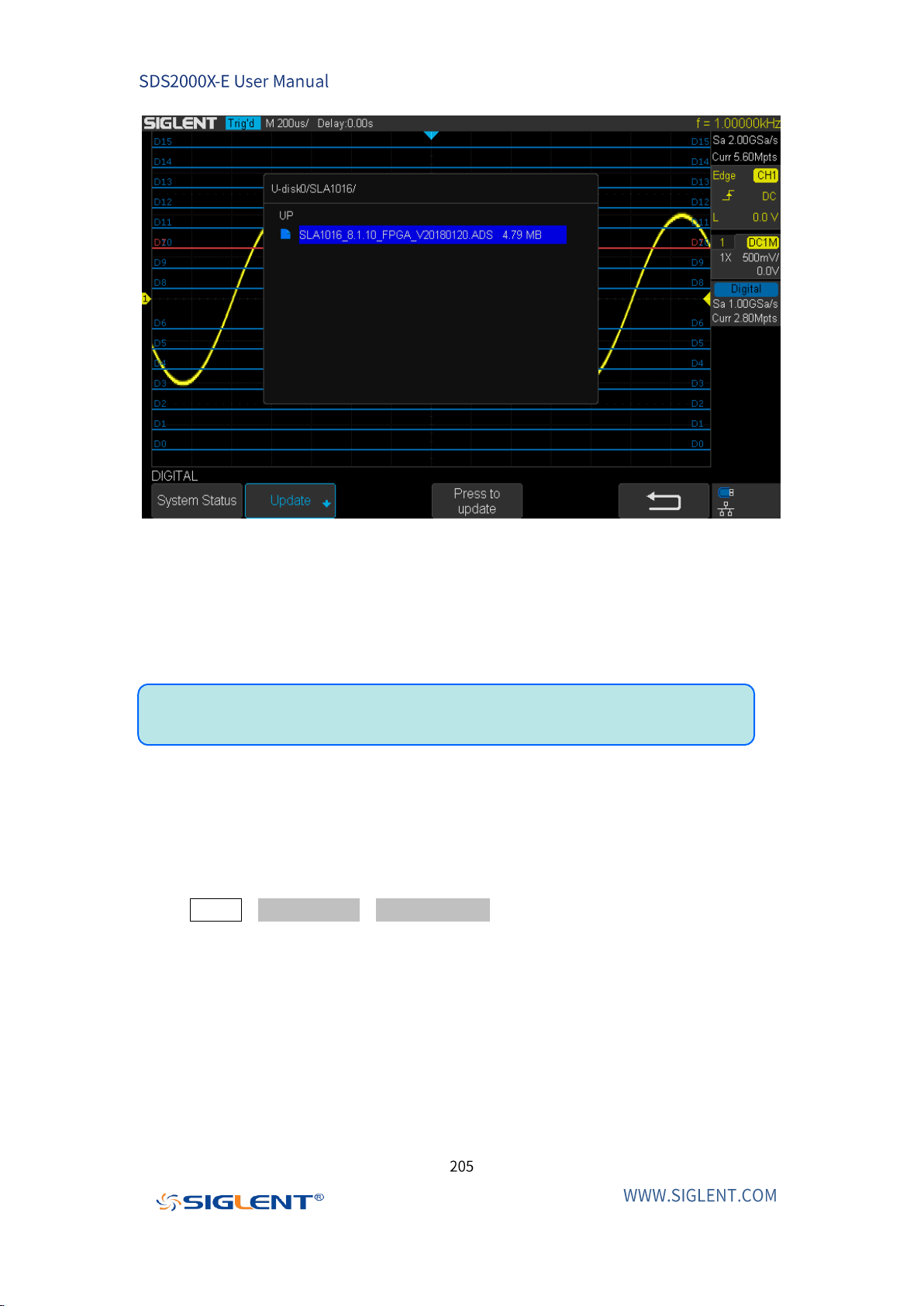
Figure 107 Digital Update Interface
4. After the updating is finished, the Digital device will automatically be
disconnected and display a message “Update completed. Please reconnect
Digital device!”
Note:Don't cut off the power during the update!
Remove Device
Press Digital→NextPage2/2→RemoveDevice and the oscilloscope interface will
display "Digital device removed!". After this, you can remove the USB memory
stick.

System Function Setting
This function module supports the oscilloscope’s system-related function, such as
system status, language, sound and some other advanced setting, such as self
calibration, update and remote interface configure.
The contents of this chapter:
View System Status
Perform Self Cal
Quick-Cal
Sound
Language
Pass/Fail Test
Arbitrary Waveform Generator(Option)
IO Set
Web Server
Update Firmware and Configuration
Do Self-Test
Screen Saver
Reference Position
Power On Line
Option Management
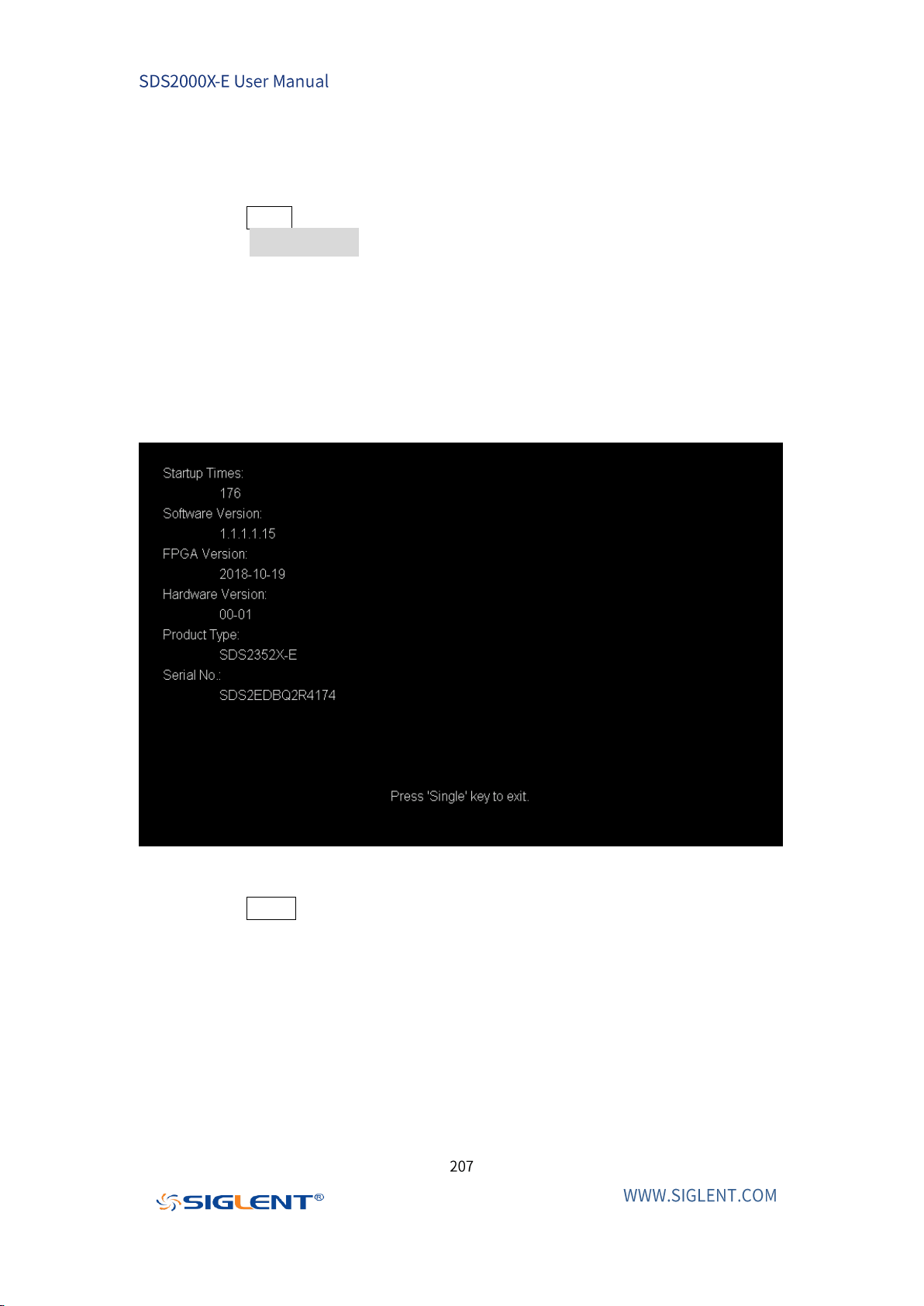
View System Status
Do the following steps to view the system status:
1. Press the Utility button on the front to enter the UTILITY function menu.
2. Press the System Status softkey to view the system status of the oscilloscope.
The system status includes the information below:
Startup Times: Record the boot-strap times of the oscilloscope.
Software Version: List the current software version of the oscilloscope.
FPGA Version: List the current fpga version of the oscilloscope.
Hardware Version: List the current hardware version of the oscilloscope.
Product Type: Display the product type of the oscilloscope.
Serial No.: List the serial number of the oscilloscope.
Figure 108 System Status
3. Press the Single button on the front panel to exit.
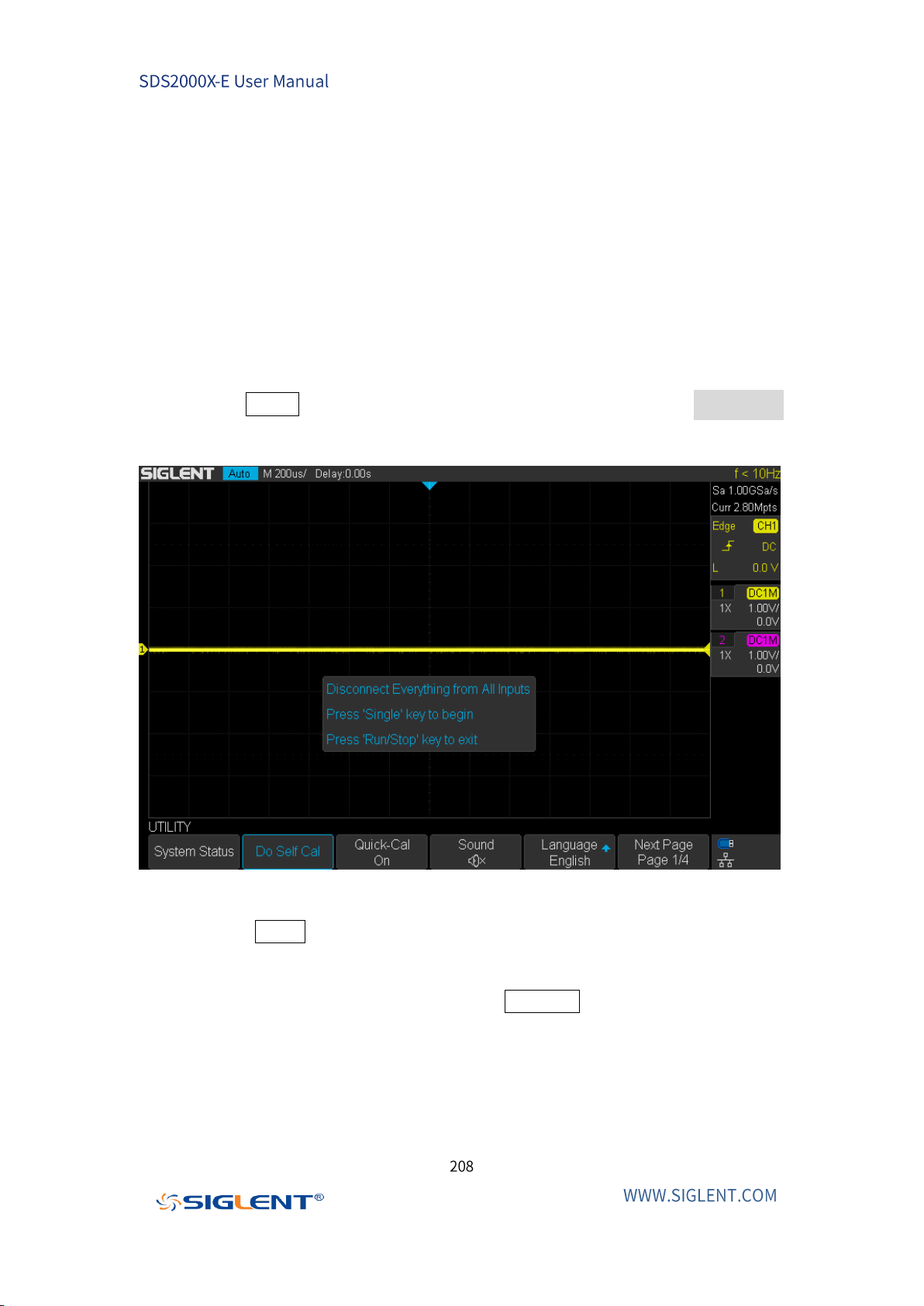
Perform Self Cal
The self-calibration program can quickly make the oscilloscope reach the best
working state to get the most precise measurement values. You can perform
self-calibration at any time especially when the change of the environment
temperature is up to or more than 5 ℃. Make sure that the oscilloscope has been
warmed up or operated for more than 30 minutes before performing a
self-calibration.
Do the following steps to do self-calibration:
1. Disconnect all the input channels.
2. Press the Utility button on the front panel,and then press the Do Self Cal
softkey, and the oscilloscope will pop-out the message box shown as below:
Figure 109 Do Self Cal
3. Press the Single button on the front panel to perform the self-calibration
program. During the calibration, most of the keys are disabled.
4. When the self-calibration program is finished, it will pop-out the message
“press 'Run/Stop' key to exit”. Press the Run/Stop button on the front panel
to exit the calibration interface.
Quick-Cal
Quick calibration can correct the measurement deviation caused by temperature,
so that you can get more accurate measurements
If the ambient temperature of your current operating oscilloscope is unstable, press
Utility → Quick-Cal softkey to select On to enable quick calibration.
Sound
When the sound is enabled, you can hear the sound of the beeper when you press
a function key or a menu softkey or when the prompt message pops up.
Press the Utility button on the front panel to enter the UTILITY function menu; then
press Sound softkey to select or to turn on or off the sound.
Language
The oscilloscope supports multiple language menu, Chinese/English help and
prompt messages.
1. Press Utility button on the front panel to enter the UTILITY Function menu.
2. Press the Language softkey, and then turn the Universal Knob to select the
desired language. Then push down the knob to select the language.
The languages that currently available are Simplified Chinese, Traditional Chinese,
English, French, German, Spanish, Russian, Italian, and Portuguese.
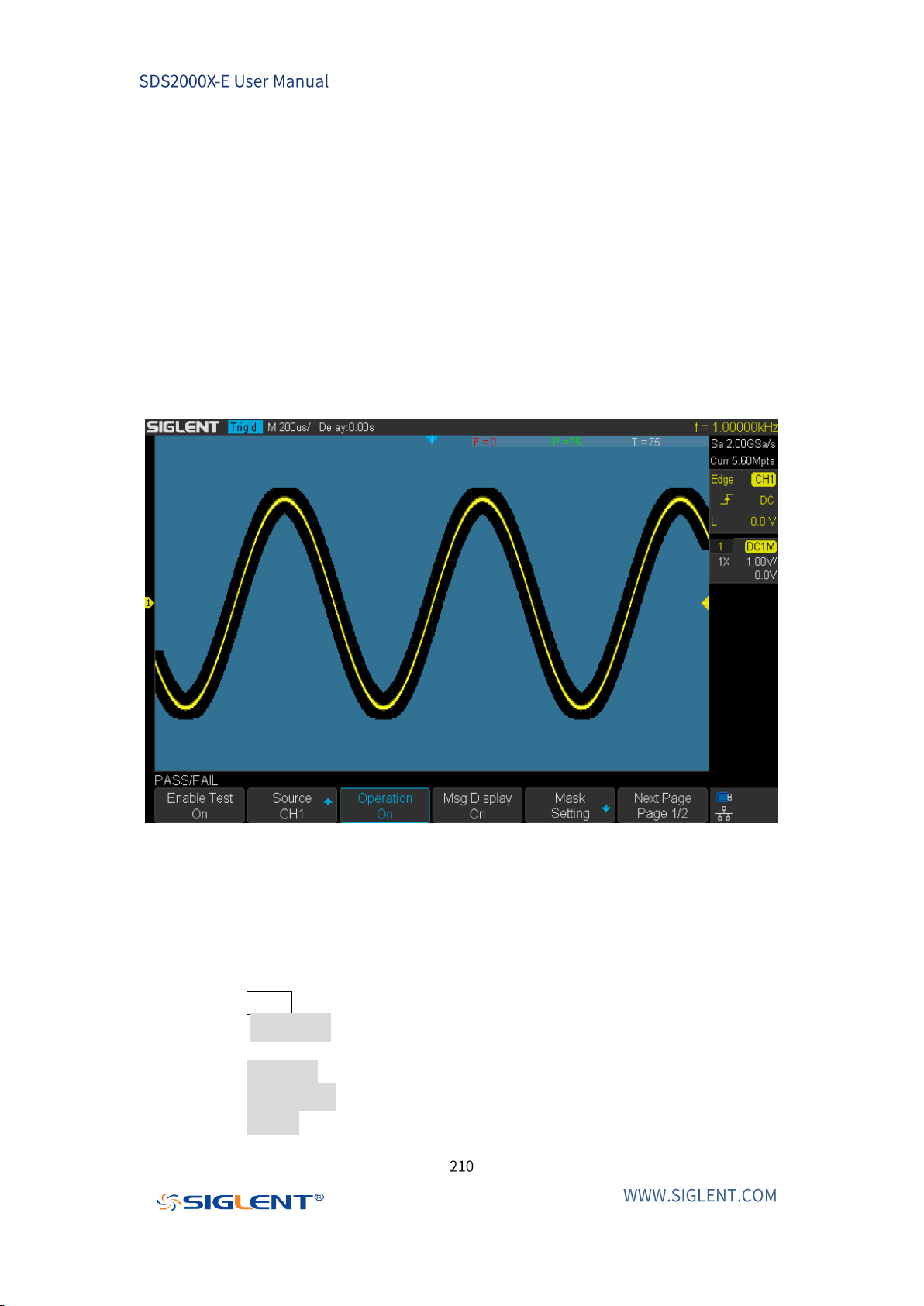
Pass/Fail Test
One way to verify a waveform's compliance to a particular set of parameters is to
use pass/fail testing. A pass/fail defines a region of the oscilloscope's display in
which the waveform must remain in order to comply with chosen parameters.
Compliance to the mask is verified point- by- point across the display.
The test results can be displayed on the screen as well as be declared through the
system sound or the pulse signal output from the [TRIG OUT] connector at the rear
panel. Pass/Fail test operates on displayed analog channels; it does not operate
on channels that are not displayed.
Figure 110 Pass/Fail Test
Set and Perform Pass/Fail Test
Do the following steps to set and perform pass/fail test:
1. Press the Utility button on the front panel to enter the UTILITY function menu.
2. Press the Next Page softkey to go to the second page of the UTILITY function
menu.
3. Press the Pass/Fail softkey to enter the PASS/FAIL function menu.
4. Press the Enable Test softkey to select On to enable the pass/ fail test.
5. Press the Source softkey to select the desired channel.
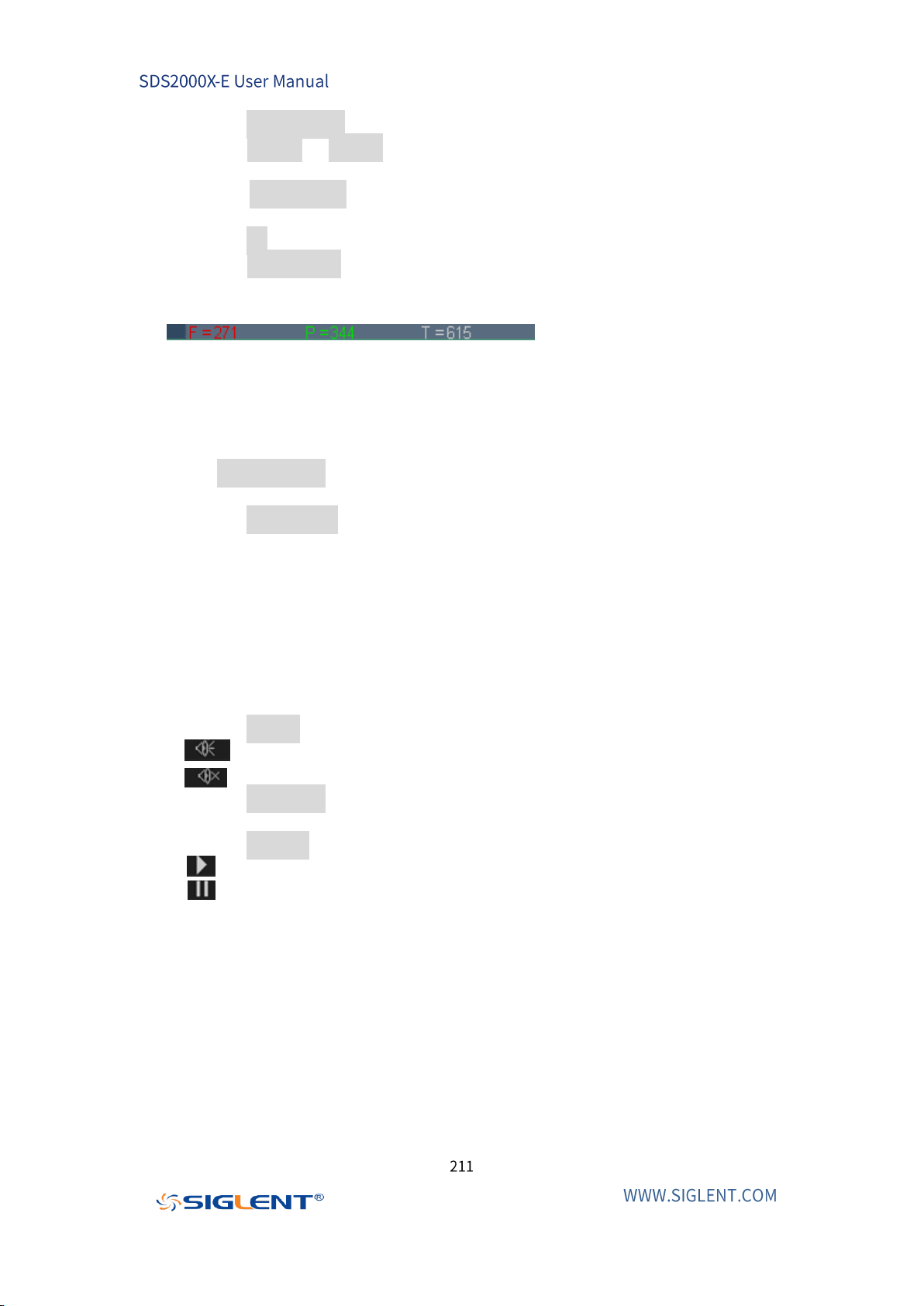
6. Press the Mask Setting softkey to enter the MASK function menu.
7. Press the X Mask or Y Mask softkey; and then turn the Universal Knob to select
the desired value. The range is from 0.02div to 4div.
8. Press the Create Mask softkey to create the mask. Whenever the Create Mask
softkey is pressed the old mask is erased and a new mask is created.
9. Press the UP softkey to return to the PASS/FAIL function menu.
10. Press the Msg Display to select On or Off to turn on or off the message display.
When On is selected, the test result will be displayed in the upper-right
message box of the screen.
F: The frame number of the channel waveform that fails to match the
mask.
P: The frame number of the channel waveform that matches the mask.
T: The frame number of the channel waveform that have been acquired. It
is the total of P and F.
11. Press the Next Page softkey to go to the second page of the PASS/FAIL function
menu.
12. Press the Stop on Fail softkey to select On or Off to turn on or off the function.
On: When failed waveforms are detected, the oscilloscope will stop the
test and enter the STOP state. At this point, the results of the test remain
the same on the screen (if display is turned on) and only one pulse is
output from the [TRIG OUT] connector (if enabled) at the rear panel.
Off: The oscilloscope will continue with the test even though failed
waveforms are detected. The test results on the screen will update
continuously and a pulse will be output from the [Trigger Out] connector at
the rear panel each time a failed waveform is detected.
13. Press the Output softkey to select turn on or off the sound.
: When the failed waveforms are detected, the beeper sounds.
: The beeper will not sound even if the failed waveforms are detected.
14. Press the Next Page softkey to return to the first page of the PASS/FAIL function
menu.
15. Press the Operate softkey to perform the test.
: Current state is stop; press the softkey to start the pass/fail test.
: Current state is running; press the softkey to stop the pass/fail test.
Save and Recall Test Mask
Users can save the current test mask to the internal flash memory or external USB
flash device. The file extension used for test mask files is “*.msk”.
Save Test Mask to Internal Memory

1. Press the Utility button on the front panel to enter the UTILITY function menu.
2. Press the Next Page softkey to go to the second page of the UTILITY function
menu.
3. Press the Pass/Fail softkey to enter the PASS/FAIL function menu.
4. Press the Enable Test softkey to select On to enable the pass/ fail test.
5. Press the Source softkey to select the desired channel.
6. Press the Mask Setting softkey to enter the MASK function menu.
7. Press the X Mask or Y Mask softkey; and then turn the Universal Knob to select
the desired value.
8. Press the Location softkey to select Internal
9. Press the Save softkey to save the mask to internal memory.
10. A few second later, it will pop-out the message “Save to file
Pass/file_mask_data.msk!”
Recall Test Mask from Internal Memory
1. Press the Utility button on the front panel to enter the UTILITY function menu.
2. Press the Next Page softkey to go to the second page of the UTILITY function
menu.
3. Press the Pass/Fail softkey to enter the PASS/FAIL function menu.
4. Press the Enable Test softkey to select On to enable the pass/ fail test.
5. Press the Mask Setting softkey to enter the MASK function menu.
6. Press the Location softkey to select Internal.
7. Press the Load softkey to recall the saved interval memory.
8. A few second later, it will pop-out the message “Recalled file Successfully!”
and the saved mask will be displayed on the screen.
Save Test Mask to External Memory
Do the following steps to save the test mask to external memory:
1. Press the Utility button on the front panel to enter the UTILITY function menu.
2. Press the Next Page softkey to go to the second page of the UTILITY function
menu.
3. Press the Pass/Fail softkey to enter the PASS/FAIL function menu.
4. Press the Enable Test softkey to select On to enable the pass/ fail test.
5. Press the Source softkey to select the desired channel.
6. Press the Mask Setting softkey to enter the MASK function menu.
7. Press the X Mask or Y Mask softkey; and then turn the Universal Knob to select
the desired value.
8. Press the Location softkey to select External.
9. Press the Save softkey to enter the file SAVE/RECALL system.
10. Save the test mask file refer to the “Save to flie XXX.msk” chapter.
Recall Test Mask from External Memory
Do the following steps to save the test mask f external memory:
1. Press the Utility button on the front panel to enter the UTILITY function menu.
2. Press the Next Page softkey to go to the second page of the UTILITY function
menu.
3. Press the Pass/Fail softkey to enter the PASS/FAIL function menu.
4. Press the Enable Test softkey to select On to enable the pass/ fail test.
5. Press the Mask Setting softkey to enter the MASK function menu.
6. Press the Location softkey to select External.
7. Press the Load softkey to enter the file SAVE/RECALL system.
8. Select the desired test mask file with a RGU postfix using the Universal Knob;
and then press the Load softkey.

Arbitrary Waveform Generator(Option)
SDS2000X-E supports an external Arbitrary Waveform Generator (AWG), which can
easily and quickly provide multiple input signals to users.
The AWG provides two kinds of waveforms: standard waveforms like sine and
square waves and the arbitrary waveform generator which provides built-in
waveforms as well as the ability to create custom waveforms. Built-in waveforms
are stored in the internal non-volatile memory. It includes: Common, Math, Engine,
Window, and Trigonometric functions. Users may also create and edit arbitrary
waveforms by PC which has installed the EasyWave, or import the waveform by U
disk that had stored edited waveform.
The contents of this chapter:
Output
Wave
Setting
System
Remove Device
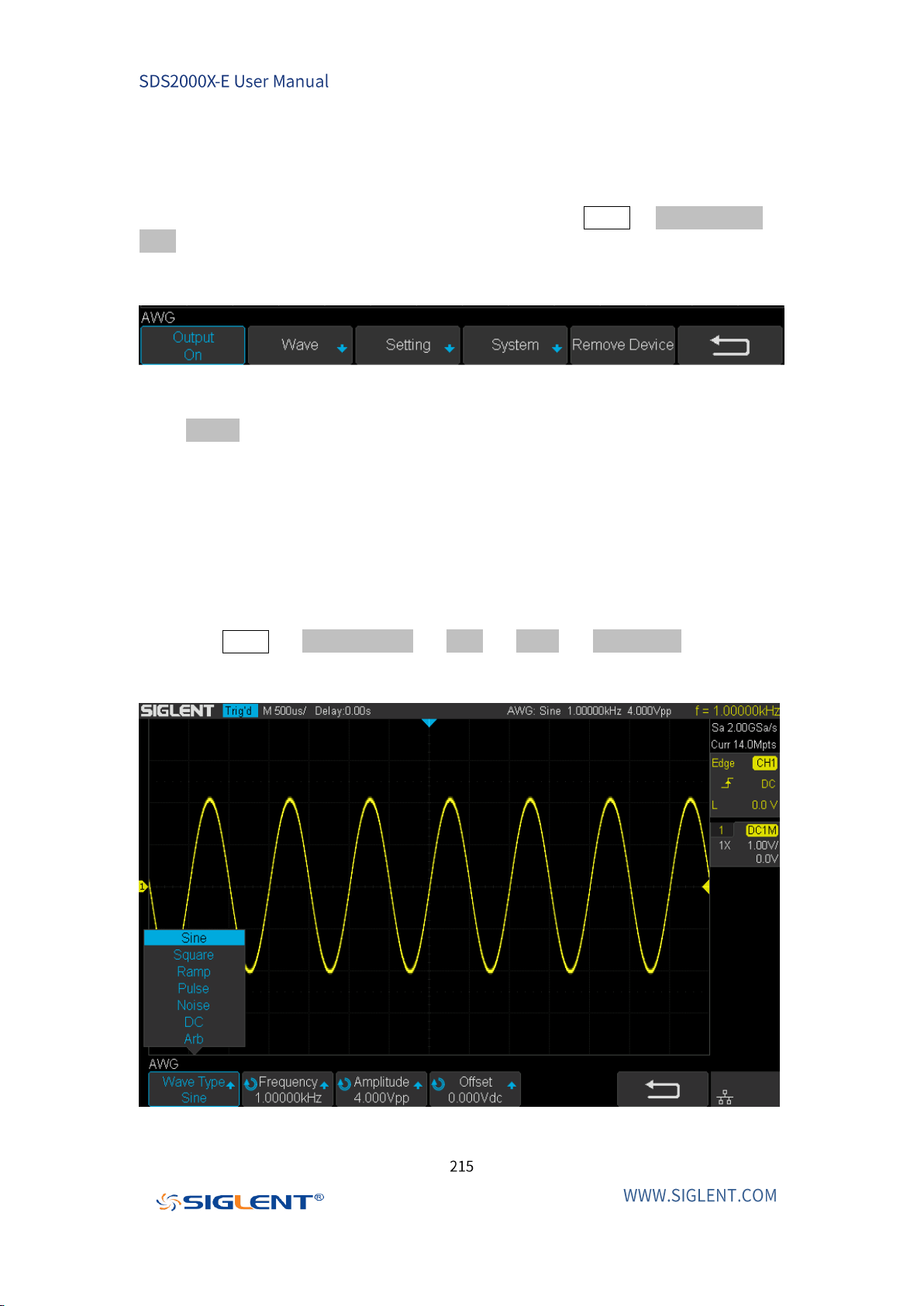
Output
Connect the AWG with a USB cable. After a few moments, the oscilloscope interface
will indicate "AWG device connection success", Press the Utility → Next Page4/4 →
AWG to enter the function menu interface of the AWG system as shown below,
including: Output, Wave, Setting, System, Remove Device.
Figure 111 AWG Menu Interface
Press Output softkey to open or close the AWG output. When the output is on, the
upper right corner of the oscilloscope interface will displays the corresponding
waveform frequency and amplitude information of AWG output wave.
Wave
1. To set standard waveform
Press the Utility → Next Page4/4 → AWG → Wave → Wave Type , rotate the
Universal Knob to the Sine wave. Then press the knob to select the interface shown
as below:
Figure 112 Wave Type Interface
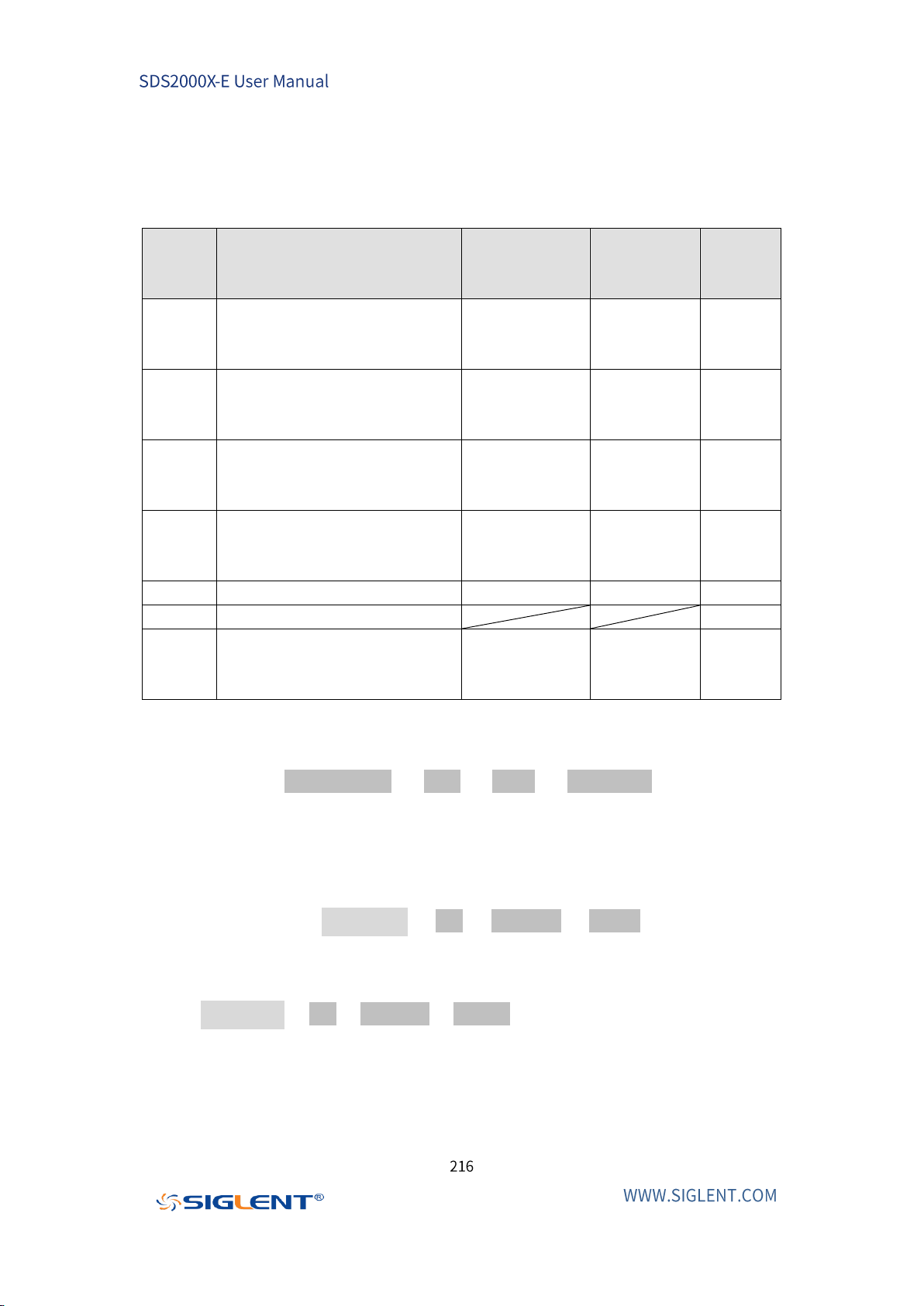
The following table shows the waveform type and its corresponding characteristics.
The available waveform parameters depend on the waveform type. Each availale
parameter can be adjusted using the Universal Knob and the corresponding
function software under the menu.
Wave
Type
Parameters
Frequency
Range
Amplitude
(High-Z)
Offset
(High-Z
)
Sine
Frequency/Period/Amplitude
/High-Level/Offset/Low-Lev
el value.
1 uHz~25 MHz
4 mV~6 V
± 3.0 V
Square
Frequency/Period/Amplitude
/High-Level/Offset/Low-Lev
el/Duty value.
1 uHz~10 MHz
4 mV~6 V
± 3.0 V
Ramp
Frequency/Period/Amplitude
/High-Level/Offset/Low-Lev
el/Symmetry value.
1 uHz~300
kHz
4 mV~6 V
± 3.0 V
pulse
Frequency/Period/Amplitude
/High-Level/Offset/Low-Lev
el/ Width/ Width Fine value.
1 uHz~10 MHz
4 mV~6 V
± 3.0 V
Noise
Stdev/ Mean value.
DC
Offset value.
± 3.0 V
Arb
Frequency//Period/Amplitud
e/High-Level/Offset/Low-Le
vel value.
2. To set Arb waveform
Press the Utility→ Next Page4/4 → AWG → Wave → Wave Type , then select the
Arb, and it has two types:
Stored Arb:
Users can create and edit arbitrary waveforms by using EasyWave software and a
compatible computer. Waveforms can be downloaded directly to the instrument
using the software or read from a USB memory device which has a valid arbitrary
waveform file. Choose Wave Type → Arb → Arb Type → Stored , enter the stored
Arb interface and invoke the waveform in the external storage device.
Built-in Arb:
Choose Wave Type → Arb → Arb Type → Built-in to enter the following interface,
rotate the knob to move the cursor, press the knob to select to the desired
waveform, and then return back to Built-in waveform interface.
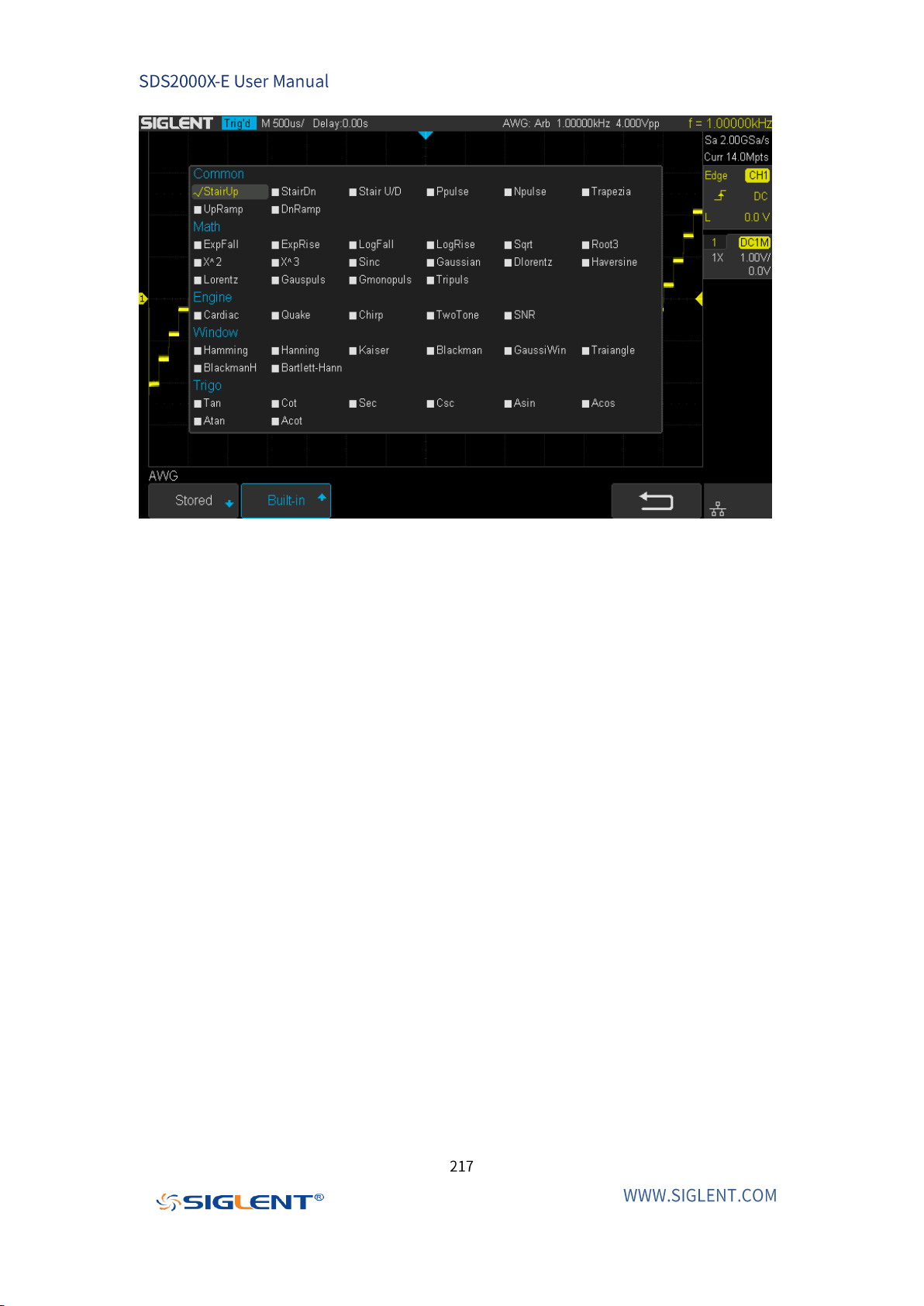
Figure 113 Built-in Arb interface
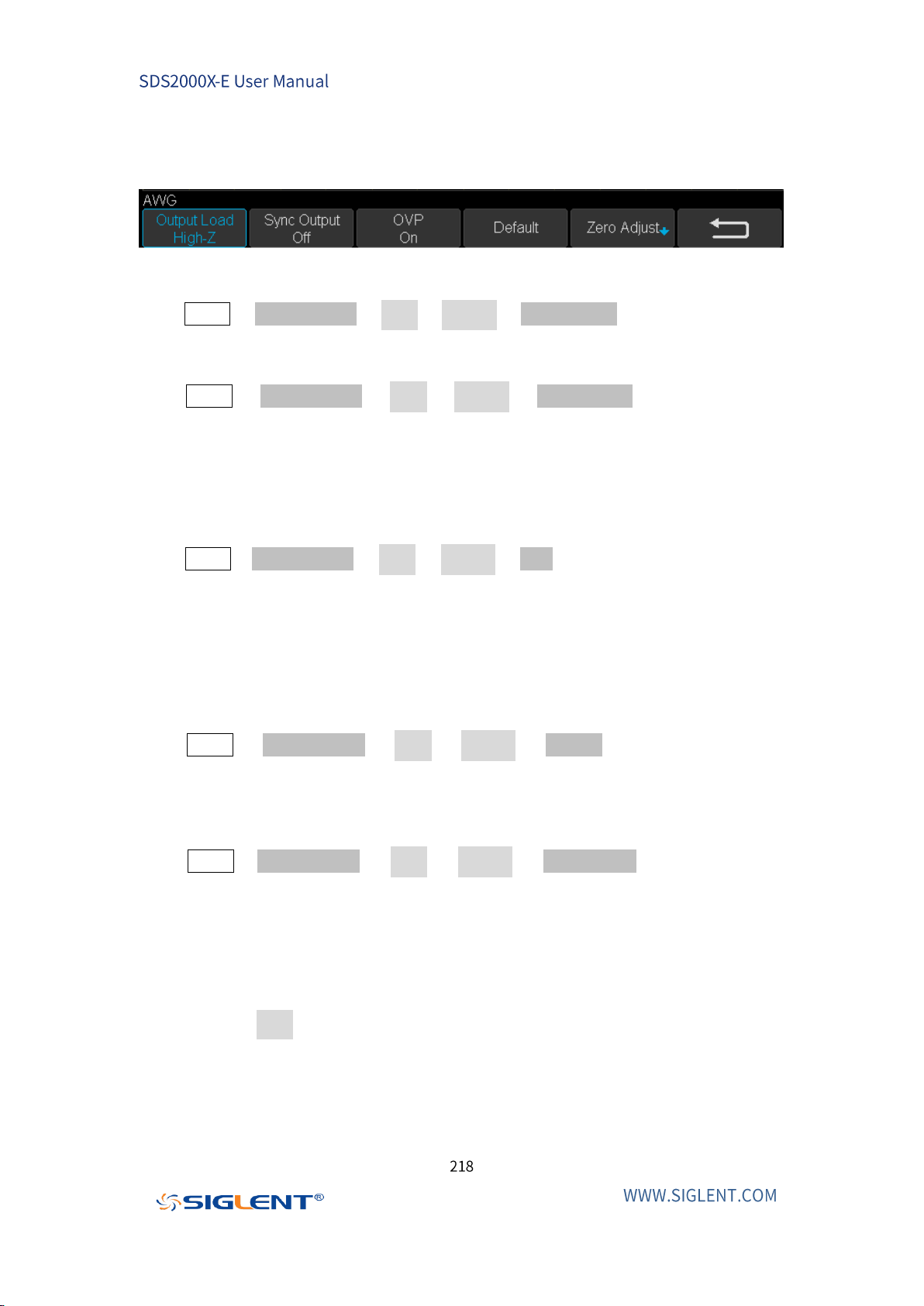
Setting
Figure 114 AWG Setting Interface
1. Output Load
Press Utility → NextPage4/4 → AWG → Setting → Output Load to set High-Z or 50Ω.
2. Sync Output
Press Utility → NextPage4/4 → AWG → Setting → Sync Output, the AWG provides
Sync Output through the [Aux In/Out] connector on the rear panel. When the Sync
Output is on, the port can output a CMOS signal with the same frequency as basic
waveforms (except the Noise and DC), arbitrary waveforms, and modulated
waveforms (except external modulation).
3. OVP(over voltage protection)
Press Utility→ NextPage4/4 → AWG → Setting → OVP to turn on or off the function.
If the state is set to ON, overvoltage protection of the AWG output port takes effect
once an overvoltage condition is met. Overvoltage is defined as a condition in
which the absolute value of input voltage is higher than 4 V±0.5 V. When
overvoltage protection occurs, a warning message will be displayed and the
output will be disabled.
4. Default
Press Utility → NextPage4/4 → AWG → Setting → Default to recover the default
values of the AWG (Sine, 1.000 kHz, 4.000 Vpp, 0.0 mVdc, High-Z, Sync output off,
OVP on).
5. Zero Adjust
Press Utility→ NextPage4/4 → AWG → Setting → Zero Adjust. The AWG can be
calibrated by using Auto mode or Manual mode. The calibration process configures
the AWG to output 0V DC. The signal is then measured on the 1 mV/div vertical
scale. A passing measurement has a mean value within a range of ±1 mV.
Auto mode: This mode can only be performed with the channel 1 of the
oscilloscope. Connect the output of the AWG to the oscilloscope channel1,
press the Auto softkey, then the AWG starts to automatic calibrate. When
completed, the scope will display ” Zero Adjust Completed!”
Manual mode: The AWG can be manually calibrated through any channel on
the oscilloscope. Take channel 2 as an example:
a. Connect the output of AWG to the oscilloscope channel 2, enable channel 2
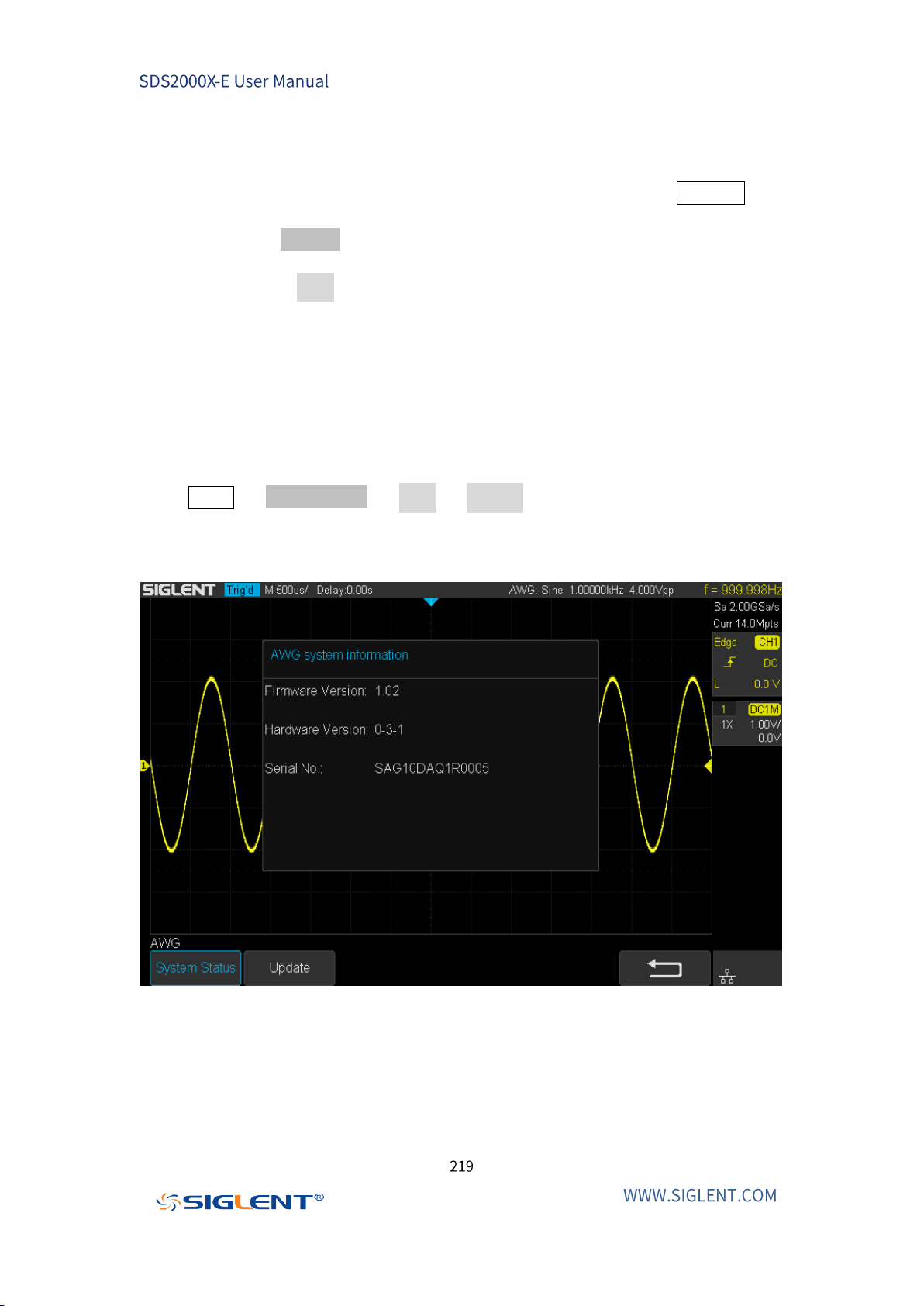
on the scope , set CH2 to DC coupling, open bandwidth limit, and probe
attenuation to 1X.
b. Adjust the voltage of channel 2 channel to 1 mV/div, and make the
waveform visible in the oscilloscope interface, press the Measure and
measure the mean value of channel 2.
c. Press the Manual and rotate the knob to adjust the waveform, so that the
mean value of the observed CH2 will be in the range of ± 1 mV, and then
press the Save. Upon completion of the zero adjust process, the
oscilloscope will display " Zero Adjust Completed! ".
Systems
1. System Status
Press Utility → NextPage4/4 → AWG → System , then select the System Status
option to view the AWG’s system information, including software version, hardware
version, and serial number. After finished, press the return soft key to exit the
system information page.
Figure 115 AWG System Information Interface
2. Update
The software version file of the AWG can be updated directly via U-disk. Follow the
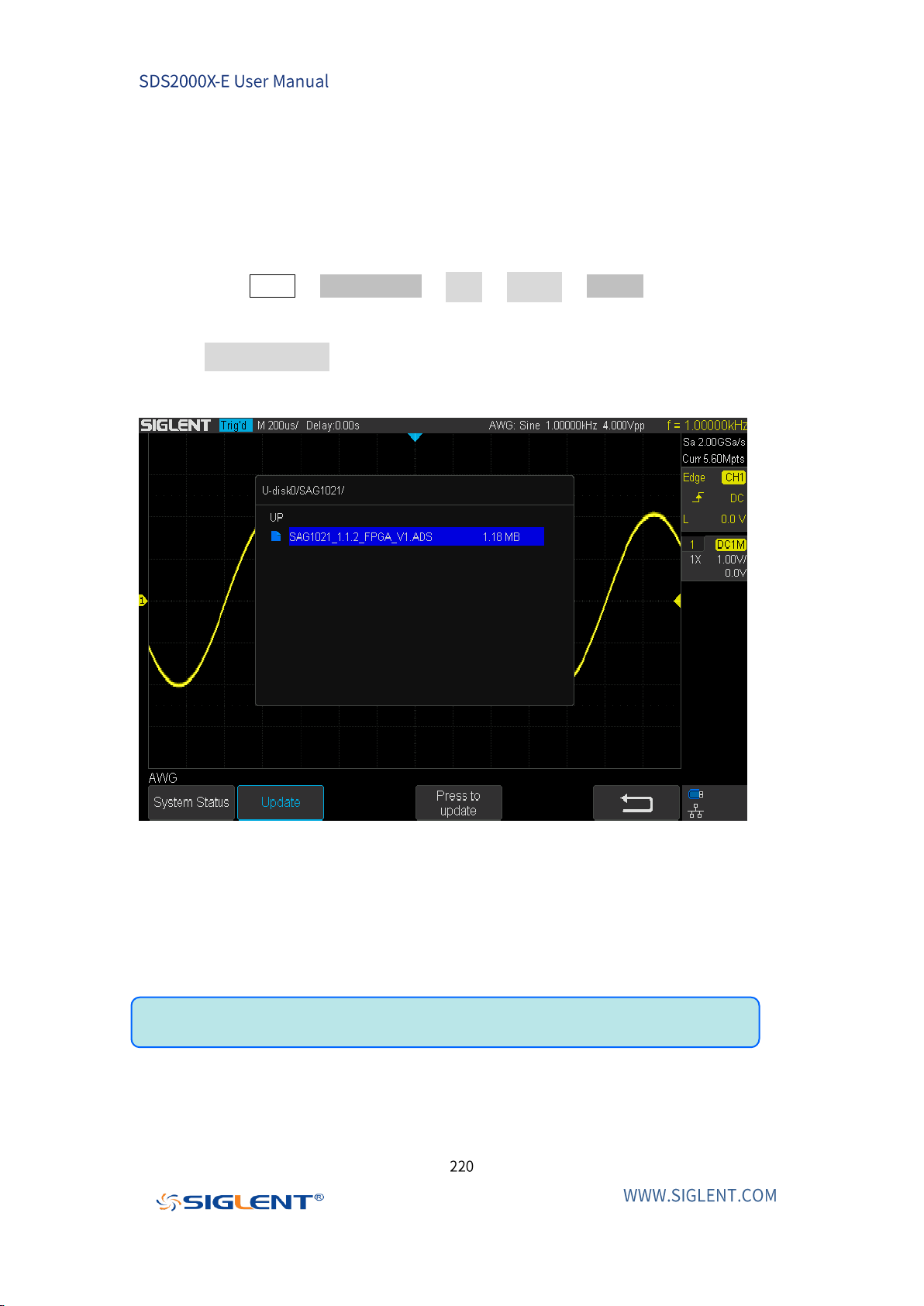
steps below:
1. Insert U-disk with a firmware update file (*.ads file extension) to USB host
interface on the front panel of the oscilloscope. Upon recognition of a valid
USB drive, the scope will display the following message: “USB flash drive
detected” .
2. Press Utility → NextPage4/4 → AWG → System → Update
3. Expand the U disk directory, select the firmware file (*.ads), then press the
Press to update softkey, an upgrade progress bar will be display on the
interface.
Figure 116 AWG Update Interface
4. After the updating is finished, the AWG will automatically disconnected
and display a message “Update completed, please reconnect AWG
device!”
Note:Don't cut off the power during the AWG update!
Remove Device
Press Utility→ NextPage4/4 → AWG → RemoveDevice and the oscilloscope
interface display "AWG device removed!" the USB device can be removed.
IO Set
The oscilloscope provides abundant IO interfaces, including: USB Device, LAN and
WLAN.
USB Device
Perform the following steps to set the oscilloscope to communicate with a
computer via USB:
1. Install the USBTMC device driver on computer. National Instruments VISA
library is recommended and can be downloaded from the National
Instruments website.
2. Connect the oscilloscope with PC using a standard USB cable.
3. Press the Utility button on the front panel to enter the UTILITY function menu.
4. Press the IO Set softkey to enter the I/O SET function menu.
5. Press the USB Device softkey to select USBTMC.
6. Use EasyScopeX or NI Visa to communicate with the oscilloscope.
LAN
Do the following steps to set the oscilloscope to communicate with a computer
via LAN:
1. Connect the oscilloscope to your local area network using the network cable.
2. Press the Utility button on the front panel to enter the UTILITY function menu.
3. Press the IO Set softkey to enter the I/O SET function menu.
4. Press the Net Interface softkey; and then select LAN.
5. Press the IP Set softkey to enter the IP setting interface, see the picture below.
6. Press the DHCP softkey to turn on or turn off the DHCP.
On: The DHCP server in the current network will assign the network
parameters (such as the IP address) for the oscilloscope.
Off: You can set the IP address, subnet mask, gateway.
Turn the Universal Knob to select the desired value.
Push the Universal Knob to change item horizontally.
Press the Save softkey to save the current setting.
7. Use EasyScopeX or NI Visa to communicate with the oscilloscope.
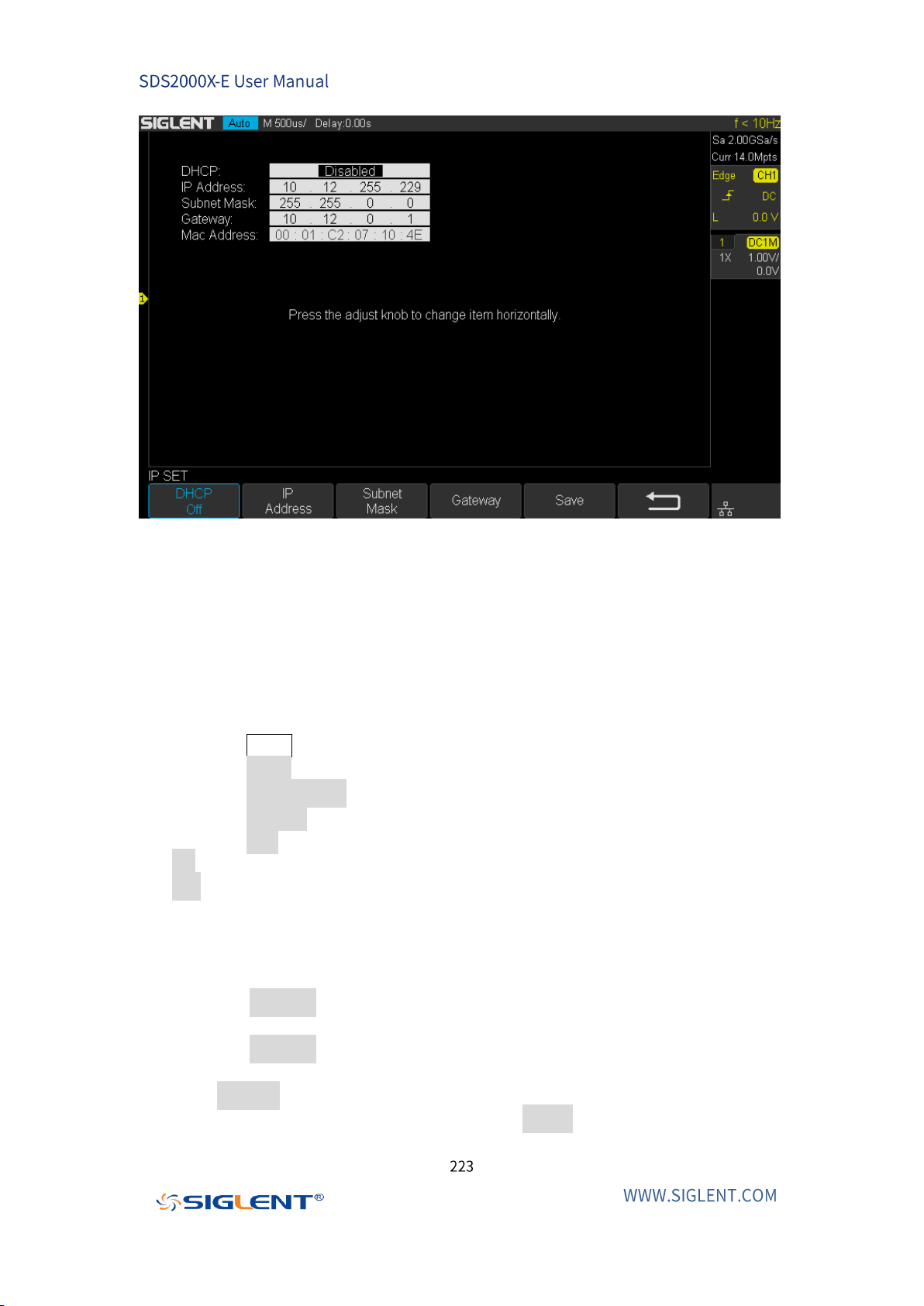
Figure 117 LAN Setting Interface
WLAN (Option)
Do the following steps to set the oscilloscope to communicate with a computer via
WLAN:
1. Connect the oscilloscope USB Host to your wireless network adapter, and make
sure your local wireless network is normal.
2. Press the Utility button on the front panel to enter the UTILITY function menu.
3. Press the IO Set softkey to enter the I/O SET function menu.
4. Press the Net Interface softkey; and then select WLAN.
5. Press the WiFi Set softkey to enter the WiFi setting interface.
6. Press the WiFi softkey to turn on or turn off the WIFI set menu.
Off: The WIFI set menu off.
On: You can set the SSID and PSK manually.
Manual Scan: Press this softkey, the oscilloscope will search the network
automatically. Turn the Universal Knob to select a network; then; press
Universal Knob to confirm.
SSID: Press this softkey, a dialogue box will pop up, enter your SSID then
press Comfirm.
PSK: Press this softkey, a dialogue box will pop up, enter your SSID then
press Comfirm.
Connect: Press this softkey to connect the wireless network.
7. Press Connect softkey when your SSID and PSK configuration finished.
8. Return to the I/O SET menu. Press the IP Set softkey to finish the IP
configuration (see “LAN”).
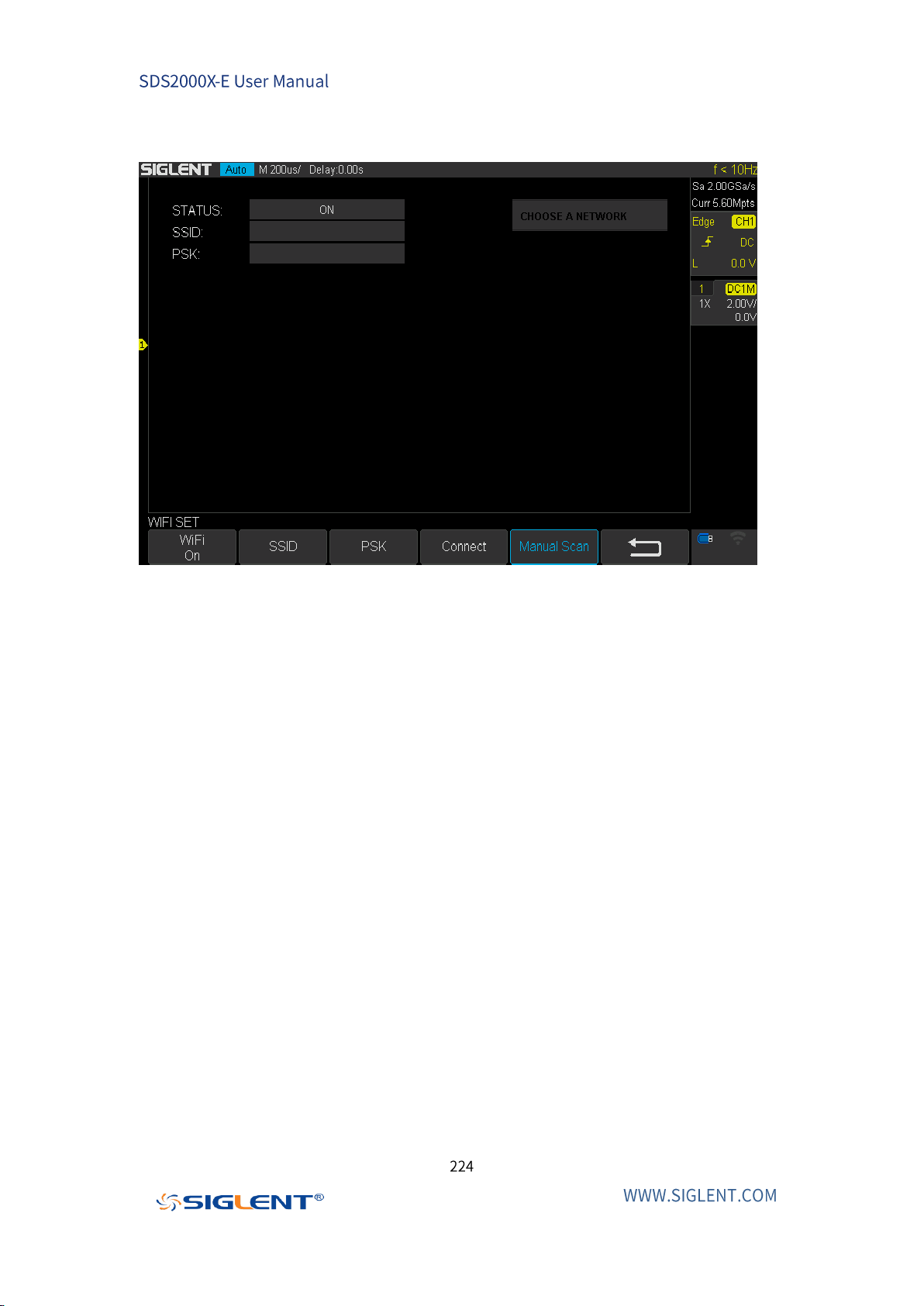
9. Use EasyScopeX or NI Visa to communicate with the oscilloscope.
Figure 118 WIFI setting menu
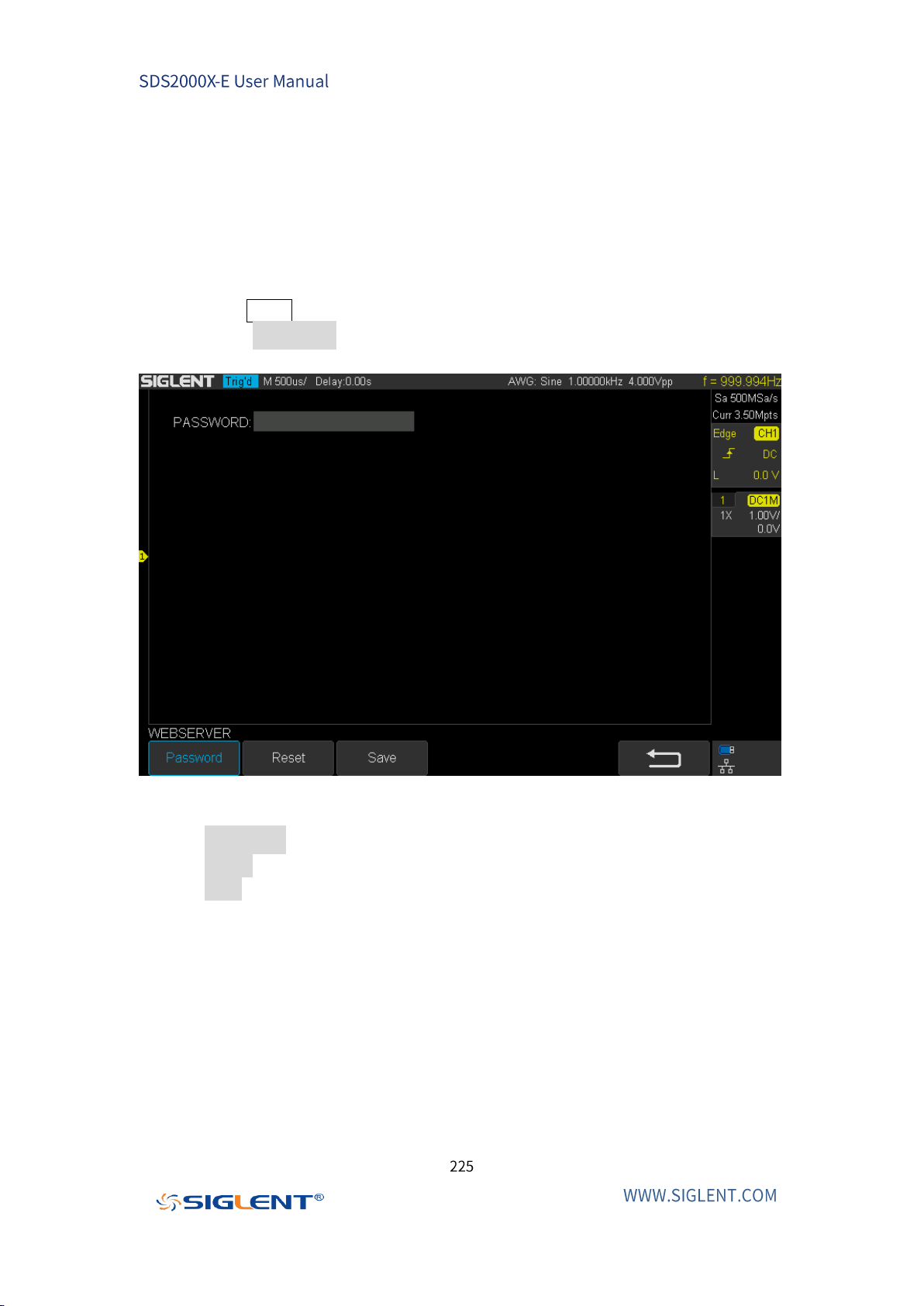
Web Server
SDS2000X-E provides the web server function, you can access and control the
oscilloscope using a web browser. Connect the oscilloscope to your LAN (or WLAN),
then type the oscilloscope's IP address in the web browser. The oscilloscope's web
interface is displayed. The default user name is “admin”, and there is no
password.
1. Press the Utility button on the front panel to enter the UTILITY function menu.
2. Press the WebServer softkey on the fourth page of utility function menu to
enter the WEBSERVER menu.
Figure 119 Web server interface
Password: Press this softkey to set a new password.
Reset: Press this softkey to erase the password.
Save: Setting a new password or erasing the password, then press this
softkey to make the new configure became effective.
Update Firmware and Configuration
The firmware and configuration can be updated directly via USB flash drive.
Do the following steps to update the firmware:
1. Insert the USB flash drive which contains the correct firmware and the
configure files into the USB host interface on the front panel of the
oscilloscope.
2. Press the Utility button on the front panel to enter the UTILITY function menu.
3. Press the Next Page softkey to go to the second page of the UTILITY function
menu.
4. Press the Next Page softkey to go to the third page of the UTILITY function
menu.
5. Press the Update softkey to enter the UPDATE function menu.
6. Press the Firmware softkey to open the file manager.
7. Turn the Universal Knob to select the update file which should be with an ADS
postfix; and then press the Press to Update softkey to start update the
firmware. The process needs about 7 minutes. And during the update, do not
remove power to the oscilloscope, otherwise the oscilloscope may be
permanently damaged and may not restart again.
8. After finish the update, the screen will pop-out the message “Firmware
decompressed. Please restart and wait…”.
9. Restart the oscilloscope to finish the firmware update.
Do the following steps to update the configuration:
1. Insert the USB flash drive which contains the correct firmware and the
configure files into the USB host interface on the front panel of the
oscilloscope.
2. Press the Utility button on the front panel to enter the UTILITY function menu.
3. Press the Next Page softkey to go to the second page of the UTILITY function
menu.
4. Press the Next Page softkey to go to the third page of the UTILITY function
menu.
5. Press the Update softkey to enter the UPDATE function menu.
6. Press the Configure softkey to open the file manager.
7. Turn the Universal Knob to select the update file ( *.CFG file extension) and then
press the Press to Update softkey to start update the firmware. The process
needs about 30 seconds.
8. After finish the update, the screen will pop-out the message “Firmware
decompressed. Please restart and wait…”.
9. Restart the oscilloscope to finish the configuration update.
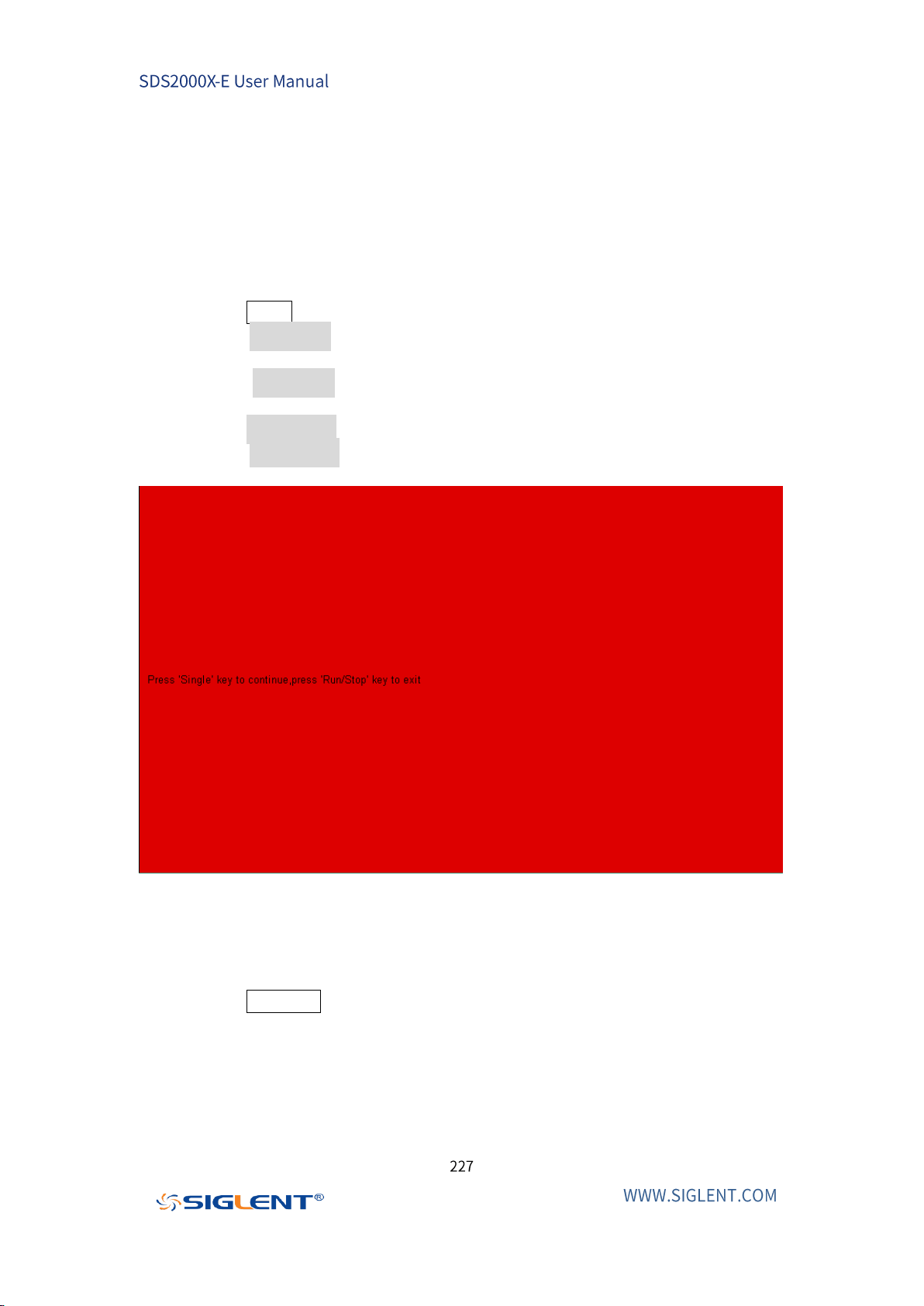
Do Self-Test
Self-tests include screen test, keyboard test, and LED test. Self-tests used to test the
screen, buttons, knobs and LED lights whether works well.
Screen Test
1. Press the Utility button on the front panel to enter the UTILITY function menu.
2. Press the Next Page softkey to go to the second page of the UTILITY function
menu.
3. Press the Next Page softkey to go to the third page of the UTILITY function
menu.
4. Press the Do Self Test softkey to enter the SELF TEST function menu.
5. Press the Screen Test softkey to enter the screen test interface, as the picture
shown below, the screen display is pure red.
Figure 120 Screen Test
6. Press the Single button on the front panel continually as it says in the picture
above. The screen displays green, blue and red again. It is easy to check
chromatic aberration, stains and scratches of the screen.
7. Press the Run/Stop button on the front panel to exit the screen test program.
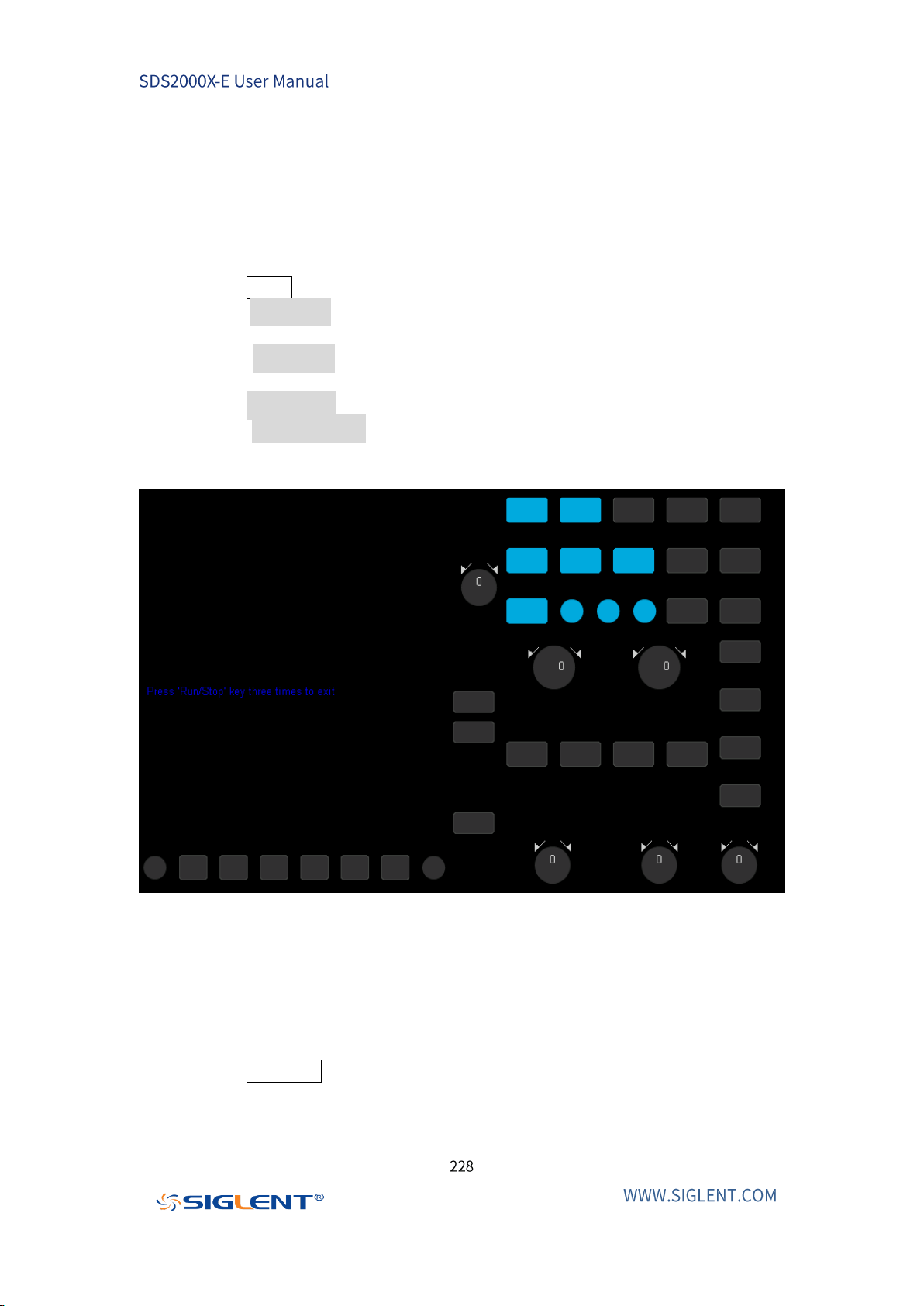
Keyboard Test
Keyboard test is used to check the functionality of the keys and knobs on the front
panel.
To perform a keyboard test, please follow these steps:
1. Press the Utility button on the front panel to enter the UTILITY function menu.
2. Press the Next Page softkey to go to the second page of the UTILITY function
menu.
3. Press the Next Page softkey to go to the third page of the UTILITY function
menu.
4. Press the Do Self Test softkey to enter the SELFTEST function menu.
5. Press the Keyboard Test softkey to enter the keyboard test interface, as the
picture shown below.
Figure 121 Keyboard Test
6. To perform the knob and button test.
7. Knob test: The default value is 0. Turn left to increase the value, turn right to
decrease; Push the knob to set the value to 0. Test every knob randomly.
8. Key test: The first key press should light the key indicator icon on the display. A
second press should cause the icon to darken. Test every button randomly.
9. Press the Run/Stop button 3 times to exit the keyboard test program.
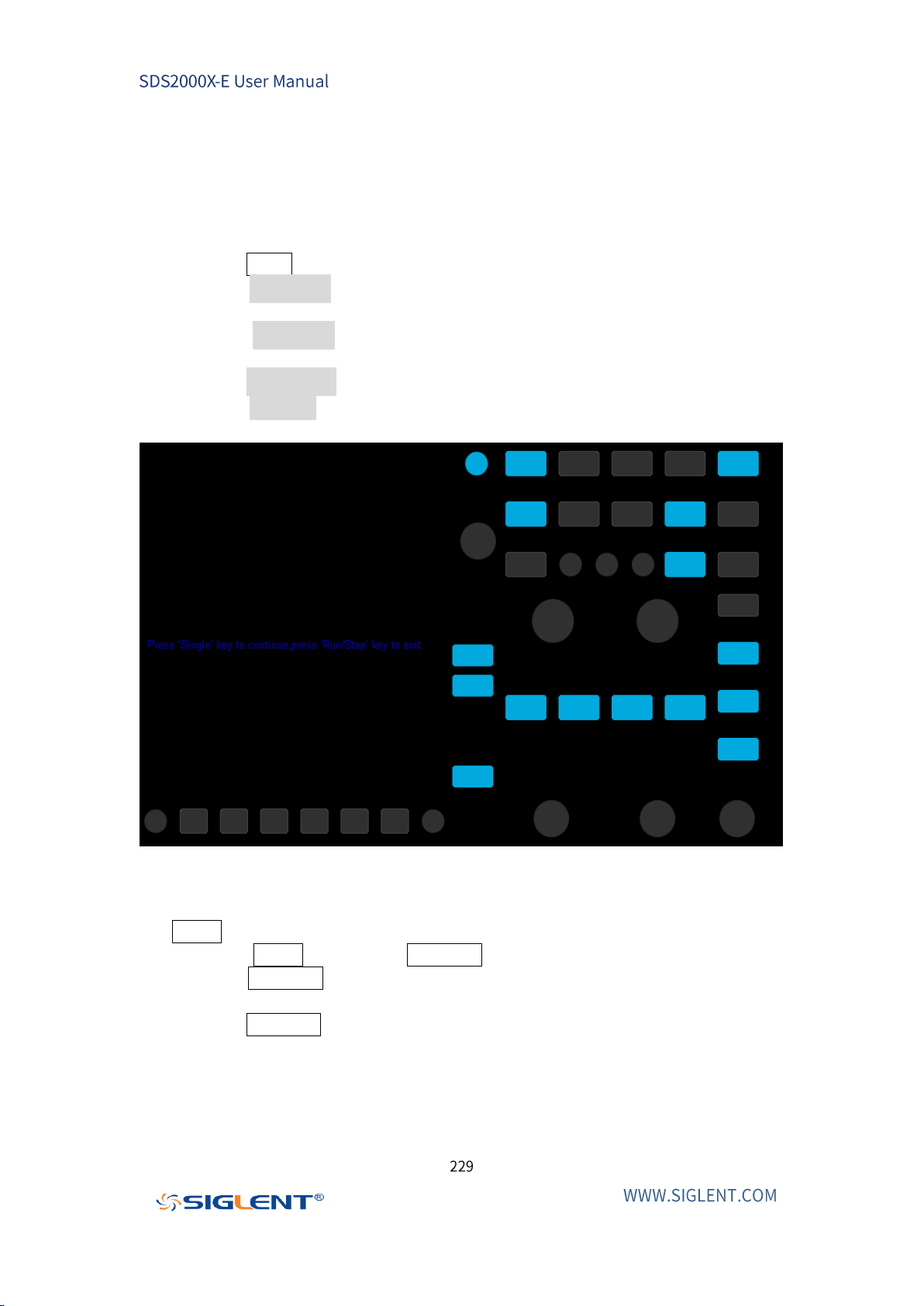
LED Test
LED test is used to confirm the operation of the LEDs that are used to backlight
certain buttons on the front panel.
1. Press the Utility button on the front panel to enter the UTILITY function menu.
2. Press the Next Page softkey to go to the second page of the UTILITY function
menu.
3. Press the Next Page softkey to go to the third page of the UTILITY function
menu.
4. Press the Do Self Test softkey to enter the SELFTEST function menu.
5. Press the LED Test softkey to enter the keyboard test interface, as the picture
shown below.
Figure 122 LED Test
6. According to the prompting information displaying on the screen, press the
Single button continually to light the button lights one by one. The first time to
press the Single button, the Run/Stop button displays red, and the second
press the Run/Stop button displays green. Then the other button lights will be
lit one-by-one. At last all the lights will be lit at the same time.
7. Press the Run/Stop button to exit the LED test program.
Screen Saver
When the oscilloscope enters the idle state and holds for a certain period of time,
the screen saver program will be enabled.
Do the following steps to set the screen saver time:
1. Press the Utility button on the front panel to enter the UTILITY function menu.
2. Press the Next Page softkey to go to the second page of the UTILITY function
menu.
3. Press the Next Page softkey to go to the third page of the UTILITY function
menu.
4. Press the Screen Saver softkey; and then turn the Universal Knob to select the
desired screen saver time. The screen saver time can be set to 1min, 5min,
10min, 30min, and 1hour. Also you can select Off to turn off the screen saver
function.
Figure 123 Screen Saver Interface
5. Press the any button on the front to exit the screen saver program.
Reference Position
The reference position setting determines the physicial point that the oscilloscope
uses during vertical and horizontal scale changes. In some situations, it is more
convenient to use a fixed position on the display.
Press the Utility button on the front panel and then press the Reference Pos. softkey
to enter the Reference POS menu.
Press the Vertical softkey to select Fixed Offset or Fixed Position.
Fixed Position: When the vertical gain is changed, the oscilloscope will keep the
vertical offset level indicator stationary.
Fixed Offset: When the vertical gain is changed, the oscilloscope will have the
vertical offset level indicator move with the actual voltage level.
Press the Horizontal softkey to select Fixed Delay or Fixed Position.
Fixed Position: When the time base is changed, the oscilloscope will keep the
horizontal offset indicator stationary.
Fixed Delay: When the time base is changed, the oscilloscope will have the
horizontal delay indicator move with the trigger point.
Power On Line
Press the Utility button on the front panel; then; press the Power On Line softkey to
select Enable or Disable.
Enable: When the oscilloscope is energized, the oscilloscope will start
automatically without user intervention. This is ideal for situations where
physical access to the instrument power switch is difficult or impossible, such
as automated test equipment or remote locations.
Disable: This setting requires user intervention to energize the scope. Press the
power key at the lower-left corner of the front panel to start the oscilloscope.
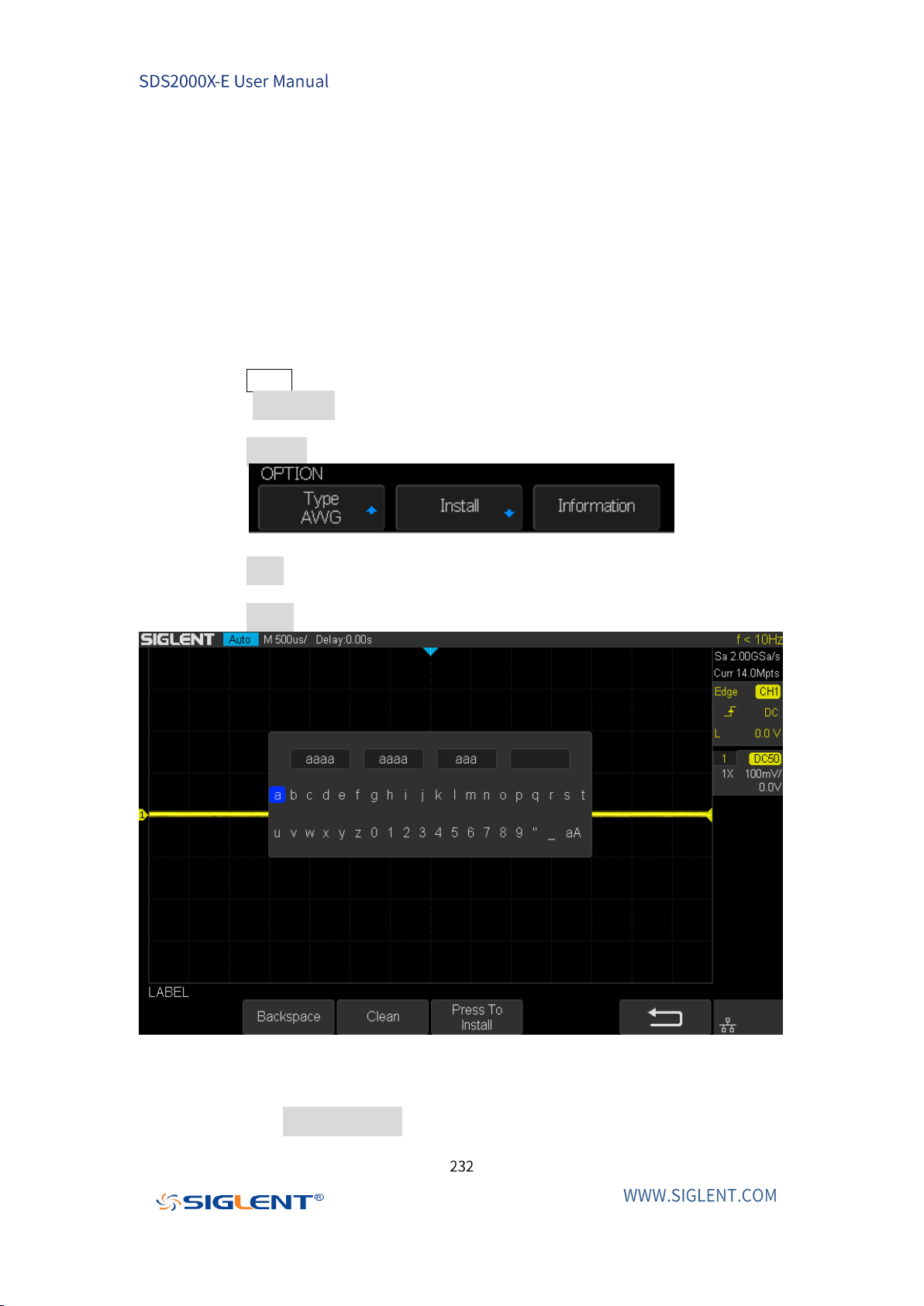
Option Management
The SDS2000X-E provides multiple options to fulfill your measurement
requirements. Please contact your SIGLENT sales representative or SIGLENT
technical support to order the corresponding options. You can view the options
currently installed on the oscilloscope or activate the newly purchased option
license codes through this menu.
Do the following steps to install the option on the oscilloscope:
1. Press the Utility button on the front panel to enter the UTILITY function menu.
2. Press the Next Page softkey to go to the third page of the UTILITY function
menu.
3. Press the Options softkey to enter the OPTION function menu.
Figure 124 OPTION Function Menu
4. Press the Type softkey; then turn the Universal Knob to select the module to be
installed and push down the knob to confirm.
5. Press the Install softkey to enter the LABEL function menu to input the license.
Figure 125 LABEL Function Interface
Turn the Universal Knob to select character.
Push down the Universal Knob to confirm the characters.
Press the Press To Install when you have completed entering the license
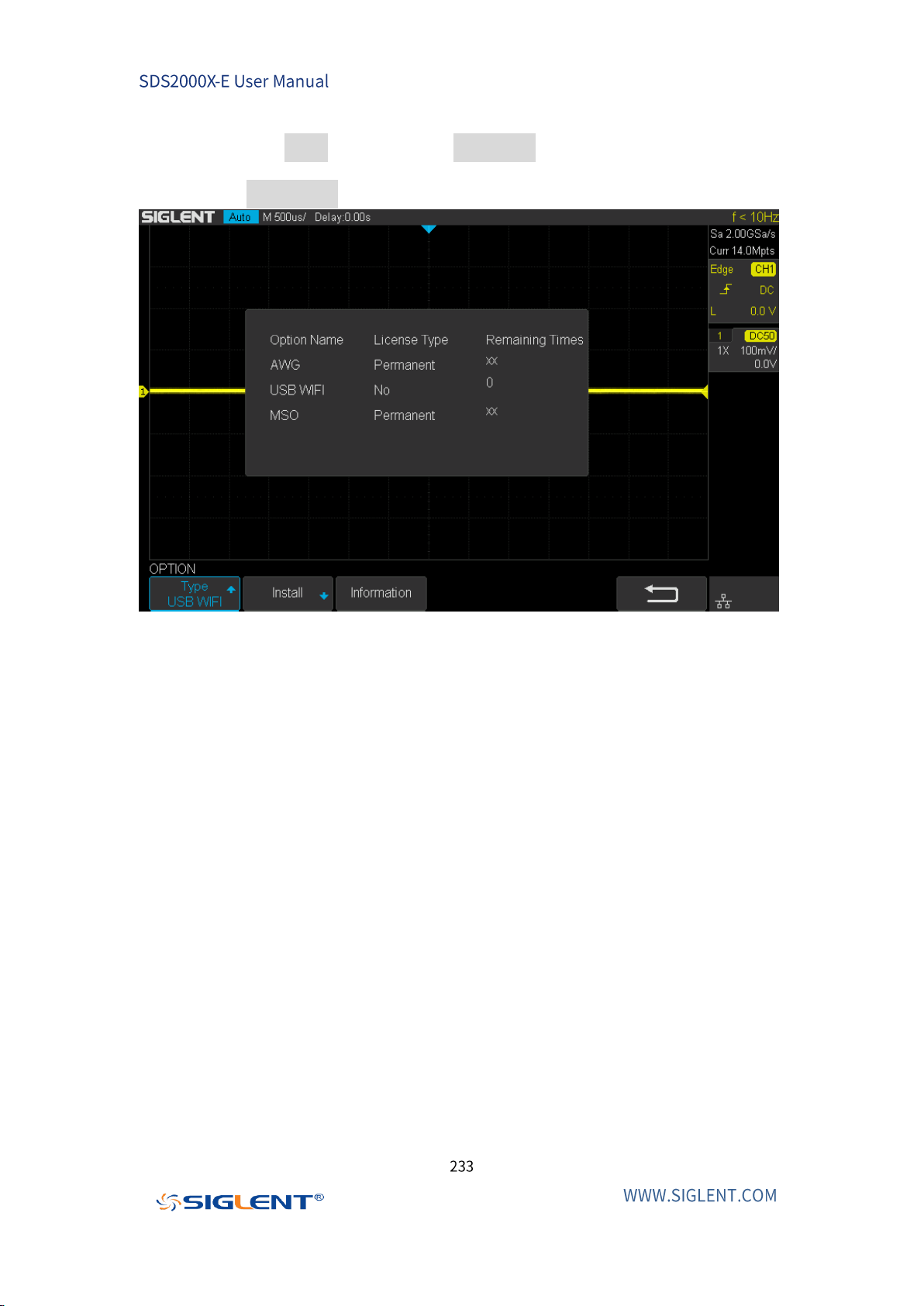
key.
Press the Clean softkey or the Backspace softkey to delete the incorrect
character.
6. Press the Information softkey to view the option information.
Figure 126 Option Information
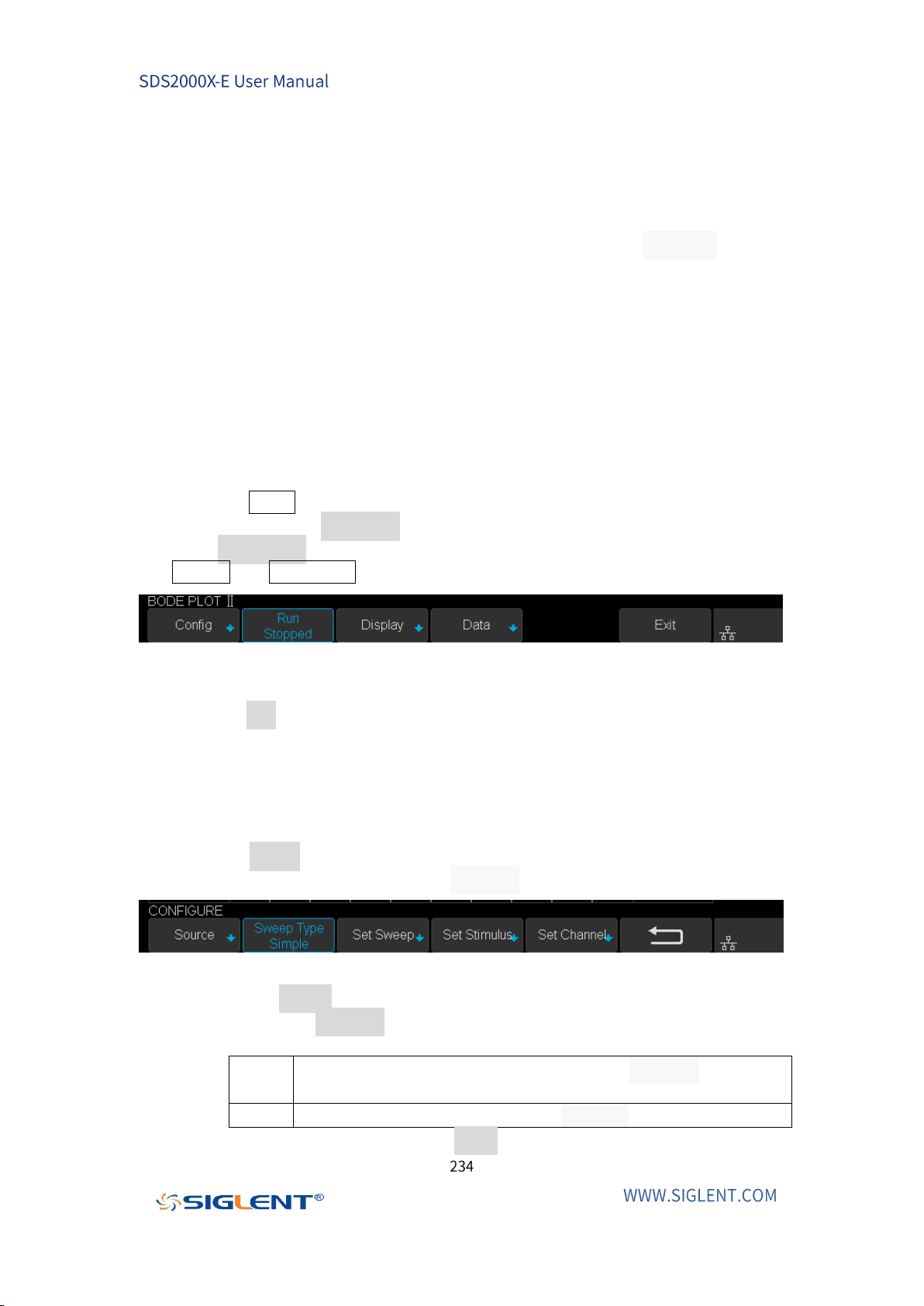
Bode Plot II
The bode plot application for the SDS2000X-E controls an external arbitrary
waveform generator(only Siglent’s arbitrary waveform generator can be supported)
to sweep a sine wave across a range of frequencies while measuring the input to
and output from a device under test (DUT). At each frequency point, gain and
phase are measured and displayed on the Bode plot.
Perform Bode Plot
The following steps briefly describe how to perform the Bode Plot:
1. Press the Utility button on the front panel to enter the UTILITY function menu,
and then press the Next Page softkey to enter the second page.
2. Press Bode Plot II softkey to enter the BODE PLOT II menu. At this time, only the
Default and Auto Setup button which on the front panel are available.
Figure 127 BODE PLOT II Menu
3. Configure the parameters (see the section “Setting” for details).
4. Press the Run softkey to perform the test.
Setting
1. Press the Config softkey to enter the CONFIGURE menu. All the parameters in
this menu are used to configure the external AWG.
Figure 128 CONFIGURE Menu
1) Press the Source softkey to enter SOURCE menu.
Press the Interface softkey and turn the Universal Knob to select the
connection mode of AWG.
USB
Connect the oscilloscope USB host to the external AWG’s USB
Device via a USB cable.
LAN
Connect the oscilloscope and the external AWG via LAN.
If LAN is selected, press the Set IP softkey, and set the IP of AWG in the
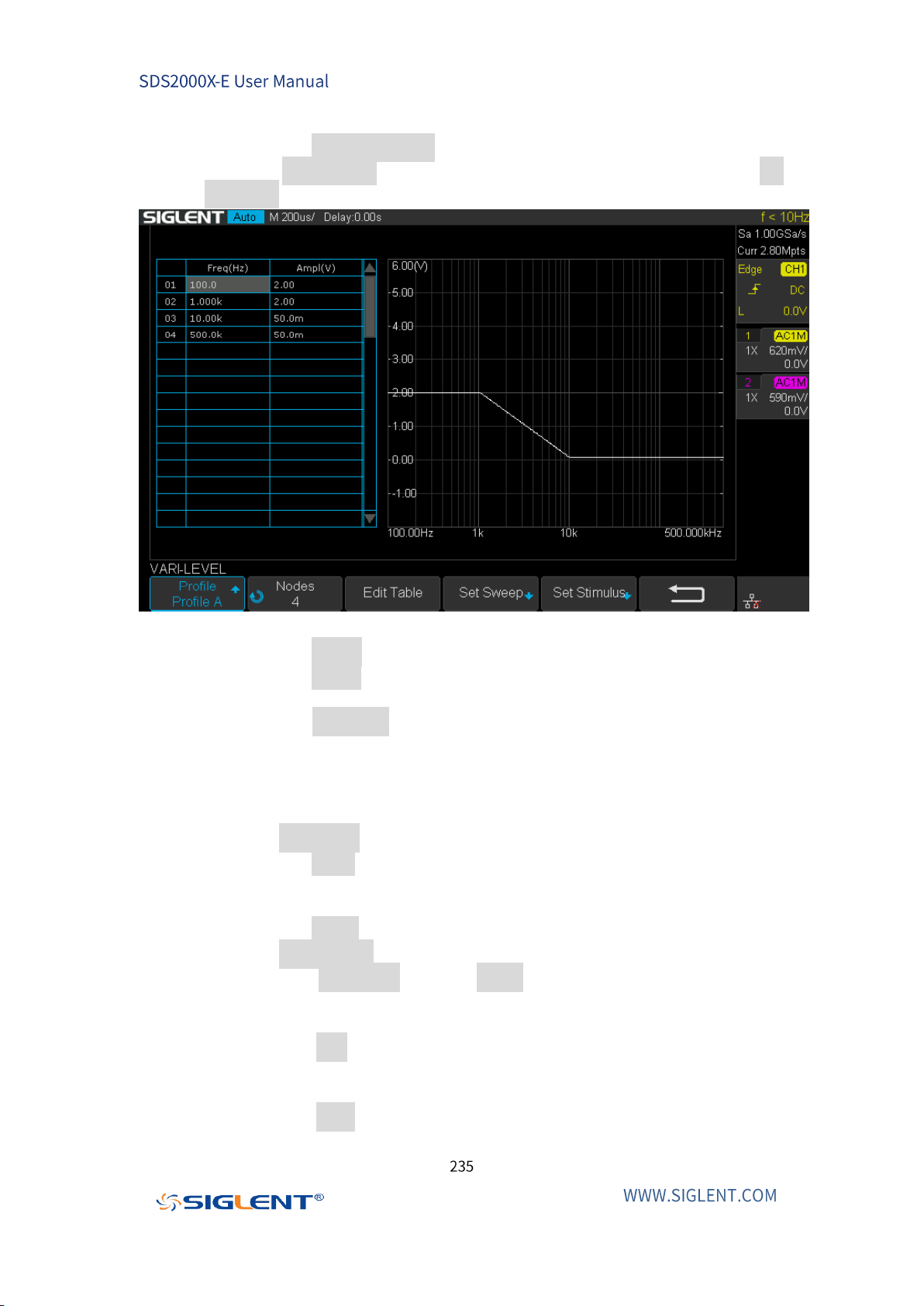
pop-up dialog box.
Press the Connection Test softkey to check the connection.
2) Press the Sweep Type softkey to select Simple or Vari-level. Press the Set
Vari-level softkey to enter the VARI-LEVEL menu.
Figure 129 VARI-LEVEL Menu
Press the Profile softkey to select the profile (Profile A~ Profile D).
Press the Nodes softkey and turn the Universal knob to set the number
of nodes.
Press the Edit Table softkey continuously to select the cell and turn the
Universal knob to select the line. When the cell is selected, set the
value by using the universal knob or virtual keyboard. "Freq" indicates
the scanning frequency value while "Ampl" indicates the scanning
amplitude.
3) Press the Set Sweep softkey to enter SET SWEEP menu.
Press the Mode softkey to select the sweep mode.
Linear: it is necessary to set the center frequency and span frequency
Decade: it is necessary to set the start frequency and stop frequency.
Press the Points softkey to set the sweep resolution.
4) Press the Set Stimulus softkey to enter STIMULUS menu.
Press the Amplitude softkey (Offset softkey) and turn the Universal
Knob to set the amplitude, or press the Universal Knob directly to enter
the parameter value in the pop-up virtual keyboard.
Press the Unit softkey and turn the Universal Knob to select the unit
type. It contains 6 types of Vpp, Vrms, dBV, dBu, dBm, Arbitrary dB.
When the unit type is dB, it is necessary to set the reference level.
Press the Load soft key to switch the load between 50Ω, 75Ω, 600Ω,
Hi-Z. It also can turn the Universal Knob to set the load value.
5) Press the Set Channel softkey to enter the SET CHANNEL menu.
Press the DUT Input softkey to select the corresponding input signal
channel. Press the DUT Output 1 soft key to select the corresponding
output signal channel.
Press the Channel Gain softkey continuously to select the gain type as
“Hold” or “Auto”.
2. Press the Display soft key to enter the DISPLAY menu. The display menu
displays the configuration related to bode plot interface.
Figure 130 DISPLAY Menu
1) Press the Amplitude softkey to enter the AMPLITUDE menu.
Press the Scale softkey and turn the Universal Knob to set the
amplitude display scale.
Press the Ref Level softkey and turn the Universal knob to set the
amplitude display reference level, or press the Universal knob directly
to enter the value in the pop-up virtual keyboard.
Press the Mode softkey to set the display mode of the amplitude.
Vout/Vin: display the ratio of the DUT output to the DUT input. Press
the Axis Type softkey to set the vertical axis to logarithmic or linear.
Vout: display the DUT output voltage value directly. Press the unit
softkey to set the unit type to Vpp, Vrms, dBV, dBu, dBm, or Arbitrary
dB.
Press the Auto Set softkey to automatically adjust the vertical direction
parameters based on the Bode plot data.
2) Press the Phase softkey to enter the PHASE menu.
Press the Scale (Ref Level) softkey and turn the Universal Knob to set
the phase display scale (phase display reference level), or press the
Universal Knob directly to enter the value in the pop-up virtual
keyboard.
Press the Unit softkey continuously to switch the phase unit to Deg or
Rad.
Press the Auto Set softkey to automatically adjust the vertical direction
parameters based on the Bode plot data.
3) Press the Auto Set softkey to automatically adjust the vertical direction
parameters based on the Bode plot data.
4) Press the Cursors soft key to enter the CURSORS menu. See the chapter
"Cursor" for details.
3. Press the Data softkey to enter the DATA menu. The data menu displays the
configurations of bode plot measurement results.
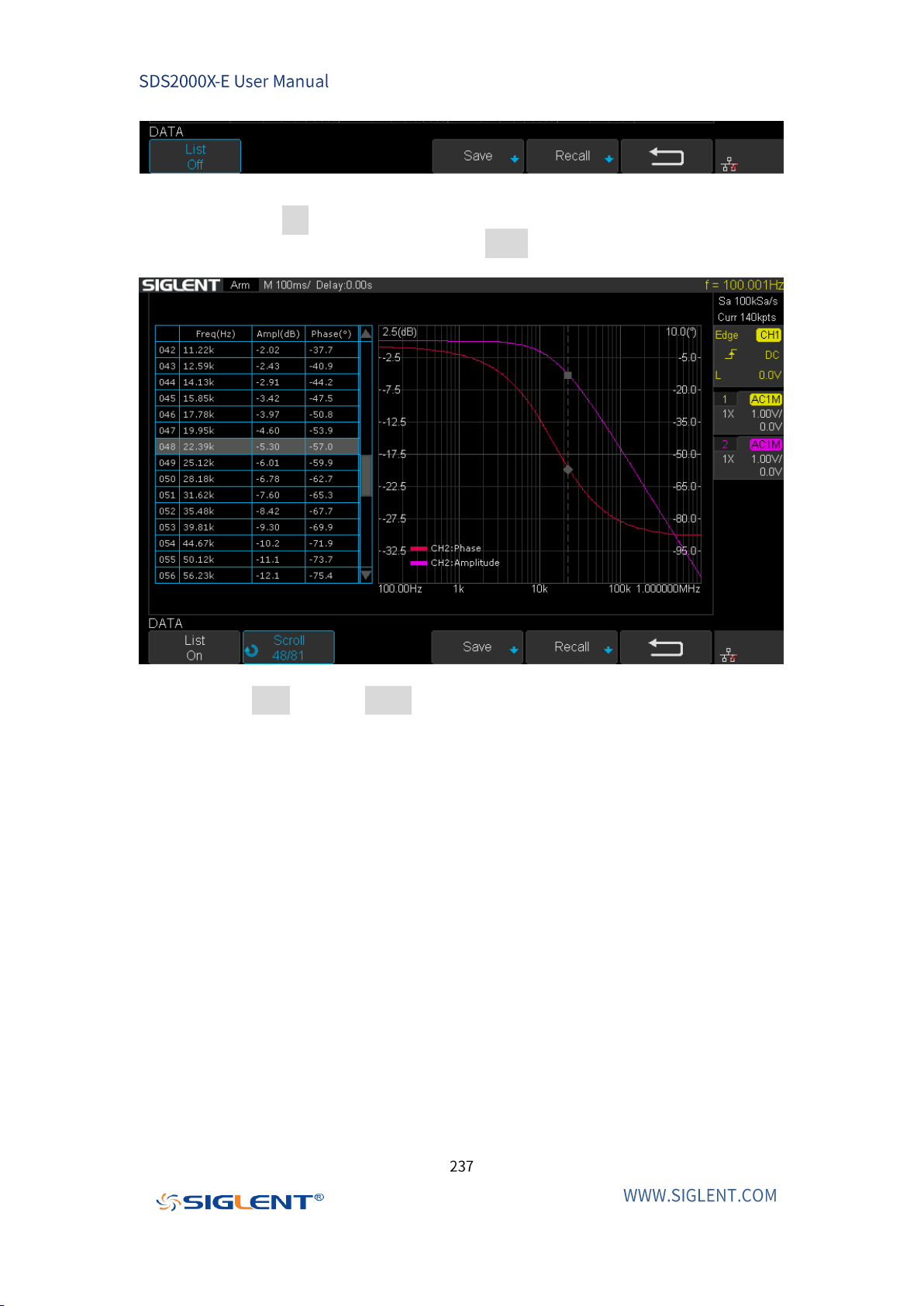
Figure 131 DATA Menu
1) Press the List softkey repeatedly to turn the Bode plot data list on or off.
After turning on the list, press the Scroll soft key and turn the Universal
Knob to select the frequency point, as shown below.
Figure 132 Bode Plot List On
2) Press Save softkey (Recall softkey) to enable the bode plot save (recall)
function. See the chapter “Save and Recall” for details.
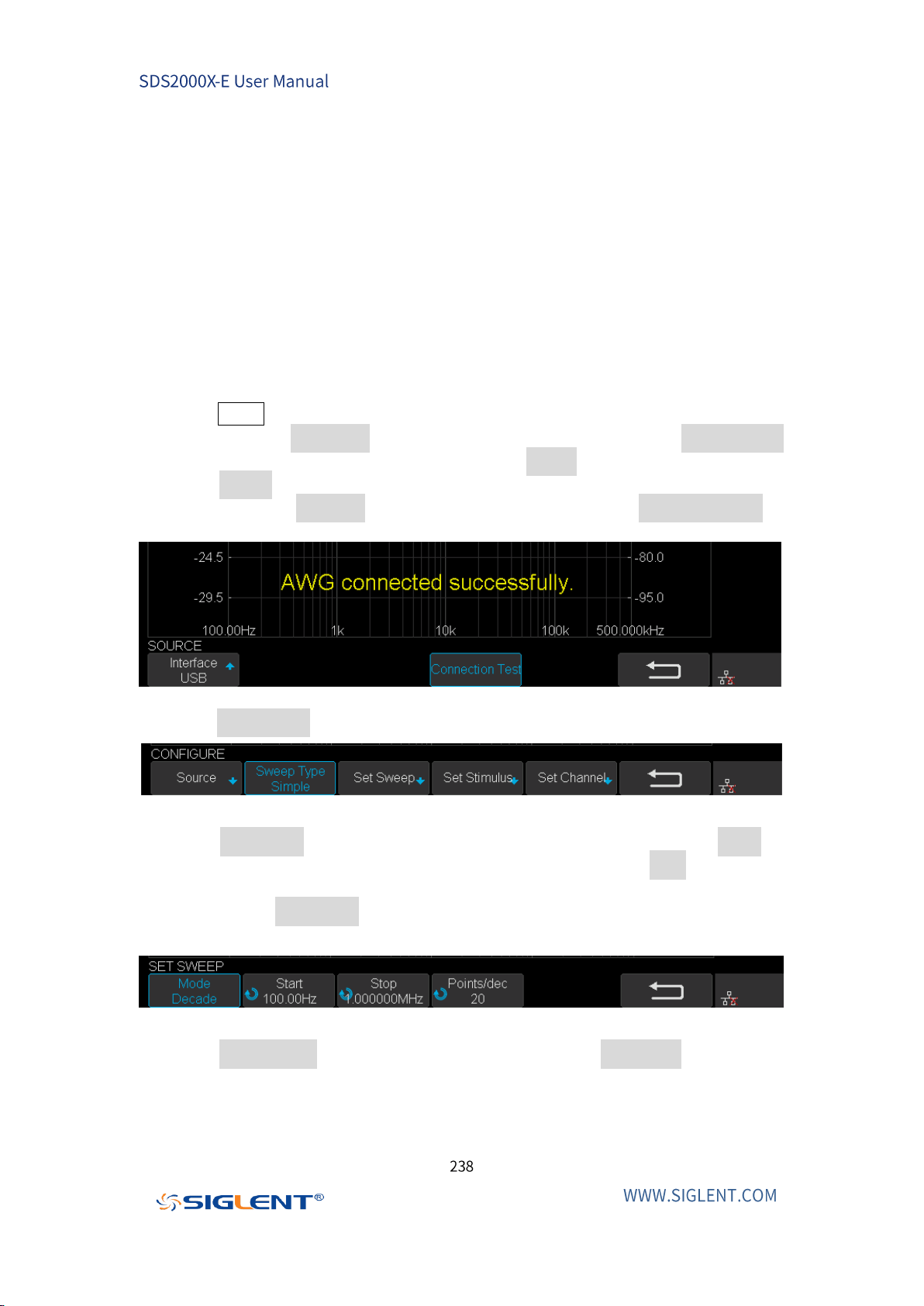
Example
The following are examples to familiarize you with bode plot.
Simple Sweep Operation
Vari-level Sweep Operation
Simple Sweep Operation
1. Press Utility button on the front panel to enter the UTILITY function menu, and
then press the Next Page soft key to enter the second page. Press Bode Plot Ⅱ
to enter the BODE PLOT function menu. Press Config to enter Configure menu.
2. Press Source to enter Source menu to select the waveform generator. In this
example, press Interface to select “USB”, and then press Connection Test to
verify setting. Then return to the Configure menu.
Figure 133 Bode Plot Interface Connection
3. Press Sweep Type to select “Simple”.
Figure 134 Sweep Configure Menu
4. Press Set Sweep to enter Set Sweep menu. In this example, press Mode to
select “Decade” to sweep frequency logarithmically. Press Start and use the
Universal Knob to set the start frequency to 100 Hz. Then set stop frequency to
1 MHz. Press Points/dec and use the Universal Knob to set the frequency point
to 20 points per decade. Then return to the Configure menu.
Figure 135 Set Sweep Parameters Menu
5. Press Set Stimulus to enter Set Stimulus menu. Press Amplitude and use the
Universal Knob to set the signal amplitude to 2 V. All the other options remain
their default setting. Then return to the Configure menu.
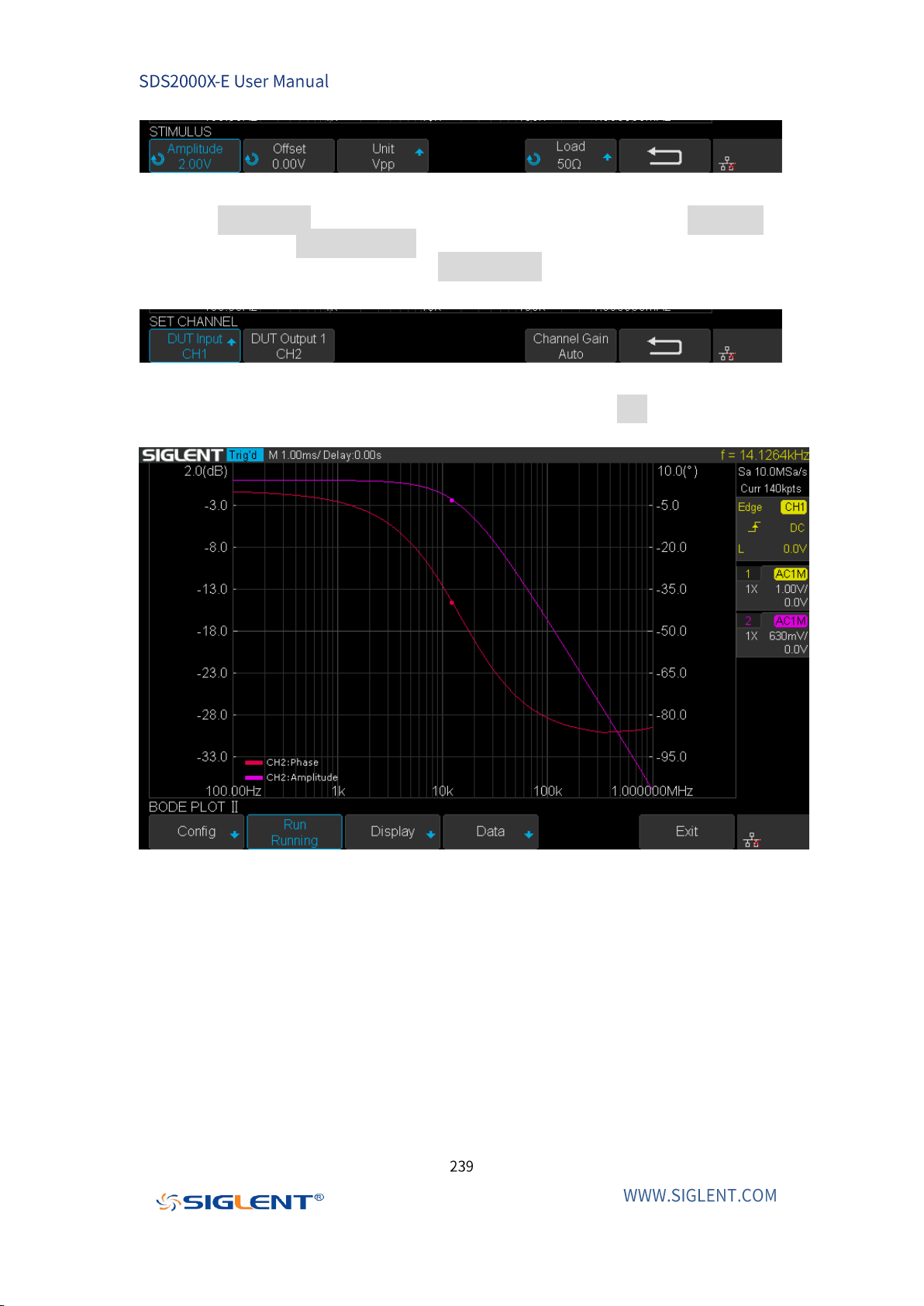
Figure 136 Set Stimulus Menu
6. Press Set Channel to enter Set Channel menu. In this example, set DUT Input to
“CH1”, and DUT Output 1 to “CH2”. Since we want to maximize
measurement dynamic range, set Channel Gain to “Auto”. Then return to the
Configure menu.
Figure 137 Set Channel Menu
7. Configuration was done. Return to root menu and press Run, and wait for the
sweep to complete.
Figure 138 Bode Plot Sweep Curve
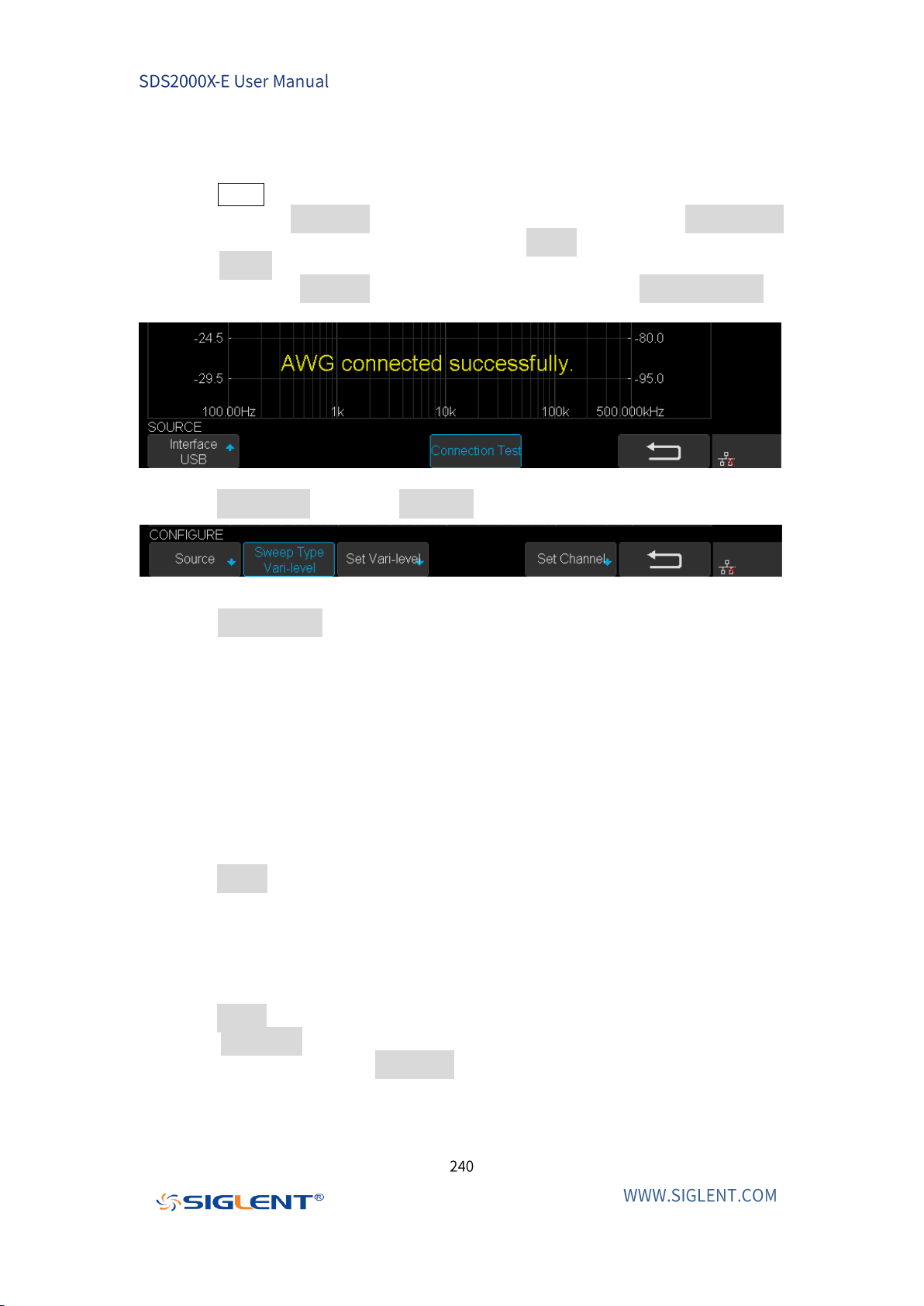
Vari-level Sweep Operation
1. Press Utility button on the front panel to enter the UTILITY function menu, and
then press the Next Page soft key to enter the second page. Press Bode Plot Ⅱ
to enter the BODE PLOT function menu. Press Config to enter Configure menu.
2. Press Source to enter Source menu to select the waveform generator. In this
example, press Interface to select “USB”, and then press Connection Test to
verify setting. Then return to the Configure menu.
Figure 139 Bode Plot Interface Connection
3. Press Sweep Type to select “Vari-level”.
Figure 140 Vari-level Configure Menu
4. Press Set Vari-level to enter Vari-level editor. On the left side of the editor is a
spreadsheet which is used to specify the relationship between frequency and
amplitude. On the right side is an automatically generated stimulus voltage vs.
frequency plot.
5. The operation principle of Vari-level is simple. User specifies a series of joint,
which is defined by a given frequency and corresponding amplitude. In
between two adjacent joints, the frequency points and their corresponding
amplitude are calculated automatically by linear interpolation. The frequency
of the joints is sequential, so the frequency of the posterior joint is always
higher than the frequency of the anterior joint. And always, the first and the
last joint defines the start and stop frequency.
6. Press Profile and use the Universal Knob to select “Profile A”. As you can see,
up to 4 profiles can be saved.
7. In this example, I will demonstrate how to specify a Vari-level profile widely
used in testing power supply loop response. The profile is a 4-joint- polyline
with large stimulus amplitude in low frequency and small amplitude in high
frequency, and gradual amplitude in intermediate frequency.
8. Press Nodes and use the Universal Knob to set the number of nodes to 4.
9. Press Edit Table to activate the spreadsheet editor. When the spreadsheet
editor is activated, press Edit Table will cycle the cursor between frequency,
amplitude and the entire column. Then use the Universal Knob to adjust the
frequency, the amplitude, or to select the column to be edited. Press the
Universal Knob will activate the visual keypad for more precise input.
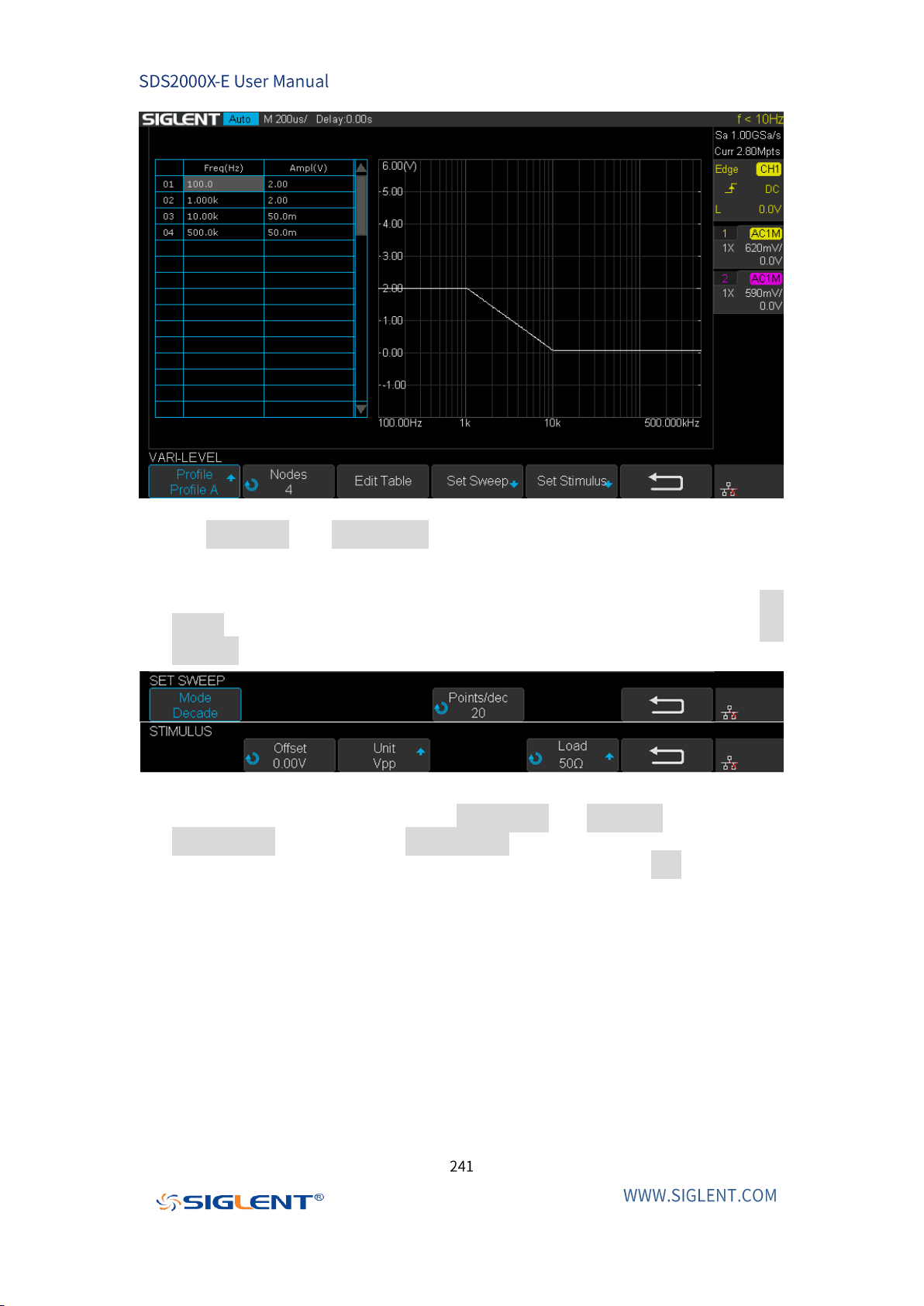
Figure 141 Set Vari-level Parameters Menu
10. The Set Sweep and Set Stimulus in Vari-level editor are similar to that in the
Simple sweep mode, but they are independently configured and do not affect
each other. These options in Vari-level mode do not have frequency and
amplitude input because they are specified in the spreadsheet. Press Set
Sweep and then set Mode to “Decade”, and set Points/dec to 20. The Set
Stimulus remains default setting.
Figure 142 Set Sweep Parameter Menu
11. Return to Configure menu and press Set Channel. Set DUT Input to “CH1” and
DUT Output 1 to “CH2”, and Channel Gain to “Auto”.
12. Configuration was done. Return to the root menu and press Run and wait for
the sweep to complete.
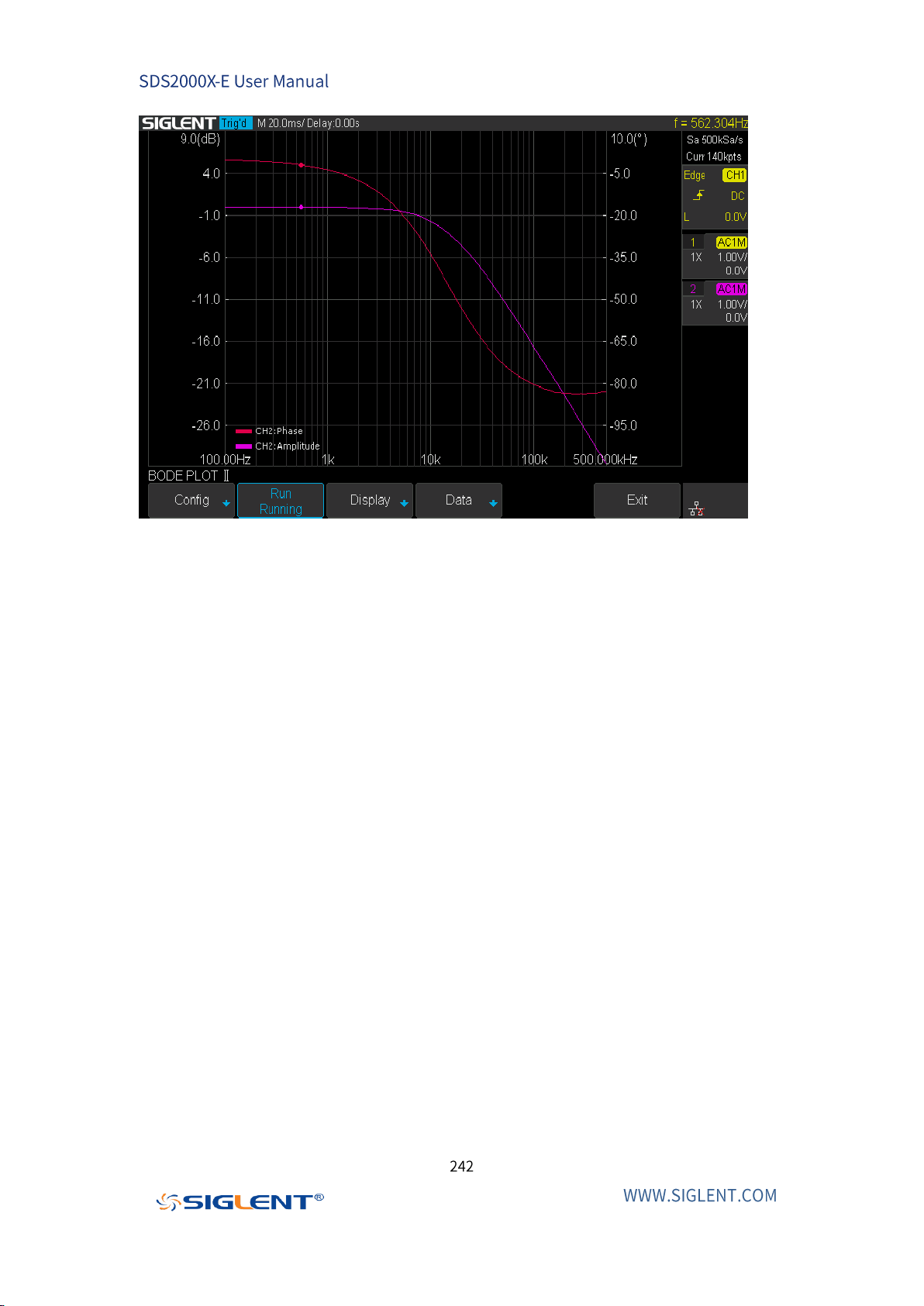
Figure 143 Bode Plot Sweep Curve
Factory Setup
Oscilloscopes can be complicated devices, and having a way to return the
instrument to a known state can be the fastest way to getting your instrument
configured quickly. This is especially true when a single instrument has multiple
users.
Press Save/Recall function key, then press the Save softkey. Select To Default Key
and set the type to Factory Setup. Then press the Default button on the front to set
the oscilloscope to the factory setup. Another way is to press the Save/Recall
function key, then press Recall softkey select Factory Default to recall.

Troubleshooting
The commonly encountered failures and their solutions are listed below. When you
encounter those problems, please solve them following the corresponding steps. If
the problem remains still, please contact SIGLENT as soon as possible.
1. The screen is still dark (no display) after power on:
1) Check whether the power is correctly connected.
2) Check whether the power switch is really on.
3) Check whether the fuse is burned out. If the fuse needs to be changed,
please use the specified fuse.
4) Restart the instrument after finishing the above inspections.
5) If it still does not work correctly, please contact SIGLENT.
2. The signal is sampled but no waveform of the signal is displayed:
1) Check whether the probe is correctly connected to the signal connecting
wire.
2) Check whether the signal connection is correctly connected to the BNC
input (namely channel connector).
3) Check whether the probe is correctly connected to the item to be tested.
4) Check whether there are signals generated from the item to be tested (you
can connect the probe compensation signal to the problematic channel to
determine which has problem, the channel or the item to be tested).
5) Resample the signal.
3. The tested voltage amplitude is greater or lower than the actual value (Note
that this problem usually occurs when probe is used):
Check whether the attenuation setting of the channel complies with the
attenuation ratio of the physical setting on the probe.
4. There is waveform display but not stable:
1) Check the trigger signal source: Check whether the Source item at the
trigger panel complies with the signal channel actually used.
2) Check the trigger type: General signals should use “Edge” trigger and
video signal should use “Video” trigger.
3) Change the trigger holdoff setting.
5. No display after pressing Run/Stop:
Check whether the mode at the trigger panel (TRIGGER) is on “Normal” or
“Single” and whether the trigger level exceeds the waveform range. If yes,
set the trigger level to the middle or set the mode to “Auto”.

Note: Using AUTO could automatically finish the above setting.
6. The display of waveform is ladder-like:
1) The horizontal time base might be too low. Increase the horizontal time
base to increase the horizontal resolution and improve the display.
2) If the display Type is “Vectors”, the lines between the sample points may
cause ladder-like display. Set Type to “Dots” to solve the problem.
7. Fail to connect PC through USB:
Check the IO Setting in Utility to make sure whether the setting in USB Device
matches the device currently connected. If needed, restart the oscilloscope.
8. The USB storage device cannot be recognized:
1) Check whether the USB storage device can work normally.
2) Make sure whether the USB interface can work normally.
3) Make sure that the USB storage device being used is flash storage type.
This oscilloscope does not support hardware storage type.
4) Restart the instrument and then insert the USB storage device to check it.
5) If the USB storage device still cannot be used normally, please contact
SIGLENT.