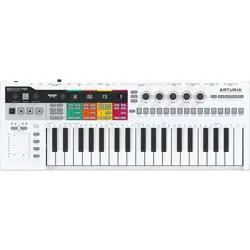

USER MANUAL
_KEYSTEP PRO

Special Thanks
DIRECTION
Frédéric Brun Philippe Cavenel Sébastien Colin
ENGINEERING
Yannick Bellance Sébastien Colin Yannick Dannel
INDUSTRIALIZATION
Jérôme Blanc Lionel Ferragut
TESTING
Maxime Audfray
Florian Marin
Benjamin Renard
Jean-Baptiste Arthus
Victor Morello
Adrien Soyer
BETA TESTING
Boele Gerkes
Gert Braakman
Andrew Henderson
Koshdukai
Gustavo Lima
Mark Dunn
Maxime Dangles
Paul Steinway
Tom Hall
Tony Flyingsquirrel
Chuck Zwicky
Terry Marsden
Armin Heinrich
MANUAL
Gert Braakman (Author)
Camille Dalemans
Vincent Le Hen
Jimmy Michon
Rob Stuart
Holger Steinbrink
Charlotte Métais
Minoru Koike
José Rendón
DESIGN
Sébastien Rochard
Edouard Madeuf
Maxime Audfray
Jean-Baptiste Arthus
Glen Darcey
DesignBox
Frédéric Brun
Yannick Bellance
© ARTURIA SA – 2021 – All rights reserved.
26 avenue Jean Kuntzmann
38330 Montbonnot-Saint-Martin
FRANCE
www.arturia.com
Information contained in this manual is subject to change without notice and does not
represent a commitment on the part of Arturia. The software described in this manual is
provided under the terms of a license agreement or non-disclosure agreement. The software
license agreement specifies the terms and conditions for its lawful use. No part of this
manual may be reproduced or transmitted in any form or by any purpose other than
purchaser’s personal use, without the express written permission of ARTURIA S.A.
All other products, logos or company names quoted in this manual are trademarks or
registered trademarks of their respective owners.
Product version: 2.0
Revision date: 30 April 2021

Thank you for purchasing the Arturia KeyStep
Pro!
This manual covers the features and operation of Arturia’s KeyStep Pro. KeyStep Pro is
a full-featured standalone keyboard controller complete with four polyphonic sequencers,
three arpeggiators, a wide-ranging set of USB, MIDI and CV connections and our Slimkey
keyboard that provides maximum playability with a minimal footprint.
KeyStep Pro is designed for the electronic musician looking for a reliable hardware product
that will give them fast hands-on control over up to four devices at once. Each device
can be played directly through the keyboard or controlled by one of the four sequencers/
arpeggiators. Devices can also be controlled through USB, two independent MIDI outputs
or four sets of CV and Gate outputs, giving users the ability to control nearly any kind of
electronic musical instrument available today.
In this package you will find:
• One KeyStep Pro controller, with a serial number and unlock code on the bottom.
You will need this information in order to register your KeyStep Pro.
• One "worldwide" power supply with interchangeable leads
• One USB cable
• The Quick Start Guide for KeyStep Pro
Be sure to register your KeyStep Pro as soon as possible! There is a sticker on the bottom
panel that contains the serial number of your unit and an unlock code. These are required
during the online registration process. You may want to record these elsewhere or take a
photo of the sticker in case it becomes damaged.
Registering your KeyStep Pro provides the following benefits:
• Access to the latest version of the MIDI Control Center software
• Special offers restricted to KeyStep Pro owners

Special Message Section
Specifications Subject to Change:
The information contained in this manual is believed to be correct at the time of printing.
However, Arturia reserves the right to change or modify any of the specifications without
notice or obligation to update the hardware that has been purchased.
IMPORTANT:
The product and its software, when used in combination with an amplifier, headphones or
speakers, may be able to produce sound levels that could cause permanent hearing loss.
DO NOT operate for long periods of time at a high level or at a level that is uncomfortable.
If you encounter any hearing loss or ringing in the ears, you should consult an audiologist.
NOTICE:
Service charges incurred due to a lack of knowledge relating to how a function or feature
works (when the product is operating as designed) are not covered by the manufacturer’s
warranty, and are therefore the owner's responsibility. Please study this manual carefully
and consult your dealer before requesting service.
Precautions include, but are not limited to, the following:
1. Read and understand all the instructions.
2. Always follow the instructions on the instrument.
3. Before cleaning the instrument, always remove the USB and power cables.
When cleaning, use a soft and dry cloth. Do not use gasoline, alcohol, acetone,
turpentine or any other organic solutions; do not use a liquid cleaner, spray or
cloth that is too wet.
4. Do not use the instrument near water or moisture, such as a bathtub, sink,
swimming pool or similar place.
5. Do not place the instrument in an unstable position where it might accidentally
fall over.
6. Do not place heavy objects on the instrument. Do not block openings or vents
of the instrument; these locations are used for air circulation to prevent the
instrument from overheating. Do not place the instrument near a heat vent at any
location with poor air circulation.
7. Do not open or insert anything into the instrument that may cause a fire or
electrical shock.
8. Do not spill any kind of liquid onto the instrument.
9. Always take the instrument to a qualified service center. You will invalidate your
warranty if you open and remove the cover, and improper assembly may cause
electrical shock or other malfunctions.
10. Do not use the instrument with thunder and lightning present; otherwise it may
cause long distance electrical shock.
11. Do not expose the instrument to hot sunlight.
12. Do not use the instrument when there is a gas leak nearby.
13. Arturia is not responsible for any damage or data loss caused by improper
operation of the instrument.

Introduction
Congratulations on your purchase of the Arturia KeyStep Pro!
This fantastic keyboard controller gives you everything you need to quickly and easily
control up to four devices at once: virtual instruments, hardware synthesizers, modular
synthesizers or drum machines. Its standalone design means that you can use it with
or without a computer and its four powerful sequencers/arpeggiators are sure to spark
interesting musical ideas and capture your best performances.
All the essential features of a professional keyboard controller are here, including aftertouch,
pitch and modulation touch-strips, and clearly labeled buttons and knobs that are sensibly
laid out for fast, intuitive access. The Slimkey keyboard features great-feeling keys that are
smaller than standard piano keys but still large enough to allow for maximum playability
across multiple octaves. These keys make the product smaller and more portable but—make
no mistake—KeyStep Pro is built like a tank so that it can be taken on tour with confidence.
We hope the four polyphonic sequencers will unleash your most interesting musical ideas.
The RGB LED indicators above each key give you immediate visual feedback of exactly
what each sequencer is doing. You can specify the exact pitch, length, velocity, timing and
randomness of a sequence step through touch-sensitive knobs with surrounding indicator
LED rings. The dedicated note tie, transposition, overdubbing and hold buttons bring
immediacy and power to the sequencers. You can even set independent lengths for each of
the four sequencers for amazing polyrhythmic fun! Breath new life in your sequences by
playing them in a different key. Transposition is handled intelligently; sequences remain in
key as they are transposed. Invert them, shift them forward or backward in time, then send
it all out on the four Voices to your Modular system.
The arpeggiators have many inspiring modes of operation beyond the basic up/down
modes. The HOLD function lets you easily create complex arpeggiations with up to 16
notes and the step timing can be manipulated in real time. Experiment with Arpeggiators
like you've never done before! Create and mix the output of three arpeggiators playing
simultaneously. Mix arpeggios playing at different speeds. Finally, the scale quantization
and chord memory features will make you seem like even more of a musical monster than
you already are!
Use the Drum track to create complex polyrhythms; rhythms of different lengths playing 24
notes. Or use the first 8 channels to trigger drum units on your modular system. Use the
control track to control filters envelope stages, or reverb times on your external synths.
All of its features are one SHIFT/CLICK away. There's no menu-diving. If you need to change
settings there's a configuration menu, but it's a set-and-forget thing. The real stuff that
makes your music come to life is always at your fingertips. And what features they are!
Four sequencers, that can play huge stacked chords in every step. Advanced step editing;
take the chord stored in a step and change only the notes you want to change in that chord.
In addition to the standard MIDI ports, there is a second MIDI port that you can use to
control more gear or a DMX light controller.
KeyStep Pro has a massive number of uses thanks to its simultaneous USB, MIDI, CV/Gate
connections. Each of the its four tracks can output on USB, MIDI or CV/Gate simultaneously.
Each track on KeyStep Pro has control voltage (CV) outputs for Pitch, Gate and an extra
"modulation" CV output that allows for more creative sound design by letting you control
things like controlling velocity, filter cutoff, or any other parameter of your choosing. The first
track of KeyStep Pro can be set to function as a drum or "trigger" sequencer with 8 separate
CV gate outputs that you can use with analog drum machines or your modular synthesizer.
The powerful synchronization features let you use KeyStep Pro as a master clock source or
to have it synchronize itself to incoming USB, MIDI or CV synchronization signals. KeyStep
Pro can send and receive clock signals and even has a separate clock reset CV output jack
so that your external analog gear always remains firmly synchronized in both tempo
and
phase (loops and sequences always start on the "one" together).

Our MIDI Control Center (MCC) software allows you to dive deep into the KeyStep Pro's
features and to reconfigure the product so that it works best for you and your setup. MCC
really opens up a lot of options and we have dedicated an entire chapter of this guide so
that you can understand all of the powerful options.
The KeyStep Pro is a USB MIDI Class Compliant device. What does that mean and why
is it important? It means you can connect it to any other MIDI class-compliant device
without having to install drivers. Only when connecting to an iPad you will need a camera
connection cable or a USB to lightning cable. Arturia has a great line of iPad synthesizers
such as the iMini, the iSem, the iProphet and the iSpark. It's worth checking them out.
Be sure to visit
www.arturia.com. That’s the place to go for the latest firmware and to
download the MIDI Control Center. You’ll also find links to our tutorials and FAQs.
KeyStep Pro is easy to use, so you’ll probably start experimenting with it right out of the box.
However, please be sure to read this manual even if you are an experienced user, as we
describe many useful tips that will help you get the most out of your purchase. We're sure
you will find KeyStep Pro to be a great source of musical inspiration and we hope you'll use
it to its fullest potential.
Happy music making!
The Arturia team

Table Of Contents
1. Welcome and introduction .................................................................................................................................... 2
1.1. A fascinating adventure..................................................................................................................................................... 2
1.2. About reading manuals..................................................................................................................................................... 2
1.3. KeyStep Pro 2.0 Updates................................................................................................................................................. 3
1.4. Detailed overview.................................................................................................................................................................. 5
2. Installation...................................................................................................................................................................... 12
2.1. Usage Precautions.............................................................................................................................................................. 12
2.2. Warning .................................................................................................................................................................................... 12
2.3. Register your Instrument.............................................................................................................................................. 12
2.4. Connecting the KeyStep Pro to the World ......................................................................................................... 12
3. Basic Operations ........................................................................................................................................................ 13
3.1. Plug and Play......................................................................................................................................................................... 13
3.2. Record and Play a Sequence...................................................................................................................................... 17
3.3. Using the Arpeggiator ..................................................................................................................................................... 19
3.4. Scales & Chords ................................................................................................................................................................ 20
3.5. Creating Splits .................................................................................................................................................................... 20
4. KeyStep Pro Overview............................................................................................................................................ 21
4.1. Making the Connections.................................................................................................................................................. 21
4.2. Front Panel Overview ..................................................................................................................................................... 32
4.3. Back Panel Overview...................................................................................................................................................... 57
5. Making Tracks ............................................................................................................................................................. 63
5.1. Sequencer / Arpeggiator (or Drum) Tracks ...................................................................................................... 63
5.2. The Three Arpeggiators................................................................................................................................................. 63
5.3. The Four Sequencers ....................................................................................................................................................... 74
5.4. The Drum Sequencer...................................................................................................................................................... 92
5.5. Special Features............................................................................................................................................................... 108
6. What is a Project?................................................................................................................................................... 115
6.1. Managing Projects............................................................................................................................................................ 115
6.2. All about Tracks .................................................................................................................................................................. 119
6.3. Patterns................................................................................................................................................................................... 121
6.4. Arranging.............................................................................................................................................................................. 125
7. Timing.............................................................................................................................................................................. 132
7.1. Tempo....................................................................................................................................................................................... 132
7.2. Sync.......................................................................................................................................................................................... 135
7.3. Sync/Clock and Reset Outputs ............................................................................................................................... 136
8. Control Mode .............................................................................................................................................................. 137
8.1. What is Control Mode?.................................................................................................................................................. 137
8.2. Control Mode as DAW Automation ...................................................................................................................... 139
8.3. Front Panel Functions................................................................................................................................................... 144
9. KeyStep Pro Configuration ............................................................................................................................... 145
9.1. The Utility Menu................................................................................................................................................................. 145
9.2. MIDI Control Center....................................................................................................................................................... 155
9.3. Project Browser................................................................................................................................................................. 157
9.4. Store To/Recall From..................................................................................................................................................... 158
9.5. Device Settings................................................................................................................................................................. 160
10. KeyStep Pro and your Modular system ................................................................................................ 167
10.1. The Modular Adventure.............................................................................................................................................. 168
10.2. Hardware or Software?............................................................................................................................................ 168
10.3. Using MIDI to Control Modules in VCV Rack.............................................................................................. 169
10.4. CV/Gate Functions ........................................................................................................................................................ 172
10.5. Voices 1-4: Pitch, Velocity and Gate ................................................................................................................... 172
10.6. Routing Signals................................................................................................................................................................ 173
10.7. Drum Gates........................................................................................................................................................................ 176
11. Declaration of Conformity................................................................................................................................ 178
12. Software License Agreement........................................................................................................................ 179

1. WELCOME AND INTRODUCTION
The KeyStep Pro is an advanced third-generation controller and sequencing station. It is
both compact and versatile, with unique features that will spark your imagination and
creativity in a new way. It enables you to connect to all your studio and performance gear
and control it in ways you never thought possible.
Controllers have come a long way. The first generation of controllers could transmit MIDI
pitch and velocity over the 16 MIDI channels, not much more. The second generation
added complex step- and real-time sequencing features and was capable of connecting to
your DAW in special ways, allowing you to control multiple parameters of VSTi's (virtual
instruments, including synths).
This third-generation controller adds control options for modular systems. The KeyStep Pro
has four tracks each with CV, velocity/modulation and gate output. You can employ each of
these tracks as a melodic sequencer, arpeggiator or drum sequencer. It lets you play, record
edit and add to your sequences on the fly, with a clear and easy-to-understand workflow
that encourages your creativity. Each pattern can be up to 64 steps long. You can chain up
to 16 patterns together for live performances or jamming. The Scenes feature enables you to
save and recall configuration states. It's a lifesaver if you need to change quickly from one
setup to another. Couple this with the advanced chord options and scale quantization and
you'll begin to understand why it will soon become your favorite controller.
1.1. A fascinating adventure
As soon as you start experimenting with the KeyStep Pro, you'll be faced with many
questions: How do I make connections? What are the difference between Real-time and
Step recording?
The answers to these questions come slowly: you'll find many of the answers in this manual
and many others by reading online forums, sharing and comparing user experiences and,
most importantly, by diving in and experimenting. Whatever you do, take the time to get to
know the KeyStep Pro inside and out.
To sustain the fascination you feel, learn the functions of the KeyStep Pro one by one and
test your knowledge continuously. The KeyStep Pro is an advanced controller with many
levels of understanding. It offers a unique way to experience the reward that comes with
being able to create the music as you imagine it.
1.2. About reading manuals
Reading manuals can mean much more than familiarizing yourself with an instrument.
Yes, it is excellent for learning, but it serves another purpose that is much less understood:
creating the basis for inspiration.
Inspiration can flourish when you have many little pieces of knowledge 'online' in your
mind, so that you can interconnect and crosslink them; it widens the scope of your creativity.
It also helps to look at the current state of your knowledge as something that needs to be
maintained and expanded. Reading a manual again and again causes a quantum shift in
what you absorb from it. You are building a living model of the controller in your brain.
Reading a manual the first time helps you get acquainted with the parameters of an
instrument; what does a knob do and how does it affect the sound of external modules or
synths? Second and third readings will give you a better understanding of the structure of
the KeyStep Pro. Beyond that, reading becomes a source of creative input that inspires you
to think of new ways to use this unique controller and sequencing station.
2 Arturia - User Manual Keystep Pro - Welcome and introduction

1.3. KeyStep Pro 2.0 Updates
Welcome to version 2.0 of the Arturia KeyStep Pro!
The overview below is intended for existing users of the KeyStep Pro.
Update 2.0 adds many new features that will help you develop a personal music style.
Here's a summary of these new features:
1.3.1. Workflow refinements
Workflow refinements:
• Group Transpose now lets you transpose several tracks simultaneously
• Monitor steps in Step Edit (when the KSP is stopped pressing a step will play the
notes stored in it)
• Use 'recall from flash' to instantly recall project settings from memory
• Metronome: The metronome time signature will now act as a reference for bar
size and launch quantize
• Tempo: Changing tempo is more accurate, the KeyStep Pro will make a tempo
estimate after 4 taps or take the average of 8 taps
• Changed 'Shift' behaviour: when holding 'Shift', the steps will dim instead of
turning off
• Simplified entering of Chords in Chord Mode
• The Looper Touch Strip can now be deactivated with Shift + Touch
• Feedback about the status of patterns in a track.
1.3.2. Arpeggiator improvements
• Apply a different swing amount to each arpeggiator in a project
• Add or subtract Velocity to the notes playing in an arpeggiator
• Record an arpeggio into a sequence in real-time recording mode
• Offset an Arpeggiator in time from another arpeggiator while it is on hold.
1.3.3. Sequencer improvements
• Step listen: when the KeyStep Pro is stopped and Step Edit enabled, pressing a
step will play the notes or chords in that step
• Sequencer MONO mode workflow has been refined
• Global offset: change the parameters of all steps in a Pattern simultaneously with
'Shift' + encoder (applies to Pitch, Gate, Velocity, Time Shift and Randomness)
• Quick edit workflow improvements
• Copy/Paste notes workflow improvements
• Copy/Paste pages
Control track: Nudge, Invert and Rand Order functions can now be applied to values stored
in the Control Track
Arturia - User Manual Keystep Pro - Welcome and introduction 3

1.3.4. Improved Chord Mode workflow and functionality
Initiate Chord mode by holding 'Shift' + Chord and press notes to add to the chord. As long
as you keep one note down, you can release the Shift and Chord button and continue to
add notes to the chord. Chord mode output can now be recorded in a sequence running in
real-time recording mode.
1.3.5. MIDI Thru
MIDI OUT 2 can now be configured as a MIDI THRU port. When set to Thru, MIDI info
received through the MIDI In or the USB port will be forwarded to MIDI OUT 2. You can set
this in the MIDI control center or from Utility>MIDI Settings.
Note: Information sent on the tracks input MIDI channels will be processed by the KeyStep
Pro tracks. On the other hand, you can disable the tracks input MIDI channels to let the
signal pass through on all channels.
1.3.6. Track and Transpose info
Hold a track button to check which MIDI channel it transmits on. Hold the transpose button
to check how many semi steps the active track is transposed by.
1.3.7. MCC support for pedals
MIDI Machine Control MMC support for pedals: you can now use them to start and stop
sequences.
1.3.8. Metronome
The Time signature you set in Utility>Time Sig will be used by the KeyStep Pro to set bar size.
Changing the Time signature will therefore also affect Launch Quantize. If, for example, you
have set the Time Signature to '6' and Utility>Launch Quantize is set to 1 bar, the KeyStep Pro
will not load the next pattern until all six beats of the bar have played.
1.3.9. Shift function
When holding 'Shift', the steps will dim instead of turning OFF. This allows you to see
the effect of the shift functions when modifying a step's position with Nudge, Invert or
Randomise Order.
1.3.10. Tempo
Tap the Tempo button four times to set an initial tempo. Tap it 8 eight times to further refine
the tempo estimate. The KeyStep Pro will then calculate the average of the eight taps.
4 Arturia - User Manual Keystep Pro - Welcome and introduction

1.4. Detailed overview
Read below for a more detailed overview of the major changes.
1.4.1. Project Recall
Use 'Recall from flash' to instantly recall project settings from memory - a great trick to use
during live performances. To give an example:
• Create sequences using the 4 tracks
• Save your project
• Start improvising: make changes to drum gates (using global offset) and
sequence tracks to create tension and then, when the tension is at its peak:
• Hold Project and press Shift to Recall the stored Project from flash and restore
the original groove!
Arturia - User Manual Keystep Pro - Welcome and introduction 5

1.4.2. Arpeggiator improvements
1.4.2.1. Record an arpeggio into the sequencer
This new feature enables you to record an arpeggio in the sequencer on the same track. It
works like this:
• Select a track (2, 3 or 4) and set it to Arpeggio mode
• Select an empty pattern in this track
• Set Mode to Poly ('Shift'+ Poly)
• Deselect overdub so it's off (to get a better idea of what's happening)
• Start the Arpeggiator (press Play)
• Press record, hold down a chord to start an arpeggio.
Now, simply press the sequencer button on the same track to activate the sequencer and
start playing back the recorded arp.
All 'Shift' edit options are now available to further edit the sequence.
1.4.2.2. Apply Swing to an arpeggio
Swing can now be applied to arpeggios. Turning the Swing knob will apply swing to all
arpeggios simultaneously. Use 'Shift' + Swing to apply swing to the arpeggio on the active
track only. When you record an arpeggio and quantize is off, Swing is recorded in the
sequencer.
1.4.2.3. Play an arpeggio when the sequencer is stopped
It's no longer necessary to start the sequencer playback to be able to 'Play' an arpeggio. An
arpeggio will run whenever you hold down keys.
1.4.2.4. Arpeggiator Velocity is now bipolar
The velocity value of notes playing in an arpeggio can now be changed in real time. When
the velocity encoder is at '0', all notes in the arpeggio will play with the velocity registered
when you pressed the key. Turning the encoder to the right will add to this velocity until a
maximum of 127 is reached. Turning the encoder to the left will subtract from the registered
velocity value. Until, at the -127 point, the note goes silent.
6 Arturia - User Manual Keystep Pro - Welcome and introduction

1.4.3. Sequencer improvements
1.4.3.1. MONO mode refinement
When recording in MONO mode, the KeyStep Pro will only allow you to store one note per
step, whether in Quick Edit, Step Edit or Real Recording mode. This makes it easier to record
bass lines. Any new patterns you create in MONO mode will always record with Overdub
OFF.
1.4.3.2. Global offset: Shift + encoder
Holding 'Shift' and turning one of the five encoders will apply a relative offset to all steps
contained in the sequence for a parameter. The offset can be positive or negative. If for
example you Hold 'Shift' and turn the Velocity encoder to the right, the value you dial in
will be added to the velocity value of all the steps in the sequence. Turning the encoder to
the left will subtract the value dialed-in. The KeyStep Pro will display the amount of added/
subtracted velocity.
Global offset has no effect on the pitches in the drum track, but it will affect Gate, Velocity,
Time Shift and Randomness.
1.4.3.3. Step Listen
Step listen is finally here! When the sequencer is stopped and Step Edit is ON, pressing a
Step selects and triggers it. This enables you to preview and edit the step without having to
wait for the full pattern to cycle. When you press a step, each note recorded in it is played
with its properties (Pitch, Velocity, Gate, Randomness and Time Shift). The note with the
lowest time shift value plays instantly and the others are played based on their timing offset
from this first note. The note with the longest gate in the step determines how long the step
will sound.
Arturia - User Manual Keystep Pro - Welcome and introduction 7

1.4.3.4. Copy, Paste & Erase (Notes)
The Step Edit mode has an important new feature: copying and pasting notes!
Copy/Paste notes enables you to select notes in a step and copy them to another location:
• in the same step
• in another step
• in another step on another page.
The notes you Copy/Paste will retain all of their properties: Pitch, Gate, Velocity, Time-
Shift and Randomness. It's an amazing creative option that you can use to create chord
progressions and dynamic variations in a pattern.
To copy a chord from one step to another:
• Select a step that holds notes
• Hold the Copy button, the notes currently present in the step will light up in the
track color
• Press the notes you want to copy. Notes selected for copy will light up in blue
• Let go of the copy button.
To paste the selected notes into the same step:
• Hold Paste
• Press the key where you want to paste the selected notes.
The notes will be pasted with their original intervals intact.
To paste the selected notes into another step:
• Select the step you want to paste to
• Hold Paste
• Press the key where you want to paste the selected notes.
Again, the notes will be pasted with their original intervals intact.
You can repeat the Paste action as many times as necessary.
♪: It's not possible to copy notes that are OFF.
1.4.3.5. Copy/Paste & Erase (Pages)
You can copy a page (16, 32, 48, 64) to any other page.
Hold 'Copy" and press an active page. The page is now in memory: you can paste it to any
page of any pattern on any track. Paste it by selecting a track and a pattern. Please refer to
Chapter 5 [p.90]
8 Arturia - User Manual Keystep Pro - Welcome and introduction

1.4.3.6. Improved quick editing
As long as you hold at least one note down during quick editing, you can continue to add
other notes to the step. While in Quick Edit mode, you can adjust the Pitch, Gate, Velocity,
Time Shift and Randomness of the notes stored in the step. Pressing the Tie/Rest button
increases the gate length of these notes but doesn't move the cursor nor erase the content
of the next step. When all the keys are released, the Quick Editing process is complete.
1.4.4. Group Transpose Function
The 'Transpose Group' feature enables you to group and transpose tracks together. Here's
how to do it:
• Hold the Trans button. It will start to blink to signal that you are now in transpose
mode
• Select other tracks to form a transpose group. The newly selected tracks will light
up in white.
You can now transpose the newly formed group. As long as the Trans button is held down,
you can keep adding or removing tracks from the transpose group. Group transpose can be
applied to anything running on a track. You can combine a sequence running in track one
with an arpeggio running in track two and transpose them together.
There are two ways to delete a group:
• Hold 'Erase' and press the 'Transpose' button or
• Hold 'Transpose' and remove Tracks that are part of the group by toggling them
'OFF'.
When you save a Project, a currently active group will be saved with it.
Arturia - User Manual Keystep Pro - Welcome and introduction 9

1.4.5. New Chord Mode functionality
Chords can now be recorded in the sequencer:
To record chords in the sequencer in real-time recording mode:
• Select a track (2, 3 or 4) and set it to Sequencer mode
• Select an empty pattern in this track
• Set Mode to Poly ('Shift'+ Poly)
• Press 'Shift' and Tie/Rest (Chord) and hold a chord on the keyboard
• Let go of 'Shift' and Tie/Rest, and check that the model chord has been saved by
playing keys on the keyboard
• Press Record + Play, and play a few notes to record the corresponding chords in
the sequencer.
To record chords in the sequencer in step recording mode:
• Select a track (2, 3 or 4) and set it to Sequencer mode
• Select an empty pattern in this track
• Set Mode to Poly ('Shift'+ Poly)
• Press 'Shift' and Tie/Rest (Chord) and hold a chord on the keyboard
• Press Record when the sequencer is stopped and play keys to record the
corresponding chords in the sequencer. The Sequencer will automatically
advance after each keypress.
To record chords in the sequencer in step edit mode:
• Select a track (2, 3 or 4) and set it to Sequencer mode
• Select an empty pattern in this track
• Set Mode to Poly ('Shift'+ Poly)
• Press 'Shift' and Tie/Rest (Chord) and hold a chord on the keyboard
• Press Record when the sequencer is stopped and record chord directly in
random steps.
To record chords in the sequencer in quick edit mode:
• Select a track (2, 3 or 4) and set it to Sequencer mode
• Select an empty pattern in this track
• Set Mode to Poly ('Shift'+ Poly)
• Press 'Shift' and Tie/Rest (Chord) and hold a chord on the keyboard
• Hold a step and play press a key to add the chord to the step
♪: The Hold button acts as a sustain pedal. Just press Hold and add notes to the chord.
10 Arturia - User Manual Keystep Pro - Welcome and introduction

1.4.6. MIDI Thru
Would you rather have a MIDI Thru port instead of a second MIDI port? You now have a
MIDI Thru option for MIDI Out 2. To change the function of the second port, hold 'Shift" and
Project/Utility and select the MIDI setting menu, where you can change the MIDI out setting
from Out to Thru.
♪: Information sent on the tracks input MIDI channels will be processed by the KeyStep Pro tracks.
On the other hand, you can disable the tracks input MIDI channels to let the signal pass thru on all
channels.
1.4.7. MMC Support for pedals
Firmware update 2.0 and upwards introduce (limited) MIDI Machine Control (MMC) support
for pedals. You can now use a pedal to start and stop sequences.
Arturia - User Manual Keystep Pro - Welcome and introduction 11

2. INSTALLATION
2.1. Usage Precautions
The KeyStep Pro uses an external power adapter. Do not use any power supply or adapter
other than the unit provided by Arturia. Arturia accepts no responsibility for damage caused
by the use of an unauthorized power supply.
2.2. Warning
Do not place this product in a place or position where anyone might walk on, trip over,
or roll anything over power cords or connecting cables. The use of an extension cord is
not recommended. However, if you must use one, make sure that the cord can handle
the maximum current needed by this product. Please consult a local electrician for more
information on your power requirements. This product should be used only with accessories
supplied or recommended by Arturia. When used with any such products, please observe
all safety markings and instructions that accompany them.
2.3. Register your Instrument
Registering your instrument establishes your legal ownership of it, which entitles you to
access the Arturia Technical Support service and to be informed of updates. Additionally,
you can subscribe to the Arturia newsletter to be informed of Arturia-related news as well
as promotional offers. Connect to your
Arturia account, go to the section My Registered
Products, then add the KeyStep Pro by entering its serial number, as printed on the sticker
located under the controller.
2.4. Connecting the KeyStep Pro to the World
Always power off all audio gear before making any connections. Failing to do so may
damage your speakers, the KeyStep Pro, or the other audio equipment. After completing all
connections, set all volume levels to zero. Power on the various devices, with your audio
amplifier or monitoring system last, then raise the volumes to a comfortable listening level.
Here is an overview of the KeyStep Pro connectors:
Purpose Connector type
MIDI input (1x) 5-pin DIN connector
MIDI outputs (2x) 5-pin DIN connectors
USB Standard USB type B
Power 12V DC input: internal Ø 2.1 mm, external Ø 5.5 mm
12 Arturia - User Manual Keystep Pro - Installation
3. BASIC OPERATIONS
3.1. Plug and Play
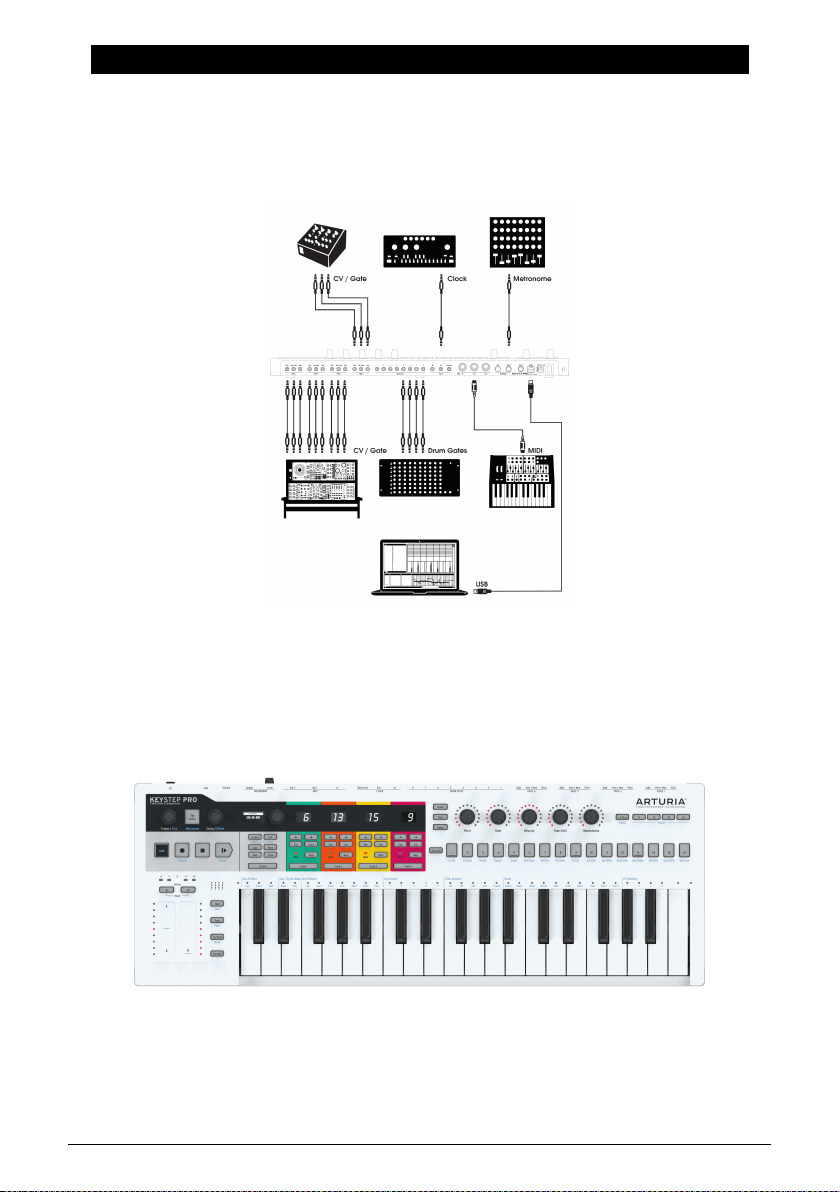
Connect the KeyStep Pro to your computer or an external device as shown in the image
below and you're ready to go! Here are a few pointers to make the most of your first session.
3.1.1. Slimkey Keyboard
The Slimkey keyboard is both velocity- and pressure-sensitive (also called aftertouch). You
can specify the velocity curve and aftertouch response using the MIDI Control Center and
the Utility menu. Refer to
Chapter 9 [p.145] for details.
Arturia - User Manual Keystep Pro - Basic Operations 13

3.1.2. Keyboard MIDI Channel Selection
The KeyStep Pro can transmit notes and other MIDI messages on 16 channels numbered 1
to 16. Each of the four tracks of the KeyStep Pro transmits on its own channel: Track 1 on
MIDI channel 1, and Tracks 2, 3 and 4 on MIDI channels 2, 3 and 4 respectively. Track 1 is
a special case because it has both a melodic sequencer and a drum sequencer. When in
sequencer mode, Track 1 transmits on MIDI channel 1; when in Drum mode it transmits on
MIDI channel 10. Most MIDI devices default to receiving on MIDI channel 1, so connecting
an external device and playing notes on Track 1 will usually trigger a response from the
external device.
♪: If the external device does not respond, that may be because it is set to a MIDI channel that
doesn't match the current KeyStep Pro MIDI channel. First check the MIDI channel setting of the
external device. If the channels do not match and you want to set the KeyStep Pro to another MIDI
channel, you'll have to go into the Utility menu.
In the Utility menu, you can set all the configuration options of the KeyStep Pro, including
the MIDI transmit functions. Like most fine-tune functions on the KeyStep Pro, you access
it with the 'Shift' key. 'Shift' functions are printed in blue and can usually be found below
buttons. In this case, the Utility function sits under the Project button.
• Hold 'Shift' + Project (Utility); the Utility menu will light up
• Turn the selection encoder to scroll down to 'MIDI channels'
• Now push the selection button, and scroll down to Track 1 output, push once more
and select the MIDI channel you want to transmit on
• Press 'Shift' + Exit repeatedly to exit Utility.
♪: A quick way to assign a MIDI channel to a track is to hold a track button and turn the main
encoder.
14 Arturia - User Manual Keystep Pro - Basic Operations
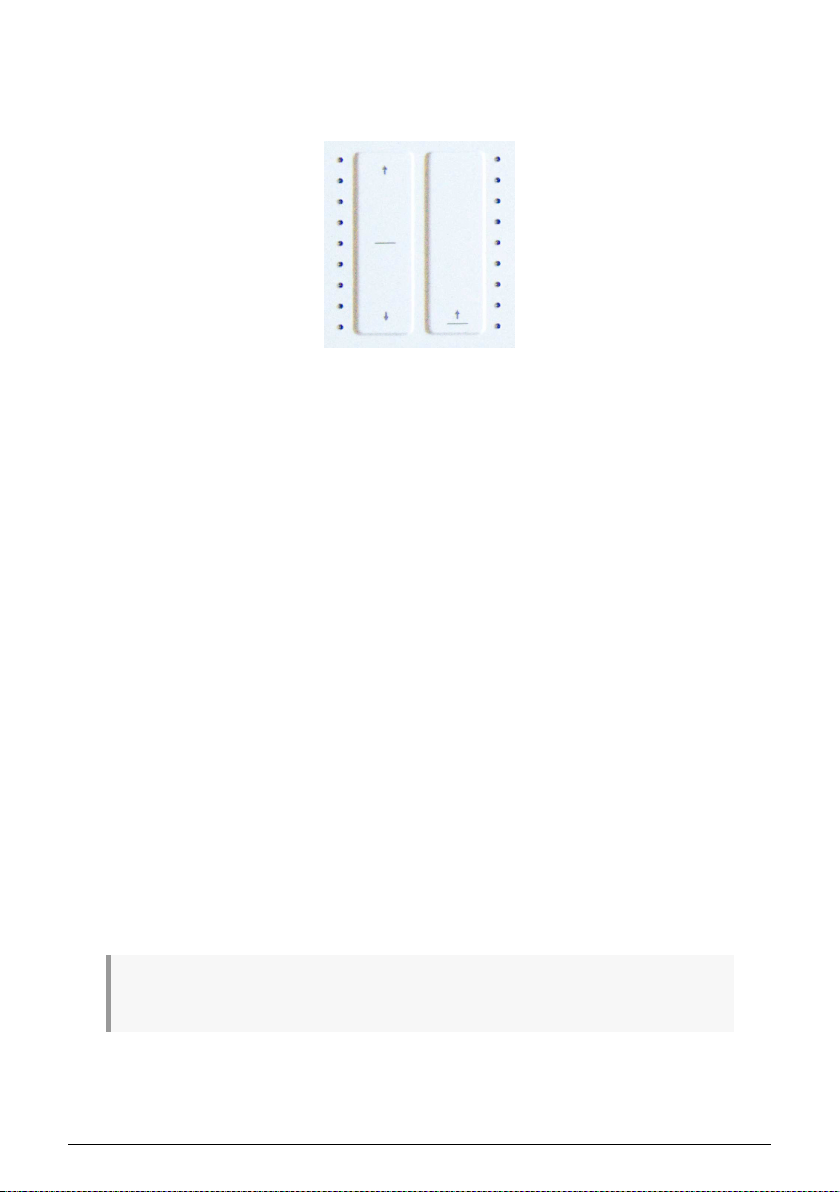
3.1.3. Pitch and Mod Touch Strips
The Pitch and Mod touch strips are similar to standard wheels in how they work, except that
you slide your finger backward or forward along the strip instead of rotating a wheel.
3.1.3.1. The Pitch Strip
The Pitch strip has a center zone in which slight finger movements produce no change.
Moving your finger forward bends the pitch upward, and moving it backward bends the
pitch downward. When you lift your finger, the Pitch bend value snaps back to zero.
3.1.3.2. The Mod Strip
The Mod strip works like a mod wheel: from minimum to maximum. Placing your finger at
the bottom of the Mod strip (the end closest to you) produces no modulation, and moving
your finger all the way up (to the end furthest from you) causes maximum modulation. The
Mod strip differs from the Pitch strip in that it does not snap to zero when you lift your finger.
3.1.4. The HOLD Button
The HOLD button enables the Arpeggiator to keep playing after you take your fingers off the
keys. But there's another way to use it: while HOLD mode is active, you can keep adding
notes to an arpeggio as long as you continue holding down at least one key.
For an in-depth look at the Arpeggiator, refer to
chapter 5 [p.63].
3.1.5. Sustain Pedal
If you have a momentary footswitch, plug it into the Sustain jack socket on the rear panel. If
it works backwards, disconnect your KeyStep Pro from its power source and then reconnect
it. KeyStep Pro will sense the polarity of the pedal, and it should work fine after that.
♪: The KeyStep Pro offers limited MIDI Machine Control (MMC) for pedals : you can only use them to
start and stop sequences.
Arturia - User Manual Keystep Pro - Basic Operations 15
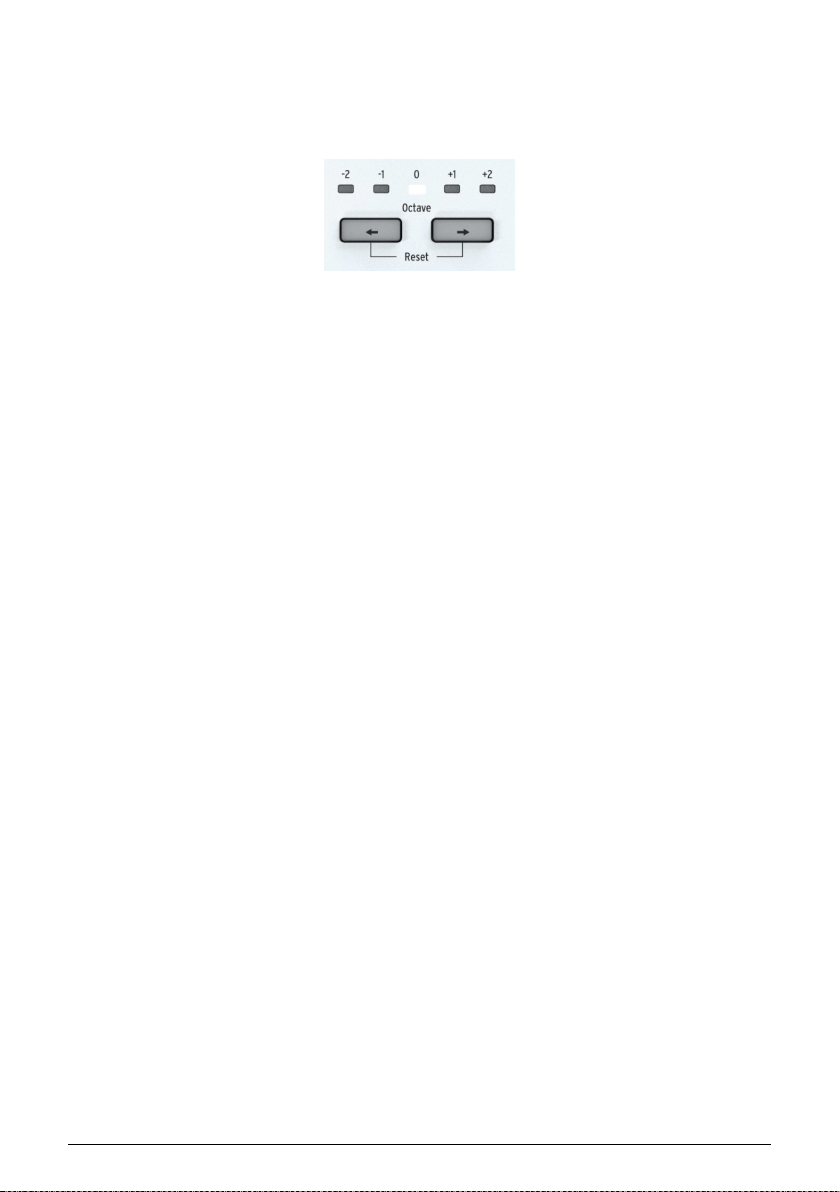
3.1.6. Octave - / Octave +
Pushing one of the Octave select buttons will transpose the keyboard pitch by as much as
two octaves up or down. To reset the keyboard octave shift back to zero, press both buttons
simultaneously.
16 Arturia - User Manual Keystep Pro - Basic Operations

3.2. Record and Play a Sequence
The KeyStep Pro features four (!) sequencers - one on each track. Let's record something on
Track 1:
• Press the Track 1 button; it will light up in green
• Select 'Seq' on this track if it isn't already selected
• Now hold the 'Record' button and press the 'Play' button; the step buttons' LEDs
now become active and cycle from Step 1 to Step 16 continuously. We are about
to create our first sequence pattern. Each track can hold 16 of these patterns.
The sequencer is in loop mode, so press a few keys and they will be added to the loop. The
KeyStep Pro sequencers are polyphonic, so pressing a chord instead of a single note will
enter it into the loop. Notice that all notes are recorded with the velocity at which you play
them.
To hear what you've recorded in a step, press the Step Edit button. The sequencer must be
stopped to make this work.
Select a step to preview the notes stored in it. When you press a step, each one of its notes is
played with its properties (Pitch, Velocity, Gate, Randomness and Time Shift). The note with
the lowest time shift value plays instantly, and the others are played based on their timing
offset from this first note. The note with the longest gate in the step determines how long
the step will sound.
Step Edit mode has many more options. We'll further explain these in
Chapter 5 [p.83]
At this point, you can start to 'play around' with your sequence. When you look carefully,
you'll see sequence modifiers printed in blue under the step buttons.
• Hold the 'Shift' key (the leftmost button on the KeyStep Pro) and press 'Semi Up'
or 'Semi Down' to transpose your sequence in half-step increments on the fly.
There are a few other things to try here: 'Shift' + Invert creates a mirror image of your
sequence: the last notes become first, and vice versa. Press 'Shift' + Invert once more to
restore the previous note order.
But it does not stop here: you can shift the entire looping sequence one step to the left or
right. To shift to the right, hold 'Shift' and press Nudge> (step button 4). The first note in the
loop will move to second position; the last note will wrap around to first position.
You can make adjustments to the tempo in quantized 1 BPM increments by turning the
Tempo knob. If you need to make finer adjustments, hold 'Shift' while turning the Tempo
knob : this will increment and decrement the tempo in 0.01 steps.
Arturia - User Manual Keystep Pro - Basic Operations 17
3.2.1. Making global changes to the sequence
At this point, you can also make quick global edits to the sequence you've recorded.
Holding 'Shift' and turning one of the five encoders will apply a relative offset to all steps
contained in the sequence for a parameter. The offset can be positive or negative. If for
example you Hold 'Shift' and turn the Velocity encoder to the right, the value you dial in will
be added to the velocity value of all the steps in the sequence. Turning the encoder to the left
will subtract values. The KeyStep Pro will display the amount of added/subtracted velocity.
Global offset has no effect on the pitches in the drum track, but it will affect Gate, Velocity,
Time Shift and Randomness.
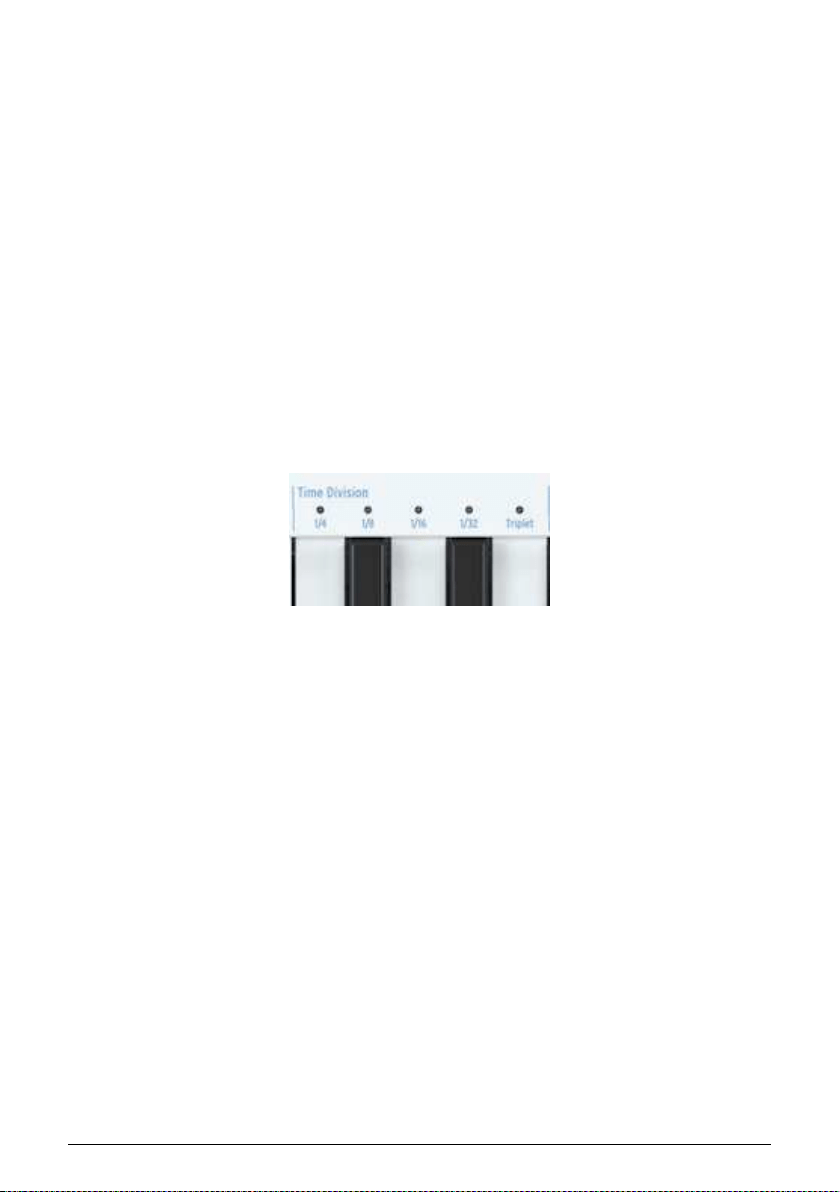
3.2.2. Time Division
There's another row of blue shift modifiers printed above the keys of the keyboard. In the
center, right above the 'middle C' key, you'll find a series of time-division options, ranging
from 1/4 to 1/32. To change the current time division, hold 'Shift' and press the appropriate
key on the keyboard. This changes the rhythm of the sequence relative to the tempo: quarter
notes (one step per beat), eighth notes (two steps per beat), and so on. Triplet values are
also an option (1/4T, 1/8T, etc.); if you're already in 1/8 and press 'Shift' + Triplet, you'll get into
1/8 triplet mode.
There's a lot of potential for creative fun here. In
Chapter 5 [p.121] we'll show you how to copy
the pattern of one sequence to another sequence. Imagine starting with a simple pattern,
copying it to the three other sequencers, modifying those copies with Invert, Nudge and
Transpose, then running them simultaneously with the first sequence. You get the idea ...
18 Arturia - User Manual Keystep Pro - Basic Operations
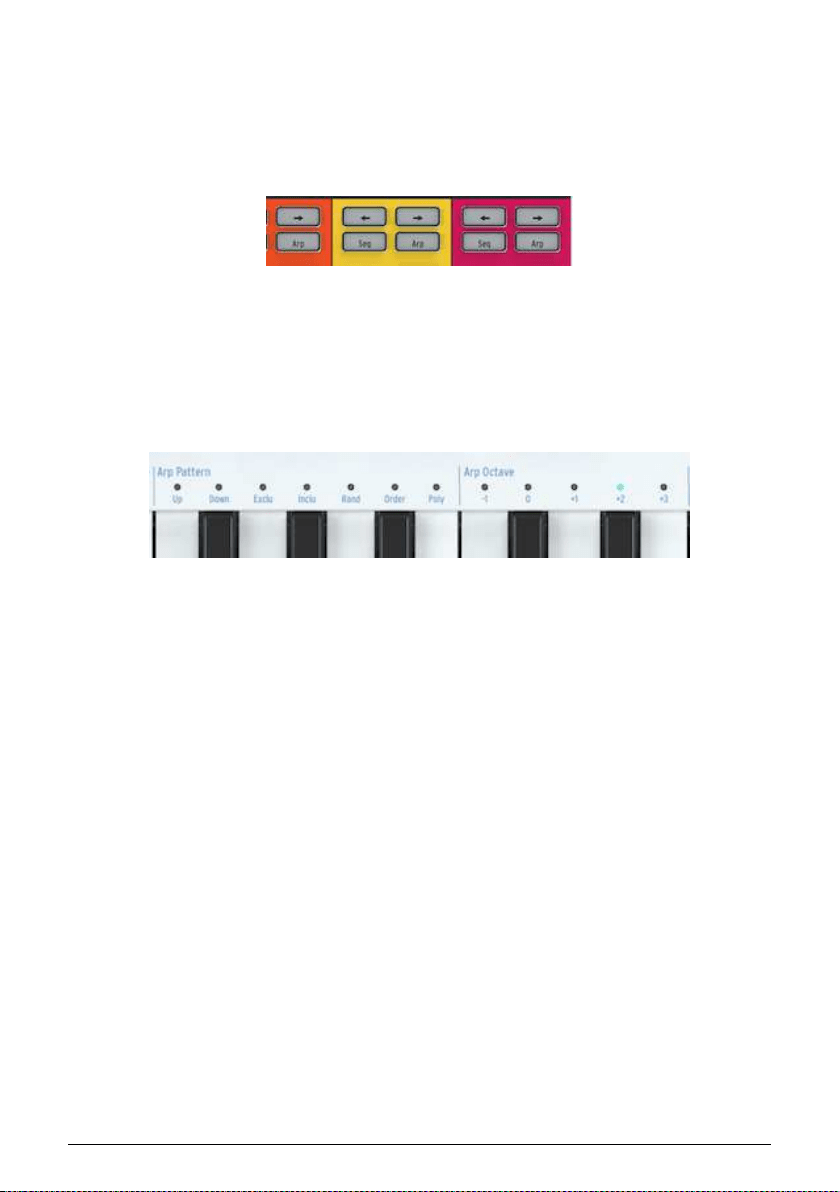
3.3. Using the Arpeggiator
An arpeggio is basically an outline of a chord: the notes are played individually, rather than
all at once. It's what you hear when you pluck the strings on a guitar from top to bottom, or
the other way around. A major part of learning to play the guitar is figuring out how to play
different fingerpicking/arpeggio styles. The arpeggiators on the KeyStep Pro do all these
things for you. Each KeyStep Pro track, except Track 1, has an arpeggiator.
To play an arpeggio, activate a track (try Track 2), press the Arp button then hold down a
chord. Now press the 'Play' button and your arpeggio will start. It's rather tiresome to hold
keys down, especially if what you really want is to change your arpeggio, or if you want to
tweak parameters on your modular system or synth that is connected to the KeyStep Pro.
Pressing HOLD lets you lift your fingers off the keys without stopping the arpeggio. What's
more, once HOLD is active, you can add notes to the arpeggio as long you keep at least one
key pressed down; just press more keys and those notes will be added to the arpeggio at
the played velocity. You can add up to 16 notes to an arpeggio.
Again, there's a lot to discover here, so try some of these:
• 'Shift' + Arp to change the 'strum' pattern of your arpeggio
• 'Shift' + Time Division (1/4th, 1/8th, 1/16th, 1/32nd)
• 'Shift' + Scale. Selecting another scale will instantly change the tonal focus of your
arpeggio.
And there's even more: the Gate, Velocity and Randomness encoders! Tweaking the Gate
knob will lengthen or shorten the gate time, Velocity will add or subtract velocity, and
Randomness will inject random notes into your arpeggio. Press the Play/Pause button again
to pause the arpeggio pattern; press it once more to resume playback from where you
stopped.
Arturia - User Manual Keystep Pro - Basic Operations 19
3.4. Scales & Chords
Some of the most interesting features of the KeyStep Pro are its scale and chord options,
which we'll cover in more detail in
Chapter 5 [p.108]. But to get an idea of the impact they
have on your sequences and arpeggios, try this neat trick while your sequence or arpeggio
is running.
Let's try this in Track 2:
• Activate Track 2 by pressing its button
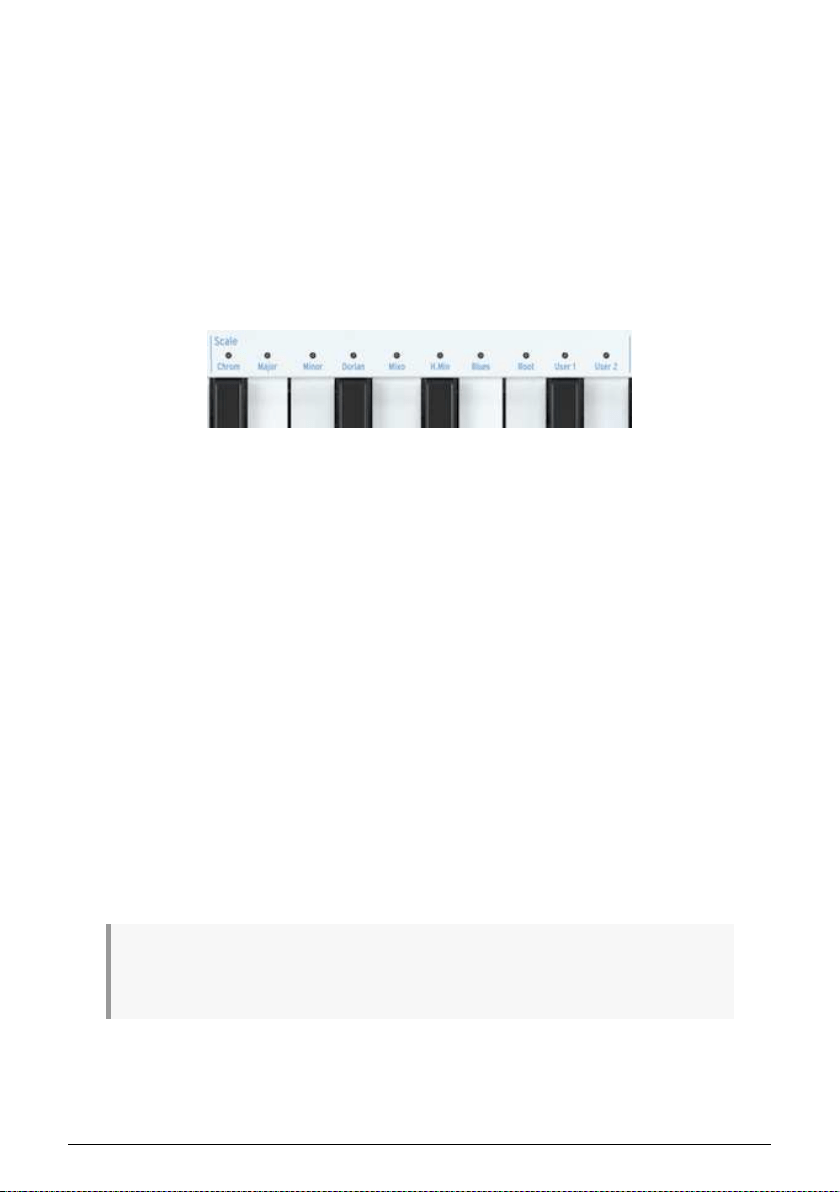
• Hold 'Shift' + (Scale)-minor. The Scale selectors are located just above the
keyboard. For example, you activate the minor scale with 'Shift' + C4 (the third 'C'
from the left). Try some of the other Scale selectors to hear the different types of
scales.
Chord mode is equally fascinating:
• Stop everything that's playing by pressing the 'Stop' button
• Hold 'Shift' + Tie/Rest (Chord) and play a chord
• Release all the keys of the chord
• Let go of the 'Shift' + Chord buttons
• Play any key on the keyboard to hear the chord you entered.
For example, if you have the minor scale selected, any key you play on the keyboard
generates a minor chord. Then if you activate the arpeggiator and hold down a few notes,
you'll hear an arpeggiated minor chord!
3.5. Creating Splits
You could have an arpeggio play on the lower part of the keyboard and a sequence on the
upper part. This is done by creating a keyboard split.
• Hold down the two track buttons of the tracks that you want to be part of the
split. The track button you press first will be assigned to the upper part of the
keyboard, the other one to the lower part. For example, if you want the sequence
on Track 1 to play in the upper part, you need to press the Track 1 button first.
• While holding down both track buttons, press an appropriate key on the
keyboard to select the split point.
♪: If you want to verify where the split point is, press the same two track buttons simultaneously. The
KeyStep Pro will display the ranges in the color of the tracks that are part of the split. Press the same
two track buttons again to deactivate the split.
We'll cover all these features in more depth in Chapter 6 [p.115].
20 Arturia - User Manual Keystep Pro - Basic Operations
4. KEYSTEP PRO OVERVIEW
In this chapter we'll guide you through the front and back panels and explain the functions
of all the knobs and connections on these panels. If you're eager to start exploring your
KeyStep Pro and want to dive right in, continue to Chapter 5 [p.63], where you can learn how
to use the sequencers and the arpeggiators. This chapter is mainly for reference; you can
return here if you need to know more about a specific function, knob, strip, connection or
menu.
4.1. Making the Connections
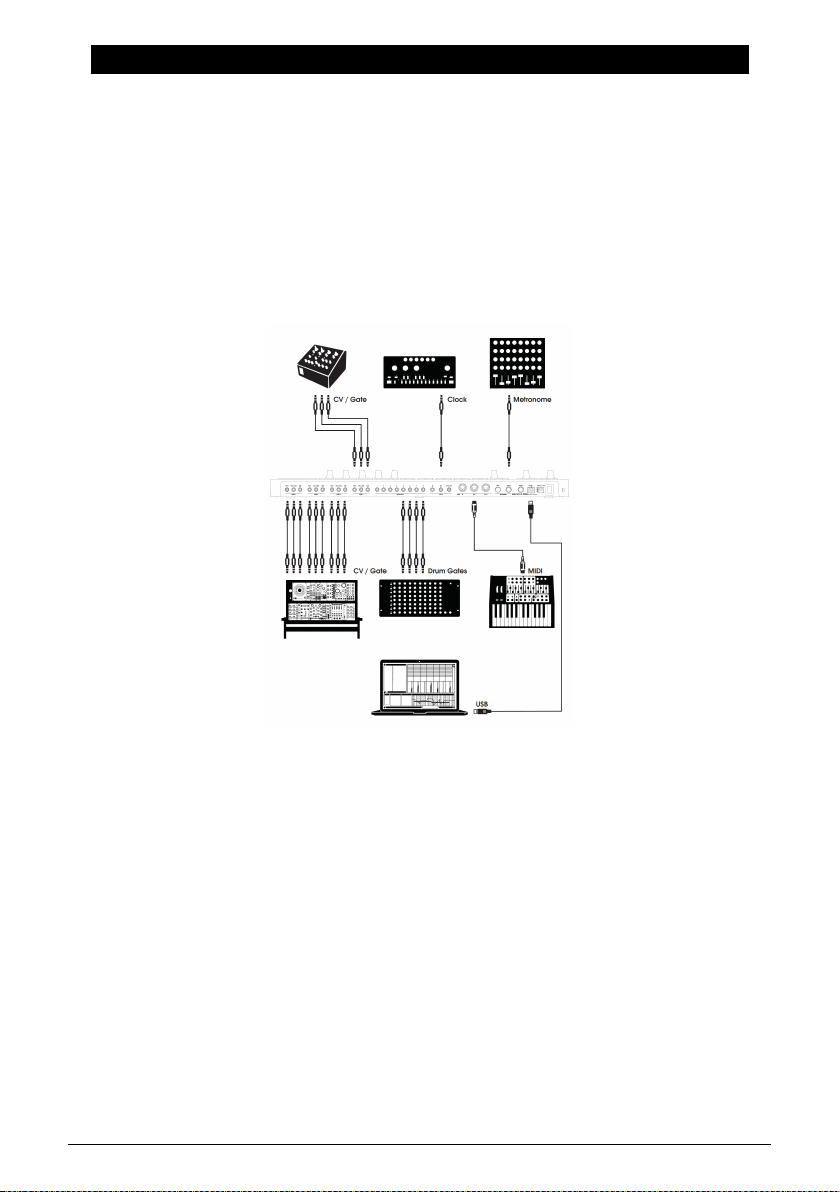
There are countless ways to connect the KeyStep Pro with your music-making gear. It's
impossible to cover every scenario in this guide, but here are some typical setups:
4.1.1. ... with a Computer
The KeyStep Pro is a USB class-compliant controller, so at its most basic level it can be
connected to any computer with a USB port, through which it receives its DC power supply,
and can be used as an input device for various applications. The downloadable MIDI Control
Center software lets you choose which MIDI messages will be sent by the mod strip and
also enables you to specify global KeyStep Pro parameters.
However, the KeyStep Pro can also be used in standalone mode without a computer
connected! In this case, simply use the provided 12V DC power supply adaptor.
WARNING!: Although the KeyStep Pro might seem to work OK when you power it up with a
power bank, we strongly advise you NOT to power it this way. The KeyStep Pro needs a lot
of current for its LEDs and analog output. Using a defective or partially charged power bank
could damage the KeyStep Pro.
CV Gate outputs
Arturia - User Manual Keystep Pro - KeyStep Pro Overview 21

4.1.2. ... with External Devices
As shown above, you can connect the KeyStep Pro to a variety of synths, drum machines
and/or Eurorack modules.
• When connecting to a synth, use one of the two MIDI Out ports. If you need to
connect more than two synths, you can daisy-chain them: connect the KeyStep
Pro to the MIDI In of the first synth and then connect the MIDI Thru of that synth
to the MIDI In of the second synth, etc. Daisy-chaining allows you to connect as
many as 16 synths to one MIDI Out
• An increasing number of modern synths have both MIDI Ins and Analog Ins, for
example the Arturia MiniBrute 2 and MiniBrute 2S. They enable you to use a mix
of MIDI and analog connections
• When connecting to a drum machine such as the Arturia DrumBrute, you have
two options: MIDI Out only or a mix of MIDI and Analog Outs. The KeyStep Pro
has eight analog drum-trigger outputs (Drum Gates) that you can play with the
lower eight keys of the KeyStep Pro keyboard
• If you have a Eurorack system, you can connect the KeyStep Pro's four Voice
outputs to various Eurorack inputs. Please refer to
Chapter 10 [p.167] for examples
of how to set up these connections.
4.1.3. ...with an iPad®
Add a camera connection kit and the KeyStep Pro becomes the perfect companion for
an iPad. This enables it to be used as a controller for Arturia's iMini, iSem or iProphet
applications, for example.
If you have an iPad but don't already own those great virtual instruments, please take a
look at them on our website! They are very affordable and live up to Arturia's reputation for
accurately modelling the sound of analog synthesizers with warmth and precision.
As you can see, KeyStep Pro can be the controlling hub of some amazing systems!
22 Arturia - User Manual Keystep Pro - KeyStep Pro Overview
4.1.4. Analog Connections (CV and Gate)
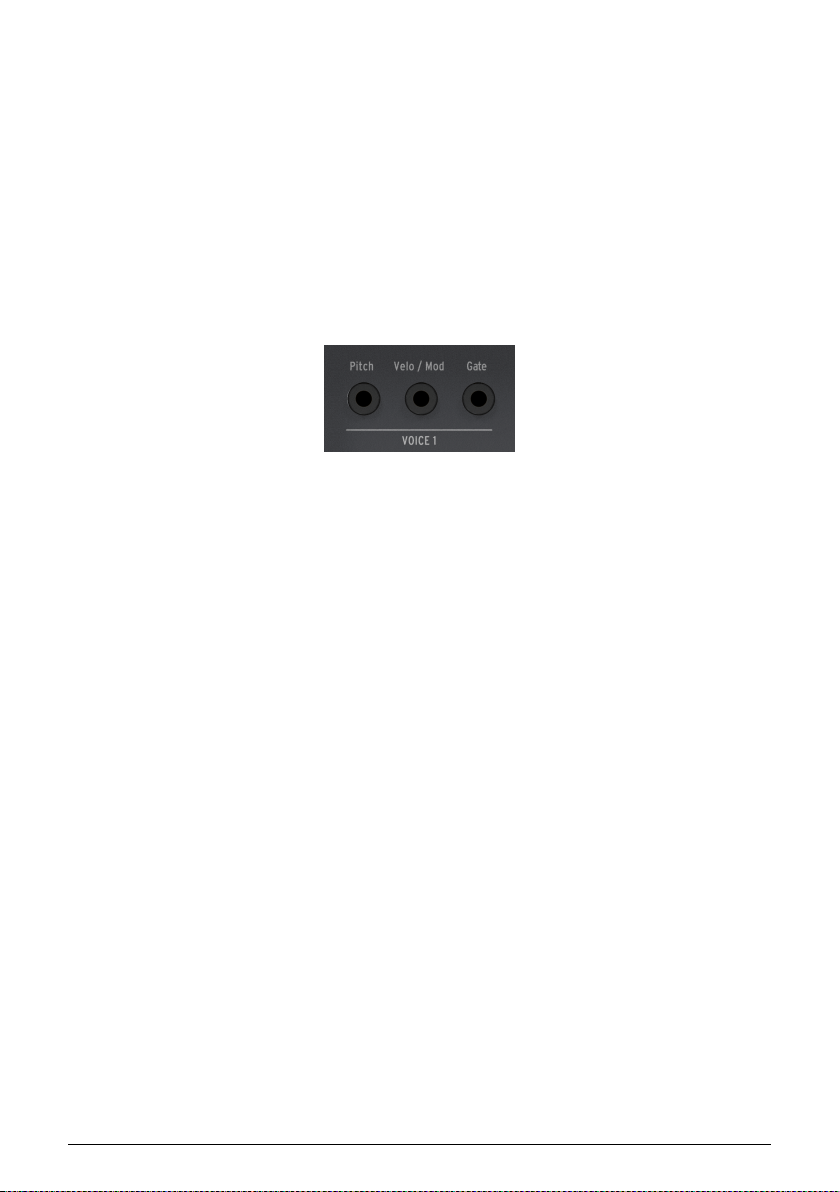
KeyStep Pro can send control voltages (CV) to modular synthesizers and other non-MIDI
devices through its four sets of Pitch, Velo/Mod and Gate connectors on the back panel. Each
of the KeyStep Pro's four tracks has its own dedicated set of connectors, allowing you to
connect and control as many as four devices at the same time!
4.1.4.1. Control Voltages: Pitch, Velo/Mod and Gate
When the sequencers are running or you play a single note or multiple notes on the
keyboard, each note is translated immediately into Pitch, Control Voltage (Velocity or
Modulation) and Gate signals and sent to the four Voice outputs on the back panel. When
you play the keyboard or the sequencers in polyphonic mode, the KeyStep Pro's CV routing
options let you define how the signals from the four voices will be distributed.
For each note, three independent voltages are sent: Pitch, Velo/Mod and Gate. The Velo/Mod
voltage can be either velocity or modulation, depending on what you have selected in the
Utility section or in the MIDI Control Center.
Some analog synthesizers have unusual implementations that are not fully compatible with
the KeyStep Pro's CV and Gate signals. Before purchasing an analog synth, please refer to
its manufacturer's specifications to ensure that the two devices will work together well.
We've designed the KeyStep Pro to be as flexible as possible. The downloadable
MIDI
Control Center [p.155], which you can install on your computer, allows you to configure the
response of the CV/Gate jacks in a number of ways. Please refer to the manufacturer's
documentation of your external devices for information about which standards they use.
By default, the transmitted pitch voltage is compatible with the 1.0 V per octave standard,
which means that if you play an octave interval on the KeyStep Pro keyboard, the connected
synth(s) or Eurorack module(s) should also play an octave interval. In other words, the 'pitch
tracking' is correct. However, some synths use a 1.2 V per octave or a Hertz per Volt (Hz/V)
standard. To control these devices, you can change the corresponding setting in the MIDI
Control Center.
For each of the KeyStep Pro's four tracks, the Pitch control voltage (CV) can be set separately
in Utility>CV>Track (1-4) to:
• 1.0 Volt/Octave (0-10V)
• 1.2 Volt/Octave
• Hertz per Volt
Gate signals can also have quite different output ranges (S-Trig, V-Trig 5V or V-Trig 10V).
These too can be set up in the MIDI Control Center.
The four Voice outputs can be set to transmit either velocity or aftertouch modulation. You
can change this in Utility > CV Settings.
CV Gate outputs
Arturia - User Manual Keystep Pro - KeyStep Pro Overview 23

4.1.5. MIDI Connections
Much of the 'mid-vintage' music hardware from the 1980s and 1990s had MIDI DIN jacks
but not CV/Gate connectors or USB ports. KeyStep Pro can be plugged directly into such
devices, letting you control them using its powerful sequencers, arpeggiators and other
controls (keys, knobs, touch strips, etc.).
4.1.5.1. Connecting to a DAW
The KeyStep Pro is an ideal controller for your DAW because you can use its four Voice
outputs to simultaneously control separate instruments loaded on four tracks of your DAW.
Below, we give an example of how to set up Ableton if you want to control instruments via
four MIDI channels.
Connect the KeyStep Pro to a USB port on your computer using the supplied USB host cable.
We first have to 'tell' Ableton that we want to use the KeyStep Pro as a controller in Ableton:
• Open 'Preferences' in the 'Live' menu.
• Select 'Link/MIDI'.
If you want the KeyStep Pro to be slaved to your session:
• In the MIDI ports section:
◦ Enable "Track" for the input, which enables the MIDI from the KeyStep
Pro to be received by Live.
◦ Enable "Remote" for the input, which will allow the mapping of the
control sequencer's encoders via MIDI learn.
◦ Enable "Sync" for the output, for Live to send clock information to your
KeyStep Pro.
Finally, make sure that the KeyStep Pro is set to Auto or USB sync source. This will define
the source of the synchronization of the KeyStep and can be edited from the Utility > Sync >
Source menu.
The KeyStep Pro will then start when launching the playback in Live.
If you want the KeyStep Pro to be the master of the session:
• In the MIDI ports section :
◦ Enable "Track" as well as "Sync" and "Remote" on the input.
24 Arturia - User Manual Keystep Pro - KeyStep Pro Overview

• Be sure to enable the external sync next to the BPM display of your session:
From there, pressing play on the KeyStep Pro will launch playback in Live.
We're done; Ableton is now able to correctly interpret the MIDI control signals arriving from
the KeyStep Pro and we're now ready to make some noise!
• Open Ableton and select 'New Live set' to create an empty set.
• Delete the two default audio tracks by selecting them and clicking 'delete' in the
'Edit' menu.
• Select 'Insert MIDI track' from the 'Create' menu and repeat this one more time to
create two empty MIDI tracks. As an alternative, you can right-click in the empty
track space and insert two MIDI tracks.
• Drag a sound from Category > Sounds to Track 1. Repeat this for Tracks 2 to 4.
You should now have four MIDI tracks, each with its own virtual instrument loaded. There's
nothing to hear yet because we haven't made the connection from the KeyStep Pro to
Ableton. Let's do that now:
• Focus on Ableton track 1 and click on the downward arrow in the 'All ins'
dropdown menu listed below 'MIDI From'.
• Select KeyStep Pro from the listed options.
• Select channel 1 if it is not already selected.
• In the monitor menu directly below, select 'In'.
We've now instructed Ableton to listen to what's happening on MIDI channel 1. If your
KeyStep Pro is in its default state, Track 1 will transmit on MIDI channel 1.
Select Track 1 on the KeyStep Pro and play a note on the keyboard. You should now hear the
virtual instrument you dragged to Ableton track 1.
We'll repeat these steps for Ableton track 2:
• Again select KeyStep Pro as the MIDI source.
• Select MIDI channel 2 as the channel that this track should listen to and play
back.
• Select 'In' to monitor directly what is coming in on this channel.
Repeat this for KeyStep Pro Tracks 3 and 4 and select MIDI channel 3 as the input for
Ableton track 3 and MIDI channel 4 as the input for Ableton track 4.
Arturia - User Manual Keystep Pro - KeyStep Pro Overview 25
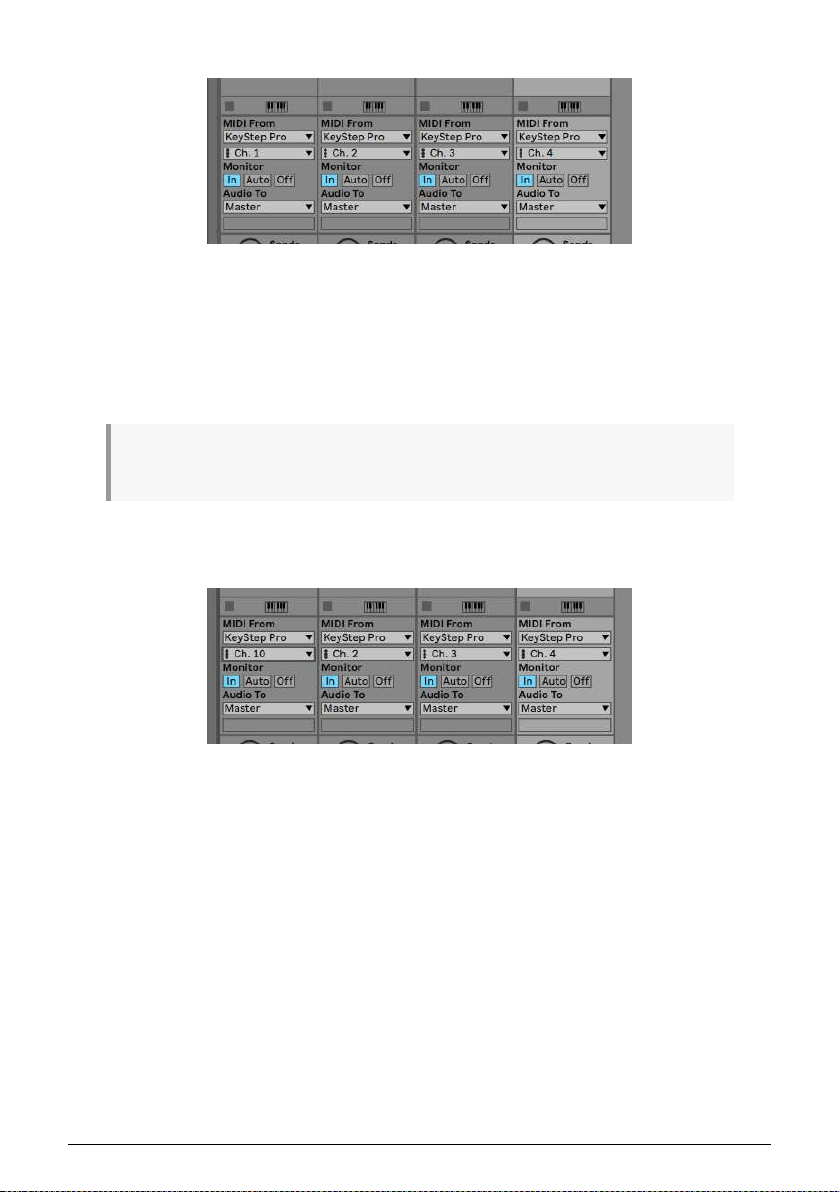
Your screen should now look like this:
In this setup, the four KeyStep Pro tracks will play on the four corresponding Ableton tracks.
To play a drum track in Ableton:
• Drag a drum set into an Ableton track.
• Set the track to MIDI channel 10.
• On Track 1 of the KeyStep Pro, press the Drum button.
♪: By default, the KeyStep Pro's Drum track (only available on Track 1) will always transmit on MIDI
channel 10.
Because you've set the Ableton drum track to listen on MIDI channel 10, the two will match.
Your screen should now look like this:
26 Arturia - User Manual Keystep Pro - KeyStep Pro Overview
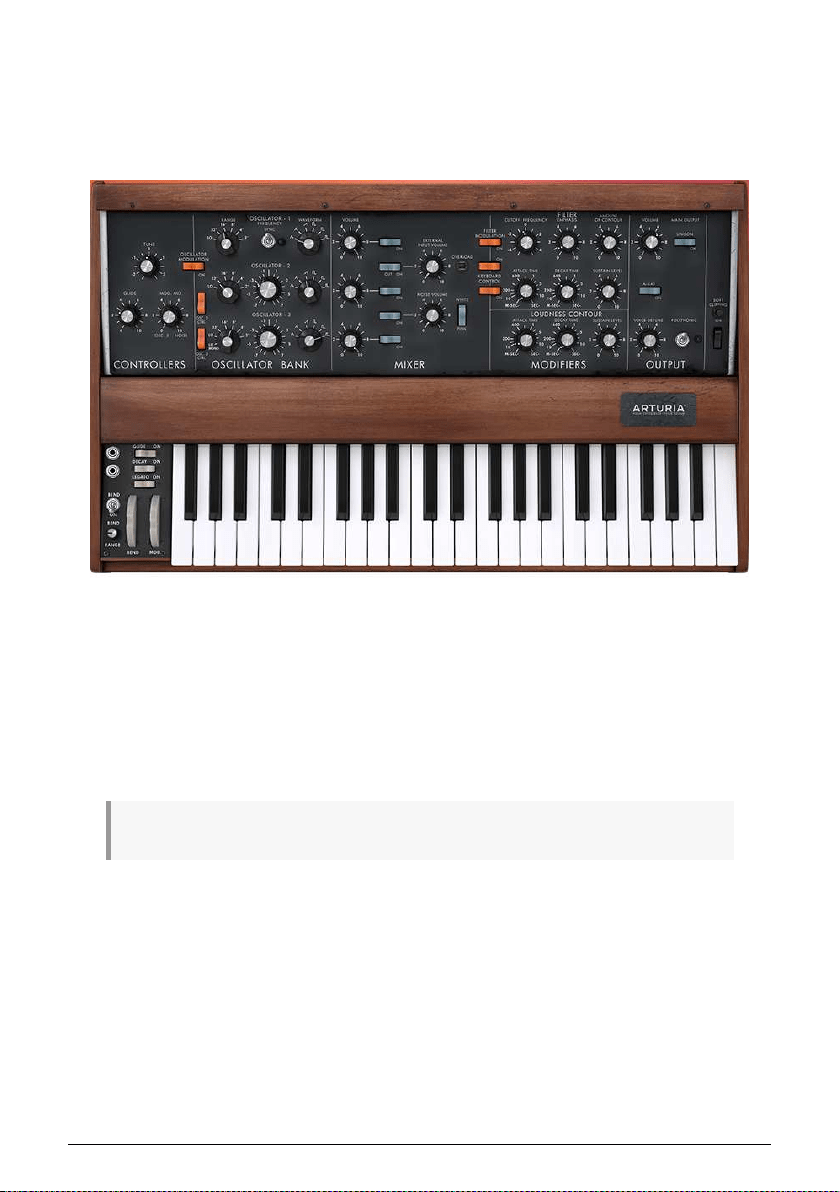
4.1.5.2. Tutorial 1: Using MIDI to Control Arturia's MINI V
VST synth
In this tutorial we will use the KeyStep Pro to control the filter cut-off frequency of Arturia's
MINI V VST synth. The MINI V is part of Arturia's V Collection, a great series of software
emulations of classic hardware synths.
Even if you don't own the MINI V, you can still follow this tutorial. Just download the demo
version from
https://www.arturia.com/support/downloads&manuals. Although this tutorial
features the MINI V, it can be used to learn how to control any knob on any VST synth from
Arturia's V Collection that you want to set up to receive MIDI.
• Connect the KeyStep Pro's USB Out to your computer's USB In. Load either the
standalone or the DAW-based VST version of the MINI V
• In the MINI V user interface, open the Arturia system menu in the top left and
select 'Audio Midi Settings'. Under 'MIDI Devices', select the Arturia KeyStep Pro.
♪: 'MIDI Devices' is only visible when a KeyStep Pro is connected to your computer via USB.
• Next, click on the MIDI symbol in the top right of the Main Menu. The knobs on
the MINI V will now be highlighted in red or purple.
• Click on the Cutoff Frequency knob in the Filter section of the MINI V. Tweak the
Filter knob on the KeyStep Pro. The Cutoff Frequency knob of the MINI V should
now respond to your knob movements.
Arturia - User Manual Keystep Pro - KeyStep Pro Overview 27
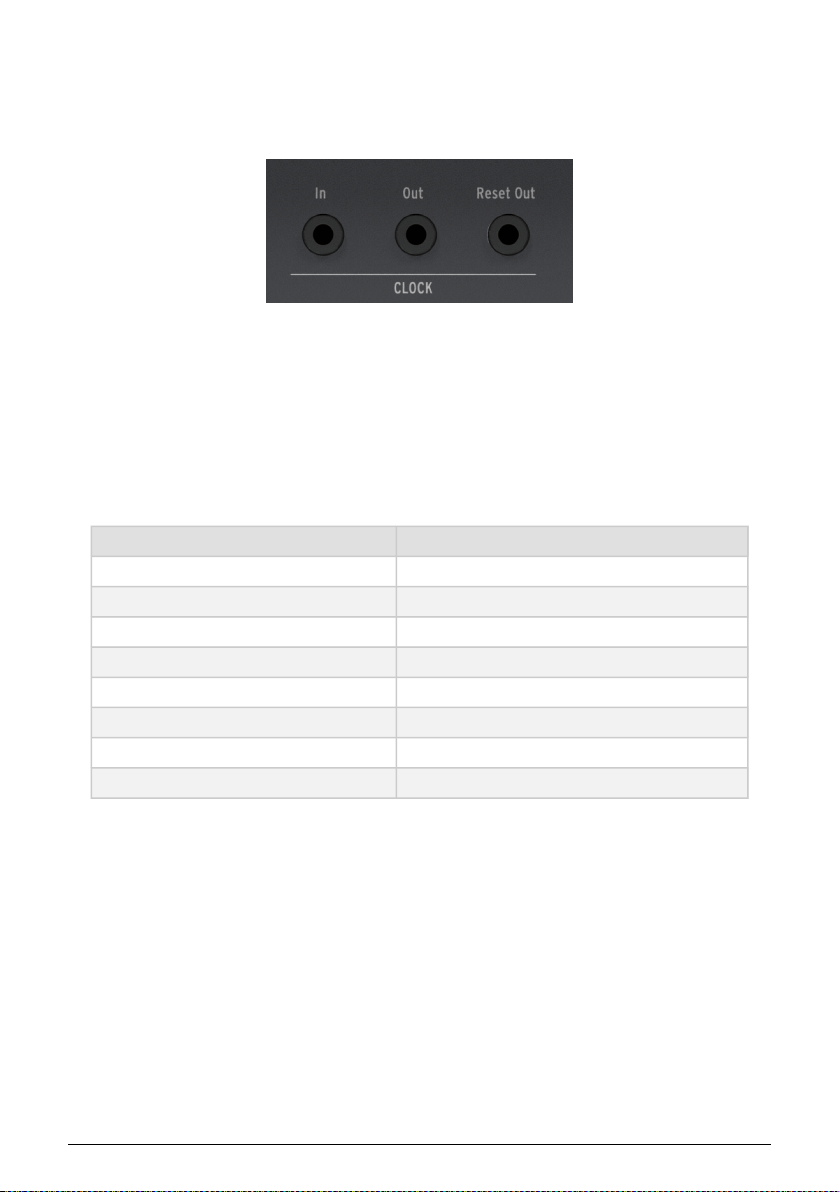
4.1.6. Clock In/Out
The Clock input and output connectors on the back panel allow the KeyStep Pro to
synchronize with many different clock formats. For a list of the formats, see the table in the
next section.
These options enable you to connect and stay synchronized with almost every conceivable
piece of music technology.
4.1.6.1. Clock In/Out Rates
The downloadable MIDI Control Center can also be used to configure the KeyStep Pro
to send and receive one of the following clock signals via the Clock In and Clock Out
connectors.
Clock In settings Clock Out settings
Internal 1 PP16 (one pulse per 1/16th note [clocked])
USB 2 PPQ8 (1 pulse per 1/8th note)
MIDI 1 PPQ (1 pulse per quarter note)
1 PP16 (one pulse per 1/16th note) 1 PP2Q (1 pulse per 2 quarter notes)
2 PPQ (two pulses per quarter note) 1 PPQ4Q (1 pulse per 4 quarter notes)
24 PPQ (24 pulses per quarter note) Korg
48 PPQ (48 pulses per quarter note) 24 PPQ (24 pulses per quarter note)
Auto 48 PPQ (48 pulses per quarter note)
28 Arturia - User Manual Keystep Pro - KeyStep Pro Overview

4.1.6.2. Clock In/Out Connectors
Over the past few decades, several types of connectors have been used for musical
synchronization purposes. Here's a table that indicates the best kinds to use when
connecting older devices to KeyStep Pro:
Connector type Signal(s) sent
1/8'' mono (TS) [1] Clock pulse only [1]
1/8'' stereo (TRS) [2] Clock pulse and start/stop [2]
1/8'' stereo (TRS) plus DIN sync adapter [2] Clock pulse and start/stop [2]
You can use a 3.5 mm jack to 5-pin DIN adapter to connect to devices which utilize DIN sync
messages. Check the owner's manual for your device if you are not sure which sort of sync
capabilities it has.
If Sync is set to an external source and a TS connector is used, the sequencer needs to be
armed before it can start when receiving a clock signal. You must press the Play button to
arm the sequencer. For example:
• If the Play button has been pressed but no clock signal has been received, the
unit will wait for a clock signal and only start when it receives one.
• If clock signals are being received but Play is not active, the unit will start as soon
as you press the Play button.
If Sync is set to an external source and a TRS connector is used, the KeyStep Pro will follow
the master and will:
• Play on receiving a high-state signal and clock,
• Pause on receiving a high-state signal and no clock, or
• Stop on receiving a low-state signal, with or without clock.
Arturia - User Manual Keystep Pro - KeyStep Pro Overview 29

4.1.7. Master or Slave
KeyStep Pro can be the clock master for an entire MIDI rig, or it can just as happily serve
as a slave to other clock sources. Clock In and Clock Out can synchronize with older clock
types such as 2, 24 or 48 ppqn (pulses per quarter note), or even a single pulse per step.
Whether the KeyStep Pro will send or receive MIDI Clock signals and send or receive
Transport Signals (Start-Stop-Continue) will depend on the corresponding settings in Utility >
MIDI Settings.
♪: While the unit is playing a sequence, the Sync settings cannot be changed.
4.1.7.1. KeyStep Pro as Master
To use the KeyStep Pro as clock master, Utility > MIDI Setting > Clock send must be set to
On. This is the default setting.
You can set the Master sync options in Utility > Sync > Output. To access the utility menu,
hold down 'Shift' and press the Project button.
Sync Setting Description
Output
1 PP16, 2 PPQ8, 1 PPQ, 1PP2Q, 1 PPQ4Q, Korg,
24PPQ, 48PPQ
Allows KeyStep Pro to sync with various
clock types
In this menu, you select how the KeyStep Pro will control the tempo of external modules or
synths:
• The transport section will control the internal sequencers
• MIDI clock messages are sent to MIDI Out 1, MIDI Out 2, USB Out and Clock Out
• The sequence tempo can be set using the Tempo encoder and the Tap Tempo/
Metronome button.
30 Arturia - User Manual Keystep Pro - KeyStep Pro Overview

4.1.7.2. KeyStep Pro as Slave
The KeyStep Pro can function as a slave to an external clock source. To use the KeyStep Pro
as a slave, Utility > MIDI Setting > Clock receive must be set to On. This is the default setting.
You can set the Slave sync options in Utility > Sync > Input. To access the utility menu, hold
down 'Shift' and press the Project button.
Sync Setting Description
Input Internal, USB, MIDI, 1 PP16, 2 PPQ, 24PPQ, 48PPQ, Auto Defines tempo source of KeyStep Pro
In this menu, you select how the KeyStep Pro will follow the tempo of external modules or
synths.
When the KeyStep Pro is in Slave mode:
• The Tempo controls will not control the internal sequencer while the external
clock source is running.
• The KeyStep Pro transport section will perform as usual: you can stop, start and
pause the internal sequences, and you can record patterns.
• When the external clock source is not running, the KeyStep Pro will function
according to its internal clock at the last set tempo.
• The KeyStep Pro will pass the synchronization messages it receives from the
external clock source to USB Out, MIDI Out 1, MIDI Out 2 and Clock Out.
Arturia - User Manual Keystep Pro - KeyStep Pro Overview 31
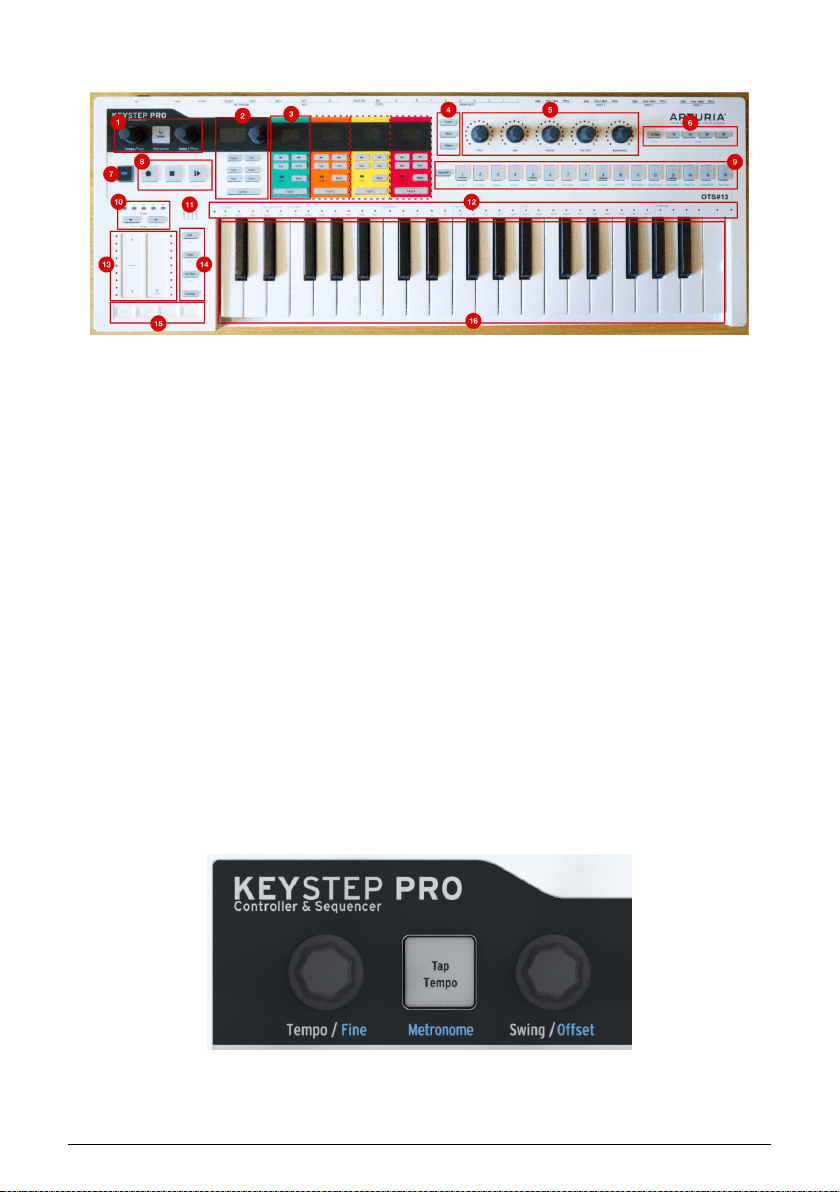
4.2. Front Panel Overview
1. Tempo Section
2. Control Section
3. Track Sections (4x)
4. Scene/Chain/Pattern Buttons
5. Main encoders (5x)
6. Sequence Length Section
7. 'Shift' button
8. Transport Controls
9. Step Buttons
10. Keyboard Transpose Section
11. Built-in Metronome Speaker
12. Keyboard LEDs and Shift functions
13. Pitch / Mod touch strips
14. Keyboard and Sequencer buttons
15. Looper
16. Keyboard
4.2.1. Tempo Section
Here you can find the tempo-related controls of KeyStep Pro. When KeyStep Pro is internally
synchronized, your settings here will affect the internal sequencers/arpeggiators and any
external equipment connected to KeyStep Pro.
32 Arturia - User Manual Keystep Pro - KeyStep Pro Overview

The Tempo/Fine knob sets the tempo from 30-240 beats per minute (BPM). As you turn this
knob, the BPM value is automatically rounded off to the nearest whole number and shown
on the KeyStep Pro's OLED display. Holding down 'Shift' while turning this knob gives you
finer BPM control by switching off the whole-number rounding.
The Tap Tempo/Metronome button lets you set the tempo by tapping on this button in time
with the beat you want or are hearing.
To enable or disable KeyStep Pro's built-in Metronome, hold down 'Shift' while pressing the
Tap Tempo/Metronome button.
♪: You can change Metronome time division by holding the Tap Tempo button and pressing one of
the time division keys (value printed above the keyboard).
Turning the Swing/Offset knob lets you adjust the amount of swing or 'shuffle' feel in your
sequences. It affects either the entire project (all four tracks at once) or only the selected
sequencer/arpeggiator, leaving the others unchanged. Holding down the 'Shift' button while
turning the Swing/Offset knob lets you adjust the timing offset for a track.
♪: If the KeyStep Pro is externally synchronized, the master tempo will be determined by an external
clock source and the Tempo/Fine knob and the Tap Tempo button are ignored.
Swing introduces a shuffle feel to the active sequence or arpeggio. If you've listened to a
variety of musical genres (it's unlikely that you haven't), you have heard swing. It's when
musicians play just before or just after the beat. This is very often heard in jazz and Latin
American music. It evokes a feeling of freedom, of not being forced into a fixed, grid-like
rhythm. It is particularly effective when you mix 'straight' notes with 'swung' notes.
25 different settings are available, ranging from fully counterclockwise (no swing, or 50%)
through increasing amounts of swing (51-74%) to fully clockwise (maximum swing, or 75%).
What the Swing setting does is shift the timing of the notes in a sequence, making the first
note of a pair longer and the second note shorter. Assuming the time division is set to 1/8,
here's what will happen:
• With Swing set to 50%, each note gets equal time, resulting in a 'straight 1/ 8th
note' feel
• As the Swing value is increased above 50% the first 1/8th note is held longer and
the second is played later and shorter. You'll notice that the sequence starts to
'shuffle' a bit and hopefully sounds less mechanical to your ear
• The maximum Swing setting is 75%, at which point the 1/8th notes sound more
like a 1/16th-note figure than 'shuffled' 1/8th notes.
♪: Each sequence can have its own Swing setting.
Turning the Swing knob will apply swing to all sequences and arpeggios simultaneously.
Use 'Shift' + Swing to apply swing to the arpeggio on the active track only. When you record
an arpeggio and quantize is off, Swing is recorded in the sequencer.
Turning or pressing the Swing/Offset knob will display the global and current track offset
values.
Arturia - User Manual Keystep Pro - KeyStep Pro Overview 33
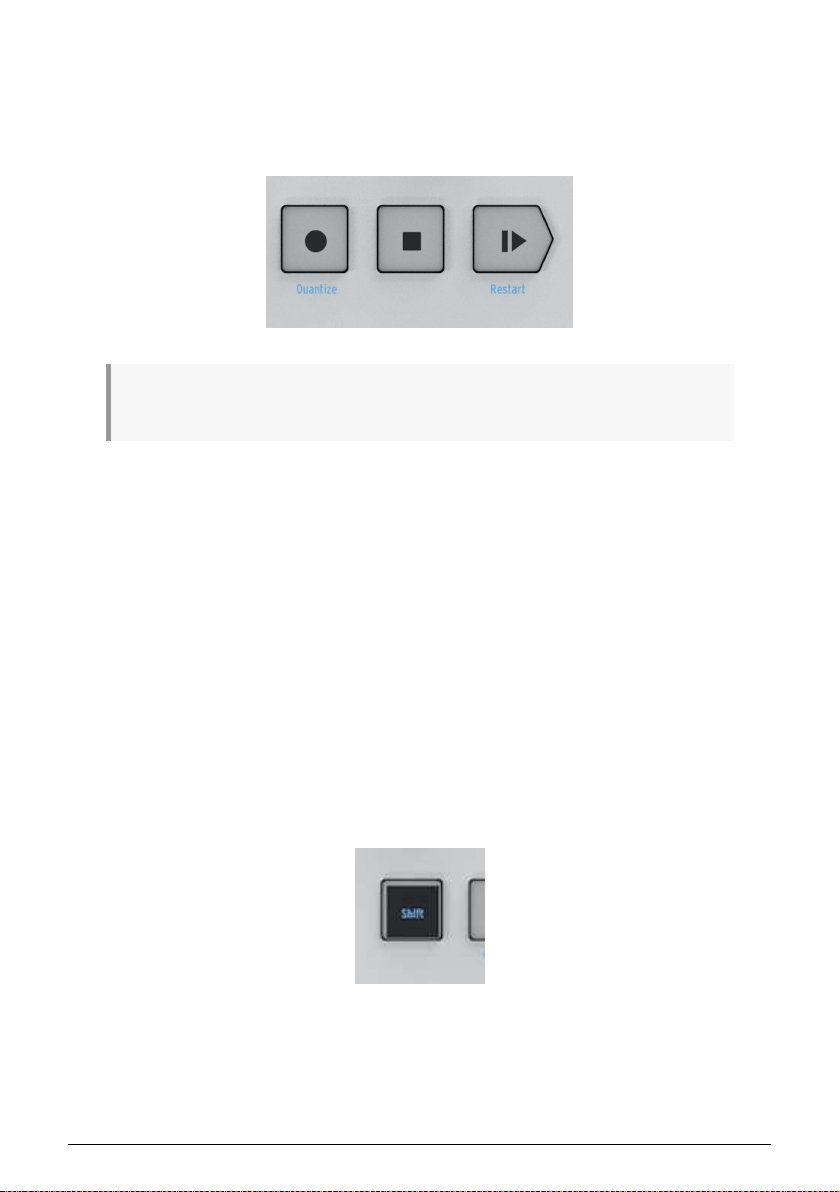
4.2.2. Transport Section
The three Transport buttons control the sequencers, the arpeggiators and any external MIDI
devices by using MIDI Machine Control (MMC). If your DAW does not respond to MMC
commands, the Transport buttons can be configured to send other MIDI messages. Please
refer to the
MIDI Control Center [p.155] to make changes if needed.
♪: In sequencer mode, all three Transport buttons are active. In arpeggiator mode, only Play/Pause
and Stop are active.
All Notes Off
The Stop button has an additional function. If for some reason you end up with a stuck note
playing, just press the Stop button quickly three times in a row. The KeyStep Pro will then
send an All Notes Off command via MIDI.
4.2.3. Built-in Metronome Speaker
The Metronome speaker plays the output of KeyStep Pro's built-in metronome. The
Metronome Level knob on the back panel sets the speaker volume. The metronome can be
switched on or off by holding down 'Shift' while pressing the Tap Tempo button.
Read
Chapter 7 [p.132] to learn more about the Metronome and synchronization in general.
4.2.4. Shift Button
The 'Shift' button gives access to secondary functions, all of which are printed in blue on
the front panel. Most of them are printed above the keys of the keyboard or below the step
buttons.
All of these functions are accessed by holding down the 'Shift' button and pressing another
button that has blue text below it or a key of the keyboard that has blue text above it. For
a detailed overview of the Shift functions, refer to the Shift function overview later in this
chapter.
34 Arturia - User Manual Keystep Pro - KeyStep Pro Overview
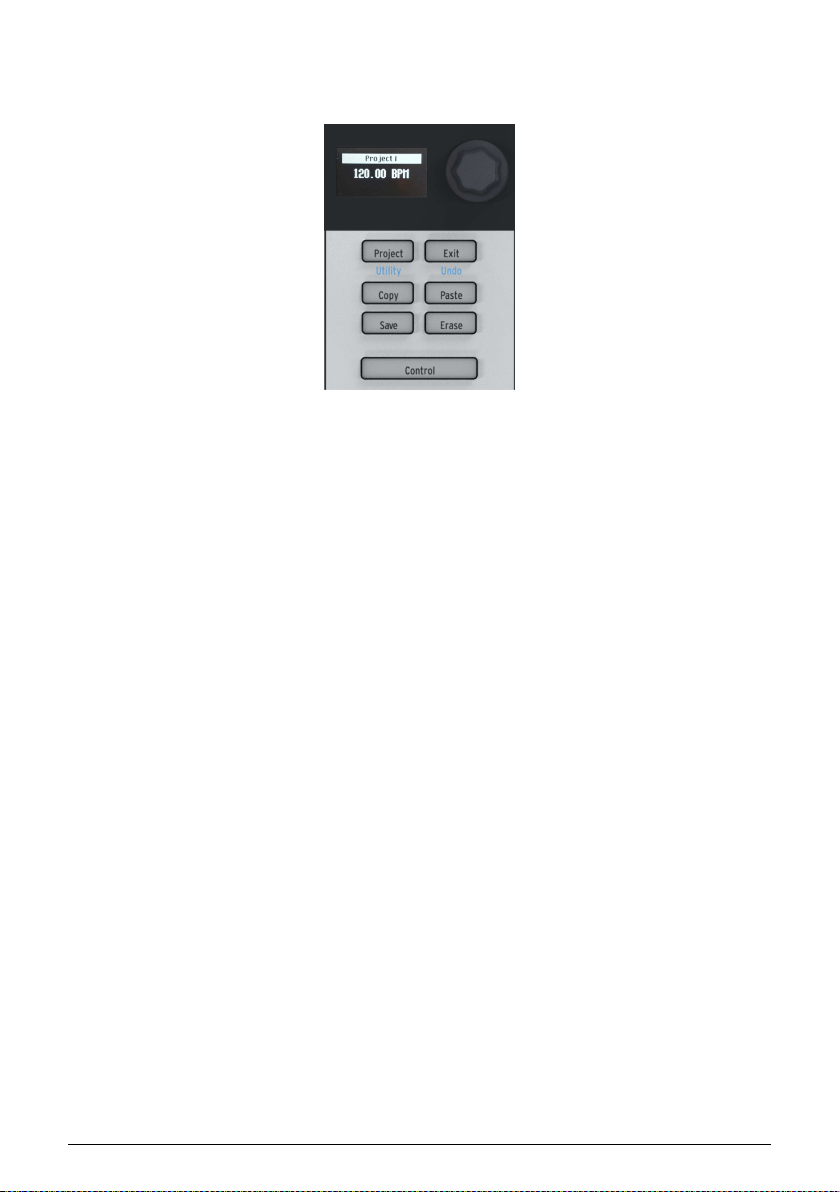
4.2.5. Control Section
In the control section, you'll find Project options, Pattern edit options and the Utility menu.
4.2.5.1. Utility Menu
The KeyStep Pro has many settings that you may want to adjust. The Utility menu is where
you set and change most of the global settings for the KeyStep Pro. 'Global' means that these
settings are shared by all projects. They will be saved as soon as you exit the Utility menu,
which you access by holding down 'Shift' and pressing the Project/Utility button. The Utility
menu will open in the OLED display. To navigate in the Utility menu turn the Control section
encoder and click it to enter a submenu. To back up in a submenu press the Exit button. To
leave the Utility menu, press the Exit button repeatedly. You don't have to save the changes
you make here; they are automatically saved whenever you exit the Utility menu.
4.2.5.2. Exit/Undo
Undo is a Shift function closely related to the other edit functions such as copy/paste and
erase. If you make a mistake during editing, it's good to know that you can undo the last
change you made. If undo is possible, the Exit/Undo button blinks. Pressing 'Shift' + Exit will
undo the mistake.
4.2.5.3. Project Button
KeyStep Pro sequences are organized into Projects. In a Project, you save all your sequence
and drum patterns. Each of the four tracks can store 16 sequences, which can be copied
from one track to another. The Erase button enables you to delete entire projects (as well as
patterns, scenes, steps and notes). The patterns in a project can be chained. This is a handy
feature that will help you to prepare for a performance. Please refer to
Chapter 6 [p.115] for
an in-depth overview of these functions.
Arturia - User Manual Keystep Pro - KeyStep Pro Overview 35
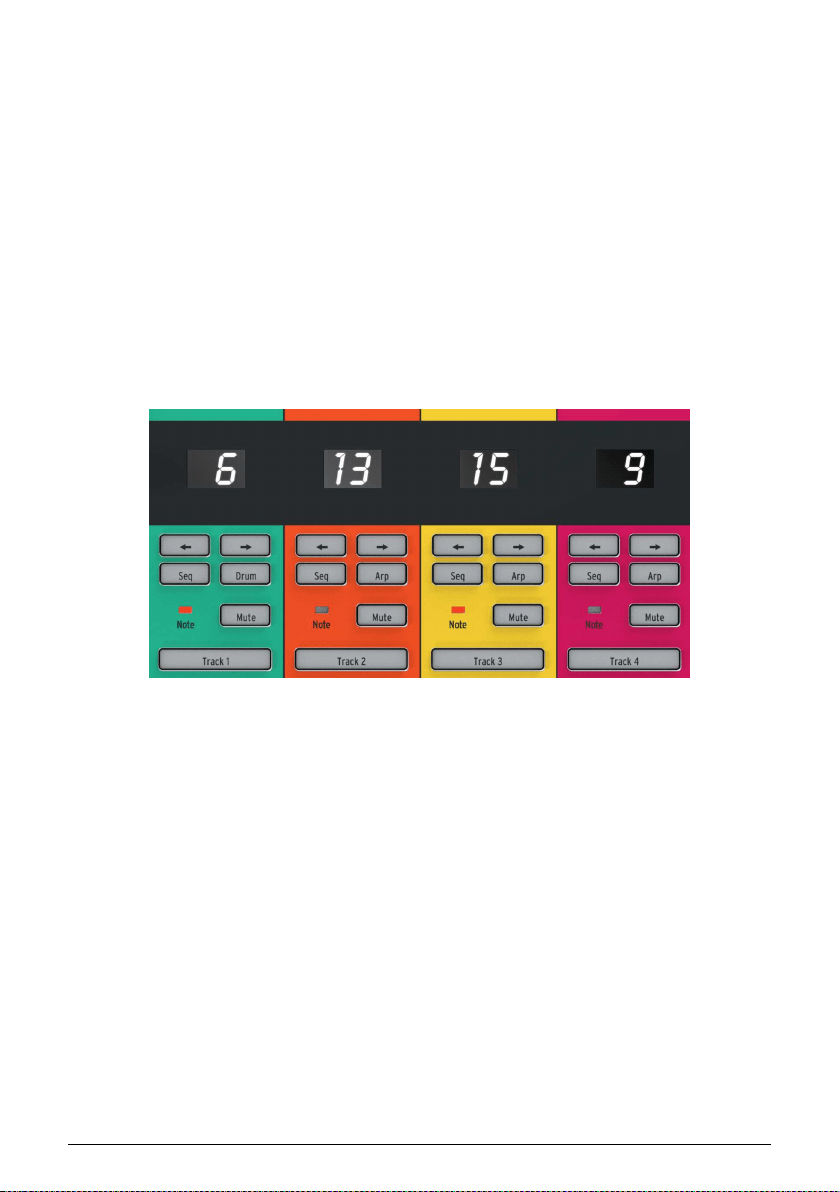
4.2.5.4. Control Mode
The Control button changes the function of the five main encoders. Instead of controlling
pitch, gate, velocity, etc. and the corresponding control voltages (CV) sent to the analog
outputs, in Control Mode they send MIDI control change (CC#) messages, enabling you to
control parameters of external hardware synths or Eurorack modules and, for example,
virtual instruments on your computer.
You enter Control Mode by pressing the Control button. When Control Mode is selected, the
five main encoders send CC# values. For an in-depth explanation of what CC# values are
and what you can use them for, please refer to
Chapter 8 [p.137]. The CC# messages to be
sent can be edited using the OLED display in Utility>Controller and in the downloadable MIDI
Control Center.
4.2.6. Track Sections (4x)
The KeyStep Pro has four separate tracks, each of which has its own dedicated set of
buttons to give you instant control over important features.
The track controls are identical except for one button: Track 1 has a Drum button for the
drum sequencer, but Tracks 2, 3 and 4 each have an Arp button for the arpeggiators. The
track controls function as follows:
4.2.6.1. Track Selector
The Track Selector buttons (Track 1, Track 2, Track 3 or Track 4) let you select the currently
active track. The buttons of the active track light up, and the various controls of the KeyStep
Pro (keyboard, encoder knobs, step buttons, etc.) will only affect the currently selected track.
As you work with the KeyStep Pro, you will notice that there is a consistent color-coding
across the entire front panel. For example, Track 1 is green and when it is selected, all of the
Step Buttons and Keyboard LEDs will light up in green. Track 2 is orange and selecting it will
cause the Step Buttons and Keyboard LEDs to light up in orange. These color cues help you
to know what you are editing and to avoid accidentally changing parameters on the wrong
track.
36 Arturia - User Manual Keystep Pro - KeyStep Pro Overview
4.2.6.2. Mute Button
The Mute button engages or disengages the track mute function. When this button is
illuminated, its associated track is muted and does not transmit any data. In other words,
devices connected via MIDI, CV or USB will not receive any signals when mute is engaged.
Holding down 'Shift' while pressing the Mute button will engage or disengage Solo mode.
This feature is similar to the 'solo' button found on many mixing boards. When Solo mode is
engaged, the Mute button lights up in blue and you will
only
hear the soloed track (or tracks).
Note that the Mute button will only mute the sequences and arpeggios that are running,
possibly including a drum sequence on Track 1. You can still have a muted channel active
and play its sounds on the keyboard.
♪: The Mute and Solo functions can be useful in both composing and performing contexts. For
example, while composing or mixing you may need to solo a certain track to focus on it without
distraction; in a performance context, you may want to mute and unmute sections to build up or
breakdown a song.
4.2.6.3. Note LED
This LED lights up whenever a track's sequencer or arpeggiator is playing and/or whenever
you are playing notes on the keyboard. This handy feature instantly lets you know what is
happening on all four of your tracks without you having to select a track and look at its Step
Buttons or Keyboard LEDs.
4.2.6.4. Sequencer and Arpeggiator Buttons
The KeyStep Pro has four tracks, each with its own independent sequencer or arpeggiator.
Sequencer Arpeggiator Drum trigger (gates) sequencer
Track 1 Yes No Yes
Track 2 Yes Yes No
Track 3 Yes Yes No
Track 4 Yes Yes No
Each track has a pair of buttons labelled Seq and Arp (or Seq and Drum on Track 1). These
buttons let you set the functions for their associated track. The currently selected option is lit
up, and only one mode (Seq or Arp) can be active at any time.
Arturia - User Manual Keystep Pro - KeyStep Pro Overview 37

4.2.6.5. Sequencer
The Sequencer lets you record 16 different sequences, each with up to 64 steps. You can
create these sequences by playing them on the keyboard or by entering note events directly
(complete with pitch, gate length, velocity and other parameters) using the Step buttons.
These sequences can then be played, transposed and modified in many creative ways.
The Sequencer is covered in detail in
Chapter 5 [p.74] of this guide.
4.2.6.6. Arpeggiator
The arpeggiator generates notes based on the keys of the keyboard that you have pressed
or are now pressing and plays them back according to the Arp Mode setting. This is a fun
and interesting way to create new patterns and melodies or to improvise on existing chords.
The Arpeggiator is covered in detail in
Chapter 5 [p.63] of this guide.
4.2.6.7. Drum Trigger Sequencer
This is a special drum or 'trigger' sequencer that sends signals to the Drum Gates outputs
on the back panel of the KeyStep Pro. The Drum sequencer has eight gate outputs (labelled
'Drum Gates 1-8'). You can use these outputs to trigger connected drum machines or
synthesizer modules with gate (or 'trigger') signals.
The Drum Gate sequencer is covered in detail in
Chapter 5 [p.92] of this guide.
38 Arturia - User Manual Keystep Pro - KeyStep Pro Overview
4.2.7. Arrangement Section
Patterns are the basic elements for creating chains. A chain is a pre-programmed series of
patterns that you construct for a performance; it is an automated way of selecting patterns.
♪: A pattern chain can contain up to 16 patterns.
Scenes are snapshots of an interesting combination of active elements: for example, an
arpeggio running on Track 1 plus sequences running on Tracks 2 and 3 with nudged and/or
inverted patterns.
♪:Track mode (Sequence or Arpeggio) is not saved in a Scene.
Please refer to Chapter 6 [p.125] for detailed information on patterns, chains and scenes.
4.2.8. The Step Edit Button
The Step Edit button enables you to edit an individual step of a sequence. By pressing the
Step Edit button you active Step Edit mode.
In Step Edit mode you can use the five main encoders to edit the Pitch, Gate, Velocity, Time
Shift and/or Randomness of the note or notes in the active step. There's much to discover
and learn about how this seemingly simple button works. Please refer to
Chapter 5 [p.83] for
details.
Arturia - User Manual Keystep Pro - KeyStep Pro Overview 39

4.2.9. Step Buttons
These 16 buttons let you activate or deactivate steps in a sequence and program specific
steps. They provide visual feedback (active steps light up in the color of the selected track)
and an indication of the currently playing step (which is lit up in white). This is an intuitive
way of programming steps that will be very familiar to anyone who has worked with an
old-school drum machine.
On the KeyStep Pro, these 16 Step buttons can do many other things that just active or
deactivate steps. For example, holding down the Lst Step (Last Step) button while pressing
one of the Step buttons lets you set the sequence's length. Holding down the 'Shift' button
lets you do several different things, including clearing patterns, nudging notes backward or
forward and quantizing sequences. These functions are covered in detail in
Chapter 5 [p.63]
of this guide.
One of the most distinctive features of these Step buttons is that they are color-coded to
match the track that is currently selected. So when Track 1 is active, the Step buttons light
up in green; for Track 2, they become orange, and so on. This color-coding is consistently
followed across the entire front panel and lets you know what track you are currently editing
in the KeyStep Pro.
40 Arturia - User Manual Keystep Pro - KeyStep Pro Overview

4.2.10. The Main Encoders (5x)
The five main encoders (above Step buttons 2 to 10) are key to changing the parameters
of your patterns. They are somewhat different to standard encoders. Turn them slowly
and you'll notice that they have a slight 'detent': you'll feel a small click or series of clicks
whenever you move one.
Each of the five main encoders is surrounded by 15 red LEDs, each of which has eight levels
of brightness from dim red to bright red. If we take the Gate encoder as an example: first
turn it all the way counterclockwise, then turn it slowly to the right. The LED in the first
position will slowly increase in brightness and after eight clicks the second LED will light up
dimly and the dim-to-bright cycle will repeat. All in all, this gives you 128 distinct positions
for each of these encoders!
♪: The encoders are touch-sensitive: the moment you touch them, their current value will be
displayed in the OLED screen.
4.2.10.1. The Pitch Encoder
In Step Edit mode, the Pitch encoder will step through the pitches chromatically or, if you
have selected a scale by holding down the 'Shift' button and pressing the appropriate Scale
key, it will only step through the notes that belong to the scale you've selected.
4.2.10.2. The Gate Encoder
In Step Edit mode the Gate encoder enables you to set the gate length of the selected step.
Simply stated, the gate length is the ON time or duration of a note. It's a great feature:
imagine how a fast 12-step piano sequence sounds when steps 3, 6, 9 and 11 are sustained,
while the other steps are all short. This is something that only a very skilled pianist can
accomplish. In Arpeggio (Arp) mode, the Gate encoder functions as a global encoder that
simultaneously affects all gates in the currently activated arpeggio.
4.2.10.3. The Velocity Encoder
Velocity means the strength or force with which you hit a key. In the MIDI specification,
velocity values range from 0-127, where notes with a velocity of 0 to 50 or so are soft,
velocities of about 50 to 100 are medium, and a velocity above 100 is loud. In Utility>MIDI
Settings>Velocity Curve and the downloadable MIDI Control Center you can choose a
suitable velocity scaling.
In Arpeggio (Arp) mode, the Velocity encoder functions as a global encoder that
simultaneously affects all velocities in your arpeggio.
Arturia - User Manual Keystep Pro - KeyStep Pro Overview 41

4.2.10.4. The Time Shift Encoder
This encoder enables you to shift a selected note backward or forward in time relative to
the center of that step. The range is -49% to +50% of a step. In the case of two adjacent
steps in a sequence, if you shift the first forward and the second backward they will seem
to almost merge. In Arpeggio (Arp) mode, the Time Shift encoder shifts the entire arpeggio
that is playing in the current track backward or forward in time. Of course, you'll only notice
this if you have two arpeggios running simultaneously on two tracks, both on Hold.
4.2.10.5. The Randomness Encoder
In Step Edit mode, the Randomness encoder lets you choose, for each note, the probability
that it will trigger, from 0% to 100%. If there is more than one note stored in the selected
step, each note will trigger randomly according to the current Randomness setting.
In Arpeggio (Arp) mode, the Randomness encoder does something quite different: it
introduces random notes into your arpeggio.
4.2.10.6. Setting a Track's Default Parameters
To set the parameters for a specific track, select the track using the Track 1, 2, 3 or 4 button
and then turn the main encoders without holding down any Step buttons. This combination
of five encoder positions will become the default parameters for that track.
4.2.10.7. Setting an individual step
To set parameters for a specific step, first choose the track you would like to edit using the
Track 1, 2, 3 or 4 button, then hold down a Step button while adjusting one or more of the
main encoders. Doing this will set specific values for that step that are different to the default
parameters (as described above).
42 Arturia - User Manual Keystep Pro - KeyStep Pro Overview
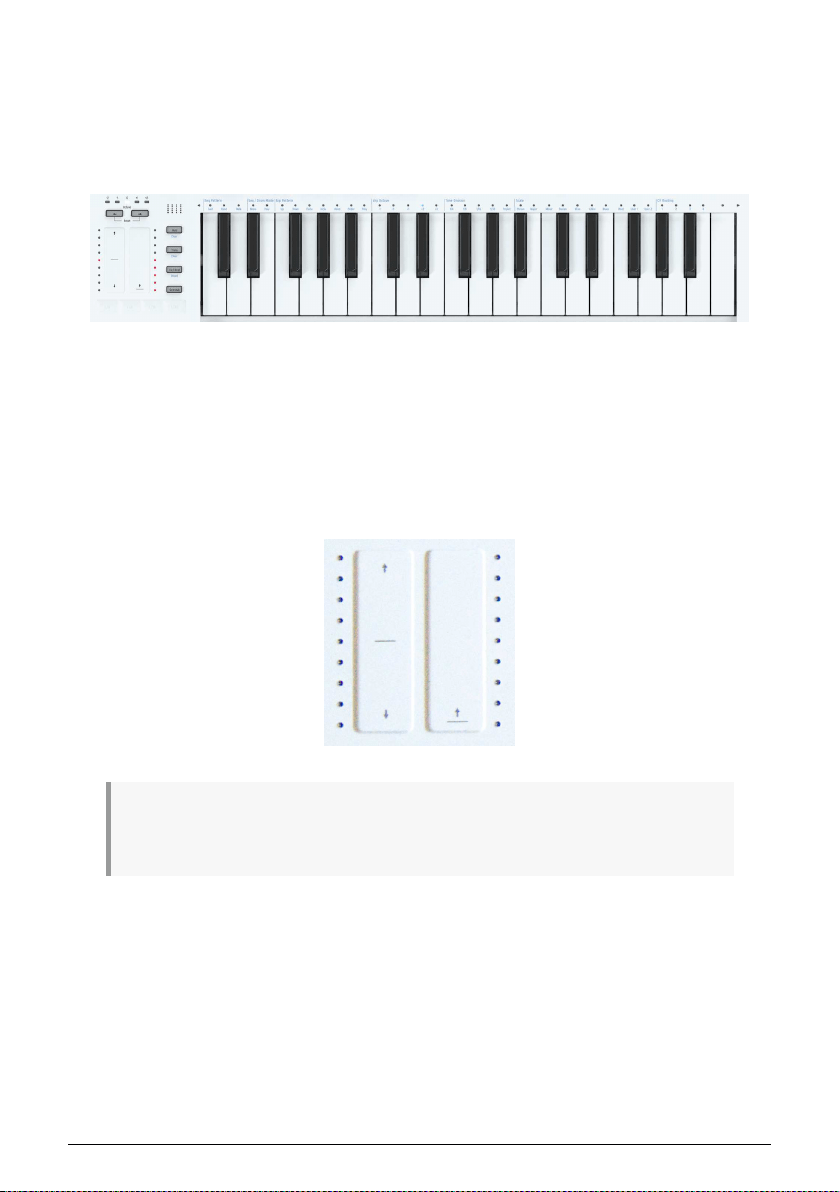
4.2.11. Keyboard Section
In this sub-section, we'll have a look at everything to the left of and directly above the
keyboard; the lower half of the KeyStep Pro. The Keyboard has 37 velocity-sensitive keys
that generate aftertouch signals. 'Velocity-sensitive' means that each key detects the force/
speed with which you press it. The magnitude of aftertouch depends on how hard you press
a key down after it has reached the bottom of its travel.
4.2.11.1. Pitchbend / Mod Touch Strips
These innovative touch-sensitive vertical strips replace the standard 'wheels' you usually
find on a MIDI controller and are used to add expressivity to your performance. Each strip
has a corresponding ladder of nine red LEDS to indicate the position of the control. Like
most traditional wheel controllers, the Pitch touch strip is 'spring-loaded', meaning that it
immediately returns to its center value when released, whereas the Mod touch strip retains
its current value when released.
♪: The KeyStep Pro will remember the last position of the Mod strip of the currently selected track
when you switch to another track. In a sense, you therefore have four modulation strips, one for each
track!
The Pitchbend Strip
Pitch-bending is a technique whereby you bend the pitch of the currently playing note
upward or downward.
The Pitchbend strip is where you perform all your pitch-bending tricks. The middle of the
strip, indicated by a horizontal black stripe, is the neutral point; if you touch the strip there
nothing will happen. If you move your finger up (away from you) or down (toward you), you
will hear the pitch of the currently playing note go up and down. So far it's not much different
to bending with a wheel. Unlike a wheel, however, you can place your finger directly on any
other point of the strip. The pitch will then jump instantly to that value!
Arturia - User Manual Keystep Pro - KeyStep Pro Overview 43
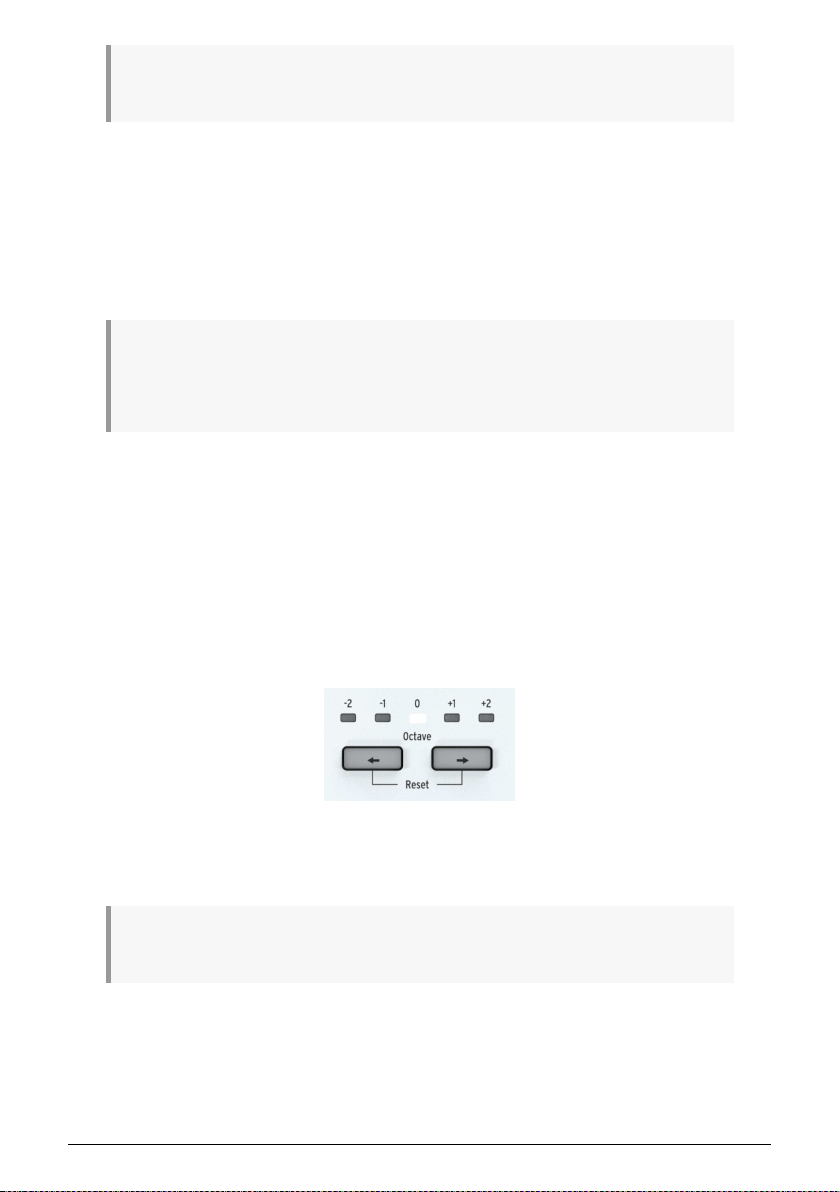
!: To the left of the Pitchbend strip you'll see nine red LEDs. They will help you to create more accurate
pitchbends.
By default, the bend range is set to 2 semitones (half steps): 2 from the center up and 2 from
the center down. In Utility>CV Settings>Pitch Bend Range, you can set the range for the Pitch
CV outs from +/-1 to +/- 24 semitones. The Bend range can be set individually for each voice.
Tapping the Pitchbend strip at two different points in succession enables you to alternate
quickly between two pitches. This playing technique is only possible on pitchbend strips and
makes a pitch wheel look primitive! Whenever you lift your finger off the strip, the pitch
will jump back to the zero center value. Another advantage of this strip is that it is ideal for
applying natural-sounding vibrato to a note by wiggling your finger on the strip.
!: Musical traditions other than western classical music have much richer expressive possibilities
when it comes to pitch-bending. Try listening to some Indian music. Maybe you'll come to appreciate the
complex and very musical pitch-bending techniques used by singers and by performers on instruments
like the sarod and the sitar.
The Mod Strip
This innovative modulation control takes the place of the standard mod wheel. It transmits
the standard MIDI CC# modulation value. To learn more about CC# values, please refer to
Chapter 8 [p.137].
4.2.11.2. The Octave Buttons
Use the Octave arrow buttons (above the touch strips) to transpose the output of the
keyboard up or down by octaves. The range is two octaves up and three octaves down from
the default mid-point.
Knowing this can help you to remember where you are pitch-wise on a poorly-lit stage. The
keyboard itself is three octaves but the whole pitch range is seven octaves, which should
facilitate all but the most extreme musical adventures.
♪: To quickly reset the octave to the default mid-point, hold down both Octave arrow buttons
simultaneously.
You can also use the Octave Buttons to reset the KeyStep Pro to its factory settings:
• Switch the KeyStep Pro off
• Switch the KeyStep Pro on while holding the OCT+ and OCT- buttons.
44 Arturia - User Manual Keystep Pro - KeyStep Pro Overview
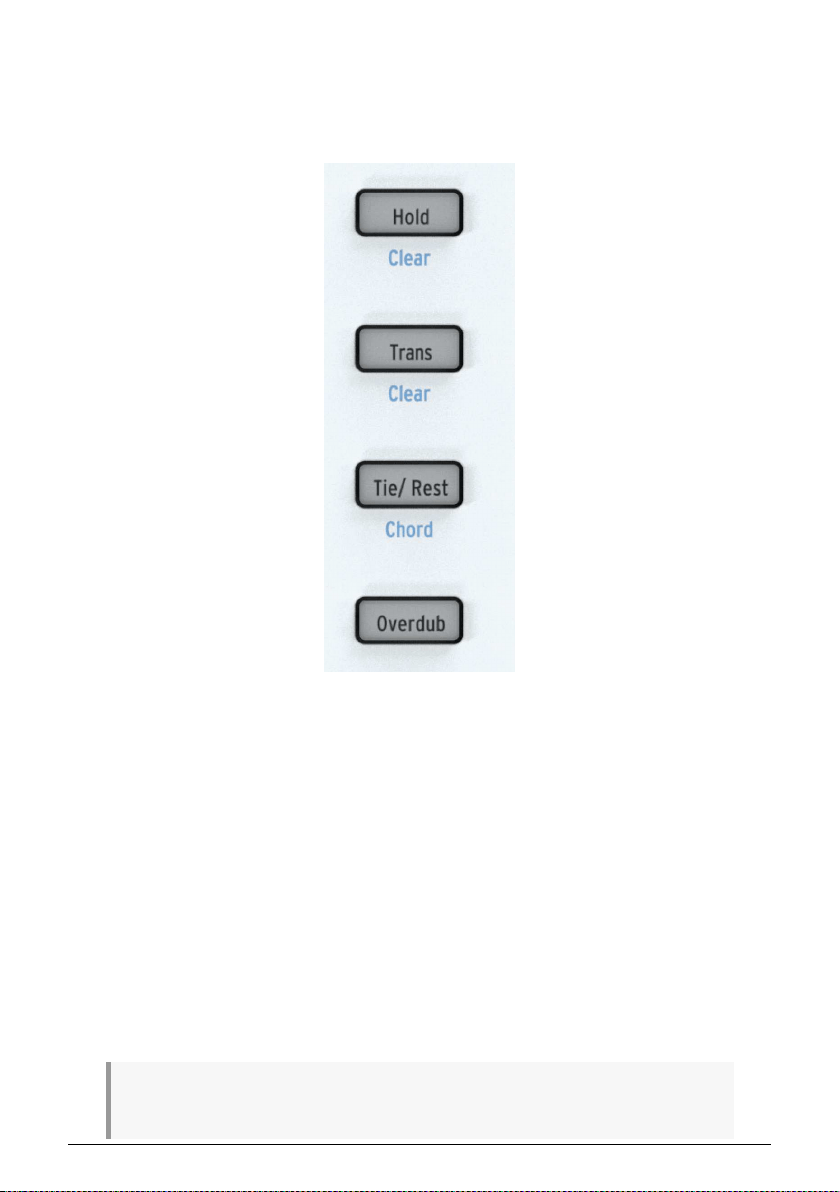
4.2.11.3. The Hold Button
The Hold button has an important function when an arpeggio is playing. When Hold is active
you can lift your fingers from the keyboard and the arpeggio will continue to play. Hold also
enables you to add more notes (up to 16) to an arpeggio while it is running.
4.2.11.4. The Trans (Transpose) Button
The Transpose function lets you shift up or shift down the pitch of running sequences/
patterns and arpeggios. To transpose, hold down the Trans button and play a note on the
keyboard. Notes below middle C will cause a downward transposition; notes above middle
C will cause an upward transposition.
4.2.11.5. The Tie/Rest/Chord Button
When creating a sequence, this button is used to enter rests or to tie two notes together.
However, when in Step Edit mode, if you press Tie/Rest the current step will be cleared. If
the sequencer is running in Step Edit mode, holding down Tie/Rest is a quick way to clear
the contents of a series of steps.
If you need to shorten a Tie, activate Step Edit mode, select the step where the Tie starts and
reduce the gate length of the step using the gate knob.
♪: Holding down 'Shift' while pressing the Tie/Rest/Chord button switches Chord mode on or off. This
is covered in Chapter 5 [p.111].
Arturia - User Manual Keystep Pro - KeyStep Pro Overview 45

4.2.11.6. The Overdub Button
The Overdub button plays an important role in Step Edit mode when you are editing the
content of a specific step.
While overdub is ON, any notes you play on the keyboard will be added to the existing notes
of that step.
Selecting a step in Overdub mode enables you to selectively extend some or all of the
notes in chord: Hold the keys of the chord you want to extend and press Tie/Rest once or
repeatedly to extend the gate length of the selected notes.
Pressing the Tie/Rest button in Overdub without holding any keys down is a quick way to
move forward through the steps of a pattern. Again this only works when Overdub is on.
♪: In Quick Edit mode, the Tie/Rest button does nothing.
When Overdub is OFF, any new notes you play will replace the existing notes in the step.
You can always tell whether you're in add or replace mode: if you are in Quick Edit or Step
Edit mode and the LED above a key blinks the existing notes of the step will be replaced.
To extend a chord/notes in a step to the next steps, erasing the content of the step(s)
following it, hold the notes in the step and press Tie/Rest. Repeat this to extend the notes of
the chord over several steps.
With Overdub OFF, pressing the Tie/Rest button is a quick way to delete the steps of a
pattern. The cursor moves to the next step, deleting current step content.
46 Arturia - User Manual Keystep Pro - KeyStep Pro Overview

4.2.12. The Looper
The horizontal Looper Touch Strip (under the Pitchbend and Mod vertical touch strips)
enables you to alter the playback of a Project in real-time. It will generate longer or shorter
loops depending on where you touch the Looper Touch Strip and when you do it.
The Looper loops all tracks simultaneously. This includes CC# values that you may have
stored in the Control track.
Press 'Shift' + Touch Strip to disable/enable the Touch Strip.
4.2.12.1. Loop Length
The length of the loop is determined by where you place your finger on the Looper Touch
Strip, 1/4 being the longest loop and 1/32 being the shortest. Changing the placement of your
finger changes the size of the loop.
4.2.12.2. Loop Start Point
The start point of the loop depends on when you touch the Looper strip during playback. You
can jump to a different loop position by holding your finger on the strip and then pressing
one of the Step buttons. With the Looper, you can loop a range of steps in a sequence. The
length of the loop is determined by the indentation you press: 1/4, 1/8, 1/16 or 1/32.
♪: It may not seem such a big deal that the looper strip can be controlled using CC# values, but this
is worth exploring. By sending different CC# 9 values to the KeyStep Pro, you can 'scratch' a sequence
remotely from your DAW.
Can you change the rate of repeat of the Looper strip?
To a certain extent, yes. If you're in time division 1/16 and press 1/4, the sequencer will repeat
four steps. If you want to double this repeat range, set time division to a higher value i.e. 1/
32 and lower the tempo. The KeyStep Pro will now repeat 8 steps instead of 4 when you
press 1/4 on the strip.
Arturia - User Manual Keystep Pro - KeyStep Pro Overview 47

4.2.13. Keyboard
The KeyStep Pro's 37-note slim-key keyboard features great-feeling keys that are narrower
than standard piano keys but still large enough to allow for maximum playability across
three octaves. The keys are both velocity and aftertouch sensitive to give your performance
maximum expressivity.
4.2.13.1. Keyboard LEDs
Each key of the KeyStep Pro has a corresponding multi-color LED located directly above it.
These LEDs blink to provide visual feedback on what the four sequencers/arpeggiators are
playing. The color of each LED changes to match the selected track (Track 1 is green, Track
2 is orange, Track 3 is yellow and Track 4 is red).
Also, the two little triangles on either side of the keyboard light up if there is activity outside
the range covered by the keyboard. This may happen when an octave transposition shifts a
sequence or arpeggio outside the visible keyboard range.
4.2.13.2. Keyboard SHIFT Functions
The KeyStep Pro has many secondary or Shift functions that can be accessed by holding
down the 'Shift' button and pressing one of the keys on the keyboard. The blue text above
each key indicates the Shift function associated with that key.
The row of LEDs above the keyboard will give a lot of information about what is going on:
• When you hold down the 'Shift' button, the current ON/OFF state of the Shift
functions will be shown.
• When you turn the Pitch encoder in Step Edit mode, it will show which note(s)
you are editing.
48 Arturia - User Manual Keystep Pro - KeyStep Pro Overview

4.2.14. SHIFT Functions
Many of the KeyStep Pro's most interesting functions can be accessed with the 'Shift' button.
It's the leftmost button on the front panel and it's black. The blue 'Shift' text reveals its crafty
secret: it is linked to all KeyStep Pro functions that are printed in blue on the front panel.
Take a good look and you'll find many of them: in the Transport section, to the left of the
keyboard, above the keys of the keyboard (except the highest C), below the 16 step buttons,
and in the Sequence Extend section. That's 63 Shift functions in total!
4.2.14.1. Keyboard Shift Functions
The 'Shift' button has a very helpful feature: if you hold it down, the currently active keyboard
Shift functions will be displayed by lit-up LEDS. From left to right above the keyboard these
are:
• Seq Pattern mode
• Seq/Drum mode (Mono or Poly)
• Arp Pattern and Arp Octave
• Time Division
• Scale
• CV routing
The HOLD/Clear Button
The HOLD/Clear button enables you to hold arpeggios, so that they continue to play until
you release it. You can hold arpeggios on several tracks simultaneously. 'Shift' + HOLD/Clear
will release all currently held arpeggios.
Arturia - User Manual Keystep Pro - KeyStep Pro Overview 49

The Trans/Clear Button
By holding down the Trans (Transpose) button and pressing a key on the keyboard, you
can transpose the running sequence to another key signature. The Transpose button is a
toggle button. Once you have applied a transposition to a sequence, the transpose button
will 'remember' that transpose action. If you press it once more, you return to the original
untransposed sequence. Thus you always have an untransposed and a transposed version
of the sequence at hand, and you can toggle between them!
Transposition is linked to the currently selected track. In a live situation, you can for example
transpose Track 1, then select Track 2 and apply a transposition there as well. Holding down
'Shift' and pressing Trans/Clear will clear all active transpositions simultaneously.
50 Arturia - User Manual Keystep Pro - KeyStep Pro Overview

The 'Transpose Group' feature enables you to group and transpose tracks together. Here's
how to do it:
• Hold the Trans button. It will start to blink to signal that you are now in transpose
mode
• Select other tracks to form a transpose group. The newly selected tracks will light
up in white. You can now transpose the newly formed group.
As long as the Transpose button is held down, you can keep adding or removing tracks from
the transpose group. Group transpose can be applied to anything running on a track. You
can combine a sequence running in track one with an arpeggio running in track two and
transpose them together. There are two ways to delete a group:
• Hold 'Erase' and press the 'Transpose' button or
• Hold 'Transpose' and remove Tracks that are part of the group by toggling them
'OFF'.
When you save a Project a currently active group will be saved with it.
♪: Hold the transpose button to check by how many steps the current track has been transposed up
or down.
The Tie/Rest/Chord button
Holding down 'Shift' and pressing the Tie/Rest/Chord button puts the KeyStep Pro into Chord
mode. It will wait for you to play a block or legato chord. As soon as you lift your fingers
off the keyboard, the chord (actually, its stacked intervals) is stored in memory. If you now
press a key on the keyboard, that key will become the root of the stored chord. In other
words, Chord mode will use the stored stack of intervals to build the chord on this new root
note. Please refer to
Chapter 5 [p.63] for details.
Seq (Sequence) Pattern
To activate this Shift function, hold down the 'Shift' button and press the appropriate key (C,
C# or D in the lower octave).
This Shift function enables you to change the way the notes stored in the step buttons will
play. Fwd (Forward) is the default mode. Rand (Random) plays the steps in random order.
In Walk mode, the sequencer digitally 'throws the dice' to decide whether to go forward or
backward at the end of each step: there’s a 50% chance it will play the next step, a 25%
chance it will play the current step and a 25% chance it will play the previous step. Please
refer to
Chapter 5 [p.63] for details.
Seq/Drum Mode
To activate this Shift function, hold down the 'Shift' button and press the appropriate key (D#
or E in the lower octave).
In Sequencer mode, each step can store a maximum of 16 notes. The mode you select here
- Mono (monophonic) or Poly (polyphonic) - will determine whether all the notes stored in
the step will play or just one: the lowest note of the stored chord.
Arturia - User Manual Keystep Pro - KeyStep Pro Overview 51
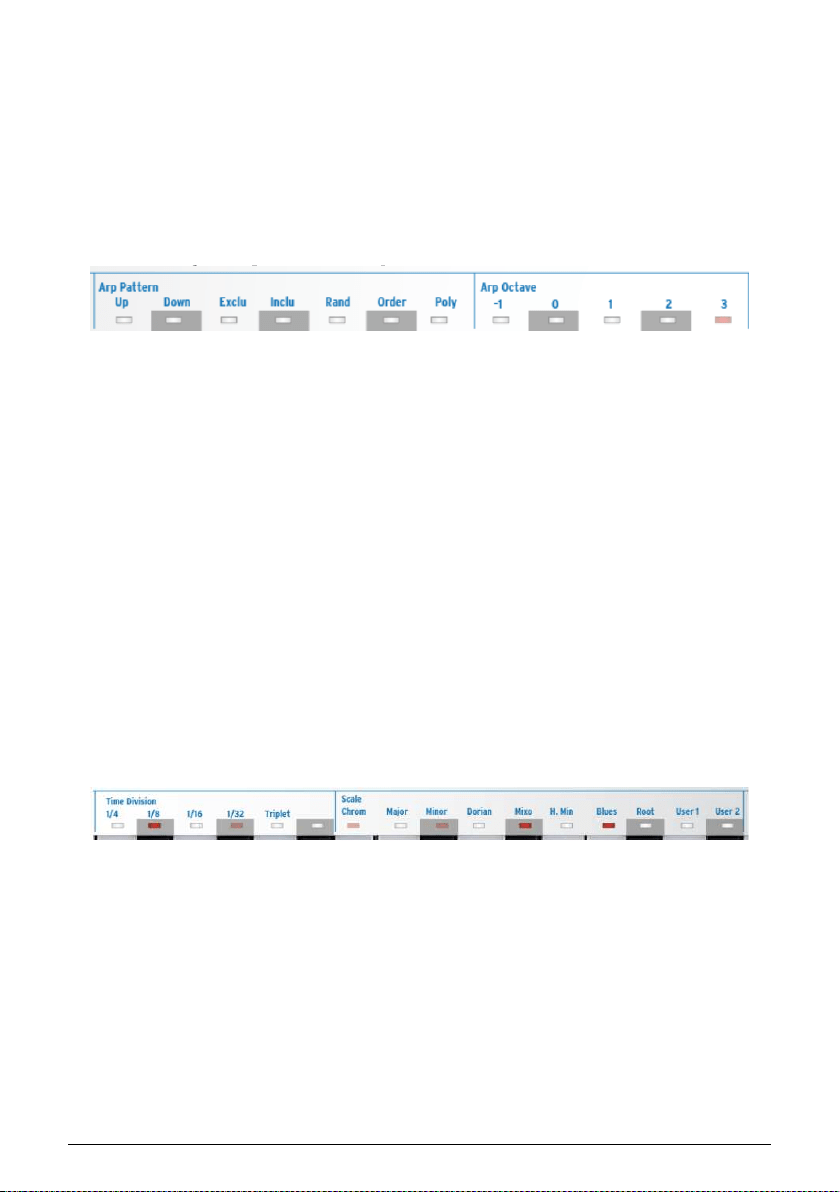
In Drum mode, switching between Mono and Poly has a different effect. In Poly mode, each
of the 24 drum tracks can have a different length. In Mono mode, they share the same
length. Please refer to Chapter 5 [p.92] for details.
Arp (Arpeggio) Pattern
To activate this Shift function, hold down the 'Shift' button and press the appropriate key (F,
F#, G, G#, A, Bb or B in the lower octave).
The KeyStep Pro can transform any chord you are holding down on the keyboard into
an arpeggio. It can arpeggiate your chord in seven ways: up, down, exclusive pendulum,
inclusive pendulum, random, in the order you played them or polyphonically.
There's a lot to be learned about this function, so we have devoted a
whole section
[p.63] to the wondrous secrets of arpeggiation and specifically to the KeyStep Pro's unique
arpeggiation features.
Arp Octave
To activate this Shift function, hold down the 'Shift' button and press the appropriate key (C,
C#, D, D# or E in the middle octave).
By default, the arpeggiator will play the notes you are holding down and stay within the
limits of one octave. The Arp Octave -1, 0, +1, +2 and +3 buttons will extend the notes beyond
that range. If you change the octave range, the arpeggiator will also play notes in the
octaves above and below the chord you are playing. Press 'Shift' + an Arp Octave key to
change the range.
Time Division
To activate this Shift function, hold down the 'Shift' button and press the appropriate key (F,
F#, G, G# or A in the middle octave).
Time Division can be applied to both the arpeggiators and the sequencers. Much of the fun
of arpeggios is that they can run at various speeds. If you mix them with sequences and
change speed, it will have a great overall effect. The KeyStep Pro features three arpeggiators
that can run simultaneously and at different speeds!
By default, an arpeggiator will run in 1/16th straight-note speed, but there are four straight-
note speeds to choose from: 1/4, 1/8, 1/16 and 1/32. Each of these speeds can also run in
triplet mode, so alltogether there are eight speed options. You can have one arpeggiator
running in 1/16th straight-note speed and another in 1/8th triplets speed. There are lots of
creative options to explore here!
The sequencers (including the drum sequencer) can also run at these different speeds. You
could, for example, run copies of the same pattern in different tracks at different speeds.
There's unlimited potential for discoveries here.
Each pattern can have its own time division, which is stored with the pattern. This allows
you to create chains of the same pattern in different time divisions.
52 Arturia - User Manual Keystep Pro - KeyStep Pro Overview

♪: When you change to another pattern while in Arp mode, the time division will not change.
Scale
To activate this Shift function, hold down the 'Shift' button and press the appropriate key
(from Bb in the middle octave to G in the upper octave).
This Shift function enables you to change the scale of an arpeggio or a sequence on the
fly. You can choose from six different scales (major, minor, dorian, mixolydian, harmonic
minor or blues). When you select a scale by pressing 'Shift' + a Scale key, everything in the
currently selected track ‒ the notes you are playing on the KeyStep Pro's keyboard, the active
track's sequence and the active track's arpeggio ‒ will play in that scale. This is a pattern
setting that is stored with the pattern when you save it.
The KeyStep Pro comes with six predefined scales, but you can also create your own
custom scale and store it as User 1 or User 2. Please refer to
Chapter 5 [p.108] for additional
information.
Scale Root & User Scales
Holding down 'Shift' and pressing the Root key (F in the upper octave) gives you the option
to select another root note for the currently playing sequence.
Holding down 'Shift' and pressing the User 1 or the User 2 key (F# or G in the upper octave)
enables you to store pre-defined scale roots.
For the major, minor, dorian, mixolydian, harmonic minor and blues scales, you can select
a new root note by holding down 'Shift' and pressing the Root key then selecting a new root
in the lower octave of the keyboard. Pressing a key in the lower octave will update the Root
note. This can be repeated multiple times while holding down the Root key. The currently
active root note will be shown by its LED being lit up in blue.
Please refer to
Chapter 5 [p.108] for an in-depth explanation of root notes and user scales.
CV Routing
To activate this Shift function, hold down the 'Shift' button and press the appropriate key (G#,
A, Bb or B in the upper octave).
All sequencers and arpeggiators can send their output signals to the four Voice outputs on
the KeyStep Pro's back panel. By default, the output of Track 1 will be sent to Voice 1, the
output of Track 2 to Voice 2, etc. There may be situations where you want more control
of the tracks' routings. That's what CV routing is all about. For example, you can route the
output of Track 1 to all four Voice outputs, or you can route the output of Track 1 to Voices 1
and 2 and the output of Track 2 to Voices 3 and 4.
For each track, you can define any combination of voices. If a voice is already used by
another track, it will be dimly lit. If it is already active for the current track it will be brightly
lit. If you select a voice that is already being used by another track, you will overwrite the
previously assigned voice. When Track 1 is in Drum mode, CV outputs that were assigned to
Track 1 will be freed up.
CV routing is an important skill to master when you
use a modular system [p.167] with your
KeyStep Pro.
Arturia - User Manual Keystep Pro - KeyStep Pro Overview 53

4.2.14.2. Step Button SHIFT Functions
When you hold 'Shift', the steps will dim. This allows you to see the effect of the Shift
functions when modifying a step’s position with Nudge, Invert or Randomise Order.
Clr Ptn (Clear Pattern)
For the currently active pattern, this function clears all steps, resets the sequence length
to the default 16 steps and restores all other default settings: 1/16th straight-note speed,
Forward seq mode, Poly mode, Chromatic scale. Clearing a Drum pattern clears all 24 drum
tracks simultaneously.
Clr Steps (Clear Steps)
For the currently active pattern, Clr Steps clears all steps but keeps everything else
unchanged. When applied to a Drum sequence, it will clear only the selected drum track.
‹Nudge
‹Nudge shifts the currently active pattern to the left. All steps on all pages of the Pattern will
shift to the left. It works both with sequencer patterns and drum patterns. In Drum mode, it
will only affect the currently selected drum track.
Nudge›
Nudge> shifts the currently active pattern to the right. All steps on all pages of the Pattern will
shift to the right. It works both with sequencer patterns and drum patterns. In Drum mode it
will only affect the currently selected drum track.
Invert
Invert inverts the order of the steps in the current pattern. The last steps in the pattern will
become the first and the first the last. Invert acts on the currently active step groups. If your
pattern is two pages long, the last steps on page two will become the first steps on page
one.
Semi Down
This function is for intelligent semitone (half step) downward transposition of the current
sequence. It's intelligent because the transpose function takes the current scale setting into
account.
Semi Up
This function is for intelligent semitone (half step) upward transposition of the current
sequence. Again, it's intelligent because the transpose function takes the current scale
setting into account.
Oct (Octave) Down
Transposes the current pattern one octave down.
Oct (Octave) Up
Transposes the current pattern one octave up.
54 Arturia - User Manual Keystep Pro - KeyStep Pro Overview

Qnt (Quantize) 50%
Sets recording quantization to 50%. When in Drum mode, it will only quantize the currently
selected drum track. Please refer to
the sequencer section [p.63] for details.
Qnt (Quantize) 100%
Sets recording quantization to 100%. When in Drum mode it will only quantize the currently
selected drum track. Please refer to the sequencer section [p.63] for details.
Rand (Randomize) Order
Randomizes the order of the steps in the current pattern.
Rand (Randomize) Notes
Randomizes the notes (pitch values) in the current pattern.
Rand (Randomize) Octave
Randomizes the octave in which notes in the current pattern will play.
Global BPM
Pressing 'Shift' + Global BPM enables you to switch between the Global tempo set in the MIDI
Control Center and the current Project Tempo. A Project Tempo is stored with a Project when
you save it. When lit (in blue), the Global tempo is active. When unlit, the Project Tempo is
active.
Wait Load (Wait to Load)
This is where you 'tell' the KeyStep Pro how it should continue to the next pattern. For
Patterns, the wait-to-load options can be set directly using the Shift button: hold down 'Shift'
and press Wait Load to switch instant change on or off. Whether the change will occur at the
end of the current bar or at the end of the current pattern is determined by settings made in
Utility or the MIDI Control Center.
It is also possible to change the wait-to-load behavior of Scenes and Projects. Should the
KeyStep Pro wait for 1 bar, 2 bars or 4 bars before switching to the next Scene or Project?
Changing Scene and Project behavior is done in Utility>Launch Quantize or in the MIDI
Control Center. Please refer to
Chapter 9 [p.145] for details.
Arturia - User Manual Keystep Pro - KeyStep Pro Overview 55

4.2.15. The Sequence Extend Section
These five buttons and their associated Shift functions enable you to view and set the step
groups of your pattern in great detail.
To start with, you can set the length of a pattern or sequence by holding down the Lst Step
button and pressing one of the step group buttons (16, 32, 48 or 64). The maximum length is
64 steps. This works whether you are recording in Step mode or Real-time mode.
Within a page, you can further refine the pattern length by holding down the Lst Step button
and pressing a step button.
Pressing 'Shift' + Lst Step / Follow lets you follow the actively playing step while the
sequence is playing.
In Drum mode, when Poly is activated, the individual drum tracks can have different
lengths.
56 Arturia - User Manual Keystep Pro - KeyStep Pro Overview
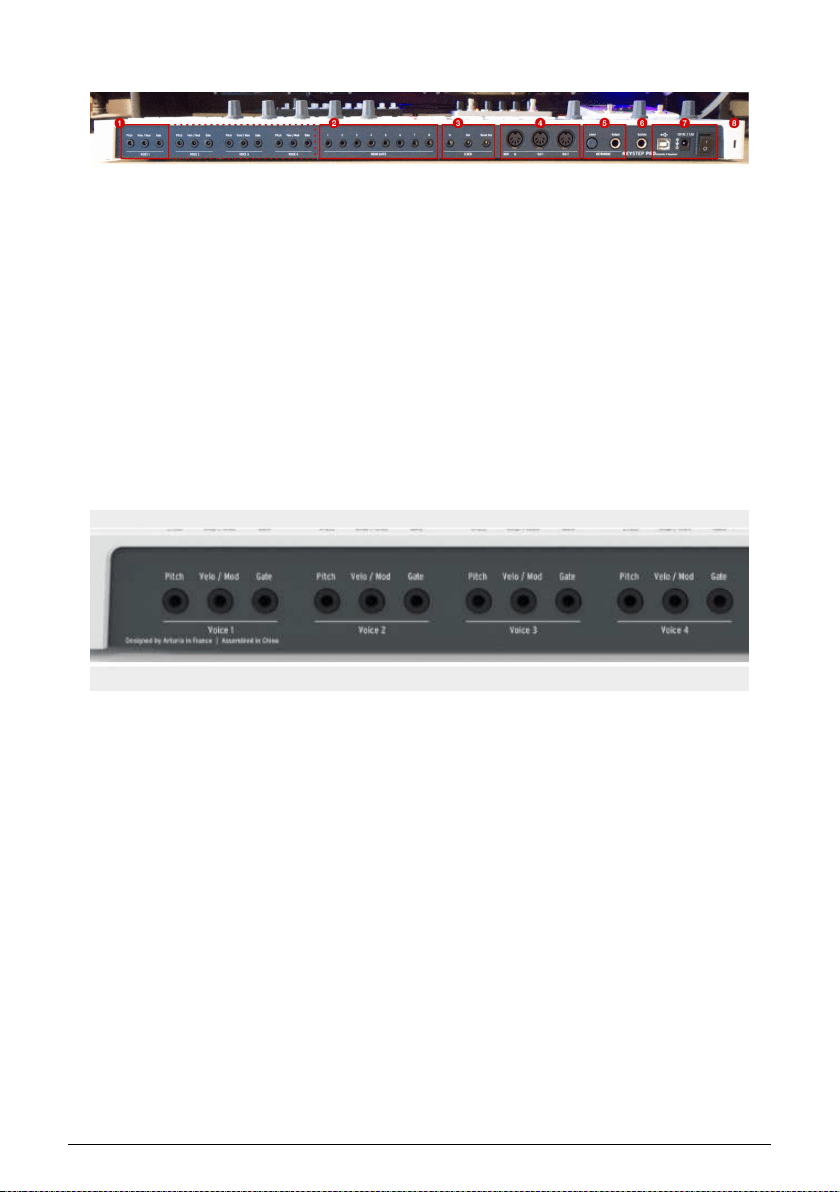
4.3. Back Panel Overview
1. Analog Voice outputs (4x)
2. Drum Gates outputs (8x)
3. Clock In/Out/Reset Out
4. MIDI In/Out 1/Out 2
5. Metronome Level knob and Metronome Output
6. Sustain Pedal input
7. USB, 12V DC / 1.0 A power input, and ON/OFF switch
8. Kensington Lock
4.3.1. Pitch, Velo/Mod & Gate Outputs
For each of the four Voices, these outputs send analog control voltages (CV) and gate/trigger
signals to external devices, for example Arturia's popular analog synthesizers (MiniBrute/SE,
MicroBrute/SE, MatrixBrute) or a Eurorack modular system.
The Pitch CV output is mostly used to control the pitch of an external voltage-controlled
oscillator (VCO).
The Velo/Mod CV output can be routed to a destination such as the cutoff frequency of a
voltage-controlled filter (VCF) or the amplitude/gain of a voltage-controlled amplifier (VCA).
By default, it is mapped to the keyboard velocity, but this can be changed to aftertouch or
the Mod Touch Strip (wheel) in the Utility menu or the
MIDI Control Center [p.155].
The Gate output sends gate (trigger) signals with a length determined by the Gate encoder.
A long gate will cause the sustain stage of an envelope generator (EG) to remain high for a
long period of time. It has selectable output ranges, so that you can adjust the output levels
to accommodate different gate standards.
The KeyStep Pro has four tracks, each with its own sequencer or arpeggiator. These tracks
are linked to the four Voice outputs on the back panel. Each voice has its own Pitch, Velo/Mod
and Gate outputs (labelled Voice 1 to Voice 4). This powerful collection of features means that
you can control up to four completely separate synthesizer voices at the same time using
only your KeyStep Pro! In addition, the KeyStep Pro has powerful voice-routing options.
Arturia - User Manual Keystep Pro - KeyStep Pro Overview 57
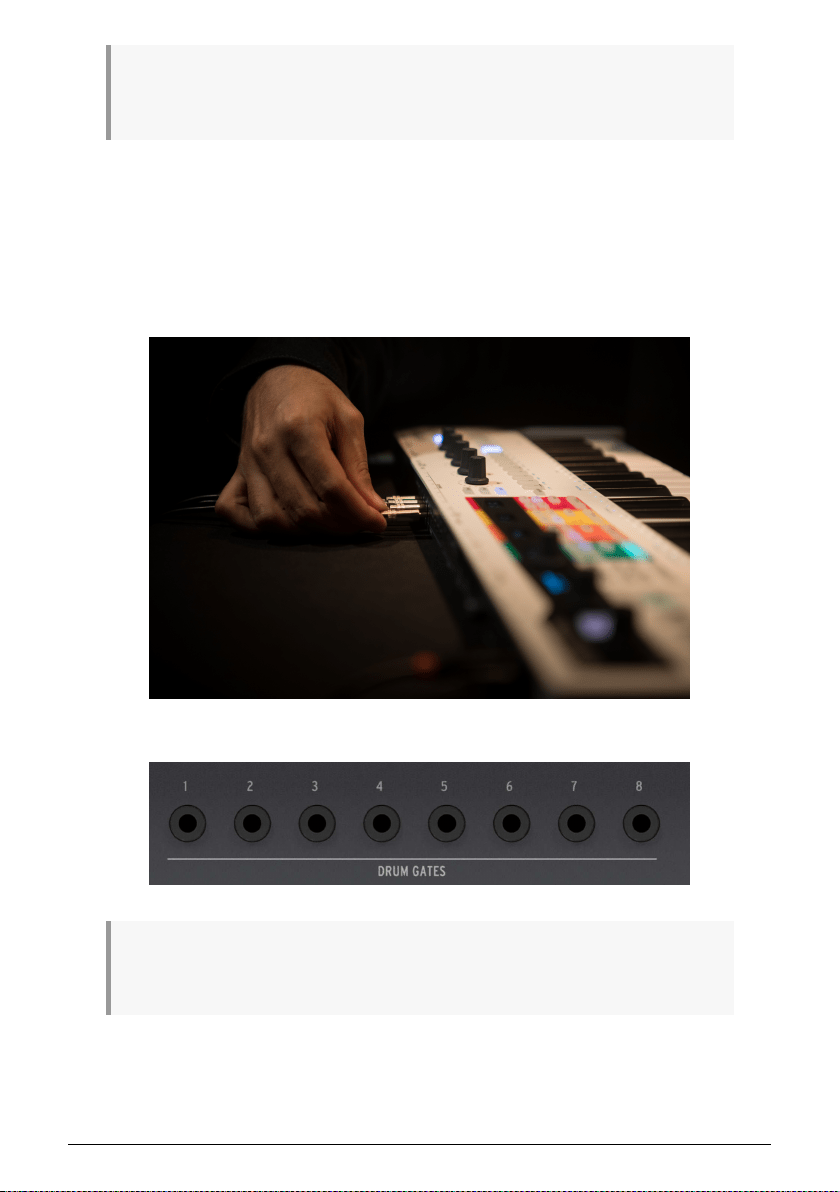
♪: Arturia's MIDI Control Center software and the Utility menu allow you to configure the type of
electrical signals that are generated and sent to each output. See Chapter 9 [p.145] for more information
about this topic.
For more in-depth information about the CV/Gate functions, refer to Chapter 10: KeyStep
Pro and your modular system [p.167].
4.3.2. Drum Gates
KeyStep Pro's Track 1 can be configured to work as an eight-output drum-trigger sequencer
by pressing the Drum button on the top panel. These are the individual gate outputs for that
sequencer.
This mode is described in detail in Chapter 5 [p.92] of this guide.
♪: These gate signals are not limited to triggering drum sounds. You can connect these outputs to
any input that accepts a trigger or gate signal, including an ADSR envelope generator or an LFO reset.
Experiment, and we're sure you'll find some delightful rhythmic uses!
58 Arturia - User Manual Keystep Pro - KeyStep Pro Overview
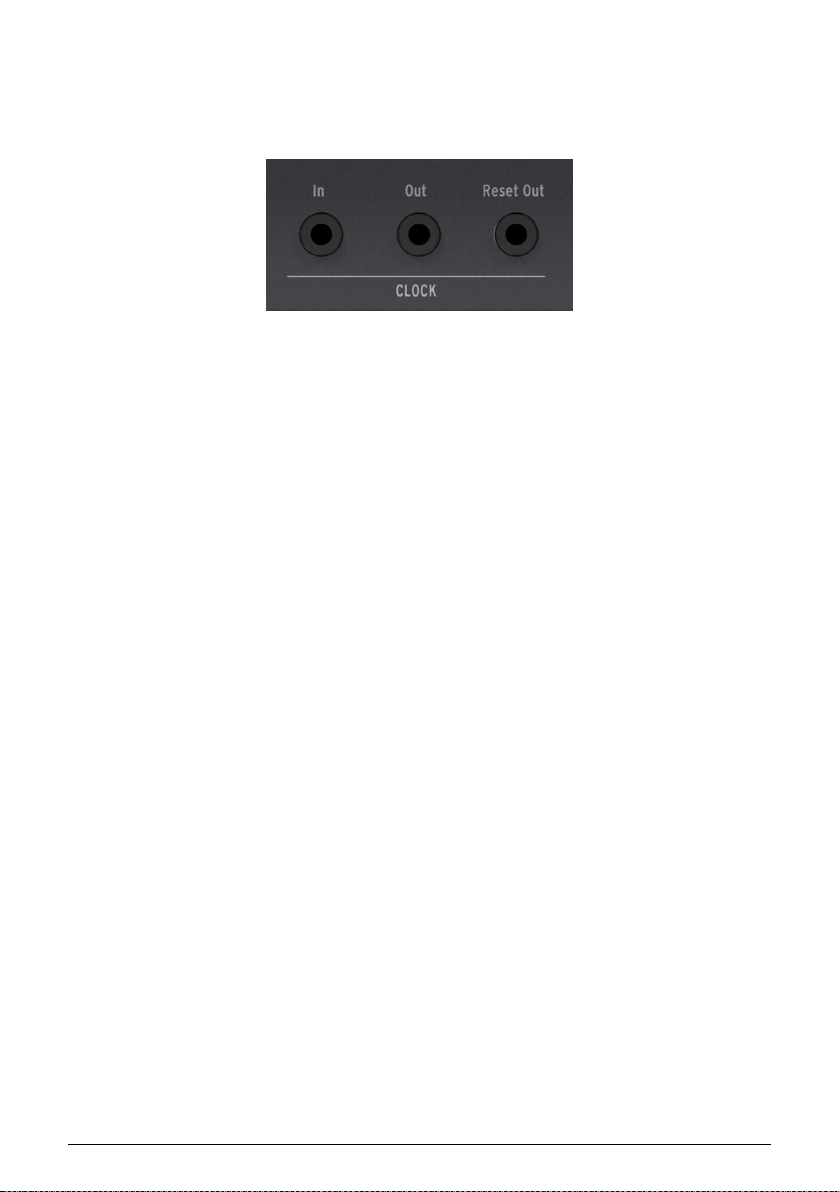
4.3.3. Clock Section
These three jacks (In, Out, Reset Out) allow you to interface with modular synthesizers
and pre-MIDI technology that was capable of clock synchronization (such as early drum
machines produced by Korg and Roland).
The KeyStep Pro is capable of both sending and receiving synchronization signals. It also
has a Reset Out, allowing external sequencers with a reset input to re-start from the
beginning of a sequence whenever a KeyStep Pro sequence is restarted.
Please see
Chapter 7 [p.132] for information about clocking and synchronization.
Arturia - User Manual Keystep Pro - KeyStep Pro Overview 59
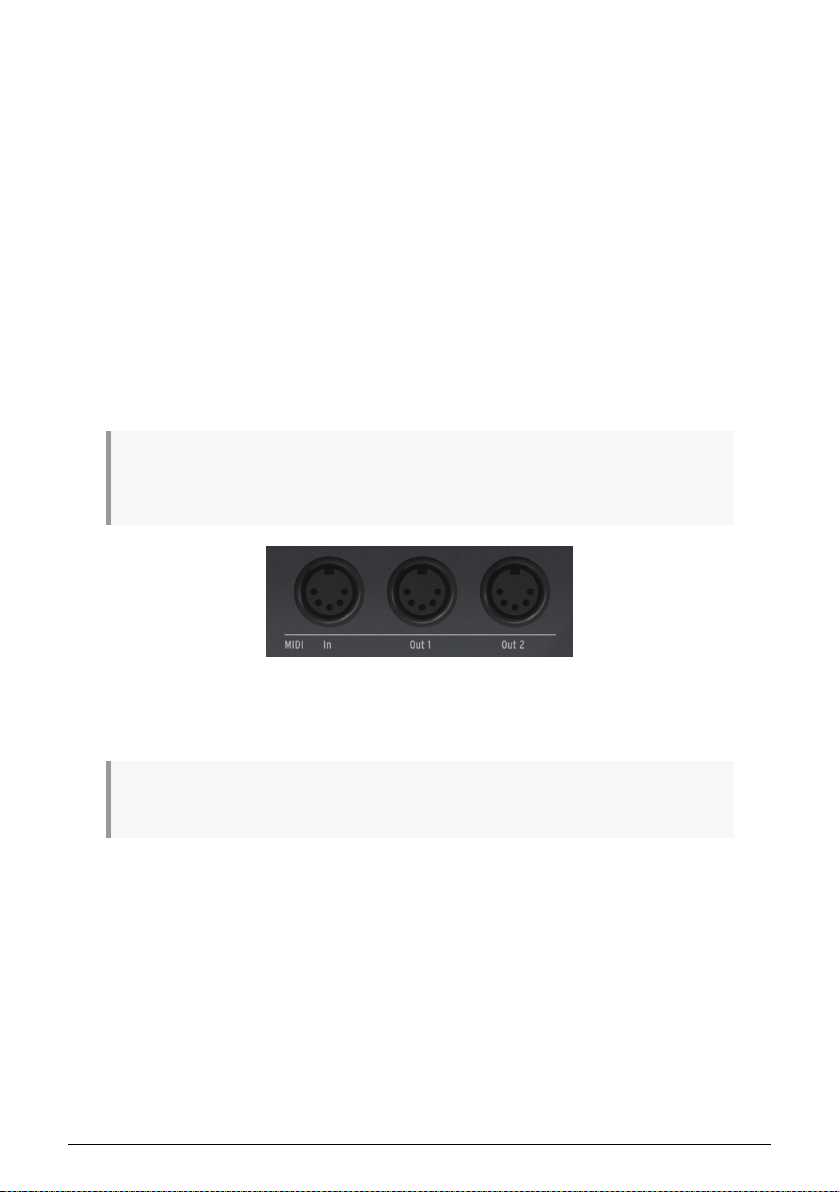
4.3.4. MIDI Section
Three full-sized 5-pin DIN connectors let you send and receive MIDI data to/from external
MIDI-compatible devices. The KeyStep Pro includes one MIDI input and two independent
MIDI outputs to provide maximum flexibility when working with external hardware.
Maybe you would rather have a MIDI thru port instead of a second MIDI port? To change
the function of the second port, hold 'Shift" and Project/Utility and select the MIDI setting
menu, where you can change the MIDI out setting from Out to Thru.
Set to 'Thru' the following MIDI messages will pass thru:
• note on/off
• velocity
• aftertouch
• modwheel
• pitchwheel
• MIDI cc
• program change messages
♪: MIDI Thru does not provide complex routing MIDI functions: it's a simple Thru allowing MIDI data
arriving via the MIDI in port or the USB port to pass unaltered. It is however useful when your KeyStep
Pro is part of a daisy chain setup.
The KeyStep Pro can send not only MIDI note-related data but also MIDI synchronization
signals, so that your external tempo-dependent devices (such as sequencers, arpeggiators,
etc.) remain in sync.
♪: When working with a host computer, these connectors can also be used to send MIDI data from
your music software to your connected hardware.
60 Arturia - User Manual Keystep Pro - KeyStep Pro Overview
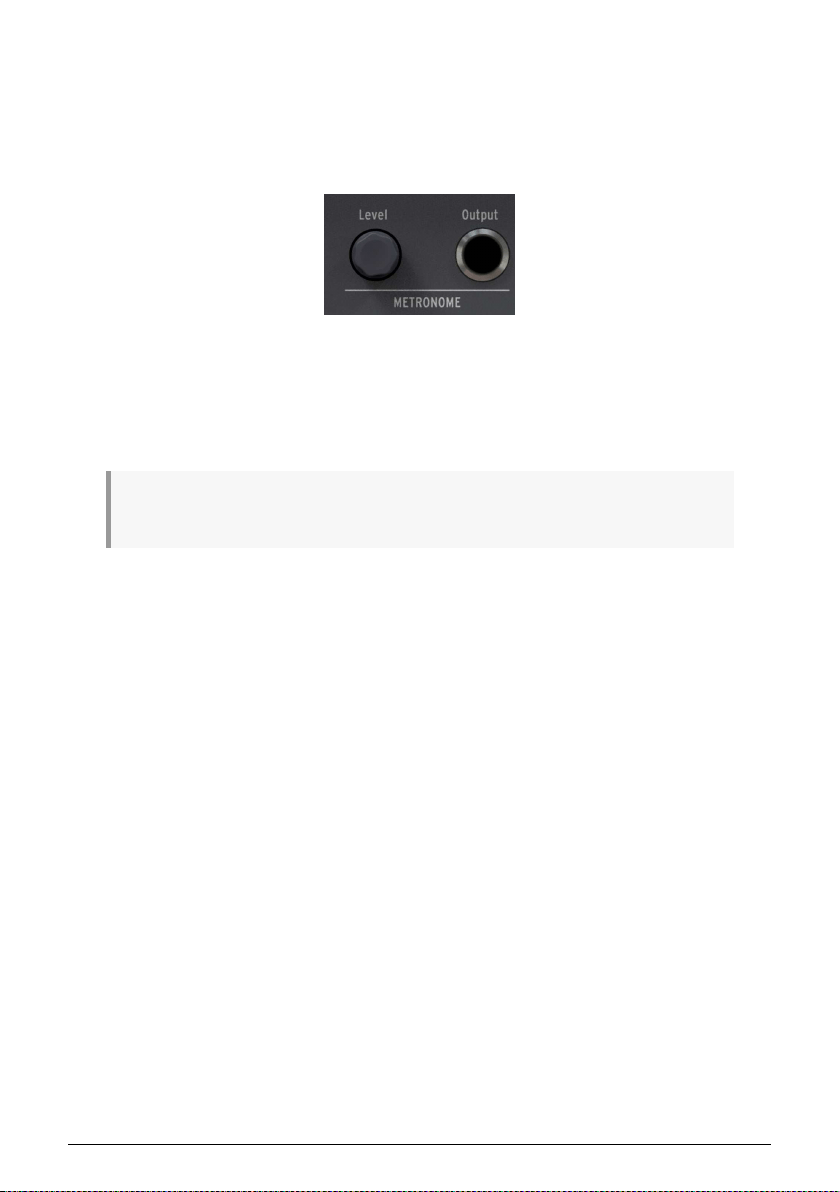
4.3.5. Metronome Section
KeyStep Pro has a convenient built-in metronome, making it easy to build up empty
sequences from scratch without having to use an external rhythmic reference (such as
a metronome or drum machine) as a 'click track'. The internal speaker (located on the
front panel) produces clearly audible metronome ticks, so you don't need to use external
speakers.
The Level knob sets the output level of the metronome. This knob is retractable to prevent
accidental changes to the metronome volume. Press the knob to stow it away and press it
again to bring it back out for adjustment.
The Output jack lets you send the metronome signal to a mixer or headphone distribution
amplifier, so that multiple performers can play to the same metronome.
!: The Level knob only affects the internal speaker's loudness level. It does not affect the signal sent
from the Output jack.
4.3.6. Sustain Pedal Input
Connect an optional sustain pedal to this input. It is best to connect the pedal before
switching on the KeyStep Pro, so that it can correctly sense the pedal's polarity. Be sure to
keep your foot off the pedal when switching on the KeyStep Pro or its operation may be
reversed. If this happens, switch the KeyStep Pro off and start again.
The Sustain Pedal input port supports two MIDI Machine Control (MMC) commands: you can
use a pedal to start and stop sequences.
Arturia - User Manual Keystep Pro - KeyStep Pro Overview 61
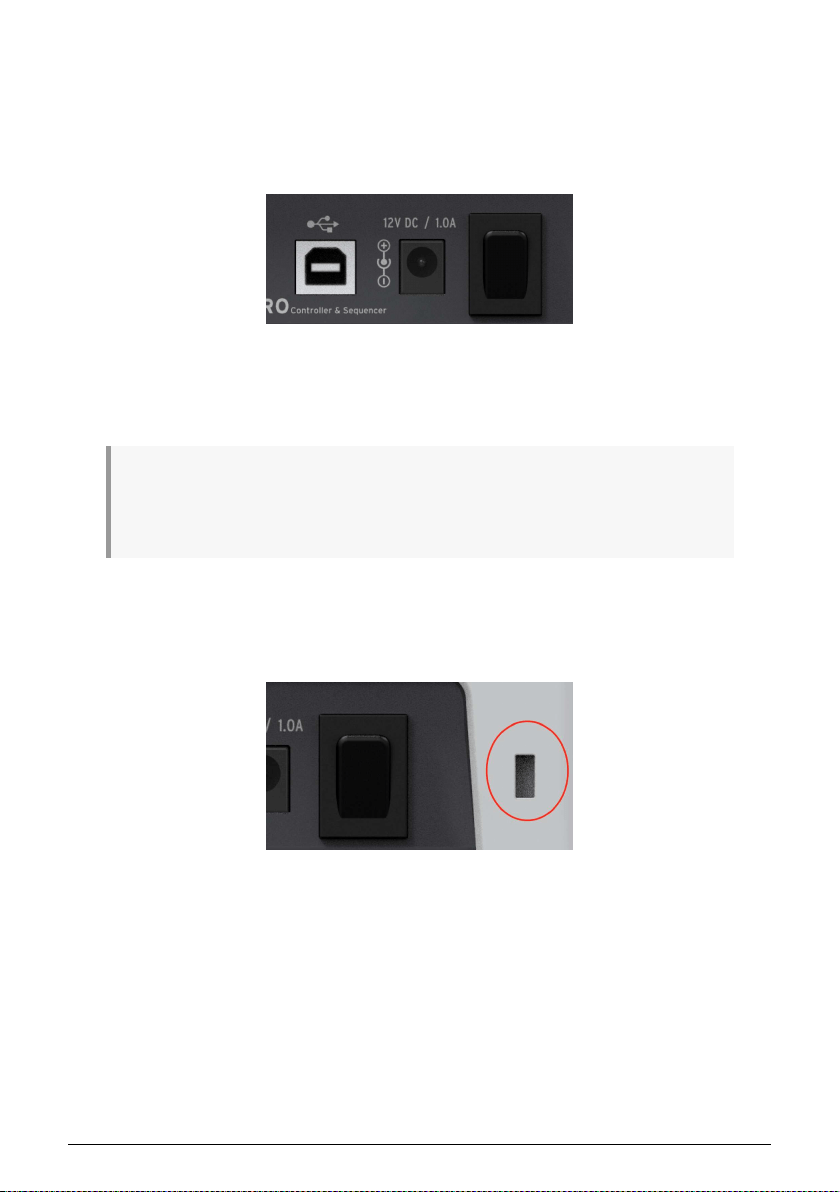
4.3.7. USB and Power Section
The KeyStep Pro is a standalone product and can be used by itself without a host computer.
To do this, simply connect the included 12 V power supply adaptor to the KeyStep Pro and
switch it on. To make life easier for international travelers, the 'universal' power supply
adaptor (12V DC, 1.0 A, center positive) includes interchangeable leads, enabling you to use
the KeyStep Pro in most countries of Planet Earth.
The USB connector provides a data connection to your computer or tablet for those
occasions when you want to use the KeyStep Pro with a host device. When working this
way, simply connect the KeyStep Pro to your host device with the supplied USB cable and
switch it on.
WARNING!: Although the KeyStep Pro might seem to work OK when you power it up with a power
bank, we strongly advise you NOT to power it this way. The KeyStep Pro needs a lot of current for its
LEDs and analog output. Using a defective or partially charged power bank could damage the KeyStep
Pro.
4.3.8. Kensington Lock Port
The KeyStep Pro is highly portable and easy to carry, but it should be carried away only
when you want it to be, and not by a thief!
We've included a Kensington lock slot on the far right edge of the back panel so you can
secure it to the surface of your choice.
62 Arturia - User Manual Keystep Pro - KeyStep Pro Overview

5. MAKING TRACKS
In this chapter, we'll have a look at the process of creating (drum) sequences and arpeggios.
What's the use of having tracks if you have nothing to fill them with?
5.1. Sequencer / Arpeggiator (or Drum) Tracks
The KeyStep Pro has four Tracks, each with its own independent sequencer or arpeggiator.
Sequencer Arpeggiator Drum Sequencer
Track 1 Yes No Yes
Track 2 Yes Yes No
Track 3 Yes Yes No
Track 4 Yes Yes No
Each track has a pair of buttons labelled Seq and Arp (or Seq and Drum on Track 1). These
buttons let you set the functionality for their associated track. The currently selected option
is lit up and only one mode can be active at any time.
5.2. The Three Arpeggiators
One of the unique features of the KeyStep Pro is that it has three arpeggiators. What
makes it even more unique is that these arpeggiators can run in different scales and time
signatures simultaneously!
5.2.1. What is an Arpeggiator?
An arpeggiator breaks up a chord into individual notes: hold down a chord on the keyboard
and the arpeggiator will play the notes in the chord one by one at equal time intervals. You
can keep adding notes to the arpeggio: simply holding down more keys will add them to the
arpeggio. If you happen to have 16 fingers you can use all of them to create a maximum-
length arpeggio, but a better way to extend arpeggios is to make use of the HOLD key. We'll
explain this in the next sub-section.
To activate the arpeggiator, select a track with an arpeggiator (Track 2, 3 or 4) and press the
Arp button. It lights up in white to show that Arpeggio mode is currently active on that track.
Now hold a chord and hear the arpeggio play.
♪: Pressing 'Play' is optional. However, if you want to record your arpeggio in the sequencer on the
same track, pressing 'Play' is required.
Arturia - User Manual Keystep Pro - Making Tracks 63

5.2.2. HOLD and the Arpeggiator
The KeyStep Pro gives you some control over the Patterns that are generated:
• The arpeggiator picks notes within the available octaves as defined by the Arp
Octave function. To change the arpeggio range, hold down 'Shift' and press one
of the Arp Octave keys (-1, 0, +1, +2 or +3).
When you find a particularly interesting Pattern, press the HOLD button and refrain from
touching the keyboard; whatever keys you held down on the keyboard will remain active,
even after you lift your fingers. The arpeggio will continue playing, and you'll have an extra
hand to tweak knobs. As long as you keep at least one note depressed, you can extend an
arpeggio to a maximum length of 16 notes.
After you lift your fingers from the keyboard, playing a new chord will start a new arpeggio
that will replace the arpeggio that was just playing.
!: This feature offers some interesting creative options: if you have set an arpeggio to play in the
order you press the keys of the chord (by using the 'Shift' + Order key), you can repeatedly play the
notes of the same chord in different orders, thus emphasizing different notes in the chord. If you play
with your attention focused on the velocity of the notes in the chord, you can make this effect even
more pronounced.
You can offset an arpeggio on hold in time using the Time Shift encoder.
This feature enables you to delay the active arpeggio compared to other arpeggios. To get a
feel for how this works, create two similar arpeggios in Track 2 and Track 3 with the same
time-division and set them on hold. Now activate Track 3 and turn the Timeshift encoder to
the right: the arpeggio in Track 3 will now shift forward in time.
!: Another thing to try is to combine an arpeggio held in Poly mode with an arpeggio in Exclu
(exclusive pendulum) or Inclu (inclusive pendulum) mode. The polyphonic arpeggiation will repeat all
notes in the arpeggio simultaneously, thus forming a block-chord background for the second arpeggio.
5.2.3. Transposing an Arpeggio
To transpose a running arpeggio press Hold so you can lift your fingers from the keyboard,
hold the transpose button and press keys on the keyboard to transpose the arpeggio.
♪: When adding new notes to the arpeggio, the new notes will be added to the transposed version of
the arpeggio.
64 Arturia - User Manual Keystep Pro - Making Tracks

5.2.4. Editing an Arpeggio
While an arpeggio is playing, you can edit Gate length, Velocity, Time Shift and Randomness
with those main encoders.
When you play an arpeggio, the KeyStep Pro will generate notes using the current setting
of the Gate encoder. Once an arpeggio is running, you can adjust the global gate value of
these notes. Turning the encoder to the right will lengthen the initial gate time, turning the
encoder to the left will shorten the gate time.
Editing the velocity of the notes in arpeggio works in a similar way: turning the Velocity
encoder to the right will increase the Velocity of all the notes in the Arpeggio. Turning the
Velocity encoder to the left will decrease the Velocity of all the notes in the Arpeggio. The
value that is added or subtracted is shown in the display.
♪: In other words, velocity is bipolar. When the velocity encoder is at '0', all the notes in the arpeggio
will play with the velocity registered when you pressed the key. Turning the encoder to the right will add
to this velocity until a maximum of 127 is reached. Turning the encoder to the left will subtract from the
registered velocity value. Until, at the -127 point, the note goes silent.
Editing Time Shift only makes sense when you have two or more arpeggios running
simultaneously. It then makes a
lot
of sense: instant Steve Reich/Terry Riley! Randomness
will add an additional element of surprise by applying random pitch changes to your
arpeggio. Used sparingly when multiple arpeggios are running, it will add even more depth.
Note that the edits you make will affect the currently active arpeggio only.
Press 'Shift'+ Hold/Clear to clear the arpeggio.
♪: The HOLD state is not saved with the Pattern. ♪: HOLD does not work with external MIDI. If you
need to hold one or more external MIDI notes, send the KeyStep Pro a Sustain message using a sustain
pedal.
Arturia - User Manual Keystep Pro - Making Tracks 65
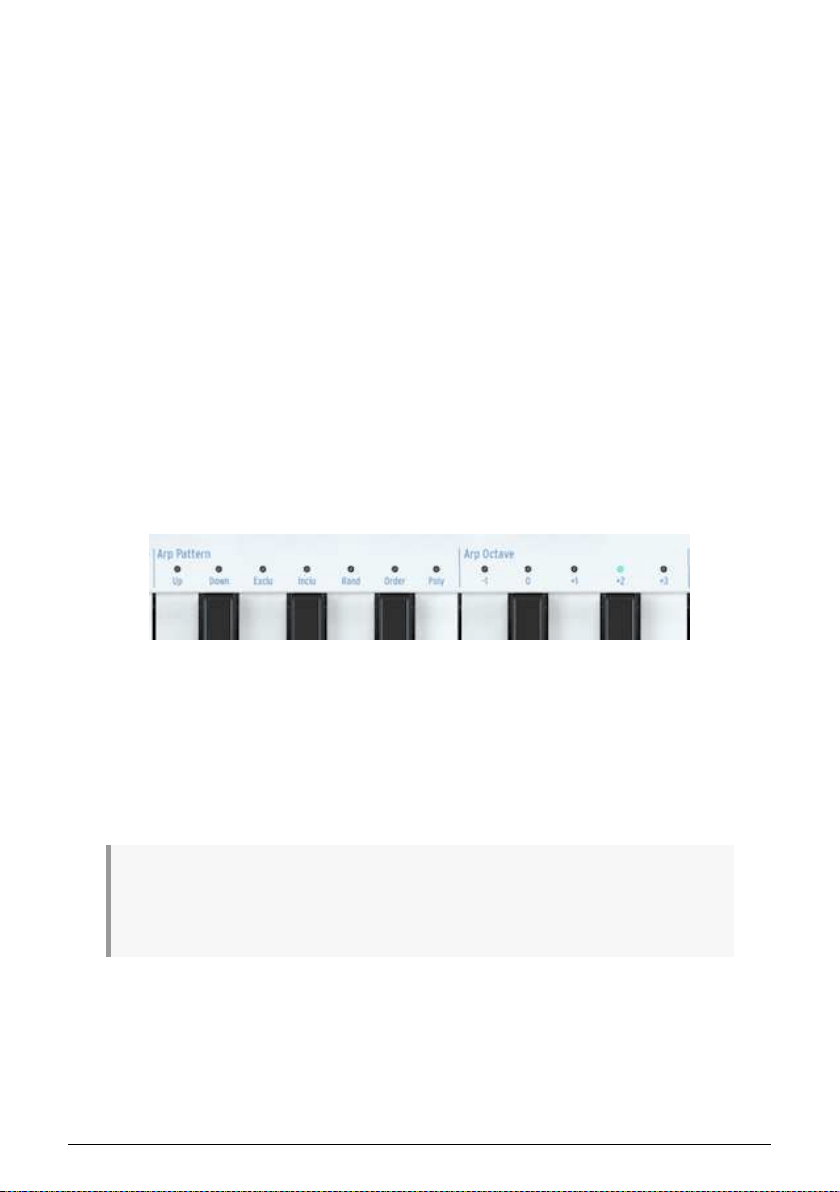
5.2.5. Arpeggiator Features
The KeyStep Pro's arpeggiators have many features not found on other arpeggiators. To
start with, there are three arpeggiators (on Tracks 2, 3 and 4). Imagine the creative options
at your disposal when you have three arpeggiators in HOLD playing simultaneously and you
can transpose each of them individually within its predefined scale — and each arpeggio is
running in a different scale!
When HOLD is active, the arpeggiator will run indefinitely and you can focus on making
changes to the selected arpeggio.
With the exception of Pitch, all main encoders can be used to edit the arpeggio. These edits
are global for that arpeggio: you cannot change the parameters of individual notes within
the arpeggio. You can, however, make the following global edits: change the Gate time,
Velocity, Time Shift and Randomness. To hear the effect of Time Shift, you need to have two
arpeggios on HOLD running simultaneously. Randomness will apply random pitch changes
to the arpeggio.
5.2.5.1. Arp Pattern Directions
Just above the keys, from F to B in the lower octave, you'll find a series of blue Arp Pattern
labels: Up, Down, Exclu, Inclu, Rand, Order and Poly. These are used to select how the
arpeggiator will play the notes of the chord you're currently holding down on the keyboard.
To activate one of these functions, hold down the 'Shift' button and press the appropriate
key.
• 'Up' will play the notes of your chord from left to right or bottom to top, depending
on your point of view. The order in which you press the keys does not matter.
The arpeggiator will always play the individual notes from left to right.
• 'Down' plays the notes of your chord from right to left or top to bottom.
• 'Exclu' plays the chord notes in pendulum motion without repeating the bottom
and top endnotes.
• 'Inclu' plays the chord notes in a pendulum motion, including a repeat of the two
endnotes.
♪: Exclu and Inclu both play your chord notes in pendulum motion; that is, up and down, then up
and down again repeatedly. The difference is what happens at the extreme ends of the arpeggio. Let's
say you have a four-note chord. In 'Exclu' mode it will be arpeggiated as 1,2,3,4,3,2,1,2 .... In 'Inclu' your
arpeggio will be played as 1,2,3,4,4,3,2,1,1,2 ....
• 'Random' will play the notes of your chord in ever-changing random order.
• 'Order' will play the notes of your chord in the order you played them. You can
use this to good effect by repeatedly playing the same chord but changing the
order in which your fingers touch the keyboard.
• 'Poly' will repeat the entire chord as a block chord – all notes at the same time –
instead of arpeggiating its notes in series. The octave of the repeated notes will
depend on the selected Arp Octave parameter, which will transpose the whole
chord into a different octave and then return to the current octave.
66 Arturia - User Manual Keystep Pro - Making Tracks

5.2.5.2. Arp Octaves (Running a Multi-Octave Arpeggio)
By default, the arpeggiator will play the notes you hold down and stay within the limits of
that octave. Holding down 'Shift' and pressing one of the Arp Octave keys will extend the
notes beyond that range. When you change the octave range, the arpeggiator will also play
notes in the octave(s) below or above the chord you play.
Octave range settings:
Octave Function
-1 held down notes plus the same notes repeated one octave below
0 only notes held down on the keyboard are played
+1 held down notes plus the same notes repeated one octave above
+2 held down notes plus the same notes repeated two octaves above
+3 held down notes plus the same notes repeated three octaves above
The arpeggiator has another freaky feature that becomes apparent when you press the
Octave Down or Octave Up arrow button (under the 'Shift' button) while an arpeggio
is playing. On most arpeggiators, pressing an octave down/up button will transpose all
currently held notes in the arpeggio one octave down or up. Uniquely, the KeyStep Pro's
arpeggiator will preserve the pitch of your arpeggio. If you shift the octave down or up, the
new notes you play will be added to the existing arpeggio in the new octave range!
When a Scale function is activated (by holding down 'Shift' and pressing one of the Scale
keys), this can have a peculiar effect on your arpeggio: any 'outside notes' you play
that don't belong to the currently selected scale will be forced (quantized) into it, causing
duplicate notes. If, for example, you've set Scale to C major and you play a block or legato
chord including an E and an Eb (which is foreign to the C major scale) the arpeggio will play
the E twice in swift succession, which causes a ratcheting effect.
Arturia - User Manual Keystep Pro - Making Tracks 67
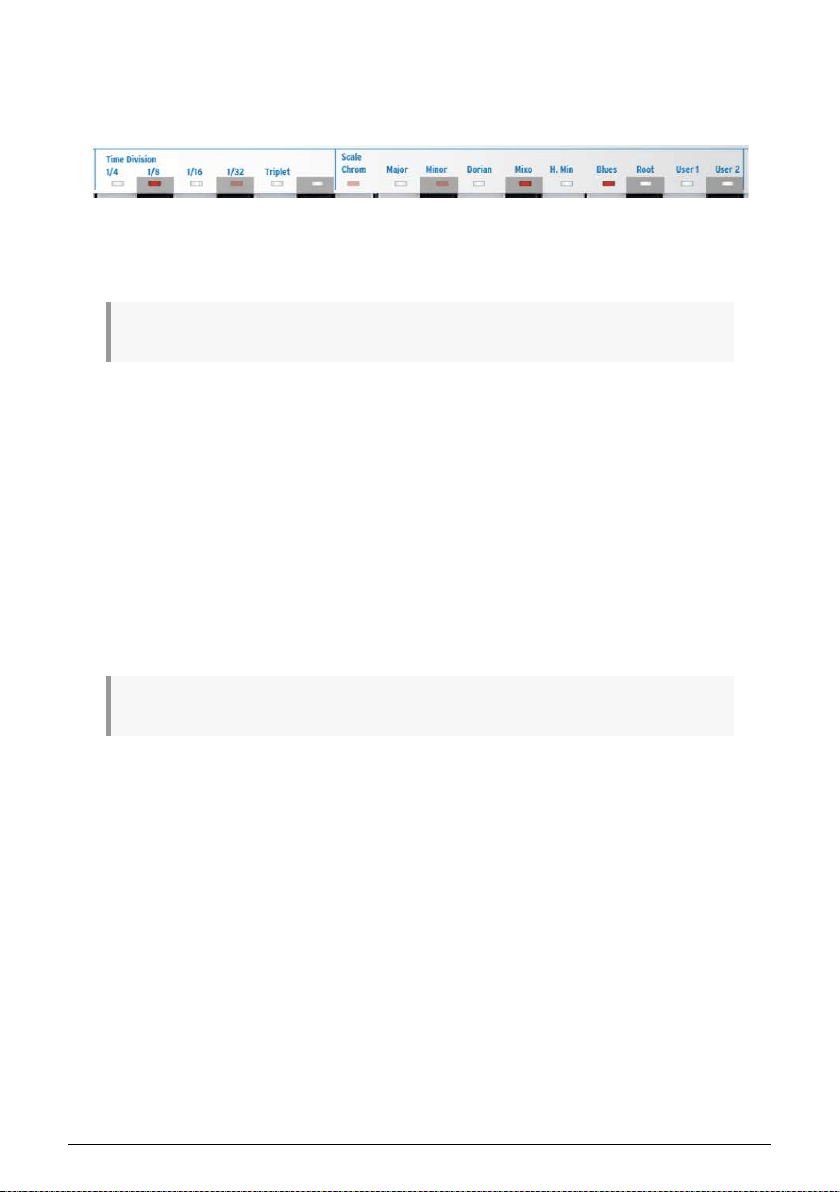
5.2.5.3. Arpeggios and Time Division
The Tempo knob determines the speed of your arpeggio(s). Tempo changes are displayed
as BPM (beats per minute) in the OLED display. The default rate is 120.0 bpm.
By default, the arpeggiator will sync to the internal clock. The Time Division tells you with
what rate the arpeggiator is currently synced to the clock. For example, if you select 1/4
(quarter notes), the arpeggiator plays four notes per bar/measure.
♪: This way of syncing is the same for arpeggios and sequences.
The available time divisions are listed below:
• 1/4 note
• 1/4 note triplet
• 1/8 note
• 1/8 note triplet
• 1/16 note
• 1/16 note triplet
• 1/32 note
• 1/32 note triplet
At this point, you are probably wondering how to create the triplet values in the above list.
It's simple: to create 1/8 triplets, hold down 'Shift' and press the 1/8 key (F# in the middle
octave) plus the triplet key (A in the middle octave).
♪: 1/4 corresponds to a standard metronome tick.
5.2.5.4. Arpeggios: Scale and Root
While an arpeggio is running, you can alter its scale and root on the fly. Please refer to the
Scales [p.108] section later in this chapter for more information.
68 Arturia - User Manual Keystep Pro - Making Tracks

5.2.5.5. Arpeggios and Chord Mode
The KeyStep Pro can memorize a chord. You can then play an entire chord simply by
pressing a single key on the keyboard. The chord will transpose automatically as you play
different notes.
It's a feature that adds a new dimension to the concept of an arpeggio. Chord mode enables
you to create blindingly fast and intricate polyphonic scale-quantized arpeggios; you'll hear
arpeggios as you've never heard them before — maybe not even in your wildest dreams!
CAUTION: The following procedure will erase the previous chord and replace it with a new one.
Here's how to memorize a chord:
• Hold down the 'Shift' button and press the Tie/Rest/Chord button. Don't let go!
• Once you've entered the first note of the chord, you can let go of the 'Shift' button
• Now play up to 16 notes on the keyboard. These will become your chord
• When you are done, lift all your fingers off the keyboard and then release the
'Shift' and Tie/Rest/Chord buttons.
Now the Chord button will flash once per second, showing that the KeyStep Pro is in Chord
mode. The next single key you press will play the chord you created.
When creating a chord, the KeyStep Pro does not look at the actual notes you play, it
registers the distance in half steps between the notes you enter and the order in which you
enter the notes. When you play back the chord, it will reconstruct the chord starting at the
first note you play on the keyboard.
Now you're ready to play complex arpeggiated chords:
• Select an arpeggio pattern by holding down 'Shift' and pressing one of the Arp
Pattern keys
• Memorize a chord, as you have just learned to
• Press the Play button.
Other fun things to try:
• Select another Time Division to hear your arpeggiated chord at different speeds.
• Select another Scale to quantize the notes in your arpeggio to a predefined (or
user) scale.
!: Unless you have huge hands that can span half the keyboard, it's a good idea to press HOLD before
attempting the above tips.
Arturia - User Manual Keystep Pro - Making Tracks 69

Here are a few more handy things to know about this feature:
• For all the Chord mode functions described above, you can use a sustain pedal
instead of the HOLD button. (The pedal will not flash, of course — but that would
be cool.)
• To enter or exit Chord mode, hold down the 'Shift' button and then tap the Tie/
Rest/Chord button.
CAUTION: Neither the memorized chord nor your arpeggio are saved when the KeyStep Pro is
powered down.
70 Arturia - User Manual Keystep Pro - Making Tracks

5.2.6. Making the Most of the Arpeggiators
5.2.6.1. Record an Arpeggio in the sequencer
This feature enables you to record a running arpeggio in the sequencer on the same track.
It works like this:
• Select a track (2,3 or 4) and set it to Arpeggio mode
• Select an empty pattern in this track
• Set Mode to Poly ('Shift'+ Poly)
• Deselect overdub so it's off (to get a better idea of what's happening)
• Start the Arpeggiator (press Play)
• Press record, hold down a chord to start an arpeggio
Now, simply press the sequencer button on the same track to activate the sequencer and
start playing back the recorded arp.
All 'Shift' edit options are now available to further edit the sequence.
Arturia - User Manual Keystep Pro - Making Tracks 71

5.2.6.2. Recording Chorded Arpeggios
Arpeggios and the Chord feature are a wonderful match. You can record chorded arpeggios
in real time in a sequence on the same track! Here's how to do it:
• Select a track (2,3 or 4) and set it to arpeggio mode
• Select an empty pattern in this track
• Set Mode to Poly ('Shift'+ Poly)
• Deselect Overdub so it is off
• Press 'Shift' and Tie/Rest (Chord) and hold a chord on the keyboard. Let go of
'Shift' and Tie/Rest and check whether the chord has been registered by playing
keys on the keyboard
• Start the Arpeggiator (press Play).
♪: The Arpeggiator will also arpeggiate without pressing 'Play', but if you want to record an arpeggio
in the sequencer, the Arpeggiator must advance through the steps.
• Press record, hold down a chord to start a chorded arpeggio
You'll see steps lighting up: each time the Arpeggiator advances, the current state of the
Arpeggiator is recorded in a step.
• Press Record to exit Recording mode
You can now edit the chorded arpeggio with some of the options you normally have in
sequencer mode. This is limited to Nudge>, Nudge< and Invert.
• Press Seq on the same track to activate the sequencer and record the arpeggio
in the sequencer.
Press Play to play the old arpeggio which has now become a sequence.
All 'Shift' edit options are available to further edit the sequence.
72 Arturia - User Manual Keystep Pro - Making Tracks

5.2.6.3. Mixing Arpeggios
Mixing arpeggios is one of the most fun creative experiences you can have with the KeyStep
Pro. Here's how to do it:
• Activate Track 2 and press Arp to select arpeggio mode.
• Select the minor scale (or any other scale you like) by pressing 'Shift' + the
appropriate Scale key.
• Hold down a chord on the keyboard and press HOLD.
• Press Play to start the arpeggio.
Repeat this on Tracks 3 and 4.
If all is well, you now have three arpeggios playing simultaneously!
By pressing Mute, you can momentarily silence one of the Arpeggios.
The real magic happens when you change the Time Division of one or two of the arpeggios
with 'Shift' + Time Division. This will only change the Time Division of the active arpeggio; the
others will keep running at their own pace!
!: An external delay is the arpeggiator's best friend.
5.2.6.4. Spicing up your Arpeggios
Use the Pitchbend touch strip to change the pitch of your arpeggio.
♪: In the MIDI Control Center you can set the pitch bend range in semitones (half steps).
Turning the Swing knob will apply swing to all arpeggios simultaneously. Use 'Shift' + Swing
to apply swing to the arpeggio on the active track only. When you record an arpeggio and
quantize is off, Swing is recorded in the sequencer.
!: One of the most overlooked applications of an arpeggiator is just playing one note instead of a
chord. When you set the arpeggio to medium speed, you can create interesting rhythms by sporadically
lifting and pressing a finger on a key. You can take this idea further to create Hoketus. Hoketus is the
name of a technique where you repeat one note over and over, never changing its pitch, though you
do change other parameters of the note: for example, its timbre (LFO→Filter Cutoff), the Attack, Sustain
and Decay stages of the note's amplitude or filter envelope, and its velocity or aftertouch (pressure).
Arturia - User Manual Keystep Pro - Making Tracks 73

5.3. The Four Sequencers
The KeyStep Pro has four sequencers, each of which can hold 16 patterns/sequences. And
as each sequence can be up to 64 steps in length, you have 4096 steps to fill! Your actual
sequences can be much longer because you can chain sequences together: for example,
play sequence A three times, followed by sequence B two times and ending with sequence
C once. Don't forget that the sequencers are polyphonic, capable of stacking up to 16 notes
per step.
The KeyStep Pro thus enables you to create and play up to 64 unique sequences wherever
you go. And despite its small footprint, there are lots of ways to modify your sequences
during a performance. We'll cover those later in this chapter.
Sequences can be stored in Projects. A Project is a collection of sequences that you create
for a specific event, such as a recording session or a performance.
5.3.1. Exploring the Sequencers
A sequencer will play a series of notes, stored in steps. Per note, each step can store a pitch
value, a velocity value, a gate time, a time shift and a randomness value. These values will
be transmitted over MIDI (via the USB or 5-pin DIN connectors). They will also be sent to the
Voice outputs corresponding to the tracks; for example, for controlling a modular system.
Once stored, the steps are referred to as a Pattern. Patterns can be modified, copied and
chained together.
The 64 steps are grouped into four pages: page 1 holds steps 1-16, page 2 holds 17-32, page
3 holds 33-48 and page 4 holds 49 to 64.
5.3.1.1. Using the Transport Buttons
You control the sequencers with the three Transport buttons; Record/Quantize, Stop, and
Play/Pause/Restart.
Each button has an additional function when creating a sequence:
• 'Shift' + Play will restart a sequence
• 'Shift' + Record/Quantize will toggle between quantized and unquantized
recording mode
• Pressing Stop repeatedly will clear any stuck notes.
74 Arturia - User Manual Keystep Pro - Making Tracks

5.3.1.2. Setting the Sequence Length
You set the length of a sequence by holding Lst Step (Last Step) and pressing one of the
page buttons (16, 32, 48 or 64). To select a length in the middle of a page, first select the
appropriate page and then the last step within it, with Lst Step + a step button.
'Shift' + Lst Step/Follow enables you to follow the sequence through the pages while it's
running.
You can copy the steps in a page and paste them to other pages. For this to work, the pages
you want to copy to must be an active part of the pattern. So, to copy steps from page one
to page two, make page two active by holding 'Lst Step' and pressing the '32' button. For
example, if you want to copy the steps in page 1 and paste them to page 2:
• Hold Copy and press Page button 16
• Hold Paste and press Page button 32.
At this stage you can paste what's in the copy buffer again and again: for example, to paste
the steps now in the buffer into pages 48 and 64, hold Paste + 48 and Paste + 64. This will fill
these pages even if you have set sequence length to 16. To view and play these new pages,
lengthen the sequence by re-setting Lst Step.
In a similar way you can copy a number of steps and paste them to another page. When
pasting, if some of your steps do not fit on the current page, they will continue onto the next
page. Please refer to
Copy steps [p.89] later in this chapter.
♪: There is a difference between making a pattern longer and extending it. When you extend a
Pattern with 'Shift' + Page button, you copy content to another page. If, for example, your Pattern is 16
steps long and you Hold 'Shift' and press 32, the first 16 steps will be copied to the second 16 steps (16 to
32).
To summarize: to set a new pattern length use Lst Step + Page button, to Extend a pattern
use 'Shift' + Page button.
Arturia - User Manual Keystep Pro - Making Tracks 75

5.3.1.3. Mono and Poly
In Mono mode, a sequencer will only play one note per step. In Poly mode, a sequence can
play up to 16 notes per step. To switch modes, hold down 'Shift' and press the Mono key (D#
in the lower octave) or the Poly key (E in the lower octave).
You can use this Shift function in a performance by switching a polyphonic sequence to
monophonic. However, only the lowest note of the chord will survive. You can also do this
the other way around by starting in Mono mode and suddenly re-introducing chords by
switching to Poly mode.
When recording in Mono mode, the KeyStep Pro will only allow you to store one note in a
step, whether it is in Quick Edit, Step Edit or Real Recording mode. This makes it easier to
record bass lines.
New patterns you create in Mono mode will always record with Overdub OFF.
In Drum mode, Mono mode means that all 24 tracks share the same length. In Poly mode,
each track can have a separate length.
♪: When Poly is active, Lst Step operations (copy, extend) only affect the currently selected track.
76 Arturia - User Manual Keystep Pro - Making Tracks

5.3.1.4. Seq Patterns (Directions)
How do you change the playing direction of the sequence? Hold down 'Shift' and press one
of the Seq Pattern keys (C, C# or D in the lower octave).
A sequence that repeatedly runs from beginning to end tends to bore listeners quickly.
Fortunately, the KeyStep Pro sequencers can play steps in three different ways: Fwd
(forward), Rand (random) and Walk.
• Forward is self-explanatory.
• In Random mode, the steps are played in an ever-changing random order.
• In Walk mode, it's as if the sequencer 'threw the dice' at the end of each step:
there's a 50% chance it will play the next step, a 25% chance it will play the
current step again and a 25% chance it will play the previous step.
♪: It's called Walk mode after the way monks would walk during medieval pilgrimages: two steps
forward, one step back.
One question remains: how do you know if the sequence will play the last step when you're
in Random or Walk mode? This is sometimes important to know, for instance, when at
the end of a sequence you want to start another sequence with the Wait Load (Wait to
Load) function activated. It's the number of steps of your sequence – defined by Lst Step
– that determines this: if your sequence is 4 steps long and you run it in Random mode,
the sequence will play 4 random steps from your sequence and then continue to the next
sequence.
5.3.1.5. Transposing a Sequence
To transpose a sequence, hold the transpose button and press a key on the keyboard: the
sequence will be transposed accordingly. You can now use the transpose button to toggle
between the transposed and untransposed versions of the sequence.
Transposing sequences and arpeggios is a temporary thing: transposition states will be lost
when you switch the KeyStep Pro off. If you want to save the transposed state of patterns,
transpose them with the 'Shift' transpose functions (Semi up, Semi down, Oct down and Oct
up) and save them by holding 'Save' and holding the track button.
♪: Note that if you add notes to a transposed sequence, they will sound in their transposed position.
For example: if you add a G to a sequence that is transposed two semi notes up from its original position
it will revert to F when you toggle transpose OFF.
Arturia - User Manual Keystep Pro - Making Tracks 77

5.3.1.6. Scales, Chords and the Sequencer
The KeyStep Pro gives you a lot of control over the tonality of your sequence. Once you've
programmed a sequence, you can change its root note and the scale it plays in.
To define a new root note for your sequence, hold down 'Shift' and press the Root key (F in
the upper octave), then press a key in the lower octave of the keyboard. The LED above the
currently active root note will light up.
♪: You will only hear a pitch change when your sequence is already running in a scale other than
chromatic.
78 Arturia - User Manual Keystep Pro - Making Tracks

5.3.2. Recording
5.3.2.1. Quick Record
Quick Record mode is the easiest way to create sequence or drum tracks. Quick recording
works whether the sequencer is running or not.
♪: The KeyStep Pro is in Quick Record mode when both the Record and the Step Edit buttons are off.
In Quick Record mode, the 16 step buttons turn into simple on/off controls for each step. To
record something into a step just hold down the corresponding step button and play a note
or a chord. As soon as you lift your fingers off the keys, whatever you just played is stored
in that step. If you change your mind and want to store something else in that step, hold
down the step button again and play a new note or chord. This will overwrite the currently
stored note(s).
!: There's a secret to know here: the notes you record into a step will use the current setting of the
main encoders. Change the encoder settings to add notes with different values.
At this point, you can add notes to what's already stored in the step by pressing the Overdub
button. It will light up in red to show that Overdub is active. Hold down the appropriate step
button and press the notes on the keyboard that you want to add to the chord.
To hear the result of your step programming so far, press Play to start the sequencer.
The keyboard is still available for playing on top of the running sequence. You can play it
to solo over the currently playing sequence, or press HOLD and add notes that will sustain
indefinitely like a drone or bourdon.
By holding the Trans (Transpose) button and pressing a key on the keyboard, you can
transpose the running sequence to another key. It's an intelligent transpose: it takes into
account the scale that is currently active, so no 'outside notes' will play. Selecting another
scale will instantly change the tonal focus of your sequence. To try this form of transposition,
also called scale-quantized transposition, hold down the 'Shift' button and select one of the
Scale keys (Bb to E in the upper octave) or User 1 or User 2 (F# or G in the upper octave) if
you have pre-defined user scales.
There are two other Shift functions available to experiment with your sequence:
'Shift' + Time Division (1/4th, 1/8th, 1/16th, 1/32th).
'Shift' + Mono, which only plays the lowest note of the currently stored chord (the
fundamental) in each step. Pressing 'Shift' + Poly will restore the chords to their former glory.
You can now fine-tune the individual steps in your sequence using the Gate, Velocity and
Randomness encoders. To change the parameters of an individual step, hold the step and
tweak Gate, Velocity or Randomness.
• Gate will shorten or lengthen the gate time
• Velocity will subtract or add (surprise!) velocity
• Randomness will silence random notes in your sequence. Turning the
Randomness encoder counterclockwise will reduce the probability that a note
will be triggered. In the fully clockwise position, the note will always be triggered.
Arturia - User Manual Keystep Pro - Making Tracks 79

Press the Play/Pause/Restart button again to pause the sequence; press it once more to
resume playback from where you stopped.
Making Global changes to a sequence
At this point, you can make quick global edits to the pattern you've recorded.
Holding 'Shift' and turning one of the five encoders will apply a relative offset to all the steps
contained in the sequence for a parameter. The offset can be positive or negative. If for
example you hold 'Shift' and turn the Velocity encoder to the right, the value you dial in will
be added to the velocity value of all the steps in the sequence. Turning the encoder to the left
will subtract values. The KeyStep Pro will display the amount of added/subtracted velocity.
Global offset has no effect on the pitches in the drum track, but it will affect Gate, Velocity,
Time Shift and Randomness.
♪: To turn off stuck notes (notes that continue to play after stopping the sequencer) press the Stop
button once more.
To start something new, press Clr Ptn (Clear Pattern) and create a new sequence. This will
clear all parameters of the Pattern.
♪: The previous Pattern – the one you erased – is still in memory. Hold down 'Shift' and press Exit/
Undo to restore it. The Exit/Undo button will blink whenever there is something present in the undo
buffer.
5.3.2.2. Step Record
In Step Record mode, the KeyStep Pro can record and play back music data. Originally
popular in the 1960s and '70s, step sequencers have become popular again due to the
increased interest in modular synthesizers.
A step sequencer is usually
monophonic
, meaning that it will only output one note at a time.
The KeyStep Pro sequencer, however, is capable of stacking up to 16 notes per sequence
step.
Step Record mode is the preferred way to quickly record sequences. Unlike Quick Record
(described above), where you have to manually select the steps you want to fill, in Step
Record mode you use the keys of the keyboard to step through the Pattern, advancing
automatically to the next step when you lift your finger from the keyboard. Press RECORD
to activate Step Record mode. The KeyStep Pro will jump to the first step of the Pattern and
wait for you to enter a note or notes. Start playing and notice how the steps fill. At the end
of the Pattern, the KeyStep Pro will loop back to the beginning and overwrite the notes you
played before.
Step Record has one other feature: you can 'backpedal' to a previous step and overwrite
it. To give an example: you've pressed Record and have filled six steps by entering chords
and lifting your fingers from the keyboard to advance a step. You can now backpedal by
pressing step four and restart recording from there. When Overdub is OFF, the new notes
you play will replace the notes you've recorded in steps 4, 5 and 6.
80 Arturia - User Manual Keystep Pro - Making Tracks

5.3.2.3. Realtime Record
Holding down Record and pressing Play puts KeyStep Pro into Realtime Record mode.
Realtime recording will give a more fluent, natural feel to your sequence. In Realtime Record
mode, the sequencer will run at the speed you have set with the Tempo knob or the Tap
Tempo knob, and it will store whatever note or notes you are playing at each moment into
the currently active step. That makes it somewhat harder to predict in which step your key-
presses will be stored.
♪: In Realtime Record mode, if you hold down 'Shift' and press Record/Quantize, what you play will
automatically be quantized according to the current Time Division setting (see next sub-section).
!: When recording in Realtime Record mode, choosing a longer sequence length gives you more
space. To set the sequence to 64 steps, hold down Lst Step and press the 64 button.
There's a small problem with Realtime Record mode: it's difficult to know when you started
playing because you can't hear where the first step is. The solution is to turn on the
Metronome with 'Shift' + Metronome. When you press Play, the Metronome now starts
ticking, with the first step accented by a higher pitch. You can set the desired metronome
level (volume) with the retractable knob next to the Metronome output on the back panel of
the KeyStep Pro. To change the Time Division of the Metronome, hold Tap Tempo and press
one of the Time Division keys on the keyboard.
!: If the accent is not pronounced enough, make the first step louder by changing the metronome
settings in the Utility menu (Shift>Utility>Metronome) or in the MIDI Control Center.
The sequencer is now looping; the notes of any keys you press will be added to the loop.
The KeyStep Pro sequencers are polyphonic, so if you play a block chord instead of a single
note, all the notes of the chord will be entered into the currently active step of the loop. Of
course, if you want to hear all these notes, you must be in Poly mode.
The Tie/Rest button plays a key role in getting the sequence just right; while the sequence is
recording/looping, you can delete notes by holding the Tie/Rest button, while the button is
depressed it will erase the content of steps you're passing over.
♪: When recording in Realtime mode you can select another pattern on the fly to continue Recording
in that pattern.
Notice that all notes are recorded with the velocity at which you play them. Whether played
notes are
added
to the existing sequence or
replace
existing notes depends on the status of
the Overdub button to the left of the keyboard. It lights up when Overdub is ON.
How do you edit the individual notes and/or chords you've recorded in real time? It's simple:
press the Step Edit button (to the left of the step 1 button) and if you need advanced editing
options, like moving selected notes in a chord, you can also activate Overdub.
Arturia - User Manual Keystep Pro - Making Tracks 81

About Quantized Recording
To activate quantization, hold down 'Shift' and press Record/Quantize.
When recording in Realtime Record mode using the keys or incoming MIDI, there's an
important concept you need to know about: the notes will be quantized according to the
Time Division you have selected.
For example, if 1/16 is the current Time Division setting, then the recorded notes will be
quantized forward or backwards to the nearest sixteenth note. As the Pattern loops, you can
replace certain notes by playing new ones within their time range.
!: You will hear the effect of quantization very clearly if you first set Tempo to 30.00 BPM and Time
Division to 1/4 (with 'Shift' + 1/4). Now record a Pattern in real time with lots of very quick notes. Then
press 'Shift' + Qnt 50% (step button 10) to hear how the notes start to cluster around the beats. Pressing
'Shift' + Qnt 100% (step button 11) makes the clustering even stronger so that notes almost turn into
chords.
Hold down 'Shift' and press REC/Quantize to deactivate quantization.
82 Arturia - User Manual Keystep Pro - Making Tracks

5.3.3. Editing Steps
We've already explained the basics of step-editing in
Chapter 3 [p.13], but there's much more
to learn and discover.
In several ways, the KeyStep Pro sequencer is more advanced than a traditional step
sequencer. One advanced feature is that it lets you transpose the sequence simply by
playing keys on the keyboard. Most early step sequencers could not do this; instead,
the pitch of each note was set with a knob or slider. More importantly, the KeyStep Pro
sequencer lets you edit all parameters of the note or notes stored in a step.
5.3.3.1. Step Edit Mode
Enter Step Edit mode by pressing the Step Edit button, which is probably one of the most
important buttons on the KeyStep Pro. You use it to edit the steps of the currently selected
sequence individually.
When the sequencer is stopped and Step Edit is ON, pressing a step button selects that step.
Play a note or a chord (a stack of notes) to store in that step, or if the step already contains
a note or a chord, change it using the keyboard. The note or chord you press will replace
the existing note(s).
When you enter step editing mode, you have two options: you can edit all the notes stored
in a step simultaneously or edit the notes in the step individually.
In Step Edit mode, the keyboard turns into a traditional step editor. When a step is active (its
button is blinking), you can edit all of its parameters: for example, turning the Pitch encoder
will lower or raise the pitch of the note or notes stored in that step; turning the Gate encoder
will shorten or lengthen the gate time of the note or notes stored in that step.
To edit the values of all the notes simultaneously:
• Turn the Pitch encoder to move all the notes in the selected step up or down on
the currently selected scale
• Turn the Gate encoder to lengthen or shorten the gates of all the notes in the
selected step.
• Turn the Velocity encoder to change the velocity of all the notes in the selected
step.
• Turn the Time Shift encoder to move all the notes in the selected step forward or
backward in time
• Turn the Randomness encoder to change the probability that the chord stored in
this step will sound.
Arturia - User Manual Keystep Pro - Making Tracks 83

5.3.3.2. Quick Edit Mode (Step Edit Button OFF)
When the Step Edit button is OFF, you can simply turn steps on or off by pressing their
step buttons. That might seem trivial, but it can make a big difference to the feel of your
sequence.
To edit the values stored in a step, hold the step and tweak one of the five knobs. The values
stored in the step will appear oin the display.
When you hold an empty step and touch or tweak one of it parameters, the value of these
parameters will appear in the display. It's a quick way of adding notes to your sequence.
When your sequence is running, the KeyStep Pro will light up the buttons of the steps that
are ON in your sequence. You can do several things now:
• Hold down the Trans (Transpose) button and press a key on the keyboard to
transpose your sequence up or down.
• Press 'Shift' + Invert (step button 5) to create a mirror image of your sequence,
and press 'Shift' + Invert once more to restore the natural order of things (;-)
• Nudge the looping sequence as a whole to the left or right (backward or forward
in time). To nudge to the left, hold down 'Shift' and press < Nudge (step button
3); to nudge to the right, hold down 'Shift' and press Nudge > (step button 4). The
note or notes in the first step of the loop will move to the second step; the note or
notes in the last step will wrap around to the first step.
There is another interesting option in Quick edit mode we haven't explored yet: by holding
down a step button, you can edit all parameters – Pitch, Gate, Velocity, Time Shift and
Randomness – of the note or notes stored in that step by turning the appropriate encoders.
You can even do this
selectively
by activating Advanced Edit mode [p.85] with Overdub. For
example, to lengthen the gate time of only two notes of a four-note chord, select them by
pressing the appropriate keys and turn the Gate encoder to the right. How cool is that?
Pressing the Tie/Rest button increases the gate length of the selected notes but doesn’t move
the cursor, nor does it erase the content of the next step.
Quick edit mode is ideal for creating accented velocity values. Remember that in quick edit
mode, any new notes you enter in the sequence will have the current pitch, gate, velocity
time-shift and randomness value. You can use this to your advantage to create accented
steps in a pattern. Here's how to do that:
• Make certain Record mode and Step Edit mode are not active.
Let's create a sequence in which the velocity values alternate between soft and loud. The
even steps are loud, the odd steps soft;
• Select an empty sequence
• Set velocity to 120
• Hold a key and press step 1
• Hold another key and press step 3
• Continue to fill the odd steps with notes of a velocity value of 120
Now set velocity to 60 and fill the even steps with other pitches. Each step you add will have
a velocity value of 60. When you now playback the sequence, the volume will alternate
between loud and soft each time the sequencer advances.
When all keys are released, the Quick Editing process is complete.
84 Arturia - User Manual Keystep Pro - Making Tracks

5.3.4. Advanced editing (Overdub)
To edit chords that you have recorded in a step, press the Overdub button. This gives you
access to a number of advanced edit options specifically designed for chords. With Overdub
ON you can select notes from the chord stored in the current step and edit the parameters
of these selected notes only.
You can access advanced editing in Quick Edit mode, in Step Edit Mode and Step Recording
mode.
To enter Advanced Edit mode, press Overdub (if it is not already active) and hold the step
you want to edit.
The LEDs above the notes stored in that step will light up. Press the notes of the chord you
want to edit. The steps you did not select will dimm to show that they will not be affected
by the change you're about to make. Edits you make with the encoders will only affect the
selected notes. You can move the selected notes up or down the keyboard with the Pitch
encoder. Notice how only the selected notes move; the unselected notes of the chord remain
in place. The same applies to the Gate and Velocity edits you make: they will only be applied
to the currently selected notes.
♪: In Overdub mode, you can add notes to a chord until the maximum of 16 notes per step is reached.
Any new notes you add when Overdub is ON will automatically be selected for advanced editing.
Press Overdub once more to exit Advanced Edit mode.
Arturia - User Manual Keystep Pro - Making Tracks 85
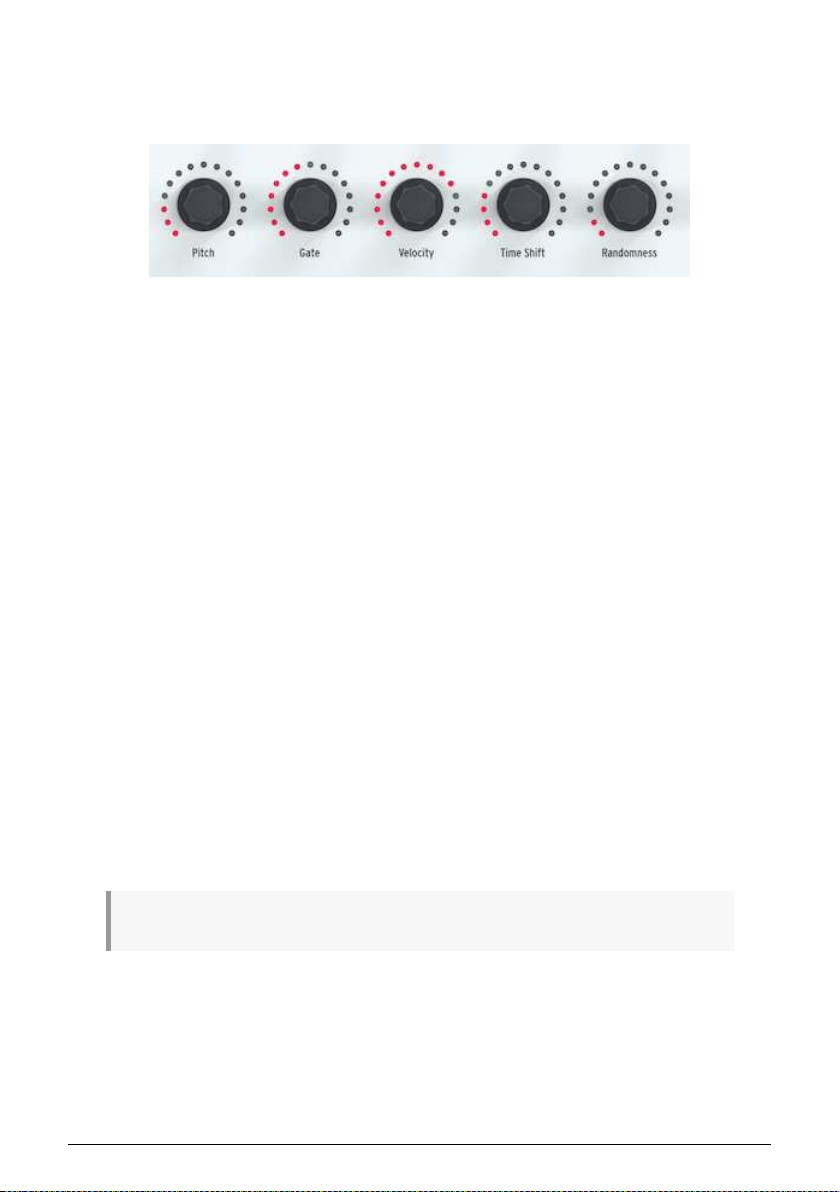
5.3.5. Working with Patterns
5.3.5.1. Using the Main Encoders
When in Seq mode, the five main encoders can be used to edit the parameters of the current
track.
Gate
The Gate parameter is used to adjust the length (ON time) of a note. Possible values are
from 0.06 step (very short) to 64 steps (very long). These values can be set independently
for each step in a Pattern. By default, the Gate time is set to 0.5 step for each note.
Velocity
If a step in the Pattern is too loud or soft, you can edit its velocity using the Velocity
encoder. Just select the step in question by pressing the appropriate step button, then turn
the Velocity encoder to change its value to a new value in the range 0-127.
The default velocity is 100.
Time Shift
The Time Shift encoder can be used to shift the timing of steps backward or forward in
relation to the beat grid. This can help add a more 'human' feel to your patterns. The range
is -49 to +50, where 50 is half of the Time Division value.
Another remarkable option you have is to add a timing offset to individual notes stored in a
step! Just select a note or notes of the chord stored in that step and shift them forward or
backward in time with the Time Shift encoder. Why is this important?
When playing chords live, a musician will never press all the keys of the chord at the
same time; there will always be slight timing differences between the notes of a chord. One
musician will tend to strike a chord with the index finger first; another with the middle finger
first. You might call this the musician's 'signature'. Another use for this Time Shift feature is to
emulate strumming or finger-picking a guitar chord. Used in tandem with copying/pasting
steps as explained in the next paragraph, you can create very intricate sequences.
♪: Touch the Time Shift encoder to check the Time Shift value of a note.
Randomness
The Randomness encoder can be used to randomly mute note events in your sequence. In
other words, it can be used to create automatic variety in the sequence. Per step, you can
set the probability that it will play in the sequence. If you set different values for each step,
every repeat will be unique.
86 Arturia - User Manual Keystep Pro - Making Tracks

!: There's another simple way to create variety in your patterns, especially if they are 32 steps or
longer. It's called the Step Skip feature: hold down a step button and then press the sequence page
buttons (16, 32, 48 and/or 64) in which you do not want the KeyStep Pro to play this step. For example, if
you have four identical patterns in the four pages, hold down steps 8 and 16 then press 32 and 64. The
8th and 16th steps will not play in those pages. This works in all note sequences and drum patterns.
5.3.5.2. Using the Default Encoder Settings
We've already hinted at this in a previous paragraph: whenever you add a note or notes
to a (drum)sequence, the KeyStep Pro will read the current values of the Gate and Velocity
encoders and insert the new note or notes with those values. This feature has an enormous
creative potential that you will come to appreciate when you get to know your KeyStep Pro
better. It's a feature that enables you to create intricate gate and velocity patterns. How?
Here's an example to create an accented feel:
• Set the Gate encoder to 0.5 and the Velocity encoder to 100.
• Activate steps in the sequence where you want accents by pressing their step
buttons.
• Now turn the Velocity encoder down to 50 and the Gate encoder down to 0.2
• Enter several other steps with these values.
Play the sequence and notice how the steps with the lower velocity values sound softer, less
pronounced.
This is just the beginning. By carefully exploring the effects of long and short gate times
combined with high and low velocities, you can make many musical discoveries and
explore unknown territory!
The effect of this feature is not limited to monophonic steps: by selectively changing the
individual gate times of the notes in a chord, you can let some notes of the chord sustain for
several seconds while others fade away quickly.
Arturia - User Manual Keystep Pro - Making Tracks 87

5.3.6. Copy, Paste & Erase (Notes)
Step Edit mode has one more important feature: copying and pasting notes!
Copy/Paste notes enables you to select notes in a step and copy them to another location:
• in the same step
• in another step
• in another step on another page.
The notes you Copy/Paste will retain all of their properties: Pitch, Gate, Velocity, Time-
Shift and Randomness. It's an amazing creative option that you can use to create chord
progressions and dynamic variations in a pattern.
To copy a chord from one step to another:
• Select a step that holds notes
• Hold the Copy button, the notes currently present in the step will light up in the
track color
• Select the notes you want to copy in a legato manner, by holding the first note
and adding more notes. Notes selected for copy will light up in blue
• Let go of the copy button
To paste the selected notes into the same step:
• Hold Paste
• Press the key where you want to paste the selected notes.
The notes will be pasted with their original intervals intact.
To paste the selected notes into another step:
• Select the step you want to paste to
• Hold Paste
• Press the key where you want to paste the selected notes.
Again the notes will be pasted with their original intervals intact.
You can repeat the Paste action as many times as necessary.
♪: It's not possible to copy notes that are OFF.
To erase notes: hold the Erase button and press the notes you want to erase.
88 Arturia - User Manual Keystep Pro - Making Tracks

5.3.7. Copy, Paste & Erase (Steps)
Copy and paste operations are the core of the creative process. Music of almost any genre
consists of basic patterns and variations of them. In this section, we'll discuss copying and
pasting of steps. To learn how to copy/paste at Pattern level, refer to
Chapter 6 [p.115].
5.3.7.1. Copy Steps
Each step in your Pattern holds a lot of data on Pitch, Gate, Velocity, Time Shift and
Randomness. It also holds data on whether this step should be played or skipped in each
of the four pages of the Pattern. When you copy a step to a new location, all of this data is
copied with it. The same is true when you nudge a step backward or forward in time.
To copy a step, hold down the Copy button and press one or more step buttons to select it/
them. The step or steps you have selected for copying will light up in blue. The OLED display
will show the message: "Step(s) Copied".
♪: If you copy a range of steps that include one or more steps with data and one or more empty
steps, their precise configuration is retained when you paste them; in other words, the empty steps are
pasted along with the steps that contain data and their
relative
positions are unchanged. Destination
steps with data will systematically be overwritten, even if the steps you paste into them are empty!
5.3.7.2. Paste Steps
Once you've performed a copy operation, you can repeatedly paste the selected step or
steps that you copied.
Holding down Paste and pressing a step button will paste the step or steps you selected
during copy at that location, either in the current Pattern or in another Pattern, including
a Pattern on another track. If you copied multiple adjacent steps, they will be pasted in
the same order, starting from that location. If you copied multiple non-adjacent steps, they
will be pasted with the gap(s) between them retained. In other words, the step or steps in
between them in the destination pattern will not be overwritten.
You can even paste across the boundaries of a page: if the steps you are pasting do not fit
on the current page, the steps that do not fit will extend into the next page. For example, if
you paste 12 steps to the last position of page 1 (step 16), 11 of those steps will be pasted into
steps 17-27 of page 2.
The display will show the message: "Step(s) Pasted"
If Track 1 is in Drum mode, and steps were copied from a drum track, they can be pasted
onto another Drum track. However, it is not possible to paste from Drum to Seq or from Seq
to Drum.
♪: You can repeat paste as many times as you want, as long as you do not perform a new copy
operation. If you do, the old contents of the copy buffer will be overwritten.
Arturia - User Manual Keystep Pro - Making Tracks 89

5.3.7.3. Erase Steps
In Quick Erase mode, you simply hold down the Erase button and press the step buttons of
the steps you want to erase.
♪: Erasing steps is immediate: there is no message asking you whether you really want to erase. On
step level this makes sense, as the consequences of an accidental erase are not too serious.
5.3.8. Copy, Paste & Erase (Pages)
The KeyStep Pro has four 'pages' of steps: page 1 (steps 1-16); page 2 (steps 17-32); page 3
(steps 33-48); page 4 (steps 49-64). These correspond to the four long buttons to the right of
the Lst Step button, under the Arturia brand name.
You can copy all the steps in one page and paste them to other pages. This works regardless
of whether Step Edit is ON or OFF. For example, if you want to copy the steps on page 1 and
paste them to page 2:
• Hold down Copy and press the 16 button (not the step 16 button). It will blink three
times.
• Now hold down Paste and press the 32 button. It will blink three times to indicate
that the content was successfully pasted.
Of course, you can also paste these steps into pages 3 and 4, which will fill with steps even if
you previously set the sequence length to 16. To view and play all these new 'page extends',
lengthen the sequence by holding down Lst Step and pressing the 64 button.
♪: If Track 1 is in Drum mode and steps of one drum track have been copied, they can be pasted
onto any other Drum track. However, it is not possible to paste from Drum to Seq or from Seq to Drum.
Paste always overwrites the existing data in the destination steps. You can paste outside the
current sequence length, but to view and play the out-of-range results, you must extend the
sequence by holding down Lst Step and pressing the 32, 48 or 64 button.
If you keep holding down the Paste button, you can repeat a paste on multiple pages.
If you're in Drum mode on track 1, pressing the Erase button and a Page button will delete
the currently selected drum track.
Erasing pages is simple: hold the Erase button and press the button of the page you want to
erase. The Page button you pressed will blink three times with a blue colour to confirm that
you have indeed erased the page. To erase multiple pages hold the Erase button and press
other page buttons.
90 Arturia - User Manual Keystep Pro - Making Tracks

5.3.9. Saving your edits
It's important to understand how the KeyStep Pro handles your Pattern edits. Whenever you
are working on a Pattern, it is held in working memory. If you switched off the KeyStep
Pro during the edit process and restarted it, your project would be empty and all your hard
work would be lost. To store it permanently in internal memory, you need to save it. It's
easy to check which patterns need to be saved: just press Save + Pattern. The step buttons
corresponding to all modified and unsaved Patterns will light up in red.
To save a single Pattern:
• Hold down Save and press Pattern. Previously saved Patterns will blink in blue;
Patterns with unsaved edits will blink in red.
• Press the red-lit step button of the Pattern you want to save.
If there is more than one Pattern with unsaved changes:
• Hold down Save and press Pattern. Previously saved Patterns will blink in blue;
Patterns with unsaved edits will blink in red.
• Keep the Save button held down and press the red-lit step buttons of all the
Patterns you want to save.
• Press Exit to exit the Save process.
A shortcut for saving unsaved Patterns is to hold down Save and press the Track button of
the active track to save all its Patterns in one operation.
!: As you may already have guessed, a quick way to check whether the Patterns you are working
on contain unsaved changes is to hold down the Save button. The step buttons of Patterns that contain
unsaved changes will light up in red.
Arturia - User Manual Keystep Pro - Making Tracks 91

5.4. The Drum Sequencer
The Drum sequencer on Track 1 is a special case. It has 24 parallel tracks, but unlike the
other sequencer tracks, each drum track can only trigger one specific drum or percussion
sound.
Also, programming a Drum Pattern is different from programming a melodic sequence. In
sequencer Quick Edit mode, you hold down a step button and then select the notes you want
to include in that step by pressing keys on the keyboard. The Drum sequencer works the
other way around: you hold down a key on the keyboard that triggers a certain drum sound
and then select the step or steps in which that sound will be triggered.
Why then do we have poly(phonic) and mono(phonic) options for a drum track? In Poly
mode, each of the 24 tracks can be different in length. For example, Track 1 could be 8 beats
long; Track 7, 9 beats long and Track 12, 16 beats long. You guessed it: when patterns of
different lengths run in parallel, some very interesting polyrhythmic effects can be created.
That's what Poly means for a Drum Pattern.
In Mono mode, however, all 24 Drum tracks have the same length.
!: Knowing this, you can do some very weird and wonderful things, like creating several tracks with
unequal lengths. Run them until they reach complete chaos, then suddenly switch to Mono mode and
have them all line-up!
5.4.1. Drum vs. Seq Comparison
Seq1/Seq2/Seq3/Seq4 and Drum on Track 1 may seem similar, but the Drum sequencer is
different in many ways:
• Drum mode can record trigger patterns for up to 24 different drum sounds.
• Each of the 24 drum sounds has its own track. When a track is selected, the
step buttons display the Pattern events for that drum. This is similar to the classic
workflow of early drum machines.
• The lower eight keys of the keyboard send gate on/off signals in real time to the
Drum Gates 1-8 outputs on the back panel, as well as any Drum sequencer events
previously entered by those keys. Pressing one of the lower eight keys will select
the corresponding Drum track and generate a trigger. In Drum mode, the higher
keys have no effect. The output from all 24 drum tracks is also sent over MIDI
(Out 1, Out 2 and USB).
• in Drum mode, the Pitch encoder has no effect. The other encoders can be used
to edit gate time and velocity, to shift the timing of drum triggers backward or
forward in relation to the beat grid, and to add randomness of trigger probability
to each drum step.
• The step-mode Shift functions can add many interesting changes to your Drum
sequence:
◦ Invert will reverse the steps of the currently selected Drum instrument
track.
◦ Nudge left and nudge right will shift the position of all steps of the
currently selected Drum instrument track one step to the left or the
right.
◦ Rand Order (Random Order) will mess up the order of the steps in
your drum track.
• The Drum sequencer has a polymeter feature (described in the next section) that
allows each drum track within a Drum Pattern to have its own length.
• Unlike Sequencer tracks, Drum tracks cannot be transposed using the Transpose
button.
92 Arturia - User Manual Keystep Pro - Making Tracks

♪: To select a Drum track/sound without generating a trigger, hold down the Track 1 Drum button and
press the appropriate key.
♪: In Drum mode, the Overdub button is always inactive; you cannot overdub on a Drum track.
5.4.1.1. Polymeter
As explained in the Overview chapter, the Drum sequencer can operate in Poly or Mono
mode. In Poly mode, each Drum track can have its own length. This feature enables you to
create complex polymeter rhythms (polyrhythms).
5.4.1.2. Exploring Polymeter
Here's an example:
What if you wanted a Pattern with this crazy mixture of loops, each in a different time
signature:
Instrument: Drum track 1 Drum tr. 2 Drum tr. 3 Drum tr. 4 Drum tr. 5
Time signature 3/16 1/4 5/16 3/8 4/4
Track 5 is the longest, so we'll use that as the timing reference.
Drum track 2 recycles every quarter-note beat (1, 2, 3 and 4), while Drum track 5 recycles
every four beats (that is, only on beat 1).
Drum track 1 recycles every 3 sixteenth notes; Drum track 3 recycles every 5 sixteenth notes;
Drum track 4 recycles every 6 sixteenth notes. Therefore, it will take a long time before they
all recycle at the same moment, as they did in the beginning. In fact, it will be 360 bars of
4/4 time before the first bar is heard again!
Arturia - User Manual Keystep Pro - Making Tracks 93

5.4.2. Gates and Triggers
The keyboard, the sequencers (including the Drum sequencer) and the arpeggiators create
gates and triggers. Gates and triggers are needed to start envelope generators (EGs) in
external synths or Eurorack modules. By itself, an envelope generator does nothing; it needs
a gate or trigger to start.
It is essential to understand that gates and triggers are two different things. A trigger is a
very short pulse that can be used to synchronize (sync) modules with each other or, as in the
KeyStep Pro, to start envelopes. A gate is usually longer: anywhere from a few milliseconds
to several seconds.
The KeyStep Pro keyboard is the primary source of gates. When your finger touches a key
on the keyboard and holds it down for a moment, you generate a gate. The gate goes into
the ON state when you press the key down; it goes into the OFF state when you release the
key by lifting your finger off it. When transmitted via MIDI (Out 1, Out 2 and USB) or via one
of the four Voice Gate outputs, this gate signal starts an envelope cycle and the first stage of
the envelope, the attack, begins. The duration of this increase in level depends on the attack
setting (A) of the envelope generator. The envelope then continues through the decay stage,
the duration of which depends on the decay setting (D), to the sustain stage, which has a
constant level (S). It remains in the sustain stage until you lift your finger off the key. Then
the final stage of the envelope begins: the release, during which the level decreases to zero.
The duration of this decrease depends on the release setting (R) of the envelope generator.
It is important to realise that the KeyStep Pro does not generate ADSR envelopes, nor can it
control their parameters (A, D, S and R). The KeyStep Pro only generates gates and triggers.
94 Arturia - User Manual Keystep Pro - Making Tracks

5.4.3. Creating Drum Patterns
For this section, you need to have your KeyStep Pro in Drum mode. To do that, press the
Drum button on Track 1.
5.4.3.1. Drum Quick Edit Mode
Quick Edit is the fastest way to create and experiment with rhythmic patterns.
Here's how it works:
• Select Track 1 and put it into Drum mode.
• Press a key on the keyboard that corresponds to the drum sound you want to
use for this track, then press the step buttons for the steps you want to trigger
this sound.
• Repeat this procedure with other keys/sounds.
• Press play to hear your Drum Pattern.
If you watch carefully, you'll see the LEDs above the keys (Drum tracks) you have
programmed light up. While the Pattern is playing, whenever a trigger occurs on a Drum
track the corresponding LED will flash momentarily.
If a key (Drum track) is selected for editing, its LED will be permanently lit to indicate that,
if you press step buttons, steps will be added to the current track. Any new steps you add
will use the current settings of the encoders: Gate, Velocity, Time Shift and Randomness. You
can use this feature to create accents:
• Set Velocity to medium (12 o'clock position) and press step buttons 1 and 8.
• Set Velocity to maximum and press step buttons 4 and 12.
Now press Play and hear how steps 4 and 12 are accented.
To change the parameters of a step, hold down the corresponding step button and change
the encoder settings.
♪: When Drum mode is selected, the Drum sequencer is in Mono mode by default.
Arturia - User Manual Keystep Pro - Making Tracks 95

5.4.3.2. Real-time Recording of a Pattern
To record a Pattern, press the Record button then press the Play button to start the Pattern. If
the Pattern is already playing, just press the Record button. When the KeyStep Pro is running
with both Play and Record lit up, it is in Record mode. If it isn't running, check the sync
settings in the Utility menu by pressing 'Shift' + Project, scrolling down to Sync, pressing the
selection encoder and checking the Input parameter. It's best to set this to 'auto'.
Now play one or more keys. Whatever you play will be captured and added to the current
Pattern. You can toggle individual events ON/OFF with the step buttons.
The Tie/Rest button plays a key role in getting the sequence just right; while the sequence
is recording/looping, you can delete notes by holding the Tie/Rest button: while the button is
depressed it will erase the content of steps you're passing over.
You can also record the input from an external MIDI/USB source, but the only steps that
will be recorded are those that correspond to the current Drum note mapping. For more
information, see the Drum Map section of the
MIDI Control Center [p.155].
The active quantization setting will have a direct effect on your recording. When recording
with active quantization in a low time-division (1/4 or 1/8), the beats will be 'forced' together.
Turn quantization OFF by pressing 'Shift' + Record/Quantize to preserve the irregular feel of
your playing style or the external input.
96 Arturia - User Manual Keystep Pro - Making Tracks

5.4.3.3. Selecting and Editing a Drum Track
To select an individual Drum track/sound for editing, simply tap a key when in Drum mode
on Track 1. The LED above that key lights up continuously to indicate that this Drum track/
sound has been selected.
To select a Drum track/sound without generating a trigger and hearing a sound, hold down
the Track 1 Drum button and press the appropriate key.
At this point, step buttons will light up to display the active steps (existing trigger events) in
the selected Drum track of this Pattern. You can now use the step buttons to toggle steps
ON/OFF. If you want to edit the parameters of an individual step, hold down the Step Edit
button and press the appropriate step button, then use the main encoders to change that
step's Gate, Velocity, Time Shift and Randomness parameters.
♪: In Drum Edit mode, you cannot simultaneously change the parameters of multiple steps.
When using the Drum sequencer with a DAW, it may happen that the tracks of the Drum
sequencer do not match the sounds of the drum or percussion patch currently loaded
in the drum track of the DAW. For example, the DAW drums may be mapped from C3
upward. If you play C2 on the KeyStep Pro keyboard, there will be no sound because
there's nothing to trigger. You can solve this either by remapping the sounds in the drum
or percussion patch in your DAW (consult the manual of the DAW or virtual instrument to
discover how to do this) or by selecting another chromatic low note in the KeyStep Pro using
Utility>DrumMap>Config>Chromatic Low Note or in the MIDI Control Center.
If you want to fix this at a deeper level, you can create your own custom Drum mapping
in Utility>DrumMap>Config>Custom. This Utility setting enables you to map each key on the
KeyStep Pro to a specific drum (MIDI note number) in your DAW. The MIDI Control Center
has a similar feature if you prefer to work from there.
! You cannot assign two slots to the same note.
Last but not least: the lowest eight keys on your keyboard – for Drum tracks 1-8 – are
mapped to the Drum Gate outputs on the back panel of the KeyStep Pro. These Drum Gates
are intended to trigger modules in an external (Eurorack) modular system. Please refer to
Chapter 10 [p.167] for more details on how to do this.
Arturia - User Manual Keystep Pro - Making Tracks 97

5.4.3.4. Muting Drums
Muting and unmuting drum tracks/sounds is a craft that takes time to master. When used
skillfully, it's a great way to introduce build-up tension in a drum or percussion performance.
You can start with a Pattern with several drum tracks muted and then gradually unmute
them one by one when you need the extra drive they provide. The KeyStep Pro offers two
ways to mute drum tracks/sounds: Quick Mute and Drum Mute mode.
Quick Mute
Quick mutes are temporary; they are useful when you have a Drum Pattern running and
want to mute one or more drum tracks/sounds that are too much for your ears at that
moment or are preventing you from focusing on what you want to edit. To mute one or more
drum tracks/sounds while creating your Pattern or during a performance:
• Enter Drum mode if you are not already in it by pressing the Track 1 Drum button
• Hold down the Track 1 Mute button
• Press the key or keys corresponding to the drum track(s)/sound(s) you want to
silence. The key LED(s) will light up in red continuously to indicate where the
mutes are.
Quick mutes are remembered for all Patterns on that Drum track. For example, if you mute
the bass drum on C1 in Pattern 1, it will also be muted in Patterns 2 to 32 when they play. In
other words, drum muting is global for all 24 tracks. To unmute, hold down the Track 1 Mute
button and press the key(s) for the Drum track(s)/sound(s) you want to hear.
To unmute all muted tracks in quick mute mode, hold down 'Shift' and press Drum.
♪: When one or more Drum tracks are muted, the Mute button will flash. When the entire Drum
sequencer is muted, the Mute button will be lit continuously.
Drum Mute Mode
You can also mute drums by entering Drum Mute mode.
• Hold down the Track 1 Mute button and press Drum.
Both the Mute and the Drum button will now flash. As long as you are in this mode, all you
have to do is press the key of a drum track to mute or unmute it.
As in quick Drum mode, you can unmute all tracks by holding 'Shift' and pressing Drum.
♪: To solo the Drum sequencer, hold down 'Shift' and press the Mute button.
98 Arturia - User Manual Keystep Pro - Making Tracks

5.4.3.5. Using the Main Encoders
In Drum mode, the five main encoders can be used to edit the parameters of the current
Drum track.
Gate
The Gate time parameter is used to adjust the length of notes. Possible values are from 1/
64th of a step (short) to 64 steps (long). These values can be set independently for each step
in a Pattern.
By default, the Gate time is set to half a step length for each event.
Velocity
If a Drum event (trigger) in the current Pattern is too loud or quiet, you can edit its
velocity using this encoder. First select the drum track/sound in question by pressing the
corresponding key of the keyboard, then press the step button for that step in the Pattern.
Turning the encoder will choose a new value in the range 1-127.
The default velocity is 100.
♪: Drum velocity values are transmitted via MIDI (Out 1, Out 2, USB) but are not sent to the Drum
Gate outputs; they only transmit gates.
Time Shift
The Time Shift encoder can be used to shift the timing of Drum events (triggers) backward
or forward in relation to the beat grid. This can help to add a 'humanised' feel to your drum
patterns. The range is -49 to +50, or half of the current Time Division value.
Randomness
Use the Randomness encoder to randomly mute Drum events in your sequence. Turning this
encoder counterclockwise reduces the probability that an event in a step will cause a trigger
to be generated. In the fully clockwise position, all events will always cause triggers.
Arturia - User Manual Keystep Pro - Making Tracks 99

5.4.3.6. Drum Step-Edit Mode
Step-Editing a Drum Pattern
One important function of the step buttons is to activate or deactivate each step in the
Pattern. When a step button is lit, a note will play at the velocity you played on the key or
set using the Velocity encoder and will keep playing for as long as you want it to (the Gate
time). To silence a Drum event, simply press its step button to deactivate it.
Extending a Drum Pattern
To set a new length for the Drum Pattern hold down Lst Step and press either the 32 button
(page 2), the 48 button (page 3) or the 64 button (page 4). To select a page just press its
button.
To extend a Drum Pattern, hold 'Shift' and press a Page button. If, for example, your Pattern
is 16 steps long and you hold 'Shift' and press 32, the first 16 steps will be copied to the
second 16 steps (16 to 32).
To summarize: to set a new pattern length, use Lst Step + Page button; to Extend a pattern,
use 'Shift' + Page button.
When working with Drum patterns longer than 16 steps, there is an important feature you
need to know. To follow the sequence through the other page(s), hold down 'Shift' and press
Lst Step/Follow. This toggles the KeyStep Pro in/out of Pattern Follow mode.
When Pattern Follow mode is active during playback, the buttons of the current page and
the current step light up to indicate the current position in sequence: first the 16 button (page
1: steps 1-16), then the 32 button (page 2: steps 17-32), then the 48 button (page 3: steps
33-48), then the 64 button (page 4: steps 49-64), then back to the beginning and so on.
When Pattern Follow mode is active, the Lst Step button is lit.
♪: It is possible to extend a Pattern that is shorter than the maximum length of 64 steps by copying
and pasting existing data beyond its last step (see above).
♪: The playback of the Pattern itself is not affected when Pattern Follow mode is disabled. This only
affects what you are seeing, which should make it easier to edit particular sections of the Pattern.
♪: There's a helpful button colour scheme behind the Sequence Extend system. If, for example, your
Drum Pattern is playing in page 2, the 32 button will light up in green. (If you were on Track 2, it would
light up in orange).
100 Arturia - User Manual Keystep Pro - Making Tracks

Set Pattern Length
The default length of a Pattern is 16 steps, but you can extend this length up to a maximum
of 64 steps, as described above.
If you'd like your Pattern to be shorter than 16 steps, simply hold down the Lst Step button
then press the step button of the desired last step. If you'd like your Pattern to be longer than
16 steps but not cover the whole page length, first select the desired page by pressing the
32, 48 or 64 button, then press the step button of the step within that page that you want to
be the last step of the Pattern.
For example, if you want to create a Pattern with a length of 34 steps: - Hold down Lst Step
and then press the 48 button - Keep holding down Lst Step and press the step 2 button.
Editing Extended Step Ranges
If you want to focus on steps 17-32 (page 2) while editing, here's what to do:
• Disable Pattern Follow mode by holding down 'Shift' and pressing Lst Step/Follow
• Press the 32 (page 2) button.
Now the step buttons will only show the status of steps 17-32. If you want, you can play
the Pattern while editing; it will play all 32 steps, but the step buttons will keep showing the
status of steps 17-32.
Simply edit the steps as desired using the step buttons and the main encoders: Gate,
Velocity, Time Shift and Randomness. When you're finished, if you like, you can re-enter
Pattern Follow mode with 'Shift' + Lst Step/Follow.
Arturia - User Manual Keystep Pro - Making Tracks 101
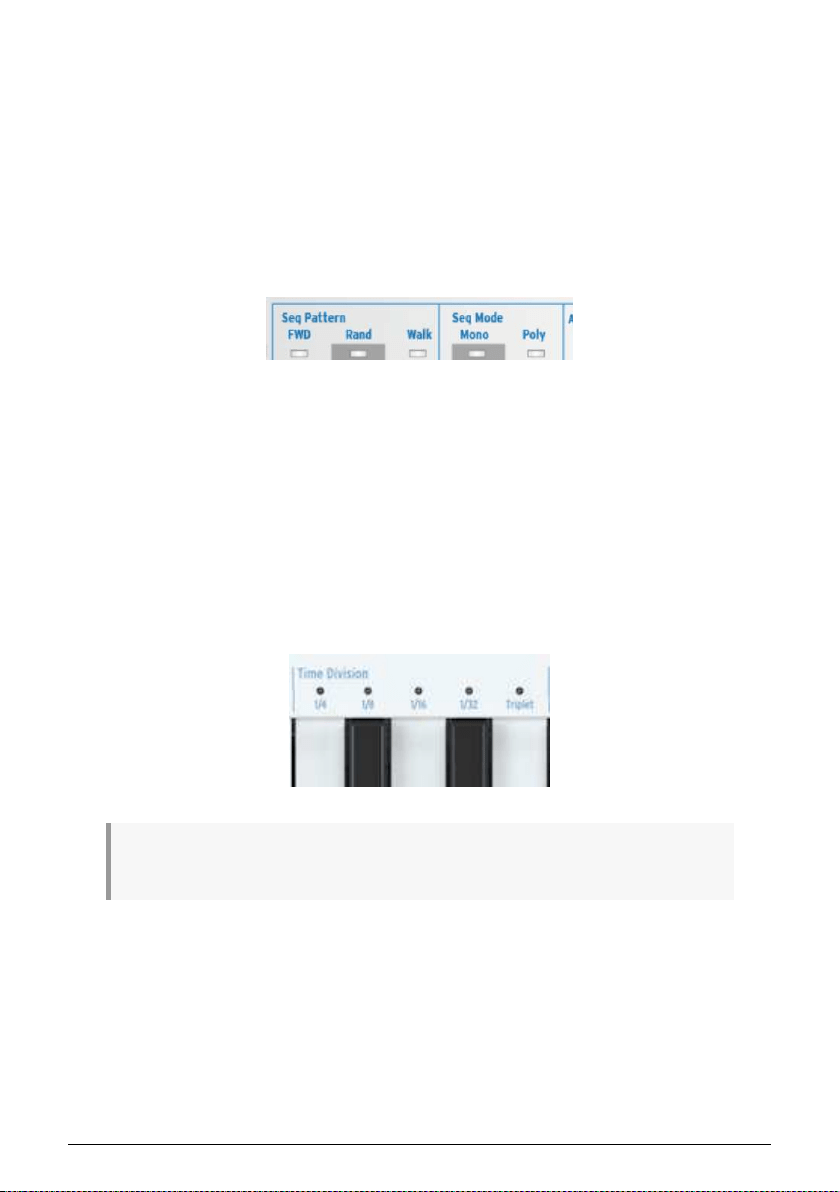
5.4.3.7. Drum Mode Shift Key Functions
When the Track 1 Drum sequencer is selected, the lowest 24 keys of the keyboard send note
data over MIDI, including gate length and velocity.
The keys also have secondary functions, which are accessed by holding down 'Shift' and
pressing one of the keys. These combinations allow you to specify the following Pattern
parameters:
Playback Mode
The lowest three keys are used with the 'Shift' button to select the playback mode (that is,
the direction of play).
Here's what each option does:
• Forward: plays Pattern beats 1, 2, 3, 4 | 1, 2, 3, 4, etc.
• Random: plays random beats from the Pattern
• Walk: plays the steps using the Drunkard's Walk Algorithm: when the sequencer
is on a given step, there's a 50% chance it will play the next step, a 25% chance
it will play the same step again and a 25% chance it will play the previous step.
The default setting is Forward.
Time Division
This setting can be a quick way to halve or double the playback rate of your drum Pattern.
Triplet options are also available.
♪: When the KeyStep Pro clock is set to 1 pulse per step, changing Drum Time Division is only
available when the KeyStep Pro is stopped.
To set Time Division, hold down the 'Shift' button, then press the key that corresponds to the
timing you want:
• Quarter notes (1/4)
• Eighth notes (1/8)
• Sixteenth notes (1/16)
• Thirty-second notes (1/32)
To switch any of these Time Divisions into their triplet values, hold down 'Shift' then press the
Triplet key.
The default setting is 1/16.
102 Arturia - User Manual Keystep Pro - Making Tracks

5.4.3.8. Saving a Drum Pattern
Saving a Drum Pattern is the same procedure as saving sequencer patterns on Tracks 2-4:
To save one Drum Pattern:
• Hold down Save and press Pattern. Saved steps will blink in blue; steps with
unsaved edits will blink in red
• Press the red-lit step button of the Drum Pattern you want to save.
If there is more than one Drum Pattern with unsaved changes:
• Hold down Save and press Pattern. Saved steps will blink in blue; steps with
unsaved edits will blink in red
• Keep the Save button held down and press the red-lit step buttons of all the Drum
Patterns you want to save
• Press Exit to exit the Save process.
A shortcut for saving all unsaved Drum Patterns is to press Save + Track 1.
!: As you may have guessed, a quick way to check whether the Patterns you're working on contain
unsaved changes is to hold down the Save button. Patterns that contain unsaved changes will light up
in red.
5.4.3.9. Copying a Drum Pattern
When working in the Drum sequencer, you can copy a Drum Pattern from one location to
another, even if you have made no edits. To do this, simply follow the procedure described
in
Copy, Paste & Erase of Drum Patterns [p.123]
5.4.3.10. Clearing a Drum Pattern
To clear the events (triggers) stored in the current Drum track, hold down 'Shift' and press
Clr Steps. To clear the entire Pattern and reset all of its settings (track lengths, Time Division,
etc.) to their defaults, hold down 'Shift' and press Clr Ptn.
Arturia - User Manual Keystep Pro - Making Tracks 103

5.4.3.11. Making the Most of Drum Mode
Many of the special Shift functions you would normally apply to a melodic and/or harmonic
sequence can also be applied to Drum sequences, with surprising results.
Try some of these:
'Shift' + Invert will create a mirror image of the events (triggers) in the current Drum track.
The last notes become the first and vice versa. Press 'Shift' + Invert once more to restore the
natural order of things (:-)).
♪: 'Shift' + Invert will only invert the currently selected Drum track.
It does not stop there: you can shift the currently selected looping Drum sequence to the left
or right. To shift to the right, hold down 'Shift' and press Nudge>. An event (trigger) in the first
position of the loop will move to the second position; an event (trigger) in the last position
will wrap around to the first position.
♪: Remember to save the Pattern after making edits!
♪: The project-level swing percentage is not saved with Scenes, Sequences or Patterns, but it is saved
with each Project.
!: To explore uncharted territory, set the drum MIDI channel number to something other than 10 and
thus use the 24 Drum tracks to trigger fixed MIDI notes rhythmically.
!: As explained in the sequencer section above, there's a simple way to create variety in your
patterns, especially if your patterns are 32 steps or longer. It's called the Step Skip feature: hold down
a step button then press the buttons (16, 32, 48 or 64) of pages in which you do not want the KeyStep
Pro to play that step. For example, if you have identical Patterns in each of the four pages, hold down
step buttons 8 and 16, and press the 32 and 64 buttons. The 8th and 16th steps will not play in those step
ranges. This works for all Drum Patterns.
104 Arturia - User Manual Keystep Pro - Making Tracks

5.4.4. Rhythmic Examples
5.4.4.1. An African Rhythm
The example below is a West African rhythm called Djaa Siuiri. The first two voices/rhythms,
Drum 1 and Drum 2, are usually played on djembes. The third voice/rhythm is often played
on a sangban, a medium-sized dunum drum.
To program this rhythm into the KeyStep Pro, you might want to read 'S' as a drum hit with
maximum velocity and 's' as a drum hit with medium velocity. The same applies to 'T' and 't'.
S = right-hand slap
s = left-hand slap
T = right-hand resonant tone
t = left-hand resonant tone
x = sangban hit
1 2 3 4 5 6 7 8 measure
s-t S-- s-t S-- s-t s-- s-t S-- Drum 1
s-s StT s-s StT s-s StT s-s StT Drum 2
x-x -x- xx- x-x x-x -x- xx- x-x sangban
Arturia - User Manual Keystep Pro - Making Tracks 105

5.4.4.2. An Arabic Rhythm
The example below is a very simple traditional Arabic rhythm called Maqsum. It is usually
played on a darbouka: a goblet drum made of clay and a riq; a high-pitched tambourine.
It has a swing feeling to it because the riq leaves the first eighth note in the second beat
empty:
measure 1 measure 2 Instrument
xTxT xxTx riq
Dxxx Dxxx darbuka
To program this rhythm into the KeyStep Pro:
• Select Drum mode on Track 1.
• Select/load a drum kit on your DAW (MIDI) or external synth.
• Play the keys of the lowest octave on the KeyStep Pro to familiarize yourself with
the drum sounds triggered by each key.
• Now, we want to make an 8-step rhythm. To create that, hold down 'Lst Step' and
press the step 8 button.
• Found a bass drum sound? Hold down the key that triggers it and active the
steps on which you want to hear it. To try the above rhythm, select steps 1 and 5.
• Now find a high-pitched drum sound that can play the riq part.
• Hold down the key that triggers it and select steps 2, 4 and 7.
• Press 'Play' to hear your rhythm.
To check whether a particular Drum Track is active in your rhythm, hold down its key. If that
Drum Track has steps that are active (ON), their buttons will light up. Steps that are OFF will
remain unlit.
To deactivate a step, press the appropriate step button.
Things to try:
'Shift' + Rand Order (step 12 button)
'Shift' + Random or Walk (C# or D key under Seq Pattern)
'Shift' + Time Division: 1/4, 1/8, 1/16 or 1/32, or their triplet variants (F, F#, G, G# or A keys of
the middle octave)
106 Arturia - User Manual Keystep Pro - Making Tracks
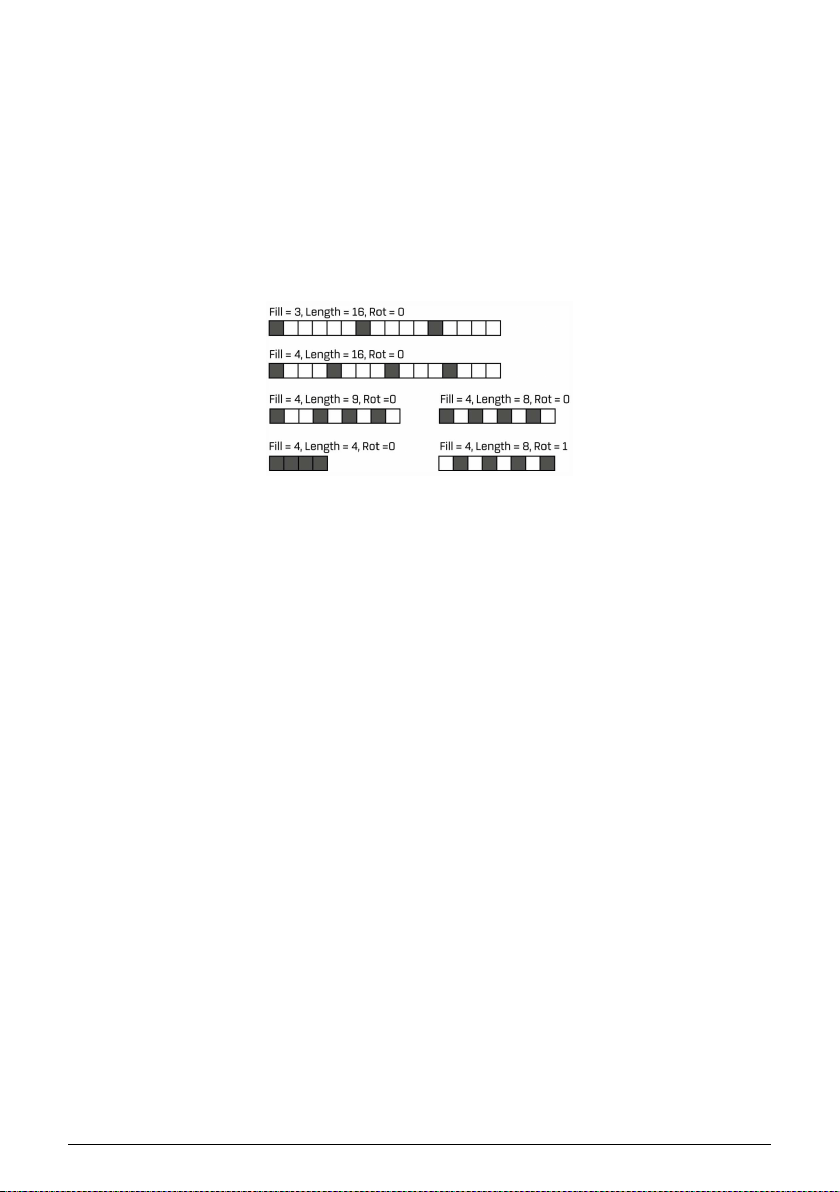
5.4.4.3. Euclidean Rhythms
There are times when you notice that you're stuck in the same routine when creating
rhythms: for example, every sequence you create is 16 steps long with every fourth step
active. It has become your default setting and you find it difficult to appreciate anything that
sounds different. If that is the case, you may want to explore Euclidean rhythms.
A Euclidian rhythm is built using three parameters: length (step length), density (step fill) and
rotation of the sequence. The simplest example is a sequence of 16 steps with four beats.
When you distribute these beats evenly over the sixteen steps, the result is the rhythm most
often heard in western music: four 4-step bars, each with a note on the first step of the bar.
But there's an alternative: by combining different step lengths and step fills, a great number
of original rhythms can be created. The diagram below shows a few examples:
Many of these patterns are common in African and South American music.
The next phase is to explore advanced rhythms by applying pattern rotation, randomness
and swing. Euclidean patterns are notated in the format E(X, Y), where X is the number of
active steps in the pattern and Y is the length of the Pattern. For example: E(4, 7) = [× · × · × · ×]
is a famous Bulgarian dance rhythm. E(2, 5) = [× · × · · ] is a rhythm found in Greece, Namibia,
Rwanda and Central Africa.
Setting Pattern Rotation
By shifting a Pattern one position to the right with the KeyStep Pro's nudge function ('Shift'
+ Nudge>), you can change the overall character of the rhythm. If you start the above
rhythm on the second step, as in [× · · × · ], it suddenly becomes a rhythm often found
in Central Africa, Bulgaria, Turkey, Turkestan and Norway. Each additional Nudge> will
generate another unique rhythm.
Arturia - User Manual Keystep Pro - Making Tracks 107
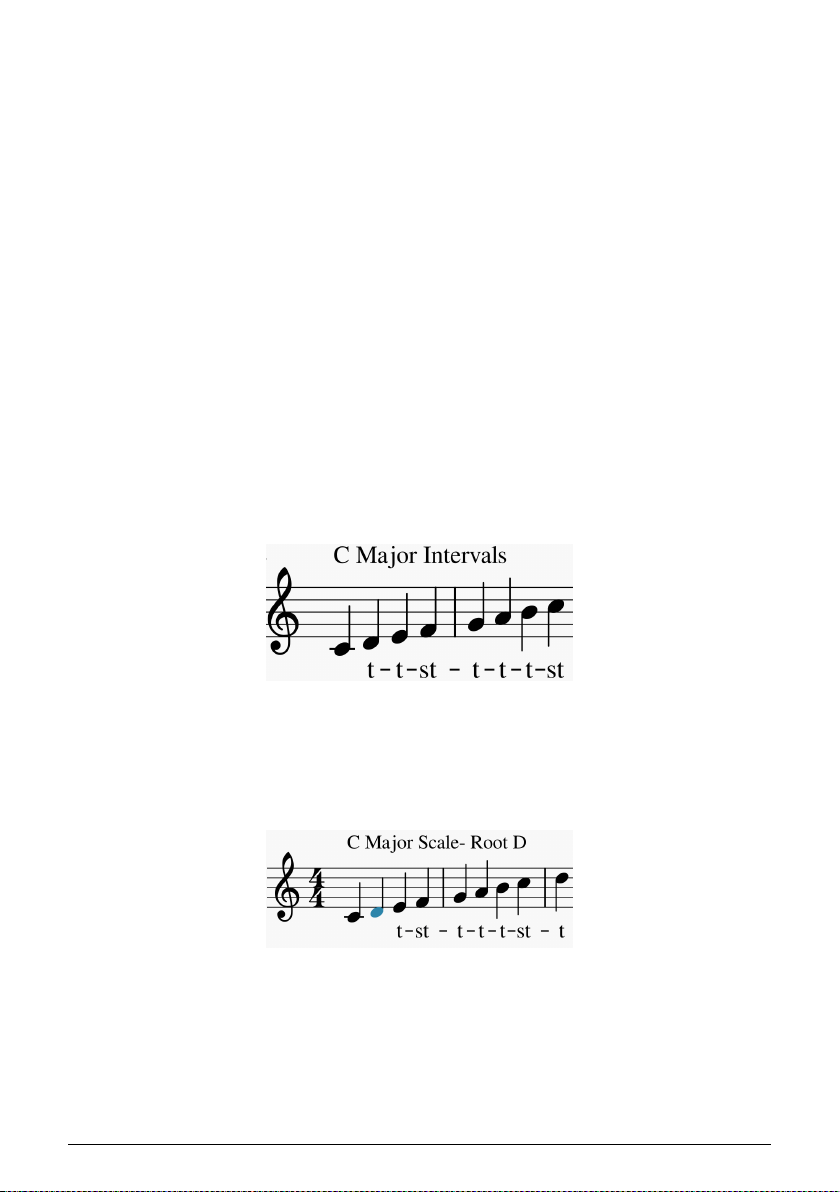
5.5. Special Features
The KeyStep Pro has various special features that you can use to add spice and variation to
your sequences:
5.5.1. Scales
Scales express emotion in music. A single melodic line can evoke many emotions, but when
you add chord notes from the scale to that melodic line, the feeling will become much
stronger. When you add notes of a major scale, the result sounds forceful and happy,
whereas adding notes of a minor scale can make the same melodic line seem sad. At least,
that might be your response if you were born in a culture dominated by western music. In
other cultures, the response to major and minor scales may be different.
A standard (chromatic) scale consists of twelve notes: C-C#-D-D#-E-F-F#-G-G#-A-A#-B.
Every scale is a selection of these twelve notes.
Most common scales only use seven notes, except for the pentatonic scale, which uses five
notes. By leaving out certain notes, each scale evokes a very specific emotional effect.
The most widely used scale in western music is the C major or C Ionian scale: play the
white keys on a piano ascending from C to C' and what you hear is the C major scale. Of
the twelve notes in the chromatic scale, C major uses C D E F G A B (C'). Leaving out certain
notes creates gaps. Some of these gaps, known in musical terminology as
intervals
, are
whole-tone gaps; the others are semitone gaps. The interval from C to D is a whole tone;
from E to F a semitone.
C major has a specific series of intervals: tone, tone, semitone, tone, tone, tone, semitone.
This is known as the Ionian mode.
However, if you play the white keys on the keyboard ascending from D to D', you get a
different series of intervals: tone, semitone, tone, tone, tone, semitone, tone. This is known as
the Dorian mode.
If you now start on C and play a scale using this new series of intervals, you play a C Dorian
scale.
108 Arturia - User Manual Keystep Pro - Making Tracks
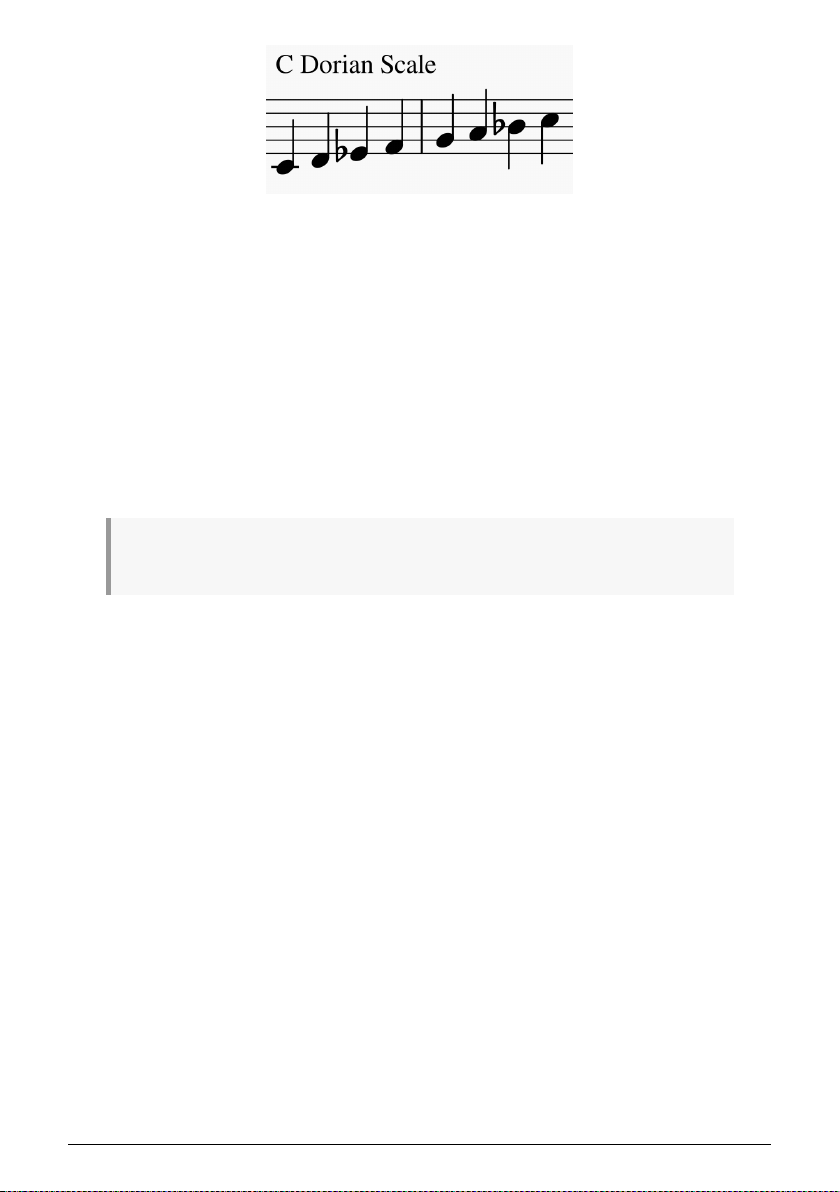
When you play a scale only on white keys, ascending from the 5th step of the C major
scale, G to G', you get another series of intervals: tone, tone, semitone, tone, tone, semitone,
tone. This is known as the Mixolydian mode.
Creating different scales this way, each with its special emotional feeling, is an age-old trick.
These scales are sometimes referred to as 'church modes' and were largely unused for
centuries but rediscovered by jazz musicians in the 1950s and 1960s. They are now widely
used in western music.
5.5.1.1. Selecting Scales
In the KeyStep Pro, if you select a scale using the 'Shift' + Scale key feature, everything in
the currently selected track – what you play on the keyboard, the track sequence and the
track arpeggio – will play in that scale. It's a Track setting.
♪: You can use this feature to your advantage by creating Tracks with different Scale and Root
settings. By muting and unmuting tracks, you can drastically alter the tonal effect of your performance.
The Scale option works as a filter, selecting eight notes from the chromatic scale. For each
scale, it's a different set of notes. In technical terminology, it
quantizes
the default chromatic
scale (C, Db, D, Eb, E, F, Gb, G, Ab, A, Bb, B) to either the:
• Major scale (C, D, E, F, G, A, B)
• Minor scale (C, D, Eb, F, G, Ab, Bb, B)
• Dorian mode (C, D, Eb, F, G, A, Bb)
• Mixolydian mode (C, D, E, F, G, A, Bb)
• Harmonic Minor scale (C, D, E, F, G, Ab, B)
• Blues scale (C, Eb, F, Gb, G, Bb)
To hear (and see) the effect of selecting a scale on your KeyStep Pro, switch it ON if it isn't
on already (do you ever switch it off?) and select a preset on your external synth with a
fairly simple sound.
Press 'Shift' + Scale key B to select the Major scale. When you play the white keys, you'll
now hear the major scale. The odd thing is that the black keys also play the major scale! The
black key that normally plays C# now plays C natural. All black keys are 'stripped' of their
normal pitch and have been lowered a semitone to fit in the C major scale. Whatever chord
you play on the keyboard, it will always be a chord of the major scale!
Let's explore these scales. Press play to activate the Arpeggiator and, starting from C, hold
down the first, third and fifth steps of the major scale; you're now playing a C major chord.
Press 'Shift' + a Scale key to select other scales. You'll hear the third step change when you
select the Minor scale, the Dorian mode or the Blues scale.
Arturia - User Manual Keystep Pro - Making Tracks 109

!: A nifty trick is to start an arpeggio or sequence in a certain scale, then select another scale with the
'Shift' + Scale key option. You'll hear your arpeggio or sequence change scales on the fly. Remember,
the KeyStep Pro has three arpeggiators, on Tracks 2-3-4.
!: You can also use the Pitchbend strip to change the pitch of your arpeggio.
When Scale mode is active, this can have a peculiar effect on your arpeggio or sequence:
because all notes will be forced to play in the currently selected scale, there may be
duplicate notes. For example, if you've set the scale to C major and you hold down an E
and an Eb, because the Eb is 'foreign' to the C major scale, the Arpeggiator will play E twice,
which causes a ratcheting effect.
5.5.1.2. The Scale Root
'Shift' + Root (F in the upper octave) allows you to select another root note for the currently
playing sequence:
For Major, Minor, Dorian, Mixolydian, Harmonic Minor and Blues scales, you can select a new
root note by pressing 'Shift' and holding down the Root key.
Let go of the 'Shift' key and select a new root in the first octave of the keyboard. As long as
you keep holding down the Root key, pressing a key will update the root note. The currently
active root note will be shown with its LED lit up continuously in blue.
Starting a scale on a different note will drastically change the mood or feeling. For example,
if we play the notes that make up the C major scale not from C to C' but from D to D', the
intervals will now be heard in a different order.
• C major starting on C: tone, tone, semitone, tone, tone, tone, semitone (T-T-s-T-T-
T-s).
• C major starting on D: tone, semitone, tone, tone, tone, semitone, tone (T-s-T-T-T-
s-T = Dorian mode).
When you take this second series of intervals and start on, say, G as the root note, you get:
• G, A, Bb, C, D, E, F, G' (known as G Dorian)
It's an age-old principle that was widely used in ancient music and medieval church music.
It was rediscovered by jazz musicians in the 1950s and 1960s. And when the western world
opened up to other music cultures, especially in the 1980s and 1990s, musicians explored
the exotic-sounding scales of Indian ragas and Arabic maqams, which used some scales
that were quite different to the standard major and minor scales that had been used for
centuries in western classical music.
Changing the root note is a form of 'intelligent' transpose — intelligent because the interval
structure of the scale remains intact. This, as opposed to normal or 'dumb' transpose, which
simply lowers or raises all the pitches by the same interval.
♪: If you want to know more about this fascinating subject, search "music theory" on a search engine
or YouTube.
110 Arturia - User Manual Keystep Pro - Making Tracks

5.5.1.3. User Scales
From the Arturia factory, the KeyStep Pro comes complete with six predefined scales, but
you can create your own custom scales and store them as User 1 or User 2.
In the example below, we'll add Bhairavi, a well-known and popular scale in Indian music.
Bhairavi has lowered second, third, sixth and seventh steps. So, based on C, it plays as C,
Db, Eb, F, G, Ab, Bb (C').
To create this scale, we have to eliminate notes that are not part of it. This is how you do it:
Hold down 'Shift' and press Scale>User 1 (F# in the upper octave of the keyboard)
Now focus on the 12 keys in the lower octave of the keyboard. The LEDs above all those keys
have lit up, meaning that all keys will play. We need to change this so that only the keys of
the Bhairavi scale will play. Therefore, we have to eliminate D, E, F#, A and B. Press those
keys to deactivate them.
By setting a new Root for the scale, you make the series of intervals start at a new position
on the keyboard. The intervals of Bhairavi are: 1/2, 1, 1, 1, 1/2, 1 or s-T-T-T-s-T.
If we set the root of Bhairavi to Db (which is, in fact, how it is often played on Indian
harmoniums, sitars, sarods, etc.) the scale will be transposed to Db, D, E, F#, G#, A, B (Db').
♪: If you haven't yet made any changes to the User 1 and User 2 scales, they will both be chromatic.
5.5.2. Chord Mode
The KeyStep Pro can memorize a chord. You can then play that chord just by pressing a
single key on the keyboard. The chord will automatically transpose as you press different
keys.
Initiate Chord mode by holding 'Shift' + Chord and press the notes you want to add to the
chord. You can now let go of the 'Shift' + Chord buttons. As long as you keep one note down
you can continue to add notes to the chord.
Chord mode lets you experiment with chord transpositions in new ways. It's a unique new
KeyStep Pro feature. Initiate Chord mode by holding down 'Shift' then pressing the Tie/Rest/
Chord button. Now, as soon as you play a chord of up to sixteen notes on the keyboard, the
KeyStep Pro will remember its interval structure and allow you to play it with just one key. It
will also intelligently take the current Root note into account and adapt to the current Scale.
Chords are derived from scales. The most common three-note chords consist of the first,
the third and the fifth of a scale. The most common four-note chords consist of the first, the
third, the fifth and the seventh of a scale. The first note of a chord is the Root. The third note
in a scale determines the 'feel' of a chord: if it is three semitones above the Root, the chord is
minor; if it is four semitones above the Root, the chord is major. When you add more notes
to a chord, you are essentially fine-tuning or further shaping the minor or major feel.
When you initiate Chord mode and play some notes on the keyboard, the KeyStep Pro will
analyse the interval structure of the chord you play. When next you play a single note on
the keyboard, it will reconstruct that interval structure based on the note you play. If it was
a minor seventh chord (for example, Cmin7), it will create a minor seventh chord based on
the key you press.
It's a feature that gives new meaning to the word 'arpeggio'. Chord mode enables you to
create blindingly fast and intricate polyphonic scale-quantized arpeggios.
Arturia - User Manual Keystep Pro - Making Tracks 111

5.5.2.1. Memorizing a Chord
Memorizing a chord is very easy: just hold down a chord, then hold down 'Shift' and quickly
press the Tie/Rest/Chord button. After this, as long as you keep holding down either 'Shift'
or Tie/Rest/Chord, you can add notes to the chord. When you let go of both Tie/Rest/Chord
and 'Shift', the KeyStep Pro will switch into Chord mode and the Tie/Rest/Chord button will
flash once per second. The next single key you press will play the chord you created in the
currently active scale.
The first note you entered will be the center key for transposition. Pressing any key above
that will transpose the chord up; pressing any key below it will transpose the chord down.
When you input notes in Chord Mode the KeyStep Pro will remember the intervals you play
and the order in which you play these intervals. If you play C, E, G, Chord Mode will register
the intervals starting at the first note: +4, +3.
So when you press a D in Chord mode the stored intervals will be recalled and the resulting
chord is D, (+4)=F#, (+3)=A.
When you create the same chord in a different order by first playing the E, followed by C
and G, the KeyStep Pro will store other intervals: -4, +7. When now you press a D in Chord
mode, the stored intervals will be recalled and the resulting chord is D, (-4)=Bb, (+7)=F.
Chord Mode recreates the intervals intelligently, if you select another scale, the intervals will
be recreated using notes allowed in that scale.
To summarize: the order in which you input notes will determine how chord mode will
recreate your chord. Notes you input are remembered as a string of intervals and recreated
in the currently active scale.
Here are a few more things to know about Chord Mode:
• You can use a sustain pedal instead of the Tie/Rest/Chord button for all Chord
mode functions. (The pedal will not flash, of course, but that would be cool!)
• Chord mode is a keyboard and Arpeggiator feature; it doesn't work when playing
a sequence. If Chord mode is active and you record a sequence hoping that the
sequence will play the chords, you'll be cruelly disappointed. However, you can
have a sequence playing and play the keyboard in Chord mode on top of it
• Chord mode can be initiated on all tracks when playing the keys, except on Track
1 when Drum mode is selected.
• You can memorize one chord per track
• Chords can be recorded in a sequence/pattern running in real-time mode.
This last feature requires a bit more explanation:
To record chords in the sequencer:
• Select a track (2, 3 or 4) and set it to Sequencer mode
• Select an empty pattern in this track
• Set Mode to Poly ('Shift'+ Poly)
• Press 'Shift' and Tie/Rest (Chord) and hold a chord on the keyboard.
Let go of 'Shift' and Tie/Rest, and check whether the chord has been registered by playing
keys on the keyboard. Now press Record + Play and play a few notes to record the chords
in the sequencer.
112 Arturia - User Manual Keystep Pro - Making Tracks

To record chords in the sequencer in step recording mode:
• Select a track (2, 3 or 4) and set it to Sequencer mode
• Select an empty pattern in this track
• Set Mode to Poly ('Shift'+ Poly)
• Press 'Shift' and Tie/Rest (Chord) and hold a chord on the keyboard
• Press Record when the sequencer is stopped and play keys to record the
corresponding chords in the sequencer. The Sequencer will automatically
advance after each keypress.
To record chords in the sequencer in step edit mode:
• Select a track (2, 3 or 4) and set it to Sequencer mode
• Select an empty pattern in this track
• Set Mode to Poly ('Shift'+ Poly)
• Press 'Shift' and Tie/Rest (Chord) and hold a chord on the keyboard
• Press Record when the sequencer is stopped and record chord directly in
random steps.
To record chords in the sequencer in quick edit mode:
• Select a track (2, 3 or 4) and set it to Sequencer mode
• Select an empty pattern in this track
• Set Mode to Poly ('Shift'+ Poly)
• Press 'Shift' and Tie/Rest (Chord) and hold a chord on the keyboard
• Hold a step and play press a key to add the chord to the step
Another extraordinary thing about Chord mode is that you can hold down several keys and
each key will be the starting point of a chord! This will work until you have exhausted the
maximum number of voices.
For example, initiate Chord mode and memorise a major chord (C, E, G) with the Scale
setting Chromatic.
When you press C3, the notes C3, E3, G3 will play. Now if you stay in Chord mode and also
hold down F3, it will add F3, A3, C4 to the chord.
To exit Chord mode, hold down the 'Shift' button and press Tie/Rest/Chord. The last chord
you memorized will still be there. Pressing 'Shift' + Tie/Rest/Chord again will reenable Chord
mode with your memorized chord intact.
♪: Chord memory is not saved when the KeyStep Pro is switched OFF.
In Chord mode the Hold button will act as a sustain pedal. Just press Hold and add notes to
the chord.
Arturia - User Manual Keystep Pro - Making Tracks 113

5.5.3. Using Sync
Of all the skills you can master in electronic music, sync is one of the most important. Sync
is when two or more units (synths, drum machines, effects, oscillators, filters, voices) have
their rhythms synchronised to each other. Sync is also how we humans connect to the flow
of music. If you want to capture the attention of your listeners, you must understand how to
make captivating synced patterns.
The KeyStep Pro can sync to your DAW or external synth in various ways. Changing the
Time Division allows you to sync proportionally: at double speed, at half-speed, or even
slower than that.
The KeyStep Pro can also sync to your modular system. The CLOCK In jack on the back
panel accepts clock signals that will sync the KeyStep Pro to the clock of your Eurorack
system, be it a sequencer and LFO or a dedicated clock module. But there's more: a very
interesting option is to connect a burst module to CLOCK In. A burst module generates a
flurry of clock signals that can speed up and slow down. When connected to CLOCK In, it
will simultaneously speed up or slow down all (drum) sequences and arpeggios running on
your KeyStep Pro!
114 Arturia - User Manual Keystep Pro - Making Tracks

6. WHAT IS A PROJECT?
A Project enables you to store and recall 16 Patterns per sequencer, as well as the state of
each sequencer. When you do a save, everything in the Project is saved: Seq/Drum mode
for Track 1, Seq/Arp mode for Tracks 2, 3 and 4; solo or mute state of each track; Scenes,
Chains, output mappings and current time divisions.
The edit options are flexible: in addition to Project Save, you can copy one Project to another
or erase a Project. For each of these operations, a screen message asks you to confirm
the action. The instructions below show the confirmation screens. The necessary buttons for
managing Projects are found in the Control section of the front panel.
6.1. Managing Projects
After using your KeyStep Pro for a while, you'll probably have a large number of sequences.
You may be working on a musical arrangement or performance and want to create
and safeguard a selection of your sequences for that purpose. KeyStep Pro Projects are
designed for that kind of situation.
The internal memory of the KeyStep Pro holds a total of 16 Projects. You could think of a
Project as a single song (although it could be an entire performance). Each Project contains:
• 16 Patterns for each of the four sequencers (Seq1, Seq2, Seq3, Seg4 and Drum),
including all the swing, randomness and probability settings for each Pattern
• A Control Mode preset (that is, a controller map), with independent settings for
each assignable control
• 16 Scenes
• Project-level settings for tempo, swing, randomness and probability.
Please refer to
Chapter 7 [p.132] for information about other parameters that affect the way
Projects respond when you switch from one project to the next.
! Before switching to another Project, it's important to save the sequencer Patterns you've just been
working on. If you forget to save them, they will be lost forever. To save all the Patterns in a track, hold
down 'Save' and press the relevant track button (Track 1 to Track 4). To save all the Patterns in the current
Project, hold down 'Save' and press Project.
6.1.1. Loading a Project
To create a new Project, hold down the Project button and choose an empty Project by
selecting one of the 16 step buttons.
To load an existing Project, hold down the Project button and press the step button that
corresponds to the number of the Project you want to load. You can as well load a project
through midi: Send a Bank message on the Global MIDI Channel (controller mode channel)
changes the Project.
!: Be sure you have saved your current Project to another number before loading an existing Project!
Arturia - User Manual Keystep Pro - What is a Project? 115

An alternative way to load a Project is to hold down the Project button and turn the selection
encoder. Select the desired Project number and press the encoder to load it.
!: Don't hesitate for too long, otherwise the operation will be cancelled.
Projects can be loaded even while the sequencers are running.
♪: The MIDI Control Center [p.155] has a parameter that allows you to specify whether the new
Project should be loaded instantly or wait until after the (drum) sequencer reaches the end of its current
Pattern. See the Wait to Load Project [p.129] section to learn about this feature.
6.1.2. Recall A Project from Flash
Once loaded, a Project's settings are stored in flash memory. They will stay there in their
original form while you apply all kinds of changes: changes to tracks, patterns and notes.
Recalling a project from flash will overwrite the changes you have made, and the original
project will be restored.
It's a great performance tool! To give an example:
• Create sequences using the 4 tracks
• Save your project
• Start improvising: make changes to drum gates (using global offset) and
sequence tracks to create tension and then, when the tension is at its peak: recall
the stored Project from flash to restore the original groove!
To restore a project from flash, Hold Project and 'Shift'. The Display will show: "Load Program
from Flash" Press the Encoder and press the encoder next to the display to restore the
program to its original state.
116 Arturia - User Manual Keystep Pro - What is a Project?

6.1.3. Saving a Project
!: When you follow the instructions below you will overwrite the selected Project and all its Patterns.
Before you save your Project, make sure that is what you want to do! If you don't want to overwrite
the selected Project, be sure to find out which memory location is empty and store your Project there
instead.
To save a Project:
• Hold down the Save button, then
• Press the Project button.
The screen will now ask you to confirm that you want to save the current Project. If that's
OK, press the encoder to confirm your decision or press the Exit button to cancel.
To recall this Project later, follow the procedure described in the
Loading a Project [p.115]
section above.
After pressing the Save button (in the Control section), to perform the actual save operation,
press the selection encoder (to the right of the OLED display above the Control Section). A
warning screen will then appear, asking you whether you really want to save. Press the
selection encoder a second time to make the save.
!: Saving a project will save all edited Patterns. It's a quick way to make certain you saved all your
changes. Saving a project does save Scenes, but will not save the current state of all tracks; whether
they are in Seq/Drum or Arp mode.
6.1.4. Copying a Project
You can also copy a Project from one location to another, whether you have just edited it or
not. You can only copy the currently loaded Project to a chosen destination Project.
To copy one Project to another, hold down the Copy button and press the Project button.
Pressing the Copy button will change the screen to show the currently loaded Project as well
as the destination Project. The destination Project number will always be the current Project
number +1. Press the selection encoder to confirm the copy operation. A warning message
will ask if you really want to perform the copy. If so, press the selection encoder again to
confirm, or hold down 'Shift' and press Exit/Undo to cancel the copy operation.
Warning! If Project 16 is loaded and you want to copy it, it will be stored in Project 1, overwriting all
existing data in Project 1 in the process. ♪: You can't copy and paste Projects
Arturia - User Manual Keystep Pro - What is a Project? 117

6.1.5. Erasing a Project
You can, of course, erase the current project. Erase will clear all Patterns in all sequencers/
arpeggiators including all their associated settings. However, erasing the current project will
leave all the MIDI/CV routings and setting in place. Only the pitches, steps, velocities, etc.
will be removed.
To erase the currently selected Project, hold down the Erase button and press the Project
button.
A warning message will ask if you really want to erase this project. Confirm and erase the
current Project by pressing the selection encoder, or choose a different Project to Erase by
turning the encoder and selecting another number.
♪: Again, if you change your mind during the erase process, press Exit/Undo to stop the process and
return to the currently selected Project.
6.1.6. Projects and MIDI
By default, each track will transmit the MIDI data it generates on the Global MIDI channel
set in Utility or the MIDI Control Center. The four tracks default to their track number (MIDI
channels 1-4); the Drum channel defaults to MIDI channel 10.
In a Project, you can overwrite these Global settings:
Hold a Track button and wait for 0.5 seconds. The screen will display the current MIDI
settings for this track:
• The MIDI channel on which it transmits
• The Current Project and track number.
You now have the option to assign a project MIDI channel to this track. When you save the
project this MIDI assignment will be saved with the Project data:
• Turn the Project encoder to select a MIDI channel
• Press it to confirm the change.
When you load the Project these project settings overwrite the Global MIDI settings.
118 Arturia - User Manual Keystep Pro - What is a Project?

6.2. All about Tracks
The currently selected track is where you can create melodic sequences, drum sequences
and arpeggios. A track can hold up to 16 Patterns that you can edit and arrange to your
heart's content. You can duplicate a Pattern to another Pattern in the same track or to an
empty Pattern in another track.
There are two kinds of tracks: the standard track that holds (drum) sequences and
arpeggios, and the control track, which you will probably use less often but which offers
fascinating options for control of external synthesizers and Eurorack modules.
The control track lets you use the five main encoders (surrounded by 15 LEDs) as CC#
encoders to create CC# sequences. In every other aspect, it behaves like a normal track.
Track 1 can be either in Drum or Seq mode. Tracks 2, 3 and 4 can either be in Arp or Seq
mode.
♪: When you save the current situation of the tracks in a Scene, your track selection will be saved
with it.
6.2.1. Selecting a Track
To select a track, press one of the Track buttons. The button of the selected track will light up.
As soon as you start to play notes, the LEDs above the keyboard will light up in the colour of
the current track.
6.2.2. Muting a Track
Mute a track by pressing its Mute button, which will turn red. You can mute multiple tracks
simultaneously. When a track is muted and selected, the keyboard can be used to play
notes on that track's MIDI channel.
6.2.3. Soloing a Track
The Mute button has a second option, you can use it to Solo a track.
To solo a track, hold down 'Shift' and press its Mute button. The Mute button now turns blue.
Solo is exclusive: only one track at a time can be soloed.
You can Solo active tracks and muted tracks. When you Solo a muted track it will play its
content. When you 'Unsolo' it by holding down 'Shift' and pressing the track's Mute button it
will return to its original muted state.
When you Solo an active track and then 'Unsolo' it, it will return to its original active state.
This makes the Solo function is intelligent; when you deactivate it, it will return the track to
the state it was in before you pressed it.
♪: You can exit Solo mode by pressing the Mute button on the solo'd track, there's no need to hold
'Shift'.
Arturia - User Manual Keystep Pro - What is a Project? 119

6.2.4. Creating Splits
By splitting the keyboard into two parts you can play a sound on the lower part of the
keyboard that is different from the sound you play on the upper part. Splits are a handy
feature if you want to solo with your right hand over an accompaniment (for example,
chords or a bass line) you play with the left.
To create a split, hold down a first Track button and then another Track button. While holding
down both Track buttons, press a key to define the split point (the lowest note of the upper
part). The first Track button that you held down becomes the upper part and the second
becomes the lower part. The LEDs above the keyboard will tell you which is which by
displaying the colour of the tracks that make up the split.
The default split point is the keyboard's second C from the left. The upper part includes all
MIDI notes including and above the split point. Even when there is already an active split,
you can still hold down two Track buttons to set another split point.
To deactivate the split, press the Track buttons of the tracks that are part of the split. On
release, the split will be deactivated.
While the split is active, you can still switch focus between the two tracks by pressing one
of the two Track buttons. Transpose, Octave, pitch bends, 'Shift' functions ('Shift' + key), steps
and the parameter changes you make with the main encoders all apply to the track in focus.
If both tracks of an active Split use separate MIDI input channels, the Split does not affect
how the KeyStep Pro handles MIDI-In data. If both tracks use the same MIDI input channel,
the track that is in focus receives the MIDI-In data from an external sequencer or DAW.
The Track button of the track that is in focus blinks and the step buttons will light up in the
colour of the track in focus. The states of the Overdub and Hold buttons are maintained.
In Seq mode, the keyboard is always used for playing or transposing.
♪: You can select another track (that is, a third track that is not involved in the split), but doing this
will temporarily exit split mode. Note that the split is still 'memorized' in the background though not
displayed while neither of the two split tracks is selected.
♪: Transpose ignores the split point. Holding down Trans and pressing a key transposes the currently
selected track.
120 Arturia - User Manual Keystep Pro - What is a Project?

6.3. Patterns
A Pattern contains the note information for a given track. There are 16 Patterns per track
within a project.
6.3.1. Selecting a Pattern
There are three ways to select a Pattern. - You can press the left or right arrow buttons in
a track to navigate between Patterns - You can select a Pattern directly by holding down
the Pattern button and pressing one of the 16 step buttons - You can send a midi Program
Change message on the track Input MIDI Channel. This will change the pattern of the active
track.
When a Pattern is selected (as opposed to a Chain), the Pattern button will be lit.
6.3.2. Managing Patterns
When loading a Pattern, you load it from internal memory to working memory. All changes
you make, such as Nudge and Randomize, will be performed on this temporary copy in
working memory. At any moment you can see which Patterns are still in their unaltered
state and which you have changed. Hold down Save and the step buttons of Patterns that
contain unsaved changes will light up in red, whereas unaltered ones will light up in blue.
Why is this important?
The KeyStep Pro is very much an improvisation tool, so when you load a Pattern you have
many tools available to create variations of that current Pattern. When you make changes,
some will turn out OK but others will be undesirable or even disastrous. In a situation like
that, you want to be able to switch back to the original state of the Pattern and undo your
failed experiment. To reload the original version of your Pattern, hold down 'Shift' and press
Save. The screen will display "Pattern reloaded".
To save one or more of the Patterns held in working memory, hold down Save and press
the step button(s) of the Pattern(s) you wish to save. This is a great feature that enables you
to save sequences selectively.
!: A shortcut for saving all unsaved Patterns in the currently active track is to hold down Save and
press its Track button.
Arturia - User Manual Keystep Pro - What is a Project? 121

6.3.3. Copy, Paste & Erase Sequencer Patterns
In the previous chapter, we explained how to copy steps within a Pattern. In this section,
we'll explain how to copy and paste one Pattern to another in the same track, or to a Pattern
in another track.
Holding down Copy and pressing Pattern starts Pattern Copy mode. You know you're in
Pattern Copy mode when the Copy and Pattern buttons blink.
To copy one Pattern:
• Hold down Copy and press Pattern. Saved Patterns will blink in blue; Patterns
with unsaved edits will blink in red
• The screen displays “Select Pattern to Copy, Press Exit to Cancel”, inviting you to
select a Pattern or cancel
• Hit the step of the Pattern you want to copy
• Hold down Paste and press the button of the step where you want to save the
Pattern
If you want to copy a Pattern to more than one location:
Hold down Copy and press Pattern. Saved Patterns will blink in blue, Patterns with unsaved
changes in red.
The screen displays “Select Pattern to Copy, Press Exit to Cancel”.
Press the step button of the Pattern you want to copy.
The step buttons display the current state of the Patterns:
• Blue for a Pattern that has been saved
• Red for a Pattern with unsaved changes
• Unlit for an empty Pattern.
Pressing a step button activates/completes the Copy operation and stores the Pattern data
in the copy buffer.
Now hold down Paste and press Pattern. Again the step buttons will light up to display the
current status of the Patterns:
• Blue for a Pattern that has been saved
• Red for a Pattern with unsaved changes
• Unlit for an empty Pattern.
Keep holding down Paste and press the step button(s) of the destination(s) to which you
want to copy the Pattern. The content of the copy buffer will be pasted into the Patterns you
select. Press the Exit button to exit the Paste process.
122 Arturia - User Manual Keystep Pro - What is a Project?

6.3.4. Copy, Paste & Erase of Drum Patterns
Copying drum Patterns is identical to copying sequencer Patterns.
• Hold down Copy and press Pattern. Previously saved Patterns will blink in blue,
Patterns with unsaved changes in red
• The screen displays “Select Pattern to Copy, Press Exit to Cancel”
• Press the step button of the Pattern you want to copy
• Hold down Paste and press the step button of the destination to which you want
to copy the Pattern.
If you want to copy a Pattern to more than one location:
• Hold down Copy and press Pattern. Previously saved Patterns will blink in blue,
Patterns with unsaved changes in red
• The screen displays “Select Pattern to Copy, Press Exit to Cancel”
• Keep the Copy button held down and press the step button of the Pattern you
want to copy.
The step buttons display the current state of the Patterns:
• Blue for a Pattern that is saved
• Red for a Pattern with unsaved changes
• Unlit for an empty Pattern.
Pressing a step activates/completes the Copy operation and stores the Pattern data in the
copy buffer.
Now hold down Paste and press Pattern. Again the steps will light up and display the current
status of the steps:
• Blue for a Pattern that is saved
• Red for a Pattern with unsaved modifications
• Unlit for an empty Pattern.
Keep the Paste button held down and press the step button(s) of the destination(s) to which
you want to copy the Pattern. The content of the copy buffer will be pasted into the Patterns
you selected. Press the Exit button to exit the Paste process.
6.3.5. Erasing Patterns
Holding down Erase and pressing Pattern starts Pattern Erase mode. The Erase and Pattern
buttons blink.
The screen displays "Select Pattern to Erase”.
As with copy and paste operations, the step buttons display the current state of the Patterns:
• Blue for a Pattern that is saved
• Red for a Pattern with unsaved modifications
• Unlit for an empty Pattern.
Keep the Erase button held down and press the step button(s) of the Pattern(s) you want to
erase. To exit Erase mode press Exit.
Arturia - User Manual Keystep Pro - What is a Project? 123

6.3.6. Undo
Of course, there's always the risk that you erase something unintentionally. Fortunately, the
KeyStep Pro has an undo function. It can't save you all the time, but when available, usually
after a critical erase, the Exit button blinks.
To undo a Paste or Erase operation, hold down 'Shift' and press Exit/Undo.
Undo is also useful to undo the last recording you made. Undo will restore the KeyStep Pro
to the state it was in before recording started.
♪: Undo will only undo Paste and Erase operations; it will not undo randomizing notes in a Pattern or
any of the other Shift functions.
Another way to undo changes is to restore a pattern to its original state by holding 'Shift'
and pressing Save. this will undo all the xchanges you made since loading the project.
124 Arturia - User Manual Keystep Pro - What is a Project?

6.4. Arranging
A Project is much more than a collection of saved sequencer Patterns. It has two additional
aspects: Chains and Scenes. The Scenes functionality enables you to store and recall
snapshots of a situation. In a Scene you store everything that is currently playing: not only
the state of the current Project but also the Patterns and Chains running in each track. A
Chain is a linked series of Patterns that you can create to play in a fixed order.
Arranging already starts within a sequence; for example, if you create a 16-step sequence
on the first page of a Pattern and copy that sequence to page 2 (steps 17-32), page 3 (steps
33-48) and page 4 (steps 49-64). More about this in the
Top-Down [p.130] and Bottom-UP
[p.131] sections later in this chapter.
6.4.1. Chains
A Chain is a linked series of Patterns that will play one after the other in a fixed order. Chain
mode effectively automates the selection of Patterns, so that during a performance or a
recording session you don't have to manually switch from one Pattern to another. Each track
can have its own Chain, and each Chain can consist of up to 16 Patterns.
When a Chain is selected (as opposed to a Pattern), the Chain button will be lit.
6.4.1.1. Creating a Chain
To create a Chain, hold down the Chain button (to the left of the Pitch encoder) and press
step buttons in the order in which you want to store Patterns in the Chain. The step buttons
will blink in the order they were entered. Keep an eye on the screen; it will display the
number of Patterns currently stored in the Chain. When you press Play, the Chain you
programmed in each track will take care of changing Patterns for you.
You can create chains in multiple tracks simultaniously. Just hold the Chain button, change
track and keep adding patterns. the new chain will be created in the currently selected track.
Exit a chain by pressing either the previous or next pattern buttons of a track. Chain exit is
programmed in such a way that you can creatively 'jump off the chain'. If you're playing a
chain of patterns 1, 4, 5, 10 and press the left (<-) button while on pattern 5 in the chain, the
KeyStep Pro will play pattern 4 and exit the chain. If you press the left button (<-) while on
pattern 10, the KeyStep Pro will play pattern 9. If that pattern is empty you'll be greeted with
silence.
Is it possible to combine patterns with different speeds in the same chain?
Yes, it is. Each pattern can run in its own time division. When you save a track, the time
division of the pattern is saved with it. When you create a chain with patterns in different
time divisions, the patterns in the chain will maintain their original time division. You cannot
save the chain separately, but you can store the current chains in a scene. When you save
the project, the scenes and the chains stored in it will be saved.
CAUTION: When you create a new Chain in one of the tracks, the pre-existing chain in that track is
replaced.
Arturia - User Manual Keystep Pro - What is a Project? 125

6.4.1.2. Mastering Chains
Chain-making is the essential skill you need to master to create interesting arrangements.
When creating a song or a large-scale composition, you'll probably reach a point when you
have created several sequences in each track. You probably don't want all of them to play
simultaneously, but you may want to start with a sequence in Track 1 and repeat it twice,
after which a sequence in Track 2 will join in and play twice while a
different
sequence is
playing in Track1.
Something like this:
Track 1 Track 2 Track 3 Track 4
first sequence
first sequence
second sequence first sequence
second sequence first sequence
second sequence first sequence
second sequence second sequence first sequence
second sequence
How do you create that kind of song structure?
The trick is to use an empty or 'dummy' Pattern to create silence in the Chain. For example,
just leave Pattern 16 of each track empty for that purpose. Fill Patterns 1 and 2 with
sequences, which are unique on each track.
Creating the Chain for Track 1 is easy. Hold down the Chain button and twice press Pattern
+ step 1 (which holds the first sequence), then twice press Pattern + step 2 (which holds the
second sequence), then press Pattern + step 16 (the dummy) three times to fill the remaining
empty parts of the Chain.
When creating the Chain for Track 2, we start with the dummy pattern twice:
Select Track 2. To enter two dummy patterns, hold down Chain and press Pattern + step 16
twice, then twice press Pattern + step 1, then twice press Pattern + Step 2, then press Pattern
+ step 16 once to complete the Chain with a dummy.
You've got the basic idea, we hope. Continue until you've programmed all four chains. This
is the result, with the pattern numbers for the respective tracks shown in square brackets:
Track 1 Track 2 Track 3 Track 4
first sequence [1] dummy [16] dummy [16] dummy [16]
first sequence [1] dummy [16] dummy [16] dummy [16]
second sequence [2] first sequence [1] dummy [16] dummy [16]
second sequence [2] second sequence [2] dummy [16] dummy [16]
dummy [16] first sequence [1] first sequence [1] dummy [16]
dummy [16] second sequence [2] second sequence [2] first sequence [1]
dummy [16] dummy [16] dummy [16] second sequence [2]
126 Arturia - User Manual Keystep Pro - What is a Project?

Make certain to save this to a Scene: (Save + Scene + Step). Because it took some effort and
you don't want to lose your masterpiece, also save the current Project (Save + Project) and
press the selection encoder to confirm the save.
6.4.1.3. Saving Chains
If you want to preserve your Chain for posterity, don't forget to save it before powering off
the KeyStep Pro. You save the Chains you've created for each track by saving the current
project by pressing Save + Project and confirming by pressing the selection encoder.
6.4.2. Scenes
A Scene is a kind of 'snapshot' of the Patterns and Chains that are current in each of the four
tracks. 16 Scenes can be stored within a project and then loaded at any time.
• A Scene contains the mute status of each track
• When a Scene is loaded, it activates the track that was selected when you saved
the Scene.
Maybe the term 'snapshot' is too restrictive, because it evokes what is happening at a given
moment (like frozen motion). A Scene holds all the Chains — not just the Chains of the active
sequencer/track, but all the Chains of all sequencers/tracks. If one or more arpeggios are
running in a hold state when you save the Scene, it/they too will become part of the stored
Scene.
Loading and starting a Scene is the beginning of a dynamic musical event. Each of the 16
Projects can hold 16 Scenes. That makes a total of 256 Scenes for you to store and load.
That's a massive amount of dynamism!
Arturia - User Manual Keystep Pro - What is a Project? 127

6.4.2.1. How to Make a Scene
Saving a Scene
Hold down Save and press the Scene button to enter Scene Save mode. The 16 steps will
blink, waiting for you to select a destination. The step buttons of empty Scenes will blink
once in blue; scenes that have content will keep blinking in blue.
Pressing a step button now will save the Patterns and Chains (if any) that are current on
each of the four tracks. You can keep the Save button held down and save to multiple Scene
destinations by pressing multiple step buttons.
If, at the moment when a Scene is loaded, a track is in a different mode than that stored in
the Chain, loading the Chain will switch to the mode saved in the Scene.
Scenes are automatically saved whenever you save a Project. Press Exit to cancel saving.
You can also directly save a Scene by holding Save and pressing Scene.
Scenes can be copied and pasted, and erased, in the same way as Patterns. (See above in
this chapter.)
Selecting and Loading a Scene
To select a Scene, hold down the Scene button and press one of the 16 step buttons. Empty
Scenes will be unlit, and loading them has no effect. Scenes with previously stored content
will light up in blue.
♪: The Wait to Load Pattern [p.129] setting also determines when the next Scene will load.
Erasing a Scene
To enter Scene Erase mode, hold down Erase and press the Scene button. The 16 step
buttons will blink, waiting for you to erase a Scene. Empty Scenes will only blink once;
scenes that have content will blink in blue.
Pressing a step button now will erase all the Patterns and/or Chains that were stored in that
Scene. If you want to erase several Scenes, keep the Erase button held down and press the
appropriate step buttons. Once erased, the selected step(s) will blink once in blue then turn
off.
Press the Exit button to exit Erase mode.
Switching Scenes
You can set Scene Launch Quantize in the Utility menu ('Shift' + Project). The options are 1
beat, ½ bar, 1 bar, 2 bar, 4 bar. This setting determines the precise point in time at which a
Scene, once loaded, will start playing.
♪: Scenes are saved in the KeyStep Pro's internal memory, so if you power down the KeyStep Pro
OFF and then switch it back ON, your saved Scenes will still be there.
All Patterns of all sequencers – but not the arpeggios – will reset when a new Scene is
loaded.
128 Arturia - User Manual Keystep Pro - What is a Project?

6.4.3. Wait to Load
The KeyStep Pro can play Patterns and Chains (if any) in a Project and Scenes. With so
many 'play options' in your controller, you need a way to specify when to switch from one
Scene to another, or from one Project to another. Do you want to switch Scenes the very
moment you select and load a new Scene, or should the current Scene play to its end first?
Same with Patterns: do you want them to play in full before switching, or to switch when a
new Pattern is selected?
You can perform the magic you need with the 'Wait Load' button (step 16). To activate
Wait Load, hold down 'Shift' and press 16/Wait Load. The KeyStep Pro will check the Utility
settings to see whether switching should be instant or delayed until a Pattern/Project/Scene
ends.
♪: When Wait to Load is active, the step 16 button is lit up in blue.
You can set the Wait to Load options with Launch Quantize in the Utility menu or in the MIDI
Control Center.
For Patterns, the Wait to Load option can be set directly with the 'Shift' button: hold down
'Shift' and press 16/Wait Load to toggle instant switching on or off. In Utility>Launch Quantize
or in the MIDI Control Center, you can set what will happen when Wait Load is active: the
switch can either be at the end of the current bar or at the end of the current Pattern.
♪: The Time signature you set in Utility>Time Sig will be used by the KeyStep Pro to set bar size.
Therefore changing the Time signature will also affect Launch Quantize. If, for example, you have set
the Time Signature to '6' and Utility>Launch Quantize is set to 1 bar, the KeyStep Pro will wait until all six
beats of the bar have finished to load the next pattern.
6.4.4. Step Skip
Another interesting feature is Step Skip: hold down a step button and then press the 16, 32,
48 and/or 64 button(s) to select whether or not a step will play.
This feature works as follows:
By default, all four page buttons (16, 32, 48 and 64) are lit. Suppose you have created a
sequence with three copies of the first 16 steps, so all 64 steps have content. If you do not
want the 5th step to play in pages 2 and 4, hold down the step 5 button and press 32 and
64.
Another example: if only 16 and 48 (pages 1 and 3) are lit when you are holding down step 1,
and the sequence is 1 bar long, then step 1 will play in the 1st and 3rd bars but not in the 2nd
and 4th bars.
It is possible to deactivate all four iterations of a note, in which case it will be shown by a
dimmed LED. This is a good way to 'silence' a note without losing its content.)
♪: This also works in Step Edit mode.
Arturia - User Manual Keystep Pro - What is a Project? 129

6.4.5. Top-Down
There are two ways you can start composing and song-writing on the KeyStep Pro. The first
is the top-down approach. It's similar to a writer who sketches a storyline for a book. He/
She will start by writing a series of scenes that make up the story.
The writer will then start 'fleshing out' the Scenes with characters, places and plots until
every detail of the story has unfolded.
Composing/writing songs on the KeyStep Pro can be similar. You start by designing Scenes:
Scene 1:
• track/voice 1: drum, 2 Chains, 3 Patterns
• track/voice 2: sequencer, 4 Chains, 5 Patterns
• track/voice 3: arpeggio on hold
Scene 2:
• track/voice 2: sequencer, 4 Chains, 5 Patterns
• track/voice 3: sequencer, 6 Chains, 8 Patterns
• track/voice 4: arpeggio on hold
Scene 3:
• track/voice 1: drum, 2 Chains, 4 Patterns
• track/voice 2: sequencer, 2 Chains, 7 Patterns
• track/voice 3: sequencer, 4 Chains, 9 Patterns
• track/voice 4: arpeggio on hold
This is also the moment when you make the other top-level decisions about tempo, scale
and drum mode:
Scene 1:
• Tempo: 140 BPM; scale: minor; drum mode: mono
Scene 2:
• Tempo: 80 BPM; scale: dorian.
Scene 3:
• Tempo: 160 BPM; swing: 60%; scale: harmonic minor; drum mode: poly
To prepare even further, you could set up these configurations at the start of your
composing session and save them in Scenes.
After completing this basic structure, you'll start to create the Patterns that will be the details
of the composition. By the look of it, this is already becoming an
opus magnum
, a large-
scale work!
130 Arturia - User Manual Keystep Pro - What is a Project?

6.4.6. Bottom-Up
The second approach is more bottom-up and improvisational. You'll start by creating
Patterns, improvising as you go, and then developing more and more Patterns by mangling,
inverting and/or transposing a number of basic Patterns with themes that you like.
Next, you'll want to organize these Patterns into Chains, feeling your way through
combinations of Patterns, making decisions about how to chain them for the musical
feelings and developments you're after.
In the final stage, you decide which tracks/voices will play and save your choices in a Scene.
You repeat this until you have three or more Scenes.
6.4.7. Top-Down or Bottom-up?
Both approaches have their own merits, and it's probably a good idea to give both a try to
see what fits your style of composing or improvising.
6.4.8. Other things to try
Create very short Patterns of only two notes, but vary velocity and gate length in each
Pattern.
Keep the number 12 in mind when making decisions about Pattern lengths, because it can
be divided in so many ways;
• 2+2+2+2+2+2
• 3+3+3+3
• 4+4+4
• 6+6
and mixtures of these numbers:
• 2+3+2+3+2
• 4+2+6
and many others. By combining Patterns of these lengths it is easy to keep your Patterns
more or less in sync. Of course, if sync is not what you're after, throw in a few odd numbers.
The number 9 has interesting permutations:
• 3+3+3
• 4+5 or 5+4
• 3+2+2+2 or 2+2+3+2
Whatever you do, enjoy it!
Arturia - User Manual Keystep Pro - What is a Project? 131
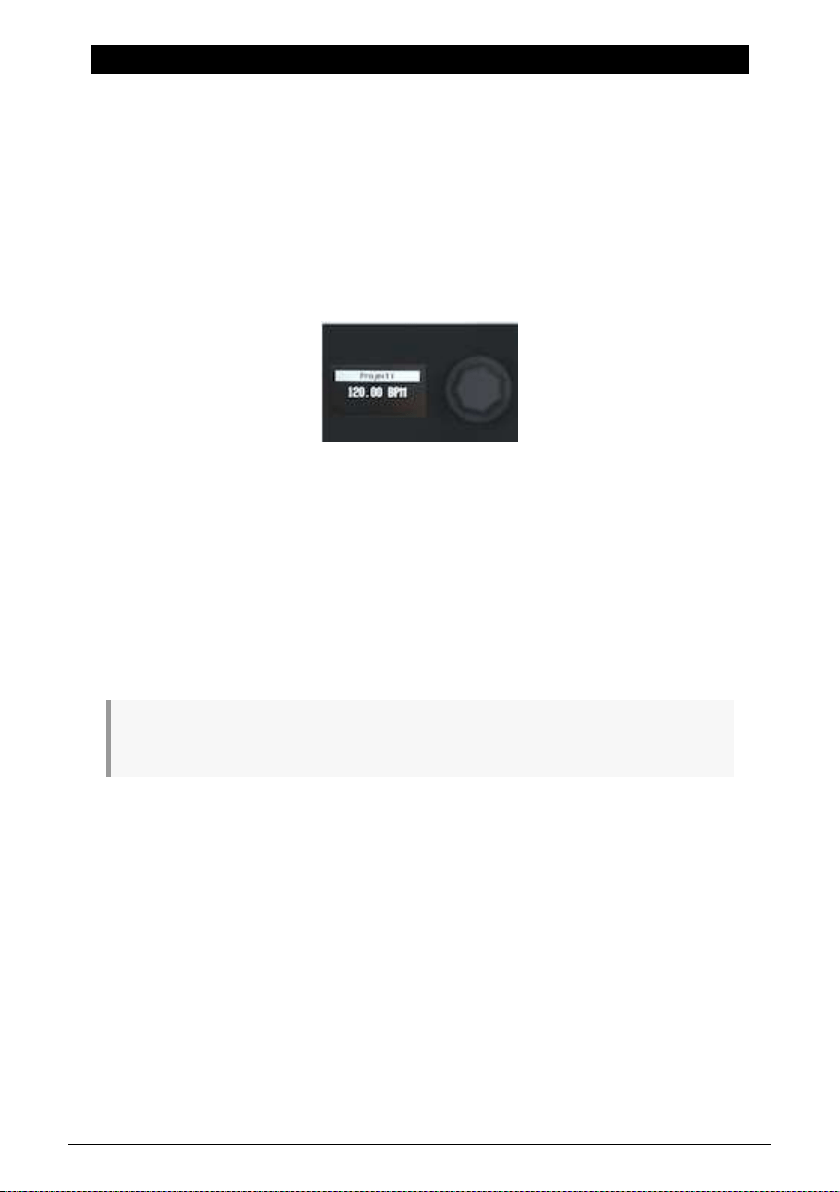
7. TIMING
This chapter is all about timing. How do you sync your external gear to the KeyStep Pro? Or,
the other way around, how do you sync the KeyStep Pro's sequencers and arpeggiators to
an external sequencer or a DAW? Hopefully, you'll find all the answers here.
7.1. Tempo
Using the Tempo encoder, you can set the tempo from 30 to 240 BPM (beats per minute).
An alternative is to tap the Tempo button four times to set an initial tempo. Tap it eight times
to further refine the tempo estimate. The KeyStep Pro will calculate the average of the eight
taps and set the tempo accordingly.
You can set the decimal value of the tempo by holding down 'Shift' and turning the Tempo
encoder.
The KeyStep Pro can switch between two tempos: Global Tempo and Project Tempo. The
Global Tempo can be set using 'Shift' + step 15/Global BPM. By default, a new empty Project
will always use the standard Project Tempo of 120 BPM. If you change the Tempo setting
and save the Project, the new Tempo setting will be stored with it. When you reload the
Project, it will have the saved Project tempo.
You can override the Project tempo at any moment by holding down 'Shift' and pressing step
15/Global BPM. When that button is lit (in blue), Global Tempo is active; when unlit, Project
Tempo is active.
♪: To quickly change the time division of the tempo, hold the 'Tempo' button and select a new Time
Division on the keyboard.
132 Arturia - User Manual Keystep Pro - Timing

7.1.1. Making it Swing
To set a Swing amount, turn the Swing/Offset encoder. If you've listened to music before (it's
unlikely you haven't) you have heard swing. It's when musicians play just before or after the
beat. This is often used in jazz and South American music. It evokes an emotion of freedom,
of not being forced into a fixed rhythm. It is particularly effective when you mix 'straight'
notes with 'swung' notes. The KeyStep Pro's swing range goes from 50% to 75%. By default,
it is 50%.
Swing has an important second function: you can use it to add an offset to the swing
amount of the current track. For example, Track 1 could use 53% swing and Track 2, 57%. The
effect is very subtle, but it can help make a track stand out.
To add Swing Offset to a track:
• Select the track by pressing Track 1, Track 2, Track 3 or Track 4.
• Hold down 'Shift' and turn the Swing encoder clockwise. The OLED display will
show the offset amount. An amount of 50% equals no offset; an amount of 75%
equals maximum offset.
♪: Remember, you can also apply 'Swing' to arpeggios and record these 'swung' arpeggios in the
sequencer of the same track.
Turning the Swing knob will apply swing to all arpeggios and sequences simultaneously. Use
'Shift' + Swing to apply swing to the arpeggio or sequence on the active track only. When
you record an arpeggio and quantize is off, Swing is recorded in the sequencer.
7.1.2. Metronome
The KeyStep Pro has a metronome function that enables you to hear the beat in tempo as
well as count-ins before realtime recording. By default, the Metronome is off. To turn it on,
hold down 'Shift' and press the Tap Tempo/Metronome button. The retractable Level knob
on the back panel of the KeyStep Pro enables you to change the volume of the built-in
piezoelectric speaker (above the Hold/Clear button).
There are three ways to change the Metronome settings:
For a quick edit of Time Division, hold down Tap Tempo/Metronome and press one of the
Time Division keys (F to G# in the middle octave of the keyboard). While that button is held
down, LEDs above those keys will show the current Time Division. Additionally pressing the
A key selects the Triplet variant of the previously set Time Division.
Arturia - User Manual Keystep Pro - Timing 133

For a more detailed edit of the Metronome settings, enter the Utility menu by holding down
'Shift' and pressing the Project/Utility button. Scroll down to "Metronome". The settings you'll
find there are more extensive and enable you to set:
• Output medium of the Metronome (line, speaker + line, speaker)
• Count-in (off, 1 bar, 2 bars)
• Time Division (1/4, 1/4 triplet/ 1/8, 1/8 triplet, 1/16, 1/16 triplet, 1/32, 1/32 triplet)
• Time Signature (1, 2, 3, 4, 5, 6, 7, 8, 9, 10, 11, 12, 13, 14, 15, 16).
Combining these last two settings enables you to create a wide variety of beat settings: for
example, 2/4, 3/4, 4/4, 7/8, 9/16). The Metronome will always put an accent on the first beat
of each measure.
On the back panel, next to the Metronome Level knob, you'll see an output jack. You can use
this output to send an audible click to other devices, such as a mixing desk. The output is at
standard mixer line level.
The third option for changing the Metronome settings is in the downloadable MIDI Control
Center. The settings you'll find there are the same as in the KeyStep Pro's Utility menu.
7.1.3. Tap tempo
You can set the tempo by tapping on the Tap Tempo button repeatedly. Two taps are already
enough for the Metronome to set the tempo. With more taps, the tempo approximation will
improve.
'Shift' + Tap Tempo toggles the Metronome ON/OFF.
134 Arturia - User Manual Keystep Pro - Timing

7.2. Sync
When you connect your KeyStep Pro to an external device such as a synthesizer, a Eurorack
modular system or a computer running a DAW, you'll need a way to synchronise that
external device to the KeyStep Pro. That is where Sync comes in.
The KeyStep Pro can send sync signals via USB, MIDI Out 1, MIDI Out 2 or Clock Out to
external devices. It can also receive sync signals from external devices via USB, MIDI In or
Clock In.
Utility>Sync opens the Sync menu. There you can view and set the sync options:
Sync Values Description
Input Source [Internal, USB, MIDI, Clock, Auto (d)] Defines tempo and sync source
Clock
Rate
[1 PP16, 2 PPQ, 24PPQ (d), 48PPQ]
Allows you to choose from different
analog clock-rate types
Output
[1 PP16, 2 PPQ8, 1 PPQ, 1PP2Q, 1 PPQ4Q,
2PPQ, 24PPQ (d), 48PPQ]
Use these settings to sync KeyStep Pro to
various analog clock types
These settings allow you to specify synchronization and tempo input/output. By changing
these settings, you also determine which type of clocking signal will be transmitted via the
output connectors and recognized by the Clock input.
Auto Mode works as follows:
• If no clock signal is received, you can set the tempo and press Play. The KeyStep
Pro will then behave as in Internal mode
• If Clock / MIDI Transport Control (MTC) is received, the external clock takes
priority over the internal clock. The resulting tempo is calculated based on the
external clock. When the external clock stops, the sequencers/arpeggiators stop
• If a MIDI Stop message is received, all running sequencers/arpeggiators will
stop.
Category Parameter Description Utility MCC
Sync
Output
[1PP16, 1PP8, 1PPQ, 1PP2Q, 1PP4Q,
2PPQ, 24PPQ, 48PPQ]
allows you to adjust the Tempo setting
to other PPQ standards
x x
The Sync menu enables you to set the clock type for the analog output clock:
• 1PP16 = 1 pulse per 16th beat (clocked)
• 1PP8 = 1 pulse per 8th beat (1 pulse every two 1/16th beats)
• 1PPQ = 1 pulse per quarter beat
• 1PP2Q = 1 pulse per 2 quarter beats
• 1PP4Q = 1 pulse per 4 quarter beats,
• 2PPQ = 2 pulses per quarter beat
• 24PPQ = 24 pulses per quarter beat
• 48PPQ = 48 pulses per quarter beat
Arturia - User Manual Keystep Pro - Timing 135
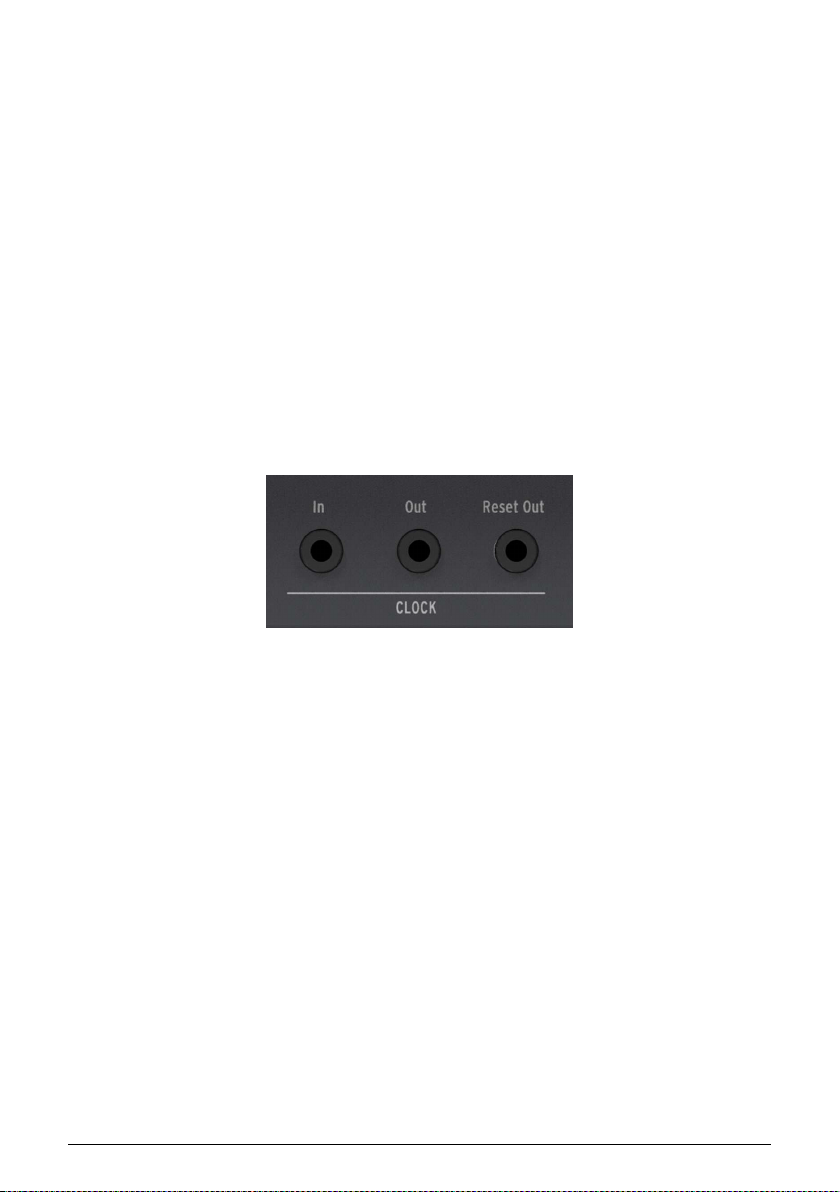
Sequencer Sync
The Sync option is the key to unlocking the creative power of the sequencers. By default,
Sync is ON.
When Sync is active (set to AUTO) the KeyStep Pro's tempo will lock to the nearest multiple
of the tempo of the incoming clock signal.
By default, Sync is active and the Sequencer Rate is set to 1/16.
7.3. Sync/Clock and Reset Outputs
In the Sync menu, you can select whether the clock and/or transport signals will be sent via
each of the following outputs:
• USB
• MIDI Out 1
• MIDI Out 2
• Clock Out
The Reset Output (Reset Out) sends a [4ms 5V high] signal whenever you press Stop or after
a sequence reset with 'Shift' + Play.
The ON cycle of the Clock output (Clock Out) is +5V, which should be enough to trigger even
the most unresponsive Eurorack modules.
Stop, Start & Continue
Other settings in the Utility menu determine how the KeyStep Pro will send and respond to
the Stop, Start & Continue commands it receives. To learn more about this, please refer to
Chapter 9 [p.145].
136 Arturia - User Manual Keystep Pro - Timing

8. CONTROL MODE
8.1. What is Control Mode?
When the KeyStep Pro is in Control mode, every encoder can transmit specific MIDI data to
external devices that are connected to MIDI Out 1 or Out 2 (5-pin DIN). This same data will
be sent to your computer via USB.
To activate Control mode, hold down the Control button. The control Track can be used to
create Patterns of special control data for controlling parameters of external devices such
as hardware synths, Eurorack modular systems, or software virtual instruments loaded in
tracks of your DAW. The track button will blink slowly to remind you that you are in Control
mode.
The Control track has features similar to a normal track: you can apply the Nudge, Invert
and Random order functions to data stored in it. If, for example, you've created a pattern
with control values stored in step 2 and 8, 'Shift' + Nudge> will move the control data to steps
3 and 9. 'Shift'+ Invert will move that same control data to step 9 and 15.
♪: Touch a knob to check the CC# value stored in the step.
In Control mode, a few features are disabled or work differently:
• Selecting a different track will exit Control mode
• You save a Control Track the same way you do normal tracks
• The Mute button has no effect.
8.1.1. What are CC# values?
When you draw notes in the MIDI editor of your DAW, you create MIDI data. With each note
you add, you create a note-on message, a gate message, a note-off message and a velocity
value, etc., all associated with a particular MIDI note number. The velocity value imitates
how hard a key is struck on a MIDI keyboard. When you connect an external synth such as
the Arturia MatrixBrute or MicroFreak to your DAW and press 'play', the DAW starts sending a
stream of digital MIDI messages to the synth. The MatrixBrute or MicroFreak interprets these
messages and plays your DAW sequence the way you intended it to sound. Note number
and velocity values (like most values in MIDI) are in the range 0-127.
There's another kind of MIDI data that allows you to control parameters on external synths,
modular systems and virtual instruments loaded in DAW tracks. These Control Change (CC)
messages are different from, and independent of, the note-related MIDI messages. They
are referred to as CC# messages: strings of numerical data that are specifically designed
to control parameters on an external MIDI-compatible hardware or software device; for
example, a hardware synth, a Eurorack modular system or a software modular system
such as VCV Rack.
MIDI CC# messages have existed for over 40 years and, despite their enormous potential,
they are not widely used.
Arturia - User Manual Keystep Pro - Control Mode 137

When the KeyStep Pro is in Control mode and you turn one of the five main encoders, a
CC# message will be transmitted. The default CC# messages that will be transmitted are:
Encoder CC#
Pitch 74
Gate 75
Velocity 76
Time Shift 77
Randomness 78
The problem with CC# messages is that you may have no way of knowing whether they are
being transmitted, unlike notes that will either sound or not. Fortunately, there are two ways
to understand what is going on. Whenever you turn an encoder, its value will be displayed
in the OLED screen. For details of what is going on, check Utility>Controller>Knob (1-5).
Secondly, there is an option in the downloadable MIDI Control Center that enables you to
check what's going on:
• Open the MIDI Control Center
• Select 'MIDI console' in the View menu
• Activate Control mode in the KeyStep Pro.
If you now turn the main encoders, you will see their CC# messages (changing values)
displayed in the console window.
♪: If you're a lucky owner of the Arturia Pigments software synth, you can map four of these
encoders to Pigment's four macro knobs.
8.1.2. CC# Patterns
A Pattern in the KeyStep Pro's Control Track runs in parallel with the normal Track Patterns
(sequences).
Is it possible to create 'empty' tracks containing control data only? Yes, it is. You could, for
example, assign one of the four tracks to 'play' control data exclusively and use it to control
parameters on an external synth, modular system or virtual instrument.
Each of the 16 Patterns in a Project can be used to stored control data in a CC# Pattern.
To load a CC# Pattern hold down the Pattern button and press one of the 16 step buttons.
Chaining Patterns is a way to create a linked series of CC# Patterns. You do this in the same
way that you chain sequencer Patterns.
Save CC# Patterns using SAVE + Pattern, just like saving normal sequencer Patterns.
In Control mode, everything is handled just like when working with normal sequencer
Patterns and tracks, except that there is no display of Pattern number and the Mute button
has no effect.
138 Arturia - User Manual Keystep Pro - Control Mode

8.2. Control Mode as DAW Automation
Without a doubt, Control mode is one of the most exciting features of the KeyStep Pro. If
you've already used a DAW such as Ableton, Cubase, Logic or Reaper you are familiar with
automation lanes. In the KeyStep Pro, a track in Control mode is the equivalent of a DAW
automation lane.
In the KeyStep Pro, a normal sequencer Pattern is used to store notes (pitches) and
velocities (the force or speed with which you hit individual keys). In Control mode, however,
a CC# Pattern is used to store encoder positions. It gets played back as a 'ghost' sequence
in parallel with the sequences of notes stored in normal Patterns. A CC# Pattern can
control external encoder/knob positions by transmitting MIDI CC# messages with values
that external synths and modular systems, or virtual instruments loaded in your DAW, can
recognise and respond to correctly.
8.2.1. Using CC# Patterns to Store and Playback CC Values
With a track of the KeyStep Pro in Control mode, the Patterns you create will act as DAW
automation lanes. You can store CC# values in them that will control parameters on external
MIDI devices.
If you know the CC# of a synth's knob, you can use that CC# to control that parameter. In
the Utility menu, simply define one of the main encoders to send that CC# out to the synth
and then fill the steps in the CC# Pattern with CC values to control the movements of the
synth's knob.
CC# messages are thus the MIDI equivalent of turning knobs. The MicroFreak, currently one
of the most popular Arturia Synthesizers, has very sonically interesting CC# control options:
turn the Analog Filter Cutoff knob on the MicroFreak and its cutoff frequency will change.
Sending a sequence of MIDI CC 23 messages with varying values to the MicroFreak will
have the same effect: sending CC 23 with a value of 0 closes the analog filter completely;
sending CC 23 with a value of 127 opens it fully. The MicroFreak has a total of 20 different
CC#'s that are available to control its parameters.
Arturia - User Manual Keystep Pro - Control Mode 139

8.2.2. Recording Control Changes in Step Edit Mode:
To record control changes (modulation) in Step Edit mode:
• Make sure the Track on which you want to record a CC# Pattern is in Control
mode
• Press Pattern + a step button to select the Pattern into which you want to record
CC# data
• Ensure Play is off and turn on step recording by pressing the Step Edit button
• Press a step button to select the step to which you want to add CC# data
• Now turn the encoder to the position you want to record. While turning the
encoder, nothing will be recorded, but you can monitor the changing value on
the OLED display. The display will indicate the number of the step to which you
can add data, the current CC number and its value. When the encoder is in the
position that you want to record, release it. The KeyStep Pro will take a 'snapshot'
of the encoder position and store it in that step.
• Continue to do this until you've filled every step with a CC# value.
♪: If the step being edited has no existing data for that CC number, turning the encoder will create it.
♪: Turning the encoder fully counterclockwise reaches 0, then turning it further counterclockwise
turns it off for this step. There's a dead zone before deactivation so that it is easy to reach 0 without
turning the encoder off. To turn it off, you have to turn it to what would normally be '-5'.
You may have guessed by now that there are two ways to fill CC# Patterns with data: either
you can fill the successive steps with 'snapshots' of the positions of one encoder and then
go back to the first step and continue with another encoder, or you can fill a step with
'snapshots' of all the encoder positions simultaneously and then continue to the next step
until all steps are full. Both methods have their pros and cons.
To erase the CC# data in a step, turn the appropriate encoder fully counterclockwise until it
reaches 0 then continue to turn it counterclockwise beyond 0, thus turning off the encoder
for that step.
♪: Sequence functions such as Lst Step, Extend, Step/Page Copy & Paste, Clear Pattern and Clear
Steps all behave as in normal mode. A CC# track is always in 1/16th resolution (Time Division).
140 Arturia - User Manual Keystep Pro - Control Mode

Matching MIDI Channels
Before attempting to use MIDI CC# messages to control an external device such as a synth,
the MIDI channel on which the KeyStep Pro transmits must match the MIDI channel on
which the external device receives. If the receiving synth is set to receive on all 16 MIDI
channels simultaneously, you have nothing to worry about. However, if your KeyStep Pro is
connected to several synths (and a DAW) and you want to be able to send different control
messages to each synth (and the DAW), you'll have to assign a different MIDI channel to
each device and adjust channels on the KeyStep Pro to match them.
If you are the proud owner of a MicroFreak, you can try the following example. Let's say
we've configured the MicroFreak to receive on MIDI channel 2 with Utility>MIDI>Input>2 and
activated Control mode on the KeyStep Pro to perform our control magic.
If you don't own a MicroFreak you're missing out on something special, but you can learn
from this example anyhow the general workflow is the same for other synths.
We'll select a MicroFreak parameter with a very drastic effect, so it immediately becomes
clear whether the control is working or not. We'll use a CC# to keep changing the Oscillator
Type on the MicroFreak!
By default, the MicroFreak receives on all 16 channels, so we can send CC# messages from
any KeyStep Pro encoder. By default, Control mode transmits on MIDI channel 1.
We will assign CC 9 to Encoder 1 (Pitch). CC 9 changes Oscillator Type on the MicroFreak.
• Hold down 'Shift' and press Project/Utility to open the Utility menu
• Scroll down to 'Controller' and press the encoder to select this submenu
• Select knob 1 and continue to select CC
• Select CC# value 9.
If you now turn the Pitch encoder, the MicroFreak Oscillator Type will change. We can use
the steps in any of the current track's Patterns to control Oscillator Type on the MicroFreak.
Remember how a step takes the current value of an encoder when you activate it? You can
use this to program a series of Oscillator Type changes.
• Activate Control mode if it is not already active
• Select a Pattern on Track 1
• Press Step Edit to activate Step Edit mode
• Turn the Pitch encoder fully counterclockwise
• Press step buttons 1, 3, 5 and 7 to store '0' values in those steps
• Set the Pitch encoder to its mid-position (12 o'clock)
• Press the step 2 button
• Repeat this for steps 4 and 6, remembering to set the encoder in its mid-position.
Play the sequence. You should now hear the MicroFreak alternating between oscillator types.
♪: An option in the MIDI Control Center enables you to set a control range for each of the main
encoders. You can use this feature to limit the range of the Pitch encoder (encoder 1) to 50-100 and
thus only select specific oscillator types. To set this range, click on 'Device Settings' in the MIDI Control
Center and change the min. and max. values listed under Controller> Knob 1.
Arturia - User Manual Keystep Pro - Control Mode 141

8.2.3. Controlling Parameters in a DAW
With CC# messages you can also control parameters of plugins, including virtual
instruments, loaded in your DAW. All plugins of the Arturia V Collection series have a MIDI
learn feature that enables you to link knobs on the KeyStep Pro front panel to knobs in the
plugin. Imagine all the new sonic options you have when using the KeyStep Pro's encoders
to simultaneously control the filters of the CZ V, the DX7 V and the Buchla Easel V, for
example.
Please refer to the documentation that comes with your DAW and the V Collection for
detailed descriptions of how to do this.
♪: CC# messages transmitted over MIDI can also be used to control parameters on a modular
system, but to make that possible you need a module capable of converting CC# values to analog
voltages.
The controller assignments can be set in Utility>Controller and the MIDI Control Center
[p.155].
8.2.4. More about CC# Patterns
The CC# values can be sequenced as we've seen above. However, they can also be used in
a more general way to set parameters in an external synth. If you send a certain CC# value
in the first step of a Pattern and there are no other values programmed in that Pattern, this
initial value will be held during the sequence. This feature gives you the creative option of
sending a new configuration to the external synth, module or virtual instrument at the start
of each Pattern!
!: Patterns can be chained. CC# Patterns are no exception. If you have three similar Patterns chained,
you can store CC# values in the first step of each Pattern. For example, in the first Pattern, you store a
CC# value for a half-open filter; in the second Pattern you store a CC# value that opens the filter a bit
further; in the third Pattern you store a CC# value that fully opens the filter.
If you use the steps of Patterns to send different CC# values in each step, there is a feature
you can use to great effect: the looper, the horizontal control strip located under the two
vertical touch strips. The looper also works in Control mode. If you loop part of a sequence,
you will also loop the CC# values in that part of the sequence.
♪: There is one important difference between a normal track and a track in Control mode: a normal
track can be muted, but a control track cannot. It will always transmit CC# messages as long as it is
playing.
142 Arturia - User Manual Keystep Pro - Control Mode

8.2.5. Visual Feedback
If a step in a Pattern has any recorded CC# data in it, its step button will be lit. Otherwise, it
will be unlit.
If there is recorded CC# data corresponding to a main encoder, its LED ring will have only
one LED lit (or one LED lit and one adjacent LED dimmed) to indicate the current value of
that CC#. If the sequencer is running, by 'moving', the LED ring will show the value changing.
If there is no recorded CC# data corresponding to a main encoder, its LED ring will have all
LEDs lit up to indicate the previously registered value of the CC# (plus one dimmed LED at
the end of the ring, if applicable).
8.2.6. Realtime Recording of CC# values
Earlier in this chapter, we looked at recording CC# values in Step Edit mode. Control values
can also be recorded and played back in real-time mode.
Real-time recording of CC# values is no different from recording notes and their
parameters: select the Control Track and press Record and Play. You stop recording by
either pressing Stop or Record. If you do not stop recording manually, it will stop
automatically when the last step of the Pattern is reached.
Again, it's important to understand that Control mode is different from normal mode: if
you're in Control mode and press 'Shift'+ Clr Steps, all CC# values stored in the steps will
be erased, but the notes and note-related parameter values will be retained. By contrast,
pressing 'Shift'+ Clr Steps in normal mode only erases notes and note-related parameter
values in the steps, not CC# data. You can use it to your advantage by recording notes over
existing CC# values or vice versa.
Unlike recording notes, which are only stored in the current step if there is an open gate
(note in ON state), CC# values are recorded continuously: for example, if you record a CC#
value in step 1, this value will be retained to the last step of the Pattern. (You do not need to
record the same CC# value in each following step). If you touch/turn other encoders, their
CC# values will be superimposed on the existing CC# data.
If you touch/turn an encoder a second time during a subsequent recording loop, its CC#
data will overwrite the existing data for that CC number. However, it will leave the data of
other CC numbers unchanged.
8.2.7. Erasing CC# Automations
When Step Edit is OFF, press Erase then turn one of the five knobs to clear its automation
for the current pattern.
When Step Edit is ON, press Erase then turn one of the five knobs to clear its automation for
the selected step only.
Arturia - User Manual Keystep Pro - Control Mode 143

8.2.8. The Live Track
Being able to program automation in CC# Patterns is a great feature, but what if you want to
directly control an external synthesizer or modular system in a live situation using the CC#
values of the main encoders? Or what if you want to create and modify a Pattern already
containing CC# data? It's easy: the track that is currently active when you press the Control
button becomes the 'Live Track'. The track button will blink slowly to remind you that you are
in Control mode. When in Control mode, you can use CC# messages in real time to control
any MIDI-compatible hardware or software devices connected to this track via USB, MIDI
Out 1 or MIDI Out 2.
To exit Control mode, press the Track button of the Live Track again. All normal Shift
functions are now at your disposal again.
♪: The Overdub button has no effect while Control mode is active.
8.3. Front Panel Functions
In Control mode, most of the performance controls in the left half of the KeyStep Pro's front
panel control the same functions as they do in normal mode, unless configured otherwise
using MIDI Control Center. There are some slight variations, though, which we'll point out as
we go through the performance controls.
8.3.1. The Tempo/Fine Encoder
The Tempo/Fine encoder works the same in all modes. Its functions are described in the
KeyStep Pro Overview Chapter. [p.21]
8.3.2. Tap Tempo/Metronome Button
The Tap Tempo/Metronome button works the same in all modes:
• Hold down 'Shift' and press Tap Tempo/Metronome to toggle the Metronome ON/
OFF
• Tap the Tap Tempo/Metronome button several times to set the tempo.
8.3.3. The Swing/Offset Encoder
In Control mode, the Swing encoder controls the swing percentage of the entire Project. In
other words, the Swing percentage is applied to all tracks equally. For a description of the
Swing feature, see the Swing section of
Chapter 6 [p.115].
8.3.4. Transport Section
The buttons of the Transport Section work the same way in Control mode as in the other
modes, unless set up otherwise using the MIDI Control Center.
144 Arturia - User Manual Keystep Pro - Control Mode

9. KEYSTEP PRO CONFIGURATION
The KeyStep Pro has many settings that you may want to adjust, and please don't hesitate
to do so. It's not like the temperature setting on a fridge that you set once and then forget
about. Changes to these settings can make a lot of difference. The right settings will help
you to develop a personal synthesis style.
For example, you're playing drums on the keyboard and it doesn't sound right because it
doesn't match the way you are used to mapping your drums in your DAW. By changing the
Drum mapping in the Utility menu you can explore alternative options. Go to Utility>Drum
Map>Config.
Does selecting another velocity curve make my sequences snappier? Go to Utility>MIDI
Settings>Velocity curve.
Will changing the knob acceleration give me a better control experience? Go to Utility>MIDI
Settings>Knob Acceleration.
The answer to many of your configuration questions can be found in the Utility menu of the
KeyStep Pro or the KeyStep Pro Device Settings in the MIDI Control Center. In the KeyStep
Pro Utility menu, you can adjust settings specifically for a project. These settings are also
available in the MIDI Control Center.
9.1. The Utility Menu
To access the Utility menu, hold down 'Shift' and press the Project/Utility button.
The Utility menu is where you set and change most of the KeyStep Pro's global settings.
'Global' means that these setting are shared across all Projects. They are saved
automatically as soon as you exit the Utility menu.
The Utility menu is shown in the display. To navigate in the menu, turn the selection encoder
(located to the right of the menu) and click it to enter a submenu. To back up in a submenu
press 'Exit'. Keep pressing 'Exit' to leave the Utility menu.
9.1.1. MIDI Channels
MIDI Channels Track Values Description
Track 1 Input [1-16, OFF, 1 (d)] Input channel of Track 1
Track 2 Input [1-16, OFF, 2 (d)] Input channel of Track 2
Track 3 Input [1-16, OFF, 3 (d)] Input channel of Track 3
Track 4 Input [1-16, OFF, 4 (d)] Input channel of Track 4
Drum Input [1-16, OFF, 10 (d)] Input channel of the Drum sequencer on Track 1
Track 1 Output [1-16, OFF 1 (d)] Output channel of Track 1
Track 2 Output [1-16, OFF 2 (d)] Output channel of Track 2
Track 3 Output [1-16, OFF 3 (d)] Output channel of Track 3
Track 4 Output [1-16, OFF 4 (d)] Output channel of Track 4
Drum Output [1-16, OFF, 10 (d)] Output channel of the Drum sequencer on Track 1
In the Utility menu, you set the MIDI channels on which the four tracks will send and receive
MIDI signals. The Tracks default to their track number (MIDI channel 1-4); the Drum channel
defaults to MIDI channel 10.
Arturia - User Manual Keystep Pro - KeyStep Pro Configuration 145

♪: In a Project, each track can be configured to send on a specific channel. When you load the project
the Project settings overwrite the Global MIDI settings. Please refer to chapter 6 [p.115] for details about
this.
9.1.2. Sync
Sync Values Description
Input Source [Internal, USB, MIDI, Clock, Auto (d)] Defines tempo and sync source
Clock
Rate
[1 PP16, 2 PPQ, 24PPQ (d), 48PPQ]
Allows you to choose from the different
analog clock rate types
Output
[1 PP16, 2 PPQ8, 1 PPQ, 1PP2Q, 1 PPQ4Q,
2PPQ, 24PPQ (d), 48PPQ]
Use these settings to sync KeyStep Pro to
various analog clock types
These settings allow you to specify the inputs for receiving synchronization and tempo
signals, as well as the input and output clock rates. By changing these settings, you
determine which type of clocking signal will be transmitted via the output connectors and
which type will be recognized by the sync/clock inputs.
Auto Mode works as follows:
• If no clock signal is received, you can set the tempo and press Play. The KeyStep
Pro will then behave as in Internal mode
• If Clock / MIDI Transport Control (MTC) is received, the external clock takes
priority over the internal clock. The resulting tempo is calculated based on the
external clock. When the external clock stops, the sequencers/arpeggiators stop
• If a MIDI Stop message is received, all running sequencers/arpeggiators will
stop.
The Sync Output submenu enables you to set the clock type for the analog output clock:
• 1PP16 = 1 pulse per 16th beat (clocked)
• 1PP8 = 1 pulse per 8th beat (1 pulse every two 1/16th beats)
• 1PPQ = 1 pulse per quarter beat
• 1PP2Q = 1 pulse per 2 quarter beats
• 1PP4Q = 1 pulse per 4 quarter beats
• 2PPQ = 2 pulses per quarter beat
• 24PPQ = 24 pulses per quarter beat
• 48PPQ = 48 pulses per quarter beat
146 Arturia - User Manual Keystep Pro - KeyStep Pro Configuration
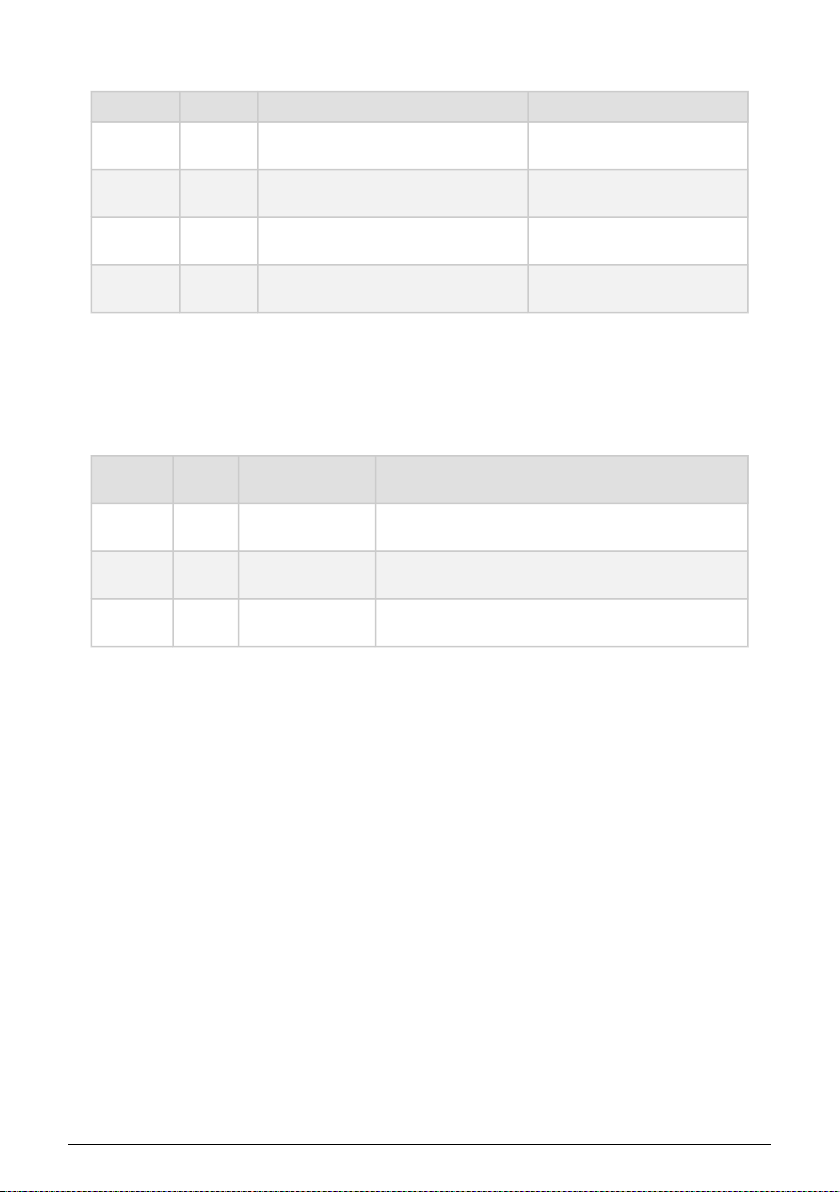
9.1.3. Metronome
Metronome Values Description
Output Line, Speaker (d), Line Line/Speaker
Selects the output of the
metronome signal
Count-in OFF, 1 bar (d), 2 bars
Selects count-in duration when
starting Record
Time
division
1/4, 1/4 Triplets 1/8, 1/8 Triplets, 1/16 (d), 1/16
Triplets, 1/32, 1/32 Triplets
Set number of beats in a measure
Time
signature
1-16, default 4
Sets the number of beats that
make up a measure/bar
To use the Metronome, activate it with 'Shift' + Tap Tempo/Metronome. The default time
signature is 4/4. To set the time signature to - for example - 5/8, set Time-division to 8 and
Time signature to 5.
9.1.4. Launch Quantize
Launch
Quantize
Values Description
Project
[OFF, 1 bar (d),2
bars, 4 bars]
Set the moment the KeyStep Pro switches to another Project
after you select a new Project
Scene
[1 beat, 1 bar (d), 2
bars, 4 bars]
Set the moment the KeyStep Pro switches to another Scene
after you select a new Scene
Pattern
[OFF, at end (d), 1
bar]
Set the moment the KeyStep Pro switches to another Pattern
after you select a new Pattern
In this menu, you 'tell' the KeyStep Pro how it should continue to the next Pattern, Chain
or Scene. Should it wait for 1 bar, 2 bars or 4 bar to make the switch? This is useful in live
performance settings where you may not want to interrupt the flow of the music between
Projects.
If Sequencer and Drum Patterns are of unequal length, the KeyStep Pro will wait until the
end of the Drum Pattern before loading the next Project Scene or Pattern.
Arturia - User Manual Keystep Pro - KeyStep Pro Configuration 147

9.1.5. MIDI Settings
MIDI
settings
Values Description
Knob
acceleration
[Slow, Medium, Fast]
Sets the amount of acceleration applied to the
encoders.
Aftertouch
curve
[Linear, Exponential,
Logarithmic]
Sets the keyboard response curve for
Aftertouch
Velocity curve
[Linear, Exponential,
Logarithmic]
Sets the keyboard response curve for Velocity
Transport
send
[OFF, MMC, Realtime, Both]
Set whether the KeyStep Pro sends Transport
signals
Transport
receive
[OFF, MMC, Realtime, Both]
Set whether the KeyStep Pro receives
Transport signals
Clock send [OFF, ON] Enable/Disable clock send
Clock receive [OFF, ON] Enable/Disable clock receive
9.1.5.1. Knob Acceleration
There are three response curves for the encoders:
• Slow (Off): The encoders transmit every value. It takes many turns of an encoder
to move from minimum to maximum. Use this when greater precision is desired
• Medium: When turned quickly, the encoders will skip a few values. It takes fewer
turns of an encoder to move from minimum to maximum
• Fast: When turned quickly, the encoders will skip a few more values. It may
take as few as one-and-a-half turns of an encoder to move from minimum to
maximum.
9.1.5.2. Aftertouch Curve
Linear, Exponential and Logarithmic describe the mathematical shape of the pressure-
voltage curve that determines the amplitude of the voltage transmitted while you exert
pressure on a key you are holding at the bottom of its vertical travel.
In Linear mode, the voltage is directly proportional to the pressure. In Exponential mode,
the voltage initially increases rapidly as the pressure increases, but the
rate
of increase
gradually slows down as the pressure further increases. In Logarithmic mode, the converse
is true: the voltage initially increases slowly as the pressure increases, but the
rate
of
increase accelerates as the pressure further increases. When applied to control envelope
shapes, voltage-controlled filters (VCFs) and voltage-controlled amplifiers (VCAs), these
curves each result in very different aftertouch - or channel pressure - responsiveness.
9.1.5.3. Velocity Curve
By changing the velocity-voltage curve, you determine the way a sound characteristic such
as volume, tone or timbre responds to the speed or force with which you press a key. See
Aftertouch Curve above for the characteristics of each curve.
148 Arturia - User Manual Keystep Pro - KeyStep Pro Configuration

9.1.5.4. Transport Send
This setting allows you to set whether and how the KeyStep Pro will transmit transport
commands such as Stop, Rec and Play. It can either be OFF, MCC (meaning that the KeyStep
Pro will use the setting currently stored in the MIDI Control Center) or use the current
realtime setting.
9.1.5.5. Transport Receive
This setting allows you to set whether and how the KeyStep Pro will respond to transport
commands it receives over MIDI. It can either be OFF, MCC (meaning that the KeyStep Pro
will use the setting currently stored in the MIDI Control Center) or use the current realtime
setting.
9.1.5.6. Clock Send
Set whether the KeyStep Pro will transmit clock signals to external MIDI devices.
9.1.5.7. Clock Receive
Set whether the KeyStep Pro will receive clock signals from external MIDI devices.
Arturia - User Manual Keystep Pro - KeyStep Pro Configuration 149

9.1.6. CV Settings
CV
settings
Values Description
Voice
1.....4
Pitch
Format
[1V/Oct (d)
1.2V/Oct Hz/V]
Defines the voltage level the KeyStep Pro will output at the CV Pitch
Out. 1V/Oct (Eurorack and others), Hz/V or 1.2V/Oct (Buchla)
Base
Note
[C-2 (d) to G8] Sets at which MIDI note the Pitch out outputs 0V
Gate
Format
[V Trig 5V (d),
V Trig 10V, S-
Trig]
Defines the gate voltage level the KeyStep Pro will output at Gate
Out
Mod
Type
[Velo (d),
Pressure]
Determines which parameter will be sent to the Velo / Mod outputs
Mod
Max
Voltage
1-10 Volt Sets a maximum limit to the voltage output of the Mod type
Pitch
bend
range
(1-24)
semitones
Set a maximum pitch-bend range in semitones. Default = 2
This is where you select the electrical behaviour for each sequencer.
Drum
Gates
Values Description
Gate 1...8
format
[V-Trig 5V (d), V-Trig
12V, S-Trig]
Sets the trigger standard of the Drum Gates, V-Trig 5V
being the default.
This is where you set the output voltage level of the Drum Gates. Different brands of synths
and drum synths may require different voltages to trigger them properly.
150 Arturia - User Manual Keystep Pro - KeyStep Pro Configuration

9.1.7. Controller
Controller Values Description
Global MIDI Channel [1(d)-16]
Knob 1.....5
CC [0-127]
Port [USB, MIDI 1, MIDI 2, All(d)]
Channel [1-16, Global(d)]
Mode [Absolute(d), Relative1, Relative2, Relative3]
Min [0(d)-127]
Max [0-127(d)]
These parameters enable you to set up the KeyStep Pro as a controller.
'Global MIDI Channel' sets the default MIDI channel on which the KeyStep Pro will transmit.
The Knob (encoder) settings define the functionality of the five main encoders. Each encoder
can have a different profile. For example, Encoder 1 (Pitch) could transmit CC 9 on MIDI
channel 5 via MIDI Out 2 over the full range of 0-127, while Encoder 2 (Gate) could transmit
CC 19 on MIDI channel 6 via MIDI Out 1 with the range set to a minimum of 50 and a
maximum of 80.
Arturia - User Manual Keystep Pro - KeyStep Pro Configuration 151

9.1.8. Looper Touch Strip
Parameter Values
MIDI Send/Receive [OFF (d), Send, Receive, Both]
MIDI CC [1-127], 9 (d)
This menu item enables you to set the values the Looper will receive and transmit when
touched.
The looper is a great tool in live situations. By holding one of its repeat points, you can loop
part of a pattern. To record this activity in your DAW, MIDI send must be enabled. You can
enable it in UTIL>Touch Strip>MIDI Send/Receive or in this menu. By default, it is set to 'OFF'.
Once enabled, you can draw repeat patterns in your DAW using CC# 9. Please refer to the
documentation of your DAW for details. Refer to
Chapter 8 [p.137] for detailed info on how to
record looper activity in your DAW and how to control the looper from your DAW.
♪: If you need to change the default CC# to which the looper responds, do it in UTIL>Touch Strip>MIDI
CC# or in this menu.
9.1.8.1. MIDI Send/Receive
Use this menu to specify whether the KeyStep Pro's Looper Touch Strip will send MIDI
and react to incoming MIDI messages. The range of transmitted and recognized values is
detailed below in
Using the Looper Touch Strip with a DAW [p.153].
9.1.8.2. MIDI CC
Use the value field to select the MIDI CC number that the Looper Touch Strip will use to
transmit and receive.
152 Arturia - User Manual Keystep Pro - KeyStep Pro Configuration

9.1.8.3. Using the Looper Touch Strip with a DAW
When the MIDI Send/Receive parameter is enabled, the activity on the Looper Strip can be
recorded in a DAW. By default, MIDI CC 9 values will be sent, but you can select a different
MIDI CC# as described above.
The Looper Touch Strip will send only the following values:
Looper Touch Strip Region MIDI CC value
1/4 25
1/8 50
1/16 75
1/32 100
release value 0
However, if you draw a controller curve for the Looper Touch Strip in your DAW, the KeyStep
Pro will respond to the values in the following way:
MIDI CC value received Looper Touch Strip region selected
1-25 1/4
26-50 1/8
51-75 1/16
76-100 1/32
9.1.9. Drum Map
Drum Map Parameter Values
Mode Chromatic, Custom
Config Chromatic Low note (1-103)
Custom note 1...24 (36-127)
There are four options for the MIDI note assignments of the keys in Drum mode:
In the Mode menu, you can select whether you want to map your Drum Track notes in the
standard chromatic way or to create a custom mapping.
Utility>Drum Map>Config>Chromatic: enables you to set the Chromatic Low note: which note
the lowest key will trigger when Track 1 is in Drum mode. All keys above that lowest key will
be mapped relative to this note.
Utility>Drum Map>Config>Custom: Enables you to link each of the 24 Drum keys on the
keyboard to a MIDI note number in the range 0 to 127. The default mapping starts at MIDI
note 36.
♪: MIDI notes that are already used by another note are not displayed when navigating the list.
Arturia - User Manual Keystep Pro - KeyStep Pro Configuration 153

9.1.10. Miscellaneous
Misc Menu Item Values Description
Vegas Mode [5min (d), 10min, never] Sets the start time of the VEGAS LED pattern.
Screen Saver [2min (d), 10min, 30min] Sets the start time for the screen saver.
Step Listen [ON, OFF] (De)activate Step Listen
Reset Factory Confirm [Yes, No] Restores factory settings
Firmware version Displays current firmware version
154 Arturia - User Manual Keystep Pro - KeyStep Pro Configuration

9.2. MIDI Control Center
The manual for the MIDI Control Center has general descriptions of the features that are
common to all Arturia products. To learn how to access the manual, click this link:
Where to
find the manual [p.156].
This chapter only covers the MIDI Control Center features that are unique to the KeyStep
Pro.
9.2.1. MIDI Control Center Basics
The MIDI Control Center is a software application that allows you to configure the MIDI
settings of your KeyStep Pro. It works with most of Arturia's hardware devices, so if you
have an earlier version of the software you'll want to download the latest version. It will
work with those products as well.
9.2.1.1. System Requirements
PC: 2 GB RAM; CPU 2 GHz (Windows 7 or higher)
Mac: 2 GB RAM; CPU 2 GHz (OS X 10.8 or higher)
9.2.1.2. Installation and Location
After downloading the appropriate MIDI Control Center installer for your computer from the
Arturia website, double-click on the file. Then all you have to do is start the installer and
follow the instructions. The install process should be trouble-free.
The installer places the MIDI Control Center shortcut icon with the other Arturia applications
you have. In Windows, check the Start menu. In Mac OS X, you'll find it inside the
Applications/Arturia folder.
9.2.1.3. Connection
Connect the KeyStep Pro to your computer using the included USB cable. It will go through
its startup cycle and be ready when the display shows "Project 1".
Now launch the MIDI Control Center. KeyStep Pro will be on the list of connected devices.
Potential Issues: Windows OS
The MIDI driver for the KeyStep Pro is not 'multi-client'. That's a technical term that simply
means this: If a DAW application is already active on your computer, the MIDI Control
Center will launch but the KeyStep Pro won't be detected properly. To use the MIDI Control
Center to alter the parameters of your KeyStep Pro you will need to exit the DAW application.
Arturia - User Manual Keystep Pro - KeyStep Pro Configuration 155
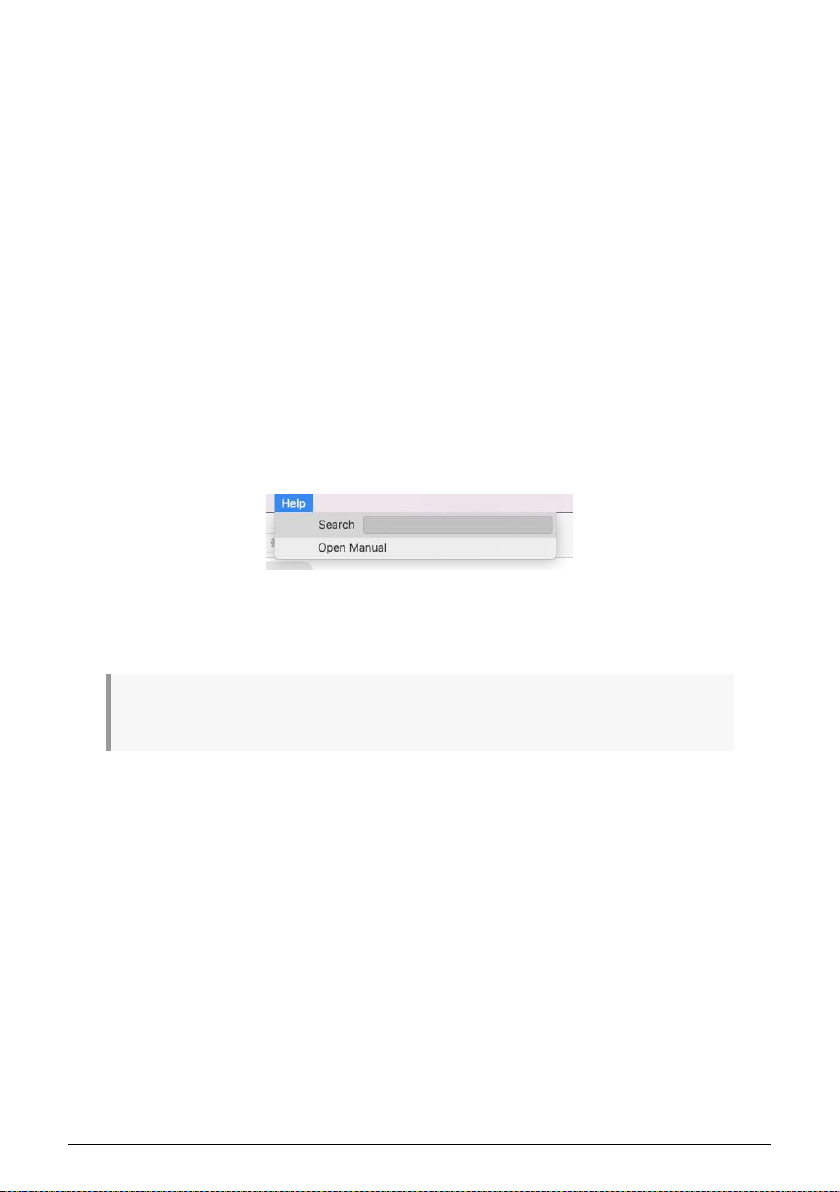
Potential Issues: Mac OS X
If the cable between your Mac and the KeyStep Pro is connected properly and the Mac is
having trouble detecting the unit, your Mac is experiencing what is known as a 'USB port
enumeration issue'. Here is one potential solution.
1. Launch the Audio MIDI Setup utility. The fastest way to do this is usually to hold
the Command key, press the space bar, and type in the letters AMS
2. If you do not see the MIDI Studio window, hold the Command key and press 2
3. Turn the unit off or disconnect its USB cable. You should see the related device
icon turn grey
4. Select the greyed-out KeyStep Pro image and delete it
5. The KeyStep Pro might also be labelled "MIDI Device" or something else, so you
may need to delete all MIDI Device images and restart any connected devices.
First, you must disconnect any units or turn them off, or else you will not be able
to delete the icons
6. Restart the KeyStep Pro. It should reappear in the MIDI Studio window.
9.2.1.4. Where to Find the Manual
There is a built-in help file for the MIDI Control Center, accessible from its Help menu, as
shown below:
It's a good introduction to the MIDI Control Center, describing each section of the software
window and defining important terms you will need to know while using the MIDI Control
Center, such as 'Project Browser' and 'Template'.
♪: Once installed, the MIDI control Center will update itself automatically. If for some reason you
don't want that to happen, disable this option in the FILE menu.
The next section of this chapter explains how to use the MIDI Control Center software to
configure the KeyStep Pro presets so they match your system and enhance your workflow.
9.2.2. Device Projects
The left side of the MIDI Control Center window shows a list containing Projects 1-16. When
one of the Projects is selected from the list, the MIDI Control Center can recall that Project
from the internal memory of the KeyStep Pro and place it into the User Project area in the
Project Browser window. See the Store To/Recall From [p.158] section for instructions about
this.
To see a larger number of the Projects in the Device Projects list, move your mouse pointer
to the edge of the Device Projects window until it turns into a double arrow pointer, then click
and drag the window resizing button.
156 Arturia - User Manual Keystep Pro - KeyStep Pro Configuration
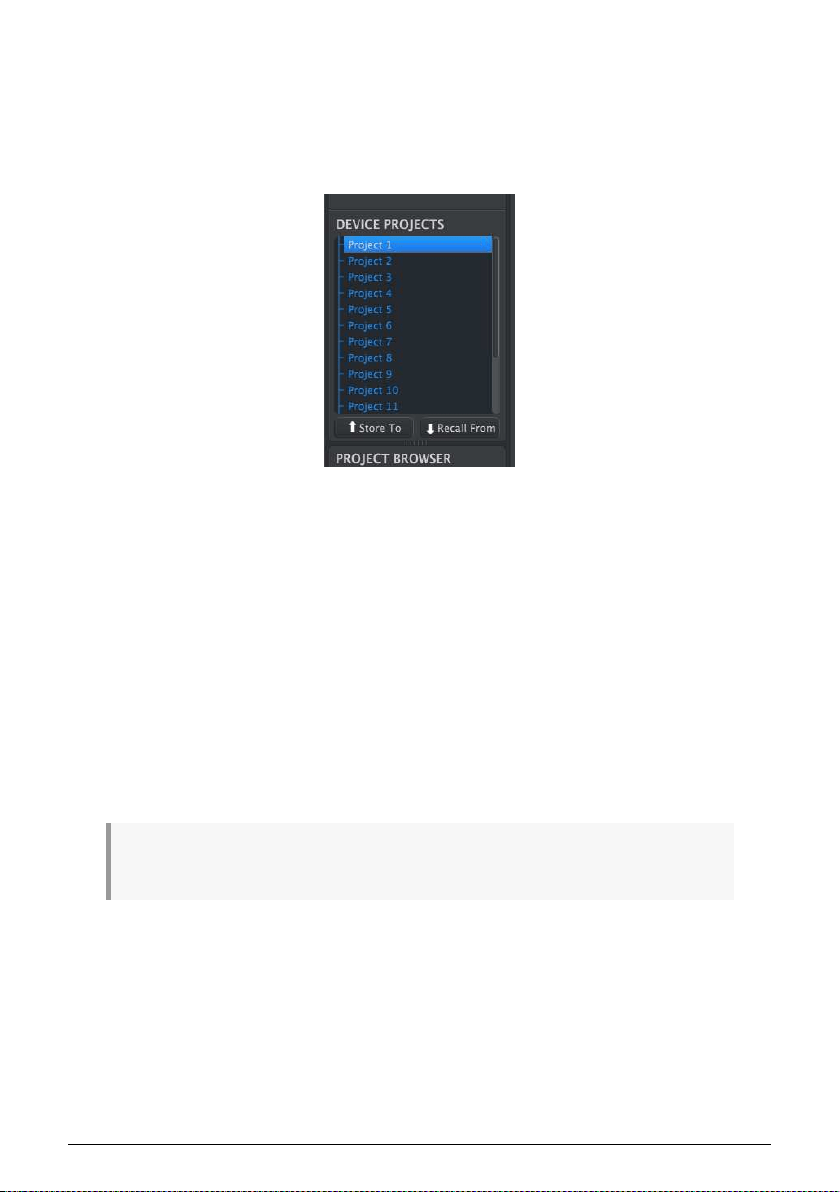
9.3. Project Browser
The Project Browser shows a list of all the Projects that have been archived using the MIDI
Control Center. These are divided into two main groups of Templates: Factory and User.
The User Templates are the ones you have recalled from the KeyStep Pro using the MIDI
Control Center. See
Store To/Recall From [p.158] to learn how to do this.
A Template in the MIDI Control Center is the same thing as a Project inside your KeyStep
Pro: it contains the Project-level settings, the Control mode settings (including the 16 Scenes),
and the Patterns from all four sequencers.
9.3.1. Building a Project Library
You can build a limitless library of Projects in the User Templates area. Simply drag one of
the Projects to the Project Browser window and it will be transferred from the KeyStep Pro
automatically. Then you can give it a new name if you like.
9.3.2. Revise a Template
If you'd like to modify a Template you can drag it from the Project Browser and drop it on
one of the Projects in the Device Projects area. This will send the selected Template directly
into the KeyStep Pro's internal memory at that Project location.
!: This process will overwrite the selected Project spot in the KeyStep Pro's internal memory. Be sure
to save what you were doing before you transfer the file!
Arturia - User Manual Keystep Pro - KeyStep Pro Configuration 157
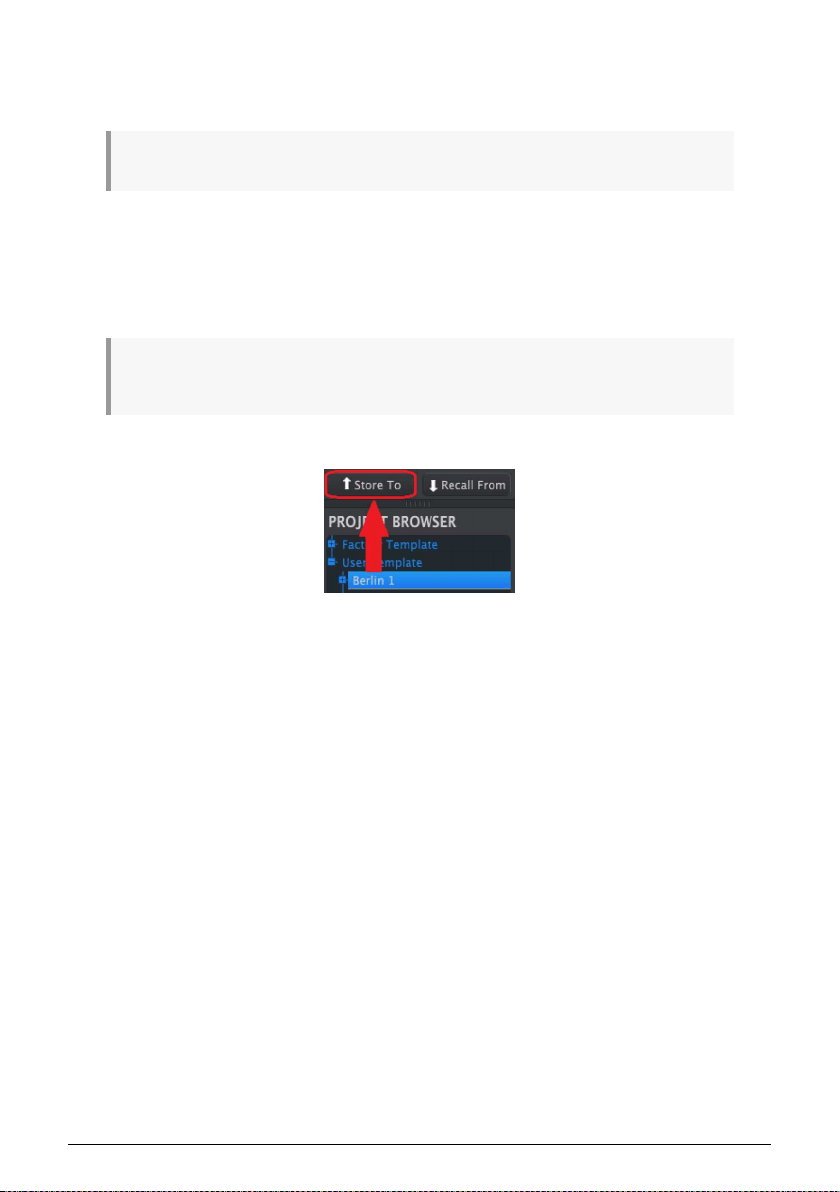
9.4. Store To/Recall From
These two buttons enable you to send and recall projects to and from the KeyStep Pro.
CAUTION: The Store To/Recall From transfers cannot be performed while the KeyStep Pro is running.
9.4.1. Storing a Project to the KeyStep Pro
The upper left-hand section of the MIDI Control Center has a button called 'Store To'. Right
above that is a list that allows you to specify which of the 16 Project spots in the KeyStep
Pro's internal memory will receive the User Project you have selected.
CAUTION: If you follow the procedure below, you will overwrite the Project currently stored that spot.
Be sure this is what you want to do! If not, please store it in another location inside the KeyStep Pro.
For this example, we'll assume that Project Berlin1 is available:
1. First, select 'Project Berlin1' in the list as shown above.
2. Select the User Project you would like to store into the KeyStep Pro.
3. Click the Store To button at the bottom of that section.
That's all there is to it! The settings and sequences of the User Project have been stored as
Project Berlin1 in the KeyStep Pro. Now you can load that Project whenever you want by
holding down the Project/Utility button and pressing the step 2 button.
158 Arturia - User Manual Keystep Pro - KeyStep Pro Configuration
9.4.2. Recall a Project from the KeyStep Pro
It is possible to make whole Projects in the KeyStep Pro without a computer attached. It is,
however, good practice to back them up from time to time. Just grab any one of the internal
Projects or Patterns directly from the internal memory and store it as a Template in the
Project Browser window of the MIDI Control Center.
For example, if you want to back up Project #1 from the internal memory, simply select it
in the Device Projects window and click Recall From. Project #1 will show up in the Project
Browser with a time/date stamp as a name. You can rename it if you like.
9.4.3. Template Utilities
Important features such as Save, Save As, Delete, Import, and Export are described in the
MIDI Control Center manual, which you will find in the software Help menu. Look in that
document for the section titled Template Utilities.
Arturia - User Manual Keystep Pro - KeyStep Pro Configuration 159
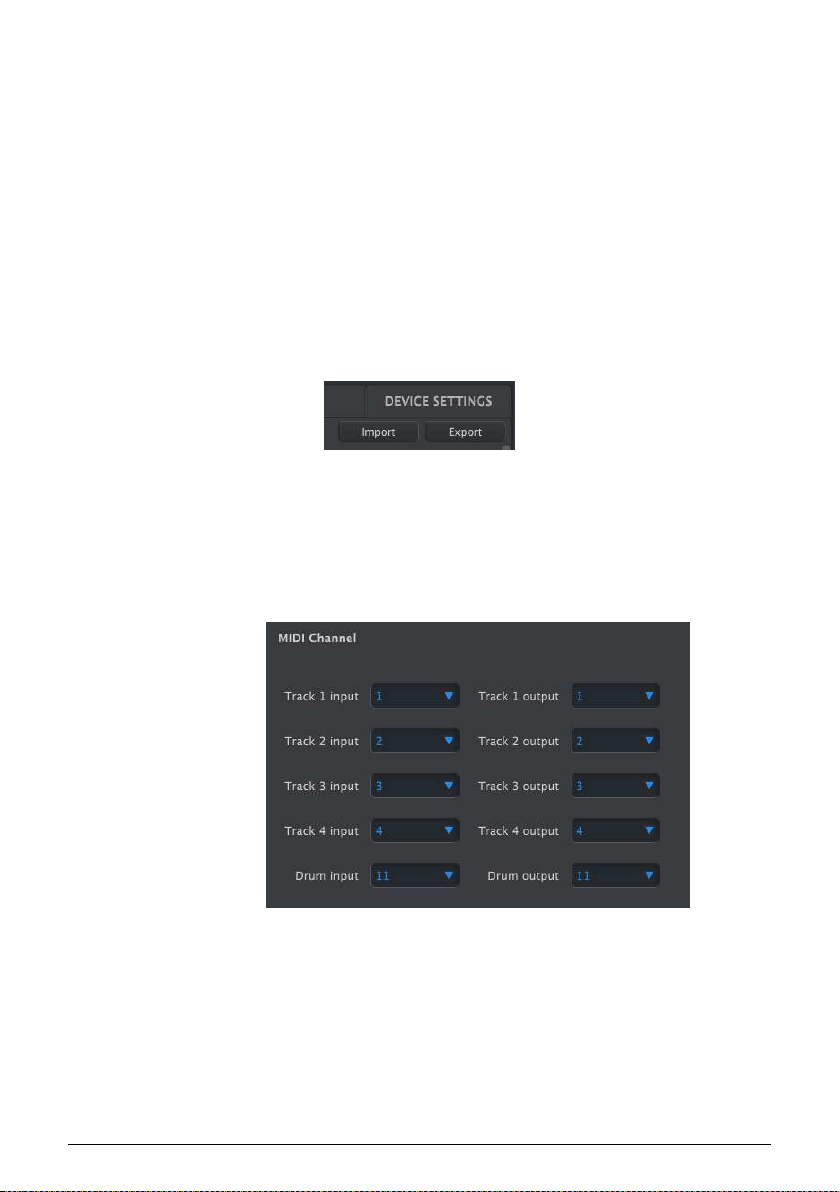
9.5. Device Settings
The right side of the MIDI Control Center window contains essential parameters that you
can use to optimize the KeyStep Pro for your setup and your working style. You will need to
scroll down to see them all.
Device settings can be saved and recalled. It is a handy feature that enables you to quickly
change the configuration of your KeyStep Pro. Several applications come to mind:
• Redirect the output of each of the Tracks to synths connected to different MIDI
channels
• In a mixed setup, change the CV/Gate setting to switch between Eurorack
standard and the Buchla CV standard.
• Quickly load an alternate set of CC# values for the encoders to enable you
to control a different set of parameters on external synths and set predefined
control ranges
The settings you see here are the same as those in the KeyStep Pro's Utility menu. These
settings are linked to a Project. Each Project can have its own configuration settings.
For an overview of what these settings do, please refer to the
Utility Menu section [p.145].
9.5.1. Global Midi Channel
In this menu, you set the Global channels on which the four tracks of the KeyStep Pro will
send and receive MIDI signals. The four tracks default to their track number (MIDI channels
1-4); the Drum channel defaults to MIDI channel 10.
In a Project, each track can be configured to send on a specific channel. When you load
the project the Project settings overwrite the Global MIDI settings. Please refer to
Chapter 6
[p.115] for details about this.
160 Arturia - User Manual Keystep Pro - KeyStep Pro Configuration
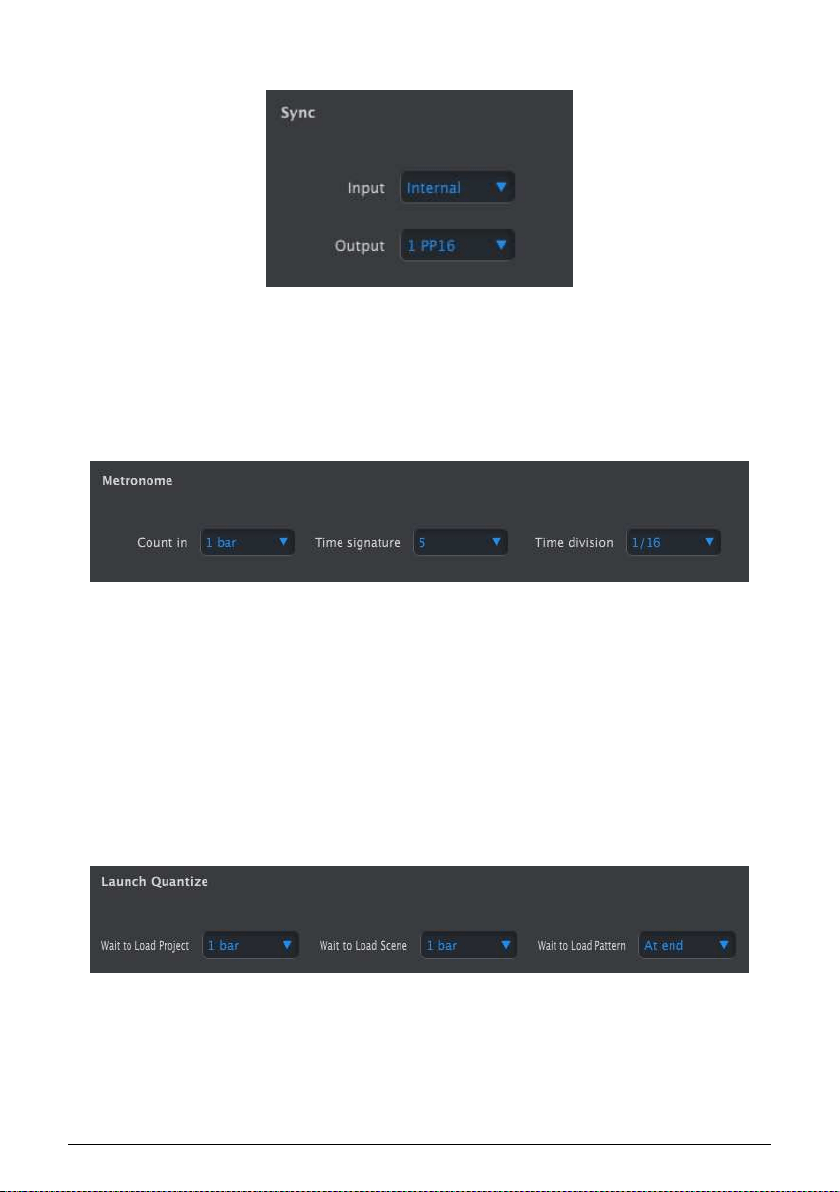
9.5.2. Sync
These settings allow you to specify the inputs for receiving synchronization and tempo
signals, as well as the input and output clock rates. By changing these settings, you
determine which type of clocking signal will be transmitted via the output connectors and
which type will be recognized by the sync/clock inputs.
9.5.3. Metronome
To activate the Metronome, hold down 'Shift' and press Tap Tempo/Metronome. The default
time signature is 4/4. To set the time signature to - for example - 5/8, set Time Division to 8
and Time Signature to 5.
The options in this menu enable you to change the default Metronome settings:
• Count in: set count-in length (off, 1 bar (d), 2 bars)
• Time-division (1/4 note (d), 1/4 note triplet, 1/8 note, 1/8 note triplet, 1/16 note, 1/16
note triplet, 1/32 note, 1/32 note triplet)
• Time Signature (1-16), default= 4
9.5.4. Launch Quantize
In this menu, you 'tell' the KeyStep Pro how it should continue to the next Pattern, Chain
or Scene. Should it wait for 1 bar, 2 bars or 4 bar to make the switch? This is useful in live
performance settings where you may not want to interrupt the flow of the music between
Projects.
If the Sequencer and Drum Patterns are of unequal length, the KeyStep Pro will wait until
the end of the Drum Pattern before loading the next Project Scene or Pattern.
Arturia - User Manual Keystep Pro - KeyStep Pro Configuration 161

9.5.5. MIDI Settings
9.5.5.1. Knob Acceleration
There are three response curves for the encoders:
• Slow (Off): The encoders transmit every value. It takes many turns of an encoder
to move from minimum to maximum. Use this when greater precision is desired.
• Medium: When turned quickly, the encoders will skip a few values. It takes a few
turns of an encoder to move from minimum to maximum.
• Fast: When turned quickly, the encoders will skip a few more values. It may
take as few as one-and-a-half turns of an encoder to move from minimum to
maximum.
9.5.5.2. Aftertouch Curve
Linear, Exponential and Logarithmic describe the mathematical shape of the pressure-
voltage curve that determines the amplitude of the voltage transmitted while you exert
pressure on a key you are holding at the bottom of its vertical travel.
In Linear mode, the voltage is directly proportional to the pressure. In Exponential mode,
the voltage initially increases rapidly as the pressure increases, but the
rate
of increase
gradually decreases as the pressure increases further. In Logarithmic mode, the converse is
true: the voltage initially increases slowly as the pressure increases, but the
rate
of increase
accelerates as the pressure increases further.
9.5.5.3. Velocity Curve
By changing the velocity-voltage curve, you determine the way a sound characteristic such
as volume, tone or timbre responds to the speed or force with which you press a key. See
'Aftertouch Curve' above for the characteristics of each curve.
9.5.5.4. Transport Send
This setting allows you to set whether and how the KeyStep Pro will transmit transport
commands such as Stop, Rec and Play. It can either be OFF, MCC (meaning that the KeyStep
Pro will use the setting currently stored in the MIDI Control Center) or use the current
realtime setting.
9.5.5.5. Transport Receive
This setting allows you to set whether and how the KeyStep Pro will respond to transport
commands it receives over MIDI. It can either be OFF, MCC (meaning that the KeyStep Pro
will use the setting currently stored in the MIDI Control Center) or use the current realtime
setting.
162 Arturia - User Manual Keystep Pro - KeyStep Pro Configuration
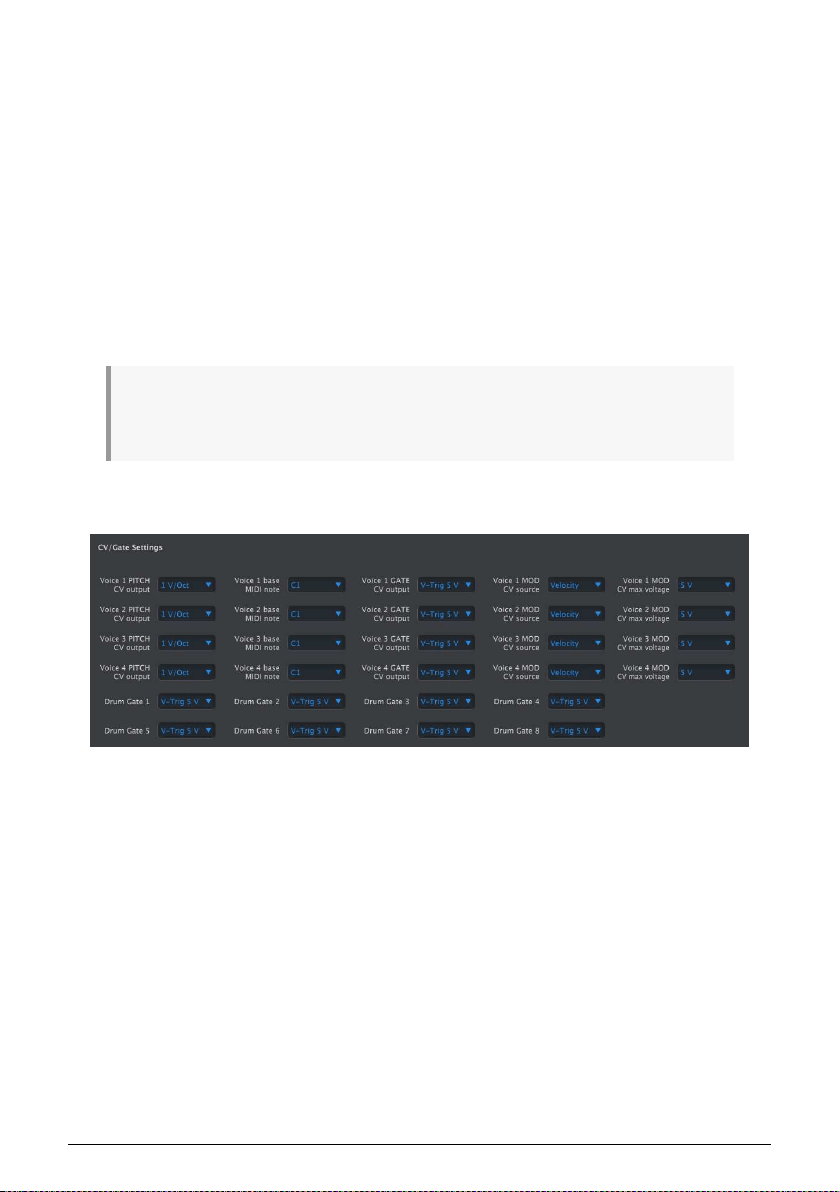
9.5.5.6. Clock Send
Set whether the KeyStep Pro will transmit clock signals to external MIDI devices.
9.5.5.7. Clock Receive
Set whether the KeyStep Pro will receive clock signals from external MIDI devices.
9.5.5.8. MIDI Out 2
This menu enables you to change the function of the second MIDI out port: maybe you
would rather have a MIDI thru port instead of a second MIDI port. To change the function of
the second port, change the MIDI out setting from Out to Thru.
♪: MIDI Thru does not provide complex routing MIDI functions: it's a simple Thru allowing MIDI data
arriving via the MIDI in port or the USB port to pass unaltered. It is however useful when your KeyStep
Pro is part of a daisy chain setup.
9.5.6. CV Gate Settings
This is where you select the electrical behaviour for each sequencer.
Arturia - User Manual Keystep Pro - KeyStep Pro Configuration 163

9.5.7. Controller
These parameters enable you to set up the KeyStep Pro as a controller.
'Global MIDI channel' sets the default MIDI channel on which the KeyStep Pro will transmit.
The Knob (encoder) settings define the functions of the five main encoders. Each encoder
can have a different profile. For example, Encoder 1 (Pitch) could transmit CC 9 on MIDI
channel 5 via MIDI Out 2 over the full range of 0-127, while Encoder 2 (Gate) could transmit
CC 19 on MIDI channel 6 via MIDI Out 1 with the range set to a minimum of 50 and a
maximum of 80.
164 Arturia - User Manual Keystep Pro - KeyStep Pro Configuration
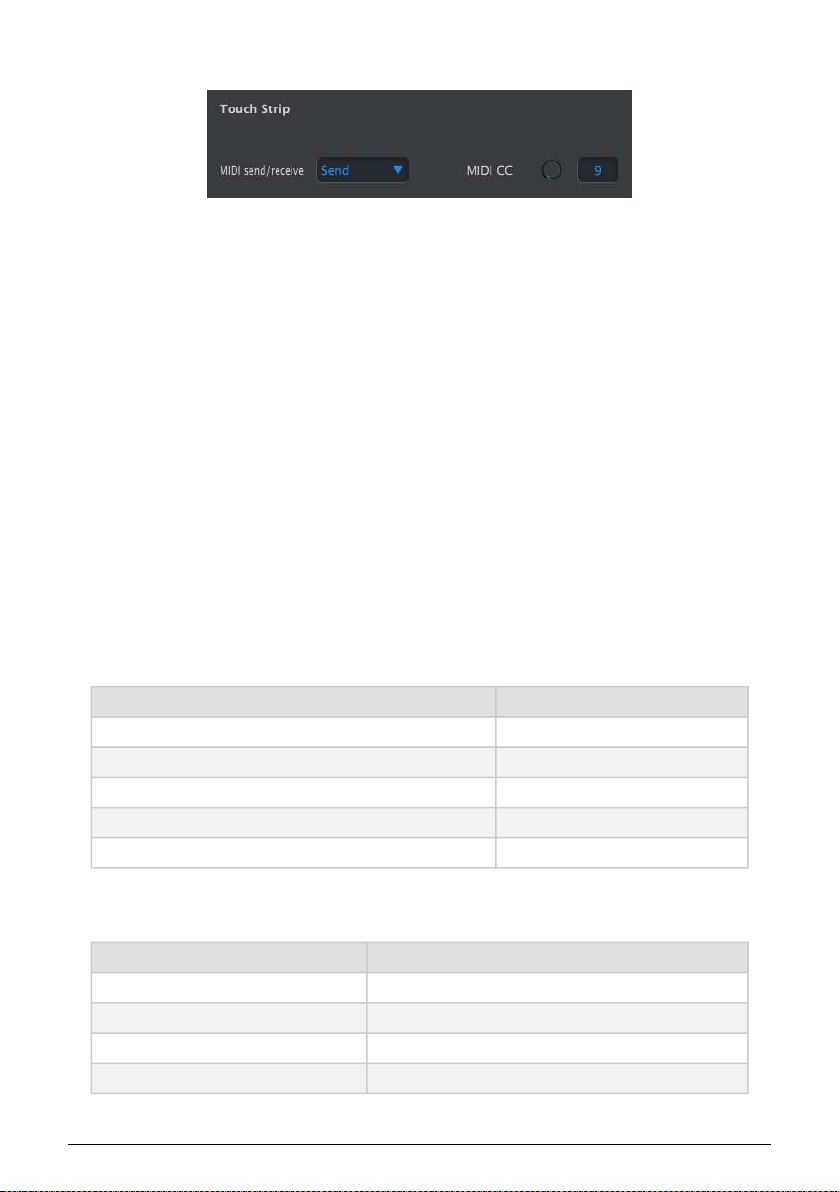
9.5.8. Touch Strip
This menu item enables you to set the values the Looper will transmit when touched.
9.5.8.1. MIDI Send/Receive
Use this menu to specify whether the KeyStep Pro's Looper Touch Strip will send MIDI
and react to incoming MIDI messages. The range of transmitted and recognized values is
detailed below in
Using the Looper Touch Strip with a DAW [p.165].
9.5.8.2. MIDI CC
Use the value field to select the MIDI CC number that the Touch Strip/Looper will use to
transmit and receive.
9.5.8.3. Using the Touch Strip with a DAW
When the MIDI Send/Receive parameter is enabled, activity on the Looper Strip can be
recorded into a DAW. By default, MIDI CC 9 values will be sent, but you can select a different
MIDI CC# as described above.
The Looper Touch Strip will send only the following values:
Looper Touch Strip Region MIDI CC value
1/4 25
1/8 50
1/16 75
1/32 100
release value 0
However, if you draw a controller curve for the Looper Touch Strip in your DAW, the KeyStep
Pro will respond to the values in the following way:
MIDI CC value received Looper Touch Strip region selected
1-25 1/4
26-50 1/8
51-75 1/16
76-100 1/32
Arturia - User Manual Keystep Pro - KeyStep Pro Configuration 165
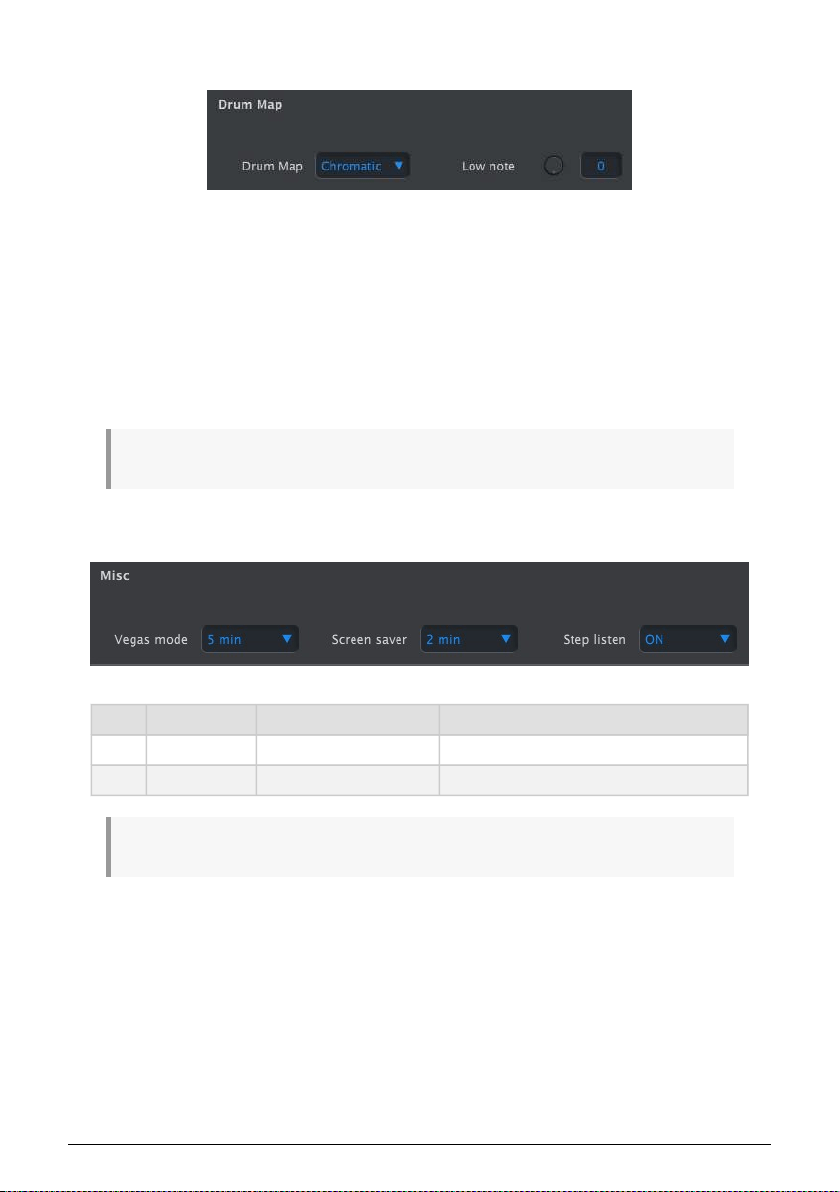
9.5.9. Drum Map
There are four options for the MIDI note assignments of the keys in Drum mode:
In the Mode menu, you can select whether you want to map your Drum Track keys in the
standard chromatic way or to create a custom mapping.
Config>Chromatic enables you to set the Chromatic Low note: which note the lowest key will
trigger when Track 1 is in Drum mode. All keys above that lowest key will be mapped relative
to this note.
Config>Custom Notes: Enables you to link the 24 Drum keys on the keyboard to a MIDI note
number in the range 0 to 127. The default mapping starts at MIDI note 36.
♪: MIDI notes that are already used by another note are not displayed when navigating the list.
9.5.10. Misc
Misc Values Description
Vegas Mode [5min (d), 10min, never] Sets the start time of the VEGAS LED pattern.
Screen Saver [2min (d), 10min, 30min] Sets the start time for the screen saver.
♪: There's a shortcut that enables you to quickly reset the KeyStep Pro to the factory default settings:
• Switch the KeyStep Pro off
• Switch the KeyStep Pro on while holding the OCT+ and OCT- buttons.
166 Arturia - User Manual Keystep Pro - KeyStep Pro Configuration
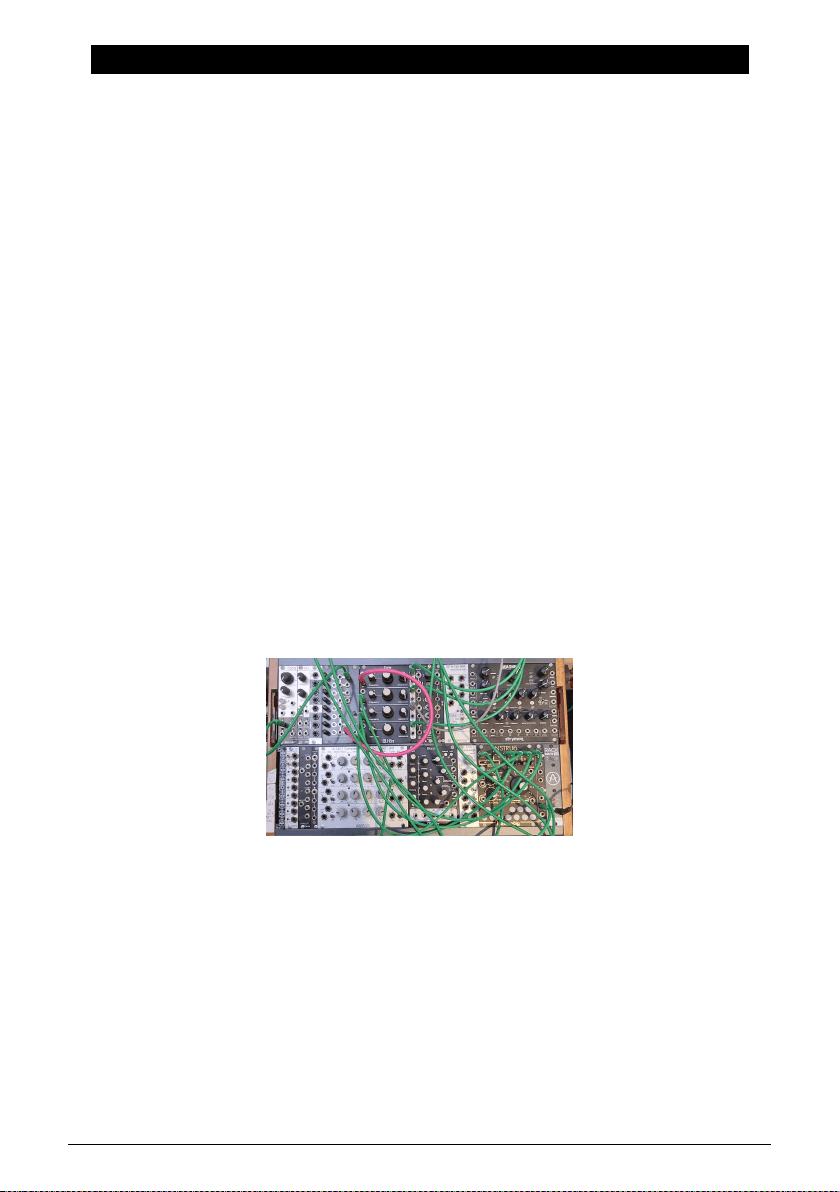
10. KEYSTEP PRO AND YOUR MODULAR SYSTEM
In 1996 Dieter Doepfer created a case based on the 19-inch rack format that was (and still is)
a common format to house effects units and other studio gear. He also set the standard for
the power supply and the bus boards into which you plug your modules. It was to become
the standard of what we now know as Eurorack.
After a slow start, his Eurorack format quickly gained momentum: the modules were
relatively inexpensive and very compact. In the following years, the number of available
modules grew exponentially. This phenomenal growth is easy to understand: as a musician
and/or sound designer you can now create your own customised – and endlessly
customisable – modular instrument.
Modular systems have gained tremendous popularity in recent years. It's easy to
understand why: they give you a very direct hands-on experience of sculpting sound.
Literally hands-on, because you need to make real connections using patch cables and
tweak real knobs. By doing this physically, somehow the connection you have with the
sound that emerges and unfolds is more immediate. It enables you to create a unique
individual sound. Whether your music style is EDM or complex ambient music, you'll find
plenty of suitable and fascinating Eurorack modules.
The KeyStep Pro is an amazing Eurorack controller because of its rich four-track sequencer
and arpeggio architecture, its four analog Voice outputs, its eight Drum Gate outputs and
its sync/clock connections. The analog Voice and Drum Gate output signal levels perfectly
match your Eurorack gear. Furthermore, because the Voice outputs can be configured in
various ways, you can create highly complex and original signal paths and craft music that
no one has ever heard before!
Due to its compact size, the KeyStep Pro is also an ideal controller companion for your
RackBrute when you are travelling and/or performing. The Pitch, Velocity and Gate signals
of all the internal sequencers and arpeggiators, as well as the Drum Track, are available for
controlling your Eurorack modules. The eight Drum Gates can be connected to one of the
many available Eurorack drum modules, or you can use the Drum Gate signals to trigger
various combinations of melodic, harmonic and/or noise synthesis modules.
Another interesting use of the KeyStep Pro is as the master clock of your Eurorack modular
or RackBrute system. To make this possible, the KeyStep Pro has a Clock Output. A smart
solution is to connect the KeyStep Pro's Clock Out to a clock divider, which will divide the
tempo in half or smaller fractions. You can then use these timing signals to start events on
each beat, every other beat or each bar, for example.
The Clock Input allows you to slave the KeyStep Pro to a clock module in your Eurorack
modular or RackBrute system. It will accept Start/Stop/Continue message from Eurorack
sequencers. The Launch Quantize option in the Utility menu allows you to synchronise the
starting of sequencer Patterns, Scenes and Projects.
Over the past decade, Arturia has spearheaded the revival of the analog synthesizer
with some very advanced products: the MicroBrute, the MiniBrute, the DrumBrute and the
magnificent flagship mono synth, the MatrixBrute.
Arturia - User Manual Keystep Pro - KeyStep Pro and your Modular system 167

With each new product generation, Arturia has added interface options that made it easier
to connect its range of hardware products to a Eurorack modular system. In recent years,
the BeatStep Pro has become the controller of choice for many musicians in the modular
world because of it rich feature set, including Pitch, Velocity and Gate outputs that you can
use to control external oscillators. In addition, it has eight Drum Gate outputs that you can
use to trigger Eurorack drum modules.
In many areas, though, the KeyStep Pro is more advanced than the Beatstep Pro, so we at
Arturia hope that the KeyStep Pro will become the controller of choice for keyboard-oriented
musicians and composers.
The RackBrute connects to the MiniBrute 2 and MiniBrute 2S but can also be used as a
standalone unit. As such, you can use it with all Arturia controllers – including the KeyStep
Pro – that feature Pitch, Velocity and Gate outputs.
10.1. The Modular Adventure
As soon as you start filling your Eurorack case with modules, you'll be faced with an endless
stream of questions: What kind of modules do I really need? Why are certain modules so
popular? Do I go for a standard setup with analog oscillators, or is it better to go digital? Do
I prefer West Coast or East Coast synthesis or a combination of those two types?
The answers to these questions come slowly but surely: by reading online forums,
comparing user experiences and most importantly, by diving in and experimenting. And if
you're not happy with the choices you make, there's a thriving second-hand market for used
Eurorack modules, where you can sell your modules if they don't deliver what you expect
and buy others that interest you.
Whatever you do, take the time to get to know the modules you currently own inside out.
This will help you to avoid a situation where you sit in front of your system tweaking knobs
randomly, without understanding what's happening but hoping that something magical will
happen. This is a guaranteed recipe for rapidly losing interest.
To sustain the fascination you feel, learn the functions of a module one by one and test your
knowledge continuously. It's the only way to experience the reward that comes with being
able to create the sounds as you imagine them in your musical mind.
10.2. Hardware or Software?
Eurorack gear can be pretty expensive, and it's tempting to spend loads of money on gear
you may rarely use. No wonder some people refer to Eurorack as "Eurocrack"! Fortunately,
there's a low-cost virtual alternative to Eurorack hardware: VCV Rack (
https://vcvrack.com),
which is a free software. It enables you to experiment with a wide variety of modules.
Many Eurorack hardware modules also exist in the form of a VCV Rack module (known as
a 'plugin' in VCV Rack terminology). As you get deeper into VCV Rack, you'll discover that
there's an ever-increasing range of new modules/plugins, and that many of them are free,
whereas others have to be purchased (though their prices are far lower than equivalent
Eurorack hardware modules). In the examples below, we'll use VCV Rack modules as an
alternative to hardware.
168 Arturia - User Manual Keystep Pro - KeyStep Pro and your Modular system
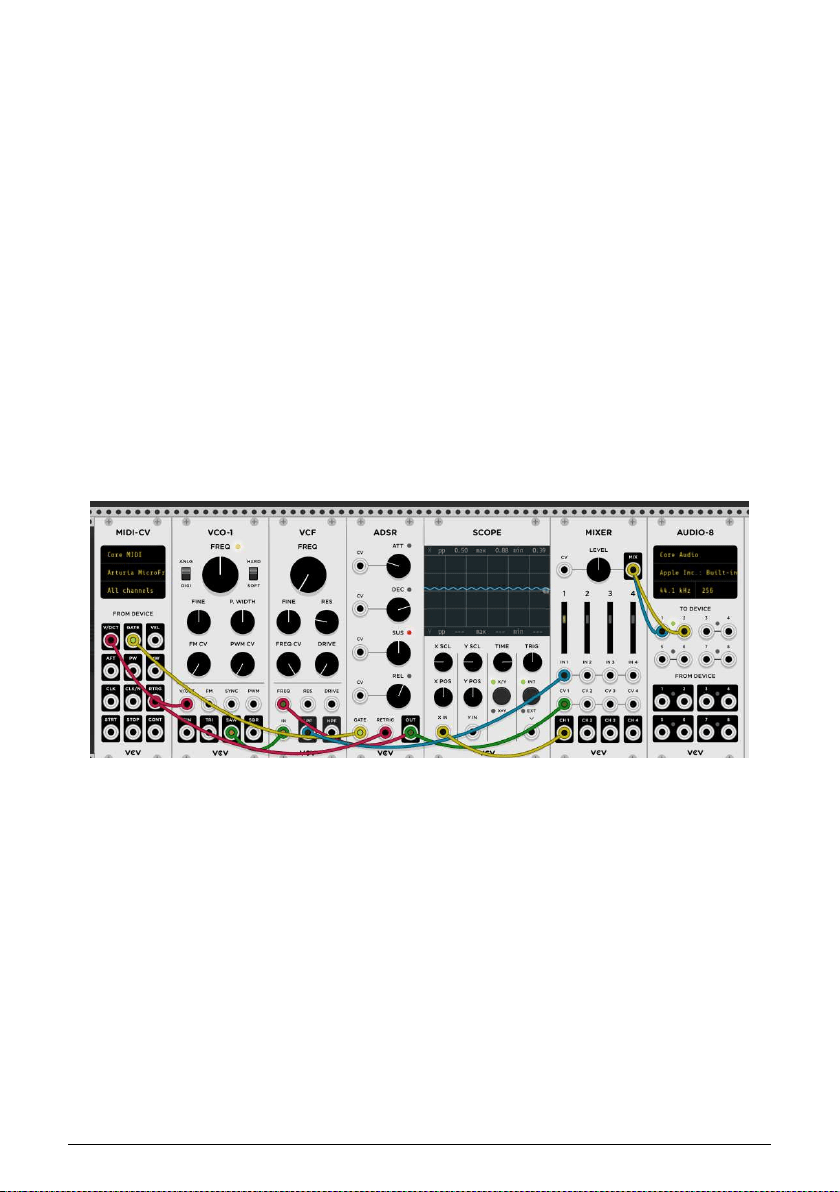
10.3. Using MIDI to Control Modules in VCV Rack
In the example below, we'll use a KeyStep Pro arpeggiator to control an oscillator in VCV
Rack, a free virtual modular system that you can download from
https://vcvrack.com and
install on your computer.
• Connect the USB output on your KeyStep Pro to a USB port on your computer
• Open VCV Rack. The first time the program launches, it opens a simple demo
patch, which is perfect for our example
• In the first position (top left), you'll see a MIDI-CV module. We'll use this module
to get MIDI Note Numbers from the KeyStep Pro, and we'll use them to control
the pitch of a VCV Rack voltage-controlled oscillator (VCO). We'll use the
corresponding Velocity values to control the ADSR envelope generator module
• In the upper menu of the MIDI-CV module, select "Computer keyboard" and
change the value to "Core MIDI" or "Windows MIDI", as appropriate). Then, in the
middle menu, Click on "(No device)" and change it to "Arturia KeyStep Pro". We've
now set up the MIDI-CV module to receive pitch and velocity values from the
KeyStep Pro
• Now, in the middle menu of the Audio-8 output module, click on "(No device)" and
change it to the computer audio output (i.e. internal soundcard or external audio
interface).
Now, when pressing a key on the KeyStep Pro you should hear sound from VCV Rack
through your speakers or headphones. Congratulations! You can now use the KeyStep
Pro keyboard, the arpeggiators and the sequencers to control oscillator(s) and envelope
generator(s) in VCV Rack.
Arturia - User Manual Keystep Pro - KeyStep Pro and your Modular system 169

10.3.1. KeyStep Control Mode and VCV Rack
As we've seen previously in
Chapter 8 [p.137], MIDI CC# (control change) messages can
be used to control/modulate parameters of external synths and modular systems. These
MIDI CC# messages differ from note-related MIDI messages (for example, Note ON and
Note OFF). CC# messages are specifically designed to control/modulate parameters on an
external MIDI device such as a hardware synth, a hardware modular system, a software
virtual instrument loaded in a DAW, or a software modular system such as VCV Rack.
Sending CC# messages from the KeyStep Pro
To send CC# messages to external devices, the KeyStep Pro has to be in Control mode.
The moment you press the Control button, the five main encoders take on a different role:
they transmit CC# messages over MIDI (via USB, MIDI Out 1 and/or MIDI Out 2).
170 Arturia - User Manual Keystep Pro - KeyStep Pro and your Modular system

Here's an overview of the KeyStep Pro's default MIDI CC#'s:
Encoder/Strip Parameter CC#
Pitch 74
Gate 75
Velocity 76
Time Shift 77
Randomness 78
Pitch Bend 0
Modulation 1
Looper Touch Strip 9
In this example, we'll configure the KeyStep Pro's encoders to control the ASDR envelope
generator in the VCV Rack demo patch. This procedure assumes that you already have the
KeyStep Pro and VCV Rack connected as at the end of the previous example.
Our goal now is to get the KeyStep Pro to control the ADSR envelope generator in VCV Rack.
• In VCV Rack, right-click anywhere in the empty space in the rack. The 'Module
Select' window will open. Type "MIDI" in the grey search box at the top left and
select the MIDI-CC module. This module gets added to the patch
• In the MIDI-CC module, click in the middle menu on "(no device)" and select
"Arturia KeyStep Pro"
• You now have a 4x4 table of 16 CC#'s (numbered from 0 to 15) – the
connection
field
– available to assign parameters from the KeyStep Pro to parameters of
VCV Rack modules. Below the connection field, you'll see 16 patch points (outputs)
that relate to the entries in the connection field
• Click on the "0", the first entry in the connection field, and the zero will turn into
two faint dashes
• Move the Pitch encoder on the KeyStep Pro, and the MIDI-CC module will now
display "74" as the first entry of the connection field. This is the default CC#
(Control Change number) of the Pitch encoder
• Repeat this to make the Gate encoder (CC 75) the second entry of the connection
field, the Velocity encoder (CC 76) the third entry, and the Time Shift encoder (CC
77) as the fourth entry.
Now connect by click and drag:
• The first patch point on the MIDI-CC module to the CV input of the Attack (ATT)
of the ADSR,
• The second patch point to the CV input of the Decay (DEC) of the ADSR,
• The third patch point to the CV input of the Sustain (SUS) of the ADSR, and
• The fourth patch point to the CV input of the Release (REL) of the ADSR.
That's it: you have successfully assigned four encoders to the ADSR module of VCV Rack!
From now on, whatever encoder changes you make on the KeyStep Pro will be mirrored
in VCV Rack. To hear the effect, on the KeyStep Pro press the Arp button, play a chord and
tweak the main encoders at will.
You may have guessed by now that the MIDI-CC module of VCV Rack is a very useful tool
for figuring out which CC# messages are currently being sent by the encoders. Just click on
one of the 16 entries in the connection field and then move an encoder on the KeyStep Pro.
Its CC# (Control Change number) will be displayed by the MIDI-CC module.
Arturia - User Manual Keystep Pro - KeyStep Pro and your Modular system 171

The CC#'s in the table above are default values. If, for any reason, you need the encoders to
transmit other CC#'s because you want to control parameters of a synth or module that will
only respond to certain CC#'s, go, for example, to Utility>Controller>Knob1>CC to change the
CC# that Encoder 1 (Pitch) transmits. Of course, the same applies to the other encoders.
♪: These CC#'s can also be changed in the MIDI Control Center.
Sending CC#'s works both ways: you can use the MIDI output of VCV Rack, a sequencer or
any specific module in your modular system to control parameters on your KeyStep Pro. To
control the KeyStep Pro from your modular system, you need a module such as the Befaco
VCMC to translate the analog Control Voltage (CV) signals of your modular system into MIDI
CC# format.
♪: As with Note and Velocity values, the CC# messages lie in the range 0-127
10.4. CV/Gate Functions
KeyStep Pro is equipped with some of the best connective technology that the music
hardware business has produced in the last six decades: CV/Gate connectors, Clock, MIDI
and USB are all present on its compact rear panel.
Connection diagrams for each of these interfaces are available in
Making the Connections
[p.21].
In this chapter, we'll focus on the features of the KeyStep Pro CV/Gate circuitry. Refer to the
MIDI Control Center [p.155] chapter for in-depth coverage of the MIDI features available.
10.5. Voices 1-4: Pitch, Velocity and Gate
When one of the four sequencers is selected, the notes you play on the keyboard are
translated immediately into Control Voltage (CV) and Gate signals and sent to the four Voice
output connectors on the back panel. Three independent control voltages are sent for each
note: Pitch, Velocity/Aftertouch and Gate open/close.
Of course, the sequencers also record what you play, so then you can use the main
encoders to edit the pitch, velocity and gate time (duration) of each note. When sequences
are played back, they send these signals to any attached devices through the CV/Gate
connectors.
The Velo/Mod Gate can be used in a number of ways. It can output velocity, pressure or the
voltage generated by the Modulation wheel.
Here is an example of how you can use pressure output to control modules in your Eurorack
system: by default, the Velo/Mod output of each track is set to velocity. To change it to
output pressure, hold 'Shift' and press Utility. Next, go to the CV settings menu and select the
voice for which you want the change the Vel/Mod setting. Scroll down to 'Mod type' and set
it to 'Pressure'. You can now use pressure to control filter frequencies/oscillator pitches or
anything else that is voltage controlled. You can set this separately for each channel.
172 Arturia - User Manual Keystep Pro - KeyStep Pro and your Modular system

10.6. Routing Signals
For each Track, you can decide to which Voice output(s) its CV/Gate signals will be routed.
By default, Track 1 will use Voice 1, Track 2 Voice 2, Track 3 Voice 3 and Track 4 Voice 4.
Hold down 'Shift' and press one or a combination of the CV Routing keys (G#, A, A#, B in the
upper octave). This will route the current Track to those Voices. You can repeat this action for
the other three Tracks. Switching to a Track will activate the Voice outputs you've assigned
to it.
CAUTION: When you try to assign a Voice to a Track and it is already assigned to another Track, the
new routing will overwrite the existing one.
While routing CV signals, watching the LEDs can be helpful. Voices already assigned to
the current Track will be indicated with brightly lit LEDs. To cancel that assignment, hit the
corresponding key. The LEDs of Voices assigned to other Tracks will be dimly lit.
10.6.1. Voice Allocation
What happens if you send two almost simultaneous notes to a Voice output when the
voltage-controlled oscillator (VCO) connected to it is monophonic, meaning that it can only
sound one note at a time? Unlike male humans who tend to get confused when having to
do two things simultaneously, the Voice output circuitry knows exactly what to do: the
last
note you played will have priority. Every new note you play will 'kill' the previous one. If you
play two notes almost simultaneously, the note of the last key you press will be heard. Even
if you play more than two keys, it's always the last key you'll hear.
How does this work when you're playing a sequence (Pattern) and have more than one note
stored in a step? The Voice output will solve this be playing only the
lowest
note of the chord
stored in the step.
The KeyStep Pro has another trick up its sleeve: let's say you have a sequence (Pattern)
playing in Track 1 with a 4-note chord in each step and you assign the output of Track 1 to
Voices 1 to 4. What will happen? The KeyStep Pro will silently applaud your brilliant idea
while calmly distributing the notes in your step over the four Voice outputs!
If you have more than four notes in a step, the KeyStep Pro will 'steal' voices to solve that
problem; with five notes in a chord, the lowest note of the chord will be dropped, sacrificed
to play the fifth note. With six notes in a chord, the lowest two will be dropped ... you get the
idea.
Typically, the Pitch (CV) output is connected to a voltage-controlled oscillator (VCO), the Gate
output is connected to some trigger input or the gate input of a voltage-controlled amplifier
(VCA), and the Velocity output is connected to a CV input of a VCA or a voltage-controlled
filter (VCF) or both (through a patch bay or a CV splitter). These typical routings will produce
the most predictable results, but you can creatively route these signals to any parameter
that will accept them.
10.6.2. Shift Magic
All of the keyboard Shift functions will work their magic on the CV outputs: for example, <
Nudge and Nudge > will nudge your sequence Pattern to the left or the right; Semi Down and
Semi Up will transpose your sequence Pattern within the current scale.
The keyboard Shift functions will also work on the CV outputs! You can change Seq Pattern
direction, change the Time Division, Scale and Root Note and set a custom User 1 or User 2
scale.
Arturia - User Manual Keystep Pro - KeyStep Pro and your Modular system 173

10.6.3. CV Routing
For the modular environment, the last four Shift functions – CV Routing – are the most
important ones. They enable you to set up the routing of the CV signals to the Voice outputs.
By default, the output of Track 1 will be sent to Voice 1, the output of Track 2 to Voice 2, etc.
To define CV routings, hold down 'Shift' and press one of the CV Routing keys (1-4). You can
send the output of a track to one or more Voices. If you want to send the output of Track 1
to Voices 1 and 2, hold down 'Shift' and press CV Routing keys 1 and 2. In a similar way, you
can deactivate an active routing by pressing the routing keys once more. This will free up
this routing for another track. The active CV Voices will be shown by the LED colours of the
tracks they are assigned to.
The Voices assigned to the currently selected Track will be brightly lit. Those of other tracks
will be dimly lit. If you select a CV Voice that is used by another track, it will remove its
assignment from the previous track.
10.6.4. CV/Gate Signals: DAW Configuration
The KeyStep Pro can be used as a MIDI to CV converter. Send note-related data from the
MIDI tracks of your DAW to the KeyStep Pro via USB or MIDI In. If the MIDI channels match
(that is, if they are set to 1, 2, 3 or 4), the MIDI data will appear in analog form as control
voltages at the CV/Gate outputs of Voices 1 to 4.
There are two things to keep in mind when you try this:
• All CV/Gate jacks are monophonic, so if the selected MIDI track on the DAW
contains polyphonic data, playback could be extremely unpredictable. It's best to
send only one note at a time.
• CV/Gate jacks can send only basic CV signals: Pitch, Velocity/Aftertouch and
Gate open/closed (equivalent to MIDI Note ON/OFF). The KeyStep Pro encoders
aren't able to control synthesizer parameters through the CV/Gate output jacks.
You can, however, control external synths with MIDI over USB or via MIDI Out
1 and/or Out 2. The encoders send CC# messages as you turn them. What is
more, in Control mode every sequencer can send the CC# messages stored in its
tracks.
174 Arturia - User Manual Keystep Pro - KeyStep Pro and your Modular system

10.6.5. CV/Gate Specifications
Some analog synthesizers have unusual implementations that are not fully compatible with
the KeyStep Pro CV/Gate signals. Please refer to their manufacturer's specifications before
making a purchase so that you can be sure the two devices will work together well.
We've designed the KeyStep Pro to be as flexible as possible: the
MIDI Control Center [p.155]
allows you to configure the CV/Gate Voice output jacks in a number of ways. You can also
change these settings in the Utility menu (Utility>CV>Voice).
These are the electrical signals that can be sent by the KeyStep Pro CV/Gate Voice output
jacks:
• Control Voltage (Pitch) has two options:
◦ 1 Volt/Octave (0-10V) (Standard Eurorack format)
▪ 0 Volt MIDI note range: 0-127 (Volt/octave)
◦ 1. 2 Volt/Octave (0-10V) (Buchla Format)
▪ 0 Volt MIDI note range: 0-127 (Volt/octave)
◦ Hertz per Volt
▪ 1 Volt MIDI note range: 0-127 (Hz/Volt)
• Gate output has two options:
◦ V-trigger (positive or 'voltage'), trigger voltage is between 10 V and 12
V
◦ V-trigger (positive or 'voltage'), trigger voltage is between 4 V and 5 V
◦ S-trigger (negative, or short)
In addition, you can set Modulation Type, Modulation Range and Pitch Bend range. For an
overview of these settings, please refer to
Chapter 9 [p.145]
The MIDI Control Center [p.155] and the Utility menu allow each of these settings to be
configured independently for each of the four voices.
Arturia - User Manual Keystep Pro - KeyStep Pro and your Modular system 175

10.7. Drum Gates
When Drum mode is selected on Track 1, the notes you play on the lowest eight keys of
the keyboard (corresponding to Drum sequencer tracks 1-8) are translated immediately into
Gate signals, which are sent to the eight Drum Gate output connectors on the back panel.
Two voltages are sent for each note: one for Gate open and one for Gate close. Of course,
velocity/aftertouch signals are not sent to the Drum Gate outputs.
The Drum sequencer can record what you play on the lower two octaves of the keyboard,
and then you can use the Gate encoder to change the gate time (duration) of each note.
When the sequence plays back, it will send the Gate open/close signals for the lowest eight
notes to attached analog devices through the Drum Gate output jacks.
However, the keys cannot 'play' the Drum Gate outputs while the KeyStep Pro is in Control
mode. In Control mode, however, you can run the sequencers, and they will 'play' connected
external analog devices, but only for the lowest eight notes. At the same time, if you wish,
you can play connected MIDI devices from your DAW.
10.7.1. Which Keys Do I Use?
The lowest eight keys of the keyboard are mapped to the eight Drum channels that
correspond to the Drum Gate numbers on the rear panel. These are the only keys you can
play if you want to send trigger signals to an external device such as an analog drum
machine or an analog synth.
10.7.2. Can my DAW send Drum Gate Signals?
It's possible to send triggers from up to eight MIDI tracks on your DAW indirectly via
the KeyStep Pro's USB or MIDI In to the Drum Gate jacks. There's a MIDI note number
assignment for each Drum Gate, and you can set those values in the Utility menu
(Utility>Drum Map) or using the
MIDI Control Center [p.155].
When the MIDI channels match the note numbers (that is, when they are set to 1-8), the
Drum Gates will be triggered.
♪: As with Note and Velocity values, the CC# messages lie in the range 0-127: The Drum Gate jacks
can send only one type of signal: gate open/close (equivalent to MIDI Note On/OFF). So even though
the Drum pattern holds Velocity/Aftertouch data for all 24 keys that correspond to the 24 Drum tracks,
that data cannot be sent to the Drum Gates. Why not? Because it is digital data, not analog signals.
10.7.3. How Should I Route the Signals?
Typically, a Drum Gate output would be connected to a gate/retrigger input of an ADSR
envelope generator used to modulate the amplitude of a voltage-controlled amplifier (VCA)
and/or the filter cutoff frequency of a voltage-controlled filter (VCF). But you can send those
signals to any inputs that will accept them.
For example, they can be used to trigger a synthesizer such as one from our MiniBrute or
MicroBrute series, or even the magnificent MatrixBrute.
176 Arturia - User Manual Keystep Pro - KeyStep Pro and your Modular system

10.7.4. Drum Gate Specifications
Different drum modules and other analog devices with Gate inputs have different
requirements for the type of analog signal they will recognize.
Fortunately, we've designed the KeyStep Pro Drum Gate outputs to operate as either a V-
trigger or an S-trigger. These settings will work with the vast majority of analog devices you
will encounter on Planet Earth.
♪: Before connecting any device to the KeyStep Pro, please refer to its manufacturer's specifications
to figure out whether and how they will work together properly.
Arturia - User Manual Keystep Pro - KeyStep Pro and your Modular system 177

11. DECLARATION OF CONFORMITY
USA
Important notice: DO NOT MODIFY THE UNIT!
This product, when installed as indicate in the instructions contained in this manual, meets
FCC requirement. Modifications not expressly approved by Arturia may avoid your authority,
granted by the FCC, to use the product.
IMPORTANT:
When connecting this product to accessories and/or another product, use only
high quality shielded cables. Cable (s) supplied with this product MUST be used. Follow all
installation instructions. Failure to follow instructions could void your FFC authorization to
use this product in the USA.
NOTE:
This product has been tested and found to comply with the limit for a Class B
Digital device, pursuant to Part 15 of the FCC rules. These limits are designed to provide
a reasonable protection against harmful interference in a residential environment. This
equipment generate, use and radiate radio frequency energy and, if not installed and used
according to the instructions found in the users manual, may cause interferences harmful
to the operation to other electronic devices. Compliance with FCC regulations does not
guarantee that interferences will not occur in all the installations. If this product is found to
be the source of interferences, witch can be determined by turning the unit “OFF” and “ON”,
please try to eliminate the problem by using one of the following measures:
• Relocate either this product or the device that is affected by the interference.
• Use power outlets that are on different branch (circuit breaker or fuse) circuits or
install AC line filter(s).
• In the case of radio or TV interferences, relocate/ reorient the antenna. If the
antenna lead-in is 300 ohm ribbon lead, change the lead-in to coaxial cable.
• If these corrective measures do not bring any satisfied results, please the local
retailer authorized to distribute this type of product. If you cannot locate the
appropriate retailer, please contact Arturia.
The above statements apply ONLY to those products distributed in the USA.
CANADA
NOTICE:
This class B digital apparatus meets all the requirements of the Canadian
Interference-Causing Equipment Regulation.
AVIS
: Cet appareil numérique de la classe B respecte toutes les exigences du Règlement sur
le matériel brouilleur du Canada.
EUROPE
This product complies with the requirements of European Directive 89/336/EEC
This product may not work correctly by the influence of electro-static discharge; if it
happens, simply restart the product.
178 Arturia - User Manual Keystep Pro - Declaration of Conformity

12. SOFTWARE LICENSE AGREEMENT
In consideration of payment of the Licensee fee, which is a portion of the price you paid,
Arturia, as Licensor, grants to you (hereinafter termed “Licensee”) a nonexclusive right to
use this copy of the SOFTWARE.
All intellectual property rights in the software belong to Arturia SA (hereinafter: “Arturia”).
Arturia permits you only to copy, download, install and use the software in accordance with
the terms and conditions of this Agreement.
The product contains product activation for protection against unlawful copying. The OEM
software can be used only following registration.
Internet access is required for the activation process. The terms and conditions for use of the
software by you, the end-user, appear below. By installing the software on your computer
you agree to these terms and conditions. Please read the following text carefully in its
entirety. If you do not approve these terms and conditions, you must not install this software.
In this event give the product back to where you have purchased it (including all written
material, the complete undamaged packing as well as the enclosed hardware) immediately
but at the latest within 30 days in return for a refund of the purchase price.
1. Software Ownership Arturia shall retain full and complete title to the SOFTWARE recorded
on the enclosed disks and all subsequent copies of the SOFTWARE, regardless of the media
or form on or in which the original disks or copies may exist. The License is not a sale of the
original SOFTWARE.
2. Grant of License Arturia grants you a non-exclusive license for the use of the software
according to the terms and conditions of this Agreement. You may not lease, loan or sub-
license the software. The use of the software within a network is illegal where there is the
possibility of a contemporaneous multiple use of the program.
You are entitled to prepare a backup copy of the software which will not be used for
purposes other than storage purposes.
You shall have no further right or interest to use the software other than the limited rights as
specified in this Agreement. Arturia reserves all rights not expressly granted.
3. Activation of the Software Arturia may use a compulsory activation of the software and
a compulsory registration of the OEM software for license control to protect the software
against unlawful copying. If you do not accept the terms and conditions of this Agreement,
the software will not work.
In such a case the product including the software may only be returned within 30 days
following acquisition of the product. Upon return a claim according to § 11 shall not apply.
4. Support, Upgrades and Updates after Product Registration You can only receive support,
upgrades and updates following the personal product registration. Support is provided only
for the current version and for the previous version during one year after publication of the
new version. Arturia can modify and partly or completely adjust the nature of the support
(hotline, forum on the website etc.), upgrades and updates at any time.
The product registration is possible during the activation process or at any time later through
the Internet. In such a process you are asked to agree to the storage and use of your
personal data (name, address, contact, email-address, and license data) for the purposes
specified above. Arturia may also forward these data to engaged third parties, in particular
distributors, for support purposes and for the verification of the upgrade or update right.
5. No Unbundling The software usually contains a variety of different files which in its
configuration ensure the complete functionality of the software. The software may be used
as one product only. It is not required that you use or install all components of the software.
You must not arrange components of the software in a new way and develop a modified
version of the software or a new product as a result. The configuration of the software may
not be modified for the purpose of distribution, assignment or resale.
Arturia - User Manual Keystep Pro - Software License Agreement 179

6. Assignment of Rights You may assign all your rights to use the software to another
person subject to the conditions that (a) you assign to this other person (i) this Agreement
and (ii) the software or hardware provided with the software, packed or preinstalled
thereon, including all copies, upgrades, updates, backup copies and previous versions,
which granted a right to an update or upgrade on this software, (b) you do not retain
upgrades, updates, backup copies und previous versions of this software and (c) the
recipient accepts the terms and conditions of this Agreement as well as other regulations
pursuant to which you acquired a valid software license.
A return of the product due to a failure to accept the terms and conditions of this Agreement,
e.g. the product activation, shall not be possible following the assignment of rights.
7. Upgrades and Updates You must have a valid license for the previous or more inferior
version of the software in order to be allowed to use an upgrade or update for the software.
Upon transferring this previous or more inferior version of the software to third parties the
right to use the upgrade or update of the software shall expire.
The acquisition of an upgrade or update does not in itself confer any right to use the
software.
The right of support for the previous or inferior version of the software expires upon the
installation of an upgrade or update.
8. Limited Warranty Arturia warrants that the disks on which the software is furnished is
free from defects in materials and workmanship under normal use for a period of thirty (30)
days from the date of purchase. Your receipt shall be evidence of the date of purchase. Any
implied warranties on the software are limited to thirty (30) days from the date of purchase.
Some states do not allow limitations on duration of an implied warranty, so the above
limitation may not apply to you. All programs and accompanying materials are provided “as
is” without warranty of any kind. The complete risk as to the quality and performance of the
programs is with you. Should the program prove defective, you assume the entire cost of all
necessary servicing, repair or correction.
9. Remedies Arturia's entire liability and your exclusive remedy shall be at Arturia's option
either (a) return of the purchase price or (b) replacement of the disk that does not meet the
Limited Warranty and which is returned to Arturia with a copy of your receipt. This limited
Warranty is void if failure of the software has resulted from accident, abuse, modification,
or misapplication. Any replacement software will be warranted for the remainder of the
original warranty period or thirty (30) days, whichever is longer.
10. No other Warranties The above warranties are in lieu of all other warranties, expressed
or implied, including but not limited to, the implied warranties of merchantability and fitness
for a particular purpose. No oral or written information or advice given by Arturia, its dealers,
distributors, agents or employees shall create a warranty or in any way increase the scope
of this limited warranty.
11. No Liability for Consequential Damages Neither Arturia nor anyone else involved in
the creation, production, or delivery of this product shall be liable for any direct, indirect,
consequential, or incidental damages arising out of the use of, or inability to use this product
(including without limitation, damages for loss of business profits, business interruption, loss
of business information and the like) even if Arturia was previously advised of the possibility
of such damages. Some states do not allow limitations on the length of an implied warranty
or the exclusion or limitation of incidental or consequential damages, so the above limitation
or exclusions may not apply to you. This warranty gives you specific legal rights, and you
may also have other rights which vary from state to state.
180 Arturia - User Manual Keystep Pro - Software License Agreement