15 8686 0100_AC_BEKO_E9AU_EN/ 11-11-22.(10:00)
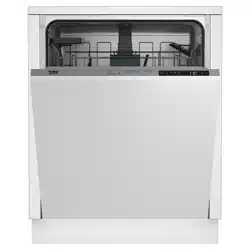
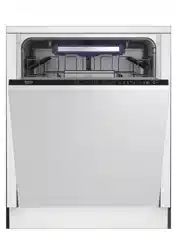
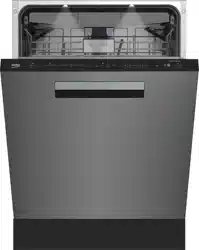
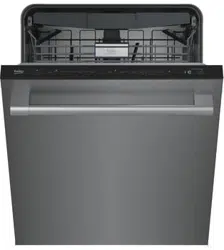
BDI1420

Explanation of symbols
Throughout this User Manual the following symbols are used:
C
Important information or useful
hints about usage.
A
Warning for hazardous situations
with regard to life and property.
B
Warning for electric shock.
Packaging materials of the
product are manufactured
from recyclable materials in
accordance with our National
Environment Regulations.
Do not dispose of the packaging materials together with the domestic or other wastes.
Take them to the packaging material collection points designated by the local authorities.
Please read this user manual first!
Dear Customer,
We hope that you get the best results from your product which has been manufactured
with high quality and state-of-the-art technology. Therefore, please read this entire user
manual and all other accompanying documents carefully before using the product and
keep it as a reference for future use. If you handover the product to someone else, give
the user manual as well. Follow all warnings and information in the user manual.
Remember that this user manual is also applicable for several other models. Differences
between models will be identified in the manual.
This product was manufactured using the latest technology in environmentally friendly conditions.
CONTENTS
1 INSTRUCTIONS FOR SAFETY
AND ENVIRONMENT 4
General safety .......................................4
Intended use ..........................................4
Children’s safety ....................................5
Disposing of packaging material ........5
Transportation of the product ............5
Compliance with WEEE Directive and
Disposing of the Waste Product .........6
Compliance with RoHS Directive ........6
Package information ............................6
2 MODEL BDI1420 7
3 DISHWASHER 8
Overview ................................................8
Technical specications .......................9
Fan drying system .................................9
4 INSTALLATION 10
Appropriate installation location .... 10
Connecting water supply .................. 10
Connection to the drain .....................11
Adjusting the feet ...............................11
Aquasafe+ ...........................................12
Electrical connection ..........................12
Initial use ..............................................12
5 PREPARATION 13
Tips for energy saving ........................13
Detergent .............................................13
Tablet detergents ...............................14
Rinse aid ...............................................14
Items not suitable for washing in the
dishwasher ...........................................15
Placing the dishes into the
dishwasher ...........................................15
Cutlery basket .....................................17
Cutlery basket .....................................17
Collapsible lower basket tines ......... 18
Collapsible lower basket tines ......... 18
Tray Wash Supports ........................... 19
SoftTouch Accessory ......................... 19
Lower Basket Glass Holder ............... 19
Lower basket multipurpose / height
adjustable service rack ..................... 20
Lower basket bottle wire ...................21
Upper basket height adjustable rack 21
Upper basket multipurpose service
rack ........................................................21
Adjusting the height of the upper
basket .................................................. 22
Adjusting the height of the upper
basket .................................................. 23
Upper basket multi-function service
rack ....................................................... 24
Collapsible upper basket wires ........ 25
Height setting with empty basket .. 25
Ceiling cutlery basket ........................ 26
Ceiling cutlery basket ........................ 26
6 OPERATING THE PRODUCT 27
Programme Selection / Programme
Cancel key ............................................ 28
Function Keys ..................................... 28
Preparing the machine...................... 28
Programme selection ........................ 28
Auxiliary functions ............................ 30
Scheduling the washing time ...........31
Starting the programme ....................31
Adjusting the amount of rinse aid ... 32
Cancelling the programme ............... 32
Rinse Aid indicator ( ) ..................... 32
End of programme ............................. 32
Water cut-o warning ....................... 33
Overowing warning ......................... 33
InnerClean ........................................... 33
7 MAINTENANCE AND
CLEANING 34
Cleaning the outer surface of the
product ................................................ 34
Cleaning the interior of the machine 34
Cleaning the lters ............................ 34
Cleaning the hose lter ..................... 35
Cleaning the impellers ...................... 36
Lower impeller .................................... 36
Upper impeller ................................... 36
8 TROUBLESHOOTING 37

4 / /41 EN
instructions for safety and environment
1
This section contains safety
instructions that will help to get
protected from risk of personal
injury or property damage. Failure
to follow these instructions shall
void all warranties.
General safety
•
Never place the product
on a carpet-covered floor;
otherwise, lack of airflow
beneath the product will
cause electrical parts to
overheat. This will cause
problems with your product.
•
Do not operate the product
if the power cable / plug is
damaged! Call the Authorised
Service Agent.
•
Connect the product to a
grounded outlet protected
by a fuse complying with
the values in the “Technical
specifications” table. Do
not neglect to have the
grounding installation made
by a qualified electrician. The
manufacturer shall not be
liable for any damages that
will arise when the product
is used without grounding
in accordance with the local
regulations.
•
The water supply and
draining hoses must be
securely fastened and remain
undamaged.
•
Unplug the product when not
in use.
•
Never wash the product by
spreading or pouring water
onto it! There is the risk of
electric shock!
•
Never touch the plug with
wet hands! Never unplug by
pulling on the cable, always
pull out by grabbing the plug.
•
The product must be
unplugged during installation,
maintenance, cleaning and
repairing procedures.
•
Always have the installation
and repairing procedures
carried out by the Authorised
Service Agent. Manufacturer
shall not be held liable for
damages that may arise from
procedures carried out by
unauthorised persons.
•
Never use chemical solvents
in the product. They bring
forth the risk of explosion.
•
When you pull the upper and
lower baskets out completely,
the door of the product will
bear all the weight of the
baskets. Do not put other
loads on the door; otherwise,
the product may tilt.
•
Never leave the door of
the product open apart
from loading and unloading
procedures.
•
Do not to open the door of
the product when it is running
unless necessary. Be careful
for the rush of hot steam
when you open the door.
Intended use
•
This product has been
designed for domestic use.
•
It must be used to do the
domestic type dishes only.

/
5 / 41
EN
instructions for safety and environment
•
This appliance is intended
to be used in household and
similar applications such as:
- Staff kitchen areas in shops,
offices and other working
environments;
- Farm houses;
- By clients in hotels, motels
and other residential type
environments;
- Bed and breakfast type
environments
•
Only dishwasher safe
detergents, rinse aids and
additives must be used.
•
The manufacturer waives
any responsibility arisen
from incorrect usage or
transportation.
•
This appliance can be used
by children aged from 8 years
and above and persons with
reduced physical,sensory
or mental capabilities or
lack of experience and
knowledge if they have
been given supervision or
instruction concerning use
of the appliance in a safe
way and understand the
hazards involved. Children
shall not play with the
appliance. Cleaning and user
maintenance shall not be
made by children without
supervision.
Chldren’s safety
•
Electrical products are
dangerous for the children.
Keep children away from the
product when it is in use. Do
not let them to tamper with
the product.
•
Do not forget to close the door
of the product when leaving
the room where it is located.
•
Store all detergents and
additives in a safe place away
from the reach of the children.
Dsposng of
packagng materal
Packaging materials are
dangerous to children. Keep
packaging materials in a safe place
away from reach of the children.
Packaging materials of the
product are manufactured from
recyclable materials. Dispose
of them properly and sort in
accordance with recycled waste
instructions. Do not dispose
of them with normal domestic
waste.
Transportaton of the
product
A
If you need to move the
product, do it in upright
position and hold from
the rear side. Slanting
the product onto its
front side may cause the
electronic parts in it get
wet and damaged.

6 / /41 EN
instructions for safety and environment
1. Unplug the product before
transporting it.
2. Remove water drainage and
water supply connections.
3. Drain the remaining water in
the product completely.
Complance wth
WEEE Drectve and
Dsposng of the
Waste Product
This product complies with
EU WEEE Directive
(2012/19/EU). This product
bears a classification symbol
for waste electrical and electronic
equipment (WEEE).This product
has been manufactured with high
quality parts and materials which
can be reused and are suitable for
recycling. Do not dispose of the
waste product with normal
domestic and other wastes at the
end of its service life. Take it to the
collection center for the recycling
of electrical and electronic
equipment. Please consult your
local authorities to learn about
these collection centers.
Complance wth RoHS
Drectve
The product you have purchased
complies with EU RoHS Directive
(2011/65/EU). It does not contain
harmful and prohibited materials
specified in the Directive.
Package nformaton
Packaging materials of the
product are manufactured from
recyclable materials in accordance
with our National Environment
Regulations. Do not dispose
of the packaging materials
together with the domestic or
other wastes. Take them to the
packaging material collection
points designated by the local
authorities.
/
7 / 41
EN
Mandatory Warnings
• The appliance is not intended for use by persons (including children)
with reduced physical, sensory or mental capabilities, or lack of
experience and knowledge, unless they have been given supervised or
instruction concerning use of the appliance by a responsible person for
their safely.
• Young children should be supervised to ensure that they do not play
with the appliance.
• If the supply cord is damaged, it must be replaced by the manufacturer
or its service agent or a similarly qualified person in order to avoid a
hazard.
• Capacity
standard place settings
• Please do not leave the door open as this will cause a tripping hazard
• Water Supply Min 0.03MPa - Max 1.0MPa
• If the appliance is installed on a carpet floor, take care that the openings
in its base are not obstructed
• WARNING - Knives and other utensils with sharps points must be
loaded in the basket with the points down or placed in a horizontal
position.
• WARNING: SOME DISHWASHER DETERGENTS ARE STRONGLY
ALKALINE. THEY CAN BE EXTREMELY DANGEROUS IF SWALLOWED.
AVOID CONTACT WITH SKIN AND EYES AND KEEP CHILDREN AWAY
FROM THE DISHWASHER WHEN THE DOOR IS OPEN.
• This appliance is intended to be used in household and similar
applications such as:
-
Staff kitchen areas in shops, offices and other working environments;
-
Farm houses;
-
By clients in hotels, motels and other residential type environments;
-
Bed and Breakfast type environments
NOTE: If the manufacturer wants to limit the use of the appliance to less than the
above, this must be clearly stated in the instructions.
14
Model BDI1420
8 / /41 EN
Dishwasher2
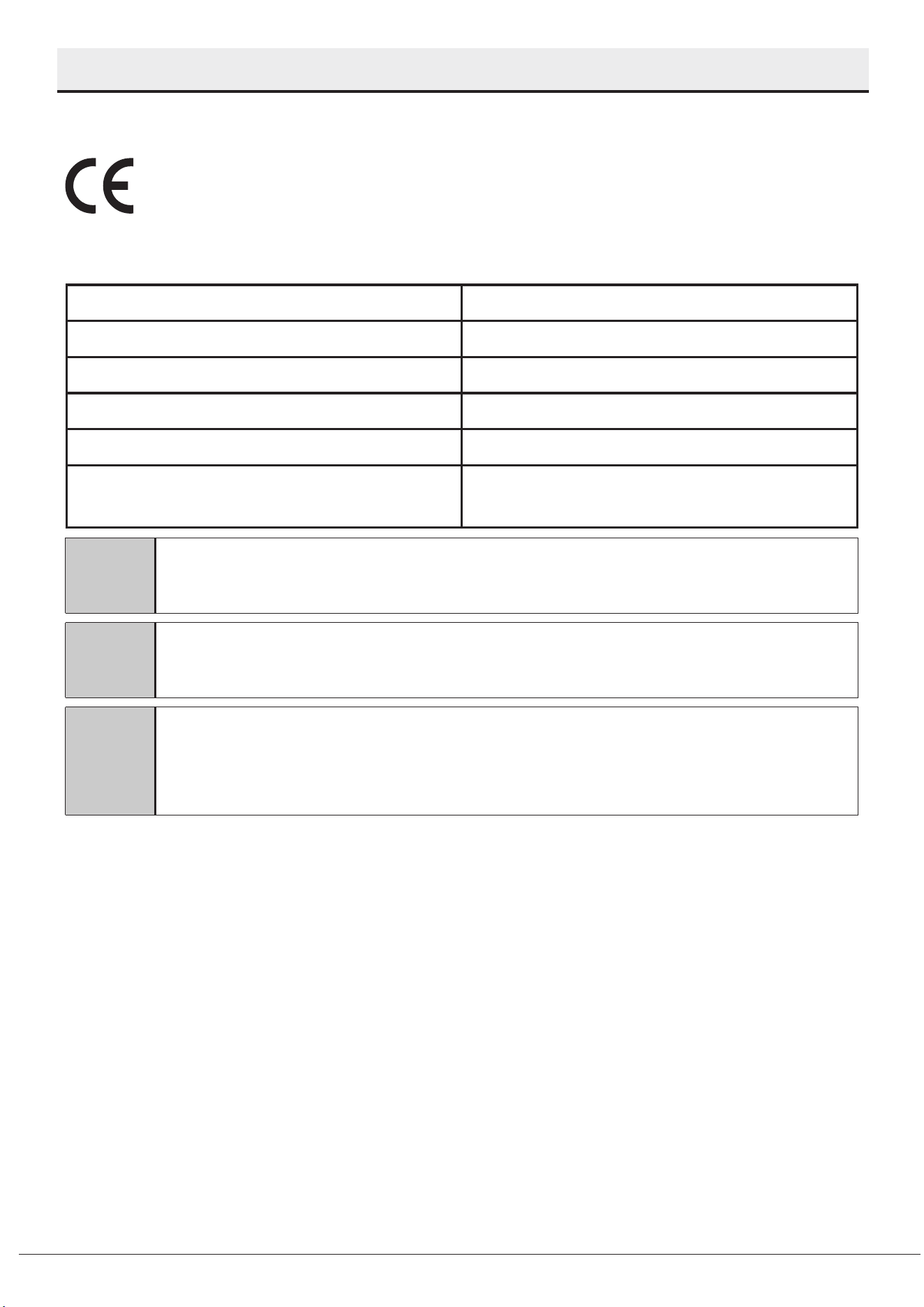
Overvew
1. Upper basket
2. Upper impeller
3. Lower impeller
4. Silverware basket
5. Door
6. Rating Label
7. Control panel
8. Detergent dispenser
9. Lower basket
10. Filters
11. Salt reservoir lid (depends on model)
12. Upper basket rail
13. Upper cutlery basket (depends on model)
14. Tabletop (depends on model)
/
9 / 41
EN
Dishwasher
Techncal specfcatons
Compliance to standards and test data / EC declaration of conformity
This product complies with the following EU directives;
Development, production and sales stages of this product comply with the safety
rules included in all pertaining European Community regulations.
2014/35/EU, 2014/30/EU, 93/68/EC, IEC 60436/DIN 44990, EN 50242
Power input 220-240 V, 50 Hz (see rating label)
Total power consumption 1800-2100 W (see rating label)
Heater power consumption 1800 W (see rating label)
Total current (depends on the model) 10 A (see rating label)
Drain pump power consumption 30 W (see rating label)
Water pressure 0.3 –10 bar (= 3 – 100 N/cm = 0.03-1.0
Mpa)
C
Technical specifications may be changed without prior notice to improve the
quality of the product.
C
Figures in this manual are schematic and may not match the product exactly.
C
Values stated on the markings of the product or in the printed documents
accompanying the product are obtained in the laboratory on basis of the relevant
standards. Depending on operational and environmental conditions of the
product, these values may vary.
Note for test institutions:
Data required for performance tests shall be provided upon request. Requests can be
e-mailed to the following address:
dishwasher@standardloading.com
Do not forget to provide the code, stock and serial numbers of the product to be tested in
your request e-mail along with your contact information. Code, stock and serial numbers of
the product may be found on the type label attached to the side wall of the door.
Fan dryng system
(depends on model)
Fan drying system ensures efficient drying of your dishes.
It is normal to hear a different sound than that of washing cycle during fan operation.
10 / /41 EN
3
Installation
Refer to the nearest Authorised Service
Agent for installation of your product. To
make the product ready for use, make sure
that the electricity, tap water supply and
water drainage systems are appropriate
before calling the Authorised Service Agent.
If they are not, call a qualified technician
and plumber to have any necessary
arrangements carried out.
C
Preparation of the location and
electrical, tap water and waste
water installations at the place
of installation is the customer's
responsibility.
B
Installation and electrical
connections must be carried
out by the Authorised Service
Agent. Manufacturer shall not
be held responsible for damages
arising from processes carried
out by unauthorised persons.
A
Prior to installation, visually
check if the product has any
defects on it. If so, do not have
it installed. Damaged products
cause risks for your safety.
C
Make sure that the water inlet
and discharge hoses are not
folded, pinched or crushed
while pushing the product into
its place after installation or
cleaning procedures.
When placing the product, pay attention not
to damage the floor, walls, piping, etc. Do
not hold the product by its door or panel to
move it.
Approprate nstallaton
locaton
•
Place the product on a solid and flat
floor that has sufficient load carrying
capacity! The product must be installed
on a flat surface in order for the door to
be closed comfortably and securely.
•
Do not install the product at places
where temperature may fall below 0ºC.
•
Place the product at least 1 cm away
from the edges of other furniture.
•
Place the product on a rigid floor. Do
not place it on a long pile rug or similar
surfaces.
B
Do not place the product on the
power cable.
•
Make sure that you select a location
that will allow you to load and unload
the dishes in a fast and comfortable
manner.
•
Install the product in a place close to
the tap and the drain hole. Select the
installation location by considering
that it will not be changed after the
connections are made.
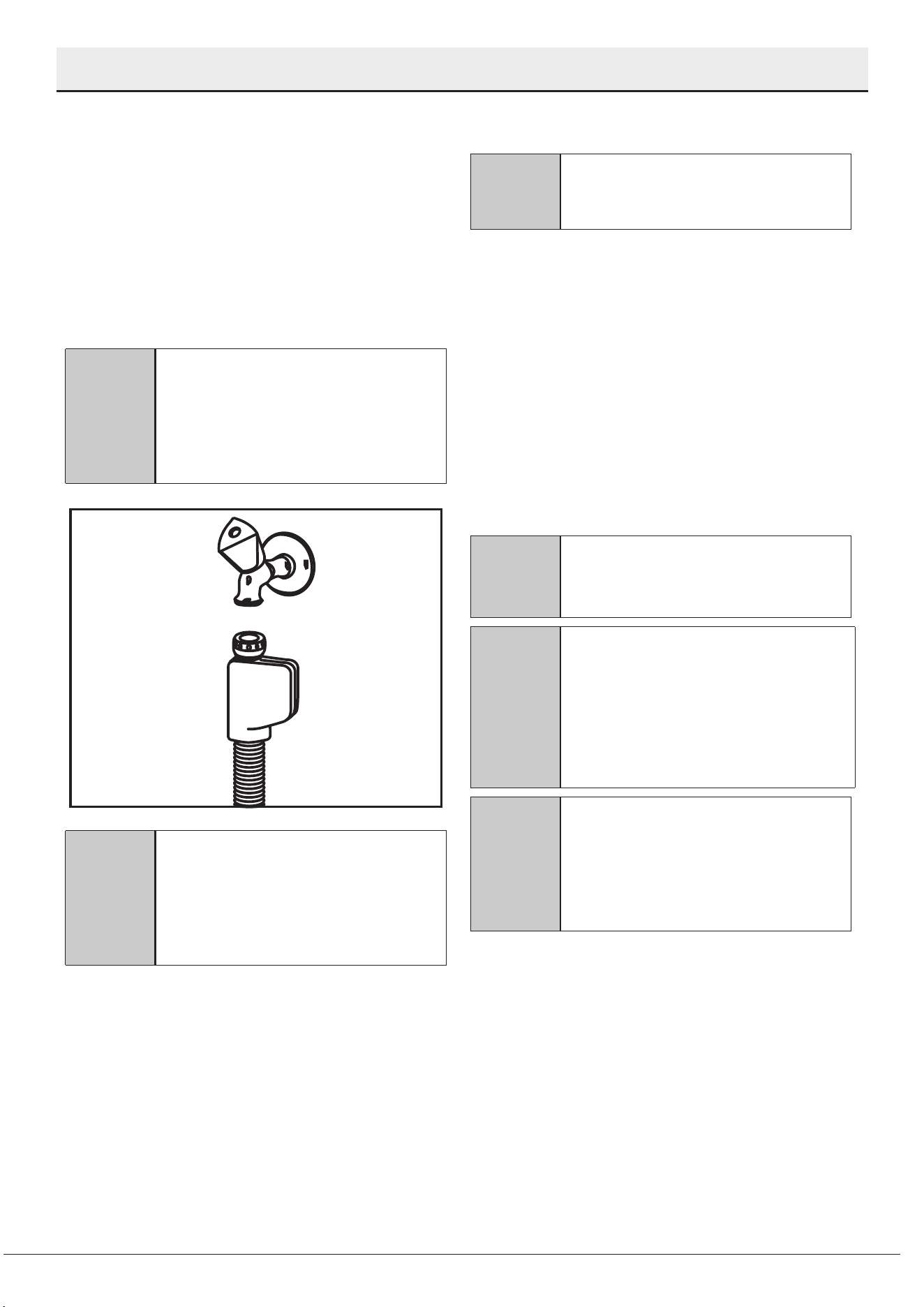
Connectng water supply
C
We recommend attaching a
filter on the house/apartment
supply water inlet to protect the
machine from damages that
may arise from impurities (sand,
dirt, rust, etc.) coming from the
urban water supply system or
from your own water system as
well as to prevent complaints
such as yellowing or sludge
accumulation at the end of
washing.
/
11 / 41
EN
Installation
Permitted water temperature:
up to 25°C ( 60°C for products
equipped with Aquasafe+; please
refer toAquasafe+ section )
The dishwasher should be connected to cold
water inlet.
•
Do not use old or used water inlet hose
on the new product. Use the new water
inlet hose supplied with the product.
•
Connect the water inlet hose directly
to the water tap. Pressure coming from
the tap should be minimum 0.3 and
maximum 10 bars. If the water pressure
exceeds 10 bars, a pressure relief valve
should be installed in between.
•
Open the taps completely after making
the connections to check for water
leaks.
C
Use a screw-on hose connector
to connect the water inlet hose
to a water tap with a ¾ inch
external thread. If required, use
a filter insert to filter deposits
from the pipes.
A
For your safety, close the water
inlet tap completely after the
washing programme is over.
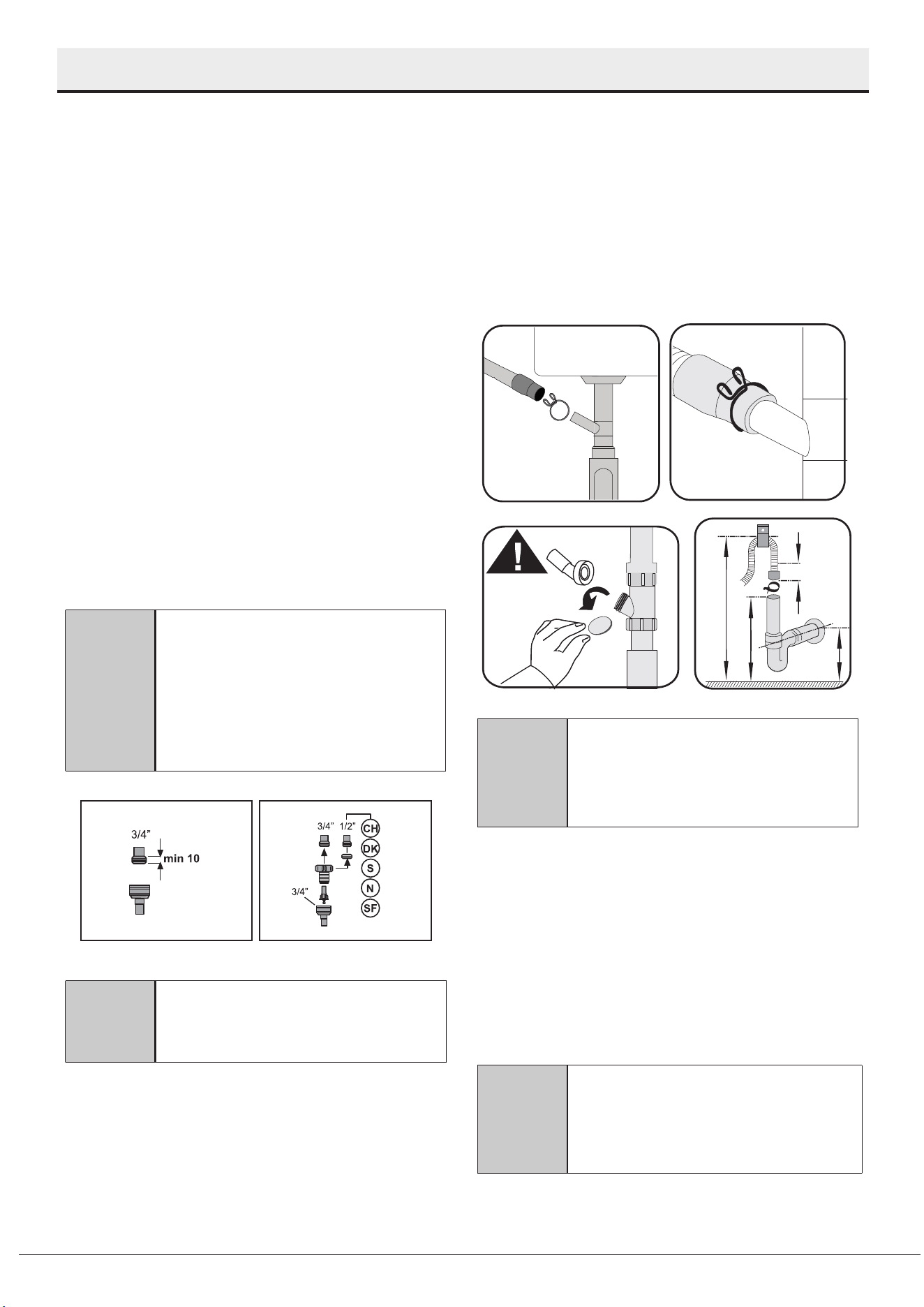
Connecton to the dran
Water discharge hose can directly be
connected to the drain hole or sink’s
drainage. The length of this connection must
be min. 50 cm and max. 100 cm from the
floor. A discharge hose longer than 4 meters
causes dirty washing.
Attach the water discharge hose to the
drainpipe without bending it. Tightly fix the
water discharge hose to the drainpipe in
order to prevent any dislocation of the water
discharge hose during operation of the
product.
min
300*
min
120*
max 1000 *
min 500 *
* mm
C
Drainpipe must be connected
to the sewage system and it
should not be connected to any
surface water.
Adjustng the feet
If the door of the product cannot be closed
properly or if the product swings when you
push it slightly, then you need to adjust
the feet of the product. Adjust the feet of
the product as illustrated in the installation
manual supplied with the product.
A
There might be a small amount
of water left in the product after
factory quality control tests. This
has no harm on the product.
12 / /41 EN
Installation
•
Power cable plug must be within easy
reach after installation.
B
Unplug the product after the
washing programme is over.
•
The voltage and allowed fuse or
breaker protection are specified in the
“Technical specifications” section. If the
current value of the fuse or breaker in
the house is less than 16 Amps, have
a qualified electrician install a 16 Amp
fuse.
•
The specified voltage must be equal to
your mains voltage.
•
Do not make connections via extension
cables or multi-plugs.
B
Damaged power cables must
be replaced by the Authorised
Service Agent.
B
If your dishwasher is equipped
with internal illumination, lamp
should only be replaced by the
Authorised Service Agent in case
of failures that may occur on the
lamp.
B
If the product has a failure, it
should not be operated unless
it is repaired by the Authorised
Service Agent! There is the risk
of electric shock!
Intal use
Before starting to use the product, make
sure that all preparations are made in
accordance with the instructions in sections
“Important safety instructions” and
“Installation”.
•
To prepare the product to do the
dishes, perform first operation in the
shortest programme with detergent
while the machine is empty.
Aquasafe+
(depends on model)
The Aquasafe+ system protects against
water leaks that may occur at the hose inlet.
Water contact with the valve box of the
system must be avoided to prevent damage
to the electrical system. If the Aquasafe+
system is damaged, unplug the product and
call the Authorised Service Agent.
A
As the hose set contains
electrical connections and
assemblies, never shorten
or lengthen the hose with
extension hoses.
A
Dishwashers door must be
aligned properly otherwise hot
steam can escape! Danger of
serious burns, other injury or
may damage furniture.
Electrcal connecton
Connect the product to a grounded outlet
protected by a fuse complying with the
values in the “Technical specifications” table.
The manufacturer shall not be liable for any
damages that will arise when the product is
used without grounding in accordance with
the local regulations.
•
Connection must comply with national
regulations.
/
13 / 41
EN
Preparation
4
Tps for energy savng
Following information will help you use the
product in an ecological and energy-efficient
manner.
Wipe away any coarse food remnants on the
dishes before putting them in the product.
Operate the product after filling it
completely.
When selecting a programme, consider
the table of “Programme data and average
consumption values”.
Do not put more detergent than suggested
on the detergent package.
Detergent
You can use powder, liquid/gel or tablet
detergents in the machine.
A
Only use in the machine the
detergents produced particularly
for use with dishwashers.
We recommend you not use
detergents that contain chlorine
and phosphate as they are
harmful for the environment.
Adding detergent
C
Pay attention to the warnings
on the detergent packaging
to get better washing and
drying results. Contact the
manufacturer of the detergent
for further questions.
A
Do not put solvents into the
detergent dispenser. There is
the risk of explosion!
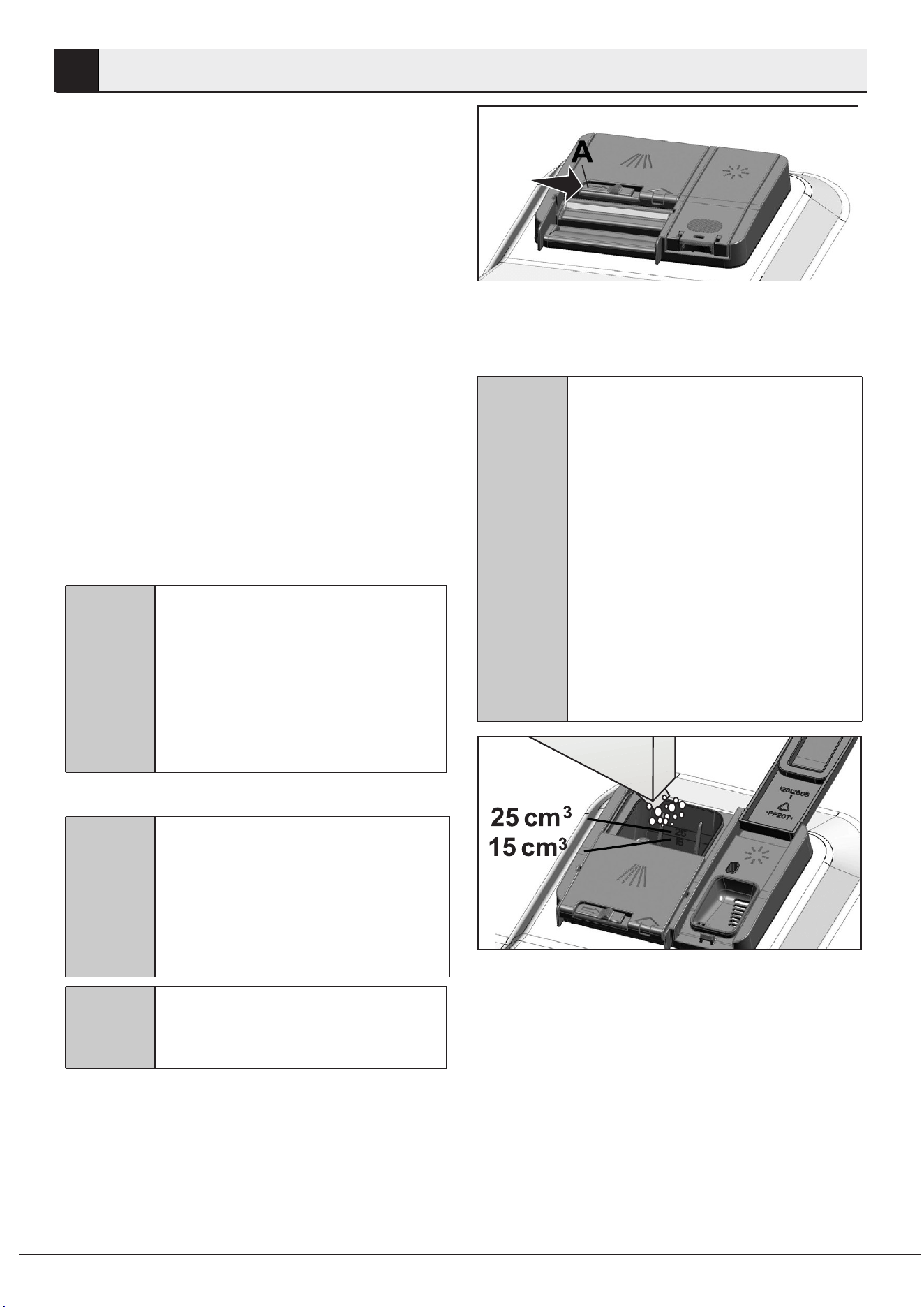
Put the detergent into the detergent
dispenser just before operating the machine
as illustrated below.
1. Push the latch to right to open the
detergent dispenser lid (A).
2. Put suggested amount of powder,
liquid/gel or tablet detergent in the
reservoir.
C
Inside the detergent dispenser
there are level markings that
help you use appropriate amount
of powder detergent. When
brimful, detergent dispenser will
contain 45 cm of detergent.
Fill detergent up to 15 cm or 25
cm level marks in the detergent
dispenser according to fullness
of the machine and/or soiling
degree of the dishes. One
tablet is enough if you are using
detergent tablets.
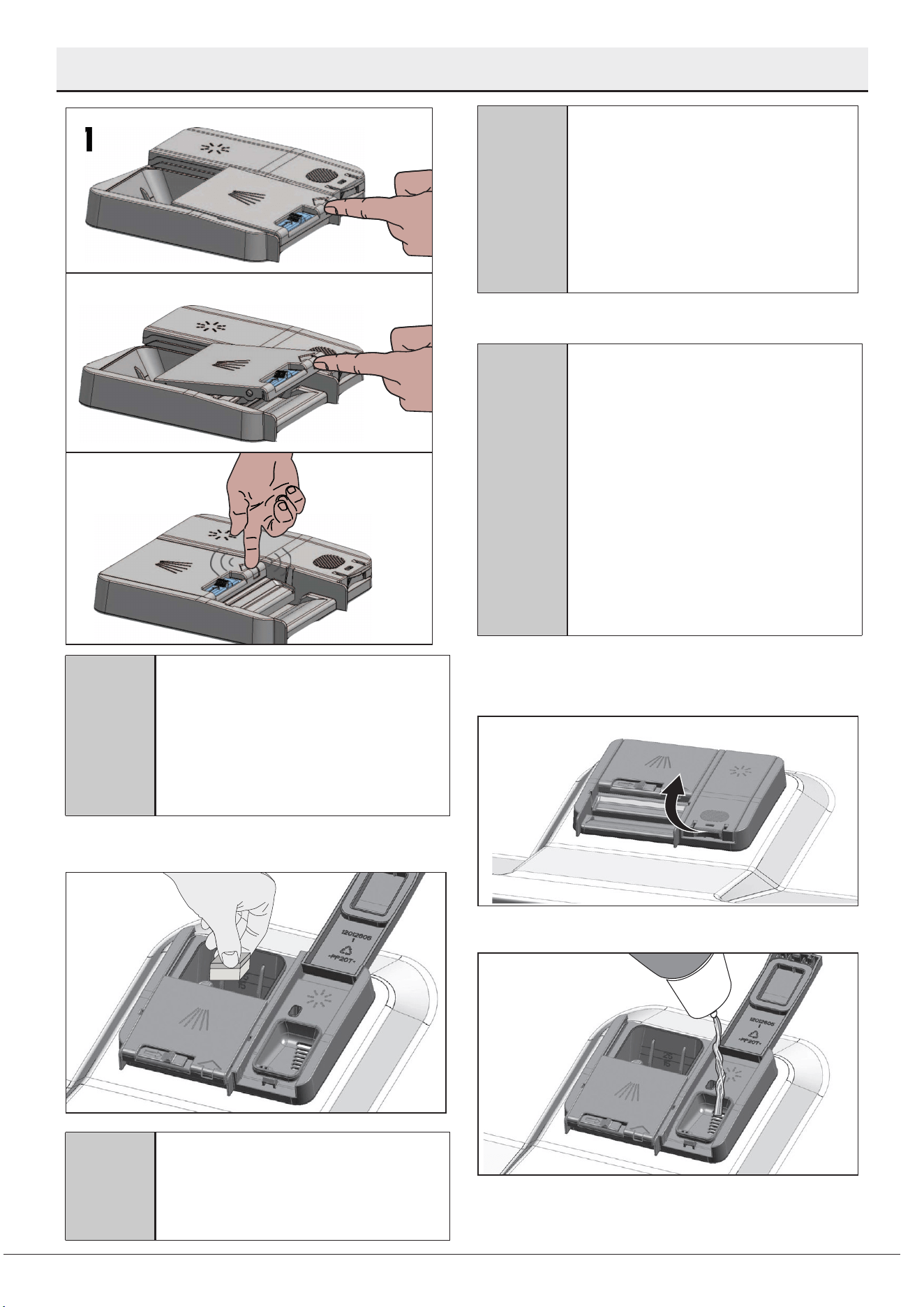
3. Push the lid of the detergent dispenser
to close it. A “click” will be heard when
the lid is closed.
14 / /41 EN
Preparation
1
2
3
C
Use powder or liquid/gel
detergent in short programmes
without prewash since the
solubility of the tablet detergent
changes depending on the
temperature and time.
Tablet detergents
C
Observe the instructions of the
detergent manufacturer on
the package when using tablet
detergents.
C
Contact the detergent
manufacturer if your dishes
are wet and/or if you notice
limescale spots particularly on
your glasses after the washing
programme is over when using a
tablet detergent.
Rnse ad
C
The rinse aid used in
dishwashers is a special
combination that aims to
increase drying efficiency and
prevent water or lime stains
on the washed items. For this
reason, care must be paid
to have rinse aid in the rinse
aid reservoir and to use rinse
aids produced specially for
dishwashers only.
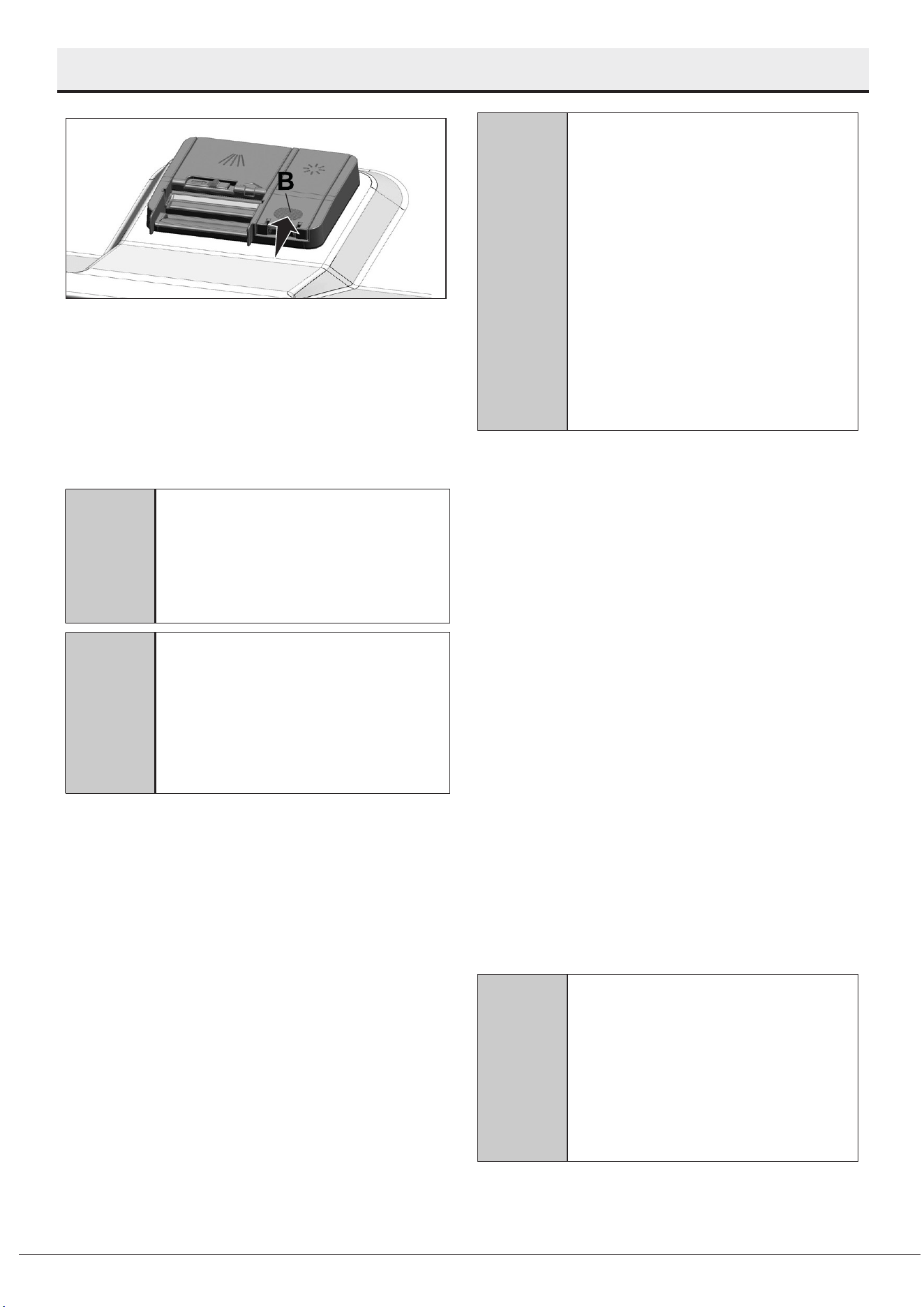
1. Open the lid of the rinse aid reservoir
with the help of the latch.
2. Fill the reservoir until “MAX” level.
3. Slightly press the point (B) of the
reservoir lid to close it.
/
15 / 41
EN
Preparation
C
Decorative prints of chinaware
as well as aluminium and silver
items may get discoloured or
tarnished after washing in the
dishwasher just as it happens
in handwashing as well. Some
delicate glass types and crystals
may become dull in time. We
strongly recommend you to
check if the tableware you are
going to purchase is suitable
for washing especially in the
dishwasher.
Placng the dshes nto the
dshwasher
You can use your dishwasher in the optimum
way with respect to energy consumption
and washing and drying performance only if
you place the dishes in an orderly way.
•
Wipe away any coarse food remnants
(bones, seeds, etc.) on the dishes
before placing them in the dishwasher.
•
Place thin, narrow pieces in the middle
sections of baskets if possible.
•
Place the heavily soiled and bigger
items in the lower basket and smaller,
delicate and light items in the upper
basket.
•
Place the hollowed dishes such as
bowls, glasses and pans upside down in
the dishwasher. Thus, accumulation of
water in deep hollows is prevented.
A
To prevent possible injuries,
always place the sharp and
pointed dishes such as service
fork, bread knife, etc. upside
down so as their pointed ends
will face down or they will lie
horizontally in the dish basket.
Unload dishes in the lower basket first and
then the dishes in the upper basket.
4. If there are stains on tableware items
after washing, level must be increased
and if there is a blue trace after wiping
them by hand, it must be decreased.
This is set to position 3 as factory
default.
C
The rinse aid adjustment is
described under "Adjusting
the amount of rinse aid" in
the section for operating the
machine.
C
Wipe clean any spilled rinse
aid outside the reservoir. Rinse
aid that spilled accidentally
will cause foaming and it will
eventually decrease washing
performance.
Items not sutable for
washng n the dshwasher
•
Never wash dishes soiled by cigarette
ash, candle remnants, polish, dyestuff,
chemicals, etc. in your dishwasher.
•
Do not wash silverware and cutlery
with wooden or bone stems, glued
pieces, or pieces that are not resistant
to heat, as well as copper and tin-plated
containers in the dishwasher.

16 / /41 EN
Preparation
Suggestions for loading the dishwasher
Lower basket
Upper basket
Improper Loading Of Dishware
Improper Loading Of Dishware
/
17 / 41
EN
Preparation
Cutlery basket
(depends on model)
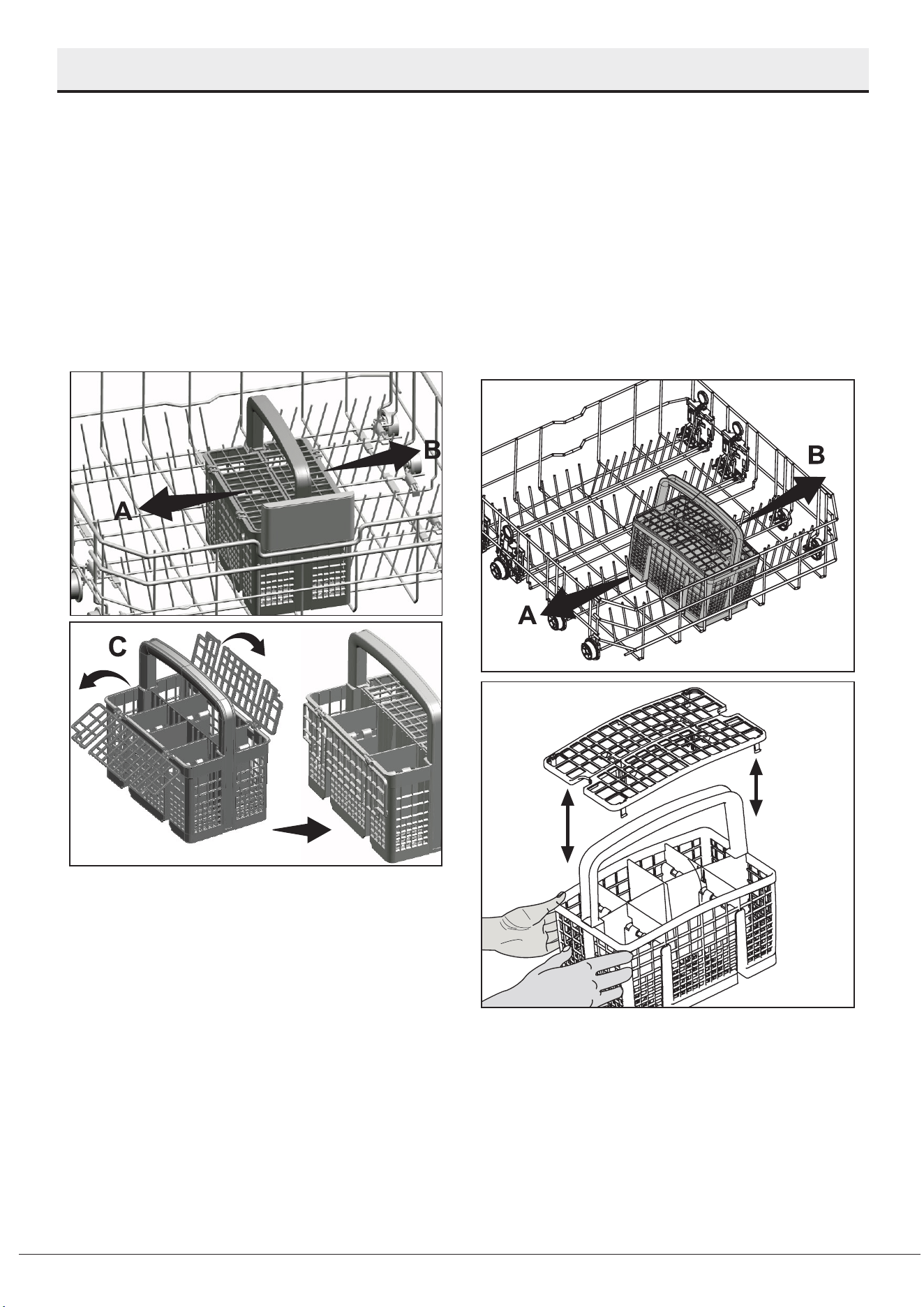
Cutlery basket is designed to wash your
dishes such as knife, fork, spoon, etc. in an
efficient manner.
Since the cutlery basket can be moved (A,
B), you can create more space while placing
your dishes in the lower basket and free up
space for your dishes of different sizes.
Cutlery basket
(depends on model)
Cutlery basket is designed to wash your
dishes such as knife, fork, spoon, etc. in an
efficient manner.
Since the cutlery basket can be moved (A,
B), you can create more space while placing
your dishes in the lower basket and free up
space for your dishes of different sizes..
18 / /41 EN
Preparation
Collapsble lower basket
tnes
(depends on model)
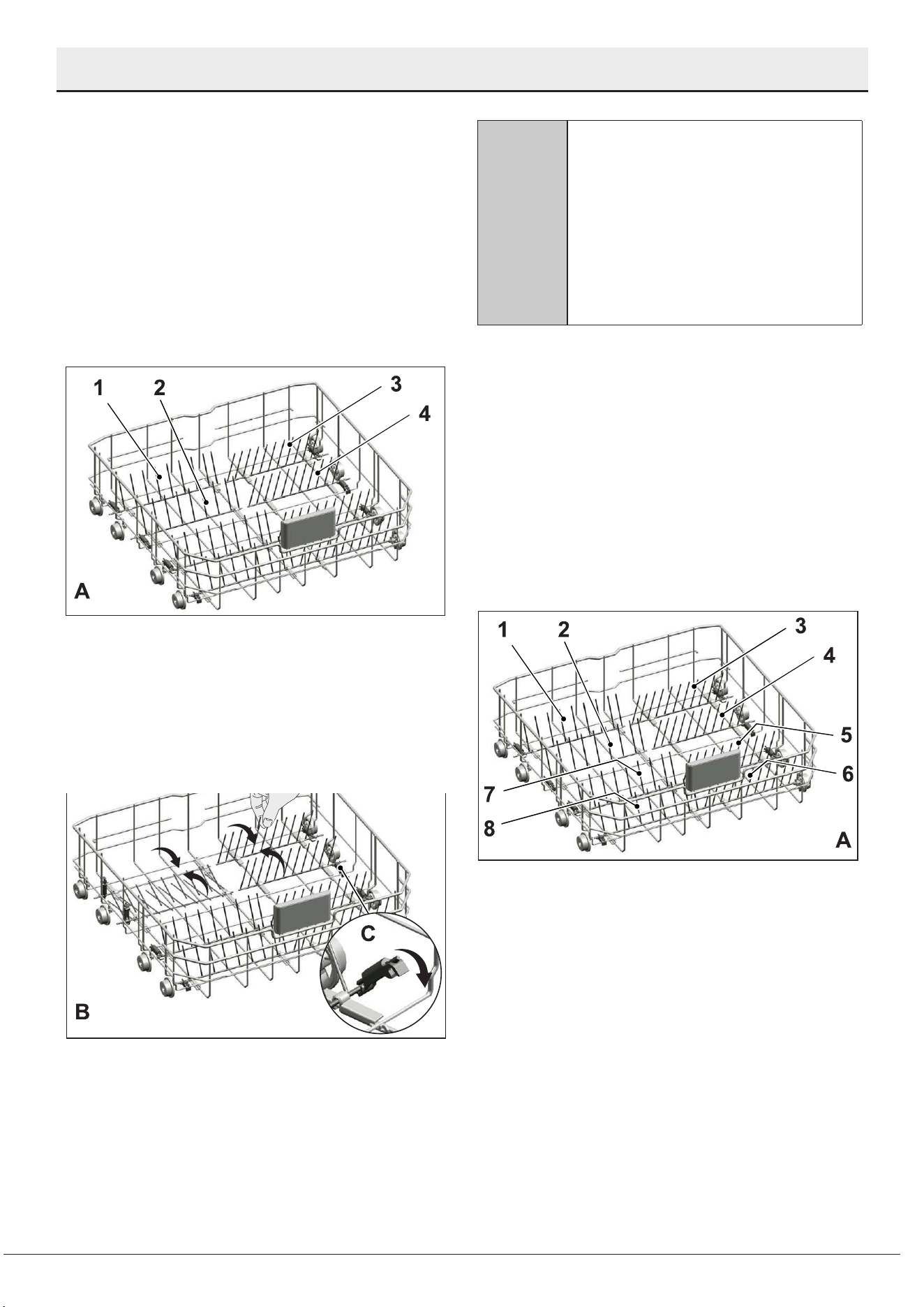
There are foldable tines (A) located at the
lower basket of the machine are designed
for an easier placement of large pieces such
as pans, bowls, etc. You can create larger
spaces by folding each tines individually or
all of them at once.
To bring the collapsible tines into horizontal
position, grab the tines from mid position
and push them in the directions of arrows
(B). To bring the tines back to vertical
position, just lift them up. Collapsible tines
will click into the latch again (C).
C
Bringing the tines to the
horizontal position by holding
them from the tips may cause
them to bend. Therefore, it will
be appropriate to bring the tines
in the middle to horizontal or
vertical position by holding them
from their stems and pushing in
the direction of arrow.
Collapsble lower basket
tnes
(depends on model)
There are foldable tines (A) located at the
lower basket of the machine are designed
for an easier placement of large pieces such
as pans, bowls, etc. You can create larger
spaces by folding each tines individually or
all of them at once.
To bring the collapsible tines into horizontal
position, grab the tines from mid position
and push them in the directions of arrows
(B). To bring the tines back to vertical
position, just lift them up. Collapsible tines
will click into the latch again (C).
/
19 / 41
EN
Preparation
Tray Wash Supports
(depends on model)
Use the supports to wash trays in the
bottom basket.
See the Auxiliary functions section for
appropriate programme and function
selection.
C
Bringing the tines to the
horizontal position by holding
them from the tips may cause
them to bend. Therefore, it will
be appropriate to bring the tines
in the middle to horizontal or
vertical position by holding them
from their stems and pushing in
the direction of arrow.
SoftTouch Accessory
(depends on model)
The SoftTouch Accessory found in the lower
basket of your machine enables a safe
washing for your fragile glasses.
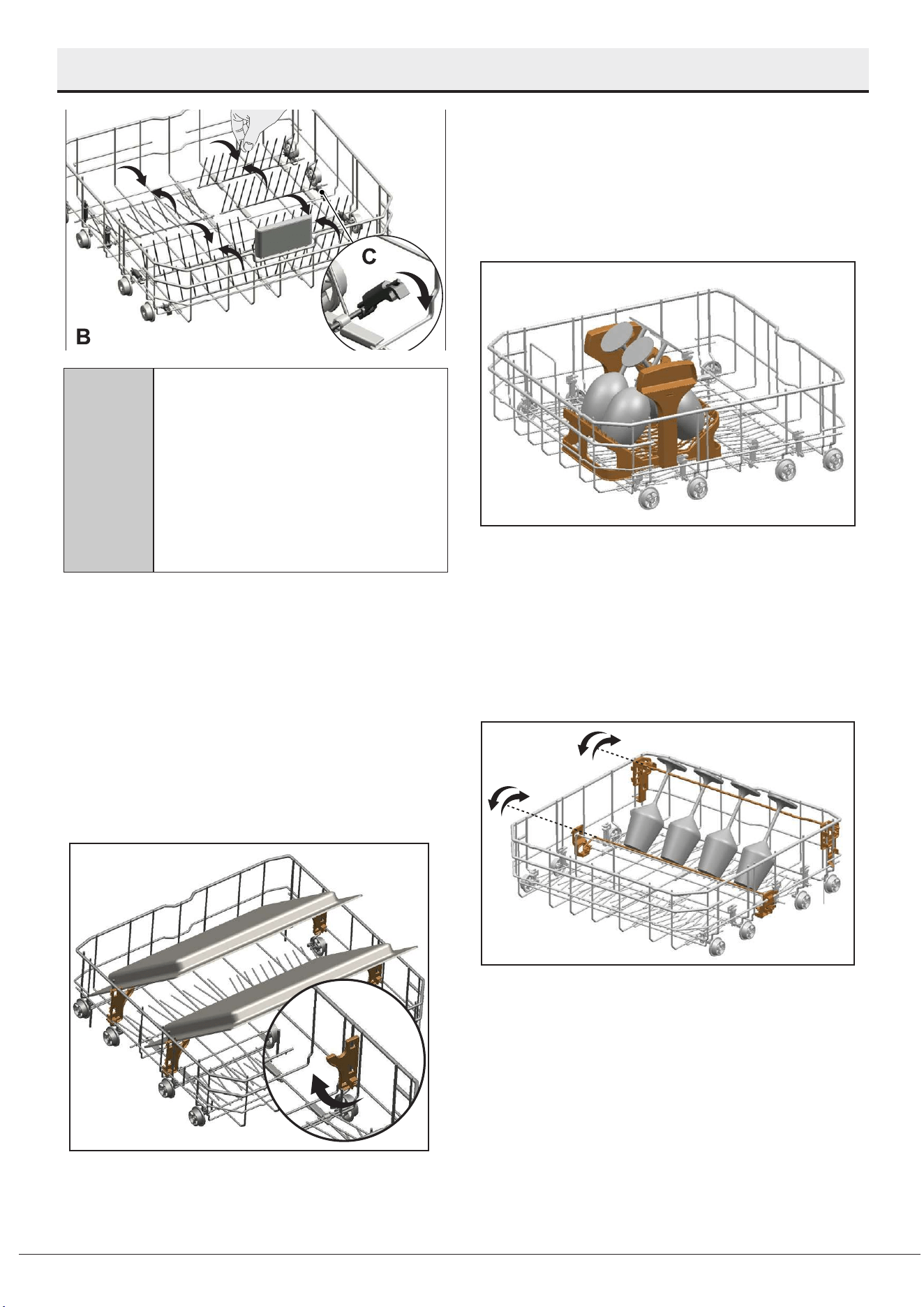
Lower Basket Glass Holder
(depends on model)
Lower Basket Glass Holder found in the
lower basket of your machine enables a safe
washing for your oversized and tall glasses.
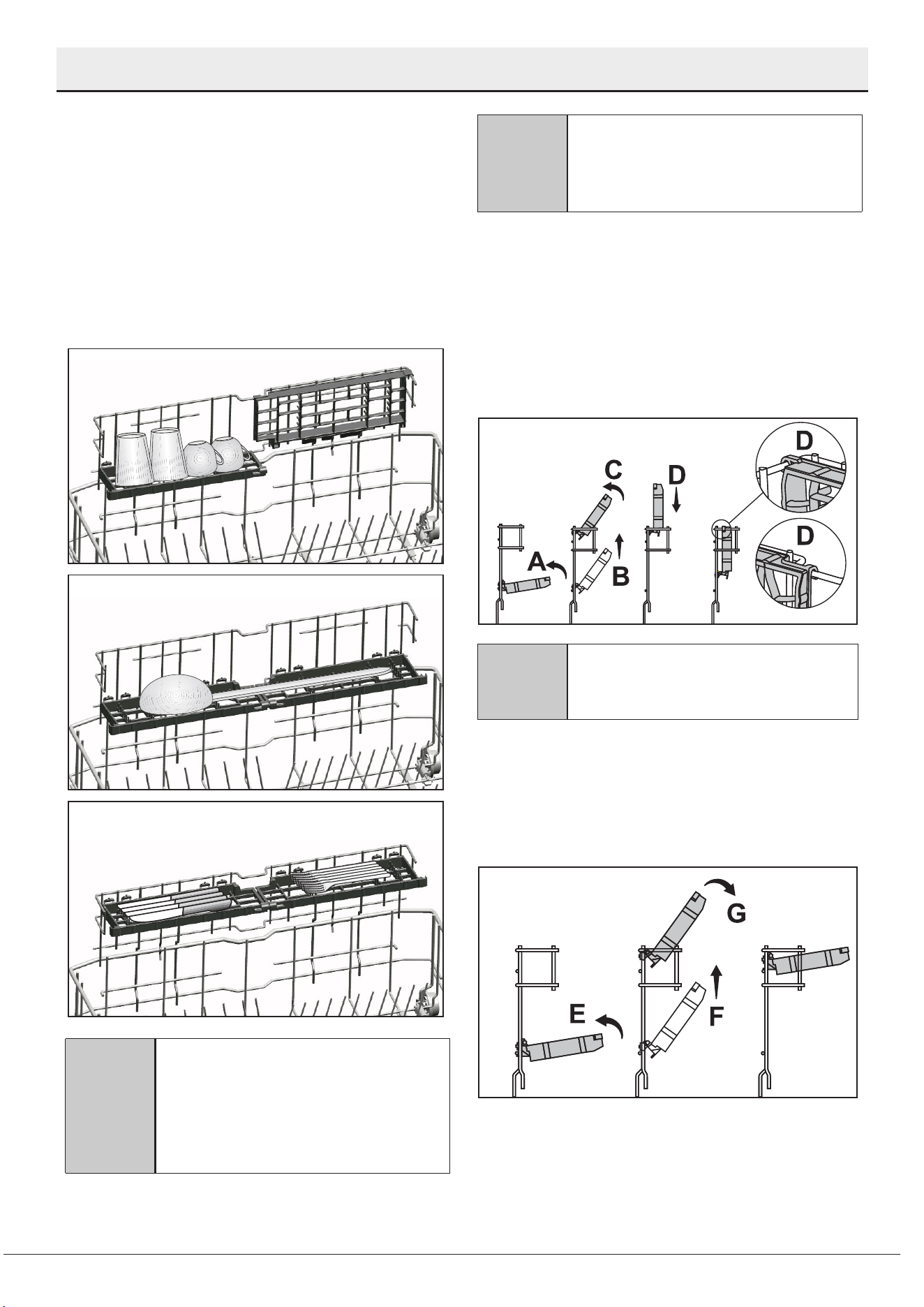
20 / /41 EN
Preparation
Lower basket multpurpose
/ heght adjustable servce
rack
(depends on model)
This accessory located at the lower basket
of your machine allows you to easily wash
pieces such as extra glasses, long ladles and
bread knives.
C
You may use the racks as
required by moving them to
lower or upper position, or close
them to create a wider space in
your lower basket.
A
Make sure that the impeller does
not touch the dishes you placed
on the racks.
To close the racks:
1. Fold the rack (A).
2. Slide the rack up (B).
3. Put the rack in vertical position (C).
4. Slide the rack down and lock it by the
tabs (D).
C
You may open the racks in the
same process in reverse order.
To adjust the height of the racks:
1. Fold the rack (E).
2. Slide the rack up (F).
3. Open the rack at the desired level (G).
/
21 / 41
EN
Preparation
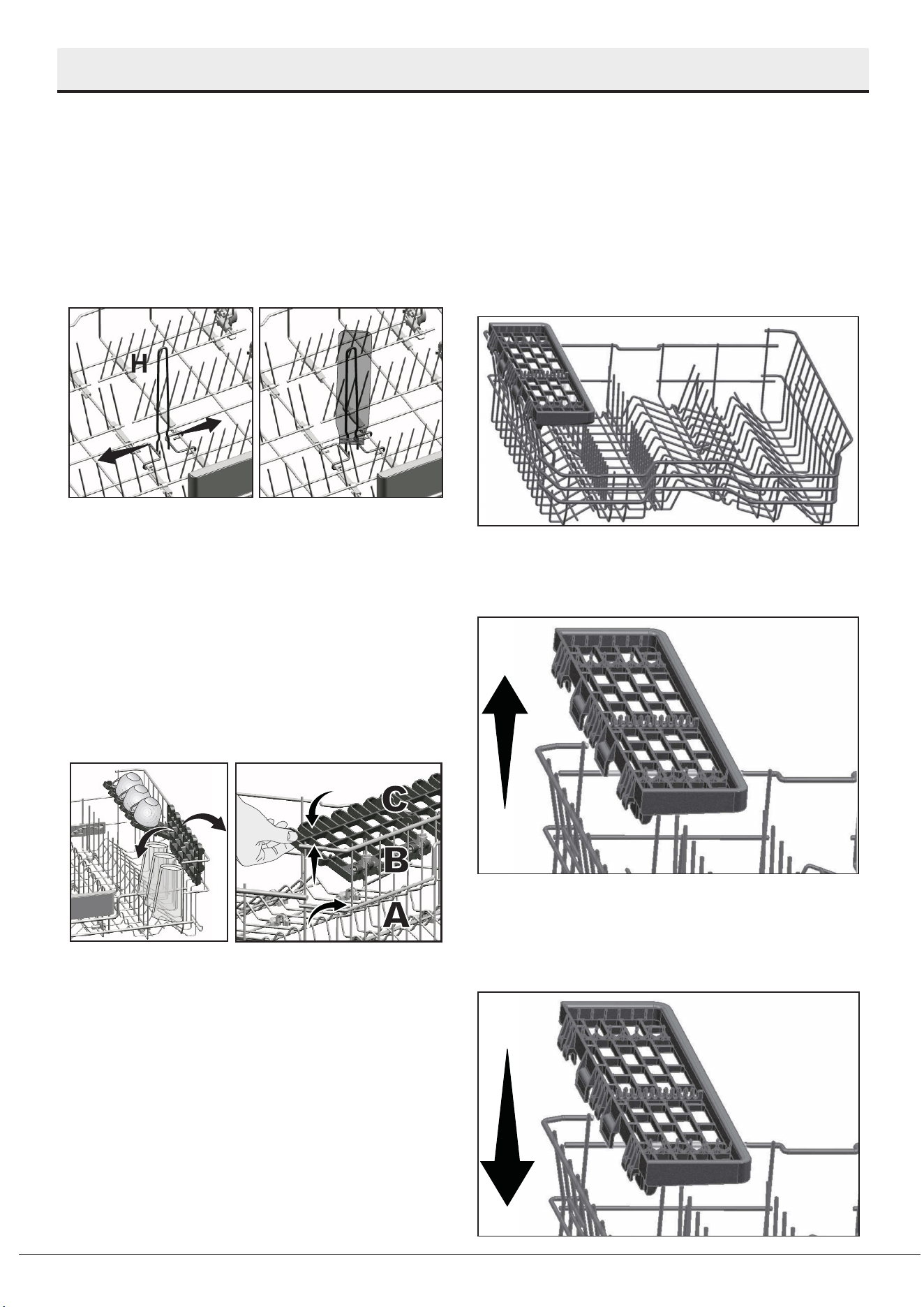
Upper basket multpurpose
servce rack
(depends on model)
This accessory located at the upper basket
of your machine allows you to easily wash
pieces such as extra long ladles and bread
knives.
You can lift up the upper basket
multipurpose service rack to remove it if you
do not want to use it.
If you want to use the upper basket
multipurpose service rack again, you can
easily attach it to the side section of your
upper basket.
Upper basket heght
adjustable rack
(depends on model)
Use the lower and upper parts of the height
adjustable racks in the upper basket of
the machine by sliding them down or up
according to the heights of the glasses, cups
or etc. (A, B, C).
Lower basket bottle wre
(depends on model)
The bottle wire is designed for easier
washing of long pieces with wide mouths.
You may take out the bottle wire from the
basket when not in use by pulling it out from
both sides (H).
These racks are detachable as well. It is
recommended that you should detach the
rack on the front left corner of the basket to
place the silverware basket piece if needed.
22 / /41 EN
Preparation
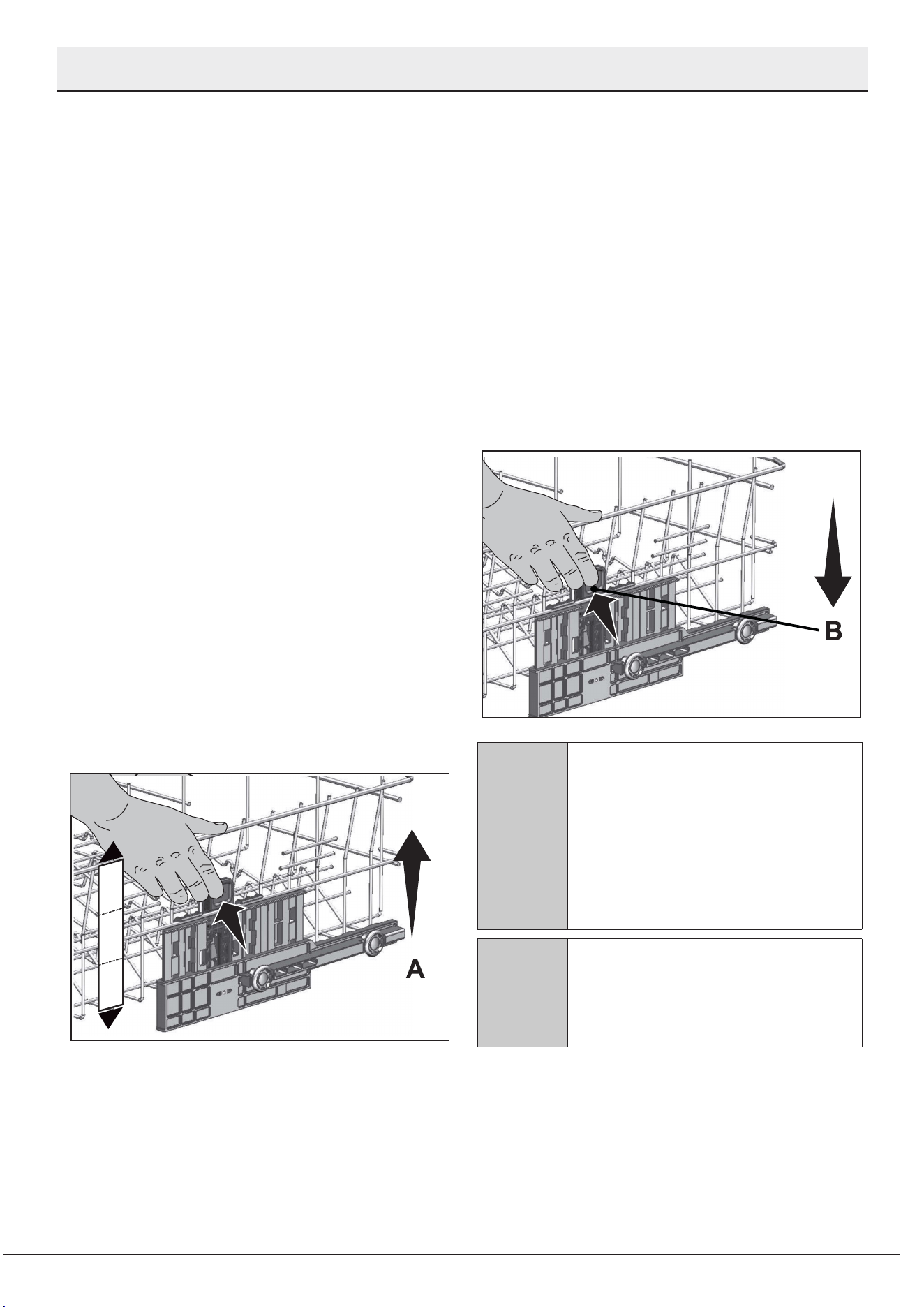
To lower the basket, while it is in the
uppermost position;
1. Hold the upper basket wires with both
hands, slightly lift up the basket and
simultaneously push and release the
latches shown in the figure (B).
2. Lower the basket from its current
position to the lower one.
3. Release the basket after it has reached
one level down.
Repeat the process if the height is not
sufficient.
C
The movement mechanism
may not function properly if the
upper basket is overloaded or
if the weight distribution is not
balanced. In heavier conditions,
there is the risk of falling one
level down.
C
Make sure that the adjustment
mechanism has the same
positions on the right and left
sides of the upper basket.
Adjustng the heght of the
upper basket
(depends on model)
The upper basket height adjustment
mechanism has been designed for you to
create large spaces in the lower or upper
sections of your machine depending on your
needs by adjusting the height in the upper
or lower direction while your basket is empty
or loaded.
Thanks to this mechanism, you can use your
basket in three different positions, namely
lower, middle and upper positions (1, 2, 3).
1. To raise your basket, hold the upper
basket wires with both hands while the
basket is in the lowermost position and
pull them up (A).
2. You will hear a "Click" from the right
and left mechanisms, indicating that
the basket has reached the next level.
Release the basket.
Repeat the process if the height is not
sufficient.
1
2
3

/
23 / 41
EN
Preparation
Adjustng the heght of the
upper basket
(depends on model)
Upper basket height adjustment mechanism is
designed so that you can create wide spaces
on the upper or lower compartment of the
machine by adjusting the basket upwards or
downwards either while it is empty or full.
Thanks to this mechanism, you may use your
basket in three different positions, namely
lower, center or upper positions.
To lower the basket, perform the following
while the basket is at uppermost position;
1. Hold the wires of the upper basket and
raise the handle of the mechanism
upwards as shown in the figure (A).
2. Lower the basket to the next lower
position.
3. Release the basket when it catches on to
the next lower position.
Repeat the same operation if the height is not
adequate.
1
2
3
1. To raise the basket, hold the wires of the
basket and pull the basket upwards with
both hands while the basket is at the
lowermost position (B)
2. Release the basket when it catches on to
the next upper position with a “Click” that
may be heard from the right and left
mechanisms.
Repeat the same operation if the height is
not adequate.
1
2
3
The movement mechanism may not
work properly when the upper basket is
overloaded or when the load is
unbalanced. And it may fall to the next
lower position in heavier conditions.
Ensure that the adjustment
mechanisms on the right and left of the
upper basket are aligned.

24 / /41 EN
Preparation
Upper basket mult-functon
servce rack
(depends on model)
Thanks to the upper basket multi-function service
rack on the upper basket of your appliance, you may
load and wash long service-ware and kitchen-ware
easily. Also, the wineglass securing compartments
available on the front side of this accessory allows
easier placing of the stemware with proper sizes on
the upper basket.
You may remove the upper basket multi-function
service rack by lifting it upwards when you do not
want to use it.
You may reinstall the upper basket multi-function
service rack on the side of your upper basket easily
to use it again.
Tray Washing Support
(depends on model)
You may use the tray washing supports
if you want to wash a tray on your lower
basket.
Refer to the Additional Functions section to
select the proper program and function.
You may fold this part when it is not used to
facilitate the placement of your dishes.
1
2
You may also remove the part when required
as shown in figures 1 and 2.
The tray washing supports shall be
removed as shown in figures 1 and 2 for
performance inspection tests that shall
be performed as per the standards.
/
25 / 41
EN
Preparation
Heght settng wth empty
basket
(depends on model)
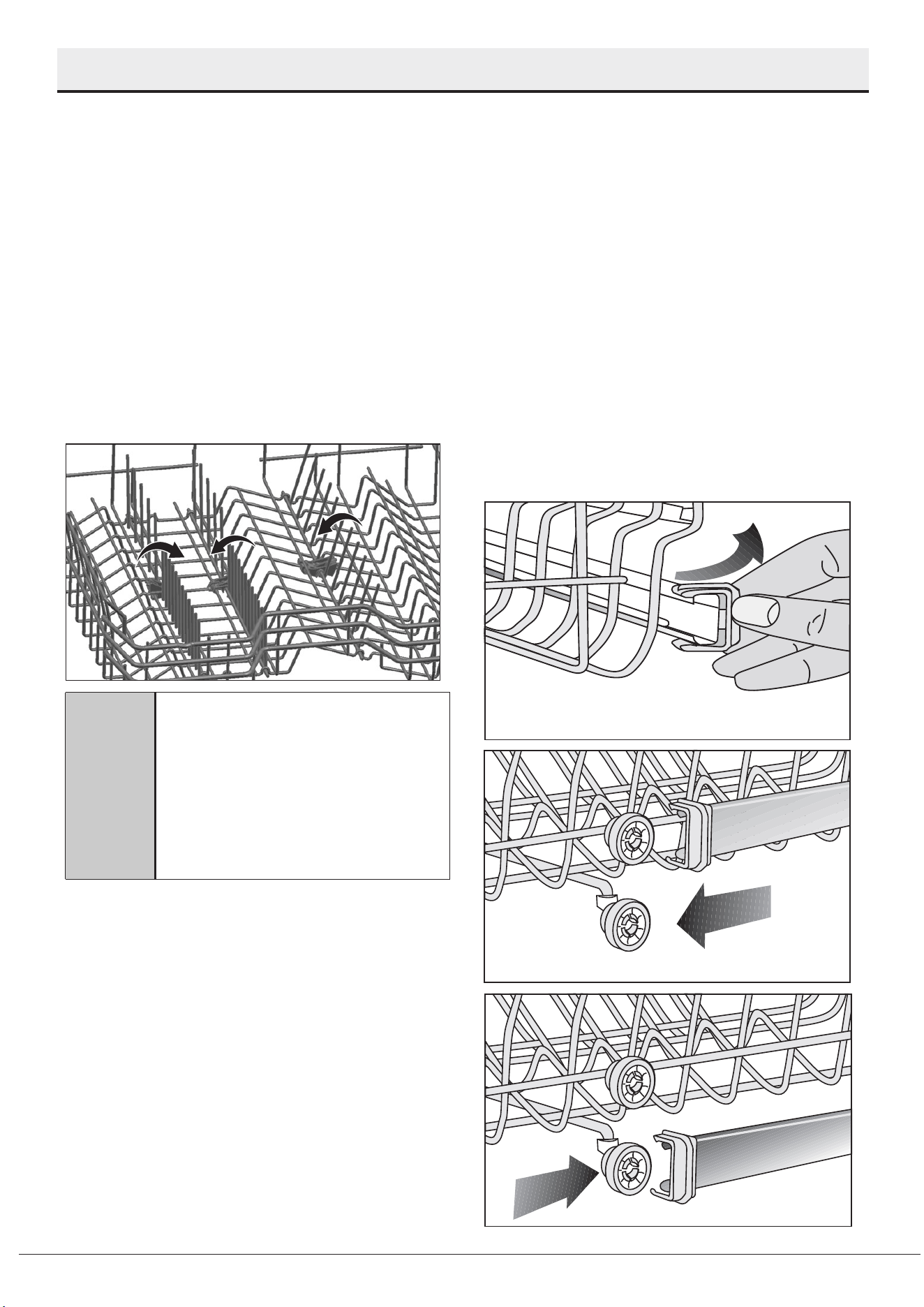
In this model, the height setting of the upper
basket may be changed using the wheels
which are mounted at two different heights.
Release the latches on both the right and
left tracks of the upper basket by pushing
them outwards.
Pull the basket out completely.
Place the basket back into the tracks at the
desired height.
Push the latches back into the correct
position.
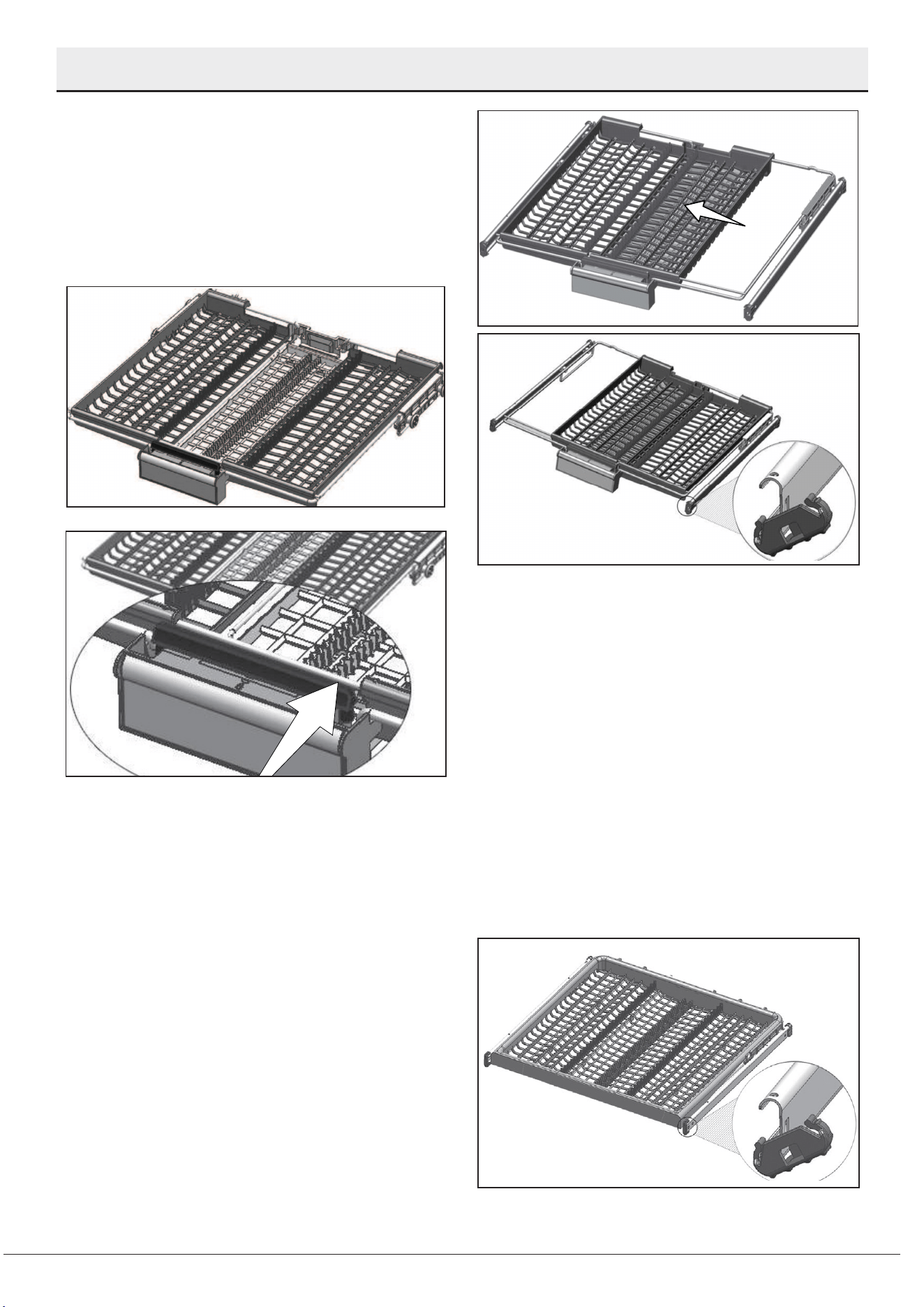
Collapsble upper basket
wres
(depends on model)
You can use collapsible wires when you need
a larger space for your dishes in the upper
basket of your machine.
To bring the collapsible wires into horizontal
position, grab the wire from the middle
position and push them in the direction of
arrow in the figure. Place your larger dishes
into the area created. To bring the wires back
to vertical position, just lift them up.
C
Bringing the wires to the
horizontal position by holding
them from the tips may cause
them to bend. Therefore, hold
the wires from their stems while
bringing them to the horizontal
or vertical positions.
26 / /41 EN
Preparation
Celng cutlery basket
(depends on model)
Ceiling cutlery basket is designed to wash
your cutlery items such as forks, spoons and
etc. by placing them between the bars on
the basket.
Celng cutlery basket
(depends on model)
Ceiling cutlery basket is designed to wash
your cutlery items such as forks, spoons and
etc. by placing them between the bars on
the basket.
1
In models with partial movement feature,
pushing the bar (1) on the handle enables
the central tray of the basket to get to
the lower position and the system gets
unlocked. Thus right and left side trays can
be used as moving parts.
The free space enabled by the side trays
allows long parts to be loaded in the upper
basket.
When the central tray is in the lower
position, you can load long/high items such
as coffee cups, ladles, etc. on the tray. When
the side trays lean on two side walls, the
handle can be pulled to allow the central tray
to rise and the system to be locked.
/
27 / 41
EN
5
5
Operating the product
1 2
7
8
3 4 5 6
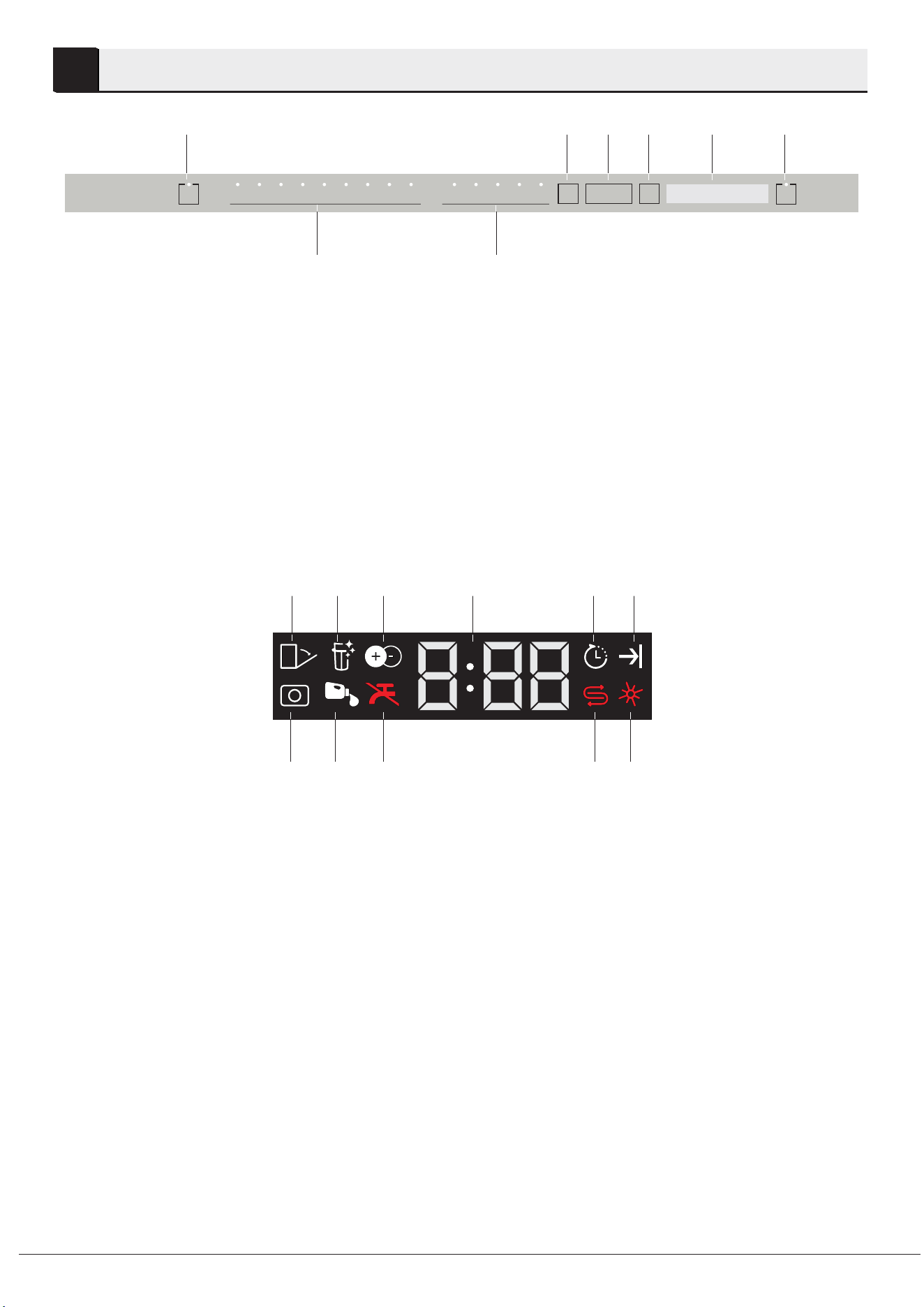
1. On / Off Key
2. Menu Key
3. Time Delay Selection
/ Menu Direction Selection Keys
4. Selection / Confirmation Key
5. Display
6. Start / Pause / Cancel Key
5
SteamGloss Function
TrayWash Function
7. Function Selection Keys
F1
F2
F3
F4
8. Programme Selection Keys
9 10 11
15
12 13 14
16171819
9. Auto Door Open Indicator (depends on the model)
10. Filter Cleaning Function Indicator (depends on the model)
11. IonGuard Function Indicator (depends on the model)
12. Delay Time / Programme Time Indicator
13. Delayed Start Indicator
14. End of Programme Indicator
15. Rinse Aid Indicator
16. Salt Indicator
17. Water Cut-off Indicator
18. Liquid Detergent Dosing Indicator (depends on the model)
19. Tablet Detergent Indicator (depends on the model)
Hygiene Intense function
Fast+ Function
(depends on the model)

28 / /41 EN
Operating the product
On/Off Key
When you press the On/Off key, the indicator
lights illuminate on the display for ON
position. The lights turn off in OFF position.
Programme Selecton /
Programme Cancel key
Select the desired programme using the
“programme selection keys” and press the
button.
To cancel the running programme, open the
door of the machine and press and hold the
Programme Start/Pause/Cancel key for 3
seconds.
After the 3 - 2 - 1 countdown, 0:01 is
displayed, close the door of the product
and wait for the draining process complete.
Draining is completed in 2 minutes and the
machine gives an audible warning when it is
completed.
Functon Keys
If you press any of the Function keys
during programme selection or time delay
selection, an affirmative key signal will be
heard provided that the relevant function
is supported by the selected programme.
Function will be deemed selected when the
indicator of the selected function is lit.
To cancel the selected function, keep the
function key pressed until the function
indicator disappears.
Preparng the machne
1. Open the door of the dishwasher.
2. Place the dishes in accordance with the
instructions in the user manual.
3. Make sure that the upper and lower
impellers rotate freely.
4. Put adequate amount of detergent into
the detergent dispenser.
Programme selecton
1. Press the On/Off button to turn on your
machine.
2. Check the Salt and Rinse Aid indicators
and add salt and/or rinse aid if needed.
3. Refer to the table of "Programme data
and average consumption values"
to determine a washing programme
suitable for your dishes.
4. Selected programme will start when you
close the door of your machine.
/
29 / 41
EN
Operating the product
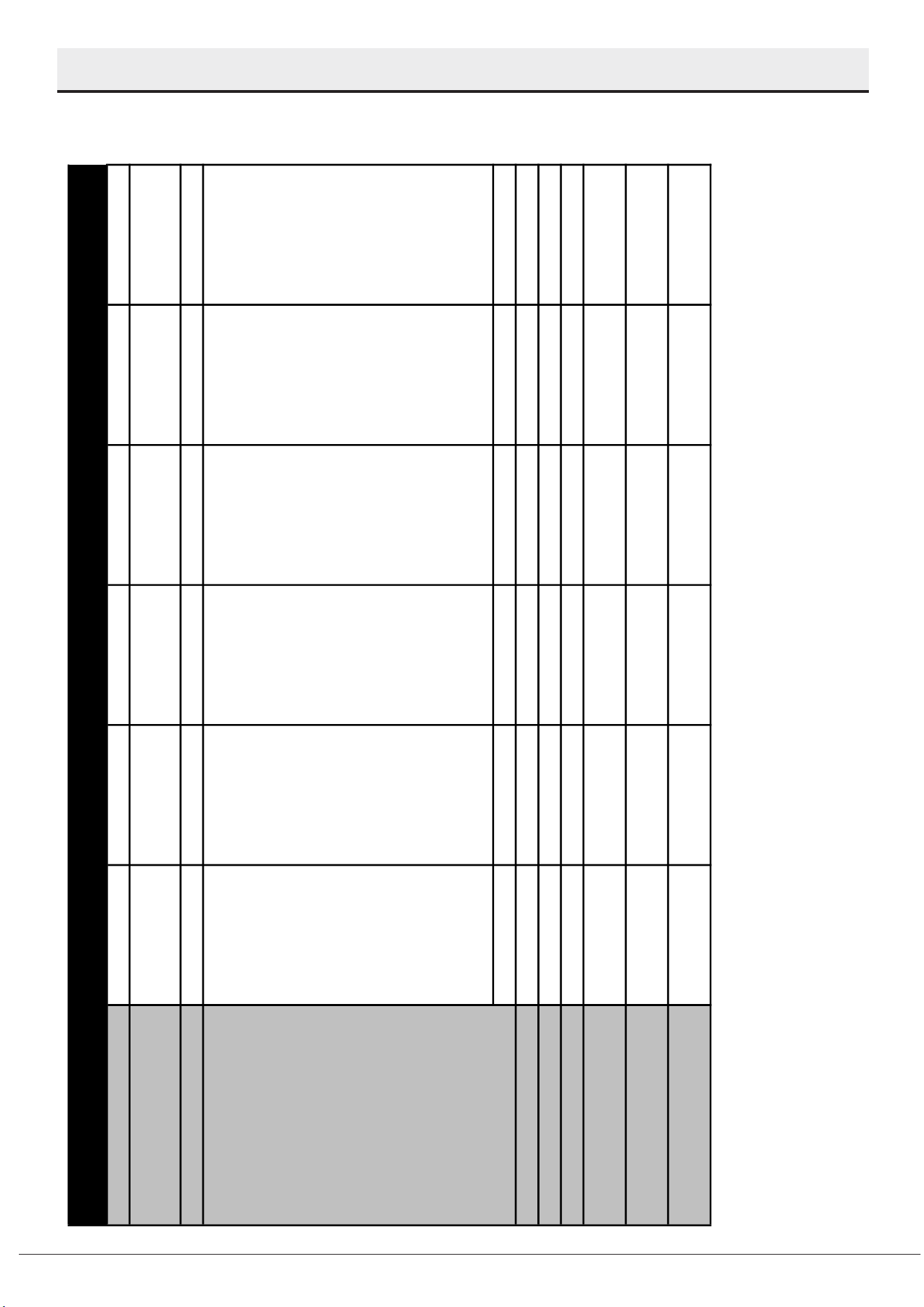
1 2 3 4 5 6
Auto Intensive Eco Delicate Quick&Shine Mini
40-65 ºC 70 ºC 45 ºC 40 ºC 60 ºC 35 ºC
Determines the soiling
degree of the dishes and
sets the temperature and
amount of the washing
water as well as the
washing time
automatically. Suitable for
all types of dishes.
Suitable for heavily soiled
dishes, pots and pans.
Most economical
washing program
for the normally
soiled daily dishes
that are kept
waiting.
Special programme for
gentle cleaning of delicate
glassware.
Daily washing program
at which the medium
soiled dishes that
are kept waiting are
cleaned and dried in the
fastest
way.
Suitable for lightly soiled
daily dishes that are
scraped or pre-cleaned.
Medium to high High Medium Low Medium Low
+ + + + -
+ + + + +
+ + + + -
100-180 148 134 120 58 30
11,6-15,8 17,6 13,8 15,6 11,4 11,8
0,90-1,45 1,65 0,74 1,26 1,2 0,8
Programme Data and Average Consumption Values Table
Loading Capacity: 14
The consumption values shown in the table were determined under standard conditions. Differences may therefore occur under practical conditions.
(#) Additional functions might cause changes in programme durations.
Programme number
Programme name
Cleaning temperature
Degree of Soiling
Energy (kWh)
Prewash
Wash
Dry
Duration (min)
Water (I)
30 / /41 EN
Operating the product
Auxlary functons
Washing programmes of your dishwasher
are designed to obtain the best cleaning
effect, considering the type of the soiling,
soiling degree and properties of the dishes
to be washed.
Auxiliary functions allow you save from time,
water and power.
C
Auxiliary functions may cause
changes in the programme
duration.
C
Auxiliary functions are not
suitable for all washing
programs. Indicator of the
auxiliary function that is not
compatible with the programme
will not be active.
SteamGloss Function
(Depends on model)
It provides superior drying performance.
TrayWash Function
(depends on the model)
Select Intensive 70°C programme and press
function key to run this function.
Functions in Settings Menu
(depends on the model)
Under the settings menu of your product,
there are some additional functions that
depend on the model.
To access these functions, press and hold
the Menu key for 3 seconds. Press <- and
+> keys to move to the desired function or
setting.
C
In some models pressing the
Menu key only for once will allow
you to enter the Settings menu.
Use the selection key to change the desired
function or setting and switch off your
machine to save the Settings.
Submenu Functions:
(depends on the model)
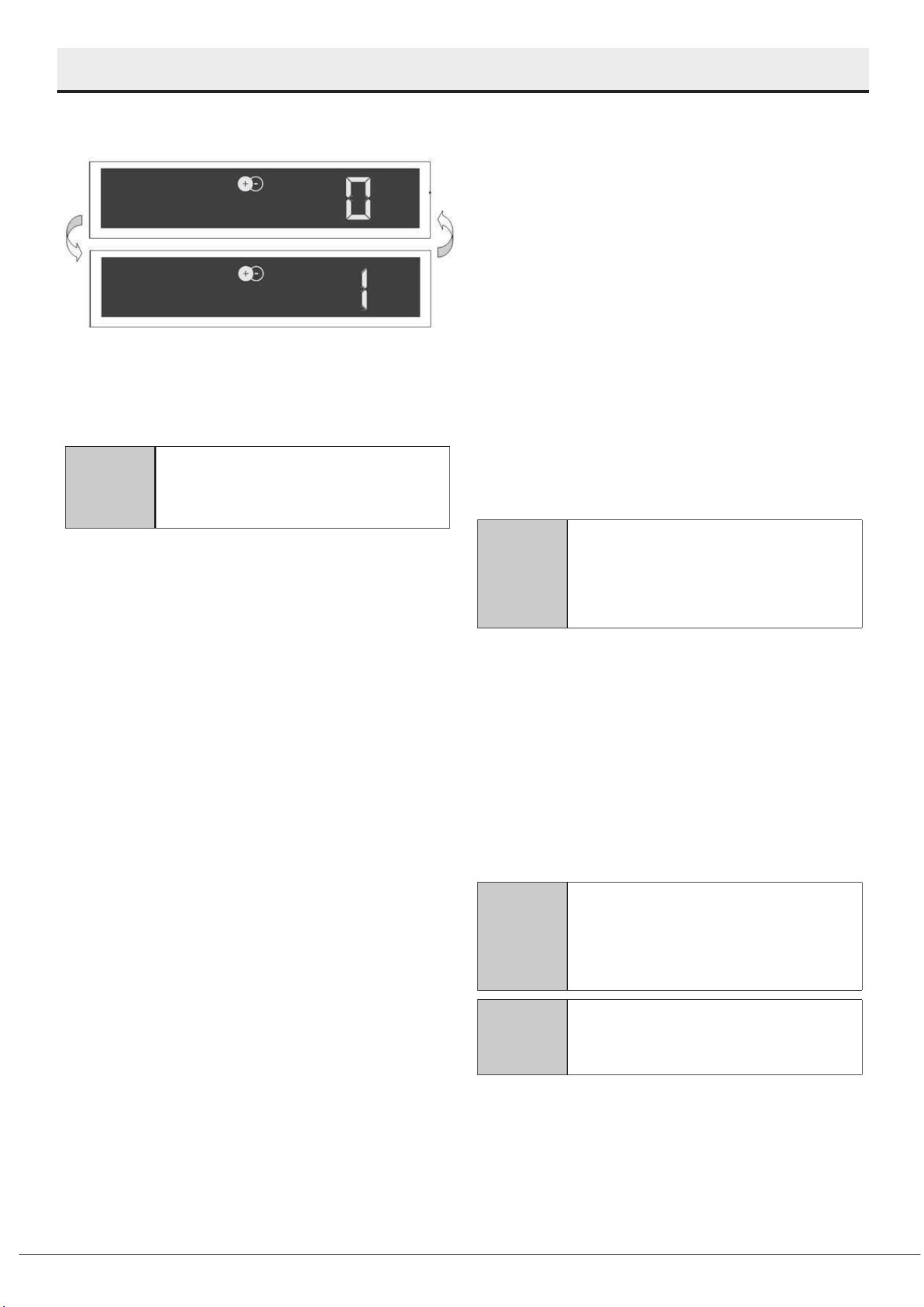
SelfDry Function Off/On
Tablet Detergent Function Off/On
EverClean Function Off/On
Hygiene Intense function
(depends on the model)
Designed to be used when more hygiene
is required for washing the dishes. This
function increases the washing and rinsing
temperatures in the selected cycle and
extends the periods of these steps in the
cycle. Moreover, an additional rinsing cycle
is performed to wash and rinse your dishes
with more hygiene.
Fast+ Function
(Depends on model)
It shortens the time of the washing cycle
selected and decreases water consumption
by enabling washing under higher pressure.
/
31 / 41
EN
Operating the product
IonGuard Function Off/On
Changing Warning Sound Volume
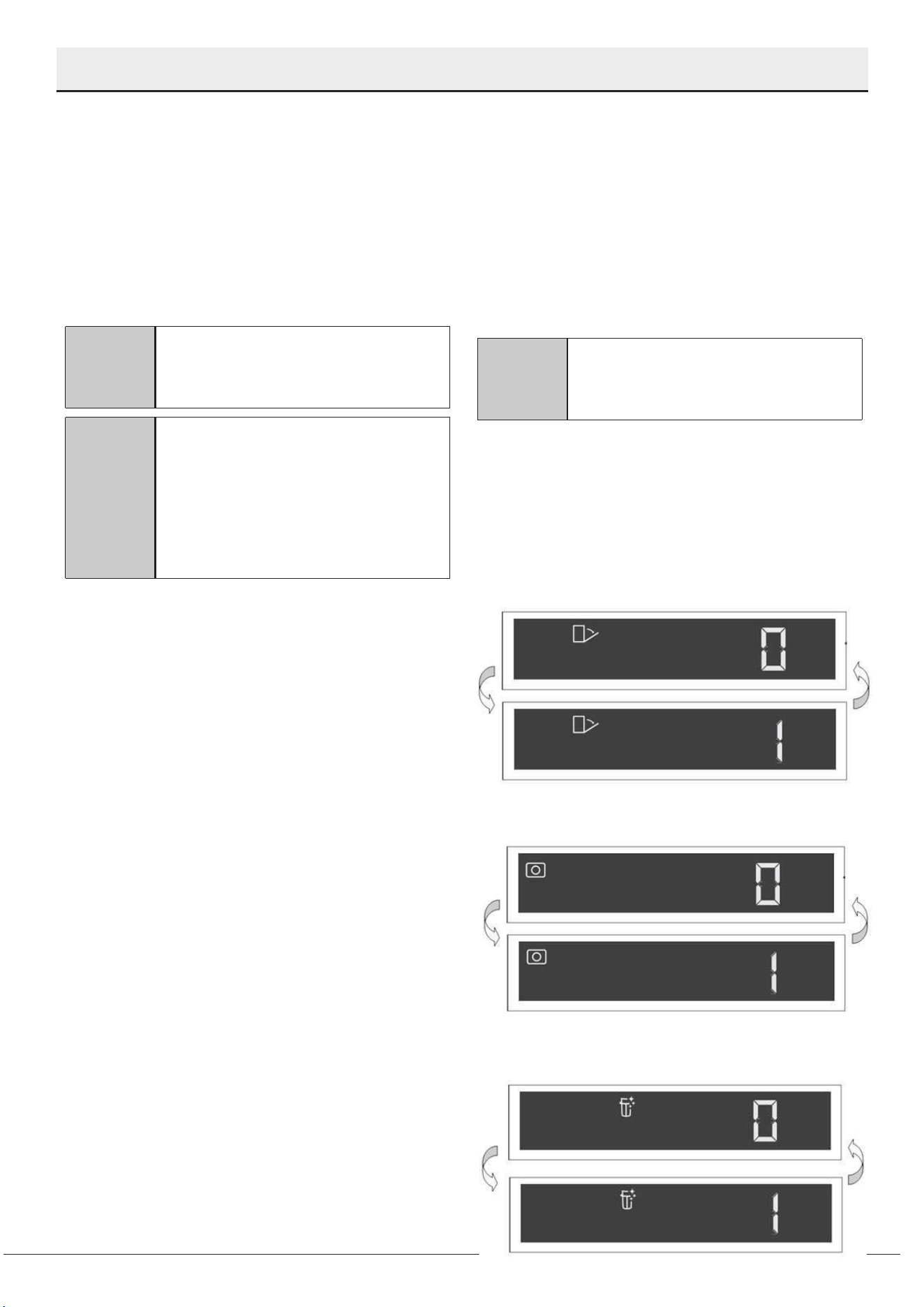
1. After switching on your machine, press
the Menu key for 3 seconds.
C
In some models pressing the
Menu key only for once will allow
you to enter the Settings menu.
2. Press <- and +> keys to move to the “S:”
position on the display.
3. Each pressing on the Selection key will
change the warning sound volume as
"S:0" off, "S:1" medium and "S:2" high.
4 Switch off the machine with the On/Off
key to save the changes.
Schedulng the washng
tme
Time Delay
If an economical electricity tariff is applied
in your region, you can use the Time
Delay function to wash your dishes during
appropriate hours.
You can delay the start of the selected
programme until 24 hours.
1. Press the Time Delay function key after
selecting the washing programme and
other auxiliary functions.
2. Once you press the Time Delay key,
Display Information Line will show
"0:30" and Time Delay indicator will start
flashing.
3. Set the desired time by pressing the
Time Delay key. Time will increase with
increments of 30 minutes up to 6 hours
and after that in 1 hour increments up to
24 hours every time you press the key.
4. Close the door of your machine after
setting the Delayed Start. Once
the delay time is over, the selected
programme will start automatically.
Changing the settings while Time
Delay function is active
While the Time Delay function is activated,
you cannot make changes in the washing
programme, auxiliary functions or the
duration of delay time.
C
Programme and auxiliary
functions cannot be set/
changed after the programme
has started.
To cancel the Time Delay function
Open the door of the product Press and
hold the Programme Selection / Programme
Cancel keys for 3 seconds. After the 3 - 2 - 1
countdown, 0:01 is displayed, close the door
of the product and wait for the draining
process complete. Draining is completed in
2 minutes and the machine gives an audible
warning when it is completed.
C
You can select and start a
new programme following
the cancellation of Time Delay
function.
C
Time Delay function cannot be
set after the programme starts.
Startng the programme
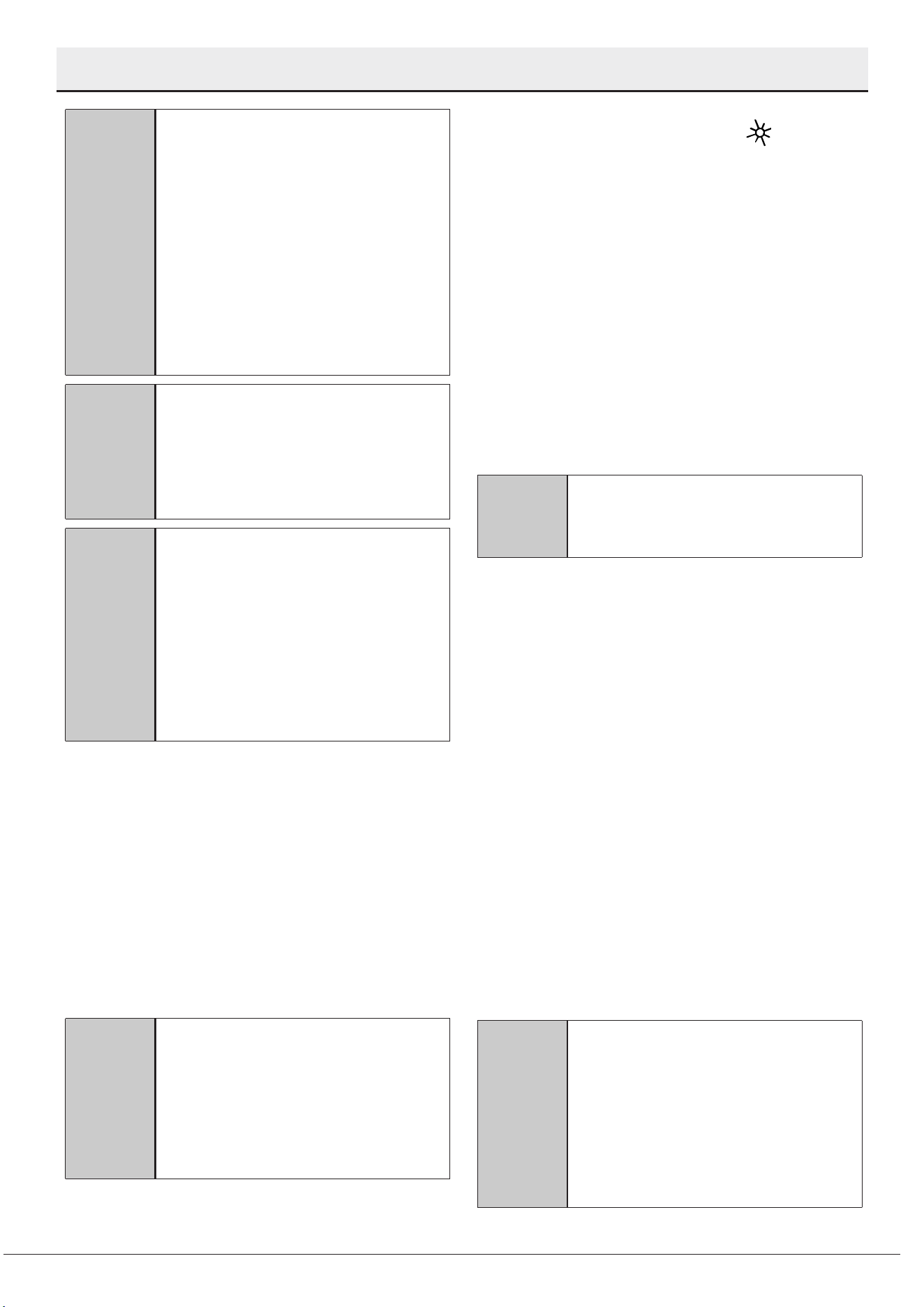
Close the door of your machine to start it
after selecting the programme and auxiliary
functions.
32 / /41 EN
Operating the product
Adjustng the amount of
rnse ad
1. After switching on your machine, press
the Menu key for 3 second.
C
Some models require pressing
Menu key once to enter settings
menu.
2. Using <- and +> keys, proceed to “P:” on
the display.
3. Set to the appropriate level with the
Selection key.
4. Press On / Off key to save the setting.
No rinse aid dispensed in P:0 wash position.
1 dose of rinse aid is dispensed in P:1
position.
2 doses of rinse aid are dispensed in P:2
position.
3 doses of rinse aid are dispensed in P:3
position.
4 doses of rinse aid are dispensed in P:4
position.
C
Your machine performs water
softening depending on the
hardness level of the supply
water. Washing time can
change while the programme
is running depending on the
ambient temperature where
your machine is installed,
temperature of the supply water
and amount of the dishes.
C
Pay attention not to open the
door of the machine when it is
running. There may be a rush of
vapour when you open the door
of your machine; be careful.
C
The machine will remain silent
in pause mode for some time
in order to remove the water
from the machine and on the
dishes completely and to have
the water softener cleaned, and
then it will resume running in
drying mode.
Cancellng the programme
Open the door of the product Press and
hold the Programme Selection / Programme
Cancel keys for 3 seconds. After the 3 - 2 - 1
countdown, 0:01 is displayed, close the door
of the product and wait for the draining
process complete. Draining is completed in
2 minutes and the machine gives an audible
warning when it is completed.
C
There might be residues of
detergent or rinse aid in the
machine and/or on the pieces
being washed depending on the
step the programme you have
cancelled was in.
Rnse Ad ndcator ( )
Please check the rinse aid indicator on the
display to see whether there is adequate
amount of rinse aid in the dishwasher or
not. You need to refill the rinse aid reservoir
with rinse aid whenever rinse aid indicator
appears on the display of your machine.
End of programme
C
When the programme you have
selected comes to an end, an
audible warning signal will warn
you to turn off your machine.
This audible signal will warn you
with certain intervals before it
turns off.

/
33 / 41
EN
Operating the product
InnerClean
(depends on the model)
This programme is recommended to be
operated on each 1-2 months for machine
cleaning and necessary hygiene. The
programme should be operated while the
machine is empty.
In order to achieve an efficient result, it is
recommended to use together with special
machine cleaning agents.
C
Do not use this programme to
clean dishes. As it operates in
high temperatures, it is harmful
for the dishes.
End of Programme indicator will light up
when the washing programme is over.
1. Open the door of the machine.
2. Press On/Off key to turn off your
machine.
3. Close the tap.
4. Unplug the machine from the socket.
C
For energy saving, the machine
is automatically turned off
following the completion of the
programme or if the programme
is not started.
C
Leave your dishes in the machine
for about 15 minutes to allow
them cool down after they are
washed. Your dishes will dry in a
shorter time if you leave the door
of your machine ajar during this
period. This process will increase
the drying effectiveness of your
machine.
Water cut-o warnng
If mains water is cut or water inlet tap is
turned off the machine cannot take water
in and E:02 icon will flash on the programme
indicator. As long as the problem continues,
washing programme is paused and the
water inlet is checked regularly by the
machine; when the water is restored E:02
icon will disappear after a while and the
washing programme resumes.
Overowng warnng
If the machine intakes too much water or
there is leakage at any of the components
then the machine will detect this and E:01
icon will flash on the Programme indicator.
As long as the overflowing continues safety
algorithm will be active and try to discharge
the water. If overflowing stops and safety is
assured, E:01 icon will disappear. If E:01 does
not disappear, there is a permanent fault. In
this case the authorised service should be
contacted.
34 / /41 EN
Maintenance and cleaning
6
Service life of the product extends and
frequently faced problems decrease if it is
cleaned at regular intervals.
A
Unplug the product and turn off
the tap before attempting any
cleaning procedures.
C
Do not use abrasive substances
for cleaning.
C
Clean the filter and impellers at
least once a week in order for the
machine operates efficiently.
Cleanng the outer surface
of the product
Wipe the outer surface and door gaskets
of the product gently with a mild cleaning
material and damp cloth. Wipe the "Control
panel" only with a slightly damp cloth.
Cleanng the nteror of the
machne
•
Clean the interior of the machine and
the tank by running a programme with
or without detergent based on the
degree of soil.
•
If water has remained in the machine,
drain the water by performing the
procedures under the topic "Canceling
a programme". If the water cannot
be discharged, remove the filters
as specified in the "Cleaning the
filters" section and check if there
are any leftover deposits that have
accumulated at the bottom of the
machine, blocking the water path. Clean
if necessary.
Cleanng the flters
Clean the filters at least once a week in order
for the machine operates efficiently. Check if
food residues are left on the filters. If there
are food residues on filters, take them out
and clean well under running water.
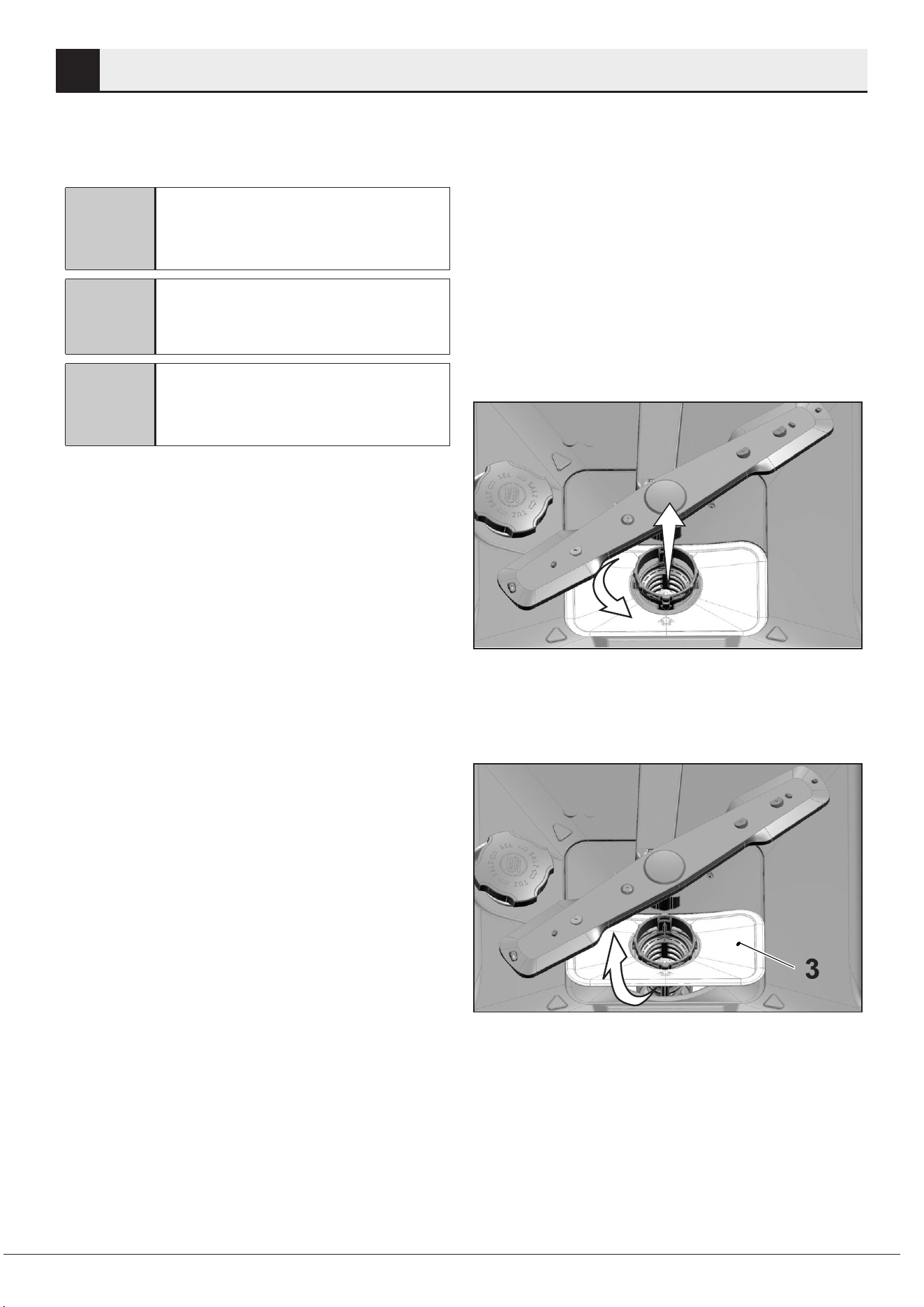
1. Turn the micro filter (1) and coarse filter
(2) assembly counter clockwise and pull
it out from its seating.
2. Pull out the metal/plastic filter (3) from
the seating.
3. Press the two pawls on the coarse filter
inwards and separate the coarse filter
from the assembly.
/
35 / 41
EN
Maintenance and cleaning
4. Clean all three filters under tap water by
means of a brush.
5. Place the metal/plastic filter.
6. Place the coarse filter into the micro
filter. Make sure that it is properly
seated. Turn the coarse filter clockwise
until a "click" sound is heard.
C
Do not use the dishwasher
without filter.
C
Incorrect placement of the filters
will reduce washing efficiency.
Cleanng the hose flter
Damages on the machine that may be
caused by impurities coming from the urban
supply water or your own water installation
(such as sand, dirt, rust, etc.) can be
prevented by means of the filter attached to
the water inlet hose. Check the filter and the
hose regularly and clean them if necessary.
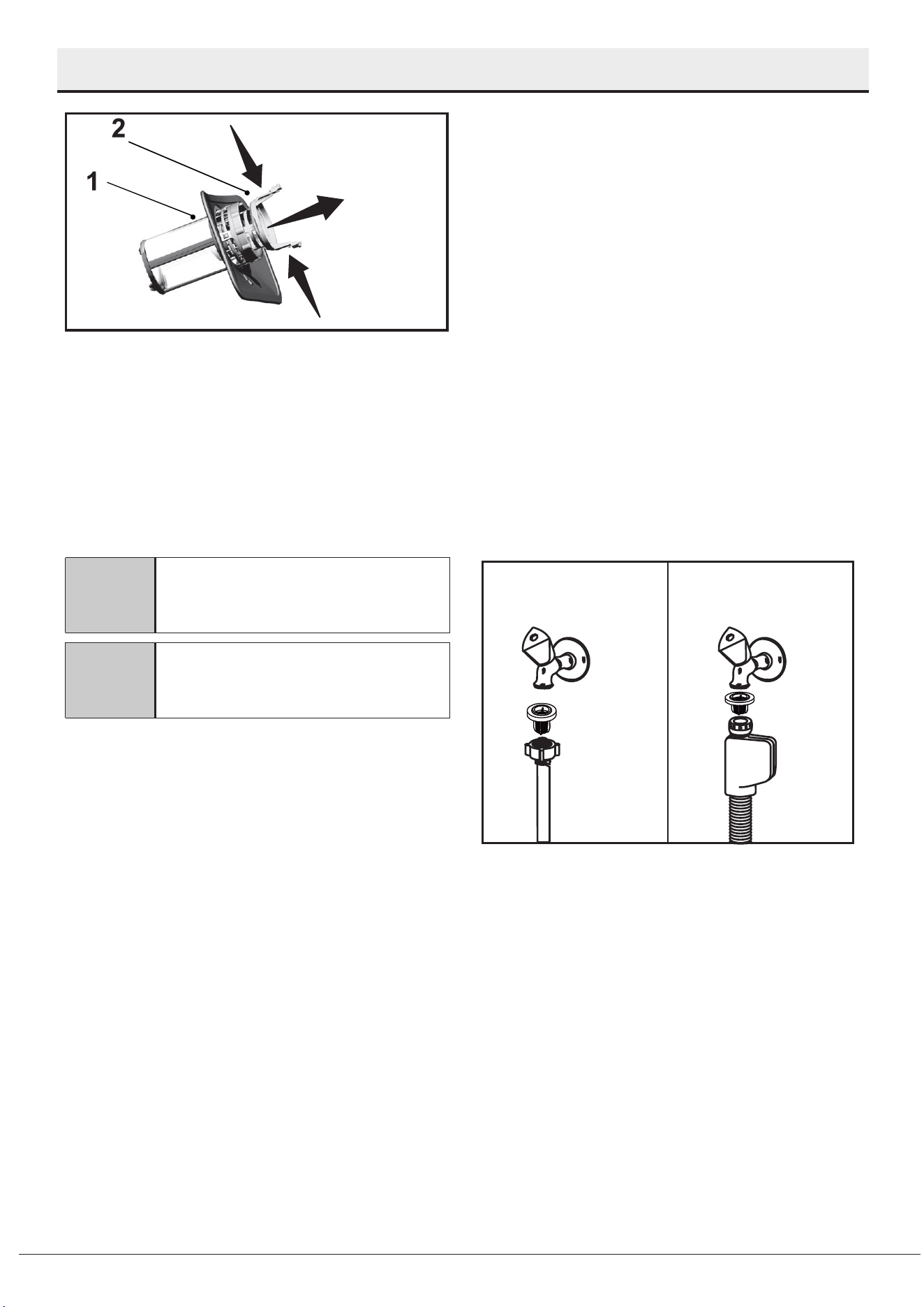
1. Turn off the tap and remove the hose.
2. After taking out the filter, clean it under
running tap water.
3. Place the cleaned filter back to its seat
in the hose.
4. Install the hose to tap.
(depends on model)
36 / /41 EN
Maintenance and cleaning
Cleanng the mpellers
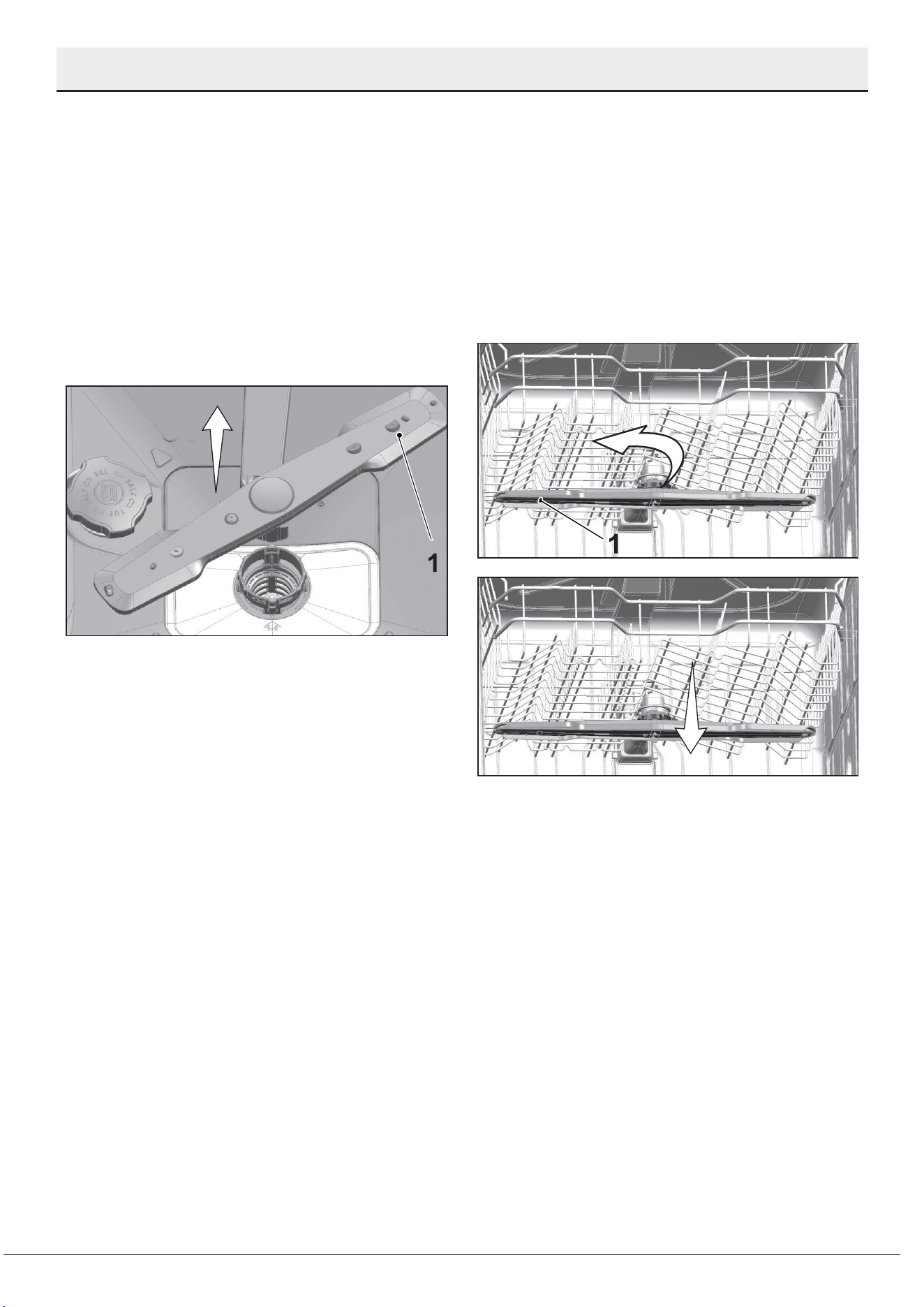
Clean the impellers at least once a week in
order for the machine operates efficiently.
Lower mpeller
Check if the holes on the lower impeller (1)
are clogged. If they are clogged, remove and
clean the impeller. You can pull the lower
impeller up to remove it.
Upper mpeller
Check if the holes on the upper impeller (1)
are clogged. If they are clogged, remove
and clean the impeller. Turn its nut to left to
remove the upper impeller.
Make sure that the nut is tightened well
when installing the upper impeller.

/
37 / 41
EN
7
Troubleshooting
Machine does not start.
• Power cable is unplugged. >>> Check if the power cable is plugged in.
• Fuse is blown. >>> Check the fuses in your house.
• Water is cut. >>> Make sure that the water inlet tap is open.
• Door of the machine is open. >>> Make sure that you have closed the door of the
machine.
• On / Off button is not pressed. >>> Make sure that you have turned on the machine by
pressing the On / Off button.
Dishes are not washed clean
• Dishes are not placed orderly in the machine. >>> Load the dishes as described in the
user manual.
• Selected programme is unsuitable. >>> Select a programme with a higher temperature
and cycle time.
• Impellers are stuck. >>> Prior to starting the programme, turn the lower and upper
impellers by hand to make sure that they rotate freely.
• Impeller holes are clogged. >>> Lower and upper impeller holes might be clogged with
food remnants such as lemon pips. Clean the impellers regularly as illustrated in section
“Cleaning and Care”.
• Filters are clogged. >>> Check if the filter system is clean. Clean the filter system
regularly as illustrated in section “Cleaning and Care”.
• Filters are installed incorrectly. >>> Check the filter system and make sure that it is
installed correctly.
• Baskets are overloaded. >>> Do not overload the baskets in excess of their capacity.
• Detergent is stored under unsuitable conditions. >>> If you are using powder detergent,
do not store the detergent package in humid places. Keep it in a closed container if
possible. For ease-of-storing, we recommend you to use tablet detergents.
• Detergent is not sufficient. >>> If you are using powder detergent, adjust the amount of
detergent according to the soiling degree of your dishes and/or programme definitions.
We recommend you to use tablet detergents for optimum results.
• Rinse aid is not sufficient. >>> Check the rinse aid indicator and add rinse aid if
necessary. Increase the rinse aid setting if there is enough amount of rinse aid in the
machine.
• Detergent dispenser lid is left open. >>> Make sure that the detergent dispenser lid is
closed tightly after adding detergent.
Dishes are not dry at the end of cycle
• Dishes are not placed orderly in the machine. >>> Place your dishes in a way that no
water will accumulate in them.
38 / /41 EN
Troubleshooting
• Rinse aid is not sufficient. >>> Check the rinse aid indicator and add rinse aid if
necessary. Increase the rinse aid setting if there is enough amount of rinse aid in the
machine.
• Machine is unloaded right after the programme is over. >>> Do not unload your machine
right after washing process is completed. Slightly open the door and wait for evacuation
of the steam inside for a while. Unload the dishes after the pieces cool down to a
touchable level. Start unloading process from the lower basket. Thus, dropping of water
remained on a piece at upper basket onto the pieces at lower basket is prevented.
• Selected programme is unsuitable. >>> Since rinsing temperature is low at programmes
with short duration, drying performance will also be low. Select programmes with longer
duration for a higher drying performance.
• Surface quality of the kitchen utensils is deteriorated. >>> Desired washing
performance can not be obtained on kitchen utensils with deteriorated surfaces and it
is not suitable to use such utensils in terms of hygiene as well. Also, water can not flow
easily on deteriorated surfaces. It is not recommended to wash such kitchen utensils in
dishwasher.
C
It is normal that drying complaints can be experienced with Teflon kitchen
utensils. It is associated with the structure of Teflon. Since the surface tensions
of Teflon and water are different, water droplets will remain as beads on the
Teflon surface.
Tea, coffee or lipstick stains remain on dishes.
• Selected programme is unsuitable. >>> Select a programme with a higher temperature
and cycle time.
• Surface quality of the kitchen utensils is deteriorated. >>> Tea and coffee stains
or other dye spots may not be cleaned in dishwasher when they have penetrated in
deteriorated surfaces. Desired washing performance can not be obtained on kitchen
utensils with deteriorated surfaces and it is not suitable to use such utensils in terms of
hygiene as well. It is not recommended to wash such kitchen utensils in dishwasher.
• Detergent is stored under unsuitable conditions. >>> If you are using powder detergent,
do not store the detergent package in humid places. Keep it in a closed container if
possible. For ease-of-storing, we recommend you to use tablet detergents.
Lime traces remain on dishes and glassware gains a misty appearance
• Rinse aid is not sufficient. >>> Check the rinse aid indicator and add rinse aid if
necessary. Increase the rinse aid setting if there is enough amount of rinse aid in the
machine.
/
39 / 41
EN
Troubleshooting
• Water hardness setting is low or salt level is insufficient >>> Measure the hardness of
the supply water appropriately and check the water hardness setting.
• Salt leakage exists. >>> Pay attention not to spill salt around the salt filling hole while
adding salt. Make sure that the salt reservoir lid is tightly closed after finishing the filling
process. Run the prewash programme to remove the salt that spilled inside the machine.
Since the salt granules that will remain under the lid will dissolve during prewash, causing
the lid loosen, check the lid once again at the end of the programme.
There is a different odour in the machine
C
A new machine has a peculiar odour. It will fade out after a couple of washes.
• Filters are clogged. >>> Check if the filter system is clean. Clean the filter system
regularly as illustrated in section “Cleaning and Care”.
• Dirty dishes are kept in dishwasher for 2-3 days. >>> If you are not going to start the
machine right after you have put the dishes into it, remove the remnants on the dishes
and run the Prewash programme without detergent every 2 days. In such cases, do not
close the door of the machine completely in order to avoid odour build up in machine. You
can also use commercially available odour removers or machine cleaners.
Rust, discoloration or surface deterioration occurs on dishes
• Salt leakage exists. >>> Salt may cause deterioration and oxidation on metal surfaces.
Pay attention not to spill salt around the salt filling hole while adding salt. Make sure that
the salt reservoir lid is tightly closed after finishing the filling process. Run the prewash
programme to remove the salt that spilled inside the machine. Since the salt granules
that will remain under the lid will dissolve during prewash, causing the lid loosen, check
the lid once again at the end of the programme.
• Salty food remnants have remained on dishes for a long time. >>> If cutlery soiled with
such foods will be kept waiting in machine, dirt must be removed by prewash or dishes
must be washed without being kept waiting.
• Electric installation is not grounded. >>>Check if your machine is connected to the actual
grounding line. Otherwise, the static electric created in the product causes arcs on the
surfaces of metal items creating pores, removing the protective cover on the surface and
causing discoloration.
• Intensive cleansers such as bleaches are used. >>> Protective cover on metal surfaces
gets damaged and looses its efficiency in time when it gets in contact with cleansers
such as bleach. Do not wash your dishes with bleach.
• Metal items particularly knives are used for purposes other then their intended uses.
>>> Protective cover on the edges of knives may get damaged when they are used for
purposes such as opening cans. Do not use metal kitchen utensils out of their intended
uses.
• Cutlery are made of low quality stainless steel. >>> Corrosion on such items is inevitable;

40 / /41 EN
Troubleshooting
they should not be washed in dishwashers.
• Kitchen utensils that are already corroded are washed in dishwasher. >>> Rust on a
corroded item can migrate to other stainless steel surfaces and cause corrosion on those
surfaces as well. Such items should not be washed in dishwashers.
Detergent remains in detergent dispenser.
• Detergent dispenser was damp when adding detergent. >>> Make sure that the
detergent dispenser is dried well prior to filling it with detergent.
• Detergent is added long before the washing process. >>> Pay attention to add detergent
shortly before start-up of the washing.
• Opening of the detergent dispenser lid is prevented during washing. >>> Place the
dishes in a way that will not prevent the detergent dispenser lid from opening and the
water going into the machine from impellers.
• Detergent is stored under unsuitable conditions. >>> If you are using powder detergent,
do not store the detergent package in humid places. Keep it in a closed container if
possible. For ease-of-storing, we recommend you to use tablet detergents.
• Impeller holes are clogged. >>> Lower and upper impeller holes might be clogged with
food remnants such as lemon pips. Clean the impellers regularly as illustrated in section
“Cleaning and Care”.
Decorations and ornaments on kitchen utensils are being erased.
C
Decorated glasses and decorated lustre porcelains are not suitable for washing in
the dishwasher. Manufacturers of some glassware and porcelain tableware items
do not recommend washing such kitchen utensils in the dishwashers either.
Dishes are scratched.
C
Kitchen utensils that contains or are made of aluminium should not be washed in
dishwasher.
• Salt leakage exists. >>> Pay attention not to spill salt around the salt filling hole while
adding salt. Spilled salt can cause scratches. Make sure that the salt reservoir lid is tightly
closed after finishing the filling process. Run the prewash programme to remove the salt
that spilled inside the machine. Since the salt granules that will remain under the lid will
dissolve during prewash, causing the lid loosen, check the lid once again at the end of the
programme.
• Water hardness setting is low or salt level is insufficient >>> Measure the hardness of
the supply water appropriately and check the water hardness setting.
• Dishes are not placed orderly in the machine. >>> When placing the glasses and other
glassware into the basket lean them not against other dishes but the edges or racks of
the basket or the glass support tines. Striking of the glasses to each other or to other
dishes due to the impact of water during washing can cause breaks, or scratches on their
/
41 / 41
EN
Troubleshooting
surfaces.
A smear remains on glasses that resembles milk stain which can not be
removed when wiped by hand. A bluish / rainbow appearance occurs when
the glass is pointed to light.
• Excessive rinse aid is used. >>>Lower rinse aid setting. Clean the spilled rinse aid when
adding rinse aid.
• Corrosion has occurred on glass due to soft water. >>> Measure the hardness of the
supply water appropriately and check the water hardness setting. If your supply water is
soft (<5 dH), do not use salt. Choose programmes that wash in higher temperatures (e.g.
60-65°C). You can also use glass protective detergents that are commercially available.
Foam forms in the machine.
• Dishes are washed with hand-wash detergent by hand but not rinsed before placing
them into the machine. >>> Hand-wash detergents do not contain antifoam. There is
no need to hand-wash the dishes before placing them into the machine. Removing the
coarse soil on the dishes under tap water, with a tissue paper or fork will be sufficient.
• Rinse aid has spilled into the machine when adding rinse aid. >>> Take care that rinse
aid is not spilled in the machine when you are filling it. Clean any spilled rinse ait with the
help of a tissue paper/towel.
• Lid of the rinse aid reservoir is left open. >>> Make sure that the lid of the rinse aid
reservoir is closed after adding rinse aid.
Kitchen utensils are broken.
• Dishes are not placed orderly in the machine. >>> Load the dishes as described in the
user manual.
• Baskets are overloaded. >>> Do not overload the baskets in excess of their capacity.
Water remains in the dishwasher at the end of the programme.
• Filters are clogged. >>> Check if the filter system is clean. Clean the filter system
regularly as illustrated in section “Cleaning and Care”.
• Discharge hose is clogged/blocked. >>> Check the discharge hose. If necessary, remove
the discharge hose, clear the blockage and insert is as illustrated in the user manual.
C
If you cannot eliminate the problem although you follow the instructions in this
section, consult your dealer or the Authorised Service Agent. Never try to repair a
nonfunctional product yourself.