Z254
EN Operator's manual 2-29
ES-MX Manual del usuario 30-59

Contents
Conformity certificates.............................................. 2
Introduction............................................................... 2
Safety........................................................................6
Operation................................................................ 11
Maintenance........................................................... 14
Troubleshooting...................................................... 23
Transportation, storage and disposal......................25
Technical data.........................................................26
Service....................................................................28
Appendix ................................................................60
Conformity certificates
USA requirements
Labels are placed on the engine and/or in the
engine compartment stating that the machine will
fulfill the requirements. Do not remove these labels.
Certificates can also be supplied with the machine at
delivery or written in the Engine manual. Take care
of them as they are valuable documents.
To implement improvements, specifications and
designs can be altered without prior notification.
Introduction
Pre-delivery inspection and product
numbers
A pre-delivery inspection has been done of this
product. Make sure that you receive a signed copy
of the pre-delivery inspection document from your
dealer.
Service agent contact information:
This operator’s manual is for product with product number / serial number:
/
Engine:
Transmission:
The product numbers are found on the type plate.
Refer to
Product overview on page 3
for the
location of the type plate.
Product description
This product is a ride-on lawn mower. The control
levers let the operator steer the product and adjust
the speed of the product. An hour meter shows how
many hours the product has been used.
Intended use
The product is made to cut grass on open and level
ground only. Do not use the product for other tasks.
2 2194 - 002 - 29.09.2023
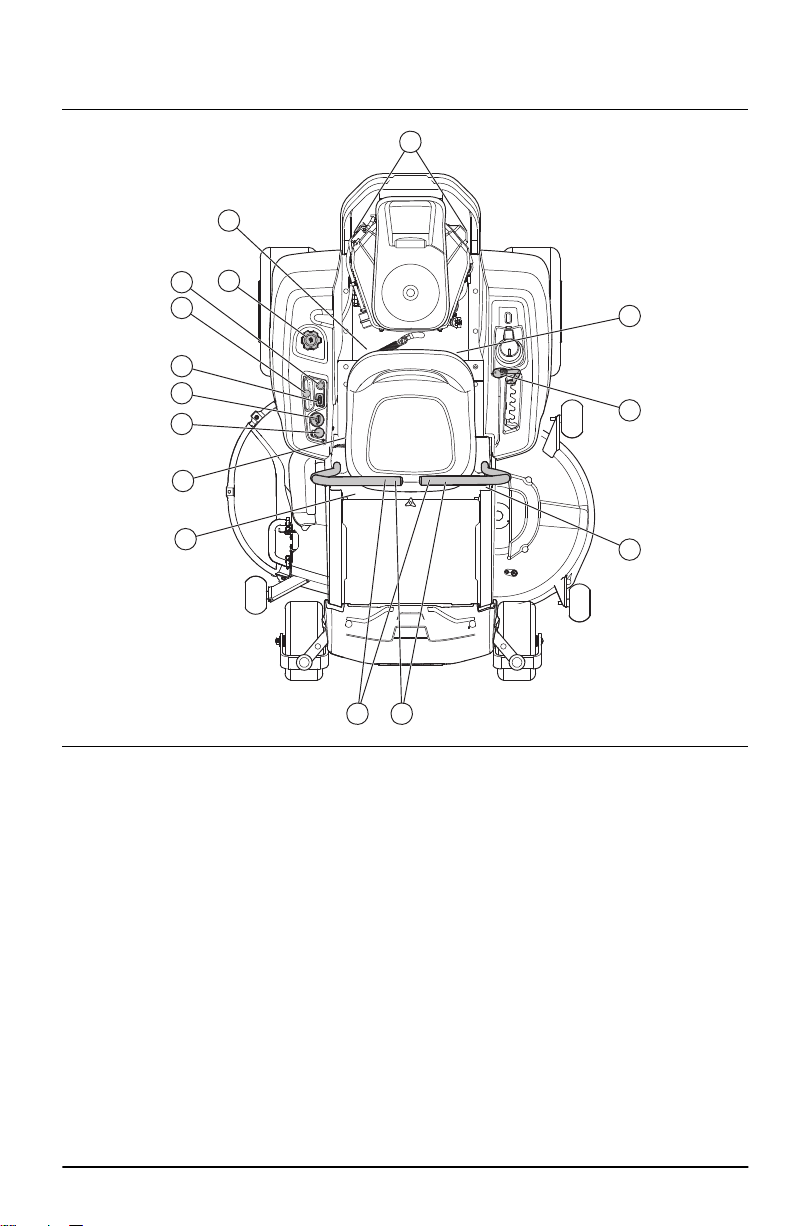
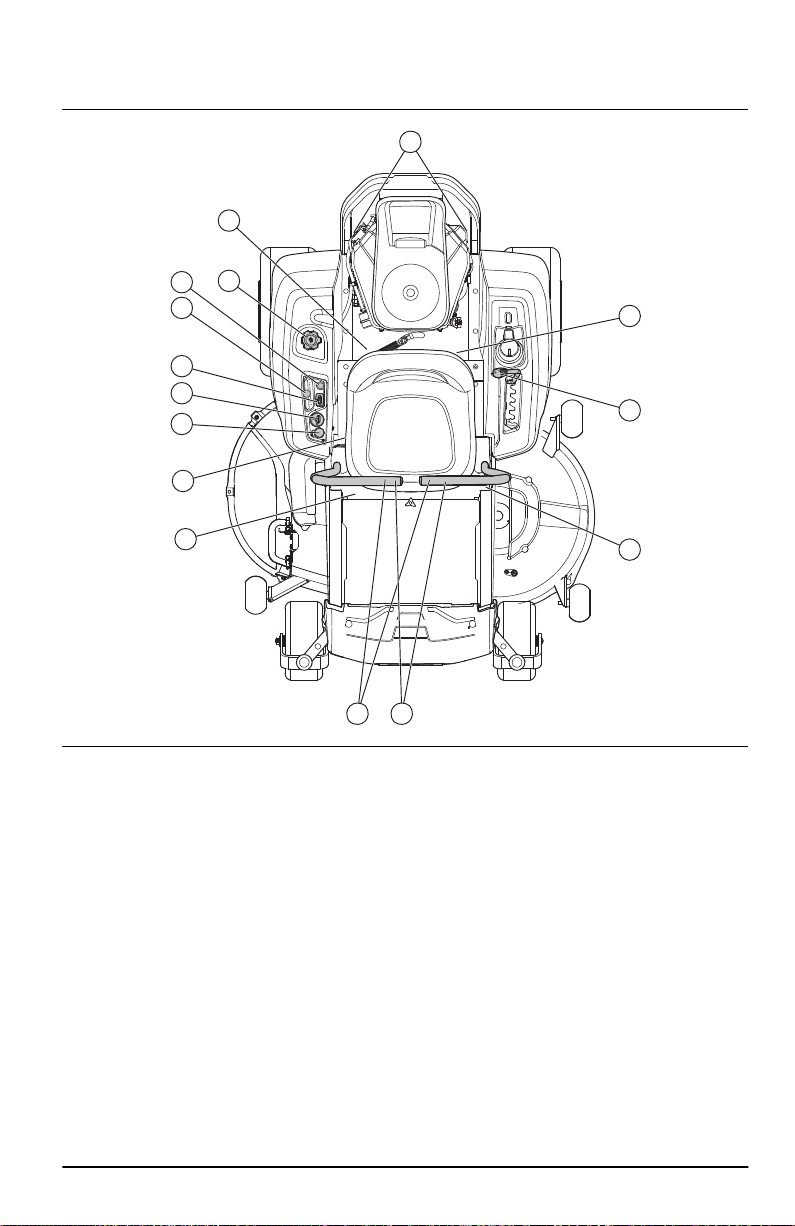
Product overview
1 2
6
3
4
5
7
8
10
3
12
11
13
15
9
14
1. Control levers
2. Parking brake
3. Tracking control
4. Deck lifting lever
5. Fuses
6. Bypass linkage
7. Fuel shut-off valve
8. Fuel tank
9. Choke control
10. Throttle control
11. Hour meter
12. Ignition switch
13. PTO button
14. Seat adjustment lever
15. Type plate
Steering controls
The direction of the product is controlled by the 2
control levers. Refer to
Product overview on page
3
. The control levers can be moved forward and
rearward from a neutral position. Refer to
To operate
the product on page 13
.
Operator Presence Control (OPC)
The OPC engages when the operator lifts from the
seat. The engine and the drive to the blades stop if
the blades are engaged or the parking brake is not
applied. Refer to
Operation conditions on page 8
.
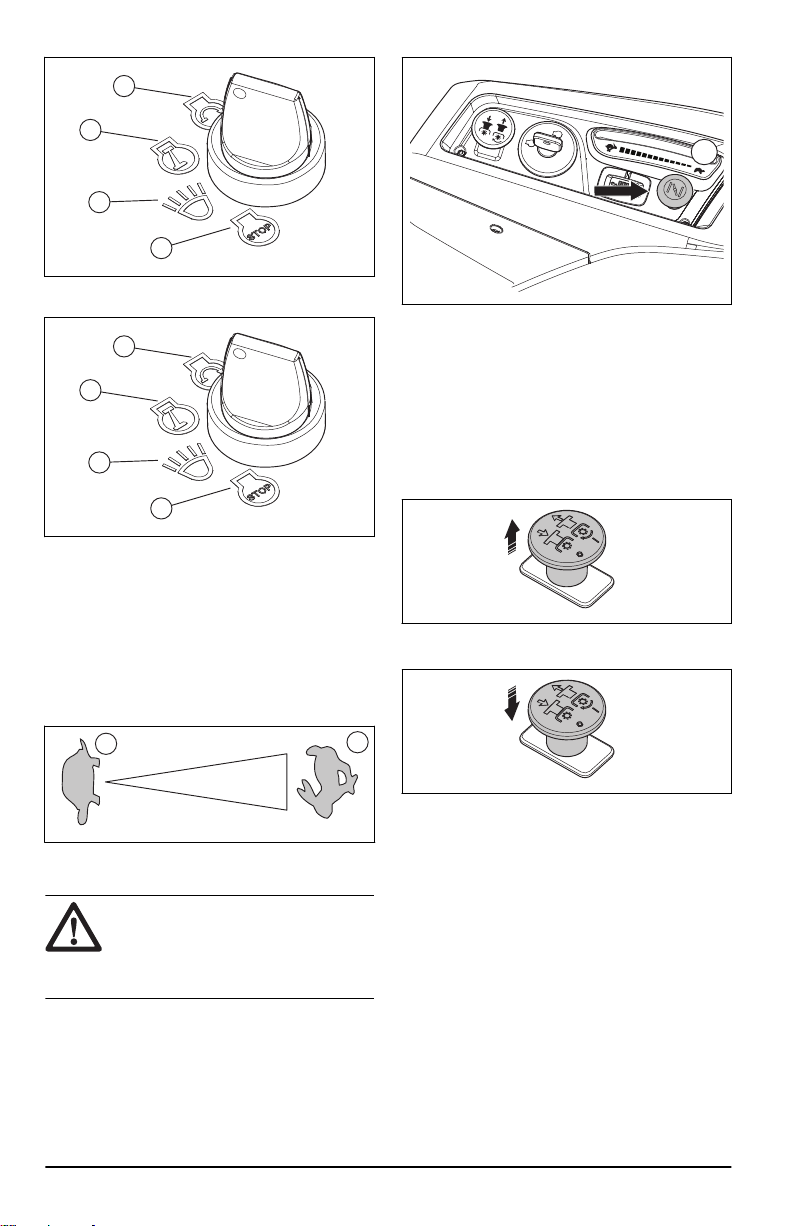
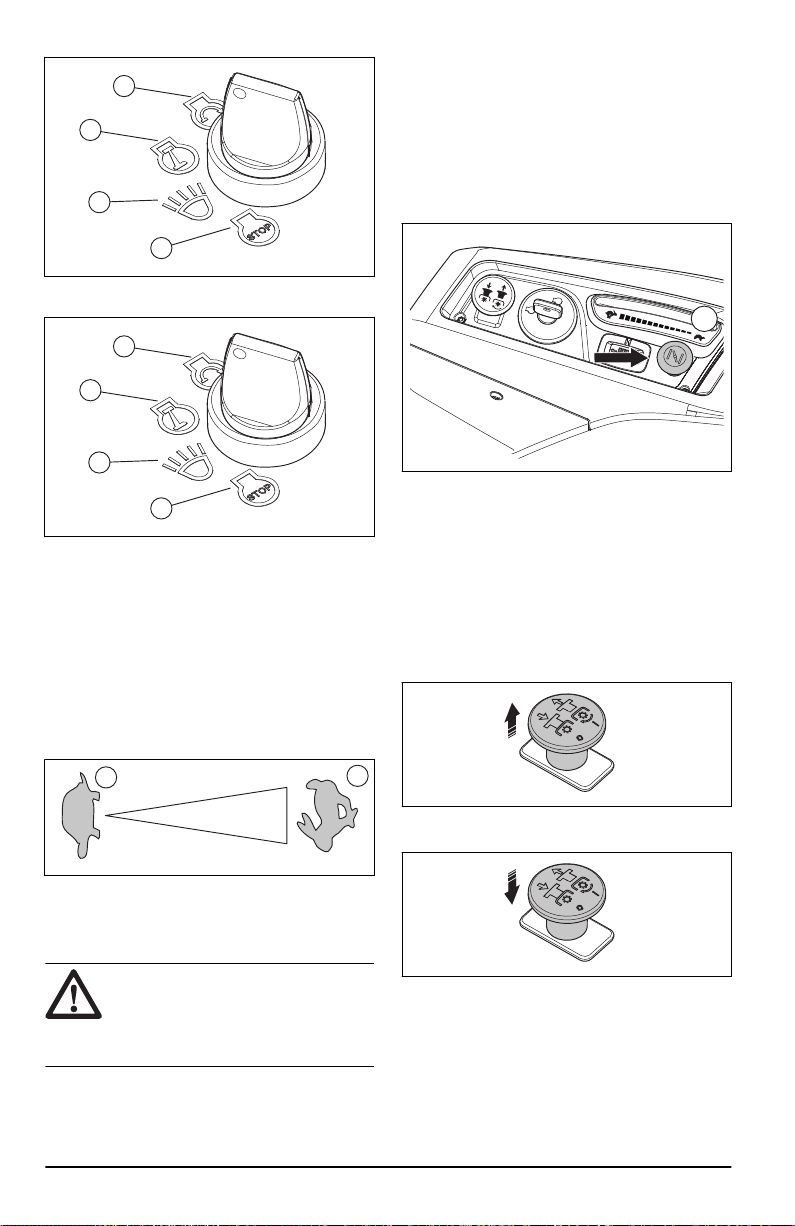
Ignition key
The ignition key has 4 positions:
• Start position (A)
• Run position (B)
• Headlight position (C)
• Stop position (D)
2194 - 002 - 29.09.2023 3
A
B
C
D
Headlights
A
B
C
D
• Turn the ignition key to the headlight position (C)
to operate the product with the headlights on.
• Turn the ignition key to the run position (B) to
operate the product with the headlights off.
Throttle control
The throttle control adjusts the speed of the engine
and the speed of the blades if the blades are
engaged. The throttle control has 2 end positions,
idle speed and full throttle.
AA
B
• Idle speed (A) - decreases the engine speed.
• Full throttle (B) - increases the engine speed.
CAUTION:
Do not operate the
engine at idle speed (A) for longer time
than necessary. Too much operation
time at idle speed can decrease the life
of the spark plugs.
Choke control
The choke control is used for cold starts to supply
more fuel to the engine. Pull up the choke control
when you start a cold engine.
Refer to
Product overview on page 3
for the position
of the choke control.
PTO (Power Take-Off) button
The PTO button engages and disengages the PTO
clutch and the cutting deck or other equipment
connected to it. The correct start conditions must
be obeyed to engage the drive of the blades. Refer
to
Operation conditions on page 8
for the correct
start conditions.
• Pull the PTO button out to engage the drive to
the blades or other equipment.
• Push the PTO button in to disengage the drive to
the blades or other equipment.
Fuel shut-off valve
Refer to
Product overview on page 3
for the position
of the fuel shut-off valve.
The fuel shut-off valve is closed when the tab on the
knob is perpendicular to the fuel line.
Fuses
The location of the fuses is in the fuse box. The fuse
box is below the seat. Tilt the seat forward to get
access the fuse box. Refer to the decal on the fuse
box for identification of the different fuses.
Hour meter
The product has an hour meter that show how
many hours of operation that the blades have been
4
2194 - 002 - 29.09.2023
engaged. Refer to
Product overview on page 3
for
the position of the hour meter.
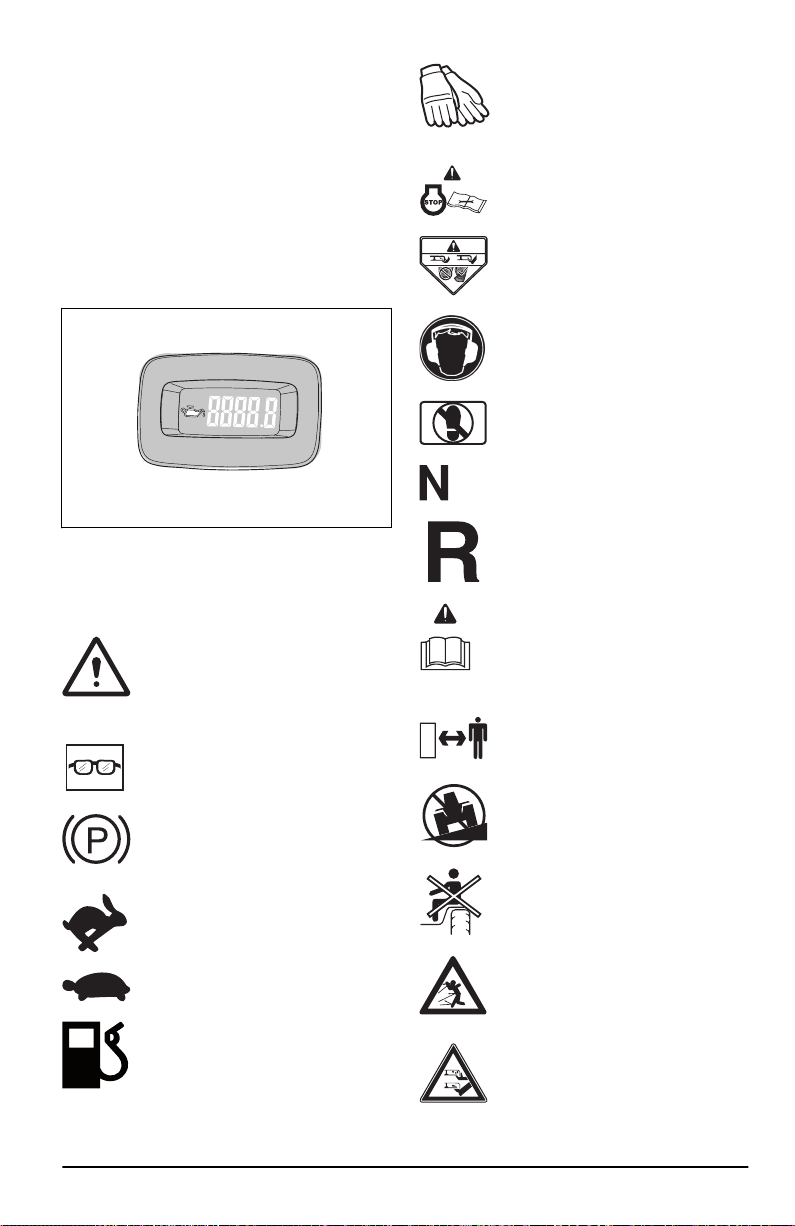
Each 50 hours an oil level symbol will show for 2
hours. Refer to
To do a check of the engine oil level
on page 20
.
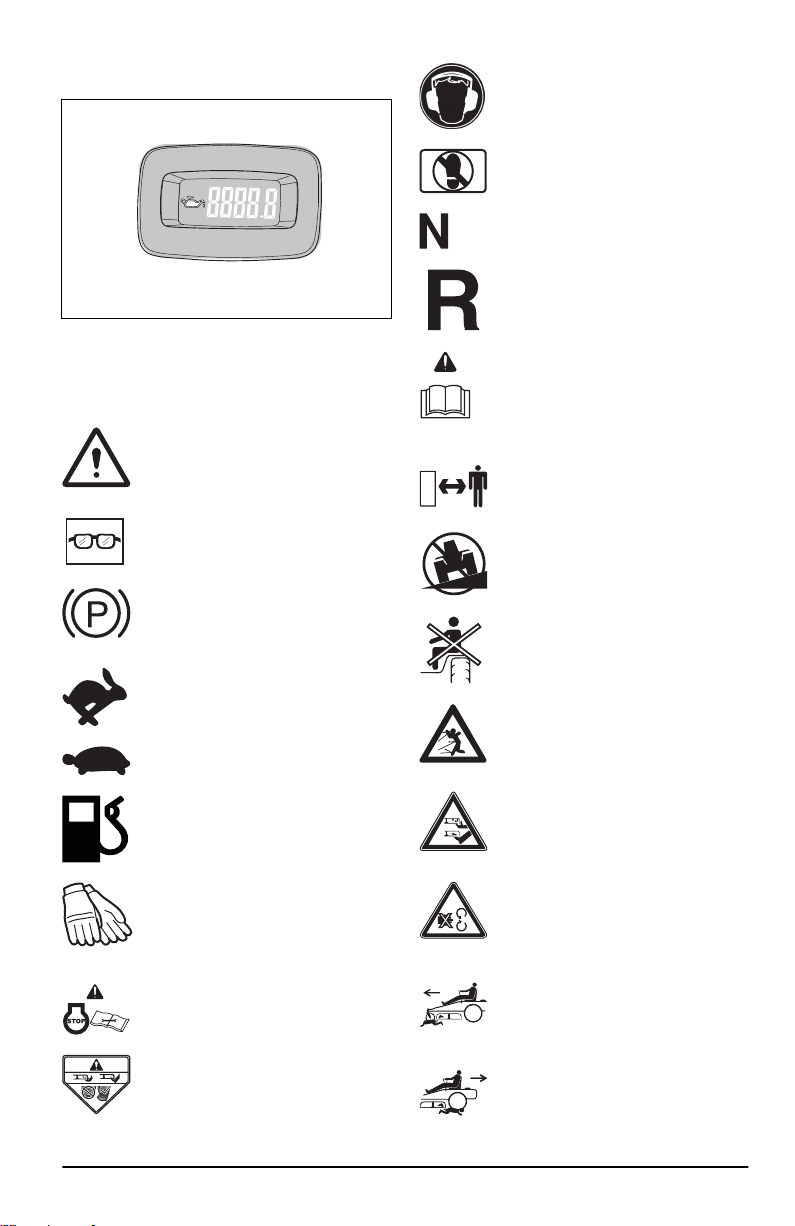
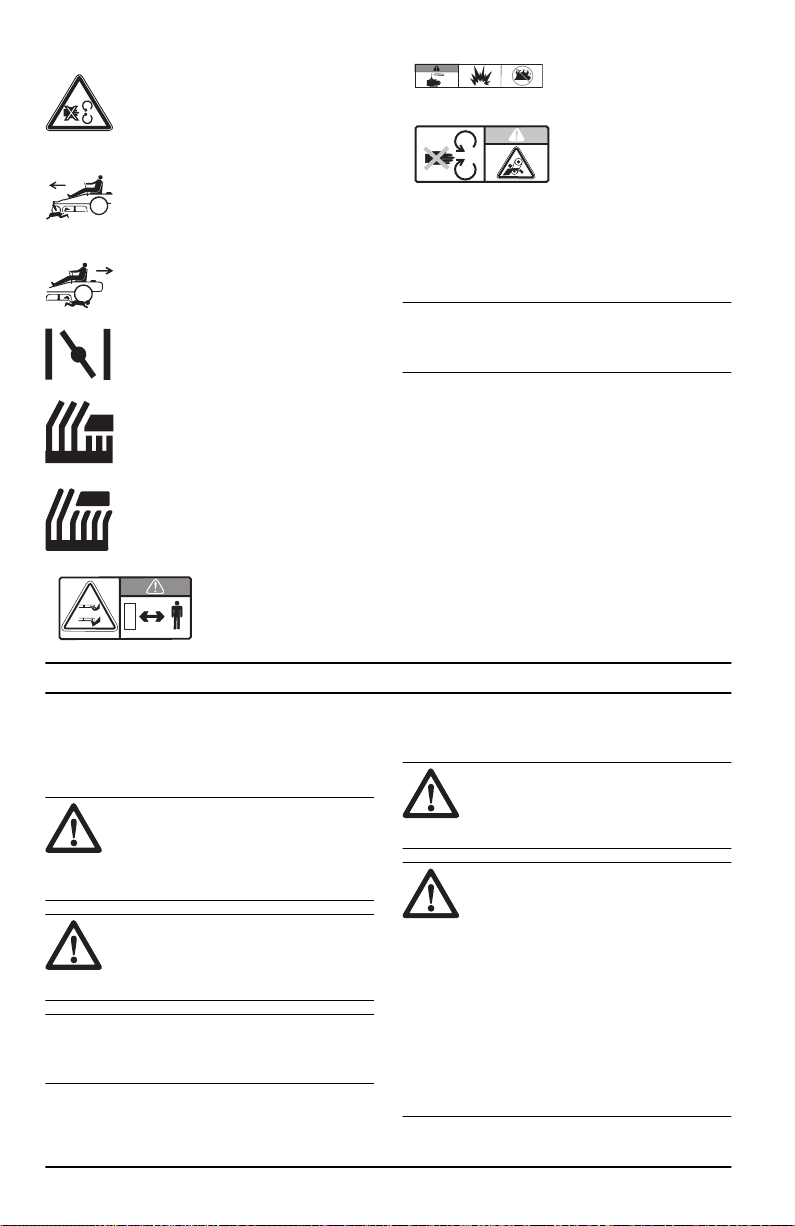
Symbols on the product
WARNING: This product can be
dangerous and cause serious injury or
death to the operator or others. Be
careful and use the product correctly.
Use protective glasses.
Parking brake.
Engine speed – fast.
Slow.
Fuel.
Use protective gloves.
Stop the engine before maintenance.
Do not operate the product without
deflector or grass catcher.
Always use approved hearing
protection.
Do not put your foot here.
Neutral gear.
Reverse gear.
Read the operator's manual carefully
and make sure that you understand the
instructions before you use the product.
Keep a safe distance from the product.
Do not operate the product on slopes
larger than 10°.
Do not keep passengers.
Look out for ejecting objects and
ricochets.
Keep hands and feet clear.
Keep hands away from rotating parts.
Look out for persons and animals when
you operate the product forward.
Look out for persons and animals when
you operate the product rearward.
2194 - 002 - 29.09.2023 5
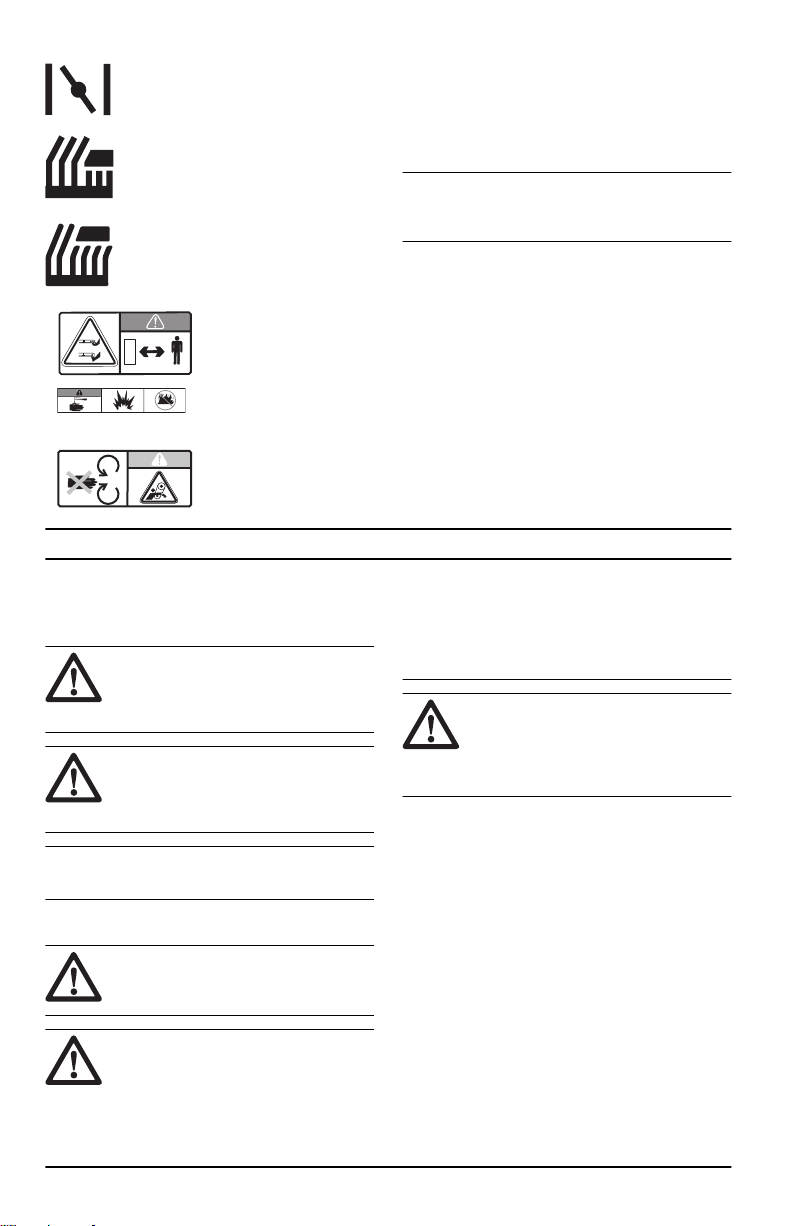
Choke control.
Cutting height low.
Cutting height high.
Keep away from the dis-
charge deck.
Warning! Battery acid is
corrosive, explosive and
flammable.
Keep body parts away
from rotating parts.
yyyywwxxxx The rating plate shows
serial number. yyyy is
the production year and
ww is the production
week.
Note: Other symbols/decals on the product refer
to certification requirements for some commercial
areas.
Product damage
We are not responsible for damages to our product
if:
• the product is incorrectly repaired.
• the product is repaired with parts that are not
from the manufacturer or not approved by the
manufacturer.
• the product has an accessory that is not
from the manufacturer or not approved by the
manufacturer.
• the product is not repaired at an approved
service center or by an approved authority.
Safety
Safety definitions
Warnings, cautions and notes are used to point out
specially important parts of the manual.
WARNING: Used if there is a
risk of injury or death for the operator
or bystanders if the instructions in the
manual are not obeyed.
CAUTION: Used if there is a risk of
damage to the product, other materials
or the adjacent area if the instructions in
the manual are not obeyed.
Note: Used to give more information that is
necessary in a given situation.
General safety instructions
WARNING: Read the warning
instructions that follow before you use
the product
WARNING: Failure to follow
cautious operating practices can result in
dangerous injury to the operator or other
persons. The owner must understand
these instructions, and must let only
approved persons who understand these
instructions to operate the mower. Each
person operating the mower must be
of sound mind and body and must not
be under the influence of mind altering
substances.
WARNING: This product is capable
of amputating hands and feet and
throwing objects. Failure to observe the
following safety instructions could result
in serious injury or death.
• Read, understand, and follow instructions and
warnings in this document, the operator’s manual
and on the product, engine and attachments.
• Only allow operators, who are responsible,
trained, familiar with the instructions, and
physically capable to operate the product.
• Make sure to inform a person that you are going
to operate the product if an injury or accident
occurs.
• Do not carry passengers and keep bystanders
away.
• Do not operate the product while under the
influence of alcohol or drugs.
• Follow the manufacturer’s recommendation for
wheel weights or counterweights.
• Learn how to use the product and its controls
safely and learn how to stop the product quickly.
• Learn to recognize the safety decals.
6
2194 - 002 - 29.09.2023

• Keep the product clean to make sure that you
can clearly read signs and stickers.
• Keep in mind that the operator will be held
responsible for accidents that involve other
persons or their property.
• Only use the product in daylight or in other well-lit
conditions. Keep the product at a safe distance
from holes or other irregularities in the ground.
Look out for other possible risks.
• Do not let children or other persons not approved
for operation of the product to use or do servicing
on it. Local laws may regulate the age of the
user.
• Make sure that nobody else is in the vicinity of
the product when you start the engine, engage
the drive or start to move the product.
• Keep an eye on the traffic when you mow near a
road or move across a road.
• Do not use the product if you are fatigued, while
under the influence of alcohol or drugs, medicine
or anything that can have a negative effect on
your vision, alertness, coordination or judgement.
• Always park the product on a level surface with
the engine stopped.
• Do not make modifications to this product.
• Do not operate the product if it is possible that
other persons have made modifications to the
product.
Safety instructions regarding children
WARNING: Children can be
seriously injured or killed by this product.
Read the warning instructions that follow
before you use the product. Keep
children away.
• Tragic accidents can occur if the operator is not
alert to the presence of children. Children are
often attracted to the product and the mowing
activity. Never assume that children will remain
where you last saw them.
• Keep children out of the operating area and
under the watchful care of a responsible adult
other than the operator.
• Keep an eye out and stop the product
immediately, if children enter the work area. Be
very careful near corners, bushes, trees or other
objects that prevents a clear view.
• Use extreme care when going near blind corners,
shrubs, trees, or other objects that can block
your view of a child.
• Before and while you move the product in
reverse, look behind you and look down for small
children.
• Do not let children operate the product.
• The American Academy of Paediatrics
recommends that children be a minimum of 16
years of age before operating a riding lawn
mower.
• Do not carry children, even with the blade(s)
shut off. Children could fall off and be seriously
injured or interfere with safe product operation.
Children who have been given rides in the past
could suddenly appear in the mowing area for
another ride and be run over or backed over by
the product.
Safety instructions for operation
WARNING: Read the warning
instructions that follow before you use
the product.
WARNING: Do not touch the
engine or exhaust system during or
directly after operation. The engine and
the exhaust system become very hot
during operation. Risk of burn injuries,
fire and damage to property or adjacent
areas. When you operate the product,
keep away from bushes and other
objects.
• Only operate the engine in well ventilated areas.
Exhaust gases contain carbon monoxide, a
deadly poison.
• Only operate the product in daylight or good
artificial light.
• Clear the area of objects such as stones, toys,
wires, etc. that may become caught in the blades
and be thrown out.
• Avoid holes, ruts, bumps, rocks, or other hidden
hazards. Uneven terrain could overturn the
product, or cause operator to lose their balance
or footing.
• Do not put hands or feet near rotating parts or
under the product. Keep clear of the discharge
opening at all times.
• Do not operate the product without the full grass
catcher, discharge guard, or other safety devices
in place and working.
• Do not direct discharge material toward anyone.
Avoid discharging material against a wall or
obstruction. Material may ricochet back toward
the operator. Stop the blade(s) when crossing
gravel surfaces.
• Do not leave a running product unattended.
Always park on level ground, disengage the
attachment, set parking brake, and stop engine/
motor.
• Do not mow in reverse unless absolutely
necessary. Always look down and behind before
and while backing.
• Decrease speed before turning.
• Decrease the speed before you turn around a
corner.
• Data shows that operators age 60 years and
above are involved in a large percentage of
riding mower-related injuries. These operators
must evaluate if they can safely operate the
2194 - 002 - 29.09.2023
7
riding mower sufficiently to protect themselves
and others from injury.
Safety instructions for operation on slopes
WARNING: Read the warning
instructions that follow before you use
the product.
Slopes are a major factor related to accidents.
Operation on slopes requires extra caution.
• Travel in the manufacturer recommended
direction on slopes. Use caution while operating
near dropoffs.
• Avoid mowing wet grass. The tires can lose
traction.
• Do not operate product under any condition
where traction, steering, or stability is in question.
Tires could slide even if the wheels are stopped.
• Always keep the product in gear when going
down slopes. Do not coast downhill.
• Avoid starting and stopping on slopes. Avoid
making sudden changes in speed or direction.
Make turns slowly and gradually.
• If the tires lose traction, disengage the blades
and continue slowly straight down the slope.
• Use extra care while operating product with a
grass catcher or other attachment(s). They can
affect the stability of the product.
• To cut grass on slopes increases the risk that
you can not control the product and that it
overturns. This can cause injury or death. It is
necessary to cut the grass carefully on all slopes.
If you cannot reverse up a slope or if you do not
feel safe, do not cut it.
• Remove stones, branches and other obstacles.
• Cut the grass on the slope up and down, not
from side to side.
• Do not operate the product on ground that slopes
more than 10°.
• Move smoothly and slowly on slopes.
• Look out for and do not move across furrows,
holes and bumps. There is a higher risk that the
product overturns on ground that is not flat. Long
grass can hide obstacles.
• Do not cut grass near edges, ditches or banks.
Keep at least the width of the machine away
from these hazards. The product can suddenly
overturn if a wheel moves across the edge of a
steep slope or a ditch, or if an edge gives way.
Personal protective equipment
WARNING:
Read the warning
instructions that follow before you use
the product.
• Use approved personal protective equipment
when you use the product. Personal protective
equipment cannot fully prevent injury but it
decreases the degree of injury if an accident
does occur. Let your dealer help you select the
right equipment.
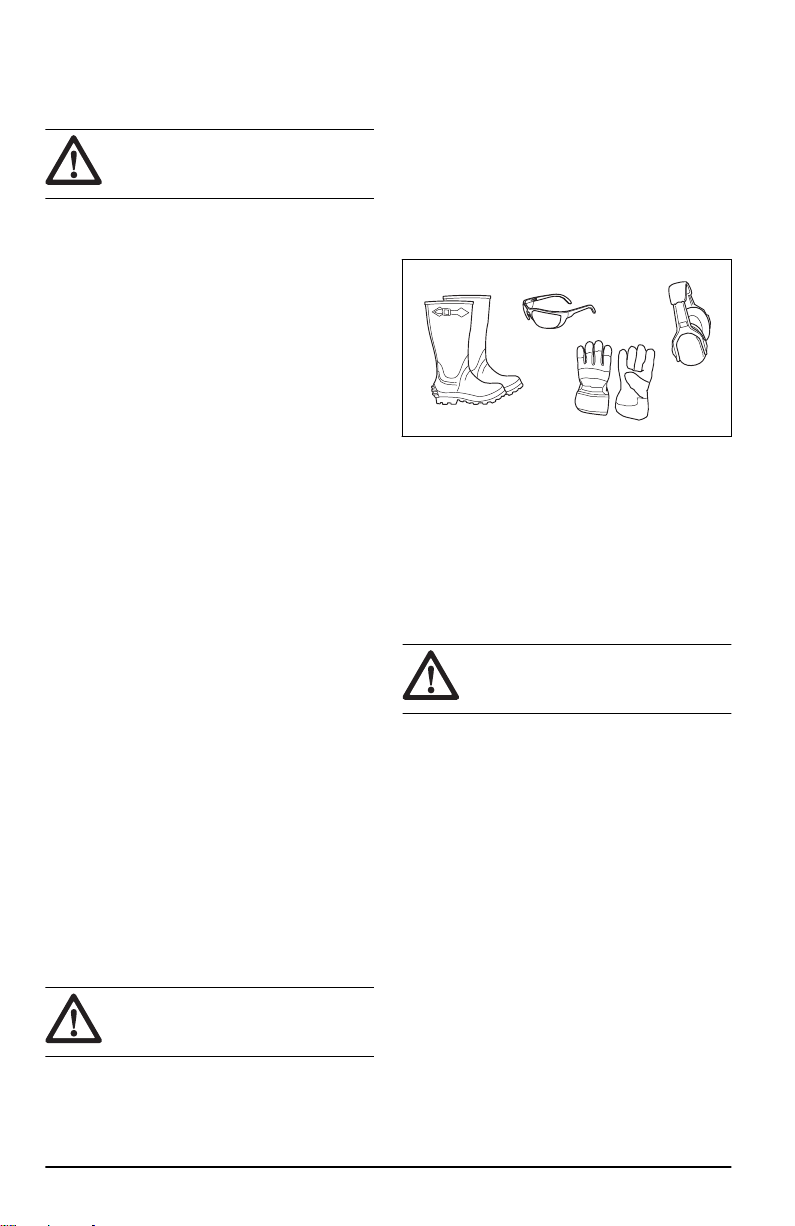
• Always wear approved hearing protection. Long
term exposure to noise can result in permanent
hearing impairment.
• Always wear safety glasses or eye protection
while you operate the product or do maintenance
or repairs.
• Always wear protective shoes or protective
boots. Steel toes are recommended. Do not use
the product barefoot.
• Wear gloves when necessary, for example
when you attach, examine or clean the cutting
equipment.
• Do not wear loose-fitting clothing, jewelry or
other items that can get caught in moving parts.
• Do not wear shorts when you operate the
product.
• Keep first aid equipment and fire extinguisher
close at hand.
Safety devices on the product
WARNING:
Read the warning
instructions that follow before you use
the product.
• Do not use a product with safety devices that
are damaged or do not operate correctly. Do a
check of the safety devices regularly. If the safety
devices are damaged, speak to your Husqvarna
service agent.
• Do not make modifications on safety devices. Do
not use the product if protective plates, protective
covers, safety switches or other protective
devices are not attached or are damaged.
To do a check of the ignition key
• Start and stop the engine to do a check of the
ignition key. Refer to
To start the engine on page
12
and
To stop the engine on page 14
.
• Make sure that the engine starts when you turn
the ignition key to start position.
• Make sure that the engine stops immediately
when you turn the ignition key to stop position.
Operation conditions
These conditions are necessary to start the engine:
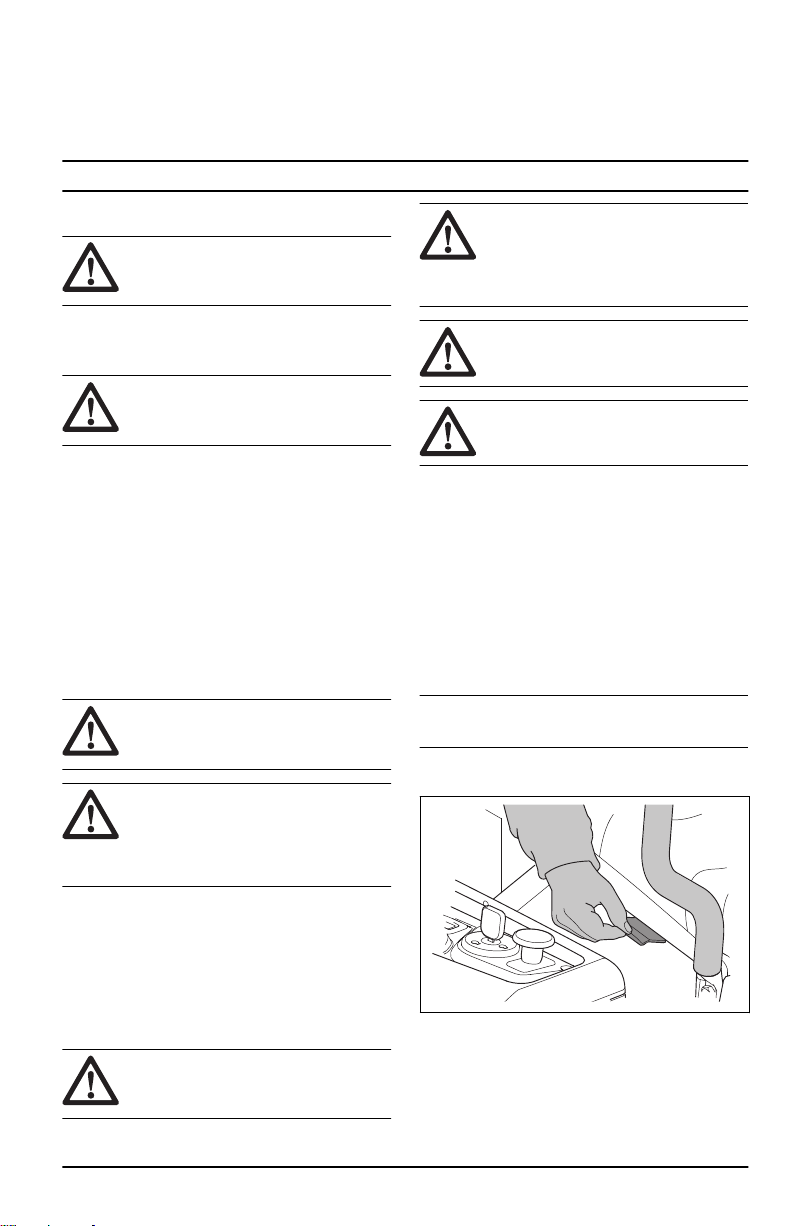
• The control levers are in the neutral position.
8
2194 - 002 - 29.09.2023
• The parking brake is applied.
• The drive of the blades is disengaged.
• The OPC is pushed down.
The engine must stop in these situations:
• The parking brake is not applied and the operator
lifts from the seat.
• The drive of the blades is engaged and the
operator lifts from the seat.
Try to start the engine without 1 of the conditions.
Change the conditions and try again. Do this check
daily.
Parking brake
WARNING: If the parking brake
does not work, the product can start to
move and cause injury or damage. Make
sure that the parking brake is regularly
examined and adjusted.
Refer to
To do a check of the parking brake on page
16
.
Muffler
WARNING: Do not use the product
if the muffler is missing or damaged.
A muffler that is damaged or missing
increases the noise level and the risk of
fire.
The muffler keeps the noise levels to a minimum and
sends the exhaust fumes away from the operator.
Examine the muffler regularly to make sure that it is
attached correctly and not damaged.
WARNING:
The muffler becomes
very hot during and after use and when
the engine operates at idle speed. Be
careful near flammable materials and/or
fumes to prevent fire.
To do a check of the muffler
• Examine the muffler regularly to make sure that it
is attached correctly and not damaged.
Spark arrestor
This product has an internal-combustion engine. Do
not use the product near vegetation without a spark
arrestor that is approved by local or state laws.
Federal laws apply on federal lands.
A spark arrestor for the muffler is available through
your approved Husqvarna dealer.
Protective covers
Missing or damaged protective covers increase the
risk of injury on moving parts and hot surfaces. Do
a check of the protective covers before you operate
the product. Make sure that the protective covers are
correctly attached and do not have cracks or other
damages. Replace damaged covers.
Fuel safety
WARNING: Read the warning
instructions that follow before you use
the product.
WARNING: Be careful with fuel. It
is very flammable, and can cause injury
and damage to property.
• Extinguish all cigarettes, cigars, pipes and other
sources of ignition.
• Use only an approved fuel container.
• Do not remove fuel cap or add fuel with the
engine running or while hot.
• Do not refuel indoors or in enclosed spaces.
• After refueling, replace the gas cap and tighten
securely.
• Do not store the product or fuel container, or
refuel, where there is an open flame, spark, or
pilot light such as on a water heater or other
appliance.
• If you spill fuel on your clothing, change clothing
immediately.
• If fuel is spilled, do not attempt to start the engine
and avoid creating any source of ignition until
fuel vapors have dissipated.
• To help prevent fires: keep product free of grass,
leaves, or other debris build up; clean up oil or
fuel spillage and remove any fuel soaked debris;
allow product to cool before storing.
• Use extra care in handling gasoline and other
fuels. They are flammable and vapors are
explosive.
• Gasoline and gasoline fumes are poisonous
and very flammable. Be careful with gasoline to
prevent injury or fire.
• Let the engine become cool before you refuel.
• Do not fill fuel near sparks or naked flames.
• If there are leaks in the fuel system, do not start
the engine until the leaks are repaired.
• Do not fill above recommended fuel level. The
heat from the engine and the sun makes the fuel
expand and the fuel overflows if the tank is filled
too much.
• Store the product and fuel in such a way that
there is no risk that fuel leaks or fumes can
cause damage.
Transport safety
• Use an approved transport vehicle for
transportation of the product.
• The product is heavy and can cause crush
injuries. Be careful when you load it onto or off
a vehicle or trailer.
2194 - 002 - 29.09.2023
9
• A markets national or local regulations can set
limit to the transportation of the product.
• The operator of the transport vehicle is
responsible to attach the product safely during
transport. Refer to
Transportation on page 25
.
Hauling
• Use full width ramps for loading and unloading a
product for transport.
Tow safety
• Follow the manufacturer’s recommendation for
weight limits for towed equipment and towing on
slopes.
• Only use tow equipment approved by
Husqvarna.
• Use the tow bar to attach the equipment.
• Make sure that no other persons are near the
product when you tow equipment.
• Do not let children or others in or on the towed
equipment.
• Do not tow on slopes or rough ground. The
weight of the towed equipment can cause loss
of traction and loss of control.
Battery safety
WARNING: A damaged battery can
cause an explosion and cause injury.
If the battery has a deformation or
is damaged, speak to an approved
Husqvarna service agent.
WARNING: Read the warning
instructions that follow before you use
the product.
• Use protective glasses when you are near
batteries.
• Do not wear watches, jewelry or other metal
objects near the battery.
• Keep the battery out of reach for children.
• Charge the battery in a space with good airflow.
• Keep flammable materials at a minimum
clearance of 1 m when you charge the battery.
• Discard replaced batteries. See
Disposal on
page 25
.
• Explosive gases can come from the battery. Do
not smoke near the battery. Keep the battery
away from open flames and sparks.
Safety instructions for maintenance
WARNING:
Read the warning
instructions that follow before you use
the product.
WARNING: The product is heavy
and can cause injury or damage to
property or the adjacent area. Do not do
maintenance on the engine or the cutting
deck without these conditions:
• The engine is off.
• The product is parked on a level
surface.
• The parking brake is applied.
• The ignition key in stop position and
removed.
• The blades are disengaged.
• All moving parts have stopped.
• The ignition cables are removed from
the spark plugs.
WARNING: Fluid escaping under
pressure may have sufficient force to
penetrate skin and cause serious injury.
If fluid is injected into the skin, seek
immediate medical attention. Keep body
and hands away from pin holes or
nozzles that eject fluid under high
pressure. If a leak occurs, have the
product immediately serviced by a
trained technician.
WARNING: The exhaust fumes
from the engine contain carbon
monoxide, an odorless, poisonous and
very dangerous gas. Do not run the
product in closed spaces or spaces with
no sufficient air flow.
• Keep the product in good working order. Replace
worn or damaged parts.
Use caution when servicing blades. Wrap the
blade(s) or wear gloves. Replace damaged
blades. Do not repair or alter blade(s).
If equipped, disconnect spark plug wire(s) and
the negative battery cable before making any
repairs.
For best performance and safety, do
maintenance on the product regularly as given in
the maintenance schedule. Refer to
Maintenance
schedule on page 14
.
• Electrical shocks can cause injuries. Do not
touch the cables when the engine is on. Do not
do a function test on the ignition system with your
fingers.
• Let the product become cool before you do
maintenance near the engine.
• The blades are sharp and can cause cuts. Wind
protection around the blades or use protective
gloves when you do work on the blades.
• Do not turn the engine over if the spark plug or
ignition cable is removed.
10
2194 - 002 - 29.09.2023
• Make sure that all nuts and bolts are tightened
correctly and that the equipment is in good
condition.
• Do not change the adjustment of governors.
If the engine speed is too high, the product
components can become damaged. Refer to
Technical data on page 26
for highest permitted
engine speed.
• The product is approved only with the equipment
supplied or recommended by the manufacturer.
Operation
Introduction
WARNING: Before you operate the
product, you must read and understand
the safety chapter.
To operate the product for the first
time
WARNING: Before you operate the
product for the first time, you must read
and understand this chapter.
• Use a decreased throttle speed and a decreased
ground speed when you operate the product for
the first time.
• Do not move the control levers to the fully
forward position or the fully reverse position
during the initial operation.
• Learn how to operate the movement of the
product on a hard surface, for example concrete
or asphalt, before you operate the product on a
lawn for the first time.
To do before you operate the
product
WARNING: Before you operate the
product, you must read and understand
the safety chapter.
WARNING: Before you operate the
product, you must make sure that there
are no stones or other objects in the
work area that can be thrown by the
rotating blades.
• Do the daily maintenance. Refer to
Maintenance
schedule on page 14
.
• Make sure that there is sufficient fuel in the fuel
tank.
• Set the cutting height. Refer to
To set the cutting
height on page 12
.
To fill fuel
WARNING:
Gasoline is very
flammable. Be careful and refuel
outdoors, refer to
Fuel safety on page 9
.
WARNING: The engine and the
exhaust system become very hot during
operation. Risk of burn injury. Let the
engine and the exhaust system become
cool before you fill fuel in the product.
WARNING: Do not use the fuel
tank as a support area.
CAUTION: Incorrect type of fuel can
result in engine damage.
The engine runs on gasoline with a minimum octane
rating of 91 RON (87 AKI), not mixed with oil. We
recommend biodegradable alkylate gasoline.
• Do a check of the fuel level before each use and
refuel if it is necessary.
• Do not fill the fuel tank fully. Fill to the bottom of
the fuel tank neck.
To adjust the seat
The position of the seat can be moved forward or
rearward.
Note: Do not make adjustments to the seat when
the product is in operation.
• Pull the lever below the seat up and push the
seat forward or rearward.
To fold the seat
The seat can be folded forward to get access to the
battery and hydrostatic gears.
1. Park the product on level ground.
2. Push the seat forward to fold the seat forward.
2194 - 002 - 29.09.2023
11
To engage and disengage the
parking brake
This product has no dedicated parking brake lever.
The parking brake is integrated in the 2 control
levers.
• Push the 2 control levers away from the seat
at the same time to engage the parking brake.
Refer to
Product overview on page 3
for the
location of the control levers.
Note: The product must be stationary when
you engage the parking brake.
Note: The engine will stop if you do not push
the 2 control levers away from the seat at the
same time.
• Pull the 2 control levers in the direction of the
seat to disengage the parking brake.
To disengage and engage the drive
system
CAUTION: Only disengage or
engage the drive system when the
product is parked on level ground.
If it is necessary to move the product by hand, with
the engine off, the drive system must be disengaged.
The drive system is disengaged and engaged by
the bypass linkage. The bypass linkages are found
below the rear engine guard.
Follow the procedure below to disengage the drive
system.
1. Park the product on level ground and stop the
engine.
WARNING:
Let the engine
become cool before you disengage
or engage the drive system.
2. Remove the ignition key.
3. Set the cutting deck to transport position.
4. Set the control levers to neutral position.
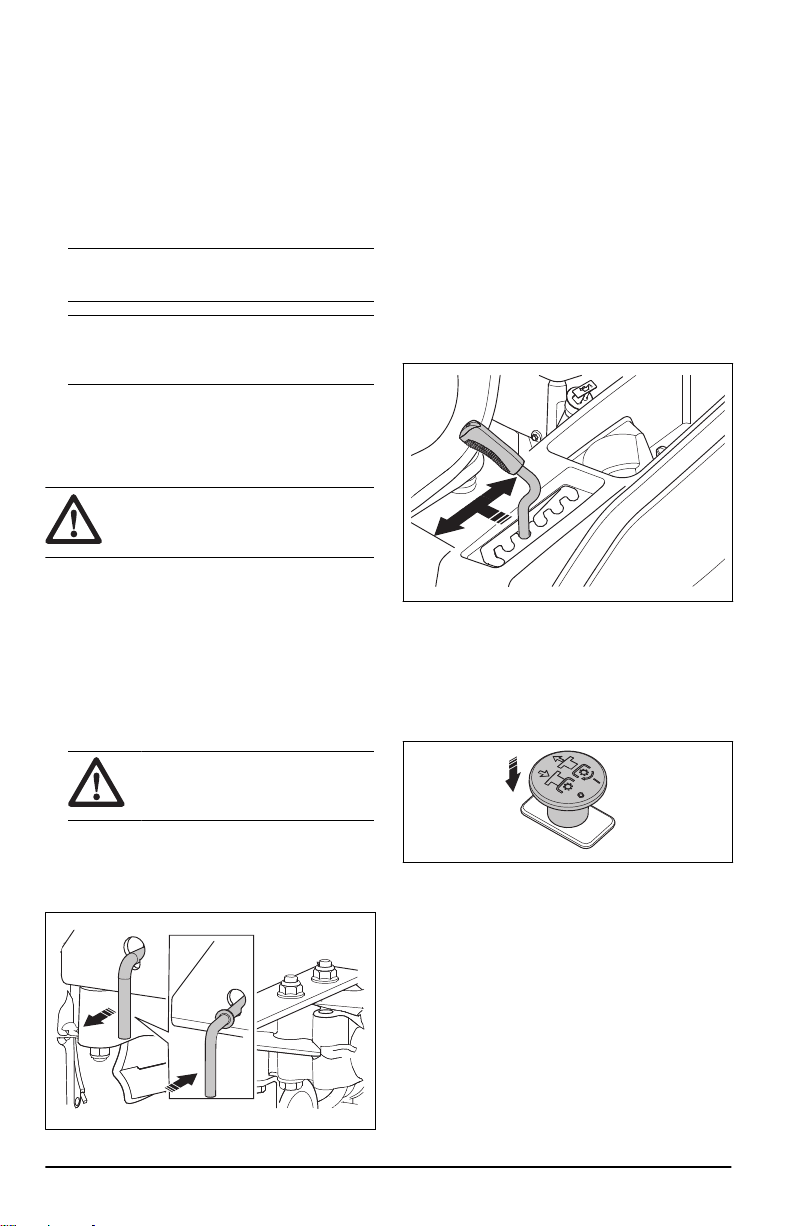
5. Pull the bypass linkages up and out of the slots.
6. Engage the drive system in opposite sequence.
To set the cutting deck in transport
position or mow position
The cutting deck must be in transport position during
transportation.
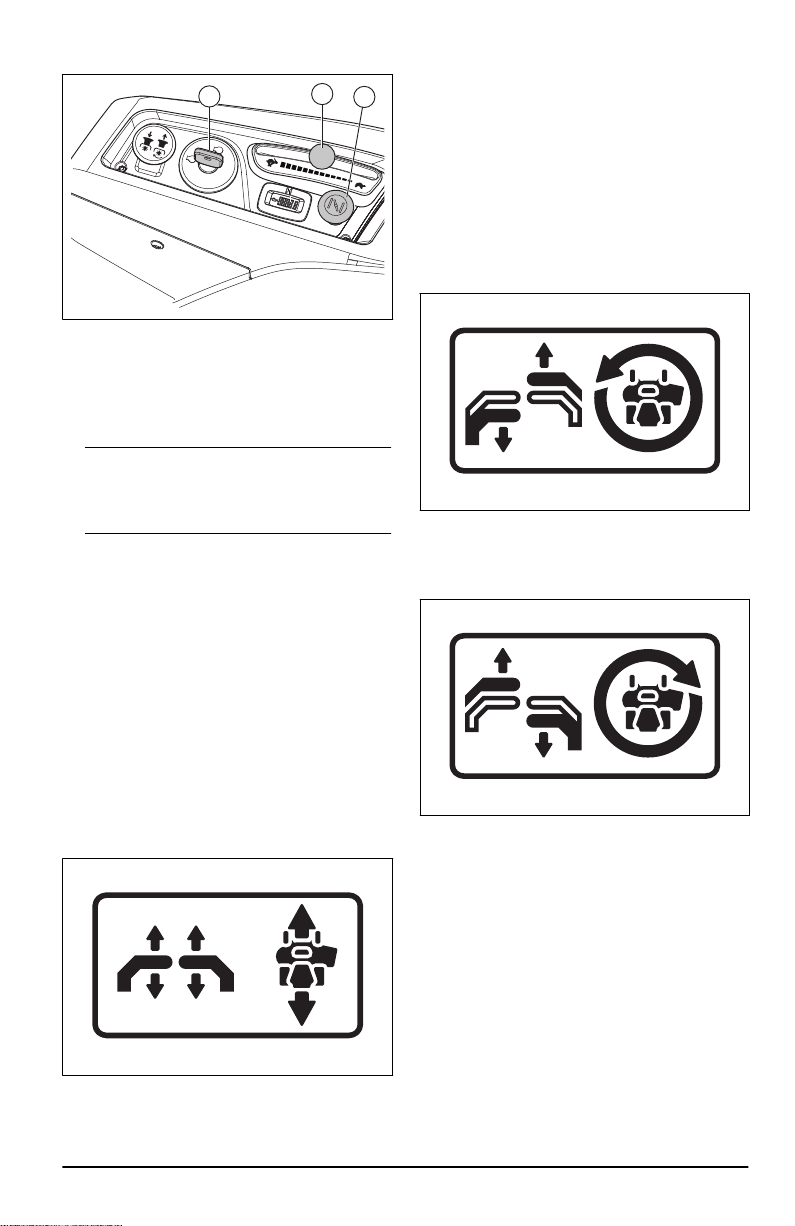
• To set the product in transport position, pull the
cutting height lever in the direction of the seat
and put it in the highest cutting height position.
• To set the product in mow position, set the
correct cutting height. Refer to
To set the cutting
height on page 12
.
To set the cutting height
1. Pull the cutting height lever in the direction of the
seat.
2. Steer the cutting height lever to the notch for the
correct cutting height.
To start the engine
1. Sit on the seat.
2. Push the PTO button to disengage the drive on
the cutting deck.
3. Set the cutting deck in transport position. Refer
to
To set the cutting deck in transport position or
mow position on page 12
.
4. Engage the parking brake. Refer to
To engage
and disengage the parking brake on page 12
.
12
2194 - 002 - 29.09.2023
5. Move the throttle lever (A) to ½ throttle position.
C
A
B
6. If the engine is cold, pull the choke control (B)
up.
7. Press and turn the ignition key (C) to the start
position.
8. When the engine starts, immediately release the
ignition key to the run position.
Note: Do not keep the ignition key in the start
position for more than 5 seconds at a time. If the
engine does not start, wait 15 seconds before
you try again.
9. If the engine is cold, slowly push the choke
control down.
10. Let the engine run at ½ throttle for 3-5 minutes
before you apply full throttle.
11. Push the throttle control to the full throttle
position.
To operate the product
1. Start the engine. Refer to
To start the engine on
page 12
.
2. Disengage the parking brake. Refer to
To
engage and disengage the parking brake on
page 12
.
3. Carefully push the 2 control levers forward. The
product will start to move forward. The forward
speed increases the more the 2 control levers
are pushed forward.
4. Carefully pull the 2 control levers rearward. The
product will start to move rearward. The rearward
speed increases the more the 2 control levers
are pulled rearward.
5. Put the 2 control levers in neutral position to
decrease the speed and stop the product.
6. Do the steps that follow to turn left or right when
you go in a forward direction.
a) Pull the left control lever rearward in the
direction of the neutral position to make the
product turn left. The more you pull the left
control lever rearward, the more the product
will turn left.
b) Pull the right control lever rearward in the
direction of the neutral position to make the
product turn right. The more you pull the right
control lever rearward, the more the product
will turn right.
7. Do the steps that follow to make a zero turn.
a) Pull the 2 control levers rearward in the
direction of the neutral position to decrease
the speed or stop the product.
b) Move 1 control lever slightly forward and the
other control lever slightly rearward to make a
zero turn.
8. Lower the cutting deck to mow position. Refer to
To set the cutting deck in transport position or
mow position on page 12
.
9. Pull up the PTO button to engage the drive of the
blades.
10. If it is necessary to adjust the cutting height
during operation, refer to
To set the cutting
height on page 12
.
2194 - 002 - 29.09.2023
13
To stop the engine
1. Move the 2 control levers to the neutral position
to stop the product.
2. Engage the parking brake.
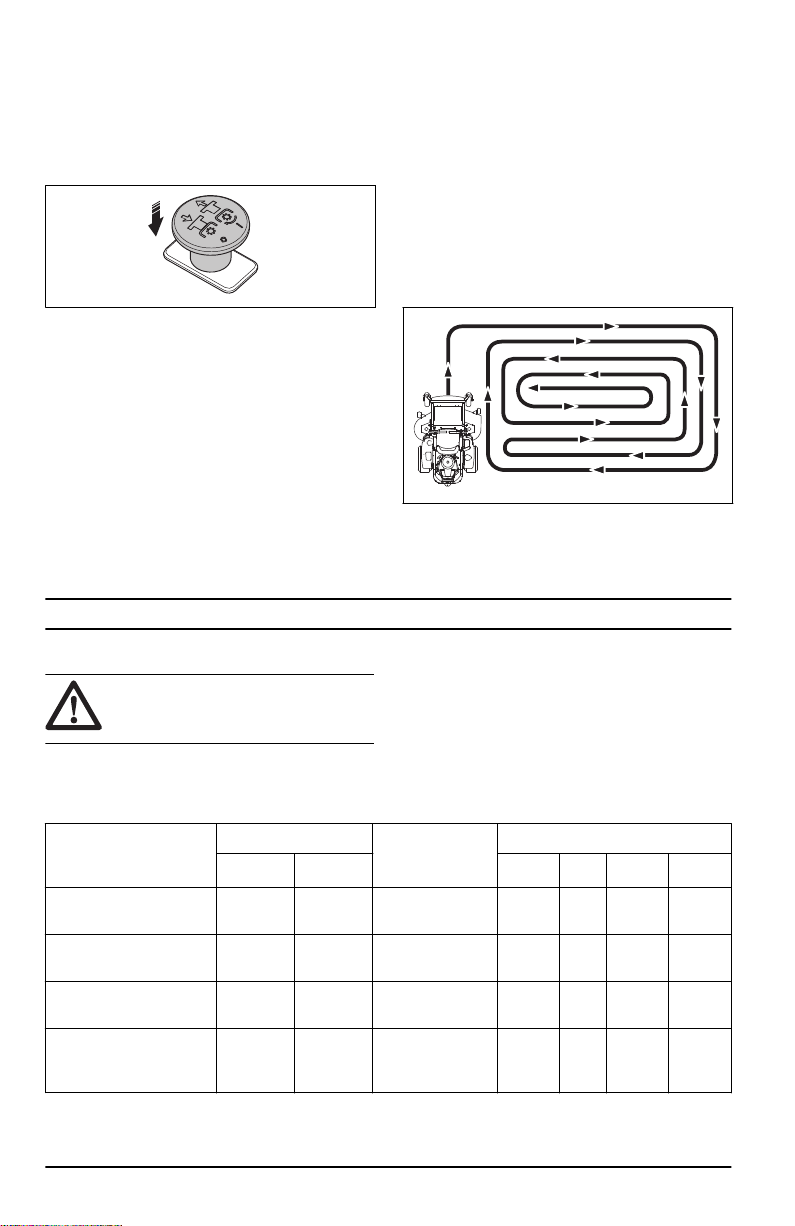
3. Push down the PTO button to disengage the
drive of the blades.
4. Put the cutting deck in the transport position.
5. Move the throttle control to the minimum throttle
position.
6. Let the engine idle for a minimum of 1
minute until the engine is at usual operation
temperature.
7. Turn the ignition key to the stop position.
8. Remove the ignition key from the ignition when
you are away from the product.
To get a good cutting result
• For best performance, do maintenance on the
product regularly as given in the maintenance
schedule. Refer to
Maintenance on page 14
.
• Do not cut a wet lawn. Wet grass can give a bad
cutting result.
• Start with a high cutting height and decrease it
gradually.
• Use full throttle when you cut the grass.
• Move the product forward at low speed if the
grass is high and thick.
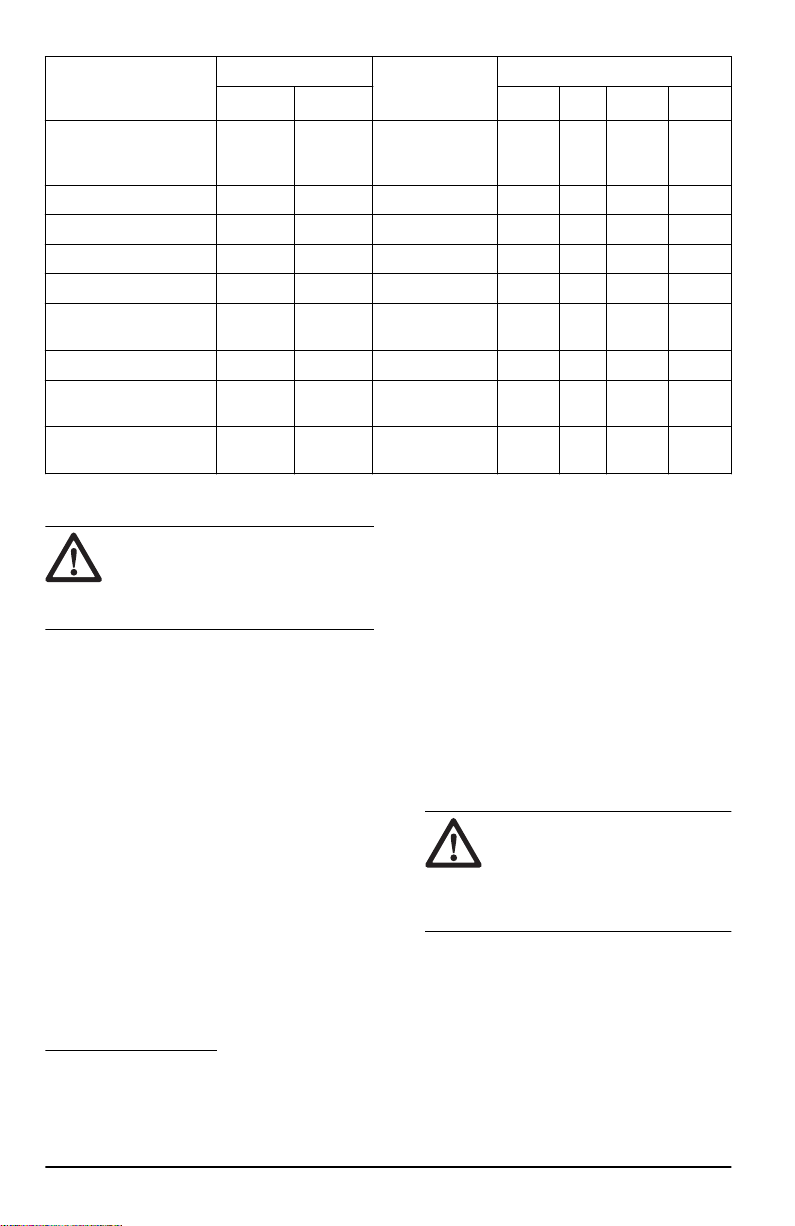
• Cut the grass in an irregular pattern.
• When you cut large areas, move the product
to the right during 1 or 2 turns around
the work area. This procedure will keep the
grass discharge away from shrubs, fences and
driveways. After approximately 2 turns around
the work area, cut in the opposite direction.
• When the mulch kit is used, cut the grass more
frequently.
• To get the best cutting result, cut the grass
frequently.
Maintenance
Introduction
WARNING: Before you do any
maintenance work you must read and
understand the safety chapter.
Maintenance schedule
* = The instructions are not given in this operator's
manual.
X = The instructions are given in this operator's
manual.
O = Refer to the engine manual for instructions.
Maintenance schedule for the operator
Maintenance
Daily maintenance Do maintenance
at a minimum of 1
time each year
Maintenance interval in hours
Before After
25
50 100 300
Do a check of the parking
brake.
X
Do a check of the level of
the engine oil.
O
Do a check of the safety
system.
X
Make sure that there are
no fuel or oil leaks from
the product.
*
14 2194 - 002 - 29.09.2023

Maintenance
Daily maintenance Do maintenance
at a minimum of 1
time each year
Maintenance interval in hours
Before After
25
50 100 300
Make sure that there are
no damage on the prod-
uct.
*
Make sure that there are
no loose parts.
*
Do a check for damages
on the cutting deck.
*
Do a check of the cutting
deck for adjustment.
X X
Do a check of the tire
pressures.
X X X X X
Do a check of the battery
connections.
X X X X X
Do a check of the throttle
cable.
O
Do a check of the caster
wheels (each 200 hours).
X X
Do a check of the
clearance of the engine
valve.
1
* *
Clean the air intake of the
engine.
2
O O
Clean the bottom side of
the cutting deck.
X
Clean around the engine. *
Clean around the belts
and the belt pulleys.
* * * *
Do a check of the belts
and the belt pulleys.
X X
Clean the foam pre-filter.
3
O O
Replace the foam pre-fil-
ter.
45
O
Clean the paper filter car-
tridge.
6
O O
Examine the muffler and
spark arrestor screen.
* * * *
1
Must be done by approved service agent.
2
In conditions with dust, cleaning and replacement must be done more frequently.
3
In conditions with dust, cleaning and replacement must be done more frequently.
4
In conditions with dust, cleaning and replacement must be done more frequently.
5
If the product is equipped with the foam pre-filter.
6
In conditions with dust, cleaning and replacement must be done more frequently.
2194 - 002 - 29.09.2023 15
Maintenance
Daily maintenance Do maintenance
at a minimum of 1
time each year
Maintenance interval in hours
Before After
25
50 100 300
Start the engine and
blades and listen for un-
usual sounds.
*
Sharpen the blades.
7
X X
Replace the blades. X X
Replace the spark plugs. O O
Replace the engine oil.
8
O O
Replace the engine oil fil-
ter.
O O
Replace the fuel filter. O O
Replace the paper air fil-
ter.
9
O O
Do the 300-hour servic-
ing.
10
* *
To clean the product
CAUTION: Do not use a high-
pressure washer or a steam cleaner.
Water can go into bearings and electrical
connections and cause corrosion which
causes damage to the product.
Clean the product immediately after use.
• Do not clean hot surfaces such as the engine,
muffler and exhaust system. Wait until the
surfaces are cool, then remove the grass or dirt.
• Before you clean with water, clean with a brush.
Remove grass and dirt on and around the
transmission, the transmission air intake, and the
engine.
• Use running water from a hose to clean the
product. Do not use high-pressure.
• Do not point the water at electrical components
or bearings. Detergent usually increases the
damage.
• Use compressed air to clean the top side of the
mower deck.
• Use a water hose to clean below the cutting
deck.
• When the product is clean, start the cutting deck
for a short period to remove remaining water.
To clean the engine and the muffler
Keep the engine and muffler free from grass cuttings
and dirt. Grass cuttings soaked in fuel or oil on the
engine can increase the fire risk and the risk that the
engine becomes too hot. Let the engine cool before
it is cleaned. Clean with water and a brush.
Grass cuttings around the muffler dry quickly and are
a fire risk. Use a brush or remove the grass cuttings
with water when the muffler is cold.
To clean the battery
Corrosion and dirt on the battery and the terminals
can cause the power of the battery to decrease.
1. Remove the battery. Refer to
To remove and
install the battery on page 17
.
2. Flush the battery with water and let dry.
CAUTION: Do not use a high-
pressure washer or a steam cleaner.
Water can go into bearings and
electrical connections and cause
corrosion which causes damage to
the product.
3. Clean the terminals and the cable ends of the
battery cables with a wire brush.
To do a check of the parking brake
1. Park the product on a slope with a hard surface.
7
Must be done by approved service agent.
8
Replace the engine oil after the first 8-10 hours of operation. During heavy load or high ambient
temperatures, replace the engine oil each 50 hours.
9
In conditions with dust, cleaning and replacement must be done more frequently.
10
Must be done by approved service agent.
16 2194 - 002 - 29.09.2023
Note: Do not park the product on a grass
slope when you do a check of the parking brake.
2. Engage the parking brake.
3. If the product starts to move with the parking
brake engaged, let an approved service agent
adjust the parking brake.
4. Disengage the parking brake.
To charge the battery
• Charge the battery if it is too weak to start the
engine. Refer to
Battery charging times on page
27
for battery charging times.
• Use a standard battery charger.
CAUTION: Do not use a boost
charger or start booster. A boost
charger or a start booster will cause
damage to the electrical system of
the product.
• Always disconnect the battery charger before
you start the engine.
To do an emergency start of the
engine
If the battery is too weak to start the engine, you can
use jumper cables to do an emergency start. This
product has a 12 V system with negative ground.
The product that is used for the emergency start
must also have a 12 V system with negative ground.
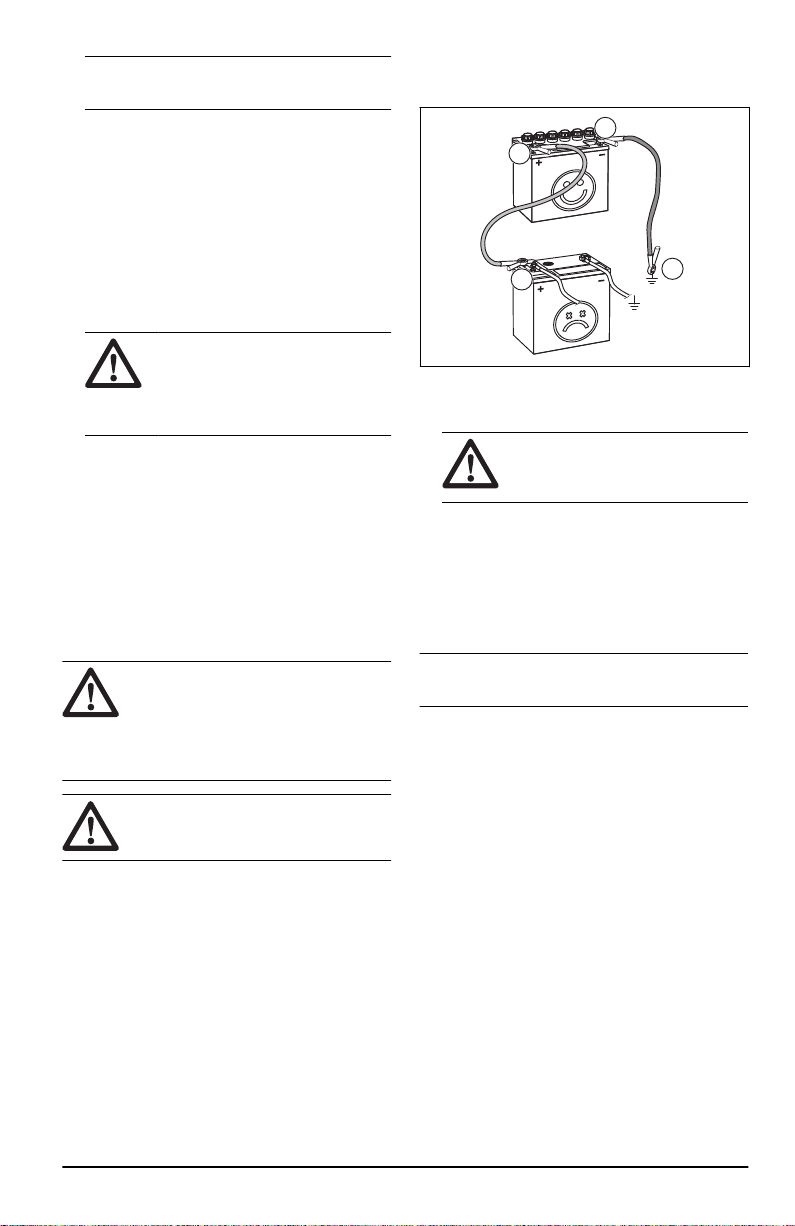
To connect the jumper cables
WARNING:
Risk of explosion
because of explosive gas that comes
from the battery. Do not connect the
negative terminal of the fully charged
battery to or near the negative terminal
of the weak battery.
CAUTION: Do not use the battery of
the product to start other vehicles.
1. Connect one end of the red cable to the
POSITIVE battery terminal (+) on the weak
battery (A).
B
A
C
D
2. Connect the other end of the red cable to
the POSITIVE battery terminal (+) on the fully
charged battery (B).
WARNING: Do not short circuit
the ends of the red cable against the
chassis.
3. Connect one end of the black cable to the
NEGATIVE battery terminal (-) on the fully
charged battery (C).
4. Connect the other end of the black cable to a
CHASSIS GROUND (D), away from the fuel tank
and the battery.
To remove the jumper cables
Note:
Remove the jumper cables in the opposite
sequence to how you connect them.
1. Remove the BLACK cable from the chassis.
2. Remove the BLACK cable from the fully charged
battery.
3. Remove the RED cable from the 2 batteries.
To remove and install the battery
1. Fold the seat forward. Refer to
To fold the seat
on page 11
.
2194 - 002 - 29.09.2023
17
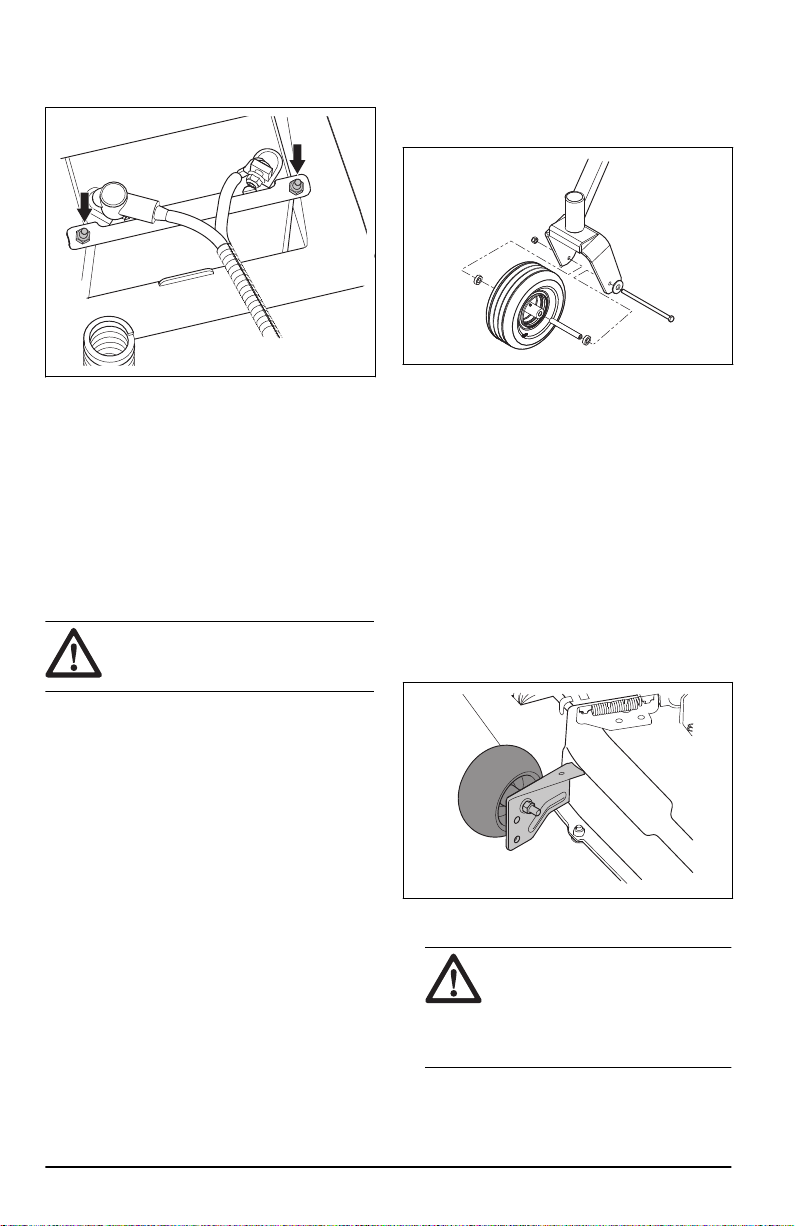
2. Remove the bolt and the nut from the battery
bracket and remove the battery bracket from the
battery.
3. Use 2 wrenches to disconnect the black battery
cable from the negative (–) terminal on the
battery.
4. Use 2 wrenches to disconnect the red battery
cable from the positive (+) terminal on the
battery.
5. Carefully remove the battery from the product.
6. Install in the opposite sequence.
To adjust the tracking speed
If the product does not move straight forward, the
tracking speed must be adjusted.
WARNING:
Always adjust the
tracking speed in an open area without
bystanders.
1. Do a check of the tire pressure. Refer to
Tire
pressure on page 18
.
2. Turn the tracking controls out until they are flush
with the nuts. Refer to
Product overview on page
3
for the location of the tracking controls.
3. Start the product.
4. Move the control levers forward fully and operate
the product at full throttle.
5. Turn the tracking control on the right side
gradually until the product starts to move right.
6. Turn the tracking control on the left side
gradually until the product starts to move straight
forward.
Tire pressure
Make sure to have the correct tire pressure on all 4
tires. Refer to
Technical data on page 26
.
To remove and install the front
wheels
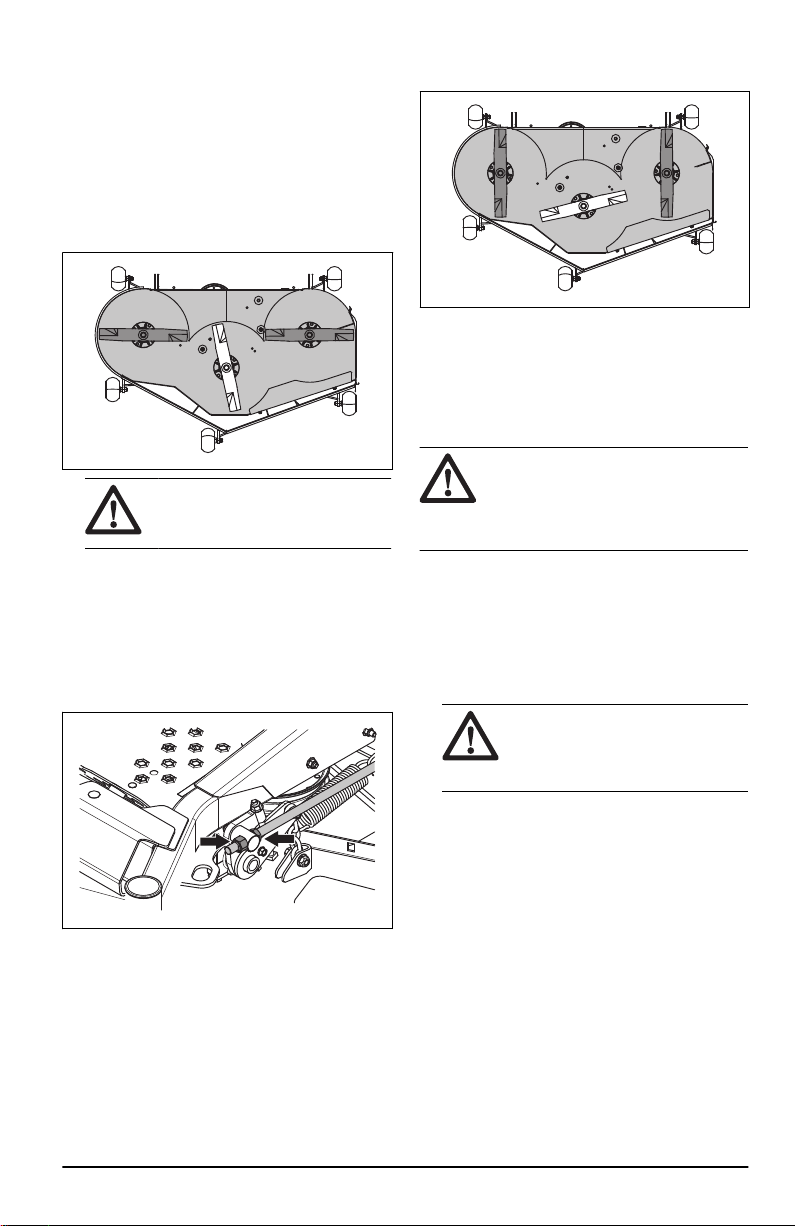
1. Remove the nut and the bolt to remove the front
wheels from the forks.
2. Install in the opposite sequence. Torque the nut
and bolt to 50 ft-lbs / 67.8 Nm.
To adjust the anti-scalp rollers
The anti-scalp rollers keep the cutting deck in the
correct position on the ground and prevent lawn
scalping in most terrain conditions. The anti-scalp
rollers can be set in 3 positions for different lengths
of grass:
• Top position: 1.5–2.5 in. / 38–64 mm grass.
• Middle position: 2.5–4 in. / 64–102 mm grass.
• Bottom position: 4–5 in. / 102–127 mm grass.
1. Park the product on level ground and stop the
engine.
2. Remove the nut, the bolt, the axle and the anti-
scalp roller.
3. Install the anti-scalp roller in one of the 3
positions.
CAUTION:
The cutting deck
can become damaged if the anti-
scalp rollers are incorrectly adjusted.
The anti-scalp rollers must be
approximately 1/4 in. / 6.4 mm from
the ground.
18 2194 - 002 - 29.09.2023
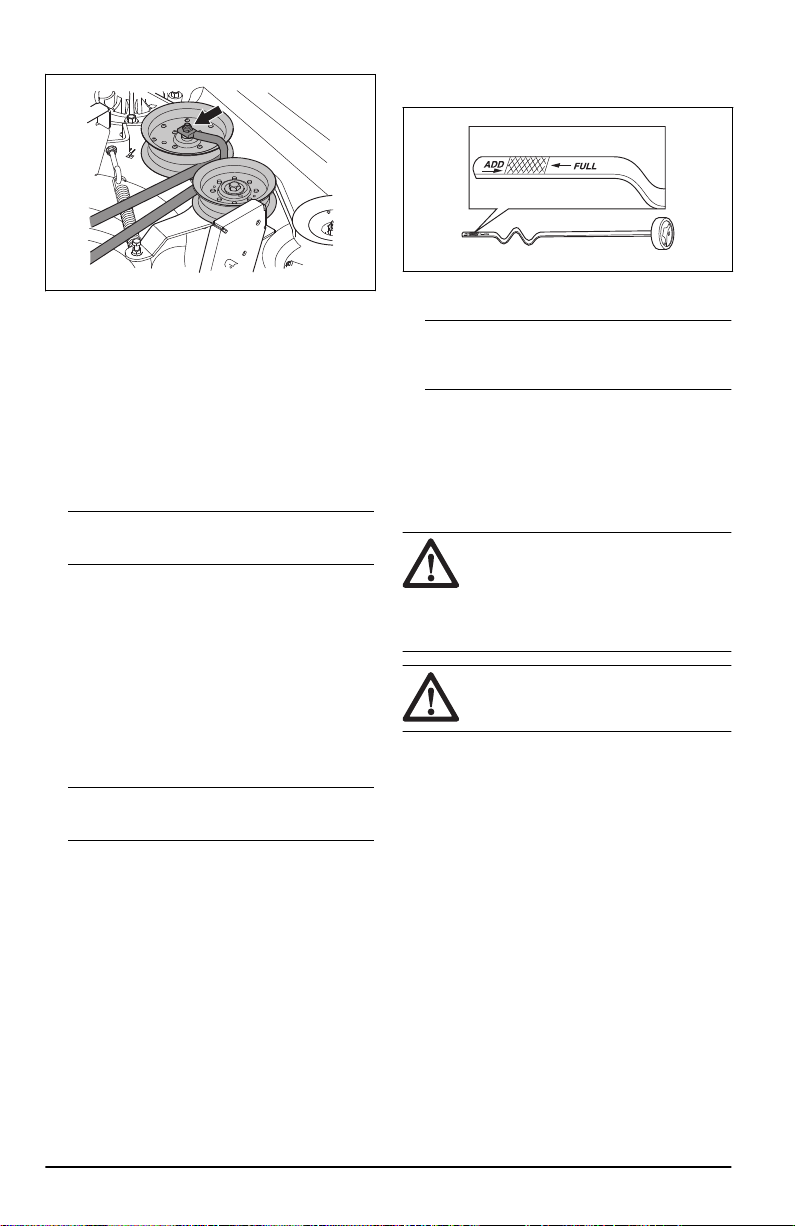
To adjust the parallelism of the
cutting deck
This procedure will set the cutting deck in a standard
position.
1. Make sure that the tire pressure is correct. Refer
to
Tire pressure on page 18
.
2. Park the product on a level surface.
3. Turn the outer blade tips to align with the cutting
deck side to side.
WARNING: The blades on the
cutting deck are sharp and can
cause injury. Use protective gloves.
4. Measure the distance between the ground and
the bottom of the blade tip on the discharge side
of the cutting deck. Make a note of the distance.
5. Measure the distance between the ground and
the bottom of the blade tip on the side opposite
to the discharge side. The distance must be the
same as the distance for the discharge side. If
adjustment is necessary, adjust the 2 front bolts
until the 2 side to side distance are equal.
6. Turn the 2 outer blades to align with the cutting
deck front to rear.
7. Adjust the 2 rear nuts until the rear blade tips
are set 1/8–3/8 in. / 3.2-9.5 mm higher in the rear
than in the front blade tips.
8. Measure the distances again to make sure that
the cutting deck has been adjusted correctly.
To examine the blades
CAUTION: Damaged or incorrectly
balanced blades can cause damage to
the product. Replace damaged blades.
Let an approved service agent help you
sharpen and balance blunt blades.
• Look at the blades to see if they are damaged
and if it is necessary to sharpen them.
To replace the blades
1. Remove the blade bolt.
2. Assemble the new blade with the side without
stamps in the direction of the cutting deck.
WARNING:
Incorrect blade type
can cause objects to eject from
the cutting deck and cause serious
injury. Use only approved blades.
3. Attach the blade bolt. Torque the bolt to 60-81
Nm.
To remove the deck belt
Park the product on level ground and engage the
parking brake before you do this task.
1. Set the cutting deck in the lowest position.
2. Remove the 2 belt covers.
3. Remove dirt and unwanted materials from
around the cutter housings and the cutting deck
surface.
4. Make a note of the position of the belt guide.
2194 - 002 - 29.09.2023
19
5. Loosen the nut on the belt guide.
6. Push in the idler arm to decrease the tension on
the deck belt and carefully remove the deck belt
from the pulleys.
7. Remove the deck belt from the electric clutch on
the engine shaft.
To install the deck belt
1. Put the deck belt around the electric clutch pulley
on the engine shaft.
2. Put the deck belt around the pulleys on the
cutting deck.
Note: Refer to the routing decal on the cutting
deck when you install the deck belt.
3. Push in the idler arm until you can put the deck
belt around the stationary idler pulley and hold it
there.
4. Carefully put the deck belt around the stationary
idler pulley and slowly release the idler arm back
into position.
5. Make sure that the belt routing align with the belt
routing shown on the belt routing decal.
6. Make sure that the deck belt is not twisted.
7. Put the belt guide in the correct position and
tighten the nut.
Note:
Refer to the note you made when you
removed the belt guide.
8. Install the 2 belt covers.
To do a check of the engine oil level
1. Park the product on level ground and stop the
engine.
2. Pull open the operator cushion to get access to
the engine.
3. Loosen the dipstick and pull it out.
4. Clean the oil from the dipstick.
5. Put the dipstick in the hole for the dipstick and
tighten it.
6. Loosen and pull the dipstick out and read the oil
level.
7. The oil level must be between the marks on the
dipstick. If the level is near the ADD mark, fill oil
to the FULL mark.
8. Fill the oil through the hole for the dipstick. Fill
the oil slowly.
Note: Refer to
Technical data on page 26
for the types of engine oil that Husqvarna
recommends. Do not mix different types of oil.
9. Tighten the dipstick fully before you start the
engine.
To replace the engine oil
If the engine is cold, start the engine for 1–2 minutes
before you drain the engine oil. This makes the
engine oil warm and faster to drain.
WARNING: Do not operate the
engine for more than 1–2 minutes before
you drain the engine oil. The engine oil
becomes very hot and can cause burn
injuries. Let the engine become cool
before you drain the engine oil.
WARNING: If you spill engine oil on
your body, clean with soap and water.
1. Park the product on level ground and stop the
engine.
2. Engage the parking brake. Refer to
To engage
and disengage the parking brake on page 12
.
3. Remove all dirt around the oil tank cap.
4. Remove the oil tank cap and the dipstick.
20
2194 - 002 - 29.09.2023
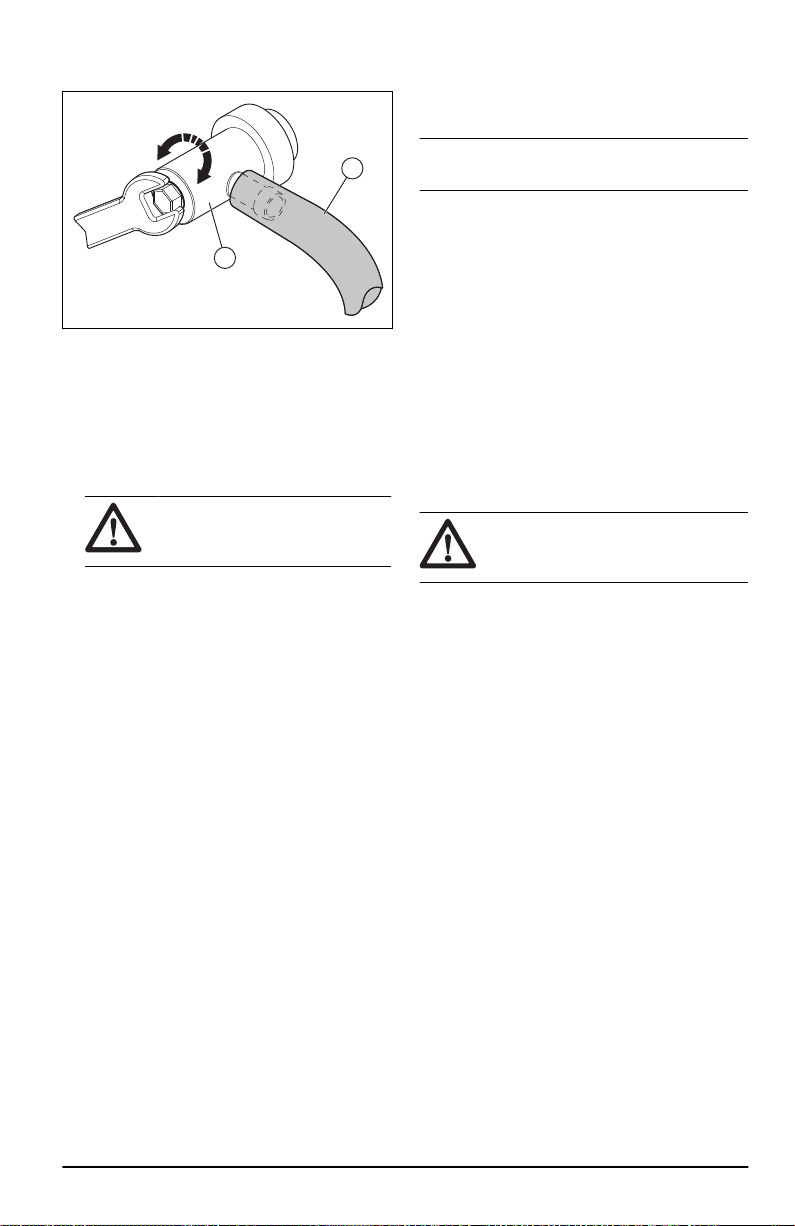
5. Install the oil drain tube (A) on the engine oil
drain valve (B).
A
B
6. Put a container below the engine to collect the
engine oil.
7. Turn the oil drain valve counterclockwise to open
the oil drain valve. Use a 10 mm wrench.
8. When all engine oil is drained, turn the oil drain
valve clockwise to close it. Use a 10 mm wrench.
9. Use the 10 mm wrench to carefully torque the oil
drain valve closed. Do not tighten too tightly.
CAUTION: Do not apply too
much torque when you tighten the oil
drain valve.
10. Remove the oil drain tube from the oil drain
valve.
11. Fill with new oil and do a check of the engine oil
level. Refer to
To do a check of the engine oil
level on page 20
.
12. Install the oil tank cap and the dipstick.
Note: For safe disposal of used engine oil, refer to
Disposal on page 25
.
Lubrication, general information
• Remove the ignition key to prevent accidental
movements during lubrication.
• Clean the area before you lubricate a part on the
product.
• Use oil when you lubricate with an oil can.
• When you lubricate with grease, use a chassis
or ball bearing grease that prevents corrosion.
Remove unwanted grease after lubrication.
• Lubricate 2 times a week if you operate the
product daily.
• Do not spill lubricant on the drive belts or the
grooves of the belt pulleys. If you do spill, clean
with alcohol. If the friction between the drive belt
and the pulley is not sufficient after you clean
with alcohol, replace the drive belt.
CAUTION: Do not use gasoline or
other petroleum products to clean drive
belts.
2194 - 002 - 29.09.2023 21
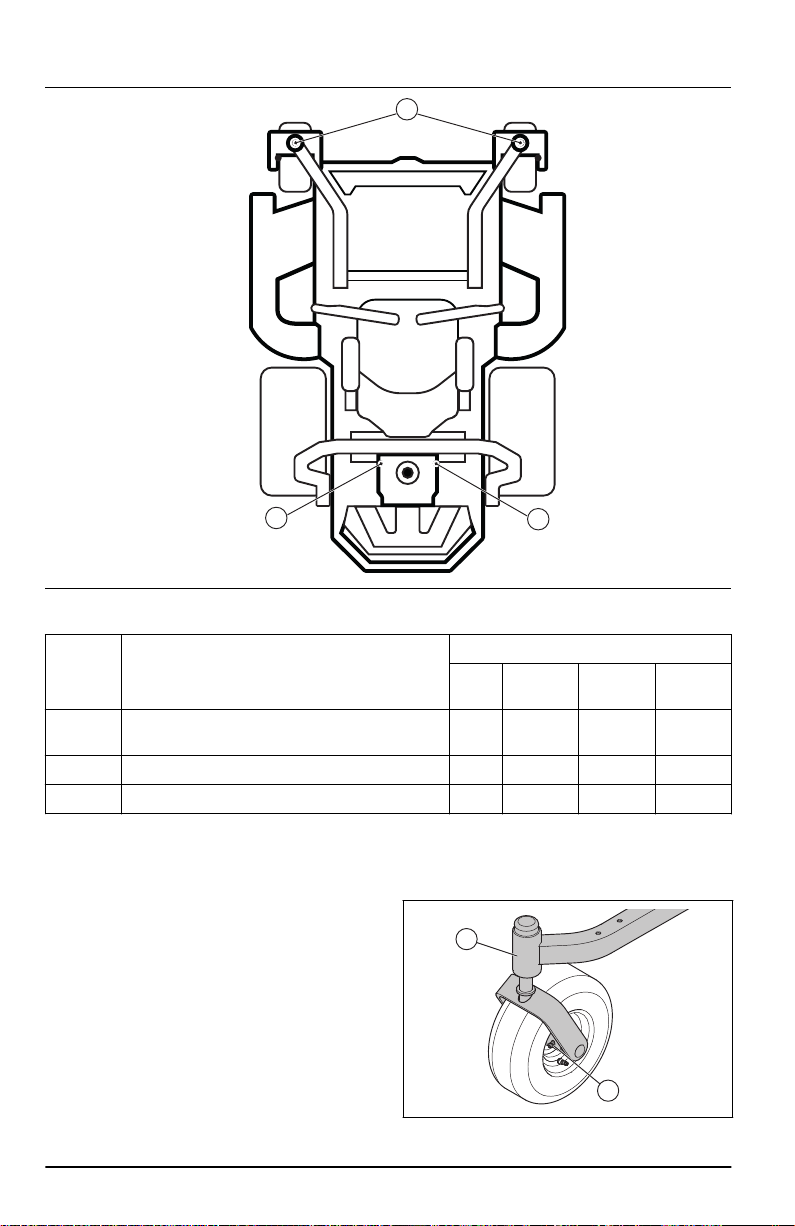
Lubrication schedule
A
B
C
Refer to Lubrication Interval
Daily
Each 25
hours
Each 50
hours
Each 200
hours
A
Lubricate the grease nipple on the pivot axle with a
grease gun.
X
B Do a check of the oil level. X
C Replace the oil filter. X
Always use good quality grease. Always use
recommended oil, refer to
Technical data on page
26
.
To lubricate the front wheels
• Grease the nipple (A) with a grease gun until
grease comes out from the top washer.
A
B
22 2194 - 002 - 29.09.2023

• Lubricate the joint bearing of the front wheels (B)
with a grease gun until grease comes out.
Troubleshooting
Troubleshooting schedule
If you cannot find a solution to your problems in this
operator's manual, speak to your Husqvarna service
agent.
Problem Cause
Engine does not start. The drive of the blades is engaged. Refer to
PTO (Power Take-
Off) button on page 4
.
The control levers are not locked in the outer position.
The battery is too weak. Refer to
To charge the battery on page
17
.
There is dirt in the carburetor or the fuel line.
The fuel shut-off valve is closed or in the incorrect position.
The fuel filter or fuel line is clogged.
The ignition system is damaged.
The starter motor does not turn the engine
over.
The battery is too weak. Refer to
To charge the battery on page
17
.
The connection at the cable connectors on the battery terminals
is bad. Refer to
To clean the battery on page 16
.
A fuse is blown. Refer to
Fuses on page 4
.
The OPC does not operate correctly. Refer to
Operator Pres-
ence Control (OPC) on page 3
.
The engine does not run smoothly. The carburetor is incorrectly set.
The fuel filter or fuel jet is clogged.
The throttle lever is in Cold Weather Start position.
The check valve on the fuel tank cap is clogged.
The fuel tank is almost empty.
The spark plug is damaged.
Incorrect fuel mixture or fuel type.
There is water in the fuel.
The air filter is clogged.
The engine apparently has no power. The air filter is clogged.
The spark plug is damaged.
The carburetor is incorrectly set.
There is air in the hydraulic system.
2194 - 002 - 29.09.2023 23

Problem Cause
There is vibration in the product. The blades are loose. Refer to
To examine the blades on page
19
.
One or more of the blades are not balanced. Refer to
To exam-
ine the blades on page 19
.
The engine is loose.
The engine becomes too hot. The air filter or the cooling fins are clogged.
There is overload in the engine.
The airflow around the engine is not sufficient.
The engine speed regulator is damaged.
The oil level is too low.
There is dirt in the fuel line.
The spark plug is damaged.
The battery does not charge. The connection at the cable connectors on the battery terminals
is bad. Refer to
To clean the battery on page 16
.
The charging cable is disconnected.
The product moves slowly, with irregular
speed or not at all.
The bypass linkages are engaged.
The drive belt on the transmission is loose or damaged.
There is air in the hydraulic system.
The drive of the blades do not engage. The drive belt on the mower deck is loose.
The electromagnetic coupling contact is loose.
The drive of the blade is damaged or loose from the cable con-
nectors.
A fuse is blown.
The transaxle leaks oil. The seals, housing or gaskets are damaged.
There is air in the hydraulic system.
The cutting result is unsatisfactory. The tire pressure is different on the right and left sides. Refer to
Tire pressure on page 18
.
The blades are damaged.
The suspension of the cutting deck is not level.
The blades are blunt. Refer to
To examine the blades on page
19
.
The product is operated at too high forward or rearward speed.
Refer to
To get a good cutting result on page 14
.
The grass is long. Refer to
To get a good cutting result on page
14
.
There is grass blockage in the cutting deck. Refer to
To clean
the product on page 16
.
24 2194 - 002 - 29.09.2023
Transportation, storage and disposal
Transportation
• The product is heavy and can cause crush
injuries. Be careful when you load it onto or off
a vehicle or trailer.
• Load the product in reverse on approved ramps
of a maximum operation angle of 10°. Do not lift
the product.
• Use an approved trailer for transportation of the
product.
• Make sure that you have knowledge of local
road traffic regulations before transportation of
the product in a trailer or on roads.
• Stop the fuel supply of the product.
• Lock the product with approved devices, such as
straps. Use tie-down points on the product. The
parking brake is not sufficient to lock the product
during transportation.
To tow the product
WARNING: Before you tow the
product, you must read and understand
the safety chapter. Refer to
Tow safety
on page 10
.
• Be careful when you tow the product.
• Operate the product slowly when you tow the
product.
• The breaking distance increases when you tow
the product. Make sure to decreases the speed
in time.
• For safe operation, do wide turns.
• Do not tow near ditches, open water, and other
dangerous areas.
Storage
Prepare the product for storage at the end of the
season, and before more than 30 days of storage. If
you keep fuel in the fuel tank for 30 days or more,
tacky particles can cause blockage in the carburetor.
This has a negative effect on the engine function.
To prevent tacky particles during storage, add a
stabilizer. If alkylate gasoline is used, stabilizer is
not necessary. If you use standard gasoline, do
not change to alkylate gasoline. This can cause
sensitive rubber parts to become hard. Add stabilizer
to the fuel in the tank or in the container used for
storage. Always use the mixing ratios given by the
manufacturer. Add the stabilizer and run the engine
for a minimum of 10 minutes, until the fuel flows into
the carburetor.
WARNING:
Do not keep the
product with fuel in the tank in an indoor
location or in locations with bad airflow.
Risk of fire if fuel fumes come near
open flames, sparks, or pilot lights in
for example boilers, hot water tanks and
clothes dryers.
WARNING: Remove grass, leaves
and other flammable materials from the
product to decrease the risk of fire. Let
the product become cool before you put
it in storage.
• Clean the product, refer to
To clean the product
on page 16
.
• Remove unwanted materials from the cooling
fan.
• Repair paint damages to prevent corrosion.
• Examine the product for worn or damaged parts
and tighten loose screws and nuts.
• Remove the battery. Clean it, charge it, and keep
it cool during storage.
• Replace the engine oil, and discard the waste oil.
• Empty the fuel tank. Start the engine and run it
until there is no remaining fuel in the carburetor.
Note: Do not empty the fuel tank and
carburetor if a stabilizer has been added.
• Remove the plugs and put about a tablespoon of
engine oil into each cylinder. Manually turn the
engine shaft to apply the oil and put the plugs
back on.
• Lubricate all grease nipples, joints and axles.
• Keep the product in a clean and dry area and put
a cover on it for more protection.
Disposal
• Chemicals can be dangerous and must not be
discarded on the ground. Always discard used
chemicals at a service center or an applicable
disposal location.
• When the product is worn out, send it to the
dealer or to an applicable recycling location.
• Oil, oil filters, fuel and the battery can have
negative effects on the environment. Obey
the local recycling requirements and applicable
regulations.
• Do not discard the battery as domestic waste.
• Send the battery to a Husqvarna service agent
or discard it at a disposal location for used
batteries.
2194 - 002 - 29.09.2023
25

Technical data
Technical data
Z254
Engine
Brand / Model Kawasaki / FR691V
Nominal engine output, hp / kW
11
23 / 17
Displacement, cm
3
726
Max. engine speed, rpm 3500 ± 100
Fuel, min. octane grade lead-free, max 10% Ethanol,
max 15% MTBE
87
Tank volume, gallons / l 3.5 / 13.3
Oil Class SF, SG, SH, SJ or SL SAE40, SAE30,
SAE20W-50, SAE10W-40, SAE10W-30, SAE5W-20
Oil volume, incl. filter, oz. / l 70.4 / 2.1
Oil volume, excl. filter, oz. / l 60.8 / 1.8
Lubrication system Pressure with oil filter
Cooling system Air cooled
Air filter Standard
Alternator, V. amp. @ 3600 rpm 12 V 15 amp @ 3600 rpm
Start motor Electric start 12 V
Dimensions
Length, in. / cm 75 / 191
Width, in. / cm 43.75 / 111
Width including Chute Up, in. / cm 56 / 143
Width including Chute Down, in. / cm 67 / 170
Height, mm 40 / 102
Weight, with empty tanks, lb / kg 593 / 269
Max. gradient, degrees ° 10
Cutting Width, in. / cm 54 / 137
Cutting Height, in. / cm 1.5 - 4 / 3.8 - 10.2
Cutting deck
Deck Construction Stamped
Number of blades 3
Blade length, in. / cm 18.25 / 46.4
11
The power rating as declared by the engine manufacturer is the average gross power output at the
specified RPM of a typical production engine for the engine model measured using SAE Standards for
engine gross power. Refer to the engine manufacturer engine specifications.
26 2194 - 002 - 29.09.2023
Z254
Blade Engagement Electromagnetic Clutch
Productivity, acres/h / m
2
/h 2.8 / 11,331
Tires
Tire pressure, rear – front, kPa / PSI / bar 103 / 15 / 1
Front caster tires, in. 11x 6-5
Rear tires, turf pneumatic, in. 18 x 9.5-8
Anti-scalp roller 4 adjustable
Transmission
Transmission Hydrostatic transaxles
Steering control Dual levers, foam gripped
Maximum speed forward, mph / kmh 6.5 / 10.5
Maximum speed reverse, mph / kmh 3.25 / 5.23
Brakes Mechanical parking brake
Electrical system
Type 12 V
Battery 28 A
Spark plug NGK BPR4ES
Electrode gap, in. / mm 0.030 / 0.76
Spark plug torque, lb-ft / Nm 16 / 22
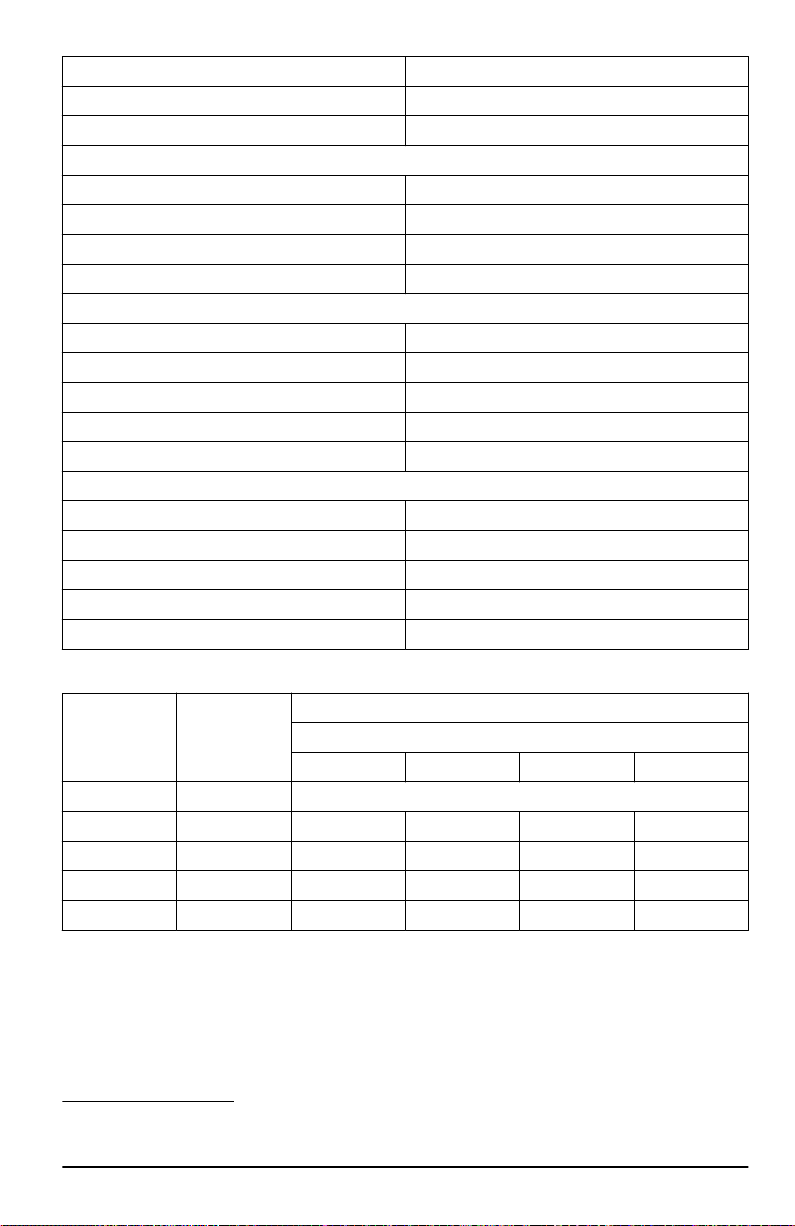
Battery charging times
STD battery State of charge
Approximate charging time to full charge at 80° F / 26° C
12
Maximum rate at:
50 Amps 30 Amps 20 Amps 10 Amps
12.6 V 100% Fully charged
12.4 V 75% 20 min 35 min 48 min 90 min
12.2 V 50% 45 min 75 min 95 min 180 min
12.0 V 25% 65 min 115 min 145 min 280 min
11.8 V 0% 85 min 150 min 195 min 370 min
12
Battery charging time can be different because of battery capacity, condition, age, temperature and
efficiency of the charger.
2194 - 002 - 29.09.2023 27

Service
Service
Do a yearly check at an authorized service center to
make sure that the product functions safely and at
its best during high season. The best time to do a
servicing or overhaul of the product is low season.
When you send an order for the spare parts, give
information about the purchase year, model, type,
and serial number.
Always use original spare parts.
28 2194 - 002 - 29.09.2023
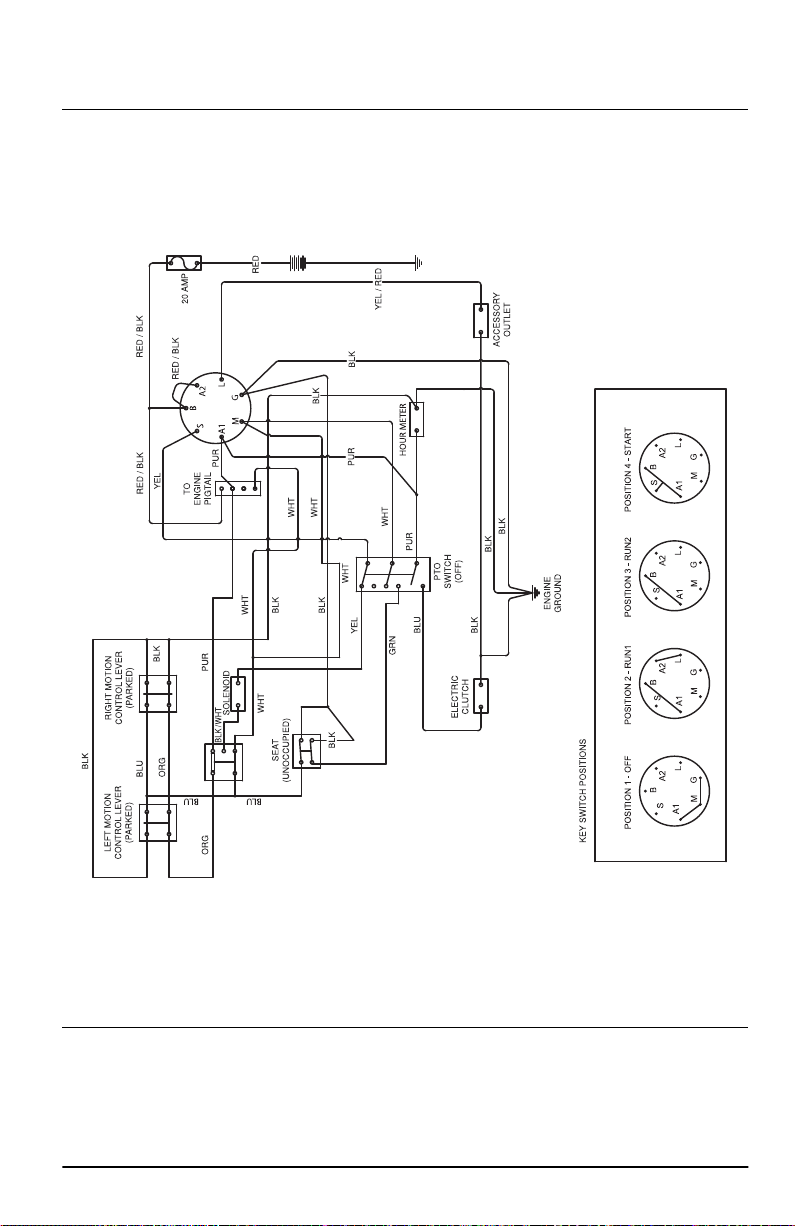
Electrical diagram
2194 - 002 - 29.09.2023 29

Contenido
Certificados de conformidad................................... 30
Introducción............................................................ 30
Seguridad................................................................34
Funcionamiento...................................................... 40
Mantenimiento........................................................ 43
Solución de problemas........................................... 52
Transporte, almacenamiento y eliminación de
residuos.................................................................. 54
Datos técnicos........................................................ 56
Servicio................................................................... 58
Anexo .....................................................................60
Certificados de conformidad
Requisitos para EE.UU.
En el motor y/o en el compartimiento del motor hay
etiquetas que indican que la máquina cumple con
los requisitos. No quite estas etiquetas. También
es posible que se incluyan certificados con la
máquina en el momento de su entrega o que estén
escritos en el manual del motor. Cuídelos porque
son documentos valiosos.
Para implementar mejoras, las especificaciones y
diseños pueden modificarse sin previo aviso.
Introducción
Inspección previa a la entrega y
números de producto
A este producto se le hizo una inspección antes
de la entrega. Asegúrese de que su distribuidor
le entregue una copia firmada del documento de
inspección previa a la entrega.
Información de contacto del taller de ser-
vicio:
Este manual de usuario es para el producto con el número de producto/número de serie:
/
Motor:
Transmisión:
Los números de producto se encuentran en la placa
de identificación. Consulte
Descripción general del
producto en la página 31
para ver la ubicación de
la placa de identificación.
Descripción del producto
Este producto es un cortacésped motorizado. Las
palancas de control permiten que el operador dirija
el producto y ajuste la velocidad del producto. Un
medidor de horas muestra cuántas horas se ha
utilizado el producto.
Uso previsto
El producto está hecho para cortar césped solo en
un terreno abierto y nivelado. No utilice el producto
para otras tareas.
30 2194 - 002 - 29.09.2023
Descripción general del producto
1 2
6
3
4
5
7
8
10
3
12
11
13
15
9
14
1. Palancas de control
2. Freno de estacionamiento
3. Control de seguimiento
4. Palanca elevadora del equipo
5. Fusibles
6. Varillaje de derivación
7. Válvula de corte de combustible
8. Depósito de combustible
9. Estrangulador
10. Control del acelerador
11. Medidor de horas
12. Interruptor de encendido
13. Botón de PTO
14. Palanca de ajuste del asiento
15. Placa de identificación
Controles de la dirección
La dirección del producto se controla mediante las 2
palancas de control. Consulte
Descripción general
del producto en la página 31
. Las palancas de
control se pueden mover hacia delante y hacia
atrás desde la posición neutra. Consulte
Para hacer
funcionar el producto en la página 42
.
Control de presencia del operador
(OPC)
El OPC se acciona cuando el operador se
levanta del asiento. El motor y la transmisión para
las cuchillas se detienen si las cuchillas están
acopladas o el freno de estacionamiento no está
aplicado. Consulte
Condiciones de funcionamiento
en la página 37
.
Llave de encendido
La llave de encendido tiene 4 posiciones:
• Posición Start (arranque) (A)
• Posición de marcha (B)
• La posición de los focos (C)
• Posición Stop (parada) (D)
2194 - 002 - 29.09.2023 31
A
B
C
D
Focos
A
B
C
D
• Gire la llave de encendido a la posición de los
focos (C) para usar el producto con los focos
encendidos.
• Gire la llave de encendido a la posición de
marcha (B) para usar el producto con los focos
apagados.
Control del acelerador
El acelerador ajusta el régimen del motor y la
velocidad de las cuchillas si están acopladas. El
acelerador tiene 2 posiciones en los extremos, el
régimen de ralentí y la aceleración máxima.
AA
B
• Régimen de ralentí (A): disminuye el régimen del
motor.
• Aceleración máxima (B): aumenta el régimen del
motor.
AVISO:
No use el motor en régimen
de ralentí (A) por más tiempo del
necesario. El uso excesivo del producto
a régimen de ralentí puede disminuir la
vida útil de las bujías.
Estrangulador
El estrangulador se usa para que en los arranques
en frío se suministre más combustible al motor.
Levante el estrangulador cuando arranque un motor
frío.
Consulte
Descripción general del producto en
la página 31
para conocer la posición del
estrangulador.
Botón de toma de fuerza (PTO)
El botón de PTO acopla y desacopla el embrague de
PTO y el equipo de corte u otro equipo conectado
a este. Se deben respetar las condiciones
correctas de arranque para activar la transmisión
de las cuchillas. Consulte las
Condiciones de
funcionamiento en la página 37
para conocer las
condiciones correctas de arranque.
• Tire del botón de PTO para acoplar el disco de
las cuchillas u otro equipo.
• Presione el botón de PTO para desacoplar el
disco de las cuchillas u otro equipo.
Válvula de corte de combustible
Consulte
Descripción general del producto en la
página 31
para conocer la posición de la válvula de
corte de combustible.
La válvula de corte de combustible está cerrada
cuando la lengüeta de la perilla se encuentra en
posición perpendicular a la tubería de combustible.
32
2194 - 002 - 29.09.2023
Fusibles
La ubicación de los fusibles está en la caja de
fusibles. La caja de fusibles está debajo del asiento.
Incline el asiento hacia delante para acceder a la
caja de fusibles. Consulte la etiqueta de la caja de
fusibles para identificar los diferentes fusibles.
Medidor de horas
El producto tiene un medidor de horas que muestra
cuántas horas de funcionamiento las cuchillas han
estado acopladas. Consulte la
Descripción general
del producto en la página 31
para conocer la
posición del medidor de horas.
Cada 50 horas, se mostrará un símbolo del nivel
de aceite durante 2 horas. Consulte
Para revisar el
nivel de aceite del motor en la página 49
.
Símbolos en el producto
ADVERTENCIA: Este producto puede
ser peligroso y provocar daños graves
o fatales al operador o a otras
personas. Tenga cuidado y utilice el
producto correctamente.
Utilice gafas protectoras.
Freno de estacionamiento.
Régimen del motor: rápido.
Lento.
Combustible.
Use guantes protectores.
Detenga el motor antes de realizar el
mantenimiento.
No opere el producto sin deflector o
recogedor de césped.
Use siempre protectores auriculares
aprobados.
No ponga el pie aquí.
Marcha neutra.
Marcha atrás.
Lea atentamente el manual del
usuario y asegúrese de que entiende
las instrucciones antes de usar el
producto.
Mantenga una distancia de seguridad
con respecto al producto.
No opere el producto en pendientes de
más de 10°.
No lleve pasajeros.
Tenga cuidado con los objetos que
puedan salir expulsados o rebotar.
Mantenga las manos y los pies
alejados.
2194 - 002 - 29.09.2023 33
Mantenga las manos lejos de las
piezas giratorias.
Tenga cuidado con las personas y
los animales cuando opere el producto
hacia delante.
Tenga cuidado con las personas y
los animales cuando opere el producto
hacia atrás.
Estrangulador.
Altura de corte baja.
Altura de corte alta.
Manténgase alejado del
equipo de descarga.
Advertencia: El ácido de
la batería es corrosivo,
explosivo e inflamable.
Mantenga las partes del
cuerpo alejadas de las
piezas giratorias.
aaaassxxxx La placa de característi-
cas muestra el número
de serie. aaaa es el año
de producción y ss es la
semana de producción.
Tenga en cuenta: Otros símbolos o etiquetas
del producto hacen referencia a requisitos de
certificación de algunas zonas comerciales.
Daños en el producto
No somos responsables de los daños a nuestro
producto en los siguientes casos:
• el producto se repara incorrectamente
• el producto se repara con piezas que no son del
fabricante o que este no autoriza
• el producto tiene un accesorio que no es del
fabricante o que este no autoriza
• el producto no se repara en un centro de servicio
autorizado o por una autoridad aprobada.
Seguridad
Definiciones de seguridad
Las advertencias, precauciones y notas se utilizan
para señalar las piezas particularmente importantes
del manual.
ADVERTENCIA: Se utilizan para
señalar el riesgo de lesiones graves
o mortales para el operador o para
aquellos que se encuentren cerca si no
se siguen las instrucciones del manual.
AVISO: Se utilizan para señalar
el riesgo de dañar la máquina, otros
materiales o el área adyacente si no se
siguen las instrucciones del manual.
Tenga en cuenta: Se utilizan para
entregar más información necesaria en situaciones
particulares.
Instrucciones generales de
seguridad
ADVERTENCIA: Lea
atentamente las siguientes instrucciones
de advertencia antes de usar el
producto.
ADVERTENCIA: Si no se
siguen con precaución las prácticas
de funcionamiento, puede provocar
lesiones importantes para el operador
u otras personas. El propietario debe
entender estas instrucciones y debe
asegurarse de que solo personas
autorizadas que comprenden estas
instrucciones operarán el cortacésped.
Cada persona que hace funcionar el
cortacésped debe estar bien tanto física
como mentalmente y no debe estar bajo
la influencia de sustancias que alteren
las facultades mentales.
34 2194 - 002 - 29.09.2023
ADVERTENCIA: Este producto
puede amputar manos y pies, y
arrojar objetos. El incumplimiento de las
siguientes instrucciones de seguridad
puede ocasionar daños graves o la
muerte.
• Lea, comprenda y siga las instrucciones y
advertencias de este documento, del manual de
usuario y las que aparecen en el producto, el
motor y los accesorios.
• Permita que solo usuarios responsables, que
estén capacitados, familiarizados con las
instrucciones y en condiciones físicas aptas
operen el producto.
• Asegúrese de informar a una persona que va a
utilizar el producto, en caso de que ocurra una
lesión o un accidente.
• No lleve pasajeros y mantenga alejados a los
observadores.
• No haga funcionar el producto bajo la influencia
del alcohol o las drogas.
• Siga las recomendaciones del fabricante para los
pesos de las ruedas o los contrapesos.
• Aprenda a utilizar el producto y sus controles de
forma segura y aprenda a detener el producto
con rapidez.
• Reconozca las etiquetas de seguridad.
• Mantenga el producto limpio para asegurarse
de que puede leer claramente las señales y las
etiquetas.
• Tenga en cuenta que el operador será
responsable de los accidentes que involucren a
otras personas o su propiedad.
• Solo utilice el producto con luz de día o en
condiciones de buena iluminación. Mantenga el
producto a una distancia segura respecto de
agujeros u otras irregularidades del suelo. Ponga
atención para detectar otros posibles riesgos.
• No permita que niños u otras personas no
autorizadas para operar el producto lo utilicen
o le hagan mantenimiento. Las leyes locales
pueden regular la edad del usuario.
• Asegúrese de que no haya nadie más cerca del
producto cuando arranque el motor, acople la
transmisión o empiece a mover el producto.
• Vigile el tráfico cuando corte cerca de un camino
o atraviese uno.
• No utilice el producto si está cansado,
bajo la influencia del alcohol o las drogas,
medicamentos o cualquier cosa que pudiera
afectar negativamente su visión, estado de
alerta, coordinación o juicio.
• Estacione siempre el producto en una superficie
nivelada con el motor parado.
• No modifique este producto.
• No utilice el producto si es posible que otras
personas lo hayan modificado.
Instrucciones de seguridad relacionadas
con los niños
ADVERTENCIA: Los niños
pueden resultar gravemente heridos
o morir a causa de este producto.
Lea atentamente las instrucciones de
advertencia siguientes antes de usar
el producto. Mantenga a los niños
alejados.
• Pueden ocurrir accidentes trágicos si el operador
no está alerta de la presencia de niños. A los
niños suele atraerles el producto y la actividad
de cortar césped. Nunca dé por un hecho que
los niños permanecerán donde usted los vio por
última vez.
• Mantenga a los niños fuera de la zona de
operación y bajo la observación atenta de un
adulto responsable que no sea el operador.
• Manténgase atento y detenga el producto
de inmediato si ingresan niños al área de
trabajo. Tenga mucho cuidado cerca de
esquinas, arbustos, árboles u otros objetos que
obstaculicen la visión.
• Tenga extremo cuidado al acercarse a curvas
con poca visibilidad, arbustos, árboles u otros
objetos que puedan bloquear su visión e impedir
que vea a un niño.
• Antes de mover el producto en reversa y
mientras lo hace, mire detrás de usted y esté
atento a la presencia de niños pequeños.
• No deje que los niños operen el producto.
• La Academia Norteamericana de Pediatría
recomienda que solo niños mayores de 16años
operen un cortacésped o se suban a uno.
• Nunca lleve niños sobre la máquina, aunque
las cuchillas estén desactivadas. Los niños se
pueden caer y sufrir daños graves, o interferir en
el uso seguro del producto. Los niños que han
dado una vuelta en la máquina pueden aparecer
de repente en la zona de corte para dar otra
vuelta y podrían ser atropellados o golpeados
con el producto.
Instrucciones de seguridad para el
funcionamiento
ADVERTENCIA:
Lea
atentamente las instrucciones de
advertencia siguientes antes de usar el
producto.
ADVERTENCIA: No toque el
motor ni en el sistema de escape
durante o inmediatamente después del
funcionamiento. El motor y el sistema de
escape se calientan mucho durante el
funcionamiento. Riesgo de quemaduras,
incendios y daños a la propiedad
2194 - 002 - 29.09.2023 35

o zonas adyacentes. Cuando utilice
el producto, manténgase alejado de
arbustos y otros objetos.
• Solo haga funcionar el motor en áreas bien
ventiladas. Los gases de escape contienen
monóxido de carbono, un veneno mortal.
• Opere el producto únicamente durante el día o
con buena luz artificial.
• Despeje el área de objetos como piedras,
juguetes, cables, etc., que puedan quedar
atrapados en las cuchillas y ser arrojados.
• Evite agujeros, surcos, irregularidades, piedras u
otros objetos ocultos. Un terreno irregular podría
causar que el producto se vuelque o que el
operador pierda el equilibrio o la posición.
• No coloque las manos ni los pies cerca de
las piezas giratorias ni debajo del producto.
Manténgase alejado de la abertura de descarga
en todo momento.
• No opere el producto sin el recogedor de
césped, el protector de descarga u otros
dispositivos de seguridad completos instalados o
en funcionamiento.
• No dirija el material descargado hacia ninguna
persona. Evite descargar el material contra una
pared u otra obstrucción. El material puede
rebotar hacia el operador. Detenga las cuchillas
cuando cruce por superficies de grava.
• No deje un producto en funcionamiento sin
supervisión. Siempre estacione el producto en
un terreno nivelado, desacople el accesorio,
active el freno de estacionamiento y detenga el
motor.
• No corte el césped en reversa a menos que sea
absolutamente necesario. Siempre mire hacia
abajo y hacia atrás antes y cuando vaya en
reversa.
• Disminuya la velocidad antes de girar.
• Disminuya la velocidad antes de girar en una
esquina.
• Los datos indican que los operadores de60 años
o más son víctimas de un gran porcentaje de
lesiones relacionadas con la conducción de un
cortacésped. Estos operadores deben evaluar
si pueden operar el cortacésped de manera
lo suficientemente segura para protegerse a sí
mismos y a otras personas de lesiones.
Instrucciones de seguridad para el uso en
pendientes
ADVERTENCIA:
Lea
atentamente las instrucciones de
advertencia siguientes antes de usar el
producto.
Las pendientes son un factor importante relacionado
con los accidentes. El uso en pendientes exige
precaución especial.
• Desplácese en la dirección recomendada por el
fabricante en las pendientes. Tenga cuidado al
operar cerca de declives.
• Evite cortar césped húmedo. Los neumáticos
pueden perder tracción.
• No utilice el producto en ninguna condición
que pueda alterar la tracción, la dirección o la
estabilidad. Los neumáticos podrían deslizarse
incluso si las ruedas se han detenido.
• Siempre mantenga el producto a una velocidad
constante cuando baje por las pendientes. No se
deje llevar por las pendientes cuesta abajo.
• Evite ponerse en movimiento o detenerse en
pendientes. No haga cambios repentinos de
velocidad o dirección. Realice giros de manera
lenta y gradual.
• Si los neumáticos pierden tracción, desacople
las cuchillas y avance lentamente y de forma
recta hacia abajo de la pendiente.
• Tenga especial cuidado cuando opere el
producto con un recogedor de césped u otros
accesorios. Pueden afectar la estabilidad del
producto.
• Cortar el césped en pendientes aumenta el
riesgo de que no pueda controlar el producto
y de que se vuelque. Esto puede provocar
lesiones o la muerte. Es necesario tener cuidado
al cortar el césped en cualquier pendiente. Si no
puede retroceder para subir una pendiente o si
no se siente seguro, no la corte.
• Quite las piedras, las ramas y otros obstáculos.
• Corte el césped de la pendiente de arriba hacia
abajo, no de lado a lado.
• No utilice el producto en suelos con pendientes
de más de 10°.
• Muévase suave y lentamente en pendientes.
• Ponga atención a la presencia de surcos,
agujeros y baches, y no pase transversalmente
por ellos. Existe un mayor riesgo de que el
producto se vuelque en suelo que no es plano.
El césped alto puede ocultar obstáculos.
• No corte el césped cerca de bordes, zanjas
u orillas. Mantenga, al menos, el ancho de la
máquina alejado de estos peligros. El producto
puede volcarse repentinamente si una rueda
se desplaza por el borde de una pendiente
pronunciada o una zanja, o si un borde cede.
Equipo de protección personal
ADVERTENCIA:
Lea
atentamente las instrucciones de
advertencia siguientes antes de usar el
producto.
• Utilice siempre el equipo de protección personal
aprobado cuando use el producto. El equipo de
protección personal no puede impedir el riesgo
de lesiones, pero disminuirá el grado de lesión si
ocurre un accidente. Permita que su distribuidor
lo ayude a seleccionar el equipo adecuado.
36
2194 - 002 - 29.09.2023
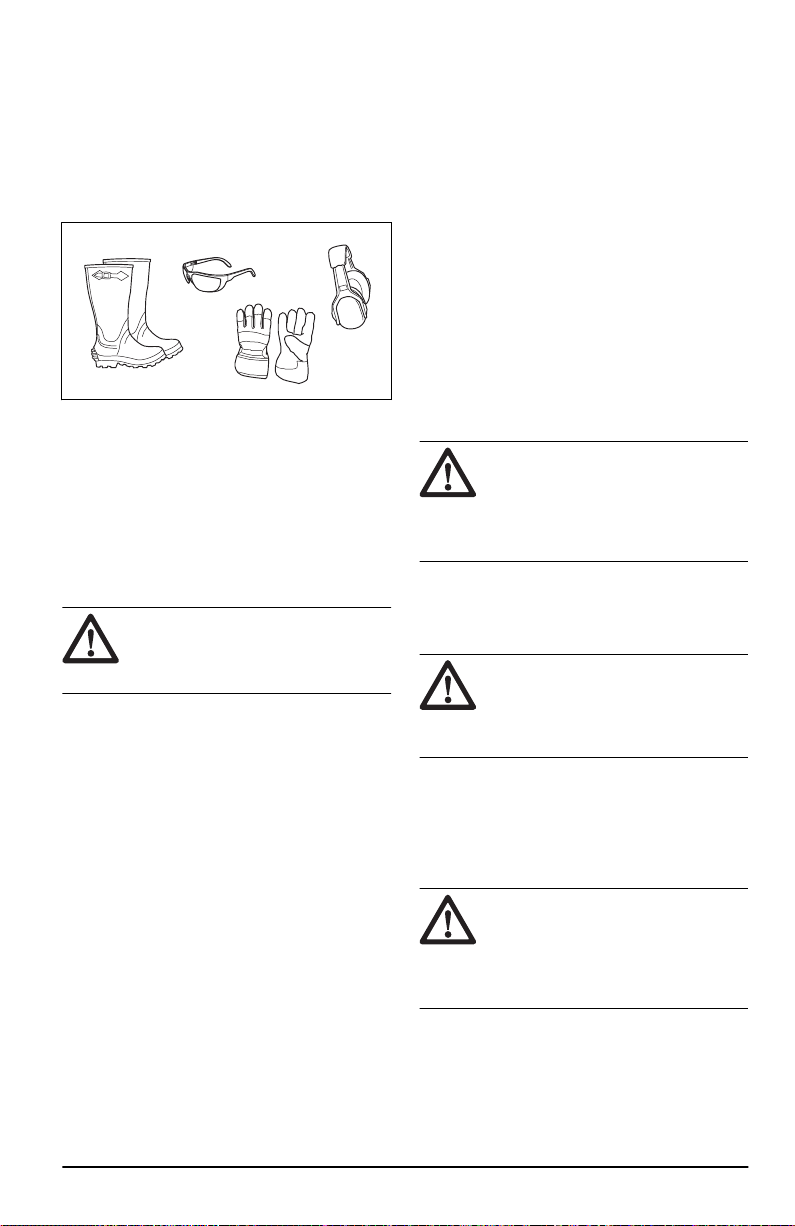
• Use siempre protectores auriculares aprobados.
La exposición prolongada al ruido puede causar
la pérdida permanente de la audición.
• Siempre use gafas de seguridad o protección
ocular cuando opere el producto o realice tareas
de mantenimiento o reparación.
• Use siempre zapatos o botas de protección. Se
recomienda usar punteras de acero. No utilice el
producto descalzo.
• Utilice guantes cuando sea necesario, por
ejemplo, cuando conecte, examine o limpie el
equipo de corte.
• No use ropa floja, joyas u otros artículos que
puedan quedar atrapados en las piezas móviles.
• No utilice pantalones cortos cuando utilice el
producto.
• Mantenga un equipo de primeros auxilios y un
extintor de incendios a mano.
Dispositivos de seguridad en el producto
ADVERTENCIA:
Lea
atentamente las instrucciones de
advertencia siguientes antes de usar el
producto.
• No utilice un producto con dispositivos de
seguridad dañados o que no funcionen
correctamente. Revise los dispositivos de
seguridad de forma regular. Si los dispositivos
de seguridad están dañados, comuníquese con
el agente de servicio de Husqvarna.
• No realice ninguna modificación en los
dispositivos de seguridad. No utilice el producto
si las placas de protección, las cubiertas de
protección, los interruptores de seguridad u otros
dispositivos protectores no están acoplados o
están dañados.
Para revisar la llave de encendido
• Arranque y detenga el motor para revisar la llave
de encendido. Consulte
Para arrancar el motor
en la página 41
y
Detener el motor en la página
43
.
• Asegúrese de que el motor arranque cuando gire
la llave de encendido a la posición de encendido.
• Asegúrese de que el motor se detenga
inmediatamente cuando gire la llave de
encendido a la posición de detención.
Condiciones de funcionamiento
Estas condiciones son necesarias para arrancar el
motor:
• Las palancas de control están en la posición
neutra.
• El freno de estacionamiento está aplicado.
• La transmisión de las cuchillas está desactivada.
• El OPC está presionado.
El motor se debe detener en las siguientes
situaciones:
• El freno de estacionamiento no está accionado y
el operador se levanta del asiento.
• La transmisión de las cuchillas está activada y el
operador se levanta del asiento.
Intente arrancar el motor sin 1 de las condiciones.
Cambie las condiciones y vuelva a intentarlo. Haga
esta comprobación a diario.
Freno de estacionamiento
ADVERTENCIA: Si el freno
de estacionamiento no funciona, el
producto puede empezar a moverse y
causar lesiones o daños. Asegúrese
de revisar y ajustar el freno de
estacionamiento con regularidad.
Consulte
Para comprobar el freno de
estacionamiento en la página 46
.
Silenciador
ADVERTENCIA:
No utilice el
producto si el silenciador no está
instalado o está dañado. Un silenciador
dañado o que no está aumenta el nivel
de ruido y el riesgo de incendio.
El silenciador mantiene los niveles de ruido al
mínimo y envía los gases de escape lejos del
operador.
Examine el silenciador con regularidad para
asegurarse de que está instalado correctamente y
que no esté dañado.
ADVERTENCIA:
El silenciador
se calienta mucho durante y después
del uso y cuando el motor funciona en
régimen de ralentí. Tenga cuidado cerca
de materiales o vapores inflamables
para prevenir incendios.
Para revisar el silenciador
• Examine el silenciador con regularidad para
asegurarse de que está instalado correctamente
y que no esté dañado.
2194 - 002 - 29.09.2023
37
Apagachispas
Este producto tiene un motor de combustión interna.
No utilice el producto cerca de vegetación sin una
red apagachispas que esté aprobada por las leyes
locales o estatales. Las leyes federales se aplican a
las tierras federales.
Se puede obtener un apagachispas para el
silenciador a través de su distribuidor Husqvarna
aprobado.
Cubiertas protectoras
Si faltan cubiertas protectoras o estas están
dañadas, aumenta el riesgo de lesiones por
piezas móviles y superficies calientes. Realice una
comprobación de las cubiertas protectoras antes de
usar el producto. Asegúrese de que las cubiertas
protectoras estén correctamente instaladas y no
tengan grietas u otros daños. Reemplace las
cubiertas dañadas.
Seguridad de combustible
ADVERTENCIA: Lea
atentamente las instrucciones de
advertencia siguientes antes de usar el
producto.
ADVERTENCIA: Tenga cuidado
con el combustible. Es muy inflamable,
por lo que puede provocar lesiones y
daños a la propiedad.
• Apague todo tipo de cigarrillos, puros, pipas y
otras fuentes de ignición.
• Use solo un recipiente de combustible aprobado.
• No retire el tapón de combustible ni agregue
combustible con el motor en funcionamiento o
mientras está caliente.
• No cargue combustible en interiores o en áreas
mal ventiladas.
• Después de recargar combustible, vuelva a
colocar el tapón de gasolina y apriételo
firmemente.
• No guarde el producto o el recipiente de
combustible ni cargue combustible donde haya
una llama expuesta, chispas o un indicador
luminoso, como en un calentador de agua u
otros aparatos.
• Si derrama combustible en su ropa, cámbiese la
ropa inmediatamente.
• Si salpica combustible, no intente hacer arrancar
el motor y evite crear cualquier fuente de ignición
hasta que los vapores del combustible se hayan
disipado.
• Para ayudar a evitar incendios: mantenga el
producto libre de césped, hojas u otros desechos
acumulados; limpie el aceite o los derrames de
combustible y quite cualquier residuo mojado
con combustible; deje que el producto se enfríe
antes de guardarlo.
• Tenga especial cuidado al manipular gasolina y
otros combustibles. Estos son inflamables y los
vapores son explosivos.
• La gasolina y los vapores de gasolina son
tóxicos y muy inflamables. Tenga cuidado con
la gasolina para evitar lesiones personales o
incendios.
• Deje que el motor se enfríe antes de agregar
combustible.
• No llene el depósito de combustible cerca de
chispas o llamas.
• Si hay fugas en el sistema de combustible, no
arranque el motor hasta que las repare.
• No llene por encima del nivel de combustible
recomendado. El calor del motor y el sol
hacen que el combustible se expanda y que se
desborde si el depósito está demasiado lleno.
• Guarde el producto y el combustible, de manera
que no haya riesgo de que vapores o fugas de
combustible puedan causar daños.
Seguridad del transporte
• Utilice un vehículo de transporte aprobado para
el transporte del producto.
• El producto es pesado y puede causar lesiones
por aplastamiento. Tenga cuidado cuando lo
cargue o descargue de un vehículo o remolque.
• Las normativas nacionales o locales de
mercados pueden establecer un límite para el
transporte del producto.
• El operador de vehículo de transporte es
responsable de fijar el producto de forma segura
durante el transporte. Consulte
Transporte en la
página 54
.
Transporte
• Utilice rampas de ancho completo cuando
cargue y descargue un producto para
transportarlo.
Seguridad de remolque
• Obedezca las recomendaciones del fabricante
sobre los límites de peso para el equipo
remolcado y al remolcar en pendientes.
• Utilice únicamente equipos de remolque
aprobados por Husqvarna.
• Utilice la barra de remolque para conectar el
equipo.
• Cuando remolque equipos, asegúrese de que no
haya otras personas cerca de la máquina.
• No permita que los niños u otras personas
monten o se suban al equipo remolcado.
• No remolque en pendientes ni en terreno
irregular. En las pendientes, el peso del equipo
remolcado puede provocar pérdida de tracción y
pérdida de control.
38
2194 - 002 - 29.09.2023
Seguridad de la batería
ADVERTENCIA: Una batería
dañada puede provocar una explosión
y causar lesiones. Si la batería tiene
una deformación o está dañada, hable
con un taller de servicio Husqvarna
autorizado.
ADVERTENCIA: Lea
atentamente las instrucciones de
advertencia siguientes antes de usar el
producto.
• Utilice gafas protectoras cuando esté cerca de
las baterías.
• No use relojes, joyas u otros objetos metálicos
cerca de la batería.
• Almacene la batería fuera del alcance de los
niños.
• Cargue la batería en un espacio con buena
ventilación.
• Mantenga los materiales inflamables a una
distancia mínima de 1m cuando cargue la
batería.
• Deseche las baterías que ha reemplazado.
Consulte
Eliminación en la página 55
.
• La batería puede generar gases explosivos. No
fume cerca de la batería. Mantenga la batería
lejos de llamas abiertas y chispas.
Instrucciones de seguridad para el
mantenimiento
ADVERTENCIA:
Lea
atentamente las instrucciones de
advertencia siguientes antes de usar el
producto.
ADVERTENCIA: El producto es
pesado y puede causar lesiones o daños
a la propiedad o el área adyacente.
No realice mantenimiento del motor o
del equipo de corte sin cumplir con las
siguientes condiciones:
• El sistema está apagado.
• El producto está estacionado en una
superficie nivelada.
• El freno de estacionamiento está
aplicado.
• La llave de encendido está en
posición stop y retirada.
• Las cuchillas están desacopladas.
• Todas las piezas giratorias se han
detenido.
• Quitó los cables de encendido de las
bujías.
ADVERTENCIA: Un escape de
líquido con presión puede tener fuerza
suficiente para traspasar la piel y
causar daños graves. Si el líquido le
traspasa la piel, busque atención médica
de inmediato. Mantenga las manos
y el cuerpo alejados de orificios de
pasadores o boquillas que expulsen
líquido a alta presión. Si se produce una
fuga, haga que un técnico capacitado
repare inmediatamente el producto.
ADVERTENCIA: Los gases de
escape del motor contienen monóxido
de carbono, un gas inodoro, tóxico y
muy peligroso. No use el producto en
espacios cerrados o sin suficiente flujo
de aire.
• Mantenga el producto en buen orden de trabajo.
Reemplace las piezas desgastadas o dañadas.
Tenga cuidado al realizar tareas de
mantenimiento en las cuchillas. Envuelva las
cuchillas o utilice guantes. Reemplace las
cuchillas dañadas. No repare ni altere las
cuchillas.
Si están equipados, desconecte los cables de las
bujías y el cable negativo de la batería antes de
realizar cualquier reparación.
Para lograr mayores niveles de rendimiento
y seguridad, realice el mantenimiento del
producto con regularidad como se indica en el
programa de mantenimiento. Consulte
Programa
de mantenimiento en la página 43
.
• Las sacudidas eléctricas pueden causar
lesiones. No toque los cables cuando el motor
esté encendido. No haga una prueba de
funcionamiento del sistema de encendido con los
dedos.
• Deje que el producto se enfríe antes de realizar
tareas de mantenimiento cerca del motor.
• Las cuchillas son filosas y pueden causar
cortes. Envuelva las cuchillas con protección o
utilice guantes protectores cuando trabaje en las
cuchillas.
• No gire el motor si quitó el cable de encendido o
la bujía.
• Asegúrese de que todas las tuercas y pernos
estén correctamente apretados y de que el
equipo está en buen estado.
• No cambie el ajuste de los reguladores. Si
el régimen del motor es demasiado alto, los
componentes del producto pueden dañarse.
Consulte la sección
Datos técnicos en la página
56
para ver el régimen del motor máximo
permitido.
• El producto se ha aprobado solo con el equipo
proporcionado originalmente o recomendado por
el fabricante.
2194 - 002 - 29.09.2023
39
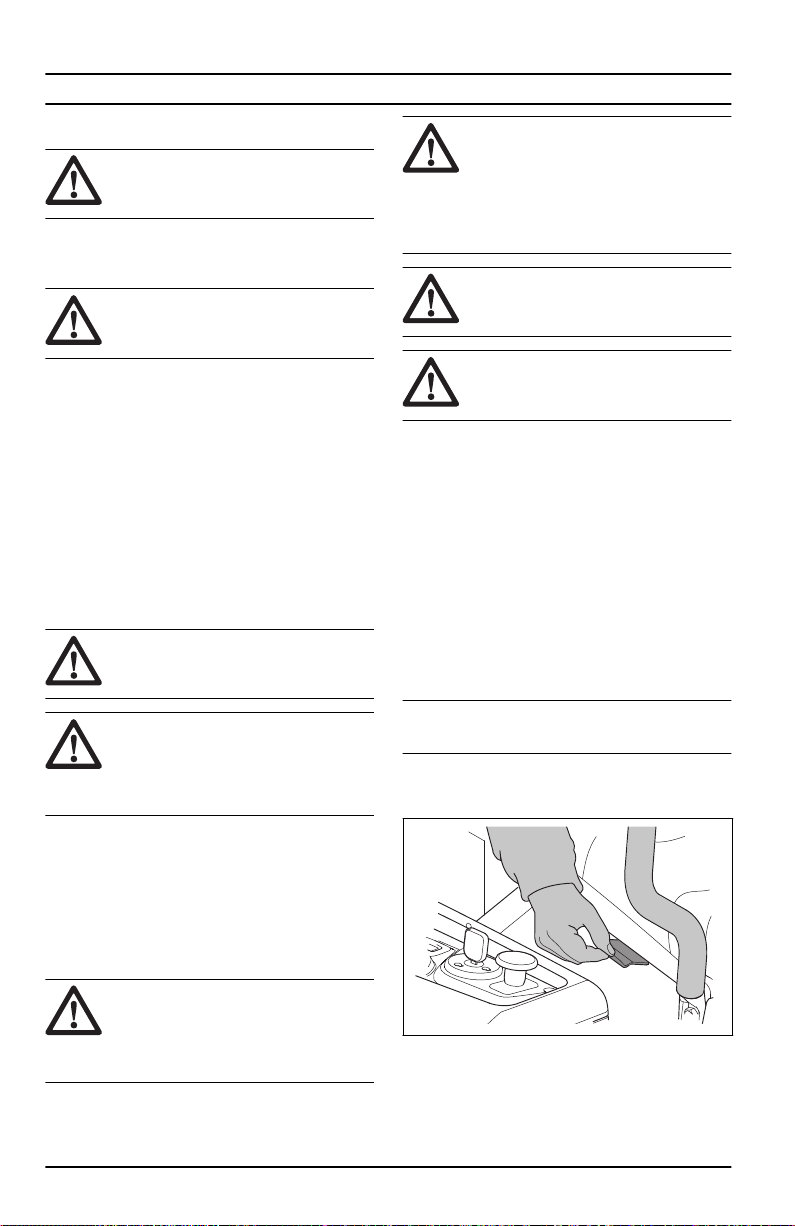
Funcionamiento
Introducción
ADVERTENCIA: Antes de utilizar
el producto, debe leer y entender el
capítulo sobre seguridad.
Para usar el producto por primera
vez
ADVERTENCIA: Antes de utilizar
el producto por primera vez, debe leer y
entender este capítulo.
• Utilice una velocidad del acelerador y de avance
reducidas cuando use el producto por primera
vez.
• No mueva las palancas de control a la posición
completamente hacia adelante o a la posición
completamente hacia atrás durante la operación
inicial.
• Aprenda a desplazar el producto sobre una
superficie dura, por ejemplo, hormigón o asfalto,
antes de usar el producto sobre césped por
primera vez.
Haga lo siguiente antes de usar el
producto
ADVERTENCIA: Antes de utilizar
el producto, debe leer y entender el
capítulo sobre seguridad.
ADVERTENCIA: Antes de usar
el producto, asegúrese de que no haya
piedras u otros objetos en el área de
trabajo que puedan salir despedidos por
las cuchillas giratorias.
• Realice el mantenimiento diario. Consulte
Programa de mantenimiento en la página 43
.
• Asegúrese de que haya suficiente combustible
en el depósito de combustible.
• Ajuste la altura de corte. Consulte
Ajuste de la
altura de corte en la página 41
.
Para agregar combustible
ADVERTENCIA:
La gasolina
es muy inflamable. Tenga cuidado
y recargue combustible al aire libre,
consulte
Seguridad de combustible en la
página 38
.
ADVERTENCIA: El motor y el
sistema de escape se calientan mucho
durante el funcionamiento. Riesgo de
lesiones por quemadura. Deje que el
motor y el sistema de escape se enfríen
antes de cargarle combustible a la
máquina.
ADVERTENCIA: No utilice el
depósito de combustible como un área
de soporte.
AVISO: Usar el tipo incorrecto de
combustible puede causar daños en el
motor.
El motor funciona con gasolina con un octanaje
mínimo de 91RON (87AKI), sin mezclarse con
aceite. Recomendamos usar gasolina de alquilato
biodegradable.
• Realice una comprobación del nivel de
combustible antes de cada uso y agregue
combustible si es necesario.
• No llene el depósito de combustible
completamente. Llénelo hasta la parte inferior
del cuello del depósito de combustible.
Para ajustar el asiento
La posición del asiento se puede mover hacia
adelante o hacia atrás.
Tenga en cuenta:
No realice ajustes en el
asiento cuando el producto esté en funcionamiento.
• Tire de la palanca que está debajo del asiento
hacia arriba y mueva el asiento hacia delante o
hacia atrás.
Para plegar el asiento
El asiento se puede plegar hacia delante para
acceder a la batería y a los engranajes hidrostáticos.
1. Estacione el producto en un terreno plano.
40
2194 - 002 - 29.09.2023
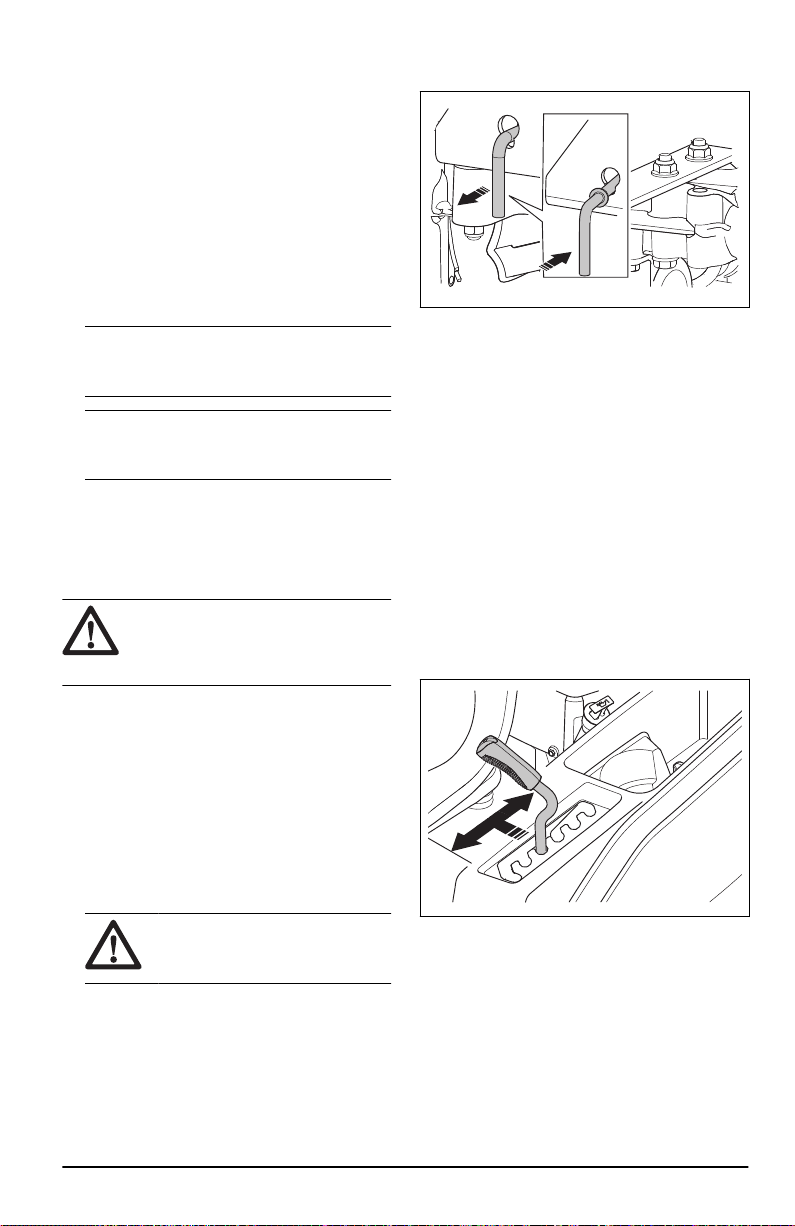
2. Empuje el asiento hacia delante para plegarlo
hacia delante.
Para acoplar y desacoplar el freno
de estacionamiento
Este producto no tiene una palanca de freno
de estacionamiento específica. El freno de
estacionamiento está integrado en las 2 palancas de
control.
• Empuje las 2 palancas de control hacia afuera
del asiento al mismo tiempo para activar el
freno de estacionamiento. Consulte
Descripción
general del producto en la página 31
para
conocer la ubicación de las palancas de control.
Tenga en cuenta: El producto debe
estar detenido cuando active el freno de
estacionamiento.
Tenga en cuenta: El motor se detendrá
si no empuja las 2 palancas de control lejos del
asiento al mismo tiempo.
• Empuje las 2 palancas de control en el
sentido del asiento para desactivar el freno de
estacionamiento.
Para desacoplar y acoplar el sistema
de transmisión
AVISO: Solo desacople o acople
el sistema de transmisión cuando el
producto esté estacionado sobre una
superficie nivelada.
Si es necesario mover el producto de forma manual,
con el motor apagado, se debe desacoplar el
sistema de transmisión. El varillaje de derivación
desacopla y acopla el sistema de transmisión. Los
varillajes de derivación se encuentran debajo del
protector trasero del motor.
Siga el procedimiento que se describe a
continuación para desacoplar el sistema de
transmisión.
1. Estacione el producto en suelo nivelado y
detenga el motor.
ADVERTENCIA:
Deje que el
motor se enfríe antes de desacoplar
o acoplar el sistema de transmisión.
2. Retire la llave de contacto.
3. Coloque el equipo de corte en la posición de
transporte.
4. Coloque las palancas de control en la posición
neutra.
5. Tire los varillajes de derivación hacia arriba y
retírelos de las ranuras.
6. Acople el sistema de transmisión en secuencia
opuesta.
Para colocar el equipo de corte en la
posición de transporte o posición de
corte
El equipo de corte debe estar en la posición de
transporte durante el transporte.
• Para ajustar el producto en la posición de
transporte, tire de la palanca de altura de corte
en la dirección del asiento y colóquela en la
posición de altura de corte más alta.
• Para ajustar el producto en la posición de corte,
ajuste la altura de corte apropiada. Consulte
Ajuste de la altura de corte en la página 41
.
Ajuste de la altura de corte
1. Tire de la palanca de altura de corte en dirección
al asiento.
2. Dirija la palanca de altura de corte hacia la
muesca para obtener la altura de corte correcta.
Para arrancar el motor
1. Siéntese en el asiento.
2194 - 002 - 29.09.2023
41
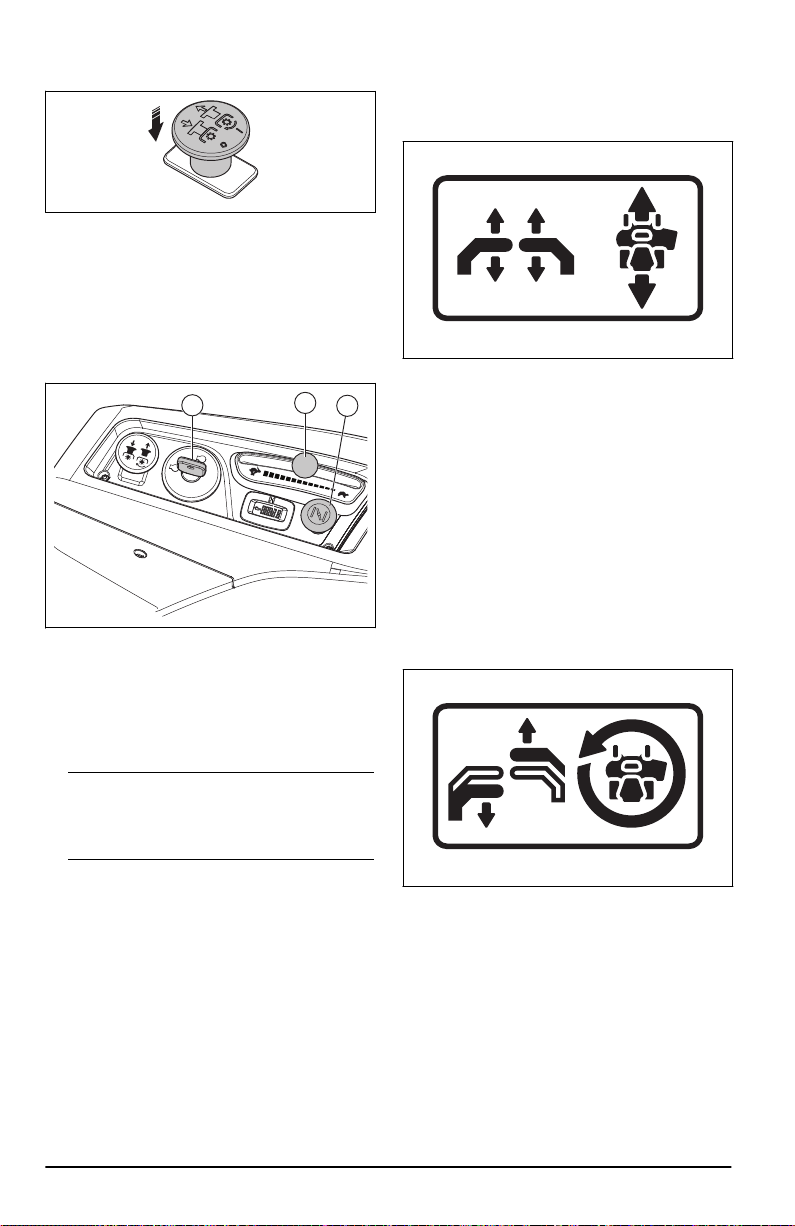
2. Presione el botón de la PTO para desconectar la
trasmisión del equipo de corte.
3. Coloque el equipo de corte en la posición de
transporte. Consulte
Para colocar el equipo de
corte en la posición de transporte o posición de
corte en la página 41
.
4. Acople el freno de estacionamiento. Consulte
Para acoplar y desacoplar el freno de
estacionamiento en la página 41
.
5. Mueva la palanca de acelerador (A) hasta la
mitad de la posición del acelerador.
C
A
B
6. Si el motor está frío, tire del estrangulador (B)
hacia arriba.
7. Presione y gire la llave de encendido (C) a la
posición de arranque.
8. Cuando el motor arranque, suelte
inmediatamente la llave de encendido a la
posición de marcha.
Tenga en cuenta:
No mantenga la llave
de encendido en la posición Start durante más
de 5 segundos cada vez. Si el motor no arranca,
espere 15segundos antes de volver a intentarlo.
9. Si el motor está frío, presione lentamente el
estrangulador hacia abajo.
10. Deje que el motor marche a aceleración media
entre 3 y 5minutos antes de aplicar la
aceleración máxima.
11. Presione el acelerador hasta la posición de
aceleración máxima.
Para hacer funcionar el producto
1. Arranque el motor. Consulte
Para arrancar el
motor en la página 41
.
2. Desacople el freno de estacionamiento. Consulte
Para acoplar y desacoplar el freno de
estacionamiento en la página 41
.
3. Empuje cuidadosamente las 2 palancas de
control hacia adelante. El producto comenzará
a avanzar. La velocidad de avance aumenta
mientras más se empujan hacia adelante las 2
palancas de control.
4. Tire cuidadosamente de las 2 palancas de
control hacia atrás. El producto comenzará a
retroceder. La velocidad de retroceso aumenta
mientras más se empujan hacia atrás las 2
palancas de control.
5. Coloque las 2 palancas de control en posición
neutra para disminuir la velocidad y detener el
producto.
6. Siga los pasos que se indican a continuación
para girar a la izquierda o a la derecha cuando
avance.
a) Tire de la palanca de control izquierda
hacia atrás en la dirección de la posición
neutra para hacer que el producto gire a la
izquierda. Mientras más tire de la palanca
de control izquierda hacia atrás, el producto
girará más a la izquierda.
42
2194 - 002 - 29.09.2023
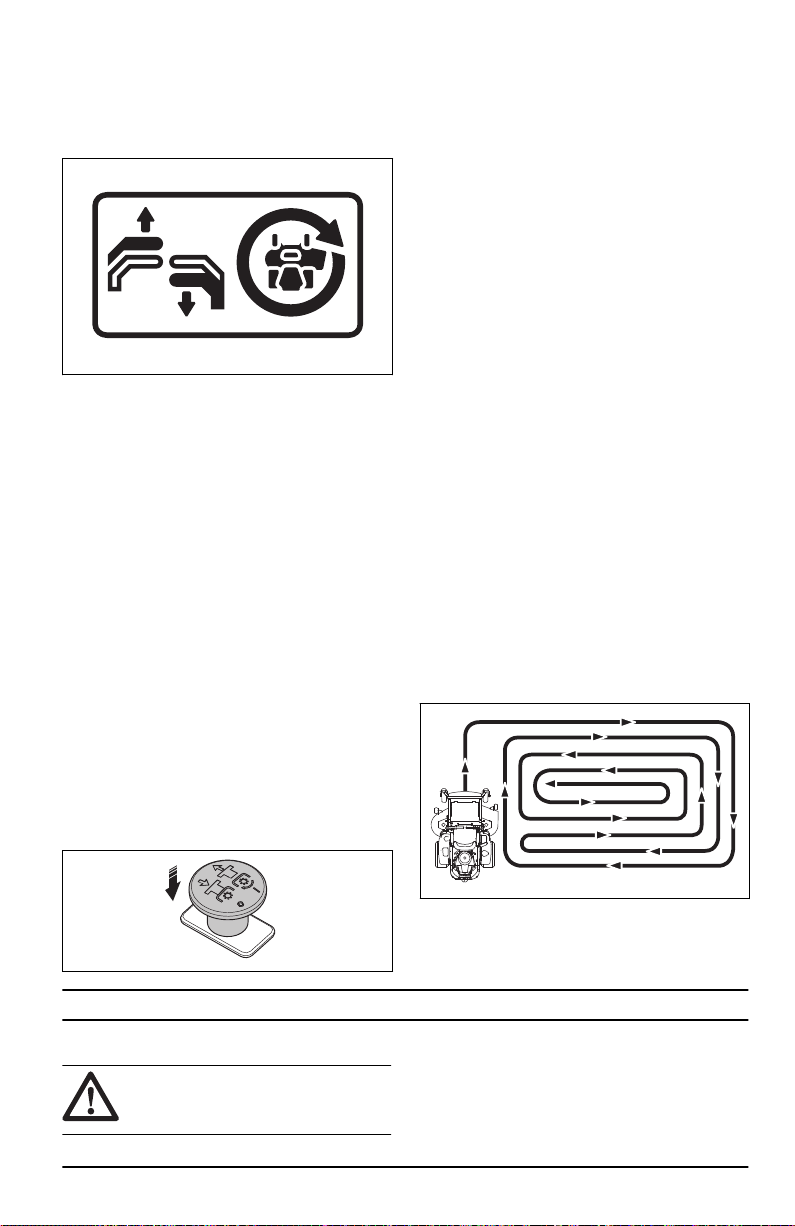
b) Tire de la palanca de control derecha hacia
atrás en la dirección de la posición neutra
para hacer que el producto gire a la derecha.
Mientras más tire de la palanca de control
derecha hacia atrás, el producto girará más a
la derecha.
7. Siga los pasos que se indican a continuación
para hacer un giro cero.
a) Tire de las 2 palancas de control hacia atrás
en la dirección de la posición neutra para
disminuir la velocidad o detener el producto.
b) Mueva 1 palanca de control ligeramente
hacia adelante y la otra palanca de control
ligeramente hacia atrás para hacer un giro
cero.
8. Baje el equipo de corte a la posición de corte.
Consulte
Para colocar el equipo de corte en la
posición de transporte o posición de corte en la
página 41
.
9. Tire del botón de PTO hacia arriba para activar
la transmisión de las cuchillas.
10. Si es necesario ajustar la altura de corte durante
la operación, consulte la
Ajuste de la altura de
corte en la página 41
.
Detener el motor
1. Mueva las 2 palancas de control a la posición
neutra para detener el producto.
2. Acople el freno de estacionamiento.
3. Presione el botón de PTO para desactivar la
transmisión de las cuchillas.
4. Coloque el equipo de corte en la posición de
transporte.
5. Mueva el acelerador hasta la posición de
aceleración mínima.
6. Deje que el motor funcione en ralentí como
mínimo durante 1 minuto hasta que esté a la
temperatura de funcionamiento normal.
7. Coloque la llave de encendido en la posición de
parada.
8. Retire la llave de encendido del sistema de
encendido cuando esté lejos del producto.
Para conseguir un buen resultado de
corte
• Para un mejor funcionamiento, realice el
mantenimiento del producto con regularidad
como se indica en el programa de
mantenimiento. Consulte
Mantenimiento en la
página 43
.
• No corte el césped húmedo. El césped húmedo
puede causar un mal resultado de corte.
• Empiece con una altura de corte elevada y
reduzca gradualmente.
• Utilice la aceleración máxima cuando corte el
césped.
• Avance con el producto a baja velocidad si el
césped es alto y grueso.
• Corte el césped en un patrón irregular.
• Cuando corte áreas grandes, mueva el producto
hacia la derecha durante 1 o 2 vueltas alrededor
del área de trabajo. Este procedimiento
mantendrá la descarga del césped lejos de
arbustos, cercas y entradas de garajes. Después
de aproximadamente 2 vueltas alrededor del
área de trabajo, corte en el sentido opuesto.
• Cuando utilice el kit de trituración, corte el
césped con mayor frecuencia.
• Para obtener los mejores resultados de corte,
corte el césped con frecuencia.
Mantenimiento
Introducción
ADVERTENCIA: Antes de
realizar el mantenimiento, debe leer y
entender el capítulo de seguridad.
Programa de mantenimiento
* = Las instrucciones no se proporcionan en este
manual de usuario.
2194 - 002 - 29.09.2023 43

X = Las instrucciones se proporcionan en este
manual de usuario.
O = Consulte el manual del motor para ver las
instrucciones.
Programa de mantenimiento para el
usuario
Mantenimiento
Para llevar a cabo un
mantenimiento diario
Realice el mante-
nimiento por lo
menos 1 vez al
año.
Intervalo de mantenimiento en ho-
ras
Antes Después
25
50 100 300
Revise el freno de esta-
cionamiento.
X
Revise el nivel de aceite
del motor.
O
Revise el sistema de se-
guridad.
X
Verifique que no haya fu-
gas de combustible ni de
aceite del producto.
*
Verifique que el producto
no esté dañado.
*
Verifique que no haya
piezas sueltas.
*
Revise si el equipo de
corte está dañado.
*
Revise los ajustes del
equipo de corte.
X X
Revise la presión de los
neumáticos.
X X X X X
Revise las conexiones de
la batería.
X X X X X
Revise el cable del acele-
rador.
O
Revise las ruedecillas
(cada 200 horas).
X X
Revise la separación de
la válvula del motor.
13
* *
Limpie la toma de aire del
motor.
14
O O
Limpie la parte inferior
del equipo de corte.
X
Limpie alrededor del mo-
tor.
*
Limpie alrededor de las
correas y las poleas de la
correa.
* * * *
13
Esto debe ser realizado por un taller de servicio autorizado.
14
En condiciones con polvo, la limpieza y el reemplazo se deben realizar con mayor frecuencia.
44 2194 - 002 - 29.09.2023

Mantenimiento
Para llevar a cabo un
mantenimiento diario
Realice el mante-
nimiento por lo
menos 1 vez al
año.
Intervalo de mantenimiento en ho-
ras
Antes Después
25
50 100 300
Revise las correas y las
poleas de la correa.
X X
Limpie el prefiltro de es-
puma.
15
O O
Reemplace el prefiltro de
espuma.
1617
O
Limpie el cartucho del fil-
tro de papel.
18
O O
Examine el silenciador y
la rejilla apagachispas.
* * * *
Arranque el motor y las
cuchillas, y revise si hay
ruidos inusuales.
*
Afile las cuchillas.
19
X X
Sustituya las cuchillas. X X
Reemplace las bujías. O O
Cambie el aceite del mo-
tor.
20
O O
Reemplace el filtro de
aceite del motor.
O O
Reemplace el filtro de
combustible.
O O
Reemplace el filtro de ai-
re de papel.
21
O O
Realice el mantenimiento
cada 300 horas.
22
* *
Para limpiar el producto
AVISO: No utilice lavadores a
alta presión ni limpieza a vapor.
Podría entrar agua a los cojinetes
y las conexiones eléctricas y causar
corrosión, lo que puede dañar el
producto.
Limpie el producto inmediatamente después de
usarlo.
• No limpie las superficies calientes, como el
motor, el silenciador y el sistema de escape.
Espere hasta que las superficies estén frías y
luego retire el césped o la suciedad.
• Antes de limpiar con agua, limpie con un cepillo.
Retire el césped y la suciedad de la transmisión,
de la toma de aire de la transmisión y del motor,
además de sus zonas circundantes.
15
En condiciones con polvo, la limpieza y el reemplazo se deben realizar con mayor frecuencia.
16
En condiciones con polvo, la limpieza y el reemplazo se deben realizar con mayor frecuencia.
17
Si el producto está equipado con el prefiltro de espuma.
18
En condiciones con polvo, la limpieza y el reemplazo se deben realizar con mayor frecuencia.
19
Esto debe ser realizado por un taller de servicio autorizado.
20
Cambie el aceite del motor después de las primeras 8 a 10 horas de funcionamiento. En caso de
cargas pesadas o temperaturas ambiente elevadas, reemplace el aceite del motor cada 50 horas.
21
En condiciones con polvo, la limpieza y el reemplazo se deben realizar con mayor frecuencia.
22
Esto debe ser realizado por un taller de servicio autorizado.
2194 - 002 - 29.09.2023 45
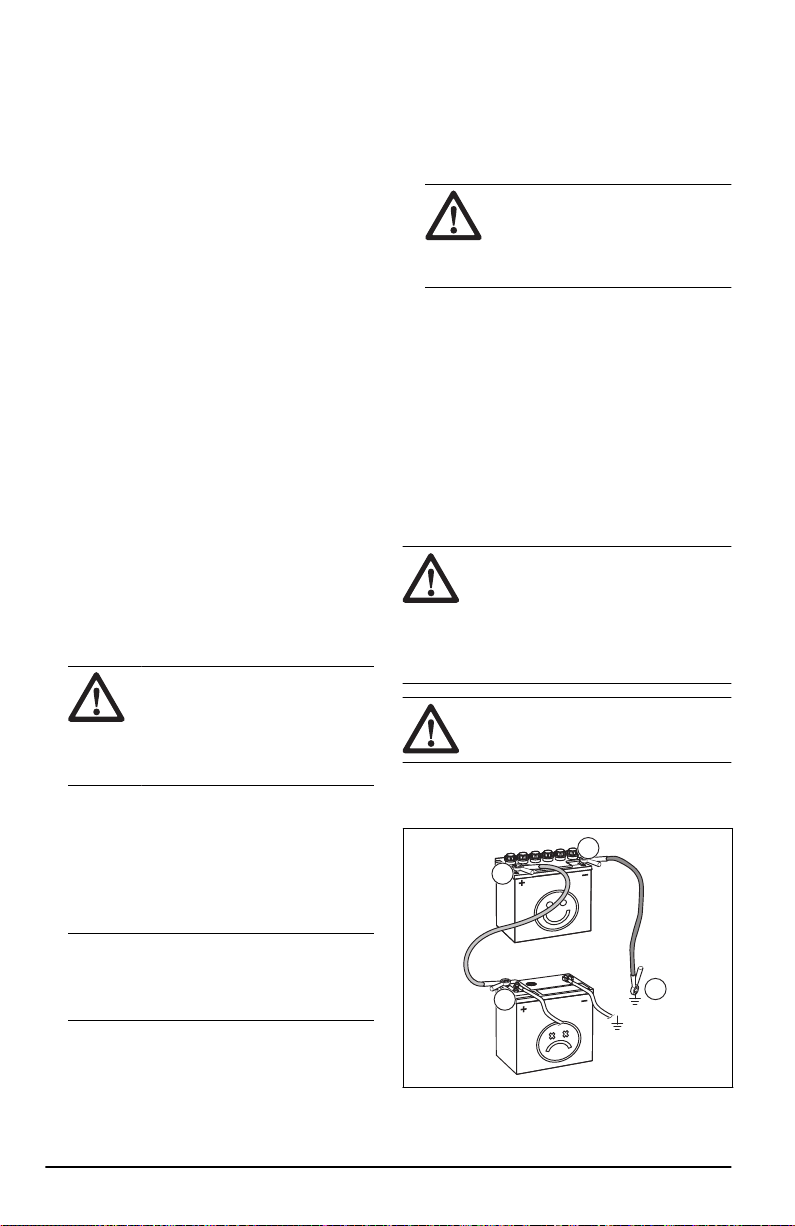
• Use agua que corra de una manguera para
limpiar el producto. No use presión alta.
• No apunte el agua a los componentes eléctricos
o los cojinetes. A menudo el detergente aumenta
el daño.
• Utilice aire comprimido para limpiar la superficie
superior del equipo de corte.
• Utilice una manguera de agua para limpiar
debajo del equipo de corte.
• Cuando el producto esté limpio, arranque el
equipo de corte durante un breve período para
eliminar el agua restante.
Para limpiar el motor y el silenciador
Mantenga el motor y el silenciador sin recortes
de césped y la suciedad. El césped cortado
impregnado de combustible o aceite en el motor
puede aumentar el riesgo de incendio y el riesgo
de sobrecalentamiento del motor. Deje que el motor
se enfríe antes de limpiarlo. Limpie con agua y un
cepillo.
El césped cortado alrededor del silenciador se seca
rápidamente y representa un riesgo de incendio.
Utilice un cepillo o retire el césped cortado con agua
cuando el silenciador esté frío.
Para limpiar la batería
La corrosión y la suciedad en la batería y en los
terminales pueden hacer que disminuya la potencia
de la batería.
1. Extraiga la batería. Consulte
Para retirar e
instalar la batería en la página 47
.
2. Enjuague la batería con agua y deje secar.
AVISO:
No utilice lavadores a
alta presión ni limpieza a vapor.
Podría entrar agua a los cojinetes
y las conexiones eléctricas y causar
corrosión, lo que puede dañar el
producto.
3. Limpie los terminales y los extremos de los
cables de la batería con un cepillo de alambre.
Para comprobar el freno de
estacionamiento
1. Estacione el producto en una pendiente de
superficie dura.
Tenga en cuenta:
No estacione
el producto en una pendiente con césped
cuando realice la comprobación del freno de
estacionamiento.
2. Acople el freno de estacionamiento.
3. Si el producto empieza a moverse con el freno
de estacionamiento activado, solicite a un taller
de servicio autorizado que ajuste el freno de
estacionamiento.
4. Desacople el freno de estacionamiento.
Para cargar la batería
• Cargue la batería si está demasiado baja para
arrancar el motor. Consulte la
Tiempos de carga
de la batería en la página 57
para ver los
tiempos de carga de la batería.
• Utilice un cargador de batería estándar.
AVISO: No utilice un cargador
de batería de alta intensidad o un
reforzador de arranque. Un cargador
o reforzador de arranque dañará el
sistema eléctrico del producto.
• Desconecte siempre el cargador de la batería
antes de arrancar el motor.
Para hacer una parada de
emergencia del motor
Si la batería está demasiado baja como para
arrancar el motor, puede utilizar cables de puente
para realizar un arranque de emergencia. Este
producto tiene un sistema de 12V con conexión
a tierra negativa. El producto que se utilice para
el arranque de emergencia debe tener también un
sistema de 12V con conexión a tierra negativa.
Para conectar los cables de puente
ADVERTENCIA: Existe riesgo de
explosión debido a los gases explosivos
procedentes de la batería. No conecte
el terminal negativo de la batería
totalmente cargada al terminal negativo
de la batería con poca carga o cerca de
este.
AVISO: No utilice la batería del
producto para arrancar otros vehículos.
1. Conecte un extremo del cable rojo al terminal
POSITIVO (+) de la batería a la batería con poca
carga (A).
B
A
C
D
46
2194 - 002 - 29.09.2023
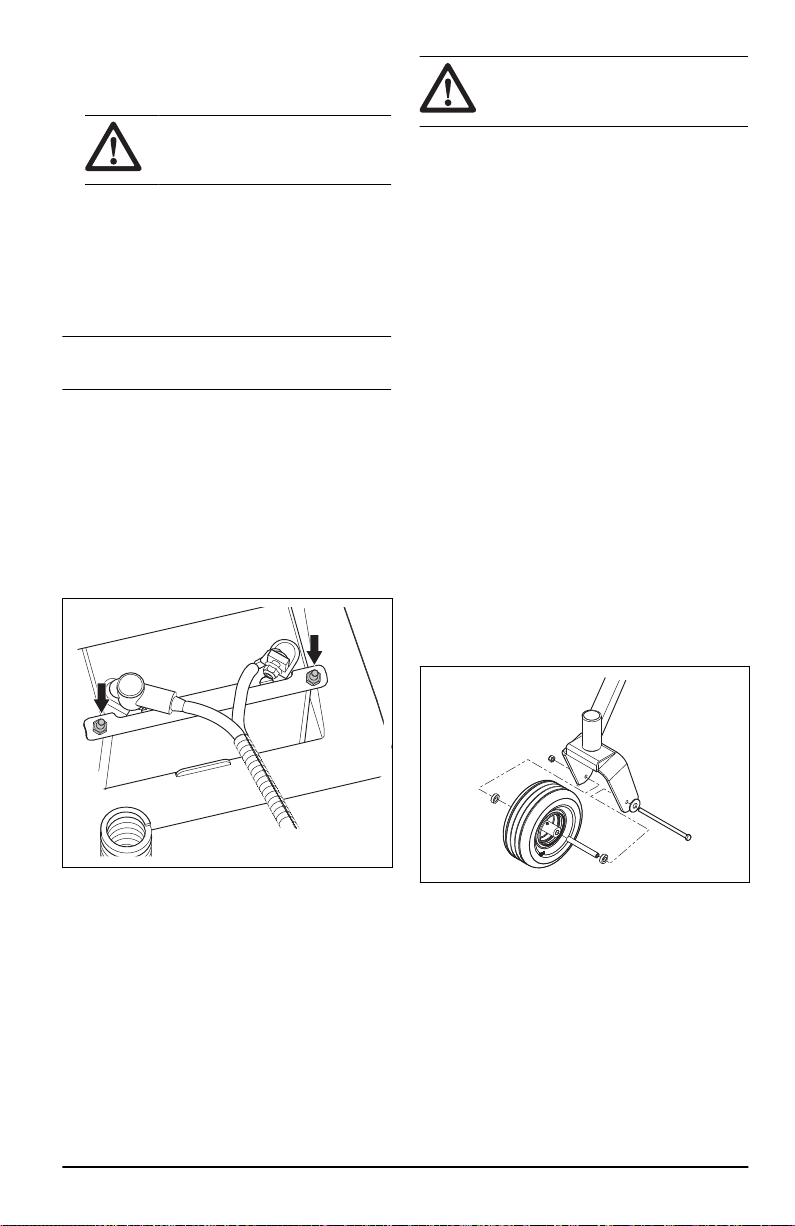
2. Conecte el otro extremo del cable rojo al
terminal POSITIVO (+) de la batería a la batería
totalmente cargada (B).
ADVERTENCIA: No haga
cortocircuitos en los extremos del
cable rojo contra el chasis.
3. Conecte un extremo del cable negro al terminal
NEGATIVO (-) de la batería a la batería
totalmente cargada (C).
4. Conecte el otro extremo del cable negro a una
buena CONEXIÓN A TIERRA DEL CHASIS (D),
alejado del depósito de combustible y la batería.
Para retirar los cables de puente
Tenga en cuenta: Quite los cables de puente
en la secuencia opuesta a cómo los conectó.
1. Quite el cable NEGRO del chasis.
2. Quite el cable NEGRO de la batería totalmente
cargada.
3. Quite el cable ROJO de las 2 baterías.
Para retirar e instalar la batería
1. Pliegue el asiento hacia delante. Consulte
Para
plegar el asiento en la página 40
.
2. Saque el perno y la tuerca del soporte de la
batería y retire el soporte de la batería.
3. Utilice 2 llaves para desconectar el cable negro
de la batería del terminal negativo (–) en la
batería.
4. Utilice 2 llaves para desconectar el cable rojo de
la batería del terminal positivo (+) en la batería.
5. Retire con cuidado la batería del producto.
6. Vuelva a instalar todo en el orden inverso.
Para ajustar la velocidad de
desplazamiento
Si el producto no se mueve en línea recta
hacia adelante, se debe ajustar la velocidad de
desplazamiento.
ADVERTENCIA:
Ajuste siempre
la velocidad de desplazamiento en un
área abierta sin transeúntes.
1. Revise la presión de los neumáticos. Consulte
Presión de los neumáticos en la página 47
.
2. Gire los controles de seguimiento hacia afuera
hasta que estén alineados con las tuercas.
Consulte
Descripción general del producto en
la página 31
para conocer la ubicación del los
controles de seguimiento.
3. Encienda el producto.
4. Mueva las palancas de control completamente
hacia adelante y opere el producto en
aceleración máxima.
5. Gire el control de desplazamiento del lado
derecho gradualmente hasta que el producto
empiece a moverse a la derecha.
6. Gire el control de desplazamiento del lado
izquierdo gradualmente hasta que el producto
empiece a moverse en línea recta hacia
adelante.
Presión de los neumáticos
Asegúrese de tener la presión correcta de los
neumáticos en los 4 neumáticos. Consulte
Datos
técnicos en la página 56
.
Para retirar e instalar las ruedas
delanteras
1. Retire la tuerca y el perno para quitar las ruedas
delanteras de las horquillas.
2. Vuelva a instalar todo en el orden inverso.
Apriete la tuerca y el perno a 67,8Nm/50lb-pie.
Para ajustar las ruedas de apoyo
Las ruedas de apoyo mantienen el equipo de corte
en la posición correcta sobre el suelo y evitan
el corte al ras del césped en la mayoría de las
condiciones del terreno. Las ruedas de apoyo se
pueden establecer en 3 posiciones para longitudes
diferentes de césped:
• Posición superior: Césped de 1,5 a 2,5in / de 38
a 64mm
2194 - 002 - 29.09.2023
47
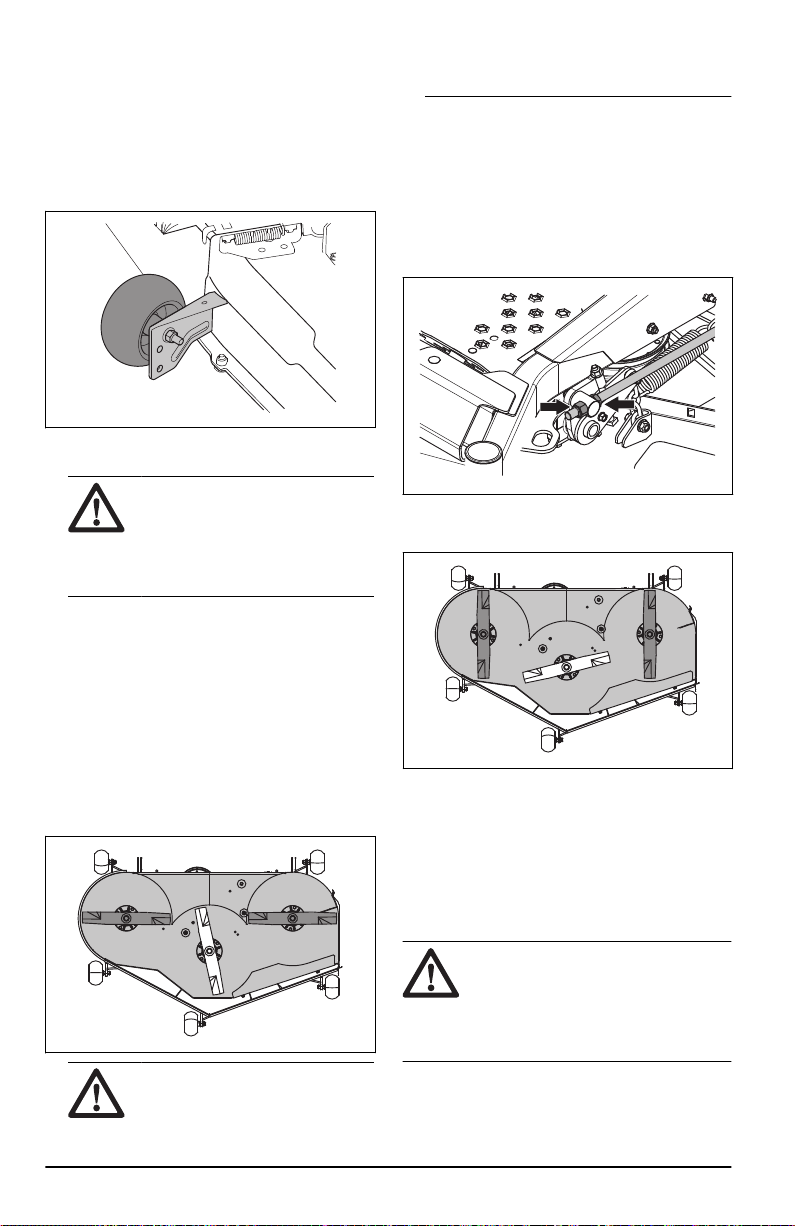
• Posición media: Césped de 2,5 a 4in / de 64 a
102mm
• Posición inferior: Césped de 4 a 5in / de 102 a
127mm
1. Estacione el producto en suelo nivelado y
detenga el motor.
2. Retire la tuerca, el perno, el eje y la rueda de
apoyo.
3. Instale las ruedas de apoyo en una de las tres
posiciones.
AVISO: El equipo de corte
puede dañarse si las ruedas de
apoyo se ajustan incorrectamente.
Las ruedas de apoyo deben estar
aproximadamente a 1/4in / 6,4mm
del suelo.
Para ajustar el paralelismo del
equipo de corte
Este procedimiento permitirá colocar al equipo de
corte en una posición estándar.
1. Asegúrese de que la presión de los neumáticos
sea la correcta. Consulte
Presión de los
neumáticos en la página 47
.
2. Estacione el producto sobre una superficie
nivelada.
3. Gire las puntas externas de la cuchilla para
alinearlas con el equipo de corte de lado a lado.
ADVERTENCIA:
Las
cuchillas del equipo de corte están
afiladas y pueden causar lesiones.
Use guantes protectores.
4. Mida la distancia entre el suelo y la parte inferior
de la punta de la cuchilla en el lado de descarga
del equipo de corte. Tome nota de la distancia.
5. Mida la distancia entre el suelo y la parte inferior
de la punta de la cuchilla en el lado opuesto
al lado de descarga. La distancia debe ser la
misma que la distancia del lado de descarga. Si
es necesario realizar ajustes, ajuste los 2pernos
delanteros hasta que las 2distancias de lado a
lado sean iguales.
6. Gire las 2 cuchillas exteriores para alinearlas con
el equipo de corte desde la parte delantera a la
trasera.
7. Ajuste las 2tuercas traseras hasta que las
puntas de la cuchilla trasera estén entre 1/8 y
3/8in / 3,2 y 9,5mm más altas en la parte
trasera que las puntas de la cuchilla delantera.
8. Mida otra vez las distancias para asegurarse
de que el equipo de corte se haya ajustado
correctamente.
Para examinar las cuchillas
AVISO:
Las cuchillas dañadas o mal
equilibradas pueden dañar el producto.
Reemplace las cuchillas dañadas. Deje
que en un taller de servicio autorizado le
ayuden a afilar y equilibrar las cuchillas
romas.
• Mire las cuchillas para ver si están dañadas y si
es necesario afilarlas.
48
2194 - 002 - 29.09.2023
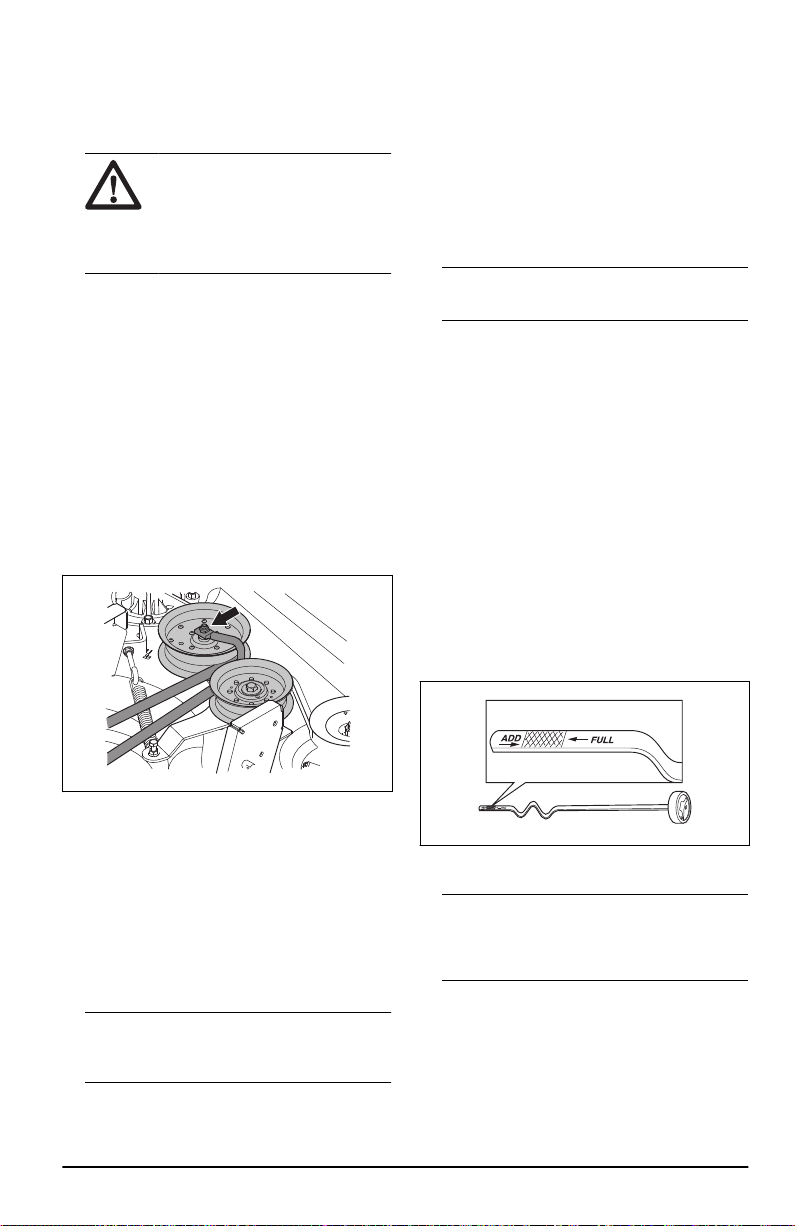
Para sustituir las hojas
1. Retire el tornillo de la cuchilla.
2. Monte la cuchilla nueva con el lado sin sellos en
la dirección del equipo de corte.
ADVERTENCIA: El tipo
incorrecto de cuchilla puede causar
que se propulsen objetos desde el
equipo de corte y provocar daños
graves. Utilice únicamente cuchillas
aprobadas.
3. Fije el tornillo de la cuchilla. Apriete el perno a
60-81 Nm.
Para extraer la correa del equipo
Estacione el producto en una superficie nivelada y
active el freno de estacionamiento antes de realizar
esta tarea.
1. Coloque el equipo de corte en la posición más
baja.
2. Retire las 2 cubiertas de la correa.
3. Retire la suciedad y los materiales no deseados
alrededor de la cortadora y de la superficie del
equipo de corte.
4. Tome nota de la posición de la guía de la correa.
5. Afloje la tuerca de la guía de la correa.
6. Presione el brazo guía para disminuir la tensión
en la correa del equipo y retire con cuidado la
correa del equipo de las poleas.
7. Retire la correa del equipo del embrague
eléctrico en el eje del motor.
Para instalar la correa del equipo
1. Coloque la correa del equipo alrededor de la
polea del embrague eléctrico en el eje del motor.
2. Coloque la correa del equipo alrededor de las
poleas en el equipo de corte.
Tenga en cuenta:
Consulte la etiqueta de
recorrido que se encuentra en el equipo de corte
cuando instale la correa del equipo.
3. Presione el brazo guía hasta que pueda colocar
la correa del equipo alrededor de la polea
tensora fija y sosténgala ahí.
4. Coloque con cuidado la correa del equipo
alrededor de la polea tensora fija y suelte
lentamente el brazo de la polea tensora en su
posición.
5. Asegúrese de que el recorrido de la correa
coincida con el que se muestra en la etiqueta
de recorrido de la correa.
6. Asegúrese de que la correa del equipo no esté
torcida.
7. Coloque la guía de la correa en la posición
correcta y apriete la tuerca.
Tenga en cuenta: Consulte la nota que
hizo cuando quitó la guía de la correa.
8. Instale las 2 cubiertas de la correa.
Para revisar el nivel de aceite del
motor
1. Estacione el producto en suelo nivelado y
detenga el motor.
2. Tire para abrir el amortiguador del operador y
acceder al motor.
3. Afloje la varilla de nivel y extráigala.
4. Limpie el aceite de la varilla de nivel.
5. Coloque la varilla de nivel en el orificio de la
varilla de nivel y apriétela.
6. Afloje y extraiga la varilla de nivel y lea el nivel
de aceite.
7. El nivel de aceite debe estar entre las marcas
de la varilla de nivel. Si el nivel está cerca de la
marca ADD (Agregar), llene con aceite hasta la
marca FULL (Lleno).
8. Cargue el aceite a través del orificio de la varilla
de nivel. Cargue lentamente el aceite.
Tenga en cuenta:
Consulte
Datos
técnicos en la página 56
para ver los tipos de
aceite del motor que Husqvarna recomienda. No
mezcle diferentes tipos de aceite.
9. Apriete la varilla de nivel completamente antes
de arrancar el motor.
Para cambiar el aceite del motor:
Si el motor está frío, arránquelo entre 1 y 2minutos
antes de drenar el aceite del motor. Esto calienta el
aceite del motor, por lo que se drena más rápido.
2194 - 002 - 29.09.2023
49
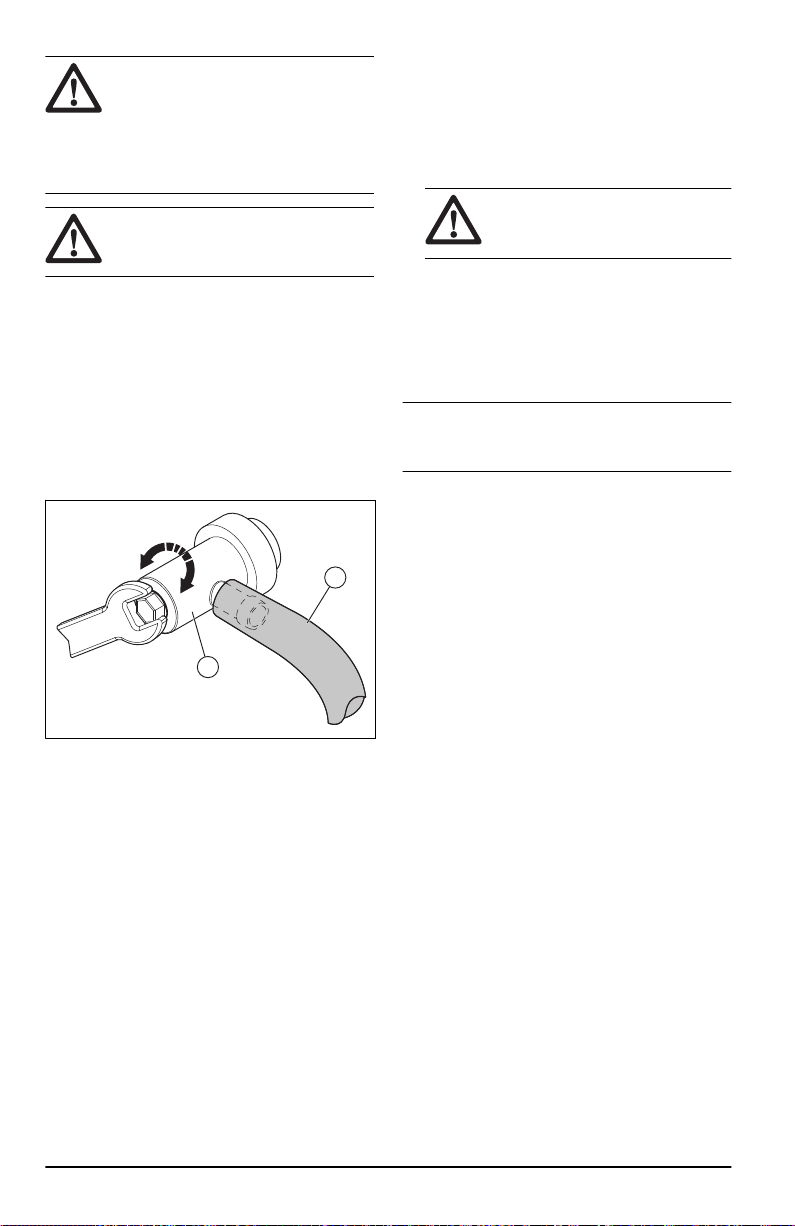
ADVERTENCIA: No haga
funcionar el motor durante más de
1-2minutos antes de drenar el aceite
del motor. El aceite del motor se calienta
mucho y puede causar quemaduras
graves. Deje que el motor se enfríe
antes de drenar el aceite del motor.
ADVERTENCIA: Si se derrama
aceite del motor en su cuerpo, limpie
con agua y jabón.
1. Estacione el producto en suelo nivelado y
detenga el motor.
2. Acople el freno de estacionamiento. Consulte
Para acoplar y desacoplar el freno de
estacionamiento en la página 41
.
3. Retire toda la suciedad alrededor del tapón del
depósito de aceite.
4. Retire el tapón del depósito de aceite y la varilla
de nivel.
5. Instale el tubo de drenaje de aceite (A) en la
válvula de drenaje de aceite del motor (B).
A
B
6. Coloque un recipiente debajo del motor para
reunir el aceite del motor.
7. Gire la válvula de drenaje de aceite hacia la
izquierda para abrir la válvula de drenaje de
aceite. Utilice una llave de 10mm.
8. Cuando se haya drenado todo el aceite del
motor, gire la válvula de drenaje de aceite hacia
la derecha para cerrarla. Utilice una llave de
10mm.
9. Utilice la llave de 10mm para apretar
cuidadosamente la válvula de drenaje de aceite
en la posición cerrada. No apriete en exceso.
AVISO: No aplique demasiada
fuerza cuando apriete la válvula de
drenaje de aceite.
10. Retire el tubo de drenaje de aceite de la válvula
de drenaje de aceite.
11. Cargue con aceite nuevo y revise el nivel de
aceite del motor. Consulte
Para revisar el nivel
de aceite del motor en la página 49
.
12. Instale el tapón del depósito de aceite y la varilla
de nivel.
Tenga en cuenta: Para una eliminación
segura del aceite del motor usado, consulte
Eliminación en la página 55
.
Lubricación; información general
• Retire la llave de contacto para evitar
movimientos involuntarios durante las tareas de
lubricación.
• Limpie el área antes de lubricar una pieza del
producto.
• Utilice aceite cuando lubrique con una lata de
aceite.
• Cuando lubrique con grasa, utilice grasa para
chasis o grasa para cojinetes de bolas que evite
la corrosión. Retire la grasa no deseada después
de la lubricación.
• Lubrique el producto 2veces a la semana si lo
utiliza a diario.
• No derrame lubricante en las correas de
transmisión o en las ranuras de las poleas de
correa. Si se derrama, limpie con alcohol. Si la
fricción entre la correa de transmisión y la polea
no es suficiente después de limpiar con alcohol,
reemplace la correa de transmisión.
50
2194 - 002 - 29.09.2023
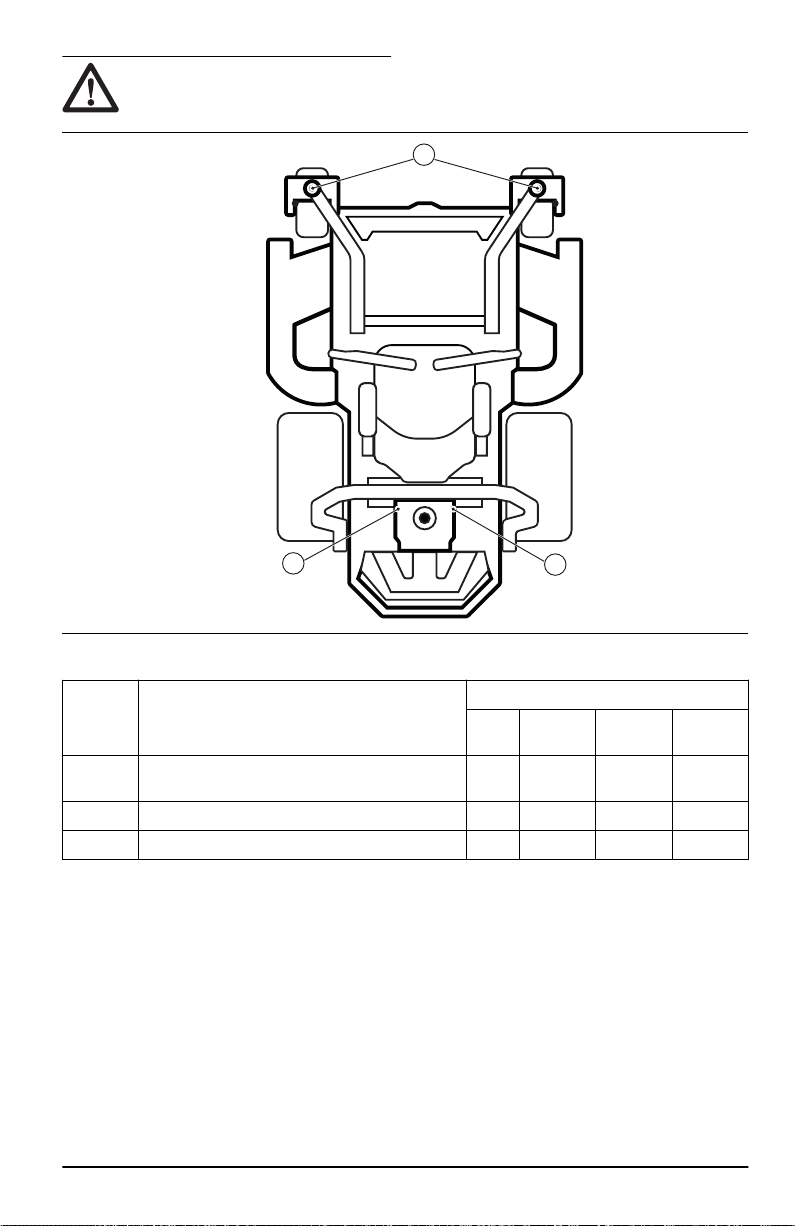
AVISO: No utilice gasolina ni otros
productos petrolíferos para limpiar las
correas de transmisión.
Programa de lubricación
A
B
C
Consulte Lubricación Intervalo
A dia-
rio
Cada
25horas
Cada
50horas
Cada
200horas
A
Lubrique la boquilla de engrase en el eje de pivote
con una pistola de engrase.
X
B Compruebe el nivel de aceite. X
C Reemplace el filtro de aceite. X
Utilice siempre grasa de buena calidad. Utilice
siempre el aceite recomendado, consulte los
Datos
técnicos en la página 56
.
2194 - 002 - 29.09.2023 51
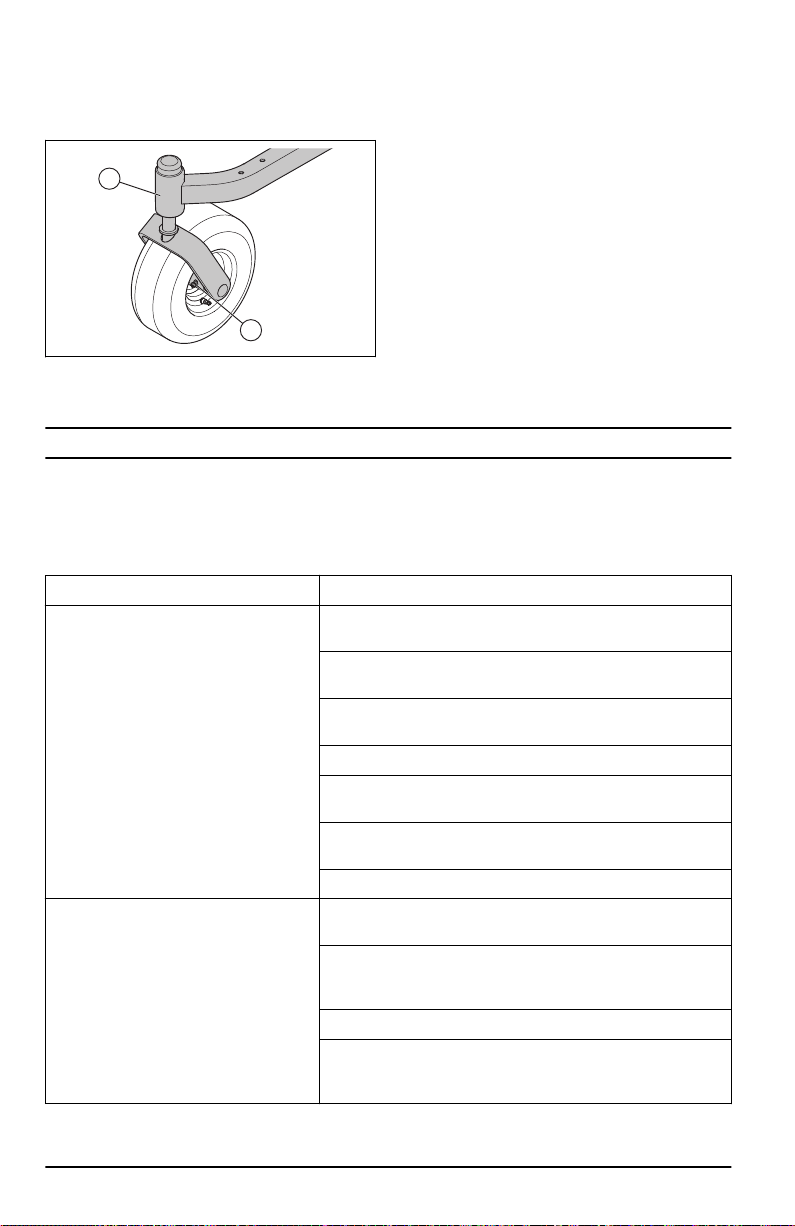
Para lubricar las ruedas delanteras
• Engrase la boquilla (A) con una pistola de
engrase hasta que la grasa salga de la arandela
superior.
A
B
• Lubrique el cojinete de junta de las ruedas
delanteras (B) con una pistola de engrase hasta
que salga la grasa.
Solución de problemas
Programa de solución de problemas
Si no encuentra una solución a sus problemas en
este manual de usuario, consulte a su taller de
servicio de Husqvarna.
Problema Causa
El motor no arranca. La transmisión de las cuchillas está activada. Consulte
Botón de
toma de fuerza (PTO) en la página 32
.
Las palancas de control no están bloqueadas en la posición
exterior.
La batería tiene muy poca carga. Consulte
Para cargar la bate-
ría en la página 46
.
Hay suciedad en el carburador o la tubería de combustible.
La válvula de corte de combustible está cerrada o en una posi-
ción incorrecta.
El filtro de combustible o el tubo de combustible están obstrui-
dos.
El sistema de encendido está dañado.
El motor de arranque no hace girar el mo-
tor.
La batería tiene muy poca carga. Consulte
Para cargar la bate-
ría en la página 46
.
La conexión de los conectores del cable con los terminales de
la batería está mal. Consulte
Para limpiar la batería en la página
46
.
Un fusible está fundido. Consulte
Fusibles en la página 33
.
El control de presencia del usuario no funciona correctamente.
Consulte
Control de presencia del operador (OPC) en la página
31
.
52 2194 - 002 - 29.09.2023

Problema Causa
El motor no funciona correctamente. El carburador está mal ajustado.
El filtro de combustible o el suministro de combustible están
obstruidos.
La palanca de acelerador está en la posición de arranque en
clima frío.
La válvula de comprobación en el tapón del depósito de com-
bustible está obstruida.
El depósito de combustible está casi vacío.
La bujía está dañada.
Mezcla de combustible o tipo de combustible incorrecto.
Hay agua en el combustible.
El filtro de aire está obstruido.
Aparentemente el motor no tiene energía. El filtro de aire está obstruido.
La bujía está dañada.
El carburador está mal ajustado.
Hay aire en el sistema hidráulico.
Hay vibración en el producto. Las cuchillas están sueltas. Consulte
Para examinar las cuchi-
llas en la página 48
.
Una o varias cuchillas se encuentran desequilibradas. Consulte
Para examinar las cuchillas en la página 48
.
El motor está suelto.
El motor se sobrecalienta. El filtro de aire o las aletas de refrigeración están obstruidas.
Hay sobrecarga en el motor.
El flujo de aire alrededor del motor no es suficiente.
El regulador de régimen del motor está dañado.
El nivel de aceite es demasiado bajo.
Hay suciedad en el tubo de combustible.
La bujía está dañada.
La batería no se carga. La conexión de los conectores del cable con los terminales de
la batería está mal. Consulte
Para limpiar la batería en la página
46
.
El cable de carga está desconectado.
El producto se mueve lentamente, con ve-
locidad irregular o no se mueve.
Los varillajes de derivación están conectados.
La correa de transmisión está floja o dañada.
Hay aire en el sistema hidráulico.
2194 - 002 - 29.09.2023 53
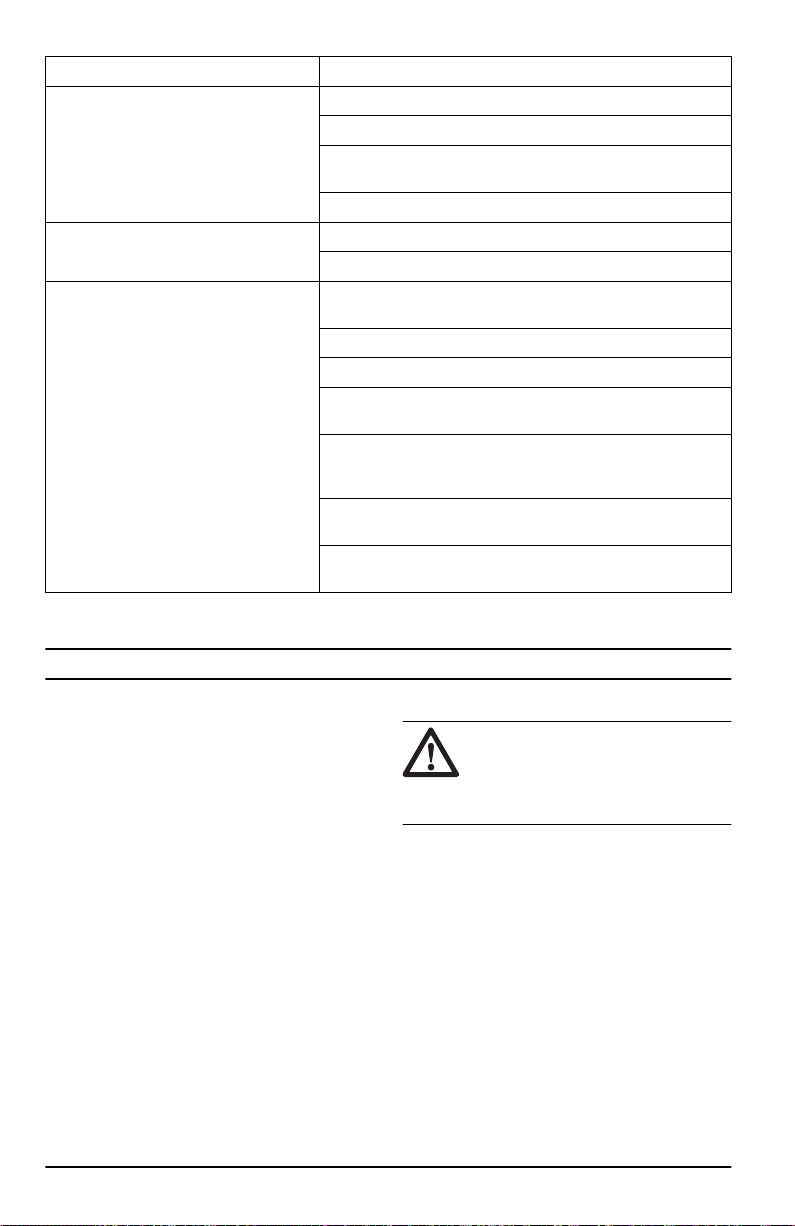
Problema Causa
La transmisión de las cuchillas no se ac-
ciona.
La correa de transmisión del equipo de corte está floja.
El contacto del acoplamiento electromagnético está flojo.
La transmisión de la cuchilla está dañada o suelta de los conec-
tores de cable.
Un fusible está fundido.
El transeje tiene fugas de aceite. Los sellos, la caja o las juntas están dañados.
Hay aire en el sistema hidráulico.
El resultado de corte no es satisfactorio. La presión de los neumáticos es distinta en los lados derecho e
izquierdo. Consulte
Presión de los neumáticos en la página 47
.
Las cuchillas están dañadas.
La suspensión del equipo de corte no está nivelada.
Las cuchillas no tienen filo. Consulte
Para examinar las cuchi-
llas en la página 48
.
El producto funciona a una velocidad de avance o retroceso
demasiado alta. Consulte
Para conseguir un buen resultado de
corte en la página 43
.
El césped es largo. Consulte
Para conseguir un buen resultado
de corte en la página 43
.
El equipo de corte está obstruido con césped. Consulte
Para
limpiar el producto en la página 45
.
Transporte, almacenamiento y eliminación de residuos
Transporte
• El producto es pesado y puede causar lesiones
por aplastamiento. Tenga cuidado cuando lo
cargue o descargue de un vehículo o remolque.
• Cargue el producto en reversa por las rampas
autorizadas con un ángulo máximo de operación
de 10°. No levante el producto.
• Utilice un remolque aprobado para el transporte
del producto.
• Asegúrese de conocer las normas del tránsito
locales antes de transportar el producto en un
remolque o por caminos.
• Detenga el suministro de combustible del
producto.
• Bloquee el producto con dispositivos
autorizados, como correas. Utilice puntos
de amarre en el producto. El freno de
estacionamiento no es suficiente para bloquear
el producto durante el transporte.
Para remolcar el producto
ADVERTENCIA: Antes de
remolcar el producto, debe leer y
entender el contenido del capítulo
sobre seguridad. Consulte
Seguridad de
remolque en la página 38
.
• Tenga cuidado al remolcar el producto.
• Opere lentamente el producto cuando lo
remolque.
• La distancia de frenado aumenta cuando se
remolca el producto. Asegúrese de disminuir la
velocidad a tiempo.
• Para un uso seguro, realice giros amplios.
• No remolque cerca de zanjas, aguas abiertas ni
otras áreas peligrosas.
Almacenamiento
Prepare el producto para guardarlo al final de
la temporada, y antes de más de 30 días de
almacenamiento. Si mantiene combustible en el
depósito de combustible durante 30 días o más,
partículas pegajosas pueden obstruir el carburador.
54 2194 - 002 - 29.09.2023

Esto afecta negativamente el funcionamiento del
motor.
Para evitar partículas pegajosas durante el
almacenamiento, agregue un estabilizador. Si se
utiliza gasolina de alquilato, no es necesario un
estabilizador. Si se utiliza gasolina estándar, no
cambie a gasolina de alquilato. Esto puede provocar
que las piezas de goma sensibles se endurezcan.
Agregue estabilizador al combustible del depósito o
al contenedor usado para el almacenamiento. Utilice
siempre las proporciones de mezcla indicadas por el
fabricante. Añada el estabilizador y haga funcionar
el motor durante un mínimo de 10 minutos, hasta
que el combustible fluya hacia el carburador.
ADVERTENCIA: No mantenga el
producto con combustible en el depósito
en interiores o en lugares con mala
ventilación. Existe riesgo de incendio si
los vapores de combustible alcanzan
llamas abiertas, chispas o luces piloto,
como calderas, depósitos de agua
caliente y secadoras de ropa.
ADVERTENCIA: Retire el
césped, las hojas y otros materiales
inflamables del producto para reducir el
riesgo de incendio. Deje que el producto
se enfríe antes de guardarlo.
• Limpie el producto, consulte la sección
Para
limpiar el producto en la página 45
.
• Retire los materiales no deseados del ventilador
de refrigeración.
• Repare los daños de la pintura para evitar la
corrosión.
• Examine el producto en busca de piezas
dañadas o desgastadas y apriete las tuercas y
los tornillos sueltos.
• Extraiga la batería. Límpiela, cárguela y
manténgala fría durante el almacenamiento.
• Reemplace el aceite del motor y deseche el
aceite residual.
• Vacíe el depósito de combustible. Arranque el
motor y déjelo en marcha hasta que no quede
combustible en el carburador.
Tenga en cuenta:
No vacíe el depósito
de combustible ni el carburador si se ha
agregado un estabilizador.
• Extraiga los tapones y ponga aproximadamente
una cucharadita de aceite del motor en cada
cilindro. Gire manualmente el eje del motor para
aplicar el aceite y ponga los tapones de nuevo.
• Lubrique todas las boquillas de engrase, juntas y
ejes.
• Mantenga el producto en una zona limpia y seca,
y cúbralo para mayor protección.
Eliminación
• Las sustancias químicas pueden ser peligrosas
y no deben tirarse en el suelo. Siempre elimine
los productos químicos utilizados en un centro
de servicio o un lugar adecuado para su
eliminación.
• Cuando el producto se desgaste completamente,
envíelo al distribuidor o a un centro de reciclaje
aplicable.
• El aceite, los filtros de aceite, el combustible y
la batería pueden tener efectos negativos en el
ambiente. Obedezca las regulaciones vigentes y
requisitos de reciclaje locales.
• No deseche la batería como un residuo
doméstico.
• Envíe la batería a un taller de servicio Husqvarna
o deséchela en un lugar para eliminación de
baterías usadas.
2194 - 002 - 29.09.2023 55

Datos técnicos
Datos técnicos
Z254
Motor
Marca / Modelo Kawasaki / FR691V
Potencia normal del motor, hp / kW
23
23 / 17
Cilindrada, cm
3
726
Máx. régimen del motor, rpm 3500±100
Combustible, grado de octanos mínimo sin plomo,
etanol al 10% máx., 15% MTBE máx.
87
Volumen del depósito, galones / l 3,5 / 13,3
Aceite Clase SF, SG, SH, SJ o SL SAE40, SAE30,
SAE20W-50, SAE10W-40, SAE10W-30, SAE5W-20
Volumen de aceite con filtro, oz / I 70,4 / 2,1
Volumen de aceite sin filtro, oz / I 60,8 / 1,8
Sistema de lubricación Presión con filtro de aceite
Sistema refrigerante Refrigerado por aire
Filtro de aire Estándar
Alternador, V. amp. a 3600 rpm 12V 15A a 3600rpm
Motor de arranque Arranque eléctrico de 12V
Dimensiones
Longitud, in / cm 75 / 191
Ancho, in / cm 43,75 / 111
Ancho con la tolva arriba, in / cm 56 / 143
Ancho con la tolva abajo, in / cm 67 / 170
Altura, mm 40 / 102
Peso con tanques vacíos, lb / kg 593 / 269
Gradiente máxima, grados ° 10
Ancho de corte, in / cm 54 / 137
Altura de corte, in / cm De 1,5 a 4 / de 3,8 a 10,2
Equipo de corte
Construcción del equipo Grabado
Cantidad de cuchillas 3
Longitud de la hoja, in / cm 18,25 / 46,4
23
La potencia nominal declarada por el fabricante del motor es la salida de potencia bruta promedio en
las RPM especificadas de un motor típico de producción para el modelo del motor medido utilizando
las normas SAE de potencia bruta del motor. Consulte las especificaciones del motor del fabricante.
56 2194 - 002 - 29.09.2023
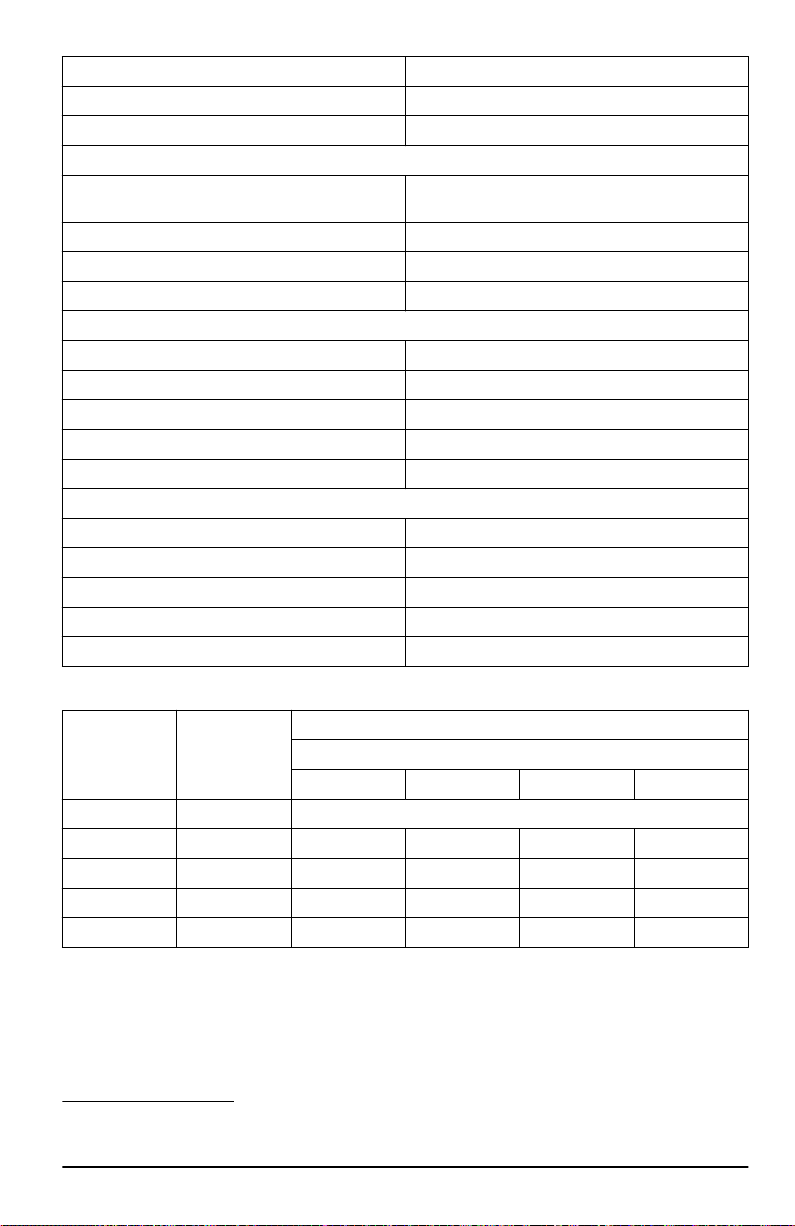
Z254
Acoplamiento de la cuchilla Embrague electromagnético
Productividad, acres/h / m
2
/h 2,8/11.331
Neumáticos
Presión de los neumáticos, traseros y delanteros,
kPa / PSI / bar
103 / 15 / 1
Neumáticos de la ruedecilla delantera, in 11x 6-5
Neumáticos traseros, neumático para césped, in 18 x 9,5-8
Ruedas de apoyo 4 ajustables
Transmisión
Transmisión Transejes hidrostáticos
Control de la dirección Dos palancas, sujeción de espuma
Velocidad máxima de avance, mph / kmh 6,5 / 10,5
Velocidad máxima de retroceso, mph / kmh 3,25 / 5,23
Frenos Freno de estacionamiento mecánico
Sistema eléctrico
Tipo 12 V
Batería 28 A
Bujía NGK BPR4ES
Distancia entre los electrodos, in / mm 0,030 / 0,76
Par de la bujía, lb-pie / Nm 16 / 22
Tiempos de carga de la batería
Batería STD
Estado de car-
ga
Tiempo de caga aproximado para carga completa a 26°C/80°F
24
Régimen máximo en:
50 amperios 30 amperios 20 amperios 10 amperios
12,6 V 100% Completamente cargada
12,4 V 75% 20 min. 35 min. 48 min. 90 min.
12,2 V 50% 45 min. 75 min. 95 min. 180 min.
12,0 V 25% 65 min. 115 min. 145 min. 280 min.
11,8 V 0% 85 min. 150 min. 195 min. 370 min.
24
El tiempo de carga de la batería puede ser diferente debido a la capacidad, la condición, la antigüe-
dad, la temperatura y la eficiencia del cargador.
2194 - 002 - 29.09.2023 57

Servicio
Servicio
Realice una comprobación anual en un centro de
servicios autorizado para asegurarse de que el
producto funciona de forma segura y a su máximo
potencial durante la temporada alta. El mejor
momento para hacer mantenimiento o reparaciones
a este producto es en la temporada baja.
Cuando envíe un pedido de piezas de repuesto, dé
información sobre el año de compra, modelo, tipo y
número de serie.
Utilice siempre piezas de repuesto originales.
58 2194 - 002 - 29.09.2023
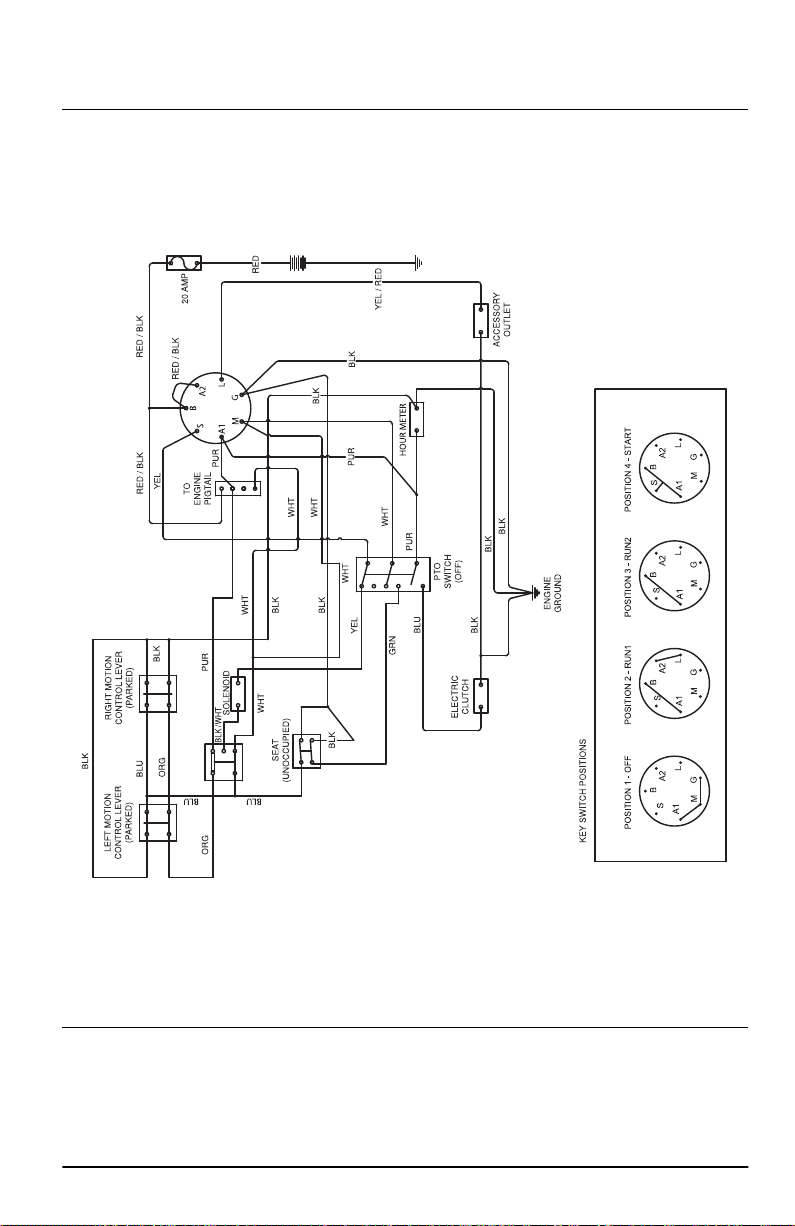
Diagrama eléctrico
2194 - 002 - 29.09.2023 59
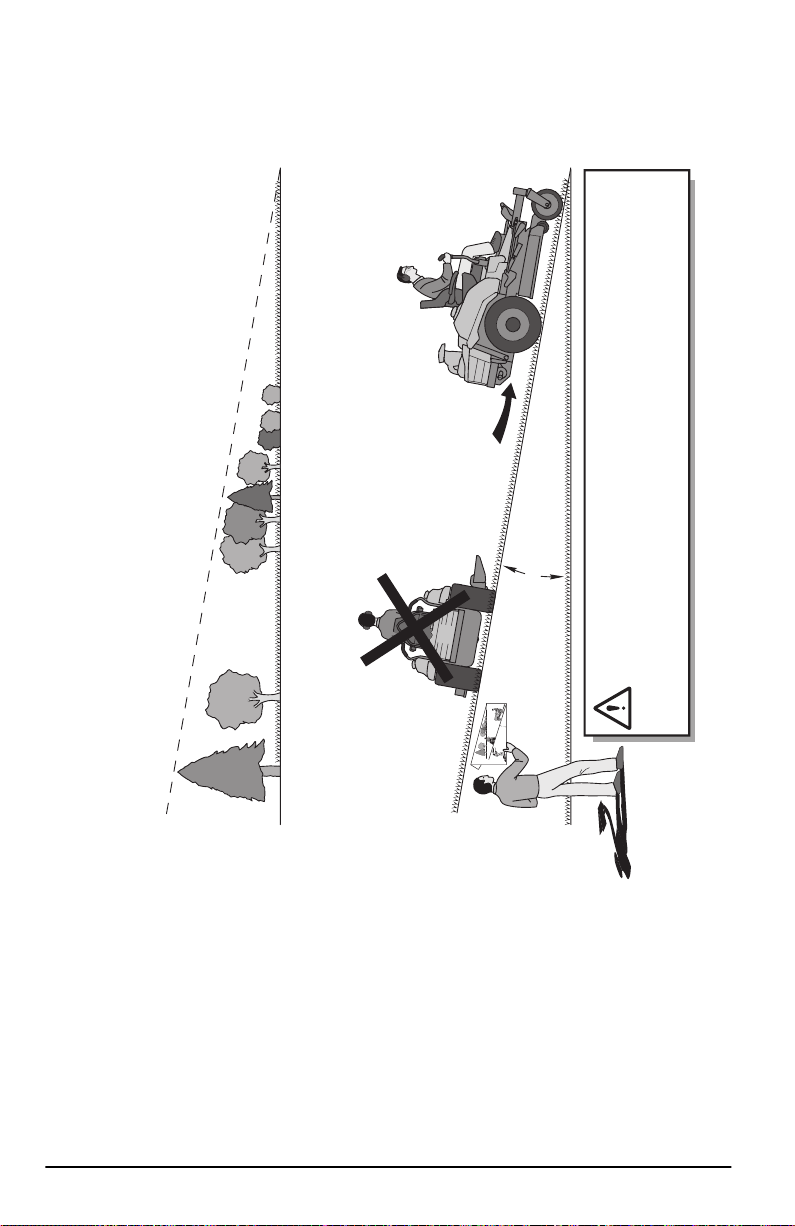
10 DEGREES MAX.
FOLD ALONG DOTTED
LINE
THIS IS A 10 DEGREE SLOPE
ONLY RIDE UP AND DOWN HILL,
NOT ACROSS HILL
SUGGESTED GUIDE FOR SIGHTING SLOPES FOR SAFE OPERATION
1. Fold this page along dotted line indicated above.
2. Hold page before you so that its left edge is vertically pa
rallel to a tree trunk or other upright structure.
3. Sight across the fold in the direction of hill slope y
ou want to measure.
4. Compare the angle of the fold with the slope of the hill.
WARNING: To avoid serious injury, operate your unit up and down the face of slopes,
never across the face. Do not mow slopes greater than 10 degrees. Make turns gradually
to prevent tipping or loss of control. Exercise extreme caution when changing direction on
slopes. Do not mow near drop-offs, ditches, or embankments. Keep at least the width of
the machine away from these hazards.
Failure to follow these warnings could lead to death or serious injury.
60 2194 - 002 - 29.09.2023

2194 - 002 - 29.09.2023 61

62 2194 - 002 - 29.09.2023

2194 - 002 - 29.09.2023 63

Original instructions
Instrucciones originales
www.husqvarna.com
1143684-49/1
2023-10-03