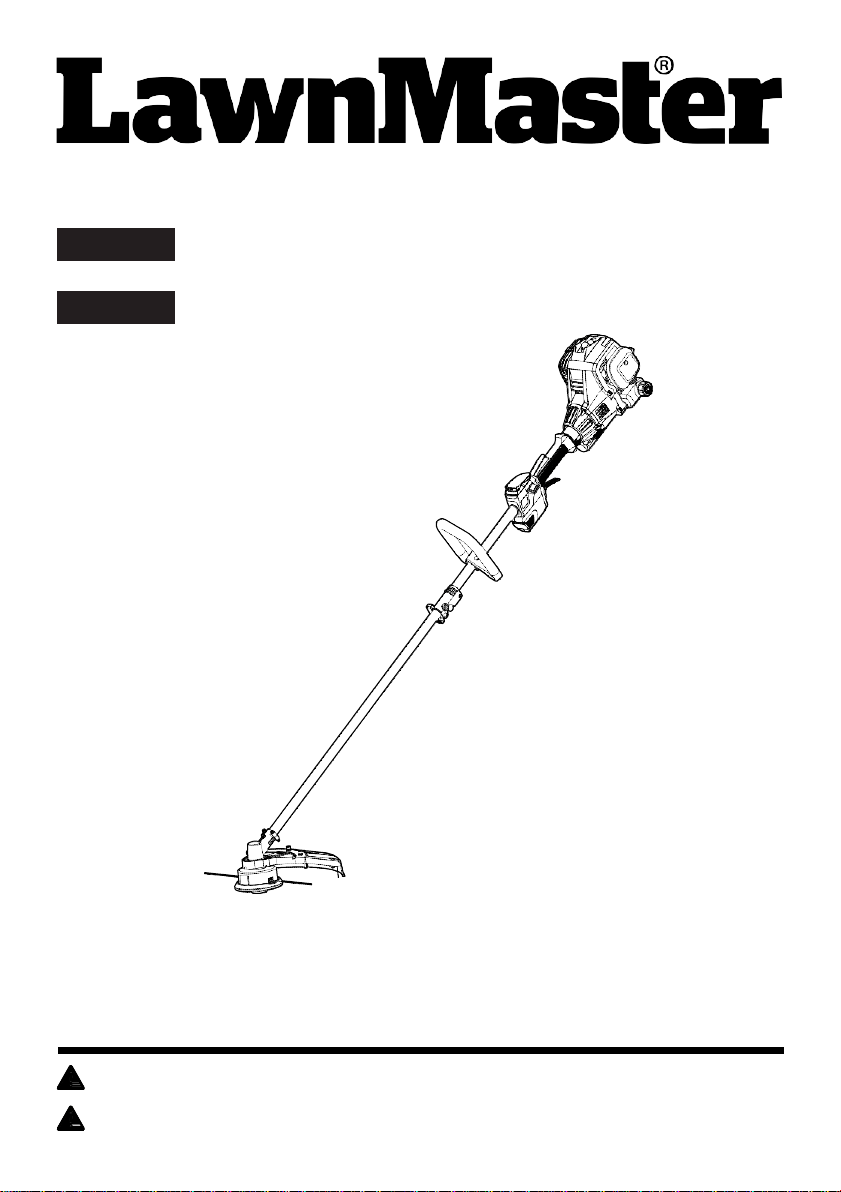
Operator's Manual / Manual del usuario
EN p. 2
ES p. 46
25cc 2-Cycle Grass Trimmer NPTGSP2517A
Bordeadora con Motor de 2 Tiempos de 25 cc NPTGSP2517A
NOTICE:
Only use unleaded gasoline containing up to 10% ethanol. Do not use E15 or E85 fuel in this trimmer.
It will violate the federal law, damage the trimmer and void your warranty.
AVISO:
Utilice solo gasolina sin plomo que contenga un máximo de 10 % de etanol. No utilice combustible
E15 o E85 con esta bordeadora. Esto violará la ley federal, dañará la bordeadora y anulará su
garantía.
Read all safety rules and instructions carefully before operating this tool.
601 Regent Park Court Greenville, SC 29607, SC 29650 1-866-384-8432
Lea con cuidado todas las reglas e instrucciones de seguridad antes de utilizar esta herramienta.
601 Regent Park Court Greenville, SC 29607, SC 29650 1-866-384-8432

CONTENTS
Section Page
CONTENTS
PRODUCT SPECIFICATIONS
GENERAL SAFETY RULES
SYMBOLS
KNOW YOUR GRASS TRIMMER
ASSEMBLY
BATTERY PACK AND CHARGER
OPERATION
MAINTENANCE
ENVIRONMENTALLY SAFE BATTERY DISPOSAL
TROUBLESHOOTING
WARRANTY
EXPLODED VIEW
PARTS LIST
EXPLODED VIEW 25CC 2-CYCLE ENGINE
PARTS LIST 25CC 2-CYCLE ENGINE
NOTES
2
3-6
7-8
9-10
11-16
17-18
19-27
28-35
36
37-38
39
40
41
42
43
44-45
PRODUCT SPECIFICATIONS
25cc-2 CYCLE GRASS TRIMMER
Engine Type
Engine Displacement Claimed / Rated
Power / Speed
Idle Speed
Max Torque / Speed
Fuel Tank Capacity
Fuel / Oil Ratio
Line Diameter
Cutting Width
Dry Weight
Battery Model No.
Battery Type
Charger Model No.
Charger Input
Charger Output
Charging Period (Battery Fully Discharged)
2-Stroke / Half Crank
25cc / 25 cm
3
0.8 kW / 7500 RPM
3000 ± 300 RPM
1.08 N.m / 6500 RPM
420 ml
40 : 1
0.095" (2.4 mm)
17" (430 mm)
13.21 lbs (5.99 kg)
7LB1331-C
7.2V Lithium-Ion, 1.3 Ah
YLS0042-T084045
100-240V ~ 50/60Hz 0.3A Max
8.4V 450 mA
3-4 Hours
2

GENERAL SAFETY RULES
WARNING
READ ALL INSTRUCTIONS AND SAVE THESE INSTRUCTIONS.
Read the Operator’s Manual and follow all warnings and safety instructions. Failure to do so can result
in serious injury to the operator and/or bystanders.
■ This grass trimmer is designed for cutting grass, soft vegetation.
■ The grass trimmer is intended for residential, or similar landscape use and is not recommended for
use in agricultural or forest environments.
■ This grass trimmer is not suitable for cutting or chopping, otherwise, there is a risk of injury. For
example:
- Hedges, shrubs and bushes,
- Flowers,
- In terms of composting.
■ Never allow children or persons unfamiliar with these instructions to use the trimmer.
■ Do not operate the trimmer inside a closed environment, such as a room or building; breathing
carbon monoxide from exhaust fumes can kill.
■ Clear the work area before each use. Remove all objects such as rocks, broken glass, nails, wire, or
string, which can be thrown or become entangled in the cutting attachment.
■ Clear the area of children, bystanders and pets. At a minimum, keep all children, bystanders and
pets outside a 50 ft (15 m) radius; outside the 50 ft (15 m) zone, there is still a risk of injury from
thrown objects.
■ Bystanders should be encouraged to wear eye protection. If you are approached, stop the engine
and cutting attachment.
■ Always wear eye protection with side shields marked to comply with ANSI Z87.1 along with hearing
protection when operating this trimmer. Failure to do so could result in objects being thrown into
your eyes and other possible serious injuries.
■ Always wear heavy, long pants, boots, gloves, and a long-sleeve shirt. Do not wear loose clothing,
jewelry, short pants, sandals, or go barefoot. Secure hair so it is above shoulder level.
■ Do not operate this trimmer when you are tired, ill, upset, or under the influence of alcohol, drugs, or
medication.
■ Inspect the trimmer before each use. Replace damaged parts. Check for fuel leaks. Make sure all
fasteners are in place and secure.
■ Replace cutting attachment parts that are cracked, chipped, or damaged in any way. Make sure the
cutting attachment is properly installed and securely fastened. Be sure the cutting attachment shield
is properly attached, securely fastened and in the position recommended by the manufacturer.
■ Use only a flexible, nonmetallic line recommended by the manufacturer. Never use, for example,
wire or wire-rope, which can break off and become a dangerous projectile.
■ Only use the grass trimmer in daylight or good artificial light.
3

GENERAL SAFETY RULES
■ Never operate the grass trimmer with damaged guards or without the guards in place.
■ Maintain a firm grip on both handles while using this tool.
■ Keep firm footing and balance. Do not overreach. Overreaching can result in loss of balance or
exposure to hot surfaces.
■ Maintain stable footing on a solid surface at all times when using the trimmer in order to have better
control of the tool. Do not use the trimmer whilst on a ladder or other unstable support.
■ Keep cutting attachment below waist level. Keep all parts of your body away from the rotating
cutting attachment and hot surfaces.
■ Do not touch muffler, rear cover housing or casing around the engine; these parts get hot whilst and
after the trimmer has been used. Contact with hot surfaces could result in serious burns.
■ The cutting attachment should never rotate at idle during normal use.
■ The cutting attachment may be spinning during carburetor adjustments. Wear your protective
equipment and observe all safety instructions. For units equipped with a clutch, be sure the cutting
attachment stops turning when the engine idles. When the unit is turned off, make sure the cutting
attachment has stopped before the unit is set down.
■ Mix and store fuel in a container approved for storing gasoline.
■ Mix and pour fuel outdoors where there are no sparks and flames. Slowly remove the fuel cap only
after stopping the engine and letting it cool completely. Do not smoke while fueling or mixing fuel.
Wipe spilled fuel from the trimmer. Move at least 10 ft (3 m) away from the fueling source and the
site before starting engine.
■ Before fueling or storing the tool, stop the engine and allow it to cool completely.
■ Before transporting the tool in a vehicle, allow the engine to cool completely and empty the fuel
tank. Always secure the tool to avoid movement during transportation.
■ Only use replacement parts or accessories provided or listed in this Operator’s Manual.
■ This trimmer is not intended for extended use. Extended periods of operation can cause circulatory
problems in the user’s hands due to the vibration caused by the tool. Take regular breaks from
operating the tool.
■ Always take your tool to an authorized service center for repair. Service performed by inexperienced
or unqualified persons may damage the tool, create unsafe conditions, increase the risk of personal
injury, and/or void your warranty.
BATTERY PACK
■ The battery pack is compatible with the YLS0042-T084045 charger.
■ Charge the battery only with the charger specified by the manufacturer and listed in this manual. A
charger that is suitable for one type of battery pack may create a risk of fire when used with another
battery pack.
■ Do not place battery powered tools or their batteries near fire or heat. This will reduce the risk of
explosion and possibly injury.
■ Do not open or mutilate the battery pack. Released electrolyte is corrosive and may cause damage
to the eyes or skin. It may be toxic if swallowed.
4

GENERAL SAFETY RULES
■ Do not dispose of battery packs in fire. They will explode or leak and cause injury. Liquid ejected
from the battery may cause irritation or burns.
■ Do not crush, drop or damage the battery pack. Do not use a battery pack or charger that has been
dropped or received a sharp blow. A damaged battery is subject to explosion. Properly dispose of a
dropped or damaged battery immediately.
■ Batteries can explode in the presence of a source of ignition, such as a pilot light. To reduce the
risk of serious personal injury, never use any cordless product in the presence of open flame. An
exploded battery pack can propel debris and chemicals. If exposed, flush with water immediately.
■ Under extreme usage or temperature conditions, battery pack leakage may occur. If liquid comes in
contact with your skin, wash immediately with soap and water, then neutralize with lemon juice or
vinegar. If liquid gets into your eyes, flush them with clean water for at least 10 minutes, then seek
immediate medical attention.
■ When the battery pack is not in use, keep it away from other metal objects like: paper clips, keys,
nails, screws, or other small metal objects that can make a connection from one terminal to another.
Shorting the battery pack terminals together may cause sparks, burns, or a fire.
■ Do not expose a battery pack to fire or excessive temperature. Exposure to fire or temperature
above 265°F (130°C) may cause an explosion.
■ Do not modify or attempt to repair the battery pack (as applicable) except as indicated in the
instructions for use and care.
■ Follow all charging instructions and do not charge the battery pack outside the temperature range
specified in the instructions. Charging improperly or at temperatures outside of the specified range
may damage the battery and increase the risk of fire.
BATTERY CHARGER
■ This charger is compatible with a 7LB1331-C or 07LB2001-S lithium-ion battery.
■ To reduce the risk of injury, charge only the specified lithium-ion rechargeable batteries. Other types
of batteries may burst, causing personal injury or damage.
■ Do not charge the battery in a damp or wet location. Following this rule will reduce the risk of electric
shock.
■ Keep the cord and charger away from heat to prevent damage to housing or internal parts.
■ Do not operate charger with a damaged cord or plug, which could cause shorting and electric shock.
If damaged, immediately discontinue use. Replace the charger with an identical model as listed in
this manual.
■ Do not use a charger that has been dropped or received a sharp blow.
■ Do not disassemble charger. Take it to a qualified service center to be checked or replaced.
Incorrect reassembly may result in a risk of electric shock or fire.
■ Do not abuse the charger cord. Never use the cord for carrying, pulling or unplugging.
■ Keep the cord away from heat, oil, sharp edges or moving parts. Damaged or entangled cords
increase the risk of electric shock. If the charger cord is damaged, replace the charger with an
5

GENERAL SAFETY RULES
identical model as listed in this manual.
■ A charger that is suitable for one type of battery pack may create a risk of fire when used with
another battery pack.
■ Charge the battery at the normal charging temperature between 40°F (4°C) and 100°F (38°C).
FCC COMPLIANCE
■ This device complies with Part 15 of the FCC Rules. Operation is subject to the following two
conditions:
- This device may not cause harmful interference, and
- This device must accept any interference received, including interference that may cause
undesired operation.
NOTE: This equipment has been tested and found to comply with the limits for a Class B digital device,
pursuant to Part 15 of the FCC Rules. These limits are designed to provide reasonable protection
against harmful interference in a residential installation.
■ This equipment generates, uses and can radiate radio frequency energy and, if not installed and
used in accordance with the instructions, may cause harmful interference to radio communications.
However, there is no guarantee that interference will not occur in a particular installation. If
this equipment does cause harmful interference to radio or television reception, which can be
determined by turning the equipment off and on, the user is encouraged to try to correct the
interference by one or more of the following measures:
- Reorient or relocate the receiving antenna.
- Increase the separation between the equipment and receiver.
- Connect the equipment into an outlet on a circuit different from that of the receiver.
- Consult the dealer or an experienced radio/ TV technician for help.
WARNING
The engine exhaust from this product can expose you to chemicals including carbon monoxide, which
is known to the State of California to cause cancer, birth defects, or other reproductive harm. To reduce
the risk of serious or fatal injury/illness, never run the machine indoors or in poorly ventilated locations.
For more information go to www.P65Warnings.ca.gov.
SAVE THESE INSTRUCTIONS
Refer to them frequently and use them to instruct others who may use this product. If you loan someone
this product, loan them these instructions also.
6
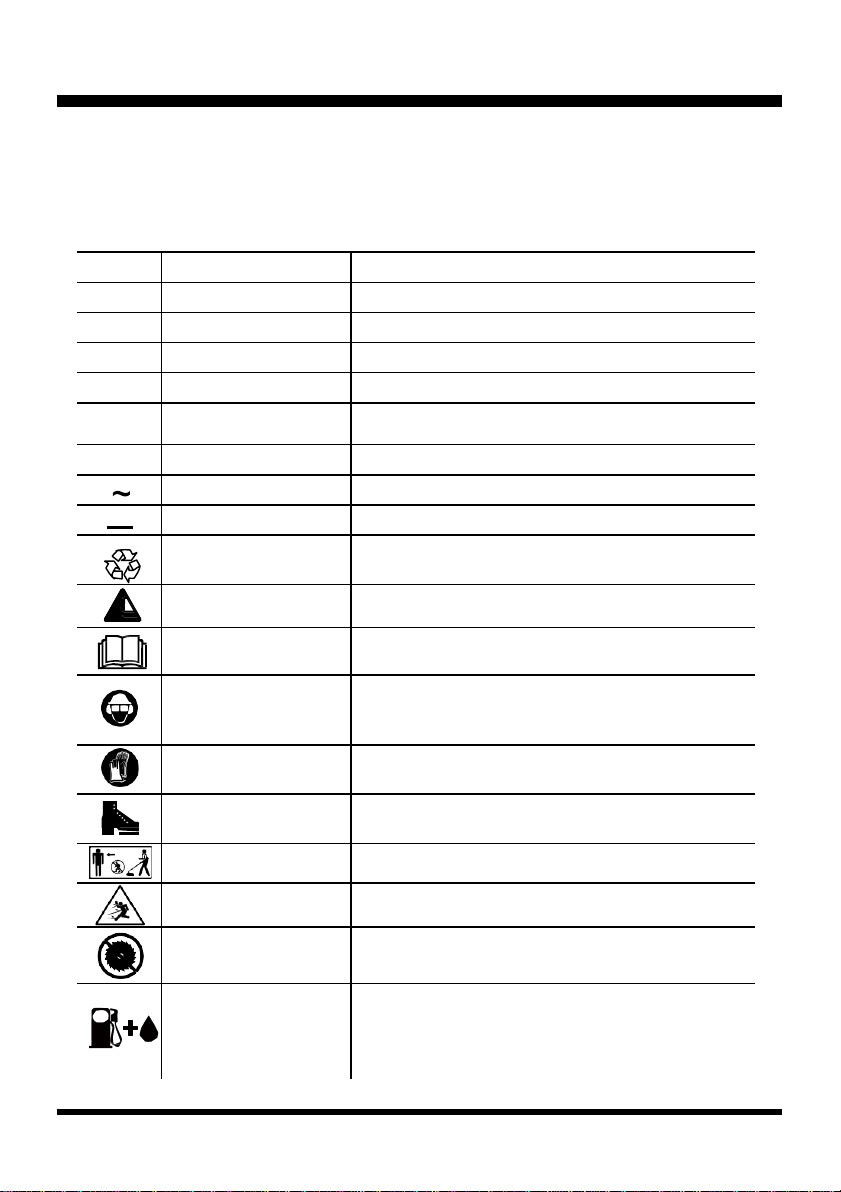
SYMBOLS
Some of the following symbols may be used on this product. Please study them and
learn their meaning. Proper interpretation of these symbols will allow you to operate
the product better and safer.
SYMBOL
NAME
DESIGNATION/EXPLANATION
V
Volts
Voltage
A
Amperes
Current
Hz
Hertz
Frequency (cycles per second)
W
Watt
Power
hrs
Hours
Time
/min
Per Minute
Revolutions, strokes, surface speed, orbits etc., per
minute
n
o
No Load Speed
Rational speed, at no load
Alternating Current
Type of current
Direct Current
Type or a characteristic of current
Lithium-Ion
Battery
Recycling
Designates that this tool is in compliance with
Lithium-Ion battery recycling program requirements
Safety Alert
Precaution that involves your safety.
Read the
Operator’s
Manual
You must read the operating instructions carefully.
Eye and
Hearing
Protection
Always wear eye protection with side shields marked
to comply with ANSI Z87.1 along with hearing
protection when operating this equipment.
Gloves
Wear non-slip, heavy-duty protective gloves when
handling this product.
Safety Footwear
Wear non-slip safety footwear when using this
product.
50ft (15m)
Keep Bystanders Away
Keep all bystanders at least 50' (15 m) away.
Ricochet
Thrown objects can ricochet and result in personal
injury or property damage.
No Blade
Do not install or use any type of blade on a product
displaying this symbol.
Gasoline and Lubricant
Use unleaded gasoline intended for motor vehicle use
with an octane rating of 87 [(R + M) / 2] or higher.
This product is powered by a 2-cycle engine and
requires pre-mixing gasoline and 2-cycle lubricant.
7
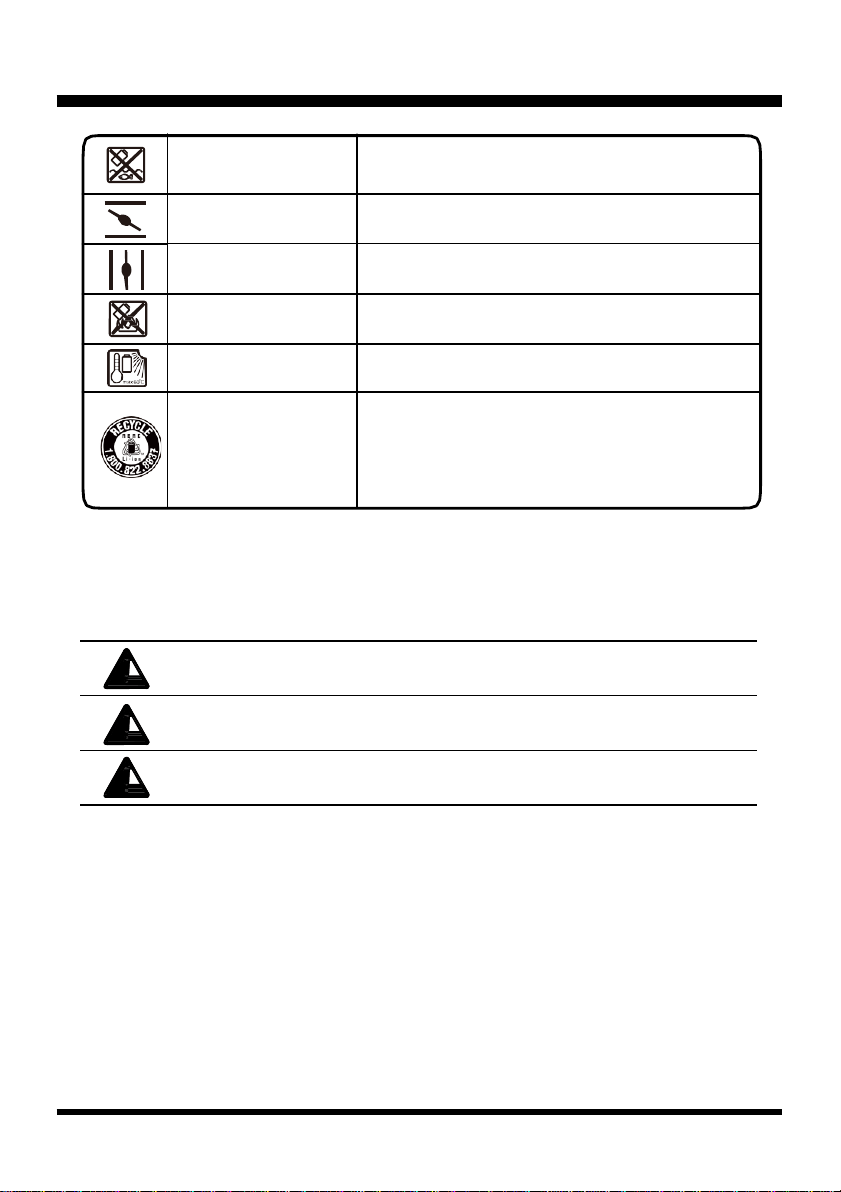
SYMBOLS
The following signal words and meanings are intended to explain the levels of risk
associated with this product.
SYMBOL SIGNAL
MEANING
DANGER
Indicates an imminently hazardous situation, which, if not
avoided, will result in death or serious injury.
WARNING
Indicates a potentially hazardous situation, which, if not
avoided, could result in death or serious injury.
CAUTION
Indicates a potentially hazardous situation, which, if not
avoided, may result in minor or moderate injury.
NOTICE
(Without Safety Alert Symbol) Indicates a situation that may
result in property damage.
Keep Away From Water
Close
Open
Keep Away From Fire
Heat Alert
Do not dispose of battery packs in rivers or immerse in
water.
Clos
e the choke.
Open the choke.
Recycle Symbol
Do not dispose of battery packs in fire. They will
explod
e or leak and cause injury.
Do
not expose battery packs to heat in excess of
140°F
(60°C).
This
product uses lithium-ion batteries. Local, state,
or
federal laws may prohibit disposal of batteries in
ordinary
trash. Consult your local waste authority
for
information
regarding available recycling and/or
disposal options.
8
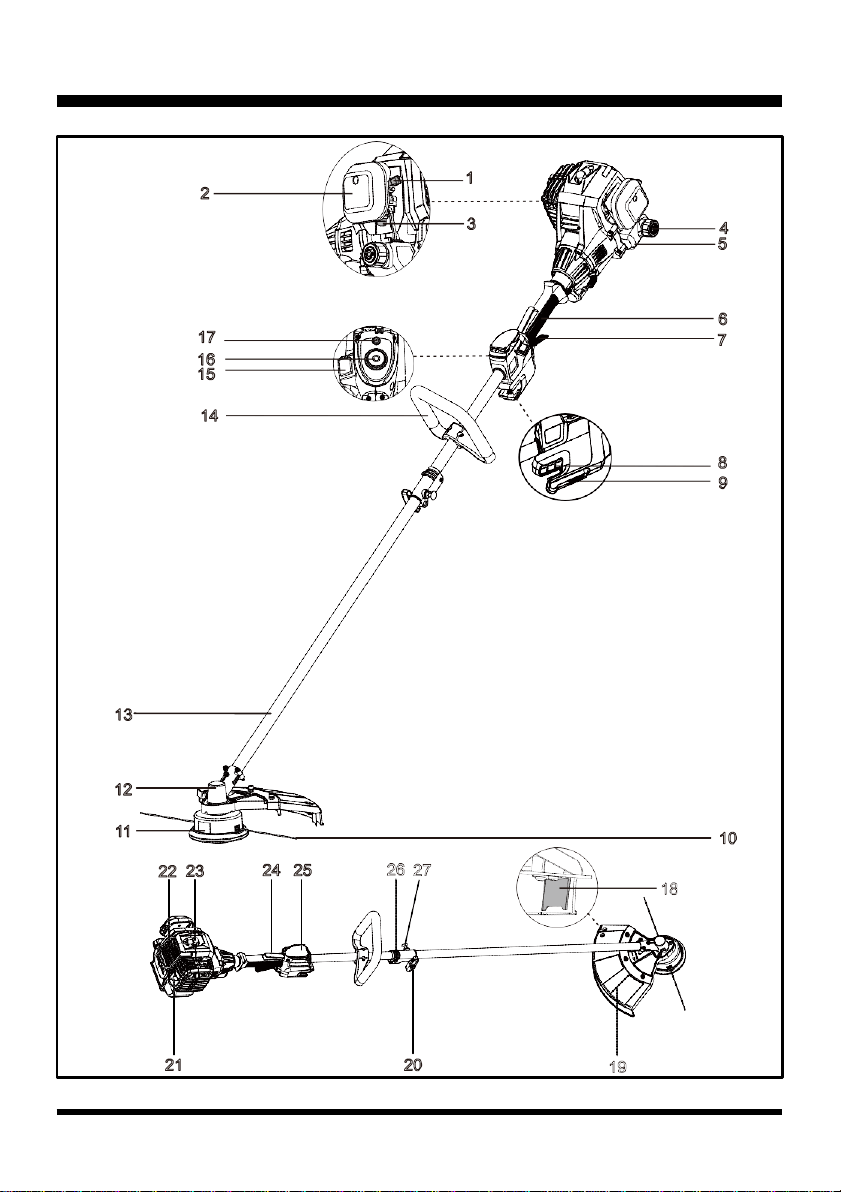
KNOW YOUR GRASS TRIMMER
1
2
3
4
5
6
17
7
16
15
14
8
9
13
12
11
22
23
24 25
10
26 27
18
21 20
19
9
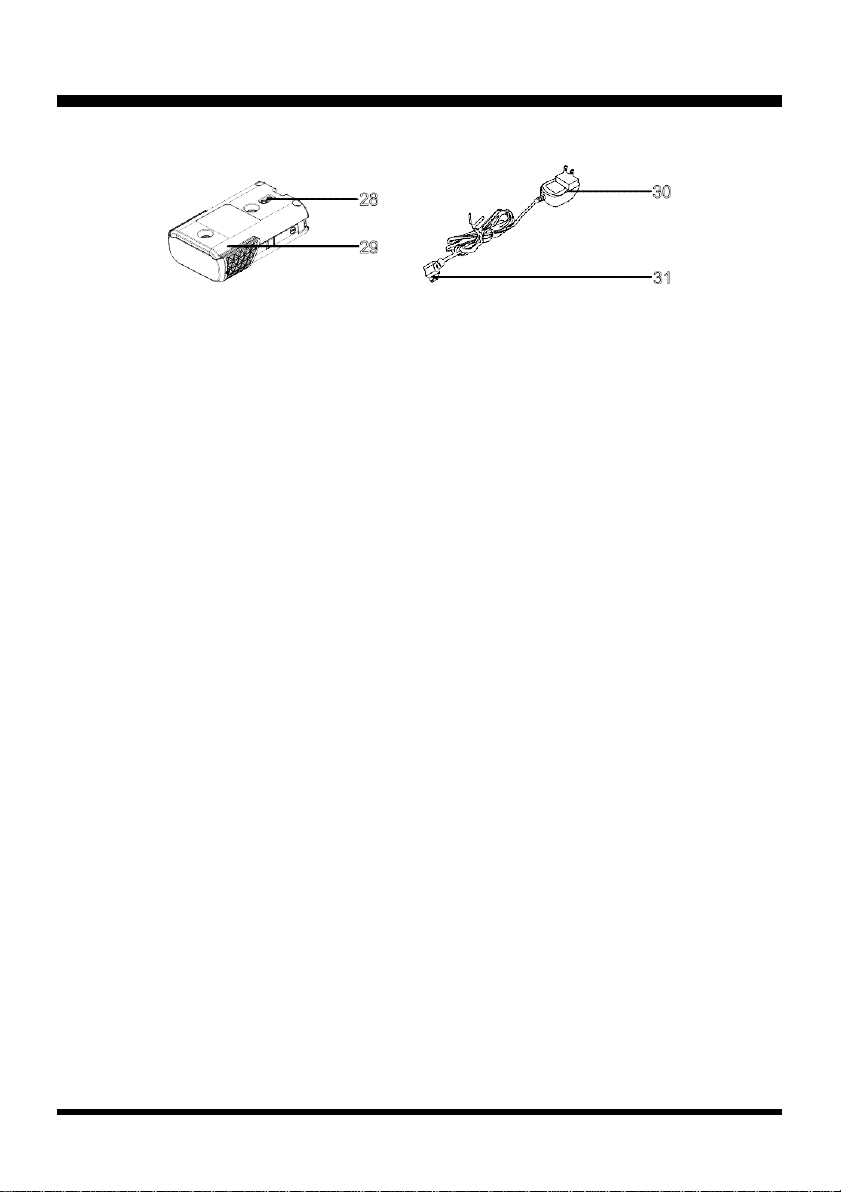
KNOW YOUR GRASS TRIMMER
28
30
29
31
The safe use of this product requires an understanding of the information on the product and in this
Operator’s Manual as well as knowledge of the project you are attempting. Before use of this product,
familiarize yourself with all operating features and safety rules.
Components
1. Choke Lever
2. Air Filter Cover
3. Primer Bulb
4. Fuel Tank Cap
5. Fuel Tank
6. Main Handle
7. Throttle Lever
8. Battery Slot
9. Battery Release Button
10. Trimmer Line
11. Trimmer Head With Line Spool
12. Gear Box Housing
13. Shaft
14. Assist Handle
15. Stop Switch
16. Start Button
17. Battery Power Indicator
18. Trimmer Line Cutting Blade
19. Debris Guard
20. Knob
21. Muffler
22. Engine Housing
23. Spark Pulg Cap
24. Throttle Safety
25. Start Button Cover
26. Shaft Connection Sleeve
27. Locking Pin
28. Charging Port
29. Battery Pack
30. Charger
31. Charging Connector
10

ASSEMBLY
This product requires assembly.
■ Carefully remove the product and any accessories from the box. Make sure that all items listed in
the packing list are included.
■ Inspect the product carefully to make sure no breakage or damage occurred during shipping.
■ Do not discard the packing material until you have carefully inspected and satisfactorily operated
the product.
■ If any parts are damaged or missing, please call the service center.
PACKING LIST
(1) Trimmer Assembly
(1) Assistant Handle (with plate and two screws pre-installed)
(1) Straight Shaft Attachment (with trimmer head, line spool and half debris guard installed)
(1) Half Debris Guard (with three screws pre-installed)
(1) Socket Wrench / Cross-head Screwdriver
(2) Hex Wrenches
(1) Quincunx Wrench
(1) Operator's Manual
(1) 7.2V Lithium-Ion 1.3 Ah Battery Pack
(1) Battery Charger
WARNING
If any parts are damaged or missing do not operate this product until the parts are replaced. Use of
this product with damaged or missing parts could result in serious personal injury.
WARNING
Do not attempt to modify this product or create accessories not recommended for use with this
product. Any such alteration or modification is misuse and could result in a hazardous condition
leading to possible serious personal injury.
WARNING
To prevent accidental starting that could cause serious personal injury, always remove the battery pack
from the product when assembling parts.
11
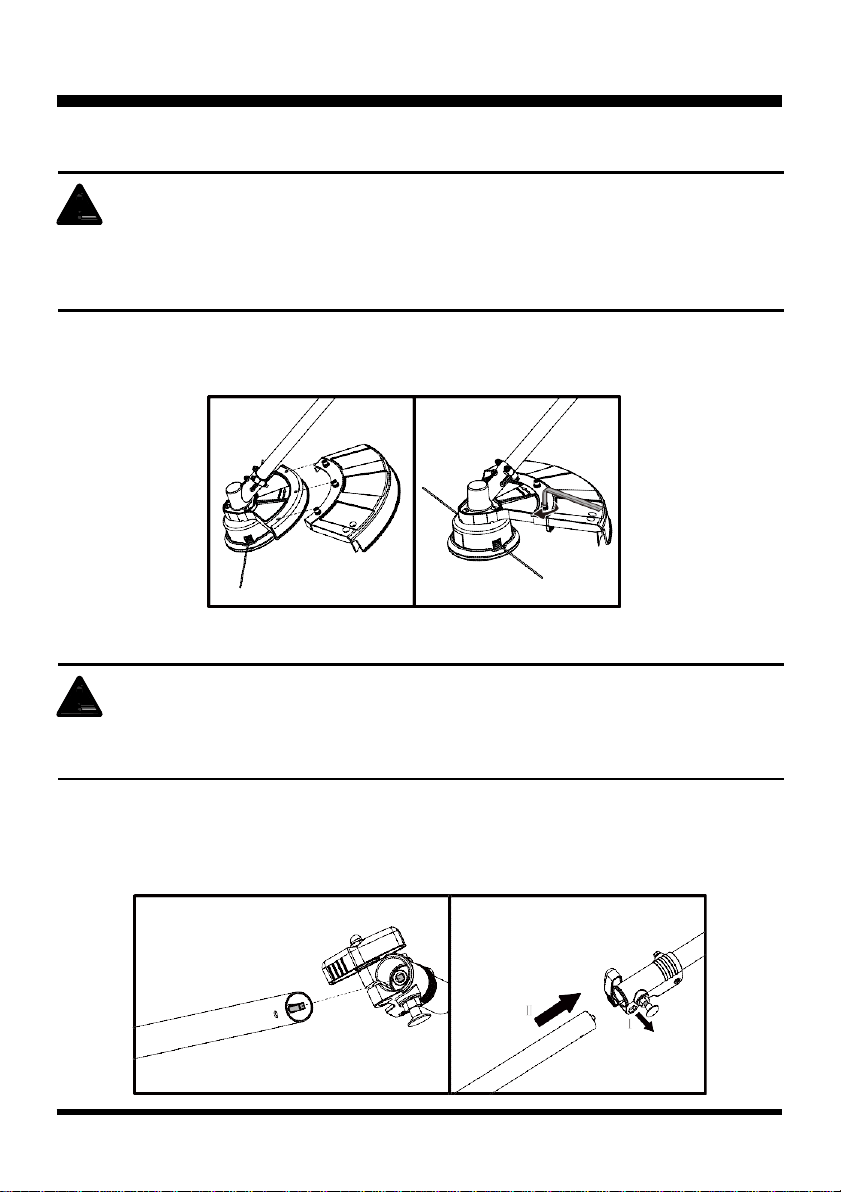
ASSEMBLY
FITTING THE DEBRIS GUARD (See Figs. 1-2)
WARNING
The trimmer line cutting blade on the debris guard is sharp and is fitted with a blade protection film
which will need to be removed prior to using the trimmer. When fitting the guard avoid contact with the
blade. Failure to avoid contact can result in serious personal injury.
■ Fit the outer part of the debris guard with the part attached to the shaft, ensuring that the screws and holes
align (Fig. 1).
■ Secure the screws tightly using the hex wrench (Fig. 2). Do not over-tighten.
INSTALLING AND REMOVING THE SHAFT (See Figs. 3-7)
WARNING
Never install, remove, or adjust any attachment while the engine is running. Failure to stop the engine
can cause serious personal injury.
To install the shaft:
■ Loosen the locking knob on the shaft connection sleeve counter-clockwise.
■ Align the axles in the shafts. Pull out the locking pin, and then insert the shaft into the shaft connection
sleeve (Fig. 3 & 4).
Fig. 3
Fig. 4
Fig. 1
Fig. 2
12
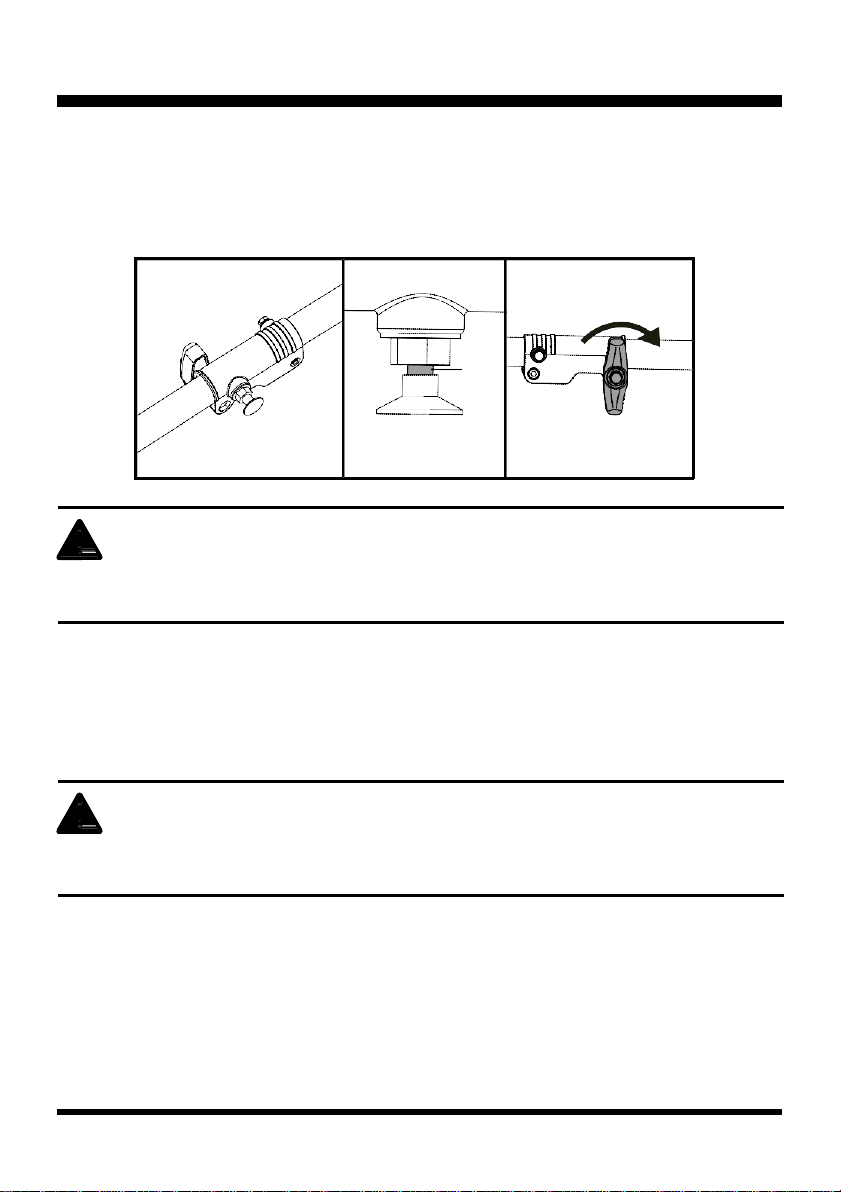
ASSEMBLY
■ Release the locking pin. Rotate the shaft slightly to let the locking pin engage in the hole. Always ensure
the locking pin is locked into place (Fig. 5).
NOTE: If there is a gap between the locking pin and shaft connection sleeve, the shafts are not locked into
place (Fig. 6). Slightly rotate the shaft from side to side until the locking pin is locked into place.
■ Secure the shaft by turning the knob clockwise (Fig. 7).
WARNING
Ensure that the knob is fully tightened before operating the tool; check it periodically for tightness
during use to avoid serious personal injury.
To remove the shaft:
■ Stop the engine and remove the battery pack.
■ Loosen the knob by turning counter-clockwise.
■ Pull out the locking pin and remove the shaft.
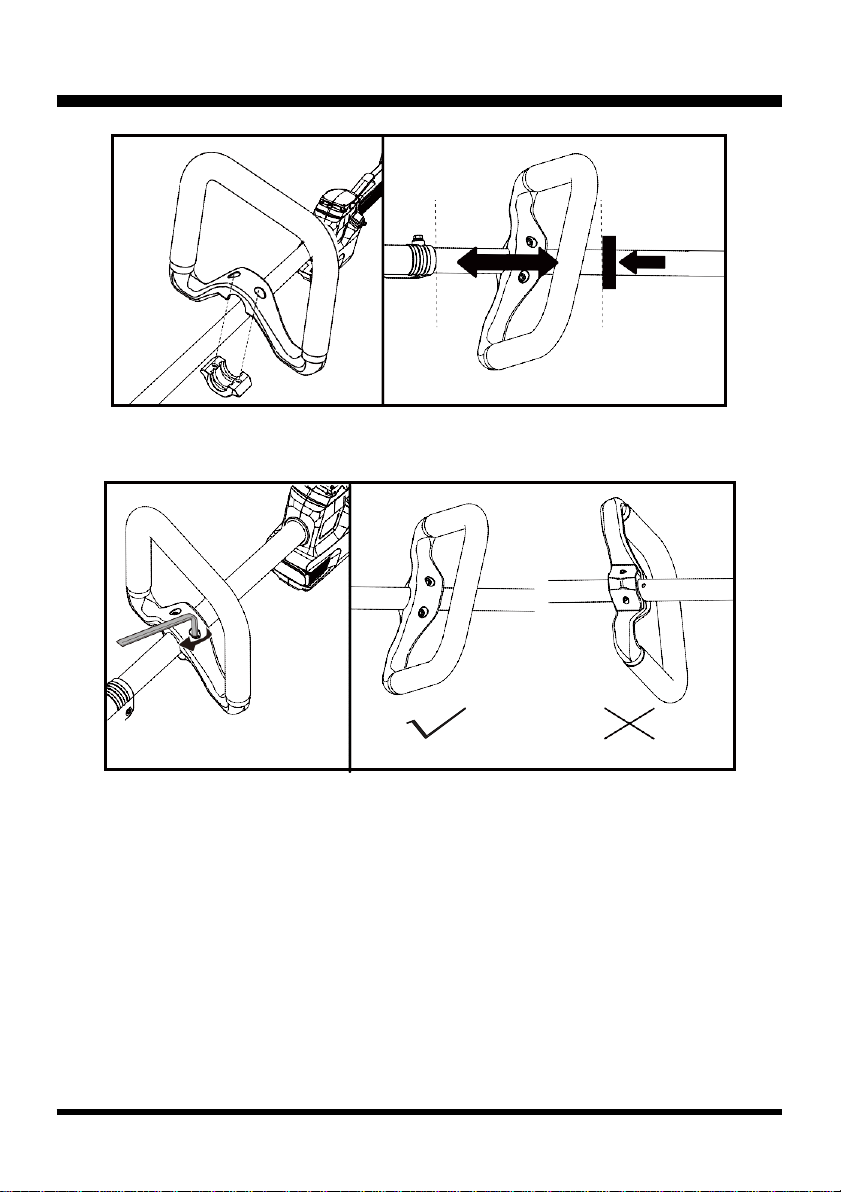
INSTALLING AND ADJUSTING THE ASSIST HANDLE (See Figs. 8-11)
WARNING
Never adjust the assist handle while the trimmer head is running. Failure to stop the engine may cause
serious personal injury.
■ Loosen the screws from the assist handle using the hex wrench provided.
■ Align the screw holes on the assist handle with the screw holes on the plate as shown (Fig. 8).
■ Tighten the screws moderately. Then adjust the assist handle to your desired position. The assist handle
can only be moved in the direction between the arrow marked "Handle Position" and shaft connection
sleeve (Fig. 9).
Gap
Fig. 5
Fig. 6
Fig. 7
13
ASSEMBLY
■ Secure the screws tightly using the hex wrench (Fig. 10).
■ Pay attention not to position the assist handle under the shaft (Fig. 11).
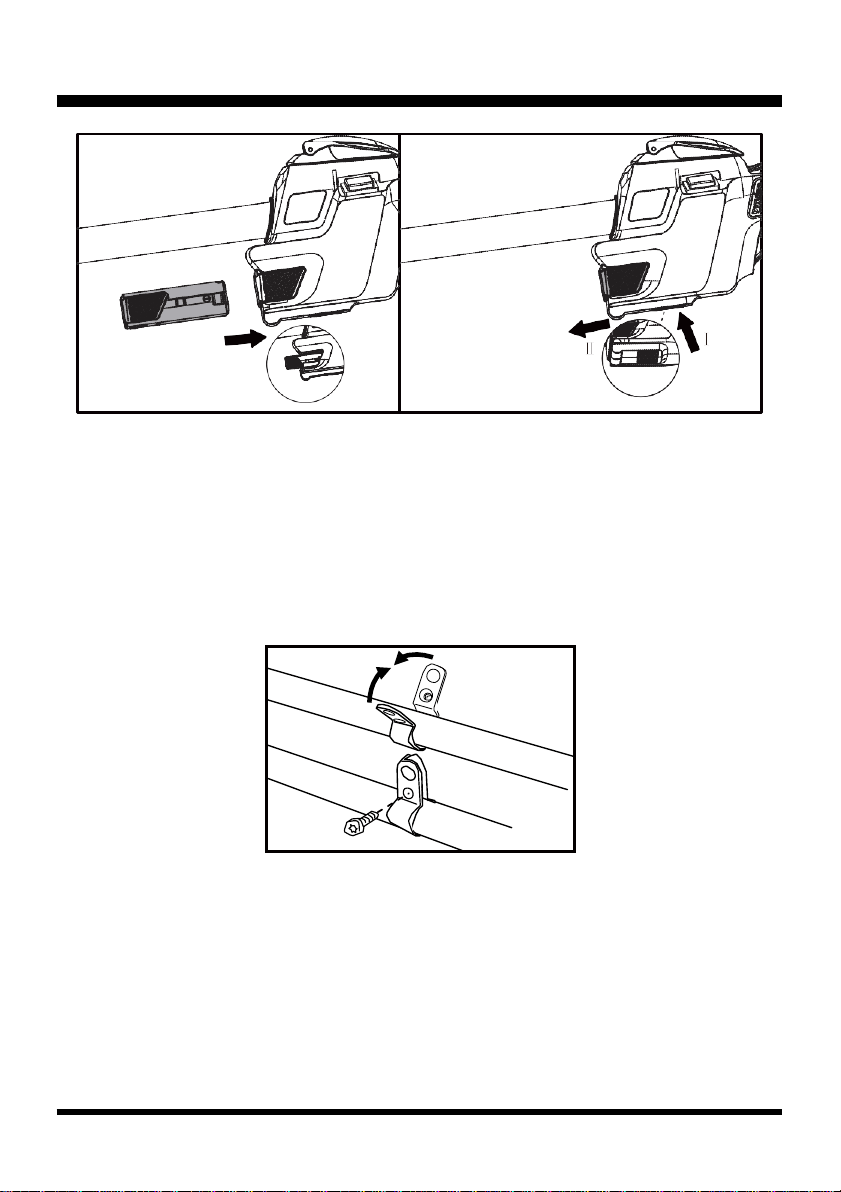
INSTALLING AND REMOVING THE BATTERY PACK (See Figs. 12-13)
To install the battery pack:
■ Align the battery pack with the battery slot.
■ Insert the battery pack into the battery slot until the battery pack secures into place. Make sure the battery
is inserted in the correct direction (Fig. 12).
■ Do not use force when inserting the battery pack. It should slide into position and "click".
To remove the battery pack:
■ Press and hold the battery release button (Fig. 13).
■ Slide the battery pack from the battery slot.
Fig. 10
Fig. 11
Fig. 8 Fig. 9
Handle Position
14
ASSEMBLY
INSTALLING THE SHOULDER STRAP (SOLD SEPARATELY) (See Figs. 14-18)
A removable shoulder strap and shoulder strap clasp (not included) are sold separately for your convenience.
Use of a shoulder strap is recommended for trimmer and brush cutter use.
■ Remove the pre-installed screw from the shoulder strap clasp.
■ Place the shoulder strap clasp against the drive shaft with the tapped hole on the left (viewed from the
engine).
■ Squeeze the two ends of the clasp together and hold in that position. Secure the clasp with the screw
(Fig. 14).
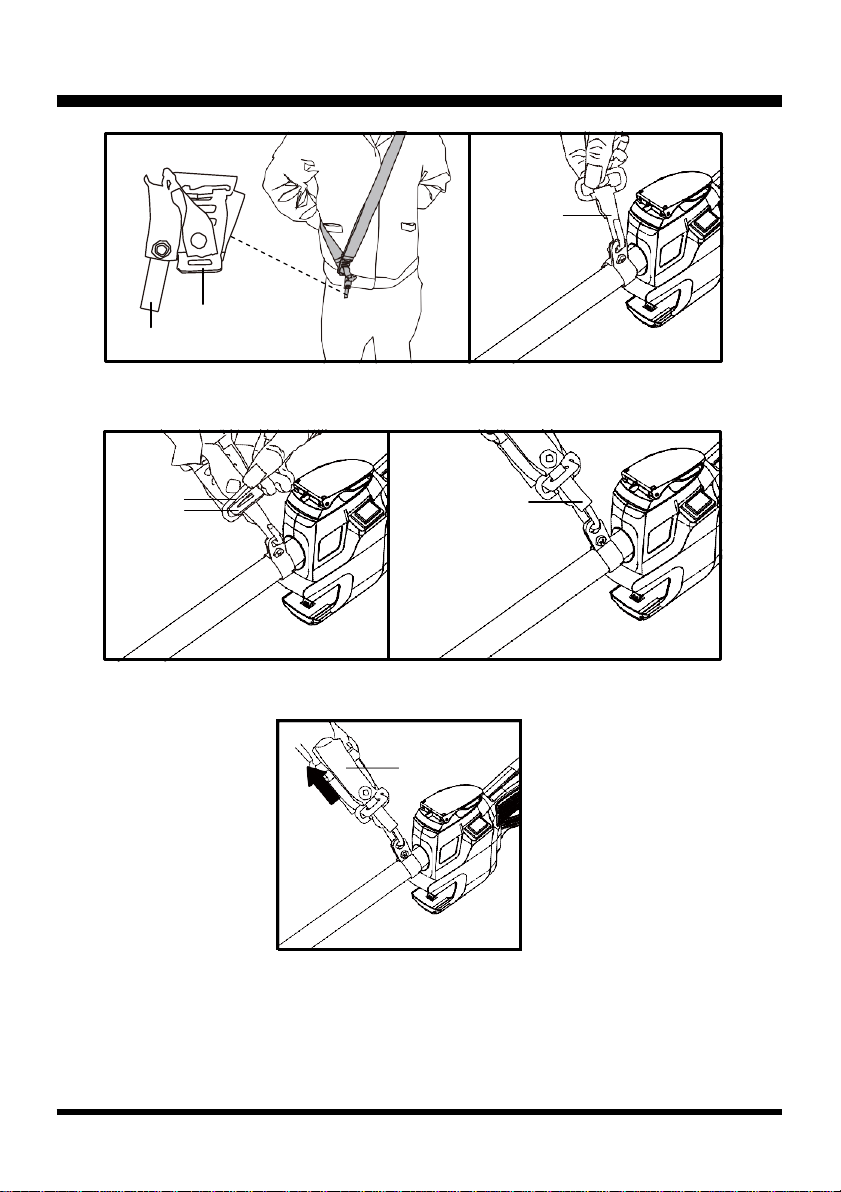
■ Place the shoulder strap over your left shoulder and across your chest. Adjust the length of the strap. Make
sure the release latch of the strap is below your right waist level (Fig. 15).
■ Attach the shoulder strap hook to the shoulder strap clasp (Fig. 16).
Fig. 14
WRONG
Fig. 12
Fig. 13
15
ASSEMBLY
■ Insert the tab on the shoulder strap into the ring on the hook. Then insert the release latch into the tab.
Check to ensure the shoulder strap is attached securely (Fig. 17).
■ In case of emergency, pull the rope of the quick release mechanism. The release latch will be released from
the tab, and the machine will drop away from you (Fig. 18).
Rope
Fig. 18
Ring
Tab
Release Latch
Fig. 17
Tab
Release Latch
Fig. 15
Hook
Fig. 16
16
BATTERY PACK AND CHARGER
BATTERY CHARGING
■ Use with 8.4V LawnMaster
®
YLS0042-T084045 battery charger. The battery charger supplied is
specifically designed for the lithium-ion battery used in this tool.
■ Check the power voltage! Battery chargers operate on 100-240V AC.
■ Charge the battery between 40°F (4°C) and 100°F (38°C) to ensure an optimum battery service life.
■ Protect the battery from heat, from continuous exposure to sun, and keep away from radiation or
other heat sources. Do not leave the battery in the tool in direct sunlight over long periods.
■ The battery is supplied uncharged. Fully charge the battery before using the tool for the first time.
The lithium-ion battery can be charged at any time without reducing its service life. Interrupting the
charging procedure does not affect the battery.
CHARGER LEDS
■ If the battery is not connected to the charger, a continuous green LED light indicates that the plug is
plugged into an outlet socket and the battery charger is ready for operation.
■ Charging: a continuous red LED on the charger indicates that the battery is charging normally.
■ Charged: a continuous green LED on the charger indicates that the battery is ready for use.
INDICATOR LIGHTS
STATUS
Green, continuous
Fully charged / Connected to
power supply (Standby)
Red, continuous Charging
■ After continuous or repeated charging cycles without interruption, the charger may warm up. This is
normal and does not indicate a technical defect of the battery charger.
CHARGING THE BATTERY PACK (See Figs. 19-20)
WARNING
If any part of the charger is missing or damaged, do not operate it! Replace the charger with a new
one. Failure to heed this warning could result in possible serious injury.
Check the voltage! The voltage must comply with the information on the rating label.
17
BATTERY PACK AND CHARGER
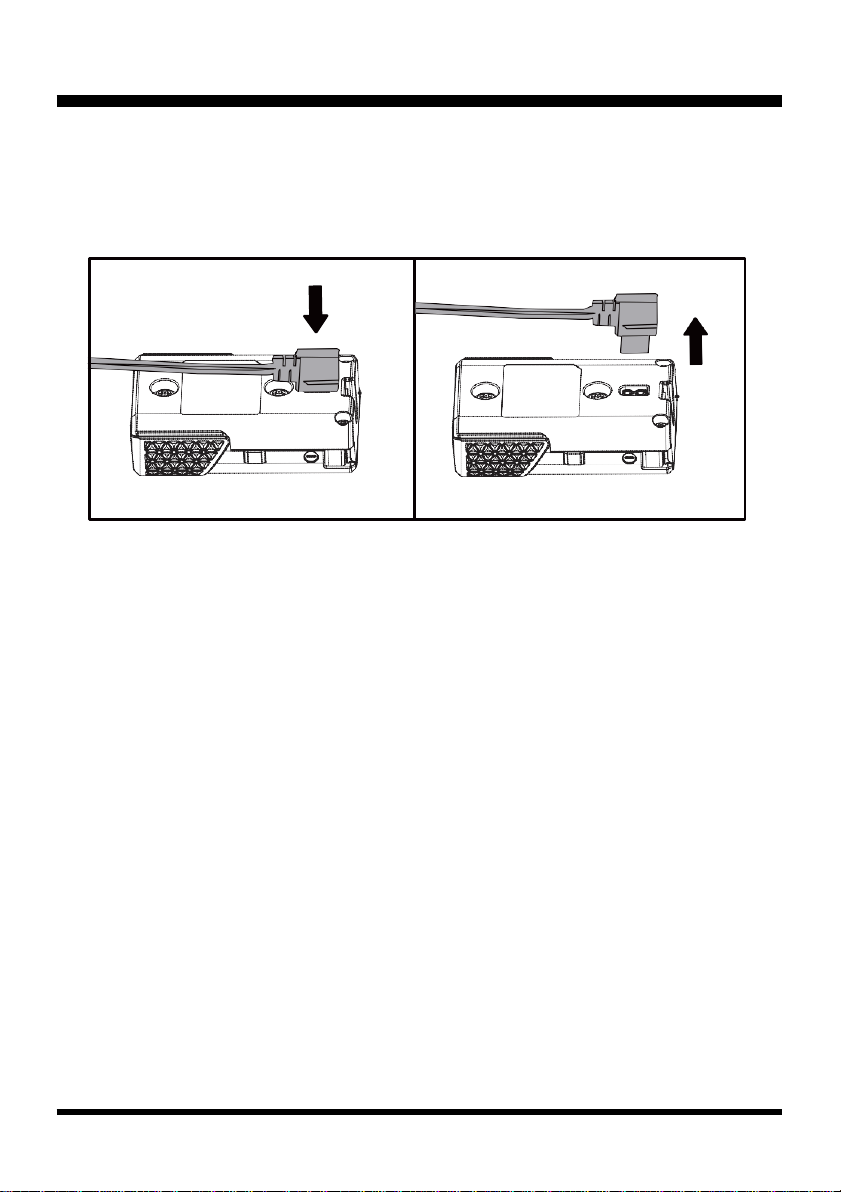
■ Insert the charging connector into the charging port on the battery (Fig. 19).
■ Connect the charger to the power supply.
■ Allow sufficient charging time (see Product Specifications), and then disconnect the charger from the power
supply.
■ Remove the charging connector from the charging port (Fig. 20).
NOTE: It is normal for the battery pack and the charger to become warm (but not hot) during the charging
process. If the battery does not charge properly, check to make sure the electrical outlet is operational. Always
charge the battery before storage!
Fig. 19
Fig. 20
18

OPERATION
WARNING
Do not allow familiarity with products to make you careless. Remember that a careless fraction of a
second is sufficient to inflict serious injury.
WARNING
Always wear eye protection with side shields marked to comply with ANSI Z87.1, along with head
protection. Failure to do so could result in objects being thrown into your eyes and other possible
serious injuries.
WARNING
Do not use any attachments or accessories not recommended by the manufacturer or retailer of this
product. The use of attachments or accessories not recommended can result in serious personal
injury. Before each use, inspect the entire product for damaged, missing, or loose parts such as
screws, nuts, bolts, caps, etc. Tighten securely all fasteners and caps and do not operate this product
until all missing or damaged parts are replaced.
HANDLING THE FUEL
DANGER
The fuel is VERY flammable. Use extreme care when mixing, storing or handling, or serious
personal injury may result.
■ Mix and store in a container approved for storing fuel.
■ DO NOT smoke when handling or close to fuel.
■ DO NOT allow flames or sparks near the fuel.
■ Maintain the pressure in the fuel tank; always loosen the fuel tank cap slowly allowing the
pressure to equalize. NEVER refuel a trimmer when the engine is HOT or RUNNING!
■ DO NOT fill fuel tanks indoors. ALWAYS fill fuel tanks outdoors over bare ground.
■ DO NOT overfill the fuel tank and clean up spills immediately.
■ Securely tighten the fuel tank cap and close the fuel container after refueling.
■ Check for fuel leakages. If a fuel leakage is present, remove the battery and do not use the
19
OPERATION
trimmer until the leakage is repaired.
■ Move at least 10 ft (3 m) from refueling location before starting the engine.
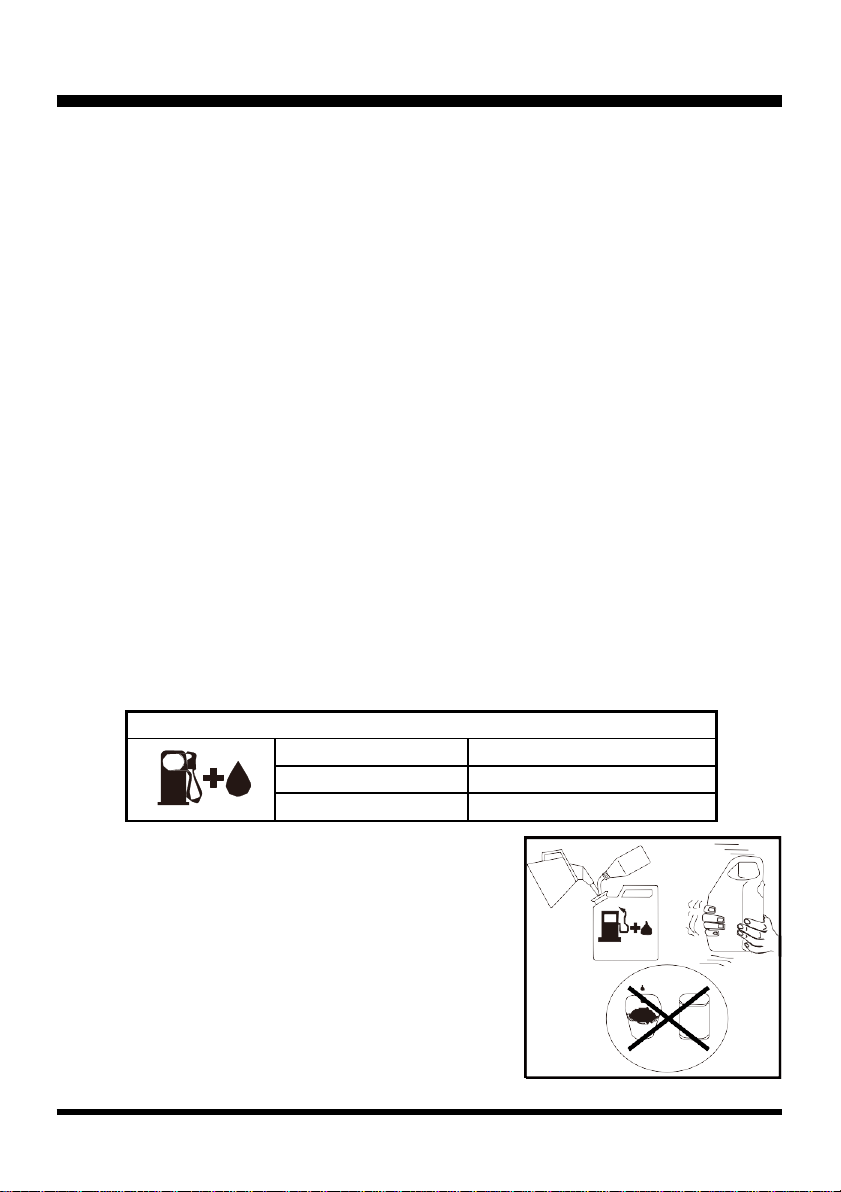
FUEL MIXTURE (See Fig. 21)
This trimmer is powered by a 2-cycle engine; the operator is required to use premixed gasoline and
2-cycle lubricant. Prepare a mixture of unleaded gasoline and 2-cycle engine lubricant in a clean
container approved for storing gasoline. Only prepare quantities that can be used up within a few days.
DO NOT prepare quantities that will need to be stored for more than 30 days.
Recommended Fuel
This engine is certified to operate on unleaded gasoline intended for automotive use.
U.S. EPA regulations make it illegal to use gasoline containing higher than 10% ethanol content
in outdoor power equipment like your LawnMaster
®
power equipment and doing so can void your
LawnMaster
®
Limited Warranty.
If the proper precautions are taken, however, gasoline containing a 10% quantity of ethanol can safely
be used in your LawnMaster
®
products.
Much of the gasoline sold throughout the United States contains ethanol. The maximum ethanol
content allowed by law for use in outdoor power equipment is limited to 10% (E10). Most small power
equipment engines are designed to use no more than a 10% ethanol gasoline blend.
If you are not sure of the ethanol content in the gasoline you are purchasing, ask the retailer. If they are
unsure, purchase your fuel from another retailer that offers gasoline with no more than 10% ethanol.
NOTE: We recommend you use a high-quality synthetic 2-cycle lubricant in this product.
Recommended specification: JASO-FC or above. Mix at 40:1 ratio or 3.2 oz. per gallon (US).
Do not use automotive lubricant or 2-cycle outboard lubricant.
Gasoline to Lubricant Mix - 40 : 1 Ratio
GASOLINE
LUBRICANT
1.0 gal. (US) (3.8 liter) 3.2 oz. (95 ml)
2.5 gal. (US) (9.5 liter) 8.0 oz. (236 ml)
Mixing Tips
■ Always start by filling an approved fuel container with half
of the required amount of gasoline.
■ Then add the entire amount of 2-cycle lubricant. Close the
container and shake to mix the lubricant with the gasoline.
■ Add the remaining amount of gasoline, close the fuel
container, and shake again.
■ Ensure that the fuel is well mixed by shaking the container
before filling the fuel tank (Fig. 21).
WRONG
Fig. 21
20
OPERATION
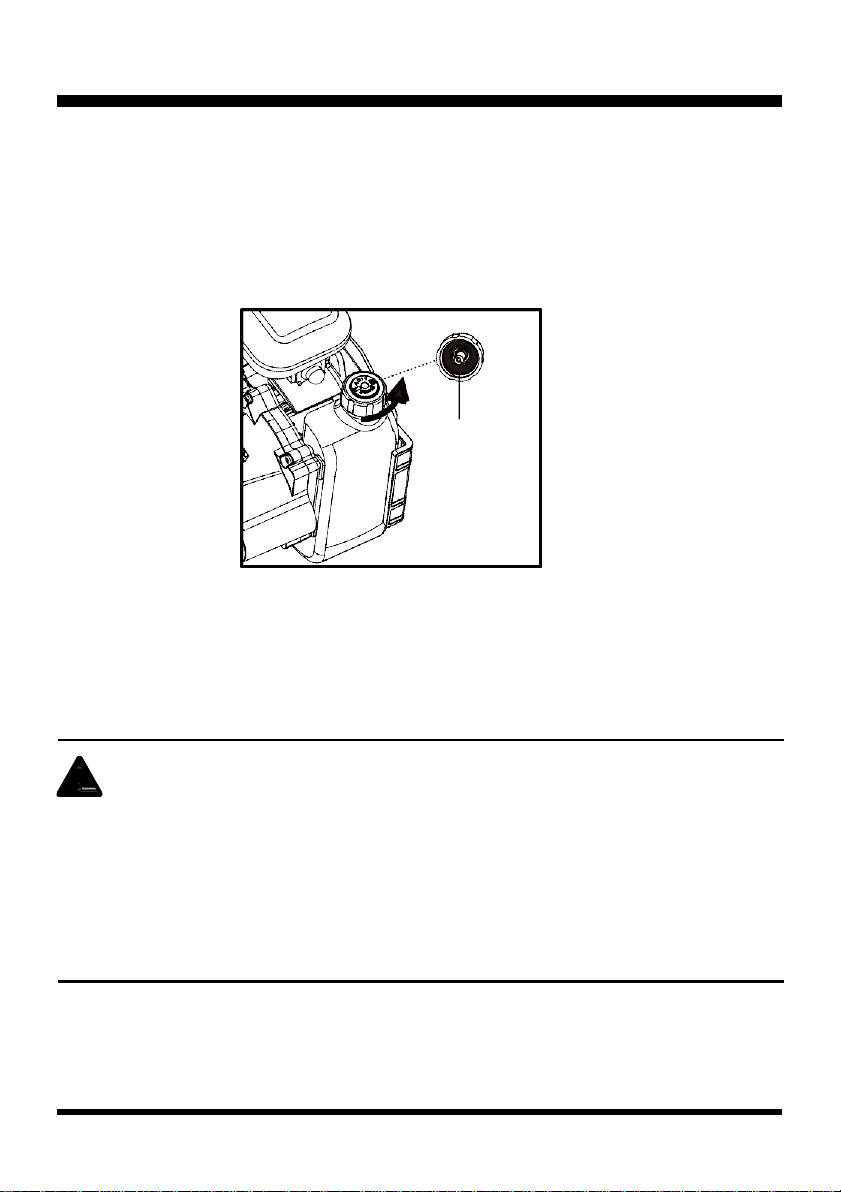
FILLING THE FUEL TANK (See Fig. 22)
NOTICE: Before each use, ALWAYS shake the fuel container thoroughly to ensure that the fuel is
mixed completely.
■ Place the tool on a flat, level surface, outdoors. Ensure the fuel tank and the shaft are in the same
level so enough fuel can be filled into the fuel tank.
■ Clean the area around the fuel tank and cap to prevent any contamination.
■ Loosen the fuel tank cap by turning it counter-clockwise and remove (Fig. 22).
■ Carefully pour the fuel into the fuel tank, avoiding any spillage. Clean and check the gasket before
replacing the cap onto the fuel tank.
■ DO NOT leave the fuel tank unsealed while it contains fuel. Replace the cap immediately after filling
and inspecting the tank. Check that the cap is sealed tightly and wipe clean any spillage that may
have occurred.
NOTICE: It is normal for smoke to be emitted from a new engine after first use.
WARNING
The operation of this tool requires gasoline, an extremely flammable liquid. Always turn off the engine
and allow it to cool completely before fueling. Never remove the fuel tank cap or add the fuel to the tool
while it is running or the engine is still hot. Make sure to fuel the tool outdoors on a flat, level surface.
After fueling, immediately replace the fuel tank cap and tighten it securely. DO NOT fill the fuel tank
on the work site; fueling must occur at least 10 ft. (3m) from where the operator intends to start the
engine. Keep the tool away from smoke, open flames and sparks! Failure to follow these instructions
could result in an explosion, fire and cause serious personal injury.
Gasket
Fig. 22
21
OPERATION
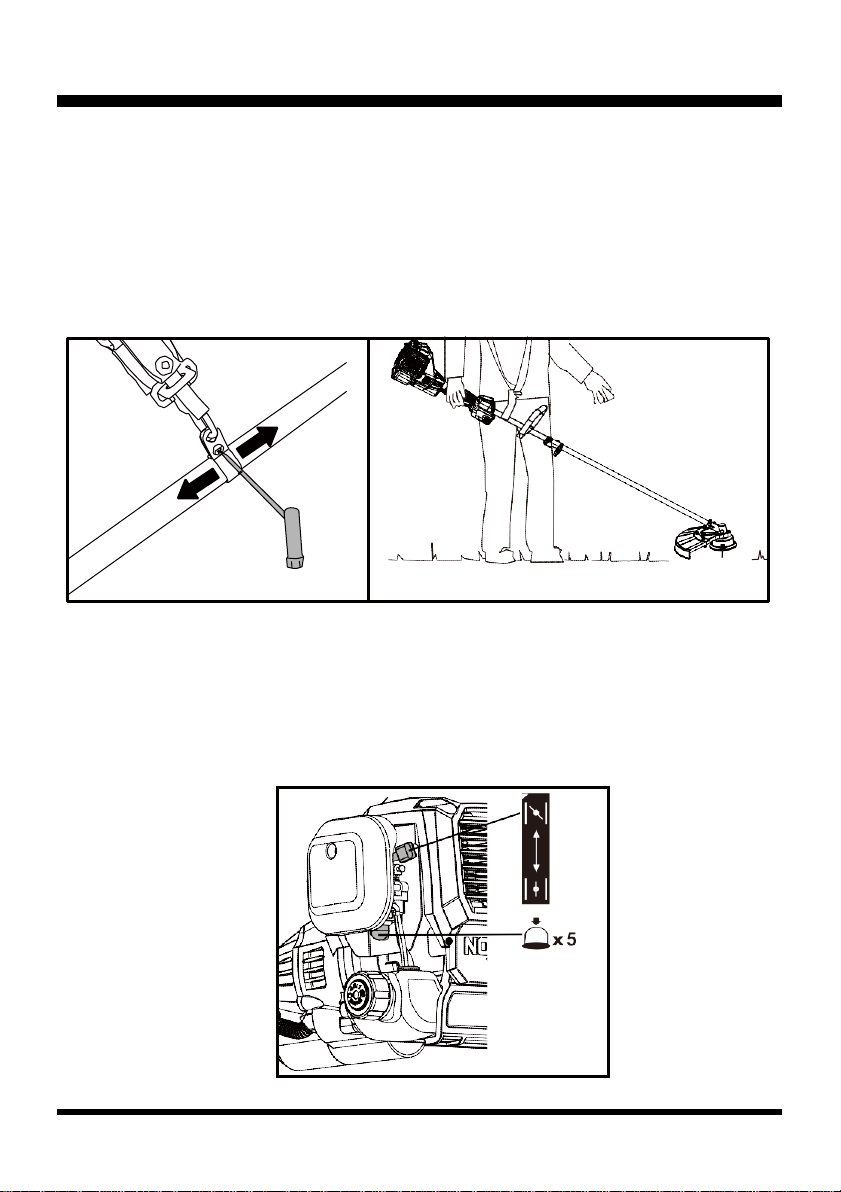
BALANCING THE GRASS TRIMMER (See Figs. 23-24)
If the shoulder strap clasp and shoulder strap (sold separately) are used for your convenience, balance
the grass trimmer before starting the trimmer.
■ Loosen the screw on the shoulder strap clasp.
■ Slide the clasp to a comfortable operating position, and then tighten the screw moderately (Fig. 23).
■ Let the machine hang from the strap and wait until it is in balanced position. Ensure the machine
hangs freely above the ground. The cutting head should just touch the ground (Fig. 24).
■ Tighten the screw until the machine is in the floating position.
STARTING AND STOPPING THE GRASS TRIMMER (See Figs. 25-31)
For cold start:
■ Make sure that the battery pack is securely in place.
■ Place the trimmer on a levelled surface, outdoors.
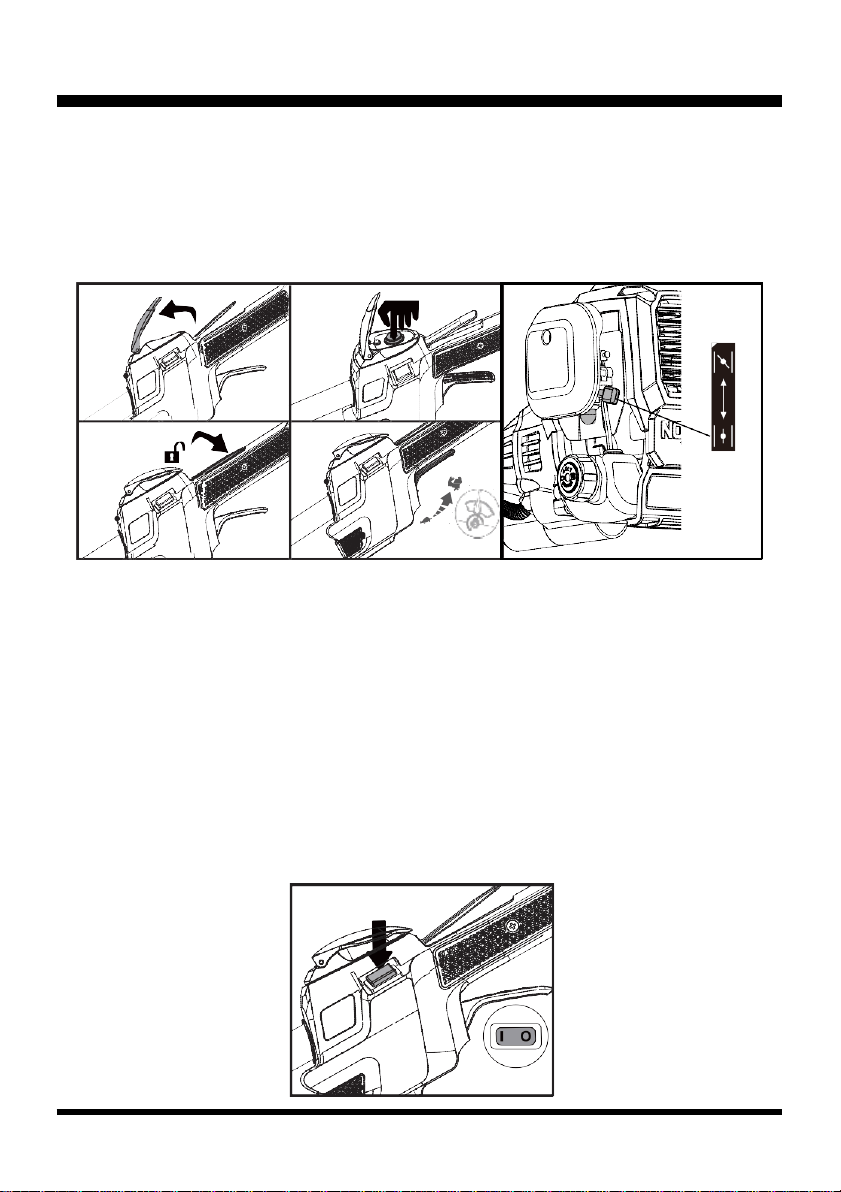
■ Press the primer bulb 5 times or until the bulb fills with fuel.
■ Turn the choke lever to the CHOKE position (Fig. 25).
Fig. 25
Fig. 23
Fig. 24
22
OPERATION
■ Lift the start button cover, press the start button and keep pressed until the engine starts. Manually
turn the choke lever to the RUN position. For best results, let the engine warm up at idle for at least
1 minute, or lightly engage the throttle to speed up the process. Engaging the throttle fully before
the trimmer is warm can cause the engine to stall (Fig. 26 - 28).
■ To begin trimming, engage the throttle safety and the throttle lever. Do not engage the throttle while
pressing the start button (Fig. 29 - 30).
■ If the choke lever is left on choke, the grass trimmer will stop running in 15-30 seconds.
NOTE: If the engine does not start, manually turn the choke lever to the RUN position, and hold the
start button down until the engine starts.
■ If the trimmer continues to fail to start, refer to the Troubleshooting section on pages 37 - 38.
For warm start:
■ Make sure that the battery pack is securely in place.
■ Place the trimmer on a levelled surface, outdoors.
■ Press the primer bulb 5 times or until the bulb fills with fuel.
■ Make sure the choke lever in the RUN position.
■ Lift the start button cover, press the start button and keep pressed until the engine starts. Then
engage the throttle safety and the throttle lever to start the trimmer.
To stop the trimmer: Press the STOP switch to the stop position “O” until the trimmer stops (Fig. 31).
STOP
Fig. 31
START
Fig. 26
Fig. 27
Fig. 29
Fig. 30
Fig. 28
23
OPERATION
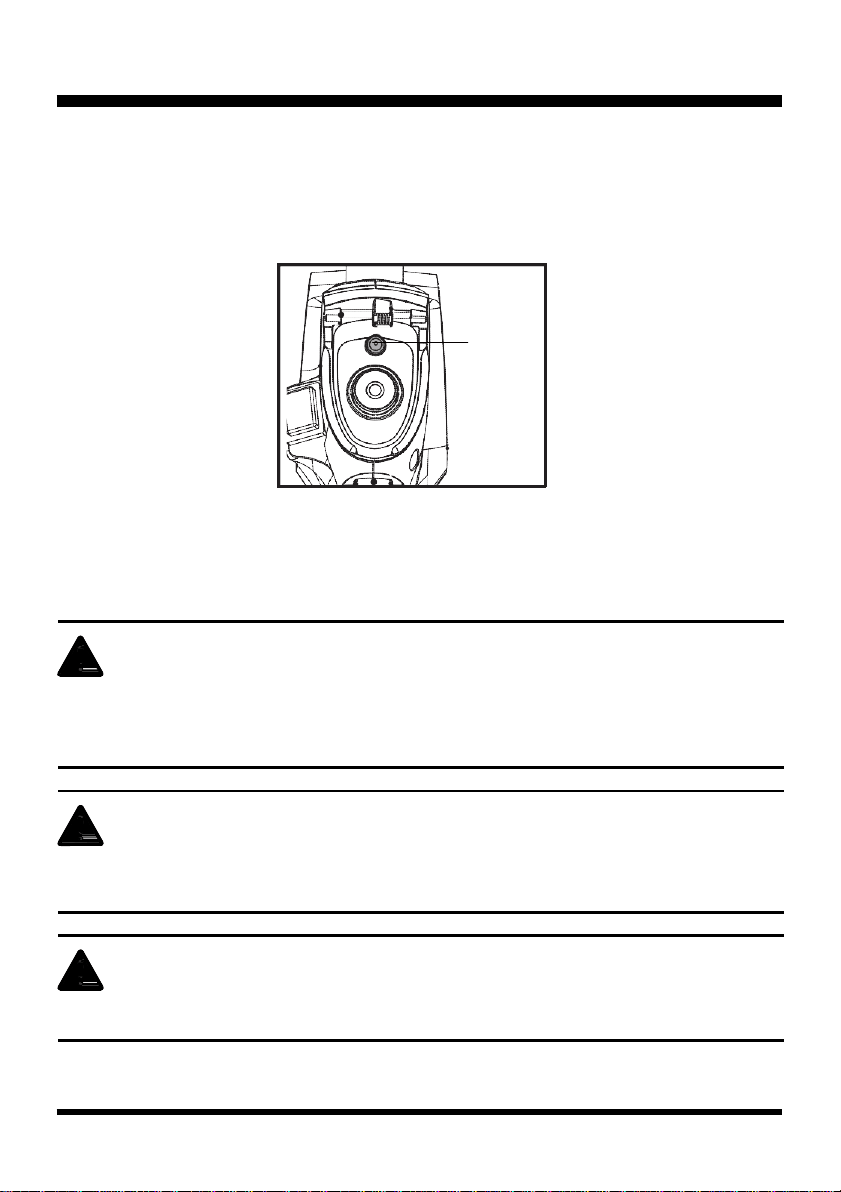
BATTERY POWER INDICATOR (See Fig. 32)
A battery power indicator is located above the start button, and can be used to indicate the battery
status (Fig. 32).
When pushing the start button to start the engine, a green light indicates a fully charged battery; a red
light indicates the battery needs to be charged.
HINT FOR OPTIMUM USE
In order to achieve optimum cutting results, only cut dry grass.
TRIMMING (See Fig. 33)
WARNING
The engine housing can become hot when the trimmer is being used. Do not make contact with this
part of the tool during use and whilst it is still hot. When holding the trimmer, ensure all body parts are
clear of the engine housing. Contact with this part can result in burns or other serious injuries.
WARNING
Always position the trimmer on your right side in order to reduce exposure to hot surfaces which can
cause possible serious injuries.
WARNING
Keep the bottom of the engine below waist level during operation to avoid burns from hot surfaces.
Battery
Power
Indicator
Fig. 32
24
OPERATION
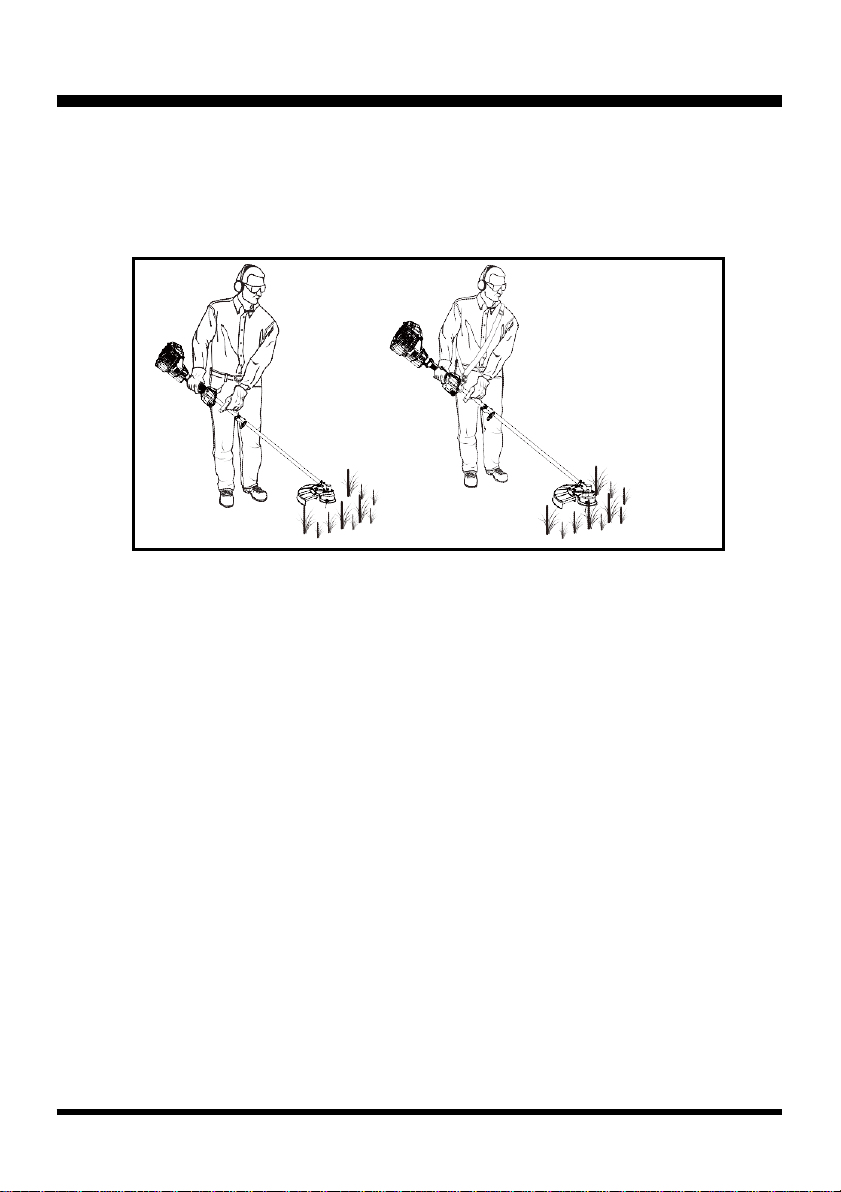
■ Hold the grass trimmer firmly with both hands, keeping your right hand on the main handle and left
hand on the assist handle.
■ The trimmer should be held at a comfortable position with the rear handle at waist level. If using the
shoulder strap (sold separately), put on the shoulder strap and refer to the Installing the Shoulder
Strap section (Fig. 33).
■ Keep your balance with your feet apart.
■ Always operate the trimmer in RUN position. When cutting long grass, work in stages from top to
bottom in small sections. This will prevent the grass being cut from wrapping around the shaft and
the spool head.
■ Hold the grass trimmer head at an angle of approximately 30° to the ground. Avoid pressing it
against the ground as this can ruin the lawn and damage the product.
■ Stop the engine if the grass becomes wrapped around the trimmer head and remove the grass once
the cutting attachment has stopped rotating.
■ Extended use of the tool at partial throttle will result in lubricant dripping from the muffler.
TRIMMING TIPS (See Figs. 33-34)
■ Keep the tool to the right side and away from your body to avoid making contact with the hot
surfaces (Fig. 33).
■ Keep the trimmer head lowered, towards the area being cut.
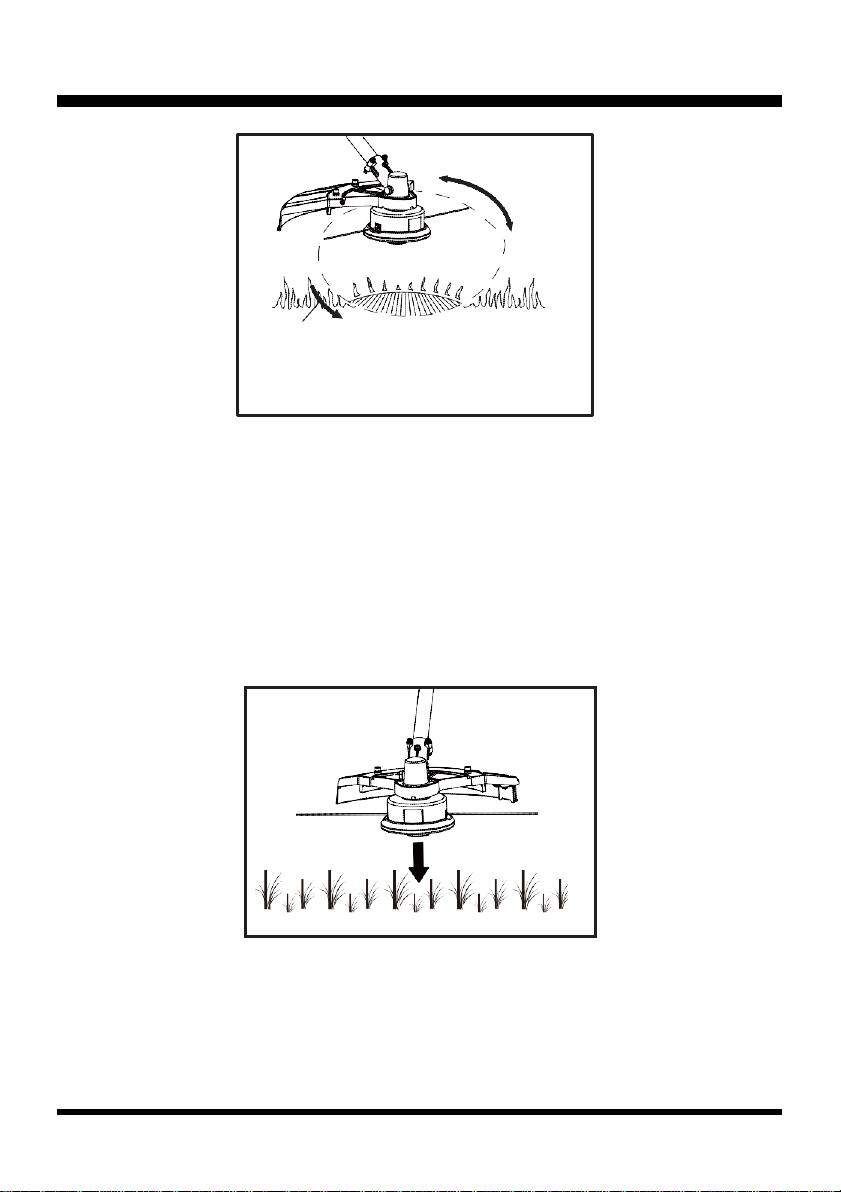
■ The straight shaft trimmer cuts best when moving the unit from left to right. Passing the tool in
this direction will reduce the amount of debris thrown towards the operator. Avoid cutting in the
dangerous area as shown (Fig. 34).
■ Use the tip of line to do the cutting; do not force the trimmer head into uncut grass.
■ The line can wear quickly and even break when used against solid surfaces such as fences,
borders, curbs and walls made of metal, wood, stone and brick. Avoid using the trimmer against
these materials.
Fig. 33
25
OPERATION
Fig. 35
ADVANCING LINE (See Fig. 35)
This trimmer uses a line advance system which requires the operator to tap or bump the trimmer head
on the grass while running the engine at full throttle.
■ Run the engine at full throttle.
■ Tap the trimmer head on the ground to advance the line. With each tap, the line advances further. A
firm but gentle motion should be used when tapping the line on the ground (Fig. 35). DO NOT keep
the trimmer head pressed against the ground.
NOTICE: The cutting blade on the underside of the debris guard will cut the line to the correct length.
NOTICE: Line that is too short may not advance using the tapping method and may need to be done
manually.
To advance the cutting line manually:
■ Stop the engine completely.
■ Push the spool cover in while pulling on the line, until you reach the desired length.
NOTE: After each use, clean the trimmer head with a damp cloth to remove dirt and grime.
B
A
C
A - Direction-of-rotation
B
- Dangerous cutting area
C - Best cutting area
Fig. 34
26
OPERATION
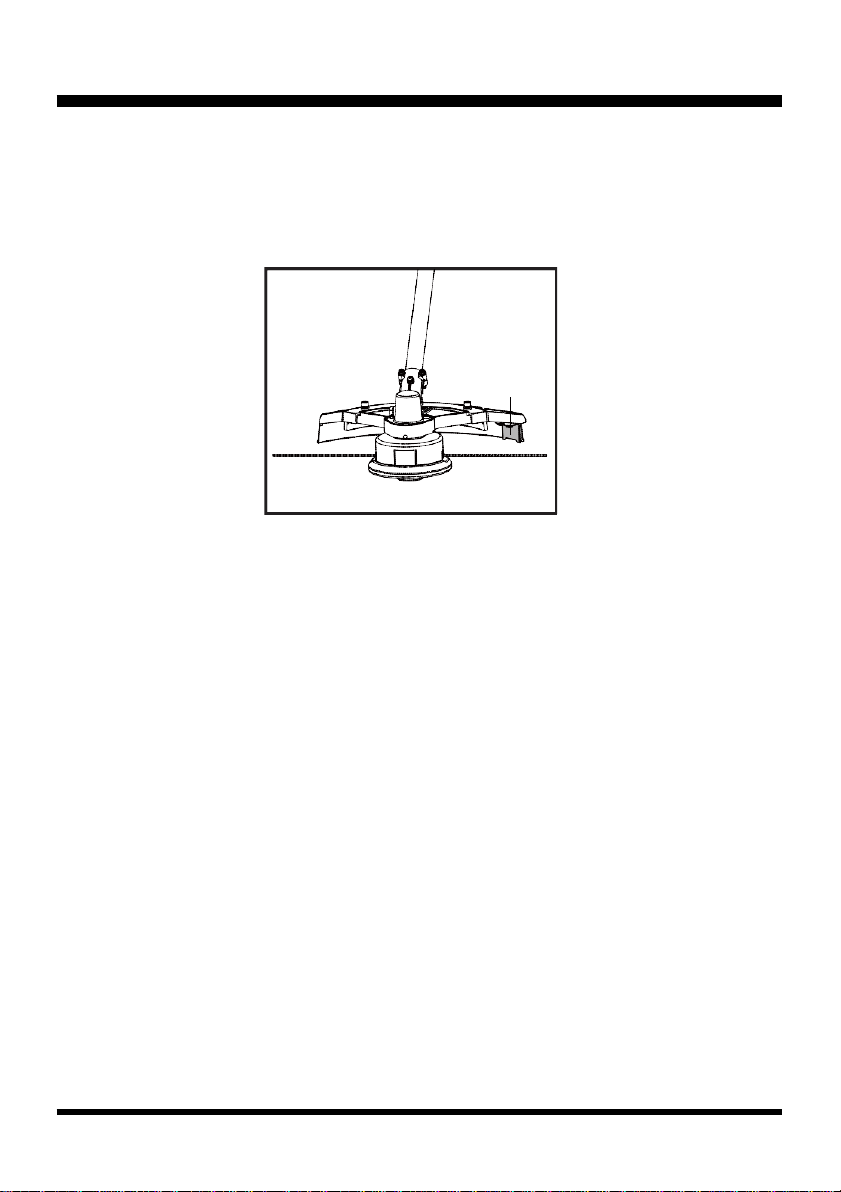
CUTTING BLADE (See Fig. 36)
The trimmer line cutting blade is attached to the underside of the debris guard (Fig. 36).
The cutting blade trims the line at a length that yields optimum cutting results. If the engine is running
faster than normal, or it appears as though the trimmer is less efficient, advance the line. This will
maintain proper performance and keep the line long enough to efficiently cut the grass.
Trimmer Line
Cutting Blade
Fig. 36
27
MAINTENANCE
Normal maintenance, replacement or repair of emission control devices and systems may be
performed by an authorized service center or qualified individual that uses identical parts. Warranty
repairs must be performed by an authorized service center; please contact your service dealer for
assistance or Customer Service (Toll Free Number 866-384-8432).
When servicing, use only identical replacement parts. Use of any other parts may create a hazard or
cause product damage.
WARNING
Before inspecting, cleaning, or servicing the machine, shut off the engine, wait for all moving parts to
stop, and remove the battery pack. Failure to follow these instructions can result in serious personal
injury or property damage.
Always wear eye protection with side shields marked to comply with ANSI Z87.1, along with head
protection. Failure to do so could result in objects being thrown into your eyes and other possible
serious injuries.
NOTICE: Occasionally inspect the tool for damaged, missing, or loose parts such as screws, nuts,
bolts, caps, etc. Do not operate this tool if parts are damaged or missing. Secure all fasteners and
caps prior to using the tool. Please contact your service dealer for assistance or Customer Service (Toll
Free Number 866-384-8432).
GENERAL MAINTENANCE
■ Avoid using solvents when cleaning plastic parts. Most plastics are susceptible to damage from
various types of commercial solvents and may be damaged by their use. Use clean, dry cloths to
remove dirt, dust, oil, grease, etc.
■ Keep all safety devices, air vents, and the motor housing free of dirt and dust.
■ Regularly clean the ventilation slot in your grass trimmer using a soft brush or dry cloth.
■ Regularly clean the cutting line and spool using a soft brush or dry cloth.
■ Regularly remove grass and dirt from the underside of the guard using a blunt scraper.
Do not at any time let brake fluids, gasoline, petroleum-based products, penetrating lubricants, etc.,
come in contact with plastic parts. Chemicals can damage, weaken or destroy plastic which could result
in serious personal injury.
WARNING
WARNING
WARNING
28
MAINTENANCE
BATTERY MAINTENANCE
■ Store the battery pack fully charged.
■ Do not allow the battery pack to become completely discharged.
■ Once the battery pack is fully charged, disconnect the charger from the outlet and remove the
battery from the charger.
■ Do not store the battery pack on the tool or on the charger.
■ Charge the battery at a temperature between 40°F (4°C) and 100°F (38°C). If the battery pack is
hot, allow it to cool down before charging.
Storing the battery for 30 days or longer:
If the lithium-ion battery is being stored for 30 days or longer, store the battery pack in a location where
the temperature does not exceed 80°F (26°C) and is free of moisture.
- Store the battery pack in a 30%-50% charged condition.
- Fully charge the battery back every six months.
- The exterior part of the battery pack may be cleaned with a cloth or soft non-metallic brush.
CHARGER MAINTENANCE
■ Keep the charger clean and clear of debris. Do not allow foreign material into the recessed cavity or
on the contacts. Wipe with a dry cloth. Do not use solvents, water, or place in wet conditions.
■ Always unplug the charger when the battery pack is not installed on the charger.
■ Keep the charger stored at normal room temperature. Do not store it in excessive heat. Do not use
in direct sunlight.
■ Disconnect the charger from the AC power outlet when not in use and once the battery has reached
a full charge.
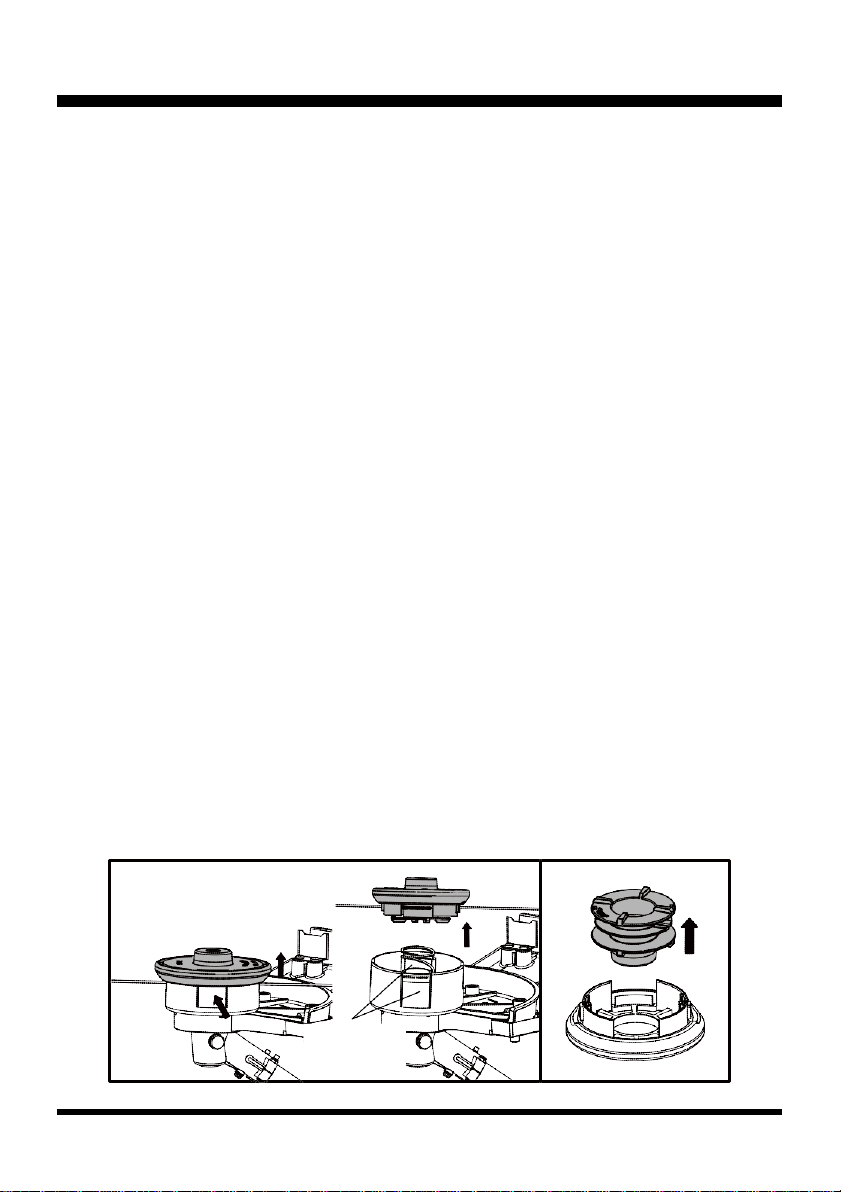
SPOOL REPLACEMENT (See Figs. 37-40)
■ Stop the engine and remove the battery pack.
■ Hold the main spool cover. Using the index finger and thumb firmly squeeze the locking tabs on the
trimmer head housing. Then remove the spool cover together with the spool (Fig. 37).
NOTE: It is not necessary to remove the trimmer head housing from the drive shaft.
■ Remove the empty spool from the spool cover (Fig. 38).
Locking tabs
on the trimmer
Fig. 37
Fig. 38
29
MAINTENANCE
■ Refer to the Line Replacement section in this manual if only the line needs to be replaced.
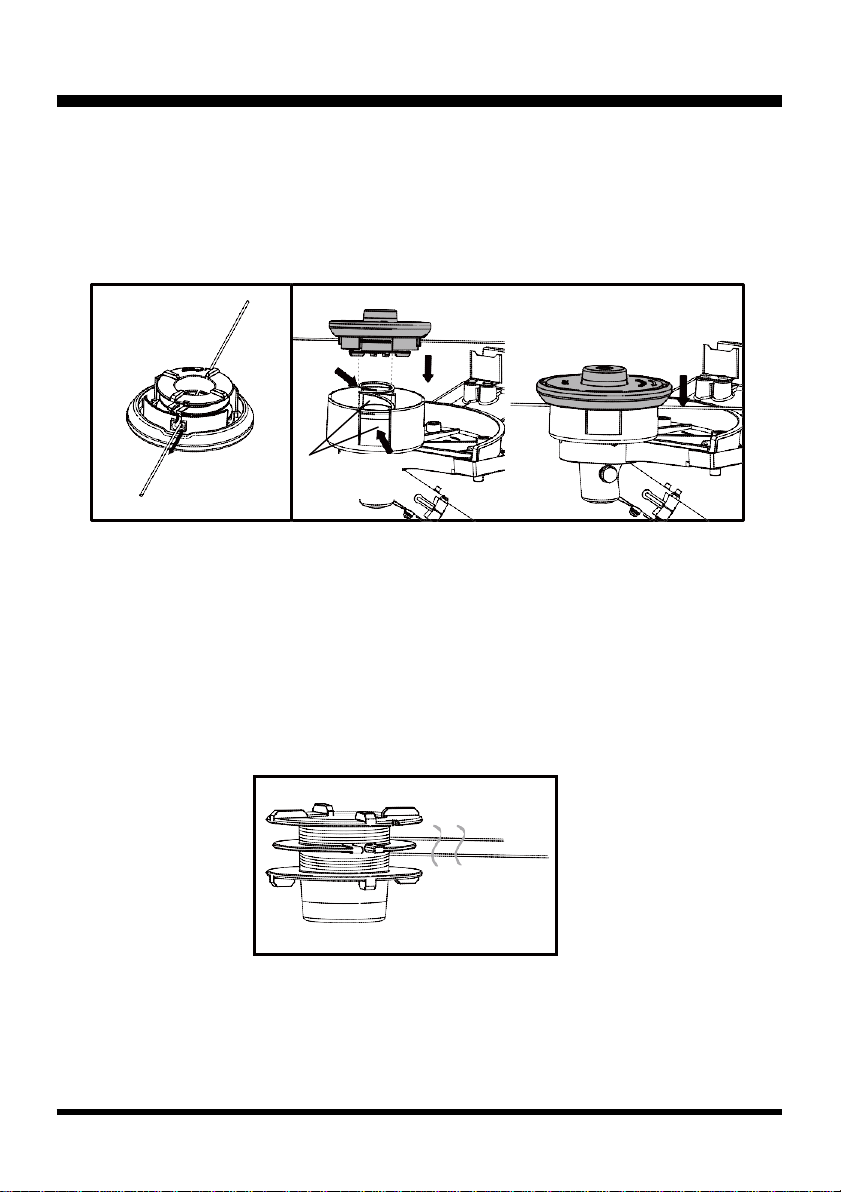
■ Insert the new spool into the spool cover. Release both trimmer lines from the parking slot and guide
the lines into both eyelets (Fig. 39).
■ To reinstall the spool cover, first align the slots on the spool cover with the locking tabs on the
trimmer head housing as shown. Then press the locking tabs and push the spool cover onto the
trimmer head housing. Make sure they are secured tightly (Fig. 40).
LINE REPLACEMENT (See Figs. 41-43)
■ You may wind new cutting lines onto an empty spool.
■ Replacement cutting line is available from a DIY store or online.
■ Remove the empty spool from the grass trimmer referring to the Spool Replacement section.
■ Remove any remaining cutting line from the spool.
NOTE: Use only round monofilament line with the recommended diameter.
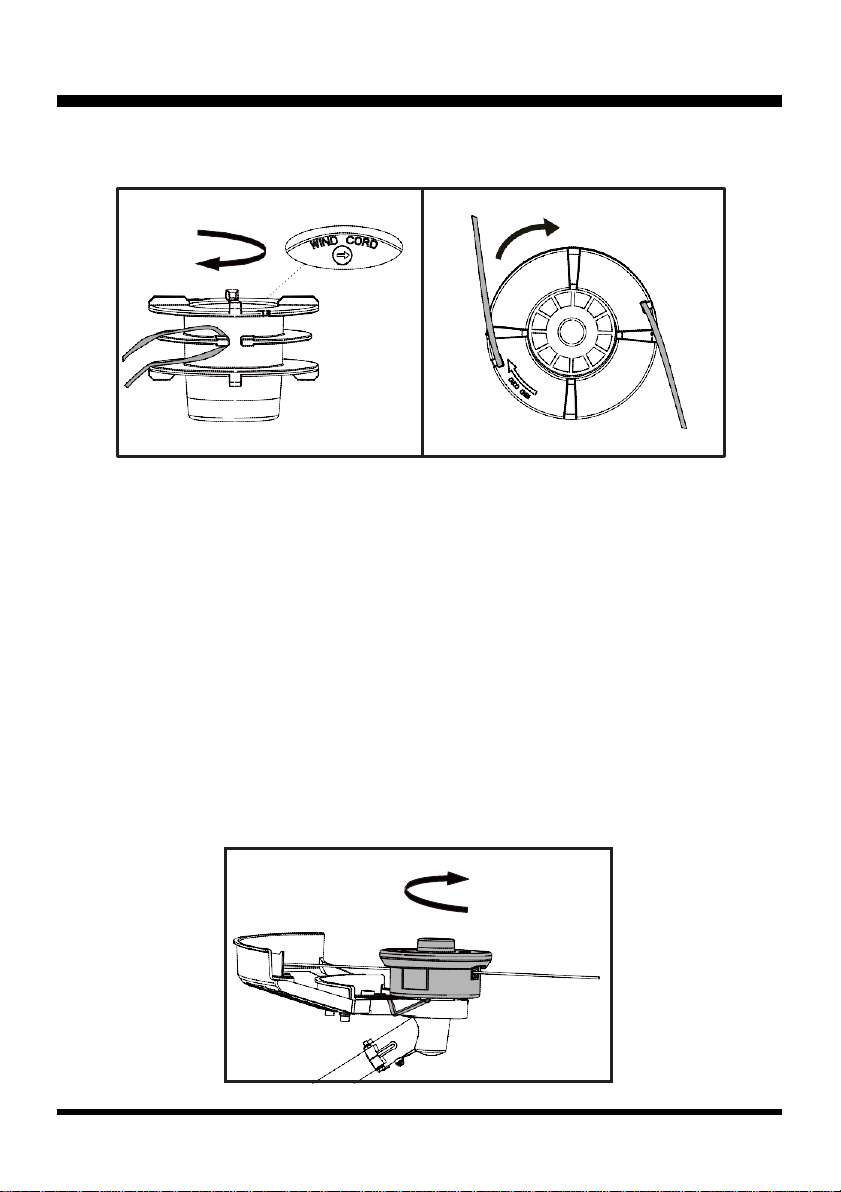
■ Ensure that the new cutting line is sufficiently long, approximately 13 ft (4 m). Fold the line in half
and then adjust it so that one end is approximately 3.5 in. (9 cm) longer than the other (Fig. 41).
■ Hook the folded end of the cutting line onto either of the slots in the spool (Fig. 42).
■ Wind the line onto the spool. Wind the line in the “Wind Cord” arrow direction indicated on the spool
(Fig. 42).
Fig. 41
Locking tabs
on the trimmer
Fig. 39
Fig. 40
30
MAINTENANCE
■ Place the ends of the line in the two opposite parking slots of the spool, leaving some of the line out
(Fig. 43).
NOTE: Always clean the main spool cover and trimmer head housing before reassembling the trimmer
head.
NOTE: Always clean the trimmer head before replacing the spool.
■ Check the spool cover, spool and trimmer head housing for wear and replace parts if necessary.
Install the spool in the spool cover and replace as described in the Spool Replacement section.
NOTE: Only use the appropriate cutting line specified in this manual.
TRIMMER HEAD REPLACEMENT (See Fig. 44)
■ Stop the engine and remove the battery pack.
■ Place the trimmer on a flat stable surface with the trimmer head facing upward.
■ Insert the provided hex wrench into the hole on the flange to lock the spindle. Then rotate the
trimmer head clockwise to remove (Fig. 44).
■ To install the new trimmer head, hold the hex wrench to lock the spindle. Then rotate the trimmer
head counter-clockwise to install. Make sure the trimmer head is installed tightly.
■ Remove the hex wrench from the hole.
Fig. 44
Winding Direction
Fig. 42
Fig. 43
31
MAINTENANCE
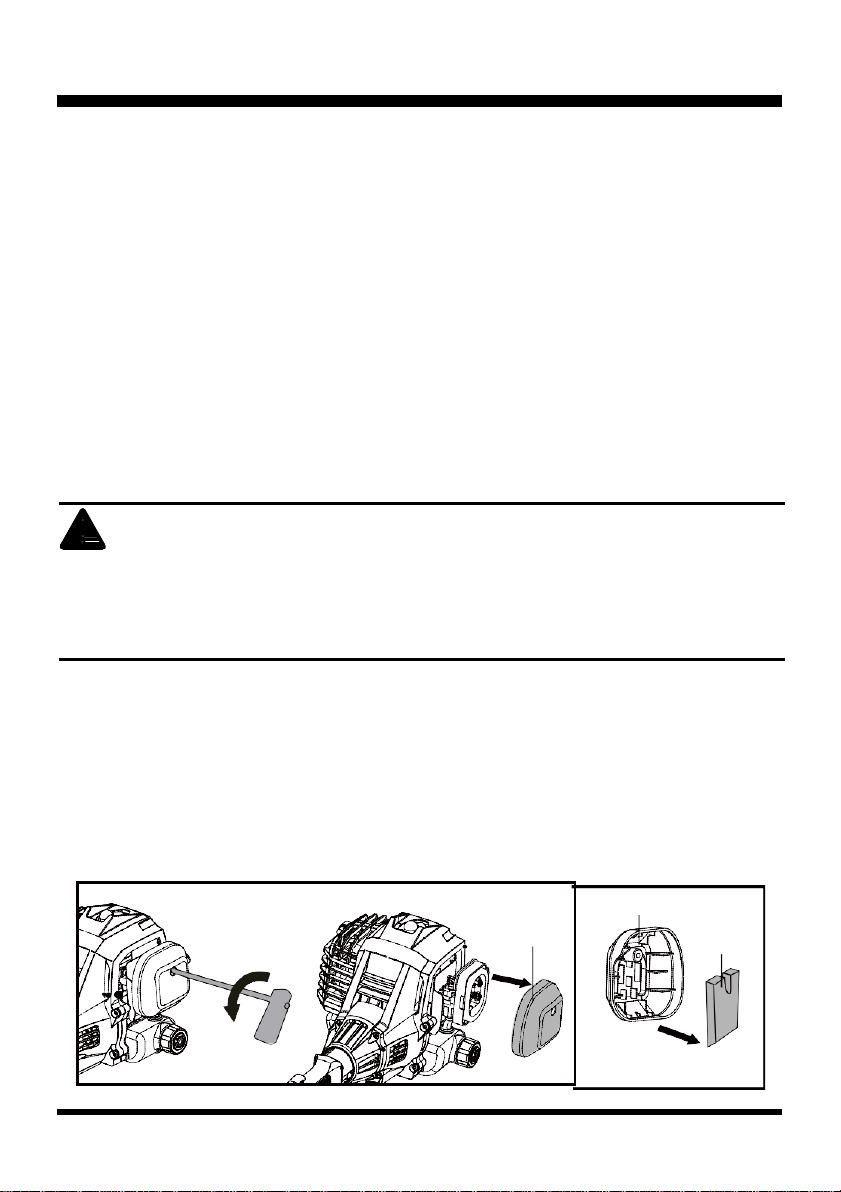
Air Filter Cover
Air Filter
Fig. 46
CLEANING THE EXHAUST PORT, MUFFLER AND SPARK ARRESTOR
NOTICE:
The spark arrestor on this product has not been evaluated by the USDA Forest Service and cannot
be used on U.S. forest lands. In addition, product users must comply with Federal, State, and local
fire prevention regulations. Check with appropriate authorities. Contact Customer Service or your
authorized service center to purchase a replacement spark arrestor.
If the trimmer appears less efficient or powerful, it may be due to the build-up of carbon deposits
around the exhaust port and muffler. This may occur depending on the type of fuel used, the type and
amount of lubricant used, or the operating conditions. In order to restore performance, take the trimmer
to an authorized service center or qualified individual to remove the blockage.
The spark arrestor must be cleaned or replaced every 50 hours or yearly to ensure proper performance
of your product. Spark arrestors may be in different locations depending on the model purchased.
Please contact your nearest service dealer for the location of the spark arrestor for your model.
IDLE SPEED ADJUSTMENT
The trimmer head will move when adjusting the idle speed. Wear protective clothing and keep all
bystanders, children, and pets at least 50 ft. (15 m) away. Keep the trimmer off the ground and away
from any objects when making adjustments. Keep all parts of your body away from the trimmer head
and muffler. Failure to follow these instructions could result in serious personal injury.
The cutting attachment should never turn at idle. If the cutting attachment moves at idle speed,
discontinue use immediately and contact an authorized service center to have the tool repaired.
Serious personal injury could result from the cutting attachment turning at idle.
CLEANING THE AIR FILTER (See Figs. 45-48)
Keep the air filter clean for proper performance and long life.
■ Loosen the screw to remove the air filter cover (Fig. 45).
■ Remove the air filter from the air filter cover (Fig. 46).
Air Filter
Cover
Fig. 45
WARNING
32
MAINTENANCE
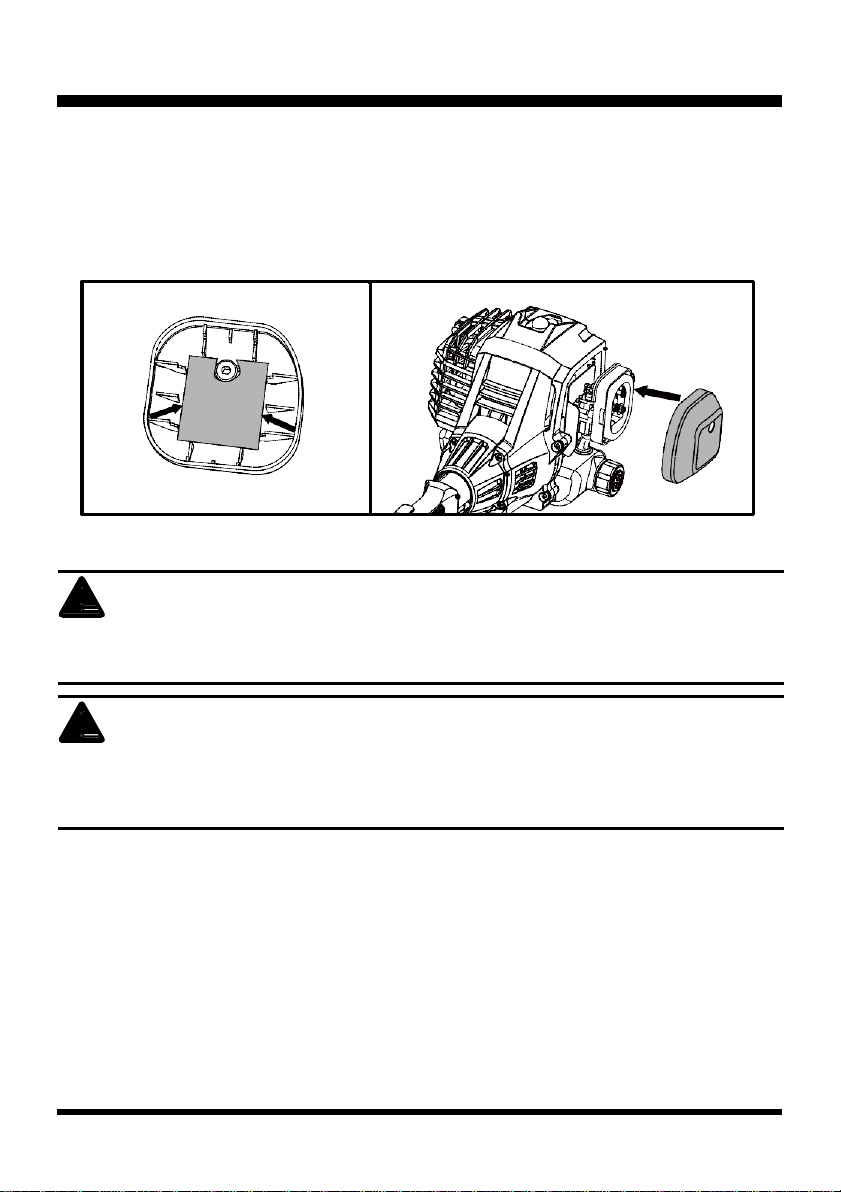
NOTE: Inspect the filter for damage and replace with a new filter if necessary.
■ Clean the foam filter with warm soapy water and rinse. Air dry the filter.
■ Place the air filter back, ensuring that it properly seated onto the air filter cover. Installing the filter
correctly will decrease the chances of engine wear caused by dirt entering the engine (Fig. 47).
■ Replace the air filter cover ensuring the air filter is completely covered (Fig. 48).
■ Turn the screw clockwise to secure the air filter cover.
FUEL TANK CAP, TANK AND LINES
Fuel is EXTREMELY flammable. Be very cautious and use care when mixing storing or handling.
Failure to follow this instruction may lead to serious personal injury.
Check for fuel leaks. Do not use the trimmer in the presence of a leak as it is a fire hazard. Loose or
damaged tank caps, or leaking tanks must be replaced immediately. Failure to follow this instruction
may lead to serious personal injury.
Use a clean cloth to remove loose dirt from around the fuel tank cap and empty the fuel tank. The fuel
tank cap contains a check valve. If the performance improves when the fuel tank cap is loosened, the
check valve may be faulty. Replace the fuel tank cap if required.
A clogged fuel filter will cause poor engine percformance. Replace the fuel filter if required as it is a
non-serviceable part. Please contact your nearest service center for replacing this fuel filter.
SPARK PLUG REPLACEMENT (See Figs. 49-52)
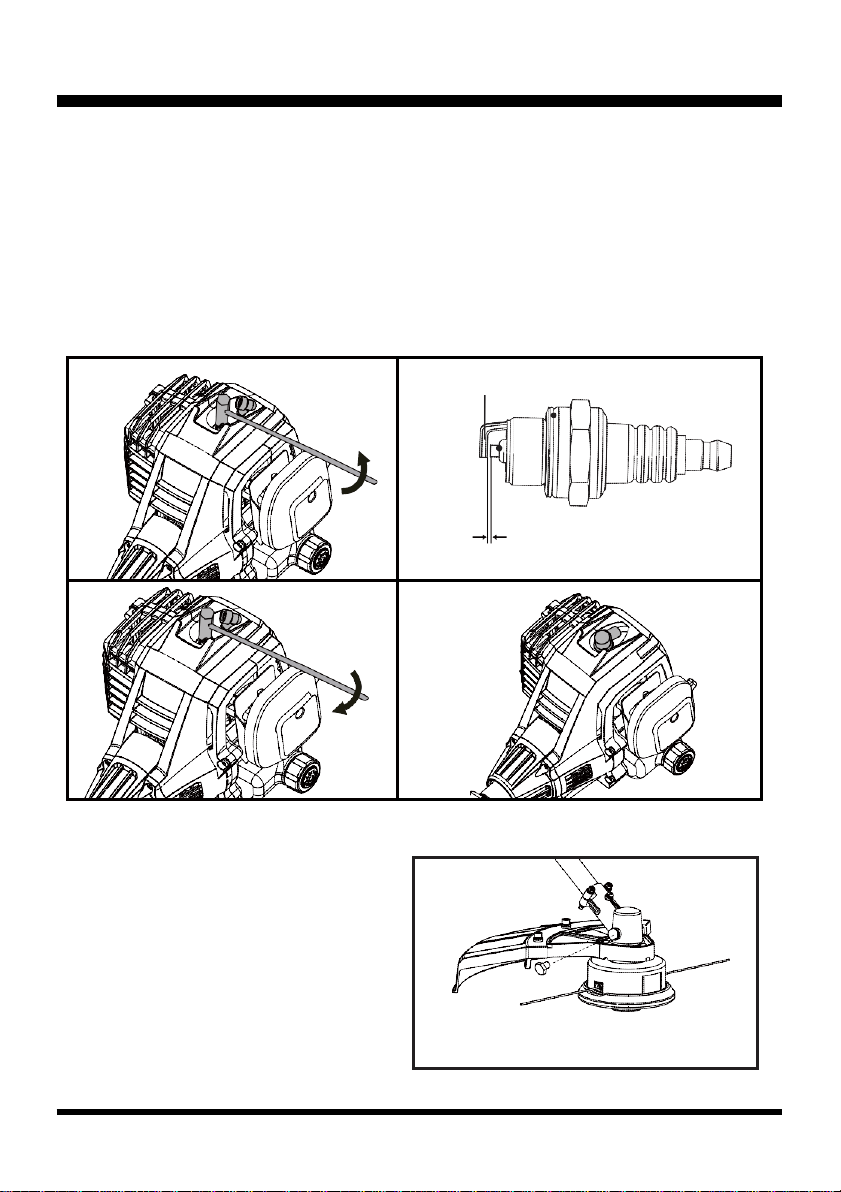
The spark plug for this engine may be replaced using an identical or equivalent spark plug as provided
with the tool. The spark plug gap should be set at 0.026 in. (0.65 mm). Replace annually with a
recommended or equivalent replacement part.
WARNING
DANGER
Fig. 48
Fig. 47
33
MAINTENANCE
■ Remove the spark plug cap. Fully cover the spark plug using the provided socket wrench. Rotate
the socket wrench counter-clockwise to remove the spark plug (Fig. 49).
■ Check the spark plug for fouling, worn and rounded center electrode. Clean the plug or replace with
a new one. DO NOT use a blowing tool to clean as the movement of dirt may damage the engine.
■ Adjust spark plug gap by bending outer electrode (Fig. 50).
■ Reinstall the cleaned or a new spark plug by turning it clockwise into place (Fig. 51).
■ Reinstall the spark plug cap into place (Fig. 52).
NOTICE: Be careful not to cross-thread the spark plug. Cross-threading will seriously damage the
product.
Fig. 49
Outer Electrode
0.026 in. (0.65 mm)
Fig. 50
Fig. 51
Fig. 52
LUBRICATION (See Fig. 53)
Gear Box Housing
■ Clean all loose debris from the gear case.
■ Use a proper tool to remove the screw and
check the level of grease (Fig. 53).
■ Add grease if necessary. DO NOT over-fill.
Fig. 53
34
MAINTENANCE
STORAGE
Clean the trimmer of any debris and store indoors in a dry, well-ventilated area that is inaccessible to
children. Keep away from corrosive agents such as garden chemicals and de-icing salts.
Abide by all ISO and local regulations for the safe storage and handling of gasoline.
Storing for 30 days or longer:
Drain all the fuel from the tank into a container approved for storing gasoline. Press the primer bulb 3 - 4
times to remove the remaining fuel from the carburetor. Run the engine until it stops.
HIGH ALTITUDE ENGINE OPERATION
Initially your engine is configured for operation below 2000 ft. altitude. If the trimmer is being used
above 2000 ft. altitude, the engine must be re-configured accordingly. Operating the engine with the
wrong engine configuration at a given altitude may increase its emissions, drop fuel efficiency, reduce
performance and cause irreparable damage. Engines configured for high altitude operation will need to
be reconfigured for use in standard altitude conditions. Your authorized service center should ensure that
your engine is properly configured for your location.
THIS PRODUCT WAS MANUFACTURED WITH A CATALYST MUFFLER
Congratulations! You have made an investment toward protecting the environment. In order to maintain
this product’s original emission level, please refer to the maintenance section below.
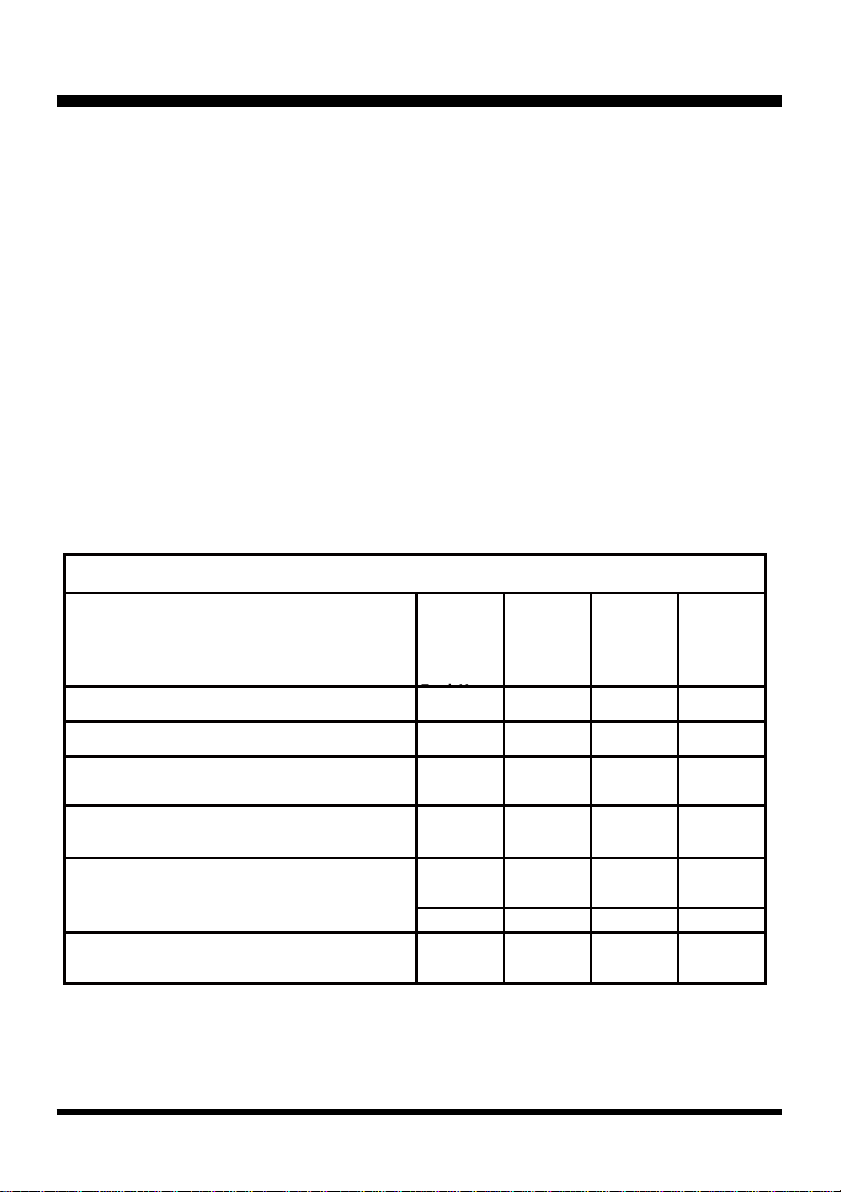
MAINTENANCE SCHEDULE
Maintenance Part
Inspect
For
Damage
Before
Eh U
Clean
Every
5 Hours
Replace
Every
25 Hours
or Yearly
Replace
Every
50 Hours
* CATALYTIC MUFFLER ASSEMBLY
Y
SPARK SCREEN
Y
* AIR FILTER ASSEMBLY
Includes: Filter Screen
Y
* CARBURETOR ASSEMBLY
Includes: Gaskets
Y
* FUEL TANK ASSEMBLY
Includes: Fuel Lines & Fuel Tank Cap
Fuel Filter
Y
Y
* IGNITION ASSEMBLY
Includes: Spark Plug
Y
* NOTICE: THE USE OF EMISSION CONTROL COMPONENTS OTHER THAN THOSE DESIGNED
FOR THIS UNIT IS A VIOLATION OF FEDERAL LAW.
35
ENVIRONMENTALLY SAFE BATTERY DISPOSAL
The following toxic and corrosive materials are in the batteries used in this battery pack:
Lithium-ion, a toxic material.
WARNING
All toxic materials must be disposed of in a specified manner to prevent contamination of the
environment. Before disposing of damaged or worn out lithium-ion battery packs, contact your local
waste disposal agency, or the local Environmental Protection Agency for information and specific
instructions.
WARNING
If the battery pack cracks or breaks, with or without leaks, do not recharge it and do not use. Dispose of
it and replace with a new battery pack.
DO NOT ATTEMPT TO REPAIR IT!
To avoid injury and risk of fire, explosion, or electric shock, and to avoid damage to the environment:
■ Cover the battery terminals with heavy-duty adhesive tape.
■ DO NOT attempt to remove or destroy any of the battery pack components.
■ DO NOT attempt to open the battery pack.
■ If a leak develops, the released electrolytes are corrosive and toxic. DO NOT get the solution in the
eyes or on skin, and do not swallow it.
■ DO NOT place these batteries in your regular household trash.
■ DO NOT incinerate.
■ DO NOT place batteries where they will become part of any waste landfill or municipal solid waste
stream.
■ Take batteries to a certified recycling or disposal center.
36
TROUBLESHOOTING
If your grass trimmer does not appear to operate properly, follow the instructions below. If this does not
solve the problem, please contact your local repair agent.
WARNING
Before proceeding, shut off the engine, wait for all moving parts to stop, and remove the battery pack.
Failure to follow these instructions can result in serious personal injury or property damage.
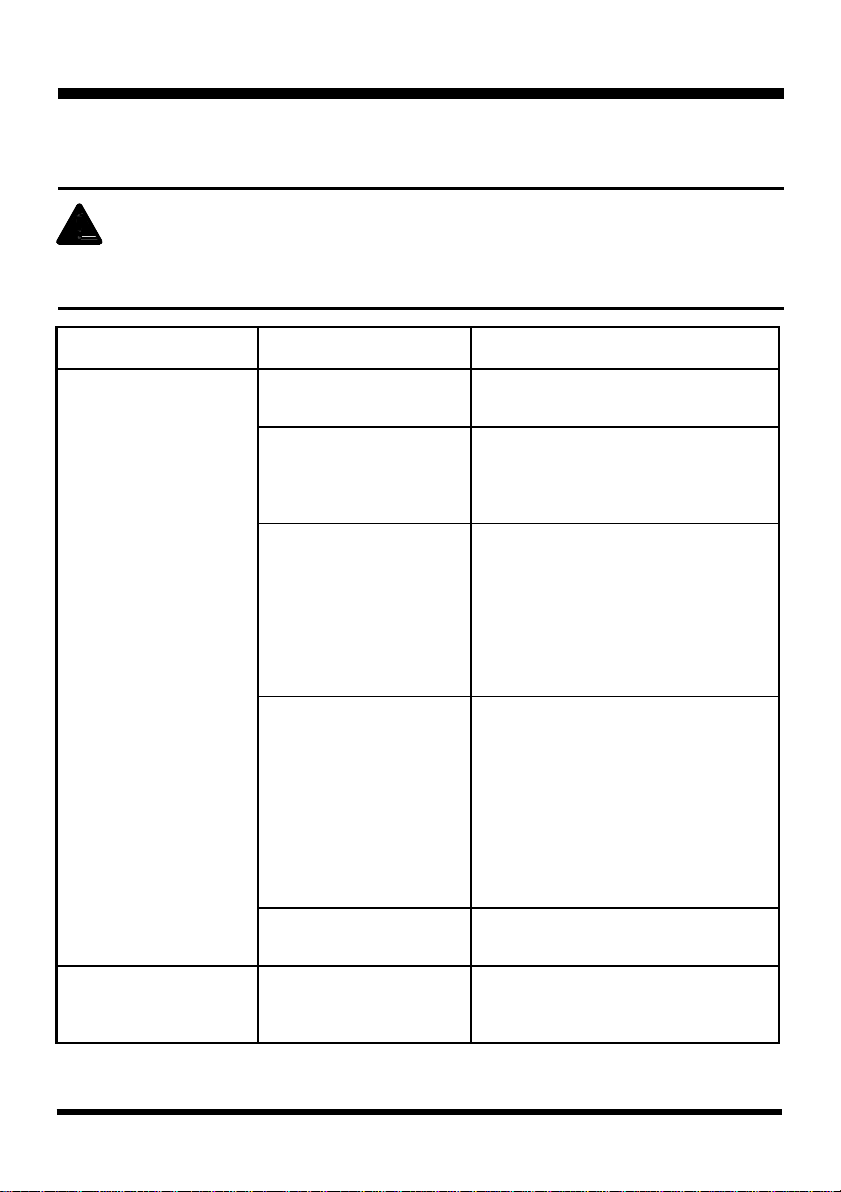
PROBLEM POSSIBLE CAUSE SOLUTION
The engine does not
start.
The battery is not secure.
Insert the battery correctly. Ensure the
battery is fully charged.
No spark.
Clean or replace the spark plug. Reset
the spark plug gap. Refer to the Spark
Plug Replacement section in this
manual.
No fuel.
Check that there is sufficient fuel in the
fuel tank. Push the primer bulb until the
bulb is full of fuel. If the bulb does not
fill, the primary fuel delivery system is
blocked. Contact an authorized service
dealer. If the primer bulb fills, the engine
may be flooded, proceed to the next
item.
The engine is flooded.
Remove the spark plug referring to the
Spark Plug Replacement section in this
manual. Press the start button 5 to 10
times. Then place the trimmer still with
the spark plug removed for about 30
minutes. After 30 minutes, replace the
spark plug referring to the Spark Plug
Replacement section. Then re-start the
engine. If the engine still does not start,
contact an authorized service dealer.
The air filter is blocked.
Clean the air filter. Refer to Cleaning the
Air Filter section in this manual.
The engine does not
reach full speed and
emits excessive smoke.
Incorrect
lubricant/fuel
mixture.
Use fresh fuel and the correct 2-cycle
lubricant mix (40:1).
37

TROUBLESHOOTING
The air filter is dirty.
Clean the air filter. Refer to Cleaning the
Air Filter section in this manual.
The spark plug is worn out.
Clean or replace the spark plug. Reset
the spark plug gap. Refer to the Spark
Plug Replacement section in this
manual.
The engine overheats.
Allow the engine to run at idle for 5
minutes. Then stop the trimmer and
allow it to cool for about 20 minutes.
The spark arrestor screen
is dirty.
Contact an authorized service dealer.
The engine starts, runs,
and accelerates but will
not idle.
The idle speed screw
on carburetor needs
adjustment.
Contact an authorized service dealer.
The line will not advance.
The line is welded to itself. Lubricate the line with silicone spray.
Insufficient cutting line.
Install more line. Refer to the Line
Replacement section in this manual.
The line is worn too short
Tap the trimmer head on the ground. If
the line does not advance, turn off the
trimmer, then pull lines while alternately
pressing down on and releasing the
spool cover.
The line is tangled on the
spool.
Remove the line from the spool and
rewind. Refer to the Line Replacement
section in this manual.
The engine speed is too
slow.
Advance the line at full throttle.
The grass wraps around
the drive shaft housing
and the trimmer head.
Cutting tall grass at the
ground level.
Cut tall grass from the top down to
prevent wrapping.
Operating the trimmer at
part throttle.
Operate the trimmer at full throttle.
38

WARRANTY
LawnMaster
®
No-Pull
™
LIMITED WARRANTY
We take pride in producing a high quality, durable product. This LawnMaster
®
product
carries a limited two (2) year warranty against defects in workmanship and materials from date of
purchase under normal household use. This product carries a ninety (90) day warranty from the
date of purchase when used for commercial or rental purposes. Batteries and chargers carry a
two-year warranty against defects in workmanship and materials from date of purchase.
Batteries must be charged in accordance with the Operator's Manual directions and regulations in
order to be valid. Warranty does not apply to defects due to alterations, direct or indirect abuse,
negligence, misuse, accidents, repairs, and lack of maintenance. Please keep your receipt/packing list
as proof of purchase. This warranty gives you specific legal rights, and you may have other rights,
which vary from state to state. For product service contact your authorized dealer or call Customer
Service at 866-384-8432.
Items not covered by warranty :
1. Any part that has become inoperative due to alteration, misuse, commercial use, abuse, neglect,
accident, or improper storage or maintenance.
2. The unit, if it has not been operated and/or maintained in accordance with the Operator's Manual.
3. The unit, if damage or engine failure is due to absence of 2-stroke oil, improper 2-stroke oil mix
ratio, or use of 2-stroke oils not meeting standards specified in this manual.
4. The unit, if damage is caused by the use of gasoline containing more than 10% ethanol content
(E10).
5. Normal wear, except as noted below.
6. Routine maintenance items such as lubricants, blade sharpening, etc.
7. Normal deterioration of the exterior finish due to use or exposure.
8. Parts that can wear out from normal use within the warranty period, such as the blades, collection
bags, spools, spool covers, etc.
Transportation Charges : Transportation charges for the movement of any power equipment unit or
attachment are the responsibility of the purchaser. It is the purchaser’s responsibility to pay
transportation charges for any part submitted for replacement under this warranty unless such
return is requested in writing by LawnMaster
®
.
THIS WARRANTY ONLY APPLIES TO ORIGINAL PURCHASER WITH PROOF OF PURCHASE.
THIS WARRANTY IS VOID WITHOUT PROOF OF PURCHASE.
39
EXPLODED VIEW
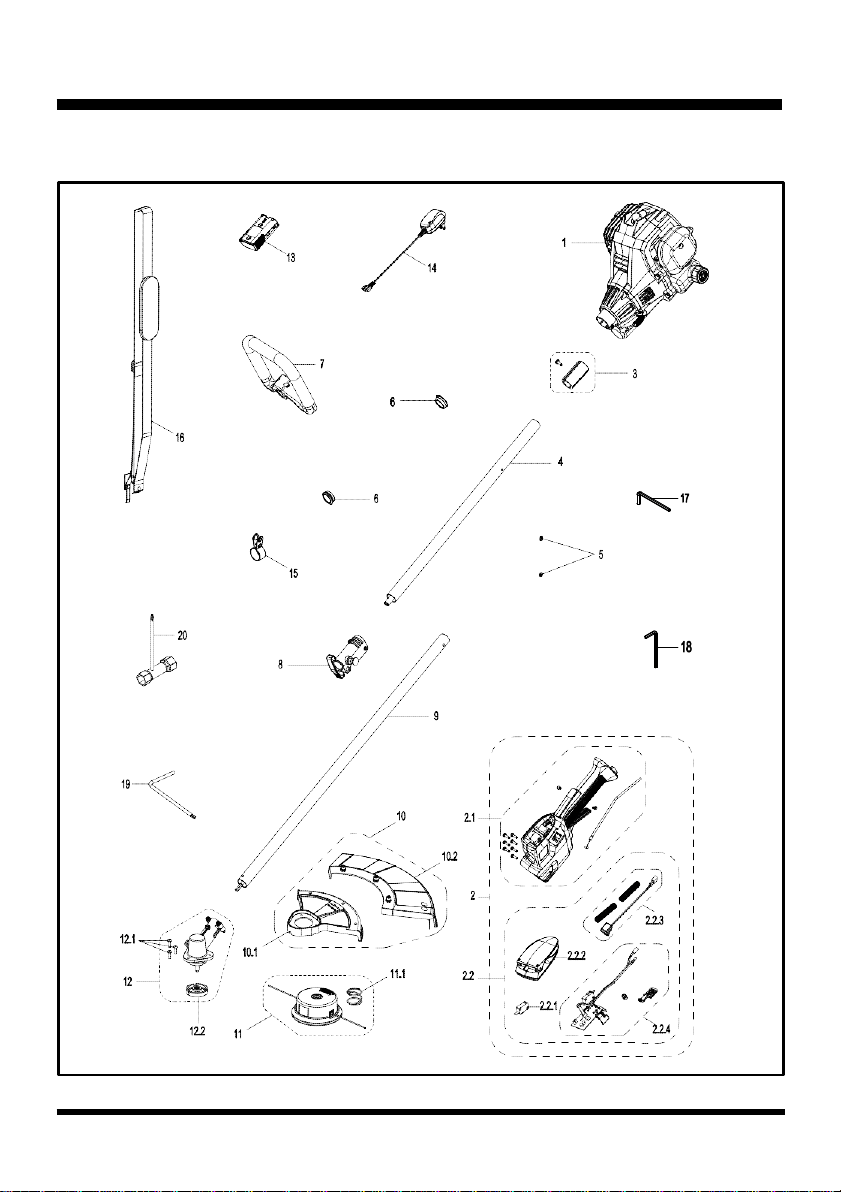
NPTGSP2517A EXPLODED VIEW
40
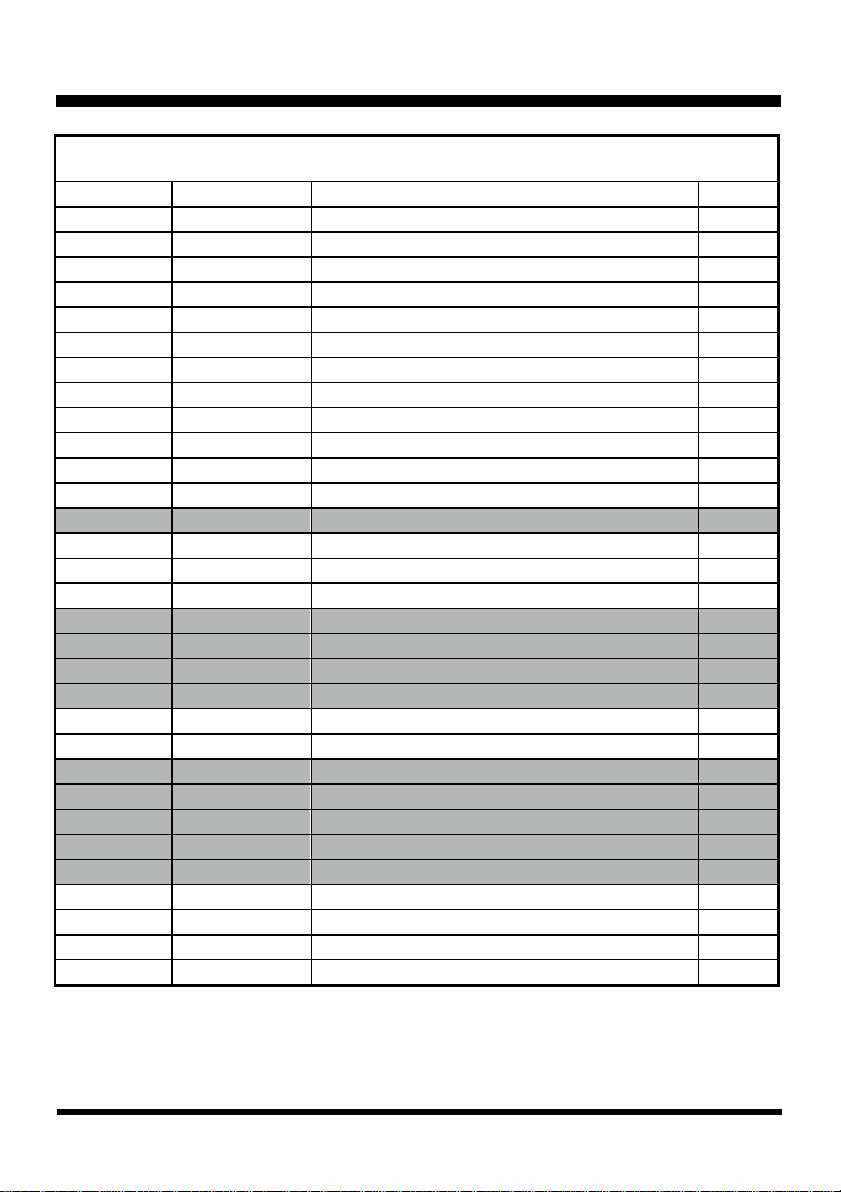
PARTS LIST
NPTGSP2517A MANUAL PARTS LIST
Key Number
Part Number
Description
Quantity
1
25cc 2-Cycle Engine Assembly
1
2
Throttle-body & Starter Set
1
2.1
Throttle-body Set
1
2.2
Starter Set
1
2.2.1
Electric Switch
1
2.2.2
Starter Switch Assembly
1
2.2.3
Stop Switch Set 1
2.2.4
PCB Assembly
1
3
Connection Cover Assembly 1
4
Aluminum Upper Shaft
1
5
Cable Clamp
2
6
Handle Spacer
2
7
321008103
Assistant handle
1
8
aluminium connector assembly
1
9
Lower aluminium tube assy
1
10
Protector guard assembly 1
10.1
321008107
Small protector guard assembly
1
10.2 321008108 Large protector guard assembly 1
11
321008109
Spool Assembly
1
11.1 321008110 Compression spring 1
12
Gear Box Assembly
1
12.1
Screw M5*16
3
12.2
321008113
Cover Plate
1
13
321007116
7.2V 1.3Ah Battery
1
14
321001127
Charger
1
15
321001128
Shoulder Strap Clasp (Available Separately)
1
16 221003102 Shoulder Strap (Available Separately) 1
17
M5 Hexagon Socket Wrench
1
18
M6 Hexagon Socket Wrench 1
19
Hex Key
1
20
Socket Wrench 1
Replacement parts highlighted in grey are available for after sales purchase. Replacement of repair or
internal parts should only be done by a qualified service professional. Please contact your authorized
service dealer or Customer Service at 866-384-8432.
41
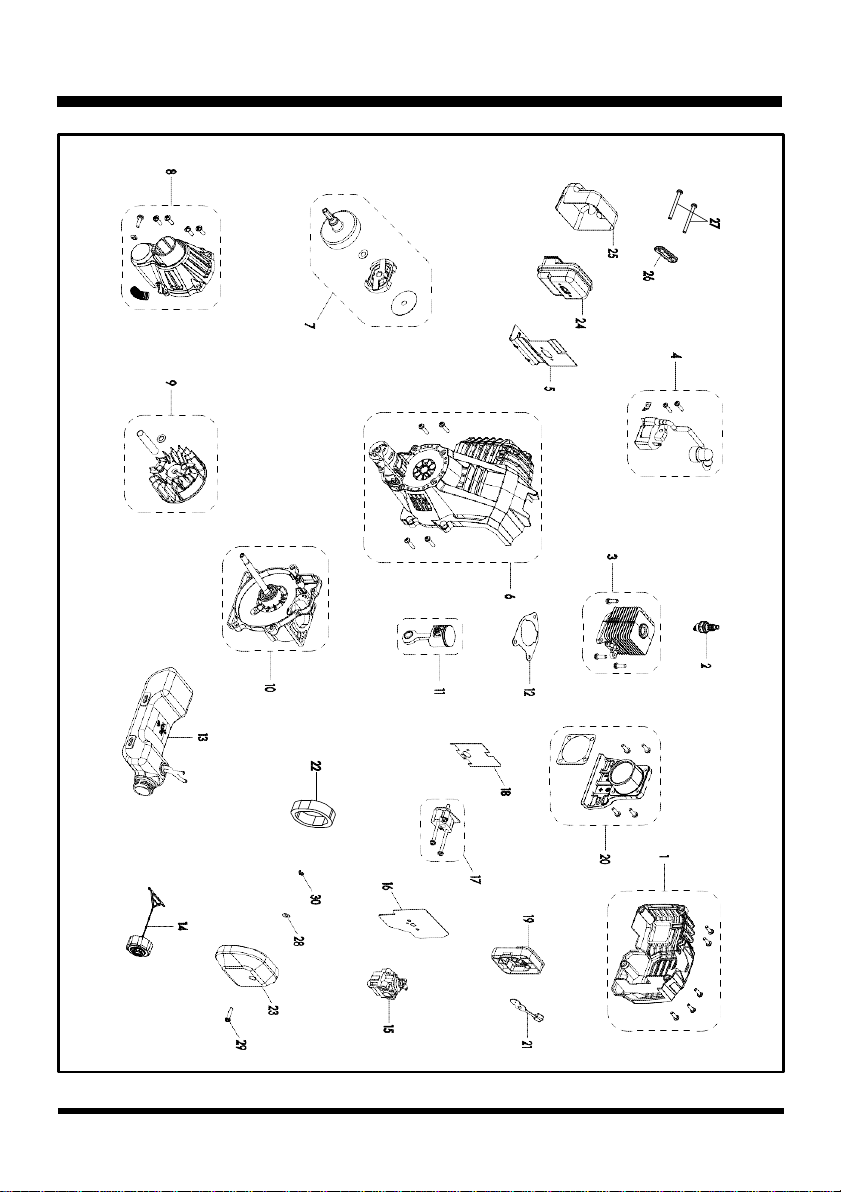
EXPLODED VIEW 25CC 2-CYCLE ENGINE
42
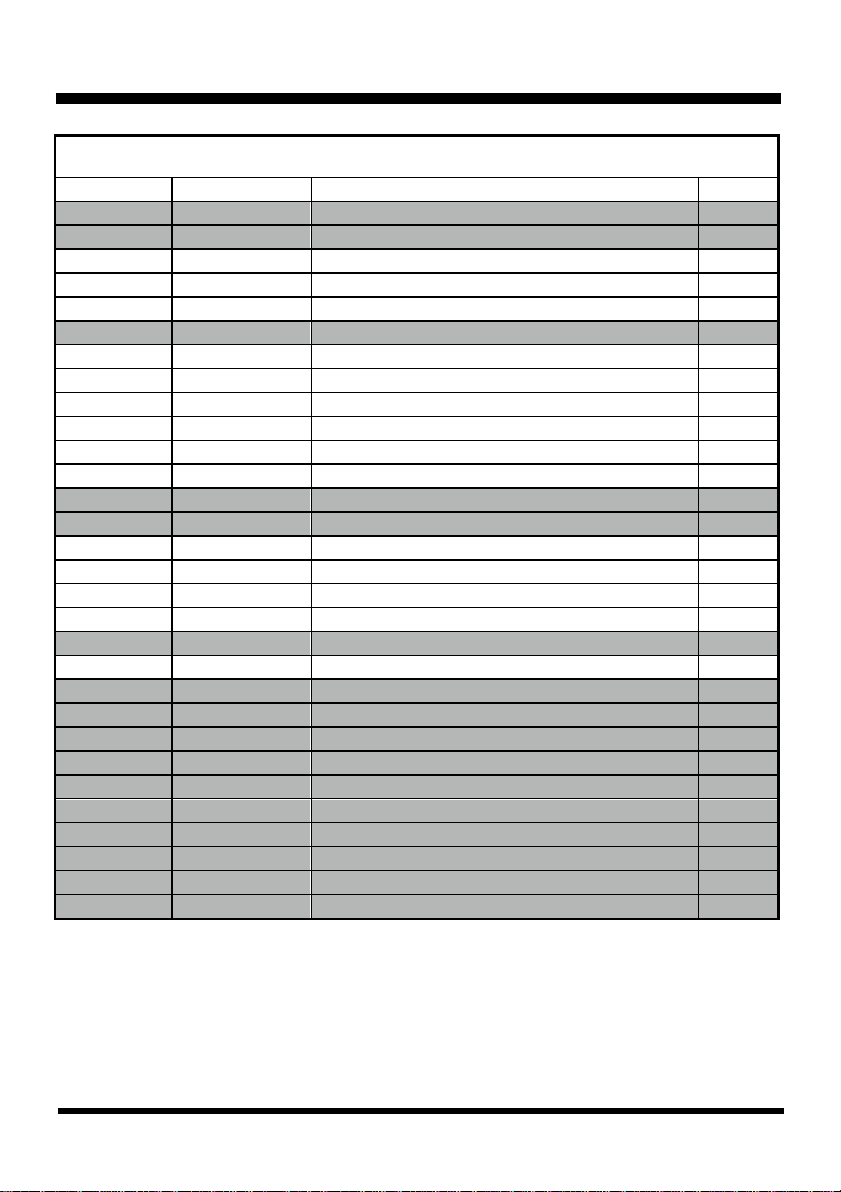
PARTS LIST 25CC 2-CYCLE ENGINE
25CC 2-CYCLE ENGINE PART LIST
Key Number
Part Number
Description
Quantity
1
321007184
Rear Engine Cover Assembly
1
2
321001139
Spark Plug
1
3
Cylinder Assembly
1
4
Ignition Coil Assembly
1
5
Insulation Sheet
1
6
321007188
Front Cover Assembly
1
7
Clutch Assembly
1
8
Connection Cover Assembly
1
9
Flywheel Assembly
1
10
Crankcase Assembly
1
11
Piston 1
12
Gasket 1
13 321007193 Fuel Tank 1
14 321007167 Fuel Cap 1
15
Carburetor Assembly
1
16
Washer
1
17
Carburetor Mount Assembly
1
18
Washer
1
19
321007159
Air Filter Base
1
20
Crankcase Cover
1
21
321007160
Choke Lever
1
22
321007161
Air Filter
1
23
321007162
Air Filter Cover
1
24
321007128
Muffler
1
25
321007129
Muffler Cover
1
26
321007130
Gasket
1
27
321007180
Screw Assembly
2
28
321007176
Washer
1
29
321007183
Screw
1
30
321007173
Spring
1
Replacement parts highlighted in grey are available for after sales purchase. Replacement of repair or
internal parts should only be done by a qualified service professional. Please contact your authorized
service dealer or Customer Service at 866-384-8432.
43

NOTAS
44
