
en Safety
2
Table of contents
INFORMATION FOR USE
1 Safety...................................................................2
2 Preventing material damage ..............................6
3 Environmental protection and saving en-
ergy ......................................................................6
4 Familiarising yourself with your appliance .......7
5 Accessories.........................................................8
6 Before using for the first time ............................9
7 Basic operation ...................................................9
8 Microwave ...........................................................9
9 Microwave combi mode....................................11
10 Grill ....................................................................12
11 Meals..................................................................13
12 Time-setting options.........................................14
13 Childproof lock..................................................15
14 Basic settings....................................................16
15 Cleaning aid.......................................................17
16 Cleaning and servicing.....................................17
17 Troubleshooting................................................18
18 Disposal.............................................................20
19 Customer Service..............................................20
20 How it works......................................................20
21 INSTALLATION INSTRUCTIONS ......................28
21.2 Safe installation ..............................................
..29
1 Safety
Observe the following safety instructions.
1.1 General information
¡ Read this instruction manual carefully.
¡ Keep the instruction manual and the
product information safe for future refer-
ence or for the next owner.
¡ Do not connect the appliance if it has been
damaged in transit.
1.2 Intended use
Only a licensed professional may connect ap-
pliances without plugs. Damage caused by in-
correct connection is not covered under the
warranty.
The appliance can only be used safely if it is
correctly installed according to the safety in-
structions. The installer is responsible for en-
suring that the appliance works perfectly at its
installation location.
Only use this appliance:
¡ To prepare meals and drinks.
¡ Under supervision. Never leave the appli-
ance unattended when cooking for short
periods.
¡ For household use and similar applications,
such as: In kitchens for employees in
shops, offices and other commercial sec-
tors; in agriculture; by customers in hotels
and other residential facilities; in bed and
breakfasts.
¡ up to an altitude of max. 4000m above
sea level.
This appliance complies with the standards
EN 55011 and CISPR 11. It is a group 2,
class B product. Group 2 means that mi-
crowaves are produced for the purpose of
heating food. Class B means that the appli-
ance is suitable for private households.
1.3 Restriction on user group
This appliance may be used by children aged
8 or over and by people who have reduced
physical, sensory or mental abilities or inad-
equate experience and/or knowledge,
provided that they are supervised or have
been instructed on how to use the appliance
safely and have understood the resulting
dangers.
Do not let children play with the appliance.
Children must not perform cleaning or user
maintenance unless they are at least 15 years
old and are being supervised.
Keep children under the age of 8 years away
from the appliance and power cable.
1.4 Safe use
Always place accessories in the cooking com-
partment the right way round.
→"Accessories", Page8

Safety en
3
WARNING‒Risk of fire!
Combustible objects that are left in the cook-
ing compartment may catch fire.
▶ Never store combustible objects in the
cooking compartment.
▶ If smoke is emitted, the appliance must be
switched off or the plug must be pulled out
and the door must be held closed in order
to stifle any flames.
Loose food remnants, fat and meat juices
may catch fire.
▶ Before using the appliance, remove the
worst of the food residues and remnants
from the cooking compartment, heating ele-
ments and accessories.
WARNING‒Risk of burns!
The appliance and its parts that can be
touched become hot during use.
▶ Caution should be exercised here in order
to avoid touching heating elements.
▶ Young children under 8 years of age must
be kept away from the appliance.
Accessories and cookware get very hot.
▶ Always use oven gloves to remove ac-
cessories or cookware from the cooking
compartment.
When the cooking compartment is hot, any al-
coholic vapours inside may catch fire. The ap-
pliance door may spring open. Hot steam and
jets of flame may escape.
▶ Only use small quantities of drinks with a
high alcohol content in food.
▶ Do not heat spirits (≥ 15% vol.) when undi-
luted (e.g. for marinating or pouring over
food).
▶ Open the appliance door carefully.
WARNING‒Risk of scalding!
The accessible parts of the appliance become
hot during operation.
▶ Never touch these hot parts.
▶ Keep children at a safe distance.
Hot steam may escape when you open the
appliance door. Steam may not be visible, de-
pending on the temperature.
▶ Open the appliance door carefully.
▶ Keep children at a safe distance.
If there is water in the cooking compartment
when it is hot, this may create hot steam.
▶ Never pour water into the cooking compart-
ment when the cooking compartment is
hot.
WARNING‒Risk of injury!
Scratched glass in the appliance door may
develop into a crack.
▶ Do not use any harsh or abrasive cleaners
or sharp metal scrapers to clean the glass
on the appliance door, as they may scratch
the surface.
The hinges on the appliance door move when
the door is opened and closed, which could
trap your fingers.
▶ Keep your hands away from the hinges.
WARNING‒Risk of electric shock!
Improper repairs are dangerous.
▶ Repairs to the appliance should only be
carried out by trained specialist staff.
▶ Only use genuine spare parts when repair-
ing the appliance.
▶ If the power cord or the appliance power
cable of this appliance is damaged, it must
be replaced with a special power cord or
special appliance power cable, which is
available from the manufacturer or its Cus-
tomer Service.
If the insulation of the power cord is dam-
aged, this is dangerous.
▶ Never let the power cord come into contact
with hot appliance parts or heat sources.
▶ Never let the power cord come into contact
with sharp points or edges.
▶ Never kink, crush or modify the power
cord.
An ingress of moisture can cause an electric
shock.
▶ Do not use steam- or high-pressure clean-
ers to clean the appliance.
If the appliance or the power cord is dam-
aged, this is dangerous.
▶ Never operate a damaged appliance.
▶ Never operate an appliance with a cracked
or fractured surface.
▶ Never pull on the power cord to unplug the
appliance. Always unplug the appliance at
the mains.
▶ If the appliance or the power cord is dam-
aged, immediately unplug the power cord
or switch off the fuse in the fuse box.
▶ Call customer services. →Page20

en Safety
4
WARNING‒Risk of suffocation!
Children may put packaging material over
their heads or wrap themselves up in it and
suffocate.
▶ Keep packaging material away from chil-
dren.
▶ Do not let children play with packaging ma-
terial.
Children may breathe in or swallow small
parts, causing them to suffocate.
▶ Keep small parts away from children.
▶ Do not let children play with small parts.
1.5 Microwave
CAREFULLY READ THE IMPORTANT SAFETY
INSTRUCTIONS AND KEEP THEM SAFE FOR
FUTURE USE
WARNING‒Risk of fire!
Using the appliance for anything other than its
intended purpose is dangerous and may
cause damage. For example, heated slippers
and pillows filled with grain or cereal may
catch fire, even several hours later.
▶ Never dry food or clothing with the appli-
ance.
▶ Never heat up slippers, pillows filled with
grain or cereal, sponges, damp cleaning
cloths or similar with the appliance.
▶ The appliance must only be used to pre-
pare food and drink.
Food and its packaging and containers may
catch fire.
▶ Never heat food in heat-retaining pack-
aging.
▶ Do not leave food unattended while it is
heating in containers made of plastic, pa-
per or other combustible materials.
▶ Never set the microwave power too high or
the cooking time too long. Follow the in-
structions provided in this user manual.
▶ Never use the microwave to dry food.
▶ Never defrost or heat food with a low water
content, such as bread, at too high a mi-
crowave power or for too long.
Cooking oil may catch fire.
▶ Never use the microwave to heat cooking
oil on its own.
WARNING‒Risk of explosion!
Liquids and other food may easily explode
when in containers that have been tightly
sealed.
▶ Never heat liquids or other food in contain-
ers that have been tightly sealed.
WARNING‒Risk of burns!
Foods with peel or skin may burst or explode
during heating, or even afterwards.
▶ Never cook eggs in their shell or heat hard-
boiled eggs in their shell.
▶ Never cook shellfish or crustaceans.
▶ Always prick the yolk of eggs before mi-
crowaving.
▶ The skin of foods that have a peel or skin,
such as apples, tomatoes, potatoes and
sausages, may burst. Before heating, prick
the peel or skin.
Heat is not distributed evenly through baby
food.
▶ Never heat baby food in closed containers.
▶ Always remove the lid or teat.
▶ Stir or shake well after heating.
▶ Check the temperature before giving the
food or drink to a child.
Heated food gives off heat. The cookware
may become hot.
▶ Always use oven gloves to remove cook-
ware or accessories from the cooking com-
partment.
Airtight packaging may burst when food is
heated.
▶ Always follow the instructions on the pack-
aging.
▶ Always use oven gloves to remove the
dishes from the cooking compartment.
The accessible parts of the appliance become
hot during operation.
▶ Never touch these hot parts.
▶ Keep children at a safe distance.
Safety en
5
Using the appliance for anything other than its
intended purpose is dangerous. This is be-
cause, for instance, overheated slippers, pil-
lows filled with grain or cereal, sponges and
damp cleaning cloths, etc., may cause burns
to the skin.
▶ Never dry food or clothing with the appli-
ance.
▶ Never heat up slippers, pillows filled with
grain or cereal, sponges, damp cleaning
cloths or similar with the appliance.
▶ The appliance must only be used to pre-
pare food and drink.
WARNING‒Risk of scalding!
There is a possibility of delayed boiling when
a liquid is heated. This means that the liquid
reaches the boiling temperature without the
usual steam bubbles rising to the surface. Ex-
ercise caution even when only gently shaking
the container. The hot liquid may suddenly
boil over and splatter.
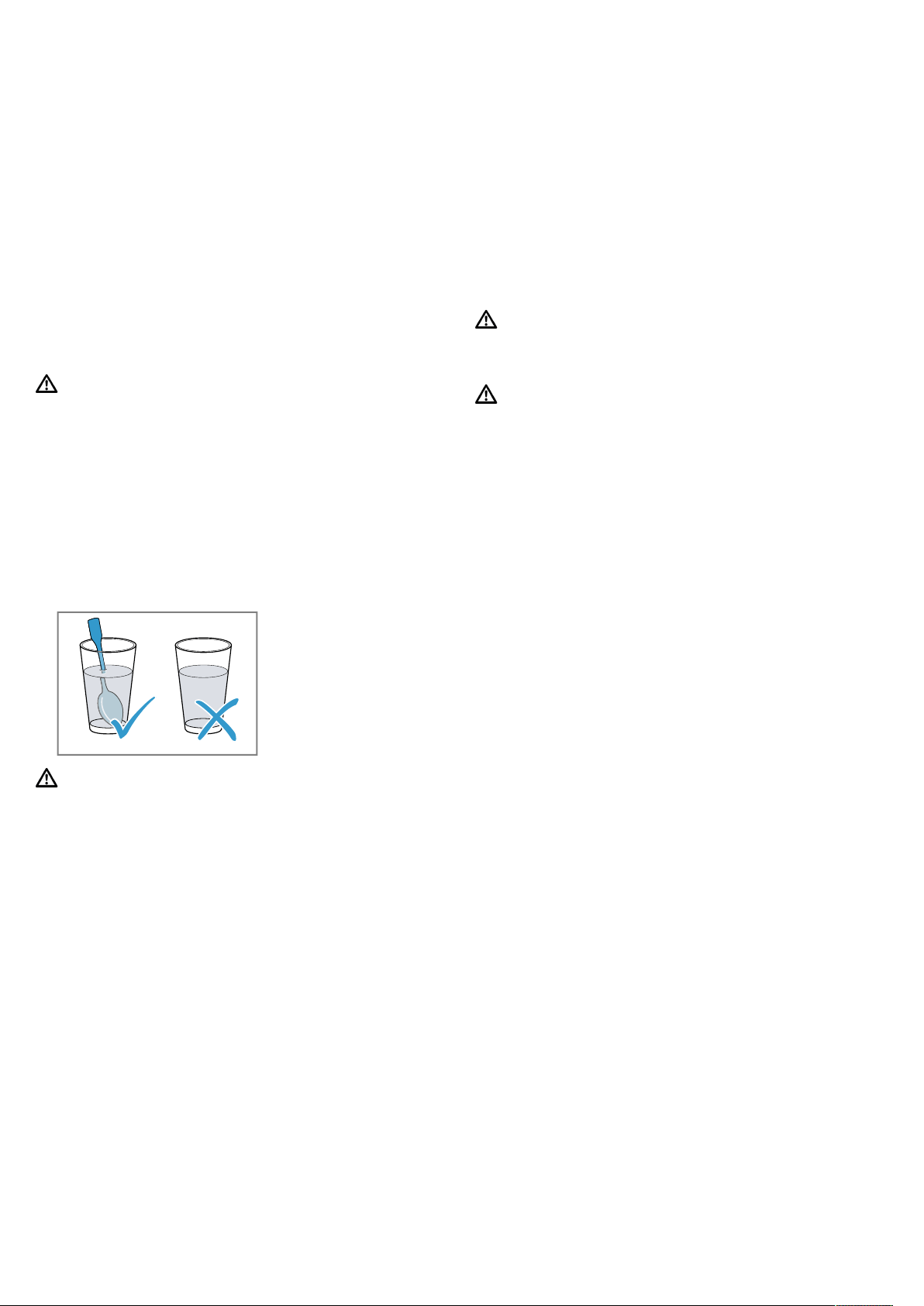
▶ Always place a spoon in the container
when heating liquids. This prevents delayed
boiling.
WARNING‒Risk of injury!
Unsuitable cookware may crack. Porcelain or
ceramic cookware can have small perfora-
tions in the handles and lid. These perfora-
tions conceal a cavity below. If moisture pen-
etrates this cavity, it could cause the cook-
ware to crack.
▶ Only use microwave-safe cookware.
Cookware and containers made from metal or
cookware with metal edging may lead to
sparks being formed during simple mi-
crowave operation. The appliance is dam-
aged.
▶ Never use metal containers during mi-
crowave-only operation.
▶ Only use microwave-safe cookware or use
the microwave in combination with a type
of heating.
WARNING‒Risk of electric shock!
The appliance uses a high voltage.
▶ Never remove the casing.
WARNING‒Risk of serious harm to
health!
Inadequate cleaning may destroy the surface
of the appliance, reduce its service life, and
lead to dangerous situations, such as escap-
ing microwave energy.
▶ Clean the appliance on a regular basis,
and remove any food residue immediately.
▶ Always keep the cooking compartment,
door seal, door and door stop clean.
→"Cleaning and servicing", Page17
Never operate the appliance if the cooking
compartment door or the door seal is dam-
aged. Microwave energy may escape.
▶ Never use the appliance if the cooking
compartment door, the door seal or the
plastic door frame is damaged.
▶ Any repair work must only be carried out
by customer service.
Microwave energy will escape from appli-
ances that do not have any casing.
▶ Never remove the casing.
▶ Contact our after-sales service if mainten-
ance or repair work is needed.
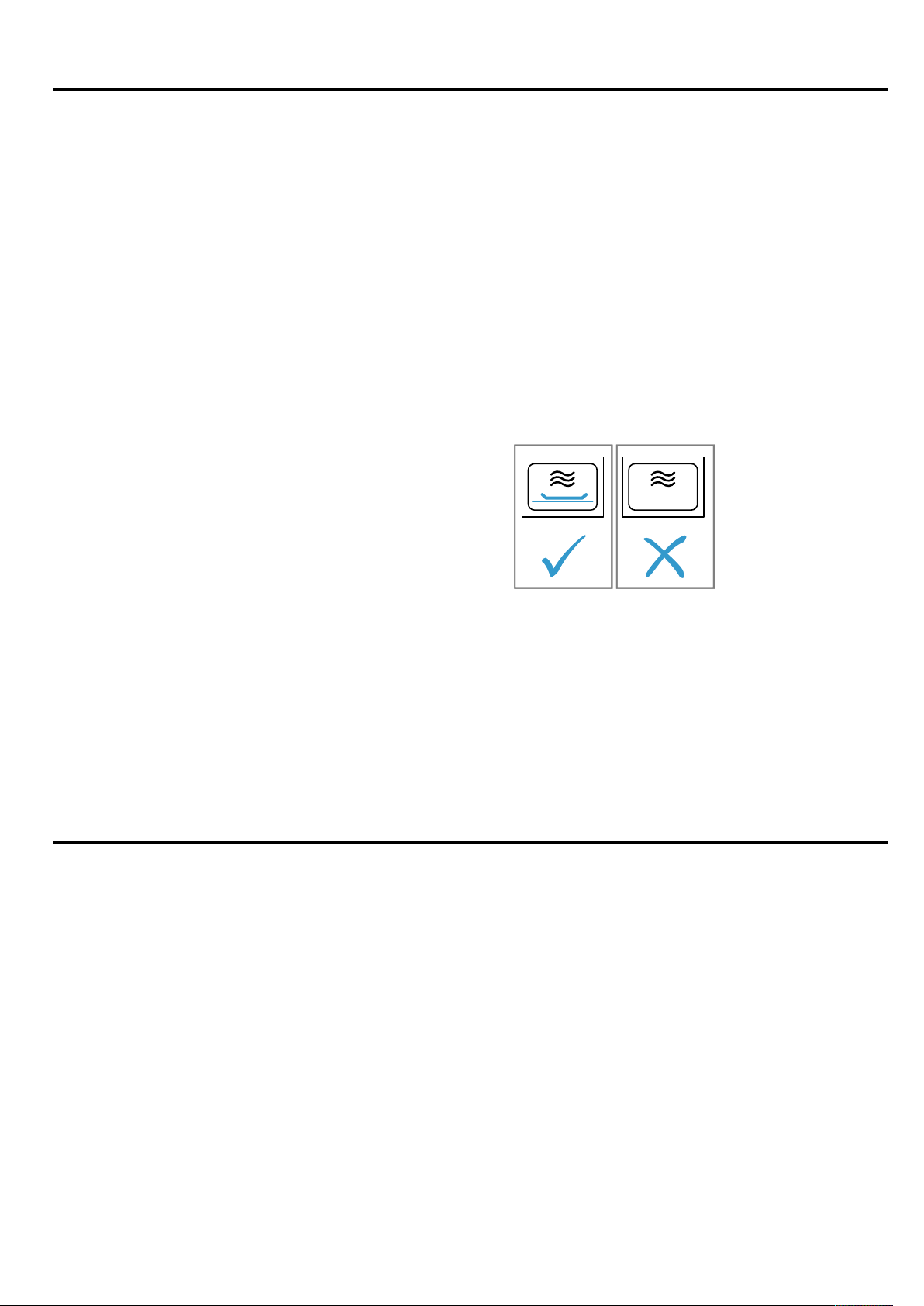
en Preventing material damage
6
Preventing material damage
2 Preventing material damage
Preventing material damage
2.1 General
ATTENTION!
Alcoholic vapours may catch fire in the hot cooking
compartment and cause permanent damage to the ap-
pliance. The appliance door may spring open due to
an explosion and it may fall off. The door panels may
shatter and fragment. Due to the resulting negative
pressure, the cooking compartment may become con-
siderably deformed inwards.
▶ Do not heat spirits (≥ 15% vol.) when undiluted (e.g.
for marinating or pouring over food).
When the cooking compartment is hot, any water in-
side it will create steam. The change in temperature
may cause damage.
▶ Never pour water into the cooking compartment
when it is still hot.
The prolonged presence of moisture in the cooking
compartment leads to corrosion.
▶ Always wipe away the condensation after cooking.
Always allow the cooking compartment to cool
down with the door closed after cooking at high
temperatures.
▶ Do not keep moist food in the cooking compartment
for a long time with the door closed.
▶ Do not store food in the cooking compartment.
▶ Take care not to trap anything in the appliance
door.
If the seal is very dirty, the appliance door will no
longer close properly during operation. This may dam-
age the front of adjacent kitchen units.
▶ Keep the seal clean at all times.
▶ Never operate the appliance if the seal is damaged
or missing.
Sitting or placing objects on the appliance door may
damage it.
▶ Do not place, hang or support objects on the appli-
ance door.
2.2 Microwave
Follow these instructions when using the microwave.
ATTENTION!
Metal touching the wall of the cooking compartment
will cause sparks, which may damage the appliance or
the inner door pane.
▶ Metal (e.g. a spoon in a glass) must be kept at least
2cm from the cooking compartment walls and the
inside of the door.
Placing aluminium containers in the appliance may
cause sparks, which will damage the appliance.
▶ Do not use aluminium containers in the appliance.
Operating the appliance without food in the cooking
compartment may lead to overloading.
▶ Do not switch on the microwave unless there is food
inside. The only exception to this rule is when per-
forming a short cookware test.
If you prepare several bags of microwave popcorn in
immediate succession at a microwave power level that
is too high, the cooking compartment may be dam-
aged.
▶ Leave the appliance to cool down for several
minutes between each use.
▶ Never set a microwave power level that is too high.
▶ Use a maximum microwave output of 600 watts.
▶ Always place the popcorn bag on a glass plate.
Using unsuitable cookware may result in damage.
▶ When using the grill or the microwave combined op-
eration, only use cookware that can withstand high
temperatures.
Environmental protection and saving energy
3 Environmental protection and saving energy
Environmental protection and saving energy
3.1 Disposing of packaging
The packaging materials are environmentally compat-
ible and can be recycled.
▶
Sort the individual components by type and dispose
of them separately.
3.2 Saving energy
If you follow these instructions, your appliance will use
less power.
Open the appliance door as little as possible during
operation.
¡
This will maintain the temperature in the cooking
compartment and eliminate the need for the appli-
ance to reheat.
Heat two cups of liquid at the same time.
¡
Heating several dishes at the same time requires
less energy than heating dishes one after the other.
Switch off the display in the basic settings.
¡
The appliance saves energy in standby mode.
Notes
¡ In standby mode, the display automatically reduces
the brightness to setting 1.
¡ The appliance requires:
– A maximum of 0.5W in standby mode with the
display switched off
Familiarising yourself with your appliance en
7
Familiarising yourself with your appliance
4 Familiarising yourself with your appliance
Familiarising yourself with your appliance
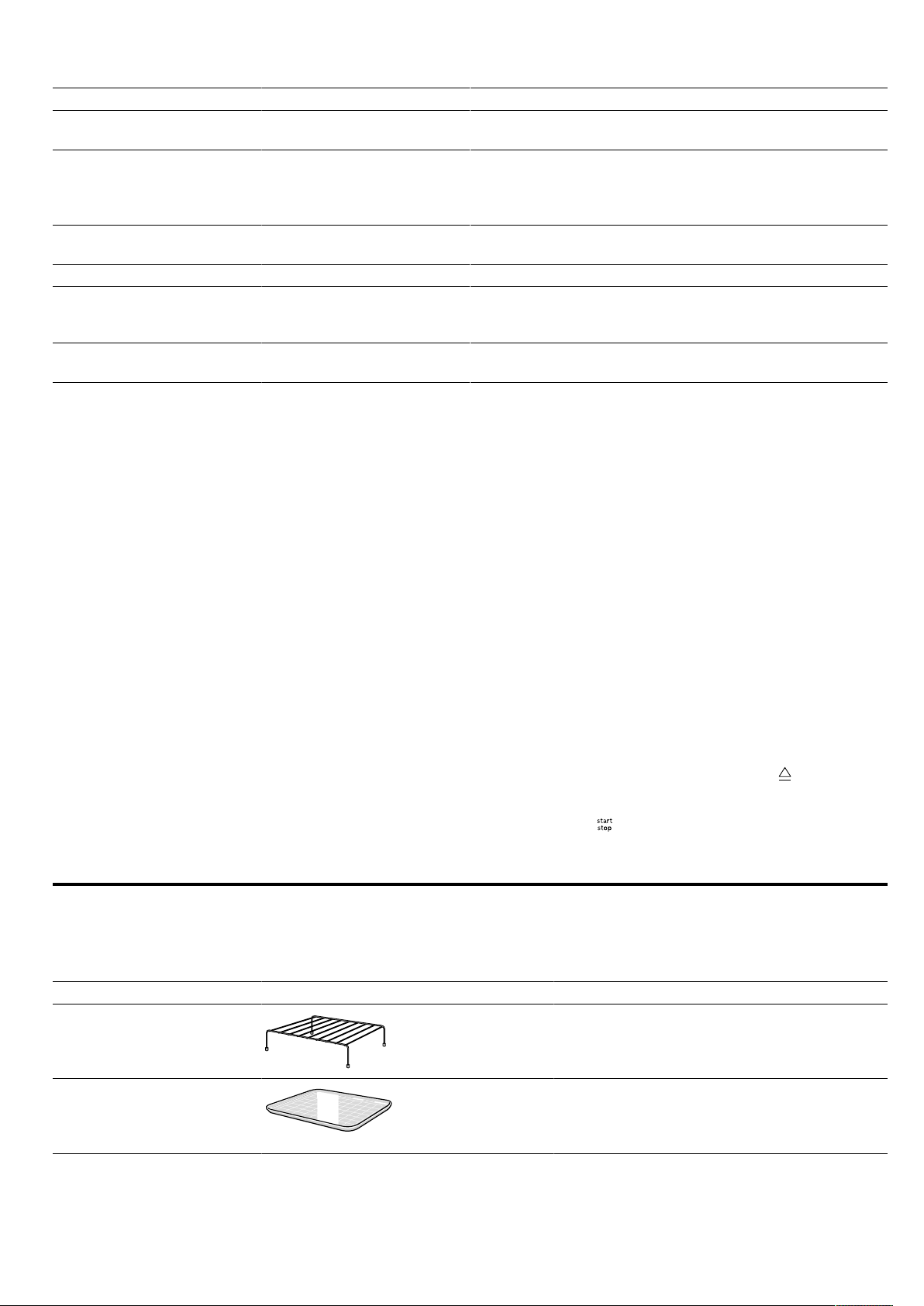
4.1 Control panel
You can use the control panel to configure all functions
of your appliance and to obtain information about the
operating status.
On certain models, specific details such as colour and
shape may differ from those pictured.
1
2 2
1
Display with setting ring
You can use the digital setting ring to set the
appliance via the display.
You will see the current setting values, options
or relevant information.
→"Touch display", Page7
2
Touch fields
You can use the touch fields to directly set vari-
ous functions.
→"Touch fields", Page7
4.2 Touch fields
Touch fields are touch-sensitive surfaces. To select a
function, touch the relevant field.
Touch field Function
Switch the appliance on or off.
→"Basic operation", Page9
Direct access to the microwave
→"Microwave", Page9
Go back one setting.
Start or pause operation.
→"Basic operation", Page9
Select the timer.
Activate or deactivate the child lock.
Open the appliance door
Open the "Operation modes" menu.
4.3 Touch display
The touch display shows the options you can choose
from and the settings configured for the current func-
tion.
To select one of the points, touch the relevant text field.
Digital setting ring
Use the digital setting ring on the outside of the display
to change the setting values.
When you reach the minimum or maximum value avail-
able, this value remains on the display. If required, use
the setting ring to turn the value back again. Values
can be set precisely using the setting ring by slowly
moving your finger. With time settings, you can also dir-
ectly select the point on the setting ring that corres-
ponds to the required minutes or hours, e.g. press
down for 30 minutes/seconds.
Settings area
The settings area is in the centre of the display.
You can see current options and settings that have
already been made in the settings area.
The menu and other setting options are arranged hori-
zontally. Selection lists for functions are arranged ver-
tically. Swipe over the display to scroll in the settings
area. To select a function, press the function on the dis-
play.
Possible symbols in the settings area
Symbol Meaning
Confirm the setting value.
Reset the setting value.
Change the setting value while the ap-
pliance is in operation.
4.4 Automatic door opener
If you press the automatic door-opener, the appliance
door springs open. You can fully open the appliance
door manually.
Notes
¡ In the event of a power failure, the automatic door-
opening does not work. You can open the door
manually.
¡ If you open the appliance door during operation,
this pauses the operation.
¡ When you close the appliance door, the operation
does not continue automatically. Start the operation.
¡ If the appliance is switched off for an extended
period of time, the appliance door opens with a time
delay when the door open button is pressed.
4.5 Types of heating and functions
To ensure that you always use the right type of heating to cook your food, we have explained the differences and ap-
plications below.
en Accessories
8
Name Power/settings Use
Microwave 90/180/360/600/"boost" For defrosting, cooking and heating foods and liquids.
→"Microwave", Page9
Grill Grill settings:
¡ 1 = low
¡ 2 = medium
¡ 3 = high
Grill flat items, such as sausages, or make toast. Gratin-
ate food.
→"Grill", Page12
Microwave combined oper-
ation
90/180/360W + grill set-
tings1/2/3
Bake bakes and gratins. The dishes are browned.
→"Microwave combi mode", Page11
Meals There are preprogrammed settings for many dishes.
Cleaning Select the cleaning function for the cooking compart-
ment.
→"Cleaning aid", Page17
Basic settings Adjust the basic settings.
→"Basic settings", Page16
4.6 Cooking compartment
The functions in the cooking compartment make your
appliance easier to use.
Self-cleaning surfaces
The ceiling in the cooking compartment is self-cleaning.
The self-cleaning surfaces are coated with a porous,
matt ceramic layer and have a rough surface. When
the appliance is in operation, the self-cleaning surfaces
absorb splashes from roasting or grilling and break
them down.
Interior lighting
When you open the appliance door, the interior lighting
switches on. If the appliance door remains open for
longer than approx.15minutes, the interior lighting
switches off.
With most types of heating and functions, the interior
lighting remains on while the appliance is in operation.
The interior lighting switches off again when the opera-
tion stops.
Cooling fan
The cooling fan switches on and off as required. The
hot air escapes through the ventilation slots above the
appliance door.
ATTENTION!
Covering the ventilation slots will cause the appliance
to overheat.
▶ Do not cover the ventilation slots.
To cool the cooking compartment more quickly after
operation, the cooling fan continues to run for a certain
period afterwards. If the appliance is running in mi-
crowave operation, the appliance remains cool, but the
cooling fan still switches on. The cooling fan may con-
tinue to run even when microwave operation has
ended.
4.7 Condensation
Condensation can occur in the cooking compartment
and on the appliance door when cooking. Condensa-
tion is normal and does not adversely affect appliance
operation. Wipe away the condensation after cooking.
4.8 Appliance door
You can open the appliance door using . If you open
the appliance door during operation, the operation
stops. If the appliance door is closed, you can continue
operation with .
Accessories
5 Accessories
Accessories
Use original accessories. These have been made espe-
cially for your appliance.
The accessories supplied may differ depending on the
appliance model.
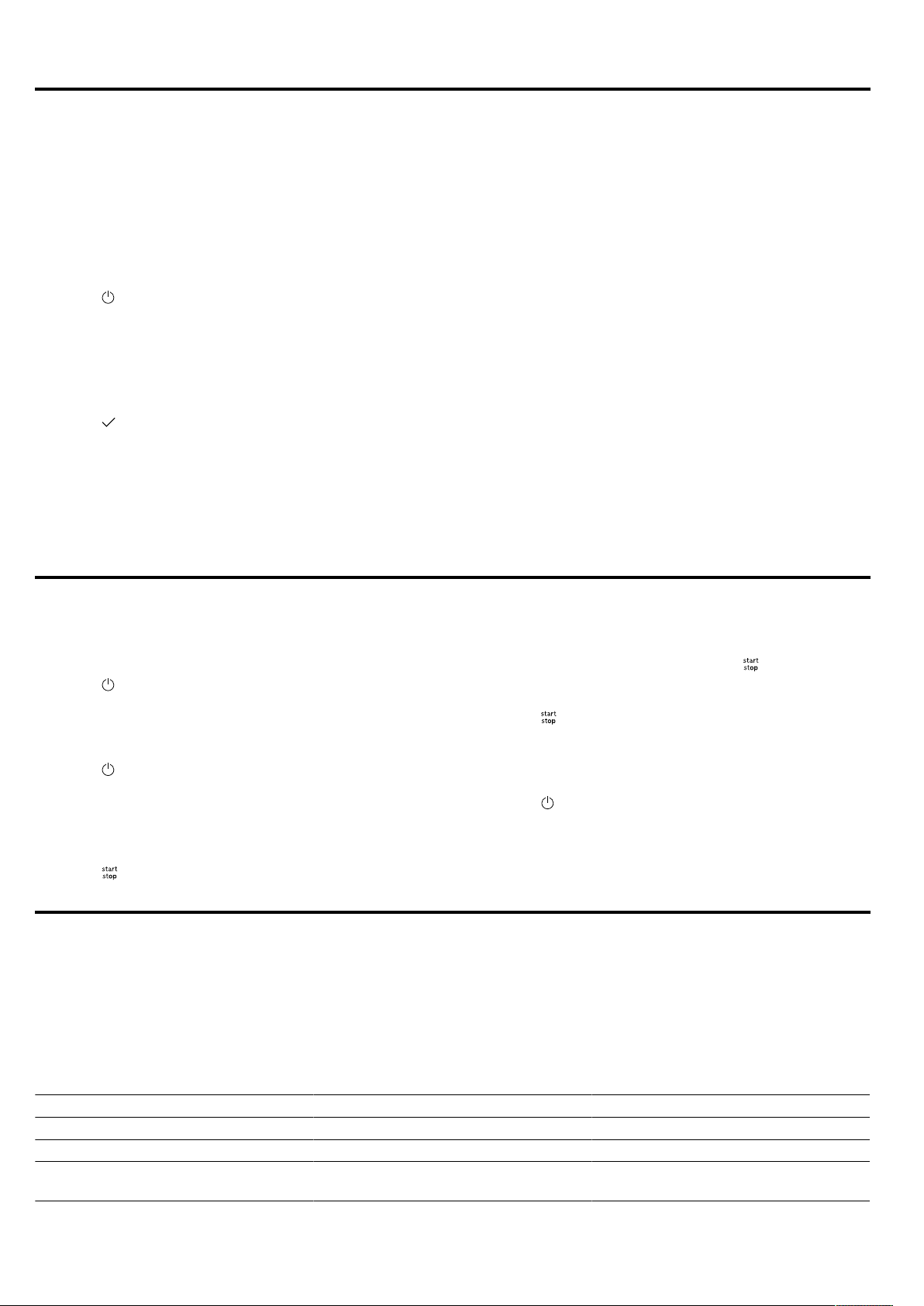
Accessories Use
Wire rack ¡ The wire rack is unsuitable for maximum
microwave output.
¡ Wire rack for grilling and browning
¡ Wire rack as a place for the cookware
Glass tray ¡ Splash guard when grilling directly on the
wire rack
¡ Place the wire rack in the glass tray
¡ Suitable for use in the microwave
Before using for the first time en
9
Before using for the first time
6 Before using for the first time
Before using for the first time
Configure the settings for initial start-up. Clean the ap-
pliance and accessories.
6.1 Initial use
You need to make settings for initial use before you
can use your appliance.
Performing initial start-up
1.
Press to switch the appliance on.
a The first setting appears.
2.
To change the setting as required, press a value in
the list or change the value using the setting ring.
Possible settings:
– Language
– Time
3.
Press and switch to the next setting.
4.
Work through the settings and make changes as re-
quired.
a After the last setting, a message appears on the dis-
play confirming that configuration of the settings is
complete.
6.2 Cleaning the appliance before using it
for the first time
Clean the cooking compartment and accessories be-
fore using the appliance to prepare food for the first
time.
1.
Make sure that there is no leftover packaging, ac-
cessories or other objects in the cooking compart-
ment.
2.
Clean the smooth surfaces in the cooking compart-
ment with a soft, damp cloth.
3.
Close the appliance door.
4.
Ventilate the room while the appliance is heating.
5.
Set the grill to level 3.
6.
Set the cooking time to 15minutes.
7.
Allow the appliance to cool down.
8.
Once the cooking compartment has cooled down,
clean the smooth surfaces with soapy water and a
dish cloth.
6.3 Cleaning the accessories
▶
Clean the accessory thoroughly with soapy water
and a soft dish cloth.
Basic operation
7 Basic operation
Basic operation
7.1 Switching on the appliance
▶
Press .
a The appliance is ready to use.
7.2 Switching off the appliance
▶
Press .
a The appliance stops any ongoing functions.
a The display shows the time for a few minutes.
7.3 Starting the appliance
▶
Press .
7.4 Pausing the operation
1.
Open the appliance door or press .
a Operation is paused.
2.
To continue operation, close the appliance door and
press .
a Operation continues.
7.5 Cancelling the operation
▶
Press .
a The appliance stops any ongoing functions.
Microwave
8 Microwave
Microwave
You can use the microwave to cook, heat up or defrost food very quickly.
8.1 Microwave output settings
This is where you can find an overview of the different microwave output settings and recommendations on when to
use them.
Microwave output in watts Maximum cooking time in hours Use
90W 1:30 Defrost delicate foods.
180W 1:30 Defrost food and continue cooking.
360W 1:30 Cook meat and fish or heat delicate
foods.
en Microwave
10
Microwave output in watts Maximum cooking time in hours Use
600W 1:30 Heat and cook food.
boost 00:30 Heat liquids.
Notes
¡ To protect the appliance, the maximum microwave
output "boost" is gradually reduced to 600watts
during the first few minutes. Maximum output is
made available again after a cooling period.
¡ The microwave output settings do not correspond
with the real power consumption of the appliance.
8.2 Microwave-safe cookware and
accessories
To heat food evenly and avoid damaging your appli-
ance, it is important to use the right cookware and ac-
cessories.
Note:Read the manufacturer's instructions before us-
ing any cookware in the microwave. If in doubt, carry
out a cookware test.
→"Testing cookware for microwave suitability",
Page10
Suitable for use in the microwave
Cookware and accessor-
ies
Reason
Cookware made from
heat-resistant, microwave-
safe material:
¡ Glass
¡ Glass ceramic
¡ Porcelain
¡ Temperature-resistant
plastic
¡ Fully glazed ceramic
without cracks
These materials allow mi-
crowaves to pass
through. Microwaves do
not damage heat-resistant
cookware.
Metal cutlery Note:You can use metal
cutlery, e.g. place a
spoon in a glass, to pre-
vent delayed boiling.
ATTENTION!
Metal touching the wall of the cooking compartment
will cause sparks, which may damage the appliance or
the inner door pane.
▶ Metal (e.g. a spoon in a glass) must be kept at least
2cm from the cooking compartment walls and the
inside of the door.
Not microwave-safe
Cookware and accessor-
ies
Reason
Metal cookware Metal does not allow mi-
crowaves to pass
through. The food hardly
heats up.
Cookware with gold or sil-
ver decoration
Microwaves can damage
gold and silver decora-
tion.
Tip:You can only use this
kind of cookware if the
manufacturer guarantees
that it is microwave-safe.
8.3 Testing cookware for microwave
suitability
Test cookware to see whether it is suitable for mi-
crowave use. Testing cookware is the only time the ap-
pliance should be operated in microwave mode without
any food inside.
WARNING‒Risk of scalding!
The accessible parts of the appliance become hot dur-
ing operation.
▶ Never touch these hot parts.
▶ Keep children at a safe distance.
1.
Place the empty cookware in the cooking compart-
ment.
2.
Set the appliance to the maximum microwave power
setting for 30 seconds to 1 minute.
3.
Start the operation.
4.
Check the cookware several times:
– If the cookware is cold or warm to the touch, it is
suitable for microwave use.
– If the cookware becomes hot or sparks are cre-
ated, stop the cookware test. The cookware is
not microwave-safe.
8.4 Setting the microwave
Note:
Note the correct way to operate the microwave:
¡ Follow the safety instructions. →Page4
¡ Observe the instructions on how to prevent material
damage. →Page6
¡ Observe the information on microwave-safe cook-
ware and accessories.
1.
Press "Microwave" in the menu.
‒ Or select the microwave directly using the touch
field .
2.
Press the microwave output in watts.
3.
Use the setting ring to set the microwave output.
4.
To confirm the microwave output, press on the
display
5.
Press "Cooking time".
A cooking time must always be set to operate the
microwave.
Microwave combi mode en
11
6.
To change the preset cooking time, press the relev-
ant time value, e.g. minute display "m" or second
display "s".
a The selected value is marked in blue.
7.
Use the setting ring to set the cooking time.
If required, use to reset the setting value.
8.
To confirm the set cooking time, press on the dis-
play.
9.
Press to start the operation.
a The microwave starts and the cooking time counts
down. The display shows the performance reduction
for the maximum microwave output "boost".
a When the time has elapsed, a signal tone sounds. A
notification appears on the display confirming that
the operation has finished.
10.
Once the cooking time has elapsed:
‒ If required, you can select other settings and re-
start the operation.
‒ When the food is ready, use to switch the ap-
pliance off.
11.
Dry the cooking compartment.
Tip:To ensure optimum use of your appliance, refer to
the information in the recommended settings.
→"How it works", Page20
8.5 Changing the microwave output
You can change the microwave output setting during
operation.
1.
Press .
2.
Press the set microwave output setting.
3.
Use the setting ring to set the microwave output.
4.
Press .
8.6 Changing the cooking time
1.
Press .
2.
Press the set "Cooking time".
3.
To change the preset cooking time, press the relev-
ant time value, e.g. minute display "m" or second
display "s".
a The selected value is marked in blue.
4.
Use the setting ring to set the cooking time.
If required, use to reset the setting value.
5.
Press .
8.7 Extending the cooking time
Once the cooking time has elapsed, you can continue
cooking the food.
1.
Press "Add extra cooking time".
2.
Set the required cooking time.
→"Setting the cooking time", Page14
You can reset the set cooking time using .
3.
Press .
4.
Use to start the operation.
8.8 Pausing the operation
1.
Open the appliance door or press .
a Operation is paused.
2.
To continue operation, close the appliance door and
press .
a Operation continues.
8.9 Cancelling the operation
▶
Press .
a The appliance stops any ongoing functions.
Microwave combi mode
9 Microwave combi mode
Microwave combi mode
To reduce the cooking time or if you want to heat and
brown foods at the same time, you can use the grill in
combination with the microwave.
The following microwave output settings are available
to choose from:
¡ 90W
¡ 180W
¡ 360W
9.1 Setting added microwave
Requirement:The appliance is switched on.
1.
Press "Grill".
2.
Press "Level".
‒ Use the setting ring to select the required grill
setting.
‒ Press .
3.
Press "Microwave function".
‒ Use the setting ring to select the required mi-
crowave output.
‒ Press .
a A preset cooking time appears on the display.
4.
If you want to change the preset cooking time,
press "Cooking time".
‒ Use the setting ring to select the required cook-
ing time.
‒ Press .
5.
If an end time is required, press "End".
‒ Use the setting ring to select the required time.
‒ Press .
6.
Use to start the operation.
a An audible signal sounds once the cooking time
has elapsed.
9.2 Changing the grill setting
You can change the grill setting during operation.
1.
Press .
2.
Press the set grill setting.
3.
Use the setting ring to select the required grill set-
ting.
4.
Press .
9.3 Changing the microwave output
You can change the microwave output setting during
operation.
1.
Press .
2.
Press the set microwave output setting.
3.
Use the setting ring to set the microwave output.
4.
Press .
en Grill
12
9.4 Changing the cooking time
1.
Press .
2.
Press the set "Cooking time".
3.
To change the preset cooking time, press the relev-
ant time value, e.g. minute display "m" or second
display "s".
a The selected value is marked in blue.
4.
Use the setting ring to set the cooking time.
If required, use to reset the setting value.
5.
Press .
9.5 Extending the cooking time
Once the cooking time has elapsed, you can continue
cooking the food.
1.
Press "Add extra cooking time".
2.
Set the required cooking time.
→"Setting the cooking time", Page14
You can reset the set cooking time using .
3.
Press .
4.
Use to start the operation.
9.6 Pausing the operation
1.
Open the appliance door or press .
a Operation is paused.
2.
To continue operation, close the appliance door and
press .
a Operation continues.
9.7 Cancelling the operation
▶
Press .
a The appliance stops any ongoing functions.
Grill
10 Grill
Grill
You can brown or gratinate your food using the grill.
You can use the grill on its own or in combination with
the microwave.
10.1 Grill settings
The following grill settings are available.
Grill setting Food
1 (low) ¡ Deep-dish bakes
¡ Soufflés
2 (medium) ¡ Shallow bakes
¡ Fish
3 (high) ¡ Sausages
¡ Toast
10.2 Safety switch-off function
For your safety, the appliance has a safety shut-off
function. The appliance is automatically switched off if it
has been in operation for an extended period.
How long the appliance waits before switching itself off
depends on the setting:
¡ Grill: 90 minutes
10.3 Setting the grill
Requirement:The appliance is switched on.
1.
Press "Grill".
2.
Press "Level".
3.
Select the required grill setting.
4.
Press .
5.
If a cooking time is required, set the cooking time.
‒ Press "Cooking time".
‒ Use the setting ring to select the required cook-
ing time.
‒ Press .
6.
If an end time is required, set the end time.
‒ Press "End".
‒ Use the setting ring to select the required end
time.
‒ Press .
7.
Use to start the operation.
a An audible signal sounds once the cooking time
has elapsed.
10.4 Changing the grill setting
You can change the grill setting during operation.
1.
Press .
2.
Press the set grill setting.
3.
Use the setting ring to select the required grill set-
ting.
4.
Press .
10.5 Changing the cooking time
1.
Press .
2.
Press the set "Cooking time".
3.
To change the preset cooking time, press the relev-
ant time value, e.g. minute display "m" or second
display "s".
a The selected value is marked in blue.
4.
Use the setting ring to set the cooking time.
If required, use to reset the setting value.
5.
Press .
10.6 Extending the cooking time
Once the cooking time has elapsed, you can continue
cooking the food.
1.
Press "Add extra cooking time".
2.
Set the required cooking time.
→"Setting the cooking time", Page14
You can reset the set cooking time using .
3.
Press .
4.
Use to start the operation.
10.7 Pausing the operation
1.
Open the appliance door or press .
a Operation is paused.

Meals en
13
2.
To continue operation, close the appliance door and
press .
a Operation continues.
10.8 Cancelling the operation
▶
Press .
a The appliance stops any ongoing functions.
Meals
11 Meals
Meals
The "Meals" operating mode helps you to use your ap-
pliance to prepare different meals by selecting the op-
timum settings automatically.
11.1 Tips on configuring the settings for
dishes
Follow these tips to achieve optimal cooking results:
¡ Only use food that is in perfect condition.
¡ Take the food out of its packaging and weigh it. If
you cannot set the exact weight on the appliance,
round the weight up or down.
¡ Only use microwave-safe, heat-resistant cookware,
e.g. made of glass or ceramic.
¡ Place the food in the cold cooking compartment.
Defrosting
¡ Freeze and store food flat and in portion-sized
quantities at -18°C.
¡ Place the frozen food on flat cookware, such as a
glass or porcelain plate.
¡ Food may not be completely defrosted by the end
of the programme. The food can nonetheless be fur-
ther processed.
¡ To allow the temperature to equalise, leave the de-
frosted food to rest for another 10 to 30minutes in
the appliance after switching it off.
¡ Liquid is produced when defrosting meat or poultry.
When turning, drain off any liquid. Do not reuse the
liquid for other purposes or allow it to come into
contact with other foods.
¡ After turning, remove any minced meat that has
already defrosted.
¡ Whole poultry should be placed on the cookware
breast-side down and poultry portions skin-side
down.
Vegetables
¡ Fresh vegetables: Cut into pieces of equal size. Add
one tablespoon of water per 100g.
¡ Frozen vegetables: Only suitable for blanched, not
pre-cooked vegetables. It is not suitable for frozen
vegetables in cream sauce. Add 1 to 3 tablespoons
of water. Do not add any water for spinach or red
cabbage.
Potatoes
¡ Boiled potatoes: Cut into pieces of an equal size.
Add two tablespoons of water and some salt per
100g.
¡ Unpeeled boiled potatoes: Use potatoes of the
same thickness. Wash them and prick the skin.
Place the wet potatoes in a dish. Do not add water.
¡ Baked potatoes: Use potatoes of the same thick-
ness. Wash, dry and prick the skin.
Rice
¡ Do not use brown rice or boil-in-the-bag rice.
¡ Add two to two-and-a-half times the amount of water
to the rice.
Poultry
¡ Only use chicken portions at refrigerator temperat-
ure.
¡ Prick the skin here and there with a fork.
¡ Place the chicken portions on the wire rack, skin
side up. Place the wire rack in the glass tray. This
will catch any liquid that drips down.
Lasagne
¡ Best suited is frozen Lasagne with a maximum
height of around 3 cm.
¡ Take lasagne out of the packaging and place in mi-
crowave-safe cookware.
¡ If you prepare frozen lasagne in portions of more
than 700g, place the cookware on a microwave-
safe, upside down plate.
11.2 Setting a programme
Requirement:The appliance is switched on.
1.
Press "Meals".
2.
Select a programme.
3.
Press the preset weight.
4.
Use the control ring to set the required weight.
5.
Use to confirm the weight.
6.
If an end time is required, set the end time.
‒ Press "End".
‒ Set the required time.
‒ Use to confirm the end time.
7.
Place the food in the cooking compartment.
8.
Close the appliance door.
9.
Press .
a An audible signal sounds once the cooking time
has elapsed.
Note:For some programmes, the display provides in-
structions during preparation. Follow the information
provided.
Extending the cooking time
Once the cooking time has elapsed, you can continue
cooking the food.
1.
Press "Add extra cooking time".
2.
Set the required cooking time.
→"Setting the cooking time", Page14
You can reset the set cooking time using .
3.
Press .
4.
Use to start the operation.
Pausing the operation
1.
Open the appliance door or press .
a Operation is paused.
2.
To continue operation, close the appliance door and
press .
a Operation continues.
en Time-setting options
14
Cancelling the operation
▶
Press .
a The appliance stops any ongoing functions.
11.3 Overview of dishes
Dish Suitable food Weight range
inkg
Cookware/accessories
Defrost bread
1
Bread, whole, round or long; sliced bread;
sponge cake, yeast cake, fruit flan, cakes
without icing, cream or gelatine
0.20-1 Shallow cookware without
lid
Defrost meat
1
Joints, flat pieces of meat, chicken, minced
meat
0.20-2 Shallow cookware without
lid
Defrost fish
1
Whole fish, fish fillet, fish steak 0.10-1 Shallow cookware without
lid
Fresh vegetables
2
e.g. cauliflower, broccoli, carrots, kohlrabi,
leeks, peppers, courgettes
0.15-1 Covered cookware
Frozen vegetables
2
e.g. cauliflower, broccoli, carrots, kohlrabi,
red cabbage, spinach
0.15-1 Covered cookware
Rice
2
Long-grain rice 0.05-0.3 Deep cookware with lid
Boiled potatoes
2
Potatoes with or without skin, potatoes cut
into pieces of equal size
0.20-1 Covered cookware
Baked potatoes
1
Potatoes with skin, 200-250g each 0.20-1.5 Wire rack on glass tray
Lasagne, frozen Lasagne or a similar frozen bake 0.30-1 Uncovered cookware
Chicken pieces, fresh Chicken thigh, chicken drumstick, chicken
leg
0.50-1 Wire rack on glass tray
1
Observe the signals given when it is time to turn the food.
2
Observe the signals given when it is time to stir the food.
Time-setting options
12 Time-setting options
Time-setting options
Your appliance offers time-setting options that you can
use to set the cooking time, the end time and the timer.
Time-setting op-
tions
Use
Cooking time If you set a cooking time, the ap-
pliance stops heating automatic-
ally once this time has elapsed.
End For the cooking time, you can set
the time at which you want the op-
eration to end. The appliance
starts up automatically so that the
operation finishes at the required
time.
Timer You can set the timer to run inde-
pendently of the operation. It does
not affect the appliance.
12.1 Setting the cooking time
You can use "boost" to set the cooking time for the op-
eration up to 30minutes. You can set a cooking time
for all other settings of up to 90 minutes.
Requirement:An operating mode and level have been
set.
1.
Press "Cooking time".
2.
To change the preset cooking time, press the relev-
ant time value, e.g. minute display "m" or second
display "s".
a The selected value is marked in blue.
3.
Use the setting ring to set the cooking time.
If required, use to reset the setting value.
4.
Press .
5.
Use to start the operation.
Extending the cooking time
Once the cooking time has elapsed, you can continue
cooking the food.
1.
Press "Add extra cooking time".
2.
Set the required cooking time.
→"Setting the cooking time", Page14
You can reset the set cooking time using .
3.
Press .
4.
Use to start the operation.
Changing the cooking time
You can change the cooking time at any time.
1.
Press "Cooking time".
2.
To change the preset cooking time, press the relev-
ant time value, e.g. minute display "m" or second
display "s".
a The selected value is marked in blue.
3.
Use the setting ring to set the cooking time.
If required, use to reset the setting value.
4.
Press .

Childproof lock en
15
Cancelling the cooking time
You can cancel the cooking time at any time.
1.
Press the cooking time.
2.
Reset the cooking time using .
For operating modes that always require a cooking
time, the appliance resets the cooking time to the
preset value.
3.
Press .
12.2 Setting the end time
You can delay the time at which the cooking time for
the operation is due to end by up to 24 hours.
Notes
¡ To achieve good cooking results, do not delay the
time once the operation has already started.
¡ Food will spoil if you leave it in the cooking com-
partment for too long.
Requirements
¡ An operating mode and level have been set.
¡ A cooking time has been set.
1.
Press "End".
2.
To change the preset end time, press the relevant
time value.
a The selected value is marked in blue.
3.
Use the setting ring to set the end time.
4.
Press .
5.
Press .
a The display shows the start time. The appliance is in
standby mode.
a Once the start time has been reached, the appli-
ance starts heating and the cooking time starts
counting down.
a When the cooking time has elapsed, a signal
sounds. A message appears on the display confirm-
ing that the operation has finished.
6.
Once the cooking time has elapsed, perform one of
the following actions:
‒ If required, you can select other settings and re-
start the operation.
‒ When the food is ready, use to switch the ap-
pliance off.
Changing the end time
To achieve good cooking results, only change the set
time before the operation starts and before the cooking
time starts counting down.
1.
Press "End".
2.
Use the setting ring to set the end time.
If required, use to reset the setting value.
3.
Press .
Cancelling the end time
1.
Press "End".
2.
Reset the setting value with .
3.
Press .
12.3 Setting the timer
The timer runs independently during the operation. You
can set the timer for a time up to 24 hours. The timer
has its own signal so that you can tell whether it is the
timer or a cooking time that has elapsed.
1.
Press .
2.
To set the timer, press the relevant time value on
the display, e.g. minute display "m" or second dis-
play "s".
a The selected value is marked in blue.
3.
Set the timer using the setting ring.
a If required, use to reset the setting value.
4.
To start the timer, press .
a The timer counts down.
a The timer remains visible on the display if the appli-
ance is switched off.
a When the appliance is switched on, the display
shows the settings for the current operation. The
timer is displayed in the status display.
a Once the timer has elapsed, a signal sounds. A no-
tification appears on the display confirming that the
timer has finished.
Ending the timer
Requirement:A signal sounds.
▶
Press any field.
a The timer is switched off.
Changing the timer
You can change the timer at any time.
1.
If the timer is running in the background, use to
select the timer beforehand.
2.
Press .
3.
Change the timer using the setting ring.
4.
Press to confirm.
Cancelling the timer
You can cancel the timer at any time.
1.
If the timer is running in the background, use to
select the timer beforehand.
2.
Press .
3.
Reset the timer using .
Childproof lock
13 Childproof lock
Childproof lock
You can secure your appliance to prevent children
from accidentally switching it on or changing the set-
tings.
13.1 Activating the childproof lock
▶
Press and hold for approx. 4 seconds.
a The control elements are locked.
a If a timer duration has been set, this continues to
count down. While the child lock is active, the timer
duration cannot be changed. To end signal tones,
e.g. once the timer duration has elapsed, press any
button.
13.2 Deactivating the childproof lock
1.
Turn the ring 360°.
en Basic settings
16
2.
Alternatively, press and hold the button for ap-
prox. 4seconds.
3.
The control elements are unlocked.
Basic settings
14 Basic settings
Basic settings
You can configure the basic settings for your appliance
to meet your needs.
14.1 Overview of the basic settings
Here you can find an overview of the basic settings
and factory settings. The basic settings depend on the
features of your appliance.
Notes
¡ Changes to the language, button tone and display
brightness settings take effect immediately. All other
settings do not take effect until you save them.
¡ Your changes to the basic settings will be retained
for some time even after a power cut.
Basic settings Selection
Language See selection on the ap-
pliance
Time "Time" in 24-hour format
Display Selection
Brightness ¡ Settings 1 to 8
1
Standby screen ¡ On (this setting in-
creases energy con-
sumption)
¡ Clock displayed, for
set time
1
¡ Off
Clock ¡ Digital
1
¡ Analog
Adjustment ¡ Align the display hori-
zontally and vertically.
1
Factory setting (may vary according to model)
Sound Selection
Button tone ¡ On
1
¡ Off
Signal tone ¡ Very short
¡ Short duration
¡ Medium duration
1
¡ Long duration
1
Factory setting (may vary according to model)
Appliance settings Selection
Illumination ¡ On
1
¡ Off
Microwave output selec-
tion
¡ 90W
¡ 180W
¡ 360W
¡ 600W
¡ boost
1
Factory setting (may vary according to model)
Customisation Selection
Brand logo ¡ Display
1
¡ Don't display
Operat. after switch-on ¡ Main menu
1
¡ Microwave
¡ Meals
¡ Grill
Elapsed cooking time ¡ Display
1
¡ Don't display
Childproof lock ¡ Available
¡ Deactivated
1
Factory setting (may vary according to model)
Factory settings Selection
Factory settings ¡ Restore
¡ Cancel
Demo mode ¡ Setting "Factory set-
tings"
Only displayed during
the first 5minutes after
the appliance has
been reset or is used
for the first time.
Appliance information ¡ Displaying "Appliance
information"
14.2 Changing the basic settings
Requirement:The appliance is switched on.
1.
Press "Basic settings".
2.
Press the required basic setting.
3.
Change the required settings on the display.
4.
Use to return to the overview or go back to the
main menu.
14.3 Changing the time
Requirement:The appliance is switched on.
1.
Press "Basic settings".
2.
Press the "Time" basic setting.
a The display shows the set value.
3.
Use the setting ring to set the hours.
4.
Press the minutes.
5.
Use the setting ring to set the minutes.
6.
Press .
7.
Use to return to the overview or go back to the
main menu.
Cleaning aid en
17
Cleaning aid
15 Cleaning aid
Cleaning aid
The cleaning aid is a quick alternative for occasionally
cleaning the cooking compartment. The cleaning aid
softens dirt by vaporising the soapy water. The dirt can
then be removed more easily.
15.1 Setting the cleaning aid
Requirement:The appliance is switched on.
1.
Press "Cleaning".
2.
Follow the instructions on the display.
3.
Press .
a A signal tone sounds once the time has elapsed.
4.
Follow the instructions on the display.
Cleaning and servicing
16 Cleaning and servicing
Cleaning and servicing
To keep your appliance working efficiently for a long
time, it is important to clean and maintain it carefully.
16.1 Cleaning products
Only use suitable cleaning agents.
WARNING‒Risk of electric shock!
An ingress of moisture can cause an electric shock.
▶ Do not use steam- or high-pressure cleaners to
clean the appliance.
ATTENTION!
Unsuitable cleaning agents damage the surfaces of the
appliance.
▶ Do not use harsh or abrasive cleaning products.
▶ Do not use cleaning products with a high alcohol
content.
▶ Do not use hard scouring pads or cleaning
sponges.
▶ Do not use any special cleaners for cleaning the ap-
pliance while it is hot.
▶ Only use glass cleaners, glass scrapers or stainless
steel care products if recommended in the cleaning
instructions for the relevant part.
Salt contained in new sponge cloths may damage sur-
faces.
▶ Wash new sponge cloths thoroughly before use.
You can find out which cleaning products are suitable
for each surface or part of the appliance in the indi-
vidual cleaning instructions.
16.2 Cleaning the appliance
Clean the appliance as specified. This will ensure that
the different parts and surfaces of the appliance are
not damaged by incorrect cleaning or unsuitable clean-
ing products.
WARNING‒Risk of burns!
The appliance and its parts that can be touched be-
come hot during use.
▶ Caution should be exercised here in order to avoid
touching heating elements.
▶ Young children under 8 years of age must be kept
away from the appliance.
WARNING‒Risk of fire!
Loose food remnants, fat and meat juices may catch
fire.
▶ Before using the appliance, remove the worst of the
food residues and remnants from the cooking com-
partment, heating elements and accessories.
WARNING‒Risk of injury!
Scratched glass in the appliance door may develop
into a crack.
▶ Do not use any harsh or abrasive cleaners or sharp
metal scrapers to clean the glass on the appliance
door, as they may scratch the surface.
1.
Read the information on cleaning products.
2.
Observe the information on cleaning the appliance
components or surfaces.
3.
Unless otherwise specified:
‒ Clean the components of the appliance with hot
soapy water and a dish cloth.
‒ Dry with a soft cloth.
16.3 Cleaning the cooking compartment
ATTENTION!
Incorrect cleaning may damage the cooking compart-
ment.
▶ Do not use oven spray, abrasive materials or other
aggressive oven cleaners.
1.
Read the information on cleaning products.
2.
Clean with hot soapy water or a vinegar solution.
3.
To remove very heavy soiling use oven cleaner suit-
able for stainless steel surfaces.
Only use oven cleaner when the cooking compart-
ment is cold.
Tip:To eliminate unpleasant odours, heat up a cup
of water with a few drops of lemon juice for 1 to 2
minutes at maximum microwave power setting. Al-
ways place a spoon in the container to prevent
delayed boiling.
4.
Wipe out the cooking compartment with a soft cloth.
5.
Leave the cooking compartment to dry with the door
open.
16.4 Regenerating self-cleaning surfaces in
the cooking compartment
The ceiling in the cooking compartment is self-cleaning.
The self-cleaning surfaces are coated with a porous,
matt ceramic layer and have a rough surface. When
en Troubleshooting
18
the grill function is in operation, the self-cleaning sur-
faces absorb splashes from roasting or grilling and
break down the grease residues. If you are primarily
using the microwave function, start the grill function at
regular intervals to clean the ceiling.
ATTENTION!
Using oven cleaner on the self-cleaning surfaces dam-
ages the surfaces.
▶ Do not use oven cleaner on the self-cleaning sur-
faces. If oven cleaner does get onto these surfaces,
dab it off immediately using water and a sponge
cloth. Do not rub the surface and do not use abras-
ive cleaning aids.
Requirements
¡ The cooking compartment is empty.
¡ The appliance is switched on.
1.
Press "Grill".
2.
Press "Level".
3.
Select the highest grill setting.
4.
Press .
5.
Press "Cooking time".
6.
Set the required cooking time.
The cleaning time depends on the amount of grease
residues. Start with a duration of 20minutes.
7.
Press .
8.
Press to start the operation.
Ventilate the room while the appliance is heating.
a Smoke can build up during operation. This is normal
and reduces.
a An audible signal sounds once the cooking time
has elapsed.
9.
If smoke is still visible at the end of the duration, in-
crease the duration.
16.5 Cleaning the accessories
1.
Read the information on cleaning products.
2.
Soften baked-on food remnants with a damp dish
cloth and hot soapy water.
3.
Clean the accessory with hot soapy water and a soft
dish cloth or a scrubbing brush.
4.
Clean the wire rack with stainless steel cleaner or in
the dishwasher.
Use steel wool or oven cleaner to remove very
heavy soiling.
5.
Dry with a soft cloth.
16.6 Cleaning the door panels
ATTENTION!
Incorrect cleaning may damage the door panes.
▶ Do not use a glass scraper.
1.
Read the information on cleaning products.
2.
Clean the door panels with a soft dish cloth and
glass cleaner.
Note:Shadows on the door panels, which look like
streaks, are caused by reflections made by the in-
terior lighting.
3.
Dry with a soft cloth.
16.7 Cleaning the door seal
ATTENTION!
Incorrect cleaning may damage the door seal.
▶ Do not use metal scrapers or glass scrapers for
cleaning.
▶ Do not use abrasive cleaning agents.
1.
Read the information on cleaning products.
2.
Clean the door seal with hot soapy water and a soft
dish cloth.
3.
Dry with a soft cloth.
16.8 Cleaning the front of the appliance
ATTENTION!
Incorrect cleaning may damage the front of the appli-
ance.
▶ Do not use glass cleaner, metal scrapers or glass
scrapers for cleaning.
▶ To prevent corrosion on stainless steel fronts, re-
move any limescale, grease, starch and albumin
(e.g. egg white) stains immediately.
▶ On stainless steel surfaces, use special stainless
steel cleaning products suitable for hot surfaces.
1.
Read the information on cleaning products.
2.
Clean the front of the appliance using hot soapy wa-
ter and a dish cloth.
Note:Slight differences in colour on the front of the
appliance are caused by the use of different materi-
als, such as glass, plastic and metal.
3.
For stainless steel appliance fronts, apply a thin
layer of the stainless steel cleaning product with a
soft cloth.
You can obtain the stainless steel cleaning products
from the after-sales service or the online shop.
4.
Dry with a soft cloth.
16.9 Cleaning the control panel
ATTENTION!
Incorrect cleaning may damage the control panel.
▶ Never wipe the control panel with a wet cloth.
1.
Read the information on cleaning products.
2.
Clean the control panel using a microfibre cloth or a
soft, damp cloth.
3.
Dry with a soft cloth.
Troubleshooting
17 Troubleshooting
Troubleshooting
You can rectify minor faults on your appliance yourself.
Read the troubleshooting information before contacting
after-sales service. This will avoid unnecessary costs.
WARNING‒Risk of injury!
Improper repairs are dangerous.
▶ Repairs to the appliance should only be carried out
by trained specialist staff.
▶ If the appliance is defective, call Customer Service.
→"Customer Service", Page20
Troubleshooting en
19
WARNING‒Risk of electric shock!
Improper repairs are dangerous.
▶ Repairs to the appliance should only be carried out
by trained specialist staff.
▶ Only use genuine spare parts when repairing the
appliance.
▶ If the power cord or the appliance power cable of
this appliance is damaged, it must be replaced with
a special power cord or special appliance power
cable, which is available from the manufacturer or
its Customer Service.
17.1 Malfunctions
Fault Cause and troubleshooting
The appliance is not
working.
The mains plug of the power cord is not plugged in.
▶
Connect the appliance to the power supply.
The circuit breaker in the fuse box has tripped.
▶
Check the circuit breaker in the fuse box.
There has been a power cut.
▶
Check whether the lighting in your room or other appliances are working.
Malfunction
1.
Switch off the fuse in the fuse box.
2.
Switch the fuse back on after approx. 10seconds.
a If the fault was a one-off, the message disappears.
3.
If the message appears again, call the after-sales service. Please specify the exact error
message when calling.
→"Customer Service", Page20
Microwave not work-
ing.
Door is not fully closed.
▶
Check whether food remains or foreign material are trapped in the door.
Food does not heat
up.
Demo mode is activated in the basic settings.
1.
Disconnect the appliance from power supply by briefly switching off the circuit breaker in
the fuse box.
2.
Go to the basic settings and deactivate Demo mode within the next 5minutes.
→Page16
The interior lighting is
not working.
Different causes are possible.
▶
Call
→"Customer Service", Page20.
Microwave mode is
cancelled.
Malfunction
1.
reset the appliance
‒ Press and hold button for at least 10seconds.
‒ Or switch off the fuse in the fuse box. Switch the fuse back on after approx.
10seconds.
a If the fault was a one-off, the message disappears.
2.
If the message appears again, call the after-sales service. Please specify the exact error
message when calling.
→"Customer Service", Page20
Food takes longer
than usual to heat up.
The microwave power setting is set too low.
▶
Set a higher microwave power setting.
A larger amount than usual has been placed in the appliance.
▶
Set a longer cooking time.
You need double the time when you have double the amount.
The food is colder than usual.
▶
Turn or stir the food from time to time during cooking.
Time not displayed
when appliance
switched off
Display switches itself off after a short time.
No action required.
en Disposal
20
17.2 Information on display panel
Fault Cause and troubleshooting
Message showing "D"
or "E" appears in the
display.
Malfunction
1.
Reset appliance.
‒ Either press and hold for at least 6 seconds.
‒ Or switch off the circuit breaker or fuse in the electrical panel. Switch the fuse back
on after approx. 10 seconds.
a If the fault was a one-off, the message will disappear.
2.
If the message appears again, call the after-sales service. Please specify the exact error
message when calling.
→"Customer Service", Page20
Disposal
18 Disposal
Disposal
18.1 Disposing of old appliance
Valuable raw materials can be reused by recycling.
1.
Unplug the appliance from the mains.
2.
Cut through the power cord.
3.
Dispose of the appliance in an environmentally
friendly manner.
Information about current disposal methods are
available from your specialist dealer or local author-
ity.
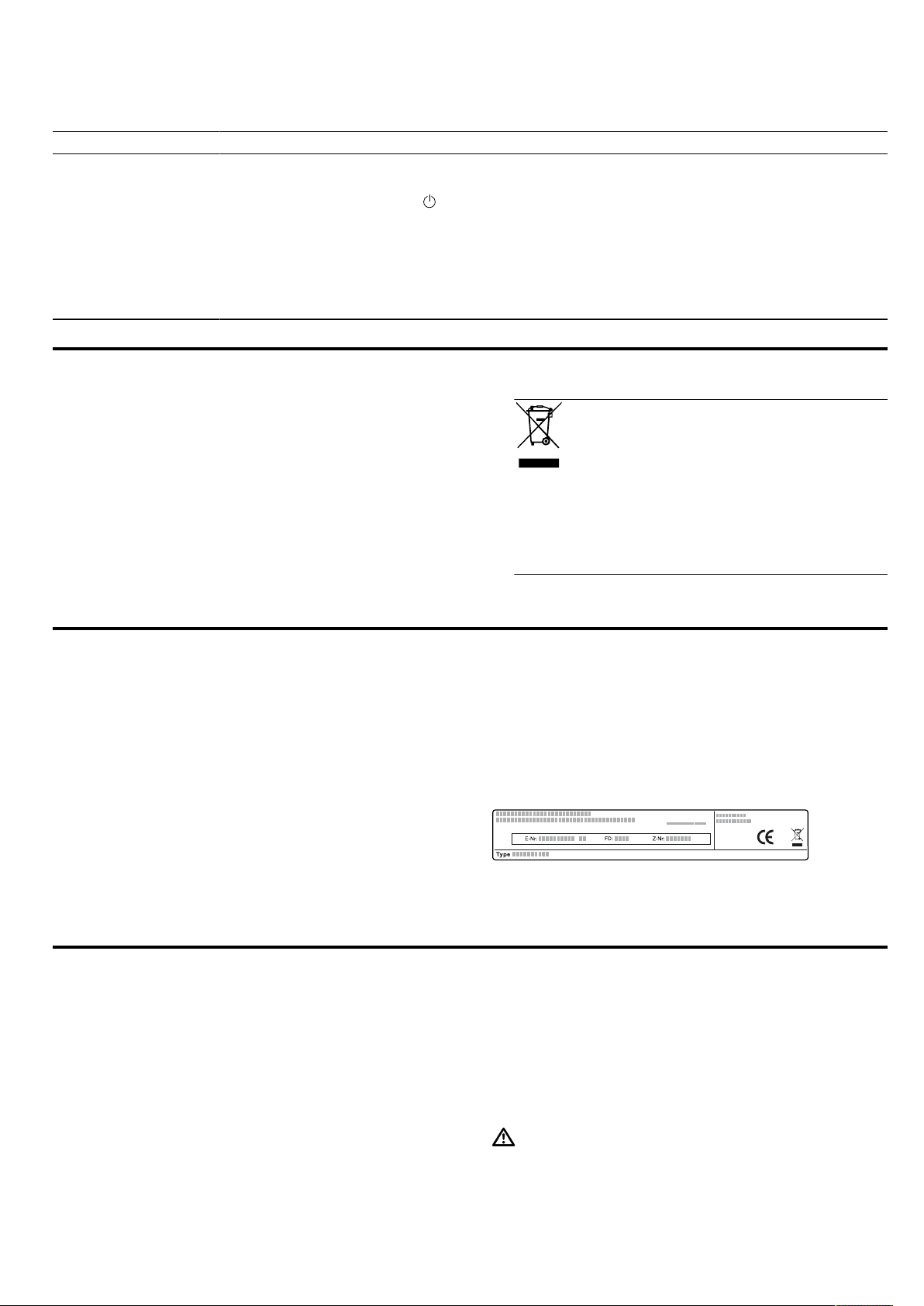
This appliance is labelled in accord-
ance with European Directive
2012/19/EU concerning used elec-
trical and electronic appliances
(waste electrical and electronic equip-
ment - WEEE).
The guideline determines the frame-
work for the return and recycling of
used appliances as applicable
throughout the EU.
Customer Service
19 Customer Service
Customer Service
Detailed information on the warranty period and terms
of warranty in your country is available from our after-
sales service, your retailer or on our website.
If you contact Customer Service, you will require the
product number (E-Nr.) and the production number
(FD) of your appliance.
The contact details for Customer Service can be found
in the enclosed Customer Service directory or on our
website.
This product contains light sources from energy effi-
ciency class D. These light sources are available as a
spare part and should only be replaced by trained spe-
cialist staff.
19.1 Product number (E-Nr.) and production
number (FD)
You can find the product number (E-Nr.) and the pro-
duction number (FD) on the appliance's rating plate.
You will see the rating plate with these numbers if you
open the appliance door.
Make a note of your appliance's details and the Cus-
tomer Service telephone number to find them again
quickly.
How it works
20 How it works
How it works
Here, you can find the ideal settings for various dishes
as well as the best accessories and cookware. We
have tailored these recommendations to your appli-
ance.
20.1 What is the best way to proceed?
In this section, you will find out the best way to proceed
using step-by-step instructions to make optimal use of
the recommended settings. You will get information on
many meals, with details and tips on how to best use
and set your appliance.
Tip
Cooking tips
¡ The recommended settings always apply to the
cooking compartment when it is cold and empty.
¡ The times specified in the overviews are intended as
a guide only. They will depend on the quality and
composition of the food.
WARNING‒Risk of burns!
Foods with peel or skin may burst or explode during
heating, or even afterwards.
▶ Never cook eggs in their shell or heat hard-boiled
eggs in their shell.
How it works en
21
▶ Never cook shellfish or crustaceans.
▶ Always prick the yolk of eggs before microwaving.
▶ The skin of foods that have a peel or skin, such as
apples, tomatoes, potatoes and sausages, may
burst. Before heating, prick the peel or skin.
ATTENTION!
Acidic food may damage the grid
▶ Do not place acidic food, such as fruit or food with
an acidic marinade directly on the pan support.
Note:Information for those allergic to nickel
In rare cases, small amounts of nickel may pass into
the food.
1.
Before using the appliance, remove all unnecessary
cookware from the cooking compartment.
2.
Select the desired food from the recommended set-
tings.
3.
Place the food in suitable cookware.
4.
Place the cookware in the middle on the cooking
compartment floor.
The food can then absorb the microwaves from all
sides.
5.
Use the recommended settings when configuring
the appliance settings.
Set the shorter cooking time first. If necessary, in-
crease the cooking time.
6.
Use an oven cloth or oven gloves when taking hot
cookware out of the cooking compartment.
20.2 Defrosting, heating and cooking with
the microwave
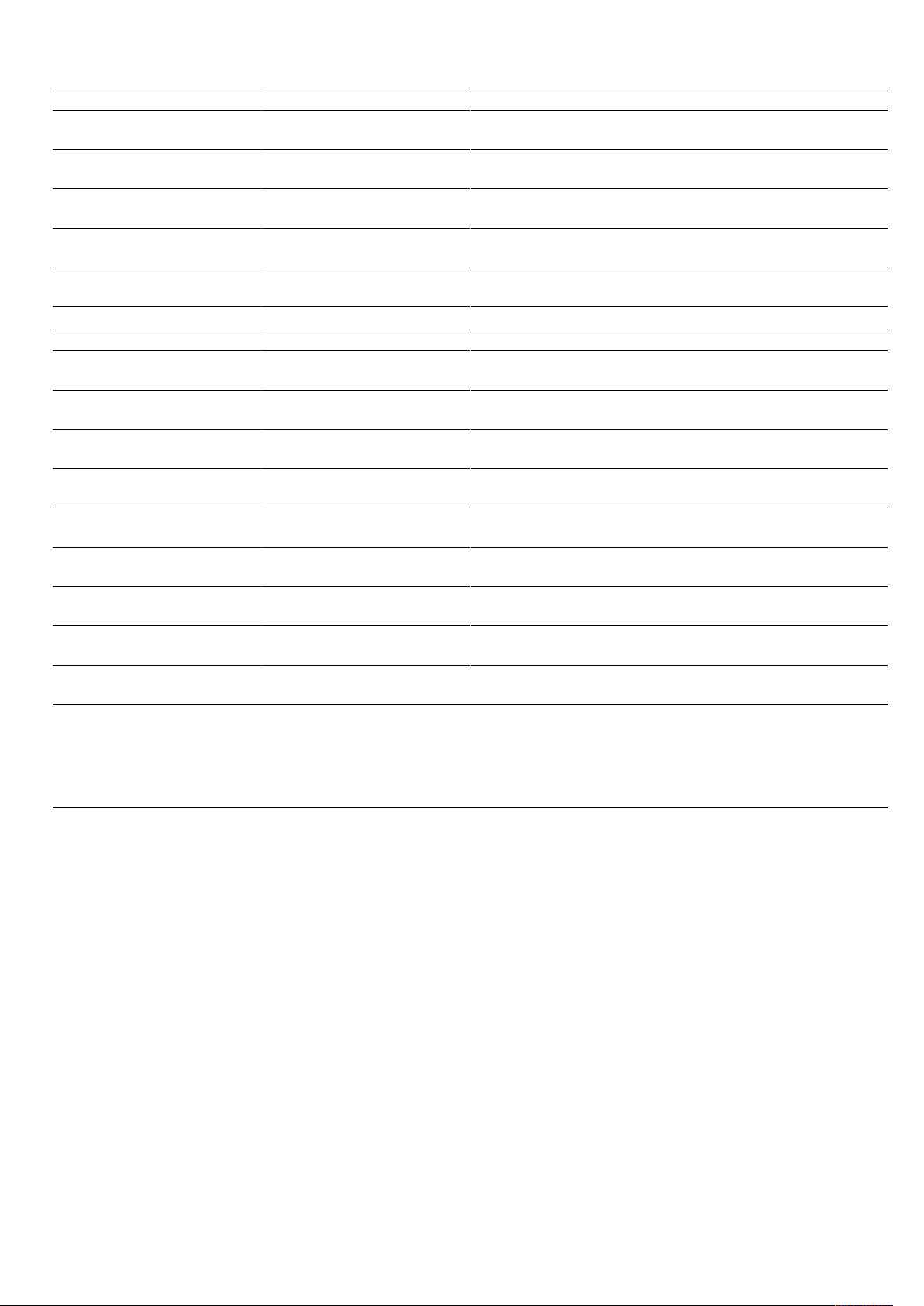
Recommended settings for defrosting, heating and
cooking with the microwave.
The cooking time depends on the cookware, as well as
on the temperature, composition and quantity of the
food. This is why temperature ranges are given in the
tables. Begin with the lower temperature and, if neces-
sary, use a higher setting the next time. If you use dif-
ferent quantities than those specified in the table, ad-
here to the rule of thumb: Double the amount = almost
double the time, half the amount = half the time.
Defrosting with the microwave
Note:
Cooking tips
¡ Freeze the food flat.
¡ Use microwave-safe cookware without a lid.
¡ Place the cookware on the bottom of the cooking compartment.
¡ Turn or stir the food 2 to 3times during this time. When turning, remove any liquid that escapes during defrosting.
¡ Liquid is produced when defrosting meat or poultry. When turning, drain off any liquid. Do not use this for other
purposes or allow it to come into contact with other foods.
¡ After turning, remove any minced meat that has already defrosted.
¡ Separate any defrosted parts when turning.
¡ To allow the temperature to equalise, leave the defrosted food to rest for another 10 to 30minutes in the appli-
ance after switching it off.
Food Weight Microwave output Cooking time
Whole pieces of meat, on
the bone or boned
1
800g 1. 180W
2. 90W
1. 10min
2. 15-20mins
Whole pieces of meat, on
the bone or boned
1
1000g 1. 180W
2. 90W
1. 15min
2. 20min
Whole pieces of meat, on
the bone or boned
1
1500g 1. 180W
2. 90W
1. 20min
2. 25-30mins
Meat in pieces or slices
1, 2
200g 1. 180W
2. 90W
1. 5-8mins
2. 5-10mins
Meat in pieces or slices
1, 2
500g 1. 180W
2. 90W
1. 9min
2. 10-15mins
Meat in pieces or slices
1, 2
800g 1. 180W
2. 90W
1. 10min
2. 10-15mins
Minced meat, mixed
1, 2
200g 90W 8-10mins
Minced meat, mixed
1, 2
500g 1. 180W
2. 90W
1. 3min
2. 10-12mins
Minced meat, mixed
1, 2
1000g 1. 180W
2. 90W
1. 10min
2. 15-17mins
1
Turn the food several times.
2
Separate any defrosted parts when turning.
3
Carefully stir the food occasionally.
4
Remove all packaging.
5
Only defrost cakes without icing, whipped cream, gelatine or custard.
6
Separate the pieces of cake.
en How it works
22
Food Weight Microwave output Cooking time
Poultry or poultry portions
1,
2
600g 1. 180W
2. 90W
1. 8min
2. 12-15mins
Poultry or poultry portions
1,
2
1200g 1. 180W
2. 90W
1. 15-20mins
2. 15-20mins
Fish fillet, fish steak or fish
slices
1, 2
400g 1. 180W
2. 90W
1. 3min
2. 10-15mins
Whole fish
1
300g 1. 180W
2. 90W
1. 3min
2. 10-12mins
Whole fish
1
600g 1. 180W
2. 90W
1. 8min
2. 13-15mins
Vegetables, e.g. peas
3
300g 180W 10-15mins
Fruit, e.g. raspberries
3
300g 180W 6-9mins
Fruit, e.g. raspberries
3
500g 1. 180W
2. 90W
1. 6-8mins
2. 5-10mins
Butter, defrosting
4
125g 1. 180W
2. 90W
1. 1min
2. 1-2mins
Butter, defrosting
4
250g 1. 180W
2. 90W
1. 1min
2. 2-4mins
Loaf of bread
1
500g 1. 180W
2. 90W
1. 5min
2. 5-10mins
Loaf of bread
1
1000g 1. 180W
2. 90W
1. 8min
2. 9-10mins
Cakes, plain, e.g. sponge
cake
5, 6
500g 90W 8-10mins
Cakes, plain, e.g. sponge
cake
5, 6
750g 1. 180W
2. 90W
1. 3-5mins
2. 6min
Cakes, moist, e.g. fruit flan,
cheesecake
5
500g 1. 180W
2. 90W
1. 3min
2. 10-15mins
Cakes, moist, e.g. fruit flan,
cheesecake
5
750g 1. 180W
2. 90W
1. 5min
2. 10-15mins
1
Turn the food several times.
2
Separate any defrosted parts when turning.
3
Carefully stir the food occasionally.
4
Remove all packaging.
5
Only defrost cakes without icing, whipped cream, gelatine or custard.
6
Separate the pieces of cake.
Heating up or cooking frozen food with the microwave
Observe the recommended settings for using the microwave to heat food.
Note:
Cooking tips
¡ Use microwave-safe cookware with a lid. You can also use a plate or a microwave cover to cover the dish. Take
ready meals out of the packaging.
¡ Distribute the food flat in the cookware. Food which lies flat cooks more quickly than food which is piled high.
¡ Place the cookware on the bottom of the cooking compartment.
¡ The food transfers heat to the cookware. The cookware can become very hot. Use oven gloves.
¡ Turn or stir the food several times during cooking.
¡ After cooking, leave the food to rest for 2 to 5ºminutes.
¡ The food will retain most of its natural flavor. Use salt and seasonings sparingly.
¡ Take lasagne out of the packaging and place in microwave-safe cookware.
¡ Best suited is frozen Lasagne with a maximum height of around 3 cm.
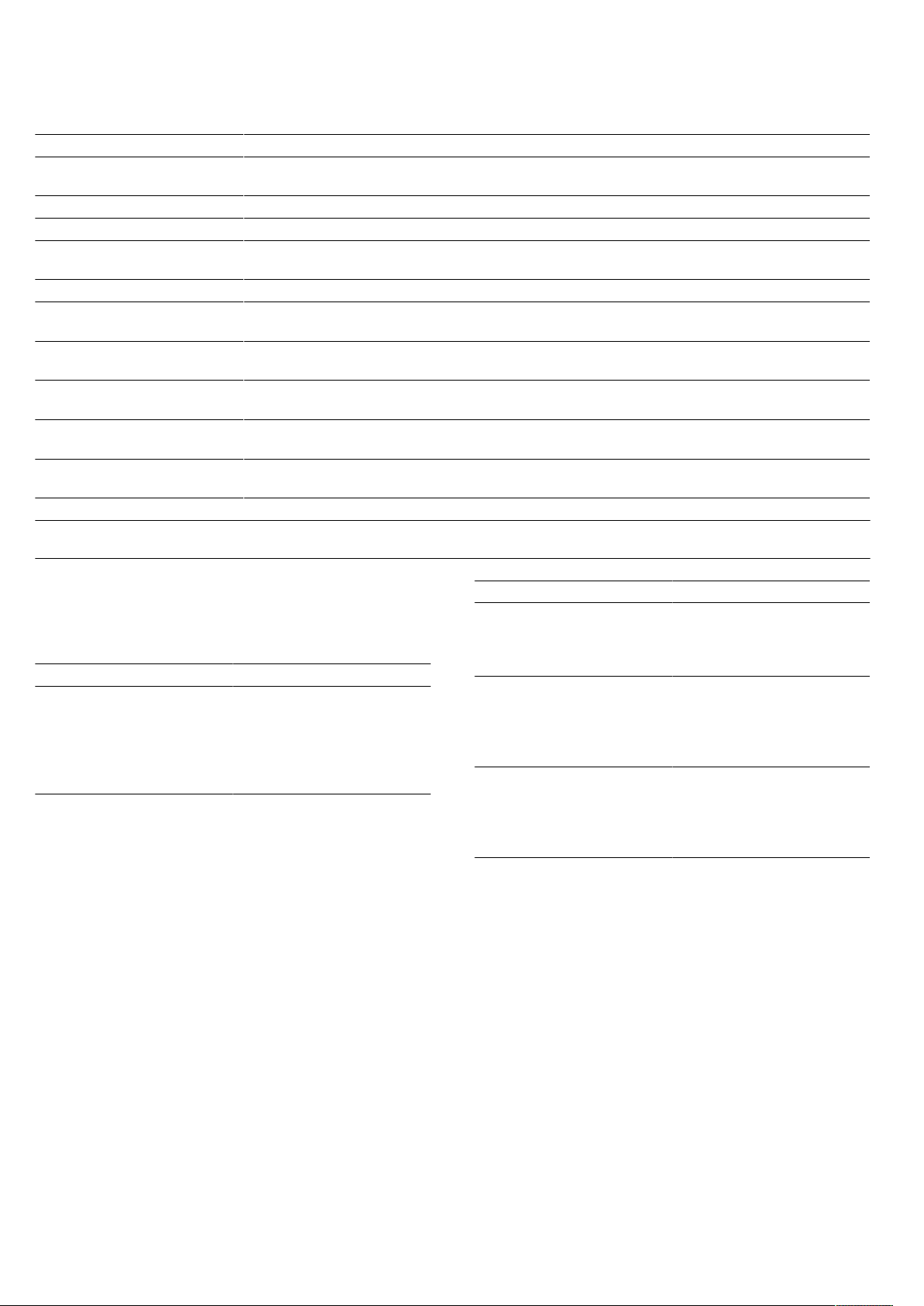
How it works en
23
¡ To achieve best results, we recommend that you reheat food or ready meals at 600 watts. If the packaging spe-
cifies a higher microwave output setting, extend the time.
Food Weight Microwave output setting Cooking time
Menu, plated meal, ready
meal (2-3 components)
300-400g 600W 8-13mins
Soup 400g 600W 8-12mins
Stews 500g 600W 10-15mins
Slices or pieces of meat in
sauce, e.g. goulash
500g 600W 10-15mins
Fish, e.g. fillet steaks
1
400g 600W 10-15mins
Bakes, e.g. lasagne, can-
nelloni (approx. 3cm deep)
450g 600W 12-15mins
Side dishes, e.g. rice,
pasta
1
250g 600W 3-7mins
Side dishes, e.g. rice,
pasta
1
500g 600W 8-12mins
Vegetables, e.g. peas,
broccoli, carrots
1
300g 600W 7-10mins
Vegetables, e.g. peas,
broccoli, carrots
1
600g 600W 14-17mins
Creamed spinach
2
450g 600W 9-12mins
1
Add a little liquid to the food.
2
Cook the food without any additional water.
Tips on defrosting, heating and cooking with the
microwave next time
Follow these tips for good results when defrosting,
heating and cooking with the microwave.
Issue Tip
Your food is too dry. ¡ Reduce the cooking
time or select a lower
microwave power set-
ting.
¡ Cover the food and
add more liquid.
Issue Tip
The time has elapsed but
the food is not defrosted,
hot or cooked.
Increase the cooking
time. Large quantities and
food which is piled high
require longer times.
The time has elapsed but
your food is not yet done
on the inside, but is
already overdone on the
outside.
¡ Stir occasionally.
¡ Reduce the microwave
power setting and in-
crease the cooking
time.
After defrosting, the
poultry or meat is defros-
ted on the outside but not
defrosted in the middle.
¡ Reduce the microwave
power setting.
¡ Turn large pieces of
frozen food several
times.
20.3 Heating
With your appliance you can heat food.
Heating food in the microwave
Observe the recommended settings for using the mi-
crowave to heat food.
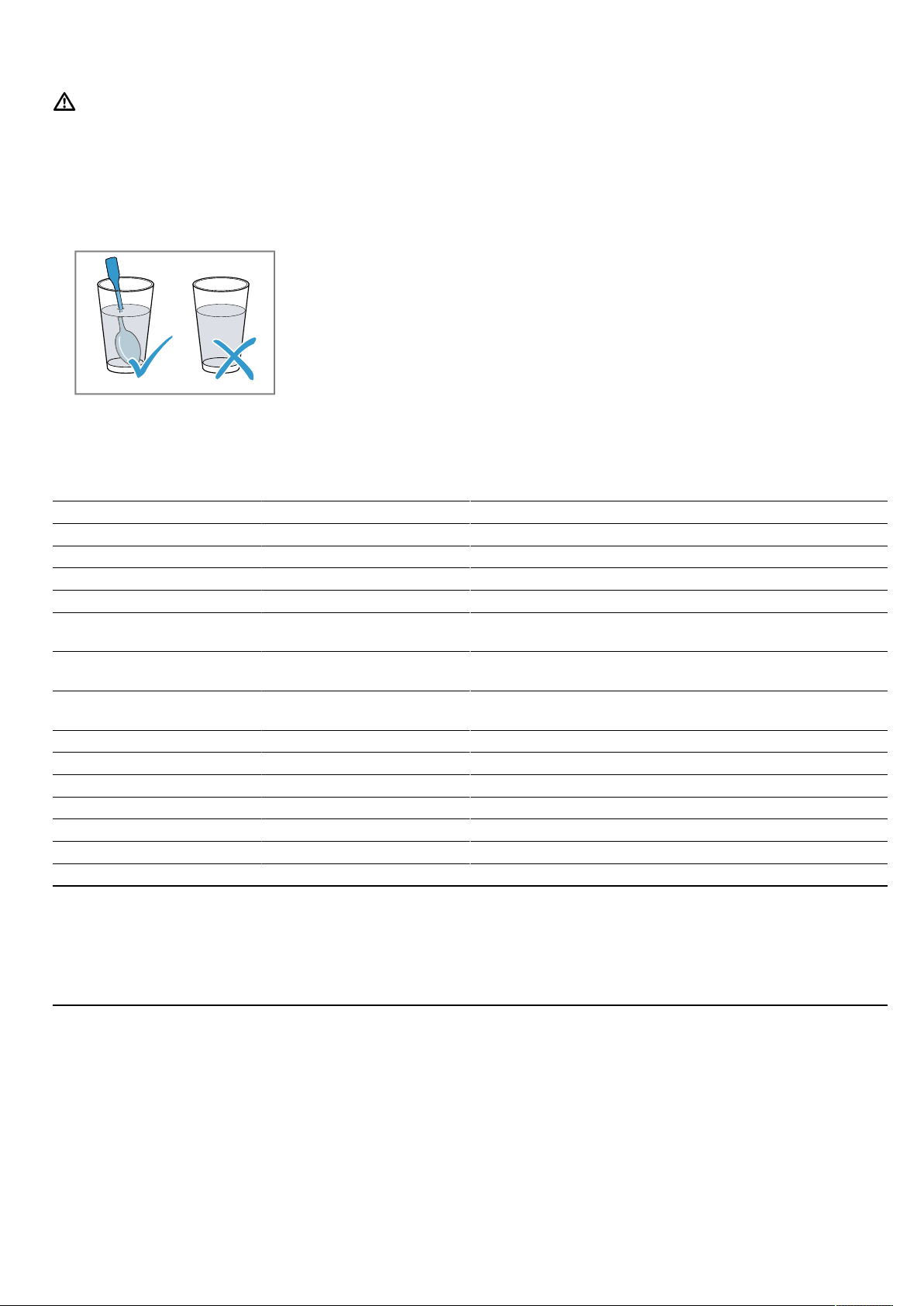
en How it works
24
WARNING‒Risk of scalding!
There is a possibility of delayed boiling when a liquid is
heated. This means that the liquid reaches the boiling
temperature without the usual steam bubbles rising to
the surface. Exercise caution even when only gently
shaking the container. The hot liquid may suddenly boil
over and splatter.
▶ Always place a spoon in the container when heating
liquids. This prevents delayed boiling.
ATTENTION!
Metal touching the wall of the cooking compartment
will cause sparks, which may damage the appliance or
the inner door pane.
▶ Metal (e.g. a spoon in a glass) must be kept at least
2cm from the cooking compartment walls and the
inside of the door.
Note:
Cooking tips
¡ Use microwave-safe cookware with a lid. You can
also use a plate or a microwave cover to cover the
dish. Take ready meals out of the packaging.
¡ Place the cookware on the bottom of the cooking
compartment.
¡ Turn or stir the food several times during cooking.
¡ After cooking, leave the food to rest for 2 to
5ºminutes.
¡ The food transfers heat to the cookware. The cook-
ware can become very hot. Use oven gloves.
¡ To achieve best results, we recommend that you re-
heat food or ready meals at 600 watts. If the pack-
aging specifies a higher microwave output setting,
extend the time.
Food Weight Microwave output setting Cooking time
Plated meal, chilled 1portion 600W 5-8mins
Beverages
1, 2, 3
125ml boost 40-50secs
Beverages
1, 2, 3
200ml boost 1-2mins
Beverages
1, 2, 3
500ml boost 2-3mins
Baby food, e.g. baby
bottles
4, 5, 3
50ml 600W Approx. 20-30secs
Baby food, e.g. baby
bottles
4, 5, 3
100ml 600W 30-40secs
Baby food, e.g. baby
bottles
4, 5, 3
200ml 600W 50-60secs
Soup, 1cup
6
175g each 600W 2-3mins
Soup, 2cups
6
175g each 600W 3-4mins
Meat in sauce
7
500g 600W 7-10mins
Stew
6
400g 600W 4-5mins
Stew
6
800g 600W 7-8mins
Vegetables, 1portion
6
150g 600W 2-3mins
Vegetables, 2portions
6
300g 600W 3-4mins
1
Place a spoon in the glass.
2
Do not overheat alcoholic drinks.
3
Always check the temperature.
4
Heat up baby food without the teat or lid.
5
Always shake the food well after heating.
6
Check the food occasionally.
7
Separate the slices of meat.
20.4 Cooking
With your appliance you can cook food.
Cooking with the microwave
Note:
Cooking tips
¡ Place the cookware on the bottom of the cooking compartment.
¡ Distribute the food flat in the cookware. Food which lies flat cooks more quickly than food which is piled high.
How it works en
25
¡ Use microwave-safe cookware with a lid. You can also use a plate or a microwave cover to cover the dish. Take
ready meals out of the packaging.
¡ The food will retain most of its natural flavor. Use salt and seasonings sparingly.
¡ After cooking, leave the food to rest for 2 to 5ºminutes.
¡ The food transfers heat to the cookware. The cookware can become very hot. Use oven gloves.
¡ To achieve best results, we recommend that you reheat food or ready meals at 600 watts. If the packaging spe-
cifies a higher microwave output setting, extend the time.
Food Weight Microwave output
setting
Cooking time
Whole chicken, fresh, without giblets
1
1200g 600W 25 – 30 min.
Fish fillet, fresh
2
400g 600W 6 – 11 min.
Vegetables, fresh
3, 2, 4
250g 600W 5 – 9 min.
Vegetables, fresh
3, 2, 4
500g 600W 10 – 15 min.
Potatoes
3, 2, 4
250g 600W 7 – 9 min.
Potatoes
3, 2, 4
500g 600W 10 – 12 min.
Potatoes
3, 2, 4
750g 600W 15 – 20 min.
Rice
5, 4
125g 1. 600W
2. 180W
1. 4 – 5min.
1. 12 – 15min.
Rice
5, 4
250g 1. 600W
2. 180W
1. 6 – 8min.
1. 15 – 18min.
Desserts, e.g. blancmange (instant)
4
500ml 600W 5 – 8 min.
Fruit compote
4
500g 600W 9 – 12 min.
1
Turn the dish halfway through the cooking time.
2
Add a little liquid to the food.
3
Cut into pieces of equal size.
4
Carefully stir the food occasionally.
5
Add double the amount of liquid.
Blancmange made from blancmange powder
WARNING‒Risk of burns!
Heated food gives off heat. The cookware may become
hot.
▶ Always use oven gloves to remove cookware or ac-
cessories from the cooking compartment.
1.
Mix together one packet of blancmange powder
with sugar and a little milk in a tall microwave-suit-
able bowl in accordance with the package instruc-
tions so that there are no lumps.
2.
Add the rest of the milk and stir again.
3.
Place the bowl into the cooking compartment and
close the appliance door.
4.
Set the appliance according to the recommended
settings.
5.
Only stir for the first time after 3minutes. Then stir
again every minute until it reaches the required con-
sistency.
The cooking time depends on the temperature of
the milk and the container that is used.
en How it works
26
Microwave popcorn
WARNING‒Risk of burns!
Airtight packaging may burst when food is heated.
▶ Always follow the instructions on the packaging.
▶ Always use oven gloves to remove the dishes from
the cooking compartment.
ATTENTION!
If you prepare several bags of microwave popcorn in
immediate succession at a microwave power level that
is too high, the cooking compartment may be dam-
aged.
▶ Leave the appliance to cool down for several
minutes between each use.
▶ Never set a microwave power level that is too high.
▶ Use a maximum microwave output of 600 watts.
▶ Always place the popcorn bag on a glass plate.
Note:
Cooking tips
¡ Place the cookware on the bottom of the cooking
compartment.
¡ Use shallow, heat-resistant glass ovenware. Do not
use porcelain or deep plates.
¡ Place the popcorn bag onto the cookware with the
labelled side facing downwards.
¡ Adjust the cooking time to the quantity.
¡ To prevent the popcorn from burning, after 1minute
30seconds, briefly take the popcorn bag out of the
oven and shake it. Take care as the popcorn will be
hot.
Food Weight Microwave output Cooking time
Microwave popcorn
1
1 bag, 100g 600W 2.5-3.5mins
1
Always place the popcorn bag on a glass plate. Follow the manufacturer’s instructions.
20.5 Grilling
Grill food if you want it to be crispy.
Note:
Cooking tips
¡ Do not preheat.
¡ Use food to be grilled that is of a similar weight and thickness.
This allows the food to be grilled to brown evenly and remain succulent and juicy.
¡ Place the food to be grilled directly on the wire rack. Place the wire rack in the glass tray. Any dripping fat and
meat juices will be caught.
¡ Use grill tongs to turn the grilled items.
If you pierce the meat with a fork, the juices will run out and it will become dry.
¡ Do not add salt until after the food has been grilled.
Salt draws water from the meat.
¡ Dark meat, such as beef, browns more quickly than lighter-coloured meat, such as veal or pork. When grilling
light-coloured meat or fish, these often only brown slightly on the surface, although they are cooked and juicy on
the inside.
¡ The grill element switches on and off continuously. This is normal. The grill setting that you use determines how
frequently this occurs.
¡ Smoke may be produced when grilling.
Food Quantity Weight Grill setting Cooking time
Neck steaks, approx. 2 cm thick 3-4 Approx. 220 g
each
3 (high) 1st side: Ap-
prox. 15 mins
2nd side: Ap-
prox. 10-15
mins
Grilled sausages 4-6 Approx. 100 g
each
3 (high) 1st side: Ap-
prox. 15-20
mins
2nd side: Ap-
prox. 10-15
mins
Fish steak
1
2-3 Approx. 150 g
each
3 (high) 1st side: Ap-
prox. 10 mins
2nd side: Ap-
prox. 15-20
mins
1
Grease the wire rack with oil beforehand.
How it works en
27
Food Quantity Weight Grill setting Cooking time
Fish, whole, e.g. trout
1
2-3 Approx. 260 g
each
3 (high) 1st side: Ap-
prox. 15 mins
2nd side: Ap-
prox. 10-15
mins
Toast (pretoast) 2-6slices 3 (high) 1st side: Ap-
prox. 4-5 mins
2nd side: Ap-
prox. 2-3 mins
Toast with topping 2-6slices 3 (high) Depending on
topping: 5-10
mins
1
Grease the wire rack with oil beforehand.
20.6 Combining the grill and microwave
To reduce the cooking time, you can use the grill in combination with the microwave.
Combining the grill and microwave
Note:
Cooking tips
¡ Place the cookware onto the wire rack.
¡ For roasting, use a deep dish. If you cover the cookware when you cook your food, this will keep the cooking
compartment cleaner.
¡ Arrange chicken, chicken portions and duck breast skin side up.
¡ Prick the skin here and there with a fork.
¡ For bakes and gratins, use large, flat cookware.
Food takes longer to cook in narrow, deep cookware and browns more on top.
¡ Leave bakes and gratins to stand for 5 minutes in the appliance after it has been switched off.
¡ Check whether the cookware fits in the cooking compartment. The cookware should not be too big.
¡ Leave the meat to sit for 5-10 minutes before carving.
This allows the meat juices to be distributed evenly so that they do not run out when the meat is carved.
¡ Always set the maximum cooking time.
Check the food after the shorter time specified.
¡ Take lasagne out of the packaging and place in microwave-safe cookware.
¡ If you are preparing frozen lasagne with an approx. height of 4-5cm, place the dish on an upturned, microwave-
safe plate.
Food Weight Grill setting Microwave output
setting
Cooking time
Joint of pork, e.g.
neck steak
1
Approx.750g 1 (low) 360W 35-40mins
Meat loaf, max. 7cm
deep
Approx. 750g 2 (medium) 360W 20-25mins
Chicken, halved
2
Approx. 1200g 3 (high) 360W 35-40mins
Chicken pieces, e.g.
chicken quarters
2
Approx. 800g 2 (medium) 360W 20-25mins
Duck breast
2
Approx. 800g 3 (high) 180W 20-25mins
Pasta bake (made
from pre-cooked
ingredients)
3
Approx. 1000g 1 (low) 360W 25-30mins
Lasagne, frozen (ap-
prox. 3cm deep)
350-450g 3 (high) 360W 12-15mins
Lasagne, frozen (ap-
prox. 4-5cm deep)
600-1000g 3 (high) 360W 25-30mins
1
Turn after 15 minutes.
2
Do not turn the food.
3
Sprinkle cheese over the food.
en Installation instructions
28
Food Weight Grill setting Microwave output
setting
Cooking time
Potato gratin (made
from raw potatoes),
max. 3cm deep
Approx. 1000g 2 (medium) 360W 25-30mins
Fish, gratinated Approx. 600g 3 (high) 360W 15mins
Baked quark, max.
5cm deep
Approx. 850g 1 (low) 360W 20-25mins
1
Turn after 15 minutes.
2
Do not turn the food.
3
Sprinkle cheese over the food.
20.7 Test dishes
These overviews have been produced for test institutes to facilitate appliance testing in accordance with EN
60350-1:2013 or IEC 60350-1:2011 and EN 60705:2012, IEC 60705:2010.
Cooking with the microwave
Food Microwave power setting
inW
Cooking time inmins Note:
Custard, 1000g 1. 600W
2. 180W
1. 11-12mins
2. 8-10mins
Pyrex dish
Sponge, 475g 600W 7-9mins Pyrex dish, 22cmdiameter
Meat loaf, 900g 600W 20-25mins Pyrex dish, 28cmdia-
meter, long
Plated meal, chilled, 1por-
tion
600W 5-6mins Microwaveable cover
Defrosting with the microwave
Food Microwave power setting
inW
Cooking time inmins Note:
Meat, 500g 1. 180W
2. 90W
1. 5-6mins
2. 7-10mins
Pyrex dish, 24cmdiameter
Cooking with the microwave and grill
Food Microwave power setting
inW
Cooking time inmins Note:
Potato gratin, 1100g 360W + grill setting 2 25-35mins Round Pyrex dish, 22 cm
diameter
Cakes - Not recommended
Installation instructions
21 Installation instructions
Installation instructions
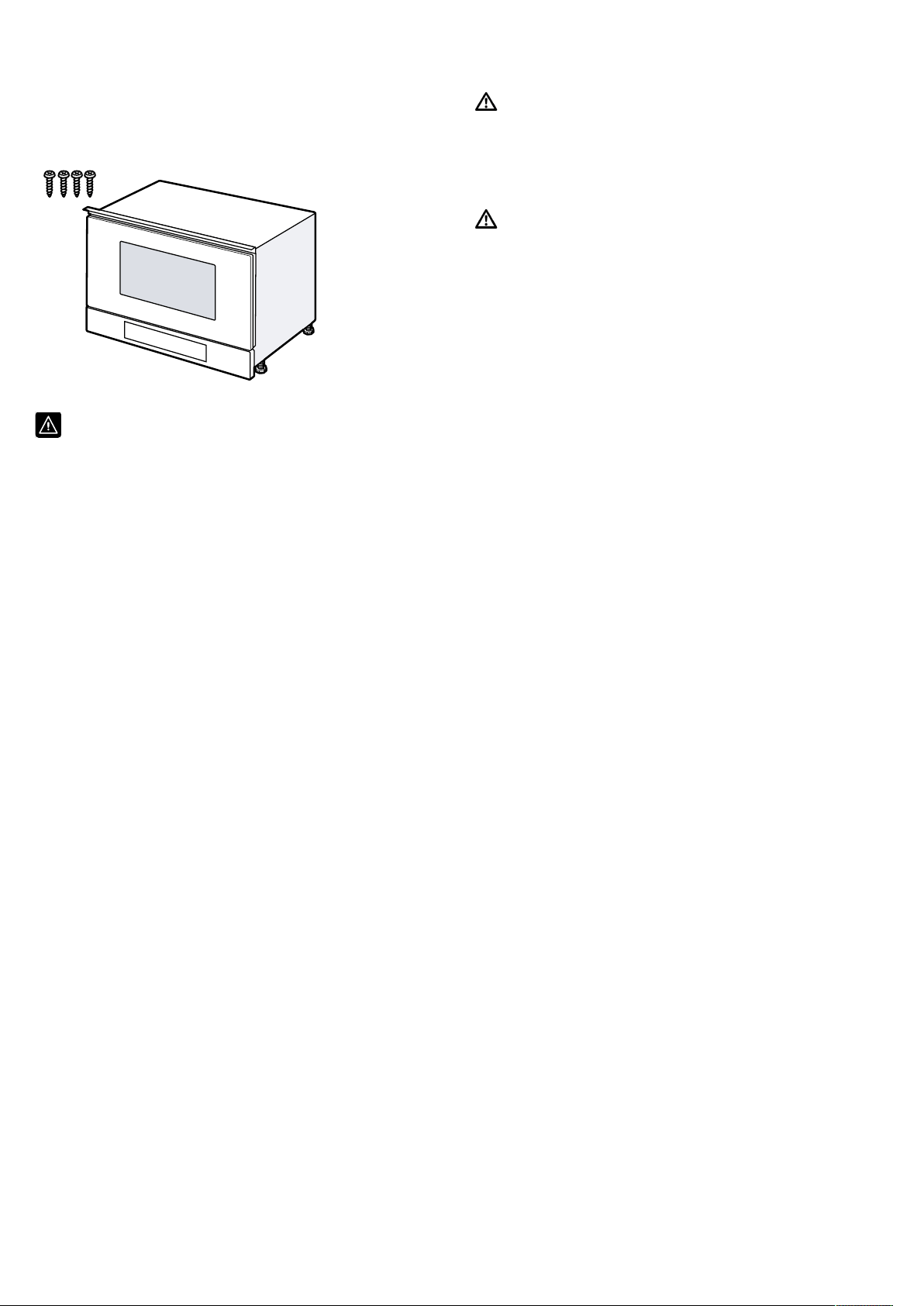
Installation instructions en
29
21.1 Scope of delivery
After unpacking all parts, check for any damage in
transit and completeness of the delivery.
21.2 Safe installation
Follow these safety instructions when in-
stalling the appliance.
¡ The appliance can only be used safely if it
is correctly installed according to the safety
instructions. The installer is responsible for
ensuring that the appliance works perfectly
at its installation location.
¡ Check the appliance for damage after un-
packing it. Do not connect the appliance if
it has been damaged in transit.
¡ Before starting up the appliance, remove
any packaging material and adhesive film
from the cooking compartment and the
door.
¡ Proceed in accordance with the installation
sheets for installing accessories.
¡ Fitted units must be temperature-resistant
up to 90°C, and adjacent unit fronts up to
65°C.
¡ Do not install the appliance behind a decor-
ative door or the door of a kitchen unit.
There is a risk of overheating.
¡ Cut-out work on the units should be carried
out before installing the appliance. Remove
any shavings. Otherwise, the correct opera-
tion of electrical components may be ad-
versely affected.
¡ Only a licensed professional may connect
appliances without plugs. Damage caused
by incorrect connection is not covered un-
der the warranty.
WARNING‒Risk of injury!
Parts that are accessible during installation
may have sharp edges and may lead to cut-
ting injuries.
▶ Wear protective gloves.
WARNING‒Risk of fire!
It is dangerous to use an extended power
cord and non-approved adapters.
▶ Do not use extension cables or multiple
socket strips.
▶ If the power cord is too short, contact cus-
tomer service.
21.3 Fitted units
This appliance is only intended to be fully fitted in a kit-
chen. It is not intended to be used as a tabletop appli-
ance or within a cupboard.
The installation cabinet must not have a back panel be-
hind the appliance. The minimum installation height is
850mm.
Ventilation slots and intakes must not be covered.
21.4 Electrical connection
In order to safely connect the appliance to the elec-
trical system, follow these instructions.
¡ The appliance corresponds to protection class I and
must only be operated with a protective earth con-
nection.
¡ The fuse protection must correspond to the power
rating specified on the appliance's rating plate and
to the local regulations.
¡ The appliance must be disconnected from the
power supply whenever installation work is being
carried out.
¡ The appliance must only be connected using the
power cable provided.
¡ The power cable must be plugged in at the rear of
the appliance. A 3 m power cable can be obtained
from customer service.
¡ The power cable must only be replaced with a cable
from the original manufacturer. This is available from
customer service.
Connecting the appliance to the electricity
supply
Note:The appliance must only be connected to a pro-
tective contact socket that has been correctly installed.
1.
Insert the non-heating appliance plug of the power
cable into the appliance.
Check that the non-heating appliance plug is inser-
ted properly.
2.
Insert the mains plug of the appliance into a nearby
socket.
When the appliance is installed, the mains plug of
the power cable must be freely accessible. If free
access to the mains plug is impossible, an all-pole
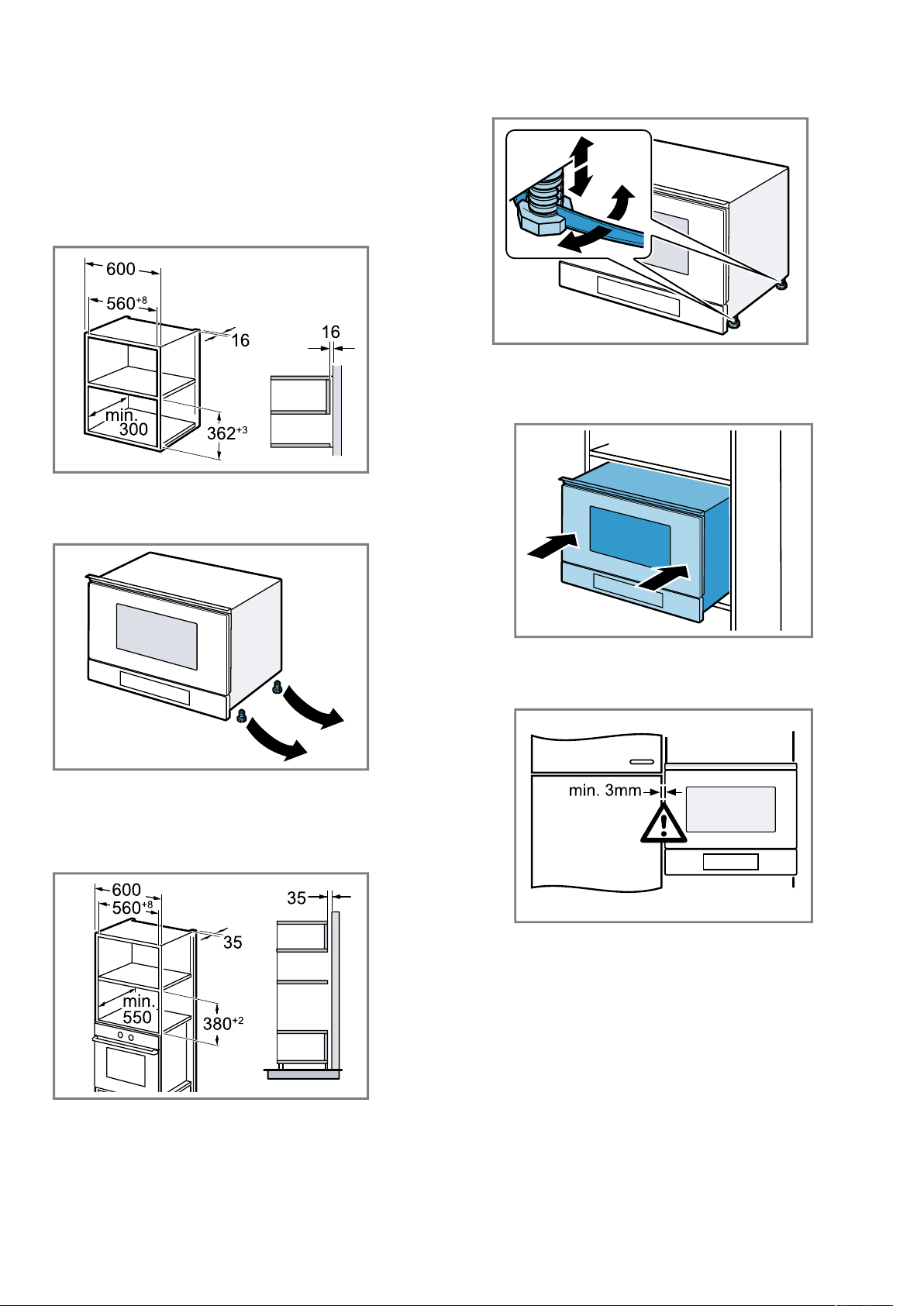
en Installation instructions
30
isolating switch must be integrated into the perman-
ent electrical installation in accordance with the in-
stallation regulations.
21.5 Installation in an upper cabinet
Observe the installation dimensions and the safety
clearances in a tall unit.
Do not fit the appliance too high up; it must be pos-
sible for accessories to be removed easily.
Remove the feet.
21.6 Installation in a tall unit
Observe the installation dimensions and the safety
clearances in a tall unit.
Do not fit the appliance too high up; it must be pos-
sible for accessories to be removed easily.
Fit the feet.
21.7 Installing the appliance
1.
Push the appliance in fully.
Do not kink or trap the connection cable, or route it
over sharp edges.
2.
Check the clearance to the adjacent appliances.
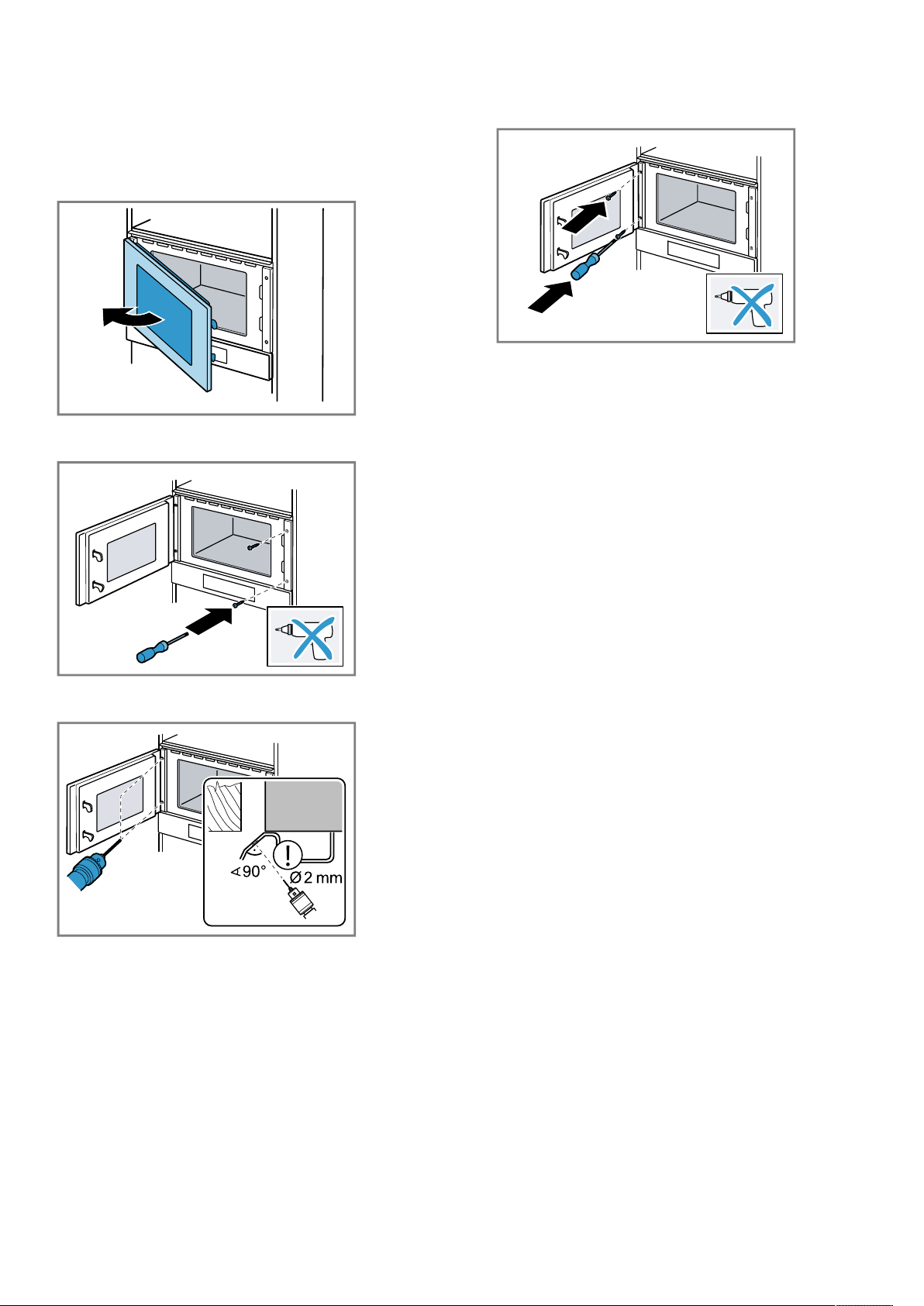
Installation instructions en
31
3.
ATTENTION!
When opening the appliance door, the appliance
may tilt forwards.
▶ Hold the appliance in position when opening the
appliance door.
Open the appliance door slowly.
4.
Screw the appliance to the unit on the opposite side
to the hinges.
5.
Pre-drill the screw holes in the unit on the side with
the hinges.
Cover the door hinges.
Use a wood drill with a 2 mm diameter.
6.
Remove any shavings from the cooking compart-
ment.
7.
Screw the appliance to the unit on the side with the
hinges.
8.
Remove any packaging material and adhesive film
from the cooking compartment and the door.
21.8 Removing the appliance
1.
Disconnect the appliance from the power supply.
2.
Undo the fastening screws.
3.
Lift the appliance slightly and pull it out completely.

Thank you for buying a
Bosch Home Appliance!
Register your new device on MyBosch now and profit directly from:
• Expert tips & tricks for your appliance
• Warranty extension options
• Discounts for accessories & spare-parts
• Digital manual and all appliance data at hand
• Easy access to Bosch Home Appliances Service
Free and easy registration – also on mobile phones:
www.bosch-home.com/welcome
Looking for help?
You'll find it here.
Expert advice for your Bosch home appliances, help with problems
or a repair from Bosch experts.
Find out everything about the many ways Bosch can support you:
www.bosch-home.com/service
Contact data of all countries are listed in the attached service directory.
*9001768151*
9001768151 (030713)
en
BSH Hausgeräte GmbH
Carl-Wery-Straße 34
81739 München, GERMANY
www.bosch-home.com
A Bosch Company
Valid within Great Britain:
Imported to Great Britain by
BSH Home Appliances Ltd.
Grand Union House
Old Wolverton Road
Wolverton, Milton Keynes
MK12 5PT
United Kingdom