OWNER’S
MANUAL
For Maintenance and Safety
RZR 200 EFI
2023

WARNING
Operating, servicing, and maintaining a passenger vehicle or off-road
vehicle can expose you to chemicals including engine exhaust, carbon
monoxide, phthalates, and lead, which are known to the State of California
to cause cancer and birth defects or other reproductive harm. To minimize
exposure, avoid breathing exhaust, do not idle the engine except as
necessary, service your vehicle in a well-ventilated area and wear gloves
or wash your hands frequently when servicing your vehicle.
For more information go to www.P65Warnings.ca.gov/passenger-vehicle.
!
WARNING
Read, understand, and follow all of the instructions and safety
precautions in this manual and on all product labels.
Failure to follow the safety precautions
could result in serious injury or death.
For videos and more information
about a safe riding experience with
your Polaris vehicle, scan this QR
Code® with your smartphone.
!
2023 Owner’s Manual
RZR 200 EFI
IMPORTANT SAFETY INFORMATION
Scan this QR Code® with your smartphone to see an
important Safety Video regarding your Polaris vehicle.
This safety video can also be found at
http://www.polaris.com/en-us/rider-support/safety. If you are
on the homepage of the Polaris website, click on the Rider
Community heading and select “Product Safety and Training
Information” from the dropdown menu to access this page.

NGK® is a registered trademark of NGK Spark Plug Co., Ltd. FOX® is a
registered trademark of Fox Factory Inc. Loctite® is a registered trademark of
Henkel Corporation. MACPHERSON RIDE® is a registered trademark of
Aftermarket Auto Parts Alliance, Inc. NYOGEL® is a registered trademark of
Nye Lubricants, Inc. Bluetooth® is a registered trademark of Bluetooth Sig,
Inc. QR Code® is a registered trademark of DENSO WAVE
INCORPORATED. BatteryMinder® is a registered trademark of VDC
Electronics, Inc. Phillips® is a registered trademark of the Phillips Screw
Company. Tread Lightly® is a registered trademark of the United States
Department of Agriculture. Google Play® is a registered trademark of Google
LLC. APPLE® and APP STORE® are registered trademarks of Apple Inc.
MIKUNI® is a registered Trademark of MIKUNI CORPORATION. Silicon
Labs® is a registered trademark of Silicon Laboratories Inc. iOS® is a
registered trademark of Cisco Technology, Inc. Android® is a registered
trademark of Google LLC. Duro® is a registered trademark of HWA Fong
Rubber (USA) Inc. DBA Duro Tire & Wheel Corp. AUTOLITE® is a registered
trademark of BMO HARRIS BANK N.A.
Unless noted, trademarks are the property of Polaris Industries Inc.
Copyright 2022 Polaris Industries Inc. All information contained within this
publication is based on the latest product information at the time of
publication. Due to constant improvements in the design and quality of
production components, some minor discrepancies may result between the
actual vehicle and the information presented in this publication. Depictions
and/or procedures in this publication are intended for reference use only. No
liability can be accepted for omissions or inaccuracies. Any reprinting or
reuse of the depictions and/or procedures contained within, whether whole or
in part, is expressly prohibited.
The original instructions for this vehicle are in English. Other languages are
provided as translations of the original instructions.
Printed in U.S.A.
9940831 Rev 01
Thank you for purchasing a POLARIS vehicle, and welcome to our world-wide
family of POLARIS enthusiasts. Be sure to visit us online at www.polaris.com for
the latest news, new product introductions, upcoming events, career
opportunities and more.
Here at POLARIS we proudly produce an exciting line of utility and recreational
products. We believe POLARIS sets a standard of excellence for all utility and
recreational vehicles manufactured in the world today. Many years of experience
have gone into the engineering, design, and development of your POLARIS
vehicle, making it the finest machine we’ve ever produced.
For safe and enjoyable operation of your vehicle, be sure to follow the
instructions and recommendations in this owner’s manual. Your manual contains
instructions for minor maintenance, but information about major repairs is
outlined in the POLARIS Service Manual and can be performed by a factory
certified Master Service Dealer (MSD) technician.
Your POLARIS dealer knows your vehicle best and is interested in your total
satisfaction. Your POLARIS dealership can perform all of your service needs
during and after the warranty period.
For the most up-to-date owner’s manual visit https://www. polaris.
com/en-us/owners-manuals.
3
WELCOME


Messages . . . . . . . . . . . . . . . . . . . . . 7
Introduction . . . . . . . . . . . . . . . . . . . . 9
Safety . . . . . . . . . . . . . . . . . . . . . . 15
Features and Controls . . . . . . . . . . . . . . 35
Instrument Cluster . . . . . . . . . . . . . . . . 45
Operation . . . . . . . . . . . . . . . . . . . . 75
Emission Control Systems . . . . . . . . . . . . . 85
Maintenance . . . . . . . . . . . . . . . . . . 87
Specifications . . . . . . . . . . . . . . . . . . 129
Polaris Products . . . . . . . . . . . . . . . . . 133
Troubleshooting . . . . . . . . . . . . . . . . . 135
Warranty . . . . . . . . . . . . . . . . . . . . 153
Maintenance Log . . . . . . . . . . . . . . . . 163
5

6

MESSAGES
PARENTS / SUPERVISING ADULTS
We believe young operators should have the opportunity to enjoy the Polaris
riding experience along with you. We encourage you to teach young operators
to ride safely, and to help ensure the future of recreational sports, please teach
them to show respect for our environment and for the rights of others while
operating the vehicle.
This vehicle is not a toy and can be hazardous to operate. We've provided this
owner’s manual and an instructional video to help teach about the safe
operation and care of your new Polaris vehicle. Prior to driving or riding in the
vehicle, please read and make sure they read this owner’s manual. Watch the
instructional video with them. Make sure all operators and passengers
understand and follow all of the instructions and warnings contained in this
owner’s manual and video. Make sure they understand that the vehicle must be
used under adult supervision at all times.
After reading this owner’s manual and watching the video, help all young
operators practice the New Operator Driving Procedures outlined in this manual.
Never allow a child under age 10 to operate or ride as a passenger in this
vehicle. Young operators differ in skills, physical abilities and judgement. Please
supervise the use of the vehicle at all times. Permit continued use only if you
determine that the young operator has the ability and maturity to operate safely.
For the young operator’s safety, be sure they can reach and operate all RZR 200
controls, including steering wheel, accelerator and brake pedals, and ignition
switch. Make sure the young operator is not too tall to ride safely in this vehicle.
See page 18.
The vehicle’s speed control system allows a parent or supervising adult to limit
vehicle speed for new and inexperienced operators. Please see page 60 for
more information.
The preventive maintenance program outlined in this manual is designed to
ensure that all critical components on your vehicle are thoroughly inspected at
specific intervals. Always follow all of the instructions and recommendations in
this manual to ensure the vehicle remains in safe operating condition at all
times.
This Polaris vehicle is not designed for adult use. Serious damage may occur if
the maximum weight capacity is exceeded. Refer to vehicle labels and to the
Specifications chapter for the maximum weight capacity.
7
MESSAGES

YOUNG OPERATORS
Before you ride your new POLARIS vehicle, there are some important things
that you need to know. You must learn how to keep yourself and those around
you safe while you're riding.
Your parent or supervising adult and POLARIS want you to be safe while you
enjoy riding your new vehicle, and that's why it’s very important that you read
this owner’s manual and watch the instructional video. Make sure you
understand and follow all of the instructions and warnings in this owner’s manual
and video. Ask a parent or supervising adult to explain anything you don't
understand.
Your safety and the safety of others is the most important thing to think about at
all times. Pay attention when you see this symbol:
This is the safety alert symbol. When you see this symbol on your vehicle or in
this manual it means PAY ATTENTION because you could die or be seriously
injured if you don't follow the instructions.
After reading this owner’s manual and watching the video, complete the New
Operator Driving Procedures. Show your parent or supervising adult that you
understand how to drive safely.
Enjoy riding your new Polaris vehicle!
8
MESSAGES
INTRODUCTION
SAFETY SYMBOLS AND SIGNAL WORDS
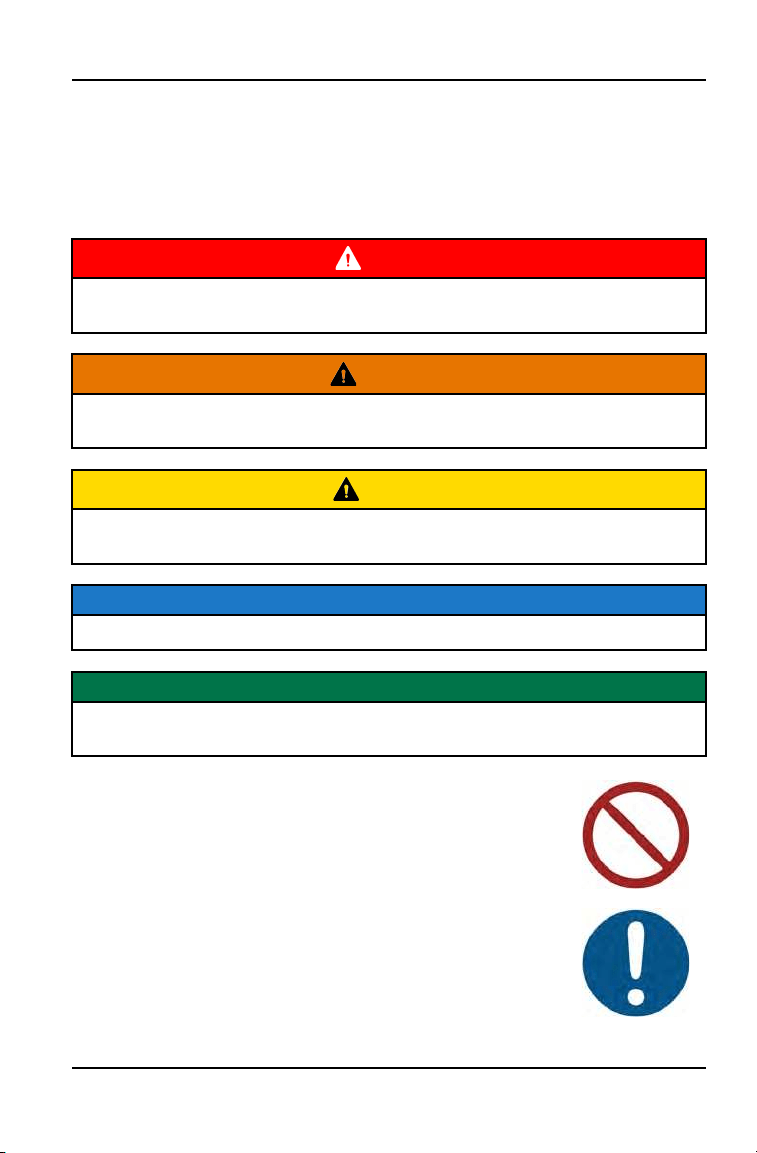
The following signal words and symbols appear throughout this manual and on
your vehicle. Your safety is involved when these words and symbols are used.
Become familiar with their meanings before reading the manual.
DANGER
DANGER indicates a hazardous situation which, if not avoided, WILL result in
death or serious injury.
WARNING
WARNING indicates a hazardous situation which, if not avoided, COULD result
in death or serious injury.
CAUTION
CAUTION indicates a hazardous situation which, if not avoided, COULD result
in minor to moderate injury.
NOTICE
NOTICE provides key information by clarifying instructions.
IMPORTANT
IMPORTANT provides key reminders during disassembly, assembly, and
inspection of components.
The Prohibition Safety Sign indicates an action NOT to take in
order to avoid a hazard.
The Mandatory Action Sign indicates an action that NEEDS to
be taken to avoid a hazard.
9
INTRODUCTION
VEHICLE IDENTIFICATION NUMBERS
Record your vehicle's identification numbers and key number in the spaces
provided. Remove the spare key and store it in a safe place. An ignition key can
be duplicated only by ordering a POLARIS key blank (using your key number)
and mating it with one of your existing keys. The ignition switch must be
replaced if all keys are lost.
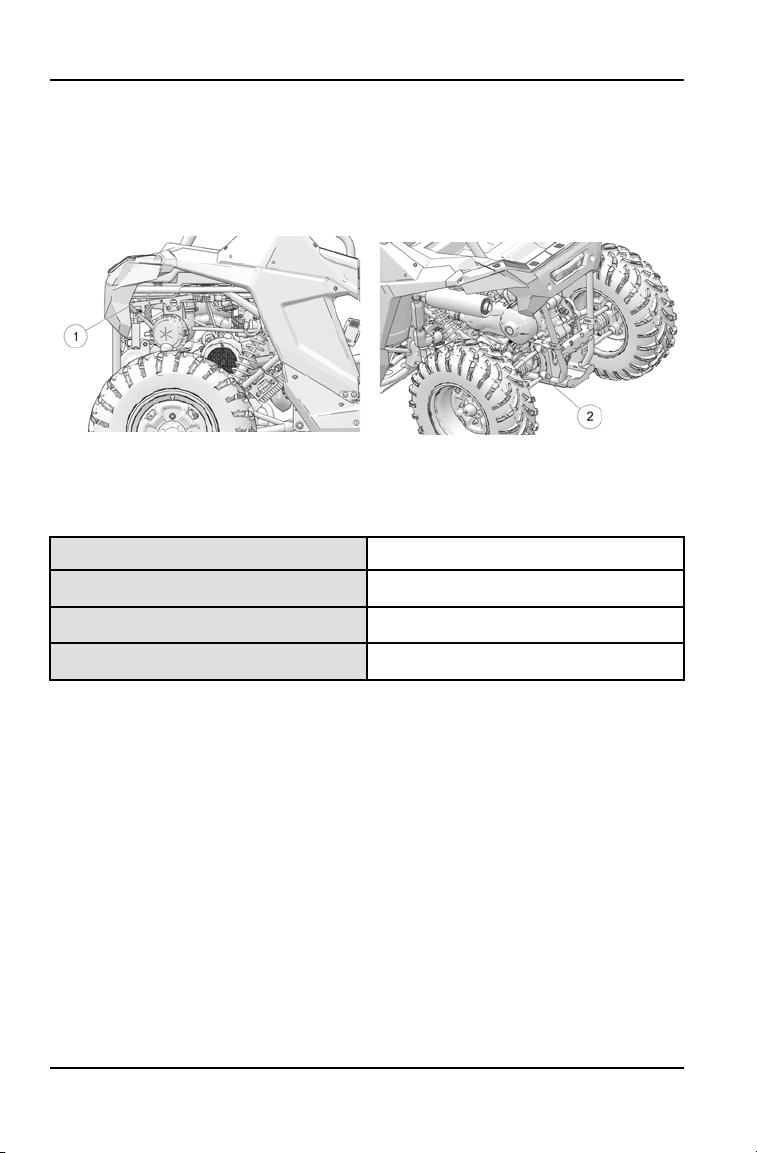
The VIN can be found stamped on a plate
q
riveted to the right rail on the right
wheel well of the ORV.
The engine serial number
w
can be found on the clutch-side of the engine case.
Vehicle Model Number:
Vehicle Identification Number (VIN):
Engine Serial Number:
Key Number
10
INTRODUCTION
NEAR-FIELD COMMUNICATION (NFC)
(IF EQUIPPED)
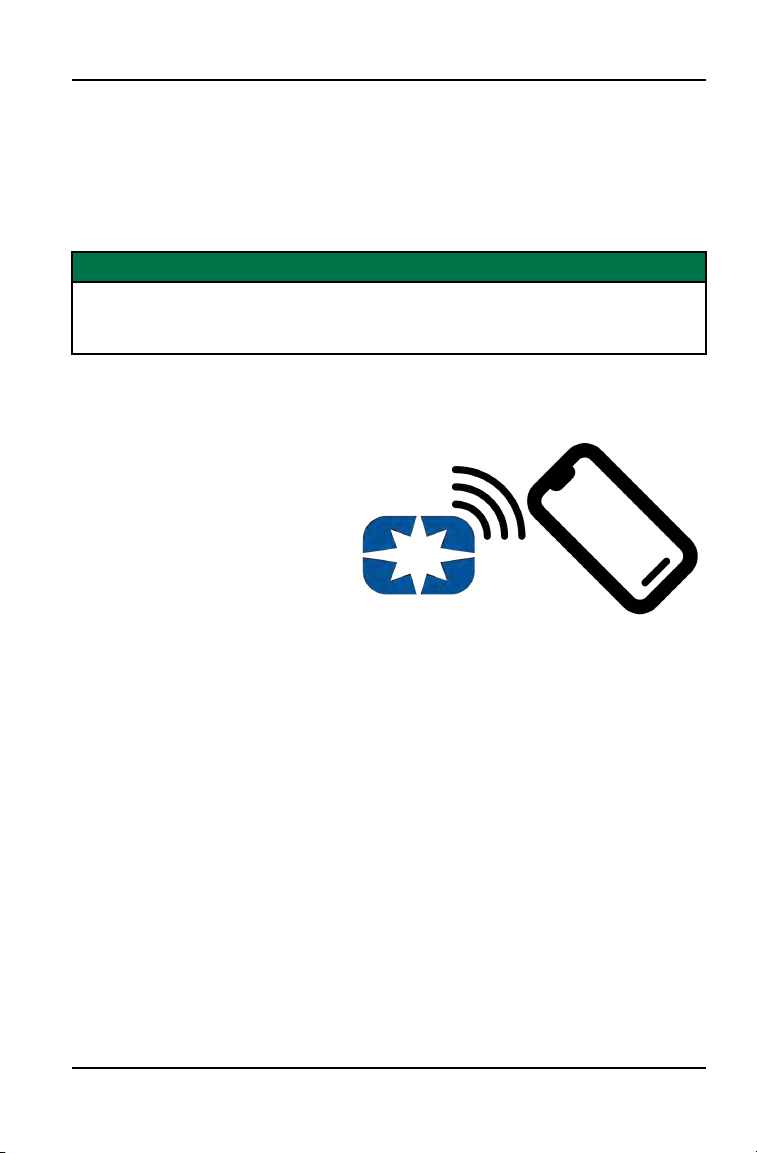
Some Polaris vehicles come equipped with a near-field communication (NFC)
chip. The NFC chip is embedded in the Polaris emblem located at the front of
the vehicle and seamlessly connects you to a digital platform of vehicle
information and tools. See your dealer for more information.
IMPORTANT
Not all devices are equipped with an NFC reader. Additionally, some devices
require third party applications to access NFC content. For questions regarding
the NFC reader on your device, refer to the device’s user manual.
On models equipped with NFC, place your smartphone directly over the Polaris
emblem to do the following:
• View vehicle-specific
information
• Access your Polaris Garage
• Download and view the
owner’s manual
• View accessory instructions
• Watch how-to videos
• Access warranty information
• Check for service notifications
RIDE COMMAND WITH NFC
Additional NFC features are available when using the Ride Command mobile
app. To access these features, do the following:
1. Download the Ride Command mobile app from the Apple App Store® or
Google Play® store.
2. Create or log in to an existing account.
3. From the Ride Command mobile app home screen, select Add Vehicle.
4. On the vehicle, tap the NFC-enabled badge with the phone to scan the
vehicle.
5. Confirm information, name your vehicle, and tap add to garage.
SYSTEM REQUIREMENTS
Refer to device manufacturer’s instructions to verify NFC read capability, and/or
NFC-capable add-ons.
11
INTRODUCTION
DEVICE COMPLIANCE STATEMENTS
NOTICE
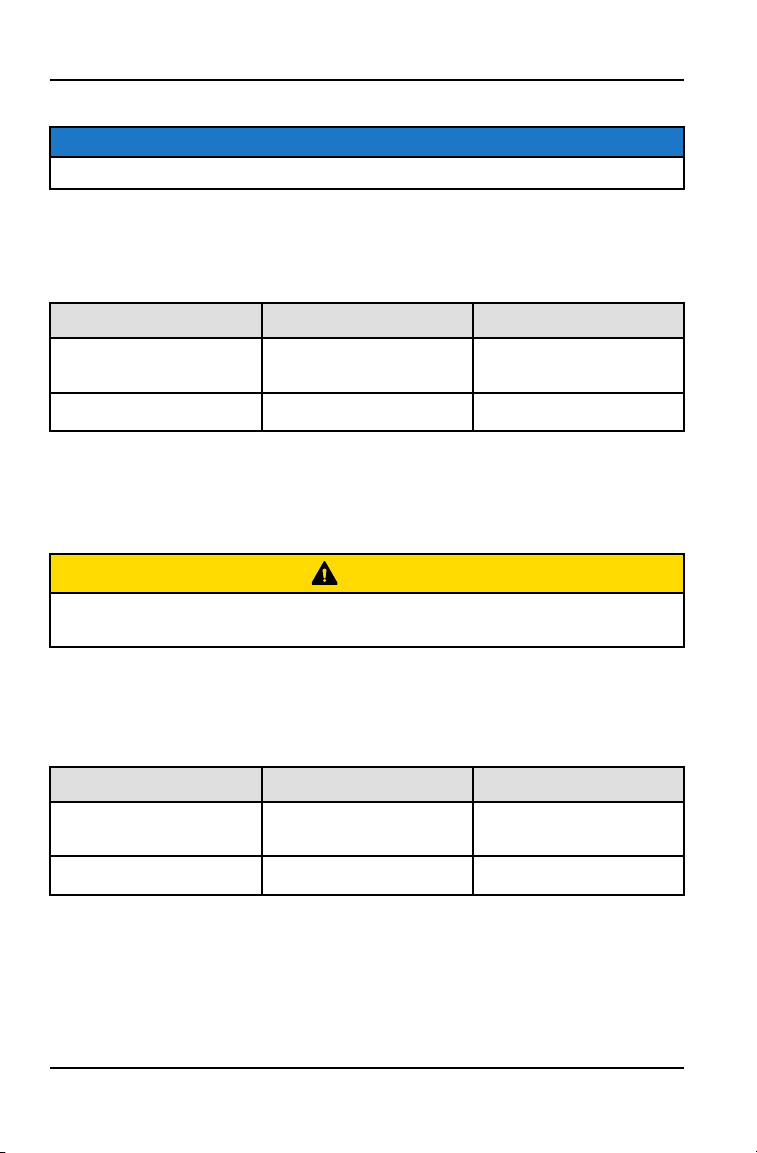
Some vehicle models contain radio equipment as follows:
USA RADIO COMPLIANCE
This vehicle contains the following radio equipment or components that contain
radio equipment:
COMPONENT COMPONENT ID MANUFACTURER
B1 Gauge Bluetooth®
LE
CYBLE-222014–01 Cypress Semiconductor
Helmet Aware Beacon E8 Minew Technologies
This device complies with part 15 of the FCC Rules. Operation is subject to the
following two conditions: (1) This device may not cause harmful interference,
and (2) this device must accept any interference received, including interference
that may cause undesired operation.
CAUTION
Changes or modifications not expressly approved by the party responsible for
compliance could void the user’s authority to operate the equipment.
CANADA RADIO COMPLIANCE
This vehicle contains the following radio equipment or components that contain
radio equipment:
COMPONENT COMPONENT ID MANUFACTURER
B1 Gauge Bluetooth®
LE
CYBLE-222014–01 Cypress Semiconductor
Helmet Aware Beacon E8 Minew Technologies
This device contains license-exempt transmitter(s)/receiver(s) that comply with
Innovation, Science and Economic Development Canada’s license-exempt RSS
(s). Operation is subject to the following two conditions:
12
INTRODUCTION
1. This device may not cause interference.
2. This device must accept any interference, including interference that may
cause undesired operation of the device.
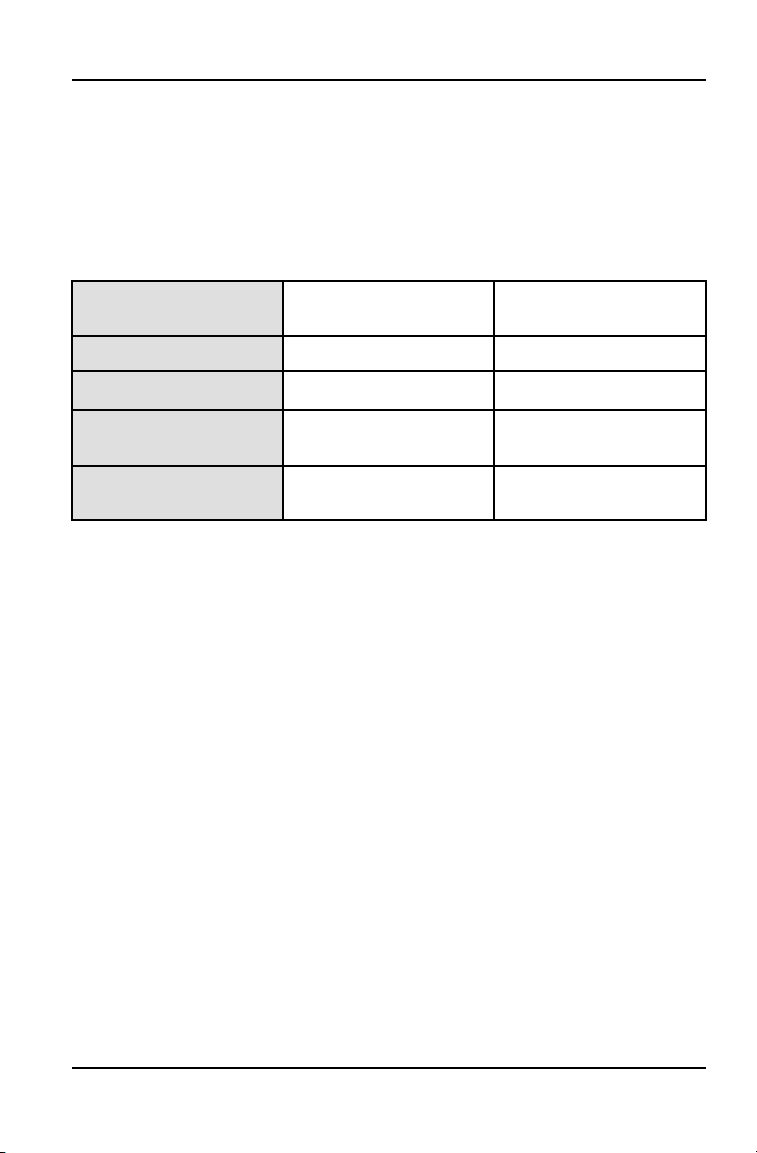
EUROPEAN UNION (EU) RADIO COMPLIANCE
This vehicle contains the following radio equipment or components that contain
radio equipment:
COMPONENT B1 Gauge Bluetooth®
LE
Helmet Aware Beacon
COMPONENT ID CYBLE-222014–01 E8
MANUFACTURER Cypress Semiconductor Minew Technologies
TRANSMITTING
FREQUENCY
2402–2480 MHz 2402–2480 MHz
MAX RF
TRANSMITTING PWR
0.00078 W 0.00116 W
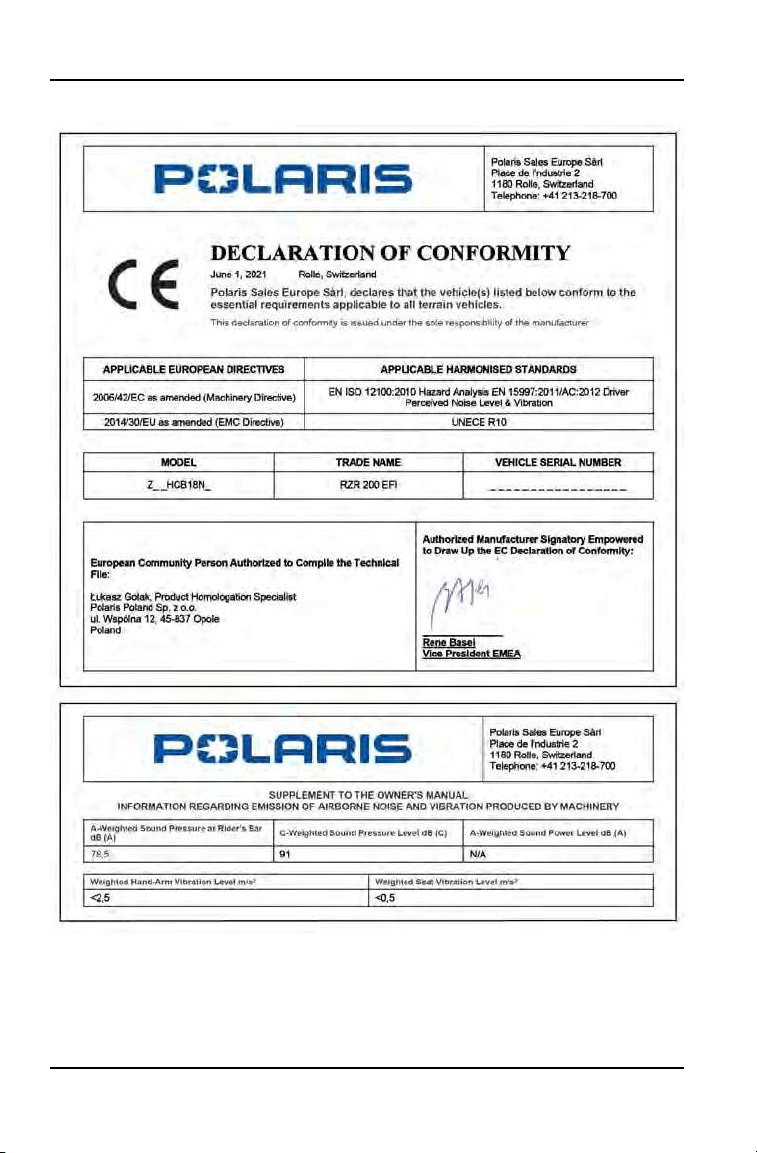
Hereby, Polaris Industries Inc. declares that the above radio equipment is in
compliance with Directive 2014/53/EU.
The full text of the EU declaration of conformity is available at the following
internet address:
https://www.polaris.com/en-us/radio-conformity/
13
INTRODUCTION
SAFETY
EQUIPMENT MODIFICATIONS
Your POLARIS vehicle is designed to provide safe operation when used as
directed.
WARNING
Modifying this vehicle in any way can change the top speed, stability and
handling performance of this vehicle. Modifications that increase speed,
decrease stability or change performance may present a greater risk to
inexperienced or younger operators and could result in loss of control and
serious injury or death. Use only POLARIS-approved accessories to modify
this vehicle. Review all vehicle changes with your child prior to operating.
The POLARIS limited warranty on your POLARIS vehicle will be terminated if
any non-POLARIS-approved equipment and/or modifications have been added
to the vehicle that increase speed or power.
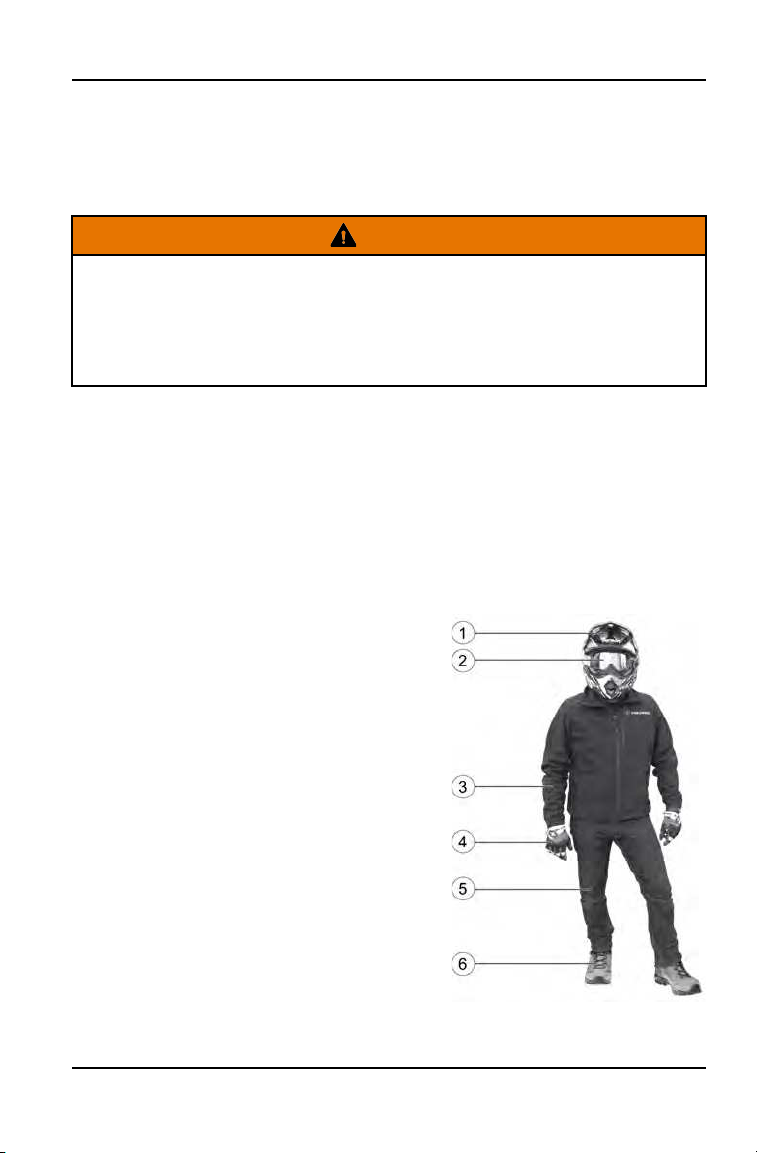
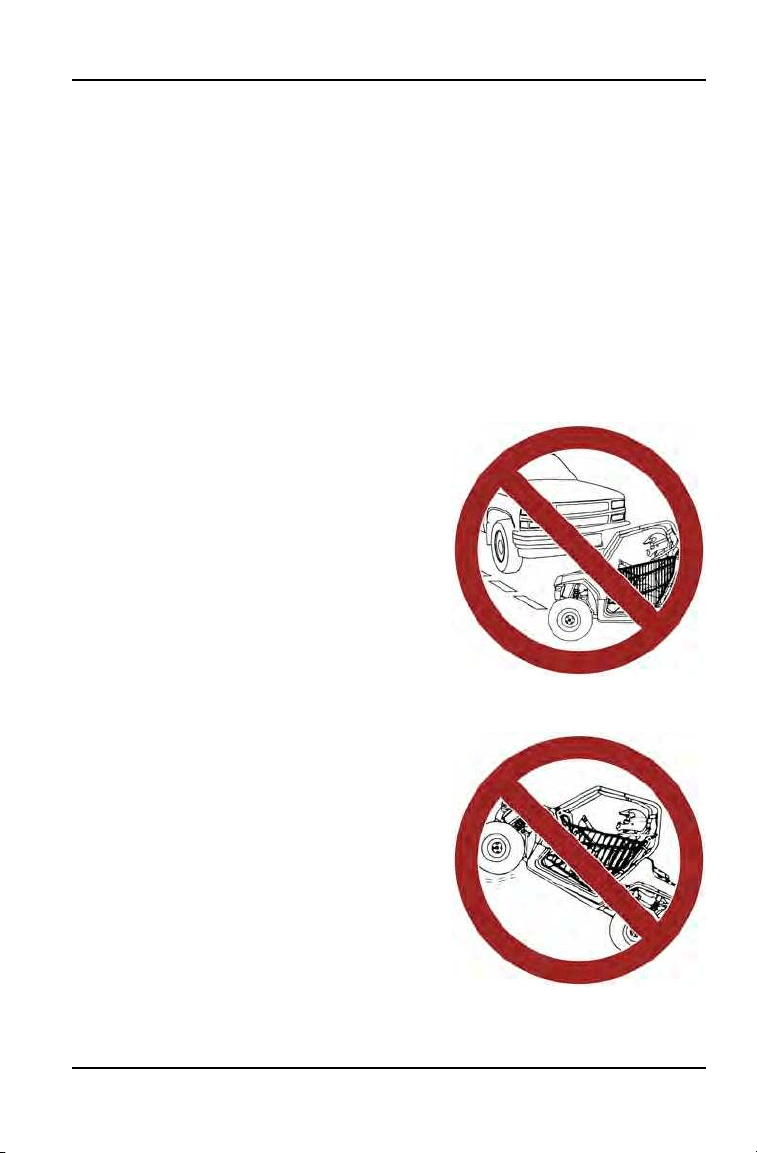
SAFE RIDING GEAR
Protective gear reduces the chance of injury.
The driver and passenger must wear:
q
Helmet
w
Eye Protection
e
Long-Sleeve Shirt
r
Gloves
t
Long Pants
y
Over-the-Ankle Boots
15
SAFETY

HELMET
Wearing a helmet can prevent a severe head injury. Whenever riding this
POLARIS vehicle, always wear a helmet that meets or exceeds established
safety standards. Always buckle and pull straps tight to ensure the helmet is
secured.
Parents and supervising adults should verify that the provided helmets fit
properly. If a helmet doesn't fit, a new one should be obtained in the proper size.
Approved helmets in the USA and Canada bear a U.S. Department of
Transportation (DOT) label.
Approved helmets in Europe, Asia and Oceania bear the ECE 22.05 label. The
ECE mark consists of a circle surrounding the letter E, followed by the
distinguishing number of the country which has granted approval. The approval
number and serial number will also be displayed on the label.
EYE PROTECTION
Do not depend on eyeglasses or sunglasses for eye protection. Whenever riding
this POLARIS vehicle, always wear shatterproof goggles or use a shatterproof
helmet face shield. POLARIS recommends wearing approved Personal
Protective Equipment (PPE) bearing markings such as VESC 8, V-8, Z87.1, or
CE. Make sure protective eye wear is kept clean.
CLOTHING
Wear long sleeves and long pants to protect arms and legs.
GLOVES
Wear gloves for comfort and for protection from sun, cold weather and other
elements.
BOOTS
Wear sturdy over-the-ankle boots for support and protection. Never ride a
POLARIS vehicle with bare feet or sandals.
RIDER COMFORT
Under certain operating conditions, heat generated by the engine and exhaust
system can elevate temperatures in the driver and passenger cab area. The
condition occurs most frequently when a vehicle is being operated in high
ambient temperatures at low speeds and/or high load conditions for an extended
period of time. The use of certain windshield, roof and/or cab systems may
contribute to this condition by restricting airflow. Any discomfort due to heat
buildup in this area can be minimized by wearing proper riding apparel and by
varying speeds to increase airflow.
16
SAFETY
SAFETY WARNINGS
WARNING
Failure to operate this vehicle properly can result in a collision, loss of control,
accident or rollover, which may result in serious injury or death. Heed all safety
warnings outlined in this section of the owner’s manual and in the safety DVD
provided with your vehicle.
Be sure to read all of the following warnings about driving hazards and how to
avoid them. These warnings are provided for your child's safety. Be sure to
explain to your young driver that the hazards outlined in this section of this
owner’s manual MUST be avoided at all times. See the OPERATION section
of this owner’s manual for proper operating procedures.
FOR MORE INFORMATION ABOUT SAFETY call POLARIS at 1–800–342–
3764.
OPERATING WITHOUT INSTRUCTION
Operating this vehicle without proper
instruction increases the risk of an accident.
The operator must understand how to
operate the vehicle properly in different
situations and on different types of terrain.
Take a training course and complete the
steps outlined in the New Operator Driving
Procedures section.
All operators must read and understand the
owner's manual and all warning and
instruction labels before operating the
vehicle.
Never allow a guest to operate this vehicle until the guest has completed the
steps outlined in the New Operator Driving Procedures section.
17
SAFETY
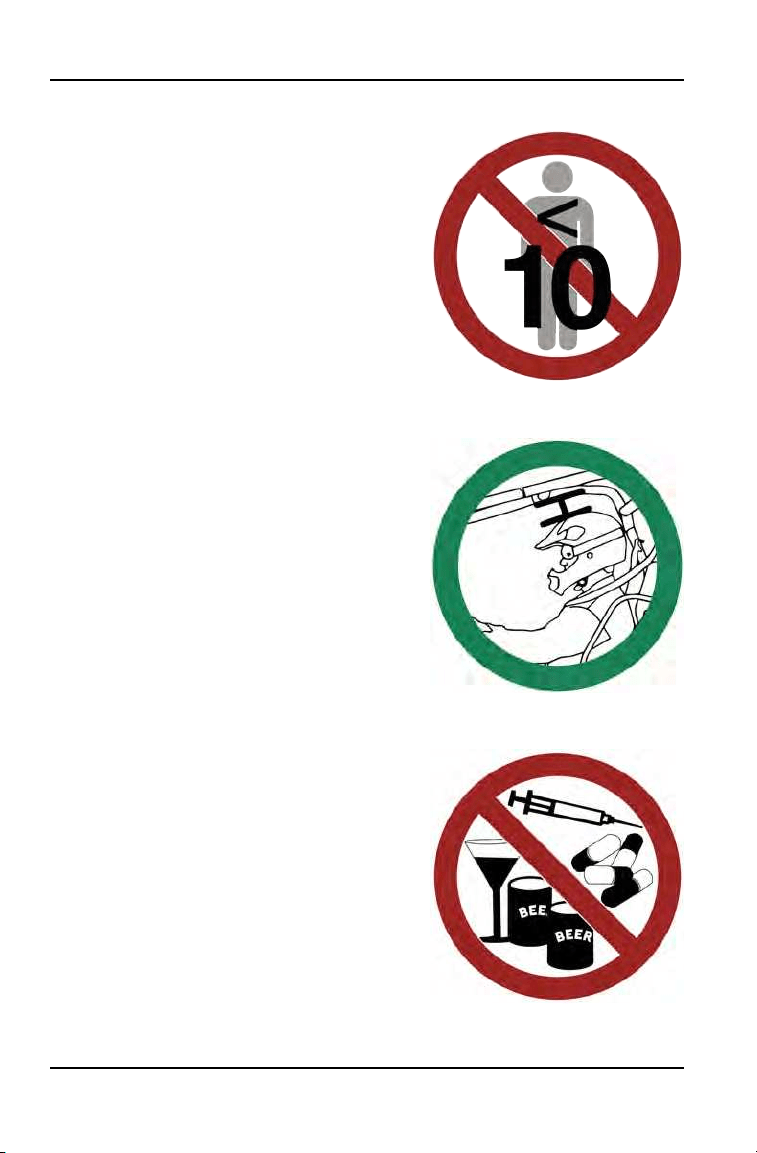
OPERATOR RESTRICTIONS / AGE RESTRICTIONS
This vehicle is for recreational use by young
operators under adult supervision ONLY.
Operation is prohibited for anyone under 10
years of age. Never operate with a passenger
under age 10.
All operators and riders must be able to sit
with backs against the seat, both feet flat on
the floor and both hands on the steering
wheel (if driving) or on a passenger hand
hold.
RIDER HEIGHT
Some riders may be too tall to ride safely in
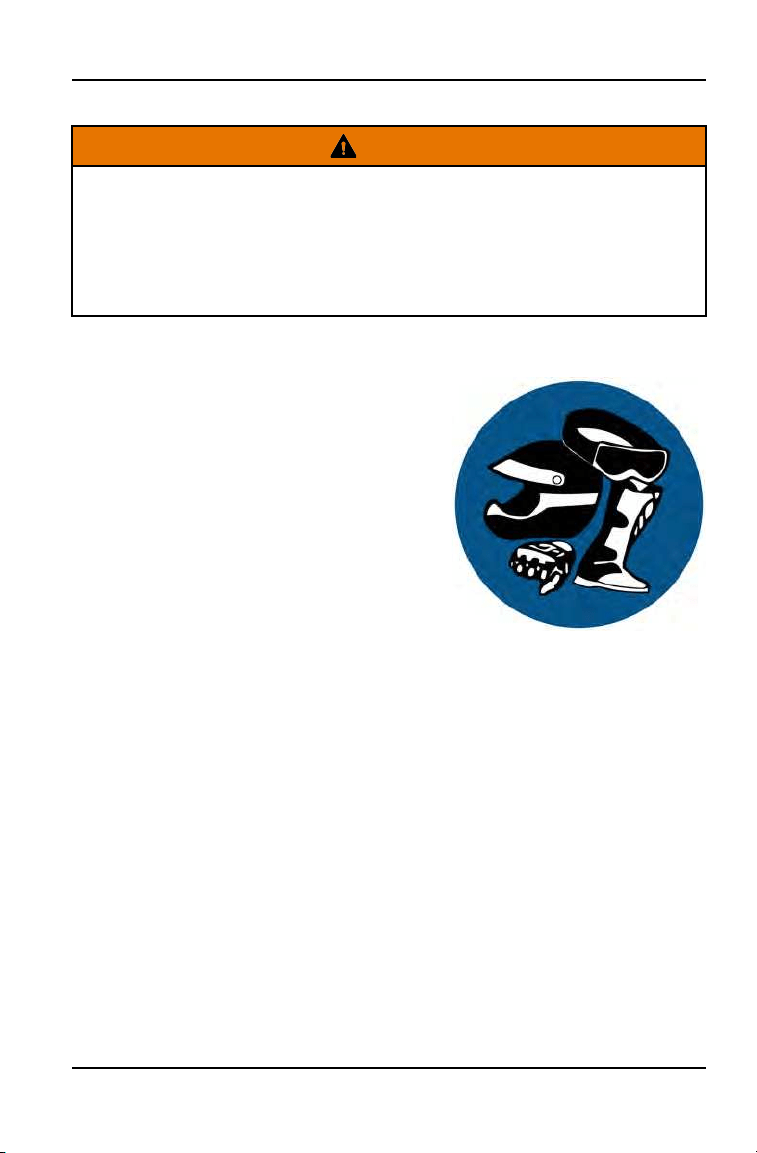
this vehicle. Do not operate or ride in this
vehicle if the clearance between the top of
your helmet and the overhead cab frame is
less than 2 inches (5 cm).
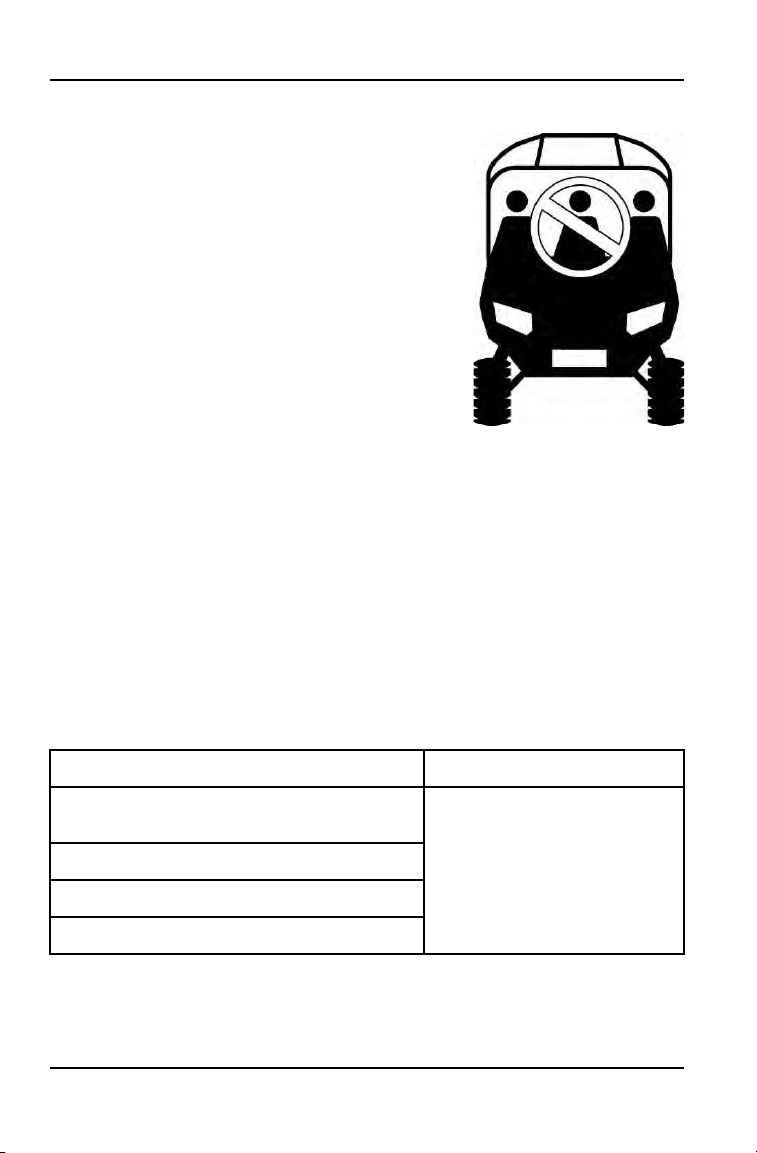
USING ALCOHOL OR DRUGS
Never consume alcohol or drugs before or
while operating this vehicle.
Operating this vehicle after consuming
alcohol or drugs could adversely affect
operator judgment, reaction time, balance
and perception.
18
SAFETY
FAILURE TO INSPECT BEFORE OPERATING
WARNING
Failure to inspect and verify that the vehicle is in safe operating condition
before operating increases the risk of an accident. Always perform the
Pre-Ride Inspection outlined in the Operation chapter before each use of your
vehicle to make sure it's in safe operating condition. Always follow the
inspection and maintenance procedures and schedules described in this
owner’s manual. See the Polaris Maintenance Schedule section of the
Maintenance chapter.
PROTECTIVE APPAREL
Riding in this vehicle without wearing an
approved helmet and protective eyewear
increases the risk of a serious injuries in the
event of an accident.
Operator and all passengers must always
wear a helmet, eye protection, gloves,
long-sleeve shirt, long pants and
over-the-ankle boots.
SEAT BELTS
Riding in this vehicle without wearing the seat belt increases the risk of serious
injury in the event of rollover, loss of control, other accident or sudden stop. Seat
belts may reduce the severity of injury in these circumstances.
All riders must wear seat belts at all times.
CAB NETS
Riding in this vehicle without using the cab nets (or doors, if equipped) increases
the risk of serious injury or death in the event of an accident or rollover. Always
use the cab nets (or doors) while riding in this vehicle. Always keep hands and
feet inside the vehicle at all times.
19
SAFETY
CARRYING MULTIPLE PASSENGERS (RZR 2-SEAT)
Never carry a passenger until you have operated
this vehicle for at least four hours and have
completed the steps in the New Operator Driving
Procedures section.
A passenger must always be seated in a
passenger seat with seat belt secured. Carrying
more than one passenger in a 2-seat vehicle can
affect the operator’s ability to steer and operate the
controls, which increases the risk of loss of control
and accident or rollover.
Never carry more than one passenger in a 2-seat
vehicle.
OPERATING WITH A LOAD ON THE VEHICLE
The weight of both cargo and vehicle occupants impacts vehicle operation and
stability. For your safety and the safety of others, carefully consider how your
vehicle is loaded and how to safely operate the vehicle. Follow the instructions in
this manual for loading, tire pressure, gear selection and speed.
• Do not exceed vehicle weight capacities. The vehicle’s maximum weight
capacity is listed in the specifications section of this manual and on a label on
the vehicle. When more passenger weight is added, cargo weight may need
to be reduced accordingly.
• The recommended tire pressures are listed in the specifications section of this
manual and on a label on the vehicle.
Always follow these guidelines:
Under ANY of these conditions: Do ALL of these steps:
Passenger and/or cargo exceeds half the
maximum weight capacity
1. Slow down.
2. Verify tire pressure.
3. Use extra caution when
operating.
Operating in rough terrain
Operating over obstacles
Climbing an incline
20
SAFETY
PASSENGERS IN THE CARGO BOX
Carrying a passenger in the cargo box could result in a fall from the vehicle or
contact with moving components. Never allow a passenger to ride in the cargo
box. A passenger must always be seated in a passenger seat with seat belt
secured.
OPERATING ON PAVEMENT
This vehicle's tires are designed for off-road use, not for use on pavement.
Operating this vehicle on paved surfaces (including sidewalks, paths, parking
lots and driveways) may adversely affect the handling of the vehicle and may
increase the risk of loss of control and accident or rollover. Avoid operating the
vehicle on pavement. If it's unavoidable, travel slowly, travel short distances and
avoid sudden turns or stops.
OPERATING ON PUBLIC ROADS
Operating this vehicle on public streets, roads
or highways could result in a collision with
another vehicle. Never operate this vehicle
on any public street, road or highway,
including dirt and gravel roads (unless
designated for off-highway use).
JUMPS AND STUNTS
Exhibition driving increases the risk of an
accident or rollover. DO NOT do power
slides, “donuts”, jumps or other driving stunts.
Avoid exhibition driving.
21
SAFETY
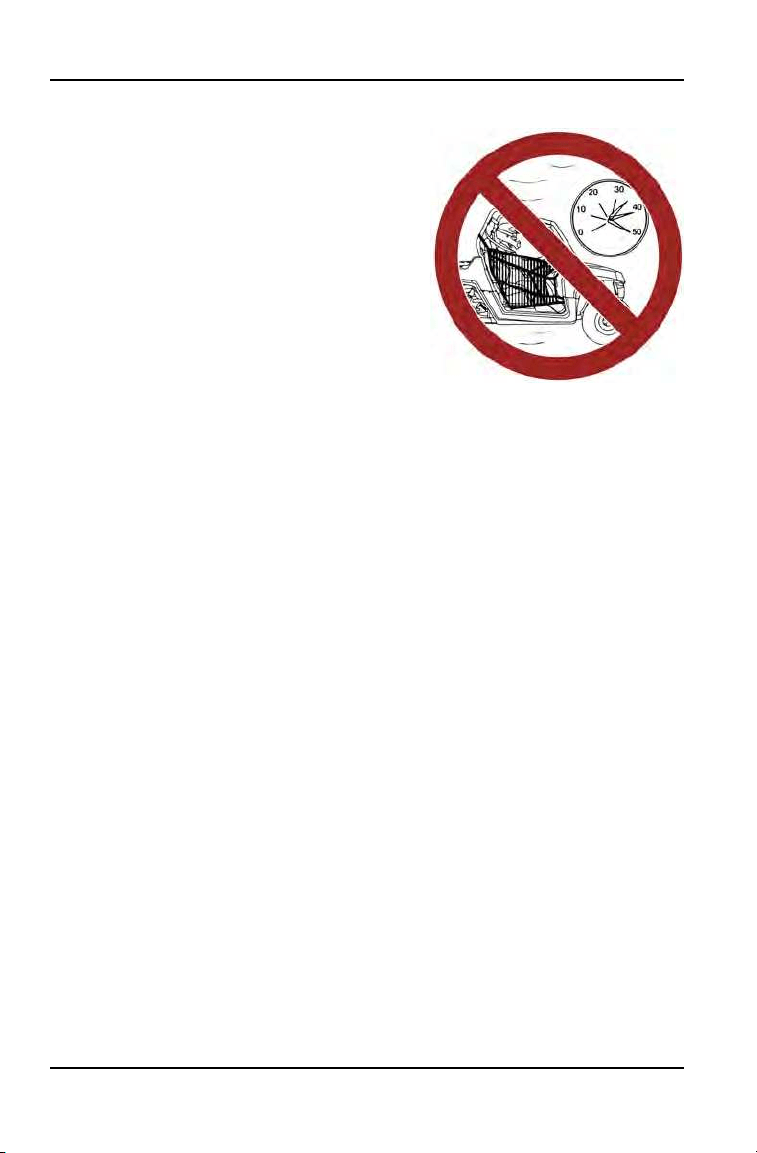
OPERATING AT EXCESSIVE SPEEDS
Operating this vehicle at excessive speeds
increases the operator's risk of losing control.
Always operate at a speed that's appropriate
for the terrain, the visibility and operating
conditions, your skills and experience and
any passenger’s skills and experience.
PHYSICAL CONTROL OF THE VEHICLE
Removing hands from the steering wheel or hand holds or removing feet from
the floor while riding increases the risk of loss of control and accident or rollover.
The operator should always keep both hands on the steering wheel during
operation. A passenger should always be seated in the passenger seat with
both feet on the floor and with both hands securely grasping the hand holds.
Always keep hands and feet inside the vehicle at all times.
TURNING IMPROPERLY
Turning improperly could cause loss of traction, loss of control, accident or
rollover. Always follow proper procedures for turning as described in this owner's
manual.
Avoid sharp turns. Never turn while applying heavy throttle. Never make abrupt
steering maneuvers. Practice turning at slow speeds before attempting to turn at
faster speeds.
22
SAFETY
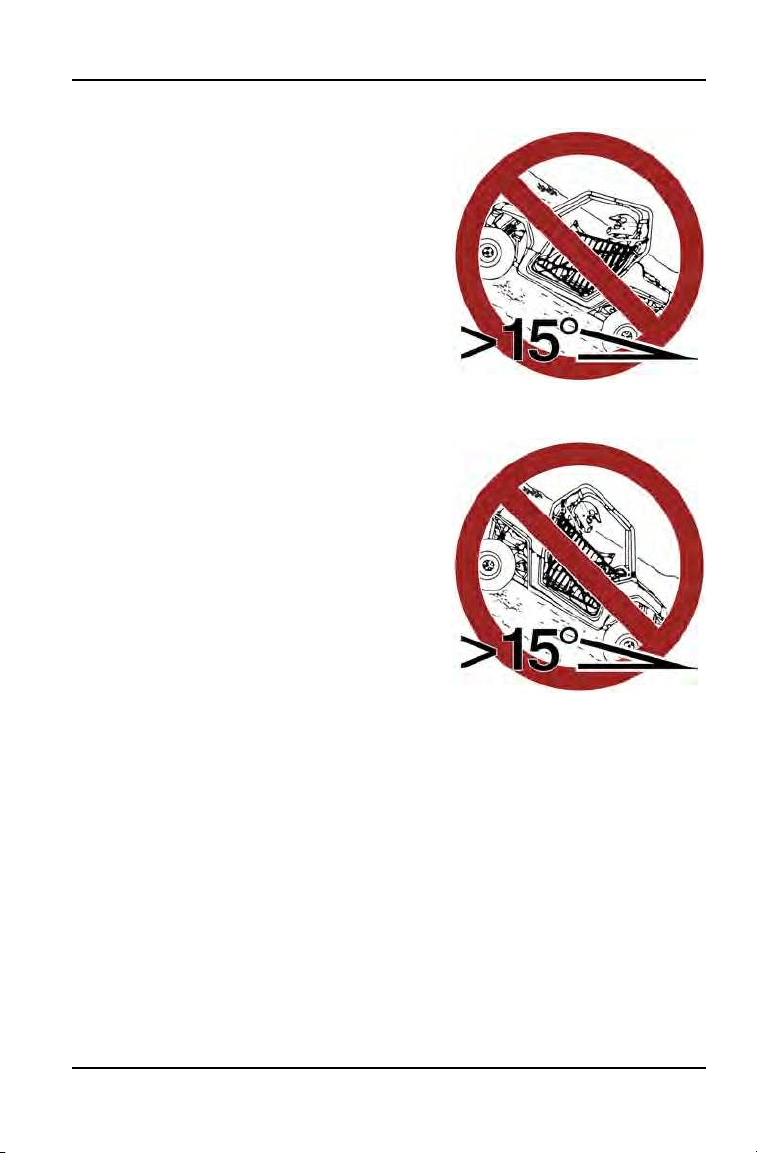
IMPROPER HILL CLIMBING
Improper hill climbing could cause loss of
control or rollover. Use extreme caution when
operating on hills. Always follow proper
procedures for hill climbing as described in
this owner's manual. See the Driving Uphill
section for details.
DESCENDING HILLS IMPROPERLY
Improperly descending a hill could cause loss
of control or rollover. Always follow proper
procedures for traveling down hills as
described in this owner’s manual. See the
Driving Downhill section for details.
CROSSING HILLSIDES
Driving on a sidehill is not recommended. Improper procedure could cause loss
of control or rollover. Avoid crossing the side of any hill unless absolutely
necessary.
If crossing a hillside is unavoidable, always follow proper procedures as
described in this owner's manual. See the Driving on a Sidehill (Sidehilling)
section for details.
23
SAFETY
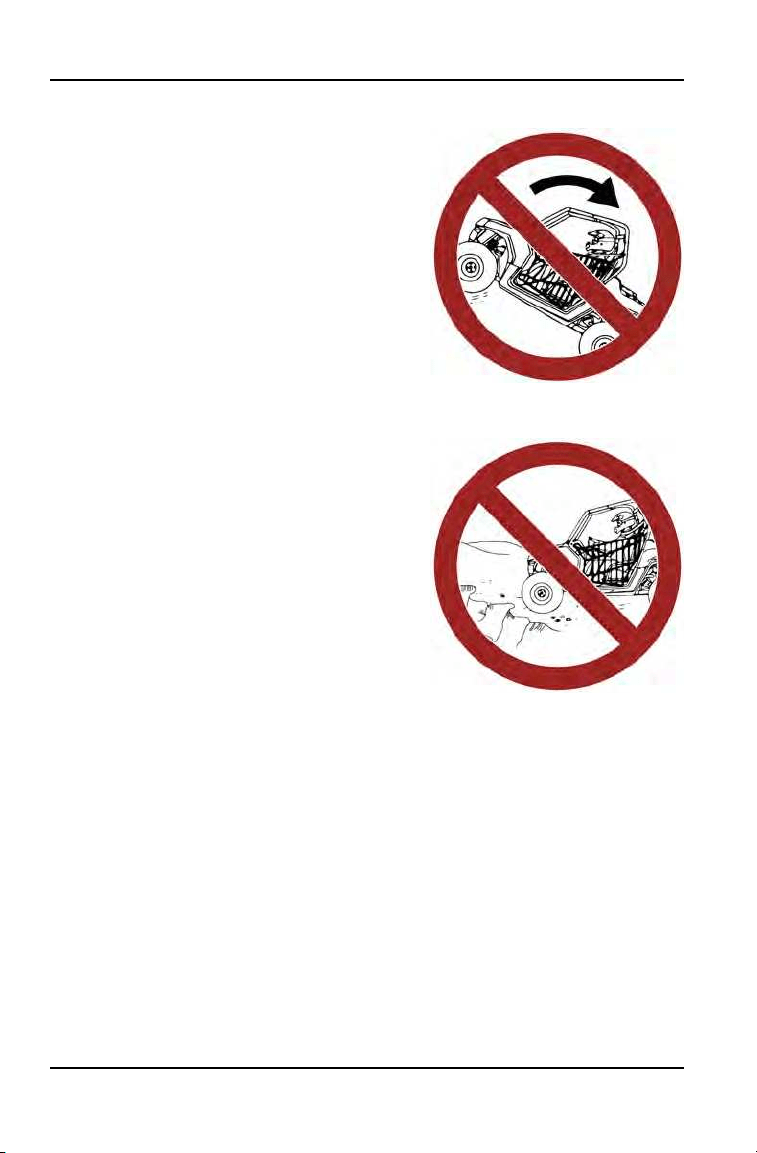
STALLING WHILE CLIMBING A HILL
Stalling or rolling backwards while climbing a
hill could cause a rollover. Maintain a steady
speed when climbing a hill.
If you lose all forward speed:
Apply the brakes gradually until the vehicle is
fully stopped. Place the transmission in
reverse and slowly allow the vehicle to roll
straight downhill while applying light brake
pressure to control speed.
OPERATING IN UNFAMILIAR TERRAIN
Failure to use extra caution when operating
on unfamiliar terrain could result in an
accident or rollover.
Unfamiliar terrain may contain hidden rocks,
bumps, or holes that could cause loss of
control or rollover.
Travel slowly and use extra caution when
operating on unfamiliar terrain. Always be
alert to changing terrain conditions.
OPERATING IMPROPERLY IN REVERSE
Improperly operating in reverse could result in a collision with an obstacle or
person. Always follow proper operating procedures as outlined in this manual.
See the Driving in Reverse section for details. Before shifting into reverse gear,
always check for obstacles or people behind the vehicle. When it's safe to
proceed, back slowly.
IMPROPER TIRE MAINTENANCE
Operating this vehicle with improper tires or with improper or uneven tire
pressure could cause loss of control, accident or rollover.
Always use the size and type of tires specified for your vehicle. Always maintain
proper tire pressure as described in this owner's manual and on safety labels.
24
SAFETY
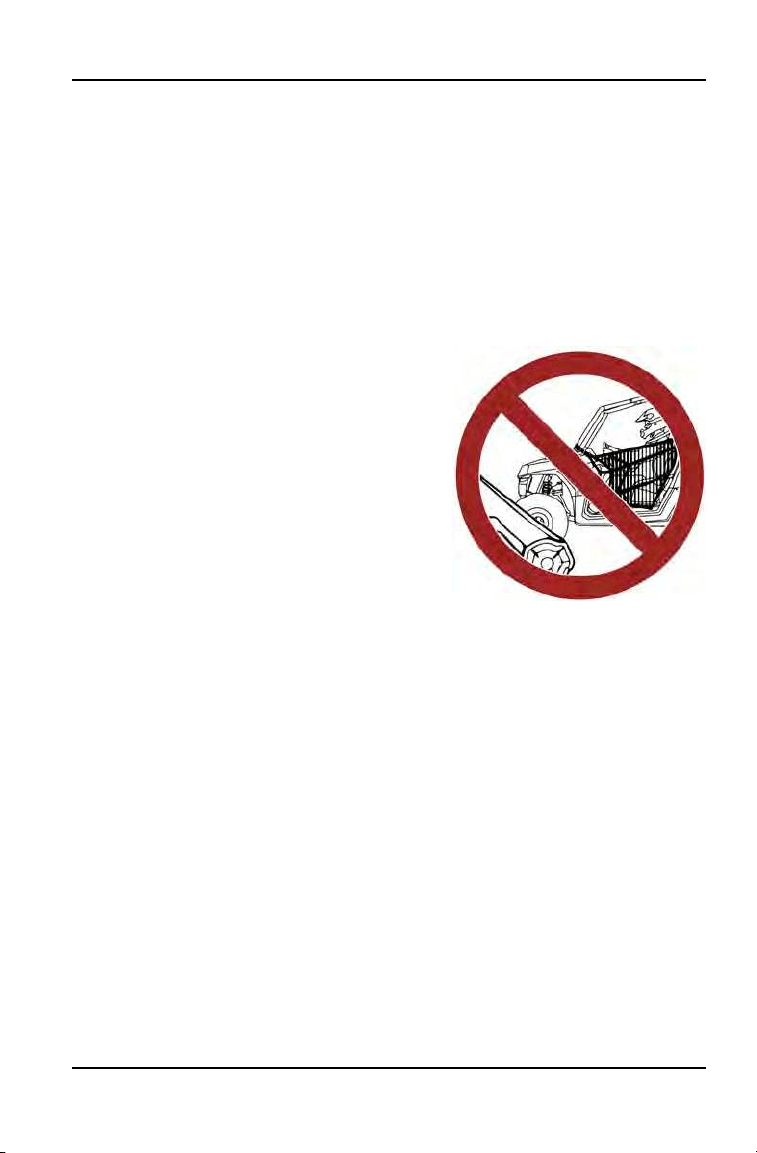
SKIDDING OR SLIDING
Failure to use extra caution when operating on excessively rough, slippery or
loose terrain could cause loss of traction, loss of control, accident or rollover. Do
not operate on excessively slippery surfaces. Always slow down and use
additional caution when operating on slippery surfaces.
Skidding or sliding due to loss of traction can cause loss of control or rollover (if
tires regain traction unexpectedly). Always follow proper procedures for
operating on slippery surfaces as described in this owner's manual. See the
Driving on Slippery Surfaces section for details.
OPERATING OVER OBSTACLES
Improperly operating over obstacles could
cause loss of control or rollover.
Before operating in a new area, check for
obstacles. Never attempt to operate over
large obstacles such as large rocks or fallen
trees. Always follow the proper procedures
outlined in this manual when operating over
obstacles. See the Driving Over Obstacles
section for details.
OPERATING THROUGH WATER
Operating through deep or fast-flowing water can cause loss of traction, loss of
control, rollover or accident. Never operate in fast-flowing water or in water that
exceeds the floor level of the vehicle.
Always follow proper procedures for operating in water as described in this
owner’s manual. See the Driving Through Water section for details.
Wet brakes may have reduced stopping ability. After leaving water, test the
brakes. Apply them lightly several times while driving slowly. The friction will help
dry out the pads.
OVERLOADING THE VEHICLE
Overloading the vehicle or carrying/towing loads may cause changes in stability
and handling, which could cause loss of control or an accident.
• Never tow objects with this vehicle.
• Never exceed the maximum weight capacity for this vehicle.
25
SAFETY
OPERATING IN COLD WEATHER
WARNING
Always be adequately prepared when operating in cold weather, especially
below-freezing temperatures. Cold weather can affect the engine’s ability to
start, which can be dangerous when operating in unfamiliar or remote areas.
OPERATING ON FROZEN BODIES OF WATER
Severe injury or death can result if the vehicle and/or the operator fall through
the ice. Never operate the vehicle on a frozen body of water unless you have
first verified that the ice is sufficiently thick to support the weight and moving
force of the vehicle, you and any passengers, and your cargo, together with any
other vehicles in your party.
Always check with local authorities and residents to confirm ice conditions and
thickness over your entire route. Vehicle operators assume all risk associated
with ice conditions on frozen bodies of water.
OPERATING A DAMAGED VEHICLE
Operating a damaged vehicle can result in an accident. After any rollover or
other accident, have a qualified service dealer inspect the entire machine for
possible damage, including (but not limited to) seat belts, rollover protection
devices, brakes, throttle and steering systems.
IMPROPER CARGO LOADING
Overloading the vehicle or carrying cargo improperly may cause changes in
stability and handling, which could cause loss of control or an accident.
• Always follow the instructions in this owner’s manual for carrying cargo. See
the Hauling Cargo section for details.
• Never exceed the stated load capacity for this vehicle.
• Cargo should be properly distributed and securely attached. See the Hauling
Cargo section for details.
• Reduce speed when carrying cargo. Allow a greater distance for braking.
EXPOSURE TO EXHAUST
Engine exhaust fumes are poisonous and can cause loss of consciousness or
death in a short time. Never start the engine or let it run in an enclosed area.
Operate this vehicle only outdoors or in well-ventilated areas.
26
SAFETY
HOT EXHAUST SYSTEMS
WARNING
Exhaust system components are very hot during and after use of the vehicle.
Hot components can cause burns and fire. Do not touch hot exhaust system
components. Always keep combustible materials away from the exhaust
system.
Use caution when traveling through tall grass, especially dry grass and when
traveling through muddy conditions. Always inspect the underside of the
vehicle and areas near the exhaust system after driving through tall grass,
weeds, brush, other tall ground cover, and muddy conditions. Promptly remove
any grass, debris or foreign matter clinging to the vehicle and pay particular
attention to the exhaust system area.
REFUELING
Gasoline is highly flammable and explosive under certain conditions.
• Always exercise extreme caution whenever handling gasoline.
• Always turn off the engine when refueling.
• Always refuel outdoors or in a well ventilated area free of any source of flame
or sparks.
• NEVER carry fuel or other flammable liquids on this vehicle. Failure to follow
this instruction could lead to serious burn injuries or death.
• Do not smoke or allow open flames or sparks in or near the area where
refueling is performed or where gasoline is stored.
• Do not overfill the tank. Do not fill the tank neck.
• If gasoline spills on your skin or clothing, immediately wash it off with soap
and water and change clothing.
UNAUTHORIZED USE OF THE VEHICLE
Leaving the keys in the ignition can lead to unauthorized use of the vehicle by
someone under the age of 10 or without proper training. This could result in an
accident or rollover. Always remove the ignition key when the vehicle is not in
use.
27
SAFETY

EQUIPMENT MODIFICATIONS
Your POLARIS vehicle is designed to provide safe operation when used as
directed. Modifications to your vehicle may negatively impact vehicle stability.
Failure of critical machine components may result from operation with any
modifications, especially those that increase speed or power. This vehicle may
become less stable at speeds higher than those for which it is designed. Loss of
control may occur at higher speeds.
Do not install any non-POLARIS-approved accessory or modify the vehicle for
the purpose of increasing speed or power. Any modifications or installation of
non-POLARIS-approved accessories could create a substantial safety hazard
and increase the risk of bodily injury.
The POLARIS limited warranty on your POLARIS vehicle will be terminated if
any non-POLARIS-approved equipment and/or modifications have been added
to the vehicle that increase speed or power.
The addition of certain accessories, including (but not limited to) mowers,
blades, tires, sprayers, or large racks, may change the handling characteristics
of the vehicle. Use only POLARIS-approved accessories, and familiarize
yourself with their function and effect on the vehicle.
The addition of certain accessories, including (but not limited to) overhead audio
speakers, may change the forward clearance in the vehicle. Polaris
recommends selecting a helmet that is compatible with the equipment on your
vehicle and provides the greatest amount of forward clearance. Always wear a
helmet that meets or exceeds the specifications in this owner’s manual. Refer to
the Safe Riding Gear section of this owner’s manual for more information. Use
only POLARIS-approved accessories.
FOR MORE INFORMATION ABOUT SAFETY
call POLARIS at 1-800-342-3764.
SAFETY LABELS AND LOCATIONS
Warning labels have been placed on the vehicle for your protection. Read and
follow the instructions of the labels on the vehicle carefully. If any of the labels
depicted in this manual differ from the labels on your vehicle, always read and
follow the instructions of the labels on the vehicle.
If an informational or graphic label becomes illegible or comes off, contact your
POLARIS dealer to purchase a replacement. Replacement safety labels are
provided by Polaris at no charge. The part number is printed on the label.
NORTH AMERICA
TIRE PRESSURE AND LOAD WARNING
WARNING
28
SAFETY
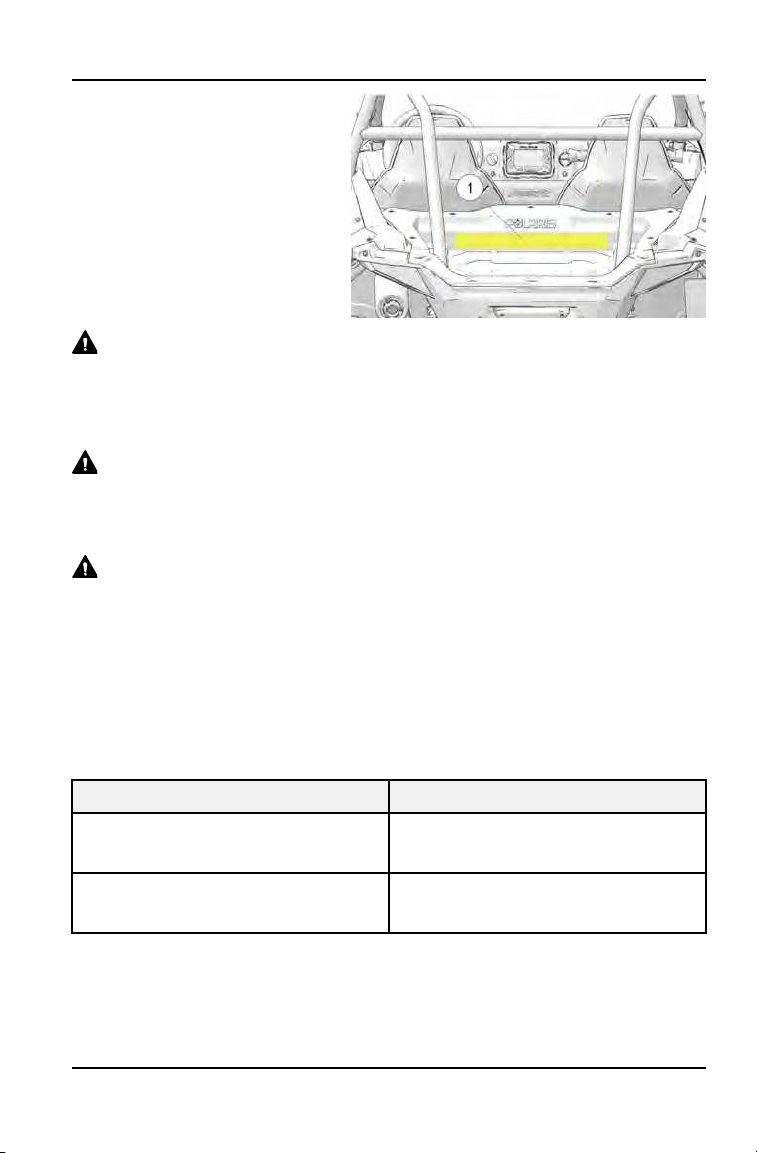
The tire pressure and load
warning
q
is located on the front
of the cargo compartment.
WARNING
• Never carry passengers in cargo box.
• Passengers can be thrown off. This can cause serious injury or death.
WARNING
Never carry fuel or other flammable liquids on this vehicle.
Failure to follow this instruction could lead to serious burn injuries or death
WARNING
IMPROPER TIRE PRESSURE OR OVERLOADING CAN CAUSE LOSS OF
CONTROL RESULTING IN SERIOUS INJURY OR DEATH.
• Reduce speed and allow greater distance for braking when carrying cargo.
• Overloading or carrying tall, off-center, or unsecured loads will increase your
risk of losing control. Loads should be centered and carried as low as possible
in box.
• For stability on rough or hilly terrain, reduce speed and cargo.
RZR 200
MAXIMUM CARGO BOX LOAD 50 lbs.
(23 kg)
TIRE PRESSURE IN PSI (KPa) FRONT 5 (34.5)
REAR 5 (34.5)
29
SAFETY
RZR 200
MAXIMUM WEIGHT CAPACITY
INCLUDES WEIGHT OF
OPERATOR, PASSENGER,
CARGO, AND ACCESSORIES.
350 lbs.
(158 kg)
Read Operation & Maintenance Manual for more detailed loading information.
Part Number: 7300193
GENERAL WARNING
WARNING
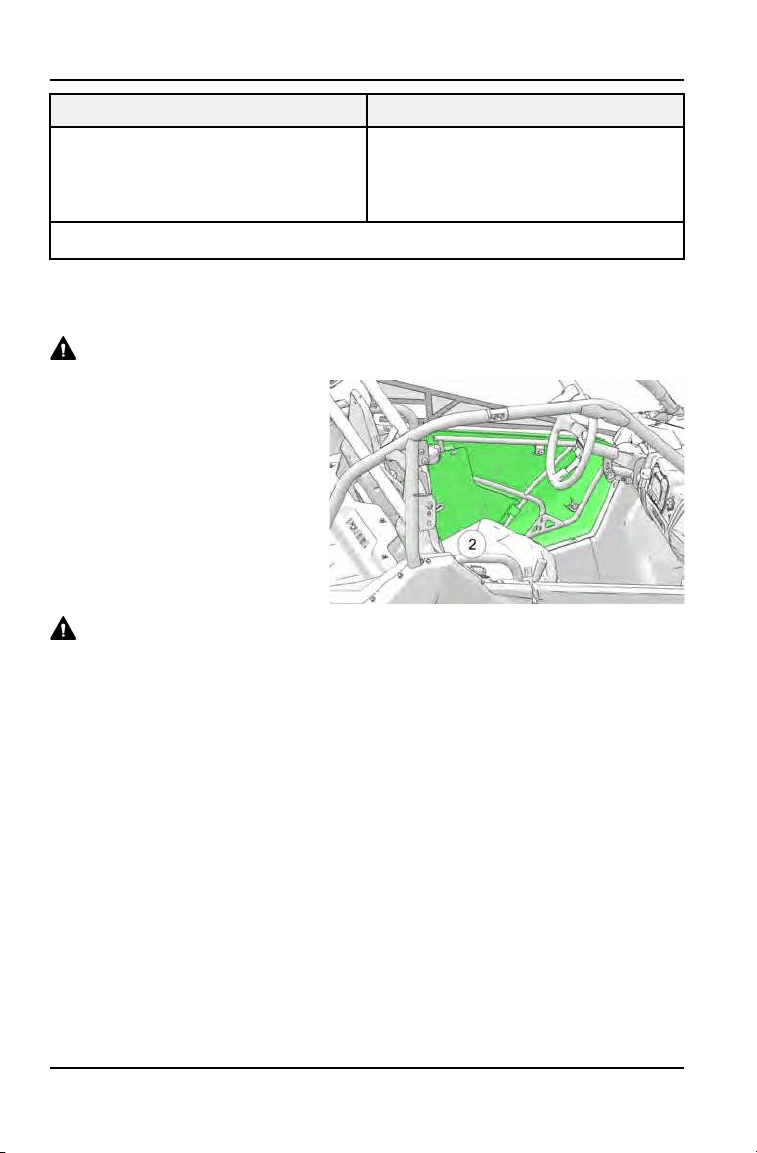
The general use warning
w
is
located on the inside of the
driver’s door panel.
WARNING
Improper vehicle use can result in SEVERE INJURY or DEATH
NEVER allow vehicle to be Operated:
• without all occupants first viewing and understanding the safety video and
warning labels.
• with more than one passenger.
• on hills steeper than 15˚.
• on paved surfaces - pavement may seriously affect handling and control.
• with non-Polaris approved accessories - they may seriously affect stability.
• at speeds that are too fast for the operators skills, the conditions and/or the
terrain.
ALWAYS require Operator and/or Passenger to:
30
SAFETY
• wear seat belts, grab hand holds (passenger) and plant feet firmly on the floor.
• secure cab nets.
• keep hands and feet inside vehicle.
• use an approved helmet and protective gear for all occupants.
• avoid quick turns of the steering wheel and driving stunts such as jumps,
donuts or power slides.
• reduce speed and use extra caution when carrying a passenger.
• watch for branches or other hazards that could enter vehicle.
Operation of this vehicle by children under the age of 10 increase the risk of
severe injury or death.
Adult supervision required for children under age 16.
NEVER permit children under age 10 to operate this vehicle.
NEVER permit a passenger whose feet cannot touch the floor.
LOCATE AND READ OWNER’S MANUAL. FOLLOW ALL INSTRUCTIONS
AND WARNINGS. IF OWNER’S MANUAL IS MISSING, CONTACT A POLARIS
DEALER FOR A REPLACEMENT.
Part Number: 7300583
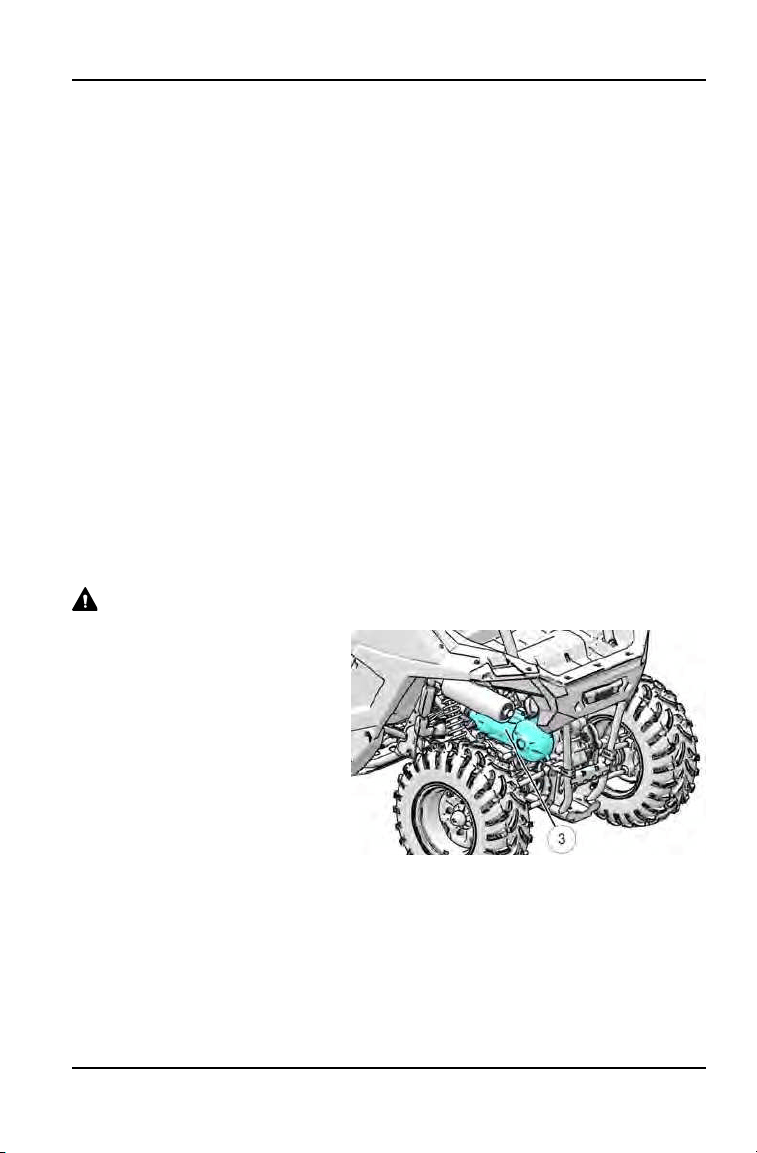
CLUTCH COVER WARNING
WARNING
The clutch cover warning
e
is
located on the outside
belt-clutch cover.
• Moving parts hazard under belt-clutch guard. To prevent serious injury, do not
operate vehicle with guard removed.
• Do not modify engine or clutch. Doing so can cause part failure, possible
imbalance, and excessive engine RPM which can result in serious injury or
death.
Part Number: 7175488
31
SAFETY
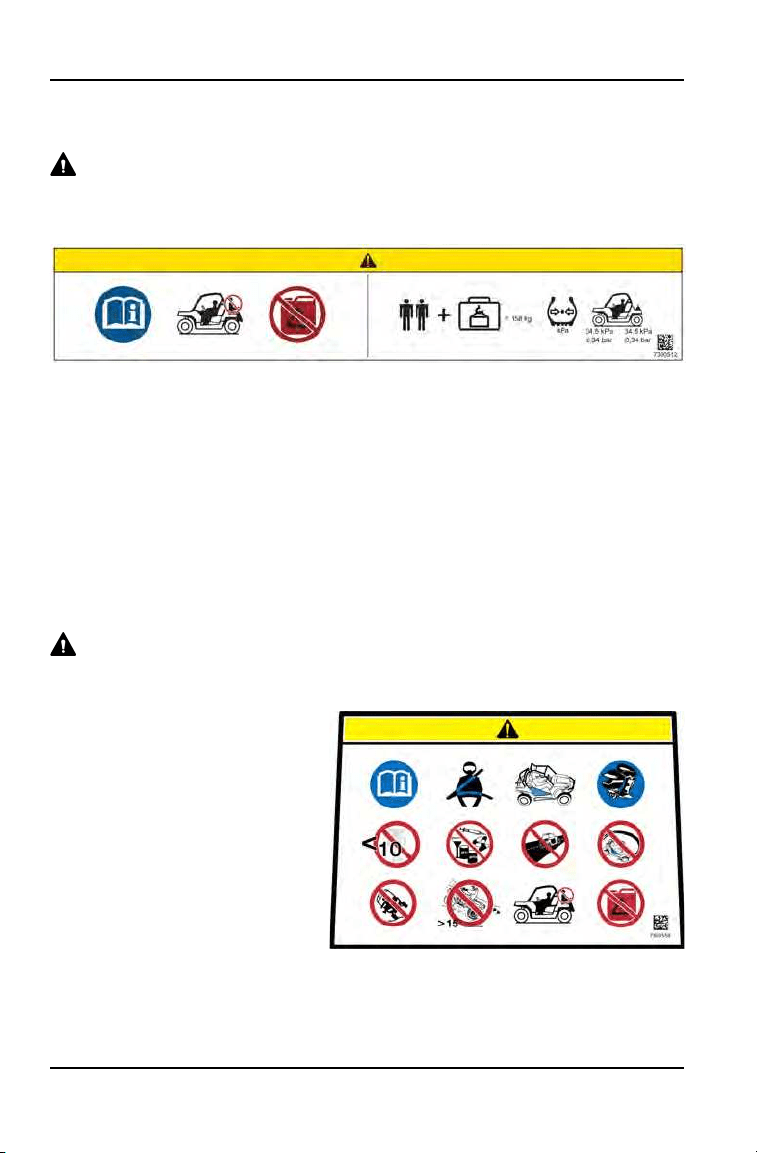
INTERNATIONAL
TIRE PRESSURE AND LOAD WARNING
WARNING
The tire pressure and load warning is located on the front of the cargo
compartment.
• Read the owner’s manual.
• Never carry passengers in the cargo box.
• NEVER carry fuel or other flammable liquids on this vehicle. Failure to follow
this instruction could lead to serious burn injuries or death.
• Maximum cargo capacity including weight of operator, passenger, cargo, and
accessories must be under 158 kg.
• Tire pressure specification is 34,5 kPa.
Part Number: 7300512
GENERAL USE WARNING
WARNING
The general use warning is located on the inside of the driver’s door panel.
• Read the owner’s manual.
• Always wear the seat belts.
• Use and secure cab nets and
door close-offs.
• Use an approved helmet and
protective gear for all
occupants.
• Never allow anyone under 10
years of age to operate the
vehicle.
• Never operate while under the
influence of drugs or alcohol.
32
SAFETY
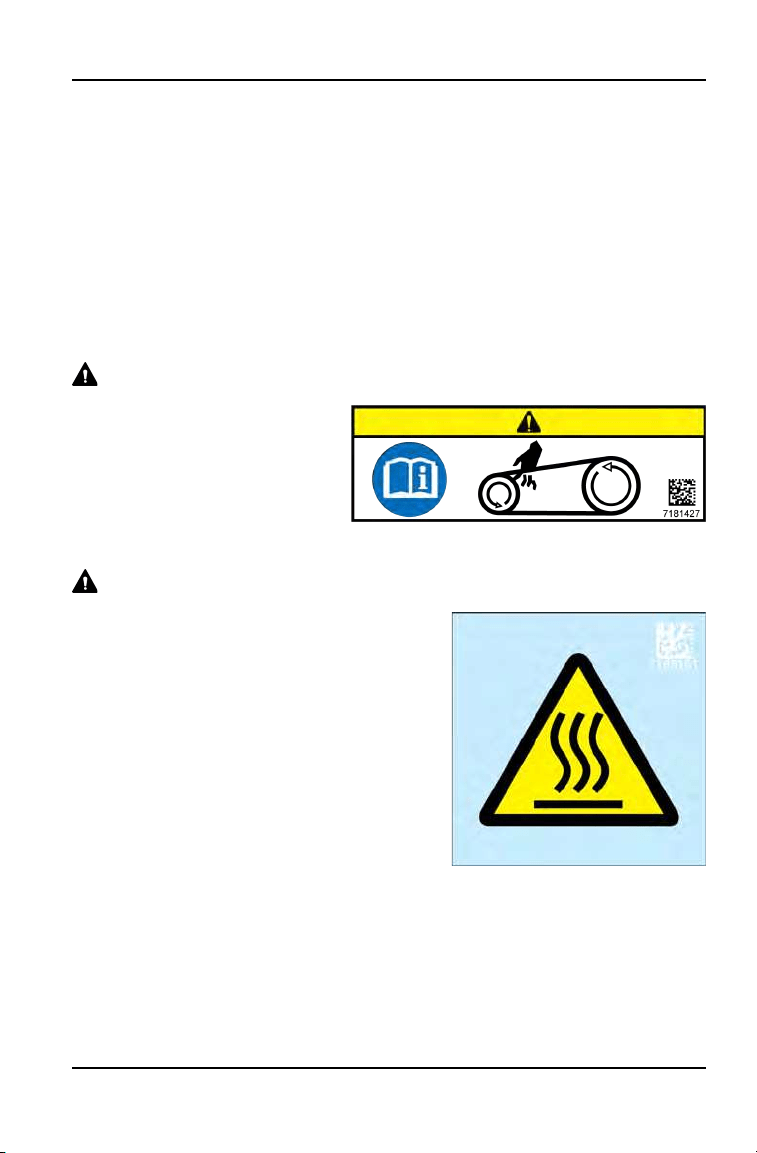
• Do not use on public roads (unless designated for off-highway vehicle
access).
• Exhibition driving increases the risk of accident or rollover. DO NOT do power
slides, “donuts”, jumps or other driving stunts. Avoid exhibition driving
• Do not operate vehicle on grades exceeding 15 degrees of incline.
• Never carry passengers in the cargo box.
• NEVER carry fuel or other flammable liquids on this vehicle. Failure to follow
this instruction could lead to serious burn injuries or death.
Part Number: 7300558
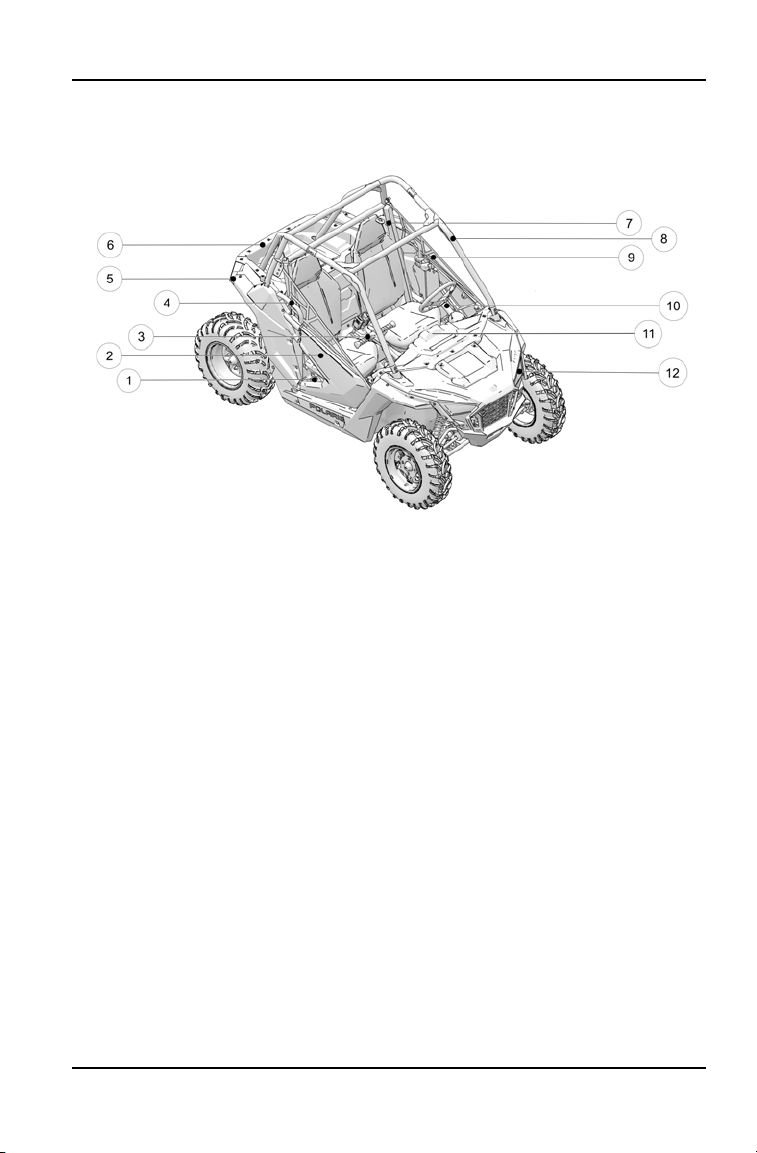
CLUTCH COVER ALERT
WARNING
Read the owner’s manual. Keep
limbs away from moving parts.
The clutch cover alert label is
located on the vehicle’s clutch
cover.
Part number: 7181427.
HOT SURFACES ALERT
WARNING
The hot surfaces alert is located on the body
above the muffler.
Hot component. Hot components can cause
burns and fire. Do not touch hot component.
Part Number: 7185151
33
SAFETY

34
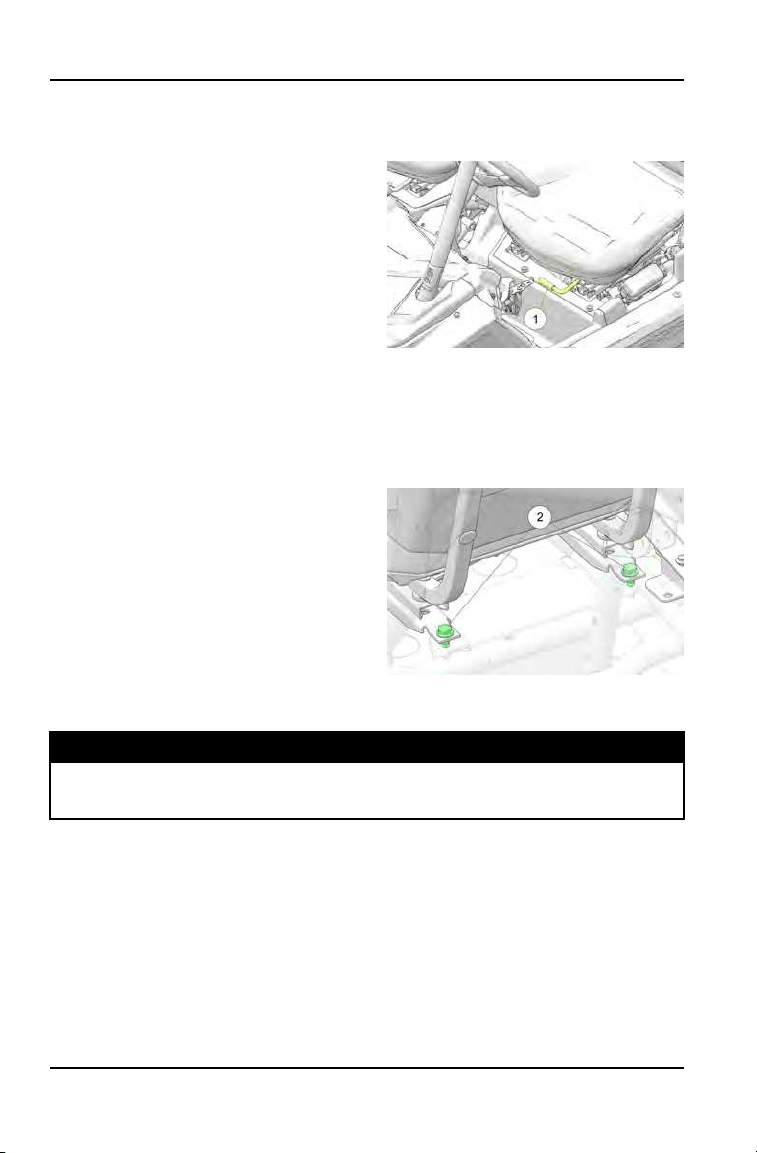
SEATS
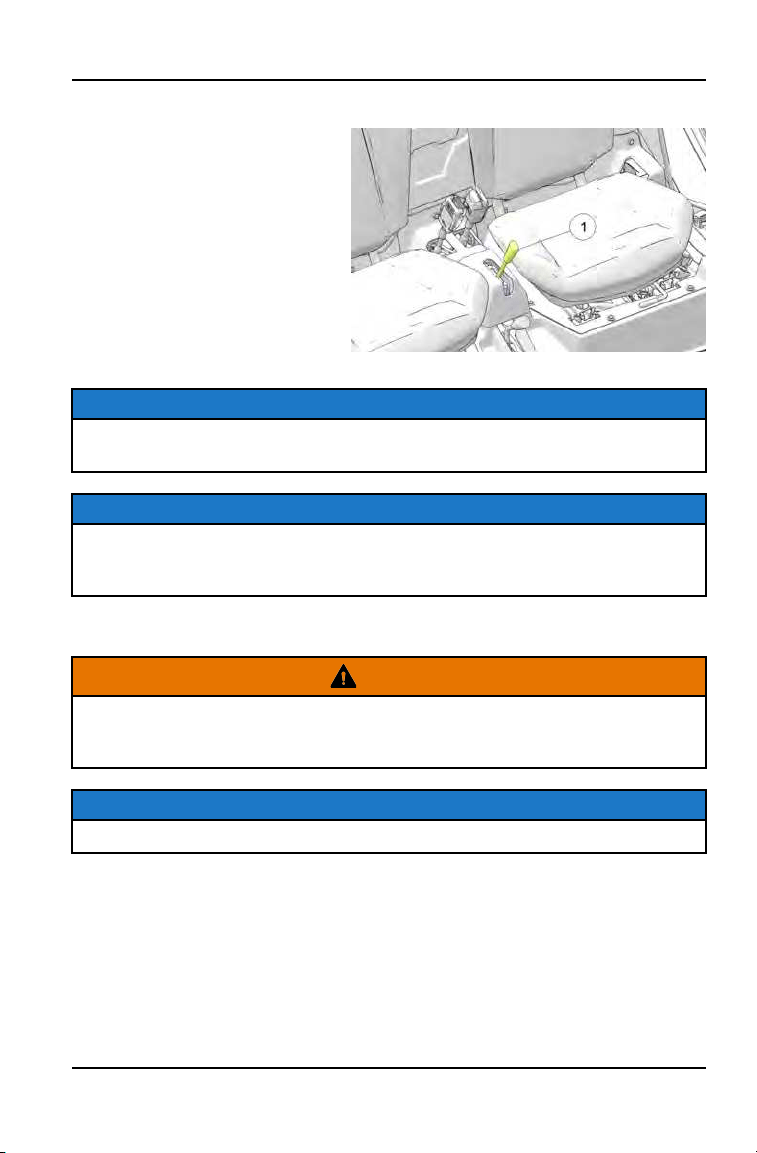
DRIVER’S SEAT ADJUSTMENT
1. Lift the seat latch lever
q
located
under the right front edge of the
driver’s seat.
2. While holding the lever upward, slide
the seat forward or rearward to the
desired position, then release the
lever.
3. Slide the seat forward and rearward
to ensure the latch is engaged.
Before operating the vehicle, always
make sure both seats are securely
installed.
SEAT REMOVAL
1. Slide the seat completely forward to
access the fasteners.
2. Remove the two fasteners
w
securing the seat slides to the
frame.
3. Remove the seat from the vehicle.
4. Reverse this procedure to reinstall
the seat.
TORQUE
Seat Rail Mount to Chassis Fasteners:
30 ft-lbs (41 N·m)
36
FEATURES AND CONTROLS
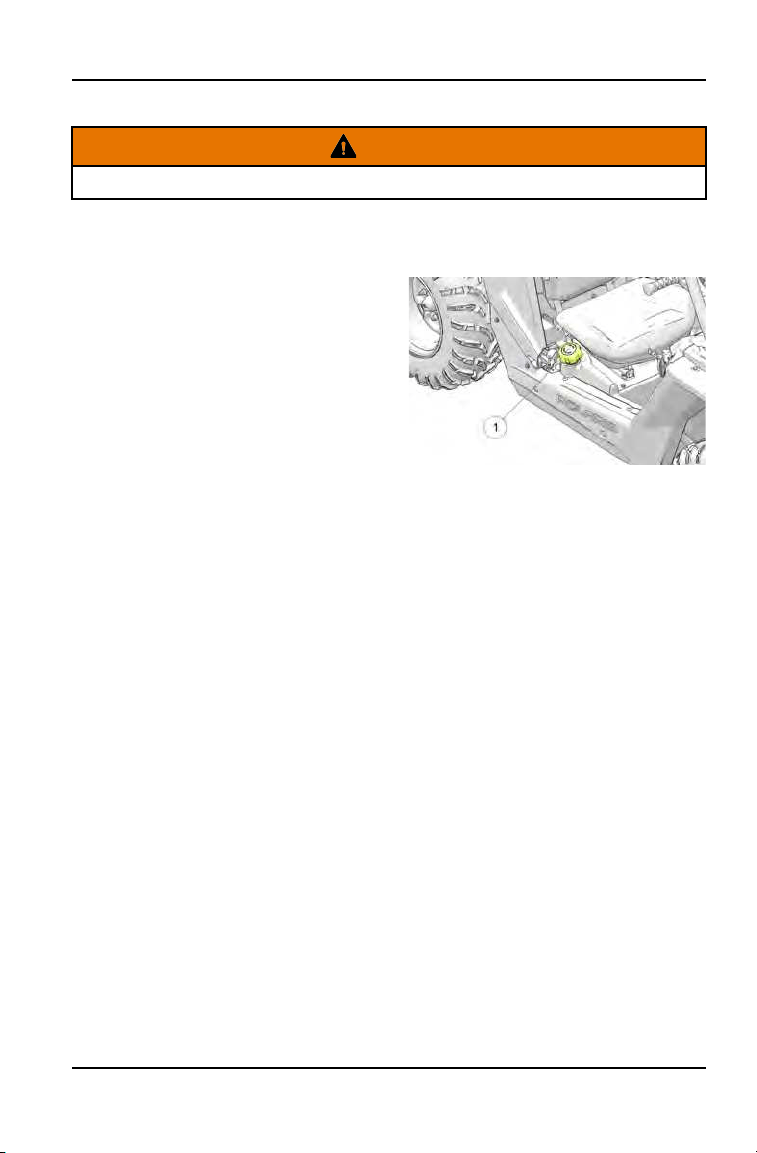
FUEL CAP
WARNING
Never allow a child to refuel or handle gasoline.
The fuel tank filler cap
q
is located on the right-hand side of the vehicle near the
passenger seat.
When refueling, always use either
leaded or unleaded gasoline with a
minimum pump octane number of 87 R
+M/2 octane. Non-ethanol fuel is
recommended.
Do not use fuel with ethanol content
greater than 10 percent, such as E-85
fuel.
DOORS AND CAB NETS
Riding in this vehicle without using the cab nets or doors increases the risk of
serious injury or death in the event of an accident or rollover.
Cab nets must be used by both operator and passenger at all times. Make sure
all latches are secure before operating the vehicle.
Always inspect doors and cab nets for tightness, wear, and damage before each
use of the vehicle. Promptly replace worn or damaged doors, cab nets, or
latches with new components. Your Polaris dealer can assist.
SEAT BELTS
This RZR is equipped with three-point lap and diagonal seat belts for the
operator and passenger. Never ride before ensuring seat belts are secured for
both the operator and passenger. The driver’s seat belt is equipped with seat
belt interlock, automatically limiting vehicle speed when the driver’s seat belt is
not secured.
37
FEATURES AND CONTROLS
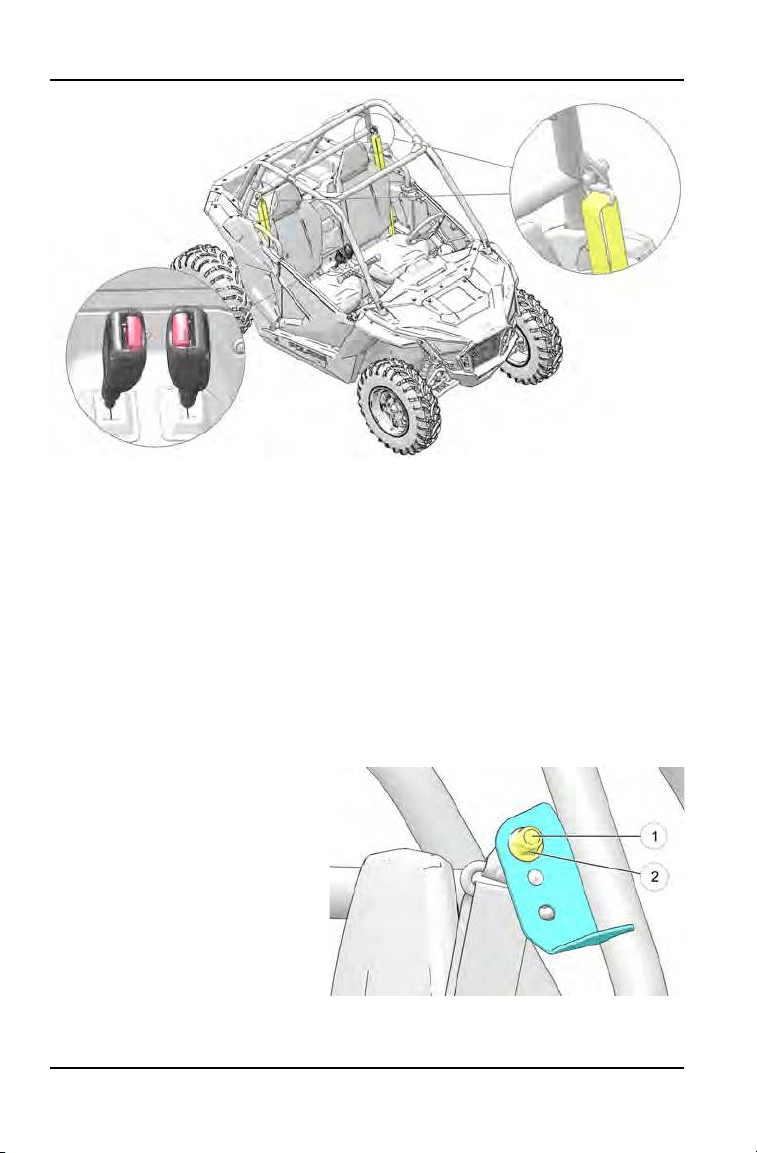
To wear the seat belt properly, do the following:
1. Pull the seat belt latch downward and across your chest toward the buckle on
the inside edge of the seat. The belt should fit snugly across your hips and
diagonally across your chest. Check to ensure the belt is not twisted before
securing.
2. Push the latch plate into the buckle until it clicks.
3. Release the strap, it will self-tighten.
4. Press the red release latch on the buckle to release the seat belt.
ADJUSTING THE SEAT BELT
The position of the shoulder strap can be adjusted to the height of the operator.
To adjust the seat belt height, do
the following:
1. Remove the nut
w
from the
seat belt bracket.
2. Move mounting bolt
q
to a
higher or lower position.
3. Reinstall the nut and torque
to specification.
38
FEATURES AND CONTROLS
TORQUE
Seat Belt Adjustment Bolt
30 ft-lbs (41 N·m)
SEAT BELT INSPECTION
Inspect all seat belts for proper operation before each use of the vehicle.
1. Push the latch plate into the buckle until it clicks. The latch plate must slide
smoothly into the buckle. A click indicates that it's securely latched.
2. Push the red release latch in the middle of the buckle to make sure it
releases freely.
3. Pull each seat belt completely out and inspect the full length for any damage,
including cuts, wear, fraying or stiffness. If any damage is found, or if the seat
belt does not operate properly, have the seat belt system checked and/or
replaced by an authorized dealer.
4. To clean dirt or debris from the seat belts, sponge the straps with mild soap
and water. Do not use bleach, dye or household detergents.
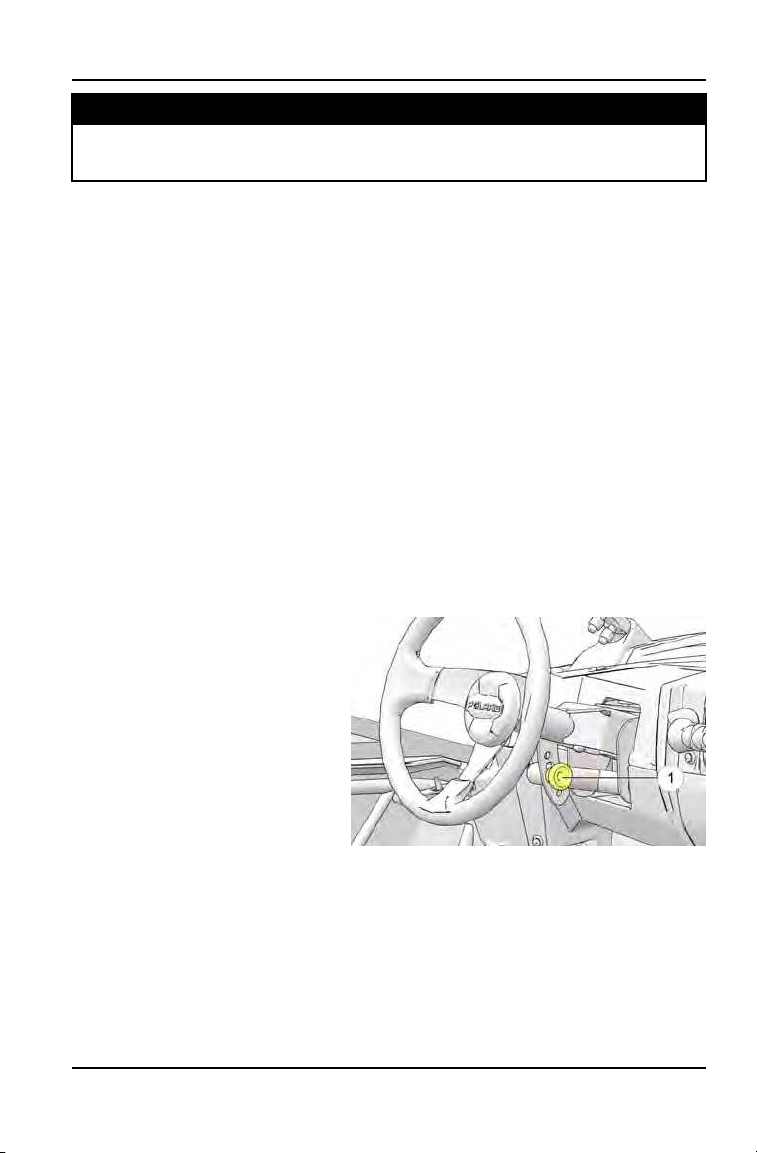
STEERING WHEEL
The steering wheel can be adjusted upward or downward for rider preference.
Do not adjust steering wheel while vehicle is in operation.
1. Unscrew the adjustment
knob
q
until free from the
steering bracket.
2. Lift or lower the steering
wheel to the desired position.
3. Hand-tighten the knob.
39
FEATURES AND CONTROLS
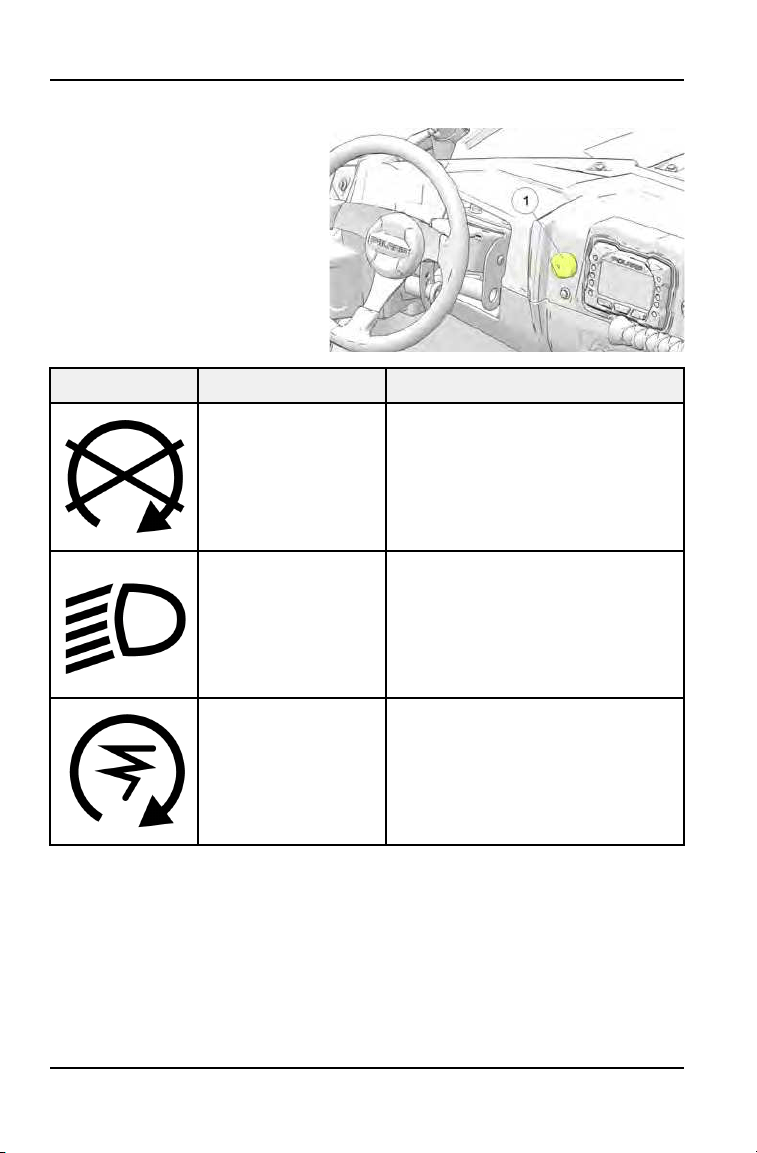
IGNITION SWITCH
The ignition switch
q
is a
three-position, key-operated
switch. Use the ignition switch to
start the engine. See page 77 for
starting procedures.The key can
be removed from the switch
when it is in the OFF position.
ICON FUNCTION DESCRIPTION
Engine Off The engine is off. Electrical circuits
are off, except accessory 12V.
Battery On /
Lights On
Electrical circuits are on. Electrical
equipment can be used.
Engine Start Turn the key to START position to
engage the electric starter and
start the engine. The key returns to
ON position when released.
40
FEATURES AND CONTROLS
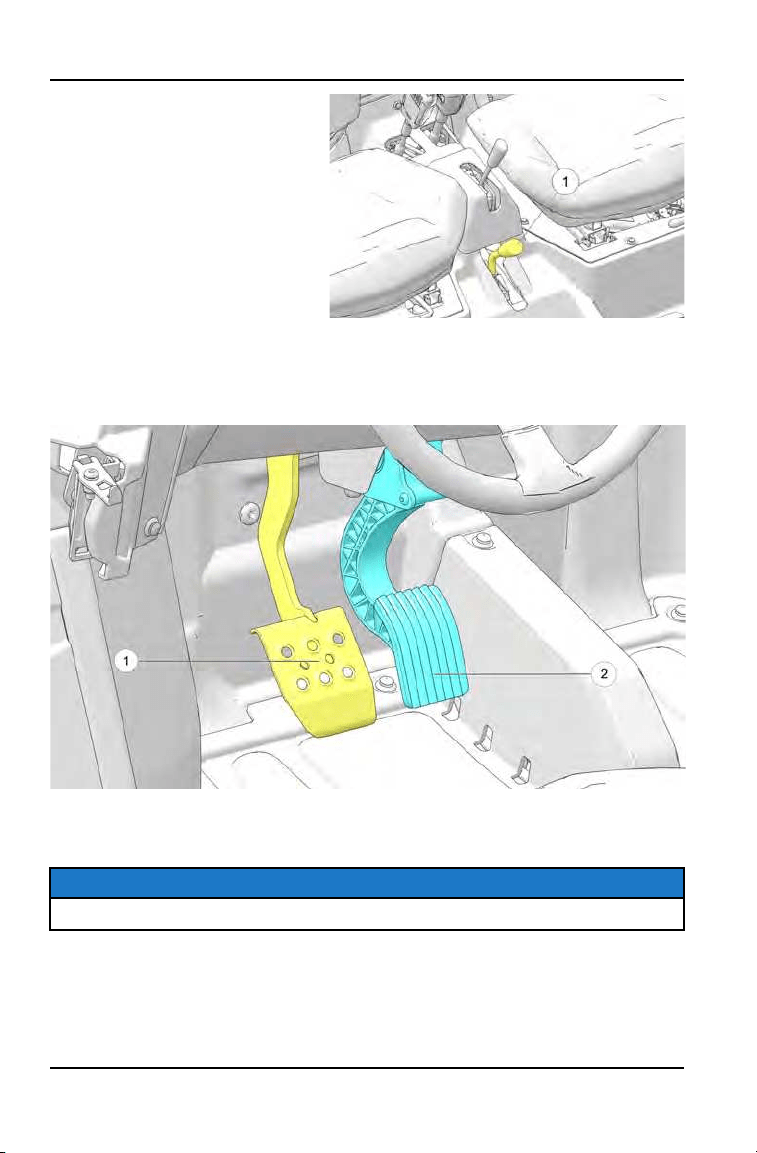
GEAR SELECTOR
The gear selector
q
is located
between the seats. To change
gears, stop the vehicle, and with
the engine idling, move the lever
to the desired gear. Do not
attempt to shift gears with
engine speed above idle or while
the vehicle is moving.
• F: Forward
• N: Neutral
• R: Reverse
TIP
Maintaining shift linkage adjustment is important to assure proper transmission
function. Your POLARIS dealer can assist in resolving any shifting problems.
NOTICE
Do not attempt to shift the transmission while the vehicle is moving. This could
damage the transmission. Always shift when the vehicle is stationary and the
engine is at idle.
PARKING BRAKE
WARNING
Always disengage the parking brake before operation. Operating the vehicle
with an engaged parking brake could result in vehicle damage and severe
injury or death.
TIP
Set the parking brake whenever the vehicle is left unattended.
41
FEATURES AND CONTROLS
1. Apply the foot brake.
2. When vehicle is fully
stopped, pull the parking
brake lever
q
rearward as
far as possible to set the
parking brake.
3. Stop the engine.
4. To release the parking brake,
apply the foot brake and
push the parking brake lever
first toward the passenger
seat and then forward.
BRAKE AND THROTTLE PEDALS
BRAKE PEDAL
Depress the brake pedal
q
to slow or stop the vehicle.
NOTICE
The brake pedal must be depressed to start the engine.
THROTTLE PEDAL
Depress the throttle pedal
w
to increase engine speed. Spring pressure returns
the pedal to the rest position when released. Always ensure the throttle pedal
returns normally before starting the engine.
42
FEATURES AND CONTROLS
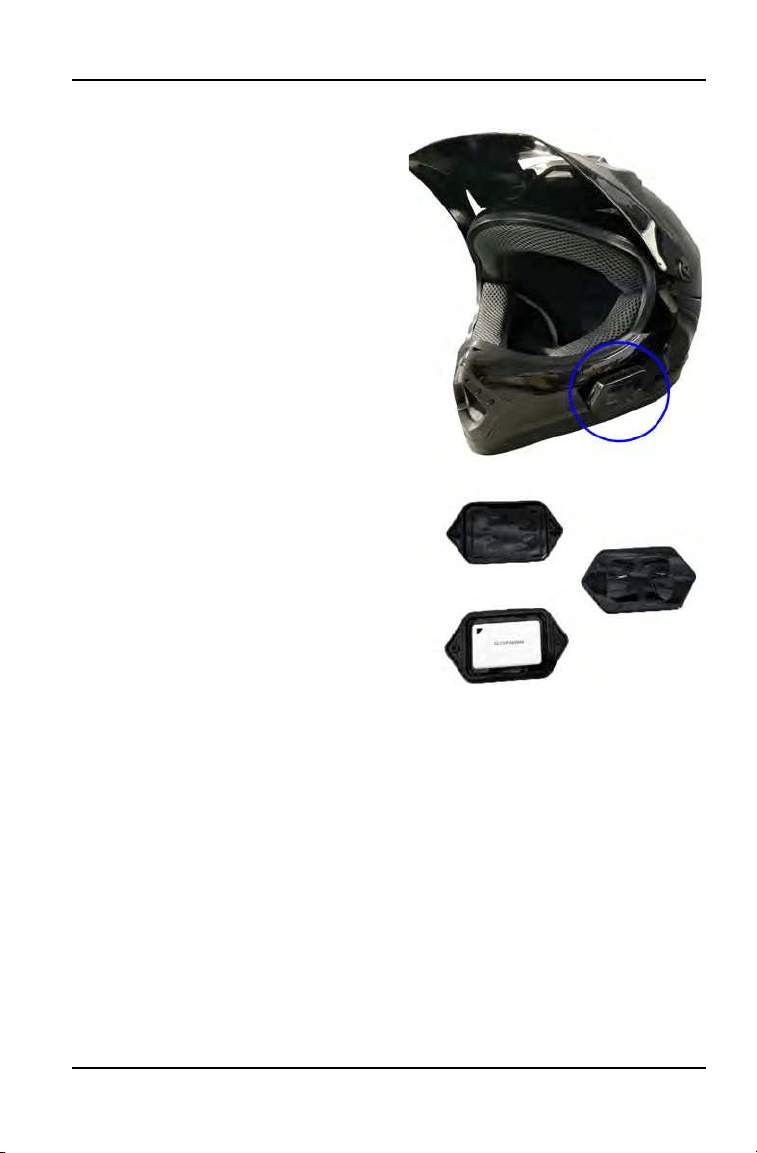
HELMET AWARE
The helmet aware beacon and
mounting adhesive comes shipped with
the owner’s manual. This allows
parents to mount to the Polaris supplied
helmet or helmet of their choice. The
helmet aware beacon should be
mounted on a flat surface on the
helmet.
The display will issue a low battery
message if the beacon is below 10%
battery level. Parents can replace the
battery beacon with a CR2032.
To replace the battery remove 2 screws
from the enclosure and then split the
beacon apart with a small standard
screw driver.
Helmet aware comes disabled from
factory and must be enabled by parent.
43
FEATURES AND CONTROLS

44
INSTRUMENT CLUSTER
OVERVIEW
NOTICE
Cleaning your vehicle using a high pressure washer may cause instrument
cluster damage. Wash the vehicle by hand or with a garden hose, using mild
soap. Do not use rubbing alcohol to clean the instrument cluster. Avoid using
insect sprays near your vehicle to prevent chemical contact with the screen.
Should gasoline come into contact with the instrument cluster, immediately
clean it off using a clean cloth and mild soap.
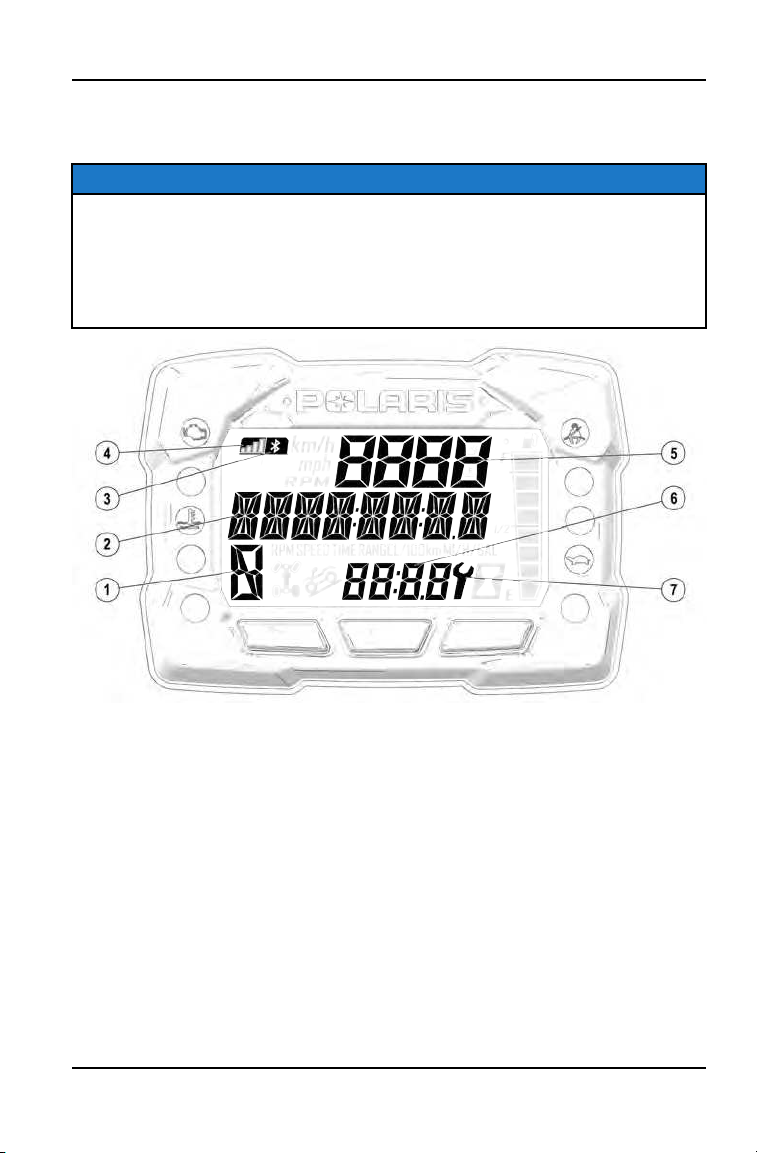
q
Gear Indicator
w
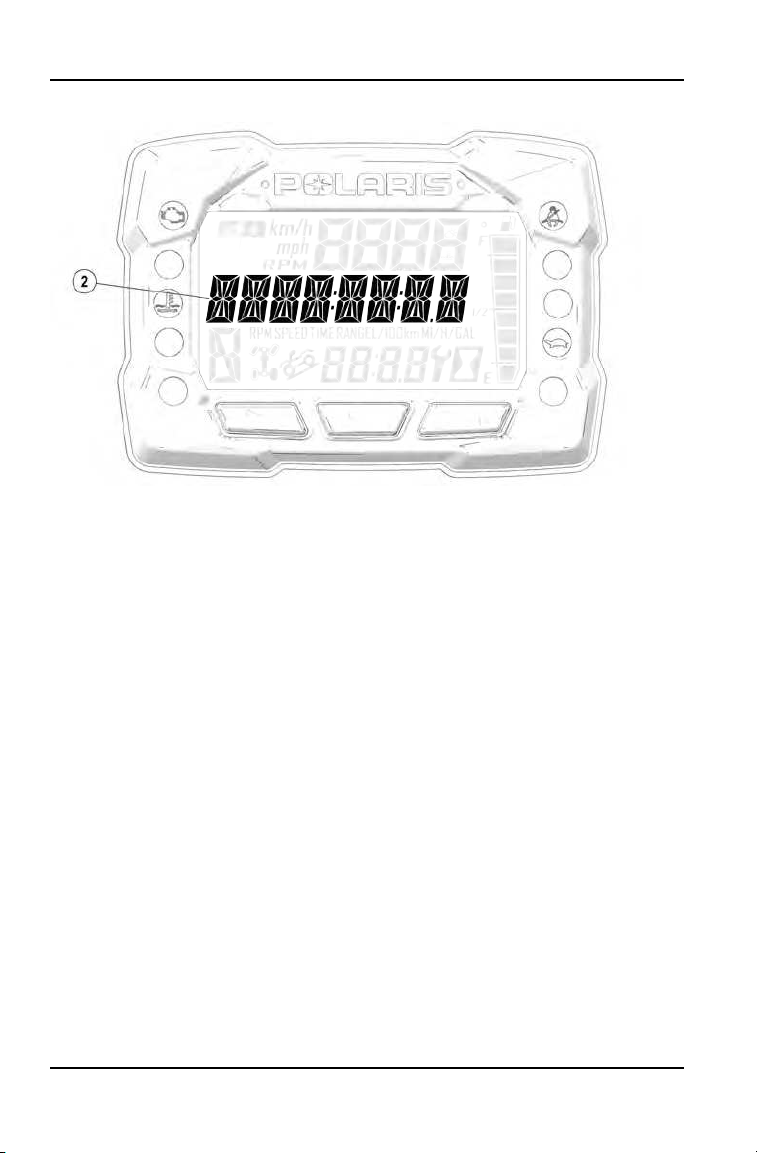
Display Area 2
e
Bluetooth® Connected
r
Helmet Aware Signal Strength
t
Display Area 1
y
Clock
u
Service Indicator
45
INSTRUMENT CLUSTER
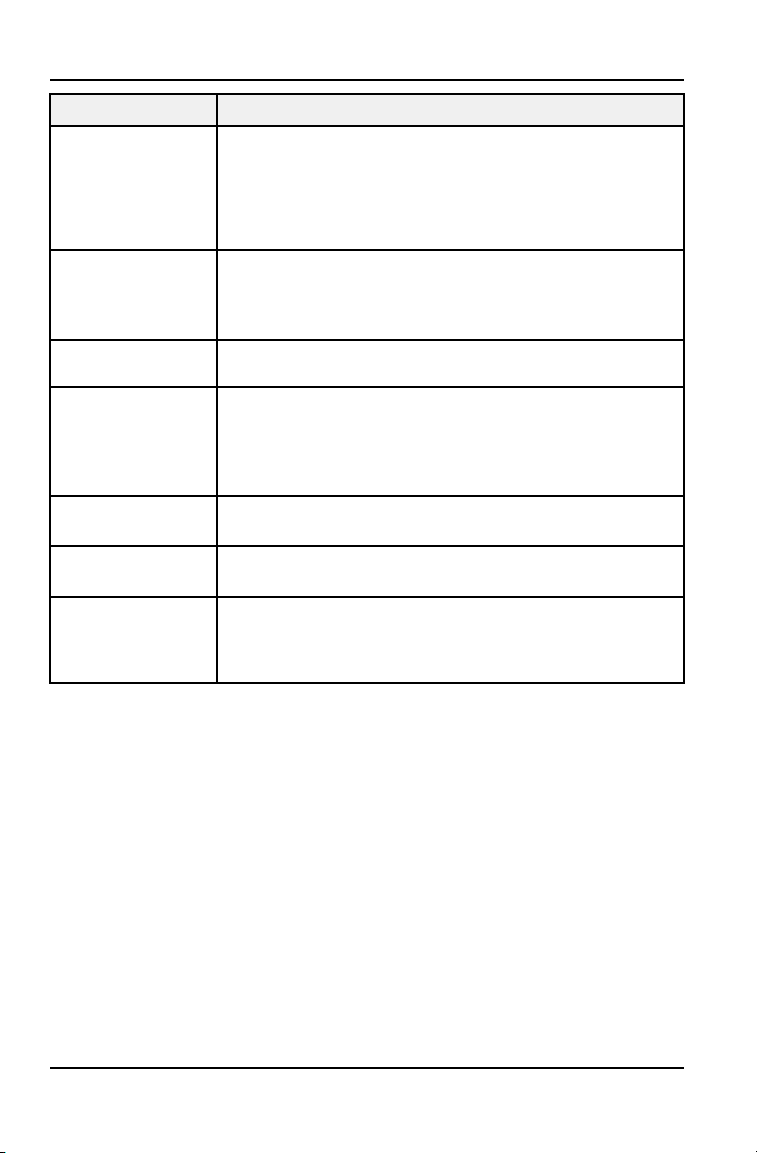
FEATURE DESCRIPTION
Gear Indicator
F = High Gear
N= Neutral
R = Reverse
– = Gear Signal Error (or shifter between gears)
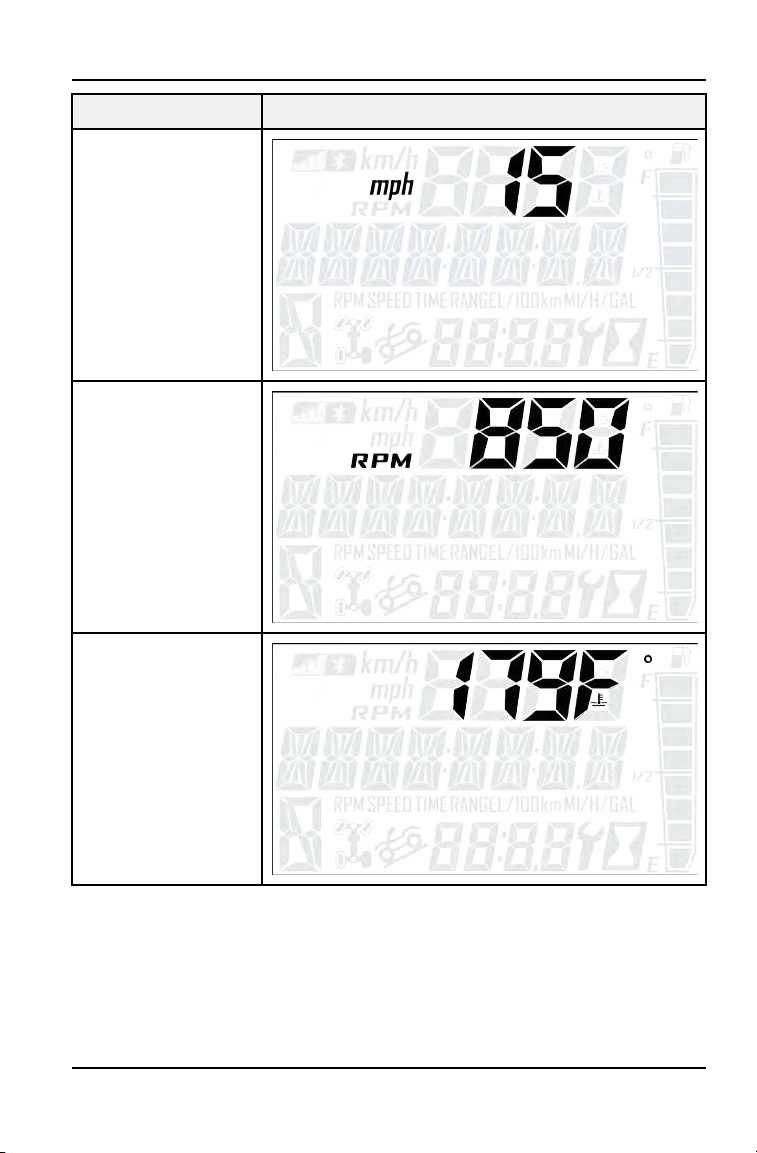
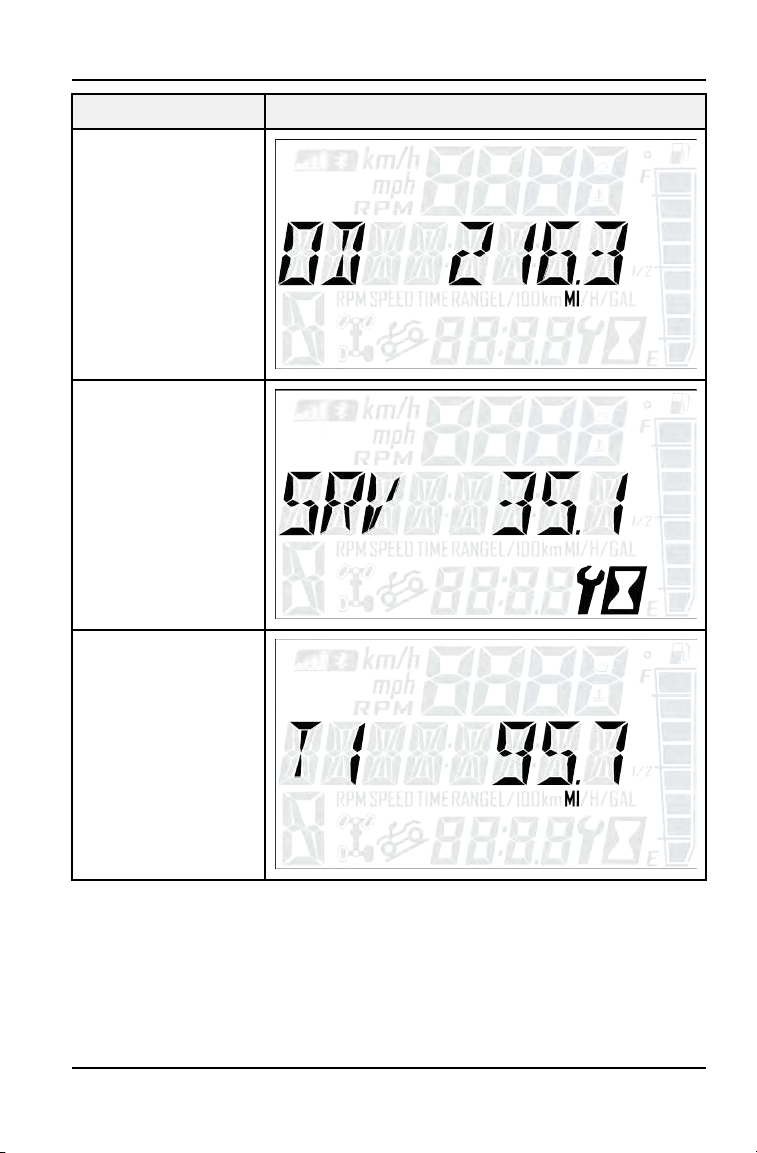
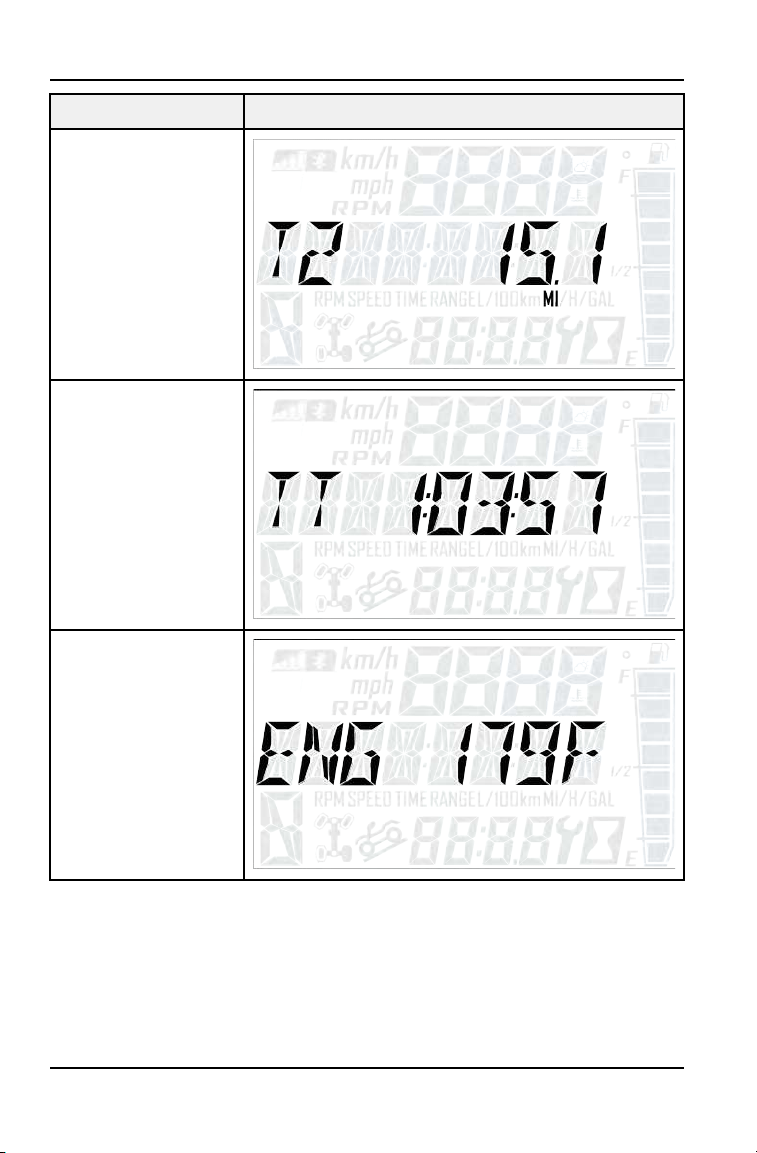
Display Area 2
This area displays odometer, trip meter, trip meter 2,
voltage, engine temperature, engine hour meter,
programmable service hour interval, ground speed,
engine RPM, GeoFence status, or speed limit status.
Bluetooth®
Connected
This icon illuminates when the display is connected to a
device via Bluetooth®.
Helmet Aware
Signal Strength
This indicates the signal strength of the helmet beacon.
This symbol will flash if the helmet aware system is
activated and the helmet beacon is not in range. The
symbol will remain on solid when the helmet beacon is in
range.
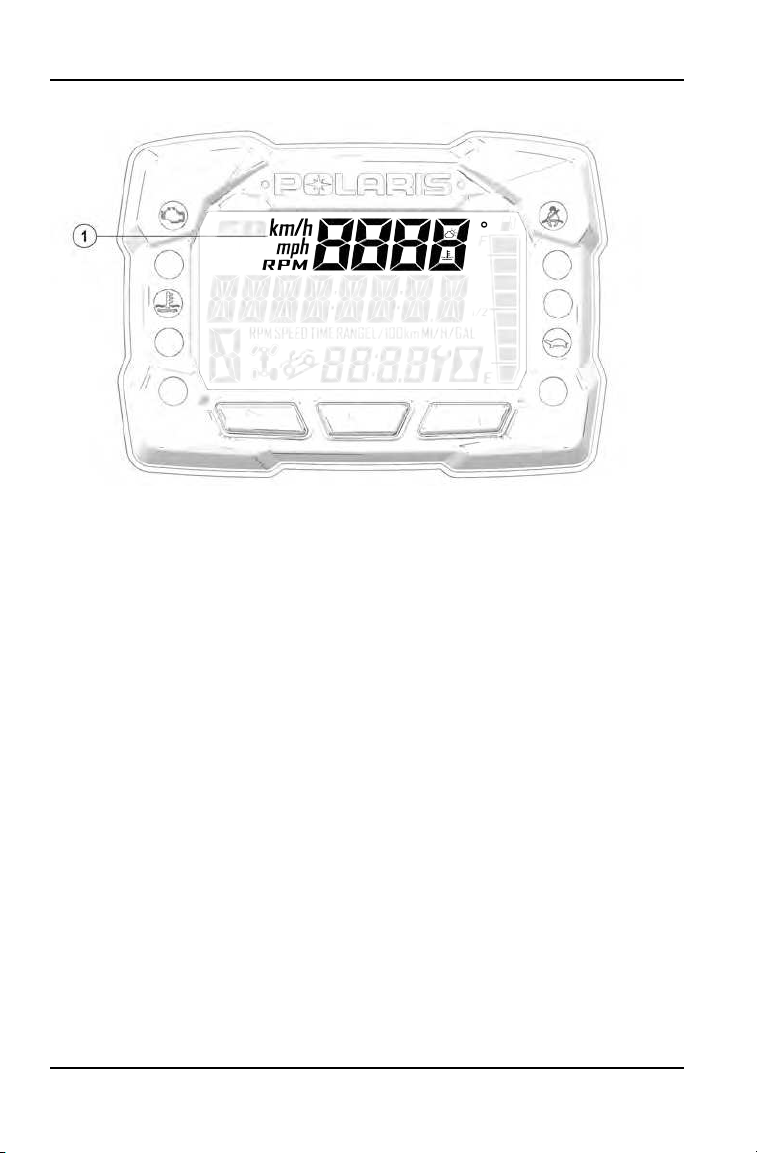
Display Area 1
This area displays engine RPM, ground speed, or coolant
temperature.
Clock
The clock displays time in a 12-hour or 24-hour format.
See page 70 for more information.
Service Indicator
A flashing wrench symbol alerts the operator that the
preset service interval has been reached. Your Polaris
dealer can provide scheduled maintenance. See page 74
for more information.
46
INSTRUMENT CLUSTER
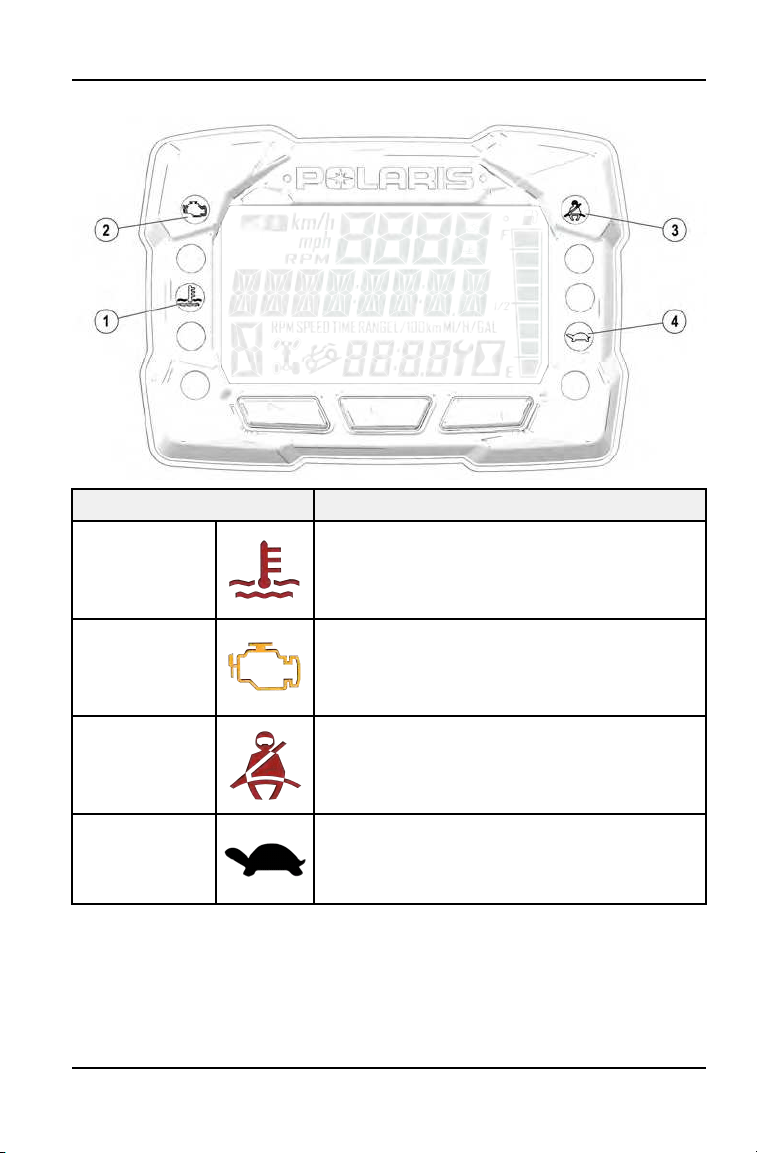
INDICATOR LAMPS
INDICATOR DESCRIPTION
q
Engine Hot
This lamp illuminates to indicate an overheated engine. If the
indicator flashes, a severe overheating condition exists.
w
Check Engine
This indicator appears if an EFI-related fault occurs. Do not
operate the vehicle if this warning appears. Serious engine
damage could result. Your authorized Polaris dealer can
assist.
e
Helmet / Seat
Belt
This lamp flashes for several seconds when the key is turned
to the ON position. The lamp is a reminder to wear helmet and
seat belt before operating.
r
Performance
Limited
ON: Speed limiting is in effect.
FLASHING: Vehicle speed is greater than preset max speed.
OFF: Speed limiting disabled.
47
INSTRUMENT CLUSTER
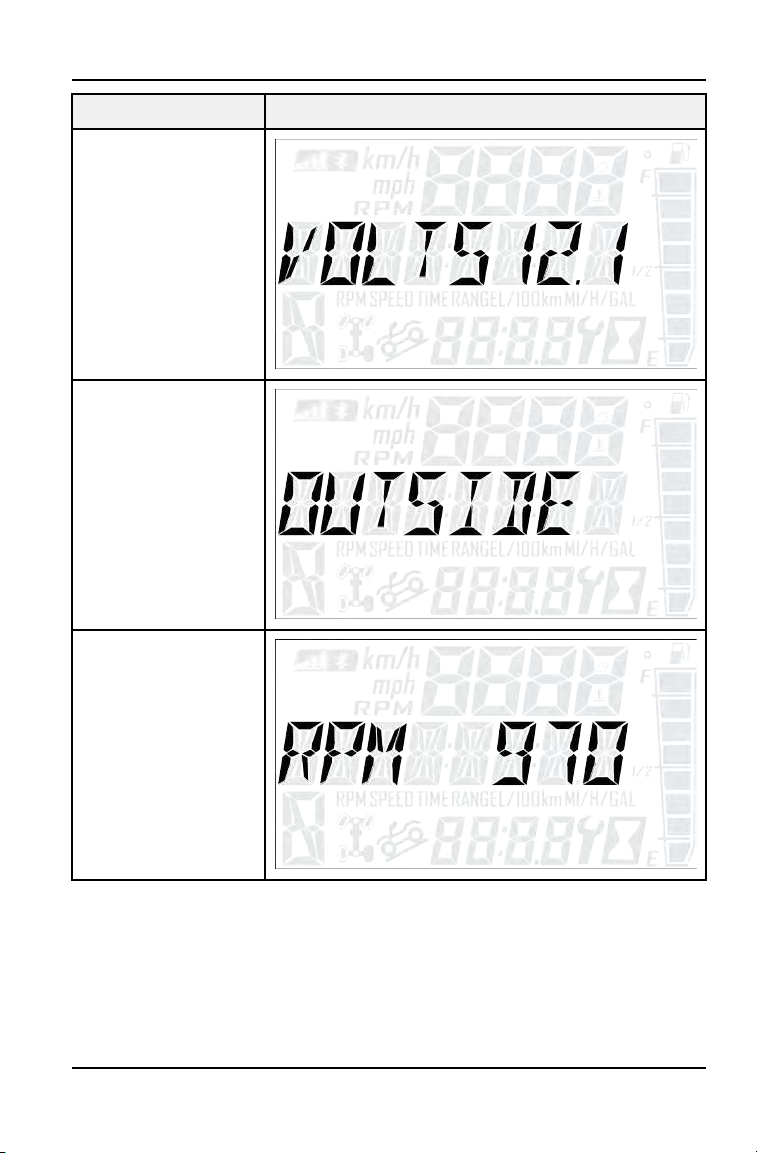
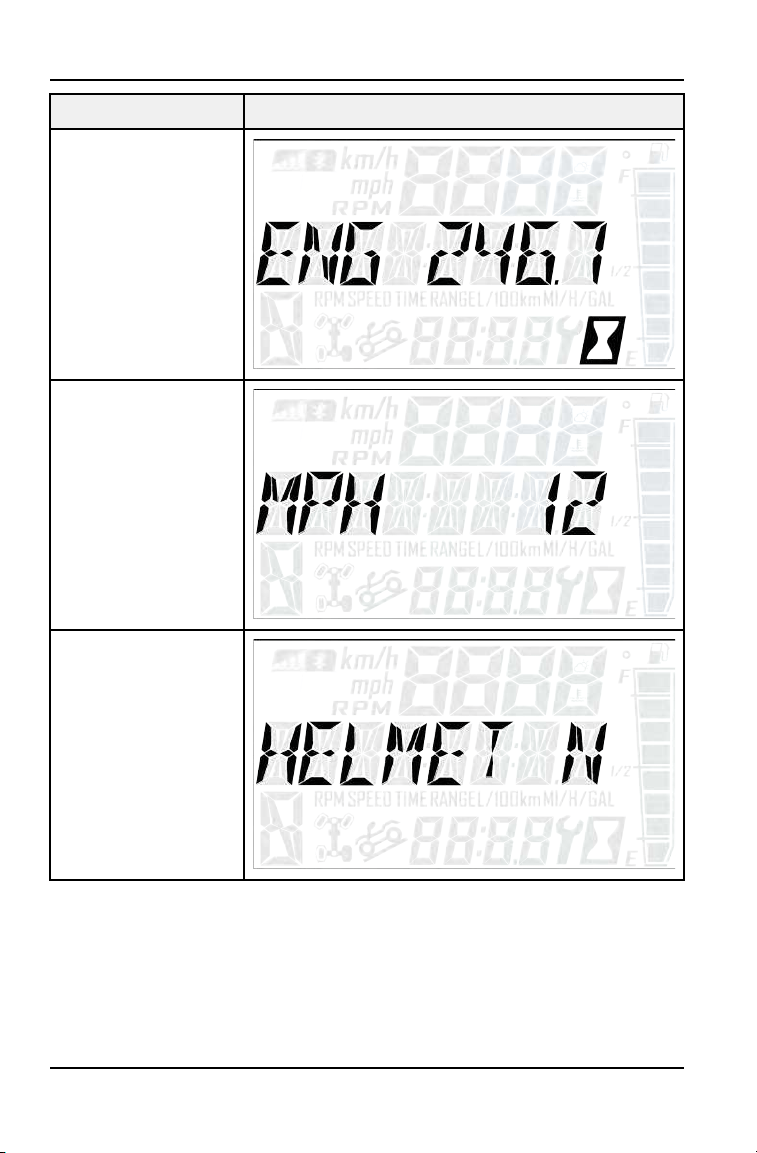
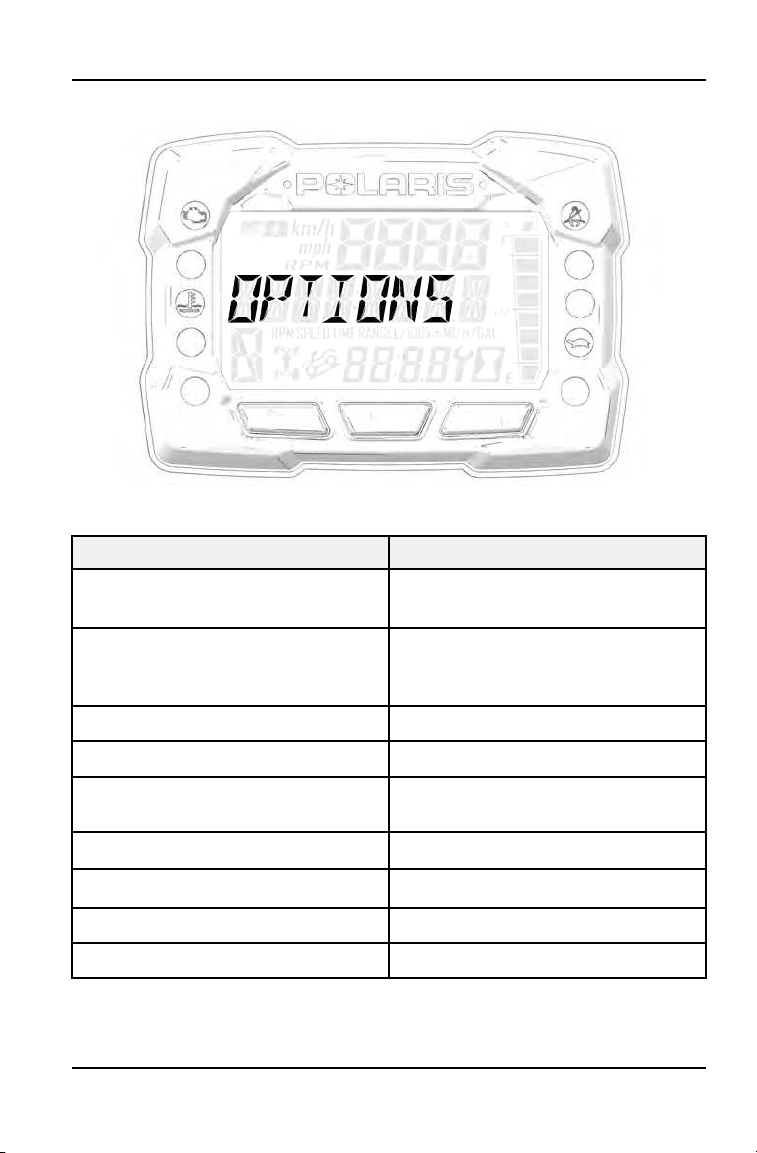
OPTIONS MENU
Press and hold the MODE button to enter the Options Menu.
OPTIONS MENU NOTES
Diagnostic Codes Only displays if fault codes are
present or stored
Youth Menu Set passcode, maximum speed,
GeoFence, and helmet aware
settings.
Units - Distance Select MPH or KPH
Units - Temp Select between °F and °C
Clock Select between 12H or 24H, and set
time
Backlight Color Select between Blue or Red
Backlight Level Set backlight brightness level
Service Hours View/Set Service hours
Exit Menu Exit
55
INSTRUMENT CLUSTER
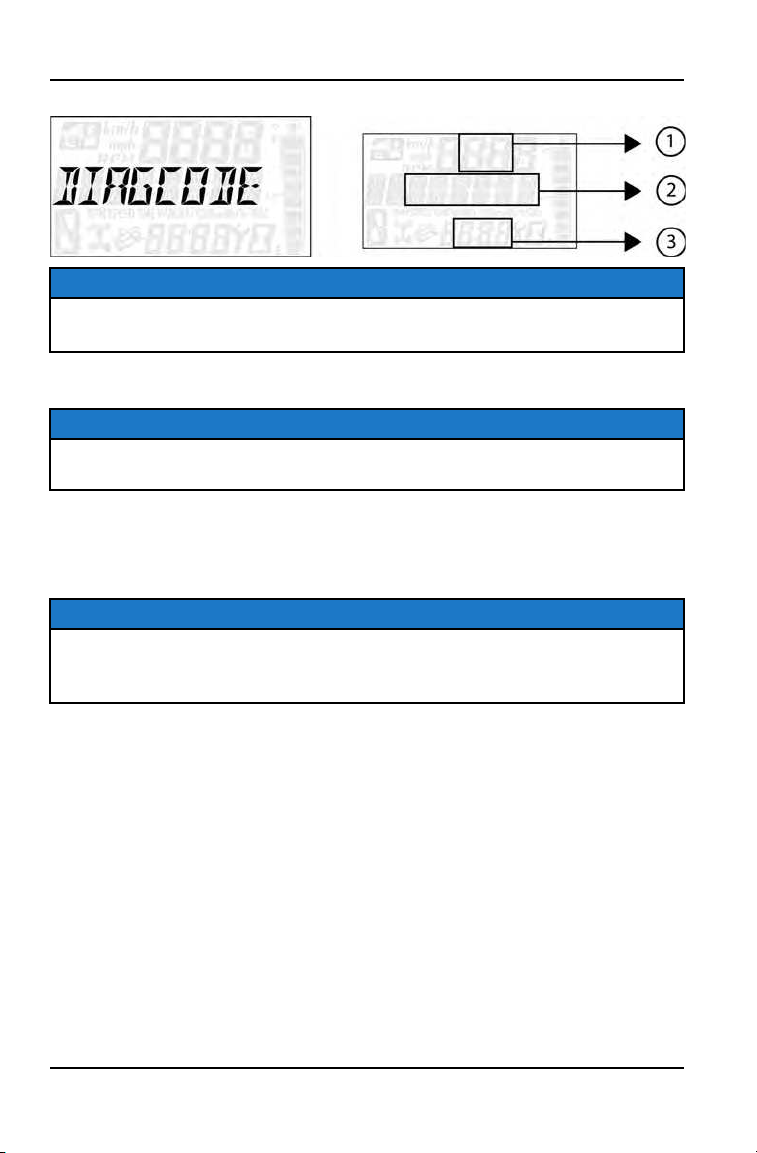
DIAGNOSTIC CODE
NOTICE
Diagnostic Code Screen will show available MIL that has come on during that
ignition cycle.
1. Press and hold the MODE button to enter the Options Menu.
NOTICE
“OPTIONS” will display on the screen for 3 seconds before showing first menu
item.
2. Select “Diagnostic Codes” from the Options Menu by pressing the MODE
button.
Toggle the Up/Down Buttons to cycle through Code(s).
NOTICE
This option will only be available if a fault code was set or is active during the
current ignition key 'on' cycle. Turning off the ignition will clear any save fault
codes from the gauge.
Reference the image shown above:
q
Area A will Display FMI (XX)
w
Area B will Display SPN (XXXXXX)
e
Clock Area will Display Count (XXX)
3. To exit the Options Menu the user can select Exit Menu function from
Options Menu, can hold Mode Button and exit out of Options Menu, or not
press any button for 10 seconds, which will exit out of the Options Menu.
56
INSTRUMENT CLUSTER
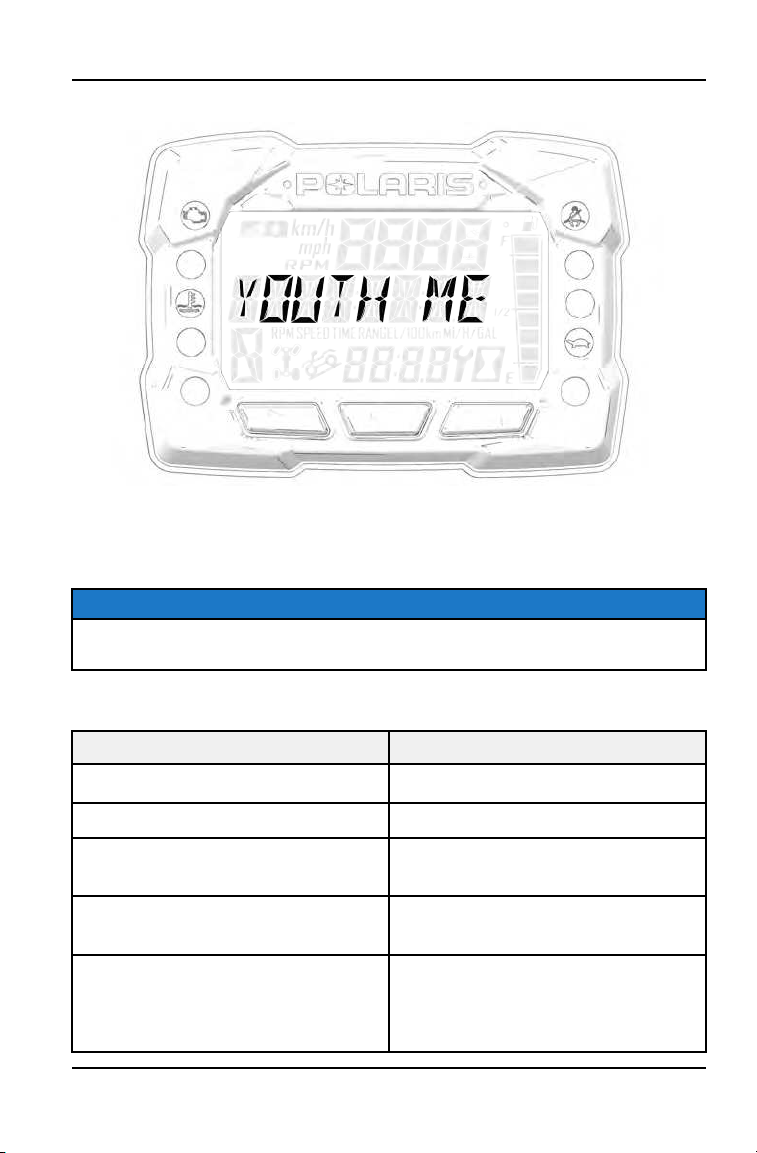
YOUTH MENU
The Youth Menu contains features that a parent can utilize to help limit the
performance of the vehicle for new and inexperienced operators.
1. Press and hold the MODE button to enter the Options Menu.
NOTICE
OPTIONS will display on the screen for 3 seconds before showing first menu
item.
2. Select YOUTH MENU from the Options Menu by pressing the MODE button.
YOUTH MENU NOTES
Maximum Speed Set maximum Speed
Geofence Enable/Disable Geofence
Inside Geofence Speed Set inside Geofence maximum
vehicle speed
Outside Geofence Speed Set outside Geofence maximum
vehicle speed
Helmet Aware When enabled by a parent this
function looks for the presence of a
helmet beacon. A parent can decide
to not let the vehicle start, limit speed
57
INSTRUMENT CLUSTER
YOUTH MENU NOTES
to 5 mph (8 km/h), or give a scrolling
warning on the display if a helmet is
not detected.
Require PIN to Start Enable/Disable PIN to start vehicle
PIN Delay If a PIN is required to start the
engine, a PIN delay also can be
enabled. This will allow the vehicle to
be restarted without a PIN for a
specified period of time after engine
stall or shutdown.
Change PIN Change PIN
Exit Youth Menu Exit
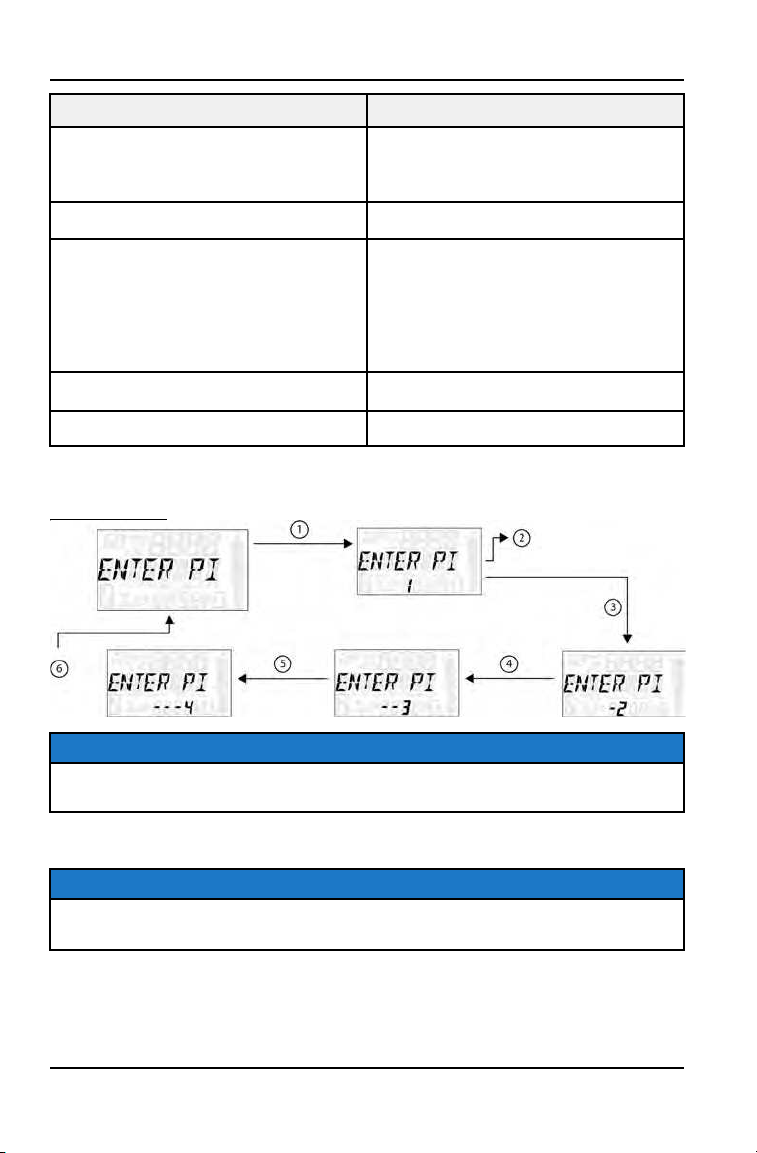
PERSONAL IDENTIFICATION NUMBER (PIN)
ENTER PIN
NOTICE
If personal identification number (PIN) is lost or displaced please contact your
Polaris dealer for assistance.
1. Press and hold the MODE button to enter the Options Menu.
NOTICE
OPTIONS will display on the screen for 3 seconds before showing first menu
item.
2. Select YOUTH MENU by pressing the MODE button.
58
INSTRUMENT CLUSTER
3. Enter PIN.
4. To exit the Youth Menu the user can select Exit Menu function from Youth
Menu, can hold MODE button and exit out of Youth Menu, or not press any
button for 10 seconds, which will exit out of the Options Menu.
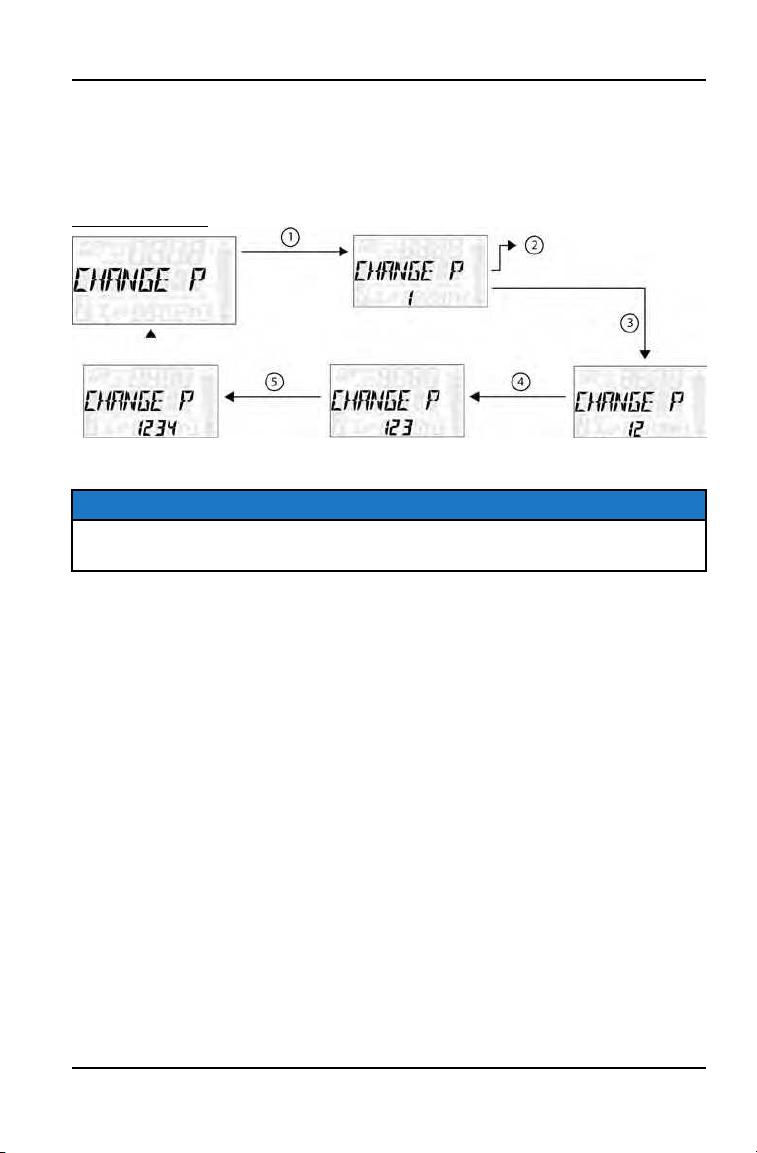
CHANGE PIN
1. Press and hold the MODE button to enter the Options Menu.
NOTICE
OPTIONS will display on the screen for 3 seconds before showing first menu
item.
2. Select Youth Menu by pressing the MODE button.
3. Enter PIN.
4. Select CHANGE PIN from the Youth Menu by pressing the MODE button.
Reference the image shown above:
q
Press the MODE button.
w
Toggle the UP/DOWN buttons to increase/decrease the first digit of the new
PIN.
e
With the desired first digit of the new PIN displayed, Press the MODE button
which will set the digit and move to the 2nd digit.
r
Toggle the UP/DOWN buttons to increase/decrease the 2nd digit of the new
PIN. Press MODE button to set 2nd digit and move on to the 3rd digit.
t
Toggle the UP/DOWN buttons to increase/decrease the 3rd digit of the new
PIN. Press MODE button to set 3rd digit and move on to the 4th digit.
5. Press the MODE button to set the 4th digit and exit.
6. To exit the Youth Menu the user can select EXIT MENU function from Youth
Menu, can hold MODE button and exit out of Youth Menu, or not press any
button for 10 seconds, which will exit out of the Options Menu.
59
INSTRUMENT CLUSTER
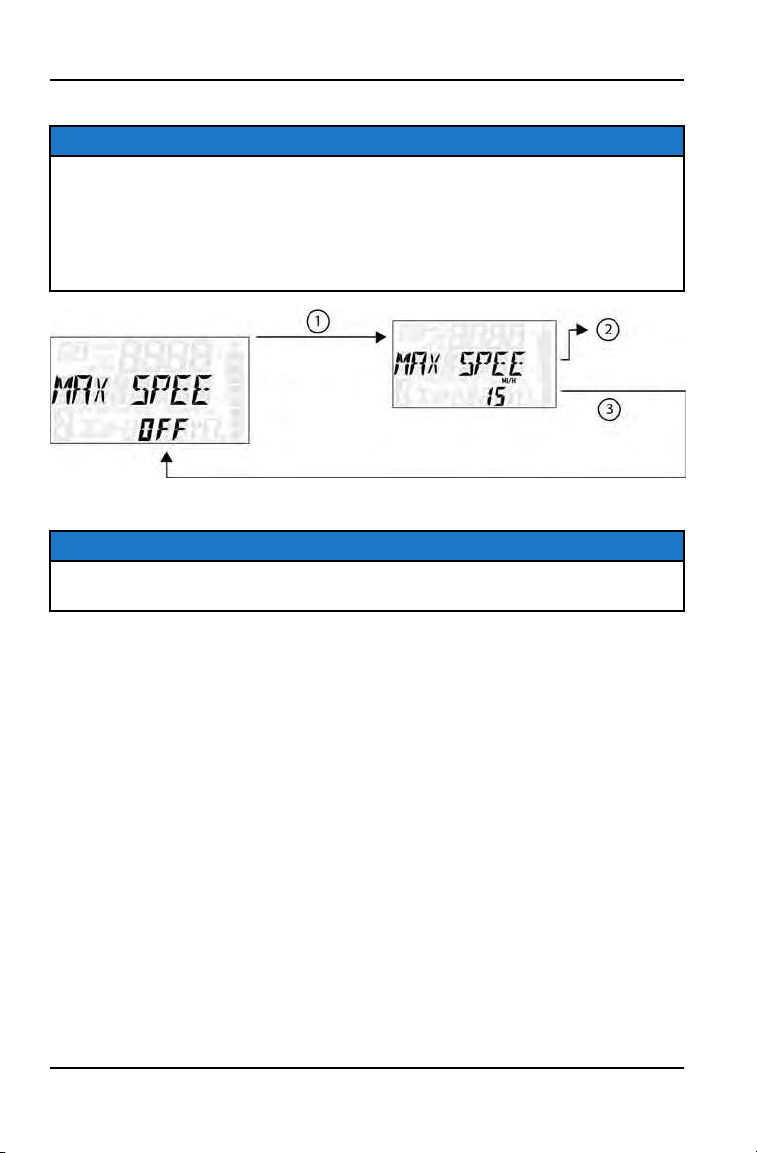
MAX SPEED
NOTICE
The speed of this vehicle is restricted to under 16 mph (26 km/h) at
manufacture. The speed limiting device may be adjusted by supervising adults
when they determine that their child is capable of handling additional speed.
The unrestricted top speed for this model is 29 mph (46 km/h).
Maximum speed can be set using the process below or by using the Polaris
Ride Command app.
1. Press and hold the MODE button to enter the Options Menu.
NOTICE
OPTIONS will display on the screen for 3 seconds before showing first menu
item.
2. Select YOUTH MENU by pressing the MODE Button.
3. Enter PIN.
4. Select MAX SPEED from the Youth Menu by pressing the MODE button.
Reference the image shown above:
q
Press the MODE button.
w
Toggle the UP/DOWN buttons to increase/decrease the maximum speed.
e
With the desired maximum speed displayed, press the MODE button
which will set the maximum speed and return to the Youth Menu.
5. To exit the Youth Menu the user can select EXIT MENU function from Youth
Menu, can hold MODE button and exit out of Youth Menu, or not press any
button for 10 seconds, which will exit out of the Options Menu.
60
INSTRUMENT CLUSTER
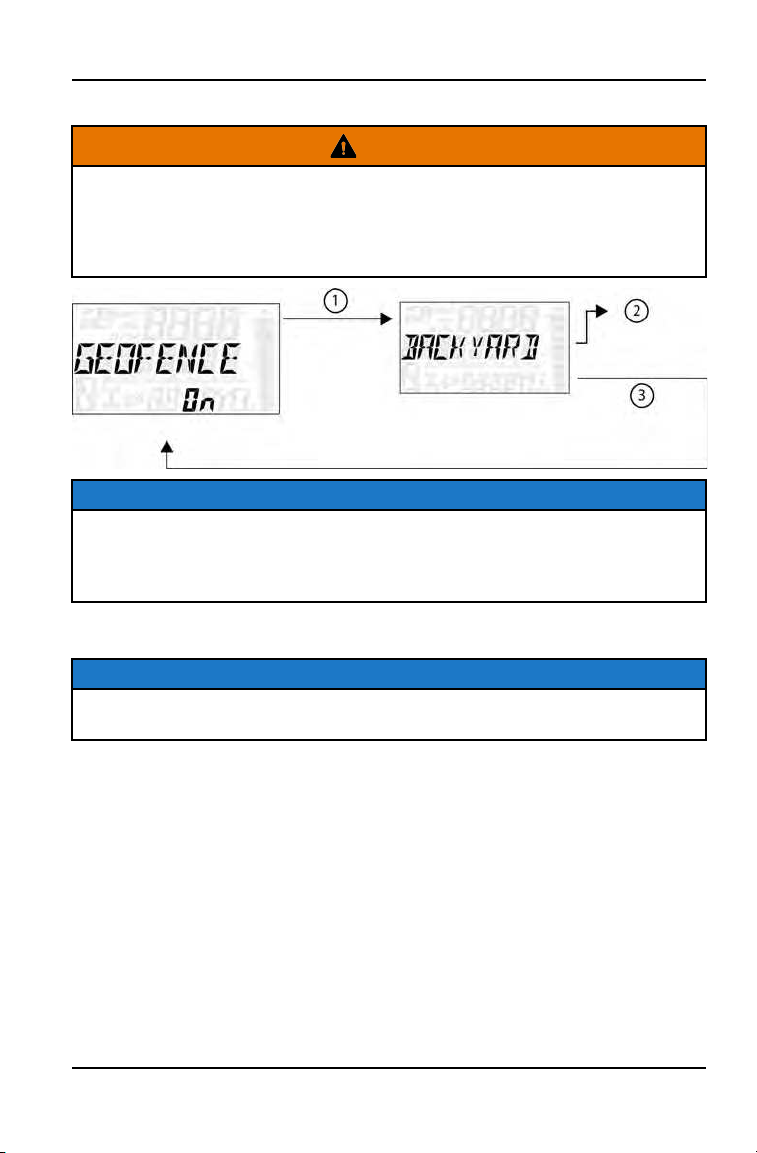
GEOFENCE
WARNING
Your Ranger 150 is equipped with Youth Ride Control; this technology is not a
replacement for adult supervision. GPS accuracy can vary by region, so make
certain to give adequate distance for geofence boundaries to accommodate
this variation. A geofence will not stop the vehicle. It will only slow to the adult
entered speed limit.
NOTICE
To use the geofence features, first download the Polaris Ride Command™ app
and sign up. Turning the geofence on and off and changing the speeds can be
done through the vehicle display once a geofence boundary has been created
through the Ride Command app.
1. Press and hold the MODE button to enter the Options Menu.
NOTICE
“OPTIONS” will display on the screen for 3 seconds before showing first menu
item.
2. Select “Youth Menu” by pressing the MODE button.
3. Enter PIN.
4. Select “GEOFENCE” from the Youth Menu by pressing the MODE button.
Reference the image shown above:
q
Press the MODE button.
w
Toggle the Up/Down buttons to cycle through options (On/Off).
e
With the desired option displayed, press the MODE button which will set
function and return to the Youth Menu.
5. To exit the Youth Menu the user can select Exit Menu function from Youth
Menu, can hold Mode Button and exit out of Youth Menu, or not press any
button for 10 seconds, which will exit out of the Options Menu.
61
INSTRUMENT CLUSTER
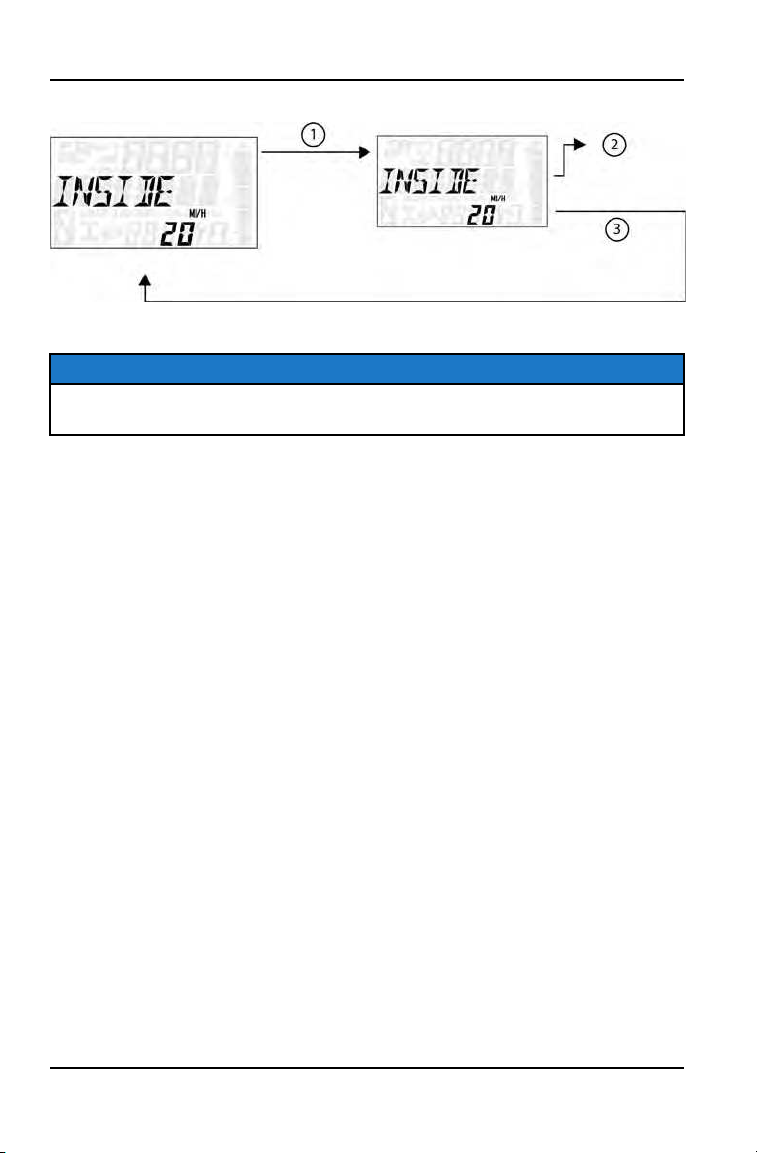
INSIDE GEOFENCE SPEED
1. Press and hold the MODE button to enter the Options Menu.
NOTICE
OPTIONS will display on the screen for 3 seconds before showing first menu
item.
2. Select YOUTH MENU by pressing the MODE button.
3. Enter PIN.
4. Select INSIDE from the Youth Menu by pressing the MODE button.
Reference the image shown above:
q
Press the MODE button.
w
Toggle the UP/DOWN buttons to increase/decrease inside Geofence
maximum speed.
e
With the desired speed displayed, press the MODE button which will set
the inside Geofence speed and return to the Youth Menu.
5. To exit the Youth Menu the user can select EXIT MENU function from Youth
Menu, can hold MODE button and exit out of Youth Menu, or not press any
button for 10 seconds, which will exit out of the Options Menu.
62
INSTRUMENT CLUSTER
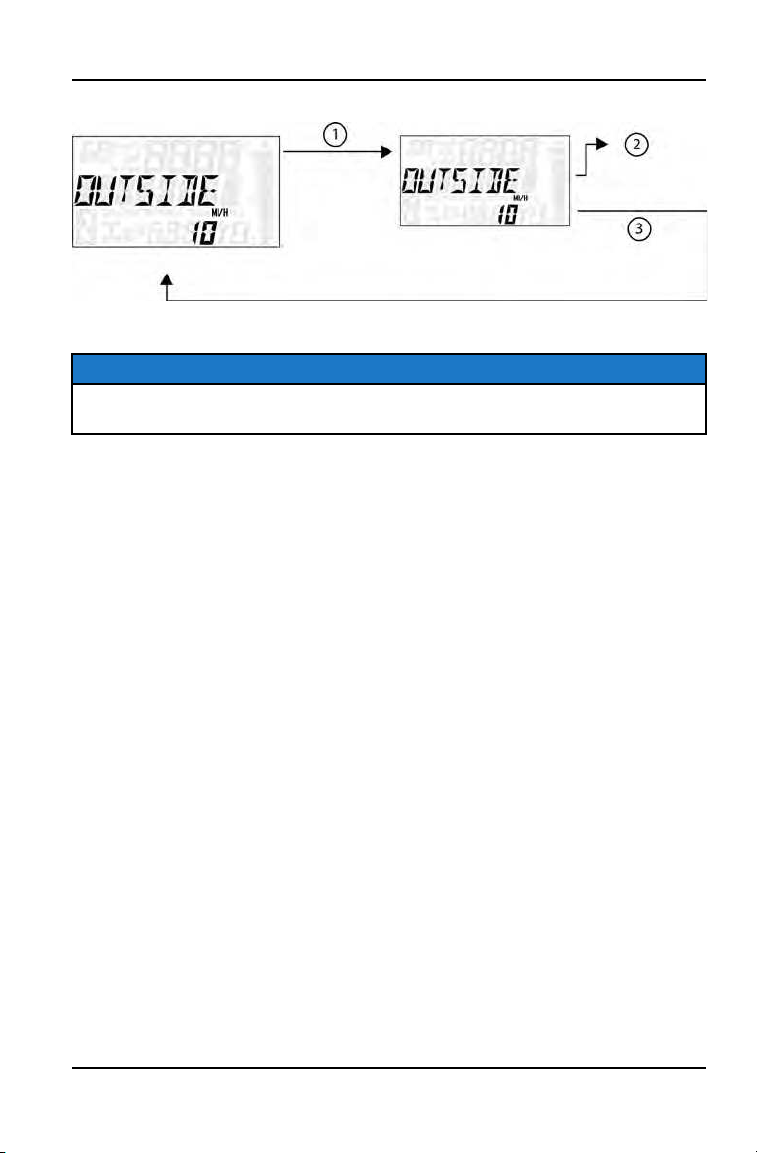
OUTSIDE GEOFENCE SPEED
1. Press and hold the MODE button to enter the Options Menu.
NOTICE
OPTIONS will display on the screen for 3 seconds before showing first menu
item.
2. Select YOUTH MENU by pressing the MODE button.
3. Enter PIN.
4. Select OUTSIDE from the Youth Menu by pressing the MODE button.
Reference the image shown above:
q
Press the MODE button.
w
Toggle the UP/DOWN buttons to increase/decrease OUTSIDE Geofence
maximum speed.
e
With the desired speed displayed, press the MODE button which will set
the outside Geofence speed and return to the Youth Menu.
5. To exit the Youth Menu the user can select EXIT MENU function from Youth
Menu, can hold MODE button and exit out of Youth Menu, or not press any
button for 10 seconds, which will exit out of the Options Menu.
63
INSTRUMENT CLUSTER
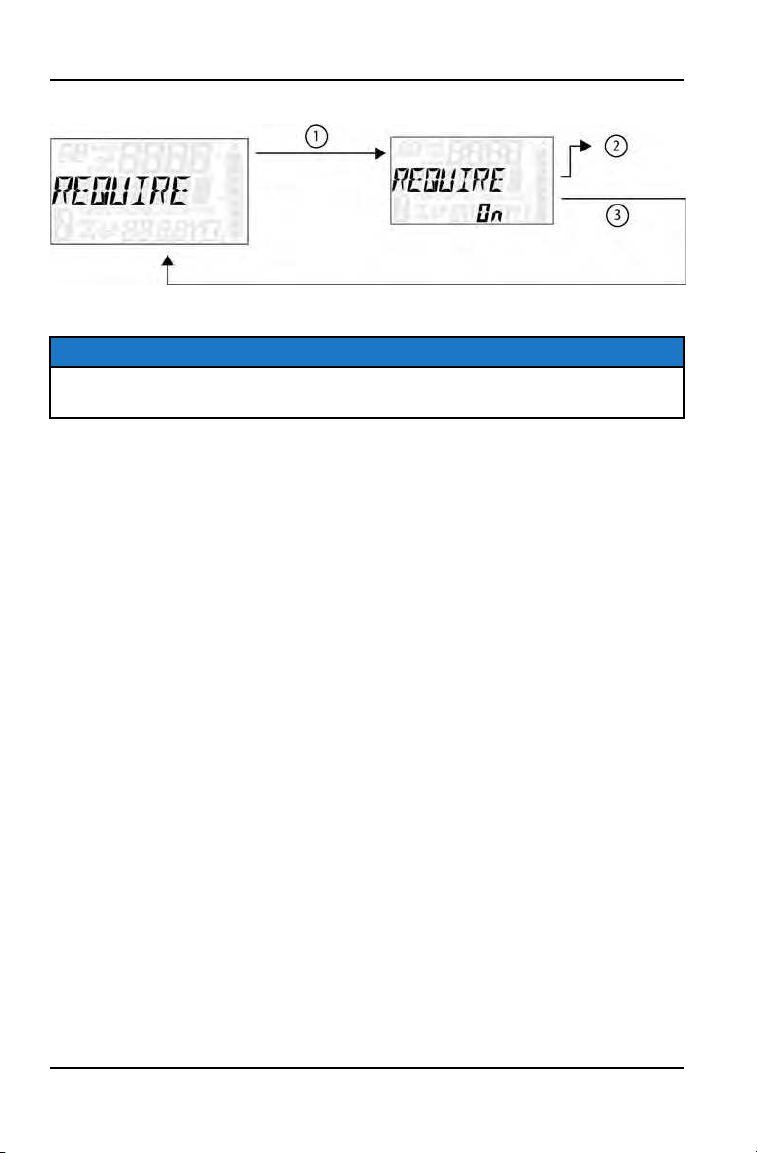
REQUIRE PIN TO START
1. Press and hold the MODE button to enter the Options Menu.
NOTICE
OPTIONS will display on the screen for 3 seconds before showing first menu
item.
2. Select YOUTH MENU by pressing the MODE button.
3. Enter PIN.
4. Select REQUIRE PIN TO START from the Youth Menu by pressing the
MODE button.
Reference the image shown above:
q
Press the MODE button.
w
Toggle the UP/DOWN buttons to enable/disable requiring PIN to start
vehicle.
e
With the desired option displayed, press the MODE button which will set
the function and return to the Youth Menu.
5. To exit the Youth Menu the user can select EXIT MENU function from Youth
Menu, can hold MODE button and exit out of Youth Menu, or not press any
button for 10 seconds, which will exit out of the Options Menu.
64
INSTRUMENT CLUSTER
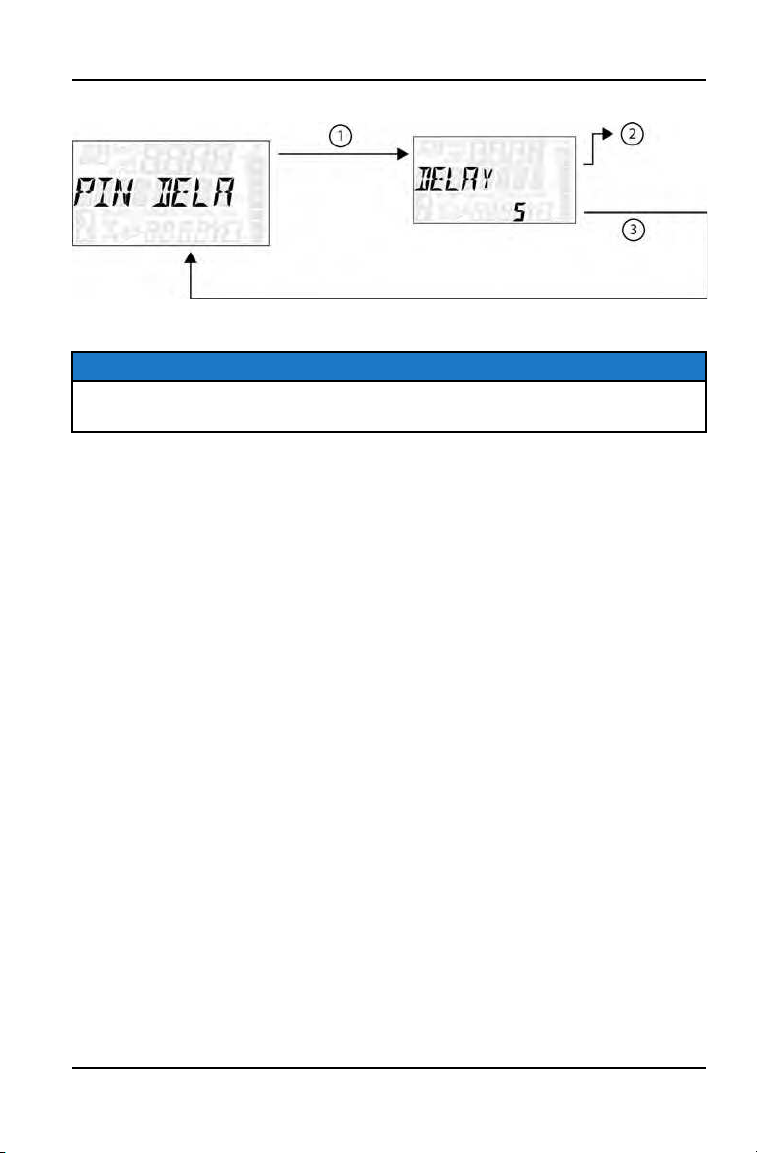
PIN DELAY
1. Press and hold the MODE button to enter the Options Menu.
NOTICE
OPTIONS will display on the screen for 3 seconds before showing first menu
item.
2. Select YOUTH MENU by pressing the MODE button.
3. Enter PIN.
4. Select PIN DELAY from the Youth Menu by pressing the MODE button.
Reference the image shown above:
q
Press the MODE button.
w
Toggle the UP/DOWN buttons to enable/disable the pin delay.
e
With the desired option displayed, press the MODE button which will set the
function and return to the Youth Menu.
5. To exit the Youth Menu the user can select EXIT MENU function from Youth
Menu, can hold MODE button and exit out of Youth Menu, or not press any
button for 10 seconds, which will exit out of the Options Menu.
65
INSTRUMENT CLUSTER
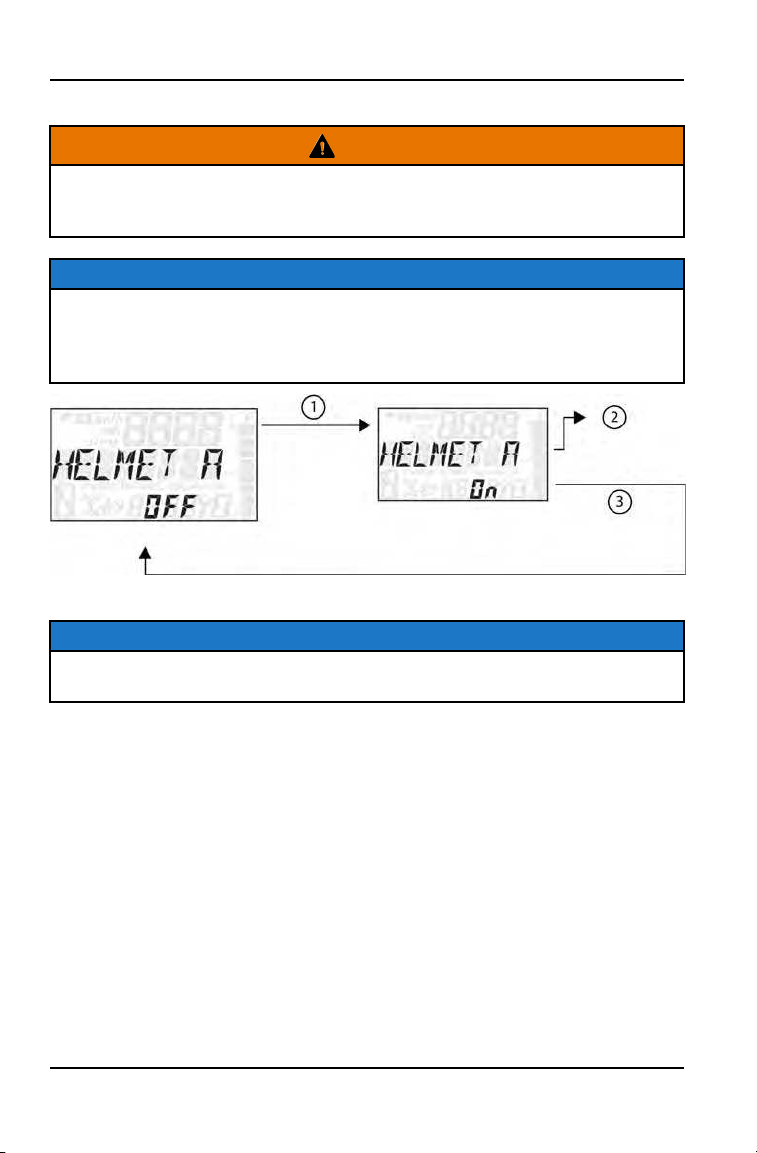
HELMET AWARE
WARNING
Your vehicle is equipped with Youth Ride Control; this technology is not a
replacement for adult supervision to ensure proper equipment is worn by the
operator.
NOTICE
To use all of the helmet aware features first download the Polaris Ride
Command app and sign up. Turning the helmet aware feature on and off can
be done through the vehicle display but the helmet not detected behavior must
be selected through the Ride Command app.
1. Press and hold the MODE button to enter the Options Menu.
NOTICE
OPTIONS will display on the screen for 3 seconds before showing first menu
item.
2. Select YOUTH MENU by pressing the MODE button.
3. Enter PIN.
4. Select HELMET A from the Youth Menu by pressing the MODE button.
Reference the image shown above:
q
Press the MODE button.
w
Toggle the UP/DOWN buttons to cycle through options (On/Off).
e
With the desired option displayed, press the MODE button which will set
function and return to the Youth Menu.
5. To exit the Youth Menu the user can select EXIT MENU function from Youth
Menu, can hold MODE button and exit out of Youth Menu, or not press any
button for 10 seconds, which will exit out of the Options Menu.
66
INSTRUMENT CLUSTER
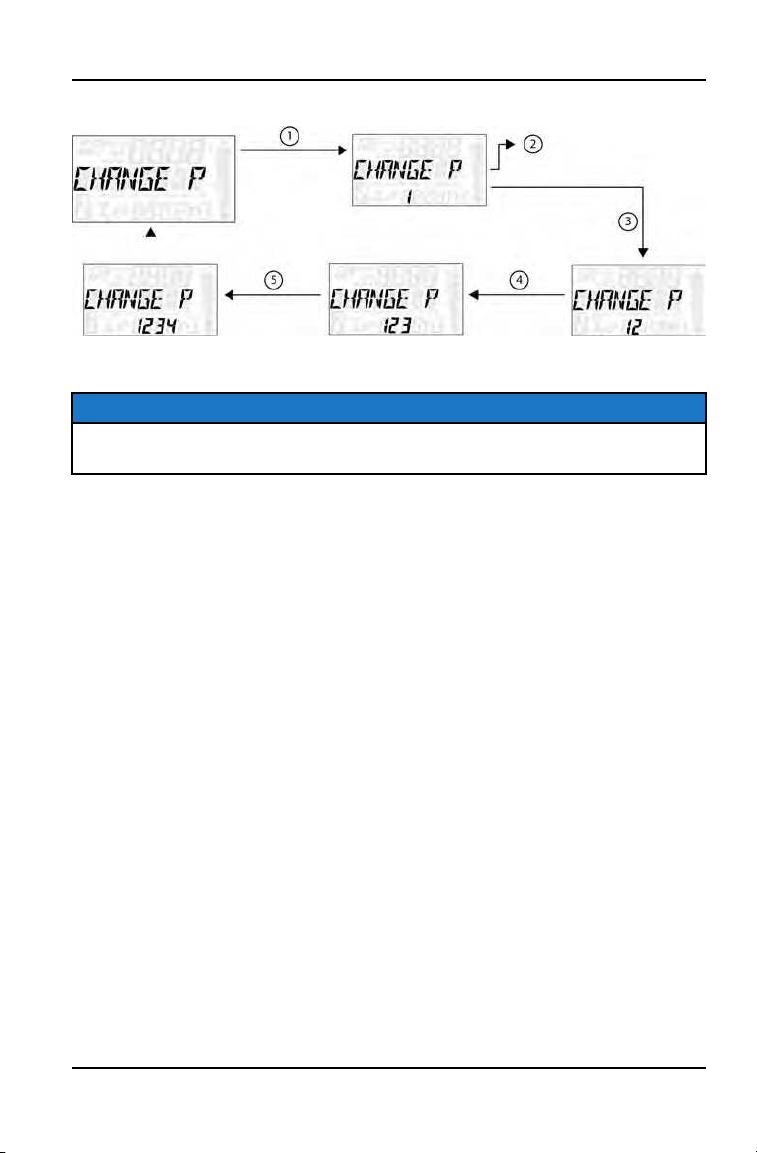
CHANGE PIN
1. Press and hold the MODE button to enter the Options Menu.
NOTICE
“OPTIONS” will display on the screen for 3 seconds before showing first menu
item.
2. Select “Youth Menu” by pressing the MODE button.
3. Enter PIN.
4. Select “CHANGE PIN” from the Youth Menu by pressing the MODE button.
Reference the image shown above:
q
Press the MODE button.
w
Toggle the Up/Down buttons to increase/decrease the first digit of the new
PIN.
e
With the desired first digit of the new PIN displayed, Press the MODE button
which will set the digit and move to the 2nd digit.
r
Toggle the Up/Down Buttons to increase/decrease the 2nd digit of the new
PIN. Press MODE button to set 2nd digit and move on to the 3rd digit.
t
Toggle the Up/Down Buttons to increase/decrease the 3rd digit of the new
PIN. Press MODE button to set 3rd digit and move on to the 4th digit.
5. Press the MODE button to set the 4th digit and exit.
6. To exit the Youth Menu the user can select Exit Menu function from Youth
Menu, can hold Mode button and exit out of Youth Menu, or not press any
button for 10 seconds, which will exit out of the Options Menu.
67
INSTRUMENT CLUSTER
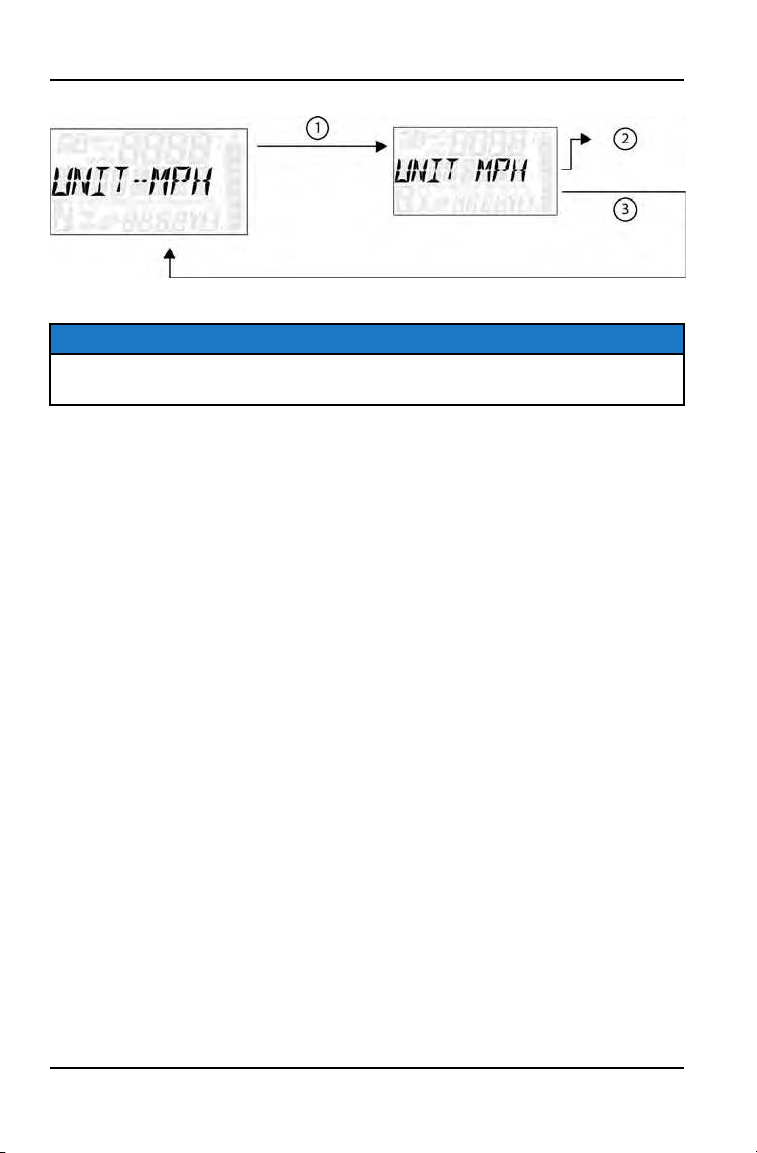
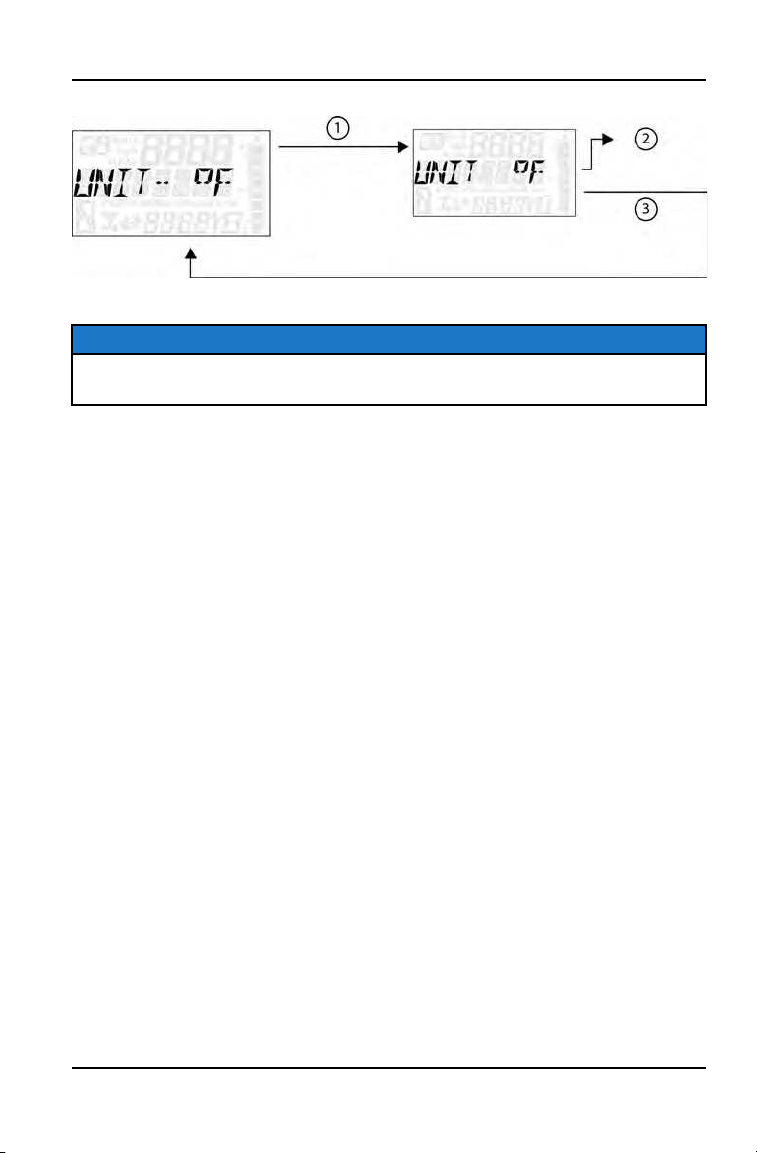
UNIT SELECTION DISTANCE
1. Press and hold the MODE button to enter the Options Menu.
NOTICE
“OPTIONS” will display on the screen for 3 seconds before showing first menu
item.
2. Select “Units-Distance” from the Options Menu by pressing the MODE
button.
Reference the image shown above:
q
Press the MODE button.
w
Toggle the Up/Down Buttons to change the units (MPH or KPH)
e
With the correct unit displayed, Press the mode button which will set
the unit and return to the Options Menu.
3. To exit the Options Menu the user can select Exit Menu function from
Options Menu, can hold Mode Button and exit out of Options Menu, or not
press any button for 10 seconds, which will exit out of the Options Menu.
68
INSTRUMENT CLUSTER
UNIT SELECTION TEMPERATURE
1. Press and hold the MODE button to enter the Options Menu.
NOTICE
“OPTIONS” will display on the screen for 3 seconds before showing first menu
item.
2. Select “Units - Temp” from the Options Menu by pressing the MODE button.
Reference the image shown above:
q
Press the MODE button.
w
Toggle the Up/Down Buttons to change the units (°F or °C)
e
With the correct unit displayed, Press the mode button which will set
the unit and return to the Options Menu.
3. To exit the Options Menu the user can select Exit Menu function from
Options Menu, can hold Mode Button and exit out of Options Menu, or not
press any button for 10 seconds, which will exit out of the Options Menu.
69
INSTRUMENT CLUSTER
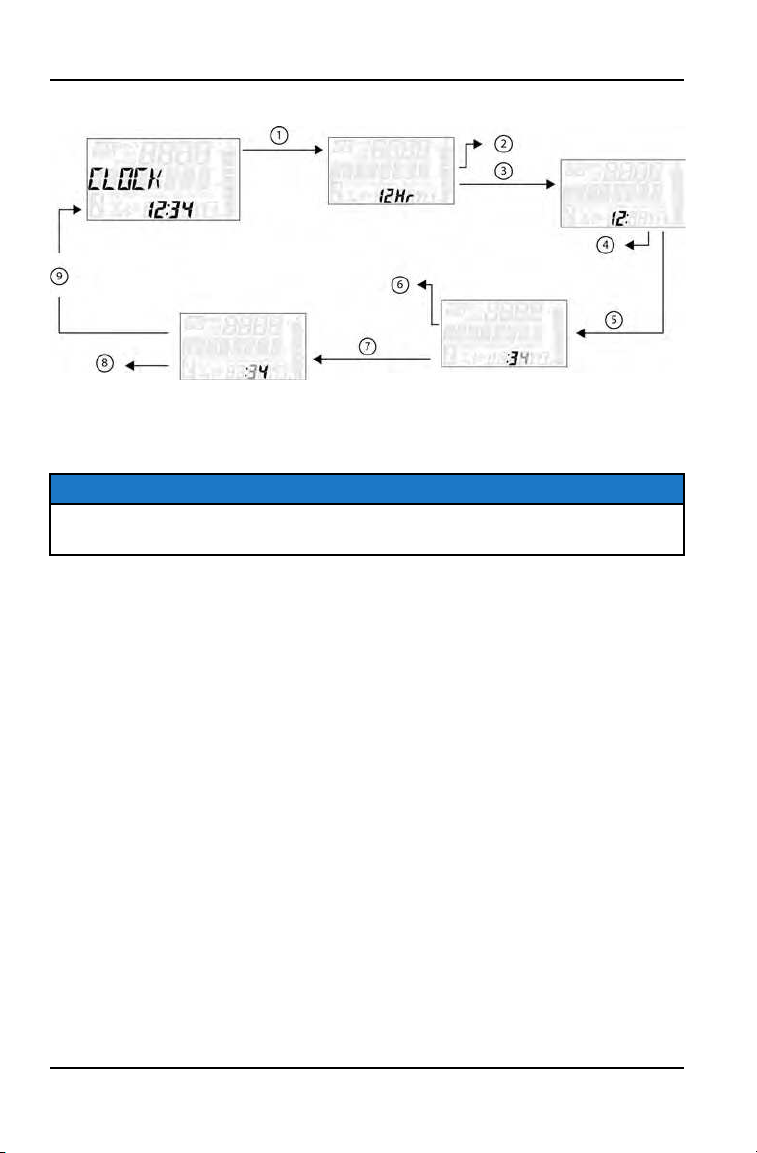

2. Select “Clock” from the Options Menu by pressing the MODE button.
Reference the image shown above:
q
Press the MODE button.
w
Toggle the Up/Down Buttons to change the units (12H or 24H)
e
With the correct unit displayed, Press the mode button which will set
the unit.
r
Toggle the Up/Down Buttons to change the units (Cycles Hours)
t
With the correct unit displayed, Press the mode button which will set
the unit.
y
Toggle the Up/Down Buttons to change the units (Cycles 10s of
Minutes)
u
With the correct unit displayed, Press the mode button which will set
the unit.
i
Toggle the Up/Down Buttons to change the units (Cycles 1s of
Minutes)
o
With the correct unit displayed, Press the mode button which will set
the unit and return to the Options Menu.
3. To exit the Options Menu the user can select Exit Menu function from
Options Menu, can hold Mode Button and exit out of Options Menu, or not
press any button for 10 seconds, which will exit out of the Options Menu.
71
INSTRUMENT CLUSTER
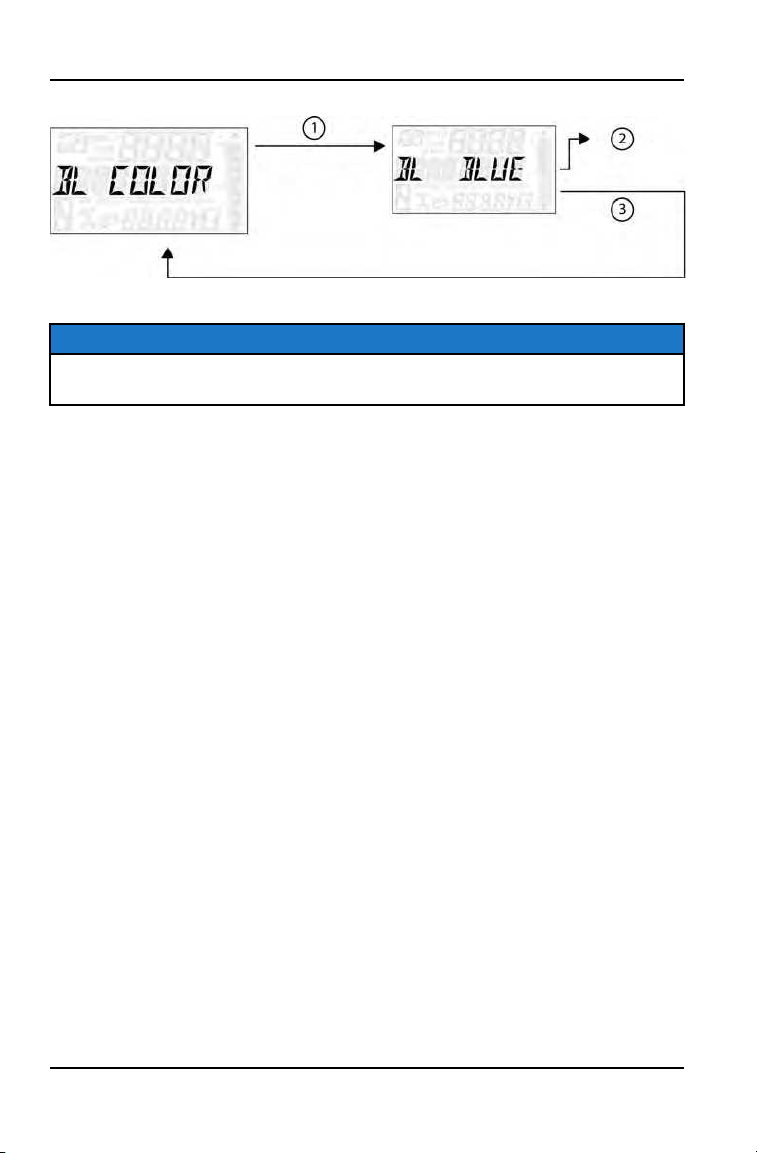
BACK LIGHT COLOR
1. Press and hold the MODE button to enter the Options Menu.
NOTICE
“OPTIONS” will display on the screen for 3 seconds before showing first menu
item.
2. Select “Backlight Color” from the Options Menu by pressing the MODE
button.
Reference the image shown above:
q
Press the MODE button.
w
Toggle the Up/Down Buttons to change the units (Blue or Red)
e
With the correct unit displayed, Press the mode button which will set
the unit and return to the Options Menu.
3. To exit the Options Menu the user can select Exit Menu function from
Options Menu, can hold Mode Button and exit out of Options Menu, or not
press any button for 10 seconds, which will exit out of the Options Menu.
72
INSTRUMENT CLUSTER
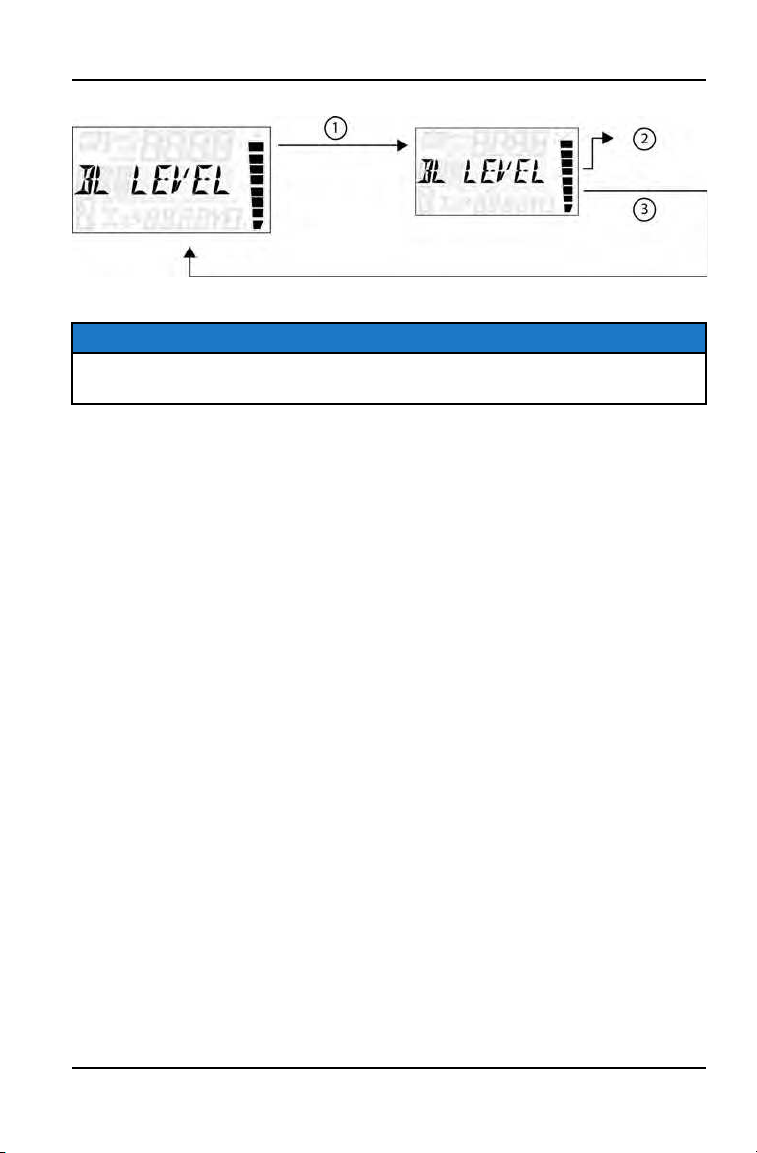
BACK LIGHT LEVEL
1. Press and hold the MODE button to enter the Options Menu.
NOTICE
“OPTIONS” will display on the screen for 3 seconds before showing first menu
item.
2. Select “Backlight Level” from the Options Menu by pressing the MODE
button.
Reference the image shown above:
q
Press the MODE button.
w
Toggle the Up/Down Buttons to change the units (Increase or De-
crease Level)
e
With the correct unit displayed, Press the mode button which will set
the unit and return to the Options Menu.
3. To exit the Options Menu the user can select Exit Menu function from
Options Menu, can hold Mode Button and exit out of Options Menu, or not
press any button for 10 seconds, which will exit out of the Options Menu.
73
INSTRUMENT CLUSTER
SERVICE HOURS
1. Press and hold the MODE button to enter the Options Menu.
NOTICE
“OPTIONS” will display on the screen for 3 seconds before showing first menu
item.
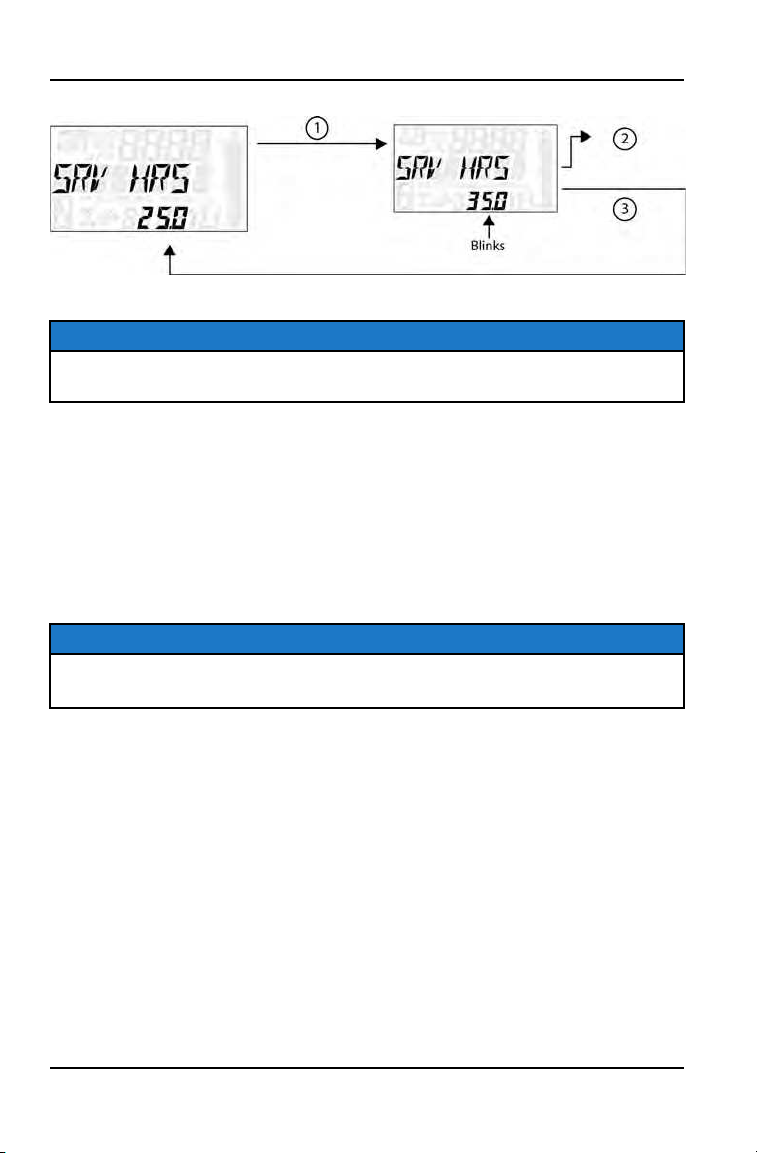
2. Select “Service Hours” from the Options Menu by pressing the MODE button.
Reference the image shown above:
q
Press the MODE button.
w
Toggle the Up/Down Buttons to change the units (0, 5, 10 - 95, 100)
e
With the correct unit displayed, press the MODE button, which will set
the unit and return you to the Options Menu.
NOTICE
To reset service hours after they have counted down to "0.0", reselect the
existing setpoint or select a new service hour value.
3. To exit the Options Menu the user can select Exit Menu function from
Options Menu, can hold Mode Button and exit out of Options Menu, or not
press any button for 10 seconds, which will exit out of the Options Menu.
74
INSTRUMENT CLUSTER
OPERATION
IMPORTANT INFORMATION
WARNING
Failure to operate the vehicle properly can result in a collision, loss of control,
accident or rollover, which may result in serious injury or death. Read and
understand all safety warnings outlined in the safety section of this owner’s
manual.
VEHICLE BREAK-IN PERIOD
The break-in period for your new vehicle is the first 25 hours of operation, or the
time it takes to use the first 2 full tanks of gasoline. No single action on your part
is as important as a proper break-in period. Careful treatment of a new engine
will result in more efficient performance and longer life for the engine. Perform
the following procedures carefully.
NOTICE
Excessive heat build-up during the first 3 hours of operation will damage
close-fitted engine parts and drive components. Do not operate at full throttle
or high speeds during the first 3 hours of use.
BRAKE SYSTEM BREAK-IN
Apply only moderate braking force for the first 50 stops. Aggressive or overly
forceful braking when the brake system is new could damage brake pads and
rotors.
CVT BREAK-IN (CLUTCHES/BELT)
A proper break-in of the clutches and drive belt will ensure a longer life and
better performance. Break in the clutches and belt by operating at slower
speeds during the break-in period as recommended. Pull only light loads. Avoid
aggressive acceleration and high speed operation during the break-in period.
If a belt fails, always clean any debris from the CVT intake and outlet duct and
from the clutch and engine compartments when replacing the belt.
KNOW YOUR RIDING AREA/TREAD LIGHTLY®
Familiarize yourself with all laws and regulations concerning the operation of this
vehicle in your area. Respect the environment in which you ride your vehicle.
Find out where the designated riding areas are by contacting your POLARIS
dealer, a local riding club, or local officials.
75
OPERATION
Help keep our trails open for recreational vehicle use. As an off-road enthusiast,
you represent the sport and can set a good example (or a poor example) for
others to follow. Tread lightly® Operate with respect for the terrain, avoid
littering, and always stay on the designated trails.
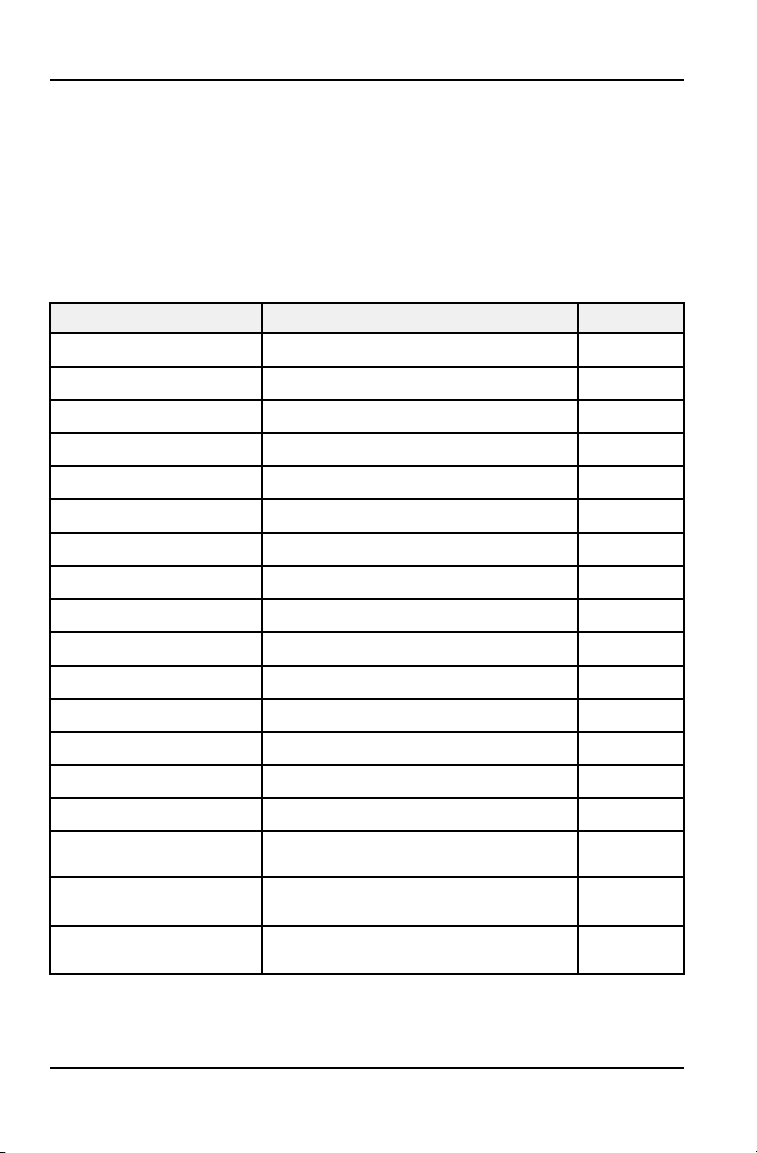
PRE-RIDE INSPECTION
Failure to inspect and verify that the vehicle is in safe operating condition before
operating increases the risk of an accident. Always inspect the vehicle before
each use to make sure it's in safe operating condition.
ITEM REMARKS PAGE
Brake system/pedal travel Ensure proper operation page 107
Brake fluid Ensure proper level page 107
Front suspension Inspect, lubricate if necessary page 92
Rear suspension Inspect, lubricate if necessary page 92
Steering Ensure free operation -
Tires Inspect condition and pressure page 114
Wheels/fasteners Inspect, ensure fastener tightness page 114
Frame nuts, bolts, fasteners Inspect, ensure tightness -
Drive Belt Inspect, ensure installed correctly -
Fuel and oil Ensure proper levels page 92
Throttle Ensure proper operation page 42
Indicator lights/switches Ensure proper operation page 47
Intake pre-filters Inspect, clean -
Daytime Running Lights (LED) Check operation page 78
Brake light/tail lamps Check operation -
Seat Latch Push down on the seat back to ensure the latch
is secure
-
Seat Belt Check length of belt for damage, check latches
for proper operation
page 37
Cab Doors and Nets (if
equipped)
Check doors and latches for wear or damage. -
76
OPERATION
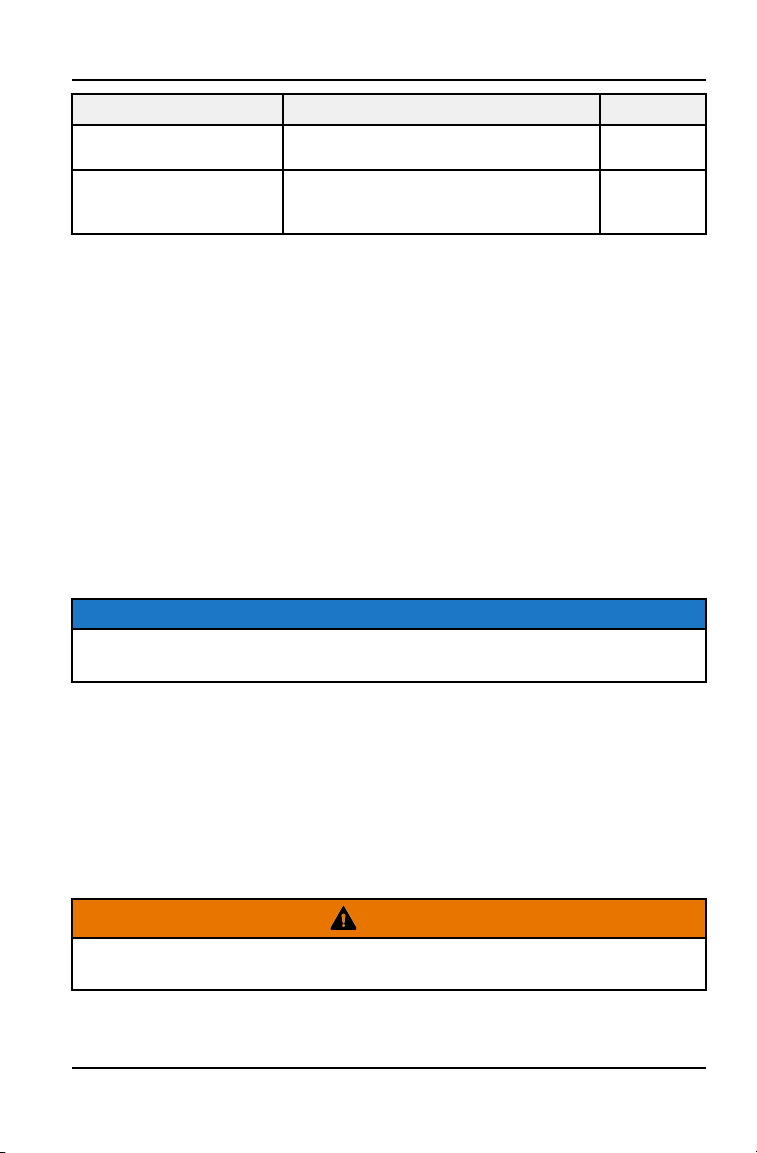
ITEM REMARKS PAGE
Helmet Aware System Check the condition of the battery in the helmet
beacon.
page 43
Grass and Leaves Remove grass, leaves, foreign matter, and other
flammable material or debris, especially near
the exhaust system
-
STARTING THE ENGINE
1. Position the vehicle on a level surface outdoors or in a well ventilated area.
2. Sit in the driver's seat and fasten the seat belt. Secure the cab nets.
3. Place the transmission in NEUTRAL and apply the PARKING BRAKE.
4. Apply the brakes. Do not press the throttle pedal while starting the engine.
5. Turn the ignition key past the ON/RUN position to START. Engage the starter
for a maximum of five seconds. Release the key when the engine starts.
6. If the engine does not start within five seconds, return the ignition switch to
the OFF position and wait five seconds. Repeat steps 5 and 6 until the
engine starts.
7. Vary the engine RPM slightly with the throttle to aid in warm up until the
engine idles smoothly.
NOTICE
Operating the vehicle immediately after starting could cause engine damage.
Allow the engine to warm up for several minutes before operating the vehicle.
STOPPING THE ENGINE
1. Release the throttle pedal completely and brake to a complete stop.
2. Place the transmission in NEUTRAL and apply the PARKING BRAKE.
3. Turn the engine off.
4. Slowly release the brake pedal and make sure the transmission is in PARK
before exiting the vehicle.
WARNING
A rolling vehicle can cause serious injury. Always place the transmission in
PARK when stopping the engine.
77
OPERATION
DAYTIME RUNNING LAMPS
Your vehicle is equipped with daytime running lamps. The lamps illuminate for
extra visibility, but are not designed for night driving. Do not allow operation of
the machine in the dark.
COLD WEATHER OPERATION
If the vehicle is used year-round, check the oil level frequently. A rising oil level
could indicate the accumulation of contaminates such as water or excess fuel in
the bottom of the crankcase. Water in the bottom of the crankcase can lead to
engine damage and must be drained. Water accumulation increases as outside
temperature decreases.
BRAKING
1. Release the throttle pedal completely.
NOTICE
When the throttle pedal is released completely and engine speed slows to near
idle, the vehicle has no engine braking.
2. Press on the brake pedal evenly and firmly. Practice starting and stopping
(using the brakes) until you're familiar with the controls.
PARKING THE VEHICLE
1. Stop the vehicle on a level surface. When parking inside a garage or other
structure, be sure that the structure is well ventilated and that the vehicle is
not close to any source of flame or sparks, including any appliance with pilot
lights.
2. Place the transmission in NEUTRAL and apply the PARKING BRAKE.
3. Turn the engine off.
4. Slowly release the brake pedal.
5. Remove the ignition key to prevent unauthorized use.
PARKING ON AN INCLINE
Avoid parking on an incline if possible. If it's unavoidable, follow these
precautions:
1. Apply the brakes.
2. Place the transmission in NEUTRAL and apply the PARKING BRAKE.
3. Turn the engine off.
78
OPERATION
4. Slowly release the brake pedal.
5. Block the rear wheels on the downhill side.
HAULING CARGO
WARNING
Overloading the vehicle or carrying or towing cargo improperly can alter
vehicle handling and may cause loss of control or brake instability. Always
follow these precautions when hauling cargo:
• Never exceed the stated load capacity for this vehicle.
• REDUCE SPEED AND ALLOW GREATER DISTANCES FOR BRAKING
WHEN HAULING CARGO.
• NEVER EXCEED THE MAXIMUM WEIGHT CAPACITY of the vehicle.
When determining the weight you are adding to the vehicle, include the
weight of the operator, accessories, and loads in the rack or box. The
combined weight of these items must not exceed the maximum weight
capacity.
• Always load the cargo box with the load centered and as low as possible.
• When operating over rough or hilly terrain, reduce speed and cargo to
maintain stable driving conditions.
• Always operate the vehicle with extreme care when hauling loads.
• SECURE ALL LOADS BEFORE OPERATING. Unsecured loads can create
unstable operating conditions, which could result in loss of control of the
vehicle.
• OPERATE ONLY WITH STABLE AND SAFELY ARRANGED LOADS. When
handling off-centered loads that cannot be centered, securely fasten the
load and operate with extra caution.
• HEAVY LOADS CAN CAUSE BRAKING AND CONTROL PROBLEMS. Use
extreme caution when applying brakes with a loaded vehicle. Avoid terrain
or situations that may require backing downhill.
• USE EXTREME CAUTION when operating with loads that extend over the
rack sides. Stability and maneuverability may be adversely affected, causing
vehicle rollover.
• Carrying a passenger in the cargo box could result in a fall from the vehicle
or contact with moving components. Never allow a passenger to ride in the
cargo box.
79
OPERATION

DRIVING PROCEDURES
NEW OPERATOR DRIVING PROCEDURES
1. Read and understand the owner's manual and all warning and instruction
labels before operating this vehicle.
2. Visit the Recreational Off-Highway Vehicle Association® web site and take
the free on-line training course. Visit www.rohva.org or call 866-267-2751.
Hands-on training is also available through ROHVA®.
3. Perform the pre-ride inspection.
4. Do not carry cargo during this period.
5. Select an open area that allows room to familiarize yourself with vehicle
operation and handling.
6. The driver and passenger must wear helmet, eye protection, gloves,
long-sleeve shirt, long pants, over-the-ankle boots and seat belt at all times.
7. Sit in the driver's seat and fasten the seat belt.
8. Always make sure all doors and cab nets are closed and latched when riding
in this vehicle.
9. Place the transmission in NEUTRAL.
10.Start the engine and disengage the parking brake.
11. Apply the brakes and shift into gear.
12.Check your surroundings and determine your path of travel.
13.Keeping both hands on the steering wheel, slowly release the brakes and
depress the throttle with your right foot to begin driving.
14.Drive slowly at first. On level surfaces, practice starting, stopping, turning,
maneuvering, using the throttle and brakes and driving in reverse. Learn how
the vehicle handles when making both left and right turns at a slow speed.
15.Increase speed only after mastering all maneuvers at a slow speed.
16.After you become skilled at making turns and begin to operate at faster
speeds, follow these precautions:
• Avoid sharp turns.
• Never turn while applying heavy throttle.
• Never make abrupt steering maneuvers.
• Operate at speeds appropriate for your skills, the conditions and the
terrain.
• DO NOT do power slides, “donuts”, jumps or other driving stunts.
80
OPERATION

DRIVING WITH A PASSENGER
1. Perform the pre-ride inspection.
2. Make sure all passengers are at least 10 years of age and tall enough to
comfortably and safely sit in the passenger seat with the seat belt secured,
put both feet on the floor and grasp the hand hold.
3. Make sure passenger is wearing helmet, eye protection, gloves, long-sleeve
shirt, long pants and over-the-ankle boots.
4. Make sure passenger secures their seat belt.
5. Make sure all cab nets are properly secured.
6. Do not carry more than the recommended number of passengers for your
vehicle.
7. Allow a passenger to ride only in a passenger seat.
8. Slow down. Always travel at a speed appropriate for your skills, your
passenger’s skills, and operating conditions. Avoid unexpected or
aggressive maneuvers that could cause discomfort or injury to a passenger.
9. Vehicle handling may change with a passenger and/or cargo on board. Allow
more time and distance for braking.
10.Always follow all operating guidelines as outlined on safety labels and in this
manual.
81
OPERATION
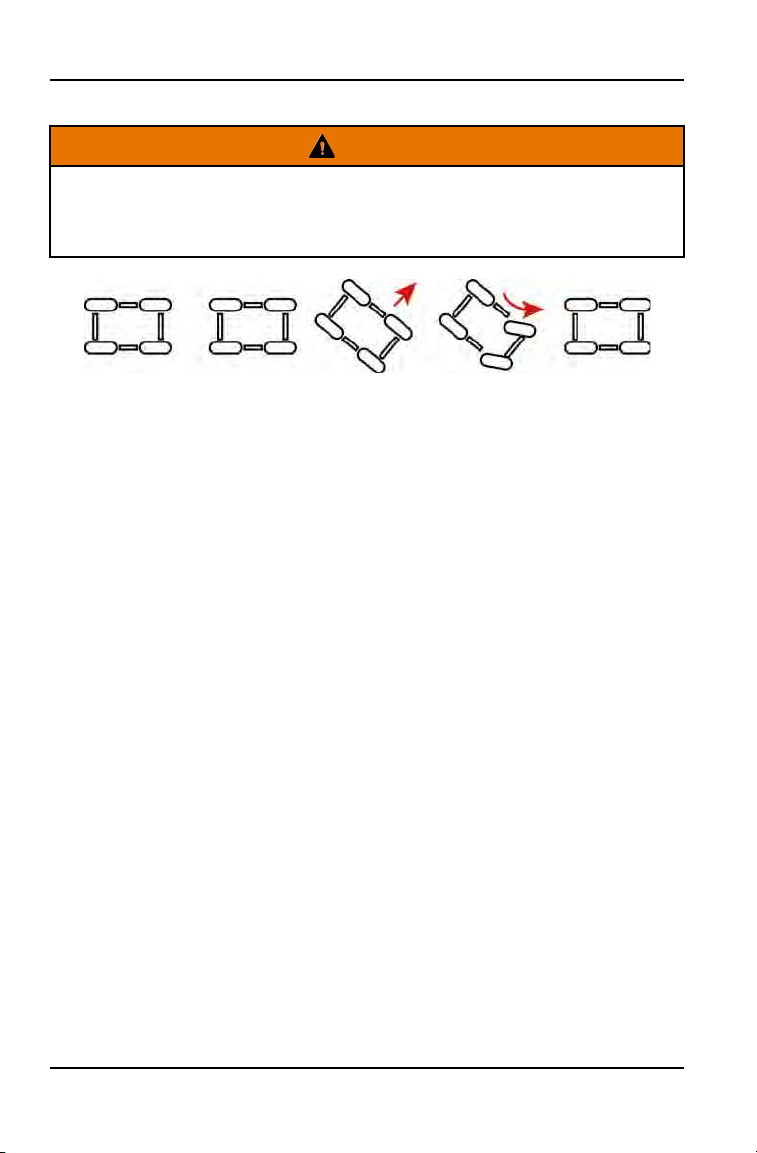
DRIVING ON SLIPPERY SURFACES
WARNING
Skidding or sliding can cause loss of control or rollover (if tires regain traction
unexpectedly). When operating on slippery surfaces such as ice or loose
gravel, reduce speed and use extra caution to reduce the chance of skidding or
sliding out of control. Do not operate on excessively slippery surfaces.
When driving on slippery surfaces such as wet trails, loose gravel, or ice, be
alert for the possibility of skidding and sliding. Follow these precautions when
encountering slippery conditions:
1. Do not operate on excessively rough, slippery or loose terrain.
2. Slow down before entering slippery areas.
3. Maintain a high level of alertness, reading the trail and avoiding quick, sharp
turns, which can cause skids.
4. Correct a skid by turning the steering wheel in the direction of the skid. Never
apply the brakes during a skid.
DRIVING OVER OBSTACLES
Follow these precautions when operating over obstacles:
• Always check for obstacles before operating in a new area.
• Look ahead and learn to read the terrain. Be constantly alert for hazards such
as logs, rocks and low hanging branches.
• Travel slowly and use extra caution when operating on unfamiliar terrain. Not
all obstacles are immediately visible.
• Move the gear selector to Low Gear, if needed.
• Avoid operating over large obstacles such as large rocks and fallen trees. If
unavoidable, use extreme caution and operate slowly.
• Always have all passengers dismount and move away from the vehicle before
operating over an obstacle that could cause a rollover.
82
OPERATION

DRIVING UPHILL
Whenever traveling uphill, follow these precautions:
1. Avoid excessively steep hills.
2. Always travel straight uphill.
3. Keep both feet on the floor.
4. Always check the terrain carefully before ascending any hill. Never climb hills
with excessively slippery or loose surfaces.
5. Proceed at a steady rate of speed and throttle opening. Never open the
throttle suddenly.
6. Never go over the crest of a hill at high speed. An obstacle, a sharp drop, or
another vehicle or person could be on the other side of the hill.
DRIVING DOWNHILL
When driving downhill, follow these precautions:
1. Avoid excessively steep hills.
2. Always descend a hill with the direction selector switch on forward. Never
descend a hill with the switch on neutral.
3. Drive straight downhill. Avoid descending a hill at an angle, which would
cause the vehicle to lean sharply to one side. Travel straight downhill when
possible.
4. Slow down.
5. Apply the brakes slightly to aid in slowing.
DRIVING ON A SIDEHILL (SIDEHILLING)
Driving on a sidehill is not recommended. Improper procedure could cause loss
of control or rollover. Avoid crossing the side of any hill unless absolutely
necessary.
If crossing a sidehill is unavoidable, follow these precautions:
1. Slow down.
2. Exercise extreme caution.
3. Avoid crossing the side of a steep hill.
83
OPERATION
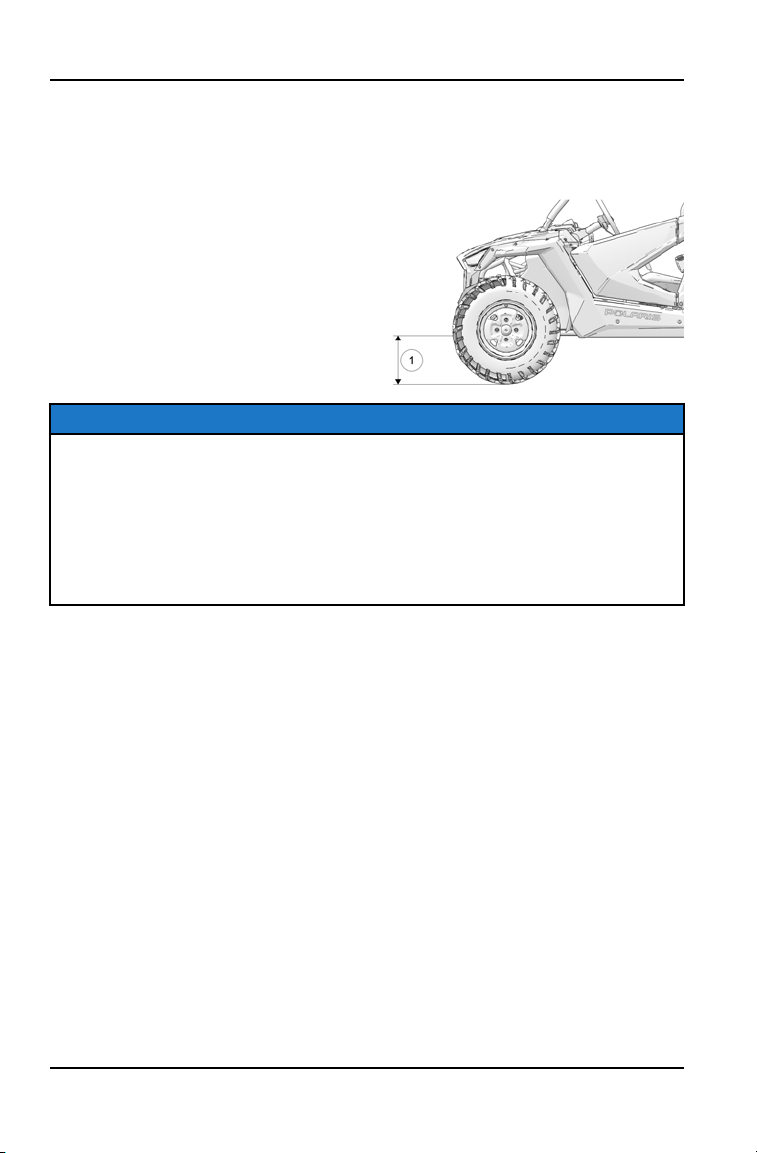
DRIVING THROUGH WATER
Your vehicle can drive through shallow water. Make sure the water is no deeper
than the floor
q
of the vehicle. Follow these precautions when driving through
water:
1. Check water depth. Never drive
through water that is deeper than
the floor level.
2. After driving through water, test the
brakes. Apply the lightly several
times while driving slowly. The
Friction will help dry out the pads.
NOTICE
Major engine damage can result if the vehicle is not thoroughly inspected after
operation in water. Perform the services outlined in the maintenance chart.
Give special attention to engine oil, transmission oil, and all grease fittings. If
your vehicle becomes immersed or is operated in water that exceeds the floor
level, service is required before starting the engine. Your Polaris dealer can
provide this service. If it’s impossible to bring the vehicle in before starting the
engine, perform the services outlined on page 113, and take the vehicle in for
service at the first opportunity.
DRIVING IN REVERSE
Follow these precautions when operating in reverse:
• Always check for obstacles or people behind the vehicle. Always inspect left
and right fields of vision before backing.
• Always avoid backing downhill.
• Back slowly.
• Apply the brakes lightly for stopping.
• Avoid turning at sharp angles.
• Never open the throttle suddenly.
84
OPERATION

EMISSION CONTROL SYSTEMS
NOISE EMISSION CONTROL SYSTEM
Do not modify the engine, intake or exhaust components, as doing so may affect
compliance with U.S.A. EPA noise control requirements (40 CFR 205) and local
noise level requirements.
OPERATION ON PUBLIC LANDS IN THE U.S.A.
Your vehicle has a spark arrestor that was tested and qualified to be in
accordance with the USFS standard 5100-1a. Federal law requires that this
spark arrestor be installed and functional when the vehicle is operated on public
lands.
Operation of off-road vehicles on public lands in the U.S.A. is regulated by 43
CFR 420. Violations are subject to monetary penalties. Federal regulations can
be viewed online at https://ecfr.federalregister.
gov/current/title-43/subtitle-B/chapter-I/part-420.
CRANKCASE EMISSION CONTROL SYSTEM
This engine is equipped with a closed crankcase system. Blow-by gases are
forced back to the combustion chamber by the intake system. All exhaust gases
exit through the exhaust system.
EXHAUST EMISSION CONTROL SYSTEM
Exhaust emissions are controlled by engine design. An electronic fuel injection
(EFI) system controls fuel delivery. The engine and EFI components are set at
the factory for optimal performance and are not adjustable.
The emissions label is located on the inside of the lower left frame tube (below
driver’s foot area).
ELECTROMAGNETIC INTERFERENCE
This spark ignition system complies with Canadian ICES-002.
This vehicle complies with the EMC requirements of UN ECE Regulation 10.
Non-ionizing Radiation: This vehicle emits some electromagnetic energy.
People with active or non-active implantable medical devices (such as heart
monitoring or controlling devices) should review the limitations of their device
and the applicable electromagnetic standards and directives that apply to this
vehicle.
85
EMISSION CONTROL SYSTEMS


MAINTENANCE
OVERVIEW
Any qualified repair shop or person may maintain, replace or repair the emission
control devices or systems on your vehicle. An authorized Polaris dealer can
perform any service that may be necessary for your vehicle. Polaris also
recommends Polaris parts for emissions-related service, however equivalent
parts can be used.
It is a potential violation of the Clean Air Act if a part supplied by an aftermarket
parts manufacturer reduces the effectiveness of the vehicle’s emission controls.
Tampering with emission controls is prohibited by federal law.
Owners are responsible for performing the scheduled maintenance identified in
this owner’s manual.
Careful periodic maintenance will help keep your vehicle in the safest, most
reliable condition. Inspection, adjustment and lubrication of important
components are explained in the Polaris maintenance chart.
Inspect, clean, lubricate, adjust and replace parts as necessary. When
inspection reveals the need for replacement parts, genuine Polaris parts are
available from your Polaris dealer. Equivalent parts may be used for
emissions-related service.
Service and adjustments are important for proper vehicle operation. If you’re not
familiar with safe service and adjustment procedures, a qualified dealer can
perform these operations.
POLARIS MAINTENANCE SCHEDULE
The intervals shown are based on vehicles operated under normal conditions.
Each interval is given in hours and miles (kilometers). Items should be serviced
at whichever interval comes first.
Continue to reference the following maintenance schedules at the given
intervals as hours and miles (kilometers) increase on the vehicle.
87
MAINTENANCE
Vehicles subjected to severe use must be serviced at 50% of the stated interval.
Examples of Severe Use: Frequent immersion in mud, water, or sand, constant
high RPM use, prolonged low-speed heavy load operation, extended idle, and
short trip cold weather operation.
INITIAL BREAK-IN SERVICE
FIRST 12 HOURS / 100 MILES (160 KM)
Brake Pads, Brake Lines /
Hoses
Inspect.
Drive Chain
Adjust and lubricate.
Engine Oil and Filter Change the engine oil and filter.
Valve Lash*
Adjust.
The break-in period consists of the first 12 hours of operation. Careful
treatment of a new engine and drive components will result in more efficient
performance and longer life for these components. The items outlined in this
service interval only need to be performed at the first 12 hours of operation.
They do not need to be performed every 12 hours.
* Have an authorized Polaris dealer or other qualified person perform these
services.
88
MAINTENANCE
Vehicles subjected to severe use must be serviced at 50% of the stated interval.
Examples of Severe Use: Frequent immersion in mud, water, or sand, constant
high RPM use, prolonged low-speed heavy load operation, extended idle, and
short trip cold weather operation.
EVERY 50 HOURS / 500 MILES (800 KM)
Battery
Check terminals; terminals should be tight and
free of corrosion. Clean, test, and replace as
necessary.
Brake System
Inspect for fluid leaks; add recommended brake
fluid from a sealed container if needed.
Drive Chain
Inspect; adjust; lubricate.
Engine Oil and Filter Change the engine oil and filter.
Front / Rear Suspension*
Inspect for loose or worn components; replace
as needed. Lubricate. Inspect shock absorbers
for leaks or damage.
Fuel System / Filter*
Inspect; cycle key to pressurize fuel pump;
check for leaks at fuel system connections,
check for leaks at fill cap.
General Lubrication
Locate all applicable grease fittings (zerks) and
grease.
Shift Cable / Linkage Inspect; adjust; lubricate.
Steering Components Inspect; replace as needed.
Throttle Body Intake Ducts
/ Flanges
Inspect for proper sealing and air leaks.
Wheels / Tires / Lug Nuts Inspect; replace as needed.
Valve Lash*
Inspect; adjust as needed.
* Have an authorized Polaris dealer or other qualified person perform these
services.
89
MAINTENANCE
Vehicles subjected to severe use must be serviced at 50% of the stated interval.
Examples of Severe Use: Frequent immersion in mud, water, or sand, constant
high RPM use, prolonged low-speed heavy load operation, extended idle, and
short trip cold weather operation.
EVERY 100 HOURS / 1000 MILES (1600 KM) OR YEARLY
Air Filter
Replace air filter. Ensure proper installation of
filter and airbox cover. Inspect ducts and
screens; clean as necessary.
Battery
Check terminals; terminals should be tight and
free of corrosion. Clean, test, and replace as
necessary.
Brake Pads, Brake Lines /
Hoses
Inspect; replace as needed.
Brake System
Inspect for fluid leaks; add recommended brake
fluid from a sealed container if needed.
Clutches (Drive and
Driven)*
Inspect; clean; replace as needed.
Drive Belt
Inspect; replace as needed.
Drive Chain
Inspect; adjust; lubricate.
Engine Mounts Inspect.
Engine Oil and Filter Change the engine oil and filter.
Exhaust Silencer / Pipe Inspect for leaks or damage.
Front / Rear Suspension*
Inspect for loose or worn components; replace
as needed. Lubricate. Inspect shock absorbers
for leaks or damage.
Fuel System / Filter*
Inspect; cycle key to pressurize fuel pump;
check for leaks at fuel system connections,
check for leaks at fill cap.
General Lubrication
Locate all applicable grease fittings (zerks) and
grease.
Shift Cable / Linkage Inspect; adjust; lubricate.
Spark Arrestor Inspect; clean.
Spark Plugs Inspect; replace as needed.
90
MAINTENANCE
EVERY 100 HOURS / 1000 MILES (1600 KM) OR YEARLY
Steering Components Inspect; replace as needed.
Throttle Body Intake Ducts
/ Flanges
Inspect for proper sealing and air leaks.
Transmission Fluid
Change fluid.
Valve Lash*
Inspect; adjust as needed.
Wheel Bearings Inspect; replace as needed.
Wheels / Tires / Lug Nuts Inspect; replace as needed.
Wiring Inspect for wear, routing, and retention.
* Have an authorized Polaris dealer or other qualified person perform these
services.
Vehicles subjected to severe use must be serviced at 50% of the stated interval.
Examples of Severe Use: Frequent immersion in mud, water, or sand, constant
high RPM use, prolonged low-speed heavy load operation, extended idle, and
short trip cold weather operation.
ADDITIONAL MAINTENANCE INTERVALS
Every 200 hours / 2000
miles (3200 km)
or
Every 24 months / 2
years
Brake Fluid
Change fluid.
Every 200 hours / 2000
miles (3200 km)
Shock Absorbers*
Replace as needed.
91
MAINTENANCE
LUBRICATION RECOMMENDATIONS
Check and lubricate all components at the intervals outlined in the Maintenance
Schedule beginning on page 87, or more often under severe use, such as wet or
dusty conditions. Items not listed in the chart should be lubricated at the general
lubrication interval.
ITEM LUBE METHOD
Engine Oil PS-4 5W-50 4-Cycle Oil See page 92
Brake Fluid DOT 4 Brake Fluid See page 108
Transmission Oil
(Main Gearcase)
AGL Gearcase Lubricant &
Transmission Fluid
See page 96
Drive Chain POLARIS Chain Lube or
SAE 80/90
See page 98
A-Arm Pivots POLARIS All Season Grease or grease conforming to NLGI
No. 2 Grease at general lubrication interval, also after
washing vehicle or driving in water.XU Steering Arm Pivots
XU Perform these procedures more often for vehicles subjected to severe use.
ENGINE OIL
OIL RECOMMENDATIONS
Always check and change the engine oil at the intervals outlined in the
Maintenance Schedule beginning on page 87. Polaris recommends the use of
Polaris PS-4 5W-50 4-Cycle Oil for this vehicle. Oil may need to be changed
more frequently if Polaris oil is not used. Do not use automotive oil. See page
133 for the part numbers of Polaris products.
NOTICE
Mixing brands or using a non-recommended oil may cause serious engine
damage. Always use the recommended oil. Never substitute or mix oil brands.
92
MAINTENANCE
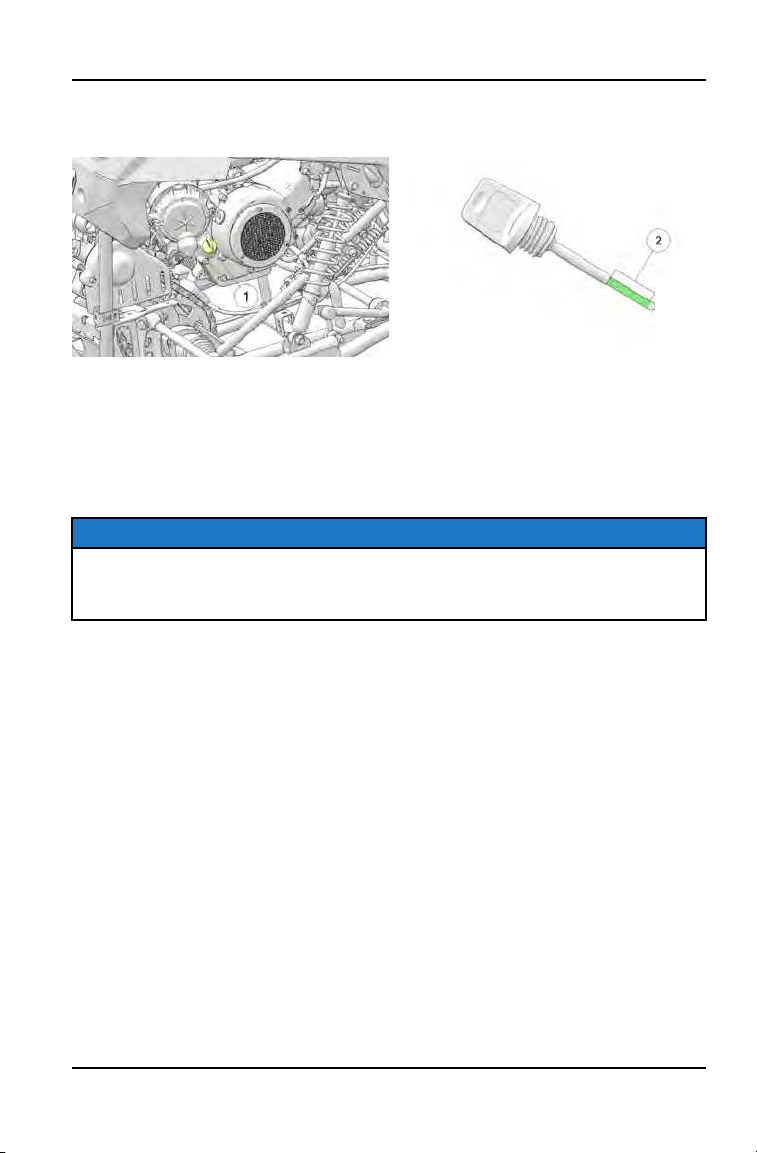
OIL CHECK
Maintain the oil level within the safe range on the dipstick. Do not overfill.
1. Position the vehicle on a level surface.
2. Remove the dipstick
q
. Wipe it dry with a clean cloth.
3. Reinstall the dipstick completely.
4. Remove the dipstick and check if oil level is within safe range
w
.
TIP
A rising oil level between checks in cool weather driving can indicate
contaminants such as gas or moisture collecting in the crankcase. If the oil
level is over the full/safe mark, change the oil immediately.
5. Add the recommended oil as needed.
6. Reinstall the dipstick.
93
MAINTENANCE
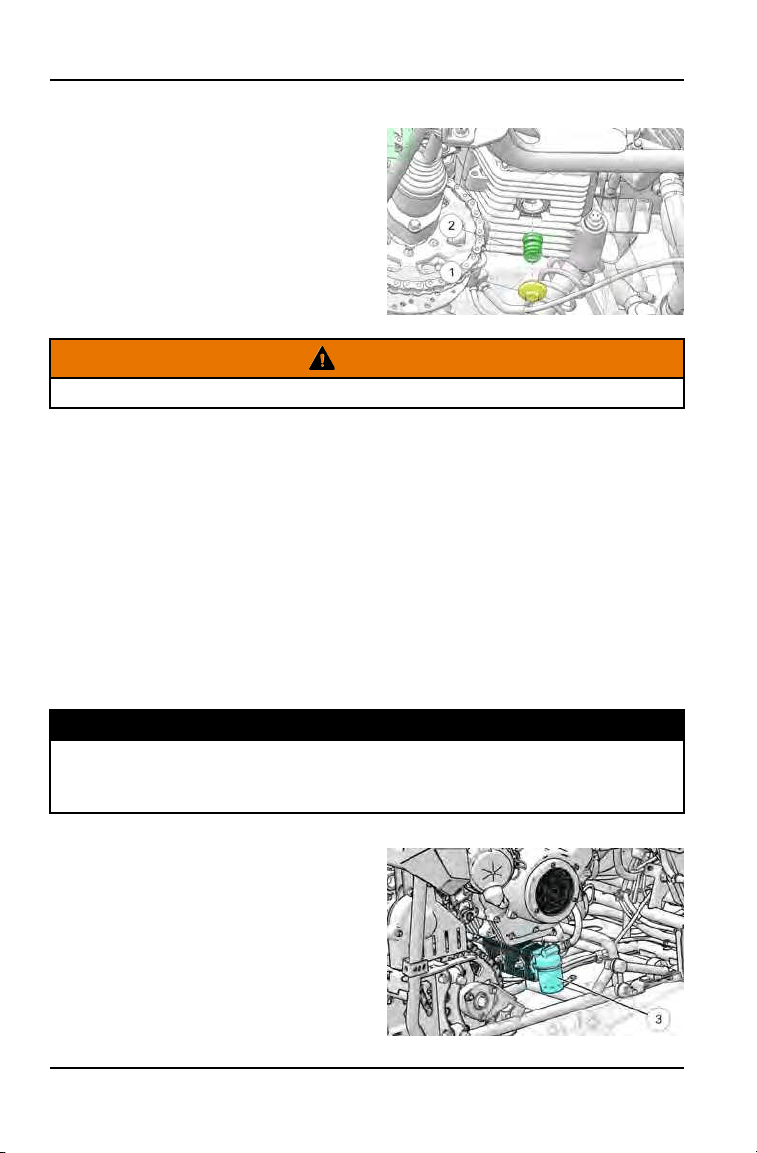
OIL CHANGE
1. Position the vehicle on a level
surface. Set the parking brake.
2. Clean the area around the drain plug
q
.
3. Start the engine. Allow it to idle for
30 seconds.
4. Stop the engine.
WARNING
Hot oil can cause burns to skin. Do not allow hot oil to contact skin.
5. Place a drain pan under the engine crankcase.
6. Remove the drain plug and pre-filter screen
w
. Allow the oil to drain
completely.
7. Wash the oil pre-filter screen with solvent to remove debris. Allow the screen
to air dry.
8. The external oil filter and oil cooler
e
are mounted to the chassis under the
engine. The oil filter is accessible on the right side of the vehicle. The spin-on
oil filter should be replaced when oil is changed. With the oil drained from the
crankcase, unscrew the oil filter and replace with a new one. Ensure that the
oil filter gasket is properly seated, lubricated with oil and in good condition.
Do not over tighten the oil filter.
TORQUE
External Oil Filter:
Turn by hand until filter O-ring contacts sealing surface, then turn an
additional 3/4 turn.
8. Reassemble the pre-filter screen
and spring to the pre-filter plug.
9. Reinstall the drain plug and tighten
to specification.
94
MAINTENANCE

TORQUE
Drain Plug:
10 ft-lbs (14 N·m)
10.Remove the dipstick. Add 35.5 fl oz (1050 mL) of the recommended oil. Do
not overfill. See the specifications section for capacities.
11. Reinstall the dipstick.
12.Start the engine. Allow it to idle for 30 seconds.
13.Stop the engine and inspect for leaks.
14.Wait at least 15 seconds before removing the oil dipstick. Check the oil level.
15.Add oil as needed to bring the level to the upper mark on the dipstick.
16.Dispose of used oil properly.
95
MAINTENANCE
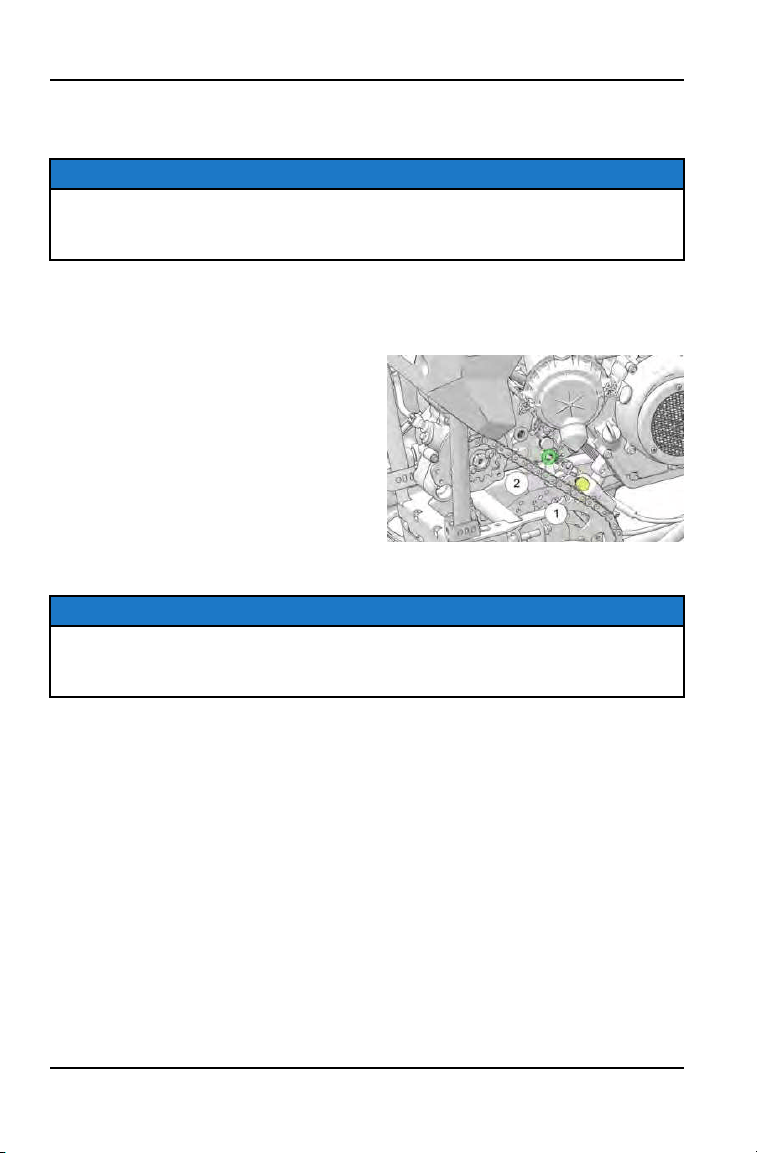
TRANSMISSION
TRANSMISSION OIL LEVEL CHECK
NOTICE
Maximum transmission fluid volume cannot exceed 25 fl oz (750 mL). The fill /
check method is fill to spill. Follow Fluid Change Procedure to verify
transmission is filled with fluid
Always check and change the fluid at the intervals outlined in the Maintenance
Schedule, see page 87. Polaris recommends the use of AGL Gearcase
Lubricant and Transmission Fluid for this vehicle.
The fill plug
q
and sealing washer
w
can be accessed on the right side of the
transmission gearcase.
TRANSMISSION OIL CHANGE
NOTICE
Maximum transmission fluid volume cannot exceed 25 fl oz (750 mL). The fill /
check method is fill to spill. Follow Fluid Change Procedure to verify
transmission is filled with fluid.
Always change the fluid at the intervals outlined in the Maintenance Schedule,
see page 87. Polaris recommends the use of AGL Gearcase Lubricant and
Transmission Fluid for this vehicle.
96
MAINTENANCE
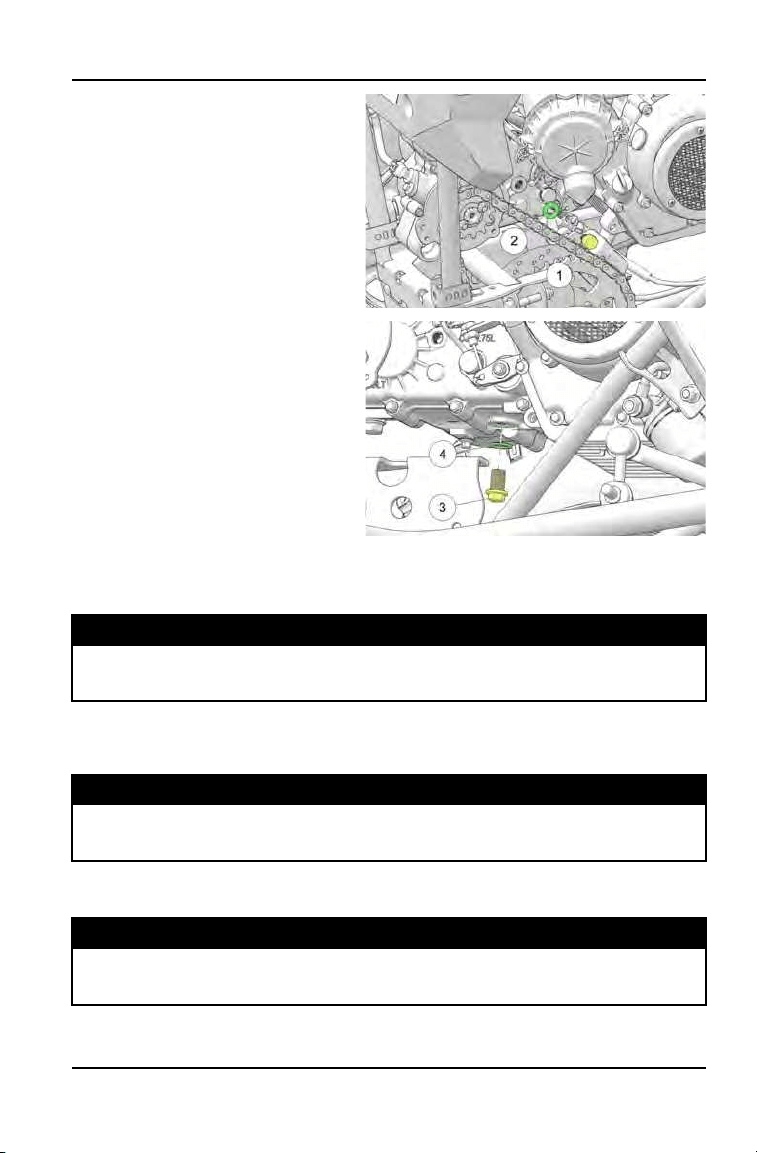
The fill plug
q
can be accessed
on the right side of the
transmission gearcase. The drain
plug
e
is located on the bottom of
the transmission gearcase.
Access the drain plug from the
bottom of the vehicle.
To change the transmission fluid,
do the following:
1. Remove the fill plug
q
and
sealing washer
w
.
2. Place a drain pan under the
transmission drain plug.
3. Remove drain plug
e
and
sealing washer
r
from the
bottom of the gearcase and
allow lubricant to drain
completely.
4. Clean the drain plug magnetic
surface.
5. Reinstall the drain plug and sealing washer. Torque to specification.
TORQUE
Transmission Drain Plug:
18 ft-lbs (25 N·m)
6. Add the recommended amount of lubricant or fill-to-spill through the fill plug
hole.
FLUID CAPACITY
Transmission Lubricant Capacity:
25 oz (750 mL)
7. Reinstall the fill plug and washer. Torque to specification.
TORQUE
Transmission Fill Plug:
18 ft-lbs (25 N·m)
8. Check for leaks. Dispose of used lubricant properly.
97
MAINTENANCE
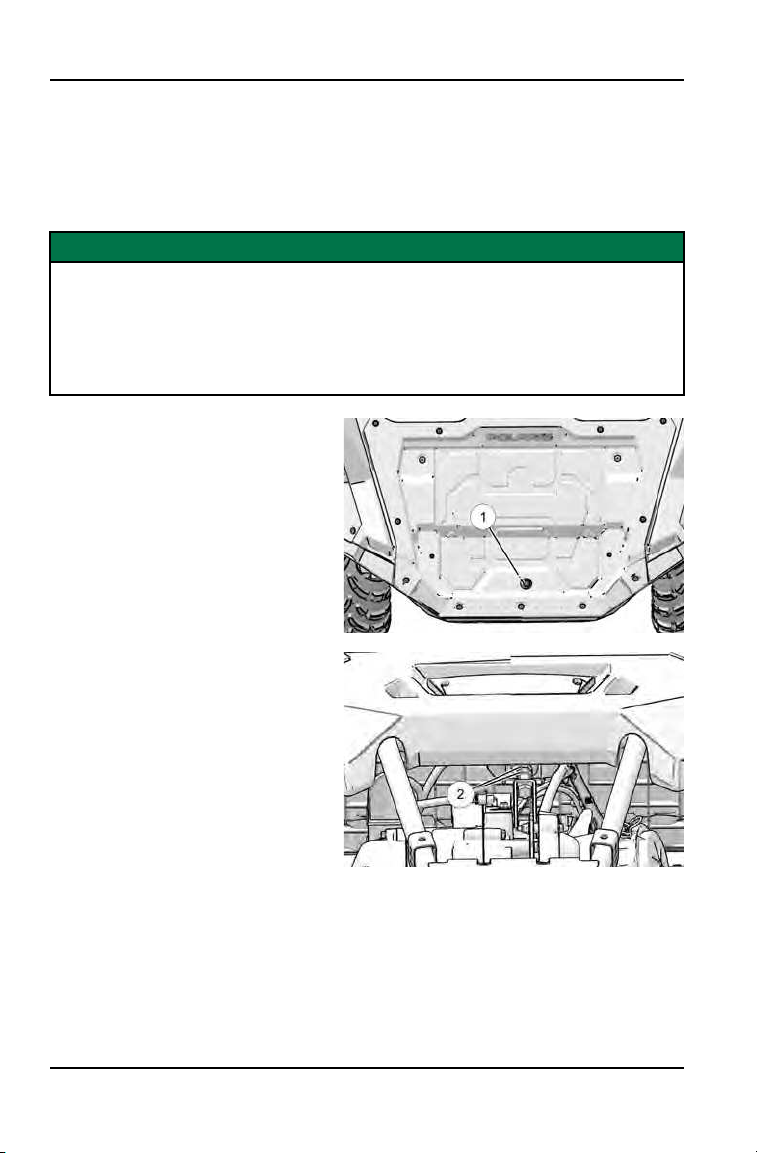
DRIVE CHAIN LUBRICATION AND
ADJUSTMENT
Lubricate the drive chain with Polaris chain spray lube or an approved chain lube
at the interval specified in the Maintenance Schedule, see page 87. Lubricate
more often under severe use, such as in dirty or wet conditions.
IMPORTANT
Washing the drive chain with a high pressure washer or solvents can cause
premature wear and chain failure. Do not use a high pressure washer or
gasoline to clean the drive chain. Operating the vehicle with improper rear
drive chain deflection can result in severe damage to the transmission and
drive components. Always make sure the chain adjusted within the stated
specifications.
1. Remove cap from rear of the
cargo area.
2. Loosen upper nut
q
on the
chain tensioner bracket.
3. Turn lower nuts
w
clockwise in
1/2 turn increments, then turn
upper nut until tight. Follow this
procedure until chain is at
proper tension. To check for
proper tension, press the down
on the middle of the chain with
thumb using 22 lbs (100N) of
force. Chain deflection
e
should be within specification.
98
MAINTENANCE
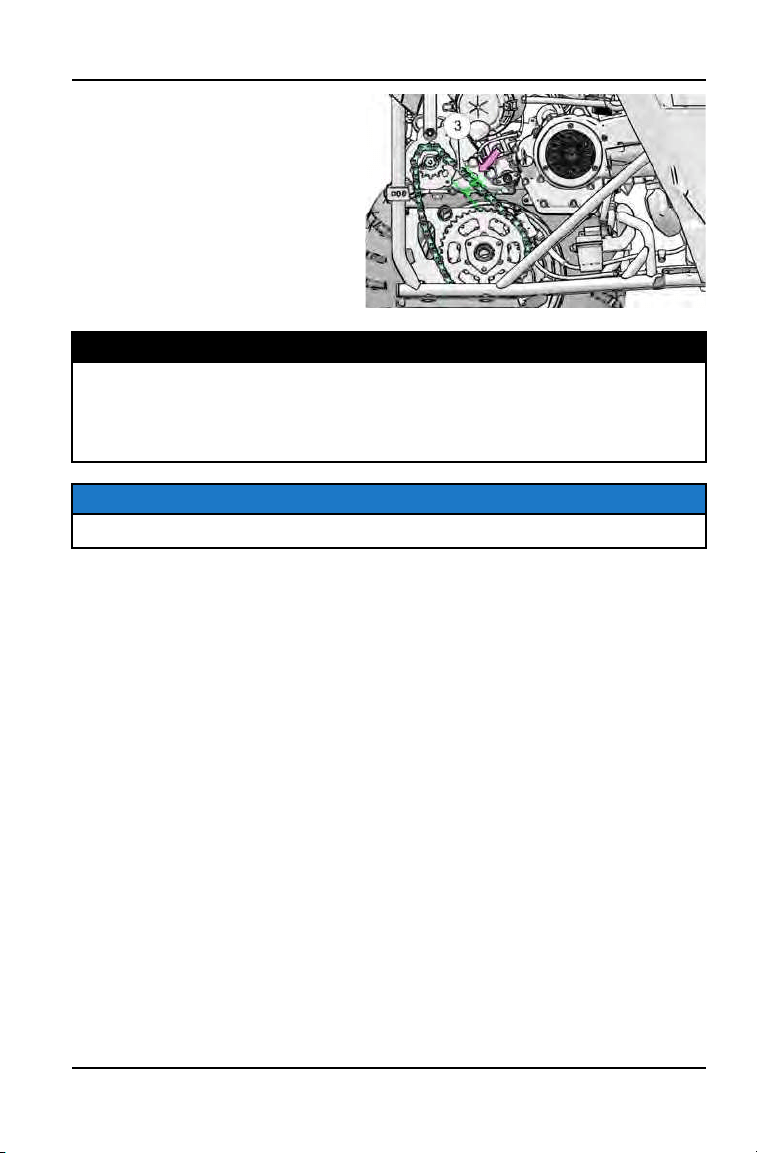
4. Repeat these steps until chain
is adjusted to desired
deflection.
MEASUREMENT
Chain Deflection:
Using 22 lbs (100N) of force
New Chain: 3/16 - 13/32” (5 - 10 mm)
Broken In Chain: 13/32 - 19/32” (10 - 15 mm)
NOTICE
A new chain will stretch after the vehicle is used for a period of time.
PARKING BRAKE
PARKING BRAKE CABLE FREEPLAY
ADJUSTMENT
1. Inspect and perform any needed service on the brake pads before adjusting
parking brake cable freeplay.
2. Make sure the parking brake is NOT set (the lever should be in the DOWN
position).
3. Pull the brake cable back to inspect freeplay between the cable end and the
caliper bracket. Freeplay should be 1/16" - 1/8" (1.5-3 mm).
4. To adjust freeplay, loosen the jam nut. Turn the in-line adjuster nut outward to
decrease freeplay. Turn the adjuster nut inward to increase freeplay.
5. Tighten the jam nut against the adjuster nut.
99
MAINTENANCE
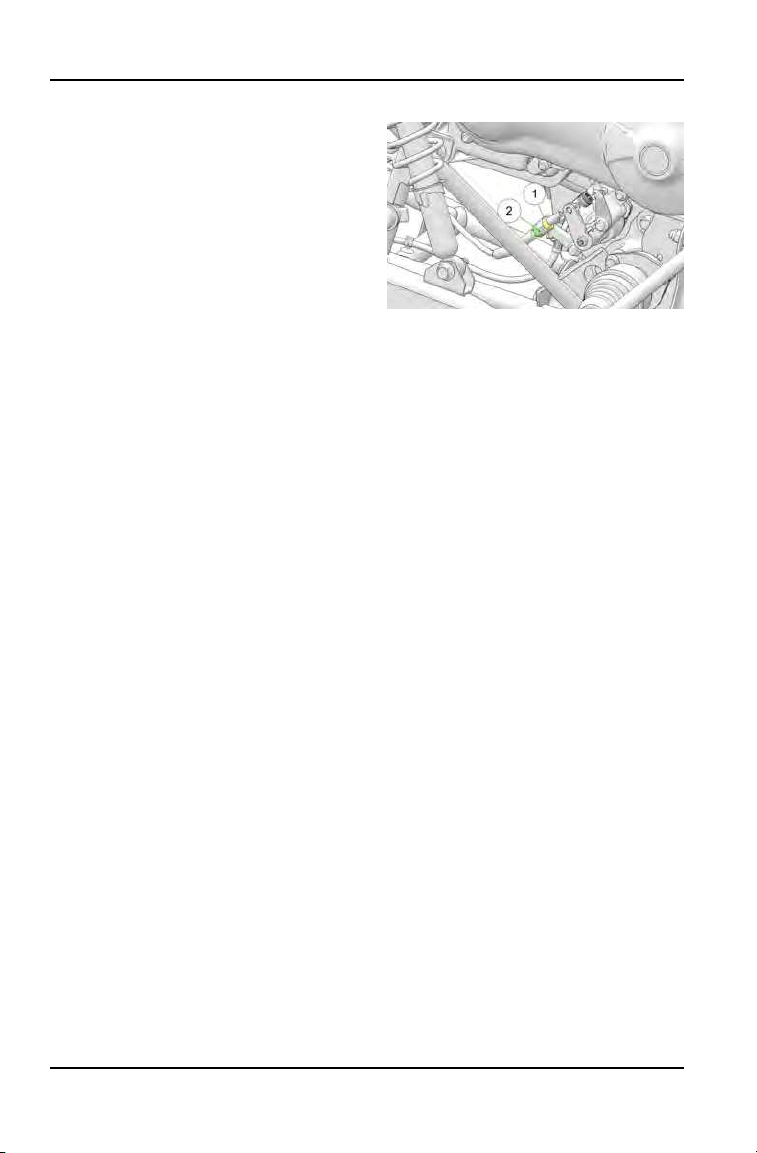
PARKING BRAKE ADJUSTMENT
1. Inspect and perform any needed
service on the brake pads before
adjusting the parking brake.
2. Position the vehicle on a level
surface. Place the transmission in
neutral.
3. Carefully elevate the rear of the
vehicle slightly. Use an appropriate
lift.
4. Loosen the jam nut
q
on the parking brake cable sleeve.
5. While rotating the rear wheels by hand, turn the adjustment nut
w
counterclockwise until significant brake drag is detected. Then turn the
adjustment nut in 1/4 turn.
6. Hold the parking brake cable sleeve and adjustment nut in place and tighten
the jam nut securely against the lever arm.
7. Check parking brake lever movement. Verify that the rear wheels rotate
freely with the parking brake off (lever in DOWN position) and that the vehicle
will not move when the parking brake is applied (lever in UP position).
8. Verify that the park brake lever stays in the UP position when the brake is
fully applied.
100
MAINTENANCE
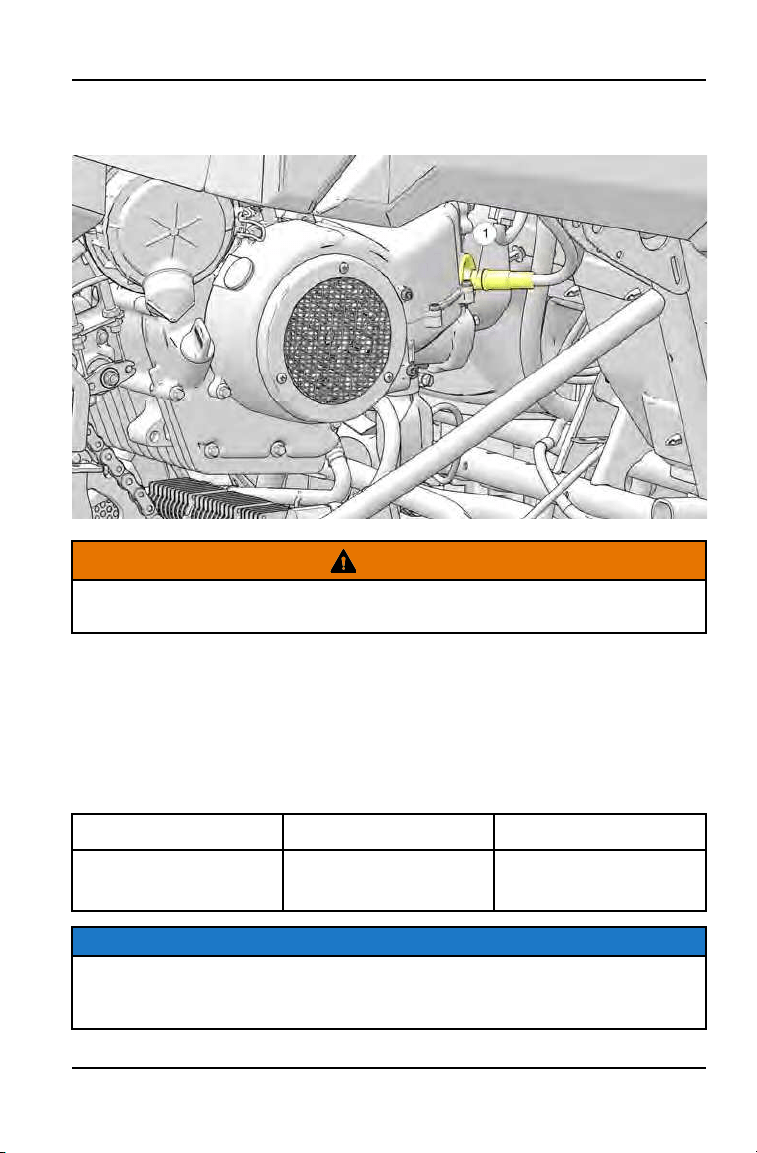
SPARK PLUG
SPARK PLUG REMOVAL AND REPLACEMENT
WARNING
A hot exhaust system and engine can cause burns. Wear protective gloves
when removing a spark plug for inspection.
1. Remove the spark plug cap
q
.
2. Using the spark plug wrench provided in the tool kit, remove the plug by
rotating it counter-clockwise.
3. Reverse the procedure for spark plug installation. Torque to specification.
SPARK PLUG GAP/TORQUE
Electrode Gap New Plug Torque Used Plug Torque
(0.6-0.7 mm)
11 ft-lbs
(15 N·m)
18 ft-lbs
(24 N·m)
NOTICE
Spark plug condition is indicative of engine operation. The spark plug firing end
condition should be read after the engine is warmed up and the vehicle is
driven at higher speeds. Immediately check the spark plug for correct color.
101
MAINTENANCE
SPARK PLUG CONDITION
Normal Plug
The normal insulator tip is gray, tan or light brown. There will be few combustion
deposits. The electrodes are not burned or eroded. This indicates the proper
type and heat range for the engine and the service.
TIP
The tip should not be white. A white insulator tip indicates overheating, caused
by use of an improper spark plug or incorrect throttle body adjustments.
Wet Fouled Plug
The wet fouled insulator tip is black. A damp oil film covers the firing end. There
may be a carbon layer over the entire nose. Generally, the electrodes are not
worn. General causes of fouling are excessive oil, use of non-recommended
injection oil or incorrect throttle body adjustments.
CONSTANT VARIABLE TRANSMISSION (CVT)
SYSTEM
WARNING
Failure to comply with the instructions in this warning can result in severe injury
or death.
Do not modify any component of the CVT system. Doing so may reduce its
strength so that a failure may occur at a high speed. The CVT system has been
precision balanced. Any modification will cause the system to be out of
balance, creating vibration and additional loads on components.
• Always follow all recommended maintenance procedures. See your
POLARIS dealer, or other qualified person, for service and repair
assistance.
• This CVT system is intended for use on POLARIS products only. Do not
install it in any other product.
• Always make sure the CVT housing is securely in place during operation.
CVT DRYING
NOTICE
After operating in water, the vehicle’s CVT system should be checked
immediately. Use the following instructions to dry it out before operating.
102
MAINTENANCE
1. Shift the transmission to neutral. Set the parking brake.
2. Start the engine. Apply varying throttle for 10-15 seconds to expel the
moisture and air-dry the belt and clutches.
NOTICE
Do not hold the throttle pedal wide open for more than 5 seconds.
3. Allow the engine RPM to return to idle, then shift the transmission into gear.
4. Test the CVT system for belt slippage. If the belt slips, repeat the process or
remove the outer clutch cover to inspect the CVT system.
NOTICE
If the vehicle has ingested a large amount of water into the CVT system and
has not been operated for a period of time, be sure to check the CVT system
components for water damage.
103
MAINTENANCE
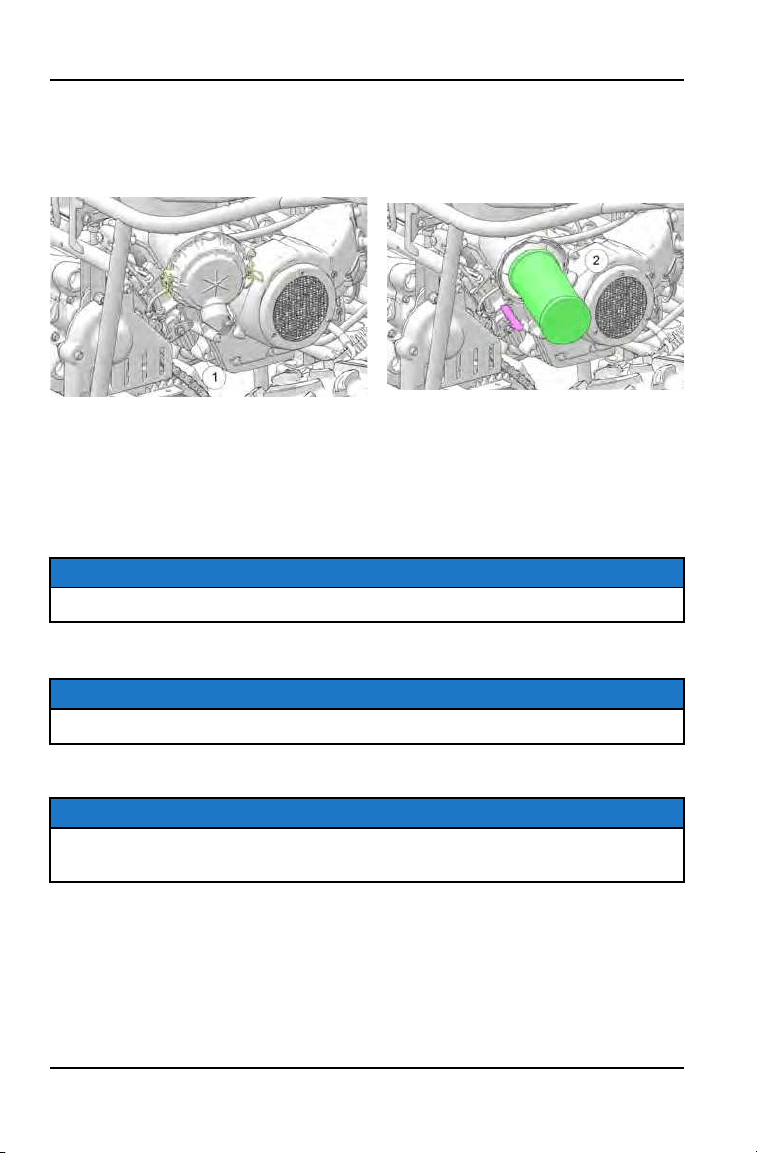
AIR FILTER
Inspect the air filter at the intervals outlined in the Maintenance Schedule, see
page 87. In extremely dusty conditions, air filter replacement will be required
more often. Access the air box near the right rear wheel.
1. Disengage the two cover latches
q
.
2. Unlatch the cover and carefully remove it from the air box.
3. Remove the filter
w
.
4. Inspect the air box for oil or water deposits. Wipe away any deposits with a
clean shop towel.
NOTICE
If the filter has been soaked with fuel or oil it must be replaced.
5. Inspect the air filter and replace if necessary.
NOTICE
DO NOTattempt to clean the air filter with compressed air .
6. Place the air filter into the air box and reinstall the air box cover.
NOTICE
Make sure the tabs are properly positioned into the hinge. Ensure the O-ring is
installed inside the lid properly.
7. Engage the cover latches.
104
MAINTENANCE
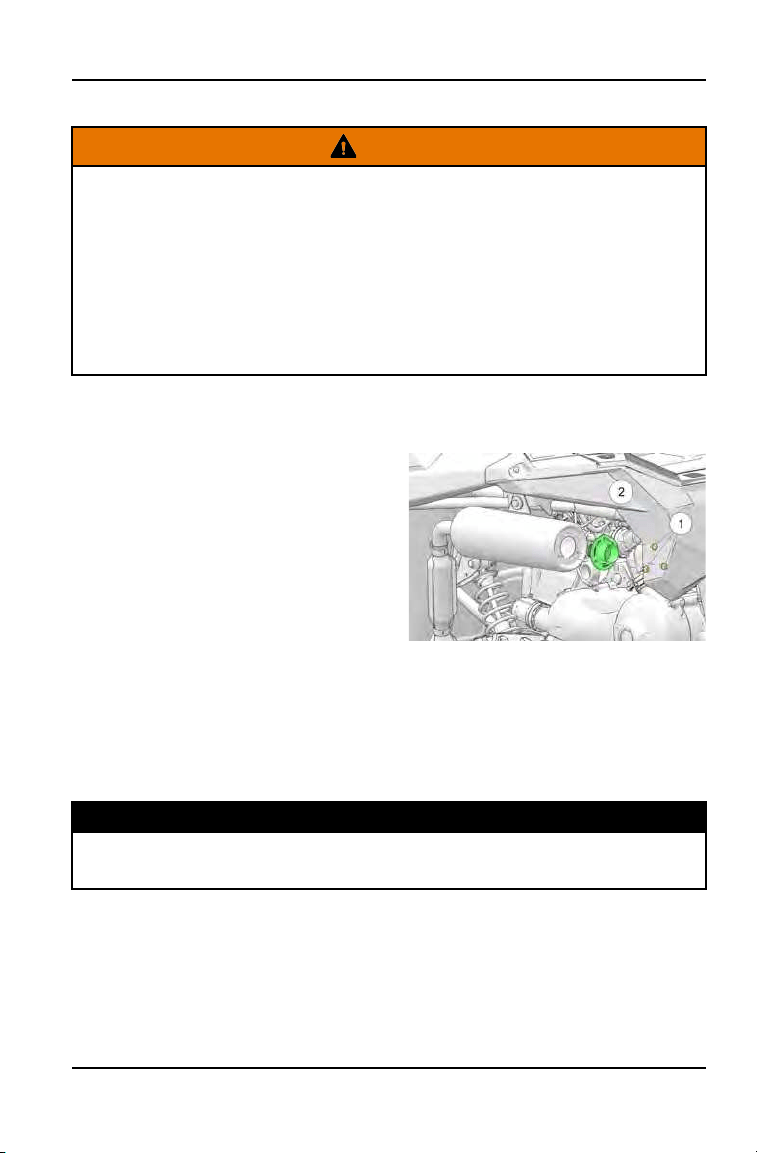
SPARK ARRESTOR
WARNING
Failure to heed the following warnings while servicing the spark arrestor could
result in serious injury or death.
• Do not perform service on the spark arrestor while the system is hot. Allow
components to cool sufficiently before proceeding.
• Wear eye protection and gloves.
• Never operate without the spark arrestor.
• Never run the engine in an enclosed area. Exhaust contains poisonous
carbon monoxide gas.
To remove accumulated carbon, clean the spark arrestor at the intervals
recommended in the Maintenance Schedule beginning on page 87.
1. Remove the 3 fasteners
q
and
remove the arrestor
w
from the end
of the muffler.
2. Use a non-synthetic brush to clean
the arrestor screen. A synthetic
brush may melt if components are
warm. If necessary, blow debris from
the screen with compressed air.
3. Inspect the screen for wear and
damage. Replace the arrestor if
damage is found.
4. Reinstall the arrestor.
5. Torque the fasteners to specification.
TORQUE
Spark Arrestor Fasteners:
35 in-lbs (4 N·m)
105
MAINTENANCE
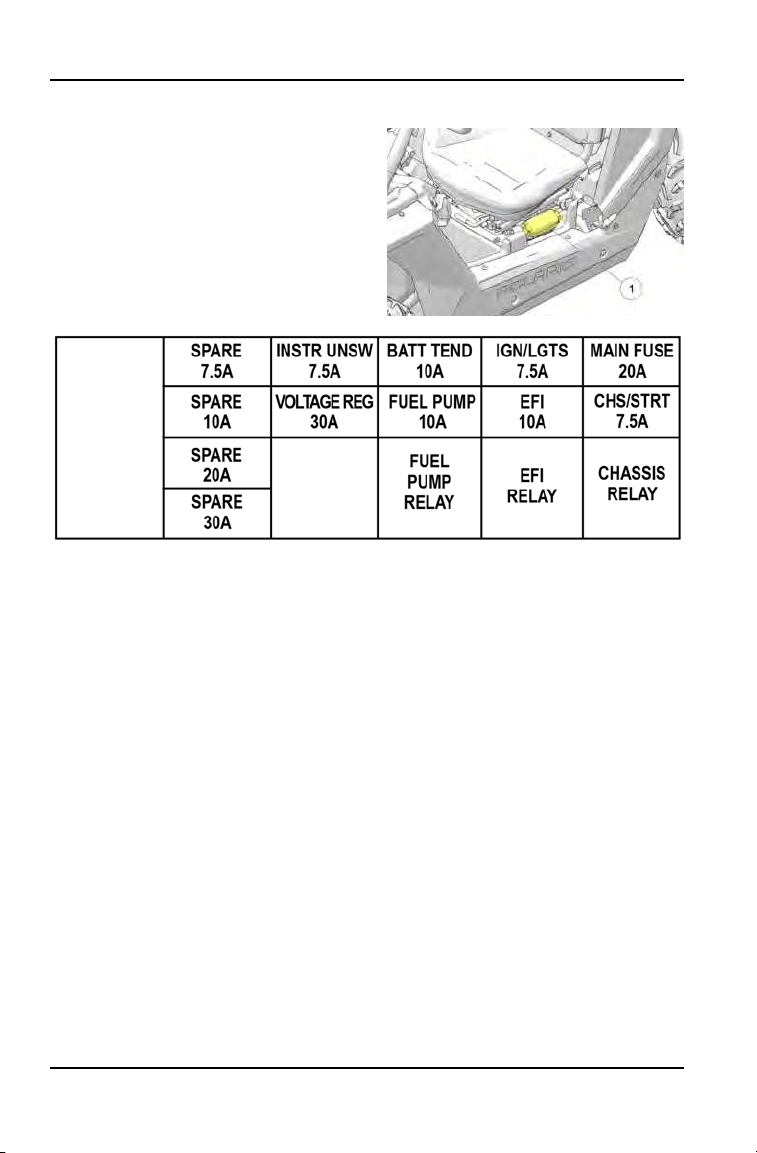
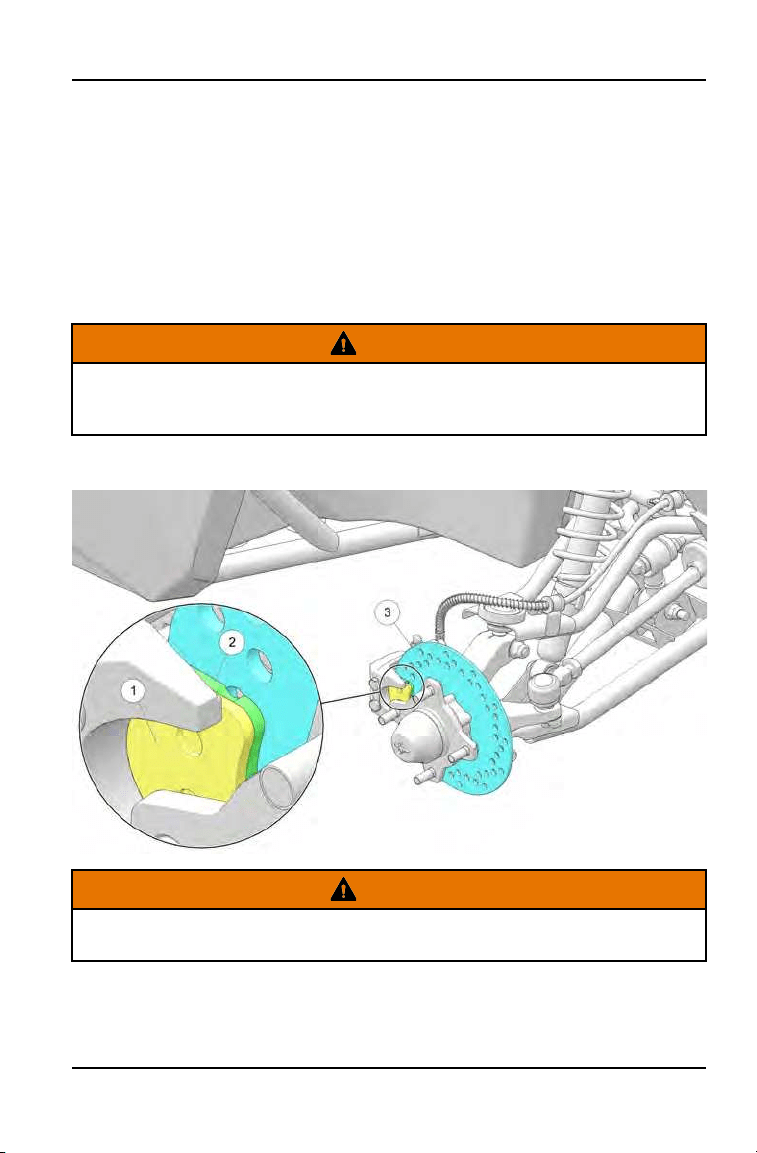
BRAKES
The front and rear brakes are hydraulic disc type brakes activated by the brake
pedal.
Always check brake pedal travel and the brake fluid reservoir level before each
use of the vehicle. When applied, the brake pedal should feel firm. Any
sponginess would indicate a possible fluid leak or low brake fluid level, which
must be corrected before riding.
If you discover any irregularities in brake system operation, including excessive
pedal travel, contact your dealer for proper diagnosis and repairs.
WARNING
Operating the vehicle with a spongy brake pedal can result in loss of braking,
which could cause an accident resulting in severe injury or death. Never
operate the vehicle with a spongy-feeling brake pedal.
BRAKE INSPECTION
WARNING
Brake components get hot with prolonged use and can cause burns. Wear
protective gloves when inspecting the brakes.
1. Check the brake system for fluid leaks.
2. Check the brake pedal for excessive travel or a spongy feel.
107
MAINTENANCE
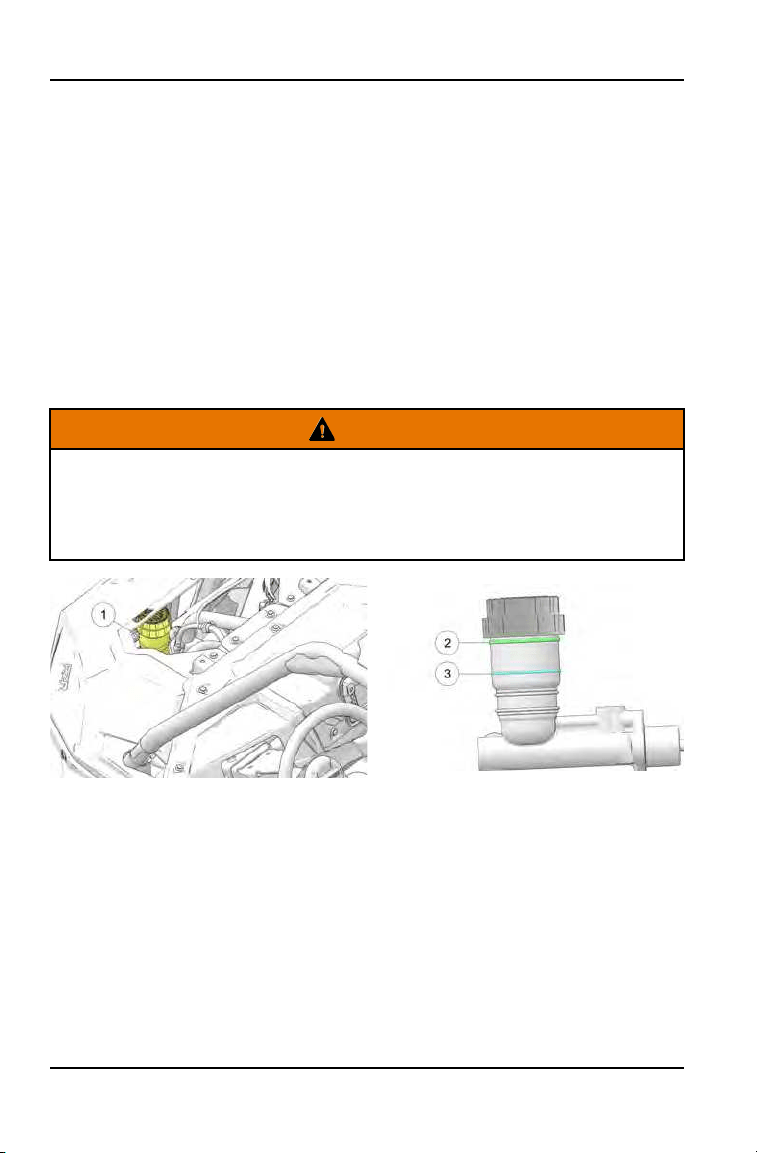
3. Check the brake pads
q
for wear, damage and looseness.
4. Inspect the brake pad wear surface for excessive wear.
5. Change pads when the friction material
w
is worn to .04" (1 mm) .
6. Check the surface condition of the brake discs
e
. Measure the thickness.
Replace a disc if the thickness is less than .170” (4.32 mm).
7. Check brake system hoses and fittings for cracks, deterioration, abrasion
and leaks. Tighten any loose fittings and replace any worn or damaged parts.
BRAKE FLUID
Inspect the level of the brake fluid before each operation. If the fluid level is low
add DOT 4 brake fluid only. See page 133 for the part numbers of POLARIS
products.
WARNING
After opening a bottle of brake fluid, always discard any unused portion. Never
store or use a partial bottle. Brake fluid is hygroscopic, meaning it rapidly
absorbs moisture from the air. The moisture causes the boiling temperature of
the brake fluid to drop, which can lead to early brake fade and the possibility of
accident or severe injury.
The brake fluid reservoir
q
is located under the hood at the front of the vehicle.
Change the brake fluid every two years and any time the fluid becomes
contaminated, the fluid level is below the minimum, or if the type and brand of
the fluid in the reservoir are unknown. Access the brake fluid reservoir through
the left front wheel well.
1. Position the vehicle on a level surface.
2. Place the transmission in neutral. Set the parking brake.
108
MAINTENANCE

3. View the brake fluid level in the reservoir. The level should be between the
maximum
w
and minimum
e
level lines. Add brake fluid as needed.
4. Apply the brake forcefully for a few seconds and check for fluid leakage
around the fittings.
STEERING WHEEL INSPECTION
Check the steering wheel for specified freeplay and smooth operation at the
intervals outlined in the Maintenance Schedule, see page 87.
1. Position the vehicle on level ground.
2. Lightly turn the steering wheel left and right.
3. There should be 0.8"-1.0" (20-25 mm) of freeplay.
4. If there is excessive freeplay or strange noises, or the steering feels rough or
"catchy," have the steering system inspected by an authorized Polaris dealer
or other qualified service facility before operating the vehicle.
109
MAINTENANCE
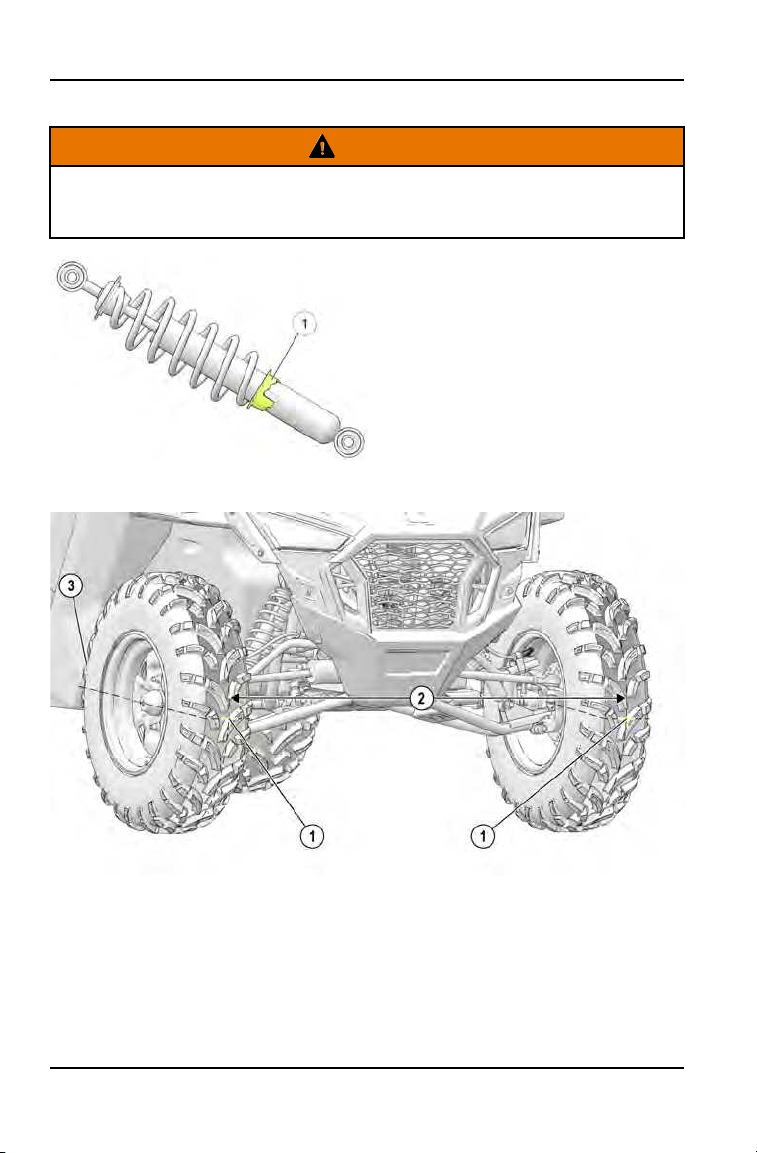
SHOCK SPRING ADJUSTMENT
WARNING
Uneven adjustment may cause poor handling of the vehicle, which could result
in an accident. Always adjust both the left and right spring preloads equally or
have your POLARIS dealer perform the adjustments.
The front and rear shock absorber
springs are adjustable to increase or
decrease spring tension. Rotate the
adjuster
q
either clockwise or
counter-clockwise to make
adjustments.
Always apply the same adjustment
setting to all four wheels.
WHEEL TOE ALIGNMENT
110
MAINTENANCE
1. Place machine on a smooth level surface and set steering wheel in a straight
ahead position. Secure the steering wheel in this position.
2.
NOTICE
It is important the height of both marks be equally positioned to get an accurate
measurement.
Place a chalk mark on the center line of the front tires approximately 10″
(25.4 cm) from the floor or as close to the hub/axle center line as possible
q
.
3. Measure the distance between the marks and record the measurement. Call
this measurement “2”.
4. Rotate the tires 180° by moving the vehicle forward. The chalk marks are
now facing rearward, even with the hub/axle center line.
5. Again measure the distance between the marks and record. Call this
measurement “3”. Subtract measurement “3” from measurement “2”. The
difference between measurements “2” and “3” is the vehicle toe alignment.
The recommended vehicle toe tolerance is 0 to 1/8” (0 to 3.2 mm) toe out.
This means the measurement at the front of the tire
w
is 0 to 1/8” (0 to 3.2
mm) wider than the measurement at the rear
e
.
MEASUREMENT
Wheel Toe-Out:
0 to 1/8" (0 to 3.2 mm)
If toe alignment is incorrect, repeat steps 3-5 of “Wheel Toe Alignment
Inspection”, but instead measure the distance between each wheel and the
vehicle center. This will tell you which tie rod needs adjusting.
NOTICE
Be sure steering wheel is straight ahead before determining which tie rod
needs adjustment.
CAUTION
During tie rod adjustment, it is very important that the following precautions be
taken when tightening tie rod end jam nuts.
If the rod end is positioned incorrectly it will not pivot, and may break.
111
MAINTENANCE
WHEEL TOE ALIGNMENT
1. Hold tie rod end to keep it from rotating.
2. Loosen jam nuts at both end of the tie rod.
3. Shorten or lengthen the tie rod until alignment is as required to achieve the
proper toe setting as specified in above.
IMPORTANT
When tightening the tie rod end jam nuts, the rod ends must be held parallel to
prevent rod end damage and premature wear. Damage may not be
immediately apparent if done incorrectly.
4. After alignment is complete, torque jam nuts to specification.
TORQUE
Tie Rod Jam Nut:
13 ft-lbs (18 N·m)
112
MAINTENANCE
VEHICLE IMMERSION
NOTICE
If your vehicle becomes immersed, major engine damage can result if the
machine is not thoroughly inspected. Take the vehicle in for service before
starting the engine. Your POLARIS dealer can provide this service.
If it’s impossible to take your vehicle to a dealer before starting it, follow the
steps outlined below.
1. Move the vehicle to dry land.
2. Check the air box. If water is present, dry the air box and replace the filter
with a new filter. Thoroughly dry the air pre-filter..
3. Remove the air box drain plug to drain any water. Reinstall the drain plug
securely.
4. Remove the spark plug.
5. Turn the engine over several times using the electric start.
6. Dry the spark plug and reinstall it, or install a new plug.
7. Attempt to start the engine. If necessary, repeat the drying procedure.
8. Take the vehicle in for service as soon as possible, whether you succeed in
starting it or not. Your POLARIS dealer can provide the required service.
9. If water has been ingested into the transmission follow the procedure in the
Constant Variable Transmission (CVT) System section for details on drying.
113
MAINTENANCE
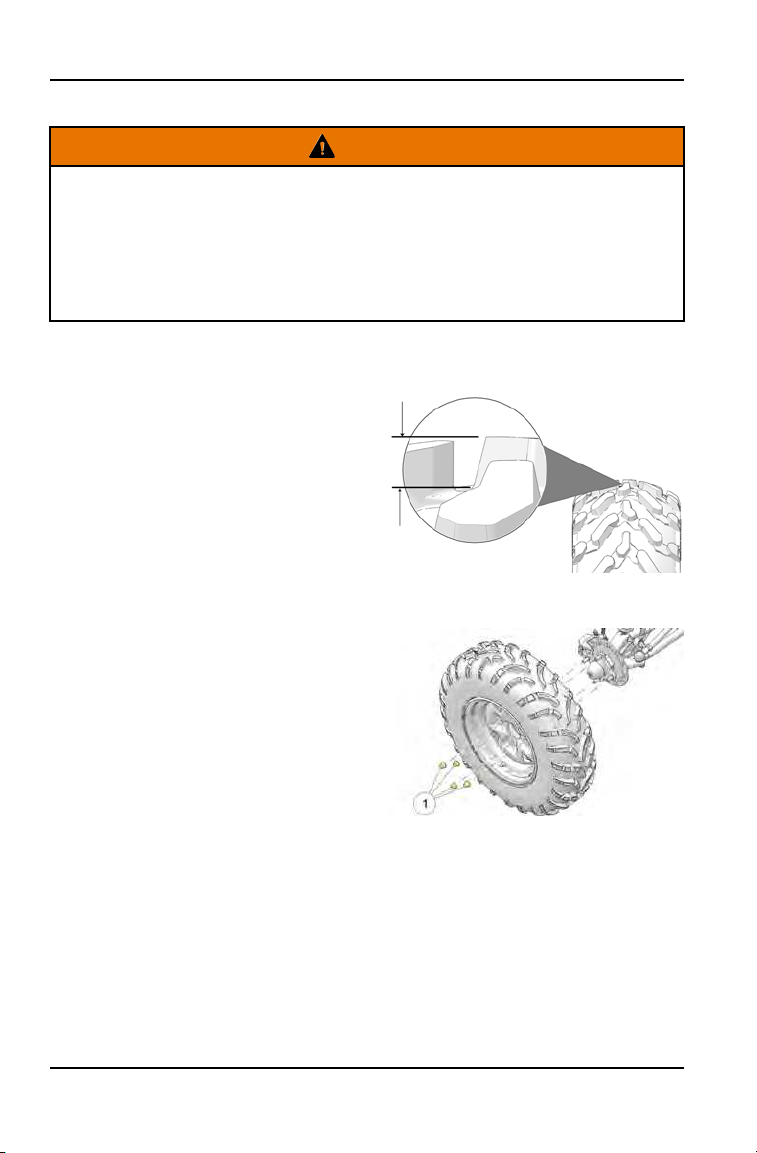
TIRES
WARNING
Operating your vehicle with worn tires will increase the possibility of skidding,
loss of control and an accident, which could result in serious injury or death.
Always replace tires when the tread depth measures 1/8 in (3 mm) or less.
Improper tire inflation or the use of non-standard size or type of tires may
adversely affect vehicle handling, which could result in vehicle damage or
personal injury. Always maintain proper tire pressure. Always use POLARIS
approved size and type of tires for this vehicle when replacing tires.
TIRE TREAD DEPTH
Always replace tires when tread depth
is worn to 3 mm (1/8”) or less.
WHEEL REMOVAL
1. Position the vehicle on a level
surface.
2. Apply the parking brake and stop the
engine.
3. Loosen the wheel nuts slightly. If
wheel hub removal is required,
remove the hub cap, cotter pin and
loosen the hub nut slightly.
4. Elevate the appropriate side of the
vehicle by placing a suitable stand
under the frame.
5. Remove the wheel nuts
q
and
remove the wheel.
114
MAINTENANCE
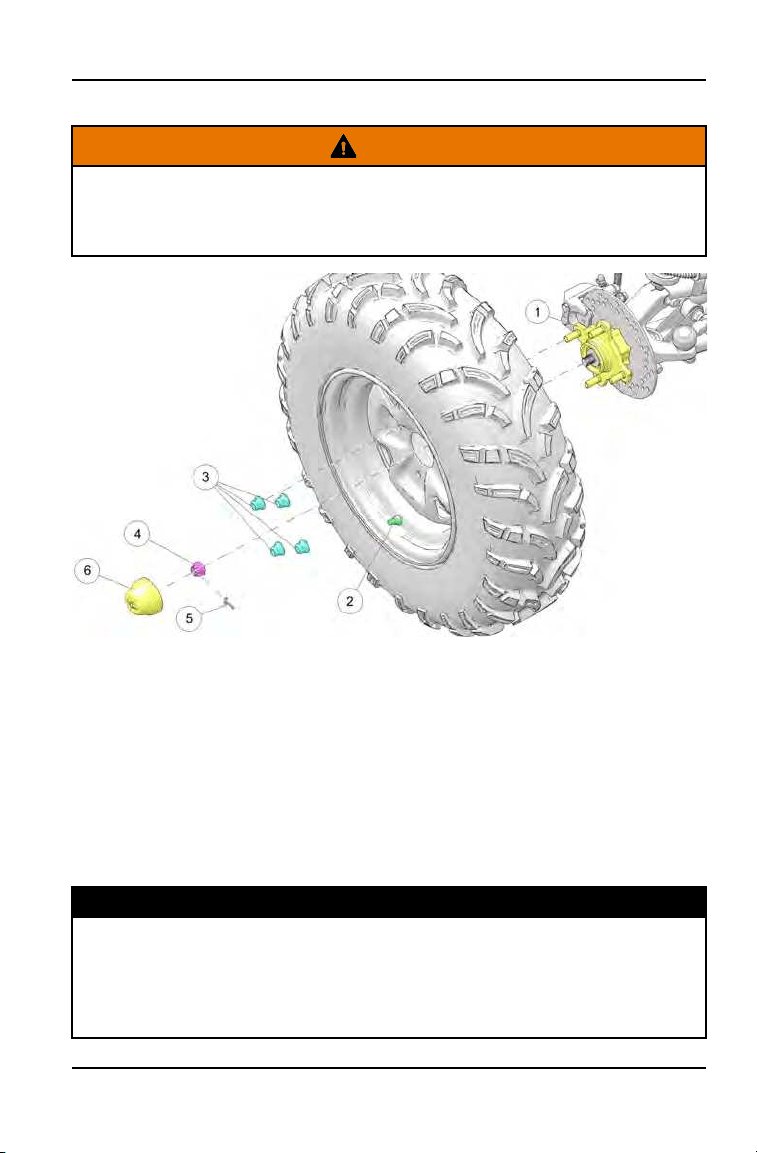
WHEEL INSTALLATION
WARNING
Improperly installed wheels can adversely affect tire wear and vehicle
handling, which can result in serious injury or death. Always ensure that all
nuts are torqued to specification. Do not service axle nuts that have a cotter pin
installed. Your dealer can assist.
1. Verify the parking brake is still applied.
2. Place the wheel in the correct position on the wheel hub
q
. Be sure the
valve stem
w
is toward the outside and rotation arrows on the tire point
toward forward rotation.
3. Install the wheel nuts
e
and finger tighten.
4. Carefully lower the vehicle to the ground.
5. Torque the wheel nuts and the hub nut
r
, if removed, to the proper torque
specification.
TORQUE
Wheel Nuts:
30 ft-lbs (41 N·m)
Hub Castle Nuts:
Front: 60 ft-lbs (80 N·m)
Rear: 80 ft-lbs (109 N·m)
115
MAINTENANCE
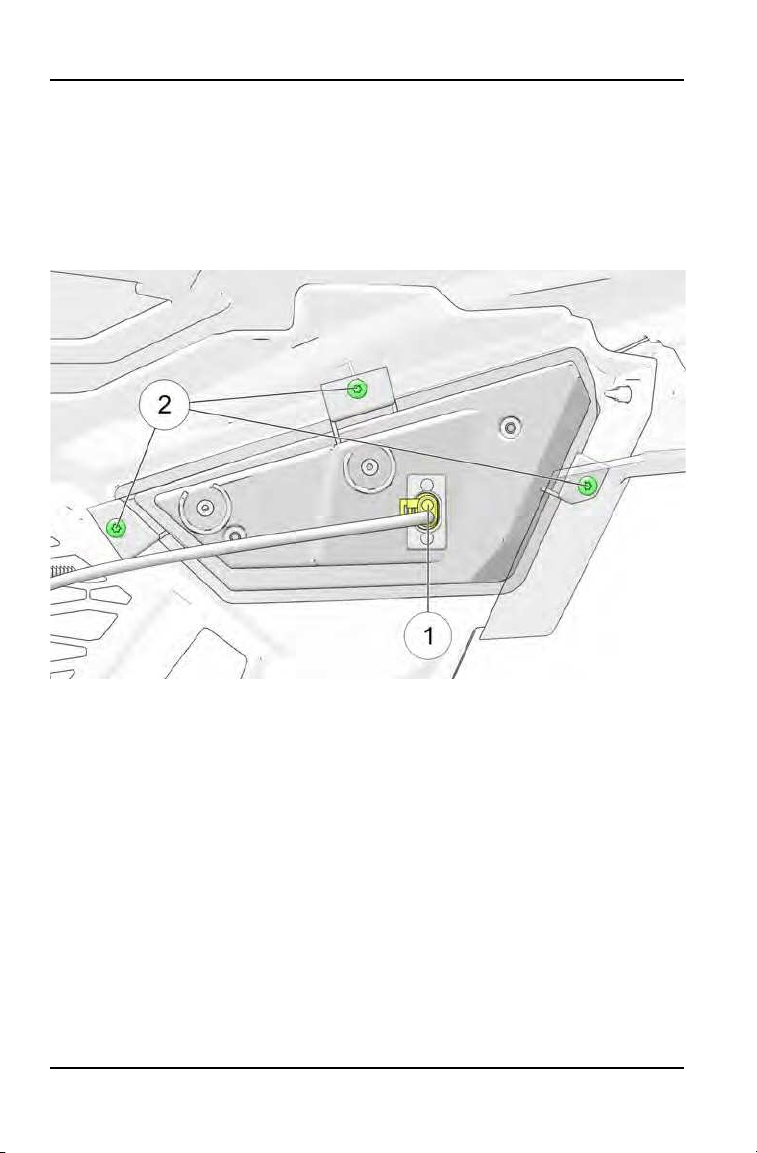
6. If hub nut was removed, install a new cotter pin
t
after the hub nut has been
tightened. If the holes do not line up, turn the hub nut until the cotter pin can
be installed.
7. Install the hub cap
y
.
LIGHTS
DAYTIME RUNNING LIGHT REPLACEMENT
To remove the headlight, do the following:
1. Disconnect the headlight to harness connection
q
.
2. Remove the three fasteners
w
retaining the headlight.
3. Remove the headlight from the inside of the front bumper.
116
MAINTENANCE
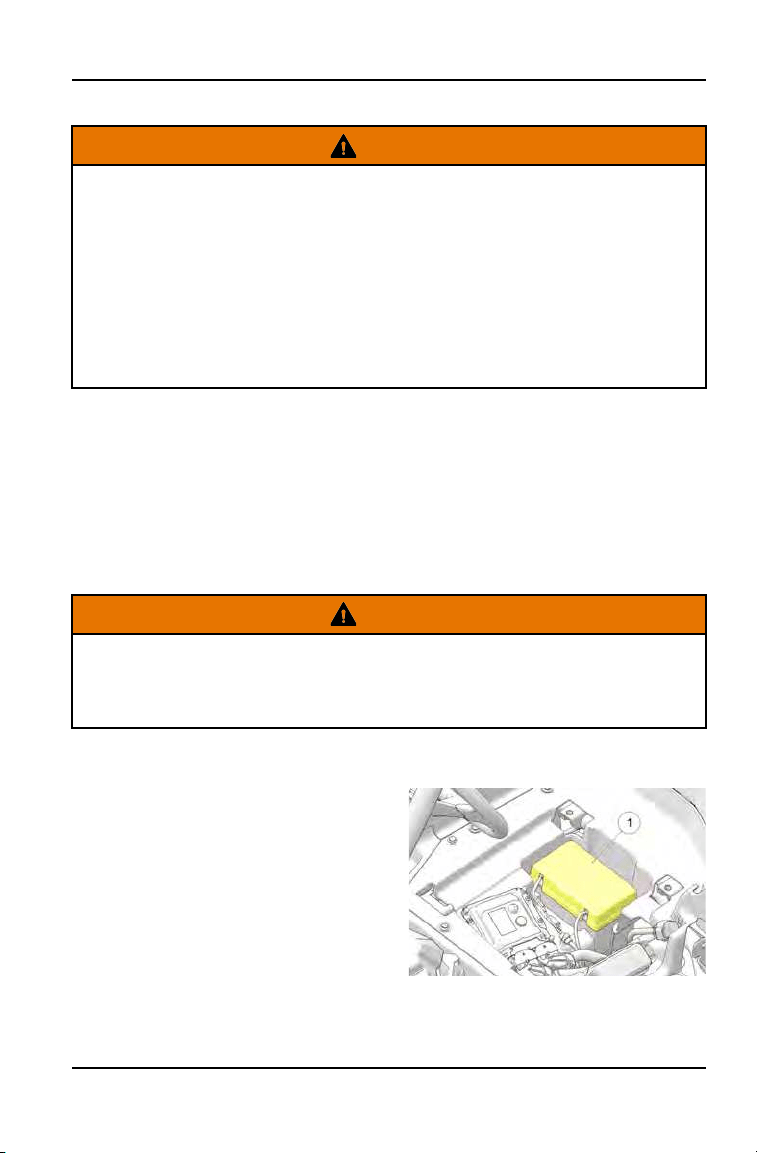
BATTERY
WARNING
Battery electrolyte is poisonous. It contains sulfuric acid. Serious burns can
result from contact with skin, eyes or clothing.
Antidote:
External: Flush with water.
Internal: Drink large quantities of water or milk. Follow with milk of magnesia,
beaten egg, or vegetable oil. Call physician immediately.
Eyes: Flush with water for 15 minutes and get prompt medical attention.
Batteries produce explosive gases. Keep sparks, flame, cigarettes, etc. away.
Ventilate when charging or using in an enclosed space. Always shield eyes
when working near batteries. KEEP OUT OF REACH OF CHILDREN.
Your vehicle uses a sealed battery, which requires little maintenance. A sealed
battery can be identified by its flat covers on the top of the battery.
Always keep battery terminals and connections free of corrosion. If cleaning is
necessary, remove the corrosion with a stiff wire brush. Wash with a solution of
one tablespoon baking soda and one cup water. Rinse well with tap water and
dry off with clean shop towels. Coat the terminals with dielectric grease or
petroleum jelly. Never pry the sealing strip off or add any other fluid to a sealed
battery.
WARNING
Improperly connecting or disconnecting battery cables can result in an
explosion and cause serious injury or death. When removing the battery,
always disconnect the negative (black) cable first. When reinstalling the
battery, always connect the negative (black) cable last.
BATTERY REMOVAL
1. Access the battery
q
by sliding the
driver’s seat ahead. See page 36.
2. Disconnect the black (negative)
battery cable first.
3. Disconnect the red (positive) battery
cable last.
4. Lift the battery out of the vehicle.
117
MAINTENANCE
BATTERY INSTALLATION
Using a new battery that has not been fully charged can damage the battery and
result in a shorter life. It can also hinder vehicle performance. Follow the steps in
the Battery Charging section before installing the battery.
1. Ensure that the battery is fully charged.
2. Place the battery in the battery holder.
3. Coat the terminals with dielectric grease or petroleum jelly.
4. Connect and tighten the red (positive) cable first.
5. Connect and tighten the black (negative) cable last.
6. Verify that cables are properly routed.
SEALED/AGM BATTERY MAINTENANCE AND
CHARGING
WARNING
An overheated battery may explode, causing severe injury or death. Always
watch charging times carefully. Stop charging if the battery becomes very
warm to the touch. Allow it to cool before resuming charging.
Sealed batteries are already filled with electrolyte and have been sealed and
fully charged at the factory.
CAUTION
Never pry the sealing strip off or add any other fluid to a sealed battery.
BATTERY CHARGING
For a refresh charge, follow all instructions carefully.
1. Check the battery voltage with a voltmeter or multimeter. A fully charged
battery will register 12.8 V or higher.
2. If the voltage is less than 12.8 volts, recharge the battery at 1.2 amps or less
until battery voltage is 12.8 or greater.
3. If the voltage falls below 12.5V, charge it immediately, or the battery runs the
risk of sulfation and reduced battery life.
The single most important thing about maintaining a sealed battery is to keep it
fully charged.
118
MAINTENANCE
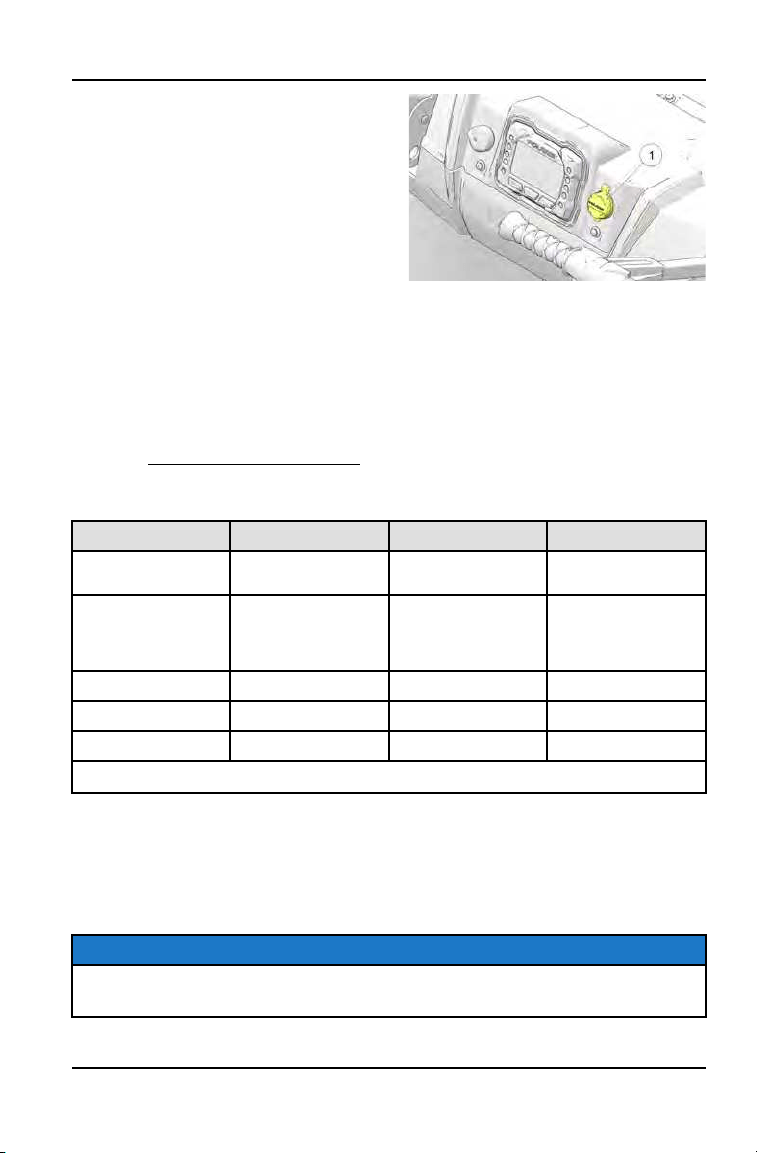
If you do not drive the vehicle for more
than TWO WEEKS, Polaris
recommends using a BatteryMINDer®
1510 - 1.5 AMP charger (PN 2830404),
which can be ordered through your
dealer. During charging, place the
charger outside of the vehicle and
protect it from moisture. The battery
charge port
q
is located on the dash.
BATTERY STORAGE
If you plan to store the vehicle for ONE MONTH or longer, remove the battery
from the vehicle, then store the battery in a cool and dry location. Continue to
maintain the battery with the BatteryMINDer® 1510 - 1.5 AMP charger.
When using an automatic charger other than a BatteryMINDer® 1510 - 1.5 AMP
charger, refer to the charger manufacturer's instructions for recharging.
If using a constant current charger (instead of BatteryMINDer® 1510 - 1.5
AMP charger), use the guidelines below. Always verify battery condition before
and 1-2 hours after the end of charging.
State of Charge Voltage (DC)
Action
Charge Time*
100% 12.8-13.0 volts None, check
monthly
None required
75%-100% 12.6-12.8 volts May need slight
charge, if no charge
given, check in 2
weeks
3-6 hours
50%-75% 12.3-12.6 volts Needs charge 5-11 hours
25%-50% 12.0-12.3 volts Needs charge At least 13 hours
0%-25% 12.0 volts or less Needs charge At least 20 hours
* Using AGM specific charger at standard amps specified on top of battery
CLEANING AND STORAGE
WASHING THE VEHICLE
Keeping your POLARIS vehicle clean will not only improve its appearance but it
can also extend the life of various components.
NOTICE
High water pressure may damage components. POLARIS recommends
washing the vehicle by hand or with a garden hose, using mild soap.
119
MAINTENANCE
NOTICE
Certain products, including insect repellents and chemicals, will damage
plastic surfaces. Do not allow these types of products to contact the vehicle.
The best and safest way to clean your POLARIS vehicle is with a garden hose
and a pail of mild soap and water.
1. Use a professional-type washing cloth, cleaning the upper body first and the
lower parts last.
2. Rinse with clean water frequently.
3. Dry surfaces with a chamois to prevent water spots.
WASHING TIPS
• Avoid the use of harsh cleaners, which can scratch the finish.
• Do not use a power washer to clean the vehicle.
• Do not use medium to heavy duty compounds on the finish.
• Always use clean cloths and pads for cleaning and polishing. Old or reused
cloths and pads may contain dirt particles that will scratch the finish.
• Grease all zerk fittings immediately after washing. Allow the engine to run for
a while to evaporate any water that may have entered the engine or exhaust
system.
If a high pressure water system is used for cleaning (not recommended),
exercise extreme caution. The water may damage components and could
remove paint and labels. Avoid directing the water stream at the following items:
• Wheel bearings
• Radiator
• Transmission seals
• Brakes
• Door seals (if equipped)
• Cab and body panels
• Labels and decals
• Electrical components and wiring
• Air intake components
• Window seals (if equipped)
If an informational or graphic label becomes illegible or comes off, contact your
POLARIS dealer, or other qualified person, to purchase a replacement.
Replacement safety labels are provided by POLARIS at no charge.
POLISHING THE VEHICLE
POLARIS recommends the use of common household aerosol furniture polish
for polishing the finish on your POLARIS vehicle. Follow the instructions on the
container.
120
MAINTENANCE

POLISHING TIPS
• Avoid the use of automotive products, some of which can scratch the finish of
your vehicle.
• Always use clean cloths and pads for cleaning and polishing. Old or reused
cloths and pads may contain dirt particles that will scratch the finish.
CHROME WHEEL CARE (IF EQUIPPED)
Proper maintenance will protect chrome wheels from corrosion, preserve wheel
life and ensure a “like new” appearance for many years. Chrome wheels
exposed to road salt (or salt in the air in coastal areas) are more susceptible to
corrosion if not properly cleaned. Clean chrome wheels more often if they're
exposed to salt or other corrosive elements.
1. Wash chrome wheels frequently. Use a mild detergent. Never use abrasive
cleaners on plated or painted surfaces.
2. Rinse well with clear water. Soap, detergents, salt, dirt, mud and other
elements can cause corrosion.
3. Polish the clean chrome wheels periodically. Use an automotive grade
chrome polish.
4. Routinely and liberally apply a weather resistant wax to each polished
chrome wheel. Choose a product suitable for chrome finishes. Read and
follow the product labels and instructions.
REMOVING CORROSION
If light rust is found on the chrome finish, use steel wool (#0000-OTT grade) to
remove it. Gently rub the affected areas with the steel wool until the corrosion
has been removed. Clean and polish the wheel as outlined above.
121
MAINTENANCE
STORAGE TIPS
NOTICE
Starting the engine during the storage period will disturb the protective film
created by fogging and damage could occur. Never start the engine during the
storage period.
CLEAN THE EXTERIOR
Make any necessary repairs and clean the vehicle as recommended.
STABILIZE THE FUEL
1. Fill the fuel tank.
2. Add POLARIS Carbon Clean Fuel Treatment or POLARIS Fuel Stabilizer or
equivalent fuel treatments or stabilizers. Follow the instructions on the
container for the recommended amount. Carbon Clean removes water from
fuel systems, stabilizes fuel and removes carbon deposits from pistons,
rings, valves and exhaust systems.
3. Allow the engine to run for 15-20 minutes to allow the stabilizer to disperse
through the entire fuel delivery system.
OIL AND FILTER
Change the oil and filter. See the Engine Oil section.
AIR FILTER / AIR BOX
Replace the air filter. See Maintenance Chapter. Clean the air box.
FLUID LEVELS
Inspect the fluid levels. Add or change fluids as recommended in the
Maintenance Schedule, see page 87.
• Rear gearcase fluid
• Transmission fluid
• Brake fluid (change every two years and any time the fluid looks dark or
contaminated)
INSPECT AND LUBRICATE
Inspect all cables and lubricate all areas of the vehicle as recommended in the
Maintenance Schedule, see page 87.
122
MAINTENANCE

FOG THE ENGINE
1. Treat the fuel system with POLARIS Carbon Clean or other equivalent fuel
treatment. Follow the instructions on the container. Start the engine. Allow it
to idle for several minutes so the Carbon Clean reaches the injectors. Stop
the engine.
2. Remove the spark plug and add 2-3 tablespoons of engine oil. To access the
plug holes, use a section of clear 1/4” hose and a small plastic squeeze
bottle filled with the pre-measured amount of oil. Do this carefully! If you miss
the plug holes, oil will drain from the spark plug cavities into the hole at the
front of the cylinder head, and appear to be an oil leak.
3. Reinstall the spark plug. Torque to specification.
4. Apply dielectric grease to the inside of each spark plug cap. Do not reinstall
the cap onto the plug at this step.
5. Turn the engine over several times. Oil will be forced in and around the
piston rings and ring lands, coating the cylinder with a protective film of fresh
oil.
6. Reinstall the spark plug caps.
7. If POLARIS fuel system additive is not used, fuel tank, fuel lines, and
injectors should be completely drained of gasoline.
STORAGE AREA / COVERS
Be sure the storage area is well ventilated. Cover the vehicle with a genuine
POLARIS cover. Do not use plastic or coated materials. They do not allow
enough ventilation to prevent condensation, and may promote corrosion and
oxidation.
123
MAINTENANCE
REMOVAL FROM STORAGE
WARNING
Engine exhaust contains poisonous carbon monoxide and can cause loss of
consciousness or death. Never run an engine in an enclosed area.
1. Check the battery electrolyte level and charge the battery if necessary. Install
it in the vehicle. Make sure the battery vent hose is routed properly and that
it's not pinched or restricted in any way.
2. Make sure spark plugs are tight.
3. Fill the fuel tank with fuel.
4. Check all the points listed in the Daily Pre-Ride Inspection. Tightness of the
bolts, nuts and other fasteners should be checked by an authorized dealer or
other qualified service facility.
5. Lubricate at the intervals outlined in the Maintenance Screen, see page 87.
124
MAINTENANCE
TRAILERING THE VEHICLE
LOADING AND UNLOADING
The weight distribution of the cargo loaded onto the trailer is important and will
have an impact on how the vehicle handles on the road. Ensure the weight of
the cargo is distributed properly and the trailer is not rear, front, or side heavy.
Always use a spotter if you are uncomfortable loading the vehicle on your own.
A wheel chock or marker can also be used as an indication of how close you will
park the vehicle from the front of the trailer.
WARNING
When loading or unloading a vehicle onto a trailer, always wear the appropriate
safety gear, including an approved helmet.
MINIMUM WORKING LOAD LIMIT
WARNING
Always secure cargo properly. Improperly securing a load can result in severe
injury or death.
Securing devices, such as tie-down straps, are manufactured to support a load
that can be applied during normal service. This is known as the Working Load
Limit (WLL).
VEHICLE TYPE TIE-DOWN MINIMUM WLL
All Vehicles 3,300 lb (1497 kg)
TRANSPORTING THE VEHICLE
WARNING
Cargo and other loose vehicle parts may fly off while transporting this vehicle.
Secure or remove all cargo, and inspect the unit for loose parts prior to
transport.
If transporting the vehicle in a non-enclosed trailer, then the vehicle must FACE
FORWARD, or roof, if equipped, must be removed.
Failure to comply may allow airflow, vibration, or other factors to separate the
roof from the vehicle and cause an accident, resulting in serious personal
injury or death.
Follow these procedures when transporting the vehicle.
125
MAINTENANCE
1. Properly load the vehicle onto the trailer or towing vehicle.
WARNING
If transporting the vehicle in a non-enclosed trailer, the vehicle must FACE
FORWARD, or the roof, if equipped, must be removed. Failure to comply may
allow airflow, vibration, or other factors to separate the roof from the vehicle
and cause an accident, resulting in serious personal injury or death.
2. Apply the brakes.
3. Place the transmission in NEUTRAL. Stop the engine.
4. Set the parking brake.
5. Slowly release the brake pedal and make sure the vehicle doesn’t move
before exiting the vehicle.
6. Remove the key to prevent loss during transporting.
7. Ensure that all seats are attached correctly and are not loose.
8. Secure the fuel cap, and doors (if equipped).
WARNING
Cargo and other loose vehicle parts may fall off while transporting the vehicle.
Secure or remove all cargo, and inspect the unit for loose parts prior to
transport.
126
MAINTENANCE
9. Using suitable straps, secure the vehicle to the trailer at the designated
tie-down points (front and rear). The straps must be secured in a manner that
provides support in all directions. Ensure that the straps are not making
contact with any other part of the trailer or cargo, and that they are set with
enough tension as to compress the suspension and prevent vehicle
movement during transport.
CAUTION
Always use the provided tie-down points. Not using the provided vehicle
tie-down points could lead to premature component failure and/or excess wear
on the tie-down straps.
WARNING
Always secure the vehicle with at least four straps when trailering. Use two
straps in the front, and two in the rear.
WARNING
Never use chains to tie down the vehicle. Do not lay straps over any sharp
edges. Sharp edges may damage straps during transportation.
10.Periodically inspect the vehicle and trailer during transit. Adjust cargo and
straps as needed to ensure that the cargo cannot shift, or fall from the trailer
or towing vehicle.
WARNING
Do not exceed the towing vehicle's or trailers towing capacity when
transporting. Refer to the towing vehicle and trailers specifications.
127
MAINTENANCE
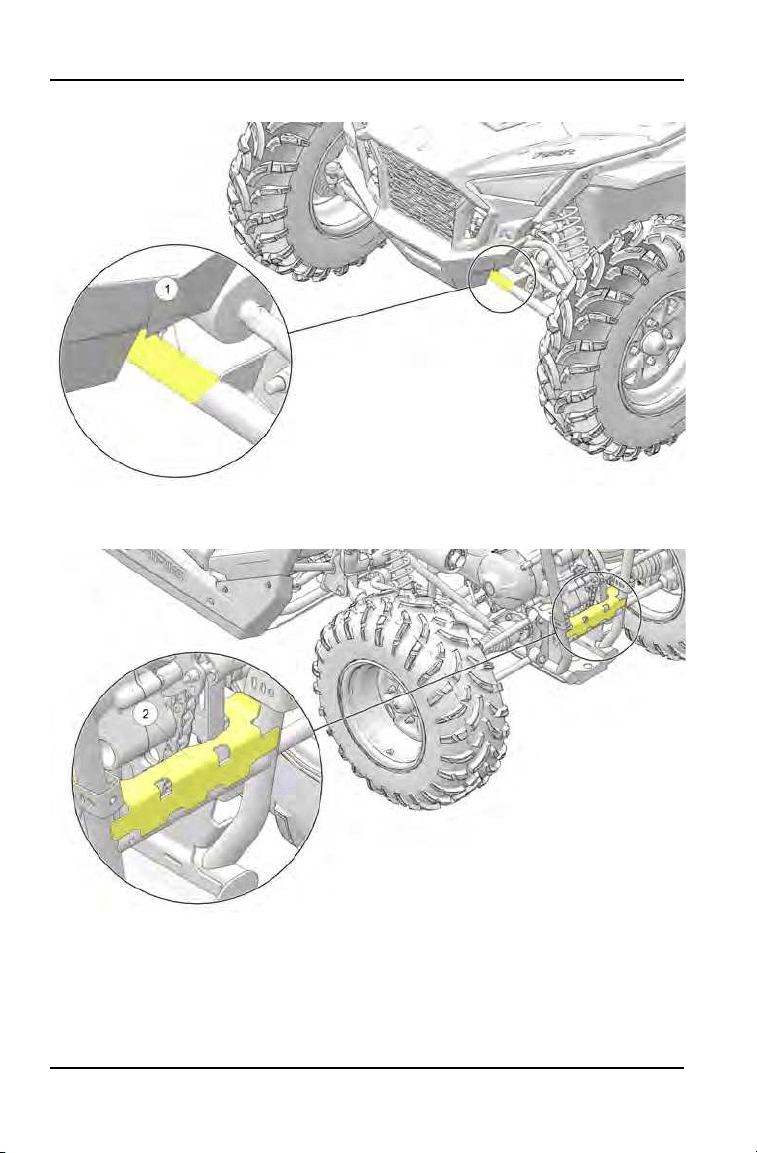
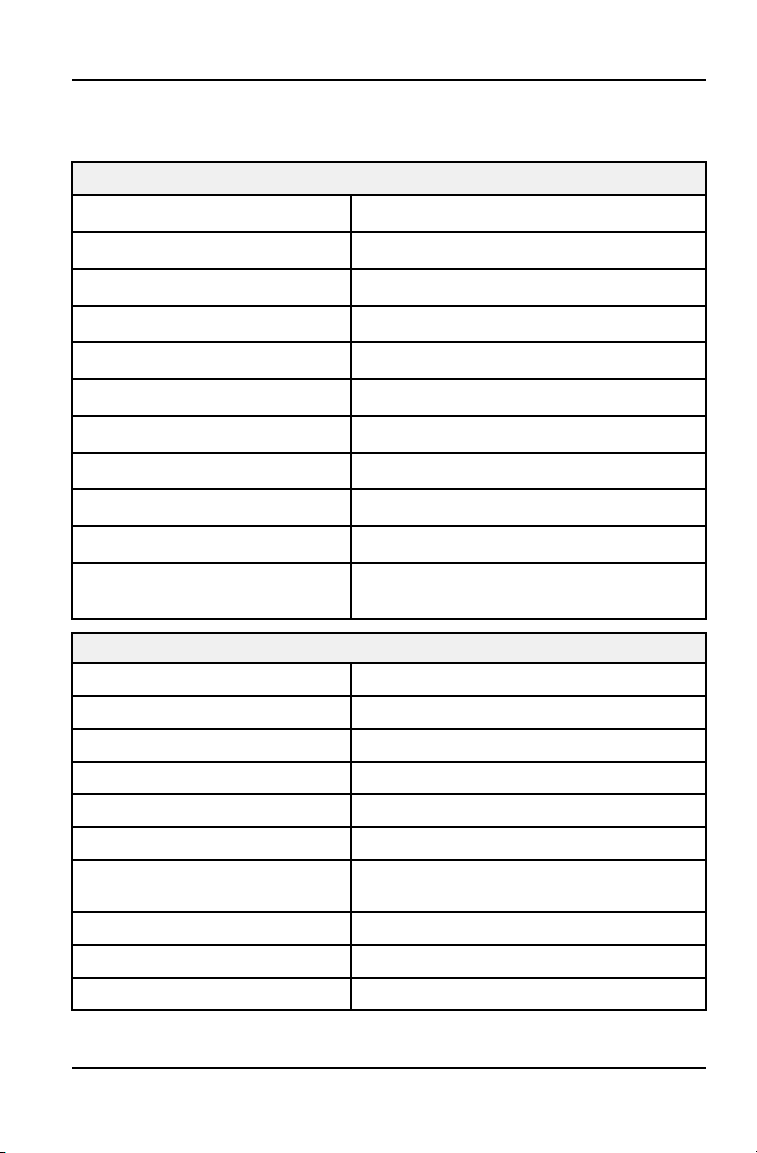
SPECIFICATIONS
RZR 200 EFI
VEHICLE DIMENSIONS
Length 85 in (215.9 cm)
Width
48 in (121.9 cm)
Height 58 in (147.3 cm)
Wheel Base
65 in (165 cm)
Ground Clearance
9 in (22.9 cm)
Minimum Turning Radius 110 in (279.4 cm)
Gross Vehicle Weight 1060 lb (481 kg)
Dry Weight 743 lb (337 kg)
Rear Rack/Box Capacity 50 lb (23 kg)
Maximum Rider Weight 150 lb (68 kg) (each rider)
Maximum Weight Capacity
350 lb (158 kg)
(Driver + Cargo)
ENGINE
Platform
Single Cylinder, Air/Oil Cooled 4-Stroke
Engine Displacement (cc)
180 cc
Number of Cylinders
1
Bore & Stroke (mm)
62.0 x 57.8 mm
Compression Ratio
9.6:1
Engine Idle Speed
1500 RPM
Engine Max Engine Speed (Fuel
Cutoff)
8000 RPM
Cooling System
Air + Oil
Overheat Warning
Instrument Cluster Indicator
Lubrication
PS-4 Synthetic 5W-50 4-Cycle Oil
129
SPECIFICATIONS
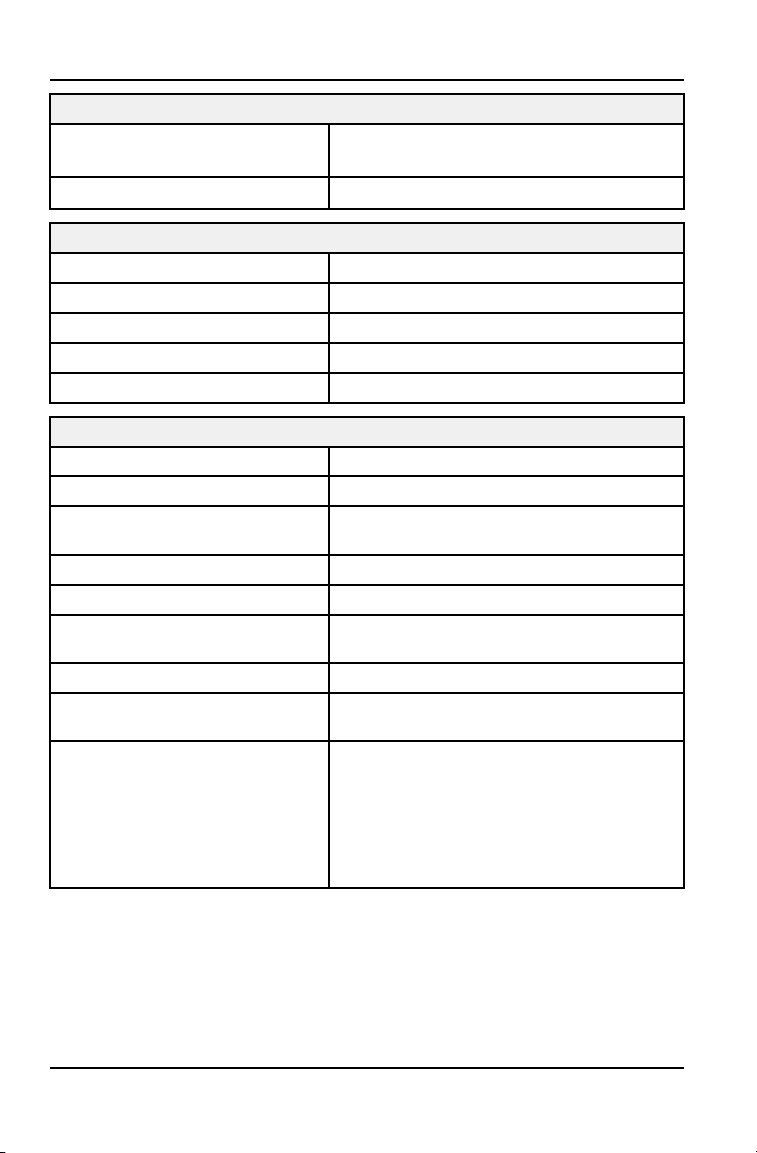
ENGINE
Engine Oil Requirement /
Capacity
35.5 oz (1050 mL)
Exhaust System Single Headpipe / Single Silencer
FUEL SYSTEM
Throttle Body / Size
Bosch® / 32 mm
Fuel Delivery Electronic Fuel Pump (in tank)
Fuel Pressure
4 bar / 58 psi (400 kPa)
Fuel Capacity 2.5 gal (9.5 L)
Fuel Requirements 87 Octane (minimum)
ELECTRICAL
Alternator Output 11.5 AMP @ 4000 RPM
Voltage Regulator
3 Phase, 35 AMP
Daytime Running Lights
2 - Single Beam Daytime Running Lamps
(DRL)
Tail / Brake Lights Single Tail Light
Ignition Timing Non-Adjustable
Spark plug / Gap
NGK® CR7HSA (.024 - .028 (0.6 - 0.7
mm))
Battery
10 AH / 160 CCA
Relays
(Located in Relay/Fuse Box)
EFI
Fuel Pump
Fuses
(Located in Relay/Fuse Box)
Main Fuse: 20 Amp
EFI: 15 Amp
Lights: 10 Amp
Brake LT: 10 Amp
Spare: 10 Amp
Spare: 15 Amp
Spare: 20 Amp
130
SPECIFICATIONS
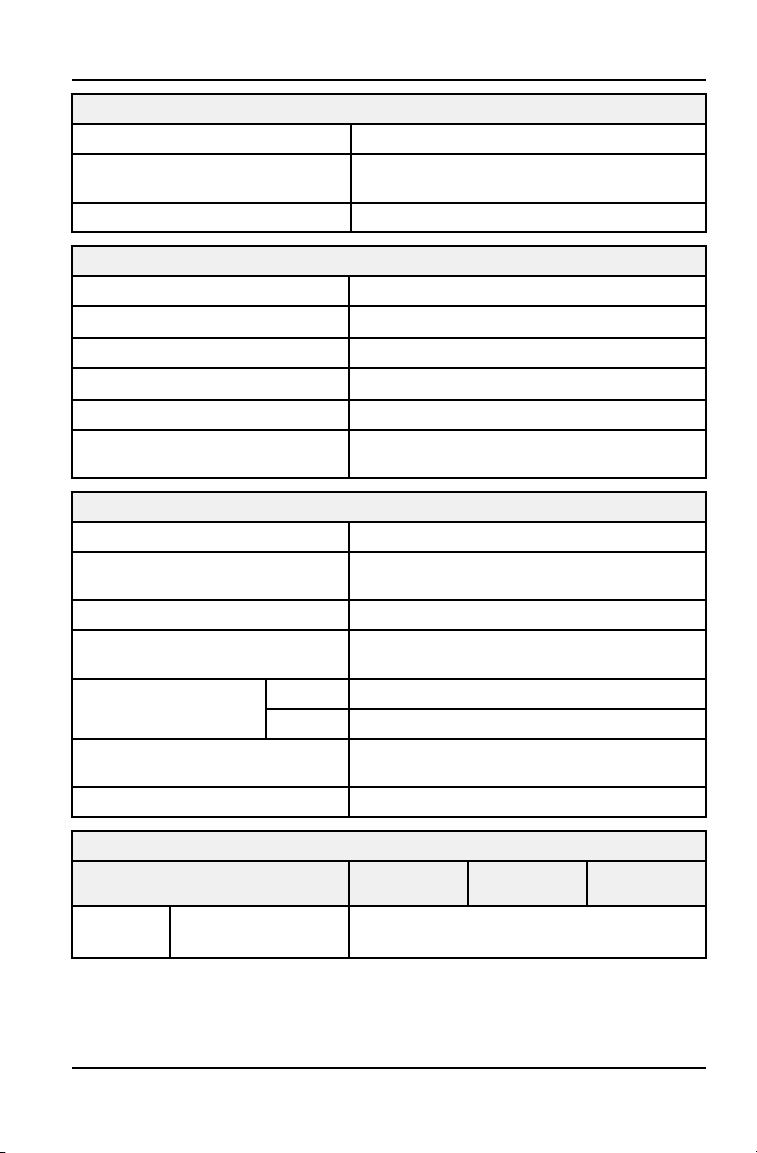
DRIVETRAIN
Transmission Type
Automatic CVT F/N/R
Transmission
Fluid Type / Fluid Capacity
Polaris AGL
25 oz (750 mL)
Drive Chain - Type / # Links
50 x 55
STEERING / SUSPENSION
Toe Out
0-1/8 in. / 0-3.2mm 0-1/8 in (0-3.2 mm)
Front Suspension
Coil-Over Shocks
Front Travel
7.0 in (17.8 cm)
Rear Suspension
Coil-Over Shocks
Rear Travel
7.0 in (17.8 cm)
Shock Preload Adjustment
Cam Adjustable
(Factory Setting -Softest)
WHEELS / BRAKES
Front Wheel Size
12 x 6 Stamped Steel
Front Tire Brand/Size/Load
Rating/Speed Rating
CST 24 x 8-12 38B
Rear Wheel Size
12 x 8 Stamped Steel
Rear Tire Brand/Size/Load
Rating/Speed Rating
CST 24 x 10-12 45B
Tire Air Pressure
Front
5 psi (34,5 kPa)
Rear
5 psi (34,5 kPa)
Brakes
Front Wheel Hydraulic Disc
Rear Axle Hydraulic Disc
Brake Fluid Polaris DOT 4 Brake Fluid
CLUTCH SETTINGS
ALTITUDE
SHIFT
WEIGHT
DRIVE
SPRING
DRIVEN
SPRING
Meters
(Feet)
0-3000
(0-10,000)
No changes for high altitude.
131
SPECIFICATIONS

132
POLARIS PRODUCTS
ENGINE LUBRICANT
PART NUMBER DESCRIPTION
2870791 Fogging Oil (12 oz. Aerosol)
2876244 PS-4 Synthetic 5W-50 4-Cycle Oil (qt./.95
l)
2876245 PS-4 Synthetic 5W-50 4-Cycle Oil
(gal./3.8 l)
GEARCASE / TRANSMISSION LUBRICANTS
PART NUMBER DESCRIPTION
2878068 AGL Full Synthetic Gearcase Lubricant &
Transmission Fluid (qt./.95 l)
2878069 AGL Full Synthetic Gearcase Lubricant &
Transmission Fluid (gal./3.8 l)
2872348 Chain Lube, Aerosol
GREASE / SPECIALIZED LUBRICANTS
PART NUMBER DESCRIPTION
2871312 Grease Gun Kit, Premium All Season
2871322 All Season Grease (3 oz./89 ml cartridge)
2871423 All Season Grease (14 oz./414 ml
cartridge)
2871329 Dielectric Grease (Nyogel®)
ADDITIVES / MISCELLANEOUS
PART NUMBER DESCRIPTION
2871326 Carbon Clean
2870652 Fuel Stabilizer
2872189 DOT 4 Brake Fluid
2871956 Loctite® 565 Thread Sealant
2859044 POLARIS Battery Charger
133
POLARIS PRODUCTS

134
TROUBLESHOOTING
DRIVE BELT WEAR/BURN
POSSIBLE CAUSE SOLUTION
Driving at low RPM or ground
speed
Drive at a higher speed.
Insufficient warm-up at low
ambient tempera- tures
Warm the engine at least 5 minutes. With the transmission in
neutral, apply small amount of throttle in short bursts, 5 to 7
times. The belt will become more flexible and prevent belt
burning.
Slow/easy clutch engage-
ment
Use the throttle quickly and effectively.
Belt slippage from water or
snow ingestion into the CVT
system
Dry out the CVT. Prevent water from entering the CVT inlet and
outlet ducts. See page 102. Inspect clutch seals for damage if
repeated leaking occurs.
Clutch malfunction Your Polaris dealer can assist.
Poor engine performance Check for fouled plug or foreign material in gas tank or fuel lines.
Your Polaris dealer can assist.
Wrong or missing belt Install the recommended belt.
Improper break-in Always break in a new belt and/or clutch.
ENGINE DOESN’T TURN OVER
POSSIBLE CAUSE SOLUTION
Low battery voltage Recharge the battery to 12.8 VDC.
Loose battery connections Check all connections and tighten.
Loose solenoid connections Check all connections and tighten.
ENGINE TURNS OVER, FAILS TO START
POSSIBLE CAUSE SOLUTION
Out of fuel Refuel.
Water is present in fuel Drain the fuel system and refuel.
Old or non-recommended fuel Replace with fresh recommended fuel.
Fouled or defective spark plug Inspect plug and replace if necessary.
No spark to spark plug Inspect plug and replace if necessary.
135
TROUBLESHOOTING
POSSIBLE CAUSE SOLUTION
Water or fuel in crankcase Your POLARIS dealer can assist.
Clogged Fuel Filter Your POLARIS dealer can assist.
Low battery voltage Recharge the battery to 12.8 VDC.
Mechanical failure Your POLARIS dealer can assist.
ENGINE BACKFIRES
POSSIBLE CAUSE SOLUTION
Weak spark from spark plug Inspect, clean and/or replace spark plug.
Incorrect spark plug gap or
heat range
Set gap to specs or replace plug.
Old or non-recommended fuel Replace with fresh recommended fuel.
Incorrectly installed spark plug
wires
Your POLARIS dealer can assist.
Mechanical failure Your POLARIS dealer can assist.
Loose ignition connections Check all connections and tighten.
Water present in fuel Replace with fresh recommended fuel.
Exhaust system leak Your POLARIS dealer can assist.
ENGINE PINGS OR KNOCKS
POSSIBLE CAUSE SOLUTION
Poor quality or low octane fuel Replace with recommended fuel.
Incorrect ignition timing Your authorized dealer can assist.
Incorrect spark plug gap or
heat range
Set gap to specs or replace plugs.
ENGINE RUNS IRREGULARLY, STALLS OR
MISFIRES
POSSIBLE CAUSE SOLUTION
Fouled or defective spark plug
(s)
Inspect, clean and/or replace spark plugs
Worn or defective spark plug
wires
Your POLARIS dealer can assist
136
TROUBLESHOOTING
POSSIBLE CAUSE SOLUTION
Incorrect spark plug gap or
heat range
Set gap to specs or replace plugs
Loose ignition connections Check all connections and tighten
Water present in fuel Replace with new fuel
Low battery voltage Recharge battery to 12.8 VDC
Kinked or plugged fuel tank
vent line
Inspect and replace
Incorrect fuel Replace with recommended fuel
Clogged air filter Inspect and clean or replace
Reverse speed limiter
malfunction
Your POLARIS dealer can assist
Electronic throttle control
malfunction
Your POLARIS dealer can assist
Other mechanical failure Your POLARIS dealer can assist
POSSIBLE LEAN FUEL
CAUSE
SOLUTION
Low or contaminated fuel Add or change fuel, clean the fuel system
Low octane fuel Replace with recommended fuel
Clogged air filter Your POLARIS dealer can assist
Incorrect fuel Replace with recommended fuel
POSSIBLE RICH FUEL
CAUSE
SOLUTION
Fuel is very high octane Replace with lower octane fuel
Stopping/starting without
adequate warm-up
Allow engine to warm up before operating and/or stopping
Incorrect fuel Replace with recommended fuel
Clogged air filter Inspect and clean or replace
137
TROUBLESHOOTING
ENGINE STOPS OR LOSES POWER
POSSIBLE CAUSE SOLUTION
Out of fuel Refuel, cycle key to ON position three times for 5 seconds each,
then start
Kinked or plugged fuel vent
line
Inspect and replace
Water is present in fuel Replace with new fuel
Fouled or defective spark plug
(s)
Inspect, clean and/or replace spark plugs
Worn or defective spark plug
wires
Your POLARIS dealer can assist
Incorrect spark plug gap or
heat range
Set gap to specs or replace plug
Loose ignition connections Check all connections and tighten
Low battery voltage Recharge the battery to 12.8 VDC
Incorrect fuel Replace with fresh recommended fuel
Clogged air filter Inspect and clean or replace
Electronic throttle control
malfunction
Your POLARIS dealer can assist
Other mechanical failure Your POLARIS dealer can assist
138
TROUBLESHOOTING
DIAGNOSTIC TROUBLE CODES
SPN FMI COMPONENT P-CODE CONDITION
DISPLAYED ON
INSTRUMENT
CLUSTER
DISPLAYED ON
DIGITAL WRENCH
DIAGNOSTIC
SOFTWARE
29 3
Accelerator
Position 2
P1228 Voltage Above Normal, Or Shorted
To High Source
29 4 P1227 Voltage Below Normal, Or Shorted
To Low Source
51 3
Throttle
Position Sensor
1
P0123 Voltage Above Normal, Or Shorted
To High Source
51 4 P0122 Voltage Below Normal, Or Shorted
To Low Source
84 2
Vehicle Speed
Sensor
P0503 Data Erratic, Intermittent Or Incorrect
91 3
Accelerator
Position 1
P0228 Voltage Above Normal, Or Shorted
To High Source
91 4 P0227 Voltage Below Normal, Or Shorted
To Low Source
96 2
Fuel Level
Signal
P0461 Data Erratic, Intermittent Or Incorrect
96 3 P0463 Voltage Above Normal, Or Shorted
To High Source
96 4 P0462 Voltage Below Normal, Or Shorted
To Low Source
96 16 P1462 Data Valid But Above Normal
Operating Range - Moderately
Severe Level
96 18 P1463 Data Valid But Below Normal
Operating Range - Moderately
Severe Level
102 3
Manifold
Absolute
Pressure
Sensor
P0108 Voltage Above Normal, Or Shorted
To High Source
102 4 P0107 Voltage Below Normal, Or Shorted
To Low Source
105 0
Intake Air
Temperature
Sensor
P1111 Data Valid But Above Normal
Operational Range - Most Severe
Level
105 3 P0113 Voltage Above Normal, Or Shorted
To High Source
139
TROUBLESHOOTING
SPN FMI COMPONENT P-CODE CONDITION
DISPLAYED ON
INSTRUMENT
CLUSTER
DISPLAYED ON
DIGITAL WRENCH
DIAGNOSTIC
SOFTWARE
105 4 P0112 Voltage Below Normal, Or Shorted
To Low Source
108 3
Barometric
Pressure
Sensor
P2229 Voltage Above Normal, Or Shorted
To High Source
108 4 P2228 Voltage Below Normal, Or Shorted
To Low Source
110 0
Engine
Temperature
Sensor
P1217 Data Valid But Above Normal
Operational Range - Most Severe
Level
110 2 P0116 Data Erratic, Intermittent Or Incorrect
110 3 P0118 Voltage Above Normal, Or Shorted
To High Source
110 4 P0117 Voltage Below Normal, Or Shorted
To Low Source
110 10 P0119 Abnormal Rate Of Change
110 15 P1116 Data Valid But Above Normal
Operating Range - Least Severe
Level
110 16 P0217 Data Valid But Above Normal
Operating Range - Moderately
Severe Level
110 17 P0128 Data Valid But Below Normal
Operating Range - Least Severe
Level
168 0
System Power
P1562 Data Valid But Above Normal
Operational Range - Most Severe
Level
168 1 P1563 Data Valid But Below Normal
Operational Range - Most Severe
Level
168 2 P0561 Data Erratic, Intermittent Or Incorrect
168 3 P0563 Voltage Above Normal, Or Shorted
To High Source
168 4 P0562 Voltage Below Normal, Or Shorted
To Low Source
190 31
Engine Speed
P121C Condition Exists
140
TROUBLESHOOTING
SPN FMI COMPONENT P-CODE CONDITION
DISPLAYED ON
INSTRUMENT
CLUSTER
DISPLAYED ON
DIGITAL WRENCH
DIAGNOSTIC
SOFTWARE
523 2
Gear Sensor
Signal
P0914 Data Erratic, Intermittent Or Incorrect
523 4 P0916 Voltage Below Normal, Or Shorted
To Low Source
523 9 P1914 Abnormal Update Rate
527 31
Cruise Control
Panel Switches
P153D Condition Exists
636 2
Crankshaft
Position Sensor
P0335 Data Erratic, Intermittent Or Incorrect
637 8
Camshaft
Position Sensor
P0340 Abnormal Frequency Or Pulse Width
Or Period
651 3
Injector 1
(Front) (MAG)
(SDI Port
Injector)
P0262 Voltage Above Normal, Or Shorted
To High Source
651 4 P1262 Voltage Below Normal, Or Shorted
To Low Source
651 5 P0261 Current Below Normal Or Open
Circuit
652 3
Injector 2
(Rear) (PTO)
(SDI Port
Injector)
P0265 Voltage Above Normal, Or Shorted
To High Source
652 4 P1265 Voltage Below Normal, Or Shorted
To Low Source
652 5 P0264 Current Below Normal Or Open
Circuit
677 3
Starter
Solenoid Driver
Circuit
P0617 Voltage Above Normal, Or Shorted
To High Source
677 4 P0616 Voltage Below Normal, Or Shorted
To Low Source
677 5 P0615 Current Below Normal Or Open
Circuit
731 1
Knock Sensor 1
P0326 Data Valid But Below Normal
Operational Range - Most Severe
Level
746 3
Rear
Differential
Output (Turf)
P1692 Voltage Above Normal, Or Shorted
To High Source
746 4 P1693 Voltage Below Normal, Or Shorted
To Low Source
141
TROUBLESHOOTING
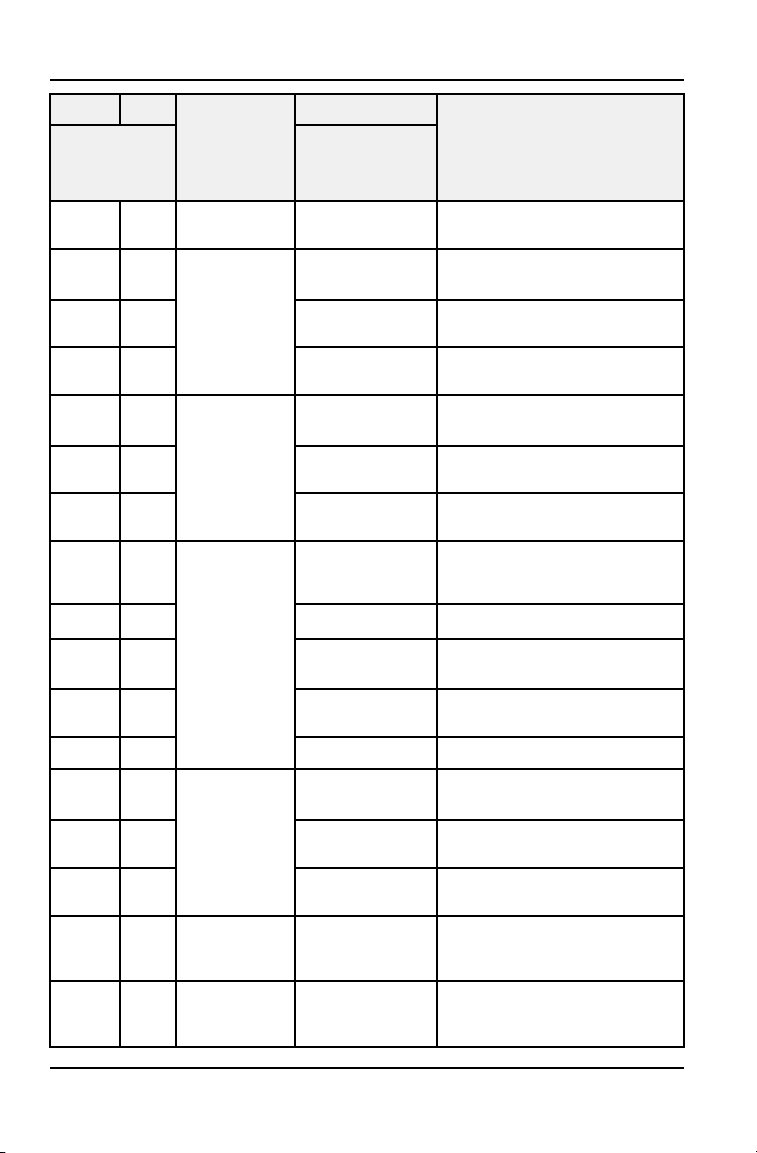
SPN FMI COMPONENT P-CODE CONDITION
DISPLAYED ON
INSTRUMENT
CLUSTER
DISPLAYED ON
DIGITAL WRENCH
DIAGNOSTIC
SOFTWARE
746 5 P1691 Current Below Normal Or Open
Circuit
876 3
AC Compressor
Clutch Relay
P0647 Voltage Above Normal, Or Shorted
To High Source
876 4 P0646 Voltage Below Normal, Or Shorted
To Low Source
876 5 P0645 Current Below Normal Or Open
Circuit
1071 3
Fan Relay
Driver Circuit
P1482 Voltage Above Normal, Or Shorted
To High Source
1071 4 P1483 Voltage Below Normal, Or Shorted
To Low Source
1071 5 P1481 Current Below Normal Or Open
Circuit
1127 0
Boost Pressure
Sensor
P0234 Data Valid But Above Normal
Operational Range - Most Severe
Level
1127 2 P0236 Data Erratic, Intermittent Or Incorrect
1127 3 P0238 Voltage Above Normal, Or Shorted
To High Source
1127 4 P0237 Voltage Below Normal, Or Shorted
To Low Source
1127 31 P1234 Condition Exists
1213 3
Malfunction
Indicator Lamp
P1653 Voltage Above Normal, Or Shorted
To High Source
1213 4 P1652 Voltage Below Normal, Or Shorted
To Low Source
1213 5 P1651 Current Below Normal Or Open
Circuit
1268 3
Ignition Coil
Primary Driver
1 (Front) (MAG)
P1353 Voltage Above Normal, Or Shorted
To High Source
1269 3
Ignition Coil
Primary Driver
2 (Rear) (PTO)
P1354 Voltage Above Normal, Or Shorted
To High Source
142
TROUBLESHOOTING
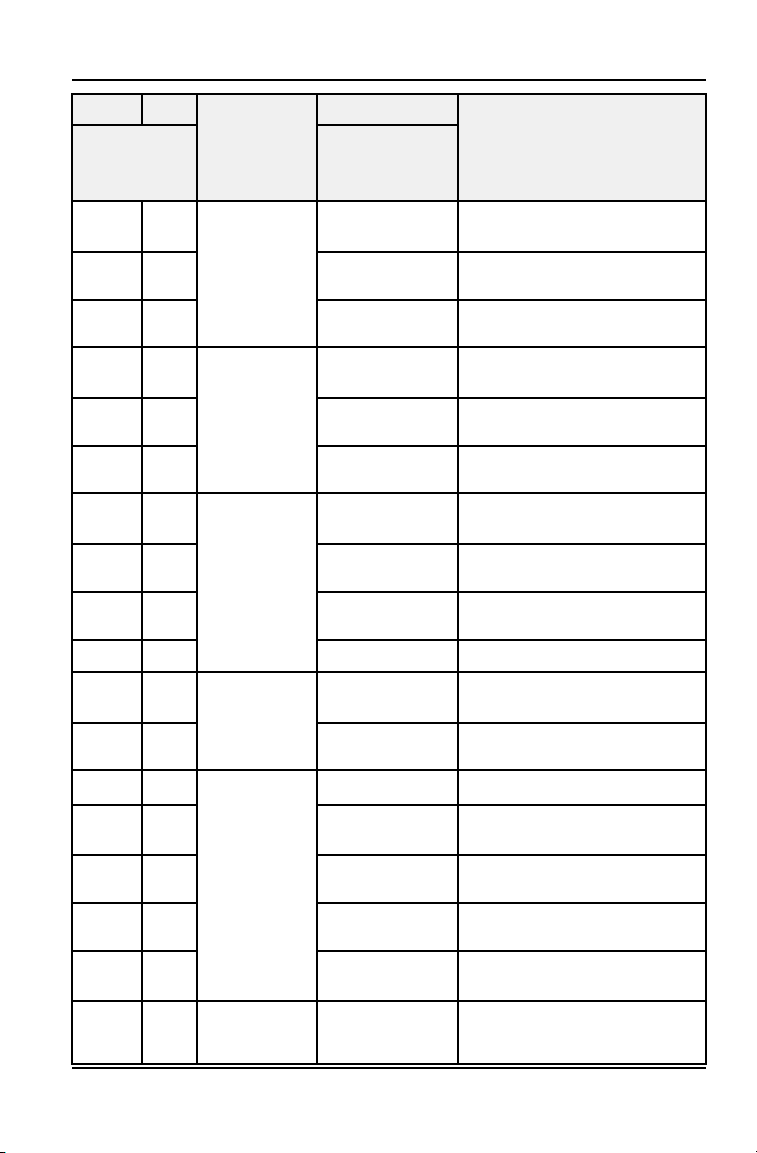
SPN FMI COMPONENT P-CODE CONDITION
DISPLAYED ON
INSTRUMENT
CLUSTER
DISPLAYED ON
DIGITAL WRENCH
DIAGNOSTIC
SOFTWARE
1347 3
Fuel Pump
Driver Circuit
P0232 Voltage Above Normal, Or Shorted
To High Source
1347 4 P0231 Voltage Below Normal, Or Shorted
To Low Source
1347 5 P0230 Current Below Normal Or Open
Circuit
1557 3
Fan Driver 2
P0694 Voltage Above Normal, Or Shorted
To High Source
1557 4 P0693 Voltage Below Normal, Or Shorted
To Low Source
1557 5 P0481 Current Below Normal Or Open
Circuit
1856 3
Seat Belt
Switch
B1150 Voltage Above Normal, Or Shorted
To High Source
1856 4 B1250 Voltage Below Normal, Or Shorted
To Low Source
1856 5 B1350 Current Below Normal Or Open
Circuit
1856 31 Condition Exists
2629 3
Engine
Turbocharger 1
Compressor
Outlet
Temperature
P1235 Voltage Above Normal, Or Shorted
To High Source
2629 4 P1236 Voltage Below Normal, Or Shorted
To Low Source
3056 2
Oxygen Sensor
Bank 1 Sensor
1
P0130 Data Erratic, Intermittent Or Incorrect
3056 3 P0132 Voltage Above Normal, Or Shorted
To High Source
3056 4 P0131 Voltage Below Normal, Or Shorted
To Low Source
3056 5 P1134 Current Below Normal Or Open
Circuit
3056 12 P113A Bad Intelligent Device Or
Component
3597 3
ECU Output
Supply Voltage
1
P16A2 Voltage Above Normal, Or Shorted
To High Source
143
TROUBLESHOOTING
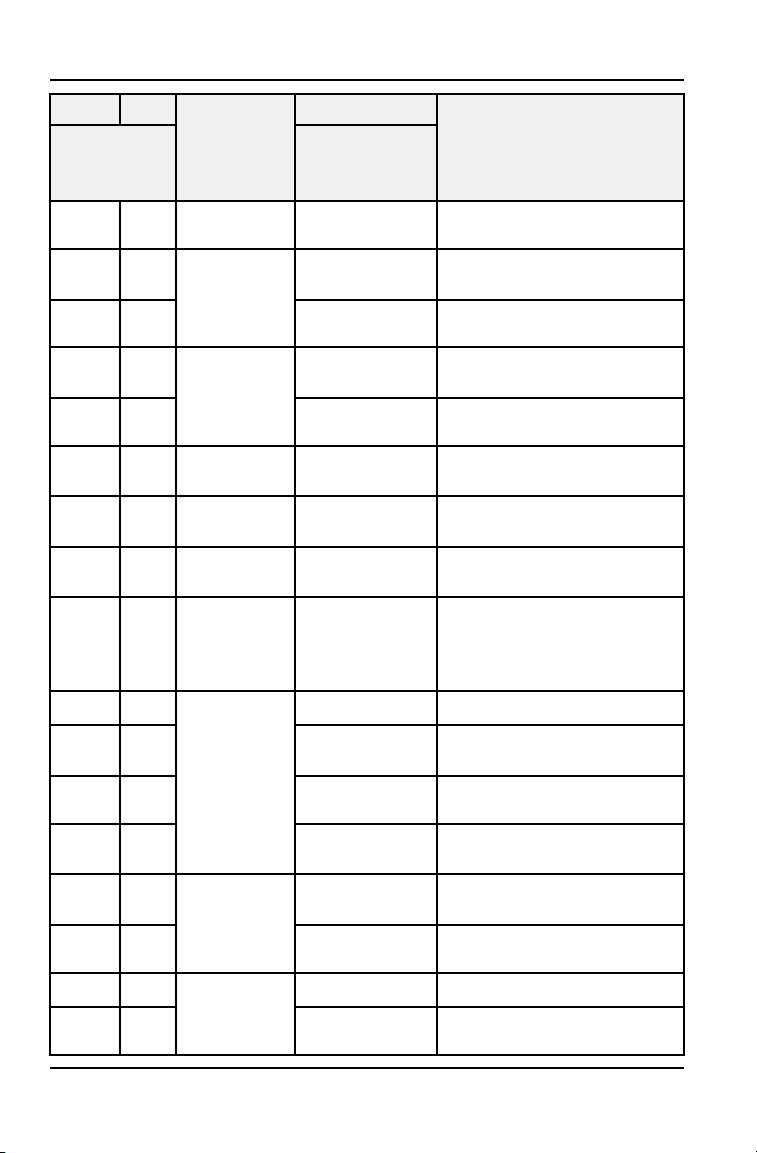
SPN FMI COMPONENT P-CODE CONDITION
DISPLAYED ON
INSTRUMENT
CLUSTER
DISPLAYED ON
DIGITAL WRENCH
DIAGNOSTIC
SOFTWARE
3597 4 P16A1 Voltage Below Normal, Or Shorted
To Low Source
3598 3
ECU Output
Supply Voltage
2
P16A9 Voltage Above Normal, Or Shorted
To High Source
3598 4 P16A8 Voltage Below Normal, Or Shorted
To Low Source
3599 3
ECU Output
Supply Voltage
3
P17AA Voltage Above Normal, Or Shorted
To High Source
3599 4 P17AB Voltage Below Normal, Or Shorted
To Low Source
65590 7
Cylinder Misfire
P0314 Mechanical System Not Responding
Or Out Of Adjustment
65591 7
Cylinder 1
Misfire
P0301 Mechanical System Not Responding
Or Out Of Adjustment
65592 7
Cylinder 2
Misfire
P0302 Mechanical System Not Responding
Or Out Of Adjustment
65613 2
ETC
Accelerator
Position Sensor
Outputs 1 & 2
Correlation
P1135 Data Erratic, Intermittent Or Incorrect
520194 2
Throttle
Release Signal
P1553 Data Erratic, Intermittent Or Incorrect
520194 3 P1555 Voltage Above Normal, Or Shorted
To High Source
520194 4 P1554 Voltage Below Normal, Or Shorted
To Low Source
520194 7 P1552 Mechanical System Not Responding
Or Out Of Adjustment
520198 3
Throttle
Position Sensor
2
P0223 Voltage Above Normal, Or Shorted
To High Source
520198 4 P0222 Voltage Below Normal, Or Shorted
To Low Source
520200 2
Rollover Sensor
(Tipover)
P1501 Data Erratic, Intermittent Or Incorrect
520200 3 P1503 Voltage Above Normal, Or Shorted
To High Source
144
TROUBLESHOOTING
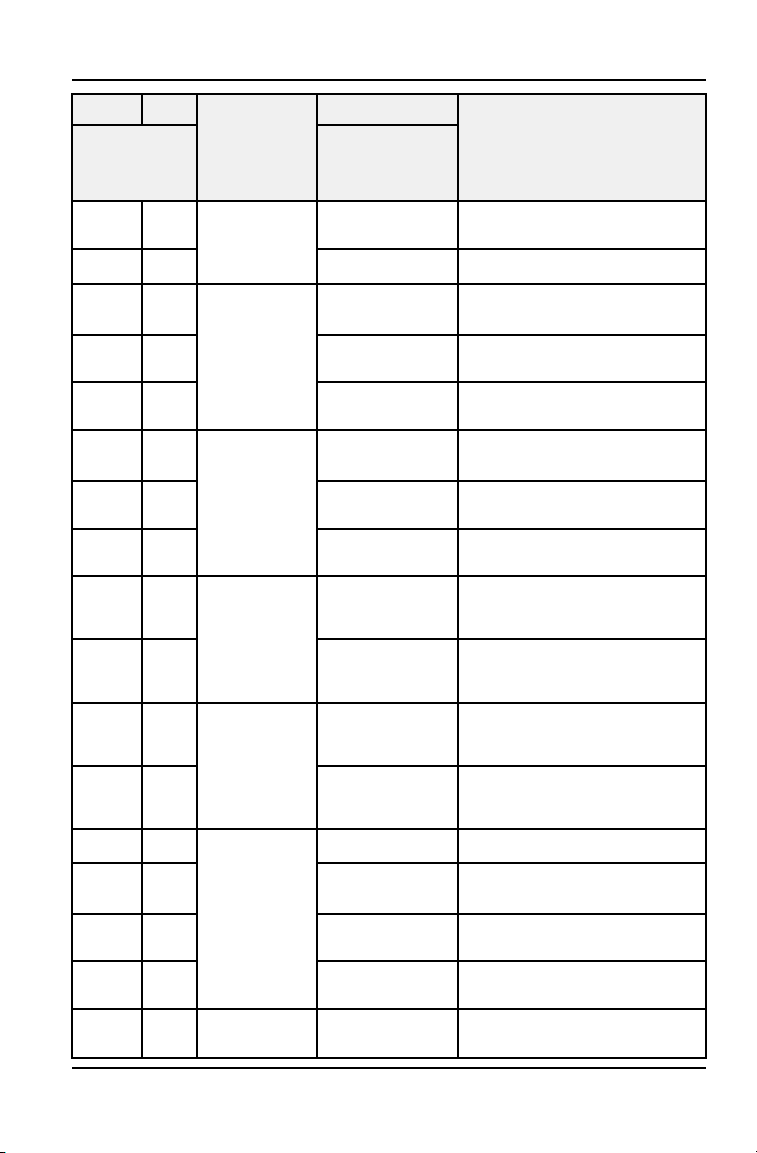
SPN FMI COMPONENT P-CODE CONDITION
DISPLAYED ON
INSTRUMENT
CLUSTER
DISPLAYED ON
DIGITAL WRENCH
DIAGNOSTIC
SOFTWARE
520200 4 P1502 Voltage Below Normal, Or Shorted
To Low Source
520200 14 P1504 Special Instructions
520202 3
Canister Purge
Valve
Voltage Above Normal, Or Shorted
To High Source
520202 4 P0445 Voltage Below Normal, Or Shorted
To Low Source
520202 5 Current Below Normal Or Open
Circuit
520203 3
Front Wheel
Back Drive
(Active Descent
System)
P1686 Voltage Above Normal, Or Shorted
To High Source
520203 4 P1687 Voltage Below Normal, Or Shorted
To Low Source
520203 5 P1685 Current Below Normal Or Open
Circuit
520204 15
Fuel Correction
Front
P0172 Data Valid But Above Normal
Operating Range - Least Severe
Level
520204 17 P0171 Data Valid But Below Normal
Operating Range - Least Severe
Level
520205 15
Fuel Correction
Rear
P0175 Data Valid But Above Normal
Operating Range - Least Severe
Level
520205 17 P0174 Data Valid But Below Normal
Operating Range - Least Severe
Level
520206 2
Reverse Alarm
P1684 Data Erratic, Intermittent Or Incorrect
520206 3 P1682 Voltage Above Normal, Or Shorted
To High Source
520206 4 P1683 Voltage Below Normal, Or Shorted
To Low Source
520206 5 P1681 Current Below Normal Or Open
Circuit
520207 3
All Wheel Drive
Control Circuit
P1835 Voltage Above Normal, Or Shorted
To High Source
145
TROUBLESHOOTING
SPN FMI COMPONENT P-CODE CONDITION
DISPLAYED ON
INSTRUMENT
CLUSTER
DISPLAYED ON
DIGITAL WRENCH
DIAGNOSTIC
SOFTWARE
520207 4 P1834 Voltage Below Normal, Or Shorted
To Low Source
520207 5 P1836 Current Below Normal Or Open
Circuit
520208 3
Chassis Relay
P1614 Voltage Above Normal, Or Shorted
To High Source
520208 4 P1613 Voltage Below Normal, Or Shorted
To Low Source
520208 5 P1611 Current Below Normal Or Open
Circuit
520209 2
Oxygen Sensor
Heater 1
P0135 Data Erratic, Intermittent Or Incorrect
520209 3 Voltage Above Normal, Or Shorted
To High Source
520209 4 P0031 Voltage Below Normal, Or Shorted
To Low Source
520209 5 Current Below Normal Or Open
Circuit
520210 2
Oxygen Sensor
Heater 2
P0141 Data Erratic, Intermittent Or Incorrect
520210 3 P0038 Voltage Above Normal, Or Shorted
To High Source
520210 4 P0037 Voltage Below Normal, Or Shorted
To Low Source
520210 5 P0036 Current Below Normal Or Open
Circuit
520211 3
Idle Speed
P0507 Voltage Above Normal, Or Shorted
To High Source
520211 4 P0506 Voltage Below Normal, Or Shorted
To Low Source
520211 7 Mechanical System Not Responding
Or Out Of Adjustment
520268 3
Idle Air Control
M17 Stepper
Pin 3
P1519 Voltage Above Normal, Or Shorted
To High Source
520268 4 P1518 Voltage Below Normal, Or Shorted
To Low Source
146
TROUBLESHOOTING
SPN FMI COMPONENT P-CODE CONDITION
DISPLAYED ON
INSTRUMENT
CLUSTER
DISPLAYED ON
DIGITAL WRENCH
DIAGNOSTIC
SOFTWARE
520268 5 P1515 Current Below Normal Or Open
Circuit
520269 3
Idle Air Control
M17 Stepper
Pin 4
P1529 Voltage Above Normal, Or Shorted
To High Source
520269 4 P1528 Voltage Below Normal, Or Shorted
To Low Source
520269 5 P1525 Current Below Normal Or Open
Circuit
520270 3
Idle Air Control
M17 Stepper
Pin 6
P1539 Voltage Above Normal, Or Shorted
To High Source
520270 4 P1538 Voltage Below Normal, Or Shorted
To Low Source
520270 5 P1535 Current Below Normal Or Open
Circuit
520271 3
Idle Air Control
M17 Stepper
Pin 1
P1509 Voltage Above Normal, Or Shorted
To High Source
520271 4 P1508 Voltage Below Normal, Or Shorted
To Low Source
520271 5 P1505 Current Below Normal Or Open
Circuit
520275 31
Accelerator
Position/Brake
Position
Interaction
P150A Condition Exists
520276 2
Throttle
Position Sensor
(1 or 2
Indeterminable)
P150C Data Erratic, Intermittent Or Incorrect
520276 12 P150B Bad Intelligent Device Or
Component
520277 2
Throttle Body
Control - Power
Stage
P151A Data Erratic, Intermittent Or Incorrect
520277 3 P150D Voltage Above Normal, Or Shorted
To High Source
520277 4 P150E Voltage Below Normal, Or Shorted
To Low Source
520277 8 P151B Abnormal Frequency Or Pulse Width
Or Period
147
TROUBLESHOOTING
SPN FMI COMPONENT P-CODE CONDITION
DISPLAYED ON
INSTRUMENT
CLUSTER
DISPLAYED ON
DIGITAL WRENCH
DIAGNOSTIC
SOFTWARE
520279 31
Throttle Body
Control -
Adaption
Aborted
P151D Condition Exists
520280 31
Throttle Body
Control - Limp
Home Position
Check Failed
P151E Condition Exists
520281 31
Throttle Body
Control -
Mechanical
Stop Adaptation
Failure
P152A Condition Exists
520282 31
Throttle Body
Control -
Repeated
Adaptation
Failed
P152B Condition Exists
520283 3
Throttle Body
Control
P152C Voltage Above Normal, Or Shorted
To High Source
520283 4 P152D Voltage Below Normal, Or Shorted
To Low Source
520284 31
Throttle Body
Control -
Position
Deviation Fault
P152E Condition Exists
520285 2
Brake Switch (1
or 2
Indeterminable)
P153E Data Erratic, Intermittent Or Incorrect
520286 31
ECU Monitoring
Error
P1540 Condition Exists
520287 31
ECU Monitoring
Error (Level 3)
P1541 Condition Exists
520288 31
ECU Monitoring
of Injection Cut
Off (Level 1)
P1542 Condition Exists
520289 31
ECU Monitoring
of Injection Cut
Off (Level 2)
P1543 Condition Exists
148
TROUBLESHOOTING
SPN FMI COMPONENT P-CODE CONDITION
DISPLAYED ON
INSTRUMENT
CLUSTER
DISPLAYED ON
DIGITAL WRENCH
DIAGNOSTIC
SOFTWARE
520305 31
Throttle Body
Control -
Requested
Throttle Angle
Not Plausible
P1530 Condition Exists
520306 31
ECU ADC Fault
- No Load
P1531 Condition Exists
520307 31
ECU ADC Fault
- Voltage
P1532 Condition Exists
520308 31
Accelerator
Sensor Sync
Fault - Sensor
Diff Exceeds
Limit
P1533 Condition Exists
520309 31
ECU Fault -
ICO
P1534 Condition Exists
520311 31
ECU Fault -
Hardware
Disruption
P1537 Condition Exists
520329 9
Operator
Switch Status
(pOSS1)
P1063 Abnormal Update Rate
520331 3
Knock Sensor
Positive Line
P1327 Voltage Above Normal, Or Shorted
To High Source
520331 4 P1328 Voltage Below Normal, Or Shorted
To Low Source
520332 3
Knock Sensor
Negative Line
P132A Voltage Above Normal, Or Shorted
To High Source
520332 4 P132B Voltage Below Normal, Or Shorted
To Low Source
520333 2
Oxygen Sensor
Bank 1 Sensor
2(3057
Duplicate)
P1136 Data Erratic, Intermittent Or Incorrect
520333 3 P1137 Voltage Above Normal, Or Shorted
To High Source
520333 4 P1138 Voltage Below Normal, Or Shorted
To Low Source
520333 5 P3136 Current Below Normal Or Open
Circuit
149
TROUBLESHOOTING
SPN FMI COMPONENT P-CODE CONDITION
DISPLAYED ON
INSTRUMENT
CLUSTER
DISPLAYED ON
DIGITAL WRENCH
DIAGNOSTIC
SOFTWARE
520333 12 P1139 Bad Intelligent Device Or
Component
520336 31
ECU Monitoring
(Pedal Map
Mismatch)
P1545 Condition Exists
520338 31
Gross Air Leak
P2279 Condition Exists
520341 3
Wastegate
Solenoid Driver
P0243 Voltage Above Normal, Or Shorted
To High Source
520341 4 P0246 Voltage Below Normal, Or Shorted
To Low Source
520341 5 P0245 Current Below Normal Or Open
Circuit
520342 15
Idle Fuel
Correction
Bank 1
P116C Data Valid But Above Normal
Operating Range - Least Severe
Level
520342 17 P116D Data Valid But Below Normal
Operating Range - Least Severe
Level
520343 15
Idle Fuel
Correction
Bank 2
P116E Data Valid But Above Normal
Operating Range - Least Severe
Level
520343 17 P116F Data Valid But Below Normal
Operating Range - Least Severe
Level
520344 15
Adaptive Fuel
Correction
Bank 1
P0170 Data Valid But Above Normal
Operating Range - Least Severe
Level
520344 17 P1170 Data Valid But Below Normal
Operating Range - Least Severe
Level
520345 15
Adaptive Fuel
Correction
Bank 2
P0173 Data Valid But Above Normal
Operating Range - Least Severe
Level
520345 17 P1173 Data Valid But Below Normal
Operating Range - Least Severe
Level
520346 31
Upstream O2
Sensor Signals
Swapped
P1416 Condition Exists
150
TROUBLESHOOTING
SPN FMI COMPONENT P-CODE CONDITION
DISPLAYED ON
INSTRUMENT
CLUSTER
DISPLAYED ON
DIGITAL WRENCH
DIAGNOSTIC
SOFTWARE
520467 31
Momentary
Driveline Left
Press
P071A Condition Exists
520468 31
Momentary
Driveline Right
Press
P071D Condition Exists
520496 3
Intercooler
Pump Driver
Circuit
P107D Voltage Above Normal, Or Shorted
To High Source
520496 4 P107C Voltage Below Normal, Or Shorted
To Low Source
520496 5 P107E Current Below Normal Or Open
Circuit
520624 3
AC Condenser
Fan Relay
P15F5 Voltage Above Normal, Or Shorted
To High Source
520624 4 P15F4 Voltage Below Normal, Or Shorted
To Low Source
520624 5 P15F3 Current Below Normal Or Open
Circuit
520625 3
Alternator
Charge Disable
Relay
P1D45 Voltage Above Normal, Or Shorted
To High Source
520625 4 P1D44 Voltage Below Normal, Or Shorted
To Low Source
520625 5 P1D42 Current Below Normal Or Open
Circuit
524067 2
Drive Mode
Select Switch
P153C Data Erratic, Intermittent Or Incorrect
524067 3 P153A Voltage Above Normal, Or Shorted
To High Source
524067 4 P153B Voltage Below Normal, Or Shorted
To Low Source
524072 31
Foot On Cruise
Control Switch
P154D Condition Exists
524079 31
Cruise Control
Input
Checksum
U0405 Condition Exists
151
TROUBLESHOOTING
SPN FMI COMPONENT P-CODE CONDITION
DISPLAYED ON
INSTRUMENT
CLUSTER
DISPLAYED ON
DIGITAL WRENCH
DIAGNOSTIC
SOFTWARE
524080 31
Cruise Control
Input Message
Counter
U1405 Condition Exists
524081 31
Foot On Cruise
Control Input
Message
Counter
U1407 Condition Exists
524082 31
Foot On Cruise
Control Input
Checksum
U1406 Condition Exists
524145 31
Reverse
Override Switch
P188C Condition Exists
152
TROUBLESHOOTING

WARRANTY
LIMITED WARRANTY
Polaris Industries Inc., 2100 Highway 55, Medina, MN 55340 (POLARIS) gives a
SIX MONTH LIMITED WARRANTY on all components of your Polaris vehicle
against defects in material or workmanship. Polaris further warrants that the
spark arrester in this product will meet the efficiency requirements of USFS
standard 5100-1C for at least 1000 hours when subjected to normal use and
when maintenance and installation are in accordance with Polaris
recommendations.
This warranty covers parts and labor charges for repair or replacement of
defective parts and begins on the date of purchase by the original retail
purchaser. This warranty is transferable to another owner during the warranty
period through a Polaris dealer, or other qualified person, but any such transfer
will not extend the original term of the warranty. The duration of this warranty
may vary by international region based upon local laws and regulations.
REGISTRATION
At the time of sale, the Warranty Registration Form must be completed by your
dealer and submitted to POLARIS within ten days of purchase. Upon receipt of
this registration, POLARIS will record the registration for warranty. No
verification of registration will be sent to the purchaser as the copy of the
Warranty Registration Form will be your proof of warranty coverage. If you have
not signed the original registration and received the customer copy, please
contact your dealer immediately. NO WARRANTY COVERAGE WILL BE
ALLOWED UNLESS YOUR VEHICLE IS REGISTERED WITH POLARIS. Initial
dealer preparation and set-up of your vehicle is very important in ensuring
trouble-free operation. Purchasing a machine in the crate or without proper
dealer set-up will void your warranty coverage.
153
WARRANTY

WARRANTY COVERAGE AND EXCLUSIONS
LIMITATIONS OF WARRANTIES AND REMEDIES
This POLARIS limited warranty excludes any failures that are not caused by a
defect in material or workmanship. THIS WARRANTY DOES NOT COVER
CLAIMS OF DEFECTIVE DESIGN. This warranty also does not cover acts of
God, accidental damage, normal wear and tear, abuse or improper handling.
This warranty also does not cover any vehicle, component, or part that has been
altered structurally, modified, neglected, improperly maintained or used for
racing, competition or purposes other than for which it was designed.
This warranty excludes damages or failures resulting from improper lubrication;
improper engine timing; improper fuel; surface imperfections caused by external
stress, heat, cold or contamination; operator error or abuse; improper
component alignment, tension, adjustment or altitude compensation; snow,
water, dirt or other foreign substance ingestion/contamination; improper
maintenance; modified components; use of aftermarket or unapproved
components, accessories, or attachments; use of unapproved software or
calibration; unauthorized repairs; or repairs made after the warranty period
expires or by an unauthorized repair center.
This warranty excludes damages or failures caused by abuse, accident, fire, or
any other cause other than a defect in materials or workmanship and provides
no coverage for consumable components, general wear items, or any parts
exposed to friction surfaces, stresses, environmental conditions and/or
contamination for which they were not designed or not intended, including but
not limited to the following items:
• Wheels and tires
• Suspension components
• Brake components
• Seat components
• Clutches and components
• Steering components
• Batteries
• Light bulbs/Sealed beam lamps
• Filters
• Lubricants
• Bushings
• Finished and unfinished surfaces
• Carburetor/Throttle body
components
• Engine components
• Drive belts
• Hydraulic components and fluids
• Circuit breakers/Fuses
• Electronic components
• Spark plugs
• Sealants
• Coolants
• Bearings
154
WARRANTY

LUBRICANTS AND FLUIDS
1. Mixing oil brands or using non-recommended oil may cause engine damage.
We recommend the use of POLARIS engine oil.
2. Damage or failure resulting from the use of non-recommended lubricants or
fluids is not covered by this warranty.
This warranty provides no coverage for personal loss or expense, including
mileage, transportation costs, hotels, meals, shipping or handling fees, product
pick-up or delivery, replacement rentals, loss of product use, loss of profits, or
loss of vacation or personal time.
THE EXCLUSIVE REMEDY FOR BREACH OF THIS WARRANTY SHALL BE,
AT POLARIS' OPTION, REPAIR OR REPLACEMENT OF ANY DEFECTIVE
MATERIALS, COMPONENTS, OR PRODUCTS. THE REMEDIES SET FORTH
IN THIS WARRANTY ARE THE ONLY REMEDIES AVAILABLE TO ANY
PERSON FOR BREACH OF THIS WARRANTY. POLARIS SHALL HAVE NO
LIABILITY TO ANY PERSON FOR INCIDENTAL, CONSEQUENTIAL OR
SPECIAL DAMAGES OF ANY DESCRIPTION, WHETHER ARISING OUT OF
EXPRESS OR IMPLIED WARRANTY OR ANY OTHER CONTRACT,
NEGLIGENCE, OR OTHER TORT OR OTHERWISE. THIS EXCLUSION OF
CONSEQUENTIAL, INCIDENTAL, AND SPECIAL DAMAGES IS
INDEPENDENT FROM AND SHALL SURVIVE ANY FINDING THAT THE
EXCLUSIVE REMEDY FAILED OF ITS ESSENTIAL PURPOSE.
THE IMPLIED WARRANTY OF FITNESS FOR A PARTICULAR PURPOSE IS
EXCLUDED FROM THIS LIMITED WARRANTY. ALL OTHER IMPLIED
WARRANTIES (INCLUDING BUT NOT LIMITED TO THE IMPLIED
WARRANTY OF MERCHANTABILITY) ARE LIMITED IN DURATION TO THE
ABOVE SIX MONTH WARRANTY PERIOD. POLARIS DISCLAIMS ALL
EXPRESS WARRANTIES NOT STATED IN THIS WARRANTY. SOME STATES
DO NOT PERMIT THE EXCLUSION OR LIMITATION OF INCIDENTAL OR
CONSEQUENTIAL DAMAGES OR ALLOW LIMITATIONS ON THE DURATION
OF IMPLIED WARRANTIES, SO THE ABOVE LIMITATIONS MAY NOT APPLY
TO YOU IF INCONSISTENT WITH CONTROLLING STATE LAW.
HOW TO OBTAIN WARRANTY SERVICE
If your vehicle requires warranty service, you must take it to a POLARIS
Servicing Dealer. When requesting warranty service you must present your copy
of the Warranty Registration Form to the dealer. (THE COST OF
TRANSPORTATION TO AND FROM THE DEALER IS YOUR
RESPONSIBILITY.) POLARIS suggests that you use your original selling dealer;
however, you may use any POLARIS Servicing Dealer to perform warranty
service.
155
WARRANTY

EXPORTED PRODUCTS
EXCEPT WHERE SPECIFICALLY REQUIRED BY LAW, THERE IS NO
WARRANTY OR SERVICE BULLETIN COVERAGE ON THIS PRODUCT IF IT
IS SOLD OUTSIDE THE COUNTRY OF THE SELLING DEALER'S
AUTHORIZED LOCATION. This policy does not apply to products that have
received authorization for export from POLARIS. Dealers may not give
authorization for export. You should consult an authorized dealer to determine
this product's warranty or service coverage if you have any questions. This
policy does not apply to products registered to government officials or military
personnel on assignment outside the country of the selling dealer's authorized
location. This policy does not apply to Safety Bulletins.
NOTICE
If your product is registered outside of the country where it was purchased and
you have not followed the procedure set above, your product will no longer be
eligible for warranty or service bulletin coverage of any kind, other than safety
recalls. Products registered to government officials or military personnel on
assignment outside of the country where the product was purchased will
continue to be covered by the Limited Warranty.
Please work with your dealer to resolve any warranty issues. Dealership
contacts can be found via this website, if needed:
www.polaris.com/en-us/contact
Should your dealer require any additional assistance, they will contact the
appropriate person at POLARIS.
This warranty gives you specific legal rights, and you may also have other rights
which vary from state to state or in different countries. If any of the above terms
are void because of federal, state, local law, all other warranty terms will remain
in effect.
For questions call POLARIS Owner Connections:
United States & Canada: 1-800-POLARIS (1-800-765-2747)
French: 1-800-268-6334
To report a safety defect to Transport Canada, you may either fill out an online
defect complaint form at their website:
English: http://www.tc.gc.ca/recalls
French: http://www.tc.gc.ca/rappels
Or contact their Defect Investigations and Recalls Division by calling toll-free
1-800-333-0510 (Canada) or 819-994-3328 (Ottawa-Gatineau area /
International).
156
WARRANTY

U.S.A. EPA EMISSIONS LIMITED WARRANTY
This emissions limited warranty is in addition to the Polaris standard limited
warranty for your vehicle. Polaris Industries Inc. warrants that at the time it is first
purchased, this emissions-certified vehicle is designed, built and equipped so it
conforms with applicable U.S. Environmental Protection Agency emission
regulations. Polaris warrants that the vehicle is free from defects in materials
and workmanship that would cause it to fail to meet these regulations.
The warranty period for off road vehicles 100cc or greater emissions-certified
vehicles starts on the date of purchase by original retail purchaser and continues
for a period of 500 hours of engine operation, 5000 kilometers (3100 miles) of
vehicle travel, or 30 calendar months from the date of purchase, whichever
comes first. The warranty period for ATVs less than 100cc emissions-certified
vehicles starts on the date of purchase by original retail purchaser and continues
for a period of 250 hours of engine operation, 2500 kilometers (1550 miles) of
vehicle travel, or 30 calendar months from the date of purchase, whichever
comes first. This EPA emissions warranty period is extended for at least as long
as the standard factory warranty that Polaris provides on the vehicle as a whole.
The EPA emissions warranty period does not further extend if you purchase
additional warranty coverage in the form of a service contract or other paid
warranty extension, but emission-related parts may be covered subject to the
terms of any such paid service contract or paid warranty extension.
This emissions limited warranty covers components whose failure increases the
vehicle's regulated emissions, and it covers components of systems whose only
purpose is to control emissions. Repairing or replacing other components not
covered by this warranty is the responsibility of the vehicle owner. This
emissions limited warranty does not cover components whose failure does not
increase the vehicle's regulated emissions.
For exhaust emissions, emission-related components include any engine parts
related to the following systems:
• Air-induction system
• Fuel system
• Ignition system
• Exhaust gas recirculation systems
The following parts are also considered emission-related components for
exhaust emissions:
• Aftertreatment devices
• Crankcase ventilation valves
• Sensors
• Electronic control units
157
WARRANTY

The following parts are considered emission-related components for evaporative
emissions:
• Fuel Tank
• Fuel Cap
• Fuel Line
• Fuel Line Fittings
• Clamps*
• Pressure Relief Valves*
• Control Valves*
• Control Solenoids*
• Electronic Controls*
• Vacuum Control Diaphragms*
• Control Cables*
• Control Linkages*
• Purge Valves
• Vapor Hoses
• Liquid/Vapor Separator
• Carbon Canister
• Canister Mounting Brackets
• Carburetor Purge Port Connector
*As related to the evaporative emission control system.
Emission-related components also include any other part whose only purpose is
to reduce emissions or whose failure will increase emissions without significantly
degrading engine/equipment performance. The exclusive remedy for breach of
this limited warranty shall be, at the exclusive option of POLARIS, repair or
replacement of any defective materials, components or products. THE
REMEDIES SET FORTH IN THIS LIMITED WARRANTY ARE THE ONLY
REMEDIES AVAILABLE TO ANY PERSON FOR BREACH OF THIS
WARRANTY. POLARIS SHALL HAVE NO LIABILITY TO ANY PERSON FOR
INCIDENTAL, CONSEQUENTIAL OR SPECIAL DAMAGES OF ANY
DESCRIPTION, WHETHER ARISING OUT OF EXPRESS OR IMPLIED
WARRANTY OR ANY OTHER CONTRACT, NEGLIGENCE OR OTHER TORT
OR OTHERWISE. THIS EXCLUSION OF CONSEQUENTIAL, INCIDENTAL,
AND SPECIAL DAMAGES IS INDEPENDENT FROM AND SHALL SURVIVE
ANY FINDING THAT THE EXCLUSIVE REMEDY FAILED OF ITS ESSENTIAL
PURPOSE.
ALL IMPLIED WARRANTIES (INCLUDING BUT NOT LIMITED TO ANY
IMPLIED WARRANTIES OF MERCHANTABILITY AND FITNESS FOR A
PARTICULAR PURPOSE) ARE LIMITED IN DURATION TO THE WARRANTY
PERIOD DESCRIBED HEREIN. POLARIS DISCLAIMS ALL EXPRESS
WARRANTIES NOT STATED IN THIS WARRANTY. Some states do not allow
limitations on how long an implied warranty lasts, so the above limitation may
not apply if it is inconsistent with the controlling state law.
Noncritical emission-related maintenance generally includes changing spark
plugs, re-seating valves, or any other emission-related maintenance on the
components we specify in 40 CFR part 1068, Appendix I that is not covered in
paragraph (a) of this section. You must state in the owner's manual that these
steps are not necessary to keep the emission-related warranty valid.
158
WARRANTY

This limited warranty excludes failures not caused by a defect in material or
workmanship. This limited warranty does not cover damage due to accidents,
abuse or improper handling, maintenance or use. This limited warranty also
does not cover any engine that has been structurally altered, or when the vehicle
has been used in racing competition. This limited warranty also does not cover
physical damage, corrosion or defects caused by fire, explosions or other similar
causes beyond the control of POLARIS.
Owners are responsible for performing the scheduled maintenance identified in
the owner's manual. POLARIS may deny warranty claims for failures that have
been caused by the owner's or operator's improper maintenance or use, by
accidents for which POLARIS has no responsibility, or by acts of God.
Any qualified repair shop or person may maintain, replace, or repair the
emission control devices or systems on your vehicle. An authorized POLARIS
dealer, or other qualified person, can perform any service that may be necessary
for your vehicle. POLARIS also recommends POLARIS parts, however
equivalent parts may be used for such service. It is a potential violation of the
Clean Air Act if a part supplied by an aftermarket parts manufacturer reduces the
effectiveness of the vehicle's emission controls. Tampering with emission
controls is prohibited by federal law.
159
WARRANTY

CALIFORNIA RESIDENTS
Certain Polaris Off-Road Vehicles are available in 49-state and 50-state
versions. Only the 50-state models are certified for sale in California. The
50-state models available for sale in California are identified by the letter “B” in
the ninth position of the model number (e.g., R16RTE87B). The Polaris 50-state
models are designed and built with features such as a reduced cargo box
capacity. Any modifications to these features may be a violation of the applicable
California regulations and may void this limited emissions warranty offered by
the manufacturer.
The California evaporative emissions control system limited warranty statement
below applies to your Off Highway Recreational Vehicle in California if the
vehicle is equipped with an evaporative emission control system and is labeled
with a Vehicle Evaporative Emissions Control Information label indicating that
the vehicle conforms to California evaporative emissions regulations applicable
to new off-road sport vehicles, all-terrain vehicles, or off-road utility vehicles.
These vehicles are referred to as “OHRV-EVAP” below.
CALIFORNIA EMISSION CONTROL WARRANTY STATEMENT YOUR
WARRANTY RIGHTS AND OBLIGATIONS
The California Air Resources Board and Polaris Industries inc. is pleased to
explain the emission control system warranty on your model year 2018 and
newer Off Highway Recreational Vehicle. In California, new off-highway
recreational vehicles must be designed, built and equipped to meet the State's
stringent anti-smog standards. Polaris must warrant the emission control system
on your OHRV-EVAP for the periods of time listed below provided there has
been no abuse, neglect or improper maintenance of your OHRV-EVAP.
Your emission control system may include parts such as the carburetor or fuel
injection system, fuel tank, fuel hoses, carbon canister, engine computer and
Evaporative Emissions Control System parts listed in the U.S.A. EPA Emissions
Limited Warranty. Also included may be hoses, belts, connectors and other
emission-related assemblies. Where a warrantable condition exists, Polaris will
repair your OHRV-EVAP at no cost to you including diagnosis, parts and labor.
POLARIS Inc. warrants that at the time it is first purchased, this vehicle is:
1. Designed, built, and equipped so as to conform, at the time of sale, with all
applicable California evaporative emissions regulations.
2. Free from defects in materials and workmanship that may cause the failure
of a warranted part as defined in California evaporative emissions
regulations. All replacement parts must be identical in all material respects to
that part as described in the OHRV manufacturer's Executive Order of
Certification application.
MANUFACTURER’S WARRANTY COVERAGE:
For model year 2018 and newer OHRV-EVAP models.
160
WARRANTY

For 30 months, or 2500 miles, or 250 hours, whichever comes first, except for
evaporative components over the OHRV high-priced warranty value, which is
covered for 60 months, or 5000 miles, or 500 hours, whichever comes first. If
any emission-related part on your OHRV-EVAP is defective, the part will be
repaired or replaced by Polaris.
OWNER'S WARRANTY RESPONSIBILITIES:
As the OHRV-EVAP owner, you are responsible for the performance of the
required maintenance listed in your owner's manual. Polaris recommends that
you retain all receipts covering maintenance on your OHRV-EVAP, but Polaris
cannot deny warranty solely for the lack of receipts or for your failure to ensure
the performance of a scheduled maintenance.
As an owner you are responsible for presenting your OHRV-EVAP to a Polaris
dealer as soon as a problem exists. The warranty repairs should be completed
in a reasonable amount of time, not to exceed 30 days.
As an OHRV-EVAP owner, you should also be aware that Polaris may deny you
warranty coverage if your OHRV-EVAP or a part has failed due to abuse,
neglect, improper maintenance or unapproved modifications.
ADD-ON OR MODIFIED PARTS
An add-on or modified part must be compliant with applicable CARB emission
control standards. A violation of this requirement is punishable by civil and/or
criminal punishment.
If you have any questions regarding your warranty rights and responsibilities,
you should contact Polaris Customer Assistance at 1-800-POLARIS
(1-800-765-2747) or the California Air Resources Board at 9528 Telstar Avenue,
El Monte, CA 91731.
United States & Canada: 1-800-POLARIS (1-800-765-2747)
French: 1-800-268-6334
161
WARRANTY

162

164

A
Air Filter................................. 104
Air Filter / Air Box..................... 122
B
Battery ...................................117
Charging .............................118
Battery Installation ....................118
Battery Removal.......................117
Boots ...................................... 16
Brake Fluid............................. 108
Brake Inspection ..................... 107
Brake Pedal ............................. 42
Brake System Break-in ............... 75
Brakes .................................. 107
Braking ................................... 78
Break-in Period ......................... 75
C
Cab Nets ................................. 19
California Residents................. 160
Chrome Wheel Care (if
equipped)............................. 121
Clean the Exterior.................... 122
Clothing................................... 16
Clutch Cover Warning................. 31
Cold Weather Operation.............. 78
Component Locations............. 35-36
Constant Variable
Transmission (CVT) System ..... 102
Crankcase Emission Control
System .................................. 85
Crossing Hillsides...................... 23
CVT Break-in (Clutches/Belt) ....... 75
D
Daytime Running Light
Replacement ........................116
Daytime Running Lights .............. 78
Declaration of Conformity ............ 14
Descending Hills Improperly ........ 23
Device Compliance Statements .... 12
Diagnostic Trouble Codes ......... 139
Doors and Cab Nets................... 37
Drive Belt Wear/Burn................ 135
Drive Chain
Adjustment............................ 98
Lubrication ............................ 98
Driver’s Seat Adjustment............. 36
Driving Downhill ........................ 83
Driving in Reverse ..................... 84
Driving on a Sidehill ................... 83
Driving on Slippery Surfaces ........ 82
Driving Through Water................ 84
Driving Uphill ............................ 83
Driving with a Passenger............. 81
E
Electromagnetic Interference ....... 85
Emissions
Pollutants ............................. 86
Engine Backfires ..................... 136
Engine Doesn’t Turn Over ......... 135
Engine Lubricant ..................... 133
Engine Pings or Knocks ............ 136
Engine Runs Irregularly, Stalls
or Misfires ............................ 136
Engine Stopping........................ 77
Engine Stops or Loses Power .... 138
Engine Turns Over, Fails to
Start.................................... 135
Equipment Modifications ........ 15, 28
Exhaust Emission Control
System .................................. 85
Exported Products ................... 156
Exposure to Exhaust .................. 26
Eye Protection .......................... 16
F
Failure to Inspect Before
Operating ............................... 19
Fluid Levels............................ 122
Fog the Engine ....................... 123
Fuel Cap.................................. 37
Fuel Stabilizer......................... 122
165

Fuse Replacement................... 106
G
Gear Selector ........................... 41
Gearcase / Transmission
Lubricants ............................ 133
Gloves .................................... 16
Grease / Specialized
Lubricants ............................ 133
H
Hauling Cargo........................... 79
Helmet .................................... 16
Helmet Aware ........................... 43
Hot Exhaust Systems ................. 27
How To Obtain Warranty
Service ................................ 155
I
Ignition Switch .......................... 40
Improper Hill Climbing ................ 23
Improper Tire Maintenance .......... 24
Inspect and Lubricate ............... 122
Instrument Cluster
Back Light Color ..................... 72
Back Light Level ..................... 73
Clock ................................... 70
Diagnostic Code..................... 56
Display Area 1 ....................... 48
Display Area 2 ....................... 50
GeoFence............................. 61
Indicator Lamps ..................... 47
Options Menu ........................ 55
Overview .............................. 45
Service Hours........................ 74
Unit Selection Distance............ 68
Unit Selection Temperature....... 69
International Safety Labels
Clutch Cover Alert .................. 33
K
Know Your Riding Area/Tread
Lightly® ................................. 75
L
Limited Warranty ..................... 153
M
Maintenance Log..................... 163
Maintenance Overview ............... 87
N
Near-field Communication (NFC) .. 11
New Operator Driving
Procedures............................. 80
Noise Emission Control System.... 85
Notice ................................... 156
O
Obstacles ................................ 82
Oil and Filter........................... 122
Oil Change............................... 94
Oil Check................................. 93
Oil Recommendations ................ 92
Operating
on Pavement ......................... 21
Operating a Damaged Vehicle ...... 26
Operating in Cold Weather .......... 26
Operating in Unfamiliar Terrain ..... 24
Operating on Frozen Bodies of
Water .................................... 26
Operating on Public Roads .......... 21
Operating Without Instruction ....... 17
Operation
Driving Over Obstacles ............ 82
Operation on Public Lands in
the U.S.A................................ 85
Overloading the Vehicle .............. 25
166

P
Parking Brake...................... 41, 99
Parking Brake Adjustment ......... 100
Parking the Vehicle .................... 78
Physical Control of the Vehicle ..... 22
Polaris Products
Additives ............................ 133
Miscellaneous...................... 133
Polishing the Vehicle ................ 120
Pre-Ride Inspection ................... 76
Protective Apparel ..................... 19
R
Refueling ................................. 27
Registration, Warranty .............. 153
Removal from Storage.............. 124
Removing Corrosion ................ 121
Reverse Operation..................... 84
Rider Comfort ........................... 16
Rider Height ............................. 18
S
Safe Riding Gear....................... 15
Safety Labels and Locations ........ 28
Hot Surface Alert .................... 33
Safety Labels and Locations-INTL
General Use Warning .............. 32
Tire Pressure and Load
Warning .............................. 32
Safety Labels and
Locations-NA
General Warning .................... 30
Tire Pressure and Load
Warning .............................. 28
Safety Symbols........................... 9
Safety Warnings ........................ 17
Carrying Multiple Passengers
(2-Seat) .............................. 20
Improper Cargo Loading .......... 26
Jumps and Stunts................... 21
Operating at Excessive
Speeds ............................... 22
Operating Improperly in
Reverse .............................. 24
Operating Over Obstacles ........ 25
Operating Through Water ......... 25
Operator Restrictions/ Age
Restrictions ......................... 18
Passengers in the Cargo Box .... 21
Using Alcohol or Drugs ............ 18
Seat Belt Inspection ................... 39
Seat Belts ........................... 19, 37
Shock Spring Adjustment ...........110
Signal Words ..............................9
Skidding or Sliding ..................... 25
Spark Arrestor ........................ 105
Spark Plug ............................. 101
Specifications ......................... 129
Stabilize the Fuel..................... 122
Stalling While Climbing a Hill........ 24
Starting the Engine .................... 77
Steering Wheel ......................... 39
Steering Wheel Inspection......... 109
Stopping the Engine................... 77
Storage ................................. 122
Storage Area .......................... 123
T
Throttle Pedal ........................... 42
Tire Tread Depth ......................114
Tires ......................................114
Trademarks................................2
Transmission
Oil Change............................ 96
Oil Level Check...................... 96
Transporting the Vehicle............ 125
Turning Improperly..................... 22
U
U.S.A. EPA Emissions Limited
Warranty .............................. 157
Unauthorized Use of the Vehicle ... 27
167

V
Vehicle Identification Numbers ..... 10
Vehicle Immersion ....................113
Vehicle Tie-Down
Loading and unloading .......... 125
Minimum Working Load Limit
(WLL) ............................... 125
Tie Down Locations............... 128
W
Warning Symbols ........................9
Washing the Vehicle..................119
Welcome Page ........................... 3
Wheel Installation .....................115
Wheel Removal........................114
Wheel Toe Adjustment...............110
with a Load on the Vehicle ........... 20
Y
Youth Menu .............................. 57
Change PIN .......................... 67
Helmet Aware ........................ 66
Inside Geofence Speed ........... 62
Maximum Speed .................... 60
Outside Geofence Speed ......... 63
Personal Identification Number
(PIN) .................................. 58
PIN Delay ............................. 65
Require PIN to Start ................ 64
168

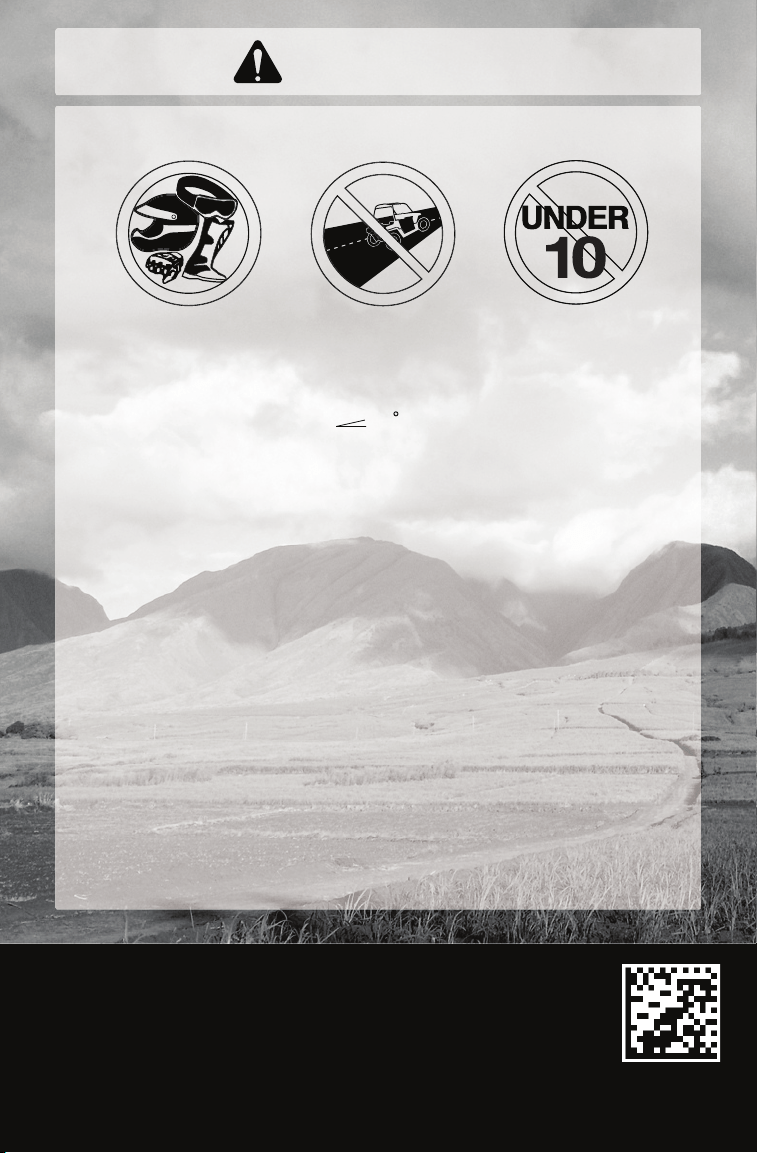
For your nearest Polaris dealer,
call 1-800-POLARIS (765-2747)
or visit www.polaris.com
Polaris Industires Inc.
2100 Highway 55
Medina, MN 55340
Part No. 9940831 Rev 01
Printed in China
Polaris Sales Europe Sarl
Place de l’Industrie 2
1180 Rolle, Switzerland
Improper vehicle use can result in SEVERE INJURY or DEATH.
WARNING
Operation of this vehicle by children under age 10 increases the risk of severe
injury or death. Adult supervision required for children under age 16.
NEVER permit children under age 10 to operate or ride in this vehicle.
NEVER allow vehicle to be operated:
• without all occupants first viewing and understanding safety video
and warning labels.
• with more than one passenger.
• on hills steeper than 15 degrees 15 .
• on paved surfaces - pavement may seriously affect handling and control.
• with non-Polaris approved accessories - they may seriously affect stability.
• at speeds that are too fast for the operator’s skills, the conditions
and/or the terrain.
ALWAYS require operator and passenger to:
• wear seat belts, grab hand holds (passenger) and plant feet firmly on the floor.
• secure cab nets.
• keep hands and feet inside vehicle.
• avoid quick turns of the steering wheel and driving stunts such as jumps,
donuts or power slides.
• reduce speed and use extra caution when carrying a passenger.
• watch for branches or other hazards that could enter vehicle.
ALWAYS USE AN APPROVED HELMET AND PROTECTIVE GEAR
FOR ALL OCCUPANTS.
READ OWNER’S MANUAL. FOLLOW ALL INSTRUCTIONS AND WARNINGS.