OWNER’S
MANUAL
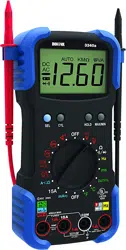
3360
DS200 Channel
Graphing Multimeter
DS200_Technical_Manual_bleed_.indd 1 7/25/2022 4:08:57 PM
2
INTRODUCTION
The DS200 Channel Graphing Multimeter is an automotive industry compact 2 channel bluetooth graphing multimeter connected to a
smart device application that allows for both the initial information to be read and received, but also is opening the gateway into the fu-
ture of data intelligence and interpretation. The meter connected to the smart device application and it can be one of many that can be
connected to the application to provided data for interpretation and analysis to give the user intelligent data; and it is a 2 channel intelli-
gent system; this is the rst set towards data intelligence.
The DS200 Channel Graphing Multimeter (hereafter “The Meter”) is a battery powered multimeter capable of handheld and remote
The Meter meets CAT III IEC 61010-1 3rd edition and 61010-2-030 standards. Overvoltage category III (CAT III) denes a level of
safetyappropriate for the transient overvoltages present in xed equipment installations at the distribution level. This includes the mains
installation of a building, distribution boards, busbars, and permanently connected equipment. Do not use this multimeter for CAT IV
circuits, which includes any mains circuits not protected by a building’s breakers.
PACKAGE CONTENTS
Innova Meter (1)
1.5V AA Alkaline Batteries installed (2)
12A HRC fuse installed (1)
Test Leads (3)
Carrying case (1)
Introduction
DS200_Technical_Manual_bleed_.indd 2 7/25/2022 4:08:57 PM

3
Safety Information
Caution: Risk of Electric Shock. Refer to operating instructions.
Important Information: Refer to operating instructions.
This instrument is rated for installation category III per IEC 61010.
Double Insulation
Terminal protected by fuse. Current limit of 10A RMS.
Conforms to European Union Directives
Do not exceed 600V with respect to ground.
TABLE 1 SYMBOL S
CATIII
SAFETY INFORMATION
WARNING: Denotes a potentially hazardous situation that may result in injury or death
CAUTION: Denotes a potentially hazardous situation that may result in damage to the meter
NOTE: Denotes a situation that may result in degraded or incorrect measurement
Use caution in the operation of this device. Improper use may
result in injury or death. Read this user manual before operating
the meter
Always remove leads before opening the case.
Do not operate the meter unless it is fully assembled with both
case screws tight.
Only use appropriately rated fuses.
Always check for damage before use. Pay special attention to
the test leads for signs of damaged insulation or exposed
conductors. Immediately replace damaged leads.
Only use test leads that are rated to at least CAT III 600V
Keep ngers behind the guards on the leads.
Use caution working with voltages above 30VAC rms, 42VAC
peak, or 60VDC. Voltages this high pose risk of shock.
Never apply more than 600V between any terminal and earth
ground.
Do not apply more than 2.0V to the auxiliary terminal with
respect to Common. Doing so may draw unexpected current
and trigger protection circuits. In this event, basic functionality
will automatically return within one minute. Accuracy may be
adversely aected for up to ve minutes.
Error messages may appear on the user interface. Read these
messages for further information.
DS200_Technical_Manual_bleed_.indd 3 7/25/2022 4:08:57 PM

4
Introduction
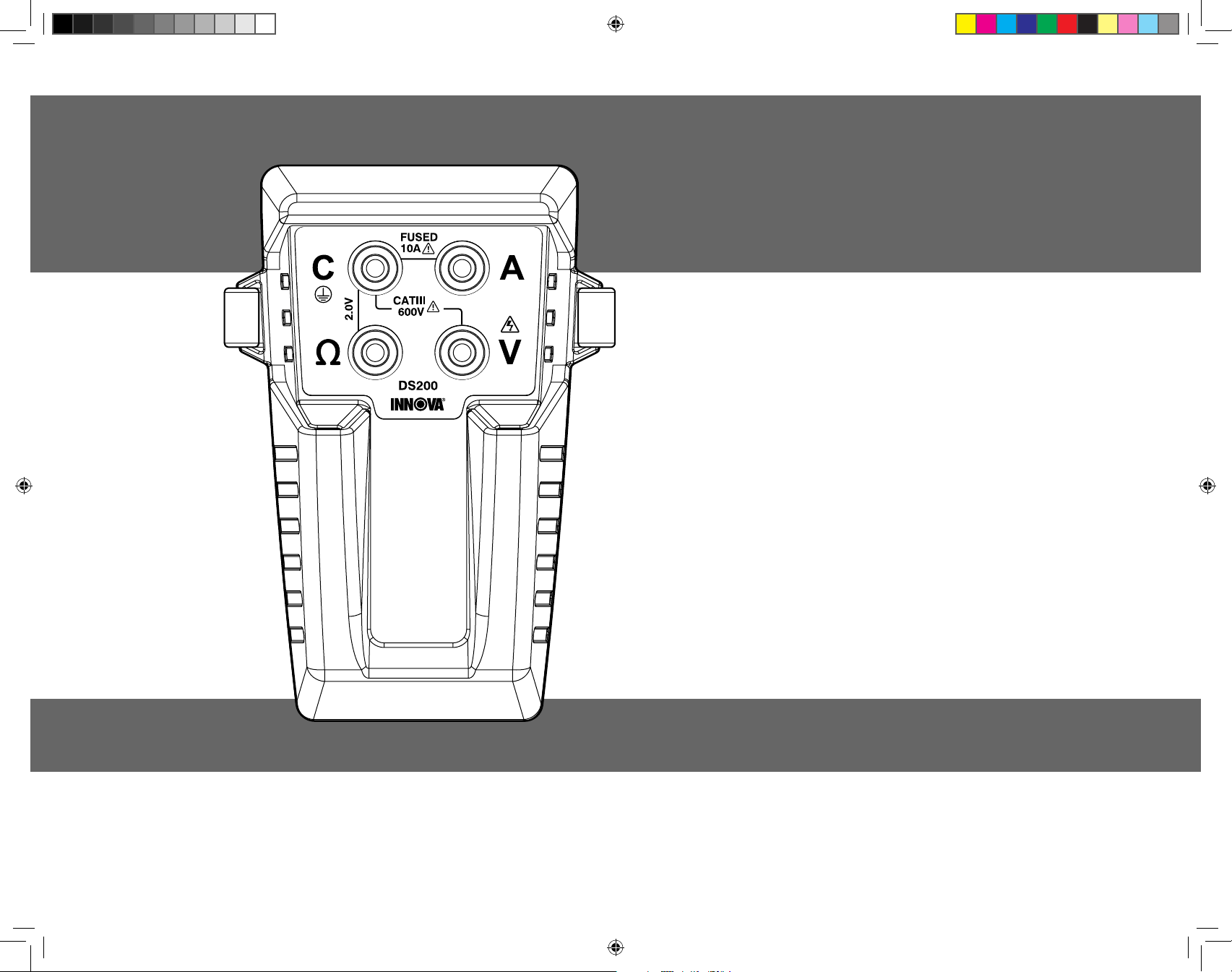
TABLE 2 TERMINAL S
Terminal Description
C Common terminal for all measurements
A Input terminal for measuring currents to 10A RMS (AC and DC)
V Input terminal for measuring voltages to 600V RMS (AC and DC)
Input terminal for measuring resistance, diode drop, and voltages up to 1.2V
DS200_Technical_Manual_bleed_.indd 4 7/25/2022 4:08:57 PM
5
Basic Measurement Instructions
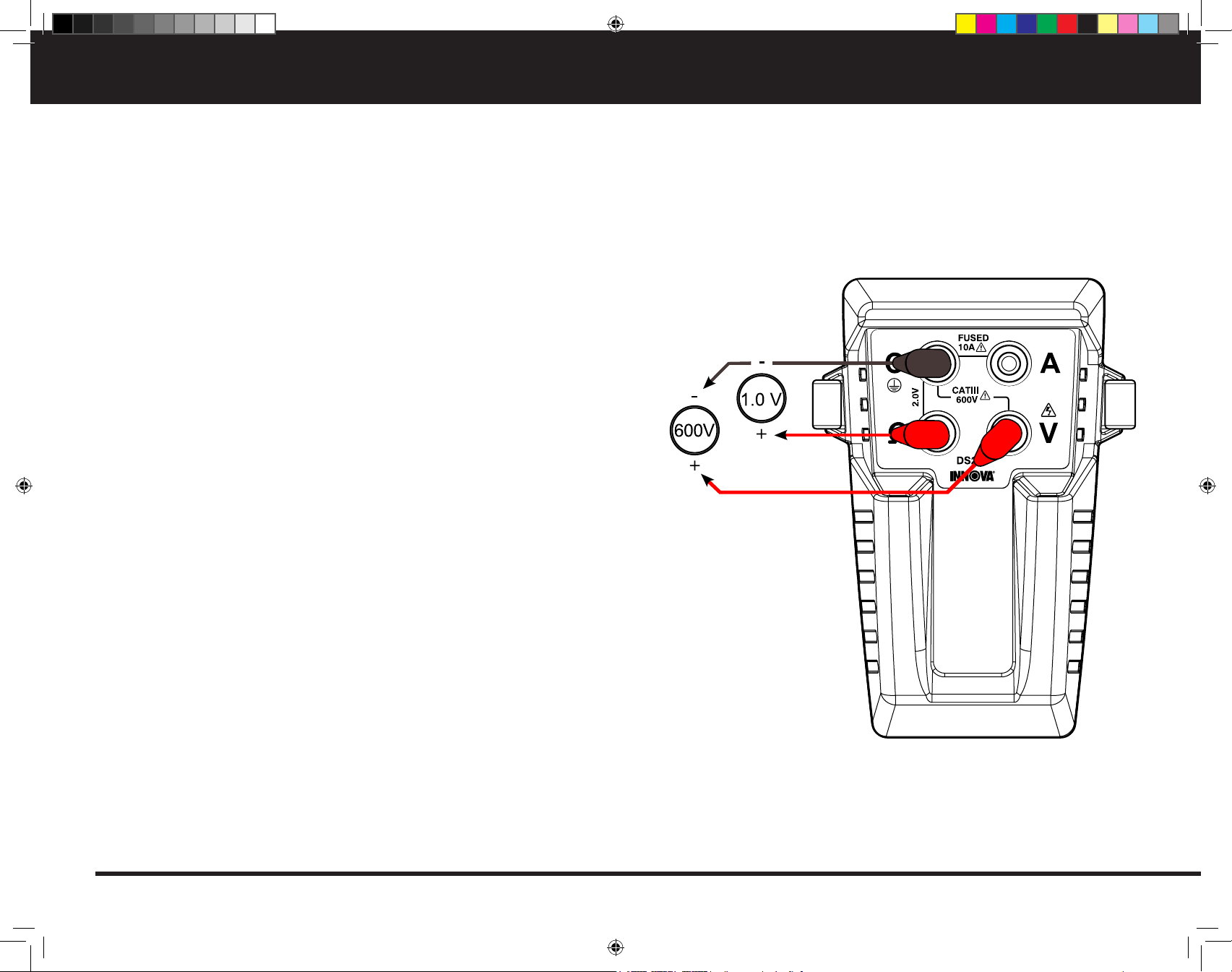
Measuring Voltage
MEASURING VOLTAGE
WARNING: Risk of Electrocution. For determining whether a circuit is “live” exercise caution if the meter does not report a
voltage. This may indicate a poor connection to the circuit being tested. Make sure the probe tips are fully in contact with the
circuit before assuming the circuit is safe.
Two of the DS200 Multimeter’s input terminals are capable of making
basic voltage measurements:
The V terminal can measure up to 600V RMS and is intended for tradi-
tional AC and DC voltage measurements.
The Ω terminal can measure up to 1V peak (~0.7V RMS for pure-sine
AC) and allows for several new measurement techniques described
later in this manual.
See the ratings section for further details on the measurement ranges.
Figure 1: Basic Voltage Measurement
DS200_Technical_Manual_bleed_.indd 5 7/25/2022 4:08:57 PM

6
Basic Measurement Instructions
Measuring Current with Internal Current Shunt
MEASURING CURRENT WITH INTERNAL CURRENT SHUNT
WARNING: Exercise care when connecting in series with a circuit, especially those containing motor(s). Sudden disconnects
may create higher than expected voltages due to inductive kick.
WARNING: Perform a Fuse Check before measuring currents with
the internal current shunt. Exercise caution in determining wheth-
er a circuit is “live” if the meter does not report a current. This
may indicate either a poor connection or a blown fuse.
NOTE: AC current range is limited by the instantaneous current.
Peaks above the listed limits will result in incorrect readings. Der-
ate AC current limits with high crest factors accordingly.
Disconnect power from the circuit to be measured.
Break the circuit and wire the meter in series through the “A” and “C”
terminals.
Positive DC current ows into the “A” terminal.
Figure 2: Basic Current Measurement
DS200_Technical_Manual_bleed_.indd 6 7/25/2022 4:08:57 PM

7
Measuring Current with an External Current Shunt
MEASURING CURRENT WITH INTERNAL CURRENT SHUNT
WARNING: This measurement mode is capable of measuring currents many orders of magnitude larger than is typically pos-
sible with a handheld meter. Exercise caution while interfacing to high ampacity circuits.
NOTE: The accuracy of this measurement mode depends on the
accuracy of the external current shunt used. Account for this ac-
curacy dependency in your measurements.
The Ω terminal can measure small voltages, with a resolution of
as ne as 25nV per count and a noise oor as low as 1µV. This
can be used to with external current shunts to measure currents
over a very wide dynamic range. See the ratings section to guide
shunt size selection.
It is possible to use the existing wiring for the current shunt, and
in doing so take rough current measurements without breaking
the circuit.
With very low voltages it is recommended to minimize the loop
area of the measurement probes by either twisting them
together or using a BNC adaptor.
Figure 3: External Current Shunt
Basic Measurement Instructions
DS200_Technical_Manual_bleed_.indd 7 7/25/2022 4:08:57 PM
8
Basic Measurement Instructions
Measuring Resistance
MEASURING RESISTANCE
NOTE: Do not measure resistance on a live circuit. Doing so will result in incorrect readings and may engage the internal
protection circuitry. Should this occur, wait 5 minutes before taking further measurements.
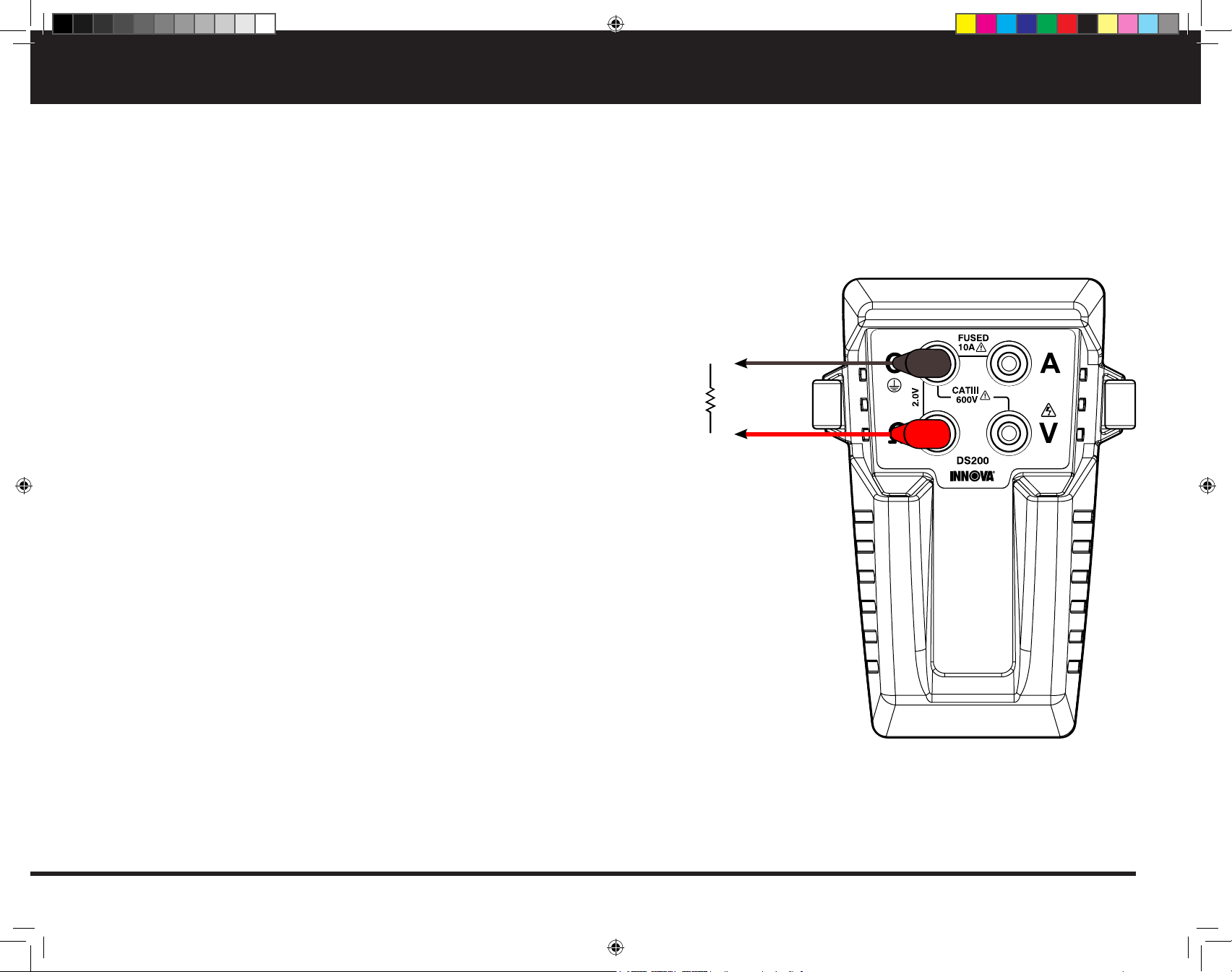
Resistance is measured between the Ω and C terminals. Polarization is
not important.
The meter uses a 100nA test current in its MΩ ranges and a 100uA test
current in its kΩ ranges.
Figure 4: Resistance Measurement
DS200_Technical_Manual_bleed_.indd 8 7/25/2022 4:08:57 PM

9
Diode Testing
DIODE TESTING
NOTE: Do not use the diode test functionality while connected to a live circuit. Doing so will result in incorrect readings and
may engage the internal protection circuitry. Should this occur, wait 5 minutes before taking further measurements.
To test diodes or other silicon junction devices, a test current is pushed
through the device under test and the resulting voltage is measured.
Positive test current ows out of the Ω terminal and into the C terminal.
The test current is 100µA.
Figure 5: Diode Measurement
Basic Measurement Instructions
FWD REV
DS200_Technical_Manual_bleed_.indd 9 7/25/2022 4:08:57 PM
10
Basic Measurement Instructions
Using a BNC Adaptor
USING A BNC ADAPTOR
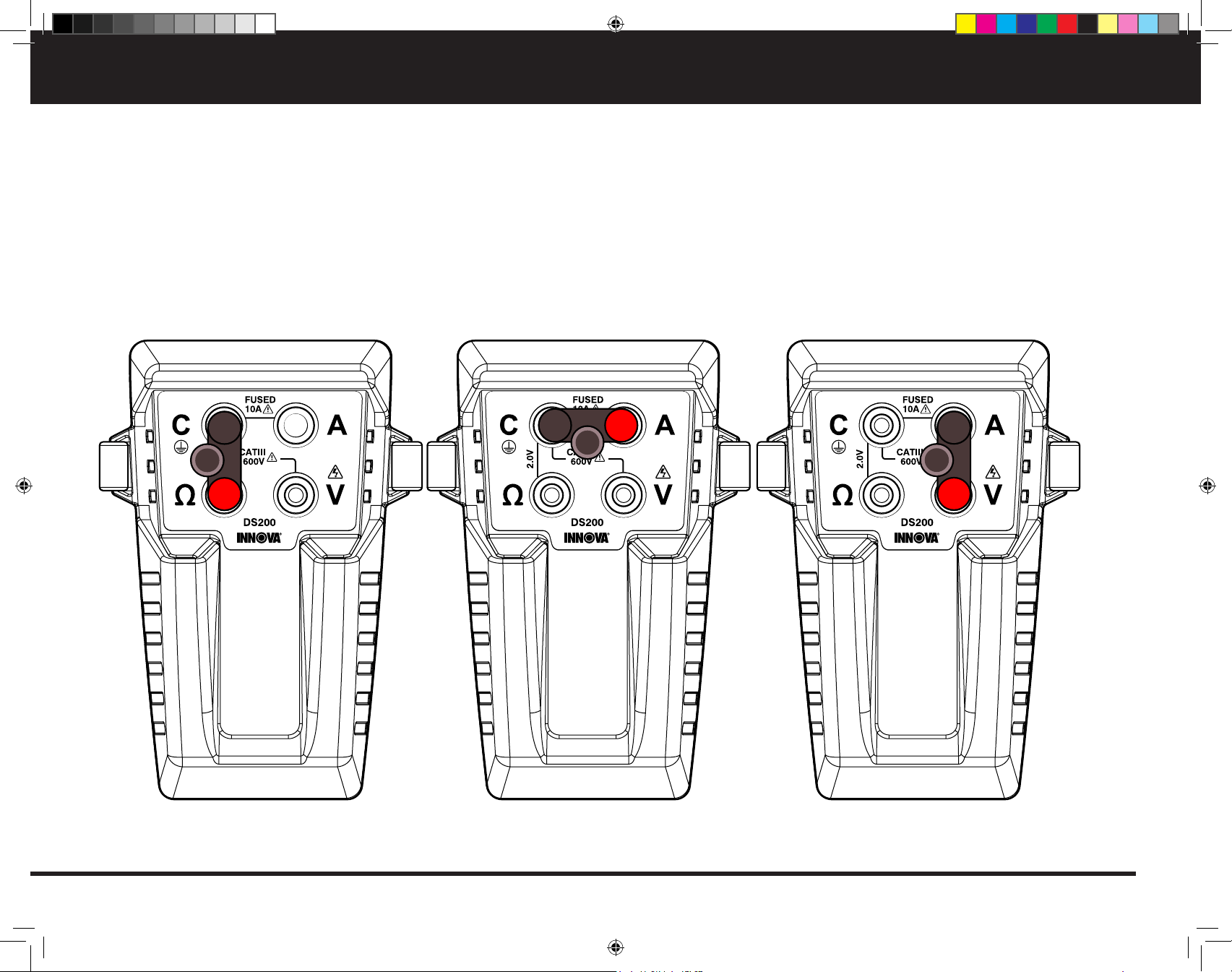
The 4 terminals are arranged with 0.75” spacing to allow for use of a standard BNC adapter. Measurements using the A or Ω terminals
can be used with the C terminal as usual.
To use a BNC adapter with the “V” input, use the “A” terminal as
the common input. The “A” and “C” terminals are internally
connected with a low impedance (<=20mOhms).
Figure 6: BNC Adaptors for Ω, V, A Inputs
DS200_Technical_Manual_bleed_.indd 10 7/25/2022 4:08:57 PM

11
Two Channel Measurements
Measuring Small Resistances/Calibrating a Current Shunt
Your DS200 Multimeter is capable of reading any two of its three channels simultaneously.
NOTE: Measurements using the internal current shunt will experience a degree of cross-talk due to the impedence of the
Common lead. Other measurement types will also experience this cross-talk, but it should be negligible.
MEASURING SMALL RESISTANCES/CALIBRATING A CURRENT
SHUNT
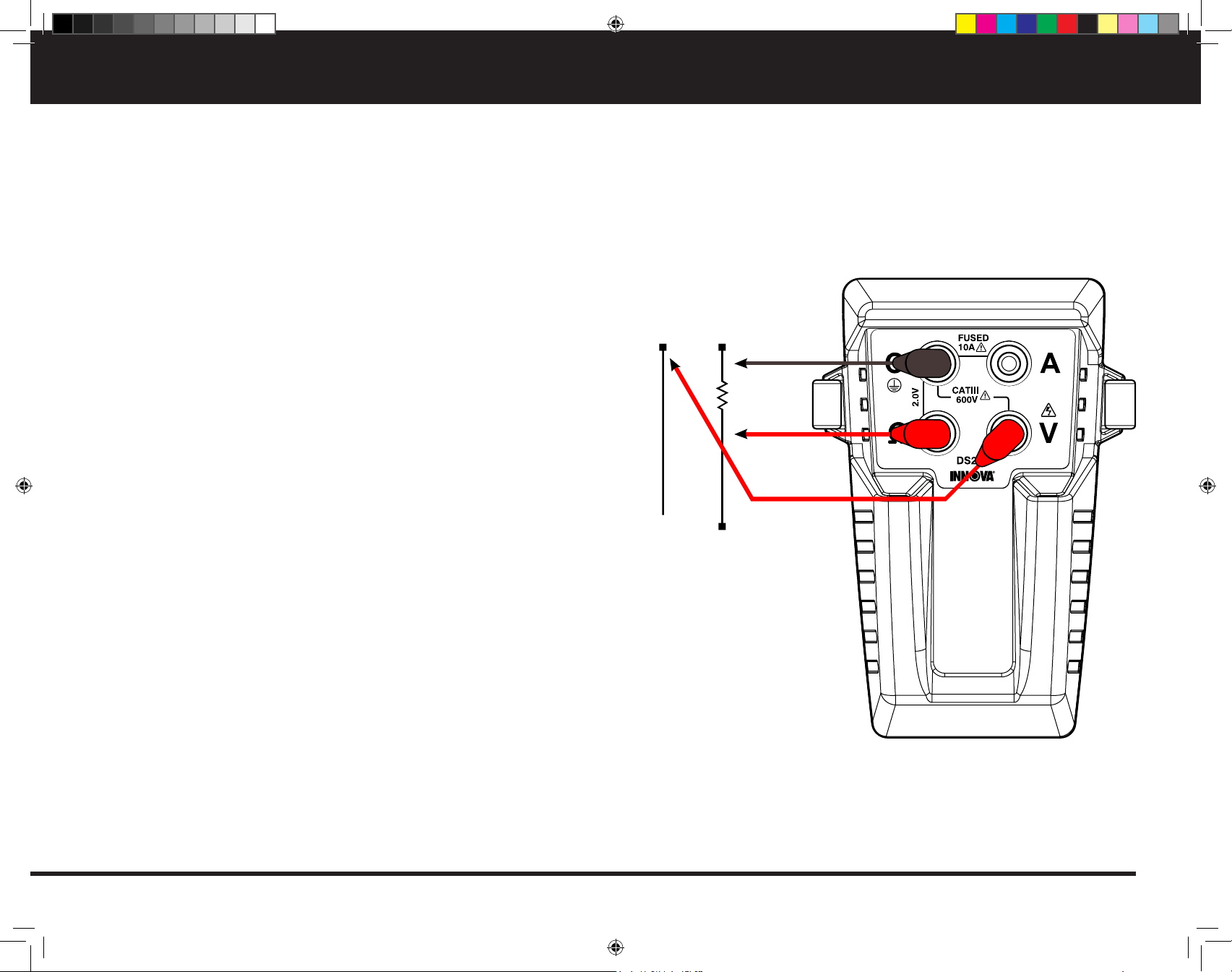
The DS200 Multimeter can be used to measure small resistances in
a live circuit. The meter simultaneously measures the current and the
corresponding voltage with the precision voltage channel (Ω), and then
nds the slope to calculate resistance.
This can be done with either the internal current shunt or an external
current clamp. Using a current clamp allows the measurement to be
done without breaking the circuit and allows for test currents above 10
Amps.
Wire the meter in as shown and enable the measurement mode. Apply
a test current and run the analysis.
The analysis works best with several points along the curve. Therefore,
the optimal test current has a large magnitude and a strong time-vary-
ing component below 1kHz. Often this test current can be the current
already present within the system due to normal operation. For exam-
ple, an AC system’s steady state or a DC systems startup transient
may provide sucient data.
Figure 7: Current Clamp and Current Shunt Comparison
DS200_Technical_Manual_bleed_.indd 11 7/25/2022 4:08:57 PM
12
Two Channel Measurements
Power Factor
POWER FACTOR
Power factor compares apparently power and actual power, and is a measure of how eectively a load uses available power. This
measurement requires voltage and current measurements.
Current measurement can be done with either internal or external
current shunt mode. Power Factor is a “unitless” measure, so the gain
accuracy of the measurements does not aect the measurement accu-
racy. Therefore, the existing wiring can be used as an external current
shunt without calibration.
DS200_Technical_Manual_bleed_.indd 12 7/25/2022 4:08:57 PM

13
Maintenance
Opening Up Your DS200 Multimeter
OPENING UP YOUR DS200 MULTIMETER
WARNING: To avoid electric shock, disconnect test leads from the meter before opening the meter.
1. Disconnect all test leads.
2. Unscrew both retaining screws from the bottom of the case
with a Phillips head screwdriver.
3. Separate the two halves.
4. Taking special care not to bend the circuit board, grasp the
circuit board as shown near the connectors and pull it out of
the top half of the enclosure.
5. Your meter is now fully disassembled. The batteries, fuse
and reset button are now accessible.
DS200_Technical_Manual_bleed_.indd 13 7/25/2022 4:08:57 PM

14
Maintenance
Closing your Innova Multimeter
CLOSING YOUR INNOVA MULTIMETER
WARNING: Risk of electrical shock. Do not operate the meter while partially disassembled.
1. Place the PCB in the bottom enclosure half. Use the “J” shaped n for alignment with the corresponding cut-out in the PCB.
2. Close the two halves together.
3. Replace both screws. Tighten rmly.
DS200_Technical_Manual_bleed_.indd 14 7/25/2022 4:08:57 PM

15
Maintenance
Battery Replacement
BATTERY REPLACEMENT
1. Open the DS200 Multimeter per directions above.
2. Remove old batteries.
3. Observe the battery polarity indication on the circuit board. Insert 2 new AA 1.5V batteries as shown on the circuit board.
4. If you have inserted the batteries with the correct polarity, the Innova Multimeter’s LED will blink slowly several times before
turning o. If the light does not blink, check the battery polarity.
5. Close the Innova Multimeter per directions above.
CLEANING
Gently wipe the assembled meter with a damp cloth.
Do NOT touch or apply cleaning agents to the circuit board.
Do NOT use any solvents or other cleaning agents while cleaning your Innova Multimeter. The outer housing is a polycarbonate based
material, and may be damaged by incompatible cleaners.
DS200_Technical_Manual_bleed_.indd 15 7/25/2022 4:08:57 PM

16
Maintenance
Fuse Test
FUSE TEST
WARNING: Always perform a Fuse Test before using the internal current shunt measurement mode.
1. Perform a resistance measurement with the C and Ω terminals connected
2. If the resistance measured is greater than 0.5Ω, replace the
fuse*
* The resistance mode on the Innova Multimeter is not accurate below
1Ω. The actual resistance of the fuse should be 20mΩ.
FUSE REPLACEMENT
WARNING: Only use appropriately rated replacement fuse.
1. Open the DS200 Multimeter per directions above.
2. Gently remove existing fuse from holder.
3. Replace fuse only with appropriately rated replacement.
4. Recommended model:
Reomax 632.300.12
Size 3AG 12A hold 600V 10kA minimum interrupt
5. Close the Innova Multimeter per directions above.
DS200_Technical_Manual_bleed_.indd 16 7/25/2022 4:08:57 PM

17
Replacing the SD Card
REPLACING THE SD CARD
WARNING: To avoid electric shock, disconnect all leads from the meter.
NOTE; Only use FAT32 formatted SD cards up to 32 gigabytes. Larger SD cards or cards formatted dierently cannot be writ-
ten to.
1. Open the meter per the directions above.
2. Press the SD card further into the slot until you feel a click.
3. Release: The SD card will eject.
4. Remove old SD card and insert new SD card.
5. Push card in with nger until you feel a click.
6. Close the meter per the directions above.
DS200_Technical_Manual_bleed_.indd 17 7/25/2022 4:08:57 PM

18
Resetting Your Innova Multimeter
RESETTING YOUR INNOVA MULTIMETER
WARNING: To avoid electric shock, disconnect all leads from the meter.
1. Open the meter per the directions above.
2. Press and Hold the button shown for 5 seconds.
3. Close the meter per the directions above.
DS200_Technical_Manual_bleed_.indd 18 7/25/2022 4:08:57 PM

19
General Specications
Maximum Voltage between any
terminal and earth ground
600V
Surge Protection 6kV peak per IEC 61010 -1 600V CATIII
Fuse for A input 12A Reomax 632.300.12
Operating Altitude Up to 2000m
Maximum Temperature Range 5C to 40C
Nominal Temperature Range 18C to 28C. Derate accuracy outside of this range
Input Power 3V 100mA from installed batteries
Battery 2x AA Alkaline, NEDA 15A IEC LR6
Battery Life 1 year typical standby
50 hours typical continuous active use
Size
Weight
Safety Compliance EN61010-1:2010 Measurement Category III 600V
EN61010-2-030
Pollution Degree 2
RF Communications 2.4 GHz ISM Band
Bluetooth Low Energy
RF Communication Range Free Space: Up to 50m
Electromagnetic compatibility
FCC Part 15.247 Subpart C
ETSI EN 300-328 V1.7.1
EN 61326-1:2013 per EN 55011:2009 + A1: 2010 / Class A Radiated Emissions
EN 61326-1:2013 / ETSI EN 301-489-1 V1.9.2 / EN 301-489-17 V2.2.1/ Immunity Testing
1.75” x 4.5” x 1.25”
4.3 oz
GENERAL SPECIFICATIONS
Accuracy is specied for 1 year after calibration within 18 to 28C. Accuracies listed are for single-channel measurements only. Multi-
channel measurements may degrade accuracy. For extended specications visit www.Innova.com
All AC ranges are RMS assuming a pure sinusoid (crest factor √ ). Derate ranges linearly with increasing crest factor
DS200_Technical_Manual_bleed_.indd 19 7/25/2022 4:08:57 PM

20
General Specications
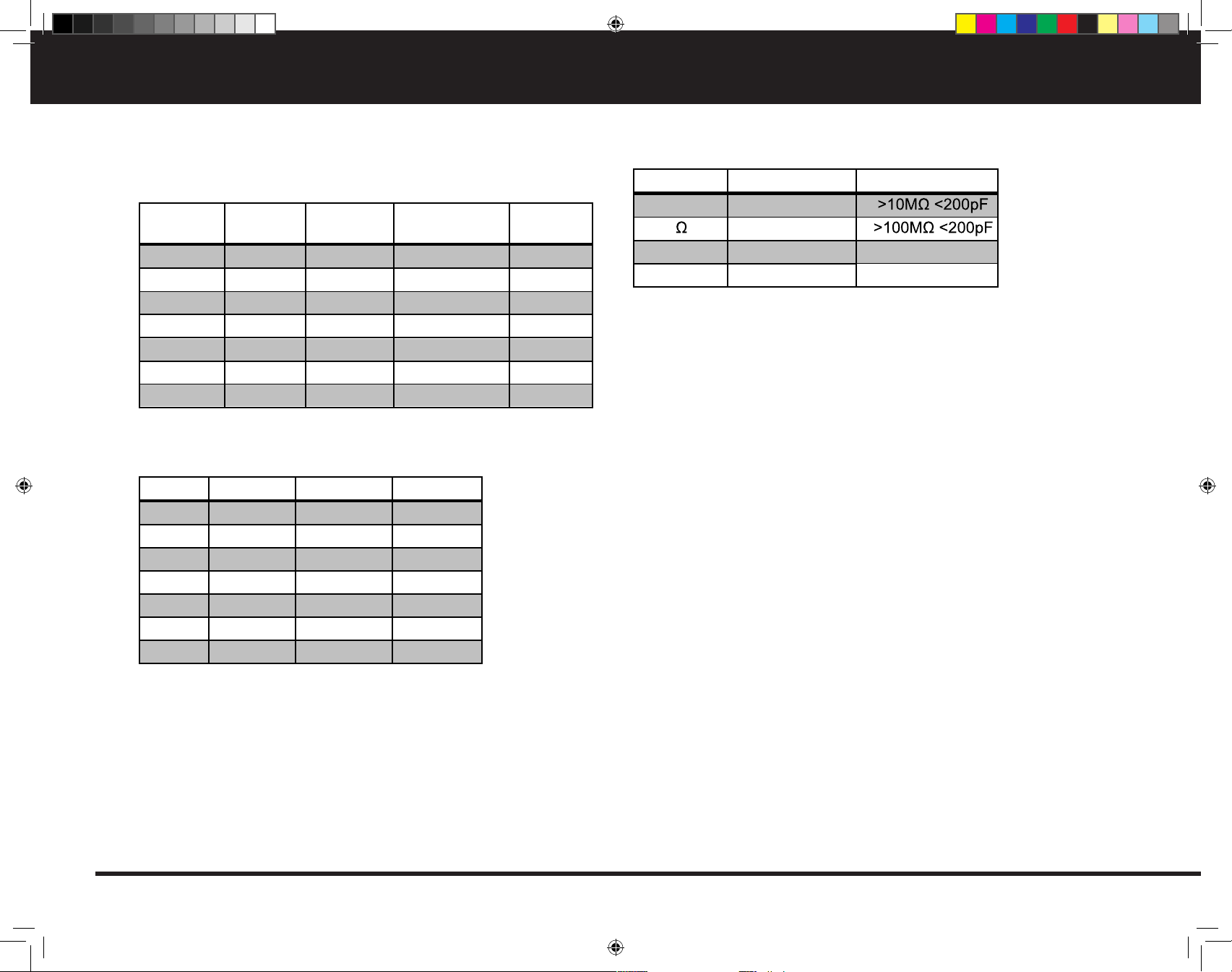
Voltage, Terminal V:
DC Rang
e
AC Rang
e
Resolution Noise Floor Accuracy
(%+counts)
600 V 600 V 275 µV 9 mV 0.5 + 20
600 V 430 V 140 µV 5 mV 0.5 + 20
455 V 320 V 95 µV 3 mV 0.5 + 20
365 V 255 V 70 µV 3 mV 0.5 + 20
260 V 185 V 50 µV 2 mV 0.5 + 20
200 V 140 V 35 µV 1090 µV 0.5 + 20
135 V 95 V 25 µV 730 µV 0.5 + 20
60 V 45 V 20 µV 610 µV 0.5 + 20
40 V 30 V 10 µV 305 µV 0.5 + 20
30 V 22 V 6.4 µV 205 µV 0.5 + 20
25 V 18 V 4.8 µV 155 µV 0.5 + 20
18 V 12 V 3.2 µV 105 µV 0.5 + 20
14 V 10 V 2.4 µV 80 µV 0.5 + 20
9 V 6 V 1.6 µV 55 µV 0.5 + 20
1000 mV 700 mV 300 nV 10 µV 0.5 + 20
670 mV 475 mV 150 nV 5 µV 0.5 + 20
500 mV 350 mV 100 nV 4 µV 0.5 + 20
400 mV 275 mV 75 nV 3 µV 0.5 + 20
280 mV 200 mV 50 nV 2 µV 0.5 + 20
220 mV 150 mV 40 nV 2 µV 0.5 + 20
150 mV 100 mV 25 nV 1 µV 0.5 + 20
Current, Terminal A:
DC Rang
e
AC Rang
e
Resolution Noise Floor Accuracy
(%+counts)
10 A 9 A 3.8 µA 120 µA 0.5 + 50
8.5 A 6 A 1.9 µA 60 µA 0.5 + 50
6 A 4.5 A 1.3 µA 40 µA 0.5 + 50
5 A 3.5 A 1 µA 30 µA 0.5 + 50
3.5 A 2.5 A 0.7 µA 20 µA 0.5 + 50
2.75 A 2 A 0.5 µA 15 µA 0.5 + 50
1.75 A 1.25 A 0.4 µA 10 µA 0.5 + 50
Resistance
Range Resolution Noise Floor Accuracy
(%+counts)
1.0 + 50
1.0 + 50
1.0 + 50
1.0 + 50
1.0 + 50
1.0 + 50
1.0 + 50
1.0 + 50
1.0 + 50
1.0 + 50
1.0 + 50
1.0 + 50
DS200_Technical_Manual_bleed_.indd 20 7/25/2022 4:09:01 PM
21
General Specications
Voltage, Auxiliary Terminal:
DC Rang
e
AC Rang
e
Resolution Noise Floor Accuracy
(%+count)
1000 mV 700 mV 300 nV 10 µV
0.5 + 20
680 mV 475 mV 150 nV 5 µV
0.5 + 20
510 mV 350 mV 100 nV 4 µV
0.5 + 20
400 mV 275 mV 75 nV 3 µV
0.5 + 20
290 mV 200 mV 50 nV 2 µV
0.5 + 20
220 mV 150 mV 40 nV 2 µV
0.5 + 20
150 mV 100 mV 25 nV 1 µV
0.5 + 20
Diode Voltage Drop
Range Resolution Noise Floor Accuracy
2.2 V 300 nV 10 µV 1.0 + 50
1.2 V 150 nV 5 µV 1.0 + 50
825 mV 100 nV 3.5 µV 1.0 + 50
625 mV 75 nV 2.5 µV 1.0 + 50
400 mV 50 nV 1.75 µV 1.0 + 50
300 mV 40 n V 1.25 µV 1.0 + 50
200 mV 25 nV 800 nV 1.0 + 50
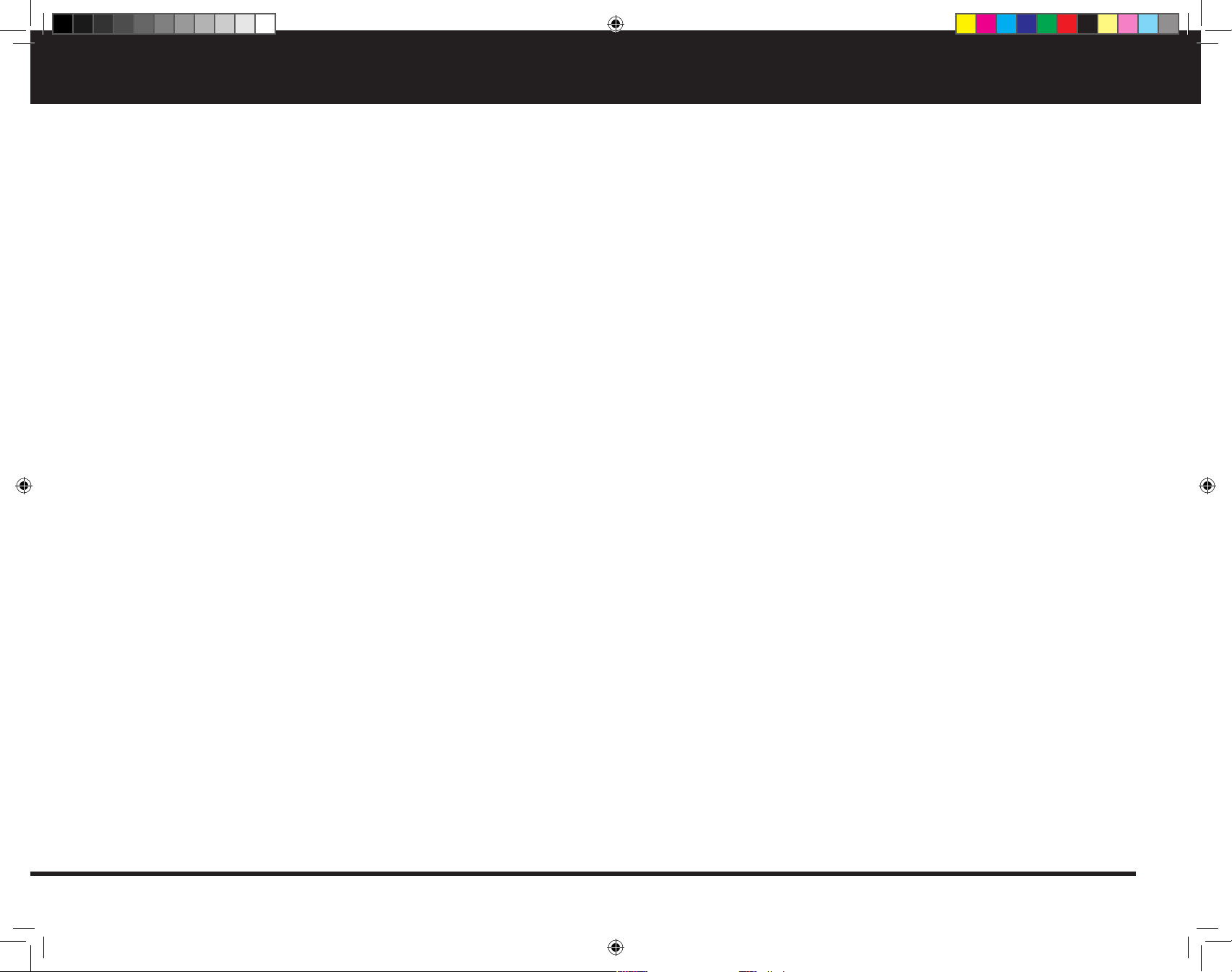
Terminal Surge Protection Input Impedance
V 6kV
800V
Burden Voltage
A 10kA 600V <20µV/mA
DS200_Technical_Manual_bleed_.indd 21 7/25/2022 4:09:01 PM
22
Radio Notices
RADIO NOTICES
FCC Notice (for U.S. Customers):
This device complies with part 15 of the FCC Rules:
Operation is subject to the following conditions:
1. This device many not cause harmful interference, and
2. This device must accept any interference received, Including interference that may cause undesired operation.
Changes and Modications not expressly approved by Innova IEC can void your authority to operate this equipment under Federal
Communications Commissions rules.
This device complies with Industry Canada license-exempt RSS standard(s)
Operation is subject to the following two conditions:
1. This device may not cause interference, and
2. This device must accept any interference, including interference that may cause undesired operation of the device.
Le présent appareil est conforme aux CNR d’Industrie Canada applicables aux appareils radio exempts de licence. L’exploitation est
autorisée aux deux conditions suivantes:
1. l’appareil ne doit pas produire de brouillage, et
2. l’utilisateur de l’appareil doit accepter tout brouillage radioélectrique subi, même si le brouillage est susceptible d’en
compromettre le fonctionnement.
DS200_Technical_Manual_bleed_.indd 22 7/25/2022 4:09:01 PM

Copyright 2021 IEC. All Rights Reserved.
Copyright 2021 IEC.
All Rights Reserved.
MRP# 93-1180
2
Made in Taiwan
DS200_Technical_Manual_bleed_.indd 23 7/25/2022 4:09:02 PM