™
UltraLite
-
mk3 Hybrid
User Guide for Windows
1280 Massachusetts Avenue
Cambridge, MA 02138
Business voice: (617) 576-2760
Business fax: (617) 576-3609
Web site: www.motu.com
Tech support: www.motu.com/support
About the Mark of the Unicorn License Agreement and
Limited Warranty on Software
TO PERSONS WHO PURCHASE OR USE THIS PRODUCT: carefully read all the
terms and conditions of the “click-wrap” license agreement presented to you when
you install the software. Using the software or this documentation indicates your
acceptance of the terms and conditions of that license agreement.
Mark of the Unicorn, Inc. (“MOTU”) owns both this program and its documentation.
Both the program and the documentation are protected under applicable copyright,
trademark, and trade-secret laws. Your right to use the program and the
documentation are limited to the terms and conditions described in the license
agreement.
Reminder of the terms of your license
This summary is not your license agreement, just a reminder of its terms. The actual
license can be read and printed by running the installation program for the software.
That license agreement is a contract, and clicking “Accept” binds you and MOTU to
all its terms and conditions. In the event anything contained in this summary is
incomplete or in conflict with the actual click-wrap license agreement, the terms of the
click-wrap agreement prevail.
YOU MAY: (a) use the enclosed program on a single computer; (b) physically transfer
the program from one computer to another provided that the program is used on only
one computer at a time and that you remove any copies of the program from the
computer from which the program is being transferred; (c) make copies of the
program solely for backup purposes. You must reproduce and include the copyright
notice on a label on any backup copy.
YOU MAY NOT: (a) distribute copies of the program or the documentation to others;
(b) rent, lease or grant sublicenses or other rights to the program; (c) provide use of
the program in a computer service business, network, time-sharing, multiple CPU or
multiple user arrangement without the prior written consent of MOTU; (d) translate,
adapt, reverse engineer, decompile, disassemble, or otherwise alter the program or
related documentation without the prior written consent of MOTU.
MOTU warrants to the original licensee that the disk(s) on which the program is
recorded be free from defects in materials and workmanship under normal use for a
period of ninety (90) days from the date of purchase as evidenced by a copy of your
receipt. If failure of the disk has resulted from accident, abuse or misapplication of the
product, then MOTU shall have no responsibility to replace the disk(s) under this
Limited Warranty.
THIS LIMITED WARRANTY AND RIGHT OF REPLACEMENT IS IN LIEU OF,
AND YOU HEREBY WAIVE, ANY AND ALL OTHER WARRANTIES, BOTH
EXPRESS AND IMPLIED, INCLUDING BUT NOT LIMITED TO WARRANTIES
OF MERCHANTABILITY AND FITNESS FOR A PARTICULAR PURPOSE. THE
LIABILITY OF MOTU PURSUANT TO THIS LIMITED WARRANTY SHALL BE
LIMITED TO THE REPLACEMENT OF THE DEFECTIVE DISK(S), AND IN NO
EVENT SHALL MOTU OR ITS SUPPLIERS, LICENSORS, OR AFFILIATES BE
LIABLE FOR INCIDENTAL OR CONSEQUENTIAL DAMAGES, INCLUDING
BUT NOT LIMITED TO LOSS OF USE, LOSS OF PROFITS, LOSS OF DATA OR
DATA BEING RENDERED INACCURATE, OR LOSSES SUSTAINED BY THIRD
PARTIES EVEN IF MOTU HAS BEEN ADVISED OF THE POSSIBILITY OF
SUCH DAMAGES. THIS WARRANTY GIVES YOU SPECIFIC LEGAL RIGHTS
WHICH MAY VARY FROM STATE TO STATE. SOME STATES DO NOT ALLOW
THE LIMITATION OR EXCLUSION OF LIABILITY FOR CONSEQUENTIAL
DAMAGES, SO THE ABOVE LIMITATION MAY NOT APPLY TO YOU.
Update Policy
In order to be eligible to obtain updates of the program, you must complete and return
the attached Mark of the Unicorn Purchaser Registration Card to MOTU.
Copyright Notice
Copyright © 2010, 2009, 2008, 2007, 2006, 2005 by Mark of the Unicorn, Inc. All
rights reserved. No part of this publication may be reproduced, transmitted,
transcribed, stored in a retrieval system, or translated into any human or computer
language, in any form or by any means whatsoever, without express written
permission of Mark of the Unicorn, Inc., 1280 Massachusetts Avenue, Cambridge,
MA, 02138, U.S.A.
Limited Warranty on Hardware
Mark of the Unicorn, Inc. and S&S Research (“MOTU/S&S”) warrant this equipment
against defects in materials and workmanship for a period of TWO (2) YEARS from
the date of original retail purchase. This warranty applies only to hardware products;
MOTU software is licensed and warranted pursuant to separate written statements.
If you discover a defect, first write or call Mark of the Unicorn at (617) 576-2760 to
obtain a Return Merchandise Authorization Number. No service will be performed on
any product returned without prior authorization. MOTU will, at its option, repair or
replace the product at no charge to you, provided you return it during the warranty
period, with transportation charges prepaid, to Mark of the Unicorn, Inc., 1280
Massachusetts Avenue, MA 02138. You must use the product’s original packing
material for in shipment, and insure the shipment for the value of the product. Please
include your name, address, telephone number, a description of the problem, and
the original, dated bill of sale with the returned unit and print the Return Merchandise
Authorization Number on the outside of the box below the shipping address.
This warranty does not apply if the equipment has been damaged by accident,
abuse, misuse, or misapplication; has been modified without the written permission
of MOTU, or if the product serial number has been removed or defaced.
ALL IMPLIED WARRANTIES, INCLUDING IMPLIED WARRANTIES OF
MERCHANTABILITY AND FITNESS FOR A PARTICULAR PURPOSE, ARE
LIMITED IN DURATION TO TWO (2) YEARS FROM THE DATE OF THE
ORIGINAL RETAIL PURCHASE OF THIS PRODUCT.
THE WARRANTY AND REMEDIES SET FORTH ABOVE ARE EXCLUSIVE
AND IN LIEU OF ALL OTHERS, ORAL OR WRITTEN, EXPRESS OR IMPLIED.
No MOTU/S&S dealer, agent, or employee is authorized to make any modification,
extension, or addition to this warranty.
MOTU/S&S ARE NOT RESPONSIBLE FOR SPECIAL, INCIDENTAL, OR
CONSEQUENTIAL DAMAGES RESULTING FROM ANY BREACH OF
WARRANTY, OR UNDER ANY LEGAL THEORY, INCLUDING LOST PROFITS,
DOWNTIME, GOODWILL, DAMAGE OR REPLACEMENT OF EQUIPMENT
AND PROPERTY AND COST OF RECOVERING REPROGRAMMING, OR
REPRODUCING ANY PROGRAM OR DATA STORED IN OR USED WITH
MOTU/S&S PRODUCTS.
Some states do not allow the exclusion or limitation of implied warranties or liability for
incidental or consequential damages, so the above limitation or exclusion may not
apply to you. This warranty gives you specific legal rights, and you may have other
rights which vary from state to state.
MOTU, Mark of the Unicorn and the unicorn silhouette logo are registered
trademarks of Mark of the Unicorn, Inc.
This equipment has been type tested and found to comply with the limits for a class B digital device,
pursuant to Part 15 of the FCC Rules. These limits are designed to provide reasonable protection
against harmful interference in a residential installation. This equipment generates, uses, and can
radiate radio frequency energy and, if not installed and used in accordance with the instruction manual,
may cause harmful interference to radio communications. However, there is no guarantee that
interference will not occur in a particular installation. If this equipment does cause interference to radio
or television equipment reception, which can be determined by turning the equipment off and on, the
user is encouraged to try to correct the interference by any combination of the following measures:
• Relocate or reorient the receiving antenna
• Increase the separation between the equipment and the receiver
• Plug the equipment into an outlet on a circuit different from that to which the receiver is connected
If necessary, you can consult a dealer or experienced radio/television technician for additional
assistance.
PLEASE NOTE: only equipment certified to comply with Class B (computer input/output devices,
terminals, printers, etc.) should be attached to this equipment, and it must have shielded interface
cables in order to comply with the Class B FCC limits on RF emissions.
WARNING: changes or modifications to this unit not expressly approved by the party
responsible for compliance could void the user's authority to operate the equipment.

III
Contents
5
Quick Reference: UltraLite-mk3 Hybrid Front Panel
6
Quick Reference: UltraLite-mk3 Hybrid Rear Panel
7
Quick Reference: MOTU Audio Console
9
About the UltraLite-mk3 Hybrid
13
Packing List and Windows System Requirements
15
IMPORTANT! Run the UltraLite-mk3 Software Installer First
17
Installing the UltraLite-mk3 Hybrid Hardware
29
MOTU Audio Console
35
UltraLite-mk3 Hybrid Front Panel Operation
43
Cubase, Nuendo, Live and Other ASIO Software
49
SONAR and other WDM Software
55
Reducing Monitoring Latency
61
CueMix FX
103
MOTU SMPTE Console
107
Performance Tips & Troubleshooting

IV
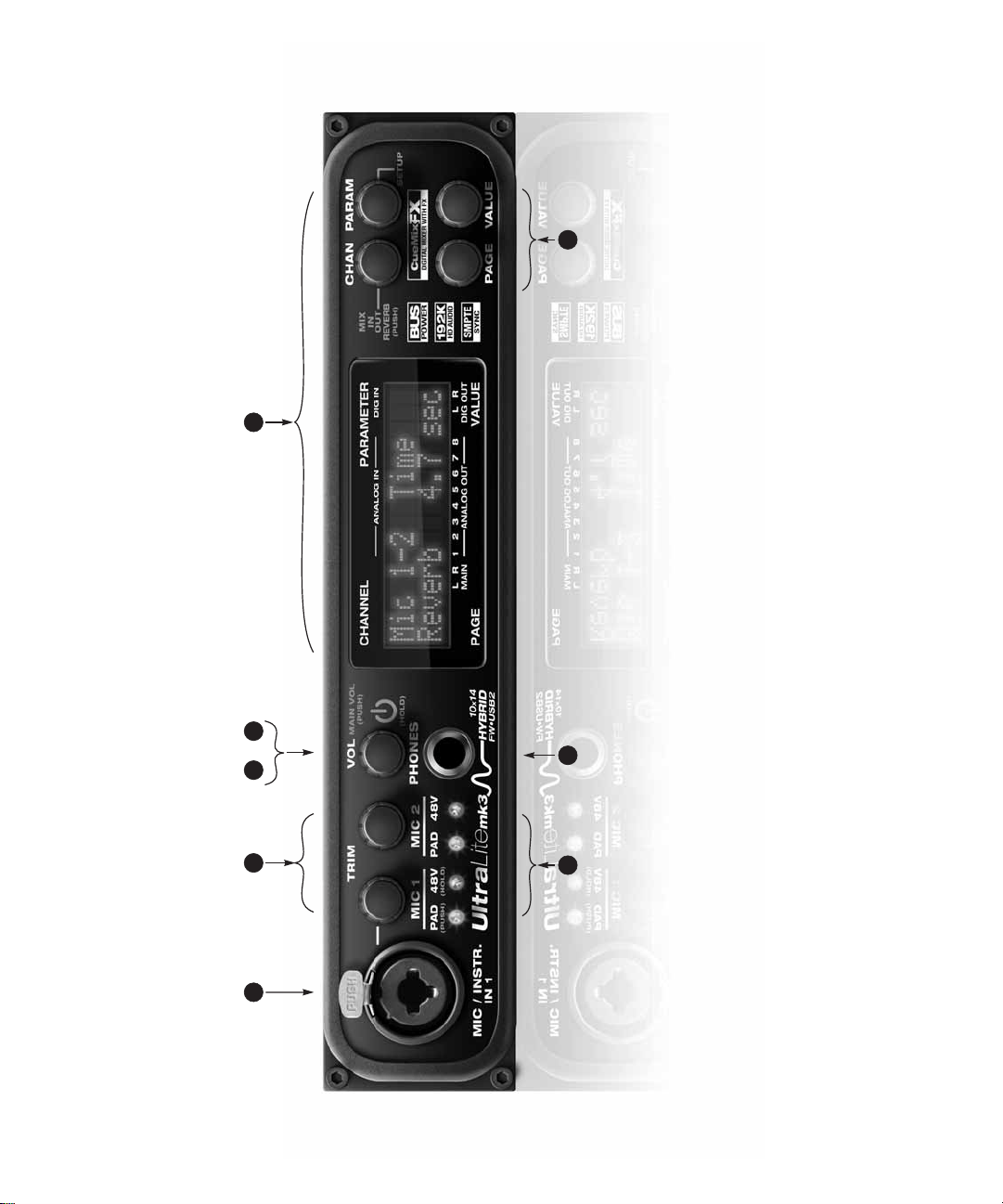
Quick Reference: UltraLite-mk3 Hybrid Front Panel
1. This XLR/TRS combo jack accepts either a mic cable or a
cable with a quarter-inch plug. It is equipped with
approximately +60 dB of boost for the mic (XLR) input
and +32 dB of boost for the instrument (TRS) input.
Separate settings are maintained for the XLR and TRS
inputs for saving with presets. The XLR (mic) input can
also be supplied with 20 dB pad and 48V phantom
power.
2. These two Precision Digital Trim™ rotary encoders
provide +60 dB and +32 dB of boost, respectively, for
the mic (XLR) and instrument (TRS) inputs on the front
and rear panel. Adjustment can be made in approxi-
mately 1 dB increments. Both have preamps, so you can
plug in just about anything: a microphone, a guitar or
even a synth. For +4 dB signals, use the rear panel TRS
inputs. Use the trim knob and input level meter in the
LCD to calibrate the input signal level. For the Mic (XLR)
input, Push the TRIM encoder to toggle a 20 dB pad; push
and hold to toggle 48V phantom power.
3. Turn the VOL knob to control the headphone volume. The
LCD provides visual feedback for the headphone volume
setting as you turn the knob. Push the knob once to view
the current volume setting in the LCD display; push it
again to control the UltraLite-mk3’s MASTER VOLUME
setting. From the factory, MASTER VOLUME controls the
(TRS) MAIN OUTS 1-2 on the rear panel, but MASTER
VOLUME can be programmed to control any combination
of outputs. See “The Monitor Group” on page 84 for
details.
4. When power is off, push the VOL knob to power on the
UltraLite-mk3; press and hold to turn it off. When
connected to the computer via FireWire, the
UltraLite-mk3 is powered by its FireWire connection to
the computer. When connected via USB, it must be
powered with the included DC power adapter.
5. The multi-purpose backlit LCD provides metering for all
of the UltraLite-mk3’s inputs and outputs. It also gives
you access to the UltraLite-mk3’s built-in mixer and
other settings. There are eight independent stereo mix
busses. Each mixes all inputs (or any subset you wish) to
a stereo output of your choice. The four knobs to the right
of the LCD correspond directly to the four labeled
sections of the LCD. Push the PARAMETER knob repeat-
edly to cycle through the three main LCD display modes:
METER, CUEMIX and SETUP.
METER mode provides level meters for each input and
output. The labels above and below the LCD refer to all of
the UltraLite-mk3’s inputs and outputs (both analog and
digital).
CUEMIX mode lets you program the UltraLite-mk3’s on-
board CueMix FX mixer. Use the CHANNEL knob to
choose the input, output or mix you wish to edit. Push it
to switch among inputs, outputs and busses, then turn it
to choose the desired channel or bus. Use the PAGE,
PARAM and VALUE knobs to access the settings for the
chosen channel.
SETUP mode lets you access general settings. Use the
PARAMETER knob to browse settings, and use the VALUE
knob to adjust them.
6. This is a standard quarter-inch stereo headphone jack.
From the factory, its output matches the main outs on
the rear panel. But it can be programmed to mirror any
other output pair (digital or analog). It can even be
programmed to serve as its own independent output.
Use the volume knob above to control its level.
7. Push the TRIM rotary encoder to toggle the 20 dB pad
independently for each mic input. Hold it in momen-
tarily to toggle 48V phantom power independently for
each mic input.
1 2 5
56
3
7
4

1. Connect a MIDI device here using standard MIDI cables.
Connect the UltraLite-mk3’s MIDI OUT port to the MIDI IN
port on the other device. Conversely, connect the
UltraLite-mk3’s MIDI IN port to the MIDI OUT port on the
other device. You can connect different devices to each
port, such as a controller device to the IN port and a
sound module to the OUT port. You can also daisy-chain
MIDI devices, but be sure to manage their MIDI channels
(so that they don’t receive or transmit on the same
channel).
2. These jacks provide stereo, 24-bit S/PDIF digital input
and output at any sample rate up to 96kHz.
3. The UltraLite-mk3’s eight analog outputs are gold-
plated, balanced +4dB TRS (tip/ring/sleeve) quarter-
inch connectors that can also accept an unbalanced plug.
They are equipped with 24-bit, 128x oversampling
converters.
4. This XLR/TRS combo jack accepts either a mic cable or a
cable with a quarter-inch plug. Use the front panel MIC 2
trim encoder to apply up to +60 dB or +32 dB of boost,
respectively, for the mic (XLR) or instrument (TRS) input.
To toggle the 20 dB pad for the mic (XLR) input, push the
front-panel Mic 2 trim encoder. To toggle 48V phantom
power for the XLR (mic) input, push and hold the front-
panel Mic 2 trim encoder.
5. These two balanced, quarter-inch jacks serve as the
UltraLite-mk3’s main outputs. You can connect them to a
set of powered studio monitors and then control the
volume from the front panel volume knob. To hear disk
tracks in your audio software on these main outs, assign
the disk tracks (and master fader) to these main outs
(
Main Out 1-2
). You can also use CueMix FX to monitor
live UltraLite-mk3 inputs here as well.
6. Equipped with 24-bit 192 kHz converters, these six
analog inputs (3 through 8) are gold-plated, balanced
TRS (tip/ring/sleeve) quarter-inch connectors that can
also accept an unbalanced plug. They do not have micro-
phone preamps, so they are best used for synthesizers,
drum machines, effects processors, and other instru-
ments with line level signals (either -10 dB or +4 dB).
These inputs are also equipped with the UltraLite-mk3’s
Precision Digital Trim™ feature: digitally controlled
analog trims that let you adjust input level in 1 dB incre-
ments from either front panel LCD or the included
CueMix FX software. The trim can be adjusted over a
range of -96 to +22 dB.
7. Connect the UltraLite-mk3 to the computer here via
either FireWire or USB2, using either the standard 1394
FireWire A or USB cable provided with your
UltraLite-mk3. There’s not much difference, except that
FireWire offers bus-powered operation (without the DC
power supply).
Important note: it is best to turn off
the UltraLite-mk3 when plugging in the FireWire
cable, as this avoids the possibility of static
discharge, which can harm the electrical compo-
nents in the UltraLite-mk3 or your computer
.
8. This jack accepts any standard 10-24V DC power supply
with either tip-positive or tip-negative polarity.
Quick Reference: UltraLite-mk3 Hybrid Rear Panel
1 2 3
8
4
57 6
CHAPTER
7
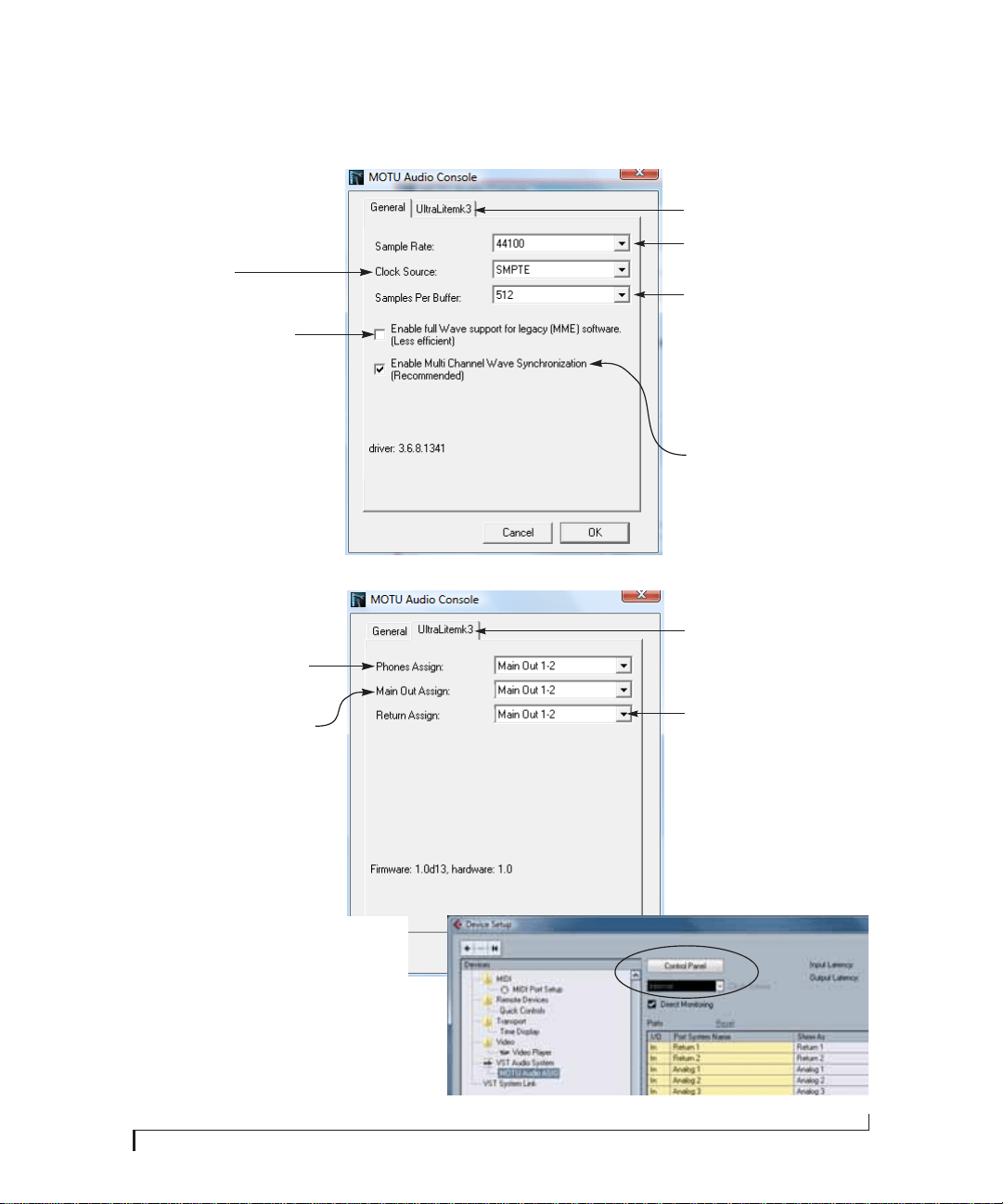
Quick Reference: MOTU Audio Console
Device Setup in Cubase
Determines the clock source for your
UltraLite-mk3. If you’re just using the
analog ins and outs, set this to
Internal.
The other settings are for digital transfers
via S/PDIF or synchronization to time code
or other audio devices.
Choose the output pair you would like the
main outs to mirror, or choose
Main Outs
to
operate them as their own independent pair.
This menu lets you choose what you will
hear from the PHONES jack. To mirror the
main outs, choose
Main Out 1-2
. Or you can
mirror any other output pair. To hear the
phones as their own independent output,
choose
Phones 1-2.
Check this option if the audio software
you are using with the UltraLite-mk3
does not support Windows WDM drivers
and instead only supports legacy MME
(Wave) drivers. When checked, this
option makes all of the UltraLite-mk3
inputs and outputs available to legacy
Wave-driver compatible audio software.
Choose the global sample rate
for the system here.
Click the tabs to access general MOTU
interface settings or settings specific
to the UltraLite-mk3 (or other
connected interface).
Choosing a smaller setting here reduces
the delay you may hear when listening to
live input that you are running through
effects plug-ins in your software. But
lower settings also increase the strain on
your computer. For details, see “Samples
Per Buffer” on page 31.
Click the UltraLite-mk3 tab
to access these settings.
This option should always be left on
(checked). There are only a few rare cases
in which you would want to turn it off. For
details, refer to the MOTU tech support
database at www.motu.com.
How to access these settings
There are several ways to access these settings:
■
From the Windows Start menu, choose
Programs>MOTU>MOTU Audio Console
.
■
From within Cubase, go to the Device Setup
window, click the MOTU Audio ASIO list item and
and click the
Control Panel
button.
■
From within other applications, refer to their
documentation.
The UltraLite-mk3 driver provides a stereo
return back to the computer. This return
feeds the signal on any UltraLite-mk3
output pair directly back to the computer,
where you can record, process, monitor or
otherwise use it. This is a great way to
“bounce” full mixes, complete with live
audio routed through the UltraLite-mk3
only, back into the computer.

8

CHAPTER
9
1
About the UltraLite-mk3 Hybrid
Overview . . . . . . . . . . . . . . . . . . . . . . . . . . . . . . . . . . . . . . . . . . . . . .9
The UltraLite-mk3 Rear Panel. . . . . . . . . . . . . . . . . . . . . . . . 10
The UltraLite-mk3 Front Panel . . . . . . . . . . . . . . . . . . . . . . . 11
16-bit and 24-bit recording . . . . . . . . . . . . . . . . . . . . . . . . . . 12
CueMix FX 32-bit floating point mixing and effects. . 12
Host Audio Software. . . . . . . . . . . . . . . . . . . . . . . . . . . . . . . . . 12
OVERVIEW
The UltraLite-mk3 is a hybrid FireWire USB2
audio interface for Mac and Windows with on-
board effects and mixing that offers 10 inputs and
14 outputs. Both analog and digital I/O are offered
at sample rates up to 96 kHz, and analog recording
and playback is offered at rates up to 192 kHz. All
inputs and outputs can be accessed simultaneously.
The UltraLite-mk3 is housed in a sturdy, compact
half-rack enclosure that connects directly to a
computer via a standard FireWire or USB cable.
The UltraLite-mk3 offers the following main
features:
■
Universal computer connectivity via FireWire or
high-speed USB2
■
Bus-powered operation (FireWire only)
■
Six 24-bit analog quarter-inch (TRS) inputs
■
Ten 24-bit analog quarter-inch (TRS) outputs
■
Two combo XLR/TRS mic/guitar inputs with
preamps, 48V phantom power, 20 dB pad, and
Precision Digital Trim™ preamp gain adjustment
■
Operation on all analog I/O at standard sample
rates up to 192 kHz
■
Digitally controlled analog trim for all analog
inputs
■
RCA S/PDIF digital I/O at sample rates up to
96 kHz
■
MIDI I/O
■
On-board SMPTE synchronization
■
Headphone jack with volume control
■
Front panel volume control of the Main Outs (or
any programmable combination of outputs)
■
CueMix™ FX no-latency mixing, monitoring,
and effects processing
■
Classic Reverb™ with five different room types,
three frequency shelves with adjustable crossover
points, shelf filtering and reverb lengths up to 60
seconds.
■
Two forms of compression, including a standard
compressor with conventional threshold/ratio/
attack/release/gain controls and the Leveler™, an
accurate model of the legendary LA-2A optical
compressor, which provides vintage, musical
automatic gain control.
■
7-band parametric EQ modeled after British
analog console EQs, featuring 4 filter styles (gain/Q
profiles) to effectively cover a wide range of audio
material. LP and HP filters are also supplied with
slopes that range from 6 to 36 dB.
■
Front-panel LCD programming for the mixer
and all other settings
■
Extensive front panel metering and status LEDs
■
Stand-alone operation
■
Mac and Windows drivers for multi-channel
operation and across-the-board compatibility with
any audio software on current Mac and Windows
systems
■
CueMix FX cross-platform mixing software with
attractive graphic mixing, graphic editing of
parametric EQ and a convenient tabbed interface

ABOUT THE ULTRALITE-MK3 HYBRID
10
for quick access to all features in one window. Also
provides full-screen real-time FFT display,
spectrogram “waterfall” display, oscilloscope, X-Y
plot and linear or polar phase analysis.
With a variety of I/O formats, mic preamps and
no-latency mixing and processing of live input, the
UltraLite-mk3 is a complete, portable “studio in a
box” when used with a Mac or Windows computer.
THE ULTRALITE-MK3 REAR PANEL
The rear panel has the following connectors:
■
Ten gold-plated, balanced +4dB quarter-inch
(TRS) analog outputs (with 24-bit 192 kHz
converters)
■
Six gold-plated, balanced quarter-inch (TRS)
analog inputs (with 24-bit 192 kHz converters)
■
One combo XLR/TRS mic/instrument input
■
RCA S/PDIF in/out
■
MIDI IN and MIDI OUT jacks
■
One 1394 FireWire A connector
■ One high-speed USB2 connector
■ DC power jack
10 inputs and 14 outputs
All UltraLite-mk3 inputs and outputs can be used
simultaneously, for a total of 10 inputs and 14
outputs when operating at sample rates up to
96 kHz:
All inputs and outputs are discrete and can be
active simultaneously.
The headphone outputs can operate as an
independent output pair, or they can mirror any
other UltraLite-mk3 output pair, such as the main
outs.
Mic/guitar inputs with preamps
The two mic/instrument inputs (front panel and
rear panel) are equipped with preamps and
“combo” XLR/TRS jacks, which accept XLR
microphone inputs or quarter-inch guitar/
instruments inputs. Individual 48 volt phantom
power and a 20 dB pad can be supplied
independently to each mic input. The Precision
Digital Trim™ knobs on the front panel for each
mic/instrument input provide 60 dB of boost for
the XLR mic input and 32 dB of boost for the TRS
instrument input in precise 1 dB increments.
Analog
All six quarter-inch analog inputs are equipped
with 24-bit 192 kHz A/D converters. All eight
analog outputs have 24-bit 192 kHz D/A
converters. All audio is carried to the computer in a
24-bit data stream.
All ten analog outputs and six quarter-inch analog
inputs are on balanced TRS +4dB quarter-inch
jacks. All of these jacks can also accept unbalanced
plugs.
Precision Digital Trim™
All of the UltraLite-mk3’s analog inputs are
equipped with digitally controlled analog trims
that allow adjustments in 1 dB increments. The
mic/guitar input trims can be adjusted using front-
panel digital rotary encoders that provide feedback
in the front panel LCD with 60 dB of adjustment
for the mic input and 32 dB for the TRS input. All
analog inputs, including six rear-panel TRS analog
inputs, can be trimmed using the front panel LCD
or using the UltraLite-mk3’s included CueMix FX
Connection Input Output
Analog 24-bit 192 kHz on bal/unbal TRS 6 10
Mic preamps 24-bit 192 kHz on XLR/TRS
combo
2-
SPDIF 24-bit 96kHz digital 2 2
Headphone output - 2
Total 10 14

ABOUT THE ULTRALITE-MK3 HYBRID
11
control software for Mac and Windows. This allows
you to fine-tune trim settings for synths, effects
modules and a wide variety of analog inputs for
optimum levels. Different trim configurations can
then be saved as files on disk for instant recall.
S/PDIF
The UltraLite-mk3 rear panel provides RCA “coax”
S/PDIF input and output.
MIDI I/O
The UltraLite-mk3’s standard MIDI IN and MIDI
OUT jacks supply 16 channels of MIDI I/O to and
from the computer via the UltraLite-mk3’s
FireWire connection.
On-board SMPTE synchronization
The UltraLite-mk3 can resolve directly to SMPTE
time code via any analog input, without a separate
synchronizer. It can also generate time code via any
analog output. The UltraLite-mk3 provides a
DSP-driven phase-lock engine with sophisticated
filtering that provides fast lockup times and sub-
frame accuracy.
The included MOTU SMPTE Console™ software
provides a complete set of tools for generating and
regenerating SMPTE time code, which allows you
to slave other devices to the computer. Like
CueMix FX, the synchronization features are
cross-platform and compatible with any audio
sequencer software that supports the ASIO2
sample-accurate sync protocol.
Hybrid FireWire/USB2 connectivity
FireWire has long been recognized as a reliable,
high-performance connectivity standard for
professional MOTU audio interfaces. Meanwhile,
hi-speed USB2 has also developed into a widely
adopted standard for connecting peripheral
devices to personal computers.
To fully support both formats, your UltraLite-mk3
Hybrid audio interface is equipped with both a
FireWire A (400 Mbit/sec) connector and a hi-
speed USB2 (480 Mbit/sec) connector, and you can
use either port to connect the UltraLite-mk3 to
your computer. This gives you maximum flexibility
and compatibility with today’s ever-expanding
universe of Mac and Windows computers.
The UltraLite-mk3 has the ability to power itself
from its FireWire connection to the computer, for
convenient, mobile bus-powered operation.
Power supply
If you do not want the UltraLite-mk3 to draw
power from the computer, and AC power is
available, you can power the UltraLite-mk3 from
any standard 10-18V, 12 watt DC power supply
with any polarity (tip positive or negative).
THE ULTRALITE-MK3 FRONT PANEL
Mic/instrument input
See “Mic/guitar inputs with preamps” on page 10.
48V phantom power and pad
See “Mic/guitar inputs with preamps” on page 10.
Headphone output and main volume control
The UltraLite-mk3 front panel provides a quarter-
inch stereo headphone output jack and volume
knob. The LCD display provides feedback as you
turn the knob. The VOL knob can be used to
control the volume of the main out jacks on the rear
panel. It can alternately be configured to control
any combination of outputs.
Programmable backlit LCD display
Any UltraLite-mk3 setting, including the powerful
CueMix FX on-board 16-bus mixer with effects,
can be accessed directly from the front panel using
the four rotary encoders and the 2x16 backlit LCD
display.

ABOUT THE ULTRALITE-MK3 HYBRID
12
The LCD also provides activity metering for all
UltraLite-mk3 inputs and outputs.
16-BIT AND 24-BIT RECORDING
The UltraLite-mk3 system handles all data with a
24-bit signal path, regardless of the I/O format. You
can record and play back 16-bit or 24-bit audio files
at any supported sample rate via any of the
UltraLite-mk3’s analog or digital inputs and
outputs. 24-bit audio files can be recorded with any
compatible host application that supports 24-bit
recording.
CUEMIX FX 32-BIT FLOATING POINT
MIXING AND EFFECTS
All UltraLite-mk3 inputs and outputs can be
routed to the on-board CueMix FX 16-bus (8
stereo) digital mixer driven by hardware-based
DSP with 32-bit floating point precision. The
mixer allows you to apply no-latency effects
processing to inputs, outputs or busses directly in
the UltraLite-mk3 hardware, independent of the
computer. Effects can even be applied when the
UltraLite-mk3 is operating stand-alone (without a
computer) as a complete portable mixer. Input
signals to the computer can be recorded wet, dry,
or dry with a wet monitor mix (for musicians
during recording, for example).
Effects include reverb, parametric EQ and
compression/limiting. The UltraLite-mk3’s Classic
Reverb™ provides five different room types, three
frequency bands with adjustable crossover points,
shelf filtering and reverb lengths up to 60-seconds.
Two forms of compression are supplied: a standard
compressor with conventional threshold/ratio/
attack/release/gain controls and the Leveler™, an
accurate model of the legendary LA-2A optical
compressor, which provides vintage, musical
automatic gain control.
CueMix FX also provides 7-band parametric EQ
modeled after British analog console EQs,
featuring 4 filter styles (gain/Q profiles) to
effectively cover a wide range of audio material.
Low-pass and high-pass filters are also supplied
with slopes that range from 6 to 36 dB. The EQ
employs extremely high precision 64-bit floating
point processing.
The UltraLite-mk3’s flexible effects architecture
allows you to apply EQ and compression on every
input and output (a total of 24 channels), with
enough DSP resources for at least one band of
parametric EQ and compression on every channel
at 48 kHz. However, DSP resources are allocated
dynamically and a DSP meter in the CueMix FX
software (included) allows you to keep tabs on the
UltraLite-mk3’s processing resources. Each input,
output and mix bus provides a send to the Classic
Reverb processor, which then feeds reverb returns
to mix busses and outputs, with a selectable split
point between them to prevent send/return
feedback loops.
HOST AUDIO SOFTWARE
The UltraLite-mk3 system ships with standard
Windows drivers that allow you to record, edit,
play back and mix your UltraLite-mk3 projects
using your favorite Windows audio software.

CHAPTER
13
2 Packing List and Windows System
Requirements
PACKING LIST
The UltraLite-mk3 ships with the items listed
below. If any of these items are not present in your
UltraLite-mk3 box when you first open it, please
immediately contact your dealer or MOTU.
■ One UltraLite-mk3 I/O rack unit
■ One 6-pin to 6-pin IEEE 1394 “FireWire” cable
■ One USB cable
■ One set of removable rack ears
■ One UltraLite-mk3 Mac/Windows manual
■ One AudioDesk Manual
■ One cross-platform CD-ROM
■ Product registration card
WINDOWS SYSTEM REQUIREMENTS
The UltraLite-mk3 system requires the following
Windows system:
■ A 1 GHz Pentium-based PC compatible or faster
equipped with at least one FireWire port
■ A Pentium III processor or faster is
recommended
■ At least 256 MB (megabytes) of RAM (512 MB
or more is recommended)
■ Windows XP or Vista
■ A large hard drive (preferably at least 250 GB)
PLEASE REGISTER TODAY!
Please register your UltraLite-mk3 today. There are
two ways to register.
■ Visit www.motu.com/registration to register on
line
OR
■ Fill out and mail the included product
registration card
As a registered user, you will be eligible to receive
technical support and announcements about
product enhancements as soon as they become
available. Only registered users receive these
special update notices, so please register today!
Thank you for taking the time to register your new
MOTU products!

PACKING LIST AND WINDOWS SYSTEM REQUIREMENTS
14

CHAPTER
15
3 IMPORTANT! Run the UltraLite-mk3
Software Installer First
OVERVIEW
Install the UltraLite-mk3 software first! . . . . . . . . . . . . . . 15
Installing the UltraLite-mk3 software . . . . . . . . . . . . . . . . 15
MOTU Audio Console . . . . . . . . . . . . . . . . . . . . . . . . . . . . . . . . 16
ASIO MOTU Audio Driver . . . . . . . . . . . . . . . . . . . . . . . . . . . . 16
The MOTU Audio WDM driver . . . . . . . . . . . . . . . . . . . . . . . 16
MOTU GSIF FireWire driver . . . . . . . . . . . . . . . . . . . . . . . . . . 16
MOTU MIDI Driver . . . . . . . . . . . . . . . . . . . . . . . . . . . . . . . . . . . 16
CueMix FX . . . . . . . . . . . . . . . . . . . . . . . . . . . . . . . . . . . . . . . . . . . 16
MOTU SMPTE Console . . . . . . . . . . . . . . . . . . . . . . . . . . . . . . . 16
INSTALL THE ULTRALITE-MK3 SOFTWARE
FIRST!
Before you connect the UltraLite-mk3 audio
interface to your computer and turn it on, insert
the UltraLite-mk3 software CD and run the
UltraLite-mk3 Software Installer. This ensures that
all the UltraLite-mk3 components are properly
installed in your system.
If Windows asks you to locate the drivers
If you’ve already connected the UltraLite-mk3 to
your computer and switched it on, Windows
probably issued an alert notifying you that the
UltraLite-mk3 requires drivers, followed by
another window asking you to locate the drivers on
disk. If this happens:
1 Cancel the driver search.
2 Switch off the UltraLite-mk3.
3 Run the UltraLite-mk3 Software Installer as
instructed in the next section.
INSTALLING THE ULTRALITE-MK3
SOFTWARE
To install the UltraLite-mk3 software, insert the
MOTU Universal Audio Installer CD and follow
the directions it gives you on your computer
screen. The UltraLite-mk3 ships with the following
software and drivers for Windows XP and Vista:
Software
component Purpose
MOTU Audio
Console
Provides access to all of the settings in the
UltraLite-mk3 hardware.
CueMix FX Gives you complete control over the
896mk3’s CueMix FX on-board mixer,
which provides no-latency monitoring,
mixing and processing of live inputs
through your UltraLite-mk3.
MOTU ASIO
Driver
Allows Cubase or other ASIO-compliant
software to do multi-channel input and
output with the UltraLite-mk3. Only
required if you are using Cubase or
another ASIO-dependent program.
MOTU WDM
Driver
Allows any WDM-driver compatible
audio software to do multichannel input
and output with the UltraLite-mk3.
MOTU GSIF Driver Allows you to use your UltraLite-mk3
with Tascam GigaStudio.
MOTU MIDI
Driver
Provides MIDI input and output via the
UltraLite-mk3 MIDI ports.

IMPORTANT! RUN THE ULTRALITE-MK3 SOFTWARE INSTALLER FIRST
16
MOTU AUDIO CONSOLE
MOTU Audio Console (available in the Start
menu) gives you access to all of the settings in the
UltraLite-mk3, such as the clock source and
sample rate. For complete details, see chapter 10,
“CueMix FX” (page 61).
Figure 3-1: MOTU Audio Console gives you access to all of the settings
in the UltraLite-mk3 hardware.
ASIO MOTU AUDIO DRIVER
ASIO stands for Audio Streaming Input and Output.
The ASIO MOTU FireWire driver allows the
UltraLite-mk3 to provide multi-channel input and
output for Steinberg’s Cubase and Nuendo
software, or any other audio application that
supports ASIO drivers.
The MOTU ASIO audio driver is only required if
you are using Cubase (or another audio program
that relies on the ASIO driver to support multi-
channel I/O with the UltraLite-mk3).
The MOTU ASIO audio driver is installed by the
UltraLite-mk3 Software Installer and properly
registered with Windows, so you don’t need to be
concerned about its installation or location.
For details about using Cubase and Nuendo with
the UltraLite-mk3, see chapter 7, “Cubase,
Nuendo, Live and Other ASIO Software” (page 43).
THE MOTU AUDIO WDM DRIVER
The MOTU Audio WDM driver provides standard
multi-channel input and output for audio
applications running under Windows XP or Vista.
See chapter 8, “SONAR and other WDM Software”
(page 49) for details.
The MOTU Audio installer CD installs the MOTU
Audio WDM driver into Windows for you.
MOTU GSIF FIREWIRE DRIVER
The MOTU GSIF Driver allows you to access the
UltraLite-mk3 as an audio interface for Tascam
GigaStudio and related products. The GSIF driver
features low-latency multi-channel performance.
MOTU MIDI DRIVER
This driver allows you to access the
UltraLite-mk3’s MIDI input and output ports. The
ports are published in Windows and are available
to all MIDI software.
CUEMIX FX
This program provides a mixing console that gives
you control over the UltraLite-mk3’s no-latency
CueMix FX on-board mixing and effects
processing. For details, see chapter 10, “CueMix
FX” (page 61).
MOTU SMPTE CONSOLE
The MOTU SMPTE Console software provides a
complete set of tools for resolving the
UltraLite-mk3 to SMPTE time code, and to
generate SMPTE for striping, regenerating or
slaving other devices to the computer. For details,
see chapter 11, “MOTU SMPTE Console”
(page 103).

CHAPTER
17
4 Installing the UltraLite-mk3 Hybrid
Hardware
OVERVIEW
Here’s an overview for installing the
UltraLite-mk3:
Important note before you begin! . . . . . . . . . . . . . . . . . . . 17
Take these precautions to prevent damage to your
computer, the UltraLite-mk3 and other
equipment.
Connect the UltraLite-mk3 interface. . . . . . . . . . . . . . . . . 18
Connect the UltraLite-mk3 to the computer.
Connect audio inputs and outputs . . . . . . . . . . . . . . . . . . 20
Make analog and digital connections as desired.
Connect MIDI gear. . . . . . . . . . . . . . . . . . . . . . . . . . . . . . . . . . . 21
Connect a controller, synth or control surface.
Connecting and syncing S/PDIF devices . . . . . . . . . . . . . 22
Connect a DAT deck, effects processor or other
device with digital I/O, but be sure to make the
correct clock source settings.
Power options . . . . . . . . . . . . . . . . . . . . . . . . . . . . . . . . . . . . . . . 23
Choose from among several convenient options.
A typical UltraLite-mk3 Hybrid setup . . . . . . . . . . . . . . . . 25
An example setup for computer-based mixing/FX.
Connecting multiple MOTU FireWire interfaces . . . . . 26
Connect additional UltraLites or other audio
interfaces.
IMPORTANT NOTE BEFORE YOU BEGIN!
Before you begin installing the UltraLite-mk3 (or
any bus-powered device), take these important
precautionary measures to avoid damaging the
sensitive electrical components in your computer,
the UltraLite-mk3 or other devices being
connected:
■ Turn off the computer.
■ Turn off the UltraLite-mk3 (push and hold the
VOL knob.
■ Turn off the power of any other devices.
■ Touch the metal casing of the UltraLite-mk3 to
discharge any static electricity that you may be
carrying just before the installation.
After you have made all of the necessary
connections, as described in this chapter, turn on
the devices in this sequence:
1. Turn on the computer.
2. Turn on the UltraLite-mk3.
3. Turn on other devices connected to the
UltraLite-mk3.

INSTALLING THE ULTRALITE-MK3 HYBRID HARDWARE
18
CONNECT THE ULTRALITE-MK3 INTERFACE
Your UltraLite-mk3 Hybrid audio interface is
equipped with both a FireWire A (400 Mbit/sec)
connector and a hi-speed USB2 (480 Mbit/sec)
connector, and you can use either port to connect
the UltraLite-mk3 to your computer. This gives
you maximum flexibility and compatibility with
today’s ever-expanding universe of Mac and
Windows computers.
Which should I use: FireWire or USB2?
If your computer does not have a FireWire port,
then obviously you will need to connect the
UltraLite-mk3 Hybrid to one of its hi-speed USB2
ports.
If your computer has both FireWire and USB2,
then it is your choice, and your decision may
depend mostly on other peripherals you may also
have, or bus power, as explained below.
Bus-powered operation requires FireWire
There is only one significant difference between
FireWire and USB2 operation: bus power. FireWire
provides enough power on the FireWire bus that
the UltraLite can be powered solely by its FireWire
connection to the computer. For complete
information, see “Bus power requirements” on
page 23.
If you use USB2, you must also use the DC power
supply included with your UltraLite-mk3, as USB2
does not supply enough power by itself.
If you are connecting via FireWire
1 Before you begin, make sure your computer and
the UltraLite-mk3 are switched off.
2 Plug one end of the UltraLite-mk3 FireWire
cable (included) into the FireWire socket on the
computer as shown below in Figure 4-1.
3 Plug the other end of the FireWire cable into the
UltraLite-mk3 I/O as shown below in Figure 4-1.
Figure 4-1: Connecting the UltraLite-mk3 to the computer via
FireWire.
☛ Make absolute sure to align the flat side of the
FireWire plug properly with the flat side of the
FireWire socket on the UltraLite-mk3. If you
attempt to force the plug into the socket the wrong
way, you can damage the UltraLite-mk3.
INSTALLING THE ULTRALITE-MK3 HYBRID HARDWARE
19
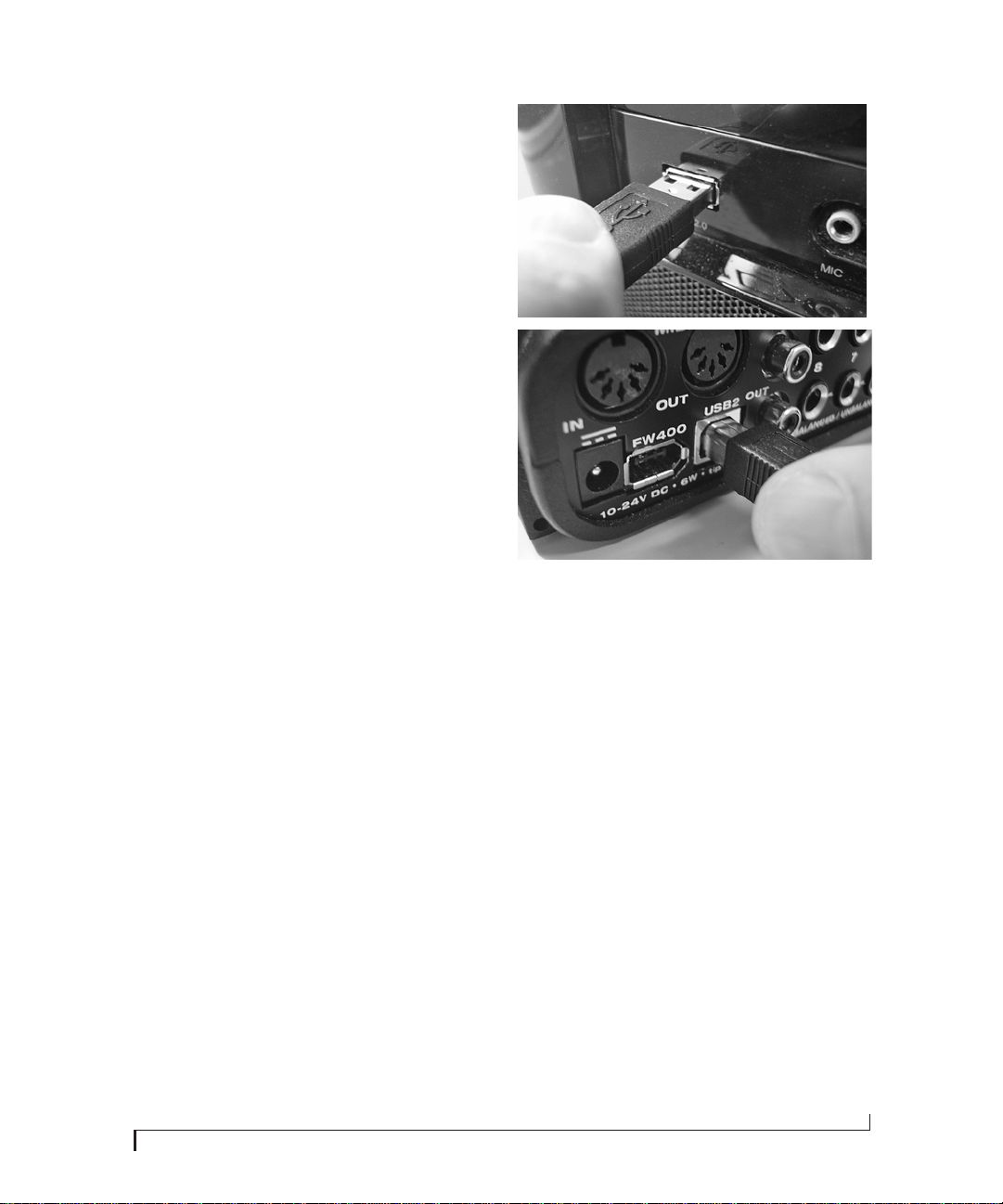
If you are connecting via USB2
Some USB ports on computers are USB Version 1.1
ports, which support low-power, low-bandwidth
peripherals such as your computer’s mouse and
keyboard. USB 1 ports do not support the high-
speed operation necessary for the UltraLite-mk3. If
you are not sure if the USB ports on your computer
are Hi-speed USB2 or not, check your computer’s
documentation. Or check your computer as
follows:
■ On the Mac, you can run System Profiler (Apple
menu> About This Mac> More Info...) to view the
specifications for each USB port on your Mac.
Look in the hardware list for USB and click it. If the
USB bus description on the right-hand side says
USB High Speed Bus, then your Mac has USB2.
■ On Windows, open Device Manager and expand
the Universal Serial Bus section. There should be
an “Enhanced” USB host controller present.
☛ Due to the way all USB 1.1 and USB 2.0
devices share bandwidth, you will achieve better
overall performance by placing 1.1 and 2.0 devices
on separate busses, if possible. For details, refer to
the tech support database at www.motu.com.
1 Before you begin, make sure your computer and
the UltraLite-mk3 are switched off.
2 Plug the flat “type A” plug of the UltraLite-mk3
USB cable (included) into a USB2-equipped socket
on the computer as shown below in Figure 4-1.
3 Plug the squared “type B” plug of the USB cable
into the UltraLite-mk3 I/O as shown below in
Figure 4-1.
Figure 4-2: Connecting the UltraLite-mk3 to the computer via USB.

INSTALLING THE ULTRALITE-MK3 HYBRID HARDWARE
20
CONNECT AUDIO INPUTS AND OUTPUTS
The UltraLite-mk3 audio interface has the
following audio input and output connectors:
■ 10 balanced quarter-inch analog outputs
■ 6 balanced quarter-inch analog inputs
■ 2 XLR/quarter-inch “combo” analog inputs with
preamps
■ 1 pair of RCA S/PDIF in and out
Here are a few things you should keep in mind as
you are making these connections to other devices.
Mic/instrument inputs
Connect a microphone, guitar, instrument or other
analog input to the XLR/TRS combo jack with
either a standard mic cable or a balanced cable with
a quarter-inch plug.
☛ Do not connect a +4 (line level) XLR cable to
the front-panel inputs (because of the preamps).
Use a rear-panel quarter-inch input instead.
Phantom power
If you are connecting a condenser microphone or
other device that requires phantom power, push
and hold the corresponding front-panel TRIM
rotary encoder for a few seconds to toggle phantom
power. The red LED below will turn on or off
accordingly.
Tr im
The XLR mic input and the TRS instrument input
are equipped with 60 dB and 32 dB of trim control,
respectively. Use the digital trim encoders on the
front panel to adjust the input level as needed for
each input. The LCD provides visual feedback as
you turn the trim knob. The UltraLite-mk3’s input
trims are digital controlled, so they allow you to
make fine-tuned adjustments in precise 1dB
increments. You can also adjust trim in the MOTU
CueMix FX software. See “Input trim” on page 67.
20 dB pad
The mic input (XLR jack) is equipped with a 20 dB
pad, so “hot” signals are best connected via an XLR
cable so that you can use the pad. To toggle the
20 dB pad for a mic input, quickly push its TRIM
rotary encoder. The green LED below will turn on
or off accordingly.
Since the pad is not available on the TRS jack, hot
signals connected via the TRS jack will probably
overdrive the input.
Combo jack summary
Use these general guidelines for the 48V phantom
power, pad and trim settings on the two combo
input jacks:
Quarter-inch analog
The quarter-inch analog inputs (3-8) and outputs
(1-8 plus main out) are balanced (TRS) connectors
that can also accept an unbalanced plug.
The quarter-inch outputs are calibrated to produce
a +4 dBu line level output signal.
Quarter-inch analog input trims
The quarter-inch inputs are calibrated to
accommodate either +4 or -10 dBu signals and are
equipped with digitally controlled analog trims
that provide +22 dB of gain and -96 dB of cut. You
can use either the front panel LCD or the included
CueMix FX software to adjust the input trim. To
Input 48V Pad Trim
Condenser mic On As needed As needed
Dynamic mic Off As needed As needed
Guitar Off n/a As needed
-10 dB Line level via TRS Off n/a As needed
-10 dB Line level via XLR Off -20 dB +12dB
+4 dB line level (XLR only) Off -20 dB Zero
INSTALLING THE ULTRALITE-MK3 HYBRID HARDWARE
21
adjust these trims using CueMix FX, see “Input
trim” on page 67. To adjust the trims using the
front panel LCD:
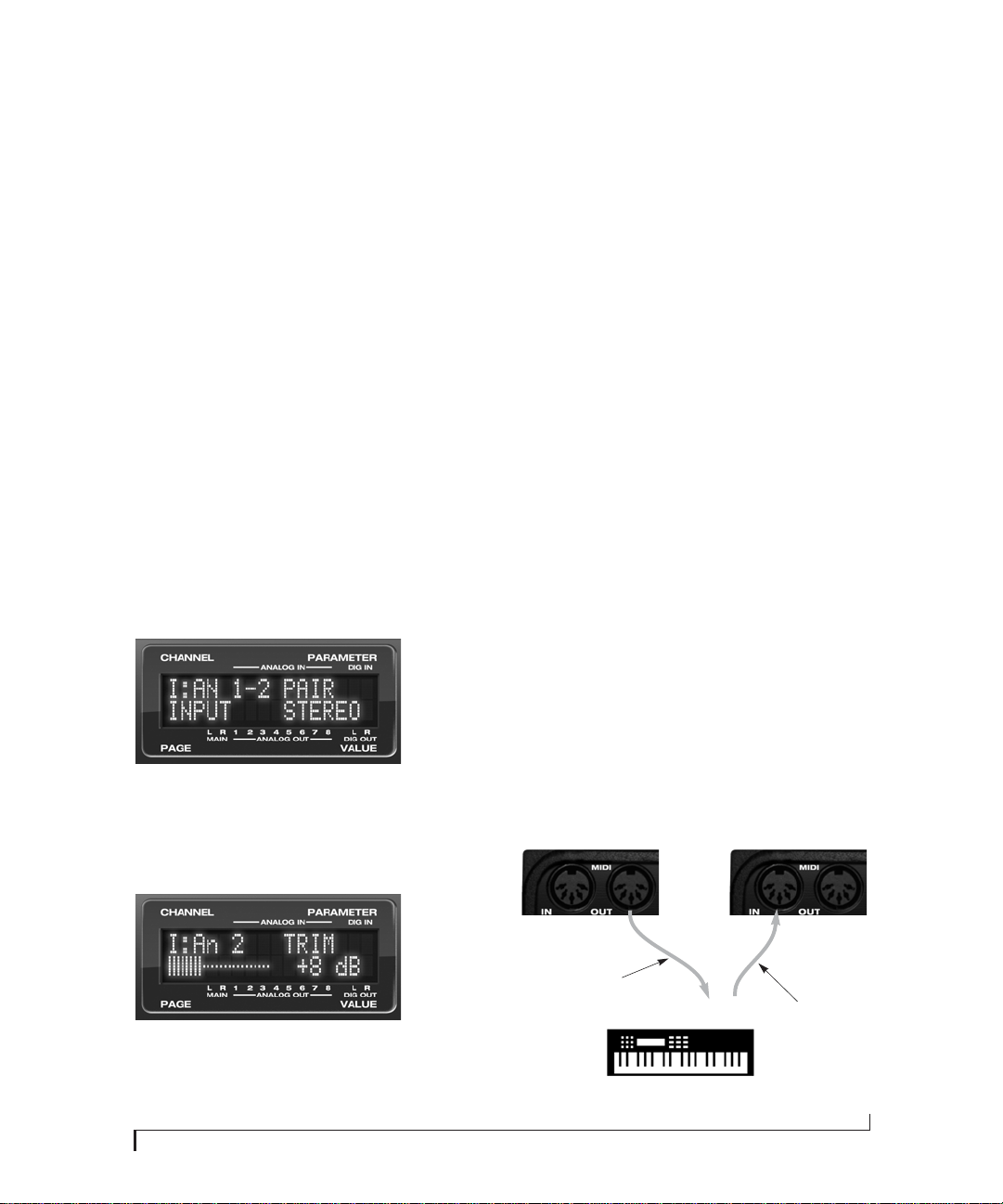
1 Push the PARAM knob repeatedly until you see
CUEMIX in the LCD display.
2 Push the CHANNEL knob repeatedly until you
see “I:” (which stands for Input) in the CHANNEL
section of the LCD (Figure 4-3).
3 Turn the CHANNEL KNOB until you see the
desired analog input or input pair. For example,
analog inputs 1-2 appear as “I:An 1-2”
(Figure 4-3), which means Input analog 1-2.
4 From the factory, analog inputs are grouped in
stereo pairs (1-2, 3-4, etc.) If you need to split a pair
to program it as two individual mono inputs, turn
the PARAM knob until you see PAIR in the
parameter section of the LCD (Figure 4-3). Turn
the VALUE knob to choose MONO. Then turn the
CHANNEL knob again to select the desired input.
Figure 4-3: The settings for analog inputs 1 and 2 (as a pair).
5 After splitting the stereo pair, if necessary, turn
the PARAM knob until you see the TRIM
parameter in the LCD (Figure 4-4):
Figure 4-4: Setting the input trim for a TRS analog input pair.
6 Turn the VALUE knob to adjust the trim.
Separate main outs
The main outputs operate as an independent pair
(they don’t share signal with any other output
pair). In a standard studio configuration, the main
outs are intended for a pair of studio monitors, but
they can also be used as regular outputs for any
purpose. Their reference level is +4dB. Main out
volume is controlled by the VOL knob on the front
panel: push it repeatedly until you see MASTER
and then turn it to adjust the master volume
output. This knob can be programmed to control
any combination of outputs you wish.
S/PDIF
If you make a S/PDIF digital audio connection to
another device, be sure to review the digital audio
clocking issues, as explained in “Connecting and
syncing S/PDIF devices” on page 22.
The UltraLite-mk3 on-board mixer also supplies
12dB of digital trim adjustment for the S/PDIF
input pair, which can be adjusted from CueMix FX
(“Input trim” on page 67) or the front panel (using
the same procedure as explained earlier for
“Quarter-inch analog input trims” on page 20.
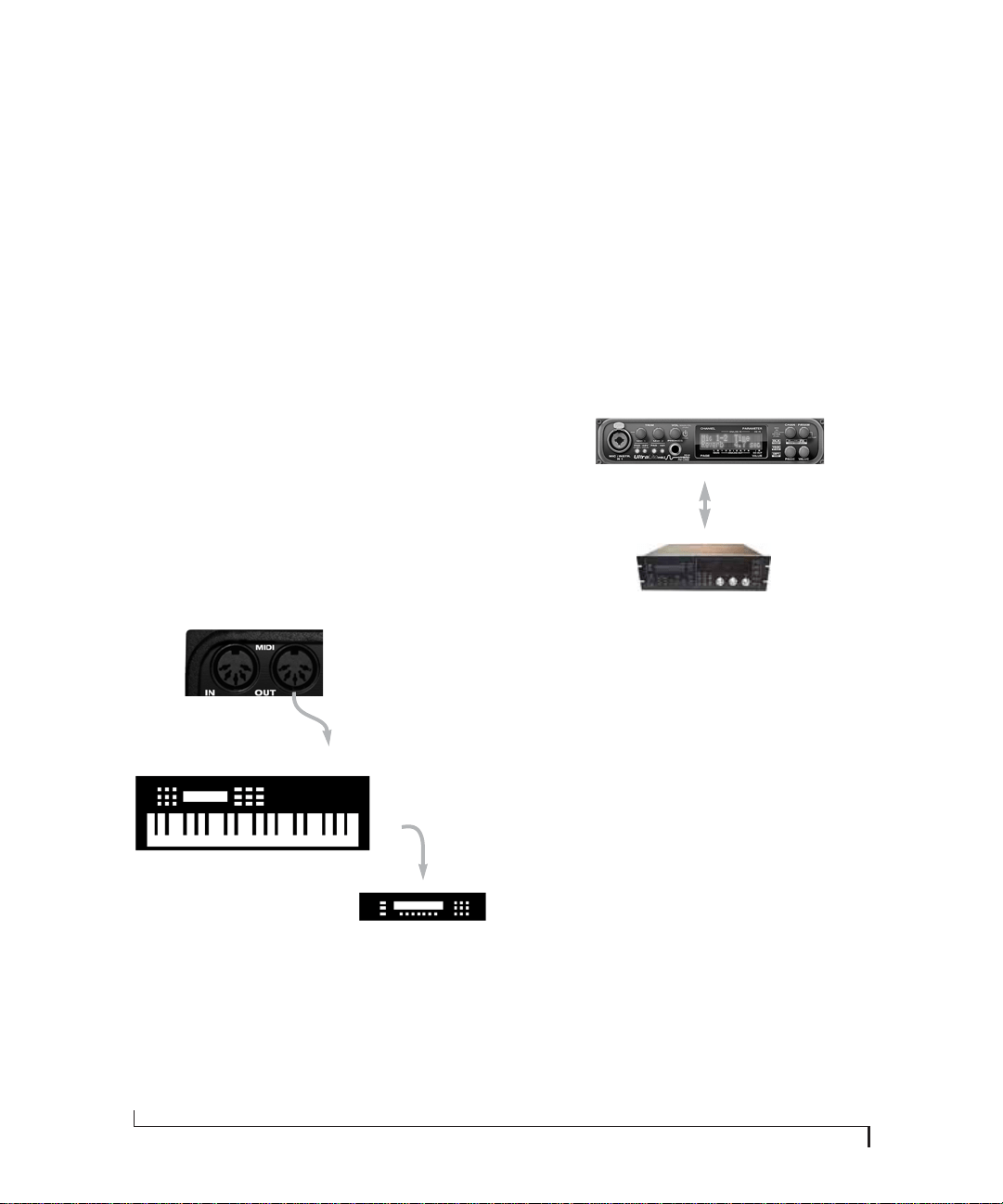
CONNECT MIDI GEAR
Connect your MIDI device’s MIDI IN jack to the
UltraLite-mk3’s MIDI OUT jack (Connection A
below). Conversely, connect the MIDI device’s
MIDI OUT jack to the UltraLite-mk3’s MIDI IN
jack (Connection B).
Figure 4-5: Connecting a MIDI device to the UltraLite-mk3.
UltraLite-mk3
rear panel
MIDI Device
MIDI
cables
MIDI
IN
MIDI
OUT
MIDI
OUT
MIDI
IN
Connection A
Connection B
INSTALLING THE ULTRALITE-MK3 HYBRID HARDWARE
22
One-way MIDI connections
MIDI devices that do not receive MIDI data, such
as a dedicated keyboard controller, guitar
controller, or drum pad, only need Connection B
shown in Figure 4-5. Similarly, devices that never
send data, such as a sound module, only need
Connection A. Make both connections for any
device that needs to both send and receive MIDI
data.
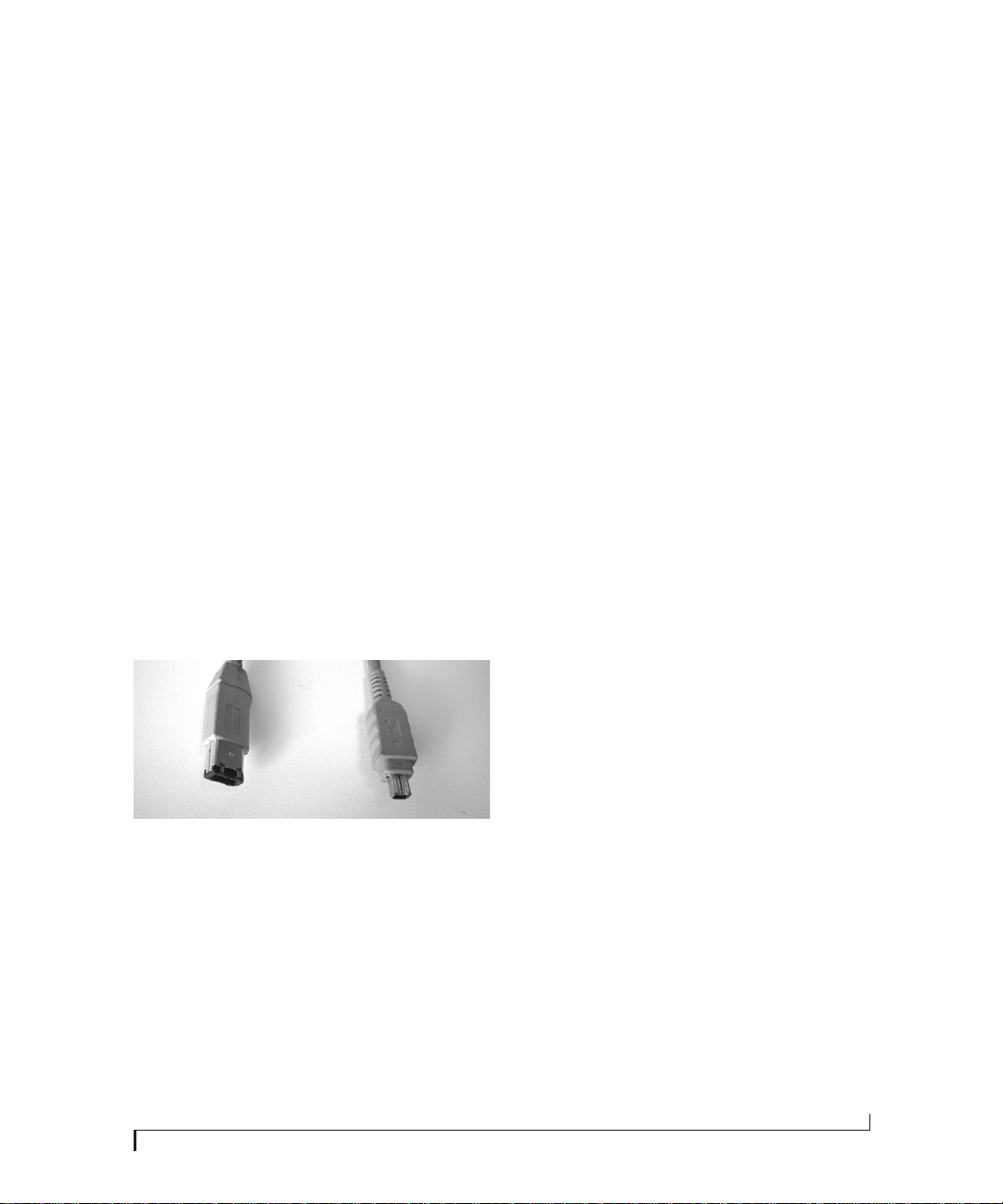
Connecting additional gear with MIDI THRUs
If you need to connect several pieces of MIDI gear,
run a MIDI cable from the MIDI THRU of a device
already connected to the UltraLite-mk3 to the
MIDI IN on the additional device as shown below
in Figure 4-6. The two devices then share the
UltraLite-mk3’s MIDI OUT port. This means that
they share the same set of 16 MIDI channels, too,
so try to do this with devices that receive on only
one MIDI channel (such as effects modules) so
their receive channels don’t conflict with one
another.
Figure 4-6: Connecting additional devices with MIDI THRU ports.
MIDI Thru when operating stand-alone
The UltraLite-mk3 has a MIDI Thru feature for
stand-alone operation. See “MIDI Thru in
standalone” on page 38.
CONNECTING AND SYNCING S/PDIF
DEVICES
DAT decks and other devices with S/PDIF digital
I/O will sync to the UltraLite-mk3 in via the
S/PDIF connection itself. Just connect it to the
UltraLite-mk3 via the S/PDIF connectors. When
the device records a digital audio signal (from the
UltraLite-mk3), it will simply synchronize to the
clock provided by the digital audio input.
On the other hand, when you transfer audio from
the S/PDIF device into the UltraLite-mk3, you’ll
have to slave the UltraLite-mk3 to its S/PDIF input.
Figure 4-7: The setup for synchronizing a S/PDIF device with the
UltraLite-mk3. Sync is achieved via the digital I/O connection itself. In
this case, you have to choose S/PDIF as the UltraLite-mk3’s clock
source when recording from the other device.
MIDI IN
MIDI
cable
MIDI Device
MIDI
IN
MIDI
THRU
MIDI
OUT
Additional device
UltraLite-mk3
rear panel
S/PDIF
S/PDIF device
UltraLite-mk3
UltraLite-mk3
Clock Source setting =
Internal (when transferring from the
UltraLite-mk3 to the other device)
UltraLite-mk3
Clock Source setting =
S/PDIF (when transferring from the
other device to the UltraLite-mk3)
S/PDIF
INSTALLING THE ULTRALITE-MK3 HYBRID HARDWARE
23
POWER OPTIONS
The UltraLite-mk3 can draw power from two
possible sources:
1. the computer via FireWire, or
2. a DC power supply.
If you use USB2 to connect to your computer, you
must also use the DC power supply included with
your UltraLite-mk3, as USB2 does not supply
enough power by itself.
Bus power requirements
The UltraLite-mk3 draws all the power it needs
from the FireWire bus connection to the computer.
However, the FireWire connection to the computer
must meet all of the requirements discussed below.
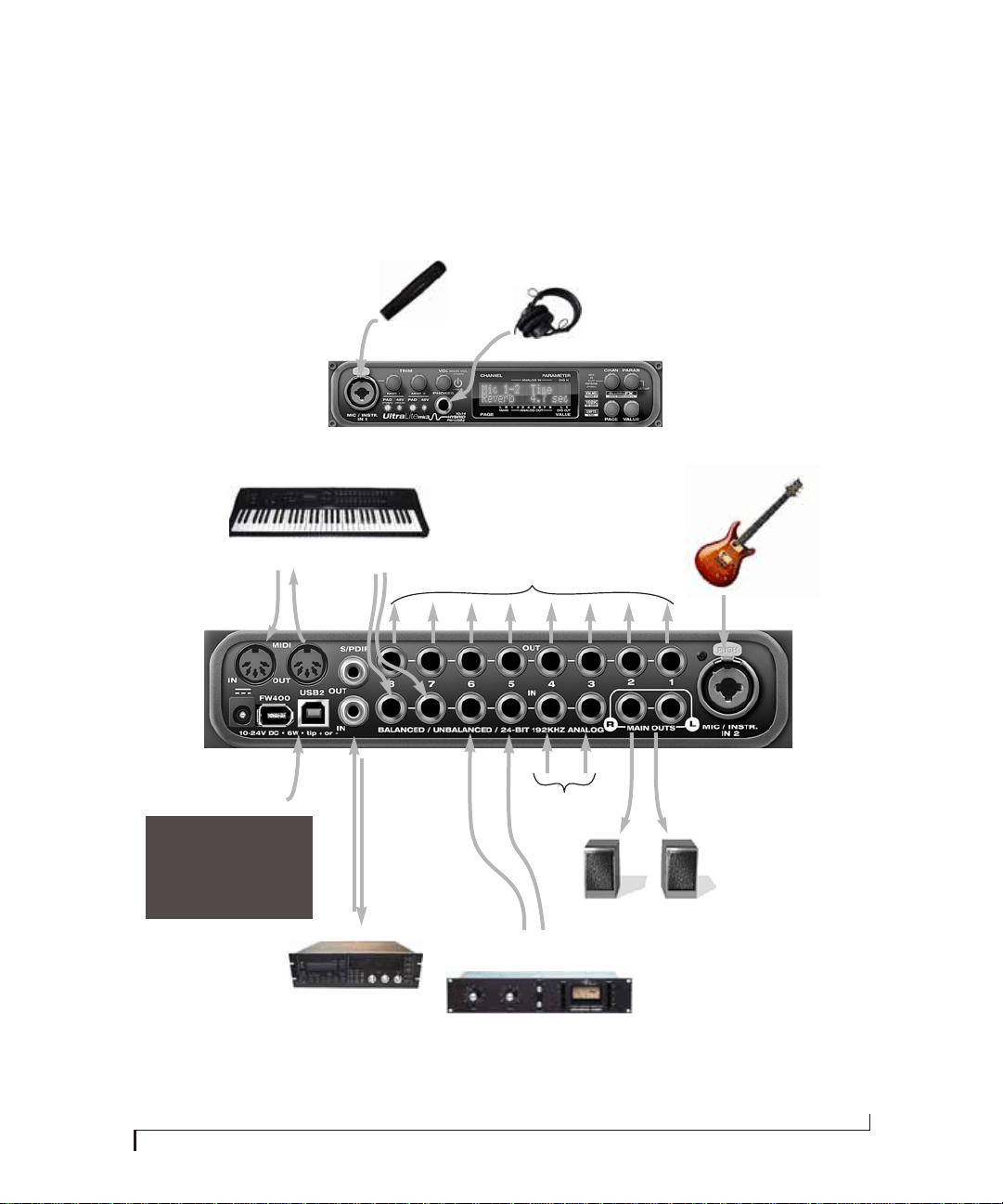
6-pin FireWire connectors
The UltraLite-mk3 can only draw power over the
FireWire bus from a 6-pin to 6-pin cable, or a 6-pin
to 9-pin (FireWire B) cable. It cannot draw power
from a FireWire cable with a 4-pin connector, as
shown below:
Figure 4-8: 4-pin FireWire connectors cannot be used for bus power.
When operating under bus power, daisy-chaining
is not recommended
The UltraLite-mk3 can be daisy-chained with
other FireWire devices from a single FireWire
connection to the computer. However, if the
UltraLite-mk3 is operating under bus power, this is
not recommended. If you need to daisy chain the
UltraLite-mk3 with other devices on the same
FireWire bus, power the UltraLite-mk3 with the
included power adapter. The other devices on the
chain should also have their own power supply. In
general, bus-powered FireWire devices should not
be daisy-chained.
FireWire adapter products must be powered
If you are using a FireWire adapter (a third-party
product that supplies one or more FireWire ports
to your computer), it must have direct access to a
power supply:
■ PCI FireWire cards — If you plan to connect the
UltraLite-mk3 to a PCI card and run the
UltraLite-mk3 under bus power, the PCI card must
have a direct connection to the power supply
harness inside your computer. This is the same
power supply harness to which you connect
internal hard drives, CD/DVD drives, etc.
■ PCMCIA or ExpressCard slot adapters — If you
plan to connect the UltraLite-mk3 to a PC card
FireWire adapter (inserted in the PC card slot in
your laptop), it must provide a 6-pin connection
and it must also have its own power supply. Most
commonly, these types of products have a DC
power adapter. As you can see, however, this
situation does not allow for remote battery
operation, as the PC card adapter requires AC.
Examples of bus- powered operation
Here are a few typical examples of bus-powered
UltraLite-mk3 operation:
Bus power from a desktop computer
Your desktop computer is running off of its usual
AC power connection, and the UltraLite-mk3
draws power from the FireWire cable connected to
the computer. There are no limits to running time.
Bus power from an AC-powered laptop
This scenario is identical to the desktop situation
described above: the laptop is powered by AC, the
UltraLite-mk3 is powered via the FireWire bus and
there are no limits to running time.
6-pin FireWire
4-pin FireWire
✓
✗
YES
NO

INSTALLING THE ULTRALITE-MK3 HYBRID HARDWARE
24
Bus power from a battery-powered laptop
The laptop is being powered by its own battery, and
the UltraLite-mk3 is being powered by its FireWire
connection to the computer. So the laptop battery
is supplying power to both the laptop and the
UltraLite-mk3. This is the most compact and
portable operating scenario. Running time is
determined by the capacity of the laptop battery.
For extended recording sessions, bring extra, fully
charged laptop batteries.
DC power supply
If you do not want the UltraLite-mk3 to draw
power from the computer, and AC power is
available, you can power the UltraLite-mk3 from
any standard 8-18 volt, 12 watt DC power supply
with any polarity (tip positive or negative), and
amperage as shown below.
Bus power versus DC power
When you connect a DC power supply, the
UltraLite-mk3 could draw power from either
FireWire or the DC power supply. So which source
does it use? The answer is: the source that is
currently supplying the greatest voltage. But in
practice, it doesn’t really matter because the only
situation in which you need to be concerned about
the UltraLite-mk3’s power draw is when you are
operating it with a battery-powered laptop. And in
this situation, the only available power is from
FireWire. In all other situations, the computer has
its own power, so it doesn’t matter if the
UltraLite-mk3 is drawing power from FireWire.
Turning off the UltraLite-mk3
To turn on the UltraLite-mk3, push the VOL knob.
To turn it off, push and hold the VOL knob. When
the UltraLite-mk3 is turned off, it is really in a sort
of “sleep” mode, where it still draws just enough
power to detect the power switch (a digital
encoder) when the UltraLite-mk3 is turned back
on. But the amount of power that the
UltraLite-mk3 draws when it is turned off is so
small that it has very little practical impact. If you
are running a laptop under battery power, and you
are in a situation where you are not using the
UltraLite-mk3 and you need every last bit of laptop
battery power, unplug the UltraLite-mk3 entirely
from the computer.
Voltage Amperage
9 volts 1.33 amps
12 volts 1 amp
18 volts 0.66 amps
INSTALLING THE ULTRALITE-MK3 HYBRID HARDWARE
25
A TYPICAL ULTRALITE-MK3 HYBRID SETUP
Here is a typical UltraLite-mk3 studio setup. This
rig can be operated without an external mixer. All
mixing and processing can be done in the
computer with audio software. During recording,
you can use the UltraLite-mk3’s CueMix™ FX no-
latency monitoring to listen to what you are
recording via the main outs, headphone outs, or
any other output pair. You can control monitoring
either from the front panel or from the included
CueMix FX software.
S/PDIF
DAT deck
quarter-inch
analog outs
synthesizer
monitors
Figure 4-9: A typical UltraLite-mk3 studio setup.
headphones
Analog outputs (sends, stage
monitors, surround monitors, etc.)
MIDI IN
MIDI OUT
UltraLite-mk3
rear panel
mic
FireWire
or USB2
guitars (with or
without an amp)
Analog
returns
Compressor, reverb or other
analog outboard gear
PC

INSTALLING THE ULTRALITE-MK3 HYBRID HARDWARE
26
CONNECTING MULTIPLE MOTU FIREWIRE
INTERFACES
You can daisy-chain up to four MOTU FireWire
interfaces on a single FireWire bus, with the
restrictions described in the following sections.
Most computers have only one built-in FireWire
bus (even if it supplies multiple FireWire sockets).
Figure 4-10: Connecting multiple MOTU FireWire audio interfaces.
Multiple interfaces cannot be bus-powered
Do not run the UltraLite-mk3 under bus power
when connecting it with other devices to the same
FireWire bus. See “Power options” and “Bus power
requirements” on page 23.
Multiple interfaces in MOTU Audio Console
MOTU Audio Console displays the settings for one
interface at a time. To view the settings for an
interface, click its tab as shown below in
Figure 4-11.
Figure 4-11: To view the settings for an interface, click its tab.
Synchronizing multiple interfaces
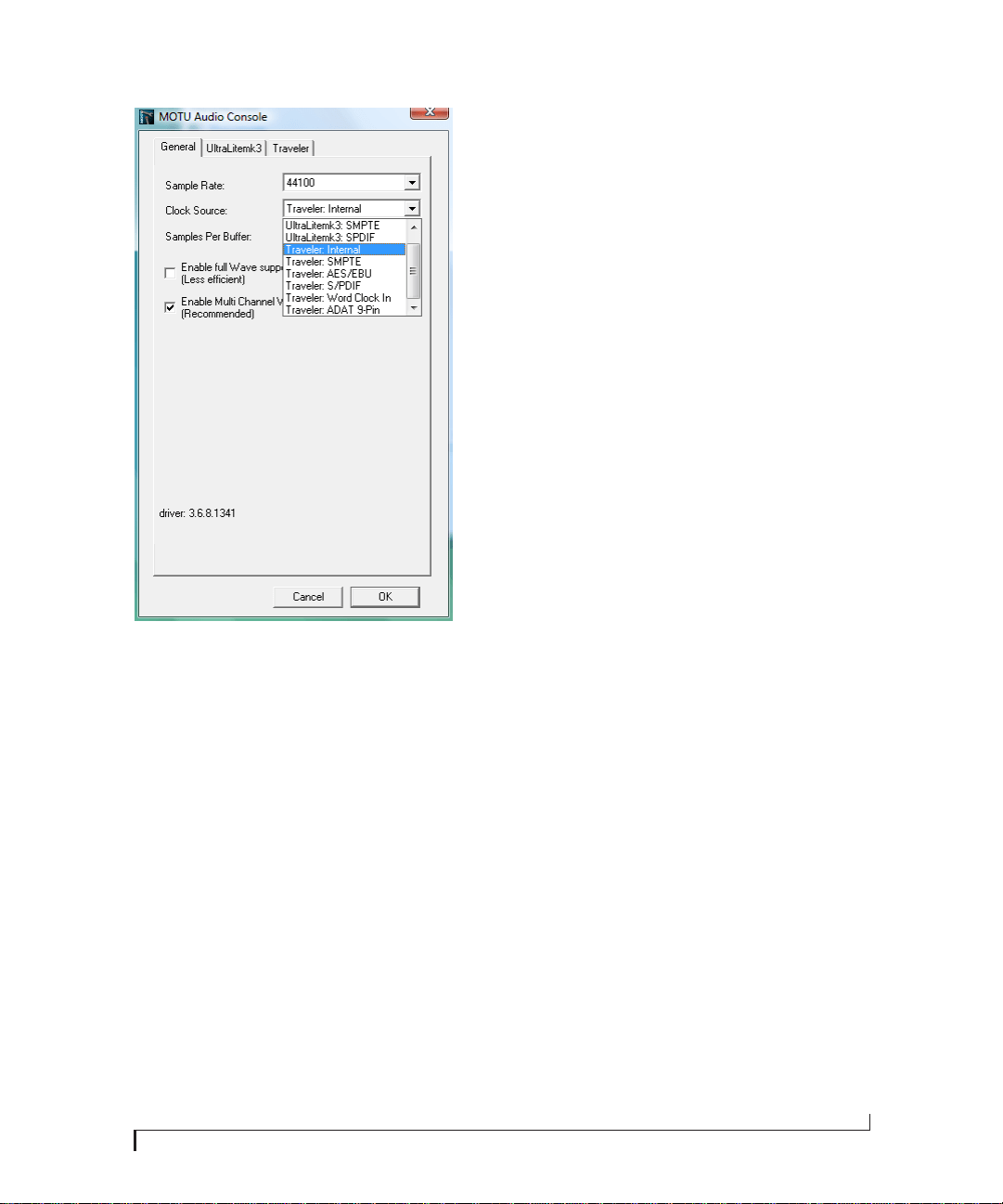
All connected MOTU FireWire interfaces get their
clock from whatever you choose from the Clock
Source menu in the General tab in MOTU Audio
Console. When you connect multiple MOTU
FireWire interfaces, all of their respective sync
sources are displayed in the menu as shown below
in Figure 4-12.
FireWire
PC
FireWire
FireWire
FireWire
828mk3 or other
FireWire device
with multiple
FireWire ports
INSTALLING THE ULTRALITE-MK3 HYBRID HARDWARE
27
Figure 4-12: All MOTU FireWire audio interfaces get their clock from a
single master sync source on any connected UltraLite-mk3 (or other
MOTU FireWire interface). After you choose a source from this menu,
the entire system, including all connected UltraLites, synchronizes to
it.
Each FireWire interface in the system gets its clock
from the computer (unless it is the master clock
itself).
Connecting other MOTU FireWire interfaces
You can add an original MOTU 828 to the end of a
FireWire daisy chain (because the 828 has only one
FireWire port), or you can mix and match multiple
UltraLites with other MOTU FireWire interfaces
using a standard FireWire hub. You can also add
828mkIIs, 828mk3s, 896HDs, 896mk3s, Travelers
and UltraLites, which have two FireWire ports
convenient for daisy-chaining. Up to four
interfaces can be combined on one FireWire bus.
Operating multiple FireWire interfaces at high
sample rates
Four MOTU FireWire interfaces can operate at
44.1 or 48kHz on a single FireWire bus, although
you may have to disable optical banks (on
interfaces that have them) to conserve FireWire bus
bandwidth. At the 2x samples rates (88.2 or 96kHz)
and 4x sample rates (176.4 and 192kHz), you can
operate no more than two FireWire interfaces on a
single FireWire bus.
Adding additional interfaces with a second
FireWire bus
Third-party FireWire bus expansion products in
the form of a cardbus (“PC card”) adaptor,
ExpressCard adaptor or PCI card allow you to add
a second FireWire bus to your computer. In may be
possible to add additional MOTU FireWire
interfaces connected to such a third-party product,
depending on the performance of the product and
the performance of your host computer.
Managing the IDs of multiple interfaces
Multiple UltraLite-mk3 interfaces are identified by
number (#1, #2, #3, etc.) Interfaces are ID’d (given
a number) by the order in which they are first
powered up after being connected. This
information is stored in the MOTU Audio
preferences file. Once ID’d, they retain the same
number regardless of the order in which they are
powered up. You can disable an interface at any
time with the Disable interface option shown in
Figure 4-11 on page 26. Doing so frees up the
FireWire bandwidth required by the interface
without turning it off. Switching off an interface
accomplishes the same thing. To get MOTU Audio
Console to forget about an interface entirely, you’ll
see a Forget button in MOTU Audio Console. Just
click the Forget button and MOTU Audio Console
will no longer consider the interface to be present
but off line (turned off).

INSTALLING THE ULTRALITE-MK3 HYBRID HARDWARE
28
CHAPTER
29
5 MOTU Audio Console
OVERVIEW
MOTU Audio Console gives you access to basic
UltraLite-mk3 hardware settings, such as sample
rate, clock source and more.
Accessing the UltraLite-mk3 settings . . . . . . . . . . . . . . . . 29
‘General’ tab Settings . . . . . . . . . . . . . . . . . . . . . . . . . . . . . . . . 30
Sample Rate . . . . . . . . . . . . . . . . . . . . . . . . . . . . . . . . . . . . . . . . . 30
Clock Source. . . . . . . . . . . . . . . . . . . . . . . . . . . . . . . . . . . . . . . . . 30
Samples Per Buffer. . . . . . . . . . . . . . . . . . . . . . . . . . . . . . . . . . . 31
Wave support for legacy (MME) software . . . . . . . . . . . . 32
Enable Pedal. . . . . . . . . . . . . . . . . . . . . . . . . . . . . . . . . . . . . . . . . 32
‘UltraLite-mk3’ tab settings . . . . . . . . . . . . . . . . . . . . . . . . . . 32
Phones Assign . . . . . . . . . . . . . . . . . . . . . . . . . . . . . . . . . . . . . . . 32
Main Out Assign . . . . . . . . . . . . . . . . . . . . . . . . . . . . . . . . . . . . . 32
Return Assign. . . . . . . . . . . . . . . . . . . . . . . . . . . . . . . . . . . . . . . . 32
Disable Interface. . . . . . . . . . . . . . . . . . . . . . . . . . . . . . . . . . . . . 33
ACCESSING THE ULTRALITE-MK3 SETTINGS
There are several ways to access MOTU Audio
Console settings:
■ From the Windows Start menu, choose
Programs>MOTU>MOTU Audio Console
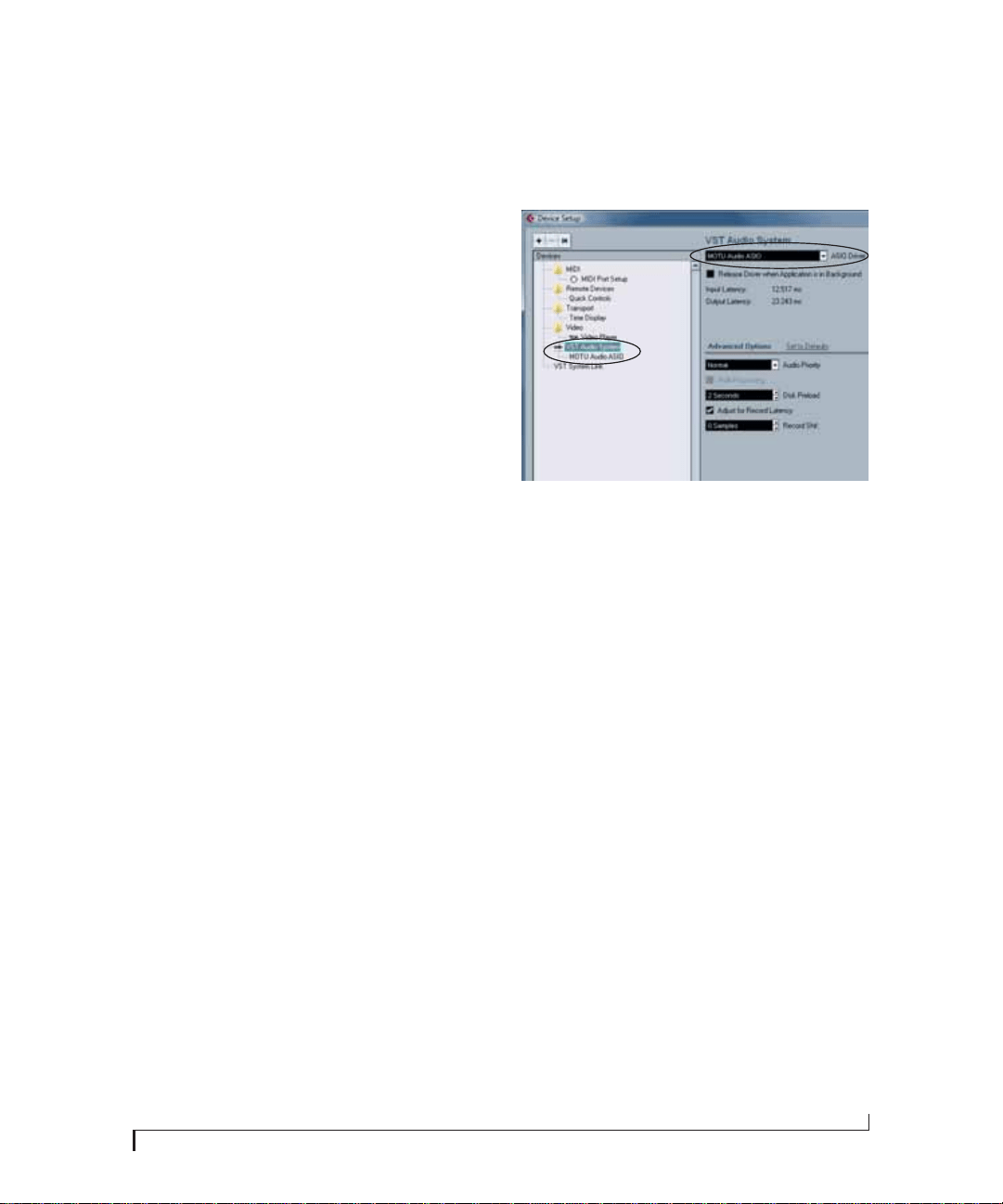
■ In Cubase or Nuendo, open the Device Setup
window, click VST Audio System and choose
MOTU Audio ASIO from the Master ASIO Driver
menu as shown below. Then click the MOTU Audio
ASIO item in the list and click the Control Panel
button.
■ From within other ASIO-compatible programs,
refer to their documentation.
■ From the front panel LCD (see chapter 6,
“UltraLite-mk3 Hybrid Front Panel Operation”
(page 35)).
General tab settings
The General tab provides settings that apply
globally to all connected MOTU FireWire
interfaces.
UltraLite-mk3 tab settings
The UltraLite-mk3 tab provides settings that apply
to a specific UltraLite-mk3 interface. If you have
several UltraLites (or other MOTU FireWire audio
interfaces) connected, you’ll see a separate tab for
each one.

MOTU AUDIO CONSOLE
30
‘GENERAL’ TAB SETTINGS
Sample Rate
Choose the desired Sample Rate for recording and
playback. The UltraLite-mk3 can operate at 44.1
(the standard rate for compact disc audio), 48,
88.2, 96, 176.4 or 192KHz. If you have a S/PDIF
device connected to the UltraLite-mk3, make sure
that it matches the UltraLite-mk3’s sample rate.
☛ Mismatched sample rates cause distortion and
crackling. If you hear this sort of thing, check the
sample rate settings in your hardware and here in
MOTU Audio Console.
S/PDIF at 4x sample rates (176.4 or 192kHz)
At the 4x sample rates (176.4 or 192kHz), all analog
I/O remains active, but S/PDIF digital I/O is
disabled.
Clock Source
The Clock Source determines the digital audio
clock that the UltraLite-mk3 will use as its time
base. The following sections briefly discuss each
clock source setting.
Internal
Use the Internal setting when you want the
UltraLite-mk3 to operate under its own digital
audio clock. For example, you may be in a situation
where all you are doing is playing tracks off hard
disk in your digital audio software on the
computer. In a situation like this, you most often
don’t need to reference an external clock of any
kind.
Another example is transferring a mix to DAT. You
can operate the UltraLite-mk3 system on its
internal clock, and then slave the DAT deck to the
UltraLite-mk3 via the S/PDIF connection (usually
DAT decks slave to their S/PDIF input when you
choose the S/PDIF input as their record source).
If you would like help determining if this is the
proper clock setting for your situation, see
“Connecting and syncing S/PDIF devices” on
page 22.
Figure 5-1: MOTU Audio Console gives you access to all of the settings in the UltraLite-mk3 hardware.

MOTU AUDIO CONSOLE
31
S/PDIF
The S/PDIF clock source setting refers to the
S/PDIF RCA input jack on the UltraLite-mk3. This
setting allows the UltraLite-mk3 to slave to another
S/PDIF device.
Use this setting whenever you are recording input
from a DAT deck or other S/PDIF device into the
UltraLite-mk3. It is not necessary in the opposite
direction (when you are transferring from the
UltraLite-mk3 to the DAT machine).
For further details about this setting, see
“Connecting and syncing S/PDIF devices” on
page 22.
SMPTE
Choose this setting to resolve the UltraLite-mk3
directly to SMPTE time code (LTC) being received
via the UltraLite-mk3’s quarter-inch SMPTE input
jack. For details, see “Syncing to SMPTE time
code” on page 106and chapter 11, “MOTU SMPTE
Console” (page 103).
Samples Per Buffer
The Samples Per Buffer setting lets you reduce the
delay you hear when patching live audio through
your audio software. For example, you might have
a live microphone input that you would like to run
through a reverb plug-in that you are running in
your host audio software. When doing so, you may
hear or feel some “sponginess” (delay) between the
source and the processed signal. If so, don’t worry.
This effect only affects what you hear: it is not
present in what is actually recorded.
You can use Samples Per Buffer setting to reduce
this monitoring delay—and even make it
completely inaudible.
☛ If you don’t need to process an incoming live
signal with software plug-ins, you can monitor the
signal with no delay at all using CueMix FX, which
routes the signal directly to your speakers via
hardware. For details, see chapter 10, “CueMix FX”
(page 61).
Adjusting the Samples Per Buffer setting impacts
the following things:
■ The strain on your computer’s CPU
■ The delay you hear when routing a live signal
through your host audio software plug-ins
■ How responsive the transport controls are in
your software
This setting presents you with a trade-off between
the processing power of your computer and the
delay of live audio as it is being processed by
plug-ins. If you reduce the Samples Per Buffer, you
reduce patch thru latency, but significantly increase
the overall processing load on your computer,
leaving less CPU bandwidth for things like real-
time effects processing. On the other hand, if you
increase the Samples Per Buffer, you reduce the load
on your computer, freeing up bandwidth for
effects, mixing and other real-time operations. But
don’t set the Samples Per Buffer too low, or it may
cause distortion in your audio.
If you don’t process live inputs with software
plug-ins, leave this setting at its default value of
1024 samples. If you do, try settings of 256 samples
or less, if your computer seems to be able to handle
them. If your host audio software has a processor
meter, check it. If it starts getting maxed out, or if
the computer seems sluggish, raise the Samples Per
Buffer until performance returns to normal.
If you are at a point in your recording project where
you are not currently working with live, patched-
thru material (e.g. you’re not recording vocals), or
if you have a way of externally monitoring input,
choose a higher Samples Per Buffer setting.
Depending on your computer’s CPU speed, you
might find that settings in the middle work best.

MOTU AUDIO CONSOLE
32
The Samples Per Buffer setting also impacts how
quickly your audio software will respond when you
begin playback, although not by amounts that are
very noticeable. Lowering the Samples Per Buffer
will make your software respond faster; raising the
Samples Per Buffer will make it a little bit slower, but
barely enough to notice.
Monitoring live inputs without plug-in effects
As mentioned earlier, CueMix FX allows you to
monitor dry, unprocessed live inputs with no delay
at all. For complete details, see chapter 9,
“Reducing Monitoring Latency” (page 55).
Wave support for legacy (MME) software
Windows only exposes the first two channels of a
multi-channel WDM audio stream to applications
which use the legacy (MME) multimedia interface.
The Enable full Wave support for legacy (MME)
software (less efficient) option forces the
UltraLite-mk3 multimedia driver to expose all
channels as stereo pairs, providing full MME
support.
If your host audio software does not directly
support WDM audio and instead only supports
legacy MME drivers, use this option to access
multiple UltraLite-mk3 input and output channels.
If your host audio software does directly support
WDM audio, leave this option unchecked for
optimal performance.
This option is only available when the multimedia
driver has been installed, and it defaults to being
not checked.
Enable Pedal
This setting applies to other MOTU FireWire audio
interfaces, but it does not apply to the
UltraLite-mk3.
‘ULTRALITE-MK3’ TAB SETTINGS
Phones Assign
The Phones Assign setting lets you choose what you
will hear from the headphone jack. Choose
Main Out 1-2 if you’d like the headphone output to
match the main outs. Choose Phones if you would
like the headphones to serve as their own
independent output, which you can access as an
independent output destination in your host audio
software and as an output destination for the eight
on-board CueMix FX mix busses.
Main Out Assign
Choose Main Outs from the Main Out Assign menu
to treat the Main Outs as their own independent
output pair. Choose any other output pair to cause
the MAIN OUT jacks to mirror (duplicate) the
output pair you choose.
Return Assign
The Return Assign menu lets you choose any pair of
UltraLite-mk3 audio outputs. The audio signal
from this output pair is then sent back to the
computer via the Stereo Return 1-2 bus. This stereo
return bus from the UltraLite-mk3 appears in your
host software alongside all other UltraLite-mk3
inputs, wherever your host software lists them.
The UltraLite-mk3 stereo return bus can be used
for a variety of purposes. For example, you could
use it to send a final mix being played through the
UltraLite-mk3 back to the computer, where you
could record it for mastering or archiving
purposes.
As another example, you could use the stereo
return bus to capture tracks played from your host
software, along with live inputs being routed
directly through the UltraLite-mk3 hardware via
CueMix FX (with or without CueMix effects
processing on the live inputs).

MOTU AUDIO CONSOLE
33
Disable Interface
You can disable an interface at any time with the
Disable interface option. Doing so frees up the
FireWire bandwidth required by the interface
without turning it off. Switching off an interface
accomplishes the same thing. To get MOTU Audio
Console to forget about an interface entirely, you’ll
see a Forget button in MOTU Audio Console. Just
click the Forget button and MOTU Audio Console
will no longer consider the interface to be present
but off line (turned off).

MOTU AUDIO CONSOLE
34

CHAPTER
35
6 UltraLite-mk3 Hybrid
Front Panel Operation
OVERVIEW
The UltraLite-mk3 offers complete front-panel
programming via four rotary encoders and a 2x16
backlit LCD display. All UltraLite-mk3 settings can
be accessed via these front-panel controls.
Push-button rotary encoders . . . . . . . . . . . . . . . . . . . . . . . . 35
Power switch . . . . . . . . . . . . . . . . . . . . . . . . . . . . . . . . . . . . . . . . 35
Mic/guitar inputs . . . . . . . . . . . . . . . . . . . . . . . . . . . . . . . . . . . . 35
Main out volume . . . . . . . . . . . . . . . . . . . . . . . . . . . . . . . . . . . . 36
Phones. . . . . . . . . . . . . . . . . . . . . . . . . . . . . . . . . . . . . . . . . . . . . . . 36
Multi-function LCD display . . . . . . . . . . . . . . . . . . . . . . . . . . 37
METER display . . . . . . . . . . . . . . . . . . . . . . . . . . . . . . . . . . . . . . . 37
AUDIO menu . . . . . . . . . . . . . . . . . . . . . . . . . . . . . . . . . . . . . . . . 37
SETUP menu. . . . . . . . . . . . . . . . . . . . . . . . . . . . . . . . . . . . . . . . . 37
CUEMIX menu . . . . . . . . . . . . . . . . . . . . . . . . . . . . . . . . . . . . . . . 38
Inputs menu . . . . . . . . . . . . . . . . . . . . . . . . . . . . . . . . . . . . . . . . . 41
Outputs menu . . . . . . . . . . . . . . . . . . . . . . . . . . . . . . . . . . . . . . . 42
Mixes menu. . . . . . . . . . . . . . . . . . . . . . . . . . . . . . . . . . . . . . . . . . 42
Reverb menu . . . . . . . . . . . . . . . . . . . . . . . . . . . . . . . . . . . . . . . . 42
Stand-alone operation. . . . . . . . . . . . . . . . . . . . . . . . . . . . . . . 42
PUSH-BUTTON ROTARY ENCODERS
All of the knobs on the UltraLite-mk3 front panel
are push-button digital rotary encoders. In many
cases, you can either push the knob, hold it in, or
turn it to make a setting or toggle the LCD display
(depending on the encoder and setting).
POWER SWITCH
Push the VOL knob to power on the
UltraLite-mk3. Push in and hold the VOL knob to
turn it off.
MIC/GUITAR INPUTS
The UltraLite-mk3 mic/guitar inputs are equipped
with many features to handle a wide variety of
recording situations.
For information about connections and settings,
see “Mic/instrument inputs” on page 20 in the
installation chapter.
For information about the many settings available
for the mic/guitar inputs, see:
■ “The Inputs tab” on page 66
■ “The channel settings section” on page 70
■ “The Channel tab” on page 70
■ “The EQ tab” on page 72
■ “The Dynamics tab” on page 80
Figure 6-1: The UltraLite-mk3 front panel mic/guitar inputs and phone jack.
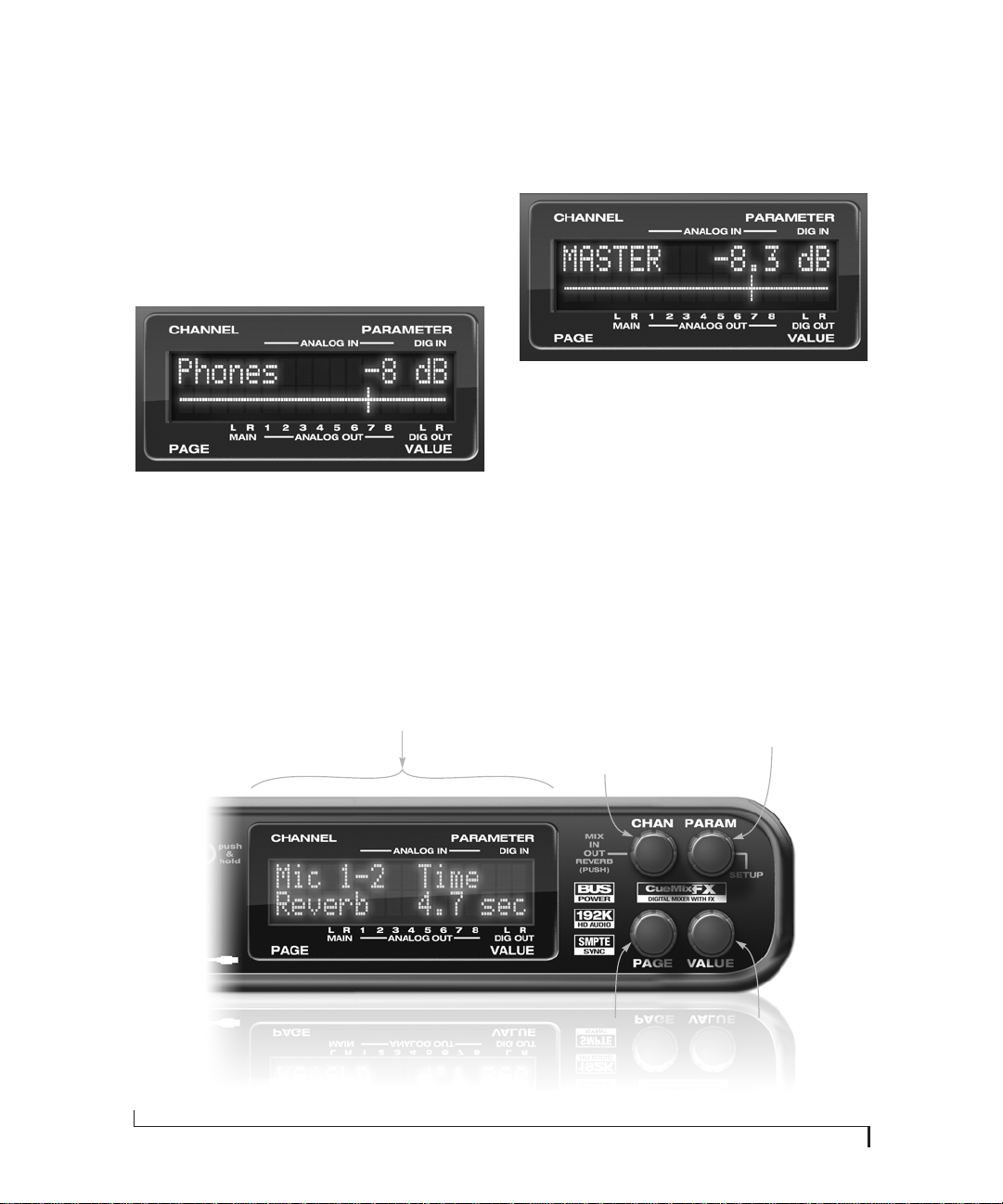
ULTRALITE-MK3 HYBRID FRONT PANEL OPERATION
36
PHONES
From the factory, the PHONES jack (Figure 6-1) is
a discrete output at 44.1/48 kHz, but it can mirror
any other output pair (digital or analog) or serve as
its own independent output.
When you turn the phone VOL knob, the LCD
display provides visual feedback:
Figure 6-2: The LCD provides feedback as you adjust Phone volume.
To view the current setting without changing it,
just push the knob (without turning it).
MAIN OUT VOLUME
Push the VOL knob twice to view and control the
volume of the main outs on the rear panel.
Figure 6-3: The LCD provides feedback as you adjust Phone volume.
The MASTER volume adjustment can be
programmed to control any combination of
outputs. See “The Monitor Group” on page 84 for
details.
Figure 6-4: The UltraLite-mk3 front panel controls.
The LCD is divided into four
sections that correspond to the
four knobs to the left.
Push the PARAM knob to
cycle among three global
menus: METER, CUEMIX
(mixer) and SETUP.
When viewing CueMix settings
in the LCD, push the CHANNEL
knob to cycle among four main
mixer menus: MIX, IN (inputs),
OUT (outputs) and REVERB.
Turn it to choose a channel.
Turn the PAGE knob to view settings for
each channel. Push it to jump to the
next section or back to the beginning.
Turn and/or push the
VALUE knob to adjust
the current setting.
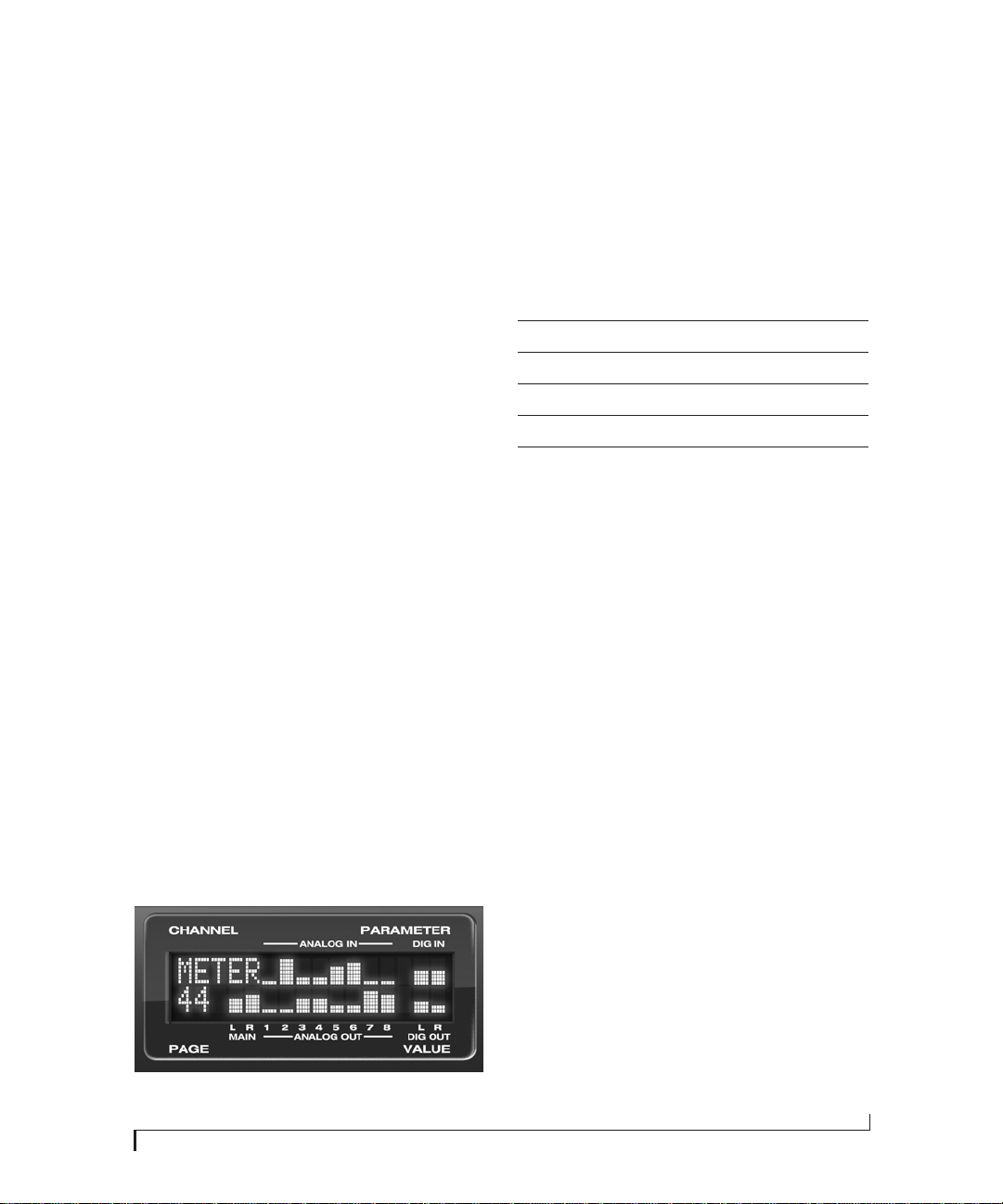
ULTRALITE-MK3 HYBRID FRONT PANEL OPERATION
37
MULTI-FUNCTION LCD DISPLAY
The LCD provides access to the many
UltraLite-mk3 settings, as well as visual feedback
of the current parameter being modified.
Parameter “zooming”
For many settings, the LCD temporarily “zooms
in” to display a long-throw meter and alpha-
numeric display to give you precise, real-time
feedback as you adjust the setting. For example, if
you change the headphone volume, the LCD
displays a level meter and gain reduction reading
that updates as you turn the volume knob, as
shown in Figure 6-2 on page 36. After a brief time-
out, the display returns to its previous state before
you turned the volume knob.
Four global display modes
Push the PARAM knob to cycle the LCD among
four global display modes:
METER display . . . . . . . . . . . . . . . . . . . . . . . . . . . . . . . . . . . . . . . 37
AUDIO menu . . . . . . . . . . . . . . . . . . . . . . . . . . . . . . . . . . . . . . . . 37
SETUP menu. . . . . . . . . . . . . . . . . . . . . . . . . . . . . . . . . . . . . . . . . 37
CUEMIX menu . . . . . . . . . . . . . . . . . . . . . . . . . . . . . . . . . . . . . . . 38
METER DISPLAY
To access the METER display, push the PARAM
knob until you see METER displayed in the LCD.
The METER display (Figure 6-5) provides
comprehensive metering for each input and
output. The labels above and below the LCD
indicate the meters for each input and output pair,
including the S/PDIF input and output (labeled
DIG IN and DIG OUT, respectively).
Figure 6-5: METER mode.
AUDIO MENU
To access the UltraLite-mk3 AUDIO menu, push
the PARAM knob until you see AU D IO displayed
in the LCD. This menu provides basic audio-
related. Turn the PARAM knob to access each
setting. Each setting in the AUDIO menu has a
corresponding setting in the MOTU Audio
Console software, as shown below:
* If the UltraLite-mk3 is currently connected to a computer, this
setting cannot be changed from the front-panel LCD. It must be
changed in MOTU Audio Console instead. Or, you can disconnect the
UltraLite-mk3 from the computer to change the Clock Source from
the front panel.
SETUP MENU
To access the UltraLite-mk3 SETUP menu, push
the PARAM knob until you see SETUP displayed in
the LCD. This menu provides basic features for
managing the UltraLite-mk3 hardware. Turn the
PARAM knob to access each setting. The first five
settings in the SETUP menu have corresponding
settings in the MOTU Audio Console software, as
shown below:
LCD Contrast
Turn the VALUE knob to adjust the LCD contrast.
Save/Name Preset
An UltraLite-mk3 preset holds all current
CueMix FX mix settings (everything in the
CUEMIX menu). SETUP menu parameters are not
included. Turn the VALUE knob to move from
character to character in the preset name. Turn
PAGE to change the currently flashing letter. Once
you’ve named the preset, push VALUE to save it,
turn it again to choose the desired preset slot you
Audio menu item Where to find more information
Clock Source* “Clock Source” on page 30
Sample rate* “Sample Rate” on page 30
Phones Assign “Phones Assign” on page 32
Main Out Assign “Main Out Assign” on page 32
Return Assign “Return Assign” on page 32

ULTRALITE-MK3 HYBRID FRONT PANEL OPERATION
38
wish to save it to (1-16), and the push again to
confirm the save. To cancel the save operation at
any time, turn the PARAM knob.
Load Preset
Turn VALUE to choose the preset you wish to load
(1-16) and push VALUE to load it.
MIDI Thru in standalone
Turn VALUE to enable (Y) or disable (N) the
UltraLite-mk3’s MIDI Thru feature when the it is
being operated stand-alone (not connected to a
computer via FireWire). When MIDI Thru is
enabled, the MIDI IN jack passes MIDI data
directly to the MIDI OUT jack. This allows you, for
example, to play a sound module connected to the
MIDI OUT from a keyboard controller connected
to the MIDI IN, without a computer connected.
All Notes Off
The All Notes Off setting sends a MIDI All Notes Off
message, as well as a MIDI note-off message for
every note on every MIDI channel. This stops any
stuck notes that are currently playing. Push VALUE
to send the All Notes Off MIDI data.
AutoSave Status
All of the parameters in the UltraLite-mk3 are
periodically saved automatically in its memory, so
that if you power down the unit, it will power back
up in the same state. AutoSave Status tells you the
current state of this process: Change Detected,
Saving… or Saved. If it says Saved, it is ready to be
powered down. If it says Change Detected or
Saving…, wait until it changes to Saved.
Factory Defaults
Push VALUE to restore the UltraLite-mk3
hardware to its factory default settings. Push
VALUE again to confirm, or turn PARAM to
cancel.
CUEMIX MENU
To access the CUEMIX menu, push the PARAM
knob until you see CUEMIX displayed in the LCD.
This menu displays the settings for the
UltraLite-mk3 CueMix FX mixer.
CueMix mixer basics
It is much easier to navigate the CUEMIX menu in
the LCD if you have a general understanding of the
CueMix FX mixer. We strongly recommend that
you review chapter 10, “CueMix FX” (page 61)
before learning the LCD, especially “CueMix FX
basic operation” on page 63.
CUEMIX menu organization
Mixer settings are divided into four sub-menus,
which correspond to the Inputs, Mixes, Outputs
and Reverb tabs in the CueMix FX software:
■ IN (inputs)
■ OUT (outputs)
■ MIX (Mixes)
■ REVERB (reverb processor)
Navigating the four main menus
To access the four main menus above, push the
CHANNEL knob repeatedly. Then turn the
CHANNEL knob to select the desired channel or
mix.
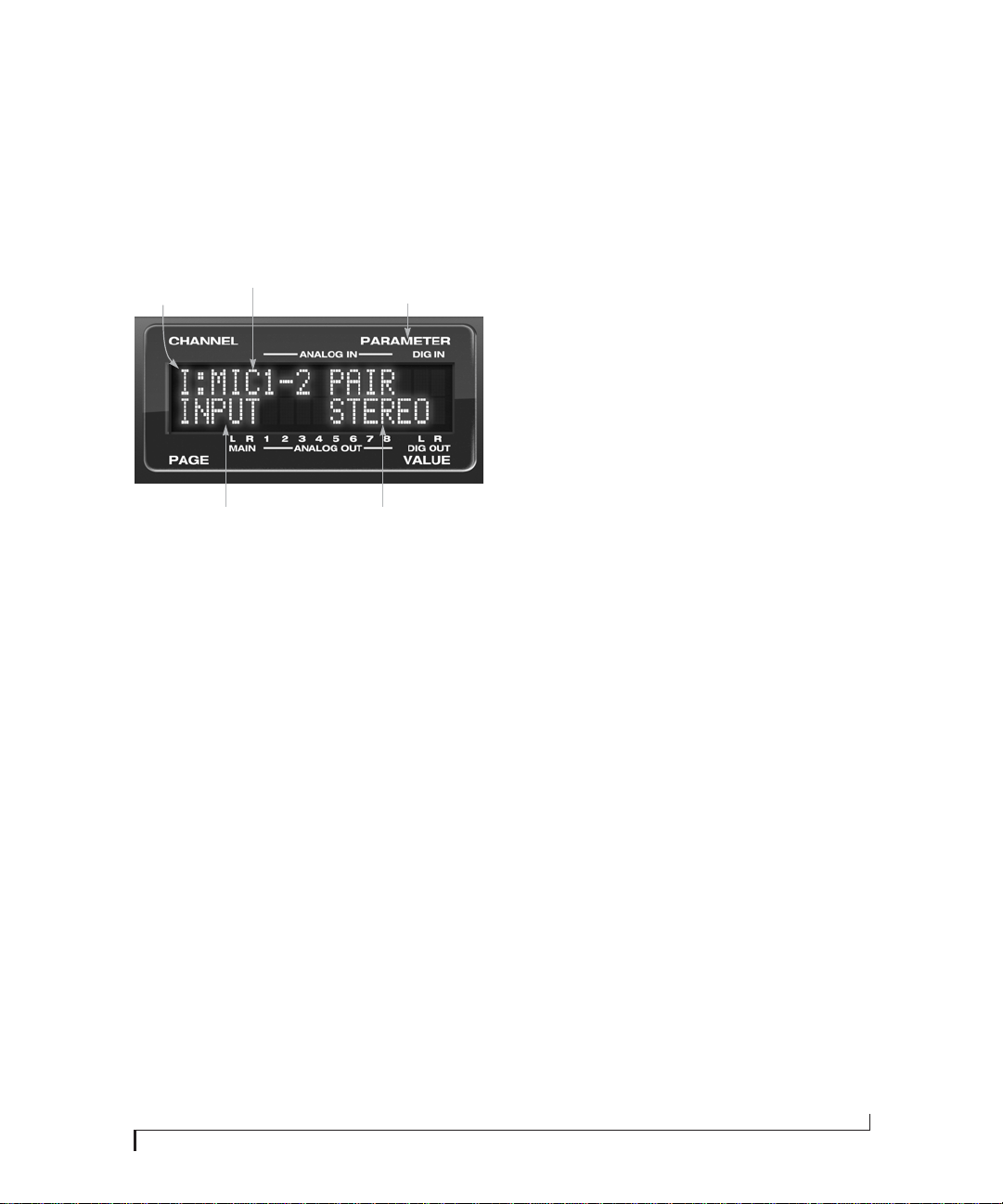
ULTRALITE-MK3 HYBRID FRONT PANEL OPERATION
39
The IN (inputs) menu
Push the CHANNEL button repeatedly until you
see “I:” in the channel section of the LCD
(Figure 6-6). This is similar to accessing the Inputs
tab in CueMix FX console (“The Inputs tab” on
page 66).
Figure 6-6: The IN (inputs) menu.
Choosing a channel
Once you see the Inputs menu (Figure 6-6) in the
LCD, turn the CHANNEL knob to select the
desired input that you wish to edit. This is roughly
equivalent to specifying an input channel strip to
work with in the Inputs tab in CueMix FX software
(Figure 10-3 on page 66).
Choosing a setting to modify
Once you’ve selected an input channel, you can
access the various settings for that channel using
the PAGE knob and PARAMETER knobs.
Turn the PAGE knob to scroll through channel
settings such as individual bands of EQ, the
compressor, reverb sends, etc. Push the PAGE knob
to jump to the next “section” of parameters or to
jump back to the beginning of the list. This is
roughly the equivalent of moving through the
various channel controls in an individual input
channel strip in CueMix FX (Figure 10-3 on
page 66), as well as the settings in the Channel tab
(Figure 10-8 on page 70).
Turn the PARAMETER knob to scroll through
individual parameters, such as the frequency for
the current band of EQ. This is roughly equivalent
to the parameters in the EQ tab (Figure 10-10 on
page 72), Dynamics tab (Figure 10-26 on page 80)
and Reverb tab (Figure 10-28 on page 83) in the
CueMix FX software.
Adjusting the value of a parameter
Turn the VALUE knob to adjust the value of the
current PARAMETER. Some parameters have
default values. If so, push the VALUE knob to cycle
through them.
Inactive items
If a menu item is inactive for some reason (perhaps
it doesn’t currently apply or it is disabled), it is
displayed in parentheses.
Copying and pasting
EQ, dynamics and Mix Assign settings allow you to
copy and paste settings between EQ bands and/or
channels. Push the VALUE knob to copy, scroll to
the other item and then push again to paste.
Pad and phantom power
If a quarter-inch plug is inserted into the XLR/TRS
combo input, the phantom power and pad settings
are disabled. When disabled, their corresponding
setting in the LCD menu will read N/A (Not
Applicable). All current phantom power and pad
settings for the mic input are reactivated and
restored when the quarter-inch plug is removed
from the jack.
Summary of Inputs menu settings
For a summary of Inputs menu settings, see
“Inputs menu” on page 41.
“ I: ” Indicates
the IN (inputs)
menu.
The current
channel.
“Pages” are groups of
channel settings, such
as one band of EQ.
Access individual parameters
here, such as the frequency
setting for a band of EQ.
Change the value of the
current parameter here

ULTRALITE-MK3 HYBRID FRONT PANEL OPERATION
40
The OUT (Outputs) menu
Push the CHANNEL button repeatedly until you
see “O:” in the channel section of the LCD
(Figure 6-7). This is similar to accessing the
Outputs tab in CueMix FX console (“The Outputs
tab” on page 68).
Figure 6-7: The OUT (outputs) menu.
Choosing a channel
Once you see the Outputs menu (Figure 6-7) in the
LCD, turn the CHANNEL knob to select the
desired output that you wish to edit. This is roughly
equivalent to specifying an output channel strip to
work with in the Outputs tab in CueMix FX
software (Figure 10-6 on page 69).
Working with outputs in the LCD
Once you’ve selected an output channel, you can
access the various settings for that channel using
the PAGE knob and PARAMETER knobs. The
knobs function the same as described for inputs in
“Choosing a setting to modify” on page 39 and
“Adjusting the value of a parameter” on page 39.
Summary of Output menu settings
For a summary of Inputs menu settings, see
“Outputs menu” on page 42.
The MIX (Mixes) menu
Push the CHANNEL button repeatedly until you
see “MIX 1” (or “MIX 2”, etc.) in the channel
section of the LCD (Figure 6-8). This is similar to
accessing the Mixes tab in CueMix FX console
(“The Mixes tab” on page 64).
Figure 6-8: The MIX (Mixes) menu.
Choosing a mix bus
Once you see the MIX menu (Figure 6-8) in the
LCD, turn the CHANNEL knob to select the
desired mix that you wish to edit. This is roughly
equivalent to choosing a mix in the Mixes tab in
CueMix FX software (Figure 10-2 on page 64).
Working with mix busses in the LCD
Once you’ve selected a mix, you can access the
various settings for that mix using the PAGE knob
and PARAMETER knobs. The knobs function the
same as described for inputs in “Choosing a setting
to modify” on page 39 and “Adjusting the value of a
parameter” on page 39. The PAGE knob scrolls
through the following mix bus settings:
■ MASTER — these are master fader settings,
such as the master fader output assignment, master
mute on/off, and the master fader volume. Access
them with the PARAMETER knob.
“ O: ” Indicates
the OUT
(outputs) menu.
The current
channel.
“Pages” are groups of
channel settings, such
as one band of EQ.
Access individual parameters
here, such as the frequency
setting for a band of EQ.
Change the value of the
current parameter here
The current
mix bus.
Here, choose master fader
settings, reverb settings, and
individual input channels.
Access individual parameters
here, such as input channel
settings.
Change the value of the
current parameter here

ULTRALITE-MK3 HYBRID FRONT PANEL OPERATION
41
■ REVERB — these are the reverb send and return
controls for the bus master fader. Access them with
the PARAMETER knob.
■ Individual channels — once you scroll past
MASTER and REVERB, the PAGE knob then
scrolls through all available inputs for the mix bus.
Once you choose an input, access its channel
settings using the PARAM knob and VALUE knob.
Summary of Mix menu settings
For a summary of Mix menu settings, see “Mixes
menu” on page 42.
The REVERB settings
Push the CHANNEL button repeatedly until you
see “REVERB” in the channel section of the LCD
(Figure 6-9). This is similar to accessing the Reverb
tab in CueMix FX (“The Reverb tab” on page 83).
☛ The REVERB processor is not available at
sample rates above 48 kHz. Therefore, when the
UltraLite-mk3 is operating at 88.2 kHz or higher,
the REVERB menu does not appear in the LCD.
Figure 6-9: The REVERB settings.
Once you’ve selected the REVERB menu, you can
access all settings using the PARAMETER and
VALUE knobs. The PAGE knob is not needed and
is therefore disabled when editing reverb settings.
Summary of Reverb menu settings
See “Reverb menu” on page 42 for a summary.
INPUTS MENU
CHANNEL PAGE PARAM
INPUTS
mic 1-2
Analog 1-2
Analog 3-4
etc.
INPUT PAIR
PHASE
L-R/M-S (stereo or M/S)
SWAP
WIDTH
TRIM
PAD
PHANTOM
EQ
(global)
ENABLE
COPY
PASTE
RESET
HPF
(High-pass)
ENABLE
SLOPE
FREQ
LF
(Low w/shelf)
ENABLE
TYPE
FREQ
GAIN
WIDTH
LMF
(Low-mid)
ENABLE
TYPE
FREQ
GAIN
WIDTH
MF
(Mid)
ENABLE
TYPE
FREQ
GAIN
WIDTH
HMF
(High-mid)
ENABLE
TYPE
FREQ
GAIN
WIDTH
HF
(High w/shelf)
ENABLE
TYPE
FREQ
GAIN
WIDTH
LPF
(Low-pass)
ENABLE
SLOPE
FREQ
DYN
(Dynamics)
ENABLE
COPY
PASTE
RESET
COMP
(Compressor)
ENABLE
MODE
THRESH
RATIO
ATTACK
RELEASE
TRIM
LEVELER ENABLE
MODE
REDUCE
MAKEUP
REVERB SEND
SEND PAN (mono only)
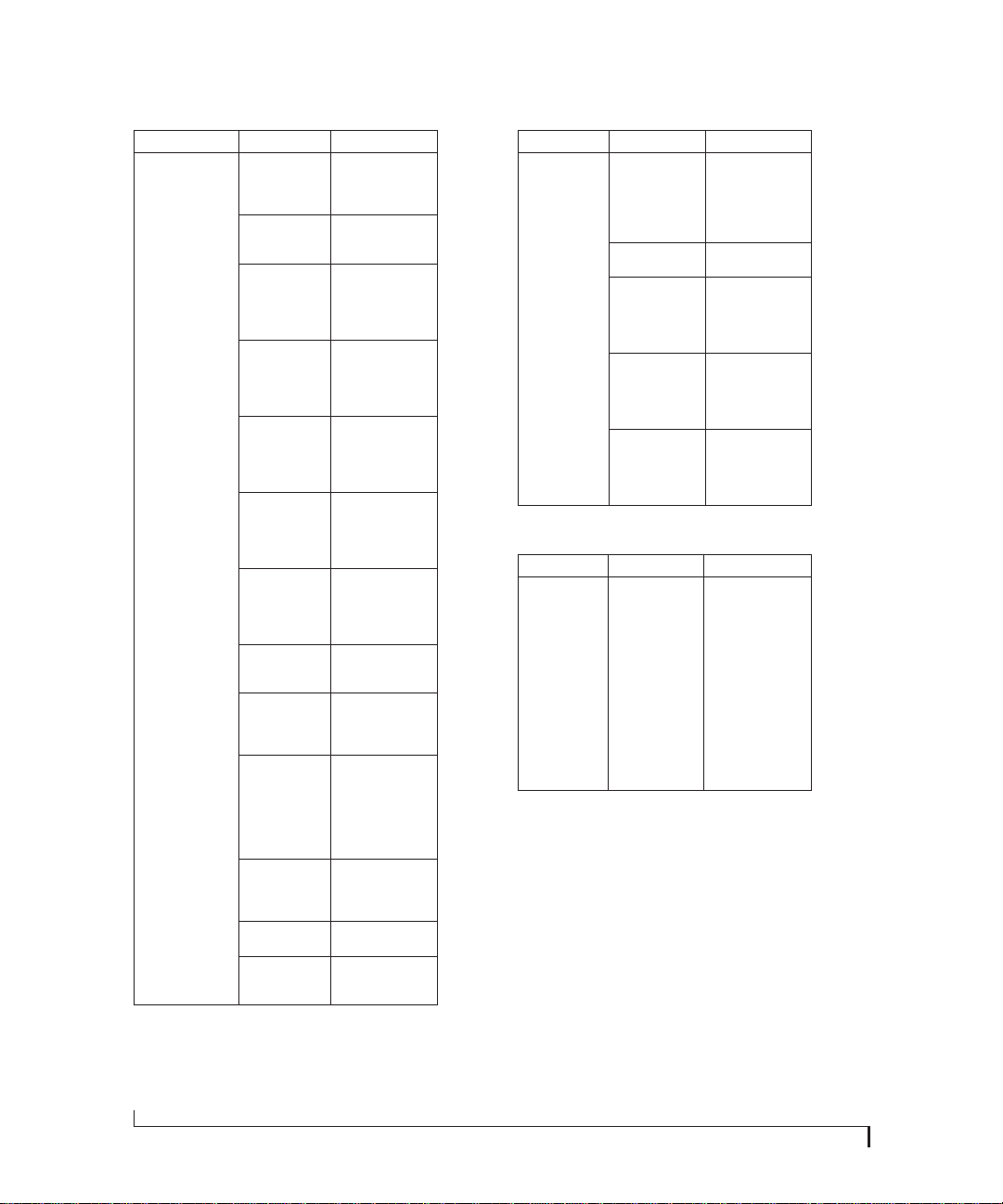
ULTRALITE-MK3 HYBRID FRONT PANEL OPERATION
42
OUTPUTS MENU MIXES MENU
REVERB MENU
STAND-ALONE OPERATION
All settings, including all mix settings and global
settings, are saved in the UltraLite-mk3’s memory,
and they remain in effect even when the
UltraLite-mk3 is not connected to a computer.
This allows you to use the UltraLite-mk3 as a
stand-alone 8-bus mixer. You can make
adjustments to any setting at any time from the
front panel.
CHANNEL PAGE PARAM
OUTPUTS
Main
Analog 1-2
Analog 3-4, etc.
EQ
(global)
ENABLE
COPY
PASTE
RESET
HPF
(High-pass)
ENABLE
SLOPE
FREQ
LF
(Low w/shelf)
ENABLE
TYPE
FREQ
GAIN
WIDTH
LMF
(Low-mid)
ENABLE
TYPE
FREQ
GAIN
WIDTH
MF
(Mid)
ENABLE
TYPE
FREQ
GAIN
WIDTH
HMF
(High-mid)
ENABLE
TYPE
FREQ
GAIN
WIDTH
HF
(High w/shelf)
ENABLE
TYPE
FREQ
GAIN
WIDTH
LPF
(Low-pass)
ENABLE
SLOPE
FREQ
DYN
(Dynamics)
ENABLE
COPY
PASTE
RESET
COMP
(Compressor)
ENABLE
MODE
THRESH
RATIO
ATTACK
RELEASE
TRIM
LEVELER ENABLE
MODE
REDUCE
MAKEUP
REVERB SEND
SEND PAN
MASTER MONITOR
TALKBACK
LSNBACK
CHANNEL PAGE PARAM
MIXES
Mix 1
Mix 2
etc.
MASTER ASSIGN
MUTE
FADER
COPY
PASTE
RESET
REVERB SEND
RETURN
ANALOG 1
ANALOG 2
etc.
(if mono)
MUTE
SOLO
(BAL/WID) - n/a
PAN
FADER
ANALOG 3-4
ANALOG 5-6
etc.
(if stereo)
MUTE
SOLO
BAL/WID
BAL
FADER
SP (S/PDIF) MUTE
SOLO
BAL/WID
BAL
FADER
CHANNEL PAGE PARAM
REVERB --- ENABLE
TIME
PREDELAY
WIDTH
CUT Hz
CUT dB
ROOM
REFSIZE
REF LEV
LO %
MID %
HI %
LO XOVR
HI XOVR
SPLIT

CHAPTER
43
7 Cubase, Nuendo, Live and Other
ASIO Software
OVERVIEW
The UltraLite-mk3 includes an ASIO driver that
provides multi-channel I/O and sample-accurate
synchronization with Steinberg’s Cubase family of
digital audio sequencers, including Cubase and
Nuendo.
What is ASIO? . . . . . . . . . . . . . . . . . . . . . . . . . . . . . . . . . . . . . . . . 43
Preparation . . . . . . . . . . . . . . . . . . . . . . . . . . . . . . . . . . . . . . . . . . 43
Run MOTU Audio Console . . . . . . . . . . . . . . . . . . . . . . . . . . . 43
Choosing the MOTU ASIO driver. . . . . . . . . . . . . . . . . . . . . 45
Direct monitoring. . . . . . . . . . . . . . . . . . . . . . . . . . . . . . . . . . . . 46
Other System dialog settings . . . . . . . . . . . . . . . . . . . . . . . . 46
Viewing and managing UltraLite-mk3 inputs. . . . . . . . 46
Viewing and managing UltraLite-mk3 outputs . . . . . . 47
Changing UltraLite-mk3 settings . . . . . . . . . . . . . . . . . . . . 47
Processing live inputs with host-based VST plug-ins. 47
Working with CueMix FX mixing and effects. . . . . . . . . 47
Synchronization . . . . . . . . . . . . . . . . . . . . . . . . . . . . . . . . . . . . . 47
MIDI I/O via the UltraLite-mk3 MIDI ports. . . . . . . . . . . . 47
24-bit operation . . . . . . . . . . . . . . . . . . . . . . . . . . . . . . . . . . . . . 48
WHAT IS ASIO?
ASIO is an acronym for Audio Streaming Input and
Output. The ASIO MOTU FireWire Audio driver
allows the UltraLite-mk3 to provide multi-channel
audio input and output for any audio application
that supports ASIO drivers.
Attention: Other software users
The UltraLite-mk3 ASIO driver also provides
multi-channel I/O with any ASIO-compatible
audio software. Cubase is used for the examples in
this chapter. However, the basic procedures are the
same and can be easily applied to any ASIO-
compatible software. Just follow the general
descriptions at the beginning of each main section
in this chapter. Consult your software
documentation for details about each topic, if
necessary.
If your audio software doesn’t support ASIO
If your host audio software does not support ASIO,
but instead supports WDM (or legacy Wave) audio
drivers, refer to the next chapter.
PREPARATION
To make sure that everything is ready for Cubase,
install Cubase first (if you haven’t already done so),
and then see these chapters before proceeding:
■ chapter 3, “IMPORTANT! Run the
UltraLite-mk3 Software Installer First” (page 15)
■ chapter 4, “Installing the UltraLite-mk3 Hybrid
Hardware” (page 17).
RUN MOTU AUDIO CONSOLE
Before you run Cubase, launch MOTU Audio
Console to configure your UltraLite-mk3
hardware. MOTU Audio Console lets you
configure your audio interface, and it lets you
enable the desired inputs and outputs. Only
enabled inputs and outputs will be available to
Cubase, so this is an important step. For complete
details regarding MOTU Audio Console, see
chapter 5, “MOTU Audio Console” (page 29).
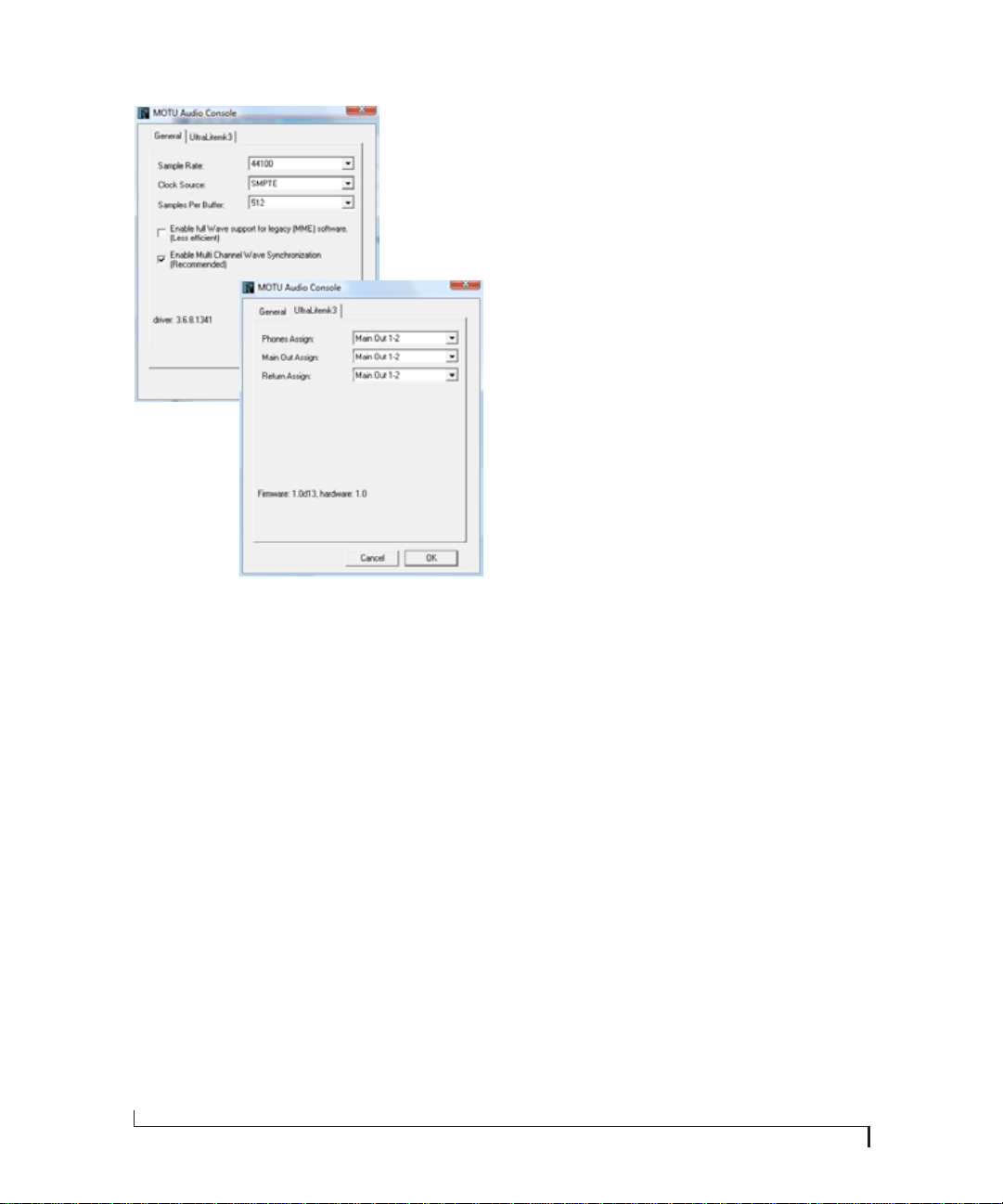
CUBASE, NUENDO, LIVE AND OTHER ASIO SOFTWARE
44
Figure 7-1: MOTU Audio Console gives you access to all of the settings
in the UltraLite-mk3 hardware, including the clock source and
sample rate.
For complete details about the UltraLite-mk3
settings, see chapter 5, “MOTU Audio Console”
(page 29). The following sections provide a brief
explanation of each UltraLite-mk3 setting for use
with Cubase.
Sample rate
Choose the desired overall sample rate for the
UltraLite-mk3 system and Cubase. Newly recorded
audio in Cubase will have this sample rate.
Clock Source
This setting is very important because it
determines which audio clock the UltraLite-mk3
will follow.
If you do not have any digital audio connections to
your UltraLite-mk3 (you are using the analog
inputs and outputs only), and you will not be
slaving Cubase to external SMPTE time code,
choose Internal.
If you have a S/PDIF digital audio device
connected to the UltraLite-mk3, see “Connecting
and syncing S/PDIF devices” on page 22.
If you are slaving the UltraLite-mk3 and Cubase to
SMPTE time code via the UltraLite-mk3 itself,
choose SMPTE and follow the directions in
“Resolving Cubase or Nuendo to SMPTE time
code” on page 105.
☛ If you are using an ASIO host application
other than Cubase or Nuendo, it must support the
ASIO 2.0 sample-accurate positioning protocol in
order to support the UltraLite-mk3’s direct SMPTE
sync (and sample-accurate sync) feature.
Samples Per Buffer
The Samples Per Buffer setting can be used to
reduce the delay — or monitoring latency — that
you hear when live audio is patched through your
UltraLite-mk3 hardware and Cubase. For example,
you might have MIDI instruments, samplers,
microphones, and so on connected to the analog
inputs of the UltraLite-mk3. If so, you will often be
mixing their live input with audio material
recorded in Cubase. See chapter 9, “Reducing
Monitoring Latency” (page 55) for complete
details.
Phones
This UltraLite-mk3 setting lets you choose what
you’ll hear from the headphone jack. For example,
if you choose Main Out 1-2, the headphones will
duplicate the main outs. Or you can choose any
other output pair. If you choose Phones 1-2, this
setting makes the headphone jack serve as its own
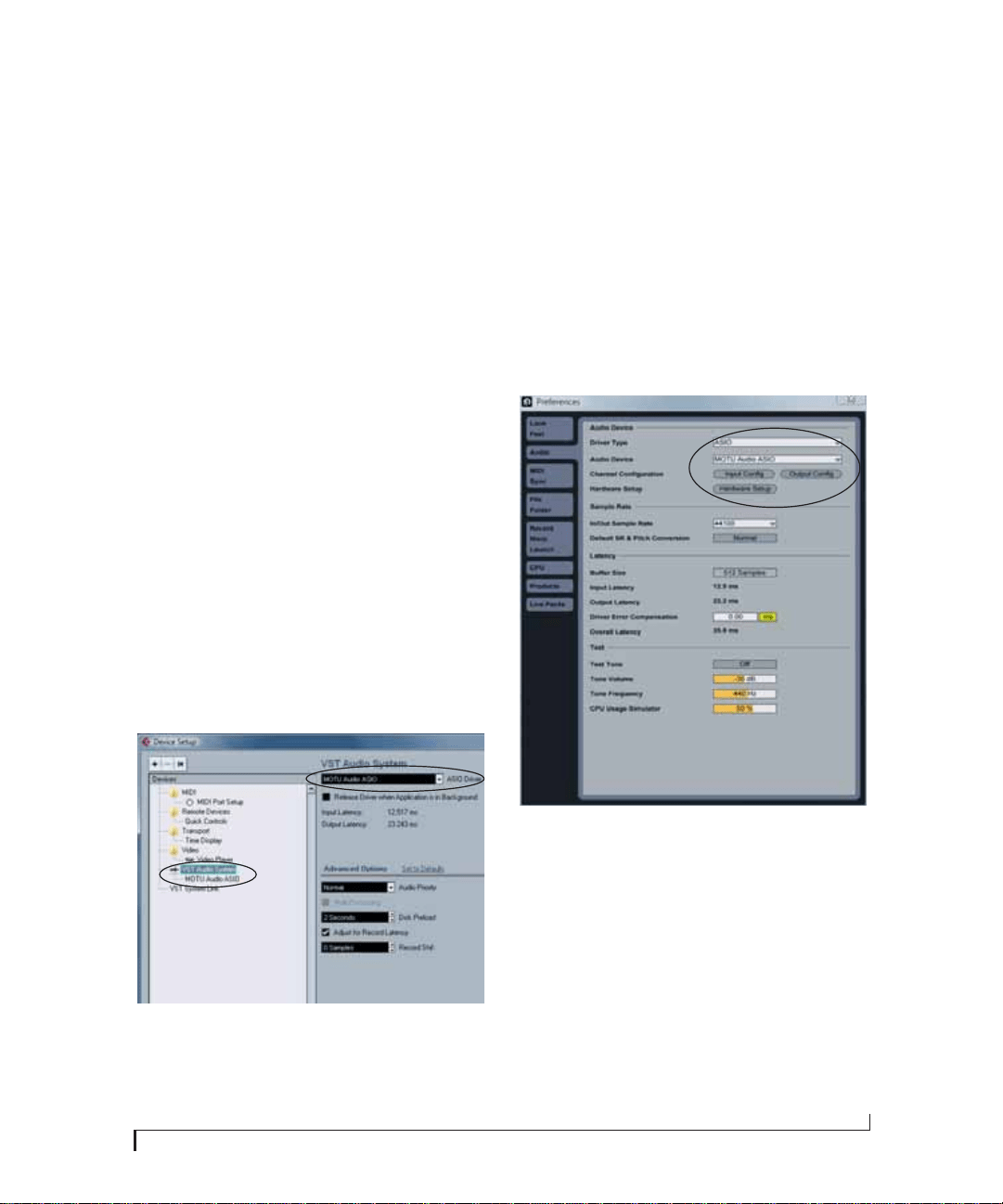
CUBASE, NUENDO, LIVE AND OTHER ASIO SOFTWARE
45
independent output pair. As a result, you’ll see
Phones 1-2 as an additional audio destination in
Cubase or Nuendo’s audio output menus.
Main Out Assign
Use the Main Out Assign setting to determine what
audio you will hear on the TRS main outs of the
UltraLite-mk3. If you would like to treat them as
their own separate output pair, choose Main Outs.
CHOOSING THE MOTU ASIO DRIVER
Once you’ve made the preparations described so
far in this chapter, you’re ready to run your audio
software and enable the MOTU ASIO Driver.
Check the audio system or audio hardware
configuration window in your software. There will
be a menu there that lets you choose among
various ASIO drivers that may be in your system.
Choose the MOTU ASIO Driver from this menu.
Nuendo, Cubase and V-Stack
To activate the UltraLite-mk3 driver in Nuendo or
Cubase SX, go to the Device Setup window, click
VST Audio System and choose MOTU Audio ASIO
from the ASIO Driver menu (Figure 7-2). Make the
other settings in the dialog as need for your system
and synchronization scenario.
Figure 7-2: Activating the UltraLite-mk3 ASIO driver in Nuendo and
Cubase.
Live
In Ableton Live, access the preferences window and
click the Audio tab. Choose ASIO from the Driver
Ty p e menu. Choose the MOTU Audio ASIO from
the Audio Device menu as shown below in
Figure 7-3. To enable or disable UltraLite-mk3
input or output channels, click the Input Config or
Output Config buttons. To access MOTU Audio
Console, click the Hardware Setup button.
For information about the Buffer Size setting, see
“Adjusting the audio I/O buffer” on page 57.
Figure 7-3: Enabling the UltraLite-mk3 in Live.
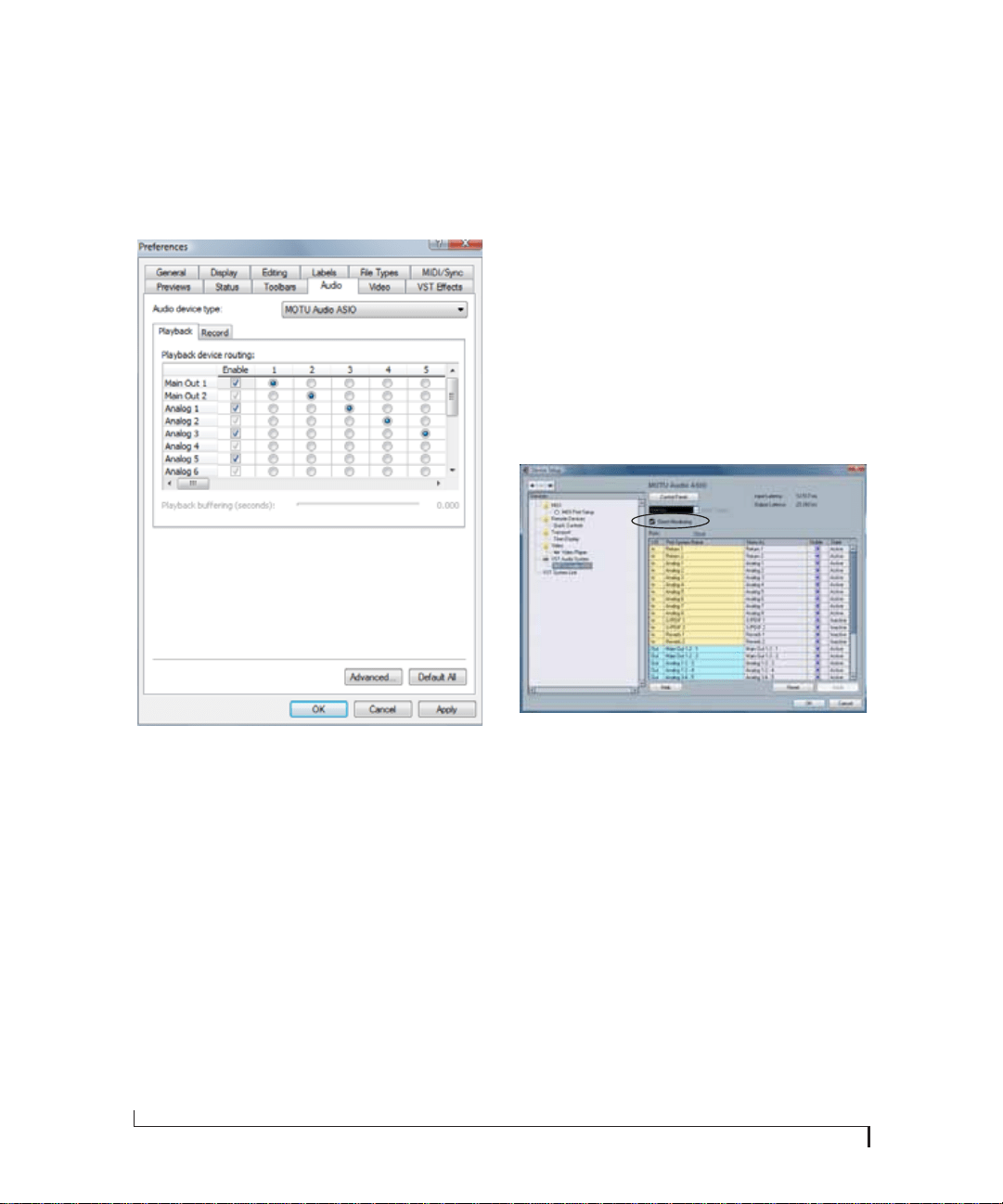
CUBASE, NUENDO, LIVE AND OTHER ASIO SOFTWARE
46
Sound Forge
To activate the MOTU Audio ASIO driver in Sound
Forge, go to the Preferences window, click the
Audio tab, and then choose MOTU Audio from the
Audio device type menu as shown below.
Figure 7-4: Enabling the UltraLite-mk3 driver in Sound Forge.
DIRECT MONITORING
The Direct Monitoring option (Figure 7-5) allows
you to monitor inputs directly in the
UltraLite-mk3 hardware with no drain on your
computer and near zero latency. When you enable
this option, Cubase uses the UltraLite-mk3’s
CueMix FX monitoring features whenever you use
Cubase’s monitoring features. For further
information, see “Controlling CueMix FX from
within Cubase or Nuendo” on page 59.
OTHER SYSTEM DIALOG SETTINGS
Consult your Cubase or Nuendo documentation
for details about the rest of the settings in this
dialog.
VIEWING AND MANAGING ULTRALITE-MK3
INPUTS
Once you’ve chosen the MOTU ASIO Driver in
Device Setup as explained earlier in “Choosing the
MOTU ASIO driver” on page 45, click MOTU
Audio ASIO in the left-hand list to see the
UltraLite-mk3 inputs in the port list on the right
(Figure 7-5). To activate an UltraLite-mk3 output,
create a bus in the VST Connections window and
assign the desired output to it.
Figure 7-5: Creating UltraLite-mk3 inputs in Nuendo or Cubase.
Return Assign
In the VST Inputs list, you’ll see an UltraLite-mk3
input pair called Return 1-2. This is a stereo feed
from the UltraLite-mk3 that matches the output of
one of its output pairs. Use the Return Assign menu
in MOTU Audio Console to choose which output
pair you would like to hear on this return. This can
be used, for example, to record back a final stereo
mix that includes effects processing from the
UltraLite-mk3 DSP (such as the Leveler) for
reference and archiving purposes.

CUBASE, NUENDO, LIVE AND OTHER ASIO SOFTWARE
47
☛ Warning: the Return inputs can cause
feedback loops! DO NOT assign this input to a
track that shares the same UltraLite-mk3 output
pair as the returns.
Reverb return
The UltraLite-mk3 also supplies a return to your
host software that carries the output of its reverb
processor. This return can be used for any purpose
you wish.
VIEWING AND MANAGING ULTRALITE-MK3
OUTPUTS
To view and manage UltraLite-mk3 outputs, scroll
down below the inputs to see them (Figure 7-6).
Figure 7-6: Working with UltraLite-mk3 outputs in Nuendo or
Cubase.
The “Phones 1-2” output
If you’ve chosen to treat the UltraLite-mk3
headphones as an independent output, you’ll see
Phones 1-2 as a UltraLite-mk3 output destination.
Audio tracks assigned to this output pair will be
heard on the headphone jack only. For further
explanation, see “Phones” on page 44.
CHANGING ULTRALITE-MK3 SETTINGS
To change the UltraLite-mk3 settings at any time,
go to the Device Setup window in Nuendo or
Cubase and click the Control Panel button, as
shown in Figure 7-6 on page 47. Be sure to click the
Reset button after making any changes.
PROCESSING LIVE INPUTS WITH HOST-
BASED VST PLUG-INS
If you patch a live input (such as MIDI synthesizer)
through a VST plug-in effect in Cubase, you might
hear a slight delay. There are several ways to reduce
this delay. For details, see chapter 9, “Reducing
Monitoring Latency” (page 55).
WORKING WITH CUEMIX FX MIXING AND
EFFECTS
The UltraLite-mk3 provides powerful external
mixing, EQ, compression and reverb, which you
can operate hand-in-hand with your host
software’s complete mixing environment. For
example, the UltraLite-mk3 can serve as a monitor
mixer routing channels to musicians, or it can
serve as an integrated extension of your Cubase/
Nuendo mixing environment. If you program an
UltraLite-mk3 mixing and processing
configuration that goes hand in hand with your
Cubase/Nuendo project, be sure to use the file save
features in CueMix FX to save the UltraLite-mk3
settings as a file in your Cubase/Nuendo project
folder for instant recall of all settings. See
chapter 10, “CueMix FX” (page 61) for complete
details.
SYNCHRONIZATION
Together, Cubase (or Nuendo) and the
UltraLite-mk3 have the ability to resolve directly to
SMPTE time code, without an additional time
code synchronizer. See “Syncing to SMPTE time
code” on page 106.
MIDI I/O VIA THE ULTRALITE-MK3 MIDI
PORTS
Once you’ve run the UltraLite-mk3 software
installer as explained in “Installing the
UltraLite-mk3 software” on page 15, the
UltraLite-mk3 MIDI ports will appear as a MIDI
input source and output destination in your host
software’s MIDI input and output menus.

CUBASE, NUENDO, LIVE AND OTHER ASIO SOFTWARE
48
24-BIT OPERATION
Your UltraLite-mk3 hardware fully supports
Cubase and Nuendo’s 24-bit recording capabilities.
Simply enable 24-bit operation as instructed in
your Cubase or Nuendo manual. The
UltraLite-mk3 always supplies a 24-bit data
stream, and when you enable 24-bit operation in
Cubase or Nuendo, it simply uses all 24-bits
supplied by the UltraLite-mk3 hardware.
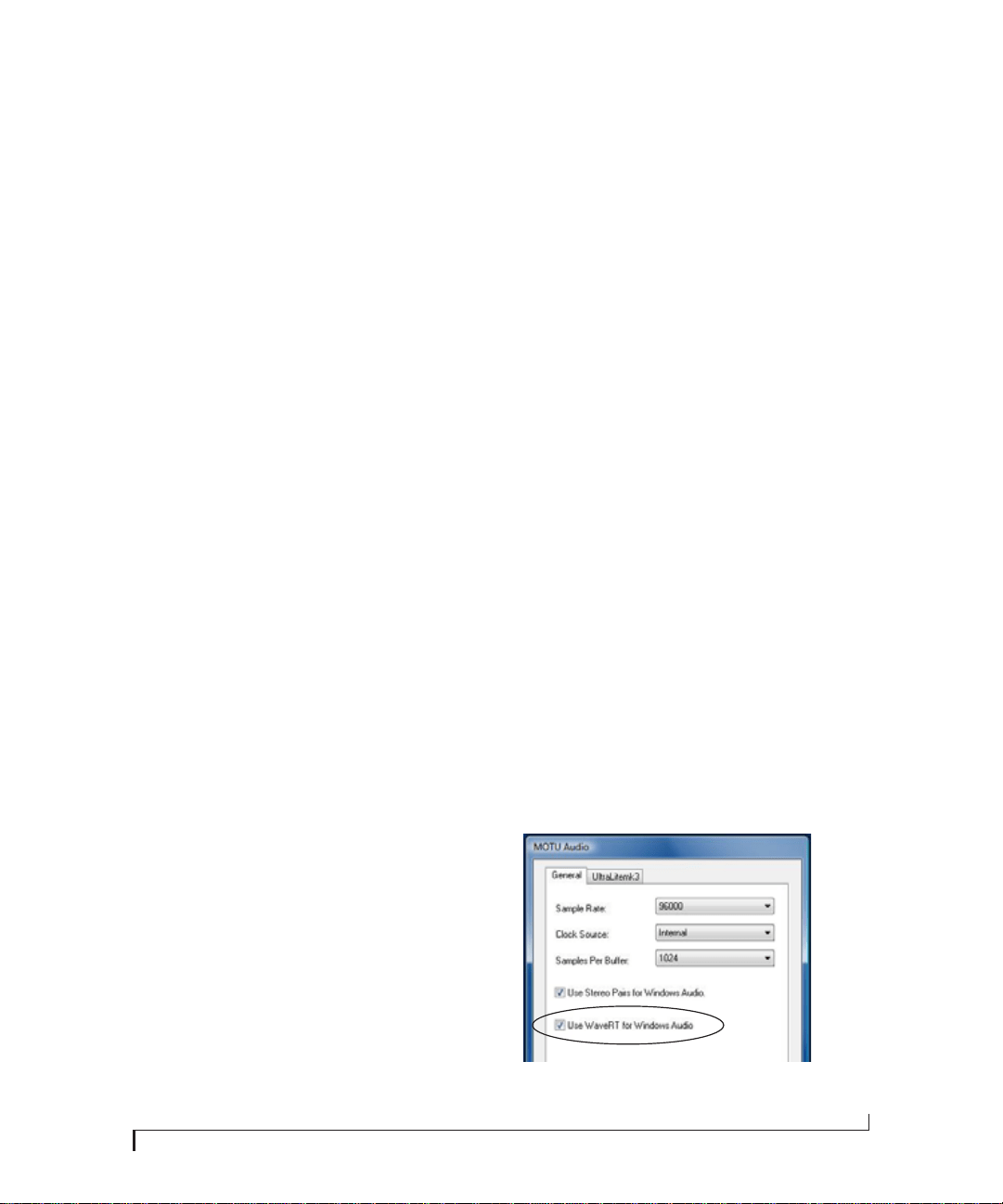
CHAPTER
49
8 SONAR and other WDM Software
OVERVIEW
The UltraLite-mk3 WDM driver provides
standard multi-channel input and output for
WDM-compatible audio software running under
Windows XP.
WDM and Wave driver compatibility. . . . . . . . . . . . . . . . . 49
Installing the MOTU Audio WDM driver. . . . . . . . . . . . . . 49
Enabling Wave (MME) compatibility . . . . . . . . . . . . . . . . . 49
WaveRT support . . . . . . . . . . . . . . . . . . . . . . . . . . . . . . . . . . . . . 49
Making settings in MOTU Audio Console . . . . . . . . . . . . 50
Enabling the MOTU Audio WDM driver . . . . . . . . . . . . . . 51
Working with UltraLite-mk3 inputs and outputs. . . . . 52
Changing UltraLite-mk3 settings . . . . . . . . . . . . . . . . . . . . 52
Reducing delay when monitoring live inputs . . . . . . . . 52
Processing live inputs with host-based VST plug-ins. 52
Working with CueMix FX mixing and effects. . . . . . . . . 52
MIDI I/O via the UltraLite-mk3 MIDI ports. . . . . . . . . . . . 52
24-bit operation . . . . . . . . . . . . . . . . . . . . . . . . . . . . . . . . . . . . . 53
WDM AND WAVE DRIVER COMPATIBILITY
WDM is an acronym for Windows Driver Model.
The MOTU WDM Driver allows the
UltraLite-mk3 to provide multi-channel audio
input and output for any audio application that
supports WDM audio drivers.
Attention: Cakewalk users
Cakewalk SONAR is used for the WDM driver
setup examples in this chapter.
Attention: other software users
SONAR is used for the WDM driver setup
examples in this chapter. However, the basic
procedures are the same and can be easily applied
to any WDM-compatible software. Consult your
software documentation for details, if necessary.
INSTALLING THE MOTU AUDIO WDM
DRIVER
The MOTU Audio Installer CD installs the MOTU
WDM driver into Windows for you. That’s pretty
much all the preparation you need. See chapter 3,
“IMPORTANT! Run the UltraLite-mk3 Software
Installer First” (page 15).
ENABLING WAVE (MME) COMPATIBILITY
If your host audio software does not support
Windows WDM drivers, enable Wave driver
compatibility in the MOTU WDM Driver so that
all of the UltraLite-mk3’s inputs and outputs show
up in your software. For details, see “Wave support
for legacy (MME) software” on page 32.
☛ If your host audio software does support
WDM audio drivers, don’t enable Wave driver
compatibility.
WaveRT SUPPORT
The UltraLite-mk3 Windows driver also supports
WaveRT, a low-latency audio driver standard
developed by Microsoft. WaveRT is supported by
Sonar 8 and later, under Windows 7 and Vista. To
enable WaveRT, check the Use WaveRT for Windows
Audio option in MOTU Audio Setup.
Figure 8-1: The WaveRT option can be enabled in the MOTU Audio
Setup console.
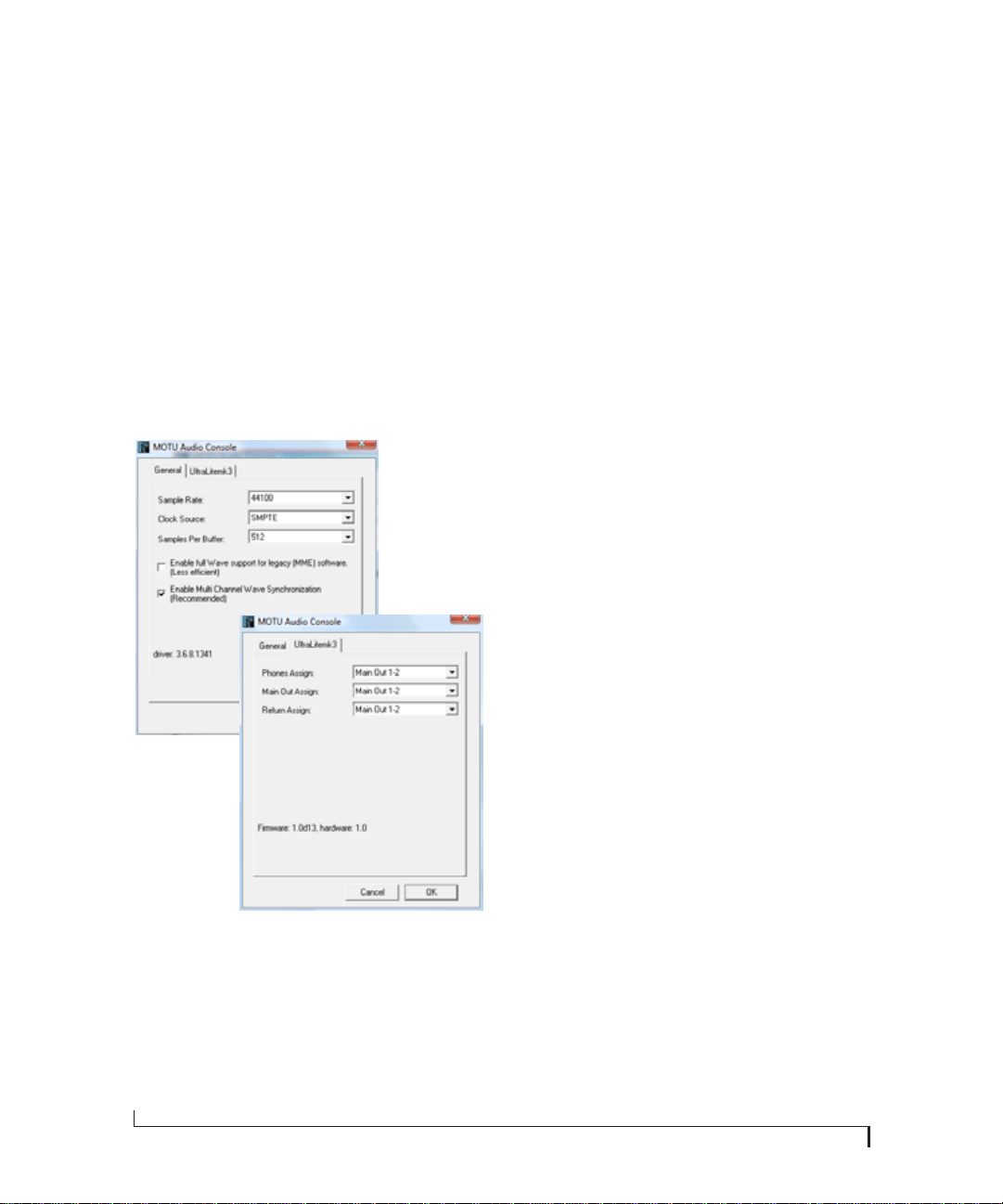
SONAR AND OTHER WDM SOFTWARE
50
If you uncheck this box, WaveRT support is
disabled, and legacy WDM driver support is
provided instead.
MAKING SETTINGS IN MOTU AUDIO
CONSOLE
Before you run your audio software, launch MOTU
Audio Console to configure your UltraLite-mk3
hardware. MOTU Audio Console lets you choose
the audio clock source, sample rate, buffer size and
other hardware settings. For details, see chapter 5,
“MOTU Audio Console” (page 29). The following
sections provide a brief explanation of each
UltraLite-mk3 setting for use with SONAR.
Figure 8-2: MOTU Audio Console gives you access to all of the settings
in the UltraLite-mk3 hardware, including the clock source, sample
rate and headphone output assignment.
Sample rate
Choose the desired overall sample rate for the
UltraLite-mk3 system and SONAR. Newly
recorded audio in SONAR will have this sample
rate.
Clock Source
This setting is very important because it
determines which audio clock the UltraLite-mk3
will follow.
If you do not have any digital audio connections to
your UltraLite-mk3 (you are using the analog
inputs and outputs only), and you will not be
slaving SONAR to external SMPTE time code,
choose Internal.
If you have a S/PDIF digital audio device
connected to the UltraLite-mk3, see “Connecting
and syncing S/PDIF devices” on page 22.
Samples Per Buffer
The Samples Per Buffer setting can be used to
reduce the delay — or monitoring latency — that
you hear when live audio is patched through your
UltraLite-mk3 hardware and SONAR. For
example, you might have MIDI instruments,
samplers, microphones, and so on connected to
the analog inputs of the UltraLite-mk3. If so, you
will often be mixing their live input with audio
material recorded in SONAR. See chapter 9,
“Reducing Monitoring Latency” (page 55) for
complete details.
Phones
This UltraLite-mk3 setting lets you choose what
you’ll hear from the headphone jack. For example,
if you choose Main Out 1-2, the headphones will
duplicate the main outs. Or you can choose any
other output pair. If you choose Phones, this setting
makes the headphone jack serve as its own
independent output pair. As a result, you’ll see
Phones 1-2 as an additional audio destination in
SONAR’s audio output menus.
Main Out Assign
Use the Main Out Assign setting to determine what
audio you will hear on the XLR main outs of the
UltraLite-mk3. If you would like to treat them as
their own separate output pair, choose Main Outs.

SONAR AND OTHER WDM SOFTWARE
51
ENABLING THE MOTU AUDIO WDM DRIVER
Once you’ve made the preparations described so
far in this chapter, you’re ready to run your audio
software and enable the MOTU Audio WDM
driver. Check the audio system or audio hardware
configuration window in your software.
Enabling the MOTU Audio WDM driver in
SONAR
To activate the MOTU Audio WDM driver in
SONAR:
1 Choose Audio from the Options menu.
2 Click the Drivers tab.
3 Check the UltraLite-mk3 inputs and outputs
that you wish to use and uncheck the ones you
don’t as shown in Figure 8-3.
Figure 8-3: Activating the MOTU Audio WDM driver in SONAR by
highlighting UltraLite-mk3 inputs and outputs.
Enabling the MOTU ASIO driver in SONAR
As an alternative to the UltraLite-mk3’s WDM
driver, you can use the UltraLite-mk3’s ASIO
driver. Note, however, that you can only use one
audio interface at a time under ASIO. Go to the
Advanced tab and choose ASIO from the Driver
Mode menu:
Figure 8-4: Enabling the ASIO driver instead of the WDM driver.
Other audio settings in SONAR
There are a few other settings in SONAR that
impact UltraLite-mk3 operation:
1 In the Audio Options window, click the General
tab.
2 Choose any UltraLite-mk3 input and output for
recording and playback timing as shown below in
Figure 8-5. It doesn’t matter which ones.
Figure 8-5: Make sure you have chosen an UltraLite-mk3 input and
output for the playback and recording timing master settings.
3 In the General tab, click the Wave Profiler
button and run the Wave Profiler.

SONAR AND OTHER WDM SOFTWARE
52
This process chooses the optimum settings for the
UltraLite-mk3 hardware.
WORKING WITH ULTRALITE-MK3 INPUTS
AND OUTPUTS
Once you’ve enabled the UltraLite-mk3 inputs and
output, UltraLite-mk3 audio inputs and outputs
will appear in your host software’s input/output
menus, and you can set them up and use them as
any standard audio input and output.
Return Assign
In SONAR, you’ll see an UltraLite-mk3 input pair
called Return 1-2. This is a stereo feed from the
UltraLite-mk3 that matches the output of one of its
output pairs. Use the Return Assign menu in
MOTU Audio Console to choose which output
pair you would like to hear on this return. This can
be used, for example, to record back a final stereo
mix that includes effects processing from the
UltraLite-mk3 DSP (such as the Leveler) for
reference and archiving purposes.
☛ Warning: the Return inputs can cause
feedback loops! DO NOT assign this input to a
track that shares the same UltraLite-mk3 output
pair as the returns.
Reverb return
The UltraLite-mk3 also supplies a return to your
host software that carries the output of its reverb
processor. This return can be used for any purpose
you wish.
The “Phones 1-2” output
If you’ve chosen to treat the UltraLite-mk3
headphones as an independent output, you’ll see
Phones 1-2 as an UltraLite-mk3 output destination.
Audio tracks assigned to this output pair will be
heard on the headphone jack only. For further
explanation, see “Phones Assign” on page 32.
CHANGING ULTRALITE-MK3 SETTINGS
You can change the UltraLite-mk3 settings at any
time by accessing MOTU Audio Console.
REDUCING DELAY WHEN MONITORING
LIVE INPUTS
If you have live audio inputs connected to the
UltraLite-mk3, such as MIDI synthesizers,
samplers, microphones or other live instruments,
you might hear a slight delay when their audio is
being monitored through your UltraLite-mk3
hardware and your host audio program. There are
several ways to reduce — and eliminate — this
audible monitoring delay. For details, see chapter 9,
“Reducing Monitoring Latency” (page 55).
PROCESSING LIVE INPUTS WITH HOST-
BASED VST PLUG-INS
If you patch a live input (such as MIDI synthesizer)
through a plug-in effect in SONAR, you might hear
a slight delay. There are several ways to reduce this
delay. For details, see chapter 9, “Reducing
Monitoring Latency” (page 55).
WORKING WITH CUEMIX FX MIXING AND
EFFECTS
The UltraLite-mk3 provides powerful external
mixing, EQ, compression and reverb, which you
can operate hand-in-hand with your host
software’s complete mixing environment. For
example, the UltraLite-mk3 can serve as a monitor
mixer routing channels to musicians, or it can
serve as an integrated extension of your SONAR
mixing environment. If you program an
UltraLite-mk3 mixing and processing
configuration that goes hand in hand with your
SONAR project, be sure to use the file save features
in CueMix FX to save the UltraLite-mk3 settings as
a file in your SONAR project folder for instant
recall of all settings. See chapter 10, “CueMix FX”
(page 61) for complete details.
MIDI I/O VIA THE ULTRALITE-MK3 MIDI
PORTS
Once you’ve run the UltraLite-mk3 software
installer as explained in “Installing the
UltraLite-mk3 software” on page 15, the
UltraLite-mk3 MIDI ports will appear as a MIDI

SONAR AND OTHER WDM SOFTWARE
53
input source and output destination in your
WDM-compatible software’s MIDI input and
output menus.
24-BIT OPERATION
Your UltraLite-mk3 hardware fully supports 24-bit
recording in any audio software that supports it.
Simply enable 24-bit operation as instructed by the
software. The UltraLite-mk3 system always
supplies the software with a 24-bit data stream, and
when you enable 24-bit operation, it simply uses all
24-bits supplied by the UltraLite-mk3 hardware.

SONAR AND OTHER WDM SOFTWARE
54

CHAPTER
55
9 Reducing Monitoring Latency
OVERVIEW
Monitoring latency is that slight delay you hear
when you run an input signal through your host
audio software. For example, you might hear it
when you drive a live mic input signal through an
amp modeling plug-in running in your audio
sequencer.
This delay is caused by the amount of time it takes
for audio to make the entire round trip through
your computer, from when it first enters an
UltraLite-mk3 input, passes through the
UltraLite-mk3 hardware into the computer,
through your host audio software, and then back
out to an UltraLite-mk3 output.
If you don’t need to process a live input with
plug-ins, the easiest way to avoid monitoring
latency is to use the UltraLite-mk3’s CueMix FX
digital mixer to patch the input directly to your
monitor outs via the UltraLite-mk3 audio
hardware. The UltraLite-mk3 even provides effects
processing (EQ, compression and reverb), which
can be applied on input, output, or even at the
bussing stage, just like a conventional mixer. For
details, see “CueMix FX hardware monitoring” on
page 58.
If you do need to process a live input with plug-ins,
or if you are playing virtual instruments live
through your UltraLite-mk3 audio hardware, you
can significantly reduce latency — and even make
it completely inaudible, regardless of what host
audio application software you use. This chapter
explains how.
It is important to note that monitoring delay has no
effect on when audio data is recorded to disk or
played back from disk. Actual recording and
playback is extremely precise.
Monitoring live input. . . . . . . . . . . . . . . . . . . . . . . . . . . . . . . . . 56
Adjusting the audio I/O buffer . . . . . . . . . . . . . . . . . . . . . . . 57
Lower latency versus higher CPU overhead . . . . . . . . . . 58
Transport responsiveness . . . . . . . . . . . . . . . . . . . . . . . . . . . . 58
Effects processing and automated mixing . . . . . . . . . . . 58
CueMix FX hardware monitoring. . . . . . . . . . . . . . . . . . . . . 58
Two methods for controlling CueMix FX . . . . . . . . . . . . . 58
Using CueMix FX . . . . . . . . . . . . . . . . . . . . . . . . . . . . . . . . . . . . . 59
Controlling CueMix FX from your audio software . . . . 59

REDUCING MONITORING LATENCY
56
MONITORING LIVE INPUT
There are two ways to monitor live audio input
with an UltraLite-mk3: 1) through the computer or
2) via the Ultralite-mk3’s CueMix FX hardware
mixer. Figure 9-1 below shows method 1, which
allows you to add effects processing such as reverb
and guitar amp effects via plug-ins in your audio
software. See the next section, “Adjusting the audio
I/O buffer” for details about how to reduce — and
possibly eliminate — the audible monitoring delay
that the computer introduces.
Figure 9-2 shows how to use CueMix FX hardware-
based monitoring, which lets you hear what you are
recording with no monitoring delay and no
computer-based effects processing. Instead, input
is routed directly to an output, either with or
without UltraLite-mk3-based effects processing
(EQ, compression or reverb). See “CueMix FX
hardware monitoring” later in this chapter for
details on how to use CueMix FX with your audio
software, or with the included CueMix FX
software.
If the material you are recording is suitable, there is
a third way to monitor live input: use both methods
(Figure 9-1 and Figure 9-2) at the same time. For
example, you could route guitar to both the
computer (for an amp model effect) and mix that
processed signal on the main outs with dry guitar
from CueMix FX — or perhaps with a touch of
UltraLite-mk3 Classic Reverb.
1. Live input (from mic, guitar, etc.)
enters the MOTU interface.
PC
2. Mic signal goes immedi-
ately to the computer (dry,
with no effects processing).
3. Mic signal is
‘patched thru’ back to
the audio interface
with reverb or other
plug-in effects, if any.
Figure 9-1: There are two ways to monitor live audio inputs with an UltraLite-mk3: 1) through the computer or 2) via CueMix FX hardware
monitoring. This diagram shows method 1 (through the computer). When using this method, use your host software’s buffer setting to reduce
the slight delay you hear when monitoring the live input, but don’t lower it too much, or your computer might get sluggish.
4. Mic signal (with plug-in
processing, if any) is routed
to the main outs (or other
outputs that you’ve specified
in the software).

REDUCING MONITORING LATENCY
57
ADJUSTING THE AUDIO I/O BUFFER
A buffer is a small amount of computer memory
used to hold data. For audio interfaces like the
UltraLite-mk3, buffers are used for the process of
transferring audio data in and out of the computer.
The size of the buffers determines how much delay
you hear when monitoring live inputs through
your audio software: larger buffers produce more
delay; smaller buffers produce less.
Buffer size adjustment is made in MOTU Audio
Console, as shown in Figure 9-3 via the Samples Per
Buffer setting.
Figure 9-3: Lowering the ‘Samples Per Buffer’ setting in MOTU Audio
Console reduces patch thru latency. But doing so increases the
processing load on your computer, so keep an eye on the Perfor-
mance Monitor in your host audio software.
2. CueMix FX immediately patches the live
mic signal directly to the main outs (or
other output), completely bypassing the
computer. This signal could be dry, or with
UltraLite-mk3 effects processing, such as
EQ, compression or Classic Reverb.
3. Mic signal is mixed with the
main outs, and you can
control the volume (relative
to the rest of the mix) with
the mic’s fader in CueMix FX.
Figure 9-2: This diagram shows the signal flow when using CueMix FX no-latency monitoring. Notice that this method does not process the
live input with plug-ins in your audio software. Instead, you can apply UltraLite-mk3 effects, such as the reverb, EQ and/or compression.
1. Live input (from mic, guitar, etc.)
enters the MOTU interface.

REDUCING MONITORING LATENCY
58
Lower latency versus higher CPU overhead
The buffer setting has a large impact on the
following things:
■ Patch thru latency
■ The load on your computer’s CPU
■ Possible distortion at the smallest settings
■ How responsive the transport controls are in
your audio software
The buffer setting presents you with a trade-off
between the processing power of your computer
and the delay of live audio as it is being patched
through your software. If you reduce the size, you
reduce patch thru latency, but significantly increase
the overall processing load on your computer,
leaving less CPU bandwidth for things like real-
time effects processing. On the other hand, if you
increase the buffer size, you reduce the load on
your computer, freeing up bandwidth for effects,
mixing and other real-time operations.
If you are at a point in your recording project where
you are not currently working with live, patched-
thru material (e.g. you’re not recording vocals), or
if you have a way of externally processing inputs,
choose a higher buffer size. Depending on your
computer’s CPU speed, you might find that settings
in the middle work best (256 to 1024).
Transport responsiveness
Buffer size also impacts how quickly your audio
software will respond when you begin playback,
although not by amounts that are very noticeable.
Lowering the buffer size will make your software
respond faster; raising the buffer size will make it a
little bit slower, but barely enough to notice.
Effects processing and automated mixing
Reducing latency with the buffer size setting has
another benefit: it lets you route live inputs through
the real-time effects processing and mix
automation of your audio software.
CUEMIX FX HARDWARE MONITORING
The UltraLite-mk3 has a more direct method of
patching audio through the system. This method is
called CueMix FX. When enabled, CueMix
activates hardware patch-thru in the
UltraLite-mk3 itself. CueMix FX has two
important benefits:
■ First, it completely eliminates the patch thru
delay (reducing it to a small number of samples —
about the same amount as one of today’s digital
mixers).
■ Secondly, CueMix FX imposes no strain on the
computer.
The trade-off, however, is that CueMix FX
bypasses your host audio software. Instead, live
audio inputs are patched directly through to
outputs in the UltraLite-mk3 itself and are mixed
with disk tracks playing back from your audio
software. This means that you cannot apply
plug-ins, mix automation, or other real-time
effects that your audio software provides. But for
inputs that don’t need these types of features,
CueMix DSP is the way to go.
On the other hand, if you really need to use the
mixing and processing provided by your audio
software, you should not use CueMix FX. Instead,
reduce latency with the buffer setting (as explained
earlier in this chapter).
TWO METHODS FOR CONTROLLING
CUEMIX FX
There are two ways to control CueMix FX:
■ With CueMix FX
■ From within your host audio software (if it
supports direct hardware monitoring)
You can even use both methods simultaneously.

REDUCING MONITORING LATENCY
59
Using CueMix FX
If your host audio software does not support direct
hardware monitoring, you run CueMix FX side-
by-side with your audio software and manage your
monitor mix in CueMix FX.
CueMix FX allows you to create up to eight
separate UltraLite-mk3 monitor mixes, or any
other desired routing configurations. These
routings are independent of your host audio
software. For complete details, see chapter 10,
“CueMix FX” (page 61).
Controlling CueMix FX from your audio
software
Some ASIO-compatible audio applications, such as
Cubase and Nuendo, allow you to control
CueMix FX monitoring from within the
application (without the need to use CueMix FX).
In most cases, this support consists of patching an
UltraLite-mk3 input directly to an output when
you record-arm a track. Exactly how this is
handled depends on the application.
CueMix FX routings that are made via host
applications are made “under the hood”, which
means that you won’t see them in CueMix FX.
However, CueMix FX connections made inside
your host audio software dovetail with any other
mixes you’ve set up in CueMix FX. For example, if
your host application routes audio to an output
pair that is already being used in CueMix FX for an
entirely separate mix bus, both audio streams will
simply be merged to the output.
Controlling CueMix FX from within Cubase or
Nuendo
To turn on CueMix in Cubase SX or Nuendo,
enable the Direct Monitoring check box in the
Device Setup window (Figure 7-2 on page 45).
Other ASIO 2.0-compatible host software
If your ASIO-compatible host audio software
supports ASIO’s direct monitoring feature, consult
your software documentation to learn how to
enable this feature. Once enabled, it should work
similarly as described for Cubase (as explained in
the previous section).
Using CueMix FX with WDM- or Wave-
compatible software
Run CueMix FX (chapter 10, “CueMix FX”
(page 61)) and use it to route live inputs directly to
outputs, control their volume and panning, etc. If
necessary, you can save your CueMix Console
setup with your project file.

REDUCING MONITORING LATENCY
60

CHAPTER
61
10 CueMix FX
OVERVIEW
CueMix FX is a cross-platform software
application that provides graphic, on-screen
control for the UltraLite-mk3’s flexible CueMix FX
on-board mixer and effects processing.
CueMix FX can be used independently of host
audio software, or together with it. CueMix
dovetails with the direct monitoring features of
your host audio software, allowing you to
seemlessly mix in both environments.
For information about programming the
UltraLite-mk3’s on-board mixing and effects using
the front panel LCD, see chapter 10, “CueMix FX”
(page 61).
A 16-bus mixer with EQ, compression and reverb. . . . 61
Advantages over host-based mixing and processing 62
CueMix FX installation . . . . . . . . . . . . . . . . . . . . . . . . . . . . . . . 62
CueMix FX basic operation . . . . . . . . . . . . . . . . . . . . . . . . . . 63
The Mixes tab. . . . . . . . . . . . . . . . . . . . . . . . . . . . . . . . . . . . . . . . 64
The Inputs tab . . . . . . . . . . . . . . . . . . . . . . . . . . . . . . . . . . . . . . . 66
The Outputs tab . . . . . . . . . . . . . . . . . . . . . . . . . . . . . . . . . . . . . 68
The channel settings section. . . . . . . . . . . . . . . . . . . . . . . . . 70
The Monitor Group . . . . . . . . . . . . . . . . . . . . . . . . . . . . . . . . . . 84
DSP meter . . . . . . . . . . . . . . . . . . . . . . . . . . . . . . . . . . . . . . . . . . . 85
Solo light . . . . . . . . . . . . . . . . . . . . . . . . . . . . . . . . . . . . . . . . . . . . 85
Talkback and listenback . . . . . . . . . . . . . . . . . . . . . . . . . . . . . 85
Shortcuts . . . . . . . . . . . . . . . . . . . . . . . . . . . . . . . . . . . . . . . . . . . . 87
File menu . . . . . . . . . . . . . . . . . . . . . . . . . . . . . . . . . . . . . . . . . . . . 87
Edit menu. . . . . . . . . . . . . . . . . . . . . . . . . . . . . . . . . . . . . . . . . . . . 87
Devices menu. . . . . . . . . . . . . . . . . . . . . . . . . . . . . . . . . . . . . . . . 88
Oscilloscope . . . . . . . . . . . . . . . . . . . . . . . . . . . . . . . . . . . . . . . . . 88
X-Y Plot . . . . . . . . . . . . . . . . . . . . . . . . . . . . . . . . . . . . . . . . . . . . . . 94
Phase Analysis . . . . . . . . . . . . . . . . . . . . . . . . . . . . . . . . . . . . . . . 97
Configurations menu . . . . . . . . . . . . . . . . . . . . . . . . . . . . . . . 100
Talkback menu . . . . . . . . . . . . . . . . . . . . . . . . . . . . . . . . . . . . . 101
Phones menu. . . . . . . . . . . . . . . . . . . . . . . . . . . . . . . . . . . . . . . 101
Control Surfaces menu . . . . . . . . . . . . . . . . . . . . . . . . . . . . . 101
A 16-BUS MIXER WITH EQ, COMPRESSION
AND REVERB
All UltraLite-mk3 inputs and outputs can be
routed to the on-board CueMix FX 16-bus (8
stereo bus) digital mixer driven by hardware-based
DSP with 32-bit floating point precision.
The CueMix FX mixer allows you to apply no-
latency effects processing to inputs, outputs or
busses directly in the UltraLite-mk3 hardware,
independent of the computer. Effects can even be
applied when the UltraLite-mk3 is operating
stand-alone (without a computer) as a complete
portable mixer. Input signals to the computer can
be recorded wet, dry, or dry with a wet monitor
mix (for musicians during recording, for example).
Effects include:
■ Classic Reverb with tail lengths up to 60 seconds
■ 7-band parametric EQ modeled after British
analog console EQs
■ A standard compressor with conventional
threshold/ratio/attack/release/gain controls
■ The Leveler™, an accurate model of the
legendary LA-2A optical compressor, which
provides vintage, musical automatic gain control
The UltraLite-mk3’s flexible effects architecture
allows you to apply EQ and compression on every
input and output (a total of 58 channels), with
enough DSP resources for at least one band of
parametric EQ and compression on every channel
at 48 kHz. DSP resources are allocated dynamically
and a DSP meter in the CueMix FX software allows
you to keep tabs on the UltraLite-mk3’s processing
resources.
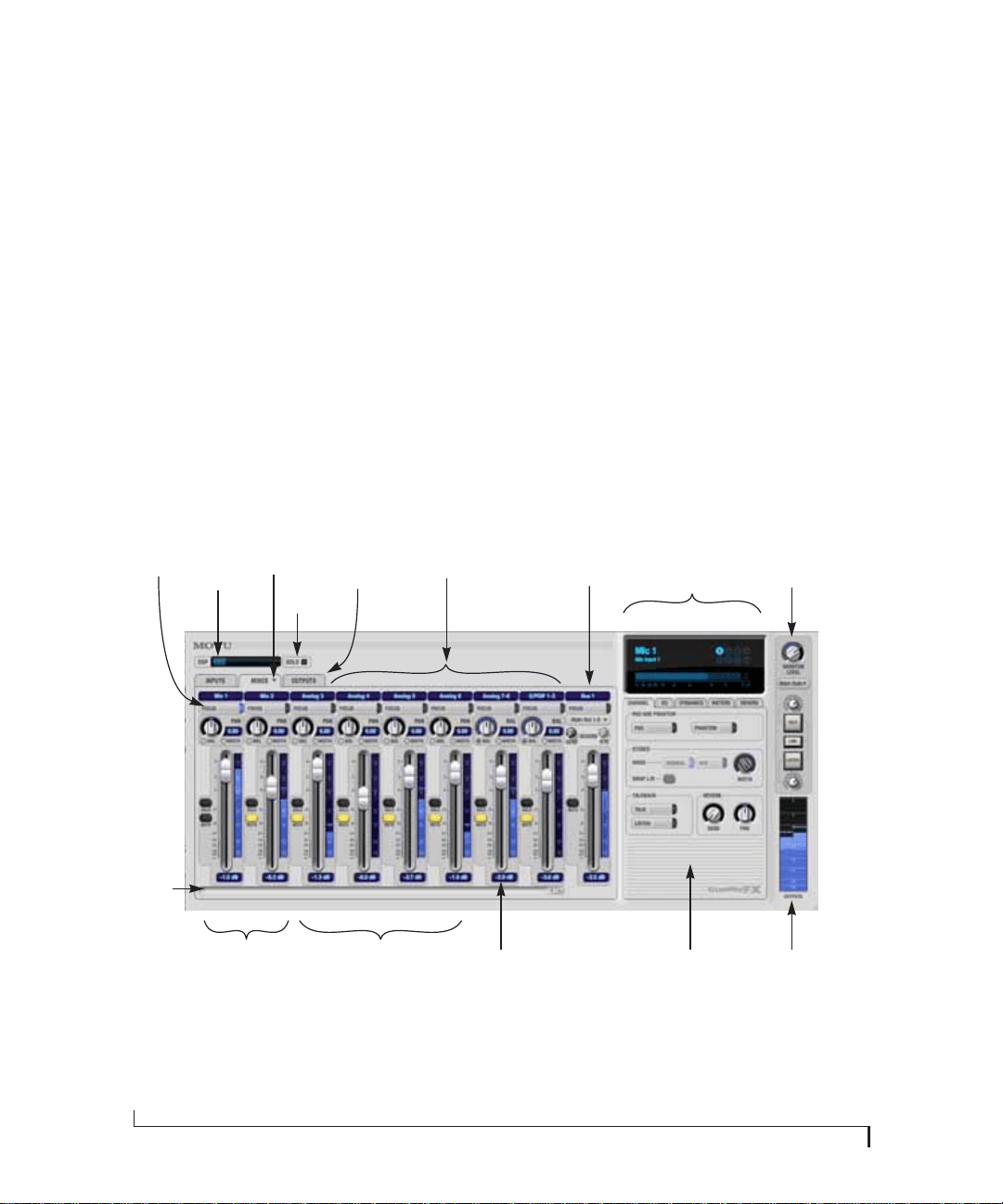
CUEMIX FX
62
Each input, output and mix bus provides a send to
the Classic Reverb processor, which then feeds
reverb returns to mix busses and outputs, with a
selectable split point between them to prevent
send/return feedback loops.
ADVANTAGES OVER HOST-BASED MIXING
AND PROCESSING
CueMix FX provides several major advantages over
mixing and processing in your host audio software:
■ CueMix has no buffer latency. Thanks to the
UltraLite-mk3’s DSP chip, CueMix provides the
same throughput performance as a digital mixer.
■ CueMix mixing and effects processing imposes
no processor drain on the computer’s CPU.
■ CueMix routing can be maintained
independently of individual software applications
or projects.
■ CueMix routing can operate without the
computer, allowing the UltraLite-mk3 to operate as
a portable, stand-alone mixer with effects.
CUEMIX FX INSTALLATION
CueMix FX is installed with the rest of your
UltraLite-mk3 software.
Figure 10-1: CueMix FX is a virtual mixer that gives you control over the UltraLite-mk3’s on-board mixing features.
Tabs for inputs,
mix busses and
outputs
DSP
resources
meter
UltraLite-mk3
inputs
Mix bus
master
fader
Tabs for channel strip settings,
including EQ and dynamics, as
well as global settings such as
the meter bridge and reverb
processor.
Monitoring/
talkback
section
Monitor
group
metering
Mic inputs Inputs split
into mono
channels
Inputs grouped as
stereo pairs
Mix bus
menu
Channel
settings
Channel
focus
Channel
scroll
bar
Solo
light

CUEMIX FX
63
CUEMIX FX BASIC OPERATION
Here is a brief overview of the CueMix FX mixer.
Eight stereo mix busses
CueMix provides eight stereo mix busses: Bus 1,
Bus 2, Bus 3, and so on. Each mix bus can take any
number of inputs and mix them down to any
UltraLite-mk3 output pair that you choose. For
example, Bus 1 could go to the headphones, Bus 2
could go to the main outs, Bus 3 could go to a piece
of outboard gear connected to analog outputs 7-8,
etc.
Many inputs to one output pair
It might be useful to think of each mix bus as some
number of inputs all mixed down to a stereo output
pair. CueMix FX lets you choose which inputs to
include in the mix, and it lets you specify the level,
pan and other input-specific mix controls for each
input being fed into the mix.
Viewing one mix bus at a time
CueMix FX displays one mix bus at a time in the
Mixes tab (Figure 10-2 on page 64). To select which
mix you are viewing, choose it from the mix bus
menu (Figure 10-2). The mix name appears above
the mix bus master fader (Figure 10-2), where you
can click the name to change it.
Each mix bus is independent
Each mix bus has its own settings. Settings for one
bus will not affect another. For example, if an input
is used for one bus, it will still be available for other
busses. In addition, inputs can have a different
volume, pan, mute and solo setting in each bus.
Input channels
The Inputs tab (Figure 10-3 on page 66) gives you
access to settings for individual UltraLite-mk3
inputs (or input pairs), such as phase, trim, EQ and
dynamics processing. Each input also includes a
send to the UltraLite-mk3’s global reverb
processor. These settings are applied to the signal
before it goes anywhere else (to a mix bus or the
computer).
Output channels
The Outputs tab (Figure 10-6 on page 69) gives you
access to settings for each UltraLite-mk3 output
pair, including EQ, dynamics processing and
send/return controls for feeding and returning the
output signal to/from the UltraLite-mk3’s global
reverb processor. These settings are applied to the
signal just before it is sent to the output.
Channel focus and settings
Click the focus button for a channel (Figure 10-1)
to view channel-specific parameters in the Channel
Settings section of the CueMix FX window
(Figure 10-1). Separate tabs are provided for
channel-specific settings (channel strip, EQ and
dynamics), plus the global meter bridge and reverb
processor.
Global reverb processor
The UltraLite-mk3 has a global reverb module
(Figure 10-28 on page 83). Once it has been
activated, you can feed signals to the reverb
processor from various points in the
UltraLite-mk3 mix matrix via input sends, bus
sends and output sends. Stereo output from the
reverb processor can then be fed back to mix
busses or output pairs using reverb returns.
Other features
CueMix offers many additional features, discussed
in this chapter, such as talkback/listenback,
extensive metering, graphic editing of certain
effects parameters, monitor grouping and more.
Widening the CueMix FX window
To view more input faders at once, drag the right-
hand edge of the window to the right.
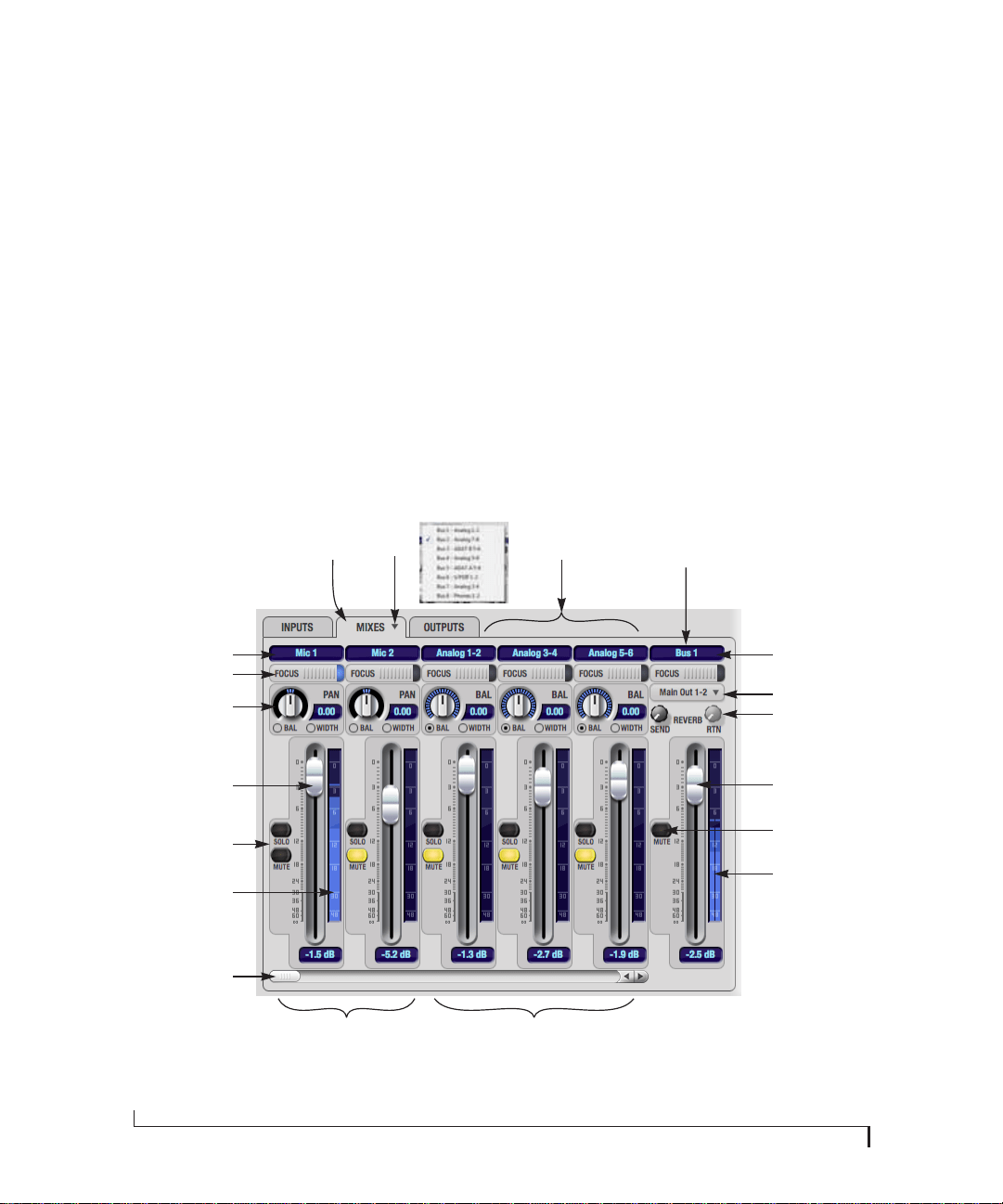
CUEMIX FX
64
THE MIXES TAB
Click the Mixes tab (Figure 10-2) to gain access to
the UltraLite-mk3’s eight stereo mix busses. The
Mixes tab displays one mix bus at a time.
Viewing a mix
Choose the mix you wish to view from the mix bus
menu (in the Mixes tab itself, as shown in
Figure 10-2). The menu shows all mixes by name,
followed by the UltraLite-mk3 output pair to
which each bus master fader is currently assigned,
if any.
Naming a mix
Click the mix name at the top of the mix bus master
fader (Figure 10-2) to edit the name.
Assigning a mix bus output
Choose the desired output pair for the mix bus
from the bus output menu (Figure 10-2). The bus
output menu displays all current available
(enabled) UltraLite-mk3 output pairs. If a bus is
already assigned to an output pair, the bus name
appears next to the output pair name to indicate
that the output pair is already taken by a bus. Only
one bus can be assigned to any given output pair. If
you choose an output already assigned to another
bus, that bus output will become disabled.
Bus fader
The bus fader (Figure 10-2) controls the overall
level of the mix (its volume on its stereo output).
Use the individual input faders to the left to control
individual input levels.
Figure 10-2: The Mixes tab.
UltraLite-mk3
inputs
Mix bus 1
master
fader
Mic inputs Inputs grouped as
stereo pairs
Mixes
tab
Input name
Channel focus
Input pan section
Input fader
Scroll bar for input
channels
Bus output
Bus Reverb
send/return
Bus name
Bus fader
Bus mute
Bus level meter
Input mute/solo
Input level meter
Mix bus
menu

CUEMIX FX
65
Bus mute
The bus mute button (Figure 10-2) disables
(silences) the mix.
Bus level meter
The bus level meter, which is post-fader, shows you
the output for the mix’s output.
Bus reverb send/return
The bus reverb send (Figure 10-2) feeds the output
of the mix bus, pre-fader, to the UltraLite-mk3’s
global reverb processor, where it is merged with
any other signals being fed to the reverb. The
reverb’s output can then be fed back into the mixer
at various return points, including the bus return
(discussed below).
The bus reverb return (Figure 10-2) feeds the
output of the UltraLite-mk3’s global reverb
processor into the mix bus, pre-fader. This includes
any other signals currently being fed to the reverb.
The bus reverb return is disabled (grayed out)
when the reverb Split Point is set to Output to
eliminate the possibility for feedback loops created
by reverb send/return loops. See “Split point” on
page 83.
Input section
The horizontally scrolling area in the Mix tab to the
left of the master fader (Figure 10-2) displays
channel strips for all currently enabled
UltraLite-mk3 inputs.
Input channel focus
Click the channel focus button (Figure 10-3) to
view and edit parameters in the channel settings
section of the CueMix FX window (Figure 10-7 on
page 70). Clicking the mix bus master fader focus
button brings the assigned output into focus, if
there is one.
Input pan section
The input pan knob (Figure 10-2) pans the input
across the bus stereo outputs. If the input itself is
grouped as a stereo pair (in the Inputs tab), two
forms of panning control are provided:
Balance
Balance works like the balance knob on some
radios: turn it left and the right channel dims, turn
it right and left channel dims. But the left channel
always stays left and the right channel stays right.
Width
Width spreads the left and right channels across the
stereo image, depending on the knob position.
Maximum value (turning the pan knob all the way
up) maintains the original stereo image: the left
channel goes entirely left and right goes entirely
right, without attenuation. The minimum value
(turning the knob all the way down) creates a
mono effect: equal amounts of left and right are
combined and sent to both outputs. In between,
the left out is a mixture of the left input and some of
the right input (and vice-versa) with the effect of
narrowing the field.
Input fader and mute/solo
To add an input to a mix, or remove it, click its
Mute button. To solo it, use its Solo button. Use the
input fader (Figure 10-2) to adjust the level for the
input in the mix. Note that an input can have
different level, pan, mute and solo settings for
different mixes. Input channel level meters are
post-fader.
If any solo button on the current (active) bus is
enabled, the Solo Light (Figure 10-1) will
illuminate.

CUEMIX FX
66
THE INPUTS TAB
The UltraLite-mk3 provides many features for
managing analog and digital input signals. Some of
these features, such as the UltraLite-mk3’s digitally
controlled analog trims, are implemented in the
analog domain; others are implemented in the
digital domain as DSP applied to the digital signal
(after the A/D converter on analog inputs). Click
the Inputs tab (Figure 10-3) to access and control
all of these input channel settings for each
UltraLite-mk3 input or input pair.
Input tab settings are global
Except for the reverb send, all settings you make in
the Input tab are applied to the input signal before
it goes anywhere else (to a mix bus or the
computer). For example, if you apply EQ and
compression to the input signal, you will record the
processed version of the signal in your host audio
software running on the computer. If you need to
record a completely unprocessed input signal, do
not apply any changes to it in the Input tab. The
only exception to this is the reverb send, which
simply splits the input signal and feeds a copy of it
to the UltraLite-mk3’s reverb processor.
Signal flows from top to bottom
Settings in each Input tab channel strip are
generally applied to the signal in order from top to
bottom. Input channel signal flow is as follows:
trim, phase, stereo versus M/S decoding, width,
L/R swap, EQ, dynamics and reverb send.
Input channel focus
Click the channel focus button (Figure 10-3) to
view and edit parameters in the channel settings
section of the window (Figure 10-7 on page 70).
Mono/stereo pairing
Click the Mono button (Figure 10-3) if you would
like an input to be treated as a mono channel. If you
would like to work with it as one channel of a
linked stereo pair, click the Stereo button. Inputs
are grouped in odd/even pairs (mic 1-2, Analog
1-2, 3-4, etc.) Stereo pairs appear as a single
channel strip in the CueMix FX mixer (in all tabs).
Figure 10-3: The Inputs tab.
Input name
Channel focus
Mono/stereo paring
Invert phase
Input trim
EQ/dynamics graph
EQ/dynamics controls
EQ/dynamics
enable/disable
Reverb send
Input scroll bar
EQ band selectors
LP/HP filter selector
Compressor selector
Inputs tab
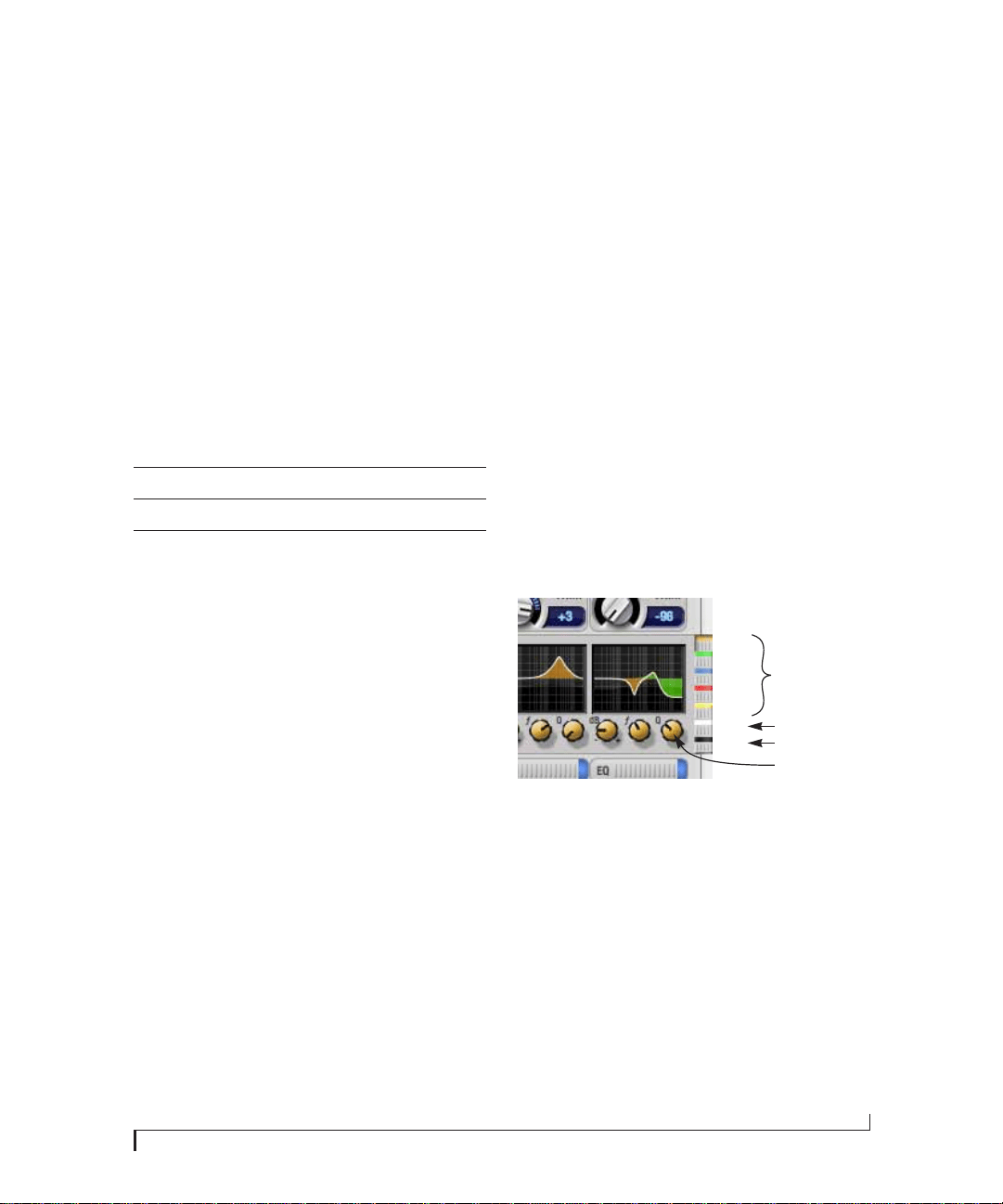
CUEMIX FX
67
Invert phase
The Phase button (Figure 10-3) inverts the phase of
the input signal. For stereo pairs, you can invert the
phase for the left and right channels independently.
Input trim
All UltraLite-mk3 inputs, both analog and digital,
offer continuously variable input trim. In all cases,
trim level can be controlled digitally in 1 dB
increments. This includes the digitally controlled
analog trims on the two mic/guitar inputs and the
six quarter-inch analog inputs on the back panel.
Here is a summary of input trim ranges for each
type of UltraLite-mk3 input:
Once you adjust the trim levels, you can save them
as a file on disk for future instant recall. See “Saving
and loading hardware presets” on page 87 and
“Configurations menu” on page 100.
Input EQ and dynamics
The UltraLite-mk3 lets you apply 7-band
parametric EQ and dynamics processing (DSP) to
any input, analog or digital.
The controls in the EQ/Compression section of the
Inputs tab (Figure 10-3) let you edit EQ and
compression settings within the context of the
channel strip. This is ideal when you are comparing
settings among neighboring channels, or perhaps
even applying the same setting across all inputs.
However, for more detailed editing of EQ and
compression settings for an input channel, you can
click its Focus button and view the settings in the
Channel Section of the CueMix FX window
(Figure 10-1). This section even provides graphical
editing of EQ curves and the compressor graph,
allowing you to click and drag directly on the
graphic. For details see “The channel settings
section” on page 70.
The EQ/Dynamics graph
The EQ/Dynamics graph for each input channel
strip (Figure 10-3) provides a thumbnail view of
the EQ curves or Compressor graph for the
channel. This graphic is for display purposes only;
it cannot be edited directly. To change the EQ
settings in this graph, use the two or three knobs
below, as explained in the following sections. If,
however, you would like to edit the EQ curves
graphically, you can do so in the EQ tab
(Figure 10-10 on page 72).
EQ/Dynamics selectors
The EQ/Dynamics selector buttons along the
right-hand edge of the EQ/Dynamics section
(Figure 10-3) allow you to choose what you are
viewing and editing in the EQ/Dynamics section.
Figure 10-4: The EQ/Dynamics selectors.
Click the selector (Figure 10-4) for the desired EQ
band, low-pass (LP) filter, high pass (HP) filter or
compressor to view it across all channels.
Input
Trim
cut
Trim
boost
Trim
Range
Mic/Guitar 0 dB 24 dB 24 dB
TRS analog inputs -96 dB +22 dB 118 dB
S/PDIF (RCA) 0 dB +12 dB 12 dB
EQ band selectors
LP/HP filter selector
Compressor selector
Colored knobs
Orange
Green
Blue
Red
Yellow
White
Black
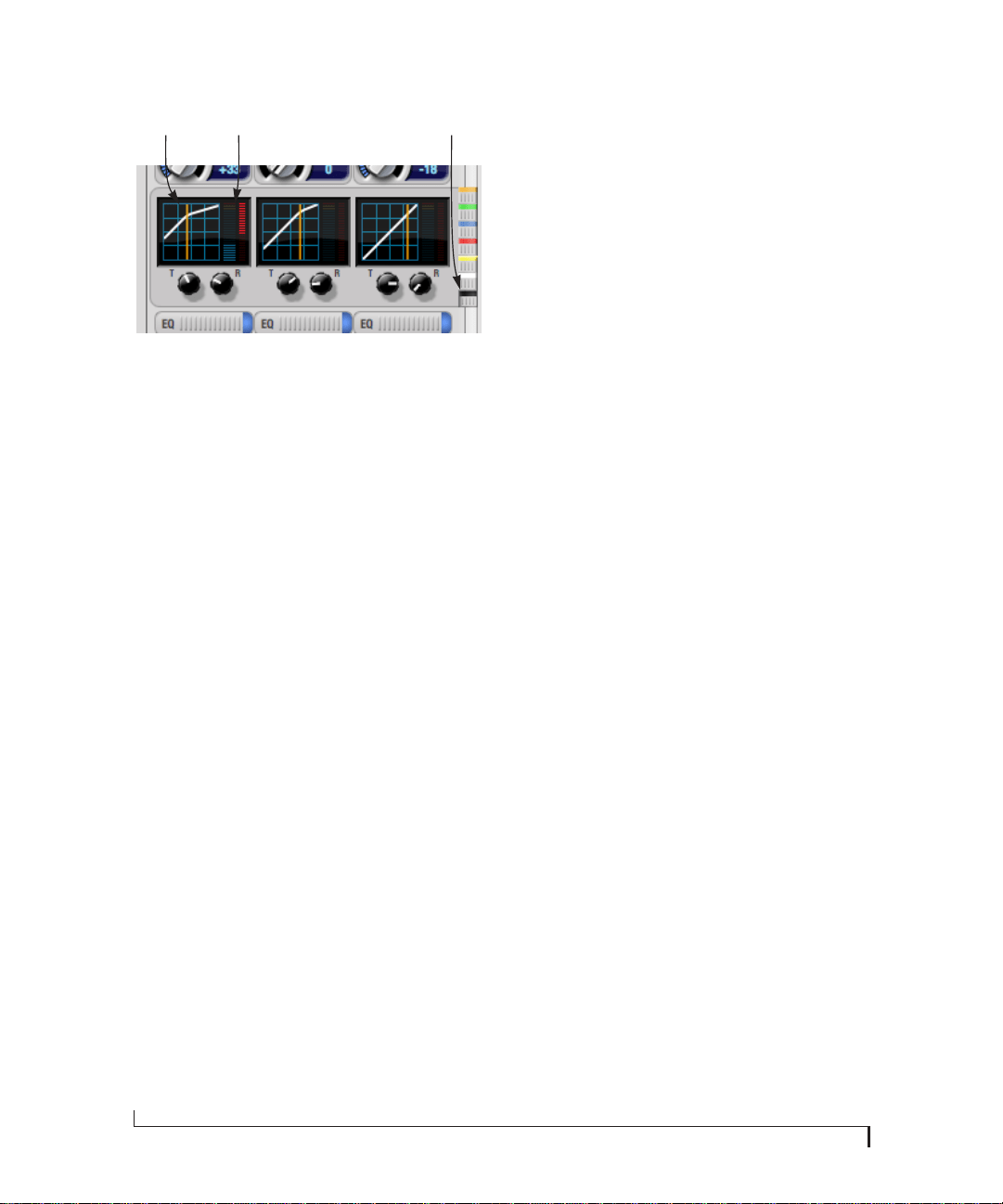
CUEMIX FX
68
Figure 10-5: The Compressor controls.
☛ Shortcut: hold down the option key while
clicking an EQ selector button to show just that
band of EQ in the graphs. Click any selector again
to return to viewing all bands.
Using the EQ/Dynamics knobs
Once you have chosen the desired EQ band, or the
compressor, you can modify its settings using the
two or three knobs below the graph. The knobs
match the color of the currently selected effect, to
help remind you of which effect you are currently
editing.
☛ Important: before you can modify the settings
of an EQ band using the three knobs below the
graph, the EQ band must be enabled. This is done
in the EQ tab (Figure 10-10), as explained in
“Enabling EQ” on page 72.
EQ/Dynamics enable/disable buttons
Click the EQ or Dynamics button at the bottom of
the input channel (Figure 10-3) to toggle the effect
on or off. Note that you can program EQ and
compressor settings, even when the effect is
currently disabled. (You just won’t hear the result
until you enable it.)
Reverb send
The input reverb send (Figure 10-3) feeds the input
signal to the UltraLite-mk3’s global reverb
processor, where it is merged with any other signals
being fed to the reverb. The reverb’s output can
then be fed back into a mix or output pair. The send
occurs after all other settings in the input channel
strip (phase invert, EQ, compression, etc.)
THE OUTPUTS TAB
The Outputs tab (Figure 10-6) lets you apply EQ,
dynamics and reverb to any output pair, just before
the signal leaves the UltraLite-mk3. This is
processing that occurs at the very end of the signal
flow, after everything else (host based effects,
UltraLite-mk3 input or bus processing, mixing,
and so on). Processing is done in the digital
domain, just before the signal goes analog through
the D/A converter. Output tab processing is
applied to the entire output mix (all signals being
mixed to the output from various sources).
Signal flows from top to bottom
Settings in each Output tab channel strip are
applied to the signal in order from top to bottom.
For example, EQ occurs before Dynamics, which is
applied before the reverb send and return.
Output channel focus
Click the channel focus button (Figure 10-6) to
view and edit parameters in the channel settings
section of the CueMix FX window (Figure 10-7 on
page 70).
Output EQ and Dynamics
The EQ/Dynamics section in the Outputs tab
(Figure 10-6) works identically to the EQ/
Dynamics section for the Inputs tab (Figure 10-3).
See “Input EQ and dynamics” on page 67.
Output reverb send/return
The output reverb send (Figure 10-6) feeds the
signal for the output to the UltraLite-mk3’s global
reverb processor, where it is merged with any other
signals being fed to the reverb. The reverb’s output
can then be fed back into the mixer at various
return points, including the same output from
which it was sent (discussed below). The output
reverb send is disabled (grayed out) when the
Compressor
graph
Compressor
meter
Compressor
selector
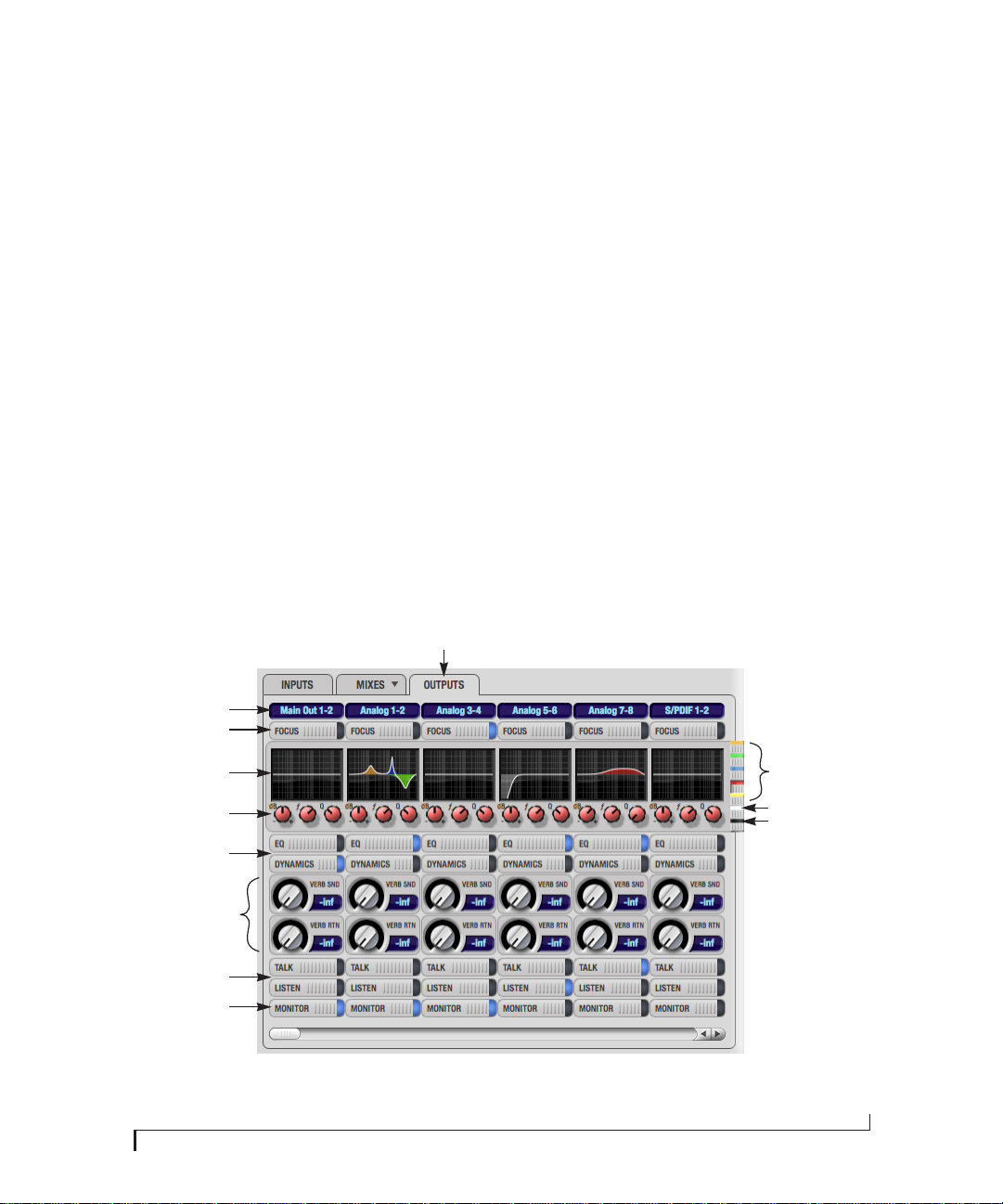
CUEMIX FX
69
reverb Split Point is set to Mix to eliminate the
possibility for feedback loops created by reverb
send/return loops. See “Split point” on page 83.
The output reverb return (Figure 10-6) feeds the
output of the UltraLite-mk3’s global reverb
processor directly to the output. This includes any
other signals currently being fed to the reverb.
Both the send and return occur after EQ and
dynamics processing, but before listenback and
talkback.
Talkback/Listenback
Click the Ta lkback or Listenback buttons
(Figure 10-6) to toggle whether the output pair is
included in the Talkback or Listenback group. See
“Talkback and listenback” on page 85.
Monitor group assign
Click the Monitor buttons (Figure 10-6) to toggle
whether the output pair is included in the Monitor
group. See “The Monitor Group” on page 84.
Figure 10-6: The Outputs tab.
Output name
Channel focus
Outputs tab
EQ band selectors
LP/HP filter selector
Compressor selector
EQ/Dynamics graph
EQ/Dynamics controls
EQ/Dynamics
enable/disable
Output reverb
send/return
Talkback/listenback
enable/disable
Monitor group assign
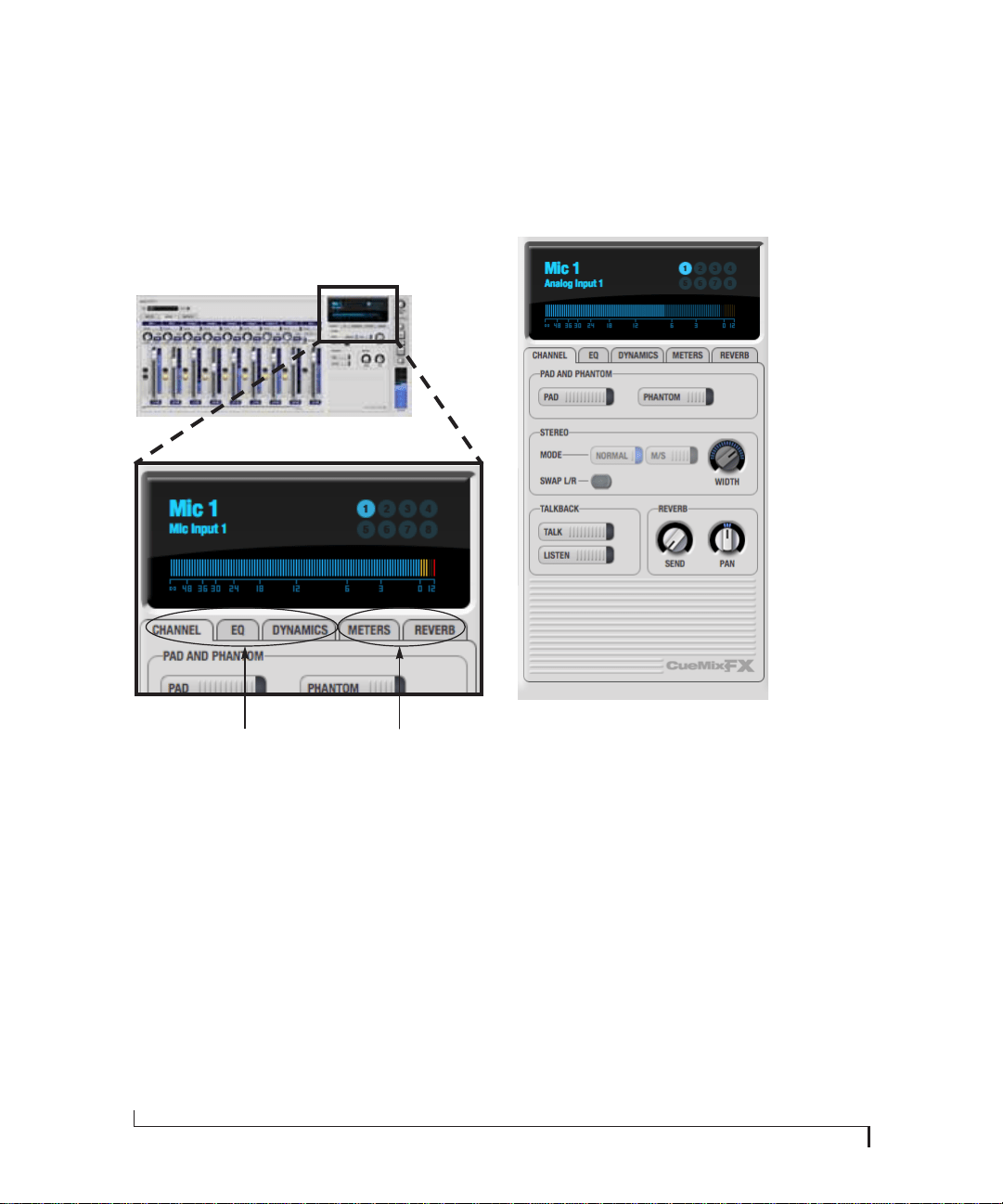
CUEMIX FX
70
THE CHANNEL SETTINGS SECTION
The channel settings section in the CueMix FX
window (Figure 10-1) displays three tabs for
Channel, EQ and Dynamics settings for the
channel with the current focus. There are also two
global tabs: the Meter Bridge and the Reverb
Processor, as shown below.
Figure 10-7: The Channel Settings section.
The Channel tab
The Channel tab (Figure 10-8) displays settings for
input channels. Click any focus button in the
Inputs tab to view the Channel tab settings for the
channel.
Figure 10-8: The Channel tab.
Signal flow
Settings in the Channel tab occur just before the
EQ, dynamics and reverb sends in the Input tab
channel strip (Figure 10-3 on page 66). Input
channel signal flow is as follows: trim, phase, stereo
versus M/S decoding, width, L/R swap, EQ,
dynamics and reverb send.
Pad and phantom
The Pad and phantom settings become active
(ungrayed) when the focus is on a mic input (or
both mic inputs). These are the same 20 dB pad
and 48V phantom power settings that you can also
control from the UltraLite-mk3 front panel TRIM
encoders. There are separate settings for each mic
input.
Tabs for the channel that
currently has the focus
Tabs for the global meter
bridge and reverb processor
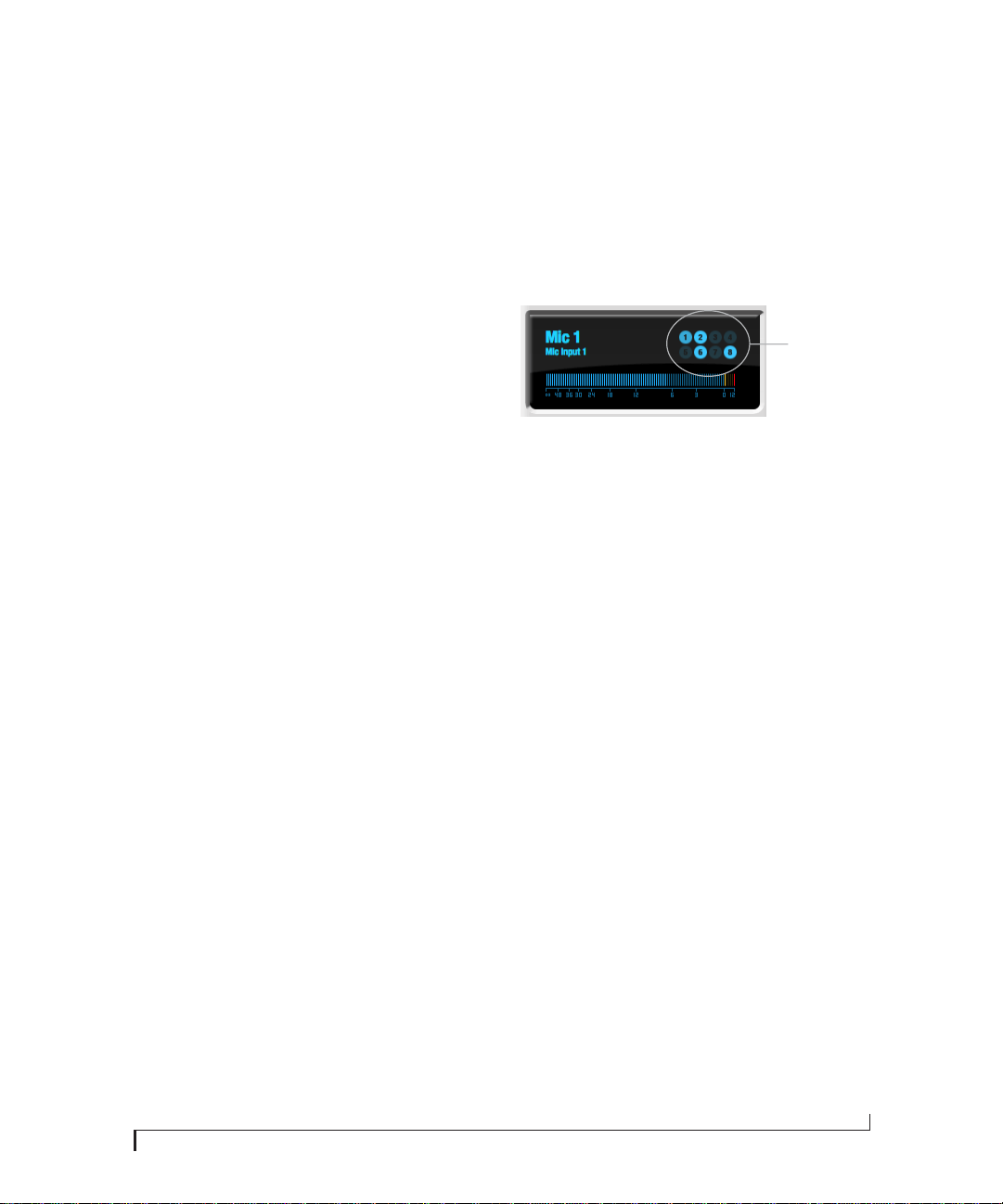
CUEMIX FX
71
Stereo settings
Inputs that have been grouped as stereo pairs in the
Inputs tab (Figure 10-3) provide two stereo modes
(Figure 10-8): Normal and M/S. M/S mode
provides decoding for a mid-side microphone
configuration.
The Width knob (Figure 10-8) provides control
over the stereo imaging, going from a full stereo
image to mono (both channels panned equally).
See “Width” on page 65.
The Swap L/R button (Figure 10-8) lets you switch
the left and right channels.
Talkback section
Click the Ta lkback or Listenback button
(Figure 10-8) to toggle whether the input is the
Talkback or Listenback input. Only one input can
be the talkback input, and only one input can be
the listenback input. See “Talkback and listenback”
on page 85.
Reverb section
The Send in the reverb section (Figure 10-8) is the
same control as the reverb send in the Input tab
channel strip (Figure 10-3). See “Reverb send” on
page 68. If the input is currently not grouped as a
stereo pair in the Input tab (it is operating as a
mono input), use the reverb Pan knob
(Figure 10-8) to pan the mono signal for the stereo
reverb processor.
Input meter and bus activity LEDs
When the Channel tab is active (Figure 10-8), the
display above the tab provides a horizontal level
meter and eight bus activity LEDs (Figure 10-9).
Figure 10-9: Input meter and bus activity LEDs.
The input level meter (Figure 10-9) is the same as
the input meters in the Meters tab (Figure 10-27 on
page 82) with the Pre FX button engaged, which
shows the input level on the physical input itself,
before any processing of any kind occurs within the
UltraLite-mk3. This meter gives you the most
accurate reading of the actual signal level hitting
the input, regardless of any other settings.
The Bus Activity LEDs (Figure 10-9) show you
which mix busses the input signal is being fed to.
For example, LED #6 will glow under the following
conditions: the input is unmuted in mix bus 6, its
fader is up, and there is signal activity from the
input going into the mix bus.
Bus
activity
LEDs
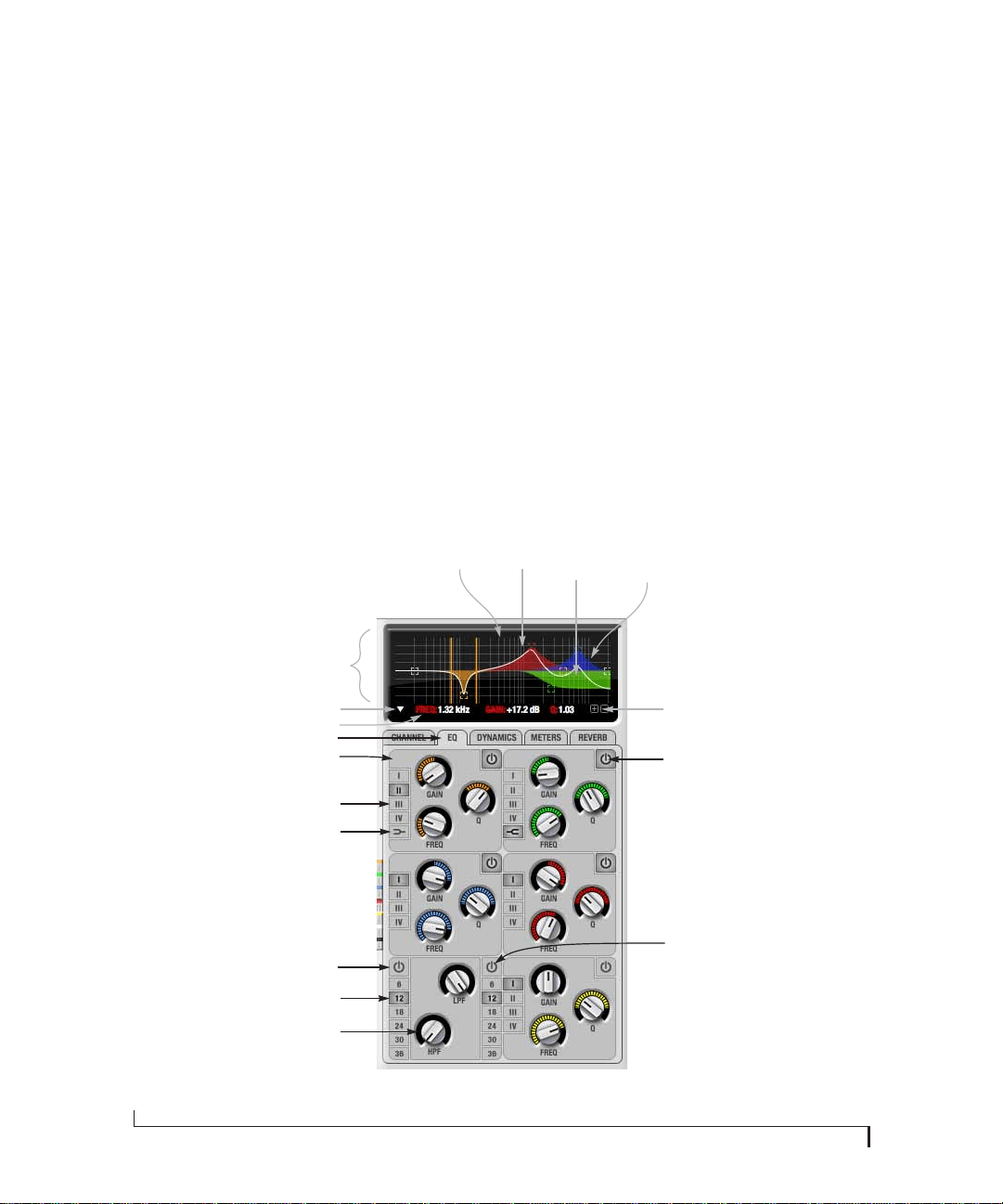
CUEMIX FX
72
The EQ tab
The EQ tab (Figure 10-10) displays the EQ settings
for the input or output channel that currently has
the focus. Click any focus button in the Inputs or
Outputs tab to view the EQ tab settings for the
channel.
Vintage EQ
Inspired by legendary British large console EQs,
the UltraLite-mk3 Vintage EQ section
(Figure 10-10) gives you the look, feel and sound of
the most sought-after classic equalizers. Five bands
of center frequency parametric EQ filtering are
provided, each with four EQ types that provide
current popular EQ styles and vintage analog EQ
styles alike. Two bands include shelf filtering. Two
additional bands of variable slope low pass and
high pass filtering are provided. The filter response
display provides comprehensive control and visual
feedback of the EQ curve being applied. With
64-bit floating point processing, the UltraLite-mk3
Vintage EQ has been carefully crafted and
meticulously engineered to produce musical
results in a wide variety of applications.
Enabling EQ
Each input and output channel has a global EQ
enable/disable button (Figure 10-3 and
Figure 10-6). This button enables or disables all
bands of EQ for the channel. In addition, each
individual band of EQ has a Filter enable/disable
switch (Figure 10-10), allowing you to enable as
few or as many bands as needed for each individual
channel.
Filter
handle
Q handles
(red lines)
Composite
curve
(white line)
Individual
filter curve
(colored area)
Filter response
display
Shelf filter
Parameter display
Vertical scale
Filter enable/disable
EQ Filter types
Slope
Low-pass filter
EQ filter
Figure 10-10: The EQ tab.
EQ tab
Filter display options menu
High-pass filter
High-pass frequency

CUEMIX FX
73
Vintage EQ Quick reference
Filter response display: Shows the response curve
for the current settings.
Vertical scale: Lets you zoom the vertical scale of
the filter response display.
Parameter display: Shows the precise numbers of
the parameter you are adjusting (or hovering over
with the arrow cursor). The labels (frequency, gain,
etc.) match the color of the filter being displayed.
When a filter handle is not selected and when the
cursor is not hovering over the display, the
parameter display shows the name of the current
channel being edited (the channel that currently
has the focus), as shown below:
Figure 10-11: When a filter handle is not selected and when the
cursor is not hovering over the display, the parameter display shows
the name of the current channel being edited (the channel that
currently has the focus).
EQ filter: one of five center bands of EQ that can be
independently enabled and programmed.
Filter type: Lets you choose from one of four or five
EQ styles for each independent band of EQ.
Low/High Pass filter: Both a low pass and high pass
filter are supplied with six different slope settings.
Slope: Lets you choose the slope (fall off) charac-
teristics of the low pass and high pass filter.
Q handle: Drag the Q handle lines to graphically
adjust the Q setting for the currently selected filter.
To select the filter, click its filter handle.
Filter handle: Drag this handle to graphically
adjust the filter’s boost/cut and/or frequency.
Composite curve (white line): shows the overall
response curve of the current settings in the
window.
Individual filter curve: Each filter has a color
(indicated by its knobs). When filter curves are
being displayed (the filter curve option is turned
on), each individual filter’s response curve is
displayed in the filter’s color.
Filter display options menu: Provides several
options for controlling the filter display.
Filter enable/disable: Turns the filter on or off.
How the vintage EQ works
The Vintage EQ operates like a standard EQ filter,
but with much more sophisticated processing
algorithms “under the hood”. There are five bands
of EQ, each with their own unique knob color, plus
additional low pass and high pass filters. Each filter
can be set to any center frequency you wish.
Each filter can be independently turned on or off
with the enable/disable button (Figure 10-10).
Each filter can be set to one of four different filter
types (I, II, III or IV). The two top-most filters
(orange and green) provide an extra low and high
shelf setting, in addition to the four standard band
settings. The additional low pass and high pass
filters (lower left) have gray cutoff frequency knobs
and six settings for slope (in octaves/dB).
Frequency response display
The frequency response display at the top of the
window displays the response curve of the current
settings in the window. The (horizontal) frequency
range is from 10 hertz to 20 KHz. The (vertical)
amplitude scale is in dB and is adjustable between 3
and 24 dB using the vertical scale buttons
(Figure 10-10).
The name of the
channel being
EQ’d.

CUEMIX FX
74
Adjusting filters in the display
Each filter has a handle, displayed as shown below
in Figure 10-12 (in the filter’s color), for adjusting
its boost/cut and/or frequency:
Figure 10-12: Drag the filter handle to adjust its frequency and/or
boost/cut. Drag the Filter Q handles to adjust the Q.
For the EQ filters, when you click the handle, you’ll
also see lines on either side for adjusting the Q
parameter, as shown above.
Filter display options
The Filter display options menu (Figure 10-10)
provides several options for the EQ filter display:
FFT display
Choose Show FFT from the Filter display options
menu (Figure 10-10) to superimpose a real-time
Fast Fourier Transform (FFT) frequency
measurement curve over the EQ filter display, as
demonstrated in Figure 10-13:
Figure 10-13: FFT display.
The FFT curve is post-filter. Therefore, the FFT
shows the results of the EQ filter(s) being applied.
Use the global EQ button for the input or output
channel (Figure 10-3 and Figure 10-6,
respectively) to toggle between the EQ’d and non-
EQ’d FFT display.
Spectrogram
Choose Show Spectrogram from the Filter display
options menu (Figure 10-10) to superimpose a
real-time spectrogram “waterfall” display in the
background of the EQ filter display, as
demonstrated in Figure 10-14:
Figure 10-14: FFT display.
The spectrogram scrolls from top to bottom, where
the top edge of the display represents what you are
hearing “now”. Color represents amplitude along
the left/right frequency spectrum. The amplitude
color scale runs from black (silence) to red (full
scale) as follows:
Figure 10-15: Spectrogram color-to-amplitude spectrum.
Menu option What it does
Show no analysis Turns off both the FFT and
Spectrogram in the Filter display.
Show FFT Shows/hides a real time FFT analysis
of the current signal being EQ’d,
post EQ filter.
Show Spectrogram Shows/hides a real-time spectro-
gram “waterfall” in the background
of the filter display, post EQ filter.
Show Band Response Shows/hides the colored area below
EQ filter points.
Show/Hide Full Window
Analysis
Shows/hides the enlarged filter dis-
play in the CueMix FX window.
Filter Q
(red line)
Filter handle
FFT curve
Black Blue Green Yellow Orange Red
Silence Full scale

CUEMIX FX
75
Using the full window filter display
Choose Show Full Window Analysis from the Filter
display options menu (Figure 10-10) to fill the
entire CueMix FX window with the filter EQ
display for detailed inspection and adjustment of
the EQ filter, as shown in Figure 10-16.
You can show and hide the FFT display,
spectrogram or EQ band response curves as
desired using the Display Options menu options
(Figure 10-16). These settings are independent of
the small graph display options (Figure 10-10), so
you have the flexibility to display different
combinations in each graph.
Show X-Axis Linear Scale
Check the Show X-Axis Linear Scale option in the
Display Options menu (Figure 10-16) to display
frequency on a linear scale, instead of the default
logarithmic scale. With a linear scale (checked),
frequency is constant, but the width of each octave
along the x-axis is different. With a logarithmic
scale (unchecked), octaves are displayed with a
constant width, but frequency is displayed
logarithmically within each octave.
The info box
The Show Info Box item in the full graph display
options menu (Figure 10-16) lets you display the
coordinates of any EQ filter point as you drag it in
the graph (Figure 10-17):
Figure 10-17: The Info Box.
The info box includes the industry standard
scientific note (pitch) name when the control point
is located at a frequency that resides within a
prescribed note range, where C4 is middle C. The
note number is accompanied by the number of
cents (±50) above or below the exact frequency for
the note. If the control point is dragged outside the
note range, only the frequency is shown.
Figure 10-16: Full window filter display.
Display
options
menu
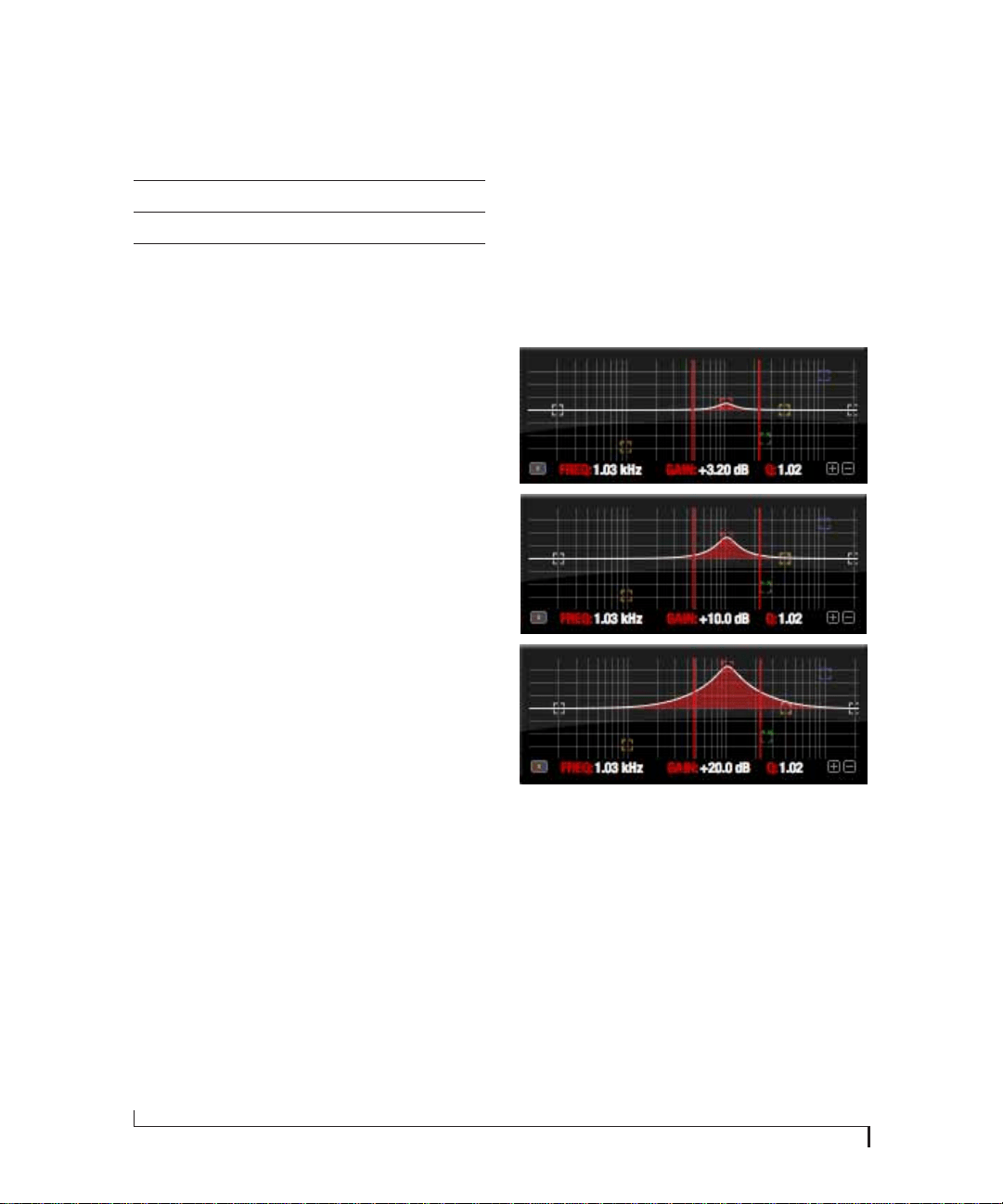
CUEMIX FX
76
EQ filters
The EQ filters have three parameters:
Q
The Q setting does not have a unit of measurement.
Rather, it is the ratio of the filter’s center frequency
to the bandwidth of the filter. In addition, the
actual Q value for the EQ curve being applied is
dependent on three factors: the gain setting, the
filter style, and the Q setting.
Filter types
Each filter can be independently set to one of four
different filter types: I, II, III and IV. These, and the
additional shelf filters for the LMF and HMF band,
are discussed in the section “EQ filter styles”.
Returning to zero (or nominal frequency)
To return a knob to zero, or it’s nominal frequency,
double-click it.
EQ filter styles
EQ is one of the most widely used processing tools
and can be applied to many different situations,
from minor corrective tasks to highly creative
applications. Over the years, many EQs have been
engineered for specific applications or to achieve a
certain sound. The Vintage EQ has been designed
to be flexible enough to cover a broad range of
applications. To that end, several different filter
types are supplied, varying mostly in the way they
handle the dynamic interaction between Gain and
Q. This crucial relationship has been modeled to
emulate the smooth and musical character of
classic analog EQ circuits, in which the Gain/Q
dependency was dictated by the actual circuit
design and electrical components used.
The following sections describe the character of
each type of EQ filter and their suggested
applications. In the illustrations for each filter style
(Figure 10-18 through Figure 10-21), the settings
for the three example curves are the same for the
purpose of comparison:
■ Frequency = 1.00 kHz
■ Q = 1
■ Gain = +3, +10 and +20 dB
Type I
Figure 10-18: Type I EQ filter style.
The Type I EQ filter has the least amount of Gain/Q
interaction, providing the most precision and
control of all the EQ filter types. Even small
adjustments in gain or reduction produce relatively
high Q. This EQ style is best for situations that call
for precise EQ adjustments requiring the
maximum amount of individual parameter
control. For more general shaping (e.g. full mixes)
or subtle control (e.g. vocals), the other styles
discussed in the following sections might be more
appropriate. This filter type is the most similar to a
standard parametric EQ.
Control unit range
Gain dB -20.00 to +20.00
Frequency Hertz 20 Hz to 20 kHz
Q n/a - see note below 0.01 to 3.00
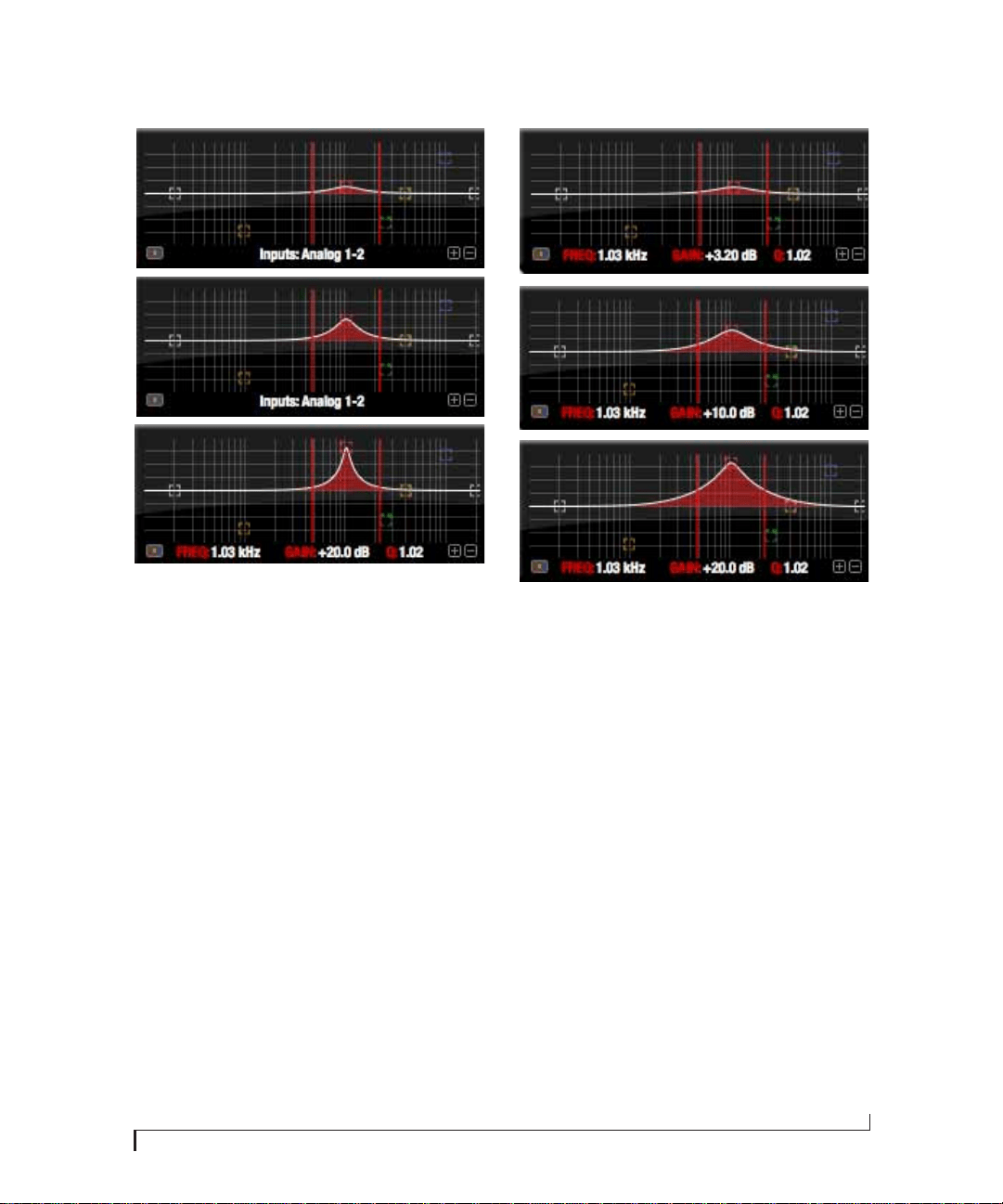
CUEMIX FX
77
Type II
Figure 10-19: Type II EQ filter style.
The Type II EQ filter produces constant Q response
during boost or cut. The Type II style emulates
several classic legacy EQs and produces good
results for resonance control on drums and
percussion because it provides relatively high Q
values with more extreme gain or cut settings.
Type III
Figure 10-20: Type III EQ filter style.
The Type III EQ filter increases Q as boost is
applied. Therefore, lower amounts of boost
provide a softer, “wider” EQ effect (since the
affected frequency range widens), while higher
boost tends to sound louder and more “up front”,
due to the increase in Q as the gain is increased.
The more gentle Q curve at lower settings is well
suited for overall EQ fills and more subtle
corrections in instrument and vocal sources.
Boosting or cutting by small amounts will seem to
produce the effect that your ear expects, without
the need to adjust Q. As a result, this filter style, and
similar EQs with this characteristic behavior, are
often referred to as being more “musical”. More
specifically, this style emulates the classic Neve
EQs, their modern derivatives and later SSL G
series EQs. Many current popular outboard
“boutique” EQs exhibit this same gain/Q
relationship.
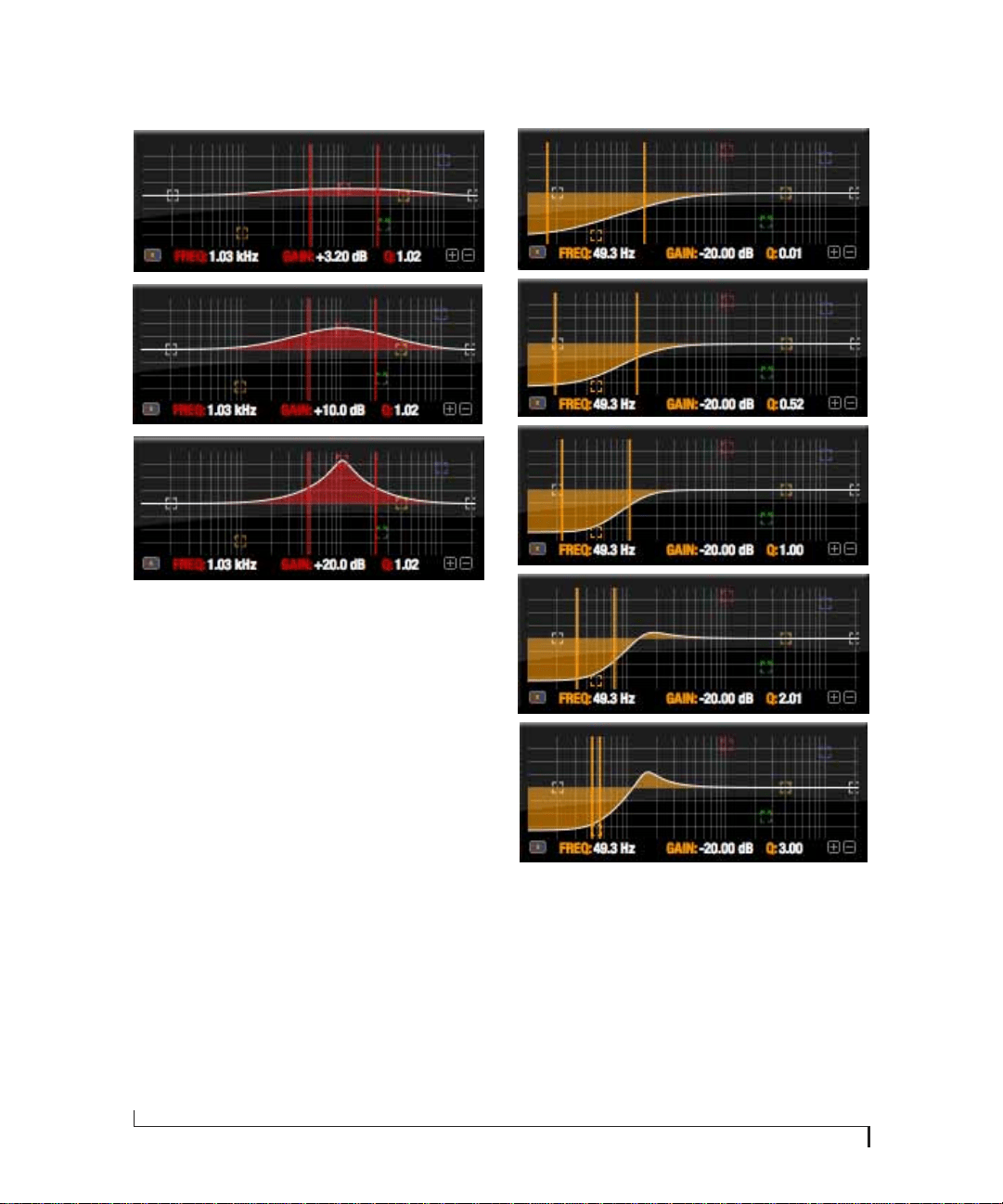
CUEMIX FX
78
Type IV
Figure 10-21: Type IV EQ filter style.
The Type IV EQ filter is a more extreme form of the
Type III filter. It exhibits a high degree of
interaction between Q and gain in order to
maintain as closely as possible an equal amount of
area under the response curve as gain is adjusted.
Type IV is the most gentle of the four EQ styles and
is ideal for large scale EQ adjustments, especially
on sub-mixes and complete mixes. This EQ style is
also ideal for any applications where subtle changes
in the overall character of the sound are desired.
For example, it can be used for mastering
applications, such as the overall adjustments that
must often be applied to entire tracks to match
other tracks on the album.
Shelf filters
Figure 10-22: Shelf filter Q parameter overshoot.
When two top-most bands in the EQ tab are set to
their shelf filter setting (Figure 10-10), the Q
parameter controls the amount of overshoot
applied to the response curve, as illustrated in
Figure 10-22. When Q = 0.01 (the lowest setting),
normal shelving is applied with no overshoot. This
produces the response provided by a first order
shelf. When Q = 1.0 (the default setting), the
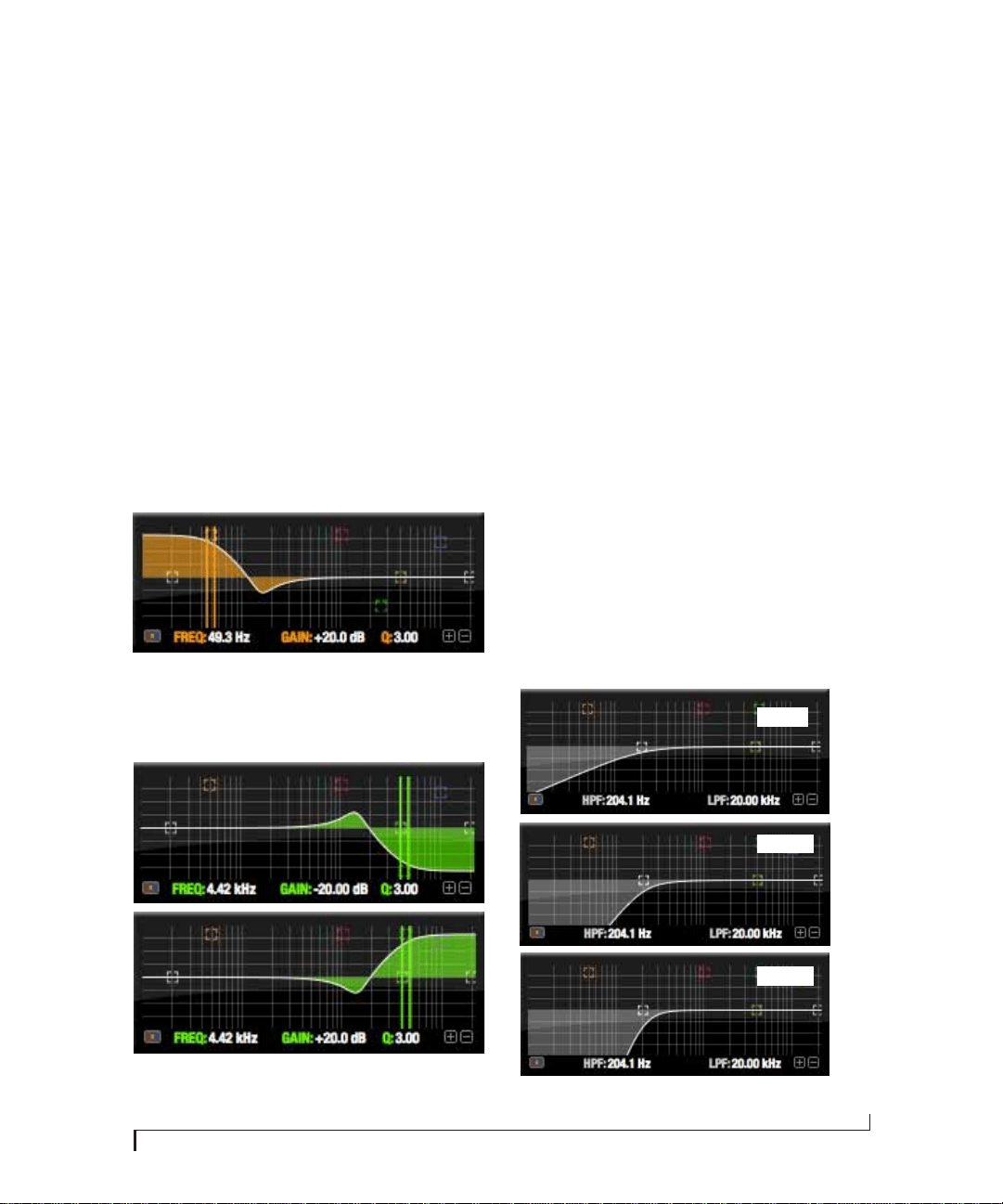
CUEMIX FX
79
response corresponds to a second order shelf, still
with no overshoot. This is the same response as
conventional parametric EQs. In some situations,
this form of accurate, clean shelving can sound
harsh, especially when compared to legacy analog
EQs. To soften the results, the overshoot is
increased as Q is increased, as shown Figure 10-22
for Q values of 1.00, 2.00 and 3.00. This overshoot
region produces a boost in frequencies just above
the cutoff, which compensates in a smooth, more
pleasing fashion for the perceived drop in low
frequencies being cut.
Conversely, when shelving boost is being applied,
overshoot cuts frequencies just above the cutoff to
again compensate in a smooth and pleasing fashion
for the perceived boost in low frequencies:
Figure 10-23: Overshoot when low shelf boost is applied.
Overshoot is also applied to high shelf boost and
cut:
Figure 10-24: Overshoot when high shelf cut and boost is applied.
Overshoot tends to produce more of what one
would expect to hear when applying shelving and
is therefore considered to be more musical than
shelving without overshoot. This effect, which has
gained tremendous popularity among audio
engineers, was first made popular in original Neve
series EQs and later in the SSL G series.
At maximum the maximum Q setting of 3.00, the
overshoot peaks at half the total boosted (or cut)
gain. For example, with a maximum gain setting of
+20dB, the loss in the overshoot region is -10 dB.
Overshoot curves are symmetrical for both cut and
boost.
Low pass and high pass filters
The Vintage EQ low and high pass filters are similar
to those found in most conventional parametric
EQs (which usually have a fixed slope of 12 dB per
octave), except that Vintage EQ provides six
different slope (roll off) settings: 6, 12, 18, 24, 30
and 36 dB per octave. This control over the shape
of the “knee” gives you a great deal flexibility and
control for a wide variety of applications.
Figure 10-25: The low pass filter with three example slope settings.
Slope = 6
Slope = 18
Slope = 36
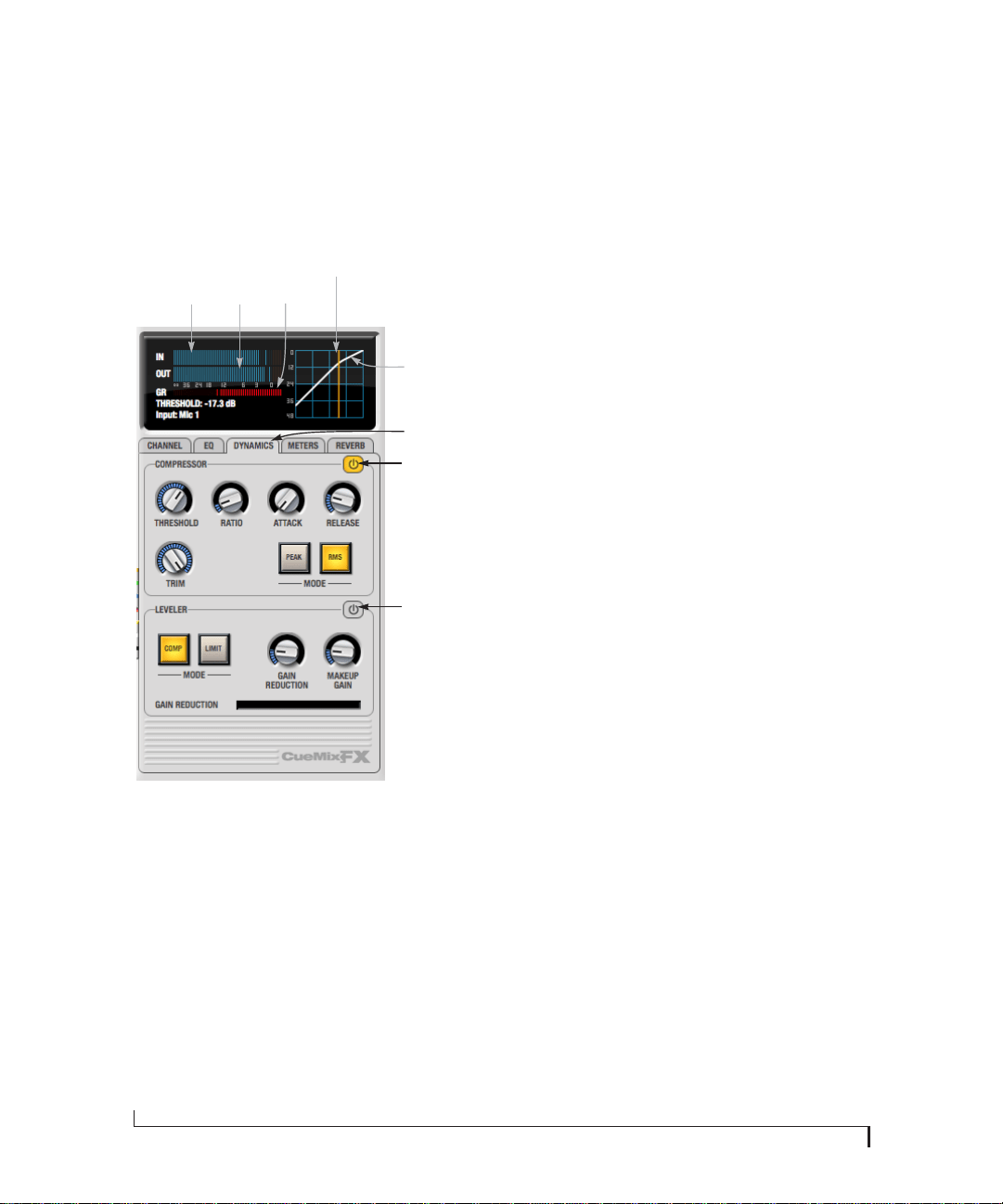
CUEMIX FX
80
The Dynamics tab
The Dynamics tab (Figure 10-26) displays the
Dynamics processing settings for the input or
output channel that currently has the focus. Click
any focus button in the Inputs or Outputs tab to
view the Dynamics tab settings for the channel.
Figure 10-26: The Dynamics tab.
Enabling Dynamics
Each input and output channel has a global
Dynamics enable/disable button (Figure 10-3 and
Figure 10-6). This button enables or disables all
dynamics processing for the channel. In addition,
the Dynamics tab has two different dynamics
processors, the Compressor and Leveler, which can
be individually enabled or disabled (Figure 10-26)
for the channel.
Compressor
The Compressor (Figure 10-26) lowers the level of
the input when it is above the threshold. The
amount of attenuation is determined by the Ratio
and the input level. If the input is 6 dB above the
Threshold and the Ratio is 3:1, then the output will
be 2 dB above the Threshold. When the input level
goes above the threshold, the attenuation is added
gradually to reduce distortion. The rate at which
the attenuation is added is determined by the
Attack parameter. Likewise, when the input level
falls below the Threshold, the attenuation is
removed gradually. The rate at which the
attenuation is removed is determined by the
Release parameter. Long Release times may cause
the audio to drop out briefly when a soft passage
follows a loud passage. Short Release times may
cause the attenuation to pump when the average
input level quickly fluctuates above and below the
Threshold.
These sorts of issues can be addressed by applying
the Leveler instead.
Graphic adjustment of the Threshold
The Threshold can be adjusted by turning the
Threshold knob or by dragging the Threshold line
directly in the compressor graph (Figure 10-26).
Input level meter
The Input Level meter (Figure 10-26) shows the
level of the input signal before it enters the
compressor. It shows either the peak level or the
RMS level, depending on which mode is currently
chosen.
Gain reduction (GR) meter
The Gain reduction (GR) level meter
(Figure 10-26) displays the current amount of
attenuation applied by the compressor.
Compressor
enable/disable
Leveler
enable/disable
Dynamics tab
Input
level
meter
Output
level
meter
Gain
reduction
meter
Threshold
Trim

CUEMIX FX
81
Output level
The Output Level meter (Figure 10-26) displays the
peaks of the output signal. Trim is applied before
the Output Level meter.
Peak/RMS modes
In RMS mode the compressor uses RMS values (a
computational method for determining overall
loudness) to measure the input level. In Peak mode,
the compressor uses signal peaks to determine the
input level. RMS mode will let peaks through
because the detector sidechain is only looking at
the average signal level. Peak mode will react to
brief peaks. Peak mode is generally used for drums,
percussion and other source material with strong
transients, while RMS mode is mostly used for
everything else.
The input meters show either the peak level or the
RMS level, depending on the mode.
Leveler
The Leveler™ (Figure 10-26) provides an accurate
model of the legendary Teletronix™ LA-2A®
optical compressor, known for its unique and
highly sought-after Automatic Gain Control
(AGC) characteristics. The UltraLite-mk3 Leveler
faithfully models the LA-2A using the on-board
DSP with 32-bit floating point precision.
A model of an optical compressor
The simplest description of an optical leveling
amplifier device is a light shining on a photore-
sistor. The intensity of the light source is
proportional to the audio signal, and the resistance
of the photoresistor is in turn inversely
proportional to the intensity of the light. Photore-
sistors respond quite quickly to increases in light
intensity, yet return to their dark resistance very
slowly. Thus, incorporation of the photoresistor
into an attenuator followed by an amplifier which
provides make-up gain produces a signal which
maintains a constant overall loudness.
Automatic gain control using light
The the Automatic Gain Control (AGC) circuit of
the LA-2A uses a vintage opto-coupler known by
its model number (T4). The T4 contains an
electroluminescent panel (ELP) and photoresistor
mounted so that the emission of the panel
modulates the resistance. An ELP consists of a thin
layer of phosphorescent material sandwiched
between two insulated electrodes to form a
capacitor. Making one of the electrodes
transparent allows the light to escape. These
devices are essentially glow-in-the-dark paint on a
piece of foil covered by metalized glass or plastic,
and are the same devices used in low-power night
lights. Unfortunately, these devices need high
voltages to operate, and are best driven by tube
circuits which can supply voltage swings of several
hundred volts.
Response characteristics
Once the light has faded away, the photoresistor
then decays back to its dark state. The shape of the
decay curve varies depending on how bright the
light was, and how long the light lasted. A general
rule of thumb is that the louder the program, the
slower the release. Typically, the release can take up
to and over one minute. One thing to keep in mind
when using these types of devices is that the typical
concepts of compression ratio, attack, release, and
threshold do not apply. The light intensity is
determined by the highly non-linear interactions
of the input signal, AGC circuit, and ELP, and thus
exhibit a strong program dependence that is
impossible to describe without the mind-numbing
mathematics of statistical mechanics. The actual
results, however, can be almost mystical: even
when you feed the same material (a loop perhaps)
through the Leveler twice, you’ll often see a new
response the second time through a loop, complete
with unique attack times, release times and
compression ratios. Furthermore, two different
input signals with the same RMS levels may be
leveled in a drastically different manner.
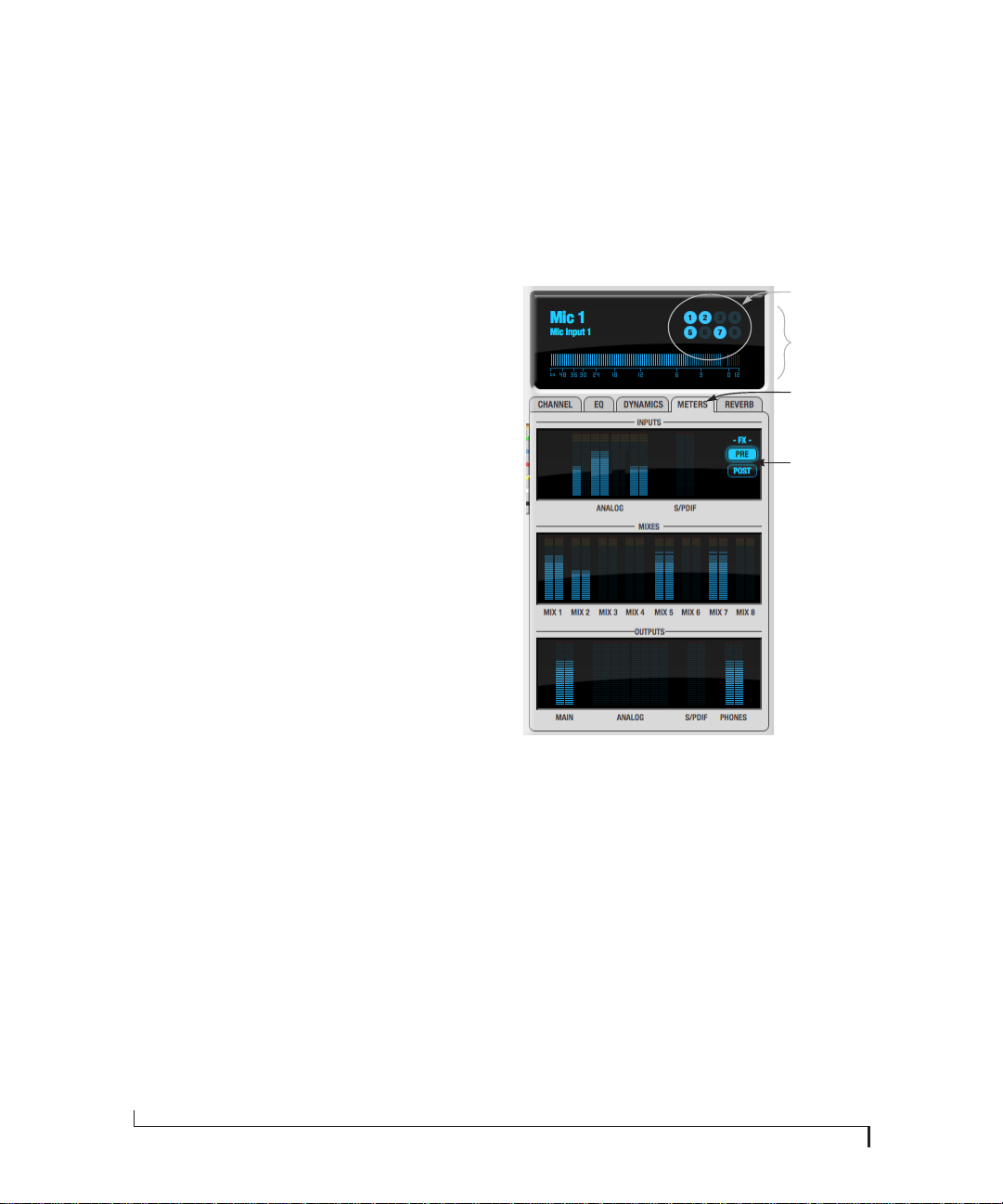
CUEMIX FX
82
It is precisely this self-adjusting behavior that
makes optical compressors the tool of choice for
smoothing out vocals, bass guitar and full-
program mixes without destroying perceived
dynamics.
Compressor/Limit buttons
The Comp and Limit buttons (Figure 10-26) model
the original LA-2A Limit/Compress mode switch.
The effect is very subtle, with the Limit option
behaving only slightly more like a limiter than a
compressor. The switch increases the level of the
input to the AGC model and runs the attenuator at
a slightly lower level. The Leveler then responds
more strongly to transients, but otherwise still
behaves like a leveling amplifier.
Gain Reduction
Gain Reduction (Figure 10-26) sets the strength of
the signal sent to the AGC model.
Makeup Gain
Makeup gain (Figure 10-26) amplifies the output
signal to make up for gain reduction.
Enabling or disabling the Leveler
The Leveler models the LA-2A so closely, it also
models the time it takes for an actual LA-2A to
“warm up” after it is turned on. Therefore, when
you enable the Leveler, give it a moment to “settle”
before you begin processing signals with it.
The Meters tab
The Meters tab (Figure 10-27) serves as a
comprehensive meter bridge for all inputs, outputs
and mix busses in the UltraLite-mk3. This tab gives
you a “bird’s-eye” view of all signal activity in the
UltraLite-mk3; it is ideal for confirming your signal
routing programming and for troubleshooting.
Figure 10-27: The Meters tab.
Channel meter display
The channel meter display (Figure 10-27) provides
a long-throw meter for the input or output that
currently has the focus in the Input/Output tabs.
Bus activity LEDs (inputs only)
The Bus activity LEDs (Figure 10-27) are present
only for inputs. See “Input meter and bus activity
LEDs” on page 71.
Pre/post processing switch
The pre/post processing switch (Figure 10-27)
affects all input meters (and the meter in the
channel meter display above the tab, if this area is
Meters tab
Bus activity LEDs
(inputs only)
Pre/post
processing
switch
Channel meter
display
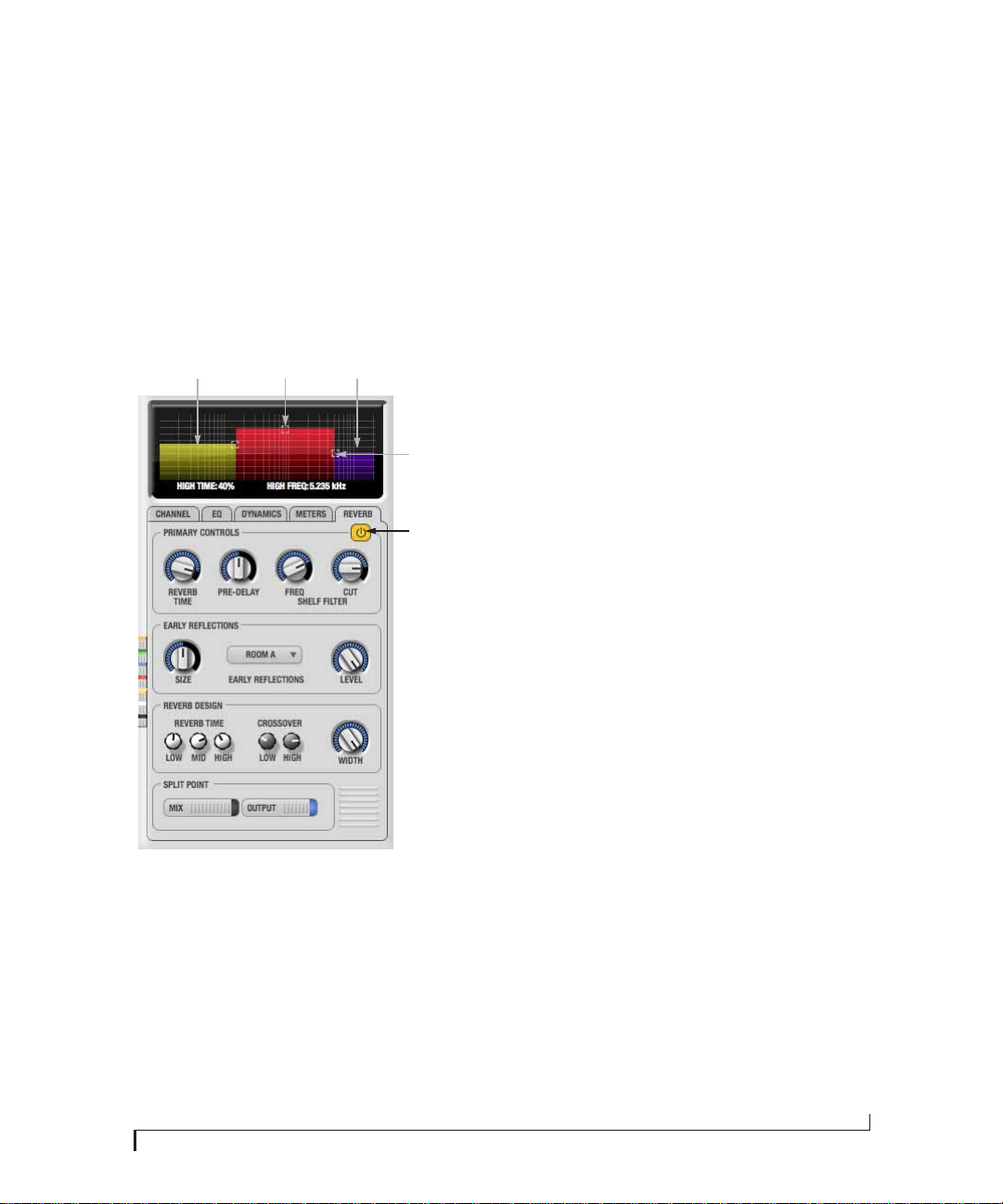
CUEMIX FX
83
displaying an input meter). Click Pre to view levels
before any input channel processing besides trim;
click Post to view levels after all channel processing
(EQ, compression, M/S decoding, L/R swap, etc.)
The Reverb tab
The Reverb tab (Figure 10-28) provides access to
the UltraLite-mk3’s single, global reverb processor,
which provides high-fidelity reverberation and
graphic control over its parameters.
Figure 10-28: The Reverb tab.
Enabling reverb
Use the enable/disable button (Figure 10-28) to
turn the reverb processor on or off. Since reverb
uses considerable DSP resources, it is best to leave
it off when you are not using it.
Routing inputs, busses and outputs to the
reverb processor
The reverb processor is a single, independent unit
that provides stereo reverb. You can route multiple
signals to it from various points (sends) in the
CueMix FX mixer, but all incoming signals to the
reverb processor are merged and processed
together. The resulting stereo output from the
reverb can then be inserted into a mix bus or
output using stereo returns.
Reverb sends
The following signals can be sent to the reverb
processor via their corresponding sends (discussed
earlier in this chapter):
■ Mono or stereo inputs (Figure 10-3 on page 66)
■ Mix bus output (Figure 10-2 on page 64)
■ Outputs (Figure 10-6 on page 69)
Reverb returns
The stereo output from the reverb processor can be
sent to the following destinations via their
corresponding returns (discussed earlier in this
chapter):
■ Mix bus outputs
■ Outputs
■ The computer (via the Reverb Return bus)
Split point
The Split Point (Figure 10-28) prevents feedback
loops that would be caused by a signal being sent to
the reverb processor and then returned to the same
signal path.
Mix
When the Split Point is set to Mix, the returns in the
Mix bus tab become active and the sends in the
Output tab gray out. This allows you to send from
inputs and mixes and return to mixes and outputs.
Reverb
enable/disable
Mid band reverb
time handle
Crossover
handle
Low band
(yellow)
High band
(purple)
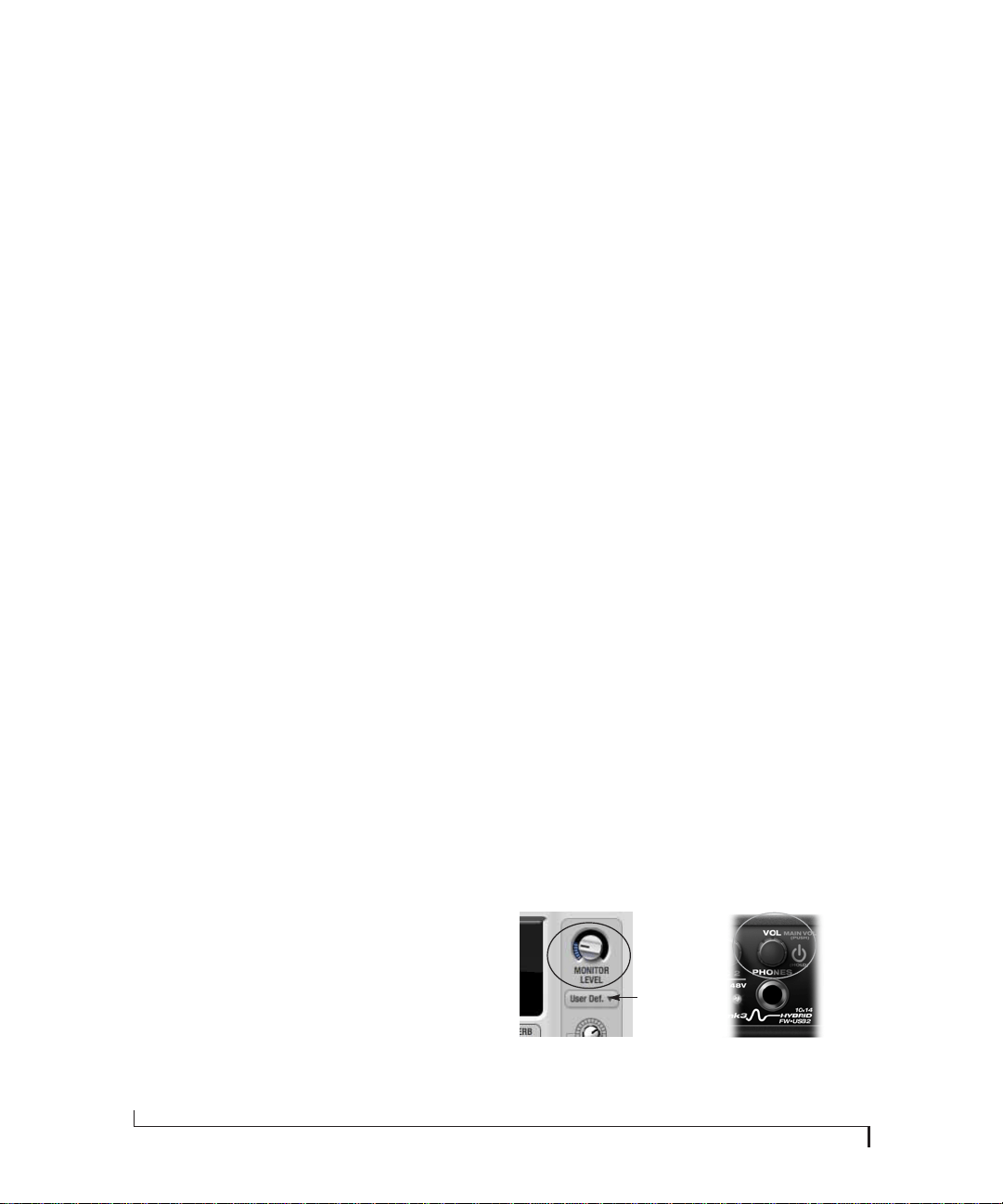
CUEMIX FX
84
Output
When the Split Point is set to Output, the sends in
Output tab become active and the returns in the
Mix bus tab gray out. This allows you to send from
inputs, mixes and outputs and return to outputs.
Primary controls
The Primary Controls section (Figure 10-28) in the
Reverb tab provides the following basic parameters
for programming the reverb.
Reverb Time
Reverb time determines the length of decay, or tail,
of the reverb. This is a global setting for the reverb
processor. You can further refine the tails by
independently setting the reverb time of three
separate frequency bands, as discussed below in
the Reverb Design section.
PreDelay
PreDelay is the amount of time before you hear the
very first reflections. If you are in a large room, it
takes a while before the first reflections return.
PreDelay is useful for clarifying the original sound.
For example, with vocals, the reflections won’t start
until after the initial sound of a word has been
sung.
Shelf Filter
The Shelf Filter is a low-pass filter that controls the
high frequency characteristics of the overall effect.
Frequency sets the cutoff frequency for the filter
and Cut sets the amount of signal attenuation
applied by the filter.
Early reflections
Initial reflections give a space its unique sound.
The shape of the room, the angles of the walls, even
furniture in the room will produce a series of Initial
Reflections. Think of the early reflections and
room type as the “flavor” of the reverb. You can
choose between several types of rooms. These are
acoustic models for simulating these different
types of spaces. The Size and Level parameters let
you control the size of the room and the strength of
the initial reflections.
☛ Here’s a tip: try using initial reflections
without any subsequent reverb (turn the reverb
time down as far as it will go). You’ll hear
interesting and unusual effects.
Reverb design
The Reverb Design section allows you to
independently control the reverb time for three
separate frequency bands (Low, Mid and High)
with adjustable cross-over points between them
(Low and High). The reverb time for each band is
specified in percent of the overall reverb time in the
Primary Controls section at the top of the tab.
You can edit these parameters graphically by
dragging the handles in the graphic display
(Figure 10-28).
Width does what its name implies: if you turn this
control all the way up, the result is maximum stereo
imaging. A position of 12 o’clock produces
essentially a mono image. Turning the control all
the way down completely swaps the stereo image.
THE MONITOR GROUP
The monitor group is a set of UltraLite-mk3 outputs
that can be controlled with the master Monitor
Level knob in upper right corner of the CueMix FX
mixer window (Figure 10-29), as well as the
MASTER VOL knob on the UltraLite-mk3 front
panel.
Figure 10-29: Monitor group volume control from CueMix FX and the
front panel MASTER VOL knob.
Monitor
group
presets
menu

CUEMIX FX
85
Assigning outputs to the monitor group
Any combination of outputs can be assigned to the
monitor group. To include an output pair in the
monitor group, click its Monitor button in the
Outputs tab (Figure 10-6 on page 69).
Monitor group presets menu
The monitor group presets menu (Figure 10-29)
provides several presets for commonly used
monitor groups:
If you program your own monitor output group,
the presets menu displays the word Custom.
Monitor group meters
The monitor group meters (Figure 10-1 on
page 62) show levels for any/all output pairs that
are currently included in the monitor group. The
width of the meters scales proportionally so that all
current monitor group outputs will fit within the
prescribed space for the meters. If many outputs
are included, then the meters will look fairly thin,
but they will all be included in the meter.
DSP METER
The DSP meter (Figure 10-1) shows how much of
the available DSP processing power is currently
being used by the UltraLite-mk3 for effects
processing. DSP resources are allocated in channel
order from the first input to the last output. If there
aren’t enough DSP resources for all effects to be
enabled on a channel, none of them are allocated
on that channel or any following channel.
EQ on a stereo channel requires approximately
twice the DSP resources as the same EQ on a mono
channel. The Compressor (2.5 x 1 EQ band) and
Leveler (4 x 1 EQ band) require about the same
DSP resources for a mono or stereo channel.
SOLO LIGHT
The Solo light (Figure 10-1) illuminates when any
input in the current (active) mix bus is soloed
(even if it is currently scrolled off-screen).
TALKBACK AND LISTENBACK
CueMix FX provides Talkback and Listenback
buttons. Talkback allows an engineer in the control
room to temporarily dim all audio and talk to
musicians in the live room. Conversely, Listenback
allows musicians to talk to the control room.
Hardware setup
Figure 10-30 below shows a typical hardware setup
for Talkback and Listenback. For Talkback, set up a
dedicated mic in your control room and connect it
to a mic input on your UltraLite-mk3. For
Listenback, set up a dedicated listenback mic in the
live room for the musicians and connect it to
another mic input. For talkback output, set up a
headphone distribution amp or set of speakers in
the live room, and connect it to a pair of outputs.
For example, you might connect a headphone
distribution amp to analog outputs 7-8 on your
UltraLite-mk3, as demonstrated below in
Figure 10-30.
Monitor group preset Output assignment
Main Outs Main Out 1-2
Stereo Analog Out 1-2
Quad Analog Out 1-4
5.1 Analog Out 1-6
7.1 Analog Out 1-8
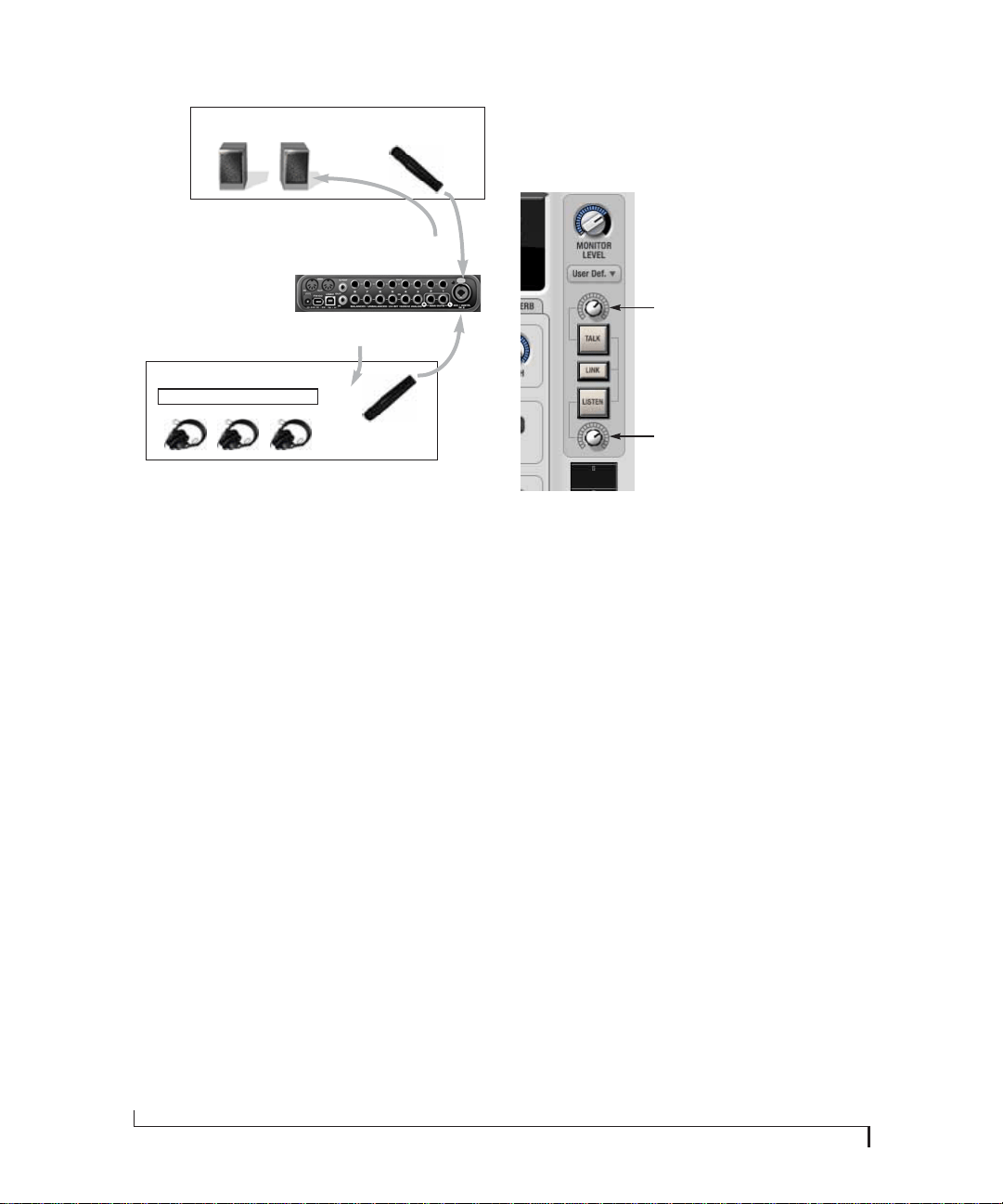
CUEMIX FX
86
Figure 10-30: Typical hardware setup for Talkback and Listenback.
Talkback / Listenback Mic Input
To configure the talkback mic in CueMix FX, go to
the Inputs tab (Figure 10-3 on page 66) and click
the Focus button for the input that the talkback mic
is connected to. Click the Channel tab (Figure 10-8
on page 70) and enable the Ta lk button.
Repeat this procedure for the Listenback mic,
except click the Listen button in the Channel tab.
Talk / Listen output
To configure the talkback and listen back outputs,
go to the Outputs tab (Figure 10-6 on page 69) and
enable the Ta lk button for any output pair on which
you’d like to hear the talkback mic. Similarly,
enable the Listen button for any output pair on
which you’d like to hear the listenback mic.
Talkback / Listenback Monitor Dim
Use the knobs next to the Talk and Listen buttons
(Figure 10-31) to determine the amount of
attenuation you would like to apply to all other
audio signals (besides the talkback/listenback
signal) when Talkback and/or Listenback is
engaged. To completely silence all other CueMix
audio, turn them all the way down. attenuation
only occurs when talkback or listenback is
engaged. Audio playing back from disk (your host
software) is not affected.
Figure 10-31: The Talkback/Listenback controls.
Engaging/disengaging Talkback and
Listenback
To engage Talk back or Listenback, press on the
Talk or Listen buttons (Figure 10-31) and then
release to disengage. Talkback and/or Listenback is
engaged for as long as you hold down the mouse
button. Alt-click to make the buttons “sticky” (stay
engaged until you click them again — so you don’t
have to hold down the mouse). Or use the Talkback
menu items.
If you would like to engage both Talkback and
Listenback at the same time, enable the Link button
(Figure 10-31).
Controlling Talkback and Listenback volume
To control the volume of the Talkback and/or
Listenback mics, adjust their input trim in CueMix
FX.
Listenback
mic
Control room
Talkback
mic
Main
outs
Live room
Outs
7-8
Headphone distribution amp
(front panel
mic input)
Talk dim
Listen dim

CUEMIX FX
87
SHORTCUTS
Hold down the following general modifier keys as
shortcuts:
Hold down the following modifier keys as
shortcuts for the EQ tab and controls:
FILE MENU
Saving and loading hardware presets
The UltraLite-mk3 can store up to 16 presets in its
on-board memory. A preset includes of all
CueMix FX settings for all for mix busses, but it
excludes global settings like clock source and
sample rate.
The Load Hardware Preset and Save Hardware
Preset commands in the CueMix FX file menu let
you name, save and load presets in the
UltraLite-mk3.
Peak/hold time
In CueMix FX, a peak indicator is a line
(representing a virtual LED) displayed in a level
meter that indicates the maximum signal level
registered by the meter. The Peak/hold time setting
(File menu) determines how long this indicator
remains visible before it disappears (or begins to
drop). To disable peak/hold indicators altogether,
choose Off from this sub-menu.
Mix1 Return Includes Computer
The Mix1 return includes computer File menu item
applies to other MOTU interfaces products and has
no effect on the UltraLite-mk3.
Hardware follows console stereo settings
This File menu item applies to other MOTU
interfaces products and has no effect on the
UltraLite-mk3.
EDIT MENU
Undo/Redo
CueMix FX supports multiple undo/redo. This
allows you to step backwards and forwards
through your actions in the software.
Copying & pasting (duplicating) entire mixes
To copy and paste the settings from one mix to
another:
1 Select the source mix (Figure 10-1) and choose
Copy from the Edit menu (or press control-C).
2 Choose the destination mix and choose Paste
from the Edit menu (or press control-V).
Clear Peaks
Choose Clear Peaks from the Edit menu to clear all
peak indicators in all CueMix FX meters.
Shortcut Result
Shift key Applies your action to all inputs or all out-
puts in the mix.
Control key Applies your action to the stereo input pair,
even when it is currently configured as mono.
Alt key Applies your action to all busses.
Shift-Alt Applies your action to all inputs and mixes.
Double-click Returns the control to its default value (pan
center, unity gain, etc.)
Shortcut Result
Shift click Applies EQ button change to all input or out-
puts.
Alt-click Applies EQ enable button changes to all
bands in that input or output.
Shift-Alt-click Applies EQ enable button changes to all
bands and all inputs or outputs.
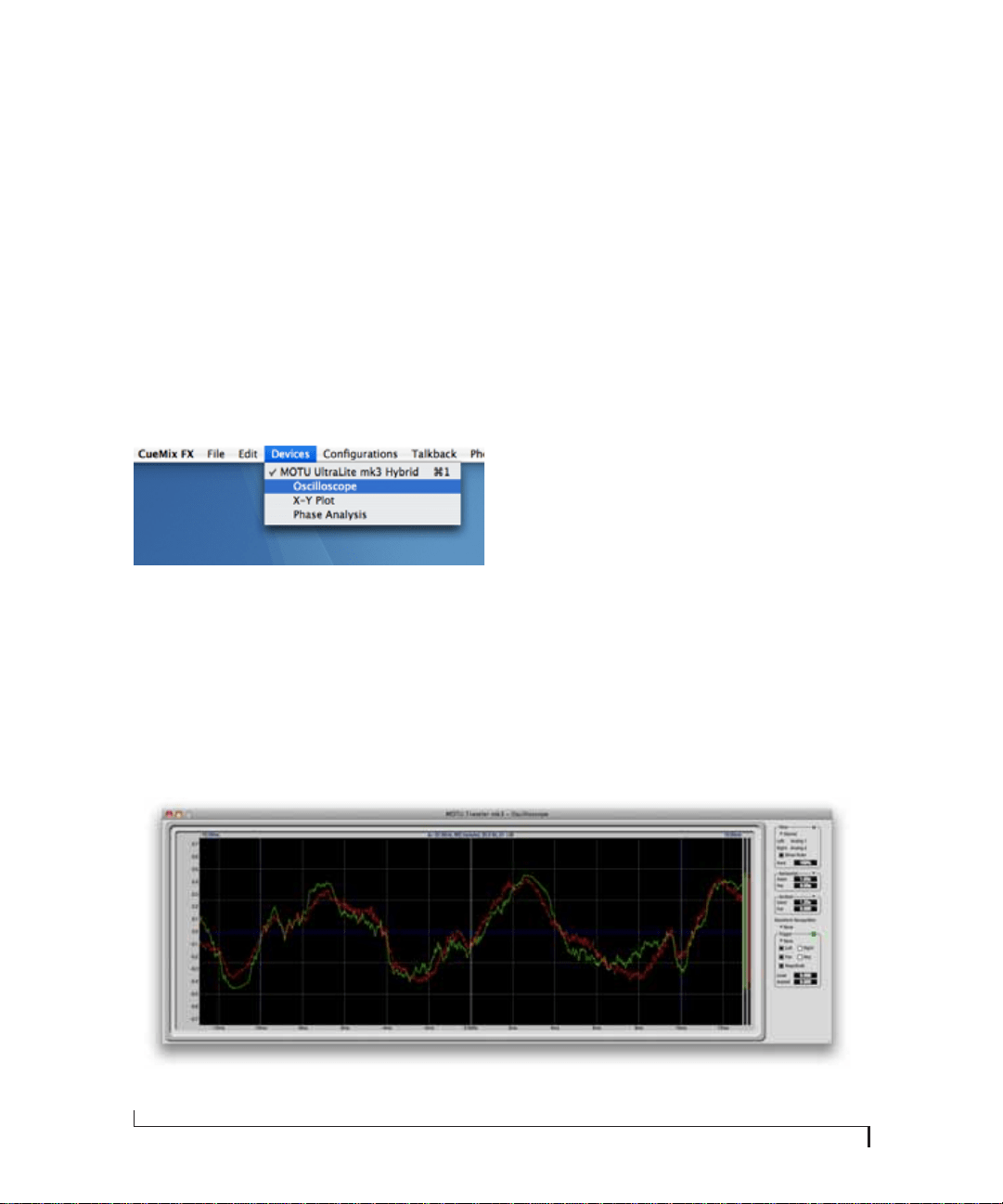
CUEMIX FX
88
DEVICES MENU
If you are working with more than one MOTU
audio interface product, this menu displays all
interfaces that are currently on line. Choose any
device from the menu to edit its settings using the
CueMix FX software.
Below each device are three signal analysis tools:
Oscilloscope, X-Y Plot and Phase Analysis. Choose
one to open its window. For details on these
features, see the following sections.
Oscilloscope . . . . . . . . . . . . . . . . . . . . . . . . . . . . . . . . . . . . . . . . . 88
X-Y Plot . . . . . . . . . . . . . . . . . . . . . . . . . . . . . . . . . . . . . . . . . . . . . . 94
Phase Analysis . . . . . . . . . . . . . . . . . . . . . . . . . . . . . . . . . . . . . . . 97
Figure 10-32: Opening the oscilloscope, X-Y Plot and Phase Analysis
windows.
OSCILLOSCOPE
The Oscilloscope (Figure 10-33) graphs the
amplitude of an audio signal over time.
Amplitude is displayed on the y-axis and time is
displayed on the x-axis. A thick white vertical line
marks where time equals zero; a thick white
horizontal line marks where amplitude equals zero
(Figure 10-33, below).
Level meters are displayed to the right of the graph.
One or two meters are shown, depending on the
current view mode (see “View controls”).
Opening the oscilloscope
Each mk3 series FireWire audio interface has its
own oscilloscope. To open an oscilloscope, choose
the Oscilloscope item from the Devices menu under
the desired interface (Figure 10-32).
Choosing a channel to display
The oscilloscope follows the currently focused
audio input or output. If you focus a mono channel
(e.g. Analog 3), its corresponding stereo pair will
be displayed (Analog 3–4).
View controls
The View controls (Figure 10-34) provide several
options for the oscilloscope display.
Figure 10-33: Oscilloscope
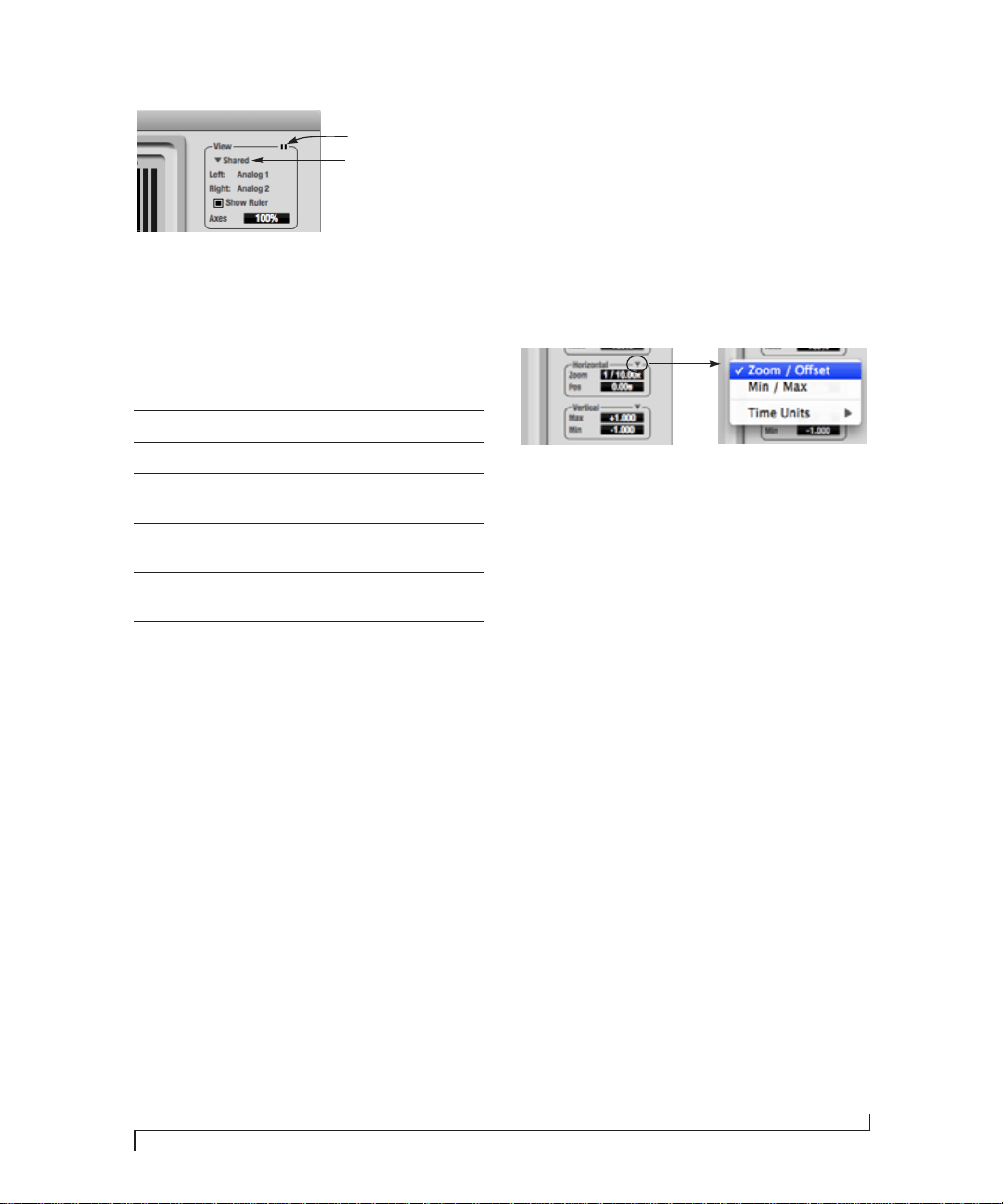
CUEMIX FX
89
Figure 10-34: View controls
View menu
The View menu (Figure 10-34) lets you choose how
you wish to display the audio channel(s) being
displayed.
Display options
The Axes control (Figure 10-34) sets the opacity of
the grid displayed in the graph, from 100% (fully
visible) down to 0% (fully hidden). The Show Ruler
option toggles the measurement items (see
“Measurement information” on page 91).
Pausing the display
The Pause button in the upper right corner of the
View section (Figure 10-34) allows you to freeze
the display at any time. To resume, click the button
again. The level meters will remain active while the
display is paused.
Horizontal controls (time axis)
The Horizontal controls (Figure 10-35) configure
the value range of the x-axis (time). Click and drag
the values up or down to set them, or double-click
to return to the default value.
There are two modes for the controls: Zoom/Offset
and
Min/Max. To change the mode, use the Horizontal
control menu (Figure 10-35).
Figure 10-35: Horizontal control menu
In Zoom/Offset mode, Zoom sets the display zoom
from
1/1000x to 10x, where the number represents the
number of pixels per sample. For example, when
the horizontal zoom value is 10x, 10 samples are
displayed in 100 pixels; when the horizontal zoom
value is 1/10x, 100 samples are displayed in 10
pixels. Offset moves the line marking time equals
zero left or right.
In Min/Max mode, Min and Max set the earliest
and most recent displayed time.
Time Units
The Time Units sub-menu (Figure 10-35) provides
the option to view the X axis in Seconds or
Samples.
Vertical controls (amplitude axis)
The Vertical controls (Figure 10-35) operate
similarly to the Horizontal controls, except that
they configure the y-axis (amplitude).
In Zoom/Offset mode, Zoom sets the display zoom
from
1/2 to 100x, and Offset moves the line marking
amplitude equals zero line up or down.
View menu setting What it displays
Left Left channel only
Right Right channel only
Split screen Left channel on top; right channel on the
bottom
Shared Left and right on top of each other; left is
green, right is red
Add Left and right channels’ amplitudes are
added together
Subtract L-R The right channel’s amplitude is sub-
tracted from the left channel’s amplitude
Pause button
View menu
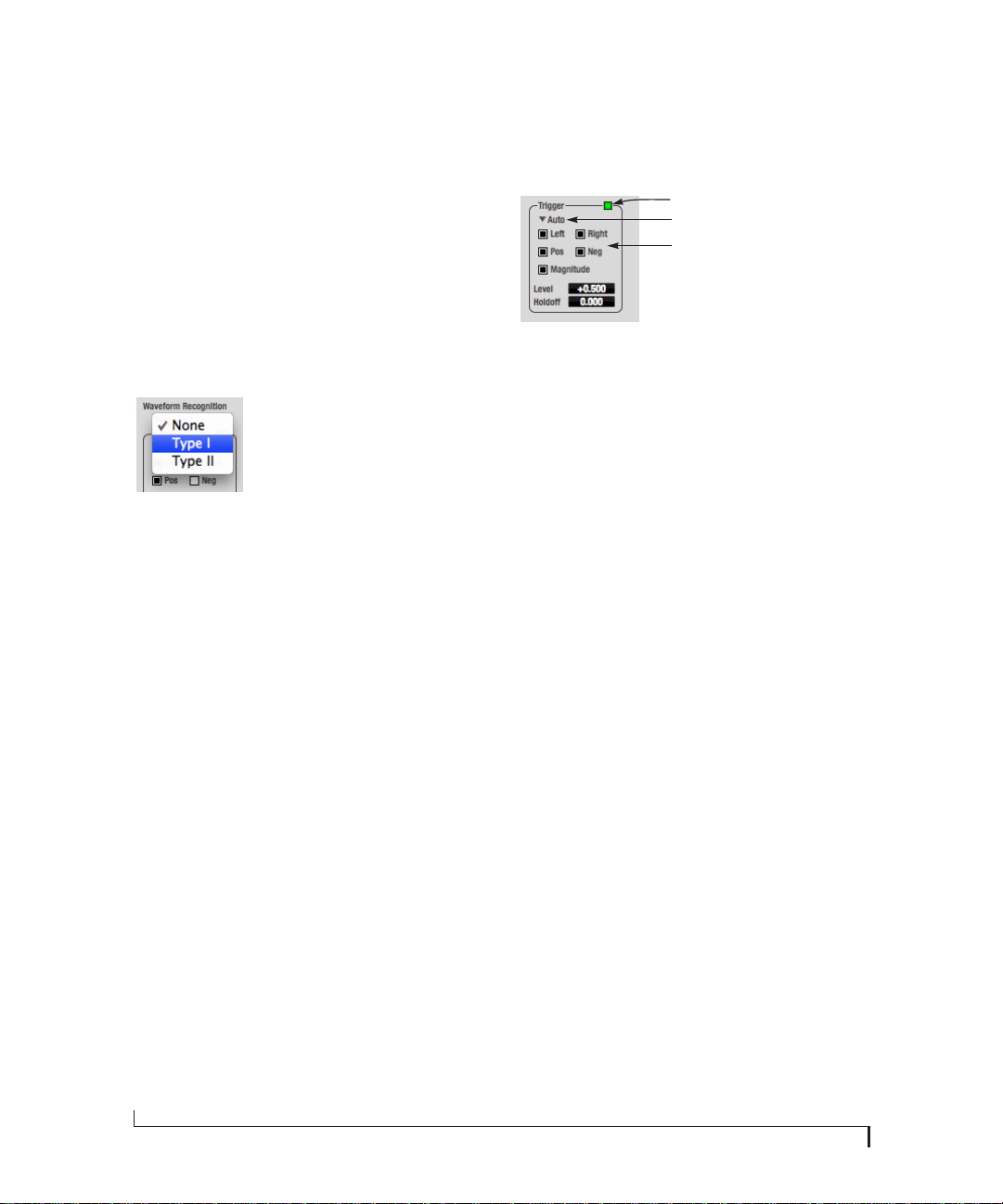
CUEMIX FX
90
In Min/Max mode, Min and Max set the smallest
and largest displayed amplitude.
Waveform Recognition
The Waveform Recognition option searches
through new audio data looking for a waveform
which most resembles that which was previously
displayed. The region where this takes place is a
small window around the line marking time equals
zero, denoted by the extra vertical graph lines
surrounding it. There are two kinds of waveform
recognition available: Type I and Type II.
Figure 10-36: Waveform Recognition menu
Type I recognition provides the most stable display
of the waveform. It is the most resistant to change.
Louder transients, such as those produced by a
snare drum, are not displayed inside of the
waveform window. Type I is best for observing the
shape of a signal produced by a synthesizer or
observing the tone of a guitar through a chain of
pedals.
Type II recognition is less resistant to change. It will
include loud transients within the waveform
recognition window. Type II is better for observing
percussive music where the beat itself is to be
centered within the waveform window.
Trigger
When the Tri gg e r (Figure 10-37) is not enabled
(the Trigger menu is set to None), the graph
updates based on time: after every n samples of the
monitored audio signal, the most recent samples
are displayed. When the Trigger is enabled (set to
any mode other than None), the graph updates in
response to specific conditions in the signal. The
Trigger section defines that criteria and how the
graph will display the events that match.
Figure 10-37: Trigger settings
Criteria
The criteria check boxes (Figure 10-37) determine
the conditions that the trigger is looking for and
where it will look for them.
The Left check box causes the condition to be
looked for in the left channel of the signal; likewise,
the Right check box looks for the condition in the
right channel. One or both of these can be enabled
simultaneously. If neither is enabled, the criteria
will not be found because the trigger is not looking
at any audio signal.
The Pos and Neg check boxes determine the slope
of the event. When the Pos check box is enabled,
the trigger will look for an event where amplitude is
increasing; likewise, enabling the Neg check box
tells the trigger to look for an event where
amplitude is decreasing. One or both of these can
be enabled simultaneously. If neither is enabled,
the criteria will not be found because the trigger is
not looking for any particular kind of event.
The Level setting defines the amplitude threshold
that the trigger is looking for. The Level is indicated
on the graph by a blue horizontal line (or two blue
horizontal lines, if Magnitude is enabled). Events
which cross this threshold using the enabled
slope(s) in the enabled channel(s) will activate the
trigger. The response of the trigger is set by the
Trigger mode (see “Trigger modes”, below).
Trigger indicator
Trigger menu
Criteria check boxes
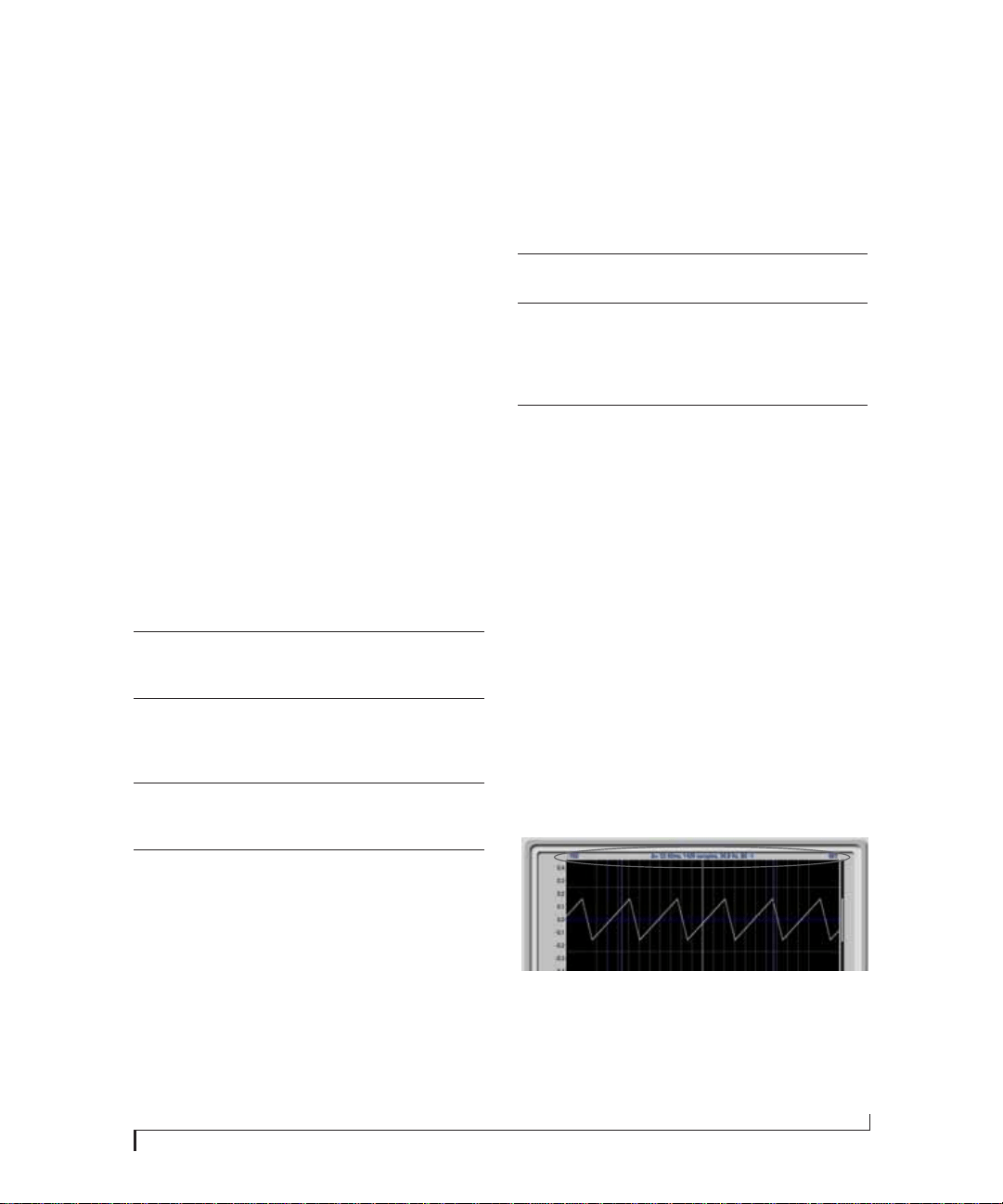
CUEMIX FX
91
Enabling the Magnitude check box tells the trigger
to look for both positive and negative Level values,
regardless of whether the Level value is positive or
negative. For example, if Level is set to +0.500 and
Magnitude is enabled, the trigger will look for both
+0.500 and -0.500. You will see a second blue line
appear in the display when Magnitude is enabled to
denote the second value.
Holdoff
Holdoff defines a time interval during which the
oscilloscope does not trigger. The most recent trace
will be displayed during that period. When the
period is over, the trigger is “re-armed’, i.e. it will
begin looking for the criteria again.
Click and drag this value up or down to set it, or
double-click to return to the default value.
Trigger modes
The Trigger menu (Figure 10-37 on page 90)
provides four modes:
Trigger indicator
The Trigger indicator (Figure 10-37 on page 90)
displays the state of the trigger, and also provides a
way to manually interact with it. The Trigger
indicator always displays one of three colors:
You can also click on the Trigger indicator to force
certain actions, depending on the Trigger mode. In
Auto and Normal modes, clicking on the Trigger
indicator causes the display to run freely; you may
click & hold to force this to occur for as long as
you’d like. In Single Sweep mode, clicking on the
Trigger indicator re-arms the trigger. When the
Trigger mode is None, clicking on the Trigger
indicator has no effect.
Measurement information
You can view detailed information about a
particular time range by using the measurement
bars.
Figure 10-38: Measurement information
Trigger mode What it does
None The Trigger is not active; this is the default mode.
The incoming audio signal will be displayed con-
tinuously as audio is received.
Auto The display is always updating, but when the
condition is met, the trigger event will be dis-
played centered around the line marking time
equals zero.
Normal The display updates only when the condition is
met; the last trace will be displayed until the next
matching event is found.
Single Sweep Similar to Normal mode, but the last trace will be
displayed until you manually arm the trigger by
clicking the Trigger indicator (Figure 10-37 on
page 90) or by pressing the spacebar.
Color Status
Green When the current Trigger criteria has been met
(including when the Trigger mode is None).
Yellow When the Trigger is armed, but has not yet found an
event which matches its criteria. Yellow can also indi-
cate that the graph has been manually paused using
the Pause button in the View section (see “Pausing
the display” on page 89).
Red When the Trigger is being held off, either because the
Trigger mode is set to Single Sweep or the Holdoff
time is not set to zero.
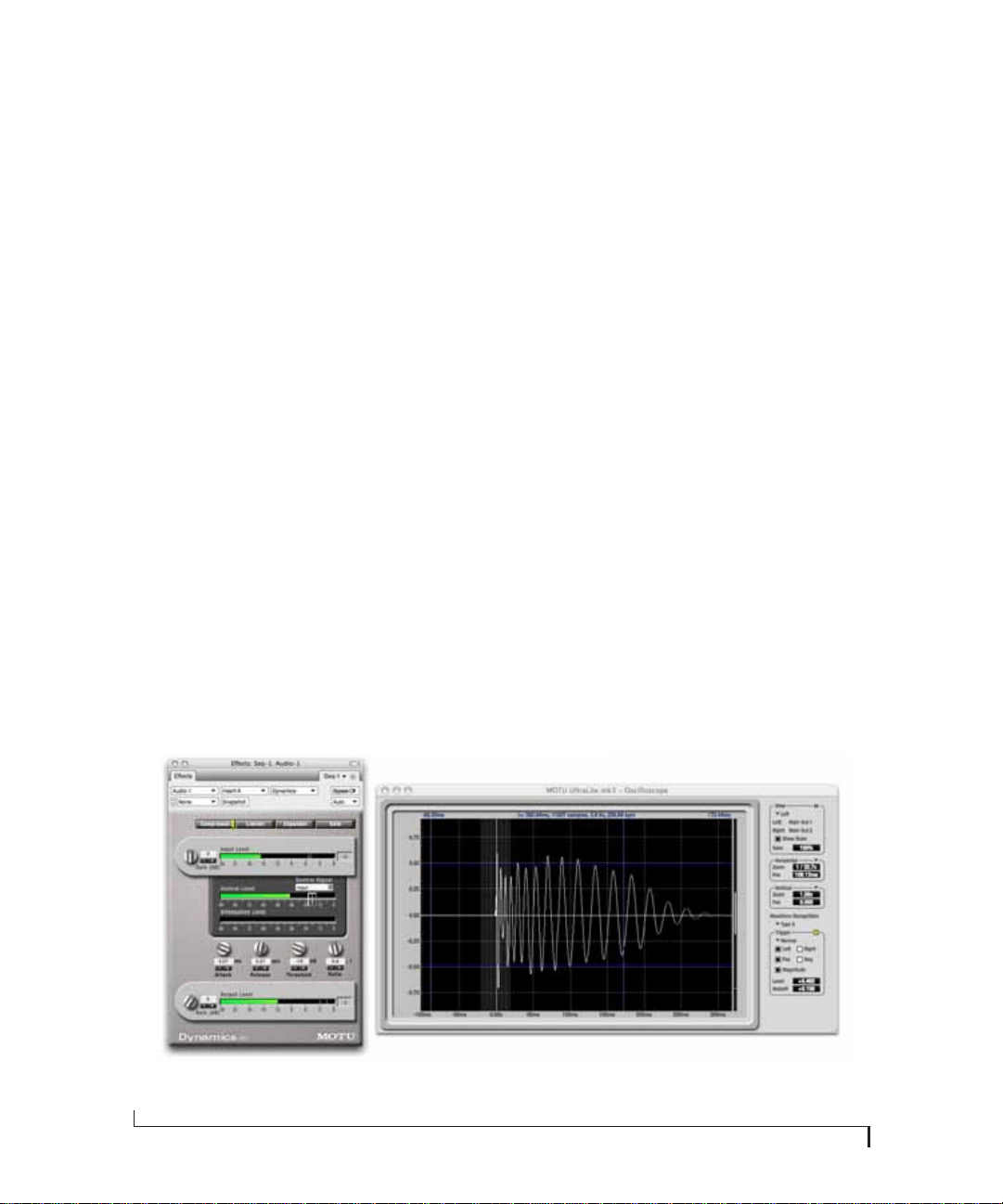
CUEMIX FX
92
To adjust the left and right edges of the
measurement area, click and drag the blue bars in
the graph, or click and drag the blue numbers in
the upper left or right corners. To reset them to the
default value, double-click the numbers.
Information about the measured area is displayed
at the center of the top ruler: the duration (in
seconds and samples), the approximate frequency,
and the scientific note name. If the measured area is
long enough, the approximate beats per minute
(bpm) is displayed.
Ideas for using the Oscilloscope
The Oscilloscope can be used in many useful ways
during the routine operation of your recording
studio. Here are just a few examples.
Analyzing and comparing harmonic content
The oscilloscope lets you “see” the nature of the
harmonic profile in any audio material. You can
also view two signals side by side (in stereo mode)
to compare their profiles and, if necessary, make
adjustments to the source of each signal and view
your changes in real time.
Viewing transients such as drum hits
If you loop a snare hit or other similar transient
audio clip and feed it through the oscilloscope, you
can more or less “freeze” the transient waveform in
the oscilloscope frame. This can be useful, for
example, for viewing the results of real-time
compression that you are applying with an effects
plug-in, as demonstrated in Figure 10-39. In this
example, a snare hit is being compressed by Digital
Performer’s Dynamics plug-in. As you make
adjustments to the compression plug-in’s settings,
you can see the transient waveform change the next
time the Oscilloscope triggers. For compression,
this can be particularly useful for balancing the
effect of the attack on the transient, relative to the
decay portion of the waveform. Conversely, you
can see the effect of the threshold setting directly
on the decay portion, relative to the attack. In
effect, you can see as well as hear the results of your
compression adjustments.
To view a transient waveform in the Oscilloscope
display, turn off Waveform Recognition and use the
Normal Trigger mode. Adjust the level high enough
to encompass the vertical amplitude of most of the
transient. If the transient pulse sweeps across the
Figure 10-39: Viewing transients in the Oscilloscope

CUEMIX FX
93
screen, try raising the Holdoff level. Once the
transient is settled in the display and fairly stable,
you may need to adjust the horizontal position to
center it in the display. These settings are depicted
in the example in Figure 10-39.
You can also pause the display at any time and
adjust the horizontal bounds to locate a transient.
Clip detection
You can use the Oscilloscope to detect clipping in a
digital audio signal. To do so, enable all criteria
(Figure 10-37 on page 90), choose Single Sweep
from the trigger menu (Figure 10-37), set the level
to 0.999 and click the trigger indicator
(Figure 10-37) to arm it (yellow). As soon as the
signal clips, the trigger indicator will turn red, and
the display will show the offending clip at the line
marking time equals zero.
Viewing timing pulses
If you have two audio signals with recognizable,
timed pulses in them, and you wish to compare
their timing with respect to each other, you can use
Split Screen or Shared view to visually compare the
timing of the two signals. You can zoom in to the
sample level for sample accurate viewing.
Building synthesizer patches
If you are building a synth patch on a synthesizer
(or forming similar highly periodic audio
material), you can run the audio signal through the
Oscilloscope as you adjust its sound to check in real
time for undesirable (and possibly inaudible)
characteristics, which are easily seen in the
Oscilloscope display. A good example is DC offset.
If a signal develops DC offset, the apparent vertical
center of its overall waveform will drift above or
below the line marking amplitude equals zero. Try
setting Waveform Recognition to Type I and setting
Trigger to None.
Another example is waveform polarity. If you are
combining several raw waveforms, polarity is a
critical, yet not always obvious, factor in
determining the resulting sound. You can use the
Oscilloscope to easily view and compare polarities
to see if they are inverted from one another or not.
The Add and Subtract L - R View menu settings are
particularly useful here.
You can also use the Oscilloscope to help you apply
waveform modulation and keep it “in bounds”. For
example, you could easily see if pulse width
modulation is collapsing in on itself to choke the
sound, an effect that is readily seen in the
Oscilloscope display but not necessarily easy to
determine by ear when using multiple modulation
sources.
Guitarists can also visually observe the effects of
their pedals and processing, while playing. With
the Trigger mode set to None and Waveform
Recognition set to Type I, the waveform will be
tracks automatically.
When applying filters and filter resonance, the
visual effect on the waveform can be invaluable in
reinforcing what you are hearing as you make
adjustments.
Monitoring control voltage output from Volta
MOTU’s Volta instrument plug-in for Mac OS X
turns your audio interface into a control voltage
interface, giving you precise digital control from
your favorite audio workstation software of any
hardware device with a control voltage (CV) input.
The CV signals output from Volta can be
monitored in the Oscilloscope, giving you visual
feedback on LFOs, envelopes, ramps, step
sequencers, and more.
For more information on Volta, see
www.motu.com.
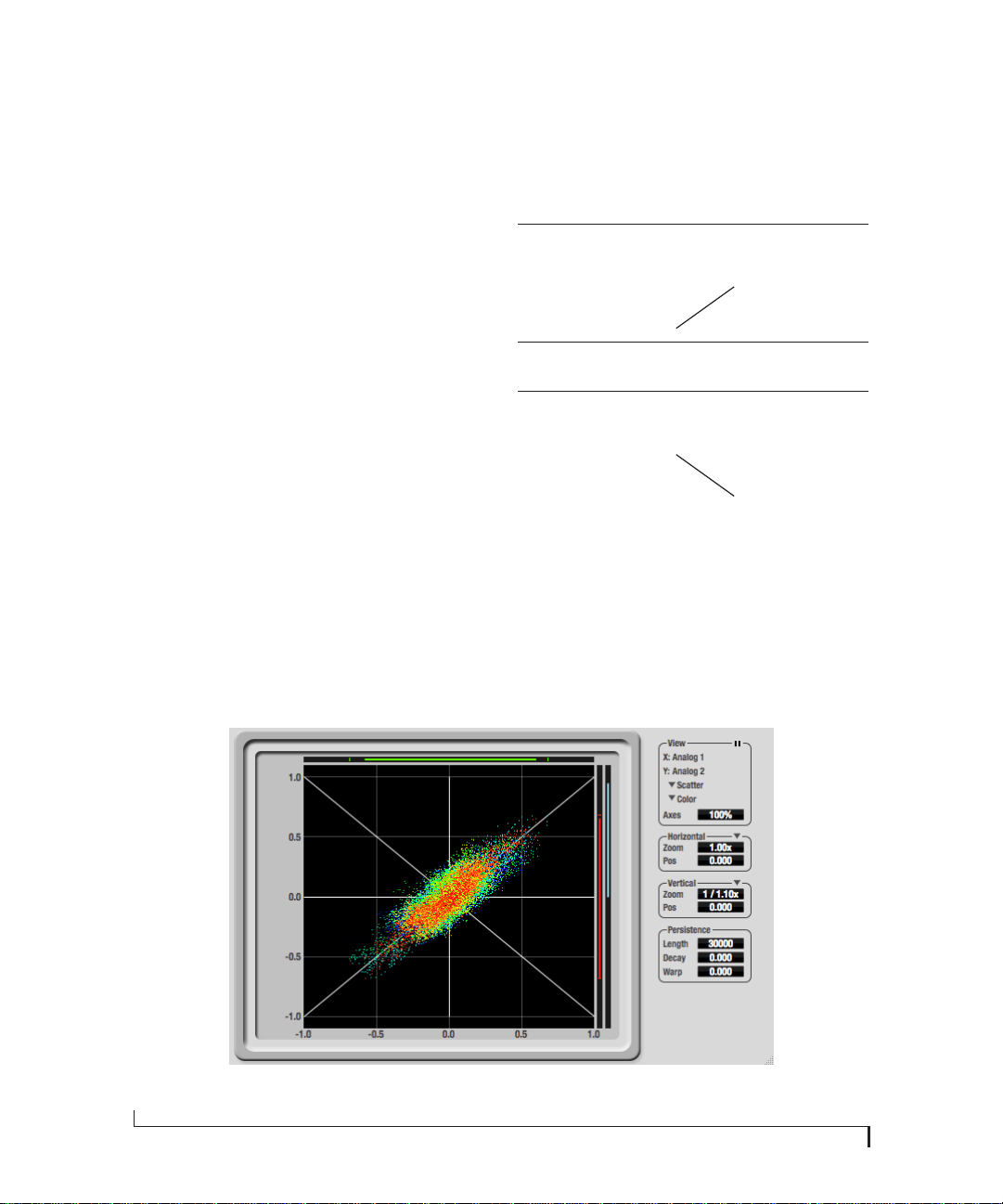
CUEMIX FX
94
X-Y PLOT
The X-Y Plot window (Figure 10-40) graphs the
amplitude of a stereo audio signal on a two-
dimensional grid.
For each unit of time (i.e. each sample), the
amplitude of the left channel is displayed on the x-
axis and the amplitude of the right channel is
displayed on the y-axis. A thick white vertical line
marks where left channel amplitude equals zero; a
thick white horizontal line marks where right
channel amplitude equals zero (Figure 10-40,
below). There are also thick white diagonal lines
for y = x and y = -x.
Metering
Level meters are displayed above and to the right of
the graph for the left (green) and right (red)
channels, respectively. An additional Correlation
meter (blue) is displayed on the right. This meter
displays the correlation between the two channels.
The higher the meter, the higher the correlation
between the two channels. Below are a few
examples:
Opening the X-Y Plot
Each mk3 series FireWire audio interface has its
own X-Y Plot window. Choose the X-Y Plot item
from the Devices menu under the desired interface
(Figure 10-32 on page 88).
Figure 10-40: X-Y Plot
Situation Meter
level
X-Y Plot graph Mathematical
relationship
Perfect
correlation
+1 Diagonal line going
from lower left to
upper right:
y = x
Zero
correlation
0 No discernible pat-
tern
None
Perfectly out
of phase
-1 Diagonal line going
from upper left to
lower right:
y = -x
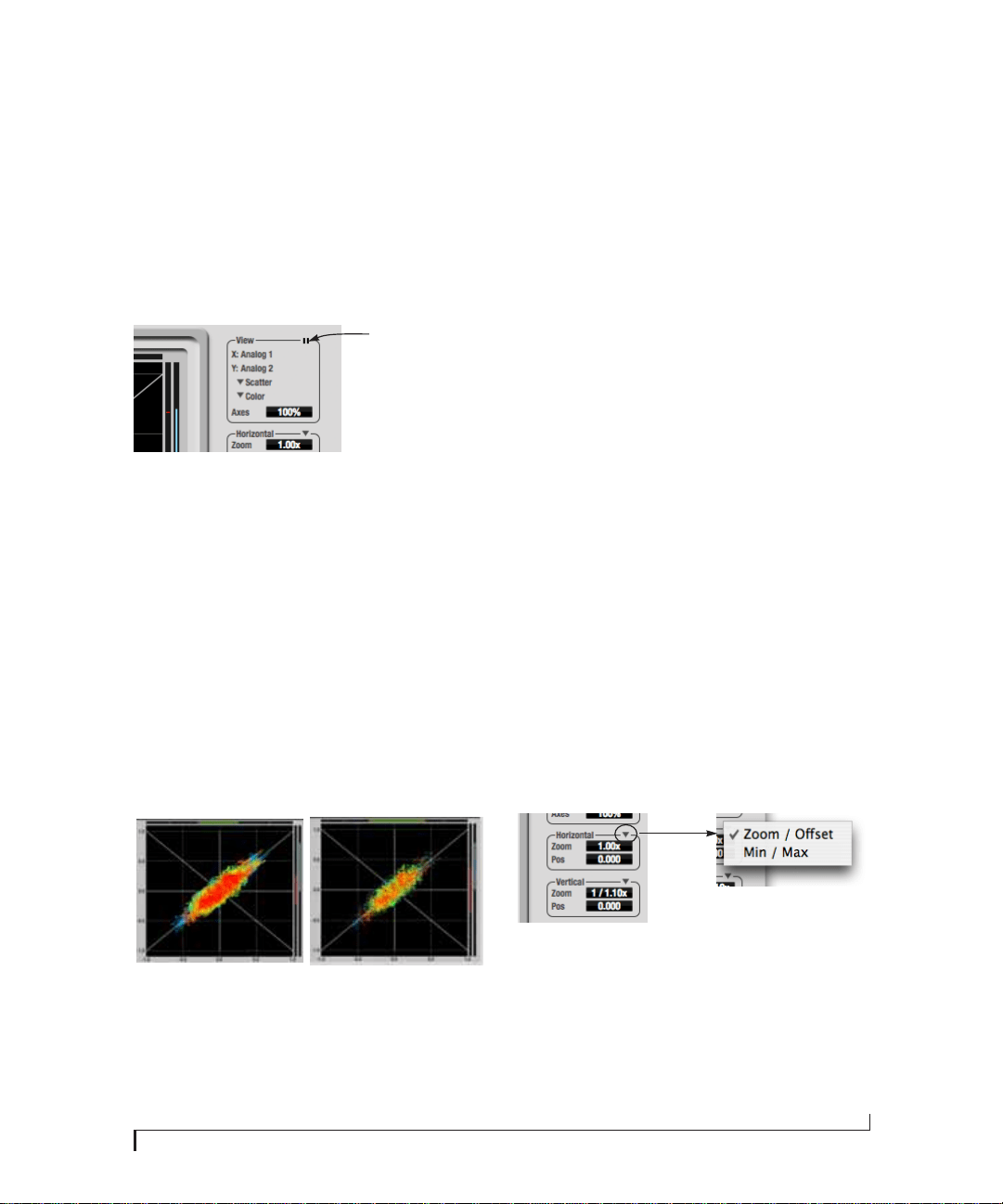
CUEMIX FX
95
Choosing a channel pair to display
The X-Y Plot follows the currently focused audio
input or output. If you focus a mono channel (e.g.
Analog 3), its corresponding stereo pair will be
displayed (Analog 3–4).
View controls
The View controls (Figure 10-41) provide several
options for the X-Y Plot display.
Figure 10-41: View controls
Pausing the display
The Pause button in the upper right corner of the
View section (Figure 10-41) allows you to freeze
the display at any time. To resume, click the button
again. The level meters will remain active while the
display is paused.
Line/Scatter
Choose either Line or Scatter from the menu in the
View section (Figure 10-41) to plot each point
(sample) as either a single pixel or as a continuous
line that connects each plot point to the next, as
shown below in Figure 10-42.
Figure 10-42: The same X-Y Plot displayed in Line versus Scatter
mode.
☛ Line mode is significantly more CPU intensive
than Scatter. You can reduce Line mode CPU
overhead on the X-Y Plot by reducing the Length
parameter (described below).
Color/Grayscale
In Color mode (Figure 10-41) the most recently
displayed audio data is shown in red, which fades
to yellow, green and then finally blue, before
disappearing. In Grayscale mode, data is first
shown in white and then fades to gray. To adjust the
scale of this color/brightness change, see “Decay”
on page 96.
Axes
The Axes control (Figure 10-41) sets the opacity of
the grid displayed in the graph, from 100% (fully
visible) down to 0% (fully hidden).
Horizontal and vertical controls
The Horizontal and Vertical controls
(Figure 10-43) configure the value range of the x-
axis (left channel amplitude), and y-axis (right
channel amplitude), respectively. Click and drag
the values up or down to set them, or double-click
to return to the default value.
There are two modes for the controls: Zoom/Offset
and
Min/Max. To change the mode, use the menu
shown in Figure 10-43.
Figure 10-43: Setting the Horizontal or Vertical control modes.
In Zoom/Offset mode, Zoom scales the axis. Pos
moves the lines marking x = 0 left and right, or y =
0 up and down.
Pause button
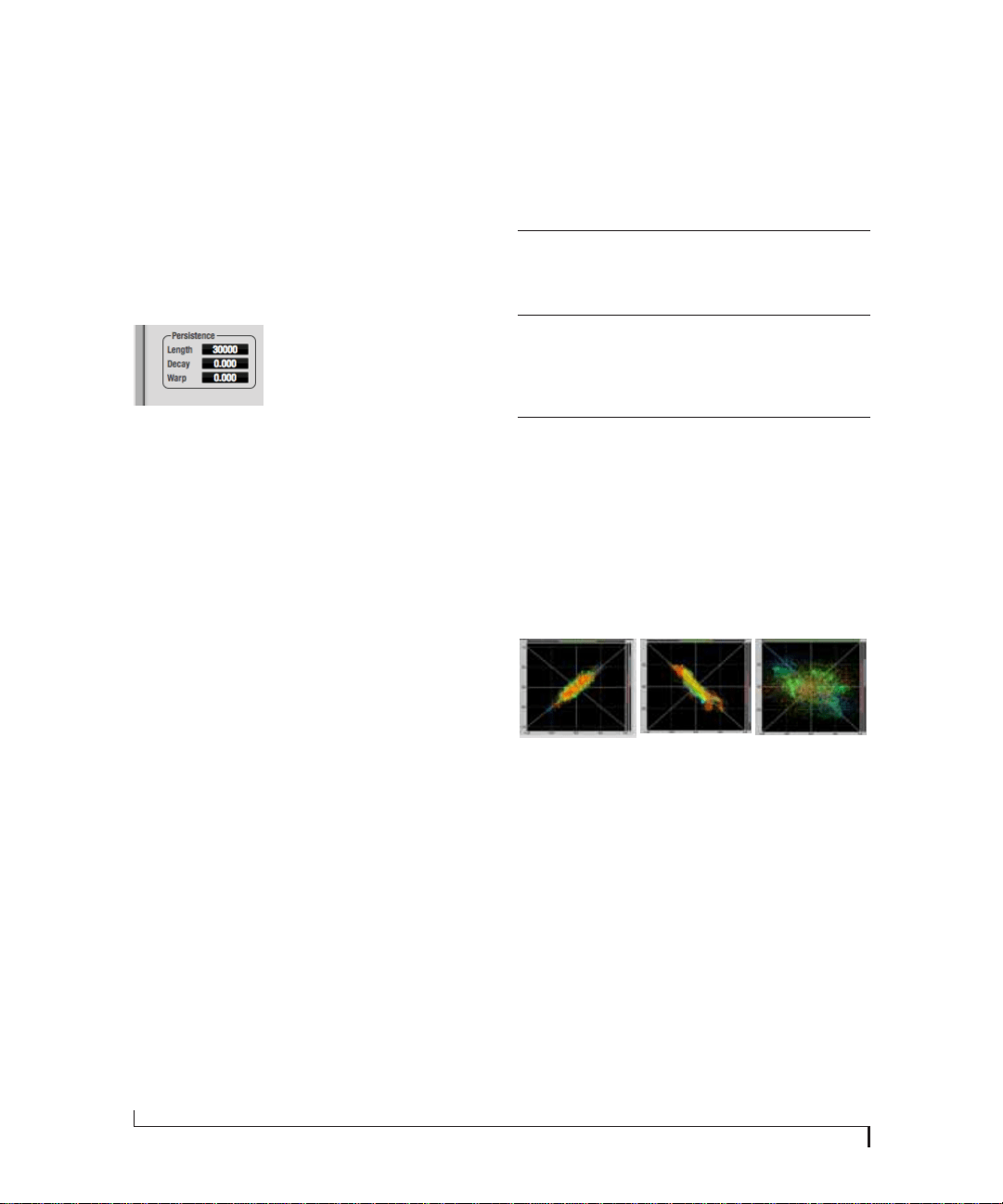
CUEMIX FX
96
In Min/Max mode, Min and Max let you scale the
grid by moving the -1.0 and +1.0 points along the
axis. Min/Max mode lets you control the graph
boundaries directly.
Persistence
The Persistence controls (Figure 10-44) affect the
appearance of data from when it is first displayed
until it disappears from the grid.
Figure 10-44: The Persistence controls.
Length
Length (Figure 10-44) sets the number of recent
samples to show on the plot. For example, when
Length is set to 10,000, the 10,000 most recent
samples are shown.
Decay
The brightness (in Grayscale mode) or hue (in
Color mode) of each sample on the plot is
determined by a linear scale, with the most recent
sample displayed at the maximum value and the
oldest sample displayed at the minimum value.
Decay (Figure 10-44 on page 96) determines the
brightness or hue of the minimum value. When
Decay is zero, the oldest sample is black. When
Decay is +1.000, the oldest sample is fully opaque
(in Grayscale mode) or red (in Color mode).
Warp
Wa rp (Figure 10-44) determines the position of
data points after they are first drawn. When warp is
zero, data points remain in the same position.
When warp is positive, they contract towards the
origin (center of the grid). When warp is negative,
they expand away from the origin. The further the
warp value is from zero, the greater the effect.
Using the X-Y Plot
The X-Y Plot helps you “see” the width of the stereo
field of a mix. It also helps you determine if a mix
has issues with polarity, as follows:
If a stereo signal is out of phase, it is not mono
compatible because it can cancel itself out, either
partially or nearly completely, when collapsed to
mono.
Figure 10-45: Checking polarity in a stereo signal with the X-Y Plot.
Activity on the X-Y Plot What it indicates
Signal activity occurs mostly
along the x = y axis (lower left
to upper right) and the Corre-
lation meter reading is high
Left and right channels are pre-
dominantly in polarity (the ste-
reo field is relatively narrow)
Signal activity occurs mostly
along the y = -x axis (upper left
to lower right) and the Correla-
tion meter reading is low (near
-1)
Left and right channels are pre-
dominantly out of polarity (not
in phase)
Signal activity occurs in a
seemingly random fashion
throughout the grid
No phase relationship exists
(i.e. it is probably a wide stereo
field)
I
n po
l
ar
i
ty
O
ut o
f
po
l
ar
i
ty
N
o po
l
ar
i
ty
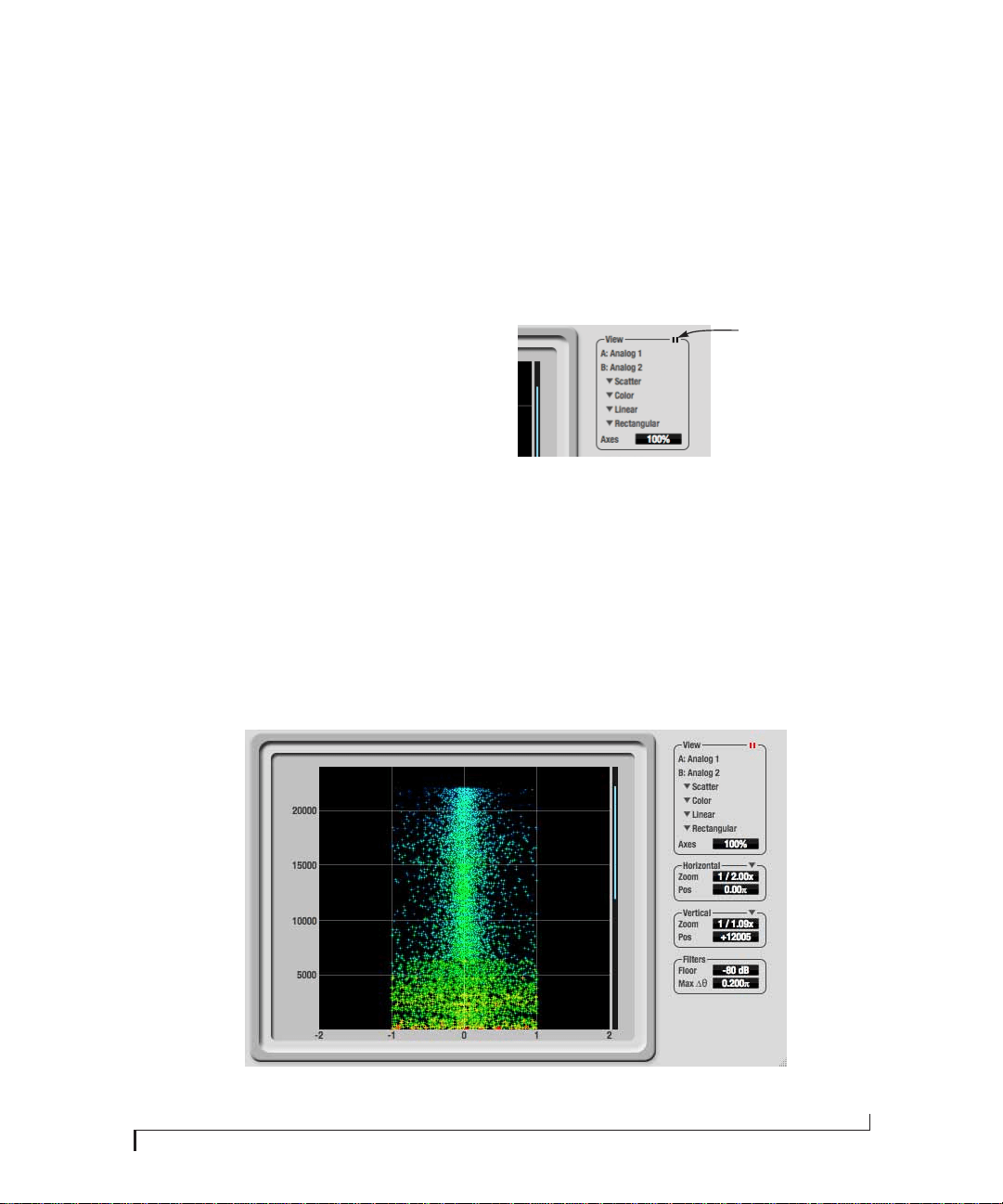
CUEMIX FX
97
PHASE ANALYSIS
The Phase Analysis window (Figure 10-46 on
page 97) graphs frequency versus phase difference
versus amplitude of a stereo signal on either
rectangular or polar coordinates.
In rectangular coordinates, the vertical axis
represents frequency, and the horizontal axis
represents the phase of the left channel minus the
phase of the right channel (measured in radians).
In polar coordinates, the radius represents
frequency and the angle (theta) from the +y
vertical axis represents the phase difference of left
channel minus the right channel.
Correlation Meter
The blue Correlation Meter to the right of the
display shows the correlation between the two
channels. The higher the meter, the higher the
correlation between the two channels.
Opening the Phase Analysis
Each mk3 series FireWire audio interface has its
own Phase Analysis window. Choose the Phase
Analysis item from the Devices menu under the
desired interface (Figure 10-32 on page 88).
Choosing a channel pair to display
The Phase Analysis window follows the currently
focused audio input or output. If you focus a mono
channel (e.g. Analog 3), its corresponding stereo
pair will be displayed (Analog 3–4).
View controls
The View controls (Figure 10-47) provide several
options for the Phase Analysis display.
Figure 10-47: View controls
Pausing the display
The Pause button in the upper right corner of the
View section (Figure 10-47) allows you to freeze
the display at any time. To resume, click the button
again. The correlation meter will remain active
while the display is paused.
Figure 10-46: Phase Analysis
Pause button

CUEMIX FX
98
A/B (stereo audio channels)
The View section (Figure 10-47) displays the pair
of input or output audio channels you are viewing.
See “Choosing a channel pair to display” above.
Line/Scatter
Choose either Line or Scatter from the menu in the
View section (Figure 10-47) to plot each data point
as either a single pixel or as a continuous line that
connects each frequency data point to the next, as
shown below in Figure 10-42.
Figure 10-48: The same Phase Analysis displayed in Line versus
Scatter mode.
☛ Line mode is significantly more CPU intensive
than Scatter. You can reduce Line mode CPU
overhead for the Phase Analysis display by
increasing the Floor filter and reducing the Max
Delta Theta filters (see “Filters” on page 99).
Color/Grayscale
In Color mode (Figure 10-47) signal amplitude is
indicated by color as follows: red is loud and blue is
soft. In grayscale mode, white is loud and gray is
soft.
Linear/Logarithmic
Choose either Linear or Logarithmic from the
menu in the View section (Figure 10-47) to change
the scale of the frequency axis. In rectangular
coordinates, the vertical axis represents frequency,
and in polar coordinates, the radius from the
center is frequency. With a linear scale, frequencies
are spaced evenly; in a logarithmic scale, each
octave is spaced evenly (frequencies are scaled
logarithmically within each octave).
Linear is better for viewing high frequencies;
logarithmic is better for viewing low frequencies.
Rectangular/Polar
Choose either Rectangular or Polar from the menu
in the View section (Figure 10-47) to control how
audio is plotted on the Phase Analysis grid.
Rectangular plots the audio on an X-Y grid, with
frequency along the vertical axis and phase
difference on the horizontal axis. Polar plots the
data on a polar grid with zero Hertz at its center.
The length of the radius (distance from the center)
represents frequency, and the angle (theta)
measured from the +y (vertical) axis represents the
phase difference in degrees.
Figure 10-49: Rectangular versus Polar display (with a linear plot).
Above, Figure 10-49 shows Rectangular versus
Polar display with a Linear plot. Below,
Figure 10-50 show s the same displays (and the
same data) with a Logarithmic plot:
Figure 10-50: Rectangular versus Polar display with a logarithmic
plot.
Axes
The Axes control (Figure 10-47) sets the opacity of
the grid displayed in the graph, from 100% (fully
visible) down to 0% (fully hidden).

CUEMIX FX
99
Horizontal and vertical controls
The Horizontal and Vertical controls
(Figure 10-51) let you scale each axis of the grid
and offset its zero point. Click and drag the values
up or down to set them, or double-click to return
to the default value.
There are two modes for the controls: Zoom/Offset
and
Min/Max. To change the mode, use the menu
shown in Figure 10-51.
Figure 10-51: Setting the Horizontal or Vertical control modes.
In Zoom/Offset mode, Zoom scales the axis. Pos
moves the zero line.
In Min/Max mode, Min and Max let you scale the
grid by moving the end points along the axis. Min/
Max mode lets you set the boundaries of the graph
directly.
Filters
The Filters section (Figure 10-52) lets you control
the density of the Phase Analysis display.
Figure 10-52: Filters
Floor
Floor (Figure 10-52) determines the amplitude
threshold for the display. When the amplitude of
both channels drops below this threshold, the
signal is not shown.
Max delta theta
Max delta theta (Figure 10-52) only affects Line
view (see “Line/Scatter” on page 98) and sets the
maximum difference in frequency between plot
points in the line plot. For two adjacent
frequencies, if the distance (phase difference)
between the two frequencies is greater than the
Max delta theta, then the line is not drawn.
Using the Phase Analysis
In the polar display (top row of Figure 10-53 on
page 100), stereo material that is predominantly
phase-aligned (correlated) appears along the
vertical axis, as demonstrated in the first column
(Perfectly in phase) in Figure 10-53. If the vertical
line tilts left or right, this indicates general
differences in phase; the more the tilt (delta theta),
the more the phase difference. If the vertical line
points downwards in the polar display, this
indicates that the stereo image is predominantly
out of polarity, as demonstrated by the fourth
column (Inverted) in Figure 10-53. Delays appear
as spirals in the polar display.
The rectangular display (bottom row of
Figure 10-53) also shows a predominantly phase-
aligned stereo image along the vertical axis, and tilt
(or left-right offset) from the center vertical axis
represents differences in phase. If a signal is
predominantly out of polarity, it appears along the
theta = -1.0 or theta = +1.0 lines in the rectangular
display, as demonstrated in the fourth column
(Inverted) in Figure 10-53 on page 100.
Using Phase Analysis for multiple mic placement
The polar display can be very useful when
recording drums or another instrument with
multiple microphones. The slight delays caused by
the differences in distance to the source can often
create a comb filtering (delay) effect between two
mic signals, due to phase cancellation. These comb
filter effects appear as spirals in the polar display. If
you arrange the mics so that the null points (where
the spiral pattern meets the negative y axis) are

CUEMIX FX
100
outside the critical frequency range of the
instrument being recorded, you can avoid phase
problems among the mic signals.
Tuning PA systems
The Phase Analysis window can also be used to
troubleshoot and tune PAs and sound
reinforcement systems by placing microphones in
strategic locations, comparing the two signals in
the Phase Analysis grid and looking for phase
issues at various locations.
Summing to mono
The Phase Analysis window is ideal for checking
stereo audio that needs to be summed to mono.
The Phase Analysis lets you see what frequencies
will be canceled out when summed.
In the rectangular view, any lines in the signal that
touch the +1.0 or -1.0 vertical lines in the grid will
be canceled out at the frequency where they touch,
when the signal is summed to mono.
In the polar view, any signal that falls on the
negative y axis (below zero) in polar view will be
canceled out when the signal is summed to mono.
Checking for phase issues in stereo tracks
You can use the Phase Analysis window to check
the overall polarity of a stereo mix. Figure 10-54 is
an example of a full stereo mix that has phase
issues, as indicated by the majority of the signal’s
energy, which is predominantly skewed to the left
side of the rectangular view (left) and spread along
the -y axis in the polar view (right).
Figure 10-54: A stereo mix with phase issues.
CONFIGURATIONS MENU
A configuration is just like a hardware preset (a
“snapshot” of all settings in CueMix FX and
therefore the UltraLite-mk3 hardware itself),
except that it can be created and managed using the
CueMix FX software on your computer, completely
independently of the UltraLite-mk3 hardware. The
commands in the Configurations menu let you
create, save, load, import, export and otherwise
manage as many configurations as you wish.
Figure 10-53: Two identical audio streams in the Phase Analysis.
Perfectly in phase One-sample delay Twenty-sample delay
Polar view
Rectangular
view
Inverted

CUEMIX FX
101
Here is a summary of Configurations menu
operations:
Modifying a configuration
The name of the current configuration is displayed
in the CueMix FX window title bar. If you make any
changes to the settings in CueMix FX, an asterisk
appears in front of the name to remind you that the
current state of CueMix FX doesn’t match the saved
configuration. If you wish to update the saved
configuration with the new changes, use the Save
command. To save the current state of CueMix FX
to another configuration, use Save To. To save as a
new, separate configuration, use Create New.
Saving a CueMix FX configuration as a
hardware preset
To save a CueMix FX configuration as a hardware
preset:
1 Choose the configuration from the
Configurations menu to make it the current active
configuration.
2 Choose File menu> Save Hardware Preset.
3 Type in a name, choose a preset slot and click
OK.
Saving a hardware preset as a CueMix FX
configuration
To save a hardware preset as a CueMix FX configu-
ration:
1 Choose File menu> Load Hardware Preset to
make it the current active preset.
2 Choose Configuration menu> Create New (or
Save To) to save it as a configuration.
TALKBACK MENU
Choose the commands in the Talkback menu to
engage or disengage Talkback or Listenback.
PHONES MENU
The Phones menu allows you to choose what you
will hear on the headphone output, just like the
Phones setting in MOTU Audio Console. However,
this menu provides one extra option that is
exclusive to CueMix FX: Follow Active Mix. This
menu item, when checked, causes the headphone
output to mirror the output of the current mix
being viewed in CueMix FX. For example, if you
are currently viewing mix bus 3, the headphones
will mirror the mix bus 3 output (whatever it is
assigned to).
CONTROL SURFACES MENU
CueMix FX can be controlled from an automated
control surface such as the Mackie Control™. Use
the commands in the Control Surfaces menu to
enable and configure this feature.
Application follows control surface
When checked, the Application follows control
surface menu command makes the CueMix FX
window scroll to the channel you are currently
adjusting with the control surface, if the channel is
not visible when you begin adjusting it. The same is
true for the bus tabs: if you adjust a control in a bus
Configurations
Menu item What it does
Create New Lets you name and save a new configuration,
which appears at the bottom of the Configura-
tions menu.
Save Overwrites the current configuration
(checked in the list at the bottom of the menu)
with the current settings in CueMix FX.
Save To Same as Save above, except that it lets you first
choose the configuration you wish to save to
(instead of the current one).
Delete Lets you choose a configuration to perma-
nently remove from the menu.
Import Loads all configurations from a configuration
file on disk.
Export Saves all current configurations as a file on
disk.
Configuration
list
Choose any configuration to load it. The cur-
rent (last loaded or saved) configuration has a
check mark next to it.

CUEMIX FX
102
that is not currently being displayed, CueMix FX
will jump to the appropriate tab to display the
control you are adjusting.
Share surfaces with other applications
When the Share surfaces with other applications
menu command is checked, CueMix FX releases
the control surface when you switch to another
application. This allows you to control your other
software with the control surface. Here’s a simple
way to understand this mode: the control surface
will always control the front-most application. Just
bring the desired application to the front (make it
the active application), and your control surface
will control it. When you’d like to make changes to
CueMix FX from the control surface, just bring
CueMix FX to the front (make it the active
application).
When this menu item is unchecked, your control
surface will affect CueMix FX all the time, even
when CueMix FX is not the front-most application.
In addition, you will not be able to control other
host audio software with the control surface at any
time (because CueMix FX retains control over it at
all times). This mode is useful when you do not
need to use the control surface with any other
software.
CueMix Control Surfaces
CueMix FX includes support for the following
control surface products:
■ Mackie Control™
■ Mackie HUI™
■ Mackie Baby HUI™
Use the sub-menu commands in the CueMix
Control Surfaces menu item to turn on and
configure control surface support, as described
briefly below.
Enabled
Check this menu item to turn on control surface
operation of CueMix FX. Uncheck it to turn off
control surface support.
Configure…
Choose this menu item to configure your control
surface product. Launch the on-line help for
specific, detailed instructions on configuring
CueMix FX for operation with your control surface
product.
Figure 10-55: Refer to the extensive on-line help for details about
configuring CueMix FX for operation with your control surface
product.

CHAPTER
103
11 MOTU SMPTE Console
OVERVIEW
The UltraLite-mk3 can resolve directly to SMPTE
time code via any analog input, without a separate
synchronizer. The UltraLite-mk3 can also generate
time code via any analog output. The
UltraLite-mk3 provides a DSP-driven phase-lock
engine with sophisticated filtering that provides
fast lockup times and sub-frame accuracy. Direct
time code synchronization is supported by Cubase,
Nuendo and other audio sequencer software that
supports the ASIO2 sample-accurate sync
protocol.
MOTU SMPTE Setup . . . . . . . . . . . . . . . . . . . . . . . . . . . . . . . . 103
Clock/Address . . . . . . . . . . . . . . . . . . . . . . . . . . . . . . . . . . . . . . 103
Frame Rate . . . . . . . . . . . . . . . . . . . . . . . . . . . . . . . . . . . . . . . . . 103
Reader section. . . . . . . . . . . . . . . . . . . . . . . . . . . . . . . . . . . . . . 104
Generator section . . . . . . . . . . . . . . . . . . . . . . . . . . . . . . . . . . 105
Resolving Cubase or Nuendo to SMPTE time code. . 105
Syncing to SMPTE time code. . . . . . . . . . . . . . . . . . . . . . . . 106
MOTU SMPTE SETUP
The included MOTU SMPTE Setup™ software
provides a complete set of tools to generate SMPTE
for striping, regenerating or slaving other devices
to the computer.
CLOCK/ADDRESS
The Clock/Address menu (Figure 11-1) provides
the same global Clock Source setting as in MOTU
Audio Console (“Clock Source” on page 30), but it
includes additional information: each setting
shows both the clock and the address (time code or
sample location), separated by a forward slash ( / ).
To resolve the UltraLite-mk3 to SMPTE time code,
choose the SMPTE / SMPTE setting in the Clock/
Address menu. This means that the system will use
SMPTE as the clock (time base) and SMPTE as the
address.
FRAME RATE
This setting should be made to match the SMPTE
time code frame rate of the time code that the
system will be receiving. The UltraLite-mk3 can
Figure 11-1: SMPTE Setup gives you access to your UltraLite-mk3’s on-board
SMPTE time code synchronization features.
The Reader section provides
settings for resolving to
SMPTE time code.
The Generator section
provides settings for striping
SMPTE time code.

MOTU SMPTE CONSOLE
104
auto-detect and switch to the incoming frame rate,
except that it cannot distinguish between 30 fps
and 29.97 fps time code, or 23.976 and 24 fps time
code. So if you are working with either of these
rates, make sure you choose the correct rate from
this menu.
READER SECTION
The Reader section (on the left-hand side of the
window in Figure 11-1) provides settings for
synchronizing the UltraLite-mk3 to SMPTE time
code.
Status lights
The four status lights (Tach, Clock, Address and
Freewheel) give you feedback as follows.
Tach
The Tach light blinks once per second when the
UltraLite-mk3 has successfully achieved lockup to
SMPTE time code and SMPTE frame locations are
being read.
Clock
The Clock light glows continuously when the
UltraLite-mk3 has successfully achieved lockup to
an external time base, such as SMPTE time code or
the S/PDIF input.
Address
The Address light glows continuously when the
UltraLite-mk3 has successfully achieved lockup to
SMPTE time code.
Freewheel
The Freewheel light illuminates when the
UltraLite-mk3 is freewheeling address (time code),
clock or both. For details about Freewheeling, see
“Freewheel Address” and “Freewheel clock” below.
SMPTE source
Choose the analog input that is connected to the
time code source. This is the input that the
UltraLite-mk3 “listens” to for time code.
Freewheel Address
Freewheeling occurs when there is a glitch or
drop-out in the incoming time code for some
reason. The UltraLite-mk3 can freewheel past the
drop-out and then resume lockup again as soon as
it receives readable time code. Choose the amount
of time you would like the UltraLite-mk3 to
freewheel before it gives up and stops altogether.
The UltraLite-mk3 cannot freewheel address
without clock. Therefore, the Freewheel Address
setting will always be lower than or equal to the
Freewheel Clock setting, and both menus will
update as needed, depending on what you choose.
Keep in mind that freewheeling causes the system
to keep going for as long as the duration you choose
from this menu, even when you stop time code
intentionally. Therefore, if you are starting and
stopping time code frequently (such as from the
transports of a video deck), shorter freewheel
times are better. On the other hand, if you are
doing a one-pass transfer from tape that has bad
time code, longer freewheel times will help you get
past the problems in the time code.
The ‘Infinite’ freewheel setting
The Infinite freewheel setting in the Freewheel
Address menu causes the UltraLite-mk3 to
freewheel indefinitely, until it receives readable
time code again. To make it stop, click the Stop
Freewheeling button.
Freewheel clock
Freewheeling occurs when there is glitch or
drop-out in the incoming SMPTE time code for
some reason. The UltraLite-mk3 can freewheel
past the drop-out and then resume lockup again as
soon as it receives a stable, readable clock signal.

MOTU SMPTE CONSOLE
105
COMPANY
CONFIDENTIAL
MOTU
The UltraLite-mk3 cannot freewheel address
without clock. Therefore, the Freewheel Address
setting will always be lower than or equal to the
Freewheel Clock setting, and both menus will
update as needed, depending on what you choose.
The ‘Infinite’ freewheel setting
The Infinite freewheel setting in the Freewheel
Clock menu causes the UltraLite-mk3 to freewheel
indefinitely, until it receives readable time code
again. To make it stop, click the Stop Freewheeling
button.
Stop Freewheeling
The Stop Freewheeling button stops the system if it
is currently freewheeling.
GENERATOR SECTION
The Generator section (on the right-hand side of
the window in Figure 11-1) provides settings for
generating SMPTE time code.
Level
Turn the level knob to adjust the volume of the
SMPTE time code being generated by the
UltraLite-mk3. The level knob disappears when
the Destination is set to None.
Tach light
The Tach light blinks once per second when the
UltraLite-mk3 is generating SMPTE time code.
Destination
In the Destination menu, choose either SMPTE (to
generate time code) or None (to turn it off).
Stripe
Click this button to start or stop time code. To set
the start time, click directly on the SMPTE time
code display in the Generator section and type in
the desired start time. Or drag vertically on the
numbers.
Figure 11-2: Setting the time code start time.
Regenerate
This option, when enabled, causes the generator to
generate time code whenever the UltraLite-mk3 is
receiving SMPTE time code.
RESOLVING CUBASE OR NUENDO TO
SMPTE TIME CODE
To resolve your UltraLite-mk3 and Cubase or
Nuendo directly to SMPTE time code with no
additional synchronization devices, use the setup
shown in Figure 11-3 on page 106. Make sure the
Clock Source setting in the MOTU Audio Console
window is set to SMPTE. Also, make sure that
you’ve connected an LTC input signal to an
UltraLite-mk3 analog input, and that you’ve
specified that input in the SMPTE Setup.
Click here to edit
the start time, or
drag vertically on
the numbers.
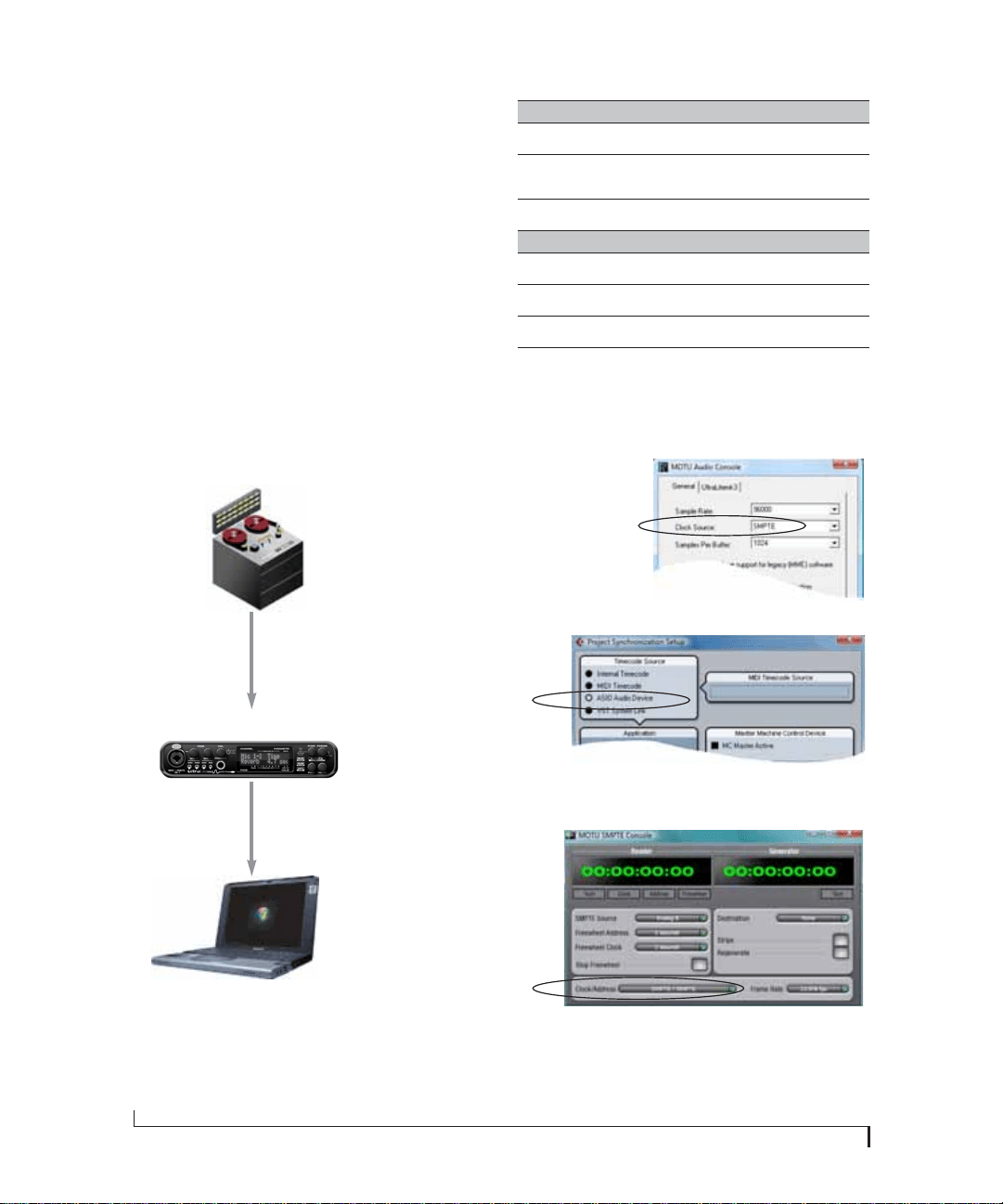
MOTU SMPTE CONSOLE
106
SYNCING TO SMPTE TIME CODE
The UltraLite-mk3 system can resolve directly to
SMPTE time code. It can also generate time code,
under its own clock or while slaving to time code.
Therefore, the UltraLite-mk3 can act both as an
audio interface and as a SMPTE time code
synchronizer to which you can slave other devices.
You can use the UltraLite-mk3 to slave your audio
software to time code as well, as long as your
software supports sample-accurate sync, which is
the means by which the software follows the
UltraLite-mk3. The accuracy may not be sample-
accurate, but in most cases it will be very close.
Figure 11-3: Connections for synchronizing the UltraLite-mk3
directly to SMPTE time code.
Choose SMPTE as the clock source in MOTU
Audio Setup. This setting can also be made in
the MOTU SMPTE Console (shown below).
SMPTE time code
source
audio cable bearing LTC
(Longitudinal Time Code)
FireWire cable
Launch the MOTU SMPTE Console and specify the SMPTE Source,
which is the interface receiving the SMPTE time code. Also,
confirm that the Clock Source/Address is SMPTE/SMPTE.
Windows computer running Cubase or
other sample-accurate ASIO software
In Cubase, go to the Synchronization window and
choose ASIO Audio Device as the Timecode Base.
UltraLite-mk3 interface
Any analog input
quarter-inch jack
Use this setup if you have:
✓ A SMPTE time code source, such as a multitrack tape deck.
✓
An UltraLite-mk3 by itself, OR with another slaved device
(such as a digital mixer).
✓ Host software that supports sample-accurate sync.
This setup provides:
✓ Continuous sync to SMPTE time code.
✓ Sub-frame timing accuracy.
✓ Transport control from the SMPTE time code source.

CHAPTER
107
12 Performance Tips & Troubleshooting
Things seems like they are working fine, but the
UltraLite-mk3 then just drops off line, and the
computer can’t see it anymore on the FireWire bus.
This is a common symptom when the problem is
that the UltraLite-mk3 is not getting enough
power. Check the power source for the
UltraLite-mk3. Make sure that the power
connection meets the requirements outlined in
“Bus power requirements” on page 23.
Why does the start sound not play through the
UltraLite-mk3?
The UltraLite-mk3 will only playback audio at a
sampling rate of 44.1, 48, 88.2. 96. 176.4 or
192 kHz.
The computer freezes when it starts up
If the computer is unable to boot up, it may be a
conflict with the WDM Driver. As soon as the
computer boots up, Windows will try and initialize
the WDM Driver. If this fails, your computer will
hang. To determine if the WDM Driver is the
problem, boot up in Safe Mode or remove the
MOTU Audio software with the Add/Remove
Programs Control Panel then restart. Reinstall the
UltraLite-mk3 software and choose only to install
the MOTU ASIO driver, not the WDM Driver.
Restart again.
‘New hardware detected’ window
If you connect your UltraLite-mk3 before running
the UltraLite-mk3 Software Installer CD, Windows
will prompt you that new hardware has been
detected. Cancel this, and run the UltraLite-mk3
Software Installer, rather than allowing Windows
to locate the drivers.
UltraLite-mk3 inputs and outputs are not
available in SONAR
Make sure that the inputs and/or outputs that you
want to use are enabled in SONAR.
Sound Forge and ‘Smooth Scroll’
If the Smooth Scroll option under the Options
menu is turned on, you may experience clicks and
pops or other anomalies in the audio playback.
This gets worse as you zoom in more to the
waveform while playing. For the best quality
playback, turn this option off.
Clicks and pops due to hard drive problems
If you have checked your clock settings sync cable
connections and you are still getting clicks and
pops in your audio, you may have a drive related
problem. Set the UltraLite-mk3 Clock Source to
Internal and try recording just using the analog
inputs and outputs of the UltraLite-mk3. If you
encounter the same artifacts you may want try
using another drive in your computer. Clicks and
pops can also occur when the drive is severely
fragmented or the disk drivers are outdated.
If you are using a FireWire drive on the same bus as
the UltraLite-mk3, it could be that the FireWire
bus is overloaded (too many devices on the same
bus). Try removing all devices except the
UltraLite-mk3.
Connecting or powering gear during operation
It is not recommended that you connect/
disconnect, or power on/off devices connected to
the UltraLite-mk3 while recording or playing back
audio. Doing so may cause a brief glitch in the
audio.
Monitoring - how do I monitor inputs?
Please refer to the documentation for the audio
application that you are using. If your application
does not support input monitoring, you will need
to use the UltraLite-mk3’s hardware-based

PERFORMANCE TIPS & TROUBLESHOOTING
108
CueMix FX monitoring feature. Please see
chapter 9, “Reducing Monitoring Latency”
(page 55).
Controlling monitoring latency
See chapter 9, “Reducing Monitoring Latency”
(page 55).
CUSTOMER SUPPORT
We are happy to provide customer support to our
registered users. If you haven’t already done so,
please take a moment to register on line at
motu.com, or fill out and mail the registration card
included with your 8pre. Doing so entitles you to
technical support and notices about new products
and software updates.
REPLACING DISKS
If your UltraLite-mk3 installer CD becomes
damaged and fails to provide you with fresh,
working copies of the program, our Customer
Support Department will be glad to replace it. You
can request a replacement disc by calling our
business office at (617) 576-2760 and asking for the
customer service department. In the meantime,
you can download the latest drivers from
www.motu.com.
TECHNICAL SUPPORT
If you are unable, with your dealer’s help, to solve
problems you encounter with the UltraLite-mk3
system, you may contact our technical support
department in one of the following ways:
■ Tech support hotline: (617) 576-3066 (Monday
through Friday, 9 am to 6 pm EST)
■ Tech support 24-hour fax line: (617) 354-3068
■ Online support: www.motu.com/support
Please provide the following information to help us
solve your problem as quickly as possible:
■ The serial number of the UltraLite-mk3 system.
This is printed on a sticker placed on the bottom of
the UltraLite-mk3 itself. You must be able to supply
this number to receive technical support.
■ A brief explanation of the problem, including the
exact sequence of actions which cause it, and the
contents of any error messages which appear on the
screen.
■ The pages in the manual which refer to the parts
of the UltraLite-mk3 with which you are having
trouble.
■ The version of your computer’s operating
system.
We’re not able to solve every problem immediately,
but a quick call to us may yield a suggestion for a
problem which you might otherwise spend hours
trying to track down.
If you have features or ideas you would like to see
implemented, we’d like to hear from you. Please
write to the UltraLite-mk3 Development Team,
MOTU Inc., 1280 Massachusetts Avenue,
Cambridge, MA 02138.

INDEX
109
Symbols
+4dB analog input 20
-10dB analog input 20
1394 connector 6, 11, 18, 19
192kHz
operation
30
24-bit
3rd party software
53
recording 12
48V phantom power 41
4-pin FireWire 23
6-pin FireWire 23
828
connecting to UltraLite-mk3
27
896mk3
connecting to UltraLite-mk3
27
A
Ableton Live 45
Activity meters 12
All Notes Off (LCD) 38
Analog inputs/outputs 6
making connections to 20
overview 10
trim 67
Analog meters 12
Application follows control surface 101
ASIO 12, 15, 16, 43
software
clock source
44
Attack
compressor
80
Audio
bit resolution
30
Audio Setup software 29
AudioDesk
MOTU 828mk3 settings
7
AutoSave Status 38
B
Balance 65
Balanced analog 20
Buffer Size 31, 57
Bus
activity LEDs
71, 82
fader 64
Bus power 23
examples 23
requirements 23
C
Channel tab 70
reverb settings 71
Clear Peaks 87
Clock
192kHz operation
30
Clock source 7, 30
SMPTE setting 31
Combo jacks 5, 6
Comp button 82
Compressor 80
enabling 80
Condenser mic input 5, 20
Configurations menu 100
Configure interface 26
Connecting multiple UltraLite-mk3s 26
Control Surfaces menu 101
Controller
connecting
22
Converters 6
Copy/Paste 87
Cubase 12, 29
choosing the UltraLite-mk3 driver
45
clock source 44
Main Out Assign 45
phones 44
Return Assign 46
reverb return 47, 52
sample rate 44
synchronization 47
CueMix
menu
38
CueMix FX 58, 61-102
Application follows control surface
101
Configurations menu 100
control surfaces 102
Control Surfaces menu 101
Cubase/Nuendo 47
CueMix control surfaces 102
Devices menu 88
Edit menu 87
File menu 87
focus 63
installation 62
Listenback explained 85
listenback settings 86
Mixer 35
output jacks 21
overview 61, 63
Phones menu 101
Share surfaces with other applica-
tions
102
shortcuts 87
signal flow 66
SONAR 52
stand-alone operation 62
Talkback menu 101
talkback settings 85, 86
Customer support 108
D
Daisy-chaining 23, 26, 27
DAT
connecting
22, 25
DC power supply 24
Delay (latency) 55
Devices menu 88
Digital Performer
828mk3 settings
7
Direct Monitoring 46
Disable interface option 27, 33
Disable option 27
Disk
getting a replacement
108
Drivers
Legacy MME (Wave)
7
DSP
meter
62, 85
resources 62, 85
Dynamic mic 20
Dynamics
enabling
68, 80
graph 67
inputs 67
outputs 68
tab 80
E
Early reflections 84
Enable full Wave support 32
Enable Pedal 32
EQ
enabling
68, 72
filter types 76
frequency 76
gain 76
graph 67
inputs 67
outputs 68
Q 76
tab 72
Expansion 26
F
Factory defaults 38
Feedback loops 47, 52
File menu
Clear Peaks
87
Copy/Paste 87
Hardware Follows CueMix Stereo
Settings
87
Load Hardware Preset 87
Mix1 return includes computer 87
Peak/Hold Time 87
Save Hardware Preset 87
undo/redo 87
FireWire 11
6-pin vs. 4-pin 23
additional busses 27
connecting 18, 19
connector 6
PC card adapters 23
PCI cards 23
Focus 63
Inputs tab 66
Mixes tab 65
Outputs tab 68
Follow Active Mix 101
Forget button 27, 33
Freewheel
address
104
clock 104
infinite 104, 105
Frequency
EQ
76

INDEX
110
Front panel 35
LCD display 11
G
Gain
EQ
76
reduction 80
reduction (Leveler) 82
General tab 29
GR (gain reduction) 80
GSIF driver 12, 15, 16
Guitar
connecting
20, 25
H
Hardware Follows CueMix Stereo Settings
87
Hardware follows CueMix Stereo Settings
87
Hardware reset 38
Headphone jack 5, 11, 36
Headphones
connecting
25
controlling output 32
HUI 102
I
In menu (LCD) 39
Infinite freewheel 104, 105
Inputs
analog
6
pan 65
reverb send 68
S/PDIF 6
tab 66
trim 67
Installation
hardware
17
software 15
Internal (sync setting) 30
Invert phase 67
K
Keyboard controller
connecting
22
L
Laptop operation 23
Latency 31, 44, 50, 55, 57, 58, 62
w/3rd party software 52
LCD
contrast
37
LCD display 5, 11, 37
Level meter
bus
65
monitor group 85
Leveler 80, 81
Limit button 82
Listenback
button (channel tab)
71
button (Outputs tab) 69
explained 85
Live 45
Load Hardware Preset 87
M
M/S 71
Mackie Control 102
Main Out Assign 32
Cubase/Nuendo 45
SONAR 50
Main outs
jacks
6
making connections to 21
volume 36
volume control 5, 11
Main volume 5, 11
Makeup gain 82
Master fader
mix busses
64
Master volume 36, 84
Metering 12
Meters
monitor group
85
Meters tab 82
Mic/guitar inputs 35
trim 67
Mic/instrument inputs 5, 6, 20
connecting 25
overview 10
phantom power 5
MIDI
connections
21
jacks 6
overview 11
Thru in standalone 38
Windows driver installation 16
Mid-side micing 71
Mix bus
activity LEDs
71, 82
level meter 65
master fader 64
mute 65
Mix1 return includes computer 87
Mixes tab 64
MME driver 7
Monitor group 84
assigning outputs 85
assigning outputs to 69
level 84
meters 85
presets menu 85
Monitoring 56
thru main outs 21
w/3rd party software 52
Mono button 66
MOTU
Audio Setup software
29
Audio System
bit resolution
30
MOTU Audio
ASIO driver
16
MOTU Audio Console 29
MOTU Audio Setup 7
MOTU SMPTE Setup 103
Multiple interfaces 26
N
Normal 71
Nuendo 12, 29
choosing the 8pre driver 45
clock source 44
Main Out Assign 45
Return Assign 46
reverb return 47, 52
sample rate 44
synchronization 47
O
Optimization 58
Output level (meter in Dynamics plug-in)
81
Outputs
analog
6
dynamics 68
EQ 68
reverb send/return 68
signal flow 68
tab 68
P
Packing list 13
Pad 20, 41
Paste 87
Patch thru
latency
31, 58
PCI
FireWire adapters
27
PCMCIA adapters 27
Peak mode 81
Peak/Hold Time 87
Performance 58
Phantom power 11, 20, 41
Phase 67
Phones 5, 11, 36
Cubase 44
menu 101
SONAR 50
Phones 1-2
SONAR
52
Phones 1-2 output
Cubase
47
Phones Assign 32
Polarity 24
Power supply 24
jack 6
Power switch 24, 35
Pre/post FX buttons 71, 82
Precision Digital Trim 10
PreDelay 84
Presets
naming/saving in LCD
37
Q
Q 76
R
Ratio
compressor
80
Regenerate 105

INDEX
111
Registration 13
Release
Dynamics
80
Return Assign 32
Cubase/Nuendo 46
SONAR 52
Reverb 63
design section 84
early reflections 84
enabling/disabling 83
input sends 68
mix bus send/return 64, 65
outputs send/return 68
predelay 84
returns 83
routing to/from 83
send (channel tab) 71
sends 83
shelf filter 84
tab 83
time 84
trim (channel tab) 71
width 84
Reverb return 83
Cubase 47, 52
Nuendo 47, 52
RMS mode 81
S
S/PDIF 6, 11
clock source setting 31
connection 21
meters 12
sync 22
trim 67
Sample rate 7, 30
192kHz operation 30
Samplers
connecting
25
Samples Per Buffer 31, 57
Samples per buffer 7, 31, 44, 50
Save Hardware Preset 87
Setup menu (LCD) 37
Share surfaces with other applications 102
Shelf Filter 84
Shortcuts 87
Show
Band Response
74
FFT 74
no analysis 74
Spectrogram 74
Show X-Axis Linear Scale 75
Show/Hide Full Window Analysis 74, 75
Signal flow (CueMix FX mixer) 66
SMPTE
overview
103
Setup application 103
source setting 104
sync 103
SMPTE sync 106
Software installation 15
Solo
light
65, 85
SONAR 12
clock source 50
enabling the UltraLite-mk3 ASIO
driver
51
Main Out Assign 50
Return Assign 52
sample rate 50
Sony
Sound Forge
46
Sound Forge 46
Sound module
connecting
22
Split Point 83
Stand-alone operation 35, 42, 62
Stereo button 66
Stereo settings (Channel tab) 71
Stop Freewheeling 104
Stripe button 105
Studio setup (example) 25
Swap L/R 71
Synchronization
Cubase
47
multiple interfaces 26
Nuendo 47
Synths
connecting
25
System requirements
minimum
13
recommended computer 13
T
TACH
light (SMPTE Setup Console)
104
Talkback
button (Channel tab)
71
button (Outputs tab) 69
explained 85
menu 86, 101
settings 86
Tech support contact info 108
Technical support 108
Threshold
dynamics
80
Time code sync 103, 106
Tip positive/negative 24
Traveler
connecting to UltraLite-mk3
27
Trim 20, 67
Troubleshooting
EQ knobs don’t work
68
feedback loop 47, 52
TRS connectors 20
TRS/XLR jacks 5, 6
U
UltraLite-mk3
connecting multiple interfaces
27
expansion 26
installing 17
power switch 35
rear panel overview 10
SMPTE setting 31
software installation 15
summary of features 9
tab 29
Unbalanced analog 20
Undo/Redo 87
USB2 11
User def. (monitor group menu) 85
V
Video sync 103
Volume
headphone
11
V-stack 45
W
Wave driver 7, 16, 49
WaveRT 49
Width 65
reverb 84
Width knob 71
X
XLR/TRS jacks 5, 6

112