

Ver. 1 11/19
• Apple,Mac,MacOS,OSX,MacBook,andiMacaretrademarksofAppleInc.registeredintheU.S.andother
countries.
• iOSisatrademarkorregisteredtrademarkofCiscointheU.S.andothercountriesandisusedunderlicense.
• APPStoreisaservicemarkofAppleInc.
• Microsoft,Windows,WindowsVista,InternetExplorer,.NETFrameworkandPowerPointareeitheraregistered
trademarkortrademarkofMicrosoftCorporationintheUnitedStatesand/orothercountries.
• MicroSaverisaregisteredtrademarkofKensingtonComputerProductsGroup,adivisionofACCOBrandsinthe
U.S.andothercountries.
• AccuBlend,NaViSet,MultiPresenter,andVirtualRemotearetrademarksorregisteredtrademarksofNECDispolay
Solutions,Ltd.inJapan,intheUnitedStateandothercountries.
• ThetermsHDMIandHDMIHigh-Definitio MultimediaInterface,andtheHDMILogoaretrademarksorregistered
trademarksofHDMILicensingAdministrator,Inc.intheUnitedStatesandothercountries.
• TrademarkPJLinkisatrademarkappliedfortrademarkrightsinJapan,theUnitedStatesofAmericaandother
countries and areas.
• Blu-rayisatrademarkofBlu-rayDiscAssociation.
• EthernetiseitheraregisteredtrademarkortrademarkofFujiXeroxCo.,Ltd.
• AndroidandGooglePlayaretrademarksofGoogleInc.
• Otherproductnamesandlogosmentionedinthisuser’smanualmaybethetrademarksorregisteredtrademarks
of their respective holders.
• VirtualRemoteToolusesWinI2C/DDClibrary,©NicomsoftLtd.
• GPL/LGPLSoftwareLicenses
TheproductincludessoftwarelicensedunderGNUGeneralPublicLicense(GPL),GNULesserGeneralPublic
License(LGPL),andothers.
Formoreinformationoneachsoftware,see“readme.pdf”inthe“aboutGPL&LGPL”folderonthesuppliedCD-
ROM.
NOTES
(1) Thecontentsofthisuser’smanualmaynotbereprintedinpartorwholewithoutpermission.
(2) Thecontentsofthisuser’smanualaresubjecttochangewithoutnotice.
(3) Greatcarehasbeentakeninthepreparationofthisuser’smanual;however,shouldyounoticeanyquestionable
points,errorsoromissions,pleasecontactus.
(4) Notwithstandingarticle(3),NECwillnotberesponsibleforanyclaimsonlossofprofi orothermattersdeemed
toresultfromusingtheProjector.
i
Important Information
Safety Cautions
Precautions
PleasereadthismanualcarefullybeforeusingyourNECprojectorandkeepthemanualhandyforfuturereference.
CAUTION
Toturnoffmainpower,besuretoremovetheplugfrompoweroutlet.
Thepoweroutletsocketshouldbeinstalledasneartotheequipmentaspossible,andshouldbeeasily
accessible.
CAUTION
TOPREVENTSHOCK,DONOTOPENTHECABINET.
THEREAREHIGH-VOLTAGECOMPONENTSINSIDE.
REFERSERVICINGTOQUALIFIEDSERVICEPERSONNEL.
Thissymbolwarnstheuserthatuninsulatedvoltagewithintheunitmaybesufficien tocauseelectrical
shock.Therefore,itisdangeroustomakeanykindofcontactwithanypartinsideoftheunit.
Thissymbolalertstheuserthatimportantinformationconcerningtheoperationandmaintenanceofthis
unit has been provided.
The information should be read carefully to avoid problems.
WARNING:TOPREVENTFIREORSHOCK,DONOTEXPOSETHISUNITTORAINORMOISTURE.
DONOTUSETHISUNIT’SPLUGWITHANEXTENSIONCORDORINANOUTLETUNLESSALLTHEPRONGS
CANBEFULLYINSERTED.
CAUTION
Avoiddisplayingstationaryimagesforaprolongedperiodoftime.
DoingsocanresultintheseimagesbeingtemporarilysustainedonthesurfaceoftheLCDpanel.
Ifthisshouldhappen,continuetouseyourprojector.Thestaticbackgroundfrompreviousimageswill
disappear.
WARNING TO CALIFORNIA RESIDENTS:
Handlingthecablessuppliedwiththisproductwillexposeyoutolead,achemicalknowntotheStateofCalifornia
tocausebirthdefectsorotherreproductiveharm.WASHHANDSAFTERHANDLING.
FCC In
formation (for USA only)
WARNING
The Federal Communications Commission does not allow any modications or changes to the unit EXCEPT
thosespeciedbyNECDisplaySolutionsofAmerica,Inc.inthismanual.Failuretocomplywiththisgovernment
regulationcouldvoidyourrighttooperatethisequipment.Thisequipmenthasbeentestedandfoundtocomply
withthelimitsforaClassBdigitaldevice,pursuanttoPart15oftheFCCRules.Theselimitsaredesignedto
providereasonableprotectionagainstharmfulinterferenceinaresidentialinstallation.Thisequipmentgenerates,
uses,andcanradiateradiofrequencyenergyand,ifnotinstalledandusedinaccordancewiththeinstructions,
maycauseharmfulinterferencetoradiocommunications.However,thereisnoguaranteethatinterferencewill
not occur in a particular installation.
Ifthisequipmentdoescauseharmfulinterferencetoradioortelevisionreception,whichcanbedeterminedby
turningtheequipmentoffandon,theuserisencouragedtotrytocorrecttheinterferencebyoneormoreofthe
followingmeasures:
• Reorientorrelocatethereceivingantenna.
• Increasetheseparationbetweentheequipmentandreceiver.
• Connecttheequipmentintoanoutletonacircuitdifferentfromthattowhichthereceiverisconnected.
• Consultthedealeroranexperiencedradio/TVtechnicianforhelp.
ii
Important Information
Important Safeguards
Thesesafetyinstructionsaretoensurethelonglifeofyourprojectorandtopreventfir andshock.Pleaseread
themcarefullyandheedallwarnings.
Installation
• Donotplacetheprojectorinthefollowingconditions:
- onanunstablecart,stand,ortable.
- nearwater,baths,ordamprooms.
- indirectsunlight,nearheaters,orheatradiatingappliances.
- inadusty,smokyorsteamyenvironment.
- onasheetofpaperorcloth,rugsorcarpets.
• Ifyouwishtohavetheprojectorinstalledontheceiling:
- Donotattempttoinstalltheprojectoryourself.
- Theprojectormustbeinstalledbyqualifie techniciansinordertoensureproperoperationandreducetherisk
of bodily injury.
- Inaddition,theceilingmustbestrongenoughtosupporttheprojectorandtheinstallationmustbeinaccordance
withanylocalbuildingcodes.
- Please consult your dealer for more information.
• Donotinstallandstoretheprojectorinthebelowcircumstances.Failuretodosomaycauseofmalfunction.
- Inpowerfulmagneticfield
- Incorrosivegasenvironment
- Outdoors
WARNING
• Donotplaceanyobjects,whichareeasilyaffectedbyheat,infrontoftheprojectionwindow.Doingsocould
leadtotheobjectmeltingfromtheheatthatisemittedfromthelightoutput.
• Donotuseaspraycontainingflammable gastogetridofaccumulateddustanddirtonthefilters andthe
projectionwindow.Itmaycauseofre.
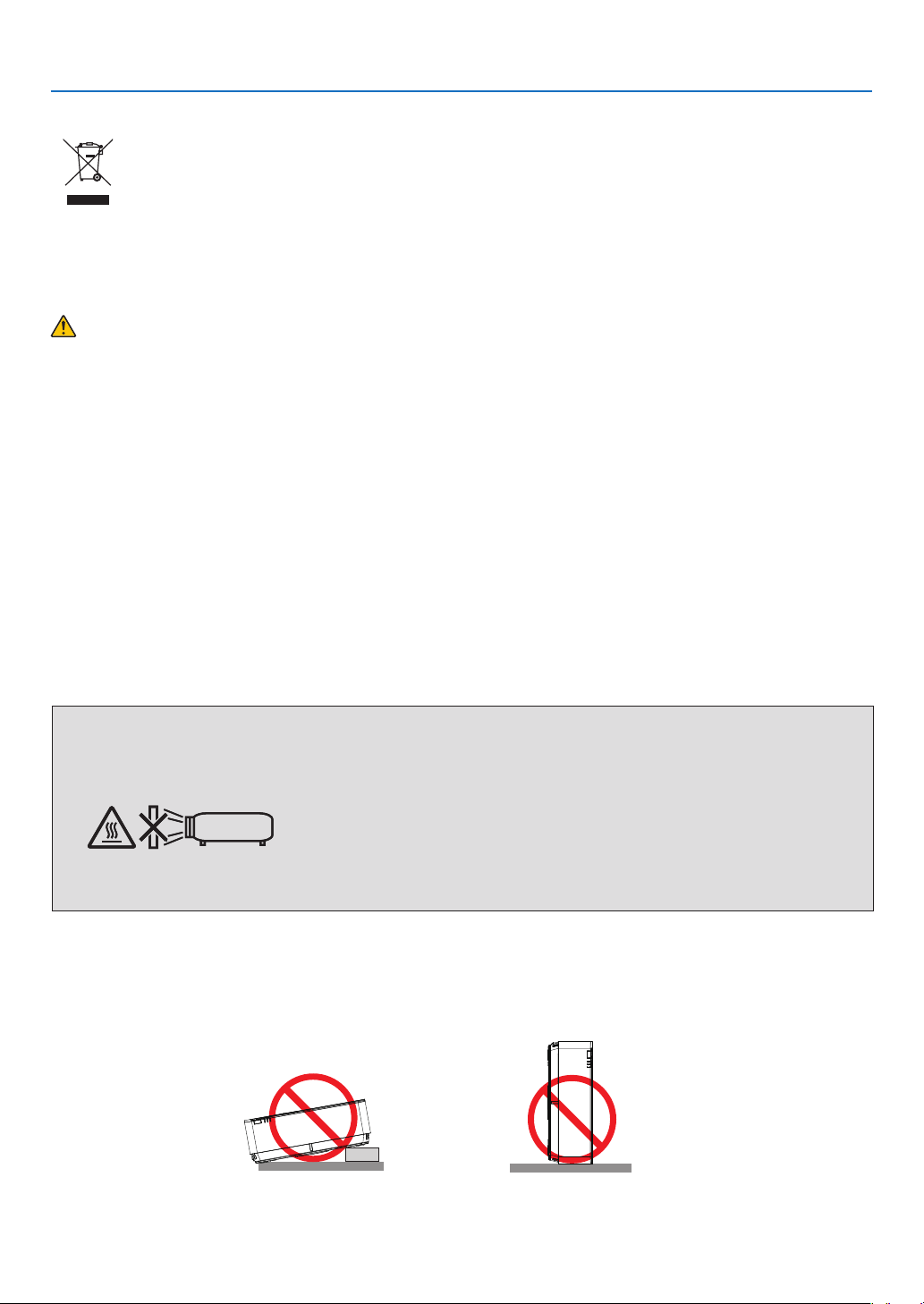
Place the projector in a horizontal position
Theprojectorshould not beinstalledinanywayotherthanthedesktop, ceilingmount,and ways described in this
manual, otherwiselightlifecoulddecreasedramatically.
Disposing of your used product
Ifyou wish todispose of used electricaland electronic products,pleasecontactyourlocalauthority
andaskforthecorrectmethodofdisposal.
iii
Important Information
Fire and Shock Precautions
• Ensurethatthereissufficien ventilationandthatventsareunobstructedtopreventthebuild-upofheatinside
yourprojector.Allowatleast4inches(10cm)ofspacebetweenyourprojectorandawall.
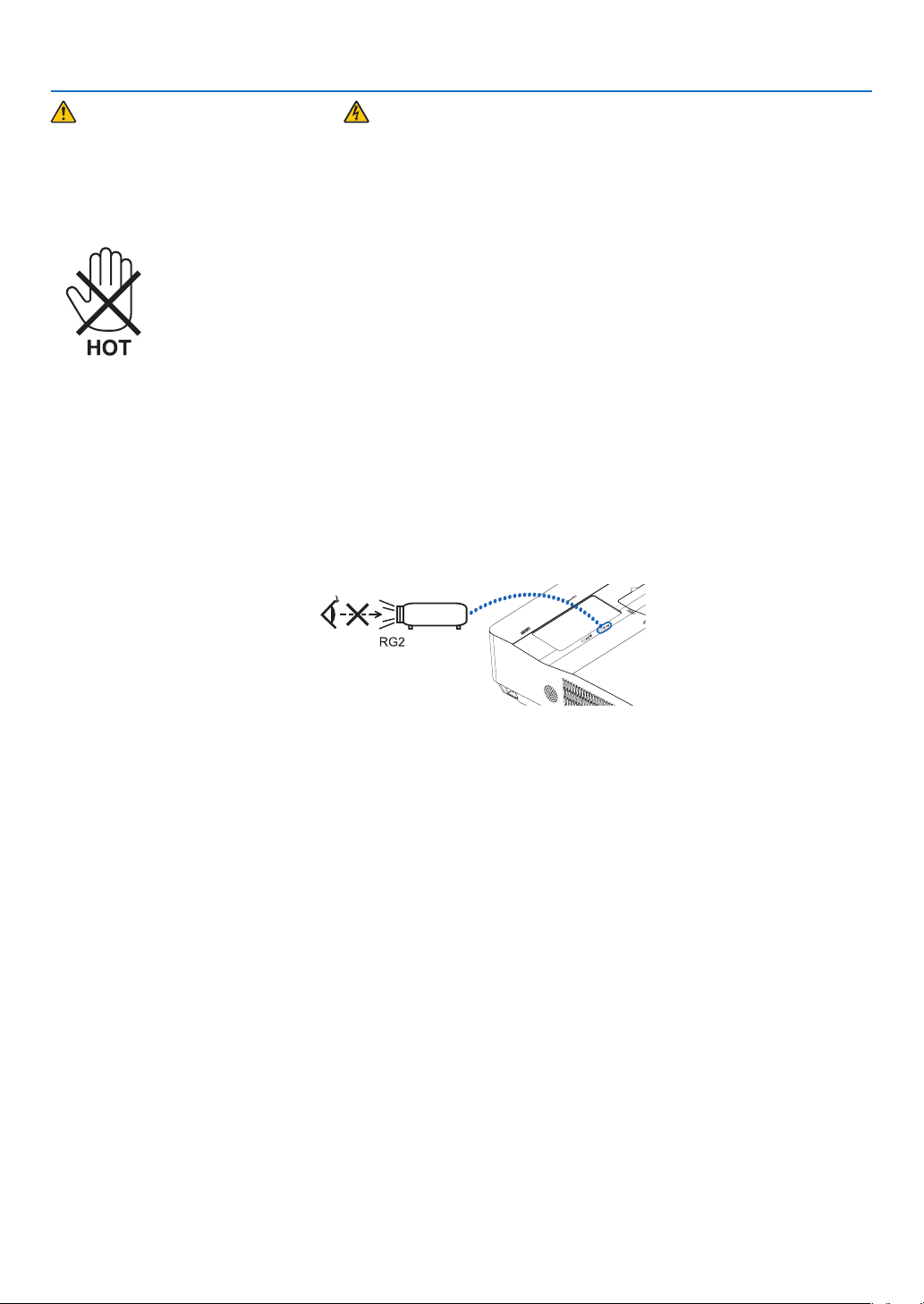
• Donottrytotouchtheexhaustventasitcanbecomeheatedwhiletheprojectoristurnedonandimmediately
after the projector is turned off. Parts of the projector may become temporarily heated if the projector is turned off
withthePOWERbuttonoriftheACpowersupplyisdisconnectedduringnormalprojectoroperation.
Usecautionwhenpickinguptheprojector.
• Preventforeignobjectssuchaspaperclipsandbitsofpaperfromfallingintoyourprojector.Donotattemptto
retrieveanyobjectsthatmightfallintoyourprojector.Donotinsertanymetalobjectssuchasawireorscrewdriver
intoyourprojector.Ifsomethingshouldfallintoyourprojector,disconnectitimmediatelyandhavetheobject
removedbyaqualifie servicepersonnel.
• Donotplaceanyobjectsontopoftheprojector.
• Donottouchthepowerplugduringathunderstorm.Doingsocancauseelectricalshockorfire
• Theprojectorisdesignedtooperateonapowersupplyof100-240VAC50/60Hz.Ensurethatyourpowersupply
fit thisrequirementbeforeattemptingtouseyourprojector.
• Donotlookthelenswhiletheprojectorison.Seriousdamagetoyoureyescouldresult.Thefollowinglabel,that
isindicatednearthelens-mounting-sectionontheprojectorcabinet,describesthisprojectoriscategorizedinthe
riskgroup2ofIEC62471-5:2015.Aswithanybrightsource,donotstareintothebeam,RG2IEC62471-5:2015.
• Keepanyitemssuchasmagnifyingglassoutofthelightpathoftheprojector.Thelightbeingprojectedfromthe
lensisextensive,thereforeanykindofabnormalobjectsthatcanredirectlightcomingoutofthelens,cancause
unpredictableoutcomesuchasreorinjurytotheeyes.
• Donotplaceanyobjects,whichareeasilyaffectedbyheat,infrontofaprojectorexhaustvent.
Doingsocouldleadtotheobjectmeltingorgettingyourhandsburnedfromtheheatthatisemittedfromthe
exhaust.
• Donotsplashwaterovertheprojector.Doingsocancauseelectricalshockorfire. Iftheprojectorgetswet,turn
offtheprojector,unplugthepowercordandhavetheprojectorservicedbyaqualiedservicepersonnel.
• Handlethepowercordcarefully.Adamagedorfrayedpowercordcancauseelectricshockorre.
- Donotuseanypowercordotherthantheonesuppliedwiththeprojector.
- Donotbendortugthepowercordexcessively.
- Donotplacethepowercordundertheprojector,oranyheavyobject.
- Donotcoverthepowercordwithothersoftmaterialssuchasrugs.
- Donotheatthepowercord.
- Donothandlethepowerplugwithwethands.
• Turnofftheprojector,unplugthepowercordandhavetheprojectorservicedbyaqualified servicepersonnel
underthefollowingconditions:
- Whenthepowercordorplugisdamagedorfrayed.
- Ifliquidhasbeenspilledintotheprojector,orifithasbeenexposedtorainorwater.
- Iftheprojectordoesnotoperatenormallywhenyoufollowtheinstructionsdescribedinthisuser’smanual.
- Iftheprojectorhasbeendroppedorthecabinethasbeendamaged.
- Iftheprojectorexhibitsadistinctchangeinperformance,indicatinganeedforservice.
• Disconnectthepowercordandanyothercablesbeforecarryingtheprojector.
•
Turnofftheprojectorandunplugthepowercordbeforecleaningthecabinetorreplacingthelight.
• Turnofftheprojectorandunplugthepowercordiftheprojectorisnottobeusedforanextendedperiodoftime.
• WhenusingaLANcable:
Forsafety,donotconnecttotheterminalforperipheraldevicewiringthatmighthaveexcessivevoltage.

iv
Important Information
CAUTION
• Donotusetheadjustabletiltfootforpurposesotherthanoriginallyintended.Misusessuchasgrippingthe
tilt-footorhangingonthewallcancausedamagetotheprojector.
• Select[HIGH]inFanmodeifyoucontinuetousetheprojectorforconsecutivedays.(Fromthemenu,select
[SETUP]→[OPTIONS(1)]→[FANMODE]→[HIGH].)
•
This projector has a "click" sound at power on or during some switching, which is not a malfunction.
Remote Control Precautions
• Handletheremotecontrolcarefully.
• Iftheremotecontrolgetswet,wipeitdryimmediately.
• Avoidexcessiveheatandhumidity.
• Donotshort,heat,ortakeapartbatteries.
• Donotthrowbatteriesintofire
• Ifyouwillnotbeusingtheremotecontrolforalongtime,removethebatteries.
• Ensurethatyouhavethebatteries’polarity(+/−)alignedcorrectly.
• Donotusenewandoldbatteriestogether,orusedifferenttypesofbatteriestogether.
• Disposeofusedbatteriesaccordingtoyourlocalregulations.
About High Altitude mode
• Set[FANMODE]to[HIGHALTITUDE]whenusingtheprojectorataltitudesapproximately5500feet/1700meters
orhigher.
Usingtheprojectorataltitudesapproximately5500feet/1700metersorhigherwithoutsettingto[HIGHALTITUDE]
cancausetheprojectortooverheatandtheprotectorcouldshutdown.Ifthishappens,waitacoupleminutes
and turn on the projector.
•
Usingtheprojectorataltitudesapproximately5500feet/1700metersor
highercanshortenthelifeofoptical
components such as the light.
About Copyright of original projected pictures:
Pleasenotethatusingthisprojectorforthepurposeofcommercialgainortheattractionofpublicattentioninavenue
suchasacoffeeshoporhotelandemployingcompressionorexpansionofthescreenimagewiththefollowing
functionsmayraiseconcernabouttheinfringementofcopyrightswhichareprotectedbycopyrightlaw.
[ASPECTRATIO],[KEYSTONE],Magnifyingfeatureandothersimilarfeatures.
Cable Information
Use shielded cables or cables attached ferrite cores so as not to interfere with radio and television reception.
For details, please refer to "6.2. Making Connections" in this user's manual.
Important Information
Power management function
Theprojectorhaspowermanagementfunctions.Toreducepowerconsumption,thepowermanagementfunctions
(1and2)arefactorypresetasshownbelow.TocontroltheprojectorfromanexternaldeviceviaaLANorserial
cableconnection,usetheon-screenmenutochangethesettingsfor1and2.
1.
STANDBY MODE (Factory preset: NORMAL)
To control the projector from an external device, select [NETWORK STANDBY] for [STANDBY MODE].
NOTE:
• When[NORMAL]isselectedfor[STANDBYMODE],thefollowingterminalsandfunctionswillnotwork:
MONITOROUTterminal,AUDIOOUTterminal,LANfunctions,MailAlertfunction,DDC/CI(VirtualRemoteTool).Pleaserefertopage
7
3aboutdetails.
• When[NETWORKSTANDBY]hasbeensetfor[STANDBYMODE]andtheLANhasbeeninlink-downconditionfor3minutes,[STANDBY
MODE]willtransitinto[NORMAL]automaticallyforthepurposetosavetheconsumptionpower.
2.
AUTO POWER OFF (Factory preset: 1 hour)
To control the projector from an external device, select [OFF] for [AUTO POWER OFF].
NOTE:
• When[1:00]isselectedfor[AUTOPOWEROFF],youcanenabletheprojectortoautomaticallyturnoffin60minutesifthereisnosignal
receivedbyanyinputorifnooperationisperformed.
v

Table of Contents
Important Information ............................................................................................ i
1. Introduction .......................................................................................................... 1
❶What’sintheBox? ........................................................................................................ 1
❷IntroductiontotheProjector ......................................................................................... 2
Featuresyou’llenjoy ............................................................................................... 2
About this user’s manual ......................................................................................... 3
❸ Part Names of the Projector .......................................................................................... 4
Front/Top ................................................................................................................. 4
Rear ......................................................................................................................... 5
Controls/IndicatorPanel .......................................................................................... 6
TerminalPanelFeatures .......................................................................................... 7
❹PartNamesoftheRemoteControl ............................................................................... 8
BatteryInstallation ................................................................................................... 9
RemoteControlPrecautions ................................................................................... 9
OperatingRangeforWirelessRemoteControl ....................................................... 9
2. Projecting an Image (Basic Operation) .............................................. 10
❶FlowofProjectinganImage ........................................................................................ 10
❷ConnectingYourComputer/ConnectingthePowerCord .......................................... 11
❸TurningontheProjector .............................................................................................. 12
NoteonStartupscreen(MenuLanguageSelectscreen) ...................................... 13
❹SelectingaSource ...................................................................................................... 14
Selectingthecomputerorvideosource ................................................................ 14
❺AdjustingthePictureSizeandPosition ...................................................................... 15
Adjustingtheverticalpositionofaprojectedimage(Lensshift) ........................... 16
vi
Focus ..................................................................................................................... 18
Zoom ... ..................................................................................................................19
Digital Zoom........................................................................................................... 20
Adjust the Tilt Foot................................................................................................. 21
❻ Correcting Keystone Distortion [KEYSTONE] .............................................................
22
❼ Optimizing Computer Signal Automatically ................................................................
24
Adjusting the Image Using Auto Adjust .................................................................
24
❽ Turning Up or Down Volume .......................................................................................
24
❾ Turning off the Projector .............................................................................................
25
❿ When Moving the Projector ........................................................................................
25
3. Convenient Features .....................................................................................
26
❶ Turning off the Image and Sound ...............................................................................
26
❷ Freezing a Picture........................................................................................................
26
❸ Magnifying a Picture ...................................................................................................
27
❹ Changing Eco Mode/Checking Energy-Saving Effect ...............................................
28
Using Eco Mode [ECO MODE] ..............................................................................
28
Checking Energy-Saving Effect [CARBON METER] ..............................................
29
❺ Using 4-Point Corner to Correct Keystone Distortion [CORNERSTONE] ..................
30
Cornerstone ...........................................................................................................
30
Pincushion .............................................................................................................
32

Table of Contents
[SOURCE(1)] .......................................................................................................... 77
[SOURCE(2)] .......................................................................................................... 78
[WIREDLAN] .......................................................................................................... 78
[VERSION] .............................................................................................................. 79
[OTHERS] ............................................................................................................... 79
ReturningtoFactoryDefault[RESET] ................................................................... 80
6.
Installation and Connections ................................................................... 81
Tablesofscreensizesanddimensions ................................................................. 81
Exampleofinstallationonadesktop ..................................................................... 83
Lensshiftingrange ................................................................................................ 84
vii
❻
Preventing the Unauthorized Use of the Projector [SECURITY] ..................................... 34
❼ Controlling the Projector by Using an HTTP Browser ................................................ 37
4.
Using the Viewer ............................................................................................. 43
❶ What you can do with the Viewer ............................................................................... 43
❷ Projecting images stored in a USB memory device ................................................... 45
5.
Using On-Screen Menu ................................................................................ 51
HDMI1 and HDMI2 ................................................................................................ 56
COMPUTER ........................................................................................................... 56
VIDEO .................................................................................................................... 56
USB-A.................................................................................................................... 56
LAN ........................................................................................................................ 56
❺ Menu Descriptions & Functions [ADJUST] ................................................................. 57
[PICTURE] .............................................................................................................. 57
[IMAGE OPTIONS] ................................................................................................. 60
[AUDIO] .................................................................................................................. 64
[GENERAL]............................................................................................................. 65
[MENU]................................................................................................................... 68
[INSTALLATION] .................................................................................................... 69
[OPTIONS(1)] ......................................................................................................... 71
[OPTIONS(2)] ......................................................................................................... 73
Setting up the Projector for a Wired LAN Connection [WIRED LAN] .................... 76
[USAGE TIME]........................................................................................................ 77
[CONNECTION] ..................................................................................................... 78
❶ Using the Menus ......................................................................................................... 51
❹ Menu Descriptions & Functions [SOURCE] ................................................................ 56
❻ Menu Descriptions & Functions [SETUP] ................................................................... 65
❼ Menu Descriptions & Functions [INFO.] ...................................................................... 77
❶ Setting Up the Screen and the Projector .................................................................... 81
❽ Menu Descriptions & Functions [RESET] .................................................................... 80
❷ Menu Elements ........................................................................................................... 52
❸ List of Menu Items ...................................................................................................... 53

Table of Contents
7.
8.
Featureofeachindicator ....................................................................................... 96
IndicatorMessage(Statusmessage) .................................................................... 96
IndicatorMessage(Errormessage) ....................................................................... 97
ExplanationonthePOWERindicatorandstandbystate ...................................... 98
CommonProblems&Solutions .......................................................................... 100
Ifthereisnopicture,orthepictureisnotdisplayedcorrectly. ........................... 101
viii
Connecting Your Computer ................................................................................... 86
❷ Specification .............................................................................................................
102
❷ Making Connections ................................................................................................... 86
Connecting an External Monitor . ........................................................................... 88
Connecting Your DVD Player or Other AV Equipment .......................................... 89
Connecting Component Input ............................................................................... 90
Connecting HDMI Input ......................................................................................... 91
Connecting to a Wired LAN ................................................................................... 92
Maintenance ..................................................................................................... 93
❶ Cleaning the Filters ..................................................................................................... 93
❷ Cleaning the Projection Window ................................................................................ 95
❸ Cleaning the Cabinet .................................................................................................. 95
Appendix ............................................................................................................. . 96
❶ Troubleshooting ..........................................................................................................
96
❸ Cabinet Dimensions .................................................................................................. 104
❹ Pin Assignments of D-Sub COMPUTER Input Terminal ...........................................105
❺ Compatible Input Signal List ..................................................................................... 106
❻ PC Control Codes and Cable Connection ................................................................ 107
❼ Using the Computer Cable (VGA) to Operate the Projector (Virtual Remote Tool) ... 108
❽ Troubleshooting Check List ...................................................................................... 109
9
EGISTER YOUR PROJECTOR! (for residents in the United States) .......................... 111
1
Projector
1. Introduction
❶ What’s in the Box?
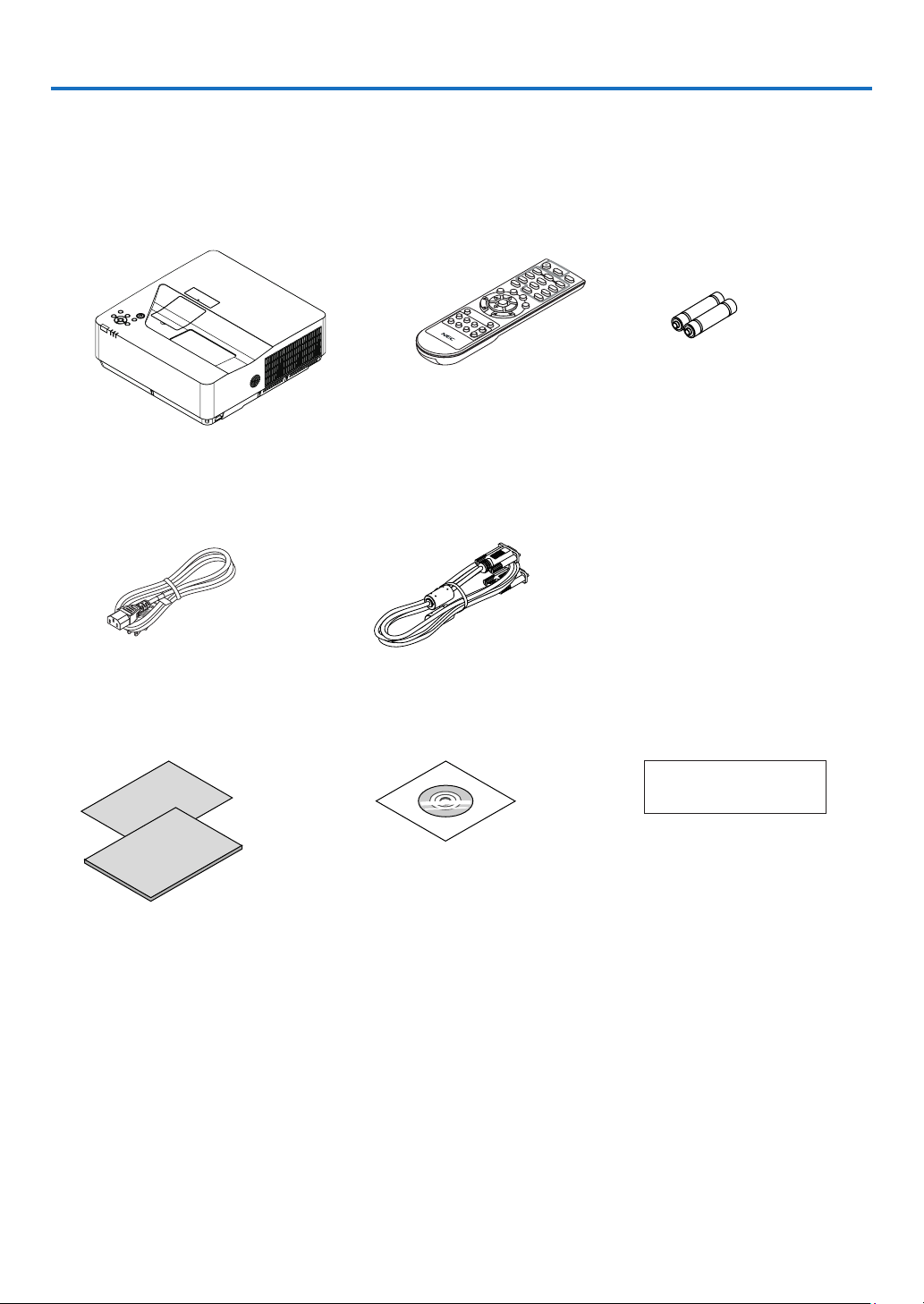
Makesureyourboxcontainseverythinglisted.Ifanypiecesaremissing,contactyourdealer.
Pleasesavetheoriginalboxandpackingmaterialsifyoueverneedtoshipyourprojector.
Power cord
(7N080236/7N080242)
Computer cable (VGA)
(7N520089)
NEC Projector CD-ROM
User’s manual (PDF)
(7N952943)
•
Important Infomation (7N8R0231)
Remote control
Batteries (AAA × 2)
(7N901053)
•
Quick Setup Guide (7N8R0241)
For North America only
Limited warranty

2
1. Introduction
❷ Introduction to the Projector
This section introduces you to your new projector and describes the features and controls.
Features you’ll enjoy:
• Quickstart(6seconds*
1
),QuickPowerOff,DirectPowerOff
6 seconds*
1
afterturningonthepower,theprojectorisreadytodisplayPCorvideoimages.
Theprojectorcanbeputawayimmediatelyaftertheprojectorispowereddown.Nocooldownperiodisrequired
after the projector is turned off from the remote control or cabinet control panel.
Theprojectorhasafeaturecalled“DirectPowerOff”.Thisfeatureallowstheprojectortobeturnedoff(even
whenprojectinganimage)byusingtheMainPowerSwitchordisconnectingtheACpowersupply.
ToturnofftheACpowersupplywhentheprojectorispoweredon,useapowerstripequippedwithaswitchand
abreaker.
*
1
Thequickstarttimeisonlywhen[STANDBYMODE]issetto[NETWORKSTANDBY]intheon-screenmes-
sage.
•
0.26W(100-130VAC)/0.39W(200-240VAC)instandbyconditionwithenergysavingtechnology
Selecting[NORMAL]for[STANDBYMODE] from themenucanputthe projectorinpower-savingmodethat
consumesonly0.26W(100-130VAC)/0.39W(200-240VAC).
• Carbon
Meter
Thisfeaturewillshowenergy-savingeffectintermsofCO
2
emissionreduction(kg)whentheprojector’s[ECO
MODE]issetto[AUTOECO],[NORMAL],or[ECO].
TheamountofCO
2
emissionreductionwillbedisplayedin
theconfirmation messageatthetimeofpower-off
andintheINFOoftheon-screenmenu.
•
Widerangeofinputterminals(HDMI× 2)
Theprojectorisequippedwithavarietyofinputterminals:HDMI(×2),Computer(analog),Video. HDMIinput
terminalonthisproductsupportsHDCP.
•
Compatible with the MultiPresenter application
This projector is compatible with the NEC MultiPresenter application, so multi-screen projection is possible
via the network (wired LAN).
•
2 ×10Wbuilt-inspeakerforanintegratedaudiosolution
Two powerful10wattstereospeakersare built in.
Max 130", throw distance: 42.9 cm/17 inches
(The throw distance refers to the distance between the screen and the screen side of the projector)
Ultra short focal lenses provide for a larger image using a shorter throw distance when compared to a typi-
cal projector lens.
Ultra short throw distances
•
Tilt-free
This projector can be set to any angle within a vertical 360° range.
•
•
High color gamut
The projector adopts HLD+LED new solid light source and optical components that can improve color reprodu-
cibility. The reproducible color gamut is greatly expanded compared to traditional lamp projectors (when
[ADJUST] - [PICTURE] - [PRESET] is set to [GRAPHIC] ).
•
HLD+LED new light source with 20,000 hours long life
With a brightness of 3,800 lumens and an ultra long life of up to 20,000 hours, it maintains brightness of the
display throughout the life.

3
1. Introduction
• AUTOPOWERONandAUTOPOWEROFFfeatures
TheDIRECTPOWERON,AUTOPOWERON,AUTOPOWEROFF,andOFFTIMERfeatureseliminatetheneed
toalwaysusethePOWERbuttonontheremotecontrolorprojectorcabinet.
• Preventing
unauthorizeduseoftheprojector
Enhancedsmartsecuritysettingsforkeywordprotection,cabinetcontrolpanellock,securityslot,andsecurity
chainopeningtohelppreventunauthorizedaccess,adjustmentsandtheftdeterrence.
•
HighresolutionuptoWUXGA*
2
Highresolutiondisplay-
uptoWUXGAcompatible,WXGAnativeresolution.
•
Animagewithhigherorlowerresolutionthantheprojector’snativeresolution(1280×800)willbedisplayed
withAdvancedAccuBlend.
*
2
WhenWXGAMODEissettoON.
About this user’s manual
Thefastestwaytogetstartedistotakeyourtimeanddoeverythingrightthersttime.Takeafewminutesnowto
reviewtheuser’smanual.Thismaysaveyoutimelateron.Atthebeginningofeachsectionofthemanualyou’llnd
anoverview.Ifthesectiondoesn’tapply,youcanskipit.
• INTELLIGENTCONNECTION
It enables easily to connect your projector tocomputers orsmartphones, onwhich the application software,
MultiPresenter,hasbeeninstalled,byinputtingPINcode.
• Convenientutilitysoftware(UserSupportware)
Thisprojectorsupportsourutilitysoftware(NaViSetAdministrator2,VirtualRemoteTool,etc.)NaViSetAdminis-
trator2helpsyoucontroltheprojectorbyacomputerviawiredLANconnection.VirtualRemoteToolhelpsyou
performoperationsbyavirtualremotecontrolsuchasprojector'spoweronoroffandsignalselectionviawired
LANconnection.Moreover,ithasfunctiontosendanimagetotheprojectorandregisteritasthelogodata.
Pleasevisitourwebsitefordownloadingeachsoftware.
URL:https://www.nec-display.com/dl/en/index.html
• ThesuppliedremotecontrolallowsyoutoassignaCONTROLIDtotheprojector
Multipleprojectorscanbeoperatedseparatelyandindependentlywiththesamesingleremotecontrolbyas-
signinganIDnumbertoeachprojector.
4
1. Introduction
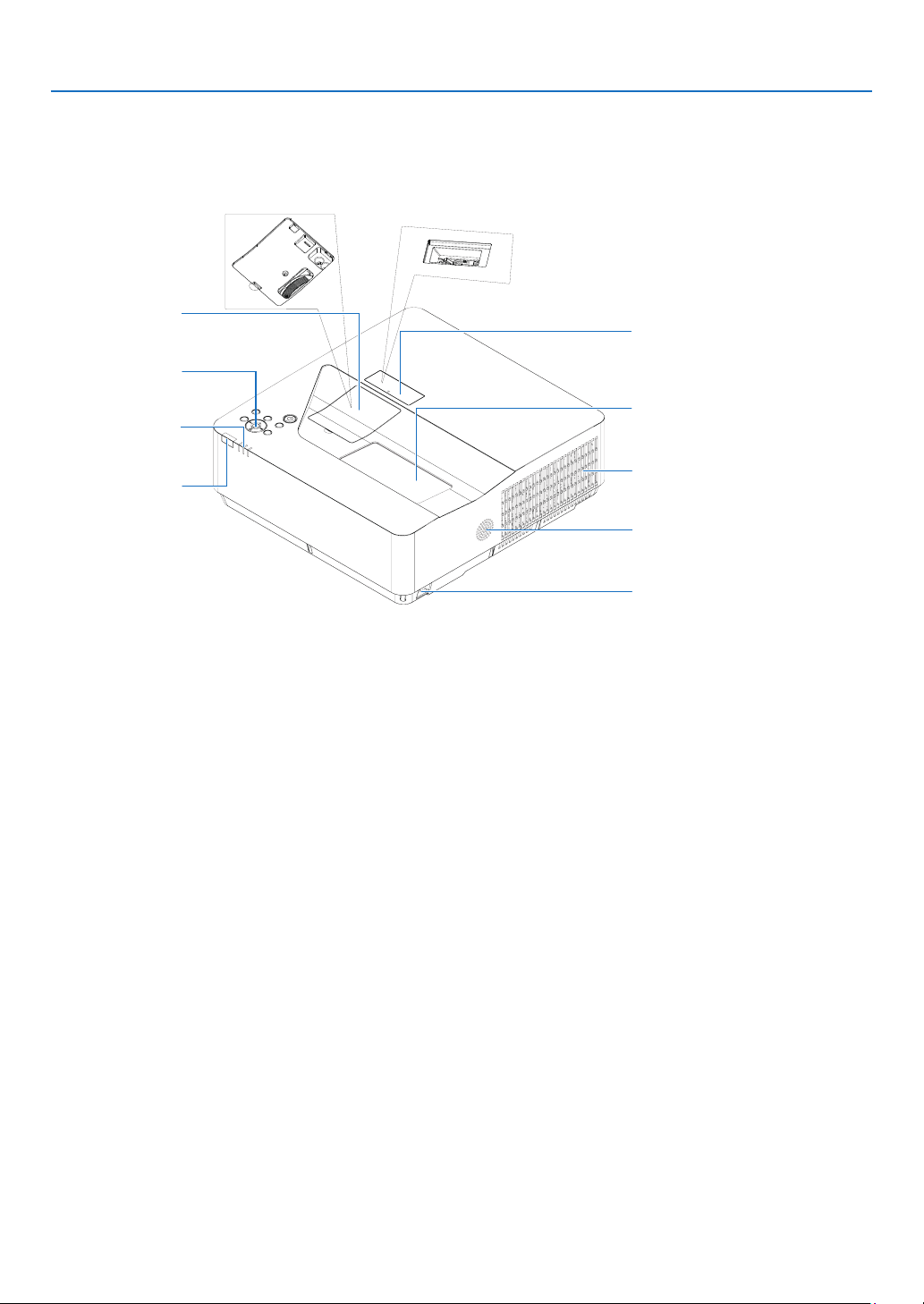
❸ Part Names of the Projector
Front/Top
Lens (Projection Window)
Exhaust Vent
Heated air is exhausted from here.
Stereo Speaker (10W )
Security chain opening
Attach an anti-theft device.
The security chain opening accepts
security wires or chains up to 0.18
inch/4.6 mm in diameter.
Remote Sensor
(
→
page 9)
Indicators
(
→
page 6)
Controls
(
→
page 6)
Lens shift cover
(
→
page 16)
Focus Ring
(
→
page 18)
Zoom Lever
(
→
page
19
)
5
1. Introduction
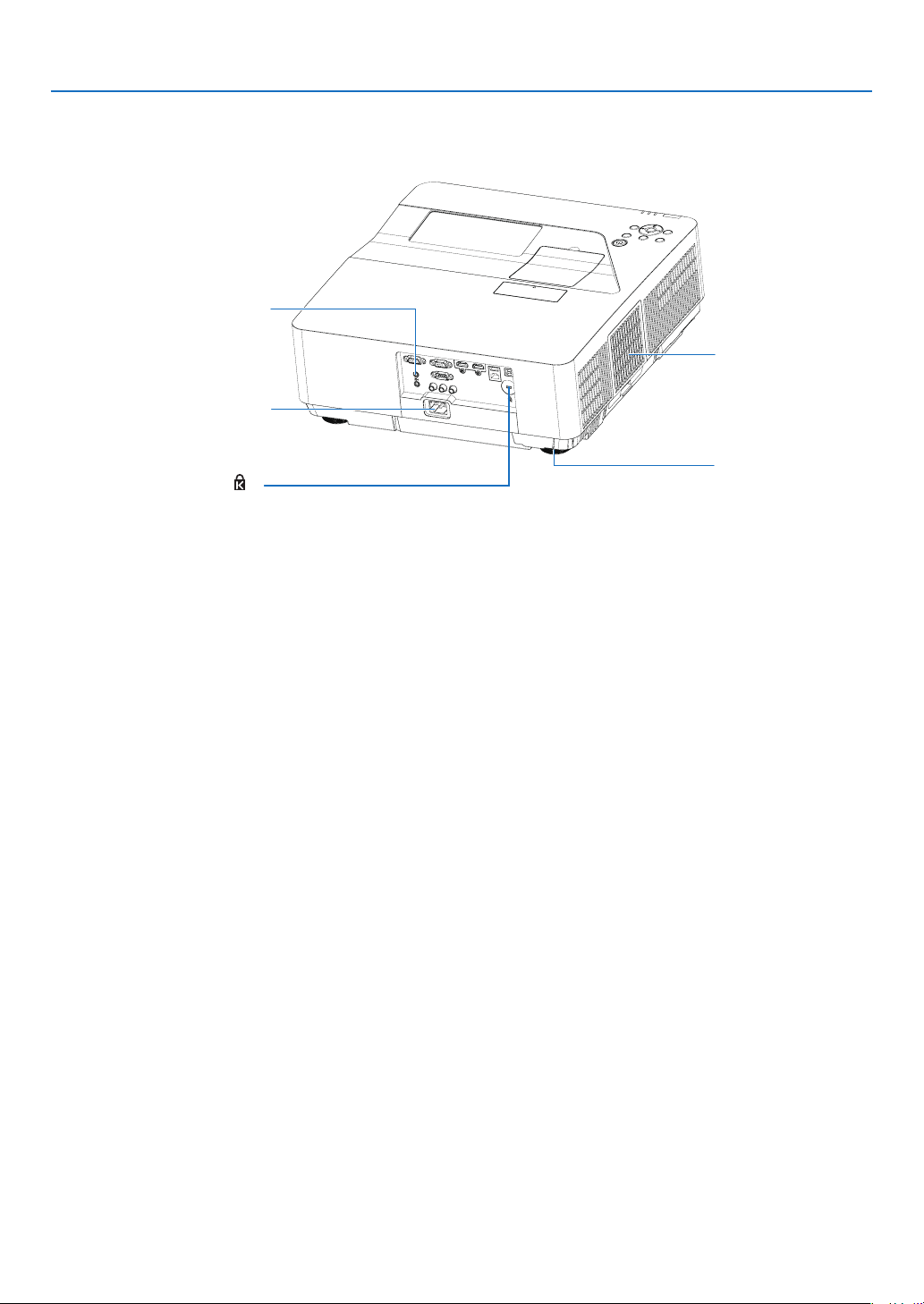
Rear
* This security slot supports the MicroSaver
®
Security System.
Rear Foot (
→
page 21)
Built-in Security Slot ( )*
AC Input
Connect the supplied power
cord’s three-pin plug here, and
plug the other end into an active
wall outlet.(
→
page 11)
Terminal Panel
(
→
page 7)
Intake Vent / Filter Cover
(
→
page
93
)
6
1. Introduction
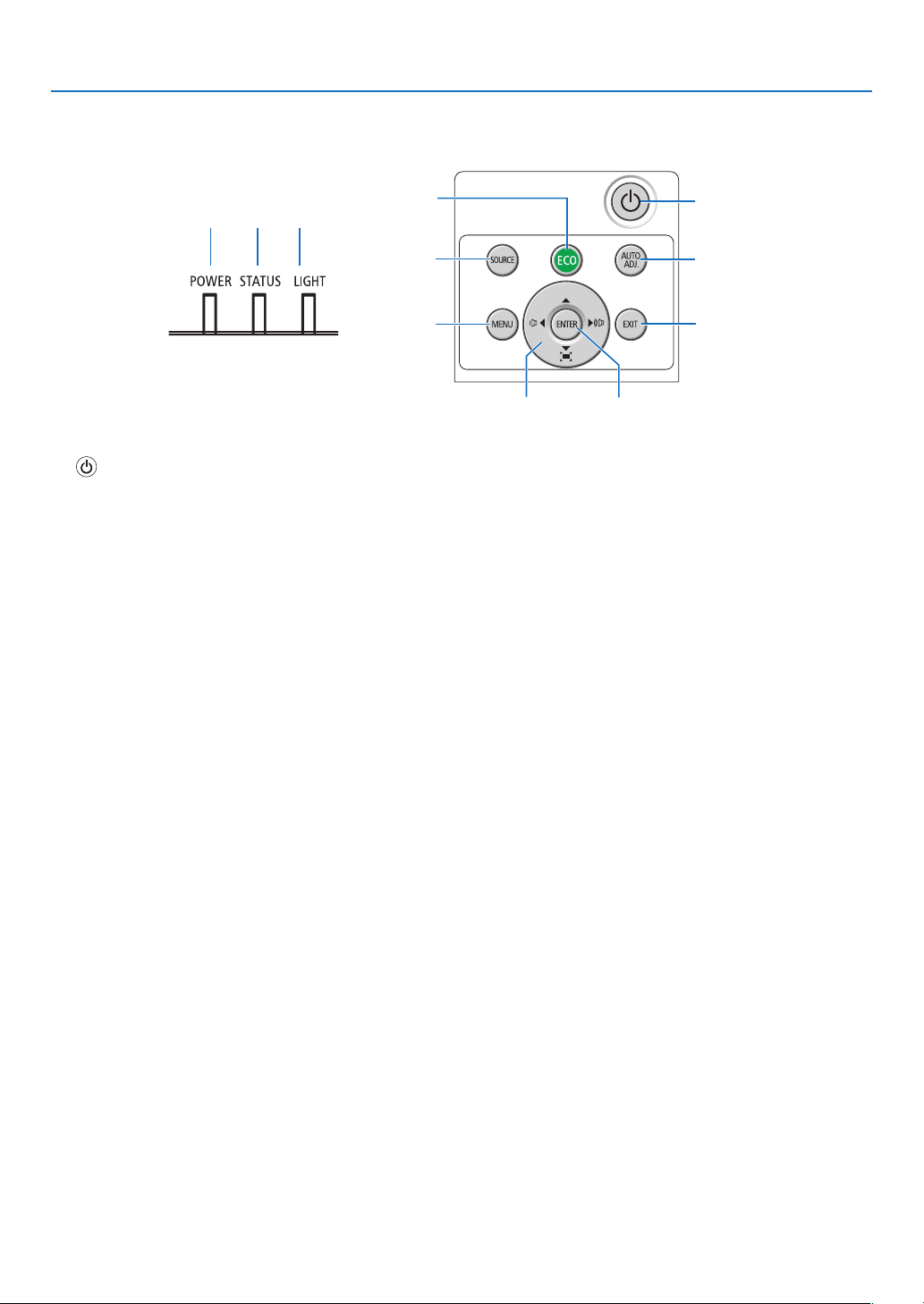
Controls/Indicator Panel
7
9
11
10
6
8
1
5
1. (POWER)Button
(
→page12,
25)
2.
POWER Indicator
(→page11,12,25,96)
3.
STATUSIndicator
(→page96)
4.
LIGHTIndicator
(→page96)
5. ECOButton
(
→page28)
6. SOURCE Button
(→page14)
7.
AUTOADJ.Button
(
→page24)
8.
MENUButton
(
→page51)
9.
▲▼◀▶/VolumeButtons◀ ▶ / Keystone Buttons
(→page22,24,30,51)
10.
ENTER Button
(→page51)
11.EXITButton
(→page51)
2
3 4
7
1. Introduction
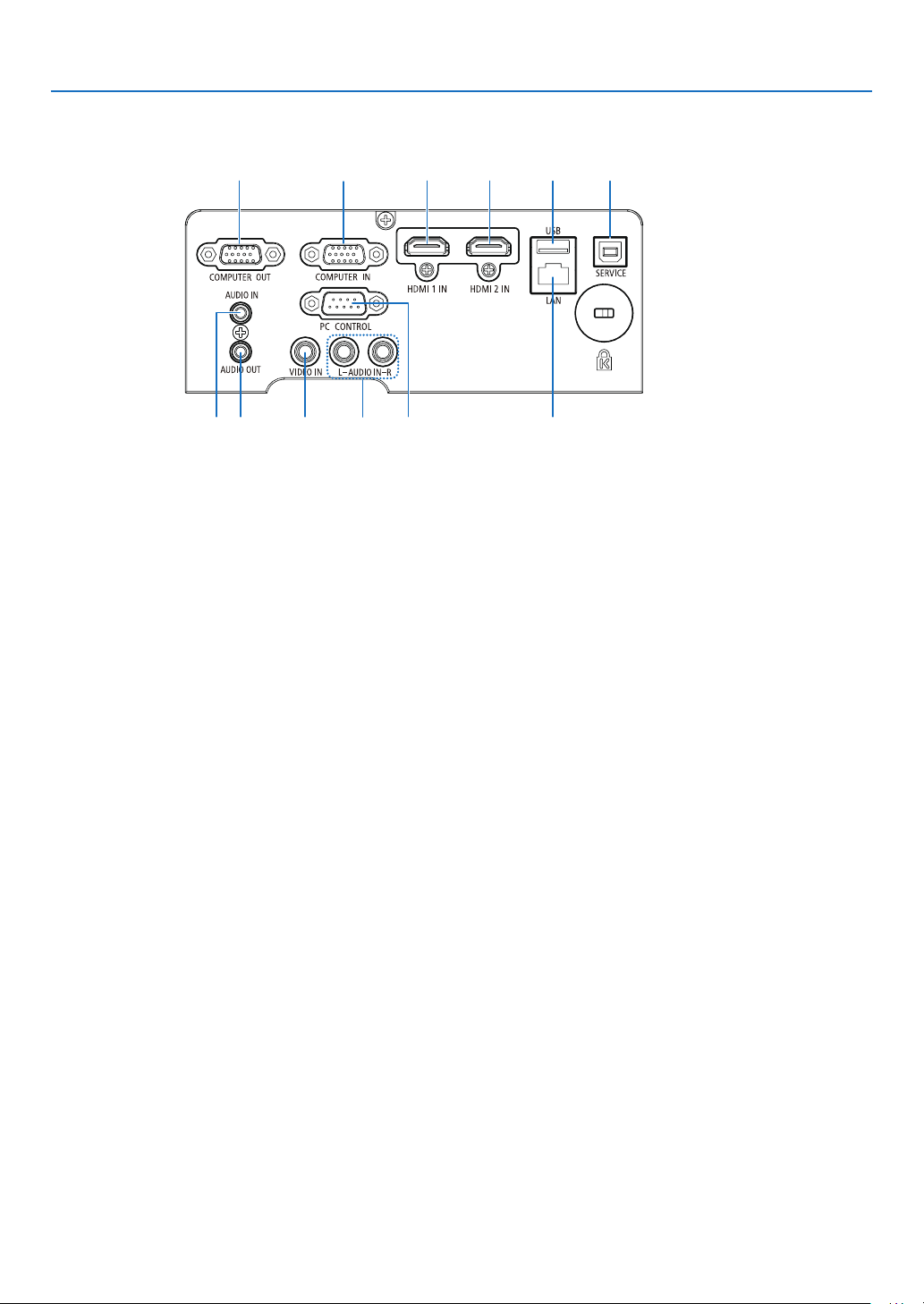
Terminal Panel Features
1.
COMPUTER IN/ Component Input Terminal
(MiniD-Sub15Pin)
(→ page86,90)
2.
COMPUTERAUDIOINMiniJack(StereoMini)
(→ page86,87,90)
3.
HDMI1INTerminal(TypeA)
(→page86,87,91)
4.
HDMI2INTerminal(TypeA)
(→ page86,87,91)
5.
SERVICEPort(USBTypeB)
(forservicepurposeonly)
6.
COMPUTEROUTTerminal(MiniD-Sub15Pin)
(→page88)
7.
AUDIOOUTMiniJack(StereoMini)
(→ page88)
8.
VIDEOINTerminal(RCA)
(→ page89)
9.
AUDIOINL,R(RCA)
(→page89)
10.
LANPort(RJ-45)
(→ page92)
11.
USBPort(TypeA)
For USB memory
(→ page45)
12.
PCCONTROLPort(D-Sub9Pin)
(→ page107)
Use this port toconnect aPC or control system.
Thisenablesyoutocontroltheprojectorusingserial
communicationprotocol.Ifyouarewritingyourown
program,typicalPCcontrolcodesareonpage107.
6
1
3 4
5
11
2 7
8 9
10
12
8
1. Introduction
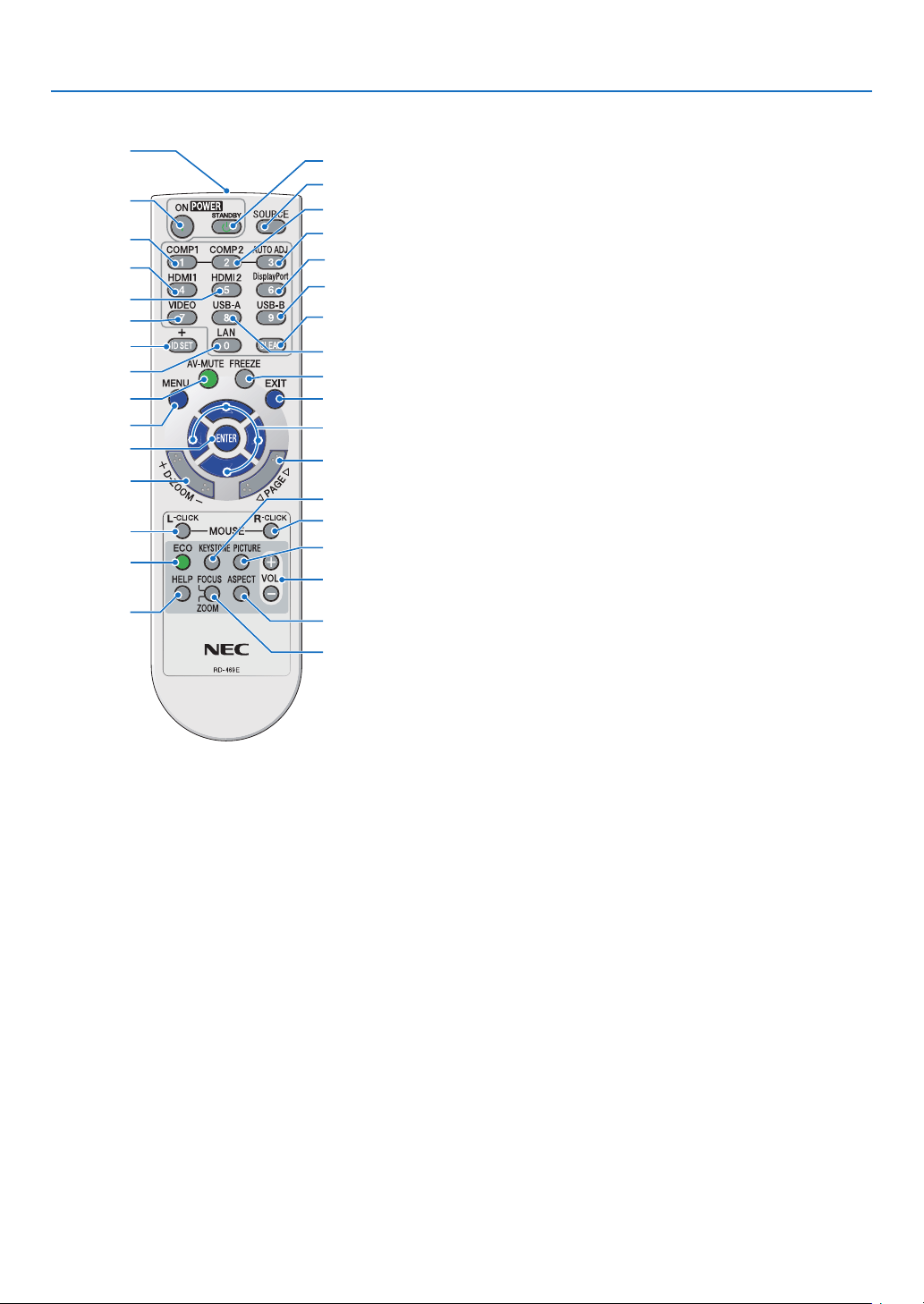
Part Names of the Remote Control
3
4
6
7
1
2
10
13
17
15
14
9
5
8
16
30
31
32
20
21
26
28
29
25
24
23
22
27
33
19
18
12
11
1.
Infrared Transmitter
(→page9)
2.
POWERONButton
(→page12)
3.
POWERSTANDBYButton
(→page25)
4.
SOURCEButton
(→page14)
5.
COMPUTER1Button
(→page14)
6.
7.
AUTOADJ.Button
(→page24)
8.
HDMI1Button
(→page14)
9.
HDMI2Button
(→page14)
10.
DisplayPortButton
11.
VIDEOButton(→page14)
12.
USB-AButton(→page14, 45, 47)
13.
USB-BButton (This button does not work on this
series of projectors)
14.
LANButton(→page14)
15. IDSETButton
(→page70)
16.
NumericKeypadButton/CLEARButton
(→page70)
17.
FREEZEButton
(→page26)
18.
AV-MUTEButton
(→page26)
19. MENUButton
(→page51)
20.
EXITButton(→page 51)
21.
Button(→page51)
22.
ENTERButton(→page51)
23.
D-ZOOM(+)(–)Button
(→page27)
24.
MOUSEL-CLICKButton (This button does not
work on this series of projectors)
25.
MOUSER-CLICKButton (This button does not
work on this series of projectors)
26.
PAGE/ Button
(→page46)
27.
ECOButton(→page28)
28.
KEYSTONEButton
(→page22, 30)
29.
PICTUREButton
(→page57, 59)
30.
VOL.(+)(–)Button
(→page24)
31.
ASPECTButton
(→page62)
32.
FOCUS/ZOOMButton
(→ page 20)
33. HELPButton
(→page77)
COMPUTER2Button (This button does not
work on this series of projectors)
(Thisbuttondoesnotworkinthisseriesofprojectors)
9
1. Introduction
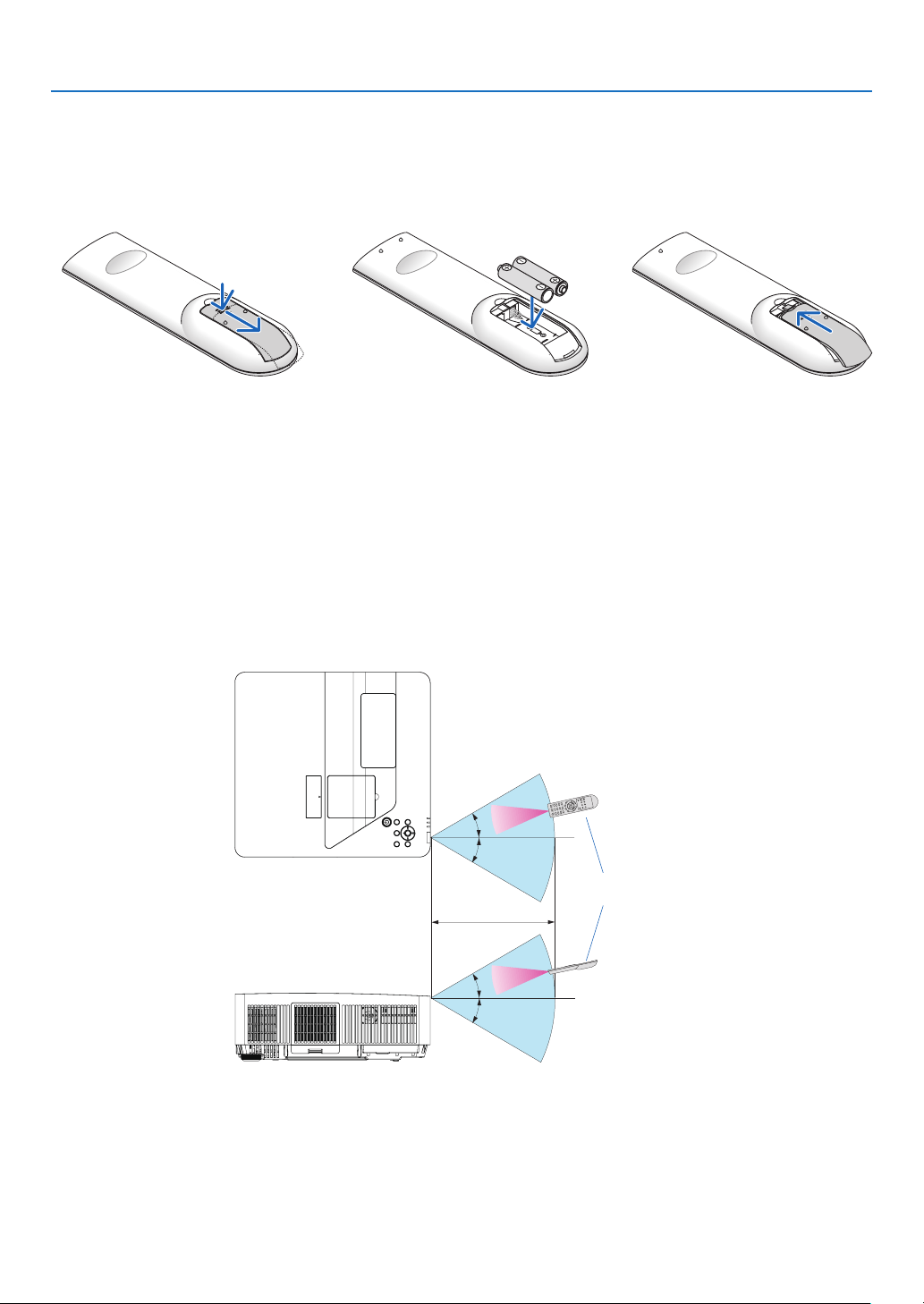
Battery Installation
1. Press firmly and slide the bat-
tery cover off.
2. Install new batteries (AAA).
Ensure that you have the bat-
teries’ polarity (+/−) aligned
correctly.
3. Slip the cover back over the
batteries until it snaps into
place. Do not mix different
types of batteries or new and
old batteries.
OPEN
OPEN
Remote Control Precautions
• Handletheremotecontrolcarefully.
• Iftheremotecontrolgetswet,wipeitdryimmediately.
• Avoidexcessiveheatandhumidity.
• Donotshort,heat,ortakeapartbatteries.
• Donotthrowbatteriesintofire
• Ifyouwillnotbeusingtheremotecontrolforalongtime,removethebatteries.
• Ensurethatyouhavethebatteries’polarity(+/−)alignedcorrectly.
• Donotusenewandoldbatteriestogether,orusedifferenttypesofbatteriestogether.
• Disposeofusedbatteriesaccordingtoyourlocalregulations.
Operating Range for Wireless Remote Control
• Theinfraredsignaloperatesbyline-of-sightuptoadistanceofabout22feet/7mandwithina60-degreeangle
of the remote sensor on the projector cabinet.
• Theprojectorwillnotrespondifthereareobjectsbetweentheremotecontrolandthesensor,orifstronglight
fallsonthesensor.Weakbatterieswillalsopreventtheremotecontrolfromproperlyoperatingtheprojector.
30°
30°
30°
30°
Remote sensor on
projector cabinet
22 feet/7 m
Remote control

10
This section describes how to turn on the projector and to project a picture onto the screen.
❶ Flow of Projecting an Image
Step 1
• Connectingyourcomputer/Connectingthepowercord(→ page 11)
Step 2
• Turningontheprojector(→ page 12)
Step 3
• Selectingasource(→ page 14)
Step 4
• Adjustingthepicturesizeandposition(→ page 15)
•
Correctingkeystonedistortion[KEYSTONE](→
page 22)
Step 5
•
Adjusting a picture and sound
- Optimizing a computer signal automatically (
→
page
24
)
- Turning up or down volume (
→
page
24
)
Step 6
• Makingapresentation
Step 7
•
Turningofftheprojector(→ page 25)
Step 8
•
WhenMovingtheProjector(→ page 25)
2. Projecting an Image (Basic Operation)
11
2. Projecting an Image (Basic Operation)
❷ Connecting Your Computer/Connecting the Power Cord
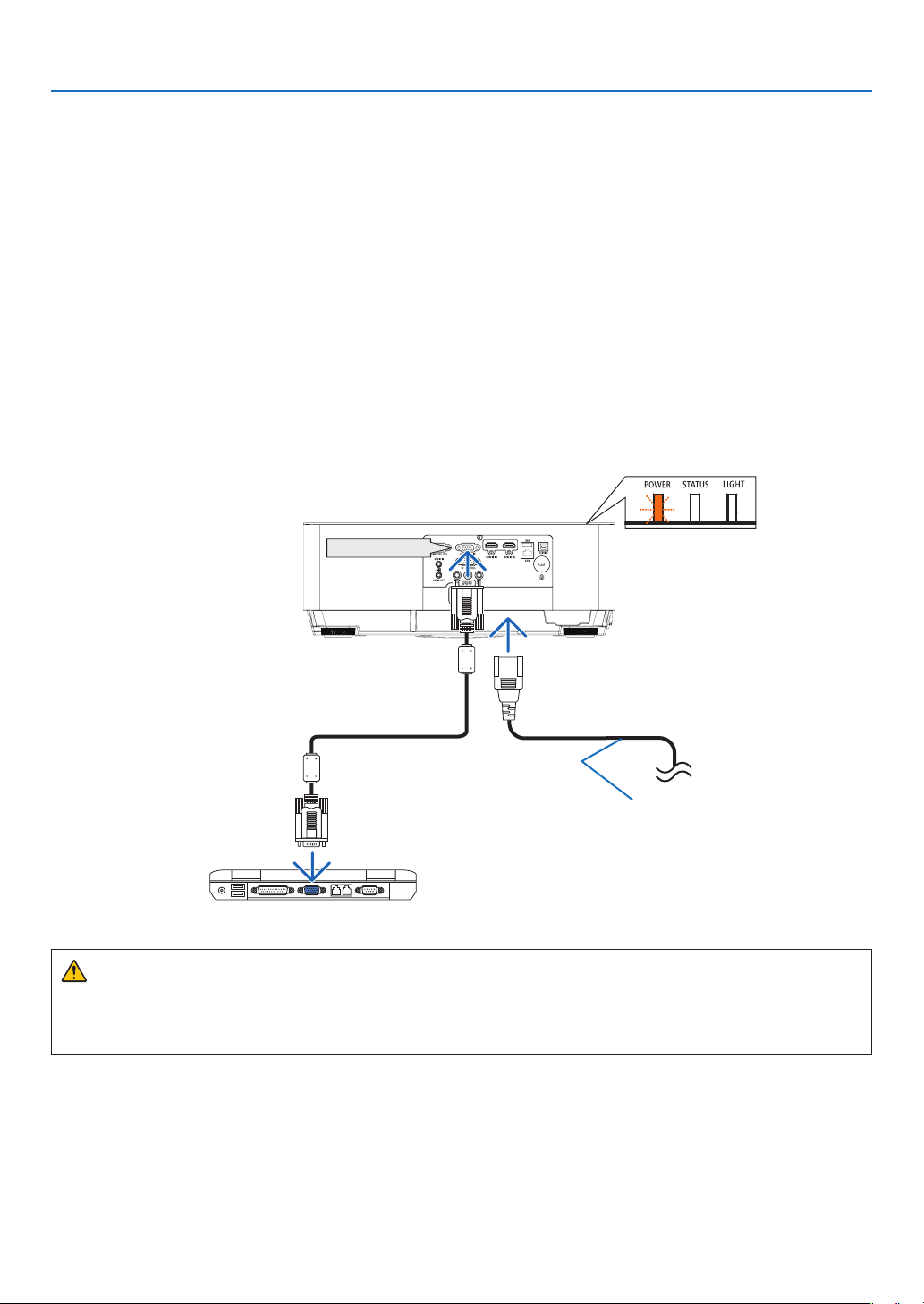
1.
Connect your computer to the projector.
This section will show you a basic connection to a computer. For information about other connections, see “6.
Installation and Connections” on page 86.
Connect the computer cable (VGA) between the projector’s COMPUTER IN terminal and the computer’s port (mini
D-Sub 15 Pin). Turn two thumb screws of both terminals to fix the computer cable (VGA)
2.
Connect the supplied power cord to the projector.
First connect the supplied power cord’s three-pin plug to the AC IN of the projector, and then connect the other
plug of the supplied power cord in the wall outlet.
The projector’s power indicator will start blinking orange.
*
This will apply for both indicators when [NORMAL] is selected for [STANDBY MODE]. See the Power Indicator
section.(
→
page 96)
CAUTION:
PartsoftheprojectormaybecometemporarilyheatediftheprojectoristurnedoffwiththePOWERbuttonorif
theACpowersupplyisdisconnectedduringnormalprojectoroperation.
Becarefultohandletheprojector.
COMPUTER IN
Make sure that the prongs
are fully inserted into both
the AC IN and the wall
outlet.
To wall outlet
←
12
2. Projecting an Image (Basic Operation)
❸ Turning on the Projector
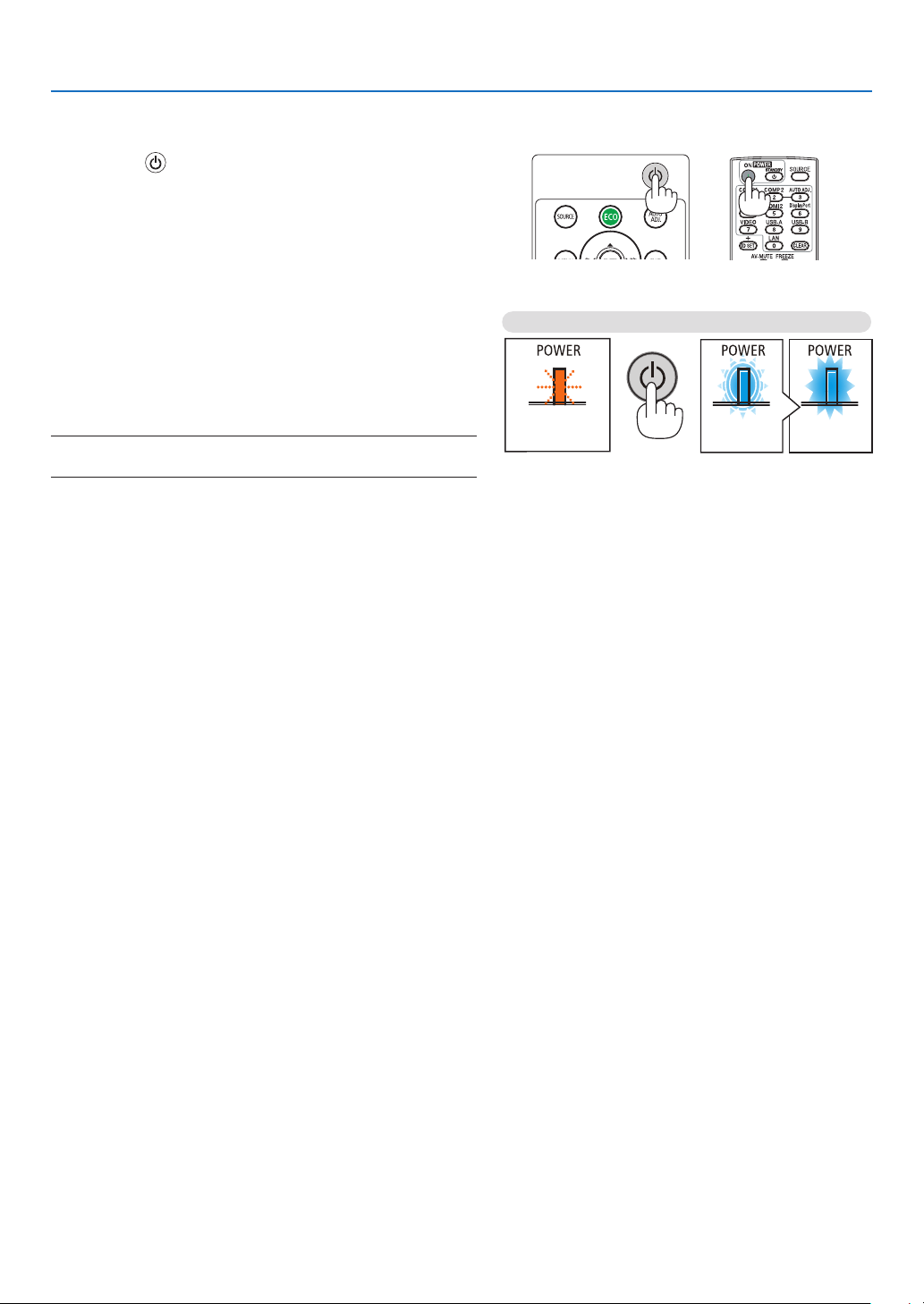
1.
Press the (POWER) button on the projector cabinet
or the POWER ON button on the remote control.
T
h
e P
OWER i
ndicator will blink and the projector will
become ready to use.
TIP:
•
When the message“Projector is locked! Enter your passw
ord.”
is
displayed,
it
means
that
the
[SECURITY]
feature
is
turned
on.
(
→
page3
4
)
After you turn on your projector, ensure that the computer
or video source is turned on.
NOTE:Whennoinputsignalispresent,theno-signalguidanceisdisplayed
(factorymenusetting).
Standby Blinking Power On
(→ page96)
Blinking orange light
Blinking blue
light
Steady blue
light
13
2. Projecting an Image (Basic Operation)
Note on Startup screen (Menu Language Select screen)
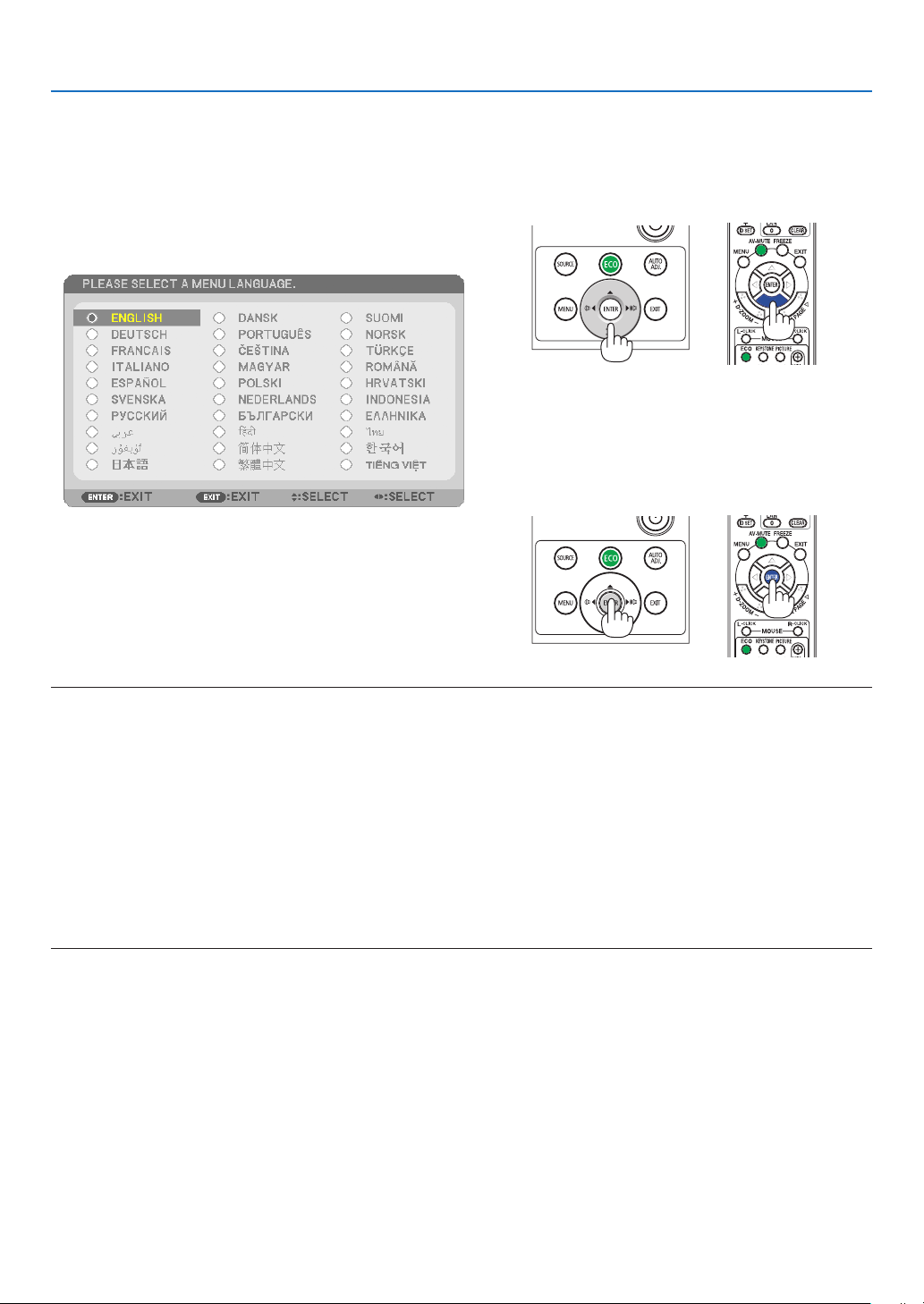
Whenyoufirs turnontheprojector,youwillgettheStartupmenu.Thismenugivesyoutheopportunitytoselect
oneofthe30menulanguages.
Toselectamenulanguage,followthesesteps:
1. Use the ▲, ▼, ◀ or ▶ button to select one of the 30
languages from the menu.
2. Press the ENTER button to execute the selection.
After this has been done, you can proceedto the menu
operation.
Ifyouwant,youcanselectthemenulanguagelater.
(→[LANGUAGE]onpage53 and 67)
NOTE:
• IftheprojectorisshutoffbyDIRECTPOWEROFF(pullingoutthepowercord)duringprojection,waitfor1secondatleastforreconnect
thepowercordforturningontheprojector.
Failingtodosocouldresultinnopowertotheprojector.(Therewillbenostand-byLED)
Shouldthishappen,unplugthepowercordandplugitinagain.Turnonthemainpower.
•
•
If one of the following things happens, the projector will not turn on.
- If the internal temperature of the projector is too high, the projector detects abnormal high temperature. In this condition the projector
will not turn on to protect he internal system. If this happens, wait for the projector’s internal components to cool down.
- If the STATUS indicator lights orange with the power button pressed, it means that the [CONTROL PANEL LOCK] is turned on. Cancel
the lock by turning it off. (→
page 69)
- If the light fails to light, and if the POWER indicator blinks in red and the LIGHT indicator lights in red, wait a full minute and then turn
on the power.
While the POWER indicator is blinking blue in short cycles, the power cannot be turned off by using the power button.
14
2. Projecting an Image (Basic Operation)
❹ Selecting a Source
Selecting the computer or video source
NOTE:Turnonthecomputerorvideosourceequipmentconnectedtotheprojector.
Detecting the Signal Automatically
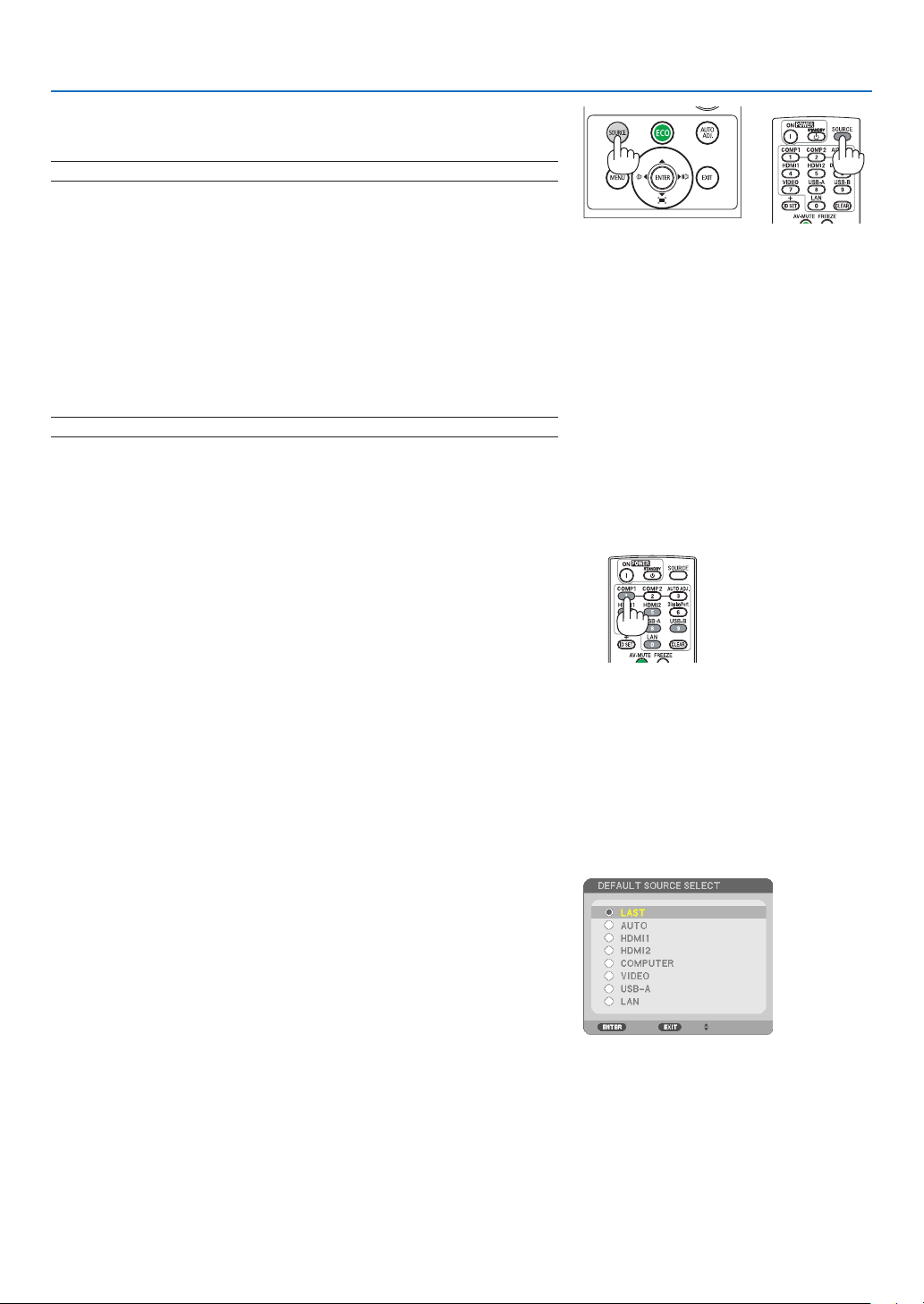
PresstheSOURCEbuttononce.Theprojectorwillsearchfortheavail-
ableinputsourceanddisplayit.Theinputsourcewillchangeasfollows:
HDMI1→ HDMI2→ COMPUTER→
VIDEO
→
USB-A
→
LAN
• Withthe SOURCEscreen displayed, youcan pressthe SOURCE
button a few times to select the input source.
TIP:Ifnoinputsignalispresent,theinputwillbeskipped.
Using the Remote Control
Pressany one of the COMPUTER1, HDMI1, HDMI2, VIDEO or USB-A
buttons.
Selecting Default Source
Youcansothatitwillbedisplayedeachtimetheprojectoristurnedon.
1. Press the MENU button.
The menu will be displayed.
2. Press the ▶buttontwicetoselect[SETUP]andthe▼ button or
theENTERbuttontoselect[GENERAL].
3.
Press the
▶
buttonfourtimestoselect[OPTIONS(2)].
4. Press the ▼buttonvetimestoselect[DEFAULTSOURCESE-
LECT] and press the ENTER button.
The [DEFAULT SOURCE SELECT] screen will be displayed.
(
→
page 74)
5.
Select a source as the default source, and press the ENTER button.
6. Press the EXIT button a few times to close the menu.
7.
Restart the projector.
The source you selected in step 5 will be projected.
TIP:
• WhentheprojectorisinStandbymode,applyingacomputersignalfromacomputer
connectedtotheCOMPUTERINinputwillpowerontheprojectorandsimultaneously
projectthecomputer’simage.
([AUTOPOWERON]→
page74)
• OnWindows7,acombinationoftheWindowsandPkeysallowsyoutosetupexternal
displayeasilyandquickly.
15
2. Projecting an Image (Basic Operation)
❺ Adjusting the Picture Size and Position
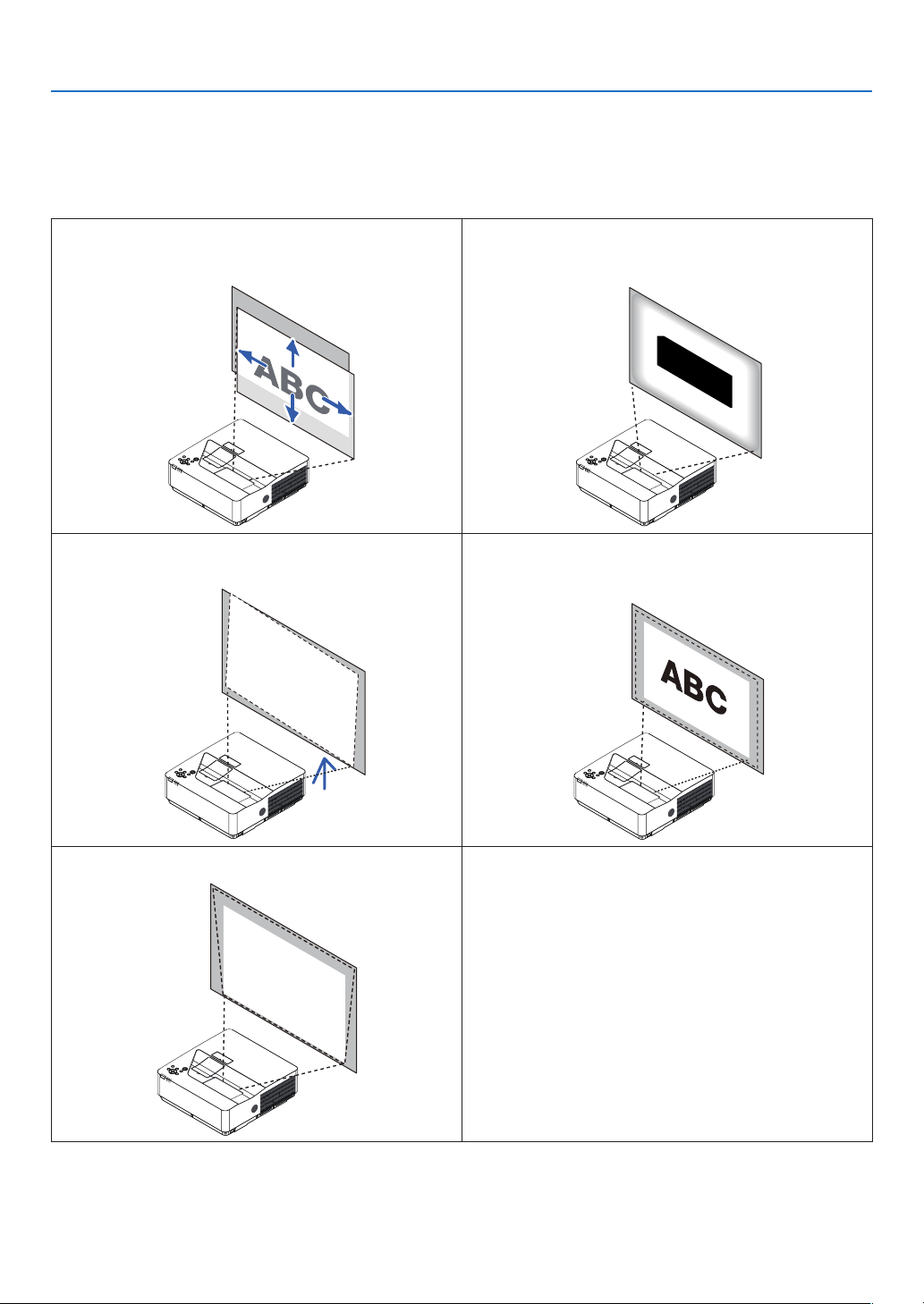
Usethelensshiftdial,theadjustabletiltfootlever,thezoomleverandthefocusringtoadjustthepicturesizeand
position.
Inthischapterdrawingsandcablesareomittedforclarity.
Adjustingtheprojectedimage’sverticalandhorizontal
position[Lensshift]
(→page16)
Adjustingthefocus[Focusring]
(→page18)
Finelyadjustingthesizeofanimage
[Zoomlever]
(→ page19)
Adjustingthethrowangle(theheightofanimage)
[Tiltfoot]
(→ page21)
Correctingthekeystonedistortion[Keystone]
(→ page22)
16
2. Projecting an Image (Basic Operation)
Adjusting the position of a projected image (Lens shift)
CAUTION:
Performtheadjustmentfrombehindorfromthesideoftheprojector.Adjustingfromthefrontcouldexposeyour
eyestostronglightwhichcouldinjurethem.
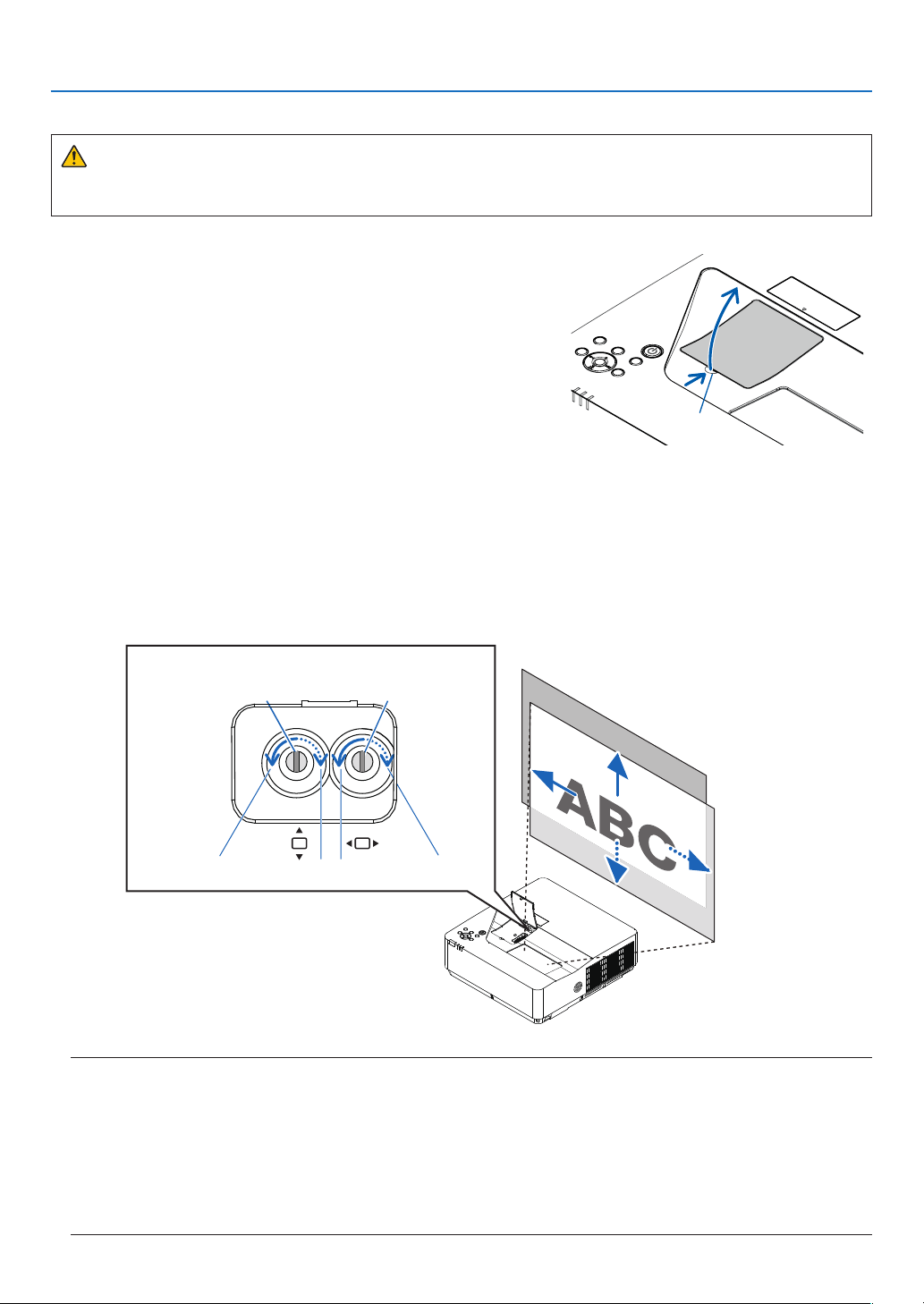
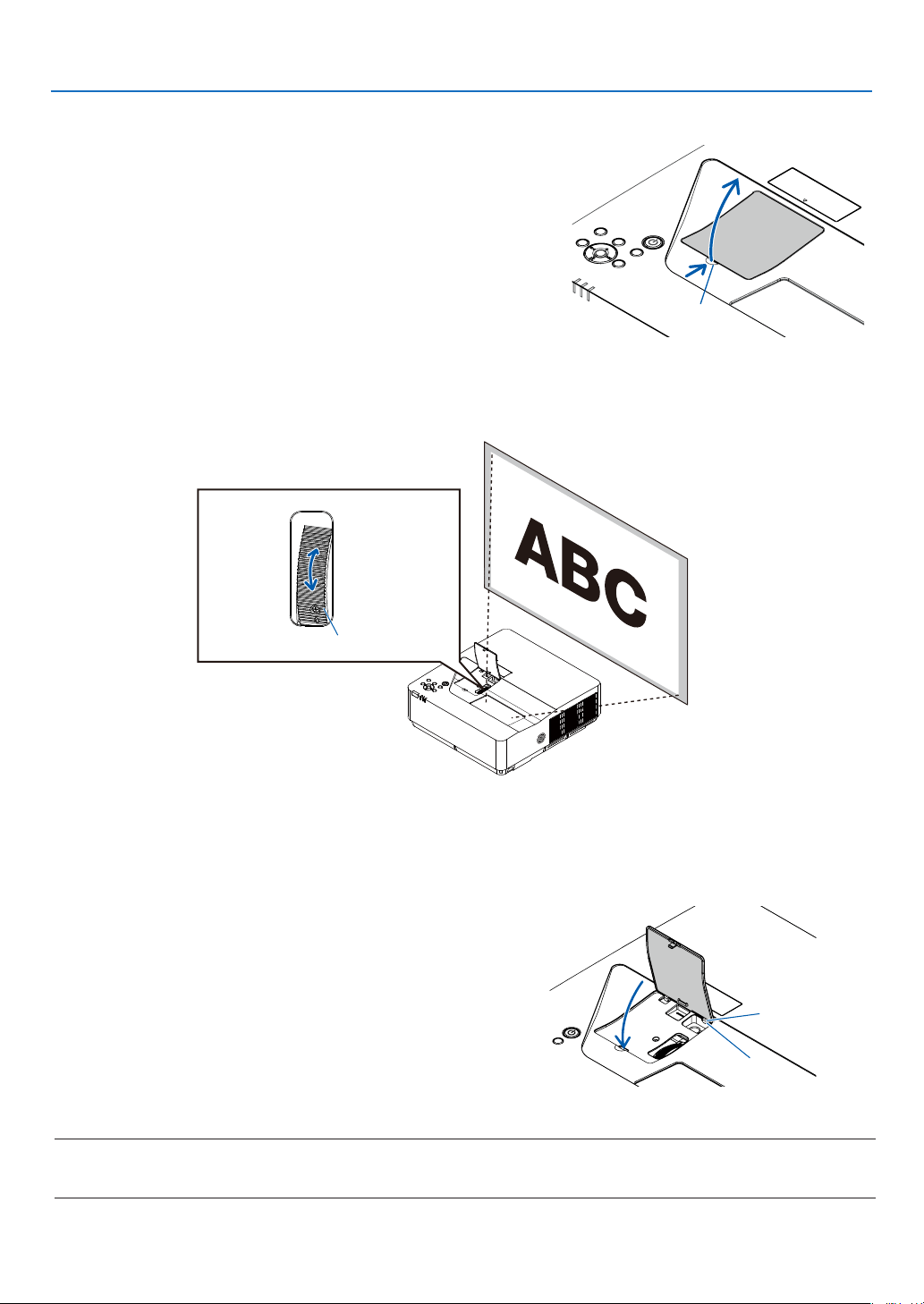
1.
Open the lens shift cover.
NOTE:
• Thedialscanbeturnedmorethanonefullturn,buttheprojectionpositioncannotbemovedmorethantherangeindicatedonthe
followingpage.Donotforcetoturnthedials.Doingsomaydamagethedials.
• Ifthelensisshiftedtothemaximuminthediagonaldirection,theedgesofthescreenwillbedarkorshaded.
• Theverticalshiftadjustmentmustbenishedwithanimageshiftedupward.Ifyounishtheverticalshiftadjustmentwithanimage
Turn the lens shift dials clockwise or counterclockwise.
Vertical dial
Turn this clockwise or counterclockwise to adjust the projection position in the vertical direction.
Horizontal dial
Turn this clockwise or counterclockwise to adjust the projection position in the horizontal direction.
Stopper
Open with the cover’s stopper pushed forward.
• Thelensshiftcovercannotberemoved.
2.
Upward Downward Leftward Rightward
Lens shift dial
(Vertical)
Lens shift dial
(Horizontal)
shifteddown,thezoom/focusadjustmentsorstrongshakingmaycauseaprojectedimagetoslightlyshiftdown.
When adjusting the position of the lens, if you find that the dial does not move,
it
may have been beyond the adjustment range, do
not forcibly rotate the
dial
, otherwise there is a risk of damage. When there is a lack of image,
it
has been beyond the adjustment
range,
adjust in the
opposite direction to the range of
full
image.
•
17
2. Projecting an Image (Basic Operation)
TIP:
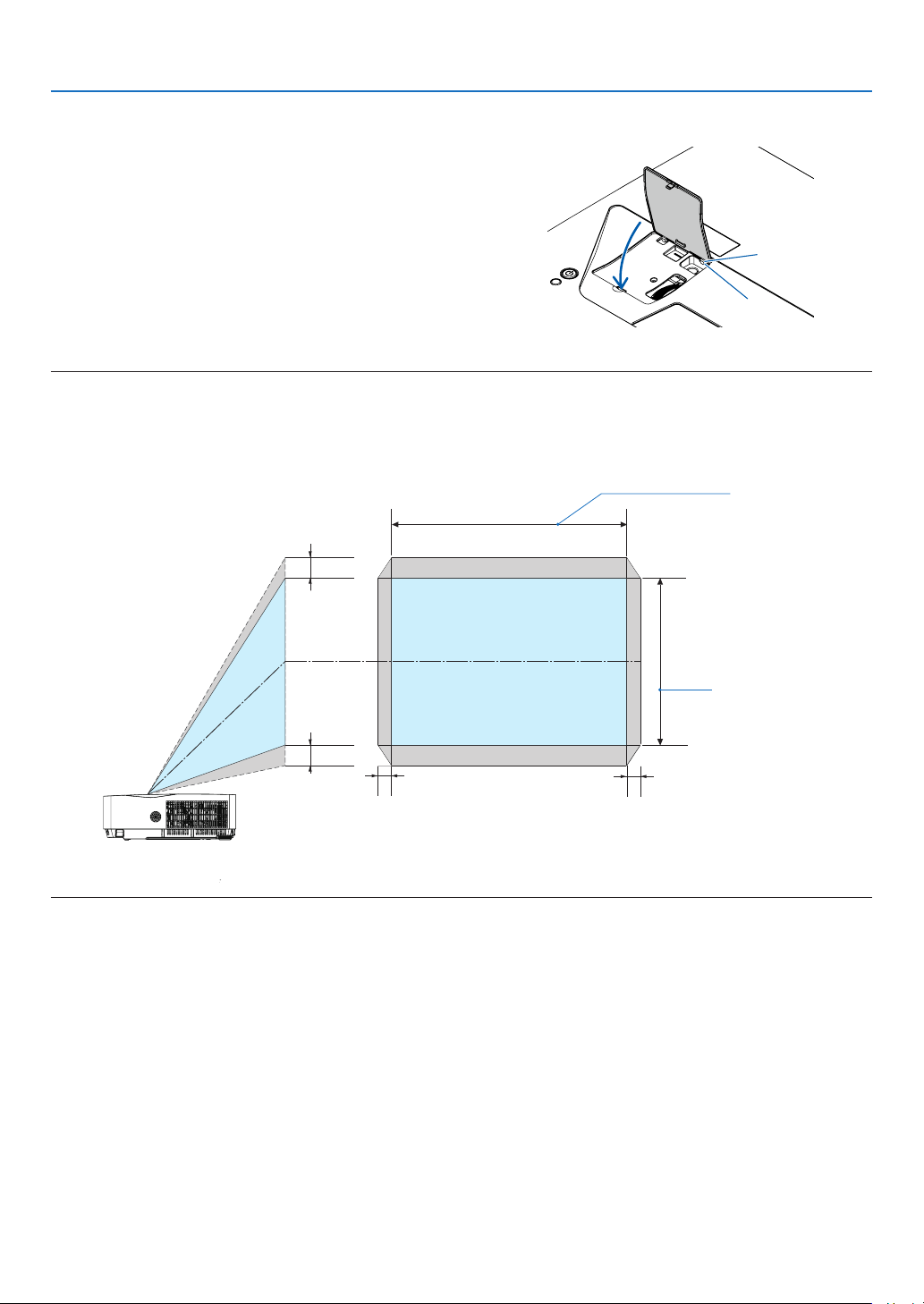
• Thediagrambelowshowsthelensshiftadjustmentrange([ORIENTATION]:[DESKTOPFRONT]).
•
Forthelensshiftadjustmentrangeregardingthe[CEILINGFRONT]projection,seepage84.
Height of projected image
Width of projected image
Descriptionofsymbols:Vindicatesvertical(heightoftheprojectedimage),Hindicateshorizontal(widthoftheprojectedimage).
3. Closethelensshiftcover.
Insertthecover’s2(two)hooksintothegroovesintheprojector,then
close the cover.
Hook
Groove
3%V
3%V
2%H
100% H
100% V
2%H
18
2. Projecting an Image (Basic Operation)
Focus
(Focus ring)
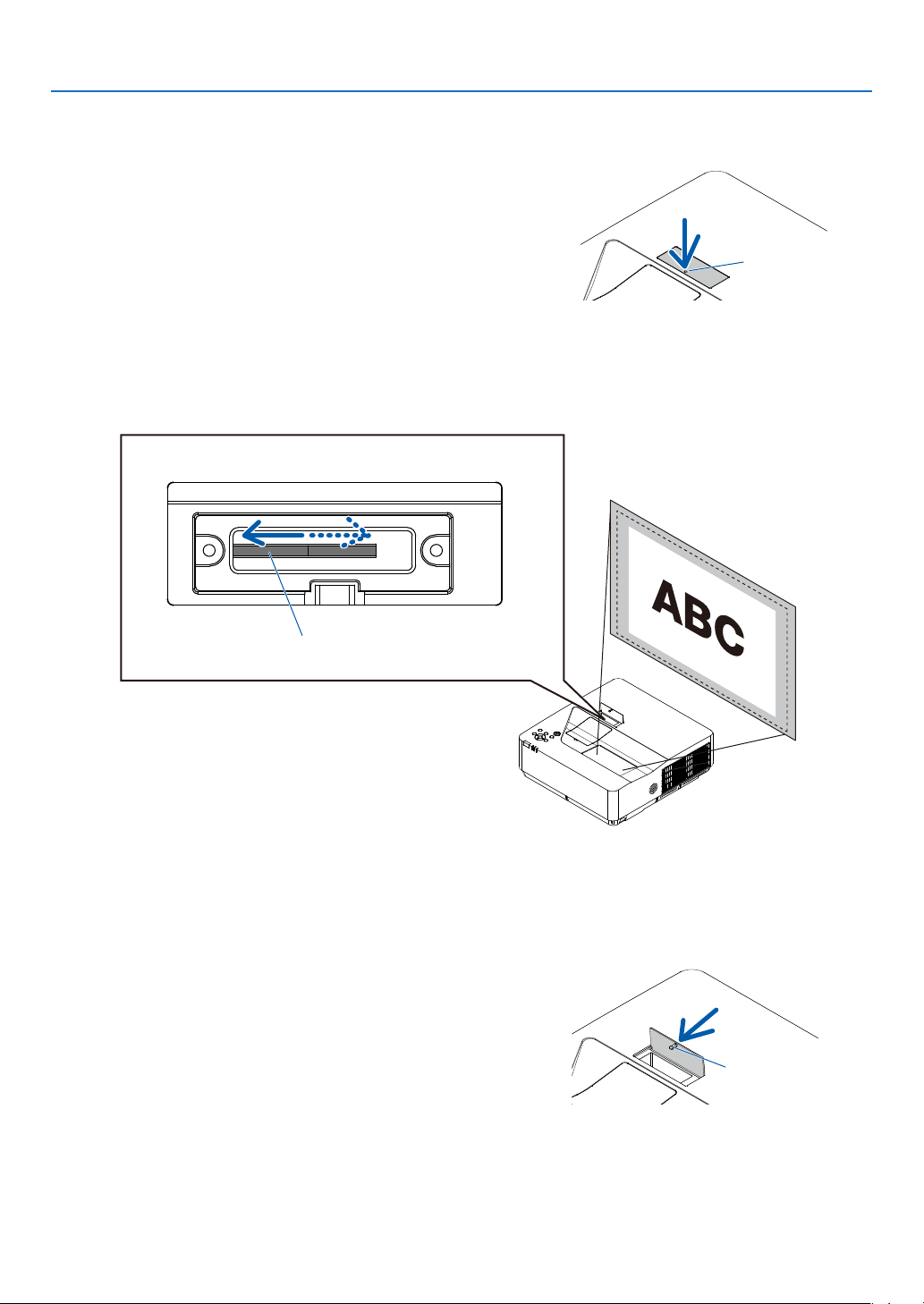
1.
Stopper
Open the lens shift cover.
Open with the cover’s stopper pushed forward.
• Thelensshiftcovercannotberemoved.
Rotate the Focus ring until you obtain the best focus.
2.
Focus ring
3. Closethelensshiftcover.
Insertthecover’s2(two)hooksintothegroovesintheprojector,then
close the cover.
Hook
Groove
NOTE:
•
It is recommended toperformfocusadjustmentaftertheprojectorhas been projecting for more than 30 minutes inTESTPATTERN
mode. About TEST PATTERN, please refer to page 71.
19
2. Projecting an Image (Basic Operation)
Zoom (Zoom lever)
1.
Open the Zoom cover.
The zoom cover is a spring buckle, which can be opened by
gently pressing down.
•
Thezoomcovercannotberemoved.
2.
Spring buckle
Zoom lever
3.
Close the zoom cover.
Spring buckle
Adjust
the Zoom lever
left or right, until you
obtain the best zoom.
Press down on the cover and hear a "ticking" sound to close the cover.
20
2. Projecting an Image (Basic Operation)
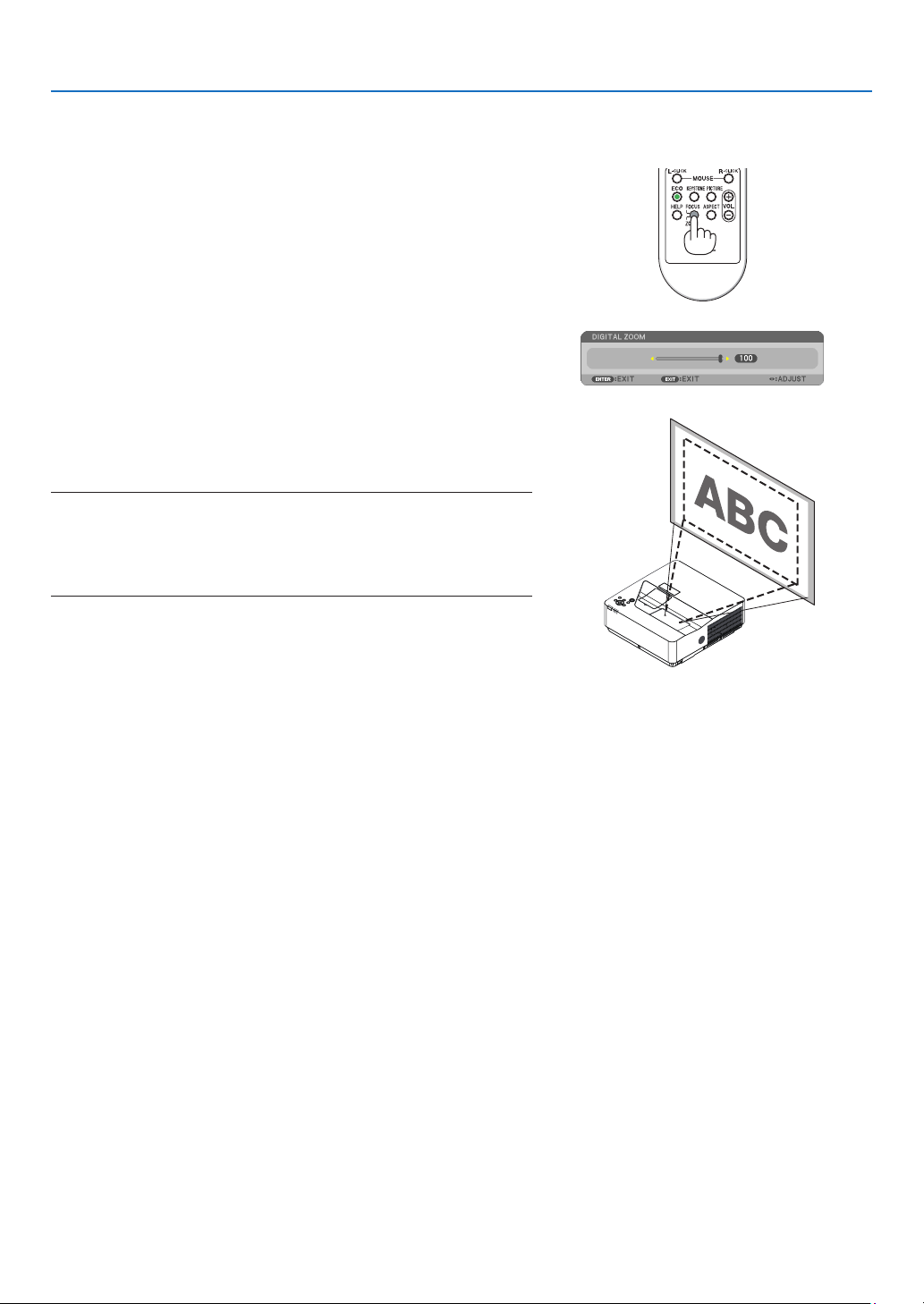
Adjusting the size [Digital Zoom]
Use the remote control to finely adjust the size of the image.
1. PresstheFOCUS/ZOOMbuttonontheremotecontrol.
TheDIGITALZOOMbarwillbedisplayed.
2. Press the or buttontonelyzoominorout.
3. After completing the adjustment, press the ENTER button.
TheDIGITALZOOMbarwillbeclosed.
NOTE:
•
This feature allows you to electronically fine adjust the image size on the
screen.
•
This feature can not be used when USB-A or LAN is selected as an input
terminal.
21
2. Projecting an Image (Basic Operation)
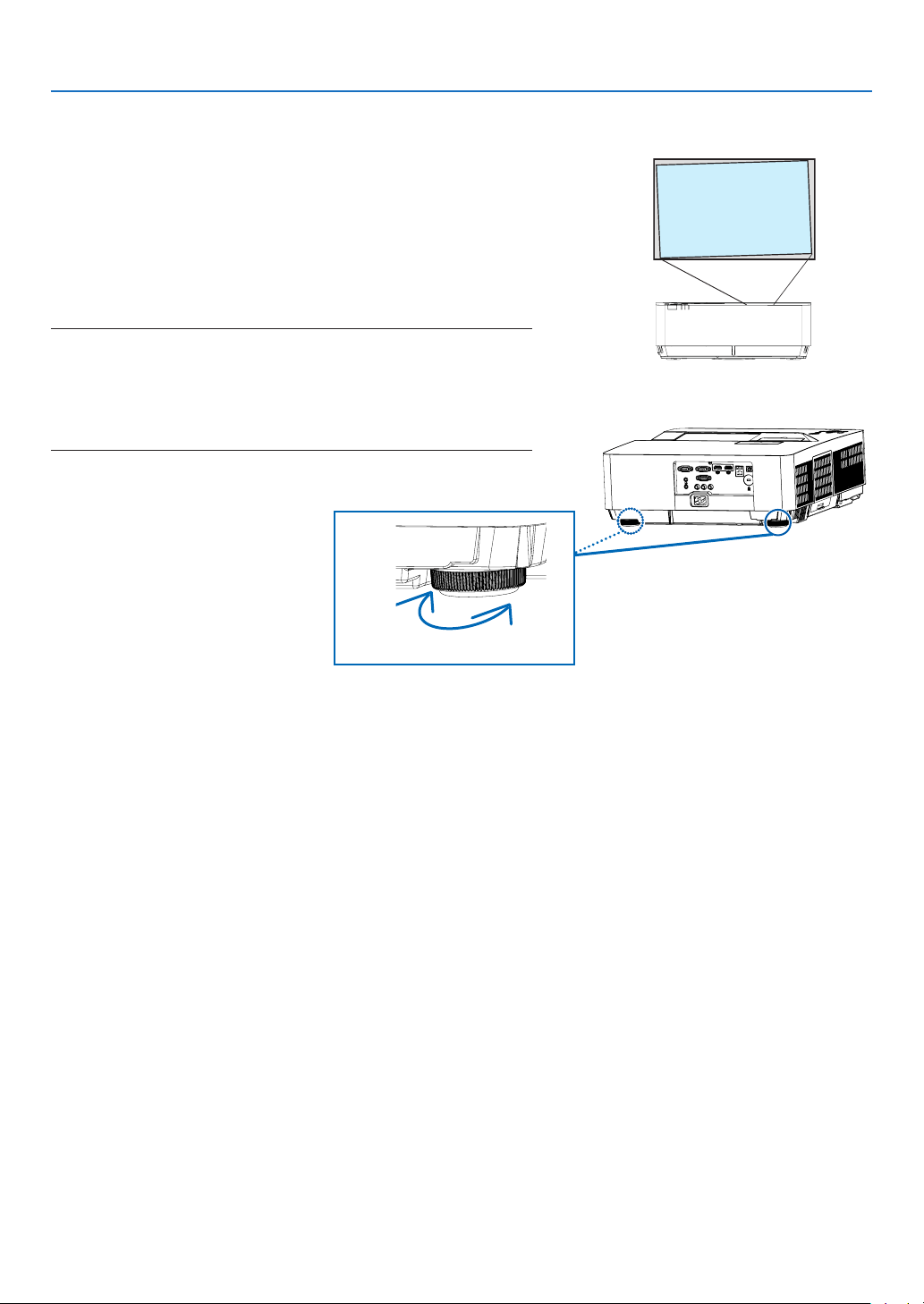
Adjusting the tilt (Tilt foot)
Adjusting the left and right tilt.
1. Rotate the tilt foot to adjust the left and right tilt.
The tilt foot is equipped at the left and the right front bottom of the
projector.
Iftheprojectedimageistilted,rotateoneofthetiltfoottoadjust
the angle to project.
Ifkeystonedistortionisappeared,adjustiteitherbythe button
onthecabinetorkeystonebuttonontheremotecontrol
NOTE:
• Donotextendthetiltfootbeyonditsheightlimit(18mm/0.7inches).Doing
somaycausethetiltfoottocomeoutoftheprojector.
• Donotusethetilt-footforpurposesotherthanoriginallyintended.
Misusessuchasusingthetiltfoottocarryorhang(fromthewallorceiling)
theprojectorcancausedamagetotheprojector.
Up
Down
22
2. Projecting an Image (Basic Operation)
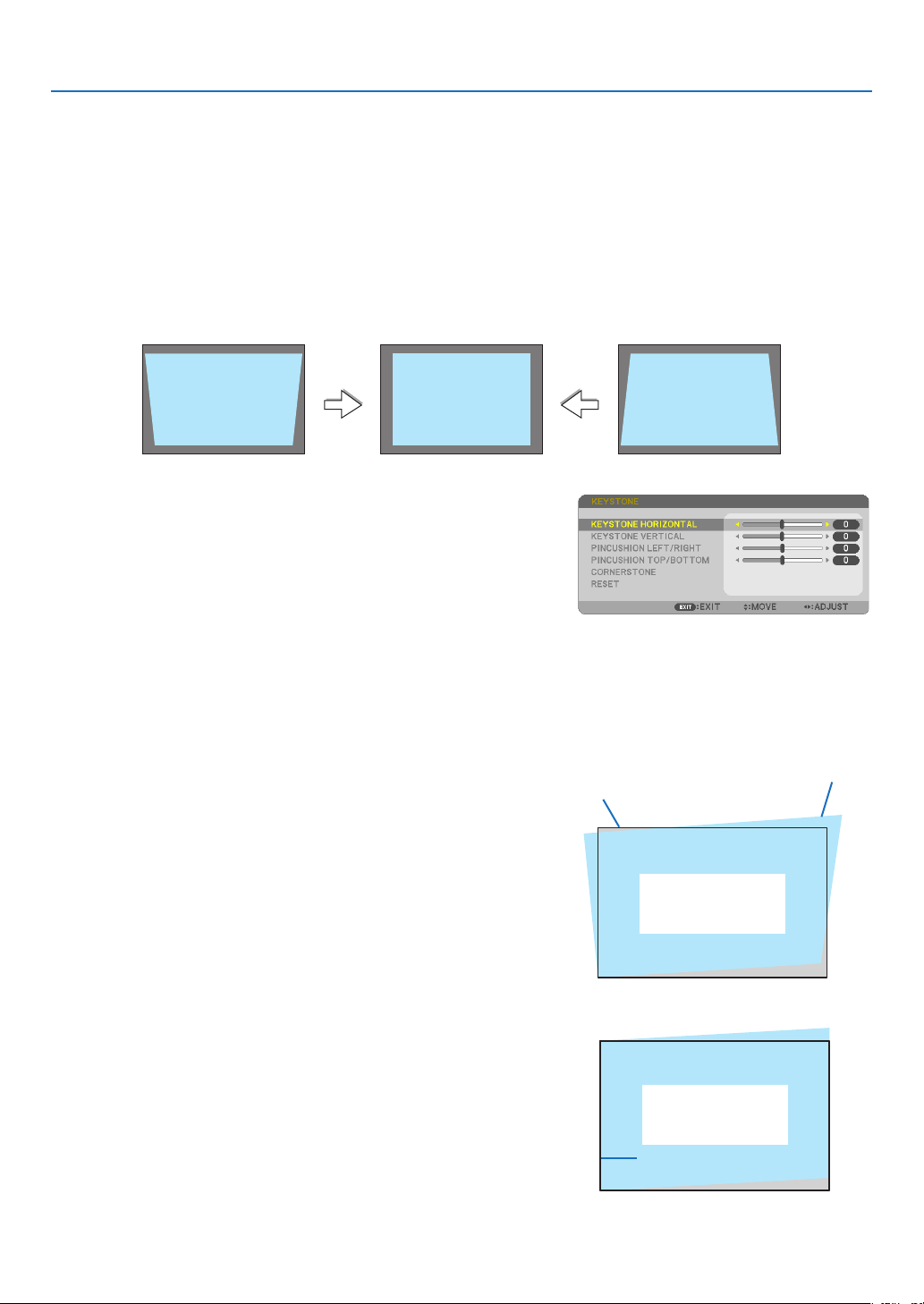
❻ Correcting Keystone Distortion [KEYSTONE]
Whentheprojectorisnotexactlyperpendiculartothescreen,keystonedistortionoccurs.Forcorrectingthisdistor-
tion,youcanusethe“Keystone”function,adigitaltechnologythatcanadjustforkeystone-typedistortion,resulting
inacrisp,squareimage.
Thefollowingprocedureexplainshowtousethe[KEYSTONE]screenfromthemenutocorrecttrapezoidaldistor-
tionswhentheprojectorisplaceddiagonallytothescreen.
• BeforeperformingKEYSTONEcorrection
TheKEYSTONEcorrectionhasfourfeatures,KEYSTONEHORIZONTAL,KEYSTONEVERTICAL,PINCUSHION,and
CORNERSTONE.IfthevalueofeitherCONERSTONEorPINCUSHIONhascorrected,KEYSTONEHORIZONTAL
andKEYSTONEVERTICALaredisabled.Inthiscase,RESETthecorrectedvaluesandrestarttocorrectdistortion.
1. Press the ▼ button on the projector cabinet.
The Keystone screen will be displayed on the screen.
• PresstheKEYSTONEbuttonwhenusingtheremotecontrol.
• SeepageforPINCUSHION.
• SeepageforCORNERSTONE.
• SeepageforRESET.
2. Press the ▼buttontoselect[KEYSTONEVERTICAL]andthen
use the ◀ or ▶ so that the left and right sides of the projected
image are parallel.
* Adjust the vertical keystone distortion.
Projected area
Screen frame
3. Align the left (or right) side of the screen with the left (or right)
side of the projected image.
• Usetheshortersideoftheprojectedimageasthebase.
• Intherightexample,usetheleftsideasthebase.
Align left side
23
2. Projecting an Image (Basic Operation)
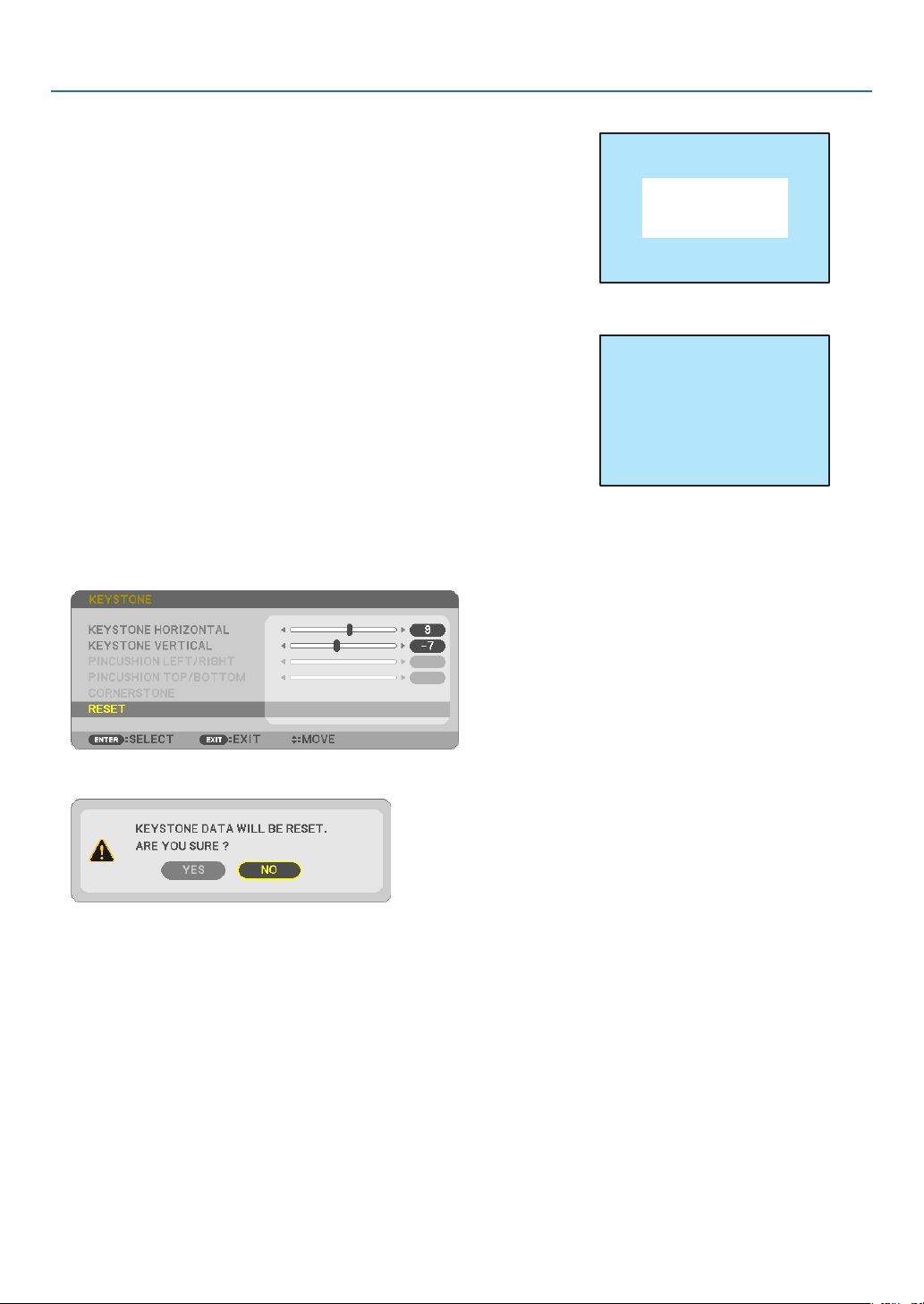
4. Press the ▲buttontoselect[KEYSTONEHORIZONTAL]andthen
use the ◀ or ▶ so that the top and bottom sides of the projected
image are parallel.
• Adjustthehorizontalkeystonedistortion.
5. Repeat steps 2 and 4 to correct keystone distortion.
6. AftercompletingKeystonecorrection,presstheEXITbutton.
The Keystone screen will disappear.
• ToperformKeystonecorrectionagain,pressthe▼ button to display
the Keystone screen and repeat above steps 1 to 6.
Toreturnthekeystoneadjustmentstodefault:
1. Press the ▼buttontoselect[RESET]andpresstheENTERbutton.
2. Press the ◀ or ▶buttontoselect[YES]andpresstheENTERbutton.
The adjustments will be reset.
All the adjustments for all the five items will be reset at the same time.
• TheKEYSTONEfeaturecancauseanimagetobeslightlyblurredbecausethecorrectionismadeelectronically.
24
2. Projecting an Image (Basic Operation)
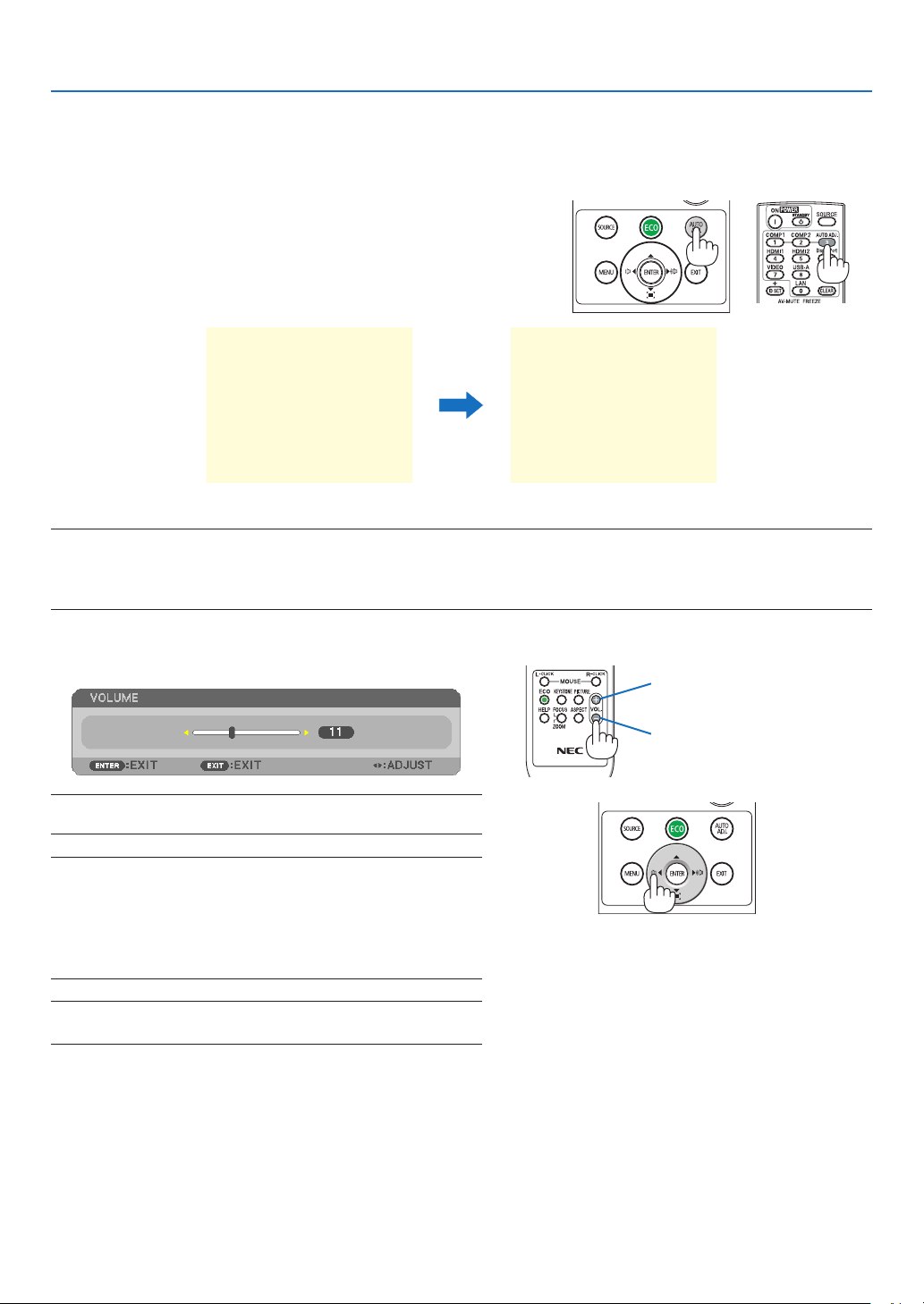
❼ Optimizing Computer Signal Automatically
Adjusting the Image Using Auto Adjust
Optimizingacomputerimageautomatically.(COMPUTER)
PresstheAUTOADJ.buttontooptimizeacomputerimageautomatically.
This adjustment may be necessary when you connect your computer
forthefirs time.
[Poor picture] [Adjusted picture]
NOTE:
Somesignalsmaytaketimetodisplayormaynotbedisplayedcorrectly.
• IftheAutoAdjustoperationcannotoptimizethecomputersignal,trytoadjust[HORIZONTAL],[VERTICAL],[CLOCK],and[PHASE]manually.
(→
page60,61
)
❽ Turning Up or Down Volume
Soundlevelfromthespeakeroraudiooutputcanbeadjusted.
TIP:Whennomenusappear,the◀and▶buttonsontheprojectorcabinet
workasavolumecontrol.
NOTE:
• Volumecontrolisnotavailablewiththe◀or▶buttonwhenanimage
is magnied byusing the D-ZOOM (+) button or whenthe menu is
displayed.
• Volumecontrolisnotavailablewiththe◀or▶buttonwhenVIEWER
isused.
TIP:The[BEEP]soundvolumecannotbeadjusted.Toturnoffthe[BEEP]
sound,fromthemenu,select[SETUP]→[OPTIONS(1)]→[BEEP]→[OFF].
Increasevolume
Decrease volume
25
2. Projecting an Image (Basic Operation)
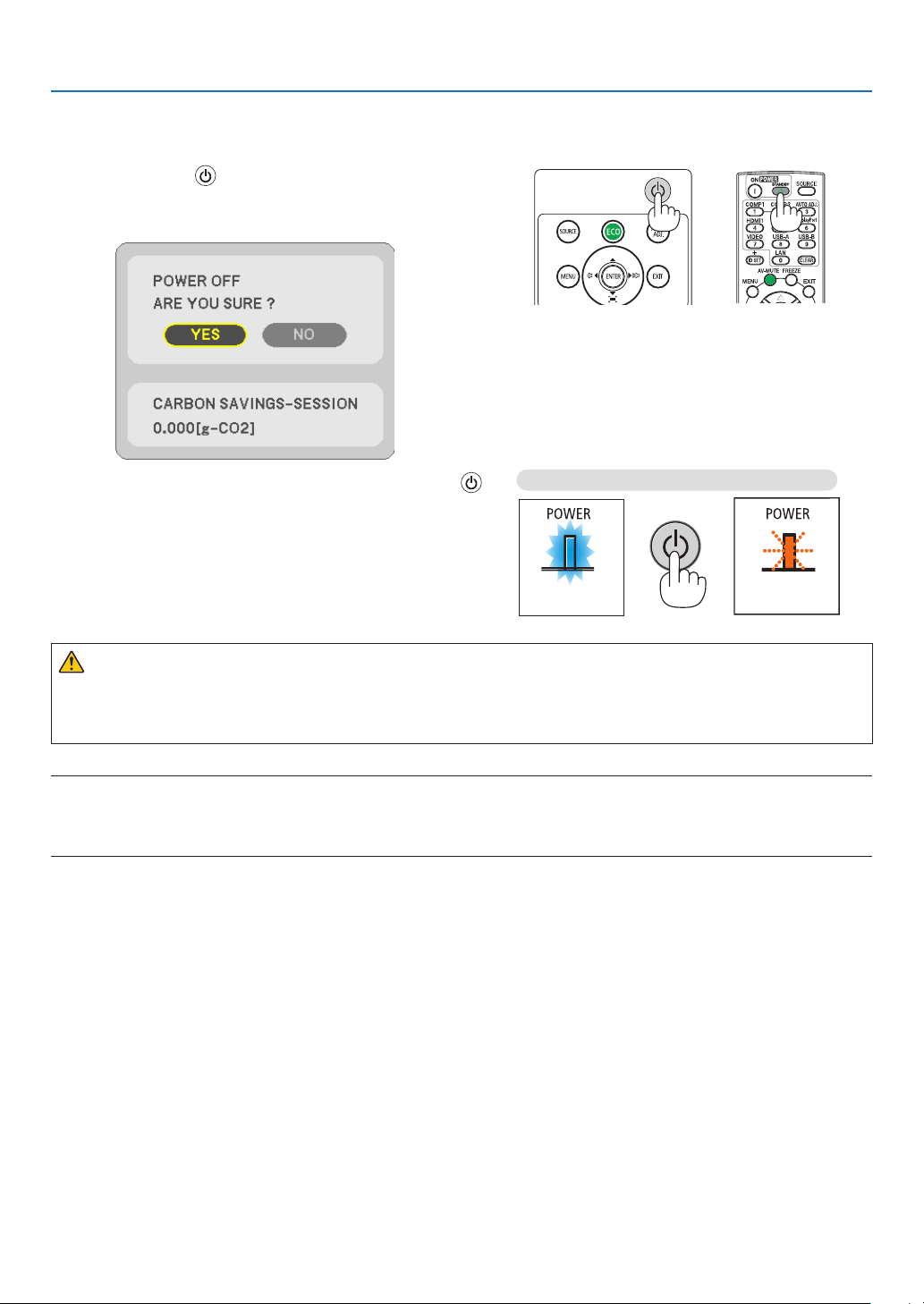
❾ Turning off the Projector
Toturnofftheprojector:
1. First, press the (POWER) button on the projector
cabinet or the STANDBY button on the remote control.
The confirmation message will be displayed.
2. Secondly, press the ENTER button or press the
(POWER) or the STANDBY button again.
The
light
will turn off and the projector will go into standby
mode. When in standby mode, the POWER indicator will
blinking orange and the STATUS indicator will turn off when
[NORMAL] is selected for [STANDBY MODE].
Power On Standby
CAUTION:
PartsoftheprojectormaybecometemporarilyheatediftheprojectoristurnedoffwiththePOWERbuttonorif
theACpowersupplyisdisconnectedduringnormalprojectoroperation.
Usecautionwhenpickinguptheprojector.
NOTE:
• Whilethepowerindicatorisblinkingblueinshortcycles,thepowercannotbeturnedoff.
• DonotdisconnecttheACpowersupplytotheprojectorwithin10secondsaftermakingadjustmentorsettingchangesandclosingthe
menu.Doingsocancauselossofadjustmentsandsettings.
Steady blue light
Blinking orange
light
❿ When Moving the Projector
Preparation:Makesurethattheprojectoristurnedoff.
1.
2.
Unplug the power cord.
Disconnect any other cables.
•
RemovetheUSBmemoryifitisinsertedintotheprojector.
(→
page
4
7)

26
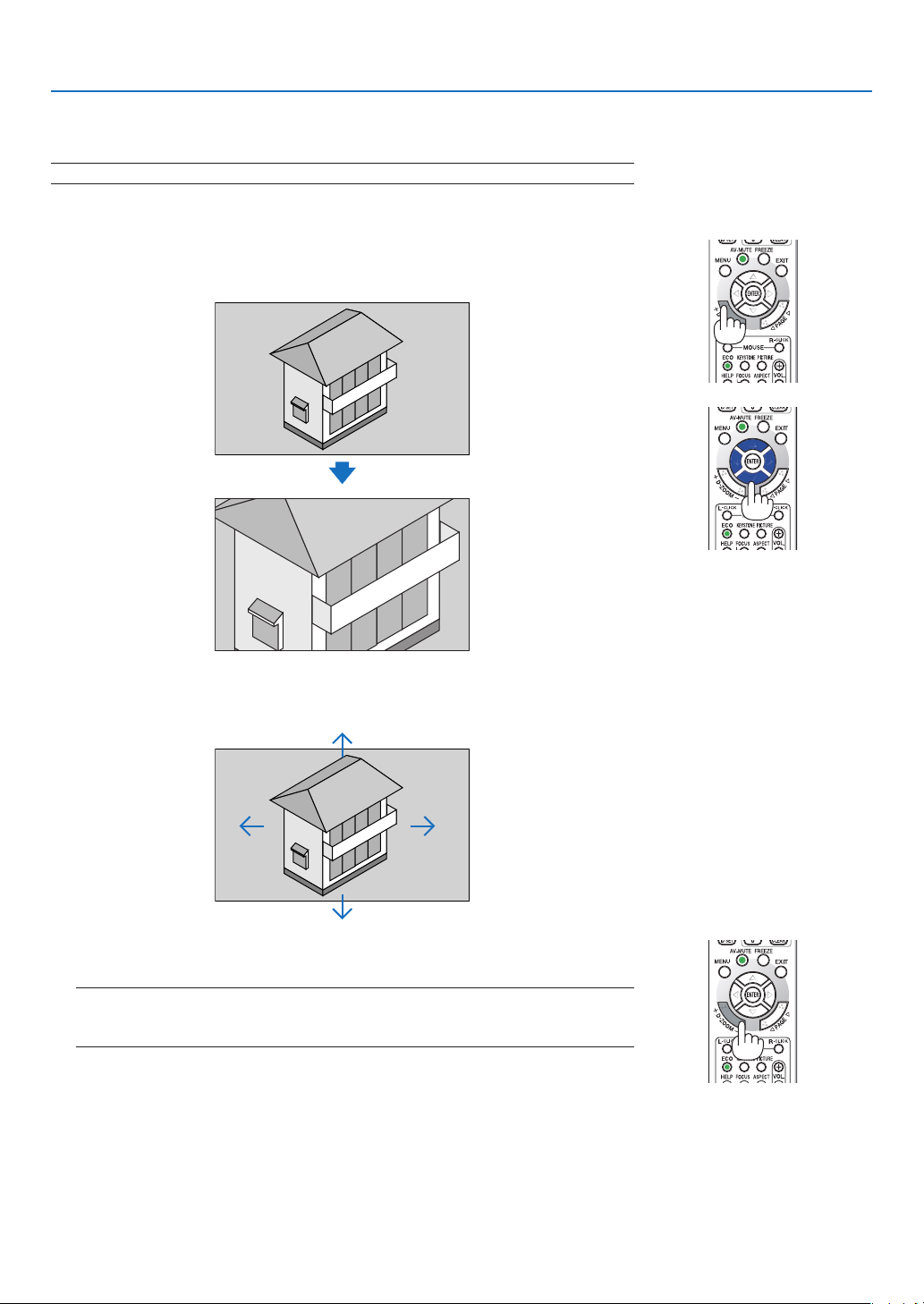
❶ Turning off the Image and Sound
PresstheAV-MUTEbuttontoturnofftheimageandsoundforashortperiodof
time.Pressagaintorestoretheimageandsound.
The projector’s power-saving function will work10 seconds after the image is
turned off.
Asaresult,thelightpowerwillbereduced.
NOTE:
• Eventhoughtheimageisturnedoff,themenustillremainsonthescreen.
• SoundfromtheAUDIOOUTjack(Stereomini)canbeturnedoff.
•
Evenwhenthepower-savingfunctionworks,the
light
powermayberestoredtoitsoriginallevel
temporarily.
❷ Freezing a Picture
PresstheFREEZEbuttontofreezeapicture.Pressagaintoresumemotion.
NOTE:Theimageisfrozenbuttheoriginalvideoisstillplayingback.
• ThisfeaturecannotbeusedwhenUSB-Aisselectedastheinputterminal.
3. Convenient Features
27
3. Convenient Features
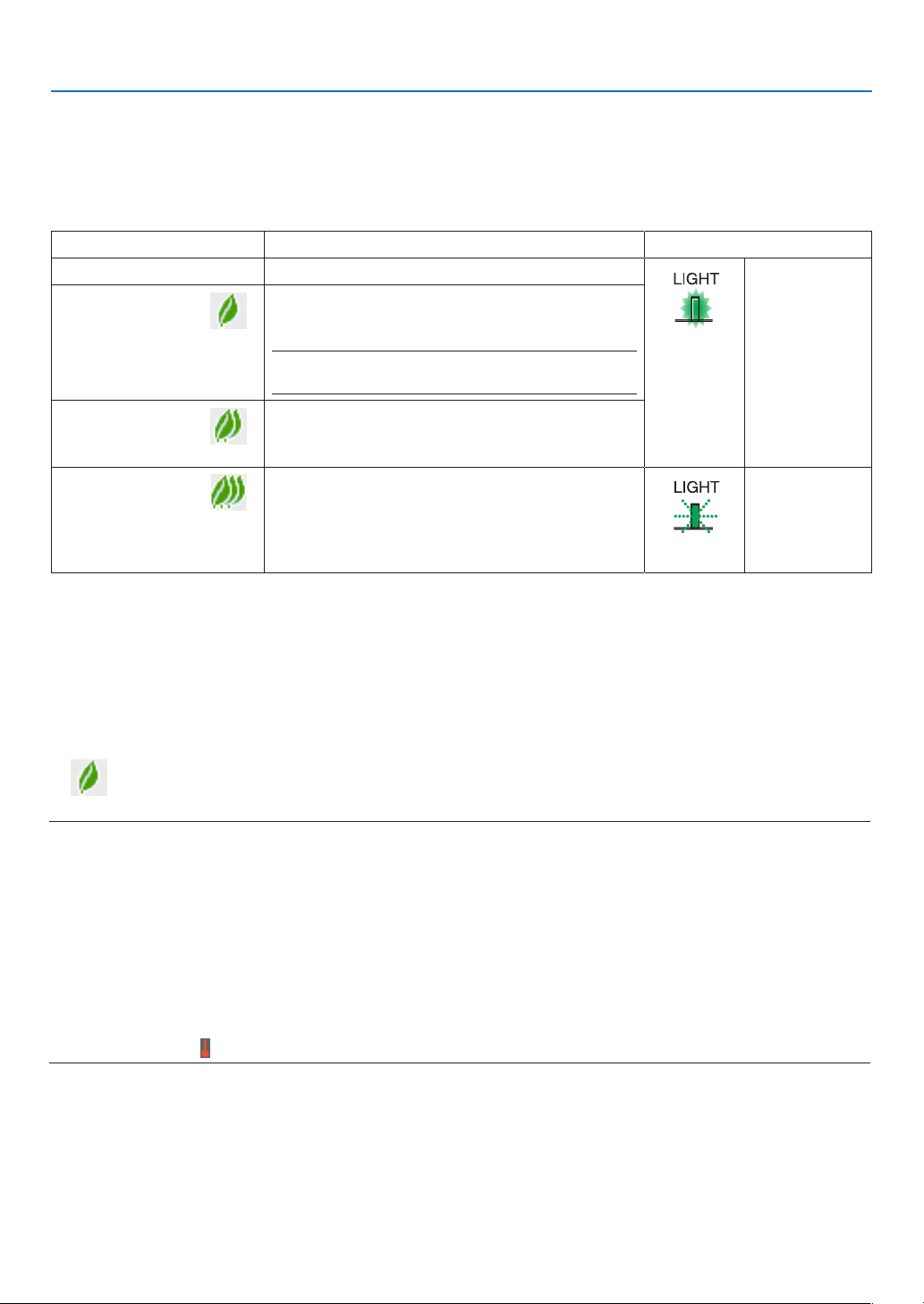
2. Press the ▲▼◀▶ button.
The area of the magnified image will be moved.
3. PresstheD-ZOOM(−)button.
Each time the D-ZOOM (−) button is pressed, the image is reduced.
NOTE:
• Theimagewillbemagniedordemagniedatthecenterofthescreen.
• Displayingthemenuwillcancelthecurrentmagnication.
❸ Magnifying a Picture
Youcanenlargethepictureuptofourtimes.
NOTE:Themaximummagnificationmaybelessthanfourtimesdependingonthesignal.
To do so:
1. PresstheD-ZOOM(+)buttontomagnifythepicture.
To move the magnified image, use the ▲,▼,◀ or ▶ button.
28
3. Convenient Features
❹ Changing Eco Mode/Checking Energy-Saving Effect
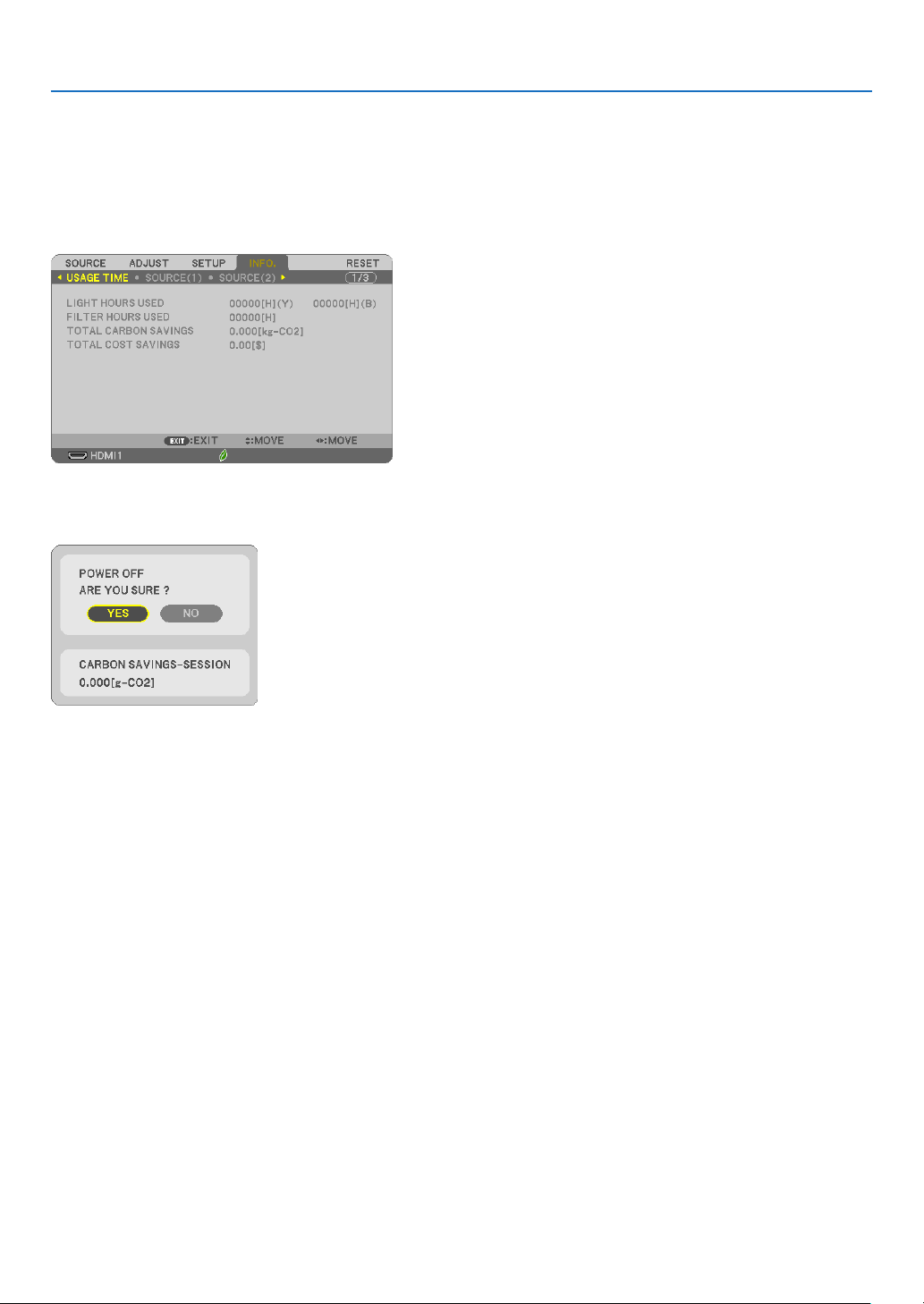
Using Eco Mode [ECO MODE]
The ECO MODE (NORMAL and ECO) increases light life, while lowering power consumption and cutting down on
CO
2
emissions.
Fourbrightness modes of the light can be selected: [OFF], [AUTO ECO], [NORMAL] and [ECO] modes.
[ECOMODE] Description
StatusofLIGHTindicator
[OFF]
Thelightbrightnessis100%.
SteadyGreen
light
[AUTOECO]
Lightpowerconsumptionwillbechanged
between[100%]and[80%]automatically
accordingtopicture level
NOTE:A bright gradation may be less visible depending on
theimage.
[NORMAL]
Light power consumption: approx. 80% brightne-
ss.The light life will extend by lowering the light
power.
[ECO]
Lig
h
tpowerconsumption:approx.50%
b
ri
g
h
tness.The
lightlife
willextendlongerthan
the
oneonNORMALmodebycontrollingpower
appropriateforthelight.Themaximumpowerbe-
comesequivalenttothepower in NORMAL.
BlinkingGreen
light
Toturn on the [ECO MODE], do the following:
1. PresstheECOButtonontheremotecontroltodisplay[ECOMODE]screen.
2. PresstheECObuttonagaintoselectamodeyouwish.
• EachtimetheECObuttonispressed,thechoiceswillbechanged:
OFF → AUTO ECO → NORMAL → ECO → OFF
TIP:
• TheleafsymbolatthebottomofthemenushowsthecurrentselectionofECOmode.
NOTE:
• The[ECOMODE]canbechangedbyusingthemenu.
Select[SETUP]→
[GENERAL]
→ [LIGHT MODE]
→[ECOMODE].
•
Thel
ight
hoursusedcanbecheckedin[USAGETIME].Select[INFO.]→ [USAGETIME].
•
Theprojectorisalwaysin[NORMAL]for
1
0secondsafterthel
ight
isturnedon.Thel
ight
conditionwillnotbeaffectedevenwhen
[ECOMODE]ischanged.
• Afteralapseof1minutefromwhentheprojectordisplaysno-signalguidance,ablue,blackorlogoscreen,[ECOMODE]willautomatically
switchto[ECO].Theprojectorwillreturntoitsoriginalsettingonceasignalisaccepted.
• Iftheprojectorisoverheatedin[OFF]mode,theremaybeacasewherethe[ECOMODE]automaticallychangesto[NORMAL]modeto
protecttheprojector.Whentheprojectorisin[NORMAL]mode,thepicturebrightnessdecreases.Whentheprojectorcomesbacktonormal
temperature,the[ECOMODE]returnstoitsoriginalsetting.
Thermometersymbol[
]indicatesthe[ECOMODE]isautomaticallysetto[NORMAL]modebecausetheinternaltemperatureistoohigh.
29
3. Convenient Features
Checking Energy-Saving Effect [CARBON METER]
Thisfeaturewillshowenergy-savingeffectintermsofCO
2
emissionreduction(kg)whentheprojector’s[ECOMODE]
issetto[AUTOECO],[NORMAL],or[ECO].Thisfeatureiscalledas[CARBONMETER].
Therearetwomessages:[TOTALCARBONSAVINGS]and[CARBONSAVINGS-SESSION].The[TOTALCARBON
SAVINGS]messageshowsthetotalamountofCO
2
emissionreductionfromthetimeofshipmentuptonow.You
canchecktheinformationon[USAGETIME]from[INFO.]ofthemenu.(→page77)
The[CARBONSAVINGS-SESSION]messageshowstheamountofCO
2
emission reduction between the time of
changingtoECOMODEimmediatelyafterthetimeofpower-onandthetimeofpower-off.The[CARBONSAVINGS-
SESSION]messagewillbedisplayedinthe[POWEROFF/AREYOUSURE?]messageatthetimeofpower-off.
TIP:
• The
formulaasshownbelowisusedtocalculatetheamountofCO
2
emissionreduction.
AmountofCO
2
emissionreduction=(PowerconsumptioninOFFforECOMODE−PowerconsumptioninAUTOECO/NORMAL/ECOfor
ECOMODE)×CO
2
conversionfactor.*WhentheimageisturnedoffwiththeAV-MUTEbutton,theamountofCO
2
emmissionreduction
willalsoincrease.
* CalculationforamountofCO
2
emissionreductionisbasedonanOECDpublication“CO
2
EmissionsfromFuelCombustion,2008Edition”.
• The[TOTALCARBONSAVINGS]iscalculatedbasedonsavingsrecordedin15minutesintervals.
• Thisformulawillnotapplytothepowerconsumptionwhichisnotaffectedbywhether[ECOMODE]isturnedonoroff.
30
3. Convenient Features
❺ Using 4-Point Corner to Correct Keystone Distortion
[CORNERSTONE]
Usethe[CORNERSTONE]and[PINCUSHION]featurestocorrectkeystone(trapezoidal)distortiontomakethetop
orbottomandtheleftorrightsideofthescreenlongerorshortersothattheprojectedimageisrectangular.
Before performing correction
TheKEYSTONEcorrectionhasfeatures,KEYSTONE(HORIZONTAL/VERTICAL),PINCUSHION,andCORNERSTONE.
Ifthevalueof either CONERSTONE orPINCUSHIONhascorrected,KEYSTONEHORIZONTALandKEYSTONE
VERTICALaredisabled.Inthiscase,RESETthecorrectedvaluesandrestarttocorrectdistortion.
Cornerstone
1.
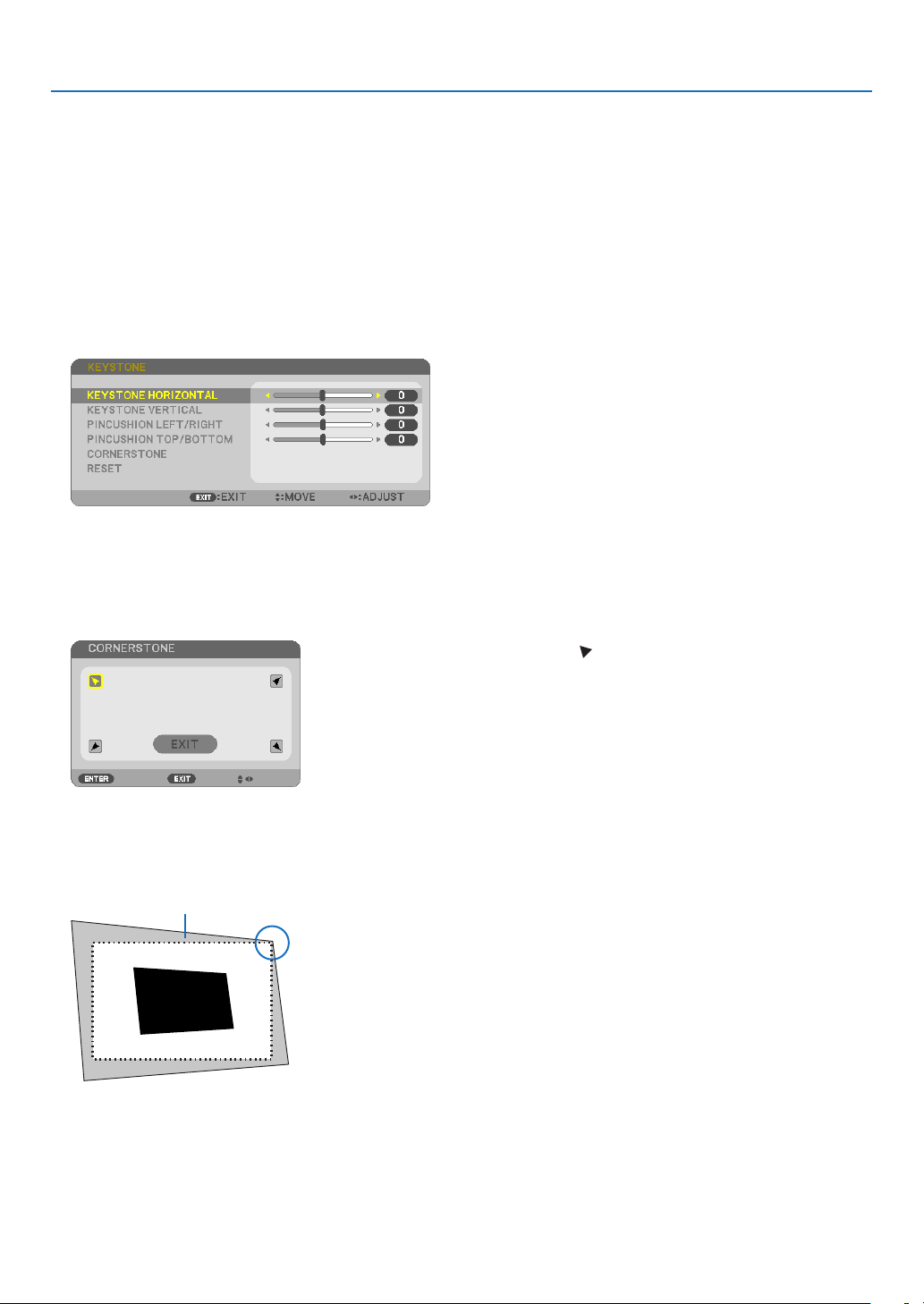
PresstheKEYSTONEbuttonwithnomenudisplayed.
The KEYSTONE screen will be displayed.
• PresstheKEYSTONEbuttonwhenusingtheremotecontrol.
• SeepageforPINCUSHION.
2.
Press the ▼buttontoselect[CORNERSTONE]andpresstheENTERbutton.
The drawing shows the upper left icon ( ) is selected.
The CORNERSTONE screen will be displayed.
3.
Project an image so that the screen is smaller than the area of the raster.
4.
Pick up any one of the corners and align the corner of the image with a corner of the screen.
Projected image
The drawing shows the upper right corner.
31
3. Convenient Features
TIP:IfeitherCORNERSTONEorPINCUSIONisadjusted,theoptionsKEYSTONEVERTICALandKEYSTONEHORIZONTALbecomeunavailable.
Inthiscase,RESETthecorrectedvaluesandrestarttocorrectdistortion.
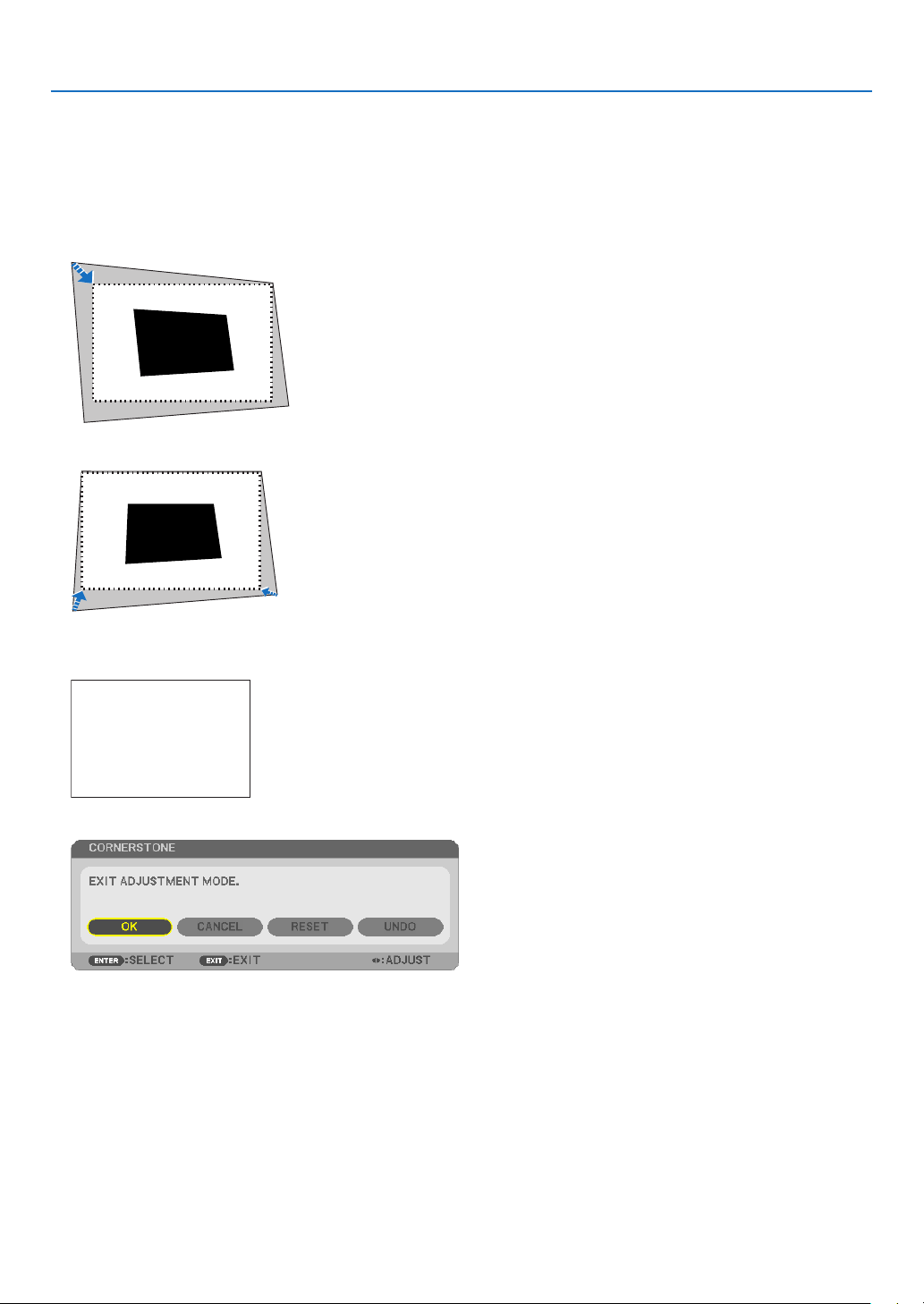
5. Use the ▲▼◀▶ button to select one icon (▲) which points in the direction you wish to move the projected
image frame.
6. Press the ENTER button.
7. Use the ▲▼◀▶ button to move the projected image frame as shown on the example.
8. Press the ENTER button.
9. Use the ▲▼◀▶ button to select another icon which points in the direction.
OntheCornerstoneadjustmentscreen,select[EXIT]orpresstheEXITbuttonontheremotecontrol.
The confirmation screen is displayed.
10
. Press the ◀ or ▶buttontohighlightthe[OK]andpresstheENTERbutton.
ThiscompletestheCornerstonecorrection.
Selecting[CANCEL]willreturntotheadjustmentscreenwithoutsavingchanges(Step3).
Selecting[RESET]willreturntothefactorydefault.
Selecting[UNDO]willexitwithoutsavingchanges.
32
3. Convenient Features
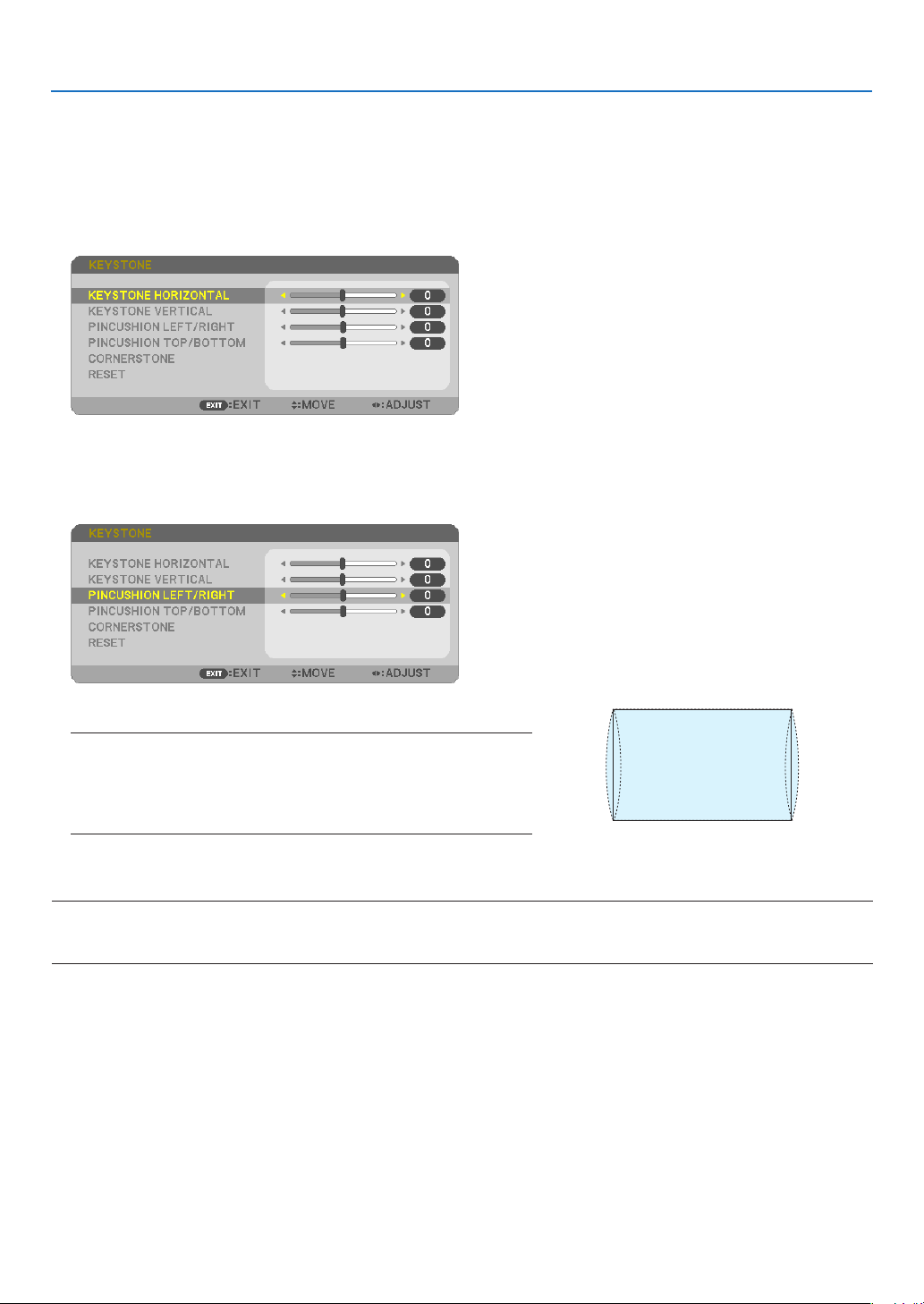
Pincushion
Bythisfeature,itenablestoadjustleftandrightsideortopandbottomsideindependentlyforreformingpincushion
distortion.
1. PresstheKEYSTONEbuttonwithnomenudisplayed.
The KEYSTONE screen will be displayed.
• PresstheKEYSTONEbuttonwhenusingtheremotecontrol.
2. Press the ▼ or ▲buttontoselect[PINCUSHIONLEFT/RIGHT]
or[PINCUSHIONTOP/BOTTOM].
3. Press the ◀ or ▶ button to correct distortion.
NOTE:
• The[PINCUSHIONLEFT/RIGHT]or[PINCUSHIONTOP/BOTTOM]itemisnot
availablewhen[KEYSTONEHORIZONTAL],[KEYSTONEVERTICAL]or[COR-
NERSTONE]isactivated.
• Beforeperformingcorrection,setthelensshifttothecenterposition.
4. PresstheEXITwhenPINCUSHIONadjustmentiscompleted.
NOTE:
• Evenwhentheprojectoristurnedon,thelastusedcorrectionvaluesareapplied.
• [PINCUSHION]and[CORNERSTONE]correctionscancausetheimagetobeslightlyblurredbecausethecorrectionismadeelectronically.
33
3. Convenient Features
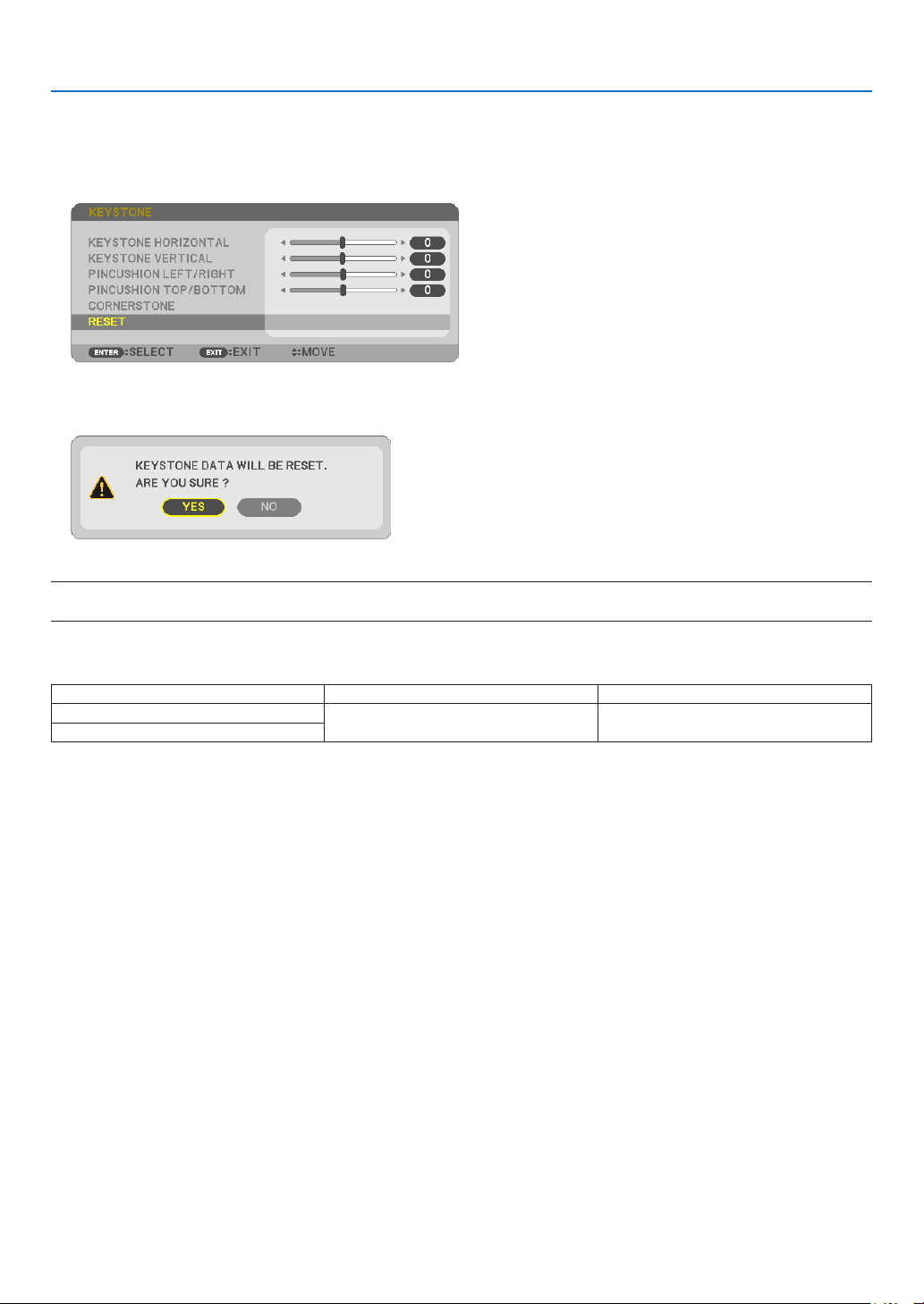
Resetthekeystoneandpincushionadjustmenttothedefaultvalue
1. PresstheKEYSTONEbuttonwithnomenudisplayed.
ON the displayed KEYSTONE menu, set the cursor at RESET using the ▼ button and press ENTER button.
• Conrmationmessageisdisplayedon.
2. Move the cursor onto YES using either ◀ or ▶ button and then press the ENTER.
NOTE:
• AlladjustedvaluessetintheKEYSTONEadjustmentareresettoinitialvalues.
TIP:
AdjustablerangeoftheKEYSTONEandtheCORNERSTONE:
HorizontalDirection VerticalDirection
CORNERSTONE
Approx.±
1
0°(Max)
Approx.±
1
0°(Max)
KEYSTONE
Adjustablerangemaybenarrowerdependingoninputsignal.
34
3. Convenient Features
❻
Preventing the Unauthorized Use of the Projector [SECURITY]
AkeywordcanbesetforyourprojectorusingtheMenutoavoidoperationbyanunauthorizeduser.Whenakey-
wordisset,turningontheprojectorwilldisplaytheKeywordinputscreen.Unlessthecorrectkeywordisentered,
theprojectorcannotprojectanimage.
• The[SECURITY]settingcannotbecancelledbyusingthe[RESET]ofthemenu.
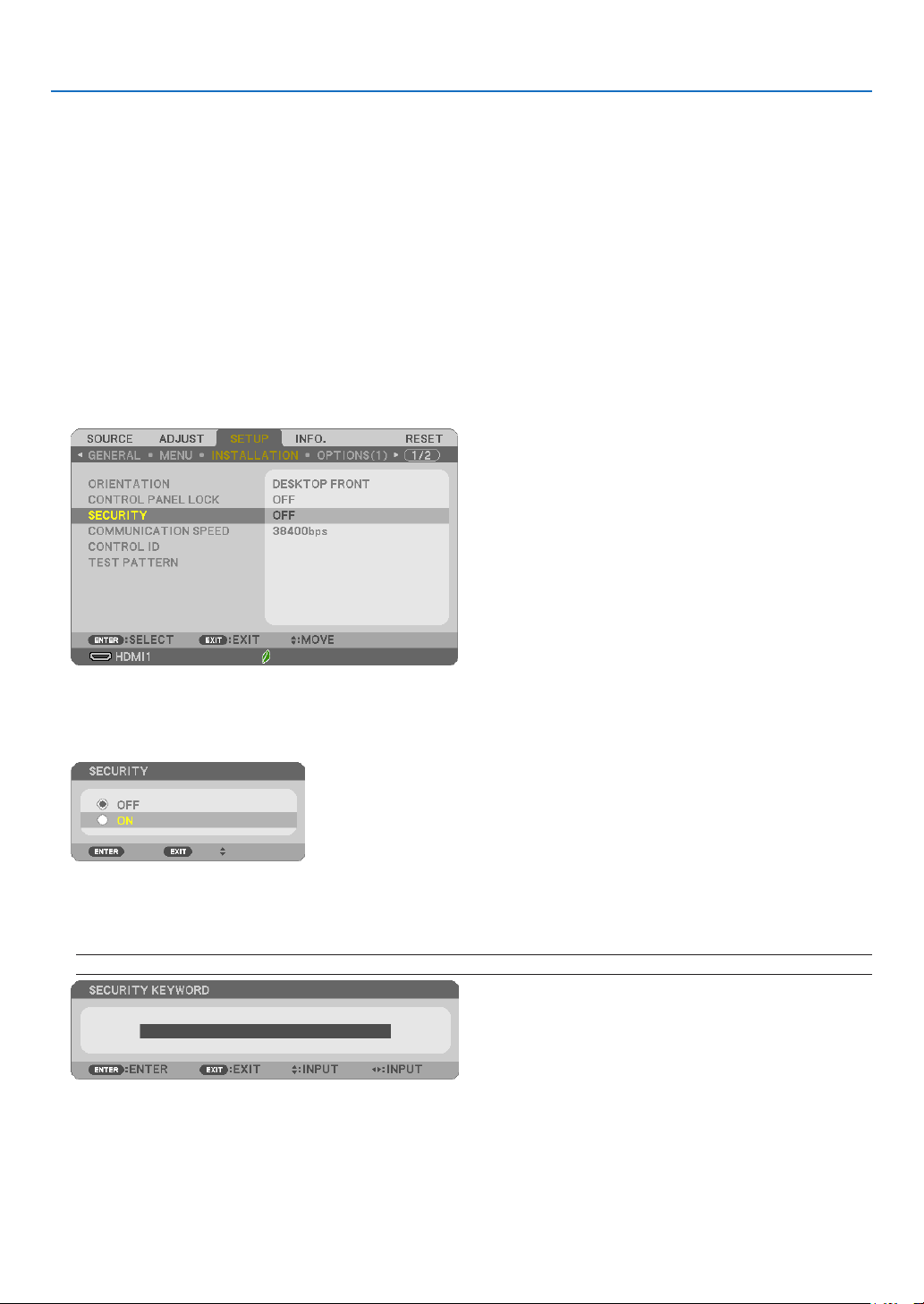
To enable the Security function:
1. Press the MENU button.
The menu will be displayed.
2. Press the ▶buttontwicetoselect[SETUP]andpressthe▼buttonortheENTERbuttontoselect[GEN-
ERAL].
3. Press the ▶buttontoselect[INSTALLATION].
4. Press the ▼buttonthreetimestoselect[SECURITY]andpresstheENTERbutton.
The OFF/ON menu will be displayed.
5. Press the ▼buttontoselect[ON]andpresstheENTERbutton.
The[SECURITYKEYWORD]screenwillbedisplayed.
6. Type in a combination of the four ▲▼◀▶ buttons and press the ENTER button.
NOTE:Akeywordmustbe4to10digitsinlength.
The[CONFIRMKEYWORD]screenwillbedisplayed.
35
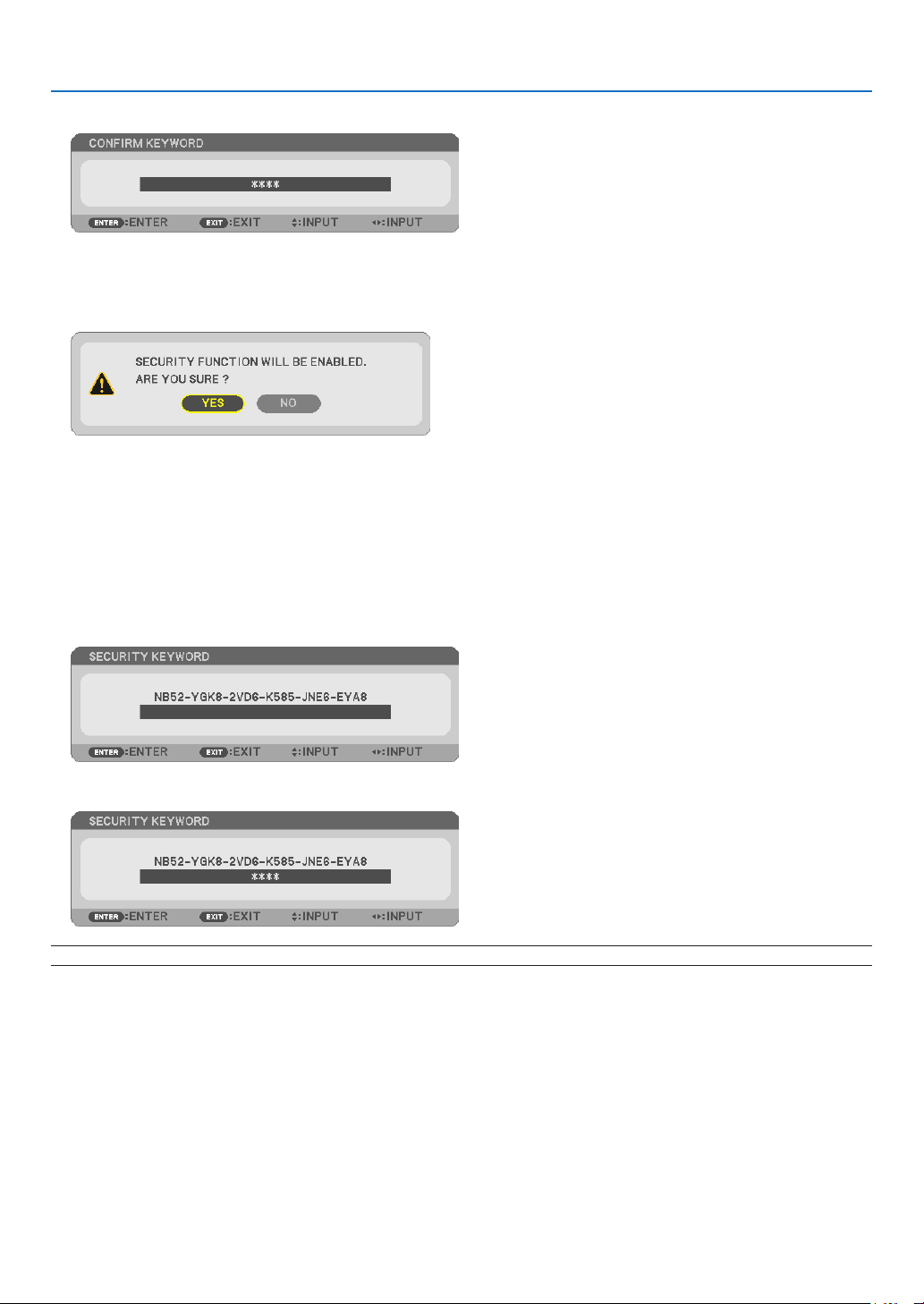
3. Convenient Features
7. Type in the same combination of ▲▼◀▶ buttons and press the ENTER button.
The confirmation screen will be displayed.
8. Select[YES]andpresstheENTERbutton.
TheSECURITYfunctionhasbeenenabled.
Toturnontheprojectorwhen[SECURITY]isenabled:
1. Press the POWER button.
The projector will be turned on and display a message to the effect that the projector is locked.
2. Press the MENU button.
3. Type in the correct keyword and press the ENTER button. The projector will display an image.
NOTE:Thesecuritydisablemodeismaintaineduntilthemainpoweristurnedofforunpluggingthepowercord.
36
3. Convenient Features
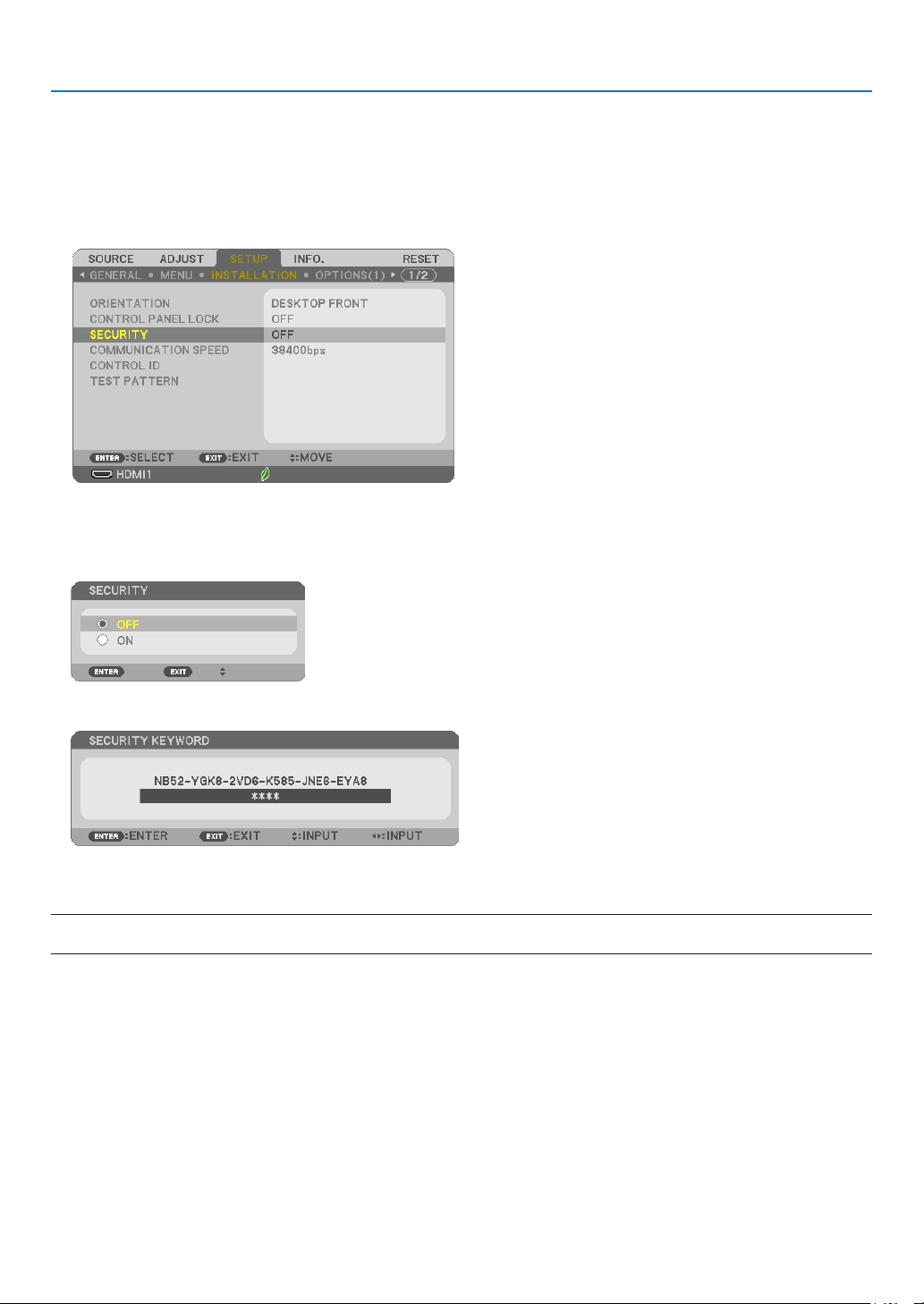
TodisabletheSECURITYfunction:
1. Press the MENU button.
The menu will be displayed.
2. Select[SETUP]→[INSTALLATION]→[SECURITY]andpresstheENTERbutton.
The OFF/ON menu will be displayed.
3. Select[OFF]andpresstheENTERbutton.
TheSECURITYKEYWORDscreenwillbedisplayed.
4. Type in your keyword and press the ENTER button.
Whenthecorrectkeywordisentered,theSECURITYfunctionwillbedisabled.
NOTE:Ifyouforgetyourkeyword,contactyourdealer.Yourdealerwillprovideyouwithyourkeywordinexchangeforyourrequestcode.
YourrequestcodeisdisplayedintheKeywordConrmationscreen.Inthisexample[NB52-YGK8-2VD6-K585-JNE6-EYA8]isarequestcode.

37
3. Convenient Features
❼ Controlling the Projector by Using an HTTP Browser
Overview
TheHTTPServerfunctionprovidessettingsandoperationsfor:
1.
Settingforwirednetwork(NETWORKSETTINGS)
To use wired LAN connection, connect the projector to the computer with a commercially available
LAN
cable. (
→
page 9
2
)
2.
Setting Alert Mail (ALERT MAIL)
When the projector is connected to a wired network,
light
replace time or error messages will be sent via e-
mail.
3. Operating the projector
Power on/off, selecting input, volume control and picture adjustments are possible.
4.
SettingPJLinkPASSWORDand AMXBEACON
HowtoaccesstotheHTTPserver:
• StarttheWebbrowseronthecomputerviathenetworkconnectedtotheprojectorandenterthefollowing
URL :
http://<the projector’s IP address> /index.html
TIP:ThefactorysettingIPaddressis[DHCPON].
NOTE:
• Tousetheprojectorinanetwork,consultwithyournetworkadministratoraboutnetworksettings.
• Thedisplay’sorbutton’sresponsecanbesloweddownoroperationmaynotbeaccepteddependingthesettingsofyournetwork.
Shouldthishappen,consultyournetworkadministrator.Theprojectormaynotrespondifitsbuttonsarerepeatedlypressedinrapid
intervals.Shouldthishappen,waitamomentandrepeat.Ifyoustillcan’tgetanyresponse,turnoffandbackontheprojector.
• IfthePROJECTORNETWORKSETTINGSscreendoesnotappearinthewebbrowser,presstheCtrl+F5keystorefreshyourwebbrowser
(orclearthecache).
• Thisdevice uses“JavaScript”and“Cookies”andthe browsershouldbe settoacceptthesefunctions.Thesettingmethod willvary
dependingontheversionofbrowser.Pleaserefertothehelplesandtheotherinformationprovidedinyoursoftware.
Preparation before Use
ConnecttheprojectortoacommerciallyavailableLANcablebeforeengaginginbrowseroperations.(→page93)
Operationwithabrowserthatusesaproxyservermaynotbepossibledependingonthetypeofproxyserverand
thesettingmethod.Althoughthetypeofproxyserverwillbeafactor,itispossiblethatitemsthathaveactually
beensetwillnotbedisplayeddependingontheeffectivenessofthecache,andthecontentssetfromthebrowser
maynotbereflecteinoperation.Itisrecommendedthataproxyservernotbeusedunlessitisunavoidable.

38
3. Convenient Features
Handling of the Address for Operation via a Browser
RegardingtheactualaddressthatisenteredfortheaddressorenteredtotheURLcolumnwhenoperationofthe
projectorisviaabrowser,thehostnamecanbeusedasitiswhenthehostnamecorrespondingtotheIPaddress
oftheprojectorhasbeenregisteredtothedomainnameserverbyanetworkadministrator,orthehostnamecor-
respondingtotheIPaddressoftheprojectorhasbeensetinthe“HOSTS”fil ofthecomputerbeingused.
Example1:Whenthehostnameoftheprojectorhasbeensetto“pj.nec.co.jp”,accessisgainedtothenet-
worksettingbyspecifying
http://pj.nec.co.jp/index.html
fortheaddressortheentrycolumnoftheURL.
Example2:WhentheIPaddressoftheprojectoris“192.168.73.1”,accessisgainedtothenetworksettingby
specifying
http://192.168.73.1/index.html
fortheaddressortheentrycolumnoftheURL.
PROJECTOR ADJUSTMENT
POWER:Thiscontrolsthepoweroftheprojector.
ON ���������������������������Power is switched on�
OFF �������������������������� Power is switched off�
VOLUME:Thiscontrolsthevolumeoftheprojector.
▲�����������������������������Increases the volume adjustment value�
▼�����������������������������Decreases the volume adjustment value�
AV-MUTE:Thiscontrolsthemutefunctionoftheprojector.
PICTURE ON �������������Mutes the video�
PICTURE OFF ������������Cancels the video muting�
SOUND ON ���������������Mutes the audio�
SOUND OFF ��������������Cancels the audio muting�
ALL ON ���������������������Mutes each of the video, and audio functions�
ALL OFF �������������������Cancels the muting of each of the video, and audio functions�

39
3. Convenient Features
PICTURE:Controlsthevideoadjustmentoftheprojector.
CONTRAST ▲�����������Increases the contrast adjustment value�
CONTRAST ▼�����������Decreases the contrast adjustment value�
BRIGHTNESS ▲��������Increases the brightness adjustment value�
BRIGHTNESS ▼��������Decreases the brightness adjustment value�
SHARPNESS ▲���������Increases the sharpness adjustment value�
SHARPNESS ▼���������Decreases the sharpness adjustment value�
COLOR ▲ �����������������Increases the color adjustment value�
COLOR ▼ �����������������Decreases the color adjustment value�
HUE ▲ ���������������������Increases the hue adjustment value�
HUE ▼ ���������������������Decreases the hue adjustment value�
•
Thefunctionsthatcanbecontrolledwillvarydependingonthesignalbeinginputtotheprojector.(→ page
59)
SOURCESELECT:Thisswitchestheinputterminaloftheprojector.
HDMI1 ����������������������Switches to the HDMI 1 IN terminal
HDMI2 ����������������������Switches to the HDMI 2 IN terminal�
COMPUTER ��������������Switches to the COMPUTER IN terminal�
VIDEO �����������������������Switches to the VIDEO IN terminal�
USB-A ���������������������� Switches to the data on the USB memory device�
PROJECTORSTATUS:Thisdisplaystheconditionoftheprojector.
ERROR STATUS ��������������������� Displays the status of errors occurring within the projector�
LOGOFF:Loggingoffyourprojectorandreturningtotheauthenticationscreen(LOGONscreen).
L
A
N
....��������������.�������Switches to the LAN terminal
�
LIGHT( Y) HOURS USED ........
Displays how many hours the light(Y) has been used.
LIGHT( B) HOURS USED ........
Displays how many hours the light(B) has been used.
FILTER HOURS USED ............
Displays how many hours the filter has been used.
40
3. Convenient Features
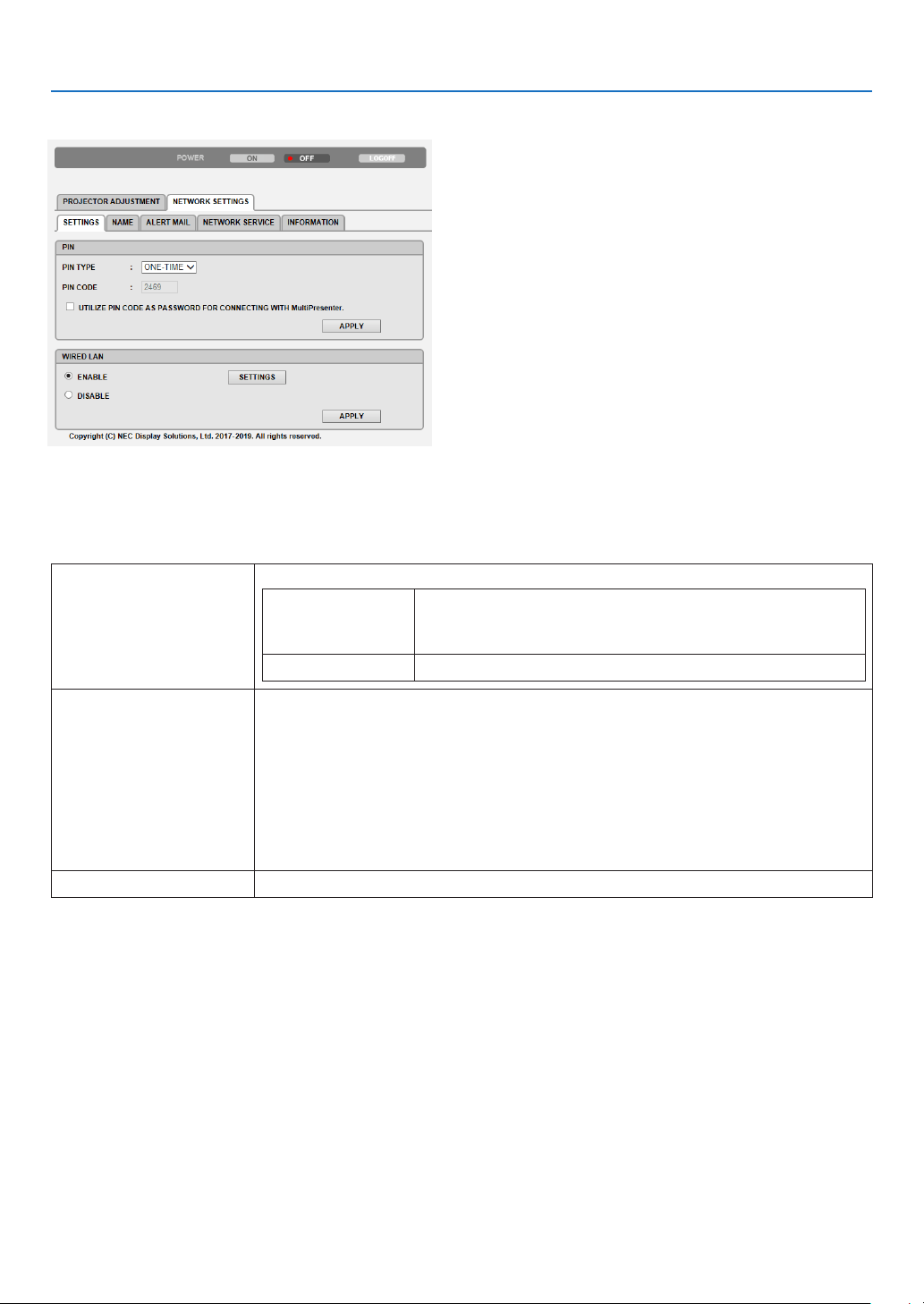
NETWORK SETTINGS
•
SETTINGS
PIN
PINTYPE SelecttypeofPINcode.
ONE-TIME ThePINCODEisautomaticallycreatedeverytimepowering
ONtheprojector.CreatedPINCODEiskeptunchangeduntil
theprojectorispoweredOFF.
STATIC EnablestosetuprandomnumberforthePINCODE.
PINCODE ForthecaseONE-TIMEisselectedasPINTYPE,automaticallycreatedPINCODE
isdisplayedon(disabledtoinput).
ForthecaseSTATICisselectedasPINTYPE,inputrandom4digitsnumberasPIN
CODE.
SelectifyouusethePINCODEasasecuritypasswordforconnectingtotheMulti-
Presenterapplication.ForusingthePINcodeasasecuritypassword,addacheck
markintothesquare.
□ �������������������������� UTILIZE PIN CODE AS PASSWORD FOR CONNECTING WITH MultiPres-
enter�
APPLY MakethesettingsforPINeffective.
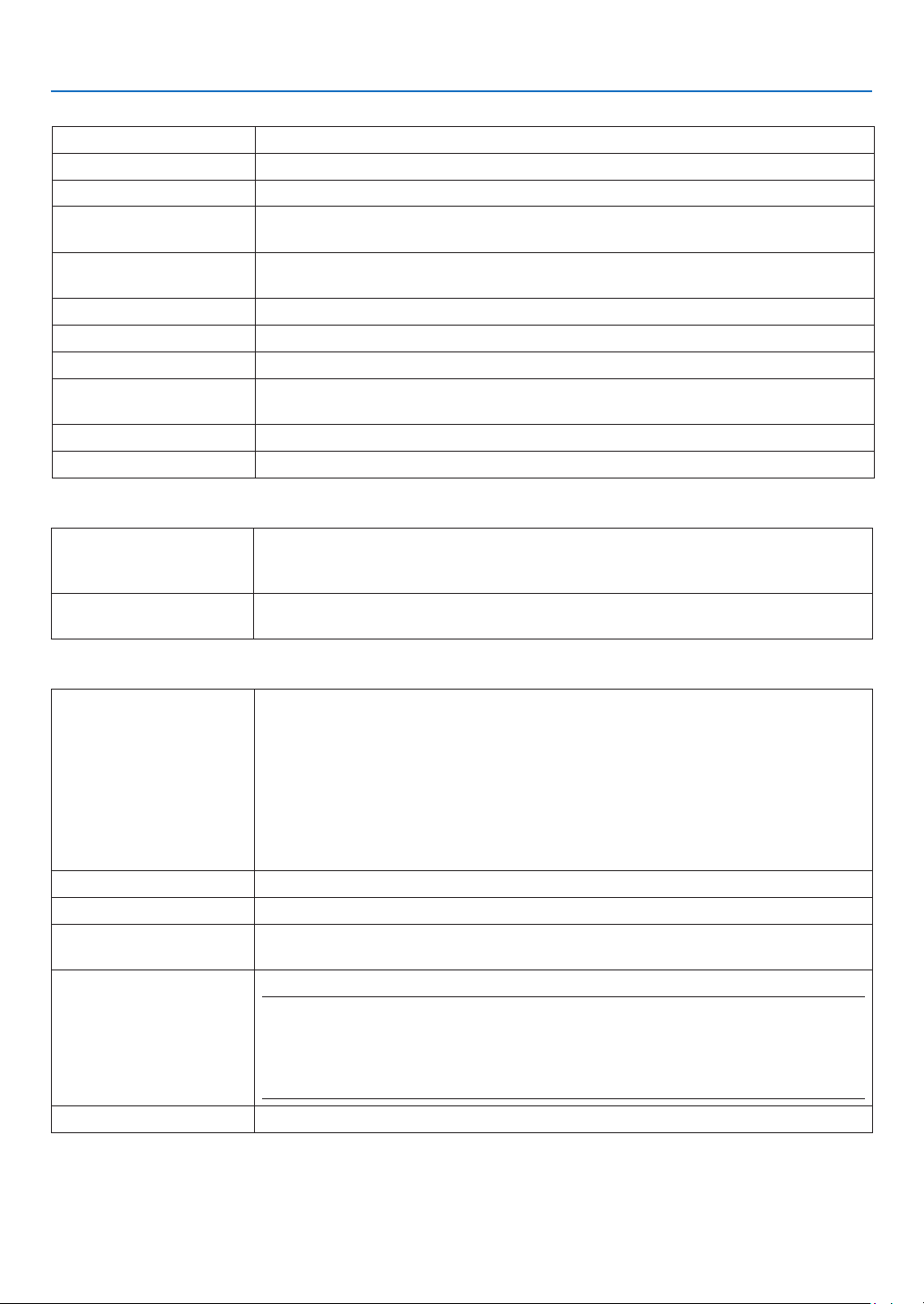
41
3. Convenient Features
WIRED LAN
ENABLE TurnonwiredLANconnection
DISABLE TurnoffwiredLANconnection
SETTING SetforwiredLAN.
DHCPON Automatically IP ADDRESS, SUBNETMASK, and GATEWAY are assigned to the
projectorbyyourDHCPserver.
DHCPOFF SetIPADDRESS,SUBNETMASK,andGATEWAYtotheprojectorassignedbyyour
networkadministrator.
IPADDRESS SetyourIPADDRESSofthenetworkconnectedtotheprojector.
SUBNETMASK SetyourSUBNETMASKnumberofthenetworkconnectedtotheprojector.
GATEWAY SetthedefaultGATEWAYofthenetworkconnectedtotheprojector.
AUTODNSON DHCPserverwillautomaticallyassignIPADDRESSofDNSserverconnectedtothe
projector.
AUTODNSOFF SetyourIPADDRESSofDNSserverconnectedtotheprojector.
APPLY MakethesettingsforwiredLANeffective.
• NAME
PROJECTORNAME Enteranameforyourprojectorsothatyourcomputercanidentifytheprojector.A
projector name must be 16 characters or less.
TIP:Projectornamewillnotbeaffectedevenwhen[RESET]isdonefromthemenu.
HOSTNAME Enterthehostnameofthenetworkconnectedtotheprojector.Ahostnamemustbe
16 or less.
• ALERTMAIL
ALERTMAIL(English
only)
Thisoptionwillnotify
yourcomputeroflightreplacetimeorerrormessagesviae-mail
whenusingwiredLAN.
PlacingacheckmarkwillturnontheAlertMailfeature.
ClearingacheckmarkwillturnofftheAlertMailfeature.
Sampleofamessagetobesentfromtheprojector:
Thelightandfilter
areattheendofitsusablelife.Pleasereplacethelightand
filters.
ProjectorName:NECProjector
LightHoursUsed:100[H]
SENDER’SADDRESS Entersender’saddress.
SMTPSERVERNAME EntertheSMTPservernametobeconnectedtotheprojector.
RECIPIENT’SADDRESS
1,2,3
Enteryourrecipient’saddress.Uptothreeaddressescanbeentered.
TESTMAIL
Sendatestmailtocheckwhetheryoursettingsarecorrectornot
NOTE:
• Ifyouexecuteatest,youmaynotreceiveanAlertmail.Shouldthishappen,checkifnetworksettings
arecorrect.
• Ifyouenteredanincorrectaddressinatest,youmaynotreceiveanAlertmail.Shouldthishappen,
checkiftheRecipient’sAddressiscorrect.
SAVE Clickthisbuttontosavetheabovesettingsontheprojector.

42
3. Convenient Features
• NETWORKSERVICE
PJLinkPASSWORD SetapasswordforPJLink*.Apasswordmustbe32charactersorless.Donotforget
yourpassword.However,ifyouforgetyourpassword,consultwithyourdealer.
HTTPPASSWORD SetapasswordforHTTPserver.Apasswordmustbe10charactersorless.
AMXBEACON TurnonorofffordetectionfromAMXDeviceDiscoverywhenconnectingtothenet-
worksupportedbyAMX’sNetLinxcontrolsystem.
TIP:
WhenusingadevicethatsupportsAMXDeviceDiscovery,allAMXNetLinxcontrolsystemwillrecognize
thedeviceanddownloadtheappropriateDeviceDiscoveryModulefromanAMXserver.
PlacingacheckmarkwillenabledetectingtheprojectorfromAMXDeviceDiscovery.
ClearingacheckmarkwilldisabledetectingtheprojectorfromAMXDeviceDiscovery.
*WhatisPJLink?
PJLinkisastandardizationofprotocolusedforcontrollingprojectorsofdifferentmanufacturers.Thisstandard
protocolisestablishedbyJapanBusinessMachineandInformationSystemIndustriesAssociation(JBMIA)in2005.
TheprojectorsupportsallthecommandsofPJLinkClass1.
SettingofPJLinkwillnotbeaffectedevenwhen[RESET]isdonefromthemenu.
• INFORMATION
WIREDLAN DisplayalistofsettingsofwiredLANconnection.
UPDATE Reflec settingswhentheyarechanged.

43
4. Using the Viewer
❶ What you can do with the Viewer
TheViewerhasthefollowingfeatures.
• WhenacommerciallyavailableUSBmemorythatstoresimagefile isinsertedintotheUSBport(TypeA)ofthe
projector,theViewerallowsyoutoviewtheimagefile ontheUSBmemory.
Evenifnocomputerisavailable,presentationscanbeconductedsimplywiththeprojector.
• SupportedgraphicformatisJPEG.
• TheViewerdisplaysthethumbnailscreen(JPEGExifonly)onwhichyoucanjumptoanyspecifi imageyouwish
to project.
• Therearetwowaysofplaybackforslideshow:manualplaybackandautoplayback.Theintervaltimecanbe
changedinautoplayback.
• Theorderofdisplayingimagescanbesetbyname,dateorsize.Ascendingordescendingordercanbeselected.
• Imagescanberotatedby90degreesduringplayback.

44
4. Using the Viewer
NOTE
• TheUSBportoftheprojectordoesnotsupportUSBhub.
• ThefollowingoperationsbyusingthebuttonsontheprojectorarenotpossiblewhentheVIEWERscreensuchastheslidescreenandthe
thumbnailscreenisdisplayed.
Buttons on the cabinet
- Keystonecorrectionbyusingthe▲ /▼button
- AutoAdjustmentbyusingtheAUTOADJ.button
- Volumecontrolwiththe◀or▶button
ToperformKeystonecorrectionorSourceselectionduringdisplayoftheViewer,presstheMENUbuttontwicetodisplaythemenuand
operateViewerfromthemenu.
Remote control
- AutoAdjustmentbutton
- Freezebutton
• Executing[RESET]→[ALLDATA]fromthemenuwillreturnthesettingsfortheViewertoolbartothefactorydefault.
• USBmemory
- BesuretouseaUSBmemorydeviceformattedwiththeFAT32orFAT16lesystem.
TheprojectordoesnotsupportNTFSformattedUSBmemory.
IftheprojectordoesnotrecognizeyourUSBmemory,checkiftheformatissupported.
ToformatyourUSBmemoryinyourcomputer,refertothedocumentorhelplethatcomeswithyourWindows.
- WedonotwarrantthattheUSBportoftheprojectorwillsupportallUSBmemoriesinthemarket.
• Supportedimages
- SupportedleformatforViewerareasfollows.
WedonotwarrantalltheimagesaresupportedforViewer.
Imagesotherthanmentionedinthetablemaynotbesupported.
Imagetype Extension Description
JPEG JPG/JPEG Baseline/Exifaresupported
- Imagecanbedisplayedataresolutionupto10000×10000pixels.
- Evenifimagesaremetbytheaboveconditions,theremaybesomeimageswhichcannotbeplayedback.
- Morethan200icons(totalnumberofimageleiconsandfoldericons)cannotbedisplayedinathumbnailscreen.
- Longle/foldernamewillbelimitedtothespeciedlength.Thiscanbeshownbybracketadded.
- Ifonefolderhasmanyles,ittakessometimetoplayback.
• Ifasinglefoldercontainstoomanyles,switchingimageswilltaketime.Toshortenswitchingtime,reducethenumberofimagescon-
tainedinasinglefolder.
TIP:
• Exchangeableimageleformat(Exif)isastandardimageleformatusedbydigitalcameraswiththeadditionofspecicshootingdata.
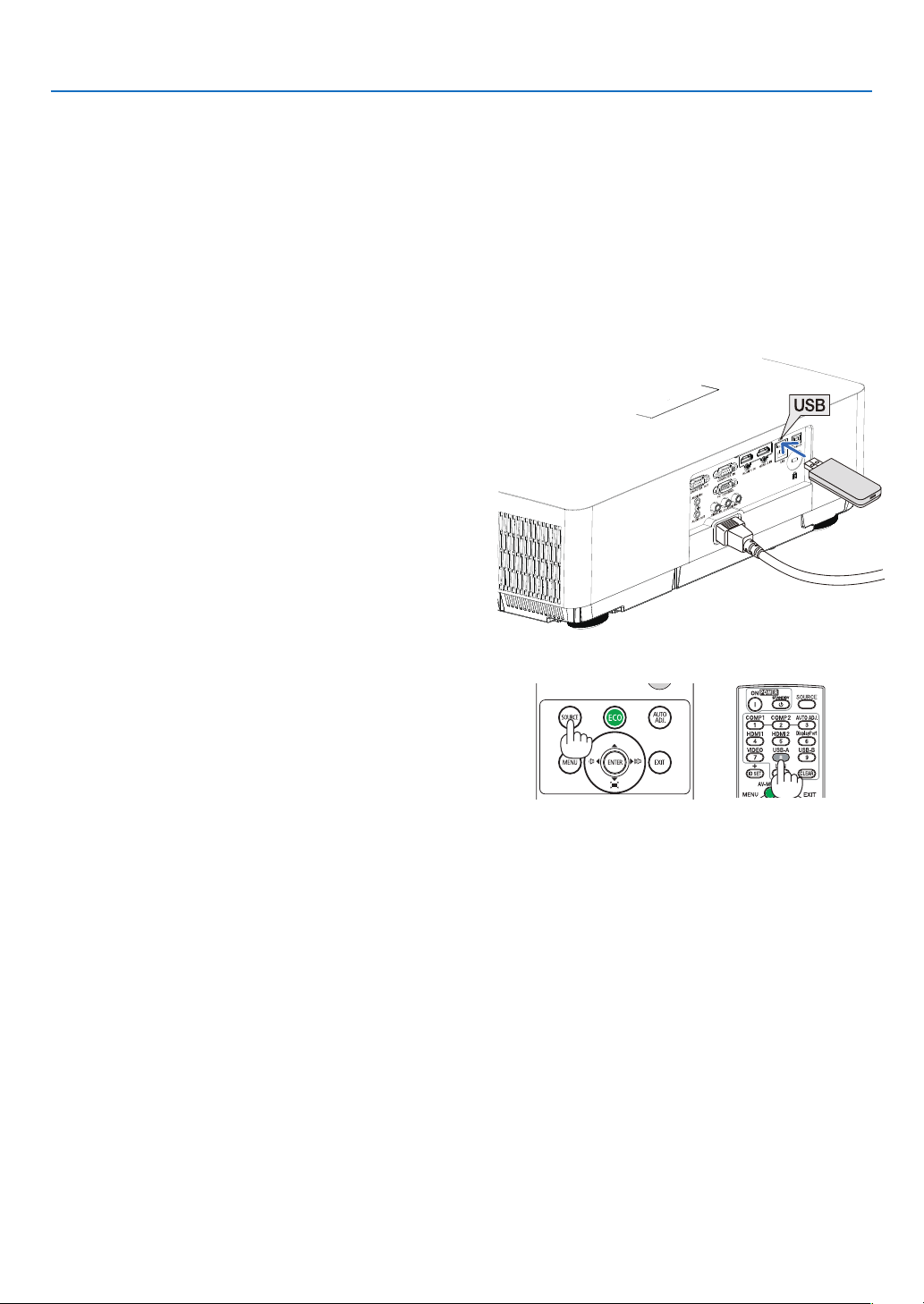
45
4. Using the Viewer
❷ Projecting images stored in a USB memory device
Thissectionexplainsthebasicoperationofthe
Viewer.
TheexplanationprovidestheoperationalprocedurewhentheViewertoolbar(→ page49)issettothefactoryde-
fault.
-StartingtheViewer ......................................................................below
-RemovingtheUSBmemoryfromtheprojector ...................... page47
-ExitingtheViewer .................................................................... page47
Preparation:BeforestartingtheViewer,storeimagestotheUSBmemoryusingyourcomputer.
Starting the Viewer
1. Turn on the projector. (→ page 12)
2. Insert the USB memory into the USB port of the projec-
tor.
• DonotremovetheUSBmemoryfromtheprojectorwhile
it’s LED flashes. Doing so may corrupt the data.
3. PresstheSOURCEbuttonontheprojectorcabinet.
The Viewer start screen will be displayed.
•
Pressthe
USB-A
buttonontheremotecontrol.

46
4. Using the Viewer
4.
Press the ENTER button.
The thumbnail screen will be displayed. (→ page
4
8
)
5. Use the ▲▼◀ or ▶ button to select an icon.
• The→ (arrow) symbol on the right indicates there are more
pages. Pressing the PAGE ▽ (page down) button will show
the next page; pressing the PAGE △ (page up) will show
the previous page.
6. Press the ENTER button.
The selected slide will be displayed.
• Whenafoldericonisselected,iconscontainedinthefolder
will be displayed.
7. Press the ▶ button to select the next slide.
The slide on the right will be displayed.
• The◀ or ▶ button can be used to select the next (right)
slide or the previous (left) slide in the thumbnail screen.
•
Pressing the MENU button during display of the
thumbnail
screen, the slide screen, or the slideshow
screen will display
the toolbar. The toolbar is used to
select or rotate an slide.(
→
page 5
0
)
8. Press the EXIT button when the toolbar is not displayed.
The thumbnail screen will be displayed.
• Anotherwaytodisplaythethumbnailscreenistopressthe
ENTER button.
• Toclosethetoolbar,presstheMENUbuttontoreturnto
the SOURCE list, and press the MENU button again to close
the SOURCE list.
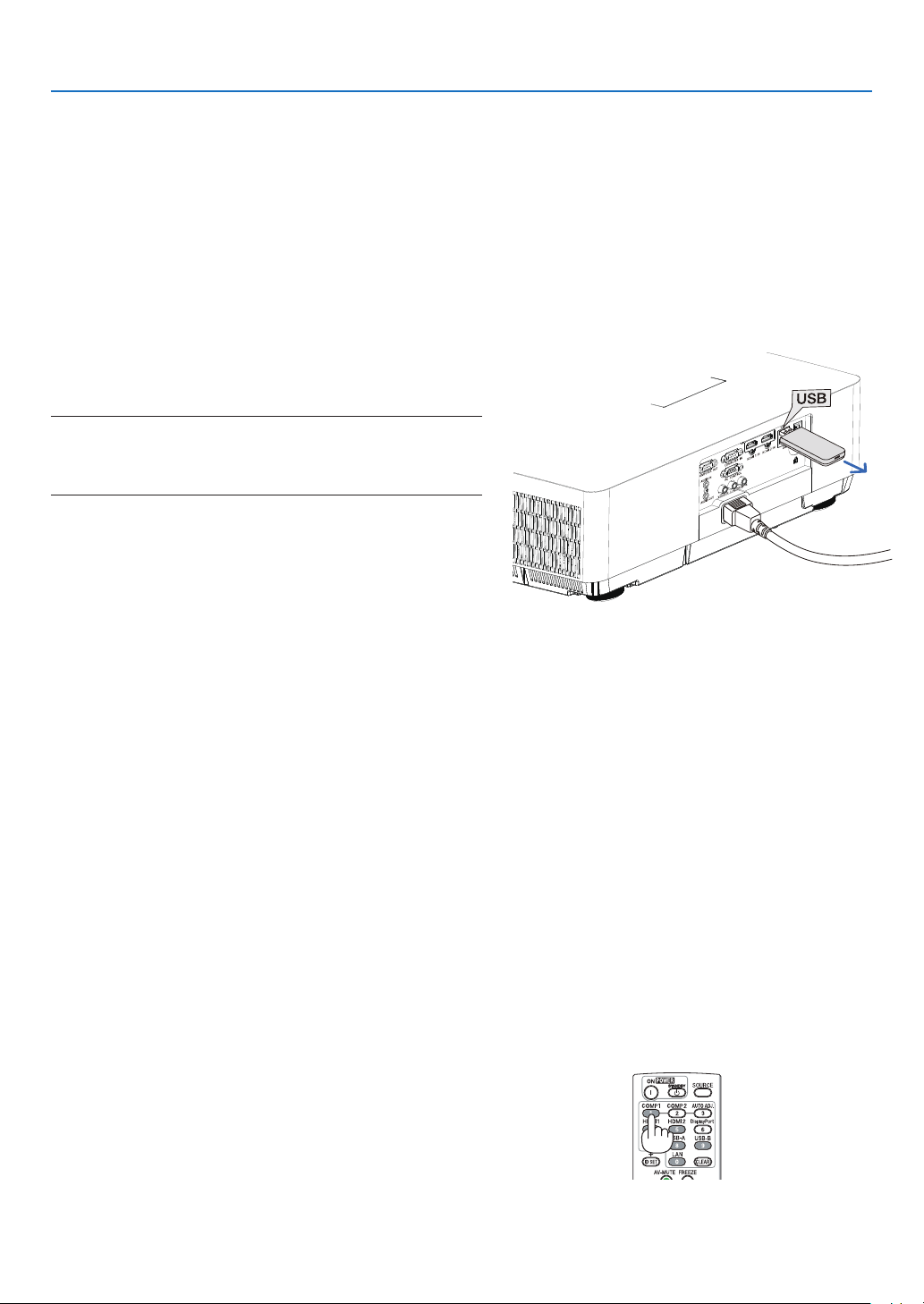
47
4. Using the Viewer
Removing the USB memory from the projector
1. SelecttheVIEWERstartscreen.
PresstheEXITbuttonwithnomenudisplayed.
2. Remove the USB memory from the projector.
Make sure that the LED on the USB memory is not flashing
before removing the USB memory.
NOTE: If you remove the USB memory from the projector with a slide
displayed,theprojectormaynotoperatecorrectly.Ifthishappens,turn
offtheprojectorandunplugthepowercord.Wait3minutes,thenconnect
thepowercord,andturnontheprojector.
Exiting the Viewer
1. Press the MENU button with the slide screen or the
thumbnail screen displayed.
The control bar or the pop-up menu will be displayed.
2. Press the MENU button again.
The on-screen menu will be displayed.
3. Select a source other than [USB-A]and press the
ENTER button.
The Viewer will be exited.
TIP:ToexittheViewerusingtheremotecontrol,selectasourceother
than[USB-A].
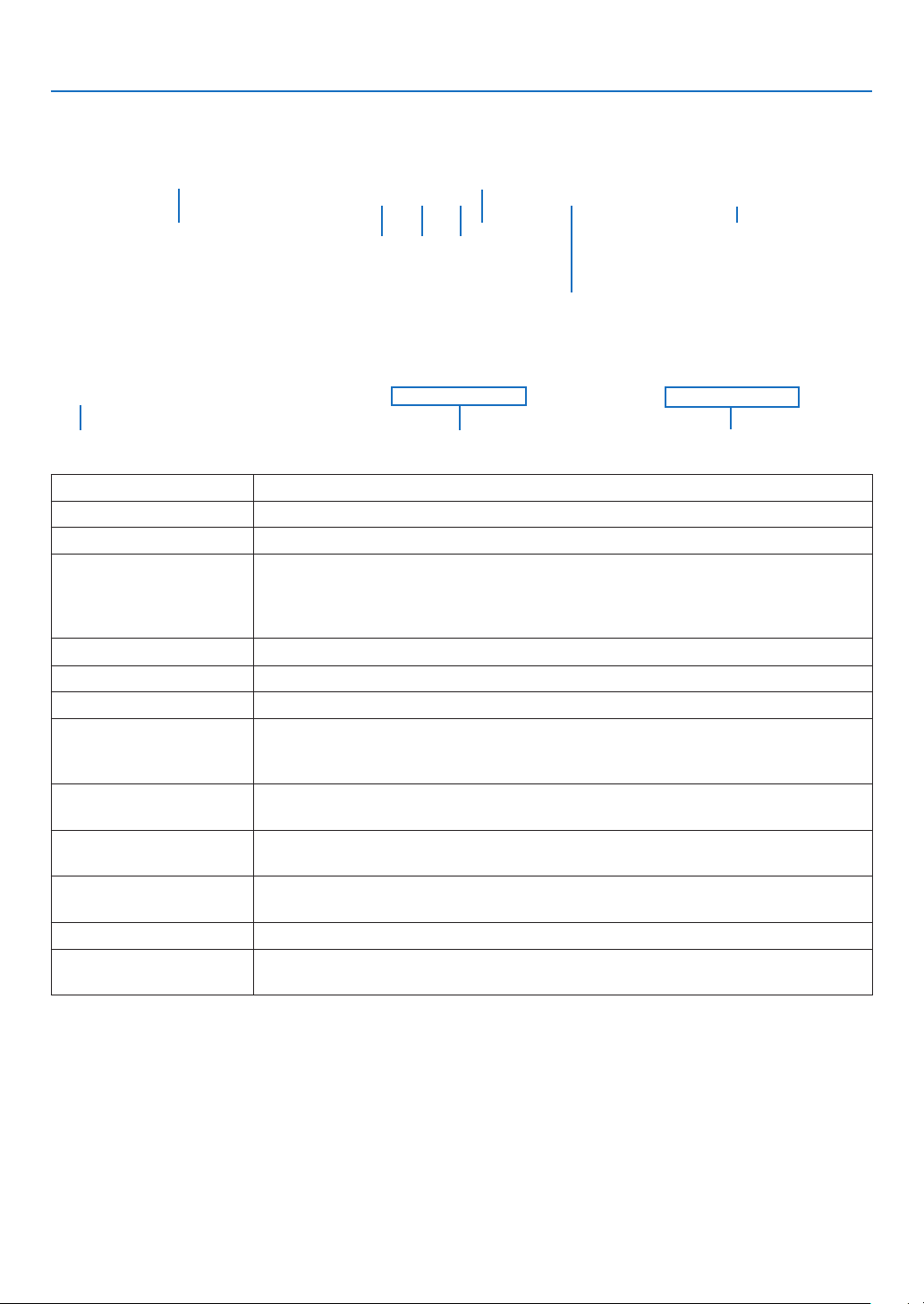
48
4. Using the Viewer
Parts of each screen
The Viewer has four screens.
(1) Viewer start screen (3) Thumbnail screen (9) Slide screen/
(11) Slideshow screen
Name Description
(1)Viewerstartscreen
(2)USBicon ThisiconindicatesthattheUSBmemoryisinsertedintotheprojector.
(3)Thumbnailscreen
Thisscreenwillshow
alistoffoldersandimagefiles stored in the USBmemory.The
JPEGExiffiles will bedisplayedinthumbnailscreenonly.
•
Themaximumnumberofimagefiles or folderswithinonepageis6 × 4 lateral by
longitudinal.
(4)Cursor
T
hecursorisusedtoselect(hig
h
light)thefolderorimagefile by using▲ ▼◀▶ button.
(5)Backicon Thisiconisusedtoreturntotheupper(parent)folder.
(6)Foldericon ThisiconshowsthattheUSBmemoryhasfolders.
(7)Pageup(Pagedown)
icon
Thisiconshowsfurtherfoldersorimagefiles areavailableinthenext(previous)page.
Use the ▶ buttontogotothenext(previous)row.ThePAGE▽orPAGE△ on the
remotecontrolisusedtogotothenextorpreviouspagedirectly.
(8)Thumbnailtoolbar
Thistoolbarisusedinthethumbnailscreen.PressingtheMENUbuttonwilldisplay
thistoolbar.(→page49)
(9)Slidescreen Thisscreenisusedformanualplayback.Theselectedimagewillbedisplayedinfull
screen.
(10)Slidetoolbar
Thistoolbarisusedintheslidescreen.PressingtheMENUbuttonwilldisplaythis
toolbar.(→page50)
(11)Slideshowscreen Thisscreenisusedforautoplayback.Theslideswillbechangedautomatically.
(12)Slideshowtoolbar
Thistoolbarisusedintheslideshowscreen.PressingtheMENUbuttonwilldisplay
thistoolbar.(→page50)
(5) (6) (4) (7)
(8)(2) (10) (12)
This screen will be displayed first when you select the Viewer.
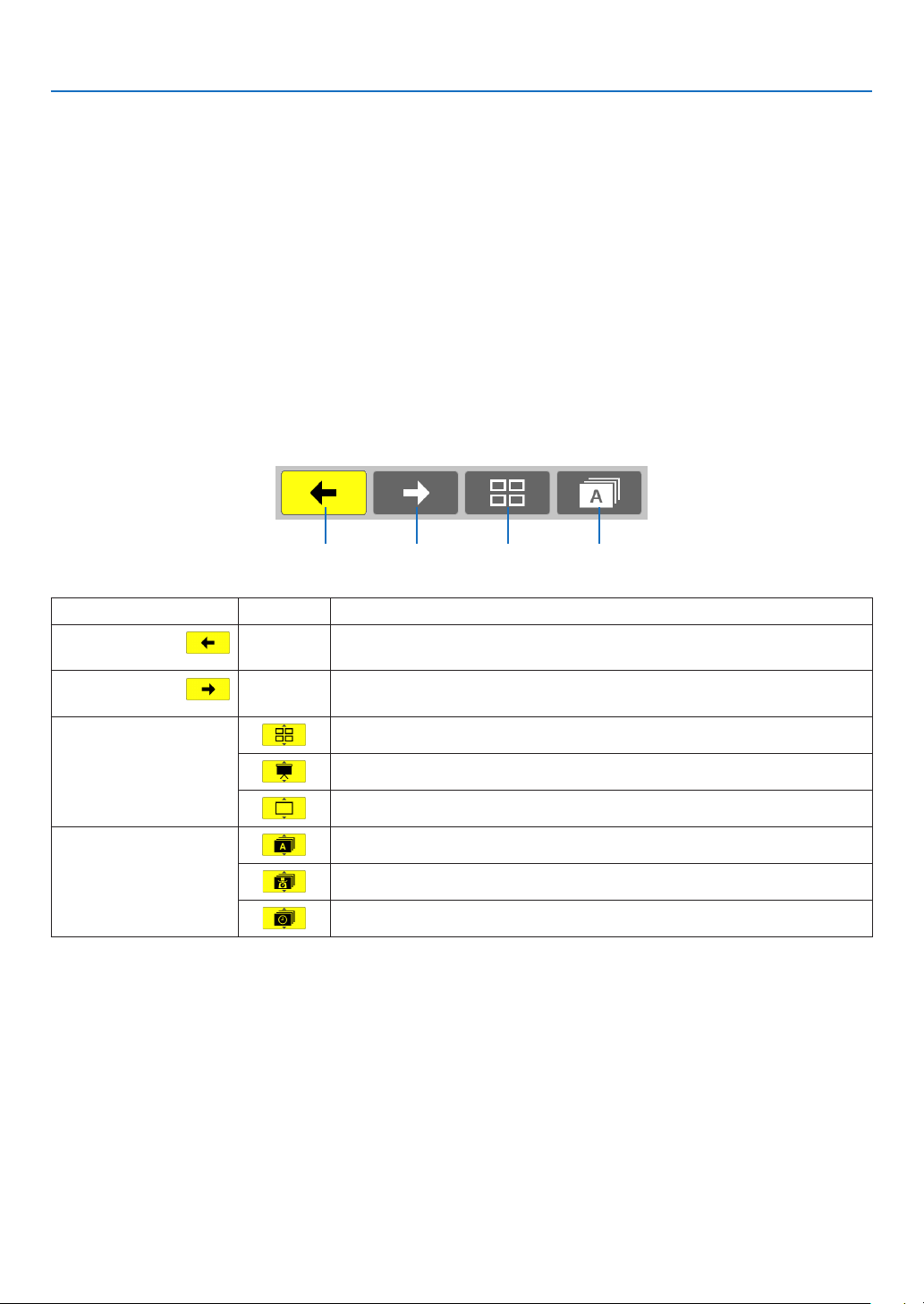
4. Using the Viewer
Using the toolbar
1. Press the MENU button.
The toolbar will be displayed.
The SOURCE screen will be displayed as Viewer connection screen.
2. Use the ◀ or ▶ button to select an item and use the ▲ or ▼ button to select its available option.
When the cursor is placed, the selected item will be changed to yellow.
The ▲ or ▼ shows more available choices.
3. Press the ENTER button.
The selected item will be displayed.
4. Press the MENU button two times.
The toolbar will be closed and the SOURCE list will be displayed. Press the MENU button again to close the
SOURCE list.
Thumbnail toolbar
Menu Options Description
(1)Back
— Goesbacktothepreviousimage.Whenthecursorreachesthetopleftof
thescreen,itwillgotothepreviouspage.
(2)Forward
— Goestothenextimage.Whenthecursorreachesthebottomrightofthe
screen,itwillgotothenextpage.
(3)Display
Closesthemenuandreturnstothethumbnailscreen.
Closesthemenuandstartstheslideshowfromthehighlighteditem.
Closesthemenuanddisplaystheslidescreen.
(4)Order
Displaystheiconsalphabeticallybyname.(numberbeforealphabet)
Displaystheiconsindescendingorderoffil size.
Displaystheiconsintheorderofcreationdate
(1) (2) (3) (4)
49
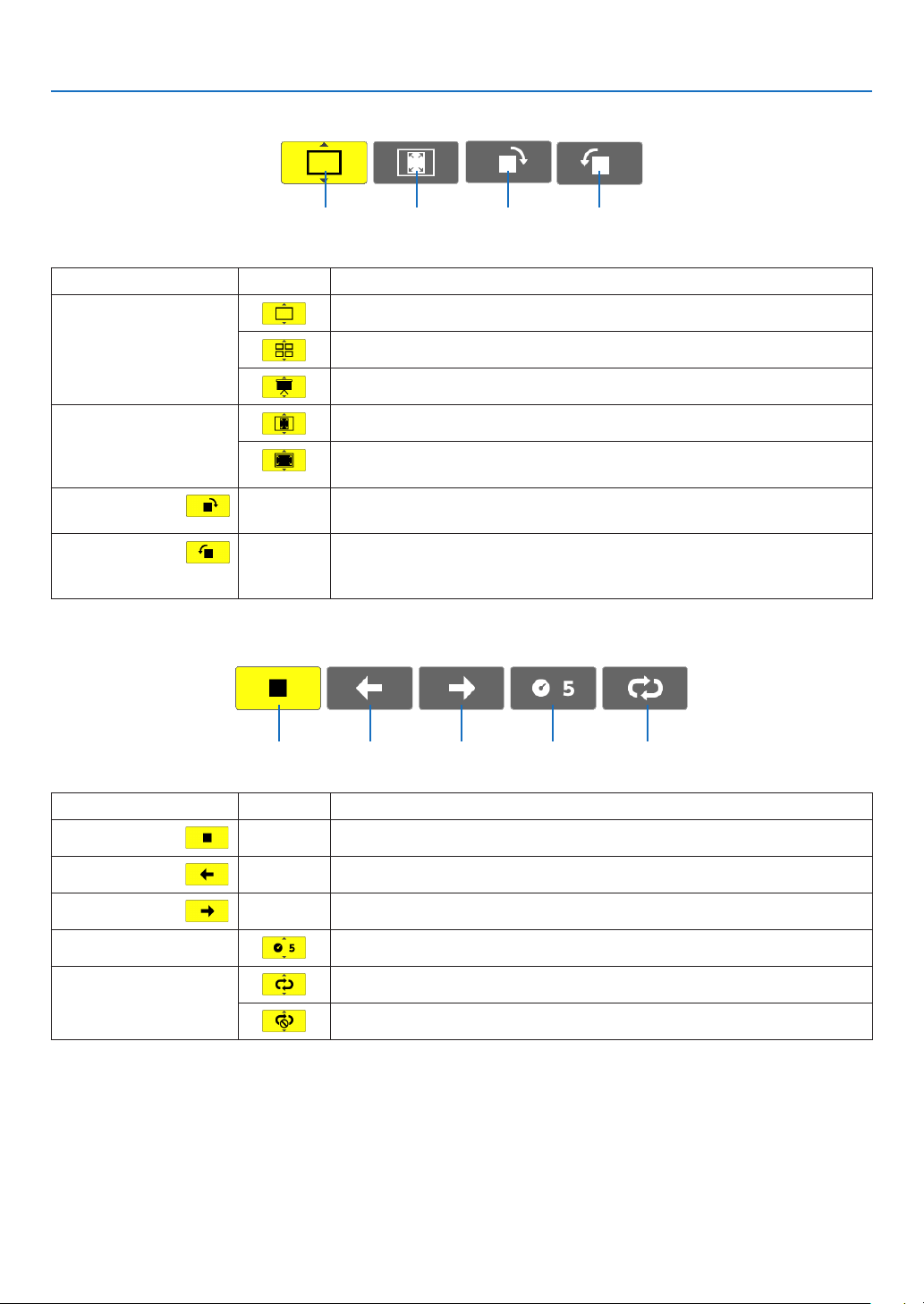
50
4. Using the Viewer
Slide toolbar
Menu Options Description
(1)Display
Closesthemenuandswitchestotheslidescreen.
Closesthemenuanddisplaysthethumbnailscreen.
Closesthemenuandstartstheslideshowfromthehighlighteditem.
(2)Imagedis-
play
Closesthemenuanddisplaystheimageinitsactualsize.
Closes the menuand displays the image in the projector’smaximum
resolution.
(3)Clockwise
rotation
— Closethemenuandrotatetheimage90°clockwise.
(4)Counter-
clockwise
rotation
— Closethemenuandrotatetheimage90°counterclockwise.
Slideshowtoolbar
Menu Options Description
(1)Stop
— Closesthemenuandchangestotheslidescreen.
(2)Back
— Goesbacktothepreviousimage.
(3)Forward
— Goestothenextimage.
(4)Interval
Specifie intervaltimewhenplayingbacktheslides.
(5)Repeat
Repeatstoplaybacktheimagesinthefolder.
Returnstothethumbnailscreen.
TIP:
• Apictureiconatthecenterofthescreenshowsthatthelecannotbedisplayedintheslidescreenorthumbnailscreen.
• Slidetoolbarsettingforrotationwillbecancelledifthefolderismovedfromoneplacetoanother.
(1) (2) (3) (4)
(1) (2) (3) (4) (5)
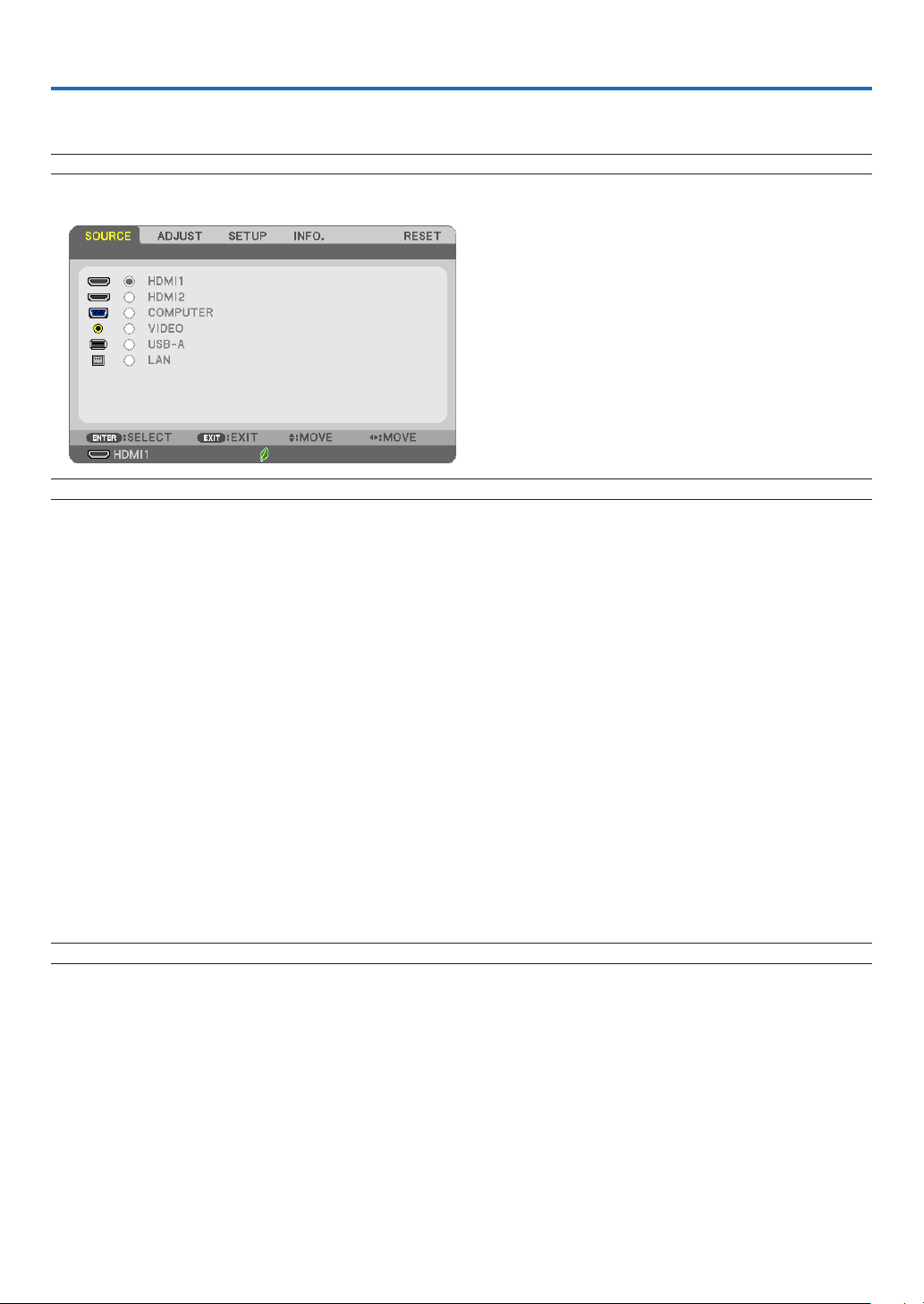
51
5. Using On-Screen Menu
❶ Using the Menus
NOTE:Theon-screenmenumaynotbedisplayedcorrectlywhileinterlacedmotionvideoimageisprojected.
1. Press the MENU button on the remote control or the projector cabinet to display the menu.
NOTE:
ThecommandssuchasENTER,EXIT,▲▼,◀▶inthebottomshowavailablebuttonsforyouroperation.
2. Press the ◀▶ buttons on the remote control or the projector cabinet to display the submenu.
3. Press the ENTER button on the remote control or the projector cabinet to highlight the top item or the
first tab.
4. Use the ▲▼ buttons on the remote control or the projector cabinet to select the item you want to adjust
or set.
You can use the ◀▶ buttons on the remote control or the projector cabinet to select the tab you want.
5. Press the ENTER button on the remote control or the projector cabinet to display the submenu window.
6. Adjust the level or turn the selected item on or off by using the ▲▼◀▶ buttons on the remote control or
the projector cabinet.
Changesarestoreduntiladjustedagain.
7. Repeat steps 2 -6 to adjust an additional item, or press the EXIT button on the remote control or the pro-
jector cabinet to quit the menu display.
NOTE:Whenamenuormessageisdisplayed,severallinesofinformationmaybelost,dependingonthesignalorsettings.
8. Press the MENU button to close the menu.
To return to the previous menu, press the EXIT button.
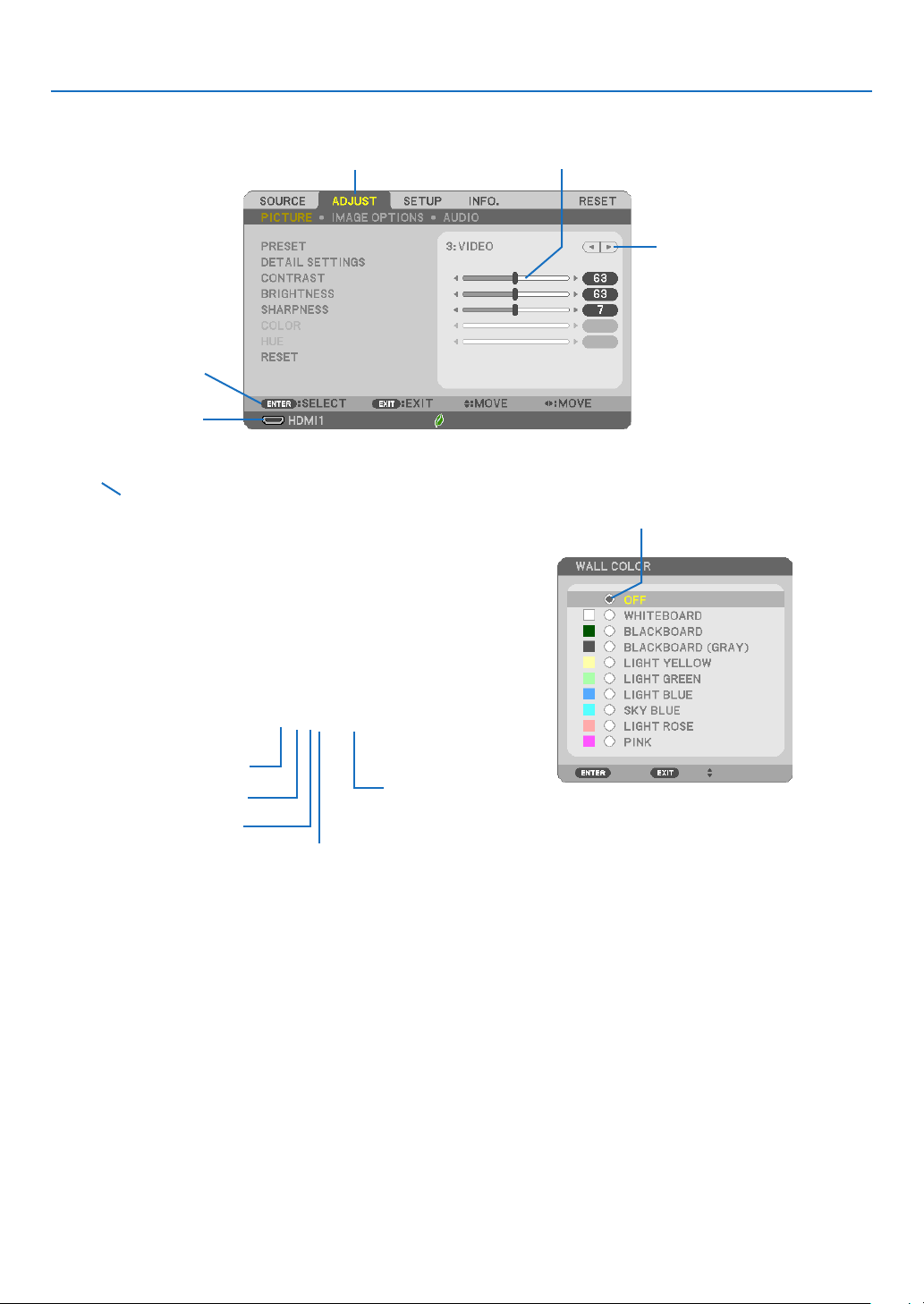
52
5. Using On-Screen Menu
❷
Menu Elements
Slide bar
Solid triangle
Tab
Radio button
Menuwindowsordialogboxestypicallyhavethefollowingelements:
Highlight �������������������������������Indicates the selected menu or item�
Solid triangle �������������������������Indicates further choices are available� A highlighted triangle indicates the item is active�
Tab ���������������������������������������� Indicates a group of features in a dialog box� Selecting on any tab brings its page to the front�
Radio button ��������������������������Use this round button to select an option in a dialog box�
Source ����������������������������������Indicates the currently selected source�
Off Timer remaining time �������Indicates the remaining countdown time when the [OFF TIMER] is preset�
Slide bar �������������������������������Indicates settings or the direction of adjustment�
ECO mode symbol �����������������Indicates ECO MODE is set�
Key Lock symbol ������������������� Indicates the [CONTROL PANEL LOCK] is enabled�
Thermometer symbol ������������ Indicates the [ECO MODE] is forcibly set to [NORMAL] mode because the internal temperature is too high�
High Altitude symbol��������������Indicates the [FAN MODE] is set to [HIGH ALTITUDE] mode�
Source
Available buttons
Thermometer symbol
Key Lock symbol
Off Timer remaining
time
Highlight
ECO mode symbol
High Altitude symbol
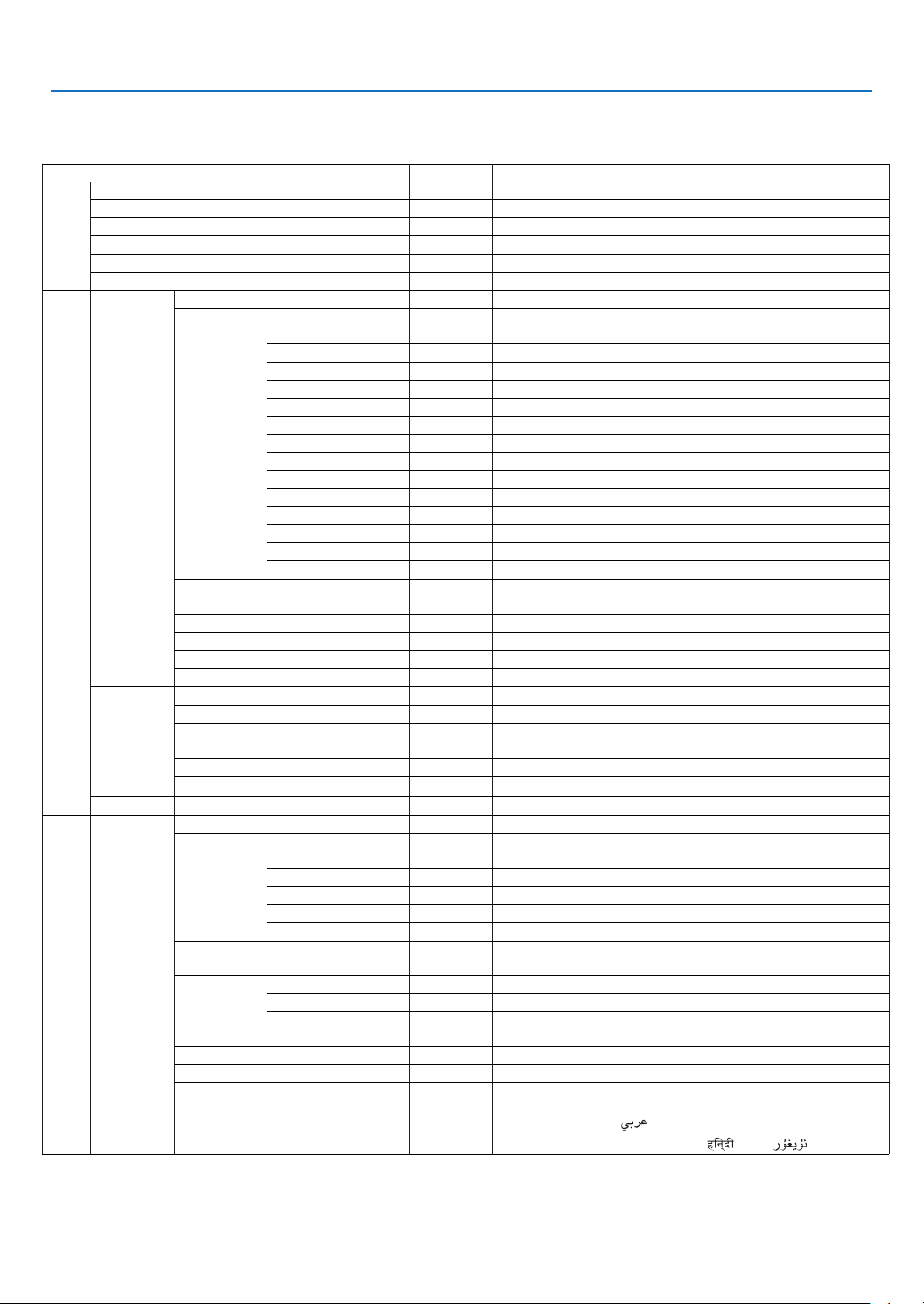
53
5. Using On-Screen Menu
❸ List of Menu Items
Somemenuitemsarenotavailabledependingontheinputsource.
* Theasterisk(*)indicatesthatthedefaultsettingvariesdependingonthesignal.
Default Options
*
*
*
*
*
*
* 1-7
* HIGH-BRIGHT, PRESENTATION, VIDEO, MOVIE, GRAPHIC, sRGB, DICOM SIM
DYNAMIC, NATURAL, BLACK DETAIL
*
LARGE, MEDIUM, SMALL
*
5000, 6500, 7800, 8500, 9300, 10500
*
OFF, ON
*
STILL, MOVIE
*
OFF, ON
0
0
0
*
*
*
63
63
7
31
31
*
*
*
*
*
AUTO, 0[%], 5[%], 10[%]
*
AUTO, 4:3, 16:9, 15:9, 16:10, LETTERBOX, NATIVE
AUDIO 11 0-31
100 70-100
0
0
0
0
0
OFF
OFF, WHITEBOARD, BLACKBOARD, BLACKBOARD (GRAY), LIGHT YELLOW, LIGHT
GREEN, LIGHT BLUE, SKY BLUE, LIGHT ROSE, PINK
AUTO ECO
OFF, AUTO ECO, NORMAL, ECO
100
16-100
OFF
OFF, ON
0 -512 - 512
OFF
OFF, CAPTION1, CAPTION2, CAPTION3, CAPTION4, TEXT1, TEXT2, TEXT3, TEXT4
OFF
OFF, 0:30, 1:00, 2:00, 4:00, 8:00, 12:00, 16:00
ENGLISH
ENGLISH, DEUTSCH, FRANÇAIS, ITALIANO, ESPAÑOL, SVENSKA, 日本語,
DANSK, PORTUGUÊS, ČEŠTINA, MAGYAR, POLSKI, NEDERLANDS, SUOMI,
NORSK, TÜRKÇE, РУССКИЙ, , Ελληνικά, 简体中文, 한국어, TIẾNG ViỆT,
ROMÂNĂ, HRVATSKI, БЪЛГАРСКИ, INDONESIA, , ไทย,
, 繁體中文
RESET
WALL COLOR
LIGHT MODE
ECO MODE
ADJUST
CONSTANT BRIGHTNESS
BALANCE
VOLUME
SETUP GENERAL
DIGITAL ZOOM
KEYSTONE
KEYSTONE HORIZONTAL
KEYSTONE VERTICAL
PINCUSHION LEFT/RIGHT
PINCUSHION TOP/BOTTOM
CORNERSTONE
ADJUST
CLOSED CAPTION
OFF TIMER
LANGUAGE
DYNAMIC CONTRAST
HUE
RESET
IMAGE OPTIONS
CLOCK
PHASE
HORIZONTAL
VERTICAL
OVERSCAN
ASPECT RATIO
PICTURE
PRESET
BRIGHTNESS B
CONTRAST
BRIGHTNESS
SHARPNESS
COLOR
COLOR ENHANCEMENT
WHITE BALANCE
CONTRAST R
CONTRAST G
CONTRAST B
BRIGHTNESS R
DETAIL SETTINGS
GENERAL
REFERENCE
BRIGHTNESS G
GAMMA CORRECTION
SCREEN SIZE
COLOR TEMPERATURE
IMAGE MODE
Menu Item
SOURCE
HDMI1
HDMI2
COMPUTER
VIDEO
USB-A
LAN
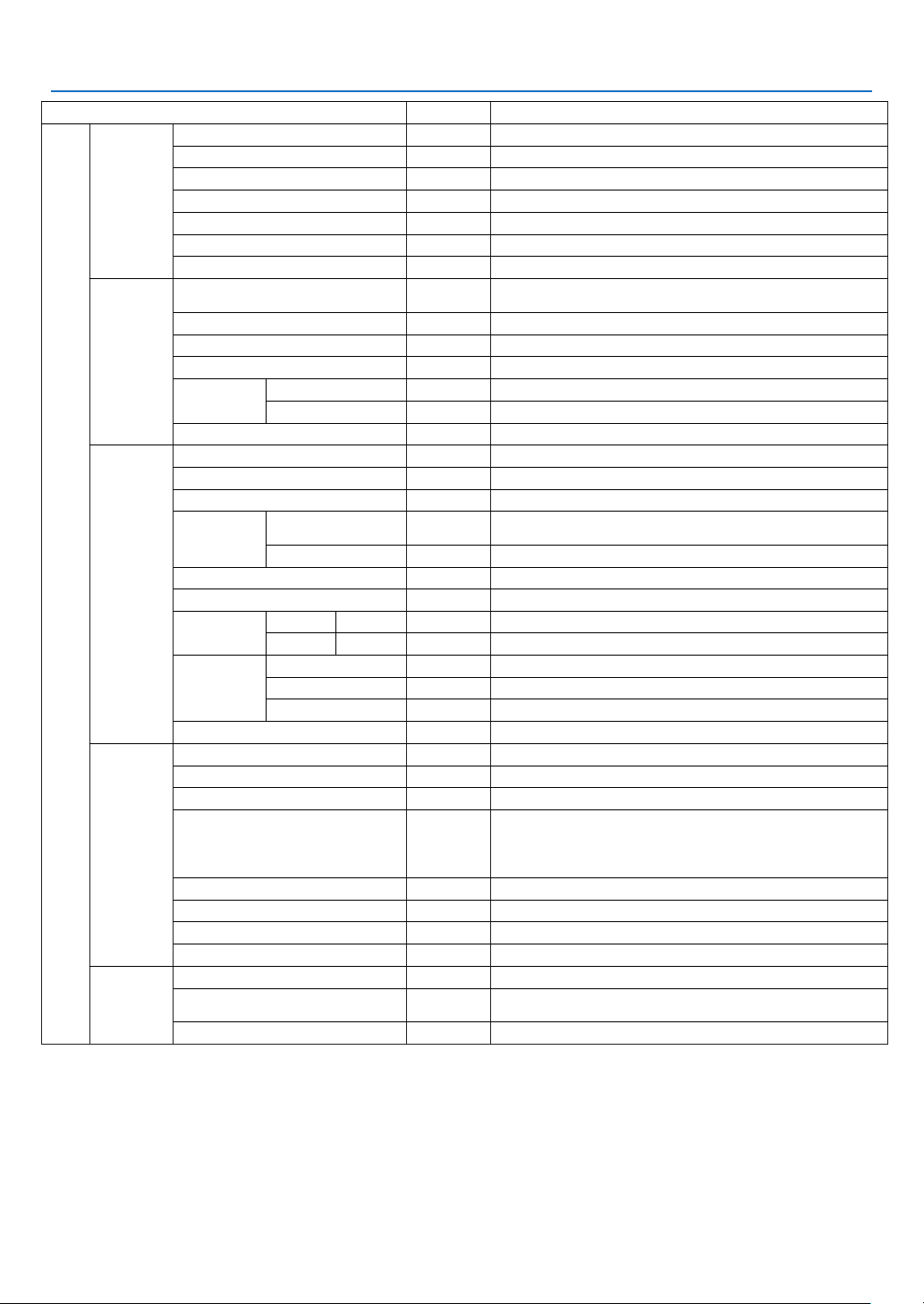
54
5. Using On-Screen Menu
Default Options
COLOR
COLOR, MONOCHROME
ON
OFF, ON
ON
OFF, ON
OFF OFF, ON
AUTO 45 SEC
MANUAL, AUTO 5 SEC, AUTO 15 SEC, AUTO 45 SEC
BLUE
BLUE, BLACK, LOGO
2000[H]
OFF, 100[H], 500[H], 1000[H], 2000[H]
DESKTOP
FRONT
DESKTOP FRONT, CEILING REAR, DESKTOP REAR, CEILING FRONT
OFF
OFF, ON
OFF
OFF, ON
38400bps 4800bps, 9600bps, 19200bps, 38400bps
1 1-254
OFF
OFF, ON
NORMAL
OFF, NORMAL, FINE
OFF
OFF, ON
AUTO
AUTO, HIGH, HIGH ALTITUDE
RGB/
COMPONENT
RGB/COMPONENT, RGB, COMPONENT
AUTO
AUTO, NTSC3.58, NTSC4.43, PAL, PAL-M, PAL-N, PAL60, SECAM
ON
OFF, ON
ON
OFF, ON
HDMI1 VIDEO LEVEL AUTO
AUTO, NORMAL, ENHANCED
HDMI2 VIDEO LEVEL AUTO
AUTO, NORMAL, ENHANCED
HDMI1
HDMI1,
COMPUTER
HDMI2
HDMI2, COMPUTER
LAN
LAN, COMPUTER
ON
OFF, ON
NORMAL
NORMAL, NETWORK STANDBY
OFF
OFF, ON
OFF
OFF, ON
STANDBY
(NORMAL):1:00
NETWORK
STANDBY:0:15
OFF, 0:05, 0:10, 0:15, 0:20, 0:30, 1:00
LAST
LAST, AUTO, HDMI1, HDMI2, COMPUTER, VIDEO, USB-A, LAN
$
ENABLE
DISABLE, ENABLE
DHCP:ON
AUTO DNS:ON
DHCP, IP ADDRESS, SUBNET MASK, GATEWAY, AUTO DNS, DNS
WIRED LAN
WIRED LAN
SETTINGS
RECONNECT
BEEP
OPTIONS(2)
STANDBY MODE
DIRECT POWER ON
AUTO POWER ON
AUTO POWER OFF
DEFAULT SOURCE SELECT
CARBON CONVERT
CURRENCY
CURRENCY CONVERT
TEST PATTERN
OPTIONS(1)
AUTO ADJUST
SEAMLESS SWITCHING
FAN MODE
SIGNAL SELECT
COMPUTER
VIDEO
WXGA MODEL
Menu Item
MENU
COLOR SELECT
SOURCE DISPLAY
ID DISPLAY
ECO MESSAGE
DISPLAY TIME
BACKGROUND
FILTER MESSAGE
INSTALLATION
ORIENTATION
CONTROL PANEL LOCK
SECURITY
COMMUNICATION SPEED
CONTROL ID
CONTROL ID NUMBER
DEINTERLACE
HDMI SETTINGS
AUDIO SELECT
HDMI1
HDMI2
LAN
CONTROL ID
SETUP
$, €, JP¥, RMB¥

55
5. Using On-Screen Menu
Default Options
SEPARATE SYNC、COMPOSITE SYNC、SYNC ON GREEN、SYNC ON VIDEO
8[bits]、10[bits]、12[bits]
WIRED LAN
OTHERS
PROJECTOR NAME
HOST NAME
MODEL NO.
SERIAL NUMBER
VERSION
FIRMWARE
DATA
CONNECTION
PROJECTOR NAME
PIN CODE
IP ADDRESS
MAC ADDRESS
Menu Item
USAGE TIME
LIGHT HOURS USED
FILTER HOURS USED
TOTAL CARBON SAVINGS
TOTAL COST SAVINGS
SOURCE(1)
SOURCE NAME
SOURCE INDEX
HORIZONTAL FREQUENCY
VERTICAL FREQUENCY
SYNC TYPE
SYNC POLARITY
SCAN TYPE
SOURCE(2)
SIGNAL TYPE
VIDEO TYPE
BIT DEPTH
VIDEO LEVEL
WIRED LAN
IP ADDRESS
SUBNET MASK
GATEWAY
CONTROL ID(when[CONTROL ID]is set)
CURRENT SIGNAL
RESET ALL DATA
CLEAR FILTER HOURS
INFO
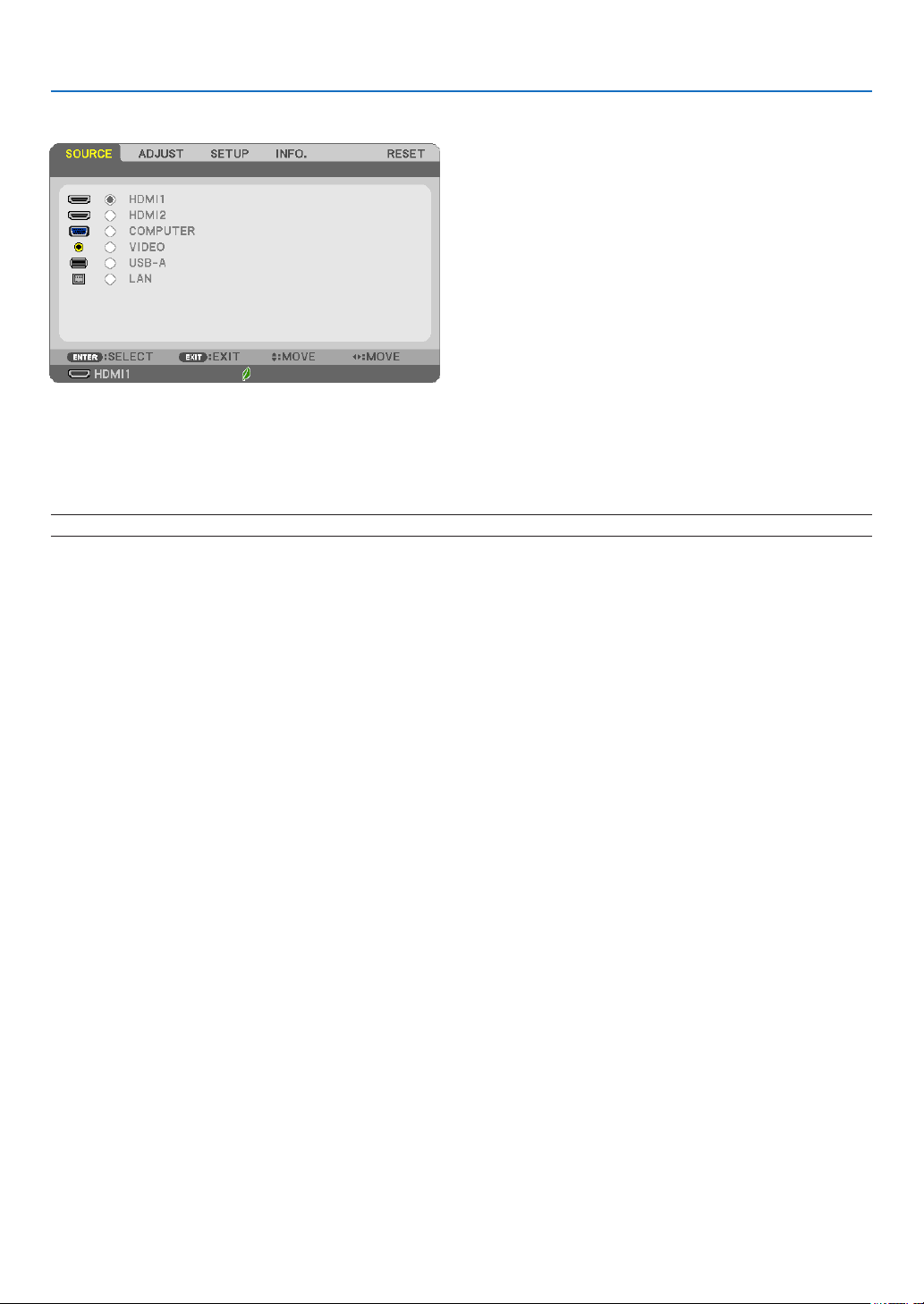
56
5. Using On-Screen Menu
❹ Menu Descriptions & Functions [SOURCE]
HDMI1 and HDMI2
SelectstheHDMIcompatibleequipmentconnectedtoyourHDMI1or2INterminal.
COMPUTER
SelectsthecomputerconnectedtoyourCOMPUTERinputterminalsignal.
NOTE:
WhenthecomponentinputsignalisconnectedtotheCOMPUTERINterminal,select[COMPUTER].
VIDEO
SelectswhatisconnectedtoyourVIDEOinput-VCR,DVDplayerordocumentcamera.
USB-A
Thisfeatureenablesyoutomake
presentationsusingaUSBmemorythatcontainsslides.
(→page43“4.UsingtheViewer”)
LAN
SelectsasignalfromtheLANport(RJ-45).
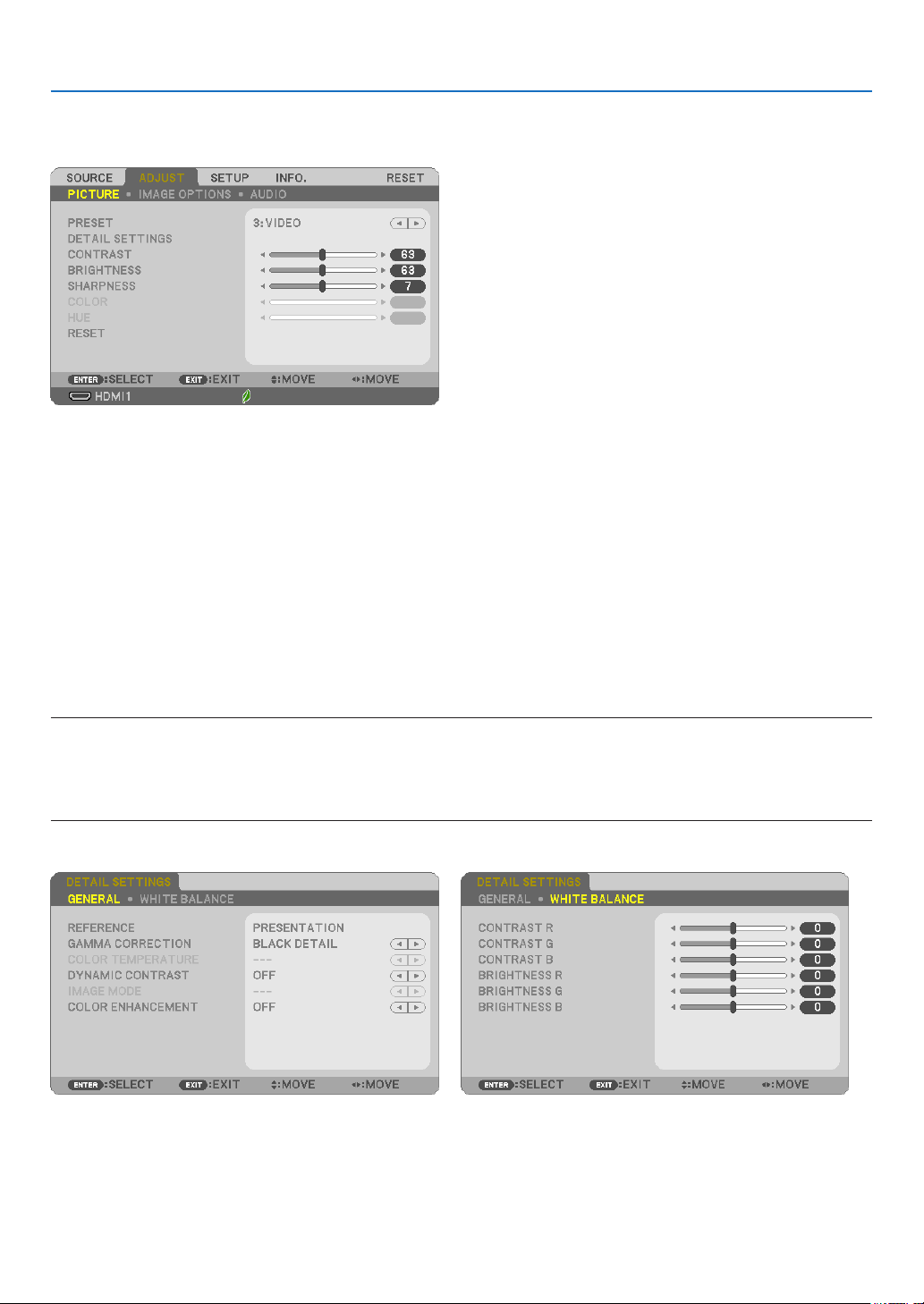
57
5. Using On-Screen Menu
❺ Menu Descriptions & Functions [ADJUST]
[PICTURE]
[PRESET]
Thisfunctionallowsyoutoselectoptimizedsettingsforyourprojectedimage.
Youcanadjustneutraltintforyellow,cyanormagenta.
Therearesevenfactorypresetsoptimizedforvarioustypesofimages.Youcanalsouse[DETAILSETTINGS]toset
useradjustablesettingstocustomizeeachgammaorcolor.
Yoursettingscanbestoredin[PRESET1]to[PRESET7].
HIGH-BRIGHT �����������Recommended for use in a brightly lit room�
PRESENTATION ���������Recommended for making a presentation using a PowerPoint fil �
VIDEO �����������������������Recommended for typical TV program viewing�
MOVIE ���������������������� Recommended for movies�
GRAPHIC ������������������Recommended for graphics�
sRGB ������������������������Standard color values
DICOM SIM� ��������������Recommended for DICOM simulation format�
NOTE:
• The[DICOMSIM.]optionisfortraining/referenceonlyandshouldnotbeusedforactualdiagnosis.
• DICOMstandsforDigitalImagingandCommunicationsinMedicine.ItisastandarddevelopedbytheAmericanCollegeofRadiology(ACR)
andtheNationalElectricalManufacturersAssociation(NEMA).
Thestandardspecieshowdigitalimagedatacanbemovedfromsystemtosystem.
[DETAIL SETTINGS]

58
5. Using On-Screen Menu
[GENERAL]
StoringYourCustomizedSettings[REFERENCE]
Thisfunctionallowsyoutostoreyourcustomizedsettingsin[PRESET1]to[PRESET7].
First,selectabasepresetmodefrom[REFERENCE],thenset[GAMMACORRECTION]and[COLORTEMPERATURE].
HIGH-BRIGHT �����������Recommended for use in a brightly lit room�
PRESENTATION ���������Recommended for making a presentation using a PowerPoint fil �
VIDEO �����������������������Recommended for typical TV program viewing�
MOVIE ���������������������� Recommended for movies�
GRAPHIC ������������������Recommended for graphics�
sRGB ������������������������Standard color values�
DICOM SIM� ��������������Recommended for DICOM simulation format�
Selecting Gamma Correction Mode [GAMMA CORRECTION]
Eachmodeisrecommendedfor:
DYNAMIC �����������������Creates a high-contrast picture�
NATURAL ������������������Natural reproduction of the picture�
BLACK DETAIL ���������� Emphasizes detail in dark areas of the picture�
NOTE:Thisfunctionisnotavailablewhen[DICOMSIM.]isselectedfor[DETAILSETTINGS].
SelectingScreenSizeforDICOMSIM[SCREENSIZE]
Thisfunctionwillperformgammacorrectionappropriateforthescreensize.
LARGE ����������������������For screen size of 110"
MEDIUM ������������������� For screen size of 90"
SMALL ���������������������For screen size of 70"
NOTE:Thisfunctionisavailableonlywhen[DICOMSIM.]isselectedfor[DETAILSETTINGS].
AdjustingColorTemperature[COLORTEMPERATURE]
This option allows you to select the color temperature of your choice.
NOTE:When[PRESENTATION]or[HIGH-BRIGHT]isselectedin[REFERENCE],thisfunctionisnotavailable.
AdjustingBrightnessandContrast[DYNAMICCONTRAST]
Thisfunctionallowsyoutoadjustthecontrastratioopticallyusingthebuilt-iniris.
Toincreasethecontrastratio,select[ON].
Selecting Still Image Mode or Movie Mode [IMAGE MODE]
Thisfunctionallowsyoutoselectthestillimagemodeorthemoviemode.
STILL �����������������������This mode is for a still image�
MOVIE ���������������������� This mode is for a movie�
NOTE:Thisfunctionisavailableonlywhen[HIGH-BRIGHT]isselectedfor[REFERENCE].

59
5. Using On-Screen Menu
Enhancing the Color [COLOR ENHANCEMENT]
Thisfunctionallowsyoutoenhancethecolorofimage.
ON ���������������������������Enhances the color�
NOTE:Thisfunctionisavailableonlywhen[PRESENTATION]isselected[REFERENCE].
AdjustingWhiteBalance[WHITEBALANCE]
Thisallowsyoutoadjustthewhitebalance.Contrastforeachcolor(RGB)toadjustthewhitelevelofthescreen;
Brightnessforeachcolor(RGB)isusedtoadjusttheblacklevelofthescreen.
[CONTRAST]
Adjuststheintensityoftheimageaccordingtotheincomingsignal.
[BRIGHTNESS]
Adjuststhebrightnesslevelorthebackrasterintensity.
[SHARPNESS]
Controlsthedetailoftheimage.
[COLOR]
Increasesordecreasesthecolorsaturationlevel.
[HUE]
Variesthecolorlevelfrom+/−greento+/−blue.Theredlevelisusedasreference.
Inputsignal CONTRAST BRIGHTNESS SHARPNESS COLOR HUE
COMPUTER/HDMI (RGB)
Yes Yes Yes No No
COMPUTER/HDMI (COMPONENT)
Yes Yes Yes Yes Yes
VIDEO Yes Yes Yes Yes Yes
USB-A Yes Yes Yes No No
Yes=Adjustable,No=Notadjustable
[RESET]
Thesettingsandadjustmentsfor[PICTURE]willbereturnedtothefactorysettingswiththeexceptionofthefollow-
ing;Presetnumbersand[REFERENCE]withinthe[PRESET]screen.
Thesettingsandadjustmentsunder[DETAILSETTINGS]withinthe[PRESET]screenthatarenotcurrentlyselected
will not be reset.
LAN
Yes Yes Yes No No
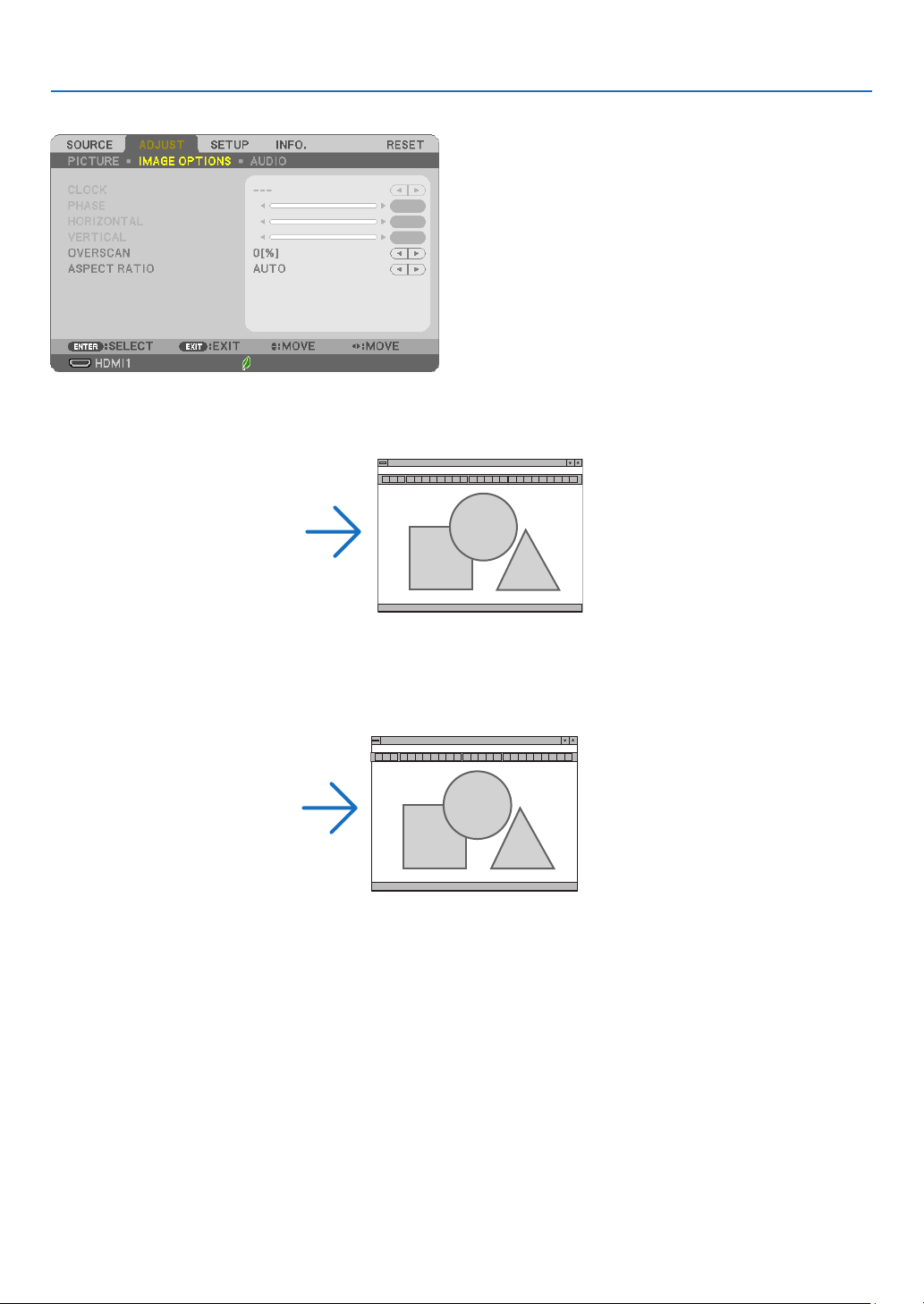
60
5. Using On-Screen Menu
[IMAGE OPTIONS]
AdjustingClockandPhase[CLOCK/PHASE]
ThisallowsyoutomanuallyadjustCLOCKandPHASE.
CLOCK ���������������������Use this item to fine tune the computer image or to remove any vertical banding that might appear� This function
adjusts the clock frequencies that eliminate the horizontal banding in the image�
This adjustment may be necessary when you connect your computer for the first time�
PHASE ����������������������Use this item to adjust the clock phase or to reduce video noise, dot interference or cross talk� (This is evident when
part of your image appears to be shimmering�)
Use [PHASE] only after the [CLOCK] is complete�
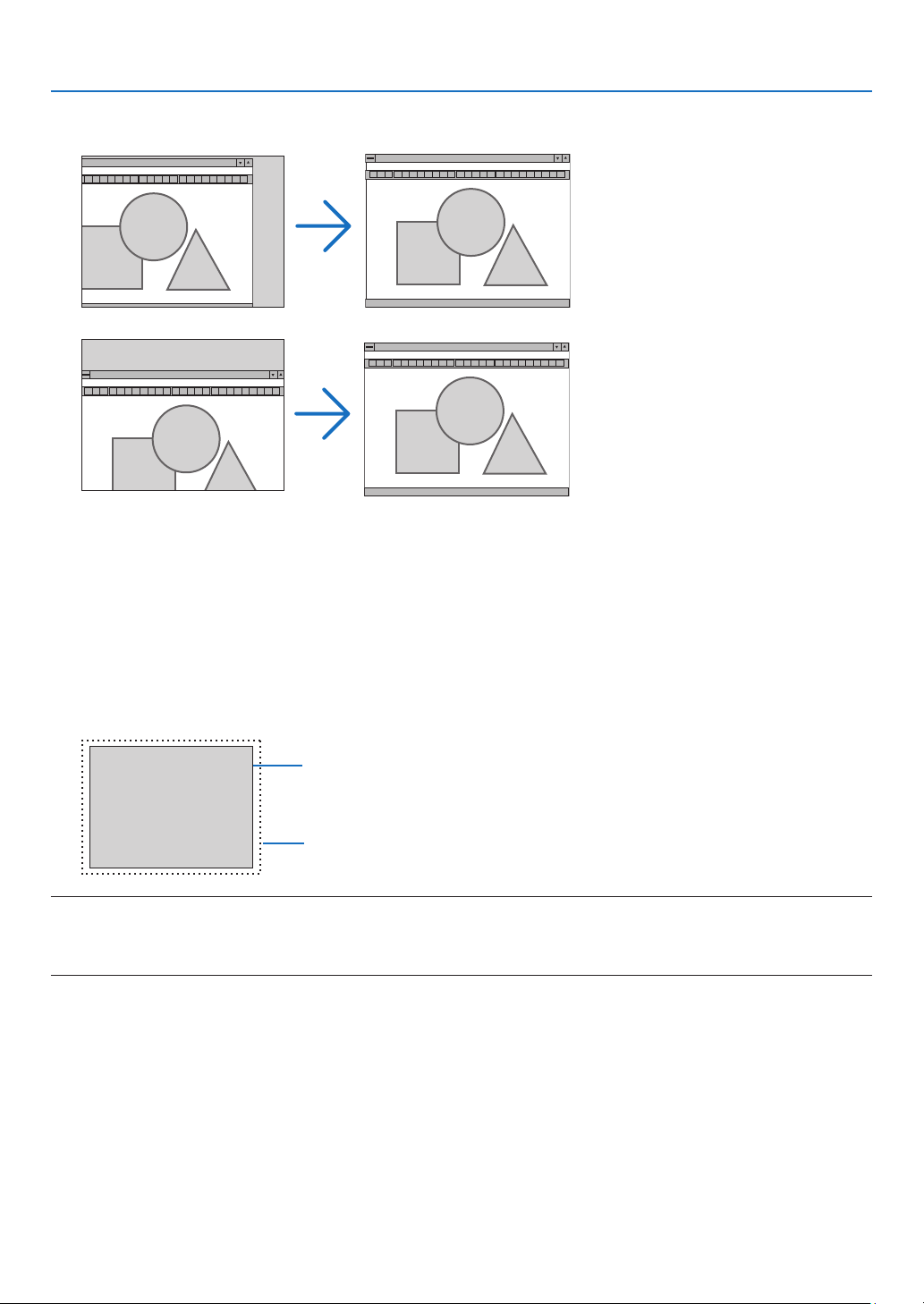
61
5. Using On-Screen Menu
AdjustingHorizontal/VerticalPosition[HORIZONTAL/VERTICAL]
Adjuststheimagelocationhorizontallyandvertically.
- Animagecanbedistortedduringtheadjustmentof[CLOCK]and[PHASE].Thisisnotmalfunction.
- Theadjustmentsfor[CLOCK],[PHASE],[HORIZONTAL],and[VERTICAL]willbestoredinmemoryforthecur-
rentsignal.Thenexttimeyouprojectthesignalwiththesameresolution,horizontalandverticalfrequency,its
adjustments will be called up and applied.
Todeleteadjustmentsstoredinmemory,fromthemenu,youselect[RESET]→[CURRENTSIGNAL]or[ALL
DATA]andresettheadjustments.
SelectingOverscanPercentage[OVERSCAN]
Selectoverscanpercentage(AUTO,0%,5%and10%)forsignal.
Projected image
Overscaned by 10%
NOTE:
• The[0[%]]cannotbeselectedwhenVIDEOsignalisused.
• The[OVERSCAN]itemisnotavailable:
- when[NATIVE]isselectedfor[ASPECTRATIO].
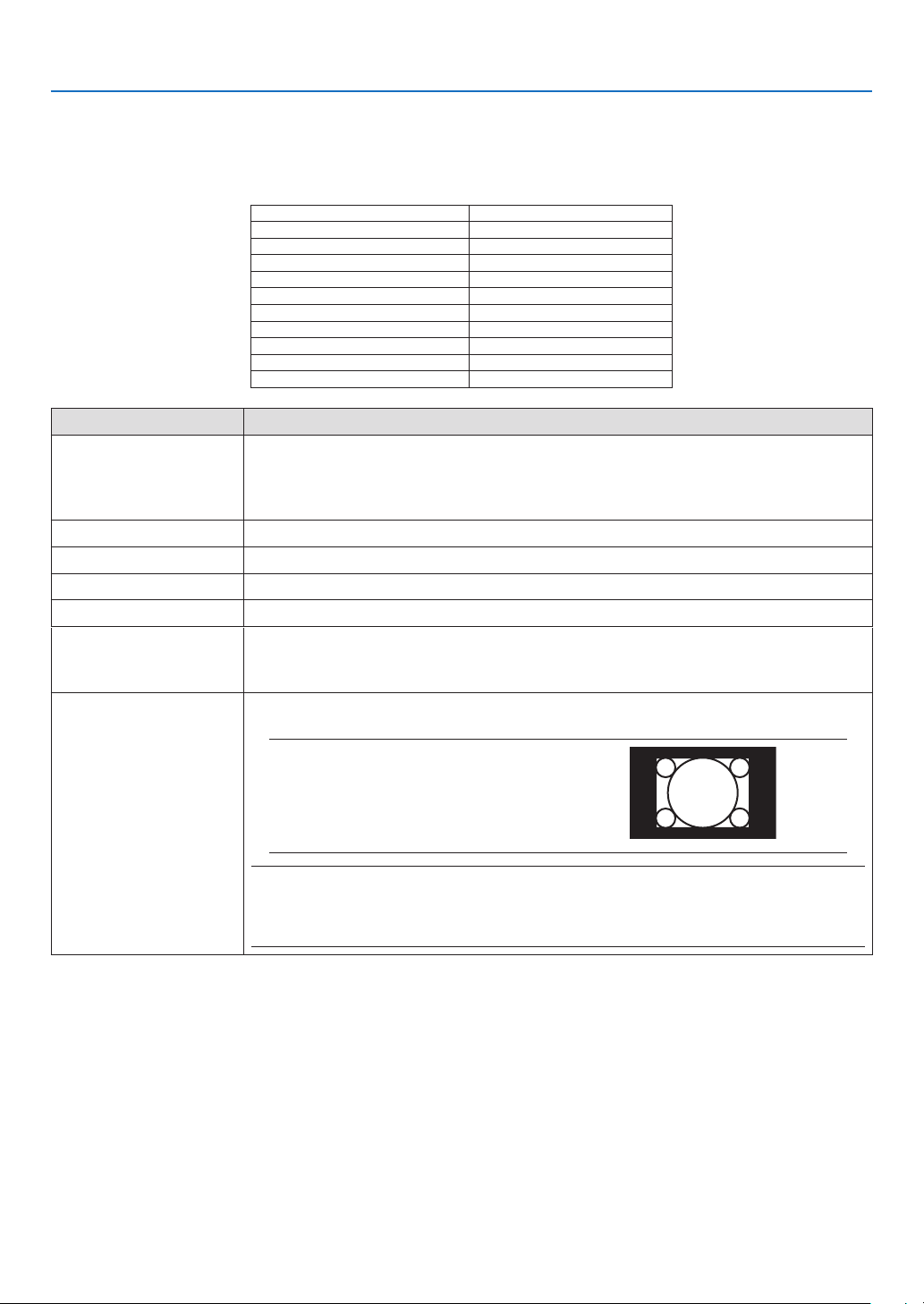
62
5. Using On-Screen Menu
Selecting Aspect Ratio [ASPECT RATIO]
Theterm“aspectratio”referstotheratioofwidthtoheightofaprojectedimage.
Theprojectorautomaticallydeterminestheincomingsignalanddisplaysitinitsappropriateaspectratio.
• Thistableshowstypicalresolutionsandaspectratiosthatmostcomputerssupport.
Resolution AspectRatio
VGA 640×480 4:3
SVGA 800×600 4:3
XGA 1024×768 4:3
WXGA 1280×768 15:9
WXGA 1280×800 16:10
WXGA+ 1440×900 16:10
SXGA 1280×1024 5:4
SXGA+ 1400×1050 4:3
UXGA 1600×1200 4:3
WUXGA 1920×1200 16:10
Options Function
AUTO Theprojectorwillautomaticallydeterminetheincomingsignalanddisplayitinitsaspect
ratio.(→ nextpage)
Theprojectormayerroneouslydeterminetheaspectratiodependingonitssignal.If
thisoccurs,selecttheappropriateaspectratiofromthefollowing.
4:3 Theimageisdisplayedin4:3aspectratio.
16:9 Theimageisdisplayedin16:9aspectratio.
15:9 Theimageisdisplayedin15:9aspectratio.
16:10 Theimageisdisplayedin16:10aspectratio.
LETTERBOX
Theimageofaletterboxsignalisstretchedequallyinthehorizontalandverticaldirec-
tionstofi thescreen.Partsofthedisplayedimagearecroppedatthetopandbottom
edgesandthereforenotvisible.
NATIVE Theprojectordisplaysthecurrentimageinitstrueresolutionwhentheincomingcom-
putersignalhasalowerresolutionthantheprojector’snativeresolution.
[Example] When the incoming
signal with the resolution of 800
×600isdisplayed:
NOTE:
• Whenanon-computersignalisdisplayed,the[NATIVE]isnotavailable.
• Whenasignalwithahigherresolutionthantheprojector’snativeresolutionisdisplayed,[NATIVE]is
notavailable.
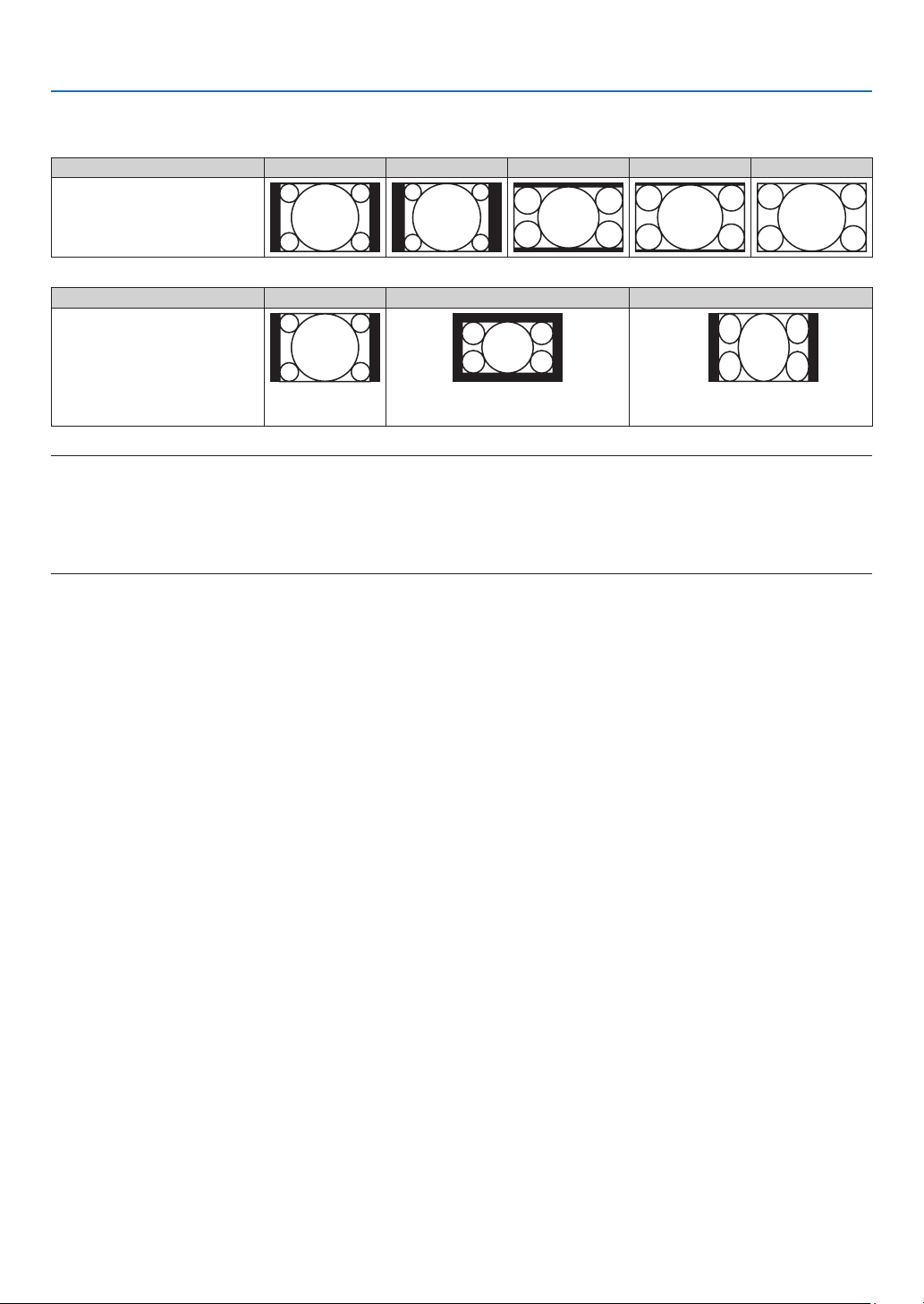
63
5. Using On-Screen Menu
Sampleimagewhentheappropriateaspectratioisautomaticallydetermined
[Computer
signal]
Aspectratioofincomingsignal 4:3 5:4 16:9 15:9 16:10
Sampleimagewhentheappro-
priate aspect ratio is automati-
cally determined
[Videosignal]
Aspectratioofincomingsignal 4:3 Letterbox Squeeze
Sampleimagewhentheaspect
ratio is automatically determined
NOTE:Todisplayaletterboxsignalproperly,
select[LETTERBOX].
NOTE:Todisplayasqueezedsignalproperly,
select[16:9].
TIP:
• Imagepositioncanbeadjustedverticallyusing[POSITION]whenthe[16:9],[15:9],or[16:10]aspectratiosareselected.
• Theterm“letterbox”referstoamorelandscape-orientedimagewhencomparedtoa4:3image,whichisthestandardaspectratiofora
videosource.
Theletterboxsignalhasaspectratioswiththevistasize“1.85:1”orcinemascopesize“2.35:1”formovielm.
• Theterm“squeeze”referstothecompressedimageofwhichaspectratioisconvertedfrom16:9to4:3.
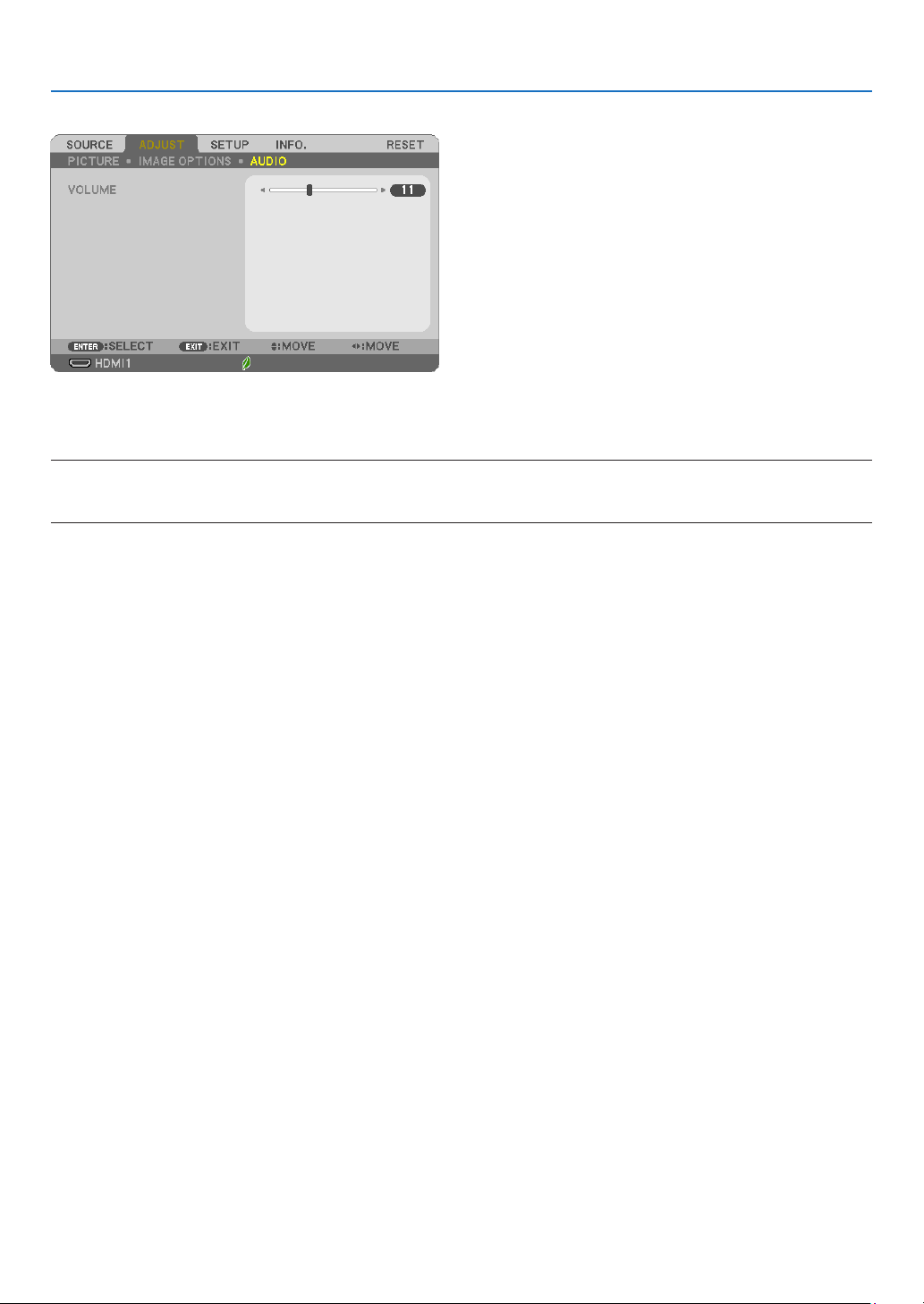
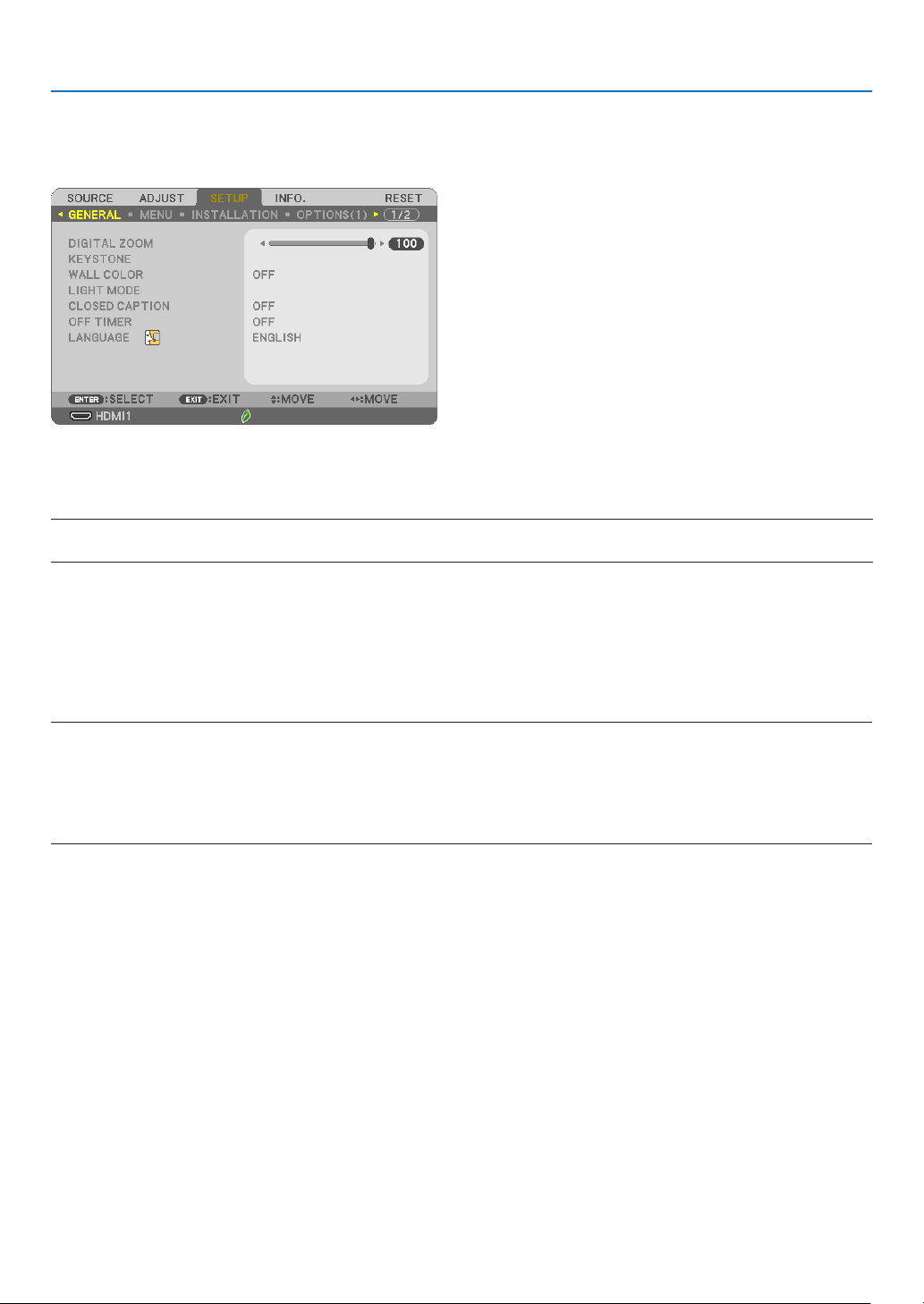
65
5. Using On-Screen Menu
❻ Menu Descriptions & Functions [SETUP]
[GENERAL]
Correcting
KeystoneDistortionManually[KEYSTONE]
Youcancorrecthorizontalorverticalkeystone,pincushionLEFT/RIGHTorTOP/BOTTOM,orcornerstonedistortion
manually.
NOTE:
• [KEYSTONEHORIZONTAL]and[KEYSTONEVERTICAL]canbeadjustedatonce.
• Tochangefromoneitemtoanotheritem,resettherstitem.
• Adjustmentvalueswillbeoverwritten.Theywillnotbedeletedevenwhentheprojectoristurnedoff.
• Using[KEYSTONE],[PINCUSHION]and[CORNERSTONE]correctioncancausetheimagetobeslightlyblurredbecausethecorrectionis
madeelectronically.
KEYSTONE HORIZONTAL ���������������Corrects horizontal keystone distortion� (→ page 22)
KEYSTONE VERTICAL ��������������������Corrects vertical keystone distortion� (→ page 22)
PINCUSHION LEFT/RIGHT ��������������Corrects pincushion distortion at the left or right side� (→ page 32)
PINCUSHION TOP/BOTTOM �����������Corrects pincushion distortion at the top or bottom side� (→ page 32)
CORNERSTONE ����������������������������Fits a projected image within the border of the screen easily by align the four corner of an image to
the ones of the screen� (→ page 30)
RESET ������������������������������������������Returns all the above items to the factory preset values�
TIP:
•
Themaximumadjustmentrangewith[CORNERSTONE]and[KEYSTONE]correctionsis±
1
0°inthehorizontaldirection,±
1
0°inthevertical
direction.
- Dependingoninputsignal,theadjustablerangemaybenarrower.
Using Digital Zoom [DIGITAL ZOOM]
Thisfeatureallowsyoutoelectronicallyneadjusttheimagesizeonthescreen.
NOTE:
•
ThisfeaturecannotbeusedwhenUSB-A,LANisselectedasainputterminal.
TIP:Toadjusttheprojectedimagesizeroughly,movetheprojectorawayorclosertothescreen.Tofine adjustthezoom,usethe
[DIGITALZOOM]function.(
→
page20)
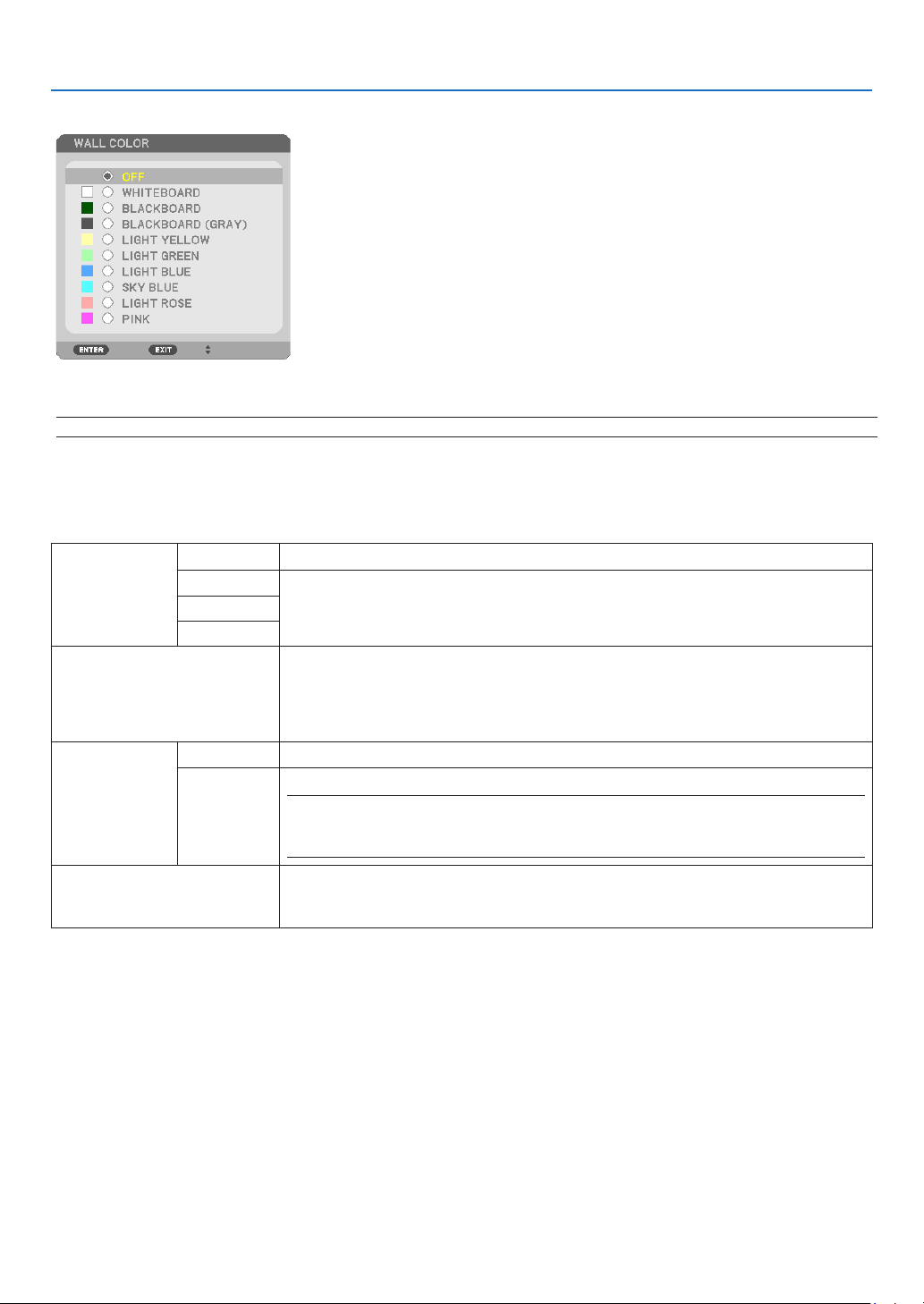
66
5.
Using On-Screen Menu
[LIGHTMODE]
Adjustingtheenergysavingssettingsandthebrightnessofeachprojectorinmulti-screenprojection.Forenergysav-
ingssettings,seepage28“4ChangingEcoMode/CheckingEnergy-SavingEffect”.
ECOMODE OFF Thelightmoduleluminance(brightness)willbeatthesetupbrightnessfor[ADJUST].
AUTO ECO
By controlling the brightness and fan speed according to the selected setting, energy can
be saved and motion noise and the power consumption can be lowered.
These options can
beselectedwhen[CONSTANTBRIGHTNESS]modeissetto[OFF].
ECO
ADJUST Brightnesscanbeadjustedin1%incrementsfrom16to100%.
Whenseveralprojectorsareusedformulti-screenprojection,thebrightnesscanbead-
justed individually on each projector.
Theadjustmentisvalidwhen[ECOMODE]issetto[OFF]and[CONSTANTBRIGHT-
NESS]issetto[OFF].
CONSTANT
BRIGHTNESS
OFF [CONSTANTBRIGHTNESS]modewillbecanceled.
ON Maintains66%brightnessofthefactorydefaultsetting.
NOTE:
•
[CONSTANT BRIGHTNESS] mode is a function used to maintain the brightness at a constant level.
Color will not be fixed.
TIP:
• Brightnessnormallydecreaseswithuse,butbyselecting[CONSTANTBRIGHTNESS]mode,theprojectorautomaticallyadjust
theoutputbasedontheprojectorusedtime,therebymaintainingaconstantbrightnessthroughoutthelifeofthelightmodule.
However,ifoutputisalreadyatitsmaximum,brightnesswilldecreasewithuse.
Using the Wall Color Correction [WALL COLOR]
Thisfunctionallowsforquickadaptivecolorcorrectioninapplicationswherethescreenmaterialisnotwhite.
NOTE:Selecting[WHITEBOARD]reduces
light
brightness.
NORMAL
BALANCE
Color balance canbeadjustedinincrementsof 1 from-512to512.
Whenthe screen color is yellow, adjust to the right; when the screen color is blue, adjust to
the left.

67
5. Using On-Screen Menu
Setting Closed Caption [CLOSED CAPTION]
ThisoptionsetsseveralclosedcaptionmodesthatallowtexttobesuperimposedontheprojectedimageofVideo.
OFF �������������������������� This exits the closed caption mode�
CAPTION 1-4 ������������ Text is superimposed�
TEXT 1-4 ������������������Text is displayed�
NOTE:
• Theclosedcaptionisnotavailableunderthefollowingconditions:
- whenmessagesormenusaredisplayed.
- whenanimageismagnied,frozen,ormuted.
• Portionsofsuperimposedtextorclosedcaptionmaybetruncated.Ifthathappens,trytoplacethesuperimposedtextorclosedcaption
withinthescreen.
Using Off Timer [OFF TIMER]
1. Select your desired time between 30 minutes and 16 hours: OFF, 0:30, 1:00, 2:00, 4:00, 8:00, 12:00, 16:00.
2. Press the ENTER button on the remote control.
3. The remaining time starts counting down.
4. The projector will turn off after the countdown is complete.
NOTE:
• Tocancelthepresettime,set[OFF]forthepresettimeorturnoffthepower.
• Whentheremainingtimereaches3minutesbeforetheprojectoristurnedoff,the[THEPROJECTORWILLTURNOFFWITHIN3MINUTES]
messagewillbedisplayedonthebottomofthescreen.
Selecting Menu Language [LANGUAGE]
Youcanchooseoneof30languagesforon-screeninstructions.
NOTE:Yoursettingwillnotbe affected evenwhen[RESET]isdonefromthemenu.
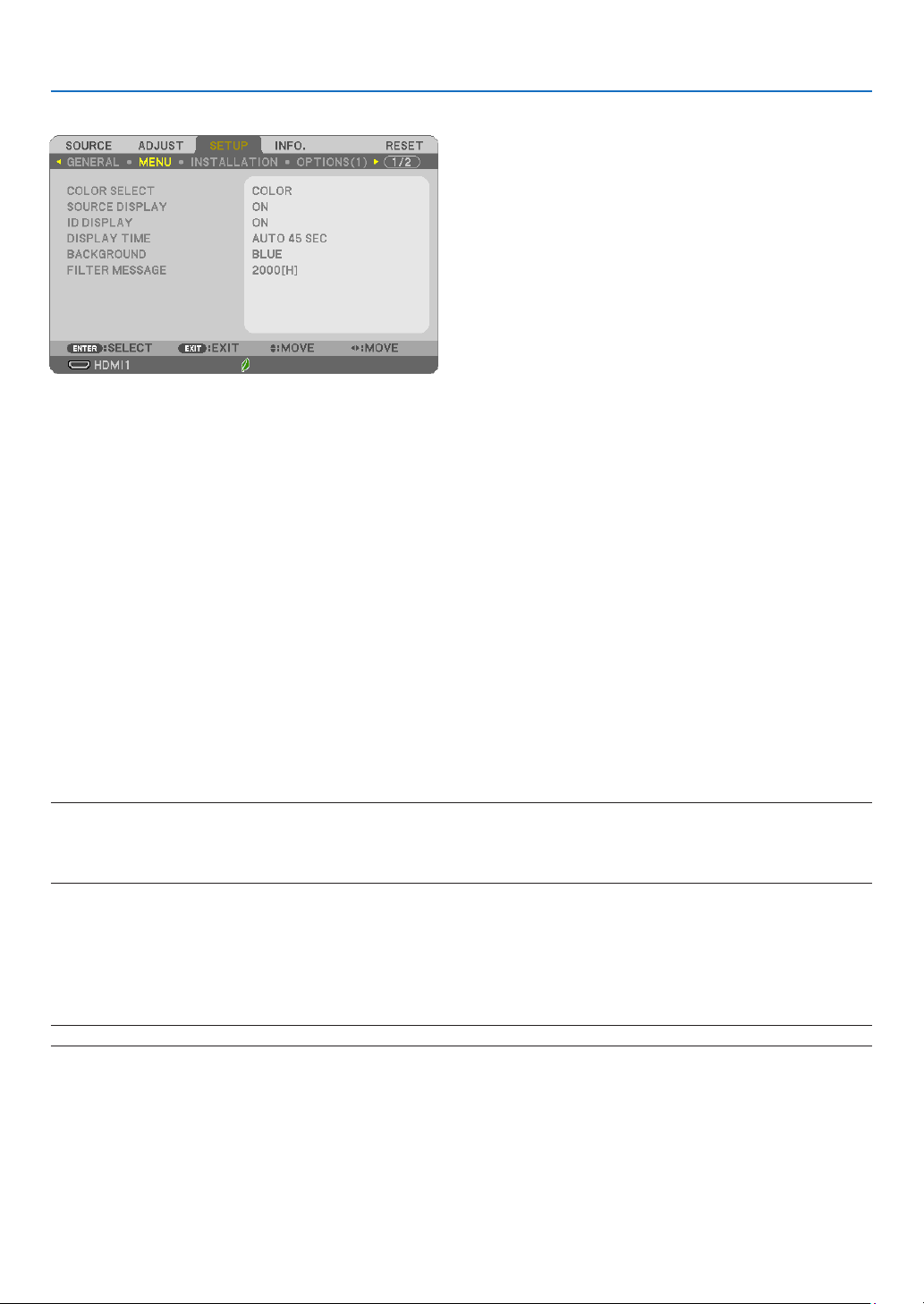
68
5. Using On-Screen Menu
TurningON/OFFControlID[IDDISPLAY]
ThisoptionturnsonorofftheIDnumberwhichisdisplayedwhentheIDSETbuttonontheremotecontrolispressed.
SelectingMenuDisplayTime[DISPLAYTIME]
Thisoptionallowsyoutoselecthowlongtheprojectorwaitsafterthelasttouchofabuttontoturnoffthemenu.
Thepresetchoicesare[MANUAL],[AUTO5SEC],[AUTO15SEC],and[AUTO45SEC].The[AUTO45SEC]isthe
factory preset.
SelectingaColororLogoforBackground[BACKGROUND]
Usethisfeaturetodisplayablue/blackscreenorlogowhennosignalisavailable.Thedefaultbackgroundis[BLUE].
NOTE:
• When[SOURCEDISPLAY]isturnedon,theno-signalguidancepromptingyoutocheckforanavailableinputwillbedisplayedatthecenter
ofthescreenregardlessofitsselection.
• Yoursettingwillnotbeaffectedevenwhen[RESET]isdonefromthemenu.
Five options are available:
OFF,100[H],500[H],1000[H],2000[H]
NOTE:Yoursettingwillnotbeaffectedevenwhen[RESET]isdonefromthemenu.
Selecting Interval Time for Filter Message [FILTER MESSAGE]
Thisoption allows you to select the time preference between displaying the message for cleaning the filters. Clean
the filters when you get the message “PLEASE CLEAN THE FILTER.” (→ page 93)
[MENU]
Selecting Menu Color [COLOR SELECT]
Youcanchoosebetweentwooptionsformenucolor:COLORandMONOCHROME.
TurningOn/OffSourceDisplay[SOURCEDISPLAY]
ThisoptionturnsonoroffinputnamedisplaysuchasHDMI1,HDMI2,COMPUTER,VIDEO,USB-A,tobe
displayedon
thetoprightofthescreen.
Whennoinputsignalispresent,theno-signalguidancepromptingyoutocheckforanavailableinputwillbedis-
played.Whenthe[USB-A]itemisselectedfor[SOURCE],theno-signalguidancewillnotbedisplayed.
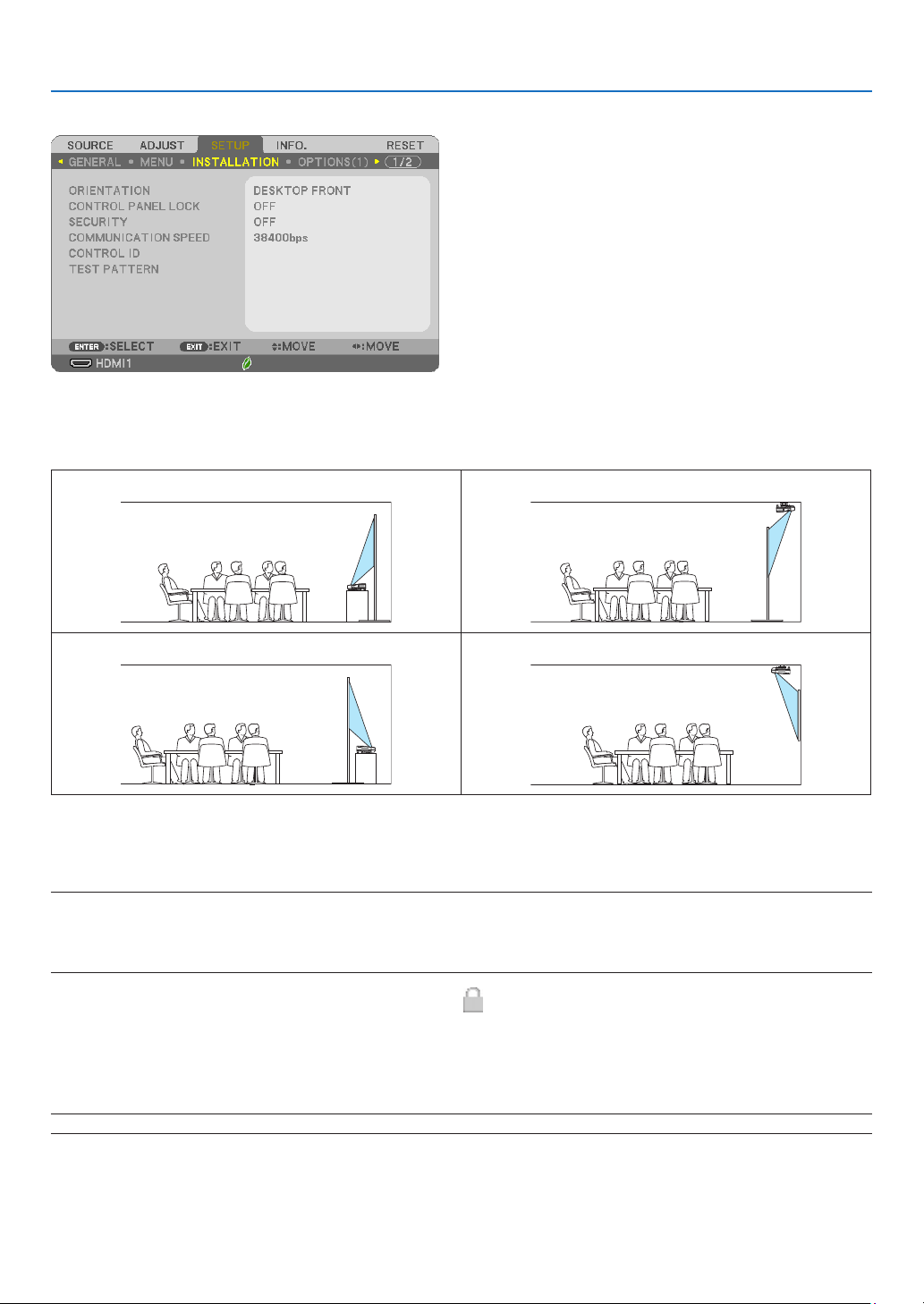
69
5. Using On-Screen Menu
[INSTALLATION]
Selecting
ProjectorOrientation[ORIENTATION]
Thisreorientsyourimageforyourtypeofprojection.Theoptionsare:desktopfrontprojection,ceilingrearprojec-
tion,desktoprearprojection,andceilingfrontprojection.
DESKTOP
FRONT CEILINGREAR
DESKTOPREAR CEILINGFRONT
Disabling the Cabinet Buttons [CONTROL PANEL LOCK]
ThisoptionturnsonorofftheCONTROLPANELLOCKfunction.
NOTE:
• ThisCONTROLPANELLOCKdoesnotaffecttheremotecontrolfunctions.
• Whenthecontrolpanelislocked,pressingandholdingtheSOURCEbuttonontheprojectorcabinetforabout10secondswillchangethe
settingto[OFF].
TIP:Whenthe[CONTROLPANELLOCK]isturnedon,akeylockicon[
]willbedisplayedatthebottomrightofthemenu.
EnablingSecurity[SECURITY]
ThisfeatureturnsonorofftheSECURITYfunction.
Unlessthecorrectkeywordis
entered,theprojectorcannotprojectanimage.(→ page34)
NOTE:Yoursettingwillnotbeaffectedevenwhen[RESET]isdonefromthemenu.
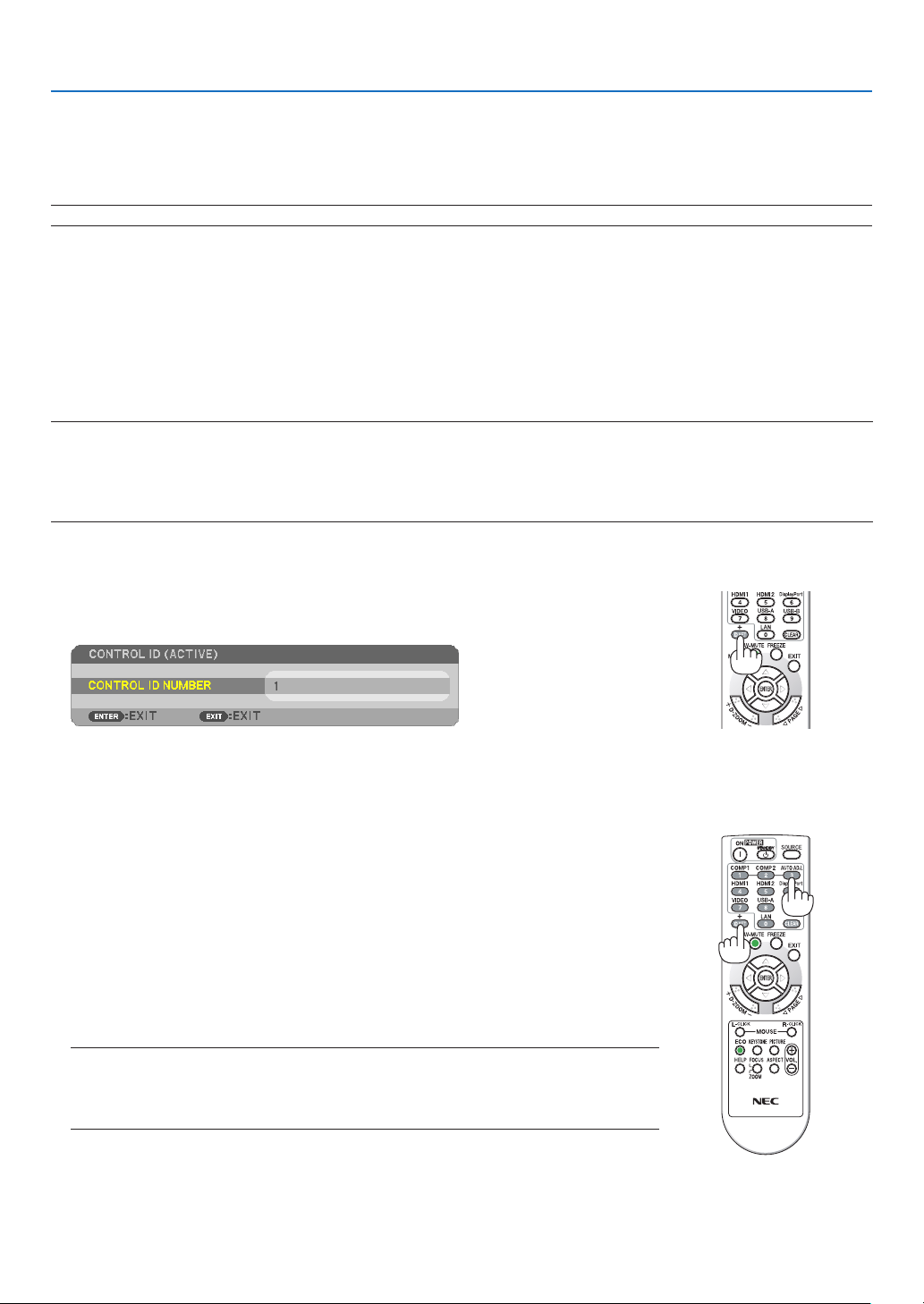
70
5. Using On-Screen Menu
Selecting Communication Speed [COMMUNICATION SPEED]
ThisfeaturesetsthebaudrateofthePCControlport(D-Sub9P).Itsupportsdataratesfrom4800to38400bps.
Thedefaultis38400bps.Selecttheappropriatebaudrateforyourequipmenttobeconnected(dependingonthe
equipment,alowerbaudratemayberecommendedforlongcableruns).
NOTE:Yourselectedcommunicationspeedwillnotbeaffectedevenwhen[RESET]isdonefromthemenu.
SettingIDtotheProjector[CONTROLID]
YoucanoperatemultipleprojectorsseparatelyandindependentlywiththesingleremotecontrolthathastheCON-
TROLIDfunction.IfyouassignthesameIDtoalltheprojectors,youcanconvenientlyoperatealltheprojectors
togetherusingthesingleremotecontrol.Todoso,youhavetoassignanIDnumbertoeachprojector.
CONTROL ID NUMBER ����������� Select a number from 1 to 254 you wish to assign to your projector�
CONTROL ID ��������������������������Select [OFF] to turn off the CONTROL ID setting and select [ON] to turn on the CONTROL ID setting�
NOTE:
• When[ON]isselectedfor[CONTROLID],theprojectorcannotbeoperatedbyusingtheremotecontrolthatdoesnotsupporttheCONTROL
IDfunction.(Inthiscasethebuttonsontheprojectorcabinetcanbeused.)
• Yoursettingwillnotbeaffectedevenwhen[RESET]isdonefromthemenu.
• PressingandholdingtheENTERbuttonontheprojectorcabinetfor10secondswilldisplaythemenuforcancelingtheControlID.
Assigning or Changing the Control ID
1. Turn on the projector.
2. Press the ID SET button on the remote control.
TheCONTROLIDscreenwillbedisplayed.
IftheprojectorcanbeoperatedwiththecurrentremotecontrolID,the[ACTIVE]will
bedisplayed.Iftheprojectorcannotbeoperatedwiththecurrentremotecontrol
ID,the[INACTIVE]willbedisplayed.Tooperatetheinactiveprojector,assignthe
controlIDusedfortheprojectorbyusingthefollowingprocedure(Step3).
+
3. Press one of numeric keypad buttons while pressing and holding the ID SET
button on the remote control.
Example:
Toassign“3”,pressthe“3”buttonontheremotecontrol.
NoIDmeansthatalltheprojectorscanbeoperatedtogetherwithasingleremote
control.Toset“NoID”,enter“000”orpresstheCLEARbutton.
TIP:TherangeofIDsisfrom1to254.
4. Release the ID SET button.
TheupdatedCONTROLIDscreenwillbedisplayed.
NOTE:
• TheIDscanbeclearedinafewdaysafterthebatteriesarerundownorremoved.
• AccidentallypressinganyoneofthebuttonsoftheremotecontrolwillclearcurrentlyspeciedID
withbatteriesremoved.
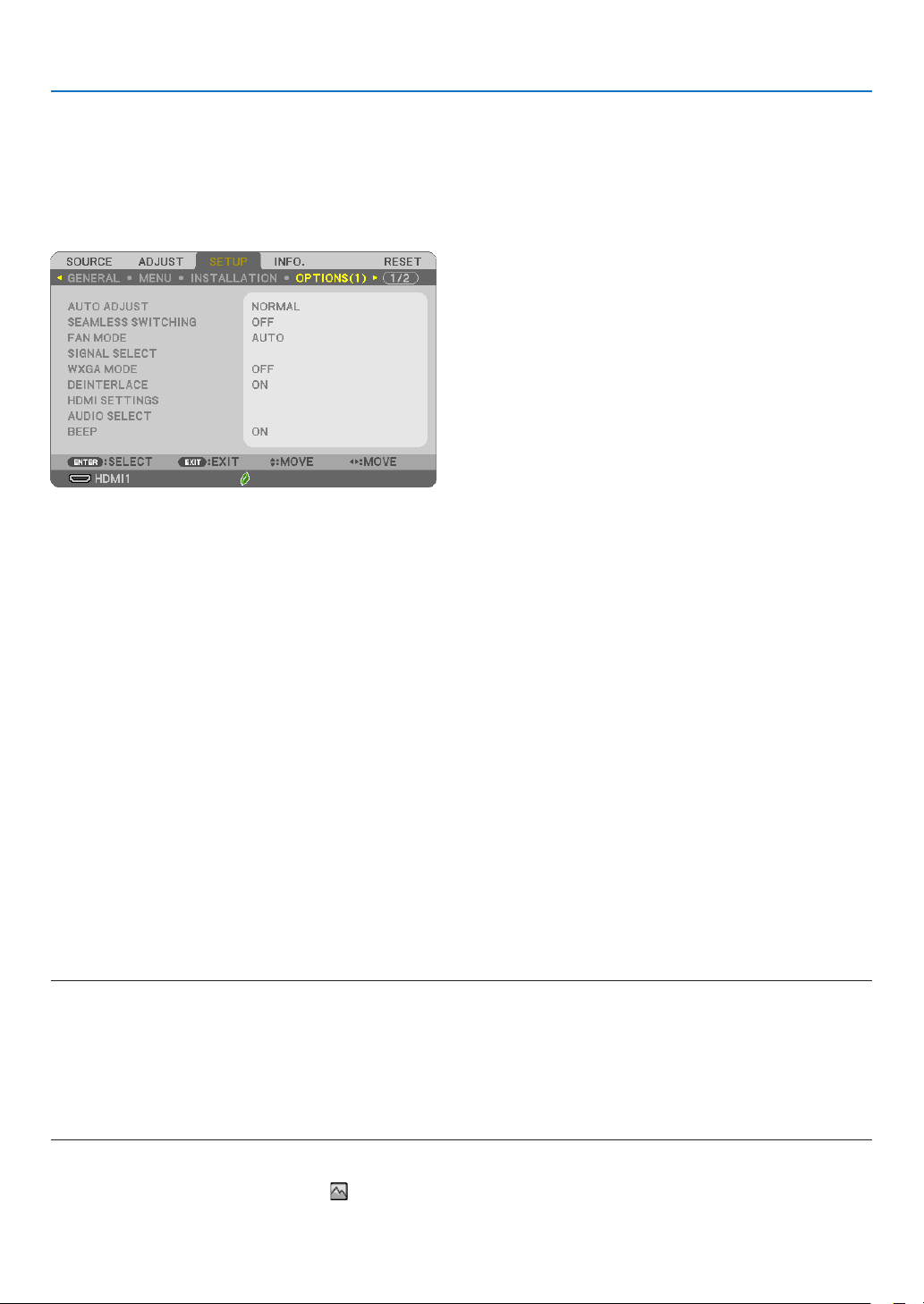
71
5. Using On-Screen Menu
[OPTIONS(1)]
Setting
AutoAdjust[AUTOADJUST]
ThisfeaturesetstheAutoAdjustmodesothatthecomputersignalcanbeautomaticallyormanuallyadjustedfor
noiseandstability.Youcanautomaticallymakeadjustmentintwoways:[NORMAL]and[FINE].
OFF �������������������������� The computer signal will not be automatically adjusted� You can manually optimize the computer signal�
NORMAL ������������������Default setting� The computer signal will be automatically adjusted� Normally select this option�
FINE �������������������������Select this option if fine adjustment is needed� It takes more time to switch to the source than when [NORMAL]is
selected�
[SEAMLESS SWITCHING]
Whentheinputconnectorisswitched,theimagedisplayedbeforeswitchingisheldtoswitchtothenewimage
withoutabreakduetoabsenceofasignal.
Selecting Fan Mode [FAN MODE]
Thisoptionallowsyoutoselectthreemodesforfanspeed:Automode,Highspeedmode,andHighAltitudemode.
AUTO �����������������������The built-in fans automatically run at a variable speed according to the internal temperature�
HIGH ������������������������The built-in fans run at high speed�
HIGH ALTITUDE ��������� The built-in fans run at a high speed� Select this option when using the projector at altitudes approximately 5500
feet/1700 meters or higher�
Whenyouwishtocooldownthetemperatureinsidetheprojectorquickly,select[HIGH].
NOTE:
• ItisrecommendedthatyouselectHighspeedmodeifyouusetheprojectornon-stopforconsecutivedays.
• Set[FANMODE]to[HIGHALTITUDE]whenusingtheprojectorataltitudesapproximately5500feet/1700metersorhigher.
• Usingtheprojectorataltitudesapproximately5500feet/1700metersorhigherwithoutsettingto[HIGHALTITUDE]cancausetheprojector
tooverheatandtheprotectorcouldshutdown.Ifthishappens,waitacoupleminutesandturnontheprojector.
• Usingtheprojectorataltitudesapproximately5500feet/1700metersorhighercanshortenthelifeofopticalcomponentssuchasthe
l
ight
.
• Yoursettingwillnotbeaffectedevenwhen[RESET]isdonefromthemenu.
TIP:
• When[HIGHALTITUDE]isselected,anicon[
]isdisplayedatthebottomoftheon-screenmenu.
Using Test Pattern [TEST PATTERN]
Displaysthetestpatterntocheckforimagedistortionatthetimeoftheprojectorsetup.PresstheENTERbuttonto
displaythetestpattern;presstheEXITbuttontoclosethetestpatternandreturntothemenu.Menuoperationand
correctionsforkeystone,cornerstoneandpincushionarenotavailablewhenthetestpatternisdisplayed.

72
5. Using On-Screen Menu
Selecting Signal Format [SIGNAL SELECT]
[COMPUTER]
Allowsyoutochoose[COMPUTER]foranRGBsourcesuchasacomputer,or[COMPONENT]foracomponent
videosourcesuchasaDVDplayer.Normallyselect[RGB/COMPONENT]andtheprojectorautomaticallydetectsa
componentsignal.Howevertheremaybesomecomponentsignalsthattheprojectorisunabletodetect.Ifthisis
thecase,select[COMPONENT].
[VIDEO]
This feature enables you to select composite video standards automatically or manually.
Factorydefaultsettingis[AUTO]andtheprojectorwillautomaticallydetectthevideostandard.
Inthecasewheretheprojectorhasdifficult detectingthevideostandard,selecttheappropriatevideostandard
from the menu.
EnablingorDisablingWXGAMode[WXGAMODE]
Selecting[ON]willgiveprioritytoWXGA(1280×800)/WUXGA(1920×1200)signalsinrecognizinganinputsignal.
NOTE: [ON] is selected at the time of shipment.
Enabling the deinterlace [DEINTERLACE]
Turnsonoroffthedeinterlacefunctionforatelecinesignal.
OFF �������������������������� Select this option if there is any jitter or artifacts in video�
ON ���������������������������Default standard setting�
NOTE:ThisfeatureisnotavailableforHDTV(progressive)andcomputersignals.
Setting HDMI1, HDMI2 [HDMI SETTINGS]
Make the settings for each video level when connecting HDMI1 equipment such as a DVD player.
VIDEO LEVEL ������������Select [AUTO] to automatically detect video level� If automatic detection may not work well, select [NORMAL] to
disable the [ENHANCED] feature of your HDMI equipment or select [ENHANCED] to improve image contrast and
increase detail in the dark areas�
Setting Audio [AUDIO SELECT]
MakethesettingsforeachaudiolevelwhenconnectingHDMIequipment.Selectbetweeneachequipmentand
computer.
HDMI1, HDMI2
�������������� Select [HDMI1] or [HDMI2] to switch the HDMI1 IN or HDMI 2 IN digital audio signal or select [COMPUTER] to switch
the COMPUTER input audio signal�
Enabling Key Sound and Error Sound [BEEP]
Thisfeatureturnsonoroffthebuttonsoundoralarmwhenanerroroccursorthefollowingoperationsareperformed.
-Displayingthemainmenu
-Switchingsources
-Resettingdatabyusing[RESET]
-PressingPOWERONorSTANDBYbutton
TIP:
• Volumecontrolfor[BEEP]isdisabled.AV-MUTEbuttonisnoteffectivetostopbeepingsound.IfyouwanttoactivateBEEPfunction,set
[BEEP] to [OFF].
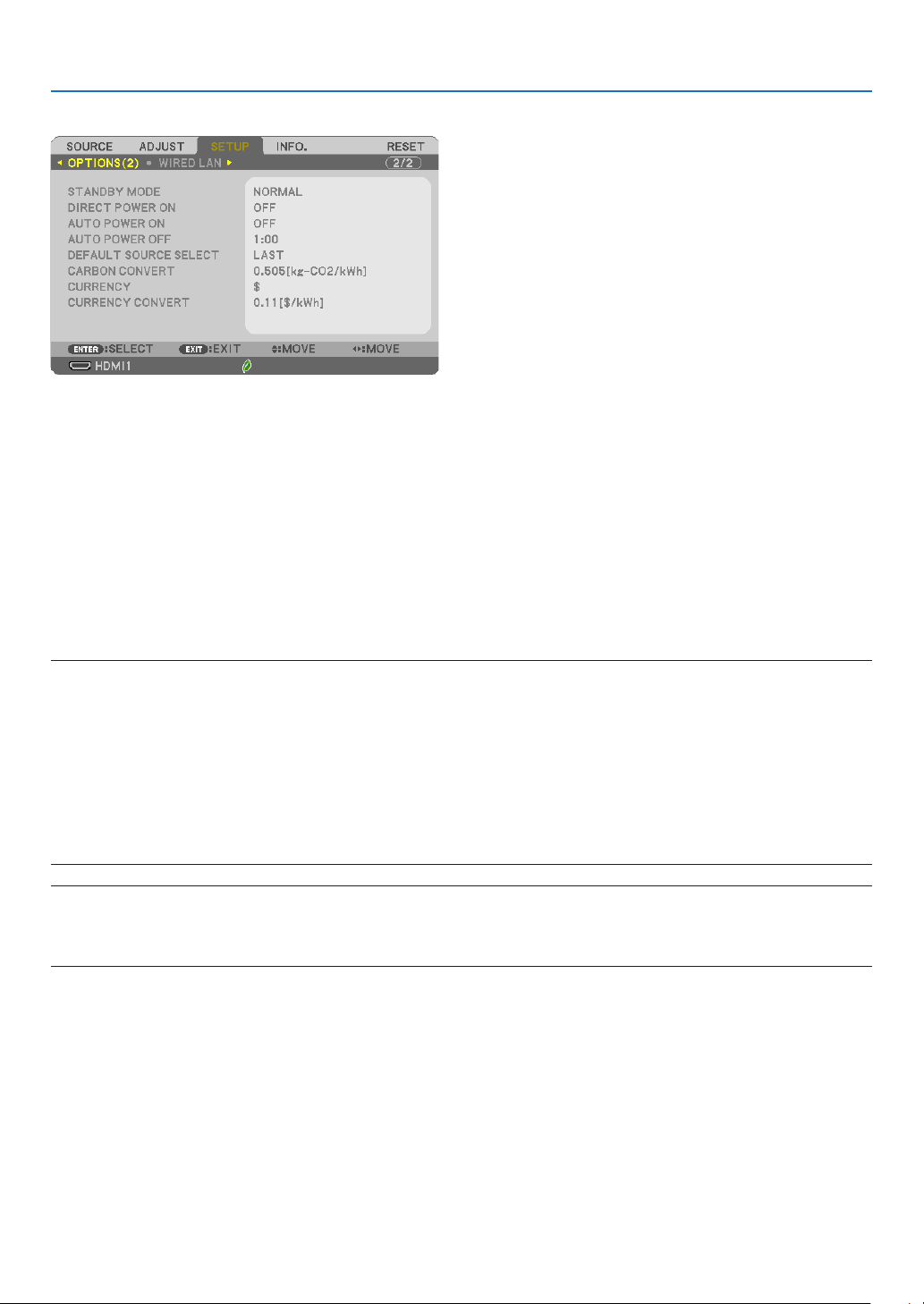
73
5. Using On-Screen Menu
SelectingPower-savingin[STANDBYMODE]
Theprojectorhastwostandbymodes:[NORMAL]and[NETWORKSTANDBY].
TheNORMALmodeisthemodethatallowsyoutoputtheprojectorinthepower-savingconditionwhichconsumes
lesspowerthantheNETWORKSTANDBYmode.
NORMAL
�������������������������������When [NORMAL] is selected, only the following buttons and feature will work:
POWER buttons on the projector cabinet and the remote control, AUTO POWER ON, and powering on from
PC Control command�
NETWORK STANDBY ��������������When [NETWORK STANDBY] is selected, the projector can be turned on over a wired LAN connection and
only the following buttons, port, and features will work:
IMPORTANT:
• When[NETWORKSTANDBY]hasbeensetfor[STANDBYMODE]andtheLANhasbeeninlink-downconditionfor3minutes,[STANDBY
MODE]willtransitinto[NORMAL]automticiallyforthepurposetosavetheconsumptionpower.
•
When[NETWORKSTANDBY]hasbeenselected,[AUTOPOWEROFF]becomesineffective(displayedingrey)and[0:15]isselectedauto-
matically.
When[STANDBYMODE]→
[NETWORKSTANDBY]isselected
-When[NETWORKSERVICE]→
[AMXSETTINGS]→
[ENABLE]isselected
-Whenthesignalisinputtothecomputer,HDMI1INorHDMI2INterminals
NOTE:
• Evenwhen[NORMAL]isselectedfor[STANDBYMODE],poweronoroffcanbedonebyusingthePCCONTROLport.
• ThepowerconsumptioninthestandbymodewillnotbeincludedincalculatingCO
2
emissionreduction.
• Yoursettingfor[STANDBYMODE]willnotbeaffectedevenwhen[RESET]isdonefromthemenu.
[OPTIONS(2)]
EnablingDirectPowerOn[DIRECTPOWERON]
Turns the projector on automatically when the power cord is inserted into an active power outlet. This eliminates the
needtoalwaysusethePOWERbuttonontheremotecontrolorprojectorcabinet.
POWER buttons on
the projector cabinet and
the remote control, powering on from PC Control command,
AUTO POWER ON, operation by User Supportware, LAN feature, and Mail Alert feature.
•
In the below conditions, setting of the [STANDBY MODE] is disabled and the projector will go into the SLEEP mode*.
* Sleep mode refers the mode without functional restrictions by the [STANDBY MODE].

74
5. Using On-Screen Menu
TurningOntheProjectorByApplyingComputerSignal[AUTOPOWERON]
WhentheprojectorisinStandbymode,applyingacomputerorHDMIsignalfromacomputerconnectedtothe
COMPUTERINinput,HDMI1,orHDMI2inputwillpowerontheprojectorandsimultaneouslyprojecttheimage.
ThisfunctionalityeliminatestheneedtoalwaysusethePOWERbuttonontheremotecontrolortheprojectorcabinet
to power on the projector.
Tousethisfunction,firs connectacomputertotheprojectorandtheprojectortoanactiveACinput.
NOTE:
• Disconnectingacomputersignalfromthecomputerwillnotpowerofftheprojector.Werecommendusingthisfunctionincombination
oftheAUTOPOWEROFFfunction.
• Thisfunctionwillnotbeavailableunderthefollowingconditions:
- whenacomponentsignalisappliedtotheCOMPUTERINterminal
- whenaSynconGreenRGBsignalorcompositesyncsignalisapplied
• ToenabletheAUTOPOWERONafterturningofftheprojector,wait5secondsandinputacomputerorHDMIsignal.
IfacomputerorHDMIsignalisstillpresentwhentheprojectoristurnedoff,theAUTOPOWERONwillnotworkandtheprojectorremains
instandbymode.
• Dependingontheprojectorinuse,theAUTOPOWERONmaynotworkproperly.Inthiscase,set[STANDBYMODE]to[NETWORKSTANDBY].
EnablingPowerManagement[AUTOPOWEROFF]
Whenthisoptionisselectedyoucanenabletheprojectortoautomaticallyturnoff(attheselectedtime:0:05,0:10,
0:15,0:20,0:30,1:00)ifthereisnosignalreceivedbyanyinputorifnooperationisperformed.
Selecting Default Source [DEFAULT SOURCE SELECT]
Youcansettheprojectortodefaulttoanyoneofitsinputseachtimetheprojectoristurnedon.
LAST ������������������������Sets the projector to default to the previous or last active input each time the projector is turned on�
AUTO �����������������������Searches for an active source in order of HDMI1 → HDMI2 → COMPUTER → VIDEO → USB-A → LAN →
HDMI1 and displays the first found sourc �
HDMI1 ����������������������Displays the digital source from the HDMI 1 IN terminal every time the projector is turned on�
HDMI2 ����������������������Displays the digital source from the HDMI 2 IN terminal every time the projector is turned on�
COMPUTER ��������������Displays the computer signal from the COMPUTER IN terminal every time the projector is turned on�
VIDEO �����������������������Displays the Video source from the VIDEO IN terminal every time the projector is turned on�
USB-A ���������������������� Displays slides or plays back movie files from the USB memo y device every time the projector is turned on�
Settingcarbonfootprintfactor[CARBONCONVERT]
Adjuststhecarbonfootprintfactorinthecarbonsavingcalculation.Theinitialsettingis0.505[kg-CO2/kWh]based
ontheCO2EmissionsfromFuelCombustion(2008Edition)publishedbyOECD.
Selectingyourcurrency[CURRENCY]
Displayselectricitypricing(availablein4currencyunits).
$ ������������������������������ US Dollar
€ ����������������������������� EU Euro
JP¥ ��������������������������Japanese Yen
RMB¥ �����������������������Chinese Yuan
LAN ........................ Displays a signal from LAN port (RJ-45).

75
5. Using On-Screen Menu
Changingcurrencysettingandcurrencyconvertsetting[CURRENCYCONVERT]
ChangescurrencysettingandcurrencyconvertsettingforCARBONMETER.
Theinitialsettingareasfollows:
US Dollar ������������������0�11 [$/kWh]
EU Euro �������������������� 0�19 [€/kWh]
Japanese Yen ����������� 20 [¥/kWh]
Chinese Yuan �����������0�48 [¥/kWh]
TheinitialsettingsforUSdollar,EUEuro,andJapaneseYenarebasedon“EnergyPricesandTaxes(secondquarter
2010”publishedbyOECD.
TheinitialsettingforChineseYuanisbasedon“ChineseDataFile(2010)”publishedbyJETRO.
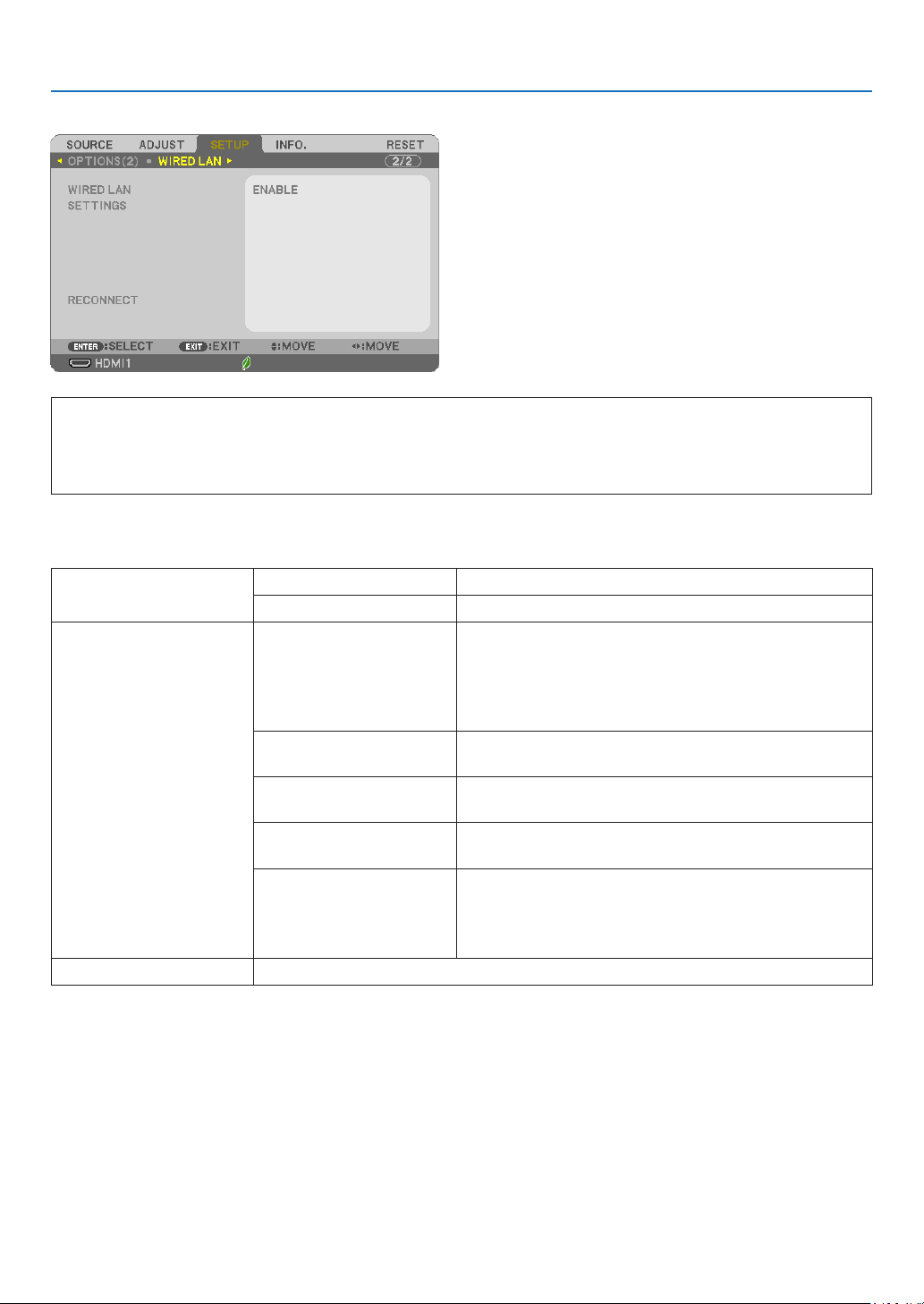
76
5. Using On-Screen Menu
Setting up the Projector for a Wired LAN Connection [WIRED LAN]
Important
• Consultwithyournetworkadministratoraboutthesesettings.
• Whenusinga wiredLANconnection, connecta LANcable(Ethernet cable)tothe LANport(RJ-45) ofthe
projector.(→page92)
TIP:Thenetworksettingsyoumakewillnotbeaffectedevenwhen[RESET]isdonefromthemenu.
[WIREDLAN] [DISABLE] WiredLANconnectionwillbeturnedoff.
[ENABLE] WiredLANconnectionwillbeturnedon.
[SETTINGS] [DHCP] ON ��������������������������� IP address, subnet mask, and gateway will be
automatically assigned to the projector from
your DHCP server�
OFF�������������������������� Specify IP address, subnet mask, and gateway
assigned by your network administrator�
[IPADDRESS] Set your IPaddress of the network connectedto the
projector.
[SUBNETMASK] Setyoursubnetmasknumberofthenetworkconnected
to the projector.
[GATEWAY] Setthedefaultgatewayofthenetworkconnectedtothe
projector.
[AUTODNS] ON ��������������������������� DHCP server will automatically assign IP address
of DNS server connected to the projector�
OFF�������������������������� Set your IP address of DNS server connected
to the projector�
[RECONNECT] Retrytoconnecttheprojectortoanetwork.
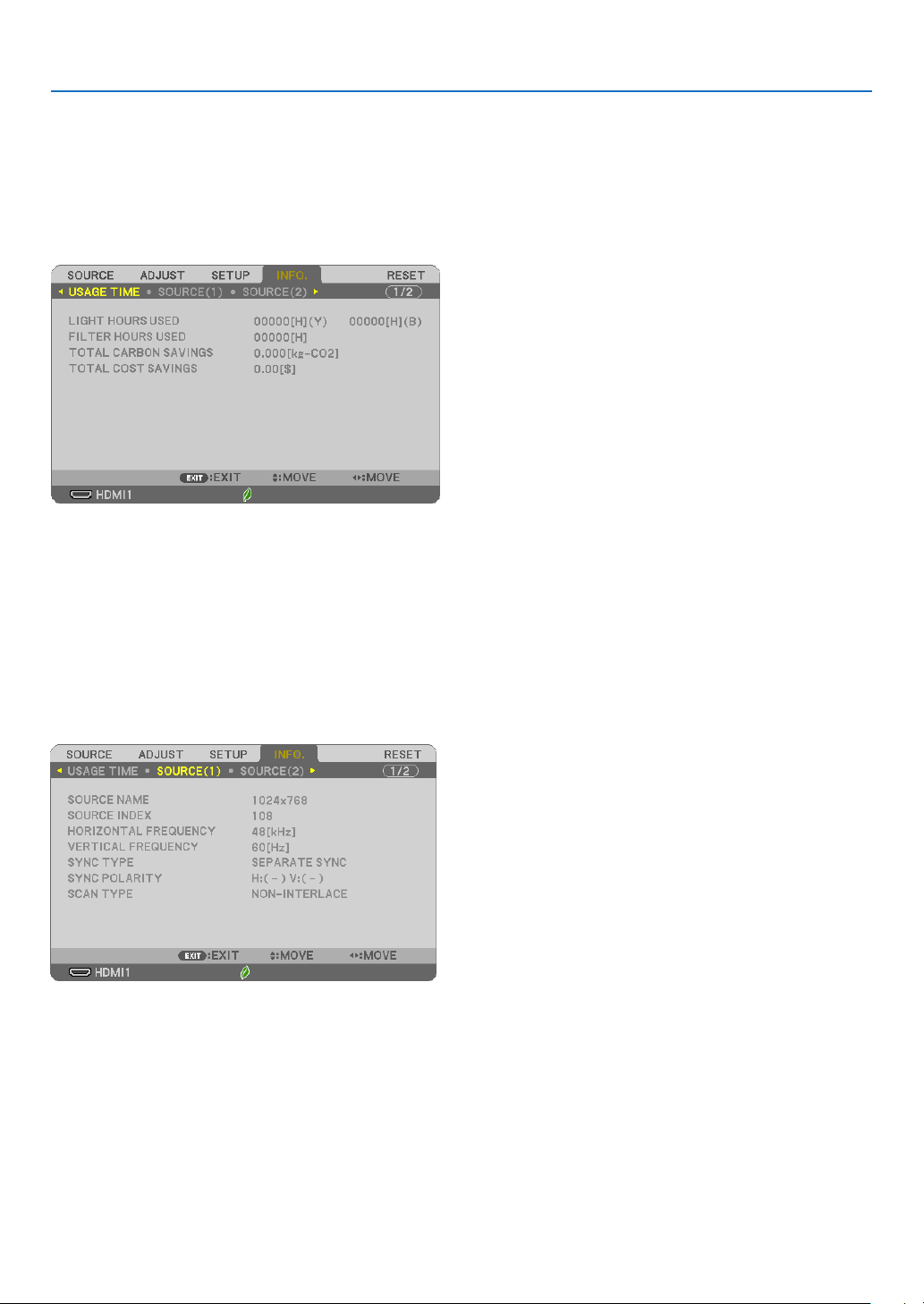
77
5. Using On-Screen Menu
❼ Menu Descriptions & Functions [INFO.]
Displaysthestatusofthecurrentsignalandlightusage.Thisitemhassevenpages.Theinformationincludedis
asfollows:
TIP:PressingtheHELPbuttonontheremotecontrolwillshowthe[INFO.]menuitems.
[USAGE TIME]
[L
IGHTHOURSUSED](H)
[FILTER
HOURS
USED]
(H)
[TOTAL
CARBONSAVINGS](kg-CO2)
[TOTAL
COSTSAVINGS]
•
[TOTALCARBONSAVINGS]
Thisdisplaystheestimatedcarbonsavinginformationinkg.Thecarbonfootprint
factorinthecarbonsaving
calculationisbasedontheOECD(2008Edition).(→page29)
[SOURCE(1)]
[SOURCEINDEX]
[VERTICALFREQUENCY]
[SYNCPOLARITY]
[SOURCENAME]
[HORIZONTALFREQUENCY]
[SYNCTYPE]
[SCANTYPE]
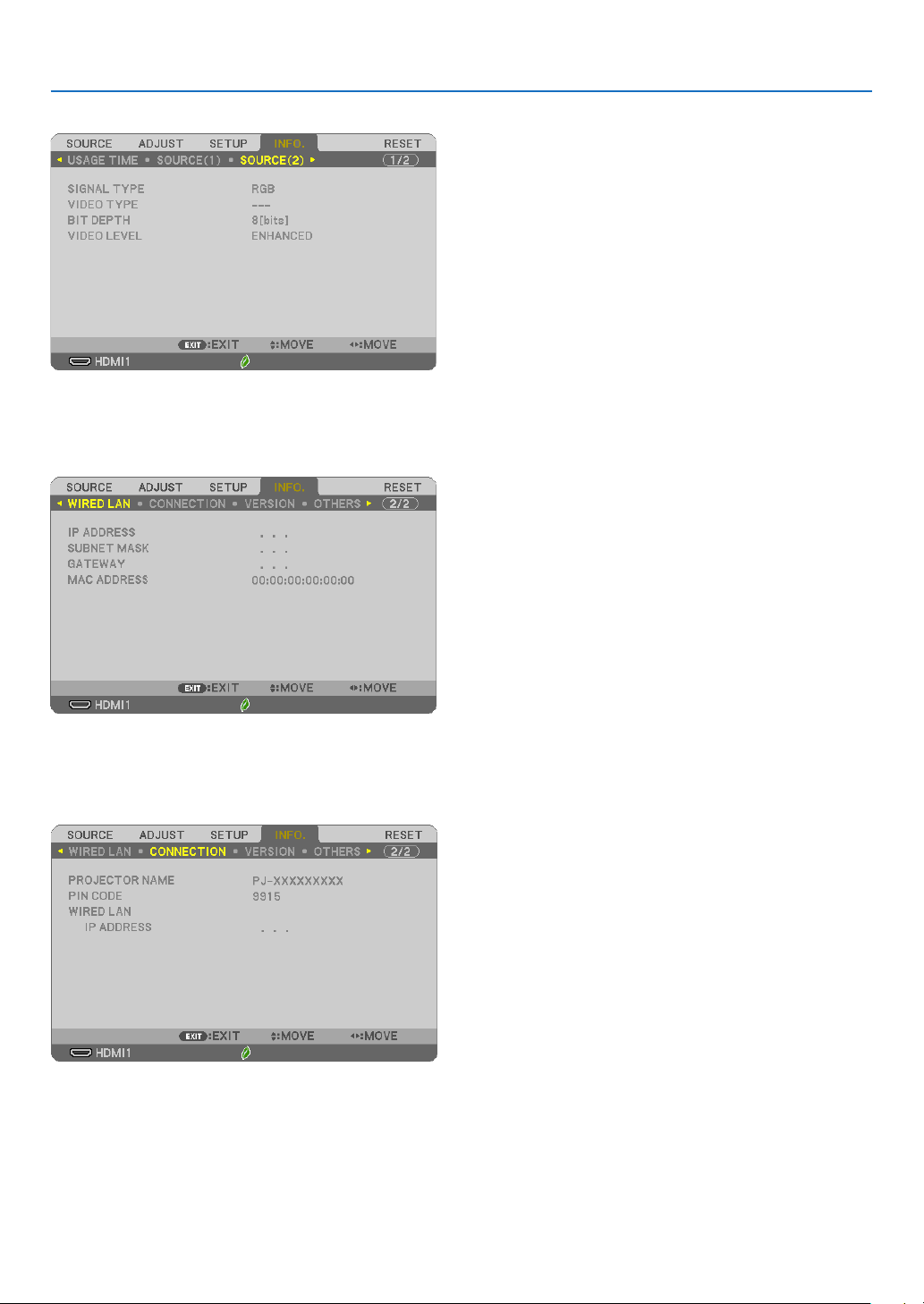
78
5. Using On-Screen Menu
[SOURCE(2)]
[VIDEOTYPE]
[VIDEOLEVEL]
[WIRED LAN]
[SUBNETMASK]
[MACADDRESS]
[SIGNAL TYPE]
[BIT DEPTH]
[IP ADDRESS]
[GATEWAY]
[CONNECTION]
[PROJECTOR NAME]
[WIRED LAN]
[PIN CODE]
[IPADDRESS]
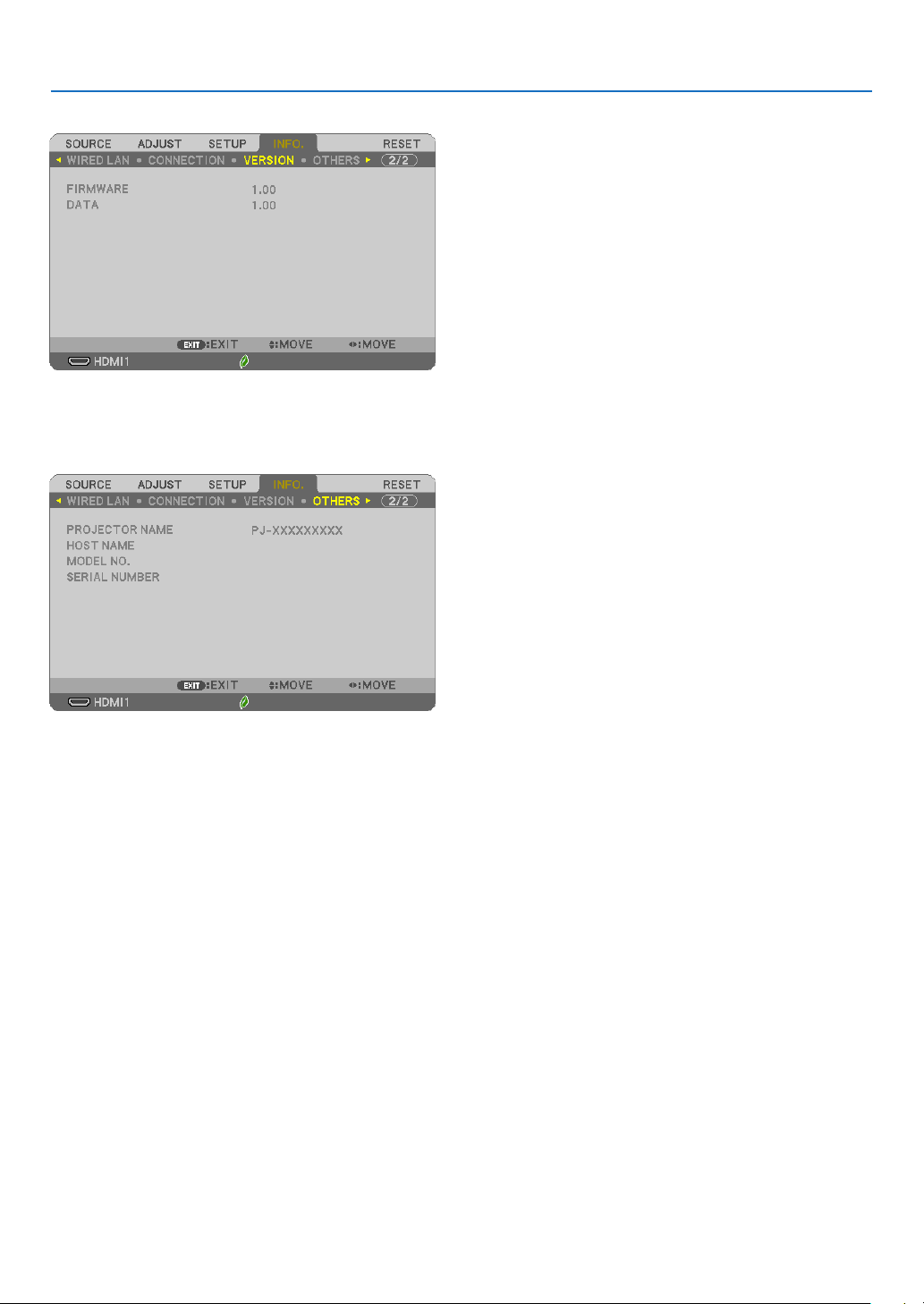
79
5. Using On-Screen Menu
[VERSION]
[FIRMWARE]Version
[DATA]Version
[OTHERS]
[PROJECTORNAME]
[HOSTNAME]
[MODEL
NO.]
[SERIALNUMBER]
[CONTROLID](when[CONTROLID]isset)

80
5. Using On-Screen Menu
❽ Menu Descriptions & Functions [RESET]
Returning to Factory Default [RESET]
TheRESETfeatureallowsyoutochangeadjustmentsandsettingstothefactorypresetfora(all)source(s)except
thefollowing:
[CURRENTSIGNAL]
Resetstheadjustmentsforthecurrentsignaltothefactorypresetlevels.
Theitemsthatcanberesetare:[PRESET],[CONTRAST],[BRIGHTNESS],[COLOR],[HUE],[SHARPNESS],[AS-
PECTRATIO],[HORIZONTAL],[VERTICAL],[CLOCK],[PHASE],and[OVERSCAN].
[ALLDATA]
Resetalltheadjustmentsandsettingsforallthesignalstothefactorypreset.
All items can be reset EXCEPT[LANGUAGE],[BACKGROUND],[ORIENTATION],[FILTERMESSAGE],[SECU-
RITY],[COMMUNICATIONSPEED], [CONTROLID], [STANDBYMODE],[FAN MODE],[CARBON CONVERT],
[CURRENCY], [CURRENCY CONVERT], [LIGHT HOURS USED], [FILTER HOURSUSED],[TOTALCARBON
SAVINGS],and [WIREDLAN].
NOTE:Elapsedtimeofthelterusewillnotbeaffectedevenwhen[RESET]isdonefromthemenu.
Clearing the Filter Usage Hours [CLEAR FILTER HOURS]
Resets the filter usage back to zero. Selecting this option displays submenu for a confirmation Select [YES] and
press the ENTER button.
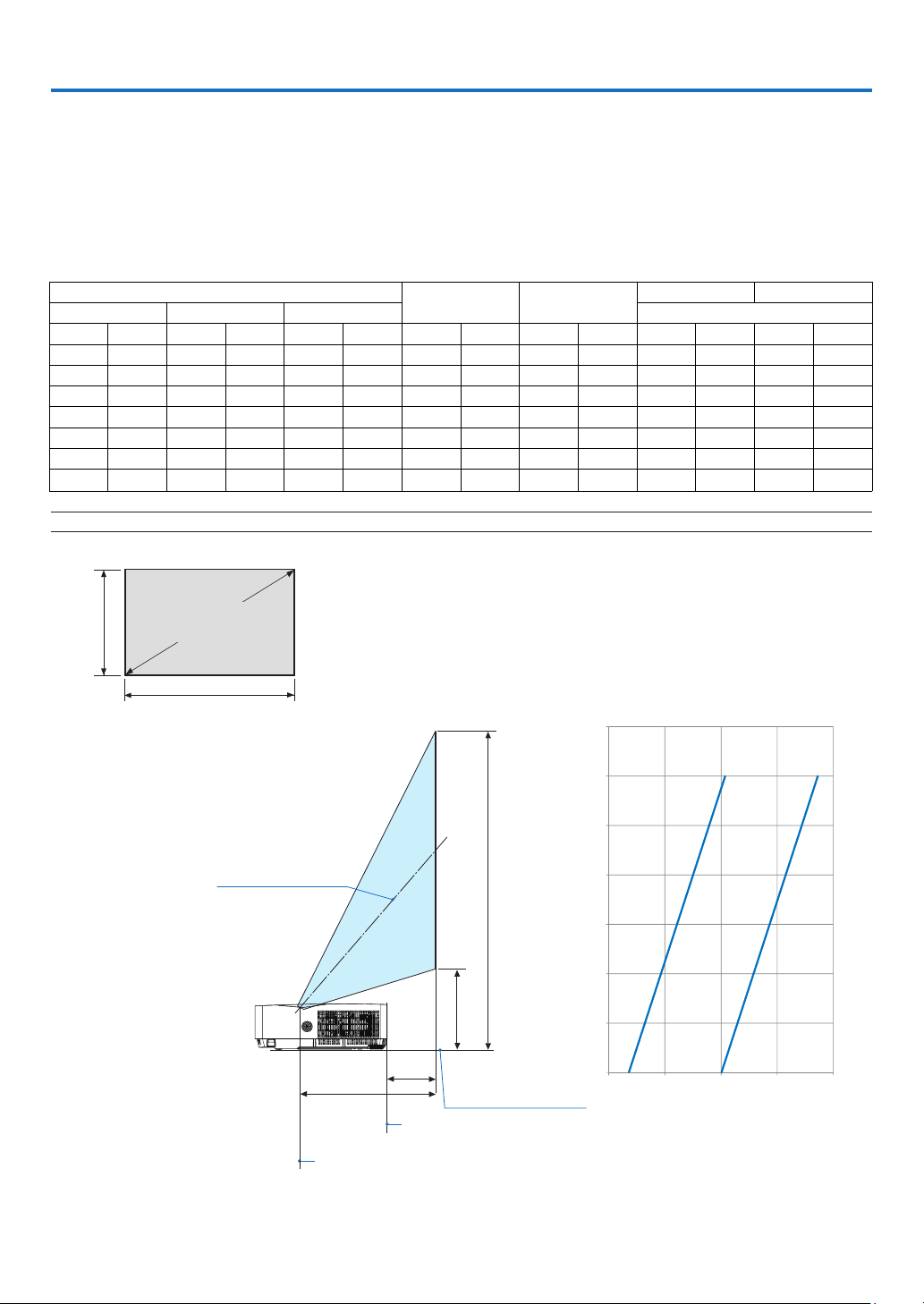
81
1 Setting Up the Screen and the Projector
6. Installation and Connections
Screen height
Screen size (diagonal)
Screen width
L2
L1
H1
H2
Center of Screen
Projector bottom
70
80
90
100
110
120
130
140
0
Screen size (inch)
Throw distance L1/L2(cm)
L1
L2
20
40
60
80
Screen side of projector
Center of projection window
inch mm inch mm inch mm inch mm inch mm inch mm inch mm
70 1778 59.4 1508 37.1 942 12.0 305 49.1 1247 3.2 80 16.2 410
80 2032 67.8 1723 42.4 1077 13.2 335 55.6 1412 5.4 138 18.4 468
90 2286 76.3 1939 47.7 1212 14.4 366 62.1 1578 7.7 197 20.7 527
100 2540 84.8 2154 53.0 1346 15.6 397 68.6 1743 10.0 255 23.0 585
110 2794 93.3 2369 58.3 1481 16.8 428 75.1 1909 12.3 313 25.3 643
120 3048 101.8 2585 63.6 1615 18.1 458 81.7 2074 14.6 371 27.6 701
130 3302 110.2 2800 68.9 1750 19.3 489 88.2 2239 16.9 429 29.9 759
H1 H2
L1 L2
Diagonal Width Height Wide
Screen Size
Thefurtheryourprojectorisfromthescreenorwall,thelargertheimage.Theminimumsizetheimagecanbeis
70"(1778mm)measureddiagonallywhentheprojectoris3.2inches(80mm)betweenthescreensideoftheprojector
andthewallorscreen.Thelargesttheimagecanbeis130"(3302mm)whentheprojectoris16.9inches(429mm)
betweenthescreensideoftheprojectorandthewallorscreen.
NOTE:The above values are design values and may vary.
Tables of screen sizes and dimensions

82
6. Installation and Connections
WARNING
Installingyourprojectorontheceilingmustbedone byaqualifiedtechnician.ContactyourNECdealerfor more
information.
Donotattempttoinstalltheprojectoryourself.
•
Only use your projector on a solid, level surface. If the projectorfallstotheground,youcanbeinjuredand the
projectorseverelydamaged.
•
Do not use the projector where temperatures vary greatly. The projector must
be used
at
temperatures
between
41°F(5°C)
and104°F(40°C)(Ecomode
selected
automaticallyat
95°F
to104°F/35°Cto 40°C).
•
Do not expose the projector to moisture, dust, or smoke.This
willharmthescreenimage.
•
Ensure that you have adequate ventilation around yourprojectorsoheatcandissipate.Donotcoverthe vents
on
thesideorthefrontoftheprojector.
•
•
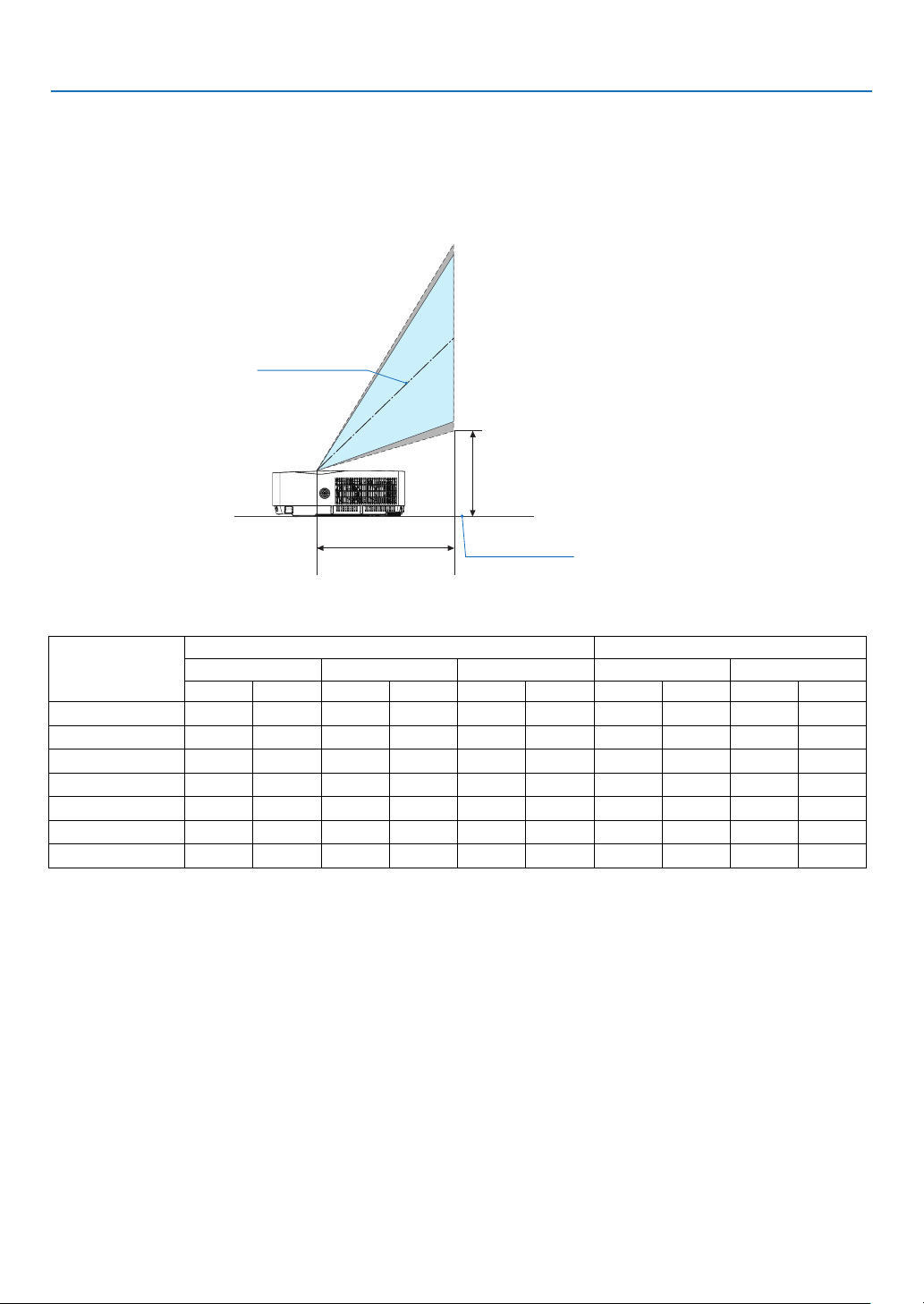
83
6. Installation and Connections
Example of installation on a desktop
Thediagrambelowshowsanexampleofwhentheprojectorisusedonadesktop.
Horizontalprojectionposition:Equaldistancetotheleftandrightfromthecenterofthelens
Verticalprojectionposition:(seetablebelow)
(Note)Heightfromlenscentertoloweredgeofscreen(withtiltfeetscrewedin)
H
L
Projector bottom
Center of screen
inch mm inch mm inch mm inch mm inch mm
10.9 276 13.1 333 12.0 305 16.2 410 17.0 432
11.9 303 14.5 368 13.2 335 18.4 468 19.4 493
13.0 330 15.8 402 14.4 366 20.7 527 21.8 554
14.0 357 17.2 437 15.6 397 23.0 585 24.2 615
15.1 383 18.6 472 16.8 428 25.3 643 26.6 676
16.1 410 20.0 507 18.1 458 27.6 701 29.0 738
17.2 437 21.3 542 19.3 489 29.9 759 31.4 799
80
90
100
110
120
130
Throw distance(L)
Min Max
0V
Wide Tele
Screen size
(inch)
Height(H)
70
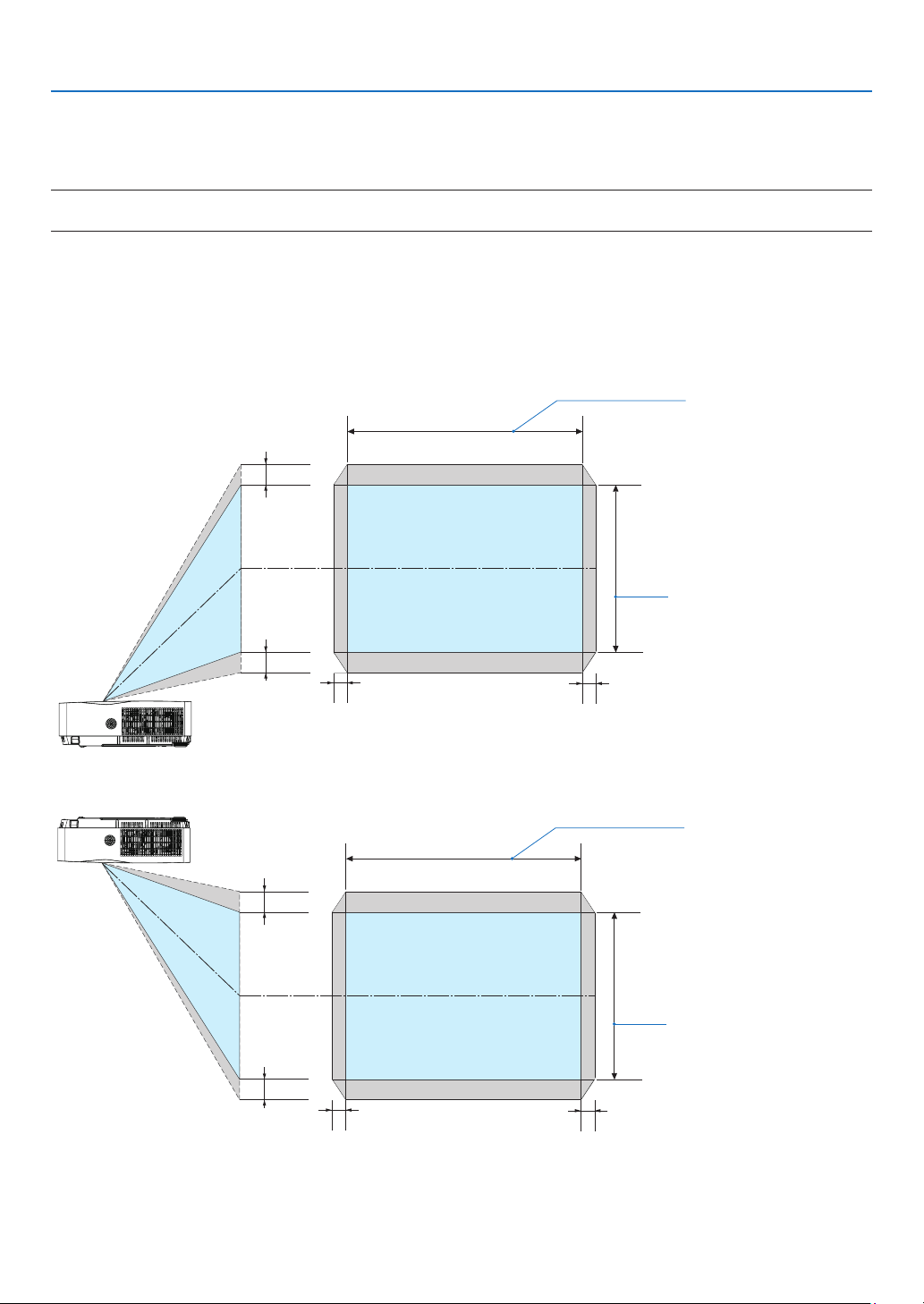
84
6. Installation and Connections
Lens shifting range
Thisprojectorisequippedwithalensshiftfunction(→page16)foradjustingtheimagepositionusingdials.Lens
shiftingispossiblewithintherangeshownbelow.
NOTE:
• Incaselensshiftedvolumeexceedsthebelowillustratedrange,blurandshademayappeararoundendsofprojectedimage.
Legend:V“Vertical”referstothescreenheightandH“Horizontal”referstothescreenwidth.Thelensshiftrange
isexpressedasaratioofheightandwidth,respectively.
Lensshiftingrange:
Verticaldirection:±3%
Horizontaldirection:±2%
3%V
3%V
2%H
100% H
Width of projected image
100% V
Height of projected image
2%H
3%V
3%V
2%H
100% H
Width of projected image
100% V
Height of projected image
2%H

85
6. Installation and Connections
(Example)Whenusingtoprojectona100"screen
Accordingtothe“Tablesofscreensizesanddimensions”(→page81),H=84.8"/215.4cm,V=53.0"/134.6cm.
Adjustmentrangeintheverticaldirection:theprojectedimagecanbemovedupwards0.03×53"/134.6cm≈
1.6"/4.06cm(whenthelensisatthecenterposition).
Adjustmentrangeinthehorizontaldirection:theprojectedimagecanbemovedtotheleft or right0.02× 84.8"/
215.4cm≈1.7"/4.27cm.
* Figuresdifferbyseveral%becausethecalculationisapproximate.
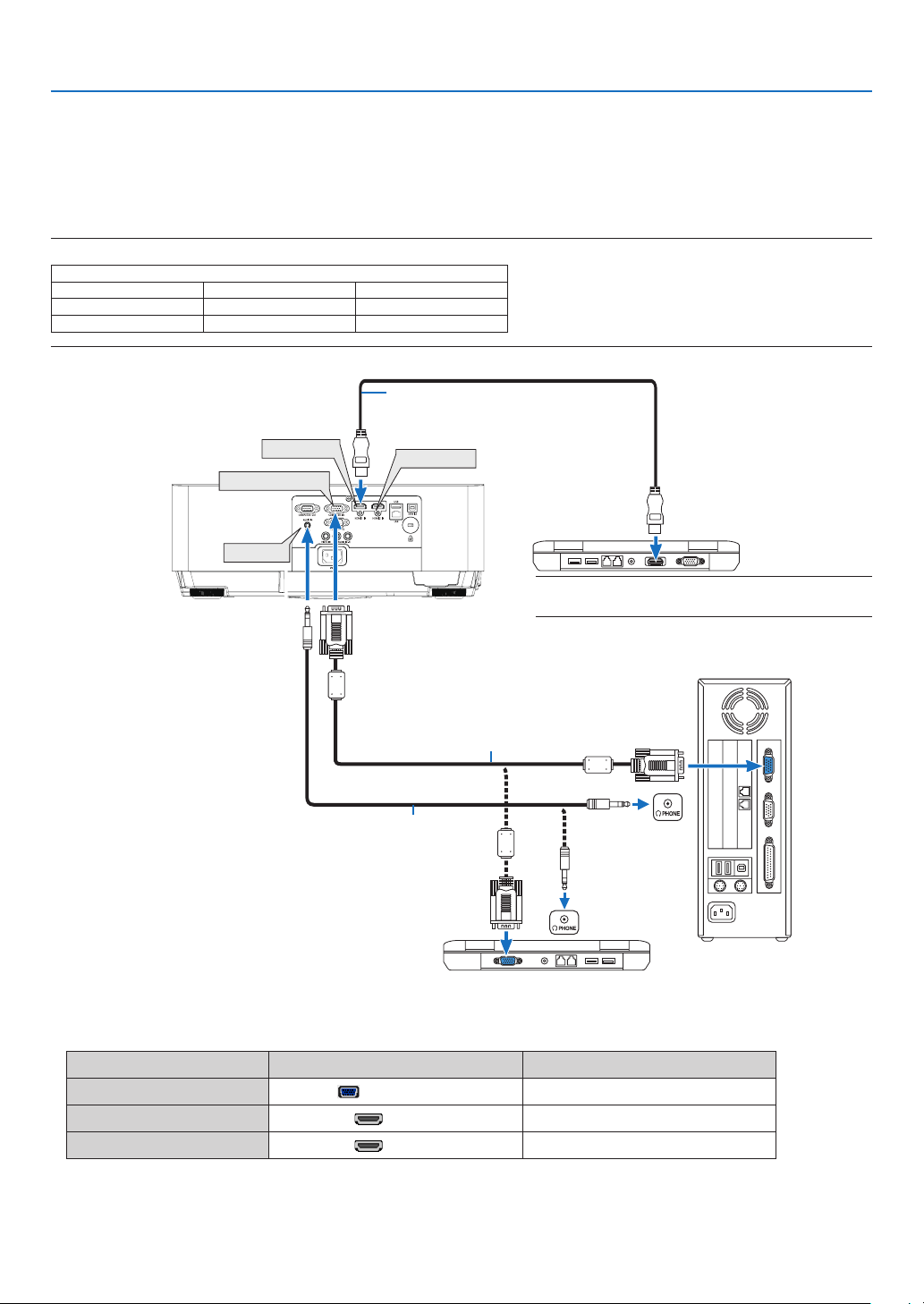
86
6. Installation and Connections
❷ Making Connections
NOTE:SignalssupportedbyPlug&Play(DDC2)
INPUT
COMPUTERIN HDMI1IN HDMI2IN
analog digital digital
Yes Yes Yes
• Selectthesourcenameforitsappropriateinputterminalafterturningontheprojector.
Inputterminal
SOURCEbuttonontheprojectorcabinet
Buttonontheremotecontrol
COMPUTERIN
COMPUTER
(COMPUTER1)
HDMI1IN
HDMI1 (HDMI1)
HDMI2IN
HDMI2
(HDMI2)
HDMI 1 IN
HDMI 2 IN
AUDIO IN
Computer cable (VGA) (supplied)
To mini D-Sub 15-pin terminal on the
projector.Itisrecommendedthatyouuse
a commercially available distribution
amplifier if connecting a signal cable
longer than the cable supplied.
Stereo mini-plug audio cable (not supplied)
HDMIcable(notsupplied)
UseHighSpeedHDMI®Cable.
NOTE:ForMac,useacommerciallyavailablepinadapter
(notsupplied)toconnecttoyourMac’svideoport.
Connecting Your Computer
Computer cables, HDMI can be used to connect to a computer. The connection cable is not enclosed with the projector.
Please get ready a suitable cable for the connection.
COMPUTER IN
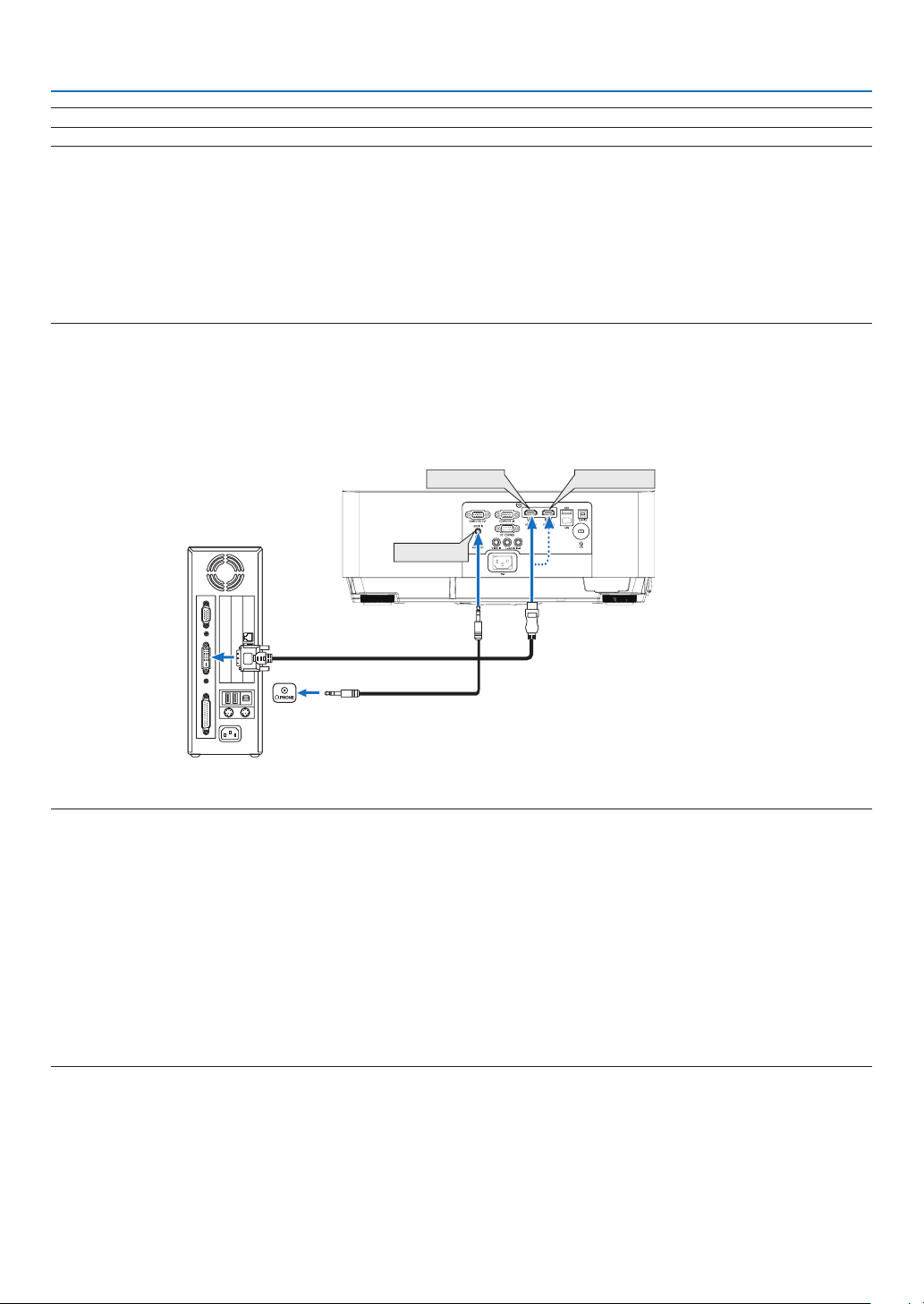
87
6. Installation and Connections
NOTE:TheprojectorisnotcompatiblewithvideodecodedoutputsoftheNECISS-6020switcher.
NOTE:AnimagemaynotbedisplayedcorrectlywhenaVideosourceisplayedbackviaacommerciallyavailablescanconverter.
Thisisbecausetheprojectorwillprocessavideosignalasacomputersignalatthedefaultsetting.Inthatcase,dothefollowing.
* Whenanimageisdisplayedwiththelowerandupperblackportionofthescreenoradarkimageisnotdisplayedcorrectly:
ProjectanimagetollthescreenandthenpresstheAUTOADJ.buttonontheremotecontrolortheprojectorcabinet.
Enabling the computer’s external display
DisplayinganimageonthenotebookPC’sscreendoesnotnecessarilymeanitoutputsasignaltotheprojector.
WhenusingaPCcompatiblelaptop,acombinationoffunctionkeyswillenable/disabletheexternaldisplay.
Usually,thecombinationofthe“Fn”keyalongwithoneofthe12functionkeysgetstheexternaldisplaytocomeonoroff.Forexample,NEC
laptopsuseFn+F3,whileDelllaptopsuseFn+F8keycombinationstotogglethroughexternaldisplayselections.
CautionswhenusingaDVIsignal
• WhenthecomputerhasaDVIoutputterminal,useacommerciallyavailableconvertercabletoconnectthecom-
putertotheprojector’sHDMI1orHDMI2inputterminal(onlydigitalvideosignalscanbeinput).
HDMI 1 IN
HDMI 2 IN
NOTE:WhenViewingaDVIDigitalSignal
• Turnoffthepowerofthecomputerandprojectorbeforeconnecting.
• Whenavideodeckisconnectedviaascanconverter,etc.,thedisplaymaynotbecorrectduringfast-forwardingandrewinding.
• UseaDVI-to-HDMIcablecompliantwithDDWG(DigitalDisplayWorkingGroup)DVI(DigitalVisualInterface)revision1.0standard.
Thecableshouldbewithin197"/5mlong.
• TurnofftheprojectorandthePCbeforeconnectingtheDVI-to-HDMIcable.
• ToprojectaDVIdigitalsignal:Connectthecables,turntheprojectoron,thenselecttheHDMIinput.Finally,turnonyourPC.
Failuretodosomaynotactivatethedigitaloutputofthegraphicscardresultinginnopicturebeingdisplayed.Shouldthishappen,restart
yourPC.
• DonotdisconnecttheDVI-to-HDMIcablewhiletheprojectorisrunning.Ifthesignalcablehasbeendisconnectedandthenreconnected,
animagemaynotbecorrectlydisplayed.Shouldthishappen,restartyourPC.
• TheCOMPUTERvideoinputterminalssupportWindowsPlugandPlay.
• AMacsignaladapter(commerciallyavailable)mayberequiredtoconnectaMaccomputer.
AUDIO IN
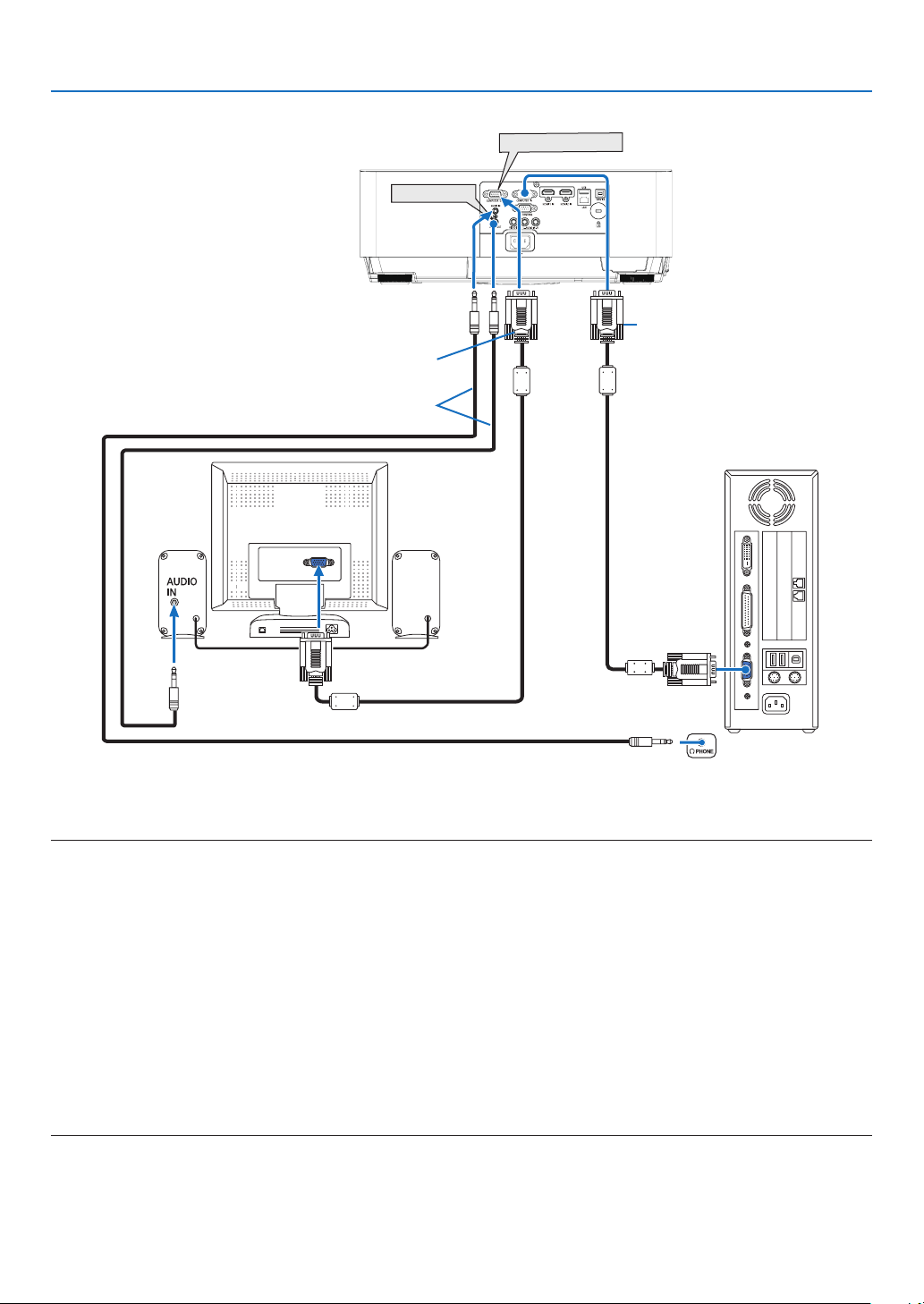
88
6. Installation and Connections
Connecting an External Monitor
Youcanconnectaseparate,externalmonitortoyourprojectortosimultaneouslyviewonamonitorthecomputer
analogimageyou’reprojecting.
NOTE:
• TheAUDIOOUTjackdoesnotsupportheadphoneterminal.
• Whenaudioequipmentisconnected,theprojectorspeakerisdisabled.
• ThesignaloutputfromtheCOMPUTEROUTofthisprojectorisforprojectingimageonexclusiveonedisplay.
• Whennosignalisappliedover3minutesintheconditionofprojectorstandbywhenNETWORKSTANDBYissetintheStandbymode,
outputfromtheCOMPUTEROUTorAUDIOOUTterminalwillbestopped.Inthiscasepulloutthecomputercableandsetitbackafter
inputtingvideosignal
Monitoroutandsleepmode:
• TheCOMPUTEROUTterminalwillnotworkwhen[NORMAL]isselectedfor[STANDBYMODE].
TheCOMPUTEROUTterminalwillworkonlyinthesleepmode.
ApplyingasignalfromtheCOMPUTERINterminalwillputtheprojectorinthesleepmode,whichallowsyoutousetheCOMPUTEROUT
terminalandtheAUDIOOUTminijack.
Thesleepmodeisoneofthestandbymodes.Thesleepmodecannotbeselectedfromthemenu.
• Inthenetworkstandbymode,soundforthelastviewedcomputerorvideosourcewillbeheard.
BNC-to-COMPUTERINterminalconvertedsignalwillnotbeoutputinthestandbymodeandsleepmode.
AUDIO OUT
COMPUTER OUT
Computer cable (VGA) (not supplied)
Computer cable (VGA) (supplied)
Stereo mini-plug audio cable (not supplied)
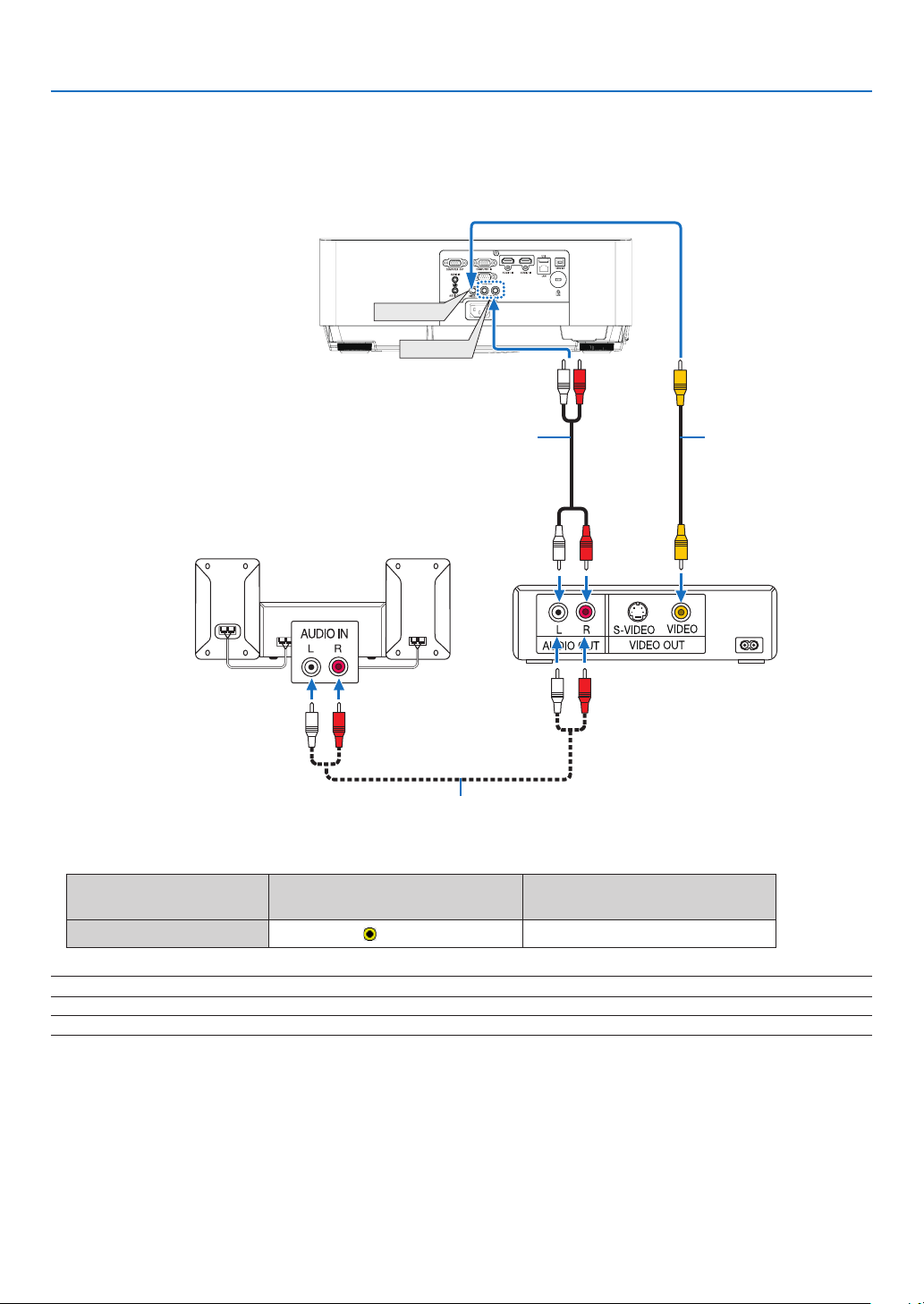
89
6. Installation and Connections
Connecting Your DVD Player or Other AV Equipment
ConnectingVideoInput
AUDIO IN
VIDEO IN
Video cable
(not supplied)
Audio cable (not supplied)
Audio cable (not supplied)
Audio equipment
• Selectthesourcenameforitsappropriateinputterminalafterturningontheprojector.
Inputterminal
SOURCEbuttonontheprojector
cabinet
Buttonontheremotecontrol
VIDEOIN
VIDEO
(VIDEO)
NOTE:RefertoyourVCRowner’smanualformoreinformationaboutyourequipment’svideooutputrequirements.
NOTE:AnimagemaynotbedisplayedcorrectlywhenaVideosourceisplayedbackinfast-forwardorfast-rewindviaascanconverter.
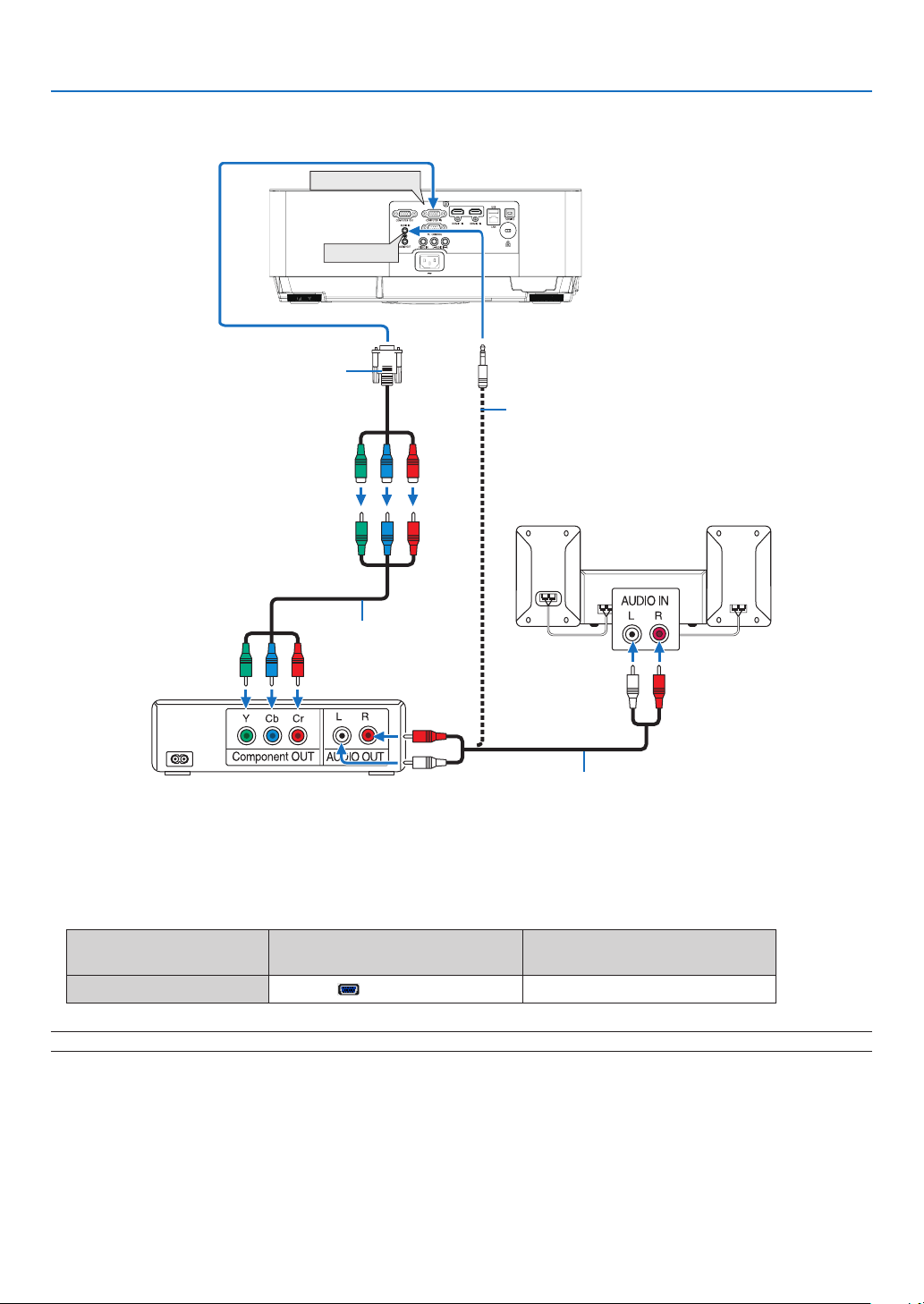
90
6. Installation and Connections
Connecting Component Input
COMPUTER IN
15-pin - to - RCA (female) × 3 cable adapter
(ADP-CV1E)
Stereo mini plug - to - RCA audio cable (not supplied)
Component video RCA ×
3 cable (not supplied)
Audio cable (not supplied)
DVD player
Audio Equipment
Acomponentsignalwillbeautomaticallydisplayed.Ifnot,fromthemenu,select[SETUP]→[OPTIONS(1)]→
[SIGNALSELECT]→[COMPUTER],andthenplaceacheckmarkintheComponentradiobutton.
• Selectthesourcenameforitsappropriateinputterminalafterturningontheprojector.
Inputterminal
SOURCEbuttonontheprojector
cabinet
Buttonontheremotecontrol
COMPUTERIN
COMPUTER
(COMPUTER1)
NOTE:RefertoyourDVDplayer’sowner’smanualformoreinformationaboutyourDVDplayer’svideooutputrequirements.
AUDIO IN
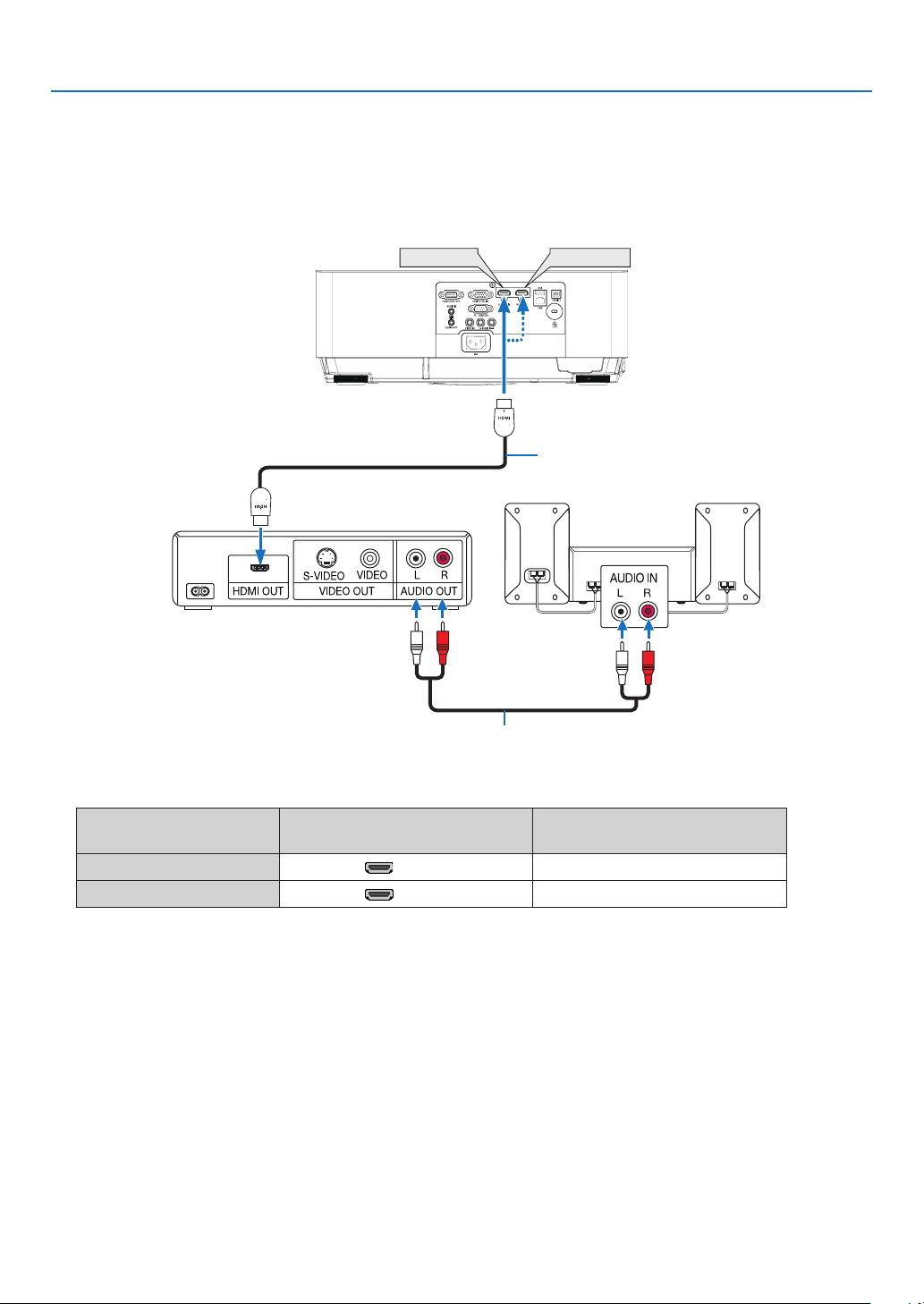
91
6. Installation and Connections
Connecting HDMI Input
YoucanconnecttheHDMIoutputofyourDVDplayer,harddiskplayer,Blu-rayplayer,ornotebooktypePCtothe
HDMIINterminalofyourprojector.
• Select
thesourcenameforitsappropriateinputterminalafterturningontheprojector.
Inputterminal
SOURCEbuttonontheprojector
cabinet
Buttonontheremotecontrol
HDMI1IN
HDMI1 (HDMI1)
HDMI2IN
HDMI2 (HDMI2)
• WhenconnectingtheHDMI1INterminal(orHDMI2terminal)oftheprojectortotheDVDplayer,theprojector’s
videolevelcanbemadesettingsinaccordancewiththeDVDplayer’svideolevel.Inthemenuselect[HDMI
SETTINGS]→[VIDEOLEVEL]andmakenecessarysettings.
•
IftheHDMIinputsoundcannotbeheard,inthemenu
select[AUDIOSELECT]→ [ HDMI1]or[HDMI2].
(→ page 72)
HDMI 1 IN
HDMI 2 IN
HDMIcable(notsupplied)
UseHighSpeedHDMI®Cable.
Audio cable (not supplied)
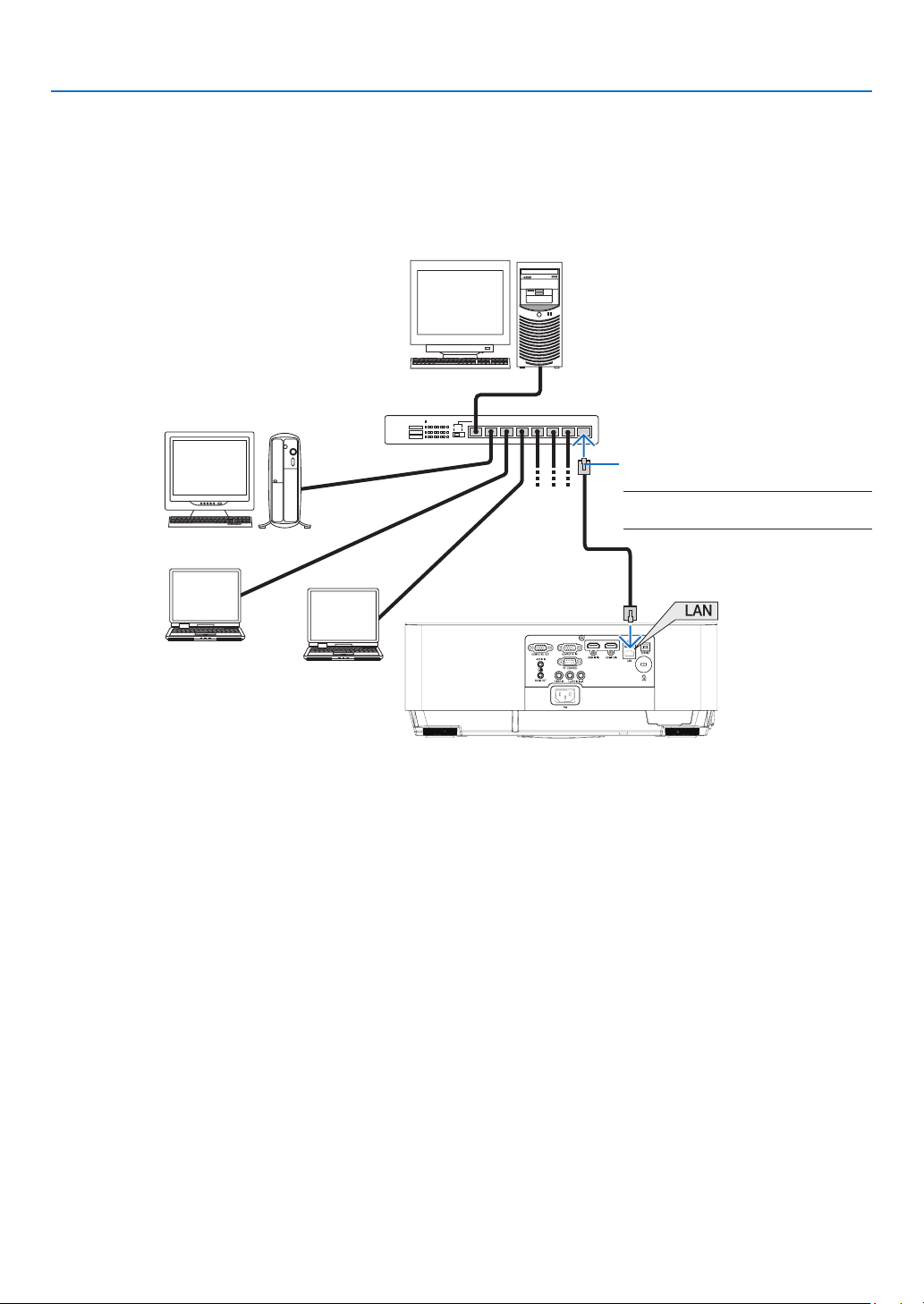
92
6. Installation and Connections
Connecting to a Wired LAN
Example of LAN connection
Server
Hub
LAN cable (not supplied)
NOTE:Use a Category 5 or higher LAN
cable.
TheprojectorcomesstandardwithaLANport(RJ-45)whichprovidesaLANconnectionusingaLANcable.
TouseaLANconnection,youarerequiredtosettheLANontheprojectormenu.Select [SETUP] → [WIRED LAN].
(→ page 76).
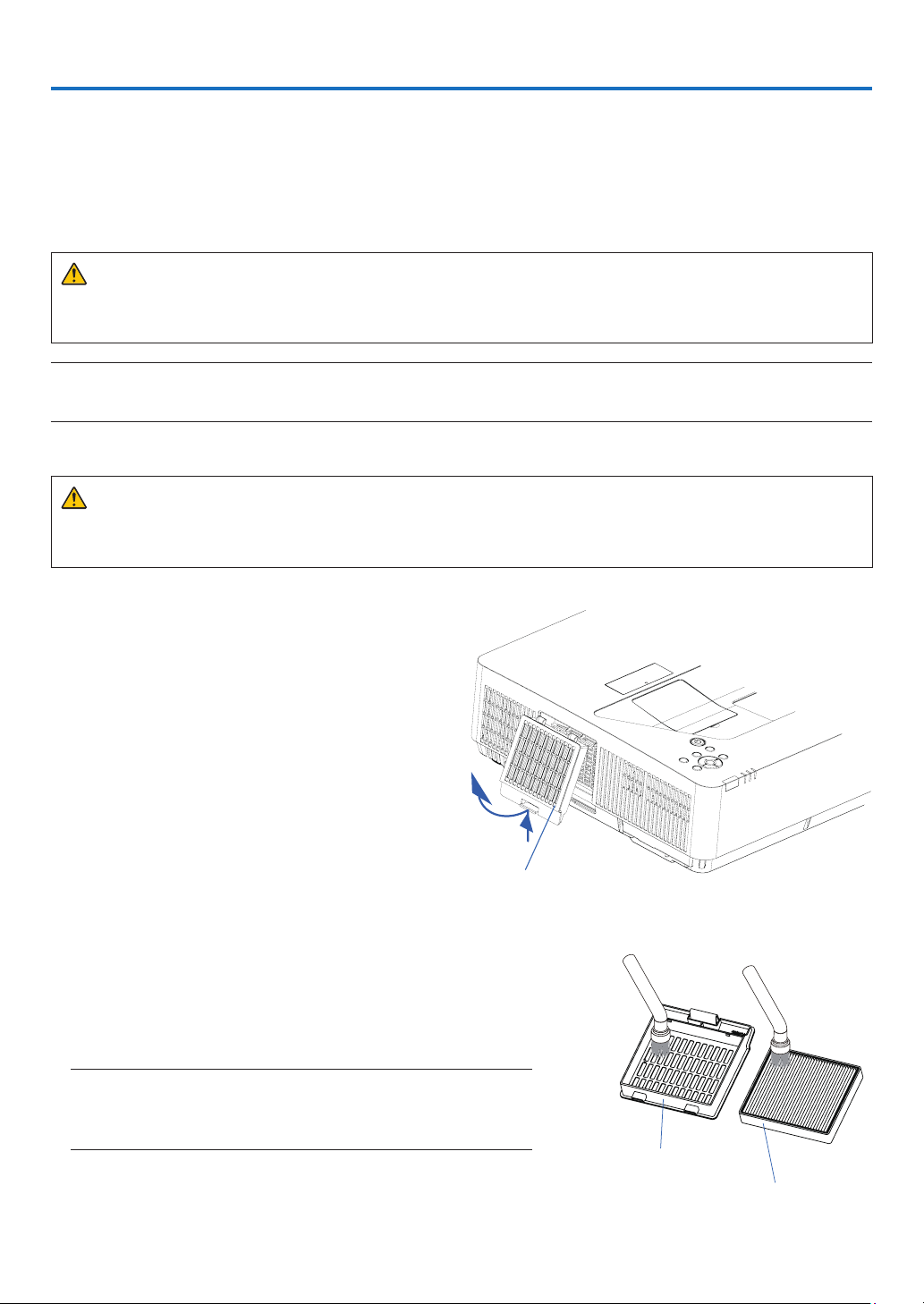
7. Maintenance
WARNING
•
Pleasedonotuseaspraycontainingflammable gastoremovedustattachedtothefilter etc.Doingsomay
resultinfires
NOTE:Themessageforfiltercleaningwillbedisplayedforoneminuteaftertheprojectoristurnedonoroff.Whenthemessageisdisplayed,
cleanthefilters.Thetimetocleanthefilterissetto[
2
000H]attimeofshipment.
Tocancelthemessage,pressanybuttonontheprojectorcabinetortheremotecontrol.
Tocleanthefilter detachthefilte unitandthefilte cover.
CAUTION
• Beforecleaningthefilters turnofftheprojector,disconnectthepowercordandthenallowthecabinettocool.
Failuretodosocanresultinelectricshockorburninjuries.
1. Press down two buttons and then pull the filter cover towards
you to open it.
2.
Vacuumdustonthefrontandbackfacesofthelterunit.
• Getridofdustinthelter.
• Gentlygetridofdustontheltercoverandintheaccordion
pleats of the filter.
NOTE:
• Wheneveryouvacuumthelter,usethesoftbrushtovacuum.Thisistoavoid
damagetothelter.
• Donotwashthelterwithwater.Doingsocanresultinlterclogging.
Filter cover
Filter unit
Filter cover
❶ Cleaning the Filters
The filter at the intake vent keeps dust and dirt from getting inside the projector. If the filter is dirty or clogged, your
projector may overheat.
This section describes the simple maintenance procedures you should follow to clean the filter, the projection win-
dow, and the cabinet.
93
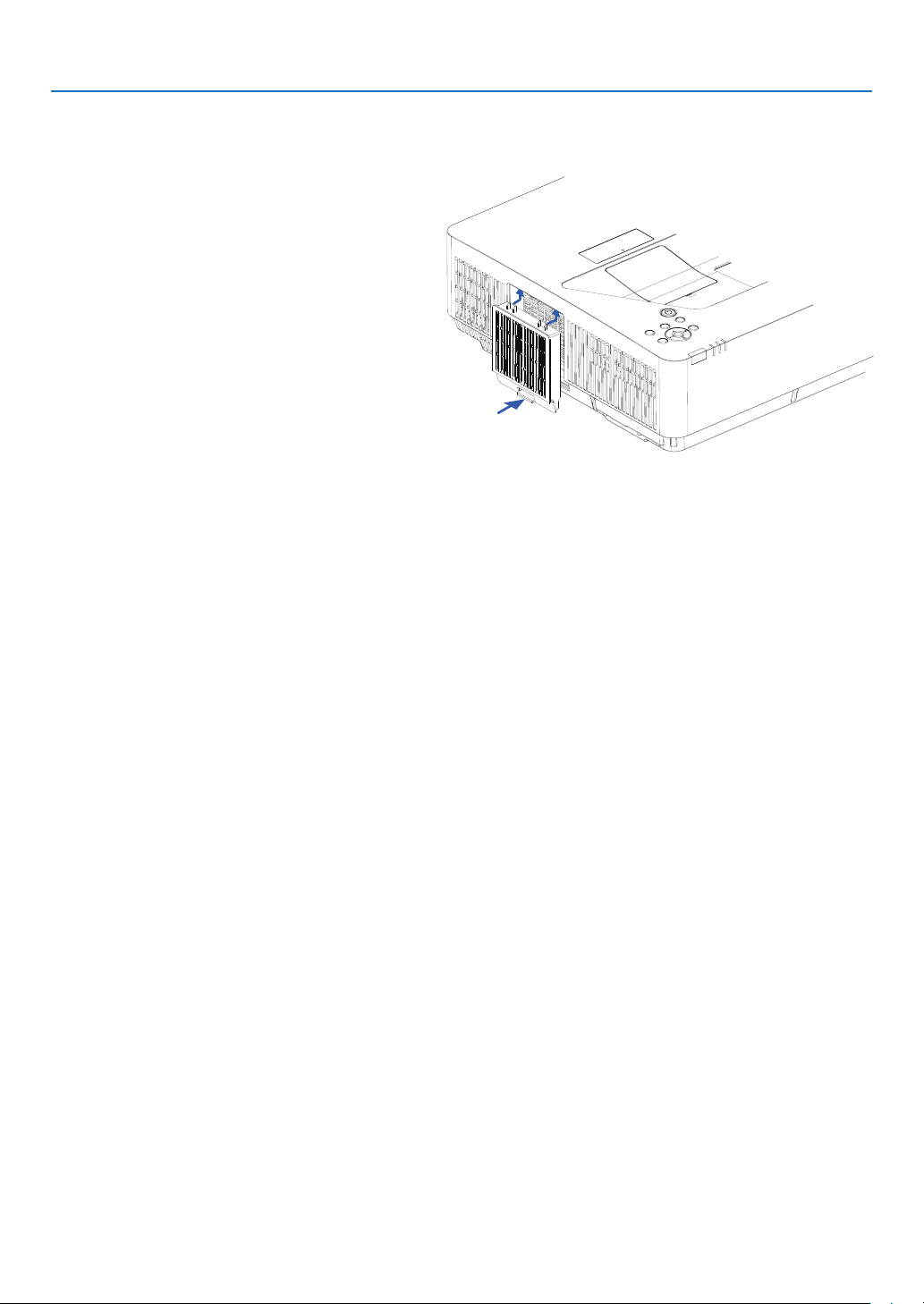
7. Maintenance
3. Put the filter cover back to the projector cabinet.
Keep to push the filter cover frame around the buttons
until a "click" sound is heard. The filter cover will be
secured in position.
4.
Clearthelterusagehours.
Plug the power cord into the wall outlet, and then turn on the
projector.
F
rom the menu, select [RESET] →[CLEARFILTERHOURS].
(
→ page 80)
94
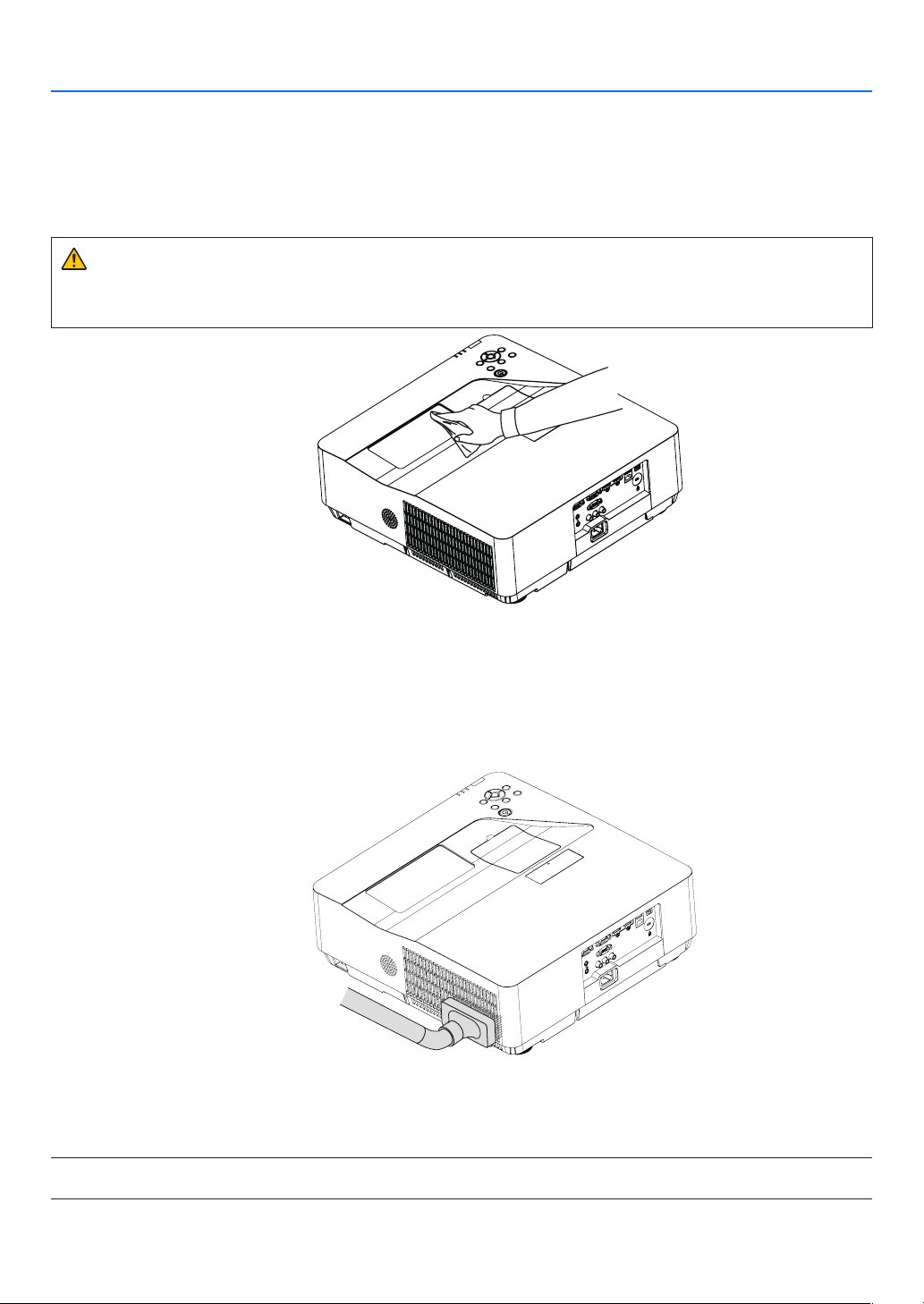
7. Maintenance
❷ Cleaning the Projection Window
• Turnofftheprojectorbeforecleaning.
•
Donotscratchormartheprojection windowsasitismade of glass.
•
Use a blower or lens paper to clean the projection window, and be careful not to scratch or mar the glass sur-
face.
WARNING
•
Do not use a spray containing flammable gas to get rid of accumulated dust and dirt on the projection
window. It may cause of fire.
❸ Cleaning the Cabinet
Turnofftheprojector,andunplugtheprojectorbeforecleaning.
• Useadrysoftclothtowipedustoffthecabinet.
Ifheavilysoiled,useamilddetergent.
• Neverusestrongdetergentsorsolventssuchasalcoholorthinner.
• Whencleaningtheventsorthespeakerusingavacuumcleaner,donotforcethebrushofthevacuumcleaner
into the slits of the cabinet.
• Cloggedventsmaycauseariseintheinternaltemperatureoftheprojector,resultinginmalfunction.
• Donotscratchorhitthecabinetwithyourfinger oranyhardobjects
• Contactyourdealerforcleaningtheinsideoftheprojector.
NOTE:Donotapplyvolatileagentsuchasinsecticideonthecabinet,theprojection window,orthescreen.Donotleavearubberorvinyl
productinpro-longedcontactwithit.Otherwisethesurfacefinishwillbedeterioratedorthecoatingmaybestrippedoff.
Vacuum the dust off the vents.
95
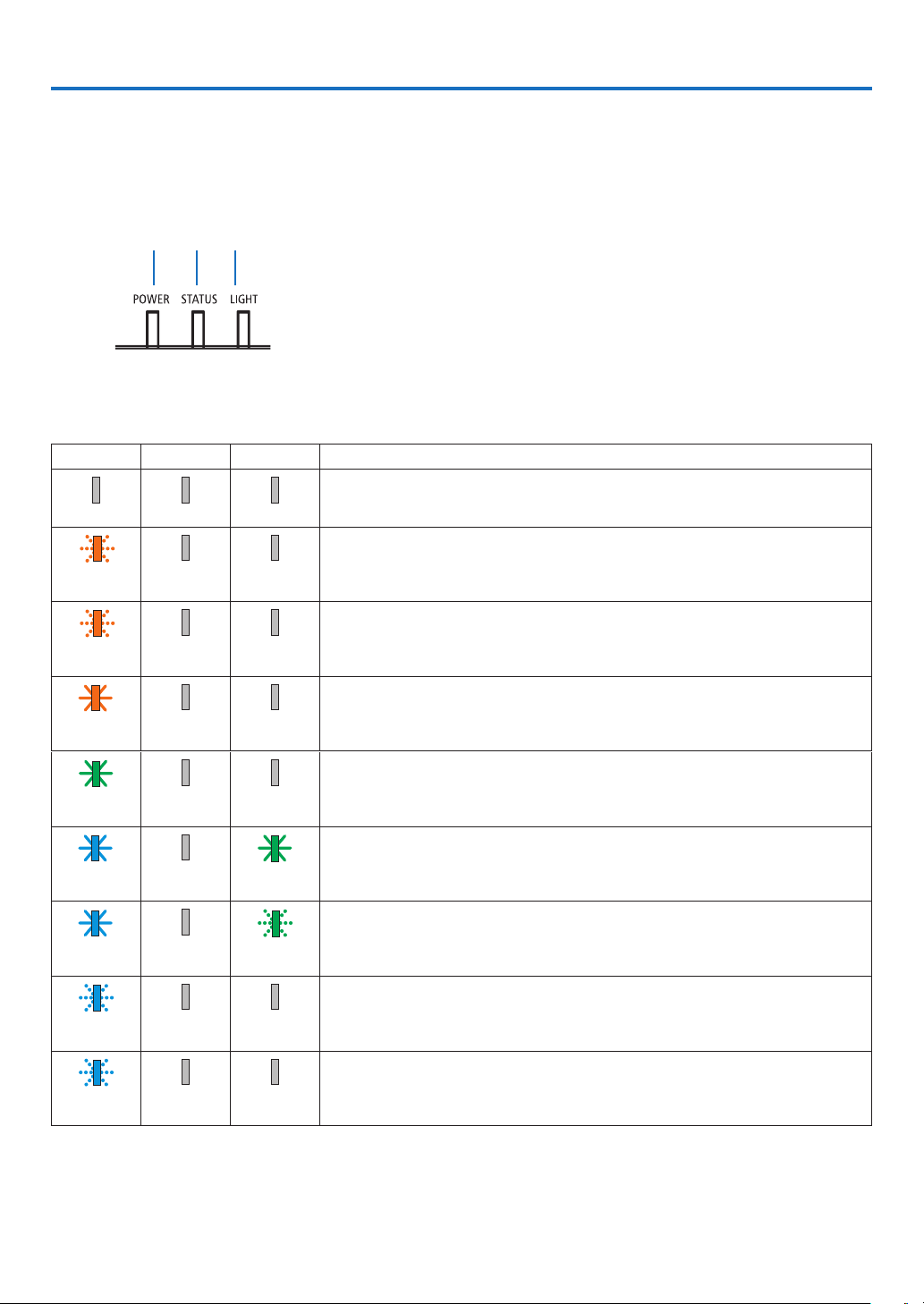
8. Appendix
❶ Troubleshooting
Thissectionhelpsyouresolveproblemsyoumayencounterwhilesettinguporusingtheprojector.
Feature of each indicator
① POWERindicator
This indicator informs the power status of the projector.
② STATUSindicator
This indicator lights/blinks when a button is pressed while the
CONTROLPANELLOCKfunction is utilized, orwhileperformingthe
specifi operations.
③
L
IGHT
indicator
This
indicator
informs
the
state
of
light,
usage
timeofthelight,and
thestatusofECOMODE.
Indicator Message (Status message)
POWER STATUS
LIGHT
Projector status
Power is off
Off Off Off
InthestateofStandby(StandbymodeisNETWORKSTANDBYandnetworkis
ready)
Orange
(Blink*
1
)
Off Off
InthestateofStandby(Networkisunavailable)
Orange
(Blink*
2
)
Off Off
InthestateofStandby(StandbymodeisNETWORKSTANDBYandnetworkis
available)
Orange
(Light)
Off Off
InthestateofSleep
Green
(Light)
Off Off
Poweredstate(ECOmodeisOFF)
Blue
(Light)
Off Green
(Light)
① ② ③
Poweredstate(ECOmodeisON)
Blue
(Light)
Off Green (Blink*
3
)
OFFTimerisactivated,OFFtimeastheprogramtimerisactivated(Poweredstate)
Blue
(Blink*
3
)
Off Status varies
PreparingforpoweringON
Blue
(Blink*
4
)
Off Off
*1 Repetitiontolightonfor1.5seconds/offfor1.5seconds
*2 Repetitiontolightonfor1.5seconds/offfor7.5seconds
*3 Repetitiontolightonfor2.5seconds/offfor0.5seconds
*4 Repetitiontolightonfor0.5seconds/offfor0.5seconds
96
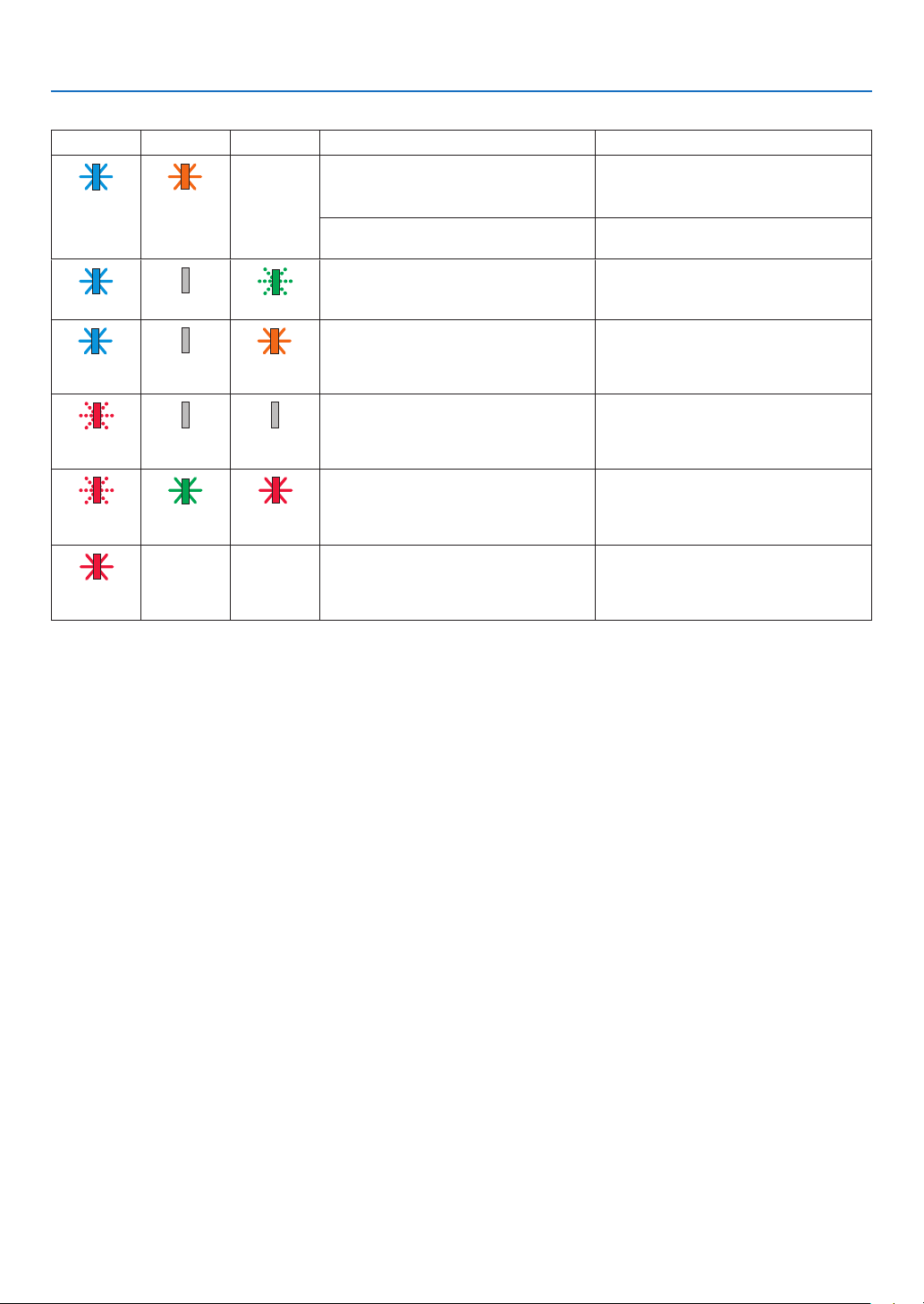
8. Appendix
Indicator Message (Error message)
POWER STATUS
LIGHT
Projector status Procedure
A button has been pressed while the
KEYLOCKisactivated.
The projector's keys are locked. The
settingmustbecanceledtooperatethe
projector.(→page69)
Blink Orange
(Light)
Status varies
IDnumbersfortheprojectorandthe
remote control do not match.
CheckthecontrolIDs(→page70)
Preparingtorelightlightafterlighting
has failed.
Wait a while.
Blue (Blink*
4
) Off Green (Blink*
4
)
Temperatureproblem(IntheForced
ECO)
Ambient temperature is high. Lower the
room temperature.
Blue
(Light)
Off Orange
(Light)
Temperature problem Ambient temperature is out of the opera-
tiontemperature.Checkifanyobstruction
staysneartheexhaustvent.
Red
(Blink*
4
)
Off Off
Lightdoesnotlight. Wait at least1 minute, then turn on the
power back on. i
f the light still does
not light, contact your dealer or service
personnel.
Red
(Blink*
4
)
Green
(Light)
Red
(Light)
Errorrequiringservicesupport Contactyourdealerorservicepersonnel.
Makesuretocheckandinformindicator
statusforaskingtorepair.
Red
(Light)
Status varies Status varies
*1 Repetitiontolightonfor1.5seconds/offfor1.5seconds
*2 Repetitiontolightonfor1.5seconds/offfor7.5seconds
*3 Repetitiontolightonfor2.5seconds/offfor0.5seconds
*4 Repetitiontolightonfor0.5seconds/offfor0.5seconds
• Whenthethermalprotectorisactivated:
Wheninsidetemperatureoftheprojectorbecomestoohighorlow,thePOWERindicatorstarttoredblinkina
shortcycle.Afterthishappened,thethermalprotectorwillactivateandtheprojectormaybeturnedoff.
Inthiscase,pleasetakethebelowmeasures:
- Pulloutthepowerplugfromthewallinlet.
- Placetheprojectorincoolplaceifithasbeenplacedinhighambienttemperature.
- Cleantheexhaustventifdusthasaccumulatedon.
- Leavetheprojectorforaboutonehouruntilinsidetemperaturegetslower.
97
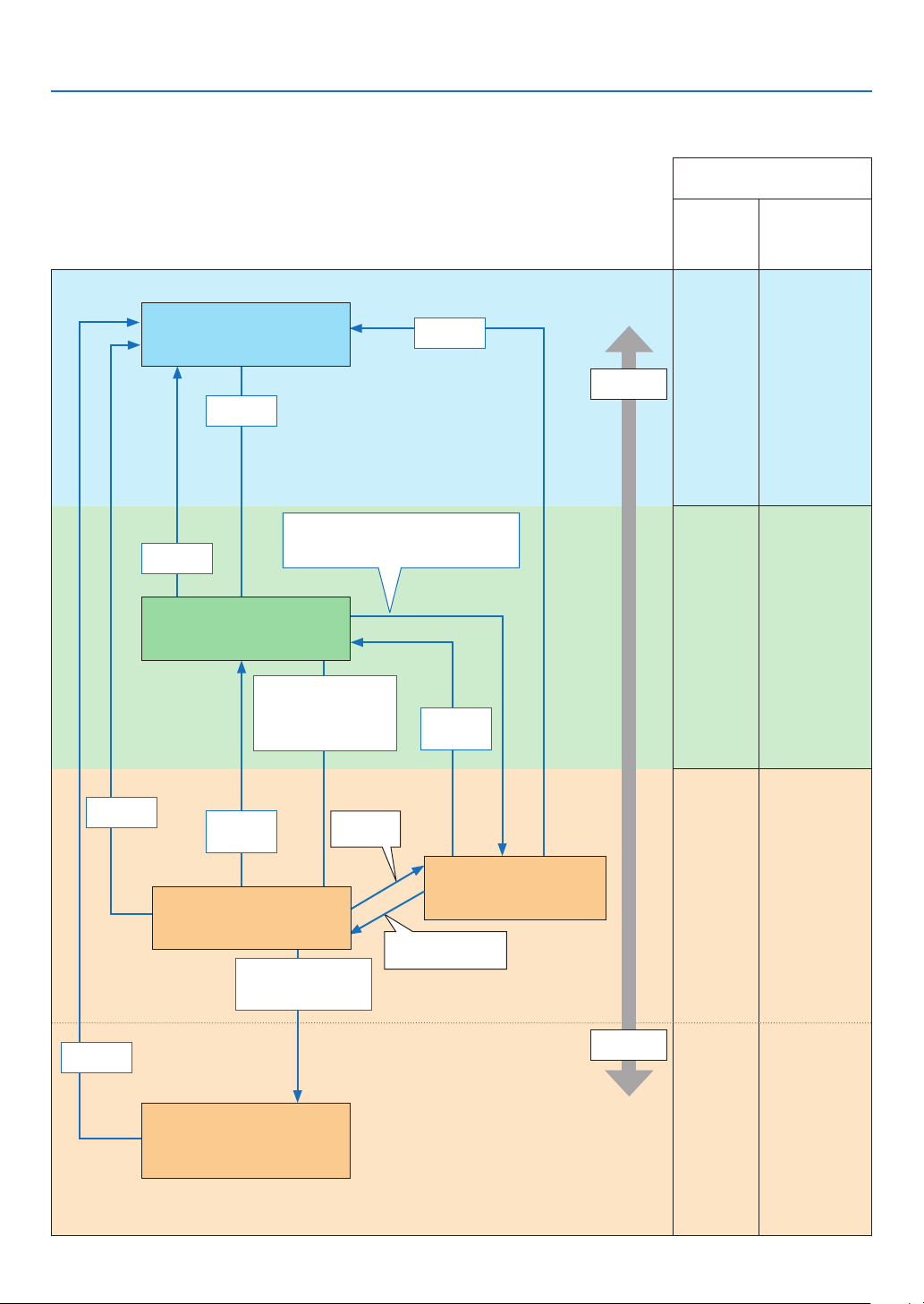
8. Appendix
Explanation on the POWER indicator and standby state
InthestatetheselectedSTANBYMODEisNETWORKSTANDBY.
Available ports in each state
(
○:Available,×:Unavailable)
LAN
PCCONTROL
○ ○
○ ○
○ ○
× ○
Power
consumption
High
Low
Indicator : Lights in blue
PowerdOnstate
Indicator : Lights in orange
Standbystate:Thenetwork
islinked.
Link-up
network
Link-downnetwork
Nooperation/Link-
downnetwork/No
signalinputforapprox.
180seconds
Link-downforapprox.
180seconds
No operation/No communication with
thelink-upnetwork/Nosignalinputfor
approx.180seconds
PowerOff
PowerOn
PowerOn
Input
signal
Indicator:Blinksinorange(with
long interval)
Standbystate:Thenetworkis
unavailable.
PowerOn
Input
signal
Indicator : Lights in green
Sleepstate
Indicator:Blinksinorange
Standbystate:Waitingtolink
withthenetwork
PowerOn
98
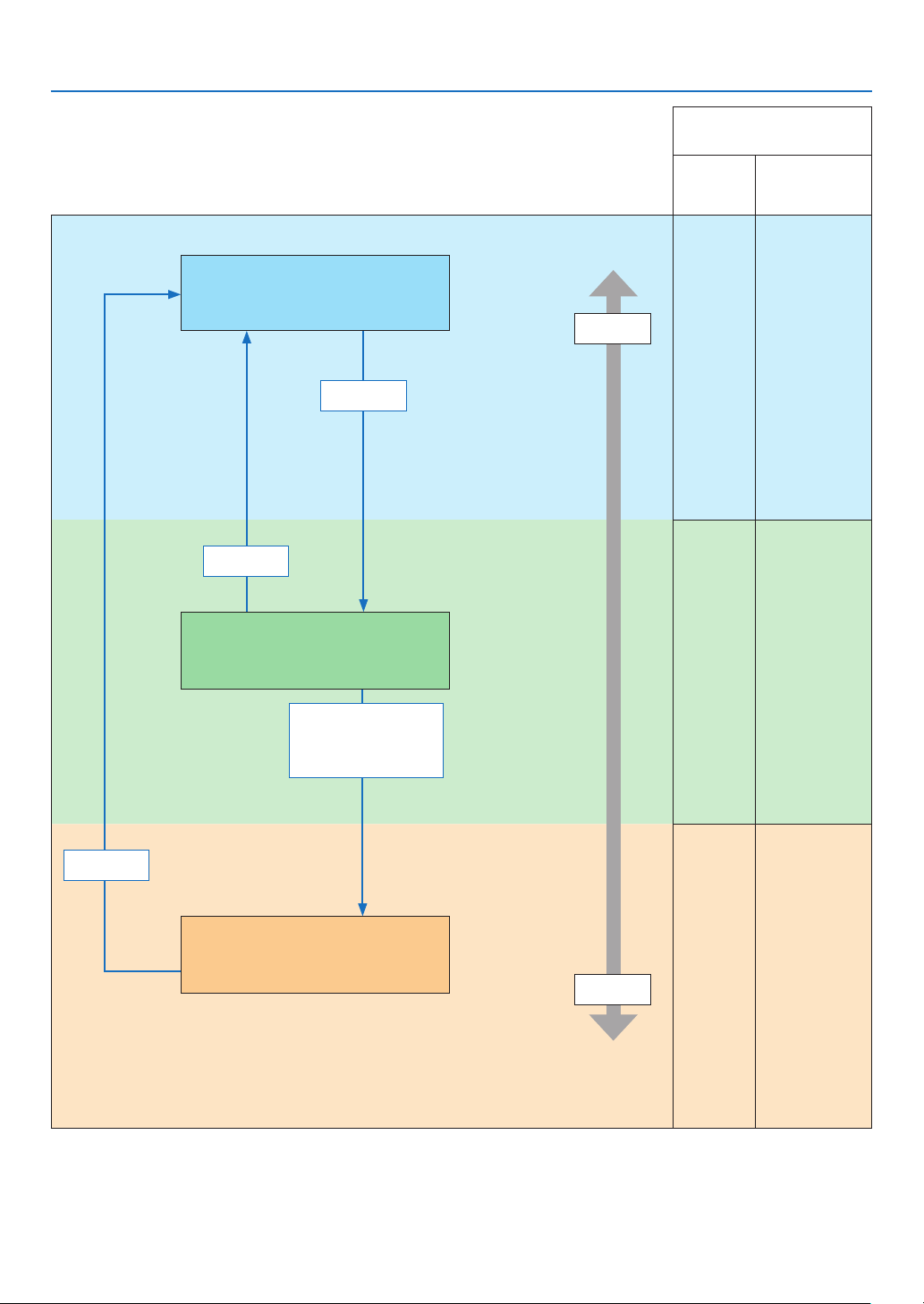
8. Appendix
InthestatetheselectedSTANBYMODEisNORMAL.
Available ports in each state
(
○:Available,×:Unavailable)
LAN
PCCONTROL
○ ○
○ ○
× ○
Power
consumption
High
Low
Indicator : Lights in blue
PoweredONstate
PowerOn
Nooperation/Nosignal
inputforapprox.
10 seconds
PowerOff
PowerOn
Indicator:Blinksinorange(withlong
interval)
Standbystate:Thenetworkisunavailable.
Indicator : Lights in green
Sleepstate
99

100
8. Appendix
Common Problems & Solutions
(→“Power/Status/LightIndicator”onpage96.)
Problem CheckTheseItems
Does not turn on or shut
down
• Checkthatthepowercordispluggedinandthatthepowerbuttonontheprojectorcabinetortheremotecontrolison.
(→ pages 11, 12)
• Checktoseeiftheprojectorhasoverheated.Ifthereisinsufficien ventilationaroundtheprojectororiftheroomwhere
you are presenting is particularly warm, move the projector to a cooler location�
•
Thelightmayfailtolight.Waitafullminuteandthenturnonthepoweragain.
• Set[FANMODE]to[HIGHALTITUDE]whenusingtheprojectorataltitudesapproximately5500feet/1700metersorhigher.
Using the projector at altitudes approximately 5500 feet/1700 meters or higher without setting to [HIGH ALTITUDE] can
cause the projector to overheat and the projector could shut down. If this happens, wait a couple minutes and turn on
the projector. (→ page 71)
Will turn off
•
No picture •
Use the COMPUTER1, HDMI1, HDMI2, VIDEO or USB-A button on the remote control to select your source (COMPUTER,
HDMI1, HDMI2, VIDEO or USB-A). (→ page 14) If there is still no picture, press the button again.
• Ensureyourcablesareconnectedproperly.
•
•
•
• BesuretoconnecttheprojectorandnotebookPCwhiletheprojectorisinstandbymodeandbeforeturningonthepower
to the notebook PC�
In most cases the output signal from the notebook PC is not turned on unless connected to the projector before being
powered up�
* If the screen goes blank while using your remote control, it may be the result of the computer’s screen-saver or power
management software�
• Seealsothenext page�
Picture suddenly be-
comes dark
•
CheckiftheprojectorisintheForcedECOmodebecauseoftoohighambienttemperature.Ifthisisthecase,lowerthe
internal temperature of the projector by selecting [HIGH] for [FAN MODE]� (→ page 71)
Color tone or hue is
unusual
•
•
Image isn’t square to the
screen
•
•
Picture is blurred
• Adjustthefocus.(→ page 18)
•
•
Image is scrolling verti-
cally, horizontally or both
•
Checkthecomputer’sresolutionandfrequency.Makesurethattheresolutionyouaretryingtodisplayissupportedby
the projector� (→ page 106)
•
Remote control does not
work
• Installnewbatteries.(→ page 9)
• Makesuretherearenoobstaclesbetweenyouandtheprojector.
• Standwithin22feet(7m)oftheprojector.(→ page 9)
Indicator is lit or blinking
•
Cross color in RGB mode
•
•
Formoreinformationcontactyourdealer.
•
Ensure that the [OFF TIMER] or [AUTO POWER OFF] is off. (→ page 67, 74)
Reset the settings or adjustments to factory preset levels using the [RESET] in the Menu. (→ page 80)
Use menus to adjust the brightness and contrast. (→ page 59)
Enter your registered keyword if the Security function is enabled. (→ page 34)
Check if an appropriate color is selected in [WALL COLOR]. If so, select an appropriate option. (→ page 66)
Adjust [HUE] in [PICTURE]. (→ page 59)
Reposition the projector to improve its angle to the screen. (→ page 15, 21)
Use the Keystone correction function to correct the trapezoid distortion. (→ page 22)
Reposition the projector to improve its angle to the screen. (→ page 15,
21)
Ensure that the distance between the projector and screen is within the adjustment range. (→ page 81
)
Adjust the computer image manually with the Horizontal/Vertical in the [IMAGE OPTIONS].
(→ page 61
)
See the POWER/STATUS/LIGHT indicator. (→ page 96
)
Press the AUTO ADJ. button on the projector cabinet or the remote control. (→ page 24
)
Adjust the computer image manually with [CLOCK]/[PHASE] in [IMAGE OPTIONS] in the menu. (→
page 60)

101
8. Appendix
If there is no picture, or the picture is not displayed correctly.
• PoweronprocessfortheprojectorandthePC.
BesuretoconnecttheprojectorandnotebookPCwhiletheprojectorisinstandbymodeandbeforeturningon
thepowertothenotebookPC.
InmostcasestheoutputsignalfromthenotebookPCisnotturnedonunlessconnectedtotheprojectorbefore
beingpoweredup.
NOTE:Youcancheckthehorizontalfrequencyofthecurrentsignalintheprojector’smenuunderInformation.Ifitreads“0kHz”,this
meansthereisnosignalbeingoutputfromthecomputer.(
→
page 77 or go to next step)
• Enablingthecomputer’sexternaldisplay.
DisplayinganimageonthenotebookPC’sscreendoesnotnecessarilymeanitoutputsasignaltotheprojector.
WhenusingaPCcompatiblelaptop,acombinationoffunctionkeyswillenable/disabletheexternaldisplay.Usu-
ally,thecombinationofthe“Fn”keyalongwithoneofthe12functionkeysgetstheexternaldisplaytocomeon
oroff.Forexample,NEClaptopsuseFn+F3,whileDelllaptopsuseFn+F8keycombinationstotogglethrough
externaldisplayselections.
• Non-standardsignaloutputfromthecomputer
IftheoutputsignalfromanotebookPCisnotanindustrystandard,theprojectedimagemaynotbedisplayed
correctly.Shouldthishappen,deactivatethenotebookPC’sLCDscreenwhentheprojectordisplayisinuse.
EachnotebookPChasadifferentwayofdeactivate/reactivatethelocalLCDscreensasdescribedintheprevi-
ousstep.Refertoyourcomputer’sdocumentationfordetailedinformation.
• ImagedisplayedisincorrectwhenusingaMac
WhenusingaMacwiththeprojector,settheDIPswitchoftheMacadapter(notsuppliedwiththeprojector)ac-
cordingtoyourresolution.Aftersetting,restartyourMacforthechangestotakeaffect.
ForsettingdisplaymodesotherthanthosesupportedbyyourMacandtheprojector,changingtheDIPswitch
onaMacadaptermaybounceanimageslightlyormaydisplaynothing.Shouldthishappen,settheDIPswitch
tothe13"fixe modeandthenrestartyourMac.Afterthat,restoretheDIPswitchestoadisplayablemodeand
thenrestarttheMacagain.
NOTE:AVideoAdaptercablemanufacturedbyAppleInc.isneededforaMacBookwhichdoesnothaveaminiD-Sub15-pinterminal.
• MirroringonaMacBook
* WhenusingtheprojectorwithaMacBook,outputmaynotbesetto1024×768unless“mirroring”isoffon
yourMacBook.Refertoowner’smanualsuppliedwithyourMaccomputerformirroring.
• FoldersoriconsarehiddenontheMacscreen
Foldersoriconsmaynotbeseenonthescreen.Shouldthishappen,select[View]→[Arrange]fromtheApple
menuandarrangeicons.
102
8. Appendix
❷ Specifications
This section provides technical information about projector’s performance.
Optical
Mechanical
Model Number NP-UM383WL
LCD Panel
0.76 inch LCD with Micro Lens Array ( Aspect Ratio 16: 10 )
Resolution
*1
1280×800 pixels (WXGA)
Lens F = 1.78-1.83 f = 4.92-5.18mm
Zoom
Digital Zoom and Manual
Focus
Manual
Lens shifting
H: ±2%, V: ±3%
Light HLD + LED
ECO MODE OFF 340W
NORMAL
272W
ECO
170W
Light Output
*2*3
3800 lumens
NORMAL 80%
ECO
50%
Contrast Ratio
(full white/full black)
200000:1
Screen Size(Diagonal)
70-130 inches
Projection Distance
(Min.-Max.)
0.4-0.8m
Projection Angle
59-60 (wide), 58-59 (tele)
*1 Effectivepixelsaremorethan99.99%.
*2 Thisisthelightoutputvalue(lumens)whenthe[PRESET]modeissetto[HIGH-BRIGHT].Ifanyothermodeisselectedasthe
[PRESET]mode,thelightoutputvaluemaydropslightly.
*3 CompliancewithISO21118-2012
Model Number NP-UM383WL
Installation Orientation Desktop/Front, Desktop/Rear, Ceiling/Front, Ceiling/Rear
16.7" (W) × 6.2" (H) × 17.7" (D)/425
mm (W) × 156.7 mm (H) × 449 mm (D)
(including protrusions)
16.7" (W) × 6.0" (H) × 17.7" (D)/
425 mm (W) × 153.2 mm (H) × 449 mm (D) (not
including protrusions)
Dimensions
Weight
10.7 kg/23.6 lbs
Operational Temperatures : 41° to 104°F (5° to 40°C),
(ECO mode selected automatically at 95°F to 104°F/35°C to 40°C)
20% to 80% humidity (non-condensing)
Storage Temperatures : 14° to 122°F (-10° to 50°C), 20% to 80% humidity (non-
condensing)
Operating altitude: 0 to 2700 m/8800 f (Set [FAN MODE] to [HIGH ALUTITUDE]
when using the projector at altitudes approximately 1700 m/5500 f) or higher.
Environmental
Considerations
Regulations
UL/C-ULApproved(UL60950-1,CSA60950-1)
MeetsDOCCanadaClassBrequirements
MeetsFCCClassBrequirements
MeetsAS/NZSCISPR.22ClassB
MeetsEMCDirective(EN55022,EN55024,EN61000-3-2,EN61000-3-3)
MeetsLowVoltageDirective(EN60950-1,TÜVGSApproved)
103
8. Appendix
*
5 Animagewithhigherorlowerresolutionthantheprojector’snativeresolution(1280 × 800) will be displayed with Advanced
AccuBlend.(→ page106)
Foradditionalinformationvisit:
US:https://www.necdisplay.com/
Global:https://www.nec-display.com/global/index.html
Forinformationonouroptionalaccessories,visitourwebsiteorseeourbrochure.
*
4 HDMI
®
(DeepColor,LipSync)withHDCP
WhatisHDCP/HDCPtechnology?
HDCPisanacronymforHigh-bandwidthDigitalContentProtection.HighbandwidthDigitalContentProtection(HDCP)isa
systemforpreventingillegalcopyingofvideodatasentoveraHigh-Definition MultimediaInterface(HDMI).
IfyouareunabletoviewmaterialviatheHDMIinput,thisdoesnotnecessarilymeantheprojectorisnotfunctioningproperly.
WiththeimplementationofHDCP,theremaybecasesinwhichcertaincontentisprotectedwithHDCPandmightnotbedis-
playedduetothedecision/intentionoftheHDCPcommunity(DigitalContentProtection,LLC).
Video:DeepColor;8/10/12-bit,LipSync
Audio:LPCM;upto2ch,samplerate32/44.1/48KHz,samplebit;16/20/24-bit
Electrical
Model Number NP-UM383WL
1 × RGB/Component (D-SUB 15 P),
2 × HDMI Type A (19P, HDMI® Terminal) HDCP supported
*4
,
1 × Video (RCA), 1 × (L/R) RCA Audio, 1 × Stereo Mini Audio
Inputs
Outputs
1 × RGB (D-Sub 15 P), 1 × Stereo Mini Audio
PC Contral
1 × PC Control Port (D-Sub 9 P), 1 × SERVICE Port (Type: USB-B)
Wired LAN Port
1 × RJ-45 (10BASE-T/100BASE-TX)
USB Port
1 × Type A
Color Reproduction
10-bit signal processing (1.07 billion colors) (Viewer, Network: 16.7 million colors)
Analog: VGA/SVGA/XGA/WXGA/Quad-VGA/SXGA/SXGA+/WXGA+
/WXGA++/UXGA/WSXGA+/HD/Full HD/WUXGA/Mac13", 16", 21", 23"
Component: 480i/480p/576i/576p/720p/1080i/1080p
HDMI: VGA/SVGA/XGA/WXGA/Quad-VGA/SXGA/SXGA+/WXGA+
/WXGA++/WSXGA+/480p/576p/720p/1080i/1080p
Compatible Signals
*5
540 TV lines: NTSC/NTSC4.43/PAL/PAL-M/PAL-N/PAL60
300 TV lines: SECAM
Horizontal Resolution
Horizontal: 15 kHz to 100 kHz (RGB: 24 kHz or over)
Vertical: 50 Hz to 120 Hz (HDMI: 50 Hz to 85 Hz)
Scan Rate
Sync Compatibility
Separate Sync
Built in Speaker
2 ×10 W (stereo)
Power Requirement
100 - 240 V AC, 50/60 Hz
Input Current
4.9 A-1.9 A
ECO MODE OFF
460 W (100-130 V)/443 W (200-240 V)
NORMAL
374 W (100-130 V)/341 W (200-240 V)
ECO
248 W (100-130 V)/219 W (200-240 V)
1.6 W (100-130 V)/1.8 W (200-240 V)
Power
Consump-
tion
STANDBY
(NETWORK
STANDBY)
STANDBY
(NORMAL)
The specification are subject to change without notice.
0.26 W (100-130 V)/0.39 W (200-240 V)
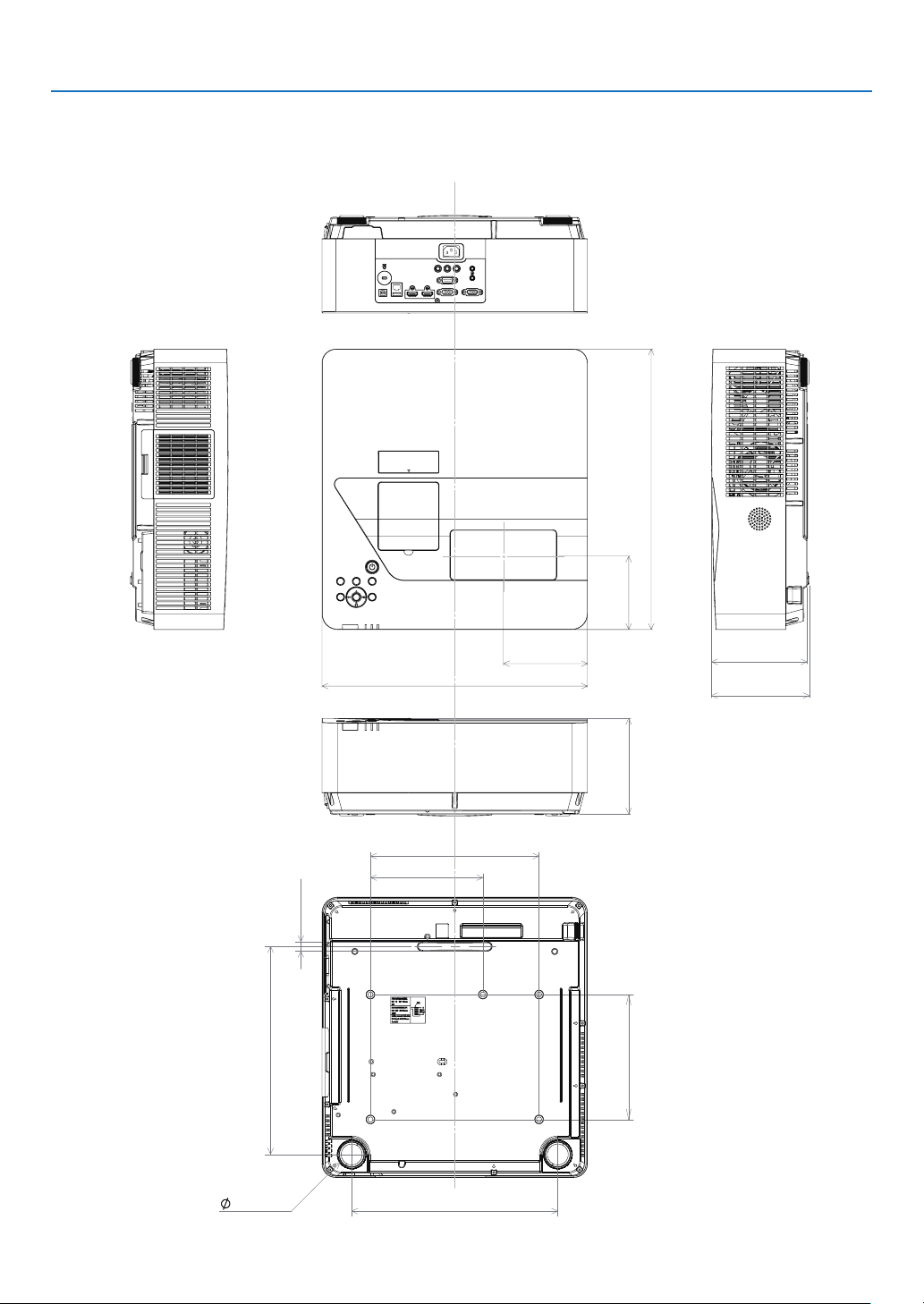
104
8. Appendix
❸ Cabinet Dimensions
Unit:mm(inch)
46.3(1.8)
134.7(5.3)
425(16.7)
153.2(6.0)
156.7(6.2)
270(10.6)
180(7.1)
330(13)
333(13.1)
14.4(0.6)
200(7.9)
153.2(6.0) 117.6(4.6)
449(17.7)
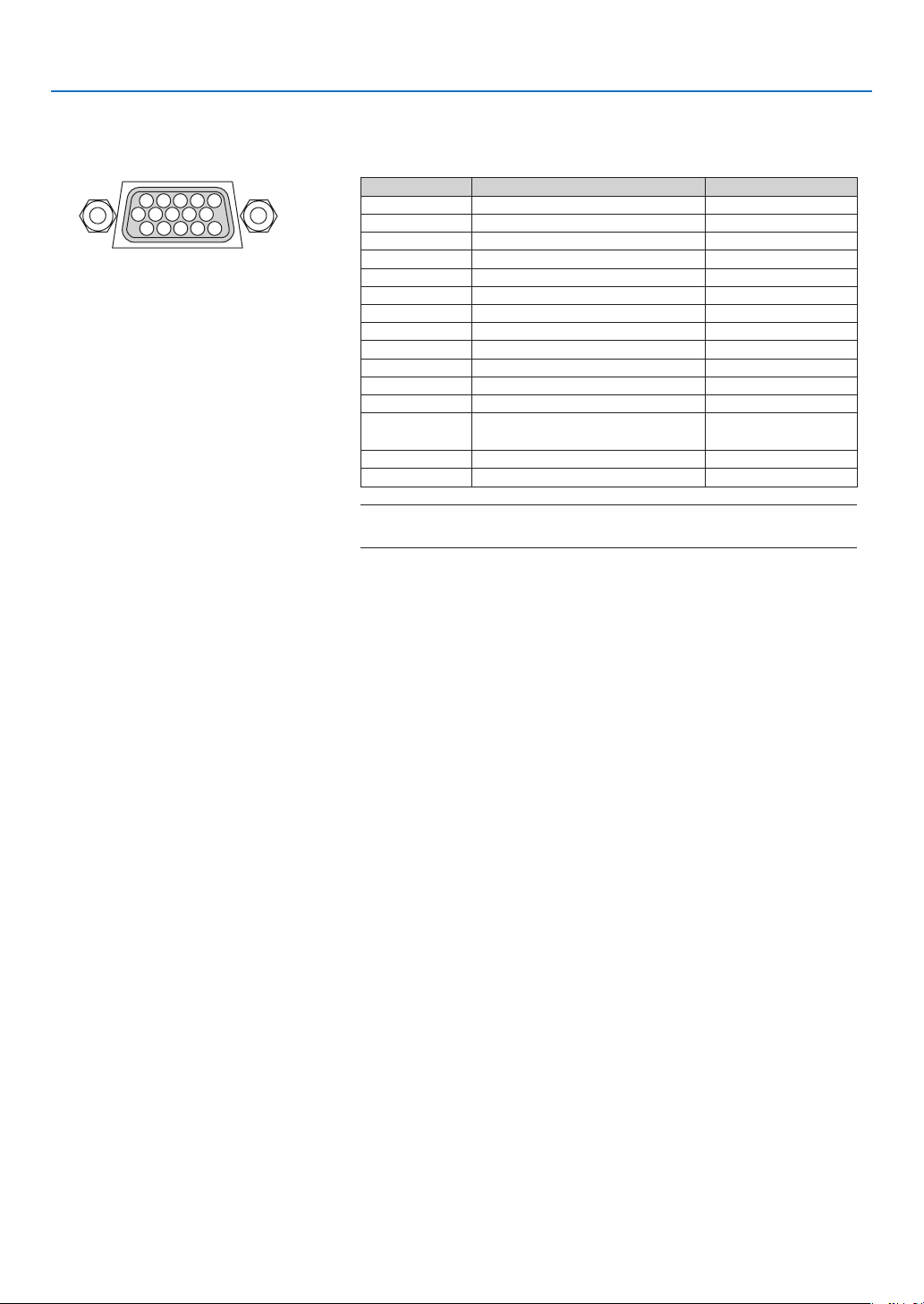
105
8. Appendix
❹ Pin Assignments of D-Sub COMPUTER Input
Terminal Mini D-Sub 15 Pin Terminal
SignalLevel
Videosignal:0.7Vp-p(Analog)
Syncsignal:TTLlevel
51423
10
11 12 13 14 15
6978
Pin No. RGBSignal(Analog) YCbCrSignal
1 Red Cr
2 GreenorSynconGreen Y
3 Blue Cb
4 Ground
5 Ground
6 RedGround CrGround
7 GreenGround YGround
8 BlueGround CbGround
9 Hotplug
10 SyncSignalGround
11 NoConnection
12 Bi-directionalDATA(SDA)
13 HorizontalSyncorComposite
Sync
14 VerticalSync
15 DataClock
COMPUTER IN
NOTE:
PinNos.12and15arerequiredforDDC/CI.
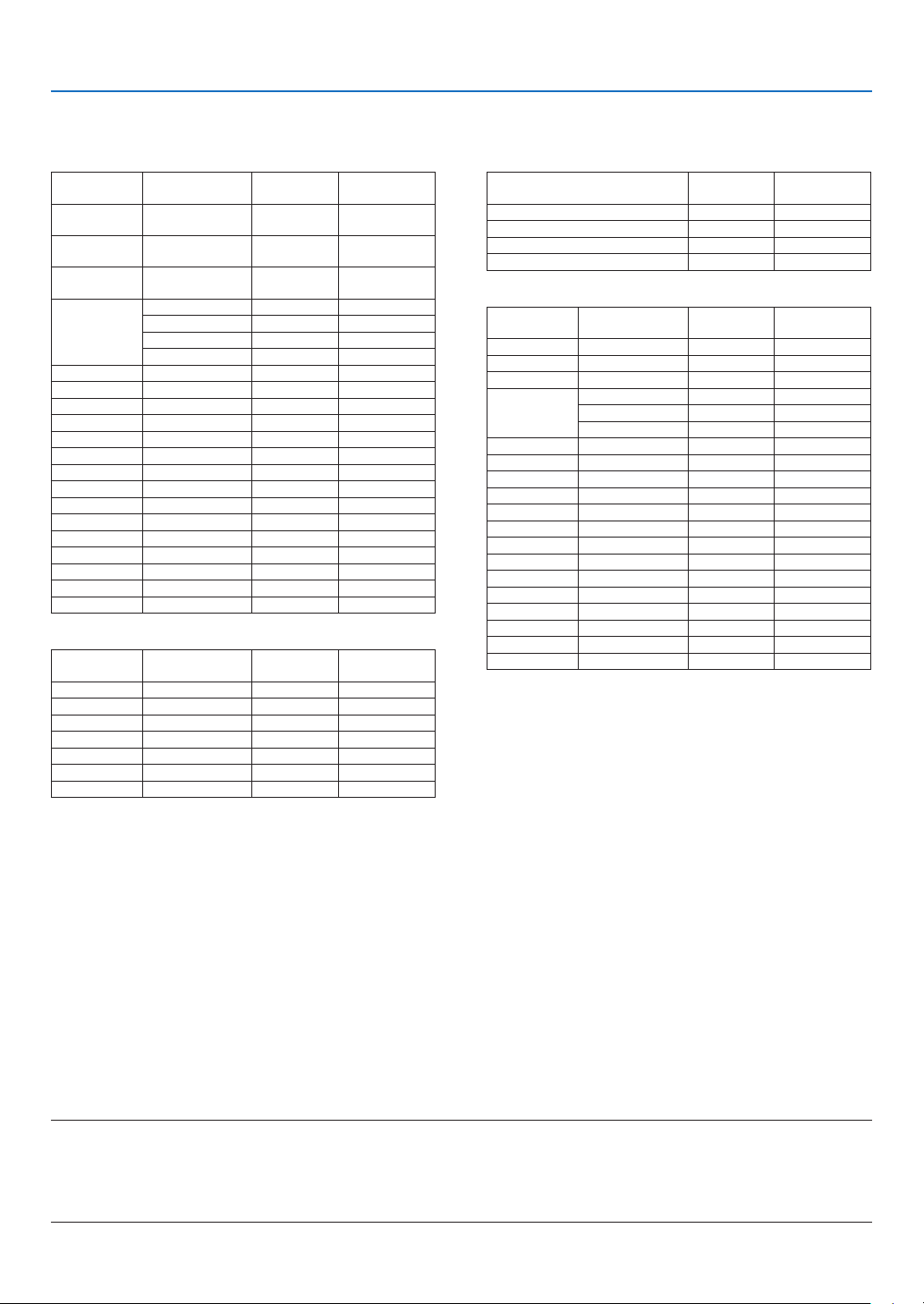
106
8. Appendix
Compatible Input Signal List
192 0 × 1200*
4
1280 × 768*
1
1280 × 800*
1
1360 × 768*
2
1366 × 768*
2
1024 × 768
1280 × 768*
1
1280 × 800*
1
1600 × 900*
2
1600 × 1200*
3
Analog RGB
Signal
Resolution
(dots)
AspectRatio
RefreshRate
(Hz)
VGA 640 × 480 4:3 60/72/75/85/
iMac
SVGA 800 × 600 4:3 56/60/72/75/85/
iMac
XGA
1024 × 768
4:3 60/70/75/85/
iMac
WXGA 15:9 60
16:10 60
16:9 60
16:9 60
Quad-VGA
1280 × 960 4:3 60/75
SXGA 1280 × 1024 5:4 60/75
SXGA+ 1400
× 1050 4:3 60
WXGA+ 1440 × 900 16:10 60
WXGA++
16:9 60
UXGA 4:3 60
WSXGA+ 1680 × 1050 16:10 60
HD 1280 × 720 16:9 60
Full
HD 1920 × 1080 16:9 60
WUXGA
16:10 60
MAC
13" 640 × 480 4:3 67
MAC16" 832 × 624 4:3 75
MAC19" 1024 × 768 4:3 75
MAC21" 1152 × 870 4:3 75
MAC23" 1280 × 1024 5:4 65
Component
Signal Format AspectRatio
RefreshRate
(Hz)
HDTV(1080p) 1920 × 1080 16:9 50/60
HDTV(1080i) 1920 × 1080 16:9 50/60
HDTV(720p) 1280 × 720 16:9 50/60
SDTV(480p) 720 × 480 4:3/16:9 60
SDTV(576p) 720 × 576 4:3/16:9 50
SDTV(480i) 720 × 480 4:3/16:9 60
SDTV(576i) 720 × 576 4:3/16:9 50
NOTE:
•
Animagewithhigherorlowerresolutionthantheprojector’snativeresolution(1280×800)willbedisplayedwithAdvancedAccuBlend.
• SynconGreenandCompositesyncsignalsarenotsupported.
• Signalsotherthanthosespeciedinthetableabovemaynotbedisplayedcorrectly.Ifthisshouldhappen,changetherefreshrateor
resolutiononyourPC.RefertoDisplayPropertieshelpsectionofyourPCforprocedures.
CompositeVideo
Signal AspectRatio
RefreshRate
(Hz)
NTSC 4:3 60
PAL 4:3 50
PAL60 4:3 60
SECAM 4:3 50
HDMI
Signal
Resolution
(dots)
AspectRatio
RefreshRate
(Hz)
VGA 640 × 480 4:3 60
SVGA 800 × 600 4:3 60
XGA
4:3 60
WXGA 15:9 60
16:10 60
1366
× 768 16:9 60
Quad-VGA 1280 × 960 4:3 60
SXGA 1280 × 1024 5:4 60
SXGA+ 1400 × 1050 4:3 60
WXGA+ 1440 × 900 16:10 60
WXGA++ 1600 × 900 16:9 60
WSXGA+ 1680 × 1050 16:10 60
WUXGA 1920 × 1200 16:10 60*
5
HDTV(1080p) 1920 × 1080 16:9 50/60
HDTV(1080i) 1920 × 1080 16:9 50/60
HDTV(720p) 1280 × 720 16:9 50/60
SDTV(480p) 720 × 480 4:3/16:9 60
SDTV(576p) 720 × 576 4:3/16:9 50
SDTV(480i) 720 × 480 4:3/16:9 60
SDTV(576i) 720 × 576 4:3/16:9 50
*
1Nativeresolution
*
2
The projector may fail to display these signals correctly when
[AUTO] isselectedfor[ASPECTRATIO]intheon-screenmenu.
Thefactorydefaultis
[AUTO]for[ASPECTRATIO].Todisplaythese
signals,select[16:9]for[ASPECTRATIO].
*
3WXGAMODE:OFF
*
4WXGAMODE:ON
*
5RB(Reducedblankingsignal)iseffectiveupto154MHz.
5
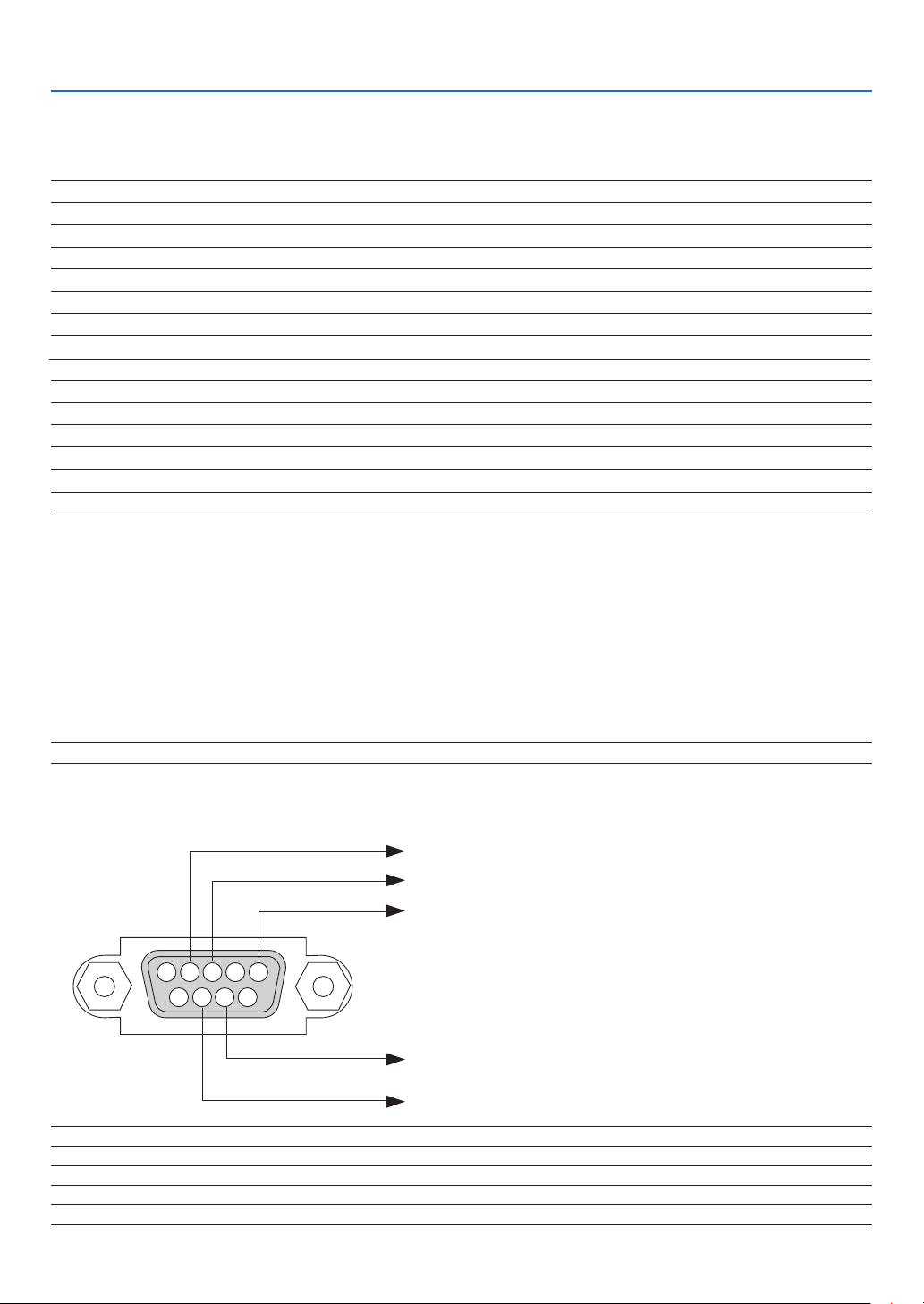
107
8. Appendix
PC Control Codes and Cable Connection
PC Control Codes
Function Code Data
POWER ON 02H 00H 00H 00H 00H 02H
POWER OFF 02H 01H 00H 00H 00H 03H
INPUT SELECT COMPUTER 02H 03H 00H 00H 02H 01H 01H 09H
INPUT SELECT HDMI1 02H 03H 00H 00H 02H 01H A1H A9H
INPUT SELECT HDMI2 02H 03H 00H 00H 02H 01H A2H AAH
INPUT SELECT VIDEO 02H 03H 00H 00H 02H 01H 06H 0EH
INPUT SELECT USB-A 02H 03H 00H 00H 02H 01H 1FH 27H
PICTURE MUTE ON 02H 10H 00H 00H 00H 12H
PICTURE MUTE OFF 02H 11H 00H 00H 00H 13H
SOUND MUTE ON 02H 12H 00H 00H 00H 14H
SOUND MUTE OFF 02H 13H 00H 00H 00H 15H
NOTE:ContactyourlocaldealerforafulllistofthePCControlCodesifneeded.
Cable Connection
CommunicationProtocol
Baud rate ������������������������������������������� 38400 bps
Data length ���������������������������������������� 8 bits
Parity �������������������������������������������������No parity
Stop bit ���������������������������������������������� One bit
X on/off ���������������������������������������������� None
Communications procedure ���������������� Full duplex
NOTE:Dependingontheequipment,alowerbaudratemayberecommendedforlongcableruns.
PC Control Terminal (D-SUB 9P)
NOTE1:Pins1,4,6and9arenoused.
NOTE2:Jumper“RequesttoSend”and“CleartoSend”togetheronbothendsofthecabletosimplifycableconnection.
NOTE3:Forlongcablerunsitisrecommendedtosetcommunicationspeedwithinprojectormenusto9600bps.
15243
67 98
To GND of PC
To RxD of PC
To TxD of PC
To RTS of PC
To CTS of PC
6
02H 03H 00H 00H 02H 01H
20FH 28H
INPUT
SELECT LAN
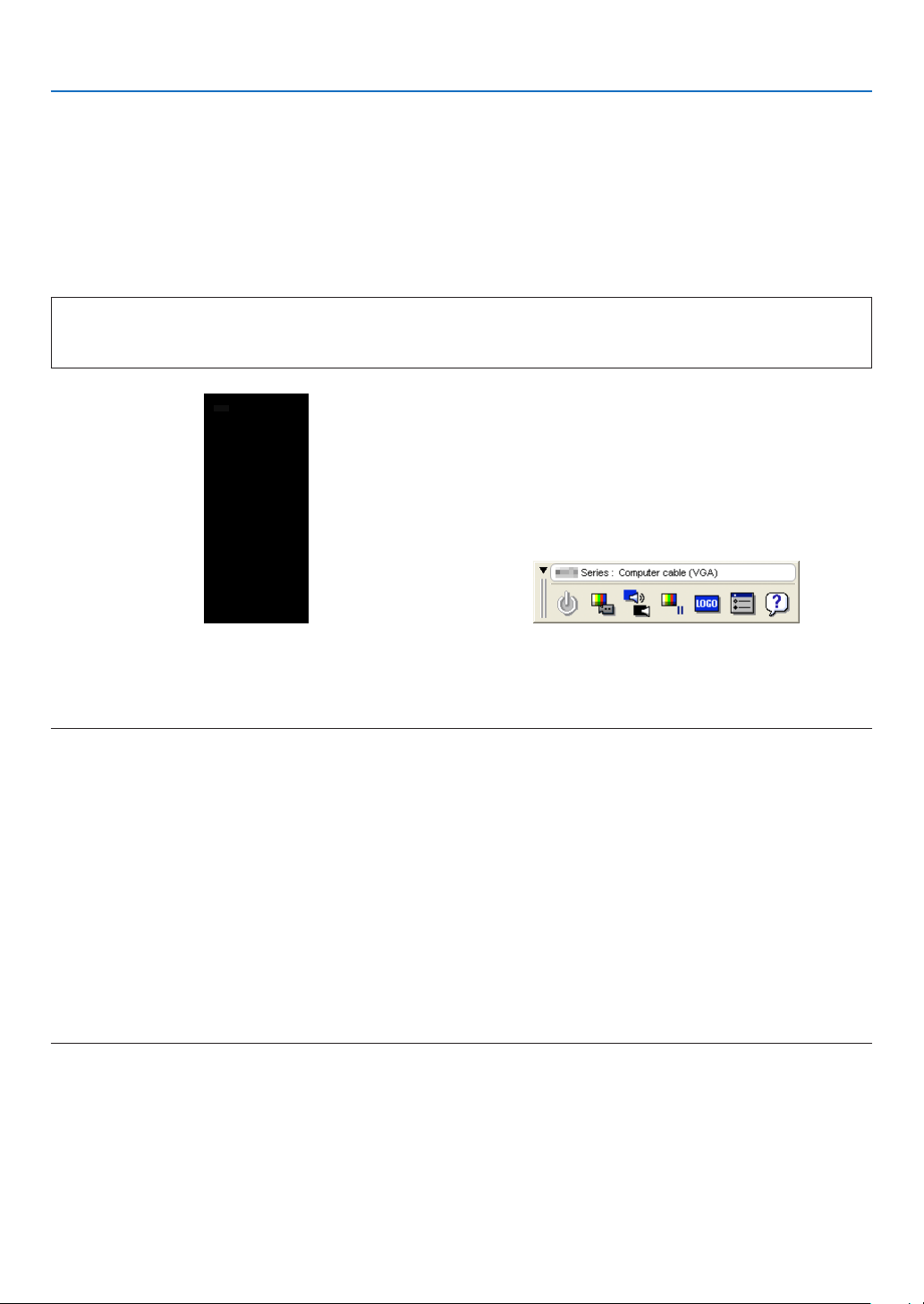
108
8. Appendix
Using the Computer Cable (VGA) to Operate the Projector
(Virtual Remote Tool)
Usingtheutilitysoftware“VirtualRemoteTool”thatisavailabletodownloadfromourwebsite,VirtualRemotescreen
(ortoolbar)canbedisplayedonyourcomputerscreen.
Thiswillhelpyouperformoperationssuchas projector’spoweronoroffandsignalselectionvia thecomputer
cable(VGA),serialcable,orLANconnection.OnlyviaserialorLANconnectionitisalsousedtosendanimageto
theprojectorandregisteritasthelogodataoftheprojector.Afterregisteringit,youcanlockthelogotopreventit
fromchanging.
Control Functions
Power On/Off, signal selection, picture freeze, picture mute, audio mute, Logo transfer tothe projector, and
remotecontroloperationonyourPC.
Toolbar
7
NOTE:
• When[COMPUTER]isselectedfromyoursourceselection,theVirtualRemotescreenorthetoolbarwillbedisplayedaswellasyour
computerscreen.
• Usethesuppliedcomputercable(VGA)toconnecttheCOMPUTERINterminaldirectlywiththemonitoroutputterminalofthecomputer
touseVirtualRemoteTool.
Usingaswitcherorothercablesthanthesuppliedcomputercable(VGA)maycausefailureinsignalcommunication.
VGAcableterminal:
PinNos.12and15arerequiredforDDC/CI.
• VirtualRemoteToolmaynotworkdependingonyourcomputer’sspecicationsandversionofgraphicadaptersordrivers.
• TorunVirtualRemoteTool,“Microsoft.NETFrameworkVersion2.0”isrequired.TheMicrosoft.NETFrameworkVersion2.0,3.0or3.5is
availablefromMicrosoft’swebpage.Downloadandinstallitonyourcomputer.
• Logodata(graphics)thatcanbesenttotheprojectorwithVirtualRemoteToolhasthefollowingrestrictions:
(OnlyviaserialorLANconnection)
- Filesize:Lessthan1MB
- Imagesize(resolution):Horizontal 1280 × vertical 800 dots or less
- Numberofcolors:256colorsorless
TIP:
• VirtualRemoteToolcanbeusedwithaLANandaserialconnection.
• Theprojector’sCOMPUTERINterminalsupportsDDC/CI(DisplayDataChannelCommandInterface).DDC/CIisastandardinterfacefor
bidirectionalcommunicationbetweendisplay/projectorandcomputer.
Virtual Remote screen
For getting the Virtual Remote Tool, please visit our web site and download it:
https://www.nec-display.com/dl/en/index.html

109
8. Appendix
Troubleshooting Check List
Beforecontactingyourdealerorservicepersonnel,checkthefollowinglisttobesurerepairsareneededalsoby
referringtothe“Troubleshooting”sectioninyouruser’smanual.Thischecklistbelowwillhelpussolveyourproblem
moreefficiently
* Printthispageandthenextpageforyourcheck.
Frequency of occurrence □ always □ sometimes (How often?_____________________) □ other (__________________)
Power
□
No power (POWER indicator does not light blue) See also “Status
Indicator (STATUS)”�
□
Power cord’s plug is fully inserted into the wall outlet�
□
Main power switch is pressed to the ON position�
□
No power even though you press and hold the POWER button�
□
Shut down during operation�
□
Power cord’s plug is fully inserted into the wall outlet�
□
[AUTO POWER OFF] is turned off (only models with the [AUTO
POWER OFF] function)�
□
[OFF TIMER] is turned off (only models with the [OFF TIMER]
function)�
Video and Audio
□
No image is displayed from your PC or video equipment to the projector�
□
Still no image even though you connect the projector to the PC
first, then start the P �
□
Enabling your notebook PC’s signal output to the projector�
• Acombinationoffunctionkeyswillenable/disabletheexternal
display.Usually,thecombinationofthe“Fn”keyalongwithone
ofthe12functionkeysturnstheexternaldisplayonoroff.
□
No image (blue or black background, no display)�
□
Still no image even though you press the AUTO ADJUST button�
□
Still no image even though you carry out [RESET] in the projec-
tor’s menu�
□
Signal cable’s plug is fully inserted into the input terminal
□
A message appears on the screen�
( _____________________________________________ )
□
The source connected to the projector is active and available�
□
Still no image even though you adjust the brightness and/or the
contrast�
□
Input source’s resolution and frequency are supported by the
projector�
□
Image is too dark�
□
Remains unchanged even though you adjust the brightness and/
or the contrast�
□
Image is distorted�
□
Image appears to be trapezoidal (unchanged even though you carry
out the [KEYSTONE] adjustment)�
□
Parts of the image are lost�
□
Still unchanged even though you press the AUTO ADJUST button�
□
Still unchanged even though you carry out [RESET] in the projec-
tor’s menu�
□
Image is shifted in the vertical or horizontal direction�
□
Horizontal and vertical positions are correctly adjusted on a
computer signal�
□
Input source’s resolution and frequency are supported by the
projector�
□
Some pixels are lost�
□
Image is flickerin �
□
Still unchanged even though you press the AUTO ADJUST button�
□
Still unchanged even though you carry out [RESET] in the projec-
tor’s menu�
□
Image shows flickering or color drift on a computer signal
�
□
Image appears blurry or out of focus�
□
Still unchanged even though you checked the signal’s resolution
on PC and changed it to projector’s native resolution�
□
Still unchanged even though you adjusted the focus�
□
No sound�
□
Audio cable is correctly connected to the audio input of the projector�
□
Still unchanged even though you adjusted the volume level�
□
AUDIO OUT is connected to your audio equipment (only models with
the AUDIO OUT terminal)�
Other
□
Remote control does not work�
□
No obstacles between the sensor of the projector and the remote
control�
□
Projector is placed near a fluorescent light that can disturb the
infrared remote controls�
□
Batteries are new and are not reversed in installation�
□
Buttons on the projector cabinet do not work (only models with the
[CONTROL PANEL LOCK] function)
□
[CONTROL PANEL LOCK] is not turned on or is disabled in the menu�
□
Still unchanged even though you press and hold the SOURCE button
for a minimum of 10 seconds�
8
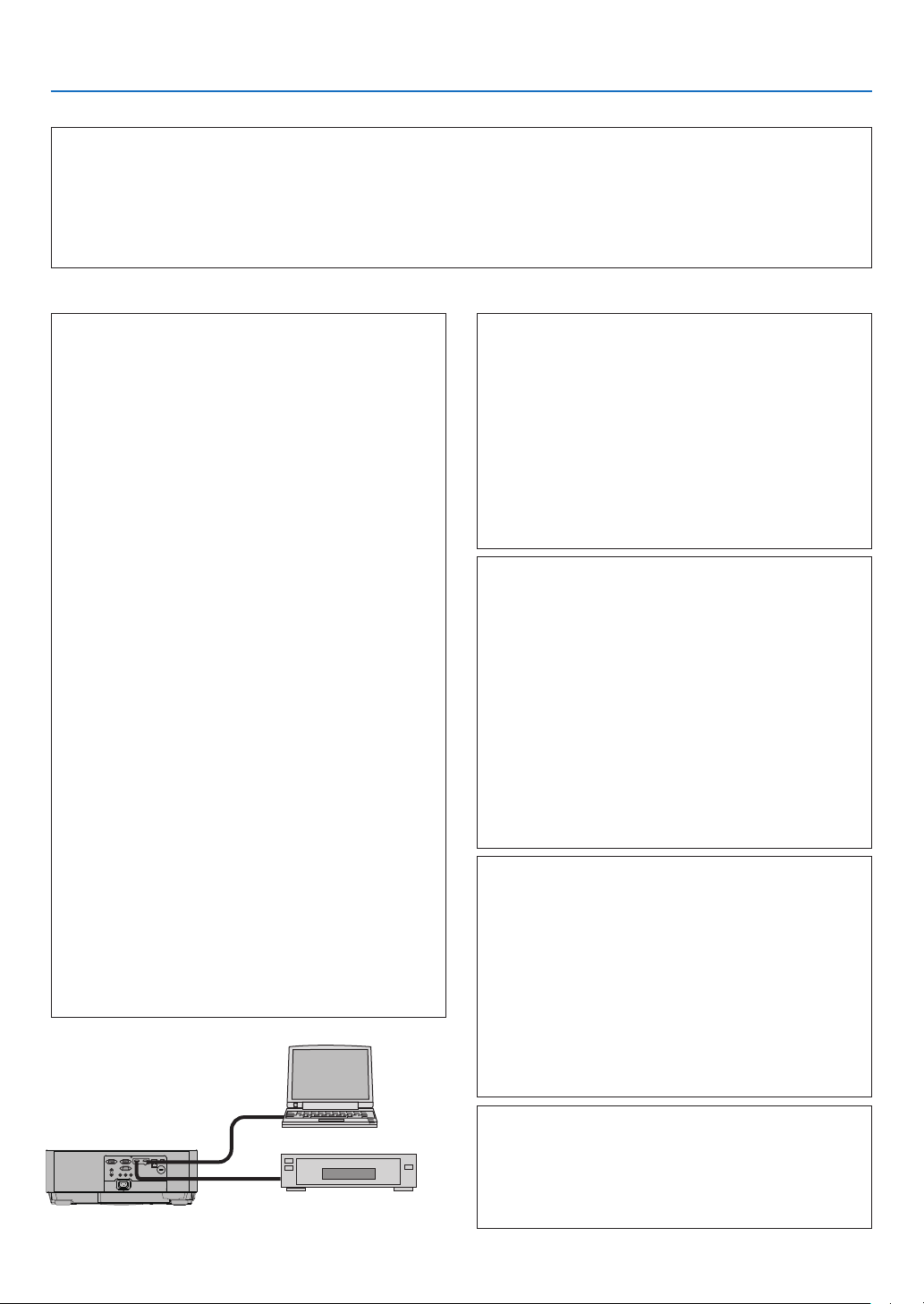
110
8. Appendix
In the space below please describe your problem in detail.
Information on application and environment where your projector is used
Projector
PC
DVD player
Projector
Model number:
Serial No�:
Date of purchase:
Light operating time (hours):
Eco Mode:
□ OFF □ AUTO ECO
□ NORMAL □ ECO
Information on input signal:
Horizontal synch frequency [ ] kHz
Vertical synch frequency [ ] Hz
Synch polarity H □ (+) □ (−)
V □ (+) □ (−)
Synch type □ Separate □ Composite
□ Sync on Green
Indicator Message:
□ POWER
Blinks in □ Blue □ Green □ Orange □ Red
[ ] cycles
Lights in □ Blue □ Green □ Orange □ Red
□ STATUS
Blinks in □ Blue □ Green □ Orange □ Red
[ ] cycles
Lights in □ Blue □ Green □ Orange □ Red
□
LIGHT
Blinks in □ Blue □ Green □ Orange □ Red
[ ] cycles
Lights in □ Blue □ Green □ Orange □ Red
Remote control model number:
Installation environment
Screen size: inch
Screen type: □ White matte □ Beads □ Polarization
□ Wide angle □ High contrast
Throw distance: feet/inch/m
Orientation: □ Ceiling mount □ Desktop
Power outlet connection:
□ Connected directly to wall outlet
□ Connected to power cord extender or other (the number
of connected equipment______________)
□ Connected to a power cord reel or other (the number of
connected equipment______________)
Computer
Manufacturer:
Model number:
Notebook PC □ / Desktop □
Native resolution:
Refresh rate:
Video adapter:
Other:
Videoequipment
VCR, DVD player, Video camera, Video game or other
Manufacturer:
Model number:
Signal cable
NEC standard or other manufacturer’s cable?
Model number: Length: inch/m
Distribution amplifie
Model number:
Switcher
Model number:
Adapter
Model number:

8. Appendix
REGISTER YOUR PROJECTOR! (for residents in the United
States)
Pleasetaketimetoregisteryournewprojector.ThiswillactivateyourlimitedpartsandlaborwarrantyandInstaCare
serviceprogram.
Visitourwebsiteatwww.necdisplay.com,clickonsupportcenter/registerproductandsubmityourcompletedform
online.
Uponreceipt,wewillsendaconfi mationletterwithallthedetailsyouwillneedtotakeadvantageoffast,reliable
warrantyandserviceprogramsfromtheindustryleader,NECDisplaySolutionsofAmerica,Inc.
111

©NECDisplaySolutions,Ltd.2019
7N952943