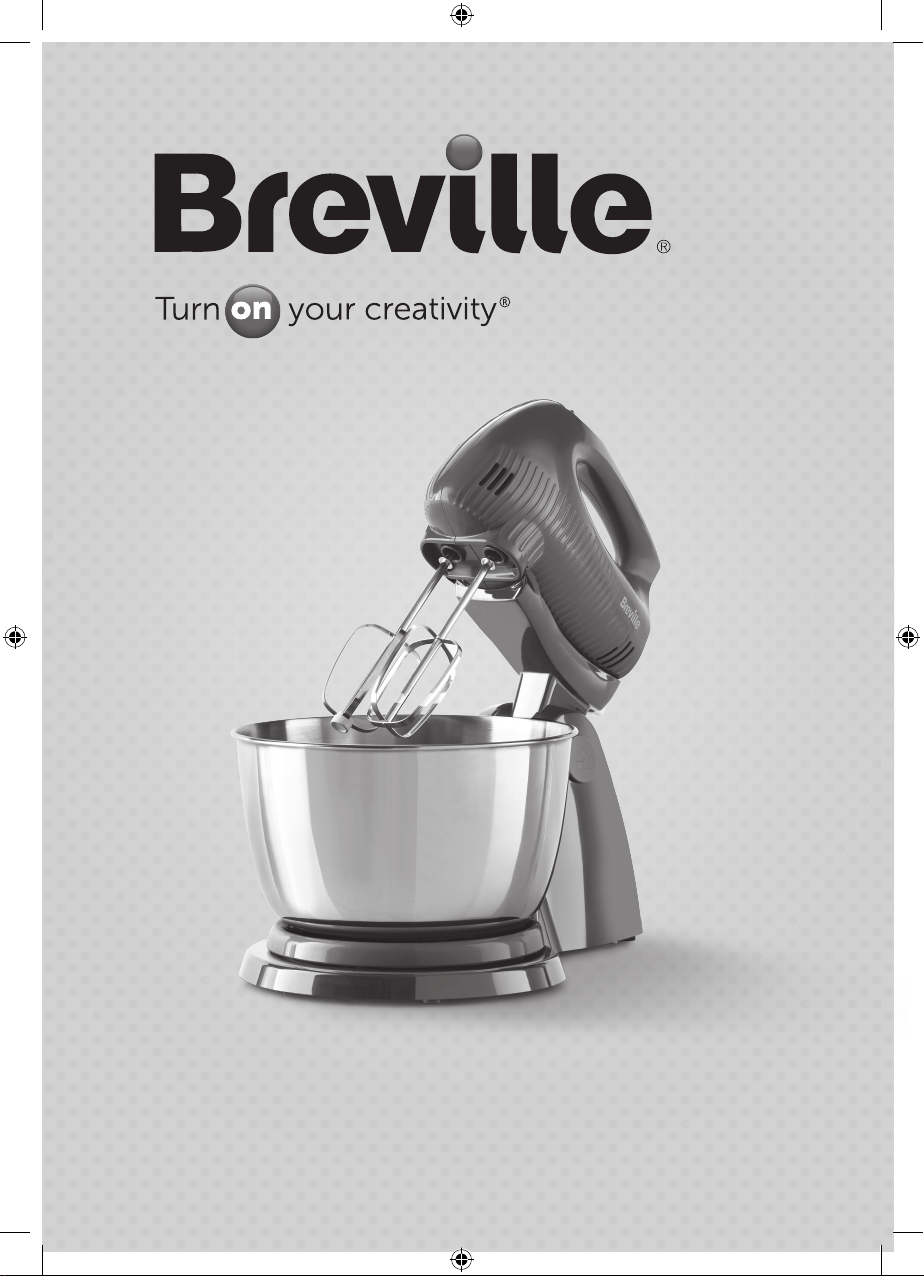
Flow collection
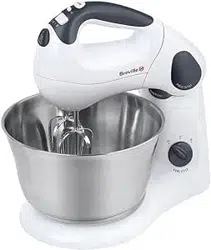
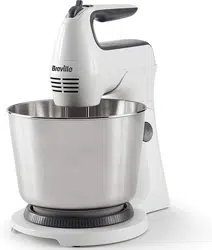
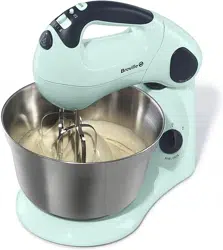
hand and stand mixer
VFM035

2
3
This appliance is intended to be used in household and similar applications such as:
! Staff kitchen areas in shops, ofces and other working environments;
! Farm houses;
! By clients in hotels, motels and other residential type environments;
! Bed and breakfast type environments.
! Always ensure that hands are dry before handling the plug or switching on the
appliance.
! Always use the appliance on a stable, secure, dry and level surface.
! This appliance must not be placed on or near any potentially hot surfaces (such as a
gas or electric hob).
! Never immerse any part of the appliance or power cord and plug in water or any other
liquid.
! Never let the power cord hang over the edge of a work top, touch hot surfaces or
become knotted, trapped or pinched.
! Do not use the appliance if it has been dropped, if there are any visible signs of
damage or if it is leaking.
! Never use any accessory or attachment not recommended by the manufacturer.
! Remove attachments from the appliance before washing or cleaning them.
! Keep ngers, hair and clothing away from the moving parts of the appliance when it is
in use.
! Do not attempt to eject, t or remove attachments until the appliance has come to a
complete stop.
IMPORTANT SAFETY INSTRUCTIONS. READ CAREFULLY AND
KEEP FOR FUTURE REFERENCE
Appliances can be used by persons with reduced physical,
sensory or mental capabilities or lack of experience and
knowledge if they have been given supervision or instruction
concerning use of the appliance in a safe way and if they
understand the hazards involved. Children should not play
with the appliance.
This appliance shall not be used by children. Keep the
appliance and its cord out of reach of children.
Always disconnect the appliance from the mains supply
socket if it is left unattended and before assembling,
disassembling or cleaning.
If the supply cord is damaged, it must be replaced by the
manufacturer, its service agent or similarly qualied persons
in order to avoid a hazard.
All accessories (beaters and dough hooks) should not be
used for longer than 5 minutes.
product safety
product safety
For cleaning instructions, please refer to section “care,
cleaning and storage”.
CAUTION: In order to avoid a hazard due to inadvertent
resetting of the thermal cut-out, this appliance must not be
supplied through an external switching device, such as a
timer, or connected to a circuit that is regularly switched on
and off by the utility.
4
5
features and parts
Due to our policy of continuous improvement, the actual product may differ slightly from the one illustrated in these instructions.
features and parts
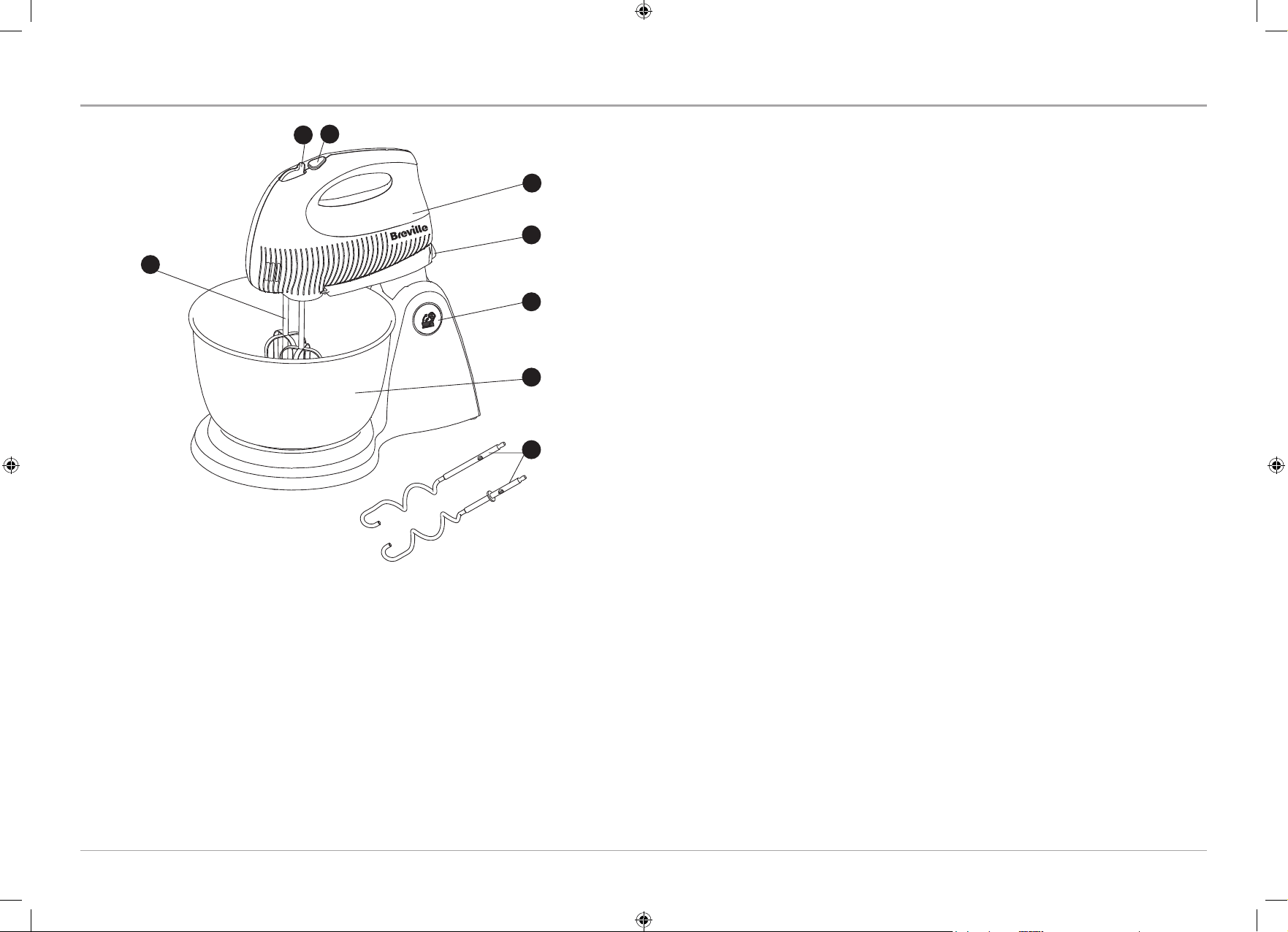
6-Speed control / eject button
This Hand Mixer features a convenient beater eject button. The design allows for a
smooth push of the thumb to release the beaters and dough hooks.
CAUTION: Make sure hand mixer is unplugged before removing or inserting any
attachments.
Boost button
The boost button allows for an added boost to the selected speed setting at the press of
the button.
Detachable hand mixer
Can be detached from the stand for hand use.
Mixer head lock release button
Press to release the head lock and tilt or lower the mixer head.
Mixer stand/ 3.5L stainless steel rotating bowl
Rotating bowl for optimal mixing. Dishwasher safe.
Hand mixer release clip
Press to detach the hand mixer.
Stainless steel dough hooks
Stainless steel dough hooks ideal for kneading dough. Dishwasher safe.
Note that the dough hooks are not interchangeable, the dough hook with the collar on the
stem ts into the large drive hole on the mixer.
Stainless steel beaters
Suitable for making cakes, biscuits, pastry, scones, icing, llings, etc. Dishwasher safe.
1. 6-Speed control / eject button
2. Boost button
3. Detachable hand mixer
4. Hand mixer release clip
5. Mixer head lock release button
6. Mixer stand/ 3.5L stainless steel rotating bowl
7. Stainless steel dough hooks
8. Stainless steel beaters
8
3
4
5
6
7
1
2
6
7
using your mixer on the stand
Before rst use
Make sure your mixer is switched off and unplugged from the mains supply
socket before cleaning, detaching or tting it to the mixer stand or before tting or
removing the beaters or dough hooks.
Before using your mixer for the rst time, wash the beaters, dough hooks and stainless
steel bowl in warm, soapy water. Rinse and dry thoroughly. Do not use harsh abrasives,
chemicals or oven cleaners. Using a damp cloth or sponge, wipe the exterior of the hand
mixer and mixer stand. Dry thoroughly.
Using
The mixer should never be left unattended during use. Always avoid contact with
moving parts while the appliance is in operation. Keep hands, hair, clothing as well
as other utensils away from the beaters or dough hooks during operation.
Never attempt to remove or replace the beaters or dough hooks whilst your food
mixer is in operation, or plugged in to the mains supply.
1. Ensure that your mixer is unplugged from the supply socket and the speed selector
is set to 0 (off).
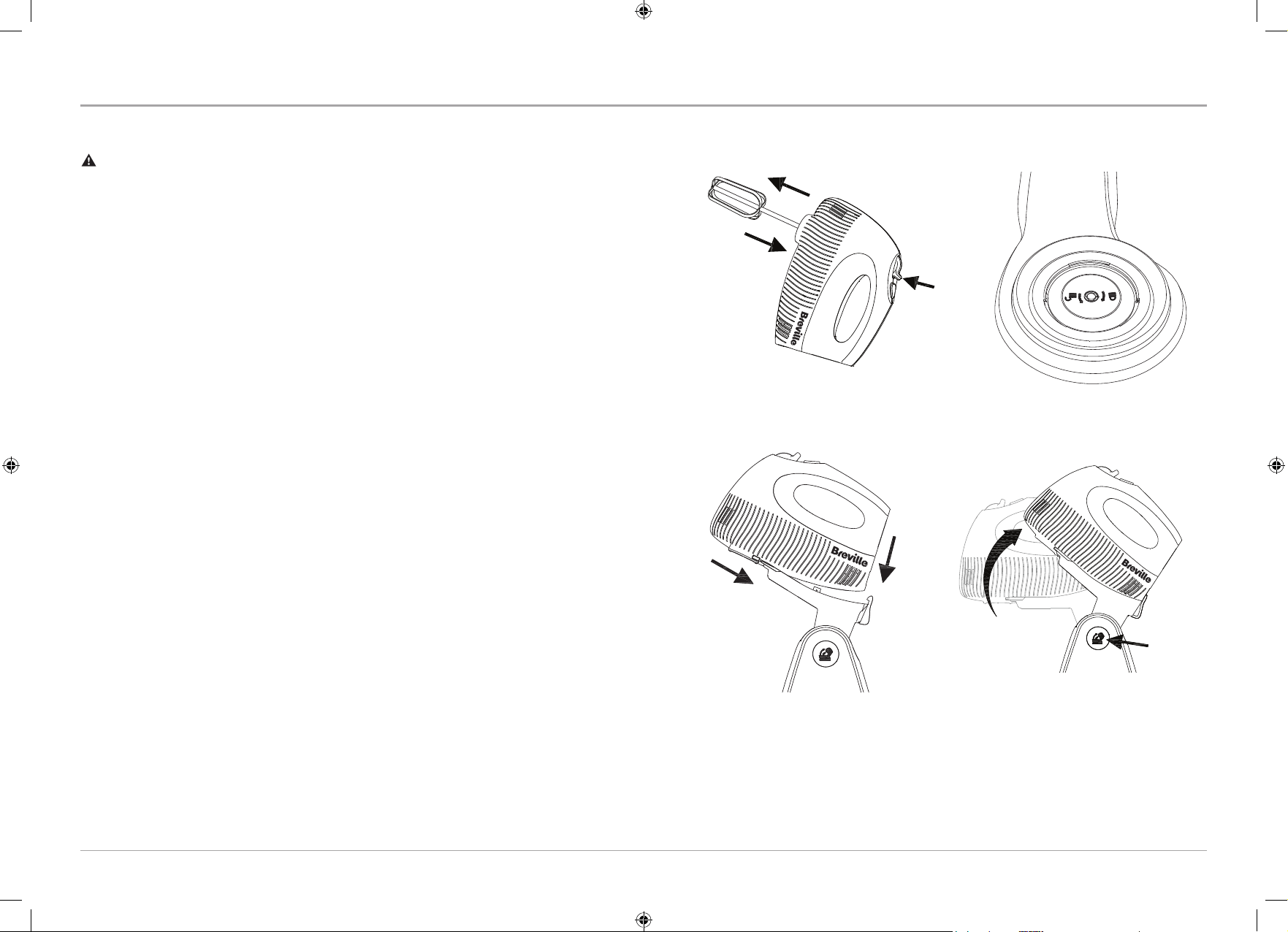
2. Insert beaters one at a time, by placing the stem end of beaters into the opening
drive holes on the bottom of the mixer. Turn beater slightly and push in until beater
clicks into position. To remove beaters make sure the speed selector is set to 0 (off)
and push the eject button to release. (see Figure 1)
NOTE: The dough hooks are not interchangeable. The dough hook with the collar
on the stem ts into the large drive hole on the mixer. If the beaters and dough
hooks do not click into the drive holes, reverse and try again.
3. Hold the rotating rim on the mixer stand, position the mixing bowl over the mixer
stand and rotate the mixing bowl in a clockwise direction until it clicks into position.
(see gure 2)
NOTE: The mixing bowl will rotate freely based on the speed setting the hand mixer
is turned to. The mixing bowl speed can also be controlled by hand.
4. Connect the hand mixer to the stand by sliding the hand mixer into the two prongs
on the front of the stand and until it clicks into place (see Figure 3). Ensure that the
hand mixer and stand are rmly connected together.
NOTE: Tilting back the cradle makes it easier to attach the hand mixer.
(see Figure 4)
5. Add the ingredients to the mixing bowl.
6. Plug your mixer into the mains supply socket.
7. Turn the on/off speed selector switch to 1 to start mixing. Adjust the speed as
required (see Mixing speeds on page 9).
NOTE: When mixing heavy loads please use speed 1, When mixing smaller volumes
of food, the mixer should be removed from the stand and used as a hand mixer for best
results.
If scraping of the bowl is required, turn speed control to “0 (OFF)” stop the mixer and
scrape sides and bottom of bowl with a rubber spatula as needed.
using your mixer on the stand
Figure 1 Figure 2
Figure 3 Figure 4

8
9
using your mixer by hand
1. Ensure that your mixer is unplugged from the supply socket and the speed selector
is set to 0 (off). Press the mixer head lock release button and raise the mixer stand
head until it clicks.
2. Press down the hand mixer release clip, then lift the hand mixer from the mixer
stand.
3. Plug your hand mixer into the mains supply socket.
4. Place the beaters or dough hooks into the ingredients to be mixed. Always support
the container or bowl in which you are mixing ingredients whilst operating your hand
mixer. Set the on/off speed selector switch to 1 to start mixing. Adjust the speed as
required (see Mixing speeds section).
5. When mixing, guide the hand mixer through the centre and around the sides of the
mixing bowl. For best results always make sure that you:
• use twin beaters
• soften the butter/margarine/lard before use
• disperse fat evenly into the our before mixing
6. When whisking egg whites we recommend using the mixer off the stand.
7. When you have nished mixing the ingredients, set the on/off speed selector to 0
(off). Scrape the beaters/dough hooks around the bowl to remove any remaining
ingredients.
8. Unplug your hand mixer from the mains supply socket.
Always avoid contact with moving parts while the appliance is in operation.
Keep hands, hair, clothing as well as other utensils away from the beaters or dough
hooks during operation.
Never attempt to remove or replace the beaters or dough hooks whilst your food
mixer is in operation, or plugged in to the mains supply.
using your mixer by hand
Mixing speeds
Speed Mixing Tasks
1 Stir
Use when stirring liquid ingredients or when mixing dry and
liquid ingredients together alternately in a recipe. Use when
preparing any of the ready-prepared or packaged instant
puddings.
2 Mix
Use when a recipe calls for combining ingredients together.
Use for quick breads or mufns that require a brisk action,
just enough to blend.
NOTE: This is the maximum recommended speed for dough
hook usage.
3 Blend
Use when preparing cake mixes or for directions calling for
medium speed. Use to cream butter and sugar together.
4-5 Beat
Use when preparing a butter icing from a recipe or package.
Use when whipping cream for desserts.
6 Whip
Use to mash potatoes to develop a light and uffy texture.
Use when whipping egg whites.
Boost Button
During especially heavy mixing tasks, press the button to
drive through the mixture with ease.
How to adjust the Speed
1. Move the speed selector from 1 to 6 and to turn off set to “0 (OFF)”.
2. To engage a higher speed immediately press and hold the boost button. The speed
will increase until button is released at which point it will return to original setting.
NOTE: This feature is intended for short bursts. For long mixing use the appropriate
speed setting.

11
10
care, cleaning and storage
Make sure your mixer is switched off and unplugged from the mains supply
socket before cleaning, detaching or tting it to the mixer stand or before tting or
removing the beaters or dough hooks.
To make cleaning easier, clean your hand mixer and the beaters or dough hooks as soon
as you have nished using them.
1. Set the speed selector to 0 (off) and unplug your hand mixer from the mains supply
socket.
2. Eject the beaters or dough hooks from your hand mixer by pressing the eject button.
The beaters or dough hooks are heavy and care should be taken not to let them fall
onto fragile surfaces or items when they are being ejected.
3. Wash the mixing bowl, beaters or dough hooks in warm soapy water. Alternatively,
wash them in a dishwasher.
4. Rinse and dry the beaters or dough hooks before storing or using again.
5. Wipe the base of the mixer stand and the body of the hand mixer with a soft, damp
cloth to clean. Never immerse the base or the hand mixer in water or any other
liquid.
Storage
Store your hand mixer in a clean, dry place, out of the reach of children, ensuring that all
the parts are dismantled.
hints and tips
1. Before starting, read the recipe completely.
2. Refrigerated ingredients, e.g. butter and eggs, should be at room temperature before
mixing begins. Set these ingredients out ahead of time. Cream is best when it is
whipped cold straight from the refrigerator.
3. Before starting your recipe, preheat the oven to the temperature recommended in the
recipe and gather all the ingredients and utensils near to the mixer.
4. Caster sugar is the preferred choice for cake making. Add it to the softened butter
and always cream until pale in colour.
5. To eliminate the possibility of shells or deteriorated/off eggs in your recipe, break
eggs into a separate container rst, then add to the mixture.
6. When mixing egg whites, be sure the bowls and beaters are thoroughly cleaned
and dried, as even the smallest amount of oil on beaters or bowl may cause the egg
whites not to aerate.
7. Always start mixing at slow speeds, especially when mixing in our or icing sugar.
Mix these ingredients slowly at rst, then gradually increase the speed as required.
8. Do not over beat. Be careful that you only mix/knead mixtures as recommended in
your recipe. Fold in dry ingredients until just combined. Always use the low speed.
At any stage of mixing, over beating can cause toughness, close texture, lack of
rising or excessive shrinkage. Climatic conditions, seasonal temperature changes,
temperature of ingredients and their texture variation from area to area all play a part
in the required mixing time and the results achieved.
9. All recipes have been kitchen tested, but should you nd it necessary to vary the
ingredients or size of the tin etc. allow for a variation in cooking time. Always ensure
that baked foods are correctly cooked before removing them from the oven or
cooking appliance.
10. If you don’t have a tin the same size as the recipe suggests here are some
alternatives: two 20cm sandwich tins, one 28 x 18cm tin, one 20 x 7cm round cake
tin or a standard loaf tin.
11. Cooking times and temperatures are meant only as a guide. Light mixtures should
spring back when lightly touched and heavy mixtures, fruit cake and the like, should
be tested with a skewer towards the end of the suggested cooking time. If the skewer
is clean when removed, the cake is cooked.

13
12
hints and tips
Oven Temperatures
°C °C (fan) °F Gas Mark
Very Cool 110 90 225 ¼
130 110 250 ½
Cool 140 120 275 1
150 130 300 2
Moderate 170 150 325 3
180 160 350 4
Moderately hot 190 170 375 5
200 180 400 6
Hot 220 200 425 7
230 210 450 8
Very hot 240 220 475 9
Symptom Possible cause
Sponge cake shrink Unbalanced ingredients, over beating of egg whites, sudden
changes of temperature or draught when taking from the oven.
Cakes do not rise Mostly due to gross over beating, but can also be caused by too hot
an oven during the rst part of cooking.
Cakes sink in the centre Too much fat, raising agent, liquid or sugar; too little our, under
cooking or slow cooking.
Cakes run over the edges Too much batter for size of pan, too cool an oven, too much sugar,
over beating, too much raising agent.
Hard outer crust Too much our, too little sugar, over mixing, too hot an oven.
Moist, sticky outside Too much sugar, over beating, under baking.
Coarse, crumbly texture Over beating, low baking temperature.
Heavy, close texture Too much fat or sugar, over mixing, under baking, or too hot an
oven.
Fruit sinks Mixture too soft, damp fruit, too little our, ingredients not correctly
balanced, over beating.
making dough
Preparing dough
1. Fit the dough hooks (don’t forget to t the hook with the red collar in the red recess).
2. Place the dry ingredients into the mixer bowl. Always keep dried yeast away from the
salt or your bread will fail to rise.
3. Turn the speed control switch to 1.
4. Begin to gradually add the liquid ingredients to the bowl.
Never attempt to feed the dough into the dough hooks with your hands or any other
utensil while the mixer is plugged into the supply socket or is in operation.
5. As the ingredients start to form a ball, scrape down the sides of the bowl if necessary
with the plastic spatula and remove your dough.
Always switch off and unplug the mixer rst. Do not use the mixer near the edge of
a work surface or table top because movement of the mixer during operation may
cause it to fall off.
6. After kneading place the dough into a large well greased mixing bowl. Place the bowl
in a warm, draft-free area and cover the bowl with a light damp cloth until the dough
doubles in size.
7. Plunge your st into the centre of the risen dough to remove the excess air. Fold the
outer edges into the centre and turn the dough out onto a lightly oured surface for
shaping.
8. Place the dough into tins for baking, or cut and shape the dough for making buns,
rolls, etc.
9. For the nal rising stage of the dough cover it with a light damp cloth and place it in a
warm, draft-free area until doubled in size again.
Finishing touches
• Sprinkle loaves or buns with sesame, poppy or caraway seeds before baking.
• Top loaves with shredded cheese during the last few minutes of baking.
• Glazes may be brushed over the dough at any time before, during or after baking.
• For a shiny crust, brush with cream or evaporated milk before baking.
• For a matt nish, brush with melted butter or margarine after baking.

14
15
recipes
Basic White Loaf
• 500g strong white plain our
• 7g instant dried yeast
• 1 tsp sugar
• 1 tsp salt
• 320ml warm water
1. Insert dough hooks into the mixer. Add the dried ingredients to the bowl and mix well.
2. Using a low speed, add the warm water. Note that it will be necessary to scrape the
sides of bowl with a rubber spatula. Continue mixing/kneading for approx 5 minutes
until the dough forms a smooth ball.
3. Place the dough in a greased bowl, turning once to grease the top of dough. Cover
and let rise in a warm place until doubled in size (approx 1 hour).
4. Knock back (punch down) the dough to release the air. Remove the dough from the
bowl and place onto a well-oured surface. Lightly knead dough with palm of your
hands until smooth and elastic. Place into a prepared tin or alternatively shape and
place onto a greased baking tray.
5. Allow to rise in a warm place until doubled in size, about 30–40 minutes. Preheat the
oven to 200ºC.
6. Bake for approximately 30-35 minutes. Baked loaves sound hollow when tapped.
Victoria Sponge Cake
• 200g softened butter (extra for greasing)
• 200g caster sugar
• 1 tsp vanilla essence
• 3 eggs
• 200g self-raising our (sifted)
• Icing sugar for dusting
For the lling:
• 6 tbps strawberry jam
• 300ml double cream (chilled)
1. Heat the oven to 180ºC, 160ºC fan.
2. Lightly grease two sandwich tins 15–17.5cm (6–7in) and line base with greaseproof
paper.
3. Cream together the butter and sugar in the mixer bowl on a medium speed until it’s
pale and creamy to get lots of air into the mixture (approx 2-3 minutes).
4. Add the vanilla essence, then beat in the eggs one at a time.
5. Fold in the our but be careful not to over mix as the air will be lost.
6. Divide the mixture between the two cake tins, spreading out the mixture smoothly.
7. Bake for approximately 20 minutes or until cakes are a pale golden colour and spring
back when pressed.
8. Leave to cool for 10 minutes and remove from tins, placing on a wire rack to cool
completely.
9. Whip the cream until soft peaks are formed.
10. Spread the sponge with jam and the whipped cream on one cake, then carefully
sandwich together.
11. Dust with icing sugar and serve.
recipes

16
17
recipes
Vanilla Cupcakes (makes 12)
• 110g of softened butter
• 110g of golden caster sugar
• 2 eggs
• 1 tsp vanilla extract
• 110g of self-raising our
1. Preheat the oven to 180ºC, 160ºC fan.
2. Line a 12 hole mufn tin with the baking cases.
3. Place the caster sugar and softened butter into the mixer bowl and cream together on
a medium speed for approx 2-3 minutes.
4. Add the eggs one at a time and mix well between each addition.
5. Add the vanilla.
6. Fold in the sieved our, do not overmix.
7. Spoon the mixture into the cases and ll about ¾ full.
8. Cook the cupcakes for approximately 15 minutes or until they feel spongy and rm.
Buttercream Topping
• 150g softened butter
• 300g icing sugar, sieved
• 1 tsp vanilla extract
• 1 tbsp milk
1. Add all the ingredients to your mixer bowl. Mix on a low speed for 1 minute until
ingredients are combined, increase the speed and whip until smooth.
recipes
Chocolate Chip Cookies (makes approx. 10–15)
• 125g butter or margarine
• 120g caster sugar
• 120g brown sugar
• 2 eggs
• 1 tsp vanilla essence
• 270g plain our
• 1 tsp salt
• 1 tsp bicarbonate of soda
• 180g chocolate chips
1. Preheat the oven to 170ºC, 150ºC fan and line 2 baking sheets with parchment paper
the baking trays.
2. Place the butter and sugar into the mixing bowl and cream until combined.
3. Add the eggs and vanilla and beat on a high speed until light and uffy.
4. Fold in the sifted dry ingredients and mix until well combined.
5. Mix in the chocolate chips.
6. Place teaspoonfuls of the mixture onto the trays and bake for 12–15 minutes or until
golden.
7. Allow to cool on wire racks.
18
connection to the mains supply
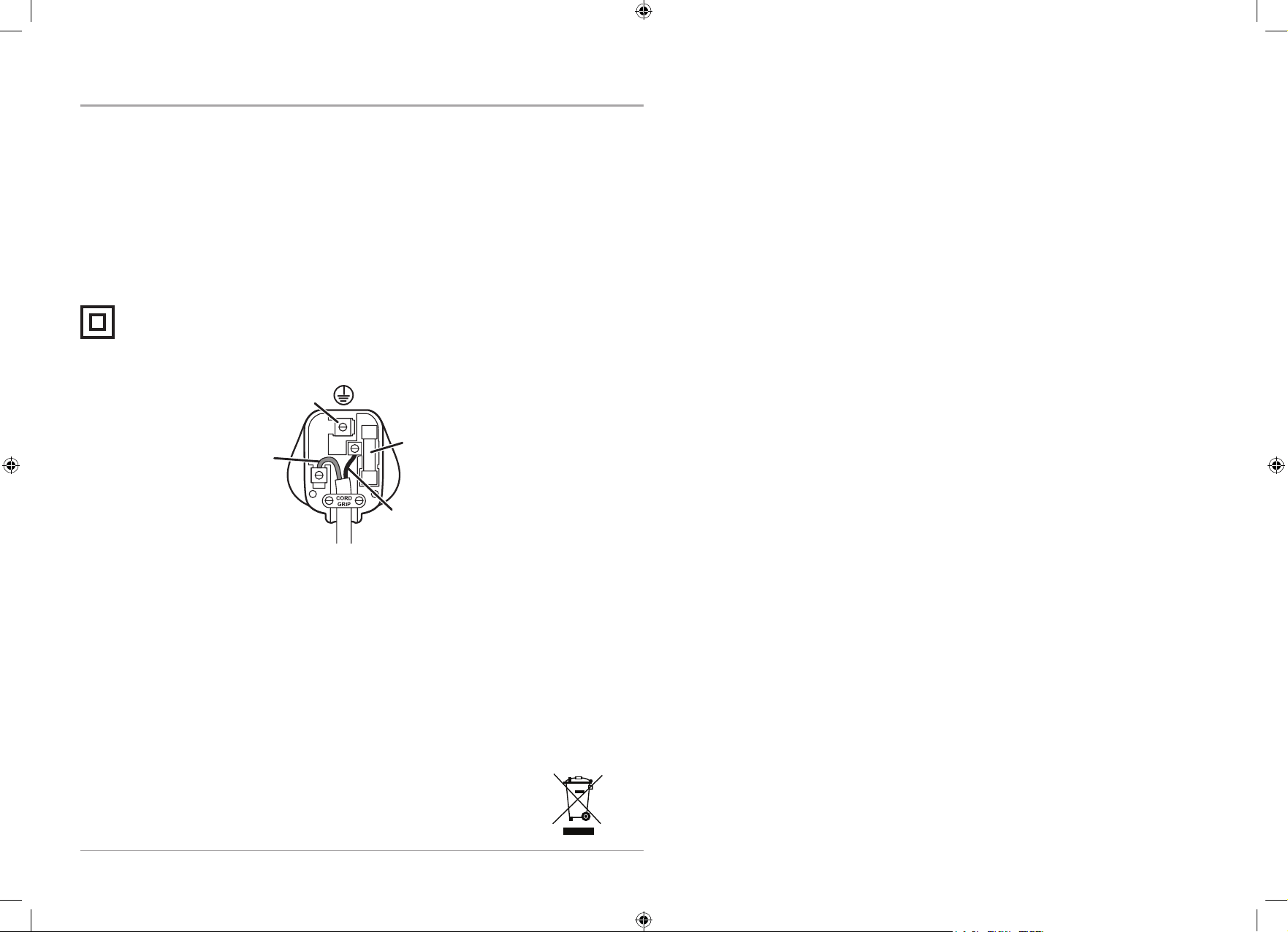
If the plug is not suitable for the socket outlets in your home, it can be removed and
replaced by a plug of the correct type.
If the fuse in a moulded plug needs to be changed, the fuse cover must be retted. The
appliance must not be used without the fuse cover tted.
If the plug fuse requires replacement, a fuse of the same rating as that tted by the
manufacturer must be used. In order to prevent a hazard do not t a fuse of a lower or
higher rating.
If the terminals in the plug are not marked or if you are unsure about the installation of the
plug please contact a qualied electrician.
This symbol indicates that this unit is a Class II appliance and therefore an earth
connection is not required.
After sales service & replacement parts
Waste Disposal
Waste electrical products should not be disposed of with household waste. Please recycle where facilities exist. E-mail us
at [email protected] for further recycling and WEEE information.
In the case the appliance does not operate but is under warranty, return the product to the
place it was purchased for a replacement. Please be aware that a valid form of proof of
purchase will be required. For additional support, please contact our Consumer Service
Department at 0800 028 7154 or email: [email protected].
Do Not Connect
Mains Wires Here
Blue
(Neutral)
Brown
(Live)
Fuse
Ensure that the outer sheath of
the cable is firmly held by the cord grip
Plug should be ASTA approved to BS1363
Fuse should be ASTA approved to BS1362
3A

VFM035 GCDS-BRE-SL
P.N. 201648 Rev B
Jarden Consumer Solutions (Europe) Limited
5400 Lakeside, Cheadle Royal Business Park,
Cheadle, SK8 3GQ, United Kingdom
Newell Poland Services Sp. z o.o.,
Plac Andersa 7, Poznan, 61-894, Poland.
e-mail: [email protected]
UK Telephone: 0800 028 7154
© 2021 Jarden Consumer Solutions (Europe) Limited. All rights reserved.
Jarden Consumer Solutions (Europe) Limited, 5400 Lakeside, Cheadle Royal Business Park,
Cheadle, Cheshire, SK8 3GQ, United Kingdom.
Newell Poland Services Sp. z o.o., Plac Andersa 7, Poznan, 61-894, Poland.
Jarden Consumer Solutions (Europe) Limited and Newell Poland Services Sp. z o.o. are
subsidiaries of Newell Brands Inc.
The product you buy may differ slightly from the one shown on this carton due to continuing
product development.
Made in China.