
– 1 –
Please read these instructions carefully before using this
product, and save this manual for future use.
Model No.
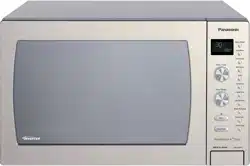
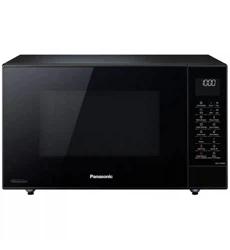
NN-CT56MB
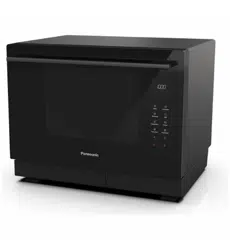
Operating Instruction and Cook Book
Convection/Grill/Microwave Oven
Household Use Only
– 2 –
We are glad you have chosen to purchase a PANASONIC microwave oven. Before operating this oven, please
read these instructions carefully and completely, and keep them for further reference.
If you have only used a microwave oven for reheating and defrosting, with Panasonic’s Inverter Technology you
can be reassured of excellent results when cooking a variety of foods, as the ‘soft’ penetration of microwave
energy to the centre of food helps prevent over cooking on edges and surfaces. Foods can now be gently
simmered without the concern of boil over.
After reading the introductory chapter, we are sure you will be able to master the basic techniques and thereby
develop a firm understanding of your new oven. This book includes recipes from starters to desserts. After trying
our recipes be sure to adapt your favourite recipes to microwave methods.
Start experimenting now, and enjoy the first class results you will achieve by using your new microwave oven.
The serial number of this product may be found on the
back of the oven. You should note the model number
and serial number of this oven in the space provided
and retain this book as a permanent record of your
purchase for future reference.
MODEL NUMBER _______________________
SERIAL NUMBER _______________________
DATE OF PURCHASE ____________________
Panasonic Australia Pty Ltd
1 Innovation Road
Macquarie Park
NSW 2113
Panasonic NZ Ltd
Customer Care Centre
18 Sir Woolf Fisher Drive
Highbrook, Auckland
Private Bag 14911
Panmure, Auckland
Phone: (09) 272 0178
Fax: (09) 272 0129

– 3 –
Table of Contents
Quick Guide to Operation ............................................................................................................................. 4-7
Important Safety Instructions ........................................................................................................................ 8-9
Installation and General Instructions .........................................................................................................10-11
Microwaves and How They Work ...................................................................................................................11
Cookware and Utensils Guide .......................................................................................................................12
Cookware and Utensil Chart ...........................................................................................................................13
Feature Diagram .............................................................................................................................................14
Control Panel ..................................................................................................................................................15
Display Window ..............................................................................................................................................16
Let’s Start To Use Your Oven! .........................................................................................................................17
To Use Child Safety Lock................................................................................................................................17
To Set Clock....................................................................................................................................................18
Operation Guide Setting .................................................................................................................................18
Cooking Modes ...............................................................................................................................................19
To Cook/Reheat/Defrost on Micro Power by Time Setting..............................................................................20
Defrosting Using Defrost Microwave and Time...............................................................................................21
To Defrost Using Turbo Defrost ................................................................................................................ 22-23
To Cook Using the Quick 30 Feature ..............................................................................................................24
To Use the Add Time Feature .........................................................................................................................24
To Cook on Grill by Time Setting .............................................................................................................. 25-26
To Cook on Convection by Time Setting ................................................................................................... 27-28
To Cook on Combination by Time Setting................................................................................................. 29-30
Combination 1. Convection and Microwave ............................................................................................. 31-32
Combination 2. Grill and Microwave ...............................................................................................................33
Multi-stage Cooking ........................................................................................................................................34
Using the Timer......................................................................................................................................... 35-36
Auto Program Setting ............................................................................................................................... 37-39
Junior Menu Programs ............................................................................................................................. 40-41
Auto Cook Programs ................................................................................................................................ 42-43
Auto/Roast Programs ............................................................................................................................... 44-45
INGREDIENT CONVERSION CHART ...........................................................................................................46
Before Requesting Service ....................................................................................................................... 47-48
Care of your Microwave Oven ........................................................................................................................49
Technical Specifications..................................................................................................................................50
Panasonic Warranty (for Australia) .................................................................................................................51
Panasonic Warranty (for New Zealand) ..........................................................................................................52
Cooking and Reheating Guidelines ................................................................................................................53
Reheating Charts ...................................................................................................................................... 54-58
Cooking Charts ......................................................................................................................................... 59-67
Microwave Recipe Techniques .......................................................................................................................68
Soups and Starters ................................................................................................................................... 69-70
Fish ........................................................................................................................................................... 71-73
Meat and Poultry....................................................................................................................................... 74-78
Pasta, Rice and Beans ............................................................................................................................. 79-80
Cheese and Egg Dishes ........................................................................................................................... 81-82
Vegetables and Vegetarian ....................................................................................................................... 83-87
Sauces ...................................................................................................................................................... 88-89
Pastry ..............................................................................................................................................................90
Baking ....................................................................................................................................................... 91-92
Desserts .................................................................................................................................................... 93-96
Preserves.................................................................................................................................................. 97-98
Junior Recipes ........................................................................................................................................ 99-101
– 4 –
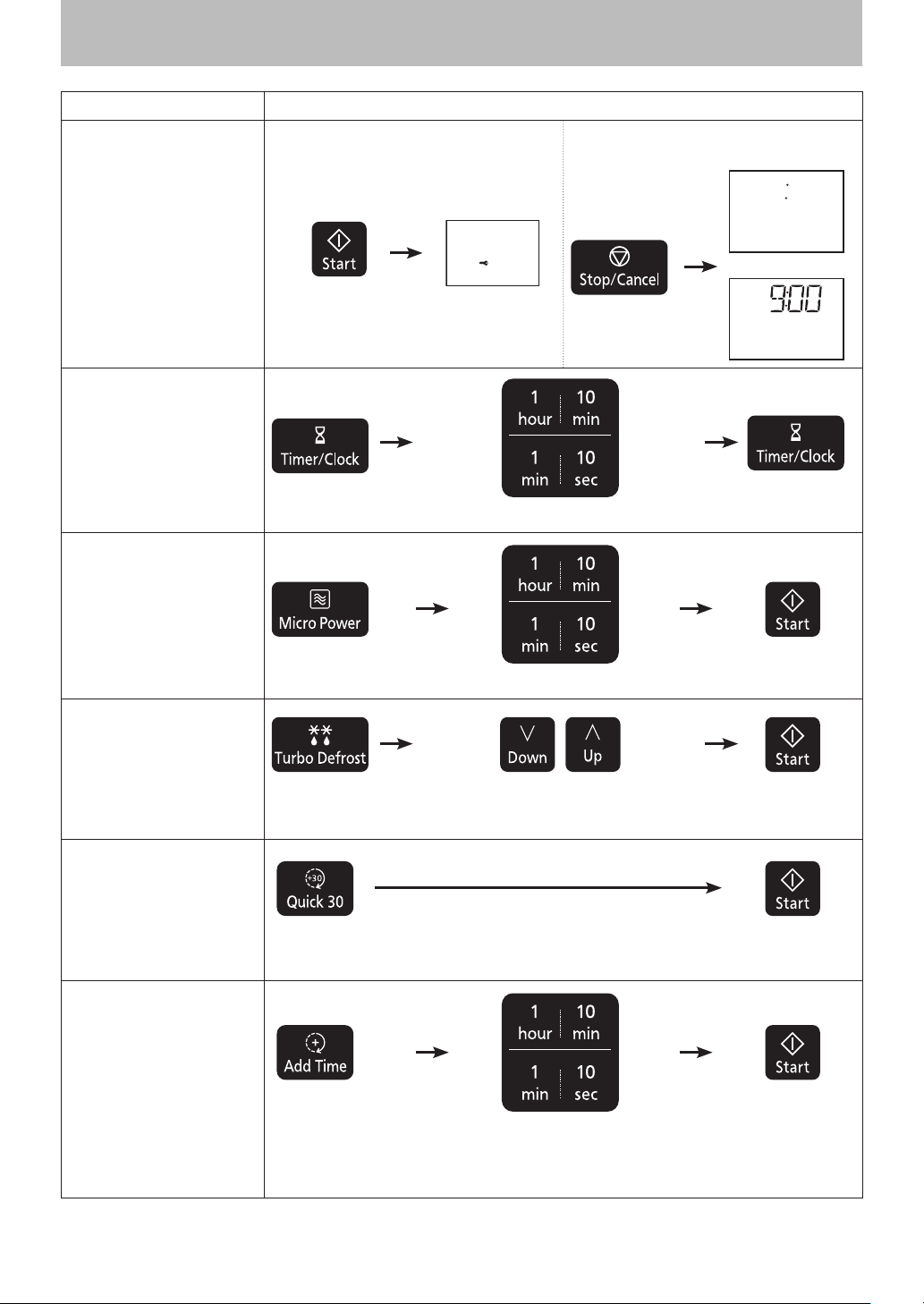
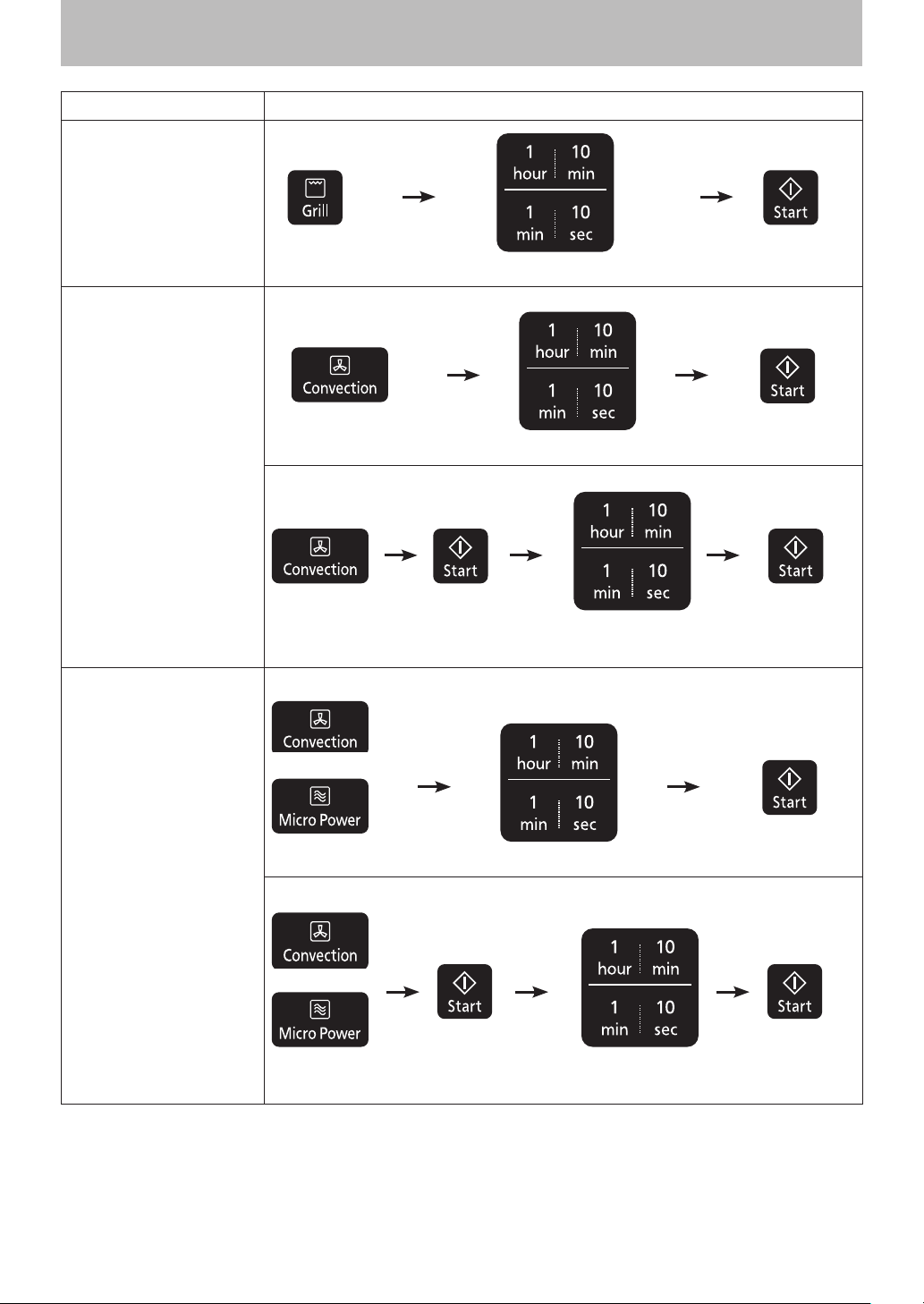
Quick Guide to Operation
Feature How to Operate
To Set/Cancel Child
Safety Lock
(page 17)
To set: Display:
Press 3 times
To Cancel: Display:
Press 3 times
or
To Set Clock
(page 18)
Press twice Press onceSet time of day (12-hour)
To Use Micro Power
(page 20)
Select Power level Press onceSet time
To Use Turbo Defrost
(page 22-23)
Select Program Press onceSelect desired weight
To Use Quick 30
(page 24)
Set time Press once
To Use Add Time
(page 24)
Press time pads
to add desired
cooking time
After cooking,
press Add Time
pad
Press once
– 5 –
Quick Guide to Operation
(continued)
Feature How to Operate
To Use Grill
(page 25-26)
Select Power level Press onceSet time
To Use Convection
(page 27-28)
Without preheating:
Press once
Set timeSelect temperature
With preheating:
Select
temperature
Press onceSet timePress once
After
preheating,
the oven will
beep and the
“P” will flash.
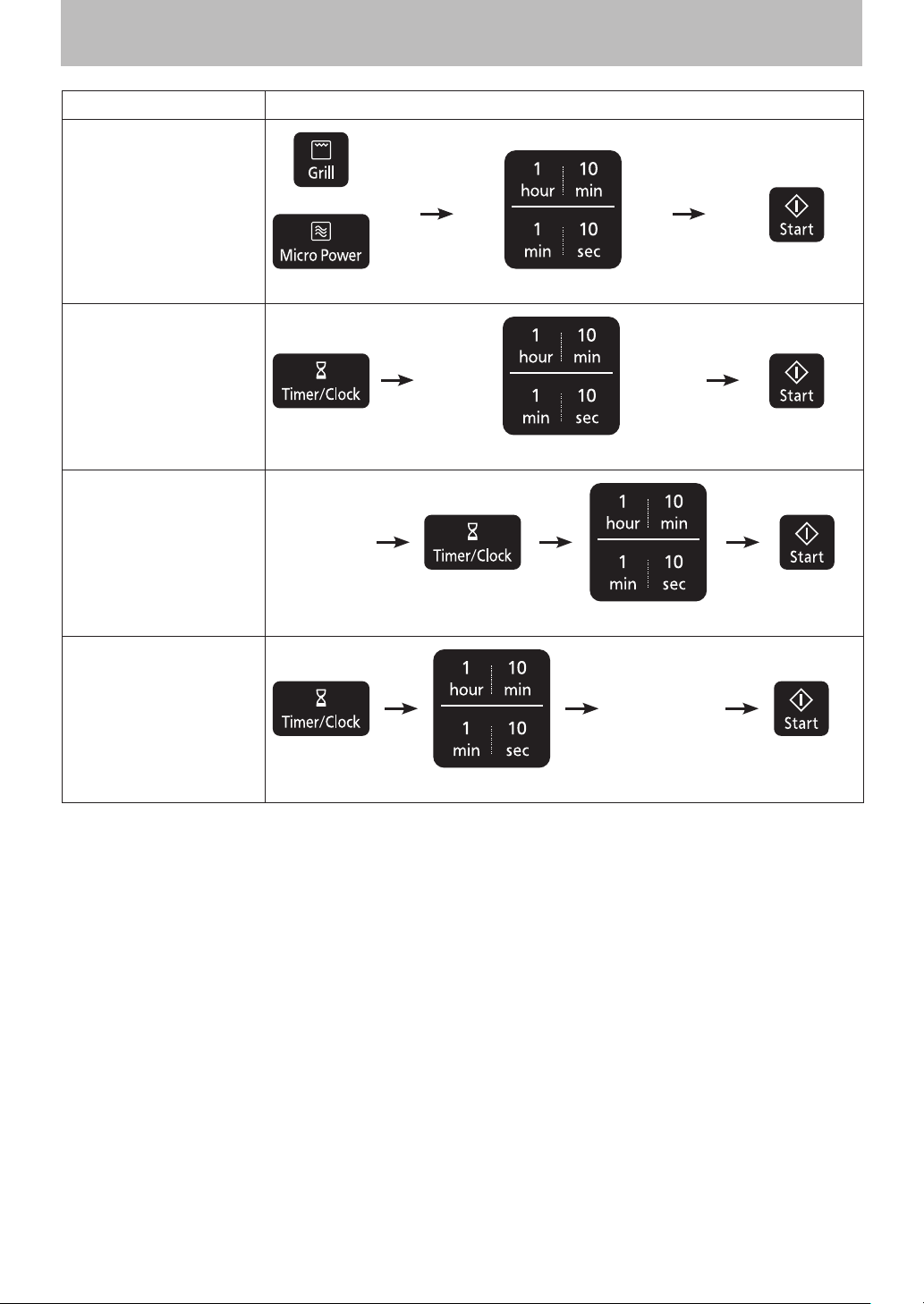
To Use Combination
(Convection + Microwave)
(page 31-32)
Without preheating:
Select Power level
Set time
+
Press once
With preheating:
Set time
Select Power
level
Press oncePress once
After
preheating,
the oven will
beep and the
“P” will flash.
+
– 6 –
Quick Guide to Operation
(continued)
Feature How to Operate
To Use Combination
(Grill + Microwave)
(page 33)
Press once
Set timeSelect Power level
+
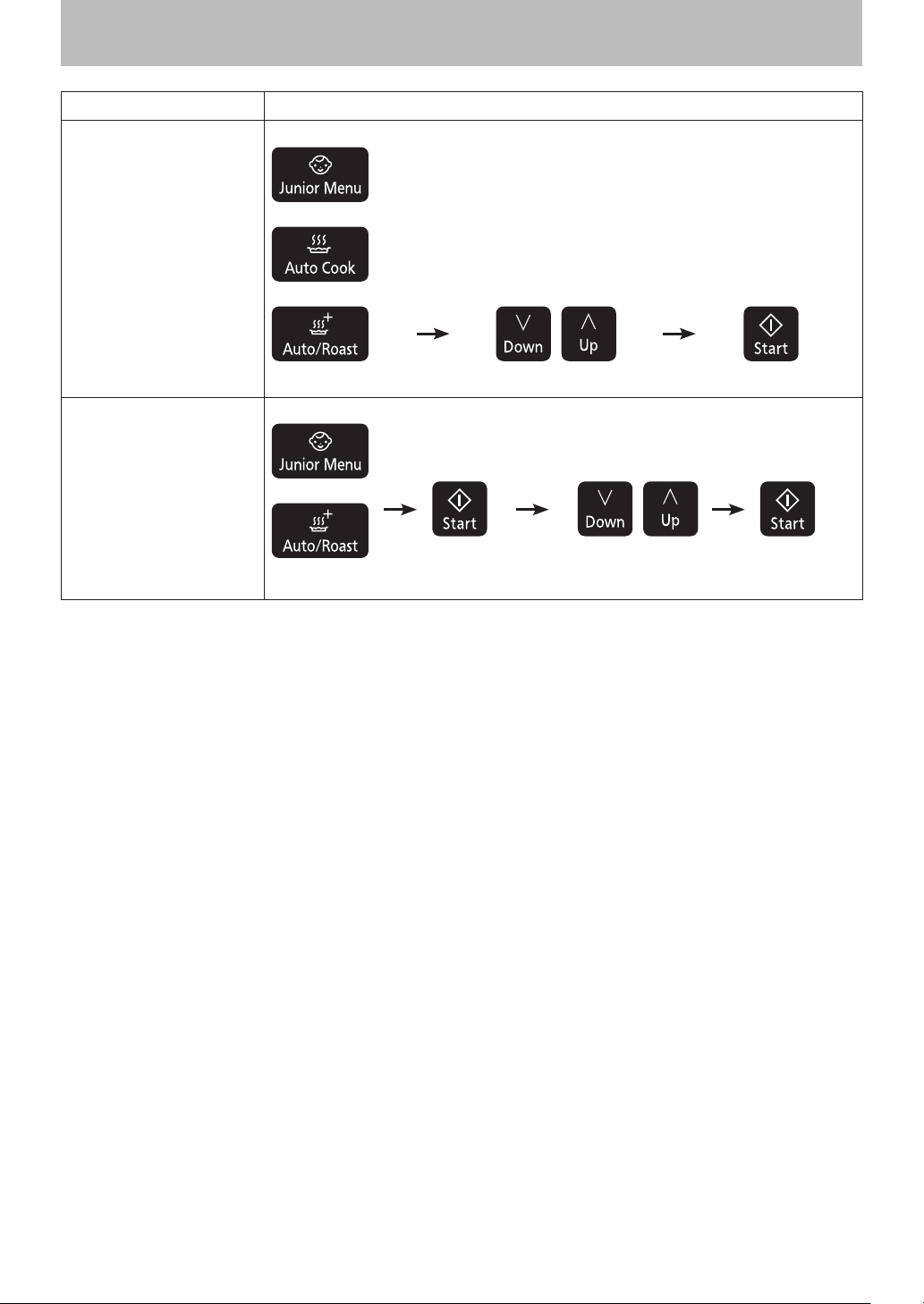
To Use as a Kitchen
Timer
(page 35)
Press once Press onceSet time
To Set Standing Time
(page 35)
Press oncePress once Set time
Set the desired
cooking programme
(up to 2 stage).
To Set Delay Start
(page 36)
Press oncePress once Set time
Set the desired
cooking programme
(up to 2 stage).
– 7 –
Quick Guide to Operation
(continued)
Feature How to Operate
To Use Auto program
(page 37-39)
Without preheating:
Select menu Select desired weight
Press once
or
or
With preheating:
Press once Select desired weight
Select menu
or
After
preheating,
the oven will
beep and the
“P” will flash.
Press once

– 8 –
Important Safety Instructions
Precautions to be taken when
using Microwave Ovens for
Heating Foodstuffs
INSPECTION FOR DAMAGE:
A microwave oven should only be used if an
inspection confirms all of the following conditions:
1. The grille is not damaged or broken.
2. The door fits squarely, securely and opens and
closes smoothly.
3. The door hinges are in good condition.
4. The metal plates of a metal seal on the door are
neither buckled nor deformed.
5. The door seals are neither covered with food nor
have large burn marks.
PRECAUTIONS:
Microwave radiation from microwave ovens can cause
harmful effects if the following precautions are not taken:
1. Never tamper with or deactivate the interlocking
devices on the door.
2. Never poke an object, particularly a metal object,
through a grille or between the door and the oven
while the oven is operating.
3. Never place saucepans, unopened cans or other
heavy metal objects in the oven.
4. Do not let other metallic articles, e.g. fast food foil
containers, touch the side of the oven.
5. Clean the oven cavity, the door and the seals with
water and a mild detergent at regular intervals.
Never use any form of abrasive cleaner that may
scratch or scour surfaces around the door.
6. Do not use harsh abrasive cleaners or sharp
metal scrapers to clean the oven door glass, since
they can scratch the surface, which may result in
shattering of the glass.
7. Always use the oven with the cookware
recommended by the manufacturer.
8. Never operate the oven without a load (i.e., an
absorbing material such as food or water) in the
oven cavity unless specifically allowed in the
manufacturer’s literature.
9. For horizontally hinged doors, never rest heavy
objects such as food containers on the door while
it is open.
10. Do not place sealed containers in the microwave
oven. Baby bottles fitted with a screw cap or a
teat are considered to be sealed containers.
11. This appliance is not intended for use by persons
(including children) with reduced physical, sensory
or mental capabilities, or lack of experience
and knowledge, unless they have been given
supervision or instruction concerning use of the
appliance by a person responsible for their safety.
12. Children should be supervised to ensure that they
do not play with the appliance.
13. It is hazardous for anyone other than a competent
person to carry out any service or repair operation
that involves the removal of a cover which gives
protection against exposure to microwave energy.
14. The surfaces are liable to get hot during use.
15. The appliance must not be installed behind a
decorative door in order to avoid overheating.
Practical Hints:
1. For initial use of GRILL, CONVECTION and
COMBINATION, if you see white smoke arise, it
is not a malfunction.
2. Exterior oven surfaces, including air vents on
the cabinet and the oven door will get hot during
GRILL, CONVECTION and COMBINATION. Use
care when opening or closing door and when
inserting or removing food and accessories.
Caution! Hot surfaces
3. The oven has a heating element situated in
the top of the oven. After using the GRILL,
CONVECTION and COMBINATION functions, the
ceiling will be very hot.
4. During use the appliance becomes hot. Care
should be taken to avoid touching heating
elements inside the oven.
5. The accessible parts may become hot when
GRILL, CONVECTION and COMBINATION is in
use. Children should be kept away.
6. Before using GRILL, CONVECTION and
COMBINATION functions for the first time,
operate the oven without food and accessories
on CONVECTION 220 °C for 5 minutes. This will
allow the oil that is used for rust protection to be
burned off. This is the only time that the oven is
operated completely empty.
Important Instructions
WARNING—To reduce the risk of burns, electric
shock, fire, injury to persons or excessive microwave
energy:
1. Read all instructions before using the microwave
oven.
2. Some products such as whole eggs and sealed
containers - (for example, closed glass jars and
sealed baby bottles with teat) - may explode
and should not be heated in the microwave oven.
3. Use this microwave oven only for its intended use
as described in this manual.
4. As with any appliance, close supervision is
necessary when used by children.
5. Do not operate this microwave oven, if it is not
working properly, or if it has been damaged or
dropped.
6. Do not store or use this appliance outdoors.
7. Do not immerse cord or plug in water.
8. Keep cord away from heated surfaces.
9. Do not let cord hang over edge of table or
counter.
READ CAREFULLY AND KEEP FOR FUTURE REFERENCE

– 9 –
WARNING
a) The door seals and door seal areas should be cleaned with a damp cloth. The appliance should be
inspected for damage to the door seals and door seal areas and if these areas are damaged the
appliance should not be operated until it has been repaired by a qualified service technician trained by
the manufacturer.
b) If the door or door seals are damaged, the oven must not be operated until it has been repaired by a
competent person.
c) It is dangerous for anyone other than a service technician trained by the manufacturer to perform repair
service.
d) It is hazardous for anyone other than a competent person to carry out any service or repair operation that
involves the removal of a cover which gives protection against exposure to microwave energy.
e) If the supply cord is damaged, it must be replaced by the manufacturer, its service agent or similarly
qualifi ed persons in order to avoid a hazard.
f) Before use, the user should check that whether the utensils are suitable for use in microwave ovens.
g) Liquids or other foods must not be heated in sealed containers since they are liable to explode, at the
same time it should avoid the boiling liquids splash.
h) Only allow children to use the oven without supervision when adequate instructions have been given so
that the child is able to use the oven in a safe way and understands the hazards of improper use.
i) When the appliance is operated in the GRILL, CONVECTION and COMBINATION modes, children
should only use the oven under adult supervision due to the temperatures generated.
j) Care should be taken not to displace the glass tray when removing containers from the appliance.
Important Safety Instructions
(continued)
10. To reduce the risk of fire in the oven cavity:
(a) Do not overcook food. Carefully attend
microwave oven if paper, plastic, or other
combustible materials are placed inside the
oven to facilitate cooking.
(b) Heating therapeutic wheat bags is not
recommended. If heating, do not leave
unattended and follow manufacturers’
instructions carefully.
(c) Remove wire twist-ties from bags before
placing bag in oven.
(d) If materials inside the oven should ignite, keep
oven door closed, turn oven off at the wall
switch, or shut off power at the fuse or circuit
breaker panel.
(e) Never leave microwave unattended while
cooking or reheating.
11. Do not remove outer panel from oven.
12. Appliances are not intended to be operated by
means of an external timer or separate remote-
control system.
13. Failure to maintain the oven in a clean condition
could lead to deterioration of the surface that
could adversely affect the life of the appliance and
possibly result in a hazardous situation.
Circuits
Your microwave ovens should be operated on
a separate circuit from other appliances. The
voltage used must be the same as specified on this
microwave oven. Failure to do this may cause the
power board fuse to blow, and/or food to cook slower.
Do not insert higher value fuse in the power board.
Earthing Instructions
This microwave oven must be earthed. In the event
of an electrical short circuit, earthing reduces the risk
of electric shock by providing an escape wire for the
electric current. This microwave oven is equipped with
a cord having an earthing wire with an earthing plug.
The plug must be plugged into an outlet that is
properly installed and earthed.
WARNING—Improper use of the earthing plug can
result in a risk of electric shock.
WE CERTIFY THAT THIS MICROWAVE OVEN
HAS BEEN INSPECTED AND COMPLIES WITH
THE REQUIREMENTS OF REGULATION 3,
SUBCLAUSE(2), OF THE MICROWAVE OVENS
REGULATIONS 1982.
(This statement applicable only to New Zealand.)
We certify that this microwave oven has been
inspected and complies with the safety requirements
of government notice 466 of March 1981, and
complies with the Radio Regulation of government
notice 587 of March 1986.
(This statement applicable only to South Africa)
Fan Motor Operation after Cooking
After using this oven the fan may rotate to cool the
electric components. This is perfectly normal, and
you can take out the food from the oven while the fan
operates.

– 10 –
Installation and General Instructions
General Use
1. In order to maintain high quality, do not operate
the oven when empty. The microwave energy will
reflect continuously throughout the oven if no food
or water is present to absorb energy.
This can lead to damage to the microwave oven
including arcing within the oven cavity.
2. If smoke is observed, press the Stop/Cancel
Pad and leave door closed in order to stifle any
flames. Disconnect the power cord, and/or shut
off power at the fuse or circuit breaker panel.
3. The microwave oven is intended for heating food and
beverages. Drying of food or clothing and heating of
warming pads, slippers, sponges, damp cloth and
similar may lead to risk of injury, ignition or fire.
4. Do not dry clothes, newspapers or other materials in
oven. They may catch on fire.
5. Do not use recycled paper products, unless the
paper product is labelled as safe for microwave
oven use. Recycled paper products may contain
impurities which may cause sparks and/or fires
when used.
6. Do not use newspapers or paper bags for cooking.
7. Do not hit or strike control panel. Damage to
controls may occur.
8. POT HOLDERS may be needed as heat from
food is transferred to the cooking container and
from the container to the Glass Tray. The Glass
Tray can be very hot after removing the cooking
container from the oven.
9. Do not store flammable materials next to, on top
of, or in the oven. It could be a fire hazard.
10. Do not cook food directly on Glass Tray unless
indicated in recipes. (Food should be placed in a
suitable cooking utensil.)
11. DO NOT use this oven to heat chemicals or other
non-food products. DO NOT clean this oven with
any product that is labelled as containing corrosive
chemicals. The heating of corrosive chemicals in
this oven may cause microwave radiation leaks.
12. If Glass Tray is hot, allow to cool before cleaning
or placing in water.
13. When using the COMBINATION mode, never
place any aluminum or metal container directly
on the Wire Rack or Enamel tray. Always insert
a heat-proof and microwave safe, glass plate or
dish between the Wire Rack and the aluminum
container. This will prevent sparking that may
damage the oven.
14. It is recommended not to use the Wire Rack when
cooking in the MICROWAVE mode only.
15. During cooking, some steam will condense inside
and/or on the oven door. This is normal and safe.
Steam will disappear after the oven is cool down.
16. Do not leave the microwave unattended while reheating
or cooking food in disposable containers made of
plastic, paper or other combustible materials, as these
types of containers can ignite if overheated.
17. Metallic containers for food and beverages are not
allowed during microwave cooking.
18. Only use utensils that are suitable for use in
microwave ovens.
Placement of the Oven
1. The oven must be placed on a flat, stable surface,
more than 85 cm above the floor. For correct
operation, the oven must have sufficient air flow.
Allow 15 cm of space on the top of the oven,
10 cm at back. If one side of the oven is 5 cm
at one side, the other side or top must not be
blocked. Do not remove feet.
(a) Do not block air vents. If they are blocked
during operation, the oven may be overheated
and damaged. When using any cloth over
the oven, the air intake and exhaust should
not be blocked. Do not place a cloth on top
of the unit during GRILL, CONVECTION and
COMBINATION cooking as the top of the oven
gets very hot. Also allow sufficient space on
back and both sides of the oven.
(b) Do not place oven near a hot or damp surface
such as a gas stove, electric range or sink etc.
(c) Do not operate oven when room humidity is too
high.
2. This oven was manufactured for household use
only.
3. The appliance is freestanding type and shall not
be placed in a cabinet.
Food
1. Do not use your oven for home canning or the
heating of any closed jar. Pressure will build
up and the jar may explode. In addition, the
microwave oven cannot maintain the food at the
correct canning temperature. Improperly canned
food may spoil and be dangerous to consume.
2. Do not attempt to deep fat fry in your microwave
oven.
3. Eggs in their shell and whole hard-boiled eggs
should not be heated in microwave ovens since
they may explode, even after microwave heating
has ended.
4. Potatoes, apples, egg yolks, chicken wings, whole
squash and sausages are examples of foods with
nonporous skins. This type of food must be pierced
before cooking, to prevent bursting.
5. When heating liquids, e.g. soup. sauces and
beverages in your microwave oven, overheating
the liquid beyond boiling point can occur without
evidence of bubbling. This could result in a
sudden boil over the hot liquid. To prevent this
possibility the following steps should be taken:
(a) Avoid using straight-sided containers with
narrow necks.
(b) Do not overheat.
(c) Stir the liquid before placing the container in the
oven and again halfway through cooking time.
(d) After heating, allow to stand in the oven for
a short time, stirring again before carefully
removing the container.
(e) Microwave heating of beverages can result in
delayed eruptive boiling, therefore care must
be taken when handling the container.

– 11 –
Installation and General Instructions
(continued)
6. DO NOT USE A CONVENTIONAL MEAT
THERMOMETER IN THE MICROWAVE OVEN.
To check the degree of cooking of roasts and
poultry use a MICROWAVE THERMOMETER.
Alternatively, a conventional meat thermometer
may be used after the food is removed from the
oven. If undercooked, return meat or poultry to
the oven and cook for a few more minutes at
the recommended power level. It is important
to ensure that meat and poultry are thoroughly
cooked.
7. COOKING TIMES given in the Cooking Guide
section are APPROXIMATE. Factors that may
affect cooking time are preferred degree of
moisture content, starting temperature, altitude,
volume, size, shape of food and utensils used.
As you become familiar with the oven, you will be
able to adjust for these factors.
8. It is better to UNDERCOOK RATHER THAN
OVERCOOK foods. If food is undercooked, it
can always be returned to the oven for further
cooking. If food is overcooked, nothing can be
done. Always start with minimum cooking times
recommended.
9. Extreme care should be taken when cooking
popcorn in a microwave oven. Cook for minimum
time as recommended by manufacturer. Use
the directions suitable for the wattage of your
microwave oven. NEVER leave oven unattended
when popping popcorn.
10. When heating food in plastic or paper containers,
keep an eye on the oven due to the possibility of
ignition.
11. The contents of feeding bottles and baby food jars
are to be stirred or shaken and the temperature
is to be checked before consumption, in order to
avoid burns.
Microwaves and How They Work
Microwaves are a form of high frequency radio waves
similar to those used by a radio, including AM, FM
and CB. They are similar to a television where the
radio waves are converted to a picture on the screen.
However, microwaves are much shorter than radio
waves; approximately twelve centimetres wave length.
Electricity is converted into microwave energy by the
magnetron tube (which is the heart of the microwave
oven).
From the magnetron tube, microwave energy is
transmitted to the oven cavity. The microwaves are
converted to heat in the food. The microwaves enter
from the outside of the food and travel through the
food losing half of their power every two to three
centimetres. Continued cooking to the centre occurs
by conduction.
Although pacemakers used to be affected by
microwaves (as well as by other radio waves), they
are now shielded and are not bothered by these
interferences. This allows people with pacemakers
to sit calmly by their radio or television and cook with
microwave ovens.
When microwaves come in contact with a substance,
any one or CRISPY GRILL of three things may occur.
They can be:
1. REFLECTED
2. TRANSMITTED
3. ABSORBED
Reflection:
Metal substances REFLECT microwave energy and
because there is no absorption, there is no heating.
This is why the oven interior is either stainless steel or
epoxy-coated steel. This ensures that the microwaves
are kept inside the cavity and evenly distributed
throughout the food with the help of the Glass Tray.
Transmission:
Such substances as paper, glass and plastic
TRANSMIT microwave energy and do not become
hot except from food. Because these substances do
not reflect or absorb microwave energy, they are ideal
materials for microwave cooking containers.
Absorption:
Food contains moisture and will ABSORB microwave
energy, which causes the moisture molecules within
the food to vibrate at an incredible rate (2,450,000,000
times per second). Friction, created by the vibration,
produces heat energy which is conducted throughout
the food.

– 12 –
Cookware and Utensils Guide
It is important to use the correct container when
cooking in a microwave oven. The following will help
you make the right selection.
How to Test a Container for Safe
Microwave Oven Use
TO TEST A CONTAINER FOR SAFE MICROWAVE
OVEN USE: Fill a 1-cup glass measure with cool water
and place it in the microwave oven alongside the empty
container to be tested; heat one (1) minute at 1000 W.
If the container is microwave ovensafe (transparent
to microwave energy), the container should remain
comfortably cool, the water in glass measure should
be hot. If the container is hot, it has absorbed some
microwave energy and should NOT be used. This test
cannot be used for plastic containers.
Paper Products and Freezer Wrap
Waxed paper, paper plates, cups and napkins should
not be used for heating or cooking food. Freezer wrap
should not be used as it is not heat resistant and
may melt. Paper towel, greaseproof paper and bake
paper may be safely used for short periods of time for
covering or lining.
Glass, Ceramic and China
Heat-Resistant glass cookware is invaluable in
microwave cooking. Many of these items are readily
available in most homes: glass jugs, mixing bowls, loaf
dishes, covered casseroles, oblong baking dishes, pie
plates and round or square cake dishes. Examples of
this type of cookware are Pyrex
®
and Corningware
®
.
Dinnerware can be used for microwave heating.
Many brands of dinnerware are microwave safe.
Check the care information for reference to microwave
use for dinnerware and serving pieces. If dinnerware
is marked ovenproof, it frequently is safe to use in
the microwave oven. However, to be sure, check by
conducting microwave dish test previously mentioned.
Several types of glassware and dinnerware are not
recommended for use in the microwave oven. Do not
use dishes with metallic trim or containers with metal
parts. Do not use cups or mugs with glued on handles,
as they may fall off with continued heating. Do not use
delicate glassware. Although the glassware may be
transparent to microwave energy the heat from the
food may cause the glassware to crack.
Plastic
Plastic dishes, cups and some freezer containers
should be used with care in a microwave oven.
Choose plastic containers carefully, as some plastic
containers may become soft, melt and may scorch.
The majority of plastic dishes, even those designed
for use in the microwave oven, are not suitable for
cooking foods with high fat or sugar content, or for
lengthy cooking times. Most microwave plastic dishes
should not be used for longer than 3 to 5 minutes
on 1000 W. These dishes, although not suitable for
extended cooking, may be used successfully for
defrosting or for use on lower power levels.
Cooking Bags designed to withstand boiling,
freezing, or conventional heating are microwave safe.
Prepare bags according to manufacturer’s directions.
When cooking by microwave, DO NOT use wire twist-
ties to close bag. They can act as an antenna and
cause arcing (sparks).
DO NOT COOK IN PLASTIC FOOD STORAGE BAGS.
Plastic Wrap such as GLAD WRAP
®
can be used
to cover dishes in most recipes. Over an extended
heating time, some disfiguration of the wrap may
occur. When removing plastic wrap “covers”, as well
as any glass lid, be careful to remove it away from you
to avoid steam burns.
Loosen plastic but let dish stand, covered.
Jars and Bottles
Jars and bottles can be used to warm food to serving
temperature, if the lid is removed first. Cooking should
not be done in these containers since most are not
heat resistant and during extended heating times,
heat from food would cause cracking or breaking.
Metal
Metal cookware or utensils, or those with metallic
trim, should NOT be used in the microwave. Since
microwave energy is reflected by metal, foods in
metal containers will not cook evenly. There is also a
possibility of “arcing”.
Although metal utensils should be avoided in microwave
cooking, some metal can be helpful when used correctly.
Aluminum foil can be used safely, if certain guidelines
are followed, to prevent overcooking. Small pieces of
foil are used to shield areas such as chicken wings,
tips of roasts, or other thin parts that cook before
the rest of the recipe is finished. Make sure foil is
attached securely and doesn’t touch sides of oven,
otherwise arcing may occur. Foil lined containers,
either cardboard or plastic, should NOT be used in the
microwave oven as arcing could occur.
Metal twist-ties, either paper or plastic coated, should
NOT be used in the microwave oven. Frozen dinner
trays can be used in the microwave, if the container
is no deeper than 2 cm and is filled with food. Metal
skewers can not be used in microwave ovens as
arcing may occur. Wooden skewers are readily
available and give the same result.
Shells: Scalloped baking shells are best used during
reheating and for short periods of cooking time only.
Thermometers are available for use in microwave
ovens. DO NOT USE CONVENTIONAL MERCURY
TYPE CANDY OR MEAT THERMOMETERS in food
while cooking in the microwave oven.
Straw, Wicker and Wood
Straw and wicker baskets may be used in the
microwave oven for short periods of time to warm
rolls or bread. Large wooden utensils, such as bowls
or cutting boards should NOT be used for prolonged
heating as the microwave energy may cause the
wood to become dry and brittle.
– 13 –
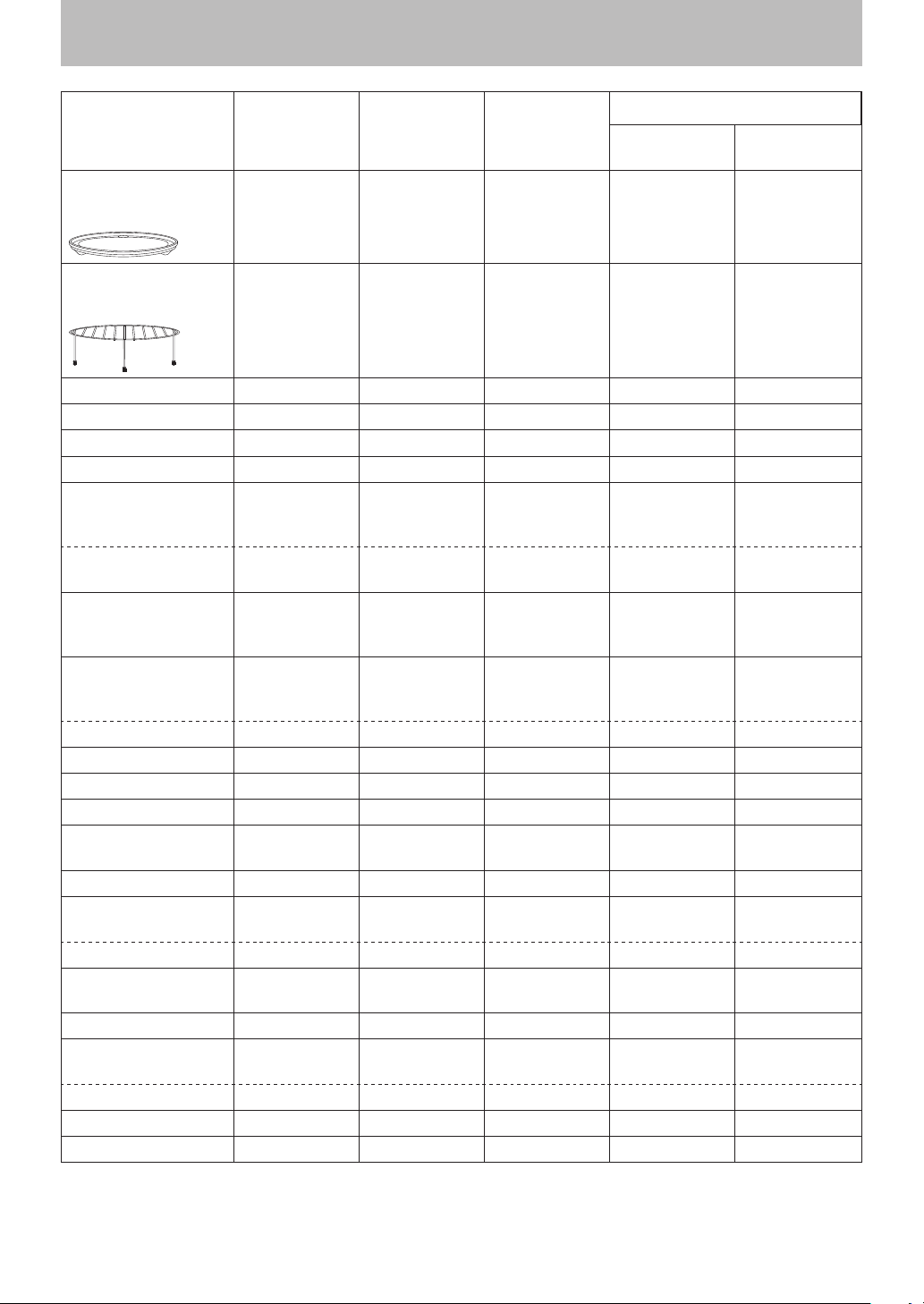
Cookware and Utensil Chart
Microwave Grill Convection
Combination
Grill +
Microwave
Convection +
Microwave
Enamel tray
(oven accessories)
no yes yes yes yes
Wire rack
(oven accessories)
no yes yes yes yes
Aluminium foil for shielding yes yes for shielding for shielding
Ceramic Plate yes yes yes yes yes
Browning Dish yes no no no no
Brown paper bags no no no no no
Dinnerware
oven/microwave safe
yes yes yes yes yes
non-oven/microwave
safe
no no no no no
Disposable
paperboard
containers
yes*
1
yes*
1
yes*
1
yes*
1
yes*
1
Glassware
oven glassware &
ceramic
yes yes yes yes yes
non-heat resistant no no no no no
Metal cookware no yes yes no no
Metal twist-ties no yes yes no no
Oven cooking bag yes yes*
1
yes*
1
yes*
1
yes*
1
Paper towels and
napkins
yes no no no no
Plastic defrosting rack yes no no no no
Plastic dishes
microwave safe yes no no no no
non microwave safe no no no no no
Microwave safe
plastic wrap
yes no no no no
Straw, wicker, wood yes no no no no
Thermometers
microwave safe yes
no no no no
conventional no yes yes no no
Waxed paper yes yes yes yes yes
Silicon bakeware yes*
1
yes*
1
yes*
1
yes*
1
yes*
1
*1 Check manufacturers’ recommendation, must withstand heat or follow the recipe instructions.
*2 Follow the Cooking Guide section.
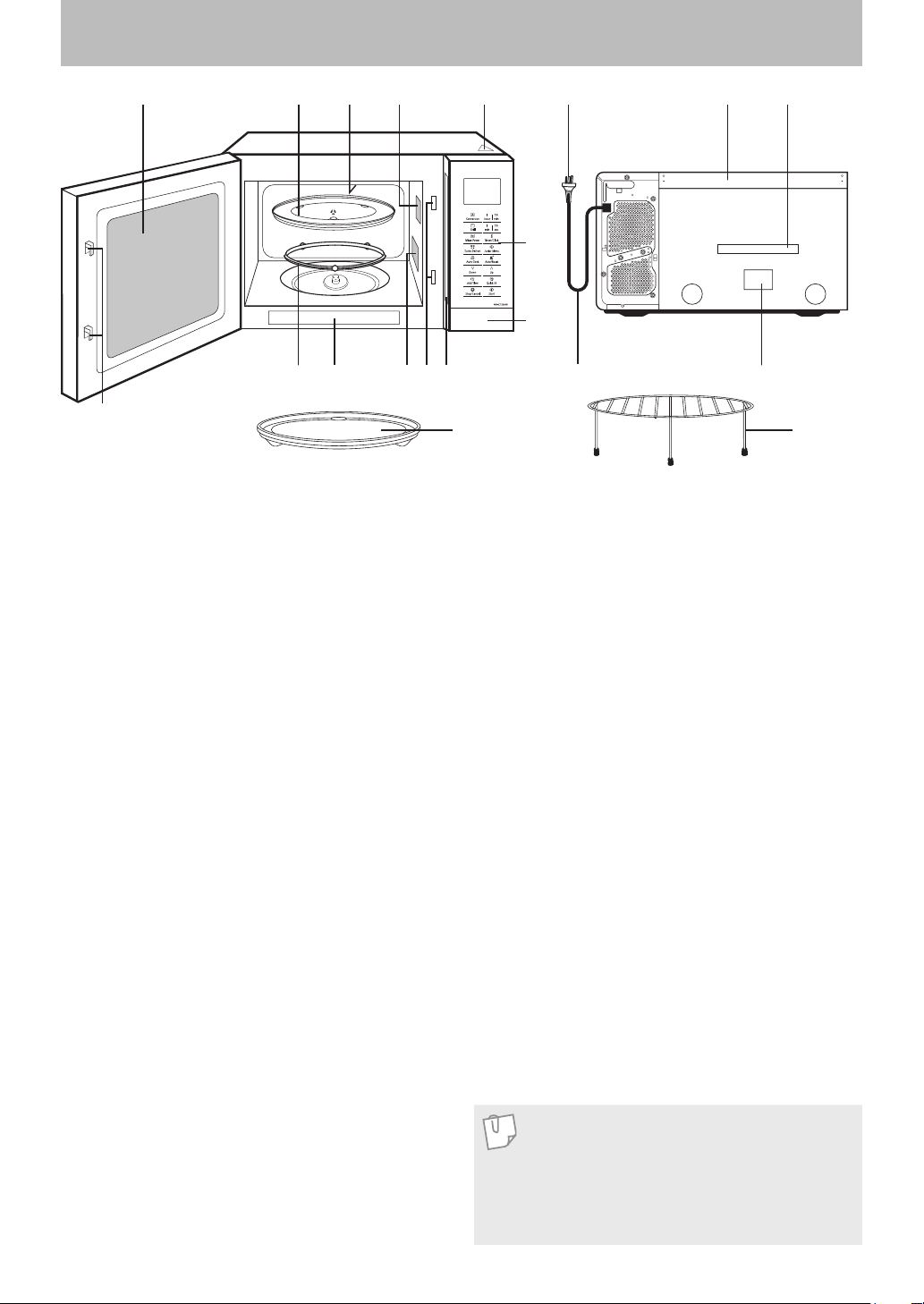
– 14 –
Feature Diagram
q t k g a i u
r
e
d
j h
y
w
f a s ao w
q Oven Window
w Door Safety Lock System
e Door Release Pad
Push to open the door. Opening the door during
cooking will stop the cooking process without
cancelling the program. Cook resumes as soon
as the door is closed and Start Pad is pressed.
It is quite safe to open the door at any time
during a cooking program and there is no risk of
Microwave exposure.
r Control Panel
t Glass Tray
a. DO NOT operate the oven without the Roller
Ring and Glass Tray in place.
b. Only use the Glass Tray specifically designed
for this oven. Do not substitute any other Glass
Tray.
c. If the Glass Tray is hot, allow to cool before
cleaning or placing in water.
d. Do not cook foods directly on the glass tray,
except when cooking jacket potatoes in
microwave mode. Always place food on a
microwave-safe dish, or on a rack set in a
microwave-safe dish.
e. If food or utensil on the Glass Tray touches
oven walls, causing the tray to stop moving,
the tray will automatically rotate in the opposite
direction. This is normal.
f. Glass Tray can rotate in either direction.
y Roller Ring
a. Roller Ring should be cleaned regularly to
avoid excessive noise.
b. Roller Ring and Glass Tray should be used at
the same time.
u Identification Plate
i Oven Air Vent
o Waveguide Cover (do not remove)
a Warning Symbol
s Power Supply Cord
d Power Supply Plug
f Menu Label
g Oven Light
Oven light will turn on during cooking and also
when door is opened.
h Wire Rack
a. The wire rack is used to facilitate browning of
small dishes and help with the good circulation
of the heat.
b. Wire Rack should be cleaned regularly.
c. When using Wire Rack in the manual GRILL,
COMBINATION and CONVECTION cooking
modes, be careful to choose heat-proof
containers; Containers made of plastic or
paper may melt or burn when exposed to the
heat radiating from the grill.
d. When using the COMBINATION mode, never
place any aluminum or metal container directly
on Wire Rack. Always insert a glass plate or
dish between Wire Rack and the aluminum
container. This will prevent sparking that may
damage the oven.
e. Do not use Wire Rack when cooking in the
MICROWAVE mode only.
j Enamel Tray
a. The enamel tray is for cooking on grill,
convection and combination modes.
b. Do not use enamel tray in microwave mode
only.
c. The enamel tray must always be in place on
the glass tray (unless stated).
k Heating Elements
Notes
1. The illustration is for reference only.
2. The glass tray, wire rack and enamel tray
are the only accessories with this oven. All
other cooking utensils mentioned in this
manual must be purchased separately.
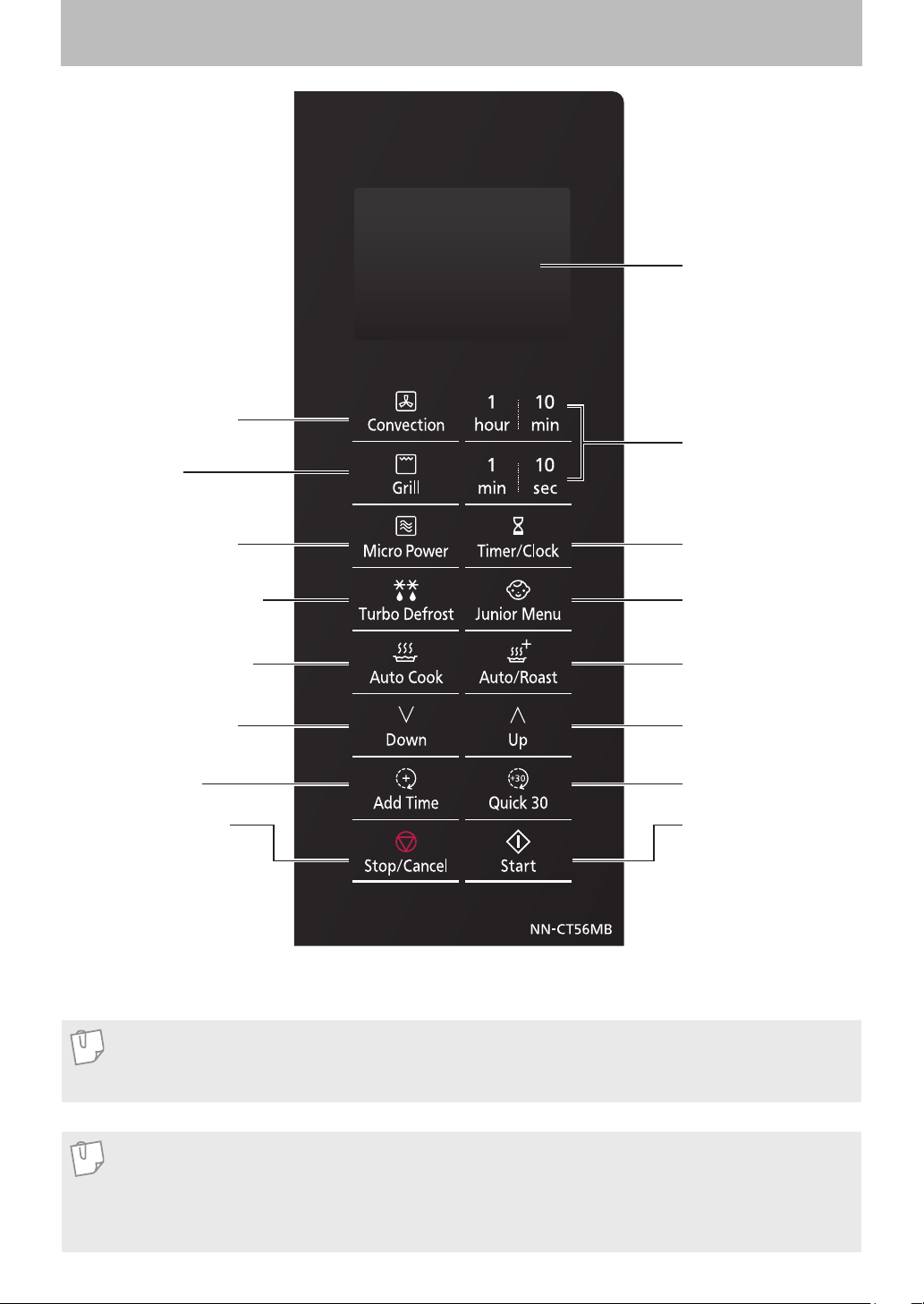
– 15 –
Control Panel
Notes
If an operation is set and Start pad is not pressed, after 6 minutes, the oven will automatically cancel the
operation. This display will revert back to clock or colon mode.
Beep Sound
When a pad is pressed correctly, a beep sound will be heard. If a pad is pressed and no beep is heard,
the unit does not or can not accept the instruction. The oven will beep twice between programmed
stages. The oven will beep three times after preheating. At the end of any completed program, the oven
will beep 5 times.
Grill Pad
(pg. 25-26)
Up and Down pads
Up and Down pads
Convection Pad
(pg. 27-28)
Add Time Pad
(pg. 24)
Stop/Cancel Pad:
Before cooking:One press
clears your instructions
During cooking: one press
temporarily stops the cooking
program. Another press
cancels all your instructions
and the time of day will appear
in the display.
Junior Menu Programs
(pg. 40-41)
Micro Power Pad
(pg. 20)
Turbo Defrost Program
(pg. 22-23)
Display Window
(pg. 16)
Quick 30 Pad
(pg. 24)
Start Pad
Press to start operating
the oven. If during
cooking the door is
opened or Stop/Cancel
is pressed once, Start
has to be pressed
again to continue
cooking.
Auto Cook Programs
(pg. 42-43)
Timer/Clock Pad
(pg. 35-36)
Time Pads
Auto/Roast Programs
(pg. 44-45)
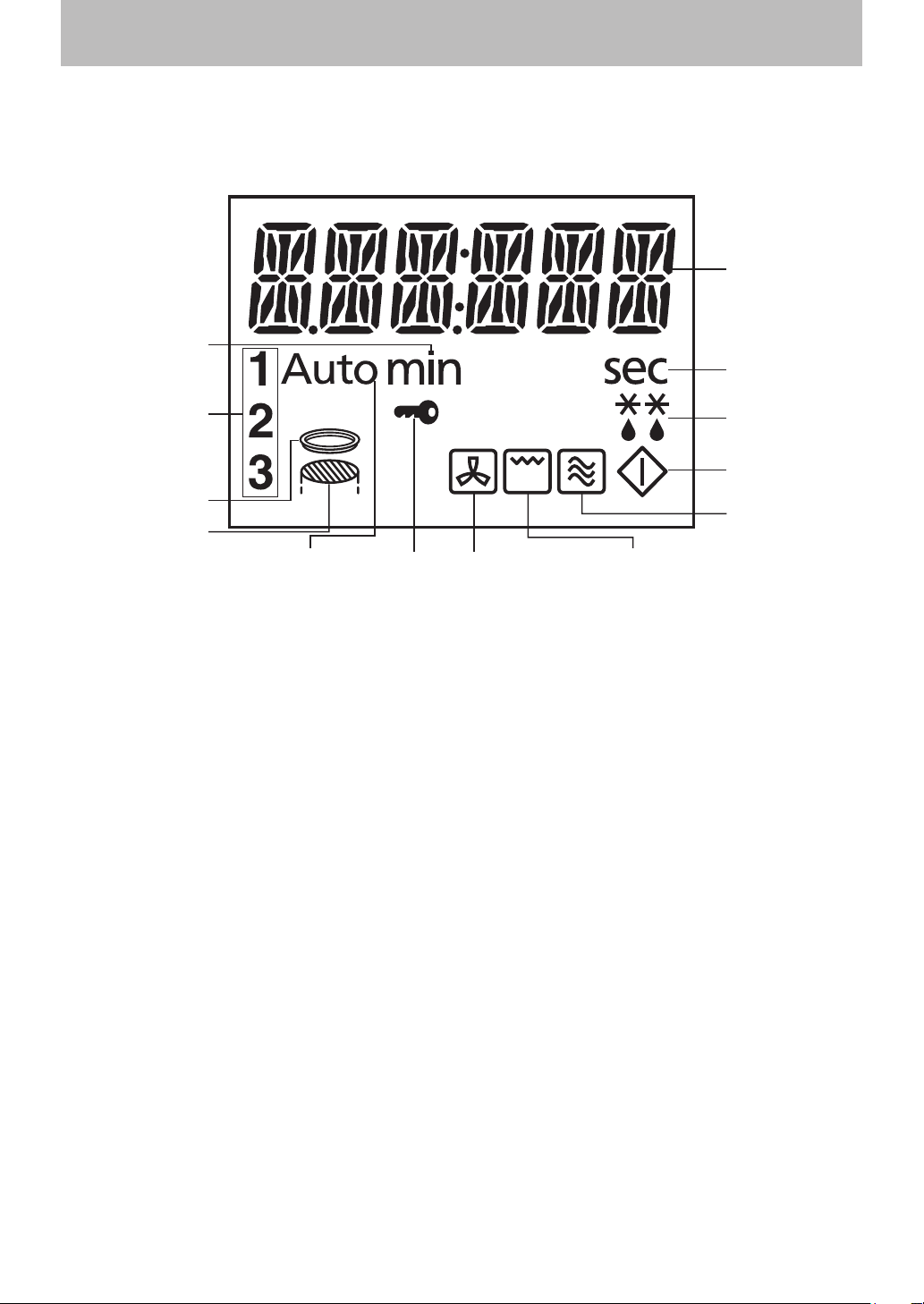
– 16 –
Display Window
To help you operate the oven conveniently, the present state will appear in the display window.
Micro Power
Feature
Grill
Feature
Auto Program
Display
Wire Rack Display
Enamel tray
Display
3-Stage Display
Time Display
(Minute)
Convection
Feature
Child Lock
Display
Start Display
Time Display
(Second)
Turbo Defrost
Number (Time/
Temp./Weight/
Power Level/
Menu)
– 17 –
Let’s Start To Use Your Oven!
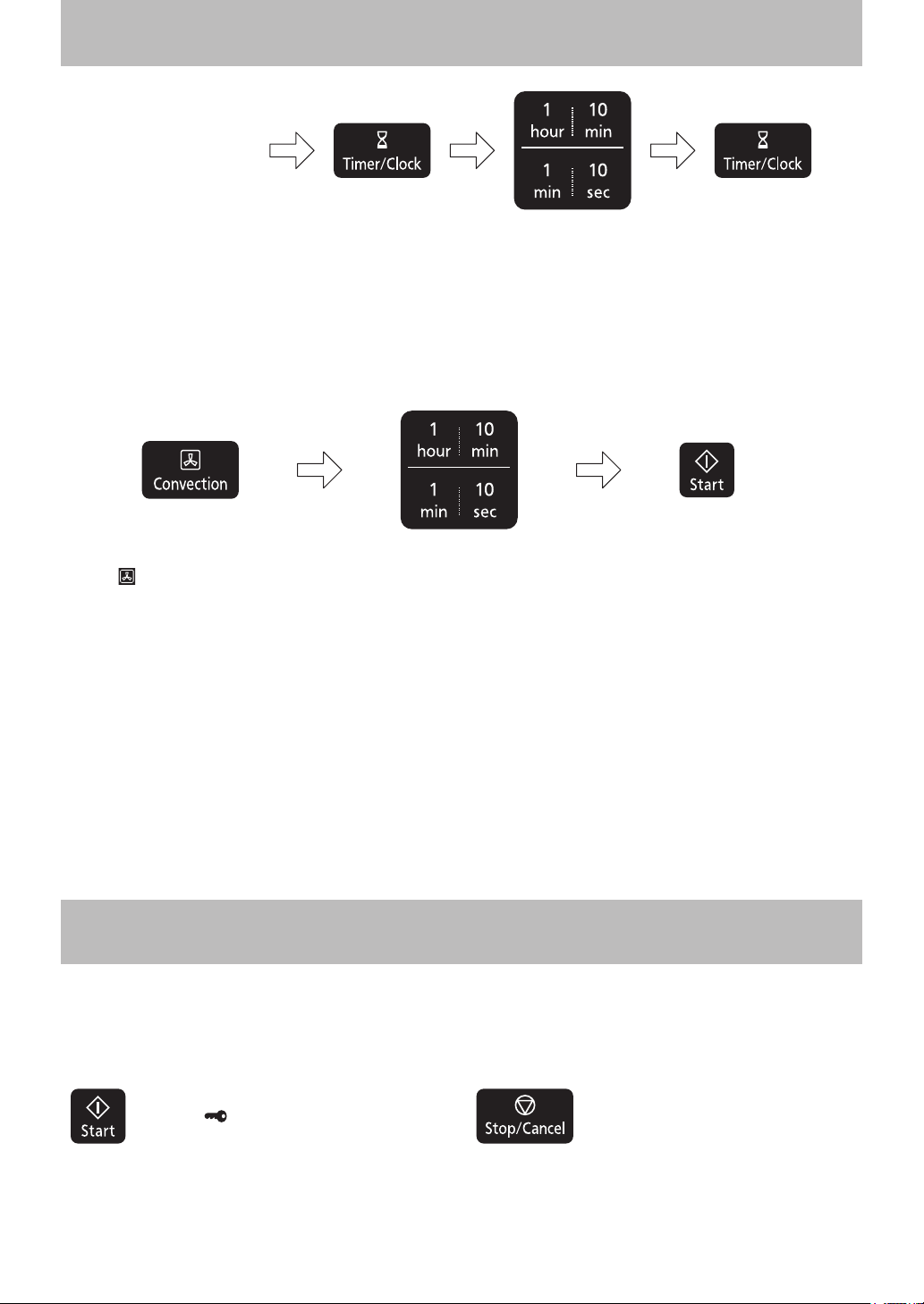
To Use Child Safety Lock
This feature allows you to prevent operation of the oven by a young child; however, the door will open. This
feature can be set when colon or time of day is displayed.
To set: To cancel:
Press Start pad 3 times.
► “
” appears in the
display window.
Press Stop/Cancel pad 3 times.
► Colonortimeofdayappearsin
the display window.
Press 3 times. Press 3 times.
To set or cancel child lock, Start pad or Stop/Cancel pad must be pressed 3 times within a 10 second period.
Plug in
Plug into a properly
earthed electrical
outlet. “WELCOME
TO PANASONIC
MICROWAVE OVEN
COOKING” will appear in
the display window, then
you can start to operate.
Set clock as a 12 hour
clock. Press time pads to
select the time.
Press Timer/Clock.
(See page 18 for
details)
Press Convection
“
” will appear in the display
window with the oven
temperature. This procedure is
to burn off the oil used for rust
protection in the oven. Press
Convection pad until 220 °C
appears in the display window.
Remove all accessories from
the oven.
Press Time pads
Press 1 min pad
until 5 minutes is
displayed in the
window.
Press Start pad
The time will be displayed
in the window and count
down. The oven will beep
at the end of the program.
The oven is now ready to
use.
Caution: heating elements
and oven will be hot.
Press Timer/Clock
twice to set clock.
– 18 –
To Set Clock
Operation Guide Setting
To assist you in programming your oven, the following operation will appear in the display window. When you
become familiar with your oven, the operation guide can be turned off.
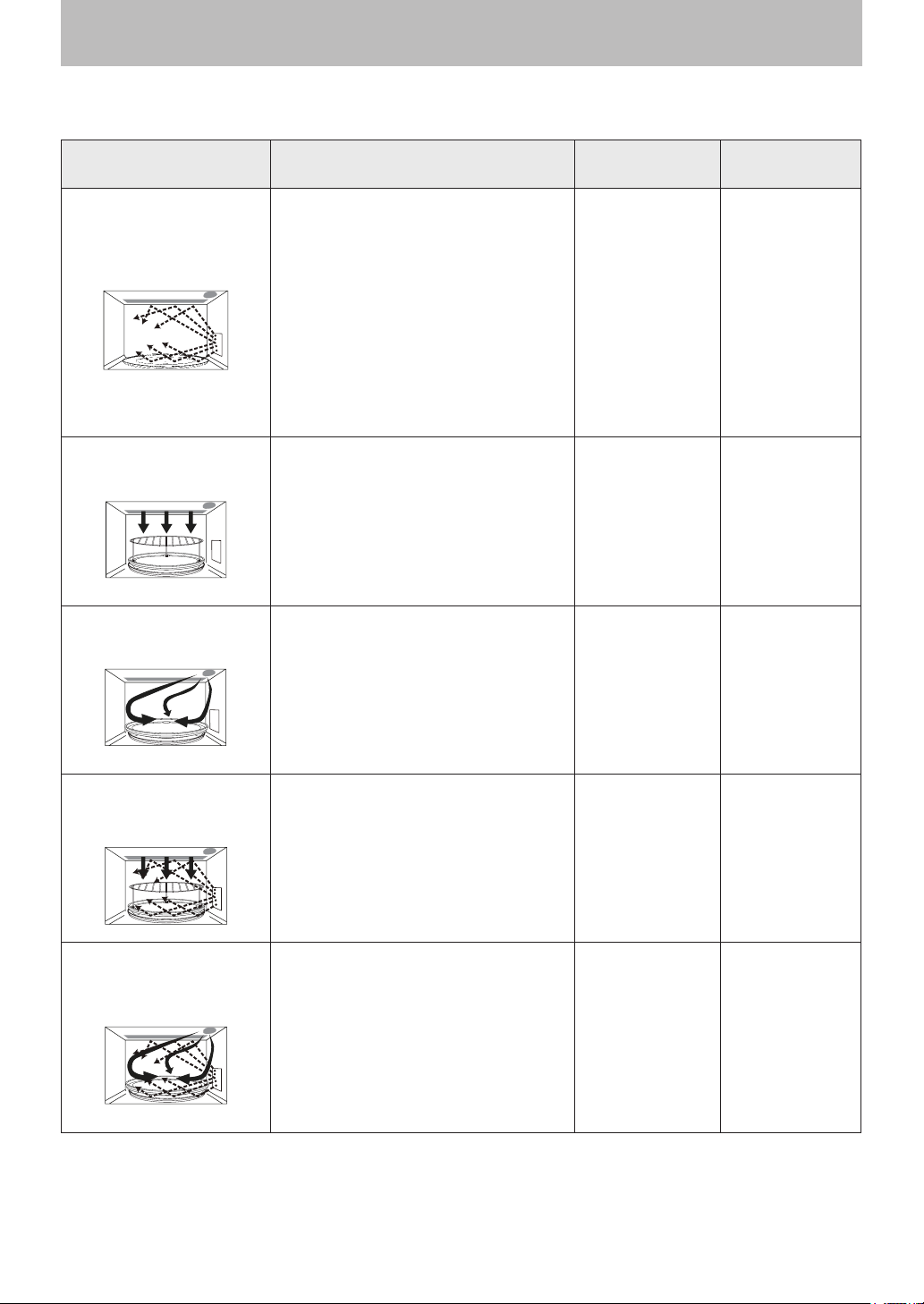
Press Timer/Clock four
times.
Press Timer/Clock four
times.
Colon or time of
day appears in the
display window.
Colon or time of
day appears in the
display window.
Display window.
Display window.
To turn off:
Press Timer/Clock twice
“SET TIME” will appear
in the display window, and
the colon starts to blink.
Press time pads
Enter time of day by
pressing time pads.
10 sec pad is inoperable.
Press eleven times
Press twice
Pressvetimes
Inoperable
Press Timer/Clock
The colon stops blinking. Time
of day is now locked into the
display.
Example of how to set 11:25.
Notes
1. If you want to reset time, please repeat step 1-3.
2. The clock will keep the time of day as long as oven is plugged in and electricity is supplied.
3. Clock is a 12-hour display.
4. Oven will not operate while colon is still blinking.
– 19 –
Cooking Modes
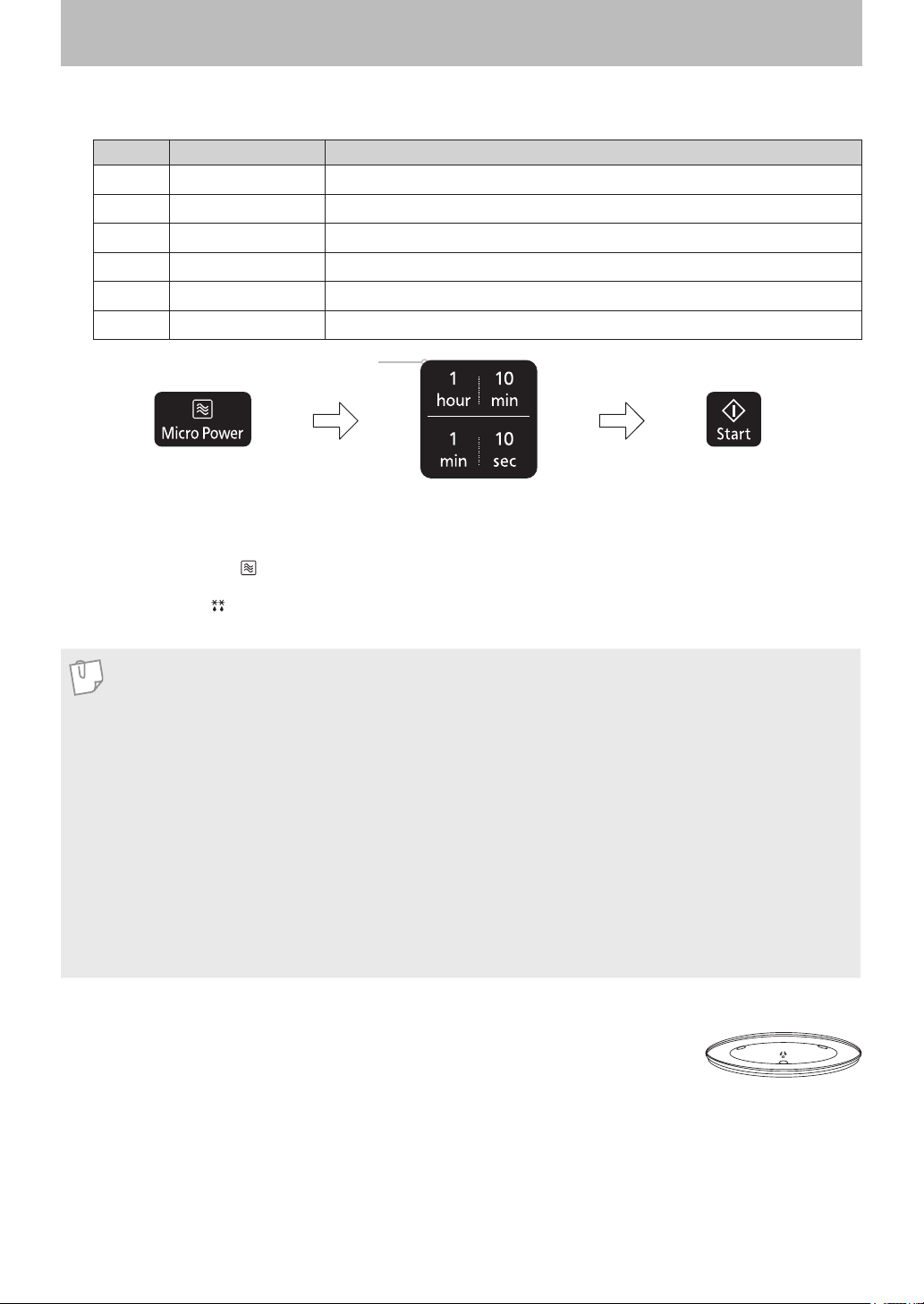
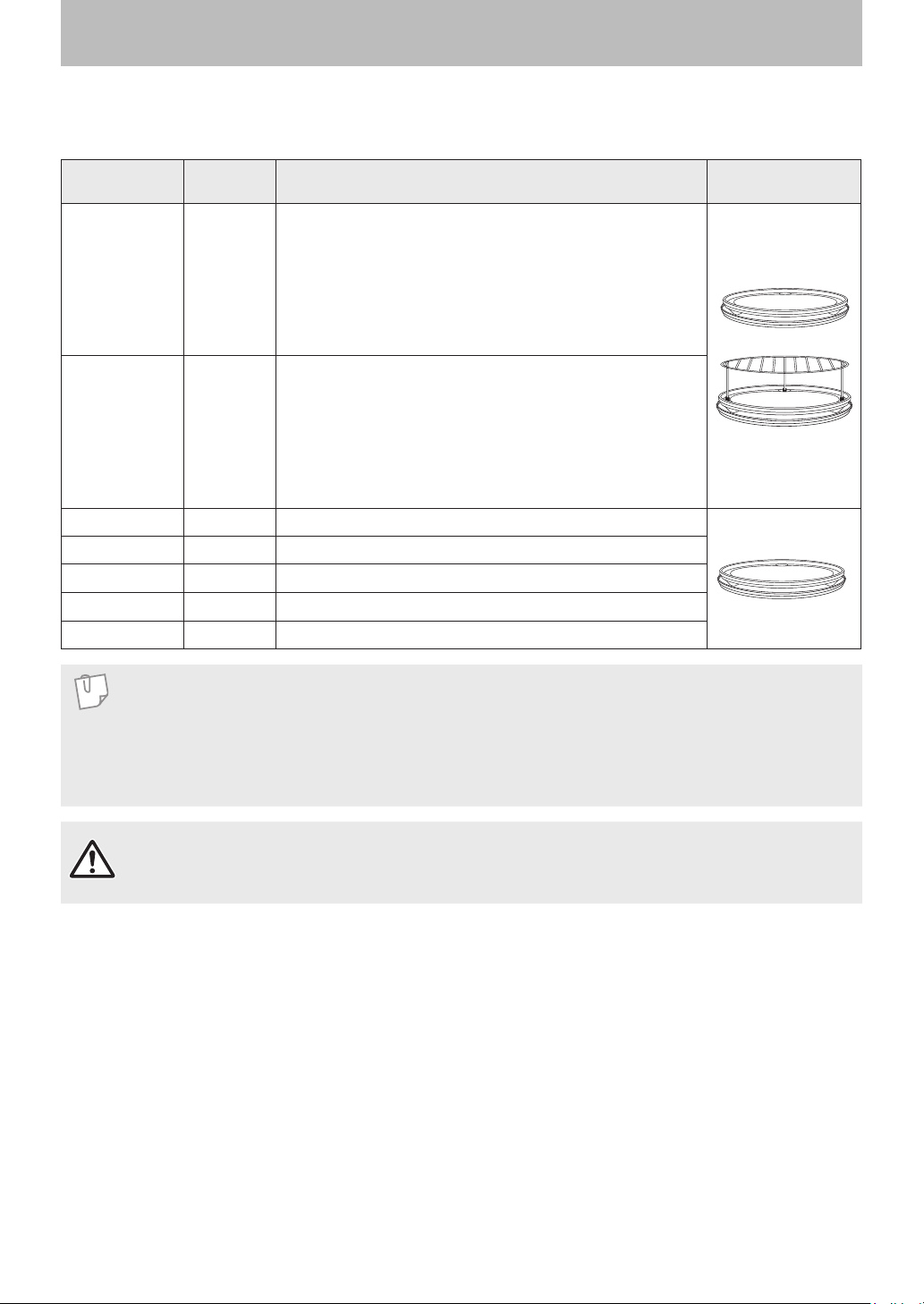
The diagrams shown below are examples of the accessories. It may vary depending on recipe/dish used.
Further information can be found in the Cookbook.
Cooking Modes Uses
Accessories to
use
Containers
Microwave
• Defrosting
• Reheating
• Melting: butter, chocolate, cheese.
• Cooking fish, vegetables, fruits,
eggs.
• Preparing: stewed fruits, jam,
sauces, custards, choux, pastry,
caramel, meat, fish.
• Baking cakes without colour.
No Preheating
_
Use your own
Pyrex
®
dishes,
plates or bowls,
directly on the
glass tray.
No metal.
Grill
• Grilling of meat or fish.
• Toast grilling.
• Colouring of gratin dishes or
meringue pies.
No preheating
Wire rack on
enamel tray
Use your own
Pyrex
®
dishes,
heatproof plates
or bowls, directly
on the wire rack
on enamel tray
on glass tray.
Convection
• Baking of small items with short
cooking times: puff pastry, cookies,
roll cakes.
• Special baking: bread rolls or
brioches, sponge cakes.
• Baking of pizzas and tarts.
Preheating advised
Enamel tray
Heatproof, metal
tin can be used
on enamel tray.
Do not place
dishes directly
on glass tray.
Grill +
Microwave
• Cooking lasagne, meat, potatoes or
vegetable gratins.
No Preheating
Wire rack on
enamel tray
Microwaveable
and heatproof
dishes placed
directly on wire
rack on enamel
tray on glass tray.
No metal.
Convection +
Microwave
• Baking cakes
• Puff pastry tarts
Preheating if necessary
Enamel tray
Microwaveable
and heatproof
dishes can be
used on the
enamel tray.
Do not place
dishes directly
on glass tray.
No metal.
– 20 –
To Cook/Reheat/Defrost on
Micro Power by Time Setting
This feature allows you to set the desired power and time for cooking by yourself.
Therearesixdierentmicrowavepowerlevelsavailable.
Press Power Level Example of Use
Once 1000 W (High) Boil water. Cook fresh fruits, vegetables, preserved fruit and candies.
Twice 270 W (defrost) Defrost meat, poultry or seafood.
3 times 600 W (Medium) Cook fish and seafood, meat, poultry, eggs and cakes.
4 times 440 W (Low) Cook cakes, stew food, and melt butter and chocolate.
5 times 300 W (Simmer) Cook tough meat, stew soup and soften butter.
6 times 100 W (Warm) Keep food warm and soften ice cream.
Press Micro Power
Press this pad until the
power you require appears
in the display window. The
microwave symbol
will
also appear. When you
select Defrost,
will also
appear.
Set time
Select cooking time.
Your oven can be programmed for
up to 99 minutes 50 seconds on
600 W, 440 W, 300 W, 270 W and
100 W. 1000 W can be programmed
for 30 minutes. The 1 hour pad is
inoperable.
Press Start
The cooking
program will start
and the time in the
display will count
down.
Inoperable
Notes
1. Maximum time that can be set on 1000 W is 30 minutes.
2. On all power levels, except 1000 W, the maximum time that can be set is 99 minutes, 50 seconds.
The 1 hour pad is inoperable.
3. You can increase the cooking time during cooking if required. Time can be increased in 1 minute
increments, up to 10 minutes. Press ‘Add time’ pad once, then press ‘1 min’ pad to a maximum of
10 minutes. After selecting ‘Add Time’ function, time should be added within a 5 second period.
Cooking time can not be decreased during cooking.
4. Three stages can be set continuously. This feature allows you to set only once for some different
stages without taking care during cooking. Please refer to page 34.
5. Do not attempt to use microwave only with any metal container in the oven.
6. Do not place food directly on the glass tray. Place in a microwaveable or glass dish. Foods reheated or
cooked by microwave only should be covered with a lid or pierced cling film, unless otherwise stated.
7. Stand time can be programmed after microwave power and time setting. Refer to using the timer
page 35.
8. For manual defrosting times, please refer to defrosting chart on page 21.
Oven Accessories to Use
When using your oven on microwave only, the glass tray provided must always be in
position.
– 21 –
Defrosting Using Defrost Microwave and Time
Select 270 W. The times given below are a guideline only. Always check the progress of the food by opening the
oven door and then re-starting.
For larger quantities adjust times accordingly. Food should not be covered during defrosting.
Food Defrosting Time Method Standing Time
Meat
Beef/Lamb/Pork
joint 450 g
8-9 mins
Place in a suitable dish or on an upturned
saucer or use a microwave safe rack. Turn
3-4 times. Shield.
60 mins
Minced beef 450 g 7-8 mins
Place in a suitable dish. Break up and turn
3-4 times.
15 mins
Chops 450 g 6-7 mins
Place in a suitable dish in a single layer.
Turn twice. Shield if necessary
15 mins
Sausages 450 g 6 mins
Place in a suitable dish in a single layer.
Turn twice. Shield if necessary
15 mins
Bacon rashers
450 g
3-4 mins
Place in a suitable dish. Turn and separate
twice. Shield if necessary.
10 mins
Stewing steak
450 g
6 mins Place in a suitable dish. Break up frequently. 15 mins
Whole chicken
450 g
6-8 mins
Place in a suitable dish on an upturned
saucer or use a microwave safe rack. Turn
3-4 times. Shield.
60 mins
Chicken portions
450 g
6-8 mins
Place in a suitable dish in a single layer.
Turn twice. Shield if necessary.
30 mins
Fish
Whole 450 g 7-9 mins Place in a suitable dish. Turn twice. Shield. 15 mins
Fillets/Steak 450 g 6-7 mins
Place in a suitable dish. Turn twice, separate
and shield if necessary.
15 mins
Prawns 450 g 4-6 mins
Place in a suitable dish. Stir twice during
defrosting.
15 mins
General
Bread sliced 400 g 3 mins
Place on a plate. Separate and rearrange
during defrosting.
10 mins
Slice of bread 30 g 20 secs - 30 secs Place on a plate. 1-2 mins
Pastry 500 g 3 mins 30 secs Place on a plate. Turn halfway. 15-30 mins
Soft fruit 450 g 5-6 mins
Place in a suitable dish. Stir twice during
defrosting.
15 mins
Notes
Opening the door and taking out the defrosted parts during the operating time is recommended. Turn
over, stir or rearrange the parts which are still in icy.
– 22 –
To Defrost Using Turbo Defrost
With this feature you can defrost frozen foods according to the weight. Select the category and set the weight
of the food. The weight can be programmed in grams. The weight starts from the minimum weight for each
category.
Press StartSelect the desired
program by pressing
pad once, twice or
three times. The
microwave
and
defrost symbol
will also appear.
Enter the weight by pressing the up
and down pads. The “up” pad will
start with the minimum weight for
each food. Default weight is grams.
Press Menu No. Program Weight Range Example of Use
Once 1 Bread 100 g - 900 g
Bread and rolls. Turn at beep. Standing time
10-15 minutes.
Twice 2
Mince /
chops
200 g - 1200 g
Small pieces of meat, minced meat, chicken portions,
steaks, chops. Turn at beeps and shield. Standing time
15-30 minutes.
3 times 3
Meat
joints
400 g - 2000 g
Whole chicken, meat joints. Turn at beeps and shield.
Standing time of at least 1 hour.
This feature allows you to defrost minced meat, chops, chicken portions, meat joints and bread.
The Turbo Defrost pad should be pressed to select the correct category and then enter in the weight of the food in
grams by using up/down pad.
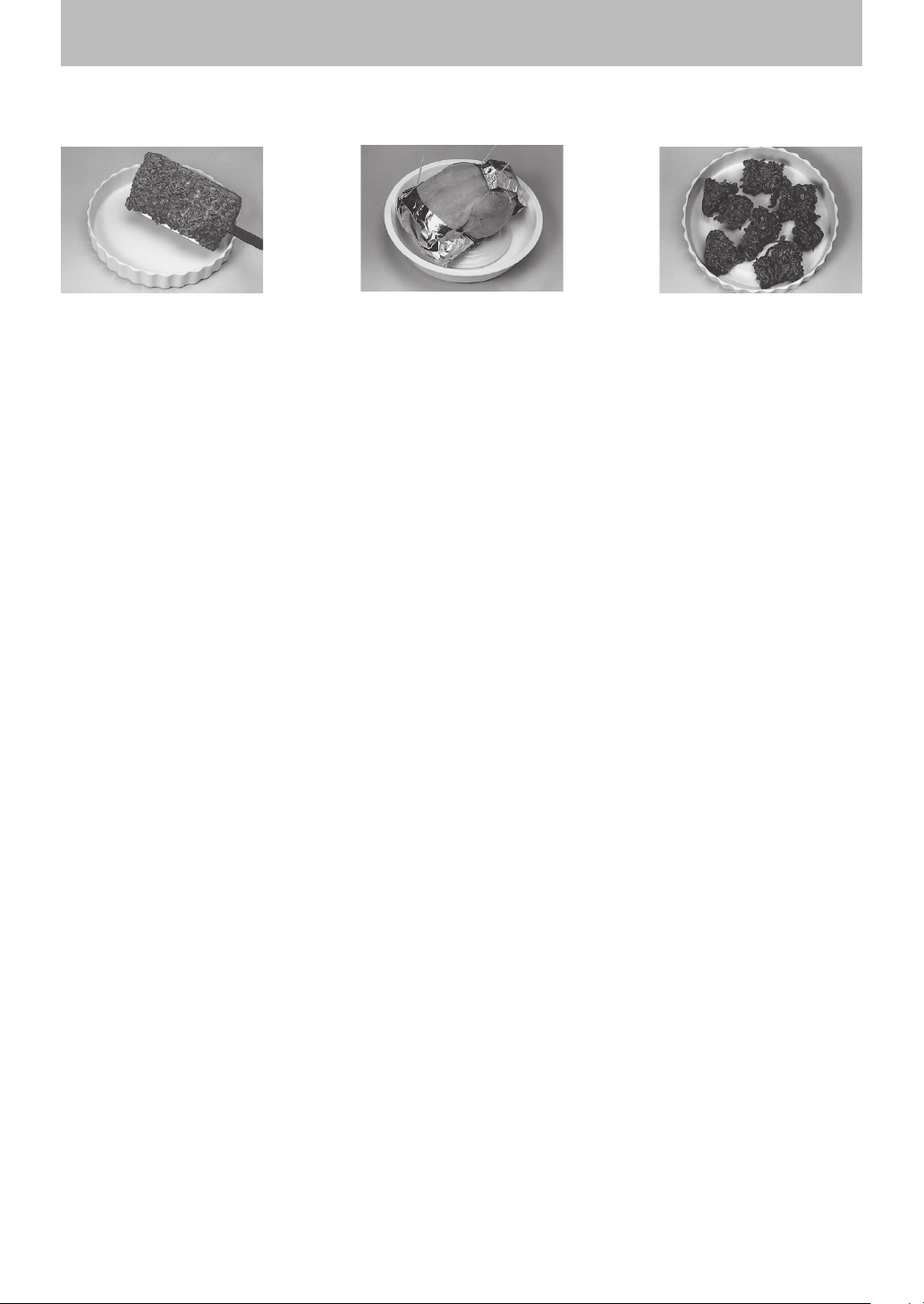
Foods should be placed in a suitable dish, whole chickens and joints of meat should be on an upturned saucer
or on a rack. Chops, chicken portions and slices of bread should be placed in a single layer. It is not necessary to
cover the foods. During the program the oven will beep to remind you to check the food. It is essential that you
turn and stir the food frequently and shield if necessary (See pages 23). On hearing the first beep you should turn
and shield (if possible). On the second beep you should turn the food or break it up.
– 23 –
To Defrost Using Turbo Defrost
(continued)
1st Beep 1st Beep 2nd Beep
Turn Or shield Turn or break up
Category 1 Bread
The Bread Program is suitable for defrosting small items e.g. rolls, buns and slices of bread which
are required for immediate use. Small items may feel warm immediately after defrosting. Loaves can
also be defrosted on this program but these will require standing time to allow the centre to thaw out.
Standing time can be shortened if slices are separated and buns and loaves cut in half. Items should
be turned halfway during defrosting. This program is not suitable for cream cakes or desserts e.g.
cheesecake.
Category 2 Mince / chops (mince/chops/chicken portions)
It is necessary for mince to be broken up frequently during defrosting and this is best carried out in
a large shallow dish. Chops and chicken portions should be arranged in a single layer and turned
frequently.
Category 3 Meat joints/whole chickens
Meat joints and chickens will require shielding during defrosting especially if they are particularly fatty
pieces. This is to prevent over defrosting on the outside edges. Smooth foil secured with cocktail
sticks should be used. Do not allow the foil to touch the walls of the oven. Back fat of joints, legs,
wings and breast bones need shielding. Standing time of at least 1 hour should be allowed (rolled
joints may require longer) before cooking to ensure the centre is fully defrosted.
Defrosting Guidelines
For Best Results:
1. Place foods in a suitable container. Meat joints and chickens should be placed on an upturned saucer or on
a plastic rack if you have one.
2. Check food during defrosting, as foods vary in their defrosting speed.
3. It is not necessary to cover the food.
4. Always turn or stir the food especially when the oven “beeps’’. Shield if necessary (see point 6).
5. Minced meat/chops/chicken portions should be broken up or separated as soon as possible and placed in a
single layer.
6. Shielding prevents food cooking. It is essential when defrosting chickens and joints of meat. The outside
thaws out first, so protect wings/breast and fat with smooth pieces of aluminium foil secured with cocktail
sticks.
7. Allow standing time so that the centre of the food thaws out. (Minimum of 1 hour for joints of meat and whole
chickens).
– 24 –
To Cook Using the Quick 30 Feature
Press Quick 30 pad to set the desired
cooking time (up to 5 minutes).
Each press is 30 seconds.
Time appears in the display. Power level
is pre-set at 1000 W.
Press Start pad.
The cooking will start and the time in
the display will count down.
At the end of cooking, five beeps will
sound.
This feature allows you to quickly set cooking time in 30 second increments.
Note
1. This feature is only available for Micro Power pad. If desired, you can use other Micro power
levels. Select desired power level before pressing Quick 30 pad.
2.
After setting the time by Quick 30 pad, you cannot use the time pads.
3.
This feature will not operate for 1 minute after manual cooking because of ‘Add Time’ feature.
4.
If you wish to operate within 1 minute, pressing Stop/Cancel pad will allow the operation.
This feature allows you to add cooking time at the end of previous cooking.
Note
1. This feature is only available for Micro Power, Grill, Convection, Combination and Timer feature and
it is not available for Turbo Defrost and Auto Programs.
2.
The Add Time feature will not operate after 1 minute cooking.
3.
The Add Time feature can be used after the multi-stage cooking and during cooking.
4.
The power level is the same as the last stage.
Press Start pad.
Time will be added.
The time in the display
window will count down.
Press time pads to add extra cooking
time.
Maximum cooking time:
Micro Power: 1000 W up to 30 minutes;
other microwave powers: up to 99
minutes 50 seconds;
Grill: 99 minutes 50 seconds,
Convection, Combination and timer: 9
hours 59 minutes.
After cooking,
press Add Time
pad
To Use the Add Time Feature
– 25 –
To Cook on Grill by Time Setting
The grill system on the oven gives fast efficient cooking for a wide variety of foods e.g. chops, sausages, steaks,
toast, etc. There are 3 different grill settings available. The glass tray must always be in position when using the
oven.
Do not preheat the grill before use.
The enamel tray must be on the glass tray when using.
Inoperable
Press Time pads to
enter cooking time.
Maximum time is 99
minutes 50 seconds,
1 hour pad is inoperable.
Press Start
The cooking program will
start and the time in the
display will count down.
Select Grill power
Press once for Grill 1 (High),
twice for Grill 2 (Medium) or
three times for Grill 3 (Low).
The grill symbol
will also
appear.
Press Power Level Suitable kinds of foods
Once Grill 1 (High) Toasting bread, muffins and teacakes etc.
Twice Grill 2 (Medium) Thin seafood.
3 times Grill 3 (Low) Slice of poultry or meat.
Note
1. The Grill will only operate with the oven door closed, and there is no microwave power on the grill
only program.
2. You can increase the cooking time during cooking if required. Time can be increased in 1 minute
increments, up to 10 minutes. Press ‘Add time’ pad once, then press ‘1 min’ pad to a maximum of
10 minutes. After selecting ‘Add Time’ function, time should be added within a 5 second period.
Cooking time can not be decreased during cooking.
Grilling Times
When using the grill to cook foods, the cooking times will be similar to traditional grilling. Most foods will require
turning halfway through the cooking time (see section on oven accessories page 26).
The Grill has three variable settings, Grill 1 (High), Grill 2 (Medium) and Grill 3 (Low). Grill 1 will be the hottest.
Caution!
The accessories and surrounding oven will get very hot. Use oven gloves.
– 26 –
To Cook on Grill by Time Setting
(continued)
Oven Accessories to Use
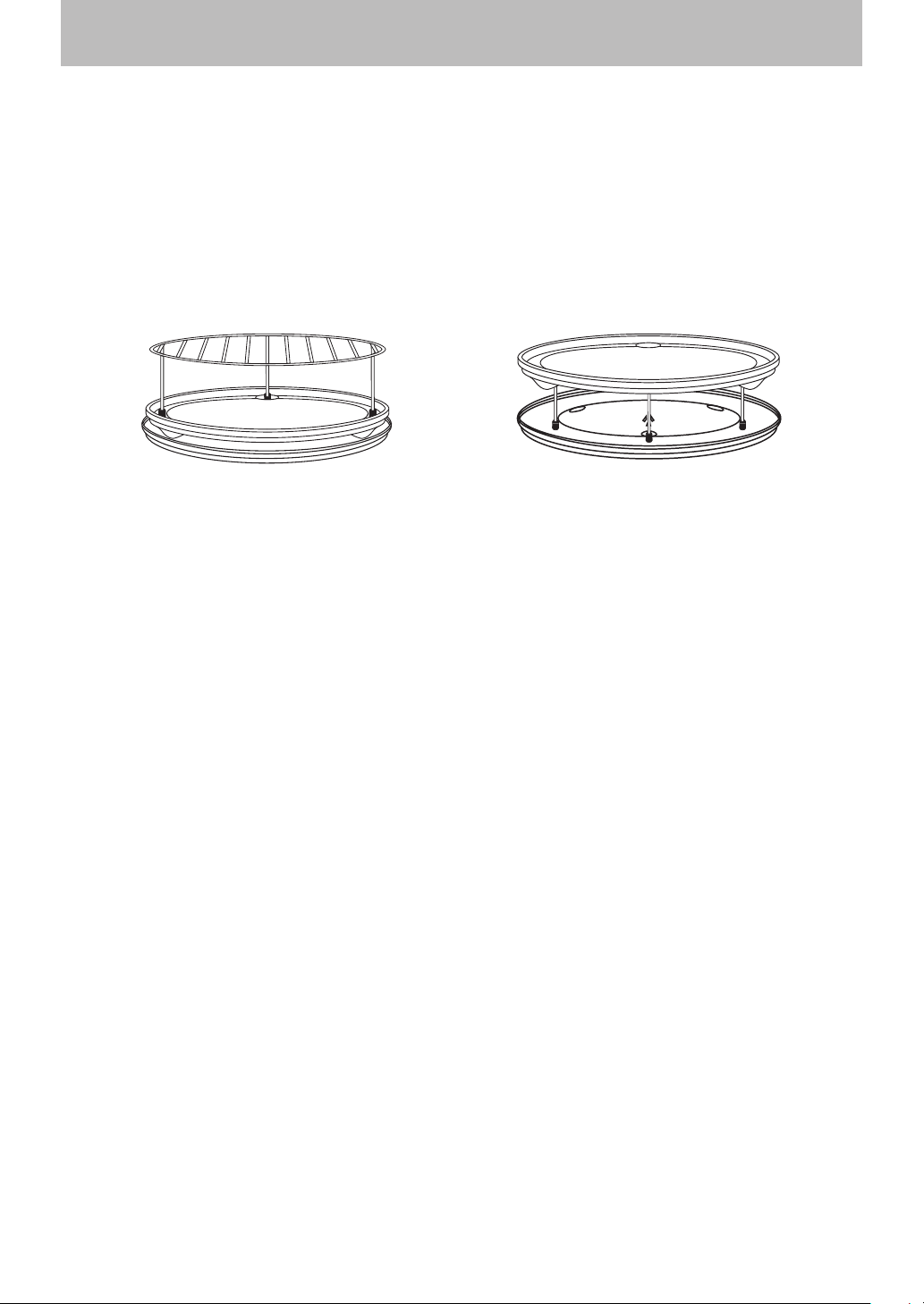
When grilling foods the glass tray should be in position, with the enamel tray and the wire rack on top.
Place food on wire rack on the enamel tray on the glass tray. The wire rack will allow fat to drip through into the
enamel tray to reduce excess splatter and smoke when grilling steaks, chops and other fatty foods.
Most foods require turning halfway during cooking. When turning food, open oven door and carefully remove
the enamel tray and wire rack by holding the accessories firmly. Use oven gloves when removing accessories as
they will be very hot, and so will the roof and walls of the oven.
After turning, return food to the oven, close door and press Start. The oven will continue to count down the
remaining cooking time. It is quite safe to open the oven door at any time to check the progress of the food as it
is grilling.
If grilling fish or small items, place the enamel tray on top of the wire rack.
Guidelines
1. There is no microwave power on the Grill only program.
2. Use the accessories provided, as explained.
3. The Grill will only operate with the oven door closed.
4. Most meat items e.g. bacon, sausages, chops can be cooked on the hottest setting - Grill 1. This setting is
alsosuitablefortoastingbread,munsandteacakesetc.
5. Grill 2 and Grill 3areusedformoredelicatefoodsorthosethatrequirealongergrilltimee.g.shor
chicken portions.
6. Do not preheat the grill.
7. Never cover the food when grilling.
8. Always use oven gloves when removing the food and accessories after grilling as the oven and
accessories will be very hot.
9. After grilling it is important that the grill accessories are removed for cleaning before reuse and that the
ovenwallsandoorarewipedwithaclothsqueezedinhotsoapywatertoremoveanygrease.Do not put
accessories in dish washer.
– 27 –
To Cook on Convection by Time Setting
Your microwave oven can be used in convection mode which incorporates a heating element with a fan. For best
results always place food in a preheated oven. The enamel tray must be on the glass tray when preheating.
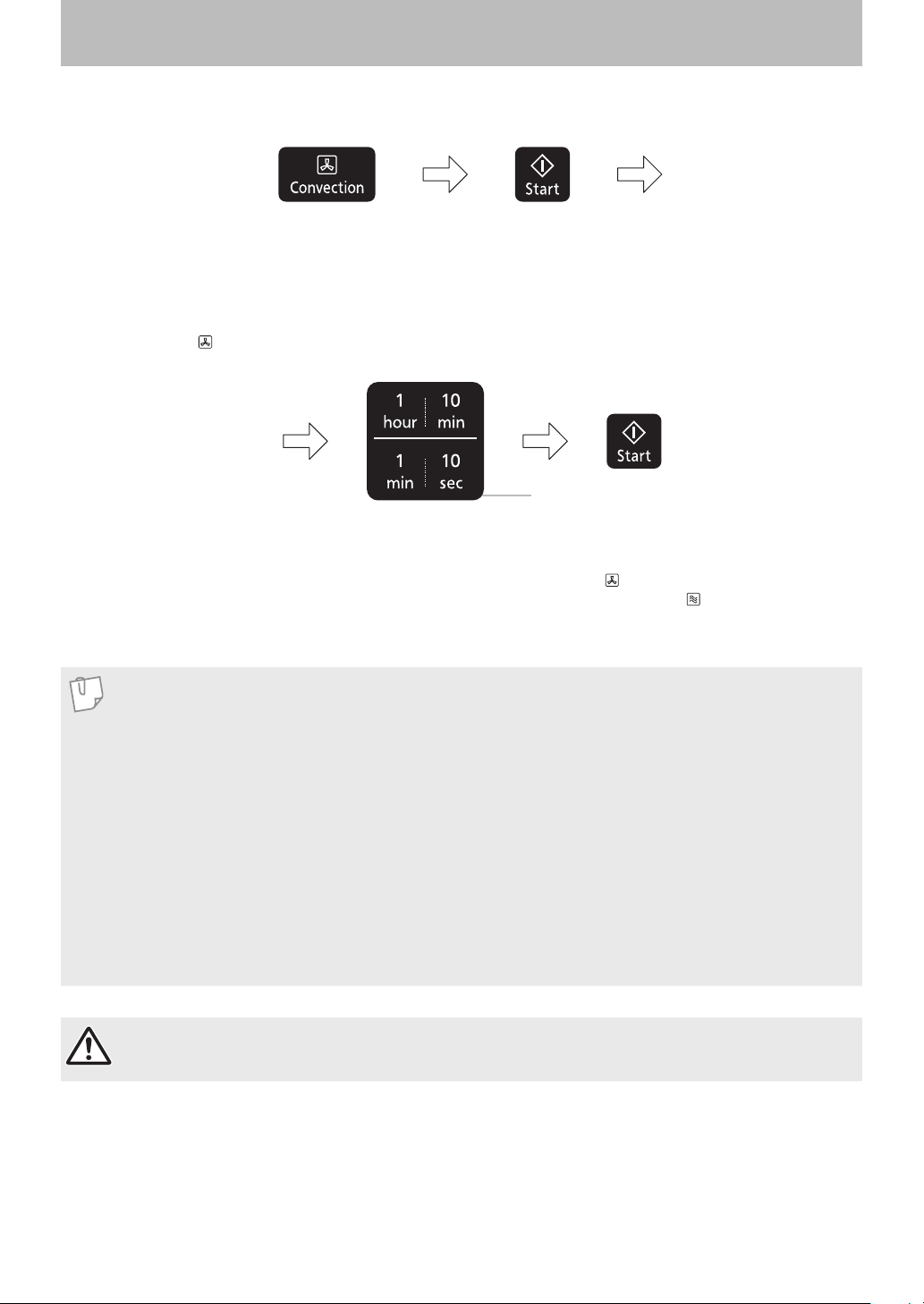
Press to select oven temperature. There is a choice of
convection temperatures 40 °C and 100 °C - 220 °C.
For quick selection of the most commonly used cooking
temperatures, the oven starts at 150 °C and then for
each press the temperature will count up in 10 °C stages
to 220 °C, then to, 40 °C, 100 °C, 110 °C etc. The
convection symbol
will also appear.
Press Start to preheat
A “P” will appear in the display window. When
the oven is preheated the oven will beep and
the“P”willash.Thenopenthedoorandplace
the food inside.*
(Skip this step when preheating is not required)
Press time pads to enter
cooking time
Maximum cooking time is
9 hours, 59 minutes. The
10 sec pad is inoperable.
Press Start
Note: Check that only the convection
symbol
is still in the display. If the
microwave symbol is displayed this
is incorrect and the program should be
cancelled. Reselect the convection setting.
Inoperable
Note
1. * Open the door using the door release pad, because if the Stop/Cancel pad is pressed the program
may be cancelled.
2.
The oven will maintain the selected temperature for approximately 30 minutes. If no food has
been placed inside the oven, then it will automatically cancel the cooking program “OPEN DOOR”
will appear in the display window. If no cooking time is set, oven will revert to time of day after 6
minutes.
3.
You can increase the cooking time during cooking if required. Time can be increased in 1 minute
increments, up to 10 minutes. Press ‘Add time’ pad once, then press ‘1 min’ pad to a maximum of 10
minutes. After selecting ‘Add Time’ function, time should be added within a 5 second period. Cooking
time can not be decreased during cooking.
4. After pressing Start, the selected temperature can be recalled and changed. Press convection pad
once to indicate the temperature in the display window. While the temperature is recalled in the
display window, you can change the temperature by pressing Convection pad.
5. The oven cannot preheat to 40 °C.
Caution!
The accessories and the surrounding oven will get very hot. Use oven gloves.

– 28 –
To Cook on Convection by Time Setting
(continued)
Oven Accessories to Use
When using the Convection oven the glass tray should be in position and must have the enamel tray
placed on top.
The food is then placed onto the enamel tray. Follow your individual recipe guidelines.
When using the oven as a convection oven, there is no microwave power, i.e. the oven is operating as a
conventional oven and you can use all your standard metal baking tins and ovenware.
It is not recommended to cook on more than one level when using the convection oven. When cooking 2 trays of
buns etc, cook in two batches.
– 29 –
To Cook on Combination by Time Setting
Your oven has two methods of cooking by Combination.
1. Convection and Microwave (with and without preheat)
2. Grill and Microwave (preheat is not possible)
Combination cooking is ideal for many foods. The microwave power cooks them quickly, whilst the convection
or grill gives the traditional browning and crispness.
All this happens simultaneously resulting in most foods being cooked in ½-⅔of the conventional cooking time.
There is no need to preheat on combination programs, except when cooking pastry.
To cook successfully by combination you should always use a minimum of 200 g food. Small quantities should
be cooked by Convection, or Grill.
Preheat if necessary (convection and microwave combination only)
Press if preheating *.
Convection only.
Set cooking time.
Maximum cooking time
is 9 hours, 59 minutes.
The 10 sec pad is
inoperable.
Press
Start
or
Select rst cooking mode. Select Micro Power. (1000 W, 600 W
and 270 W are not available)
Inoperable
Caution!
Take care to use oven gloves when removing dishes from the oven - especially when turning or stirring
foods as the oven walls and roof will be very hot
* Note
1. When placing food in the oven after preheating, just open the door using the door release pad,
because if Stop/Cancel pad is pressed the program may be cancelled.
2.
You can increase the cooking time during cooking if required. Time can be increased in 1 minute
increments, up to 10 minutes. Press ‘Add time’ pad once, then press ‘1 min’ pad to a maximum of 10
minutes. After selecting ‘Add Time’ function, time should be added within a 5 second period. Cooking
time can not be decreased during cooking.
3.
After pressing Start, the selected temperature can be recalled and changed. Press convection pad
once to indicate the temperature in the display window. While the temperature is recalled in the
display window, you can change the temperature by pressing Convection pad.

– 30 –
To Cook on Combination by Time Setting
(continued)
Containers to Use
It is possible to use smooth seamed metal tins and foil containers on combination but they must be placed
directly onto the enamel tray on the glass tray. They must not be placed directly onto the wire rack, or arcing will
occur.
If you experience arcing, which is when you see blue sparks or hear crackling noises, the metal container is
unsuitableoryouhaveinsucientfoodintheoven.Youshouldstoptheprogramimmediatelyandchangethe
container or re-program to convection only.
Do not use plastic microwave containers on Combination programs (unless suitable for combination cooking).
Dishes must be able to withstand the heat of the top grill. Do not put dishes on wire rack directly under the grill,
place on enamel tray on glass tray.
Oven Accessories
When using any Combination cooking program the glass tray should be in position and must have the enamel
tray placed on top, unless otherwise stated.
– 31 –
This is the most popular combination mode combining Convection heat with Micro Power. Casseroles, meat
joints, jacket potatoes and pastries are very successful using this combination. Unsuitable foods are those which
contain whisked eggs, meringues, rich fruit cakes, biscuits and yorkshire puddings.
It is not necessary to preheat on combination except when cooking pastry dishes. For pastry dishes preheat
oven to 210 °C on Convection so that the oven is hot, and then select the desired combination program or follow
recipe guidelines.
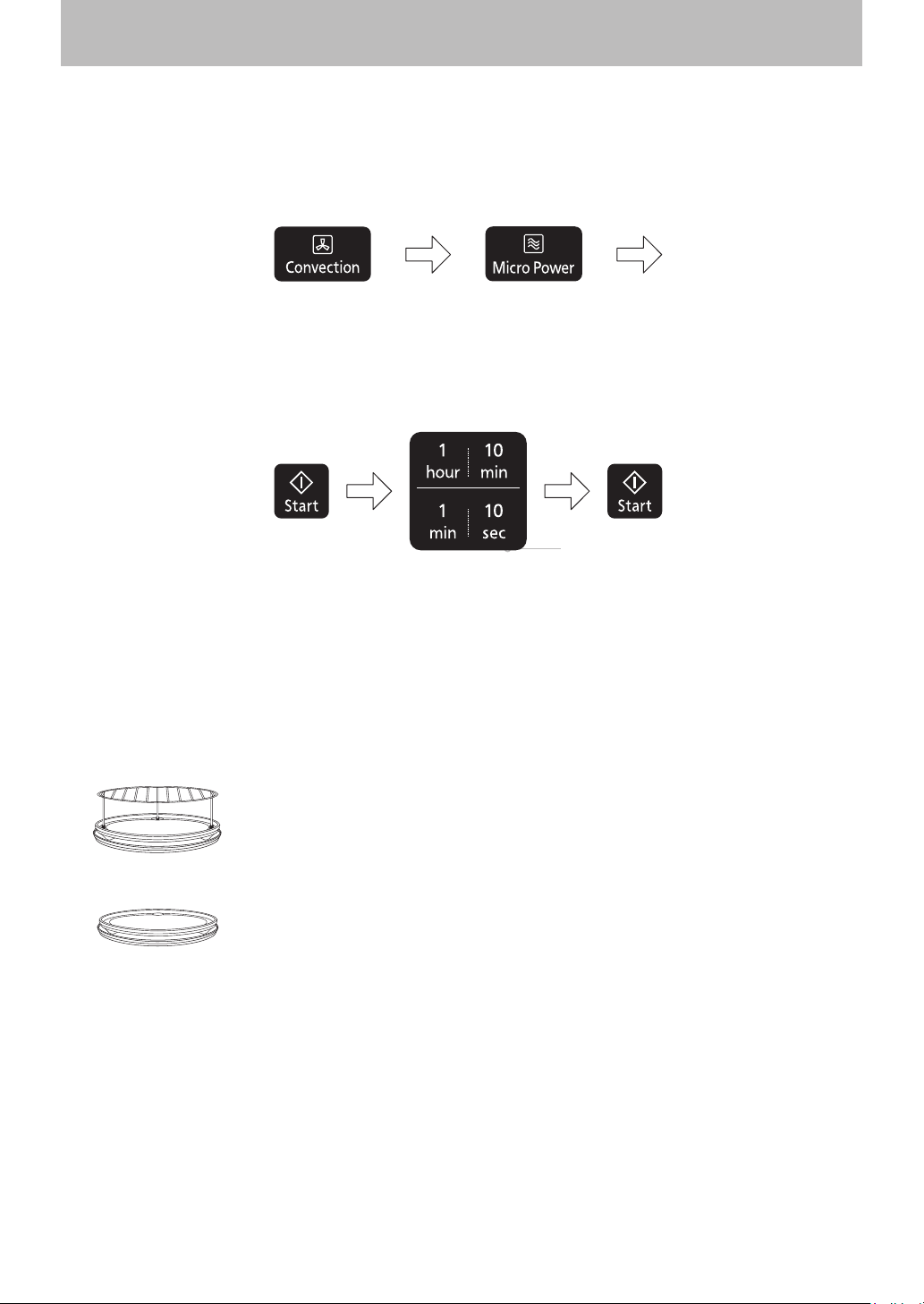
Press to select oven temperature.
The oven starts at 150 °C, and then
for each press the temperature will
count up in 10 °C stages to 220 °C,
then to 100 °C, 110 °C etc. 40 °C is
not available in combination mode.
Press Micro Power pad to select
microwave setting. (1000 W, 600
W and 270 W are not available)
Press if preheating.
After preheating, place
the food in the oven
* Skip this step when
preheating is not
required.
Press to enter required
cooking time.
Maximum cooking time is
9 hours, 59 minutes.
10 sec pad is inoperable.
Press
Start
Inoperable
Oven Accessories to Use
When using Combination cooking the glass tray should be in position and must have the enamel tray on top, un-
less otherwise stated.
Items of food can be placed onto the wire rack on the enamel tray on the glass tray.
Heatproof dishes of food should be placed directly onto the enamel tray on the glass
tray.
Joints and portions of meat should be placed on an upturned saucer on the enamel
tray on the glass tray. Alternatively they can be placed in a heatproof dish on the
enamel tray on the glass tray.
Recipes using foil or metal containers e.g. cakes and pastries should be placed
directly onto the enamel tray on glass tray.
Combination 1. Convection and Microwave
– 32 –
Combination 1. Convection and Microwave
(continued)
The chart below gives suggestions for Combination (Convection + Microwave) programs. For cooking times
refer to cooking charts or a similar recipe in the book. It is not possible to use 1000 W, 600 W and 270 W
microwave power in this mode.
Oven
temperature
Microwave
Power
Use
Oven accessories
to use
220 °C 100 W
Nuggets, sausage rolls, apple pie, bread and butter
pudding.
or
220 °C 300 W
Quiche, frozen garlic baguette, part baked rolls, meat pies,
cottagepie,shpie.
190 °C 300 W Whole chicken / turkey
180 °C 300 W Joints lamb
170 ºC 300 W Joints beef
170 °C 440 W Joints pork
160 °C 100 W Casseroles
Note
1. Food is usually cooked uncovered.
2.
After cooking it is important that the accessories are removed for cleaning before re-use and
that the oven walls and floor are wiped with a cloth squeezed in hot soapy water to remove any
grease. Do not put accessories in the dishwasher.
3.
Foods should always be cooked until browned and piping hot.
Caution!
Always use oven gloves when removing dishes from the oven - Especially when turning or stirring
foods, as the accessories and surrounding oven will get very hot.
– 33 –
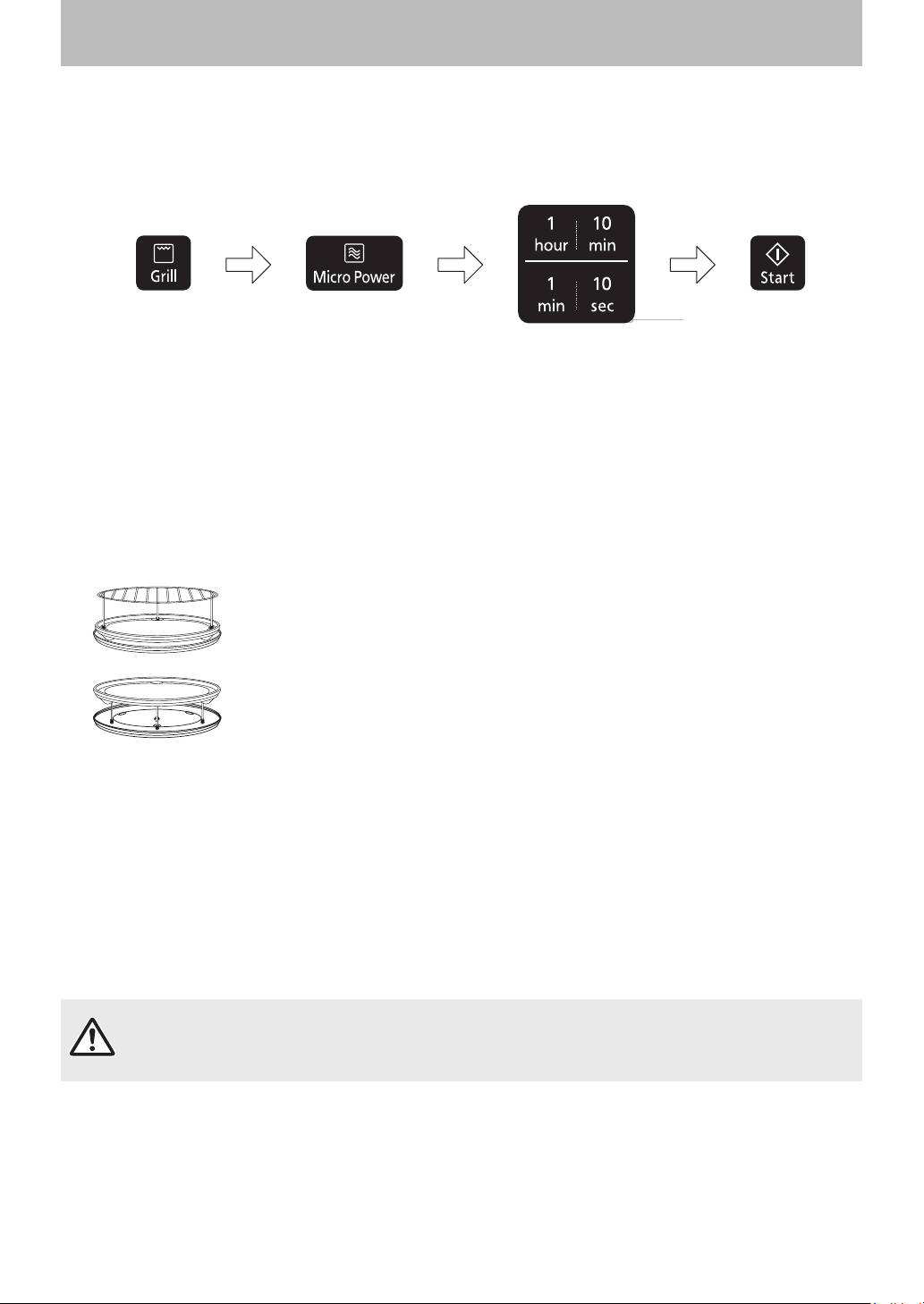
This combination mode is suitable for foods which are normally grilled and for reheating small savoury items.
Do not use this program with less than 200 g of food.
It is not necessary to preheat when using this combination mode and food should always be cooked
uncovered.
Thegrillwillglowonandoduringcooking-thisisnormal.
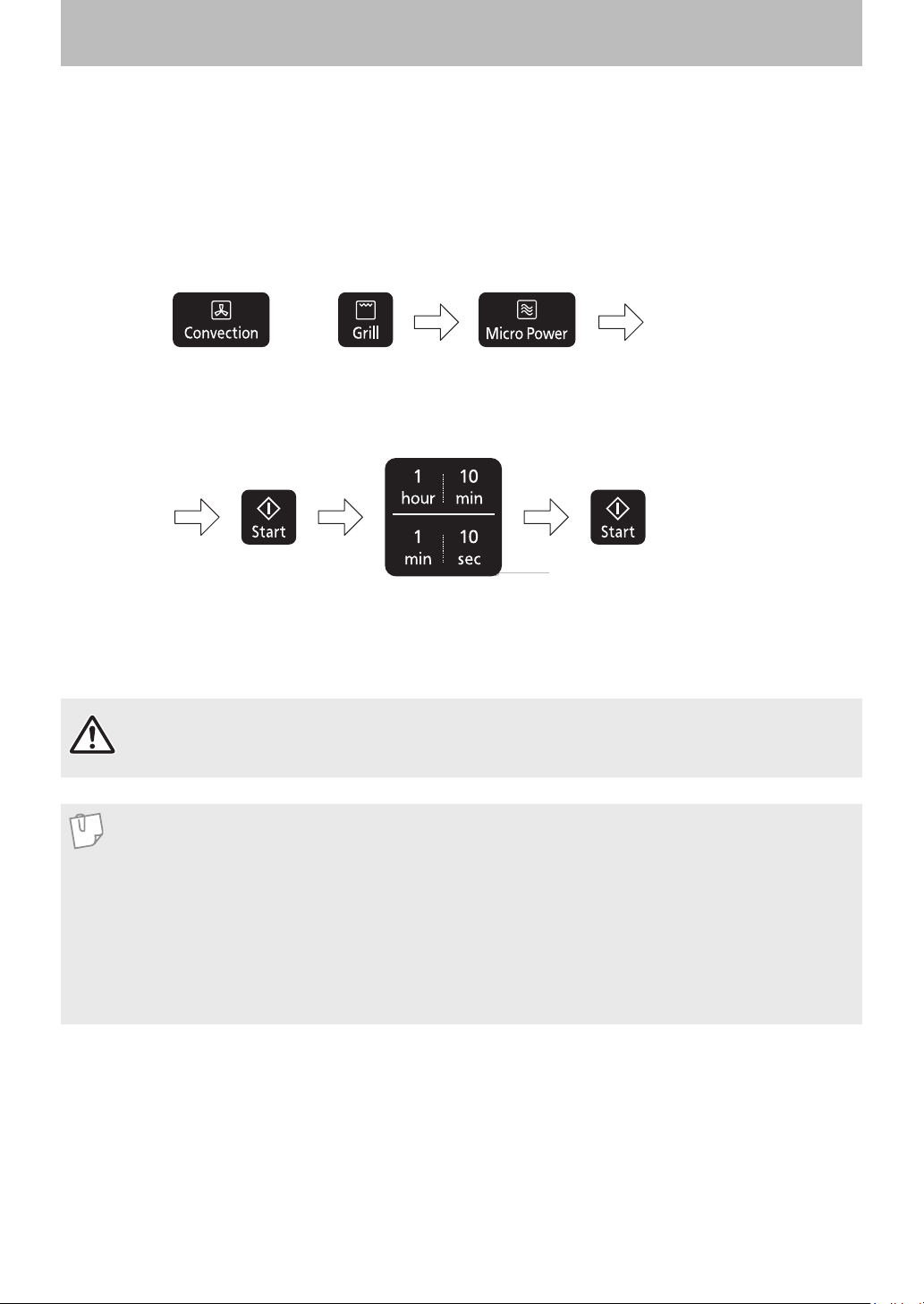
Select Grill power.
Press once for Grill
1 (High), twice for
Grill 2 (Medium) or
three times for Grill 3
(Low).
Select Micro Power.
Keep pressing this pad
until the power you
require appears in the
display window. 1000
W, 600 W and 270 W
are not available.
Press to enter
required cooking time.
Maximum cooking
time is 9 hours,
59 minutes. 10 sec pad
is inoperable.
Press Start
Inoperable
Oven Accessories to Use
When using Combination cooking the glass tray should be in position and must have the enamel tray on top, un-
less otherwise stated.
Food should be placed directly onto the wire rack on the enamel tray. This is then
placed on the glass tray.
Whencookingshorsmallitems,foodcanbeplaceddirectlyontheenameltrayon
top of the wire rack.
Guidelines
1. Food is usually cooked uncovered.
2. To turn food just press the door release pad, remove the enamel tray and wire rack, turn the food, return to
the oven, close the door and press Start pad. The oven will continue to countdown the remaining cooking
time.
3. After Grilling it is important that the Grill accessories are removed for cleaning before reuse and that the
ovenwallsandoorarewipedwithaclothsqueezedinhotsoapywatertoremoveanygrease.Do not put
accessories in the dishwasher.
For advice on cooking times, refer to cooking charts and recipes in this book. Foods should always be cooked
until browned and piping hot.
Caution!
Always use oven gloves when removing dishes from the oven - especially when turning or stirring
foods, as the accessories and surrounding oven will get very hot.
Containers to Use
Do not use plastic microwave containers on Combination programs (unless suitable for combination cooking).
Dishes must be able to withstand the heat of the top grill. Do not put dishes on wire rack directly under the grill,
use the enamel tray.
Combination 2. Grill and Microwave
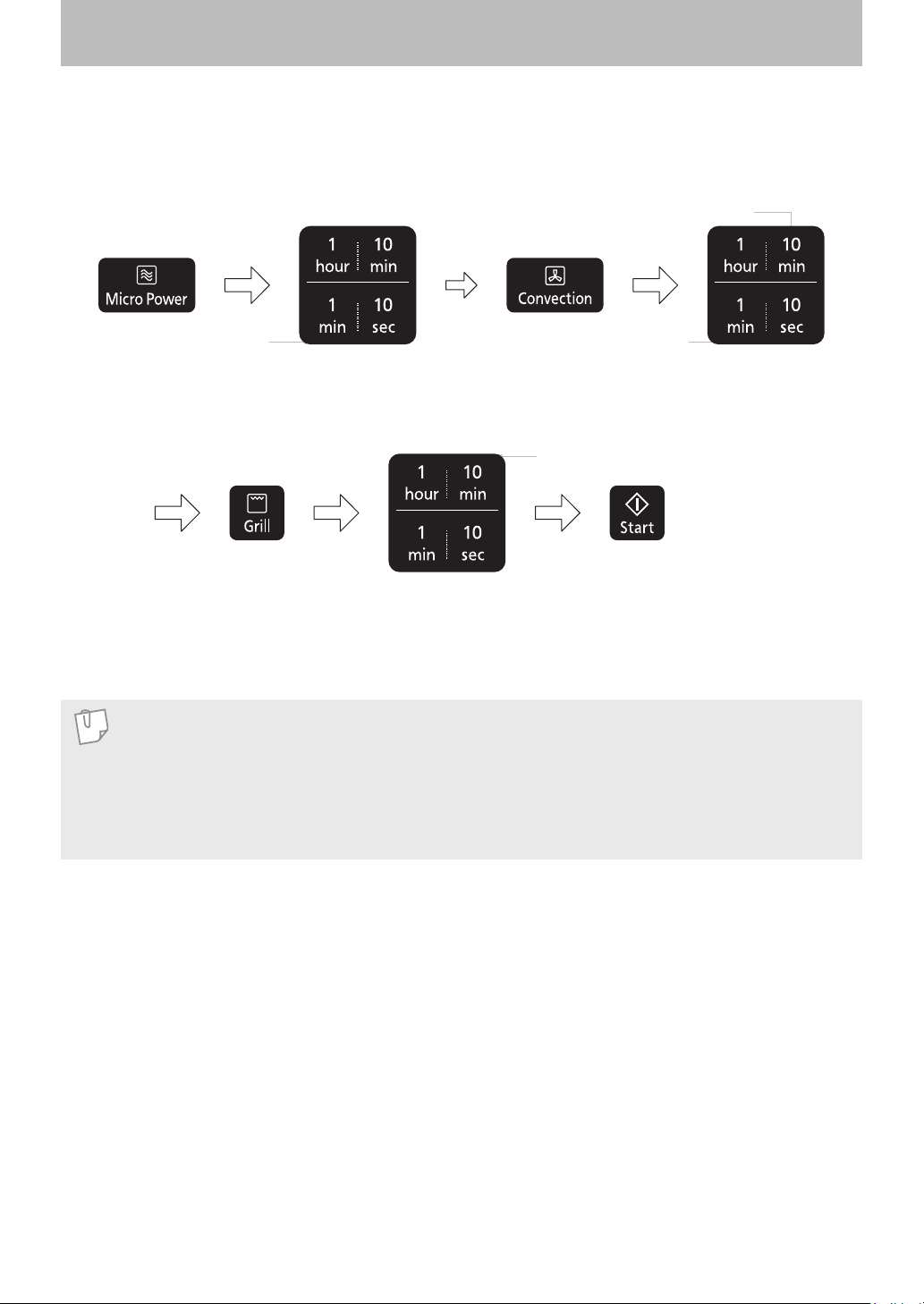
– 34 –
Multi-stage Cooking
2 or 3 Stage Cooking
Example:
To cook on 600 W for 2 minutes, cook on 180 °C for 15 minutes and cook on Grill 1 for 10 minutes.
Press once
Press Micro
Power 3 times to
select 600 W.
Set the
cooking time
to 2 minutes.
Press Convection
pad 4 times to
select 180 °C.
Set the
cooking time
to 15 minutes.
Press twice Pressvetimes
Press Grill pad
once to select
Grill 1.
Set cooking
time to
10 minutes.
Press Start
The cooking program
will start and the time
in the display will
count down.
Press once
Note
1. For multi-stage cooking, enter another cooking program before pressing Start.
2. During cooking, one press on Stop/Cancel stops the operation. You can re-start it by pressing
Start. A second press of Stop/Cancel will cancel the selected program.
3.
Whilst not operating, one press of Stop/Cancel cancels the selected program.
4.
Auto programs and preheating cannot be used with multi-stage cooking.
5.
Delay/stand feature can be used with multi-stage cooking.
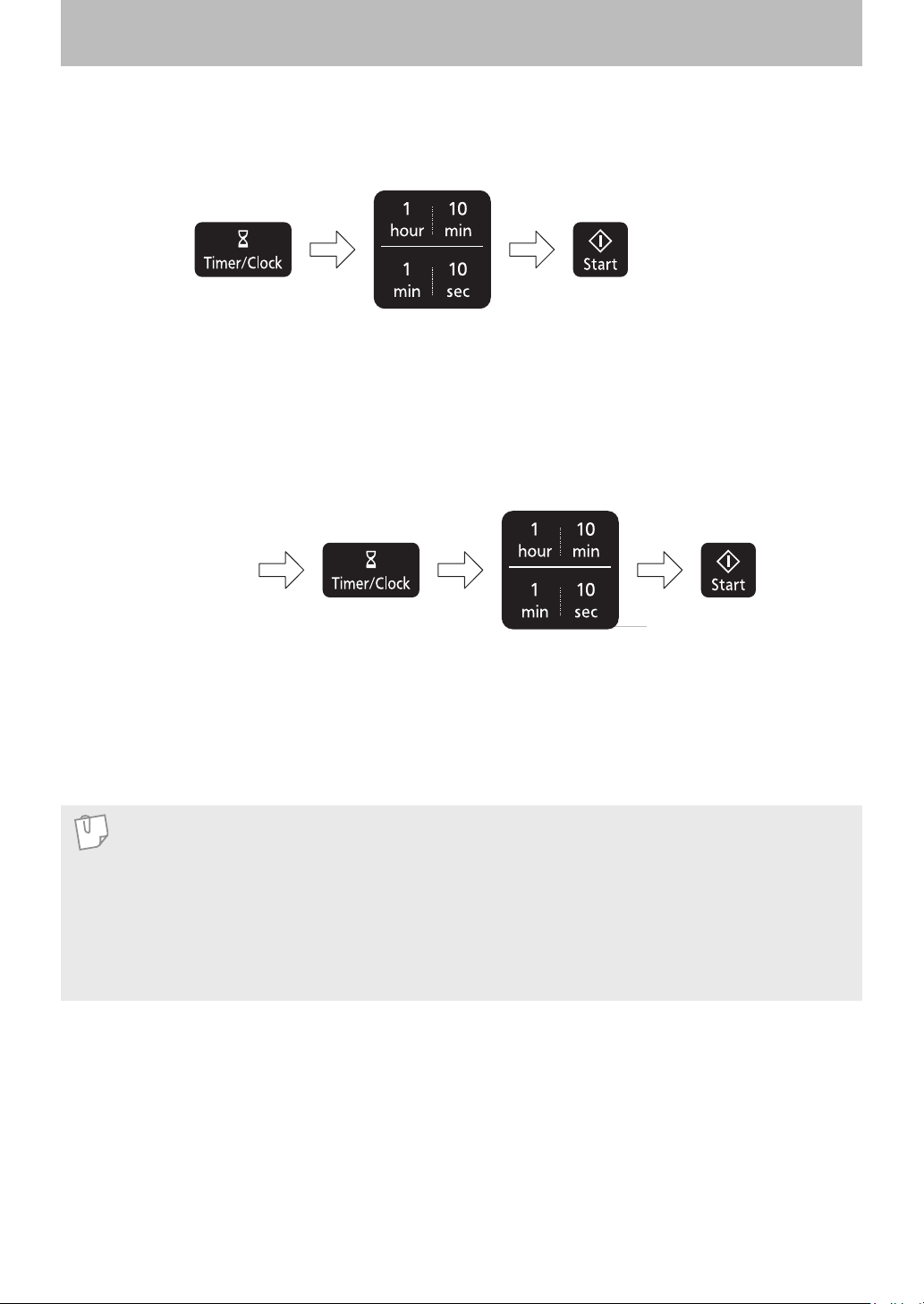
– 35 –
The timer can be used either before or after a cooking program. This feature can be used to set a standing time
after cooking or to delay the start of your cooking.
1. To Set a Kitchen Timer
Press
Timer/Clock
Set desired kitchen
time (max 9 hours 59
minutes) (10 sec pad is
inoperable). An “H” will
appear in the display to
denote hours.
Press Start
Time will count down.
2. To Set a Standing Time:
Set the desired
cooking
programme
(up to 2 stage)
Set desired standing
time (max 9 hours
59 minutes) (10 sec
pad is inoperable).
An “H” will appear in
the display to denote
hours.
Press
Timer/Clock
Press Start
Cooking program
will commence
after which the
standing time will
count down.
Inoperable
Note
1. Three stage cooking can be programmed including standing time.
2. If the oven door is opened during the standing time or minute timer, the time in the display window
will continue to count down.
3.
This feature may also be used as a minute timer. In this case press Timer/Clock, set time and
press Start.
4.
Standing time cannot be programmed after an auto program and preheating.
5.
If the programmed stand time exceeds one hour, the time will count down in units of minutes. If less
than one hour, the time will count down in units of seconds.
Using the Timer
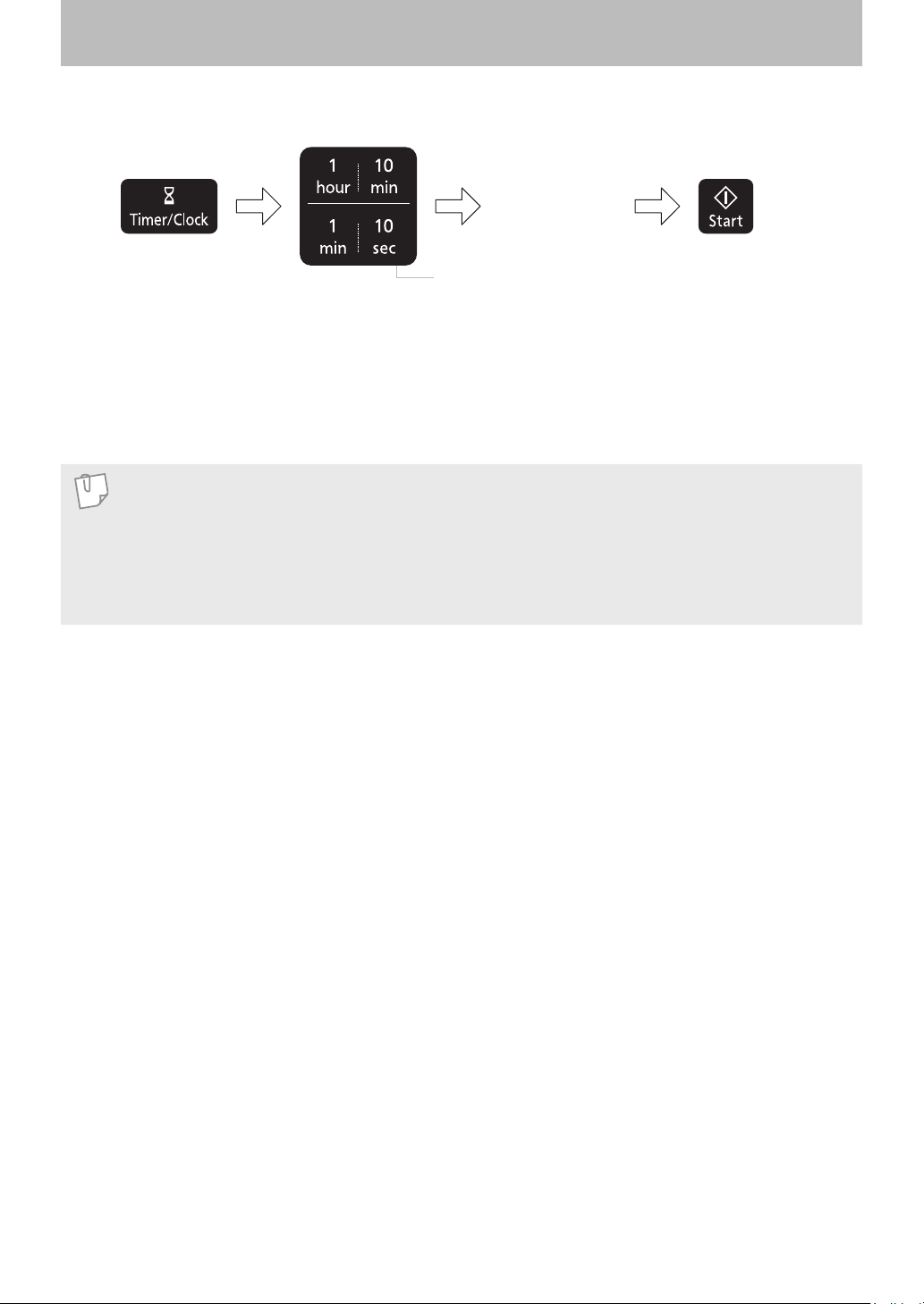
– 36 –
Using the Timer
(continued)
3. To Set a Delay Start:
Inoperable
Set the desired
cooking
programme
(up to 2 stage)
Press
Timer/Clock
Set Delay time (max
9 hours 59 minutes)
(10 sec pad is
inoperable). An “H”
will appear in the
display to denote
hours.
Press Start
Delayed time
will count down
then the cooking
program will
start.
Note
1. Three stage cooking can be programmed including delay start cooking.
2. If the programmed delay time exceeds one hour, the time will count down in units of minutes. If
less than one hour, the time will count down in units of seconds.
3.
Delay start cannot be programmed before an auto program and preheating.
4. If the oven door is opened during the delay time, the time in the display window will continue to
count down.
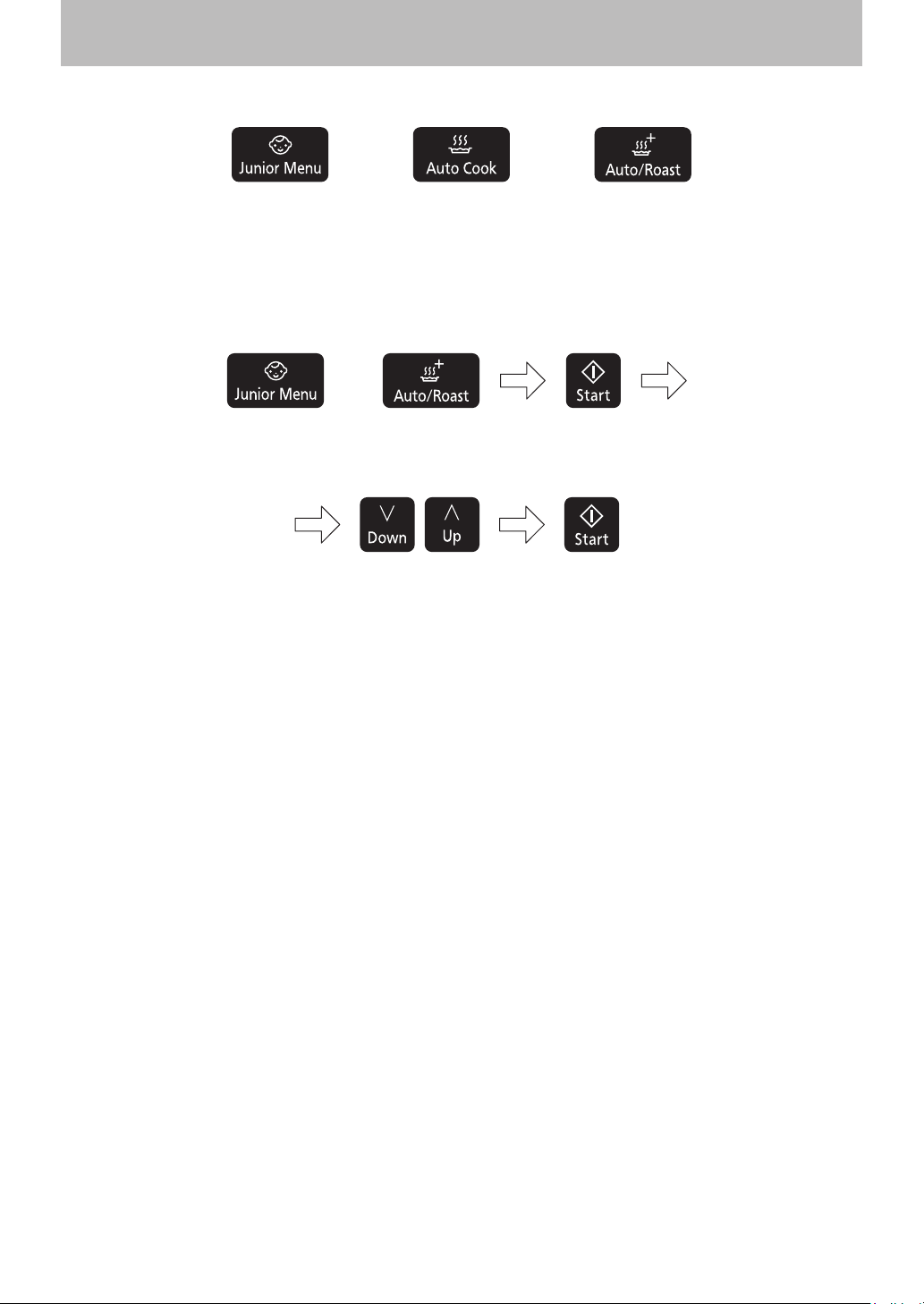
– 37 –
or or
This feature allows you to cook or reheat most of your favourite foods by setting the weight only. The oven
determines the Microwave power level and/or Convection and/or Combination setting, then the cooking time
automatically. Select the category of food and then just enter the weight.
Auto Programs with Preheating
For menus No. 7 - No. 10 and No. 21 - No. 24, please operate as follows
Afterpreheating,beepssoundand‘P’willash
in the display. Then open the door and place the
food in the oven and set weight using up and down
pads. Take care when handling the hot enamel
tray.
Press Start The cooking
time appears in the
display window and
begins to count down.
Press the Start pad to preheat the
oven. Preheat with enamel tray on
glass tray.
Select the desired program by
pressing the appropriate pad.
or
Auto Program Setting
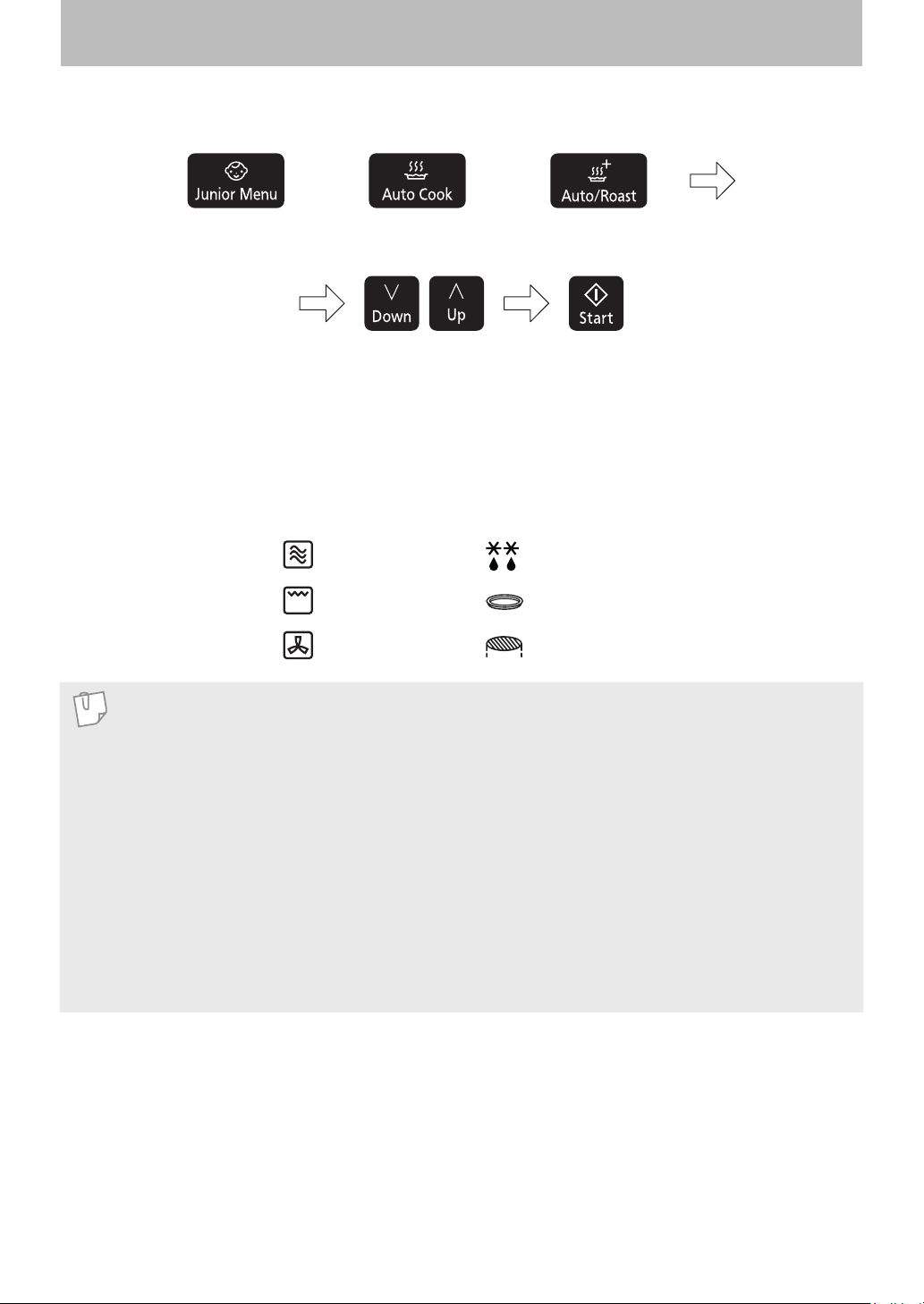
– 38 –
Auto Program Setting
(continued)
For menus No. 4 - No. 6, No. 11 - No. 20 and No. 25 - No. 29, please operate as follows
Auto Programs Without Preheating
Select the desired Auto Weight program, by pressing the appropriate
pad.
Enter the weight by pressing the
up and down pads. To quickly
select the weight, hold weight
selection pads. For auto program
apjacks,pleaseskipthisstep.
Press Start The
cooking time appears
in the display
window and begins
to count down.
or or
When you select an automatic program, the symbols will appear in the display to show the cooking mode that
will be used and the accessories that are needed, in addition to the glass tray. These are what they mean:
Microwave Frozen food
Grill Enamel tray
Convection Wire rack
Note
The auto weight programs are designed to take the guesswork out of cooking or reheating your food.
They must only be used for the foods described.
1. Only cook foods within the weight ranges described (see pages 39).
2. Only use the accessories as indicated on pages 40-45.
3. Junior programs 4-5 and all Auto Cook programs use Microwave power only. Junior programs
6-11 and Auto/Roast programs 20-24 use a combination of Microwave and Convection or Grill.
Auto/Roast programs 25-29 use Convection.
4. Do not cover food unless stated, when using a Combination or Convection program, it will prevent
the food browning. The heat will also melt any plastic covering.
5. Most foods benefit from a standing time after cooking on an auto program, to allow heat to
continue conducting to the centre.
6. To allow for some variations that occur in food, check that food is thoroughly cooked and piping
hot before serving.
7. Always weigh the food rather than relying on the package weight information.
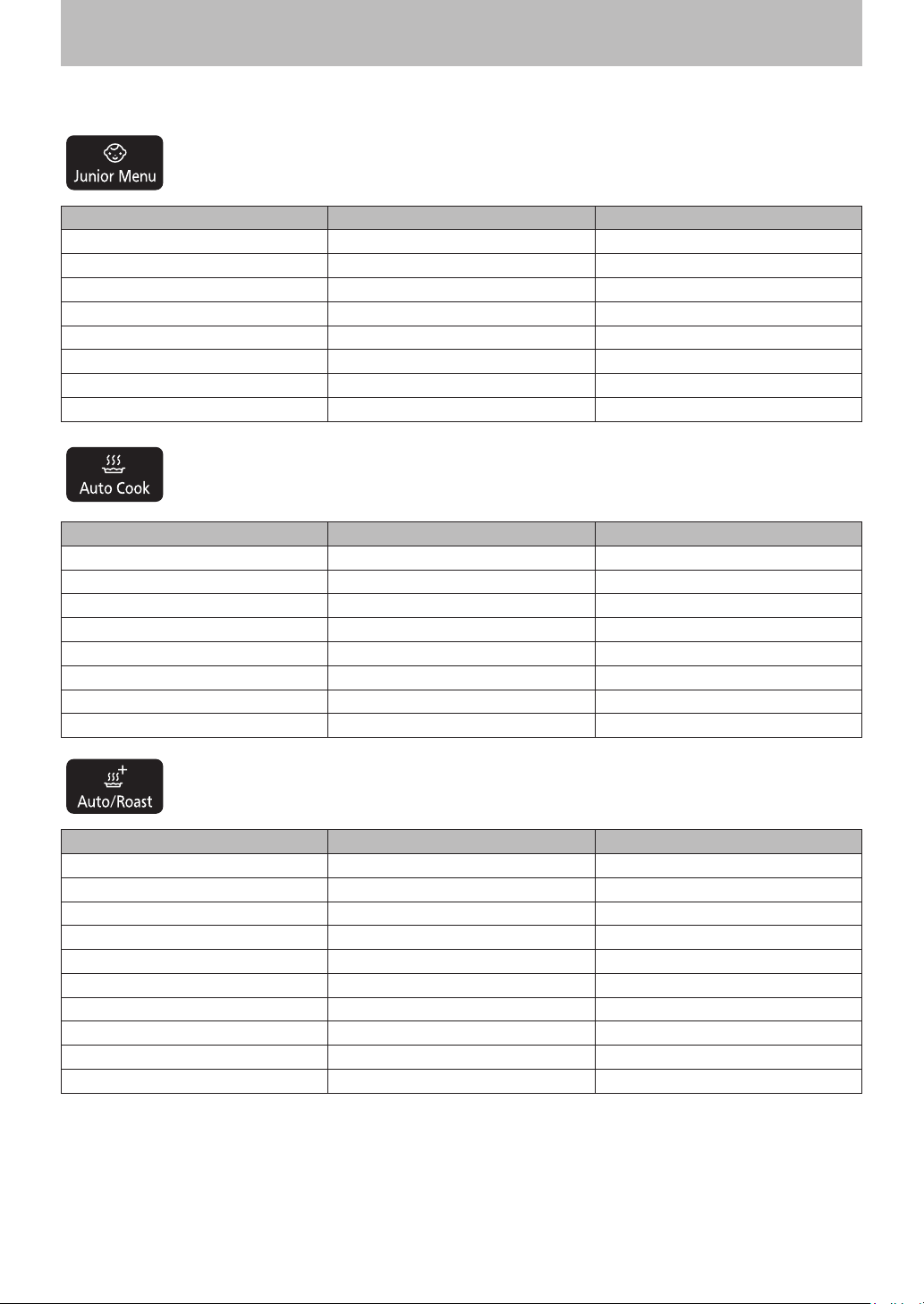
– 39 –
Auto Program Setting
(continued)
Minimum/Maximum Weights for Auto Weight Programs
Program Minimum weight Maximum weight
4. Purée vegetables 100 g 400 g
5. Purée fruits 100 g 400 g
6. Junior pasta bake 200 g 600 g
7. Chilled breaded products 100 g 500 g
8. Frozen breaded products 100 g 500 g
9. Fresh vegetable fries 100 g 500 g
10. Frozen vegetable fries 100 g 500 g
11. Flapjacks N/A N/A
Program Minimum weight Maximum weight
12. Reheat curry 300 g 800 g
13. Reheat Chinese style 300 g 450 g
14. Reheat pasta 300 g 1600 g
15. Reheat casserole 300 g 900 g
16. Fresh vegetables 100 g 800 g
17.Freshsh 200 g 800 g
18. Porridge with milk 50 g 200 g
19. Porridge with water 50 g 200 g
Program Minimum weight Maximum weight
20. Jacket potatoes 200 g 1500 g
21. Frozen pizza 130 g 450 g
22. Frozen potato products 200 g 500 g
23. Fish and chips 200 g 500 g
24. Chicken 900 g 2000 g
25. Beef-rare 500 g 2000 g
26. Beef-medium 500 g 2000 g
27. Beef-well done 500 g 2000 g
28. Lamb-medium 1000 g 2000 g
29. Lamb-well done 1000 g 2000 g
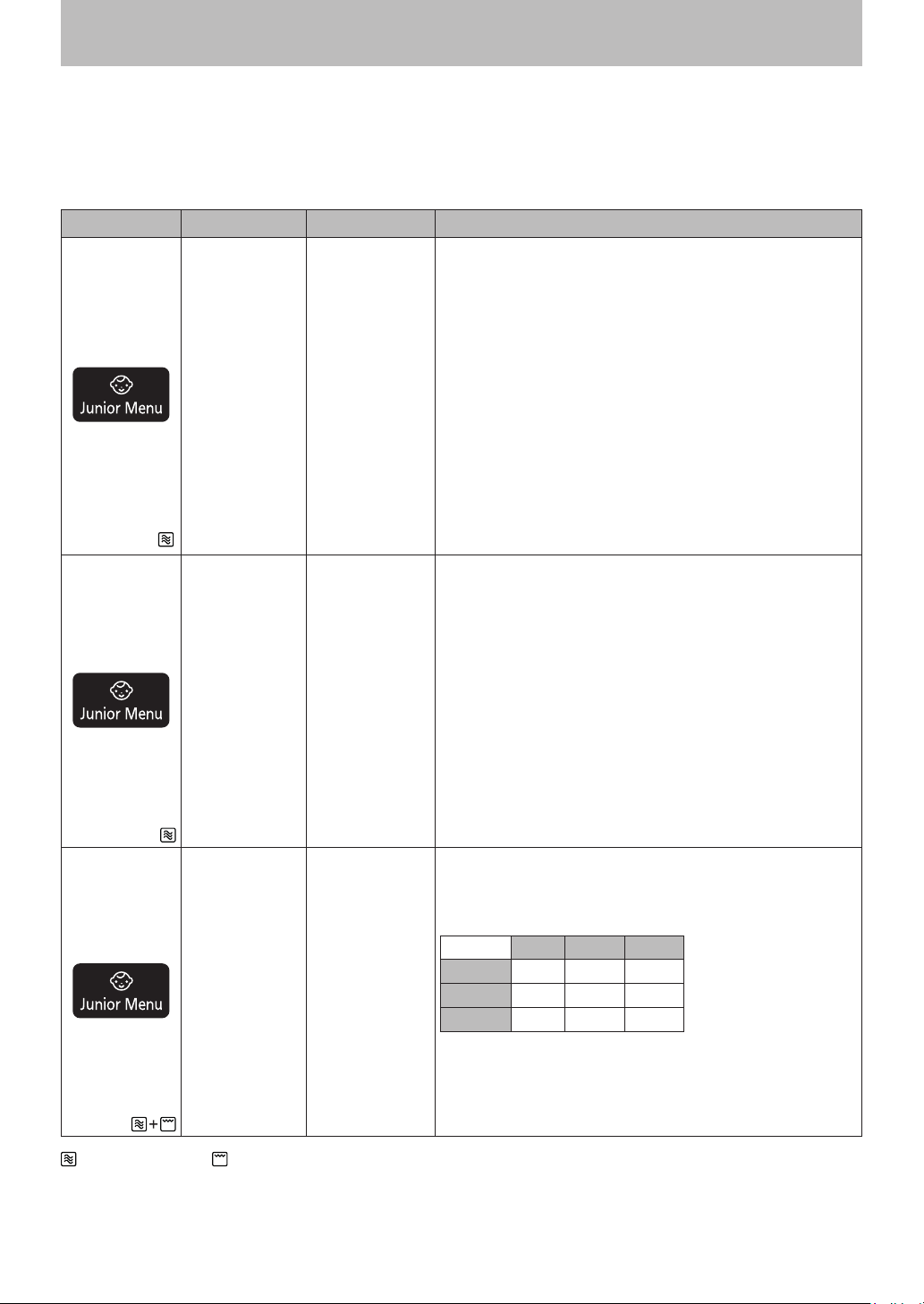
– 40 –
Junior Menu Programs
TheJuniorMenuoersarangeofprogramscateringforbabies,toddlersandolderchildren-greatfortime
savingandconvenience.Thefruitandvegetablepuréesareidealrstfoodsforweaningbabies.Homemade
purées taste like real food and cost less than jars or packets. Extra portions can be frozen in ice cube trays, then
defrosted and reheated. Healthy vegetable fries and pasta bakes are perfect for smaller tummies. A healthier
apjackisperfectforlunchboxsnacks.
Program Weight Accessory Instructions
4. Purée
vegetables
1 Press
100 g - 400 g
-
This program is suitable for cooking parsnips, potatoes,
butternut squash, carrots, sweet potato and swede. The
cooked vegetables are then puréed and suitable when
weaning babies. Peel and chop the vegetables into even
sized pieces. Place in a Pyrex
®
dish. Add the following
quantities of water:
100 g - 150 g vegetables 75 ml water.
160 g - 300 g vegetables 100 ml water.
310 g - 400 g vegetables 150 ml water.
Cover with lid. Press the Junior Menu pad once. Enter
the weight of the vegetables. Press Start. Stir halfway
during cooking. After cooking allow to stand for 10
minutes. Purée the vegetables with the cooking liquid
using a blender. If necessary adjust the consistency with
a little water to thin or baby rice to thicken. Check the
temperature before feeding.
5. Purée
fruits
2 Presses
100 g - 400 g
-
This program is suitable for cooking apples, pears,
peaches, papaya and mango. The cooked fruit is then
puréed and suitable when weaning babies. Peel and chop
the fruit into even sized pieces. Place in a Pyrex
®
dish.
Add the following quantities of water:
100 g -150 g fruit 75 ml water.
160 g - 300 g fruit 100 ml water.
310 g - 400 g fruit 150 ml water.
Cover with lid. Press the Junior Menu pad twice. Enter the
weight of the fruit. Press Start. Stir halfway during cooking.
After cooking allow to stand for 10 minutes. Purée the fruit
with the cooking liquid using a blender. If necessary adjust
the consistency with a little water to thin or baby rice to
thicken. Check the temperature before feeding.
6. Junior
pasta bake
3 Presses
200 g
400 g
600 g
-
For cooking fresh pasta bake using fresh pasta (penne,
spaghetti, fusilli), cheese or tomato based sauce and
grated mild Cheddar cheese. Use a suitable square,
shallow Pyrex
®
container. Use the following quantities:
200 g 400 g 600 g
Pasta 70 g 150 g 250 g
Sauce 115 g 220 g 300 g
Cheese 15 g 30 g 50 g
Other ingredients may be added such as ham, tuna and
sweetcorn. In this case substitute some of the sauce for
the chosen added ingredients. Press Junior Menu three
times. Enter the weight - 200 g, 400 g or 600 g. Press
Start.
= Microwave = Grill
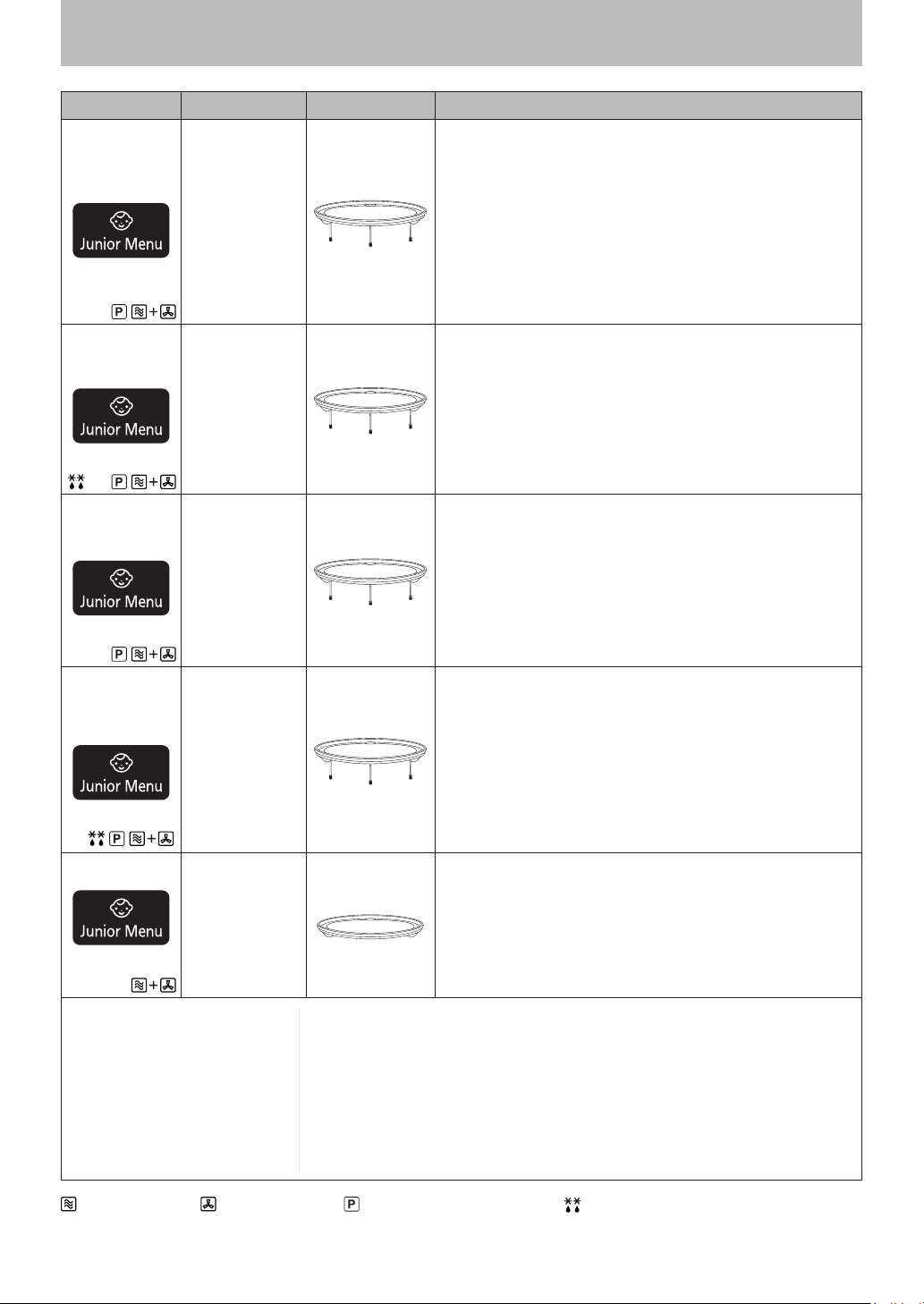
– 41 –
Junior Menu Programs
(continued)
Program Weight Accessory Instructions
7. Chilled
breaded
products
4 Presses
100 g - 500 g
For preparing chilled breaded products such as breaded
chickenstrips,shgoujons,popcornchicken,chicken
bitesorbreadedchickenllets.PressJuniorMenufour
times.PresstheStartpadtopreheattheoven.After
preheating,beepssoundand‘P’willashinthedisplay.
Removeallpackagingandplacethechilledbreaded
productsontheenameltrayonthewirerack.Enterweight
offoodandpressStart.Turnhalfwayduringcooking.
8. Frozen
breaded
products
5 Presses
100 g - 500 g
Forpreparingfrozenbreadedproductssuchasfrozen
popcornchicken,frozenchickennuggets,frozenturkey
drummers,frozenshngers,frozenscampi.PressJunior
Menuvetimes.PresstheStarttopreheattheoven.After
preheating,beepssoundand‘P’willashinthedisplay.
Removeallpackagingandplacethefrozenbreaded
productsontheenameltrayonthewirerack.Enterweight
offoodandpressStart.Turnhalfwayduringcooking.
9. Fresh
vegetable
fries
6 Presses
100 g - 500 g
Forpreparingfreshvegetablefriessuchassweetpotato,
whitepotato,carrots,parsnipsandcourgettes.Peel
andcutthevegetablesintobatonshapes.Tossina
tablespoonofvegetableoil.PressJuniorMenusixtimes.
PresstheStartpadtopreheattheoven.Afterpreheating,
beepssoundand‘P’willashinthedisplay.Placethe
vegetablesontheenameltrayonthewirerack.Enter
weightoffoodandpressStart.Turn/Stirhalfway.
10. Frozen
vegetable
fries
7 Presses
100 g - 500 g
Forpreparingfrozenpre-purchasedvegetablefriessuch
assweetpotato,carrotsandparsnips.PressJunior
Menuseventimes.PresstheStartpadtopreheatthe
oven.Afterpreheating,beepssoundand‘P’willashin
thedisplay.Removeallpackagingandplacethefrozen
vegetablefriesontheenameltrayonthewirerack.Enter
weightoffoodandpressstart.Turn/Stirhalfway.
11. Flapjacks
8 Presses
-
Preparetheapjacksasdetailedintherecipebelow.
PlacethePyrex
®
dishontheenameltray.PressJunior
Menueighttimes.PressStart.
ingredients
For 8 servings
150 g dates, chopped
100 glow-fatspread
3tbsp(45ml)honey
50 g apricots, chopped
3tbsp(45ml)mixedseeds
150 g oats
Dish:LargePyrex
®
mixingbowl
SquarePyrex
®
dish18cmx
18cm(7x7inch)
1. Placethechoppeddates,lowfatmargarineandhoneyinaPyrex
®
mixingbowl.
2. Putthebowlontotheglasstrayandcookon600 Wfor3-4minutes.
3. Addtheremainingingredientstothedatemixture.
Stirwelluntilallcombined.
4. GreasethesquarePyrex
®
dishandlinewithbakingpaper.
5. Spoonthemixtureintothedishandpressdownrmlywithametalspoon.
=Microwave =Convection =Preheatingisrequired
=frozen
– 42 –
Auto Cook Programs
Program Weight Accessory Instructions
12. Reheat
curry
1 Press
300 g - 800 g
-
This program is for reheating a chilled curry convenience
meal that can be stirred *. Foods must be in a suitable
microwaveablecontainerandhavethelmpierced.Place
on glass tray, press the Auto Cook pad once. Enter the
weight then press Start. Stir halfway. Allow to stand for 1
minute. Ensure that the food is piping hot. Stir the food
before serving.
13. Reheat
Chinese style
2 Presses
300 g - 450 g
-
This program is for reheating a chilled Chinese style
convenience meal *. Foods must be in a suitable
microwaveablecontainerandhavethelmpierced.Press
the Auto Cook pad twice. Enter the weight. Press Start.
Stir halfway. Allow to stand for 1 minute. Ensure food is
piping hot. Stir again before serving.
14. Reheat
pasta
3 Presses
300 g - 1600 g
-
This program is for reheating a chilled pasta convenience
meal that can be stirred *. Foods must be in a suitable
microwaveablecontainerandhavethelmpierced.Place
on glass tray, press the Auto Cook pad three times. Enter
the weight then press Start. Stir halfway. Allow to stand
for 1 minute. Ensure that the food is piping hot. Stir the
food before serving.
15. Reheat
casserole
4 Presses
300 g - 900 g
-
This program is for reheating a chilled casserole
convenience meal *. Foods must be in a suitable
microwaveablecontainerandhavethelmpierced.Press
the Auto Cook pad four times. Enter the weight. Press
Start. Stir halfway. Allow to stand for 1 minute. Ensure
food is piping hot. Stir again before serving.
= Microwave
* Note
These programs are not suitable for foods that cannot be stirred e.g. lasagne / shepherds pie.
– 43 –
Auto Cook Programs
(continued)
Program Weight Accessory Instructions
16. Fresh
vegetables
5 Presses
100 g - 800 g
-
To cook fresh vegetables. Place prepared vegetables
into a shallow container on glass tray. Add 15 ml (1 tbsp)
of water per 100 g vegetables. Cover with pierced cling
lmorlid.PresstheAutoCookpadvetimes.Enterthe
weight. Press Start. Stir halfway.
17. Fresh sh
6 Presses
200 g - 800 g
-
Tocookfreshsh.Shieldthethinnerportions.Placeina
shallow container on glass tray. Add 15-45 ml (1-3 tbsp)
water.Coverwithpiercedclinglmorlid.PresstheAuto
Cook pad six times. Enter the weight. Press Start.
18. Porridge
with milk
7 Presses
50 g - 200 g
-
This program is suitable for cooking porridge using plain
oats. Use back of pack instructions for quantity of oats to
milk. Use whole or semi-skimmed milk. This program is
not suitable for making porridge with water or skimmed
milk. Use a large round bowl. Do not cover. Place on the
glass tray. Press the Auto Cook pad seven times. Enter
the weight of oats used. Press Start. Stir at beeps. Allow
to stand for 2 minutes. Stir before serving.
19. Porridge
with water
8 Presses
50 g -200 g
-
This program is suitable for cooking porridge using plain
oats. Use back of pack instructions for quantity of oats to
water. This program is not suitable for making porridge
with milk. Use a large round bowl. Do not cover. Place on
the glass tray. Press the Auto Cook pad eight times. Enter
the weight of oats used. Press Start. Stir at beeps. Allow
to stand for 2 minutes. Stir before serving.
= Microwave
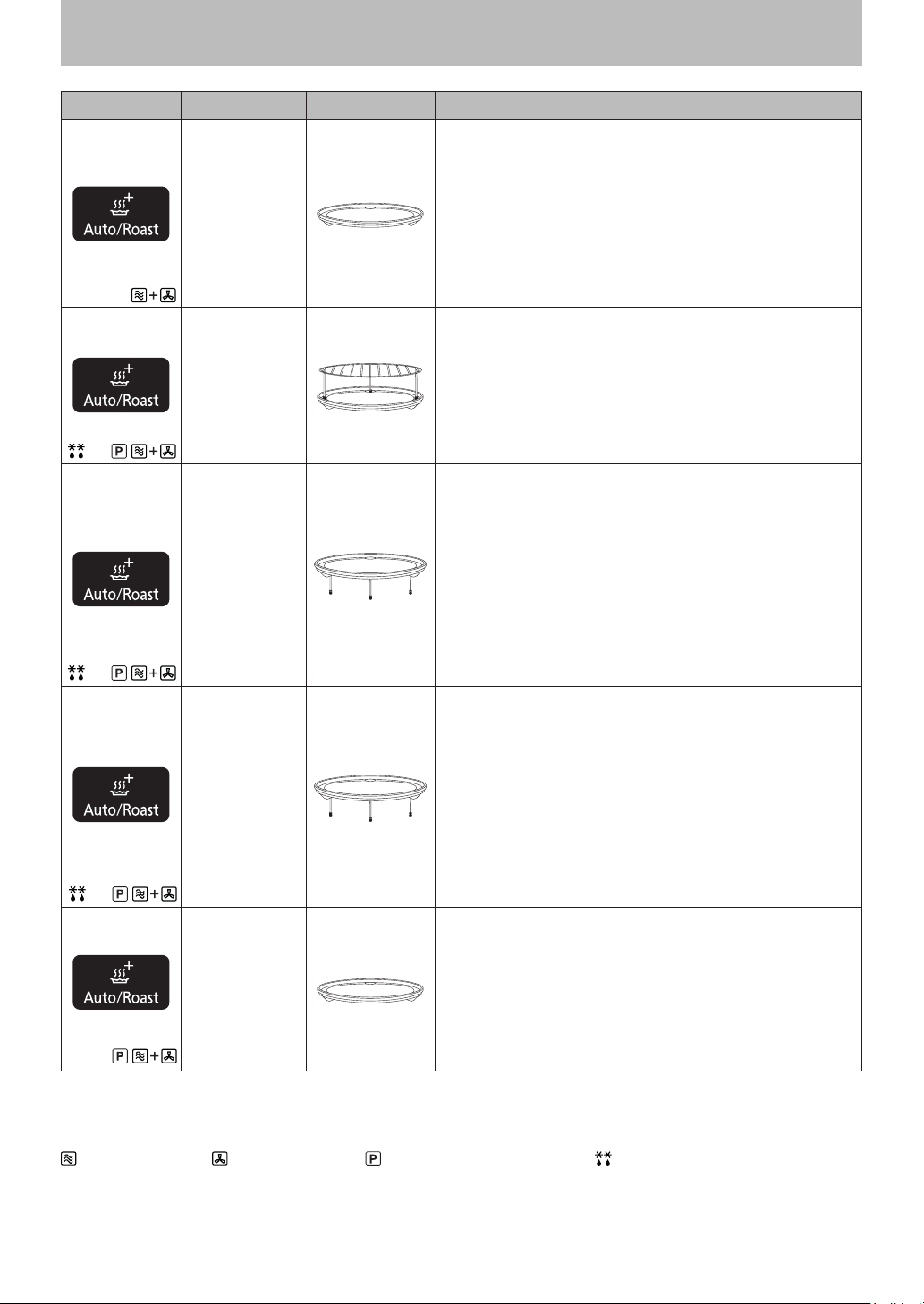
– 44 –
Auto/Roast Programs
Program Weight Accessory Instructions
20. Jacket
potatoes
1 Press
200 g - 1500 g
Tocookjacketpotatoeswithacrisperdrierskin.Choose
mediumsizedpotatoes200g - 250 g,forbestresults.
Washanddrypotatoesandprickwithaforkseveraltimes.
Placeonenameltrayonglasstray.PresstheAuto/Roast
padonce.Entertotalweightofpotatoes,thenpressStart.
21. Frozen
pizza
2 Presses
130 g - 450 g
Forreheatingandbrowningfrozen,purchasedpizza.
PresstheAuto/Roastpadtwice.PresstheStartpadto
preheattheoven.Afterpreheating,beepssoundand‘P’
willashinthedisplay.Removeallpackagingandplace
pizzaonwirerackonenameltrayonglasstray.Enter
weightandpressStart.
22. Frozen
potato
products
3 Presses
200 g - 500 g
Tocookfrozenpotatoproducts,e.g.hashbrowns,
croquettes,etc,.thataresuitableforgrilling.Pressthe
Auto/Roastpadthreetimes.PresstheStartpadto
preheattheoven.Afterpreheating,beepssoundand‘P’
willashinthedisplay.Spreadpotatoproductsouton
enameltrayonwirerackonglasstray.Entertheweight.
PressStart.Turn/Stiratbeeps.Forbestresultscookina
singlelayer.
Note:Potatoproductsvaryconsiderably.Wesuggest
checkingafewminutesbeforetheendofcookingto
assesslevelsofbrowning.
23. Fish and
chips
4 Presses
200 g - 500 g
Thisprogramissuitableforpre-purchasedfrozen
batteredorbreadedshandpre-purchasedfrozenoven
chips.Thisprogramissuitablefor1portionofshand
chips.Theshmustweighbetween100g - 250 g and the
chips must weigh between 100 g - 300 g.PresstheAuto/
Roastpadfourtimes.PresstheStartpadtopreheatthe
oven.Afterpreheating,beepssoundand‘P’willashin
thedisplay.Spreadtheshandchipsoutontheenamel
trayonwirerackonglasstray.Entertheweightofthesh
andchips.PressStart.Turn/Stiratthebeeps.Forbest
resultscookinasinglelayer.
24. Chicken
5 Presses
900 g - 2000 g
Tocookwholefreshunstuedchickens.Cookstung
separately.PressAuto/Roastpadvetimes.Pressthe
Startpadtopreheattheoven.Afterpreheating,beeps
soundand‘P’willashinthedisplay.Placechickenon
enameltrayandplaceonglasstray.Enterintheweight
ofthechicken,thenpressStart.Startcookingbreastside
down and turn at beeps,takingcarewithhotjuices.Stand
for5minutes.
=Microwave =Convection =Preheatingisrequired =frozen
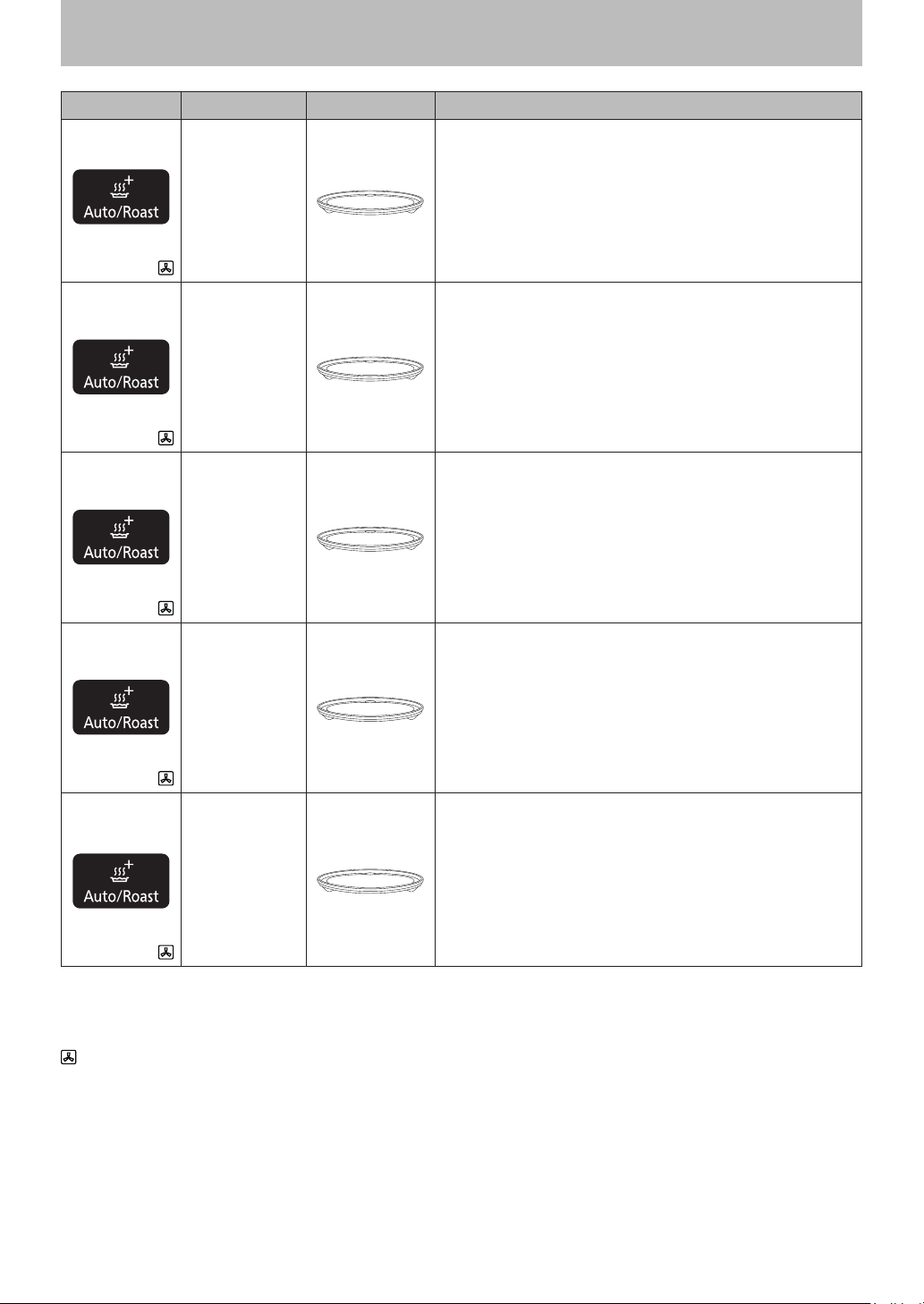
– 45 –
Auto/Roast Programs
(continued)
Program Weight Accessory Instructions
25. Beef rare
6 Presses
500 g - 2000 g
For cooking rare fresh roast beef (top side, rump or
silverside). Place on enamel tray on the glass tray. Press
the Auto/Roast pad six times, enter the weight of the food
and press Start. After cooking stand for 10 to 20 minutes.
26. Beef
medium
7 Presses
500 g - 2000 g
For cooking medium fresh roast beef (top side, rump or
silverside). Place on enamel tray on the glass tray. Press
the Auto/Roast pad seven times, enter the weight of the
food and press Start. After cooking stand for 10 to 20
minutes.
27. Beef well
done
8 Presses
500 g - 2000 g
For cooking well done fresh roast beef (top side, rump or
silverside). Place on enamel tray on the glass tray. Press
the Auto/Roast pad eight times, enter the weight of the
food and press Start. After cooking stand for 10 to 20
minutes.
28.Lamb
medium
9 Presses
1000 g - 2000 g
For cooking medium fresh roast leg of lamb with bone.
Place on enamel tray on the glass tray. Press the Auto/
Roast pad nine times, enter the weight of the food and
press Start. After cooking stand for 10 to 20 minutes.
29. Lamb well
done
10 Presses
1000 g - 2000 g
For cooking well done fresh roast leg of lamb with bone.
Place on enamel tray on the glass tray. Press the Auto/
Roast pad ten times, enter the weight of the food and
press Start. After cooking stand for 10 to 20 minutes.
= Convection
– 46 –
INGREDIENT CONVERSION CHART
INGREDIENT CONVERSION CHART
¼
cup 60 ml
¼
teaspoon 1 ml
⅓
cup 85 ml
½
teaspoon 2 ml
½
cup 125 ml 1 teaspoon 5 ml
⅔
cup 165 ml 2 teaspoons 10 ml
¾
cup 190 ml 3 teaspoons 15 ml
1 cup 250 ml 1 tablespoon 20 ml
1
¼
cups 310 ml 1
½
tablespoons 30 ml
1
½
cups 375 ml 2 tablespoons 40 ml
2 cups 500 ml 3 tablespoons 60 ml
3 cups 750 ml 4 tablespoons 80 ml
3
½
cups 875 ml
4 cups 1 litre
6 cups 1.5 litre
8 cups 2 litre
All recipes are tested using standard measurement that appear in the above chart.

– 47 –
Before Requesting Service
ALL THESE THINGS ARE NORMAL:
The oven causes
interference with my TV.
Some radio, TV, Wi-Fi, cordless telephone, baby monitor, blue tooth
or other wireless equipment interference might occur when you cook
with the oven. This interference is similar to the interference caused
by small appliances such as mixers, vacuums, blow dryers, etc. It
does not indicate a problem with your oven.
Steam accumulates on the
oven door and warm air comes
from the oven vents.
During cooking, steam and warm air are given off from the food.
Most of the steam and warm air are removed from the oven by the
air which circulates in the oven cavity. However, some steam will
condense on cooler surfaces such as inside and/or on the oven door.
This is normal and safe. Steam will disappear after the oven is cool
down.
I accidentally operate my
microwave oven without any
food in it.
Operating the oven empty for a short time will not damage the oven.
However, we do not recommend this to be done.
There are humming and
clicking noises from my oven
when I cook by Combination.
These noise occur as the oven automatically switches from
microwave power to Convection/Grill to create the combination
setting.
The oven has an odour and
generates smoke when using
Combination, Convection and
Grill function.
It is essential that your oven is wiped out regularly particularly after
cooking by Combination, Convection and Grill function. Any fat and
grease that builds up on the roof and walls of the oven will begin to
smoke if not cleaned.
Some smoke will be given
off from the cavity when
using Grill, Combination, or
Convection for the first time.
It caused by the excessive oil in the cavity and oil used for rust
protection volatilizing.
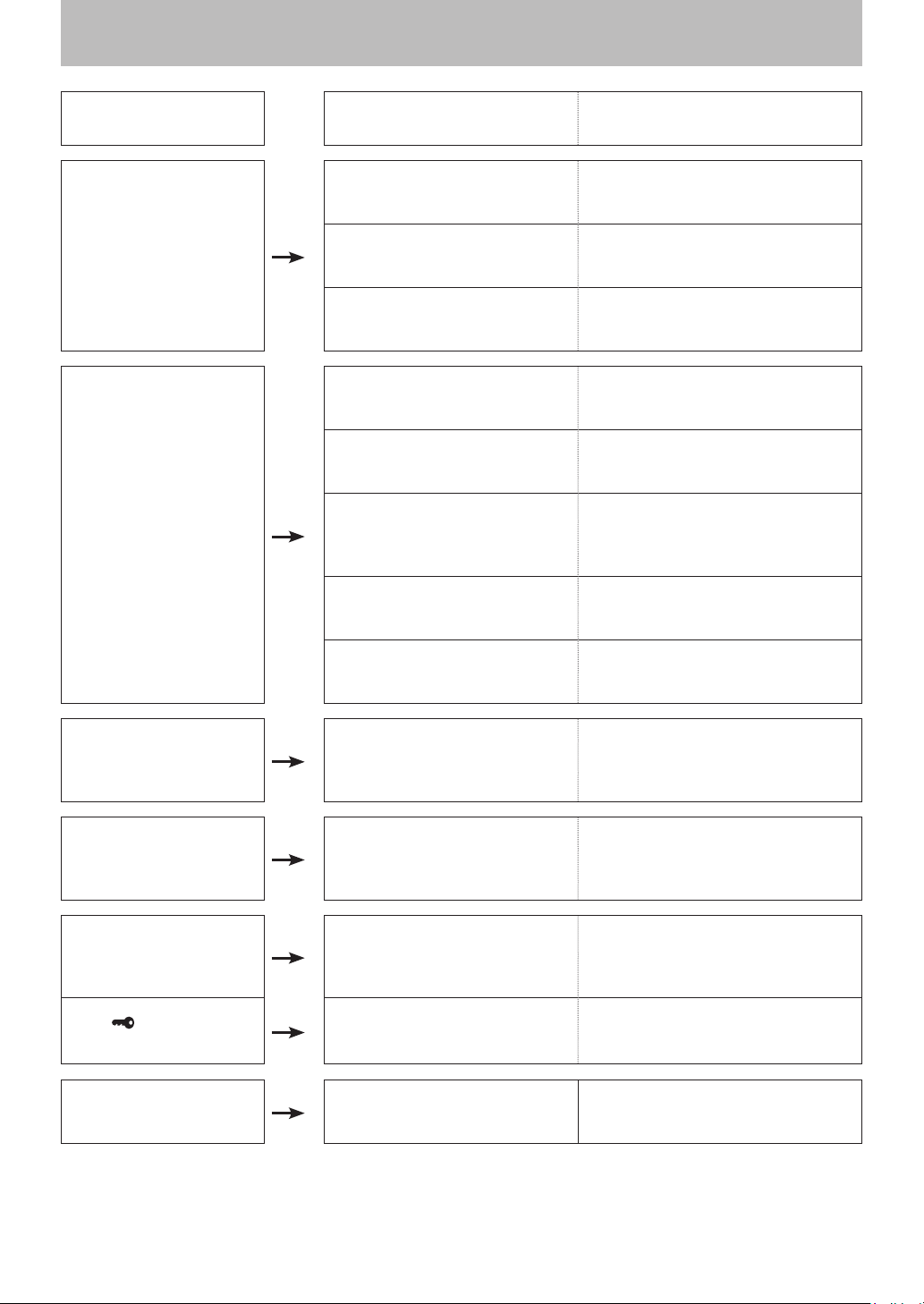
– 48 –
Before Requesting Service
(continued)
PROBLEM POSSIBLE CAUSE REMEDY
Oven will not turn on.
The oven is not plugged in
securely.
Remove plug from outlet, wait
10 seconds and re-insert.
Circuit Breaker or fuse is tripped
or blown.
Reset circuit breaker or replace fuse.
There is a problem with the
outlet.
Plug another appliance into the outlet
to check if the outlet is working.
Oven will not start
cooking.
The door is not closed
completely.
Close the oven door securely.
Start pad was not pressed after
programming.
Press Start pad.
Another program has already
been entered into the oven.
Press Stop/Cancel pad to cancel
the previous program and program
again.
The program has not been
entered correctly.
Program again according to the
Operating Instructions.
Stop/Cancel pad has been
pressed accidentally.
Program oven again.
When the oven is turning
on, there is noise coming
from Glass Tray.
The roller ring and oven bottom
are dirty.
Clean these parts according to care
of your oven (See next page).
“H97” or “H98”, “H00”
appears in the display
window.
This display indicates a problem
with the microwave generation
system.
Contact the authorised service
centre.
“DEMO MODE PRESS
ANY KEY” or “D” appears
in the display window.
The oven is under demonstration
mode.
Press Micro Power pad once, then
press Start pad 4 times and Stop/
Cancel pad 4 times.
The “
” appears in the
Display Window.
The Child Lock was activated by
pressing Start pad 3 times.
Deactivate Lock by pressing Stop/
Cancel pad 3 times.
“COOL” appears in the
display window.
The fan is operating to cool the
electric components.
The word “COOL” will disappear after
the fan stops.
Demonstration mode is designed for retail store display. Cooking and other functions will not operate during the
demonstration mode. If it seems there is a problem with the oven, contact an authorized Service Centre.
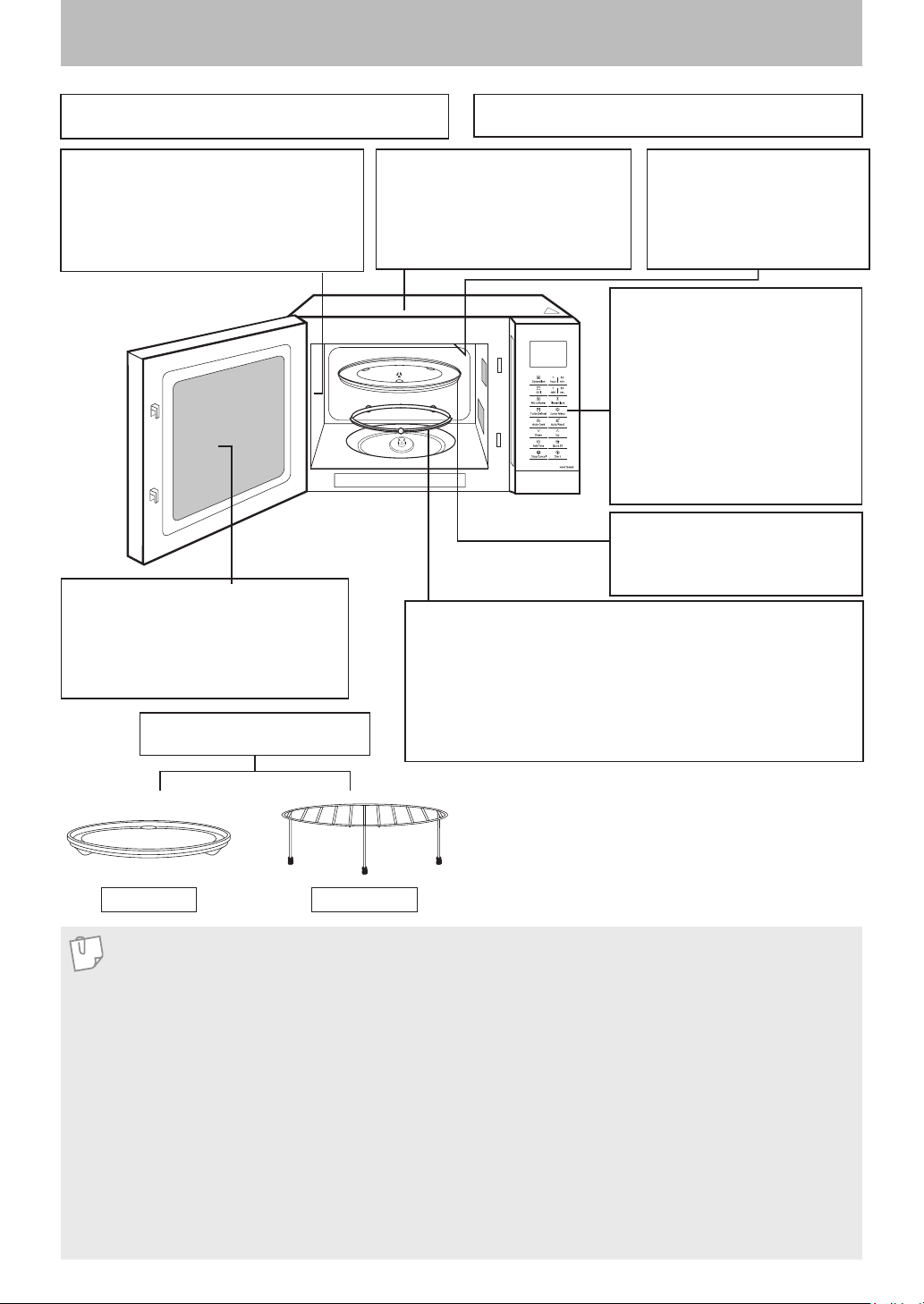
– 49 –
Care of your Microwave Oven
Turn the oven off and remove the power plug from
the wall socket before cleaning.
If steam accumulates inside or around
the outside of the oven door, wipe with
a soft cloth. This may occur when the
microwave oven is operated under
high humidity conditions and in no way
indicates malfunction of the unit.
Enamel Tray Wire Rack
The outside oven surfaces should
be cleaned with a damp cloth. To
prevent damage to the operating
parts inside the oven, water
should not be allowed to seep into
the ventilation openings.
Do not allow the Control Panel
to become wet. Clean with a
soft, damp cloth. Do not use
detergents, abrasives or spray on
cleaners on the Control Panel.
When cleaning the Control Panel,
leave oven door open to prevent
oven from accidentally turning
on. After cleaning press Stop/
Cancel pad to clear display
window.
Clean the upper heater after
it is completely cold. Wipe
with a soft and damp cloth
carefully to avoid breaking
the heater and hurting your
fingers by the broken heater.
After using, clean it with a mild
detergent.
Note
1. When using the Grill, Convection or Combination mode, some foods may inevitably splatter grease
on to the oven walls. If the oven is not cleaned, occasionally it may start to “smoke” during use. These
marks will be more difficult to clean later.
2. After Grill, Convection or Combination cooking, the ceiling and walls of the oven should be cleaned
with a soft cloth squeezed in soapy water. Particular care should be taken to keep the window
area clean particularly after cooking by Grill, Combination. Stubborn spots inside the oven can be
removed by using a small amount of microwave oven cleaner sprayed onto a soft damp cloth. Wipe
onto problem spots, leave for recommended time and then wipe off. This method can not be used to
clean the oven door.
DO NOT SPRAY DIRECTLY INSIDE THE OVEN.
A steam cleaner is not to be used for cleaning.
3. Failure to maintain the oven in a clean condition could lead to deterioration of the surface that could
adversely affect the life of the appliance and possibly result in a hazardous situation.
4. When it becomes necessary to replace the oven light, please consult the service center specified by
Panasonic.
The oven should be cleaned regularly and any food
deposits removed.
It is occasionally necessary
to remove the glass tray for
cleaning. Wash the tray in warm
sudsy water.
The roller ring and oven cavity floor should be cleaned
regularly to avoid excessive noise. Simply wipe the bottom
surface of the oven with mild detergent, water or window
cleaner and dry. The roller ring may be washed in mild sudsy
water or dish washer. Cooking vapors collect during repeated
use but in no way affect the bottom surface or roller ring
wheels. When removing the roller ring from cavity floor for
cleaning, be sure to replace in the proper position.
Keep the inside of the oven clean. When
food splatters or spilled liquids adhere to
oven walls, wipe with a damp cloth. Mild
detergent may be used if the oven gets
very dirty. The use of harsh detergent or
abrasives is not recommended.
– 50 –
Technical Specications
Model
NN-CT56MB
Power Supply: 230 - 240 V, 50 Hz
Power Consumption*: Microwave 4.7 A 1090 W
Grill 5.8 A 1370 W
Combination 8.8 A 2100 W
Convection 5.8 A 1390 W
Power Requirement: (Maximum) 2380 W
Output power*: Microwave 1000 W
Grill 1300 W
Convection 1300 W
Outside Dimensions (W × H × D): 520 mm × 310 mm × 395 mm
Oven Cavity Dimensions (W × H × D): 359 mm × 217 mm × 352 mm
Overall Cavity Volume: 27 L
Operating Frequency: 2450 MHz
Uncrated Weight: Approx. 13.8 kg
* IEC Test Procedure
Specifications subject to change without notice.
As for the voltage requirement, the production date, manufactory and serial number, please refer to the name
plate on the microwave oven.
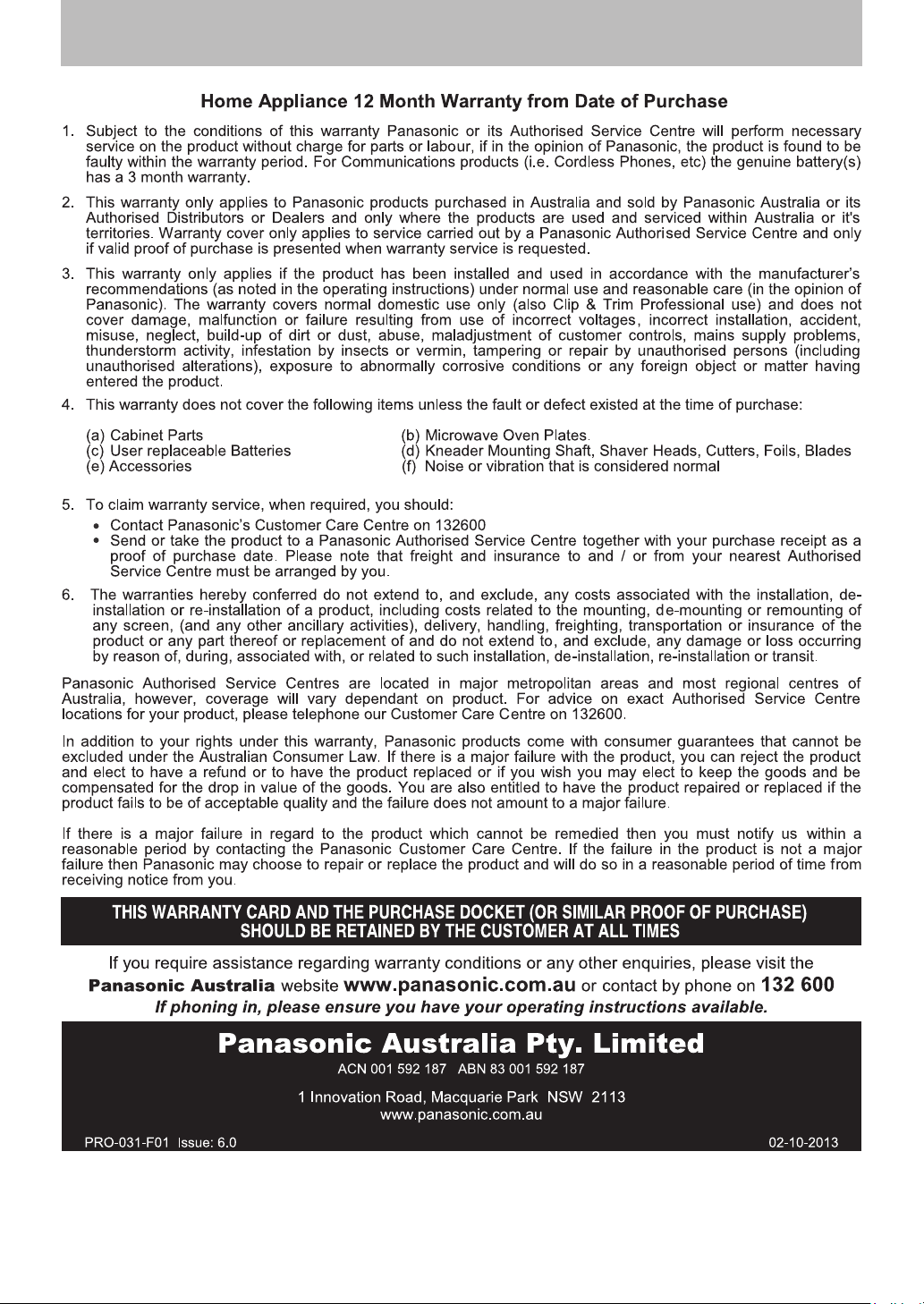
– 51 –
Panasonic Warranty
(for Australia)
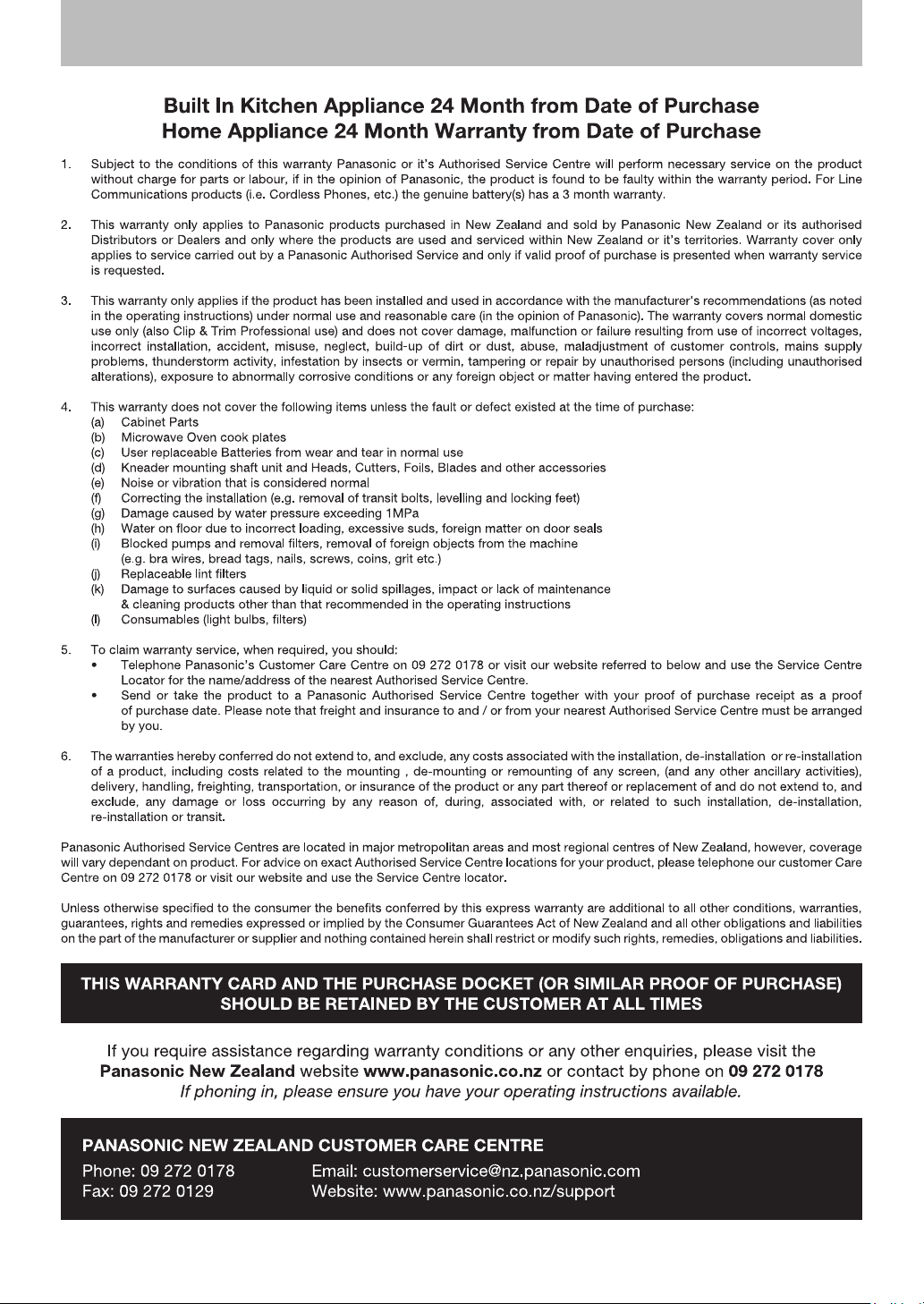
– 52 –
Panasonic Warranty
(for New Zealand)

Most foods reheat very quickly in your oven by
1000 W. Meals can be brought back to serving
temperature in just minutes and will taste freshly
cooked. Always check food is piping hot and return
to oven if necessary.
As a general rule, always cover wet foods, e.g.
soups, casseroles and plated meals.
Do not cover dry foods e.g. bread rolls, mince pies,
sausage rolls etc.
The charts on
pages 54-67 show you the best
way to cook or reheat your favourite foods. The
best method depends on the type of food you are
cooking or reheating.
Remember to stir or turn food wherever possible
during cooking or reheating.
This ensures even cooking or reheating on the
outside and in the centre.
When is Food Reheated?
Food that has been reheated or cooked should
be served piping hot i.e. steam should be visibly
emitted from all parts. As long as good hygiene
practices have been followed during the prepa-
ra tion and storage of the food, then cooking or
reheating presents no safety risks.
Foods that cannot be stirred should be cut with
a knife to test that they are adequately heated
throughout. Even if a manufac tur er’s instructions
or the times in the cookbook have been followed,
it is still important to check the food is heated
thoroughly. If in doubt, always return to the oven for
further reheating. If you cannot find the equivalent
food in the chart then choose a similar type and
size listed and adjust the cooking time if necessary.
Plated Meals
Everyone’s appetite varies and reheat times depend
on meal contents. Dense items e.g. mashed potato,
should be spread out well. If a lot of gravy is added,
extra time may be required. Place denser items to
the outside of the plate. An average plated meal will
take 4-5 minutes on 1000 W to reheat. Do not stack
meals.
Canned Foods
Remove foods from can and place in a suitable
dish before heating.
Soups
Place soup in a bowl. Stir before heating and at
least once during reheat time and again at the end.
Casseroles
Stir halfway through and again at the end of
heating.
Caution!
Mince Pies
Remember even if the pastry is cold to the touch,
the filling will be piping hot and will warm the pastry
through. Take care not to overheat otherwise
burning can occur due to the high fat and sugar
content of the filling. Check the temperature of
the filling before consuming to avoid burning your
mouth.
Christmas Puddings and Liquids
Take great care when reheating these items.
Do not leave unattended.
Do not add extra alcohol.
Babies Bottles
Milk or formula must be shaken thoroughly before
heating and again at the end and tested carefully
before feeding a baby. For 7-8 fl. oz. of milk from
fridge temperature, remove top and teat. Heat on
1000 W for 20-30 seconds. Check carefully.
For 3 fl. oz. of milk from fridge temperature, remove
top and teat. Heat on 1000 W for 10-20 seconds.
Check carefully.
Liquid at the top of bottle will be much hotter
than at the bottom. The bottle must be shaken
thoroughly and tested before use.
We do not recommend that you use your
microwave to sterilise babies’ bottles. If you
have a special microwave steriliser we urge
extreme caution, due to the low quantity of water
involved. It is vital to follow the manufacturers
instructions implicitly.
– 53 –
Cooking and Reheating Guidelines
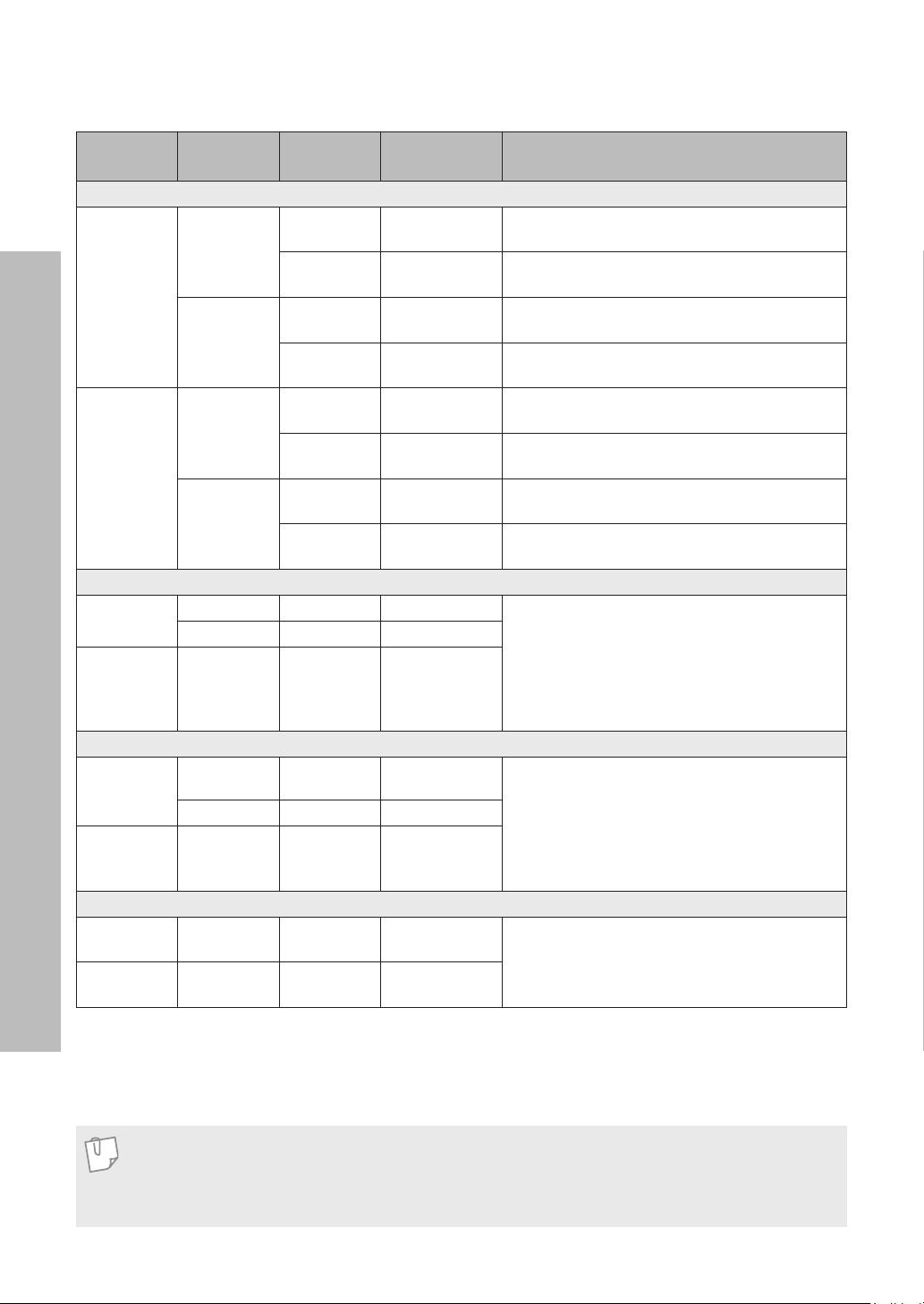
The times given in the charts below are a guideline only, and will vary depending on starting temperature,
dish size etc.
Food
Weight/
Quantity
Power
Level
Time to Select
(approx)
Instructions/Guidelines
Bread – Precooked – Fresh – N.B. Breads reheated by microwave will have a soft base.
Croissants
1
1000 W 10-20 secs
Place on micro-safe plate on glass tray. Do
not cover.
or Grill 1 2-3 mins
Place on micro-safe plate on glass tray. Do
not cover.
4
1000 W 30-40 secs
Place on micro-safe plate on glass tray. Do
not cover.
or Grill 1 3-5 mins
Place on micro-safe plate on glass tray. Do
not cover
Rolls
1
1000 W 10-20 secs
Place on micro-safe plate on glass tray. Do
not cover.
or Grill 1 3-4 mins
Place on micro-safe plate on glass tray. Do
not cover.
4
1000 W 30-40 secs
Place on micro-safe plate on glass tray. Do
not cover.
or Grill 1 3-4 mins
Place on micro-safe plate on glass tray. Do
not cover.
Canned beans, pasta
Baked
beans
220 g 1000 W 2 mins
Place in a micro-safe bowl on glass tray.
Cover.
415 g 1000 W 3 mins
Baked
beans &
sausages/
burgers
415 g 1000 W 3-4 mins
Canned beans, pasta
Ravioli in
sauce
200 g 1000 W 2 mins 30 secs
Place in a micro-safe bowl on glass tray.
Cover.
400 g 1000 W 3-4 mins
Spaghetti
in tomato
sauce
200 g 1000 W
1 min 30 secs -
2 mins
Canned meat
Hot dogs
(drained)
400 g 1000 W 2-3 mins
Place in a micro-safe bowl on glass tray.
Cover.
Stewed
steak
400 g 1000 W 3-4 mins
Notes
Always check that food is piping hot after reheating in the microwave. If unsure return to oven.
Foods will still require a stand time, especially if they cannot be stirred. The denser the food the
longer the stand time.
– 54 –
Reheating Charts
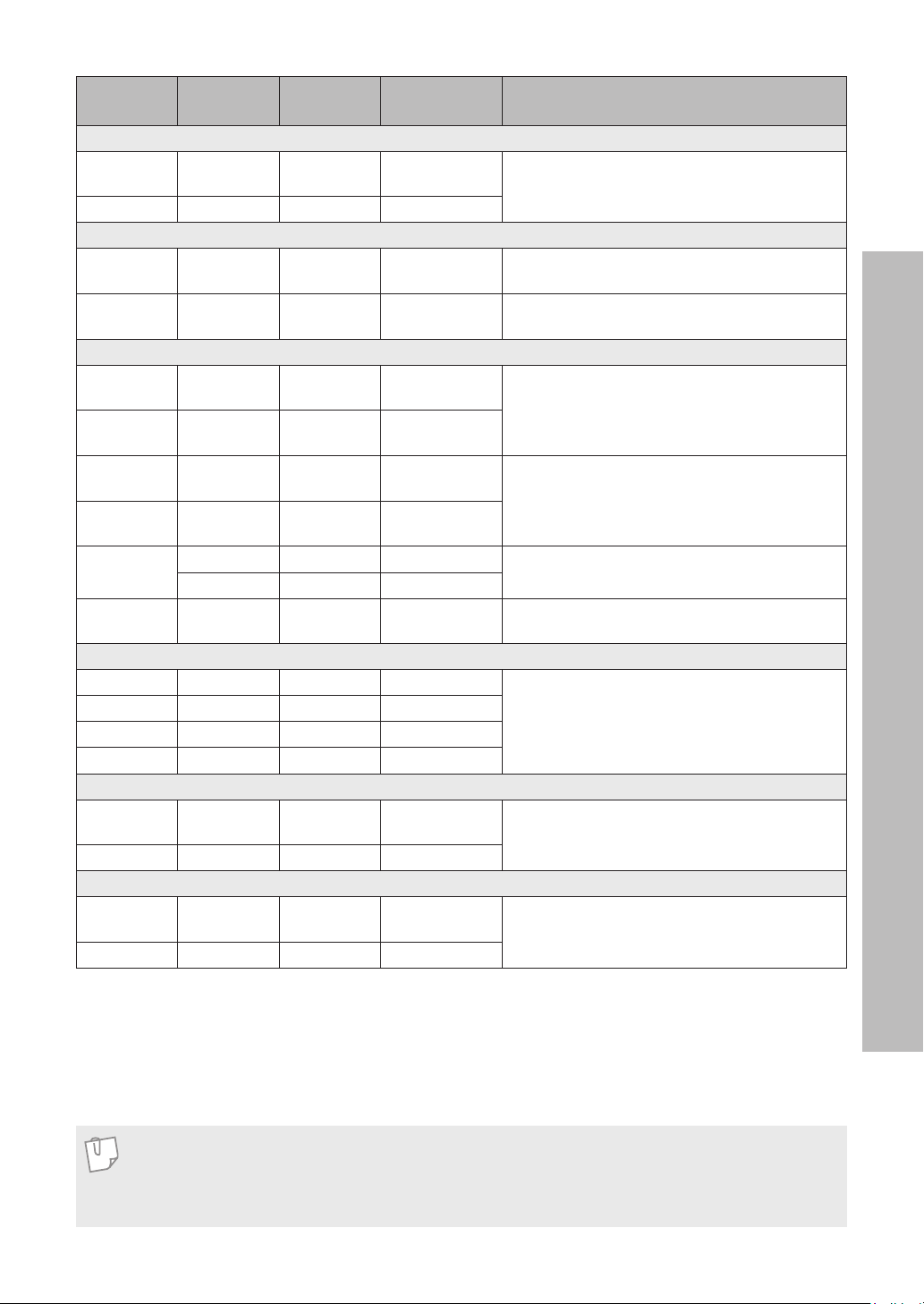
Food
Weight/
Quantity
Power
Level
Time to Select
(approx)
Instructions/Guidelines
Canned soups
Cream of
mushroom
400 g 1000 W 3-4 mins
Place in a micro-safe bowl on glass tray.
Cover. Stir halfway.
Minestrone 400 g 1000 W 2 mins 30 secs
Canned puddings
Custard 400 g 1000 W 2 mins
Place in a micro-safe bowl on glass tray.
Cover. Stir halfway.
Sponge
pudding
400 g 1000 W 2 mins 30 secs
Place in a micro-safe bowl on glass tray.
Cover.
Canned vegetables - Drain where appropriate
Carrots,
whole
300 g 1000 W 2 mins
Place in a micro-safe bowl on glass tray.
Cover. Stir halfway.
Peas,
mushy
300 g 1000 W 2 mins
Peas,
garden
290 g 1000 W
2 mins -
2 mins 30 secs
Place in a micro-safe bowl on glass tray.
Cover.
Potatoes
new
567 g 1000 W 4 mins
Sweetcorn
198 g 1000 W 1 min 30 secs
Place in a micro-safe bowl on glass tray.
Cover. Stir halfway.
325 g 1000 W 2-3 mins
Tomatoes,
whole
400 g 1000 W 3 mins 30 secs
Place in a micro-safe bowl on glass tray.
Cover.
Christmas puddings – do not leave unattended as overheating can cause the food to ignite
Mini 100 g 1000 W 30 secs
Place in a micro-safe dish on glass tray.
Cover.
Small 454 g 1000 W 2 mins
Medium 907 g 1000 W 3 mins
Large 1.1 kg 1000 W 3 mins 30 secs
Drinks — Coffee - at room temperature
1 mug 235 ml 1000 W
1 min 30 secs -
2 mins
Place in a micro-safe mug on glass tray.
2 mugs 470 ml 1000 W 2 mins 30 secs
Drinks — Milk - from the fridge
1 mug 235 ml 600 W
2 mins-
2 mins 30 secs
Place in a micro-safe mug or jug on glass tray.
1 jug 600 ml
600 W 4-5 mins
Notes
Always check that food is piping hot after reheating in the microwave. If unsure return to oven.
Foods will still require a stand time, especially if they cannot be stirred. The denser the food the
longer the stand time.
– 55 –
Reheating Charts

Food
Weight/
Quantity
Power
Level
Time to Select
(approx)
Instructions/Guidelines
Homemade meat dishes
Casserole
for 2
700 g 1000 W 6-8 mins
Place in a micro-safe dish on glass tray.
Cover. Stir halfway.
Casserole
for 4
1 kg 1000 W 10-15 mins
Bolognese
sauce
250 g 1000 W 3 mins
1 kg 1000 W 8 mins
Pastry products – precooked – N.B. Pastries reheated by microwave will have a soft base. For
combination cooking, if pie comes in foil container place directly onto enamel tray.
Cornish
pastie
140 g (1)
1000 W 1-2 mins
Place in micro-safe dish on glass tray. Do not
cover.
or Combi
200 °C +
100 W
7-9 mins
Place on wire rack on enamel tray on glass
tray. Do not cover.
300 g (2)
1000 W 2-3 mins
Place in micro-safe dish on glass tray. Do not
cover.
or Combi
200 °C +
100 W
8-10 mins
Place on wire rack on enamel tray on glass
tray. Do not cover.
Pastry products – precooked – N.B. Pastries reheated by microwave will have a soft base. If pie
comes in foil container place directly onto enamel tray.
Meat pies 300 g (2)
Combi
200 °C +
300 W
6-7 mins
Place on enamel tray on glass tray
Steak and
kidney
Shortcrust
pie
210 g (1)
Combi
200 °C +
100 W
12 mins
Quiche 400 g (1)
1000 W 3-4 mins
Place in micro-safe dish on glass tray. Do not
cover.
or Combi
220 °C +
300 W
7-8 mins
Place on wire rack on enamel tray on glass
tray. Do not cover.
Sausage roll 330 g (2)
Combi
220 °C +
100 W
9-10 mins
Xmas mince
pies
110 g (2) 1000 W 10-20 secs
Place in micro-safe dish on glass tray. Do not
cover.
Notes
Always check that food is piping hot after reheating in the microwave. If unsure return to oven.
Foods will still require a stand time, especially if they cannot be stirred. The denser the food the
longer the stand time.
– 56 –
Reheating Charts
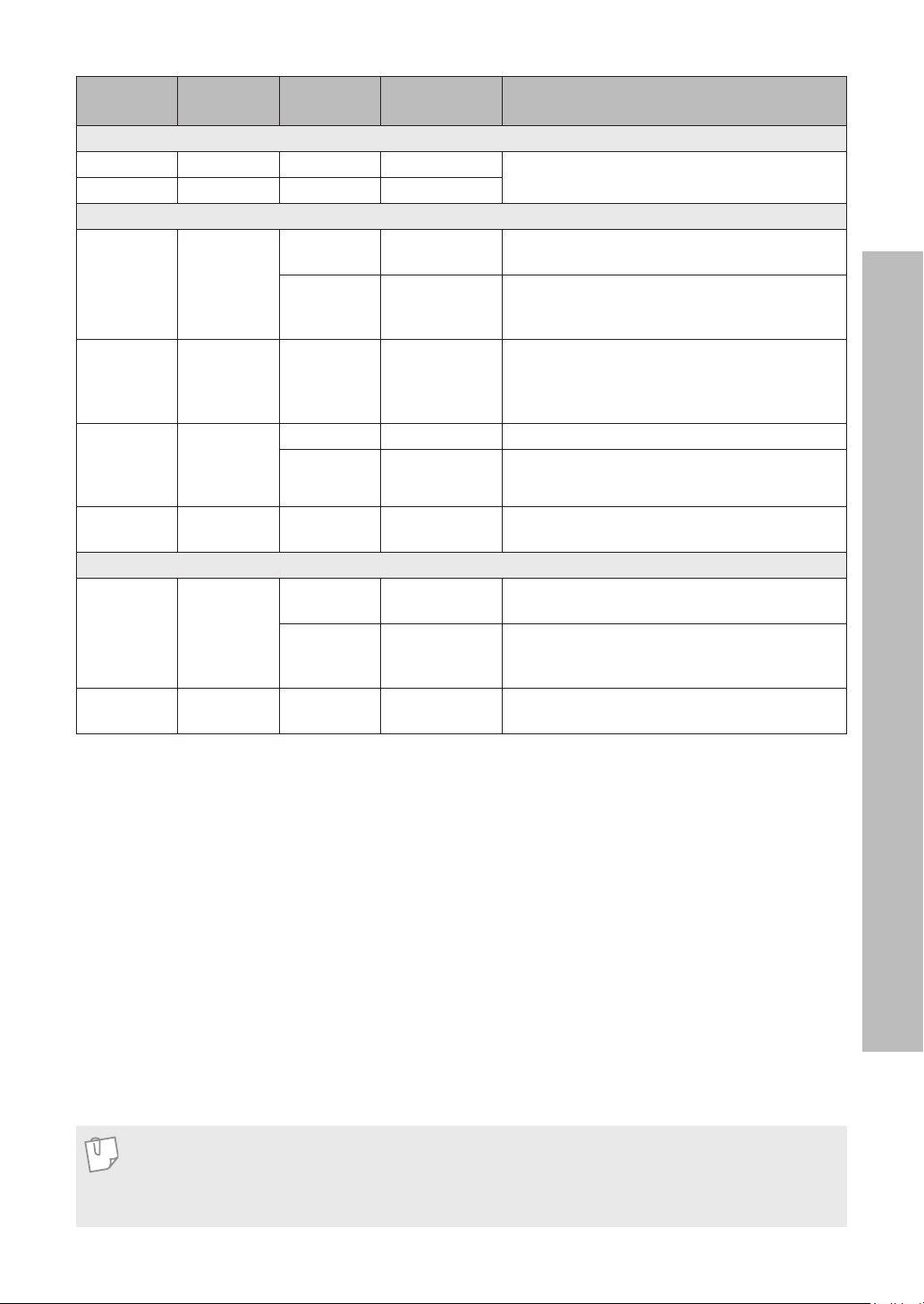
Food
Weight/
Quantity
Power
Level
Time to Select
(approx)
Instructions/Guidelines
Plated meals – homemade – chilled
Child size 1 1000 W 2-3 mins
Place on a micro-safe plate on glass tray.
Cover.
Adult size 1 1000 W 4-5 mins
Puddings and desserts- Transfer puddings to a micro-safe/heatproof dish
Apple pie
(chilled)
700 g
1000 W 3-4 mins
Place in micro-safe dish on glass tray. Do not
cover.
or Combi
220 °C
+ 100 W
13-14 mins
Place on enamel tray on glass tray. Do not
cover.
Apple and
blackcurrant
pies (room
temperature)
x 6
Convection
220°C
6-7 mins
Place in foil cases on wire rack on enamel tray
on glass tray. Do not cover.
Bread
and butter
pudding
(chilled)
500 g
1000 W 3-4 mins Place on glass tray. Do not cover.
or 220 °C +
100 W
15-17 mins
Place on enamel tray on glass tray. Do not
cover.
Custard
(chilled)
300 ml 1000 W
2 mins -
2 mins 30 secs
Place in large jug. Stir during reheating.
Puddings and desserts – Transfer puddings to a micro-safe/heatproof dish
Fruit
crumble
(chilled)
500 g
1000 W
2 mins -
2 mins 30 secs
Place on glass tray. Do not cover.
or Combi
220 °C +
100 W
10-15 mins
Place on enamel tray on glass tray. Do not
cover.
Jam roly
poly (chilled)
480 g 1000 W 2-4 mins Place on glass tray. Do not cover.
Notes
Always check that food is piping hot after reheating in the microwave. If unsure return to oven.
Foods will still require a stand time, especially if they cannot be stirred. The denser the food the
longer the stand time.
– 57 –
Reheating Charts
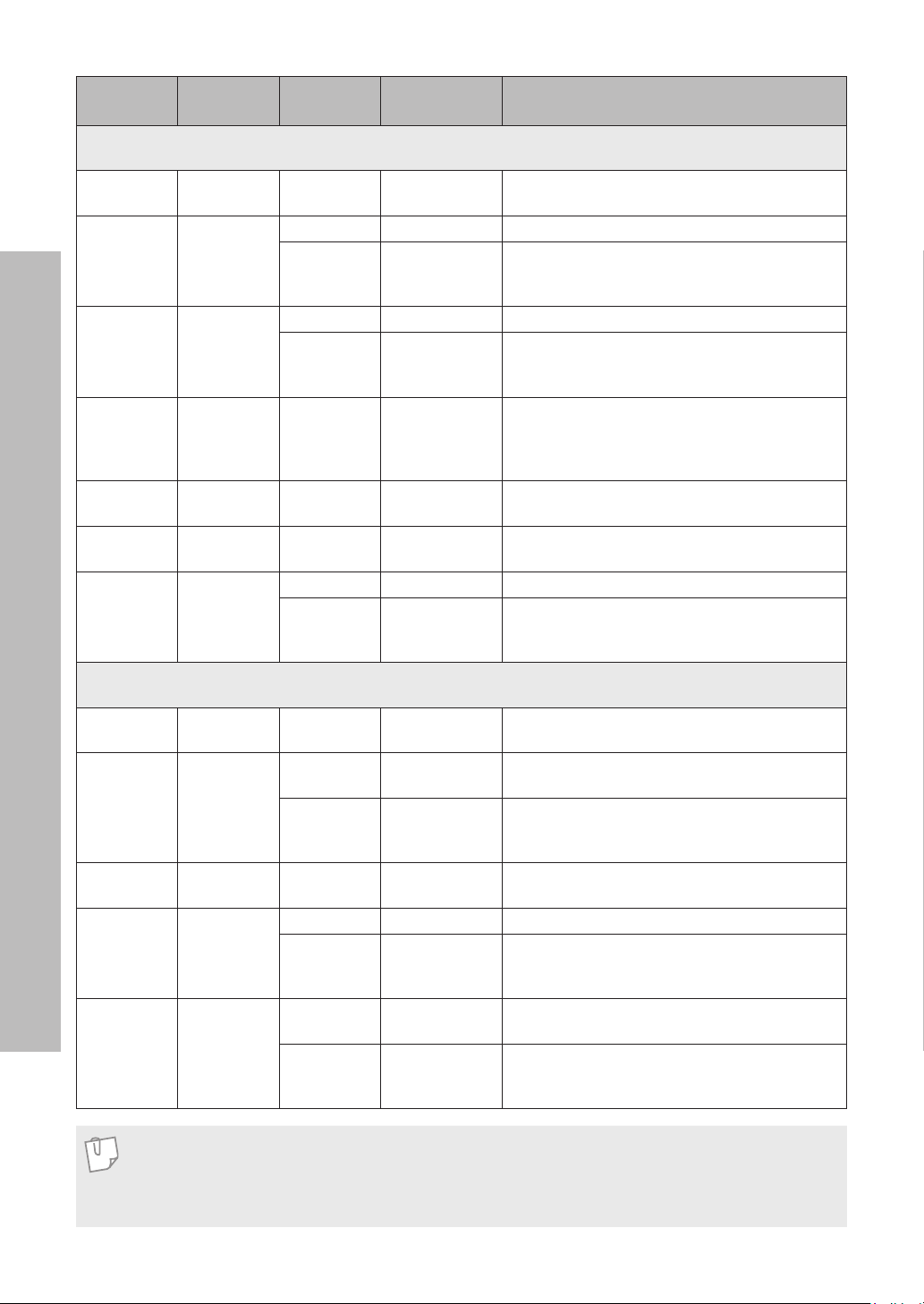
Food
Weight/
Quantity
Power
Level
Time to Select
(approx)
Instructions/Guidelines
Purchased convenience foods – chilled N.B. Transfer food from foil container to a similar sized
micro-safe/heatproof dish.
Breaded
mushrooms
300 g
Convection:
220 °C
13-15 mins
Place on enamel tray on wire rack on glass
tray.
Cottage pie 400 g
1000 W 4-5 mins Place on glass tray. Uncovered.
or Combi
220 °C +
300 W
13-15 mins
Place on enamel tray on glass tray. Do not
cover.
Lasagne 400 g
600 W 5-7 mins Place on glass tray. Uncovered.
or Combi
200 °C +
440 W
11-13 mins
Place on enamel tray on glass tray. Do not
cover.
Onion
bhajis,
pakora &
felafel
360 g (12)
Convection:
220 °C
10-12 mins
Place on enamel tray on wire rack on glass
tray. Turn halfway.
Spring rolls
or samosas
240 g
Convection:
220 °C
13-15 mins
Place on wire rack on enamel tray on glass
tray. Turn halfway.
Potato
wedges
385 g
Convection:
220 °C
10-15 mins
Place on enamel tray on wire rack on glass
tray. Turn halfway.
Vegetable
bake
450 g
1000 W 6-8 mins Place on glass tray.
or Combi
200 °C +
300 W
12-14 mins
Place on enamel tray on glass tray. Do not
cover.
Purchased convenience foods – frozen – N.B. Transfer food from foil container to a similar sized micro-safe/
heatproof dish. Plastic dishes designed for microwave and conventional ovens may be used with care.
Golden
drummers
340 g (6) Grill 1 16-18 mins
Place on enamel tray on wire rack on glass
tray. Turn halfway.
Lasagne 400 g
270 W then
1000 W
4 mins
8-9 mins
Place on glass tray.
or Combi
220 °C +
300 W
18-20 mins Place on enamel tray on glass tray.
Breaded
onion rings
250 g Grill 1 10-12 mins
Place on enamel tray on wire rack on glass
tray. Turn halfway.
Fish pie 340 g
1000 W 7-8 mins Place on glass tray.
or Combi
220 °C +
300 W
15-17 mins
Place on enamel tray on glass tray.
Shepherd’s
pie
400 g
270 W then
1000 W
5 mins
6-8 mins
Place on glass tray.
or Combi
220 °C +
300 W
20-22 mins Place on enamel tray on glass tray.
Notes
Always check that food is piping hot after reheating in the microwave. If unsure return to oven.
Foods will still require a stand time, especially if they cannot be stirred. The denser the food the
longer the stand time.
– 58 –
Reheating Charts
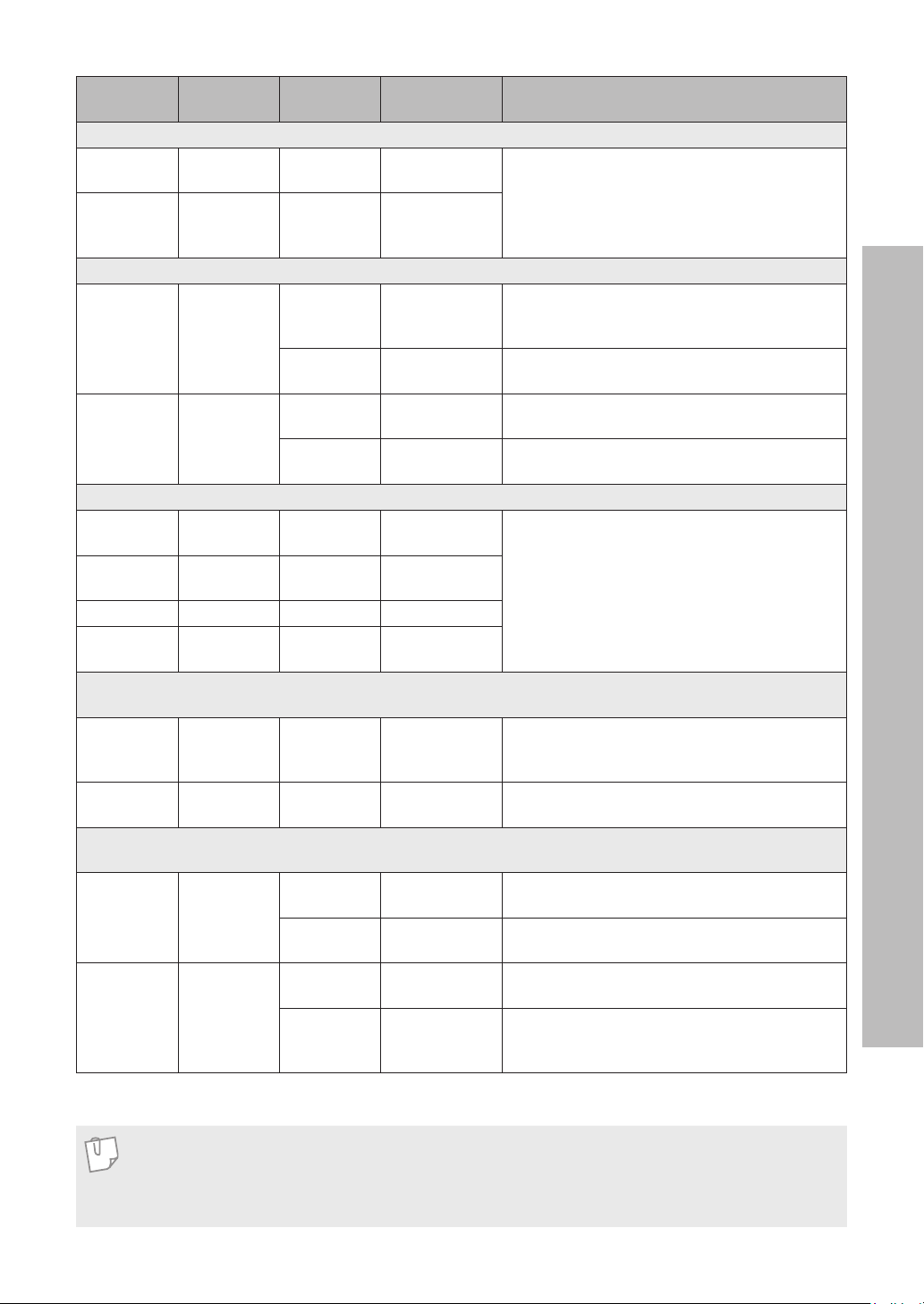
Food
Weight/
Quantity
Power
Level
Time to Select
(approx)
Instructions/Guidelines
Bread – Frozen
Part-baked
rolls
200 g (4)
Combi 220 ° C
+ 300 W
8-12 mins
Place on enamel tray on glass tray.
Part-baked
garlic
baguette
170 g (1)
Combi 220 ° C
+ 300 W
8-10 mins
Bacon – from raw
Rashers 300 g (8)
1000 W
4-6 mins or
1 min
per rasher
Place on micro-safe rack or plate on glass
tray and cover with kitchen towel to minimise
splatter.
or Grill 1 11-13 mins
Place on enamel tray on wire rack on glass
tray. Turn halfway.
Steaks 250 g (2)
1000 W 4-5 mins
Place on micro-safe rack or plate on glass
tray. Cover.
or Grill 1 28-30 mins
Place on wire rack on enamel tray on glass
tray. Turn halfway.
Beans & pulses – should be pre-soaked (except lentils)
Black eyed
beans
225 g
1000 W
then 300 W
10 mins
25-30 mins
Use 600 ml boiling water in a large bowl.
Cover.
Chick peas 225 g
1000 W
then 300 W
10 mins
40 mins
Lentils 225 g 600 W 10-15 mins
Red kidney
beans
225 g
1000 W
then 300 W
15 mins
35-40 mins
Beef - Joints from raw – Caution: Hot fat! Remove dish with care. For Guidelines see Meat chapter
page 74.
Topside,
Forerib,
Sirloin
-
Combi:
170 °C +
300 W
14-16 min
per 450 g
Place on an upturned saucer on enamel tray
on glass tray. Turn halfway.
Mince 450 g
1000 W
then 600 W
10 mins
15 mins
Place in micro-safe dish with stock and
seasonings on glass tray. Stir halfway. Cover.
Beef - Joints from raw – Caution: Hot fat! Remove dish with care. For Guidelines see Meat chapter
page 74.
Rump/
sirloin
380 g (2)
600 W 3-5 mins
Place on micro-safe rack or plate on glass
tray. Cover.
or Grill 1 12-14 mins
Place on wire rack on enamel tray on glass
tray. Turn halfway.
Stewing
steak
450 g
- 675 g
1000 W
then 300 W
10 mins
60 mins
Place in micro-safe dish with stock and
vegetables on glass tray. Stir halfway. Cover.
or Combi:
160 °C +
100 W
1 hr 10 mins -
1 hr 40 mins
Place in casserole dish with stock and
vegetables with lid on enamel tray on glass
tray. Stir halfway.
Notes
Always check that food is piping hot after reheating in the microwave. If unsure return to oven.
Foods will still require a stand time, especially if they cannot be stirred. The denser the food the
longer the stand time.
– 59 –
Cooking Charts
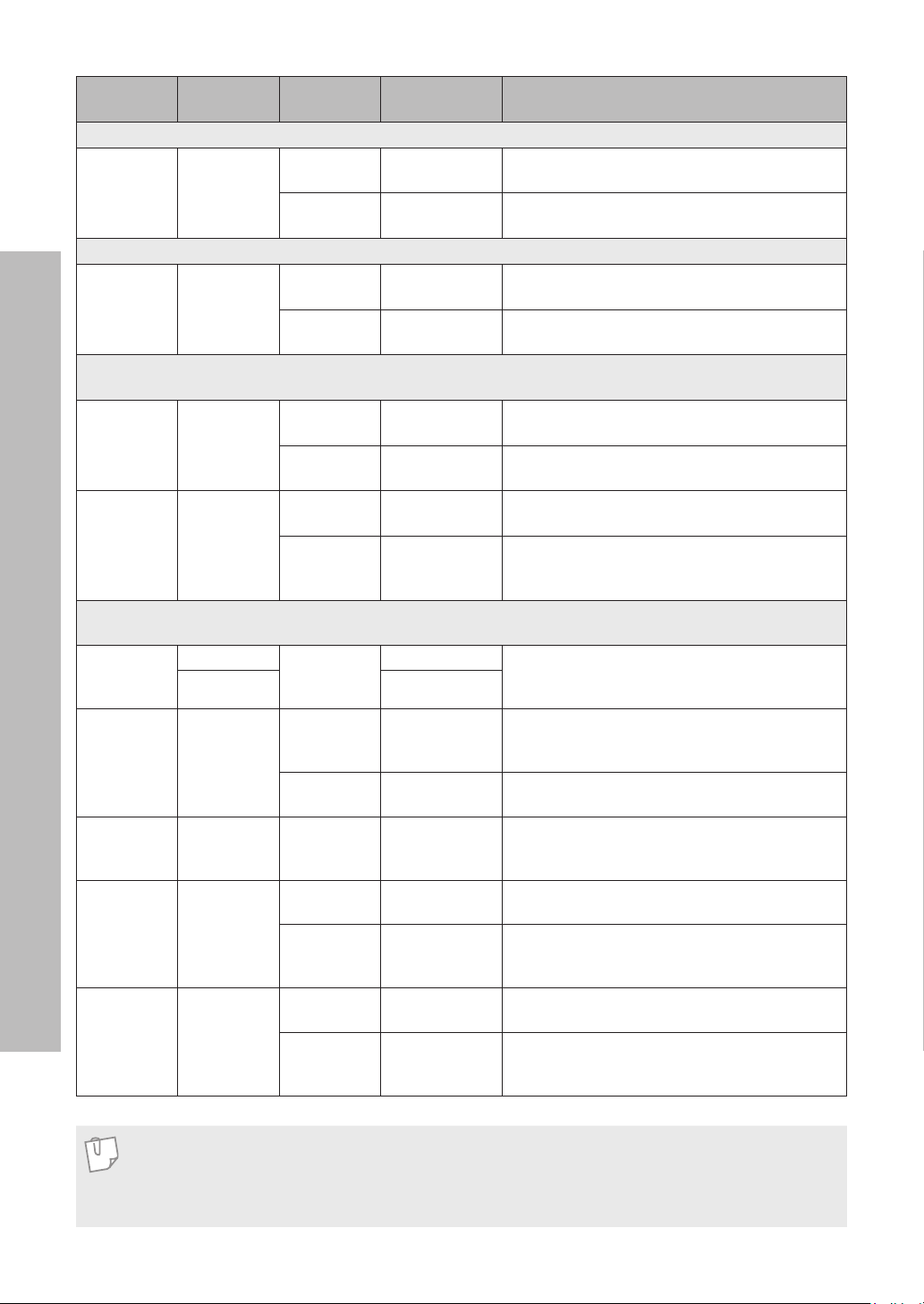
Food
Weight/
Quantity
Power
Level
Time to Select
(approx)
Instructions/Guidelines
Beefburgers – Fresh from raw – Caution: Hot fat! Remove oven accessories with care.
- 226 g (2)
1000 W 3-4 mins
Place on micro-safe rack or plate on glass
tray. Cover.
or Grill 1 18-20 mins
Place on wire rack on enamel tray on glass
tray. Turn halfway.
Beefburgers – Frozen from raw – Caution: Hot fat! Remove oven accessories with care.
- 227 g (4)
1000 W 5-7 mins
Place on micro-safe rack or plate on glass
tray. Cover.
or Grill 1 12-16 mins
Place on wire rack on enamel tray on glass
tray. Turn halfway.
Chicken from raw – Caution: Hot Fat! Remove oven accessories with care. For Guidelines see
meat chapter page 74.
Breasts,
boneless
600 g (4)
600 W 12-14 mins
Place on micro-safe rack or plate on glass
tray. Cover.
or Grill 1 +
300 W
16-18 mins
Place on wire rack on enamel tray on glass
tray. Turn halfway.
Drumsticks 800 g (8)
600 W 12-14 mins
Place on micro-safe rack or plate on glass
tray. Cover.
or
Convection
220 °C
25-30 mins
Place on wire rack on enamel tray on glass
tray. Turn halfway.
Chicken from raw – Caution: Hot Fat! Remove oven accessories with care. For Guidelines see
meat chapter page 74.
Kiev (fresh)
300 g (2) Convection
220 °C +
100 W
14-16 mins
Place on wire rack on enamel tray on glass
tray.
600 g (4) 16-18 mins
Nuggets
(frozen)
500 g
Combi:
220 °C +
100 W
15-20 mins
Place on enamel tray on wire rack on glass
tray.
or Grill 1 15-20 mins
Place on enamel tray on wire rack on glass
tray. Turn halfway.
Nuggets
(fresh)
360 g
Combi:
220˚C+
100 W
12-14 mins
Place on enamel tray on wire rack on glass
tray.
Chicken
legs
1 kg (4)
600 W 15-18 mins
Place on micro-safe rack or plate on glass
tray. Cover.
or Combi:
220˚C+
300 W
25-35 mins
Place on wire rack on enamel tray on glass
tray.
Whole -
600 W
9-11 mins
per 450 g
Place in micro-safe dish on glass tray. Cover.
or Combi:
190˚C+
300 W
14-16 mins
per 450 g
Place on upturnted saucer on enamel tray on
glass tray. Start cooking breast side down.
Turn halfway. Do not cover.
Notes
Always check that food is piping hot after reheating in the microwave. If unsure return to oven.
Foods will still require a stand time, especially if they cannot be stirred. The denser the food the
longer the stand time.
– 60 –
Cooking Charts
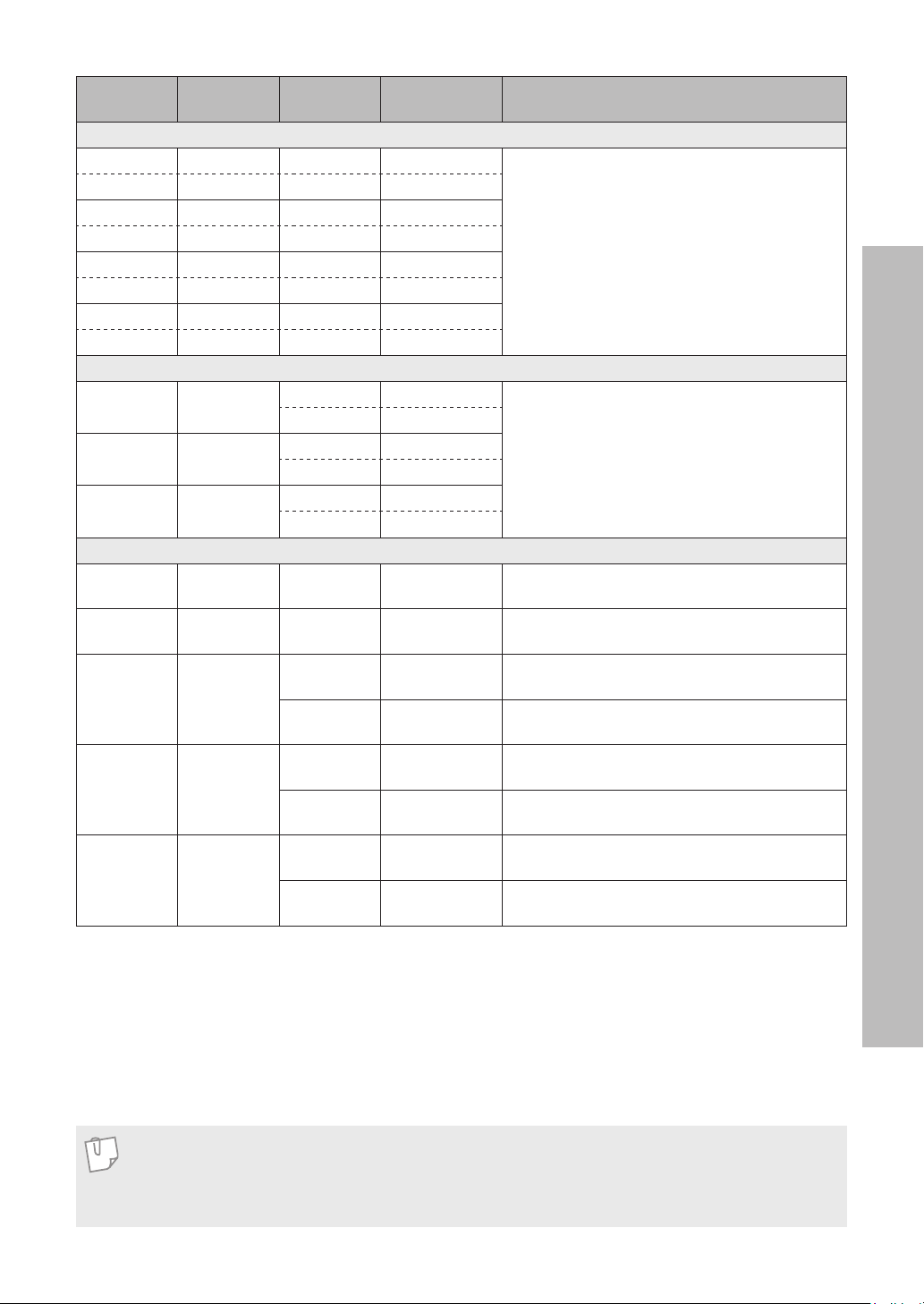
Food
Weight/
Quantity
Power
Level
Time to Select
(approx)
Instructions/Guidelines
Eggs – Poached
Water 45 ml 1000 W 40 secs
Place water in a small bowl and heat for 1st
cooking time.
Add medium egg (size 3).
Pierce yolk and white.
Cover.
Cook for 2nd cooking time.
Then leave to stand for 1 minute.
Egg 1 600 W 40 secs
Water 90 ml 1000 W 1 min
Eggs 2 600 W 1 min
Water 135 ml 1000 W 1 min 30 secs
Eggs 3 600 W 1 min 10 secs
Water 180 ml 1000 W 2 mins
Eggs 4 600 W 1 min 30 secs
Eggs – Scrambled
Egg 1
1000 W 30 secs Add 1 tablespoon of milk for each egg used.
Beat eggs, milk and knob of butter together.
Cook for 1st cooking time then stir.
Cook for 2nd cooking time then stand for 1
minute.
1000 W 20 secs
Eggs 2
1000 W 50 secs
1000 W 30 secs
Eggs 3
1000 W 1 min 20 secs
1000 W 30 secs
Fish – Fresh from raw – For Guidelines see Fish Chapter page 71.
Breaded
fillets
235 g (2) Grill 1 10-15 mins
Place on enamel tray on wire rack on glass
tray. Turn halfway.
Cakes 280 g (2)
Grill 1 +
100 W
12-14 mins
Place on enamel tray on wire rack on glass
tray. Turn halfway.
Fillets 260 g (2)
1000 W 3-4 mins
Place in micro-safe dish. Add
30 ml of liquid. Cover.
or Grill 1 12-14 mins
Place on enamel tray on wire rack on glass
tray. Turn halfway.
Steaks 220 g (2)
1000 W 3-4 mins
Place in micro-safe dish. Add
30 ml of liquid. Cover.
or Grill 2 12-16 mins
Place on enamel tray on wire rack on glass
tray. Turn halfway.
Whole 260 g (1)
1000 W 3-4 mins
Place in micro-safe dish. Add
30 ml of liquid. Cover.
or Grill 2 16 mins
Place on enamel tray on wire rack on glass
tray. Turn halfway.
Notes
Always check that food is piping hot after reheating in the microwave. If unsure return to oven.
Foods will still require a stand time, especially if they cannot be stirred. The denser the food the
longer the stand time.
– 61 –
Cooking Charts
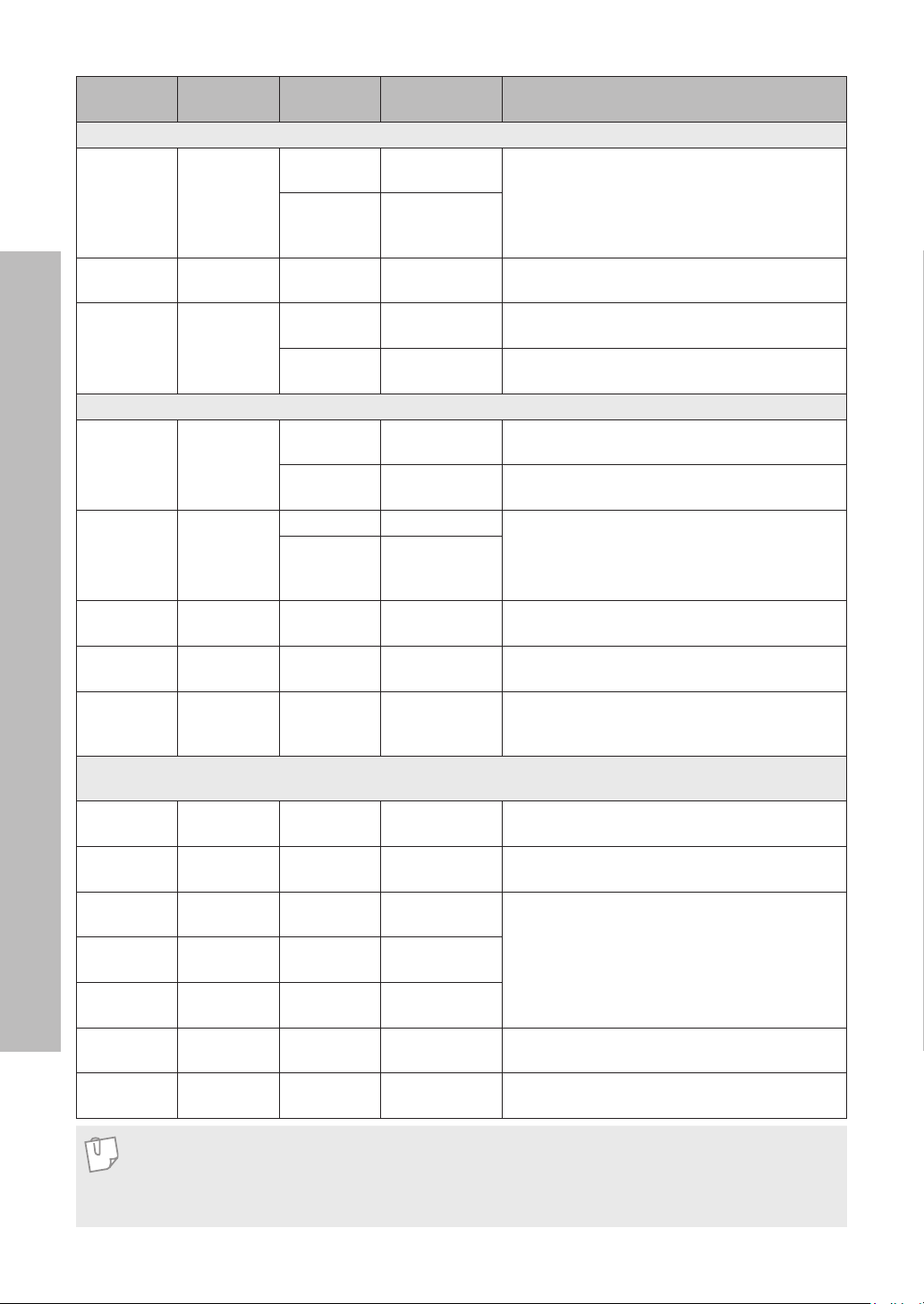
Food
Weight/
Quantity
Power
Level
Time to Select
(approx)
Instructions/Guidelines
Fish - Frozen from raw - For Guidelines see Fish chapter page 71.
Breaded
fillets
260 g (2)
Grill 1 +
100 W
15-17 mins
Place on enamel tray on wire rack on glass
tray. Turn halfway.
or Combi:
200 °C +
100 W
14-16 mins
Cakes 400 g (4) Grill 1 18-22 mins
Place on enamel tray on wire rack on glass
tray. Turn halfway.
Fish fingers 230 g (8)
1000 W 3-4 mins
Place on micro-safe dish.
Do not cover.
or Grill 1 12-14 mins
Place on enamel tray on wire rack on glass
tray. Turn halfway.
Fish - Frozen from raw - For Guidelines see Fish chapter page 71.
Haddock
fillets
300 g (3)
1000 W 4-5 mins
Place in micro-safe dish.
Add 30 ml of liquid. Cover.
or Grill 1 15-20 mins
Place on enamel tray on wire rack on glass
tray. Turn halfway.
Scampi 300 g
Grill 1 15 mins
Place on enamel tray on wire rack on glass
tray. Turn halfway.
or Combi:
220 °C
+ 300 W
9-10 mins
Whole 500 g (2) 1000 W 12-15 mins
Place in micro-safe dish. Add 30 ml of liquid.
Cover.
Steaks 220 g (2) 1000 W 4-6 mins
Place in micro-safe dish. Add 30 ml of liquid.
Cover.
Boil in the
bag
150 g-
170 g
270 W
then stand
then 600 W
2 mins
2 mins
4-5 mins
Place bag sauce side down on a plate. Slash
top.
Fruit – Peel, slice, chop into even sized pieces. Place in shallow micro-safe/heatproof dish on
glass tray.
Apples –
poached
450 g 1000 W 6-7 mins Add 300 ml of water. Only half fill dish. Cover.
Apples –
stewed
450 g 1000 W 5-6 mins Only half fill dish. Cover.
Peaches –
poached
450 g 1000 W 5-6 mins
Add 300 ml of water. Only half fill dish. Cover.
Pears –
poached
450 g 1000 W 6-7 mins
Plums –
poached
450 g 1000 W 4-6 mins
Plums –
stewed
450 g 1000 W 3-4 mins Add 30 ml of water. Only half fill dish. Cover.
Rhubarb –
stewed
450 g 1000 W 4-6 mins Only half fill dish. Cover.
Notes
Always check that food is piping hot after reheating in the microwave. If unsure return to oven.
Foods will still require a stand time, especially if they cannot be stirred. The denser the food the
longer the stand time.
– 62 –
Cooking Charts
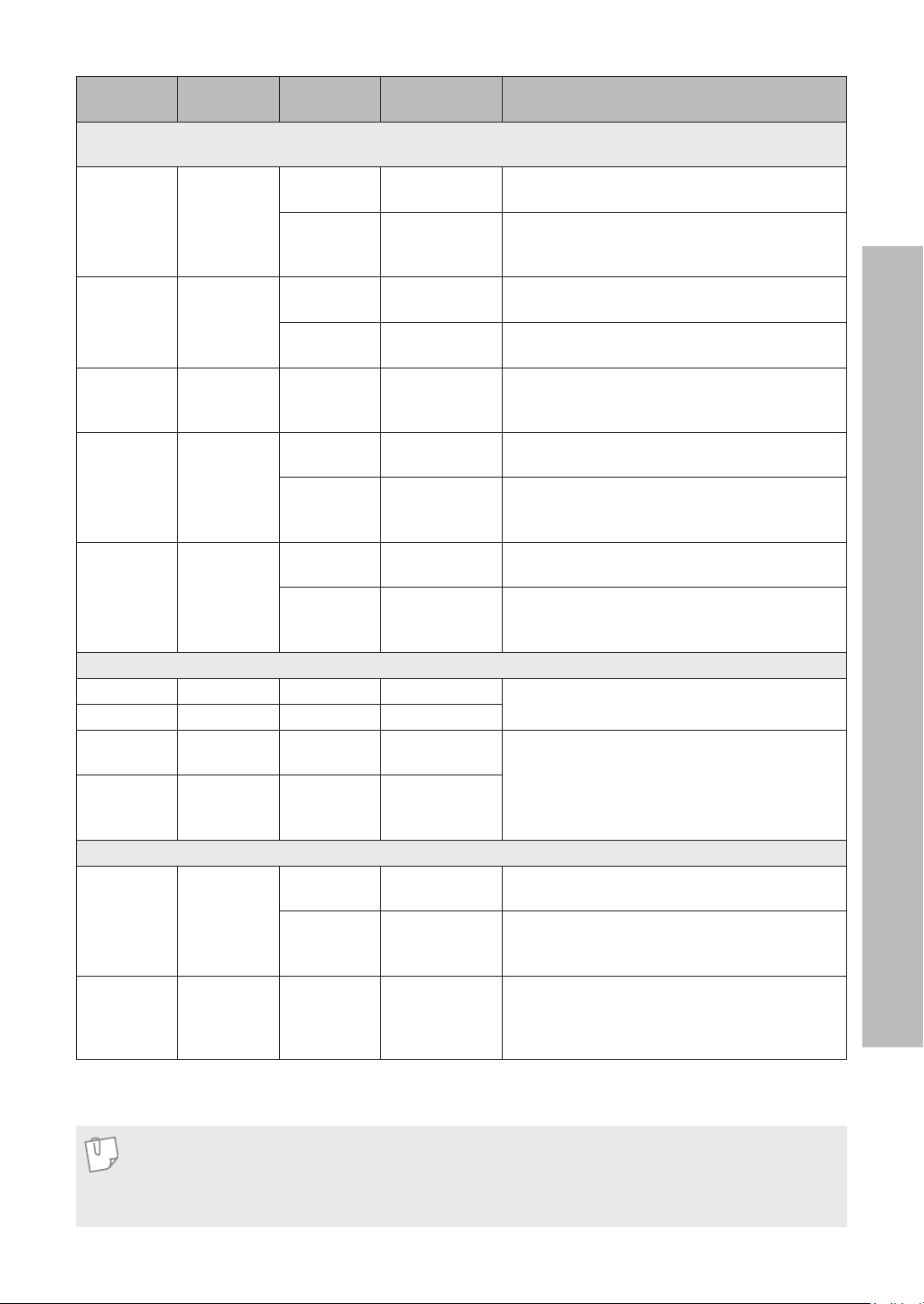
Food
Weight/
Quantity
Power
Level
Time to Select
(approx)
Instructions/Guidelines
Lamb – from raw – Caution: Hot Fat! Remove accessory with care. For Guidelines see Meat
chapter page 74.
Chops,
cutlets
300 g (4)
600 W 4-6 mins
Place in micro-safe dish or rack on glass tray.
Cover.
or Grill 1 14-16 mins
Place on wire rack on enamel tray on glass
tray. Turn halfway.
Chops, loin 500 g (4)
600 W 5-7 mins
Place in micro-safe dish or rack on glass tray.
Cover.
or Grill 1 22-24 mins
Place on wire rack on enamel tray on glass
tray. Turn halfway.
Joints -
Combi:
180 °C +
300 W
12-15 mins
per 450 g
Place on enamel tray on glass tray. Turn
halfway.
Stewing
lamb
450 g
1000 W
then 440 W
10 mins
40 mins
Place in micro-safe dish with stock and
vegetables on glass tray. Stir halfway. Cover.
or Combi:
160 °C +
100 W
1 hr
Place in casserole dish, add stock and
vegetables, cover with lid on enamel tray on
glass tray. Stir halfway.
Casseroling
lamb i.e.
diced
shoulder
450 g
1000 W
then 440 W
10 mins
60 mins
Place in micro-safe dish on glass tray. Stir
halfway. Cover.
or Combi:
160 °C +
100 W
1 hr
Place in casserole dish with lid on enamel tray
on glass tray. Stir halfway.
Pasta - Place in a large 3 litre microwave safe bowl.
Twists 225 g 1000 W 8-10 mins
Use 1 litre boiling water. Add 15 ml oil. Cover.
Stir halfway.
Macaroni 225 g 1000 W 10-12 mins
Spaghetti /
tagliatelle
225 g 1000 W 8-10 mins
Use 1 ½ litres boiling water. Add 15 ml oil.
Cover. Stir halfway.
Pasta
shells - i.e.
conchiglie
225 g 1000 W 10-12 mins
Pastry – uncooked
Shortcrust
flan case
23 cm
1000 W 3-4 mins
Prick base of pastry and chill well. Lay piece
of kitchen towel in base. Place on glass tray.
or Combi:
220 °C +
300 W
7-8 mins
Prick base of pastry and chill well. Do not
cover. Place on enamel tray on glass tray.
All butter
croissants
350 g (6)
Convection:
Preheat
200 °C then
200 °C
8-10 mins
Place on baking sheet on enamel tray on
glass tray.
Notes
Always check that food is piping hot after reheating in the microwave. If unsure return to oven.
Foods will still require a stand time, especially if they cannot be stirred. The denser the food the
longer the stand time.
– 63 –
Cooking Charts
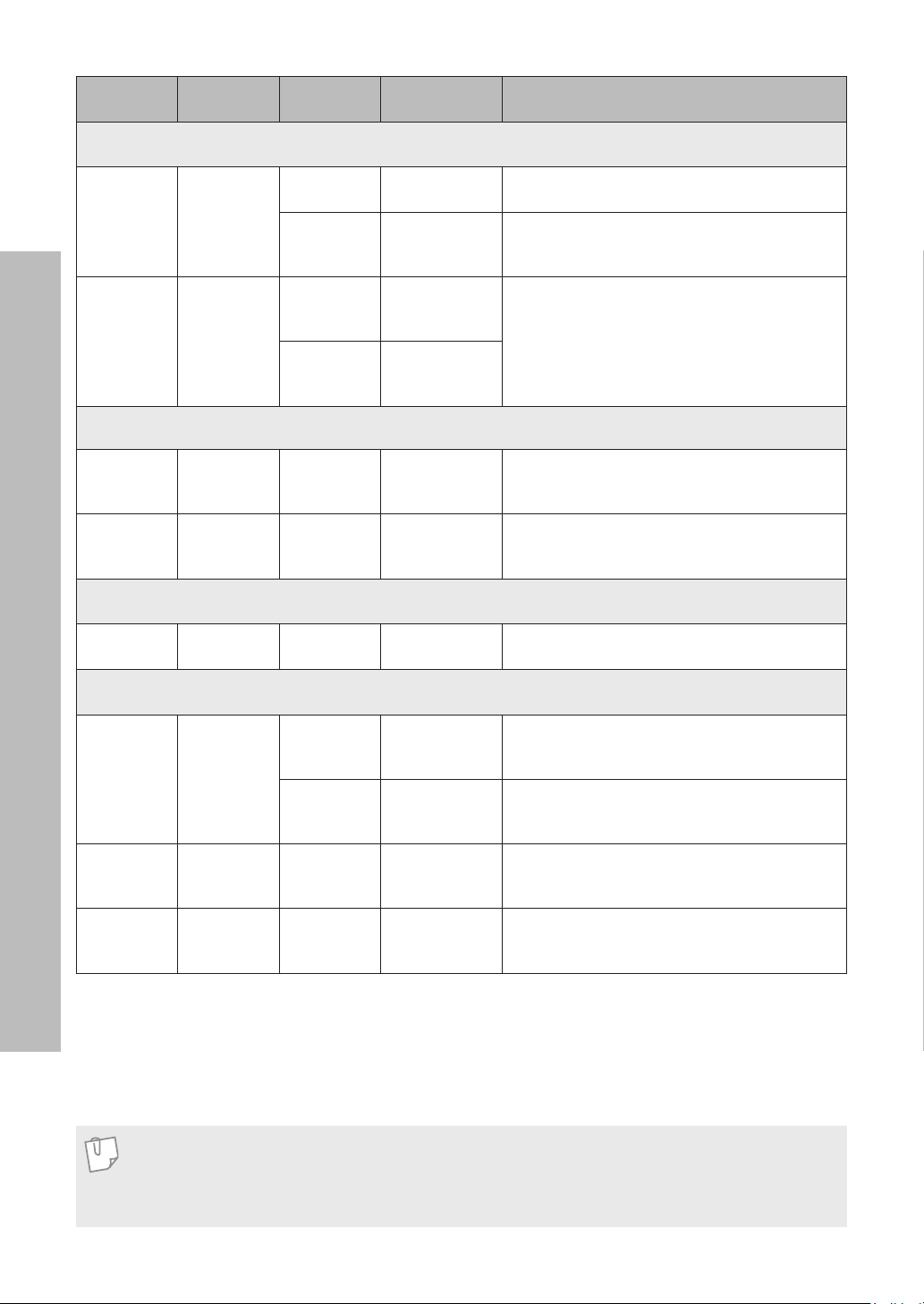
Food
Weight/
Quantity
Power
Level
Time to Select
(approx)
Instructions/Guidelines
Pizza – fresh chilled – N.B. Remove all packaging. Pizzas will have a soft base if cooked by
microwave only.
Deep pan,
ham
410 g
1000 W 4-6 mins
Place on micro-safe plate on glass tray. Do
not cover.
or
Convection
220 °C
8-12 mins
Place directly on wire rack on enamel tray on
glass tray. Do not cover.
Thin and
crispy
300 g
Combi:
220 °C +
100 W
6-8 mins
Place on wire rack on enamel tray on glass
tray. Do not cover.
or
Convection
220 °C
8 mins
Pizza - frozen - N.B. remove all packaging.
French
bread
250 g (2)
Combi:
220 °C +
300 W
7-8 mins
Place on wire rack on enamel tray on glass
tray. Do not cover.
Pepperoni 340 g
Combi:
220 °C +
300 W
8-10 mins
Place on wire rack on enamel tray on glass
tray. Do not cover.
Pork – from raw – Caution: Hot Fat! Remove oven accessories with care. For Guidelines see Meat
Chapter page 74.
Chops 425 g (5) Grill 1 20-25 mins
Place on wire rack on enamel tray on glass
tray. Turn halfway.
Pork – from raw – Caution: Hot Fat! Remove oven accessories with care. For Guidelines see Meat
Chapter page 74.
Joints -
600 W
13-14 mins
per 450 g
Place on upturned saucer in micro-safe dish
on glass tray. Turn joint over halfway during
cooking. Drain off fat during cooking.
or Combi:
170 °C +
440 W
16-18 mins
per 450 g
Place on enamel tray. Turn halfway.
Gammon
covered
with water
-
1000 W
then 600 W
15 mins
25-30 mins
per 450 g
Place in large casserole dish with lid and
cover with water.
Tenderloin,
whole
-
Combi:
190 °C +
100 W
25-30 mins
per 450 g
Place on upturned saucer on enamel tray on
glass tray.
Notes
Always check that food is piping hot after reheating in the microwave. If unsure return to oven.
Foods will still require a stand time, especially if they cannot be stirred. The denser the food the
longer the stand time.
– 64 –
Cooking Charts
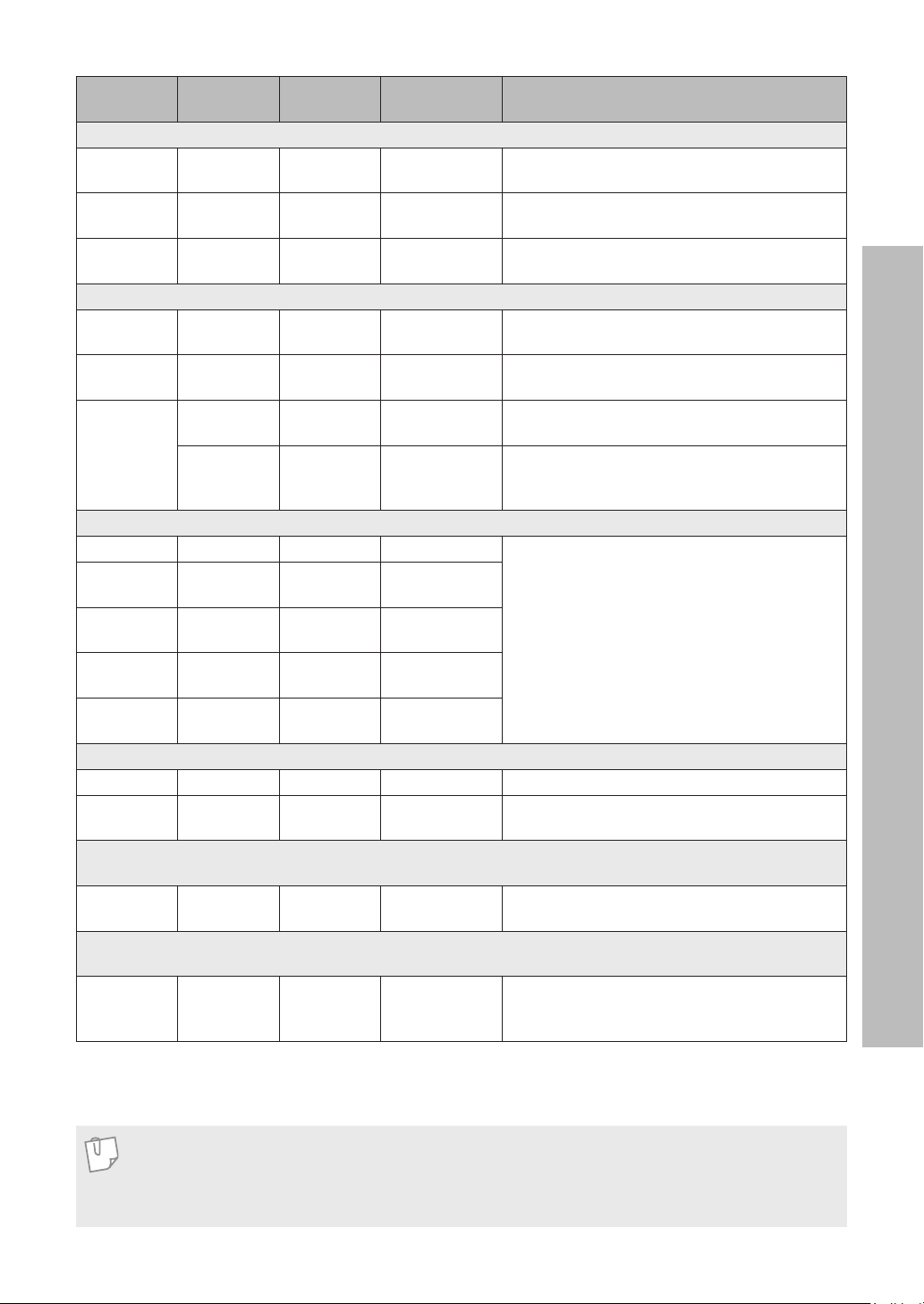
Food
Weight/
Quantity
Power
Level
Time to Select
(approx)
Instructions/Guidelines
Porridge – N.B: Use a large bowl.
1 serving
½ cup of
oats
600 W
3 mins -
3 mins 30 secs
Add 1 cup of water or milk. Stir halfway.
2 servings
1 cup of
oats
1000 W 4-5 mins Add 2 cups of water or milk. Stir halfway.
4 servings
2 cups of
oats
1000 W 8-9 mins Add 4 cups of water or milk. Stir halfway.
Potato products part cooked – frozen
Croquettes 300 g
Grill 1 +
300 W
11-13 mins
Place on enamel tray on wire rack on glass
tray. Turn halfway.
Hash
browns
300 g (7) Grill 1 12-15 mins
Place on enamel tray on wire rack on glass
tray. Turn halfway.
Oven
chips &
associated
products
300 g Grill 1 10-12 mins
Place on enamel tray on wire rack on glass
tray. Turn halfway.
450 g
or Combi:
150 °C +
440 W
11-12 mins
Place on enamel tray on wire rack on glass
tray. Turn halfway.
Rice - Place in a large 3 litre microwave safe bowl
Basmati 250 g 600 W 13-16 mins
Use 600 ml cold water. Cover. Stir halfway.
Easycook
white
250 g 1000 W 16-17 mins
Easycook
brown
250 g 1000 W 20-24 mins
Long grain
white
250 g 600 W 14-18 mins
Brown
basmati
250 g 600 W 20-25 mins
Milk pudding – Use large bowl, cover. Stir halfway.
Flaked rice 50 g 300 W 35-45 mins Add 600 ml milk and 30 ml sugar.
Pudding rice 50 g
1000 W
then 300 W
5 mins
40 mins
Add 450 ml milk and 30 ml sugar.
Sausages from raw – caution: Hot Fat! Remove oven accessories with care. For guidelines see
Meat Chapter page 74.
Thick 454 g (8) Grill 1 17-18 mins
Place on wire rack on enamel tray on glass
tray. Turn halfway.
Turkey from raw- Caution: Hot fat! Remove oven accessories with care. For guidelines see Meat
Chapter page 74.
Turkey,
crown
-
Combi:
190 °C +
300 W
13-15 mins
per 450 g
Place on enamel tray on glass tray. Turn
halfway.
Notes
Always check that food is piping hot after reheating in the microwave. If unsure return to oven.
Foods will still require a stand time, especially if they cannot be stirred. The denser the food the
longer the stand time.
– 65 –
Cooking Charts

Food
Weight/
Quantity
Power
Level
Time to Select
(approx)
Instructions/Guidelines
Fresh vegetables – place in shallow micro-safe dish
Asparagus 450 g 1000 W 5-8 mins
Add 90 ml water. Cover.
Broad beans
450 g 1000 W 5-6 mins
Runner
beans
450 g 1000 W 7-8 mins
Beetroot 450 g 600 W 12-15 mins
Broccoli 450 g 1000 W 6-8 mins
Brussel
sprouts
450 g 1000 W 8-9 mins
Cabbage
- sliced
450 g 1000 W 7-9 mins
Carrots
- sliced
450 g 1000 W 6-8 mins
Cauliflower
- florets
450 g 1000 W 10-12 mins
Fresh vegetables – place in shallow micro-safe dish
Courgettes 450 g 1000 W 5 mins
Add 90 ml water. Cover.
Corn on the
cob
450 g 1000 W 6-7 mins
Leeks
- sliced
450 g 1000 W 7-8 mins
Mushrooms 450 g 1000 W 5 mins
Parsnips
- sliced
450 g 1000 W 5-6 mins
Peas 450 g 1000 W 4-6 mins
Potatoes
- boiled
450 g 1000 W 7-9 mins
Potatoes,
par-boiled
450 g 1000 W 5-6 mins
Notes
Always check that food is piping hot after reheating in the microwave. If unsure return to oven.
Foods will still require a stand time, especially if they cannot be stirred. The denser the food the
longer the stand time.
– 66 –
Cooking Charts
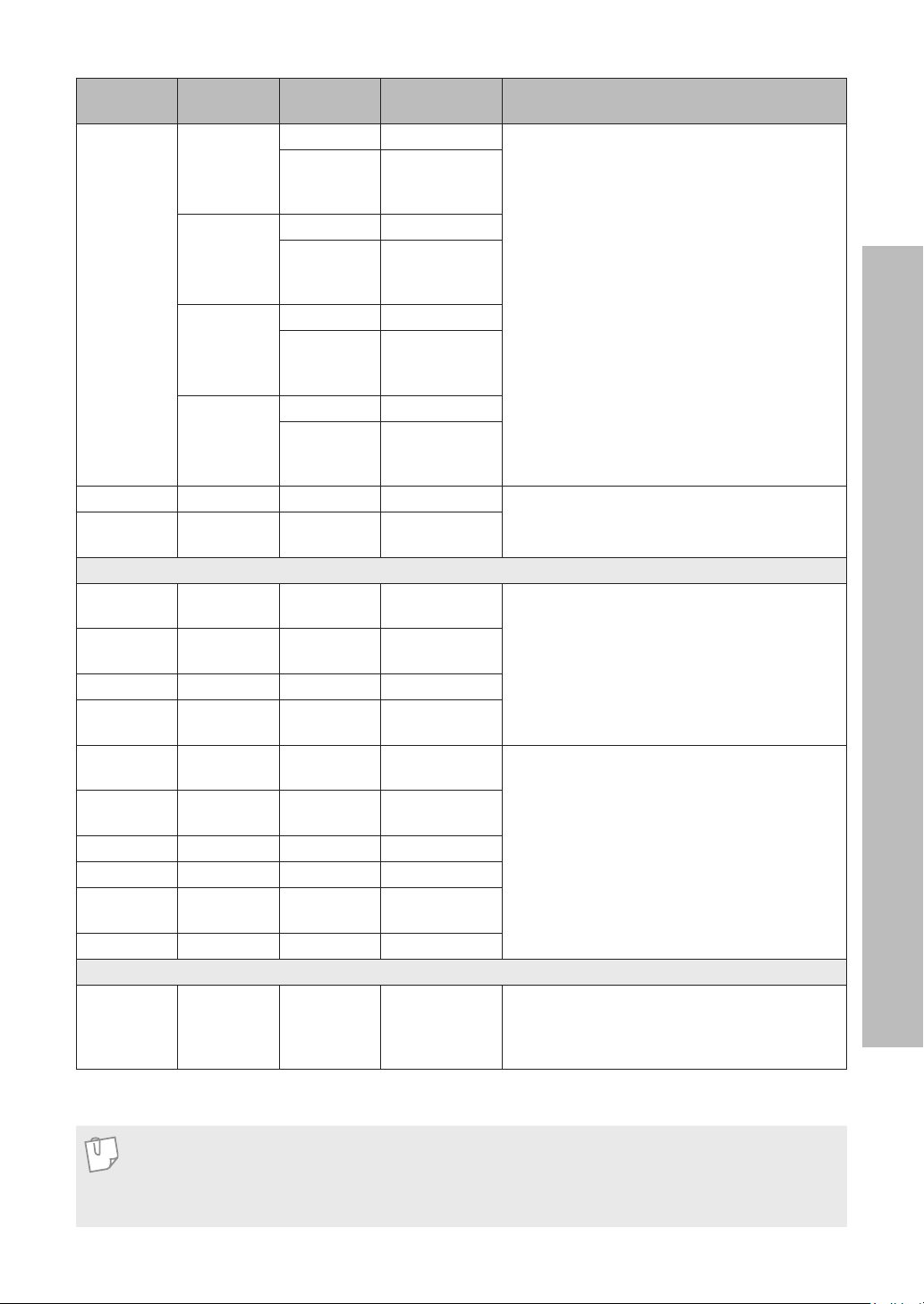
Food
Weight/
Quantity
Power
Level
Time to Select
(approx)
Instructions/Guidelines
Potatoes
- jacket
(225 g)
1
1000 W 5 mins
Wash and prick skins
several times. Place directly on glass tray
if cooking by microwave. If cooked by
combination place directly on enamel tray on
glass tray. Allow to stand for 5 minutes. Or use
Auto program jacket potatoes.
or Combi:
220 °C +
300 W
15 mins
2
1000 W 8 mins
or Combi:
220 °C +
300 W
20 mins
4
1000 W 13 mins
or Combi:
220 °C +
300 W
25 mins
6
1000 W 18-20 mins
or Combi:
220 °C +
300 W
30 mins
Spinach 450 g 1000 W 6 mins
Add 90 ml water. Cover.
Swede
- cubed
450 g 1000 W 8-12 mins
Frozen vegetables - place in shallow micro-safe dish.
Beans
- broad
450 g 1000 W 8 mins
Add 30 ml water. Cover.
Beans
- green
450 g 1000 W 8-9 mins
Brocolli 450 g 1000 W 8-9 mins
Brussels
sprouts
450 g 1000 W 9-10 mins
Cabbage
- shredded
450 g 1000 W 6-7 mins
Add 30 ml water. Cover.
Carrots
- sliced
450 g 1000 W 8 mins
Cauliflower 450 g 1000 W 9-10 mins
Peas 450 g 1000 W 6-7 mins
Spinach
- nuggets
450 g 1000 W 8-9 mins
Sweetcorn 450 g 1000 W 7 mins
Miscellaneous
Frozen
yorkshire
puddings
370 g
Convection:
Preheat
220 °C then
220 ºC
15-20 mins Place directly onto enamel tray.
Notes
Always check that food is piping hot after reheating in the microwave. If unsure return to oven.
Foods will still require a stand time, especially if they cannot be stirred. The denser the food the
longer the stand time.
– 67 –
Cooking Charts

Increasing Recipes
�
To increase a recipe from 4-6 servings, increase
each ingredient listed by half. To double the
quantity, simply double every ingredient listed.
�
Do not forget that large quantities will require
a larger dish. Make sure that it is deep enough
to prevent the recipe from boiling over during
cooking.
�
Cover as directed in the recipe. Stir or rearrange
foods as recommended.
�
Increase the stand times by 5 minutes per 450 g.
�
Always check the recipe during cooking.
�
When increasing the ingredients to 6 servings,
add an extra one third of the original cooking
time, i.e. 30 minutes on 600 W for 4 servings will
become 40 minutes on 600 W for 6 servings.
�
When doubling a recipe from 4-8, add on half the
original cooking time, i.e. 30 minutes on 600 W
for 4 servings will become 45 minutes on 600 W
for 8 servings.
Decreasing Recipes
�
To decrease a recipe from 4 servings to
2 servings, halve the ingredients listed.
�
Choose a dish that is proportionally smaller than
the one recommended in the recipe, however
make sure it is deep enough to stop food boiling
over.
�
Allow half to two-thirds of the original cooking
time, i.e. 30 minutes on 600 W for 4 servings will
become 15-20 minutes on 600 W for 2 servings.
Increasing and Decreasing Recipes
Using Recipes from Other Books
Cooking for One
The best way to convert a family favourite dish is to
find a similar recipe in a cookery book to give you a
guide to the correct method and timings to use.
When using other cookbooks, the 1000 W output
power of your oven must be allowed for. Use the
same power level suggested e.g. 1000 W or
600 W and select the same cooking time suggested,
however check the progress of the food during
cooking and adjust the time if necessary.
�
For one serving quarter all ingredients listed.
�
Choose a dish that is proportionally smaller than
the one recommended in the recipe.
�
Use the same cooking power recommended in
the original recipe.
�
Start by cooking for one quarter of the
recommended cooking time, although extra time
in most cases will be required.
�
Always check the food during cooking.
�
There is not a great saving for reduced quantities
of soups, casseroles, stews and rice, as a
minimum time is required to tenderise meats and
blend flavours.
�
When cooking for one it often makes sense to
cook for two and plate up both meals. Freeze one
meal for a later date.
– 68 –
Microwave Recipe Techniques

C
ARROT AND
O
RANGE
S
OUP
Ingredients:
Serves 4
25 g butter
1 medium onion, coarsely chopped
700 g carrots, thickly sliced
1 litre vegetable stock
½ orange, grated zest
90 ml orange juice
60 ml crème fraiche
salt and pepper
15 ml fresh chives, chopped
Dish: 1 x 3 litre Pyrex
®
casserole dish
Accessory: none
Method:
1. Place the butter and onion into casserole dish.
Cover and cook on 1000 W for 3-4 minutes or
until soft.
2. Add the carrots. Cover and cook on 1000 W
for 8-10 minutes or until the vegetables are
softened. Stir halfway.
3. Add stock and orange zest. Cover and cook on
1000 W for 5 minutes then 440 W for 15 minutes
or until the carrots are soft.
4. Place into a liquidiser and purée until smooth.
5. Return purée to the bowl and add orange juice.
Stir in the crème fraiche and season to taste.
Cover and cook on 600 W for 3-4 minutes or
until piping hot.
6. Garnish with fresh chives.
S
WEET
P
OTATO
S
OUP
Ingredients:
Serves 4
15 ml olive oil
1 medium onion, coarsely chopped
2 clove garlic, crushed
700 g sweet potatoes, peeled and chopped
1 large red pepper, deseeded and chopped
725 ml vegetable stock
150 ml coconut milk
salt and pepper
Dish: 1 x 3 litre Pyrex
®
casserole dish with lid
Accessory: none
Method:
1. Place the oil, onion and garlic into casserole
dish, cover. Cook on 600 W for 3 minutes or until
soft.
2. Add the sweet potato and pepper and cook on
600 W for 5 minutes. Add stock, cover and cook
on 600 W for 15 minutes, or until the potatoes
are soft, stirring halfway.
3. Cool. Place in a liquidiser and purée until
smooth. Stir in the coconut milk and season to
taste.
4. Cover and cook on 600 W for 3 minutes or until
piping hot.
G
OAT’S
C
HEESE &
B
ASIL
C
IABATTA
Ingredients:
Serves 4
2 ciabatta rolls
1 clove garlic, halved
1 beef tomato, sliced
100 g goats cheese
8 black olives, stoned and quartered
15 ml olive oil
fresh basil, chopped pepper
Dish: none
Accessory: Enamel tray and wire rack
Method:
1. Halve the rolls and place on the wire rack on
enamel tray. Cook on Grill 1 for 3-4 minutes
or until lightly toasted. Rub each half with the
garlic.
2. Top each half with the sliced tomato, crumble
over the goats cheese and top with olives.
Drizzle with olive oil and place on the wire
rack on the enamel tray. Cook on Grill 1 for
5-7 minutes or until the cheese is golden and
bubbling.
3. Sprinkle with basil and season with pepper.
Serve immediately.
– 69 –
Soups and Starters

O
NION AND
F
ETA
C
HEESE
T
ARTLETS
Ingredients:
Serves 6
250 g ready made puff pastry
30 ml olive oil
300 g onions, peeled and sliced
25 g pine nuts
100 g feta cheese, crumbled
50 g pitted black olives, roughly chopped
50 g sun-dried tomatoes (in oil or
rehydrated), roughly chopped
15 g capers
salt and pepper
fresh oregano sprigs to garnish
Dish: 1 x 3 litre Pyrex
®
casserole dish with lid,
1 x 32 x 23 cm greased baking sheet
Accessory: Enamel tray
Method:
1. Roll out the puff pastry and cut into 6 circles
each 7 ½ cm in diameter. Chill pastry for
30 minutes.
2. Put oil and onions into casserole dish, cover
and cook on 1000 W for 10-13 minutes or until
slightly browned. Cool for 5 minutes.
3. Preheat oven on Convection200˚Cwith
enamel tray.
4. Stir nuts, cheese, olives, sun-dried tomatoes
and capers into onion mixture. Season well.
5. Place pastry circles on the baking sheet and
prick with a fork.
6. Divide the onion mixture among the pastry
circles.
7. Cook on Convection220˚Cfor10-15minutes.
8. Garnish with fresh oregano sprigs.
M
INESTRONE
S
OUP
Ingredients
Serves 6
30 ml olive oil
1 carrot, finely diced
1 celery stick, finely diced
1 red onion, finely diced
1 garlic clove, crushed
400 g canned chopped tomatoes
15 ml tomato purée
900 ml vegetable stock
100 g green cabbage, finely shredded
6 basil leaves, roughly chopped
50 g small pasta shapes
400 g canned baked beans
salt and pepper
Parmesan
Dish: 1 x large Pyrex
®
casserole dish with lid
Accessory: none
Method:
1. Place the olive oil, carrot, celery, onion and
garlic into large casserole dish, cover with a lid
and cook on 1000 W for 5 minutes.
2. Add the tomatoes, tomato purée and stock and
cook on 1000 W for 5 minutes then 300 W for
15 minutes.
3. Stir in the cabbage, basil, pasta, baked beans
and seasoning and cook on 300 W for
35 minutes. Serve sprinkled with Parmesan
Q
UINOA
T
ABBOULEH WITH
M
INT
Ingredients
Serves 6-8
300 g quinoa
2 courgettes, finely chopped
300 g frozen peas
1 bunch mint, chopped
100 ml olive oil
2 lemons, juiced
salt and pepper
Dish: 1 x large Pyrex
®
bowl, 1 x medium Pyrex
®
bowl, 1 x small Pyrex
®
bowl
Accessory: none
Method:
1. Place the quinoa and 600 ml of salted hot water
in a large bowl, cover and cook on 1000 W for
5 minutes then 300 W for 15 minutes. Drain and
leave to cool.
2. Place the courgettes and peas in a medium bowl
with 30 ml cold water and cook on 1000 W for
approx. 6-7 minutes. Drain well.
3. Mix the mint, olive oil and lemon juice in a small
bowl. Add this mixture to the quinoa, courgette
and peas. Season and leave to rest for several
hours before serving.
– 70 –
Soups and Starters
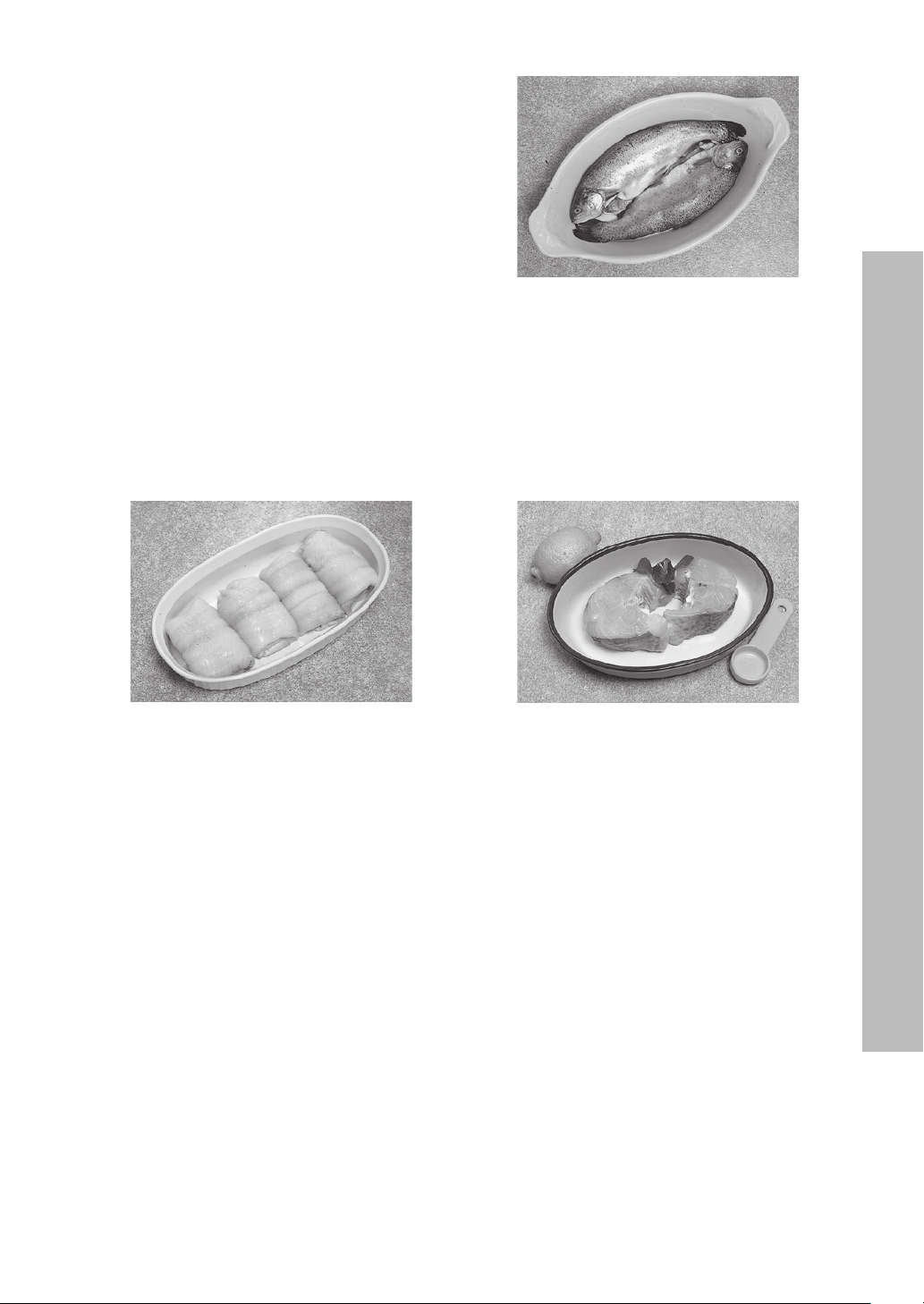
Guidelines
Fish cooks very well by microwave as it stays moist
and the lingering fish smells left in conventional
ovens are avoided.
When is Fish Cooked?
Fish is cooked when it flakes easily and becomes
opaque.
For fish with a strong odour, eliminate the smell after
cooking by placing 600 ml of boiling water and
1 sliced lemon in a large bowl, cook on 300 W for
20 minutes. Wipe out oven with a dry cloth.
Arranging
Thin fillets of fish i.e. plaice, should be rolled up
prior to cooking to avoid overcooking on the thinner
outside edge and tail.
Fish steaks should be arranged in a circle, thicker
part to the outside. Cover with cling film or lid.
Noise
During cooking, popping sounds may be heard. This is due to moisture trapped between the flesh,
particularly with oily fish such as salmon and mackerel. This can be minimised when cooking if the skin and
flesh is pierced several times with a cocktail stick.
Liquid
Fresh fish should always be sprinkled with 30 ml of
lemon juice, white wine or water.
When cooking frozen fish, add liquid as above for
even cooking.
Do not sprinkle salt onto fish before cooking as this
may make the fish dry.
Whole Fish
If cooking 2 whole fish together, they should be
arranged head to tail for even cooking.
Large whole fish must have the tail and head
shielded halfway through cooking with smooth
pieces of tin foil secured with cocktail sticks.
– 71 –
Fish

T
UNA
F
ISH
C
AKES
Ingredients:
Serves 4
350 g potatoes, peeled
25 g butter
1 small onion, chopped
200 g canned tuna, drained
1 egg, hard boiled, chopped
30 ml fresh parsley, chopped
10 ml lemon juice
salt and pepper
1 egg, beaten
100 g breadcrumbs
Dish: 1 x large Pyrex
®
casserole dish, 1 x large
Pyrex
®
bowl
Accessory: Enamel tray + wire rack
Method:
1. Cook potatoes with 45 ml water, covered on
1000 W for 6-8 minutes or until cooked. Drain.
2. Place butter and onion in a bowl, cover and
cook on 1000 W for 4 minutes or until soft. Add
potatoes and mash.
3. Stir in tuna, hard boiled egg, parsley and lemon
juice, season well.
4. Shape into 8 cakes and coat in beaten egg and
breadcrumbs.
5. Place on enamel tray on wire rack and cook on
Combination: Convection220˚C+100 W for
15-25 minutes or until brown, turning halfway.
S
PECIAL
O
CCASION
F
ISH
P
IE
Ingredients:
Serves 4
450 g white fish
50 g butter
50 g flour
450 ml milk
300 ml white wine
450 g mixed seafood
6 gherkins, diced
15 ml fresh parsley, chopped
10 ml dill, chopped
salt and pepper
450 g potatoes, peeled
15 ml capers
50 g butter, melted
50 g Cheddar cheese, grated
Dish: 1 x large Pyrex
®
gratin dish
Accessory: Enamel tray
Method:
1. Place the white fish with 30 ml water in a
shallow dish. Cover and cook on 1000 W for
4-5 minutes or on auto program fresh fish (see
page 43). Drain, skin, bone and flake.
2. Make the sauce by melting the butter in a large
jug on 600 W for 1 minute. Add the flour and stir
well. Mix in the milk and wine and cook on
1000 W for 4-5 minutes. Stir halfway. Mix in
the fish, mixed seafood, gherkins and herbs.
Season and pour into the dish.
4. Grate the potatoes and mix in the capers,
melted butter and grated cheese. Place lightly
on the fish sauce without pressing firmly to keep
the grated form. Place on enamel tray and cook
on Combination: Convection 220 °C + 300 W
for 35-40 minutes or until piping hot and golden.
S
ALMON AND
V
EGETABLE
M
ORNAY
Ingredients:
Serves 4
100 g broccoli
100 g cauliflower
1 medium red pepper, deseeded and
diced
198 g canned salmon, drained
25 g butter
30 ml plain flour
300 ml milk
50 g Cheddar cheese, grated
150 ml cream, optional
salt and pepper
15 g butter
75 g fresh white breadcrumbs
15 ml fresh parsley, chopped
pinch of paprika
Dish: 1 x 20 x 25 cm Pyrex
®
dish,1 x large Pyrex
®
jug, 1 x small Pyrex
®
bowl
Accessory: Enamel tray
Method:
1. Break broccoli and cauliflower into florets, add
red pepper and 30 ml water. Cover and cook on
1000 W for 5-6 minutes or until soft. Drain.
2. Flake salmon and mix with vegetables.
3. Melt butter in jug on 1000 W for approx.
20-30 seconds. Stir in flour then milk. Cook on
1000 W for 2 minutes or until mixture boils and
thickens; stir halfway. Stir in cheese, cream and
seasoning. Pour cheese sauce over vegetables
and salmon.
4. Melt extra butter in a small bowl on 1000 W for
approx 10-20 seconds. Stir in breadcrumbs,
parsley and paprika. Sprinkle over vegetable
mixture.
5. Place on enamel tray and cook on
Combination: 220 °C + 440 W for
10-12 minutes or until golden brown.
– 72 –
Fish

B
OUILLABAISSE
Ingredients:
Serves 6
225 g tomatoes
125 ml olive oil
30 ml tomato purée
2 onions, chopped
1 large leek, sliced
4 garlic cloves, crushed
1.2 L fish stock
salt and black pepper
150 ml dry white wine
4 sprig thyme
small piece orange peel
4 strands saffron
5 ml chilli sauce
450 g cod, haddock or coley
450 g mixed seafood
4 large fresh prawns
bunch dill, chopped, to garnish
Dish: 1 x 3 litre Pyrex
®
casserole dish
Accessory: none
Method:
1. Skin the tomatoes and cut into four pieces,
removing the cores. Place the oil and tomato
purée in a large bowl, heat on 1000 W for
1 minute and mix well. Add the onions and leek,
cook on 1000 W for 3-4 minutes or until soft.
2. Add the garlic, tomatoes, stock, seasoning,
wine, thyme, orange peel, saffron and chilli
sauce. Heat on 1000 W for 3-4 minutes. Skin
the fish, cut into chunks and add to the tomato
liquid. Cook on 1000 W for 3-4 minutes or until
the fish is cooked. Add the mixed seafood and
prawns and heat again for 2-3 minutes on
1000 W or until hot, taking care not to overcook
the fish.
3. Serve garnished with dill.
T
HAI
T
ROUT
Ingredients:
Serves 2
2 trout fillets, approx 150 g each
2 cloves garlic, finely chopped
1-2 small red chilli, finely chopped
1 lime, zest and juice
4 spring onions, finely chopped
30 ml light soy sauce
Dish: 1 x Pyrex
®
shallow dish
Accessory: none
Method:
1. Place fish fillets into a shallow dish, sprinkle
the remaining ingredients on the top of the fish.
Cover and cook on 600 W for 4-5 minutes, or
until the fish is cooked through.
C
OD AND
L
EEK
B
AKE
Ingredients
Serves 6
800 g cod, fillets
2 large leeks, finely sliced
300 ml single cream
500 g potatoes, quartered
50 g Cheddar cheese, grated
salt and pepper
Dish: 1 x shallow dish, 1 x 27 cm Pyrex
®
casserole
dish with lid, 1 x large Pyrex
®
dish, 1 x 27 cm
round dish
Accessory: Enamel tray
Method:
1. Place the cod in a shallow dish, add 45 ml water.
Cover and cook on 1000 W for 5-6 minutes.
Drain the cod and break into pieces, taking care
to remove all the bones and the skin.
2. Place leeks in a casserole dish, cover and cook
on 1000 W for 10 minutes. Mix together the fish
pieces, leeks, cream, cheese, salt and pepper.
3. Place the potatoes in a large dish, cover and
cook on 1000 W for 9-10 minutes. Place the
potatoes in a round buttered dish, cover with the
fish, leeks and cheese mixture.
4. Preheat the oven with the enamel tray on
Convection 200 ºC. Place the dish in the oven
and cook on Convection 200 ºC + 440 W for
10-15 minutes, until it is golden brown on top.
– 73 –
Fish
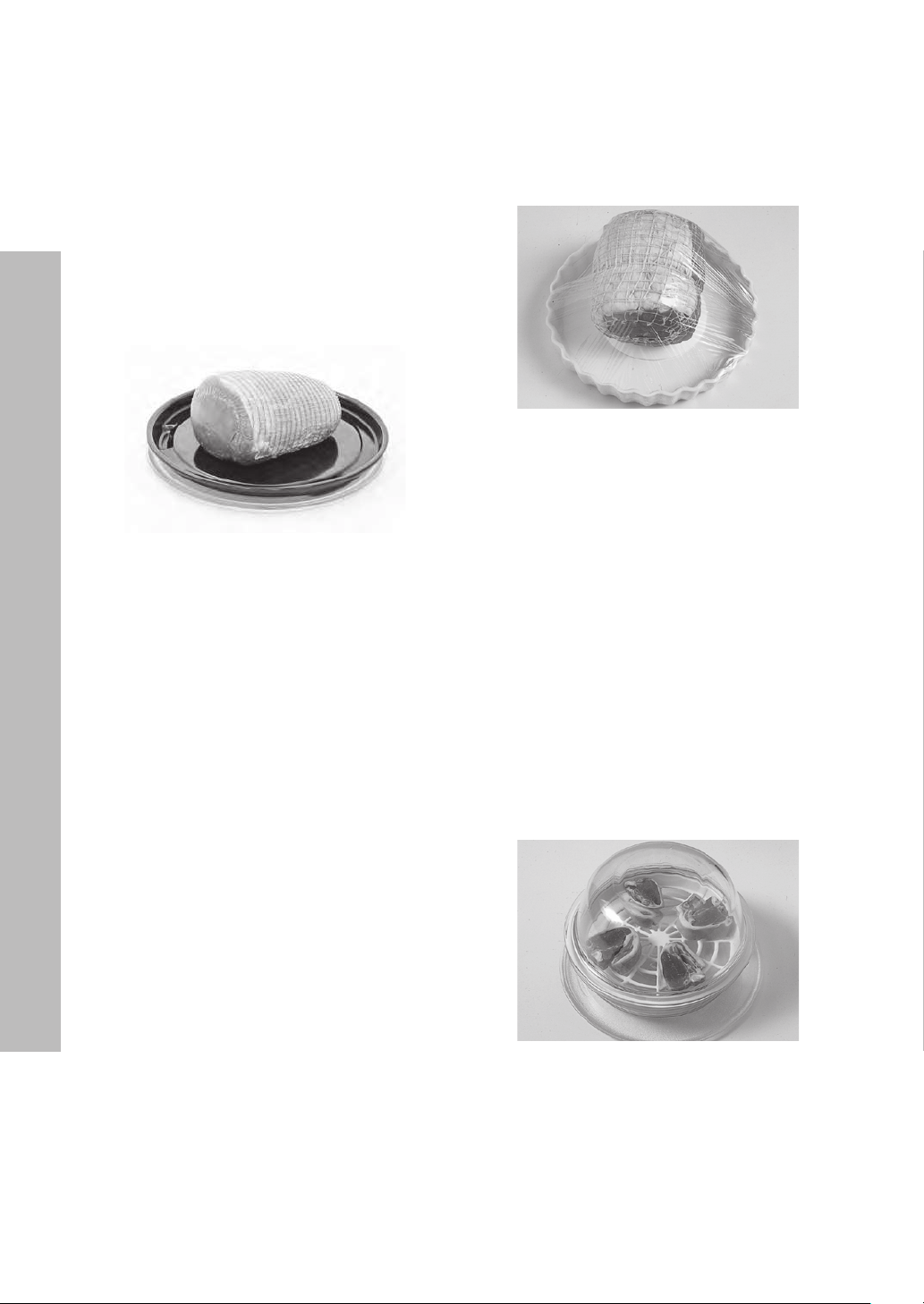
Guidelines
Defrosted Joints
If the meat has previously been frozen, ensure it
is properly thawed before cooking by microwave.
Defrosted joints of meat must be allowed to stand
for a minimum of 1 hour before cooking to ensure
the centre is fully defrosted.
Fat
Large amounts of fat absorb microwave energy and
can cause the meat next to it to overcook. Always
choose joints that aren’t excessively fatty.
Standing Time
Meat and poultry require a minimum of 15 minutes
standing time wrapped in aluminium foil after
cooking by microwave. Roast meat is always easier
to carve after standing and the meat will continue to
cook during the stand time.
Bone
Bone tips on legs of lamb and crown roasts may
need shielding when cooked by microwave, to
prevent overcooking.
Turning
Joints and poultry should be turned over halfway
through cooking.
Shielding
Large joints may need shielding with pieces of
smooth aluminium foil after half the cooking time to
avoid overcooking on the outside edges. Turkeys
and large chickens should have their breast meat,
legs and wings protected. Secure foil with cocktail
sticks and do not allow foil to touch the walls of the
oven.
How to Roast a Joint by Combination
Place the joint on enamel tray and place on glass
tray.
How to Roast a Joint by Microwave
To roast basic joints of meat place the joint onto the
rack of a microwave roasting set and cover with a
dome lid. Alternatively use a large, shallow dish and
place the joint on an upturned saucer and cover with
cling film.
Roasting Bags
Roasting bags are useful when split up one side to
tent a joint for roasting by power and time.
Do not use the metal twists supplied.
Tips
Braised and stewed meat cooked in a microwave
has a slightly firm texture and therefore it is essential
to purchase good quality meats.
When cooking a casserole, place a saucer or small
upturned plate over the meat to keep it submerged in
the juices.
How to Cook Small Cuts of Meat
by Microwave
Some cuts of meat can be cooked successfully by
microwave although due to their short cooking times
and no heat source, they will not crisp and brown.
They should always be cooked on a microwave safe
rack to lift them out of their juices.
Crispy Bacon
Place on a microwave safe rack (optional extra
obtainable from cookware shops). Cover with a plain
piece of kitchen towel to minimise splatter. Cook
on 1000 W for approx. 1 minute per rasher, or until
desired crispness is achieved.
– 74 –
Meat and Poultry

C
OQ
A
U
V
IN
Ingredients:
Serves 4
1.2 kg chicken portions, approx. 4
5 ml mixed herbs
salt and pepper
100 g streaky bacon
100 g button mushrooms
1 clove garlic, crushed
450 g whole shallots
30 ml brandy
300 ml red wine
300 ml chicken stock
15 ml cornflour
Dish: 1 x large Pyrex
®
casserole dish with lid
Accessory: Enamel tray
Method:
1. Place all ingredients, apart from the cornflour, in
casserole dish and cover.
2. Place on enamel tray and cook on
Combination: Convection 160 °C + 100 W for
1 hour 10 minutes or until cooked through. Stir
halfway during cooking.
3. Remove skin from chicken pieces and skim off
any excess fat. Thicken using a little cornflour
mixed with water. Serve sprinkled with chopped
parsley.
C
HICKEN
S
ATAY
Ingredients:
Serves 4-6
4 chicken breast fillets, skinned and
chopped into small chunks
100 g creamed coconut
45 ml lemon juice
30 ml soy sauce
30 ml vegetable oil
2 garlic cloves, crushed
5 ml ground turmeric
5 ml five-spice powder
5 ml coriander seeds
5 ml cumin seeds
90 ml peanut butter
large pinch chilli powder
Dish: 1 x small mixing bowl, 8 x wooden skewers
Accessory: Enamel tray + wire rack
Method:
1. Place chicken, 50 g creamed coconut, 30 ml
lemon juice and 15 ml soy sauce into a blender
or food processor. Add the oil, garlic, turmeric,
five spice, coriander and cumin and blend until
smooth.
2. Pour over the chicken. Cover and marinate in
the fridge for 2-3 hours or overnight.
3. For the serving sauce: Pour 50 g of creamed
coconut into a large jug. Add the peanut butter,
15 ml of the lemon juice, 15 ml of the soy sauce,
the chilli powder and 80 ml water. Cook on
1000 W for 3-4 minutes or until the sauce boils
and thickens, stirring frequently. Turn into a
serving bowl.
4. Thread the chicken onto wooden skewers.
Place on wire rack on enamel tray and cook on
Combination: Convection 220 °C + 100 W for
26-30 minutes or until cooked through, turning
occasionally. Serve hot with sauce for dipping.
B
ARBEQUE
S
PARE
R
IBS
Ingredients:
Serves 4
675 g pork ribs
30 ml white wine vinegar
Sauce:
45 ml tomato sauce
45 ml soy sauce
45 ml honey
5 ml dry mustard powder
45 ml plum jam
Dish: 1 x large Pyrex
®
casserole dish with lid, 1 x
Pyrex
®
bowl, 1 x Pyrex
®
shallow dish
Accessory: Enamel tray
Method:
1. Place ribs into large casserole dish, cover with
water and add the vinegar.
2. Cover and cook on 1000 W for 6-8 minutes then
300 W for 20 minutes. Drain.
3. Combine all sauce ingredients together in a
Pyrex
®
bowl and heat on 600 W for 2 minutes.
Mix thoroughly.
4. Toss ribs in sauce. Arrange on the base of
shallow dish on the enamel tray and cook on
Combination: Convection 190 °C + 300 W for
15-20 minutes or until ribs are dark brown and
crispy.
– 75 –
Meat and Poultry

C
ASSEROLE
P
ORK WITH
H
ERBY
D
UMPLINGS
Ingredients:
Serves 4
30 ml oil
1 medium onion, chopped
1 green pepper, deseeded and chopped
225 g carrots, sliced
450 g lean pork, cubed
30 ml seasoned flour
5 ml ground bay leaves
5 ml dried sage
salt and pepper
300 ml dry cider
Dumplings:
175 g self raising flour
75 g suet
pinch of salt
5 ml mustard powder
15 ml fresh parsley, chopped
150 ml cold water
Dish: 1 x large Pyrex
®
casserole dish with lid
Accessory: Enamel tray
Method:
1. Place oil, onion, green pepper and carrots in
casserole dish, cover and cook on 1000 W for
5 minutes or until soft.
2. Toss pork in seasoned flour and add to onion
mixture. Stir in all other ingredients, cover, place
on enamel tray and cook on Combination:
Convection 160 °C + 100 W for 1 hour or until
pork is tender.
3. Whilst cooking make the dumplings by
combining the flour, suet, salt, mustard and
parsley. Add the water to make a stiff dough.
Shape dough into 8 round dumplings.
4. When pork is cooked, uncover and place
dumplings around the edge of dish. Cook
uncovered on the enamel tray on Combination:
Convection 160 °C + 100 W for 15 minutes or
until dumplings are cooked through.
T
OAD IN
T
HE
H
OLE
Ingredients:
Serves 4
150 g plain flour
3 ml salt
2 eggs
300 ml milk and water
25 g oil
450 g sausages
Dish: 1 x mixing bowl, 1 x 25 x 18 cm oblong
rectangular tin
Accessory: Enamel tray
Method:
1. Preheat oven with enamel tray on Convection
220 °C.
2. Sift flour and salt in a bowl. Add eggs and half
the liquid. Beat until smooth. Gradually stir in
remaining liquid.
3. Put oil in tin with sausages on enamel tray. Cook
on Convection 220 °C for 15 minutes.
4. Pour in the batter and cook for 15-20 minutes
on Convection 220 °C or until the batter is well
risen and golden brown.
C
REAMY
C
HICKEN
G
RATIN
Ingredients:
Serves 4
350 g leeks, trimmed and sliced
25 g butter
30 ml plain flour
300 ml milk
225 g cooked chicken, chopped
100 g ham, chopped
175 g Gruyere cheese, grated
4 frozen garlic bread slices
Dish: 1 x large Pyrex
®
bowl, 1 x 26 cm gratin dish
Accessory: Enamel tray
Method:
1. Slice the leeks and place in a large bowl with the
butter. Cover and soften on 1000 W for
3-4 minutes or until softened.
2. Add the flour and mix well. Stir in the milk and
heat, uncovered on 1000 W for 4-5 minutes or
until thickened. Stir halfway. Add the chicken,
ham and cheese then season and mix well.
3. Pour into the gratin dish and top with the garlic
bread slices. Place on enamel tray and cook on
Combination: Convection 220 °C + 440 W for
10-15 minutes or until piping hot and golden.
– 76 –
Meat and Poultry

B
ELGIAN
B
EEF
C
ASSEROLE
Ingredients
Serves 4
675 g braising steak, cubed
3 large onions, thinly sliced
1 clove garlic, crushed
30 ml seasoned flour
15 ml brown sugar
300 ml hot beef stock
300 ml light ale
15 ml wine vinegar
5 ml mixed herbs
2 bay leaves
Topping:
15 ml french mustard
60 ml butter, softened
1 clove garlic, crushed
8 x 2.5 cm french bread, sliced
Dish: 1 x large Pyrex
®
casserole dish with lid,
1 x mixing bowl
Accessory: Enamel tray
Method:
1. Combine all the casserole ingredients in dish.
Cover with lid and cook on enamel tray on
Combination: Convection160˚C+100 W
for 1 hour, or until meat is tender. Remove bay
leaves.
2. For topping, blend mustard, butter and garlic
in a mixing bowl. Spread over one side of each
bread slice.
3. Uncover casserole and arrange bread on
top. Return to oven and cook uncovered on
Combination: Convection160˚C+100 W for
a further 10 minutes. The casserole is ready
when the bread slices are crisp and golden.
S
AVOURY
M
INCE
Ingredients:
Serves 4
1 onion, diced
1 clove garlic, crushed
15 ml oil
400 g canned chopped tomatoes
15 ml tomato purée
5 ml mixed herbs
450 g mince
salt and pepper
Dish: 1 x large Pyrex
®
casserole dish with lid
Accessory: none
Method:
1. Place onion, garlic and oil in casserole dish,
cover and cook on 1000 W for 2 minutes or until
soft.
2. Place all other ingredients in casserole dish. Stir
well.
3. Cover and cook on 1000 W for 10 minutes then
600 W for 15-20 minutes or until cooked.
Variation: Chilli con carne
Add 400 g canned red kidney beans drained,
5-10 ml chilli powder, 1 diced green pepper to
the ingredients above.
S
HEPHERD’S
P
IE
Ingredients:
Serves 4
1 medium onion, chopped
2 carrots, chopped
25 g butter
350 g lamb or beef mince
300 ml hot lamb or beef stock
3 ml Worcestershire sauce
5 ml tomato purée
15 ml cornflour
salt and pepper
675 g potatoes, cubed
135 ml water
30 ml milk
25 g cheese
Dish: 1 x medium Pyrex
®
casserole dish with lid,
1 x large Pyrex
®
casserole dish with lid,
1 x square Pyrex
®
dish 22 x 22 cm
Accessory: Enamel tray
Method:
1. Place onion, carrots and butter in medium
casserole dish. Cover and cook on 1000 W for
3-5 minutes or until soft.
2. Add mince to vegetables and mix well. Mix
together stock, Worcestershire sauce and
tomato purée, pour over mince and season
to taste. Cook on 1000 W for 5 minutes. Add
cornflour, cook on 1000 W for 5-7 minutes or
until thickened. Transfer to square Pyrex
®
dish.
3. Cook potatoes with water in large casserole
dish, covered on 1000 W for 7-8 minutes. Drain
and mash well with the milk and spread on top
of the meat, using a fork to make a pattern on
top.
4. Sprinkle with cheese, place on enamel tray and
cook on Combination: Convection 190 °C +
100 W for approx. 15-20 minutes or until top is
crisp and golden.
– 77 –
Meat and Poultry

L
ASAGNE
Ingredients:
Serves 4
2 quantities of white sauce (refer to
page 88)
5 ml mustard
100 g grated cheese
salt and pepper
1 quantity of savoury mince (refer to
page 77)
12 sheets pre-cooked lasagne
60 ml Parmesan cheese
Dish: 1 x large Pyrex
®
rectangular dish
Accessory: Enamel tray
Method:
1. Add mustard, cheese and seasoning to the hot
white sauce.
2. Cover the base of the dish with a layer of
cheese sauce, then a layer of lasagne, followed
by a layer of hot meat mixture. Continue with a
layer of lasagne then meat, ending with a layer
of cheese sauce.
3. Sprinkle Parmesan cheese over the top, place
on enamel tray and cook on Combination:
Convection 190 °C + 300 W for 15-20 minutes
or until the pasta is tender and the top is crispy
and golden brown.
H
UNGARIAN
G
OULASH
Ingredients:
Serves 4
600 g braising steak, cubed
45 ml seasoned flour
600 ml hot beef stock
45 ml tomato purée
30 ml paprika
5 ml sugar
60 ml soured cream
Dish: 1 x large Pyrex
®
casserole dish with lid
Accessory: Enamel tray
Method:
1. Toss meat in the flour. Combine all ingredients
except the soured cream in casserole dish,
cover.
2. Place on enamel tray and cook on
Combination: Convection 160 °C + 100 W for
1 hour 15 minutes, or until the meat is tender.
3. Remove from oven and immediately stir in the
soured cream. Serve with ribbon noodles.
M
OUSSAKA
Ingredients:
Serves 4
30 ml olive oil
2 cloves crushed garlic
1 medium onion, chopped
1 aubergine, sliced
400 g canned chopped tomatoes
350 g lamb mince
30 ml tomato purée
salt and pepper
Topping:
2 eggs
150 ml single cream
100 g cheese, grated
25 g Parmesan cheese, grated
Dish: 1 x 20 cm shallow dish
Accessory: Enamel tray
Method:
1. Place oil, garlic, onion and aubergine in dish.
Cover and cook on 1000 W for 2 minutes or until
softened.
2. Add tomatoes and lamb mince and purée and
cook re-covered on 1000 W for 7 minutes.
Season and mix well.
3. Whisk eggs, cream and cheese together
and pour over lamb. Sprinkle with Parmesan
cheese, place on enamel tray and cook on
Combination: Convection 190 °C + 300 W
for 15-20 minutes or until topping is puffed and
golden.
– 78 –
Meat and Poultry

K
EDGEREE
Ingredients:
Serves 4
175 g easy cook brown rice
450 ml hot chicken stock
450 g smoked haddock
30 ml lemon, juiced
1 medium onion, chopped
15 ml oil
150 ml soured cream
15 ml curry paste
100 g frozen peas
30 ml parsley, chopped
2 boiled eggs, chopped into small
chunks
Dish: 1 x large Pyrex
®
casserole dish with lid,
1 x Pyrex
®
shallow dish,
1 x small Pyrex
®
dish
Accessory: none
Method:
1. Place the rice and chicken stock in casserole
dish, cover and cook on 1000 W for
15-20 minutes or until tender.
2. Place the fish in a shallow dish, sprinkle with
lemon juice, cover and cook on 1000 W for
5-6 minutes or until cooked. Skin and flake.
3. Place onion and oil in a small dish, cover
and cook on 1000 W for 3-4 minutes or until
softened.
4. Combine the soured cream with curry paste.
Mix into rice then stir in flaked fish, onion, peas,
parsley, eggs and seasoning. Cover and cook
on 1000 W for 5 minutes or until piping hot.
W
ILD
M
USHROOM AND
B
ASIL
R
ISOTTO
Ingredients:
Serves 4
40 g dried cep mushrooms
50 g butter
1 clove garlic, finely chopped
1 small onion, finely chopped
freshly ground black pepper
250 g arborio rice
300 ml hot vegetable stock
12 basil leaves, torn
Dish: 1 x Pyrex
®
shallow dish,
1 x large casserole dish with lid
Accessory: none
Method:
1. In shallow dish, soak mushrooms in 300 ml
warm water.
2. Place the butter, garlic and onion in a large
casserole dish, cover and cook on 1000 W for
3 minutes, or until softened. Season with freshly
ground black pepper.
3. Stir the rice into the butter mixture and add
the hot stock and soaking liquid from the
mushrooms. Cover and cook for a further
5 minutes on 1000 W.
4. Stir the mushrooms into the rice mixture. Cover
and cook for a further 5 minutes on 1000 W.
5. Stir and add the basil. Continue to cook for the
final 5 minutes on 1000 W. Leave to stand for
approx. 10 minutes and then stir with a fork.
V
EGETABLE AND
C
HICK
P
EA
C
ASSEROLE
Ingredients:
Serves 4
1 medium onion, chopped
10 ml vegetable oil
2 medium courgettes, thickly sliced
1 red pepper, deseeded and chopped
2 medium carrots, peeled and sliced
1 small cauliflower, divided into florets
100 g dried apricots, halved
2 cloves garlic, crushed
425 g canned chick peas, drained
3 ml ground tumeric
3 ml ground corriander
3 ml ground cumin
5 ml paprika
2.5 cm piece fresh root ginger, peeled and
finely chopped
salt and pepper
450 ml hot vegetable stock
parsley, chopped
Dish: 1 x large casserole dish with lid,
1 x Pyrex
®
shallow dish
Accessory: none
Method:
1. Place the onion and oil in a large casserole dish.
Cover and cook on 1000 W for 3 minutes or until
starting to soften.
2. Add the prepared vegetables, apricots, garlic,
chick peas and stir in the spices, salt, pepper
and stock.
3. Cover and cook on 1000 W for 20-25 minutes or
until vegetables are soft. Stir two or three times
during cooking. Serve with couscous or rice and
garnish with parsley.
N.B.
To prepare couscous: Place 300 ml vegetable
stock in a shallow dish and 1.2 ml turmeric.
Cook on 1000 W for 4 minutes or until boiling.
Add 175 g couscous and allow to stand for
5 minutes. Fluff up with a fork before serving.
– 79 –
Pasta, Rice and Beans

T
AGLIATELLE
T
OSCANA
Ingredients:
Serves 4
400 g fresh tagliatelle
1 large onion, chopped
1 clove garlic, crushed
15 ml olive oil
1 large aubergine, cubed
400 g canned chopped tomatoes
5 ml basil
15 ml tomato purée
15 g butter
salt and pepper
8-10 black olives, stoned
100 g mozzarella, diced
30 ml Parmesan cheese, grated
Dish: 2 x large Pyrex
®
casserole dish with lid
Accessory: Enamel tray
Method:
1. Cook the pasta in casserole dish with 600 ml
boiling water, covered, on 1000 W for 4 minutes
or until tender. Drain.
2. Place onion, garlic and oil in a casserole dish,
cover and cook on 1000 W for 2 minutes or until
soft. Add the aubergine, chopped tomates, basil,
tomato purée, butter, seasoning and olives.
Cover and cook on 1000 W for 6-8 minutes.
3. Mix the drained pasta with the mozzarella. Place
in a casserole dish. Pour the sauce over the top.
Sprinkle with Parmesan. Place on enamel tray
and cook on Combination: Convection220˚C
+ 100 W for 6-8 minutes or until golden brown
and piping hot.
R
OAST
V
EGETABLE AND
P
ASTA
G
RATIN
Ingredients:
Serves 4
1 auberbine, diced
2 leeks, sliced
1 red pepper, chopped
1 green pepper, chopped
1 onion, chopped
1 clove garlic, crushed
45 ml olive oil
225 g pasta shapes
225 g fresh spinach
White sauce:
40 g butter
40 g flour
600 ml milk
15 ml mustard
50 g Cheddar cheese, grated
150 g Boursin
®
cheese
salt and pepper
Dish: 1 x small roasting dish, 1 x large casserole
dish with lid, 1 x large Pyrex
®
shallow dish
Accessory: Enamel tray
Method:
1. Preheat oven with enamel tray on Convection
220 °C. Chop all the vegetables except spinach
into bite sized pieces and put in roasting dish
with the oil. Cook on Convection 220 °C
25-30 minutes.
2. Cook the pasta shapes in a casserole dish with
450 ml boiling water on 1000 W for 5-6 minutes
or until soft. Drain. Wash the spinach and tear
into small pieces.
3. Make the white sauce as per instructions on
page 88, add the mustard, Cheddar, Boursin
®
cheese and stir thoroughly until smooth. Season
well.
4. Mix the pasta, spinach and roast vegetables
with the sauce and place in a large shallow dish.
Sprinkle the top with cheese.
5. Cook on enamel tray on Combination:
Convection 220 °C + 440 W for 10-15 minutes
or until golden brown.
L
ENTIL
B
IRYANI
Ingredients:
Serves 4-6
15 ml oil
1 large onion, sliced
5 ml ginger root, grated
1 clove garlic, crushed
3 ml tumeric
5 ml chilli powder
10 ml curry powder
150 ml natural yoghurt
100 g mushrooms, sliced
2 tomatoes, peeled and chopped
100 g canned green lentils
300 ml hot water
50 g cashew nuts
450 g cooked basmati rice
Garnish:
1 hard boiled egg, sliced
corriander leaves
Dish: 1 x large Pyrex
®
casserole dish with lid
Accessory: none
Method:
1. Place the oil and onion in a large casserole dish.
Cover and cook on 1000 W for 3 minutes or until
softened.
2. Add the ginger, garlic, turmeric, chilli and curry
powder. Cover and cook on 1000 W for
2 minutes.
3. Add the yoghurt, mushrooms, tomatoes, lentils
and water. Cover and cook on 1000 W for
30
minutes or until the lentils are tender and the
liquid has evaporated.
4. Add the cooked rice and cashew nuts to the
lentil mixture and mix thoroughly. Reheat on
1000 W if necessary. Garnish and serve.
– 80 –
Pasta, Rice and Beans

S
TUFFED
C
ROISSANTS
Ingredients:
Makes 8
100 g Cheddar cheese, grated
100 g smoked ham, diced
1 tomato, deseeded and chopped
60 ml sour cream
15 ml mayonnaise
10 ml wholegrain mustard
pepper 8 croissants
Dish: 1 x medium Pyrex
®
mixing bowl
Accessory: Enamel tray + wire rack
Method:
1. Combine all the filling ingredients in mixing bowl.
2. Slice in back of each croissant and fill with
mixture.
3. Place 4 croissants on enamel tray on wire rack
and cook on Combination: Grill 1 + 300 W for
5-6 minutes. Repeat with the remaining
4 croissants.
M
UFFIN
P
IZZAS
Ingredients:
Serves 4
150 ml Passata
100 g garlic sausage, cubed
1 clove garlic, crushed
1 small onion, diced
4 large muffins, halved
100 g cheese, grated
50 g canned anchovy fillets
black olive garnish
Dish: 1 x Pyrex
®
mixing bowl
Accessory: Enamel tray + wire rack
Method:
1. Place Passata, sausage, garlic and onion in a
bowl and mix well.
2. Arrange muffin halves, 4 at a time on wire rack
on enamel tray and toast on Grill 1 for
4-6 minutes or until browned.
3. Spread muffins with the mixture. Top with
cheese, anchovies and olives.
4. Cook on Combination: Grill 1 + 100 W for
4-6 minutes or until cheese has melted and is
beginning to brown.
C
HEESE,
O
NION AND
O
LIVE
S
CONES
Ingredients:
Serves 4
1 medium onion, finely chopped
15 ml olive oil
175 g self-raising flour
3 ml salt
3 ml mustard powder
3 ml cayenne pepper
salt and pepper
25 g butter
40 g strong Cheddar cheese, grated
40 g Parmesan cheese
25 g black olives, stoned and chopped
1 egg, beaten
45 ml milk
1 egg for glazing
Dish: 1 x small Pyrex
®
bowl, 1 x Pyrex
®
mixing bowl,
small baking sheet
Accessory: Enamel tray
Method:
1. Place onion and oil in a bowl. Cover and cook
on 1000 W for 3 minutes or until softened. Drain.
2. Preheat oven on Convection 200 °C with
enamel tray.
3. Sift together the flour, salt, mustard and cayenne
with seasoning. Rub in the butter.
4. Mix in onion, cheeses and olives. Beat egg and
milk together. Pour into flour mixture and bring to
a soft dough.
5. On a floured surface roll out dough to approx.
2 cm thick. Cut out rounds using a 6 cm pastry
cutter and brush with beaten egg.
6. Place the dough rounds on a lightly greased
baking sheet. Place on the enamel tray and
cook on Convection 200 °C for 16-20 minutes
or until cooked and golden brown.
– 81 –
Cheese and Egg Dishes

B
RIE AND
C
RANBERRY
C
ROSTINI
Ingredients:
Serves 4
1 small baguette, cut into 8 slices
60 ml cranberry sauce
175 g brie, sliced
sesame seeds
Dish: none
Accessory: Enamel tray + wire rack
Method:
1. Place the slices of baguette on the wire rack on
enamel tray and cook on Grill 1 for 2-3 minutes
or until lightly toasted.
2. Turn the slices over and spread each slice with
cranberry sauce.
3. Top with a slice of brie and sprinkle with sesame
seeds.
4. Cook on wire rack on enamel tray on
Combination: Grill 1 + 300 W for 3-4 minutes
or until cheese has started to melt and sesame
seeds turn golden.
C
ROQUE
M
ONSIEUR
Ingredients:
Serves 2
4 slices bread, buttered
5 ml dijon mustard
2 slices smoked ham
100 g sliced cheese
Dish: none
Accessory: Enamel tray + wire rack
Method:
1. Place the bread, buttered side up on wire rack
on enamel tray and cook on Grill 1 for approx.
3-4 minutes or until browning.
2. On 2 slices of the bread, spread the untoasted
sides with mustard and top with ham and
cheese. Cover with the other slices, browned
side up.
3. Place back on the wire rack on enamel tray and
cook on Combination: Grill 1 + 300 W for
1-2 minutes or until the cheese has melted.
M
ACARONI
C
HEESE
Ingredients:
Serves 4
175 g quick cooking macaroni
175 g butter
1 small onion, finely chopped
100 g bacon, chopped
40 g flour
600 ml milk
salt and pepper
5 ml french mustard
150 g red cheese, grated
30 ml fresh brown breadcrumbs
Dish: 1 x large Pyrex
®
casserole dish,
1 x large Pyrex
®
jug,
1 x large shallow Pyrex
®
dish
Accessory: Enamel tray
Method:
1. Cook macaroni in large casserole dish in 450 ml
boiling water. Cover and cook on 1000 W for
5-6 minutes or until soft. Drain.
2. Place butter, onion and bacon in a jug. Cover.
Cook on 1000 W for 5 minutes or until onion is
soft. Stir halfway through cooking.
3. Stir in flour and cook for 30 seconds on 1000 W.
4. Gradually add milk, stir well and season. Cook
on 1000 W for 5-6 minutes or until sauce is thick
and bubbling. Stir twice during cooking.
5. Add mustard and 100 g grated cheese. Place
the macaroni in a large shallow dish. Add sauce
and mix well. Sprinkle with breadcrumbs and
remaining cheese.
6. Place on enamel tray and cook on
Combination: Convection 220 °C + 440 W for
10-12 minutes or until cheese starts to melt.
– 82 –
Cheese and Egg Dishes
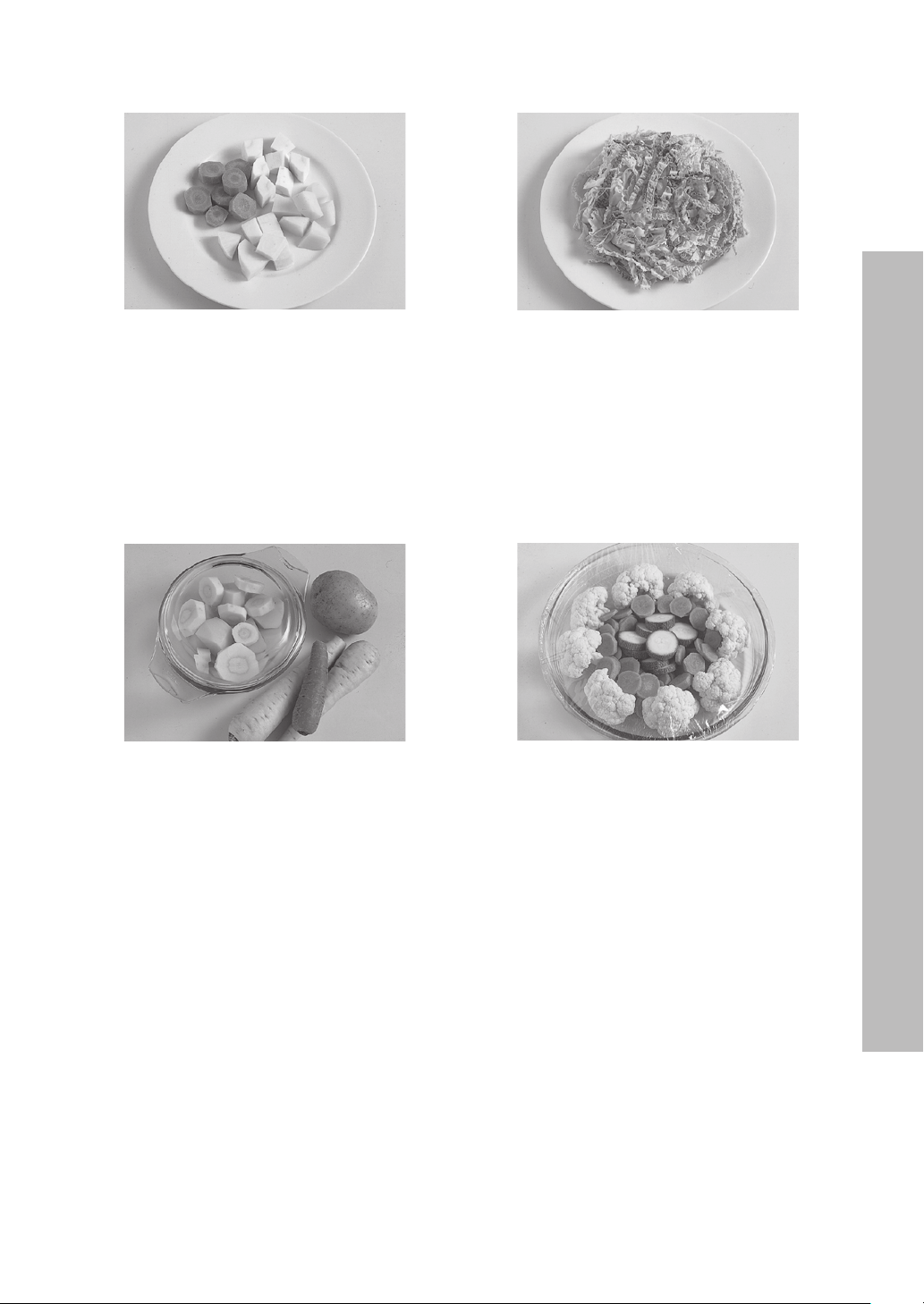
● Rootvegetables.i.e.carrots,swede,shouldbe
cut into slices, strips or cubes.
● Do not mix fresh and frozen vegetables as the
cooking times may be different.
● Ifcookingpotatoeswithothervegetables,only
cook with other root vegetables.
● Never add salt to vegetables before
microwaving. Remember the flavour of
microwaved vegetables is much better than
boiled.
● Cabbageshouldbeshreddedandcookedby
1000 W. Approx. 500 g for 12-14 minutes with
75 ml water.
● Fresh vegetables require 15 ml of water per
100 g vegetables. Cover with pierced cling film
or lid and stir halfway.
● Alwayscookvegetablesinadishthatisa
suitable size. Use flat dishes not basins. Always
cover with microwave cling film or a lid.
Guidelines
– 83 –
Vegetables and Vegetarian

Jacket Potatoes
Varieties of potatoes vary in their suitability for cooking by microwave. We recommend Maris Piper for
consistently good results. The cooking times given may need adjustment for other varieties. The ideal size
of potato to be cooked by microwave is 200 g - 250 g.
Before Cooking
Wash potatoes and prick skins several times.
Spread around edge of glass tray.
After Cooking
Remove from oven and wrap in aluminium foil to
retain the heat. Leave to stand for 5 minutes.
● Certainvegetablesi.e.broccoliandasparagus,
should be arranged so that the tips are in the
centre of the dish as these require less cooking.
● Wholecauliflowershouldbecookedupside
down on 600 W for 10 minutes. approx. with
90 ml water.
– 84 –
Vegetables and Vegetarian

V
EGETABLE
C
HILLI
Ingredients:
Serves 4
15 ml olive oil
1 onion, finely chopped
1 green pepper, deseeded, chopped
1 chilli, chopped
2 carrots, diced
5 ml chilli powder
3 ml cumin
175 g bulgar wheat
400 g canned chopped tomatoes
30 ml tomato purée
400 g canned red kidney beans, drained
450 ml water
Dish: 1 x large Pyrex
®
casserole dish with lid
Accessory: none
Method:
1. Place oil, onion, pepper, chilli and carrots in a
large casserole, cover and cook on 1000 W for
4-5 minutes or until softened.
2. Add chilli powder and cumin. Stir in bulgar
wheat, chopped tomatoes, tomato purée, red
kidney beans and water. Cover and cook on
1000 W for 10-15 minutes.
L
EEK AND
P
OTATO
G
RATIN
Ingredients:
Serves 4
450 g leeks deseeded, thinly sliced
450 g potatoes, thinly sliced
150 g blue cheese
225 g Greek yoghurt
75 ml double cream
50 g brown breadcrumbs
salt and pepper
Dish: 1 x large Pyrex
®
bowl, 1 x small mixing bowl,
1 x 25 cm Pyrex
®
flan dish
Accessory: Enamel tray
Method:
1. Place the vegetables in large bowl. Add 90 ml of
water, cover and cook on 1000 W for
10-12 minutes or until the vegetables are
softened.
2. Crumble or finely chop the cheese into a bowl
and gradually blend in the yoghurt and the
double cream.
3. Drain the vegetables and arrange in a flan dish.
Season and pour over the blue cheese cream
mixture. Sprinkle with breadcrumbs, place
on enamel tray and cook on Combination:
Convection220˚C+440 W for 10-12 minutes
or until golden brown.
R
OAST
V
EGETABLE
P
ARCELS
Ingredients:
Serves 4
450 g mixed vegetable e.g. sweet potato, red
pepper, leeks, aubergine, coutgettes,
onion, chopped
1 clove garlic, crushed
30 ml olive oil
200 g canned chopped tomatoes
10 ml tomato purée
25 g pine nuts
50 g Gruyère cheese, grated
100 g Boursin
®
cheese
15 ml single cream
225 g ready made puff pastry
1 egg for glazing
Dish: 1 x large mixing bowl, 1 x large Pyrex
®
bowl,
1 x small mixing bowl
Accessory: Enamel tray
Method:
1. Preheat oven Convection 220 °C with enamel
tray. Chop vegetables into 2 ½ cm chunks.
2. Add garlic and oil, mix thoroughly with mixed
vegetables. Place onto enamel tray.
3. Cook on Convection 220 °C for 20-25 minutes
until vegetables are browned and al dente.
4. Place the chopped tomatoes and purée in a
heatproof bowl uncovered and cook on 1000 W
for 5 minutes then 600 W for 5 minutes or until
mixture is reduced in volume and thickened.
5. Mix the tomato sauce with the cooked
vegetables and pine nuts.
6. Mix together the Gruyère cheese, Boursin
®
and
single cream.
7. Roll out pastry until it measures approx 40 cm
square. Divide into 4 equal squares.
8. Place ¼ of the vegetable mixture in the centre
of the square and top with ¼ of the cheese
mixture.
9. Bring the corners of the pastry to the centre,
pressing the edges together. Seal with water.
Glaze with beaten egg.
10. Cook in a preheated oven on Convection
220 °C for 15-20 minutes or until golden and
cooked through.
– 85 –
Vegetables and Vegetarian

V
EGETABLE
L
ASAGNE
Ingredients:
Serves 4-6
1 large onion, chopped
25 g butter
1 clove garlic, crushed
225 g carrots, diced
225 g leeks, chopped
225 g courgettes, diced
1 green pepper, chopped
150 ml hot vegetable stock
salt and pepper
300 ml prepared tomato sauce
175 g fresh lasagne sheets
225 g Mozzarella cheese
Dish: 1 x large Pyrex
®
casserole dish with lid,
1 x Pyrex
®
rectangular dish
Accessory: Enamel tray
Method:
1. Place onion and butter in a casserole dish,
cover and cook on 1000 W for 3 minutes. Add
vegetables and stock, cover and cook on
1000 W for 8-10 minutes or until vegetables are
soft, drain. Season to taste.
2. Cover base of rectangular dish with a thin layer
of tomato sauce, then a layer of lasagne on top
followed by a layer of vegetable mixture. Thinly
slice 175 g of the cheese and layer on top of
vegetables. Continue layering until ingredients
are all used ending with a tomato sauce layer.
3. Grate remaining cheese and arrange over
top. Cook on enamel tray on Combination:
Convection 190 °C + 300 W for 20-25 minutes
or until the pasta is cooked.
G
OAT’S CHEESE
T
ART WITH
R
OASTED
V
EGETABLES
Ingredients:
Serves 4
100 g butter
225 g plain flour
50 g Parmesan cheese, grated finely
1 red pepper, diced into 4 cm pieces
1 yellow pepper, diced into 4 cm pieces
2 medium courgettes, sliced
100 g auberbine, diced into
4 cm pieces
15 ml olive oil
100 g soft goat’s cheese
3 eggs, beaten
75 ml crème fraiche or double cream
15 ml fresh parsley, chopped
salt and pepper
Dish: 1 x large mixing bowl, 1 x 23 cm flan dish,
1 x Jug
Accessory: Enamel tray
Method:
1. Preheat the oven on Convection 200 °C.
2. Rub the butter into the flour until the mixture
resembles fine breadcrumbs. Stir in the
parmesan, add 30-45 ml cold water and mix to a
firm dough.
3. Roll out and line the flan dish. Prick the base
with a fork and allow to rest for 15 minutes.
4. Cover the pastry with greaseproof, add baking
beans and cook on enamel tray on Convection
200 °C for 10 minutes. Remove the paper and
beans and cook for a further 5 minutes or until
cooked. Allow to cool.
5. Place the prepared vegetables on enamel tray
and drizzle with olive oil. Cook on Combination:
Grill 1 + 300 W for 10-12 minutes or until lightly
browned. Turn halfway during cooking.
6. Place the vegetables in the flan case and dot
teaspoons of the goat’s cheese around the
vegetables.
7. Beat together the eggs and creme fraiche until
smooth, add the parsley and seasoning. Pour
carefully over the filling.
8. Place on enamel tray and cook on
Combination: Convection 190 °C + 100 W for
20-23 minutes or until set and lightly browned.
R
OAST
P
OTATOES
Ingredients:
Serves 4
450 g potatoes,
25 g butter
30 ml oil
Dish: none
Accessory: Enamel tray
Method:
1. Peel and cut potatoes into quarters. Par boil and
drain (see page 66).
2. Place potatoes, oil and butter on enamel tray.
3. Cook on Combination: Convection 220 ºC
+ 100 W for 27 minutes turning and basting
potatoes during cooking, or until crisp and
brown.
– 86 –
Vegetables and Vegetarian

S
TUFFED
P
EPPERS
Ingredients:
Serves 6
3 red peppers
3 yellow peppers
1 bunch spring onions, thinly sliced
30 ml olive oil
50 g pine nuts
2 cloves garlic, crushed
100 g long grain rice
300 ml hot vegetable stock
100 g cherry tomatoes, halved
100 g mozzarella, diced
100 g gorgonzola or any blue cheese, diced
1 handful parsley, finely shredded
1 handful basil, finely shredded
Dish: 1 x large Pyrex
®
casserole dish,
1 x large Pyrex
®
rectangular dish
Accessory: Enamel tray
Method:
1. Slice the tops off the peppers and put to one
side. Remove the seeds and rinse out.
2. Place the spring onions, oil, garlic and pine nuts
into in a casserole dish and stir together. Cook
on 1000 W for 2 minutes.
3. Add rice and hot stock. Cover and cook on
1000 W for 10 minutes.
4. Allow to cool slightly and then stir in the cherry
tomatoes, mozzarella, gorgonzola, parsley and
basil. Season well.
5. Spoon the stuffing into the peppers and arrange
them closely together in the rectangular dish.
6. Place on enamel tray and cook on
Combination: Convection 220 °C + 300 W for
10 minutes.
7. Place tops back on peppers and cook on
Combination: Grill 1 + 300 W for a further
8-10 minutes.
C
AULIFLOWER
C
HEESE
Ingredients:
Serves 4
1 cauliflower
90 ml water
25 g butter
25 g flour
3 ml french mustard
300 ml milk
salt and pepper
Topping:
75 g red cheese, grated
15 ml brown breadcrumbs
Dish: 1 x large Pyrex
®
casserole dish with lid,
1 x Pyrex
®
jug, 1 x medium Pyrex
®
gratin dish
Accessory: Enamel tray
Method:
1. Place cauliflower florets in a bowl. Add water.
Cover and cook on 600 W for 10 minutes or until
tender. Drain.
2. Melt butter on 1000 W for 30-50 seconds in a
Pyrex
®
jug. Stir in flour and mustard. Cook for a
further 30 seconds. Add milk gradually. Stir well
and season.
3. Cook on 1000 W for 2-3 minutes or until sauce
is thick and bubbling. Stir once halfway during
cooking. Stir in 60 g grated cheese.
4. Place cauliflower in gratin dish and pour
over sauce. Top with remaining cheese and
breadcrumbs.
5. Place on enamel tray and cook on
Combination: Convection 220 °C + 100 W for
15-17 minutes or until golden brown.
S
PICY
P
OTATOES
Ingredients:
Serves 4
350 g potatoes
45 ml natural yoghurt
10 ml mango chutney
3 ml cumin
3 ml corriander
3 ml tumeric
3 ml garam marsala
10 ml fresh corriander
pinch chilli powder
15 g sultanas
salt and pepper
Dish: 1 x 1.5 litre Pyrex
®
casserole dish with lid,
1 x Pyrex
®
mixing bowl
Accessory: none
Method:
1. Cut the potatoes into large cubes and place in a
large bowl with 90 ml water. Cover and cook on
1000 W for 6-8 minutes or until soft. Drain and
set aside.
2. Mix the remaining ingredients together. Add the
potatoes and mix well. Serve either hot or cold.
– 87 –
Vegetables and Vegetarian

Guidelines
Container Size
Always use a container or jug at least twice the
capacity of the sauce, to avoid boiling over.
Covering
Do not cover sauces when cooking.
Caution!
Sauces/gravy should be thoroughly stirred
before, during and after cooking, to avoid
any eruptions and to result in a smooth
sauce.
Reheating
Sauces can be made in advance and reheated by
microwave. Reheat on 1000 W and stir halfway.
Wooden Spoons
Do not leave wooden spoons in the sauce when
cooking. The wood may dry out and burn. Never
leave metal spoons in the sauce.
W
HITE
S
AUCE
Ingredients:
30 g butter, room temperature
30 g flour
600 ml whole milk
Variations:
parsley, onion, cheese
15 ml lemon juice
Dish: 1 x 1 litre Pyrex
®
jug
Accessory: none
Method:
1. Melt butter in jug on 1000 W for 20-40 seconds.
2. Stir in the flour to make a roux.
3. Add the milk gradually stirring continuously until
well combined.
4. Cook for 2 minutes on 1000 W. Stir and cook for
a further 3 minutes. Sauce should be smooth
and glossy and coat the back of a spoon.
Variations of White Sauce:
Parsley
Stir 60 ml chopped parsley and 15 ml lemon juice
into sauce halfway through cooking time.
Onion
Cook 1 small onion in the butter for 30 seconds on
1000 W before adding the flour and milk.
Cheese
Stir in 75 g grated cheese at the end of cooking time.
C
USTARD
Ingredients:
30 ml custard powder
15 ml sugar
600 ml whole milk
Dish: 1 x 1 litre Pyrex
®
jug
Accessory: none
Method:
1. Mix together the custard powder, sugar and a
little milk to form a smooth paste.
2. Blend in the remaining milk, whisking well.
3. Cook on 1000 W for 4-6 minutes. Whisk well
halfway through cooking time and again at the
end.
H
OLLANDAISE
S
AUCE
Ingredients:
3 egg yolks
30 ml white wine vinegar
100 g unsalted butter
chilled and cubed pepper
Dish: 1 x 1 litre Pyrex
®
jug
Accessory: none
Method:
1. Place egg yolks and vinegar in a jug. Beat well.
2. Drop cubes of butter on top. Cook on 1000 W for
20 seconds.
3. Whisk. Cook on 1000 W for 10 seconds.
4. Whisk again and cook on 1000 W for
10 seconds. Repeat in 10 second stages until
sauce is thick and creamy.
5. Season and serve immediately with salmon
steaks or asparagus spears.
N.B. This sauce must not boil or eggs will curdle.
– 88 –
Sauces

C
HOCOLATE
S
AUCE
Ingredients:
25 g butter
75 g caster sugar
75 g soft brown sugar
50 g cocoa powder
3 ml vanilla essence
300 ml milk
Dish: 1 x 1 litre Pyrex
®
jug
Accessory: none
Method:
1. Melt butter in a Pyrex
®
jug on 1000 W for
30-50 seconds.
2. Stir in sugars, cocoa powder and vanilla
essence.
3. Gradually add milk, stirring well.
4. Cook on 1000 W for 2 minutes. Stir well. Repeat
this again three more times or until you achieve
a smooth and glossy consistency that coats the
back of a spoon.
P
EPPER
S
AUCE
Ingredients:
1 onion, chopped
40 g butter
30 g flour
2 stock cubes
15 ml tarragon vinegar
10 ml white pepper
15 ml cognac
200 ml créme fraîche
Dish: 1 x large Pyrex
®
bowl
Accessory: none
Method:
1. Cook the onion in the bowl with butter for
2-3 minutes on 1000 W.
2. Add flours, mix, cook again for 1 minute on
1000 W and add 400 ml of hot water, 2 stock
cubes, vinegar and white pepper. Cook
uncovered at 1000 W for 3 minutes.
3. Remove from the oven and add cognac and
crème fraiche. Mix well.
R
OQUEFORT
S
AUCE
Ingredients:
50 g Roquefort cheese
200 ml single cream
30 ml cornflour
salt and pepper
Dish: 1 x 500 ml Pyrex
®
bowl
Accessory: none
Method:
1. Cut the Roquefort into pieces, place in a bowl
and melt using 600 W for 1 minute 30 seconds.
2. Add the cream and cornflour mixed with
15 ml water. Cook on 1000 W for 3-3 minutes
30 seconds, whisk halfway through the cooking
time. Check the seasoning before serving.
– 89 –
Sauces

S
UETCRUST
P
ASTRY
Ingredients:
225 g self-raising flour
3 ml salt
100 g shredded suet
105 ml cold water
Dish: 1 x large Pyrex
®
mixing bowl
Accessory: none
Method:
1. In Pyrex
®
mixing bowl, mix together flour, salt
and suet.
2. Add water and mix to a soft dough. Knead lightly
until smooth.
B
AKED
J
AM
R
OLY
P
OLY
P
UDDING
Ingredients:
Serves 4
1 quantity of suet pastry (as above)
75 ml seedless raspberry jam
milk to glaze
Dish: 1 x 1 kg Pyrex
®
loaf dish
Accessory: Enamel tray
Method:
1. Roll out pastry to approx. 23 x 32 cm.
2. Spread the jam over the pastry leaving 1 cm
border all round. Brush the edges with milk and
roll the pastry up evenly, starting at one short
side and sealing the edges.
3. Brush top with milk and place in loaf dish.
Preheat oven with enamel tray on Convection
210 °C. Cook on Combination: Convection
220 °C + 300 W for 15-18 minutes or until
golden.
A
PPLE
S
TRUDEL
Ingredients:
Serves 4
600 g granny smiths apples, peeled, cored
and sliced
½ lemon, juiced
50 g golden caster sugar
50 g walnuts, roughly chopped
50 g sultanas
5 ml ground cinnamon
50 g ground almonds
6 sheets filo pastry
50 g butter, melted
icing sugar to serve
Dish: 1 x Pyrex
®
mixing bowl, baking sheet
Accessory: Enamel tray
Method:
1. Preheat the oven on Convection 180 °C with
enamel tray.
2. Put the apples and lemon juice into a bowl and
toss together.
3. Add the sugar, walnuts, sultanas, cinnamon and
almonds and mix together.
4. Take three sheets of filo pastry and brush with
melted butter. Place each one with the shortest
edge towards you. Overlap the 2nd sheet onto
the 1st sheet by 5-6 cm along the long edge
and repeat with the 3rd sheet overlapping the
second.
5. Place three more sheets of filo on top, in the
same way as in step 4.
6. Spread the apple filling along the front edge of
the filo pastry just 2.5 cm from the edge and
2.5 cm from each side.
7. Fold the sides in over the filling and brush with
butter. Roll up from the long front edge buttering
the final long edge to seal the strudel.
8. Place on baking sheet, seam-side down. Brush
with melted butter.
9. Cook on Convection 180 °C for 30-35 minutes.
Dust with icing sugar to serve.
– 90 –
Pastry

C
ARROT
C
AKE
Ingredients:
2 eggs, beaten
150 ml vegetable oil
150 g self raising wholemeal flour
100 g soft light brown sugar
10 ml cinnamon
75 g raisins
100 g carrots, grated
Icing:
50 g cream cheese
50 g butter
100 g icing sugar
10 ml lemon, juiced
50 g walnuts, chopped
Dish: 1 x large mixing bowl, 1 x 18 cm souffle dish
lined with greaseproof paper, 1 x medium
mixing bowl
Accessory: Enamel tray
Method:
1. Mix eggs and oil together.
2. Combine flour, sugar, cinnamon, raisins and
carrots in a mixing bowl and pour egg mix into
flour and stir well.
3. Pour into dish and cook on the enamel tray on
Combination: Grill 3 + 440 W for 8 minutes.
4. For the icing: beat cream cheese and butter
together and gradually add icing sugar and
lemon juice. Decorate the cake with icing and
sprinkle with walnuts.
Guidelines
Covering
For traditional cakes, with long cooking times, baked
on convection mode only, it is necessary to cover the
top of the tin with foil 10-15 minutes after the start of
baking. This is not applicable to any of the recipes in
this section.
Dish Size/Shape
Always use the exact dish size stated in the following
recipes, otherwise cooking times and results will be
affected.
Eggs
The following recipes have been tested using
medium eggs. Using a different size of egg may
affect cooking times.
Mixing/Beating
Cakes cooked by microwave need to be well mixed,
but not over beaten. Generally it is unnecessary to
cream butter and sugar or beat eggs in an electric
mixer or food processor. Do not attempt to cook
whisked/fatless sponges, or any cakes containing
whisked egg white.
Combination Cooking
Do not use spring form tins, use smooth, and
preferably seamless metal cake tins.
G
INGER
C
AKE
Ingredients:
100 g butter
100 g golden syrup
100 g black treacle
75 g soft brown sugar
100 g self raising flour
100 g plain flour
5 ml mixed spice
10 ml ground ginger
5 ml bicarbonate of soda
pinch salt
150 ml milk
2 eggs, beaten
Dish: 1 x small Pyrex
®
bowl, 1 x large mixing bowl,
1 x 20 cm square Pyrex
®
dish
Accessory: none
Method:
1. Place butter, syrup, treacle and sugar in a bowl
and heat on 1000 W for 1-2 minutes or until fat
has melted.
2. Place flour, spices, bicarbonate of soda and salt
in a large bowl. Stir in treacle mixture and mix
well. Stir in milk and eggs and beat until smooth.
3. Pour into square dish and cook on 600 W for
8-9 minutes or until set around the edges. The
cake will appear slightly wet in the centre, but
will continue cooking as it cools.
– 91 –
Baking

C
HOCOLATE AND
A
LMOND
C
AKE
Ingredients:
100 g butter
100 g caster sugar
2 eggs, lightly beaten
100 g self raising flour
50 g cocoa powder
50 g ground almonds
100 ml whole milk
60 ml golden syrup
Topping:
50 g butter
25 g cocoa powder, sifted
200 g icing sugar
5 ml milk
Dish: 1 x 20 cm Pyrex
®
souffle dish, greased and
lined, 2 x large Pyrex
®
mixing bowls
Accessory: none
Method:
1. Cream together butter and sugar. Gradually add
egg. Add flour, cocoa powder, ground almond,
milk then syrup.
2. Pour into a Pyrex
®
dish. Cook on 600 W for
8 minutes.
3. Cream butter until soft and gradually add cocoa
powder and icing sugar. Lastly adding milk as
required.
F
RUIT
C
AKE
Ingredients:
175 g butter
175 g dark brown sugar
1 lemon, grated
3 eggs, beaten
225 g plain flour
10 ml ground spice
225 g raisins
225 g sultanas
50 g glace cherries
50 g chopped mixed nuts
15 ml treacle
45 ml brandy
Dish: 1 x Pyrex
®
mixing bowl, 1 x 20 cm soufflé dish
greased and lined
Accessory: none
Method:
1. Cream butter and sugar until light and fluffy. Mix
in the lemon rind. Beat in the eggs.
2. Fold in the flour, spice and the rest of the
ingredients. Spoon mixture into souffle dish.
3. Cook on 440 W for 20 minutes.
P
INEAPPLE,
C
INNAMON AND
R
AISIN
M
UFFINS
Ingredients:
Makes 12
100 g self raising flour
100 g wholemeal self-raising flour
3.75 ml bicarbonate of soda
pinch salt
5 ml ground cinnamon
150 ml sunflower oil
2 eggs
75 g golden caster sugar
125 g carrots, grated
225 g canned pineapple chunks, crushed
100 g raisins
Dish: 2 x medium Pyrex
®
bowls, 2 x 6 hole muffin
tin, 12 muffin cases
Accessory: Enamel tray
Method:
1. Preheat the oven on Convection 180 ºC with
enamel tray.
2. Sieve the flours, bicarbonate of soda, salt and
cinnamon into a bowl.
3. In a separate bowl, beat together the oil, eggs
and sugar. Add the grated carrot, crushed
pineapple and raisins.
4. Pour the oil mixture into the flour mixture and stir
together until just blended.
5. Put the mixture into the individual muffin tins
lined with muffin cases, cook on enamel tray in
two separate batches on Convection 180 ºC for
20-25 minutes per batch.
– 92 –
Baking

C
HOCOLATE
S
AUCY
P
UDDING WITH
T
OFFEE
S
AUCE
Ingredients:
75 g plain chocolate
30 ml milk
175 g margarine
175 g light muscovado sugar
2 eggs
150 g fresh white breadcrumbs
30 ml cocoa powder
Sauce:
225 g vanilla flavoured toffees
150 ml milk
15 g butter
Dish: 1 x 1.2 litre pudding basin, 1 x small Pyrex
®
bowl, 1 x large mixing bowl, 1 large Pyrex
®
jug
Accessory: none
Method:
1. Line the base of a 1.2 litre pudding basin with a
circle of greaseproof paper.
2. Melt the chocolate with the milk in a small
Pyrex
®
bowl on 600 W for 2-3 minutes and mix
until smooth.
3. Mix the margarine and sugar together, add the
cooled chocolate and eggs.
4. Add the breadcrumbs and cocoa powder and
mix well. Fill the basin with the mixture and
cook on 1000 W for 6-7 minutes or until cooked.
Leave to stand for 5 minutes before turning out.
5. Meanwhile, prepare the sauce by combining all
ingredients in a large jug and cook on 1000 W
for 2-3 minutes or until smooth. Stir vigorously
and pour over the pudding.
P
LUM AND
O
AT
L
AYER
Ingredients:
Makes 8 slices
100 g butter or margarine
50 g light brown sugar
30 ml golden syrup
225 g rolled oats
450 g plums, stoned and thinly sliced
5 ml ground cinnamon
Dish: 1 x large Pyrex
®
bowl, 1 x 20 cm ceramic flan
dish
Accessory: Enamel tray
Method:
1. Place the butter, sugar and syrup in a bowl.
Cook on 1000 W for 1-2 minutes or until melted.
Stir in the rolled oats.
2. Spread half the oat mixture into the dish.
Arrange the plums over the top in overlapping
rows and sprinkle with cinnamon.
3. Sprinkle the remaining oat mixture over the
plums and gently press down.
4. Cook on enamel tray on Combination:
Convection 220 °C + 440 W for 8-10 minutes or
until the mixture is firm and golden brown.
5. Cut into slices while hot, then allow to cool in the
dish.
S
TEAMED
S
UET
S
PONGE
P
UDDING
Ingredients:
Serves 4
150 g self-raising flour
pinch salt
50 g caster sugar
50 g suet
1 egg
150 ml milk
30 ml jam or golden syrup
Optional:
10 ml sultanas, optional
Dish: 1 x Pyrex
®
mixing bowl, 1 x 1 litre Pyrex
®
,
pudding basin
Accessory: none
Method:
1. In a mixing bowl, sift together the flour and
salt. Stir in sugar and suet. Add the sultanas if
desired.
2. Make a well in the centre and add beaten egg
and milk. Mix to a soft dropping consistency.
3. Put the jam in the base of the greased pudding
basin and pour pudding mixture over. Cook on
1000 W for 5-5 minutes and 30 seconds or until
firm.
– 93 –
Desserts

B
READ AND
B
UTTER
P
UDDING
Ingredients:
Serves 4
6 slices bread, buttered and cut in half
diagonally
75 g mixed dried fruit
450 ml milk
3 eggs
25 g caster sugar
3 ml nutmeg
Dish: 1 x Pyrex
®
dish 20 x 25 cm greased, 1 x large
Pyrex
®
bowl, 1 x mixing bowl
Accessory: Enamel tray
Method:
1. Arrange the bread and fruit in the prepared dish.
2. Warm the milk for 3 minutes on 600 W but do
not allow to boil.
3. Beat together the eggs and sugar, add the milk,
stirring well.
4. Pour the mixture over the bread, sprinkle with
nutmeg and leave to stand for 15 minutes. Cook
on enamel tray on Combination: Convection
190 °C + 300 W for 20-25 minutes or until set
and browned.
C
HRISTMAS
P
UDDING
Ingredients:
Serves 6-8
1 cooking apple, peeled and grated
1 carrot, peeled and grated
1 orange, juice and grated rind
400 g mixed dried fruit
45 ml brandy
15 ml black treacle
50 g self-raising flour
pinch salt
15 ml cocoa
5 ml mixed spice
3 ml nutmeg
100 g shredded suet
150 g fresh breadcrumbs
50 g mixed peel
50 g flaked almonds
2 eggs, beaten
Dish: 1 x large Pyrex
®
bowl, 1 x 1.3 litre Pyrex
®
pudding basin lightly greased
Accessory: none
Method:
1. Place apple and carrot in a large bowl. Cover
and cook on 1000 W for 5 minutes. Beat well
to make a thick purée.
2. Stir in juice, rind and mixed fruit. Cook on
1000 W for 2 minutes. Stir in brandy and
treacle. Stand for 5 minutes. Beat in rest of
ingredients.
3. Press into a lightly greased pudding basin.
Cover with greaseproof paper and cook on
1000 W for 4 minutes. Stand for 5 minutes.
Cook on 1000 W for another 2 minutes or until
just firm.
N.B. One of the advantages of using your
microwave to make this traditional pudding is
that it can be made the week before Christmas
and stored in a cool dry place. Do not attempt
to make the pudding earlier than this, since the
flavour will not improve with keeping, unlike a
traditionally steamed pudding.
B
AKED
A
PPLES
Ingredients:
Serves 4
4 medium sized apples
30 ml caster sugar
25-50 g mixed dried fruit
25 g butter
Dish: 1 x Pyrex
®
mixing bowl, 1 x 20 cm Pyrex
®
shallow dish
Accessory: none
Method:
1. Core the apples and score the skin around the
middle.
2. Mix together the sugar and fruit and fill the
centres of the apples.
3. Dot the top with butter. Stand the apples in a
shallow dish and cook on 1000 W for
5 minutes 30 seconds - 7 minutes. Stand for
5 minutes before serving.
N.B. The apples will look quite green when
removed from the oven, but they should feel
slightly soft when tested with a sharp knife.
During the standing time, the colour will
become dull and the apples will be tender. The
apples will overcook very easily, so take care
to undercook slightly. For 1 baked apple cook
for 2-3 minutes. For 2 baked apples cook for
3-5 minutes.
– 94 –
Desserts

C
HOCOLATE
B
ROWNIES
Ingredients:
Serves 9
125 g butter
200 g dark chocolate (72 % cocoa solids)
175 g soft brown muscovado
2 eggs, beaten
sugar
a few drops vanilla essence
50 g plain flour
5 ml baking powder
Dish: 1 x small Pyrex
®
bowl, 1 x Pyrex
®
mixing bowl,
23 cm Pyrex
®
square dish
Accessory: Enamel tray
Method:
1. Melt the butter with 50 g of the chocolate in a
small bowl on 600 W for 2 minutes.
2. Put the eggs, sugar and vanilla essence in a
bowl, then sift in the flour and baking powder.
3. Stir in the melted chocolate and butter mixture
and mix well.
4. Chop the remaining chocolate into rough chunks
and stir into the brownie mixture.
5. Spoon into the dish, spread evenly and cook on
enamel tray, Combination: Convection 220 °C
+ 300 W for 9-12 minutes or until firm.
F
RUIT
S
CONES
Ingredients:
Serves 10
225 g self-raising flour
pinch salt
5 ml baking powder
50 g butter
25 g caster sugar
50 g sultanas
100 ml whole milk
1 egg for glazing
Dish: 1 x Pyrex
®
mixing bowl, 1 x small baking sheet
Accessory: Enamel tray
Method:
1. Preheat oven on Convection 210 °C with
enamel tray.
2. Sift the flour, salt and baking powder together.
Rub in fat until the mixture resembles fine
breadcrumbs. Add sugar and sultanas.
3. Make a well in the centre and stir in enough milk
to form a soft dough.
4. Knead lightly. Pat out to 2 cm thick and cut into
10 rounds with a 5 cm cutter. Place on baking
sheet, brush with beaten egg and cook on
Convection 210 °C for 10-15 minutes or until
well risen and golden brown.
R
ED
F
RUIT
C
OMPOTE
Ingredients:
Serves 4
225 g plums, halved
225 g cherries, stoned
225 g blueberries
225 g strawberries, halved
225 g raspberries, halved
50 g golden caster sugar
Dish: 1 x large Pyrex
®
shallow dish
Accessory: none
Method:
1. Place the plums, cherries and blueberries in a
shallow dish. Cook on 440 W for 10 minutes.
2. Stir in the strawberries and cook on 440 W for a
further 5-6 minutes.
3. Stir the raspberries and sugar into the hot fruit
and allow to cool before serving.
– 95 –
Desserts

S
TREUSEL
T
OPPED
F
RUIT
M
UFFINS
Ingredients:
Makes 12
Streusel topping:
50 g butter
75 g plain flour
30 ml granulated sugar
15 ml ground mixed spice
Muffins:
225 g plain flour
10 ml baking powder
150 g caster sugar
2.5 ml salt
½ lemon, grated zest
175 g fresh or frozen berries, raspberries or
blueberries
75 g butter
110 ml buttermilk
1 egg, lightly beaten
2.5 ml vanilla essence
Dish: 1 x small Pyrex
®
bowl, 1 x large mixing bowl,
1 x large Pyrex
®
bowl, 2 x 6 hole muffin tin,
12 paper muffin cases
Accessory: Enamel tray
Method:
1. Preheat oven on Convection 180 ºC with
enamel tray.
2. Melt the butter on 600 W for 1 minute. Combine
the streusel topping ingredients to make a soft
dough and reserve. Chill.
3. Sift together the flour, baking powder, sugar and
salt. Add the lemon rind and the fruit.
4. Melt the butter on 1000 W for 30 second to
1 minute mix in the buttermilk, egg and vanilla
essence. Lightly stir in the flour mixture and
divide between 12 muffin cases.
5. Crumble small amounts of streusel topping
over each muffin and cook in two batches
on Convection 180 °C for 22 minutes, until
browned and well risen.
R
ICE
P
UDDING
Ingredients:
Serves 4
100 g short grain rice
1 litre whole milk
75 g caster sugar
small piece cinnamon stick
1 vanilla pod, split lengthways
Dish: 1 x large Pyrex
®
casserole dish with lid
Accessory: none
Method:
1. Place the rice, milk and sugar into the bowl.
Add the cinnamon stick and vanilla pod. Do not
cover.
2. Bring to the boil by heating on 1000 W for
11-12 minutes on the base of the oven, paying
close attention to ensure that the milk does not
boil over.
3. Cook covered with a lid on 300 W for 1 hour.
Remove the cinnamon stick and vanilla pod.
Leave to cool, serve hot or cold.
A
PPLE
C
RUMBLE
Ingredients:
Serves 4-6
700 g cooking apples, peeled, cored and
roughly chopped
2.5 ml ground cinnamon
75 g ground almonds
75 g caster sugar
75 g butter
75 g plain flour
40 g brown sugar
Dish: 1 x 24 cm rectangular dish, 1 x Pyrex
®
mixing
bowl
Accessory: Enamel tray + wire rack
Method:
1. Place the apples in the dish with brown sugar
and cinnamon and cook on 1000 W for
6-9 minutes, uncovered, stirring halfway through
the cooking time. Leave to cool.
2. In a bowl mix ground almonds, butter, flour and
caster sugar, until you obtain a mixture that
looks like breadcrumbs. Spread this mixture
over the pre-cooked apples.
3. Place the dish on the wire rack on enamel tray
and cook on Combination: Convection 180 °C
+ 300 W for 5-7 minutes, or until golden.
– 96 –
Desserts

Guidelines
Sterilizing Jars
Jam jars can be sterilized by microwave ready for
your jams. Half fill with water and heat them on
1000 W until water boils (approx. 3 minutes. for
2 jars). Empty and drain upside down on kitchen
paper. The jars should be warm when filled with jam.
If you wish to cook larger quantities than given in the
recipes below, revert to the traditional hob method,
using a traditional recipe.
Dish Size
Always use a very large Pyrex
®
bowl. Do not attempt
to use jam pans or saucepans in your microwave.
Do not leave jams unattended during cooking
because of the high sugar content.
Covering
Do not cover preserves whilst cooking, apart from if
recommended in the recipe.
We do not recommend that you use your
microwave to sterilise babies’ bottles.
(See details on page 53)
Do not seal preserving jars in your microwave.
Setting Point
To determine whether setting point is reached, place
a couple of drops of jam or marmalade on a cold
saucer (put one in the fridge whilst making the jam).
Leave to cool. The jam should wrinkle on the surface
when your finger pushes across the top.
S
OFT
F
RUIT
J
AM
Ingredients:
Makes approx. 675 g
450 g soft fruit, washed
450 g caster sugar
30 ml lemon, juiced
5 ml butter
Dish: 1 x large Pyrex
®
bowl
Accessory: none
Method:
1. Place all ingredients in a large bowl and stir.
Cook on 1000 W for 5 minutes (10-15 minutes
if using frozen fruit), stirring frequently. Continue
to cook in one minute intervals until sugar has
dissolved.
2. Wash down any sugar crystals from around the
bowl.
3. Bring mixture to the boil and continue to cook
until setting point is reached – approx.
10-20 minutes. Test regularly for setting point.
L
EMON
C
URD
Ingredients:
Makes approx. 900 g
4 lemons, juice and grated rind
450 g caster sugar
4 eggs, beaten
100 g butter
Dish: 1 x large Pyrex
®
bowl
Accessory: none
Method:
1. Place all ingredients in bowl. Mix well.
2. Cook on 1000 W for 1 minute. Stir. Continue
to cook in 1 minute stages until mixture starts
to thicken, then cook for 30 seconds at a time
until mixture coats back of spoon. (The eggs will
curdle if overcooked).
3. The mixture will thicken on cooling. Pot into
warm jars. Cover with a circle of waxed paper
and a jam pot cover.
– 97 –
Preserves

O
RANGE
M
ARMALADE
Ingredients:
Makes approx. 675-900 g
450 g seville oranges
1 lemon
900 ml water
450 g sugar
knob of butter
Dish: 2 x large Pyrex
®
bowl
Accessory: none
Method:
1. Grate oranges and lemon ensuring all the pith is
left on the fruit. Set the rind aside.
2. Peel the fruit and put it in a food processor and
chop until the pips are broken.
3. Place the chopped mixture in a large bowl and
pour over boiling water. Cover with pierced cling
film and cook on 1000 W for 10 minutes.
4. Strain the mixture through a sieve into another
large bowl pressing the pulp well until all the
juice is extracted. Discard the pulp.
5. Stir the shredded rind into the hot juice and cook
uncovered on 1000 W for 10 minutes until rind
is tender, stirring occasionally. Stir in the sugar
until dissolved.
6. Cook on 1000 W for 8 minutes covered with
pierced cling film. Stir in the butter and cook
uncovered until setting point is reached, approx.
18-20 minutes.
7. Leave to stand for 10 minutes then pour into
warmed sterilized jars.
N.B Do not double this recipe as it will boil over.
P
LUM
J
AM
Ingredients:
Makes approx. 1.5 kg
675 g plums or damsons, halved, stoned
200 ml cold water
675 g jam sugar
30 ml lemon juice
5 ml butter
Dish: 1 x large Pyrex
®
mixing bowl
Accessory: none
Method:
1. Place plums in a large Pyrex
®
bowl with water.
2. Cook on 600 W for 10 minutes or until fruit is
soft.
3. Add the remaining ingredients, stir and cook on
1000 W for 5 minutes stirring frequently.
4. Wash down any sugar crystals from around the
bowl.
5. Bring mixture to the boil on 1000 W, approx.
4-5 minutes.
6. Continue to cook on 1000 W until setting point
is reached approx. 20-25 minutes. Test regularly
for setting point.
– 98 –
Preserves

T
OMATO
S
OUP
Ingredients:
Serves 4
30 ml olive oil
1 onion, chopped
1 garlic clove, crushed
200 g carrots, peeled and chopped
400 g canned chopped tomatoes
200 ml passata
400 ml vegetable stock
1 bay leaf
1 sprig fresh thyme
100 ml single cream, optional
salt and pepper
Dish: 1 x large Pyrex
®
casserole dish with lid
Accessory: none
Method:
1. Place the oil, onion, garlic and carrots in a large
casserole dish, cover and cook on 1000 W for
5 minutes.
2. Stir in the tomatoes, passata, stock, bay leaf and
thyme and cook covered on 1000 W for
10 minutes then 300 W for 30 minutes.
3. Remove the bay leaf and thyme, add the cream
(if desired) and seasoning, blend in a food
processor until smooth.
F
RITTATTA
Ingredients:
25 g butter
25 g ham, chopped
25 g green pepper, finely chopped
1 spring onion, sliced
4 eggs, beaten
50 g Cheddar cheese, grated
Dish: 1 x 24 cm flan dish
Accessory: none
Method:
1. Place the butter in the flan dish. Melt on 600 W
for 1 minute.
2. Add the ham, green pepper and spring onions.
Cook on 1000 W 1-2 minutes.
3. Pour the beaten egg over the top, sprinkle with
the cheese.
4. Cook on 1000 W for 2 minutes. Leave to stand
for 2 minutes before serving.
Guidelines
This section of recipes are designed to satisfy children or may be shared with the whole family.
Note: If a child is using a microwave oven they should be supervised at all times.
Q
UESADILLAS
Ingredients:
2 flour tortillas
50 g Cheddar cheese, grated
25 g cooked ham, chopped
1 spring onion, sliced
Dish: 1 x dinner plate
Accessory: none
Method:
1. Place a tortilla on the plate, place the cheese,
ham and onion onto the tortilla. Place the other
tortilla on top.
2. Cover with a piece of kitchen roll cook on
1000 W for 1-2 minutes.
T
ERYAKI
S
ALMON
Ingredients:
Serves 2-4
200 g salmon fillets, skinned and cut into bite
sized pieces
1 cm piece fresh ginger, grated
15 ml clear honey
20 ml soy sauce
15 ml sesame seeds
Dish: 1 x 23 shallow Pyrex
®
square dish,
1 x small Pyrex
®
mixing bowl,
4 bamboo kebab skewers
Accessory: Enamel tray + wire rack
Method:
1. Thread the salmon onto the wooden skewers,
place into a shallow dish.
2. Place all the remaining ingredients, except the
sesame seeds into a bowl and pour over the
salmon, turn the skewers to coat all sides in the
sauce.
3. Place the dish onto the wire rack on the enamel
tray and cook on Grill 1 for 12 minutes. Turn the
skewers during cooking.
4. Sprinkle the salmon with the sesame seeds
once cooked.
– 99 –
Junior Recipes

S
PAGHETTI
B
OLOGNESE
Ingredients:
Serves 6
15 ml olive oil
½ onion, chopped
1 small celery, finely diced
1 small courgette, finely diced
1 small carrot, finely diced
1 small apple, grated finely
1 clove of garlic, crushed
225 g lean beef mince
200 g passata
15 g tomato purée
175 g beef or vegetable stock
Dish: 1 x large Pyrex
®
casserole dish with lid
Accessory: none
Method:
1. Place the oil, vegetables, apple and garlic into
the casserole dish, cover and cook on 1000 W
for 5 minutes, add the mince, stir and cook on
1000 W for another 5 minutes.
2. Add the passata, purée and stock to the dish.
Mix well and cook on 1000 W for 10 minutes
then 300 W for a further 10 minutes.
3. Purée if necessary to suit the age of the child.
S
TUFFED
S
WEET
P
OTATOES
Ingredients:
Serves 2-4
4 rashers streaky bacon
4 sweet potatoes each 200-250 g
15 ml olive oil
60 ml Crème fraiche
3 spring onions, finely sliced
250 g Cheddar cheese, grated
Dish: 1 x microwaveable plate, 1 x mixing bowl
Accessory: Enamel tray + wire rack
Method:
1. Place the bacon on a microwavable plate, cover
with kitchen roll and cook on 1000 W for
2 minutes. Leave to one side.
2. Cook the sweet potatoes on the auto program
jacket potatoes (see page 44). Leave them to
cool.
3. Slice the sweet potatoes in half lengthways,
scoop out the flesh and place into a bowl, add
the crème fraiche, spring onions and half the
cheese to the bowl, mix together well.
4. Spoon the filling back into the potato halves.
Chop the bacon and place some on top,
followed by the remaining cheese.
5. Place the potato halves onto the wire rack on
the enamel tray and cook on Grill 1 for
3-6 minutes or until golden brown.
– 100 –
Junior Recipes

G
RANOLA
Ingredients:
Serves 6-8
175 g oats
120 g soft brown sugar
1.25 ml salt
50 g sunflower seeds
25 g desiccated coconut
30 g sunflower oil
60 g maple syrup
25 g dried cranberries
25 g raisins
25 g dried apricots, finely chopped
Dish: 1 x medium mixing bowl
Accessory: Enamel tray
Method:
1. Preheat the oven on Convection 150 ºC with
the enamel tray.
2. Mix together the oats, sugar, salt, sunflower
seeds and coconut. Mix the oil and maple syrup
together and stir thoroughly into the oat mixture.
3. Carefully grease the enamel tray and spread the
oat mixture evenly across the tray.
4. Cook on Convection 150 ºC for 40-45 minutes,
stirring every 10 minutes.
5. Pour the cooked mixture into a bowl and stir in
the cranberries, raisins and apricots.
Serving suggestion:
Ideal for breakfast with milk, on its own as a snack or
layered with yoghurt, honey and fruit.
I
NDIVIDUAL
P
EAR,
A
PPLE AND
R
ASPBERRY
C
RUMBLES
Ingredients:
Serves 8
Topping:
100 g butter, chilled and cubed
150 g plain flour
75 g golden caster sugar
pinch salt
50 g oats
Fruit:
1 apple, peeled and finely chopped
1 pear, peeled and finely chopped
125 g raspberries
30 ml caster sugar
Dish: 2 x medium mixing bowl, 8 x 8 cm ramekins
Accessory: Enamel tray
Method:
1. Make the crumble topping by rubbing the butter
into the flour until it resembles fine breadcrumbs.
Mix the golden caster sugar, salt and oats into
the crumble topping.
2. Mix the apple, pear and raspberries with the
caster sugar and divide equally between the
ramekin dishes and top with the crumble
mixture.
3. Place the ramekins onto the enamel tray and
cook on Combination: 180 ºC + 300 W for
15-20 minutes.
– 101 –
Junior Recipes
© Panasonic Appliances Microwave Oven (Shanghai) Co., Ltd. 2021
F0003Q80QP
FLE0721-0
Printed in China