EN
Instructions for Use
FR
Manuel d'instructions
STPS60TM-1

2
Contents
Grounding Instructions ...................................................................................................................... 3
Safety Information .............................................................................................................................. 4
Safety Instructions ............................................................................................................................. 6
Description of your oven .................................................................................................................... 7
Basic settings ..................................................................................................................................... 9
Basic Functions ................................................................................................................................ 12
Special Functions ............................................................................................................................. 15
Filling the water tank ........................................................................................................................ 16
When the oven is working... ............................................................................................................. 17
Usage, Tables and Tips .................................................................................................................... 19
Cooking with the Broiler .................................................................................................................. 24
Cooking with Convection ................................................................................................................. 25
Cooking with Convection ................................................................................................................. 26
Care and maintenance ..................................................................................................................... 27
Oven Cleaning ................................................................................................................................... 30
What should I do if the oven doesn’t work? ................................................................................... 31
Technical characteristics ................................................................................................................. 32
Installation instructions ................................................................................................................... 33
Installation dimensions .................................................................................................................... 71

3
Grounding Instructions
This appliance must be connected to a grounded, metallic, permanent wiring
system, or an equipment grounding conductor should be run with the circuit
conductors and connected to the equipment grounding terminal or lead on the
appliance.
Warning! IMPROPER USE OF THE GROUNDING CAN RESULT IN A RISK OF
ELECTRICAL SHOCK.
Please refer to the Installation Instructions for further information.

4
Safety Information
Carefully read the instructions before installing and using the equipment. The
manufacturer is not liable for improper installation and use of the equipment that may
cause injuries and damage. Always keep the instructions at hand, so they can be
easily referred to during use.
IMPORTANT SAFEGUARDS
When using electrical appliances, basic safety precautions should always be
followed including the following:
1. Proper Installation – Be sure your appliance is properly installed and
grounded by a qualified technician or electrician.
2. Never Use Your Appliance for Warming or Heating the Room.
3. Do Not Leave Children Alone – Children should not be left alone or
unattended in area where appliance is in use. They should never be allowed
to sit or stand on any part of the appliance.
4. Wear Proper Apparel – Loose-fitting or hanging garments should never be
worn while using the appliance.
5. User Servicing – Do not repair or replace any part of the appliance unless
specifically recommended in the manual. All other servicing should be
referred to a qualified technician.
6. Storage in or on Appliance – Flammable materials should not be stored in
an oven
7. Do Not Use Water on Grease Fires – Smother fire or flame or use dry
chemical or foam-type extinguisher.
8. Use Only Dry Potholders – Moist or damp potholders on hot surfaces may
result in burns from steam. Do not let potholder touch hot heating elements.
Do not use a towel or other bulky cloth.
9. Use Care When Opening Door – Let hot air or steam escape before
removing or replacing food.
10. Do Not Heat Unopened Food Containers – Build-up of pressure may cause
container to burst and result in injury.
11. Keep Oven Vent Ducts Unobstructed.
12. Placement of Oven Racks – Always place oven racks in desired location
while oven is cool. If rack must be moved while oven is hot, do not let
potholder contact hot heating element in oven.
13. DO NOT TOUCH HEATING ELEMENTS OR INTERIOR SURFACES OF
OVEN – Heating elements may be hot even though they are dark in color.
Interior surfaces of an oven become hot enough to cause burns. During and
after use, do not touch, or let clothing or other flammable materials contact
heating elements or interior surfaces of oven until they have had
sufficient time to cool.
• This Steam Oven is for household use

5
Safety Information
Safety of children and vulnerable adults
• WARNING! Risk of choking, injury or permanent disability.
• This appliance can be used by children aged 8 years and above and persons with
reduced physical, sensory or mental capabilities or lack of experience and
knowledge if they are given supervision or instructions concerning how to use the
appliance in a safe way and understand the hazards involved.
• Children should not play with the appliance.
• Keep packaging materials away from children. Risk of suffocation!
• Keep children away from the appliance during operation or when cooling.
• Cleaning and maintenance should not be done by children without supervision
Warnings on general safety
• During installation, follow the instructions supplied separately.
• Only qualified personnel can install the appliance and replace the cable.
• WARNING: The appliance and its accessible parts become hot during use.
Care should be taken to avoid touching heating elements. Children less than 8
years of age shall be kept away unless continuously supervised.
• During use the appliance becomes hot. Care should be taken to avoid touching
heating elements inside the oven.
• WARNING: Accessible parts may become hot during use. Young children
should be kept away.
• Do not use steam cleaners to clean the appliance.
• Do not use abrasive detergents or metal scrapers to clean the appliance.
• The connection should include correct earthing, in compliance with current norms.
• Disconnect the appliance from the power supply before carrying out any
maintenance operation

6
Safety Instructions
WARNING!
Before connecting the appliance compare the
power data (voltage and frequency) indicated on
the characteristics plate with those of the power
supply in question. If these data do not match there
may be problems. In case of doubt, contact an
electrician.
WARNING!
The appliance must be installed and connected by
a technician. Contact a qualified electrician who
knows and respects current safety standards. The
manufacturer cannot be held responsible for
damage resulting from fitting or connecting errors.
WARNING!
The electrical safety of the appliance can only be
guaranteed if it is earthed. The manufacturer
cannot be held responsible for damage resulting
from the absence of or defects in the installation’s
protection system (e.g. electrical shock).
WARNING!
Only use the appliance once it has been fitted into
its built-in position. Only in this manner can it be
guaranteed that users cannot access the electrical
components.
WARNING!
Never open up the appliance’s frame. Possible
contacts with electrical conducting parts or
changes to electrical or mechanical components
may represent a danger to users’ safety and
prejudice the correct working of the appliance.
WARNING!
Repairs and maintenance, especially of parts
carrying electrical current, must only be done by
technicians authorised by the manufacturer. The
manufacturer and retailers do not accept
responsibility for any damaged caused to people,
animals or property as a result of repairs and
maintenance carried out by non-authorised
personnel.
WARNING!
Repairs undertaken during the guarantee period
must only be done by technicians authorised by the
manufacturer. If this is not the case then any
damage resulting from the repair in question is
excluded from the guarantee
WARNING!
The appliance must be disconnected from the
electrical current when installation and repair work
is being done. To disconnect the appliance from
the current, one of the following conditions must
apply:
• The switchboard fuses / circuit breakers must
be disconnected.
7
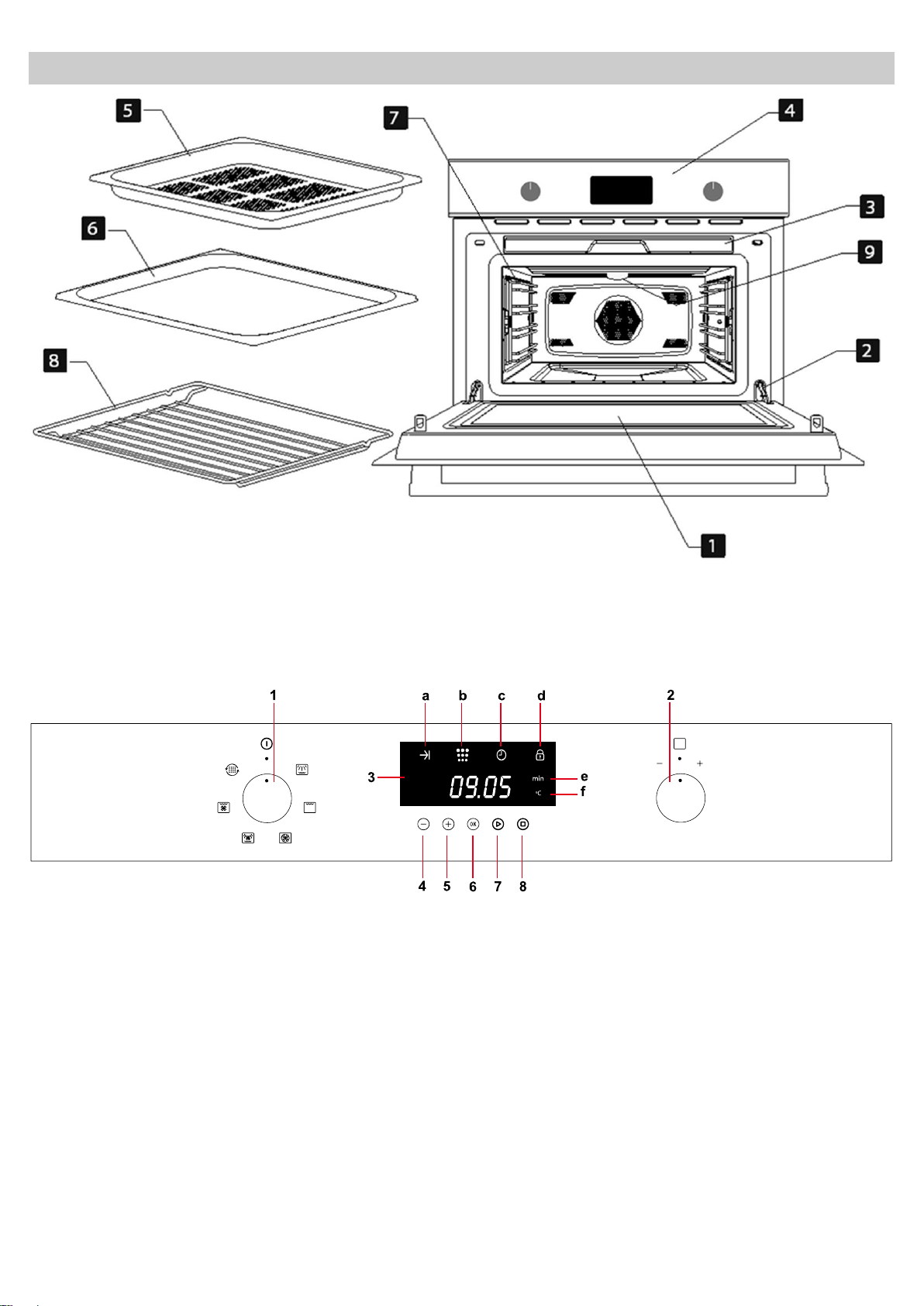
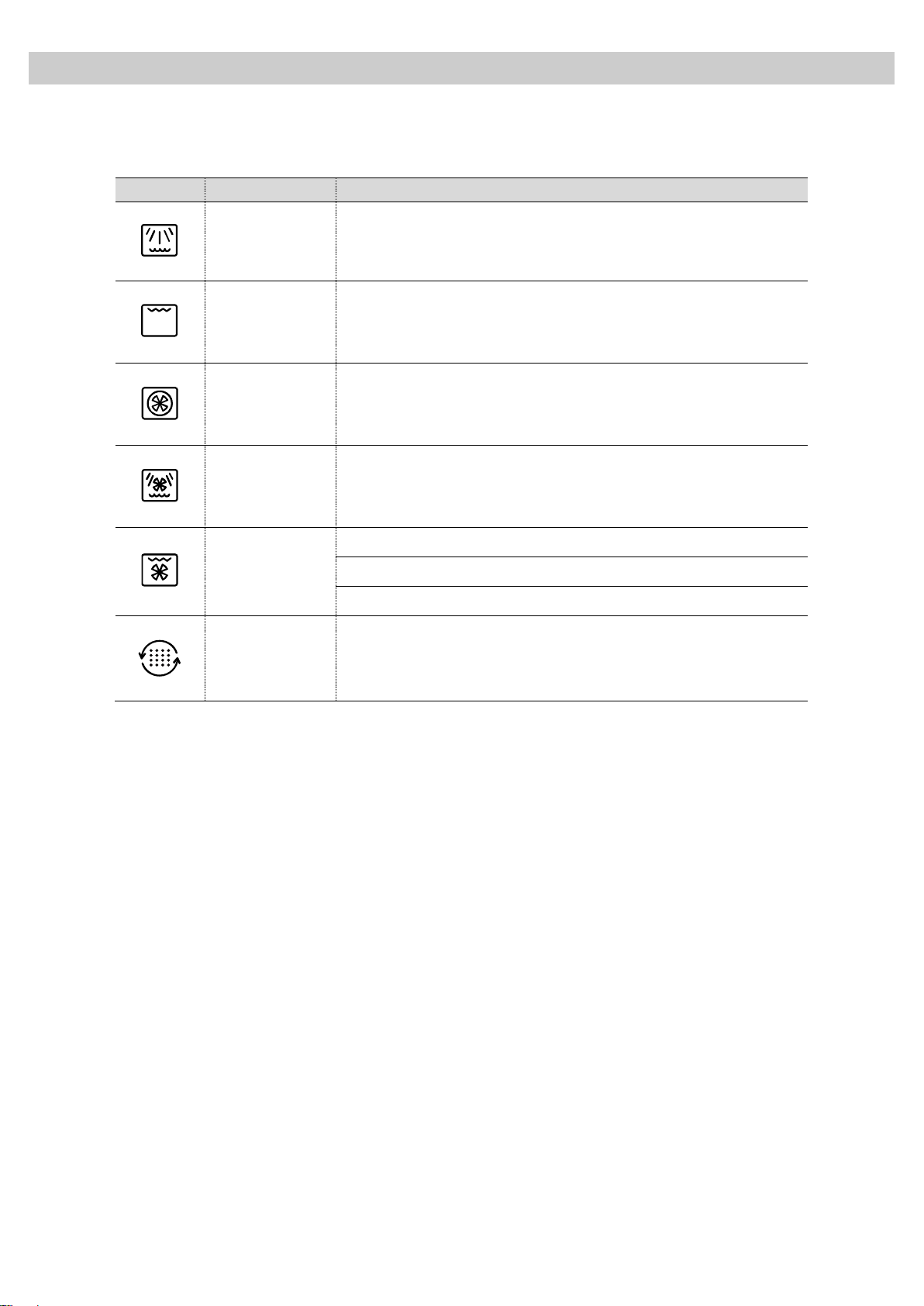
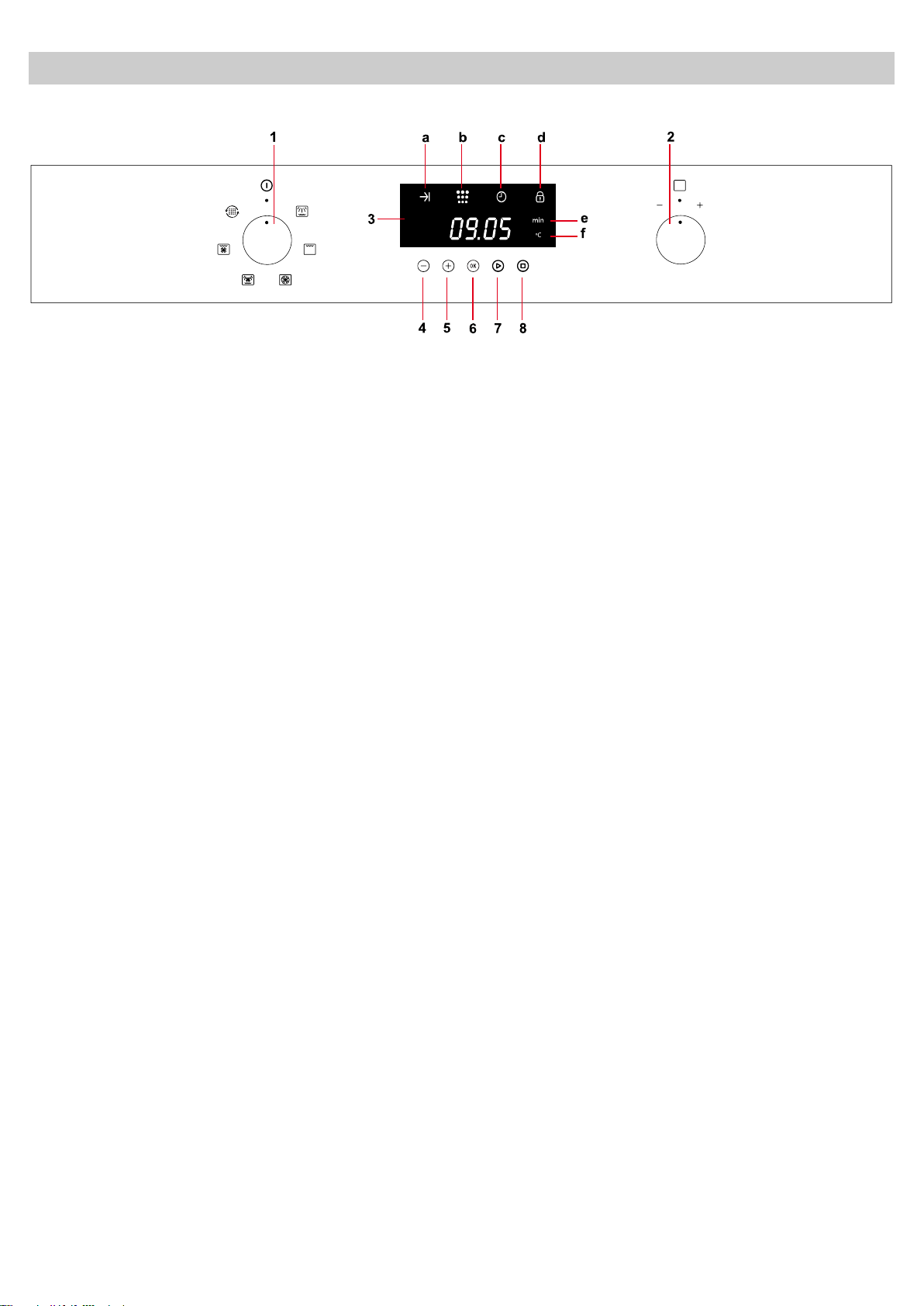
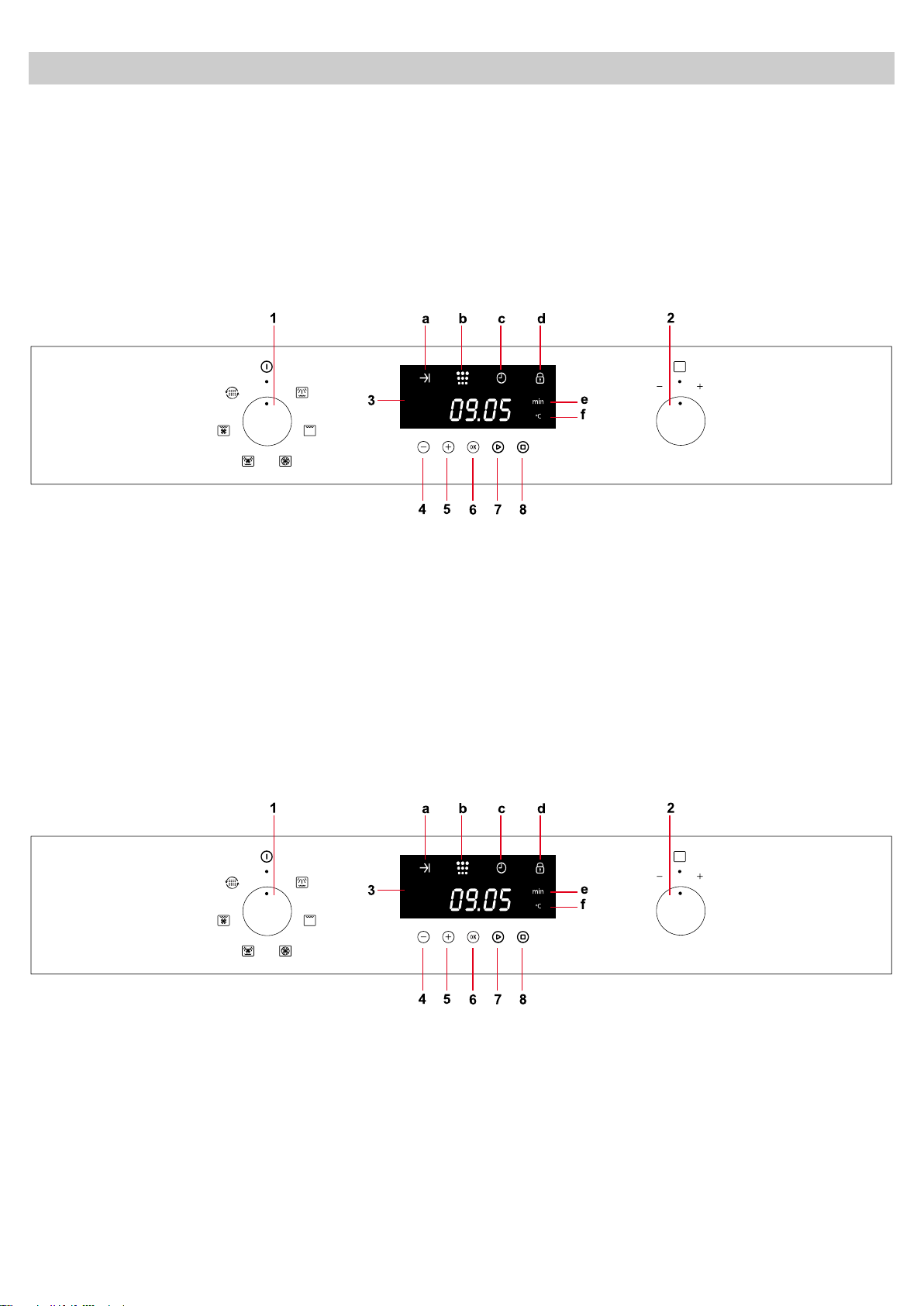
Description of your oven
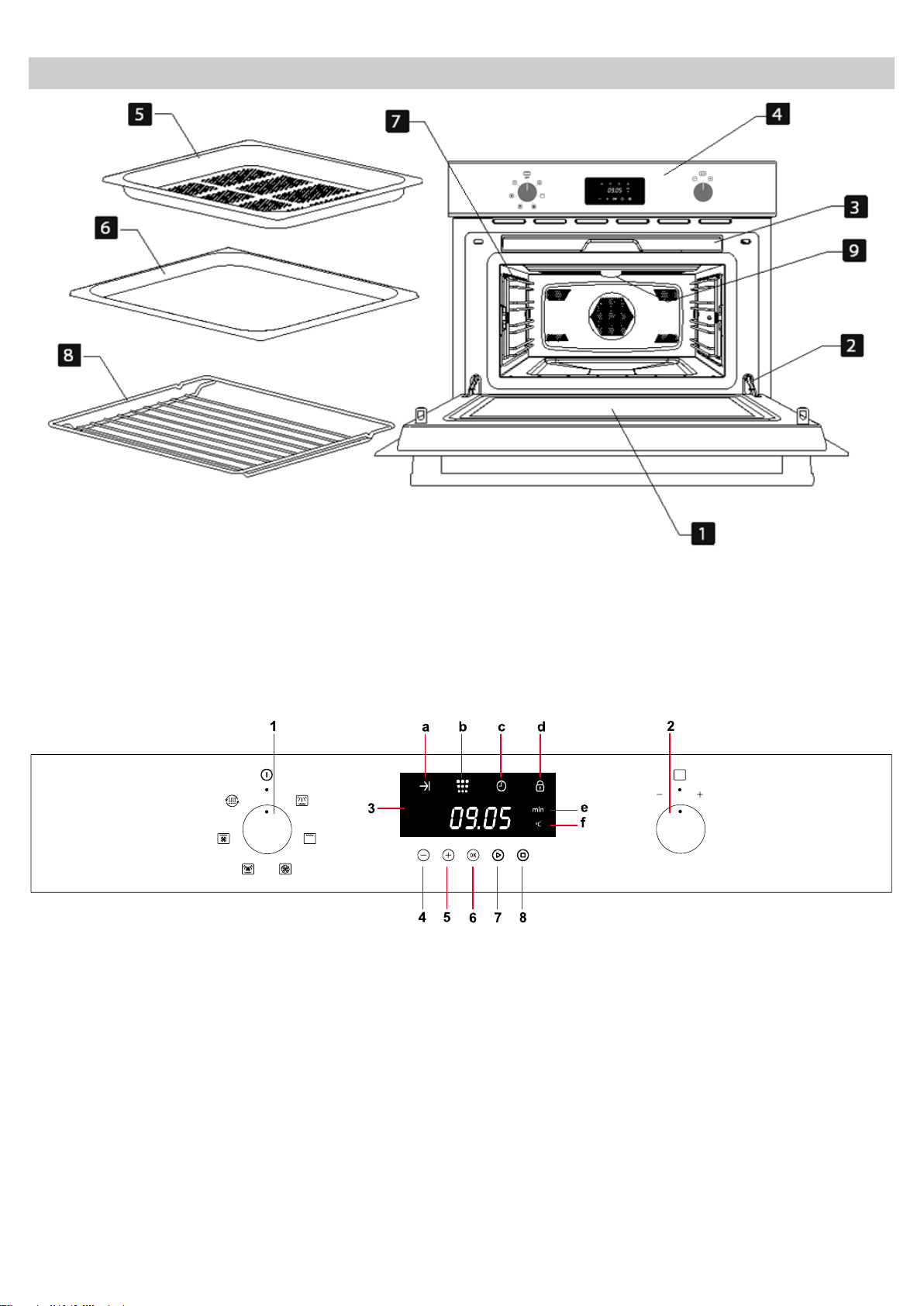
1. Door window glass
5. Perforated baking tray
2. Safety catches
6. Baking tray
3. Water tank
7. Shelf guides
4. Control panel
8. Rack
9. Lamp bulb
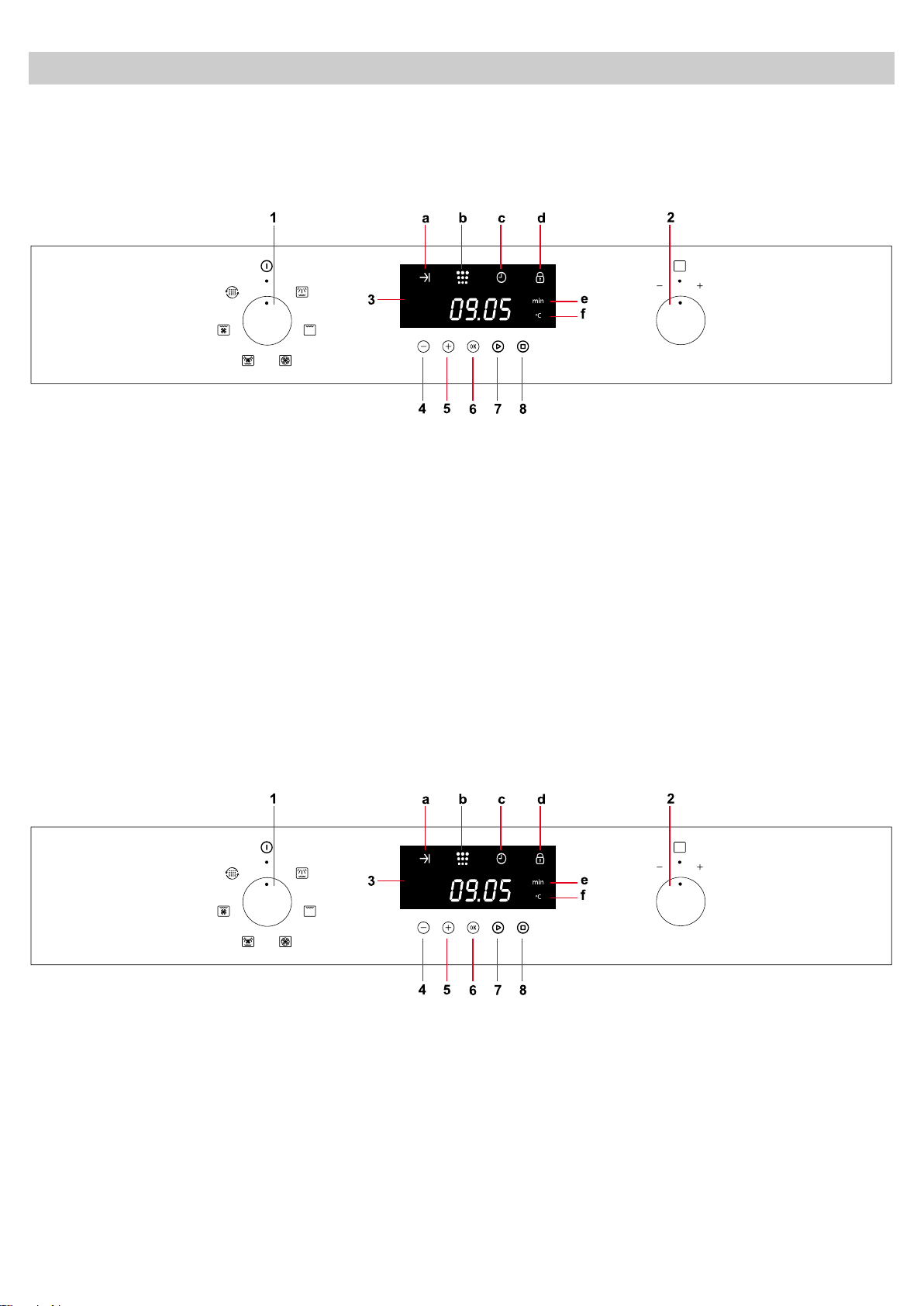
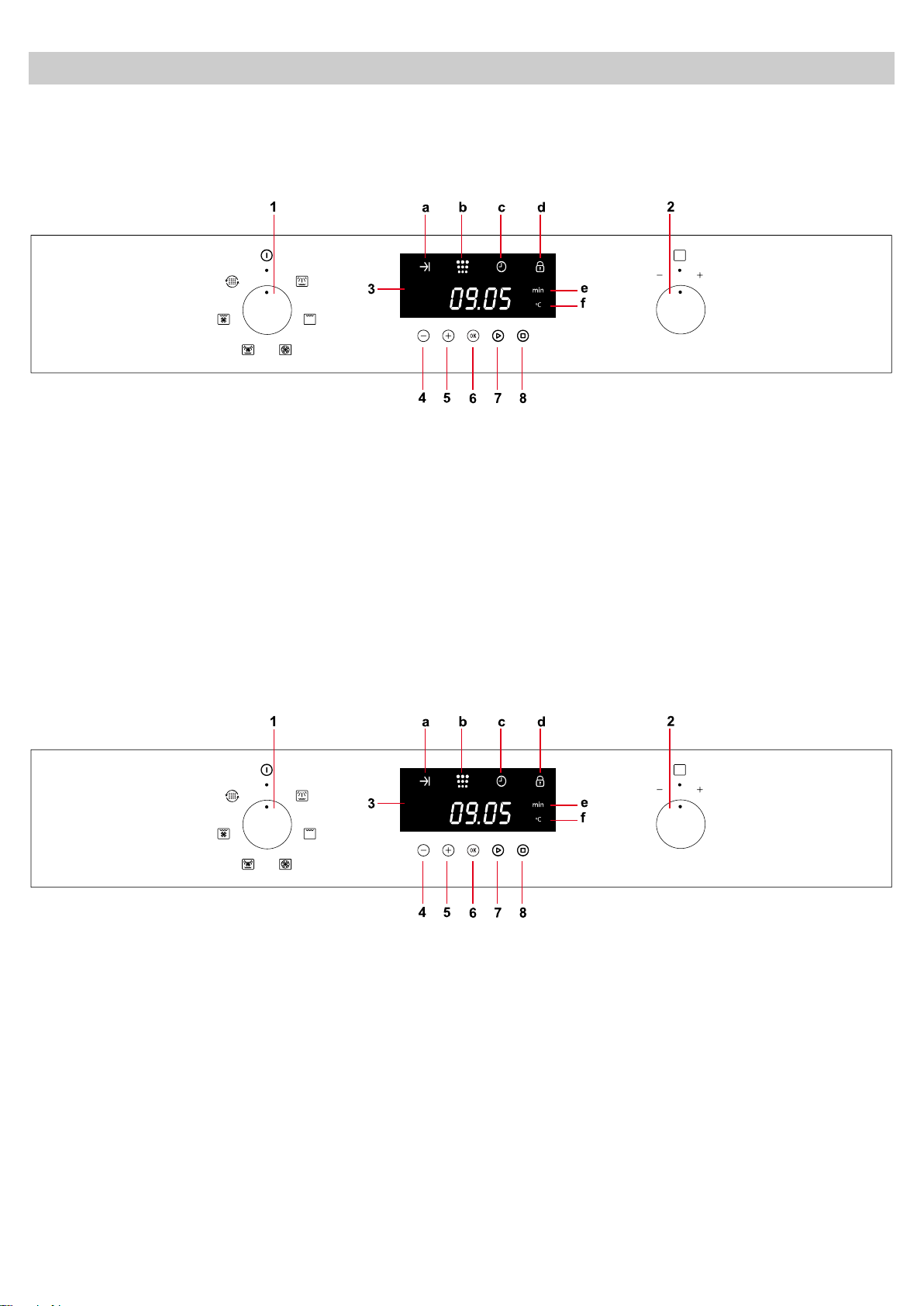
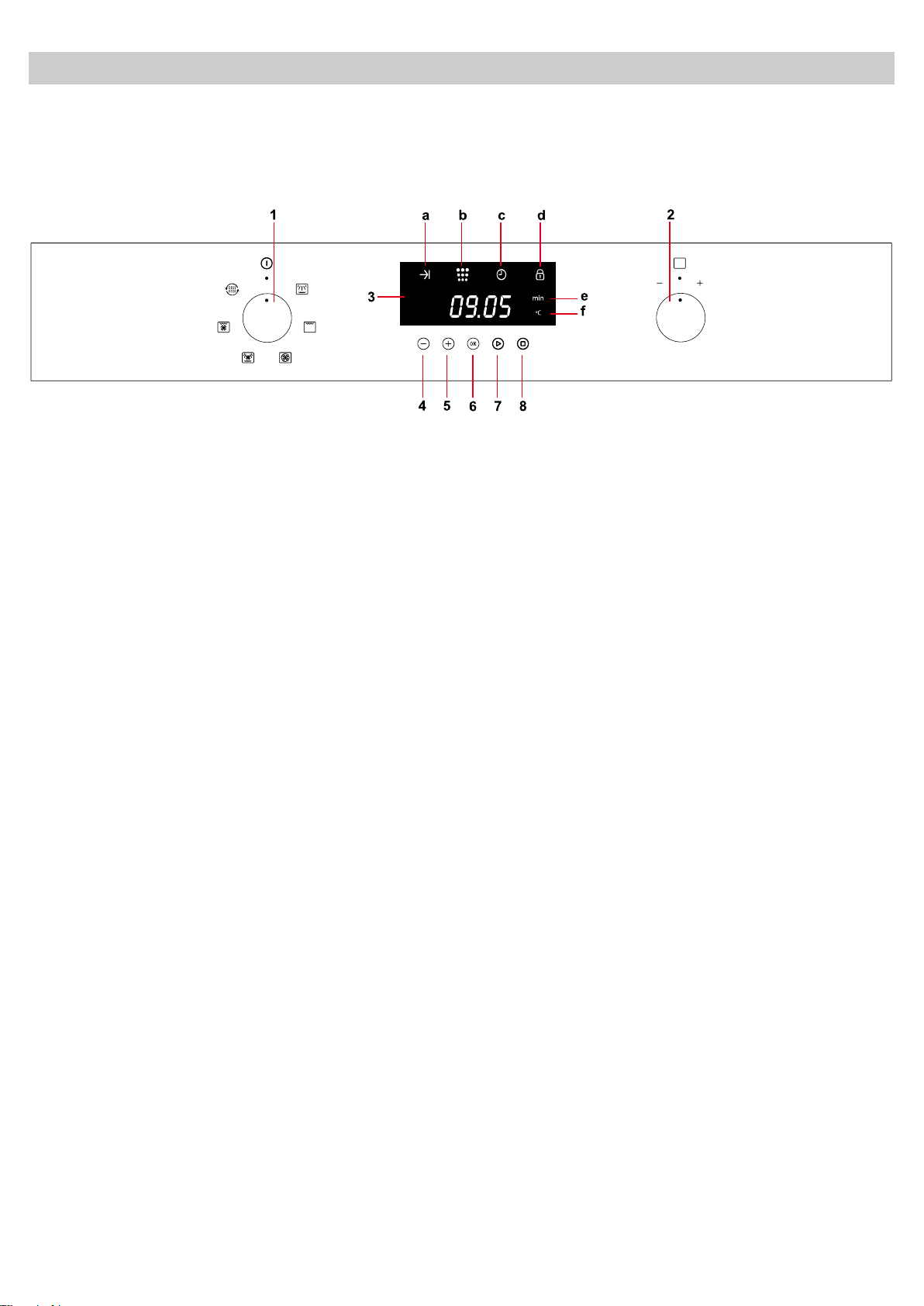
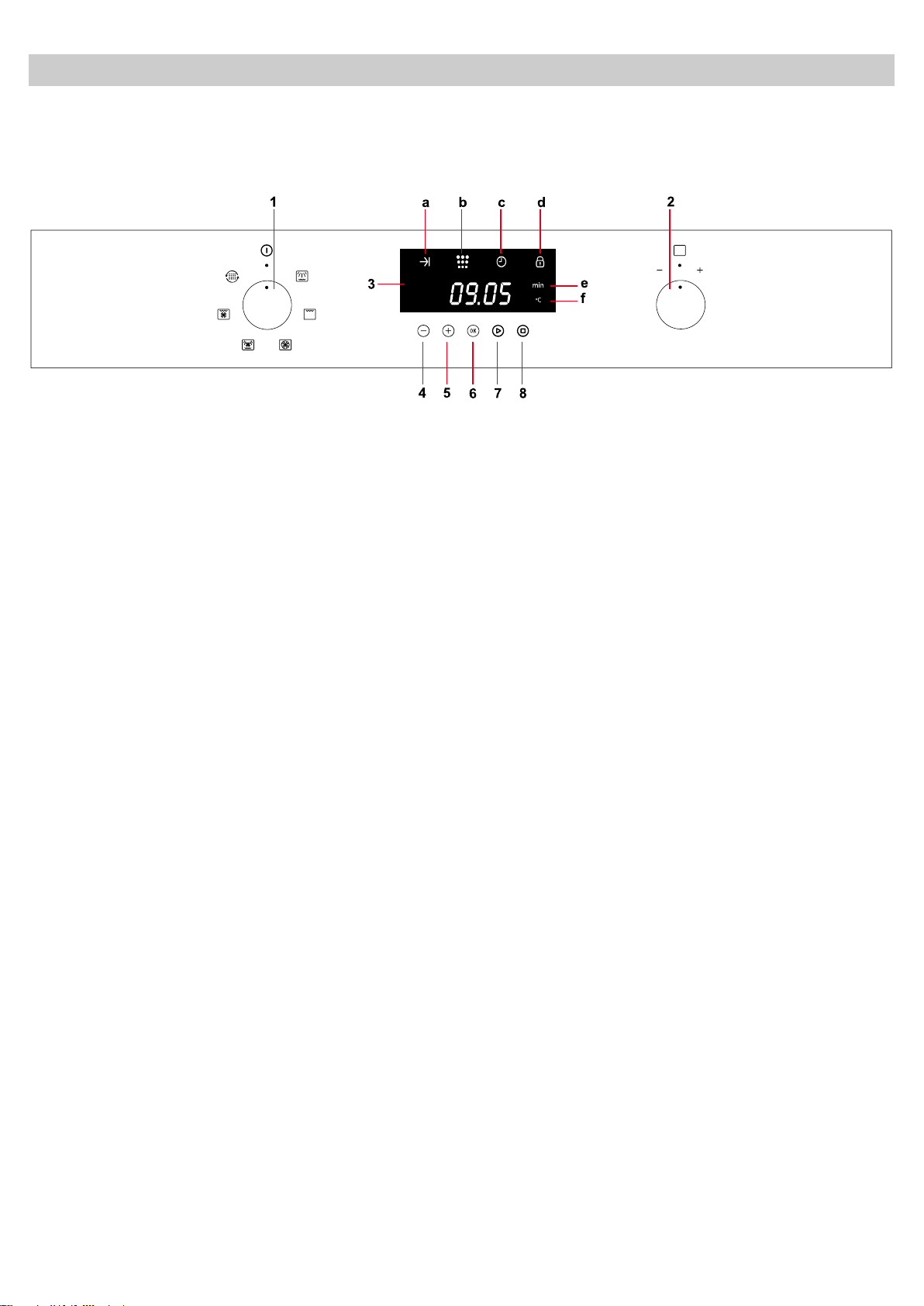
1.
Function Selector knob
a.
Delayed Start indicator
2.
“+” / “-“ / ºC Selector knob
b.
Descale indicator
3.
Display
c.
Clock indicator
4.
“-“ key
d.
Safety Block indicator
5.
“+“ key
e.
Operating Time / Duration indicator
6.
OK key
f.
Temperature indicator
7.
Start key
8.
Stop key
8
Description of your oven
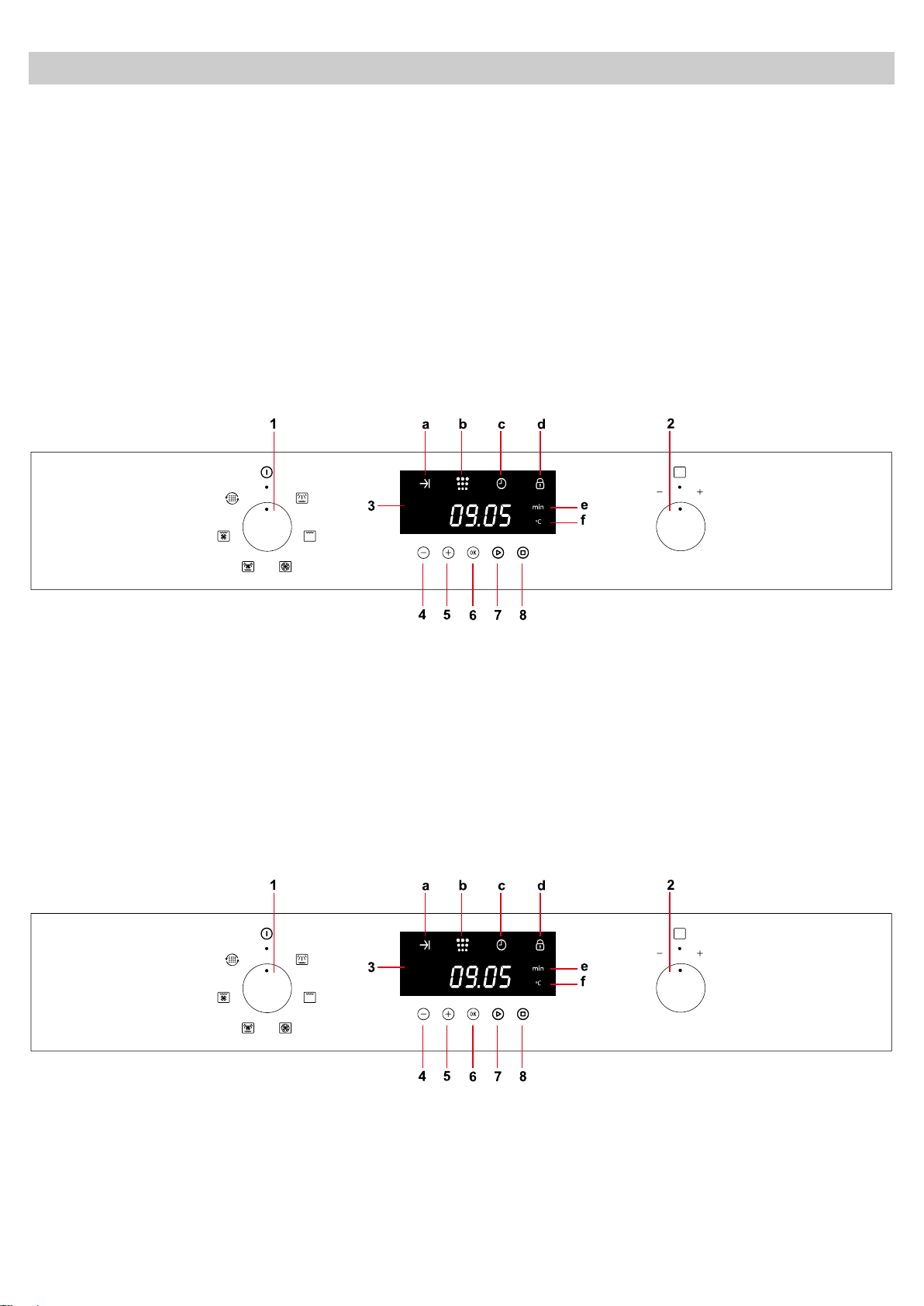
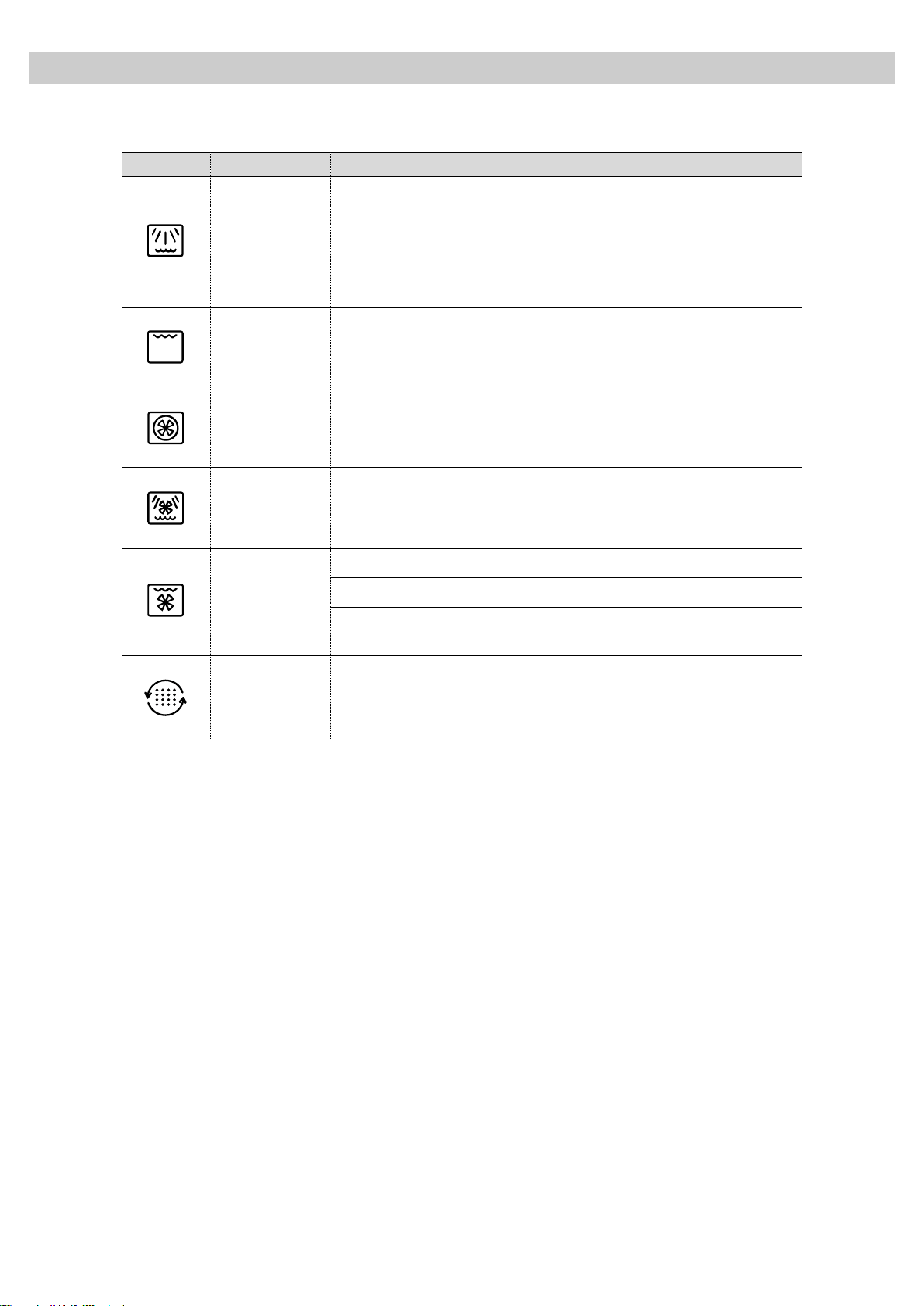
Description of Functions
Symbol
Function
Foods / Function
Steam
Cooking vegetables and food.
Cooking and heating carefully.
Heating and cooking small portions of food.
Broiler
Broiling food.
Convection
Roasting and baking.
Steam +
Convection
Cooking meals with hot damp circulating air.
Cooking potatoes, rice.
Moist garnishing.
Broiler + Fan
Broiling meat and fish.
Broiling poultry.
Potatoes – deep frozen, defrosting and roasting.
Water
Hardness /
Descaling
Water Hardness setting /
Descaling function
9
Basic settings
Initial Settings
After your steam oven is first connected in or after
a power failure, the clock display will flash to
indicate that the time shown is not correct.
The oven will not operate until the clock and the
water hardness parameter is set.
The default setting for water hardness is typically
Medium. This can be adjusted based on the water
hardness in your area. This can be confirmed with
your municipality.
To set the clock and the water hardness parameter
value proceed as described in the following
chapters:
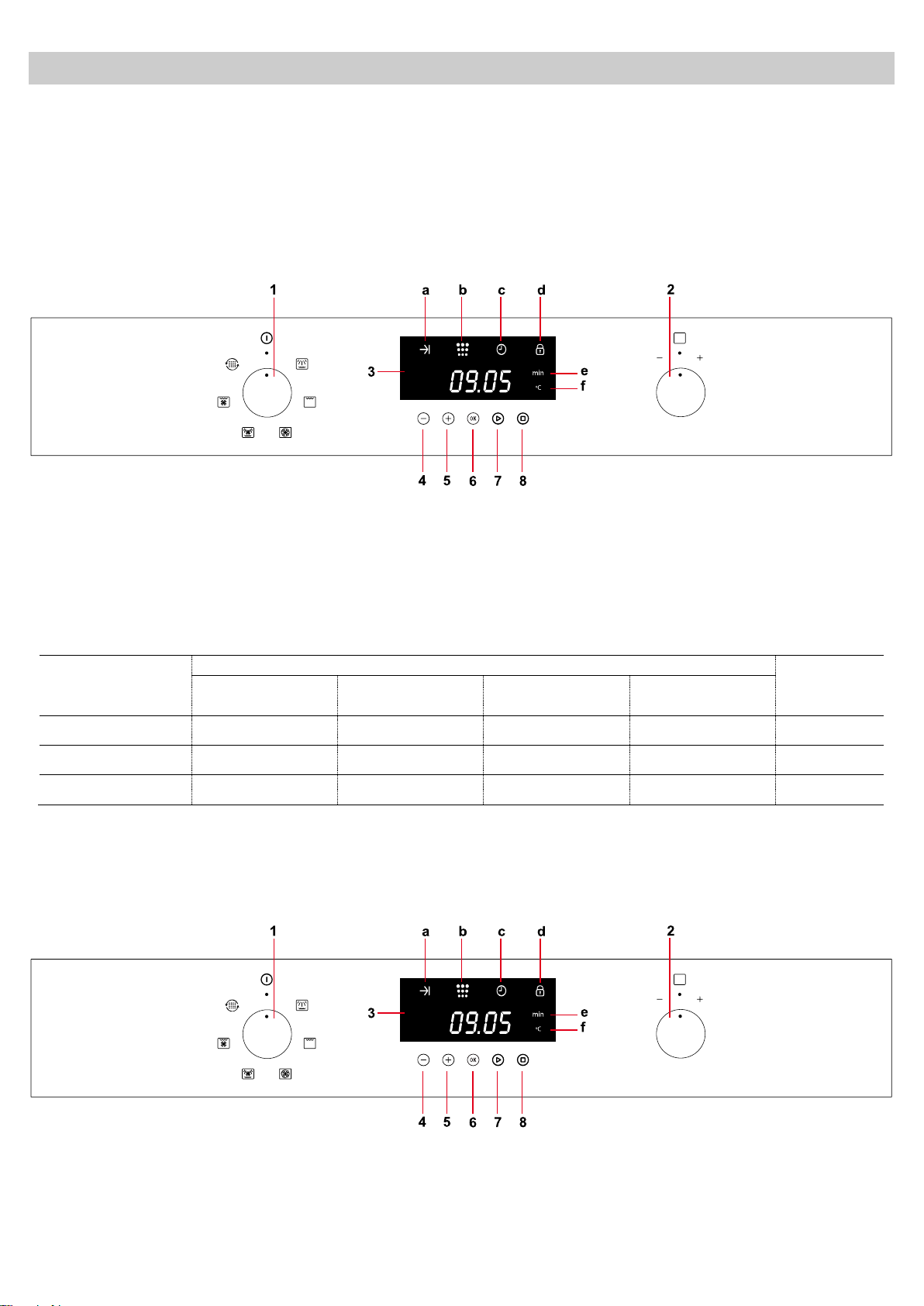
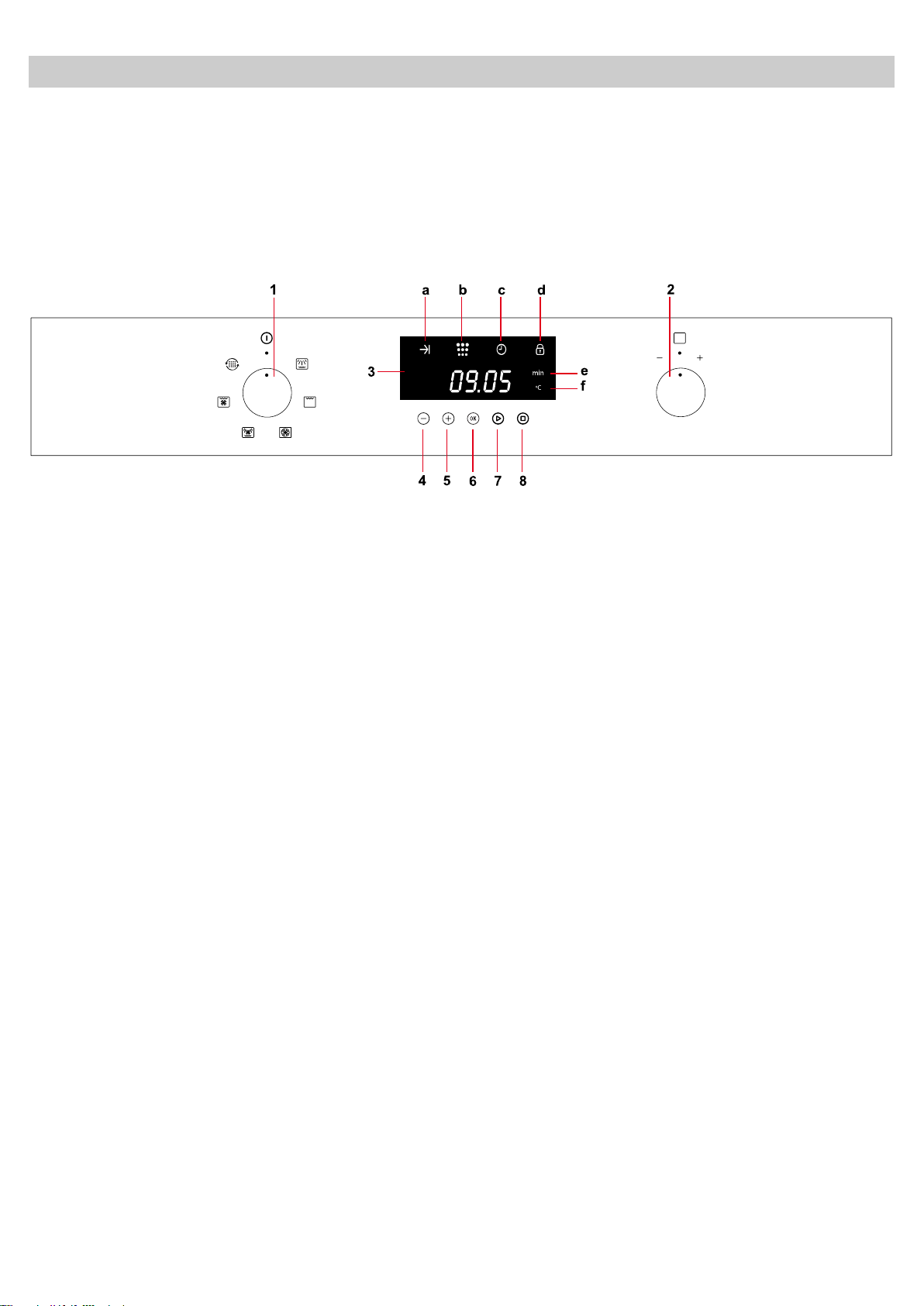
Setting the clock
Before using the oven, adjust the clock through the procedure described below but starting on Step 3. To
set the clock, proceed as follows:
1. Press the “+” key until the Clock Indicator
Light starts to flash.
2. Press the OK key.
3. Press the “+” and “-“ keys to set the correct
hour value.
4. Press the OK key to validate the hour value.
The minute numbers will start to flash.
5. Press the “+” and “-“ keys to set the correct
minute value.
6. To finish, press the OK key again.
Hiding / Displaying the Clock
If the clock display disturbs you, you can hide it by proceeding as follows:
1. To block, the oven press the “+” key and the
“-“ key simultaneously for 5 seconds. The
dots that separate the hours and minutes and
the clock symbol will flash, but the rest of the
clock display will be hidden.
2. If you want to see the clock display again,
press the “+” and “-“ keys again for 5
seconds.
10
Basic settings
Water Hardness setting
The system can be optimised for households with very soft water (also through using a water softening
appliance) and very hard water, by changing the user settings to the relevant range of water hardness
(see table below). To set the water hardness parameter, proceed as follows:
(The appliance features a system that automatically indicates when it is time to descale, showing the
message “”.)
1. Rotate the Function Selector knob to the
position corresponding to the Water
Hardness Setting / Descaling function (not
necessary after connecting the device to the
network, or after a power failure).The water
hardness indicator light begins to flash.
2. Turn the “+” / “-“ Selector Knob to set the
correct water hardness parameter value,
according to the below table.
3. Press the OK key to set the parameter (or
wait until the parameter is set by time-out).
The clock is displayed.
Type
Water hardness
Display
Ca + Mg
(ppm)
English deg.
[°eH]
French deg.
[°dF]
German deg.
[°dH]
Soft water
0 to 150
0 to 11
0 to 15
0 to 8
SOFT
Medium water
151 to 350
12 to 25
16 to 35
9 to 20
MED
Hard water
351 to 500
26 to 35
36 to 50
21 to 28
HARD
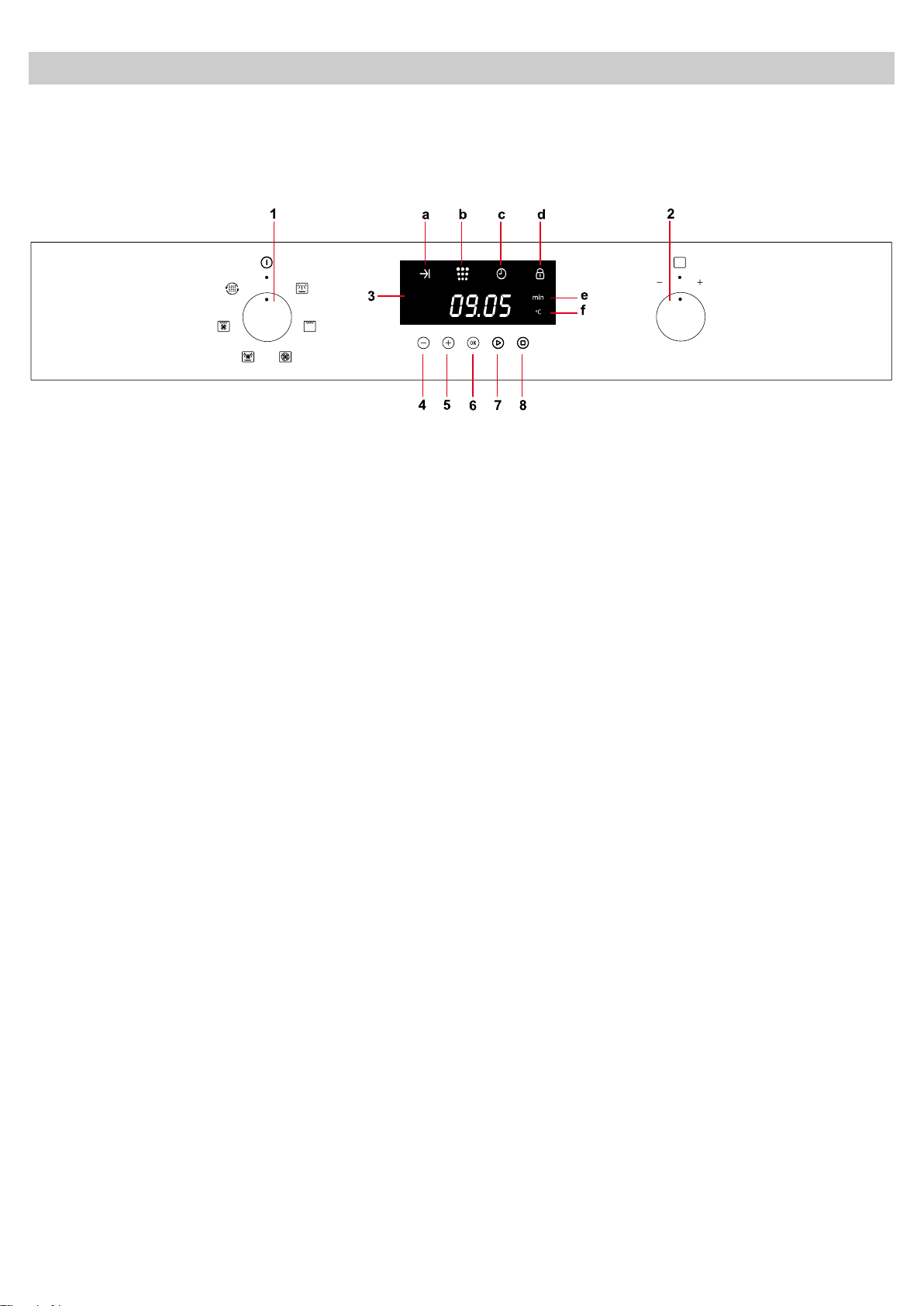
Child Lock
The oven can be blocked against improper use (e.g., to prevent children from using it).
1. To block, the oven press the Stop key for 3
seconds. The display shows the Safety
Block indicator light. If a key is pressed
now, the the oven will not operate.
2. To unlock, press again the Stop key for 3
seconds.
11
Basic settings
Showroom mode
In the Showroom mode the oven works like described in every function, but there will be no heating.
1. To enter the Showroom mode press
simultaneously the “-“ key and the Stop key
for 5 seconds. The display shows the
messages “” and “” intermittently
(showing the actual status).
2. Turn the “+”/ “-“ Selector Knob to the left or
right to alternate status (“” or “”).
3. Press the OK key to validate.
Note: To exit the Showroom mode proceed in
the same manner.
12
Basic Functions
Steam function
Use this function to cook all sorts of vegetables, rice, fish and meat. It is also suitable for extracting
juice from berries and for simultaneous defrosting, cooking and regenerating.
1. Rotate the Function Selector knob to the
position corresponding to the Steam function.
The Temperature indicator and the display
flash indicating “100ºC” (by default).
2. Turn the “+”/ “-“ Selector Knob to the left or
right to set the desired temperature (40ºC to
100ºC).
3. Press the OK key to confirm. The Duration
indicator will start to flash.
4. Turn the “+”/ “-“ Selector Knob to the left or
right to set the desired duration (for example,
to 10 minutes).
5. Press the START key. The oven will start to
operate.
Broiler
Use this function to brown the surface of food quickly.
1. Rotate the Function Selector knob to the
position corresponding to the Broiler function.
The Operating Time Indicator Light and the
Display start to flash.
2. Turn the “+”/ “-“ Selector Knob to the left or
right to set the desired operating time.
3. Press the Start key. The oven will start to
operate.
Note: The cooling fan keeps on working for
some time. When the temperature has dropped
sufficiently, the fan will switch itself off.
13
Basic Functions
Convection
Use this function to bake and roast.
1. Rotate the Function Selector knob to the
position corresponding to the Convection
function. The Temperature indicator and the
display flash indicating “160ºC” (by default).
2. Turn the “+”/ “-“ Selector Knob to the left or
right to set the desired temperature.
3. Press the OK key to confirm. The Duration
indicator will start to flash.
4. Turn the “+”/ “-“ Selector Knob to the left or
right to set the desired duration.
5. Press the Start key. The oven will start to
operate.
Note: The cooling fan keeps on working for
some time. When the temperature has dropped
sufficiently, the fan will switch itself off.
Convection + Steam
Use this function to rapidly bake food.
1. Rotate the Function Selector knob to the
position corresponding to the Convection +
Steam function. The Temperature indicator
and the display flash indicating “160ºC” (by
default).
2. Turn the “+”/ “-“ Selector Knob to the left or
right to set the desired temperature.
3. Press the OK key to confirm. The Duration
indicator will start to flash.
4. Turn the “+”/ “-“ Selector Knob to the left or
right to set the desired duration.
5. Press the Start key. The oven will start to
operate.
Note: The cooling fan keeps on working for
some time. When the temperature has dropped
sufficiently, the fan will switch itself off.
14
Basic Functions
Broiler + Fan
Use this function to cook lasagne, poultry, baked potatoes and casseroles.
1. Rotate the Function Selector knob to the
position corresponding to the Broiler + Fan
function. The Operating Time Indicator
Light and the Display start to flash.
2. Turn the “+”/ “-“ Selector Knob to the left or
right to set the desired operating time.
3. Press the Start key. The oven will start to
operate.
Note: The cooling fan keeps on working for
some time. When the temperature has dropped
sufficiently, the fan will switch itself off.
15
Special Functions
Delayed Start Time
Use this function to program the start of the cooking to a different time.
1. Rotate the Function Selector knob to the
desired function position (This function works
with: Steam function, Convection, Convection
+ Steam).
2. Set the parameters (e.g.: operating time,
temperature) as described in the “Basic
Functions”.
3. Press the “OK” key (instead of Start) to enter
the Delayed Start Time. (The Delayed Start
indicator flashes in the display.)
4. Turn the “+”/ “-“ Selector Knob to the left or
right to adjust the delayed start time. (0:00
appears by default on the display and you can
delay the start of the programme up to 9 hours
and 59 minutes - 9:59 ).
5. Press the Start key to validate the delayed
start time.
6. The cooking duration and delayed start (+
respective indicators) will be displayed
alternating.
7. The delayed start will start counting down
8. The oven will start to operate when the
delayed start reaches 00:00.
16
Filling the water tank
Filling the water tank
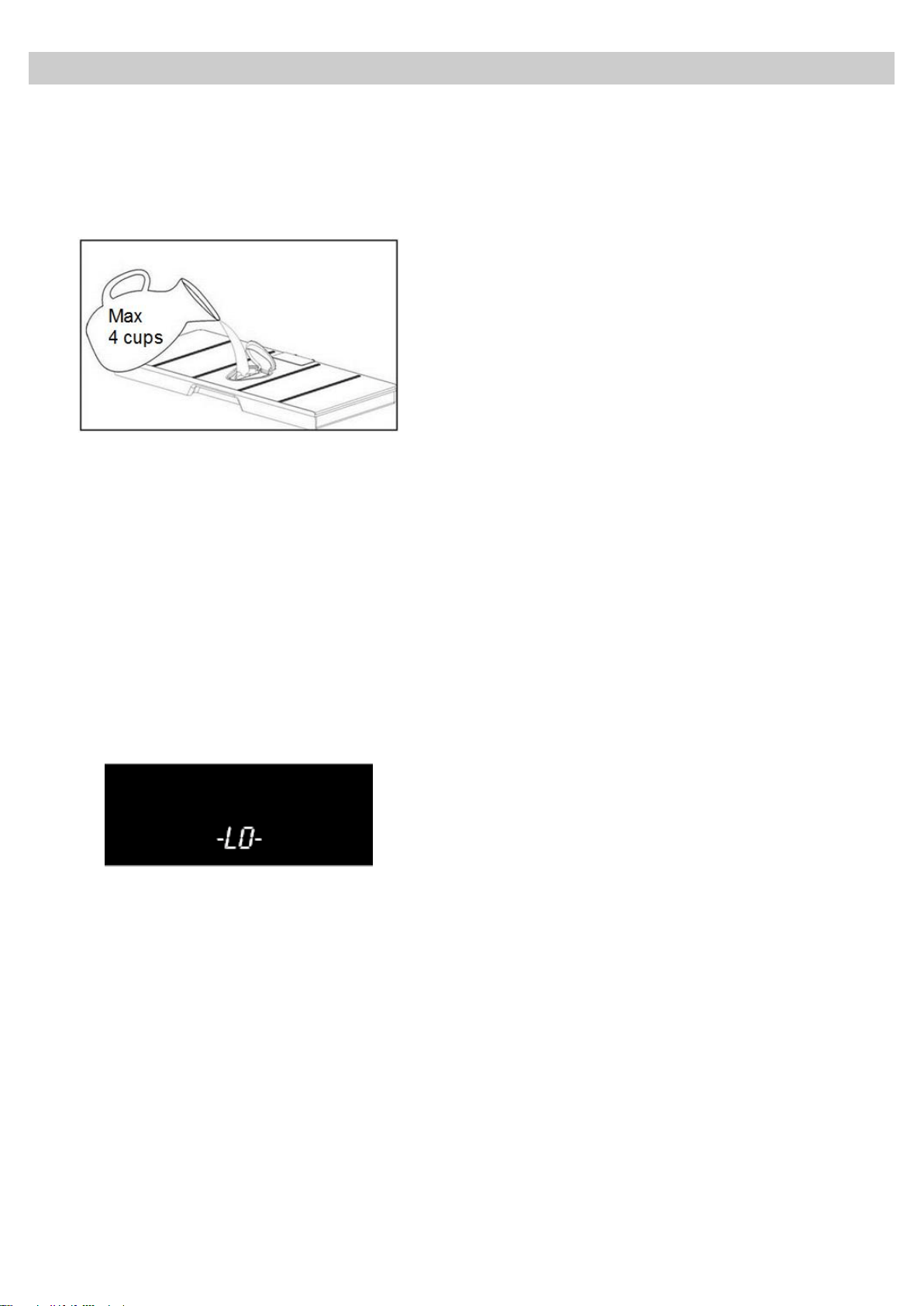
All steam functions require the water tank to be full.
Fill the water tank up with cold, fresh drinking water
(approximately 4 cups / 1 liter) and insert it into the
slot located above the cavity until you hear a click.
If the indication “rES” appears, it means that the
water tank was not properly inserted.
NOTE: No sterilized or distilled water can be
used for cooking with the steam oven. The
minerals in the water are actually essential for
the cooking process to work.
Refilling the water
The contents of the water tank normally suffice for
one cooking session of 50-60 minutes.
If, however, the water tank needs to be refilled, the
Water refill light switches on.
Only fill the water tank up to a maximum of 2
cups to ensure that the water does not
overflow when it is pumped back to the water
tank. RISK OF OVERFLOW.
Emptying the water tank
When the appliance is switched off, the residual
water is pumped back into the water tank.
While the water is being pumped the display shows
“PUMP”.
This message stays on until the temperature of the
water reaches 75ºC before it can be pumped back
to the water tank.
Warning: the water in the tank may be hot.
Danger of burns!
After the water is pumped back to the water tank,
the display will show the message “DEP” requiring
the following actions:
• Remove and empty the water tank.
• Dry the water tank and insert it back into the
slot located above the cavity. Clean and dry
the cooking space.
• Leave the appliance door open so that the
cooking space can cool down and dry
completely.
IMPORTANT NOTE: It is advisable to remove
the water tank and empty it after a cooking
cycle. This prevents the formation of bacteria
and limestone inside the appliance.
If the water tank has not been removed from the
oven and a new cooking cycle is started, the oven
displays the warning “DEP”.
This warning can be cleared by pressing the Stop
key and proceed with the new cooking cycle
without removing and emptying the water tank.

17
When the oven is working...
Interrupting a cooking cycle
You can stop the cooking process at any time by
pressing the Stop key once.
The oven incorporates a steam-reduction function
that is activated when the Start/Stop key is
pressed to gradually release the steam from the
cavity, so that there is no sudden rush of steam
when the appliance door is opened.
This function takes around 3 minutes and during it
the display shows the word “VAP”.
Warning! When opening the door during or
upon completion of the cooking cycle, be
careful of the flow of Convection and/or steam
coming out of the cooking chamber. Step back
or to the side to avoid burns.
At this point:
• The steam generation is interrupted.
• The cavity walls and the water tank are still
very hot. Danger of burning!
• The timer stops and the display shows the
remaining operating time (if this has been
set).
If you wish, at this point you can:
1. Turn or stir the food to ensure it will be evenly
cooked.
2. Change the cooking parameters.
To restart the process, close the door and press the
Start key.
Altering parameters
The duration can be altered when the cooking
process has been interrupted by turning the
rotating knob. The new duration defined is valid
when the display stops blinking.
The temperature can only be altered when the
oven is interrupted. Alter the temperature by
pressing the Function Selector key and turning
the Rotating Knob until the new temperature is
blinking. Validate the selection by pressing again
the Function Selector key.
Cancelling a cooking cycle
If you wish to cancel the cooking process, press the
Stop key for 3 seconds.
You will then hear a beep and the “END” will appear
on the display.
End of a cooking cycle
At the end of the set duration or when you press
the Stop key to finish the cooking cycle, you will
hear three beeps and the display will show the
word “End”, the oven starts the steam-reduction
function.
This function gradually releases the steam from the
cavity, so that there is no sudden rush of steam
when the appliance door is opened.
This function takes around a minute and during it
the display shows the word “VAP”.
Warning! When opening the door during or
upon completion of the cooking cycle, be
careful of the flow of Convection and/or steam
coming out of the cooking chamber. Step back
or to the side to avoid burns.
The cooling fan can continue to run for a certain
length of time after the appliance has been
switched off. This is a normal function that is meant
to reduce the temperature inside the oven.
When the display shows the word “DEP”, this
means that the water was pumped and that the
water tank can be removed.
Remove the water tank and dry it thoroughly. Let
the cooking space cool down for a moment and
then clean and dry it with a cloth. The door should
be left open for some time so that the appliance can
dry completely.
18
When the oven is working...
Steam Flow
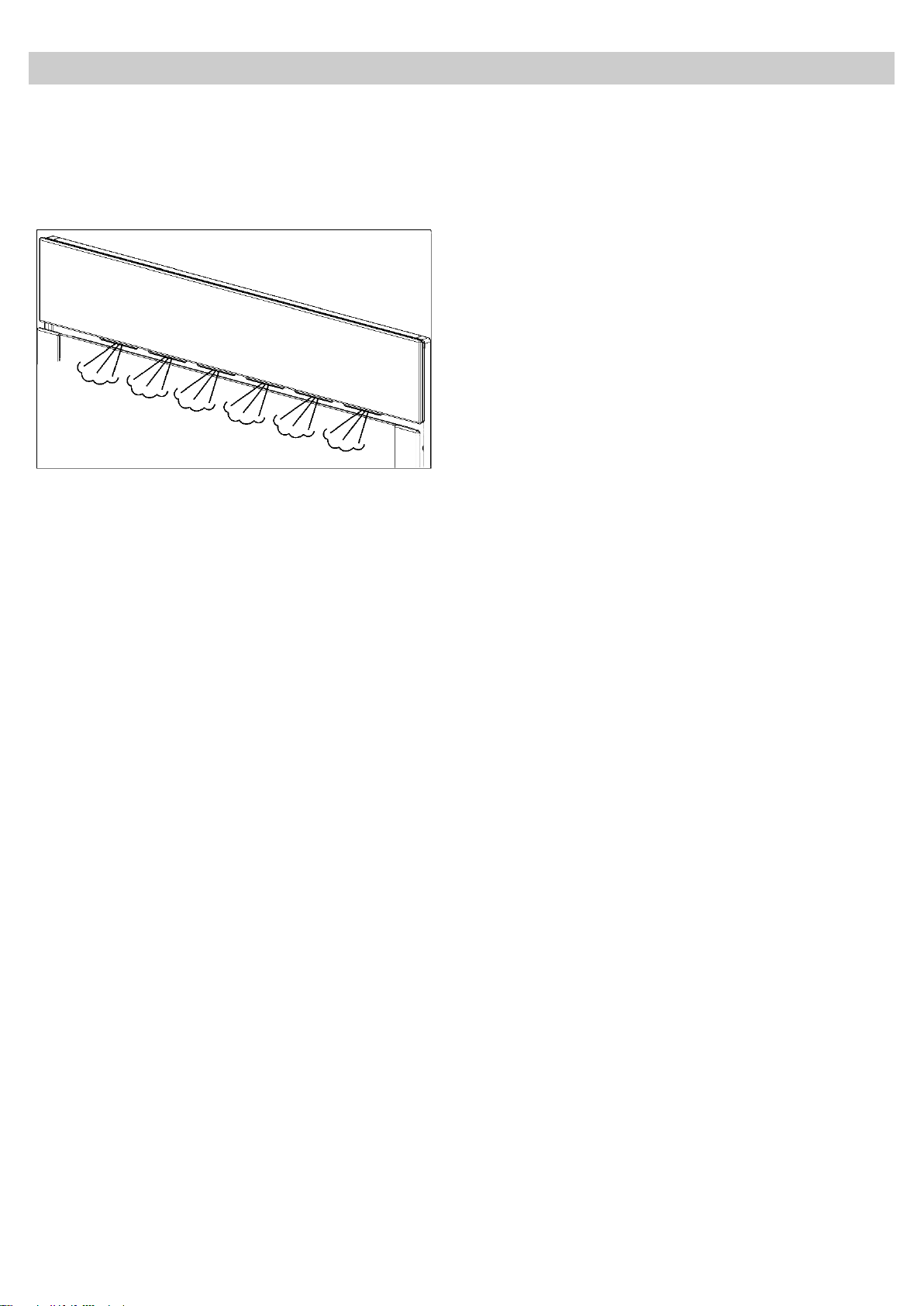
It is normal to have an intermittent steam flow,
coming out from the oven front.
This is especially noticeable in winter time or in
high moisture environments.
Residual water in the oven
To reduce the residual water in the oven, it is
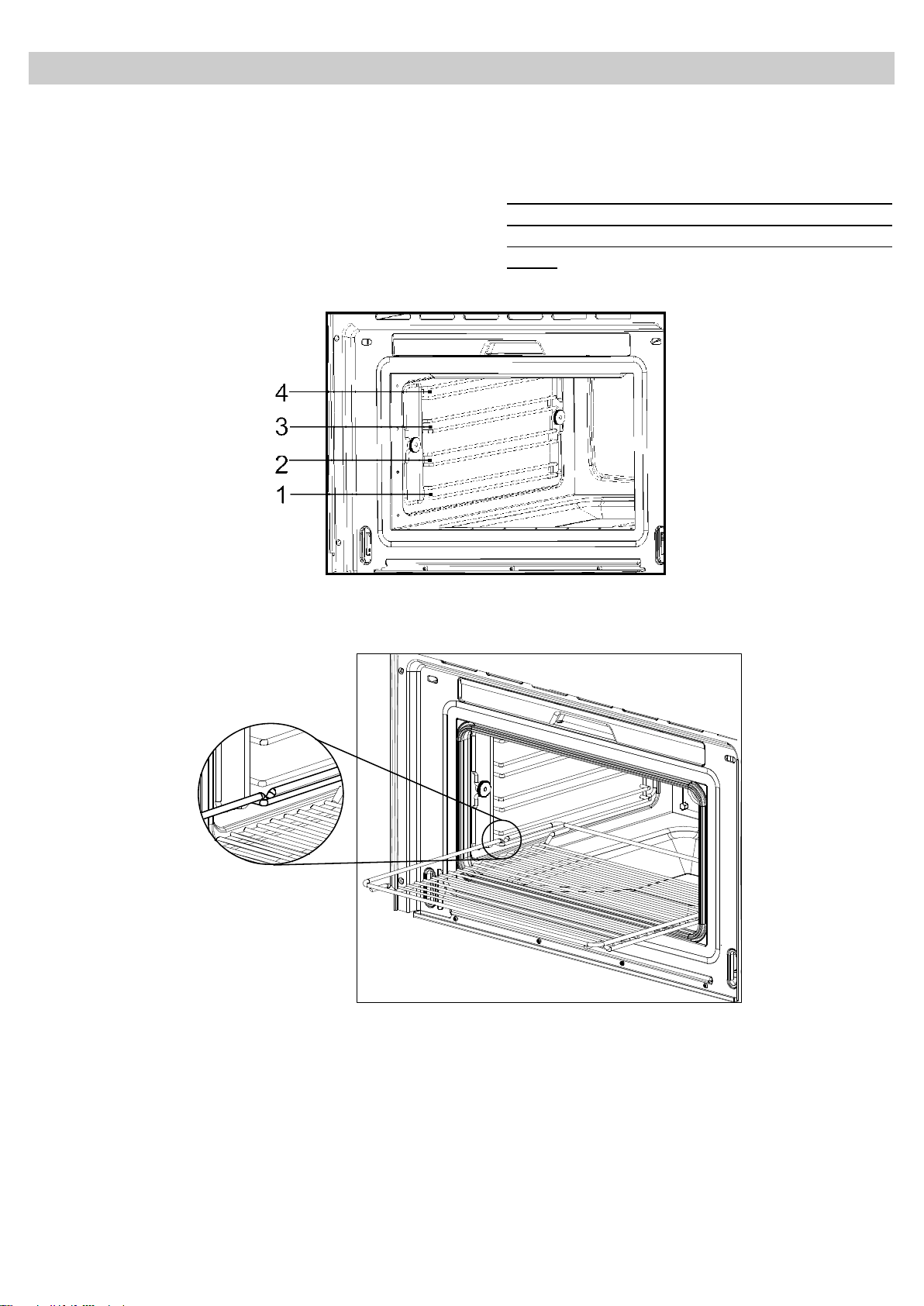
recommended to insert a tray in the bottom rack
level. The condensation released from the food
begins to drip on the tray. The remaining residual
water can be easily dried with a cloth.
19
Usage, tables and tips
The perforated container is suitable for cooking
fresh or deep frozen vegetables, meat and
poultry. In this case it is important that the non-
perforated container is introduced into the
bottom level. This way, dripping liquids are
collected and the appliance does not get dirty.
The perforated container with the food should
be inserted into the second level.
The non-perforated container is used to steam
sensitive foods, e.g. compotes and dumplings.
The rack is used when cooking with small
containers, as for example, dessert bowls and
to regenerate plate dishes.
For more precise information refer to the tables.
The suggested times and temperatures are
guideline values. The actual cooking time can
vary according to the type and quality of the
foods.
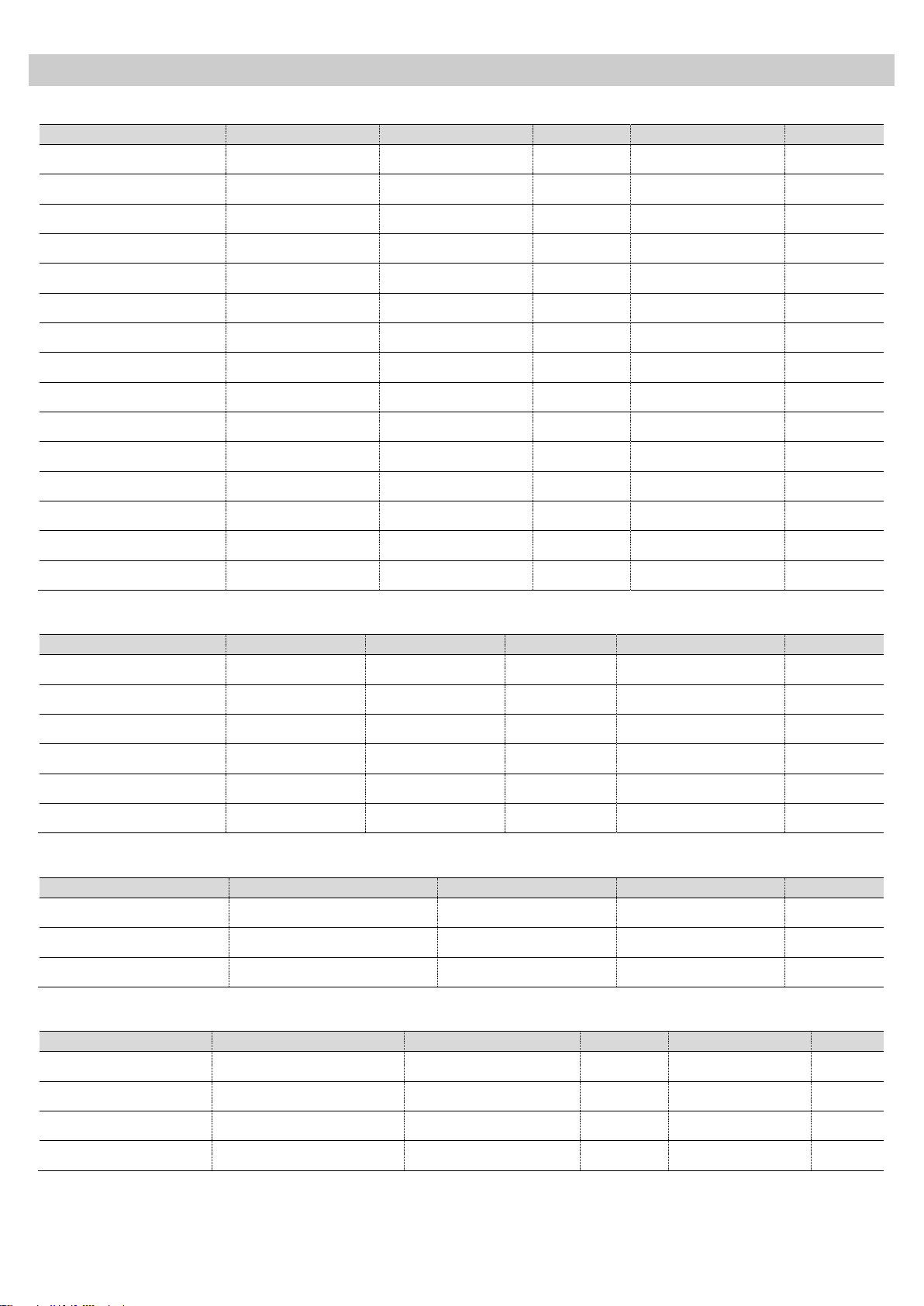
To remove the rack, lift it upwards slightly at the front when the safety notches connect with the sides of
the oven (see illustration).
We recommend using the rack together with the baking tray when cooking items on the rack which might
drip.
20
Usage, tables and tips
Steam cooking - Fish
Fish
Quantity
Temperature ºC
Time min.
Container
Level
Gilthead sea bream
800-1200 g
80
30-40
Perforated
2
Trout
4 x 250 g
80
20-25
Perforated
2
Salmon filet
500-1000 g
80
15-25
Perforated
2
Salmon trout
1000-1200 g
80
25-35
Perforated
1/2
King prawns
500-1000 g
80
15-20
Perforated
2
Green-shell mussel
1000-1500 g
100
25-35
Perforated
2
Halibut filet
500-1000 g
80
20-25
Perforated
2
Cockles
500-1000 g
100
10-20
Perforated
2
Lobster
800-1200 g
100
25-30
Perforated
1/2
Cod filet
1000-1200 g
80
20-25
Perforated
2
Blue mussel
1000-1200 g
100
15-25
Perforated
2
Lake trout
4 x 250 g
80
25-30
Perforated
2
Haddock
1000-1200 g
80
20-25
Perforated
2
Tuna filet
500-1000 g
80
15-20
Perforated
2
Pike perch
4 x 250 g
80
25-30
Perforated
2
Meat
Meat
Quantity
Temperature ºC
Time min.
Container
Level
Chicken leg
4-10
100
40-45
Perforated
2
Chicken breast
4-6
100
25-35
Perforated
2
Smoked pork loin
500g – 1000 g
100
40-50
Perforated
2
Turkey escalope
4-8
100
20-25
Perforated
2
Pork filet, whole
4-8
100
20-30
Perforated
2
Sausages
80-100
10-15
Perforated
2
Eggs
Eggs
Temperature ºC
Time min.
Container
Level
Eggs in Glass
100
10-15
Rack
2
Eggs, hard
100
15
Rack
2
Eggs, soft
100
10-12
Rack
2
Side dishes
Side dishes
Quantity
Temperature ºC
Time min.
Container
Level
Pearl barley + Liquid
200g + 400 ml
100
30-35
Rack, glass bowl
2
Semolina + Liquid
200g + 300 ml
100
10-20
Rack, glass bowl
2
Lentils + Liquid
200g + 375 ml
100
20-50
Rack, glass bowl
2
Rice + Liquid
200g + 250 ml
100
25-40
Rack, glass bowl
2
21
Usage, tables and tips
Vegetables
Vegetables
Temperature
ºC
Time
min.
Container
Level
Eggplant/Aubergine
in slices
100
15-20
Perforated
2
Beans
100
35-45
Perforated
2
Broccoli
florets with stalk
100
25-30
Perforated
2
Broccoli
florets without stalk
100
15-20
Perforated
2
Cauliflower
florets
100
25-30
Perforated
2
Cauliflower
whole head
100
40-45
Perforated
1
Peas
100
30-35
Perforated
2
Fennel
in stripes
100
15-20
Perforated
2
Fennel
cut in half
100
20-30
Perforated
2
Potatoes with skin
whole, very small
100
20-25
Perforated
2
Potatoes with skin
whole, very big
100
45-50
Perforated
2
Potatoes without skin
in pieces
100
20-25
Perforated
2
Turnip
in sticks
100
20-25
Perforated
2
Snow peas
100
15-20
Perforated
2
Carrots
in slices
100
25-30
Perforated
2
Corn cobs
100
50-60
Perforated
2
Bell peppers
in stripes
100
12-15
Perforated
2
Hot pepper
100
12-15
Perforated
2
Mushrooms
in quarters
100
12-15
Perforated
2
Leeks
in slices
100
10-12
Perforated
2
Brussels sprouts
100
25-35
Perforated
2
Celery
in stripes
100
15-20
Perforated
2
Asparagus
100
20-35
Perforated
2
Spinach
100
12-15
Perforated
2
Celery stalks
100
25-30
Perforated
2
Courgette
in slices
100
12-18
Perforated
2
Dumplings
Dumplings
Temperature ºC
Time min.
Container
Level
Sweet dumpling
100
20-30
Not perforated
2
Sweet yeast dumpling
100
15-20
Not perforated
2
Yeast dumpling
100
15-25
Not perforated
2
Bread dumpling
100
20-25
Not perforated
2
Napkin dumpling
100
25-30
Not perforated
2
22
Usage, tables and tips
Desserts
Desserts
Quantity
Temperature ºC
Time min.
Container
Level
Stewed apples
500-1500 g
100
15-25
Not perforated
2
Stewed pears
500-1500 g
100
25-30
Not perforated
2
Crème brûlée
80
20-25
Rack - bowl
2
Crème caramel
80
25-30
Rack - bowl
2
Yogurt
40
4-6 hrs.
Rack - bowl
2
Stewed peaches
500-1500 g
100
15-20
Not perforated
2
Fruit (Sterilising/Boiling down)
Fruit
Quantity
Temperature ºC
Time
min.
Container
Level
Pears
4-6 1l glasses
100
30-35
Rack
1
Cherries
4-6 1l glasses
80
30-35
Rack
1
Peaches
4-6 1l glasses
80
30-35
Rack
1
Plums
4-6 1l glasses
80
30-35
Rack
1
Regenerate
Warming-up
Quantity
Temperature ºC
Time
min.
Container
Level
Plate dishes
1-2
100
12-15
Rack
2
Plate dishes
3-4
100
15-20
Rack
2
Ready-made meals
--
100
15-20
Rack
2
Blanch
Vegetables
Quantity
Temperature ºC
Time
min.
Container
Level
e.g. Beans, Leek
100
10-12
Perforated
2
Curly Kale
1000-2000 g
100
12-16
Perforated
2
Savoy cabbage
10-20
100
12-15
Perforated
2
White cabbage, whole
2000-2500 g
100
30-45
Perforated
1
Tomatoes, peeled
80
12
Rack
2
23
Usage, tables and tips
Defrost
Vegetables / Side dish
Temperature ºC
Time
min.
Container
Level
Broccoli
florets with stalk
100
15-20
Perforated
2
Mixed vegetables
100
15-20
Perforated
2
Spinach leaves
portions
100
10-15
Not perforated
2
Cauliflower
florets
100
15-20
Perforated
2
Peas
100
15-25
Perforated
2
Curly kale
bigger portion
100
25-35
Not perforated
2
Carrots
in slices
100
15-20
Perforated
2
Brussels sprouts
100
20-25
Perforated
2
Asparagus
100
25-30
Perforated
2
Ready-made meals
100
as required
Rack
2
Bread
100
10-25
Rack
2
Rice
100
15-25
Not perforated
2
Lentils
100
15-20
Not perforated
2
Noodles
100
15-20
Not perforated
2
Two level cooking
Some suggestions:
When cooking with two levels the Broiler always
belongs to the 2nd or 3rd level of insertion from the
bottom to the top.
This way the usual vessels of porcelain, Jena glass
or of stainless steel can be put inside the oven.
The container of cooking perforated or not, will be
inserted in the 1st level from the bottom. It can also
be cooked with two Broilers.
Different cooking times are controlled this way:
Foods that need a longer cooking time should be
placed in the upper area of the oven. Foods with a
shorter cooking time should be placed on the
bottom level.
One example: Vegetables, potatoes and fish.
Place the vegetables and potatoes in any suitable
container on the rack inserted in the 2
nd
or 3
rd
level.
Insert the fish in the 1
st
level.
When using the perforated tray to cook fish, the
non-perforated tray must be inserted in the bottom
of the appliance to collect liquid dripping from the
fish. This way the appliance is kept clean.
Time: Vegetables and potatoes 25-35 Min.
Time: Fish – depending on type – 15-25 Min.
Select the longest cooking time. Because of the
different levels the food is ready at the same time,
without any over cooking.
24
Cooking with the Broiler
For good results with the Broiler, use the grill rack
supplied with the oven.
IMPORTANT POINTS:
1. When the Broiler is used for the first time
there will be some smoke and a smell coming
from the oils used during oven manufacture.
2. The oven door window becomes very hot
when the Broiler is working. Keep children
away.
3. When the Broiler is operating, the cavity walls
and the grill rack become very hot. You
should use oven gloves.
4. If the Broiler is used for extended period of
time it is normal to find that the elements will
switch themselves off temporarily due to the
safety thermostat.
5. Important! When food is to be broiled or
cooked in containers you must check that the
container in question is suitable for use. See
the section on types of ovenware!
6. When the Broiler is used it is possible that
some splashes of fat may go onto the
elements and be burnt. This is a normal
situation and does not mean there is any kind
of operating fault.
7. After you have finished cooking, clean the
interior and the accessories so that cooking
remains do not become encrusted.
Type of food
Quantity
Time (min.)
Instructions
Fish
Bass
Sardines/gurnard
800g
6-8 fish
18-24
15-20
Spread lightly with butter. After half of
cooking time turn and spread with
seasoning.
Meat
Sausages
6-8 units
22-26
Prick after half cooking time and turn.
Frozen hamburgers
3 units
18-20
Spare rib (approx. 3 cm thick)
400 g
25-30
After half of cooking time, baste and turn.
Others
Toast
4 units
1½-3
Watch toasting.
Toasted sandwiches
2 units
5-10
Watch toasting.
Heat up the Broiler beforehand for 2 minutes.
Unless indicated otherwise, use the grill rack. Place
the grid on a bowl so that the water and the fat can
drop. The times shown are merely indicative and
can vary as a function of the composition and
quantity of the food, as well as the final condition
wished for. Fish and meat taste great if, before
broiling, you brush them with vegetable oil, spices
and herbs and leave to marinate for a few hours.
Only add salt after broiling.
Sausages will not burst if you prick them with a fork
before broiling.
After half the broiling time has passed, check on
how the cooking is going and, if necessary, turn the
food over.
The Broiler is especially suitable for cooking thin
portions of meat and fish. Thin portions of meat
only need to be turned once, but thicker portions
should be turned several times.

25
Cooking with Convection
Roasting and baking
Type
Quantity (g)
Temperature ºC
Time
(min)
Standing Time
(min)
Comments
Beef stew
1000
160/170
80/90
10
Do not put lid on
container
Pork loin
500 / 600
180/190
35/40
10
Do not put lid on
container
Whole chicken
1000 / 1200
200
30/40
10
Put lid on container.
Breast facing upwards.
Do not turn.
Chicken
portions
800
200
25/35
10
Do not put lid on
container. Arrange
portions with skin facing
upwards. Do not turn.
Duck
1500 / 1700
200
70/80
10
Put lid on container. Do
not turn.
Advice for roasting meat
Turn the pieces of meat halfway through the
cooking time. When the roasted meat is ready you
should let it stand for 10 minutes in the oven with
this switched off and closed. This will ensure the
juices in the meat are well distributed.
Add 2 to 3 soup spoons of gravy or similar liquid to
lean meat and 8 to 10 soup spoons to stews,
depending on the amount of meat in question.
The roasting temperature and time required
depends on the type and amount of meat being
cooked.
If the weight of the meat to be roasted does not
appear on the table choose the settings for the
weight immediately below and extend the cooking
times.
Advice on ovenware
Check that the ovenware fits inside the oven.
Hot glass containers should be put on a dry kitchen
cloth. If such containers are put on a cold or wet
surface the glass may crack and break. Use oven
gloves to take the ovenware out of the oven.

26
~
Cooking with Convection
Cooking – Cakes
Type
Container
Level
Temperature ºC
Time (min)
Walnut cake
Spring-form type tin
1
170/180
30/35
Fruit tart
Spring-form type tin
2
150/160
35/45
Fruit cakes
Cake tin with central
hole
1
170/190
30/45
Savoury tarts
Spring-form type tin
2
160/180
50/70
Simple cake (sponge cake)
Spring-form type tin
1
160/170
40/45
Almond cakes
Cake tray
2
110
35/45
Puff pastry
Cake tray
2
170/180
35/45
Advice on cake baking ware
The most commonly used type of baking ware is
black metal tins.
Advice on how to bake cakes
Different amounts and types of pastry require
different temperatures and baking times. Try low
settings first of all and then, if necessary, use
higher temperatures next time. A lower
temperature will result in more uniform baking.
Baking suggestions
How to check if the cake is properly cooked
Start sticking a tooth pick in the highest part of the
cake 10 minutes before the end of the baking
time. When no dough sticks to the tooth pick the
cake is ready.
If the cake is very dark on the outside
Next time choose a lower temperature and let the
cake bake for a longer time.
If the cake is very dry
Make small holes in the cake with a tooth pick
after baking has finished. Then sprinkle the cake
with some fruit juice or alcoholic drink. Next time
increase the temperature by about 15ºC and
reduce the baking time.
If the cake does not come free when turned
Let the cake cool down for 5 to 10 minutes after
baking and it will come out of the tin more easily.
If the cake still does not come free run a knife
carefully around the edges. Next time grease the
cake tin well.
27
Care and maintenance
Cleaning the cooking space
Avoid using abrasive cleaners such as scouring
pads, steel wool, etc. as they can damage the
surface.
Wipe the cooking space clean using a damp cloth
whilst the appliance is still warm. Finish off by
drying the cooking space.
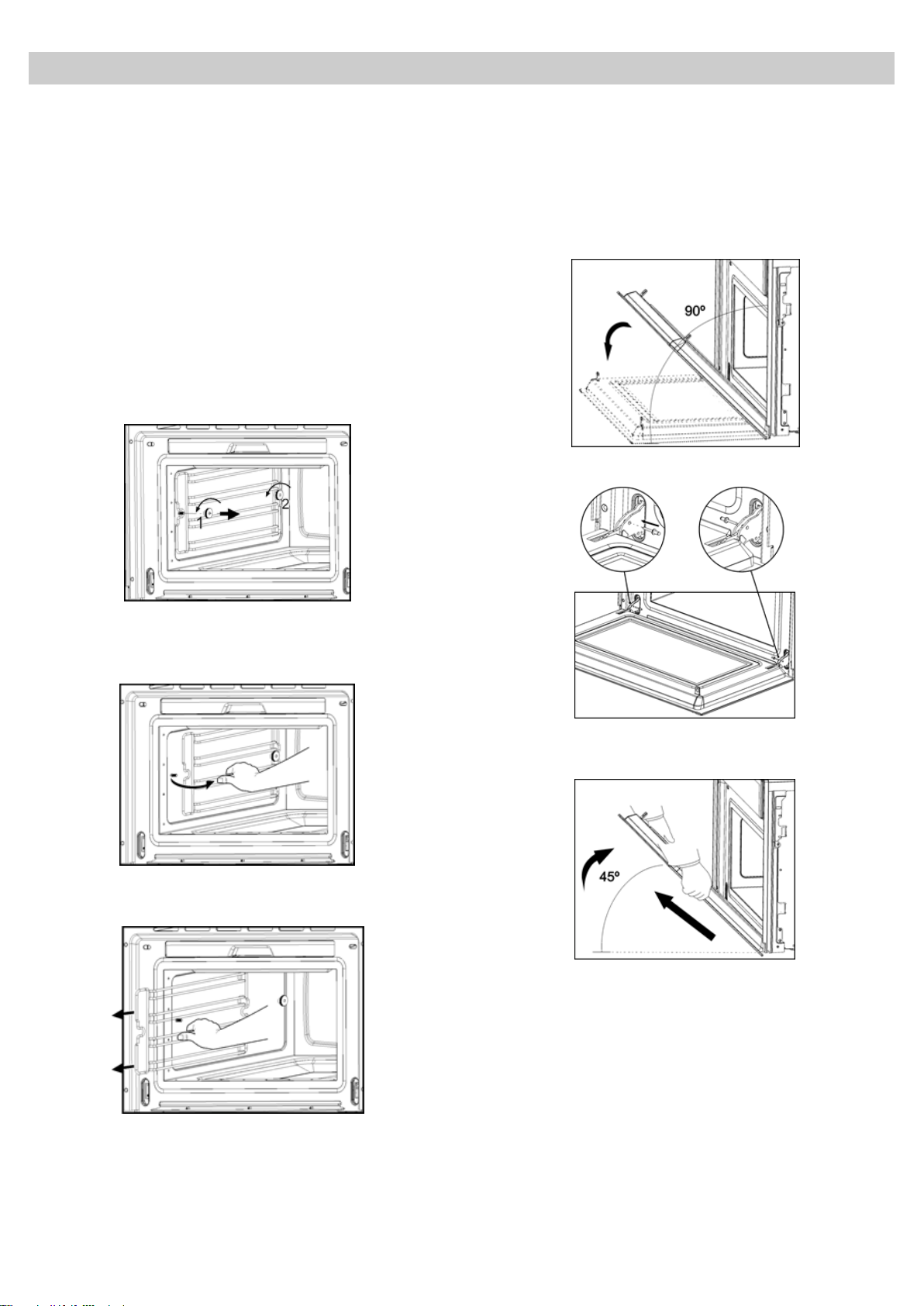
For ease of cleaning, the shelf guides can be
removed (see the following chapter).
Removing the shelf guides
Unscrew and remove the knurled nuts 1 in the front
of the shelf guides in an anti-clockwise direction.
Unscrew and loosen the knurled nuts 2 in the back
of the shelf guides in an anti-clockwise direction.
Do not completely remove these nuts.
Pull the shelf guides to the inside of the cavity and
remove from the front.
To put them back, insert the shelf guides into the
knurled nuts 2 in the back and position on the
screws in the front. Screw the knurled nuts 1 and 2
in a clockwise direction till tight.
Removing the appliance door
1. Open the appliance door as far as it will go.
2. Insert 2 pins inside the holes in the hinges.
3. Close the appliance door just enough that it
can be lifted out.
4. To reassemble, push the hinges into the
holes from the front.
5. Open the appliance door as far as it will go
and remove the pins.

28
Care and maintenance
Descaling
Whenever steam is produced, irrespective of the
hardness of the local water supply (i.e. the
limescale content of the water), limescale is
deposited inside the steam generator.
The time interval between descaling depends on
the hardness of the water and frequency of use. If
steaming 4×30 minutes per week, the appliance
must be descaled (depending on water hardness)
roughly as follows:
Water hardness
Descale after about
Very soft
18 months
Medium
9 months
Very hard
6 months
The appliance automatically detects when
descaling is necessary and when this happens the
Descale light stays on. If the Descaling procedure
is not performed, some steam cooking cycles may
not function after the Descale light starts to flash. If
once again the Descaling procedure is not
performed, some cooking cycles after the oven
functioning is blocked, the Descale light stays on
and the display shows “CAL” blinking.
IMPORTANT NOTE: Failure to descale the
appliance will likely impair the functioning of or
cause damage to the appliance.
Suitable descaling solutions
For descaling, use the descaling solution
“durgol®”.
This solution allows a professional and careful
descaling of your appliance. Available at Customer
Care Centres.
Warning! Do not use vinegar or vinegar-based
products as they can cause damage to the
oven’s internal circuit.
Traditional descaling solutions are not appropriate
because they can contain foaming agents.
29
Care and maintenance
Descaling procedure
Warning: For safety reasons, the descaling
process cannot be interrupted and it takes
about 45 minutes.
The appliance must be in idle state prior to starting
the descaling cycle.
To run a descaling cycle proceed as follows:
1. Rotate the Function Selector knob to the
position corresponding to the Descaling
function. The display shows the Water
Hardness “SOFT / MED / HARD”.
2. Press the “OK” key for 5 seconds to enter the
Descaling Procedure. The display shows
“CAL” and there is an intermittent beep.
3. (If you wish to cancel the descale process at
this stage Press the STOP key).
4. Press the START key to start the descaling
process.
5. When the display shows “2 CUP”, Short
beeps are emitted. Remove the water tank.
6. Pour 2 cups of an adequate descaling
solution into the water tank and put the water
tank back.
7. Press the START key. The Descale cycle is
initiated and takes about 30 minutes.
8. The descaling process is silent and during
this process the display shows continuously
"2 CUPS" (without blinking).
9. When the display shows “4 CUP” flashing and
the oven emits a beep, remove and empty the
water tank.
10. Fill the water tank with 4 cups of cold water
and put the water tank back.
11. Press the START key. The first rinsing cycle
starts.
12. When the display again shows “4 CUP”
flashing and the oven emits a new beep,
remove and empty the water tank.
13. Fill the water tank with 4 cups of cold water
and put the water tank back.
14. Press the START key. The second rinsing
cycle starts.
15. When the rinsing cycle has finished the
display shows “End”. The message “DEP”
will be displayed until the water tank is
removed.
16. Remove, empty and dry the water tank.

30
Oven cleaning
Warning! Cleaning should be done with the
oven power switched off. Switch off the oven’s
power circuit.
Do not use aggressive or abrasive cleaning
products, scourers that scratch surfaces or
sharp objects, since stains may appear.
Do not use high pressure or steam jet cleaning
appliances.
Do not use harsh abrasive cleaners or sharp
metal scrapers to clean the oven door glass
since they can scratch the surface, which may
result in shattering of the glass.
Front surface
Normally you just need to clean the oven with a
damp cloth. If it is very dirty, add a few drops of
dishwashing liquid to the cleaning water.
Afterwards, wipe the oven with a dry cloth.
In an oven with an aluminium front, use a mild
glass cleaning product and a soft cloth that does
not release any fibres or threads. Wipe from side to
side without exerting any pressure on the surface.
Immediately remove limescale, fat, starch or egg
white stains. Corrosion can occur under these
stains.
Do not let any water get inside the oven.
Oven interior
After use, remove any water on the bottom of the
cooking space with a soft cloth. Leave the
appliance door open so that the cooking space can
cool down.
To remove dirt that is harder to shift, use a non-
aggressive cleaning product. Do not use oven
sprays or other aggressive or abrasive cleaning
products.
Always keep the door and the oven front very
clean to ensure that the door opens and closes
properly.
Make sure water does not enter the oven
ventilation holes.
The glass lamp cover is located on the oven ceiling
and can be removed easily for cleaning. For this
you just need to unscrew it and clean it with water
and dishwashing liquid.
Accessories
Clean the accessories after each use. If they are
very dirty, soak them first of all and then use a
brush and sponge. The accessories can be
washed in a dish washing machine.
31
What should I do if the oven doesn’t work?
WARNING! Any type of repair must only be
done by a specialised technician. Any repair
done by a person not authorised by the
manufacturer is dangerous.
You do not need to contact Technical Assistance
to resolve the following questions:
• The display is not showing! Check if:
- The time indication has been switched off
(see section on Basic Settings).
• Nothing happens when I press the keys!
Check if:
- The Safety Block is active (see section on
Basic Settings).
• The oven does not work! Check if:
- The oven’s power is switched on.
• When the oven is operating I can hear some
strange noises! This is not a problem.
- It has to do with the operating noises that can
occur during the cooking process, e.g, by the
water pumps in the steam generator.
- The steam inside the cavity produces a
pressure build-up and sometimes the cavity
walls may produce noise when they react to
the pressure.
- This noises are normal, there is no problem.
• The food doesn’t heat up or heats very
slowly! Check if:
- You have selected the correct operating times
and temperature setting.
- The food you have put inside the oven is a
larger amount or colder than you usually put
in.
• If the message “Err_” appears in the display,
please contact the Company:
- EURO-PARTS
1-866-722-2262
service@euro-parts.ca
• The appliance still makes a noise after the
cooking process is finished! This is not a
problem.
- The cooling fan keeps on working for some
time. When the temperature has dropped
sufficiently, the fan will switch itself off.
• The oven switches on but the interior light
does not go on!
- If all the functions work properly it is probable
that the lamp has blown. You can keep on
using the oven.
Replacing the light bulb
To replace the light bulb, proceed as follows:
- Switch off the oven’s power circuit, fuses or
breakers.
- Unscrew and remove the glass light cover.
- Remove the light bulb. Warning! The bulb
may be very hot.
- Fit a new G9 230V / 25W halogen bulb.
Follow the lamp manufacturer’s instructions.
- Screw the glass light cover into place.
- Connect the oven again to the power supply.
32
Technical characteristics
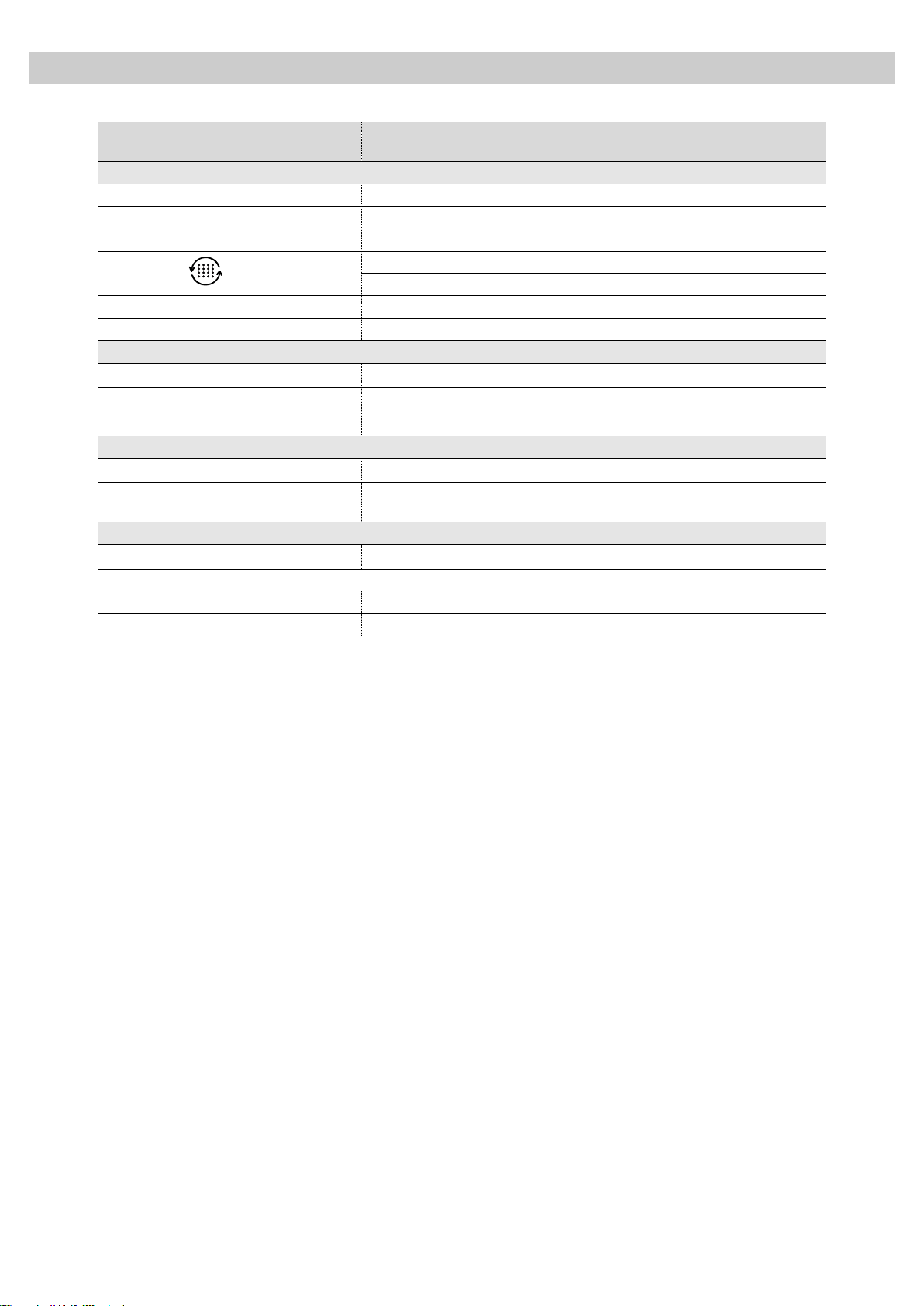
Displays
Display
Description
Descaling
SOFT
Soft water.
MED
Medium water.
HARD
Hard water.
/ CAL
Appliance must be descaled.
Flashing – descaling starts.
2 CUP
Feed 2 cups descaling solution into the water tank.
4 CUP
Feed 4 cups cold water into the water tank for rinsing.
Water tank
RES
Indication that water tank is missing.
DEP
The water tank must be removed, emptied and reinserted.
-LO-
Tank is empty, please fill with a cup of water.
Steam reduction
VAP
Indication that steam reduction process is ongoing.
PUMP
Indication that cold water is entering the boiler and hot
water is being pumped to the water tank.
System warnings
LAMP
Damaged lamp.
Please contact the Technical Assistance Service in case of the following errors:
HOT
Temperature in the PCB is too high.
Err_
Various Errors in the sensors.
Specifications
• AC Voltage ................................................................................... (see rating plate)
• Power required ............................................................................ 3200 W
• Current required ........................................................................... 20 AMP
• Steam power ............................................................................... 1500 W
• Broiler power ............................................................................... 1200 W
• Convection power ....................................................................... 1600 W
• Exterior dimensions (WHD). ..................................................... 760 x 455 x 542 mm
• Interior dimensions (WHD). ...................................................... 420 x 210 x 390 mm
• Oven capacity. ............................................................................. 38l
• Weight ........................................................................................ 35kg

33
Installation instructions
Before installation
Check that the input voltage indicated on the
rating plate is the same as the voltage of the power
outlet you are going to use. The rating plate is
located on the front part of the cavity and it is only
visible after opening the door.
If required by the National Electrical Code (or
Canadian Electrical Code), this appliance must be
installed on a separate branch circuit.
Installer – show the owner the location of the circuit
breaker or fuse. Mark it for easy reference.
Before installing, turn power OFF at the service
panel. Lock service panel to prevent power from
being turned ON accidentally.
Be sure your appliance is properly installed and
grounded by a qualified technician. Installation,
electrical connections and grounding must comply
with all applicable codes.
Open the oven door and take out all the
accessories and remove the packing material.
Warning! The front surface of the oven may be
wrapped with a protective film. Before using the
oven for the first time, carefully remove this film,
starting on the inside.
Make sure that the oven is not damaged in any
way. Check that the oven door closes correctly and
that the interior of the door and the front of the oven
opening are not damaged. If you find any damage
contact the Technical Assistance Service.
DO NOT USE THE OVEN if the metal conduit is
damaged, if the oven does not function correctly or
if it has been damaged or dropped. Contact the
Technical Assistance Service.
Place the oven on a flat and stable surface. The
oven must not be put close to any sources of heat,
radios or televisions.
Electrical supply
Before installing the oven have a qualified
electrician verify that your home is provided with
adequate electrical service and that the addition of
the oven will not overload the branch circuit on
which it is to be installed.
A separate three-wire or four-wire single phase,
240 Volt, 60 Hz, branch circuit is required.
For hook-up of the oven you will need to have an
approved junction box installed where it will be
easily reached through the front of the cabinet
where the oven will be located. The oven has 3 feet
of conduit.
Allow two to three feet of slack in the line so that
the oven can be moved if servicing is ever
necessary.
DO NOT shorten the flexible conduit.
Wiring requirements
When making the wire connections, use the entire
length of the conduit provided (3 feet). The conduit
must not be cut.
Before making connections make sure the power is
off and read and observe the following:
1. A separate three-wire or four-wire, single
phase, 240 Volt, 60 Hz branch circuit is
required for the oven.
2. The oven must be connected with Copper or
Aluminum wire.
3. In the United States:
Wiring must conform to the National Electrical
Code, ANSI/NFPA No. 7 latest edition. You
can obtain a copy of the National Electrical
Code by writing to: National Fire Protection
Association Batterymarch Park Quincy, MA
02269
34
Installation instructions
In Canada:
Wiring must conform to Cana dian Electrical Code
C22.1- latest edition. You can obtain a copy of the
Canadian Electrical Code by writing to: Canadian
Standards Association 178 Rexdale Boulevard
Rexdale (Toronto), Ontario, Canada M9W 1R3
4. Wire size (Copper or Aluminum wire) and
connections must be suitable for the rating of
the appliance as per the National Electrical
Code requirements. The flexible armoured
cable extending from the oven should be
connected directly to the junction box.
5. The junction box should be located so as to
allow as much slack as possible between the
junction box and the oven so it can be moved
if servicing is ever required.
6. A U.L. listed conduit connector must be
provided at each end of the power supply
cable.
Electrical connections
Be sure your appliance is properly installed and
grounded by a qualified technician. Ask your
dealer to recommend a qualified technician or
an authorized repair service.
This appliance is manufactured with a green
GROUND wire connected to the oven chassis.
After making sure that the power has been turned
off, connect the flexible conduit from the oven to the
junction box using a U.L. listed conduit connector.
The figures and the instructions provided below
present the most common way of connecting the
ovens.
Your local codes and ordinances, of course, take
precedence over these instructions.
WARNING” Risk of Electric Shock, frame
grounded to neutral of appliance through a link.
Grounding through the neutral conductor is
prohibited for new branch-circuit installations (1996
NEC); mobile homes; and recreational vehicles, or
in an area where local codes prohibit grounding
through the neutral conductor. For installations
where grounding through the neutral conductor is
prohibited:
• Disconnect the ground from the neutral at
free end of conduit;
• Use grounding terminal or lead to ground unit;
and
• Connect neutral terminal or lead to branch
circuit neutral in usual manner.
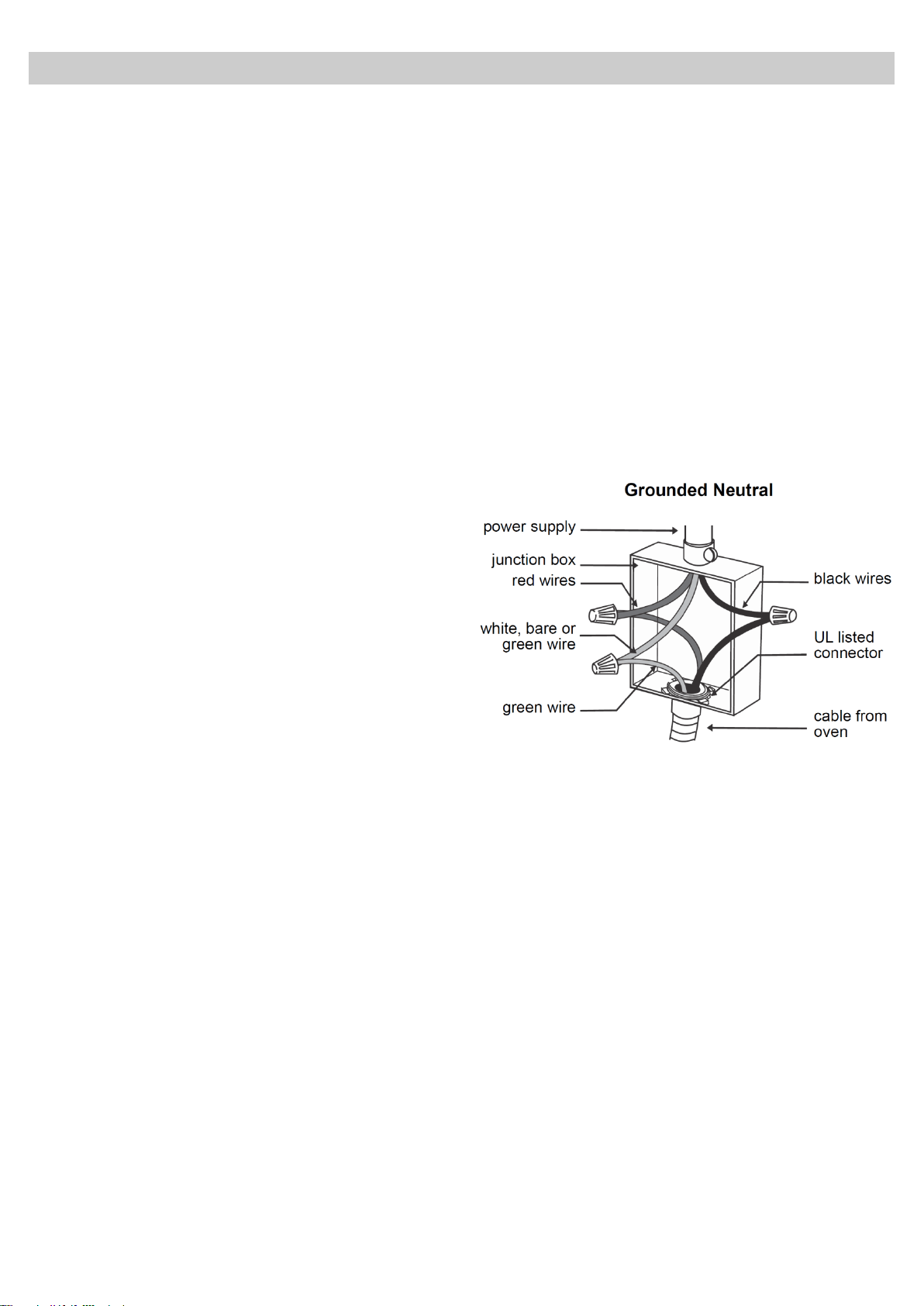
3-Wire branch circuit (for US only)
Refer to the following Figure, where local codes
allow the connection of GROUND wire from the
oven to the branch circuit NEUTRAL wire (gray or
white colored wire):
• If local codes permit, connect the green
GROUND wire from the oven and the white
wire from the oven to the branch circuit
NEUTRAL wire (gray or white colored wire).
• Connect the red and black leads from the
oven to the corresponding leads in the
junction box.
35
Installation instructions
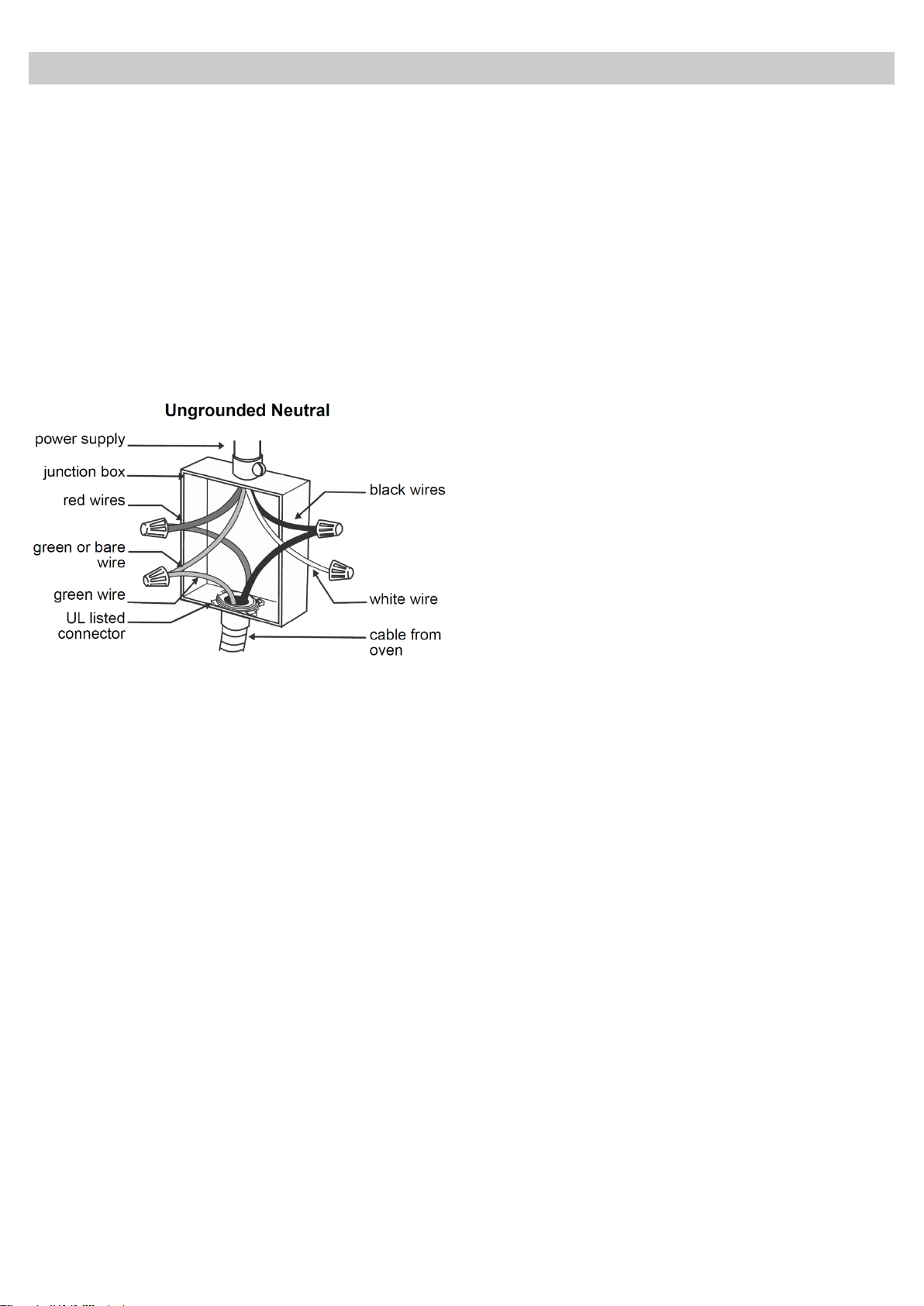
4-Wire branch circuit (for US and
CANADA)
Refer to the following Figure:
• Disconnect ground from neutral at free end of
conduit.
• Connect the green GROUND wire from the
oven to the GROUND wire in the junction box
(bare or green colored wire).
• Connect the red and black leads from the
oven to the corresponding leads in the
junction box.
After installation
The oven only functions when the door is closed
correctly.
After the first use, clean the inside of the oven and
the accessories, following the cleaning instructions
given in the section “Oven cleaning and
maintenance”.

36
Sommaire
Instructions pour lier à la terre ........................................................................................................ 37
Consignes de sécurité...................................................................................................................... 38
Instructions de sécurité ................................................................................................................... 41
Description du four ........................................................................................................................... 42
Réglages de base ............................................................................................................................. 44
Fonctions de base ............................................................................................................................ 47
Fonctions spéciales ......................................................................................................................... 50
Alimentation en eau .......................................................................................................................... 51
Pendant le fonctionnement du four................................................................................................. 52
Tableaux et conseils ......................................................................................................................... 54
Cuisiner au gril .................................................................................................................................. 59
Cuisiner au L’Air Chaud ................................................................................................................... 60
Entretien ............................................................................................................................................ 62
Nettoyage et maintenance de l’appareil .......................................................................................... 65
Que faire en cas de disfonctionnement ? ....................................................................................... 66
Caractéristiques techniques ............................................................................................................ 67
Instructions pour l'installation ......................................................................................................... 68
Dimensions d’Installation ................................................................................................................ 71

37
Instructions pour lier à la terre
L’appareil doit être connecté à un système de câblage permanent, métallique
et mis à la terre, ou un conducteur de mise à la terre de l'équipement doit être
acheminé avec les conducteurs du circuit et connecté à la borne de mise à la
terre de l'équipement ou au fil de l'appareil.
Attention! UNE MAUVAISE LIAISON À LA TERRE PEUT PROVOQUER UN
RISQUE DE CHOC ÉLECTRIQUE.
S’il vous plait, consulter les instructions d’installation pour plus
d’informations.

38
Consignes de sécurité
Avant d'installer et d'utiliser cet appareil, lisez soigneusement les instructions
fournies. Le fabricant ne peut être tenu pour responsable des dommages et
blessures liés à une mauvaise installation ou utilisation. Conservez toujours cette
notice avec votre appareil pour vous y référer ultérieurement.
MESURES DE SÉCURITÉ IMPORTANTES
Lorsque vous utilisez des appareils électriques, des précautions de sécurité
de base doivent toujours être observées, y compris ce qui suit:
1. Installation correcte - Assurez-vous que votre appareil est correctement installé
et mis à la terre par un technicien qualifié.
2. Ne jamais utiliser l’appareil pour réchauffer ou chauffer la pièce.
3. Ne pas laisser les enfants seuls - Les enfants ne doivent pas être laissés seuls
ou sans surveillance dans la zone où l'appareil est en cours d'utilisation. Ils ne
devraient jamais être autorisés à rester assis ou debout sur une partie de
l'appareil.
4. Portez des vêtements appropriés – les vêtements larges ou vêtements
suspendus ne doivent jamais être portés pendant l'utilisation de l'appareil.
5. Entretien par l'utilisateur - Ne pas réparer ou remplacer toute pièce de
l'appareil à moins d'une recommandation précise dans le manuel. Tout autre
entretien doit être confié à un technicien qualifié.
6. Rangement dans ou sur l'appareil: - Les matériaux inflammables ne doivent
pas être stockés dans un four.
7. Ne pas utiliser d'eau sur un feu de graisse - Étouffer le feu ou les flammes,
utiliser un produit chimique sec ou un extincteur à mousse.
8. Utilisez des poignées sèches - Des mitaines mouillées ou humides sur des
surfaces chaudes peuvent provoquer des brûlures provenant de la vapeur. Ne
pas laisser les mitaines de four toucher les éléments chauffants. Ne pas utiliser
une serviette ou un tissu épais.
9. Utilisation prudente de l’ouverture de la porte - Laissez l'air chaud ou la vapeur
s’évader avant de retirer ou de remplacer la nourriture.
10. Ne pas chauffer des récipients fermés - L'accumulation de pression peut faire
exploser le récipient et causer des blessures.
11. Gardez les conduites de ventilation du four nhon obstruées
12. Placement des grilles du four - Toujours placer les grilles à l'emplacement
désiré lorsque le four est froid.
13. Si la grille doit être déplacée pendant que le four est chaud, ne pas laisser les
mitaines dans le four.

39
Consignes de sécurité
14. NE PAS TOUCHER LES ÉLÉMENTS CHAUFFANTS OU LES SURFACES
INTÉRIEURES DU FOUR - Les éléments chauffants peuvent être chauds
même si ils sont en couleur foncée.
15. Les surfaces intérieures d'un four deviennent assez chaudes pour causer des
brûlures. Pendant et après l'utilisation, ne pas toucher, laisser des vêtements
ou d’autres matériaux inflammables en contact avec les éléments chauffants
ou les surfaces intérieures du four avant qu'ils aient eu le temps de refroidir.
• Ce Four à Vapeur est destiné à un usage domestique!

40
Consignes de sécurité
Sécurité des enfants et des personnes vulnérables
• ADVERTISSEMENT! Risque d'asphyxie, de blessure ou d'invalidité
permanente.
• Cet appareil peut être utilisé par des enfants de plus de 8 ans, ainsi que des
personnes dont les capacités physiques, sensorielles et mentales sont réduites
ou dont les connaissances et l'expérience sont insuffisantes, à condition d'être
surveillés par une personne responsable de leur sécurité.
• Ne laissez pas les enfants jouer avec l'appareil.
• Ne laissez pas les emballages à la portée des enfants. Risque d’asphyxie!
• ADVERTISSEMENT! Tenez les enfants éloignés de l'appareil lorsqu'il est en
cours de fonctionnement ou lorsqu'il refroidit. Les parties accessibles sont
chaudes.
• Les enfants ne doivent pas nettoyer ni entreprendre une opération de
maintenance sur l'appareil sans surveillance.
Sécurité générale
• Pendant l'installation, suivez les instructions fournies séparément.
• Repair and maintenance work, especially of current carrying parts, can only be
carried out by technicians authorized by the manufacturer.
• ADVERTISSEMENT! L'intérieur de l'appareil devient chaud lorsqu'il est en
fonctionnement. Ne touchez pas les éléments chauffants se trouvant dans
l'appareil. Utilisez toujours des gants de cuisine pour retirer ou enfourner des
accessoires ou des plats allant au four.
• La température des surfaces accessibles peut être élevée pendant le
fonctionnement de l'appareil.
• N'utilisez pas de nettoyeur vapeur pour nettoyer l'appareil.
• N'utilisez pas de produits abrasifs ni de racloirs pointus en métal pour nettoyer
l’appareil.
• Prévoir, pour l’installation électrique, un dispositif permettant de débrancher
l’appareil du secteur au niveau de tous les pôles une ouverture des contacts
d’au moins 3 mm. Sont considérés comme appropriés des dispositifs de
protection tels que par ex. les disjoncteurs, les fusibles (dévisser les fusibles de
leur socle), les disjoncteurs différentiels et les contacteurs.
• L’encastrement doit garantir la protection contre tout contact.
• Si le câble d'alimentation est endommagé, il ne doit être remplacé que par un
professionnel qualifié afin d'éviter tout danger.
• Avant toute opération de maintenance, déconnectez l'alimentation électrique.

41
Instructions de sécurité
ATTENTION!
Avant de brancher l'appareil, comparez-en les
données (tension et fréquen-ce) indiquées sur la
plaque des caractéristi-ques avec celles de votre
réseau électrique. Elles doivent correspondre,
pour éviter tout problème. En cas de doute,
appelez un électricien.
ATTENTION!
Si la prise de l'appareil doit être changée,
l'installation et le branchement doivent être
effectués par un technicien. Adressez-vous à un
électricien attitré qui respecte les normes de
sécurité. La responsabilité du fabricant n'est pas
engagée pour des dommages provenant d'une
erreur de montage ou de branchement.
ATTENTION!
La sécurité électrique de l'appareil n'est assurée
que s'il est relié à la terre. La responsabilité du
fabricant n'est pas engagée pour des dommages
provenant d'un manque ou d'un défaut du système
de protection de l'installation (choc électrique par
exemple).
ATTENTION!
Ne mettez l'appareil en marche qu'une fois celui-ci
dûment encastré, car c'est la seule façon
d'interdire l'accès aux composants électriques.
ATTENTION!
N'ouvrez jamais la structure de l'appareil.
D'éventuels contacts avec les pièces conductrices
ou modifications des composants électriques ou
mécaniques peuvent constituer un danger pour la
sécurité de l'utilisateur et perturber le bon
fonctionnement de l'appareil.
ATTENTION!
Les réparations et entretiens, tout particulièrement
sur les pièces sous tension, ne peuvent être
effectués que par des techniciens agréés par le
fabricant. Le fabricant et les revendeurs
déclinent toute responsabilité pour d'éventuels
dommages, causés aux personnes, aux animaux
ou aux biens, qui découlent de réparations ou
entretiens effectués par des personnes non
autorisées.
ATTENTION!
Les réparations au cours de la période de garantie
ne doivent être exécutées que par des techniciens
agréés par le fabricant. Dans le cas contraire, tout
dommage provenant de ces réparations est exclu
de la garantie.
ATTENTION!
L'appareil doit être débranché du réseau électrique
quand sont effectués les travaux d'installation et de
réparation. Pour que l'appareil soit débranché,
vous devez constater l'une des conditions
suivantes:
- Les fusibles/disjoncteur du tableau électrique
sont débranchés.
- L'appareil est débranché de la prise murale,
ce qui doit être fait en tirant sur la prise de
l'appareil et non sur le câble électrique.
42
Description du four
1. – Vitre de la porte
5. – Plat perforé
2. – Charnières de sécurité
6. – Plat
3. – Réservoir d’eau
4. – Panneau de contrôle
7. – Supports latéraux
8. – Grille support
9. – Lampe
1.
Bouton de sélection des fonctions
a.
Indicateur de Démarrage différé
2.
Bouton de sélection “+” / “-“
b.
Indicateur de Détartrage
3.
Afficheur / Display
c.
Indicateur de l'horloge
4.
Touche “-“
d.
Indicateur de Blocage de sécurité
5.
Touche “+“
e.
Indicateur du temps de fonctionnement
6.
Touche OK
f.
Indicateur de Température
7.
Touche Start (démarrage)
8.
Touche Stop (arrêt)
43
Description du four
Description des fonctions
Symbole
Fonction
Aliments
Vapeur
Cuisson de toute sorte de légumes, riz, céréales et
viande.
Extraction du jus des baies.
Action conjointe de décongélation et de cuisson des
légumes.
Grill
Griller des aliments.
L’Air chaud
Rôtir et cuire.
L'air chaud +
Vapeur
Rôtir rapidement viande, poisson et volailles.
Cuire gâteaux secs et humides.
Grill ventilé
Griller viande et poisson, en morceaux fins.
Griller de la volaille.
Pommes de terre – décongeler et dorer des produits
ultracongelés.
Dureté de
l'eau/
Détartrage
Définition de la dureté de l'eau /
Détartrage
44
Réglages de base
Définitions préliminaires
Lorsque le four à vapeur est allumé pour la première fois ou après une panne d'électricité, le cadran de
l'horloge clignote pour indiquer que l'heure indiquée n'est pas correcte.
Le four ne fonctionnera pas tant que l'heure, la dureté de l'eau et le calibrage ne sont pas définis.
Pour définir l'heure et la dureté de l'eau, procédez comme indiqué ci-dessous.
Réglage de l’heure
Pour régler l’heure, procédez comme suit :
1. Appuyez sur la touche « + » jusq’à ce que
l’indicateur de l'Horloge commence à
clignoter.
2. Appuyez sur la touche OK.
3. Appuyez sur les touches « + » et « - » pour
définir l’heure.
4. Appuyez sur la touche OK pour confirmer
l’heure. Les minutes clignotent.
5. Appuyez sur les touches « + » et « - » pour
définir les minutes.
6. Pour terminer, appuyez de nouveau sur la
touche OK.
Masquer/ montrer l’heure
Si l’affichage de l’heure ne vous convient pas, vous pouvez le masquer en procédant comme ça:
1. Appuyez sur les touches “+” et “-“
simultanément pendant 5 secondes. Les
points qui séparent les heures des minutes
et l’horloge clignoteront, mais les autres
éléments normalement affichés seront
masqués.
2. Si vous souhaitez à nouveau afficher l’heure,
appuyez à nouveau sur les touches “+” et “-“
pendant 5 secondes.
.
45
Réglages de base
Définition de la dureté de l'eau
Si votre eau est très douce (même en utilisant un appareil d’adoucissement de l’eau) ou très dure, le
système peut être optimisé grâce au réglage de la dureté de l’eau (voir ci-dessous) :
Pour régler la dureté de l’eau, procédez comme ça:
(Cet appareil est équipé d’un système qui vous indique automatiquement lorsqu’un détartrage est
nécessaire, en indiquant le message “”.)
1. Tournez le bouton de sélection des
fonctions sur la fonction Dureté de l'eau /
Détartrage (non nécessaire après le
branchement de l’appareil ou une coupure de
courant). La dureté de l'eau commence à
clignoter.
2. Tournez le Sélecteur + / - pour régler la
valeur correcte du paramètre de dureté de
l'eau, selon le tableau ci-dessous.
3. Appuyez sur le bouton OK pour choisir les
paramètres (ou attendre jusqu'à ce que le
paramètre est réglé par time-out). L’écran
affiche l’heure.
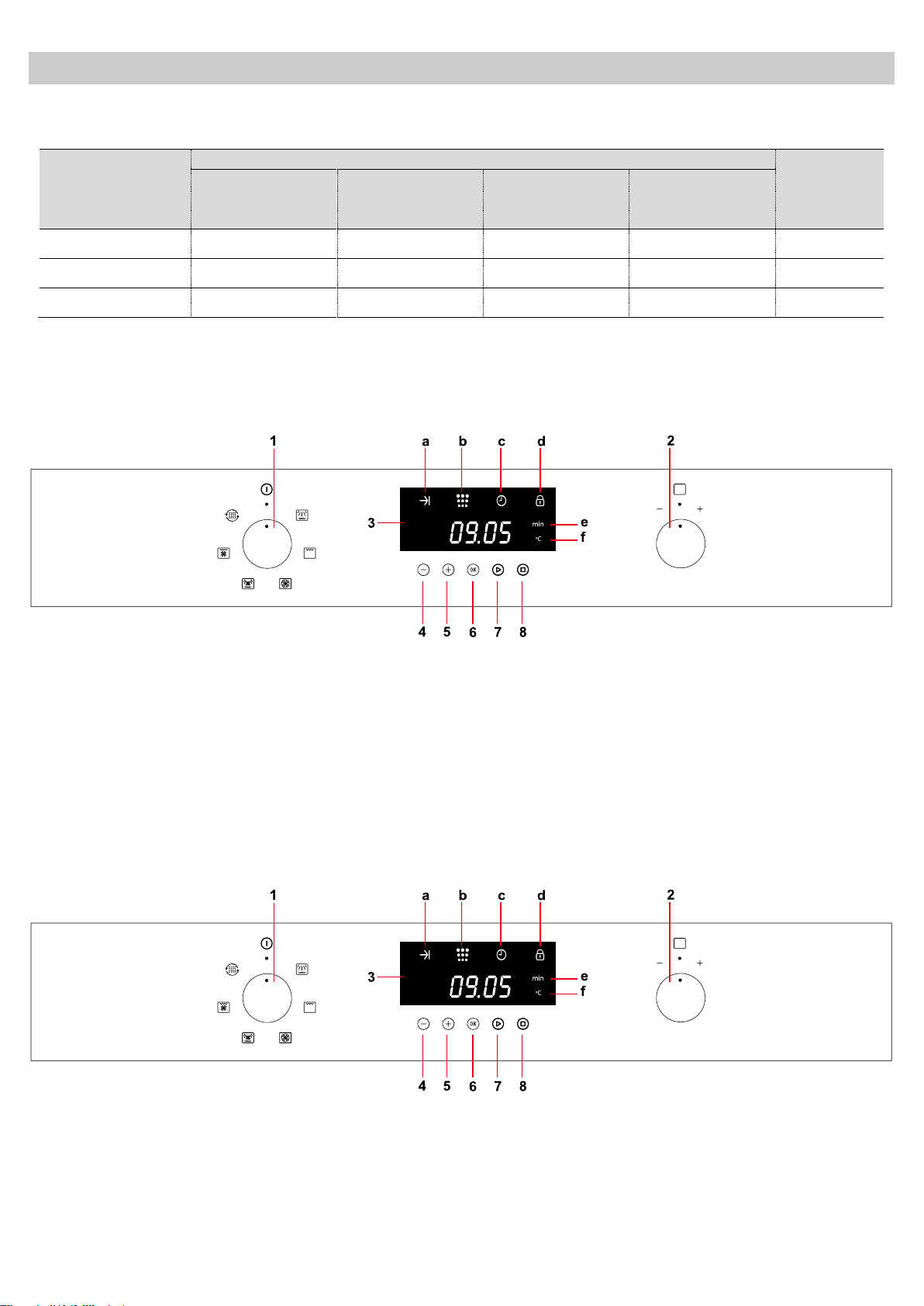
46
Réglages de base
Le tableau suivant indique les définitions des différents degrés de dureté de l'eau.
Type
Dureté de l’eau
Affichage
Ca + mg
(ppm)
Degrés anglais
[°da]
Degrés français
[°df]
Degrés
allemands
[°da]
Douce
0 à 150
0 à 11
0 à 15
0 à 8
SOFT
Moyenne
151 à 350
12 à 25
16 à 35
9 à 20
MED
Dure
351 à 500
26 à 35
36 à 50
21 à 28
HARD
Blocage de sécurité
Vous pouvez bloquer le fonctionnement du four (par exemple pour empêcher son utilisation par des
enfants).
1. Pour bloquer le four, appuyez sur la touche
Stop pendant 3 secondes. Un signal sonore
est alors émis et l'écran affiche le mot
« SAFE ». Le four est alors bloqué, toute
opération est interdite.
2. Pour débloquer le four, appuyez de nouveau
sur la touche Stop pendant 3 secondes. Le
signal sonore est émis et l'écran donne de
nouveau indication de l'heure.
Mode de Salle d’exposition (Showroom)
Dans le mode Showroom, le four fonctionne comme décrit dans chaque fonction, mais il y aura pas de
chauffage.
1. Pour entrer dans le Mode de Salle
d’exposition, appuyez simultanément sur la
touche «-» et la touche Stop pendant 5
secondes. L'écran affiche les messages
“” et “”par intermittence (montrant
l'état réel).
2. Tournez le Sélecteur + / - pour alterner le
status (“” or “”).
3. Appuyez sur la touche OK pour valider.
Remarque: Pour quitter le Mode de Salle
d’exposition procéder de la même manière.
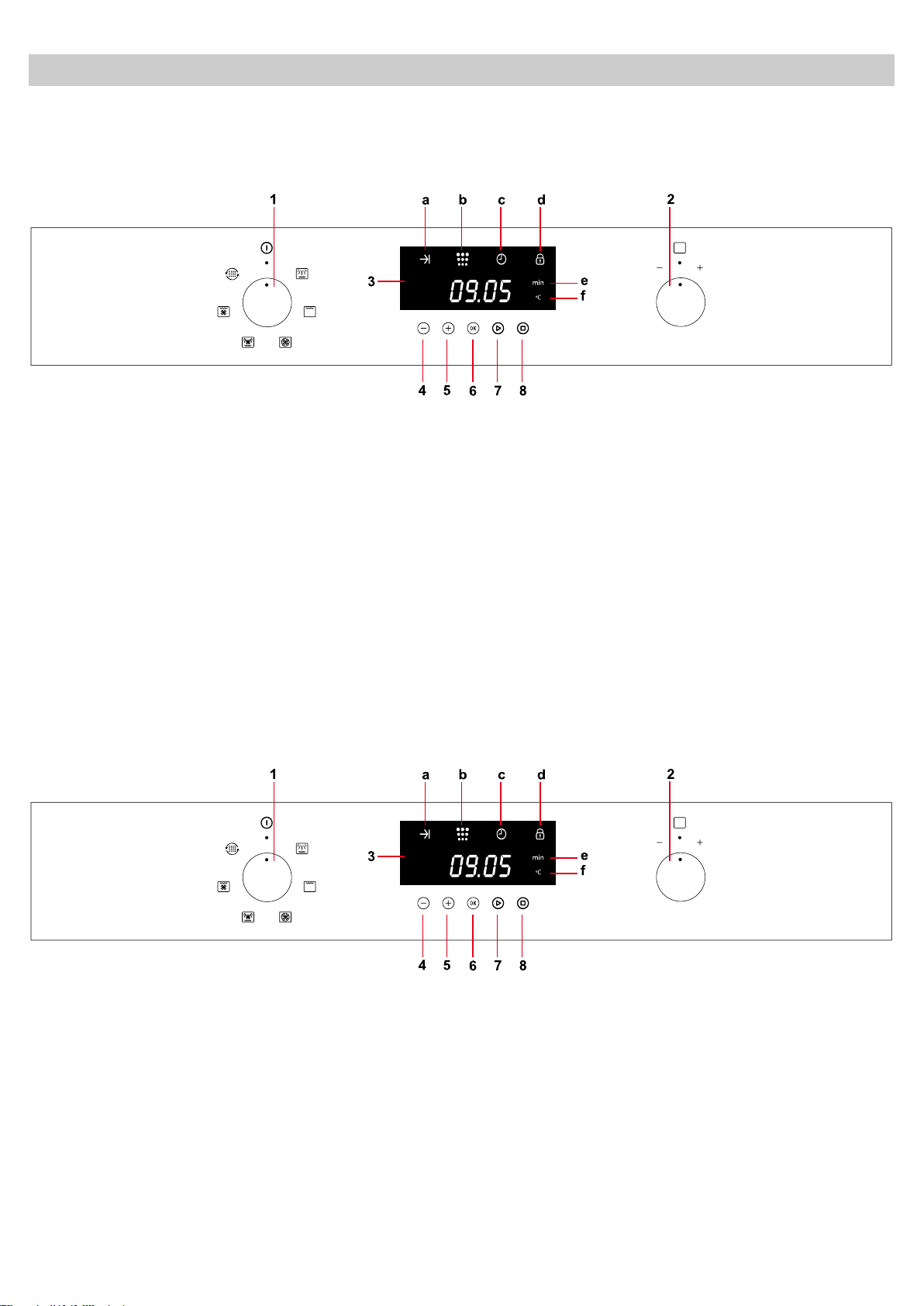
47
Fonctions de base
Fonction Vapeur
Utilisez cette fonction pour cuire tous les types de légumes, le riz, les céréales et la viande. Elle est
également utile pour obtenir des jus de baies et pour décongeler, cuire et réchauffer.
1. Tournez le bouton de sélection des
fonctions sur la fonction Vapeur. L
indicateur de Température clignote et
l’écran affiche «100ºC».
2. Tournez le bouton de sélection +/- pour
régler la température souhaitée (de 40ºC à
100ºC).
3. Appuyez sur le bouton OK pour confirmer.
L’indicateur du temps de fonctionnement
commence à clignoter.
4. Sélectionnez le temps souhaité en tournant
le bouton de sélection + / - dans n’importe
quelle direction (10 minutes, par exemple).
5. Appuyez sur le bouton Start. L’appareil se
met en marche.
Grill
Utilisez cette fonction pour faire griller rapidement le dessus d'un plat.
1. Tournez le bouton de sélection des
fonctions sur la fonction Grill. L‘indicateur du
temps de fonctionnement et l’écran
clignotent.
2. Sélectionnez le temps souhaité en tournant
le bouton de sélection « +/- » dans n’importe
quelle direction (10 minutes, par exemple).
3. Appuyez sur la touche Start. Le four se met
en marche.
Note: Le ventilateur de refroidissement continue
à travailler pendant un certain temps. Lorsque la
température a suffisamment baissée, le
ventilateur s’éteint.
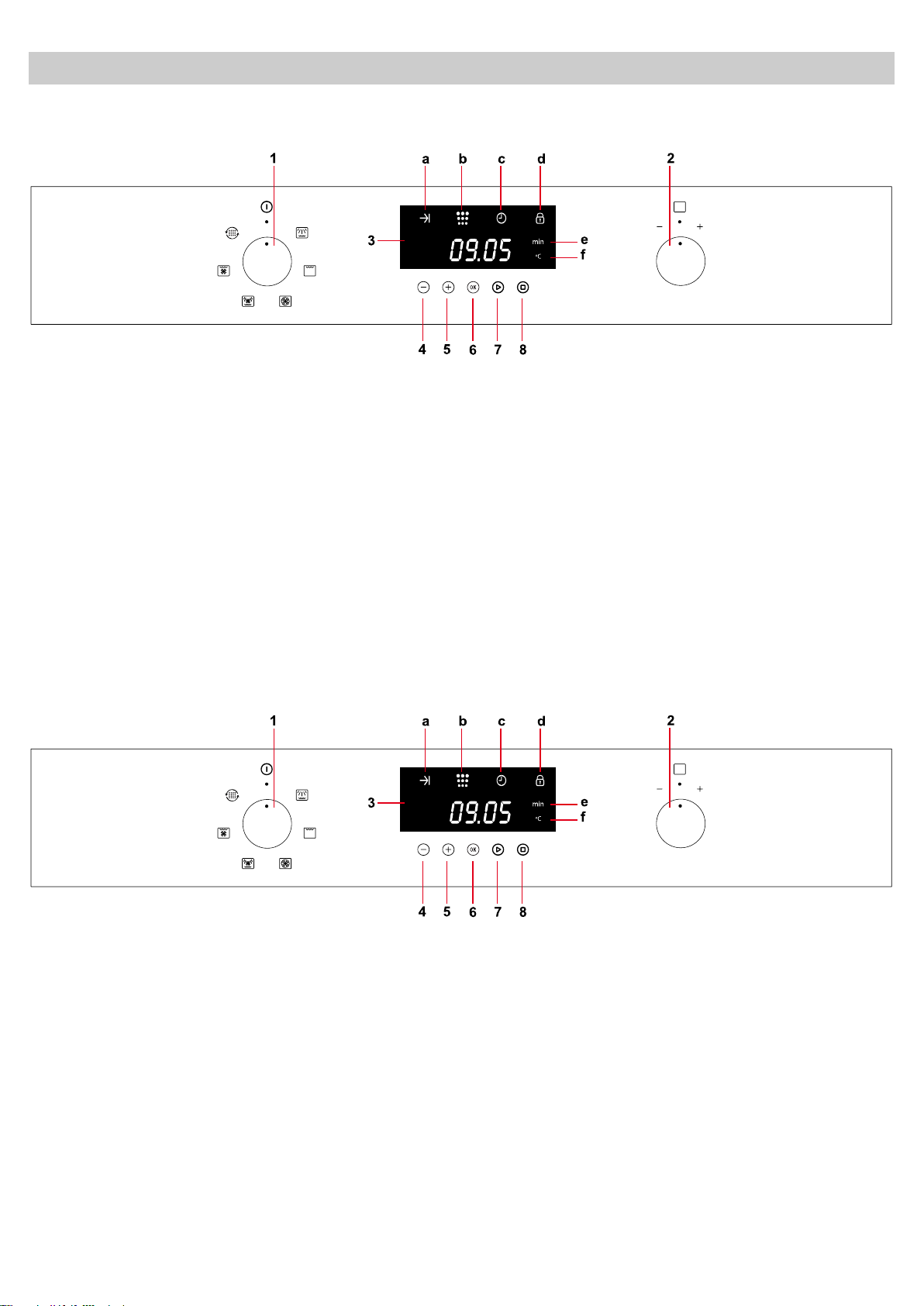
48
Fonctions de base
Chaleur tournante
Utilisez cette fonction pour cuire vos aliments.
1. Tournez le bouton de sélection des
fonctions sur la fonction Chaleur
Tournante. L’indicateur de la température et
l’afficheur (Display) commencent à clignoter
(«160ºC»).
2. Tournez le bouton de sélection +/- pour régler
la température souhaitée.
3. Appuyez sur la touche OK pour valider.
4. Sélectionnez le temps souhaité en tournant
le bouton « +/- » dans n’importe quelle
direction.
5. Appuyez sur la touche Start. Le four se met
en marche.
Note: Le ventilateur de refroidissement continue
à travailler pendant un certain temps. Lorsque la
température a suffisamment baissée, le
ventilateur s’éteint.
Fonction Chaleur tournante + Vapeur
Utilisez cette fonction pour cuire rapidement vos aliments.
1. Tournez le bouton de sélection des
fonctions sur la fonction Chaleur tournante
+ Vapeur. L’indicateur de la température le
et l’afficheur (Display) commencent à
clignoter («160ºC»).
2. Tournez le bouton de sélection « +/- » pour
régler la température souhaitée.
3. Appuyez sur la touche OK pour valider.
L‘indicateur du temps de fonctionnement et
l’écran clignotent.
4. Sélectionnez le temps souhaité en tournant
le bouton de sélection « +/- » dans n’importe
quelle direction.
5. Appuyez sur la touche Start. Le four se met
en marche.
Note: Le ventilateur de refroidissement continue
à travailler pendant un certain temps. Lorsque la
température a suffisamment baissée, le
ventilateur s’éteint.
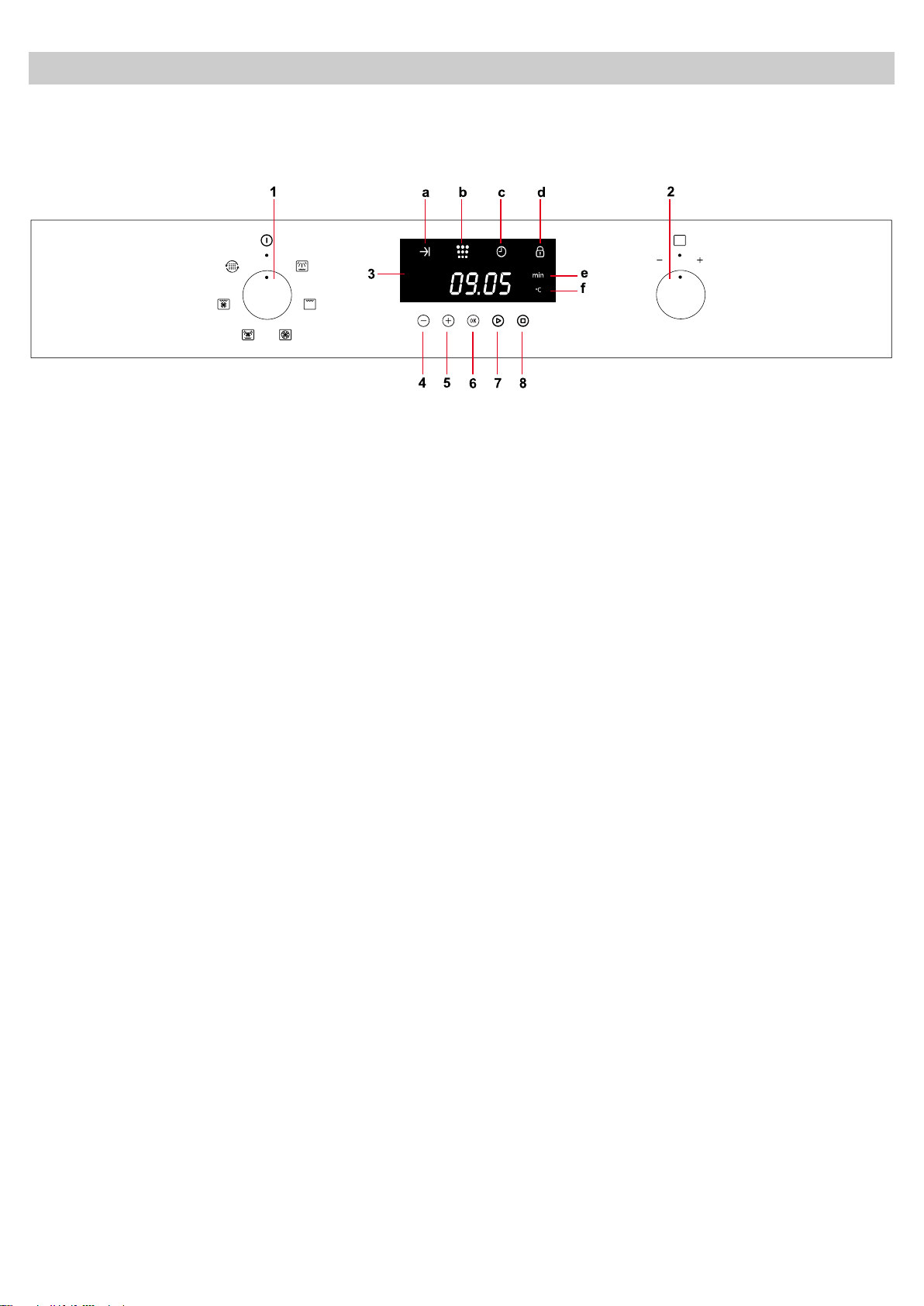
49
Fonctions de base
Grill ventilé
Utilisez cette fonction pour cuisiner lasagnes, la volaille, les pommes de terre cuites au four et
casseroles.
1. Tournez le bouton de sélection des
fonctions sur la fonction Grill ventilé.
L‘indicateur du temps de fonctionnement et
l’écran clignotent.
2. Sélectionnez le temps souhaité en tournant
le bouton de sélection « +/- » dans n’importe
quelle direction.
3. Appuyez sur la touche Start. Le four se met
en marche.
Note: Le ventilateur de refroidissement continue
à travailler pendant un certain temps. Lorsque la
température a suffisamment baissée, le
ventilateur s’éteint.
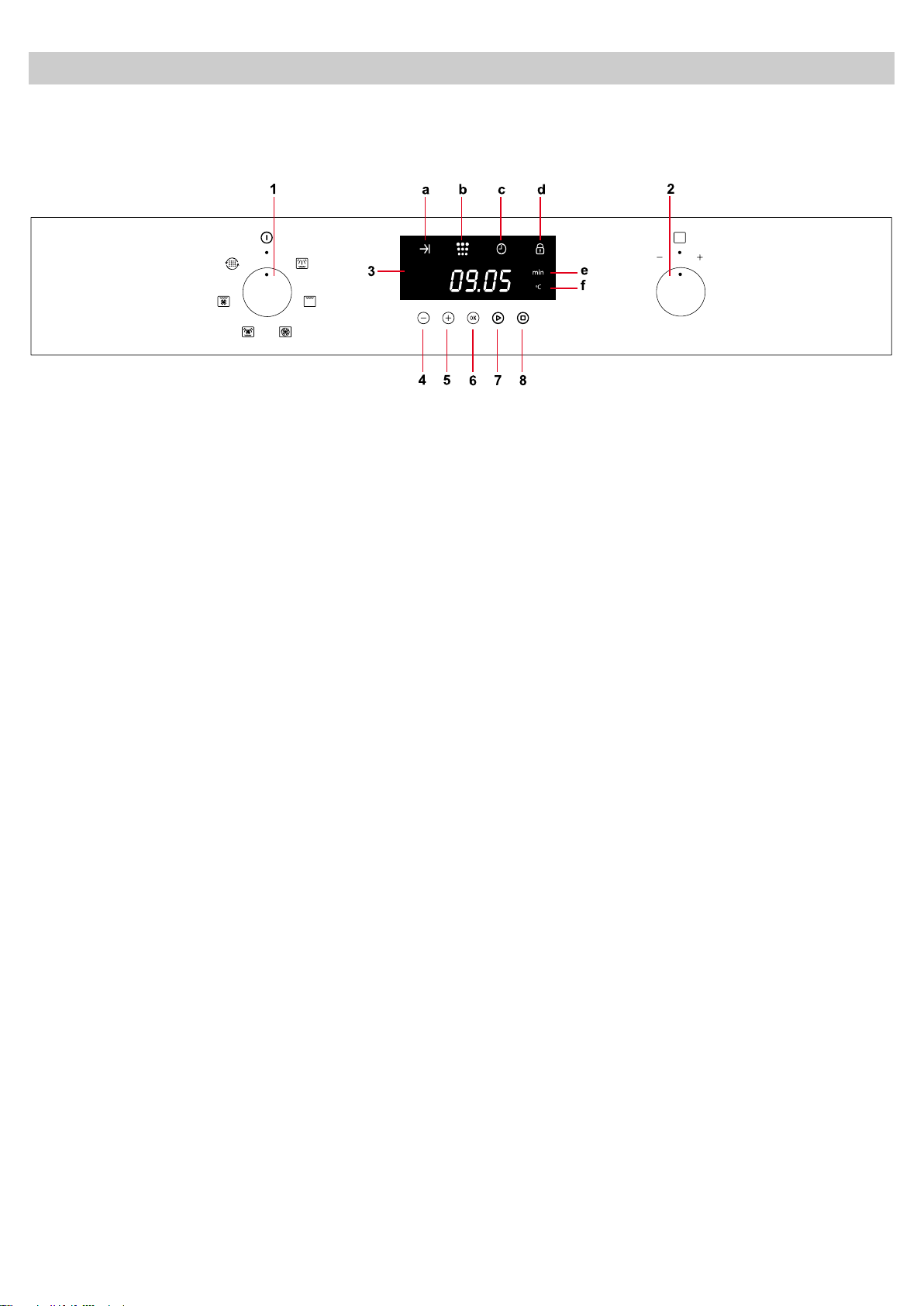
50
Fonctions spéciales
Début de cuisson programmé
Utilisez cette fonction pour programmer le début de la cuisson à une heure différente.
1. Tournez le bouton Sélecteur de fonction sur
la fonction souhaitée (Cette fonction
fonctionne avec: Vapeur + L’Air chaud, L'air
chaud + Vapeur).
2. Réglez les paramètres (par exemple: temps
de fonctionnement, puissance,
température), tel que décrit dans la section
«Fonctions de base».
3. Appuyez sur la touche “OK” (au lieu de Start)
pour entrer le Début de cuisson
programmé. (L’indicateur du Début de
cuisson programmé commence à clignoter à
l’affichage).
4. Tournez le bouton de sélection « - » et « + »
pour régler l'heure de Démarrage différé.
(0:00 apparaît par défaut sur l'écran et vous
pouvez retarder le démarrage du programme
jusqu'à 9 heures et 59 minutes - 9:59).
5. Appuyez sur la touche Start pour valider
l'heure de démarrage différé.
6. La durée de cuisson et de départ différé (+
indicateurs respectifs) seront affichés en
alternance.
7. Le Début de cuisson programmé commence
en compte à rebours.
8. Le four commencera à fonctionner lorsque le
départ différé atteint 00:00.
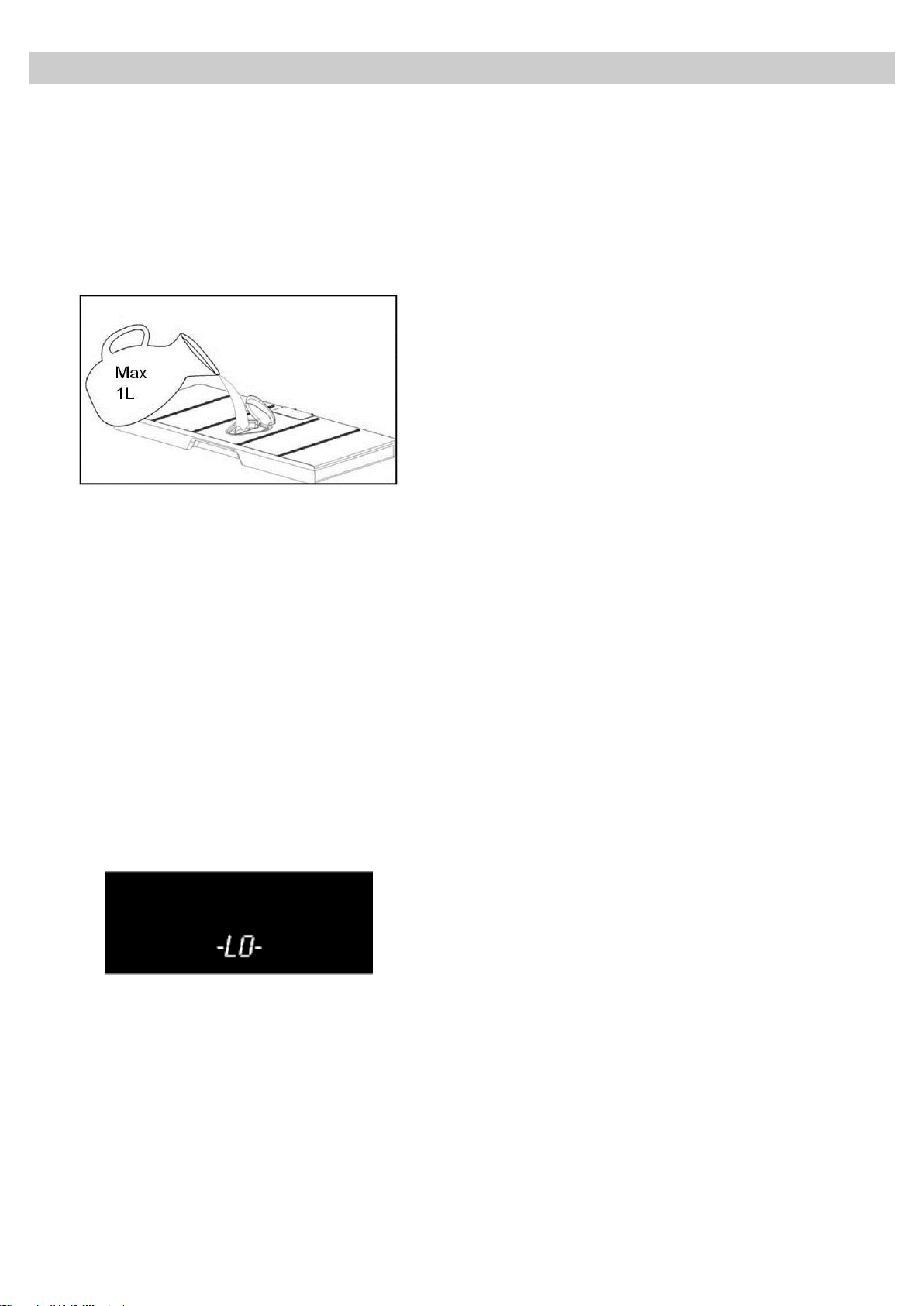
51
Alimentation en eau
Remplir le réservoir d’eau
Il est nécessaire que le réservoir d’eau soit plein
pour que l’appareil fonctionne correctement.
Remplissez le réservoir d’eau, en utilisant de l’eau
potable froide (approximativement 4 verres/ 1ltr) et
introduisez le réservoir dans l’emplacement situé
au dessus de la cavité jusqu'à ce que vous
entendiez un clic.
Si l’indication «rES» s’allume, cela signifie que le
réservoir d’eau n’a pas été correctement
positionné.
NOTE: L'eau distillée ou stérilisée ne peut
jamais être utilisé pour la cuisson du four à
vapeur. Les minéraux de l'eau sont en effet
essentiels pour que le processus de cuisson
fonctionne.
Remplir à nouveau l’eau
La contenance du réservoir d’eau est suffisante
pour une cuisson de 50-60 minutes.
S’il s’avère nécessaire de remplir à nouveau le
réservoir d’eau, le voyant du réservoir s’allume.
Versez un maximum de 2 verres pour être sûr
que l’eau ne déborde pas lorsqu’elle est de
nouveau pompée dans le réservoir. RISQUE DE
DÉBORDEMENT!
Vider le réservoir d’eau
Quand l’appareil est éteint, l’eau résiduelle est
renvoyée dans le réservoir. Pendant que l’eau est
renvoyée, l’affichage indique « PUMP ». Ce
message reste affiché jusqu’à ce que la
température de l’eau atteigne 75º C, température à
partir de laquelle elle sera renvoyée dans le
réservoir.
Attention ! L’eau dans le réservoir peut être
chaude. Risque de brûlures !
Une fois que l’eau a été renvoyée dans le réservoir
d’eau, l’affichage indiquera le message «DEP» qui
nécessite de procéder aux actions suivantes :
1. Retirez et videz le réservoir d’eau.
2. Séchez le réservoir d’eau et réintroduisez le
dans l’emplacement situé au-dessus de la
cavité. Nettoyez et séchez l’enceinte de cuisson.
3. Maintenez la porte de l’appareil ouverte pour
laisser l’enceinte de cuisson refroidir et sécher
complètement.
NOTE IMPORTANTE : Il est conseillé de retirer
le réservoir d’eau et de le vider après chaque
cycle de cuisson. Ceci permet d’éviter la
prolifération de bactéries et la formation de
calcaire dans l’appareil.
Si vous voulez faire deux cuissons
consécutives, le réservoir ne doit pas être vidé.
Le message « DEP » s’affiche à l’écran.
L’avertissement peut être éliminé en appuyant sur
la touche Stop et en poursuivant le nouveau cycle
de cuisson sans retirer et vider le réservoir d’eau.

52
Pendant le fonctionnement du four...
Interrompre un cycle de cuisson
Vous pouvez interrompre un la cuisson à n’importe
quel moment en appuyant une seule fois sur la
touche Stop.
Le four est équipé d’une fonction de réduction de
vapeur qui est activée quand la touche Stop est
appuyée afin de graduellement laisser la vapeur
s’échapper de la cavité, pour qu’il n’y ait pas un
nuage de vapeur soudain lorsque la porte de
l’appareil est ouverte.
Cette fonction prend à peu près 3 minutes et
pendant son fonctionnement, le mot « VAP » est
affiché.
Attention ! Lorsque vous ouvrez la porte
pendant la cuisson ou à la fin de celle-ci, prenez
garde à l’évacuation de l’air chaud et / ou de la
vapeur qui s’échappe de l’enceinte de cuisson.
Reculez ou mettez-vous sur le côté pour éviter
les brûlures.
A ce moment là:
• Le générateur de vapeur est interrompu.
• Les murs de la cavité et le réservoir sont
encore très chauds. Risque de brûlures !
• La minuterie s’arrête et l’affichage indique le
temps de fonctionnement restant (si celui-ci
avait été réglé).
Si vous le souhaitez, à ce moment là, vous
pouvez :
1. Tourner ou mélanger la nourriture pour vous
assurer qu’elle soit cuite uniformément.
2. Changer les paramètres de cuisson.
Pour recommencer, fermer la porte et appuyer sur
la touche Start (Démarrer).
Changer les paramètres
Il est possible de changer les paramètres de
fonctionnement (temps et température) quand la
cuisson a été interrompue, en procédant comme
suit :
1. Pour changer le temps, appuyez sur les
touches « + » et « - ». Le nouveau temps réglé
est immédiatement validé.
2. Pour changer la température, appuyez sur la
touche de sélection de la température et
l’affichage et le voyant respectif clignoteront.
Pour changer le paramètre, appuyez sur les
touches « + » et « - » et confirmez votre
sélection en appuyant à nouveau sur la touche
de sélection de la température
Annuler un cycle de cuisson
Si vous souhaitez annuler le cycle de cuisson,
appuyez sur la touche Stop deux fois.
Vous entendrez un bip et le message « END »
s’affichera.
Fin du cycle de cuisson
A la fin d’une durée déterminée ou quand vous
appuyez sur la touche Stop pour signifier la fin du
cycle de cuisson, la fonction de réduction de
vapeur du four se met en marche.
Cette fonction laisse la vapeur s’échapper
graduellement de la cavité, pour qu’il n’y ait pas un
nuage de vapeur soudain lorsque la porte de
l’appareil est ouverte.
Cette fonction prend à peu près 3 minutes et
pendant son fonctionnement, le mot « VAP » est
affiché.
A la fin du processus, vous entendrez trois bips et
le mot « End » s’affichera.
Attention ! Lorsque vous ouvrez la porte
pendant la cuisson ou à la fin de celle-ci, prenez
garde à l’évacuation de l’air chaud et / ou de la
vapeur qui s’échappe de l’enceinte de cuisson.
Reculez ou mettez-vous sur le côté pour éviter
les brûlures.
Les bips se répètent toutes les 30 secondes
jusqu’à ce que la porte soit ouverte ou que vous
appuyiez sur la touche Stop.
Le ventilateur de refroidissement fonctionne
encore un certain temps après que l’appareil ait été
éteint. C’est une fonction normale qui permet de
diminuer la température à l’intérieur du four.
Lorsque l’affichage indique le mot « EMP », cela
signifie que l’eau a été renvoyée dans le réservoir
d’eau et que celui-ci peut être retiré.
Retirez le réservoir d’eau et séchez-le
complètement. Laissez l’espace cuisson se
refroidir pendant un moment, puis nettoyez-le et
séchez-le avec un chiffon. La porte de l’appareil
doit rester ouverte un petit moment pour que celui-
ci puisse sécher complètement.
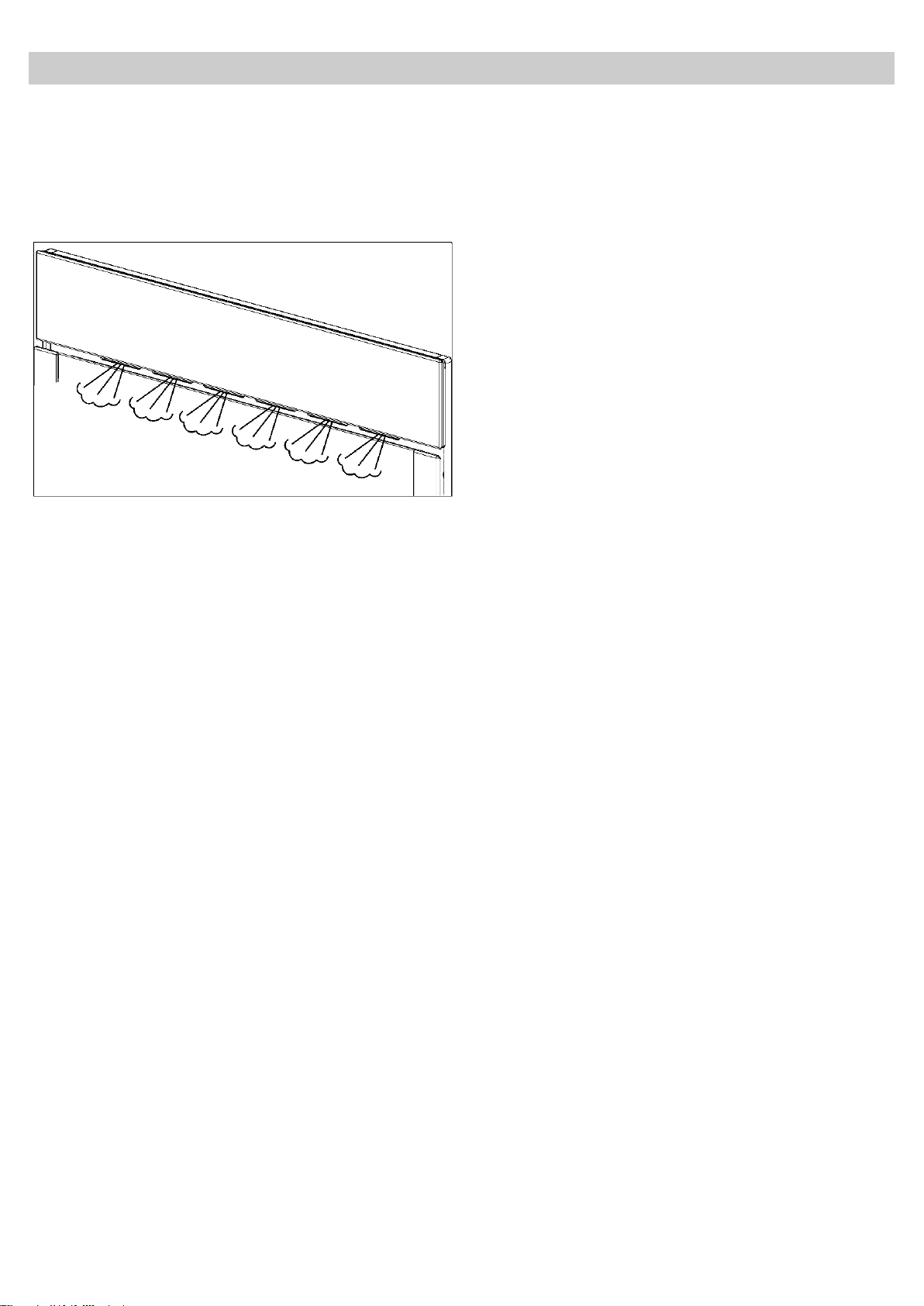
53
Pendant le fonctionnement du four...
Écoulement de vapeur
Il est normal qu’il y ait un écoulement de vapeur
intermittent sortant de la partie frontale du four.
Cela est spécialement visible en hiver ou dans un
environnement très humide.
Eau résiduelle dans le four
Afin de diminuer la quantité d'eau résiduelle dans
le four, il est conseillé de placer un plateau en métal
sur la grille inférieure. Le liquide condensé
commence à suinter de la nourriture et goutte en
eau résiduelle dans le plateau. Ce qui reste d'eau
résiduelle peut être facilement essuyée avec un
chiffon.
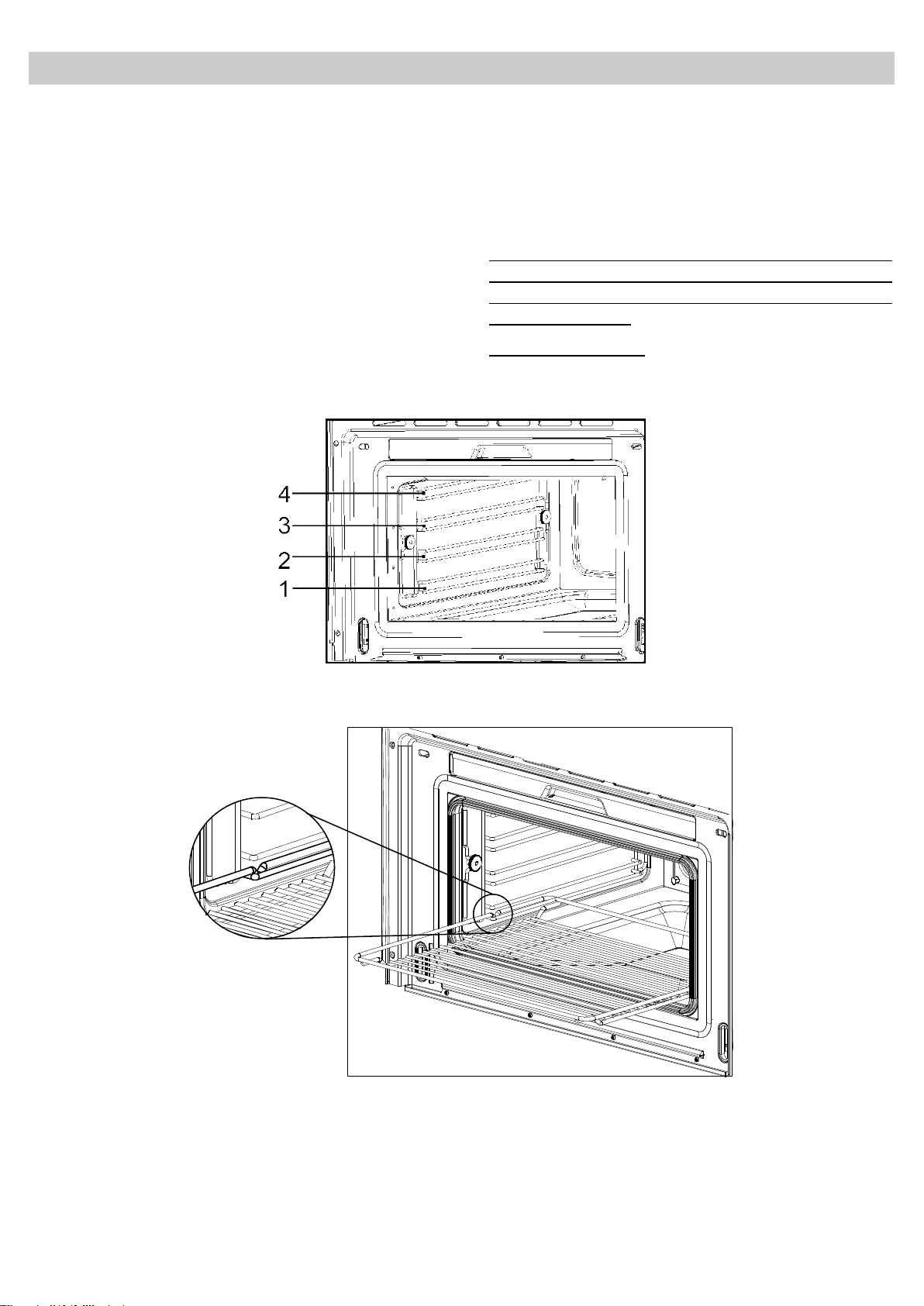
54
Tableaux et conseils
Utilisation des accessoires
Le bac de cuisson perforé sert à étuver des
légumes, de la viande ou de la volaille frais ou
congelés. Il est donc important que le bac de
cuisson non perforé soit placé au premier niveau
des supports en partant du bas. L’humidité va
ainsi s’y déposer en gouttelettes et ne salira pas
l’appareil. Le bac perforé contenant les aliments
doit être placé au deuxième niveau en partant du
bas.
Le bac non perforé sert à étuver les aliments
délicats, par ex. de la compote, des quenelles et
les plats à base d'eau.
La grille s’utilise pour étuver les récipients de
cuisson plus petits que l’emplacement prévu
comme par exemple des coupes à dessert et
pour régénérer des assiettes.
Les informations précises sont contenues dans
les tableaux.
Les valeurs de durée de cuisson et de
température sont fournies à titre indicatif. En
fonction du type d’aliment et de sa constitution, la
durée de cuisson
Réelle peut varier..
Pour retirer le support, soulevez légèrement la partie frontale des encoches sur les parois latérales du
four (voir l'illustration).
Il est recommandé d'utiliser le support avec la tôle de cuisson pour faire cuire des aliments qui
peuvent goutter.
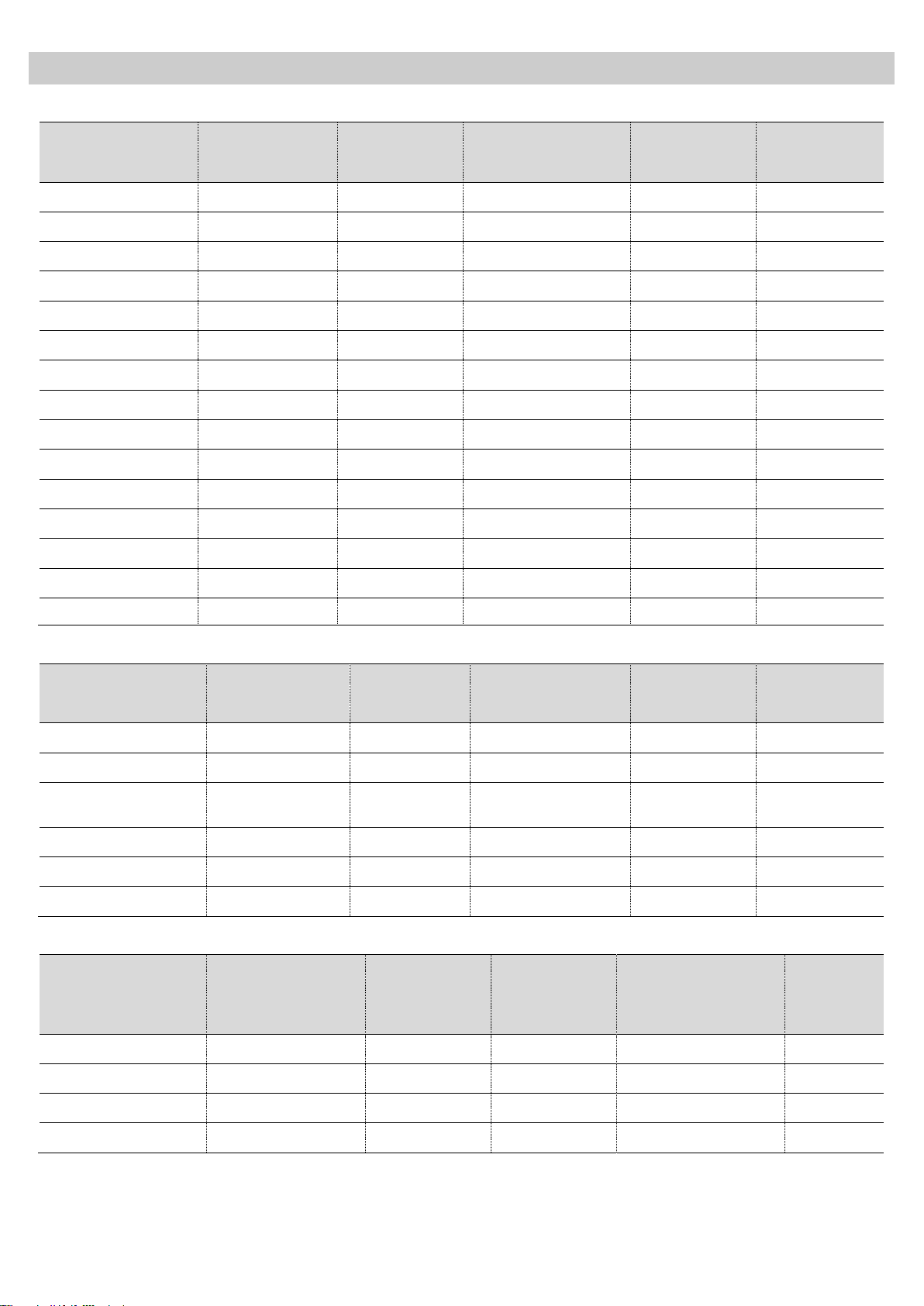
55
Tableaux et conseils
Cuisson à la vapeur - Poisson
Poisson
Quantité
Température
en ºC
Temps de cuisson
en min.
Récipient
Niveau des
supports en
partant du bas
Dorade
800-1200 g
80
30-40
bac perforé
2
Truite
4 x 250 g
80
20-25
bac perforé
2
Filet de saumon
500-1000 g
80
15-25
bac perforé
2
Truite saumonée
1000-1200 g
80
25-35
bac perforé
1/2
Crevettes
500-1000 g
80
15-20
bac perforé
2
Moules vertes
1000-1500 g
100
25-35
bac perforé
2
Filet de flétan
500-1000 g
80
20-25
bac perforé
2
Bucardes
500-1000 g
100
10-20
bac perforé
2
Homard, TK
800-1200 g
100
25-30
bac perforé
1/2
Filet de cabillaud
1000-1200 g
80
20-25
bac perforé
2
Moules
1000-1200 g
100
15-25
bac perforé
2
Omble
4 x 250 g
80
25-30
bac perforé
2
Haddock
1000-1200 g
80
20-25
bac perforé
2
Filet de thon
500-1000 g
80
15-20
bac perforé
2
Sandre
4 x 250 g
80
25-30
bac perforé
2
Viande
Viande
Quantité
Température
en ºC
Temps de cuisson
en min.
Accessoire/
Récipient
Niveau des
supports en
partant du bas
Boulettes de poulet
4-10
100
40-45
bac perforé
2
Poitrine de poulet
4-6
100
25-35
bac perforé
2
Côte de porc façon
Kassel
500g – 1000 g
100
40-50
bac perforé
2
Escalope de dinde
4-8
100
20-25
bac perforé
2
Filet de porc entier
4-8
100
20-30
bac perforé
2
Saucisses
80-100
10-15
bac perforé
2
Garniture
Garniture
Quantité
Température
en ºC
Temps de
cuisson en
min.
Récipient
Niveau des
supports
en partant
du bas
Céréales + liquide
200g + 400 ml
100
30-35
grille, coupe en verre
2
Semoule + liquide
200g + 300 ml
100
10-20
grille, coupe en verre
2
Lentilles + liquide
200g + 375 ml
100
20-50
grille, coupe en verre
2
Riz + liquide
200g + 250 ml
100
25-40
grille, coupe en verre
2
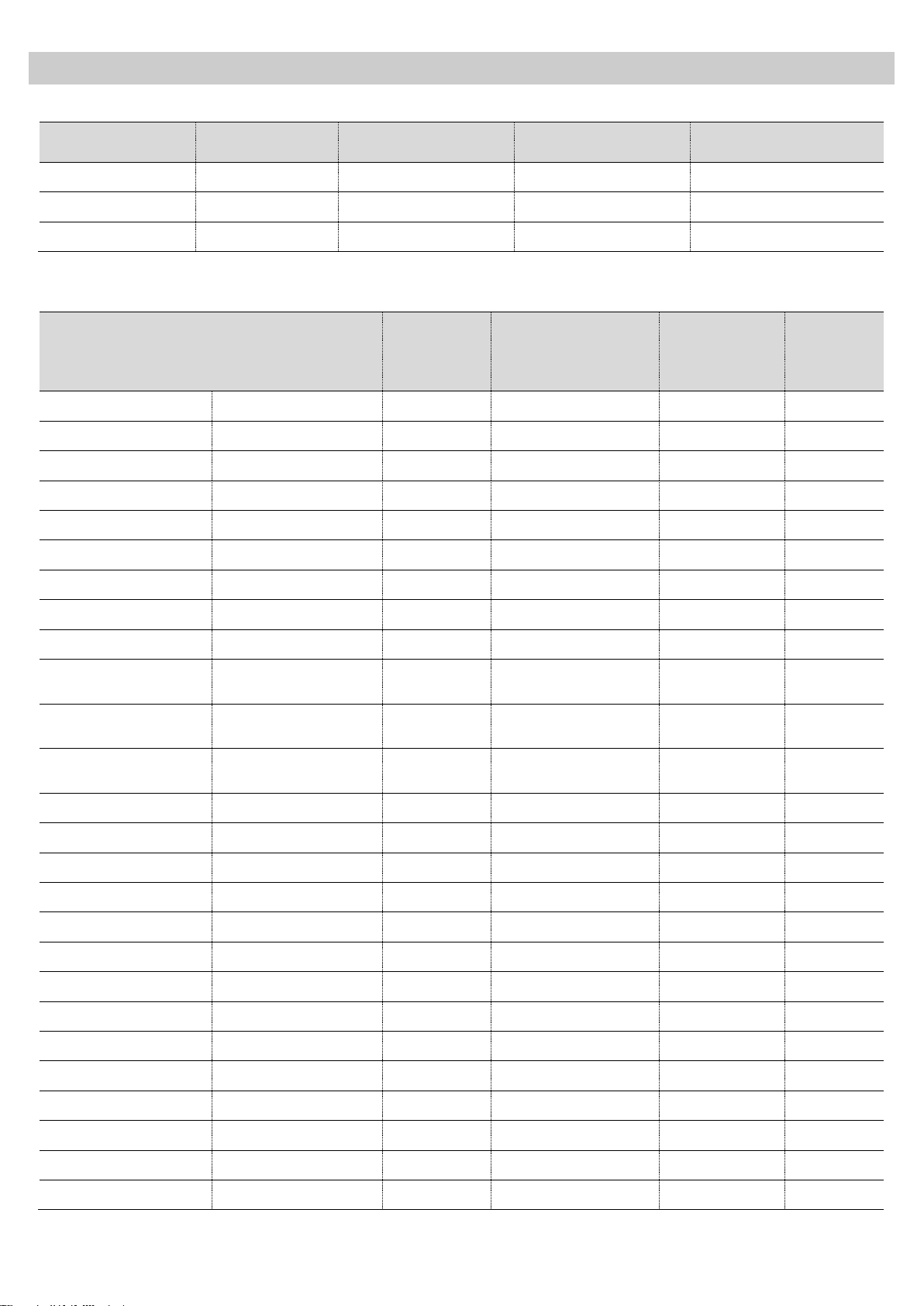
56
Tableaux et conseils
Oeufs
Œufs
Température en
ºC
Temps de cuisson
en min.
Récipient
Niveau des supports
en partant du bas
Œuf au plat
100
10-15
grille
2
Œuf dur
100
15
grille
2
Œuf à la coque
100
10-12
grille
2
Légumes
Légumes/ frais
Température
en ºC
Temps de cuisson
en min.
Récipient
Niveau des
supports
en partant
du bas
Aubergines
En tranches
100
15-20
bac perforé
2
Haricots
100
35-45
bac perforé
2
Brocoli
Fleurs avec la tige
100
25-30
bac perforé
2
Brocoli
Fleurs sans la tige
100
15-20
bac perforé
2
Choux-fleur
Bouquets
100
25-30
bac perforé
2
Choux-fleur
La tête entière
100
40-45
bac perforé
1
Pois
100
30-35
bac perforé
2
Fenouil
En lamelles
100
15-20
bac perforé
2
Fenouil
Coupé en deux
100
20-30
bac perforé
2
Pommes de terre
avec peau
Entières, très petites
100
20-25
bac perforé
2
Pommes de terre
avec peau
Entières, très grosses
100
45-50
bac perforé
2
Pommes de terre
sans peau
En cubes
100
20-25
bac perforé
2
Chou-rave
En lamelles
100
20-25
bac perforé
2
Haricots mange-tout
100
15-20
bac perforé
2
Carottes
En rondelles
100
25-30
bac perforé
2
Épis de maïs
100
50-60
bac perforé
2
Poivrons
En lamelles
100
12-15
bac perforé
2
Piments
100
12-15
bac perforé
2
Champignons
En quartiers
100
12-15
bac perforé
2
Poireaux
En rondelles
100
10-12
bac perforé
2
Choux de Bruxelles
100
25-35
bac perforé
2
Céleri
En lamelles
100
15-20
bac perforé
2
Asperges
100
20-35
bac perforé
2
Épinards
100
12-15
bac perforé
2
Céleri en branches
100
25-30
bac perforé
2
Courgettes
En rondelles
100
12-18
bac perforé
2
57
Tableaux et conseils
Quenelles
Quenelles
Température
en ºC
Temps de cuisson
en min.
Récipient
Niveau des supports
en partant du bas
Boulette douce
100
20-30
bac non perforé
2
Boulette douce de levure
100
15-20
bac non perforé
2
Boulette de levure
100
15-25
bac non perforé
2
Quenelles de pain
100
20-25
bac non perforé
2
Quenelles serviette
100
25-30
bac non perforé
2
Desserts
Desserts
Quantité
Températur
e en ºC
Temps de cuisson
en min.
Récipient
Niveau des
supports en partant
du bas
Compote de
pommes
500-1500 g
100
15-25
bac non perforé
2
Compote de poires
500-1500 g
100
25-30
bac non perforé
2
Crème brûlée
80
20-25
grille-coupes
2
Crème caramel
80
25-30
grille-coupes
2
Yaourt
40
4-6 h.
grille-coupes
2
Compote de
pêches
500-1500 g
100
15-20
bac non perforé
2
Fruits (Stériliser/ réduire)
Fruits
Quantité
Température en
ºC
Temps de
cuisson en min.
Récipient
Niveau des supports
en partant du bas
Poires
4-6 1l glasses
100
30-35
grille
1
Cerises
4-6 1l glasses
80
30-35
grille
1
Pêches
4-6 1l glasses
80
30-35
grille
1
Prunes
4-6 1l glasses
80
30-35
grille
1
Régénérer
Réchauffer
Quantité
Température
en ºC
Temps de cuisson
en min
Récipient
Niveau des supports en
partant du bas
Assiette
1-2
100
12-15
grille
2
Assiette
3-4
100
15-20
grille
2
Plat préparé
100
15-20
grille
2
Blanchir
Légumes
Quantité
Température
en ºC
Temps de
cuisson en min
Récipient
Niveau des supports
en partant du bas
Par ex. haricots,
poireaux
100
10-12
bac perforé
2
Chou vert
1000-2000 g
100
12-16
bac perforé
2
Chou frisé
10-20
100
12-15
bac perforé
2
Chou blanc, entier
2000-2500 g
100
30-45
bac perforé
1
Tomates, vidées
80
12
grille
2
58
Tableaux et conseils
Décongeler
Légumes/ garnitures
Température
en ºC
Temps de
cuisson en min
Récipient
Niveau des
supports
en partant
du bas
Brocoli
Fleurs avec tige
100
15-20
bac perforé
2
Macédoine de
légumes
100
15-20
bac perforé
2
Feuilles d’épinards
Portions
100
10-15
bac non perforé
2
Chou-fleur
Bouquets
100
15-20
bac perforé
2
Haricots
100
15-25
bac perforé
2
Chou vert
Gros morceau
100
25-35
bac non perforé
2
Carottes
En rondelles
100
15-20
bac perforé
2
Choux de Bruxelles
100
20-25
bac perforé
2
Asperges
100
25-30
bac perforé
2
Plats préparés
100
selon le besoin
grille
2
Pain
100
10-25
grille
2
Riz
100
15-25
bac non perforé
2
Lentilles
100
15-20
bac non perforé
2
Nouilles
100
15-20
bac non perforé
2
Cuisson sur 2 niveaux
Quelques consignes:
Pour une cuisson sur deux niveaux, les récipients
doit toujours être placée aux niveaux 2 ou 3 e au
niveau 1 en partant du bas.
Temps de cuisson différents sont contrôlés comme
suit:
Les aliments qui nécessitent un temps de cuisson
plus long doivent être placés dans la partie
supérieure du four. Les aliments nécessitant un
temps de cuisson plus court sont donc placés au
premier niveau. Un exemple: Légumes, pommes
de terre et poisson.
Mettez les légumes et les pommes de terre dans
des récipients sur la grille au niveau 2 ou 3 en
partant du bas.
Mettez le poisson au premier niveau en partant
d’en bas.
Si vous utilisez le bac perforé pour cuire du
poisson, placez le bac non perforé en bas de
l’appareil pour recueillir les gouttes de jus de
poisson. L'appareil reste propre.
Temps de cuisson: Légumes et pommes de terre
25-35 min.
Temps de cuisson: poisson (selon l'espèce) 15-25
min.
Réglez une durée de cuisson maximale, les
différents niveaux permettent de cuire les mets
pour que tout soit prêt en même temps et que rien
ne soit trop cuit.
59
Cuisiner au gril
Pour obtenir de bons résultats avec le gril, utilisez
la grille fournie avec le four.
INDICATIONS IMPORTANTES :
1. Lors de la première utilisation du gril, un peu
de fumée odorante peut se dégager. Elle
résulte de l'emploi d'huiles pendant le
processus de fabrication.
2. La vitre de la porte atteint des températures
très élevées quand le gril est utilisé. Ne
laissez pas les enfants s'approcher.
3. Nous vous conseillons de porter des gants
de cuisine car la grille et les parois de la
cavité atteignent des températures très
élevées.
4. Le thermostat de sécurité fait que les
résistances s'éteignent temporairement lors
d'une utilisation prolongée du gril.
5. Important ! Vous devez vérifier que les
récipients que vous utilisez quand vous
cuisinez ou faites griller des aliments sont
bien adaptés au micro-ondes. Voir le
chapitre sur le type de vaisselle !
6. Quand vous utilisez le gril, des
éclaboussures de graisse peuvent atteindre
la résistance et être brûlées. C'est une
situation normale qui ne représente aucun
problème de fonctionnement.
7. Nettoyez l'intérieur et les accessoires après
chaque cuisson, pour que les saletés ne
s'incrustent pas.
Aliment
Quantité (g)
Temps (m)
Indications
Poisson
Dorade
Sardine/ rascasse rouge
800g
6-8 unités
18-24
15-20
Beurrez légèrement. Quand la moitié du
temps est écoulée, retournez et ajoutez les
condiments.
Viande
Saucisse
6-8 unités
22-26
Percez et retournez quand la moitié du
temps est écoulée.
Hamburger congelé
3 unités
18-20
Retourner 2 ou 3 fois.
Entrecôte (environ 3 cm
d'épaisseur)
400g
25-30
Saucez et retournez quand la moitié du
temps est écoulée.
Autres
Toasts
4 unités
1½-3
Surveillez les toasts.
Gratiner des sandwichs
2 unités
5-10
Surveillez le gratin
Préchauffez le gril pendant 2 minutes. Sauf
indication contraire, utilisez la grille. Placez la grille
sur un récipient dans lequel l'eau et la graisse
puissent couler.
Les temps sont mentionnés à titre d'indication car
ils peuvent varier en fonction de la composition des
aliments, de leur quantité et de la cuisson
demandée. Le poisson et la viande gagnent un
goût délicieux si, avant de les griller, vous les
badigeonnez d'huile végétale, épices et herbes
aromatiques, et si vous les laisser mariner
quelques heures. Ne salez qu'après la grillade.
Les saucisses n'éclatent pas si vous les percez
préalablement avec une fourchette.
Au milieu du temps de fonctionnement, contrôlez la
cuisson, remuez ou retournez si nécessaire.
Le gril est spécialement adapté pour la cuisson de
la viande en morceaux et du poisson en filets. Les
morceaux fins de viande peuvent être retournés
une seule fois, les plus gros plusieurs fois.
60
Cuisiner au L’Air Chaud
Préparation de viande
Aliment
Quantité (g)
Température
ºC
Temps
(mn)
Temps de
repos (mn)
Indications
Rôti de veau
1000
160/170
80/90
10
Récipient sans couvercle
Filet de porc
Côtelette ou os
Rôti de porc
500 / 600
180/190
35/40
10
Récipient sans couvercle
Poulet entier
1000 / 1200
200
30/40
10
Récipient avec couvercle.
Bréchet vers le haut. Ne
tournez pas.
Poulet en
morceaux
800
200
25/35
10
Récipient sans couvercle.
Placer les morceaux la peau
en haut. Ne tournez pas.
Canard
1500 / 1700
200
70/80
10
Récipient avec couvercle. Ne
tournez pas.
Conseils pour la cuisson
Retournez les pièces de viande à la moitié du
temps de cuisson. Quand le rôti est cuit, laissez-le
reposer 20 minutes dans le four éteint et fermé. Le
jus de la viande sera ainsi mieux réparti.
La température et le temps de cuisson dépendent
du type et de la quantité d'aliment.
S'il n'y a pas d'indication du poids exact du rôti
dans le tableau, choisissez le poids immédia-
tement inférieur et prolongez le temps.
Conseils pour la vaisselle
Vérifiez que la vaisselle entre bien à l'intérieur du
four.
Les récipients en verre, quand ils sont chauds,
doivent être posés sur un chiffon de cuisine sec.
Au contact d'une surface froide ou mouillée, le
verre pourrait se fendiller et éclater. Utilisez un
gant de cuisine pour retirer les plats du four

61
Cuisiner au L’Air Chaud
Préparation des gâteaux
Aliment
Récipient
Niveau
TempératureºC
Temp (mn)
Gâteau aux noix
Moule creux
1
170/180
30/35
Tarte aux fruits
Moule de Ø 28 cm
2
150/160
35/45
Gâteau anglais
Moule creux
1
170/190
30/45
Tarte salée
Moule rond en verre
2
160/180
50/70
Gâteau simple
Moule de Ø 26 cm
1
160/170
40/45
Bûche
Moule à gâteau en verre
2
110
35/45
Gâteau aux cerises
Moule à gâteau en verre
2
170/180
35/45
Conseils pour les moules à gâteaux
Les moules les plus fréquents sont les moules
noirs en métal.
Conseils pour cuisiner les gâteaux
La température de cuisson des gâteaux dépend de
la qualité et de la quantité de pâte. Essayez une
première fois avec une température plutôt en
dessous, ce qui permet d'obtenir un doré plus
uniforme. La fois suivante, si nécessaire,
choisissez une température plus forte.
Suggestions pour une bonne cuisson
Comment vérifier que le gâteau est cuit :
Enfoncez un couteau fin sur le dessus du gâteau.
Si la pâte ne colle pas au couteau, le gâteau est
cuit.
Le gâteau est très foncé :
La prochaine fois, sélectionnez une température
plus basse et laissez cuire le gâteau plus
longtemps.
Le gâteau est très sec :
Faites de petits orifices, avec une petite fourchette,
dans le gâteau déjà cuit, puis arrosez avec du jus
de fruit ou une boisson alcoolique. La prochaine
fois, montez la température de près de 50ºC et
réduisez le temps de cuisson.
Le gâteau ne veut pas sortir du moule :
Laissez refroidir le gâteau 5 à 10 minutes. Si la
situation perdure, passez la lame d'un couteau tout
autour du gâteau pour le dégager. La prochaine
fois, beurrez mieux le moule.
Conseils pour économiser l'énergie
Quand vous faites plus de 1 gâteau, il est
préférable de les mettre au four les uns après les
autres. Encore chaud, le four cuira le deuxième
gâteau plus rapidement. Utilisez de préférence des
moules foncés, peints ou émaillés en noir, car ils
absorbent mieux la chaleur.
Dans le cas de cuissons qui demandent plus de
temps, vous pouvez éteindre le four 10 minutes
avant la fin pour profiter de la chaleur résiduelle
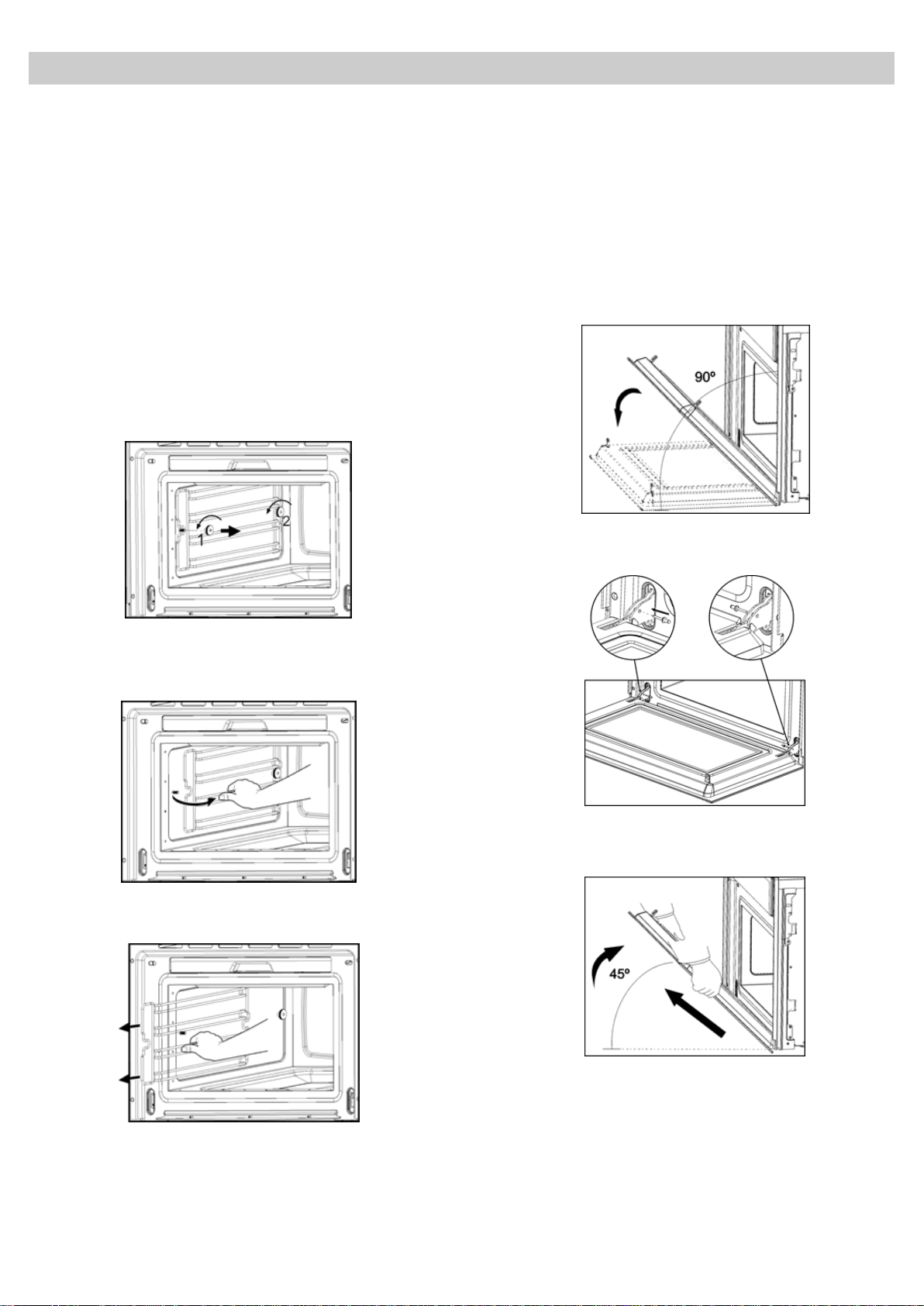
62
Entretien
Nettoyage de l’enceinte de cuisson
N’utilisez jamais de produit nettoyant agressif
comme des éponges à récurer, des éponges
métalliques, etc. Cela peut endommager la surface
de l'enceinte de cuisson.
Nettoyez l’enceinte de cuisson à chaud avec un
torchon humide. Pour terminer, essuyez avec un
chiffon.
Pour faciliter le nettoyage, les supports latéraux
peuvent être enlevés (voir chapitre suivant).
Décrocher les supports latéraux
Dévissez l’écrou 1 à l’avant du support dans le
sens inverse des aiguilles d’une montre.
Dévissez légèrement l’écrou 2 de la surface de
fixation du support dans le sens inverse des
aiguilles d'une montre. Ne pas ôter l'écrou.
Tirez légèrement le support vers l’avant et sortez-
le du four.
Pour remettre en place les supports, glissez-les
dans l’écrou 2.
Vissez l’écrou 1 dans le sens des aiguilles d’une
montre jusqu’à la butée, revissez fermement
l’écrou 2.
Enlever la porte de l’appareil
1. Ouvrez la porte au maximum.
2. Placez deux chevilles dans les gongs de la
porte.
3. Fermez la porte juste ce qu’il faut pour
pouvoir la soulever.
4. Pour remettre la porte en place, insérez les
charnières dans les trous.
5. Ouvrez la porte au maximum et enlevez les
chevilles.

63
Entretien
Détartrage
À chaque production de vapeur, du calcaire se
dépose dans le générateur de vapeur, quelle que
soit la dureté de l’eau (c.-à-d. de la contenance en
calcaire de l'eau).
La fréquence du détartrage dépend de la dureté de
l’eau et de la fréquence d'utilisation. Si le four est
utilisé à raison de 4x30 minutes par semaine, le
détartrage doit s'effectuer comme suit en fonction
de la dureté de l'eau:
Dureté de l’eau
Détartrage après
Très douce
18 mois
Moyenne
9 mois
Très dure
6 mois
L’appareil détecte automatiquement lorsqu’un
détartrage est nécessaire. Le voyant de détartrage
s’allume . Si le détartrage n’est pas effectué, le
voyant se met à clignoter. Si après plusieurs
cuissons, l'appareil n'est toujours pas détartré, le
fonctionnement sera bloqué. Le message « CAL »
s'affiche et les voyants clignotent.
REMARQUE IMPORTANTE: si l’appareil n’est
pas détartré, l’appareil fonctionnera moins bien
ou sera endommagé.
Produits détartrants appropriés
Pour le détartrage, utilisez le produit détartrant
“durgol®”.
Ce produit vous permet de détartrer votre appareil
de façon professionnelle et adéquate. Disponibles
via le service après vente.
Attention! N’utilisez pas de vinaigre ou de
produit nettoyant à base de vinaigre car cela
pourrait endommager le circuit d’eau interne.
Les produits détartrants classiques ne sont pas
appropriés. Ils peuvent contenir des additifs
favorisant le développement de mousse.
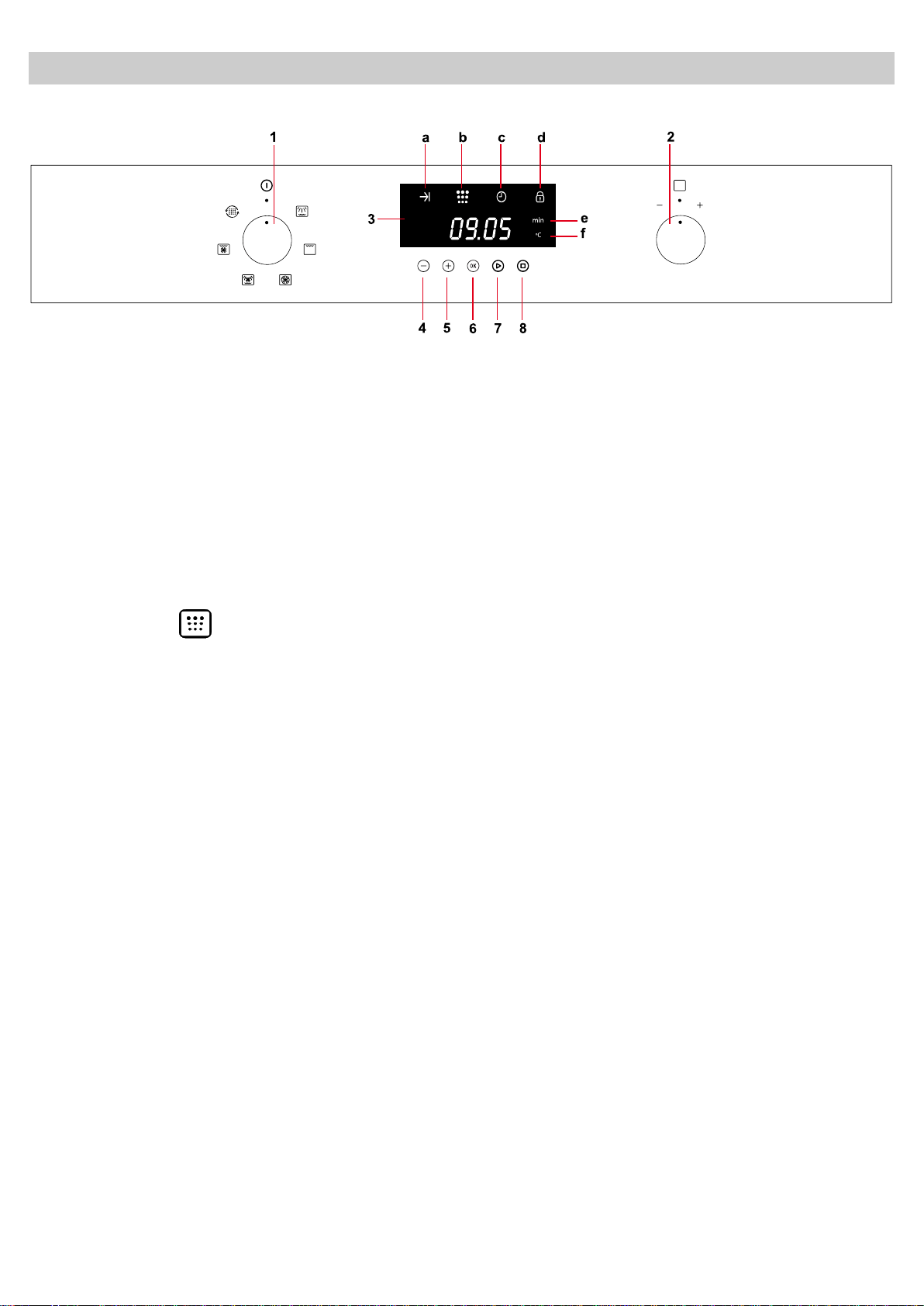
64
Nettoyage et entretien
Procédure de détartrage
Attention : Pour des raisons de sécurité, le
processus de détartrage, ayant une durée
d’environ 45 minutes, ne peut être interrompu.
L'appareil peut être détartré que la porte de
l'appareil soit ouverte ou fermée. L'appareil doit
être éteint pour que le cycle de détartrage
commence.
Pour lancer le cycle de détartrage, procédez
comme suit :
1. Tournez le bouton Sélecteur de Fonction à
la position correspondant à la fonction de
Détartrage . L'écran affiche la dureté de
l'eau "SOFT / MED / HARD".
2. Appuyez sur la touche "OK" pendant 5
secondes pour entrer la procédure de
détartrage. L'écran affiche «CAL» et il y a un
bip intermittent.
3. (Si vous souhaitez annuler la procédure de
détartrage lors de cette étape, appuyez sur le
bouton « Stop »).
4. Appuyez sur la touche «START».
5. Lorsque l’affiche indique « 2 CUP », retirez le
réservoir d’eau.
6. Versez 2 verres d'une solution détartrante
appropriée dans le réservoir d'eau et
remettez le en place.
7. Appuyez sur la touche START». Le cycle de
détartrage commence et prend environ 30
minutes.
8. (Le processus de détartrage est silencieux et
au cours de ce processus, l'affichage
continue à voir "2 CUP" (sans clignoter).
9. Lorsque l’écran affiche « 4 CUP » en
clignotant et qu’un signal retentit, le réservoir
d’eau doit être retiré et vidé.
10. Remplissez le réservoir d'eau avec 4 verres
d'eau froide et remettez le réservoir d'eau en
place.
11. Appuyez sur la touche START. Le premier
cycle de rinçage commence.
12. Lorsque l’écran affiche à nouveau « 4
CUP » en clignotant et qu’un signal retentit,
le réservoir d’eau doit être retiré et vidé.
13. Remplissez le réservoir d'eau avec 4 verres
d'eau froide et remettez le réservoir d'eau en
place.
14. Appuyez sur la touche START. Le
deuxième cycle de rinçage commence.
15. Lorsque le cycle de rinçage est terminé,
l’affichage indique « End ». Le message
«DEP» sera affiché jusqu'à ce que le
réservoir d'eau est éliminée.
16. Retirez, videz et séchez le réservoir d’eau.

65
Nettoyage et maintenance de l’appareil
Attention! Le nettoyage doit être effectué
lorsque l’appareil est hors tension. Retirez la
fiche de la prise ou bien débranchez le circuit
électrique de l’appareil.
N’utilisez pas de produit nettoyant ou de
produit à récurer agressif, de serpillère
abrasive ni d’objets tranchants car leur action
peut laisser des traces sur l’appareil.
N'utilisez jamais de nettoyeur à haute pression
ou à jet de vapeur.
Façade
Un chiffon humide suffit à nettoyer l’appareil. Si
l’appareil est très encrassé, utilisez de l’eau
additionnée de quelques gouttes de produit de
vaisselle. Essuyez ensuite l’appareil avec un
torchon sec.
Pour les appareils avec une façade en
aluminium, utilisez un nettoyant pour vitres doux
et un torchon doux et non pelucheux. Essuyez la
façade horizontalement, sans exercer de pression
sur la surface.
Éliminer immédiatement les tâches de calcaire, de
graisse, d’amidon et de blanc d’œuf. Ces tâches
peuvent provoquer une corrosion.
Ne laissez pas l’eau pénétrer dans l'enceinte de
cuisson.
Aire de cuisson
Nettoyez les surfaces intérieures après chaque
utilisation à l’aide d’un torchon humide. Laissez la
porte ouverte afin que l’enceinte de cuisson
refroidisse et sèche.
N’utilisez pas de produit nettoyant agressif pour
éliminer les tâches tenaces. N’utilisez ni de
nettoyant pour four ni d’autre produit récurant
agressif.
Maintenez la porte et les parois de l’appareil
propres en permanence afin de garantir son
parfait fonctionnement.
Ne laissez pas rentrer d’eau dans les aérations.
Le cache en verre de la lampe se trouve sur le haut
de l’appareil et peut facilement être enlevé pour le
nettoyage. Dévissez-le et nettoyez-le avec de l'eau
additionnée de produit de vaisselle.
Accessoires
Nettoyez chaque accessoire après utilisation. Si
l’accessoire est très sale, laissez-le tremper
d’abord et utilisez ensuite une brosse et une
éponge. Les accessoires peuvent être lavés au
lave-vaisselle.

66
Que faire en cas de disfonctionnement?
ATTENTION! Toute réparation ne doit être
effectuée que par un technicien. Toute
intervention effectuée par une personne autre
que la personne autorisée par le fabricant est
dangereuse.
Les problèmes suivants peuvent être résolus sans
recourir au service après vente:
• Il n’y a plus d’affichage ! Vérifiez si:
- l’affichage de l’heure a été désactivé (voir
section sur les réglages de base).
• Rien ne se passe lorsque vous appuyez sur
les touches! Vérifiez si:
- le verrouillage de sécurité est actif (voir section
sur les réglages de base).
• L’appareil ne fonctionne pas! Vérifiez si:
- la fiche est bien enfoncée dans la prise,
- le circuit électrique de l’appareil est branché.
• Des bruits se produisent pendant la marche
de l’appareil!
- Il s’agit de bruits liés au fonctionnement qui
peuvent se produire pendant la durée de
production de vapeur, par exemple lors du
pompage de l'eau par le générateur de
vapeur.
- Ces bruits sont normaux, il n’y a aucun
problème.
• Les aliments ne chauffent pas ou très
lentement! Vérifiez si:
- vous avez choisi la bonne température et la
bonne durée de cuisson,
- vous avez introduit une quantité d’aliment
supérieure ou inférieure à d’habitude à
l'intérieur de l'appareil.
• Si le message « Err_ » s’affiche, veuillez
contacter l'entreprise :
- EURO-PARTS
1-866-722-2262
service@euro-parts.ca
• Après la fin d'un processus de cuisson, un
bruit retentit! Ce n’est pas un problème.
- Le ventilateur de refroidissement fonctionne
encore un moment. Il s’éteint lorsque la
température est suffisamment redescendue.
• L’appareil fonctionne mais l’éclairage
intérieur n’est pas allumé!
- Si toutes les fonctions marchent correctement,
alors l’ampoule est probablement grillée.
Vous pouvez continuer à utiliser l’appareil.
Changement de l’ampoule
Procédez comme suit pour changer l’ampoule:
- Débranchez l’alimentation de l’appareil.
Retirez la fiche de la prise ou coupez
l’alimentation de l’appareil.
- Dévissez le cache en verre de la lampe.
- Retirez l’ampoule halogène. Attention!
L’ampoule peut être très chaude.
- Mettez une nouvelle ampoule G9 230V /
25W. Suivez les instructions du fabricant de
l’ampoule.
- Revissez le cache en verre de la lampe.
- Rebranchez l'appareil au circuit électrique
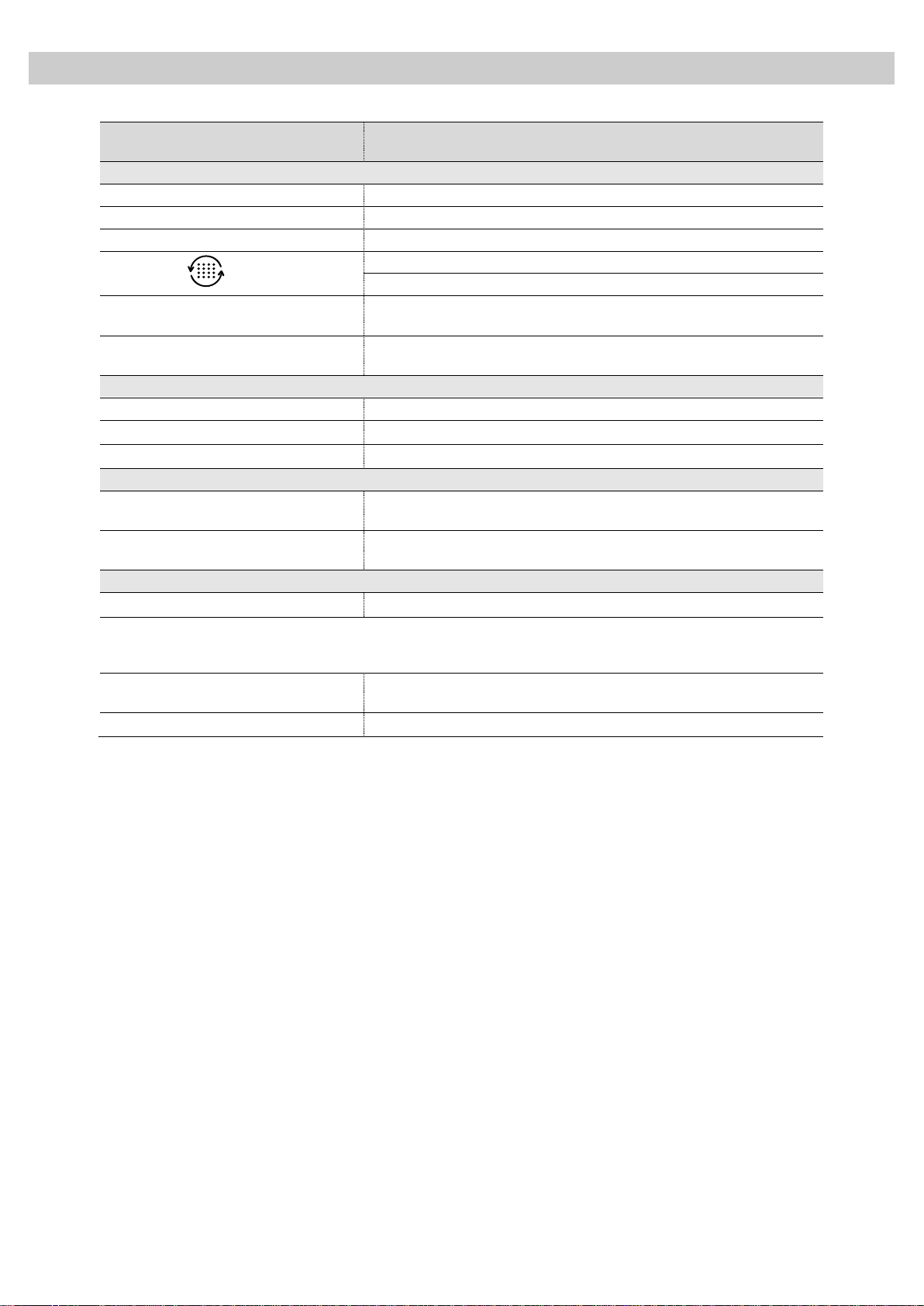
67
Caractéristiques techniques
Affichages
Affichages
Description
Détartrage
SOFT
Eau douce.
MEDIUM
Eau moyenne.
HARD
Eau dure.
/ CAL
L’appareil doit être détartré.
Clignotant - commencement du détartrage.
2 CUP
Versez 2 verres de solution détartrante dans le réservoir
d’eau.
4 CUP
Versez 4 verres d’eau froide dans le réservoir d’eau pour
le rinçage.
Réservoir d’eau
es
Indication qu’il manque le réservoir d’eau.
DEP
Le réservoir d’eau doit être retiré, vidé et réintroduit.
-LO-
Le réservoir est vide. Veuillez remplir avec 2 verres d'eau.
Réduction de vapeur
VAP
Indication que le processus de réduction de vapeur est en
cours de fonctionnement.
PUMP
Indication que l’eau froide pénètre dans la chaudière et
que l’eau chaude est renvoyée vers le réservoir d’eau.
Alertes système
LAMP
Lampe abîmée.
S'il vous plaît contacter le service d'assistance technique dans le cas des erreurs
suivantes:
La température dans le bloc de cuisson perforé est trop
élevée.
Diverses erreurs dans les capteurs.
Spécifications
• Tension ........................................................................................ (voir plaque des caractéristiques)
• Puissance requise ....................................................................... 3200 W
• Courant requise ........................................................................... 14 A
• Puissance du vapeur ................................................................... 1500 W
• Puissance du gril ........................................................................ 1200 W
• Puissance de l’air chaud ............................................................. 1600 W
• Dimensions extérieures (lxhxL) ................................................... 760 x 455 x 542 mm
• Dimensions de l’enceinte de cuisson (lxhxL) ............................... 420 x 210 x 390 mm
• Contenance du four ..................................................................... 35l
• Poids ........................................................................................... 35kg

68
Instructions pour l'installation
Avant l'installation
Vérifiez que la tension de l'alimentation de
l'appareil, indiquée sur la plaque des
caractéristiques correspond à celle de votre
installation. Le plaque des caractéristiques est
situé sur la partie avant de la cavité et est visible
seulement après l’ouverture de la porte.
S'il y a lieu, conformément au Code national de
l'électricité (ou au Code canadien de l'électricité),
cet appareil doit être installé sur un circuit de
dérivation séparé.
Installateur – Indiquer au propriétaire
l’emplacement du disjoncteur ou du fusible.
Identifier sa position pour pouvoir le retrouver
facilement.
Avant l'installation, mettre l'appareil hors service au
panneau de service. Verrouiller le panneau
d'entrée d'électricité pour éviter que le courant ne
soit accidentellement rétabli.
S'assurer que l'appareil est installé et mis à la
terre par un technicien qualifié. L'installation, les
connexions électriques et la mise à la terre doivent
être conformes à tous les codes applicables.
Ouvrez la porte du four et retirez tous les
accessoires ainsi que l'emballage.
Attention! Le devant du four peut être enveloppé
d'une pellicule de protection. Retirez-la
soigneusement, avant la première utilisation, en
commençant par le bas.
Vérifiez que le four n'est pas endommagé.
Assurez-vous que la porte du four ferme correcte-
ment et que le côté intérieur de la porte et le devant
de la cavité ne sont pas abîmés. S'ils le sont,
appelez le Service d'assistance technique.
N'UTILISEZ PAS LE FOUR si le conduit flexible
est endommagé, si le four ne fonctionne pas
correctement ou s'il est endommagé ou bien
tombé. Appelez le Service d'assistance technique.
Installez le four sur une surface stable, le plus loin
possible des radios, télévisions et de tout ce qui
produit de la chaleur.
Alimentation Electrique
Avant d’installer le four avec un électricien qualifié,
vérifiez que votre maison est pourvue du système
électrique approprié et qu’en plus le four ne
surchargera pas le circuit de branchement sur
lequel il doit être installé.
Sont nécessaires un triphasé séparé, ou un four à
simple phase à 4 fils, 240 Volt, 60 Hz.
Pour brancher le four, vous aurez besoin d’une
boîte de raccordement approuvée qui est
facilement à portée de main à travers le devant du
meuble où le four sera placé. Le four a 90 cm de
conduit.
Laissez 60 des 90 d’espace entre la ligne
électrique pour que le four puisse être déplacé si
un dépannage était nécessaire.
NE RACCOURCISSEZ PAS le conduit flexible.
Cablage Necessaire
Lorsque vous raccordez les fils, utilisez toute la
longueur de conduit fourni (90 cm). Le conduit ne
doit pas être coupé.
Avant de faire les raccordements, assurez-vous
qu’il n’y a plus d’électricité et lisez et observez ce
qui suit:
1. Sont nécessaires pour le four un circuit de
raccord triphasé ou à quatre fils, simple
phase, 240 Volt, 60 Hz.
2. Le four doit uniquement être raccordé avec
des fils cuivre ou aluminium.
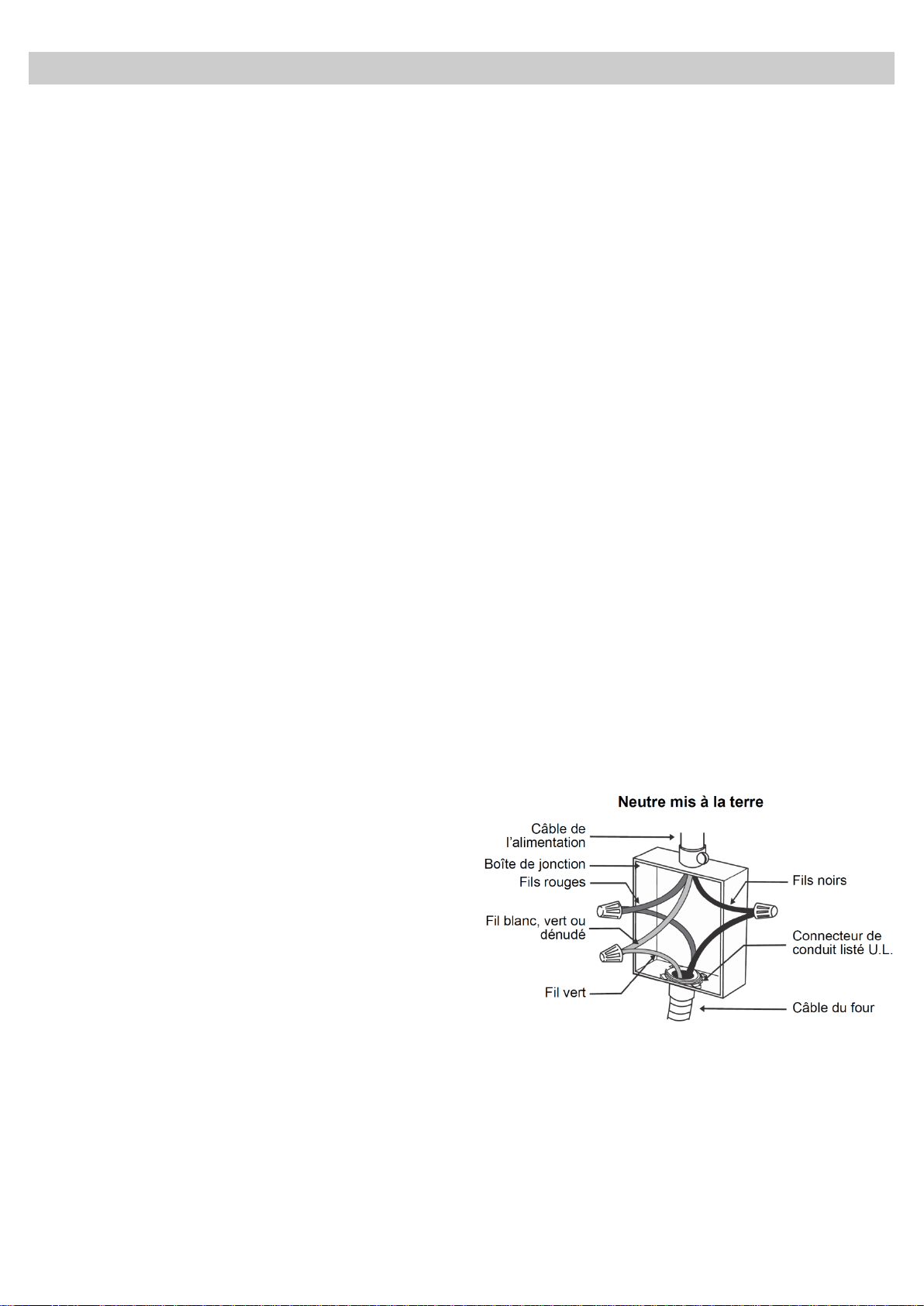
69
Instructions pour l'installation
3. Aux Etats-Unis :
Les fils doivent être conformes au code
électrique national, ANSI/NFPA No. 7
dernière édition. Vous pouvez obtenir une
copie du code électrique national en écrivant
à: National Fire Protection Association
Batterymarch Park Quincy, MA 02269
Au Canada:
Les fils doivent être conformes au code électrique
canadien C22.1- dernière édition. Vous pouvez
obtenir une copie du code électrique canadien en
écrivant à: Canadian Standards Association 178
Rexdale Boulevard Rexdale (Toronto), Ontario,
Canada M9W 1R3
1. La taille des fils (CUIVRE OU ALUMINIUM) et
des connexions doit être appropriée aux
caractéristiques des appareils
électroménagers par le code électrique
national. Le câble armé flexible s’étendant
du four doit être connecté directement au
boîtier de raccordement.
2. Le boîtier de raccordement doit être situé
pour qu’il y ait un maximum d’espace entre lui
et four pour qu’il puisse être déplacé en cas
de panne.
3. Un connecteur conduit U.L. listed doit être
placé à chaque extrémité du câble de
raccordement d’alimentation.
Connexions Electriques
Assurez-vous que votre installation est
correctement installée et branchée par un
technicien qualifié. Demandez à votre
revendeur un technicien qualifié ou un service
de réparation agréé.
Cet appareil est fabriqué avec un conducteur de
terre vert connecté au châssis du four. Après vous
être assurer qu’il n’y a plus de courant, branchez le
conduit flexible depuis le four jusqu’au boîtier de
raccordement en utilisant un connecteur de conduit
U.L. listed. Les figures suivantes et les instructions
fournies présentant la manière la plus commune de
brancher un four. Vos codes locaux et règlements
sont évidemment prioritaires sur ces instructions.
Effectuez les connexions électriques
conformément aux codes locaux et les règlements.
“AVERTISSEMENT” Risque d’électrocu-tion,
cadre à la masse à une position neutre d’un
appareil par une liaison.
Mettre à la masse par un conducteur neutre est
interdit pour les nouvelles installations de circuit
électrique (1996 NEC); les mobile homes; et les
véhicules de parc, ou dans les régions où les codes
locaux interdisent de brancher à la masse à travers
un conducteur neutre. Pour les installations où la
mise à terre par un conducteur neutre est interdit:
• Déconnectez la masse du conducteur neutre
aux extrémités libres du conduit ;
• Utilisez la borne de terre ou une broche de
raccordement pour mettre à la terre l’unité; et
• Connectez la borne de neutre ou une broche
de raccordement à un circuit de dérivation
neutre de la manière habituelle.
Connexion à 3 Fils (Pour US
seulement)
Selon la Figure suivant, où les codes locaux
permettent la connexion du conducteur de terre
du four au fil NEUTRE du circuit de
branchement (fil gris ou coloré blanc):
• Si les codes locaux le permettent, connectez
le conducteur de terre vert du four et le fil
blanc du four au fil NEUTRE du circuit de
branchement (fil gris ou coloré blanc).
• Connectez les broches de raccordement du
four aux broches de raccordement
correspondantes dans le boîtier de
raccordement.
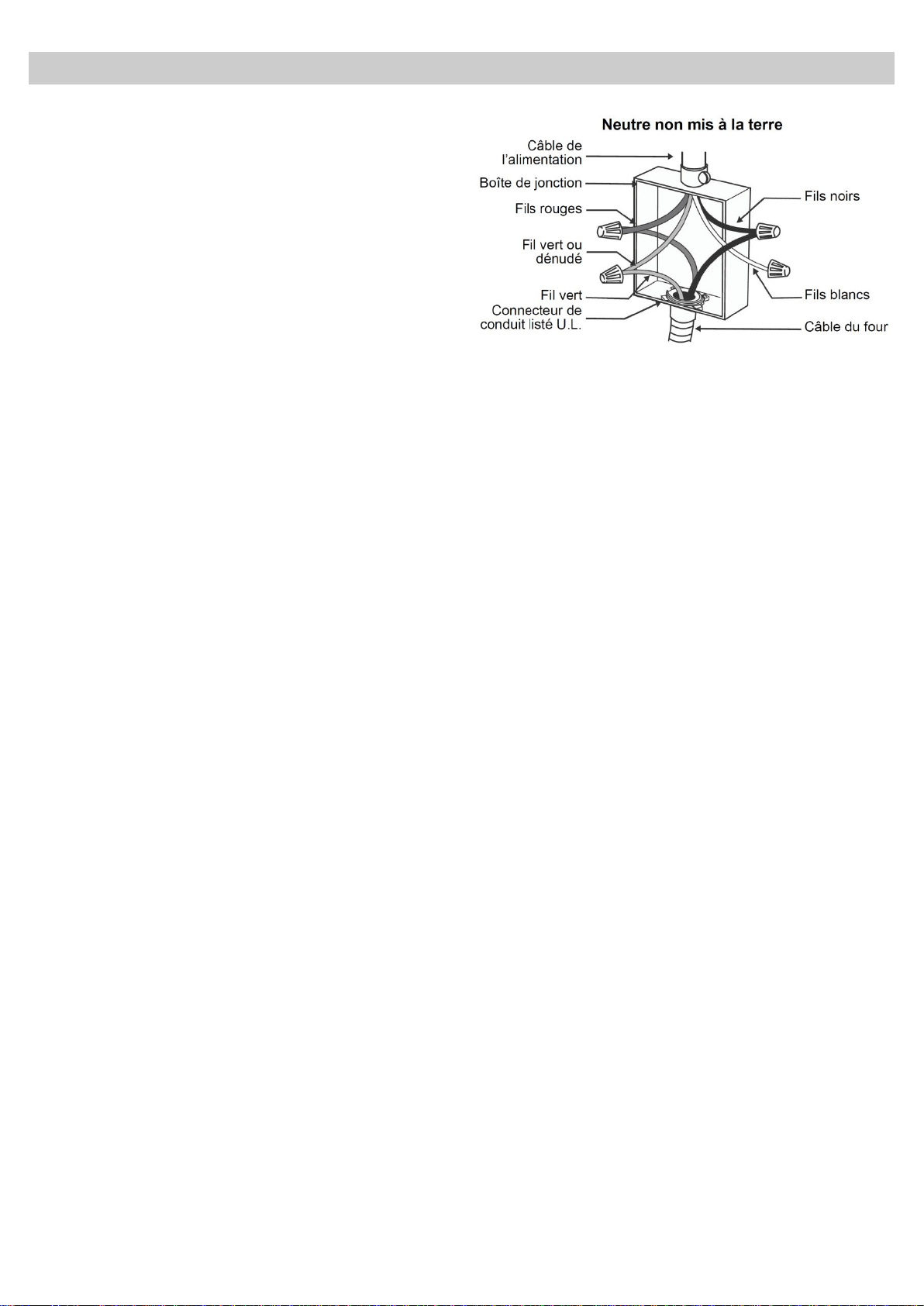
70
Instructions pour l'installation
Connexion à 4 Fils (Pour des US ou
CANADA)
Selon la Figure suivant :
• Déconnectez la masse du point neutre aux
extrémités du conduit.
• Connectez le conducteur de terre vert du four
au conducteur de terre dans le boîtier de
raccordement (fil nu ou coloré vert).
• Connectez les broches de raccordement
rouge et noir du four aux broches de
raccordement correspondantes dans le
boîtier de raccordement.
Après l'installation
Le four ne fonctionne que si la porte est
correctement fermée.
Avant la première utilisation, nettoyez l'intérieur du
four ainsi que les accessoires en suivant les
indications figurant au point «Nettoyage et
entretien de votre four».
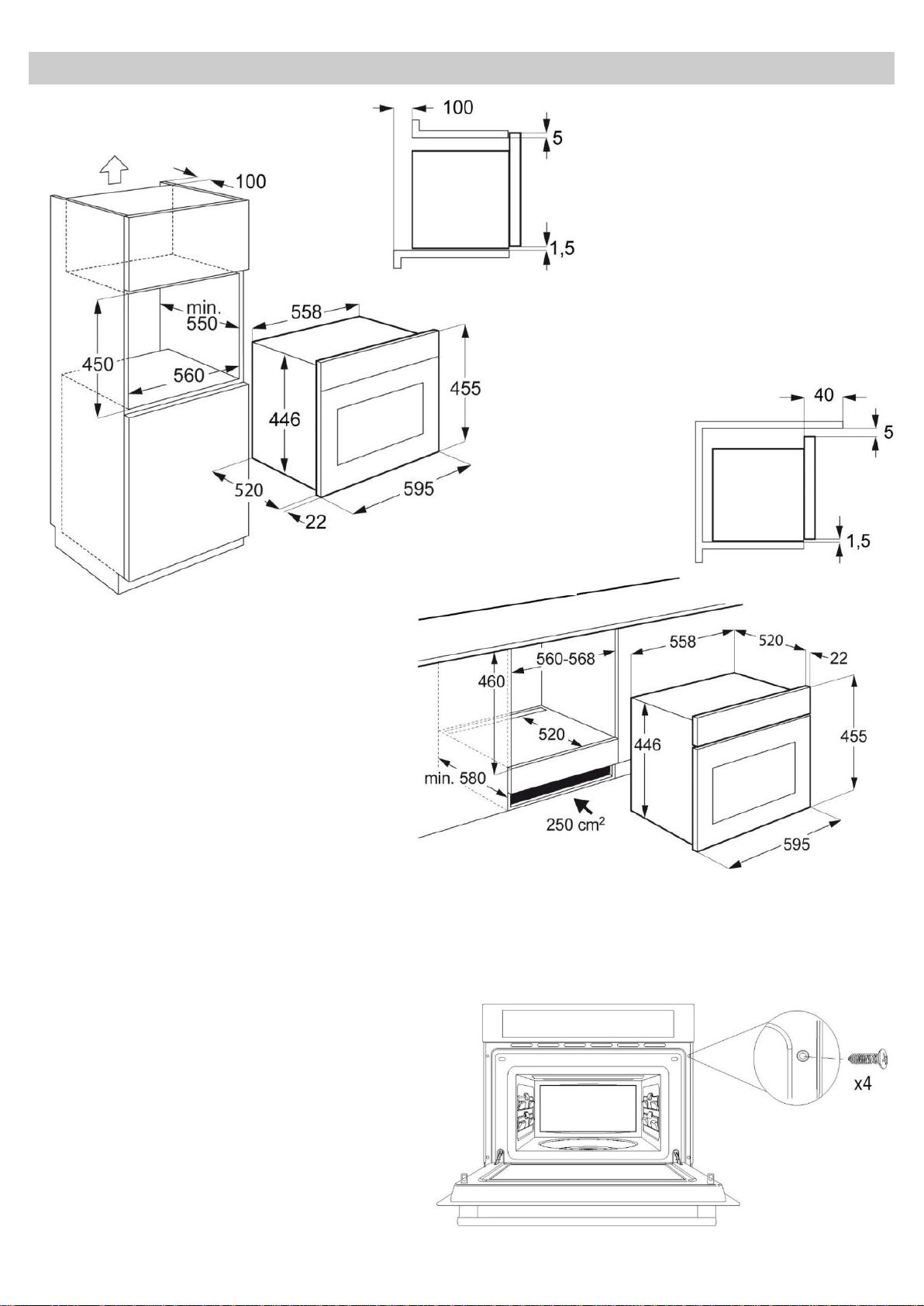
71
Installation dimensions / Dimensions d’Installation
EN
• Push oven completely into the cabinet
and centre it.
• Open microwave door and fasten the
appliance to the cabinet using the four
screws provided. Insert the screws
through the front holes.
FR
• Introduisez le four dans le meuble
jusqu'à ce que l'avant du four butte sur le
bois et alignez-le.
• Ouvrez la porte du four et fixez ce dernier
aux parois latérales du meuble au moyen
des 4 vis fournies, par les trous prévus à
cet effet.

Warranty
Porter&Charles SU
RGXFWVDUHGHVLJQHGDQGEXLOWWRWKHKLJKHVWVWDQGDUGV
:HH[SHFW\RXUDSSOLDQFHVWRSURYLGHPDQ\\HDU
VRIWURXEOHIUHHHQMR\PHQW
,QWKHHYHQWRIDQDSSOLDQFHUHTXLULQJDWWHQWLRQHDFKDSSOLDQFHLVFRYHUHGE\D
\HDUZDUUDQW\IURPWKHGDWHRISXUFKDVH
5HIHUWRZDUUDQW\SROLF\IRUFRPSOHWHWHUPVDQGFRQGLWLRQV
&RYHUDJHLVIRUFRVWVRISDUWVDQGODERXUIRUDSSOLDQFHVLQFDSLWDOFLWLHV
PHWU
RSROLWDQDUHDV:HUHVHUYHWKHULJKWWRFKDUJHGLUHFWO\IRUKDQGOLQJ
H[SHQVHVRXWVLGHWKHPHWURSROLWDQUHJLRQ
Porter&Charles SURGXFWVDUHVXSSRUWHGE\DQDWLRQDOVHUYLFHVXSSRUWV\VWHP
&DOORXUFXVWRPHUVHUYLFHGHSDUWPHQWIRUDWWHQWLRQ
Please retain your invoice to quote should you require service assistance.
This will identify your product for our priority service back-up. Please attach
your invoice to this manual for easy future reference. To register your
purchase, you can either complete the section below to mail or fax, or
register online at www.porterandcharles.ca/warranty-information.
Porter&Charles
871 Cranberry Court
Oakville, ON L6L 6J7
Canada
Toll: 1-866-699-4973
Tel: 905-829-8389
Fax: 905-829-8409
www.porterandcharles.ca
)RU6HUYLFH3DUWV
EURO-PARTS
Toll:
www.euro-parts.ca
Important: 3OHDVHUHFRUGGHWDLOVRI\RXUSXUFKDVHEHORZDQGPDLORUHPDLOWRPorter&Charles
FXWDORQJOLQH
Name: ________________________________ Tel No _________________________________
Address: ______________________________________________________________________
City : _________________________ Prov/State:___________ Postal Code/ZIP: ____________
Where purchased: ____________________________Purchase date: _____________________
Items purchased:________________________________________________________________
Serial No’s: :___________________________________________________________________
ͷʹ͵ͲͲͷ͵ͷ




1631279