© 2023 Brentwood Appliances, Inc.
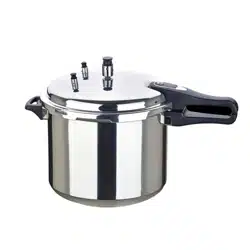
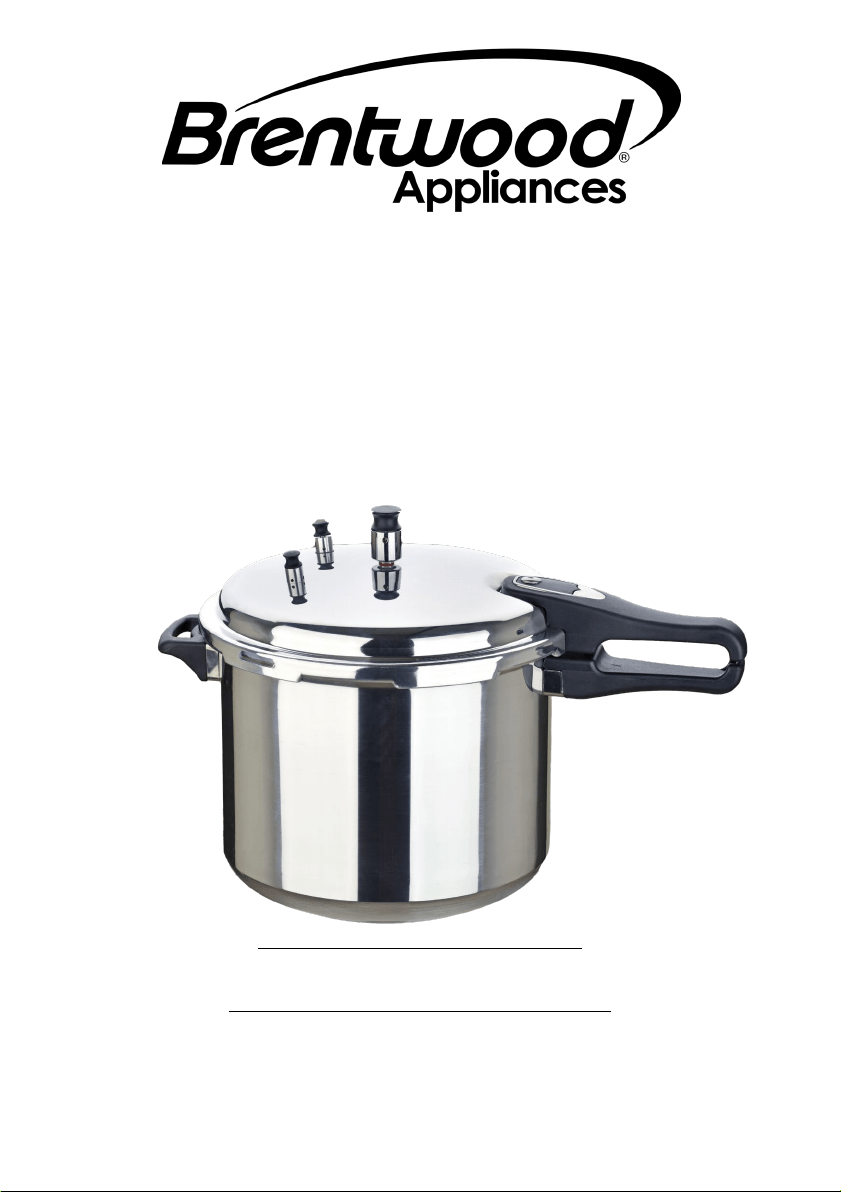
PRESSURE COOKER
OLLA DE PRESIÓN
ITEM NO.: BPC-105 (6 QT.), BPC-110 (7.5 QT.)
& BPC-112 (9.5 QT.)
Operating and Safety Instructions
FOR INDOOR HOUSEHOLD USE ONLY
Instrucciones de Operación y Seguridad
SOLO PARA USO DOMESTICO

2
IMPORTANT SAFEGUARDS
READ ALL INSTRUCTIONS BEFORE USE
WARNING-To reduce the risk of fire, serious personal injury
and property damage please note the following:
• This pressure cooker is not intended for use by children. Keep the
appliance out of reach of children and pets. Extra caution is necessary
when using this product near children.
• Do not touch hot surfaces. Use handles or knobs when handling product.
Use protective oven mitts or gloves when removing the Lid or handling hot
containers to avoid burns or personal injury.
• Always ensure the allowed time to cool before assembling, disassembling,
relocating, or cleaning.
• Do not leave the product unattended while it is in use.
• Do not touch hot surfaces. Use handles or knobs when handling product.
Use protective oven mitts or gloves when removing the Lid or handling hot
containers to avoid burns or personal injury.
• Take proper precautions to prevent burns, fire, or personal or property
damage as this appliance generates heat and steam during use.
• Only use attachments and accessories recommended and sold by the
Manufacturer.
• Use extreme caution when moving an appliance containing hot food.
• Only use appliance on a flat surface. Keep the product away from curtains,
wall coverings, clothing, dishtowels, or other flammable materials.
• This product is intended solely for non-commercial, non-industrial,
household use in preparing food for human consumption; do not use the
product outdoors or for any other purpose.
• Do not operate the product empty.
• This product has no user-serviceable parts. Do not attempt to examine or
repair this product yourself. Please review the Warranty Policy on Page 6.
• Do not place pressure cooker in a heated oven.
• Do not use pressure cooker for other than intended use.

3
• Before operating, make sure that the unit is properly closed since this
appliance cooks under pressure, and improper use may result in scalding
injury.
• Exercise extreme caution when moving an appliance containing food or
liquids.
• When filling the unit with food, do not fill it over 2/3 full. For foods that
expand during cooking, such as rice or dried fruits or vegetables, do not fill
the unit over 1/2 full.
• Do not cook foods such as applesauce, cranberries, pearl barley, oatmeal
or other cereals, split peas, pasta, or rhubarb since these foods tend to
foam, froth, and sputter, and may block the pressure release device.
• Always check the pressure release device for clogging before use.
• Do not open the pressure cooker until the unit has cooled and internal
pressure has been reduced.
• Do not use this pressure cooker for pressure frying with oil.
• When normal operating pressure is reached, reduce heat so all the liquid
which created steam does not evaporate.
• While in use, do not put anything heavy on the regulator. Do not
substitute this regulator with any other part.
• Do not keep saltwater, soy sauce, vinegar, and other fluids in the pot for
long periods to avoid corrosion.
• While cooking leavened food like steamed bread, do not use the regulator.
Otherwise, the food will not be plumped to desired state.
• During the cooking process, you will occasionally hear a sound similar to a
“pa” inside the unit when the pressure within the pot increases. This
happens as the seals expand with heat and is quite normal.
• When washing after use, remove the gasket for cleaning. Replace the
gasket in the lid and store lid upside down on the pot to prolong gasket life.
FOR HOUSEHOLD USE ONLY.
READ THESE INSTRUCTIONS AND
SAVE FOR FUTURE REFERENCE!
4
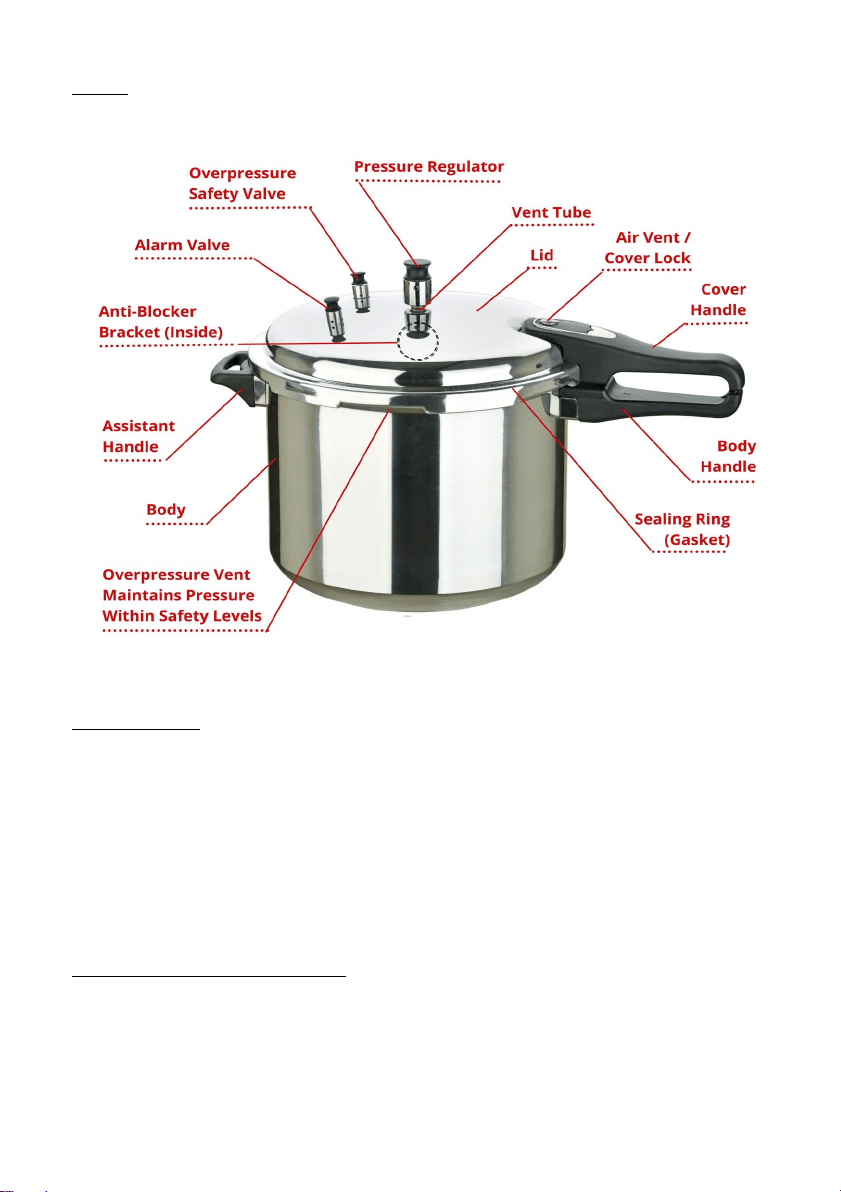
PARTS:
Before First Use
IMPORTANT: Please check all packaging material carefully before discarding as there
may be accessory parts contained within the packaging material.
• Before using the pressure cooker for the first time, clean it with a damp cloth and
non-abrasive soap. Dry all parts thoroughly.
• Lightly coat the rim of the pot with cooking oil to make it easier to close and open
the lid.
• Check that the air exhaust tube is clear, the anti-jam cover is clean, and the self-lock
valve moves freely.
Features of Your Pressure Cooker:
1. For your safety, the inner pressure will not reach proper cooking pressure if the
upper and lower handles are not aligned, no matter how long the pressure cooker is
heated.
2. When the inner pressure exceeds .7 psi the pressure cooker will lock to ensure
safety.

5
3. If the regulator jams and the internal pressure exceeds a certain point, the safety
valve will eject steam toward the outside.
4. If the inner lid anti-jam protection pad jams or is unworkable, the alarm valve will
make alarm sounds automatically.
Using Your Pressure Cooker:
1. Do not fill the unit more than 2/3 full. When cooking foods that expand during
cooking such as rice, dried fruits, or vegetables, do not fill the unit more than 1/2
full.
Recommendation: Before use, lightly coat the rim of the pot with cooking oil for
easy lid movement.
Attention: Ensure that the air exhaust tube is clear, the anti-jam cover is clean, and
the self-lock valve works freely.
2. Do not cook foods such as applesauce, cranberries, pearl barley, oatmeal or other
cereals, split peas, pasta, or rhubarb. These foods tend to foam, froth and sputter
which may block the pressure release device.
3. Combine all ingredients in pot and close the pressure cooker by turning the upper
handle clockwise until both handles are exactly aligned.
4. After the lid is in place, it is recommended to put the regulator on the exhaust, now
the pot is ready to be heated.
5. Once the pressure limit valve starts exhausting, turn down the heat so the regulator
exhausts steam evenly, until cooking is finished.
6. When cooking is complete, remove the cooker from the heat. WARNING: DO NOT
remove the lid until the internal pressure has been reduced by the cooling process.
7. You can allow your pressure cooker to cool naturally away from the heat, or if you
want to open the cooker immediately, lift the regulator very slowly and carefully to
control vapor and food emission.
Hint: You may also run cold water over the lid to speed up the cooling process. Be
sure not to block the valve.
8. When the self-lock valve is back in its original position, turn the upper handle
counterclockwise to remove lid.
Cleaning Your Pressure Cooker:
WARNING: Always allow your pressure cooker to cool before cleaning or storing it.
• Wash with warm water and mild detergent.
• Wash and clean the anti-jam cover regularly to avoid food blockage.
• Dry thoroughly before storing away.
Note: Your aluminum Pressure Cooker will turn dark on the inside. This is common.
What you are seeing is aluminum oxide forming. This provides a protective layer that
helps reduce the corrosion of the aluminum. If you wish to remove the black oxide
forming, use cream of tartar and a scrubby to clean it off.

6
ONE YEAR LIMITED WARRANTY
Write down the following information about your appliance to better help you obtain
assistance or service if you ever need it.
CUSTOMER RECORD
Date of Purchase______________ Store/Dealer___________________________
Model/Item No: _______________________________
THIS WARRANTY APPLIES TO PRODUCTS PURCHASED AND USED IN THE CONTINENTAL U.S.
AND CANADA ONLY. This is the only express warranty for this product and is in lieu of any
other warranty or condition. This product is warranted to be free from defects in material
and workmanship for a period of one (1) year from the date of original purchase. During this
period, your exclusive remedy is repair or replacement of this product, at our option;
however, you are responsible for all costs associated with returning the product to us and
our returning a product or component under this warranty to you. If the product or
component is no longer available, we will replace with a similar one of equal or greater value.
This warranty does not cover glass, filters, wear from normal use, use not in conformity with
the printed directions, or damage to the product resulting from accident, alteration, abuse,
or misuse.
THIS WARRANTY EXTENDS ONLY TO THE ORIGINAL CONSUMER PURCHASER. KEEP THE
ORIGINAL SALES RECEIPT, AS PROOF OF PURCHASE IS REQUIRED TO MAKE A WARRANTY
CLAIM.
This warranty is void if the product is used for other than single-family household use or
subjected to any voltage and waveform other than what is specified on the rating label (E.G.,
120V~60Hz). We exclude all claims for special, incidental, and consequential damages caused
by breach of express or implied warranty. All liability is limited to the amount of the purchase
price. Every implied warranty, including any statutory warranty or condition of
merchantability or fitness for a particular purpose, is disclaimed except to the extent
prohibited by law, in which case such warranty or condition is limited to the duration of this
written warranty. This warranty gives you specific legal rights. You may have other legal rights
that vary depending on where you live. Some states do not allow limitations on implied
warranties or special, incidental, or consequential damages, so the foregoing limitations may
not apply to you. To make a warranty claim do not return this appliance to the store.
TO OBTAIN WARRANTY SERVICE AND/OR TROUBLESHOOTING INFORMATION:
Call Customer Service at 1-888-903-0060 in the U.S.
Monday through Friday: 9:00 am – 5:00 pm PT
U.S. Customers Please Email: warranty@brentwoodus.com
Canadian Customers Please Email: canada.warra[email protected]
Go online at www.brentwoodus.com
7
PRECAUCIONES IMPORTANTES
Al usar este o cualquier otro electrodoméstico, siga las precauciones básicas de
seguridad, especialmente cuando niños están presentes.
LEA TODAS LAS INSTRUCTIONES ANTES DE USAR
ADVERTENCIA-Para reducir el riesgo de incendio, descarga eléctrica, lesiones personales
graves y daños a la propiedad, por favor tenga en cuenta lo siguiente:
Esta olla de presión no está diseñada para ser usada por niños. Mantenga el aparato fuera
del alcance de los niños y las mascotas. Es necesario tomar precaución adicional al utilizar
este producto cerca de niños.
• No toque las superficies calientes. Use manijas o perillas cuando manipule el producto.
Use guantes o guantes protectores para el horno cuando se quite la tapa o cuando
manipule recipientes calientes para evitar quemaduras o lesiones personales.
• Asegúrese siempre del tiempo permitido para enfriar antes de ensamblar, desensamblar,
reubicar o limpiar.
• No deje el producto desatendido mientras esté en uso.
• No toque las superficies calientes. Use manijas o perillas cuando manipule el producto.
Use guantes o guantes protectores para el horno cuando se quite la tapa o cuando
manipule recipientes calientes para evitar quemaduras o lesiones personales.
• Tome las precauciones adecuadas para evitar quemaduras, incendios o daños personales
o materiales, ya que este aparato genera calor y vapor durante su uso.
• Utilice únicamente los accesorios recomendados y vendidos por el fabricante.
• Tenga mucho cuidado al mover un aparato que contenga alimentos calientes.
• Utilice el aparato únicamente sobre una superficie plana. Mantenga el producto alejado
de cortinas, revestimientos de paredes, ropa, toallas de cocina u otros materiales
inflamables.
• Este producto está destinado exclusivamente al uso doméstico no comercial y no
industrial en la preparación de alimentos para el consumo humano; no lo utilice al aire
libre ni para ningún otro propósito.
• No utilice el producto vacío.
•
Este producto no tiene piezas que puedan ser reparadas por el usuario. No intente
examinar o reparar este producto usted mismo.
Por favor, revise la Póliza de Garantía en
la página 6.
• No coloque la olla a presión en un horno caliente.
• No utilice la olla a presión para un uso distinto al previsto.
• Este aparato se cocina bajo presión. El uso inadecuado puede provocar lesiones por
quemaduras. Asegúrese de que la unidad esté correctamente cerrada antes de usarla.
• Tenga cuidado extremo cuando mueva un aparato que contenga alimentos o líquidos.
• No llene la unidad más de 2/3 de su capacidad. Cuando cocine alimentos que se expanden
durante la cocción, como arroz o frutas o verduras secas, no llene la unidad por completo.

8
• No cocine alimentos como compota de manzana, arándanos, cebada perlada, avena u
otros cereales, arvejas partidas, pasta o ruibarbo. Estos alimentos forman espuma,
espuma y chisporroteo y pueden bloquear el dispositivo de liberación de presión.
• Compruebe siempre que el dispositivo de despresurización no esté obstruido antes de su
uso.
• Siempre verifique que el dispositivo de liberación de presión no esté obstruido antes de
usarlo.
• No abra la olla a presión hasta que la unidad se haya enfriado y la presión interna se haya
reducido.
• No utilice esta olla a presión para freír a presión con aceite.
• Cuando se alcance la presión normal de funcionamiento, reduzca el calor para que no se
evapore todo el líquido que generó el vapor.
• Mientras esté en uso, no coloque nada pesado sobre el regulador. No sustituya este
regulador por ninguna otra pieza.
• No guarde agua salada, salsa de soya, vinagre y otros líquidos en la olla por períodos
prolongados para evitar la corrosión.
• Mientras cocina alimentos con levadura como pan al vapor, no use el regulador. De lo
contrario, la comida no se cargará al estado deseado.
• Durante el proceso de cocción, ocasionalmente escuchará un sonido similar a un “pa”
dentro de la unidad cuando aumente la presión dentro de la olla. Esto sucede cuando los
sellos se expanden con el calor y es bastante normal.
• Cuando lave después de su uso, retire la junta para limpiarla. Vuelva a colocar la junta en la
tapa y guarde la tapa boca abajo sobre la olla para prolongar la vida útil de la junta.
SÓLO PARA USO DOMÉSTICO.
LEA ESTAS INSTRUCCIONES Y
GUÁRDELAS PARA FUTURAS CONSULTAS.
9
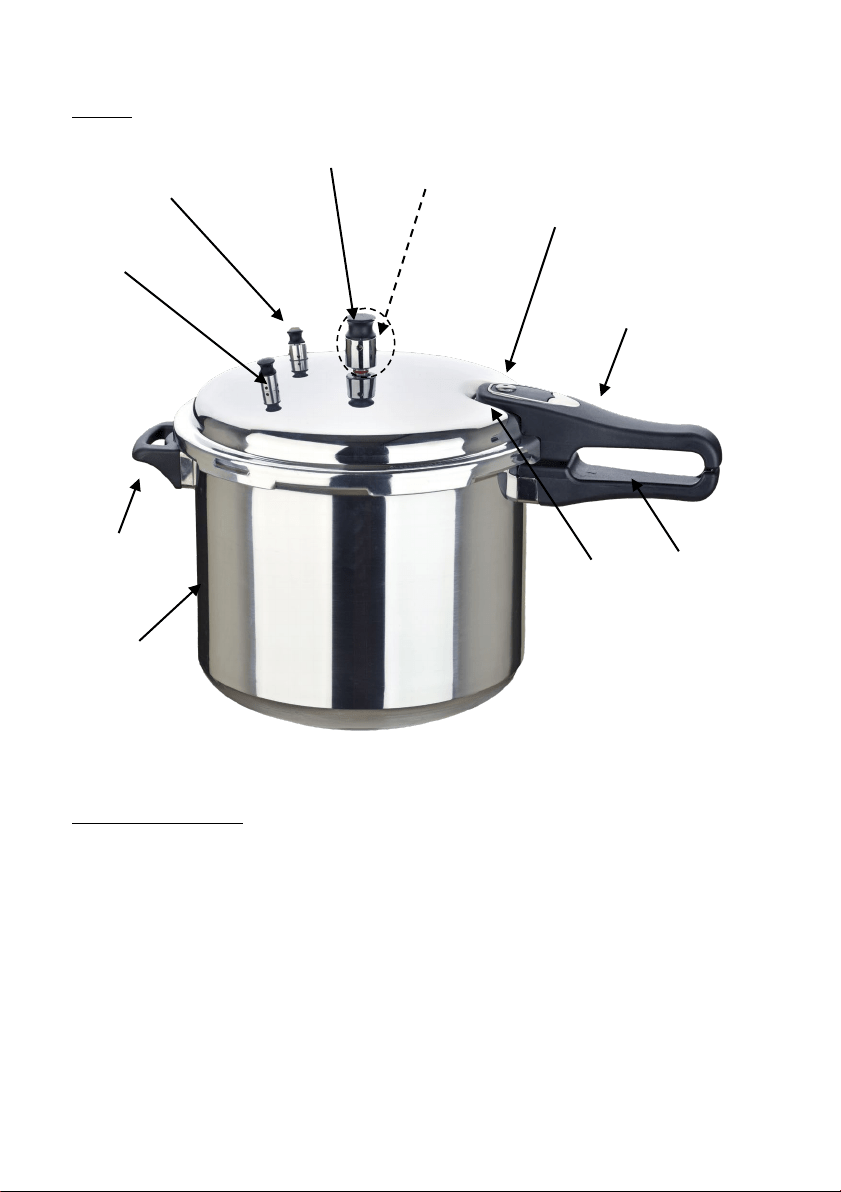
PIEZAS:
Antes Del Primer Uso
IMPORTANTE: Compruebe cuidadosamente todo el material de embalaje antes de
desecharlo, ya que puede haber piezas accesorias contenidas en el material de
embalaje.
• Antes de su primer uso, limpie la olla a presión con un paño húmedo y jabón no abrasivo.
Asegúrese de secar bien todas las piezas.
• Cubra ligeramente el borde de la olla con aceite de cocina para facilitar el movimiento de
la tapa.
• Asegúrese de que el tubo de escape de aire esté despejado, que la tapa antiatasco esté
limpia y que la válvula de autocierre funcione libremente.
CUERPO
MANIJA
VÁLVULA DE SEGURIDAD DE
SOBREPRESIÓN
MANIJA SUPERIOR
VÁLVULA DE
ALARMA
REGULADOR
MANIJA AUXILIAR
TAPA
VÁLVULA AUTOMÁTICA
CUBIERTA ANTI ATASCOS: (INTERIOR)

10
Características de su olla a presión:
1. Para su seguridad, la presión interna no alcanzará la presión de cocción adecuada si los
mangos superior e inferior no están alineados, sin importar cuánto tiempo se caliente la
olla a presión.
2. Cuando la presión interna excede .7 psi, la olla a presión se bloquea para garantizar la
seguridad.
3. Si el regulador se atasca y la presión interna excede cierto punto, la válvula de seguridad
expulsará el vapor hacia el exterior.
4. Si la almohadilla de protección antiatasco de la tapa interior se atasca o no funciona, la
válvula de alarma hará que la alarma suene automáticamente.
Uso De La Olla a Presión:
1. No llene la unidad más de 2/3 de su capacidad. Cuando cocine alimentos que se
expanden durante la cocción, como el arroz, las frutas secas o las verduras, no
llene la unidad por completo.
Recomendación: Antes de usar, cubra ligeramente el borde de la olla con aceite de
cocina para facilitar el movimiento de la tapa.
Atención: Asegúrese de que el tubo de escape de aire esté despejado, que la tapa
antiatasco esté limpia y que la válvula de autocierre funcione libremente.
2. No cocine alimentos como compota de manzana, arándanos, cebada perlada,
avena u otros cereales, arvejas partidas, pasta o ruibarbo. Estos alimentos tienden
a formar espuma, espuma y chisporroteo, lo que puede bloquear el dispositivo de
liberación de presión.
3. Combine todos los ingredientes en una olla y cierre la olla a presión girando el
mango superior en el sentido de las agujas del reloj hasta que ambos mangos
estén exactamente alineados.
4. Una vez colocada la tapa, se recomienda colocar el regulador sobre el escape,
ahora el pote está listo para ser calentado.
5. Una vez que la válvula de límite de presión comience a agotarse, baje la
temperatura para que el regulador expulse el vapor uniformemente, hasta que la
cocción haya terminado.
6. Cuando la cocción haya terminado, retire la olla del fuego. ADVERTENCIA: NO debe
retirar la tapa hasta que la presión interna se reduzca por el proceso de
enfriamiento.
7. Puede dejar que su olla a presión se enfríe naturalmente lejos del calor. O si desea
abrir la cocina inmediatamente, levante el regulador muy despacio y con cuidado
para controlar la emisión de vapor y alimentos.
Sugerencia: también puede pasar agua fría sobre la tapa para acelerar el proceso
de enfriamiento. Asegúrese de no bloquear la válvula.
8. Cuando la válvula de cierre automático vuelva a su posición original, gire la manija
superior en sentido contrario a las agujas del reloj para retirar la tapa.

11
Limpieza De La Olla a Presión:
ADVERTENCIA: Deje siempre que la olla a presión se enfríe antes de limpiarla o
guardarla.
• Lavar con agua tibia y detergente suave.
• Lave y limpie la cubierta antiatasco regularmente para evitar el bloqueo de los
alimentos.
• Seque completamente antes de guardarlo.
Nota: Su olla a presión de aluminio se oscurecerá por dentro. Esto es común. Lo que
está viendo es la formación de óxido de aluminio. Esto proporciona una capa
protectora que ayuda a reducir la corrosión del aluminio. Si desea eliminar el óxido
negro que se está formando, utilice crema de tártaro y un estropajo para limpiarlo.

12
© 2023 Brentwood Appliances, Inc.