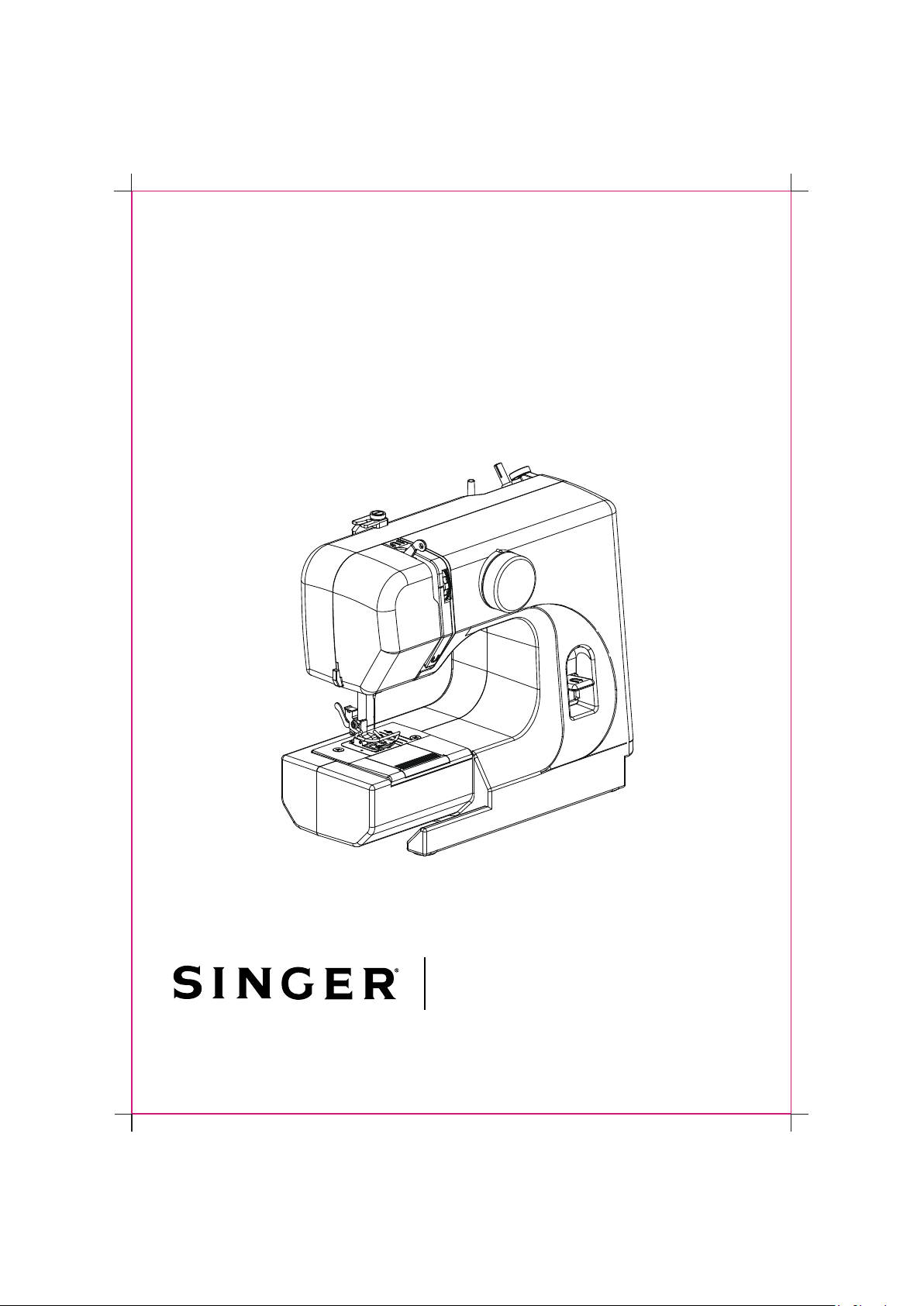
Instruction Book
M1000 / M1005
IMPORTANT SAFETY INSTRUCTIONS
This sewing machine is not a toy.Do not allow children to play with this machine.
The machine is not intended for use by infants or mentally disabled persons without proper
supervision.
When using an electrical appliance, basic safety precautions should always be followed, including
the followings:
Read all instructions before using this appliance.
DANGER
To reduce the risk of electric shock:
1. The sewing machine should never be left unattended when plugged in. Always unplug this
sewing machine from the electric outle immediately after using and before cleaning.
WARNING
To reduce the risk of burns, fire , electric shock, or injury to persons:
1. Do not allow to be used as a toy. Close attention is necessary when this sewing machine is
2. Use this sewing machine only for its intended use as described in this instruction book.
3. Never operate this sewing machine if it has a damaged cord or plug, if it is not working
4. Never operate the sewing machine with any air opening blocked. Keep ventilation openings
5. Never drop or insert any object into any opening.
6. Do not use outdoors.
7. Do not operate where aerosol (spray) products are being used or where oxygen is being
8. Do not unplug by pulling on cord. To unplug, grasp the plug, not the cord.
9. Keep fingers away from all moving parts. Special care is reguired around the sewing
10. Do not use bent needles.
11. Do not pull or push fabric while stitching. It may deflect the needle causing it to break.
12. Discnnect the AC adapter when making any adjustment in the needle area, such as
13. Always unplug this sewing machine from the electrical outlet when making any adjustments
used by or near children.
properly, if it has been dropped or damaged, or dropped into water.
Return this sewing machine to the nearest authorized dealers or service center for
examination, repair, electrical or mechanical adjustment.
of this sewing machine free from accumulation of lint, dust and loose cloth.
administered.
machine needle.
threading the needle, changing the needle, threading the bobbin, and the like.
mentioned in this instruction book.
SAVE THESE INSTRUCTIONS
Please note that on disposal, this product must be safely recycled in accordance with relevant
National legislation relating to electrical/electronic products. If in doubt please contact your retailer
for guidance. (European Union only)
The design and specifications are subject to change without a prior notice.
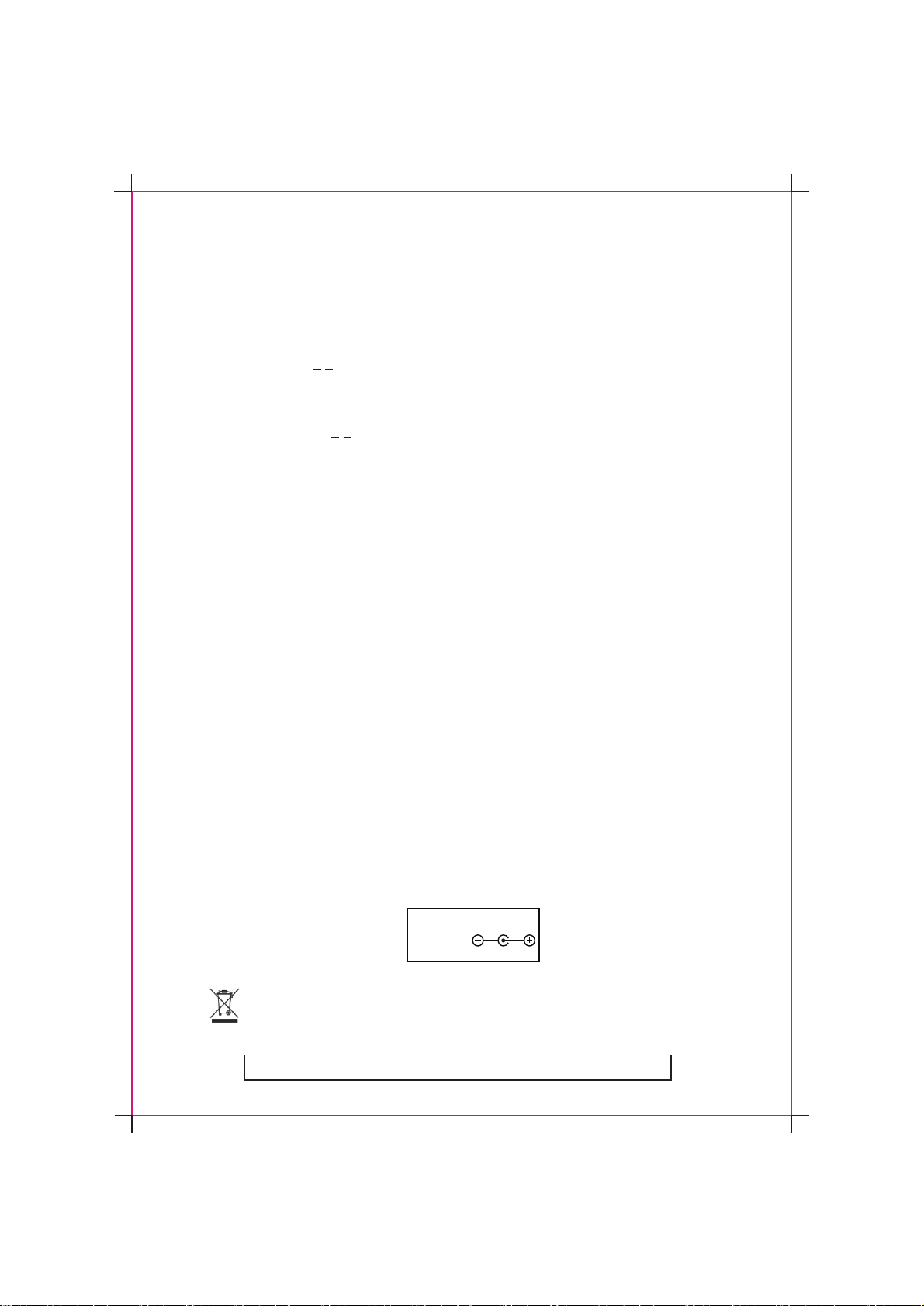
Input: DC6V 1200mA
POLARITY
This appliance can be used by children aged from 8 years and above and persons with
reduced physical, sensory or mental capabilities or lack of experience and knowledge if they
have been given supervision or instruction concerning use of the appliance in a safe way
and understand the hazards involved. Children shall not play with the appliance. Cleaning
and user maintenance shall not be made by children without supervision.
14.

1
15
15
17
16
Finger Guard ................................................................................................................
Overcasting with Zigzag Stitch ...................................................................................
2
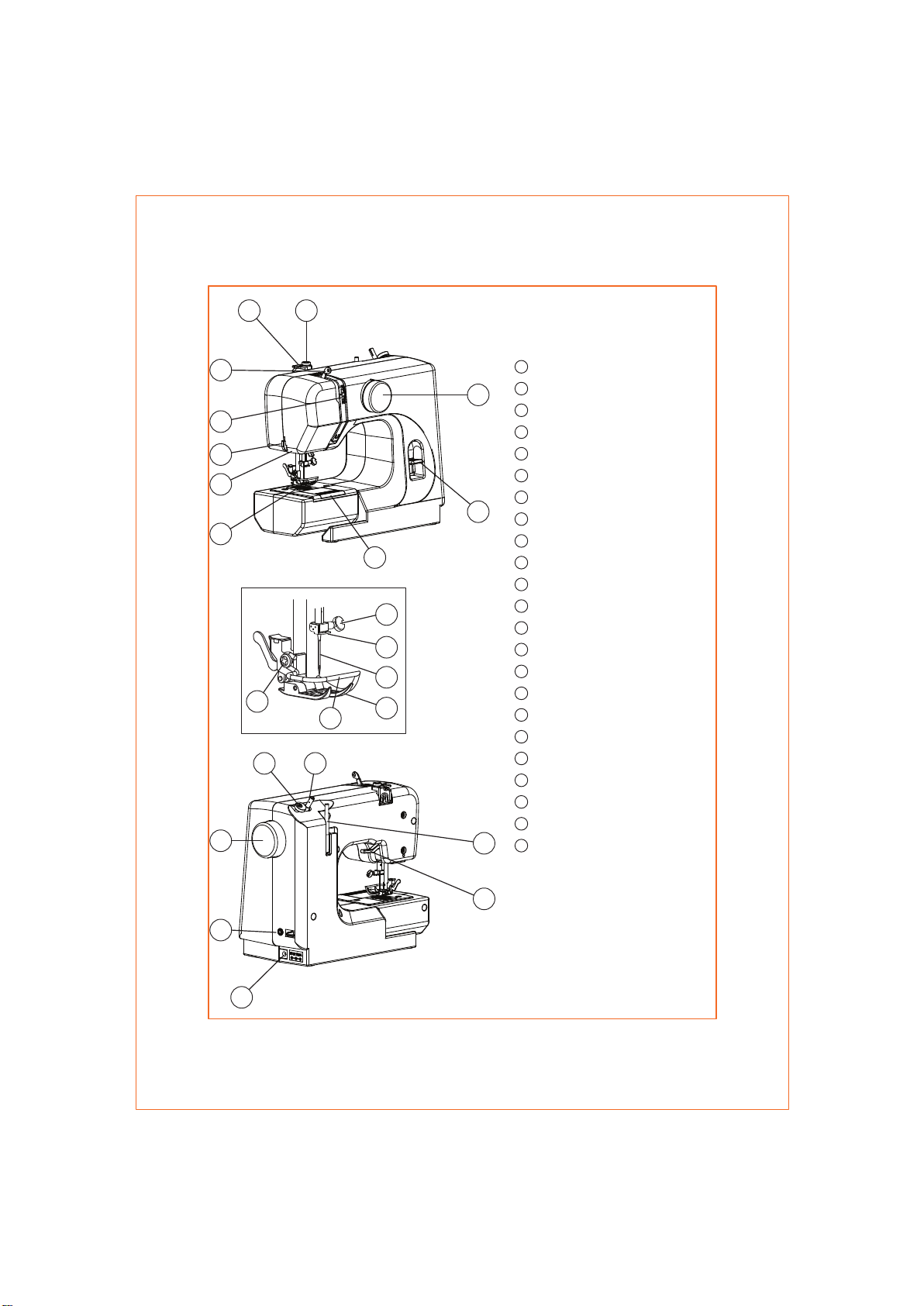
SECTION 1. NAMES OF PARTS
Names of Parts
Bobbin winding tension disk
Upper thread guide
Thread take-up lever
Thread tension dial
Needle plate
Bobbin cover plate
Reverse stitch lever
Stitch selector
Needle clamp screw
Needle bar thread guide
Needle
Presser foot
Setscrew
Bobbin winder spindle
Bobbin winder stopper
Handwheel
Foot switch jack
AC adapter jack
Presser foot lifter
Spool pin
1
2
3
4
5
6
7
8
9
10
11
12
13
14
15
16
17
18
19
20
14
15
16
17
18
19
20
LED light
21
Thread cutter
22
1
2
3
4
5
6
7
8
21
22
9
10
11
12
13
23
Finger guard
23
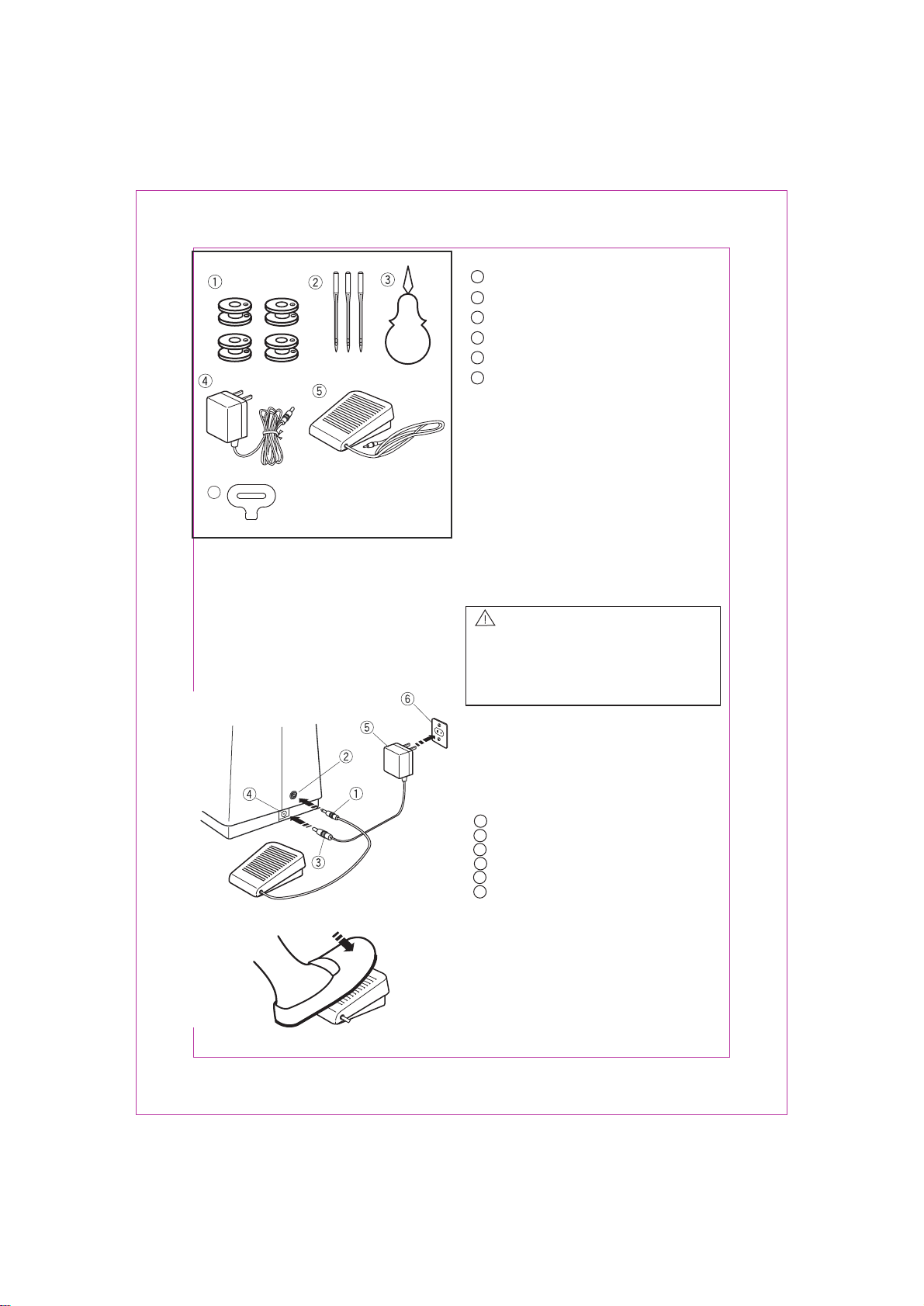
Standard Accessories
1 Bobbins (Class 15 Transparent)
2 Needle
3 Threader
4 AC adapter
5 Foot switch
SECTION 2.
GETTING READY TO SEW
Connecting Machine to Power Supply
WARNING:
Do not use any AC adapter other than one
included in the standard accessory.
Before connecting the AC adapter,make sure
the voltage and frequency shown on the AC
adapter conform to your electrical power.
1. Insert the foot switch plug into the foot
switch jack.
2. Insert the AC adapter plug into the AC
adapter jack.
3. Insert the AC adapter into the power
outlet.
1 Foot switch plug
2 Foot switch jack
3 AC adapter plug
4 AC adapter Jack
5 AC adapter
6 Power outlet
Foot Switch
The foot switch turns on and off the power,it
Press on the foot switch to start the machine.
Release the foot switch to stop the machine.
does not control sewing speed.
3
6
6 Screwdriver
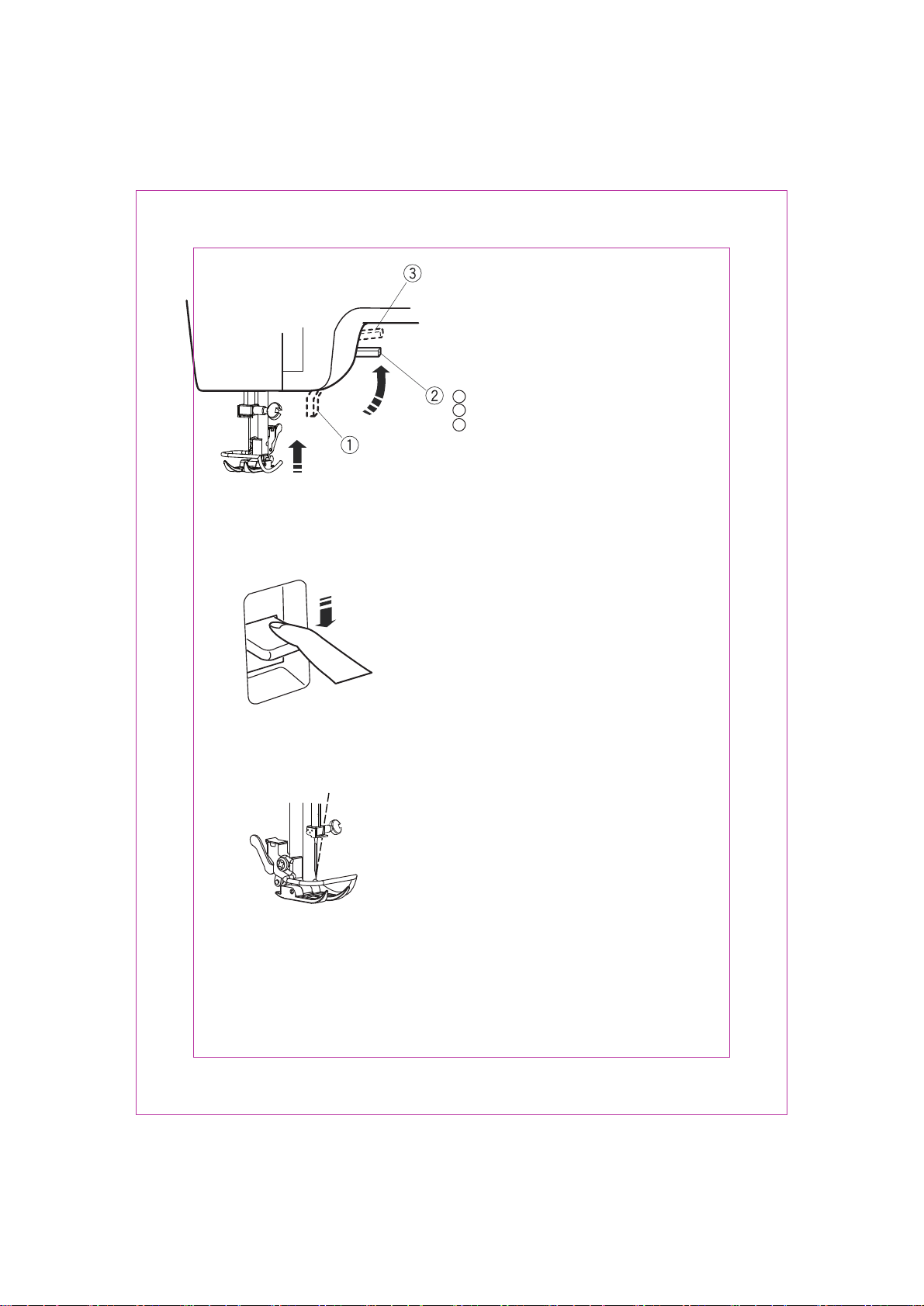
Presser Foot Lifter
The presser foot lifter raises and lowers the
presser foot.
You can raise it higher than the normal up position
to more easily place fabric under the foot.
Remember to lower the presser foot onto the fabric
before starting to sew.
1 Presser foot lifter
2 Normal up position
3 Highest position
Reverse Stitch Control
Press and hold the Reverse Stitch Lever to sew in
reverse.
4
Finger Guard
Your machine is now fitted with a Finger Guard.
This is designed to help protect your fingers from
coming in contact with the needle.
To remove, loosen the setscrew and remove the
finger guard. Make sure the presser foot and its
holder are in the correct position, then tighten the
setscrew with a screwdriver.

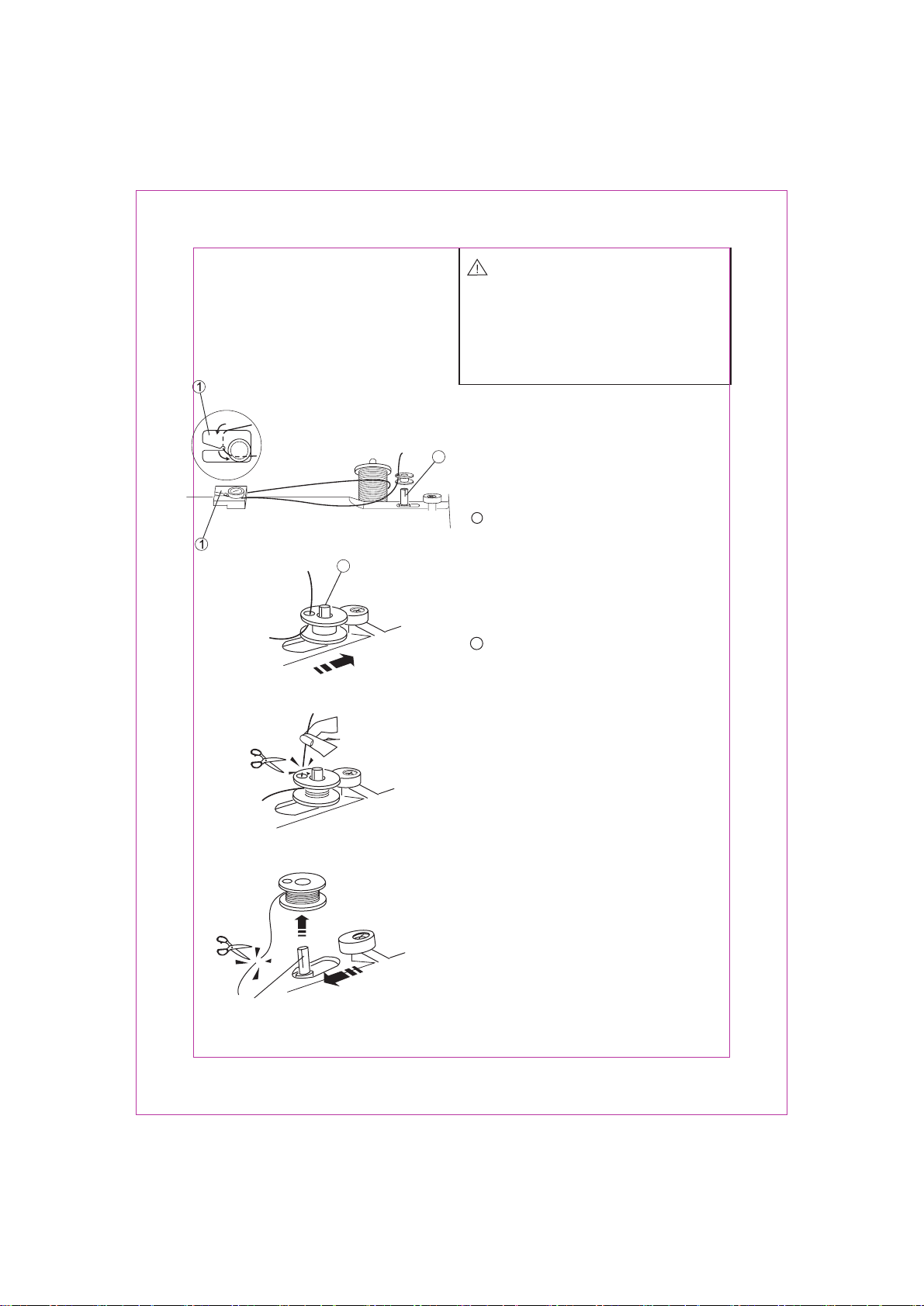
Bobbin Winding
The spool pin is located in the back of the
sewing machine.Tilt out the spool pin.
Place the spool of thread on it.
The end of the thread should be coming out
from the spool as shown.
1 Spool pin
2 End of the thread
3 Spool of thread
Removing the bobbin
Slide the bobbin cover plate toward you and
remove it.
1 Bobbin cover plate
Lift out the bobbin from the bobbin holder.
2 Bobbin
5
1
Thread through the hole in the bobbin from the
inside to the outside.
Put the bobbin on the bobbin winder spindle.
2 Bobbin winder spindle
Push the bobbin to the right.
With the free end of the thread held in your
hand,depress the foot switch.
After the bobbin has wound for about 10
seconds, stop the machine and cut the thread
close to the hole in the bobbin.
Depress the foot switch agian.
When the bobbin is fully wound, it stops
automatically.
Return the bobbin winder to its original position
by moving the spindle to the left, and cut the
thread.
WARNING:
The needle and take-up lever move up and
down while winding the bobbin.
Keep fingers away from all moving parts.
Special care is required around the sewing
machine needle.
To avoid possible injury, do not touch any
moving parts.
6
2
Draw the thread from the spool.
Pass the thread clockwise in front of the bobbin
winding tension disk, then bring the end of the
thread toward the right. Make sure the thread is
snuggly under the bobbin winding tension disk.
Bobbin Winding Tension Disk
2

Inserting the bobbin
Place the bobbin in the bobbin holder with the
thread running off counterclockwise.
1 Thread
2 Bobbin holder
Guide the thread into the notch on the front of
the bobbin holder.
3 Notch on the front.
Draw the thread to the left, sliding it between
the tension spring blades
4 Spring blades
Continue to draw the thread lightly until the
thread slips into the notch on the side.
5 Notch on the side
Pull out about 10 cm (4'') of thread to the rear.
Reattach the bobbin cover plate.
6 Thread
7 Bobbin cover plate
7

Threading the Machine
WARNING:
Disconnect the AC adapter from the machine
before threading.
* Place a spool on the spool pin, with thread
coming off as shown.
* Raise the thread take-up lever to its highest
position by turning the handwheel counter-
clockwise.
* Raise the presser foot.
Draw the end of thread around under the
thread guide.
1 Thread guide
While holding the thread with your right hand
near the spool, use your left hand to draw
the end of the thread down along the right
channel and around the bottom of the guide
plate.
2 Guide plate
Firmly draw the thread up along the left
channel.
Pass the thread through the eye of the take-up
lever from right to left.
3 Take-up lever
Draw the thread down along the left channel
and pass it behind the needle bar thread
guide from the left.
4 Needle bar thread guide
Insert the threader loop through the needle
eye from behind.
Pass the thread end through the threader loop.
5 Needle eye
6 Threader loop
Pull the threader loop out from the needle eye.
Remove the thread end from the threader
loop.
8
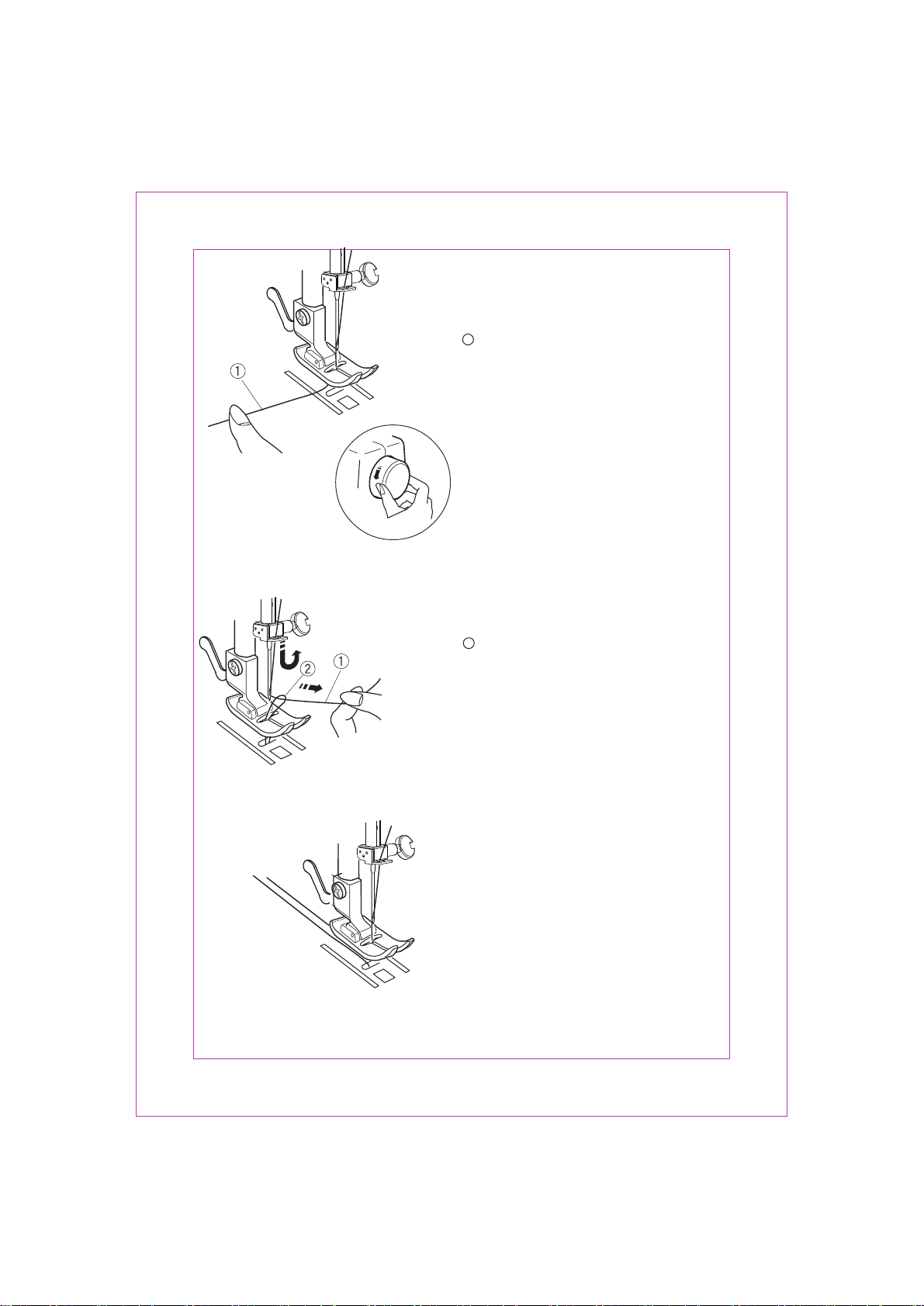
Drawing up Bobbin Thread
Raise the presser foot. Lightly pull the needle
thread with your left hand as you rotate the
handwheel counterclockwise, toward you, for
one complete turn.
1 Needle thread
Bring the bobbin thread up by pulling the
needle thread.
2 Bobbin thread
Pull both threads 4" to 6" (10 to 15 cm) under
and behind the presser foot.
9

Changing Needle
WARNING:
Disconnect the AC adapter from the machine
before changing the needle.
Raise the needle by turning the handwheel
and lower the presser foot.
Loosen the needle clamp screw by turning it
counterclockwise.
Remove the needle from the needle clamp.
Insert a new needle into the needle clamp with
the flat side to the rear. When inserting the
needle into the needle clamp, push it up as far
as it goes.
Tighten the needle clamp screw firmly by
turning it clockwise.
1 Needle clamp screw
2 Needle clamp
3 Flat side
To check if a needle is bent, place the flat side
of the needle onto something flat (e.g., needle
plate or glass). The gap between the needle
and the flat surface should be consistent.
4 Gap
Never use a bent or blunt needle.
A damaged needle can cause permanent
snags or runs in knits, fine silks and silk-like
fabrics.
Selecting Needle and Thread
NOTES:
This machine is equipped with the size #14
(90) needles only.
Extra thick or heavy fabrics cannot be sewn with
this machine.
Do not attempt to sew if the machine does not
feed the material or the needle does not
penetrate into the fabric.
11(65)
or
14(90)
Fabric
Thread
Needle
50 Silk
50 Cotton
50 to 90 Polyester
Organdy,
Georgette,Linen,
Cotton
Light
to
Medium
Weight
10

Adjusting the Needle Thread Tension
Balanced tension
The ideal straight stitch has threads locked
between two layers of fabric, as illustrated.
Turn the dial to adjust the tension.
1 To loosen
2 To tighten
The tension requires adjustment depending on:
- stiffness and thickness of the fabric
- number of fabric layers
- type of stitch
3 Needle thread (Top thread)
4 Bobbin thread (Bottom thread)
5 Right side (Top side) of fabric
6 Wrong side (Bottom side) of fabric
Tension is too tight
If the bobbin thread shows through on the right
side(top side) of the fabric, turn the dial to a
lower number to loosen the needle thread
tension.
1 Bobbin thread (Bottom thread)
2 Right side (Top side) of rabric
3 To loosen
Tension is too loose
If the needle thread shows through on the
wrong side (bottom side) of the fabric, turn the
dial to a higher number to tighten the needle
thread tension.
1 Needle thread (Top thread)
2 Wrong side (Bottom side) of fabric
3 To tighten
For an ideal zigzag stitch, the bobbin thread
should not show on the top side of the fabric
and needle thread should show slightly on the
bottom side of the fabric.
1 Needle thread (Top thread)
11

Stitch Selector
Raise the needle above the fabric.
CAUTION:
To avoid needle or fabric damage, make sure
the needle is up and out of the fabric while
selecting a stitch.
Turn the dial to select the desired pattern by
setting the symbol letter at the setting mark.
1 Symbol letter
2 Setting mark
NOTE:
You can fine-tune the stitch length of the
straight stitches (patterns B to E) by setting the
dial between the symbol letters.
12
NOTE: This chart is provided for an easy stitch reference to assist with
instructions on the following pages.

SECTION 3. BASIC SEWING
Straight Stitch
Stitch selector: A,B~E,F
Needle thread tension: 2 to 6
NOTE:
Stitch length of A, D and F is the same.
A is right needle position, B~E is middle
needle position, F is left needle position.
Starting to sew
Raise the presser foot and position the fabric
on the needle plate.
Lower the needle to the point where you
want to start.
Lower the presser foot and pull the threads
toward the back.
Depress the foot switch. Gently guide the
fabric, letting the fabric feed naturally.
Securing a seam
To fasten the beginning of a seam, press the
reverse stitch control and sew several
reverse stitches first.
Then start sewing forward.
Finishing sewing
To fasten the ends of a seam, press the
reverse stitch control and sew several
reverse stitches.
Raise the presser foot.
Remove the fabric and cut the threads.
13
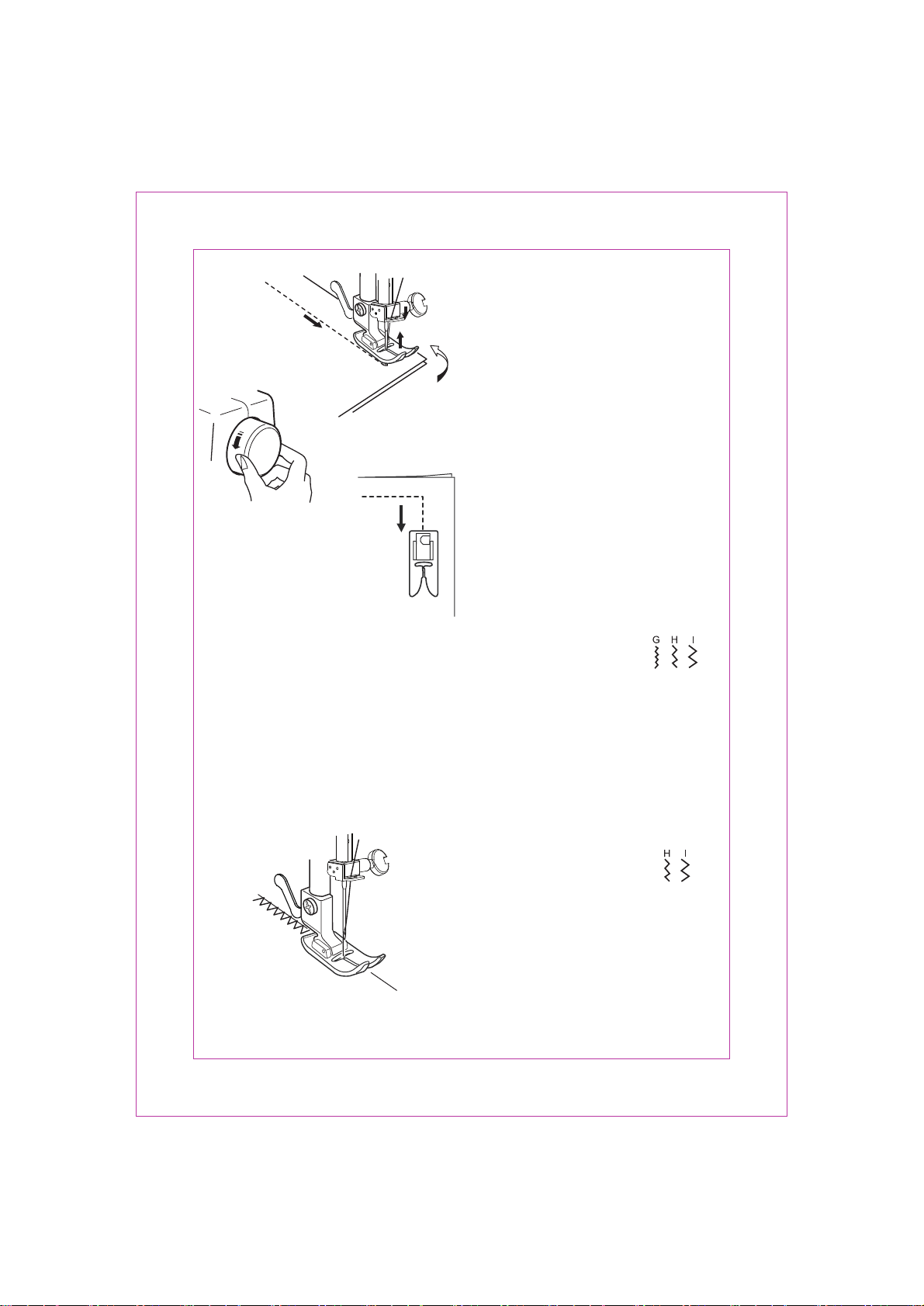
Turning a Square Corner
Stop stitching at the corner of the fabric.
Lower the needle by turning the handwheel
counterclockwise.
Raise the presser foot and turn the fabric
0
counterclockwise 90 .
Lower the presser foot and begin stitching in
the new direction.
Basic Zigzag
Stitch selector: G,H,I
Needle thread tension: 2 to 5
The zigzag stitch is one of the most common
and versatile stitches.
It can be a utility stitch for hemming, over-
casting, mending and darning.
It can also be used for appliques or as a
decorative stitch.
Select a pattern, which is suited for your
sewing needs from the 3 patterns available.
Overcasting with zigzag stitch
Stitch selector: H,I
Needle thread tension: 2 to 5
Finish raw edge of the fabric to prevent it
from ravelling.
Start overcasting about 1/8''(0.3 cm) inside
the raw edge of the fabric.
The stitches on the right should just clear the
fabric edge.
14

Multi-stitch zigzag
Stitch selector dial: K
Upper thread tension dial: 1-4
Multi-stitch zigzag is good for overcasting stretch
fabric. Multi-stitch zigzag stitch has stretch function
which will flex with stretch fabric.
Sew approximately 1.5cm from the fabric edge.
Trim excess seam allowance when finished sewing.
Blind stitch.
Stitch selector dial: J
Upper thread tension: 1-4
1.Fold the fabric about 1cm, use straight stitch
(stitch selector E) sewing as shown in Fig. 1.
2.Fold the fabric in desired length as Fig. 2, 3.
3.Position the fabric under the presser foot, making
the blind stitch drop in the side of fabric as shown
in Fig. 4.
4.When finished stitching, the threads should not
be visible on the outside of the project.
15
back side
of fabric
front side
of fabric
1
2
3
about 6mm
4
5

SECTION 4.
CARE OF YOUR MACHINE
Cleaning the Bobbin Holder
CAUTION:
Disconnect the AC adapter jack before
cleaning the machine.
Do not dismantle the machine other than as
explained in this section.
Remove the bobbin cover plate by sliding it
toward you.
1 Bobbin cover plate
Take out the bobbin.
2 Bobbin
Brush out dust and lint with a brush or a
vacuum cleaner.
3 Brush
Insert the bobbin and attach the bobbin cover
plate.
NOTES:
Do not store the machine in a high-humidity
area, near a heat radiator, or in direct sunlight.
Clean the outside of the machine with a soft
cloth and mild soap.
16
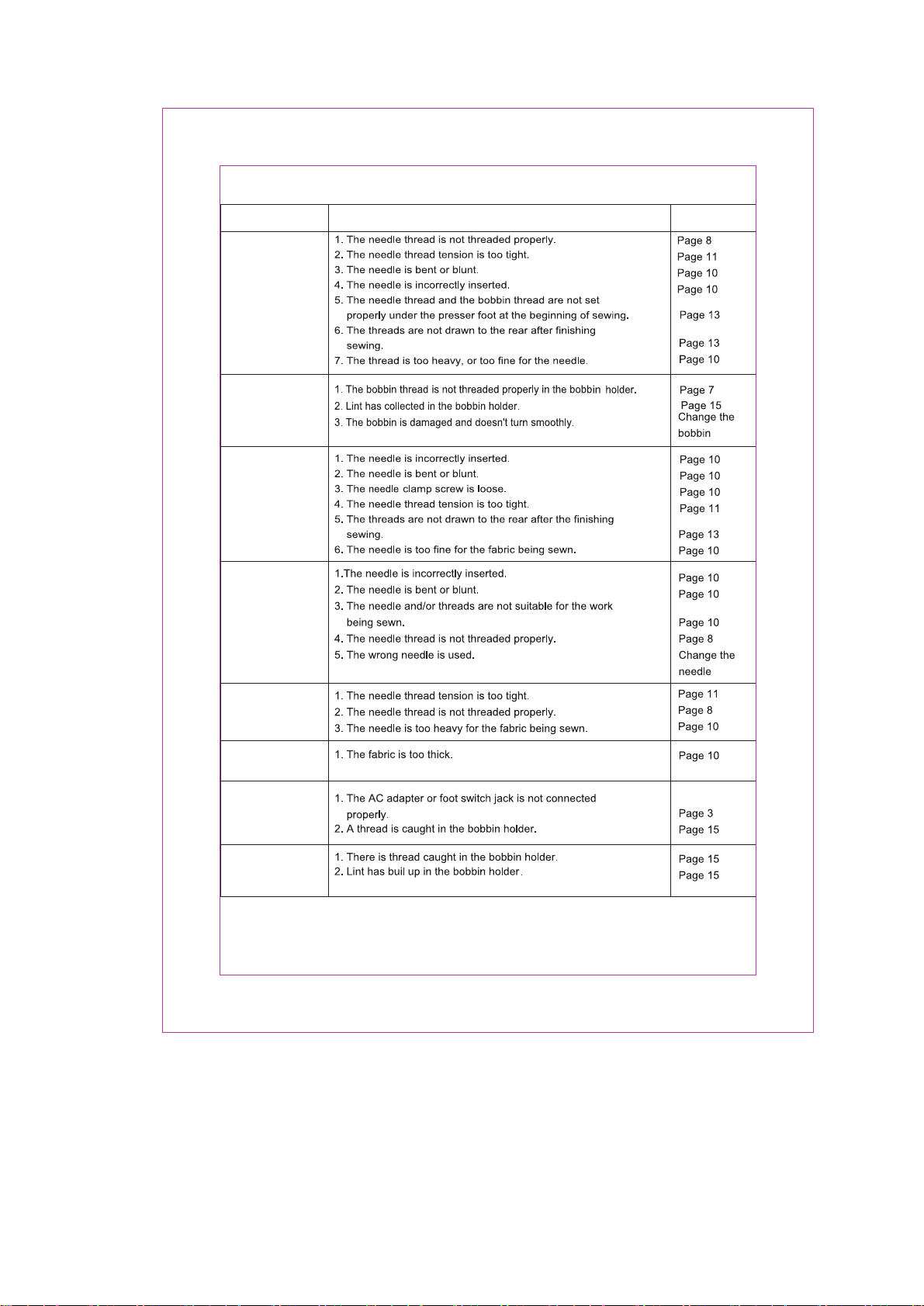
Troubleshooting
Condition Cause
Reference
The needle
thread breaks.
The bobbin
thread breaks
The needle
breaks
Skipped stitches
Seam puckering
The fabric is not
fed
The machine
does not run
The machine is
noisy
17
528960003-BS07
02-2020
Singer and the Cameo “S” Design are trademarks of The
Singer Company Limited S.a.r.l. or its Affiliates.
©2019 The Singer Company Limited S.a.r.l. or its Affiliates.
All rights reserved.
471006126