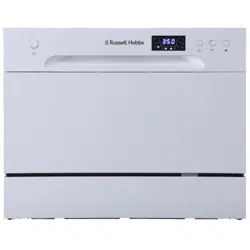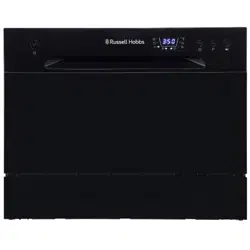
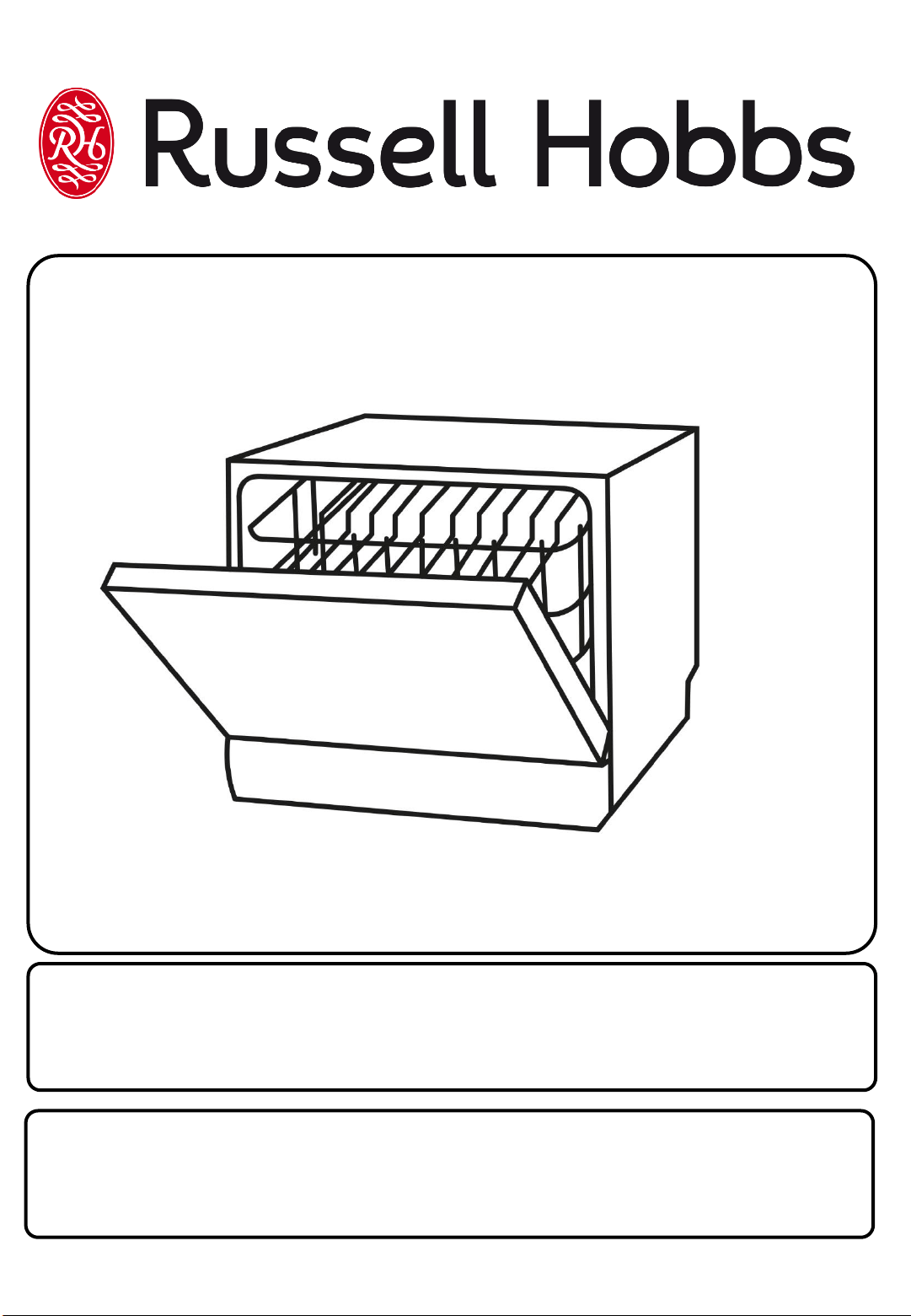
Model number(s):
RHTTDW6 (W) (B) (S)
For Customer Services & Spare Parts please call 0345 208 8750
or visit us at mda.russellhobbs.com
IMPORTANT:
RETAIN FOR FUTURE REFERENCE
Compact Dishwasher
Instruction Manual
Contents
Safety instruction
……………………………………….
3-4
Water & electrical connection
……………………………………….
5-6
Disposal of old electrical appliances
……………………………………….
6
Saving energy & water
……………………………………….
7
Unpacking the dishwasher
……………………………………….
8
Product overview
……………………………………….
9
Unit & Spare Parts
……………………………………….
9
Control panel
……………………………………….
10-11
Pre
-installation
……………………………………….
12
Water Hardness & setting the salt
……………………………………….
12-13
Loading the salt into the container
……………………………………….
13-14
Rinse aid dispenser
……………………………………….
14-16
Detergent
……………………………………….
16-19
Loading the dishwasher
……………………………………….
20-24
Washing programs
……………………………………….
25
Washing cycles
……………………………………….
26-27
Installation
……………………………………….
28-29
Drain hose connection
……………………………………….
30-31
Water connection
……………………………………….
32
Maintenance & Cleaning
……………………………………….
33-37
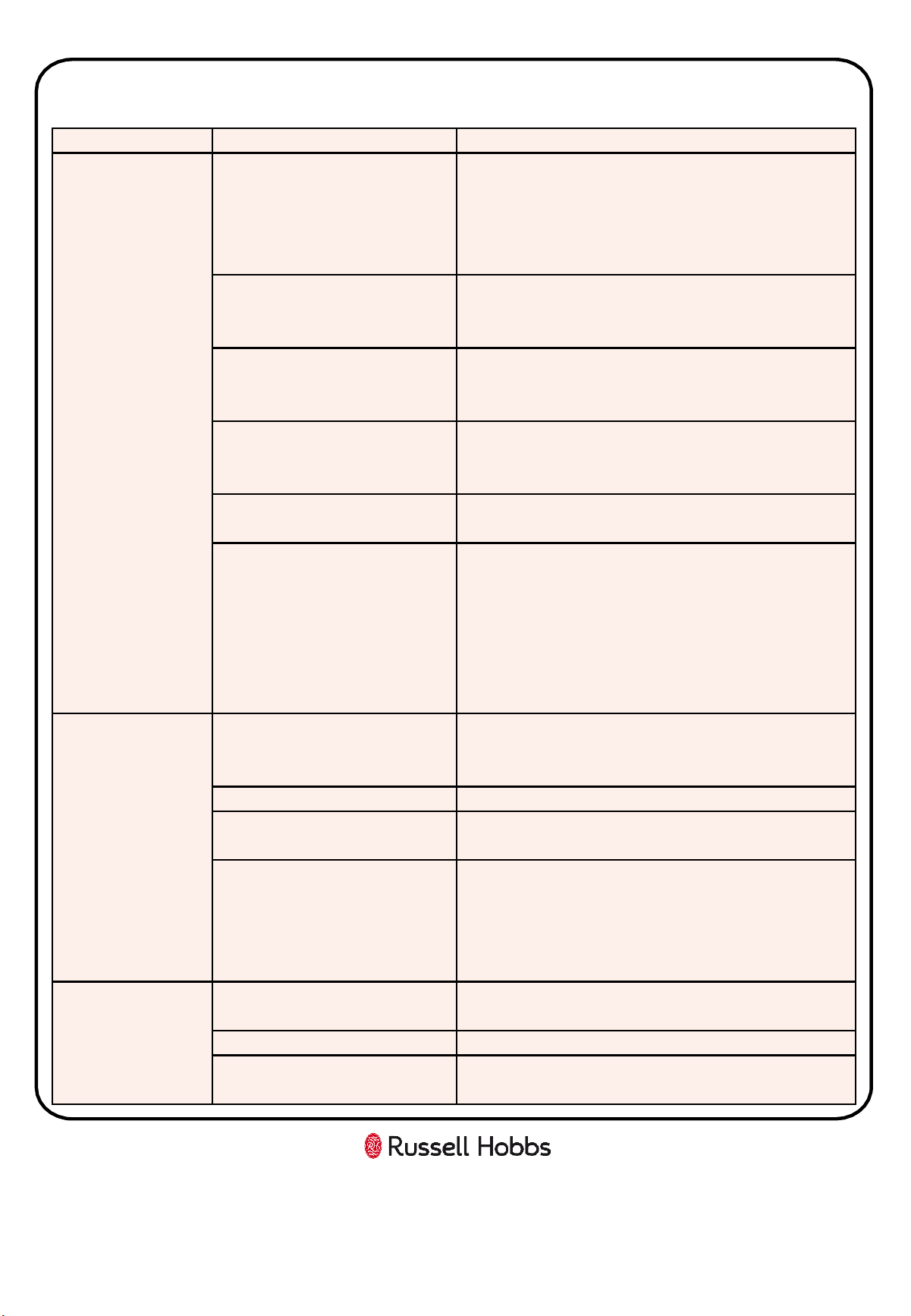
Trouble Shooting ………………………………………. 38-41
Connection to the Mains Supply ………………………………………. 42
Guarantee ………………………………………. 43
Technical Specification ………………………………………. 44
Product Fiche ………………………………………. 45
Notes ………………………………………. 46-47

3
Safety Instructions
The appliance was designed and manufactured in compliance with current international safety
standards. The following information has been provided for safety reasons and should therefore
be read carefully. Keep this instruction manual in a safe place for future reference. If the
appliance is sold, given away or moved, please ensure the manual is kept with the machine, so
that the new owner may benefit from the advice contained within it.
Please read this instruction manual carefully: it contains important information regarding the
safe installation, use and maintenance of the appliance.
• The appliance was designed for domestic use inside the home and is not intended for
commercial or industrial use.
• Use the dishwasher onlyfor its intended function.
• This appliance is not intended for use by persons (including children) with reduced physical,
sensory or mental capabilities, or lack of experience and knowledge, unless they have been
given supervision or instruction concerning use of the appliance by a person responsible for
their safety.
• Children should be supervised to ensure that they do not play with the appliance.
• DO NOT allow children to play with the appliance or tamper with its controls.
• The appliance must be used by adults only, to wash domestic crockery according to the
instructions in this manual.
• If the appliance breaks down, do not under any circumstances touch the internal parts in an
attempt to carry out the repair work yourself.
• It is hazardous for anyone other than a competent person to carry out any service or repair
operation that involves the removal of the cover.
• Do not tamper with the controls.
• If the supply cord is damaged, it must be replaced by the manufacturer, its service agent or
similarly qualified persons in order to avoid a hazard.
• During installation, the power supply cable must not be excessively or dangerously bent or
flattened.
• The appliance must not be installed outdoors, even in covered areas. It is extremely
dangerous to leave the machine exposed to rain and storms.
• Do not touch the appliance when barefoot.
• When unplugging the appliance always pull the plug from the mains socket, do not pull on the
cable.
• The water supply tap must be shut off and the plug should be removed from the electrical
socket before cleaning the appliance or carrying out any maintenance work.
• The door should not be left open as it may create a dangerous obstacle.
• Do notoperate your dishwasher unless all enclosure panels are properly in place. Open the door
verycarefully if the dishwasher is operating, there is a risk of water squirtingout.
• Do not allow the control panel to become wet. Clean with a soft, damp cloth.
4
Safety Instructions
• If your family includes children:
• Keep detergents and rinse aids away from children.
• Keep children away from the open door of a dishwasher, there could still be some
detergent left inside.
• Do not use detergents, abrasives or spray-on cleaners on the control panel.
• Dishwasher detergents are strongly alkaline, they can be extremely dangerous if swallowed. Avoid
contact with skin and eyes andkeep children away from the dishwasher when the door is open.
• Do not use detergents not designed for an automatic dishwasher. Never use soap, laundry
detergent, or hand washing detergent in your dishwasher. Keep these products out of the reach of
children.
• Ensure you do not use any corrosive chemicals or vapours in the appliance. It is not designed
for industrial or laboratory use.
• You should clean your dishwasher with a damp cloth. Don’t allow water to seep into any
openings.
• Do not lean or sit on the open door of the appliance: this may cause the appliance to
overturn.
• Never put any objects into the openings on the outer case.
• Knives and other utensils with sharp points must be loaded in the basket with their points
down or placed in a horizontal position.
• Do not place any heavy objects on or stand on the door when it is open. The appliance could tip
forward.
• When loading items to be washed, position sharp items so that they are not likely to damage the
door seal.
• Check that thedetergent compartment is emptyafter completion of thewash cycle.
• Do not wash plastic items unless they are marked dishwasher safe or the equivalent. For plastic
items not marked, check the manufacturer's recommendations.
• The packaging material should not be used as a toy: it can become a choking or suffocation
• Packaging material could be dangerous for children!
• This appliance is intended to be used in household and similar applications such as:
• staff kitchen areas in shops, offices and other working environments;
• Farm houses;
• by clients in hotels, motels and other residential type environments;
• bed and breakfast type environments.
Important notes:
• Any technical checks should be conducted exclusively by a trained and authorised
technician: Repairs carried out by unauthorised persons will invalidate the guarantee, as
well as posing a potential hazard to the user.
• The manufacturer declines all responsibility for damage to persons or property resulting
from failure to observe the above precautions, from tampering with even a single
component or from the use of non-original spare parts.
5
Water and Electrical Connection
Important note: Connection to the water and electricity supplies should only be performed by
a qualified technician.
Electrical Connection
Before inserting the plug into the electrical socket, make sure that:
• The socket is earthed and complies with current regulations;
• The socket can withstand the maximum load of the appliance, which is indicated on the
appliance’s rating
• The power supply voltage falls within appliance’s rating
• The socket is compatible with the plug of the appliance. If this is not the case, ask an
authorised technician to replace the plug
• Do not use extension cables or multiple sockets.
• Once the appliance has been installed, the power supply cable and the electrical socket
should be easily accessible.
• The cable should not be bent or compressed.
Important notes:
• If the power supply cable is damaged, it must be replaced by the manufacturer or its
Technical Assistance Service in order to prevent all potential hazards.
• This appliance must be earthed.
• Your appliance comes fitted with a plug and a 13A fuse. If you need to replace the fuse,
only those rated at 13A and ASTA approved to BS1362 should be used. Correct
replacement is identified by colour coding or the marking on base of plug.
• DO NOT use the plug unless the fuse cover is fitted.
Water connection
• The dishwasher should not stand on top of the water hoses or the electricity supply cable.
• If the inlet hose is not long enough, contact a specialist store or an authorised technician
• The hose should not be bent or compressed.
• The appliance must be connected to the water supply network using new hoses. Do not use
old hoses.
• Ensure that the new hose supplied is connected and the old hose is disposed of safely.
• DO NOT overtighten the hose connector, hand tight is sufficient.
• Ensure the fill hose is not kinked.
6
Water and Electrical Connection
• Tap connections*: A range of adaptors are available to suit your tap.
• DO NOT connect the dishwasher to a single outlet instantaneous water heater or an electric
heater.
• It MUST NOT be connected to a surface water drain.
• The maximum permissible inlet water pressure is 1Mpa.
• The minimum permissible inlet water pressureis 0.04Mpa.
• Do not abuse, sit on, or stand onthe door or dishrackof the dishwasher.
• Do not obstruct any ventilation openings.
If the appliance must be moved at any time, keep it in an upright position; if absolutely
necessary, it may be tilted onto its back.
Disposal of old electrical appliances
• The European Directive 2012/19/EU on Waste Electrical and Electronic Equipment (WEEE),
requires that old household electrical appliances must not be disposed of in the normal
unsorted municipal waste stream. Old appliances must be collected separately in order to
optimise the recovery and recycling of the materials they contain and reduce the impact on
human health and the environment. The crossed out “wheeled bin” symbol on the product
reminds you of your obligation, that when you dispose of the appliance it must be separately
collected. Consumers should contact their local authority or retailer for information
concerning the correct disposal of their old appliance. Saving energy and respecting the
environment.
• Please dispose of packaging and old appliances carefully.
• To minimise risk of injury to children, remove the door, plug and cut mains cable off flush
with the appliance.
• Dispose of these parts separately to ensure that the appliance can no longer be plugged into
a mains socket and the door cannot be locked shut.

7
Saving water and energy
• Only start a wash cycle when the dishwasher is full.
• While waiting for the dishwasher to be filled, prevent unpleasant odours with the Rapid
Wash.
• Select a wash cycle that is suited to the type of dishes/crockery and to the soil level of the
dishes/crockery using (see the washing program section): - for dishes with a normal soil level,
use the Eco wash cycle, which guarantees low energy and water consumption levels.
• if the load is smaller than usual, activate the Half load function.
• If your electricity supply contract gives details of electricity saving time bands, run wash
cycles during the periods when a lower tariff is applied.
• use the Time Delay start function to help you organise the wash cycles accordingly.
• We strongly recommend that you use detergents that do not contain phosphates or chlorine,
as these products are harmful to the environment. We recommend Phosphate-free and
chlorine-free detergents containing enzymes.
• Enzymes provide a particularly effective action at temperatures around 50°C, and as a result
detergents containing enzymes can be used in conjunction with low-temperature wash cycles
in order to achieve the same results as a normal 65°C wash cycle.
• To avoid wasting detergent, use the product in appropriate quantities based on the
manufacturer’s recommendations, the hardness of the water and the soil level and quantity
of the crockery. Even if they are biodegradable, detergents contain substances that may alter
the balance of nature.
• Recycling & Disposal Information: As part of our continued commitment to helping the
environment, we reserve the right to use quality recycled components to keep down
customer costs and minimise material wastage.
• Please dispose of packaging and old appliances carefully.
8
Unpacking the appliance
1. Remove the appliance from all packaging and check that the product has not been damaged
during transportation. If it has been damaged, contact the manufacturer or the retailer and
do not proceed any further with the installation process. Below are key areas to check:
• A misaligned door
• Damage to the door
• Dents or holes in side panels and the top panel.
• Dents in the inside
• If you can see any damage do not use the dishwasher
Before using your dishwasher for the first time:
Before using the dishwasher for the first time you must complete the following, as failure to do
so will invalidate the guarantee:
1. Connection to the water and electricity supplies should only be performed by a qualified
technician.
2. Set the water softener
3. Add 1.0Kg dishwasher salt and then fully fill the salt container with water
4. Fill the rinse aid dispenser
5. Fill the detergent dispenser
6. Run the unit empty on the intensive cycle to clean out any impurities caused by the
manufacturing process.
9
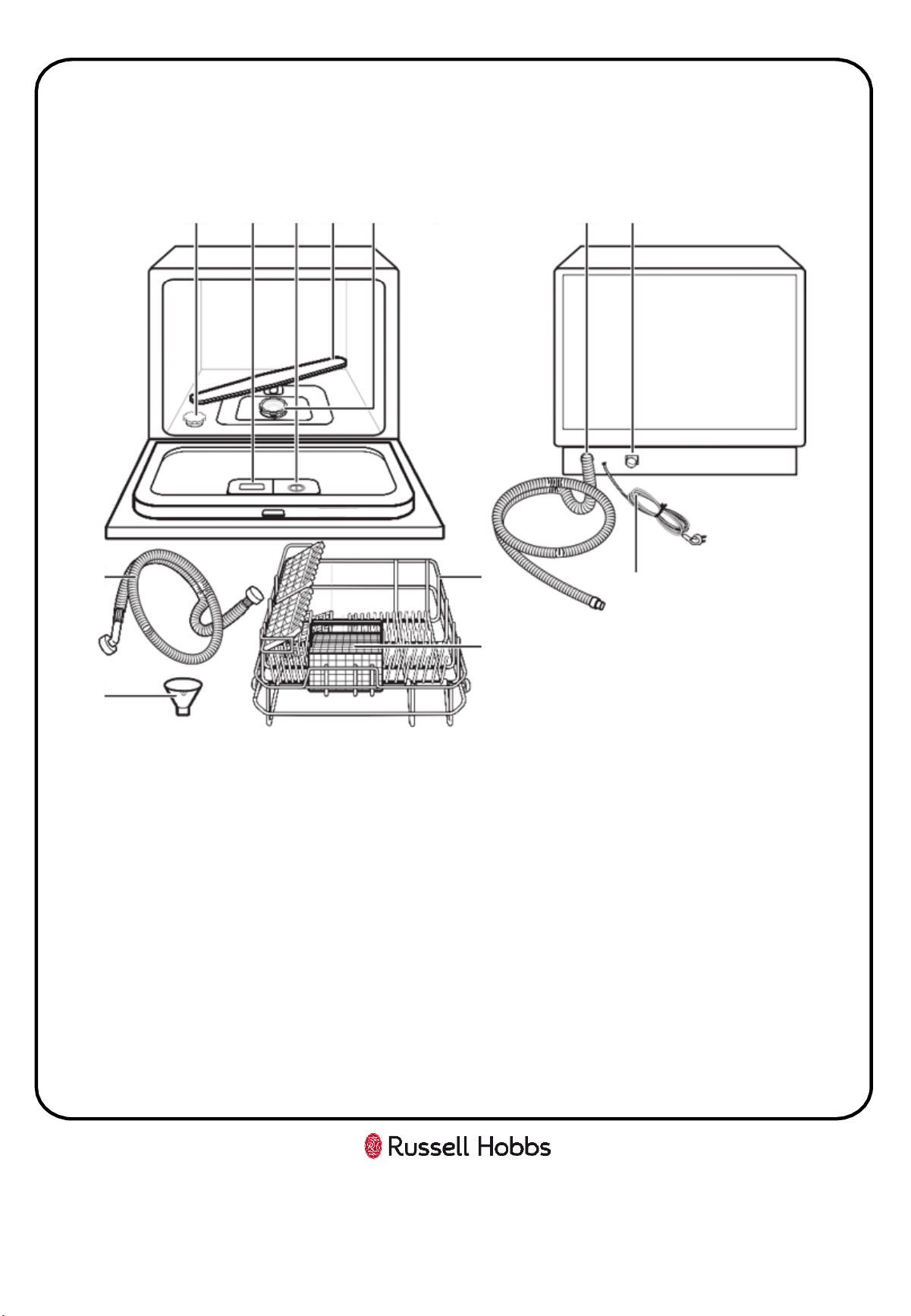
Product Overview
Front view
Rear view
Unit Parts & Spare Parts
Before installation, check that all parts detailed in the product overview are present. If any parts
are missing, please contact the Customer Service team on 0345 208 8750 or visit us at
mda.russellhobbs.com
1. Salt aid container
2. Detergent dispenser
3. Rinse aid dispenser
4. Spray arm
5. Filter
6. Drain pipe
7. Inlet pipe connector
8. Power cord
9. Basket
10. Cutlery basket
11. Inlet hose
12. Salt funnel
1
2
3 4 5
11
12
6
7
8
9
10
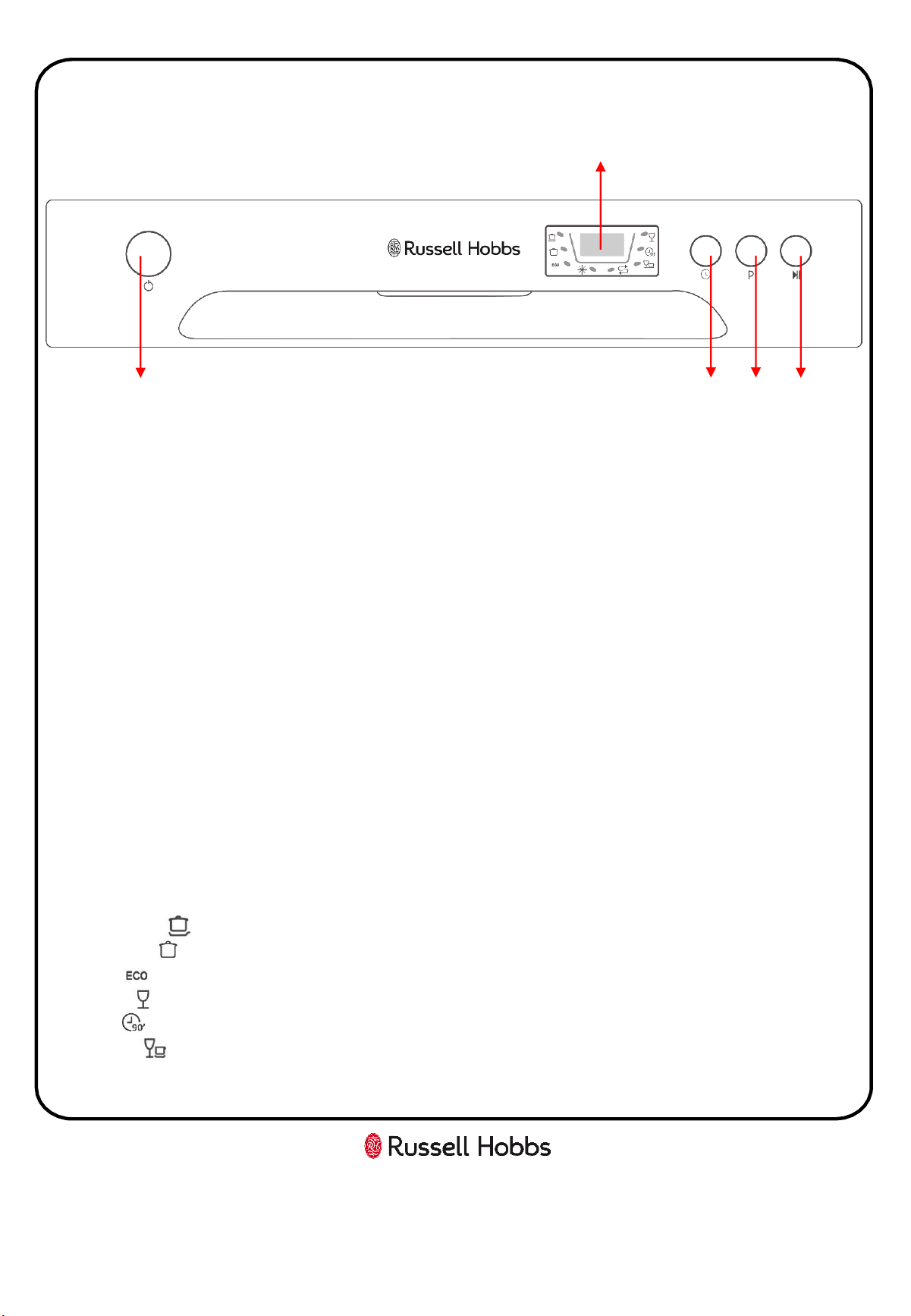
1. On/off button
2. Time delay button
3. Program button
4. Start/pause button
5. Program indicator lights, display &
rinse aid + dishwasher salt warning
indicator lights (when lit it needs
refilling)
10
Control Panel
Control Panel Functions and Indicators
On/off button
Press to turn appliance on and off
Time delay button (1 - 24hours)
Press to select time you wish to delay the start of the wash program by (press after selecting the
required program but prior to pressing the start button)
Program button
Press to select the program you wish to select, these are:
• Intensive
• Normal
• Eco
• Glass
• 90’
• Rapid
Please see washing programs section for the full details of the washing programs.
5
1 2
3 4
11
Control Panel
Start/pause button
Press to start the selected program or pause the washing program that is running.
Salt aid warning& rinse aid warning indicator lights
Light up when the salt container and/or rinse aid dispenser need to be refilled
Time delay indicator lights (1 - 24hours)
Light to show which delay time has been selected
Program indicator lights
Light to show which program has been selected
12
Pre-Installation
Important Note: Prior to installation and first use the following 4 steps must be followed,
failure to do so will void your guarantee:
1. Set the water softener level
2. Add 1.0kg dishwasher salt and fill the salt container with water
3. Add rinse aid to the rinse aid dispenser
4. Fill the detergent dispenser with detergent powder or a detergent tablet
Water Hardness & Setting the Salt
The water softener must be set digitally, using the water hardness setting function. The
water softener is designed to remove minerals and salts from the water, which would have
a detrimental or adverse effect on the operation of the appliance. The higher the content
of these minerals and salts, the harder your water is. The softener should be adjusted
according to the hardness of the water in your area. Your local Water Authority can advise
you on the hardness of the water in your area.
Adjusting Salt Consumption
The dishwasher is designed to allow for adjustment in the amount of salt consumed based
on the hardness of the water used. This is intended to optimise and customise the level of
salt consumption.
Please follow the steps below for adjustment in salt level/consumption:
1. Within 60 seconds after the appliance was switched on press and hold the ‘Program’ button
for more than 5 seconds to start the water softener setting function. The salt and rinse aid
warning lights will flash periodically during the water setting function.
2. Press the ‘Program’ button to select the required softener level in accordance with your local
water hardness level. The display will show the different softener levels (please see the table
on the following page). The softener levels will change in the following sequence: H1->H2-
>H3->H4->H5->H6 (H1 is the lowest setting and H6 is the highest setting).
3. Press the On/off button to set the softener level. Without any operation in five seconds, the
machine will exit from set mode and going into standby mode.
Note: The hardness of the water varies from place to place. If hard water is used in the
dishwasher, deposits will form on the dishes and utensils. The appliance is equipped with a
special softener that uses a salt container specifically designed to eliminate lime and minerals
from the water.
Water Hardness & Setting the Salt
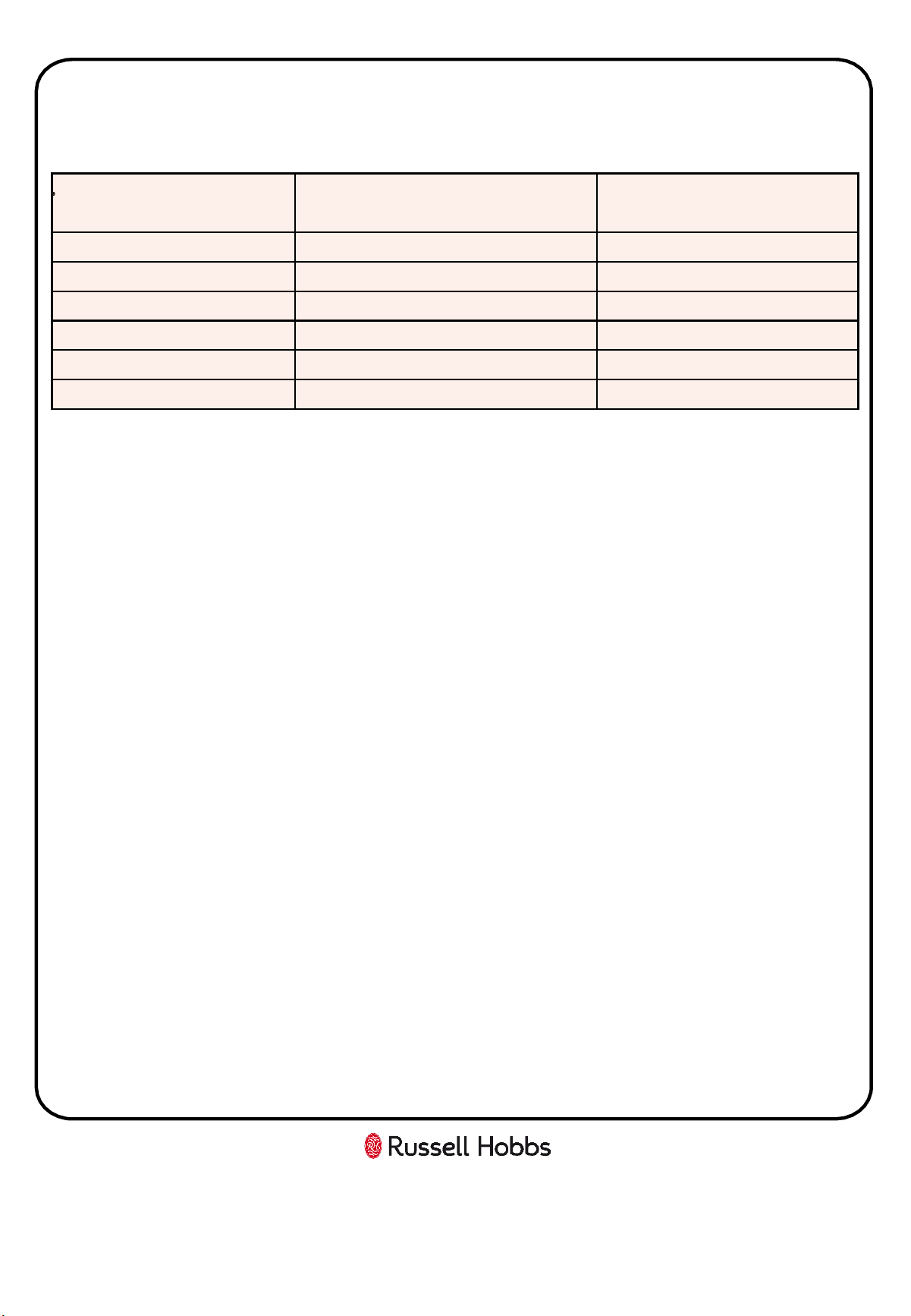
It is recommended that adjustments should be made in accordance with the following scheme:
*factory setting
Note: Contact your local water board for information on the hardness of your water supply.
Loading the salt into the container
Important Note:
• Only use salt specifically designed for use in dishwashers. Every other type of salt not
specifically designed for use in a dishwasher, especially table salt, will damage the water
softener. In case of damage caused by the use of unsuitable salt the manufacturer do not give
any warranty and we are not liable for any damage caused.
• Only fill with salt just before starting one of the complete washing programs.
• This will prevent any grains of salt or salty water, which may have been spilled, remaining on
the bottom of the machine for any period of time, which may cause corrosion.
The salt container is located beneath the basket and should be filled as explained in the
following section:
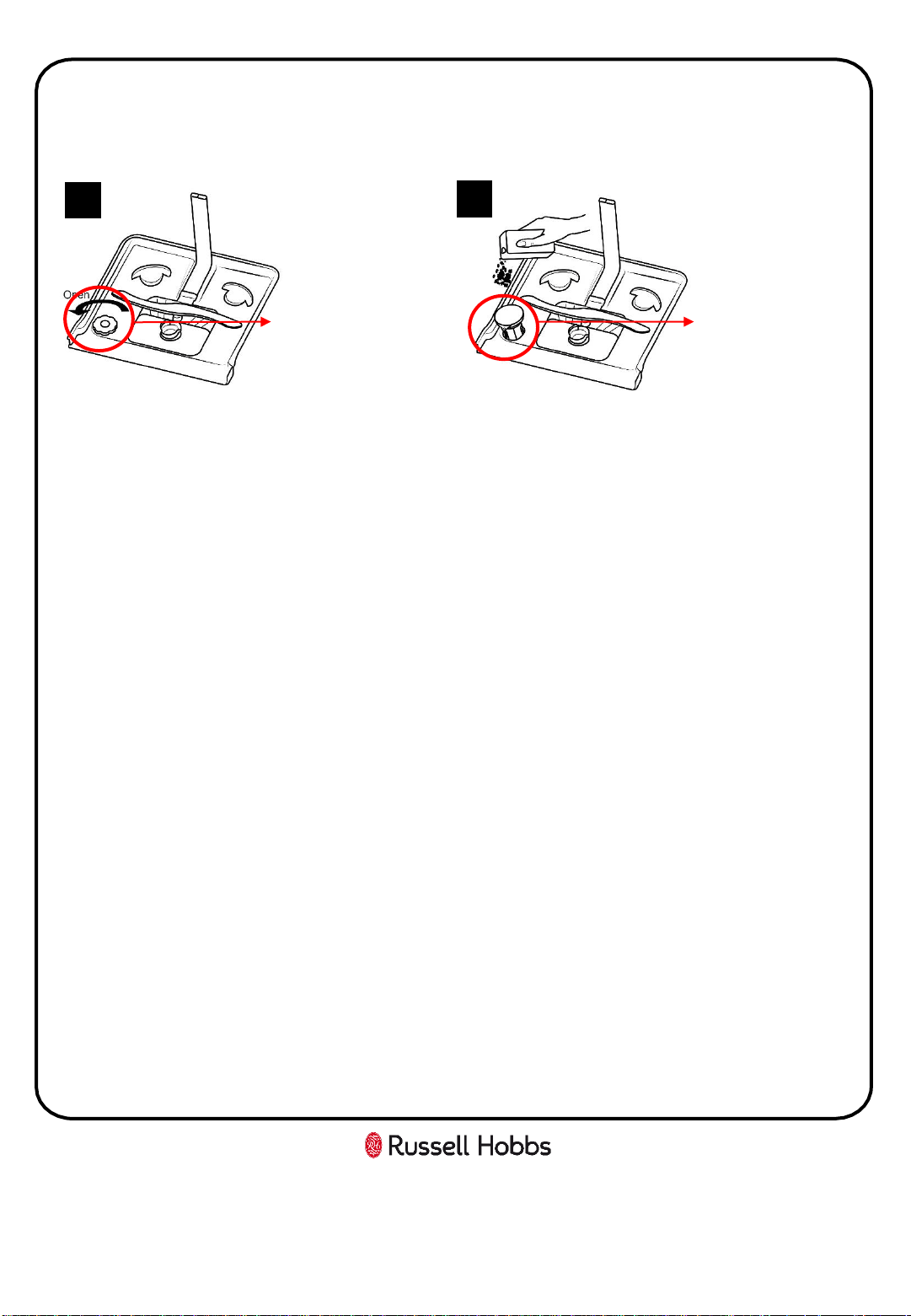
1. Remove the basket and then unscrew and remove the cap from the salt container. See
diagram 1 on the following page.
2. Place the salt funnel that is provided into the hole and pour approximately 1.0kg of
dishwasher salt into the salt container
3. Fully fill the salt container with water. It is normal for a small amount of water to come out of
the salt container. See diagram 2 on the following page.
4. After filling the container, screw the cap tightly back clockwise.
5. Usually, the salt warning indicator light will stop being illuminated within 2-6 days after the
salt container has been filled.
13
Softener level Setting on the water softener Water Hardness (Clarke)
H1
1
0-5
H2 2 6-11
H3
3
12-17
H4
4*
18-22
H5
5
23-34
H6
6
35-55
14
6. Immediately after filling the salt into the salt container, a washing program should be
started (We suggest to use the rapid programs) Otherwise the filter system, pump or other
important parts of the machine may be damaged by salty water. This may affect the
guarantee.
Note:
• The salt container must only be refilled when the salt warning light in the control panel
comes on. Depending on how well the salt dissolves, the salt warning light may still be on
even though the salt container is filled.
• If there are spills of salt, a soak or a Rapid program should be run to remove the excessive
salt.
Rinse Aid Dispenser
Rinse Aid dispenser
The rinse aid is released during the final rinse to prevent water from forming droplets on your
dishes, which can leave spots and streaks. It also improves drying by allowing water to roll off
the dishes. Your dishwasher is designed to use liquid rinse aids. The rinse aid dispenser is
located inside the door next to the detergent dispenser.
To fill the dispenser, open the cap and pour the rinse aid into the dispenser until the level
indicator turns completely black. The volume of the rinse aid container is about 110ml.
Function of Rinse Aid
Rinse aid is automatically added during the last rinse, ensuring thorough rinsing, and spot and
streak free drying.
Important note:
Only use branded rinse aid for dishwasher. Never fill the rinse aid dispenser with any other
substances (e.g. Dishwasher cleaning agent, liquid detergent). This may damage the
appliance.
1
A small amount
of water may
come out of the
container after
filling with salt
2
Salt container
cover
When to Refill the Rinse Aid Dispenser
There is a rinse aid warning indicator light in the control panel which will light when there is no
or little rinse aid in the rinse aid dispenser. Alternatively you can manually check/estimate the
amount of rinse aid in the rinse aid dispenser from the colour of the optical level indicator
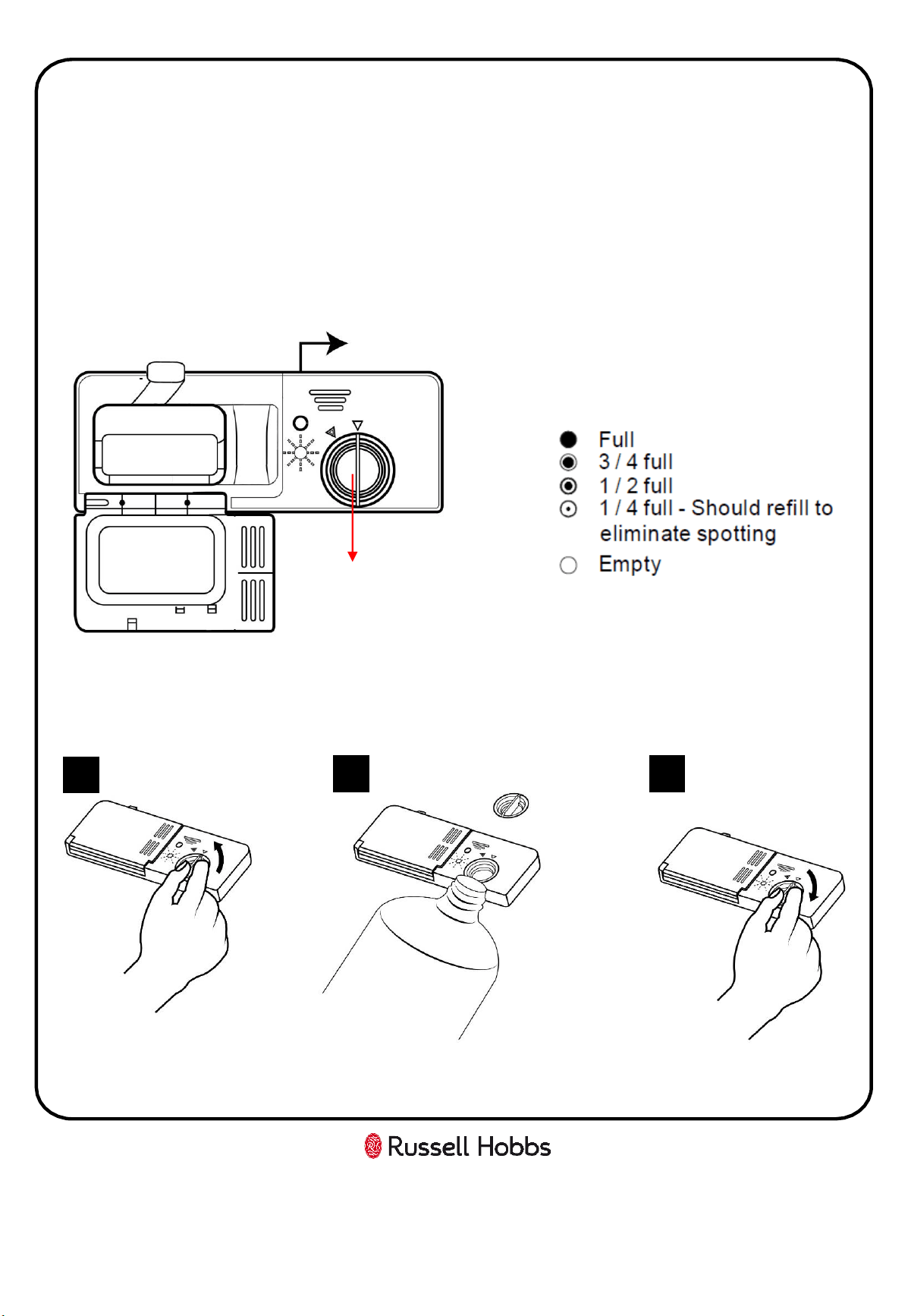
located next to the cap. When the rinse-aid container is full, the whole indicator will be darker.
As the rinse-aid diminishes, the size of the dark dot decreases. You should never let the rinse
aid level fall 1/4 full.
As the rinse aid diminishes, the size of the black dot on the rinse aid level indicator changes, as
illustrated below:
1. To open the dispenser, turn the cap to the "open" (left) arrow and lift it out.
2. Pour the rinse aid into the dispenser, being careful not to overfill.
3. Replace the cap by inserting it aligned with "open" arrow and turning it to the closed (right)
arrow.
NOTE: Clean up any rinse aid spilled during filling with an absorbent cloth to avoid excessive
foaming during the next wash. Don't forget to replace the cap before you close dishwasher
door.
15
Rinse Aid indicator
1
2 3
Rinse Aid
dispenser cover
16
Rinse Aid Dispenser
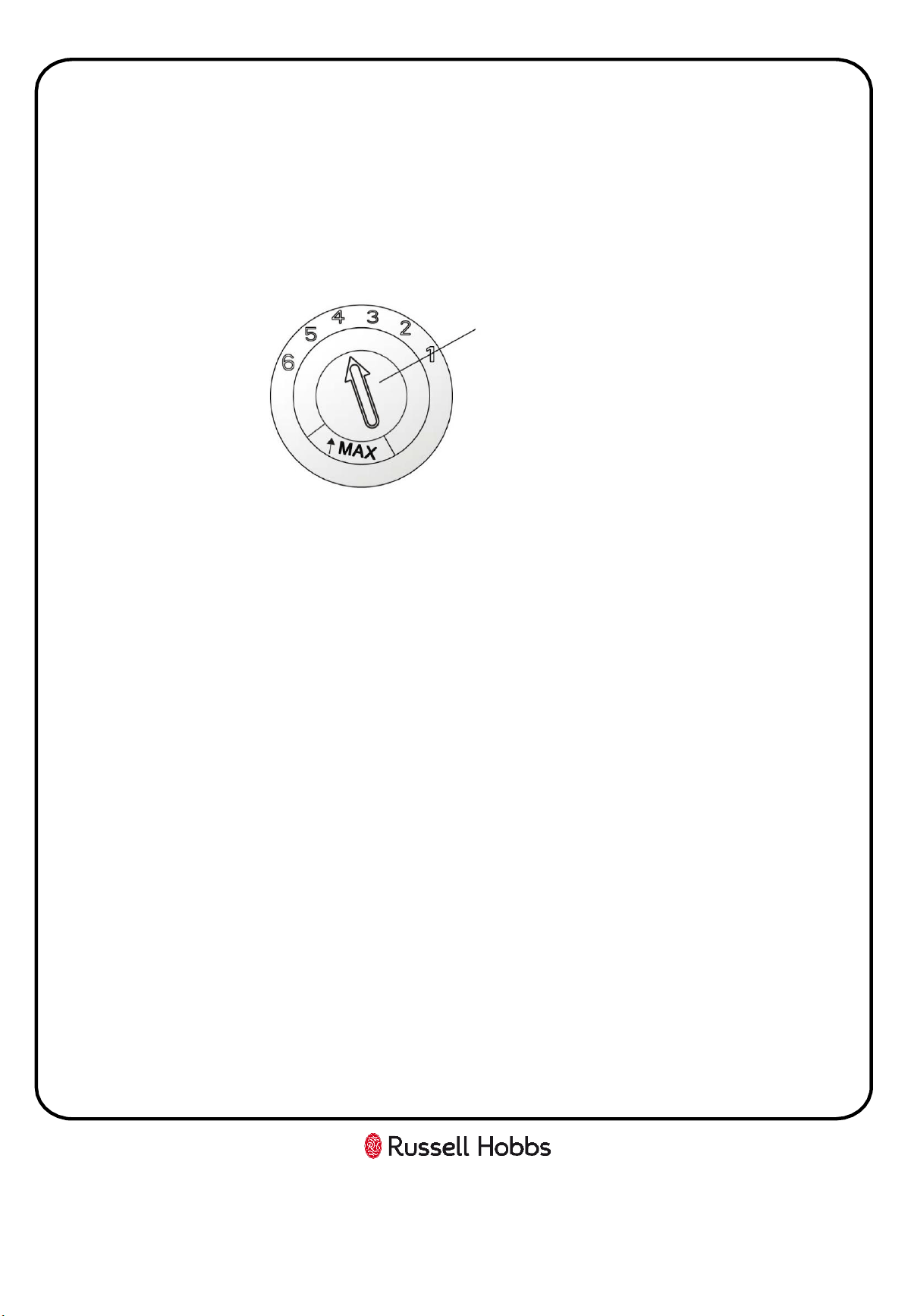
The rinse aid dispenser has six settings. Always start with the dispenser set on "4". If spots and
poor drying are a problem, increase the amount of rinse aid dispensed by removing the
dispenser cover and rotating the dial to "5". If the dishes still aren’t drying properly or have spots
on them, adjust the dial to the next higher lever until your dishes are spot-free. The
recommended setting is "4“ (Factory setting is "4".)
Note: Increase the dose if there are drops of water or lime spots on the dishes after washing.
Reduce it if there are sticky whitish stains on your dishes or a bluish film on glassware or
knife blades.
Detergent
Detergent with its chemical ingredients are necessary to remove dirt, crush dirt and transport it
out of the dishwasher.
Important notes:
• Only use detergent specifically made for use in dishwashers.
• Keep your detergent fresh and dry.
• Don't put powder detergent into the dispenser until you're ready to wash dishes.
• Dishwasher detergent is corrosive! Keep it out of reach of children.
Detergents
There are 3 sorts of detergents:
1. With phosphate and with chlorine
2. With phosphate and without chlorine
3. Without phosphate and without chlorine
Rinse Aid
adjustment dial
17
Detergent
Normally new pulverised detergent is without phosphate. Thus the water softener function of
phosphate is not given. In this case we recommend to fill salt in the salt container even when
the hardness of water is only 7*clarke. If detergents without phosphate are used in the case of
hard water often white spots appear on dishes and glasses. In this case please add more
detergent to reach better results. Detergents without chlorine do only bleach a little. Strong and
coloured spots will not be removed completely. In this case please choose a program with a
higher temperature.
Concentrated Detergent
Based on their chemical composition, detergents can be split in two basic types:
• conventional, alkaline detergents with caustic components
• low alkaline concentrated detergents with natural enzymes
Detergent Tablets
Detergent tablets of different brands dissolve at different speeds. For this reason some
detergent tablets cannot dissolve and develop their full cleaning power during short programs.
Therefore please use long programs when using detergent tablets, to ensure the complete
removal of detergent residuals.
Detergent Dispenser
The dispenser must be refilled before the start of each wash cycle following the instructions
provided in the wash cycle table. Generally, only one tablespoon of detergent is needed for a
normal wash load. More heavily soiled items will need more detergent. Always add the
detergent just before starting the dishwasher, otherwise it could get damp and will not dissolve
properly if added mid cycle.
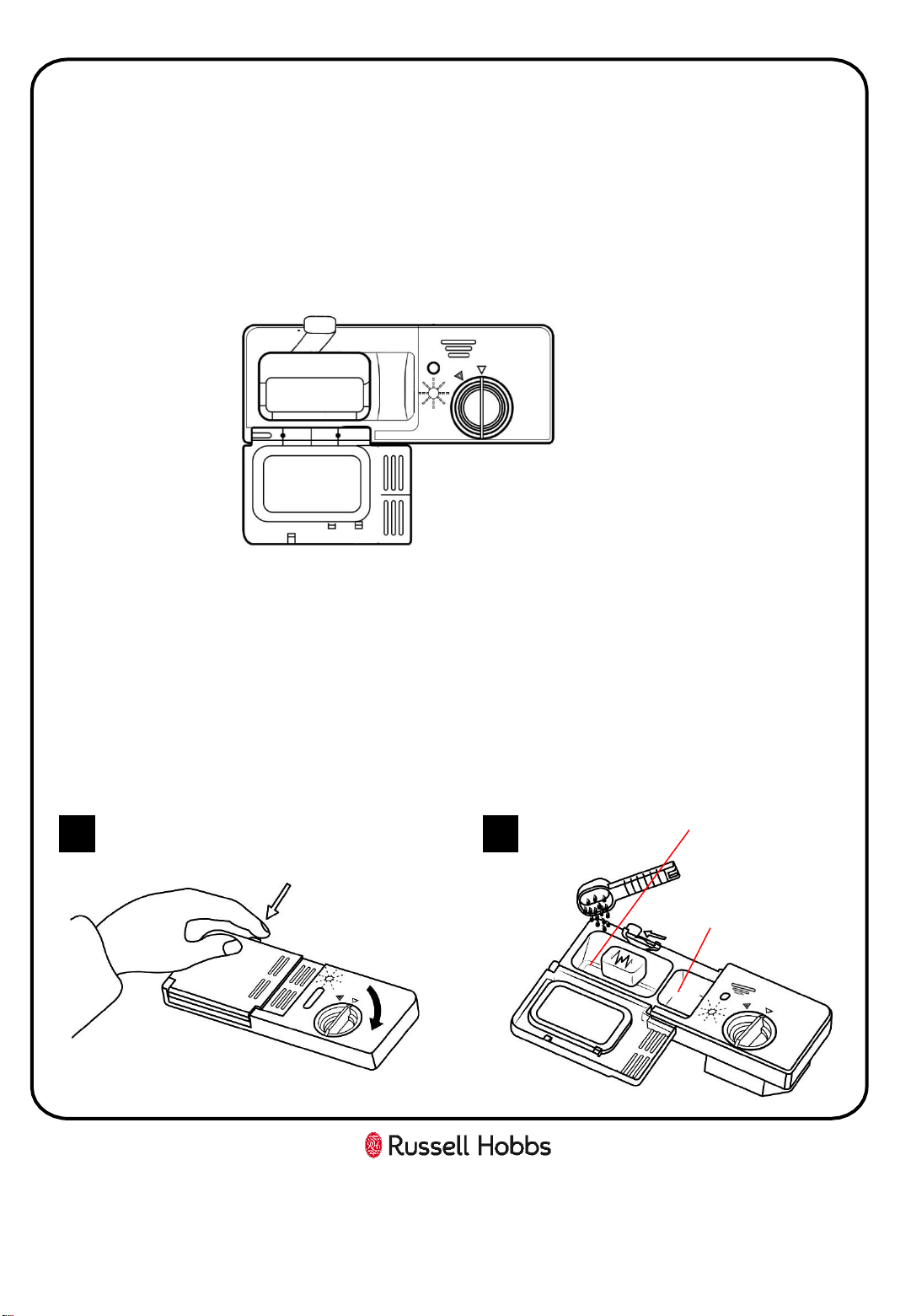
Detergent
Detergent Dispenser
The detergent dispenser is located on the inside of the dishwasher door and is approximately
halfway up the door. The dispenser can be filled with either detergent powder or a detergent
tablet, compartment A can be loaded with detergent powder or a detergent tablet and
compartment B can be loaded with Pre-wash cycle detergent
Filling the Detergent Dispenser
Note: observe the dosing and storage recommendations that are stated on the detergent
packaging.
1. The detergent dispenser will automatically open during a washing cycle to release the
detergent powder or detergent tablet into the appliance. However should you need to
manually open the dispenser you can do this by pushing the latch on top of the dispenser,
the dispenser door will spring open
18
1 2
Push latch to open
Detergent powder
or detergent tablet
Pre-wash
cycle detergent
A B
Detergent
2. Fill the detergent dispenser with the correct amount of detergent powder in compartment A
or 1 detergent tablet. If the dishes are heavily soiled, place an additional detergent dose in
compartment B, this detergent will take effect during the pre-wash phase (this is not required if
using a detergent tablet).
Information about the amount of detergent for each program can be located in the program
information section. Please be aware that the amount of detergent that is to be used can be
affected by the level soiling of your dishes and the water hardness of the area you live in. Please
observe the manufacturer's recommendations on the detergent packaging.
Note:
• Only use detergent specifically made for use in dishwashers.
• Observe the dosing and storage recommendations that are stated on the detergent
packaging.
• Don't put powder detergent into the dispenser until you're ready to wash dishes.
• Dishwasher detergent is corrosive! Keep it out of reach of children
3. Close the lid and press until it locks in place.
19
20
Loading the Dishwasher
Notes:
• Only purchase and wash utensils which are identified as dishwasher safe.
• Use a mild detergent that is described as 'kind to dishes'. If necessary, seek further
information from the detergent manufacturers.
• For particular items, select a program with as low a temperature as possible.
• To prevent damage, do not take glass and cutlery out of the dishwasher immediately after
the program has ended.
Items not suitable for the dishwasher
• Cutlery with wooden, horn china or mother-of-pearl handles
• Plastic items that are not heat resistant
• Older cutlery with glued parts that are not high temperature resistant
• Bonded cutlery items or dishes
• Pewter or copper items
• Crystal glass
• Steel items are subject to rusting, specifically knife steel.
• Wooden platters
• Items made from synthetic fibres
Items that may not be suitable for the dishwasher
• Some types of glasses can become dull after a large number of washes
• Silver and aluminium parts have a tendency to discolour during washing
• Glazed patterns may fade if machine washed frequently
Before Loading the Dishwasher
For best performance of the dishwasher, follow these loading guidelines (Features and
appearance of baskets and cutlery baskets may vary from your model):
1. Scrape off any large amounts of left over food from dishes/crockery
2. Soften remnants of burnt food in pans and other crockery.
3. Place objects in the dishwasher in the following way:
a. Items such as cups, glasses, pots/pans, etc. are faced downwards.
b. Curved items, or ones with recesses, should be loaded at an angle so that water can
run off.
c. All utensils are stacked securely and can not tip over.
Loading the Dishwasher
d. All utensils are placed in the way that the spray arms can rotate freely during
washing.
e. Load hollow items such as cups, glasses, pans etc. with the opening facing
downwards so that water cannot collect in the container or a deep base.
f. Dishes and items of cutlery must not lie inside one another, or cover each other.
g. To avoid damage to glasses, they must not touch.
h. Long and/or sharp items of cutlery such as carving knives must be positioned
horizontally in the basket. Long bladed knives stored in an upright position are a
potential hazard!
4. Do not overload your dishwasher. This is important for good results
5. Very small items should not be washed in the dishwasher as they could easily fall of the
basket
6. Long items, serving cutlery, salad servers and knives should be placed on the shelf so that
they do not obstruct the rotation of the spray arms.
7. Pots, serving bowls, etc. must always be placed top down.
8. Deep pots should be slanted to allow water to flow out.
9. The basket features folding spikes so that larger or more pots and pans can be loaded.
21
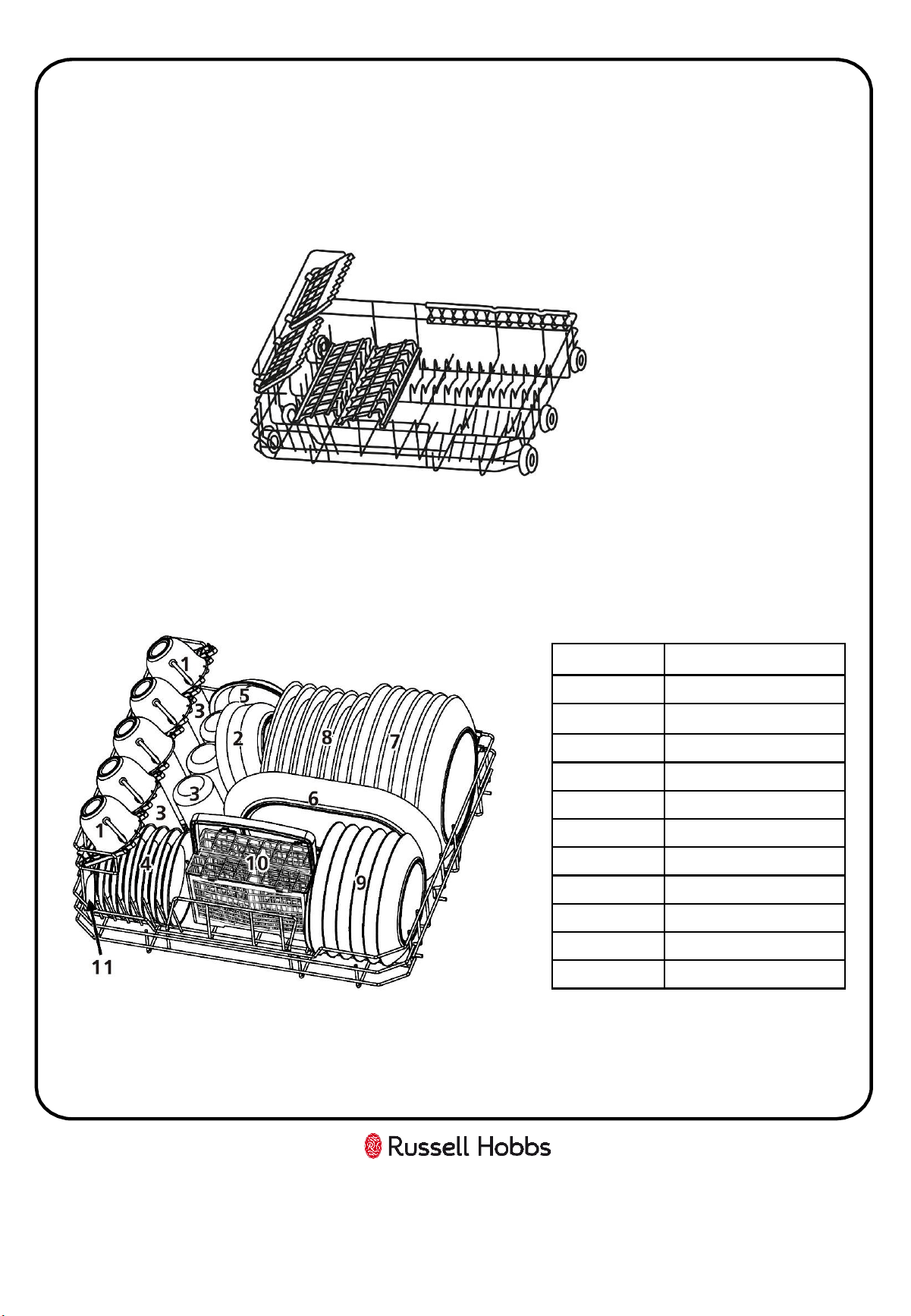
Loading the Dishwasher
Loading the Basket
The rows of the prongs in the basket can be lowered to load pots and bowls.
Position the dishes and cookware so that they will not get moved by the spray of water. It is
preferable to place serving dishes and lids on the side of the racks in order to avoid blocking the
rotation of the top spray arm.
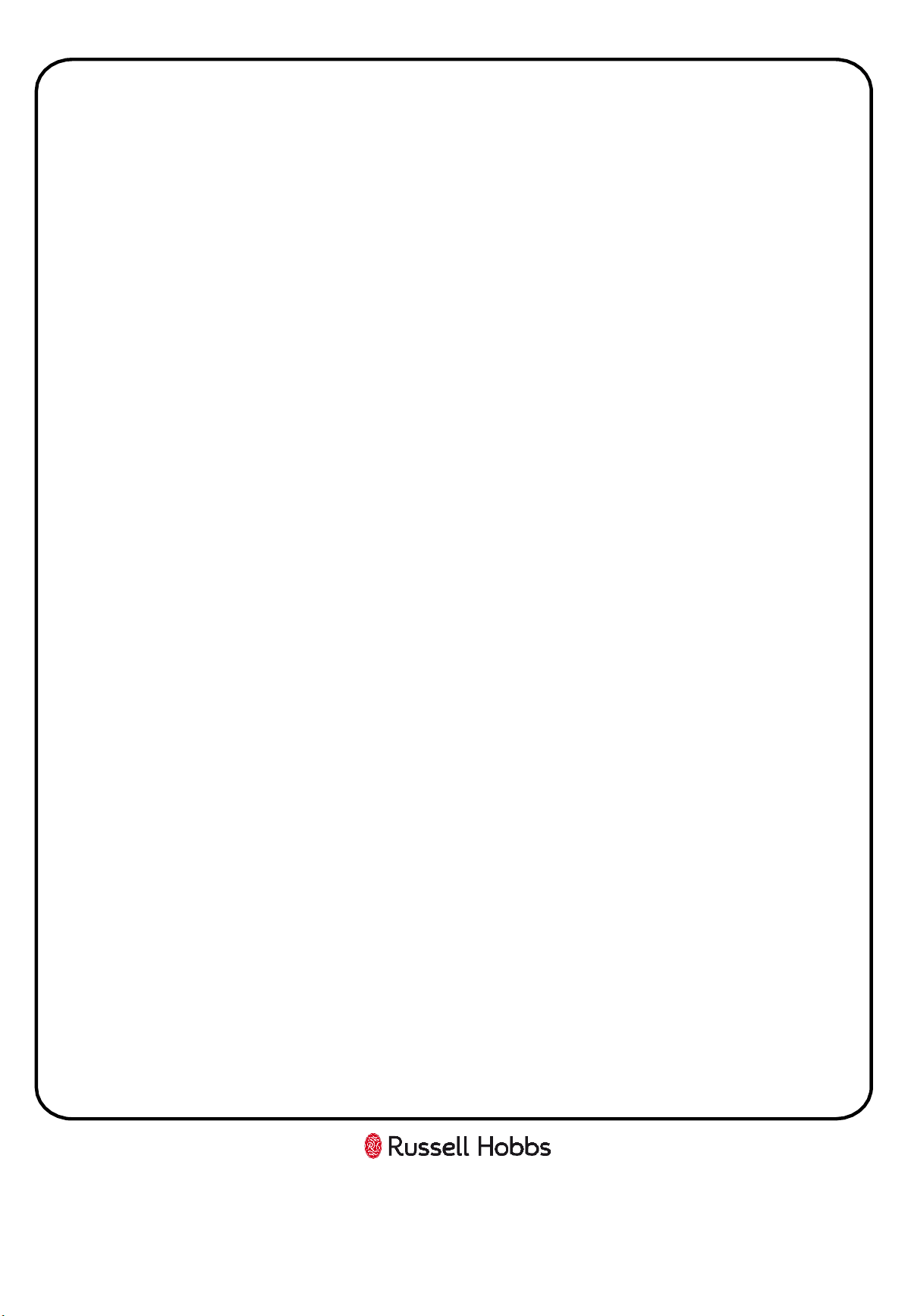
The below diagram is an example of how to load the basket:
Notes:
• Pots, serving bowls, etc., must always be placed top down
• Deep pots should be slanted to allow water to flow out
• The basket features folding spikes so that larger/more pots and pans can be loaded.
22
Number Item
1 Cups
2 Medium serving bowl
3 Glasses
4 Saucers
5 Dish
6 Oval platter
7 Dinner plates
8 Soup plates
9 Dessert dishes
10 Cutlery basket
11 Serving spoons
23
Loading the Dishwasher
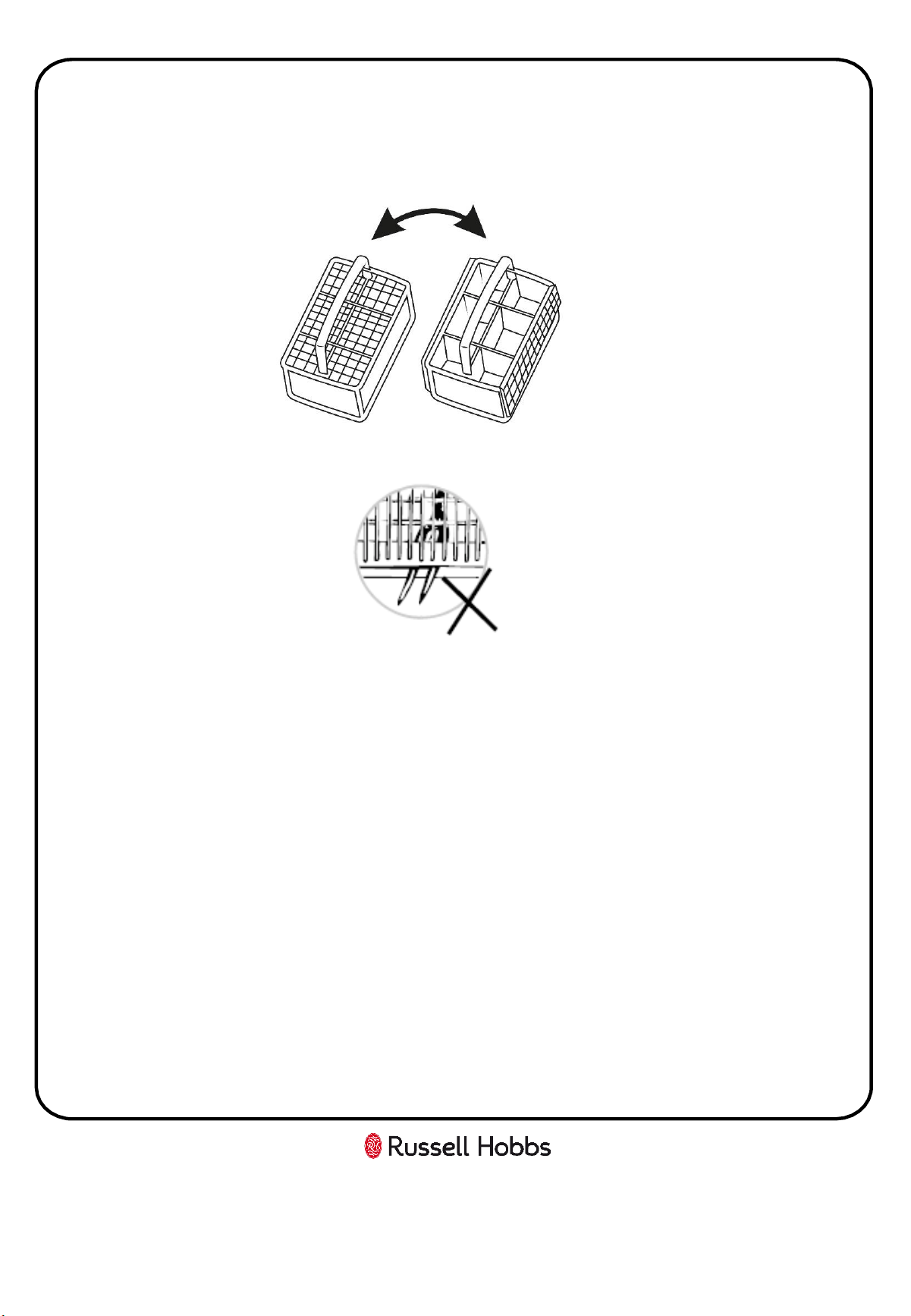
Cutlery Basket
Cutlery should be placed in the cutlery basket with the handles at the bottom, except for knives
and other utensils with sharp points must be loaded in the basket with their points down or
placed in a horizontal position. Long utensils should be placed in the horizontal position at the
front of the basket as shown in the picture.
For the best cleaning performance place the cutlery in the basket separately, you must make
sure that they do not nest/group together.
Loading the Dishwasher
The compartments of the cutlery basket can be adjusted by folding over the 2 separating
covers:
Do not let any item extend through the bottom.
Removing the dishes
• It is normal that the dishwasher is wet inside.
• It is recommend to wait for the drying cycle (if the program that has been selected has this)
to finish and for the dishes/crockery to cool before removing them
24
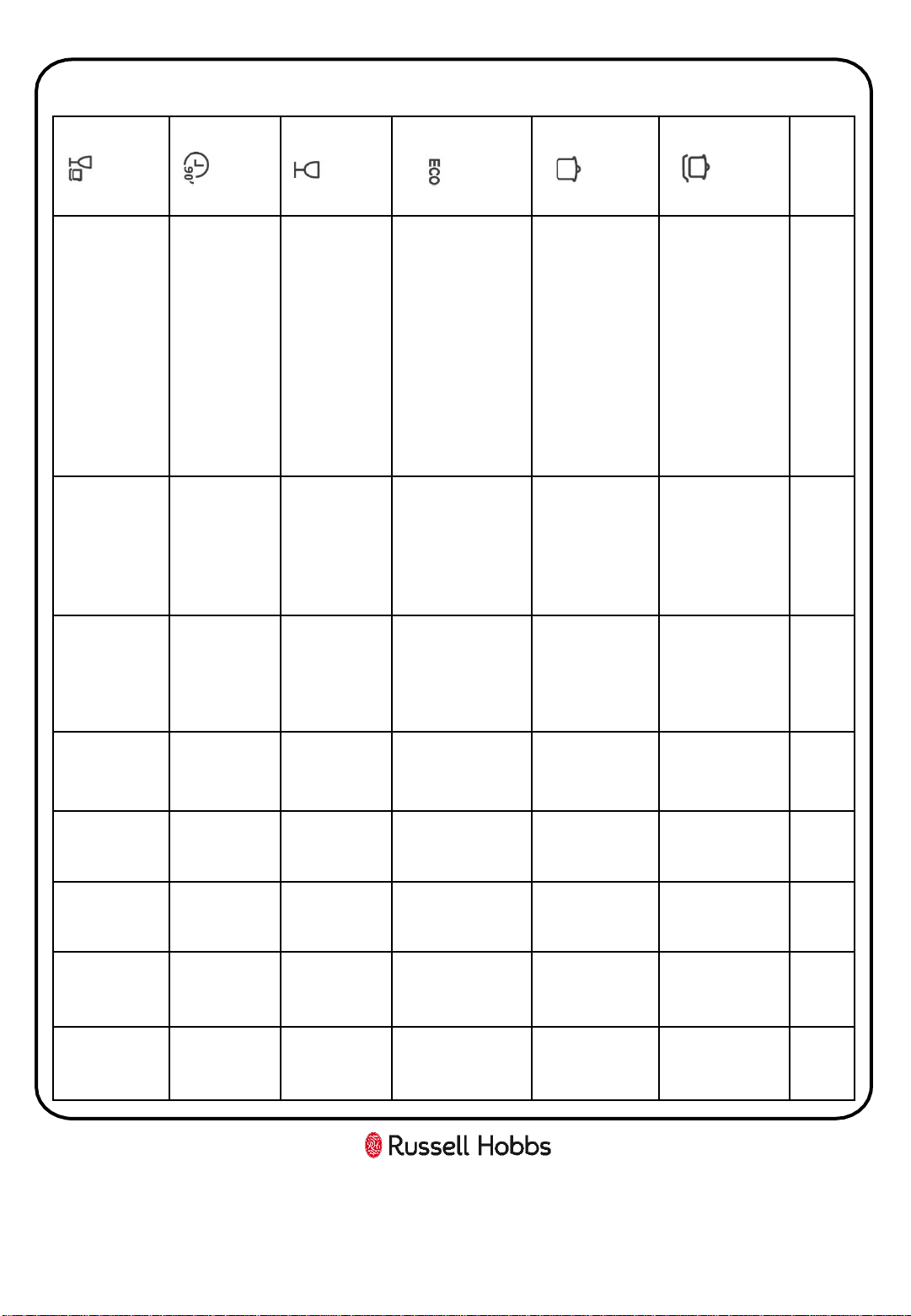
Rapid 30'
Quick 90'
Glass
*Eco
Universal
Intensive
Program
for lightly soiled loads that don’t
need drying
A quick wash for lightly solid loads
for normally soiled loads that
need a quick wash
for normally soiled loads such as
pots, dishes, glasses and lightly
soiled pans. This is the most
efficient program for water
consumption and energy
consumption
for normally soiled loads such as
pots, dishes, glasses and lightly
soiled pans
for heavily soiled crockery and
normally soiled pots, pans, glasses
and dishes (can be used for dishes
with dried on soiling)
Cycle information
Wash (40
°)
Rinse
Rinse
Wash (65
°C)
Rinse
Rinse
Rinse (70
°C)
Drying
Wash (45
°C)
Rinse
Rinse
(60°C)
Drying
Pre-wash
Wash (45
°C)
Rinse (65
°C)
Drying
Pre-wash
Wash (60
°)
Rinse
Rinse
(70°C)
Drying
Pre-wash (50
°C)
Wash (70
°C)
Rinse
Rinse
Rinse
(70°C)
Drying
Cycle stages
Powder: 12g
Powder: 14g
or
Tablet: 3 in 1
Powder: 14g
or
Tablet: 3 in 1
Powder: 14g
or
Tablet: 3 in 1
Powder: 4g/10g
or
Tablet: 3 in 1
Powder: 4g/10g
or
Tablet: 3 in 1
Detergent
dosage
30
90
75
230
120
140
Running
time
(mins)
0.5
1.1
0.65
0.613
1.05
1.2
Energy
cons.
(Kwh)
5.8
6.6
5.8
6.5
7.7
9.6
Water
cons.
(litres)
No
Yes
Yes
Yes
Yes
Yes
Rinse
aid
required
Yes
Yes
Yes
Yes
Yes
Yes
Delay
timer
function
Washing Programs
25
Washing Programs
* EN60436.
: This program is the test cycle. The information for comparability test in accordance with EN60436.
26
Washing Cycles
Turning on the appliance
Starting the wash cycle
1. Pull out the basket, load the dishes (see the loading the dishwasher section.
2. Pour in the detergent powder or put in the detergent tablet into the detergent dispenser
(see the detergent section) and close the detergent dispenser cover.
3. Insert the plug into the socket. The power supply must be 220-240 AC / 50Hz,
4. Make sure that the water supply is turned on to full pressure.
5. Close the door and press the ON/OFF button.
6. Select your required program by pressing the PROGRAM button (the indicator light of the
program you have selected will light up).
7. If required select the delay timer function.
8. Press the start button, the machine will beep and the washing cycle will begin.
Change the program
A cycle that is underway can only be modified if it has only been running for a short time.
Otherwise, the detergent may have already been released, and the appliance may have already
drained the wash water. If this is the case, the detergent dispenser must be refilled (see the
Detergent section).
If you wish to change the program and it is possible, then press the start/pause button, then
press and hold the PROGRAM button for more than 3 seconds. The machine will enter the
standby state, at this point you can now select the program you require by pressing the
PROGRAM button. Once this has been done press the start/pause button and the wash cycle will
begin.
Note: If you open the door during a wash cycle, the machine will pause. The buzzer will beep
every minute unless you close the door. After you close the door, the machine will continue to
work after 10 seconds.
Time delay
The starting time of a washing programme can be delayed, please follow the steps below:
1. Open the dishwasher door, load your soiled dishes/crockery and add detergent and then
close the door.
2. Press the on/off button to turn on the dishwasher and select your preferred program.
27
Washing Cycles
3. Press the Time Delay button and set the required delay start time (this will be shown by time
delay the indicator lights).
4. Press the start button, the unit will start the programme at the assigned time automatically.
Adding a dish during a cycle
If you have forgotten to load a dish then it can be added at any time before the detergent is
dispensed. Please follow the below steps when adding a forgotten dish:
1. Open the door slightly to stop the washing.
2. After the spray arms stop working, you can open the door completely.
3. Load the forgotten dish or dishes.
4. Close the door, the dishwasher will start running again after 10 seconds.
Note: It is dangerous to open the door when washing, because the hot water may scald you.
At the end of the wash cycle
When a program has finished, the buzzer of the dishwasher will sound for 8 seconds, after this
duration it will stop. Turn off the appliance using the ON/OFF button and open the door of the
dishwasher. Turn off the water tap if necessary
Note: The appliance will switch off automatically 30 minutes after the program has finished.
Open the door carefully
Hot dishes are sensitive to knocks. The dishes therefore must be allowed to cool down for
approximately 15 minutes before removing from the appliance. Open the dishwasher's door,
leave it ajar and wait approximately 15 minutes before removing the dishes. In this way they will
be cooler and the drying will be improved.
Unloading the dishwasher
It is normal that the dishwasher is wet inside. It is recommend to wait for the drying cycle (if the
program that has been selected has this) to finish and for the dishes/crockery to cool before
removing them.
Installation
• This appliance can be installed as a freestanding unit only.
• We recommend that 2 people handle the dishwasher during installation.
• Avoid damaging the product during installation, positioning of the appliance requires two
people in order to avoid injuries or damage to the appliance.
• Be sure to wear gloves when installing the appliance to avoid personal injury, edges of the door
and other parts of the appliance are sharp.
• Your appliance should not be located in direct sunlight or exposed to continuous heat or
extremes of temperature (e.g. next to a radiator, boiler or cooker). If this is not feasible, then
you should install an insulation plate between the appliance and the adjacent heat source.
• You should check whether there is an electrical socket available, which will be accessible after
your appliance is installed.
• Place the appliance flatly and firmly on a solid base.
• All parts removed must be saved to do the reinstallation in the future. Ensure the dishwasher is
unplugged and empty.
• Be sure to leave enough space for the opening of the door, to avoid damage to the appliance or
personal injury.
• The installation position of dishwasher should be near the existing inlet and drain hoses and
power point.
• The side of the cabinet that is adjacent to the water supply and drainage should be chosen to
facilitate the connection of water inlet hose and drain hose of the dishwasher.
• For personal safety: Do not use an extension cord or an adapter plug with this appliance.
• Do not, under any circumstances, cut or remove the earthing connection from the power cord
• Ensure the power cord is not underneath any of the appliances feet or trapped by any part of
the appliance.
Positioning the appliance
Position the appliance in the desired location. The back should rest against the wall behind it, and
the sides, along the adjacent cabinets or walls. The dishwasher is equipped with water supply and
drain hoses that can be positioned either to the right or the left sides to facilitate proper
installation.
Make sure to position the appliance with minimum space of 50mm on both sides of the fully open
door.
Keep 5 mm distance between both sides of the appliance and the cabinet.
28
Installation
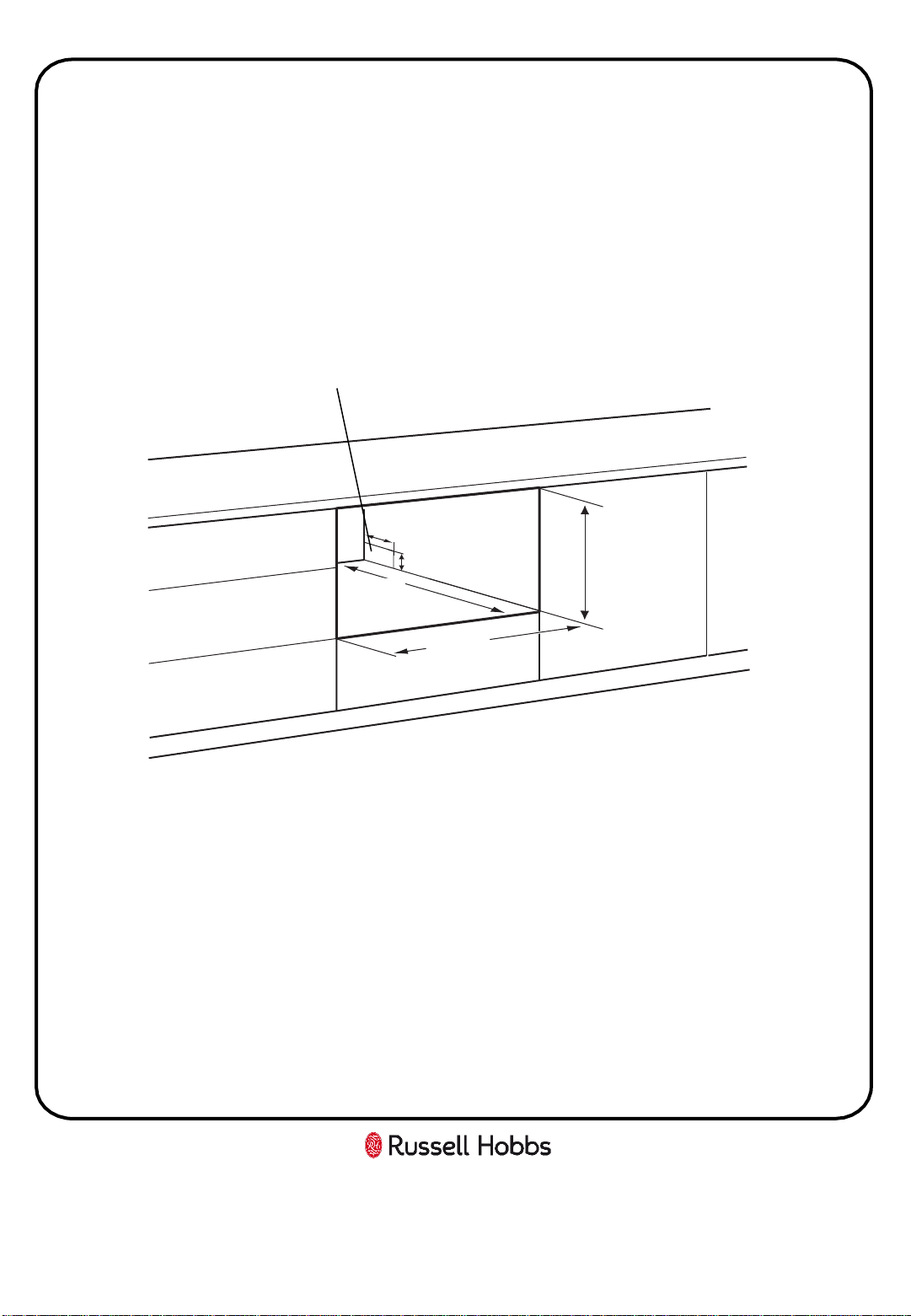
If the dishwasher is going to be slotted in to a cabinet then the minimum aperture dimensions
have to be: (H)458 x (W)555 x (D)550mm:
Note: To facilitate a proper installation, position the power cord, drain hose and water supply
line hole to the right or the left of the appliance.
29
min.
min.
550 mm
min.
458mm
100
min.
555mm
min.
80
Power cord, drain hole & water supply cut out
Connection of the Water Supply & Drain Hose
Important notes:
• Connection to the water and electricity supplies should only be performed by a qualified
technician.
• The dishwasher should not stand on top of the water hoses or the electricity supply
cable. The water inlet and outlet hoses and the electricity supply cable may be
positioned towards the right or the left in order to achieve the best possible installation.
Connection of the Drain hose
Important notes:
• Before connecting the drain hose, remove any internal restrictions; this will prevent a
build up of debris which could cause a blockage, remove any restrictions from the waste
spigot and ensure that the sealing bung is removed.
• It MUST NOT be connected to a surface water drain.
• Do Not connect the dishwasher to the drain with an extended drainage hose (use the
ones supplied with the appliance), if an extension hose is needed then a pump must be
installed to pump the drainage through and out.
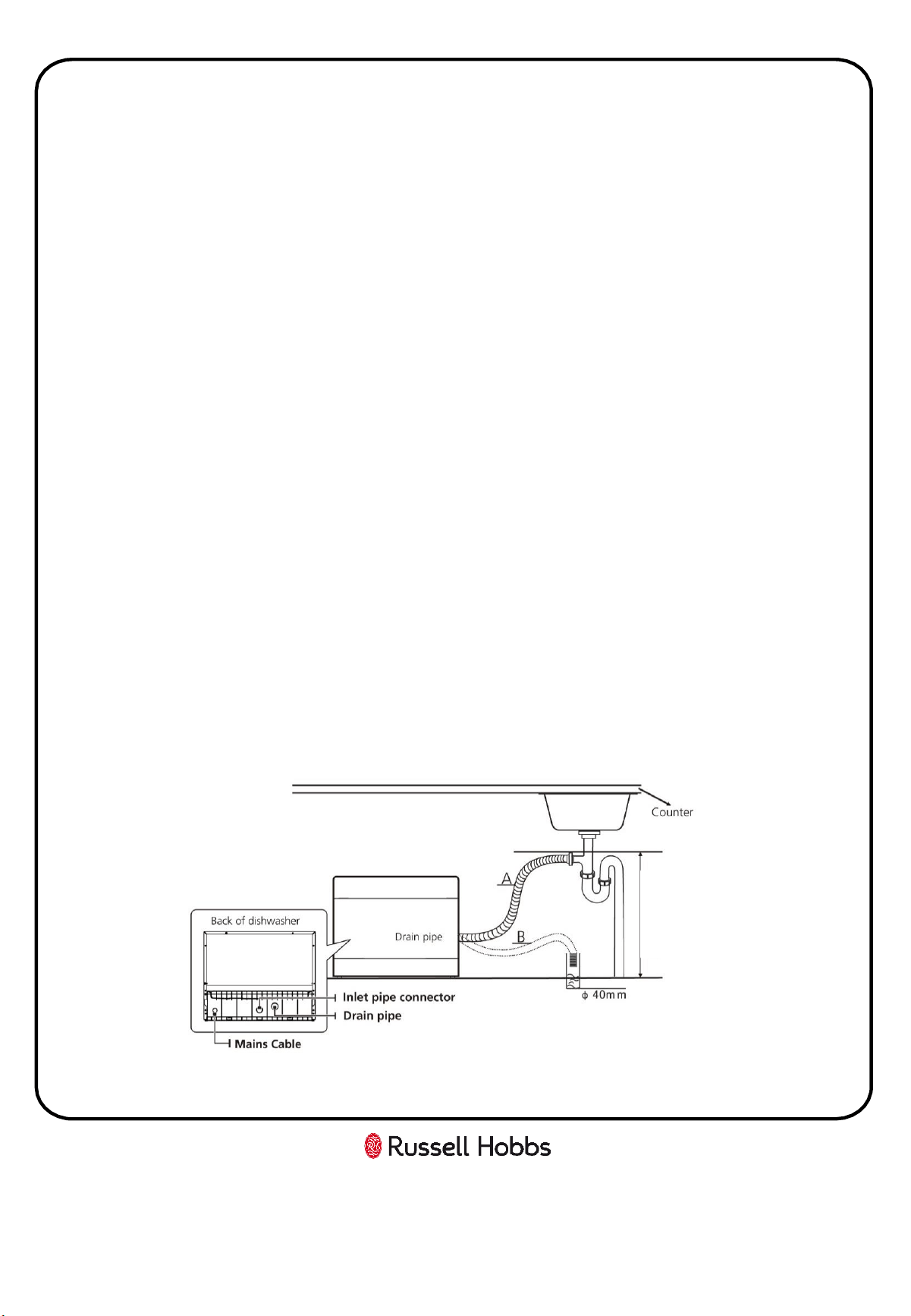
Insert the drain hose into a drain pipe that has a minimum diameter of 4cm (40mm) making
sure to avoid bending or crimping it. The free end of the hose must be at a height lower than
60cm/600mm and must not be immersed in water to avoid the back flow of it. The top of the
hose must be at a height between 20cm/200mm (B on the diagram) and 60cm/600mm (A on
the diagram). The free end of the hose must not be immersed in water to avoid the back flow
of it.
30
MAX 600mm
Connection of the Water Supply & Drain Hose
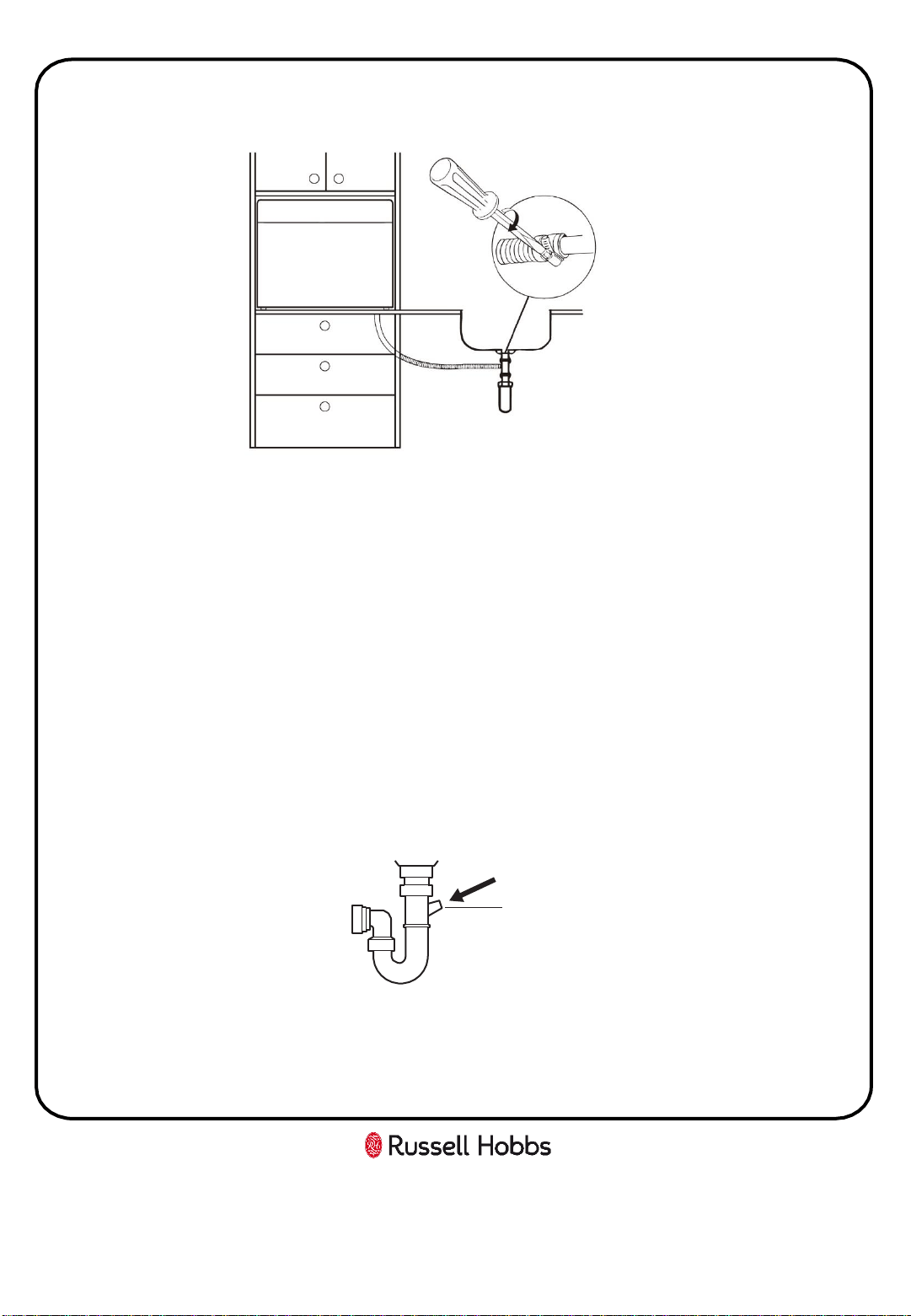
• Ensure the drain hose is securely attached, to prevent it coming away while the machine is
in use and causing a flood.
• Fit the end drain hose that is connected to the waste pipe securely by using a “Jubilee”
type clip.
• If the sink is 1000 higher from the floor, the excess water in hoses cannot be drained
directly into the sink. It will be necessary to drain excess water from hoses into a bowl or
suitable container that is held outside and lower than the sink.
• The water drain hose must be less than 600 mm from the bottom of the appliance to
prevent problems during the draining phases.
• Remove the sink plug when the appliance drains water to prevent that the water goes back
into the appliance.
• If you connect the water drain hose to a trap spigot under the sink, remove the plastic
membrane (A). If you do not remove the membrane, remaining food can cause a blockage
in the drain hose spigot.
31
A
32
Connection of the Water Supply & Drain Hose
Connection of the Water Supply
Important note: Before attaching the water inlet hose, run the water until it is perfectly
clear so that any impurities that may be present in the water do not clog the appliance. This
precaution is needed to avoid the risk of the water inlet getting blocked and damaging the
appliance.
Connect the water inlet hose to a threaded 3/4(inch) connector and make sure that it is
fastened tightly in place. The water inlet hose must be connected to a cold water supply.
Notes:
• If the inlet hose is not long enough, contact a specialist store or an authorised technician.
• The maximum permissible inlet water pressure is 1Mpa.
• The minimum permissible inlet water pressureis 0.04Mpa.
• The hose should not be bent or compressed.
• The appliance must be connected to the water supply network using new hoses.
• Do not use old hoses.
• Ensure that the new hose supplied is connected and the old hose is disposed of safely.
• DO NOT overtighten the hose connector, hand tight is sufficient.
• Ensure the fill hose is not kinked.
• DO NOT connect the dishwasher to a single outlet instantaneous water heater or an
electric heater.
Before First Use
Before the first use of the dishwasher after installation you must check for the following
points:
1. All packing materials and printings have been removed from the dishwasher
2. The dishwasher is level and fixed properly
3. The water inlet valve is open
4. There is no leakage at the connections water inlet hose and the water inlet valve or the
drain hose and the drain.
5. The inlet and drain hoses are knotted
6. The wires are tightly connected and not trapped
7. The power is switched on
Maintenance & Cleaning
Filtering System
The filter prevents larger remnants of food or other objects from getting inside the pump. The
residue may block the filter, in this case they must be removed.
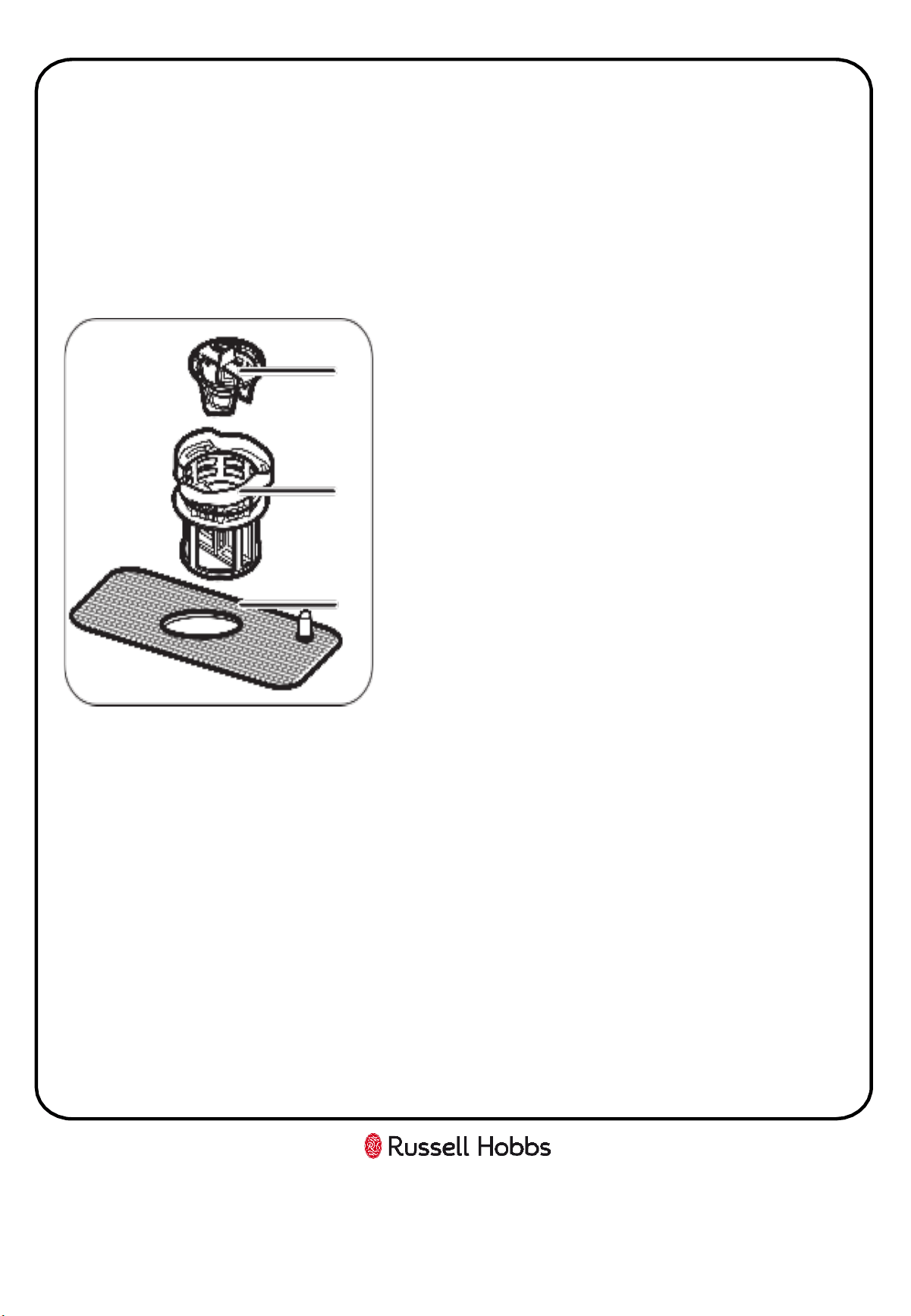
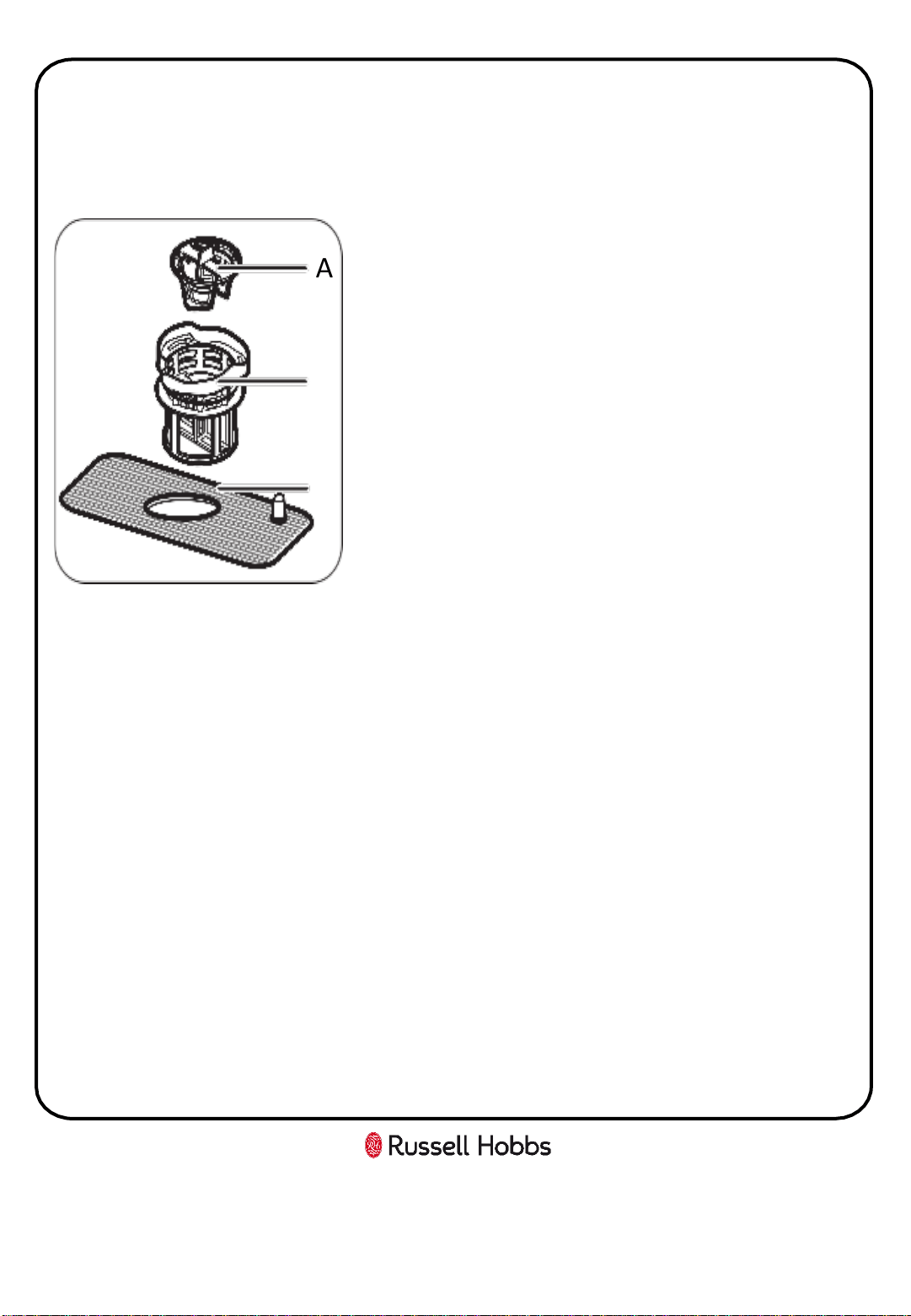
The filter system consists of a coarse filter, a flat (Main filter) and a micro filter (Fine filter).
Filter Assembly
Important notes:
• The dishwasher must never be used without the filters.
• Improper replacement of the filter may reduce the performance level of the
appliance and damage dishes and utensils.
• Do not over tighten.
The filter efficiently removes particles of food from the wash water, allowing it to be recycled
during the wash cycle. For best performance and cleaning results, the filter must be cleaned
regularly. For this reason, it is recommended to remove the larger food particles trapped in the
filter after each use by removing all debris from all parts of the filter (you may need to use a
cleaning brush to remove all debris from the coarse and fine filters) and rinse all parts of the
filter under running water.
A) Coarse Filter
Larger items, such as pieces of bones or glass, that could
block the drain are trapped in the coarse filter. To remove
the items caught by the filter, gently squeeze the tap on
the top of this filter and lift out.
33
C) Main Filter
Food and soil particles trapped in this filter are pulverized
by a special jet on the spray arm and washed down to
drain.
B) Fine filter
This filter holds soil and food residues in the sump area
and prevents it from being redeposit on the dishes during
wash cycle.
A
B
C
Maintenance & Cleaning
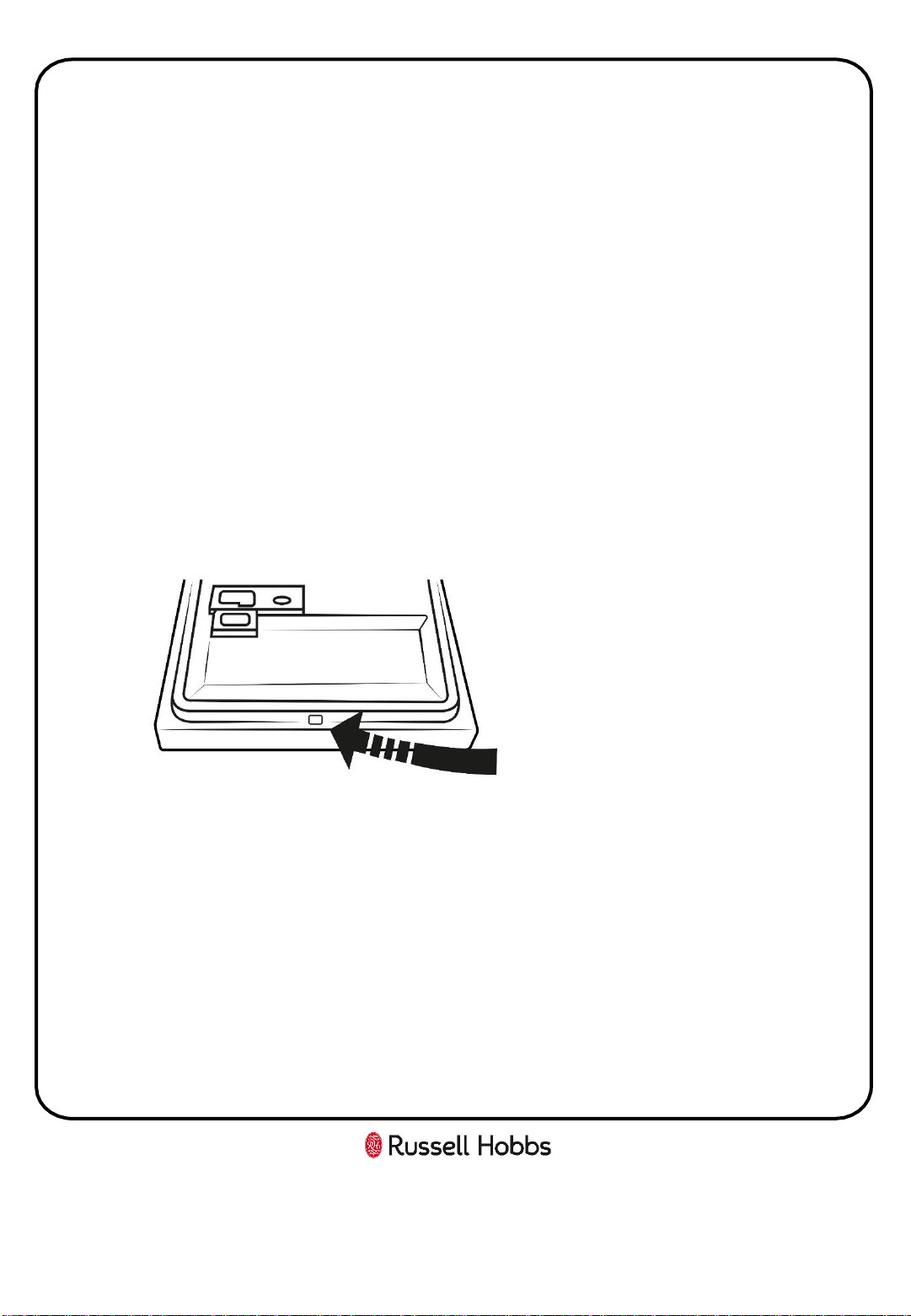
To remove the filter device, twist the coarse filer (B) and pull it in a upwards direction. All parts
of the filter will lift away from the bottom of the appliance
A
34
B
C
Important notes:
• Inspect the filters for blocking after every use
• The filter system must be cleaned at lease once a week
• When cleaning the filters, don't knock/tap them. Otherwise, the filters could be contorted
and the performance of the dishwasher could be affected.
1. Turn the fine filter (B) in anti-clockwise
direction, then pull it in a upwards direction
2. Remove the coarse filter (A) by pulling it
from the fine filter (B)
3. Remove the main filter (C) by pulling it from
the base of the cavity
4. To replace the filter reverse steps 1, 2 and 3.
Maintenance & Cleaning
Cleaning the door
Important note:
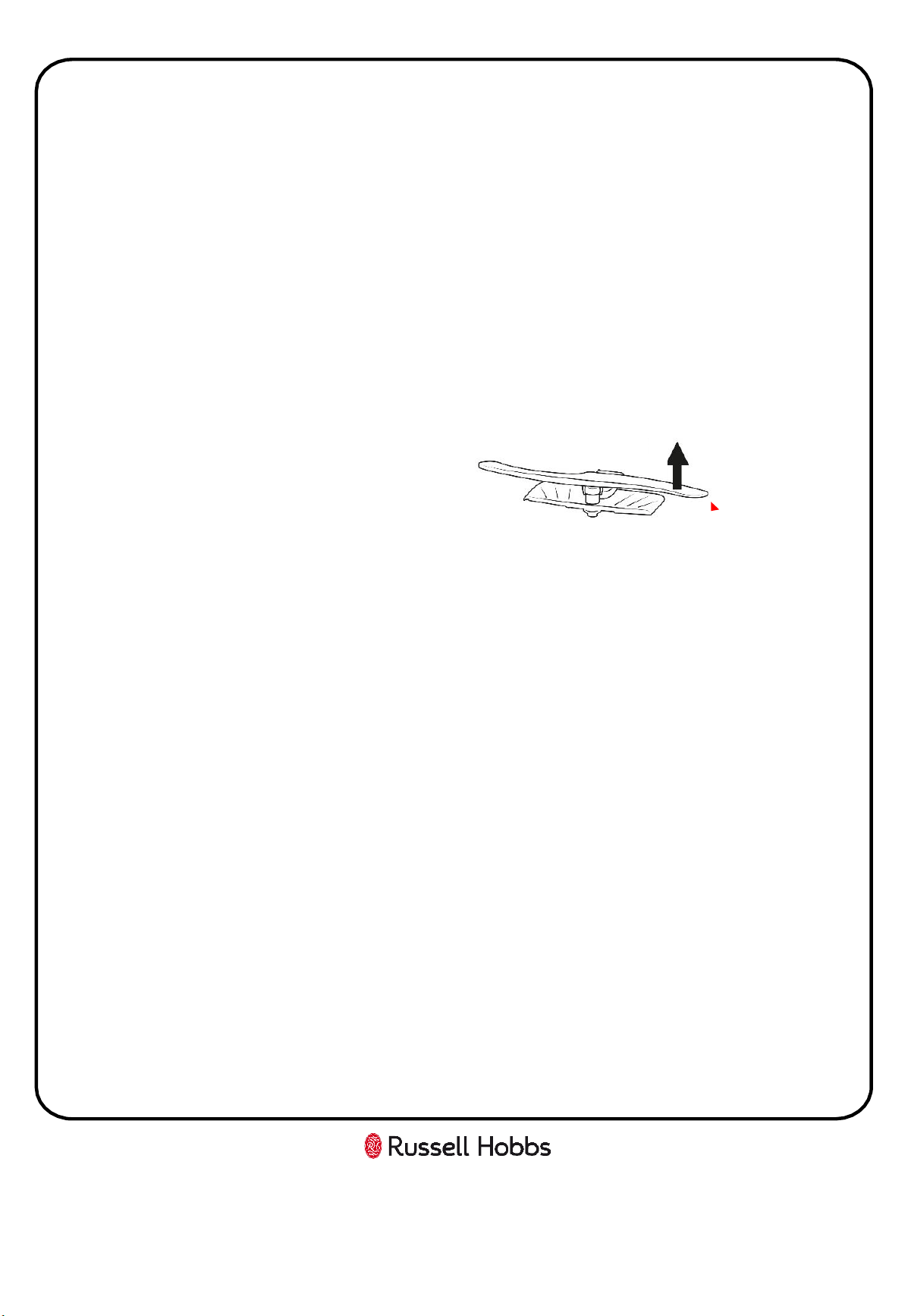
Never use a spray cleaner to clean the door panel as it may damage the door lock and
electrical components.
Abrasive agents or some paper towels should not be used because of the risk of scratching or
leaving spots on the stainless steel surface.
The control panel can be cleaned by using a lightly dampened cloth. After cleaning, make sure
to dry it thoroughly.
Never use sharp objects, scouring pads or harsh cleaners on any part of the dishwasher.
To clean the edge around the door, you should use only a soft warm, damp cloth. To avoid
penetration of water into the door lock and electrical components, do not use a spray cleaner
of any kind.
Protect Against Freezing
Important note:
If your dishwasher cannot work because of the ice, please contact professional service
persons.
You must take frost protection measures for the dishwasher in winter, if it is used in a cold
environment. Every time after washing cycles, please operate as follows
35
door lock and electrical components
Maintenance & Cleaning
1. Cut off the electrical power to the dishwasher.
2. Turn off the water supply and disconnect the water inlet pipe from the water valve.
3. Drain the water from the inlet pipe and water valve. (Use a bowl to catch the water)
4. Reconnect the water inlet pipe to the water valve.
5. Remove the filter at the bottom of the tub and use a sponge to soak up water in the sump
Cleaning the Spray Arms
It is necessary to clean the spray arm regularly for hard water chemicals, as these will clog the
spray arm jets and bearings.
Wash the arm in warm soapy water and use a soft cleaning brush to clean the jets. Replace it
after rinsing them thoroughly in clean water
How to Keep your Dishwasher in the Correct Condition
After Every Wash
After every wash, turn off the water supply to the appliance and leave the door slightly open so
that moisture and odours are not trapped inside.
Remove the Plug from the socket
Before cleaning or performing maintenance, always remove the plug from the socket.
.
36
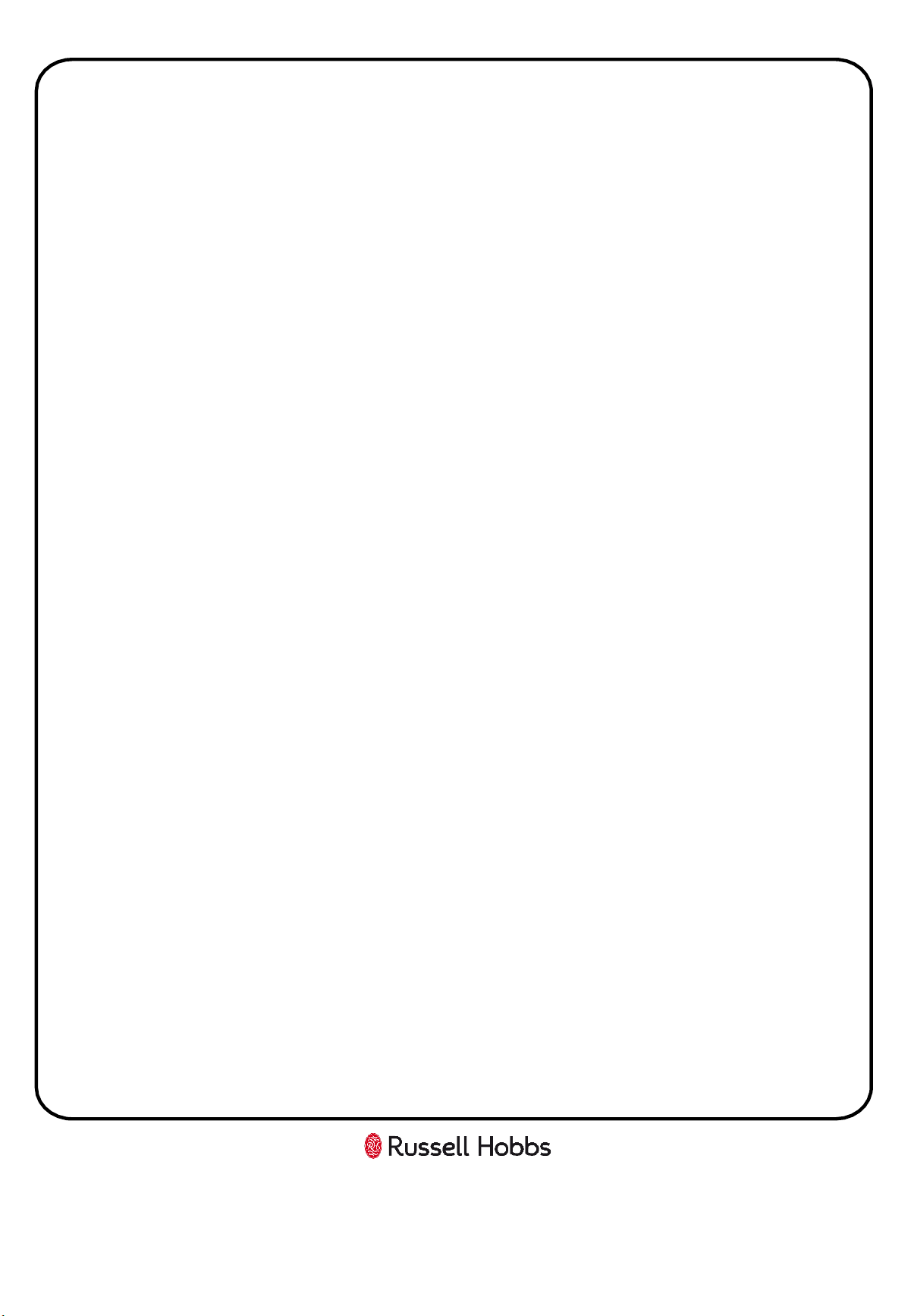
To remove the spray arm, pull the spray arm
upward.
Spray arm
Pull
37
Maintenance & Cleaning
No Solvents or Abrasive Cleaning
To clean the exterior and rubber parts of the dishwasher, do not use solvents or abrasive
cleaning products. Only use a cloth with warm soapy water.
To remove spots or stains from the surface of the interior, use a cloth dampened with water
and a little vinegar, or a cleaning product made specifically for dishwashers.
When not in use for a long time
It is recommend that you run a wash cycle with the dishwasher empty and then remove the
plug from the socket, turn off the water supply and leave the door of the appliance slightly
open. This will help the door seals to last longer and prevent odours from forming within the
appliance.
Moving the Appliance
If the appliance must be moved, try to keep it in the vertical position. If absolutely necessary,
it can be positioned on its back but cannot be left in this position.
Seals
One of the factors that cause odours to form in the dishwasher is food that remains food
debris and moisture in the seals. Periodic cleaning these with a damp sponge will prevent this
from occurring.
38
Trouble Shooting
Problem Causes Solution
Dishwasher
doesn't start
Power supply is not turned
on
Make sure the power cord is properly plugged
into the wall socket.
Make sure the dishwasher is turned on and the
door is closed securely.
Fuse blown, or the circuit
breaker acted
Replace fuse or reset circuit breaker. Remove
any other appliances sharing the same circuit
with the dishwasher
Water supply is not turned
on
Check that the water supply is connected
properly and
the water is turned on.
Water pressure is low
Check that the water pressure is within the
required level, please see water connection
section.
Door of dishwasher not
properly closed.
Make sure to close the door properly/full.
A fault has occurred
Switch of the appliance by pressing the ON/OFF
button , switch it back on after approximately
one minute and reset the program.
If this does not work unplug the appliance and
leave for 5 minutes, then put the plug back in
and turn on the appliance.
Water has not
drained for the
dishwasher
Wash program has not
finished
The wash program may not have finished, close
the door and wait for the wash program to
complete in full
Drain hose is bent
Check drain hose.
Filter clogged/blocked
Check all parts of the filter and clean if
necessary, please see filter section.
Drains clogged/blocked
Check the drains to make sure they are draining
well. If they aren't you will need to get them
unblocked and may need a plumber to do this. If
the dishwasher still won't drain then a service
engineer may be needed.
The dishwasher
does not take any
water
There is no water in the
mains supply
Check the water supply has not been cut off or
if there is a fault in your area.
Water inlet pipe is bent
Water inlet pipe.
Turn on the water tap and/or
vale
Turn on the water tap/valve and the appliance
will start after a few minutes.
39
Trouble Shooting
Problem Causes Solution
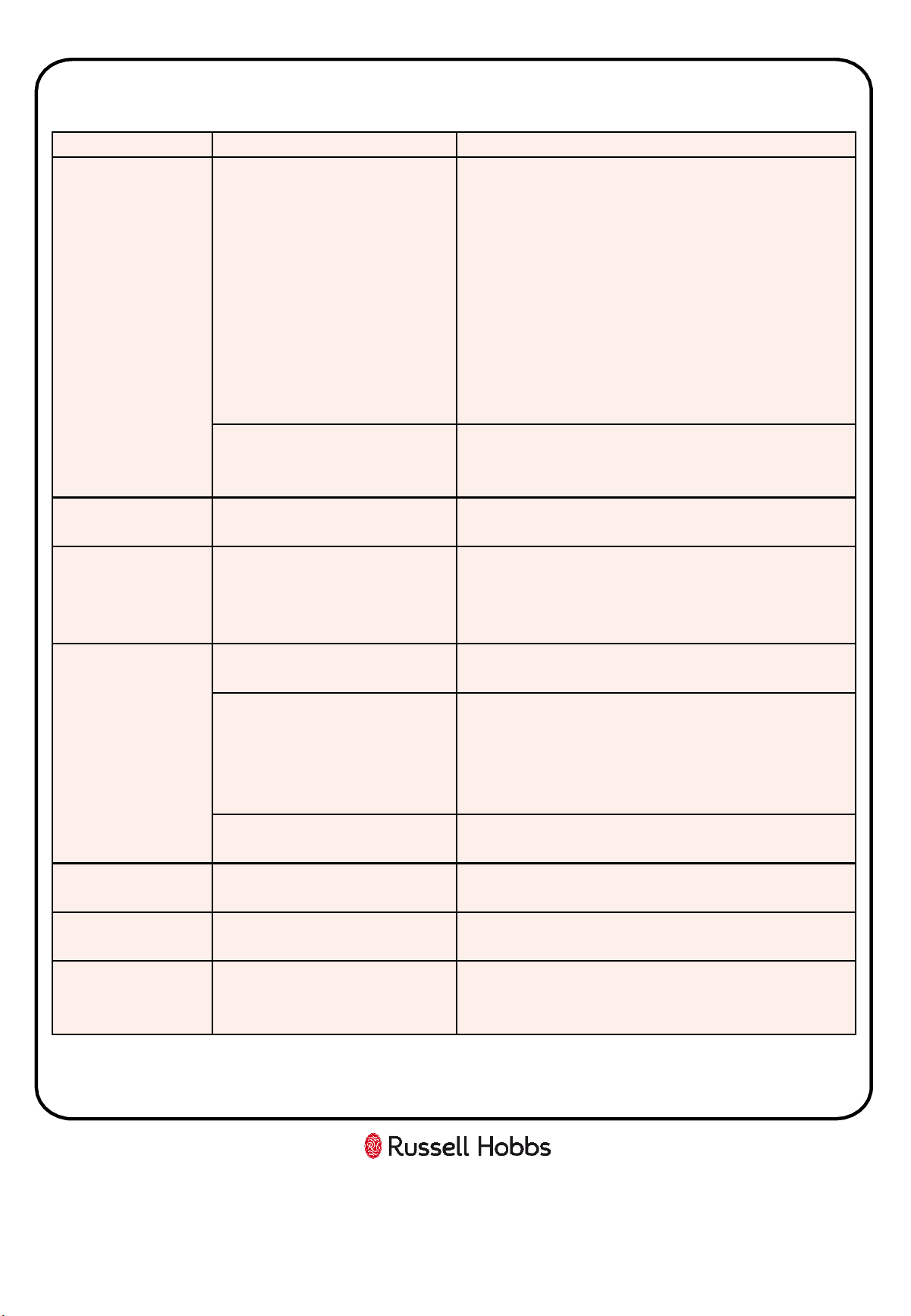
Suds in the tub
Improper detergent
Use only the dishwasher detergent to avoid
suds. If this occurs, open the dishwasher and let
suds evaporate. Pour 1 gallon of cold water to
the tub, then close the dishwasher and select
any cycle.
The first part of the cycle will see the
dishwasher drain out the water (you will be able
to hear this taking place). When the draining has
finished open the door and check if the suds is
disappeared. Repeat if necessary.
Spilled rinse
-aid
Always wipe up rinse
-aid spills immediately,
because if left in the tub then suds will be
produced.
Stained tub interior
Detergent with colourant was
used
Make sure that the detergent is the one without
colourant.
White film on
inside surface
Hard water minerals
To clean the interior, use a damp sponge with
dishwasher detergent and wear rubber gloves.
Never use any other cleaner than dishwasher
detergent for the risk of foaming or suds.
There are rust
stains on cutlery
The affected items are not
corrosion resistant
Purchase dishwasher safe cutlery or hand wash
the cutlery that isn't dishwasher safe
A program was not run after
dishwasher salt was added. If
this is done then traces of
salt will get into the wash
cycle and cause corrosion
Always run the quick wash program after adding
dishwasher salt without any crockery in the
dishwasher.
The lid of the water softener
is loose
Check the lid and ensure it is fitted correctly and
tight.
Knocking noise
in the wash cabinet
A spray arm is knocking
against an item in a basket
Interrupt the program, and rearrange the items
which are obstructing the spray arm.
Rattling noise in
the wash cabinet
Items of crockery are loose in
the wash cabinet
Interrupt the program, and rearrange the items
of crockery.
Knocking noise in
the water pipes
This may be caused by on
-
site installation or the cross-
section of the piping
This has no influence on the dishwasher
function, if in doubt, contact a suitably qualified
plumber.
40
Trouble Shooting
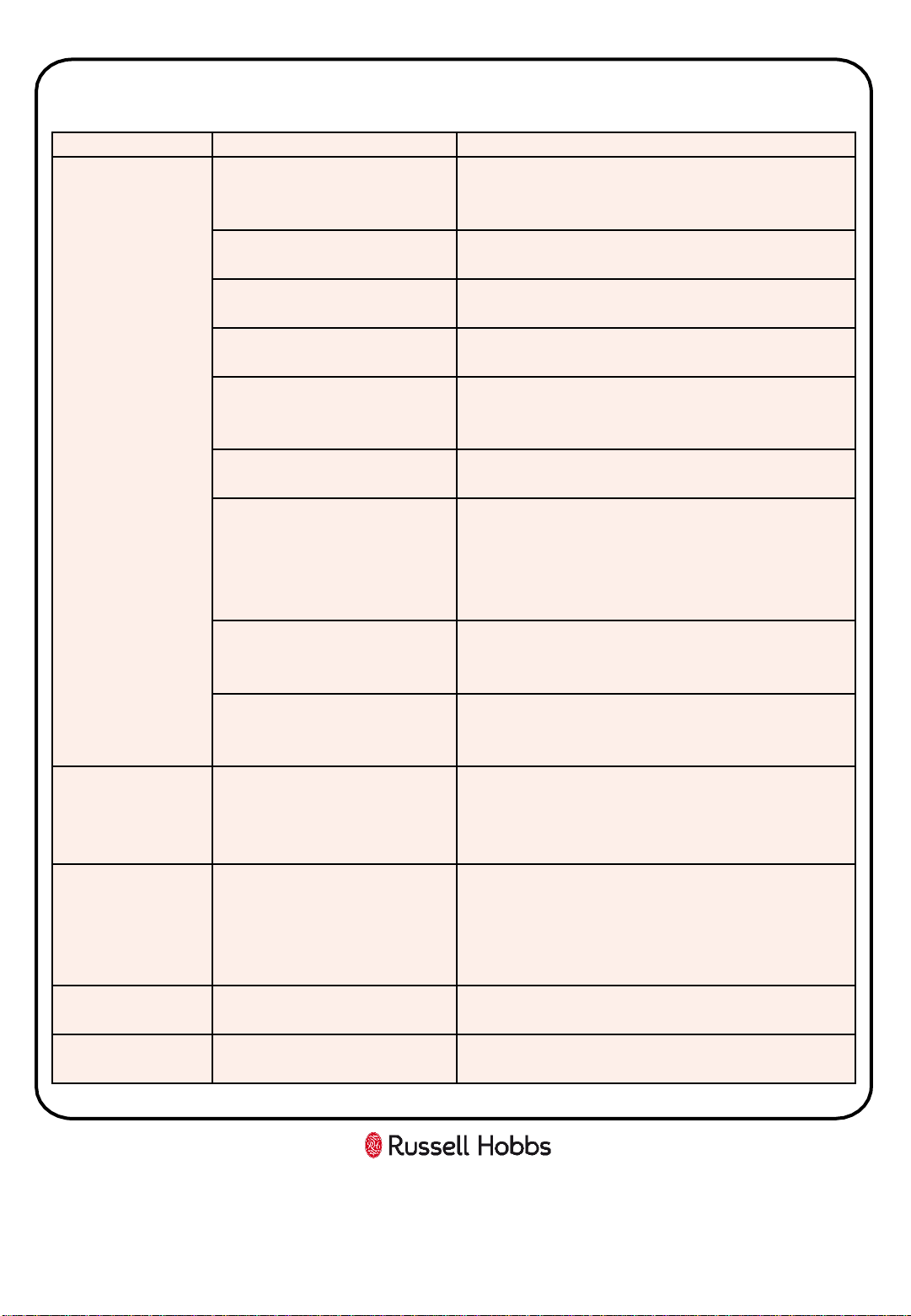
Problem Causes Solution
The dishes are not
clean
Dishwasher has been
overloaded
Arrange the dishes correctly or wash in 2
separately loads, please see the Loading the
Dishwasher section.
The dishes were not loaded
correctly
Arrange the dishes correct, please see the
Loading the Dishwasher section.
The program was not
powerful enough
Select a more intensive program, please see the
Wash Program section.
Not enough detergent was
dispensed.
Use more detergent, or change your detergent.
Too much detergent was
dispensed or the incorrect
detergent has been used
The detergent has not been measured out
correctly or it is not suitable for use in
dishwashers
Items are blocking the path
of spray arms
Re
-arrange the items so that the spray can
rotate freely.
The filter in the base of wash
cabinet is not clean or is not
correctly fitted. This may
cause the spray arm jets to
get blocked
Clean and/or fit the filter correctly.
Clean the spray arm jets, please see the
Cleaning the Spray Arms section
Insufficient dishwasher salt
and Rinse aid need to be
refilled
Dishwasher salt and Rinse
-aid need to be
refilled, please see the Dishwasher Salt and
Rinse Aid sections.
The lid on the rinse
-aid
dispenser was not shut
correctly
Shut correctly and re
-wash
The dishes and
glasses are
streaked or have a
bluish tinge
The rinse
-aid dosage is too
high.
Reduce the rinse
-aid dosage
Cloudiness on
glassware
Combination of soft water
and too much detergent
Use less detergent if you have soft water and/or
select a shortest cycle to wash the glassware
and to get them clean.
The Glass Wash program could be used.
Black or grey
marks on dishes
Aluminium utensils have
rubbed against dishes
Use a mild abrasive cleaner to eliminate those
marks.
Detergent left in
dispenser cups
Dishes block cups or cups
incorrectly loaded
Re
-loading the dishes properly.
41
Trouble Shooting
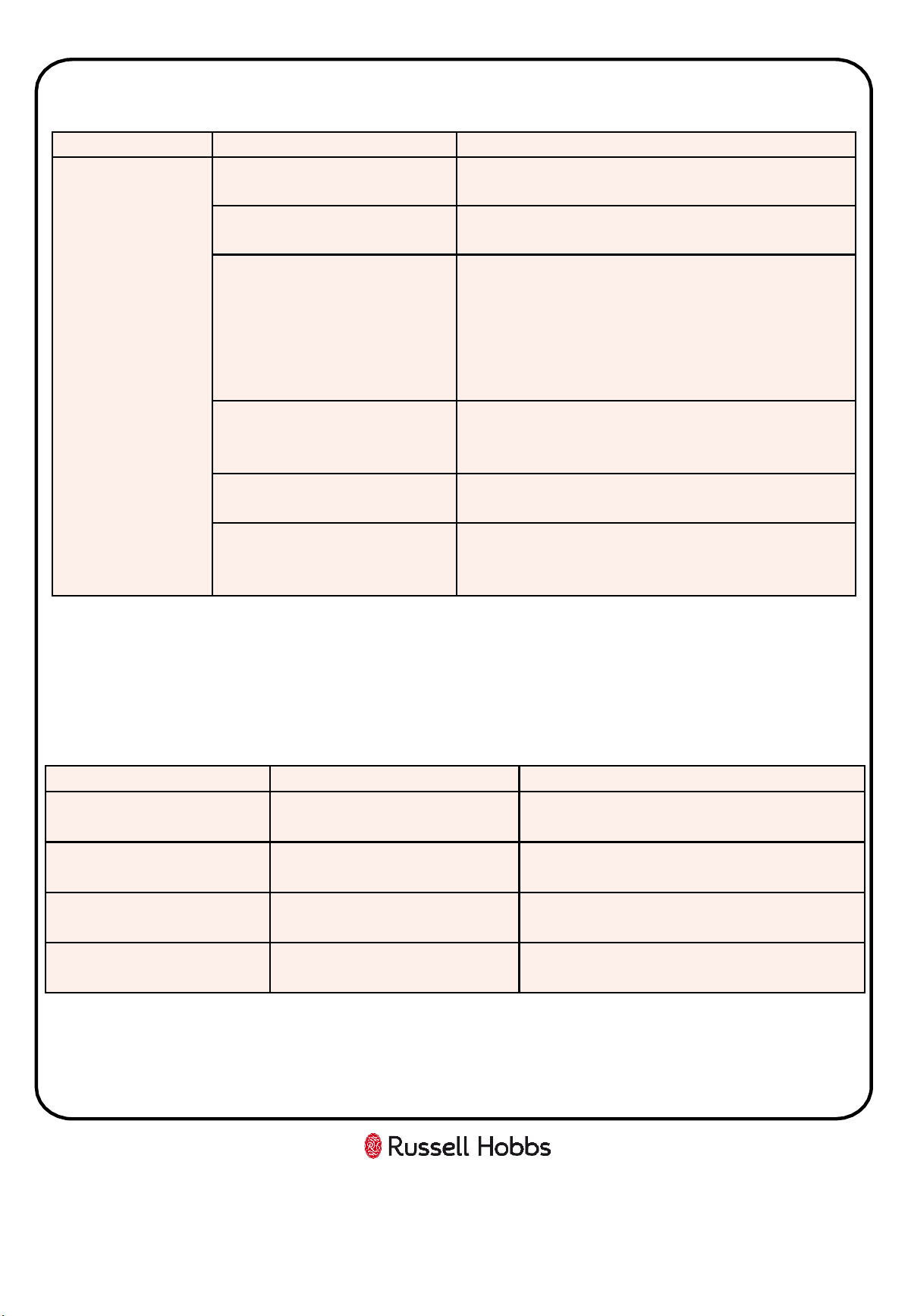
Error codes
Note: If overflow occurs, turn off the main water supply before calling a service engineer. If
there is water in the base of the tub because of an overfill or small leak, the water should
be removed before restarting the dishwasher.
Problem Causes Solution
The dishes are not
drying
Improper loading
Load the dishwasher as suggested in the
directions.
Too little Rinse
-aid
Increase the amount of rinse
-aid and/or refill
the rinse
-aid dispenser.
Dishes are removed too soon
Do not empty your dishwasher immediately
after washing cycle has ended. Open the door
slightly so that the steam can escape.
Only begin unloading the dishwasher when the
dishes are cool to the touch.
Wrong program has been
selected or a program
without a drying cycle
In short programs the drying time is shorter or
the program won't have a drying cycle at all.
Choose a program with a long washing time.
The crockery is made from
non
-stick material or plastic
Remove from dishwasher and leave to dry or
dry with a dish cloth.
Use of cutlery with a low
-
quality coating
Water drainage is more difficult with these
items. Cutlery or dishes of this type are not
suitable for washing in the dishwasher.
Error codes Meanings Possible causes
E1
Water inlet problem/fault
Water intake is restricted or water
pressure is too low
E3
Not reaching required
temperature
Heating element fault
E4
Overflow
The dishwasher is leaking
Ed
PCB fault
Software or PCB board fault

42
WARNING- THIS APPLIANCE MUST BE EARTHED
This appliance is designed to operate from a mains supply of AC220V - 240V; 50Hz.
Check that the voltage marked on the product corresponds with your supply voltage.
For UK use only – Plug fitting details (where applicable):
As the colours of the wires in the mains lead of this appliance may not correspond
with the coloured markings identifying the terminals in your plug, proceed as follows:
The GREEN/YELLOW wire is the EARTH and must be connected to the terminal which
is marked with the letter E or by the earth symbol or coloured GREEN or
GREEN/YELLOW.
The BLUE wire is the NEUTRAL and must be connected to
the terminal marked with the letter N or coloured BLACK.
The BROWN wire is the LIVE wire and must be connected
to the terminal marked with the letter L or coloured RED.
Always ensure that the plug cord grip is fastened correctly.
If a 13A (BS1363) fused plug is used it must be fitted with a 13amp fuse conforming to
BS1362 and be BSI or ASTA approved.
Connection to the Mains Supply
43
Guarantee
This product is guaranteed for 12 months from the date of the original
purchase. If any defect arises due to faulty materials or workmanship you
must contact Customer Services with the original proof of purchase so a
replacement or refund can be arranged.
Refund or replacement is at the discretion of Customer Services.
The following conditions apply:
• Customer Services will require a valid proof of purchase at the point of
replacement or refund.
• The product must be installed and used in accordance with the
instructions contained in this instruction guide and any other
instructions for use which has been supplied.
• It must be used for domestic purposes only and for its intended use.
• This guarantee does not cover wear and tear, damage, misuse or
consumable parts.
This does not affect your statutory rights.
44
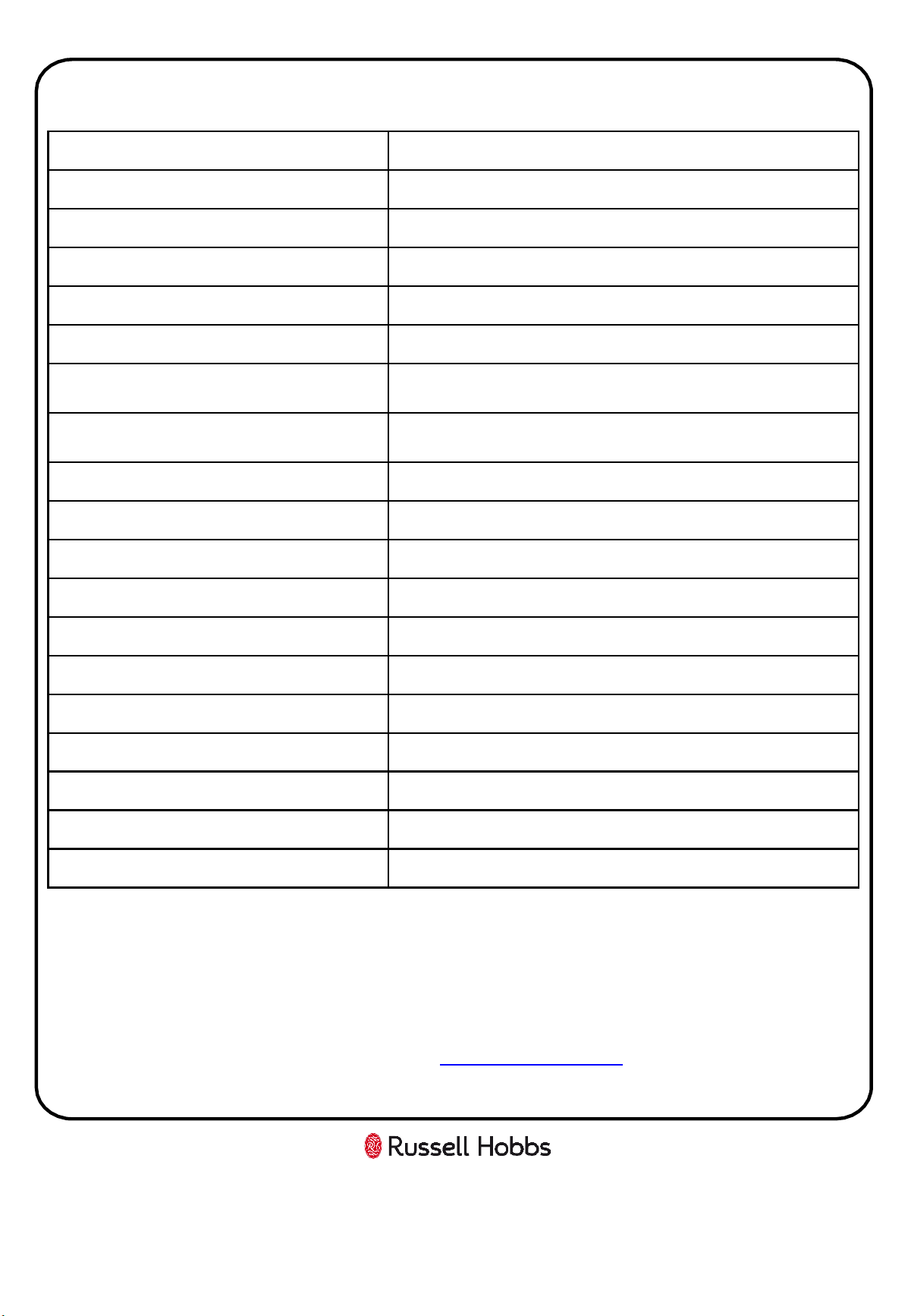
Technical Specification
Model number RHTTDW6 (W) (B) (S)
Rated Voltage 220V – 240V ~ 50Hz
Capacity 6 place settings
External Dimensions(HxWxD) 438mm x 550mm x 500mm
45
Product Fiche
Model
RHTTDW6W/B/S
Rated capacity (number of place settings)*
6
Energy efficiency Index*
61.9
Energy efficiency class*
F**
Cleaning performance index*
1,13
Drying performance index*
1,07
Energy consumption in kWh [per cycle], based on the eco
programme using cold water fill. Actual energy consumption
will depend on how the appliance is used.
0,613
Water consumption in litres [per cycle], based on the eco
program. Actual water consumption will depend on how
the appliance is used and on the hardness of the water.
6.5
Program duration* (
h:min)
3:50
Airborne acoustical noise emissions* (dB(A) re 1
pW)
52
Off
-mode (W)
0.49
Delay start (W) (if applicable)
1,00
Type
Freestanding
Airborne acoustical noise emission class*
D**
Standby mode (W)
N/A
Networked standby (W) (if applicable)
N/A
Water pressure (flow pressure)
0.04-1.0 MPa = 0.4 – 10 bar
Rated
input / frequency
220V-240V ~ 50Hz
Product Dimensions
CMs (H x W x D)
(H)43.8 x (W)55 x (D)50
*for the eco program.
**if the product database automatically generates the definitive content of this cell the supplier shall not enter these data.
• Commission Regulation (EU) 2019/2022 of 1 October 2019 laying down eco design requirements for household dishwashers pursuant to
Directive 2009/125/EC of the European Parliament and of the Council amending Commission Regulation (EC) No 1275/2008 and repealing
Commission Regulation (EU) No 1016/2010 (see page 267 of this Official Journal).
For Customer Services, product Information, instruction manuals, spare Parts and service
manuals please call 0345 208 8750 or visit us at mda.russellhobbs.com
46
Notes
47
Notes
The ‘wheelie bin’ symbol is known as the 'Crossed-out wheelie bin Symbol'.
When this symbol is marked on a product/batteries, it means that the
product/batteries should not be disposed of with your general household
waste. Only discard electrical/electronic/battery items in separate collection
schemes, which cater for the recovery and recycling of materials contained
within. Your co-operation is vital to ensure the success of these schemes
and for the protection of the environment. For your nearest disposal facility,
visit www.recycle-more.co.uk or ask in store for details.
SEDEX – Connecting businesses and their global suppliers to share ethical
data and enabling improvement in ethical performance. Visit
www.sedex.org.uk for further information.
We reserve the right, due to possible changes to design, to alter the
instruction manual without prior notice.
Revision 5.4
Russell Hobbs is a registered trademark used under license from
Spectrum Brands (UK) Ltd. Made under license by Product Care
Trading Limited, Wigan, WN2 4AY/ PCT (NI) Ltd, Belfast, BT5 5AD
Russell Hobbs Support: call 0345 208 8750 or visit:
mda.russellhobbs.com