Owner's Manual
®
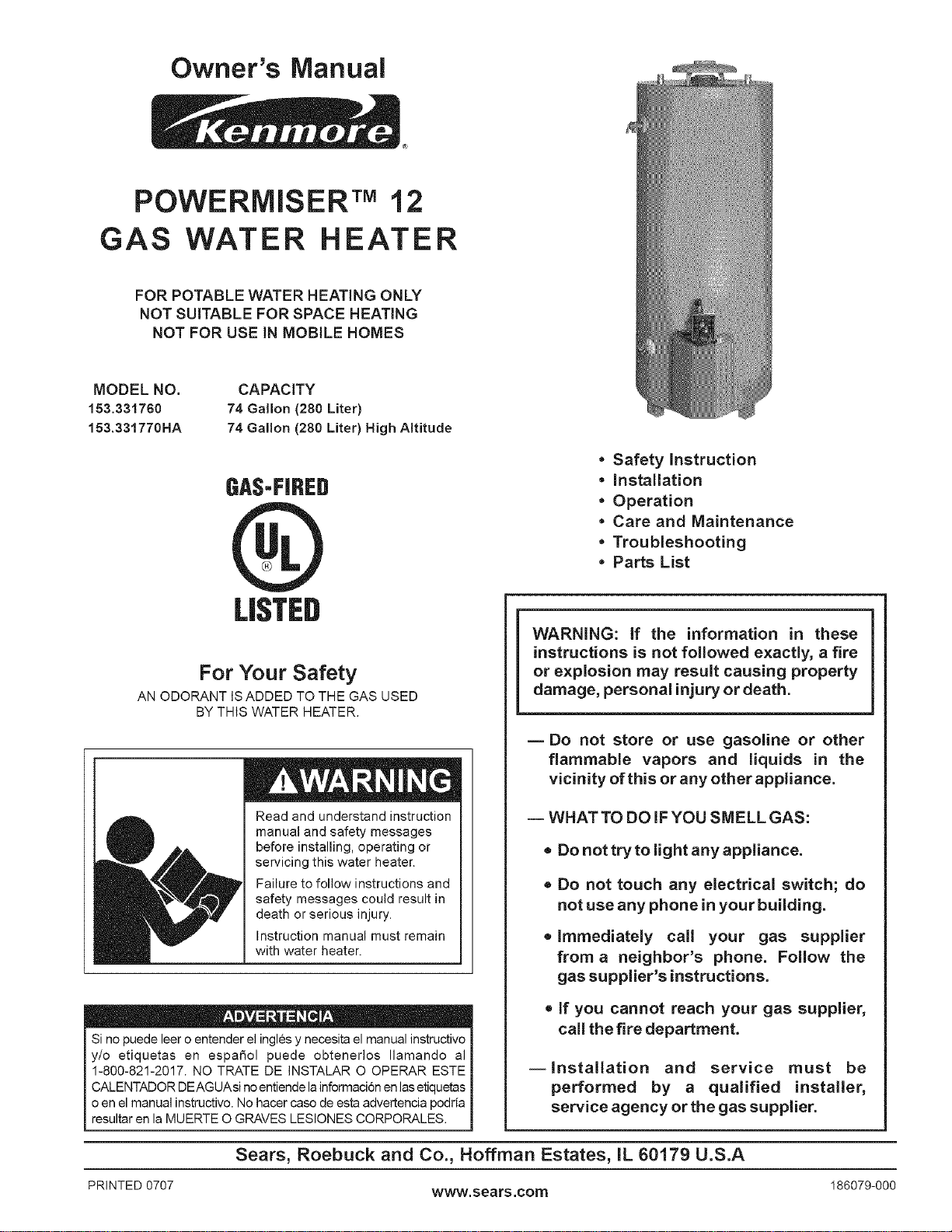
POWERMISER TM12
GAS WATER HEATER
FOR POTABLE WATER HEATING ONLY
NOT SUITABLE FOR SPACE HEATING
NOT FOR USE IN MOBILE HOMES
MODEL NO.
153.331760
153.331770HA
CAPACITY
74 Gallon (280 Liter)
74 Gallon (280 Liter) High Altitude
GAS-FIRED
LISTED
* Safety Instruction
* Installation
* Operation
* Care and Maintenance
* Troubleshooting
* Parts List
For Your Safety
AN ODORANT IS ADDED TO THE GAS USED
BY THIS WATER HEATER.
Read and understand instruction
manual and safety messages
before installing, operating or
servicing this water heater.
Failure to follow instructions and
safety messages could result in
death or serious injury.
Instruction manual must remain
with water heater.
Si no puede leer o entender el ingles y necesita el manual instructivo
y/o etiquetas en espar_ol puede obtenerlos Ilamando al
1-800-821-2017. NO TRATE DE INSTALAR O OPERAR ESTE
CALENTADOR DEAGUAsi no entiende la informacion en las etiquetas
o en el manual instructivo. No hacer caso de esta advertencia podria
resultar en la MUERTE O GRAVES LESIONES CORPORALES.
WARNING: if the information in these
instructions is not followed exactly, a fire
or explosion may result causing property
damage, personal injury or death.
--Do not store or use gasoline or other
flammable vapors and liquids in the
vicinity of this or any other appliance.
-- WHAT TO DO iF YOU SMELL GAS:
e Do not try to light any appliance.
= Do not touch any electrical switch; do
not use any phone in your building.
e immediately call your gas supplier
from a neighbor's phone. Follow the
gas suppiier's instructions.
= if you cannot reach your gas supplier,
call the fire department.
--installation and service must be
performed by a qualified installer,
service agency orthe gas supplier.
Sears, Roebuck and Co., Hoffman Estates, IL 60179 U.S.A
www.seats.com
PRINTED 0707 I86079-000
Yoursafetyandthesafetyofothersis extremely important in the installation, use and servicing of this water heater.
Many safety-related messages and instructions have been provided in this manual and on your own water heater to warn you and
others of a potential injury hazard. Read and obey all safety messages and instructions throughout this manual. It is very important
that the meaning of each safety message is understood by you and others who install, use or service this water heater.
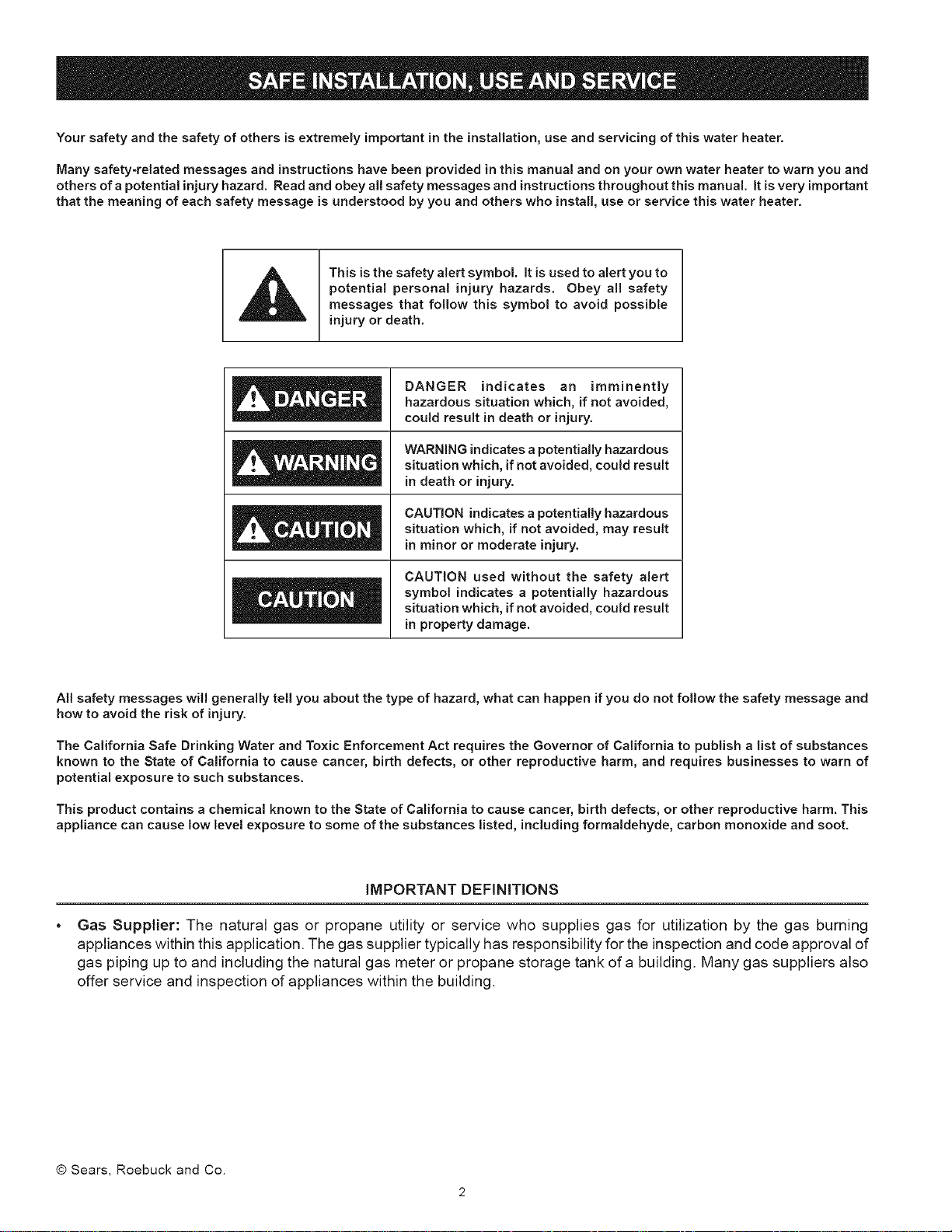
This is the safety alert symbol. It is used to alert you to
potential personal injury hazards. Obey all safety
messages that follow this symbol to avoid _ossible
injury or death.
DANGER indicates an irnrninently
hazardous situation which, if not avoided,
could result in death or injury.
WARNING indicates a potentially hazardous
situation which, if not avoided, coutd result
in death or injury.
CAUTION indicates a potentially hazardous
situation which, if not avoided, may resutt
in minor or moderate injury.
CAUTION used without the safety alert
symbol indicates a potentially hazardous
situation which, if not avoided, coutd result
in property damage.
All safety messages will generally tetl you about the type of hazard, what can happen if you do not follow the safety message and
how to avoid the risk of injury.
The California Safe Drinking Water and Toxic Enforcement Act requires the Governor of California to publish a list of substances
known to the State of California to cause cancer, birth defects, or other reproductive harm, and requires businesses to warn of
potential exposure to such substances.
This product contains a chemical known to the State of California to cause cancer, birth defects, or other reproductive harm. This
appliance can cause low level exposure to some of the substances listed, including formaldehyde, carbon monoxide and soot.
IMPORTANT DEFINITIONS
Gas Supplier: The natural gas or propane utility or service who supplies gas for utilization by the gas burning
appliances within this application, The gas supplier typically has responsibility for the inspection and code approval of
gas piping up to and including the natural gas meter or propane storage tank of a building, Many gas suppliers also
offer service and inspection of appliances within the building,
© Sears, Roebuck and Co.
manualandsafetymessages
beforeinstalling,operatingor
servicingthiswaterheater.
Failuretofollowinstructionsand
safetymessagescouldresultin
deathorseriousinjury.
Instructionmanualmustremain
withwaterheater.
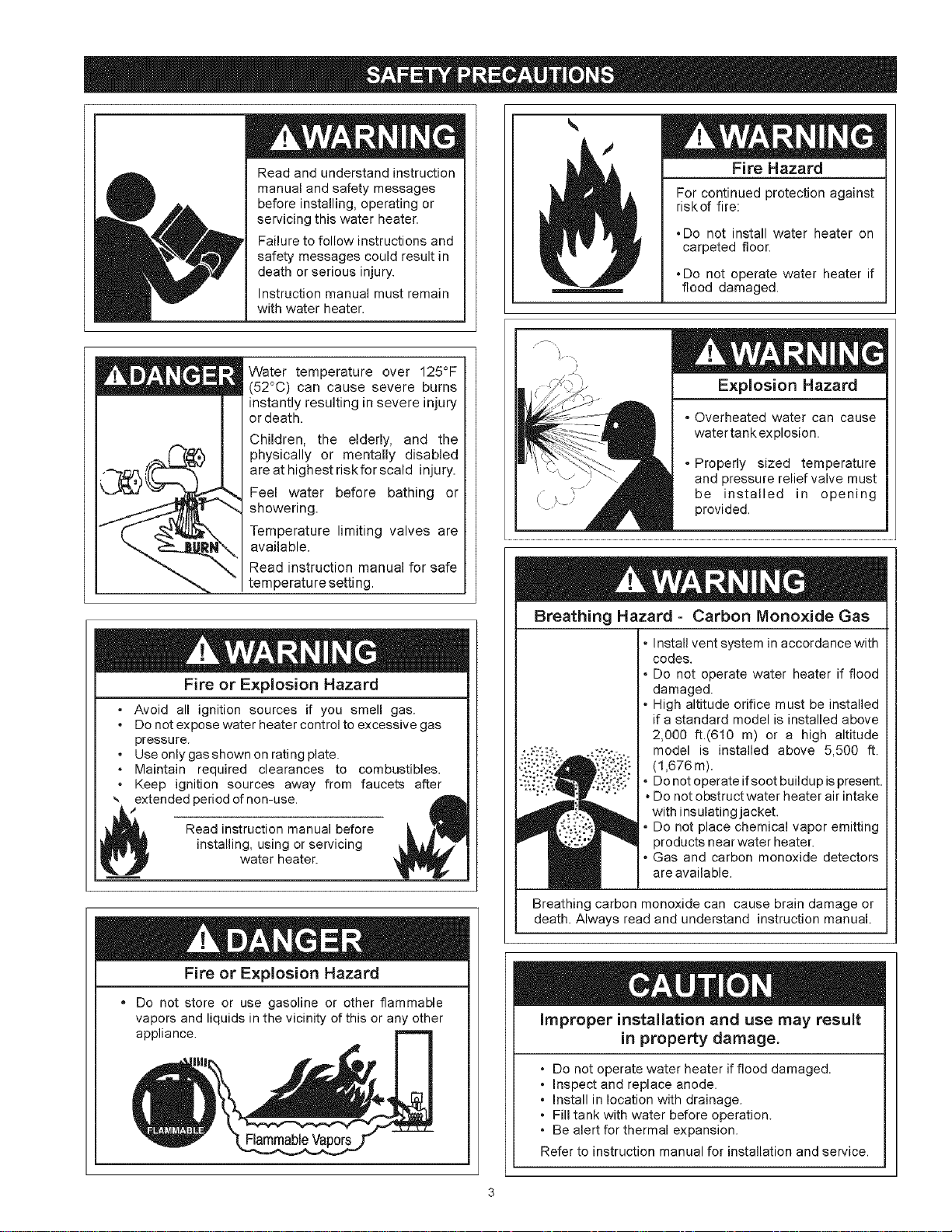
Fire Hazard
For continued protectionagainst
riskof fire:
° Do not install water heater on
carpeted floor.
, Do not operate water heater if
flood damaged.
Water temperature over 125°F
(52°0) can cause severe burns
instantly resulting in severe injury
or death.
Children, the elderly, and the
physically or mentally disabled
are at highest riskfor scald injury.
Feel water before bathing or
showering.
Temperature limiting valves are
available.
Read instruction manual for safe
temperature setting.
Fire or Explosion Hazard
. Avoid all ignition sources if you smell gas.
• Do not expose water heater control to excessive gas
pressure.
• Use only gas shown on rating plate.
• Maintain required clearances to combustibles.
• Keep ignition sources away from faucets after
', extended period of non-use.
/
Read instruction manual before
installing, using or servicing
water heater.
Fire or Explosion Hazard
o Do not store or use gasoline or other flammable
vapors and liquids in the vicinity of this or any other
appliance.
Explosion Hazard
- Overheated water can cause
water tankexplosion.
oProperly sized temperature
and pressure relief valve must
be installed in opening
provided.
Breathing Hazard - Carbon Monoxide Gas
Install vent system in accordance with
codes.
Do not operate water heater if flood
damaged.
High altitude orifice must be installed
if a standard model is installed above
2,000 ft.(610 m) or a high altitude
model is installed above 5,500 ft.
(1,676m).
Do not operate if soot buildup is present.
.Do not obstruct water heater air intake
with insulating jacket.
Do not place chemical vapor emitting
products near water heater.
Gas and carbon monoxide detectors
are available.
Breathing carbon monoxide can cause brain damage or
death. Always read and understand instruction manual.
improper installation and use may result
in property damage.
• Do not operate water heater if flood damaged.
• Inspect and replace anode.
• Install in location with drainage.
• Fill tank with water before operation.
• Be alert for thermal expansion.
Refer to instruction manual for installation and service.
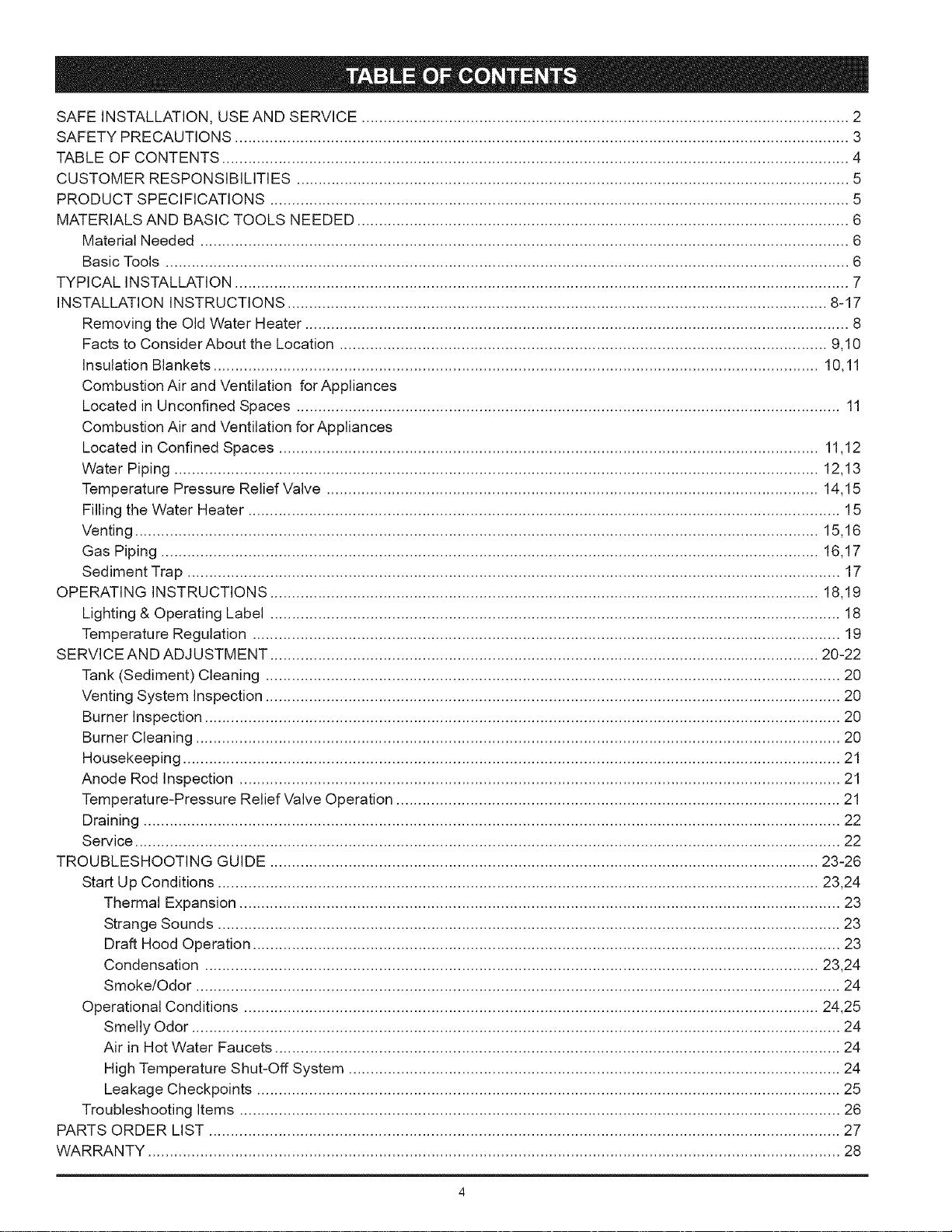
SAFE INSTALLATION, USE AND SERVICE ................................................................................................................ 2
SAFETY PRECAUTIONS ............................................................................................................................................. 3
TABLE OF CONTENTS ................................................................................................................................................ 4
CUSTOMER RESPONSIBILITIES ............................................................................................................................... 5
PRODUCT SPECIFICATIONS ..................................................................................................................................... 5
MATERIALS AND BASIC TOOLS NEEDED ................................................................................................................. 6
Material Needed ..................................................................................................................................................... 6
Basic Tools ............................................................................................................................................................. 6
TYPICAL INSTALLATION ............................................................................................................................................. 7
INSTALLATION INSTRUCTIONS ............................................................................................................................ 8-17
Removing the Old Water Heater ............................................................................................................................. 8
Facts to ConsiderAbout the Location ................................................................................................................ 9,10
Insulation Blankets ........................................................................................................................................... 10,11
Combustion Air and Ventilation forAppliances
Located in Unconfined Spaces ............................................................................................................................. 11
Combustion Air and Ventilation forAppliances
Located in Confined Spaces ............................................................................................................................ 11,12
Water Piping .................................................................................................................................................... 12,13
Temperature Pressure Relief Valve ................................................................................................................. 14,15
Filling the Water Heater ........................................................................................................................................ 15
Venting ............................................................................................................................................................. 15,16
Gas Piping ....................................................................................................................................................... 16,17
Sediment Trap ...................................................................................................................................................... 17
OPERATING INSTRUCTIONS .............................................................................................................................. 18,19
Lighting & Operating Label ................................................................................................................................... 18
Temperature Regulation ....................................................................................................................................... 19
SERVICE AND ADJUSTMENT .............................................................................................................................. 20-22
Tank (Sediment) Cleaning .................................................................................................................................... 20
Venting System Inspection .................................................................................................................................... 20
Burner Inspection .................................................................................................................................................. 20
Burner Cleaning .................................................................................................................................................... 20
Housekeeping ....................................................................................................................................................... 21
Anode Rod Inspection .......................................................................................................................................... 21
Temperature-Pressure Relief Valve Operation ...................................................................................................... 21
Draining ................................................................................................................................................................ 22
Service .................................................................................................................................................................. 22
TROUBLESHOOTING GUIDE .............................................................................................................................. 23-26
Start Up Conditions .......................................................................................................................................... 23,24
Thermal Expansion .......................................................................................................................................... 23
Strange Sounds ............................................................................................................................................... 23
Draft Hood Operation ....................................................................................................................................... 23
Condensation ............................................................................................................................................. 23,24
Smoke/Odor .................................................................................................................................................... 24
Operational Conditions .................................................................................................................................... 24,25
Smelly Odor ..................................................................................................................................................... 24
Air in Hot Water Faucets .................................................................................................................................. 24
High Temperature Shut-Off System ................................................................................................................. 24
Leakage Checkpoints ...................................................................................................................................... 25
Troubleshooting Items .......................................................................................................................................... 26
PARTS ORDER LIST ................................................................................................................................................. 27
WARRANTY ............................................................................................................................................................... 28
Thank You for purchasing a Kenmore water heater. Properly
installed and maintained, it should give you years of trouble free
service. If you should decide that you want the new water heater
professionally installed by Sears call 1-800-4-MY-HOME_L They
will arrange for prompt, quality installation by Sears authorized
contractors.
Abbreviations Found In This instruction Manual:
UL- Underwriter's Laboratories
CSA - Canadian Standards Association
ANSI -American National Standards Institute
NFPA - National Fire Protection Association
ASME - American Society of Mechanical Engineers
GAMA - Gas Appliance Manufacturers Association
EPACT- Energy Policy Act
This gas-fired water heater is design certified by UL
Underwriter's Laboratories underAmerican National Standard/
CSA Standard for Gas Water Heaters ANSI Z21.10.3 • CSA
4.3 (current edition).
Read the "Safety Precautions" section, page 3 of this manual
first and then the entire manual carefully. If you don't follow
the safety rules, the water heater will not operate properly. It
could cause DEATH, SERIOUS BODILY INJURY AND/OR
PROPERTY DAMAGE.
This manual contains instructions for the installation, operation,
and maintenance of the gas-fired water heater. It also contains
warnings through out the manual that you must read and be
aware of. All warnings and all instructions are essential to the
proper operation of the water heater and your safety. Since
we cannot put everything on the first few pages, READ THE
ENTIRE MANUAL BEFORE ATTEMPTING TO iNSTALL OR
OPERATE THE WATER HEATER.
The installation must conform with these instructions and the
local code authority having jurisdiction. In the absence of local
codes, installations shall comply with the current edition of
The National Fuel Gas Code ANSI Z223.1/NFPA 54. This
publication is available from the Canadian Standards
Association, 8501 East Pleasant Valley Rd, Cleveland Ohio
44131, or The National Fire Protection Association, 1
Batterymarch Park, Quincy, MA 02269.
If after reading this manual you have any questions or do not
understand any portion of the instructions, call the Sears
Service Center.
Carefully plan the place where you are going to put the water
heater. Correct combustion, vent action, and vent pipe
installation are very important in preventing death from
possible carbon monoxide poisoning and fires. See
figures 1 and 8 through 14.
Examine the location to ensure the water heater complies
with the Facts to Consider About the Location section in this
manual.
For California installation this water heater must be braced,
anchored, or strapped to avoid falling or moving during an
earthquake. See instructions for correct installation
procedures. Instructions may be obtained from your local
dealer, wholesaler, public utilities or California Office of the
State Architect, 400 P Street, Sacramento, CA 95814.
Massachusetts Code requires this water heater to be installed
in accordance with Massachusetts 248-CMR 2.00: State
Plumbing Code and 248-CMR 5.00.
Complies with SCAQMD rule #1146.2 and districts having
equivalent NOx requirements.
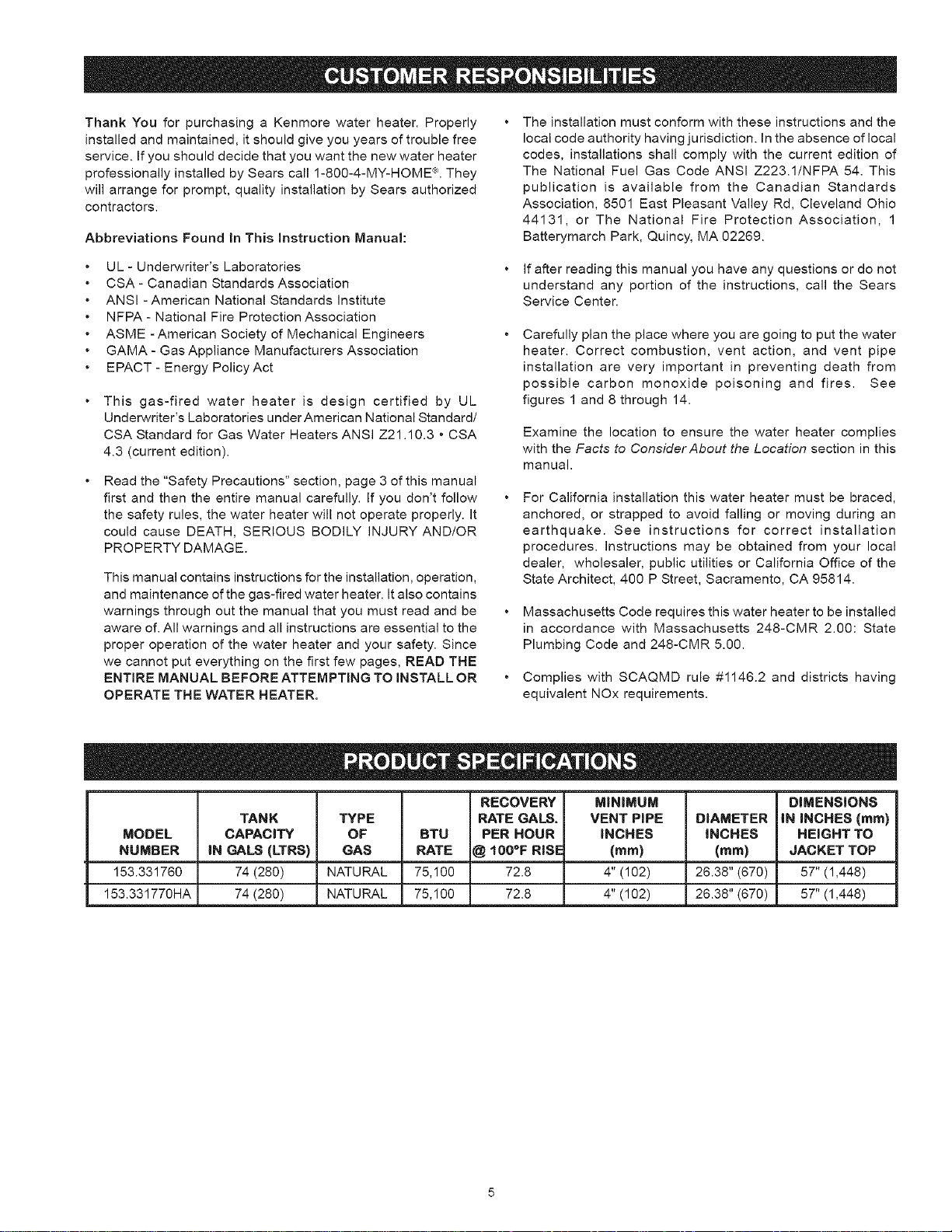
RECOVERY MiNiMUM DiMENSiONS
TANK TYPE RATE GALS. VENT PiPE DIAMETER iN iNCHES (ram)
MODEL CAPACITY OF BTU PER HOUR iNCHES iNCHES HEIGHT TO
NUMBER iN _LS (LTRS) GAS RATE @ 100°F RiSE (ram) (ram) JACKET TOP
153.331760 74 (280) NATURAL 75,100 72.8 4" (102) 26.38" (670) 57" (1,448)
153.331770HA 74 (280) NATURAL 75,100 72.8 4" (102) 26.38" (670) 57" (1,448)
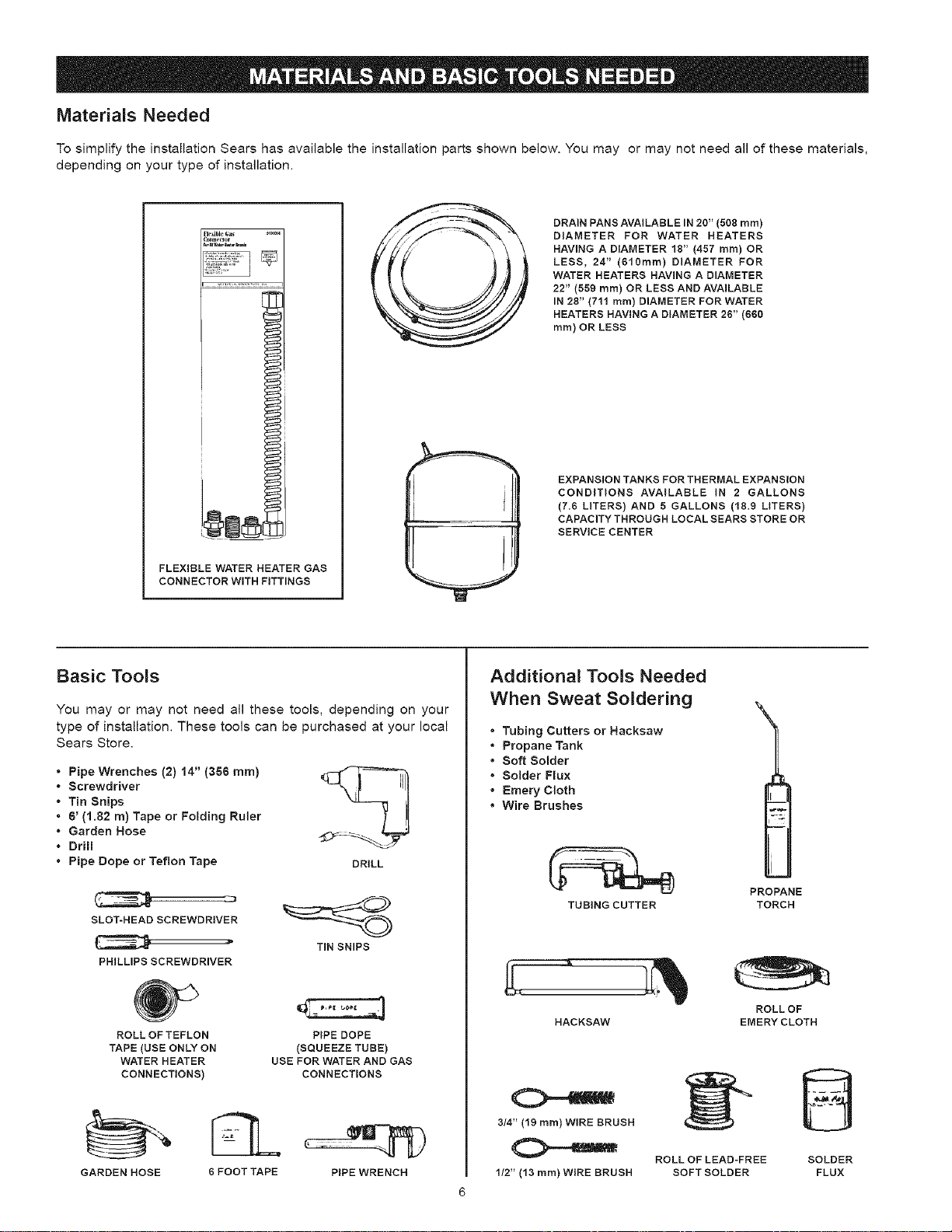
Materials Needed
To simplify the installation Sears has available the installation parts shown below, You may or may not need all of these materials,
depending on your type of installation.
DRAIN PANS AVAILABLE IN 20" (508 ram)
DIAMETER FOR WATER HEATERS
HAVING A DIAMETER 18" (457 mm) OR
LESS, 24" (610mm) DIAMETER FOR
WATER HEATERS HAVING A DIAMETER
22" (559 mm) OR LESS AND AVAILABLE
IN 28" (711 ram) DIAMETER FOR WATER
HEATERS HAVING A DIAMETER 26" (660
mm) OR LESS
FLEXIBLE WATER HEATER GAS
CONNECTOR WiTH FITTINGS
EXPANSION TANKS FOR THERMAL EXPANSION
CONDITIONS AVAILABLE IN 2 GALLONS
(7.8 LITERS) AND 5 GALLONS (18.9 LITERS)
CAPACITY THROUGH LOCAL SEARS STORE OR
SERVICE CENTER
Basic Tools
You may or may not need all these tools, depending on your
type of installation. These tools can be purchased at your local
Sears Store.
Pipe Wrenches (2) 14" (356 mm)
Screwdriver
Tin Snips
6' (1.82 m) Tape or Folding Ruler
Garden Hose
Drill
Pipe Dope or Teflon Tape DRILL
SLOT-HEAD SCREWDRIVER
PHILLIPS SCREWDRIVER
ROLL OF TEFLON
TAPE (USE ONLY ON
WATER HEATER
CONNECTIONS)
TIN SNIPS
PiPE DOPE
(SQUEEZE TUBE)
USE FOR WATERAND GAS
CONNECTIONS
GARDEN HOSE 6 FOOT TAPE PIPE WRENCH
Additional Tools Needed
When Sweat Soldering
Tubing Cutters or Hacksaw
Propane Tank
Soft Solder
Solder Flux
Emery Cloth
Wire Brushes
TUBING CUTTER
PROPANE
TORCH
HACKSAW
ROLL OF
EMERY CLOTH
3/4" (19 ram) WiRE BRUSH
1/2" (13 ram) WiRE BRUSH
ROLL OF LEAD-FREE
SOFT SOLDER
SOLDER
FLUX
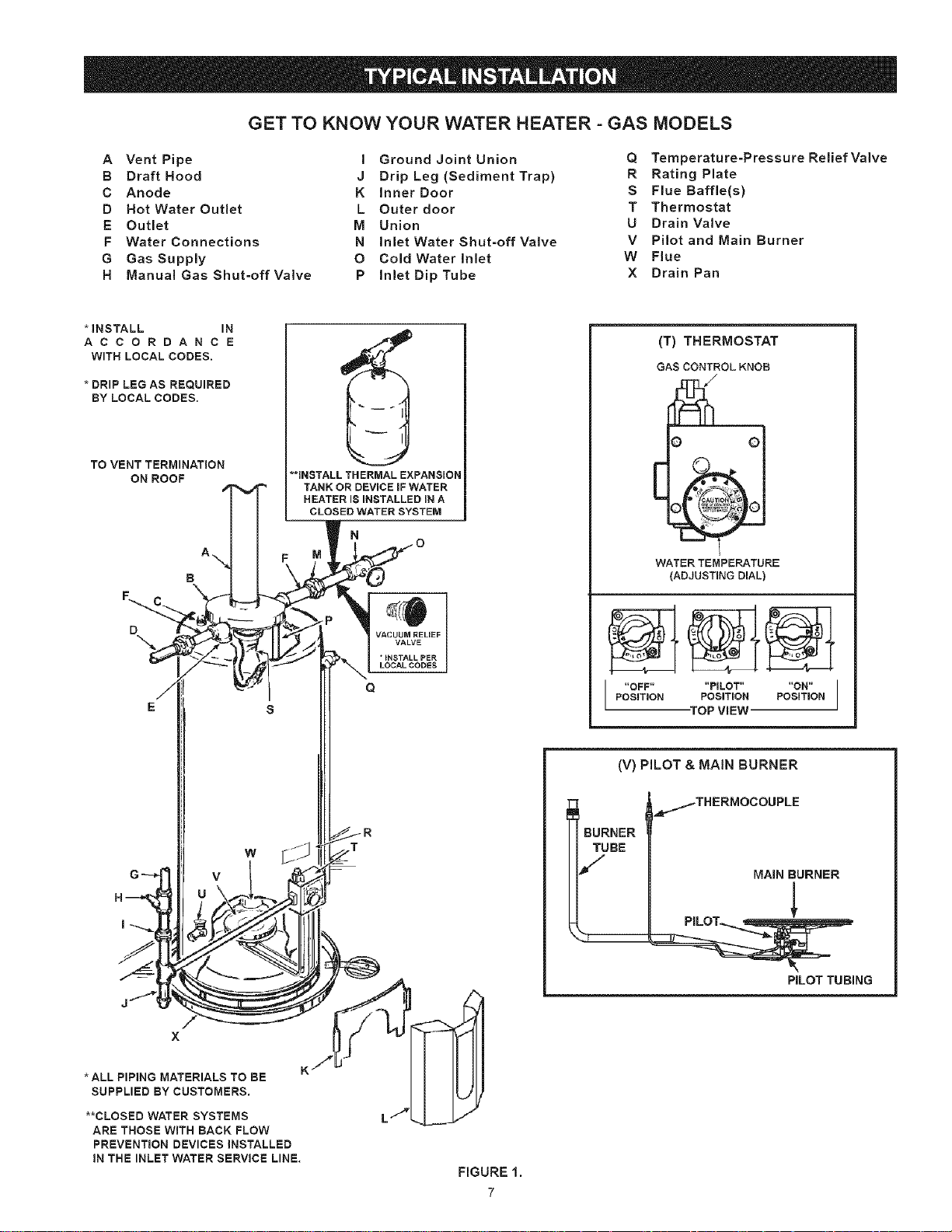
GET TO KNOW YOUR WATER HEATER - GAS MODELS
A Vent Pipe
B Draft Hood
C Anode
D Hot Water Outlet
E Outlet
F Water Connections
G Gas Supply
H Manual Gas Shut=off Valve
I Ground Joint Union
J Drip Leg (Sediment Trap)
K inner Door
L Outer door
M Union
N Inlet Water Shut=off Valve
O Cold Water Inlet
P Inlet Dip Tube
Q Temperature=Pressure Relief Valve
R Rating Plate
S Flue Baffle(s)
T Thermostat
U Drain Valve
V Pilot and Main Burner
W Flue
X Drain Pan
*INSTALL IN
ACCORDANCE
WITH LOCAL CODES.
* DRIP LEG AS REQUIRED
BY LOCAL CODES.
TO VENT TERMINATION
ON ROOF
w
**iNSTALL THERMAL EXPANSION
TANK OR DEVICE iF WATER
HEATER IS iNSTALLED iN A
CLOSED WATER SYSTEM
VACUUM RELIEF
VALVE
*INSTALL PER
LOCALCODES
(T) THERMOSTAT
GAS CONTROL KNOB
,/
O Q
[
I
WATER TEMPERATURE
(ADJUSTING DIAL)
"OFF .... PILOT .... ON" /
POSiTiON POSITION POSITION
J
TOP VIEW
(V) PILOT & MAIN BURNER
BURNER
0BE
2_
dcl.fTHERMOCOUPLE
MAiN BURNER
PILOT_
PILOT TUBING
/
X
*ALL PIPING MATERIALS TO BE
SUPPLIED BY CUSTOMERS.
**CLOSED WATER SYSTEMS
ARE THOSE WiTH BACK FLOW
PREVENTION DEVICES iNSTALLED
IN THE INLET WATER SERVICE LINE.
FIGURE 1.
7
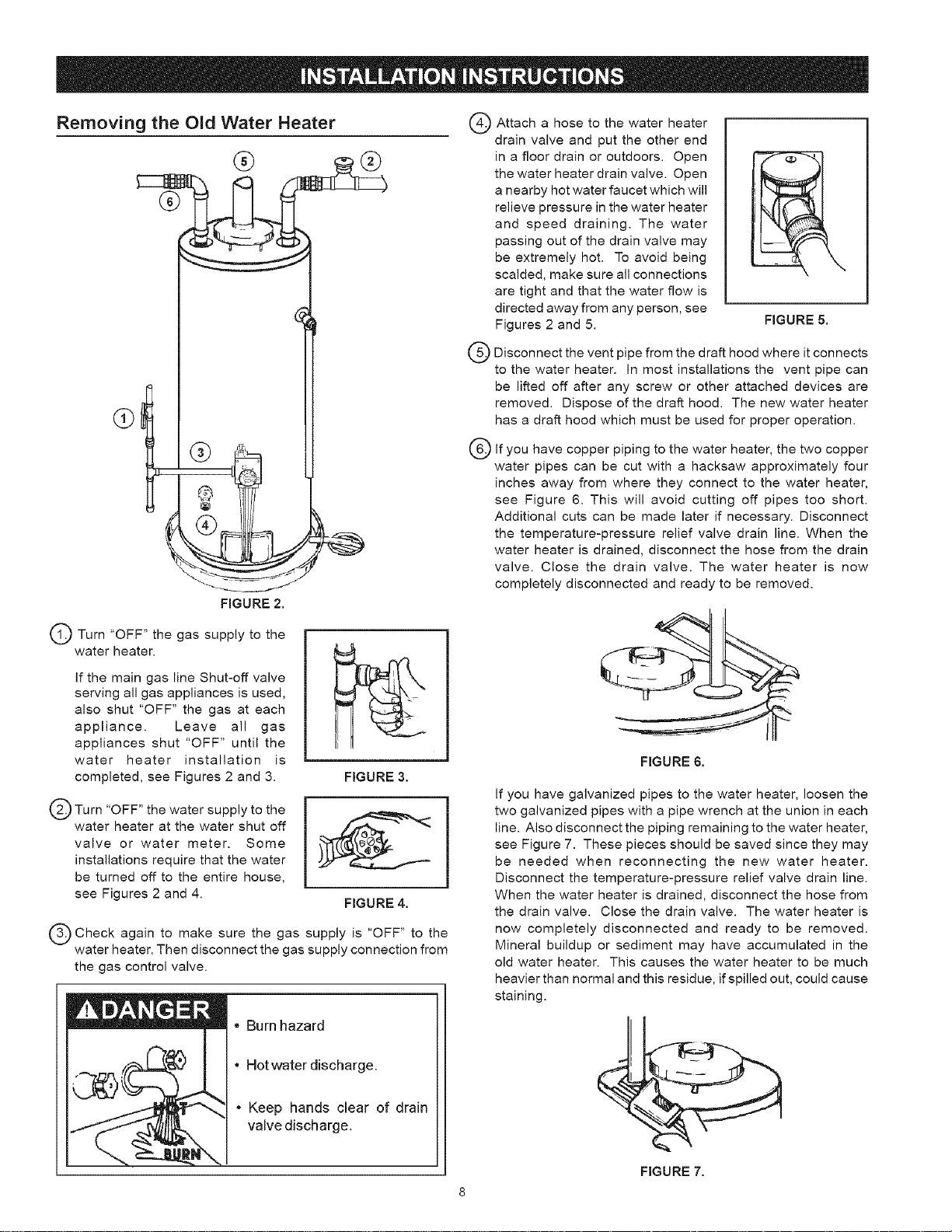
Removing the Old Water Heater
(9
FIGURE 2,
Q Turn "OFF" the gas supply to the
water heater.
If the main gas line Shut-off valve
serving all gas appliances is used,
also shut "OFF" the gas at each
appliance. Leave all gas
appliances shut "OFF" until the
water heater installation is
completed, see Figures 2 and 3.
FIGURE 3.
Q Turn "OFF" the water supply to the
water heater at the water shut off
valve or water meter. Some
installations require that the water
be turned off to the entire house,
see Figures 2 and 4.
FIGURE 4.
Check again to make sure the gas supply is "OFF" to the
(_) . .
water heater. Then disconnect the gas supply connection from
the gas control valve.
• Burn hazard
• Hotwater discharge.
• Keep hands clear of drain
valve discharge.
®
®
®
Attach a hose to the water heater
drain valve and put the other end
in a floor drain or outdoors. Open
the water heater drain valve. Open
a nearby hot water faucet which will
relieve pressure in the water heater
and speed draining. The water
passing out of the drain valve may
be extremely hot. To avoid being
scalded, make sure all connections
are tight and that the water flow is
directed away from any person, see
Figures 2 and 5.
FIGURE 5,
Disconnect the vent pipe from the draft hood where it connects
to the water heater. In most installations the vent pipe can
be lifted off after any screw or other attached devices are
removed. Dispose of the draft hood. The new water heater
has a draft hood which must be used for proper operation.
If you have copper piping to the water heater, the two copper
water pipes can be cut with a hacksaw approximately four
inches away from where they connect to the water heater,
see Figure 6. This will avoid cutting off pipes too short.
Additional cuts can be made later if necessary. Disconnect
the temperature-pressure relief valve drain line. When the
water heater is drained, disconnect the hose from the drain
valve. Close the drain valve. The water heater is now
completely disconnected and ready to be removed.
If you have galvanized pipes to the water heater, loosen the
two galvanized pipes with a pipe wrench at the union in each
line. Also disconnect the piping remaining to the water heater,
see Figure 7. These pieces should be saved since they may
be needed when reconnecting the new water heater.
Disconnect the temperature-pressure relief valve drain line.
When the water heater is drained, disconnect the hose from
the drain valve. Close the drain valve. The water heater is
now completely disconnected and ready to be removed.
Mineral buildup or sediment may have accumulated in the
old water heater. This causes the water heater to be much
heavier than normal and this residue, if spilled out, could cause
staining.
FIGURE 7.
Facts to Consider About the Location
Carefully choose an indoor location for the new water heater,
because the placement is a very important consideration for the
safety of the occupants in the building and for the most
economical use of the appliance. This water heater is not for
use in manufactured (mobile) homes or outdoor installation.
Whether replacing an old water heater or putting the water heater
in a new location, the following critical points must be observed:
Select a location indoors as close as practical to the gas vent
or chimney to which the water heater vent is going to be
connected, and as centralized with the water piping system
as possible.
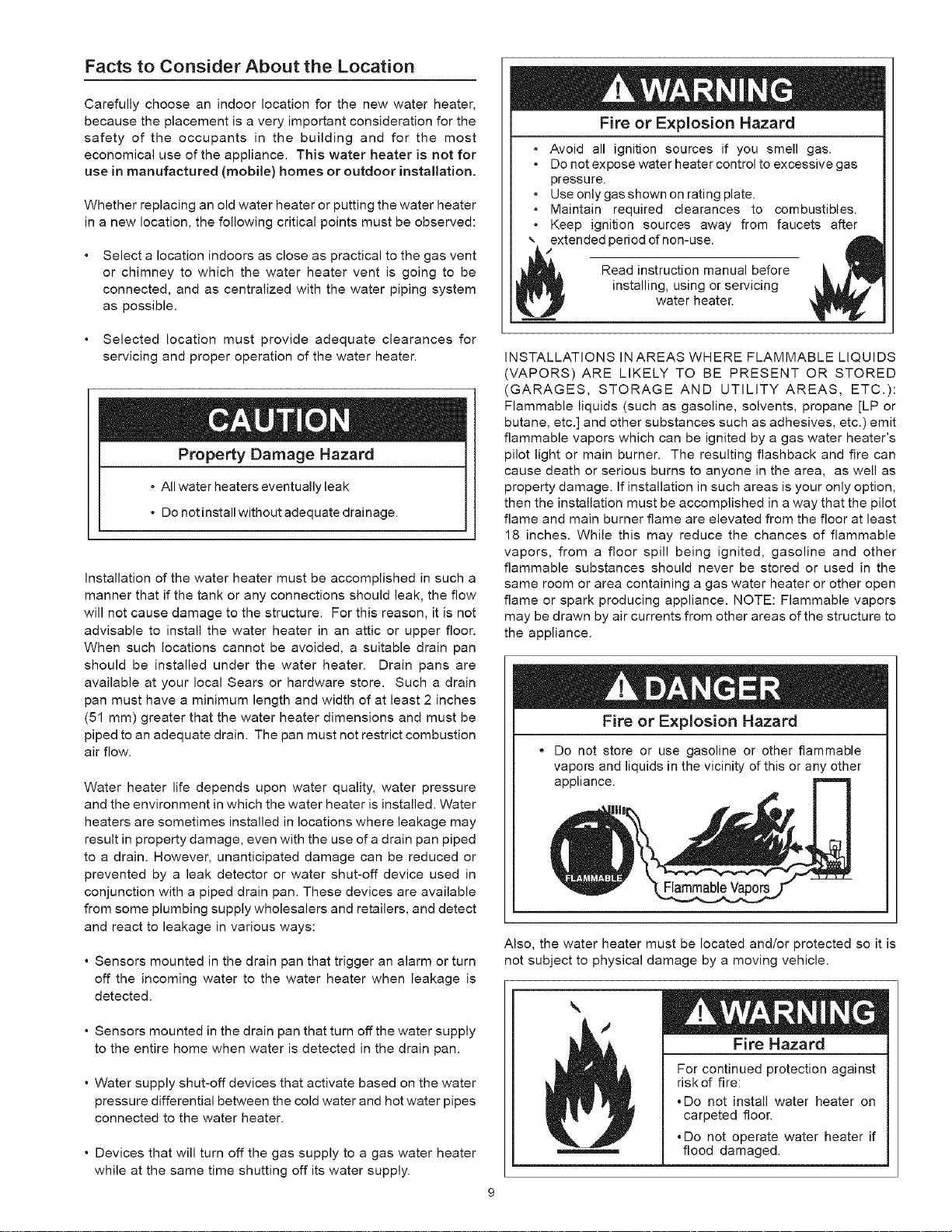
Fire or Explosion Hazard
* Avoid all ignition sources if you smell gas.
* Do not expose water heater control to excessive gas
pressure.
* Use only gas shown on rating plate.
* Maintain required clearances to combustibles.
* Keep ignition sources away from faucets after
', extendedperiodofnon-use.
Read instruction manual before
installing, using or servicing
water heater.
• Selected location must provide adequate clearances for
servicing and proper operation of the water heater.
Property Damage Hazard
* All water heaters eventually leak
, Do not install without adequate drainage.
Installation of the water heater must be accomplished in such a
manner that if the tank or any connections should leak, the flow
will not cause damage to the structure. For this reason, it is not
advisable to install the water heater in an attic or upper floor.
When such locations cannot be avoided, a suitable drain pan
should be installed under the water heater. Drain pans are
available at your local Sears or hardware store. Such a drain
pan must have a minimum length and width of at least 2 inches
(51 mm) greater that the water heater dimensions and must be
piped to an adequate drain. The pan must not restrict combustion
air flow.
Water heater life depends upon water quality, water pressure
and the environment in which the water heater is installed. Water
heaters are sometimes installed in locations where leakage may
result in property damage, even with the use of a drain pan piped
to a drain. However, unanticipated damage can be reduced or
prevented by a leak detector or water shut-off device used in
conjunction with a piped drain pan. These devices are available
from some plumbing supply wholesalers and retailers, and detect
and react to leakage in various ways:
• Sensors mounted in the drain pan that trigger an alarm or turn
off the incoming water to the water heater when leakage is
detected.
• Sensors mounted in the drain pan that turn off the water supply
to the entire home when water is detected in the drain pan.
• Water supply shut-off devices that activate based on the water
pressure differential between the cold water and hot water pipes
connected to the water heater.
• Devices that will turn off the gas supply to a gas water heater
while at the same time shutting off its water supply.
INSTALLATIONS IN AREAS WHERE FLAMMABLE LIQUIDS
(VAPORS) ARE LIKELY TO BE PRESENT OR STORED
(GARAGES, STORAGE AND UTILITY AREAS, ETC.):
Flammable liquids (such as gasoline, solvents, propane [LP or
butane, etc.] and other substances such as adhesives, etc.) emit
flammable vapors which can be ignited by a gas water heater's
pilot light or main burner. The resulting flashback and fire can
cause death or serious burns to anyone in the area, as well as
property damage. If installation in such areas is your only option,
then the installation must be accomplished in a way that the pilot
flame and main burner flame are elevated from the floor at least
18 inches. While this may reduce the chances of flammable
vapors, from a floor spill being ignited, gasoline and other
flammable substances should never be stored or used in the
same room or area containing a gas water heater or other open
flame or spark producing appliance. NOTE: Flammable vapors
may be drawn by air currents from other areas of the structure to
the appliance.
Fire or Explosion Hazard
• Do not store or use gasoline or other flammable
vapors and liquids in the vicinity of this or any other
appliance.
Also, the water heater must be located and/or protected so it is
not subject to physical damage by a moving vehicle.
Fire Hazard
For continued protection against
risk of fire:
• Do not install water heater on
carpeted floor.
• Do not operate water heater if
flood damaged.
This water heater must not be installed directly on carpeting.
Carpeting must be protected by metal or wood panel beneath
the appliance extending beyond the full width and depth of the
appliance by at least 3 inches (76.2 mm) in any direction, or if
the appliance is installed in an alcove or closet, the entire floor
must be covered by the panel. Failure to heed this warning may
result in a fire hazard.
Fire or Explosion Hazard
using or servicing water heater.
• Improper use may result in fire or
explosion.
, Maintain required clearances to
combustibles.
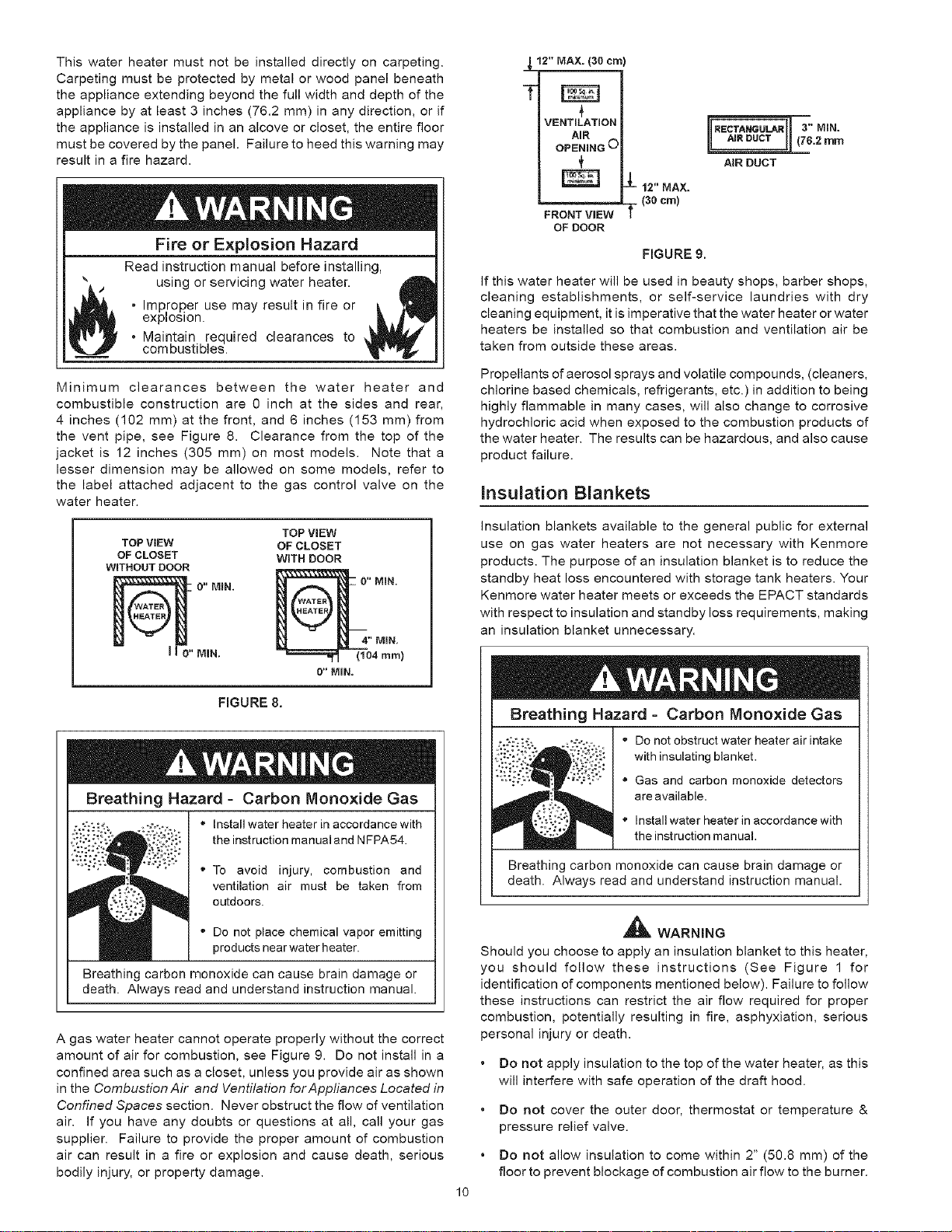
Minimum clearances between the water heater and
combustible construction are 0 inch at the sides and rear,
4 inches (102 mm) at the front, and 6 inches (153 mm) from
the vent pipe, see Figure 8. Clearance from the top of the
jacket is 12 inches (305 mm) on most models. Note that a
lesser dimension may be allowed on some models, refer to
the label attached adjacent to the gas control valve on the
water heater.
TOP VIEW
OF CLOSET
WITHOUT DOOR
0" MIN.
TOP VIEW
OF CLOSET
WITH DOOR
_{ 1040"MIN.
" NIIN,
4 ram)
0" MIN.
0" MIN.
FIGURE 8.
Breathing Hazard - Carbon Monoxide Gas
1,:_. .:'_'.°:., " Install water heater inaccordance with
_;.:, : :_,::_. the instruction manual and NFPA54.
:?:"i_i°:_':._ "_!:_':if':° ° To avoid injury, combustion and
_:_!._! _ outdoors.Ventilati°nair must be taken from
. Do not place chemical vapor emitting
products near water heater.
Breathing carbon monoxide can cause brain damage or
death. Always read and understand instruction manual.
A gas water heater cannot operate properly without the correct
amount of air for combustion, see Figure 9. Do not install in a
confined area such as a closet, unless you provide air as shown
in the Combustion Air and Ventilation forAppliances Located in
Confined Spaces section. Never obstruct the flow of ventilation
air. If you have any doubts or questions at all, call your gas
supplier. Failure to provide the proper amount of combustion
air can result in a fire or explosion and cause death, serious
bodily injury, or property damage.
__12" MAX. (30cm)
VENTiLATiON
AiR
OPENINGO
FRONT VIEW
OF DOOR
AIR DUCT
FIGURE 9.
If this water heater will be used in beauty shops, barber shops,
cleaning establishments, or self-service laundries with dry
cleaning equipment, it is imperative that the water heater or water
heaters be installed so that combustion and ventilation air be
taken from outside these areas.
Propellants of aerosol sprays and volatile compounds, (cleaners,
chlorine based chemicals, refrigerants, etc.) in addition to being
highly flammable in many cases, will also change to corrosive
hydrochloric acid when exposed to the combustion products of
the water heater. The results can be hazardous, and also cause
product failure.
Insulation Blankets
Insulation blankets available to the general public for external
use on gas water heaters are not necessary with Kenmore
products. The purpose of an insulation blanket is to reduce the
standby heat loss encountered with storage tank heaters. Your
Kenmore water heater meets or exceeds the EPACT standards
with respect to insulation and standby loss requirements, making
an insulation blanket unnecessary.
10
Breathing Hazard - Carbon Monoxide Gas
o Do not obstruct water heater air intake
with insulating blanket.
Gas and carbon monoxide detectors
are available.
o Install water heater in accordance with
the instruction manual.
Breathing carbon monoxide can cause brain damage or
death. Always read and understand instruction manual.
,_ WARNING
Should you choose to apply an insulation blanket to this heater,
you should follow these instructions (See Figure 1 for
identification of components mentioned below). Failure to follow
these instructions can restrict the air flow required for proper
combustion, potentially resulting in fire, asphyxiation, serious
personal injury or death.
Do not apply insulation to the top of the water heater, as this
will interfere with safe operation of the draft hood.
Do not cover the outer door, thermostat or temperature &
pressure relief valve.
Do not allow insulation to come within 2" (50.8 mm) of the
floor to prevent blockage of combustion air flow to the burner.
Donotcovertheinstructionmanual.Keepitonthesideof
thewaterheaterornearbyforfuturereference.
DoobtainnewwarningandinstructionlabelsfromSearsfor
placementontheblanketdirectlyovertheexistinglabels.
Doinspecttheinsulationblanketfrequentlytomakecertain
itdoesnotsag,therebyobstructingcombustionairflow.
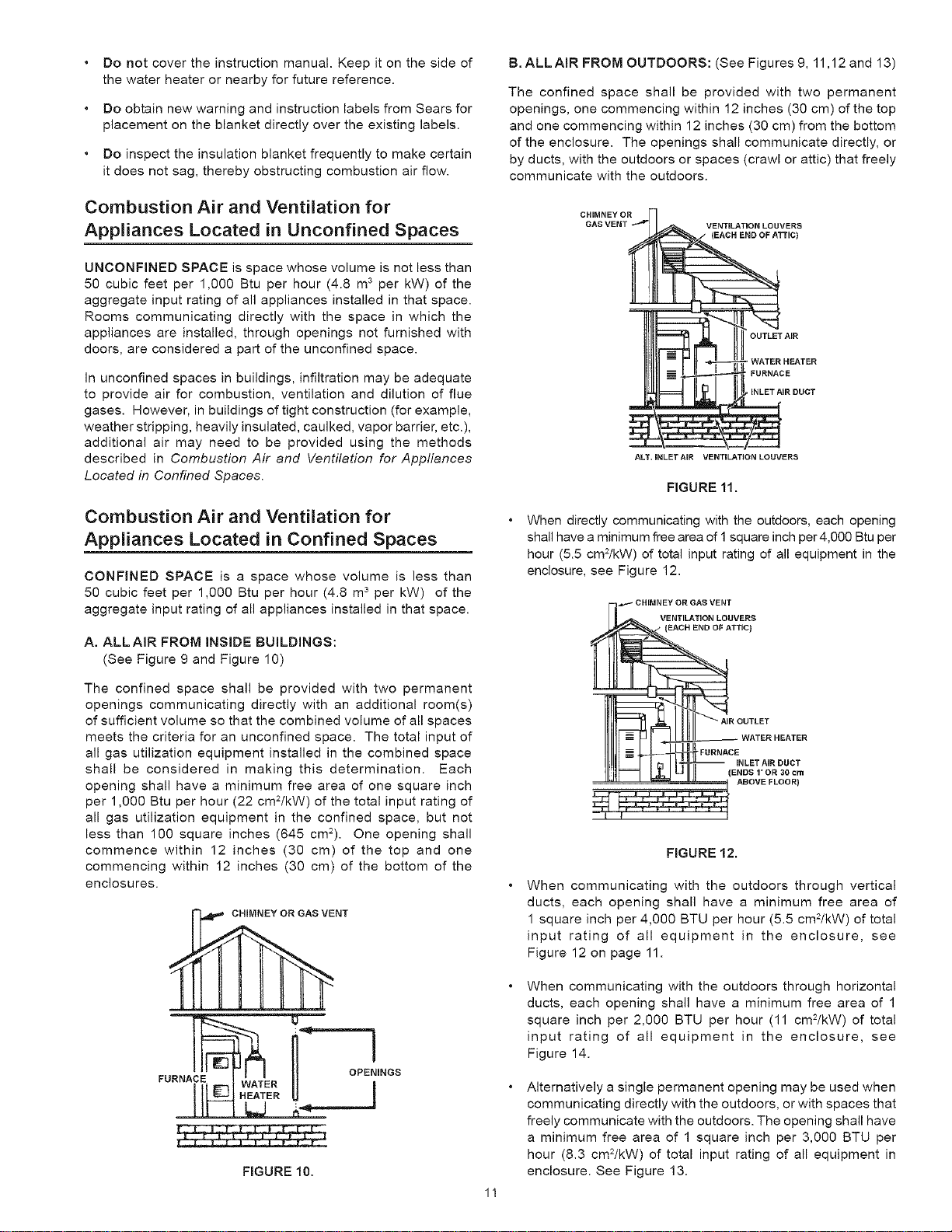
B. ALL AIR FROM OUTDOORS: (See Figures 9, 11,12 and 13)
The confined space shall be provided with two permanent
openings, one commencing within 12 inches (30 cm) of the top
and one commencing within 12 inches (30 cm) from the bottom
of the enclosure. The openings shall communicate directly, or
by ducts, with the outdoors or spaces (crawl or attic) that freely
communicate with the outdoors.
Combustion Air and Ventilation for
Appliances Located in Unconfined Spaces
CHIMNEY OR
GAS VENT
VENTiLATiON LOUVERS
(EACH END OF ATTIC)
UNCONFINED SPACE is space whose volume is not less than
50 cubic feet per 1,000 Btu per hour (4.8 m3 per kW) of the
aggregate input rating of all appliances installed in that space.
Rooms communicating directly with the space in which the
appliances are installed, through openings not furnished with
doors, are considered a part of the unconfined space.
In unconfined spaces in buildings, infiltration may be adequate
to provide air for combustion, ventilation and dilution of flue
gases. However, in buildings of tight construction (for example,
weather stripping, heavily insulated, caulked, vapor barrier, etc.),
additional air may need to be provided using the methods
described in Combustion Air and Ventilation for Appliances
Located in Confined Spaces.
OUTLET AIR
"WATERNEATER
FURNACE
,INLET _R DUCT
ALT. INLET AIR VENTILATION LOUVERS
FIGURE 11.
Combustion Air and Ventilation for
Appliances Located in Confined Spaces
CONFINED SPACE is a space whose volume is less than
50 cubic feet per 1,O0O Btu per hour (4.8 m 3 per kW) of the
aggregate input rating of all appliances installed in that space.
A. ALLAIR FROM INSIDE BUILDINGS:
(See Figure 9 and Figure 10)
The confined space shall be provided with two permanent
openings communicating directly with an additional room(s)
of sufficient volume so that the combined volume of all spaces
meets the criteria for an unconfined space. The total input of
all gas utilization equipment installed in the combined space
shall be considered in making this determination. Each
opening shall have a minimum free area of one square inch
per 1,000 Btu per hour (22 cm2/kW) of the total input rating of
all gas utilization equipment in the confined space, but not
less than 100 square inches (645 cm2). One opening shall
commence within 12 inches (36 cm) of the top and one
commencing within 12 inches (30 cm) of the bottom of the
enclosures.
NT
FURNACE _ HWE_ _
__ OPENINGS
FIGURE 10,
When directly communicating with the outdoors, each opening
shall have a minimum free area of 1 square inch per 4,000 Btu per
hour (5.5 cm2/kW) of total input rating of all equipment in the
enclosure, see Figure 12.
VENTILATION LOUVERS
EACH END OF ATTIC)
FURNACE
-- INLET AIR DUCT
(ENDS I'OR 30 crn
ABOVE FLOOR)
11
FIGURE 12.
When communicating with the outdoors through vertical
ducts, each opening shall have a minimum free area of
1 square inch per 4,000 BTU per hour (5.5 cm2/kW) of total
input rating of all equipment in the enclosure, see
Figure 12 on page 11.
When communicating with the outdoors through horizontal
ducts, each opening shall have a minimum free area of 1
square inch per 2,000 BTU per hour (11 cm2/kW) of total
input rating of all equipment in the enclosure, see
Figure 14.
Alternatively a single permanent opening may be used when
communicating directly with the outdoors, or with spaces that
freely communicate with the outdoors. The opening shall have
a minimum free area of 1 square inch per 3,006 BTU per
hour (8.3 cm2/kW) of total input rating of all equipment in
enclosure. See Figure 13.
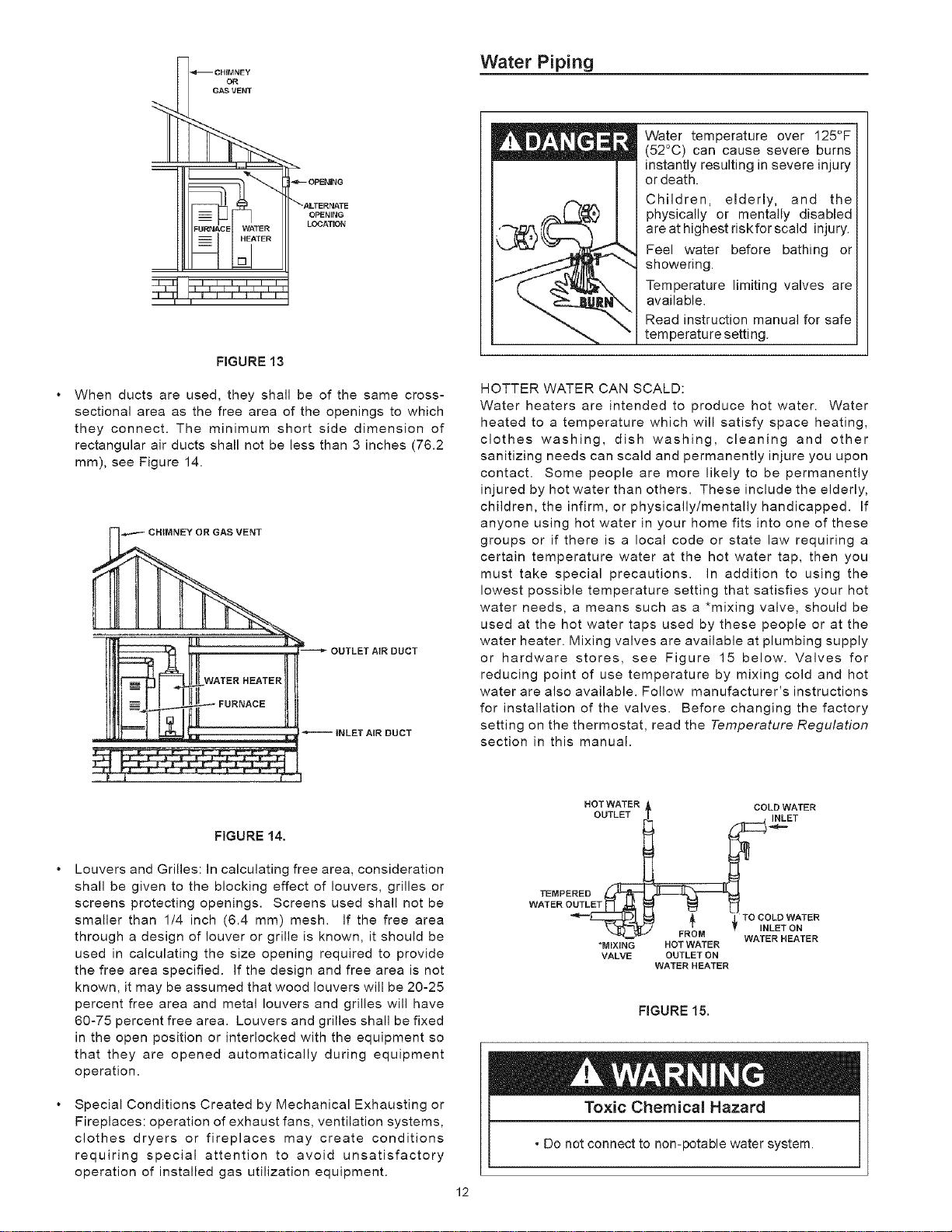
OPENING
LOLtATION
FIGURE 13
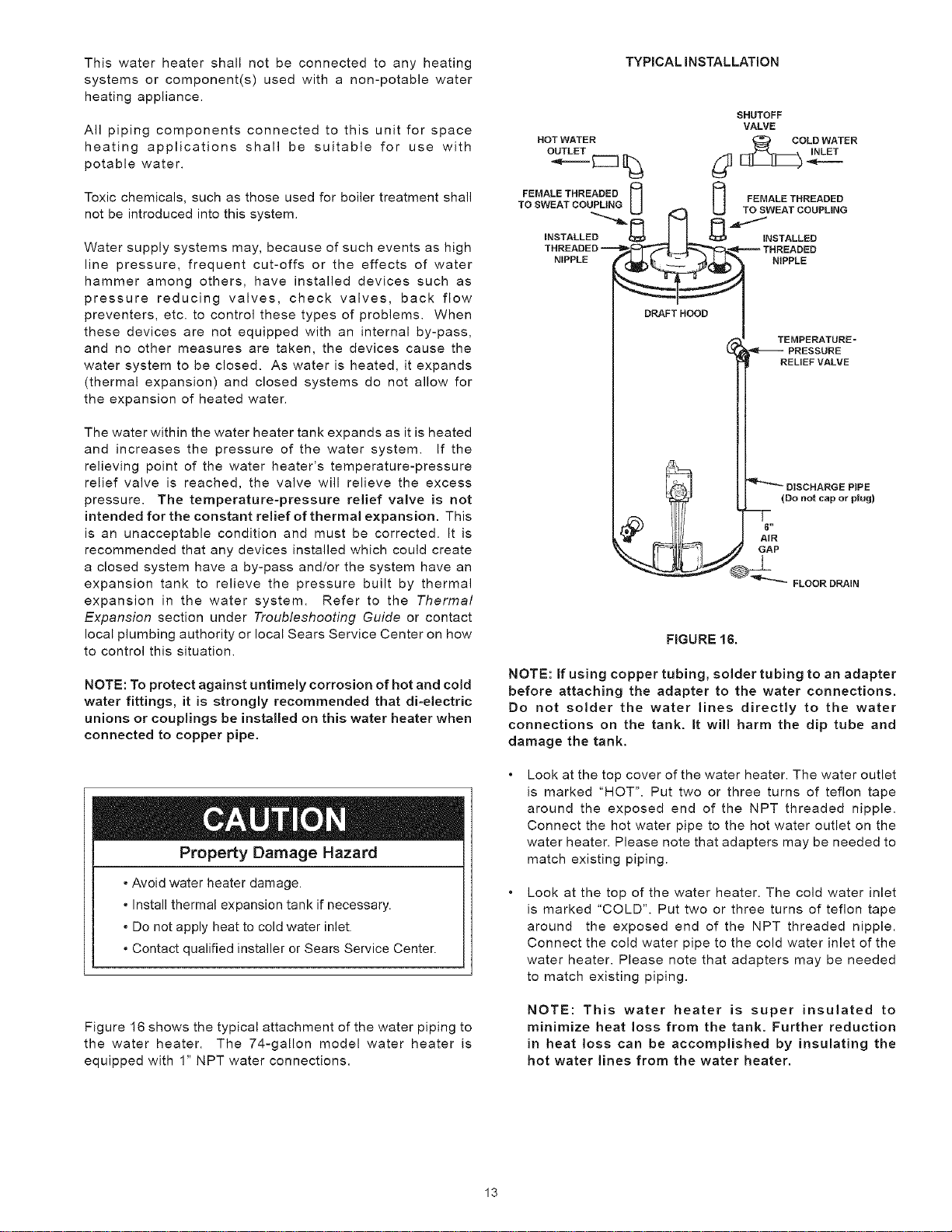
When ducts are used, they shall be of the same cross-
sectional area as the free area of the openings to which
they connect. The minimum short side dimension of
rectangular air ducts shall not be less than 3 inches (76.2
mm), see Figure 14.
OUTLET AIR DUCT
INLET AIR DUCT
Water Piping
Water temperature over 125°F
(52°C) can cause severe burns
instantly resulting in severe injury
or death.
Children, elderly, and the
physically or mentally disabled
are at highest riskfor scald injury.
Feel water before bathing or
showering.
Temperature limiting valves are
available.
Read instruction manual for safe
temperature setting.
HOTTER WATER CAN SCALD:
Water heaters are intended to produce hot water. Water
heated to a temperature which will satisfy space heating,
clothes washing, dish washing, cleaning and other
sanitizing needs can scald and permanently injure you upon
contact. Some people are more likely to be permanently
injured by hot water than others. These include the elderly,
children, the infirm, or physically/mentally handicapped. If
anyone using hot water in your home fits into one of these
groups or if there is a local code or state law requiring a
certain temperature water at the hot water tap, then you
must take special precautions. In addition to using the
lowest possible temperature setting that satisfies your hot
water needs, a means such as a *mixing valve, should be
used at the hot water taps used by these people or at the
water heater. Mixing valves are available at plumbing supply
or hardware stores, see Figure 15 below. Valves for
reducing point of use temperature by mixing cold and hot
water are also available. Follow manufacturer's instructions
for installation of the valves. Before changing the factory
setting on the thermostat, read the Temperature Regulation
section in this manual.
FIGURE 14.
Louvers and Grilles: In calculating free area, consideration
shall be given to the blocking effect of louvers, grilles or
screens protecting openings. Screens used shall not be
smaller than 1/4 inch (6.4 mm) mesh. If the free area
through a design of louver or grille is known, it should be
used in calculating the size opening required to provide
the free area specified. If the design and free area is not
known, it may be assumed that wood louvers will be 20-25
percent free area and metal louvers and grilles will have
60-75 percent free area. Louvers and grilles shall be fixed
in the open position or interlocked with the equipment so
that they are opened automatically during equipment
operation.
Special Conditions Created by Mechanical Exhausting or
Fireplaces: operation of exhaust fans, ventilation systems,
clothes dryers or fireplaces may create conditions
requiring special attention to avoid unsatisfactory
operation of installed gas utilization equipment.
12
HOT WATER COLD WATER
OUTLET { INLET
TEMPERED
WATER OUTLET
TO COLD WATER
LET ON
FROM WATER HEATER
*MIXING HOT WATER
VALVE OUTLET ON
WATER HEATER
FIGURE 15,
Toxic Chernical Hazard
•Do notconnectto non-potablewatersystem.
This water heater shall not be connected to any heating
systems or component(s) used with a non-potable water
heating appliance.
All piping components connected to this unit for space
heating applications shall be suitable for use with
potable water.
Toxic chemicals, such as those used for boiler treatment shall
not be introduced into this system.
Water supply systems may, because of such events as high
line pressure, frequent cut-offs or the effects of water
hammer among others, have installed devices such as
pressure reducing valves, check valves, back flow
preventers, etc. to control these types of problems. When
these devices are not equipped with an internal by-pass,
and no other measures are taken, the devices cause the
water system to be closed. As water is heated, it expands
(thermal expansion) and closed systems do not allow for
the expansion of heated water.
The water within the water heater tank expands as it is heated
and increases the pressure of the water system. If the
relieving point of the water heater's temperature-pressure
relief valve is reached, the valve will relieve the excess
pressure. The temperature-pressure relief valve is not
intended for the constant relief of thermal expansion. This
is an unacceptable condition and must be corrected. It is
recommended that any devices installed which could create
a closed system have a by-pass and/or the system have an
expansion tank to relieve the pressure built by thermal
expansion in the water system. Refer to the Thermal
Expansion section under Troubleshooting Guide or contact
local plumbing authority or local Sears Service Center on how
to control this situation.
NOTE: To protect against untimely corrosion of hot and cold
water fittings, it is strongly recommended that di-electric
unions or couplings be installed on this water heater when
connected to copper pipe.
Property Damage Hazard
- Avoid water heater damage.
• Install thermal expansion tank if necessary.
• Do not apply heat to cold water inlet.
. Contact qualified installer or Sears Service Center.
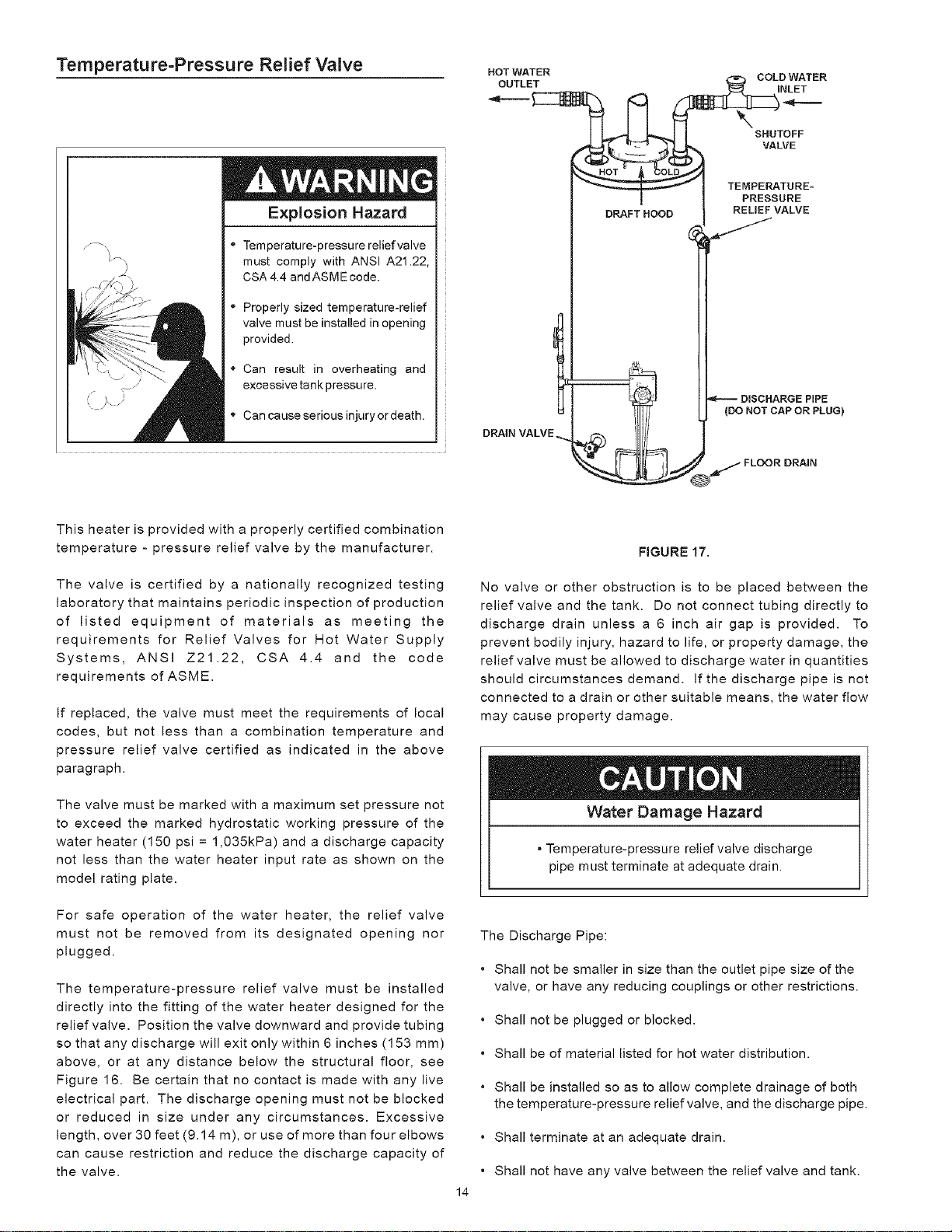
Figure 16 shows the typical attachment of the water piping to
the water heater. The 74-gallon model water heater is
equipped with 1" NPT water connections.
TYPICAL INSTALLATION
SHUTOFF
VALVE
HOTWATER C_ COLD WATER
OUTLET
FEMALE THREADED [_
TOSWEATcooPu.e
INSTALLED
DRAFT HOOD
TEMPERATURE-
_ PRESSURE
RELIEF VALVE
i_ _--_ DISCHARGE PtPE
(Do not cap or plug)
AIR
GAP
_'_--_* FLOOR DRAIN
FIGURE 16.
NOTE: If using copper tubing, solder tubing to an adapter
before attaching the adapter to the water connections.
Do not solder the water lines directly to the water
connections on the tank. It will harm the dip tube and
damage the tank,
Look at the top cover of the water heater. The water outlet
is marked "HOT". Put two or three turns of teflon tape
around the exposed end of the NPT threaded nipple.
Connect the hot water pipe to the hot water outlet on the
water heater. Please note that adapters may be needed to
match existing piping.
Look at the top of the water heater. The cold water inlet
is marked "COLD". Put two or three turns of teflon tape
around the exposed end of the NPT threaded nipple.
Connect the cold water pipe to the cold water inlet of the
water heater. Please note that adapters may be needed
to match existing piping.
NOTE: This water heater is super insulated to
minimize heat loss from the tank. Further reduction
in heat loss can be accomplished by insulating the
hot water lines from the water heater,
13
Temperatu re=Pressu re Relief Valve
}
Explosion Hazard
•Tem perature-pressure relief valve
must comply with ANSI A2122,
CSA 4.4 andASME code.
• Properly sized temperature-relief
valve must be installed in opening
provided.
• Can result in overheating and
excessive tank pressure.
• Can cause serious injury or death.
HOT WATER
OUTLET
DRAINVALVE._
DRAFT HOOD
COLDWATER
INLET
_&_.-...==
\
SHUTOFF
VALVE
TEMPERATURE*
PRESSURE
RELIEF VALVE
(DO NOT CAP OR PLUG)
This heater is provided with a properly certified combination
temperature - pressure relief valve by the manufacturer.
The valve is certified by a nationally recognized testing
laboratory that maintains periodic inspection of production
of listed equipment of materials as meeting the
requirements for Relief Valves for Hot Water Supply
Systems, ANSI Z21.22, CSA 4.4 and the code
requirements of ASME.
If replaced, the valve must meet the requirements of local
codes, but not less than a combination temperature and
pressure relief valve certified as indicated in the above
paragraph.
The valve must be marked with a maximum set pressure not
to exceed the marked hydrostatic working pressure of the
water heater (150 psi = 1,035kPa) and a discharge capacity
not less than the water heater input rate as shown on the
model rating plate.
For safe operation of the water heater, the relief valve
must not be removed from its designated opening nor
plugged.
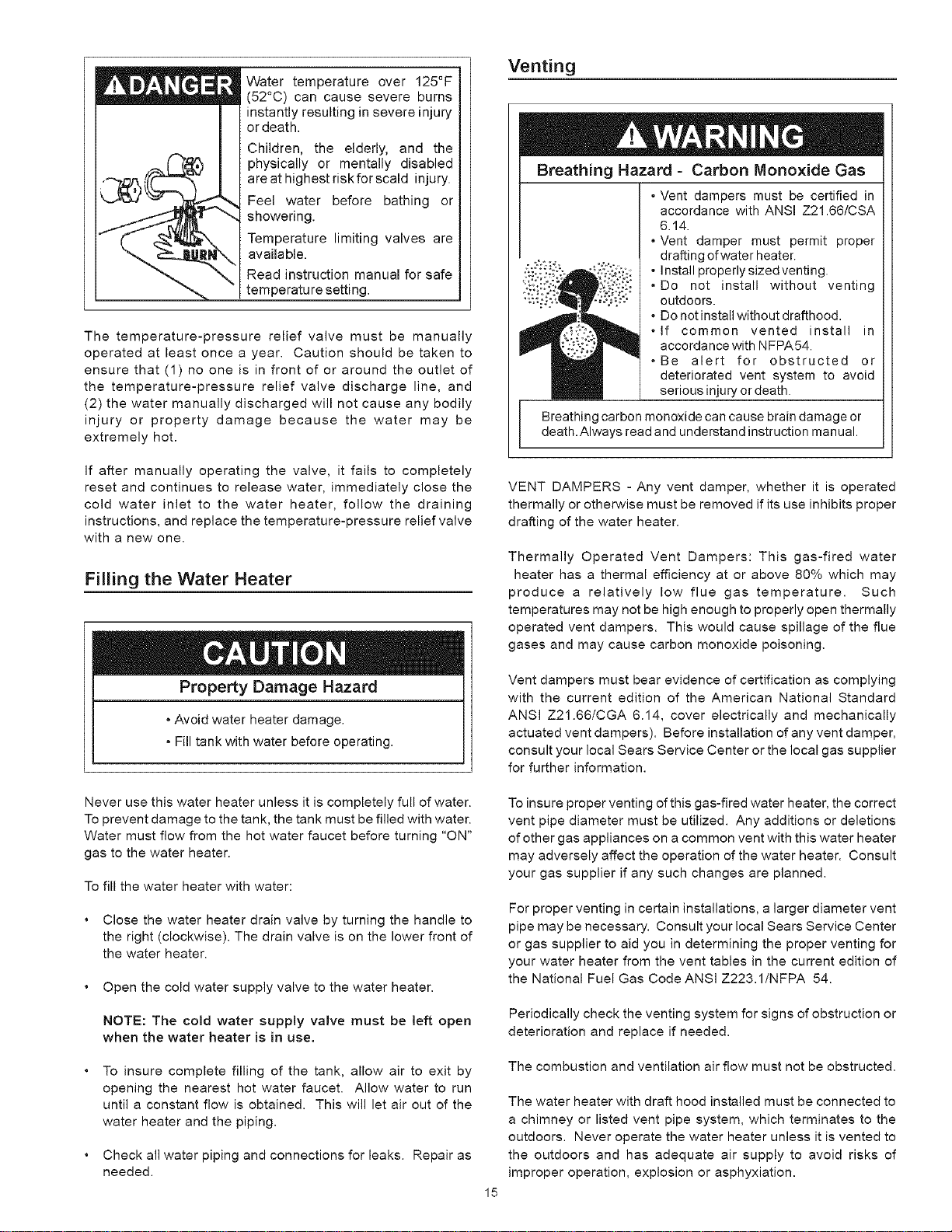
The temperature-pressure relief valve must be installed
directly into the fitting of the water heater designed for the
relief valve. Position the valve downward and provide tubing
so that any discharge will exit only within 6 inches (153 mm)
above, or at any distance below the structural floor, see
Figure 16. Be certain that no contact is made with any live
electrical part. The discharge opening must not be blocked
or reduced in size under any circumstances. Excessive
length, over 30 feet (9.14 m), or use of more than four elbows
can cause restriction and reduce the discharge capacity of
the valve.
FIGURE 17,
No valve or other obstruction is to be placed between the
relief valve and the tank. Do not connect tubing directly to
discharge drain unless a 6 inch air gap is provided. To
prevent bodily injury, hazard to life, or property damage, the
relief valve must be allowed to discharge water in quantities
should circumstances demand. If the discharge pipe is not
connected to a drain or other suitable means, the water flow
may cause property damage.
Water Damage Hazard
, Temperature-pressure relief valve discharge
pipe must terminate at adequate drain.
14
The Discharge Pipe:
• Shall not be smaller in size than the outlet pipe size of the
valve, or have any reducing couplings or other restrictions.
• Shall not be plugged or blocked.
• Shall be of material listed for hot water distribution.
• Shall be installed so as to allow complete drainage of both
the temperature-pressure relief valve, and the discharge pipe.
• Shall terminate at an adequate drain.
• Shall not have any valve between the relief valve and tank.
Water temperature over 125°F
(52°0) can cause severe burns
instantly resulting in severe injury
or death.
Children, the elderly, and the
physically or mentally disabled
are at highest riskforscald injury.
Feel water before bathing or
showering.
Temperature limiting valves are
available.
Read instruction manual for safe
temperature setting.
The temperature-pressure relief valve must be manually
operated at least once a year. Caution should be taken to
ensure that (1) no one is in front of or around the outlet of
the temperature-pressure relief valve discharge line, and
(2) the water manually discharged will not cause any bodily
injury or property damage because the water may be
extremely hot.
If after manually operating the valve, it fails to completely
reset and continues to release water, immediately close the
cold water inlet to the water heater, follow the draining
instructions, and replace the temperature-pressure relief valve
with a new one.
Filling the Water Heater
Property Damage Hazard
• Avoid water heater damage,
- Fill tank with water before operating.
Venting
Breathing Hazard - Carbon Monoxide Gas
• Vent dampers must be certified in
accordance with ANSI Z2t.66/CSA
6.14.
• Vent damper must permit proper
drafting of water heater.
• Install properlysizedventing.
*Do not install without venting
outdoors.
• Do not install without drafthood.
• if common vented install in
accordance with NFPA54.
• Be alert for obstructed or
deteriorated vent system to avoid
serious injury or death.
Breathing carbon monoxide can cause brain damage or
death. Always read and understand instruction manual.
VENT DAMPERS - Any vent damper, whether it is operated
thermally or otherwise must be removed if its use inhibits proper
drafting of the water heater.
Thermally Operated Vent Dampers: This gas-fired water
heater has a thermal efficiency at or above 80% which may
produce a relatively low flue gas temperature. Such
temperatures may not be high enough to properly open thermally
operated vent dampers. This would cause spillage of the flue
gases and may cause carbon monoxide poisoning.
Vent dampers must bear evidence of certification as complying
with the current edition of the American National Standard
ANSI Z21.66/CGA 6.14, cover electrically and mechanically
actuated vent dampers). Before installation of any vent damper,
consult your local Sears Service Center or the local gas supplier
for further information.
Never use this water heater unless it is completely full of water.
To prevent damage to the tank, the tank must be filled with water.
Water must flow from the hot water faucet before turning "ON"
gas to the water heater.
To fill the water heater with water:
• Close the water heater drain valve by turning the handle to
the right (clockwise). The drain valve is on the lower front of
the water heater.
• Open the cold water supply valve to the water heater.
NOTE: The cold water supply valve must be left open
when the water heater is in use.
To insure complete filling of the tank, allow air to exit by
opening the nearest hot water faucet. Allow water to run
until a constant flow is obtained. This will let air out of the
water heater and the piping.
• Check all water piping and connections for leaks. Repair as
needed.
To insure proper venting of this gas-fired water heater, the correct
vent pipe diameter must be utilized. Any additions or deletions
of other gas appliances on a common vent with this water heater
may adversely affect the operation of the water heater. Consult
your gas supplier if any such changes are planned.
For proper venting in certain installations, a larger diameter vent
pipe may be necessary. Consult your local Sears Service Center
or gas supplier to aid you in determining the proper venting for
your water heater from the vent tables in the current edition of
the National Fuel Gas Code ANSI Z223.1/NFPA 54.
Periodically check the venting system for signs of obstruction or
deterioration and replace if needed.
The combustion and ventilation air flow must not be obstructed.
15
The water heater with draft hood installed must be connected to
a chimney or listed vent pipe system, which terminates to the
outdoors. Never operate the water heater unless it is vented to
the outdoors and has adequate air supply to avoid risks of
improper operation, explosion or asphyxiation.
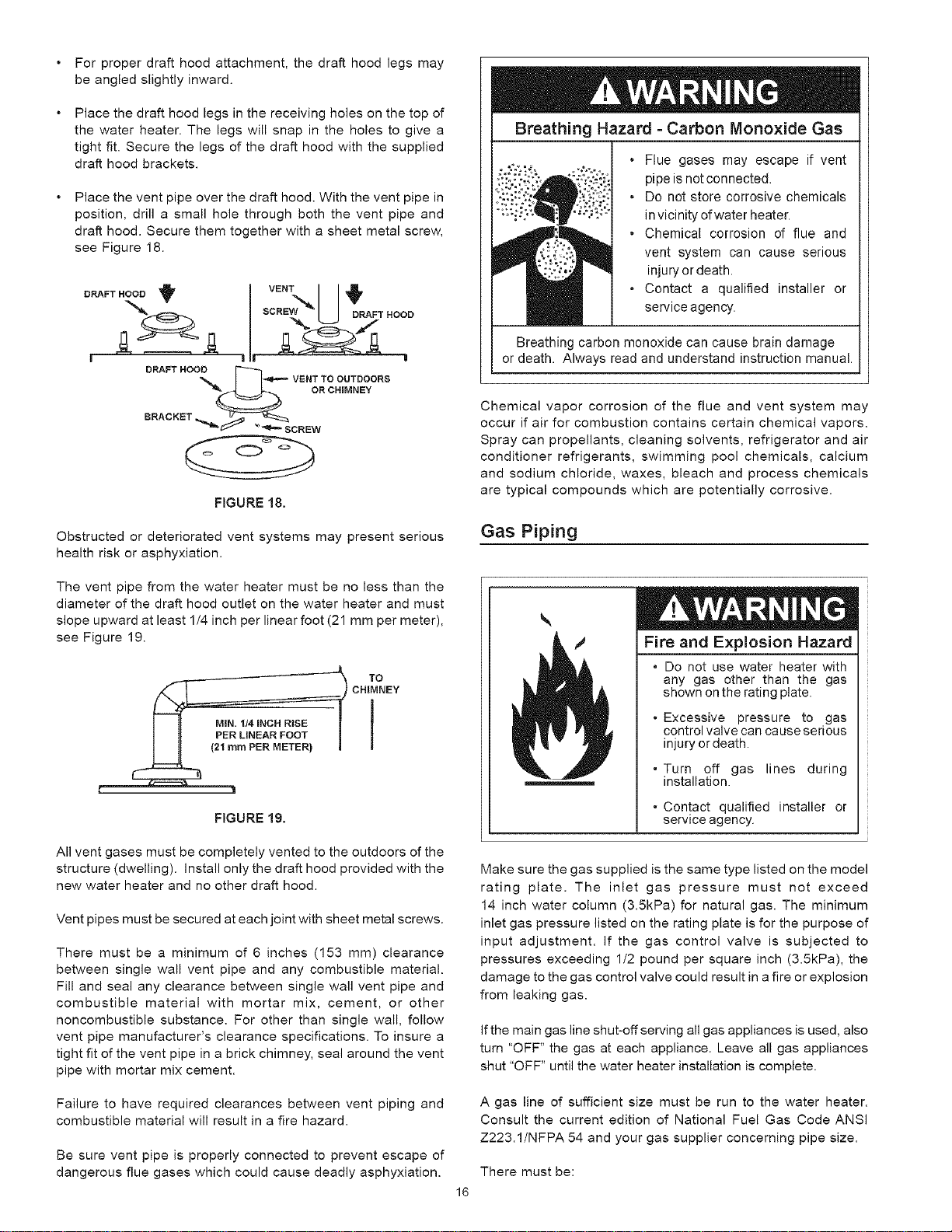
Forproperdrafthoodattachment,thedrafthoodlegsmay
beangledslightlyinward.
Placethedrafthoodlegsinthereceivingholesonthetopof
thewaterheater.Thelegswillsnapintheholestogivea
tightfit.Securethelegsofthedrafthoodwiththesupplied
drafthoodbrackets.
Placetheventpipeoverthedrafthood.Withtheventpipein
position,drillasmallholethroughboththeventpipeand
drafthood.Securethemtogetherwithasheetmetalscrew,
seeFigure18.
DP-J_FT HOOD VENT,_ U _
_ SCRE_ DP.AFT HOOD
, ,,
DRAFT HOOD
'_ _'_]',_"- VENT TO OUTDOORS
__,_ OR CHIMNEYBRACKET
FIGURE 18.
Obstructed or deteriorated vent systems may present serious
health risk or asphyxiation.
Breathing Hazard - Carbon Monoxide Gas
. Flue gases may escape if vent
_ ":::1::_:-'_.;_. pipe is not connected.
:,_f_'_ . Do not store corrosive chemicals
_:'_';" in vicinity of water heater.
• Chemical corrosion of flue and
"" vent system can cause serious
injury or death.
o Contact a qualified installer or
service agency.
Breathing carbon monoxide can cause brain damage
or death. Always read and understand instruction manual.
Chemical vapor corrosion of the flue and vent system may
occur if air for combustion contains certain chemical vapors.
Spray can propellants, cleaning solvents, refrigerator and air
conditioner refrigerants, swimming pool chemicals, calcium
and sodium chloride, waxes, bleach and process chemicals
are typical compounds which are potentially corrosive.
Gas Piping
The vent pipe from the water heater must be no less than the
diameter of the draft hood outlet on the water heater and must
slope upward at least 1/4 inch per linear foot (21 mm per meter),
see Figure 19.
S] °
CHIMNEY
f
FIGURE 19.
Fire and Explosion Hazard
• Do not use water heater with
any gas other than the gas
shown on the rating plate.
-Excessive pressure to gas
control valve oar cause serious
injury or death.
• Turn off gas lines during
installation.
-Contact qualified installer or
service agency.
All vent gases must be completely vented to the outdoors of the
structure (dwelling). Install only the draft hood provided with the
new water heater and no other draft hood.
Vent pipes must be secured at each joint with sheet metal screws.
There must be a minimum of 6 inches (153 mm) clearance
between single wall vent pipe and any combustible material.
Fill and seal any clearance between single wall vent pipe and
combustible material with mortar mix, cement, or other
noncombustible substance. For other than single wall, follow
vent pipe manufacturer's clearance specifications. To insure a
tight fit of the vent pipe in a brick chimney, seal around the vent
pipe with mortar mix cement.
Make sure the gas supplied is the same type listed on the model
rating plate. The inlet gas pressure must not exceed
14 inch water column (3.5kPa) for natural gas. The minimum
inlet gas pressure listed on the rating plate is for the purpose of
input adjustment. If the gas control valve is subjected to
pressures exceeding 1/2 pound per square inch (3.5kPa), the
damage to the gas control valve could result in a fire or explosion
from leaking gas.
If the main gas line shut-off serving all gas appliances is used, also
turn "OFF" the gas at each appliance. Leave all gas appliances
shut "OFF" until the water heater installation is complete.
Failure to have required clearances between vent piping and
combustible material will result in a fire hazard.
Be sure vent pipe is properly connected to prevent escape of
dangerous flue gases which could cause deadly asphyxiation.
A gas line of sufficient size must be run to the water heater.
Consult the current edition of National Fuel Gas Code ANSI
Z223.1/NFPA 54 and your gas supplier concerning pipe size.
There must be:
16
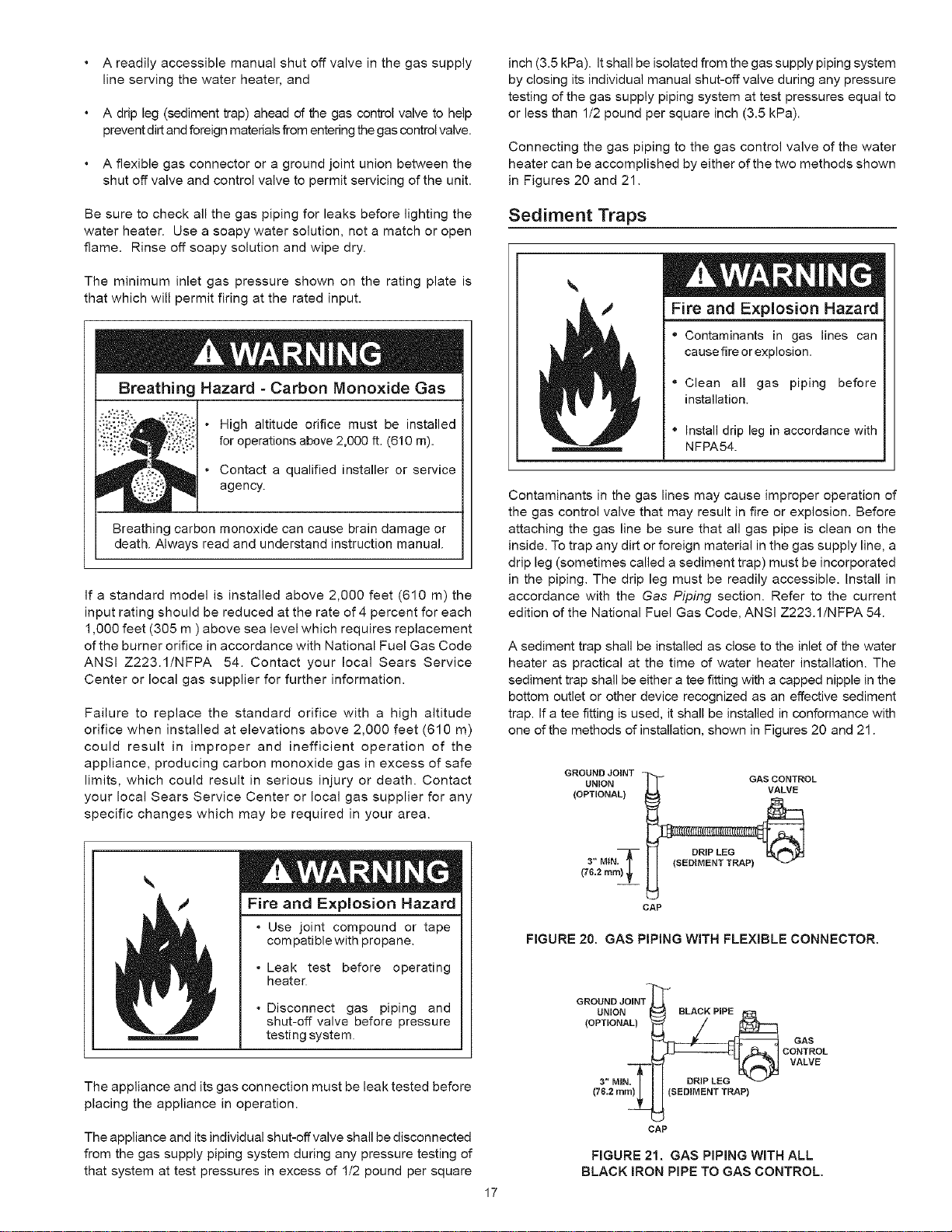
• Areadilyaccessiblemanualshutoffvalveinthegassupply
lineservingthewaterheater,and
• Adripleg(sedimenttrap)aheadofthegascontrolvalvetohelp
preventdirtandforeignmaterialsfromenteringthegascontrolvalve.
• Aflexiblegasconnectororagroundjointunionbetweenthe
shutoffvalveandcontrolvalvetopermitservicingoftheunit.
Besuretocheckallthegaspipingforleaksbeforelightingthe
waterheater.Useasoapywatersolution,notamatchoropen
flame.Rinseoffsoapysolutionandwipedry.
Theminimuminletgaspressureshownontheratingplateis
thatwhichwillpermitfiringattheratedinput.
Breathing Hazard - Carbon Monoxide Gas
High altitude orifice must be installed
for operations above 2,000 ft. (610 m).
Contact a qualified installer or service
agency.
Breathing carbon monoxide can cause brain damage or
death. Always read and understand instruction manual.
If a standard model is installed above 2,000 feet (610 m) the
input rating should be reduced at the rate of 4 percent for each
1,000 feet (305 m ) above sea level which requires replacement
of the burner orifice in accordance with National Fuel Gas Code
ANSI Z223.1/NFPA 54. Contact your local Sears Service
Center or local gas supplier for further information.
Failure to replace the standard orifice with a high altitude
orifice when installed at elevations above 2,000 feet (610 m)
could result in improper and inefficient operation of the
appliance, producing carbon monoxide gas in excess of safe
limits, which could result in serious injury or death. Contact
your local Sears Service Center or local gas supplier for any
specific changes which may be required in your area.
Fire and Explosion Hazard
• Use joint compound or tape
com patible with propane.
• Leak test before operating
heater.
• Disconnect gas piping and
shut-off valve before pressure
testing system.
The appliance and its gas connection must be leak tested before
placing the appliance in operation.
The appliance and its individual shut-off valve shall be disconnected
from the gas supply piping system during any pressure testing of
that system at test pressures in excess of 1/2 pound per square
inch (3.5 kPa). It shall be isolated from the gas supply piping system
by closing its individual manual shut-off valve during any pressure
testing of the gas supply piping system at test pressures equal to
or less than 1/2 pound per square inch (3.5 kPa).
Connecting the gas piping to the gas control valve of the water
heater can be accomplished by either of the two methods shown
in Figures 20 and 21.
Sediment Traps
Fire and Explosion Hazard
Contaminants in gas lines can
cause fire or explosion.
Clean all gas piping before
installation.
° Install drip leg in accordance with
NFPA54.
Contaminants in the gas lines may cause improper operation of
the gas control valve that may result in fire or explosion. Before
attaching the gas line be sure that all gas pipe is clean on the
inside. To trap any dirt or foreign material in the gas supply line, a
drip leg (sometimes called a sediment trap) must be incorporated
in the piping. The drip leg must be readily accessible. Install in
accordance with the Gas Piping section. Refer to the current
edition of the National Fuel Gas Code, ANSI Z223.1/NFPA 54.
A sediment trap shall be installed as close to the inlet of the water
heater as practical at the time of water heater installation. The
sediment trap shall be either a tee fitting with a capped nipple in the
bottom outlet or other device recognized as an effective sediment
trap. If a tee fitting is used, it shall be installed in conformance with
one of the methods of installation, shown in Figures 20 and 21.
GROuUN_JNOINT GAS CONTROL
(OPTIONAL)
CAP
FIGURE 20. GAS PIPING WITH FLEXIBLE CONNECTOR.
17
GROUND JOINT
UNION BLACK PiPE
(OPTIONAL)
GAS
CONTROL
VALVE
3" MIN_)_
(76,2 m
CAP
FIGURE 21. GAS PiPiNG WITH ALL
BLACK IRON PmPETO GAS CONTROL.
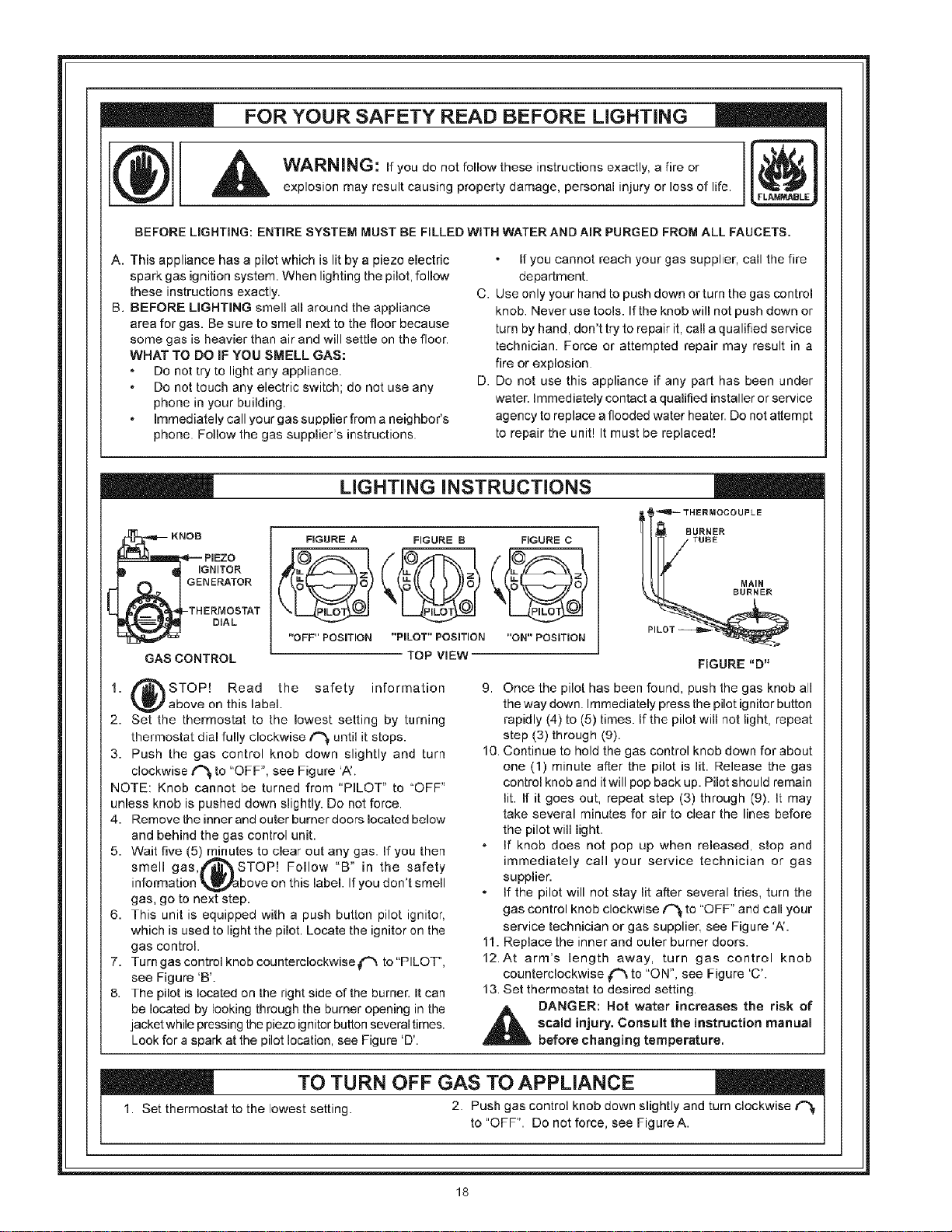
FOR YOUR SAFETY READ BEFORE LiGHTiNG
WARNING:,fyoudooetfoiiewtheaoinstroctienao×aetyaf reer
explosion may result causing property damage, personal injury or loss of life.
FLAMMABL_
BEFORE LiGHTiNG: ENTIRE SYSTEM MUST BE FILLED WiTH WATER AND AiR PURGED FROM ALL FAUCETS.
A. This appliance has a pilot which is lit by a piezo electric
spark gas ignition system. When lighting the pilot, follow
these instructions exactly.
B. BEFORE LiGHTiNG smell all around the appliance
area for gas. Be sure to smell next to the floor because
some gas is heavier than air and will settle on the floor.
WHAT TO DO iF YOU SMELL GAS:
Do not try to light any appliance.
Do not touch any electric switch; do not use any
phone in your building.
immediately call your gas supplier from a neighbor's
phone. Follow the gas supplier's instructions.
if you cannot reach your gas supplier, call the fire
department.
C. Use only your hand to push down or turn the gas control
knob. Never use tools. If the knob will not push down or
turn by hand. don't try to repair it. call a qualified service
technician. Force or attempted repair may result in a
fire or explosion
D. Do not use this appliance if any part has been under
water, immediately contact a qualified installer or service
agency to replace a flooded water heater. Do not attempt
to repair the unit! It must be replaced!
IGNITOR
GENERATOR
-THERMOSTAT
DiAL
GASCONTROL
LIGHTING INSTRUCTIONS
FIGURE A FIGURE e FIGURE C
"OFF" POSITION "PILOT" POSITION "ON" POSiTiON
TOP ViEW
THERMOCOUPLE
BURNER
TUIBE
MAIN
__BURNER
FIGURE "D"
1. STOP! Read the safety information
above on this label.
2. Set the thermostat to the lowest setting by turning
thermostat dial fully clockwise f_ until it stops.
3. Push the gas control knob down slightly and turn
clockwise f'_ to "OFF", see Figure 'A'.
NOTE: Knob cannot be turned from "PILOT" to "OFF"
unless knob is pushed down slightly. Do not force.
4. Remove the inner and outer burner doors located below
and behind the gas control unit.
5. Wait five (5) minutes to clear out any gas. If you then
smell gas,f_STOP! Follow "B" in the safety
information _J'above on this label. If you don't smell
gas, go to next step.
6. This unit is equipped with a push bution pilot ignitor,
which is used to light the pilot. Locate the ignitor on the
gas control.
7. Turn gas control knob counterclockwise_"_ to"PILOT",
see Figure 'B'.
8. The pilot is located on the right side of the burner. It can
be located by looking through the burner opening in the
jacket while pressing the piezo ignitor button several times.
Look for a spark at the pilot location, see Figure 'D'.
9. Once the pilot has been found, push the gas knob all
the way down. Immediately press the pilot ignitor button
rapidly (4) to (5) times. If the pilot will not light, repeat
step (3) through (9).
10. Continue to hold the gas control knob down for about
one (1) minute after the pilot is lit. Release the gas
control knob and itwill pop back up. Pilot should remain
lit. If it goes out, repeat step (3) through (9). It may
take several minutes for air to clear the lines before
the pilot will light.
if knob does not pop up when released stop and
immediately call your service technician or gas
supplier.
if the pilot will not stay lit after several tries, turn the
gas control knob clockwise f'_ to "OFF" and call your
service technician or gas supplier, see Figure 'A'.
11. Replace the inner and outer burner doors.
12 At arm's length away, turn gas control knob
counterclockwise ('_ to "ON", see Figure 'C'.
13. Set thermostat to desired setting
DANGER: Hot water increases the risk of
_ cald injury. Consult the instruction manual
before changing temperature.
TO TURN OFF GAS TO APPLIANCE
2. Push gas control knob down slightly and turn clockwise f"_ I
1. Set thermostat to the lowest setting, to "OFF". Do not force, see Figure A.
18
Temperature Regulation
Due to the nature of the typical gas water heater, the water
temperature in certain situations may vary up to 30°F (16.7 °
C) higher or lower at the point of use such as, bathtubs,
showers, sink, etc.
Water temperature over 125°F
(52°0) can cause severe burns
instantly resulting in severe injury
or death.
Children, the elderly, and the
physically or mentally disabled
are at highest riskforscald injury.
Feel water before bathing or
showering.
Temperature limiting valves are
available.
Read instruction manual for safe
temperature setting.
HOTTER WATER CAN SCALD: Water heaters are intended
to produce hot water. Water heated to a temperature which
will satisfy space heating, clothes washing, dish washing, and
other sanitizing needs can scald and permanently injure you
upon contact. Some people are more likely to be permanently
injured by hot water than others. These include the elderly,
children, the infirm, or physically/mentally handicapped. If
anyone using hot water in your home fits into one of these
groups or if there is a local code or state law requiring a certain
temperature water at the hot water tap, then you must take
special precautions. In addition to using the lowest possible
temperature setting that satisfies your hot water needs, a
means such as a mixing valve, should be used at the hot
water taps used by these people or at the water heater. Mixing
valves are available at plumbing supply or hardware stores.
Follow manufacturer's instructions for installation of the
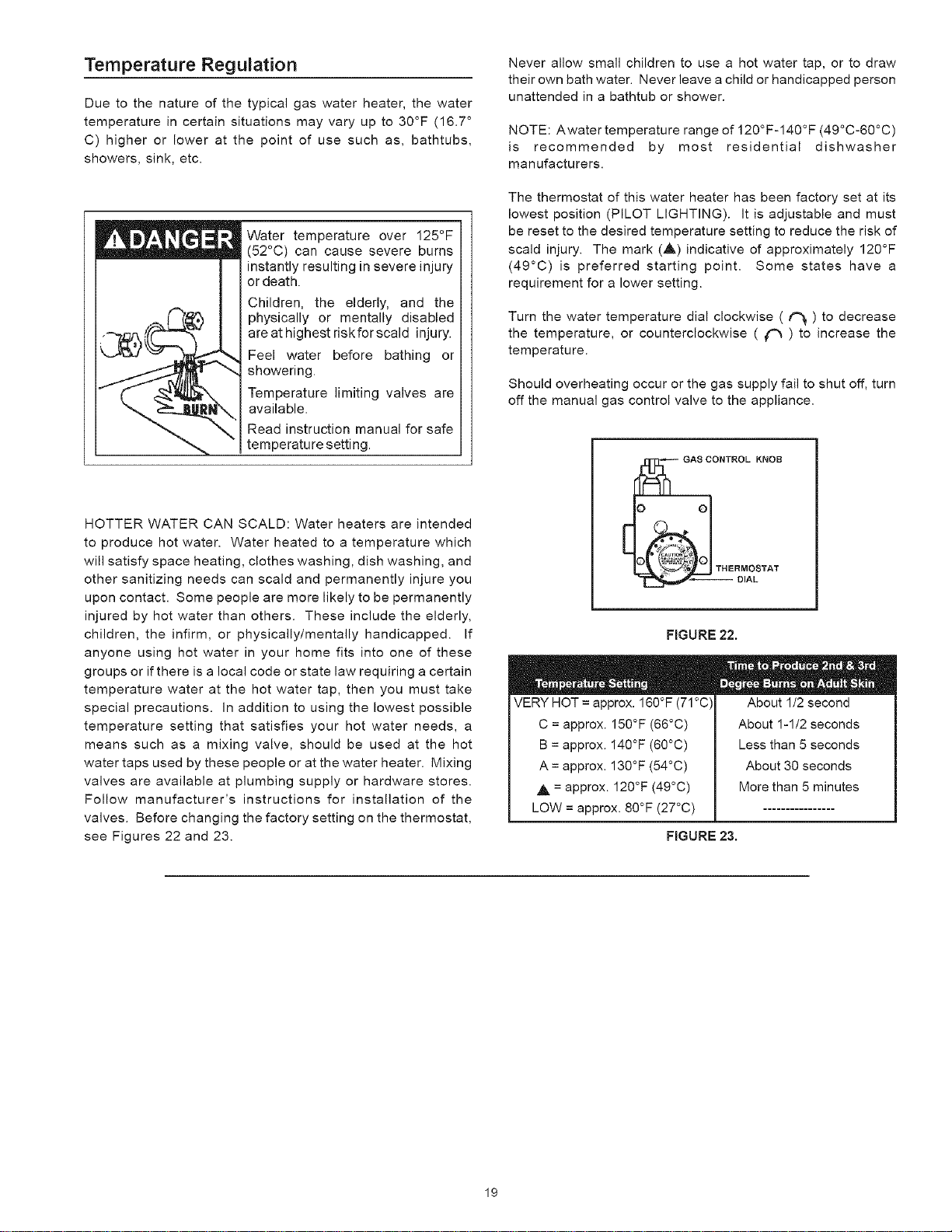
valves. Before changing the factory setting on the thermostat,
see Figures 22 and 23.
Never allow small children to use a hot water tap, or to draw
their own bath water. Never leave a child or handicapped person
unattended in a bathtub or shower.
NOTE: Awater temperature range of 120°F-140°F (49°C-60°C)
is recommended by most residential dishwasher
manufacturers.
The thermostat of this water heater has been factory set at its
lowest position (PILOT LIGHTING). It is adjustable and must
be reset to the desired temperature setting to reduce the risk of
scald injury. The mark (A) indicative of approximately 120°F
(49°C) is preferred starting point. Some states have a
requirement for a lower setting.
Turn the water temperature dial clockwise ( t'_ ) to decrease
the temperature, or counterclockwise ( _ ) to increase the
temperature.
Should overheating occur or the gas supply fail to shut off, turn
off the manual gas control valve to the appliance.
GAS CONTROL KNOB
O_THERMOSTA T
__DIAL
FIGURE 22.
VERY HOT = approx. 160°F (71 °C)
C = approx. 150°F (66°C)
B = approx. I40°F (60°C)
A = approx. 130°F (54°C)
A = approx. 120°F (49°0)
LOW = approx. 80°F (27°C)
About 1/2 second
About 1-1/2 seconds
Less than 5 seconds
About 30 seconds
More than 5 minutes
FIGURE 23.
19
Tank (Sediment) Cleaning Burner inspection
Sediment build-up on the tank bottom may create varying amount
of noise, and if left in the tank will cause permanent tank failure.
In some water areas, you may not be able to drain all sediment
deposits by simply draining the tank. In these cases Mag-Erad
(part no. 23600) can be used to help remove the sediment
deposits. This may be ordered from the Sears Service Center.
For ordering, refer to the Parts Order List section.
Flood damage to a water heater may not be readily visible or
immediately detectable. However, over a period of time a
flooded water heater will create dangerous conditions which
can cause DEATH, SERIOUS BODILY INJURY, OR
PROPERTY DAMAGE. Contact a Sears Service Center to
replace a flooded water heater. Do not attempt to repair the
unit! It must be replaced!
Vent System Inspection
At least once a year a visual inspection should be made of the
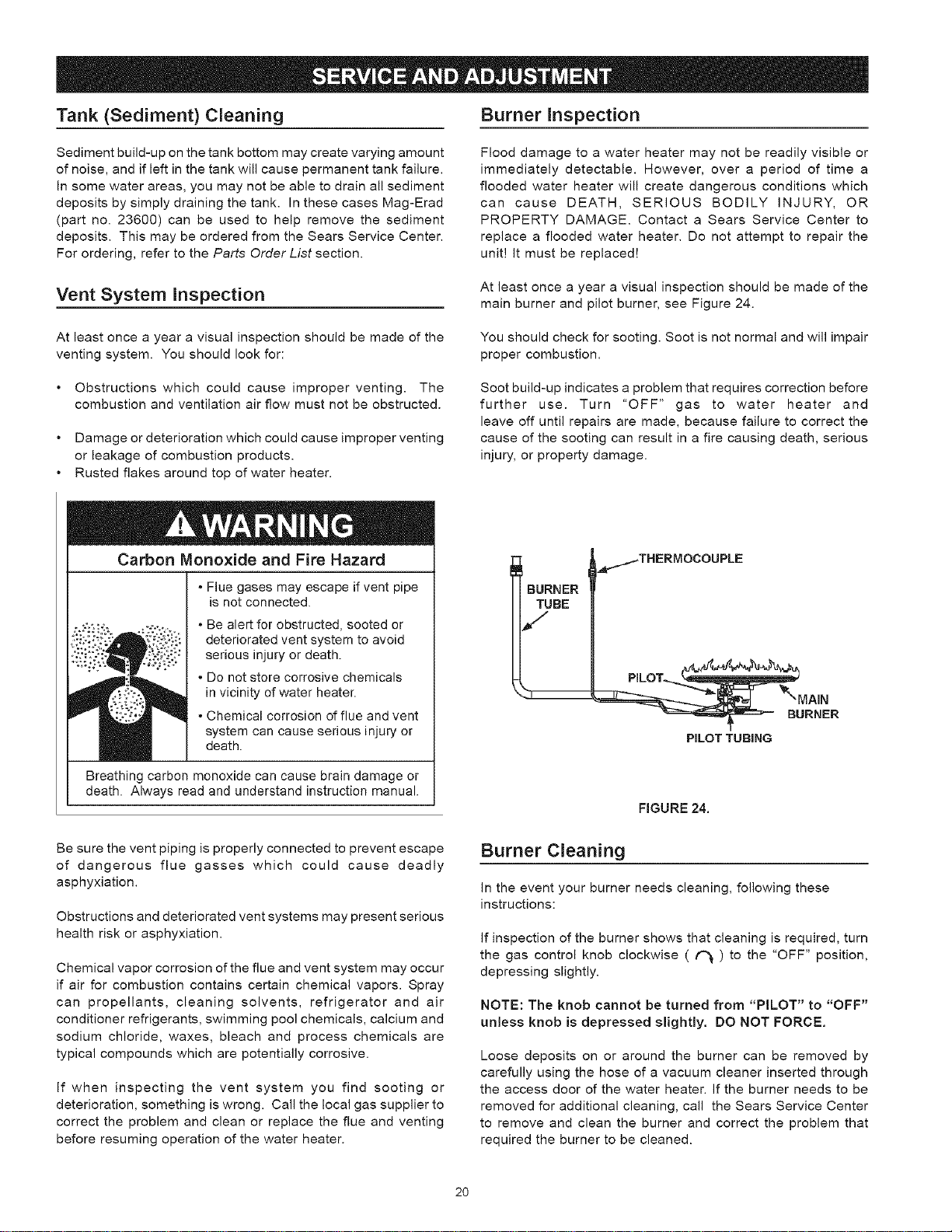
main burner and pilot burner, see Figure 24.
At least once a year a visual inspection should be made of the
venting system. You should look for:
You should check for sooting. Soot is not normal and will impair
proper combustion.
Obstructions which could cause improper venting. The
combustion and ventilation air flow must not be obstructed.
Damage or deterioration which could cause improper venting
or leakage of combustion products.
Rusted flakes around top of water heater.
Soot build-up indicates a problem that requires correction before
further use. Turn "OFF" gas to water heater and
leave off until repairs are made, because failure to correct the
cause of the sooting can result in a fire causing death, serious
injury, or property damage.
Carbon Monoxide and Fire Hazard
- Flue gases may escape if vent pipe
is not connected.
Breathing carbon monoxide can cause brain damage or
death. Always read and understand instruction manual.
- Be alert for obstructed, sooted or
deteriorated vent system to avoid
serious injury or death.
- Do not store corrosive chemicals
in vicinity of water heater.
• Chemical corrosion of flue and vent
system can cause serious injury or
death.
Be sure the vent piping is properly connected to prevent escape
of dangerous flue gasses which could cause deadly
asphyxiation.
Obstructions and deteriorated vent systems may present serious
health risk or asphyxiation.
Chemical vapor corrosion of the flue and vent system may occur
if air for combustion contains certain chemical vapors. Spray
can propellants, cleaning solvents, refrigerator and air
conditioner refrigerants, swimming pool chemicals, calcium and
sodium chloride, waxes, bleach and process chemicals are
typical compounds which are potentially corrosive.
If when inspecting the vent system you find sooting or
deterioration, something is wrong. Call the local gas supplier to
correct the problem and clean or replace the flue and venting
before resuming operation of the water heater.
at/THERMOCOUPLE
BURNER
PILOT TUBING
FIGURE 24,
Burner Cleaning
In the event your burner needs cleaning, following these
instructions:
If inspection of the burner shows that cleaning is required, turn
the gas control knob clockwise ( G ) to the "OFF" position,
depressing slightly.
NOTE: The knob cannot be turned from "PILOT" to "OFF"
unless knob is depressed slightly, DO NOT FORCE.
Loose deposits on or around the burner can be removed by
carefully using the hose of a vacuum cleaner inserted through
the access door of the water heater. If the burner needs to be
removed for additional cleaning, call the Sears Service Center
to remove and clean the burner and correct the problem that
required the burner to be cleaned.
2O
Housekeeping
Vacuum around base of water heater for dust, dirt, and lint on a
regular basis.
INSTALLED IN SUITABLE AREA: To insure sufficient
ventilation and combustion air supply, proper clearances from
the water heater must be maintained. See Facts to Consider
About the Location section. Combustible materials such as
clothing, cleaning materials, or flammable liquids, etc. must
not be placed against or adjacent to the water heater because
they could catch on fire.
Anode deterioration depends on water conductivity, not
necessarily water condition. A corroded or pitted anode rod
indicates high water conductivity and should be checked and/
or replaced more often than an anode rod that appears to be
intact. Replacement of a depleted anode rod can extend the
life of your water heater. Inspection should be conducted by
calling the Sears Service Center for an authorized contractor.
At a minimum, the anode(s) should be checked annually after
the warranty period.
Temperature=Pressure Relief Valve Operation
The temperature-pressure relief valve must be manually
operated at least once a year.
Fire and Explosion Hazard
• Do not obstruct combustion air
openings at the bottom of the
water heater.
Do not use or store flammable
vapor products such as gasoline,
solvents or adhesives in the
same room or area near water
heater or other appliance.
• Can cause serious injury or
death.
Anode Rod inspection
Property Damage Hazard
• Avoid water heater damage.
• Inspection and replacement of anode rod required.
The anode rod is used to protect the tank from corrosion.
Most hot water tanks are equipped with an anode rod. The
submerged rod deteriorates to protect the tank. Instead of
corroding the tank, water ions attack and eat away the
anode rod. This does not affect the water's taste or color.
The rod must be maintained to keep the tank in operating
condition.
, Burn hazard
• Hot water discharge.
° Keep clear of relief valve
discharge outlet.
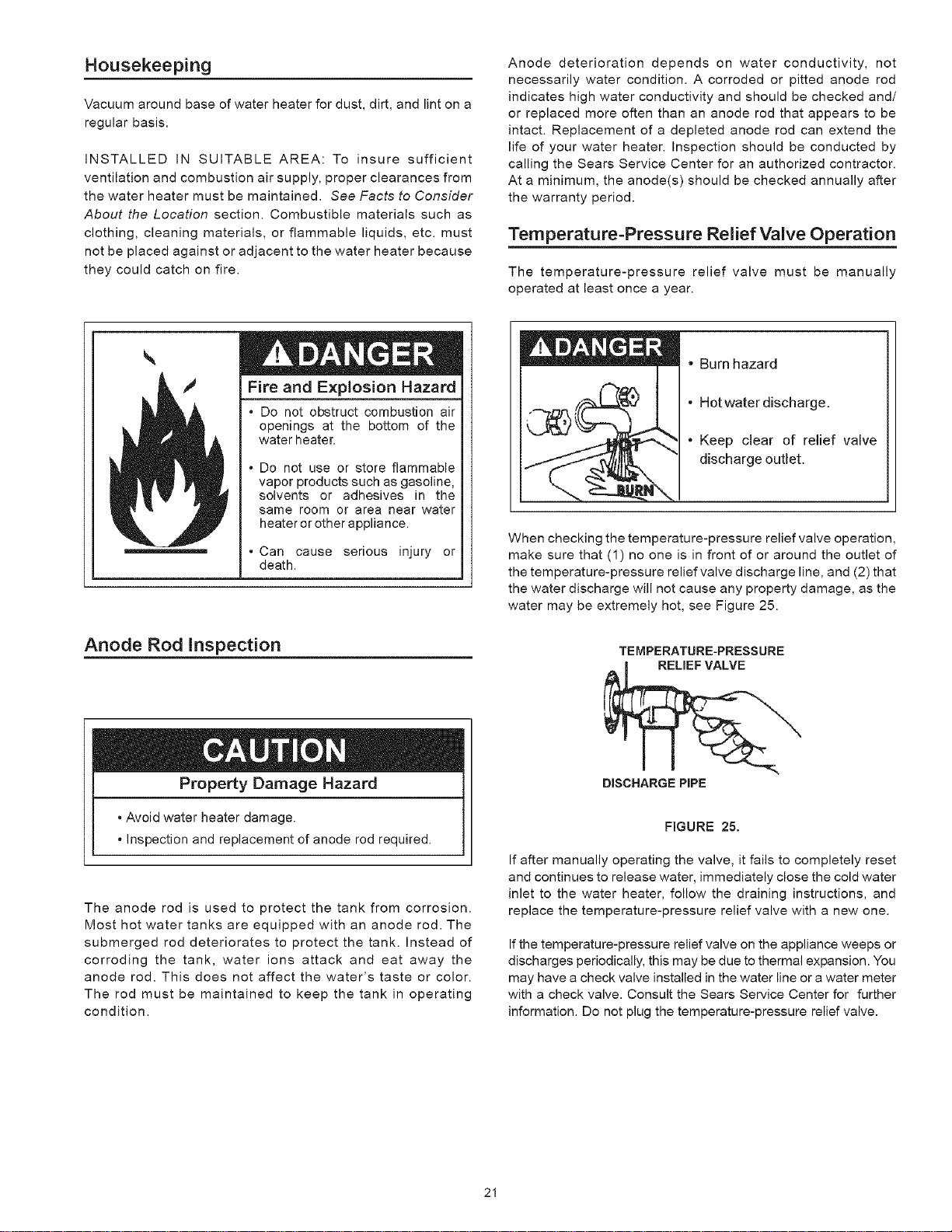
When checking the temperature-pressure relief valve operation,
make sure that (1) no one is in front of or around the outlet of
the temperature-pressure relief valve discharge line, and (2) that
the water discharge will not cause any property damage, as the
water may be extremely hot, see Figure 25.
TEMPERATURE-PRESSURE
DISCHARGE PiPE
FIGURE 25.
If after manually operating the valve, it fails to completely reset
and continues to release water, immediately close the cold water
inlet to the water heater, follow the draining instructions, and
replace the temperature-pressure relief valve with a new one.
If the temperature-pressure relief valve on the appliance weeps or
discharges periodically, this may be due to thermal expansion. You
may have a check valve installed in the water line or a water meter
with a check valve. Consult the Sears Service Center for further
information. Do not plug the temperature-pressure relief valve.
2I
Draining
Burn hazard
, Hotwater discharge.
• Keep hands clear of drain
valve discharge.
The water heater should be drained if being shut down
during freezing temperatures. Also periodic draining and
cleaning of sediment from the tank may be necessary.
1. Turn the gas control knob to the "OFF" position.
2. CLOSE the cold water inlet valve to the water heater.
3. OPEN a nearby hot water faucet and leave open to allow for
draining.
4. Connect a hose to the drain valve and terminate to an
adequate drain.
5. OPEN the water heater drain valve to allow for tank
draining.
NOTE: If the water heater is going to be shut down and
drained for an extended period, the drain valve should
be left open with hose connected allowing water to
terminate to an adequate drain,
6. CLOSE the drain valve.
7. Follow instructions in the Filling The Water heater
section.
8. Follow the lighting instructions in the Lighting section to restart
the water heater.
Service
Before calling for repair service, read the Start Up Conditions
and Operational Conditions found in the Troubleshooting Guide
of this manual.
If a condition persists or you are uncertain about the
operation of the water heater, let the Sears Service Center
check it out.
Contact Sears Service Center at:
1-8OO-4-MY-HOME _ (1-800-469-4663).
22
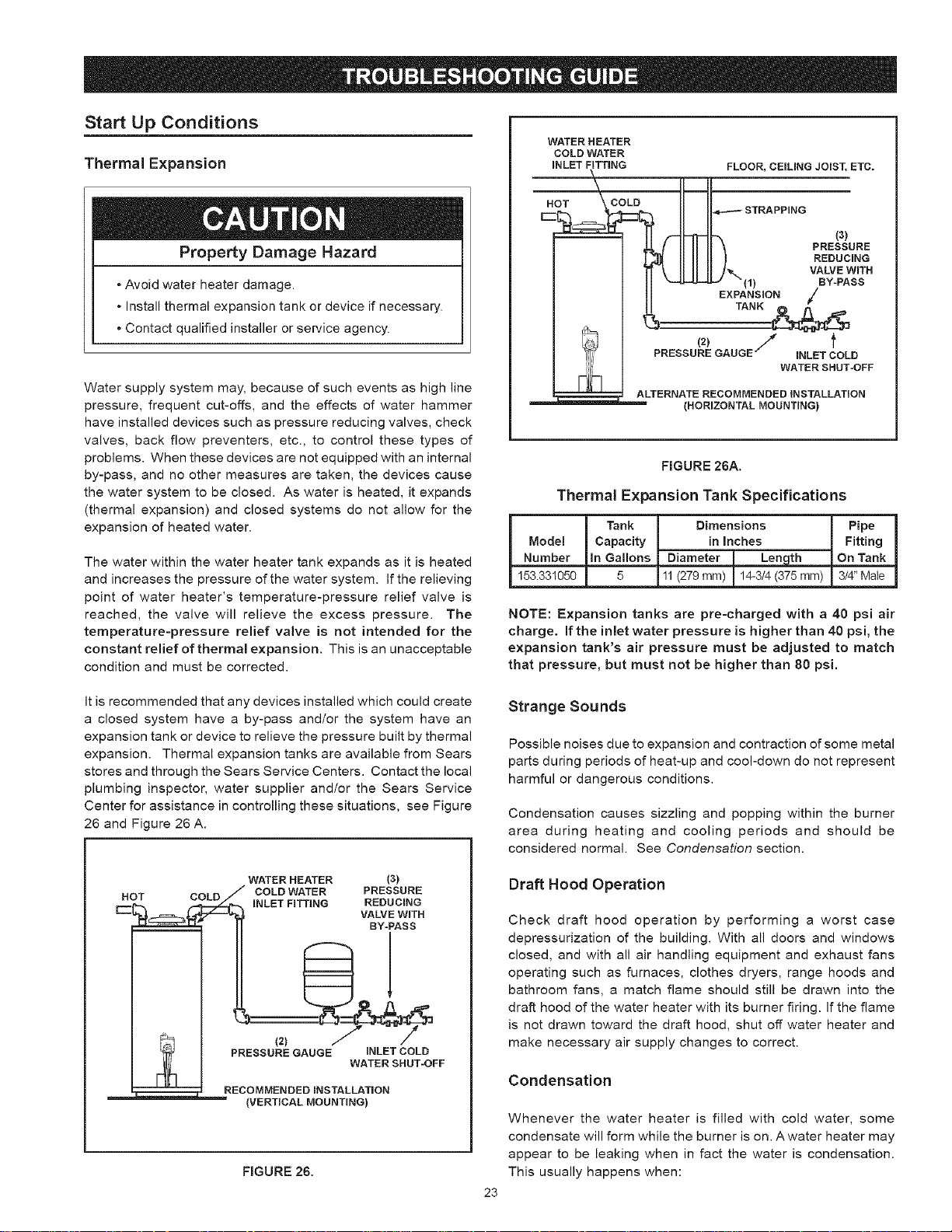
Start Up Conditions
Thermal Expansion
Property Damage Hazard
- Avoid water heater damage.
- Install thermal expansion tank or device if necessary,
• Contact qualified installer or service agency.
Water supply system may, because of such events as high line
pressure, frequent cut-offs, and the effects of water hammer
have installed devices such as pressure reducing valves, check
valves, back flow preventers, etc., to control these types of
problems. When these devices are not equipped with an internal
by-pass, and no other measures are taken, the devices cause
the water system to be closed. As water is heated, it expands
(thermal expansion) and closed systems do not allow for the
expansion of heated water.
The water within the water heater tank expands as it is heated
and increases the pressure of the water system. If the relieving
point of water heater's temperature-pressure relief valve is
reached, the valve will relieve the excess pressure. The
temperature-pressure relief valve is not intended for the
constant relief of thermal expansion. This is an unacceptable
condition and must be corrected.
WATER HEATER
COLD WATER
iNLET FiTTiNG FLOOR, CEiLiNG JOIST, ETC.
\ lIZ
HOT \COLD II II
/111--sTRAPP'No
(3)
I==== fll-lrlh PRESaURE
/ ]_ II II IN REDUCING
\ II II II / _,. VALVEWITH
"--4J---u--u--"-- (1) BY-PASS
I EXPANSION/
I Jl GAUGE iNLET COLD
I J WATER SHUT-OFF
ALTERNATERECOMMENDEDINSTALLATION
(HORIZONTALMOUNTING)
FmGURE 26A.
Thermal Expansion Tank Specifications
Tank
Model Capacity
Number In Gallons
153.331050 5
Dimensions Pipe
in Inches Fitting
Diameter Length On Tank
11(279 ram) 14-3/4(375 mm) 3/4" Male
NOTE: Expansion tanks are pre-charged with a 40 psi air
charge. If the inlet water pressure is higher than 40 psi, the
expansion tank's air pressure must be adjusted to match
that pressure, but must not be higher than 80 psi.
It is recommended that any devices installed which could create
a closed system have a by-pass and/or the system have an
expansion tank or device to relieve the pressure built by thermal
expansion. Thermal expansion tanks are available from Sears
stores and through the Sears Service Centers. Contact the local
plumbing inspector, water supplier and/or the Sears Service
Center for assistance in controlling these situations, see Figure
26 and Figure 26 A.
WATER HEATER (3)
(VERTICAL MOUNTING)
FIGURE 26.
Strange Sou nds
Possible noises due to expansion and contraction of some metal
parts during periods of heat-up and cool-down do not represent
harmful or dangerous conditions.
Condensation causes sizzling and popping within the burner
area during heating and cooling periods and should be
considered normal. See Condensation section.
Draft Hood Operation
Check draft hood operation by performing a worst case
depressurization of the building. With all doors and windows
closed, and with all air handling equipment and exhaust fans
operating such as furnaces, clothes dryers, range hoods and
bathroom fans, a match flame should still be drawn into the
draft hood of the water heater with its burner firing. If the flame
is not drawn toward the draft hood, shut off water heater and
make necessary air supply changes to correct.
Condensation
23
Whenever the water heater is filled with cold water, some
condensate will form while the burner is on. A water heater may
appear to be leaking when in fact the water is condensation.
This usually happens when:
• Anewwaterheaterisfilledwithcoldwaterforthefirsttime.
Burninggasproduceswatervaporin waterheaters,
particularlyhighefficiencymodelswherefluetemperatures
arelower.
Largeamountsofhotwaterareusedinashorttimeandthe
refillwaterinthetankisverycold.
Moisturefromtheproductsofcombustioncondenseonthe
coolertanksurfacesandformdropsofwaterwhichmayfall
ontotheburnerorotherhotsurfacestoproducea"sizzling"or
"frying"noise.
Excessivecondensationcancausepilotoutageduetowater
runningdownthefluetubeontothemainburnerandputtingout
thepilot.
Becauseof the suddennessand amountof water,
condensationwatermaybediagnosedasa"tankleak".After
thewaterinthetankwarmsup(about1-2hours),thecondition
shoulddisappear.
Donotassumethewaterheaterisleakinguntiltherehasbeen
enoughtimeforthewaterinthetanktowarmup.
Anundersizedwaterheaterwillcausemorecondensation.The
waterheatermustbesizedproperlytomeetthefamily's
demandsforhotwaterincludingdishwashers,washingmachines
andshowerheads.
Excessivecondensationmaybenoticedduringthewinterand
earlyspringmonthswhenincomingwatertemperaturesareat
theirlowest.
Goodventingisessentialforagasfiredwaterheatertooperate
properlyaswellastocarryawayproductsofcombustionand
watervapor.
Smoke Odor
It is not uncommon to experience a small amount of smoke and
odor during the initial start-up. This is due to burning off of oil
from metal parts, and will disappear in a short while.
Operational Conditions
Smelly Odor
In each water heater there is installed at least one anode rod
(see parts section) for corrosion protection of the tank. Certain
water conditions will cause a reaction between this rod and the
water. The most common complaint associated with the anode
rod is one of a "rotten egg smell". This odor is derived
from hydrogen sulfide gas dissolved in the water. The smell is
the result of four factors which must all be present for the odor
to develop:
a concentration of sulfate in the supply water.
little or no dissolved oxygen in the water.
a sulfate reducing bacteria within the water heater. (This
harmless bacteria is non-toxic to humans.)
an excess of active hydrogen in the tank. This is caused by
the corrosion protective action of the anode.
Smelly water may be eliminated or reduced in some water
heater models by replacing the anode(s) with one of less
active material, and then chlorinating the water heater tank
and all hot water lines. Contact Sears Service for further
information concerning an Anode Replacement and this
Chlorination Treatment.
If the smelly water persists after the anode replacement and
chlorination treatment, we can only suggest that chlorination
or aeration of the water supply be considered to eliminate the
water problem.
Do not remove the anode leaving the tank unprotected. By
doing so, all warranty on the water heater tank is voided,
"AIR" in Hot Water Faucets
}.--\
)
Explosion Hazard
• Flammable hydrogen
gases may be present.
* Keep all ignition sources
away from faucet when
turning on hot water.
HYDROGEN GAS: Hydrogen gas can be produced in a hot water
system that has not been used for a long period of time (generally
two weeks or more). Hydrogen gas is extremely flammable and
explosive. To prevent the possibility of injury under these
conditions, we recommend the hot water faucet, located farthest
away, be opened for several minutes before any electrical
appliances which are connected to the hot water system are
used (such as a dishwasher or washing machine). If hydrogen
gas is present, there will probably be an unusual sound similar
to air escaping through the pipe as the hot water faucet is opened.
There must be no smoking or open flame near the faucet at the
time it is open.
High Temperature Shut-Off System
This water heater is equipped with an automatic gas shutoff
system. This system shuts off the gas supply to the water heater
burner when high water temperatures are present. It is non-
resettable. If the high temperature shut off activates, the gas
control valve must be replaced. If this were to occur, turn "OFF"
the entire gas supply to the water heater. Contact the Sears
Service Center.
24
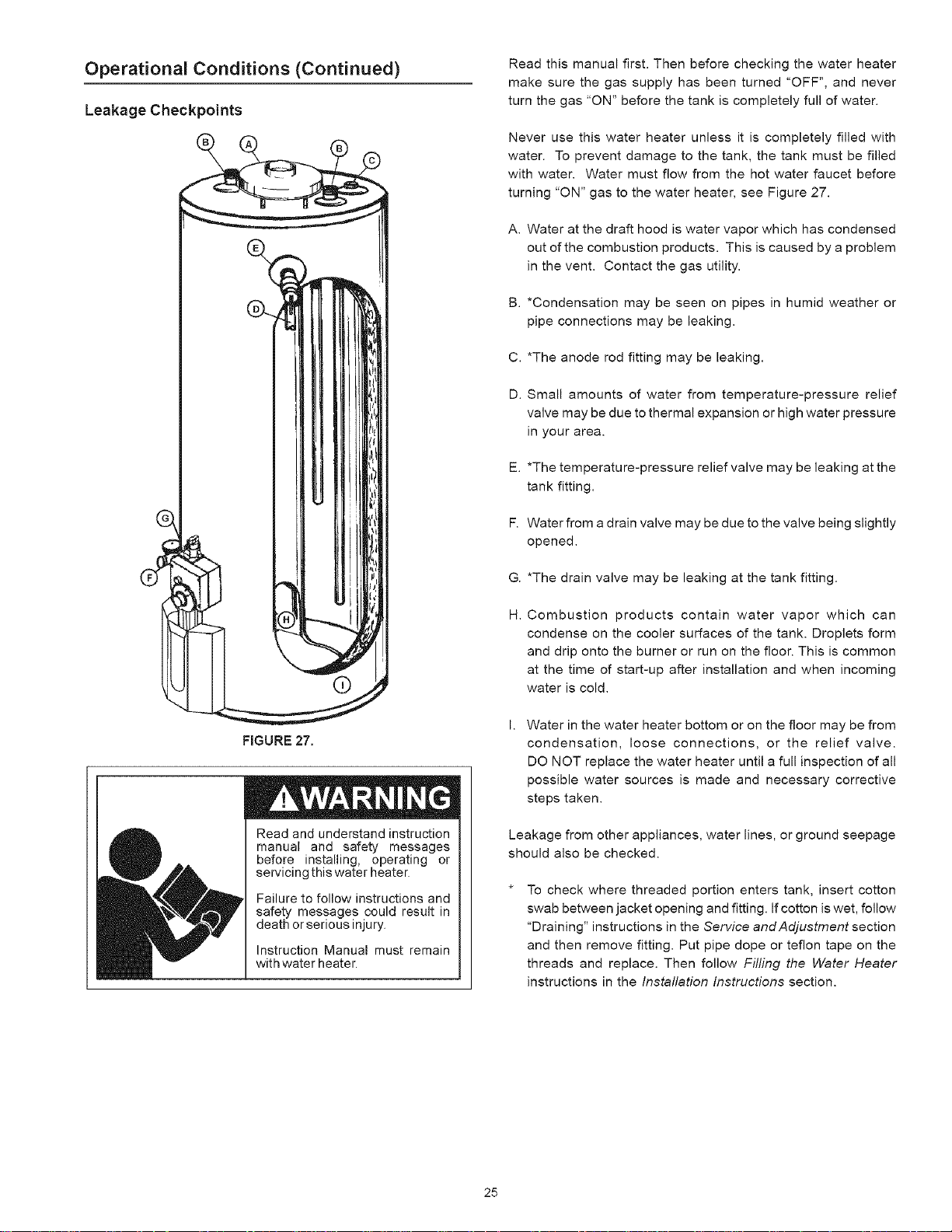
Operational Conditions (Continued)
Leakage Checkpoints
FIGURE 27,
Read and understand instruction
manual and safety messages
before installing, operating or
servicing this water heater.
Failure to follow instructions and
safety messages could result in
death or serious injury.
Instruction Manual must remain
with water heater.
Read this manual first. Then before checking the water heater
make sure the gas supply has been turned "OFF", and never
turn the gas "ON" before the tank is completely full of water.
Never use this water heater unless it is completely filled with
water. To prevent damage to the tank, the tank must be filled
with water. Water must flow from the hot water faucet before
turning "ON" gas to the water heater, see Figure 27.
A. Water at the draft hood is water vapor which has condensed
out of the combustion products. This is caused by a problem
in the vent. Contact the gas utility.
B. *Condensation may be seen on pipes in humid weather or
pipe connections may be leaking.
C. *The anode rod fitting may be leaking.
D. Small amounts of water from temperature-pressure relief
valve may be due to thermal expansion or high water pressure
in your area.
E. *The temperature-pressure relief valve may be leaking at the
tank fitting.
F. Water from a drain valve may be due to the valve being slightly
opened.
G. *The drain valve may be leaking at the tank fitting.
a.
Combustion products contain water vapor which can
condense on the cooler surfaces of the tank. Droplets form
and drip onto the burner or run on the floor. This is common
at the time of start-up after installation and when incoming
water is cold.
Water in the water heater bottom or on the floor may be from
condensation, loose connections, or the relief valve.
DO NOT replace the water heater until a full inspection of all
possible water sources is made and necessary corrective
steps taken.
Leakage from other appliances, water lines, or ground seepage
should also be checked.
To check where threaded portion enters tank, insert cotton
swab between jacket opening and fitting. If cotton is wet, follow
"Draining" instructions in the Service andAdjustment section
and then remove fitting. Put pipe dope or teflon tape on the
threads and replace. Then follow Filling the Water Heater
instructions in the Installation Instructions section.
25
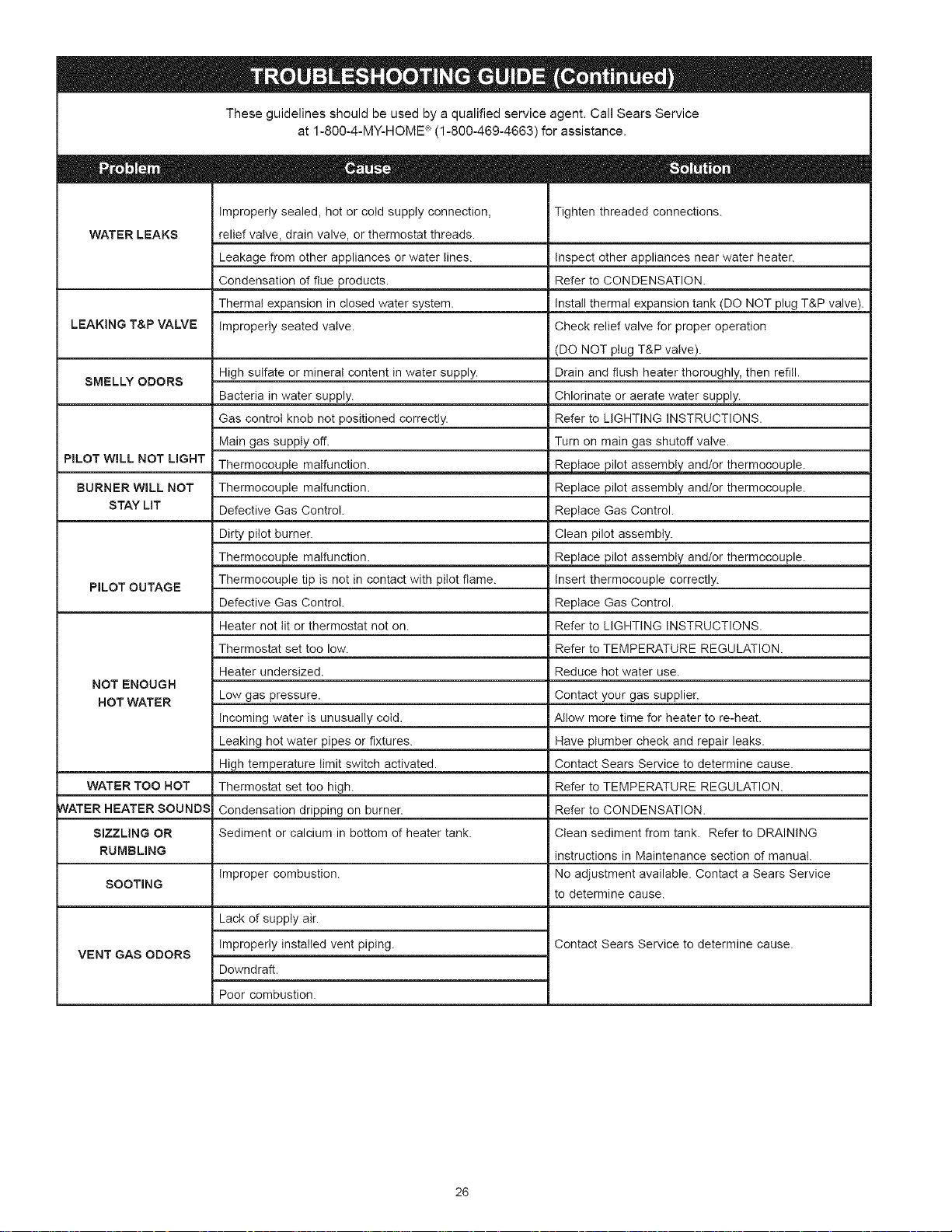
Theseguidelinesshouldbeusedbyaqualifiedserviceagent.CallSearsService
at1-800-4-MY-HOME_R_(I-800-469-4663)forassistance.
Improperlysealed,hotorcoldsupplyconnection, Tightenthreadedconnections.
WATERLEAKS relief valve, drain valve, or thermostat threads.
Leakage from other appliances or water lines. Inspect other appliances near water heater.
Condensation of flue products. Refer to CONDENSATION.
Thermal expansion in closed water system. Install thermal expansion tank (DO NOT plug T&P valve).
LEAKING T&P VALVE Improperly seated valve. Check relief valve for proper operation
(DO NOT plug T&P valve),
High sulfate or mineral content in water supply, Drain and flush heater thoroughly, then refill,
SMELLY ODORS
Bacteria in water supply. Chlorinate or aerate water supply.
Gas control knob not positioned correctly. Refer to LIGHTING INSTRUCTIONS.
Main gas suppty off. Turn on main gas shutoff valve.
PILOT WILL NOT LIGHT ThermocoupIe malfunction. Reptace pilot assembly and/or thermocouple.
BURNER WILL NOT Thermocoupte malfunction, Replace pilot assembly and/or thermocouple.
STAY LIT Defective Gas Control. Replace Gas Control,
Dirty pilot burner, Clean pilot assembly,
Thermocouple malfunction, Replace pilot assembly and/or thermocouple.
PILOT OUTAGE Thermocouple tip is not in contact with pilot flame. Insert thermocouple correctly.
Defective Gas Control. Replace Gas Control,
Heater not tit or thermostat not on. Refer to LIGHTING INSTRUCTIONS,
Thermostat set too low. Refer to TEMPERATURE REGULATION.
Heater undersized. Reduce hot water use.
NOT ENOUGH
NOT WATER Low gas pressure. Contact your gas supplier.
Incoming water is unusually cold. Allow more time for heater to re-heat.
Leaking hot water pipes or fixtures. Have plumber check and repair leaks.
High temperature timit switch activated. Contact Sears Service to determine cause.
WATER TOO NOT Thermostat set too high. Refer to TEMPERATURE REGULATION.
_/ATER HEATER SOUND_ Condensation dripping on burner. Refer to CONDENSATION.
SIZZLING OR Sediment or calcium in bottom of heater tank. Clean sediment from tank. Refer to DRAINING
RUMBLING instructions in Maintenance section of manual.
Improper combustion. No adjustment available, Contact a Sears Service
SOOTING
to determine cause.
VENTGASODORS
Lack of supply air.
Improperly installed vent piping.
Downdraft.
Poor combustion.
Contact Sears Service to determine cause.
26

GAS WATER HEATER
1_3 High AItitu
Key
No.
1
2
3
4
*5
6
7
*8
9
10
I1
12
13
"14
15
16
17
*'18
19
2O
21
*22
Part Description
Anode Rod
Burner Head
Burner Orifice
Burner Tube
Compression Fitting
Dip Tube
Draft Hood
Draft Hood Bracket
Drain Valve
Drain Valve Washer
Flue Baffle
Gas Control Valve
Inner Door
Instruction Manual
Nipple (Hot Outlet)
Outer Door
Pilot Assembly w/Compression Fitting
Pilot Tube
T&P Relief Valve
Piezo Ignitor Generator w/Bracket
Thermocouple
Mag-Erad
153.331760
9001829
9006200
9003732(#21)
9006199
9004106
9006214
9003737
9003738
9000058
9001584
9003736
9003739
9003735
186079-000
9003743
9000358
9006201
9003741
9003410
9000283
23600
Model Number
153,331770HA
9001829
9006200
9006368 (#25)
9006199
9004106
9006214
9003737
9003738
9000058
9001584
9003736
9003739
9003735
186079-000
9003743
9000358
9006201
9003741
9003410
9000283
23600
* Not Shown
** Pilot Tube is an integral part of the pilot assembly.
Now that you have purchased your gas water heater, should a need
ever exist for repair parts or service, simply contact any Sears Service
Center or call 1-800-4-MY-HOME <R_(1-800-469-4663). Be sure to
provide all pertinent facts when you call or visit.
WHEN ORDERING REPAIR PARTS, ALWAYS GIVE THE
FOLLOWING INFORMATION:
27
MODEL NUMBER
SERIAL NUMBER
TYPE GAS - NATURAL OR PROPANE (L.R)
PART DESCRIPTION
THIS IS A REPAIR PARTS LIST, NOT A PACKING LIST.
12 YEAR LIMITED WARRANTY ON WATER HEATER
For twelve years from date of purchase, if this water heater is installed and operated in a single-family home in accordance
with the owner's manual instructions and all local applicable plumbing codes, Sears will 1) supply free water heater parts for
those that are defective in material or workmanship, and 2) supply a free water heater for one that develops a leak.
For the second through twelfth year from purchase date, you must pay the labor cost for installation of water heater.
For commercial, institutional, industrial, or residential use by two or more families, the above limited warranty is only for two
years. During the second year you must pay the labor cost for water heater installation.
1 YEAR EXCLUSIVE KENMORE LABOR WARRANTY
For the first year from the date of purchase, Sears will, free of charge, supply and install new water heater parts for defective
ones or a new water heater for one that develops a leak.
WARRANTY SERVICE
To obtain warranty service, call 1-800-4-MY-HOME _ (1-800-469-4663). This warranty applies only while this product is in use
in the United States.
This warranty gives you specific legal rights and you may also have other rights which vary from state to state.
SEARS, ROEBUCK AND CO., Dept. 817 WA, HOFFMAN ESTATES, IL 60179
The price of your water heater does not include a free checkup service call. On water heater installations arranged by Sears, Sears
warrants the installation.
A charge will be made on service calls due to poor or incomplete installation. These include:
a. Adjusting thermostat c. Leaks in pipes or fittings e. Condensation
b. Lighting pilot d. Improper venting
MASTER PROTECTION AGREEMENTS
Congratulations on making a smart purchase. Your new Kenmore _'
product is designed and manufactured for years of dependable
operation. But like all products, it may require preventive maintenance
or repair from time to time. That's when having a Master Protection
Agreement can save you money and aggravation.
Purchase a Master Protection Agreement now and protect yourself
from unexpected hassle and expense.
The Master Protection Agreement also helps extend the life of your
new product. Here's what's included in the Agreement:
Expert Service by our 12,000 professional repair specialist.
Unlimited service and no charge for parts and labor on all covered
repairs.
"No-lemon" guarantee - replacement of your covered product if
four or more product failures occur within twelve months.
Product replacement if your covered product can't be fixed.
• Annual Preventive Maintenance Check at your request - no
extra charge.
Fast help by phone - phone support from a Sears technician on
products requiring in-home repair, plus convenient repair scheduling.
Power surge protection against electrical damage due to power
fluctuations.
Rental reimbursement if repair of your covered product takes
longer than promised.
Once you purchase the Agreement, a simple phone call is all that it
takes for you to schedule service. You can call anytime day or night,
or schedule a service appointment on-line.
Sears has over 12,000 professional repair specialists, who have
access to over 4.5 million quality parts and accessories. That's the
kind of professionalism you can count on to help prolong the life of
your new purchase for years to come. Purchase your Master Protection
Agreement today!
Some limitations and exclusions apply. For prices and additional
information call 1-800-827-6655.
SEARS INSTALLATION SERVICE
For Sears professional Installation of home appliances, garage door
openers, water heaters, and other major home items, in the U.S.A.,
call 1-800-4-MY-HOME%
For in-home major brand repair service
Call 24 hours a day, 7 days a week (U.S.A. and Canada)
t -800-4-MY-HOME ®
(1-800-469-4663)
www.sears.com
The model number of your water heater is found on the model rating plate on the front of the water heater.
Sears, Roebuck and Co., Hoffman Estates, IL 60179 U.S.A