Use & Care Guide
Guide d'utilisation et d'entrefien
English / FrancFais
Models/Mod61es: 970-4204% 4206% 4208% 4209% 4211_, 4213%
4215% 4228% 4233% 4296% 4585 _
Models/Mod61es: 970R4210", 4212 _, 4220% 4352 _, 4354% 4372 _,
4374*"
_}® _S"@®Y@'_O/"
Jwl @ , @ , 7
IIRef IIng e lirat e u ii,° d e C o m pa II,°t_m e nt S u pe litpo se s
:_ _ Colol' number} e num6ro de couk_,uu'
P,/N 807713204 (1306)
Sears Canada Inc.
Toronto, Ontario, Canada M5B 2C3
www.sears.ca
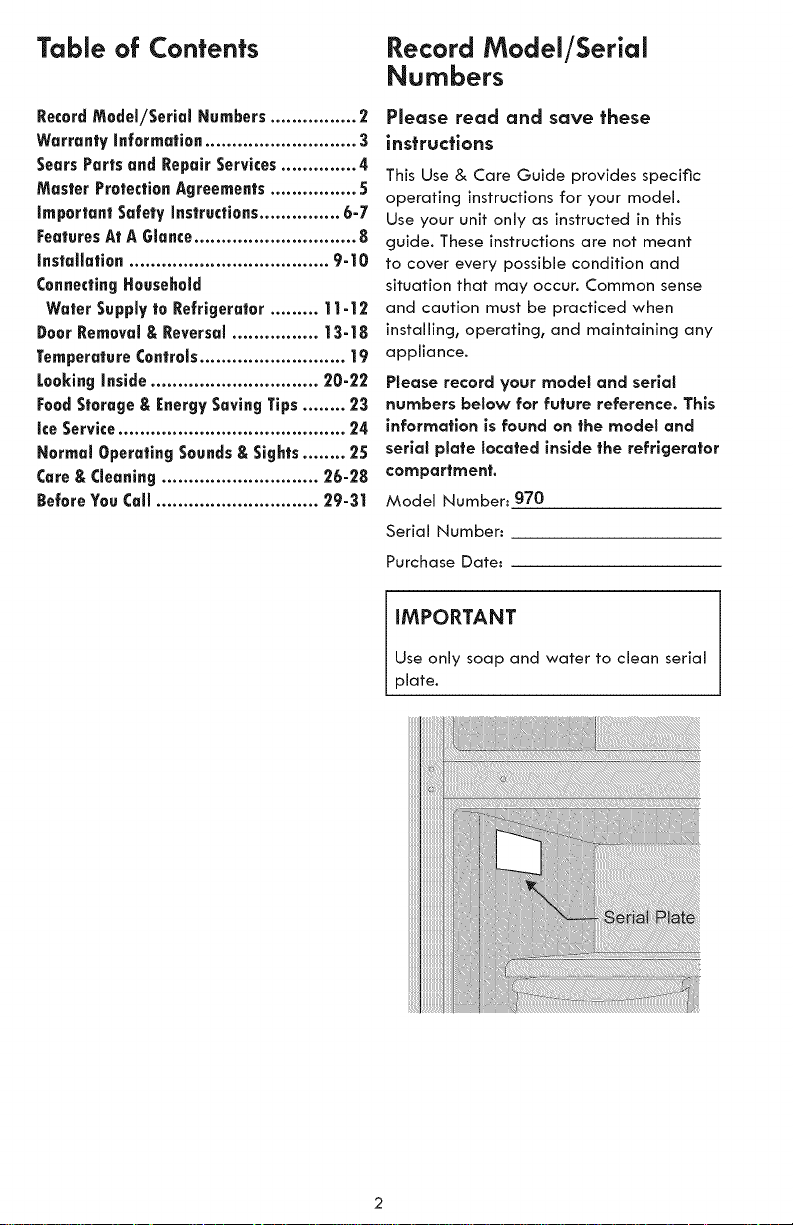
Table of Contents
Record Model/SeriaJ Numbers................ 2
Warranty Information ............................ 3
Sears Parts and Repair Services.............. 4
Master ProtectionAgreements ................ 5
Important Safety Instructions ............... 6-7
FeaturesAt A Glance.............................. 8
Installation ..................................... 9-10
Connecting Household
Water Supplyto Refrigerator ......... 11-12
DoorRemoval g Reversal ................ 13-18
Temperature Controls ........................... 19
LookingInside ............................... 20-22
FoodStorage g EnergySavingTips ........ 23
Ice Service.......................................... 24
Normal Operating Soundsg Sights........ 25
Care & Cleaning ............................. 26-28
Before YouCall .............................. 29-31
Record ModeJ/Serial
Numbers
Please read and save these
instructions
This Use & Care Guide provides specific
operating instructions for your model.
Use your unit only as instructed in this
guide. These instructions are not meant
to cover every possible condition and
situation that may occur. Common sense
and caution must be practiced when
installing, operating, and maintaining any
appliance.
Please record your model and serial
numbers below for future reference. This
information is found on the model and
serial plate located inside the refrigerator
compartment.
Model Number: gT0
Serial Number:
Purchase Date:
iMPORTANT
Use onJy soap and water to dean serial
piate.
Warranty Information
KENMORE APPLIANCE WARRANTY
One Year Limited Warranty
When installed, operated and maintained according to all instructions supplied with
the product_ if this appliance fails due to a defect in material or workmanship within
one year from the date of purchase, call 1-800-4-MY-HOME ® to arrange for free
repair.
If this appliance is used for other than private family purposes, this warranty applies
for only 90 days from the date of purchase.
This warranty covers only defects in material and workmanship. Sears will NOT pay
for:
1. Expendable items that can wear out from normal use, including but not limited to
filters, belts, light bulbs and bags.
2. A service technician to instruct the user in correct product installation, operation
or maintenance.
3. A service technician to clean or maintain this product.
4. Damage to or failure of this product if it is not installed, operated or maintained
according to all instructions supplied with the product.
5. Damage to or failure of this product resulting from accident_ abuse, misuse or use
for other than its intended purpose.
6. Damage to or failure of this product caused by the use of detergents, cleaners,
chemicals or utensils other than those recommended in all instructions supplied
with the product.
7. Damage to or failure of parts or systems resulting from unauthorized
modifications made to this product.
Disclaimer of implied warranties; limitation of remedies
Customer's sole and exclusive remedy under this limited warranty shall be product
repair as provided herein. Implied warranties, including warranties of merchantability
or fitness for a particular purpose, are limited to one year or the shortest period
allowed by law. Sears shall not be liable for incidental or consequential damages.
Some states and provinces do not allow the exclusion or limitation of incidental
or consequential damages, or limitations on the duration of implied warranties of
merchantability or fitness, so these exclusions or limitations may not apply to you.
This warranty applies only while this appliance is used in Canada _'.
This warranty gives you specific legal rights, and you may also have other rights which
vary from province to province.
Sears Canada inc., Toronto, Ontario, Canada MSB 2C3
_ln Canada, in-home repair service is not available in all areas, nor will this warranty
cover user or servicer travel and transportation expenses if this product is located in
a remote area (as defined by Sears Canada Inc.) where an authorized servicer is not
available.
Sears Parts and Repair Services
WE'RE THEREFOR YOU LONG AFTERTHESALE
To purchase replacement parts and product accessories, call I.800.4.MYoHOME TM
(1.800.469.4663), visit Sears.ca/parts, or visit your nearest Sears Parts and Repair
store. Delivery to your home is available.
:1:Select product assortment sold online; for full product availability please call the number provided.
We recommend the following accessories to help extend the life of your product while saving
you time and money.
Water & Air Filters
D ice Maker Stainless Steel Water Line
[_J Thermometers
[_J Environmentally Friendly Appliance
Cleaners
[_J Range Hood Filters
D Elements
D Bulbs
[_J Smooth Top Cleaning Kits
D _ b
[_J Stainless Steel Hoses
[_J Clamps & Dishwasher Fittings
[_J Dishwasher installation Kits
[_J Rubber & Stainless Steel Hoses
[_J Ducts, Clamps, Vent Kits & Dryer Vent
Cleaning Brushes
[_J Filters & Heating Elements
D Bags
[_J Belts
[_J Hoses
[_J Wands, Brushes & Nozzles
[_J Filters
[_J Tune-up Kits, Oil & Fuel Stabtitizers
D Filters
[_J Blades
[_J Belts
[_J Spark Plugs, Shear Bolts & Shear Pins
[_J Furnace & Air Conditioning Filters
[_J Thermostats
[_J Humidifier Media Pads
[_J Durasept Humidifier Cleaner
And a whole lot more! We have access to over I million parrs and accessories!
in-home or in-shop service is available for all major brands.
Call 1.800.4.MY.HOME TM
Sears.ca/parts
Master Protection Agreements
Congratulations on making a smart purchase. Your new Kenmore® product is designed
and manufactured for years of dependable operation. But like all products, it may
require preventive maintenance or repair from time to time. That's when having a
Master Protection Agreement can save you money and aggravation.
The Master Protection Agreement also helps extend the life of your new product.
Here's what the Agreement _ includes:
* Parts and labor needed to help keep products operating properly under normal
use, not just defects. Our coverage goes well beyond the product warranty. No
deductibles, no functional failure excluded from coverage - real protection.
* Expert service by a force of more than 2,500 authorized Sears service technicians,
which means someone you can trust will be working on your product.
* Unlimited service calls and nationwide service, as often as you want us, whenever
you want us.
* "No-lemon" guarantee - replacement of your covered product if four or more
product failures occur within twelve months.
" Product replacement if your covered product can not be fixed.
* Fast help by phone - we call it Rapid Resolution - phone support from a Sears
representative on all products. Think of us as a °'talking owner's manuaF.
* Power surge protection against electrical damage due to power fluctuations.
* $250 Food Loss Protection annually for any food spoilage that is the result of
mechanical failure of any covered refrigerator or freezer.
* 10% discount off the regular price of any non-covered installed parts.
Once you purchase the Agreement, a simple phone call is all that it takes for you to
schedule service. You can call anytime day or night, or schedule a service appointment
online.
The Master Protection Agreement is a risk free purchase. If you cancel for any reason
during the product warranty period, we will provide a full refund. Or, a prorated
refund anytime after the product warranty period expires. Purchase your Master
Protection Agreement today!
Coverage in Canada varies on some items. For full details call Sears Canada at
1-800-361-6665.
Sears Installation Service
For Sears professional installation of home appliances, garage door openers, water
heaters, and other major home items, in Canada call 1-800-4-MY-HOME ®.
Important Safety Instructions
Safety Precautions
Do not attempt to install or operate
your unit until you have read the safety
precautions in this manual. Safety items
throughout this manual are labeled with
a Danger, Warning, or Caution based on
the risk type.
Definitions
/_ This isthe safety alert symbol. It is
used to alert you to potential personal
iniury hazards. Obey all safety messages
that follow this symbol to avoid possible
injury or death.
DANGER
DANGER indicates an imminently
hazardous situation which, if not
avoided, will resultin death or serious
injury.
_ WARNING
WARNING indicatesa potentially
hazardous situationwhich, if notavoided,
could resultin death or serious injury.
_ CAUTION
CAUTION indicatesa potentially
hazardous situation which, if notavoided,
may resultin minor or moderate injury.
IMPORTANT
Indicates installation, operation, or
maintenance information which is
important but not hazard=related.
_:_ WARNING
Please read all safety instructions
before using your new appliance.
For Your Safety
* Do not store or use gasoline or other
flammable liquids in the vicinity of
this or any other appliance. Read
product labels for warnings regarding
flammability and other hazards.
* Do not operate the unit in the presence
of explosive fumes.
* Avoid contact with any moving parts of
automatic ice maker.
* Remove all staples from the carton.
Staples can cause severe cuts and also
destroy finishes if they come in contact
with other appliances or furniture.
Child Safety
Destroy or recycle the carton, plastic
bags, and any exterior wrapping material
immediately after the unit is unpacked.
Children should never use these items
to play. Cartons covered with rugs,
bedspreads, plastic sheets or stretch wrap
may become airtight chambers and can
quickly cause suffocation.
Proper dlsposal of your appliance
Risk of child entrapment
Child entrapment and suffocation are not
problems of the past. Junked or abandoned
appliances are still dangerous = even if they
will sit for "just a few days." If you are getting
rid of your appliance, please follow the
instructions below to help prevent accidents.
Dispose of refrigerator in accordance with
Federal and Local regulations. Before you
throw away your
old unit:
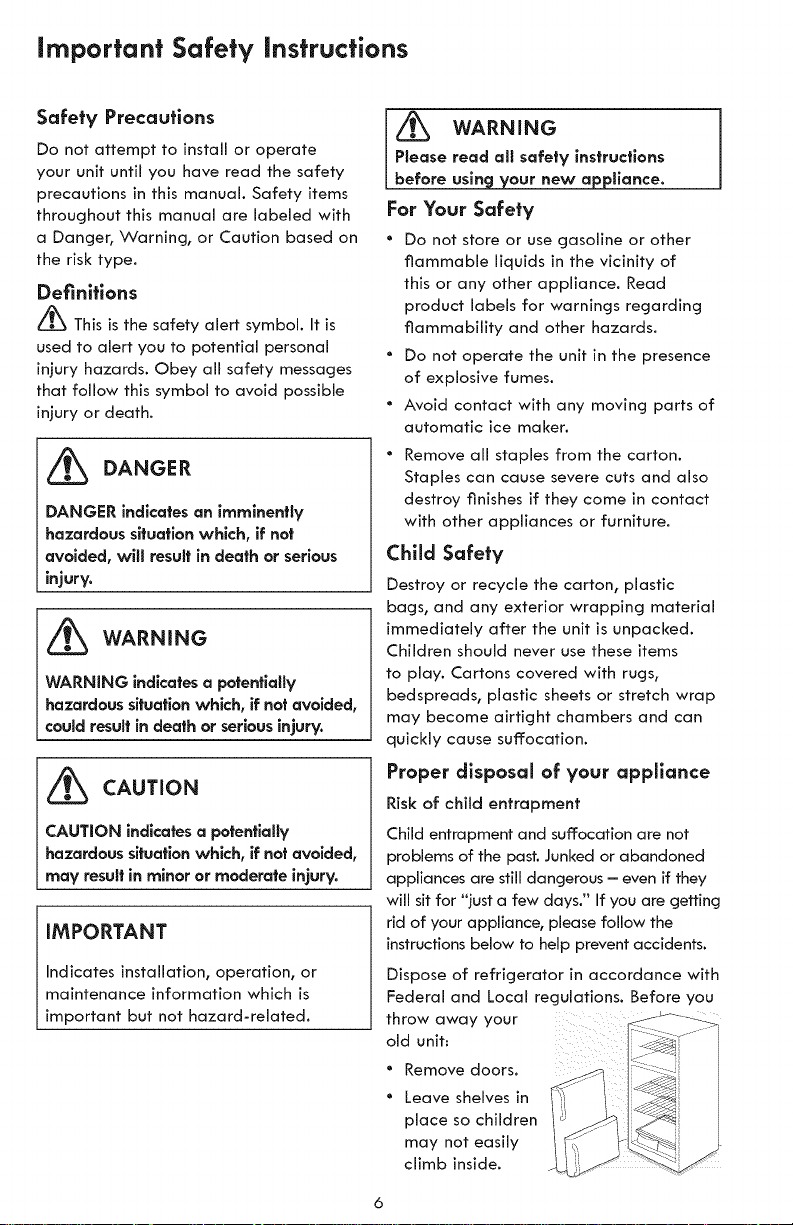
* Remove doors.
" Leave shelves in
place so children
may not easily
climb inside.
important Safety Instructions
iMPORTANT
CFC/HCFC Disposal
Your old refrigerator may have
a cooling system that used CFCs
or HCFCs (chlorofiuorocarbons or
hydrochlorofiuorocarbons). CFCs
and HCFCs are believed to harm
stratospheric ozone if released to the
atmosphere. Other refrigerants may
also cause harm to the environment if
released to the atmosphere.
If you are throwing away your old
refrigerator, make sure the refrigerant
is removed for proper disposal by a
qualified technician. If you intentionally
release refrigerant, you may be subject
to fines and imprisonment under
provisions of environmental legislation.
WARNING
These guidelines must be followed to
ensure that safety mechanisms in this
unit will operate properly.
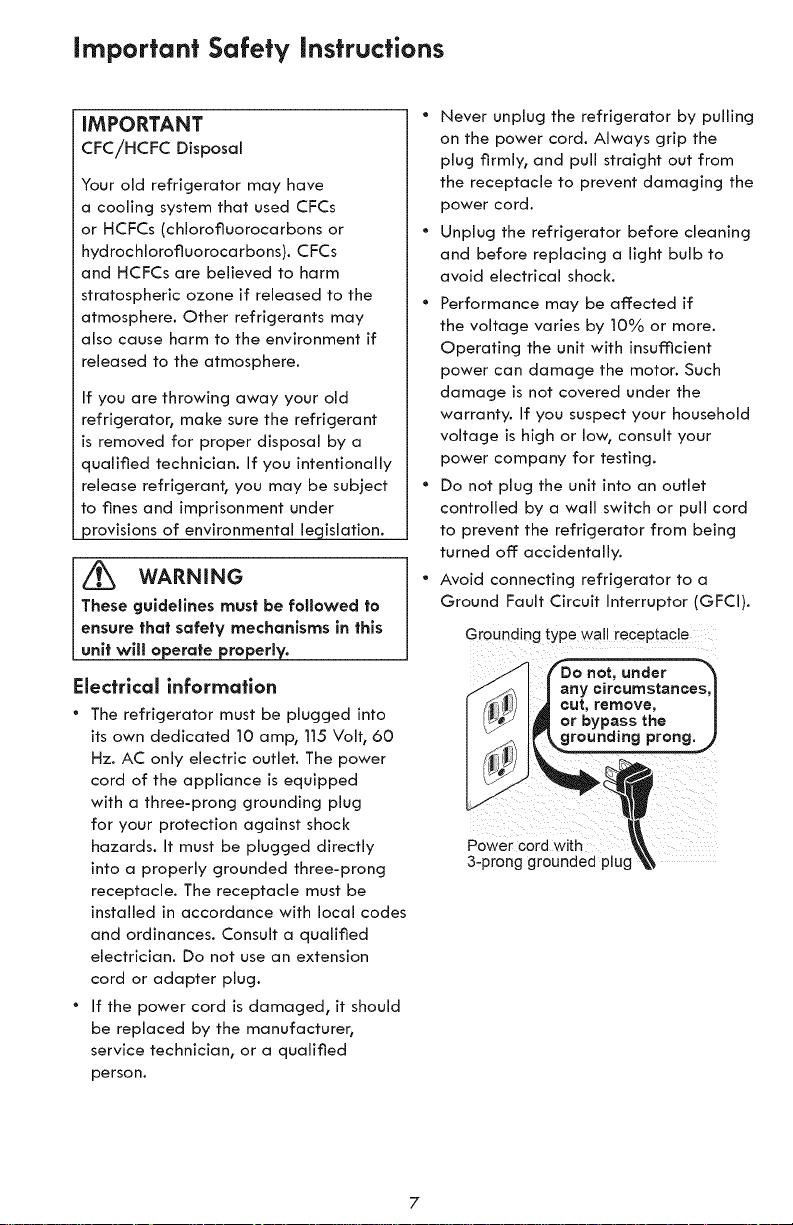
Electrical information
* The refrigerator must be plugged into
its own dedicated 10 amp, 115 Volt, 60
Hz. AC only electric outlet. The power
cord of the appliance is equipped
with a three-prong grounding plug
for your protection against shock
hazards. It must be plugged directly
into a properly grounded three-prong
receptacle. The receptacle must be
installed in accordance with local codes
and ordinances. Consult a qualified
electrician. Do not use an extension
cord or adapter plug.
* If the power cord is damaged, it should
be replaced by the manufacturer,
service technician, or a qualified
person.
* Never unplug the refrigerator by pulling
on the power cord. Always grip the
plug firmly, and pull straight out from
the receptacle to prevent damaging the
power cord.
" Unplug the refrigerator before cleaning
and before replacing a light bulb to
avoid electrical shock.
Performance may be affected if
the voltage varies by 10% or more.
Operating the unit with insufficient
power can damage the motor. Such
damage is not covered under the
warranty. If you suspect your household
voltage is high or low, consult your
power company for testing.
Do not plug the unit into an outlet
controlled by a wall switch or pull cord
to prevent the refrigerator from being
turned off accidentally.
Avoid connecting refrigerator to a
Ground Fault Circuit Interruptor (GFCI).
Grounding type wa!! receptacle
under
Power cord with
3-prong grounded plug
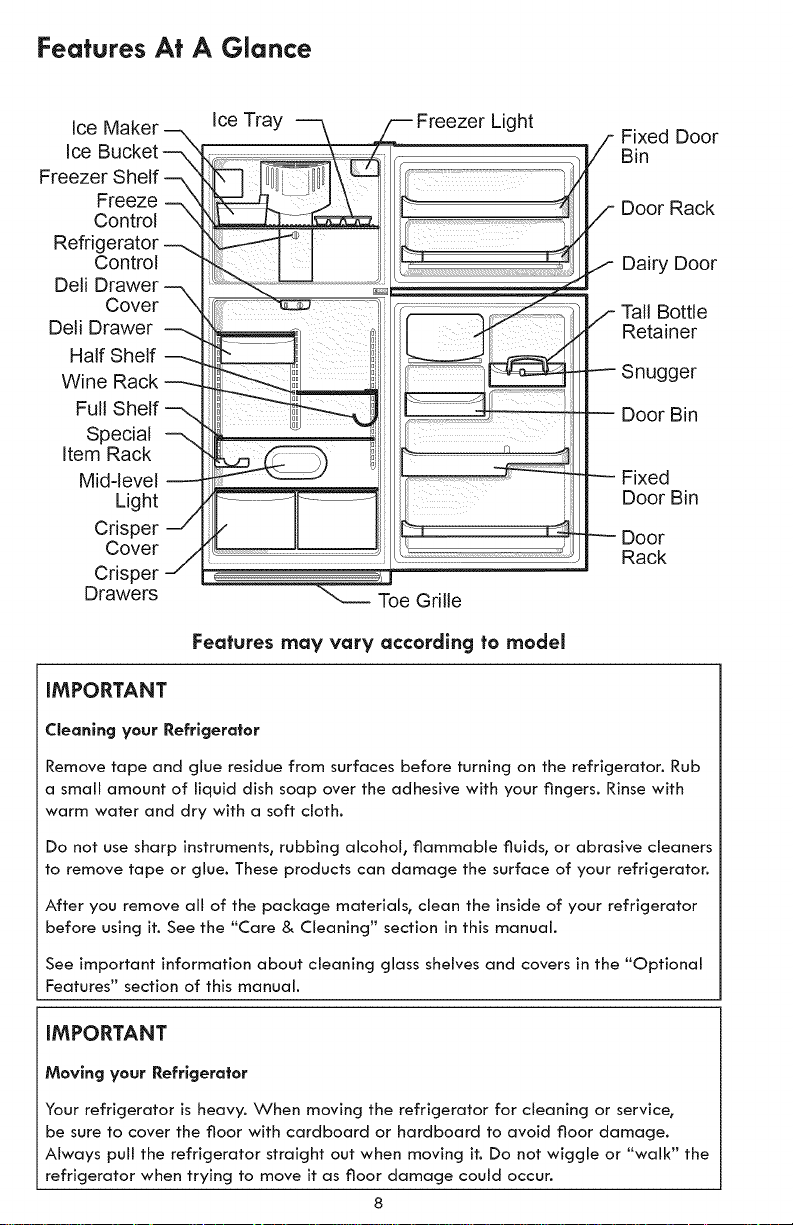
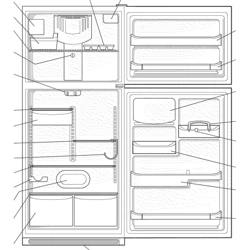
Features At A Glance
Ice
Ice Bucket
Freezer
Freeze
Control
Refrig
Control
Deft
Cover
Deft Drawer
Half Shelf
Wine Rack
Full
Special
Item Rack
Mid-level
Light
Crisper
Cover
Cris
Drawers
Ice Tray ,--- Freezer Light
Toe Grille
Features may vary according to model
Fixed Door
Bin
Door Rack
Dairy Door
Tall Bottle
Retainer
Snugger
Door Bin
Fixed
Door Bin
Rack
IMPORTANT
Cleaning your Refrigerator
Remove tape and glue residue from surfaces before turning on the refrigerator. Rub
a small amount of liquid dish soap over the adhesive with your fingers. Rinse with
warm water and dry with a soft cloth.
Do not use sharp instruments, rubbing alcohol, flammable fluids, or abrasive cleaners
to remove tape or glue. These products can damage the surface of your refrigerator.
After you remove all of the package materials, clean the inside of your refrigerator
before using it. See the "Care & Cleaning" section in this manual.
See important information about cleaning glass shelves and covers in the "Optional
Features" section of this manual.
IMPORTANT
Moving your Refrigerator
Your refrigerator is heavy. When moving the refrigerator for cleaning or service,
be sure to cover the floor with cardboard or hardboard to avoid floor damage.
Always pull the refrigerator straight out when moving it. Do not wiggle or "walk" the
refrigerator when trying to move it as floor damage could occur.
Installation
This Use & Care Manual provides specific
operating instructions for your model. Use
the refrigerator only as instructed in this
Use & Care Manual. Before starting the
refrigerator, follow these important first
steps.
Location
* Choose a place that is near a grounded
electrical outlet. Do Not use an
extension cord or an adapter plug.
* If possible, place the refrigerator out
of direct sunlight and away from the
range, dishwasher or other heat sources.
* The refrigerator must be installed on a
floor that is level and strong enough to
support a fully loaded refrigerator.
* Consider water supply availability for
models equipped with an automatic ice
ma ker.
CAUTION
Do Not install the refrigerator where
the temperature will drop below 55°F
(13°C) or rise above 110°F (43°C).
The compressor will not be able to
maintain proper temperatures inside
the refrigerator.
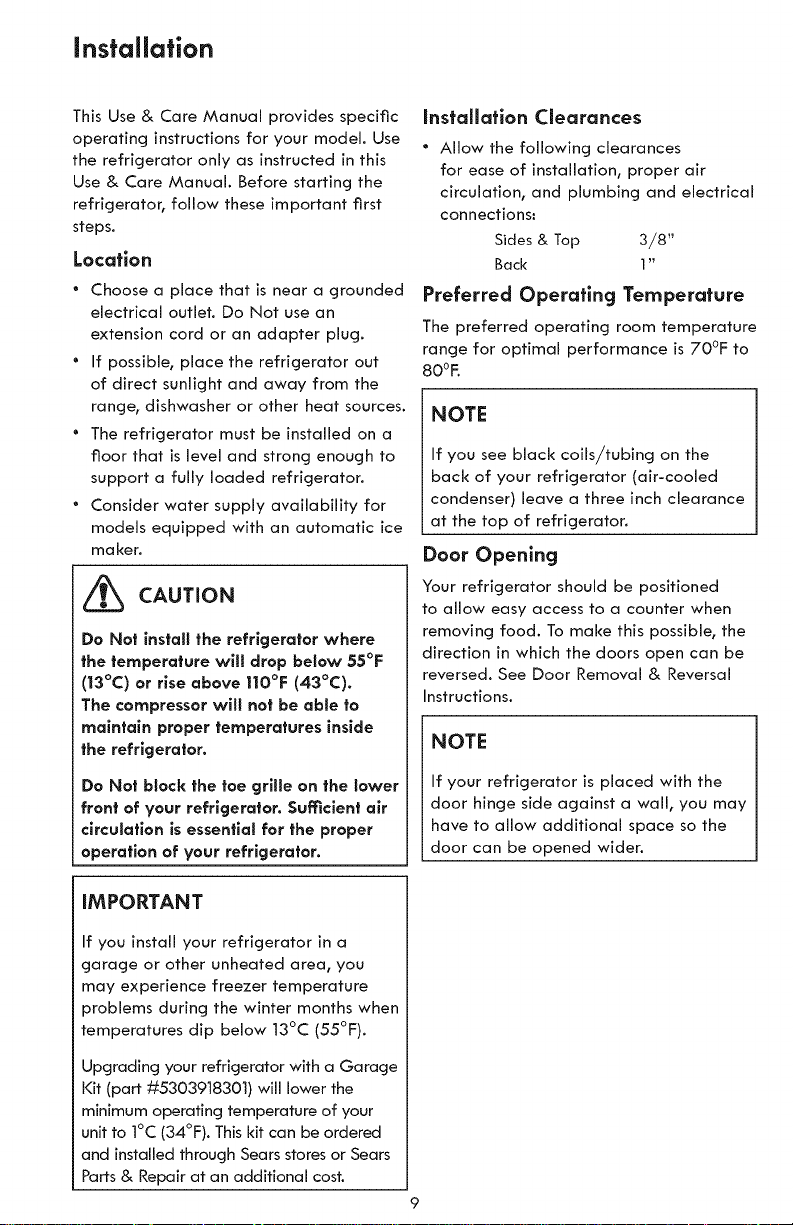
Do Not block the toe grille on the lower
front of your refrigerator. Sumcient air
circulation is essential for the proper
operation of your refrigerator.
IMPORTANT
If you install your refrigerator in a
garage or other unheated area, you
may experience freezer temperature
problems during the winter months when
temperatures dip below 13°C (55°F).
Upgrading your refrigerator with a Garage
Kit (part #5303918301) will lower the
minimum operating temperature of your
unit to 1°C (34°F). This kit can be ordered
and installed through Sears stores or Sears
Parts & Repair at an additional cost.
Instailatlon Clearances
* Allow the following clearances
for ease of installation, proper air
circulation, and plumbing and electrical
connections:
Sides & Top 3/8"
Back 1"
Preferred Operating Temperature
The preferred operating room temperature
range for optimal performance is 70°F to
80°F.
NOTE
If you see black coils/tubing on the
back of your refrigerator (air-cooled
condenser) leave a three inch clearance
at the top of refrigerator,
Door Opening
Your refrigerator should be positioned
to allow easy access to a counter when
removing food. To make this possible, the
direction in which the doors open can be
reversed. See Door Removal & Reversal
Instructions.
NOTE
If your refrigerator is placed with the
door hinge side against a wall, you may
have to allow additional space so the
door can be opened wider.
Installation
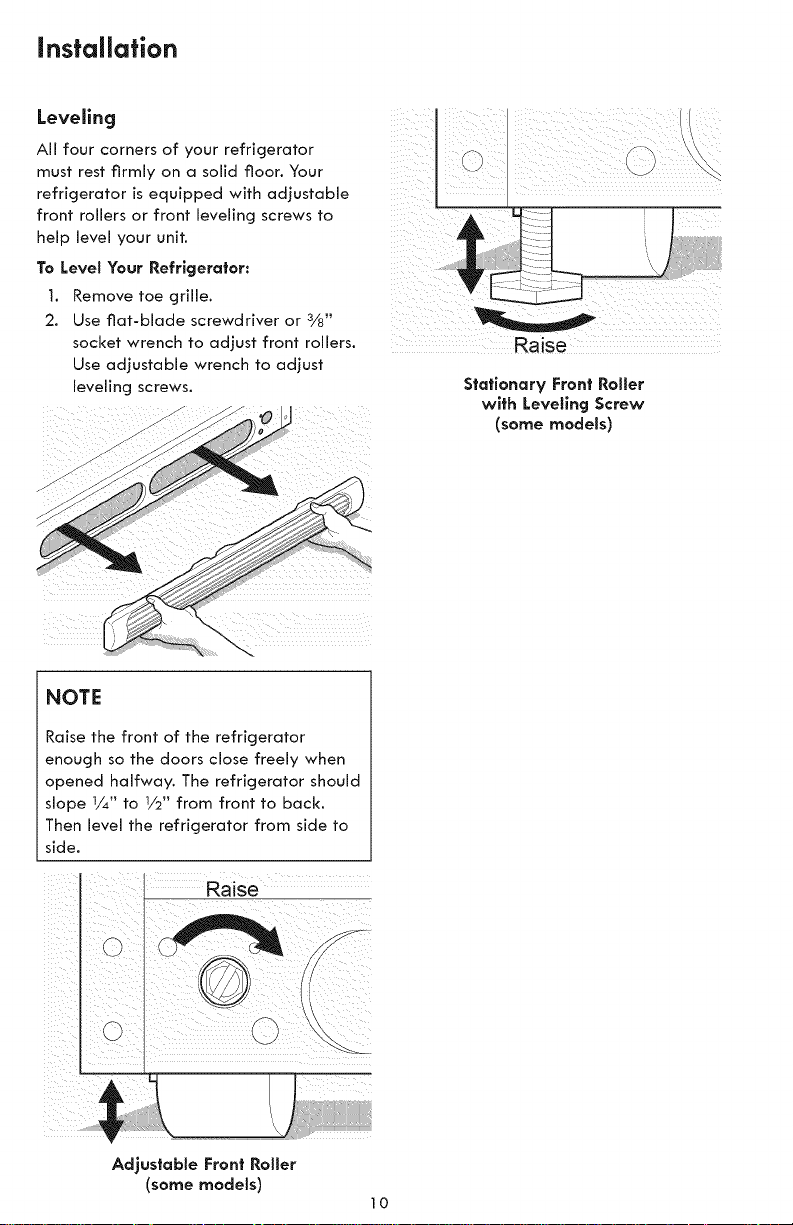
Leveling
All four corners of your refrigerator
must rest firmly on a solid floor. Your
refrigerator is equipped with adjustable
front rollers or front leveling screws to
help level your unit.
To Level Your Refrigerator:
1. Remove toe grille.
2. Use fiat-blade screwdriver or 3/8"
socket wrench to adjust front rollers,
Use adjustable wrench to adjust
leveling screws.
J
Raise
Stationary Front Roller
with Leveling Screw
(some models)
NOTE
Raise the front of the refrigerator
enough so the doors close freely when
opened halfway. The refrigerator should
slope t/4" to 1/2" from front to back.
Then level the refrigerator from side to
side.
Raise
Adjustable Front Roller
(some models)
10
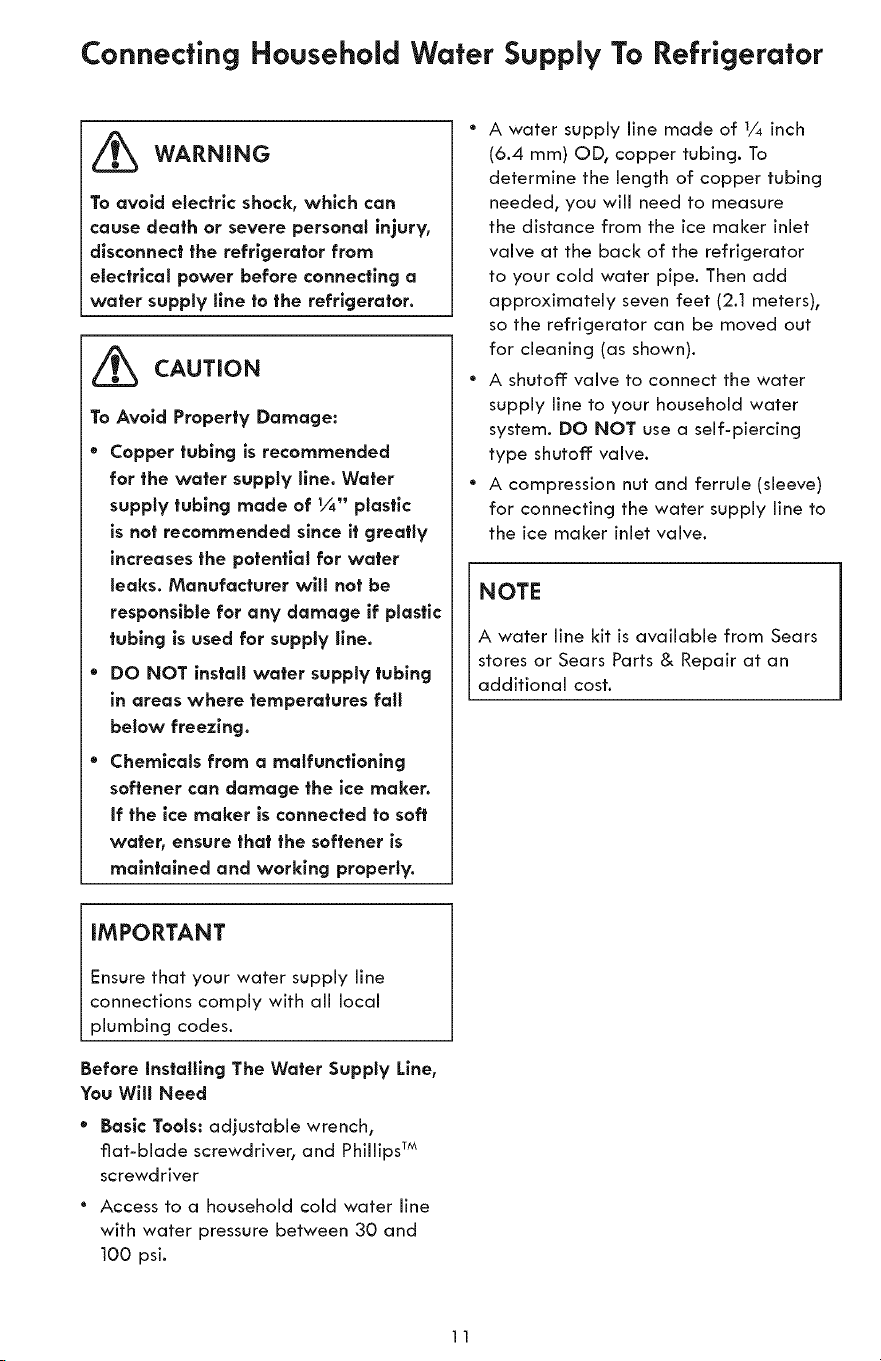
Connecting Household Water Supply To Refrigerator
_ WARNING
To avoid electric shock, which can
cause death or severe personal injury,
disconnect the refrigerator from
eJectrical power before connecting a
water supply Jine to the refrigerator.
CAUTION
To Avoid Property Damage:
• Copper tubing is recommended
for the water supply line. Water
supply tubing made of 1//4,,plastic
is not recommended since it greatly
increases the potential for water
leaks. Manufacturer will not be
responsible for any damage if plastic
tubing is used for supply line.
• DO NOT install water supply tubing
in areas where temperatures fall
below freezing.
• Chemicals from a malfunctioning
softener can damage the ice maker.
if the ice maker is connected to soft
water, ensure that the softener is
maintained and working properly.
" A water supply line made of t/4 inch
(6.4 mm) OD, copper tubing. To
determine the length of copper tubing
needed, you will need to measure
the distance from the ice maker inlet
valve at the back of the refrigerator
to your cold water pipe. Then add
approximately seven feet (2.1 meters),
so the refrigerator can be moved out
for cleaning (as shown).
" A shutoff valve to connect the water
supply line to your household water
system. DO NOT use a self-piercing
type shutoff: valve.
" A compression nut and ferrule (sleeve)
for connecting the water supply line to
the ice maker inlet valve.
NOTE
A water line kit is available from Sears
stores or Sears Parts & Repair at an
additional cost.
IMPORTANT
Ensure that your water supply line
connections comply with all local
plumbing codes.
Before Installing The Water Supply Line,
You Will Need
* Basic Tools: adjustable wrench,
fiat-blade screwdriver, and Phillips TM
screwdriver
" Access to a household cold water line
with water pressure between 30 and
100 psi.
11
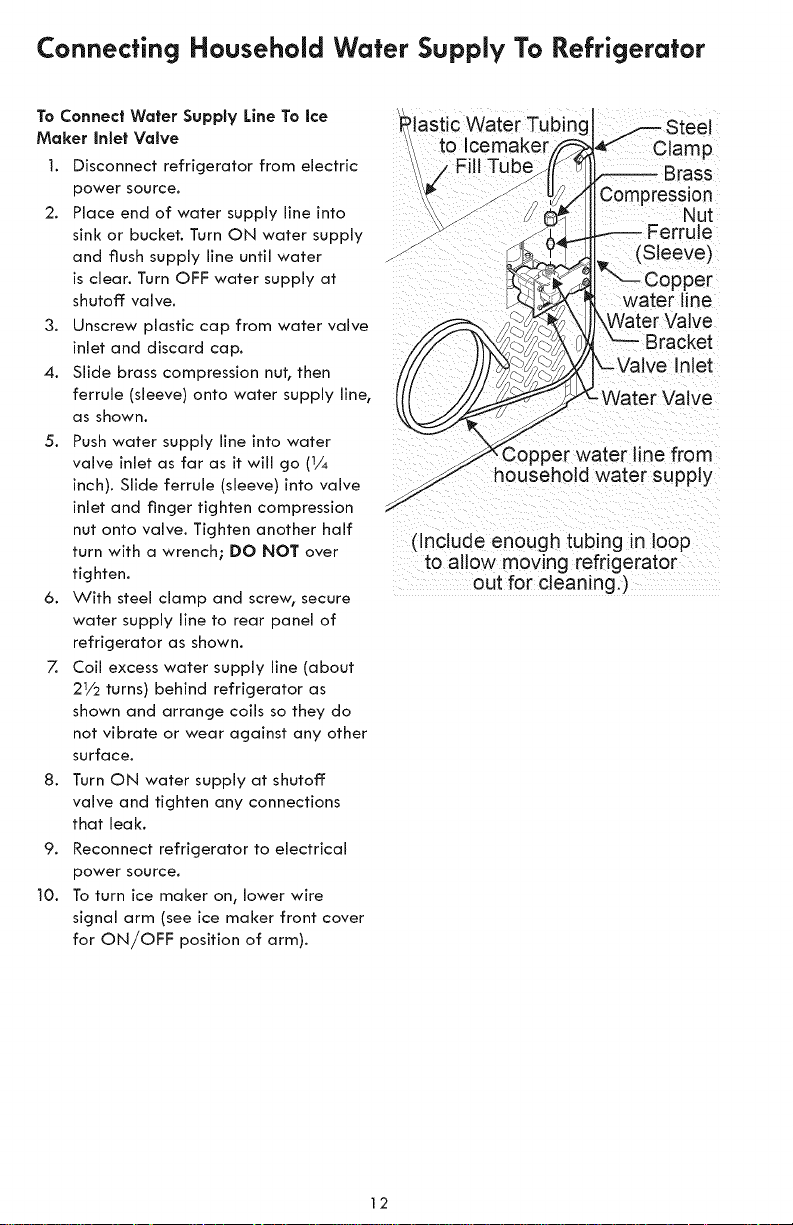
Connecting Household Water Supply To Refrigerator
To Connect Water Supply Line To Ice
Maker Inlet Valve
1. Disconnect refrigerator from electric
power source.
2. Place end of water supply line into
sink or bucket. Turn ON water supply
and flush supply line until water
Plastic Water Tubing
to Icema
/ Fill Tube
is clear. Turn OFF water supply at
shutoff valve.
Steel
Clamp
.-_ Brass
Compression
Nut
I-- Ferrule
_. (Sleeve)
Copper
water line
3. Unscrew plastic cap from water valve
inlet and discard cap.
4. Slide brass compression nut, then
ferrule (sleeve) onto water supply line,
as shown.
5. Push water supply line into water
valve inlet as far as it will go (1/4
inch). Slide ferrule (sleeve) into valve
6.
\Water Valve
Bracket
L-Valve Inlet
-Water Valve
_J'_._Copper water line fro m
household water supply
inlet and finger tighten compression f
nut onto valve. Tighten another half
turn with a wrench; DO NOT over
tighten.
With steel clamp and screw, secure
water supply line to rear panel of
refrigerator as shown.
Coil excess water supply line (about
21/2 turns) behind refrigerator as
shown and arrange coils so they do
not vibrate or wear against any other
surface.
(Include enough tubing in loop
to allow moving refrigerator
out for cleaning.)
8. Turn ON water supply at shutoff
valve and tighten any connections
that leak.
9. Reconnect refrigerator to electrical
power source.
10. To turn ice maker on, lower wire
signal arm (see ice maker front cover
for ON/OFF position of arm).
12
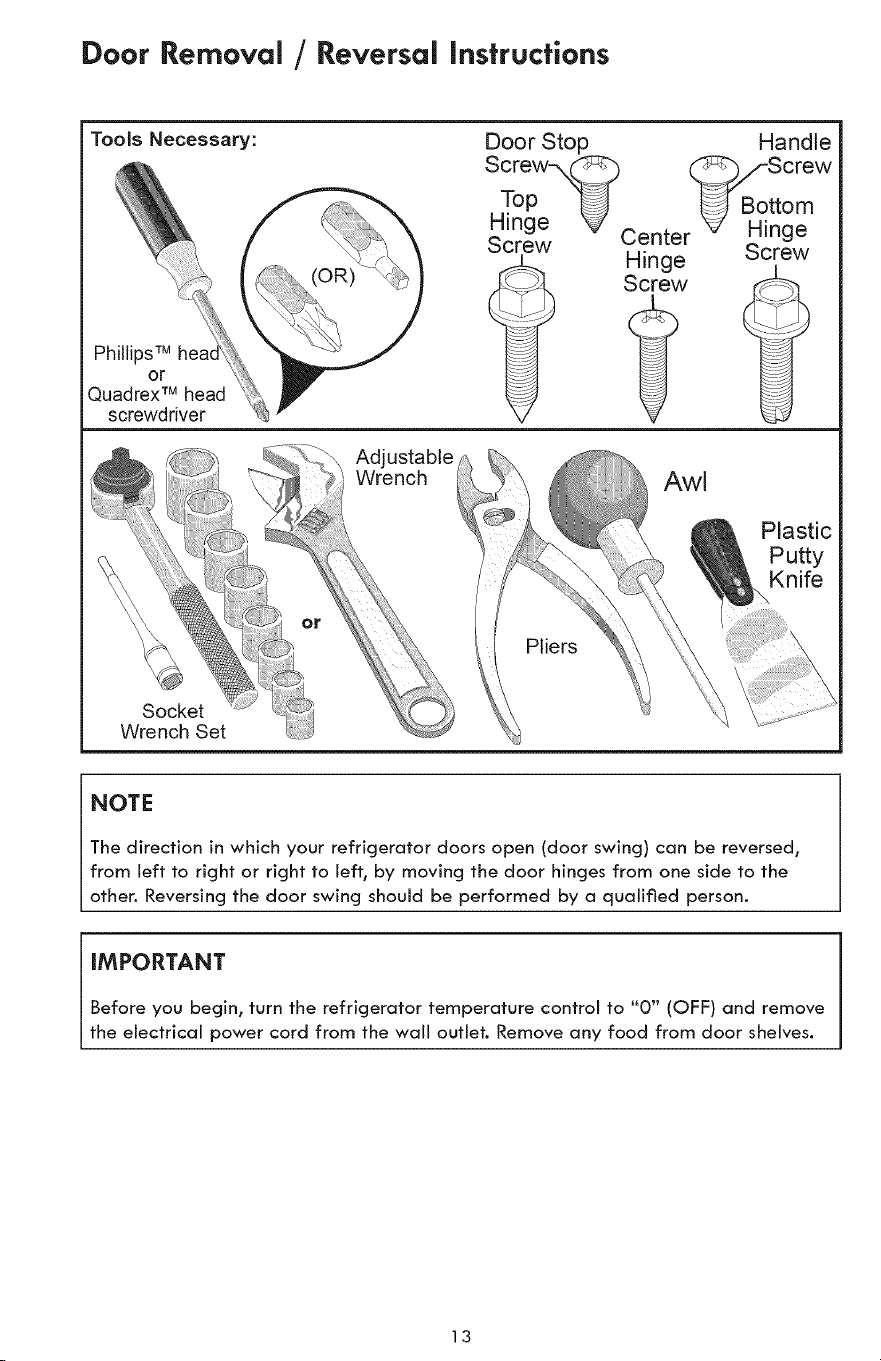
Door Removal / Reversal instructions
Tools Necessary:
Phillips TM
or
Quadrex TM head
screwdriver
Door Stop Handle
Top _ _--_ Bottom
Hinge _J Center v Hinge
Screw
Hinge Screw
Screw
Adjustable
Wrench
Awl
Plastic
Putty
Pliers
Socket
Wrench Set
NOTE
The direction in which your refrigerator doors open (door swing) can be reversed_
from left to right or right to Jeft_ by moving the door hinges from one side to the
other. Reversing the door swing should be performed by a qualified person.
IMPORTANT
Before you begin, turn the refrigerator temperature control to "0" (OFF) and remove
the electrical power cord from the wall outlet. Remove any food from door shelves.
13
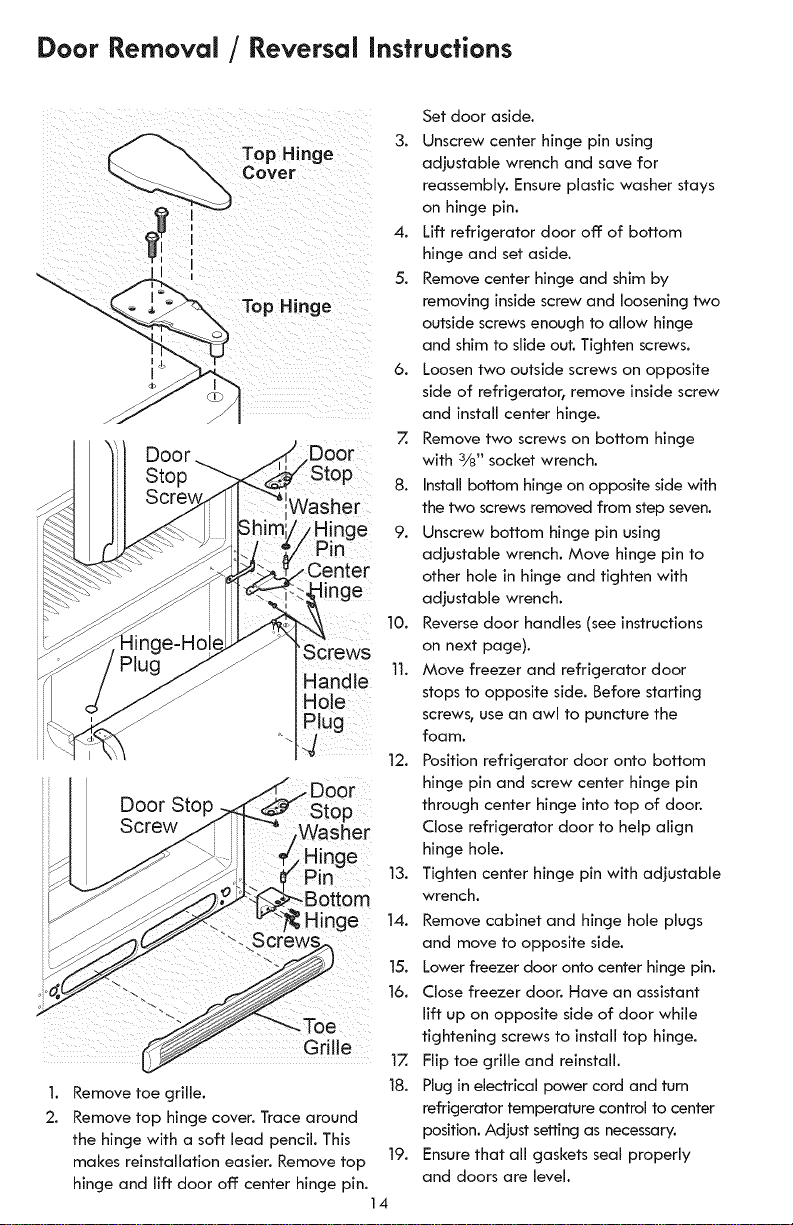
Door Removal / Reversal instructions
3.
Top Hinge
Cover
Z
8.
9.
Washer
nge
10.
Screws
11.
Handle
Hole
_ug
'_ ]2.
p_ Door
Door Sto Stop
Scre I-"/Washer
/ __\_1 _'/Hinge
_/__o.t-. A_ Pin 13.
__//_i:/y.._ ._ Bott0m
zzz _f_ "-. I _ _ 14.
WS_.
L_
o, 15.
16.
te ]z
1. Remove toe grille. 18.
2. Remove top hinge cover. Trace around
the hinge with a soft lead pencil. This
makes reinstallation easier. Remove top 19.
hinge and lift door off center hinge pin.
14
Set door aside.
Unscrew center hinge pin using
adjustable wrench and save for
reassembly. Ensure plastic washer stays
on hinge pin.
Lift refrigerator door off of bottom
hinge and set aside.
Remove center hinge and shim by
removing inside screw and loosening two
outside screws enough to allow hinge
and shim to slide out. Tighten screws.
Loosen two outside screws on opposite
side of refrigerator, remove inside screw
and install center hinge.
Remove two screws on bottom hinge
with 3/8" socket wrench.
Install bottom hinge on opposite side with
the two screws removed from step seven.
Unscrew bottom hinge pin using
adjustable wrench. Move hinge pin to
other hole in hinge and tighten with
adjustable wrench.
Reverse door handles (see instructions
on next page).
Move freezer and refrigerator door
stops to opposite side. Before starting
screws, use an awl to puncture the
foam.
Position refrigerator door onto bottom
hinge pin and screw center hinge pin
through center hinge into top of door.
Close refrigerator door to help align
hinge hole.
Tighten center hinge pin with adjustable
wrench.
Remove cabinet and hinge hole plugs
and move to opposite side.
Lower freezer door onto center hinge pin.
Close freezer door. Have an assistant
lift up on opposite side of door while
tightening screws to install top hinge.
Flip toe grille and reinstall.
Plug in electrical power cord and turn
refrigerator temperature control to center
position. Adjust setting as necessary.
Ensure that all gaskets seal properly
and doors are level.
Door Removal/Reversal Instructions
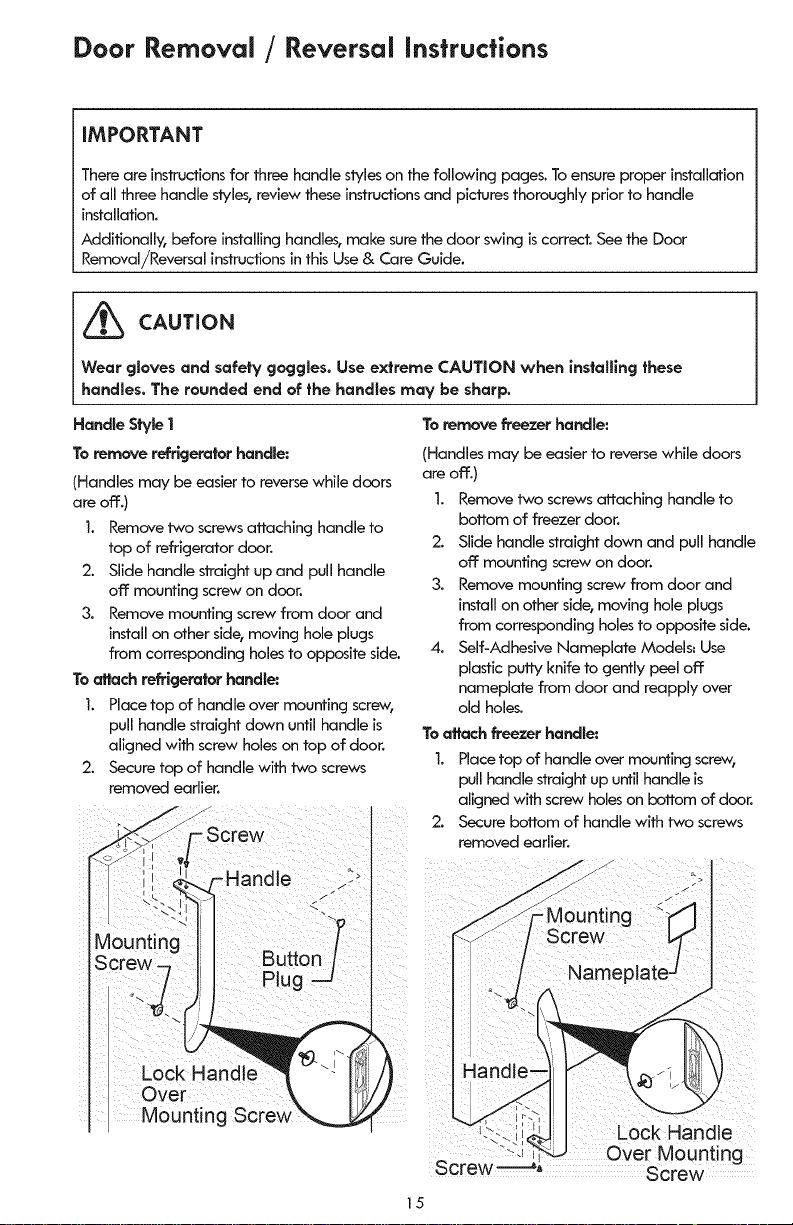
iMPORTANT
There are instructions for three handle styles on the following pages. To ensure proper installation
of all three handle styles, review these instructions and pictures thoroughly prior to handle
installation,
Additionally, before installing handles, make sure the door swing is correct. See the Door
Removal/Reversal instructions in this Use & Care Guide.
_ CAUTION
Wear gloves and safety goggles. Useextreme CAUTION when installingthese
handles. The rounded end of the handles may be sharp.
Handle Style 1
To remove refrigerator handle:
(Handles may be easier to reverse while doors
areoff.)
1. Remove two screws attaching handle to
top of refrigerator door.
2. Slide handle straight up and pull handle
off mounting screw on door.
3. Remove mounting screw from door and
install on other side, moving hole plugs
from corresponding holes to opposite side.
To aNach refrigerator handle:
1. Place top of handle over mounting screw,
pull handle straight down until handle is
aligned with screw holes on top of door.
2. Secure top of handle with two screws
removed earlier.
Over
Mounting Screw
To remove freezer handle:
(Handles may be easier to reverse while doors
areoff.)
1. Remove two screwsattachinghandleto
bottom of freezer door.
2. Slide handle straight down and pull handle
off mounting screw on door.
3. Remove mounting screw from door and
installon other side, moving hole plugs
from corresponding holes to opposite side.
4. Self-Adhesive Nameplate Models: Use
plastic putty knife to gently peel off
nameplate from door and reapply over
old holes.
To attach freezer handle:
1. Place top of handle over mounting screw,
pull handle straight up until handle is
aligned with screw holes on bottom of door.
2. Secure bottom of handle with two screws
removed earlier.
Lock Handle
_-_ Over Mounting
Screw -------_. Screw
15
Door Removal/Reversal Instructions
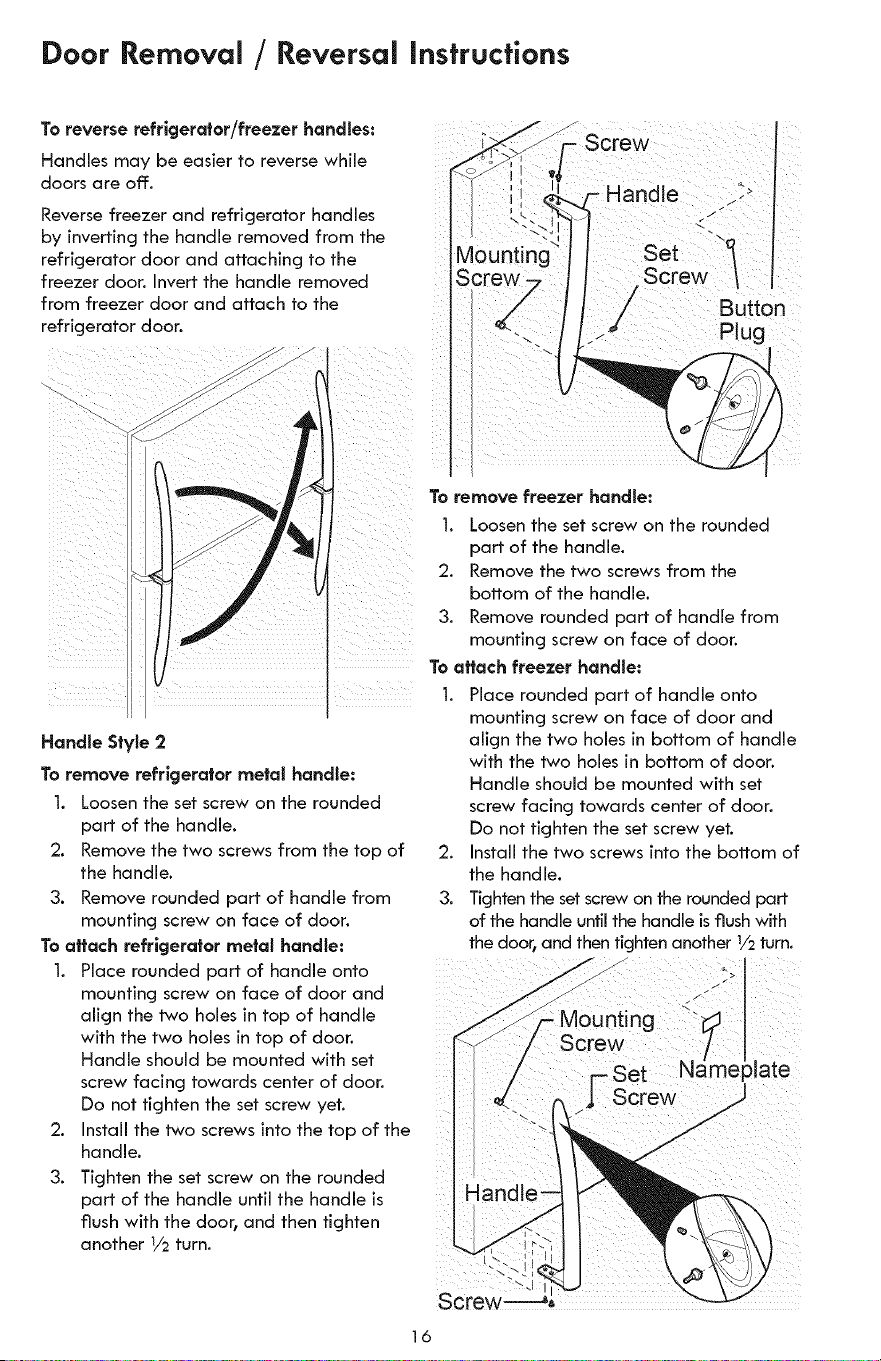
To reverse refrigerator/freezer handles:
Handles may be easier to reverse while
doors are off.
Reverse freezer and refrigerator handles
by inverting the handle removed from the
refrigerator door and attaching to the
freezer door. Invert the handle removed
from freezer door and attach to the
refrigerator door.
Mounting
Sc
Handle Style 2
To remove refrigerator metal handle:
1. Loosen the set screw on the rounded
part of the handle.
2. Remove the two screws from the top of 2.
the handle.
3. Remove rounded part of handle from 3.
mounting screw on face of door.
To attach refrigerator metal handle:
]. Place rounded part of handle onto
mounting screw on face of door and
align the two holes in top of handle
with the two holes in top of door.
Handle should be mounted with set
screw facing towards center of door.
Do not tighten the set screw yet.
2. Install the two screws into the top of the
handle.
3. Tighten the set screw on the rounded
part of the handle until the handle is
flush with the door, and then tighten
another 1/2turn.
_crew
Set "I
/ Screw
,, Button
,c Plug
To remove freezer handle:
]. Loosen the set screw on the rounded
part of the handle.
2. Remove the two screws from the
bottom of the handle.
3. Remove rounded part of handle from
mounting screw on face of door.
To affach freezer handle:
]. Place rounded part of handle onto
mounting screw on face of door and
align the two holes in bottom of handle
with the two holes in bottom of door.
Handle should be mounted with set
screw facing towards center of door.
Do not tighten the set screw yet.
Install the two screws into the bottom of
the handle.
Tighten the set screw on the rounded part
of the handle until the handle is flush with
the door, and then tighten another I/2 turn.
/-
)late
Screw
16
Door Removal/Reversal Instrucfions
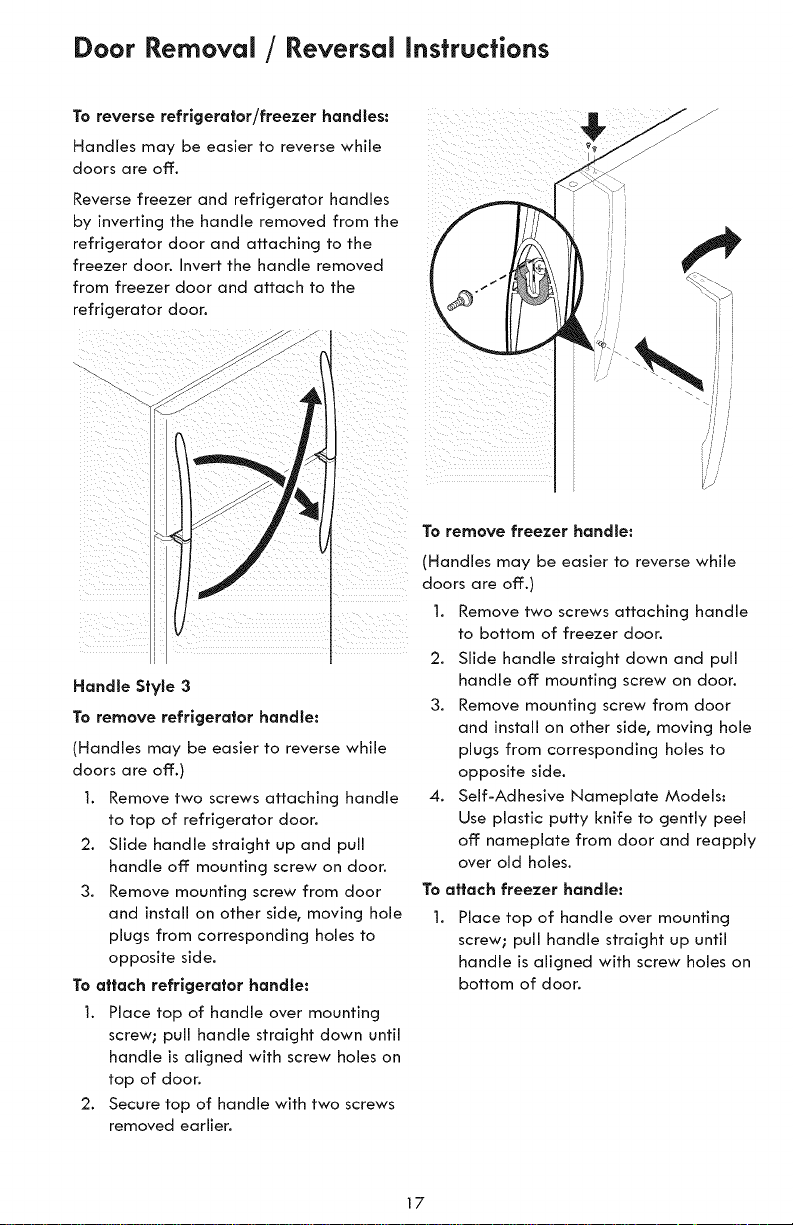
To reverse refrigerator/freezer handles:
Handles may be easier to reverse while
doors are off:,
Reverse freezer and refrigerator handles
by inverting the handle removed from the
refrigerator door and attaching to the
freezer door. nvert the handle removed
from freezer door and attach to the
refrigerator door.
Handle Style 3
To remove refrigerator handle:
(Handles may be easier to reverse while
doors are off:.)
1. Remove two screws attaching handle
to top of refrigerator door.
2. Slide handle straight up and pull
handle off mounting screw on door.
3. Remove mounting screw from door
and install on other side, moving hole
plugs from corresponding holes to
opposite side.
To attach refrigerator handle:
1. Place top of handle over mounting
screw; pull handle straight down until
handle is aligned with screw holes on
top of door.
2. Secure top of handle with two screws
removed earlier.
]// //
To remove freezer handle:
(Handles may be easier to reverse while
doors are off.)
1. Remove two screws attaching handle
to bottom of freezer door.
2. Slide handle straight down and pull
handle off mounting screw on door.
3. Remove mounting screw from door
and install on other side, moving hole
plugs from corresponding holes to
opposite side.
4. Self-Adhesive Nameplate Models:
Use plastic putty knife to gently peel
off nameplate from door and reapply
over old holes.
To attach freezer handle:
].
Place top of handle over mounting
screw; pull handle straight up until
handle is aligned with screw holes on
bottom of door.
17
Door Removal/Reversal Instructions
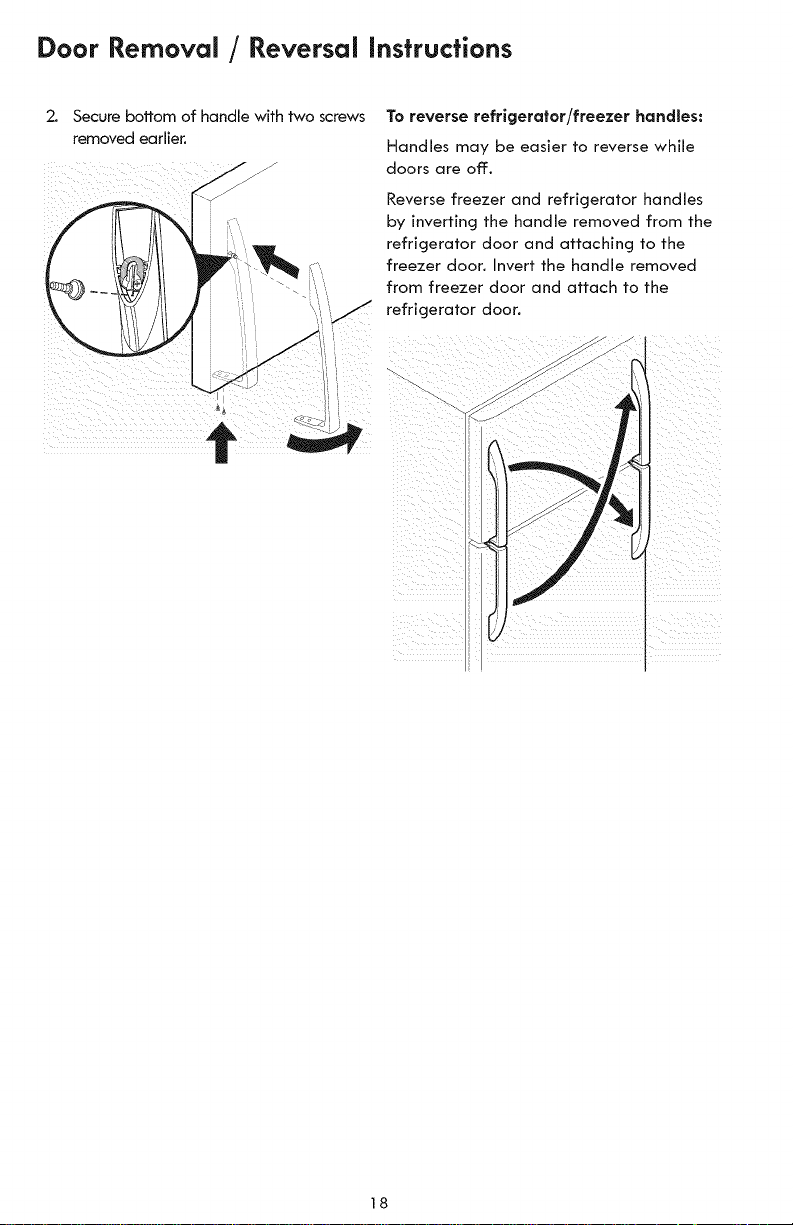
2,
removed earlier.
Secure boffom of handle with two screws
J
To reverse refrigeratar/freezer handles:
Handles may be easier to reverse while
doors are off.
Reverse freezer and refrigerator handles
by inverting the handle removed from the
refrigerator door and attaching to the
freezer door. Invert the handle removed
from freezer door and attach to the
refrigerator door,
ii!iiiiiii i i _
18
Temperature Controls
Cool down period
To ensure safe food storage, allow the
refrigerator to operate with the doors closed
for at least 8 to 12 hours before loading it
with food.
NOTE
When making changes to the temperature
controls, wait 24 hours for the temperature to
stabilize before making additional changes.
When first turning refrigerator on, move
refrigerator and freezer controls to
recommended setting. After 24 hours, adjust
the controls as needed.
iMPORTANT
Turning the refrigerator temperature control
to "0" turns off the compressor and prevents
the refrigerator from cooling, but does not
disconnect the power to the light bulb and
other electrical components. Toturn off
power to your refrigerator, you must unplug
the power cord from the wall outlet.
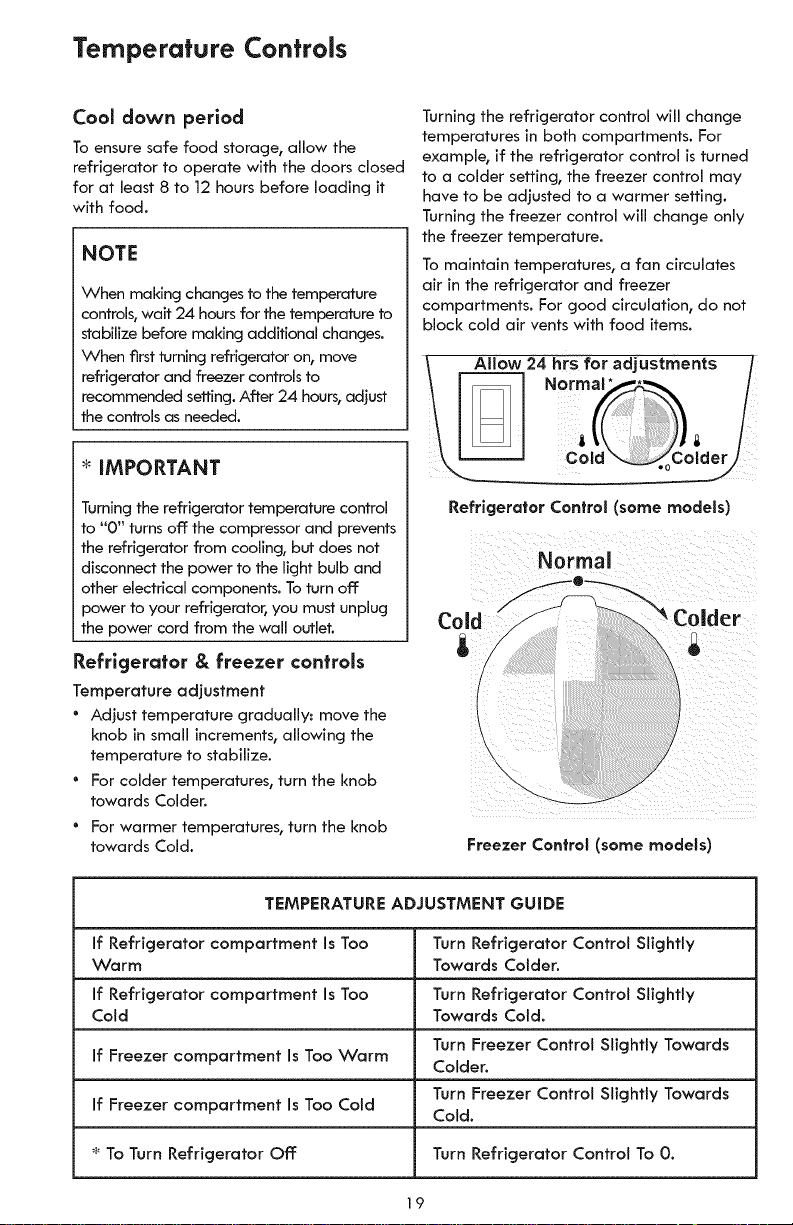
Refrlgera_or 8= freezer controls
Temperature adjustment
* Adjust temperature gradually: move the
knob in small increments, allowing the
temperature to stabilize.
* For colder temperatures, turn the knob
towards Colder.
* For warmer temperatures, turn the knob
towards Cold.
Turning the refrigerator control will change
temperatures in both compartments. For
example, if the refrigerator control is turned
to a colder setting, the freezer control may
have to be adjusted to a warmer setting.
Turning the freezer control will change only
the freezer temperature.
To maintain temperatures, a fan circulates
air in the refrigerator and freezer
compartments. For good circulation, do not
block cold air vents with food items.
==lAllow24 hrs for adjustments
Normal
Refrigerator Control (some models)
Normal
Freezer Control (some models)
TEMPERATURE ADJUSTMENT GUIDE
if Refrigerator compartment is Too Turn Refrigerator Control Slightly
Warm Towards Colder.
if Refrigerator compartment is Too Turn Refrigerator Control Slightly
Cold Towards Cold.
Turn Freezer Control Slightly Towards
if Freezer compartment is Too Warm
Colder.
Turn Freezer Control Slightly Towards
if Freezer compartment is Too Cold
Cold.
To Turn Refrigerator Off Turn Refrigerator Control To O.
19
Looking Inside
_ CAUTION
To ovoid personal injury or property
damage, handle tempered gloss shelves
corefully. Shelves may break suddenly if
nicked, scratched, or exposed to sudden
temperature change. Allow the gloss
shelves to stobilize to room temperoture
before cleaning. Do not wash in
dishwasher.
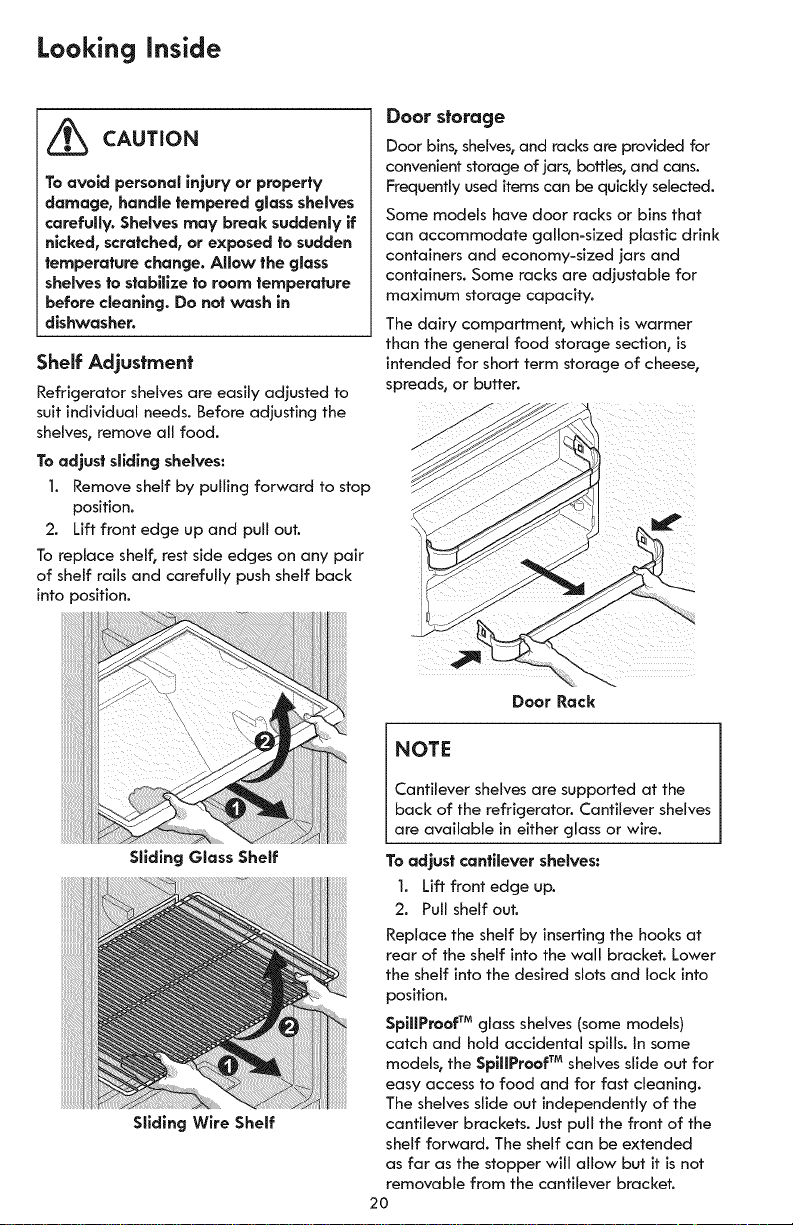
Shelf Adjustment
Refrigerator shelves are easily adiusted to
suit individual needs. Before adjusting the
shelves, remove all food.
To adjust sliding shelves:
l. Remove shelf by pulling forward to stop
position.
2. Lift front edge up and pull out.
To replace shelf, rest side edges on any pair
of shelf rails and carefully push shelf back
into position.
Sliding Gloss Shelf
Sliding Wire Shelf
Door storage
Door bins, shelves, and racks are provided for
convenient storage of jars, botiles, and cans.
Frequently used items can be quickly selected.
Some models have door racks or bins that
can accommodate gallon=sized plastic drink
containers and economy=sized jars and
containers. Some racks are adjustable for
maximum storage capacity.
The dairy compartment, which is warmer
than the general food storage section, is
intended for short term storage of cheese,
spreads, or butter.
Door Rock
NOTE
Cantilever shelves are supported at the
back of the refrigerator. Cantilever shelves
are available in either glass or wire.
To adjust cantilever shelves:
1. Lift front edge up.
2. Pull shelf out.
Replace the shelf by inserting the hooks at
rear of the shelf into the wall bracket. Lower
the shelf into the desired slots and lock into
position.
SpillProof TM gloss sheives (some models)
catch and hold accidental spills. In some
models, the SpiilProof TM shelves slide out for
easy access to food and for fast cleaning.
The shelves slide out independently of the
cantilever brackets. Just pull the front of the
shelf forward. The shelf can be extended
as far as the stopper wiil allow but it is not
removable from the cantilever bracket.
2O
Looking Inside
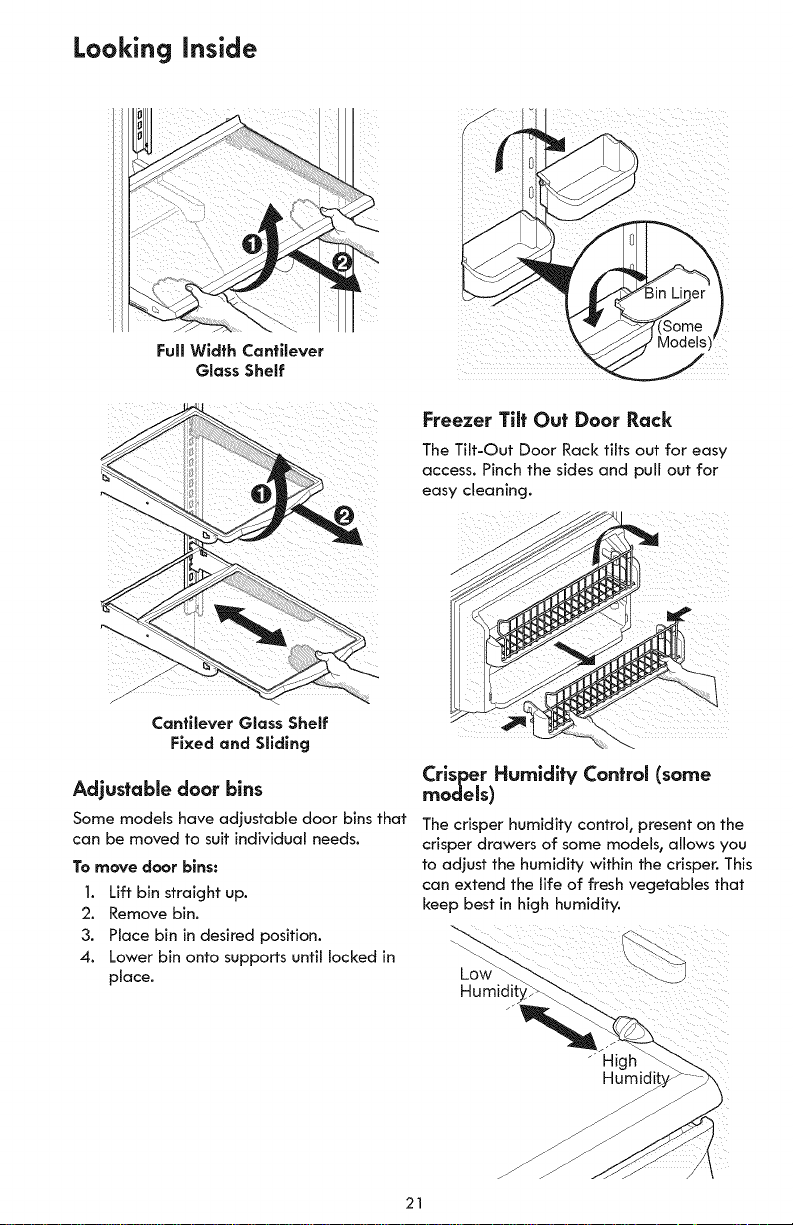
Full Width Cantilever
Glass Shelf
Cantilever Glass Shelf
Fixed and Sliding
Adjustable door bins
Some models have adjustable door bins that
can be moved to suit individual needs.
To move door bins:
1. Lift bin straight up.
2. Remove bin.
3. Place bin in desired position.
4. Lower bin onto supports until locked in
place.
Freezer Tilt Out Door Rock
The Tilt=Out Door Rack flits out for easy
access. Pinch the sides and pull out for
easy cleaning.
Crisper Humidify Control (some
models)
The crisper humidity control, present on the
crisper drawers of some models, allows you
to adjust the humidity within the crisper. This
can extend the life of fresh vegetables that
keep best in high humidity.
I
Humidit
High
21
Looking Inside
NOTE
Leafy vegetables keep best when stored
with the Humidity Control set on High
Humidity, or in a drawer without a
Humidity Control. This keeps incoming
air to a minimum and maintains
maximum moisture content. Store non=
leafy vegetables and fruits still in their
skins at the low humidity setting.
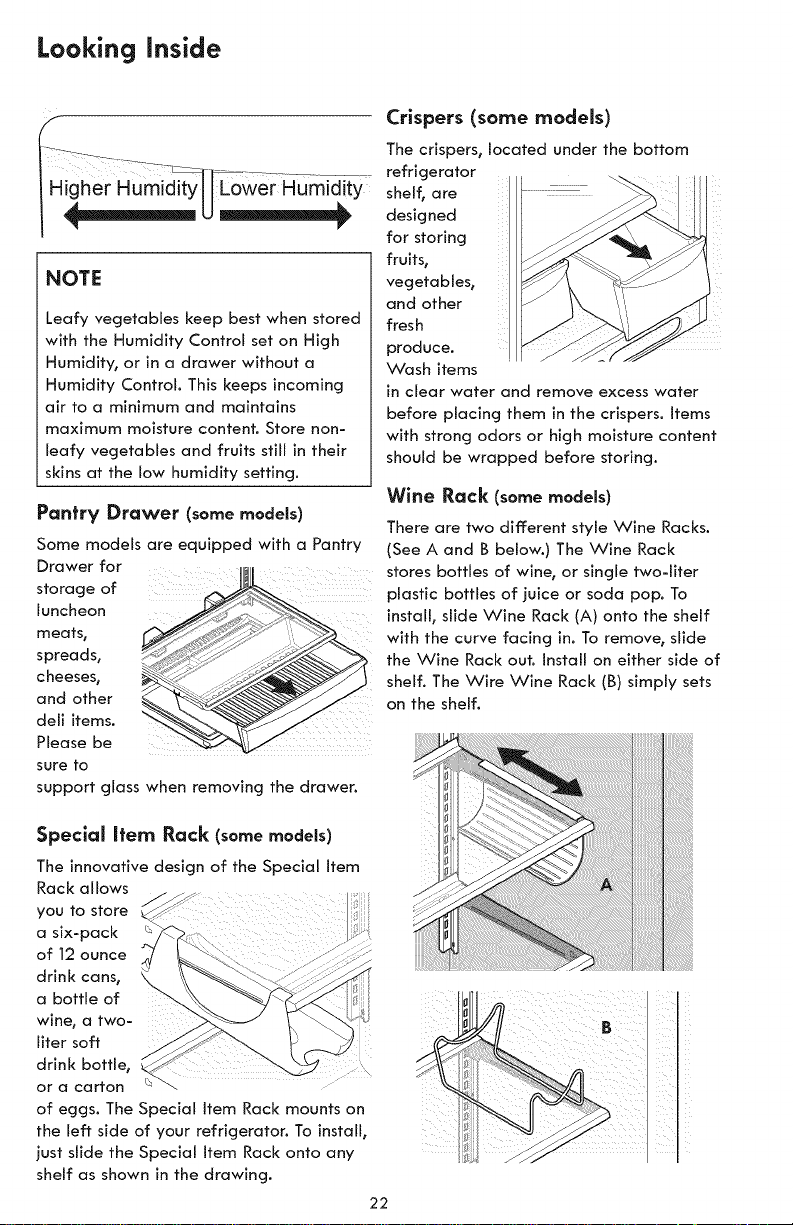
Pantry Drawer (somemodels)
Some models are equipped with a Pantry
Drawer for
storage of
luncheon
meats,
spreads,
cheeses,
and other
deli items.
Please be
sure to
support glass when removing the drawer.
Crispers (same models)
The crispers, located under the bottom
refrigerator
shelf, are
designed
for storing
fruits,
vegetables,
and other
fresh
produce.
Wash items
in clear water and remove excess water
before placing them in the crispers, items
with strong odors or high moisture content
should be wrapped before storing.
Wine Rack (some models)
There are two different style Wine Racks.
(See A and B below.) The Wine Rack
stores bottles of wine0 or single two-liter
plastic bottles of juice or soda pop. To
install, slide Wine Rack (A) onto the shelf
with the curve facing in. To remove, slide
the Wine Rack out. Install on either side of
shelf. The Wire Wine Rack (B) simply sets
on the shelf.
Speclal Item Rack (somemodels)
The innovative design of the Special Item
Rack allows
you to store
a six=pack c_
of 12 ounce
drink cans,
a bottle of
wine, a two-
liter soft t
drink bottle,
or a carton
of eggs. The Special Item Rack mounts on
the Jeff side of your refrigerator. To install,
just slide the Special item Rack onto any
shelf as shown in the drawing.
22
Food Storage & Energy Saving ideas
Food storage ideas
Fresh Food Storage
* The fresh food compartment should be kept
between 1°C (34°F) and 4°C (40°F) with an
optimum temperature of 3°C (37°F).
* Avoid overcrowding the refrigerator
shelves. This reduces the circulation of
air around the food and results in uneven
cooling.
Fruits and Vegetables
* Storage in the crisper drawers helps
preserve the fruit and vegetable quality
for longer time periods.
Meat
* Raw meat and poultry should be
wrapped securely so leakage and *
contamination of other foods or surfaces
does not occur.
o
Frozen Food Storage
* The freezer compartment should be kept *
at -18°C (0°F) or lower.
" A freezer operates most efficiently when it
is at least 2/3 full. *
Packaging Foods for Freezing
* To minimize dehydration and quality
deterioration, use aluminum foil, freezer ,
wrap, freezer bags or airtight containers.
Force as much air out of the packages as
passible and seal them tightly. Trapped air
can cause food to dry out, change color,
and develop an off-flavor (freezer burn). *
" Wrap fresh meats and poultry with
suitable freezer wrap prior to freezing.
" Do not refreeze meat that has completely
thawed.
Loading the Freezer
" Avoid adding too much warm food to the
freezer at one time. This overloads the
freezer, slows the rate of freezing, and
can raise the temperature of frozen foods.
" Leave a space between the packages,
so cold air can circulate freely, allowing
food to freeze as quickly as possible.
" Avoid storing hard-to-freeze foods such
as ice cream and orange juice on the
freezer door shelves. These foods are best
stored in the freezer interior where the
temperature varies less.
23
Energy saving ideas
* Locate the
refrigerator in
the coolest part
of the room, out
of direct sunlight,
and away from
heating products
or registers. Do
not place the
refrigerator
next to heat-producing appliances such
as a range, oven, or dishwasher. If this is
not possible, a section of cabinetry or an
added layer of insulation between the
two appliances will help the refrigerator
operate more efficiently.
Level the refrigerator so that the doors
close tightly.
Refer to this Use & Care Manual for the
suggested temperature control settings.
Periodic cleaning of the condenser will
help the refrigerator run more efficiently.
See the Care and Cleaning Chart.
Do not overcrowd the refrigerator or
block cold air vents. Doing so causes the
refrigerator to run longer and use more
energy.
Cover foods and wipe containers dry
before placing them in the refrigerator.
This cuts down on moisture build-up inside
the unit.
Organize the refrigerator to reduce door
openings. Remove as many items as
needed at one time and close the door as
soon as possible.
Ice Service
If your refrigerator has an automatic ice
maker, it will provide a sufficient supply of
ice for normal use. During the initial startup
of your refrigerator, no ice will be produced
during the first 24 hours of operation. Air
in new plumbing lines may cause the ice
maker to cycle two or three times before
making a full tray of ice. With no usage, it
will take approximately one to two days to
fill the ice container.
New plumbing connections may cause the
first production of ice cubes to be discolored
or have an odd flavor. Discard ice made
during the first 24 hours.
NOTE
Automatic ice makers are also optional
accessories that may be installed in most
models at anytime. Call 1-800-4MY-HOME
for information.
Turning your Ice Maker on
After the plumbing connections have been
completed, the water supply valve must be
opened. Place the ice container under the
ice maker, pushing it as far back as possible.
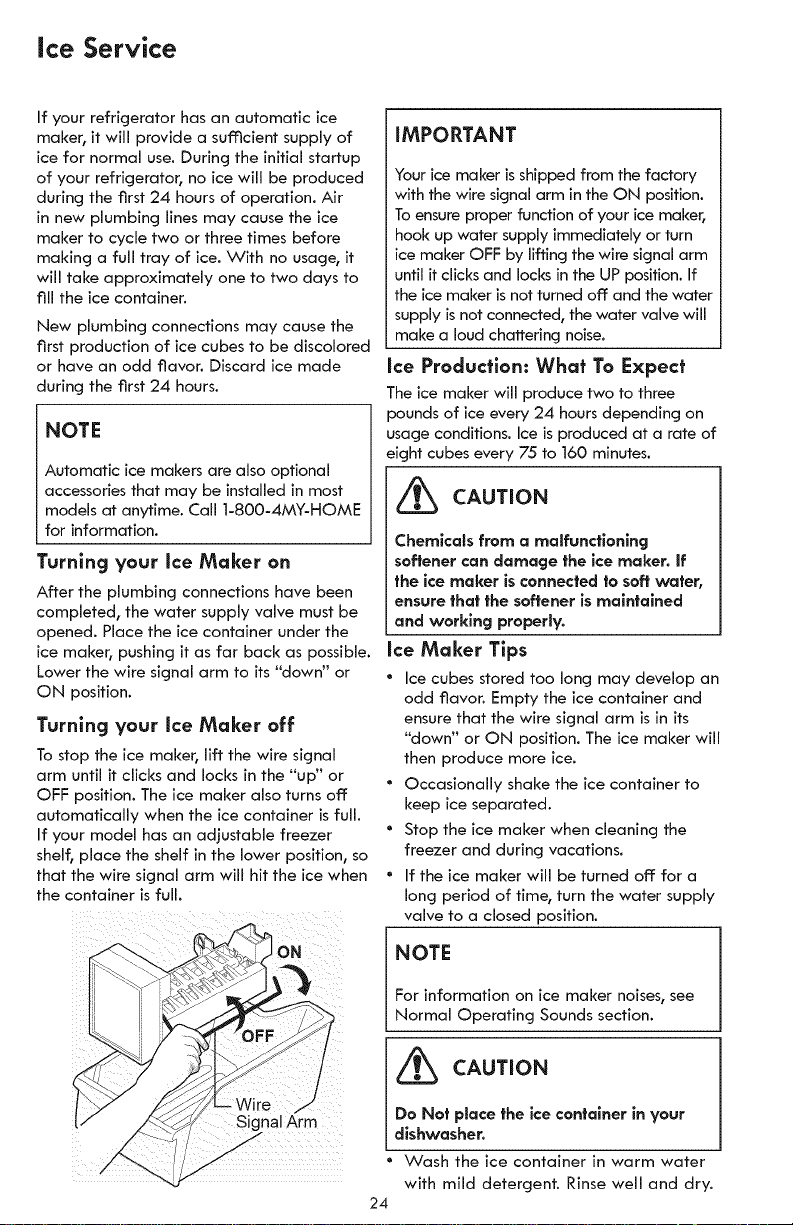
Lower the wire signal arm to its "down" or
ON position.
Turning your Ice Maker off
To stop the ice maker, lift the wire signal
arm until it clicks and locks in the "up" or
OFF position. The ice maker also turns off
automatically when the ice container is full.
If your model has an adjustable freezer
shelf, place the shelf in the lower position, so
that the wire signal arm will hit the ice when
the container is full.
)N
nal Arm
IMPORTANT
Your ice maker is shipped from the factory
with the wire signal arm in the ON position.
To ensure proper function of your ice maker,
hook up water supply immediately or turn
ice maker OFF by lifting the wire signal arm
until it clicks and locks in the UP position. If
the ice maker is not turned off and the water
supply is not connected, the water valve will
make a loud chattering noise.
Ice Production: What To Expect
The ice maker will produce two to three
pounds of ice every 24 hours depending on
usage conditions. Ice is produced at a rate of
eight cubes every 75 to 160 minutes.
CAUTION
Chemicals from a malfunctioning
softener can damage the ice maker. If
the ice maker is connected to soft water,
ensure that the softener is maintained
and working properly.
Ice Maker Tips
* Ice cubes stored too long may develop an
odd flavor. Empty the ice container and
ensure that the wire signal arm is in its
"down" or ON position. The ice maker will
then produce more ice.
* Occasionally shake the ice container to
keep ice separated.
* Stop the ice maker when cleaning the
freezer and during vacations.
" If the ice maker will be turned off: for a
long period of time, turn the water supply
valve to a closed position.
NOTE
For information on ice maker noises, see
Normal Operating Sounds section.
24
CAUTION
Do Not place the ice container in your
dishwasher.
Wash the ice container in warm water
with mild detergent. Rinse well and dry.
Normal Operating Sounds
Understanding the sounds you may
hear
Your new high-efficiency refrigerator may
make unfamiliar sounds. These are all normal
sounds and soon will become familiar to you.
They also indicate your refrigerator is operating
as designed. Hard surfaces, such as vinyl or
wood floors, walls, and kitchen cabinets may
make sounds more noticeable. Listed below
are descriptions of some of the most common
sounds you may hear, and what iscausing them.
NOTE
Rigid foam insulation is very energy efficient,
but is not a sound insulator.
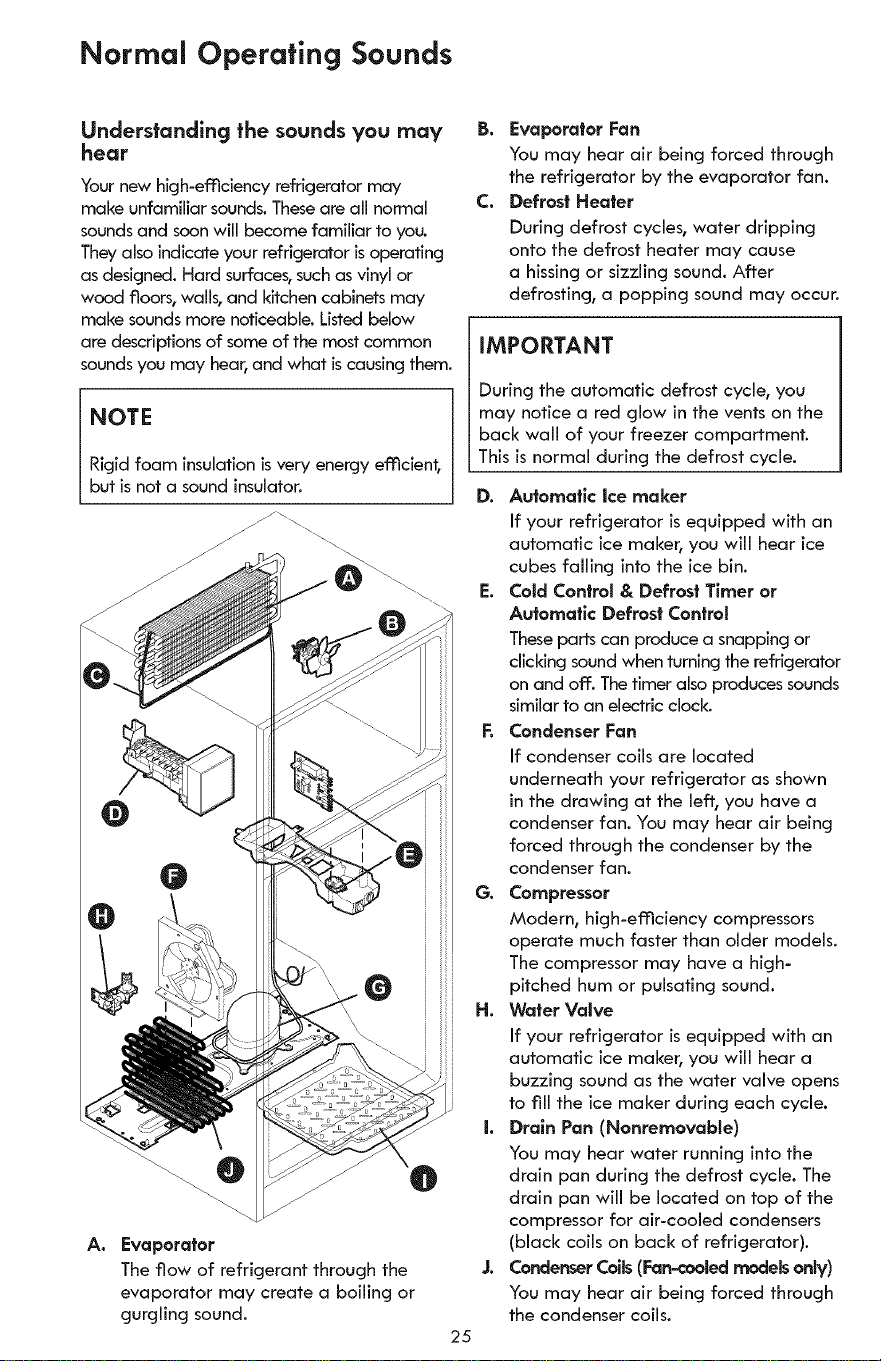
A,
Evaporator
The flow of refrigerant through the
evaporator may create a boiling or
gurgling sound.
B°
C°
Evaporator Fan
You may hear air being forced through
the refrigerator by the evaporator fan.
Defrost Heater
During defrost cycles, water dripping
onto the defrost heater may cause
a hissing or sizzling sound. After
defrosting, a popping sound may occur.
IMPORTANT
25
During the automatic defrost cycle, you
may notice a red glow in the vents on the
back wall of your freezer compartment.
This is normal during the defrost cycle.
D. Automatic ice maker
If your refrigerator is equipped with an
automatic ice maker, you will hear ice
cubes falling into the ice bin.
E. Cold Control & Defrost Timer or
Automatic Defrost Control
Theseparts can produce a snapping or
clicking sound when turning the refrigerator
on and off. The timer also produces sounds
similar to an electric clod<.
F. Condenser Fan
If condenser coils are located
underneath your refrigerator as shown
in the drawing at the left, you have a
condenser fan. You may hear air being
forced through the condenser by the
condenser fan.
G. Compressor
Modern, high-efficiency compressors
operate much faster than older models.
The compressor may have a high-
pitched hum or pulsating sound.
H. Water Valve
If your refrigerator is equipped with an
automatic ice maker, you will hear a
buzzing sound as the water valve opens
to fill the ice maker during each cycle.
I. Drain Pan (Nonremovable)
You may hear water running into the
drain pan during the defrost cycle. The
drain pan will be located on top of the
compressor for air-oooled condensers
(black coils on back of refrigerator).
J. Condenser Coils(Fan=cooled models only)
You may hear air being forced through
the condenser coils.
Care & Cleaning
Protecting Your investment
Keeping your refrigerator clean maintains
appearance and prevents odor build-up.
Wipe up any spills immediately and clean
the freezer and fresh food compartments
at least twice a year. When cleaning, take
the following precautions:
* Never use CHLORIDE or cleaners with
bleach to clean stainless steel.
* Do not wash any removable parts in a
dishwasher.
* Always unplug the electrical power cord
from the wall outlet before cleaning.
* Remove adhesive labels by hand. Do
not use razor blades or other sharp
instruments which can scratch the
appliance surface.
* Do not remove the serial plate.
Do not use abrasive cleaners such as
window sprays, scouring cleansers,
brushes, flammable fluids, cleaning waxes_
concentrated detergents, bleaches or
cleansers containing petroleum products on
plastic parts, interior doors, gaskets or cabinet
liners. Do not use paper towels, metallic
scouring pads, or other abrasive cleaning
materials or strong alkaline solutions.
NOTE
If you set your temperature controls to
turn off: cooling, power to lights and other
electrical components will continue until you
unplug the power cord from the wall outlet.
_ CAUTION
• Pull the refrigerator straight out to
move it. Shifting it from side to side
may damage flooring. Be careful not
to move the refrigerator beyond the
plumbing connections.
• Damp objects stick to cold metal
surfaces. Do not touch refrigerated
surfaces with wet or damp hands.
26
IMPORTANT
If you store or move your refrigerator
in freezing temperatures, be sure to
completely drain the water supply
system. Failure to do so could result in
water leaks when the refrigerator is put
back into service. Contact a service
representative to perform this operation.
Never Cleon Condenser
(some models)
If your refrigerator is equipped with a
Never Clean condenser, there's no need
to clean the condenser under normal
operating conditions. If the refrigerator
is operated under particularly dusty or
greasy conditions, or if there is significant
pet traffic in your home, it may be
necessary to periodically clean the
condenser for maximum efficiency.
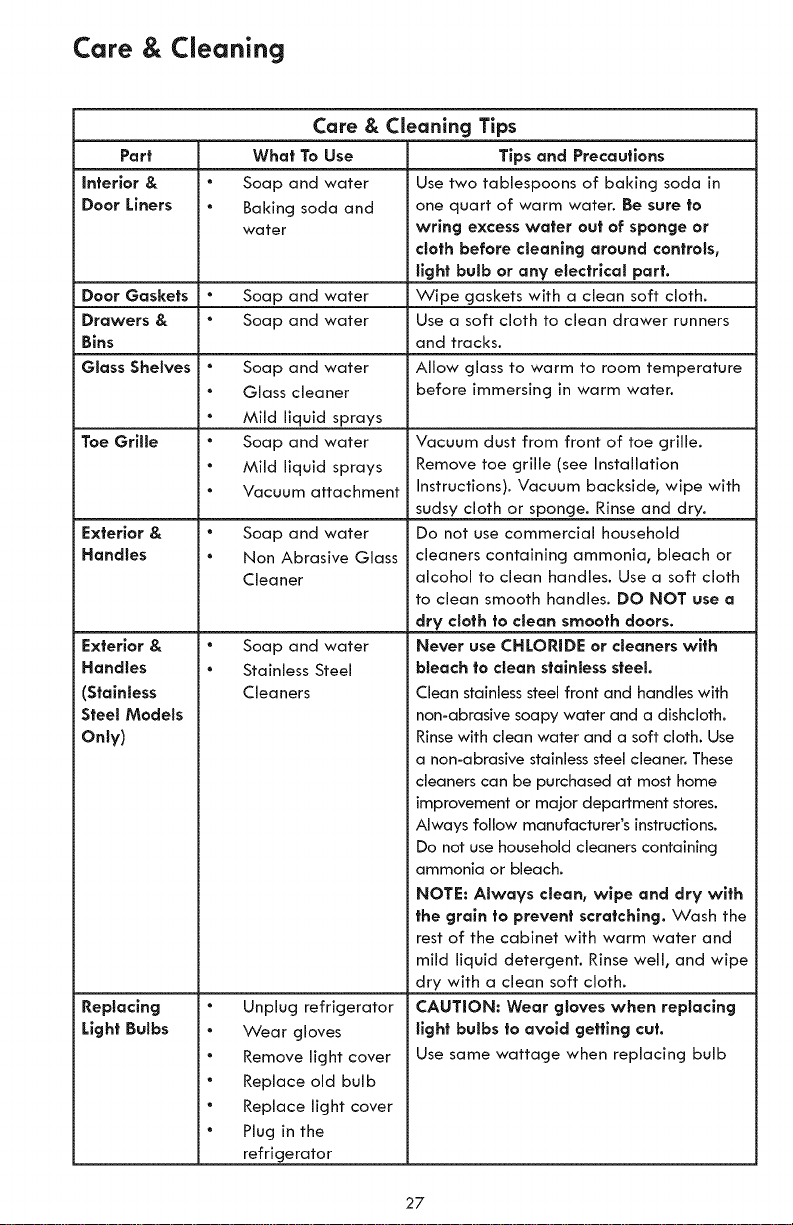
Care & Cleaning
Part
interior & *
Door Liners .
Door Gaskets *
Drawers & *
Bins
Glass Shelves *
e
e
Toe Grille *
e
e
Exterior & *
Handles .
Exterior & *
Handles .
(Stainless
Steel Models
Only)
Replacing *
Light Bulbs .
e
e
e
e
What To Use
Soap and water
Baking soda and
water
Soap and water
Soap and water
Soap and water
Glass cleaner
Mild liquid sprays
Soap and water
Mild liquid sprays
Vacuum attachment
Care & Cleaning Tips
Tips and Precautions
Use two tablespoons of baking soda in
one quart of warm water. Be sure to
wring excess water out of sponge or
cloth before cleaning around controls,
light bulb or any electrical part.
Wipe gaskets with a clean soft cloth.
Use a soft cloth to clean drawer runners
and tracks.
Allow glass to warm to room temperature
before immersing in warm water.
Soap and water
Non Abrasive Glass
Cleaner
Soap and water
Stainless Steel
Cleaners
Unplug refrigerator
Wear gloves
Remove light cover
Replace old bulb
Replace light cover
Hug in the
refrigerator
Vacuum dust from front of toe grille.
Remove toe grille (see Installation
Instructions). Vacuum backside, wipe with
sudsy cloth or sponge. Rinse and dry.
Do not use commercial household
cleaners containing ammonia, bleach or
alcohol to clean handles. Use a soft cloth
to clean smooth handles. DO NOT use a
dry cloth to dean smooth doors.
Never use CHLORIDE or cleaners with
bleach to clean stainless steel.
Clean stainless steel front and handles with
non-abrasive soapy water and a dishcloth.
Rinse with clean water and a soft cloth. Use
a non=abrasive stainless steel cleaner. These
cleaners can be purchased at most home
improvement or major department stores.
Always follow manufacturer's instructions.
Do not use household cleaners containing
ammonia or bleach.
NOTE: Always clean, wipe and dry with
the grain to prevent scratching. Wash the
rest of the cabinet with warm water and
mild liquid detergent. Rinse well, and wipe
dry with a clean soft cloth.
CAUTION: Wear gloves when replacing
light bulbs to avoid getting cut.
Use same wattage when replacing bulb
27
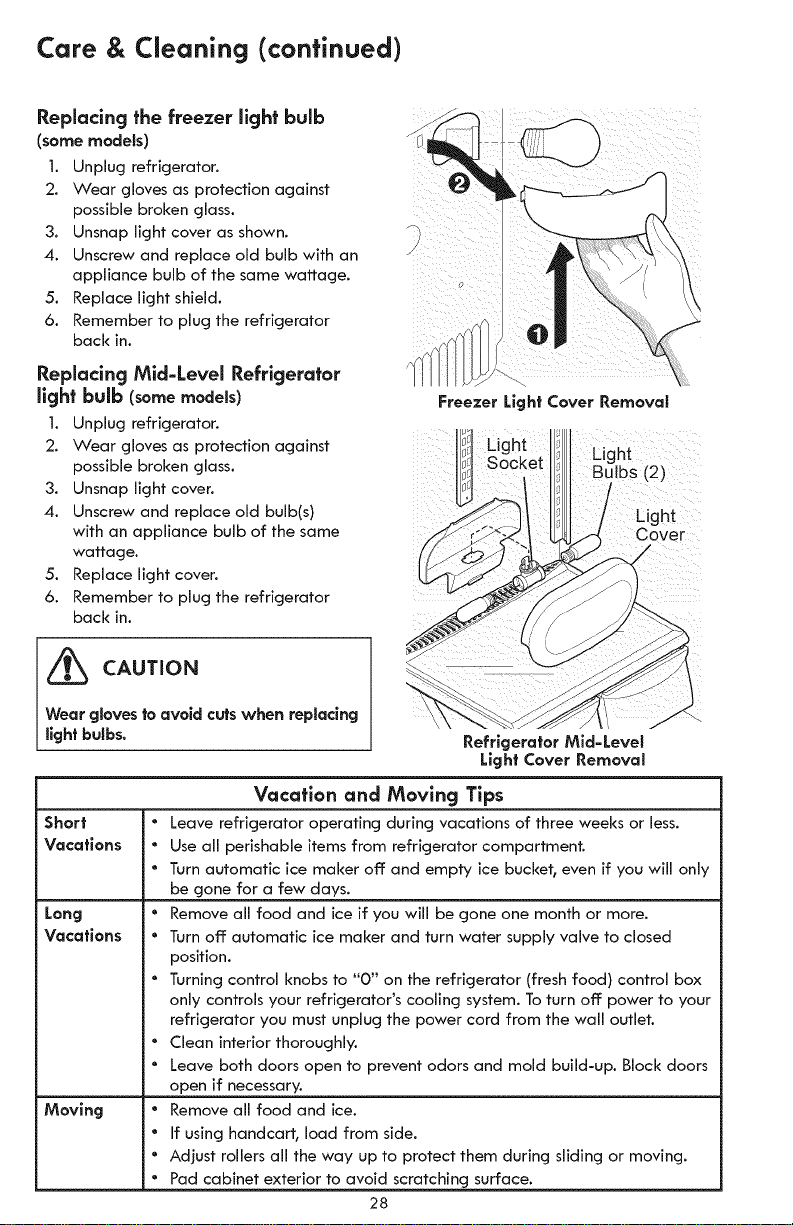
Care & Cleaning (continued)
Replaclncj the freezer llcjht bulb
(somemodels)
1. Unplug refrigerator.
2. Wear gloves as protection against
possible broken glass,
3. Unsnap light cover as shown.
4. Unscrew and replace old bulb with an
appliance bulb of the same wattage.
5. Repiace light shield.
6. Remember to piug the refrigerator
back in.
Replaclncj Mid=Level Refrlcjerafor
llcjht bulb (somemodels)
I. Unplug refrigerator.
2. Wear gloves as protection against
possibie broken glass,
3. Unsnap light cover,
4. Unscrew and replace old bulb(s)
with an appliance bulb of the same
wattage,
5, Replace light cover.
6. Remember to plug the refrigerator
back in.
_ CAUTION
Wear gloves to avoid cuts when replacing
light bulbs.
Freezer Light Cover Removat
ht
libs (2)
Light
Cover
Refrigerator Mid=Level
Light Cover Removal
Short
Vacations
Long
Vacations
Moving
Vacafion and Movincj Tips
" Leave refrigerator operating during vacations of three weeks or less.
* Use all perishable items from refrigerator compartment.
* Turn automatic ice maker of]: and empty ice bucket, even if you will only
be gone for a few days.
* Remove all food and ice if you will be gone one month or more.
* Turn off automatic ice maker and turn water supply valve to closed
position.
* Turning control knobs to "0" on the refrigerator (fresh food) control box
only controls your refrigerator's cooling system. To turn off power to your
refrigerator you must unplug the power cord from the wall outlet.
* Clean interior thoroughly.
* Leave both doors open to prevent odors and mold build-up. Block doors
open if necessary.
* Remove all food and ice.
* If using handcart, load from side.
* Adjust rollers all the way up to protect them during sliding or moving.
* Pad cab!net exterior to avoid scratching surface.
28
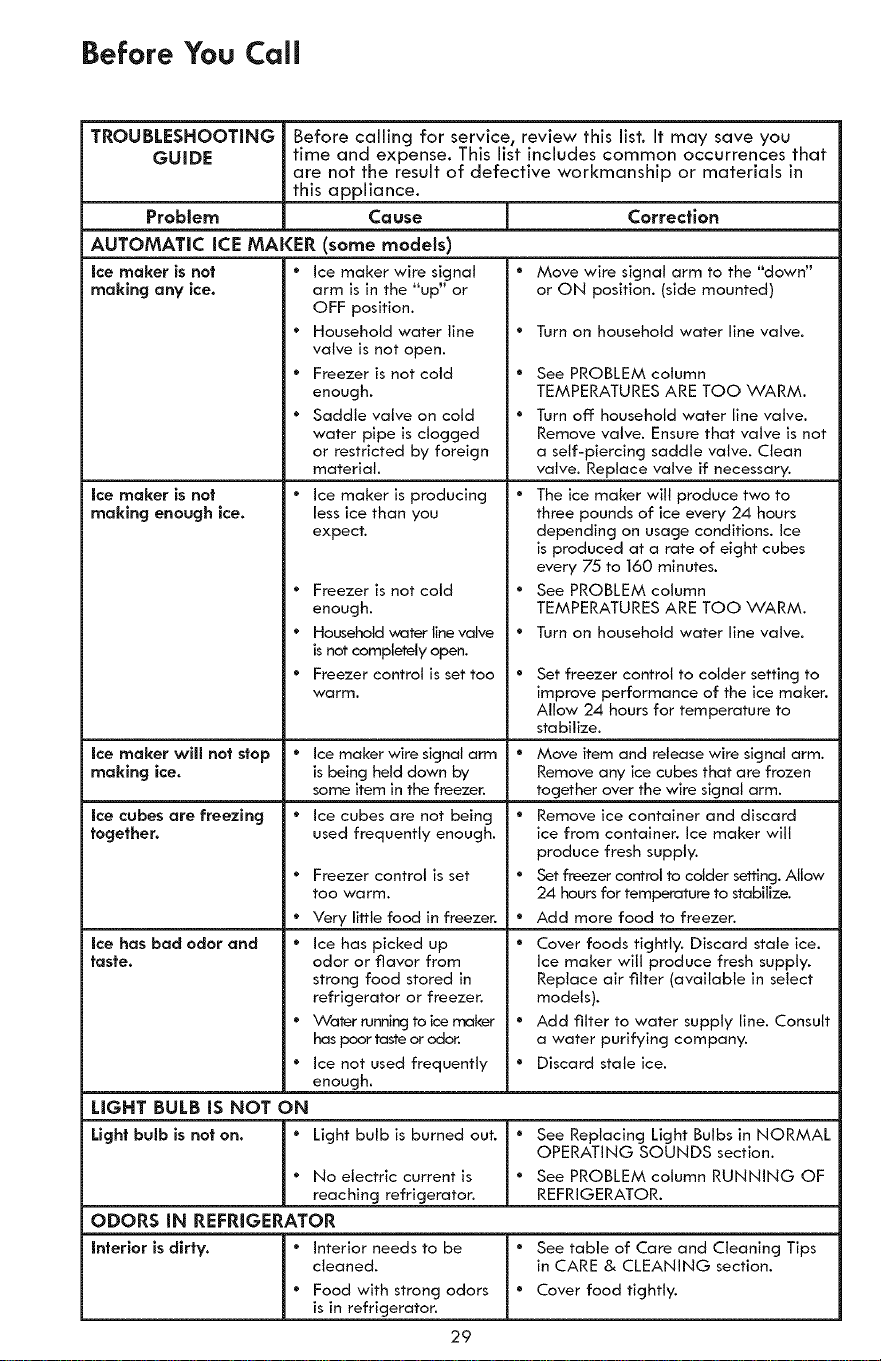
Before You Call
TROUBLESHOOTING Before calling for service, review this list. It may save yov
GUIDE time and expense. This list includes common occurrences that
are not the result of defective workmanship or materials in
this appliance.
Problem Cause Correction
AUTOMATIC ICE MAKER (some models)
Ice maker is not * Ice maker wire signal
making any ice. arm is in the "up" or
OFF position.
• Household water line
valve is not open.
• Freezer is not cold
enough.
• Saddle valve on cold
water pipe is clogged
or restricted by foreign
material.
Ice maker is not
making enough ice.
* Ice maker is producing
less ice than you
expect.
* Freezer is not cold
enough.
* Household water line valve
is not completely open.
* Freezer control is set too
warm.
* Move wire signal arm to the "down"
or ON position. (side mounted)
* Turn on household water line valve.
* See PROBLEM column
TEMPERATURES ARE TOO WARM.
* Turn off household water line valve.
Remove valve. Ensure that valve is not
a self-piercing saddle valve. Clean
valve. Replace valve if necessary.
* The ice maker will produce two to
three pounds of ice every 24 hours
depending on usage conditions. Ice
is produced at a rate of eight cubes
every 75 to 160 minutes.
See PROBLEM column
TEMPERATURES ARE TOO WARM.
* Turn on household water line valve.
Set freezer control to colder setting to
improve performance of the ice maker.
Allow 24 hours for temperature to
stabilize.
Ice maker will not stop * ice maker wire signal arm * Move item and release wire signal arm.
making ice. is being held down by Remove any ice cubes that are frozen
some item in the freezer, together over the wire signal arm.
Ice cubes are freezing * Ice cubes are not being * Remove ice container and discard
together, used frequently enough, ice from container. Ice maker will
Ice has bad odor and
taste.
LIGHT BULB IS NOT ON
Freezer control is set
too warm.
* Very little food in freezer.
ice has picked up
odor or flavor from
strong food stored in
refrigerator or freezer.
Water running to ice maker
has poor taste or odor.
Ice not used frequently
enough.
produce fresh supply.
* Set freezer control to colder setting. Allow
24 hours for temperature to stabilize.
Add more food to freezer.
* Cover foods tightly. Discard stale ice.
ice maker wilt produce fresh supply.
Replace air filter (available in select
models).
Add filter to water supply line. Consult
a water purifying company.
* Discard stale ice.
Light bulb is not on. * Light bulb is burned out. * See Replacing Light Bulbs in NORMAL
OPERATING SOUNDS section.
No electric current is * See PROBLEM column RUNNING OF
reaching refrigerator. REFRIGERATOR.
ODORS IN REFRIGERATOR
Interior is dirty. * interior needs to be * See table of Care and Cleaning Tips
cleaned, in CARE & CLEANING section.
Food with strong odors * Cover food tightly.
is in refrigerator.
29
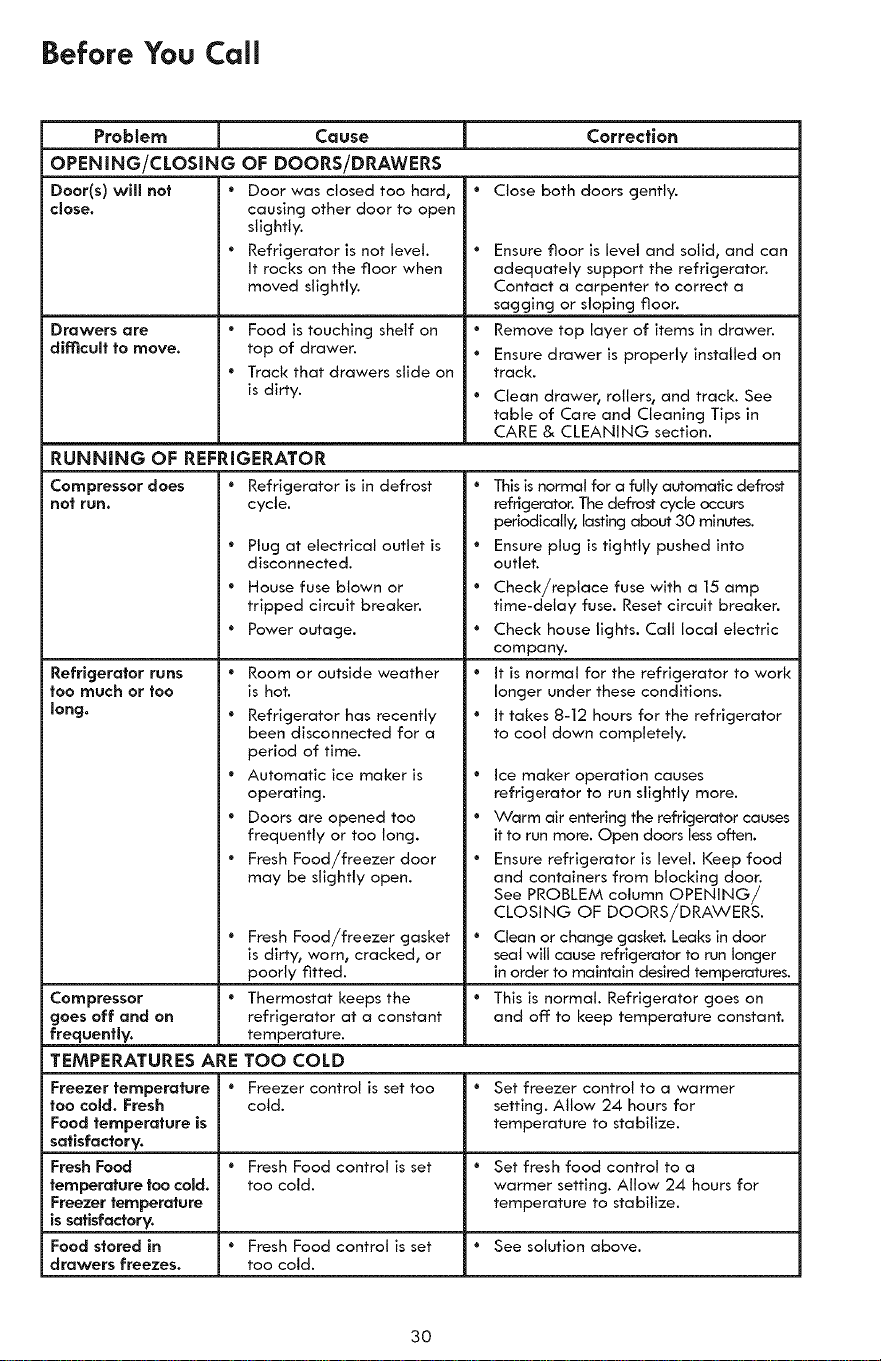
Before You Call
Problem Cause
OPENING/CLOSING OF DOORS/DRAWERS
Door(s) will not * Door was closed too hard,
close, causing other door to open
slightly.
• Refrigerator is not level.
It rocks on the floor when
moved slightly.
Drawers are * Food is touching shelf on
dimcult to move. top of drawer.
• Track that drawers slide on
is dirty.
Correction
* Close both doors gently.
* Ensure floor is level and solid, and can
adequately support the refrigerator.
Contact a carpenter to correct a
sagging or sloping floor.
* Remove top layer of items in drawer.
* Ensure drawer is properly installed on
track.
* Clean drawer, rollers, and track. See
table of Care and Cleaning Tips in
CARE & CLEANING section.
RUNNING OF REFRIGERATOR
Compressor does
not run.
Refrigerator runs
too much or too
long.
Refrigerator is in defrost
cycle.
Plug at electrical outlet is
disconnected.
House fuse blown or
tripped circuit breaker.
Power outage.
Room or outside weather
is hot.
Refrigerator has recently
been disconnected for a
period of time.
Automatic ice maker is
operating.
Doors are opened too
frequently or too long.
Fresh Food/freezer door
may be slightly open.
Fresh Food/freezer gasket
is dirty, worn, cracked, or
poorly fitted.
Thermostat keeps the
refrigerator at a constant
temperature.
TOO COLD
This is normal for a fully automatic defrost
refrigerator. The defrost cycle occurs
periodically, lasting about 30 minutes.
* Ensure plug is tightly pushed into
outlet.
* Check/replace fuse with a 15 amp
time-delay fuse. Reset circuit breaker.
* Check house lights. Call local electric
company.
* It is normal for the refrigerator to work
longer under these conditions.
* It takes 8-12 hours for the refrigerator
to coot down completely.
Compressor • •
goes off and on
frequently.
TEMPERATURES ARE
Freezer temperature * Freezer control is set too * Set freezer control to a warmer
too cold. Fresh cold. setting. Allow 24 hours for
Food temperature is temperature to stabilize.
satisfactory.
Fresh Food * Fresh Food control is set * Set fresh food control to a
temperature too cold. too cold. warmer setting. Allow 24 hours for
Freezer temperature temperature to stabilize.
is satisfactory.
Food stored in * Fresh Food control is set * See solution above.
drawers freezes, too cold.
* Ice maker operation causes
refrigerator to run slightly more.
* Warm air entering the refrigerator causes
it to run more. Open doors less often.
* Ensure refrigerator is level. Keep food
and containers from blocking door.
See PROBLEM column OPENING/
CLOSING OF DOORS/DRAWERS.
* Clean or change gasket. Leaks in door
seat will cause refrigerator to run longer
in order to maintain desired temperatures.
This is normal. Refrigerator goes on
and off to keep temperature constant.
3O
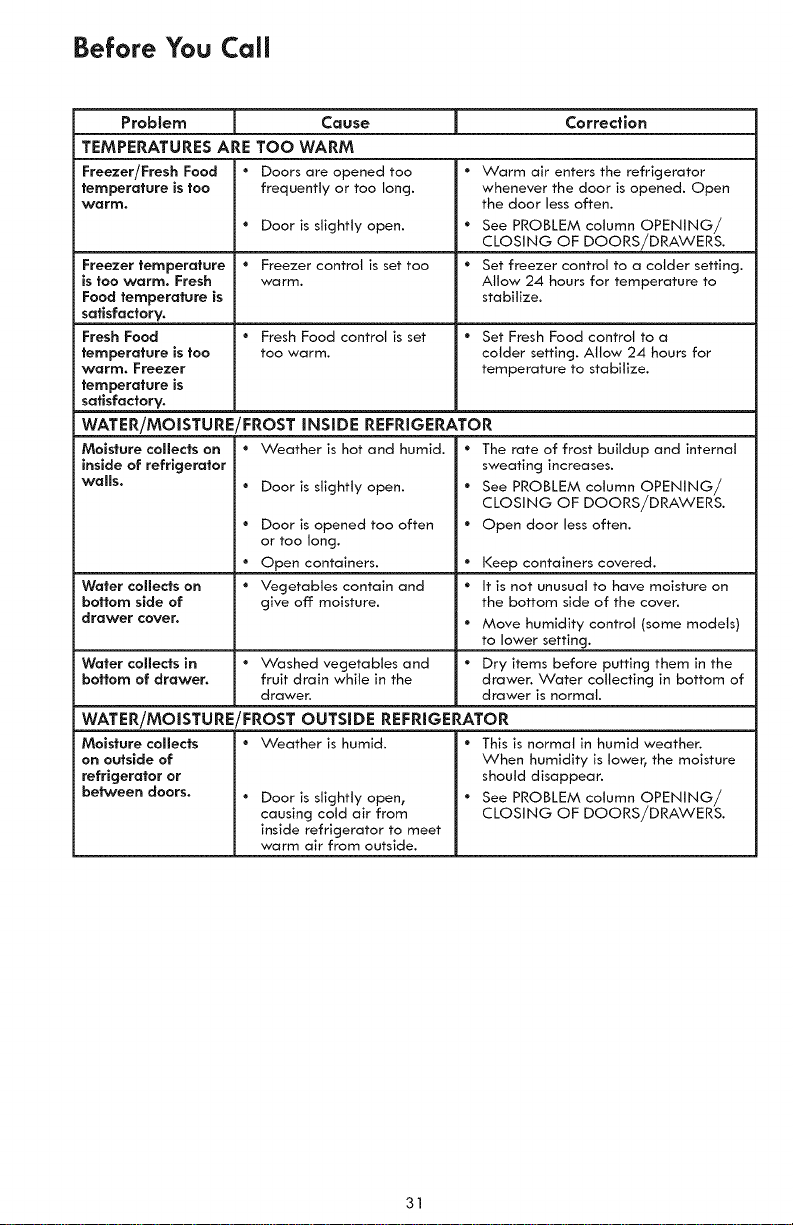
Before You Call
Problem Cause Correction
TEMPERATURES ARE TOO WARM
Freezer/Fresh Food * Doors are opened too * Warm air enters the refrigerator
temperature is too frequently or too long. whenever the door is opened. Open
warm. the door less often.
• Door is slightly open. * See PROBLEM column OPENING/
CLOSING OF DOORS/DRAWERS.
Freezer temperature * Freezer control is set too * Set freezer control to a colder setting.
is too warm. Fresh warm. Allow 24 hours for temperature to
Food temperature is stabilize.
satisfactory.
Fresh Food * Fresh Food control is set * Set Fresh Food control to a
temperature is too too warm. colder setting. Allow 24 hours for
warm. Freezer temperature to stabilize.
temperature is
satisfactory.
1FROSTiNSiDE REFRIGERATOR
• Weather is hot and humid.
WATER/MOISTURE
Moisture collects on
inside of refrigerator
walls.
* Door is slightly open.
* Door is opened too often
or too long.
* Open containers.
* Vegetables contain and
give off moisture.
* The rate of frost buildup and internal
sweating increases.
* See PROBLEM column OPENING/
CLOSING OF DOORS/DRAWERS.
* Open door less often.
* Keep containers covered.
Water collects on * it is not unusual to have moisture on
bottom side of the bottom side of the cover.
drawer cover. * Move humidity control (some models)
to lower setting.
Water collects _n * Washed vegetables and * Dry items before putting them in the
bottom of drawer, fruit drain while in the drawer. Water collecting in bottom of
drawer, drawer is normal.
1FROSTOUTSIDE REFRIGERATOR
* Weather is humid. *
WATER/MOISTURE
Moisture collects
on outside of
refrigerator or
between doors.
Door is slightly open,
causing cold air from
inside refrigerator to meet
warm air from outside.
This is normal in humid weather.
When humidity is lower, the moisture
should disappear.
See PROBLEM column OPENING/
CLOSING OF DOORS/DRAWERS.
31
iiii!iiiiiiiiiiiiiiiiiiiiill
Just Call:
1-800-4-MY-HOME ®
(1-800-469-4663)
24 hours a day, 7 days a week
For the repair of major brand appliances in your own home...
no matter who made it, no matter who sold it!
For your nearest Sears Parts and Service location,
to bring in products like vacuums, lawn equipment and electronics.
For Sears Parts & Service, to order the replacement parts,
accessories and owner's manuals that you need to do-it-yourself.
www.sears.ca
To purchase or inquire about a Sears Maintenance Agreement, call:
1-800-361-6665
9 a.m.-11 p.m. Mon. - Fri., EST, 9 a.m.-4 p.m. Sat.
!i!i!i!i!i!i!i!i!i!i!_!
Pour service en Fran#ais:
1-800-LE-FOYER Mc
(1-800-533-6937)
www.sea rs.ca
(R)/TMTrademarks of Sears, Roebuck and Co. used under license by Sears Canada
MDMarque depos6e / McMarque de commerce de Sears, Roebuck and Co. utilisee en vertu d'une licence
de Sears Canada