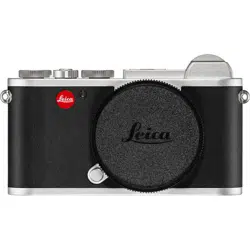

LEICACL
Instruction manual

EN
2
FOREWORD
Dear Customer,
We wish you a great deal of fun and success taking photographs
with your new Leica CL. Please read this manual thoroughly to
familiarize yourself with the full scope of functions your camera has
to offer.
Your Leica Camera AG
SCOPE OF DELIVERY
Before using your camera for the first time, please check that the
accessories supplied are complete.
– LeicaCL
– Lithium-ion battery Leica BP-DC12
– Charger Leica BC-DC12, incl. mains cable (US, EU)
– Camera bayonet cover
– Accessory shoe cover
– Carry strap
– Quick Start Guide
– CE flyer
– Creative Cloud flyer
– Test certificate
Subject to changes in design and production.
Foreword/Scope of delivery
3
EN
REPLACEMENT PARTS/ACCESSORIES
Please visit the Leica Camera AG website for information on the
extensive range of Leica replacement parts/accessories:
http://en.leica-camera.com/Photography/Leica-APS-C/
Accessories
Only the accessories specified and described in this manual or
by Leica Camera AG must be used with the camera (battery,
charger, mains plug, mains cable, etc.). These accessories
should only be used with this product. Third-party accessories
may result in malfunctions or damage to the product.
Please read the chapters “Legal information”, “Safety
remarks”, and “General information” before using your camera
for the first time. Knowledge of the content will prevent
inadvertent damage to the product, possible injuries and other
risks.
Replacement parts/accessories

EN
4
LEGAL INFORMATION
LEGAL INFORMATION
• Compliance with copyright laws is mandatory. The recording and
publication of pre-recorded media, e.g. tapes, CDs, or other
published or broadcast material may be in breach of copyright
laws.
• The same applies for all software supplied in the scope of
delivery.
• The following applies for all video material created with this
camera: This product is governed by the AVC Patent Portfolio
license and is meant for private use by a consumer only. The
device may furthermore be used for purposes for which the
consumer receives no remuneration, e.g. (i) encoding in
accordance with the AVC Standard (“AVC Video”) and/or (ii)
decoding of AVC Video that was encoded by a consumer in
accordance with the AVC Standard within the scope of personal
use and/or which the consumer has received from the provider,
who is in possession of a license to offer AVC Video. No license
is granted or implied for any other use. Any other use, specifical-
ly the provision of AVC video in exchange for remuneration, may
require a separate license agreement with MPEG LA, L.L.C.
Please visit the MPEG LA, L.L.C. website at: www.mpegla.com
for more information.
REGULATORY INFORMATION
You will find the manufacturing date of your camera on the stickers
in the Warranty Card and/or on the packaging.
The date format is year/month/day.
Specific regional approvals for this device can be found in the
camera menu.
Select Camera Information in the main menu
Select Regulatory Information from the submenu
Legal information
EN
5
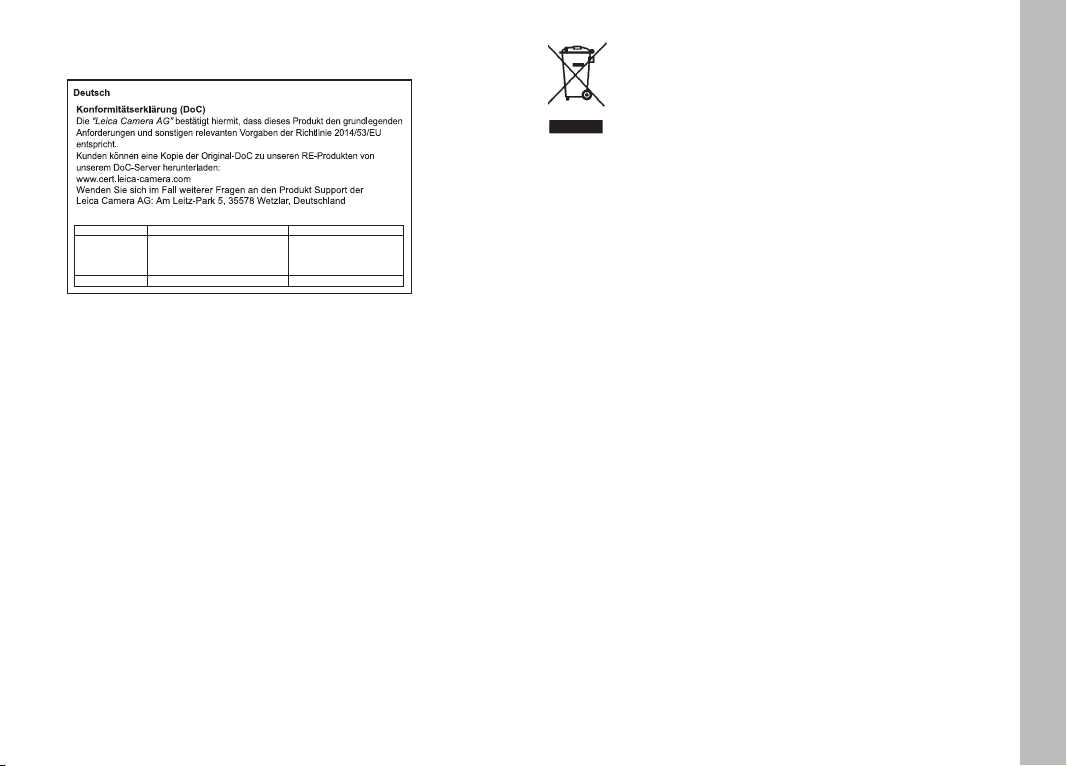
The CE mark on our products documents compliance with the
fundamental requirements of applicable EU guidelines.
Produktabhängig (siehe Technische Daten)
Type
Frequency band (central frequency) Maximum power (dBm e.i.r.p.)
WLAN
2412 – 2462 MHz/
5180 – 5240 MHz/
5260 – 5320 MHz/
5500 – 5700 MHz
20
20
Bluetooth
2402 - 2480 MHz 20
DISPOSAL OF ELECTRICAL AND ELEC-
TRONIC EQUIPMENT
(Applies within the EU and for other European
countries with active waste separation policies.)
This device contains electric and/or electronic components which
must not be disposed of in general household waste. Instead, it
should be disposed of at a recycling collection point provided by
your local authority.
This service is free of charge. Any standard or rechargeable
batteries used in this device must be removed and disposed of
separately in accordance with local regulations.
Please contact your local authorities, waste disposal collection
point or the retailer, from whom you purchased the device for more
information on correct waste disposal.
Legal information

EN
6
IMPORTANT NOTES REGARDING THE USE OF
WLAN/BLUETOOTH
®
(LEICA FOTOS)
Please read the important notes on specific functions of Leica
FOTOS on p. 132.
• Appropriate measures must be taken to ensure security and
protect against disruptions to the systems in place where
devices or computer systems are in use that require more
stringent security than WLAN devices.
• Leica Camera AG shall not accept liability for damages arising
from the use of the camera for purposes other than as a WLAN
device.
• It is assumed that the WLAN function will be used in countries
where this camera is sold. There may be a risk of breaching
statutory wireless communication regulations when using the
camera in other countries. Leica Camera AG shall not accept
liability for such breaches.
• Please note that there is a risk of unauthorized third party
interception of wirelessly communicated data. We highly
recommend that you activate encryption in the wireless access
point settings to ensure data safety.
• Avoid using the camera in areas where it can be exposed to
magnetic fields, static electricity or other interferences, e.g.
near a microwave oven. RF transmissions may otherwise not
reach the camera.
• Using the camera near devices like microwave ovens or wireless
phones that use the 2.4 GHz RF band may negatively affect the
performance of both devices.
• Do not attempt to connect to wireless networks you are not
authorized to use.
• The device will automatically search for wireless networks, once
the WLAN function is enabled. A list, including networks you are
not authorized to access, will be displayed (SSID: Network
identifier for a WLAN network). Do not attempt to connect to
such a network, as this could be construed as unauthorized
access.
• We recommend disabling the WLAN function while on an
aircraft.
Legal information

EN
7
Legal information

EN
8
SAFETY REMARKS
GENERAL INFORMATION
• Do not use your camera in the immediate vicinity of devices that
generate powerful magnetic, electrostatic or electromagnetic
fields (e.g. induction ovens, microwave ovens, television sets or
computer screens, video game consoles, cell phones, broad-
casting equipment). Their electromagnetic fields can interfere
with recordings.
• Strong magnetic fields, e.g. from speakers or large electric
motors can damage the stored picture data or disrupt recording.
• Switch off the camera, remove the battery briefly, replace it and
switch the camera back on in case of a camera malfunction due
to the effects of electromagnetic fields.
• Do not use the camera in the immediate vicinity of radio
transmitters or high-voltage power lines. Their electromagnetic
fields may interfere with recordings.
• Always store small parts e.g. the accessory shoe cover as
follows:
– out of the reach of children
– in a safe location, where they will not get lost or stolen
• State-of-the-art electronic components are sensitive to static
discharge. You can easily pick up charges of several 10,000
volts by simply walking on synthetic floor coverings. A static
discharge can occur when you touch the camera and especially
if it is placed on a conductive surface. A static discharge on the
camera housing poses no risk for the electronics. Despite
built-in safety circuits, you should avoid direct contact with
external camera contacts like those in the flash shoe.
• Take care not to soil or scratch the sensor for lens detection in
the bayonet. You must similarly prevent direct contact of the
bayonet with grains of sand or similar particles, as these could
cause irreparable damage. This component must only be
cleaned with a dry cloth (in system cameras).
• Use a cotton or linen cloth instead of a microfiber cloth from an
optician's (synthetic) when cleaning the contacts. Make sure to
discharge any electrostatic charge by deliberately touching a
heating or water pipe (conductive, grounded material). Dirt
deposits and oxidation on the contacts can be avoided by
storing your camera in a dry location with the lens cap and the
flash shoe/viewfinder cap (in system cameras) attached.
• Only use accessories specified for this model to prevent faults,
short circuits or electric shock.
• Do not attempt to remove parts of the housing (covers) yourself.
Repairs must be done at authorized service centers only.
• Protect the camera against contact with insect sprays and other
aggressive chemicals. Petroleum spirit, thinner and alcohol must
not be used for cleaning. Some chemicals and liquids can
damage the camera housing or the surface finish.
• Rubber and plastics are known to expel aggressive chemicals
and should therefore not be kept in contact with the camera for
extended periods of time.
• Prevent any sand or dust or water penetration into the camera,
e.g. during snowfall or rain or on the beach. Be extra careful
when changing the lens (in system cameras) and when inserting
or removing the memory card and rechargeable battery. Sand
and dust can damage the camera, the lens, the memory card
and the battery. Moisture can cause malfunctions and irrepara-
ble damage to the camera and memory card.
Safety remarks

EN
9
LENS
• A camera lens can have the effect of a magnifying glass when
exposed to direct frontal sunlight. The camera must therefore be
protected against extended exposure to direct sunlight.
• Attaching the lens cap and keeping the camera in the shade or
ideally in its camera case, will help prevent damage to the
interior of the camera.
RECHARGEABLE BATTERY
• Improper use of the batteries or the use of unapproved battery
types may result in an explosion!
• Do not expose the rechargeable battery to sunlight, heat,
humidity or moisture for prolonged periods of time. Likewise, the
batteries must not be placed in a microwave oven or a
high-pressure container as this would pose a fire or explosion
hazard.
• Do not under any circumstances charge or insert a damp or wet
battery into the camera!
• A safety valve in the battery ensures that any excess pressure
caused by improper handling is discharged safely. It is neverthe-
less important to dispose of a bloated battery immediately. It
may pose an explosion hazard!
• Keep the battery contacts clean and easily accessible. Although
lithium-ion batteries are secured against short circuits, they
should still be protected against contact with metal objects like
paper clips or jewelry. A short-circuited battery can get very hot
and cause severe burns.
• When a battery is accidentally dropped, make sure to check the
housing and the contacts immediately for any damage. A
damaged battery can damage the camera.
• The battery must be removed from the camera or charger and
must be replaced immediately in case of a strange smell,
discoloration, deformation, overheating or leakage. Continued
use of the battery may result in overheating, which can cause
fire and/or explosion!
• Never throw batteries into a fire as they may explode.
• Keep the battery away from sources of heat in case of leakage
or if you smell burning. Leaked fluid can catch fire!
• The use of other chargers not approved by Leica Camera AG can
cause damage to the batteries – and in extreme cases – cause
serious or life-threatening injuries.
• Make sure that the power socket is freely accessible at all times.
• Do not attempt to open the battery or the charger. Repairs must
only be carried out by authorized service centers.
• Keep batteries out of the reach of children. Batteries can cause
suffocation when swallowed.
FIRST AID
• Battery fluid may cause blindness if it comes into contact
with the eyes. Rinse the eyes thoroughly with clean water
immediately. Avoid rubbing. Seek medical attention
immediately.
• Leaked battery fluid poses an injury hazard when it comes in
contact with clothing or skin. Rinse the affected areas
thoroughly with clean water.
Safety remarks

EN
10
CHARGER
• Using the charger in the vicinity of broadcasting receivers may
interfere with reception. Ensure a distance of at least 1 m (3 ft)
between the charger and the receiver.
• When the charger is in use, it may emit a buzzing sound – this is
normal and not a malfunction.
• Disconnect the charger from the mains when it is not in use, as
it consumes electricity (a very small amount), even if no battery
is inserted.
• Always keep the charger contacts clean, and never short circuit
them.
MEMORY CARD
• Never remove the memory card during a datasave or card
reading process. The camera must not be switched off or be
subjected to impact or vibrations while working.
• Do not open the cover/remove the memory card or the battery
while the status LED is lit, which indicates memory access. Data
on the card may otherwise be destroyed and camera malfunc-
tions may occur.
• Do not drop or bend memory cards as this will cause damage
and result in the loss of stored data.
• Do not touch the connections on the reverse of the memory
card and keep them clean and dry.
• Keep memory cards out of the reach of children. Swallowing a
memory card may cause suffocation.
SENSOR
Cosmic radiation (e.g. during flights) may cause pixel defects.
Safety remarks

EN
11
CARRY STRAP
• Carry straps are usually made of very robust material. You
should therefore keep it out of the reach of children. A carry
strap is not a toy and poses a strangulation risk.
• Use the carry strap only for its intended purpose on a camera or
on binoculars. Any other use poses the risk of injury and may
possibly result in damage to the carry strap and is therefore not
permitted.
• Carry straps should also not be used for cameras/binoculars
during sports activities that pose a risk of entanglement (e.g.
when mountain climbing and similar outdoor activities).
Please read the section about “Care/Maintenance” for more
information about what to do in case of problems.
Safety remarks

EN
12
GENERAL INFORMATION
CAMERA/LENS
• Make a note of the serial numbers of your camera (engraved in
the base of the camera housing) and lenses, as this information
will be extremely important in case of loss.
• Make sure to always have a lens or the camera bayonet cover
attached to prevent dust or other foreign bodies penetrating the
camera.
• That is why you should always replace lenses quickly and in a
dust-free environment.
• Never store the camera bayonet cover or the lens back cover in
a pants pocket, as they will attract lint and dust, which could
then be accidentally introduced into the camera.
• Leica releases firmware updates for lenses at irregular intervals.
You can download any new firmware version from our homepage
and transfer it to your lens. Please read the section “Installing
firmware” (p. 128) for more information.
LCD PANEL
• Condensation may form on the LCD panel if the camera is
exposed to great temperature fluctuations. Wipe the screen
carefully with a soft, dry cloth.
• The screen image will initially be slightly darker than normal if
the camera is very cold when it is switched on. The normal level
of brightness will be reached as soon as the LCD panel warms
up.
RECHARGEABLE BATTERY
• The battery must have a temperature between +0°C and
+35°C for charging (otherwise the charger will not switch on or
will switch off again immediately).
• Lithium-ion batteries can be charged at any time, regardless of
their current charge level. A partially charged battery will charge
to full capacity faster than a fully discharged one.
• The rechargeable batteries come only partly charged ex works
and should therefore be charged fully before their first use.
• A new battery only reaches its full capacity after it has been fully
charged and – by using it in the camera – depleted 2 to 3 times.
This depletion process should be repeated roughly every 25
cycles.
• Battery and charger heat up during the charging process. That is
normal and not a malfunction.
• Rapid flashing of the two LEDs (>2Hz) when charging
commences indicates a charging error (e.g. maximum charging
time exceeded, voltages or temperatures outside permitted
ranges or a short circuit). Disconnect the charger from the
mains and remove the battery. Ensure that the above tempera-
ture conditions are met and then restart the charging process.
Please contact your dealer, the Leica office in your country or
Leica Camera AG if the problem persists.
• Rechargeable lithium-ion batteries generate power by way of
internal chemical reactions. These reactions are influenced by
ambient temperature and humidity. To ensure a maximum
service life of the battery, it should not be exposed to extreme
temperatures (high or low) for extended periods of time (e.g. in a
parked car in the summer or winter).
• However, every battery has a limited service life! After several
hundred charging cycles, this limitation will become evident as
the operating times get significantly shorter.
General information

EN
13
• The replaceable battery supplies power to a backup battery,
which is permanently installed in the camera. This backup
battery retains the date and time for some weeks. Once the
backup battery is depleted, it must be replenished by inserting a
charged main battery. The time and date will have to be set
again after a full depletion of both batteries.
• As the battery capacity deteriorates or if using an older battery,
warning messages may appear and some functions may be
restricted or blocked entirely.
• Remove the battery if the camera will not be used for an
extended period of time. Make sure to switch the camera off via
the main switch before removing the battery. Leaving the battery
in the camera will result in a deep discharge after a few weeks.
Voltage levels will decrease significantly, as the camera uses a
low idle current to maintain settings.
• Dispose of damaged batteries in accordance with the relevant
regulations at an approved collection point for proper recycling.
• The date of manufacture can be found on the battery.
The date format is week/year.
MEMORY CARD
• The range of available SD/SDHC/SDXC cards on the market is
too extensive for Leica Camera AG to test for compatibility and
quality. Generally, any type of memory card may be used without
any damage to the camera or memory card. As some "no name"
cards may not fully comply with the SD/SDHC/SDXC standards,
Leica Camera AG cannot provide any guarantee of function.
• We recommend formatting memory cards from time to time,
because fragmented residual data from deleted files may block
some of the storage capacity.
• Generally, it is not necessary to format (initialize) memory cards
that have been previously used. Formatting will, however, be
necessary if you insert an unformatted memory card or a card
that was formatted in another device (e.g. a computer) for the
first time.
• We recommend backing up your data on a PC, because
electromagnetic fields, static electricity and any memory card or
camera defects could result in permanent damage or loss of
your data.
• SD, SDHC, and SDXC memory cards come with a write
protection slider to prevent accidental overwriting. This slider is
located on the non-beveled side of the card. All data on the card
is protected when the slider is set to its lower position, marked
LOCK.
General information

EN
14
SENSOR
• Any dust or dirt particles stuck to the glass cover of the sensor
may result in noticeable dark stains or specks on the pictures.
DATA
• All data, including personal information, may be changed or
deleted due to incorrect or accidental operation, static
discharge, accidents, malfunctions, repairs and other measures.
• Please note that Leica Camera AG does accept liability for direct
or consequential damage due to the manipulation or destruction
of data and personal information.
FIRMWARE UPDATE
Leica is constantly working on developing and optimizing the
LeicaCL. As many functions on digital cameras are controlled
purely electronically, improvements and extensions to the range of
functions may need to be installed on the camera at a later date.
Leica releases what are known as firmware updates at irregular
intervals. Cameras are always supplied from the factory with the
latest firmware. Otherwise you can download it from our website
yourself and transfer it to your camera.
You will receive a newsletter informing you of the availability of a
new firmware update if you register your camera on the Leica
Camera homepage.
Visit the download section or the "Customer Area" for information
about how to register or how to get firmware updates for your Leica
CL. Additionally, you can find information about changes or
additions to the manual at:
https://owners.leica-camera.com
Select menu item "Firmware" (see p. 127) to check whether your
camera and lenses are running the latest firmware version.
General information

EN
15
WARRANTY
In addition to your statutory warranty rights regarding your dealer,
you will receive an additional Leica Camera AG product warranty
valid from the date of purchase at an authorized Leica retailer. For
more information regarding the warranty scope, services and
limitations, please visit: warranty.leica-camera.com
Warranty

EN
16
TABLE OF CONTENT
FOREWORD ...................................................................................... 2
SCOPE OF DELIVERY ....................................................................... 2
REPLACEMENT PARTS/ACCESSORIES .......................................... 3
LEGAL INFORMATION ..................................................................... 4
SAFETY REMARKS ........................................................................... 8
GENERAL INFORMATION .............................................................. 12
WARRANTY ..................................................................................... 15
TABLE OF CONTENT ...................................................................... 16
PART DESIGNATIONS .................................................................... 20
DISPLAYS ........................................................................................ 22
PHOTO ......................................................................................................... 22
VIDEO .......................................................................................................... 24
DISPLAYS IN THE TOP DISPLAY ................................................................ 25
PREPARATION ................................................................................ 26
ATTACHING THE CARRY STRAP ................................................................. 26
PREPARING THE CHARGER ........................................................................ 26
CHARGING THE BATTERY........................................................................... 27
INSERTING/REMOVING THE BATTERY ..................................................... 28
INSERTING/REMOVING THE MEMORY CARD .......................................... 30
DIOPTER SETTINGS .................................................................................... 32
CHANGING THE LENS ................................................................................ 33
COMPATIBLE LENSES ....................................................................................... 34
CAMERA OPERATION..................................................................... 36
OPERATING ELEMENTS .............................................................................. 36
MAIN SWITCH ................................................................................................... 36
SHUTTER BUTTON ............................................................................................ 37
LEFT SETTING WHEEL....................................................................................... 38
Left setting wheel button ................................................................................. 38
Right settig wheel ............................................................................................. 38
RIGHT SETTING WHEEL BUTTON ..................................................................... 38
DIRECTIONAL PAD/CENTER BUTTON .............................................................. 39
PLAY BUTTON/FN BUTTON/MENU BUTTON .................................................. 40
TOUCH SCREEN ................................................................................................ 40
TOP DISPLAY ..................................................................................................... 41
MENU CONTROL ......................................................................................... 42
CONTROL ELEMENTS ....................................................................................... 42
STRUCTURE OF THE MENU SCREEN ............................................................... 43
MENU NAVIGATION .......................................................................................... 44
FAVORITES MENU ............................................................................................. 49
DIRECT ACCESS TO MENU FUNCTIONS .......................................................... 50
KEYLOCK ..................................................................................................... 51
CAMERA DEFAULT SETTINGS ....................................................... 52
MENU LANGUAGE ...................................................................................... 52
DATE/TIME .................................................................................................. 52
POWER SAVE MODE (STANDBY MODE) .................................................... 53
LCD PANEL/VIEWFINDER (EVF) SETTINGS ............................................. 54
LCD PANEL/EVF USE ........................................................................................ 54
EYE SENSOR SENSITIVITY ................................................................................ 55
BRIGHTNESS ..................................................................................................... 55
INFORMATION DISPLAYS ................................................................................. 56
AUTOMATIC DEACTIVATION OF ALL DISPLAYS ............................................... 56
ACOUSTIC SIGNALS ................................................................................... 57
ELECTRONIC SHUTTER SOUND ....................................................................... 57
AUTOFOCUS CONFIRMATION .......................................................................... 57
BASIC PICTURE SETTINGS ............................................................ 58
PHOTO ......................................................................................................... 58
FILE FORMAT ..................................................................................................... 58
JPG RESOLUTION .............................................................................................. 58
IMAGE PROPERTIES .......................................................................................... 59
Table of Content

EN
17
COLOR PROFILE ................................................................................................ 60
MONOCHROME PROFILE .................................................................................. 60
IMAGE STABILIZATION ...................................................................................... 61
VIDEO .......................................................................................................... 62
FILE FORMAT ..................................................................................................... 62
VIDEO RESOLUTION ......................................................................................... 62
MICROPHONE ................................................................................................... 62
VIDEO STABILIZATION ...................................................................................... 63
IMAGE PROPERTIES .......................................................................................... 63
PICTURE MODE .............................................................................. 64
FOCUSING ................................................................................................... 64
AUTOFOCUS MODES ........................................................................................ 64
AUTOFOCUS METERING METHODS ................................................................. 65
LIMITING THE AUTOFOCUS SETTING RANGE .................................................. 67
MF ASSIST FUNCTIONS .................................................................................... 68
MANUAL FOCUSING (MF) ................................................................................ 69
MF ASSIST FUNCTIONS .................................................................................... 69
ISO SENSITIVITY ......................................................................................... 71
WHITE BALANCE ........................................................................................ 72
EXPOSURE................................................................................................... 74
EXPOSURE METERING METHODS .................................................................... 74
FULLY AUTOMATIC EXPOSURE SETTING – P ................................................... 76
SCENE MODE .................................................................................................... 77
Exposure simulation is active in all modes (see p. 83). ................................ 78
SEMI-AUTOMATIC EXPOSURE SETTING – A/S ................................................ 81
MANUAL EXPOSURE SETTING – M .................................................................. 83
EXPOSURE CONTROL ....................................................................................... 83
OTHER FUNCTIONS .................................................................................... 88
AUXILIARY DISPLAYS ........................................................................................ 88
SERIAL EXPOSURES ......................................................................................... 91
INTERVAL SHOOTING ....................................................................................... 92
SELF-TIMER ....................................................................................................... 94
FLASH PHOTOGRAPHY .............................................................................. 95
COMPATIBLE FLASH UNITS .............................................................................. 95
FLASH EXPOSURE METERING (TTL METERING) .............................................. 96
FLASH MODES .................................................................................................. 97
FLASH CONTROL .............................................................................................. 98
VIDEO MODE ................................................................................102
START/EXIT VIDEO MODE ....................................................................... 102
STA RT /END VIDEO RECORDING ............................................................ 103
EXPOSURE CONTROL .....................................................................................103
FOCUSING .......................................................................................................103
PLAYBACK/REVIEW MODE ......................................................... 104
INITIATE/EXIT PLAYBACK/REVIEW MODE ............................................104
SELECTING/SCROLLING THROUGH RECORDINGS ...............................105
DISPLAYS IN PLAYBACK/REVIEW MODE ............................................... 105
DISPLAYING ASSIST FUNCTIONS ..................................................................107
CROPPED SECTION ZOOM ....................................................................... 107
DISPLAYING MULTIPLE RECORDINGS AT ONCE .................................... 109
TAGGING/RATING OF RECORDINGS ....................................................... 110
DELETING RECORDINGS .......................................................................... 111
DELETING INDIVIDUAL RECORDINGS ............................................................111
DELETING MULTIPLE RECORDINGS ............................................................... 112
DELETING ALL RECORDINGS .........................................................................113
DELETING UNRATED RECORDINGS ............................................................... 114
PREVIEW OF LATEST RECORDING .......................................................... 114
SLIDE SHOW ............................................................................................. 115
VIDEO PLAYBACK ..................................................................................... 116
VIDEO EDITING ...............................................................................................120
OTHER FUNCTIONS .....................................................................122
USER PROFILES ........................................................................................ 122
DATA MANAGEMENT ................................................................................ 124
DATA STRUCTURE ON THE MEMORY CARD ...................................................124
EDIT FILE NAMES ............................................................................................125
Table of Content

EN
18
CREATING A NEW FOLDER ............................................................................. 125
FORMATTING A MEMORY CARD .....................................................................126
DATA TRANSFER .......................................................................................127
USING RAW DATA (DNG) ..........................................................................127
RESETTING THE CAMERA
TO FACTORY SETTINGS ............................................................................ 127
FIRMWARE UPDATES ............................................................................... 127
LEICA FOTOS ................................................................................ 130
CONNECTION ............................................................................................ 130
REMOTE CAMERA CONTROL ...................................................................132
CARE/STORAGE ........................................................................... 134
FAQ ................................................................................................135
INDEX ............................................................................................141
MENU OVERVIEW ........................................................................144
TECHNICAL DATA ......................................................................... 145
LEICA CUSTOMER CARE ..............................................................150
Table of Content

EN
19
Definition of the various categories of information found in
this manual
Note
Additional information
Important
Failure to observe the instructions may result in damage to the
camera, the accessories or the pictures.
Attention
Non-compliance may result in personal injury
Table of Content
EN
20
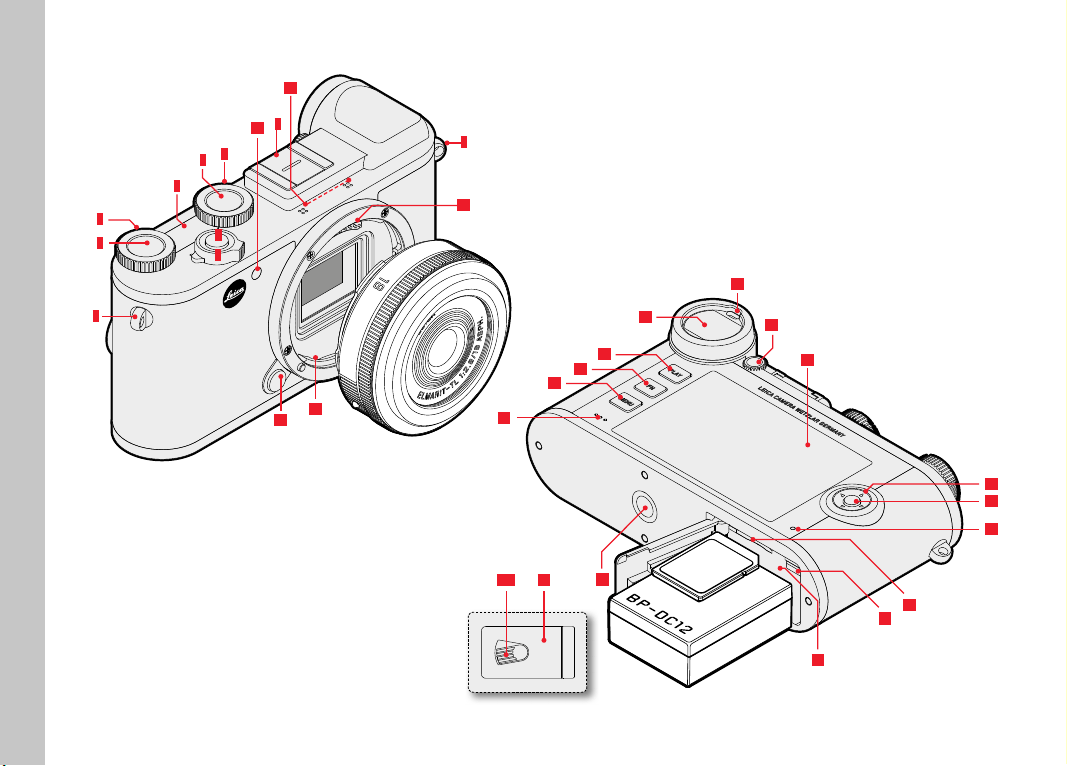
PART DESIGNATIONS
16
17
23
22
24
25
21
18
15
28
26
29
30
2727a
19
20
2
4
8
5
7
6
3
10
9
13
12
11
14
1
1
Part Designations

EN
21
1
Strap lugs
2
Main switch
3
Shutter button
4
Right setting wheel
5
Right setting wheel button
6
Left setting wheel
7
Left setting wheel button
8
Top display
9
Accessory shoe
10
Microphone
11
Self-timer LED/AF assist light
12
Lens release button
13
Bayonet
14
contact strip
15
Viewfinder eyepiece
16
Eye sensor
17
Diopter setting wheel
18
PLAY button
19
FN button
20
MENU button
21
LCD panel
22
Directional pad
23
Center button
24
Status LED
25
Speaker
26
Tripod thread
27
Cover for battery compartment and memory card slot
27a
Release lever
28
Battery release lever
29
Battery compartment
30
Memory card slot
*Lens not included in the delivery package.
Part Designations
EN
22
DISPLAYS
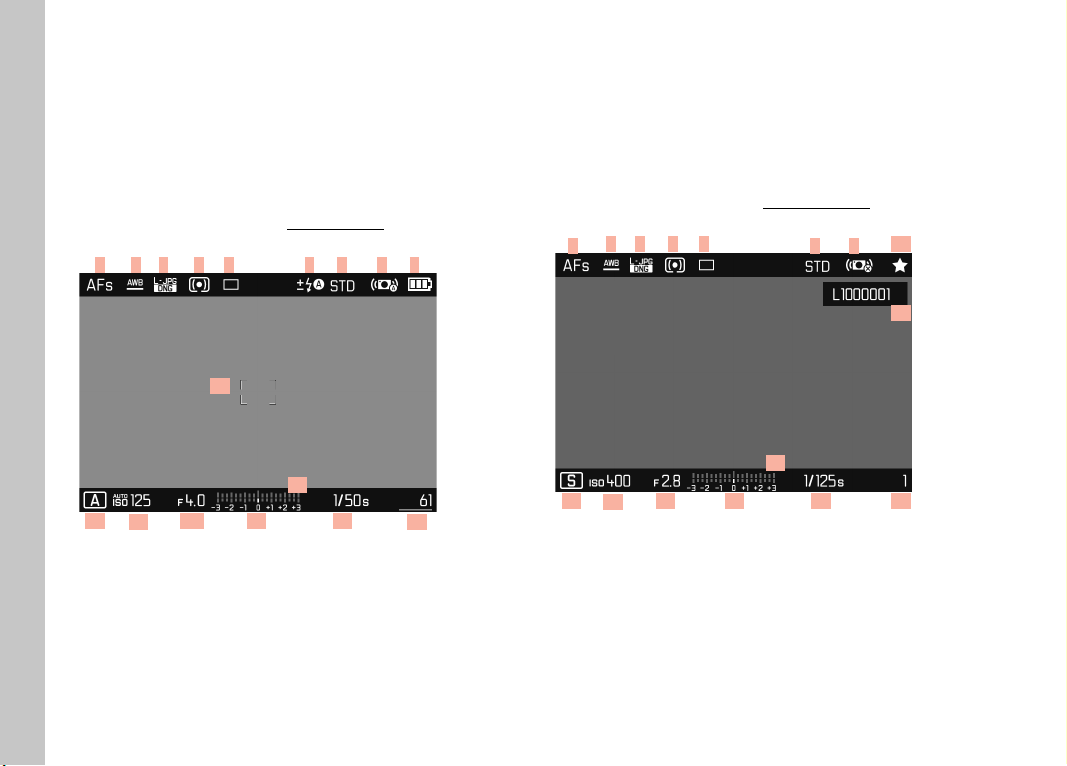
The images displayed on the LCD panel and in the viewfi nder are
identical.
PHOTO
WHEN TAKING A PICTURE
All displays/values refer to the actual settings
1 2
16
17
10
111213
14
15
3 4 5 6 7 8 9
IN REVIEW MODE
All displays/values refer to the displayed image
1
2 3 4 5
18
15
14
1112
17
13 19
19
7 8
Displays
EN
23
1
Focus mode
2
White balance mode
3
File format/compression level/resolution
4
Exposure metering method
5
Picture mode (Picture sequence)
6
Flash mode/fl ash exposure compensation
7
Color rendering (Film Style)
8
Stabilization activated
9
Battery capacity
10
Remaining number of exposures incl. trend detection via
bar chart = remaining capacity of the inserted memory
card
11
Shutter speed
12
Light balance
13
Exposure value
14
ISO Sensitivity
15
Exposure mode
16
AF Field
17
Exposure compensation scale
18
Icon for marked picture
19
File number of the picture shown
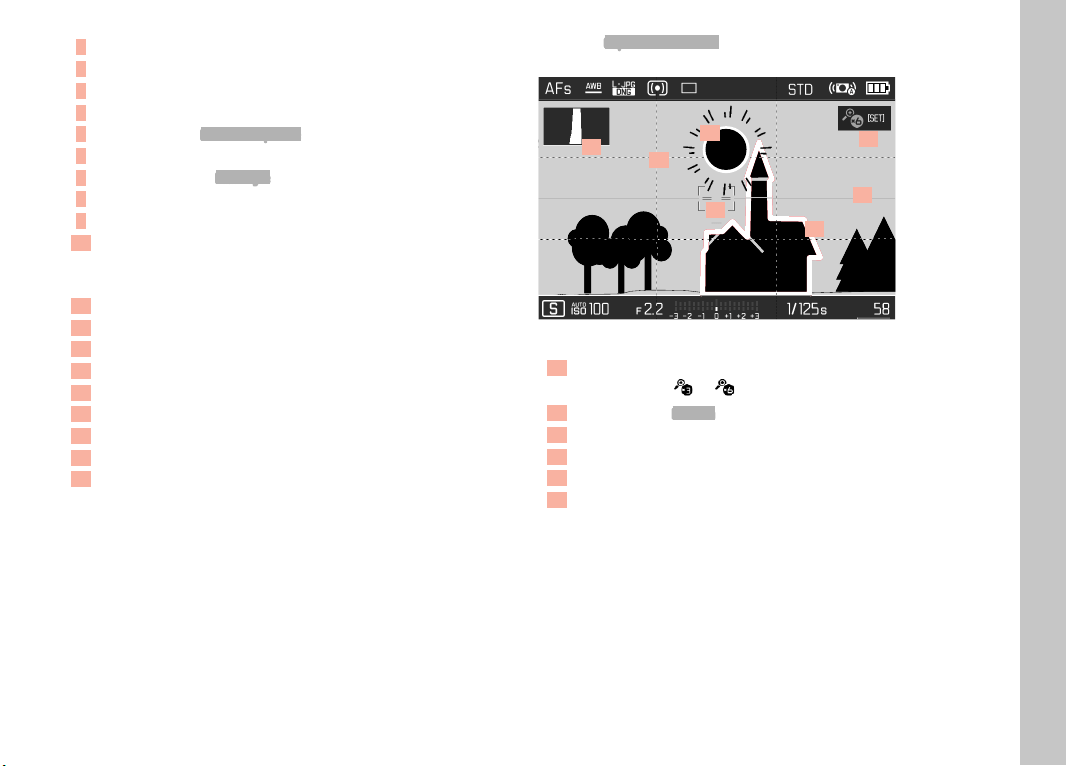
Activated Capture Assistants
999-9000
22
20
24
25
23
21
21
20
Automatic magnifi cation as Focus Assist for manual
focusing (+3x
or +6x magnifi cation available)
21
Level display (Horizon)
22
Focus Peaking (identifi cation of in sharp edges in the object)
23
Grid lines
24
Histogram
25
Clipping identifi cation of overexposed subject elements
Displays
EN
24
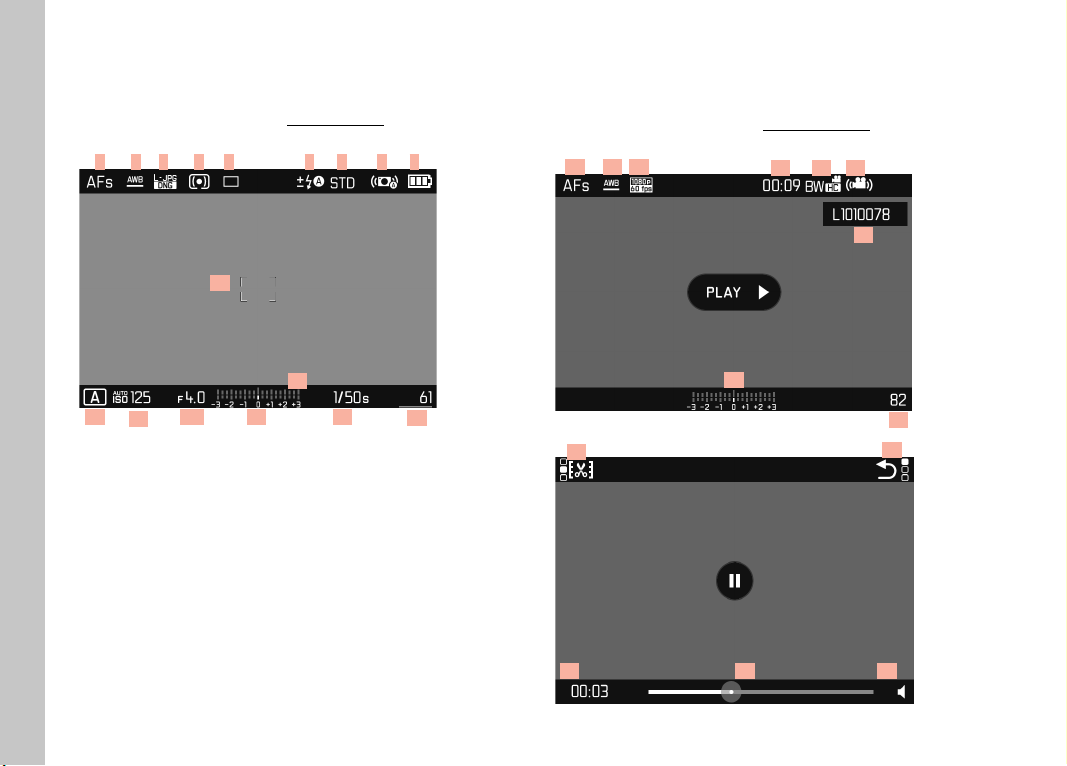
VIDEO
WHEN TAKING A PICTURE
All displays/values refer to the actual settings
1 2
16
17
10
111213
14
15
3 4 5 6 7 8 9
IN PLAYBACK MODE
All displays/values refer to the displayed image
26 27 28
42
43
31
2946 30
44
46 47 48
45
Displays
EN
25
26
Focus mode
27
White balance mode
28
Video Resolution
29
Color rendering (Video Style)
30
Stabilization activated
31
Light balance
32
Exposure compensation scale
33
Microphone recording level
34
Battery capacity
35
Histogram
36
Video mode
37
ISO Sensitivity
38
Exposure value
39
Shutter speed
40
Total remaining memory capacity/recording time
41
Length of recording
42
File name
43
Number of pictures on the memory card
44
Video editing function
45
Exiting video playback
46
Elapsed playback time
47
Playback status bar
48
Playback volume
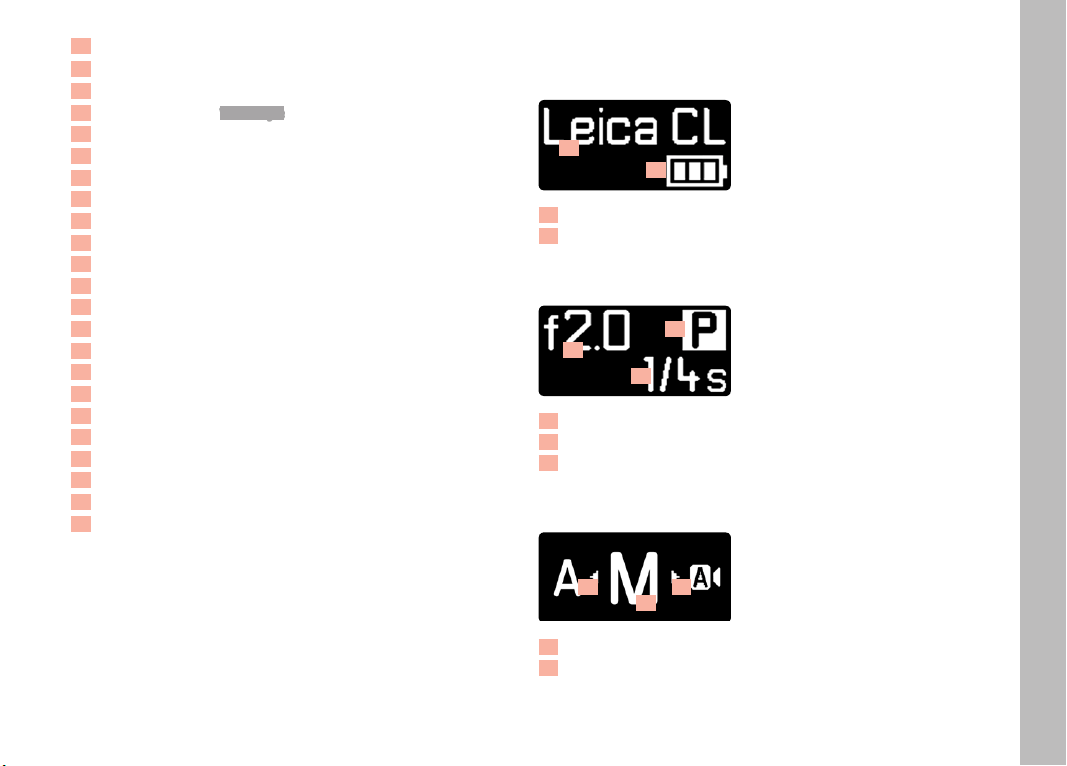
DISPLAYS IN THE TOP DISPLAY
When the camera is switched on
49
50
49
Camera name
50 Battery status
Standard view
51
52
53
51
Aperture
52 Exposure mode
53 Shutter speed
When changing modes
55
55
54
54 Currently selected exposure mode
55 Arrows for the shift direction
Displays
EN
26
PREPARATION
ATTACHING THE CARRY STRAP
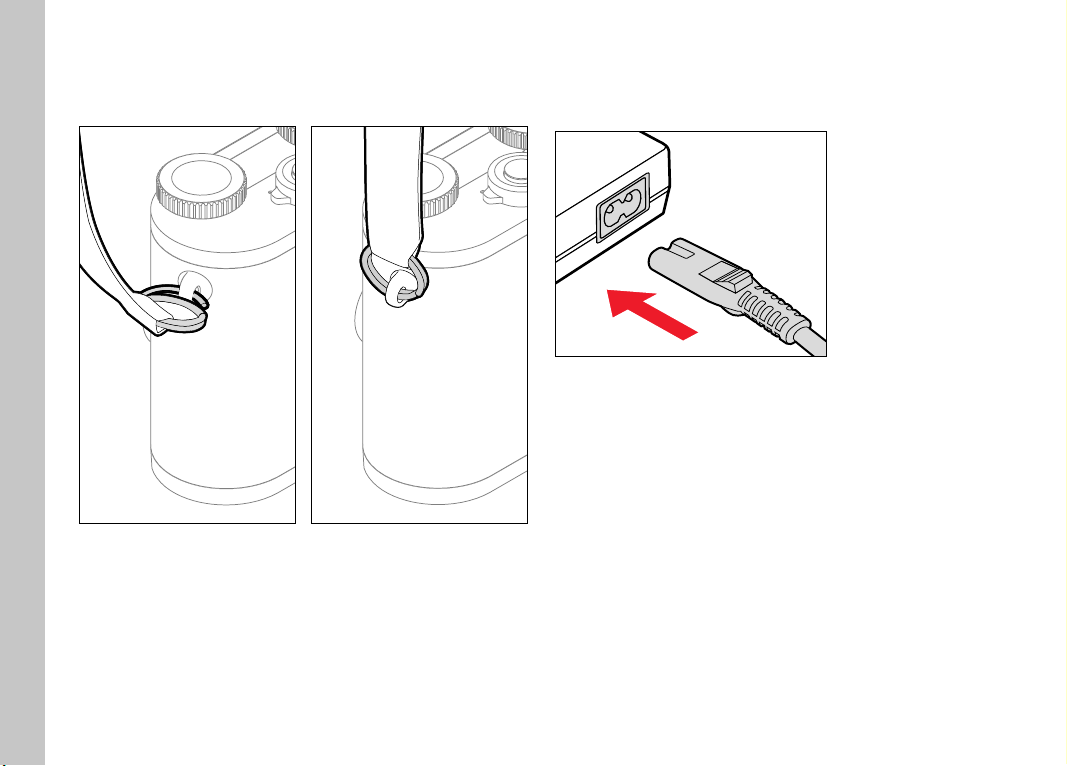
Attention
Once you have attached the carry strap, please make sure that the
clips are mounted correctly to prevent the camera from falling.
PREPARING THE CHARGER
Use the mains cable with the matching regional plug to connect
the charger to mains electricity.
Note
The charger will automatically adapt to local mains voltage.
Preparation
EN
27
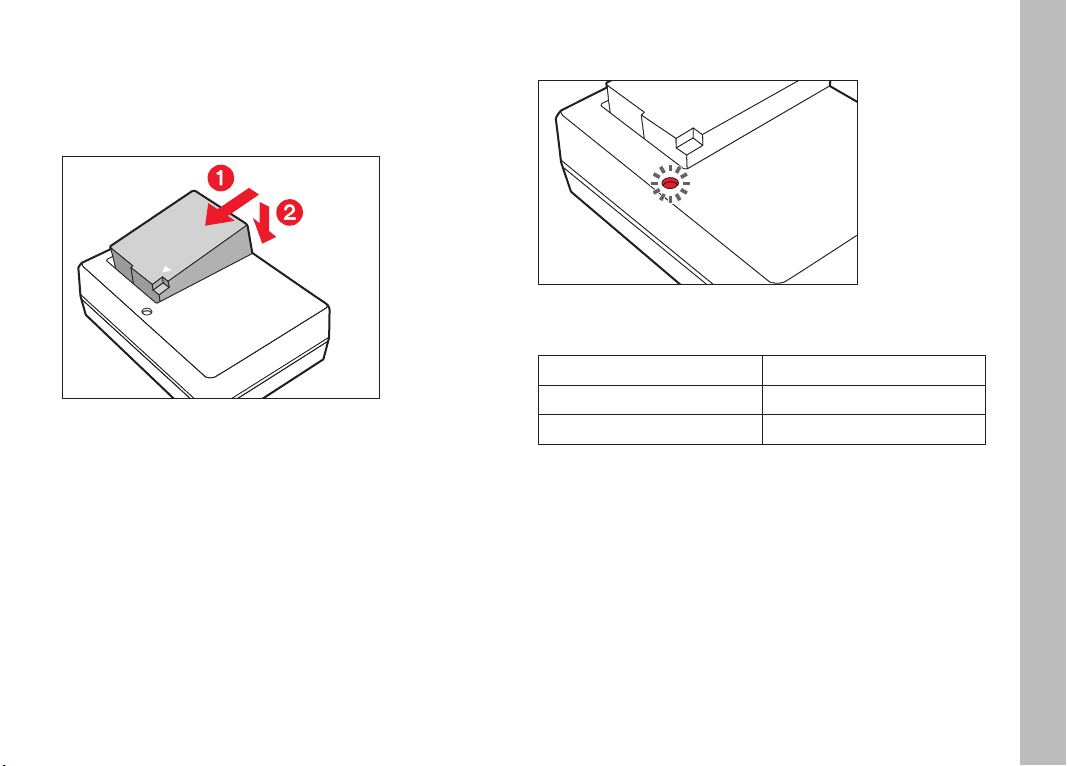
CHARGING THE BATTERY
The camera is powered by a lithium-ion battery.
INSERTING THE BATTERY IN THE CHARGER
Insert the battery into the charger at an angle so that the
contacts meet
Press down on the battery until you can hear and feel it clicking
into place
REMOVING THE BATTERY FROM THE CHARGER
Tilt the battery up and lift it out at an angle
CHARGE STATUS INDICATORS ON THE CHARGER
The status LED indicates a correct charging process.
Display Charge status
lights up green battery is charging
goes out 100%
Disconnect the charger from mains electricity when the charging
process is complete. There is no risk of overcharging.
Preparation
EN
28
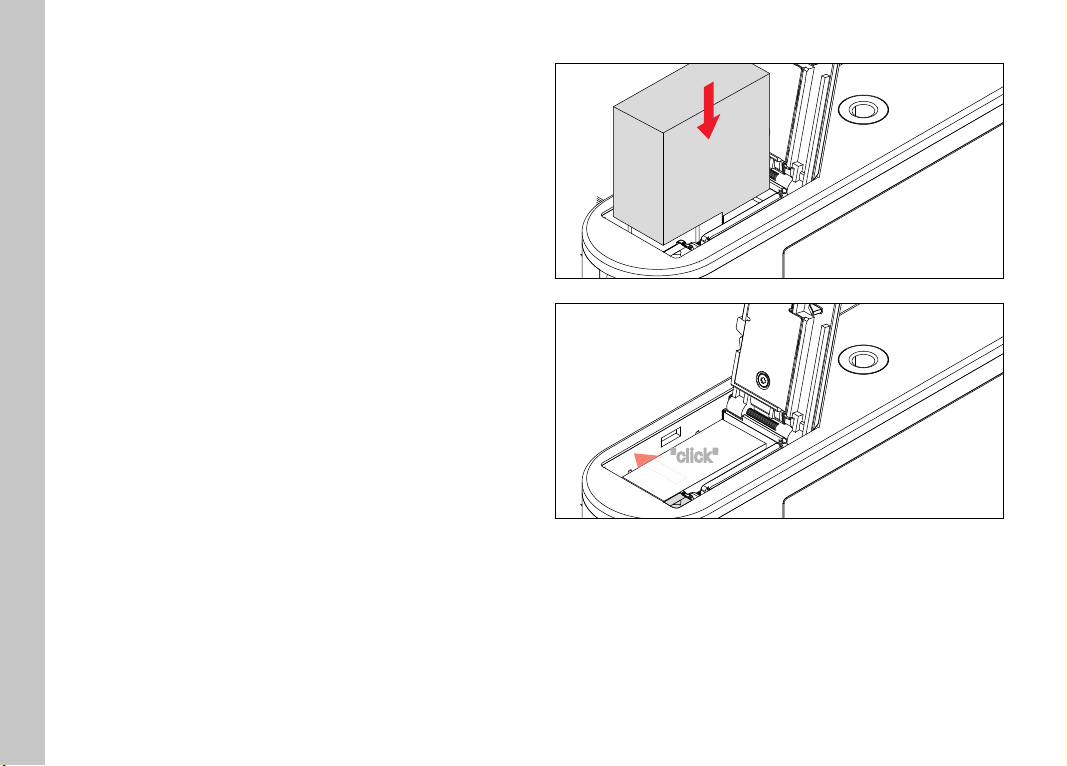
INSERTING/REMOVING THE BATTERY
Ensure that the camera is switched OFF (see p. 36)
Open the cover of the battery compartment/memory card slot
and close it again afterwardsn (see p. 31)
Important
Removing the battery while the camera is switched on may result
in the loss of custom settings or damage to the memory card.
INSERTION
"click"
Insert the battery into the charger so that the contacts meet
Press the battery down into the battery compartment
• The battery locking latch will spring out to secure the battery.
Preparation
EN
29
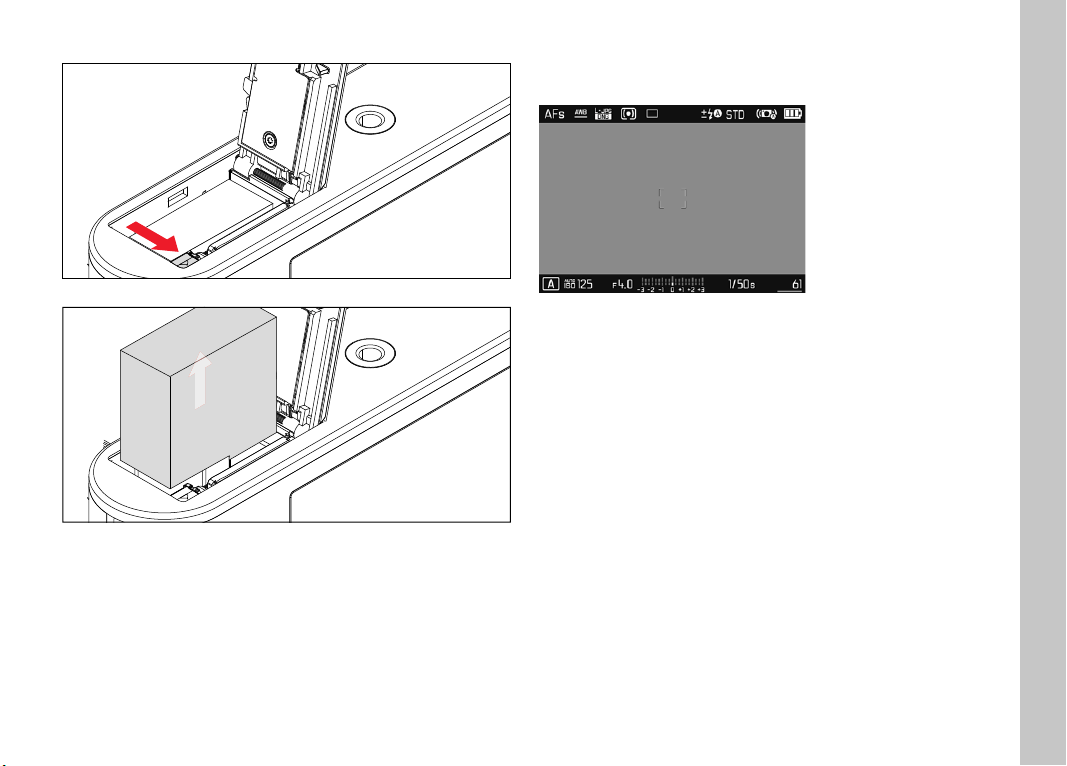
REMOVAL
Press the battery locking latch as shown
• The battery will spring out a little.
Removing the battery
CHARGE STATUS INDICATOR ON THE LCD PANEL
The battery charge status is displayed on the LCD panel (see p.
23).
Preparation
EN
30
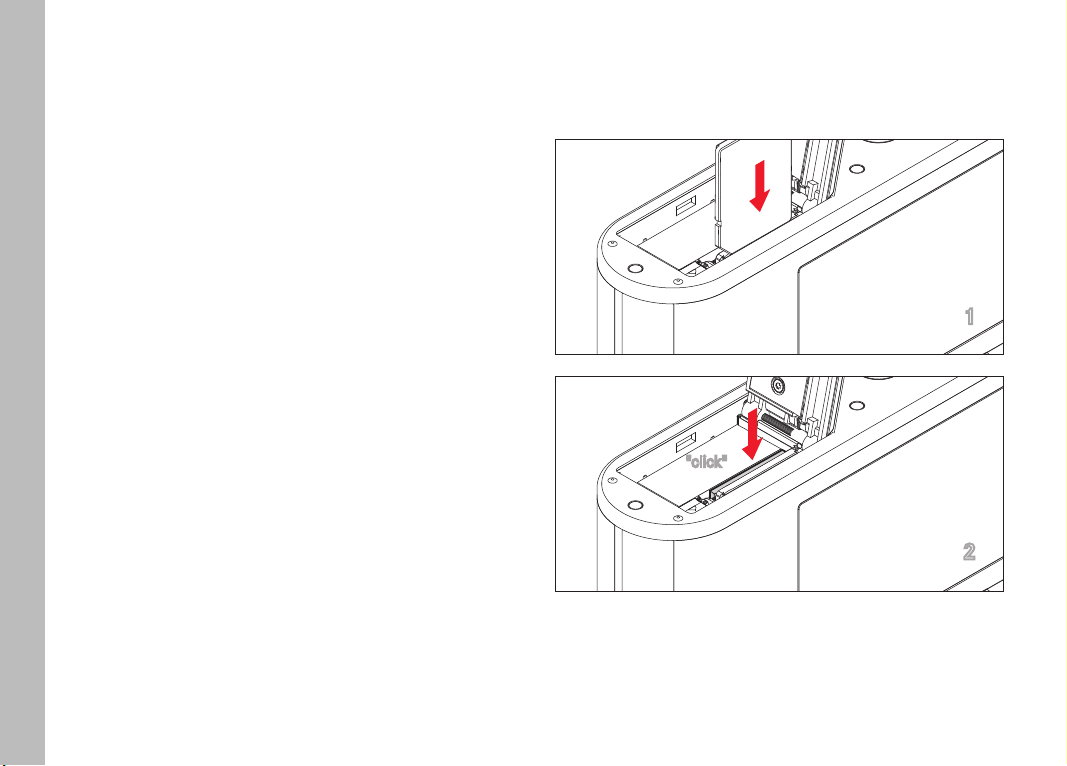
INSERTING/REMOVING THE MEMORY CARD
The camera will save exposures to an SD (Secure Digital), SDHC
(High Capacity) or SDXC (eXtended Capacity) memory card.
Notes
• SD/SDHC/SDXC memory cards are available from various
suppliers in various sizes and with differing read/write speeds.
Memory cards with high storage capacities and high read/write
speeds offer quick storage and rendering.
• Check the memory card for correct alignment if you are having
difficulties inserting it into the camera.
• Video recordings require a high write speed.
• Proper camera function cannot be guaranteed when using
WLAN memory cards.
Ensure that the camera is switched OFF (see p. 36)
Open the cover of the battery compartment/memory card slot
and close it again afterwards (see p. 31)
INSERTION
1
2
"click"
Push the memory card into the slot until you hear and feel it
clicking into place
Preparation
EN
31
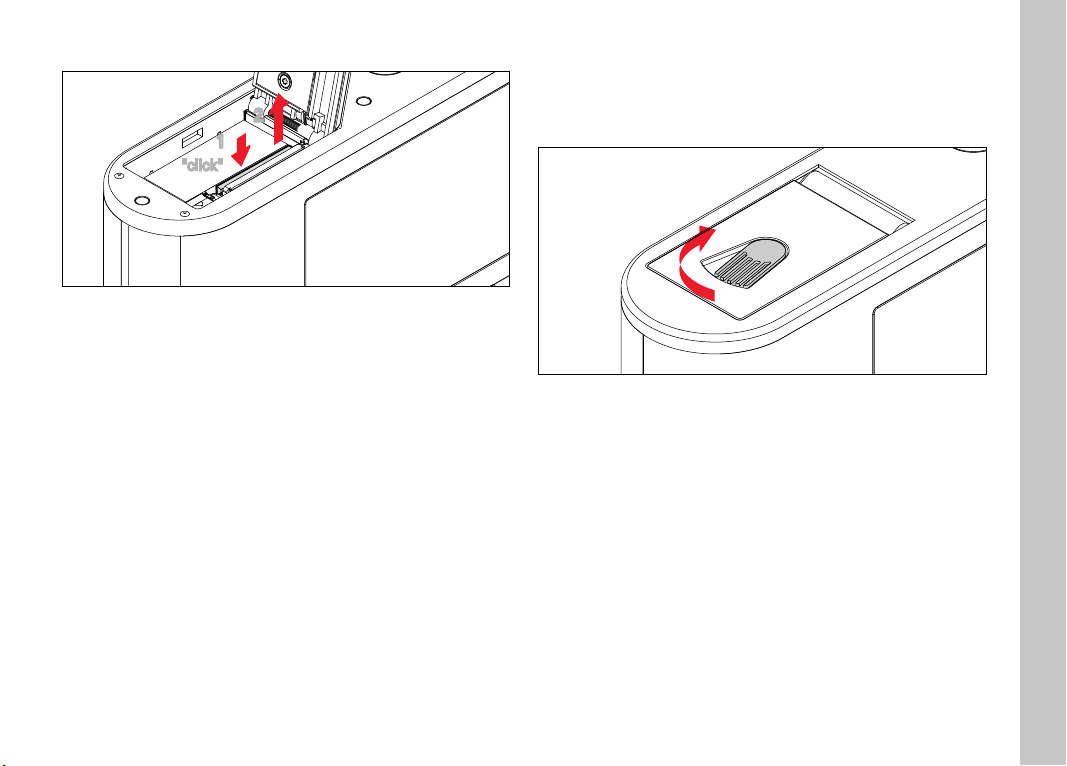
REMOVAL
1
2
"click"
Push down on the card until you hear a click
• The card pushes out slightly.
Remove the memory card
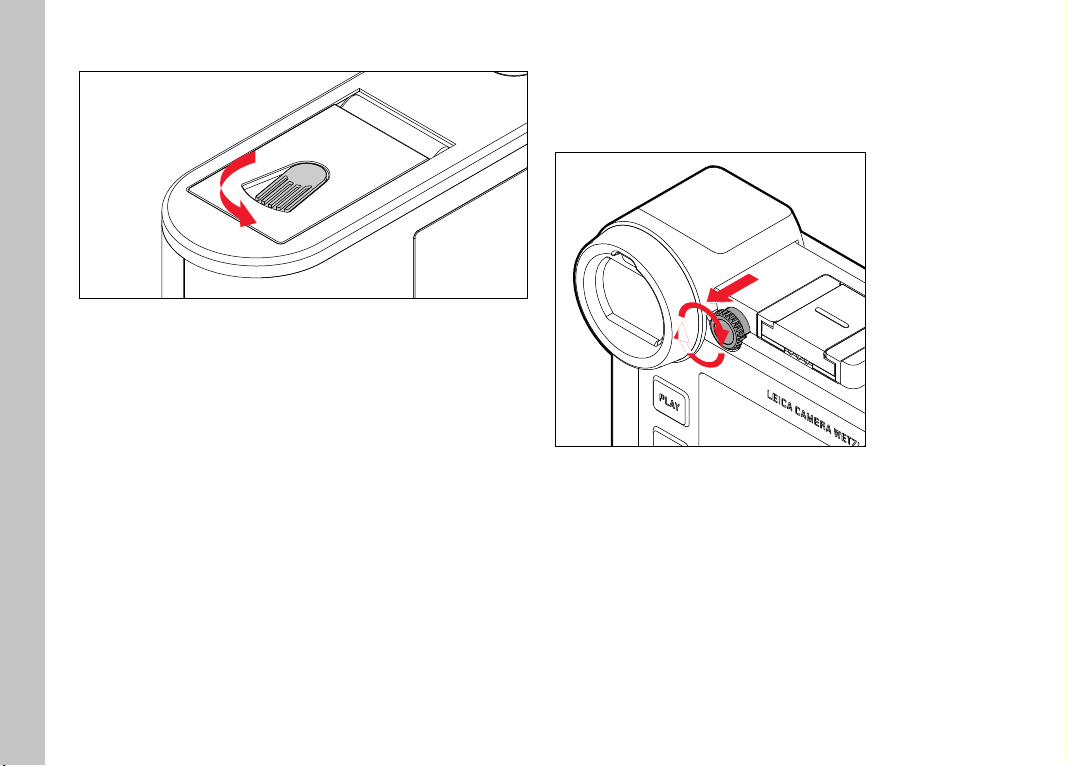
OPENING/CLOSING THE COVER OVER THE
BATTERY COMPARTMENT/MEMORY CARD SLOT
OPEN
Push the release lever in the direction of the arrow
• The cover opens.
Preparation
EN
32
CLOSE
Close and hold the cover.
Push the release lever in the direction of the arrow.
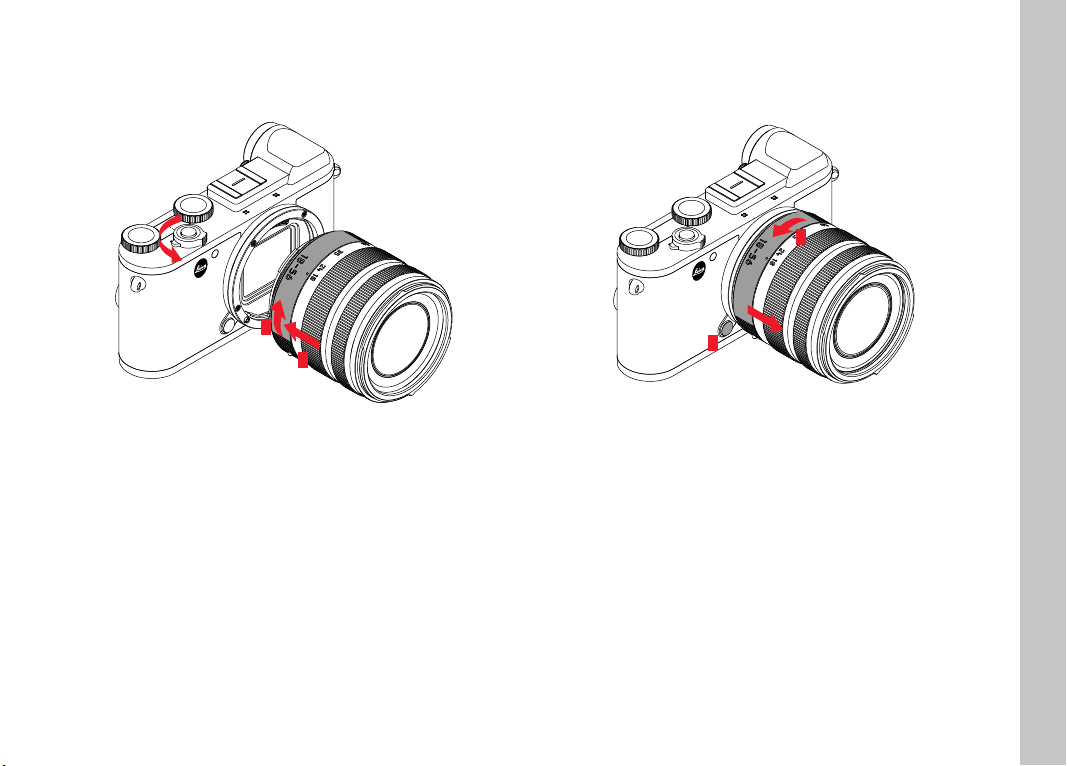
DIOPTER SETTINGS
The viewfi nder has a diopter setting function with a range between
+4 and -4 diopter to allow glasses wearers the use of the camera
without eyeglasses (Diopter adjustment).
Pull the setting wheel on the right of the eyepiece backward to
unlock
Look through the viewfi nder
Turn the diopter setting wheel until you see the image in the
viewfi nder and the displays in perfect focus
Push the setting wheel back into the locked position
Preparation
EN
33
CHANGING THE LENS
ATTACHING THE LENS
1
2
Ensure that the camera is switched OFF
Hold the lens on the fi xed ring
Position the alignment button on the lens opposite the release
button on the camera housing
Attach the lens in this position
Turn the lens clockwise until you hear and feel it click into place
DETACHING THE LENS
1
2
Ensure that the camera is switched OFF
Hold the lens on the fi xed ring
Press and hold the release button on the camera housing
Turn the lens counter-clockwise until the alignment button is
opposite the release button
Remove the lens
Preparation
EN
34
COMPATIBLE LENSES
All Leica TL lenses share the same basic external structure: They
have an external bayonet fi tting for the lens hood, an internal
thread for fi lters, a focus setting ring, a fi xed ring with a red
alignment button for lens changes, and a contact strip for the
transfer of data and control signals. Leica CL Vario lenses have an
additional zoom setting ring with its own alignment point.
In addition to Leica TL lenses, the LeicaCL can also accommodate
Leica SL lenses with full functionality via the L bayonet. Leica M
and R lenses can also be used in conjunction with Leica M/R L
adapters.
EXPOSURE METERING AND EXPOSURE
CONTROL USING VARIO LENSES
Some Leica TL and SL zoom lenses have a variable speed, i.e. the
eff ective aperture opening depends on the confi gured focal length.
Make sure to set the desired focal length before storing the meter
value or changing the shutter speed/aperture combination to
prevent incorrect exposure. Please read the sections on "Exposure"
starting on page 74 for more information. Make sure that the
aperture setting on the fl ash unit matches the camera aperture if
you are using a non-system compatible fl ash unit.
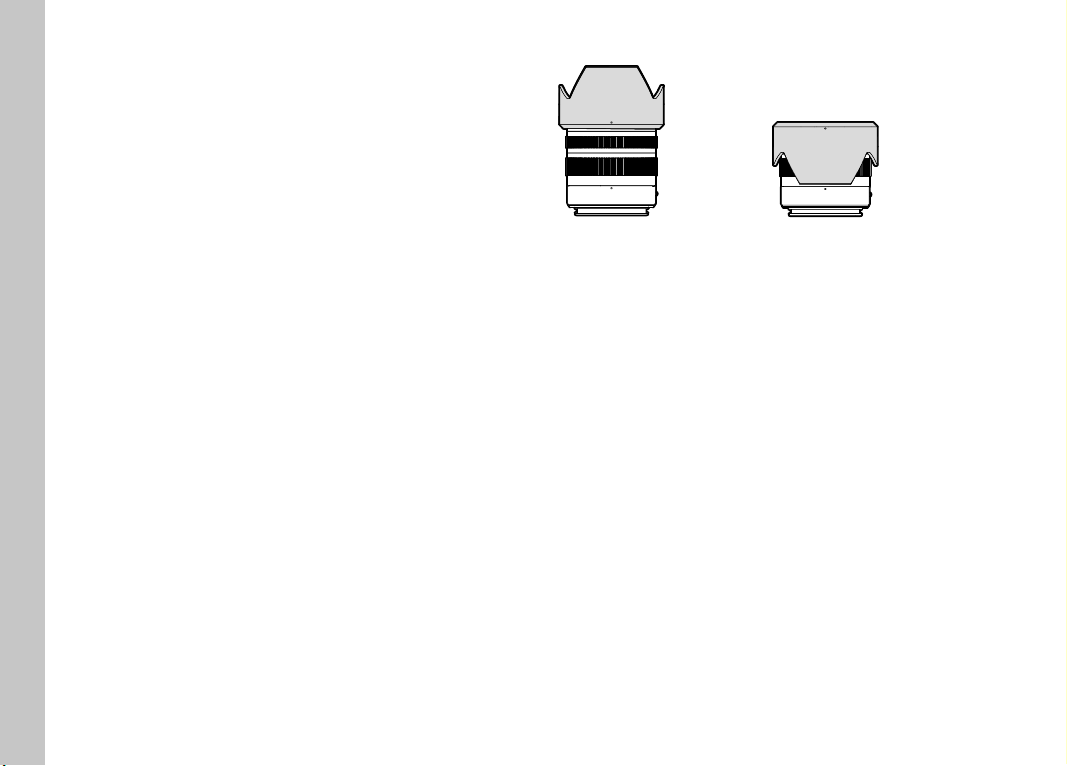
LENS HOODS
Picture
position
Transport
position
LeicaCL lenses are usually supplied with matching lens hoods. The
symmetrical bayonet fi tting can be attached quickly and easily in
operational position, as well as in reverse position for space-saving
storage.
Lens hoods reduce light scatter and refl ection, and protect the
front lens against damage and soiling.
FILTERS
LeicaCL lenses can accommodate screw-on fi lters. Please read
the technical information provided in the lens manual for the
correct diameter.
Preparation

EN
35
USING LEICA M AND R LENSES
Leica M and R lenses can be attached via Leica M or R L adapters.
There are lens profi les stored in the camera, which allow the
following functions:
• The fl ash exposure and fl ash refl ector controls utilize the stored
lens data (see “Compatible fl ash units”).
• The lens data is furthermore written to the EXIF data of the
images. The focal length of the lens is additionally displayed
when rendering the extended picture data.
The camera will automatically select the appropriate lens type
settings if the Leica M lens used comes with 6 bit encoding, or the
Leica R lens has an ROM contact strip. You will have to enter the
lens model manually if the lenses are not relevantly equipped.
Select
Lens Profiles in the main menu
Select automatic lens identifi cation (
Auto) in the submenu, or
enter the lens model manually into one of the two lens lists, or
deactivate the function altogether.
If you want to enter the lens model yourself:
Select
M Lenses or R Lenses
You can shorten the lens lists by deleting all unnecessary lens
types to simplify operation:
Select
Edit list of M lenses or Edit list of R lensenses in the M lenses or
R lenses submenus.
Activate (
On) or deactivate (Off) the lens types you will be using in
the lens lists
Note
This menu item is not available for Leica TL and SL lenses and the
relevant item line is marked unavailable in gray lettering.
Preparation
EN
36
CAMERA OPERATION
OPERATING ELEMENTS
MAIN SWITCH
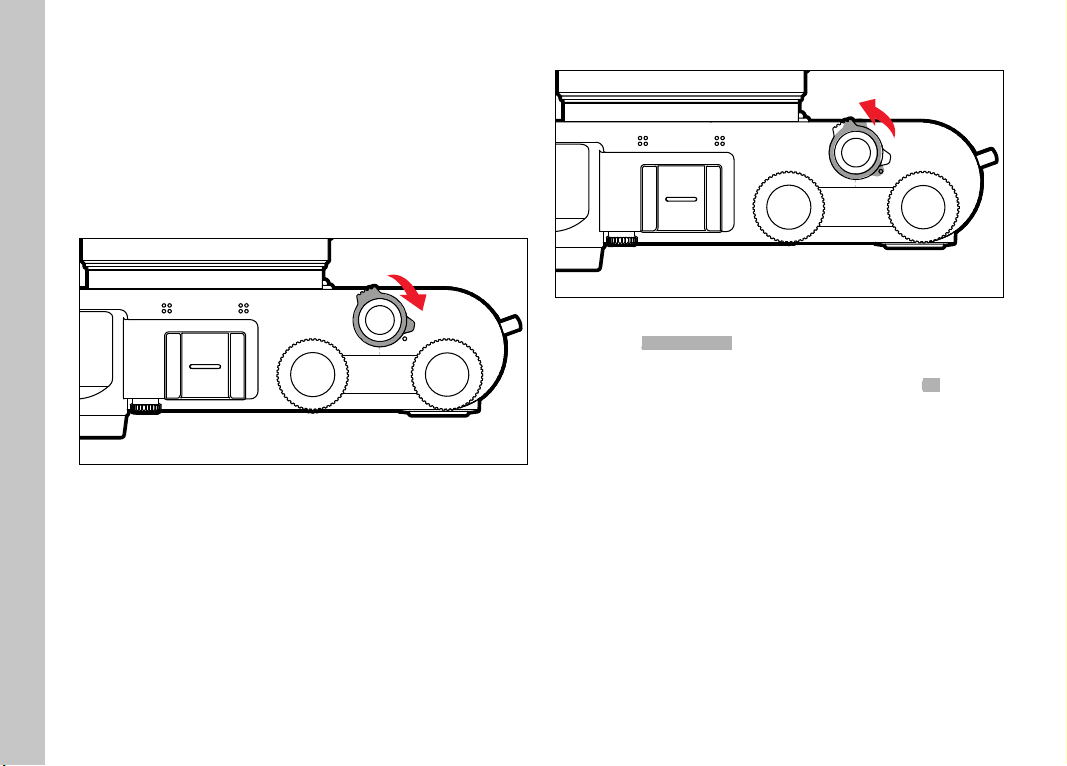
The main switch switches the camera on and off .
SWITCHING THE CAMERA ON
Notes
• Once switched on, the camera will be ready to use after approx.
1s.
• The LED lights up briefl y and the displays in the viewfi nder
appear.
SWITCHING THE CAMERA OFF
Note
The function
Auto Shutdown (see p. 53) deactivates the camera
automatically if no operation occurs within a preset time. Use the
main switch to deactivate the camera if this function is
Off to
prevent inadvertent exposures and battery discharge when the
camera is not in use.
Camera operation
EN
37
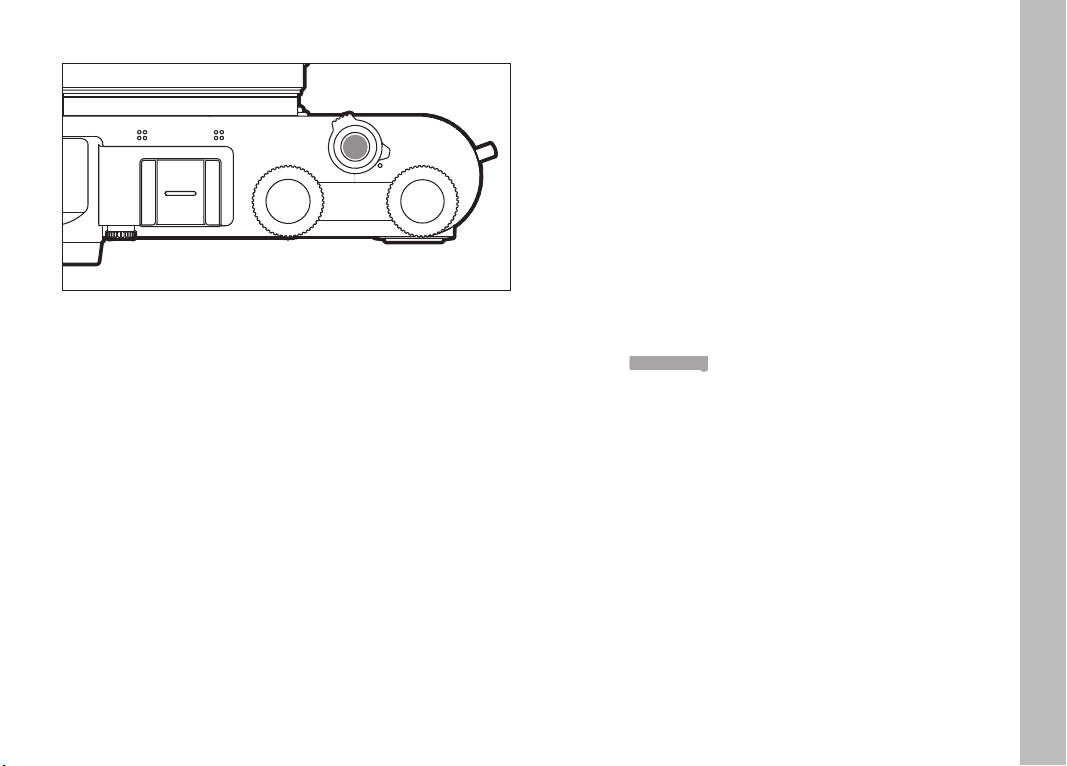
SHUTTER BUTTON
The shutter button works in two stages.
1. Tapping (= Pressing the shutter button to the 1st pressure
point)
– activates the camera electronics and rangefinder display
– saves the metered exposure value in aperture priority
mode, i.e. the shutter speed calculated by the camera
– stops a running self-timer delay time
– reverts the camera back to picture mode:
– if playback mode is set
– if menu control is active
– if the camera is in Standby mode
2. Press down fully
– to take the picture
• The data is then transferred to the memory card.
– starts a preselected self-timer delay
Notes
• Press down the shutter button in a smooth motion until you hear
the click of the shutter to prevent camera shake.
• The shutter button remains locked
– if the memory card inserted and the internal buffer memory
are (temporarily) full.
– if the battery has exceeded its performance limits (capacity,
temperature, age).
– if the memory card is write-protected or damaged.
– if image numbering on the memory card has reached its limit.
– if the camera prompts for language, date and time settings at
first use or after a reset.
– if the sensor is too hot.
• When the shutter button is released, camera electronics and
viewfinder displays remain active for the time set in the main
menu item
Power Saving.
Camera operation
EN
38
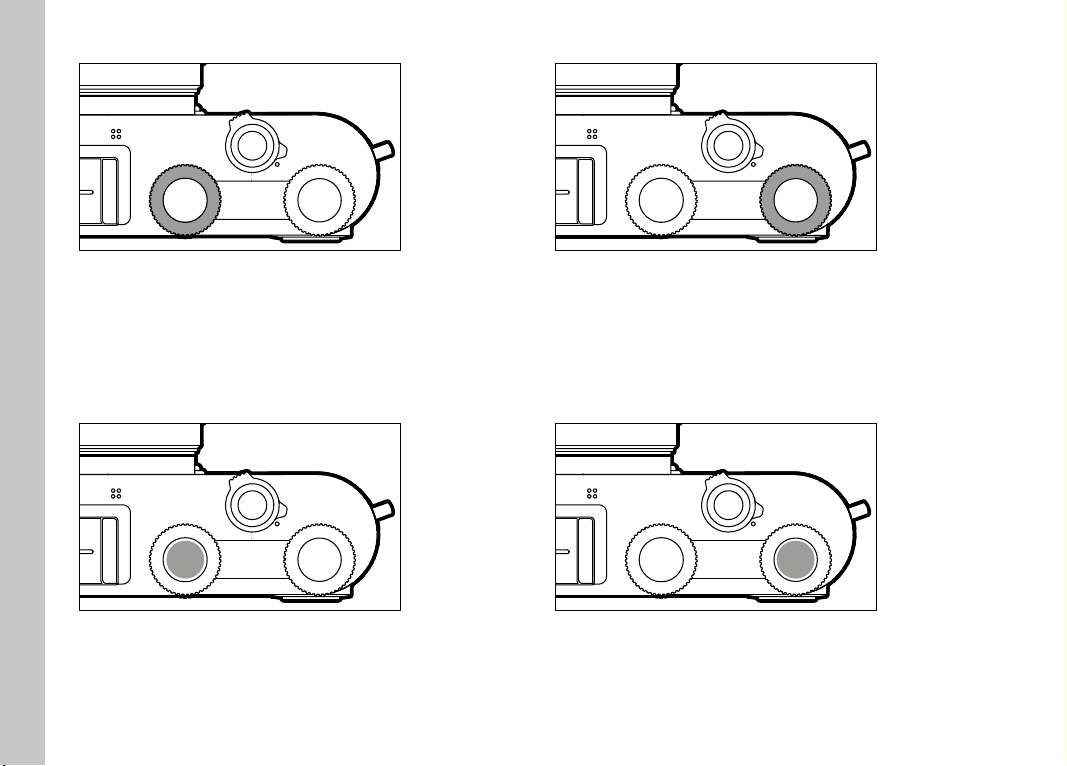
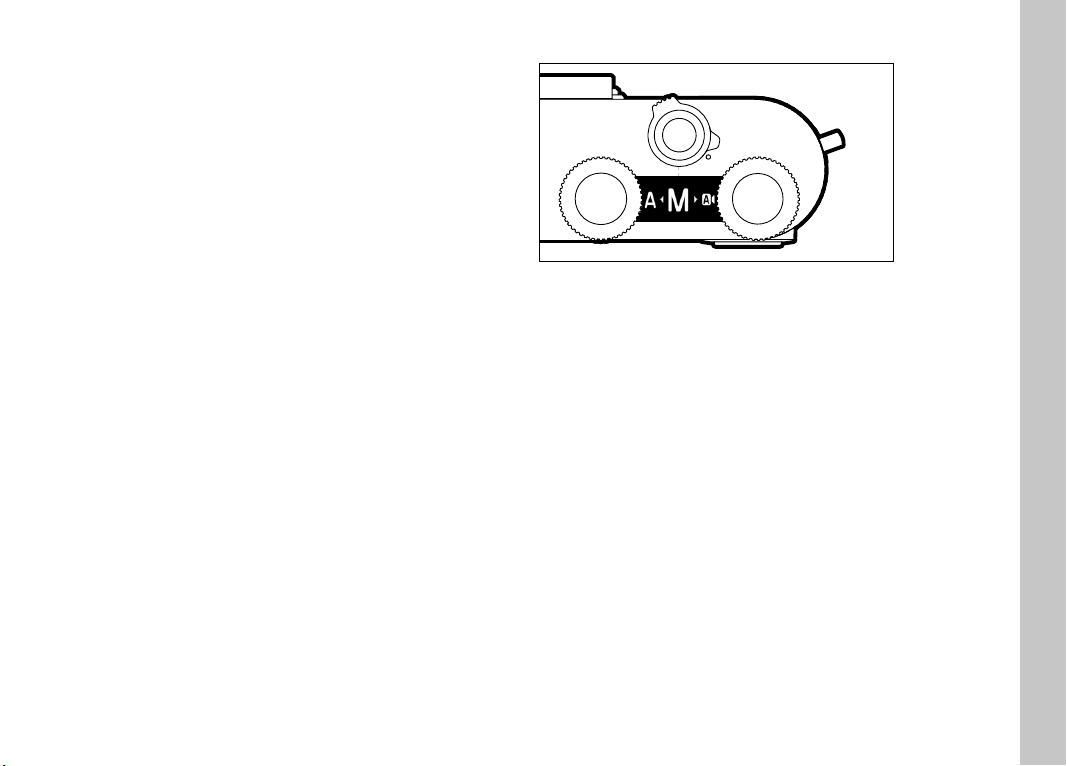
LEFT SETTING WHEEL
– Toggling between operating modes
– Setting of exposure compensation, aperture, shutter speed or
program shift (depending on operating mode setting wheel
assignments)
– Scrolling through the picture memory
Left setting wheel button
– Tagging/rating of recordings
– Keylock
Right settig wheel
– Menu navigation
– Setting of exposure compensation, aperture, shutter speed or
program shift (depending on operating mode setting wheel
assignments)
– Enlarging/reducing viewed pictures
RIGHT SETTING WHEEL BUTTON
– Confi rming the selection
– Direct access to menu functions
Camera operation
EN
39
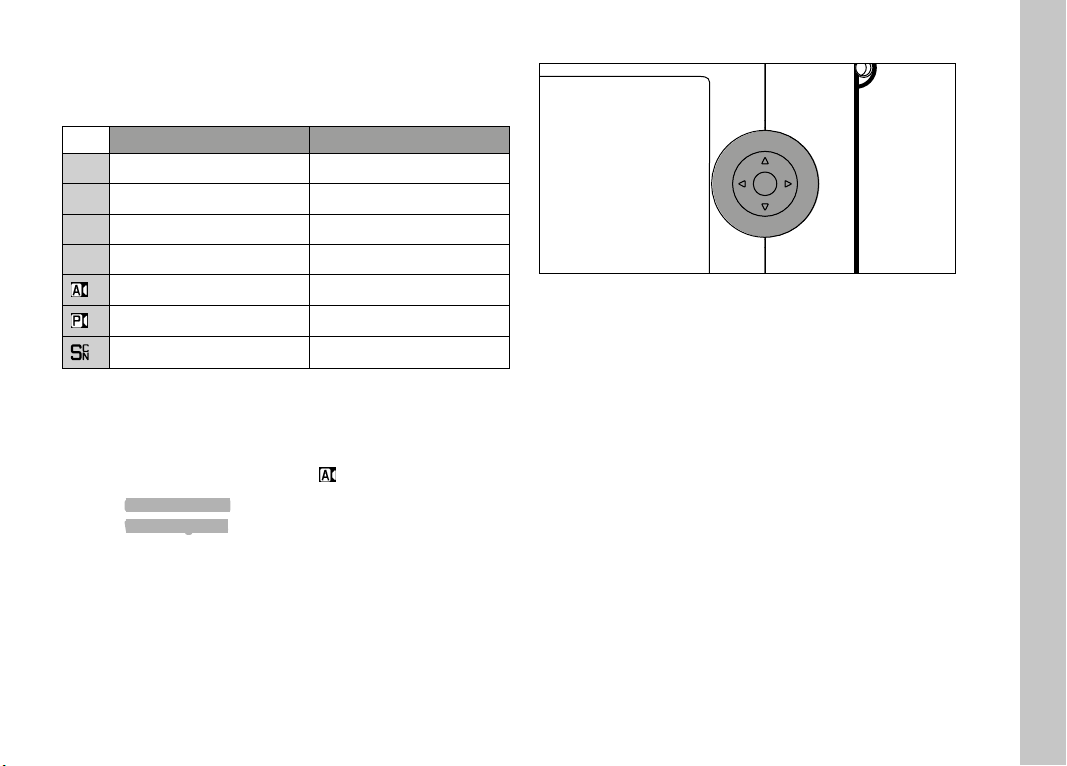
SETTING WHEEL FUNCTIONS
IN RECORDING MODE
The function of each of the setting wheels depends on the active
operating mode.
Left setting wheel Right setting wheel
P
Exposure compensation Mode shift
S
Shutter speed Exposure compensation
A
Exposure compensation Aperture
M
Shutter speed Aperture
Exposure compensation Aperture
Exposure compensation Exposure compensation
Exposure compensation Exposure compensation
In picture mode, the relevant function of the setting wheel is
indicated on screen below the wheel, once the setting wheel is
turned to the next position.
The functions of the right and left setting wheels can be swapped
for the operating modes
P, S, A, M and
.
Select
Customize Control in the main menu
Select
Wheel Assignment in the submenu
Select a setting
DIRECTIONAL PAD/CENTER BUTTON
LEICA CAMERA WETZLAR GERMANYLEICA CAMERA WETZLAR GERMANY
DIRECTIONAL PAD
– Menu navigation
– Setting selected menu items/functions
– Scrolling through the picture memory
– Shifting the metering fi eld (Field or Spot AF)
CENTER BUTTON
– Accessing the status display
– Accessing the submenu
– Applying menu settings
– Confi rming the selection
– Confi rming a deletion
– Display of picture data during review
– Playback of video recordings
Camera operation
EN
40
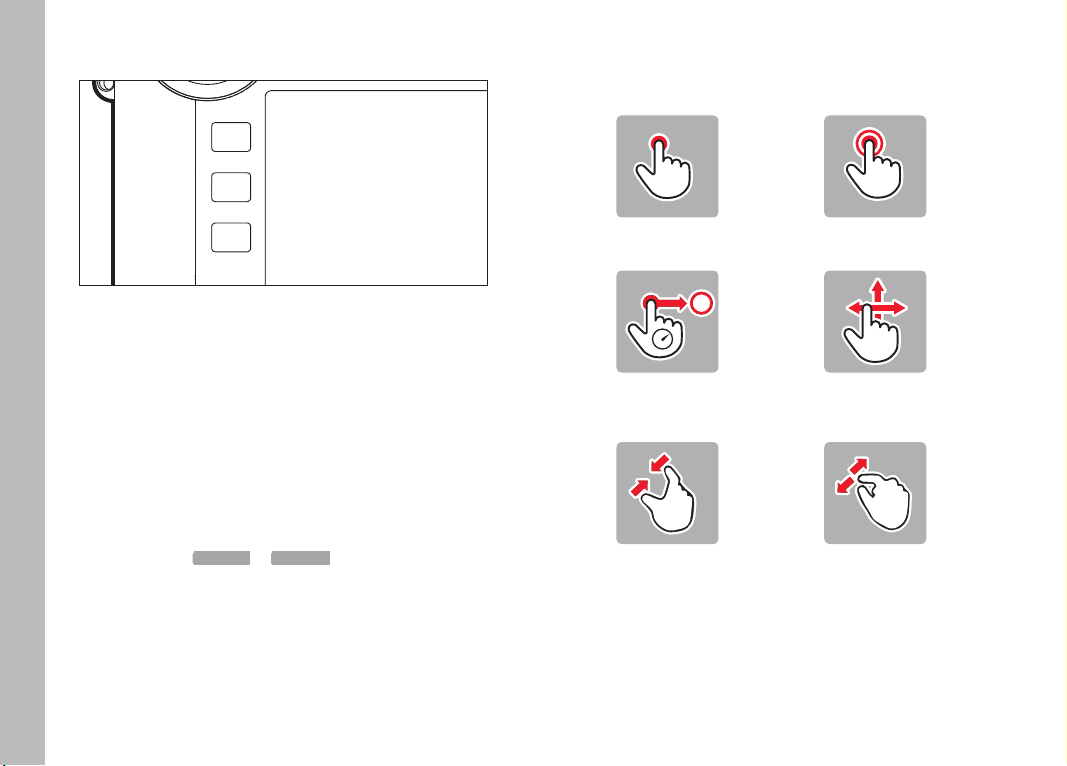
PLAY BUTTON/FN BUTTON/MENU BUTTON
PLAY
FN
MENU
PLAY
FN
MENU
PLAY BUTTON
– Activation and deactivation of the (continuous) review/playback
mode
– Return to full-screen display
FN BUTTON
– Direct access to menu functions
– Direct access to delete function
MENU BUTTON
– Accessing the
Favorites or Main menu
– Exiting the currently displayed (sub) menu
– Accessing the Playback/Review menu
TOUCH SCREEN
TOUCH CONTROL
Tap briefly Double tap
Touch and hold,
drag and drop
horizontal/vertical
swipe
Two-finger pinch Two-finger spread
Camera operation
EN
41
In picture mode
– Set the exposure metering fi eld position
(tap the desired location)
– Changing to video mode (horizontal swipe)
– Changing to review mode (vertical swipe)
In Playback/Review mode
– Changing to picture mode (vertical swipe)
– Scrolling through the picture memory (horizontal swipe)
– Zooming in/out of viewed pictures (two-fi nger pinch/spread)
– Setting an image area for viewfi nder live zoom
(double tap)
Note
A light touch is enough, do not press down.
TOP DISPLAY
– Display when changing operating modes
– Set operating mode
– Information about aperture, shutter speed, exposure compensa-
tion and program shift (depending on the set operating mode)
Camera operation
EN
42
MENU CONTROL
Menu sections:
Main menu and Favorites
Main Menu:
– contains all menu items
Favorites:
– your custom list (see p. 49 for details on how to manage this
list)
Note
The favorites menu can only be displayed if it has at least one
menu item assigned.
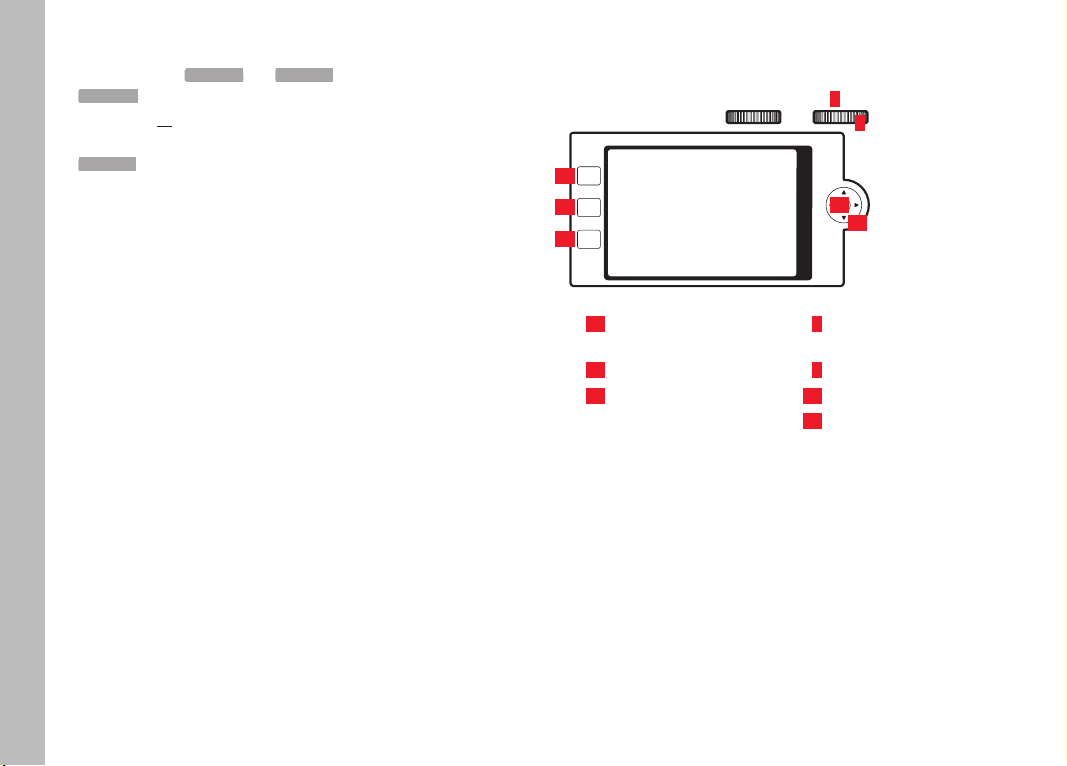
CONTROL ELEMENTS
The following elements are used for menu control.
PLAY
FN
MENU
20
19
18
4
22
23
5
.
18
PLAY button
5
Right setting wheel
button
19
FN button
4
Right setting wheel
20
MENU button
22
Directional pad
23
Center button
Camera operation
EN
43
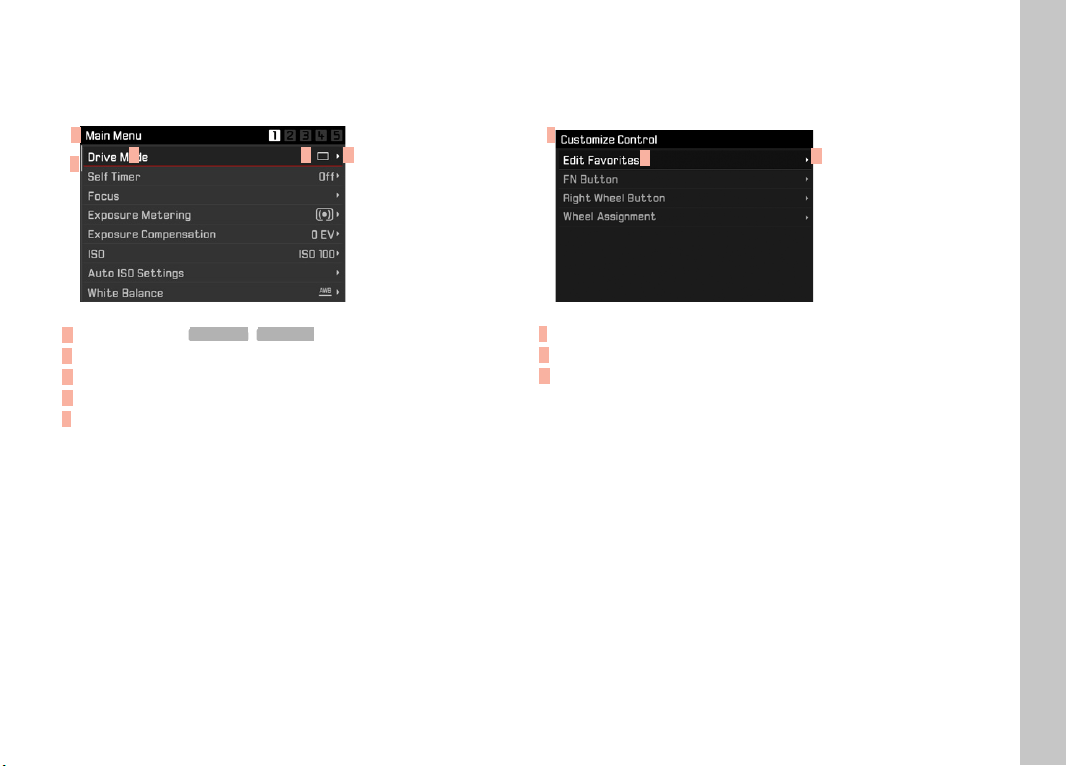
STRUCTURE OF THE MENU SCREEN
MAIN MENU
A
B
C D
E
A
Menu section:
Main Menu/Favorites
B Menu item name
C Menu item setting
D Submenu reference
E Scrollbar: current position in the menu list
SUBMENU
F
G
H
F
Current menu item
G Submenu item
H Reference to other submenus
Note
In some cases, an additional scale will be available, where values
can be set or function options can be selected.
Camera operation
EN
44
MENU NAVIGATION
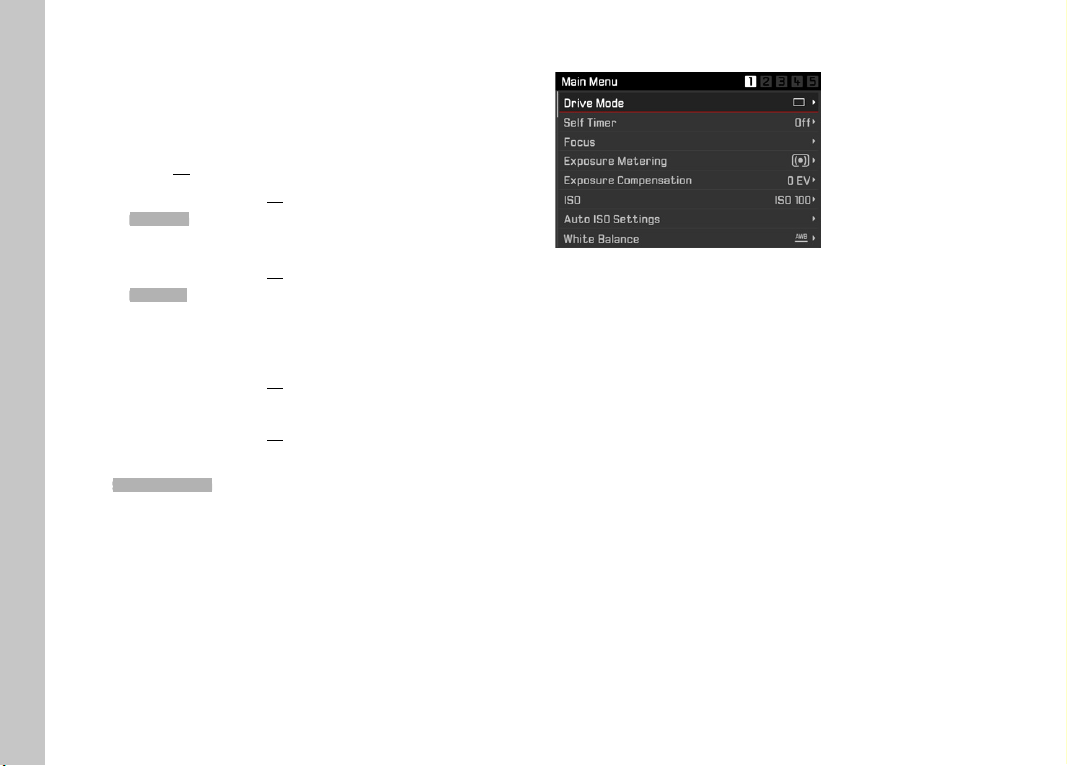
DISPLAY “HOME” SCREEN
(INITIAL MENU CONTROL SCREEN)
In picture mode
– if there are no menu items assigned to the favorites menu:
Press the
MENU button 1x
•
Main Menu appears.
– if at least one menu item was assigned to the favorites menu:
Press the
MENU button 1x
•
Favorites menu appears.
Getting back to the main menu
– if the favorites menu consists of one page:
Press the
MENU button 1x
– if the favorites menu consists of 2 pages:
Press the
MENU button 2x
or
Select Main Menu (last item in the favorites menu)
In Playback/Review mode
Tap the shutter button
• back to picture mode
Press the
MENU button
• The Home screen is displayed
SHOW SUBMENU
Press the center button
or
Press the directional pad to the right
or
Press the right setting wheel button
Camera operation
EN
45
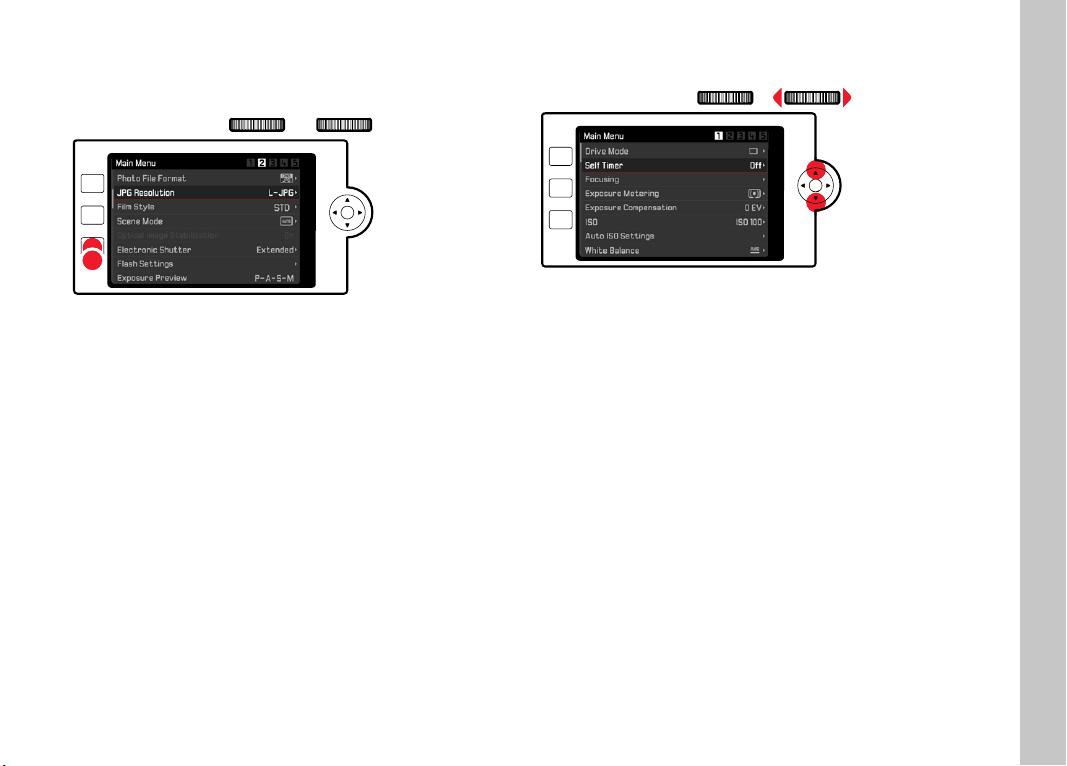
NAVIGATING WITHIN THE MENUS
Page by page navigation
PLAY
FN
MENU
MENUMENU
Press the MENU button
• Continuous scrolling will return the main menu to Screen 1
after Screen 5.
• Back to the favorites menu:
Press the shutter button
Press the
MENU button
Line by line navigation
(Function/function option selection)
PLAY
FN
MENU
Press the directional pad up/down
or
Turn the right setting wheel
(to the right = down, to the left = up)
• Once the last menu item has been reached scrolling up or
down, the display will automatically jump to the previous or
next screen.
Note
• Some menu items can only be accessed under specifi c
circumstances. The text in the relevant line is displayed in gray
to signify the existence of a submenu.
Camera operation
EN
46
CONFIRM SELECTION
Press the center button
or
Press the right setting wheel button
• The screen image changes back to the active menu item. The
set function variant is shown on the right in the relevant menu
line.
Note
No confi rmation is needed for the selection of
On or Off. An
automatic save is done.
GO BACK ONE STEP
Press the directional pad left
• The directional pad is not available for this function in
scale-type submenus.
EXITING THE MENU
You can exit the menus and submenus at any time - with/without
applying the settings made.
Return to the superordinate menu item
Press the directional pad left
Go to picture mode
Press the shutter button
Go to playback mode
Press the PLAY button
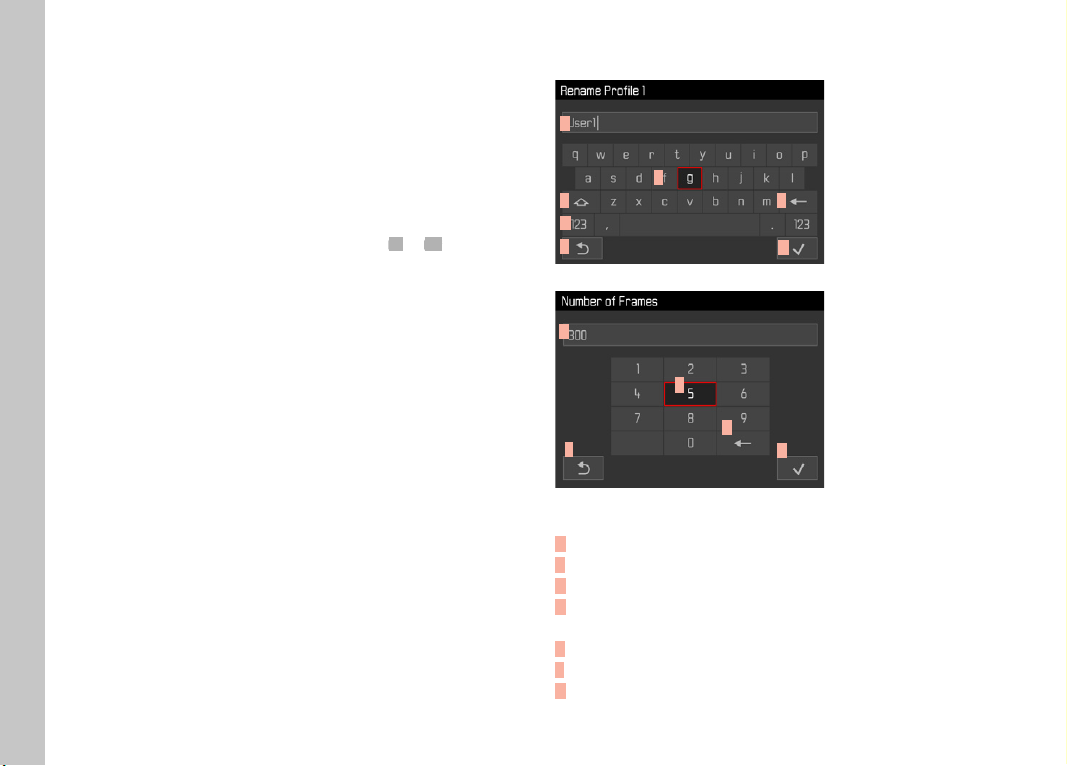
OPERATING THE KEYBOARD/NUMBER PAD
D
C
B
E
A
F
G
A
E
C
B
D
A
Input line
B Keyboard/Number pad
C “Delete” button (deletion of the respective last value)
D Press "Confi rm"
(to apply individual values and the complete settings)
E Return to previous menu level
F Shift key (toggles between upper and lower case letters)
G Changing the character type
Camera operation

EN
47
Using button control
To move left or right
Press the directional pad left/right
or
Turn the right setting wheel
To go up or down
Press the directional pad up/down
To toggle between upper and lower case letters
Use the directional pad to select “Shift” F
Press the center button
To change the character type (letters/numerals)
Use the directional pad to select the G key
Press the center button
To enter the selected character
Press the center button
or
Press the right setting wheel button
To save
Use the directional pad to select the D key
Press the center button
Using touch control
Press the button of your choice
To save
Select button D
To exit the menu
Select button E
Camera operation
EN
48
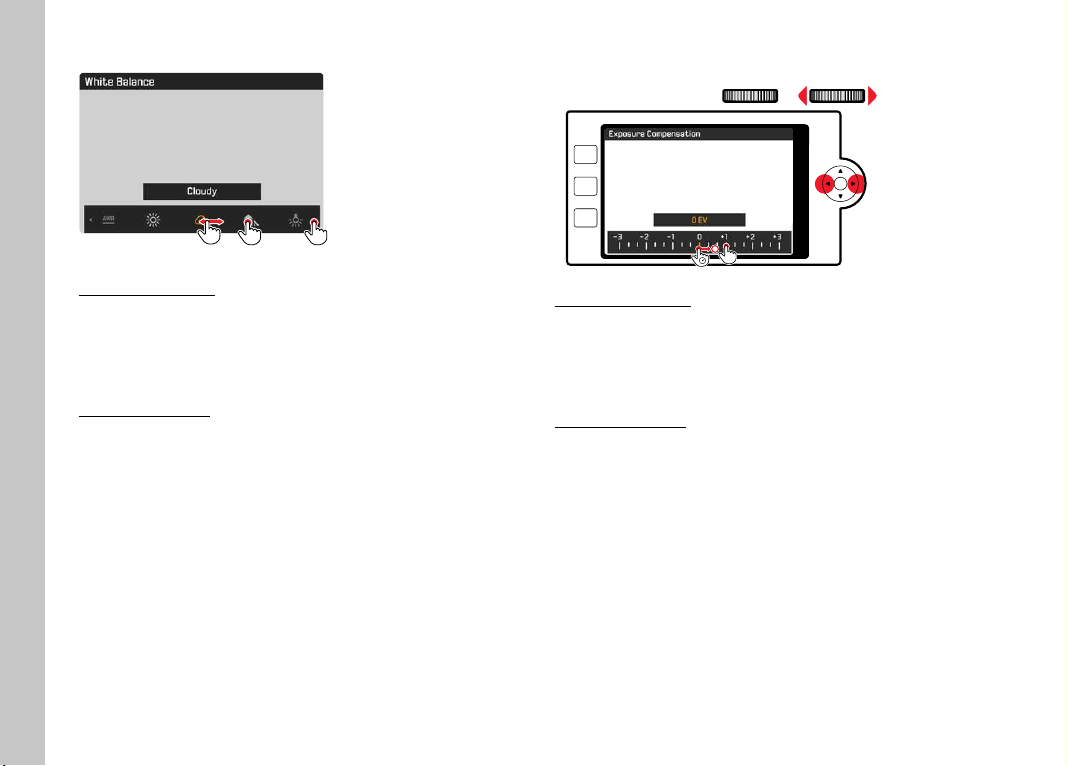
USING THE MENU BAR
Using button control
Press the directional pad left/right
or
Turn the right setting wheel
Using touch control
Select the desired function or swipe
USING THE SCALES SUBMENUS
PLAY
FN
MENU
Using button control
Press the directional pad left/right
or
Turn the right setting wheel
Using touch control
Select the desired function or swipe
Notes
• The currently active setting displayed in the center is highlighted
in yellow.
• The set value is displayed above the scale/below the menu bar.
• The selected function requires no confi rmation and will be active
immediately.
Camera operation
EN
49
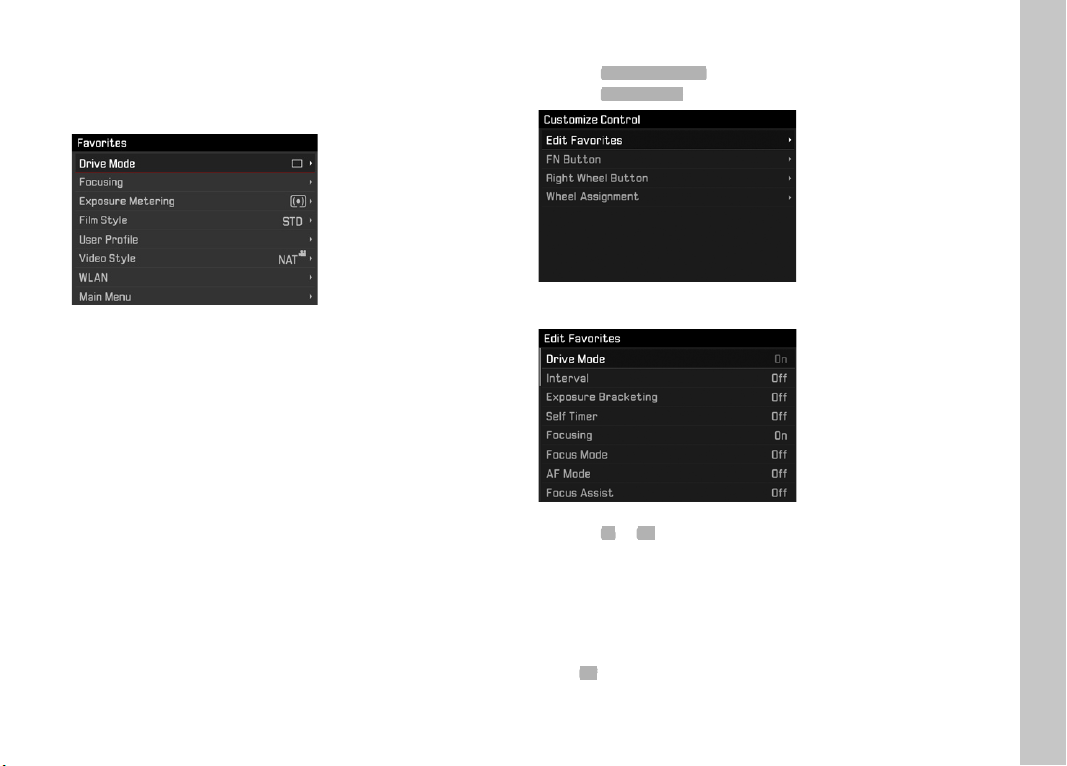
FAVORITES MENU
Assign you most frequently used menu items to a favorites menu
(up to 15 items) for quick and easy access. The available functions
are shown in the list on p. 146.
MANAGE FAVORITES MENU
Select Customize Control in the main menu
Select
Edit favorites in the submenu
Select the desired menu item
Select On or Off
• A warning message appears when the favorites menu has
reached the maximum of 15 menu items and no further
items can be added.
Note
The favorites menu will be deleted completely if all menu items are
set to
Off.
Camera operation
EN
50
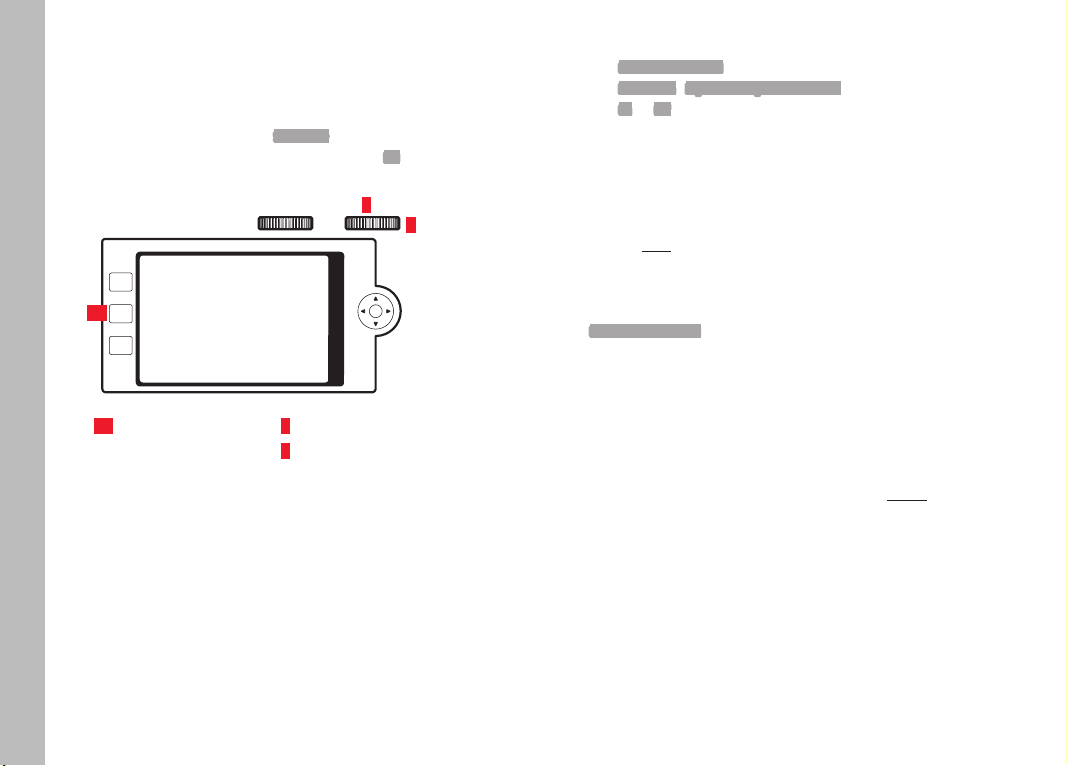
DIRECT ACCESS TO MENU FUNCTIONS
You can assign specific menu functions to the following operating
elements for extra quick direct access to menu items in recording
mode. The available functions are shown in the list on p. 146.
– FN button (factory setting: Self Timer)
– Right setting wheel button (factory setting: ISO)
PLAY
FN
MENU
19
4
5
19
FN button
5
Right setting wheel button
4
Right setting wheel
Creating the custom list
Select Customize Control in the main menu
Select FN button/Right setting wheel button in the submenu
Select On or Off for each menu item
• You can activate a maximum of 8 menu items for this list.
• The available functions are identical for both buttons.
Changing the assignment via the custom list
Press and hold the FN button/right setting wheel button
• The direct access list you have created will appear on the LCD
panel.
• This list can be modified at any time via the menu item
Customized Control.
Select the desired menu item
• You will not be prompted to acknowledge your selection. The
change is applied immediately.
Accessing the assigned menu function
Press the FN button/right setting wheel button briefly
• The assigned function is accessed, or a submenu appears on
screen.
• Settings can be done via key control or using gesture control
on the LCD panel.
Camera operation
EN
51
KEYLOCK
Various buttons can optionally be locked in recording mode.
LOCK ALL BUTTONS
All buttons (except the shutter button) are locked.
To lock all buttons
Press and hold the left setting wheel button
•
Appears on screen when a button is pressed while the lock
is active.
To unlock all buttons
Press and hold the left setting wheel button
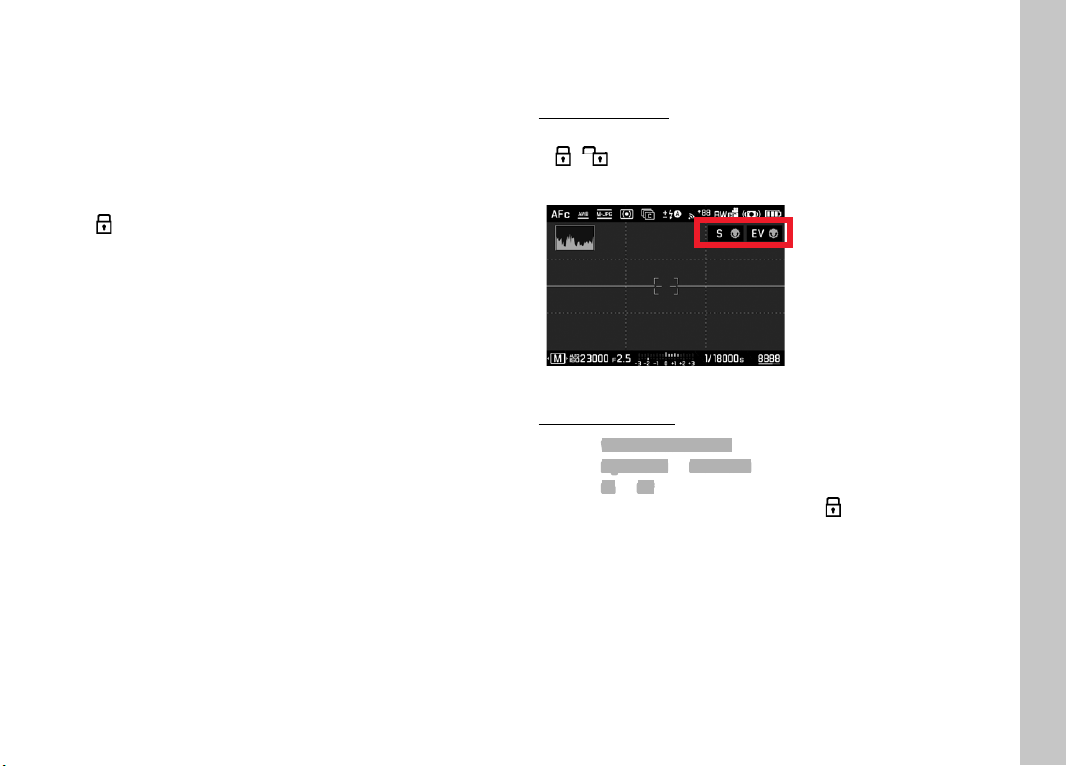
LOCKING THE SETTING WHEELS
The function of both setting wheels can be locked/unlocked.
Using touch control
Tap the relevant function display (with cogwheel icon), until
/ appears at the bottom center of the screen (after
approx. 2 seconds)
Using button control
Select
Wheel lock in Live View in the main menu
Select
Right wheel or Left wheel in the submenu
Select
On or Off.
• A locked setting wheel is indicated by
on screen.
Camera operation
EN
52
CAMERA DEFAULT SETTINGS
For details on how to navigate in the menus and for inputs see
chapter "Menu control" (p. 42).
MENU LANGUAGE
Factory setting: English
Available menu languages: German, French, Italian, Spanish,
Russian, Japanese, Korean, Traditional or Simplifi ed Chinese
Select
Language in the main menu
Select your language
• Aside from a few exceptions, the language will be changed for
all information.
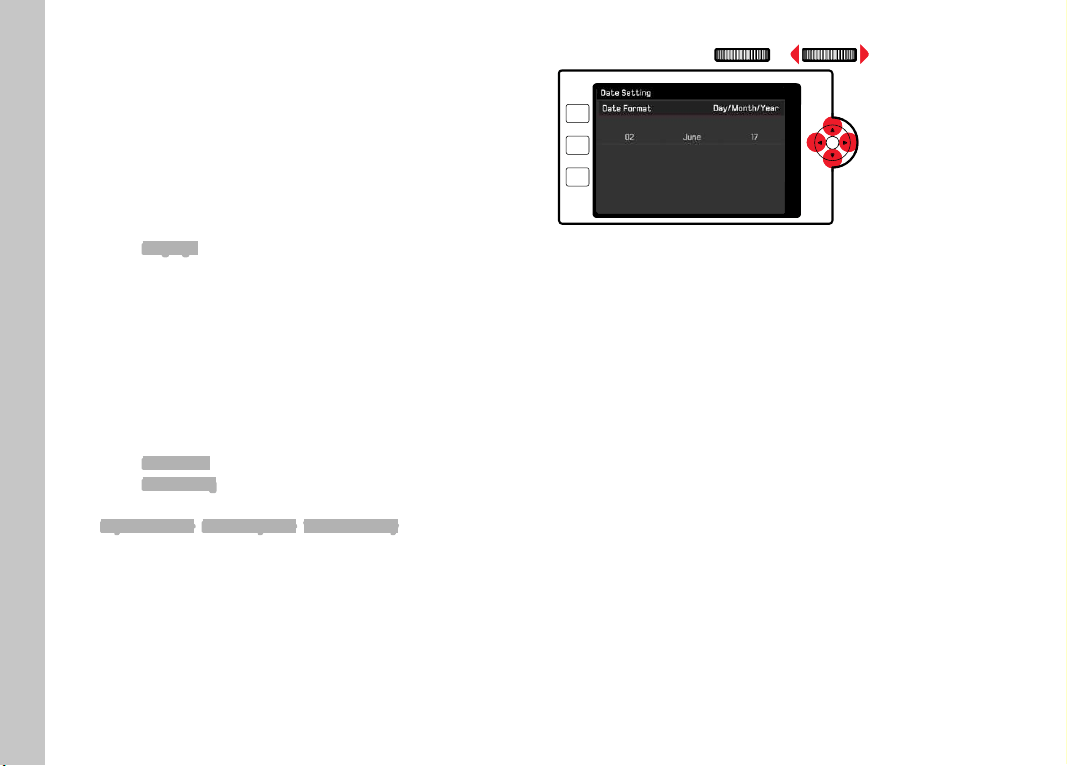
DATE/TIME
DATE
You can choose one of 3 options.
Select
Date & Time in the main menu
Select
Date Setting in the submenu
Select the desired date format
(
Day/Month/Year, Month/Day/Year, Year/Month/Day)
Set the date
PLAY
FN
MENU
To move to the next settings fi eld
Press the directional pad left/right
or
turn the right setting wheel
To set values
Press the directional pad up/down
To save and return to parent menu item
Press the center button/right setting wheel button
Camera default settings

EN
53
TIME
Select Date & Time in the main menu
Select Time Setting in the submenu
Select the desired display format
(12 Hours, 24 Hours)
Set the time
(Select am or pm for the 12-hour format)
TIME ZONE
Select Date & Time in the main menu
Select Time zone in the submenu
Select your time zone/current location
• The Greenwich Mean Time offset is shown on the left of the
line
• Major cities in the relevant time zones are shown on the right
DAYLIGHT SAVING TIME
Select Date & Time in the main menu
Select Daylight Saving Time in the submenu
Select On or Off.
POWER SAVE MODE (STANDBY MODE)
The camera will switch to the power-saving standby mode after a
preset time to extend battery life if this function is activated.
The device has two power save levels.
– Standard Save mode:
Activation of the stand-by mode after 2/5/10 minutes.
– Automatic LCD panel shutdown (see p. 56)
ACTIVATE/DEACTIVATE FUNCTION
Both functions are activated/deactivated concurrently.
Select Power Save in the main menu
Select Power Save Mode
Select On/Off
STANDARD SAVE MODE
Select Power Save in the main menu
Select Auto Power Off
Select the desired setting
(Off, 2 min, /5 min, /10 min)
Note
The camera can be reactivated from standby mode at any time by
pressing the shutter button or by switching the main switch off and
on again.
Camera default settings
EN
54
LCD PANEL/VIEWFINDER (EVF) SETTINGS
The camera comes equipped with a 3" LCD color screen.
The following functions can be configured and used individually:
– Use of the LCD panel and EVF (electronic viewfinder)
– Eye sensor sensitivity
– Brightness
– Information display
– Automatic LCD panel shutdown (standby mode)
LCD PANEL/EVF USE
You can preset the situations in which EVF and LCD panel should
be used. The displays appearing on screen and in the viewfinder
are identical.
Factory setting:
Auto
EVF LCD panel
Auto
The eye sensor in the viewfinder automatically
toggles the camera between LCD panel and EVF.
• Pictures
• Playback
• Menu control
LCD
• Pictures
• Playback
• Menu control
EVF
• Pictures
• Playback
• Menu control
EVF
Extended
• Pictures • Playback
• Menu control
Select Display Settings in the main menu
Select EVF-LCD in the submenu
Select a setting
Note
Select EVF if you want to keep the LCD panel switched off (e.g. on
dark environments).
Camera default settings

EN
55
EYE SENSOR SENSITIVITY
You can adjust the eye sensor sensitivity to ensure that the
changeover functions reliably if you wear eyeglasses.
Factory setting:
Low
Select Display Settings in the main menu
Select Eye Sensor Sensitivity in the submenu
Select a setting
BRIGHTNESS
You can adjust brightness for best visibility in various lighting
conditions. It is set individually for the LCD panel, top display and
the viewfinder.
LCD PANEL
Select Display Settings in the main menu
Select LCD Brightness in the submenu
Select the desired brightness or Automatic
Confirm selection
EVF
Select Display Settings in the main menu
Select EVF Brightness in the submenu
Look through the viewfinder
Select the desired brightness
Confirm selection
Note
The
Automatic setting is not available here.
TOP DISPLAY
Select Display Settings in the main menu
Select Top Display in the submenu
Select the desired function
– On: always on
– Off: always off
– Auto: automatic control depending on ambient brightness
Camera default settings

EN
56
INFORMATION DISPLAYS
The picture data can be displayed in picture mode and in review
mode.
DISPLAY OPTIONS
Two display options are available.
– No information display
– With picture data in the header and footer line
Press the center button
• The display cycles through the display options.
Notes
• Only information about exposure are displayed during exposure
metering (shutter button held on first pressure point), regardless
of the setting.
• All displays are visible at all times in video mode.
AUTOMATIC DEACTIVATION OF ALL DISPLAYS
This function allows you to set a time after which the top display,
screen and viewfinder are powered down to extend battery life.
Select Power Save in the main menu
Select All Displays Auto Off
Select the desired setting
(30 s, 1 min, 5 min)
Camera default settings

EN
57
ACOUSTIC SIGNALS
Some functions can be acknowledged with acoustic signals. The
following special functions can be configured separately:
– Electronic shutter sound
– AF confirmation
ACOUSTIC SIGNALS
As a warning signal, e.g. when the user attempts to configure
unavailable settings.
Select Acoustic Signals in the main menu
Select Acoustic Signals in the submenu
Select On
Select Volume in the submenu
Select Low/High
ELECTRONIC SHUTTER SOUND
Select Acoustic Signals in the main menu
Select Electronic Shutter Sound in the submenu
Select On
Select Volume in the submenu
Select Low/High
AUTOFOCUS CONFIRMATION
A signal sound can be selected for successful AF settings.
Select Acoustic Signals in the main menu
Select AF Confirmation in the submenu
Select On
Select Volume in the submenu
Select Low/High
SILENT PHOTOGRAPHY
When pictures should be taken as quietly as possible.
Select Acoustic Signals in the main menu
Select Electronic Shutter Sound/AF Confirmation/Acoustic Signals in
the submenu
Select Off for each of these menu items
Camera default settings

EN
58
BASIC PICTURE SETTINGS
PHOTO
FILE FORMAT
Choose the JPG format
JPG or the standardized raw data format DNG
(= digital negative). These can be used individually or simultaneous-
ly.
Factory setting: DNG + JPG
Select Photo File Format in the main menu
Select the desired format
(DNG, DNG + JPG, JPG)
Notes
• The standardized DNG (Digital Negative) format is generally used
for the storage of raw data.
• When picture data is saved in
DNG and in JPG format simultane-
ously, then the camera will use the resolution setting for the JPG
format is used for the JPG file (see next section), i.e. the two files
may have differing resolutions.
• The DNG format always uses the highest resolution (24 MP), no
matter what JPG setting is selected.
• The remaining number of pictures shown in the LCD panel will
not necessarily change after every picture taken. A counter
change depends on the subject; very fine image structures
result in higher data quantities, while homogeneous surfaces
mean less data.
JPG RESOLUTION
The
JPG format setting offers 3 image resolution (number of pixels)
options. The following file formats are available: L-J PG (24 MP),
M-JPG (12 MP) and S-JPG (6 MP). You can therefore adjust your
settings to the intended use and available memory card capacity.
Select JPG resolution in the submenu
Select the desired resolution
Basic picture settings

EN
59
IMAGE PROPERTIES
One of the many advantages of digital photography is that it is very
easy to change key image properties.
You can manipulate contrast, sharpness and color saturation
before the picture is taken.
Note
The functions and settings described in this section apply for
pictures taken in
JPG format only.
CONTRAST
The contrast setting, i.e. the difference between light and dark
image sections, determines whether an image comes across as
“flat” or “brilliant”. Increasing or decreasing this difference impacts
on contrast, meaning that some image sections are rendered with
more or less light.
SHARPNESS
The impression of sharpness in a picture is largely determined by
edge sharpness, i.e. by how slight the transition area between light
and dark is at edges in the picture. Expanding or reducing these
areas will therefore change the impression of sharpness.
COLOR SATURATION
The saturation factor in color images determines, whether colors in
the picture appear “pale” and pastel-like or “bright” and colorful.
While you can’t do anything about weather conditions (clear/
misty), you can change the way an image is rendered.
Basic picture settings

EN
60
COLOR PROFILE
Three pre-configured color profiles are available:
Factory setting:
Standard
– Standard
– Vivid
– Natural
Select Film Style in the main menu
Select a profile
MONOCHROME PROFILE
You can choose to save your images in color or monochrome,
provided you take the pictures in JPG format.
Two pre-configured monochrome profiles are available:
–
Monochrome
– Monochrome HC
Select Film Style in the main menu
Select a profile
Customizing photo profiles
Additionally, you can adjust the values for contrast, sharpness and
saturation (saturation only for color pictures) for each profile
separately.
Select Film Style in the main menu
Select Film Style Settings in the submenu
Select a profile from the submenu
Select Contrast/Sharpness/Saturation in the submenu
Select a level
(Low, Medium low, Standard, Medium high, High)
Basic picture settings

EN
61
IMAGE STABILIZATION
The less favorable the lighting conditions during recording, the
slower will be the required shutter speeds for correct exposure.
Visual image stabilization is a great tool for preventing out-of-focus
images due to blurring.
When using Leica SL lenses equipped with OIS, your LeicaCL can
utilize their built-in stabilization function.
Factory setting:
Auto
Select Visual Image Stabilization in the main menu
Select On or Off.
Note
Please read the relevant lens manual for more information about
OIS.
Basic picture settings
EN
62
VIDEO
FILE FORMAT
Videos are recorded in MP4 format.
VIDEO RESOLUTION
Factory setting:
Full HD / 60 fps
Choose one of three resolution levels, one of which offers two
frame rates:
4K / 30 fps
(3840 x 2160pixels)
Full HD / 60 fps
(1920 x 1080pixels)
Full HD / 30 fps
(1920 x 1080pixels)
HD / 30 fps
(1280 x 720pixels)
You can therefore adjust your settings to the intended use and
available memory card capacity.
Select Video Resolution in the main menu
Select the desired resolution
(4K / 30fps, Full HD / 60fps, Full HD / 30 fps, HD / 30 fps)
Note
The max. file size for uninterrupted video recording is 96 GB. Once
a recording exceeds this file size, the overrun will be automatically
stored in a new file (but cannot be longer than 29 min).
MICROPHONE
Sound is recorded in stereo via the built-in microphones. You can
configure the sensitivity setting of the built-in microphone.
Factory setting:
Medium
Select Video Settings in the main menu
Select Microphone Gain in the submenu
Select the desired level
(High, Medium, Medium low, Low, Off)
Note
The Autofocus function and manual focal length adjustments
generate noise that may be picked up in the recording.
WIND NOISE REDUCTION
Factory setting:
On
Select Video Settings in the main menu
Select Wind Noise Reduction in the submenu
Select On or Off.
Basic picture settings

EN
63
VIDEO STABILIZATION
The stabilization function helps to reduce blurring for handheld
recordings.
Select Video Settings in the main menu
Select Video Stabil. in the submenu
Select On or Off.
Note
The image section is reduced slightly when using the video
stabilization function.
IMAGE PROPERTIES
The color space is set to sRGB for video recording. Other image
properties can be set for video recordings.
VIDEO PROFILES
Three pre-configured color profiles are available:
–
Standard
– Vivid
– Natural
There are two additional profiles available for monochrome video
recordings:
–
Monochrome
– Monochrome HC
Select Video Style in the main menu
Select a video profile
CUSTOMIZING VIDEO PROFILES
Additionally, you can adjust the values for contrast, sharpness and
saturation (saturation only for color pictures) for each profile
separately.
Select Video Style in the main menu
Select Video Style Settings in the submenu
Select a video profile from the submenu
Select Contrast/Sharpness/Saturation in the submenu
Select a level
(Low, Medium low, Standard, Medium high, High)
Basic picture settings

EN
64
PICTURE MODE
FOCUSING
Your Leica CL allows automatic as well as manual focusing. There
are 2 operating modes and 3 metering methods available for AF
photography.
PHOTOGRAPHY WITH AF
position the AF metering field as needed
Tap and hold the shutter button
• Focusing occurs one time (AFs) or continuously (AFc).
• Metering was successful: The AF metering field lights up
green.
• Metering was unsuccessful: The AF metering field lights up
red.
• Alternatively, focus settings and/or exposure settings can be
done and saved via the right setting wheel button or the FN
button (metering memory lock, see p. 84).
Shutter release
PHOTOGRAPHY WITH MF
Use the focus ring to manually focus on the object
Shutter release
Please read the following chapters for more information.
AUTOFOCUS MODES
The following AF modes are available:
AFs and AFc. The currently
selected AF mode is shown in the header line.
AFs (single)
Suitable for objects with little or no movement. Focusing is done
only once and the setting remains as long as the shutter button is
held at the pressure point. That also applies if the AF metering field
is pointed at another object.
AFc (continuous)
Suitable for objects in motion. As long as the shutter button is held
at the 1st pressure point, focusing is continuously adjusted to the
object in the AF metering field.
Select Focusing in the main menu
Select Focus Mode in the submenu
Select a setting
Picture Mode
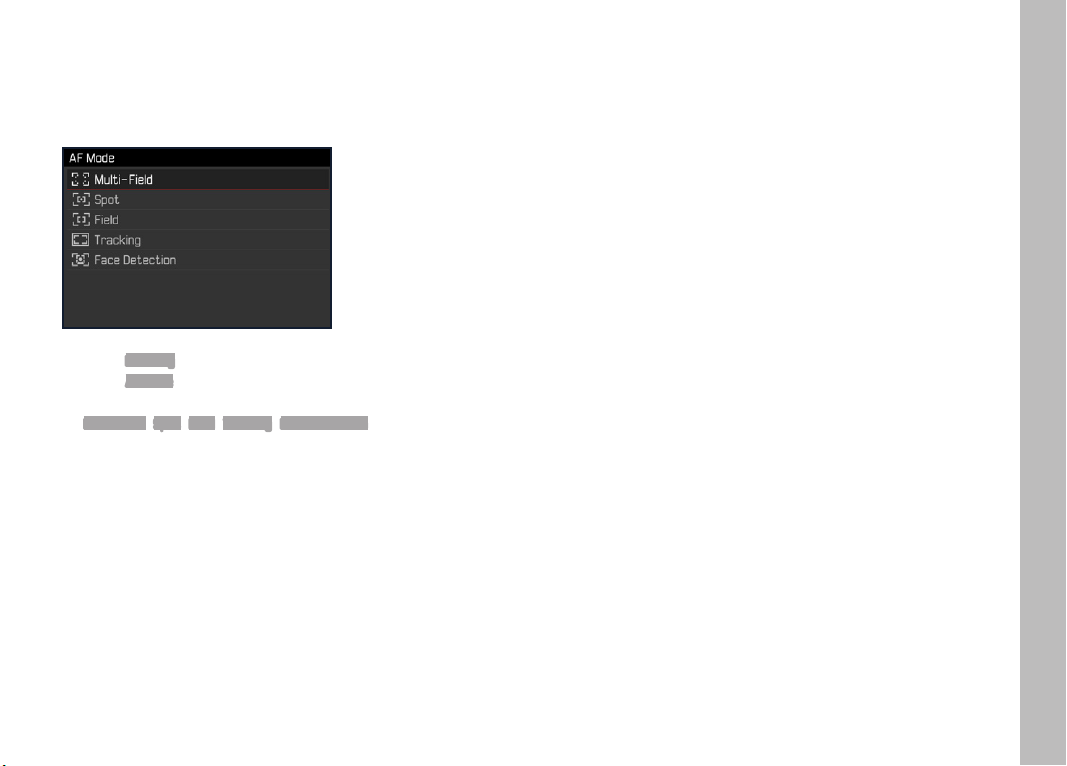
EN
65
AUTOFOCUS METERING METHODS
The AF mode offers various metering methods for focusing. A
successful focus setting is identified by a green metering field, an
unsuccessful one is shown in red.
Select Focusing in the main menu
Select AF Mode in the submenu
Select a setting
(Multi-Field, Spot, Field, Tracking, Face Detection)
Notes
• AF focusing can be unsuccessful:
– If the distance to the subject is too great or too small
– If the object is not sufficiently illuminated
• You can also use the focus setting ring on the lens to manually
change the automatically set focus while the shutter button is
pressed to the first pressure point.
• Only manual focusing is available when using Leica M or R
lenses with the optional Leica M or R Adapter L.
MULTI-FIELD METERING
Several metering fields are detected automatically. This function is
particularly useful for snapshots.
SPOT/FIELD METERING
Both methods detect only those parts of the object that are within
the relevant AF metering fields. The metering fields are indicated
by a small frame (field metering) or a cross (spot metering). The
very small measuring range for spot metering allows focusing on
tiny details of the subject.
The slightly larger measuring range in field metering is less critical
for focusing, but still permits selective metering.
These metering methods can also be used for serial exposures in
which the part of the object you want to focus on will always be at
the same off-center position in the image.
Simply move the AF metering field to another position.
Press the directional pad left or right as needed
or
Briefly tap the LCD panel
(while Touch AF is activated)
Note
In both cases, the metering fields remain at their last positions set,
even if the metering method is changed or the camera is switched
off.
Picture Mode
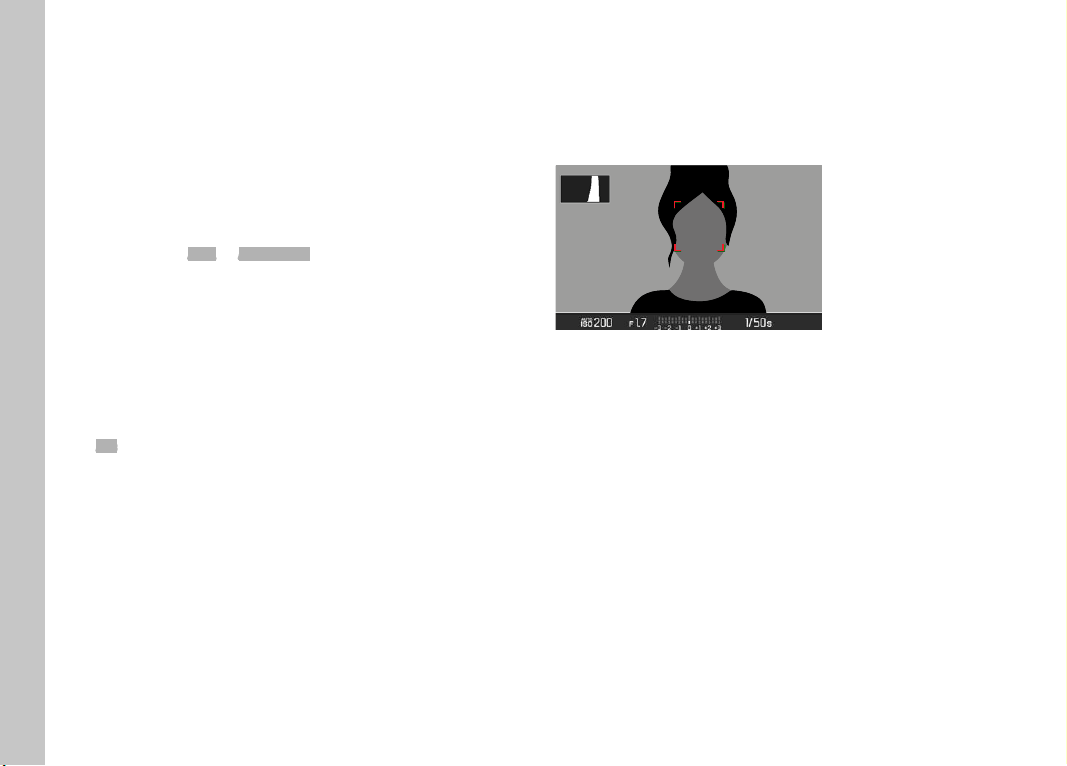
EN
66
TRACKING
This fi eld metering variant helps in the capture of moving objects.
The focus on the object in the metering fi eld is continuously
adjusted, once it is detected.
Aim the metering fi eld at the desired object
(by panning the camera shifting the metering fi eld)
Tap and hold the shutter button
or
Press the right setting wheel button/
FN button
(provided the
AF-L or AF-L + AE-L is assigned to the button, see p.
84)
• The camera focuses on the object.
Pan the camera to the desired cropped section
• The metering fi eld "tracks" the saved object and focus is
continuously adjusted.
Note
• This metering method focuses continuously, even if the AF mode
AFs was set.
FACE DETECTION
In this metering method, the Leica CL automatically detects faces
in the image fi eld. The focus is set automatically on the faces
closest to the camera. Multi-fi eld metering is used if no faces are
detected.
When focusing is successful, the AF metering fi eld changes from
yellow to green.
Picture Mode
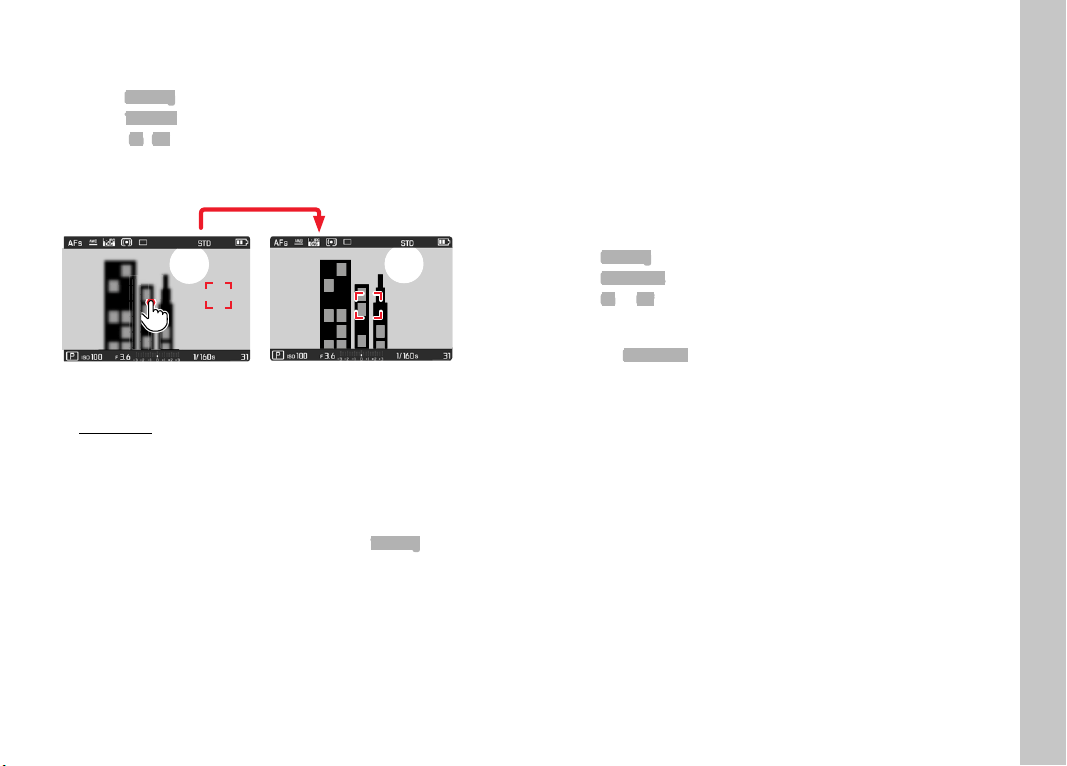
EN
67
TOUCH AF
Touch AF allows a direct placement of the AF metering fi eld.
Select Focusing in the main menu
Select
Touch AF in the submenu
Select
On/Off
Briefl y tap the LCD panel in the desired position
To move the metering fi eld back to the center of the screen
Double tap the LCD panel
Notes
• This function is available in conjunction with the AF metering
methods Spot metering, Field metering and Tracking.
• With Spot or Field metering selected, the camera will focus
again automatically. If the metering method
Tracking is selected,
the metering fi eld will remain at the selected position and
autofocus commences when the shutter button is tapped.
LIMITING THE AUTOFOCUS SETTING RANGE
The autofocus system takes longer to run through the complete
setting range, i.e. from the closest focusing distance to infi nity
when focusing macro lenses (with typically very short closest
focusing distance) or with lenses with a longer focal length.
Some Leica TL lenses allow a limiting of their setting ranges to
speed up focusing. This is advisable if you know that you will only
need the close range or only the long range for specifi c exposures.
Activating the function
Select
Focusing in the main menu
Select
Focus Limit in the submenu
Select
On or Off.
Using the function
Whether the
Focus Limit function should limit automatic focusing to
close range or long range depends fi rst of all on the current lens
setting. You can, however, change from the preset setting range to
another by turning the focus setting ring. The following table
illustrates the correlations.
1 Version 31.7.2017: Leica APO-Macro-Elmarit-TL 60 f/2.8 ASPH.,
Leica Vario-Elmar-TL 55-135 f/3.5-4.5 ASPH.
Picture Mode
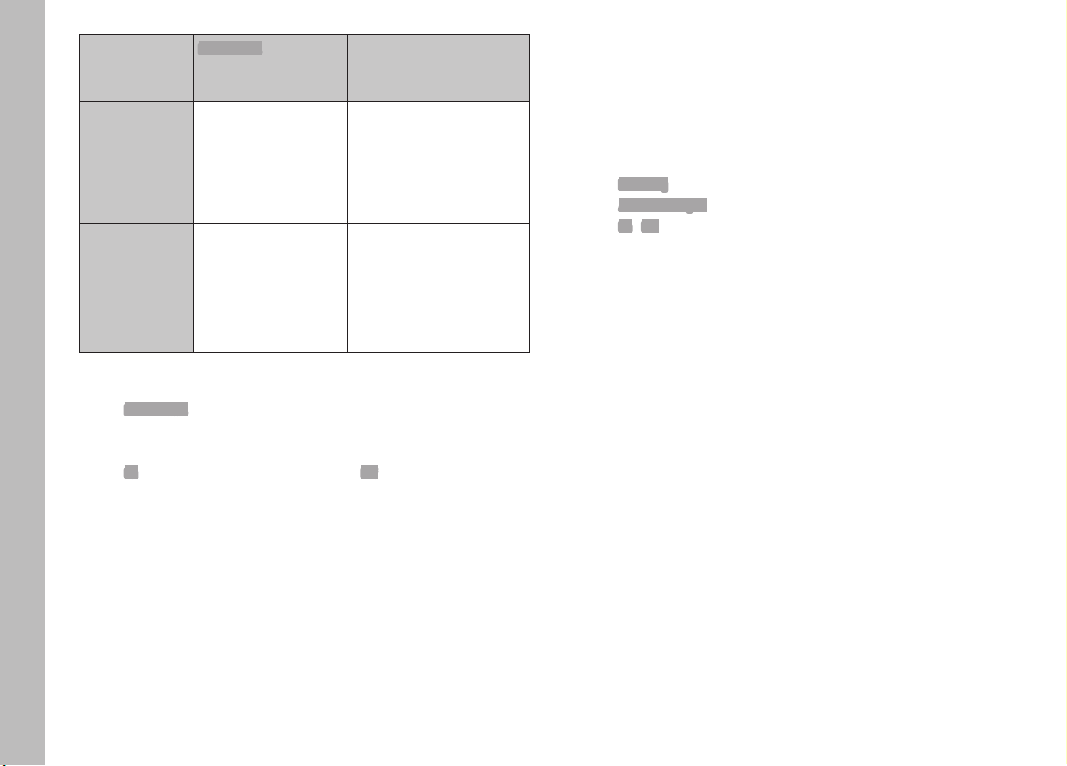
EN
68
Lens
setting
Focus Limit is acti-
vated
Changing the
focus range
(turning the lens focus ring)
working with
shorter
ranges
Autofocus applies
only for set short
range
Focusing “jumps” to
long range
(Autofocus is limited to
long range)
working with
longer
ranges
Autofocus applies
only for set long
range
Focusing “jumps” to
short range
(Autofocus is limited to
short range)
Notes
• The
Focus Limit function is also available for specific Leica SL
lenses (see relevant manual), but not for lenses attached via an
adapter.
• The On setting of the function is reset to Off if the lens is changed
while the camera is switched on.
MF ASSIST FUNCTIONS
AF ASSIST LIGHT
The integrated AF assist light allows operation of the AF system in
unfavorable lighting conditions. This light comes on as soon as the
shutter button is pressed, provided the function is activated.
Select Focusing in the main menu
Select AF Assist Light in the submenu
Select On/Off
Note
• The AF assist light illuminates an area of up to approx. 4m.
• The AF assist light switches off automatically, once focusing was
successful (AF metering field is green) or has failed (AF metering
field is red).
ACOUSTIC AF CONFIRMATION
A successful focus metering in AF mode can be confirmed with an
acoustic signal (see p. 57).
Picture Mode
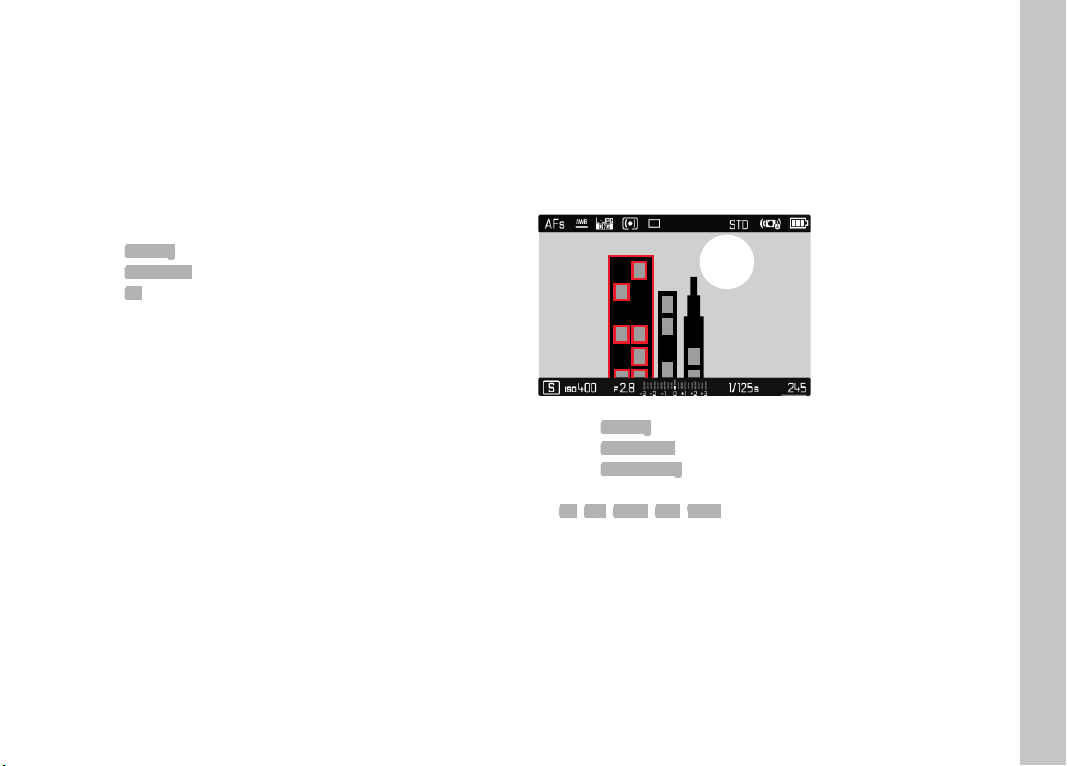
EN
69
MANUAL FOCUSING (MF)
Focusing manually may in some situations be a better choice than
autofocus.
– the same setting is used for several exposures
– it would take longer to use the metering memory lock function
– the setting is to be kept at infi nity for landscape pictures
– poor, i.e. very dark lighting conditions prevent AF operation or
would slow it down
Select
Focusing in the main menu
Select
Focus Mode in the submenu
Select
MF
Turn the focus ring until the desired part of the object is in clear
focus
Note
Manual focusing is possible in auto focus mode as well – with the
shutter button pat the fi rst pressure point.
MF ASSIST FUNCTIONS
The following assist functions are available in MF mode.
FOCUS PEAKING
This assist function highlights in focus object sections in color. The
color can be freely selected. The sensitivity can be additionally
adjusted.
Select Focusing in the main menu
Select
Focus Assist in the submenu
Select
Focus Peaking
Select a setting
(
Off, Red, Green, Blue, White)
Picture Mode

EN
70
Setting the sensitivity
Select the Sensitivity
Select the desired setting
(Low/High)
Note
Focus peaking is based on subject contrast,
i.e. differences between light and dark. As a result, high contrast
subject parts could be marked, even if they are not completely in
focus.
ENLARGEMENT
Turning the focus ring will automatically enlarge the image section
in the center, which means the focus quality can be better
assessed.
Any image section can be selected for checking correct focus.
Selection occurs via key control or touch control.
Select Focusing in the main menu
Select Focus Assist in the submenu
Select Auto Magnification
Select On
Turn the focus ring
• The image section in the center is enlarged x3 and an
indicator showing the magnification factor is shown at the top
right of the image.
Press the center button
• The image section toggles between magnification factors
(3x/6x).
Tap the shutter button
• The image is no longer enlarged.
To shift the enlarged cropped section
Press the directional pad left or right as needed
or
Swipe
Notes
• The enlargement will automatically return to normal viewing size
about 5s after the last turn of the focus ring.
• The last selected zoom level appears after the next turn.
Picture Mode
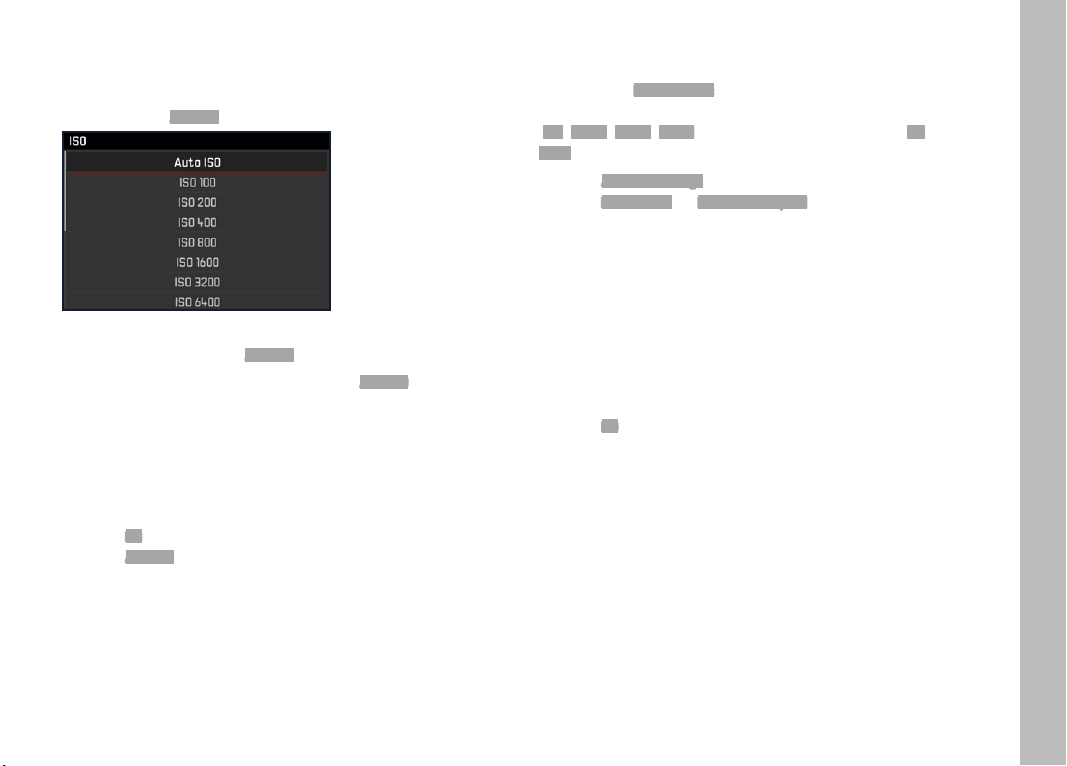
EN
71
ISO SENSITIVITY
The ISO setting covers a range between ISO 100 and ISO 50000,
allowing you to adapt to the relevant situation as required.
Factory setting:
Auto ISO
AUTOMATIC SETTING: Auto ISO
In addition to the fixed settings, the function Auto ISO is available,
which adapts the sensitivity automatically to ambient brightness or
to the configured shutter speed/aperture settings combination.
There is more leeway for the use of preferred shutter speed and
aperture combinations when setting the exposure manually. You
can set priorities within the scope of the automatic setting, e.g. for
reasons of picture composition.
Select ISO in the main menu
Select Auto ISO in the submenu
LIMITING SETTING RANGES
A max. ISO value can be set, which will then limit the automatic
setting range (
Max. ISO value). A max. exposure time can also
optionally be configured. There are focal length related settings
(1/ f, 1/ (2f), 1/ (3f), 1/ (4f)) and fixed max. shutter speeds 1/2 and
1/500 s available for that purpose.
Select Auto ISO Settings in the main menu
Select Maximum ISO, or Min. Shutter Speed in the submenu
Select the desired value
FIXED ISO VALUES
There is more leeway for the use of preferred shutter speed and
aperture combinations when setting the exposure manually. You
can set priorities within the scope of the automatic setting, e.g. for
reasons of picture composition. Values between ISO 100 and ISO
50000 can be selected in 10 increments.
Select ISO in the main menu
Select the desired setting in the submenu
Note
When high ISO values are used or the image is edited later, image
noise, as well as vertical and horizontal stripes may become visible,
particularly in larger, evenly lit areas of the object.
Picture Mode
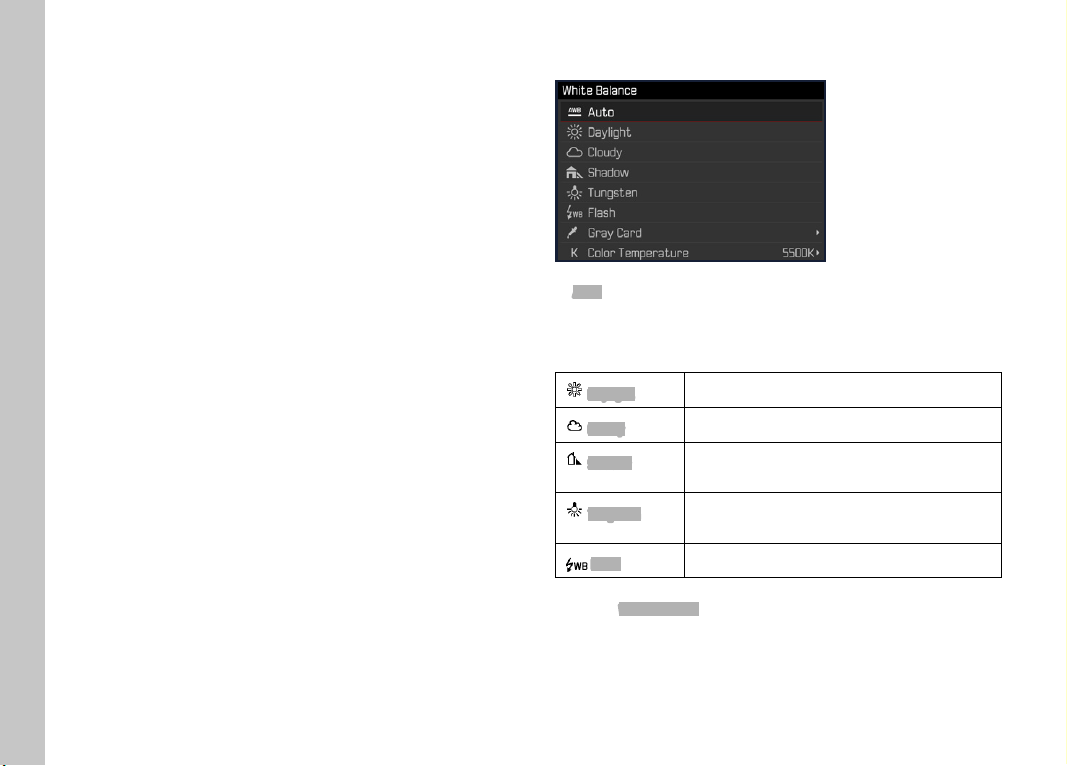
EN
72
WHITE BALANCE
In digital photography, white balance ensures neutral color
rendering in any light. White balance is based on the camera being
preset to render a particular light color as white.
Four methods are available:
– automatic control
– fi xed presets
– manual setting via metering
– direct setting of the color temperature
AUTOMATIC CONTROL/FIXED SETTINGS
– Auto : for automatic control, which delivers neutral results in
most situations
– Various fi xed presets for most frequently encountered light
sources:
Daylight
for outdoor pictures in sunlight
Cloudy
for outdoor pictures in cloudy conditions
Shadow
for outdoor pictures with the main subject in
shadow
Tungsten
for indoor pictures with (predominantly)
incandescent lamp light
Flash
for fl ash photography
Select
White Balance in the main menu
Select a setting
Picture Mode
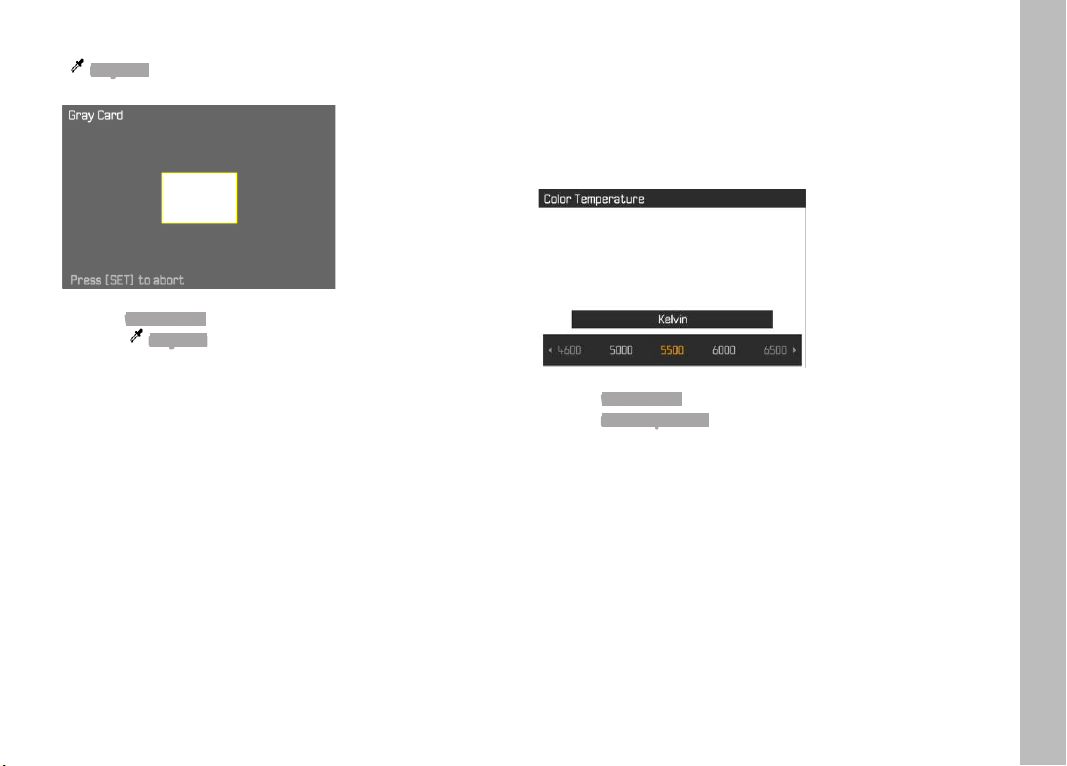
EN
73
MANUAL SETTING VIA METERING
(
Gray Card)
Select White Balance in the main menu
Select Gray Card in the submenu
Take the picture
• Make sure that the image field contains a white or neutral
gray (reference) surface.
• The following will appear on the LCD panel:
– the image based on automatic white balance
– a frame in the center of the image
Shutter release
Note
A value configured using this method will remain unchanged (i.e. it
will be used for all subsequent photographs) until new measure-
ments are taken or one of the other white balance settings is
selected.
DIRECT SETTING OF THE COLOR TEMPERATURE
Values between 2000 and 11,500 K (Kelvin) can be set directly.
That gives you a very wide range, which covers virtually all color
temperatures occurring in real life and within which you can adapt
color rendering to any light color and your personal preferences
with incredible detail.
Select White Balance in the main menu
Select Color Temperature in the submenu
Select the desired value
Picture Mode

EN
74
EXPOSURE
EXPOSURE METERING METHODS
Optional methods are spot metering, center-weighted metering and
multi-fi eld metering.
Select
Exposure Metering in the main menu
Select a metering method
(
Spot, Center-Weighted, Multi-Field)
• The selected metering method is displayed in the header line
of the screen image.
Note
The right shutter speed for correct exposure or the deviation from
a correct exposure setting is shown or determined with the help of
the screen display.
SPOT METERING –
Spot metering only captures and analyzes a small area in the
middle of the screen image, which is shown in a circle.
CENTER-WEIGHTED METERING –
This method considers the entire image fi eld. The subject elements
captured in the center will, however, impact on the calculation of
the exposure value more so than areas around the edges.
MULTI-FIELD METERING –
This metering method is based on the detection of multiple values.
These values are used in an algorithm to calculate an exposure
value appropriate for a good rendering of the assumed main
subject.
Picture Mode
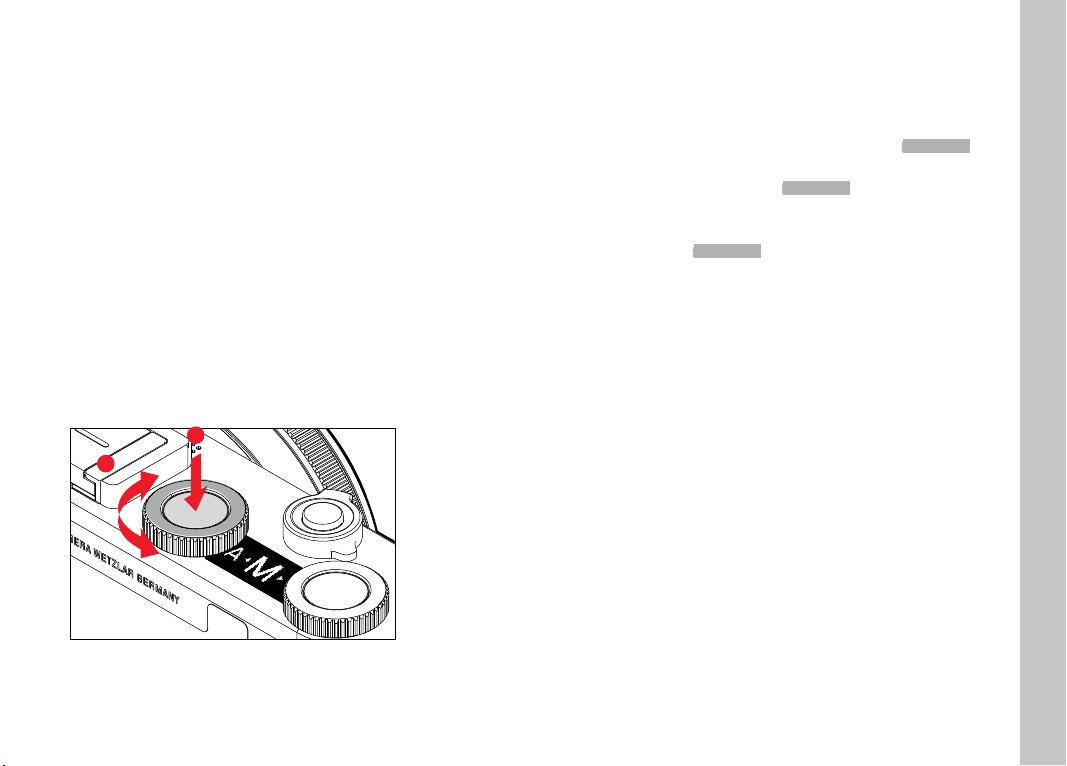
EN
75
EXPOSURE MODES
There are four exposure modes available to adjust the rendering of
the object or to create the desired picture composition:
– Automatic program (
P)
– Aperture priority mode (
A)
– Shutter priority mode (
S)
– Manual setting (
M)
SELECTING A MODE
Press the left setting wheel button
• The currently selected mode is shown in the top display.
Turn the left setting wheel to select the desired mode.
• The mode display changes in the top display and on screen.
All modes can be reached by turning the wheel in either
direction.
• The selected mode will be applied automatically approx. 2s
after the setting wheel is moved the last time.
1
2
To apply the selected mode immediately
Press the left setting wheel button or the shutter button
Notes
• Only
A and M are available when using Leica M or R lenses with
a Leica M adapter L or Leica R adapter L, i.e.
P, S or
Scene Mode
are unavailable. The camera will automatically switch to A when
the adapter is attached if
P, S or a
Scene Mode is selected. Where
that is the case,
F0.0 is displayed as the aperture value.
• Should a Leica TL or SL lens be attached again later, and you
want to use
P, S or a
Scene Mode, then you will have to set the
desired mode again.
Picture Mode

EN
76
FULLY AUTOMATIC EXPOSURE SETTING – P
AUTOMATIC PROGRAM – P
The automatic program mode facilitates fast and fully automatic
photography. The exposure is controlled by an automatic shutter
speed and aperture setting.
Selecting the operating mode P (see p. 75)
Tap and hold the shutter button
• The automatically set value pair for aperture setting and
shutter speed are displayed.
Shutter release
or
Adjusting the automatically set value pair
CHANGING THE PRESET SHUTTER SPEED/
APERTURE COMBINATIONS (SHIFT)
Changing the preset values using the Shift function combines the
reliability and speed of fully automatic exposure control with the
opportunity to vary the speed/aperture combination selected by
the camera at any time to fit in with your own ideas and intentions.
The overall exposure, i.e. the brightness of the image, remains
unchanged. Faster shutter speeds are a good choice for e.g. sports
pictures, while longer speeds will offer more depth of field for e.g.
landscape pictures.
Turn the right setting wheel to the left/right
(right = greater depth of field with slower shutter speed, left =
faster shutter speed with less depth of field)
• Shifted value pairs are marked with an asterisk next to the P.
Note
The adjustment range is limited to guarantee correct exposure.
Picture Mode
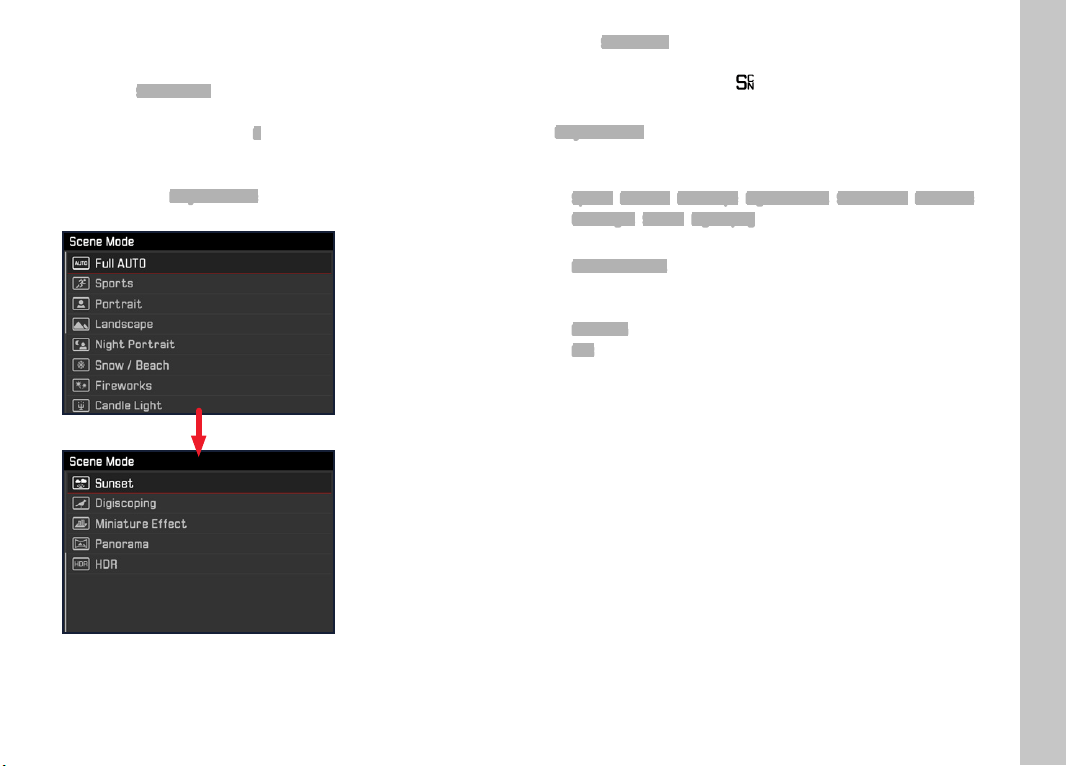
EN
77
SCENE MODE
13 additional automatic program variants are available under the
menu item
Scene Modes. All 13 off er automatically controlled shutter
speed and aperture for extra easy photography as with the
"normal" automatic program
P and a number of additional
optimized functions for the selected scene type.
Factory setting:
Fully automatic
Select Scene Mode in the main menu
Select the desired setting in the submenu
Select the operating mode
(see p. 75)
–
Fully automatic: Automatic snapshot function for general use
– 9 scene modes to match the special requirements of common
scene types:
–
Sports, Portrait, Landscape, Night Portrait, Snow/Beach, Fireworks,
Candlelight, Sunset, Digiscoping
– 3 additional "special" modes:
–
Miniature Effect: Limitation of the sharpness range to one
horizontal or vertical stripe within the image
fi eld
–
Panorama: Automatic creation of panorama pictures
–
HDR: automatic combination of multiple pictures taken with
diff erent exposure values
The following sections off er detailed information about these three
functions.
Picture Mode

EN
78
Notes
• The camera switches automatically to operating mode if a
Scene mode is accessed directly (see p. 50).
• The selected program will remain active until a different program
is selected (even after the camera is switched off).
• The program shift function and some of the menu items are
unavailable.
• A fixed camera setup on a tripod is recommended for the
Digiscoping setting.
• Exposure compensation can be set in all modes via the setting
wheels (with the exception of Miniature Effect).
• In Digiscoping mode, the shutter speed can also be set via the left
setting wheel.
Exposure simulation is active in all modes (see p. 83).
MINIATURE EFFECT
The effect will make the picture look similar to a closeup photo with
its characteristically shallow depth of field. Normal sized objects
will appear like a model landscape in the image.
The in-focus areas can be limited optionally to a horizontal or
vertical stripe. The width and position of these stripes can be
adjusted within the image field.
Select Scene Mode in the main menu
Select Miniature Effect in the submenu
• A frame around the area that should be in focus appears in
the screen image.
Note
When the auxiliary displays are deactivated, the frame will only be
visible as long as the shutter button is held at the first pressure
point. The position and width settings will still function as
described.
Picture Mode
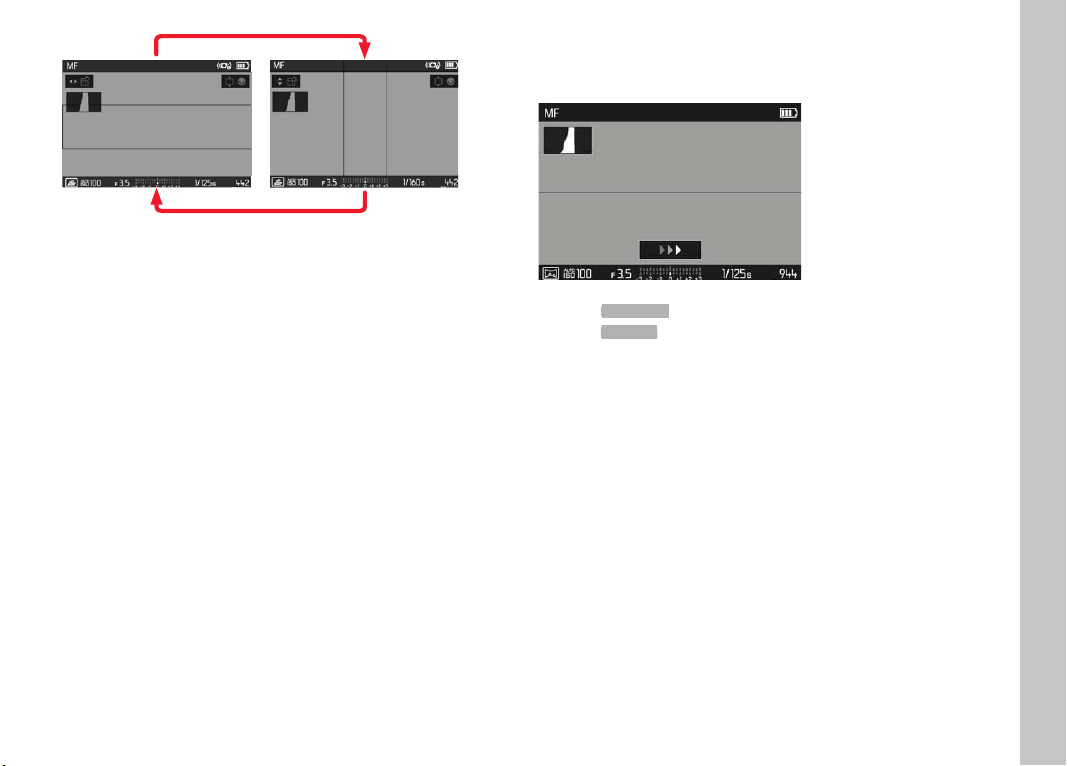
EN
79
to switch to a vertical frame
Press the directional pad left/right
to switch to a horizontal frame
Press the directional pad up/down
Changing the frame position
Press the directional pad left or right as needed
Changing the frame width
Turn (any) setting wheel
to the left = smaller, to the right = larger)
PANORAMA IMAGES
The Leica CL can capture classic horizontal, as well as vertical
panorama images.
Select Scene Mode in the main menu
Select
Panorama in the submenu
• Auxiliary displays appear on screen
– a white horizontal/vertical line
– a progression display indicating the direction
Align the camera in such a way that the desired left/bottom
edge of the image is not all the way at the left/bottom of the
screen image
Press and hold the shutter button
Pan the camera evenly in the indicated direction along the white
auxiliary line
• Pictures are taken automatically and in quick succession.
• The image picture is canceled if the camera is panned too
slowly or too fast, or if it is tilted too much and a relevant
notifi cation will appear on screen.
Release the shutter button to stop the picture series
• The camera generates a single image from the picture series.
Picture Mode

EN
80
Switching between landscape or portrait orientation
Press the directional pad
Notes
• When the auxiliary displays are deactivated, the auxiliary line will
only be visible as long as the shutter button is held at the first
pressure point.
• The less steady the camera is held along the horizontal line, the
smaller will be the overall height of the panorama picture.
• The maximum panning angle is approx. 180°.
• Panorama pictures are always taken in automatic program
mode, no matter what the settings for the shutter speed setting
dial and the aperture setting wheel are.
• Panorama pictures are always stored in
JPG file format regard-
less of the current menu setting.
• Panorama pictures cannot be taken with a flash.
• The resolution of a panorama picture depends on the direction
of the picture and number of pictures taken.
• Sharpness, white balance and exposure for all pictures are set to
the values of the first picture taken in the series. That is why the
final panorama picture may not be in perfect focus or have ideal
brightness if there are significant changes in the distance
between camera and object or the ambient light while the
picture is taken.
• Some objects in the picture may appear distorted or there may
be visual transitions, because the panorama picture is com-
posed of a series of individual exposures.
• Panorama pictures may not be possible for the following object
types, under the following exposure conditions or the individual
images may not be joined up correctly if:
– Single-color objects or objects with a uniform pattern (sky,
beach, etc.)
– Moving objects (people, pets, vehicles, waves, flowers
swaying in the wind, etc.)
– Objects with changing colors or patterns (e.g. a TV image)
– Dark locations
– Objects illuminated by uneven, flickering light sources (e.g.
fluorescent lamps, candlelight, etc.)
Picture Mode

EN
81
HDR
HDR generates a picture in which the “overlay” of three different
exposures (-2EV/0EV/+2EV) reproduces an improved image of
lighter and darker parts of the object, i.e. with less overexposure in
the highlights and more definition in the darkest areas.
Due to the consecutive exposures, this operating mode is best
suited for immobile objects or those with very little movement, e.g.
landscapes. We recommend the use of a tripod for HDR pictures
because of the slower shutter speeds and in particular in low
ambient light.
Select Scene Mode in the main menu
Select HDR in the submenu
SEMI-AUTOMATIC EXPOSURE SETTING – A/S
SHUTTER SPEED PRIORITY – S
Shutter speed priority mode will set exposure automatically
according to the manually selected shutter speed. It is therefore
particularly suitable for pictures of moving objects, where the
sharpness of the movement depicted is a critical picture composi-
tion element.
An appropriately fast shutter speed can help to avoid e.g.
unwanted motion blurring and will "freeze" the object. Conversely,
an appropriately longer shutter speed can help create a better
feeling of motion in the image with targeted "tracer effects".
Select the operating mode S (see p. 75)
Select the desired shutter speed via the left setting wheel
Tap and hold the shutter button
• The set shutter speed is displayed in orange, the automatically
calculated exposure value in white.
Shutter release
Picture Mode

EN
82
APERTURE PRIORITY - A
Aperture priority mode sets the exposure automatically according
to the manually selected aperture. This mode is suitable for
pictures in which the depth of field is a critical compositional
element.
By selecting an appropriately low aperture value, you can reduce
the depth of field range, for example to make a face “stand out” in
sharp focus against an unimportant or distracting background.
Conversely, you can use a higher aperture value to increase the
depth of field range, so that everything from the foreground to the
background will be in full focus in a landscape shot.
Select the operating mode A (see p. 75)
Select the desired aperture value via the right setting wheel
• The set aperture value is displayed in orange, the automatical-
ly calculated shutter speed in white.
Tap and hold the shutter button
Shutter release
Notes
• The remaining exposure time after shutter release is counted
down in seconds on the display for shutter speeds greater than
2s.
• Image noise becomes apparent when using higher sensitivities,
particularly on uniform dark areas. In order to reduce this
annoying phenomenon, the camera will take a second “black
picture” (taken with the shutter closed) automatically after
pictures taken with slow shutter speeds and high ISO values. The
noise metered in this parallel picture is then digitally “subtract-
ed” from the data for the actual picture. Where that is the case,
the message
Noise reduction 12s (time example) will appear on the
LCD panel. The doubling of the “exposure” time must be taken
into account for long exposure times. The camera must not be
switched off during that time.
Picture Mode

EN
83
MANUAL EXPOSURE SETTING – M
The following manual settings for shutter speed and aperture are a
good choice:
– to create a special image mood that can only be achieved with a
very specific type of exposure
– to ensure a perfectly identical exposure for multiple images with
different cropped sections
Select the operating mode M (see p. 75)
Tap the shutter button
• The values for shutter speed and aperture are displayed in
white.
• The light balance scale is additionally displayed. It covers a
range of ±3 EV (exposure value) in 1⁄3EV increments.
Settings within ±3 EV are indicated by white lines on the
scale, settings outside this range by red lines.
• The exposure compensation is done using the scale of the
light balance:
– No white scale lines = correct exposure
– White scale lines to the left/right of the center mark =
under or overexposure by the displayed value or by more
than ±3EV (Exposure Value)
Select the desired aperture value via the right setting wheel
Select the desired shutter speed value via the left setting wheel
Shutter release
Note
The screen image will show an exposure simulation if P-A-S-M is
selected in the menu item Exposure Preview.
EXPOSURE CONTROL
(FUNCTIONS FOR AUTOMATIC EXPOSURE)
EXPOSURE SIMULATION
With factory settings in place, the brightness of the screen image
in the three automatic exposure modes P, S and A matches the
relevant exposure settings.
You can now assess and control the effect of the relevant exposure
setting on the image before taking the picture.
This function is also available for the manual exposure setting M:
Select Exposure Preview in the main menu
Select P-A-S (only in automatic, aperture priority and shutter
speed priority mode) or P-A-S-M (also for manual setting)
Notes
• Depending on ambient lighting conditions, the brightness of the
screen image may differ from that of the actual pictures, despite
the settings described above. The screen image will appear
considerably darker than the – correctly exposed – picture. That
is particularly the case in long-term exposures.
1
This will apply as long as the subject brightness and the set exposure don’t
result in excessively low or high brightness values.
Picture Mode
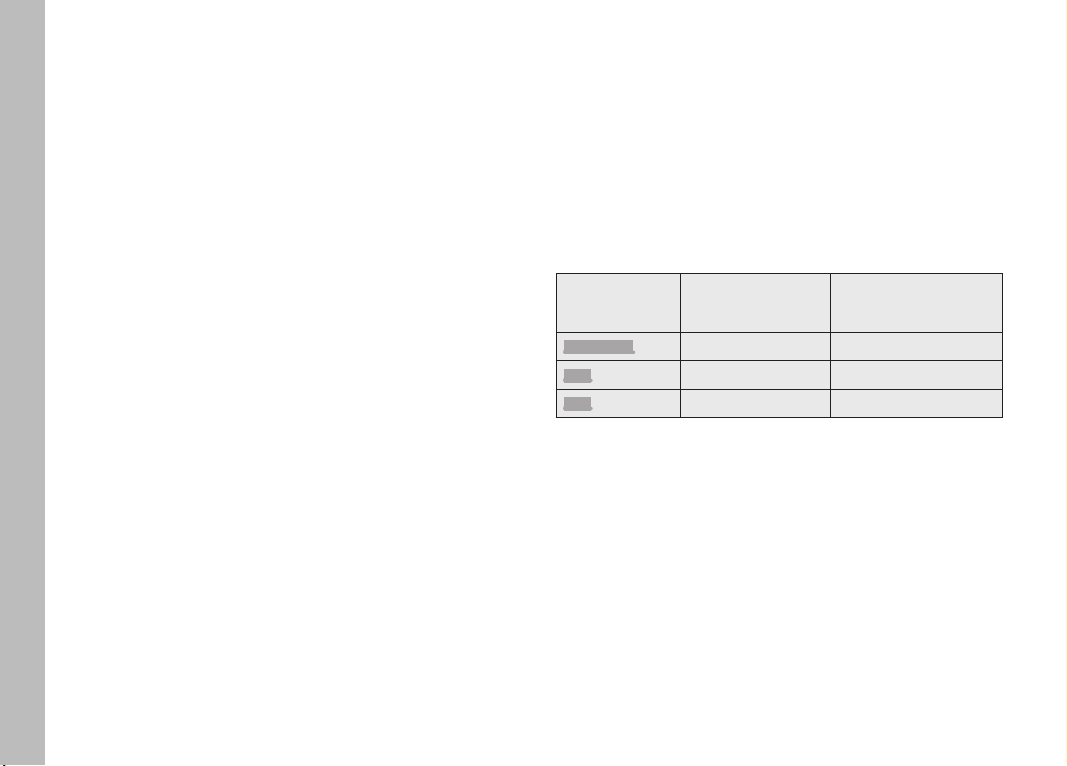
EN
84
METERING MEMORY LOCK
We often want to arrange important subject elements outside the
center of the picture for reasons of picture composition and these
elements may sometimes be very bright or very dark. Cen-
ter-weighted metering and spot metering, however, mainly capture
an area in the center of the image and are calibrated to an average
gray scale value. In that case, the metering memory lock function
– in P, S and A exposure modes, and the AF modes Spot/Field
metering – initially allows a metering of the main object and to
store the relevant settings until the final image section is set.
With the factory settings in place, both lock functions are done via
the shutter button. The metering memory lock functions can also
be divided up between the shutter button, the FN button or the
right setting wheel button. Alternatively, both functions can be
assigned to the FN FN button or the right setting wheel button.
AE-L (Auto Exposure Lock)
The camera stores the exposure value. The focus can therefore be
set on another object, no matter which exposure value is selected.
AF-L (Auto Focus Lock)
The camera stores the focus setting. That makes it easier to
change the image section when focusing is fixed.
AF-L + AE-L
With this option enabled, the camera stores the exposure value and
the focus setting when the assigned button is pressed and held.
Menu settings Tap the shutter
button
FN Button/
Right setting wheel
button
AF-L + AE-L*
no function Exposure and focus
AF-L*
Exposure Sharpness
AE-L*
Sharpness Exposure
* The functions include settings and storage
Picture Mode

EN
85
Via the shutter button
Aim at the key subject element (using the metering field for spot
metering) or alternatively at another detail with average
brightness.
Tap and hold the shutter button
• The measurement is taken and saved.
Shutter release
Note
The metering memory lock is canceled when you release the
shutter button.
Via the FN button/right setting wheel button
Select Customize Control in the main menu
Select FN button/Right setting wheel button in the submenu
Select the desired setting
(AF-L + AE-L, AE-L, AF-L)
Aim at the object
Press the FN button/right setting wheel button
• The measurement is taken and saved.
• A small padlock icon with the letters AE appear at the bottom
left of the screen to signify that the exposure value was saved.
• A green AF metering field signifies that the focusing was
saved.
• The exposure value/focusing remain until the same button is
pressed again.
Select the final image section
Shutter release
Notes
• Only one of the two metering memory locks (AF-L or AE-L), or
both at the same time (with AF-L + AE-L) can be set for a
recording.
• The assigned button must be pressed again to remove the
memory lock and to take a new measurement.
• The shutter button will retain both functions, as long as no
metering memory lock is done via the FN button/right setting
wheel button.
• A metering memory lock doesn’t make much sense in conjunc-
tion with multi-field metering, because a targeted capture of an
individual object element will not be possible.
• A change in the aperture setting after the metering memory lock
is set will not result in an adjustment of the shutter speed, i.e.
the end result would be an incorrect exposure.
Picture Mode
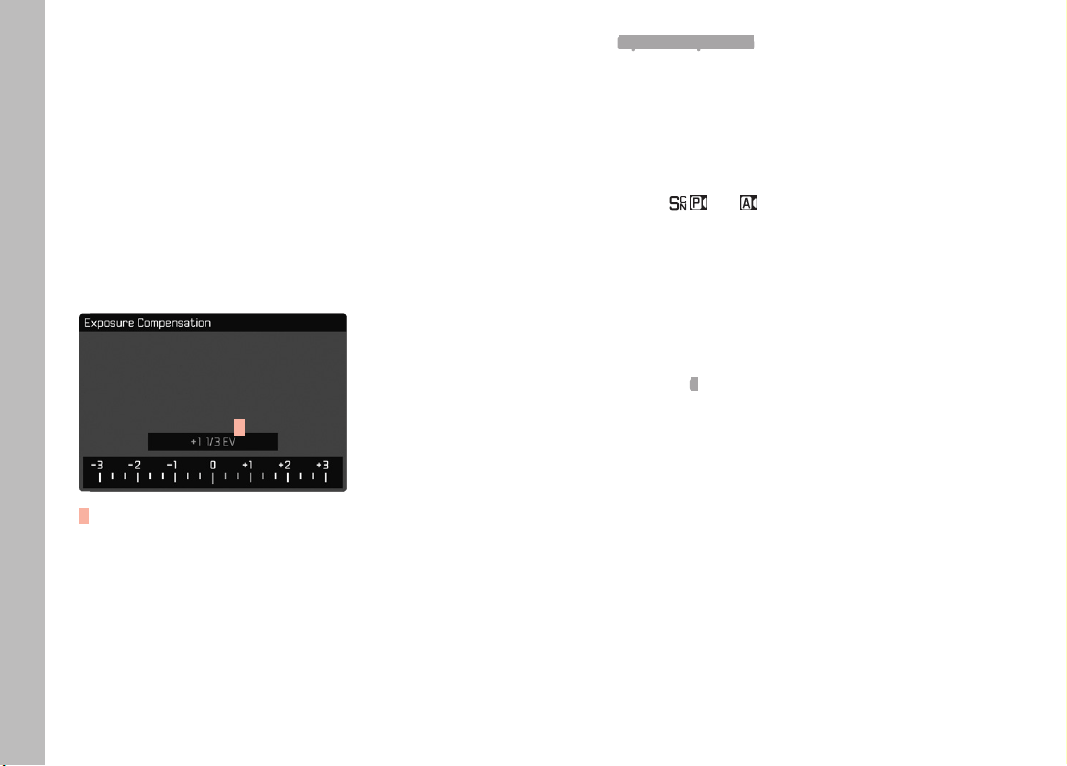
EN
86
EXPOSURE COMPENSATION
Exposure meters are calibrated for a medium gray scale value,
which matches a standard, i.e. average image object. Should the
measured image detail not fulfill that requirement, then the a
relevant exposure compensation can be effected.
Specifically where several pictures are taken in sequence, for
example if for a series a slightly lesser or greater exposure is
desired for a particular reason, then exposure compensation can
be a very useful function: Once set, the setting remains active
– unlike the metering memory lock – until it is reset.
Exposure compensation can be set in the range ±3EV in 1⁄3 EV
increments (EV: exposure value).
A
A
Set compensation value (marks at 0 = Off)
Select Exposure Compensation in the main menu
• A scale appears as a submenu item.
Set the value on the scale
• The set value is displayed above the scale.
• While setting the value, you can see the effect on the screen
image, which becomes darker or lighter.
In modes P, S, A,
and , a compensation value can also be
set directly via one of the setting wheels.
Notes
• When setting the exposure manually, exposure compensation
can only be done via menu control, or if the function for direct
access was selected (see p. 50).
• The following applies for set compensation values, no matter
how they were initially set: They remain effective until they are
manually reset to
0, i.e. even if the camera is switched off and
on again in the meantime.
Picture Mode
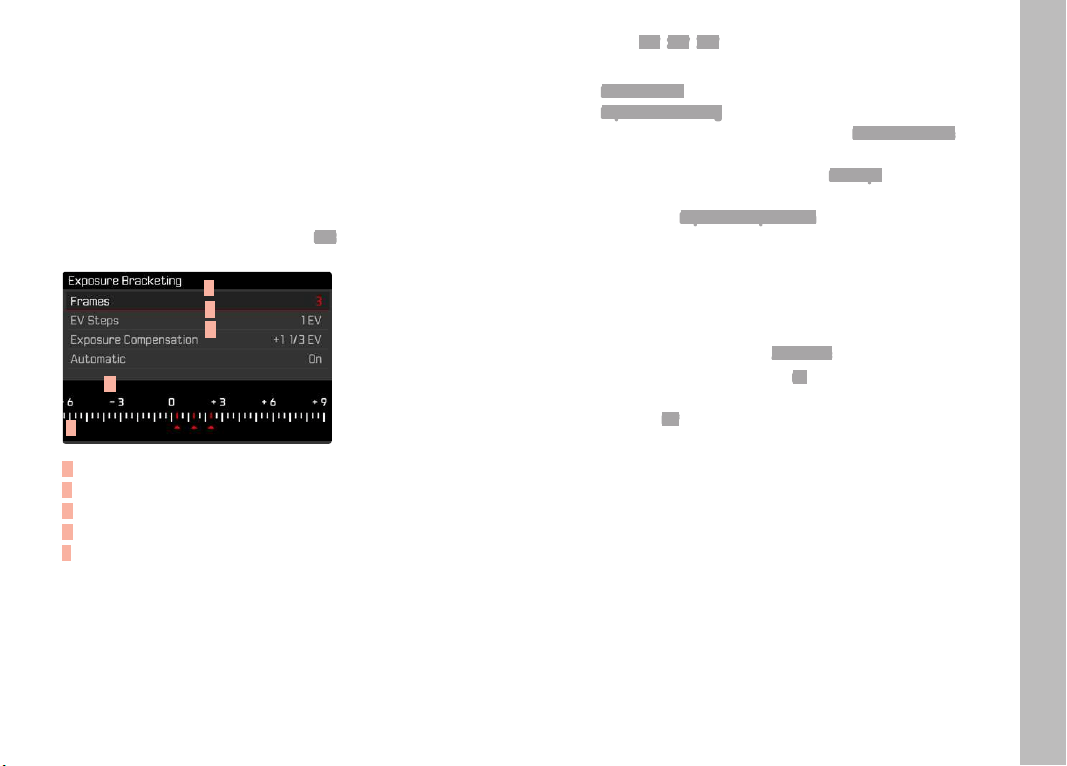
EN
87
BRACKETING
Many attractive objects are rich in contrast, which means they
have very bright and very dark areas. The image effect can be
dramatically different, depending on which of these areas you
choose to align your exposure with. The automatic bracketing
function in aperture priority mode allows you to produce several
alternatives with graduated exposure values and varying shutter
speeds. You can then select the picture you like best or use
relevant picture editing software to calculate an image with a
particularly broad contrast spectrum (
HDR).
A
B
C
D
E
A
Number of pictures
B Exposure difference between the pictures
C Exposure compensation setting
D Light value scale
E Exposure values of the images marked in red.
(The scale will be offset by the relevant value if exposure
compensation is set concurrently.)
3 graduations (1EV, 2EV, 3EV) and 3 or 5 pictures per series are
available.
Select Picture Series in the main menu
Select Exposure Bracketing in the submenu
Select the desired number of pictures under Number of Frames in
the submenu
Select the desired exposure offset under EV Steps in the
submenu
Select the desired Exposure Compensation value in the submenu
• The marked exposure values change positions according to
the settings selected. In the case of exposure compensation,
the scale also shifts.
• The selected exposure compensation value will be applied to
the entire exposure series.
Select the desired setting under Automatic in the submenu
• With the factory setting in place (
On), the entire exposure
series will run after the shutter button is pressed once; when
the setting is Off, each picture must be taken individually.
All pictures are taken by pressing the shutter button once or
several times
Picture Mode
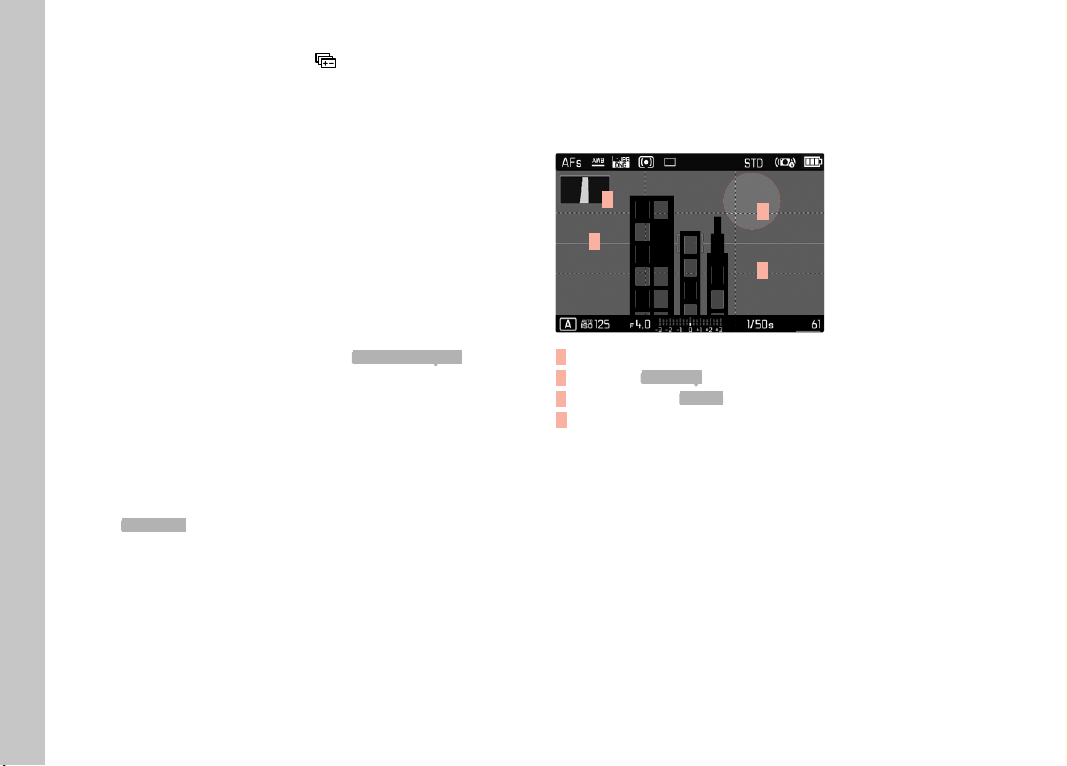
EN
88
Notes
• Active bracketing is indicated by
on screen. You can watch
the eff ect of the function on screen while the pictures are taken
(brighter or darker).
• Depending on the exposure mode chosen, graduations are
generated by changing the shutter speed (
P/A/M) or the
aperture value (
S).
• The picture sequence: Underexposure/correct exposure/
overexposure
• The working range for automatic bracketing may be limited
depending on the available shutter speed/aperture combination.
• With automatic ISO sensitivity control enabled, the sensitivity
calculated by the camera automatically for the raw picture will
also be applied to all other pictures in a series, i.e. the ISO value
will not change during bracketing. This may mean that the
slowest shutter speed specifi ed under
Min. Shutter Speed is
exceeded.
• The focus range for automatic bracketing may be limited
(depending on the originally set shutter speed). The specifi ed
numbers of pictures will be taken regardless. Several pictures in
a series may consequently be taken with the same exposure
values.
• The function remains active until another function is selected in
the
Drive Mode submenu or the camera is switched off and on
again. If no other function is selected, another series of pictures
is taken each time the shutter button is pressed.
OTHER FUNCTIONS
AUXILIARY DISPLAYS
Four functions are available.
A
B
D
C
A
Histogram
B Grid lines (
Grid Setup)
C Horizon display (
Horizon)
D Clipping
Note
• The grid display will always appear when activated, i.e.
independent of whether the information in the header and footer
are accessed (see p. 56). With header and footer deactivat-
ed, the level display, histogram and clipping displays will not
appear.
Picture Mode
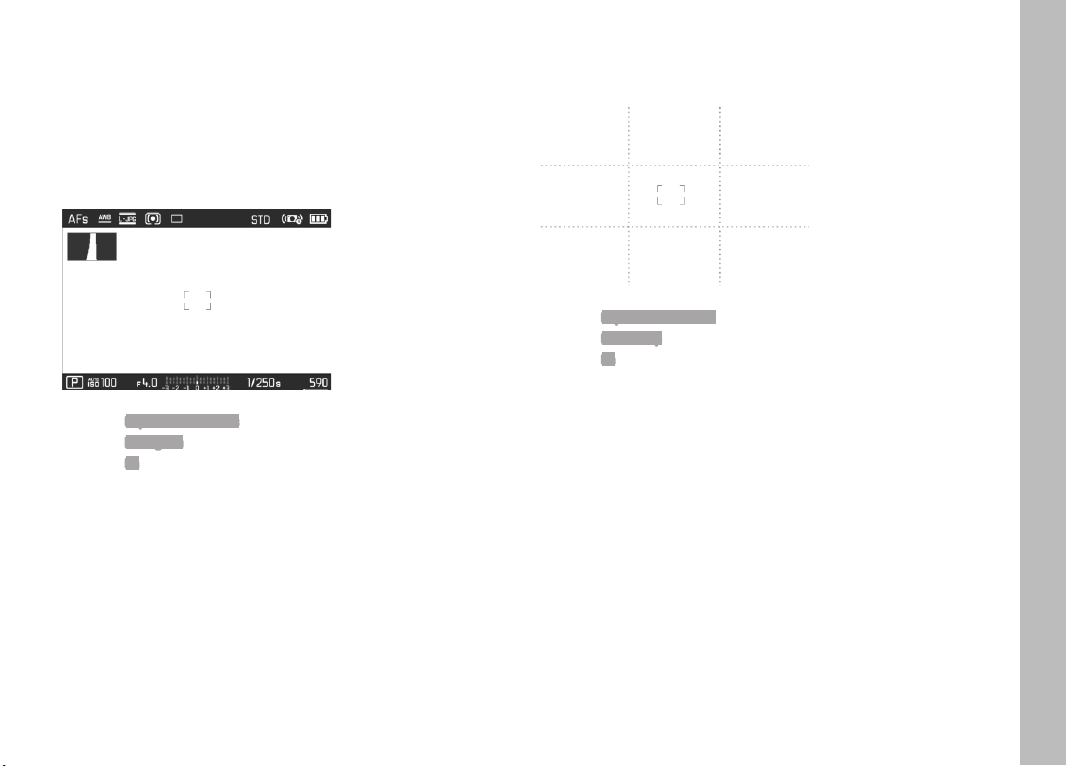
EN
89
HISTOGRAM
Histogram represents the brightness distribution in the picture. The
horizontal axis shows the graduated values from black (left)
through gray to white (right). The vertical axis corresponds to the
number of pixels at each brightness level.
This type of rendering allows an additional quick and easy
assessment of the exposure setting.
Select Capture Assistants in the main menu
Select Histogram in the submenu
Select On
Notes
• The histogram is always based on the brightness displayed;
depending on the settings used, it may not represent the final
exposure.
• In picture mode, the histogram should be regarded as a "trend
indicator" and not as a depiction of the exact number of pixels.
• The histograms when reviewing and taking a picture may differ
slightly from one another.
• The histogram function is not available for the simultaneous
playback of multiple thumbnails or enlarged pictures.
GRID LINES
The grid divides the image field into 3x3 equal fields.
Select Capture Assistants in the main menu
Select Grid Setup in the submenu
Select On
Picture Mode
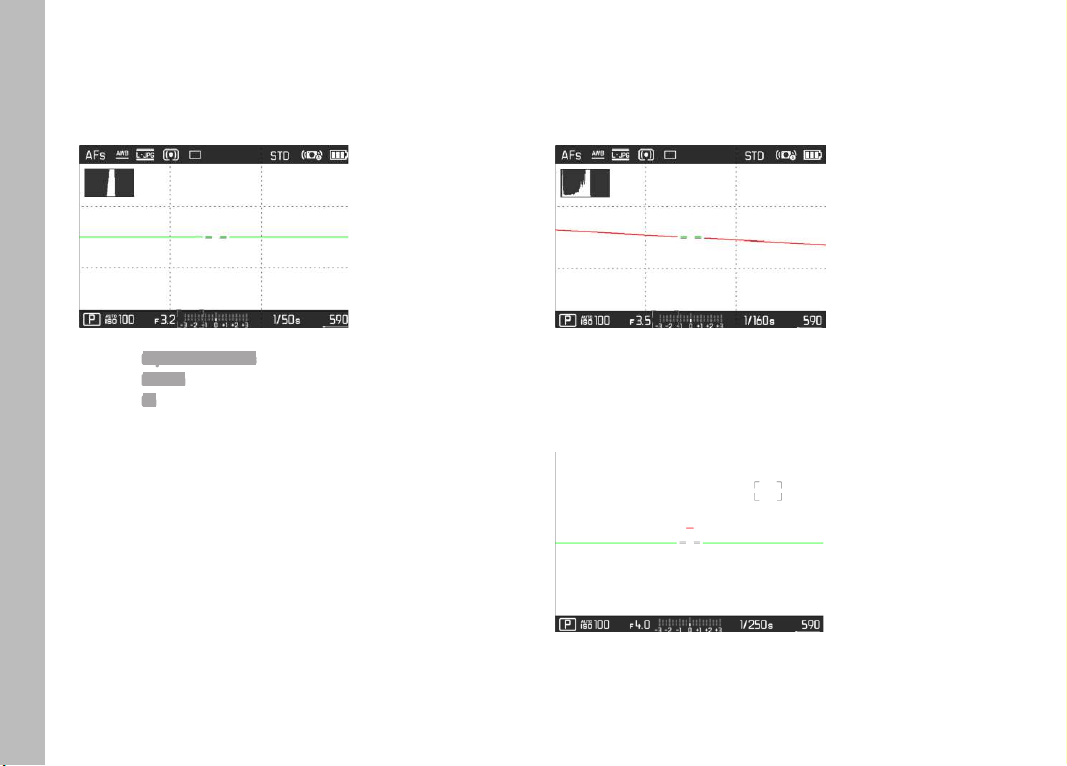
EN
90
HORIZON DISPLAY
The integrated sensors of the camera show its orientation. These
indicators ensure exact camera orientation along the longitudinal
and transverse axes of critical objects, e.g. architecture.
Select Capture Assistants in the main menu
Select Horizon in the submenu
Select On
Two long lines to the left and right of the image center indicate the
longitudinal axis on screen.
– in zero position = green
– in tilted position = red
The transverse axis is indicated in level position by two green
double-lines immediately left and right of the image center. When
the camera is tilted, these lines are white and a short red line
appears above or below them.
Picture Mode
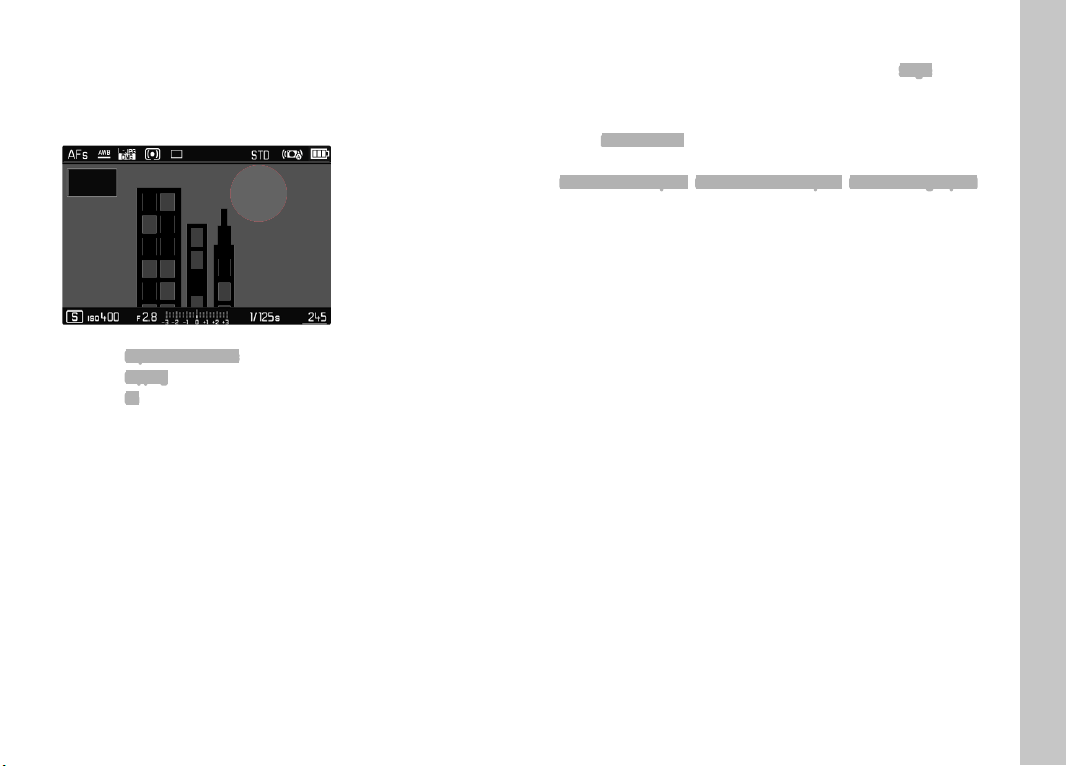
EN
91
CLIPPING
The Clipping display marks very bright image areas. This function is
a very easy and exact tool for checking the correct exposure
setting.
Select Capture Assistants in the main menu
Select
Clipping in the submenu
Select
On
Notes
• The clipping display is not available in video mode.
SERIAL EXPOSURES
The camera is set to single shot exposures by default (
Single). Serial
exposures can also be created to e.g. capture motion sequences at
various stages.
Select
Picture Series in the main menu
Select the desired setting in the submenu
(
Continuous Low Speed, Continuous Medium Speed, Continuous High Speed)
Once you have fi nalized your settings, the camera will take serial
exposures as long as you keep the shutter button pressed down
fully (and you have suffi cient space on your memory card).
Picture Mode

EN
92
Notes
• We recommend deactivating the preview review mode
(Auto Playback/Review) when using this function.
• The specified picture sequence stated in the technical
information refers to a default setting (ISO 200, JPG format L-J PG).
The picture sequence may differ in conjunction with other
settings or depending on the picture content, White Balance
setting and the memory card used.
• Regardless of how many pictures were taken in a series, the last
picture in the series or the last picture saved on the memory
card while the save process is ongoing will be displayed first in
both review modes.
• Serial exposures with Continuous High Speed set are taken at a
frequency of max. 10 fps, provided shutter speeds of 1/60 s or
faster are used.
• Serial exposures are not possible if a flash is used. Only a single
picture will be taken if the flash function is activated.
• Serial exposures are not available in combination with the
self-timer function.
• The exposure frequency will slow down after a series of max. 33
exposures (DNG + JPG). This slow-down is due to the time required
to transfer the data from the buffer memory to the card.
1
mechanical/electronic shutter
INTERVAL SHOOTING
This camera allows you to capture motion sequences over
extended periods of time automatically using the interval shooting
function. You specify the number of pictures, the intervals between
pictures, and the start time of the series.
The exposure and focus settings are no different from those for
normal pictures, but you should remember that the lighting
conditions may change during the course of the picture series.
SPECIFYING THE NUMBER OF PICTURES
Select Drive Mode in the main menu
Select Interval in the submenu
Select Frames
Enter the desired value
SPECIFYING THE INTERVALS BETWEEN SHOTS
Select Drive Mode in the main menu
Select Interval in the submenu
Select Interval
Enter the desired value
SETTING THE DELAY TIME
Select Drive Mode in the main menu
Select Interval in the submenu
Select Countdown
Enter the desired value
Picture Mode

EN
93
To get started
Press the shutter button
• The time until the first picture and the number of pictures to
be taken are shown in the upper right corner of the screen
image.
• The LCD panel will switch off automatically between
recordings. Tapping the shutter button reactivates the LCD
panel.
• The remaining number of pictures will be displayed briefly
between the pictures and a relevant message will be appear,
once the series is complete.
To cancel a running serial exposure
Switch off the camera
Notes
• The camera may switch off and on again if “Auto power off” is
set and no other camera operation occurs between the
individual shots.
• Interval shooting over an extended period of time in a cold
location or in a place with high temperature and humidity may
result in malfunctions.
• Interval shooting will be interrupted or canceled in the following
situations:
– if the battery is depleted
– if the camera is switched off
Make sure to check the battery for sufficient charge.
• Interrupted or canceled interval shooting an be resumed by
switching the camera off, replacing the battery or memory card
as needed and then switching the camera back on. A prompt will
be displayed on screen if the camera is switched off and on
again while the Interval shooting function is active.
• The interval function remains active after a picture series is
completed, and also after the camera is switched off and on
again, until another exposure mode (picture series) is set.
• The availability of this function does not mean that the camera is
suitable for use as a monitoring device.
• Regardless of how many pictures were taken in a series, the last
picture in the series or the last picture in the series or the last
picture saved on the memory card while the saving process is
ongoing will be displayed first in both review modes.
• The pictures of an interval shoot are marked with in playback
mode.
• The camera may under some circumstances be unable to take
good pictures. That may happen if, for example, focusing was
unsuccessful. In that case, the camera will not take a picture
and the series will continue with the next interval. The message
Some frames were dropped appears on screen.
Picture Mode
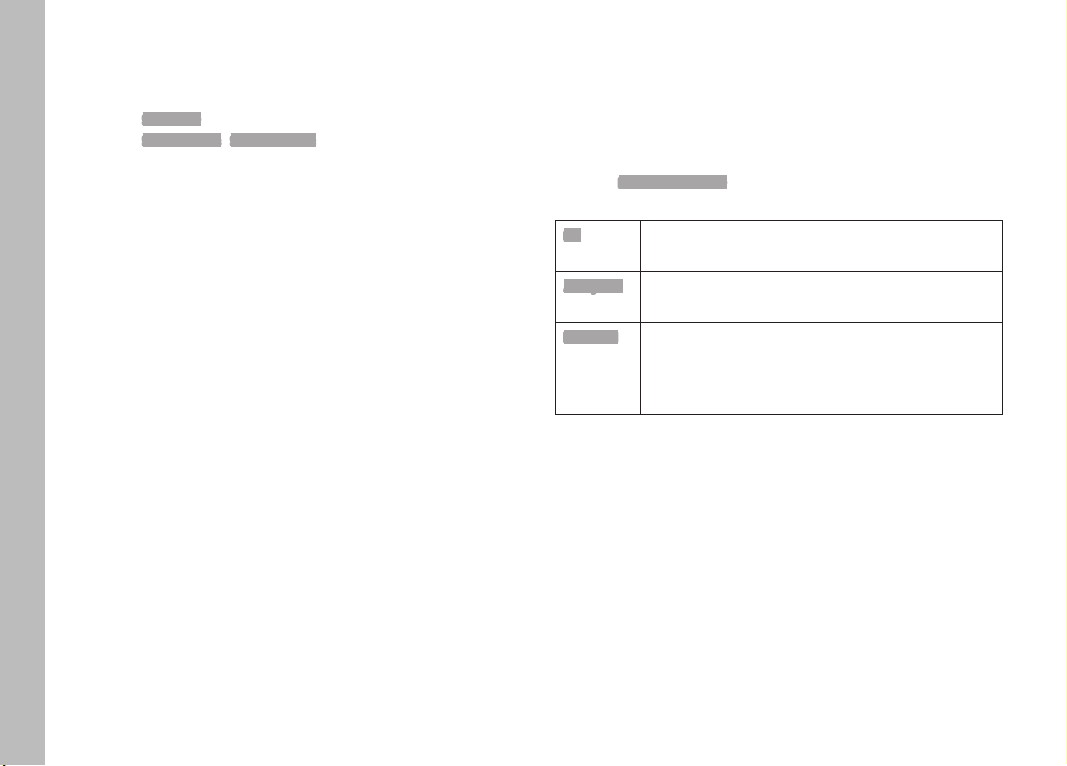
EN
94
SELF-TIMER
The self-timer function allows taking pictures with a preset time
delay. We recommend that the camera is placed on a tripod.
Select Self-timer in the main menu
Select Self-timer 2 s/Self-timer 12 s in the submenu
Shutter release
• The remaining time until exposure is counted down on screen.
The self-timer LED at the front of the camera counts down the
delay time. It flashes slowly during the first 10s, then fast for
the last 2s.
• The self-timer delay time can be canceled at any time by
taping the shutter button; the relevant settings remain intact.
Notes
• The self-timer function remains active until it is deactivated via
the menu or the camera is switched off.
• The self-timer function is only available for individual recordings.
ELECTRONIC SHUTTER
The LeicaCL comes equipped with a mechanical shutter and a
purely electronic shutter function. The electronic shutter expands
the available shutter area and functions completely noiseless,
which may be important in some work environments.
Select Electronic Shutter in the main menu
Select the desired setting in the submenu
Off
Only the mechanical shutter is used. Working range:
30s to 1⁄8000s.
Always On
Only the electronic shutter function is used.
Working range: 1s to 1⁄25000s.
Extended
You can add in the electronic shutter functions if
you need faster shutter speeds than can be
achieved with the mechanical shutter. Working
range: 30s to 1⁄25000s.
Picture Mode

EN
95
FLASH PHOTOGRAPHY
The camera determines the necessary fl ash intensity by fi ring one
or more pre-fl ashes before taking the actual picture. The main fl ash
fi res immediately after, i.e. during exposure
COMPATIBLE FLASH UNITS
The following fl ash units off er a TTL fl ash metering function and –
depending on the model – a varying number of the functions
described in this manual:
– The Leica system fl ash units SF 40, SF 58 and SF 64
– Other Leica system fl ash units, except Leica SF 20
– Other commercially available fl ash units with a standard fl ash
foot and positive center contact
1
(fi red via the center/X
contact).
– Studio fl ash units (fi red via synchronization cable)
We recommend using state-of-the-art thyristor-controlled
electronic fl ash units.
1
Activate the
Flash setting if you will be using fl ash units that are not directly
compatible with the camera and will therefore not automatically adjust the white
balance of the camera.
ATTACHING THE FLASH UNIT
Switch off the camera and fl ash unit
Pull off the accessory shoe cover and store it in a safe place
Slide the foot of the fl ash unit all the way into the accessory
shoe and use the clamping nut (where available) to secure it
against accidental movement
• Movement inside the accessory shoe can interrupt required
contacts and therefore cause malfunctions.
The display for the set fl ash mode appears in white (see next
pages). The fl ash mode will blink red if the fl ash unit is not fully
charged and therefore not ready.
DETACHING THE FLASH UNIT
Switch off the camera and fl ash unit
Detaching the fl ash unit
Replace the accessory shoe cover
Note
• The accessory shoe cover should always be attached when no
accessory is used.
Picture Mode

EN
96
FLASH EXPOSURE METERING (TTL METERING)
The camera offers a fully automated, camera-controlled flash mode
in conjunction with system-compatible flash units (see p. 95)
and for the auto modes aperture priority and manual setting.
In aperture priority mode and with manual setting, the camera also
allows the use of additional flash techniques like flash synchroniza-
tion and firing with slower shutter speeds than the sync time
1⁄250s, which may be interesting in terms of picture composition.
These functions are set on the camera via the menu (please read
the relevant next sections for more information).
The camera additionally communicates the sensitivity setting to the
flash unit. The flash unit can use this information to automatically
adjust its range data, provided the device comes with these
displays and the aperture setting selected on the lens is also
entered manually on the flash unit. The ISO sensitivity setting
cannot be altered via the flash unit on system-compatible units,
because the information is received from the camera.
SETTINGS ON THE FLASH UNIT
Operating mode
TTL
Automatic camera control
A
Aperture priority
M
The flash exposure must be set to an output level to
match the aperture and shutter speed settings
determined by the camera.
Set the flash unit to TTL mode to allow automatic control of the
unit by the camera.
When set to A, subjects with above or below average brightness
may not be exposed correctly.
In M mode, the flash exposure must be set to an output level to
match the aperture and shutter speed settings determined by the
camera by setting an appropriate partial light power level.
Note
Please read the relevant instructions provided with third party flash
units regarding their various operating modes.
Picture Mode

EN
97
FLASH MODES
Select one of the three available operating modes.
– Automatic
– Manual
– Long-term exposure
Factory setting:
Auto
AUTOMATIC FLASH ACTIVATION
That is the default flash mode. The flash unit will fire automatically
if poor lighting conditions would mean slower shutter speeds,
which could result in blurred images.
MANUAL FLASH ACTIVATION
This mode is suitable for backlit pictures in which the main subject
does not fill the entire frame and is in shadow, or in situations
where a fill-in flash will moderate sharp contrasts (e.g. in direct
sunlight). The flash will fire each time a picture is taken, regardless
of prevailing lighting conditions. The flash intensity depends on the
metered ambient brightness: in poor light it is the same output as
in automatic mode, with output decreasing with increasing
brightness. The flash will then work as a fill-in light, e.g. to light up
dark shadows in the foreground or backlit objects, and to create
more balanced overall lighting.
AUTOMATIC FLASH ACTIVATION AT SLOWER SHUTTER
SPEEDS (LONG-TERM SYNCHRONIZATION)
This mode ensures appropriately exposed, brighter dark back-
grounds and bright foreground.
The shutter speed is not extended beyond 1⁄30s in the other flash
modes to minimize the risk of blurring. This may mean, however,
that pictures with flash exposure can end up with objects in the
background not illuminated by the flash and therefore being
underexposed. In this mode, slower shutter speeds (up to 30s) are
permitted to avoid this effect.
Picture Mode

EN
98
FLASH CONTROL
The settings and functions described in the following sections only
apply to settings and functions available in this camera and in
system-compatible flash units.
SYNC POINT
Flash exposures are lit by two light sources:
– Ambient light
– Flash
Any subject elements lit primarily by the flash will almost always be
rendered in perfect focus by the short burst of light, provided the
focus is set correctly. All other subject elements in the same frame
lit by ambient light or lit from within will be rendered with varying
degrees of sharpness. Whether or not these object elements will
be rendered in sharp focus or blurred, as well as the degree of
"blurriness" depends on two interdependent factors:
– the shutter speeds
– The speed of movement of the subject elements or camera
during recording
The longer the shutter speed and the faster the motion, the greater
the difference between the two superimposed partial images.
A flash is usually fired at the start of exposure (Start of Exp.), right
after the first shutter curtain has completely opened the image
window. This may result in apparent contradictions, e.g. the picture
of a vehicle being overtaken by its own light trail. This camera
allows you to synchronize the flash firing with the end of exposure
(End of Exp.), right before the second shutter curtain closes the
image window. The sharp image will in this case be a rendering of
the end of the captured motion. This flash technique creates a
more natural impression of movement and dynamics in the image.
This function is available with all camera and flash unit settings.
Select Flash Settings in the main menu
Select Flash firing point in the submenu
Select a setting
(
Start of Exp., End of Exp.)
Note
When using the flash with faster shutter speeds, a difference
between the two flash times will be barely discernible or only
noticeable for very fast movements.
Picture Mode
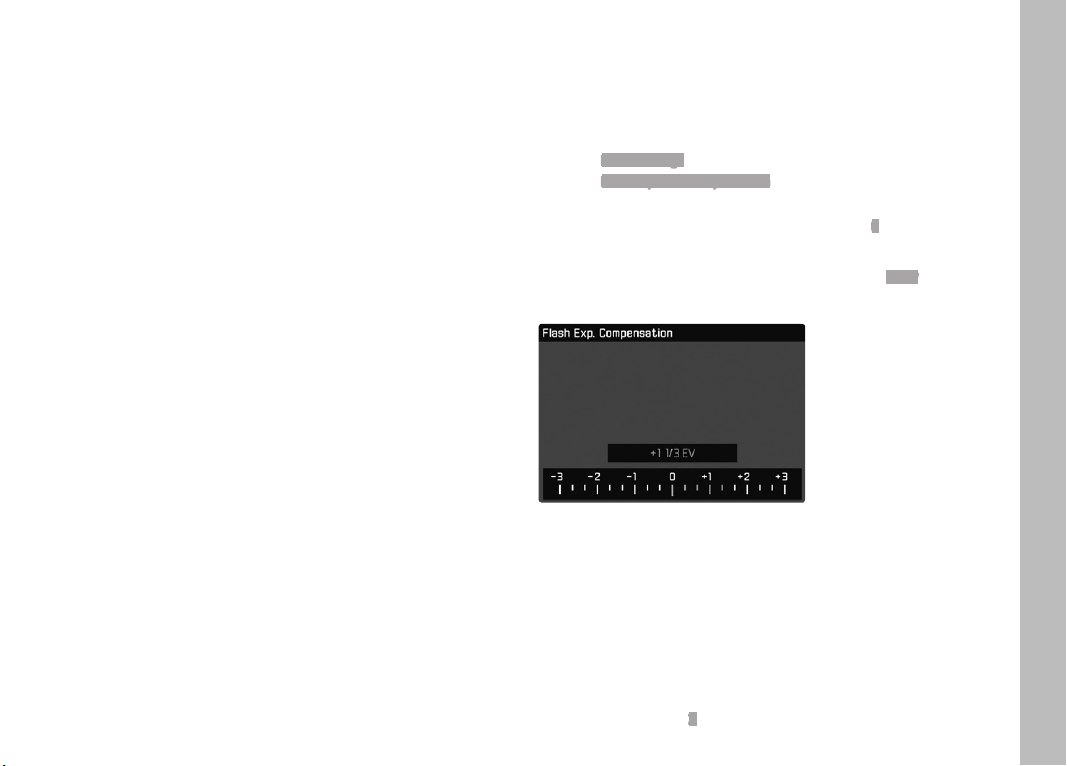
EN
99
FLASH RANGE
The usable flash range depends on the aperture and sensitivity
values set manually or calculated by the camera. It is important to
ensure that the subject is within the relevant flash range for
sufficient illumination. A permanent setting to the shortest
available shutter speed for flash mode (sync time) may often result
in unnecessary underexposure of those subject elements that are
not lit sufficiently by the flash.
This camera allows the fine tuning of the shutter speed used in
flash mode in combination with aperture priority depending on the
conditions of the object or your own picture composition ideas.
FLASH EXPOSURE COMPENSATION
This function can be used to selectively reduce or enhance flash
exposure regardless of ambient light, e.g. to brighten the face of a
person in the foreground when taking a picture outdoors in the
evening while retaining the same general lighting mood.
Select Flash Settings in the main menu
Select Flash Exposure Compensation in the submenu
• The submenu displays a scale with a red setting mark. The
function is deactivated if the value is set to
0.
Set the desired value
• The configured compensation is displayed as
±X EV
1
above
the scale.
1
Example (Plus or Minus): "X" stands for the relevant value.
Picture Mode
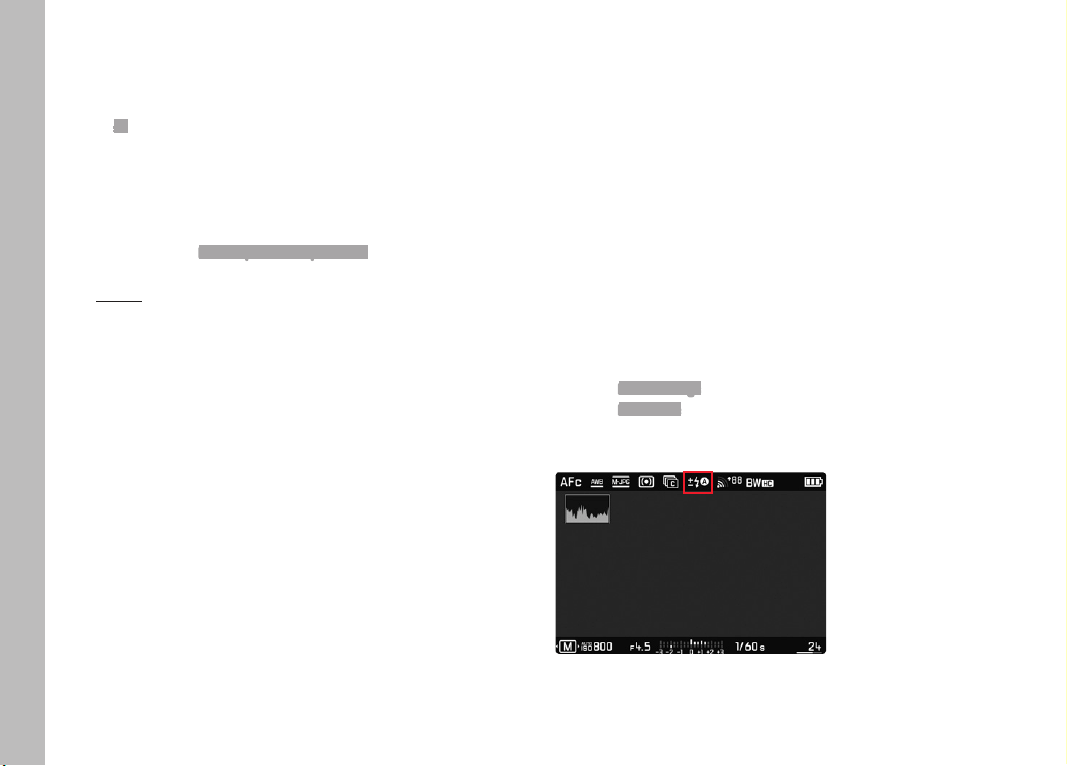
EN
100
Notes
• Flash exposure compensation changes the range of the flash
unit.
• Once set, the compensation value remains active until it is reset
to ± 0, no matter how many pictures are taken or if the camera is
switched off.
• A compensation value configured on the camera will be
overruled when a relevantly equipped flash unit is attached, e.g.
a Leica SF 60 and a compensation value is entered on that flash
unit.
• The menu item Flash Exposure Compensation can only be used in
conjunction with flash units on which the compensation value
cannot be set manually (e.g. Leica SF 26). The settings on the
scale in the camera menu can therefore only be confirmed if a
suitable flash unit is connected and switched on.
• A brighter flash illumination with Plus compensation will require
a greater flash intensity. Flash exposure compensation will
therefore impact on the flash range: A Plus correction will
decrease it, a Minus correction will increase it.
• An exposure compensation set on the camera will only affect
the measurement of ambient light. If a simultaneous TTL flash
exposure metering compensation is desired in flash mode, then
it must be additionally set on the flash unit. (Exception: On the
Leica SF26, the compensation value must be set on the camera
via menu control.)
FLASH PHOTOGRAPHY
Switch on the flash unit
Set the desired guide number control mode (e.g. TTL or GNC =
Guide Number Control) on the flash unit
Switching the camera on
Tap the shutter button before each flash exposure to activate
exposure metering
• The flash unit may not fire if this step is missed by pressing
the shutter button down completely and skipping these
settings.
Set the desired exposure mode, shutter speed and/or aperture
setting
• It is imperative to take note of the shortest flash sync speed,
as it determines whether a "normal" flash or an HSS flash is
fired.
Select Flash Settings in the main menu
Select Flash Mode in the submenu
Select a setting
• The currently active mode is displayed on screen.
}}
Picture Mode

EN
101
Notes
• A flash unit that is not ready to flash may cause incorrect
exposures or error messages.
• Studio flash systems may have a very long flash firing duration. It
may therefore be advantageous to select a slower shutter speed
than 1⁄180s when using such a system. The same applies for
RF-controlled flash firing for so-called "off-camera" flashes, as
the transmission time may cause a delay.
• Serial exposures and automatic bracketing with flash are not
available. With the camera set to one of these modes, there will
be no flash display on screen even if the flash unit is attached
and the flash will not fire.
• The setting (long-term synchronization) is unavailable and
grayed out if a flash unit is attached that is not system
compatible.
• Use a tripod to prevent blurring at slow shutter speeds.
Alternatively, you can select a higher sensitivity.
• A flash unit and the Leica Visoflex electronic viewfinder cannot
be used simultaneously.
Picture Mode
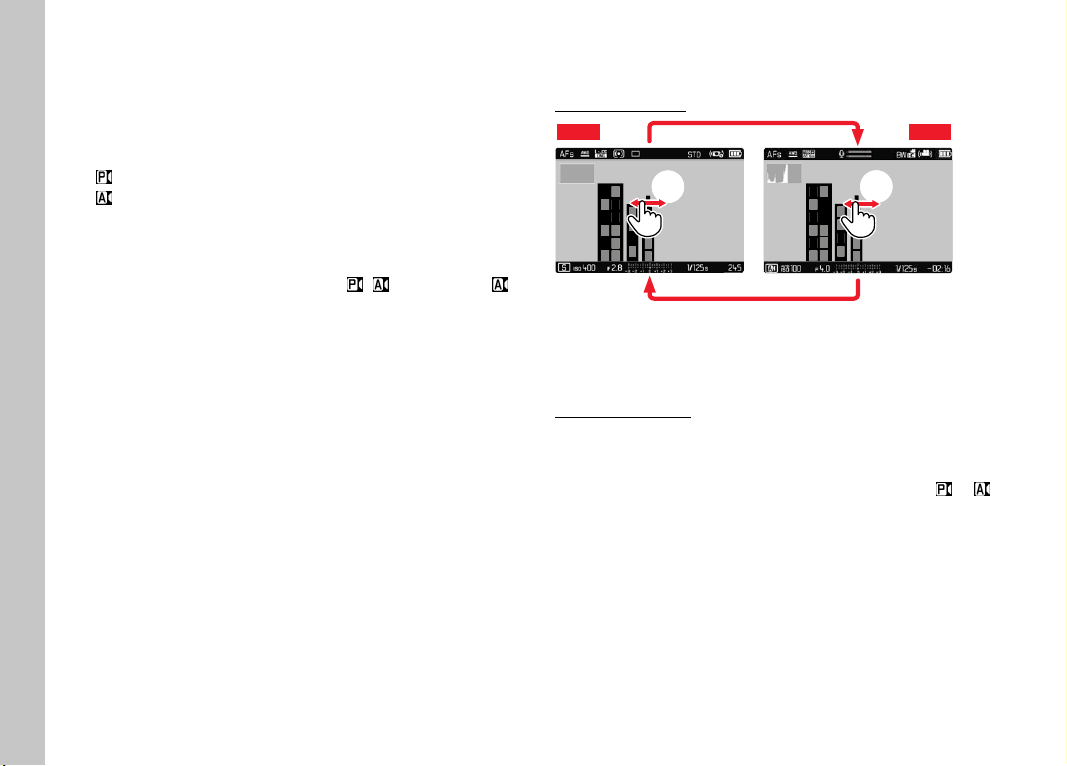
EN
102
VIDEO MODE
START/EXIT VIDEO MODE
This camera is equipped to take pictures and record video.
You can choose one of two video recording modes:
–
: Exposure compensation can be set manually.
–
: Exposure compensation and aperture setting can be set
manually.
All other exposure settings are done automatically.
The setting for exposure compensation (
/ ) and aperture (
only) is done via the setting wheels (see p. 39).
Notes
• As only part of the sensor area is used in video recordings, the
relevantly eff ective focal length is increased, which slightly
reduces the size of the image sections.
• You can record up to 29minutes of uninterrupted video.
• The max. fi le size for uninterrupted video recording is 96 GB.
Once a recording exceeds this fi le size, the overrun will be
automatically stored in a new fi le (but cannot be longer than 29
min).
• Some menu items are unavailable in Video mode. The text in the
relevant line is displayed in gray to signify the existence of a
submenu.
• Only the histogram display is available for video recordings.
There are two methods for toggling between Picture and Video
mode:
Using touch control
VideoPhoto
• The camera switches to the most recently set photo or video
mode.
Using button control
Press the left setting wheel button
• The currently selected mode is shown in the top display.
Turn the left setting wheel to select the desired mode (
or )
• The mode display changes in the top display and on screen.
All modes can be reached by turning the wheel in either
direction.
• The selected mode will be applied automatically approx. 2s
after the setting wheel is moved the last time.
To apply the selected mode immediately
Press the left setting wheel button or the shutter button
Video Mode
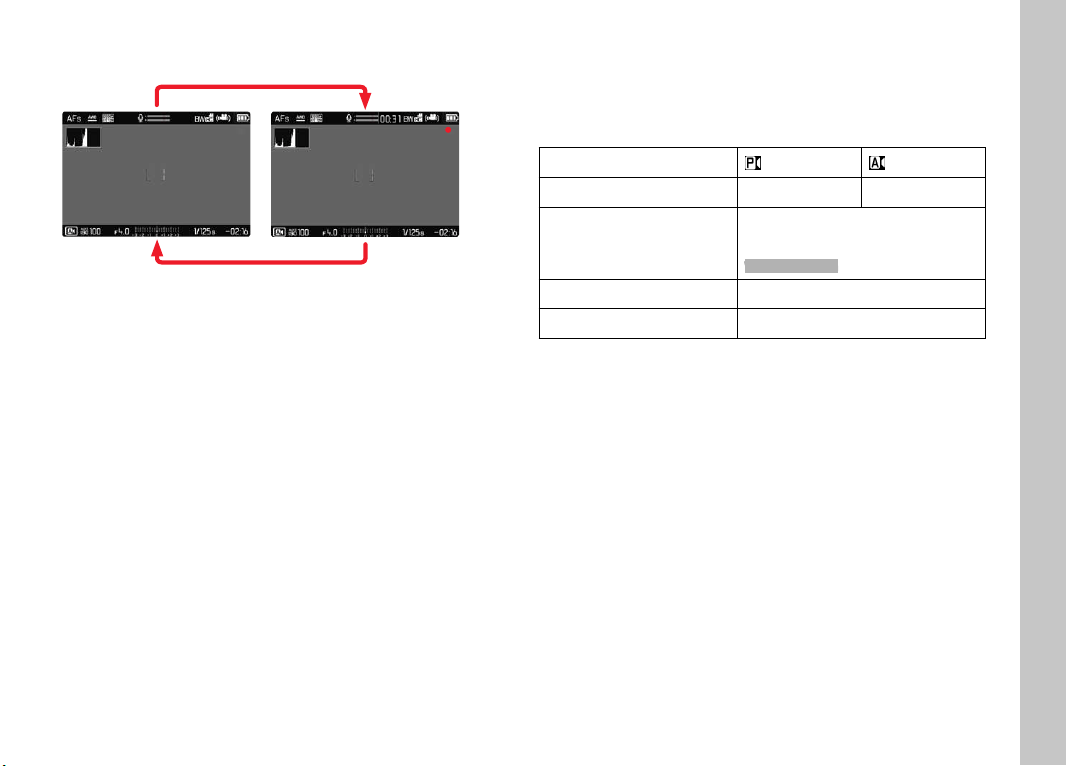
EN
103
START/END VIDEO RECORDING
Press the shutter button
• Video recording begins.
• The dot fl ashes red.
• The Status LED fl ashes.
• Recording time is running.
Press the shutter button again
• Video recording ends.
• The dot lights in gray.
Notes
• Basic recording settings (see p. 58) must be confi gured
before recording.
• No direct access to menu functions is possible during video
recording.
• Automatic exposure control takes into account any fl uctuations
in brightness. Set the shutter time manually if this is undesirable,
e.g. for landscape recordings or panning.
EXPOSURE CONTROL
Exposure control for video recording is completely independent of
the exposure mode or the shutter speed and aperture settings for
photos.
Aperture Automatic Manual
Shutter speed
Automatic
(max. shutter speed limited by
Video resolution)
ISO Automatic ISO 100 to ISO 3200
Exposure compensation Manual
FOCUSING
Focusing can be done during operation, depending on the selected
focus mode:
– by tapping and holding the shutter button (AF)
– by turning the focus ring (MF)
Video Mode
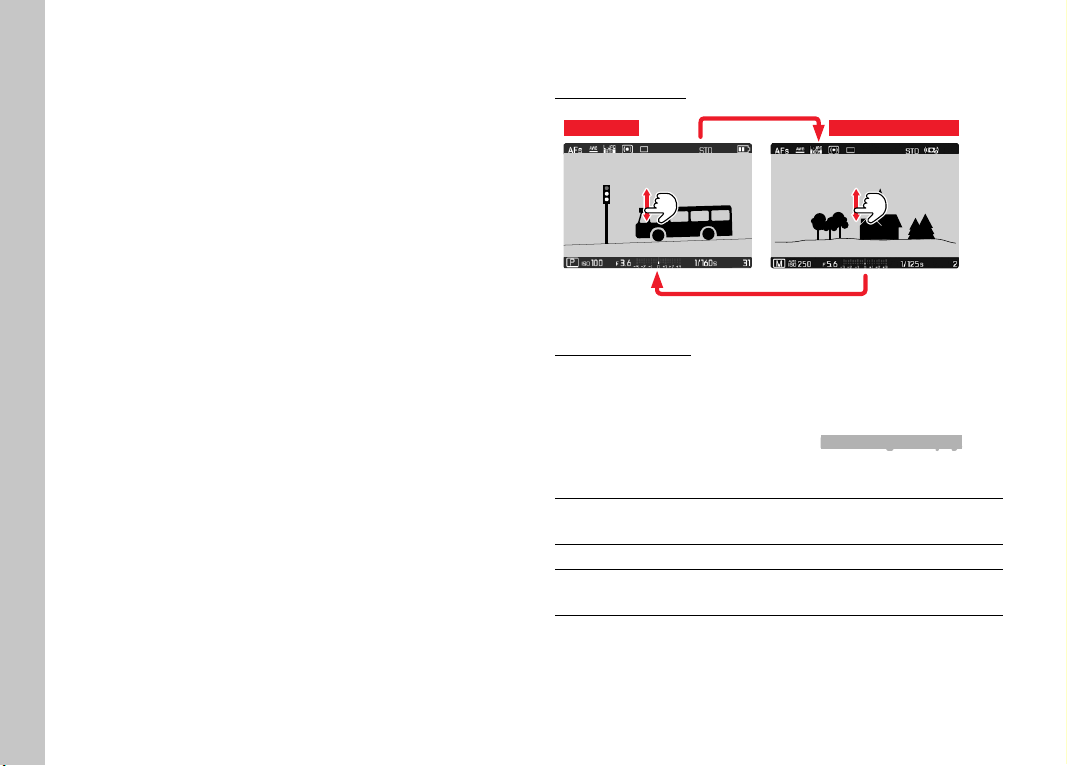
EN
104
PLAYBACK/REVIEW MODE
There are two completely independent playback/review functions
available:
– short-term rendering directly after exposure (Preview)
– normal Review mode, in which the stored recordings can be
viewed and managed for any length of time
The switchover between recording and playback/review mode, as
well as most other actions can be completed using gesture or key
control. Please see p. 40 for more information about the
available gestures.
INITIATE/EXIT PLAYBACK/REVIEW MODE
Using touch control
Review/PlaybackRecording
Using button control
Press the
PLAY button
• The last picture taken appears on the screen.
• The following message appears if the inserted memory card
does not contain any picture data:
No valid image to display.
• The PLAY button function diff ers, depending on the current
camera setting:
Initial situation
After pressing the
PLAY
button
Full screen display of a recording Recording mode
Display of an enlarged cropped
section/or several thumbnails
Full screen display of the
recording
Playback/Review mode
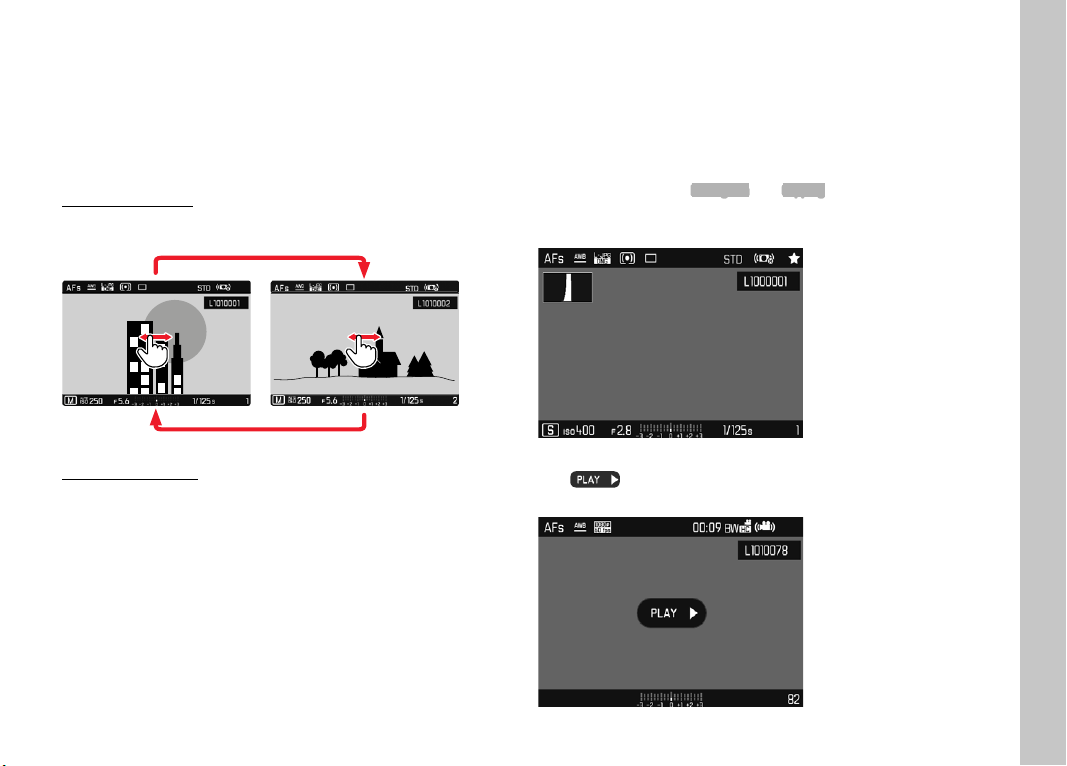
EN
105
SELECTING/SCROLLING THROUGH RECORDINGS
The recordings are visually arranged in a horizontal reel. When the
end of an image series is reached, the display automatically jumps
back to the fi rst image in the series. All recordings can therefore
be reached by scrolling either right or left.
Using touch control
Swipe to the left or right
Using button control
Turn the left setting wheel or press the directional pad right/left
DISPLAYS IN PLAYBACK/REVIEW MODE
With the factory settings in place, recorded pictures will be
displayed without the information in the header and footer lines for
an unobstructed view of the image. The confi gured displays can be
accessed at any time.
Press the center button
• The displays for
Histogram and Clipping will appear if these
functions are activated.
Video recordings are always rendered with header and footer and
with
.
Playback/Review mode

EN
106
Notes
• Recorded pictures are not automatically rotated in Review mode
to utilize the full screen area.
• It may not be possible to render files with this camera that were
not recorded with this device.
• In some cases, the screen image may not have the expected
quality or the LCD panel will remain blank and only display the
file name.
• The histogram and clipping displays are available only when
viewing the full size picture, but not during zooming or in the
overview.
• You can toggle back from playback mode to recording mode at
any time by tapping the shutter button.
DISPLAYING ASSIST FUNCTIONS
The display of histogram and clipping in playback/review mode can
be set separately from the relevant settings for the recording
mode.
Select Playback/Review Mode Setup in the main menu
Select Histogram/Clipping in the submenu
Select On or Off.
Note
• The clipping display is not available in video mode.
Playback/Review mode
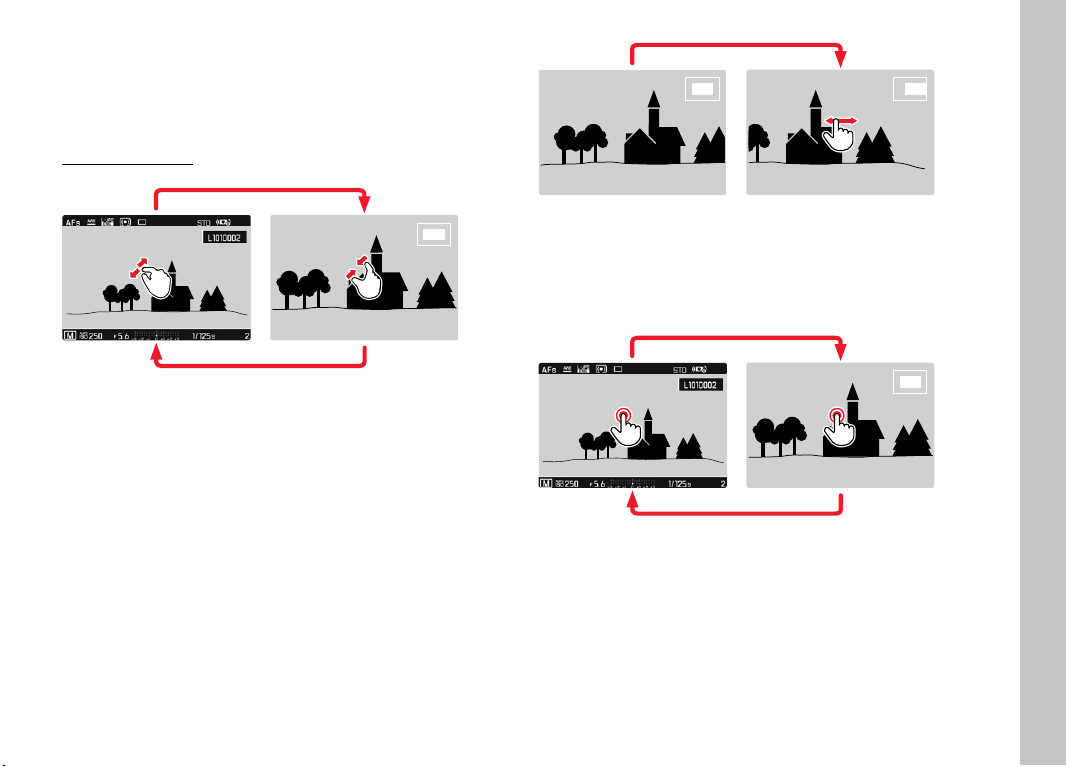
EN
107
CROPPED SECTION ZOOM
You can zoom in to any section of an image for closer inspection.
Zooming via the right setting wheel is done in four increments;
zooming is stepless via touch control.
Using touch control
Two-fi nger pinch/spread
• The central cropped section of the picture is enlarged.
Swiping will allow you to move the position of an enlarged
cropped section
• The rectangle within the frame in the top right corner
represents the currently magnifi ed section, as well as its
position in the image.
Double tap
• Toggles between the third zoom increment at the tap position
and standard full screen view.
Playback/Review mode
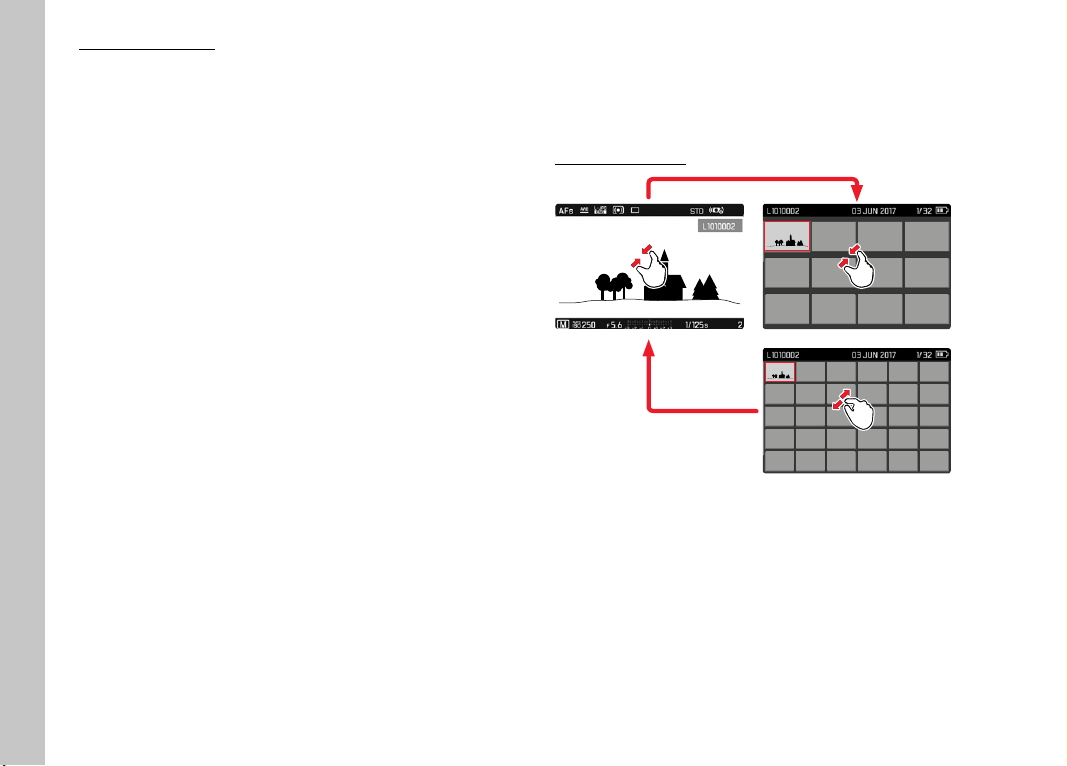
EN
108
Using button control
Turn the right setting wheel
(to the right: increase magnifi cation, to the left: decrease
magnifi cation)
Press the right setting wheel button
• Toggles between the third zoom increment and standard full
screen view.
Press the directional pad to move the cropped section anywhere
in the enlarged image
• The rectangle within the frame in the top right corner
represents the currently magnifi ed section, as well as its
position in the image.
You can move directly from one picture to the next in magnifi cation
mode, which will then also be displayed with the same magnifi ca-
tion.
Turn the left setting wheel to the left/right
To display the recording in full size
Press the right setting wheel button, the center button or the
PLAY button
Notes
• It may not be possible to enlarge pictures taken with other
camera types.
• Video recordings cannot be enlarged.
DISPLAYING MULTIPLE RECORDINGS AT ONCE
The camera off ers an overview function in which several thumbnail
images can be viewed on one screen, which makes it easier to fi nd
a specifi c image. You can choose 12 or 30 images per overview.
Using touch control
Two-fi nger pinch
• The display toggles from 12 to 30 thumbnails.
To view other recordings
Swipe up or down
Playback/Review mode
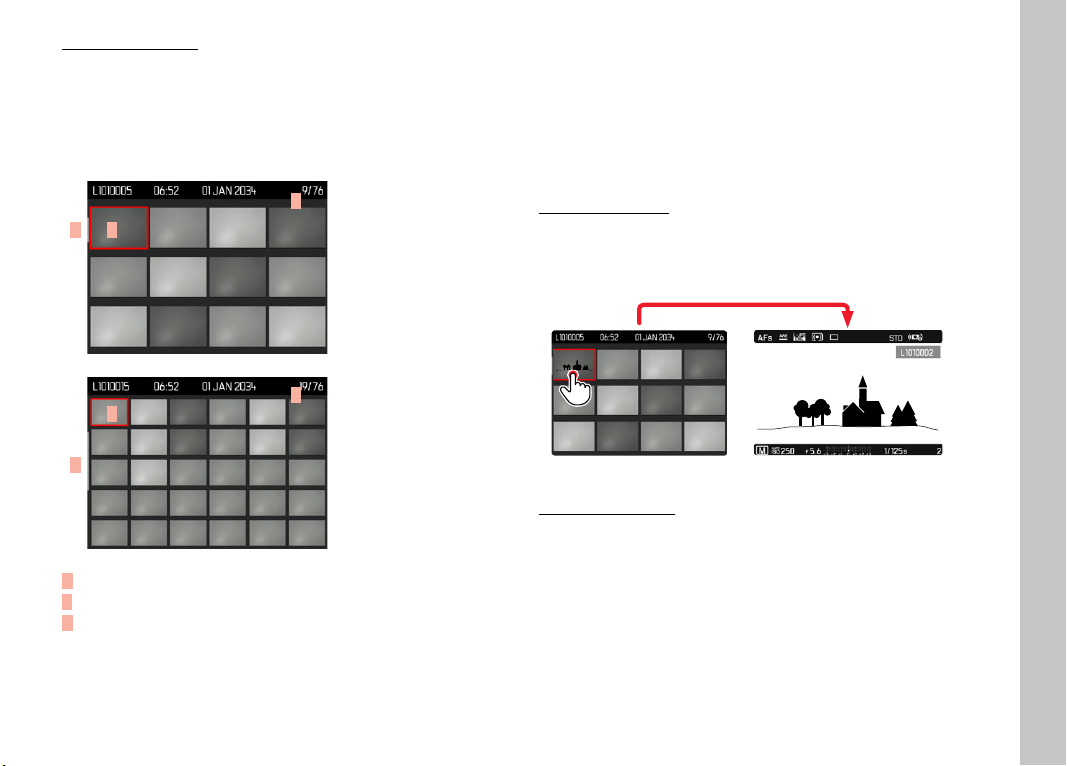
EN
109
Using button control
Turn the right setting wheel to the left
• 12 thumbnails are shown at the same time. Another turn on
the thumbwheel increases the number of displayed recordings
to 30.
A
B
C
A
B
C
A
Currently selected recording
B Number of the currently selected recording
C Scrollbar
The currently viewed recording is framed in red and can be
selected for a closer look.
To navigate between recordings
Press the directional pad left or right as needed
or
Turn the left setting wheel
To display the recording in full size
Using touch control
Two-fi nger spread
or
Briefl y touch the image
Using button control
Turn the right setting wheel to the right
or
Press the right setting wheel button, the center button or the
PLAY button
Playback/Review mode
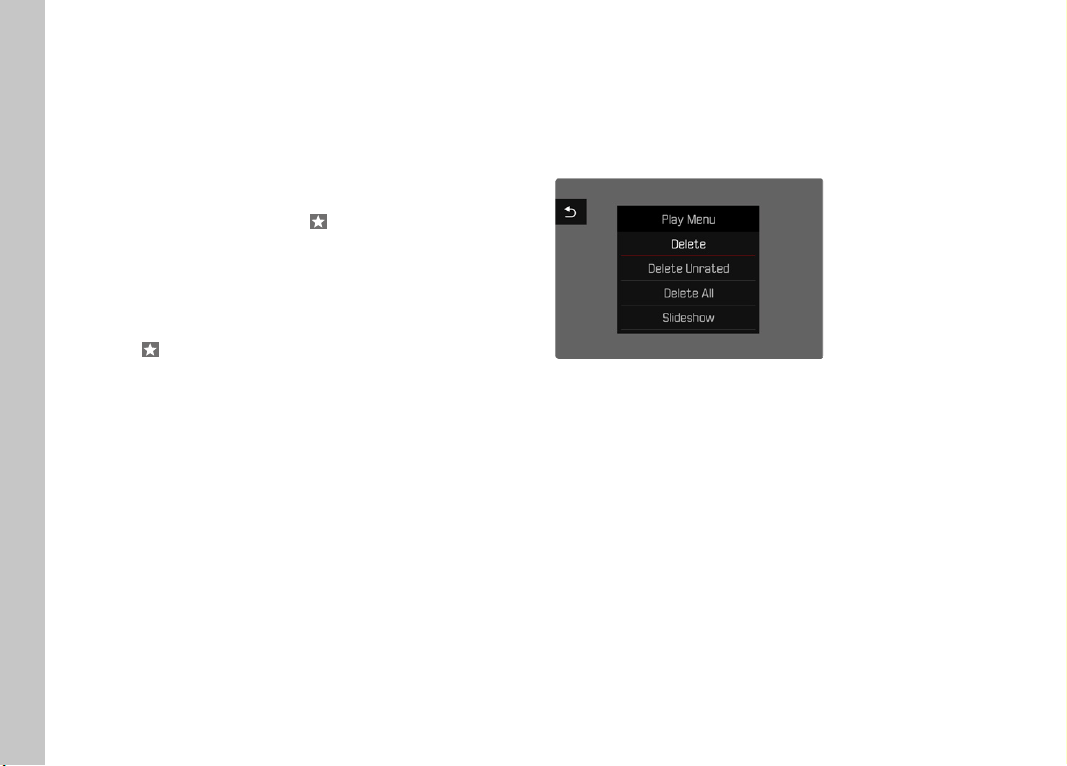
EN
110
TAGGING/RATING OF RECORDINGS
Recordings can be tagged as favorites to fi nd them quicker or to
simplify the later deletion of multiple recordings. Tagging can be
done in regular view mode or in the overviews.
Tagging a recording
Press the left setting wheel button
• The recording is marked with
. The icon will appear in the
header line on the far right when viewing images in full size,
and in the top left corner of the thumbnail in overview mode.
Removing a tag
Press the left setting wheel button
• The
marking disappears.
DELETING RECORDINGS
There are several methods available to delete recordings:
– Deleting individual recordings
– Deleting multiple recordings
– Deleting all recordings without a tag/ranking
– Deleting all recordings
Important note
Once deleted, recordings are no longer retrievable.
Playback/Review mode
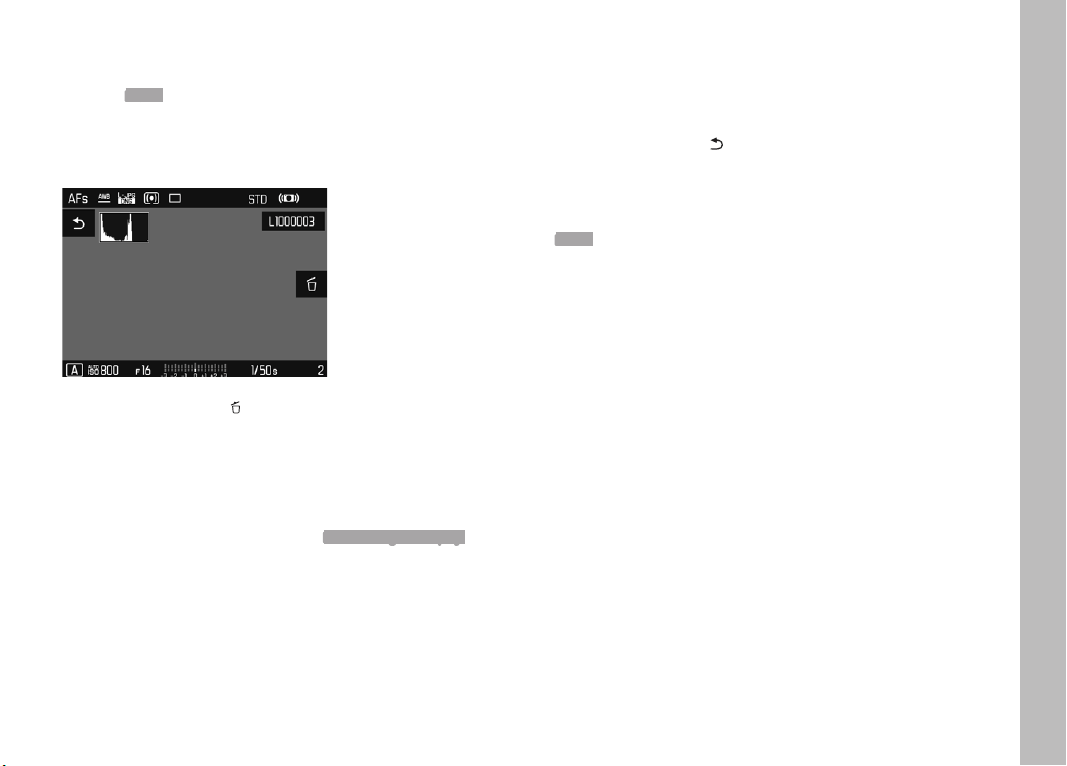
EN
111
DELETING INDIVIDUAL RECORDINGS
Press the MENU button
Select Delete in the Playback/Review menu
or
Press the FN button
• The Delete screen appears.
Select the Delete icon
(tap the icon briefly or press the center button)
• The LED will flash during the delete process. The process may
take a few seconds.
• The next recording will be displayed once deletion is
complete. The following message appears if no other
recordings are saved on the card:
No valid image to display.
To cancel deletion and return to the normal Playback/Review
mode
Press the PLAY button
or
Tap the "Go back" icon briefly
Notes
• The Delete screen can be called up only by pressing the FN
button when in overview mode, because the menu function
Delete of the Review menu is not available in this context.
• The “Scroll” and “Magnify” functions continue to be available
when the “Delete” screen is active.
Playback/Review mode
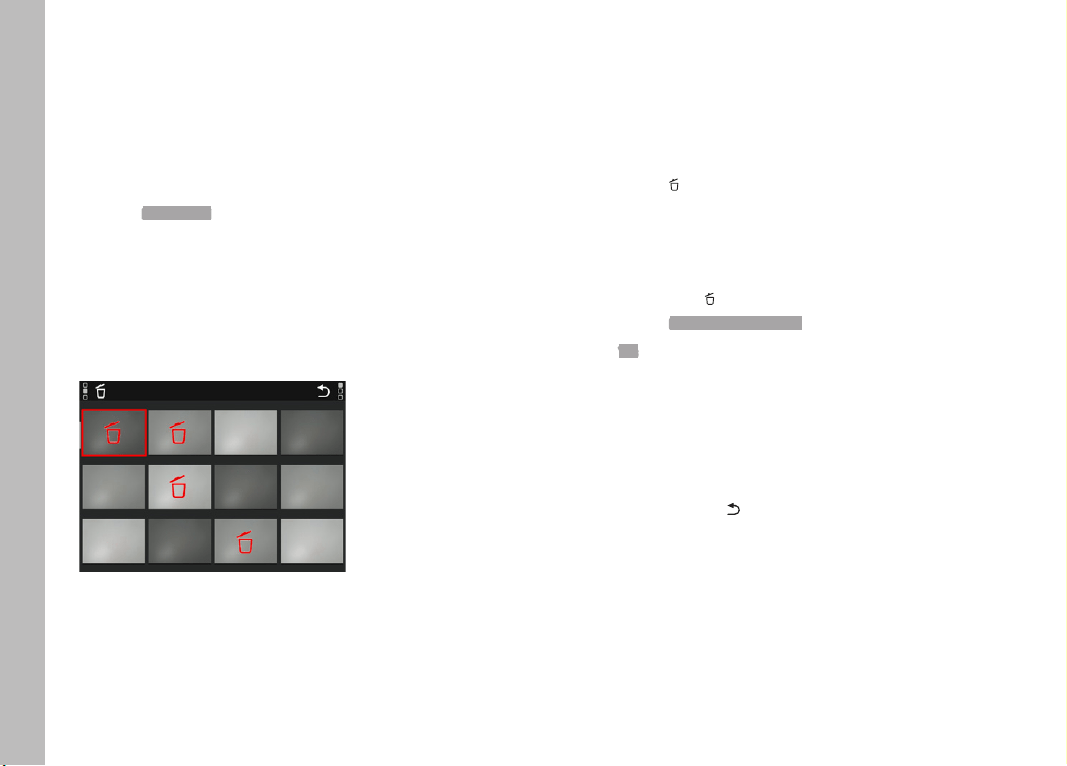
EN
112
DELETING MULTIPLE RECORDINGS
Several recordings can be marked in a Delete overview with twelve
thumbnails and can then be deleted all at once. This overview can
be reached in two ways.
Turn the right setting wheel to the left
• The overview screen appears.
Press the MENU button
Select Delete Multi in the Review menu
• The Delete overview appears.
or
Press the FN button
• The Delete screen appears.
Turn the right setting wheel to the left
• The Delete overview appears.
Any number of recordings can be selected in this view.
Select a recording using the directional pad.
Press the center button/right setting wheel button
or
Briefly touch the image
• The recordings selected for deletion are marked with a red
Delete icon
.
To delete the selected recordings
Press the FN button
or
Tap the Delete icon briefly
• The prompt
Delete all marked files? appears.
Select Yes
To cancel deletion and return to the normal Playback/Review
mode
Press the PLAY button
or
Tap the "Go back" icon briefly
Playback/Review mode
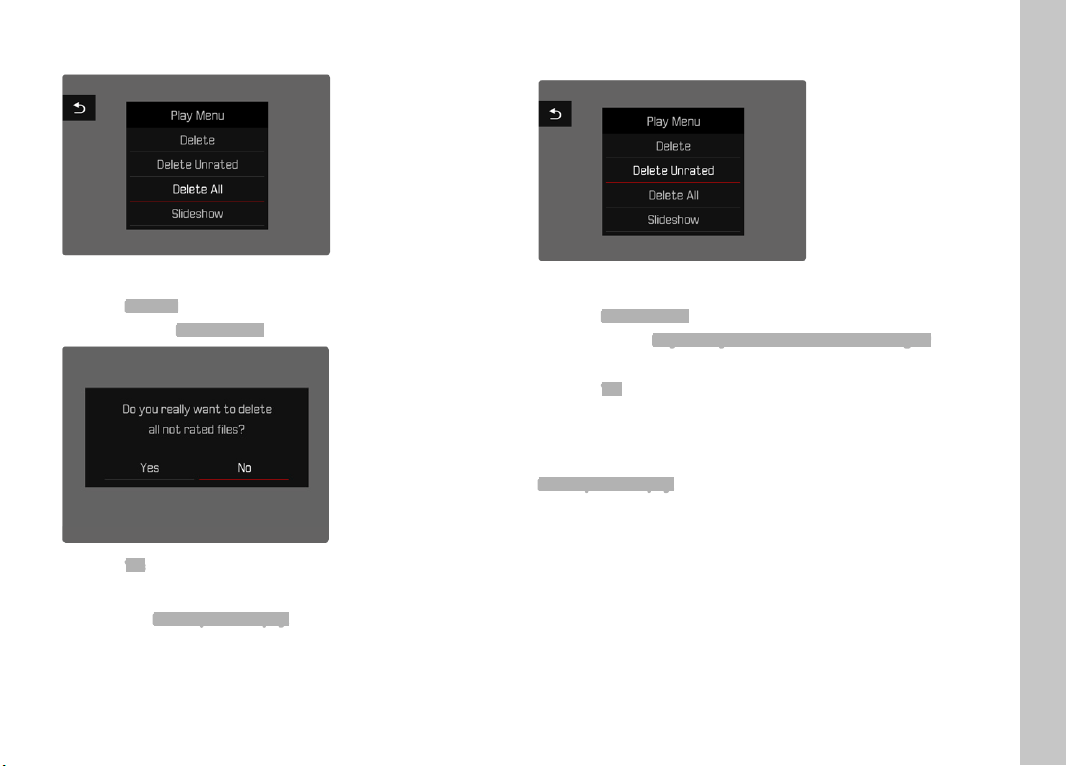
EN
113
DELETING ALL RECORDINGS
Press the MENU button
Select
Delete all in the Review menu
• The prompt
Delete all files? appears.
Select Yes
Note
The message
No valid picture to play. appears after successful
deletion. The same picture is displayed again if deletion was
unsuccessful. When deleting several or all pictures/recordings, a
notifi cation screen may appear for the time needed to process the
data.
DELETING UNRATED RECORDINGS
Press the MENU button
Select
Delete unrated in the Review menu
• The prompt
Do you really want to delete all unrated images?
appears.
Select
Yes
Note
The LED will fl ash during the deletion process. The next marked
recording appears once deletion is complete. The message
No valid picture to play. appears if no other recordings are saved on
the card.
Playback/Review mode

EN
114
PREVIEW OF LATEST RECORDING
Photo and video recordings can be displayed automatically directly
after they are taken to e.g. check the success of the recording
quickly and easily. A duration for the automatic display can be
configured.
Select Auto Review in the main menu
Select the desired function and/or duration in the submenu
(Off, 1 s, 3 s, 5 s, Permanent)
Permanent: The most recent recording is displayed until automatic
review is ended by pressing the PLAY button or by tapping the
shutter button.
As long as you keep the shutter button pressed down completely
after the photo/video was taken, the most recent images will be
played back, even if Off, 1 s, 3 s, or 5 s is set.
Notes
• All buttons except the FN button, the menu button and the right
setting wheel button button change to the regular Review mode
and execute their normal functions there for the duration of the
automatic review. The camera will remain in Review mode until it
is exited.
• Tagging and deleting can only be done in regular Review mode
an not during automatic review.
• When pictures were taken with the functions Serial exposures or
Interval shooting, then the last image in the series will be
displayed or – if the save process is still incomplete – the last
image in the series saved to the memory card.
• Where display times were configured (1 s, 3 s, 5 s) automatic
review can be ended immediately by pressing the PLAY button or
tapping the shutter button.
Playback/Review mode
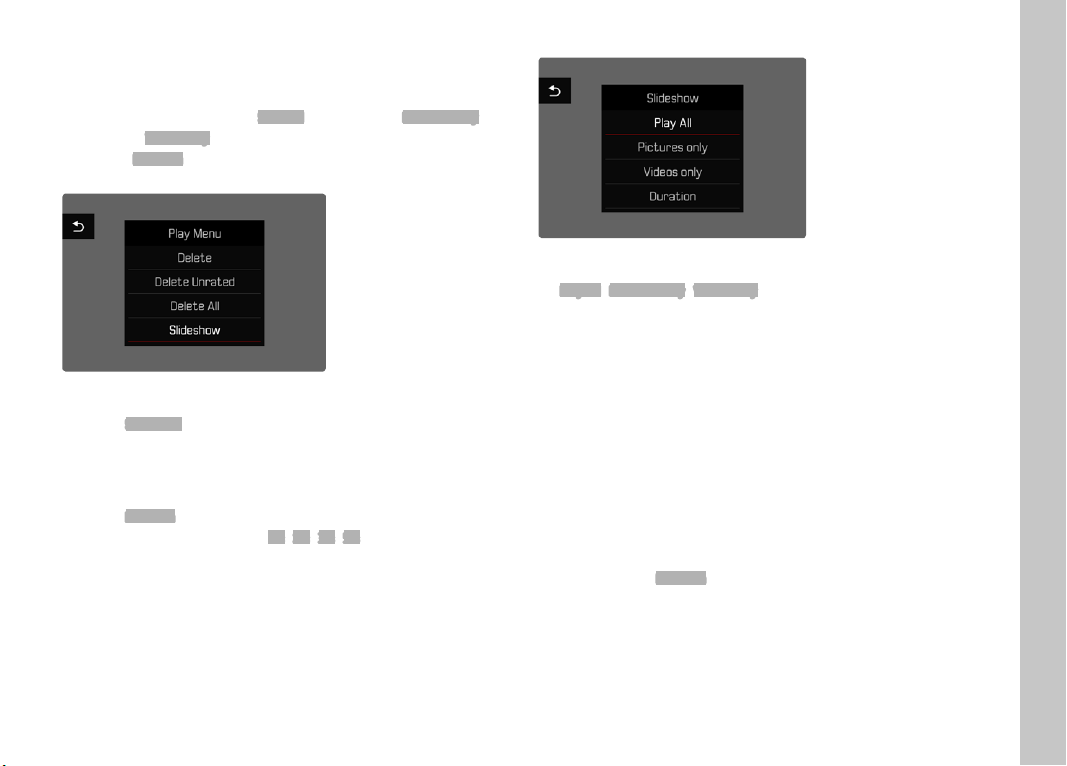
EN
115
SLIDE SHOW
A slide show function is available in Review mode, in which the
saved images are shown automatically in series. The user can
choose to see all recordings (
Show all), only photos (Pictures only) or
only videos (
Videos only) and how long these recordings should be
displayed (
Duration).
Press the MENU button
Select
Slideshow in the Review menu
SETTING THE DURATION
Press the MENU button
Select
Duration in the Review menu
Select the desired duration (
1 s, 2 s, 3 s, 5 s)
STARTING THE SLIDE SHOW
Select the desired setting
(
Play All, Pictures only, Videos only)
• The slide show will start automatically with the selected
recordings and runs in an endless loop until it is exited.
ENDING THE SLIDE SHOW
Press the PLAY button
or
Tap the shutter button
• The camera switches to the relevant mode.
Notes
• An intermediate screen may appear while the data is prepared
for playback.
• The settings in
Duration remain intact even after the camera is
switched off and on again.
Playback/Review mode
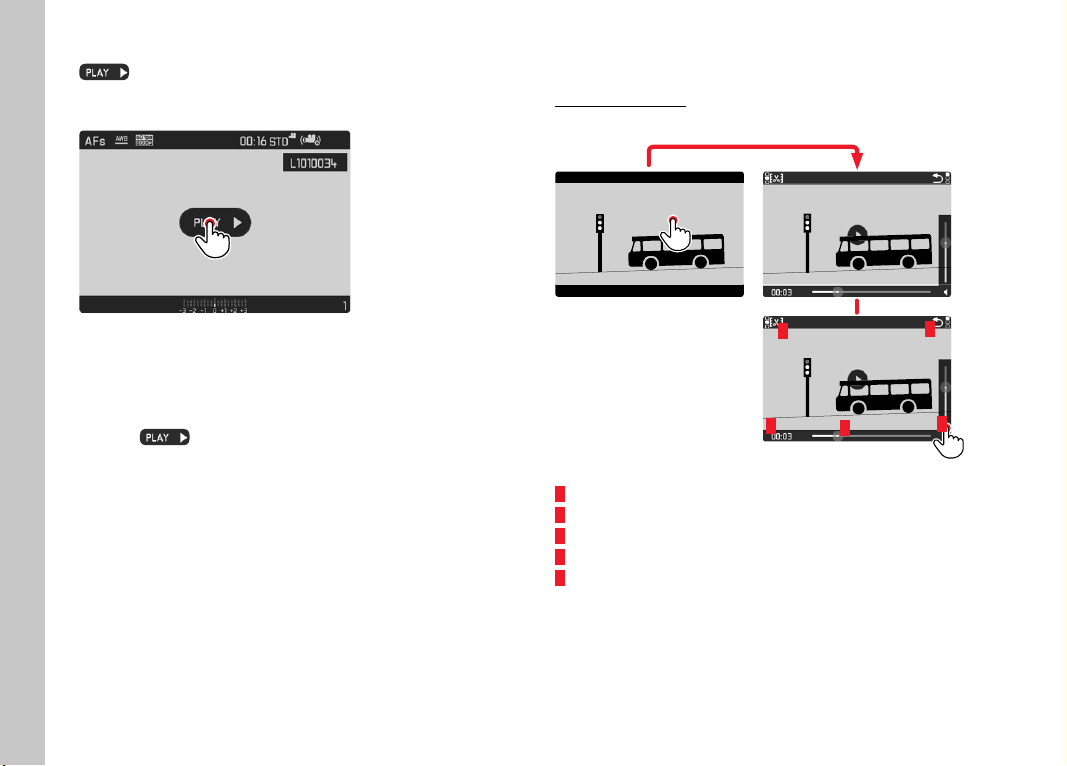
EN
116
VIDEO PLAYBACK
appears on screen if you have selected a video fi le in
playback mode.
START PLAYBACK
Press the center button
or
Touch
briefl y
ACCESSING THE CONTROL ELEMENTS
The control elements are displayed when playback is stopped.
Using touch control
Briefl y tap the LCD panel
2
3
1
4
5
1 Video editing function
2 Exit video playback
3 Playback status bar
4 Elapsed playback time
5 Playback volume
Playback/Review mode
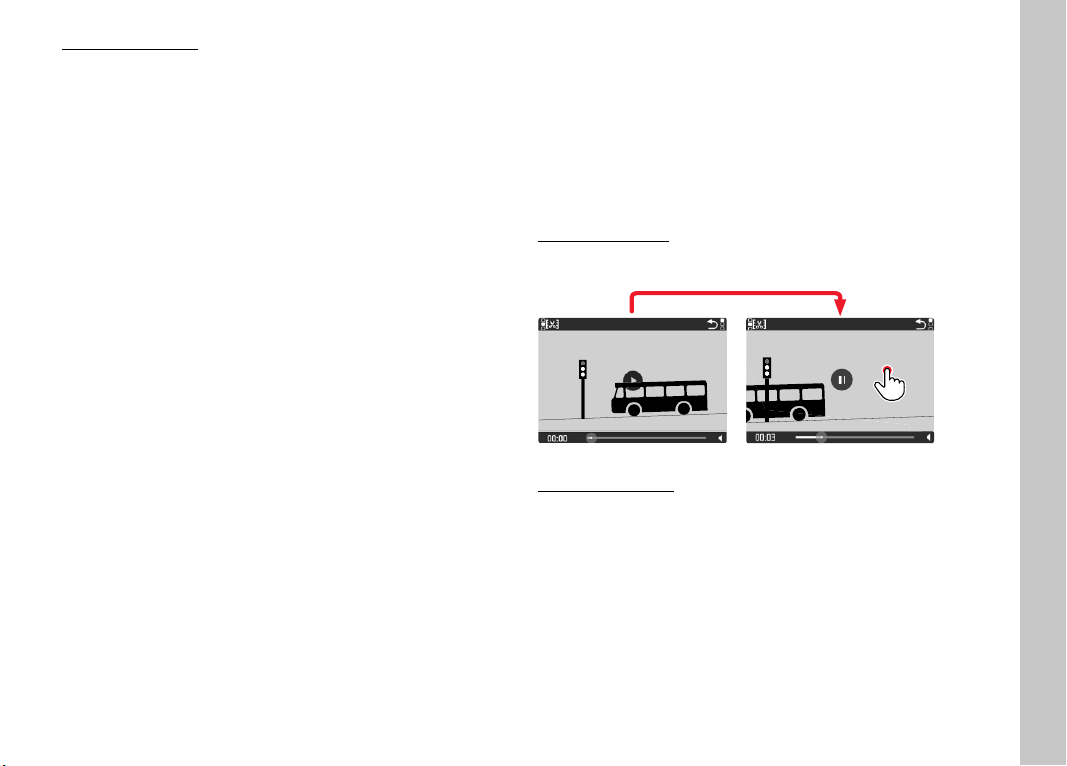
EN
117
Using button control
Press the center button
Note
The control elements disappear after about 3s. Touching the LCD
panel or pressing the center button will cause them to be displayed
again.
PAUSE PLAYBACK
Touch the LCD panel briefl y (anywhere)
or
Press the center button
RESUMING PLAYBACK/REVIEW
While the control elements are visible:
Using touch control
Touch the LCD panel briefl y anywhere in the picture
Using button control
Press the center button
Playback/Review mode
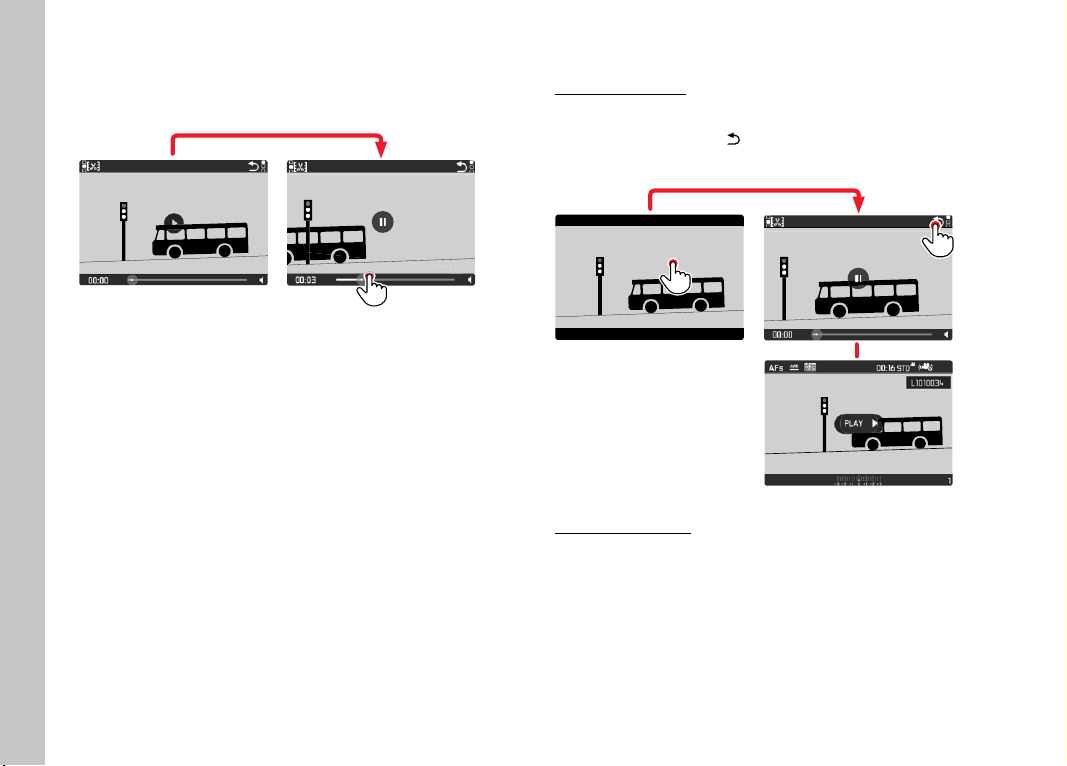
EN
118
CONTINUE PLAYBACK FROM ANY POINT
IN THE FILE
While the control elements are visible:
Touch the playback status bar briefl y at the desired position
END PLAYBACK
Using touch control
When control elements are visible:
Tap the "Go back" icon
briefl y
Using button control
Press the
PLAY button
Playback/Review mode
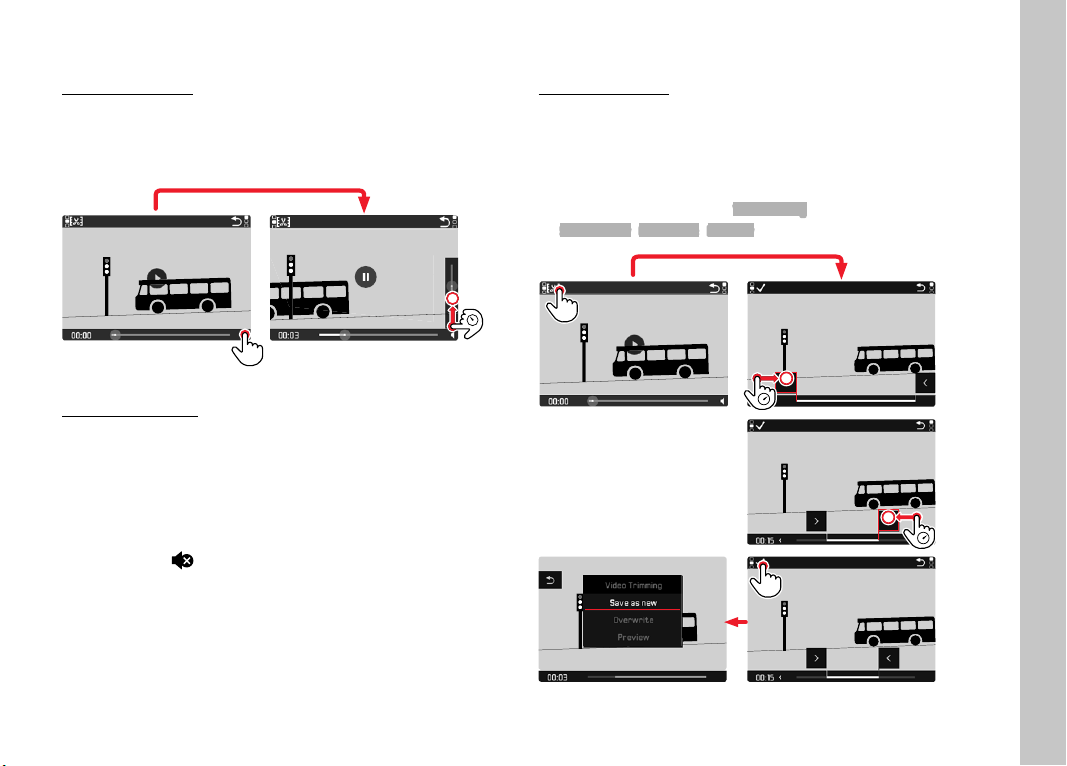
EN
119
SETTING THE VOLUME
Using touch control
When control elements are visible:
Tap the volume icon briefl y
Touch the volume status bar briefl y at the desired position
Using button control
Press the directional pad up/down
• The volume status bar appears.
Press the directional pad up (louder) or down (quieter)
Note
Sound is switched off at the lowest part of the bar and the volume
icon changes to
.
VIDEO EDITING
Using touch control
Access the video editing function (tap the icon at the top left)
Set the left and right cutting position
Confi rm (tap the icon at the top left)
• The video editing submenu appears.
Select a function from the
Video editing menu
(
Save as new, Overwrite, Preview)
Playback/Review mode
EN
120
Using button control
Accessing the video editing function
Press the FN button
• The video editing screen appears, the left cutting mark is
highlighted in red (= active).
Changing and moving cutting points
The cutting point on the left is moved with the left setting wheel,
the one on the right with the right setting wheel
• The selected cutting point is highlighted in red (= active).
• The currently selected time of the relevant cutting point is
displayed at the bottom left of the footer line. A still of the
video sequence at that point is displayed in the background.
Cutting
Press the FN button to confirm the cuts
• The video editing submenu appears.
Note
The editing function can be canceled at any time, provided no
selection was made in the
Video editing menu.
Press the PLAY button
• The video playback screen reappears.
Select a function from the Video editing menu
(Save as new, Overwrite, Preview)
Save as new
The new video is additionally saved, the original
video remains unchanged.
Overwrite
The newly cut video is saved and the original one
is deleted.
Preview
The new video is played. The newly cut video is
not saved and the original remains unchanged.
Note
In all three cases, a notification screen appears while the data is
being processed. Then the new video is played back.
Playback/Review mode

EN
121
Playback/Review mode

EN
122
OTHER FUNCTIONS
USER PROFILES
This camera allows the permanent storage of any menu settings, to
e.g. access them quickly and easily for recurring conditions/image
objects. Six memory slots are provided to store custom settings,
plus the factory setting, which is always available and cannot be
modified (Default Profile). You can assign names for the saved
profiles yourself.
Any profiles configured for the camera can be saved to a memory
card for use on another camera. Similarly, profiles saved on a
memory card can be transferred to the camera.
SAVING CURRENT SETTINGS AS A USER PROFILE
CREATING PROFILES
Saving settings/Creating a profile
Create custom settings for the desired functions via menu
control
Select User Profile in the main menu
Select Manage Profiles in the submenu
Select Save as Profile in the submenu
Select a memory slot
Confirm the selection
Note
A memory slot can only be deleted via the function
Reset Camera
described in the section "Resetting th camera to factory settings"
(see p. 127).
RENAMING PROFILES
Select User Profile in the main menu
Select Manage Profiles in the submenu
Select Rename Profiles in the submenu
Select a profile
Enter a name for the profile via the associated submenu
keyboard and confirm your input (see p. 46)
Other functions

EN
123
APPLY/ACTIVATE PROFILES
Factory setting:
Default Profile
Select User Profile in the main menu
• A list of profile names will appear if user profiles are saved
and activated.
Select a profile
• The selected profile is marked as
active.
• Free memory slots appear in gray.
EXPORTING/IMPORTING PROFILES TO/FROM THE
MEMORY CARD
Select User Profile in the main menu
Select Manage Profiles in the submenu
Select Export Profiles or Import Profiles in the submenu
Confirm the selection
Note
When importing and exporting, all profile slots are transferred to
the card, i.e. including any empty slots. Any existing profiles stored
in the camera will be overwritten, during the profile import.
Individual profiles cannot be imported or exported.
Other functions

EN
124
DATA MANAGEMENT
DATA STRUCTURE ON THE MEMORY CARD
FOLDER STRUCTURE
The files (= pictures) on the memory cards are saved in automati-
cally generated folders. The first three characters signify the folder
number (numerals), the last five the folder name (letters). The first
folder is assigned the name "100LEICA", the second "101LEICA". A
folder will always be created with the next available number; you
can have max. 999 folders.
FILE STRUCTURE
The file names in these folders consist of eleven characters. In the
factory settings, the first file is named "L1000001.XXX", the
second "L1000002.XXX", etc. The first letter can be selected, the
"L" from the factory settings denotes the camera brand. The first
three characters signify the folder number (numerals). The next
four digits denote the sequential file number. Once file number
9999 is reached, then a new folder will be automatically created, in
which the file numbering begins at 0001 again. The last three
places after the dot denote the file format (DNG or JPG).
Notes
• When using memory cards that were not formatted with this
camera, the file numbering will begin with 0001 again. Should
the memory card already contain a file with a higher number,
then numbering will be continued from that number.
• A relevant message will be displayed on the LCD panel once
folder number 999 and file number 9999 are reached, and all
numbering must be reset.
• Format the memory card and reset the picture number right
after to reset the folder number to 100.
Other functions

EN
125
EDIT FILE NAMES
Select Edit File Name in the main menu
• A keyboard submenu is displayed.
• The input line contains the factory setting "L" as the first letter
of the file name. Only this letter can be changed.
Enter a letter of your choice (see p. 46)
Confirm
Notes
• The change to a file name applies to all subsequent pictures or
until a new change is made. The sequential number will not be
affected; but it will be reset when a new folder is created.
• During a reset to factory settings, the first letter will always be
reset to "L" and a new folder will be created, in which the file
numbering will once again start with 0001.
CREATING A NEW FOLDER
Select Reset Image Numbering in the main menu
• A relevant prompt is displayed.
Confirm the creation of a new folder (Yes) or cancel the new
folder (No).
Note
The name part (first letter) of a new folder created this way remains
unchanged. The file numbers in that folder will start again at 0001.
Other functions

EN
126
FORMATTING A MEMORY CARD
Memory cards that have already been in use with this camera will
usually not require formatting. An unformatted memory card that is
inserted into the camera for the first time will have to be formatted.
The relevant confirmation screen will be displayed automatically.
We recommend formatting memory cards from time to time,
because residual data traces (data pertaining to individual pictures)
may reduce the card’s memory capacity.
Select Format Card in the main menu
Confirm the selection
Notes
• Never switch off the camera while data transfer is in progress.
• All data previously stored on the memory card will be lost during
formatting. Formatting will not be prevented by the deletion
protection set for individual pictures.
• All images should therefore be regularly transferred to a safe
mass storage medium, e.g. the hard disk of a computer.
• A simple formatting process will initially not irretrievably destroy
existing data on the card. Only the directory will be deleted,
which means the data will no longer be directly accessible. Data
access can be restored with appropriate software. Only data
subsequently overwritten when new data is saved will actually be
irretrievable.
• A memory card should be formatted again in the camera if it
was formatted in another device, e.g. a computer.
• Contact your retailer or Leica Customer Care if the memory card
cannot be formatted/overwritten (see p. 151).
Other functions

EN
127
DATA TRANSFER
The picture data on the memory card can be transferred to a
computer via a card reader for memory cards. Alternatively, the
data can be transferred to a mobile device via the Leica FOTOS
app (see p. 130).
USING RAW DATA (DNG)
You will need specific software for editing data in DNG format, e.g.
the professional raw data converter Adobe® Photoshop®
Lightroom®.
It allows high-quality conversions of stored raw data. It furthermore
provides quality-optimized algorithms for digital color processing,
delivering exceptionally low-noise photographs with incredible
resolution. During editing, you can adjust parameters like
gradation, sharpness etc. in retrospect to achieve the best possible
image quality.
You will receive a temporary membership for the Adobe Creative
Cloud Foto subscription with the purchase of this camera. You will
have to register the camera to use the app (https://owners.
leica-camera.com).
RESETTING THE CAMERA
TO FACTORY SETTINGS
This function allows you to reset all your custom menu settings
back to the factory settings. You can optionally exclude the user
profiles, WLAN settings, and image numbering from the reset
individually.
Select Reset Camera in the main menu
• The prompt "Reset Camera Settings?" appears.
Confirm or reject the reset to factory settings (Yes) / (No)
• Selecting
No will cancel the reset and the display will return to
the main menu. Selecting Yes will trigger additional prompts
regarding the settings you can opt to keep.
Confirm or reject the reset of the user profiles (Yes) / (No)
Confirm or reject the WLAN settings reset (confirm Yes) / (reject
No)
Confirm or reject the reset of the image numbering (Yes)/ (No)
• The message "Please restart the camera" appears.
Switch the camera off and on again
Select your language
Configure the date and time settings, see p. 52
Note
You reset the image file numbering separately via the menu item
Reset Image Numbering (see p. 125)
Other functions

EN
128
FIRMWARE UPDATES
Leica is continuously working on the further improvement and
optimization of your camera. Since many camera functions are
entirely controlled by software, some of these improvements and
additions to the functional scope can be installed in retrospect.
Leica offers firmware updates at irregular intervals, which you can
download from our website.
Leica will notify you of any new updates, once you have registered
your camera.
Find out which firmware version is currently installed
Select Camera Information in the main menu
• The current version designation is displayed next to the menu
item
Camera Firmware Version.
More information about registering, firmware updates and their
downloads for your camera, as well as any amendments and
additions to the details provided in this manual can be found in the
customer area of our website at: https://owners.leica-camera.
com.
UPDATING THE FIRMWARE
Download the latest firmware version
Save the download to the memory card
Insert the memory card into the camera
Select Camera Information in the main menu
Select Camera Firmware Version in the submenu
Select Start Update in the submenu
• The update will start automatically.
Notes
• The message
Battery low will appear if the battery is not
sufficiently charged. Recharge the battery and then repeat the
process described above.
• You will find additional device and country-specific registration
marks and numbers in the Camera Information submenu.
Other functions

EN
129
Other functions
EN
130
LEICA FOTOS
The camera can be controlled remotely using a smartphone/tablet
PC. This will require an installation of the Leica FOTOS app on the
mobile device.
Scan the following QR code with the mobile device
or
The app is available from Apple App Store™/Google Play Store™
CONNECTION
CONNECTION METHOD
There are two methods for establishing a connection between the
camera and a mobile device.
– With WLAN availability:
the
Join WLAN method is recommended.
– With no WLAN availability:
establishing a wired connection (
Create WLAN) may be most
practical.
Via the main menu
Select Leica FOTOS in the main menu
From the playback menu
Press the FN button
• The playback menu appears.
Select Leica FOTOS
• The Leica FOTOS submenu is the same that can be accessed
via the main menu.
Leica FOTOS
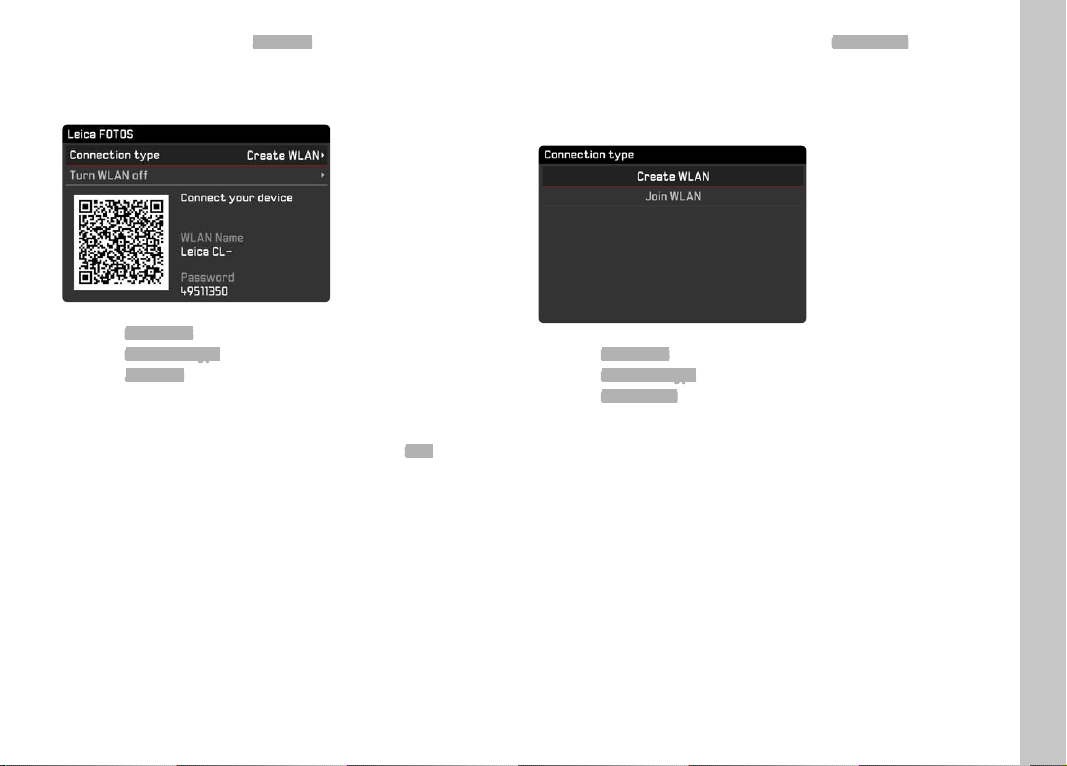
EN
131
ABOUT JOINING A WLAN (Join WLAN)
Access to the available Wifi networks is possible with this function.
When using this method, the camera and the mobile device are
registered on the same WLAN network.
Select Leica FOTOS in the main menu
Select
Connection type in the submenu
Select
Join WLAN in the submenu
• The camera automatically lists the available networks.
Select the desired network from the list
• Repeat the search by selecting the menu item
Scan if the
network you are looking for is not listed.
Press the center button to confi rm the selected network
Enter password (where required)
Notes
• The connection information will be stored until the next reset
of the WLAN settings (see p. 127).
• Connections can only be established with 2.4GHz WLAN
networks.
DIRECT CONNECTION WITHOUT WLAN (Create WLAN)
This function allows access to the camera without an available
WLAN network.
In this method, the camera generates an access point for
registering your mobile device.
Select Leica FOTOS in the main menu
Select
Connection type in the submenu
Select
Create WLAN in the submenu
Leica FOTOS

EN
132
CONNECTING VIA THE MOBILE DEVICE
FIRST-TIME CONNECTION TO A MOBILE DEVICE
In the camera
Providing a WLAN (Create WLAN) or establishing a connection
with an existing WLAN, where the mobile device is registered as
well (Join WLAN)
On the mobile device
Launch the LeicaFOTOS app
Select "Add Camera"
Select the camera model
Scan the QR code
OTHER CONNECTIONS
In the camera
Providing a WLAN (Create WLAN) or establishing a connection
with an existing WLAN, where the mobile device is registered as
well (Join WLAN)
On the mobile device
Launch the LeicaFOTOS app
Select the camera model
Note
A message screen with a countdown will appear if no connection
exists for an extended period of time. The WLAN function will shut
down, once the countdown is complete.
REMOTE CAMERA CONTROL
Leica FOTOS allows controlling the camera remotely to e.g. take
pictures or to transfer recordings to the mobile device.
Notes
• The camera cannot be operated directly while Leica FOTOS is
connected. A prompt to interrupt the WLAN connection will
appear if the camera is operated manually.
• The Status LED will flash green while Leica FOTOS is connected.
Leica FOTOS

EN
133
Leica FOTOS

EN
134
CARE/STORAGE
We recommend the following if the camera will not be used for an
extended period of time:
– Switch off the camera
– Remove the memory card
– Remove the battery (after approx. 2 months the set date and
time will be lost)
CAMERA HOUSING
• Keep your equipment meticulously clean, as any kind of dirt
residue presents a breeding ground for micro organisms.
• Only clean the camera with a soft, dry cloth. Stubborn dirt
should first be moistened with a watered-down detergent and
can then be wiped away with a dry cloth.
• Wet a soft cloth with tap water, wring it out thoroughly and wipe
the camera clean of any salt water spray. Then wipe it down
thoroughly with a dry cloth.
• Wipe the camera with a clean, lint-free cloth to remove stains
and fingerprints. Tougher dirt in hard to reach corners of the
camera housing can be removed with a small brush. Take care
not to touch the shutter blades.
• Store the camera in a closed and padded container to prevent
friction damage and protect it against dust accumulation.
• Keep the camera in a dry, sufficiently ventilated place, where it
will not be subjected to high temperatures and humidity. Make
sure to remove all moisture from the camera if it was used in
humid conditions.
• Do not store the camera in a leather case for extended periods
of time to prevent fungal contamination.
• Empty you camera bag completely if it ever gets wet during use.
Your equipment might otherwise be subjected to moisture and
tanning residue released by the moist leather.
• All mechanical bearings and sliding surfaces on your camera are
lubricated. Remember to press the shutter button several times
every three months to prevent the lubrication points hardening if
the camera will not be used for an extended period of time. We
also recommend repeated adjustment and use of all the other
operating elements.
• When using your camera in tropical climates, make sure to
expose the equipment to sunlight and fresh air as much as
possible to prevent fungal growth. Storage in airtight containers
or cases is recommended only in conjunction with a desiccant
like silica gel.
LENS
• A soft-bristle brush will usually suffice to remove dust from the
outer lenses. Remove more severe soiling with a clean, soft cloth
that is completely free of foreign matter. Wipe the lens in a
circular motion from the center outward. We recommend using
microfiber cloths that come in a protective container and are
available from photography shops and other optical retailers.
These cloths are machine-washable at 40°C. Do not use fabric
softener and do not iron them. Never use spectacle lens
cleaning cloths, as these are soaked in chemicals, which could
damage the glass of the camera lenses.
• Attach a transparent UVA filter for optimal front lens protection
in unfavorable conditions (e.g. sand, salt water spray). Please
remember that the filter may create unwanted light reflections in
some backlight situations and in case of high contrasts.
• The lens caps supplied protect the lens against accidental
fingerprint smudges and rain.
Care/Storage

EN
135
• All mechanical bearings and sliding surfaces on your lens are
lubricated. Make sure to periodically move the focus ring and the
aperture setting ring to prevent seizing if the lens will not be
used for an extended period of time.
VIEWFINDER/LCD PANEL
• Switch off your camera and leave it to stand at room tempera-
ture for around 1 hour if condensation has formed on or in the
camera. The condensation will disappear, once the camera
temperature has reached room temperature.
RECHARGEABLE BATTERY
• Lithium-ion rechargeable batteries should only be stored
partially charged, i.e. not fully depleted or fully charged. The
camera LCD panel will show the current charge level of the
battery. Charge the battery twice a year for around 15 minutes
to avoid deep discharge in case of very long storage periods.
MEMORY CARDS
• Make sure to store memory cards in their anti-static container
when not in use.
• Do not store memory cards where they will be exposed to high
temperatures, direct sunlight, magnetic fields or static
electricity. Always remove the memory card if the camera will
not be used for an extended period of time.
• We recommend formatting the memory card from time to time,
because fragmented residual data from deleted files may block
some of its storage capacity.
Care/Storage
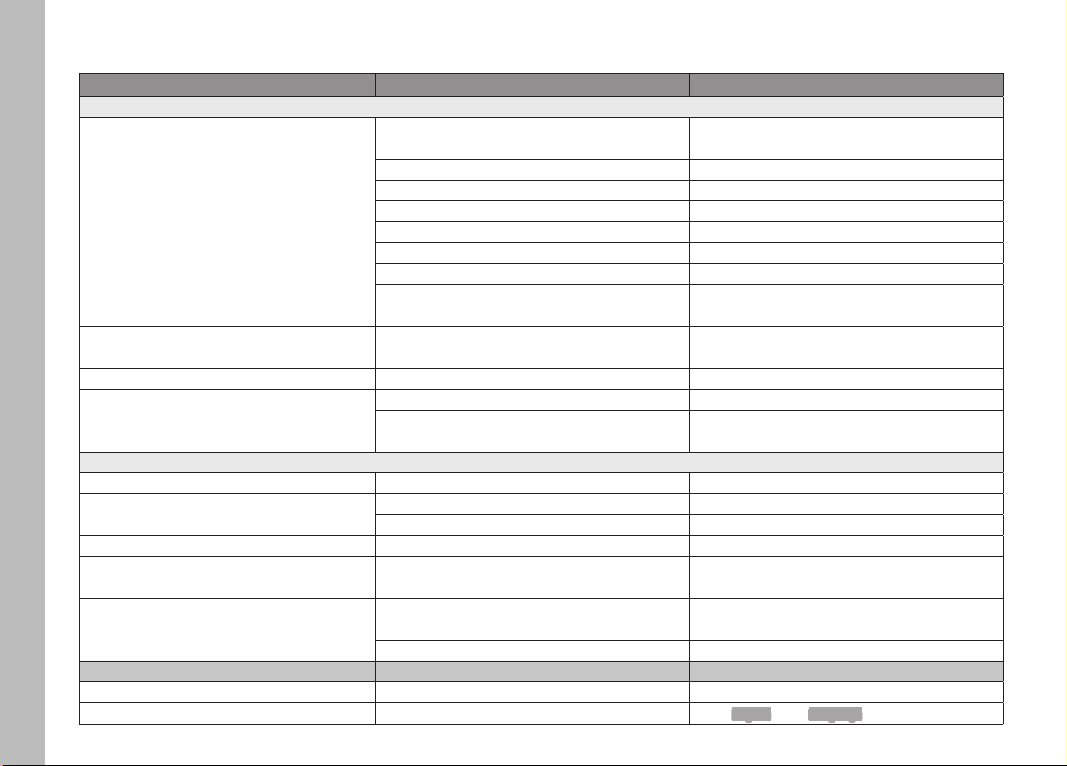
EN
136
FAQ
Problem Possible cause to be verified Troubleshooting suggestions
Battery issues
Battery is depleted too quickly Battery too cold Warm the battery (e.g. in pants pocket) and only insert
directly before use
Battery too hot Allow battery to cool down
LCD panel or EVF set too bright Reduce brightness
Power save mode deactivated Activate power save mode
High consumption AF mode permanently activated Select other mode
Permanent WLAN connection Deactivate WLAN when not in use
Continuous use of LCD panel/Live View mode Deactivate the function
Battery has been recharged too many times The battery has reached the end of its operating time,
replace battery
Charging process not starting Incorrect battery polarization or faulty charger
connection
Check polarization and connection
Charging takes too long Battery too hot or too cold Charge the battery at room temperature
Charging pilot light is on, but battery isn't charging The battery contacts are dirty Clean the contacts with a soft, dry cloth
Battery has been recharged too many times The battery has reached the end of its operating time,
replace battery
Camera problems
The camera suddenly switches itself off The battery is flat Charge or replace the battery
The camera won’t switch on The battery is flat Charge or replace the battery
Battery is too cold Warm the battery (e.g. in pants pocket)
The camera doesn't respond The camera is connected to Leica FOTOS app Terminate the connection
Camera is heating up Heat development due to high-res video recording (4K)
or serial exposures with DNG
Not a fault; allow camera to cool down if it gets too hot
Camera does not recognize the memory card The memory card is not compatible or defective Check the compatibility of the memory card (See
“Technical Data”)
Memory card is incorrectly formatted Format the memory card (Caution: Loss of data!)
Menus and displays
Viewfinder is dark EVF brightness is set too low Set the EVF brightness
Display language is not English -
Select English in the Language menu
FAQ
EN
137
The LCD panel is to dark or too bright/not clear The brightness setting is incorrect Adjust the display brightness
Favorites menu does not appear
The favorites menu is empty Add at least one function
Live View stops suddenly or doesn't start The camera is hot due to high ambient temperature,
extended Live View operation, extended video
recording or serial exposures
Allow camera to cool down
The brightness in Live View mode is not the same
as in the pictures
The brightness settings for the LCD panel have no
influence over the exposures
Adjust the brightness settings as needed
The number of remaining exposures does not count
down after a picture is taken
The exposure requires only very little memory space This is not a fault; the number of remaining exposures
is calculated as approximations
Taking pictures
The camera won’t take a picture/shutter button is
deactivated
Memory card is full Replace the memory card
The memory card is not formated Reformat the memory card
(Caution: Loss of data!)
The memory card is write protected Deactivate the write protection on the memory card
(small lever on the side of the memory card)
Dirt on the memory card contacts Clean the contacts with a soft cotton or linen cloth
The memory card is damaged Replace the memory card
The sensor is overheating Allow camera to cool down
The camera has switched off automatically (automatic
shutdown)
Switch the camera on again
deactivate auto shutdown as needed
Picture data is being written to the memory card and
the cache is full
Wait
Noise reduction function is working (e.g. after night
photography with long exposure times)
Wait or deactivate noise reduction
Battery is depleted Charge or replace the battery
Camera is processing a picture Wait
No picture is taken The camera is connected to the Leica FOTOS app End connection and reconnect
Image noise appears on the LCD panel/in the
viewfinder when the shutter button is pressed to the
first pressure point
The gain is increased to aid image composition if the
object is insufficiently lit with reduced aperture opening
Not a fault – picture quality will not be impacted
LCD panel/viewfinder deactivates after a very short
time
Power Save settings are activated Change the settings as needed
FAQ
EN
138
The display switches off after the picture is taken/
the LCD panel goes dark after the picture is taken
Flash loads after picture is taken, LCD panel
deactivates during load time
Wait until the flash is loaded
Camera does not focus Desired object part is too close to the camera Increase the distance to the subject
Object not suitable for AF Use Focus lock or select manual focus
Flash won't fire The flash cannot be used with the current settings Refer to the list of flash function-compatible settings
Flash is deactivated Select other flash mode
The battery is flat Charge or replace the battery
Pressing the shutter button while flash is still loading Wait until the flash is loaded
Electronic shutter function is selected Change the setting
Automatic bracketing or Picture series is activated Select other mode
The flash does not fully illuminate the object Object is outside the flash range Move object into flash range
Flash is covered Make sure the th flash unit is not covered by your finger
or some object
Image does not sharpen automatically AF is deactivated Activate AF
No face detection/faces are not recognized Face is covered (sunglasses, hat, long hair, etc.) Remove distracting objects
Face takes up to little space in the picture composition Change image composition
Face is tilted or horizontal Keep face straight
Camera not held straight Hold camera straight
Face is insufficiently lit Use flash, improve illumination
Camera selects incorrect object The incorrectly selected object is closer to the image
center that the main object
Change the image section or take picture using the
focus lock
The incorrectly selected object is a face Deactivate face detection
No continuous recording available The camera is overheated and the function was
temporarily disabled to protect the camera
Allow camera to cool down
The image on the LCD panel displays lots of noise Light enhancement function of the LCD panel in dark
surroundings
Not a fault – picture quality will not be impacted
Image storage takes a long time Noise Suppression is activated for long-term exposures Deactivate the function
Manual white balance is unavailable The image object is too bright or too dark
Viewfinder is out of focus Check the diopter setting and adjust as needed
AF metering field is framed in red with activated AF;
images out of focus
Focusing was unsuccessful Try to focus again
FAQ
EN
139
No AF metering field selectable Lock lever for AF in locked position Move lock lever (on the lens) to unlocked position
Automatic Metering Field Control, Portrait Mode in the
Scene Modes menu or Face Detection in AF mode is
selected
Select other control mode
Image Review is activated Deactivate Image Review
Camera is in Standby mode Press the shutter button to the first pressure point
AF assist light does not light up The AF mode 'AFc' is selected or "Continuous AF' is
activated in AFs mode.
Change the mode
Camera is recording a video or is in Live View mode Change the mode
Function is deactivated Activate AF
Video recording
No video is recorded The camera is overheated and the function was
temporarily disabled to protect the camera
Allow camera to cool down
Video recording stops Maximum length of individual video sequence was
reached
The memory card's write speed is too low for the
selected video resolution/compression
Insert another memory card or change the storage
method
Review/playback and video/image management
Pictures taken in portrait format are displayed in
landscape format
- Adjust the display options
Selected images cannot be deleted Some of the selected images are write protected Remove write protection (using the device with which
the file was originally set to write protected)
File numbering does not start at 1 The memory card contains previously stored images
The time and date settings are incorrect or are not
displayed
The camera has not been in use for an extended period
of time (the battery was removed)
Insert a charged battery and configure the correct
settings
The time and date stamp on images are incorrect Time settings are incorrect Set the time correctly
Caution: Time settings will be lost if the camera is not
used/remains in storage with a depleted battery over
an extended period of time
The time and date stamp on images are unwanted Setting was ignored Cannot be removed in retrospect
Deactivate the function as needed
FAQ
EN
140
Pictures/recordings are damaged or missing The memory card was removed while the readiness
indicator was flashing
Never remove the memory card while the readiness
indicator is flashing. Charge the battery.
The memory card formatting is faulty or the card is
damaged
Reformat the memory card
(Caution: Loss of data!)
Review/playback unavailable The camera is connected to Leica FOTOS app Terminate the connection
Picture quality
The picture is too bright Light sensor was covered while picture was taken Make sure that the light sensor is not obstructed
Image noise long exposure times (>1s) Activate the noise suppression function for long
exposure times
ISO sensitivity set too high Decrease ISO sensitivity
Unnatural colors White balance not or incorrectly set Adjust white balance to light source or adjust manually
Round white blotches, similar to soap bubbles Flash photography in very dark environment: Reflection
of dust particles
Deactivate the flash
Images are out of focus Lens is dirty Clean the lens
Lens is obstructed Make sure that lens is unobstructed
Camera moved during exposure Use flash or mount camera on a tripod
Images are overexposed Flash is activated in bright surroundings Change the flash mode
Out of focus/picture stabilizer not functioning Exposure at a dark location without flash Use a tripod
The image is grainy or there is image noise ISO sensitivity set too high Decrease ISO sensitivity
Unnatural colors and brightness Picture taken in artificial light or extreme brightness Set white balance or select correct lighting presets
Picture is too white Strong light source in the image Avoid strong light sources in picture composition
Picture is too white (Half) backlight falling into the lens (also from light
sources outside the image range)
No images are displayed Memory card is empty or not inserted
Images cannot be displayed File name of the image was changed on a PC use appropriate software for image transfers from a PC
to the camera; available from the Leica AG website
Video quality
Video recordings show flickering/stripes Light source interference in artificial lighting
Select a different frame rate (suitable for the local AC
grid frequency) under Video Resolution
Camera noise in video recording The setting dials were used Avoid using the setting dials during video recordings
FAQ
EN
141
No sound on video recording Playback volume is set too low Increase playback volume
Microphone was covered during recording Make sure the microphone is not obstructed while
recording video
Speakers are covered Make sure that speakers are unobstructed during
playback
Microphone was deactivated while recording Activate the microphone
Flickering or horizontal stripes in the video
recording
CMOS sensors will display this phenomenon when light
sources like LED lamps or fluorescent tubes are used
Quality may be improved by selecting a manual shutter
speed (e.g. 1/100s)
Smartphones/WLAN
WLAN connection gets interrupted Camera deactivates when it overheats (safety feature) Allow camera to cool down
Smartphone connection/image transfer not
working
The smartphone is too far away Bring the devices closer to each other
Interference from other devices in the vicinity, e.g.
other smartphones or a microwave oven
Increase distance to interfering devices
Interference from multiple smartphones in the vicinity Re-establish the connection/remove other
smartphones
Smartphone is currently connected to another device Check connection
Camera does not appear on the WLAN configura-
tion screen of the smartphone
Smartphone does not recognize camera Switch the WLAN function of the smartphone off and
on again
FAQ

EN
142
INDEX
Index
Symbole
4K 62
A
A (Aperture priority) 82
Accessory 3
Acoustic Signals 57
AE-L 84
AF 64
AF assist light 68
AFc 64
AF confirmation 57
AF confirmation, signal 68
AF-L 84
AF operating mode 64
AFs 64
Aperture priority 82
Auto ISO 71
Automatic program 75
, 76
Automatic review 114
Auto Power Off, LCD panel 56
B
Bluetooth 6
Bracketing 87
Brightness 55
Brightness, EVF 55
Brightness, LCD panel 55
C
Care 134
Carry strap 26
Center button 39
Center-weighted metering 74
Charger 151
Charger, preparation 26
Charge status, charger 27
Charge status, LCD panel 28
Charging the battery 27
Clipping 91
, 106
Color profile 60
Color saturation 59
Color temperature 73
Connection, mobile devices 130
Contrast 59, 60
Contrast, video 63
Customer service 152
D
Data management 124
Date 52
Deactivation, LCD panel 56
Diopter adjustment 32
Diopters 32
Direct access 50
, 146
Directional pad 39
Display, LCD panel 56
Displays, top display 25
Displays, video 24
DNG 58, 127
E
Editing, video 119
Electronic shutter 94
Electronic shutter sound 57
EVF 54
Exposure compensation 86
Exposure compensation, flash 99
Exposure control, video 103
Exposure metering, flash 96
Exposure, metering method 74
Exposure simulation 83
Eye sensor 55
F
Face detection 66
Factory settings 127
FAQ 136
Favorites 42
Favorites menu 42
, 49
Field metering 65
File format 58
File format, video 62
File name 125
File structure 124
File transfer 127
Film style 60
Filter 34
Firmware update 14
, 128
Fixed ISO value 71
Flash 95
Flash, control 98

EN
143
Index
Flash, exposure compensation 99
Flash, exposure metering 96
Flash, firing point 98
Flash, operating mode 97
Flash, range 99
Flash unit, compatibility 95
FN button 39
Focus assist 70
Focusing 64
Focusing, manual 69
Focusing, video 103
Focus limit 67
Focus peaking 69
Focus setting, video 103
Folder structure 124
Formatting 126
Full HD 62
G
General information 12
Gray Card 73
Grid lines 89
H
Histogram 89
, 106
Home screen 43
Horizon 90
Horizon display 90
I
Image properties 59
Image properties, video 63
Image stabilization 61
Image stabilization, video 63
Individual button assignment 50
Information display 56
Interval shooting 92
ISO Sensitivity 71
ISO value, greatest 71
J
JPG 58
K
Keyboard 45
Key control 42
Keylock 51
L
Language 52
LCD 54
LCD panel, setting 54
Left setting wheel 38
Left setting wheel button 38
Legal information 4
Leica Customer Care 152
Leica FOTOS 6
, 127, 130, 132
Lens 33
Lens, compatibility 34
Lens hood 34
Lens, lens change 33
Lens list 34
Lock 51
M
Magnification 70
, 107
Main menu 42, 43
Main switch 36
Manual focusing 69
Memory card 30, 126
Menu bar 48
MENU button 40
Menu control 42
Menu language 52
Menu navigation 45
MENU Overview 146
Menu screen 43
Metering memory lock 84
Metering method, exposure 74
MF 64, 69
Microphone 62
M lens 35
M (Manual exposure setting) 83
Monochrome 60
Monochrome photography 60
Monochrome recording, video 63
Monochrome, video 63
Multi-field metering 65
, 74

EN
144
Index
N
Number pad 46
O
Operating elements 34
Operating mode, exposure 75
Operating mode, flash 97
Optical image stabilization 61
P
Part Designations 20
P (automatic program) 75
, 76
Picture, series 91
Playback, information screen 105
Playback/Review, automatic 114
Playback/Review mode 104
Playback, video 116
PLAY button 39
Power save mode 53, 56
Power saving, automatic 53
Preview 114
Q
Quick access 50
R
R adapter 35
R adapter L 35
Rating 110
Raw data 127
Rechargeable battery 151
Recording, delete 110
Recording, interval 92
Recording, marking 110
Recording mode 64
Recording mode, video 102
Recording, rating 110
Recordings, scrolling 105
Regulatory information 4
Remote control 132
Replacement parts 3
Reset, camera 127
Reset, image numbering 125, 127
Resolution 58
Resolution, video 62
Right setting wheel 38
Right setting wheel button 38
R lens 35
S
Safety remarks 8
Saturation 59
, 60
Saturation, video 63
Scale 48
Scene mode 77
Scope of delivery 2
Self-timer 94
Serial exposures 91
Setting, video 62
Setting wheel 38
Sharpness 59
, 60
Sharpness, video 63
Shift 76
Shortcut 50
Shutter button 37
Shutter, electronic 94
Shutter priority mode 81
Shutter release 37
Shutter speed/aperture combination
76
Signal 57
Slideshow 115
SL lens 34
Sound 62
Spot metering 65, 74
S (Shutter speed priority mode) 81
Standby mode 53, 56
Storage 134
Submenu 43
Switching off, camera 36
Switching on, camera 36
Sync point 98
T
Technical Data 148
Time 52
, 53
Time zone 53
TL lens 34
Top display 41
Touch AF 67
Touch control 40
Touch screen 40

EN
146
MENU OVERVIEW
DIRECT ACCESS
Available settings: l
Factory setting: l
Favorites menu FN button
Right setting
wheel button
Page
Picture series
l l l l
87, 91-92
Interval
l l l
92
Bracketing
l l l l
87
Self-timer
l l l l l
50, 94
Focusing
l l l l
64-70
AF-L
l l
66, 84-85
AE-L
l l
84-85
AF-L + AE-L
l l
66, 84-85
Focus mode
l l l
64
Focus Limit
l l
67-68
AF mode
l l l
65
Focus assist
l
69-70
Auto Enlargement
l l
70
Focus Peaking
l l
69
Exposure Metering
l l l l l l
74
Exposure Compensation
l l l l
86-87
ISO
l l l l
50, 71
Auto ISO Settings
l l l
71
White Balance
l l l l l
72-73
Gray Card
l l l
73
Color Temperature
l l
73
MENU Overview
EN
147
Favorites menu FN button
Right setting
wheel button
Page
Photo File Format
l l l l l
58
JPG Resolution
l l l
58
Film Style
l l l l
60
Scene Modes
l l l l l
79-82
Optical Image Stabilization
l l l
61
Electronic Shutter
l l l
94
Flash Settings
l l l
98-100
Exposure Preview
l l l
83
User Profile
l l l l l l
122-123
Video Resolution
l l l
62
Video Style
l l
63
EVF LCD
l l
54
Lens Profiles
l l l
35
M lenses
l l
35
R lenses
l l
35
Customize Control
l
39, 49-50, 85
Edit Favorites
l
49
Leica FOTOS
l l l l l
130-131
Wheel Lock in Live View
l l l
51
Format Card
l l l
126
MENU Overview

EN
148
TECHNICAL DATA
CAMERA
Designation
LeicaCL
Camera type
Digital APS-C system camera
Type no.
7323
Order No.
19 300 (silver) / 19 301 (black)
Buffer memory
DNG™: 14 recordings
JPG: 25 recordings
Storage medium
UHS-II (recommended), UHS-I, SD/SDHC/SDXC memory card
Material
Top panel and bottom cover: Milled and anodized aluminum
front and rear housing panels: Magnesium
Lens mount
Leica L bayonet with contact strip for communication between lens and
camera
Compatible lenses
Leica TL and SL lenses, Leica M and R lenses via Leica M or R adapter
L
Tripod thread
A 1⁄4 DIN 4503 (1⁄4”) with stainless steel in the base
Operating conditions
0/+40°C
Dimensions (WxHxD)
131x78x45mm
Weight
approx. 403g/637g (with/without battery)
SENSOR
Sensor size
CMOS sensor, size APS-C (23.6 x 15.7 mm) with 24.96/24.24
million pixels (total/effective), aspect ratio: 3:2
File formats
Photo: DNG™ (raw data), DNG+JPG, JPG
Video: MP4
Picture resolution
DNG™: 6016 x 4014pixels (24MP)
JPG: 6000 x 4000 pixels (24 MP), 4272 x 2856 pixels (12MP), 3024 x
2016 pixels (6MP)
Color depth
14 bit
Color space
Photo: sRGB
Video: sRGB
File size
DNG™: 44MB, JPG: depending on resolution and image content
Video resolution/frame rate
4K (3840 x 2160 pixels): 30 fps
FULL HD (1920 x 1080pixels): 30 fps, 60 fps
HD (1280 x 720pixels): 30 fps
VIEWFINDER/LCD PANEL
Viewfinder (EVF)
Resolution: 1024 x 768 pixels (2.36 MP), magnification: 0.74x, aspect
ratio: 4:3, exit pupil position: 20 mm, setting range +4/-4diopters,
with eye sensor for automatic switchover between viewfinder and LCD
panel
LCD panel
3” TFT LCD, 1.04MP, touch control available
Technical data

EN
149
Top display
Resolution: 128 x 58pixels
SHUTTER
Shutter type
Focal Plane Shutter
Shutter speeds
Mech. shutter: 30s to 1/8000s
Electronic shutter function: 1s to 1/25000s
Flash synchronization: to 1⁄250 s
Shutter button
Two-step (1. step: Activation of the camera electronics including
exposure metering and metering memory lock (in aperture priority
mode); 2. step: firing)
Self-timer
Delay time: 2s or 12s
Picture series
Continuous Low Speed: 2 fps
Continuous Medium Speed: 5 fps
Continuous Medium Speed: 10 fps
FOCUSING
Setting
Automatic (Autofocus) or manual
With manual setting: optional magnifying glass function
(Auto Magnification) and edge marking (Focus Peaking) available as focus
aids
Autofocus system
Based on contrast metering
Autofocus modes
AFs, AFc (with both metering methods, a picture can be taken at any
time), AF setting can be saved
Autofocus metering methods
Spot (can be shifted), Field (can be shifted), Multi-field, Face detection,
object Tracking, optional Touch AF
EXPOSURE
Exposure metering
TTL (exposure metering through the lens)
Exposure Metering Methods
Spot, Center-Weighted, Multi-Field
Exposure modes
Automatic program (P), Aperture priority mode (A), Shutter speed
priority (S),
Automatic (Szene Programme): Full AUTO, Sports, Portrait, Landscape,
Night Portrait, Snow / Beach, Fireworks, Candle Light, Sunset, Digiscoping,
Miniature Effect, Panorama, HDR
Manual: Manual settings for shutter speed and aperture
Exposure Compensation
± 3 EV in 1⁄3EV increments
Automatic bracketing
3 or 5 pictures in increments of 1, 2 or 3EV
ISO sensitivity range
Auto ISO: ISO 100 to ISO 50000
Manual: ISO 100 to ISO 50000
White balance
Automatic (Auto), presets (Daylight, Cloudy, Shadow, Tungsten, Flash), one
memory slot for manual measurements (
Gray Card), manual color
temperature setting
Technical Data

EN
150
FLASH
Flash unit connector
About the accessory shoe
Flash sync time
: 1⁄250s, slower shutter speeds available, automatic changeover to
TTL linear flash mode with HSS-compatible Leica system flash units if
sync time is undercut
Flash exposure metering
Using center-weighted TTL pre-flash metering with Leica flash units (SF
26, 40, 40MkII, 58, 60, 64) or with system-compatible flash units, flash
remote control SF C1
Flash exposure compensation
SF 40: ±2 EV in 1⁄2EV increments
SF 60: ±2 EV in 1⁄3EV increments
EQUIPMENT
Microphone
Stereo
Speaker
Mono
WLAN
The Leica FOTOS app is required to use of the WLAN function. The
Leica app is available from the Apple App Store™ or the Google Play
Store™. Complies with IEEE 802.11b/g/n standard (standard WLAN
protocol), channel 1-11, encryption method: WLAN-compatible WPA™/
WPA2™, Access method: Infrastructure mode
Menu languages
English, German, French, Italian, Spanish, Russian, Japanese, Simplified
Chinese, Traditional Chinese, Korean
Firmware Version
3.0
POWER SUPPLY
Rechargeable battery (Leica BP-DC12)
Lithium-ion battery, rated voltage 7.2V (7.2V DC); capacity
1200mAh, approx. 220 recordings (based on CIPA standard); charging
time approx. 140 min (after deep discharge); manufacturer: Panasonic
Energy (Wuxi) Co. Ltd., Made in China
Charger (Leica BC-DC12)
Input: AC 100–240V, 50/60Hz, automatic switchover; output: DC
8.4V 0.65A; manufacturer: Shin Tech Engineering Ltd., Made in China
Technical Data

EN
151
LEICA CUSTOMER CARE
Please contact the Customer Care department of Leica Camera AG
for the maintenance of your Leica equipment and for help and
advice regarding Leica products and how to order them. You can
also contact the Customer Care department or the repair service
provided by your regional Leica subsidiary for repairs or warranty
claims.
Leica Camera AG
Leica Customer Care
Am Leitz-Park 5
35578 Wetzlar
Germany
Phone: +49 (0)6441 2080-189
Fax: +49 (0)6441 2080-339
Email: customer.care@leica-camera.com
www.leica-camera.com
LEICA ACADEMY
Have a look at our full seminar program with many interesting
workshops on the topic of photography at:
us.leica-camera.com/Leica-Akademie/Global-Leica-Akademie
Leica Customer Care/Leica Akademie

EN
152
Technical Data