REV 8 - 1401220800
L-C2-294
1
IMPORTANT:
READ THESE INSTRUCTIONS CAREFULLY BEFORE STARTING INSTALLATION OR USE.
DANGER:
IF YOU SMELL GAS:
1. Shut off the gas to the appliance.
2. Extinguish any open fl ame.
3. Open lid.
4. If odor continues, keep away from the
appliance and immediately call your
gas supplier or the fi re department.
WARNING:
1. Do not store or use gasoline or other
fl ammable vapors and liquids in the
vicinity of this or any other appliance.
2. An LP cylinder not connected for use
shall not be stored in the vicinity of this
or any other appliance.
CODE AND SUPPLY REQUIREMENTS: This grill
must be installed in accordance with local codes
and ordinances, or, in the absence of local codes,
with either the latest National Fuel Gas Code
(ANSI Z223.1/NFPA 54), and Natural Gas and
Propane Storage and Handling Installation Code
(CSA-B149.1).
This appliance and its dedicated manual shutoff
valve must be disconnected from the gas-supply
piping system when testing the system at pressures
in excess of ½ psig (3.5 kPa).
This appliance must be isolated from the gas-supply
piping system by closing its dedicated manual
shutoff valve during any pressure testing of the gas-
supply system at pressures up to and including ½
psig (3.5 kPa).
All electrical outlets in the vicinity of the grill must
be properly grounded in accordance with local
codes, or, in the absence of local codes, with the
National Electrical Code, ANSI/NFPA 70, or the
Canadian Electrical Code, CSA C22.1, whichever
is applicable.
Keep all electrical-supply cords and fuel-supply
hoses away from any heated surface.
Robert H. Peterson Co. • 14724 East Proctor Avenue • City of Industry, CA 91746
INSTALLER: Leave these instructions with consumer.
CONSUMER: Retain for future reference.
WARNING:
Improper installation, adjustment,
alteration, service, or maintenance can
cause injury or property damage. For
proper installation, refer to the installation
instructions. For assistance or additional
information, consult a qualifi ed professional
installer, service agency, or the gas
supplier.
SAFETY AND WARNING CODES
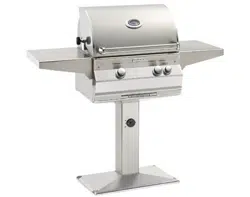
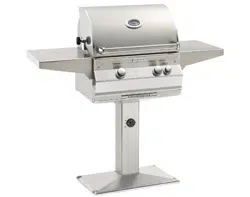
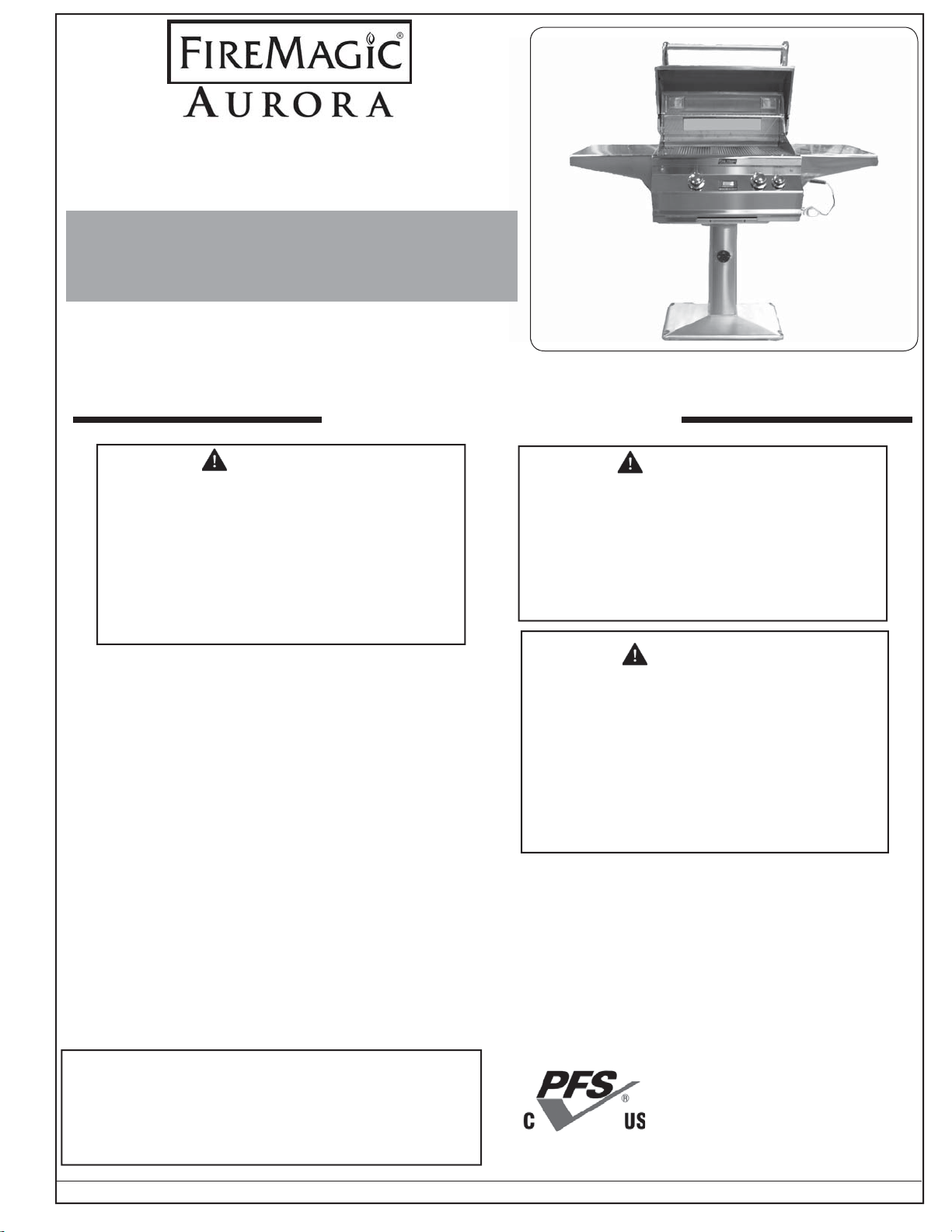
430s Patio
mount shown
without
backburner
option
STAND-ALONE POST OUTDOOR
GAS GRILLS
INSTALLATION
INSTRUCTIONS AND
OWNER’S MANUAL
A430s (IN-GROUND AND PATIO MOUNT)
Proper operation of your grill requires
prompt and periodic maintenance.
See the CARE & CLEANING section
for details.
Certifi ed to: ANSI Z21.58b-2012
CSA 1.6b-2012
11-093
REV 8 - 1401220800
L-C2-294
2
IMPORTANT: LISEZ CES INSTRUCTIONS SOIGNEUSEMENT AVANT DE COMMENCER L’INSTALLATION OU L’UTILISATION
GRIL EXTÉRIEUR DE GAZ
DANGER:
SI VOUS SENTEZ LE GAZ :
1. Coupez le gaz à l’appareil.
2. Éteignez-vous n’importe quelle fl amme nue.
3. Ouvrez le couvercle si équipé d’un four.
4. Si l’odeur continue, gardez loin de
l’appareil et appelez immédiatement
votre département de fournisseur ou de
feu de gaz.
AVERTISSEMENT:
1. Ne stockez pas ou n’employez pas
l’essence ou d’autres vapeurs et liquides
infl ammables à proximité de ceci ou
d’aucun autre appareil.
2. Un cylindre de propane non relié pour
l’usage ne sera pas stocké à proximité
de ceci ou d’aucun autre appareil.
CONDITIONS DE CODE ET D’APPROVISIONNEMENT:
Ce gril doit être installé selon des codes et des ordonnances
locaux, ou, en l’absence des codes locaux, avec l’un ou l’autre
le plus défunt Code national de gaz de carburant (norme ANSI
Z223.1/NFPA 54), et Stockage de gaz naturel et de propane
et manipulation du code d’installation (CSA-B149.1).
Cet appareil et ses différents robinets d’isolement doivent être
démontés du gaz-fournissent le système siffl ant en examinant
le système aux pressions au-dessus du ½ psig (kPa 3.5).
Cet appareil doit être isolé dans gaz-fournissent le système
siffl ant par fermeture que ses différents robinets d’isolement
manuels pendant tous les essais sous pression du gaz-
fournissent le système aux pressions jusques et y compris
le ½ psig (kPa 3.5).
Toutes les sorties électriques à proximité du gril doivent être
correctement fondues selon des codes locaux, ou en l’absence
de local code, avec le code électrique national, ANSI/NFPA
70, ou le code électrique canadien, CSA C22.1, celui qui est
applicable.
Maintenez tout électrique-fournissent des cordes et carburant-
fournissent des tuyaux partis de n’importe quelle surface de
chauffage.
INSTALLATEUR : Laissez ces instructions avec le consommateur.
CONSOMMATEUR : Maintenez pour la future référence.
AVERTISSEMENT:
L’installation inexacte, l’ajustement, le
changement, le service, ou l’entretien
peuvent causer des dommages ou des
dégats matériels. Référez-vous à ce
manuel. Pour l’aide ou l’information
additionnelle, consultez un installateur
professionnel qualifi é, l’agence de service,
ou le fournisseur de gaz.
SÛRETÉ ET CODES D’AVERTISSEMENT
• Ce gril est pour ultilisation à l’extérieur seulement.
Si l’appareil est entreposé à l’intérieur, enlever les
bouteilles et les laisser à l’extérieur.
• Ne pas ranger le gril immédiatement aprés l’avoir utilisé.
le laisser refroidir avant de le déplacer ou de la ranger.
Le non respect de cette mesure de sécurité pourrait
entraîner un incendie causant des dommages à la
propriété, des blessures ou la mort.
• Ne pas utiliser cet appareil sous une surface combustible.
• Ne pas utiliser cet appareil sous un auvent. Le non
respect de cette mesure de sécurité pourrait entraîner
un incendie ou des blessures.
• Dégagement minimal entre les parois latérales et l’arriére
de l’appareil et la construction combustible (45.7 cm à
partir des parois latérales et 45.7cm à partir de l’arriére).
• Le régulareur de pression de gaz prévu avec cet appareil
de cuisson à gaz pour l’extérieur doit être utilisé. Ce
régulateur est réglé pour une pression de sortie de 5
pouces de colonne de l’eau pour le gaz naturel, et 10
pouces pour le propane.
• LE RÉGULATEUR INCLUS D’APPAREILS EST ÉVALUÉ
POUR LE MAXIMUM DE 1/2 (LIVRES PAR POUCE
CARRÉ). SI VOTRE OFFRE DE GAZ EST 1/2 PLUS
GRAND QUE (LIVRES PAR POUCE CARRÉ), UN
RÉGULATEUR ADDITIONNEL DOIT ÊTRE INSTALLÉ
AVANT LE GRIL. VOIR LA SECTION DE CONDITIONS
D’OFFRE DE GAZ POUR LA PRESSION APPROPRIÉE
D’OFFRE DE GAZ.
• Ne couvrez jamais la surface entière de cuisine ou de
gril de gauffreuses ou de casseroles. La surchauffe se
produira et les brûleurs ne seront pas très performants
quand la chaleur de combustion est emprisonnée au-
dessous de la surface à cuire.
• Ne pulvérisez jamais l’eau sur une unité chaude de gaz,
comme ceci peut endommager des composants de
porcelaine ou de fer de fonte.
• Une fuite de GPL peut causer une incendie ou une
explosion si enflammée entraînant des blessures
corporelles graves ou la mort.
• Communiquez avec le fournisseur de GPL pour les
réparations ou pour disposer de qules bouteille ou du
GPL non utilisé.
INSTALLATION INSTRUCTIONS ET MANUEL DU PROPRIÉTAIRE
Certifi é à la norme: ANSI Z21.58b-2012 / CSA 1.6b-2012

REV 8 - 1401220800
L-C2-294
3
CONTENTS
To protect against electric shock, do not immerse cord or plugs in water or other liquid;
Unplug from the outlet when not in use and before cleaning. Allow to cool before putting on or taking off
parts;
Do not operate any outdoor cooking gas appliance with a damaged cord, plug, or after the appliance
malfunctions or has been damaged in any manner. Contact the manufacturer for repair;
Do not let the cord hang over the edge of a table or touch hot surfaces;
Do not use an outdoor cooking gas appliance for purposes other than intended;
When connecting, fi rst connect plug to the outdoor cooking gas appliance then plug appliance into the outlet;
Use only a Ground Fault Circuit Interrupter (GFCI) protected receptacle with this outdoor cooking
gas appliance;
Never remove the grounding plug or use with an adapter of 2 prongs.
Use only extension cords with a 3 prong grounding plug, rated for the power of the equipment, and
approved for outdoor use with a W-A marking.
ELECTRICAL SAFETY
3 ELECTRICAL SAFETY
4 REPLACEMENT PARTS LIST
5 PRODUCT DATA TABLE
6 POST PATIO MOUNT GRILL DIMENSIONS TABLE
6 MODEL SPECIFICATIONS
7 IN-GROUND POST GRILL DIMENSIONS TABLE
8 ELECTRICAL CONNECTIONS
8 OPERATIONAL SAFETY INFORMATION
8 LIGHT SWITCH
9 INSTALLATION REQUIREMENTS
10 ENSURING PROPER COMBUSTION AIR AND COOLING AIRFLOW
10 EXHAUST REMOVAL
10 GAS SUPPLY PLUMBING REQUIREMENTS
11 PATIO MOUNT INSTALLATION
13 IN-GROUND POST INSTALLATION
17 SAFE USE & MAINTENANCE OF PROPANE GAS CYLINDERS
18 IDENTIFICATION OF GRILL CONTROLS
19 SETTING THE TIMER
19 LIGHTING (IGNITION) INSTRUCTIONS
19 SHUTTING OFF THE UNIT
21 DIGITAL THERMOMETER
24 OPTIONAL ROTISSERIE
26 GRILLING TIPS
27 ACCESSORIES
28 FIRE MAGIC
®
DRIP TRAY
29 CARE & CLEANING
30 REPLACING HALOGEN BULBS
31 TROUBLESHOOTING
32 CONVERTING THE GAS TYPE
34 BURNER AIR SHUTTER ADJUSTMENT
36 WARRANTY
REV 8 - 1401220800
L-C2-294
4
8
11
25
1
2
5
14
15
18
19
17
13
10
12
16
IMPORTANT
Remove all packing
material and discarded
prior to lighting.
7
20
Robert H. Peterson Co. • 14724 East Proctor Avenue, • City of Industry, CA 91746
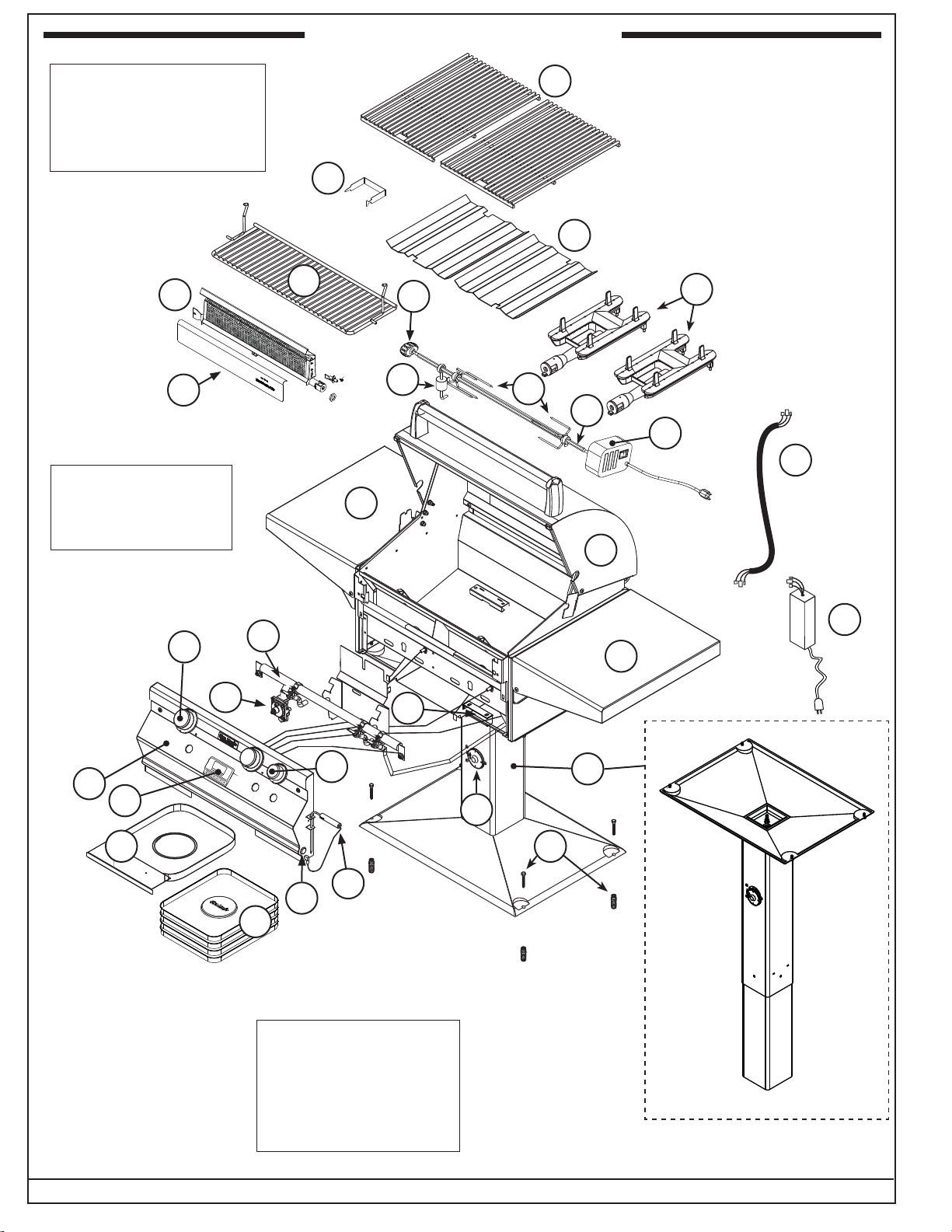
REPLACEMENT PARTS LIST
3
22
21
To order replacement
parts, contact your
local Fire Magic
®
dealer.
6
25
32
24
23
44
26
27
9
Some items shown
are optional, or are not
available for certain
models. Your model
may vary, refer to parts
table.
40
39
REV 8 - 1401220800
L-C2-294
5
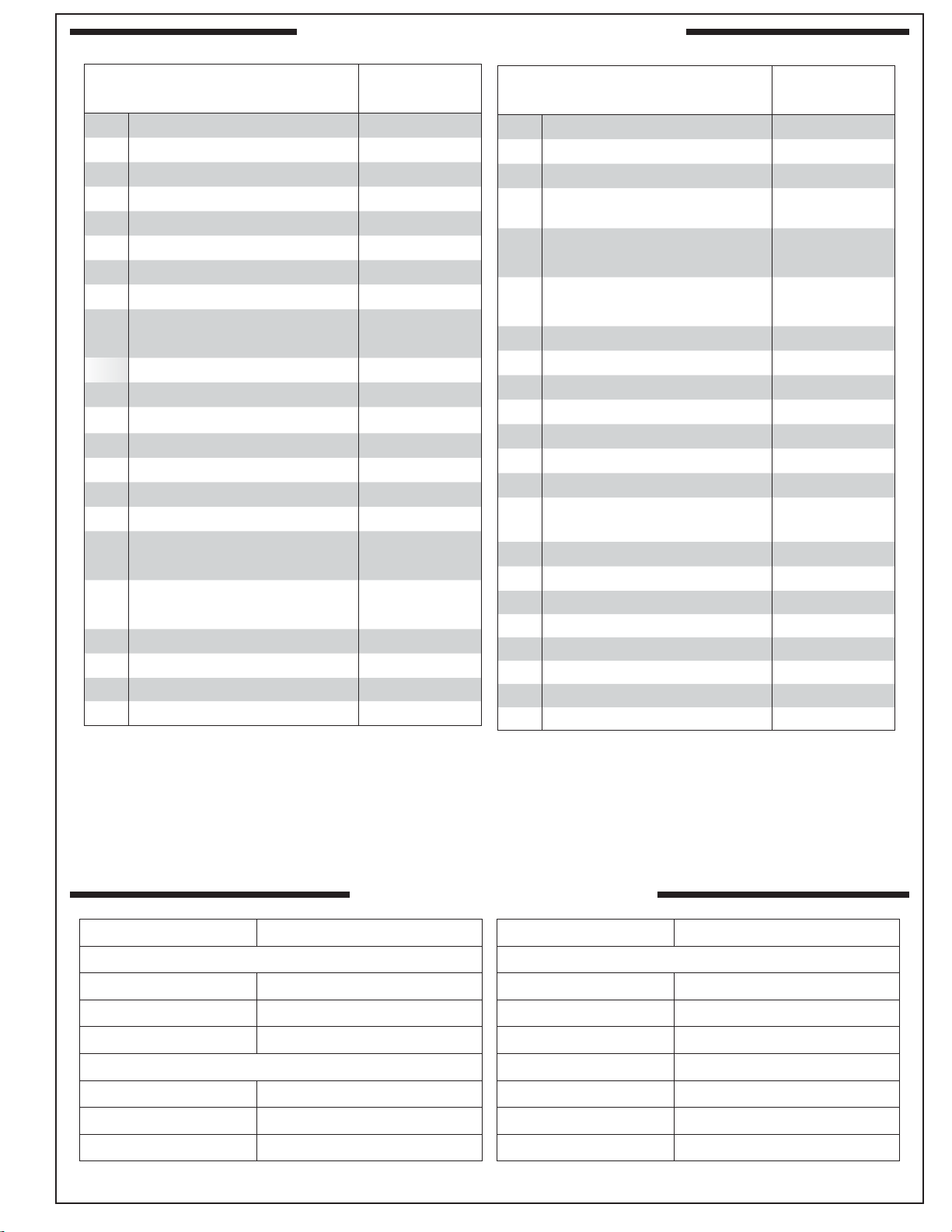
REPLACEMENT PARTS LIST (cont.)
A430s
Item Description Part No. Qty.
1.
Stainless cooking grid (set of 2) 3542-S-2 1
2.
Flavor grid (set of 2) 3063-S-2 1
3.
Main burner 3042-50 2
4.
Infrared burner (optional)‡ 3051 1
5.
Oven lid 23729-53 1
6.
Warming rack* 3672S-M 1
7.
Back burner* 24130-11 1
8.
Back burner cover* 24148-010 1
9.
Patio base w/ hardware
†
24330-31 1
or
In-ground base w/ hardware
†
24330-32 1
10.
Rotisserie motor* 3600-02 1
11.
Rotisserie rod* 3603-30 1
12.
Rotisserie knob* 24187-16 1
13.
Meat holder (pair)* 3613 1
14.
Counterbalance* 3620E 1
15.
Grid lifter 3519 1
16.
Convertible regulator PR-4 1
17.
Valve manifold w/ back burner 24130-22 1
or
Valve manifold w/o back burner 24130-28 1
18.
Control panel w/ back burner 24130-45 1
or
Control panel w/o back burner 24130-46 1
19.
Small knob* 3016 1
20.
Large knob 3015 2
21.
Digital thermometer 24180-12 1
22.
Meat probe 24187-14S 1
A430s
Item Description Part No. Qty.
23.
Drip tray 3084 1
24.
Drip tray liner (set of 4) 3557 1
25.
Rigid shelf 24330-017 2
26.
Patio mount hardware kit
(if applicable)
24330-25 1
27.
Timer valve (3 hour) 3090 1
or
Timer valve (1 hour) 3092 1
28.
Propane regulator / hose assy. 5110-07 1
or
Natural Gas QD hose ‡ 5110-03 1
29.
Wire harness assembly‡ 24177-26 1
30.
Back burner electrode*‡ 4199-70 1
31.
Electrode & collector box assy‡ 3199-45 2
32.
Ignitor module 3199-44 1
33.
Natural gas orifi ce(s)‡ 3001-42-2 1
34.
Natural back burner gas orifi ce(s)‡ 3001-52-1 1
35.
Propane gas orifi ce(s)‡ 3001-54-2 1
36.
Propane back burner gas
orifi ce(s)‡
3001-59-1 1
37.
Fire Magic
®
cookbook‡ 3595 1
38.
Thermometer wire harness‡ 24177-25 1
39.
Wire harness extension 24177-27 1
40.
Power supply box w/ connector 24177-11 1
41.
12V / 10 watt halogen light bulb ‡ 24187-15 2
42.
Light lens ‡ 24187-26 2
43.
Lamp assembly ‡ 24187-28 2
44.
Light switch
24182-46
1
* If equipped
†
For replacement only (not conversion)
‡ Not shown
Specifi cation Value
Main Burner
BTU per burner pair
25,000 x 2
Natural gas orifi ce
#42
(2.375 mm)
Propane gas orifi ce
#54
(1.397 mm)
Infrared Burner (if equipped)
BTU per burner
18,000
Natural gas orifi ce
#46
(2.057 mm)
Propane gas orifi ce
#56 (1.181 mm)
Specifi cation Value
Backburner (if equipped)
BTU per burner
12,500
Natural gas orifi ce
#52 (1.613 mm)
Natural air shutter
5/8-inch gap
Propane gas orifi ce
#59 (1.041 mm)
Propane air shutter
7/16-inch gap
Power supply rating
120VAC / 0.5A / 60Hz
Oven lights rating 12V / 10 watt halogen bulb
PRODUCT DATA TABLE
Table 1 - Product Data Table
REV 8 - 1401220800
L-C2-294
6
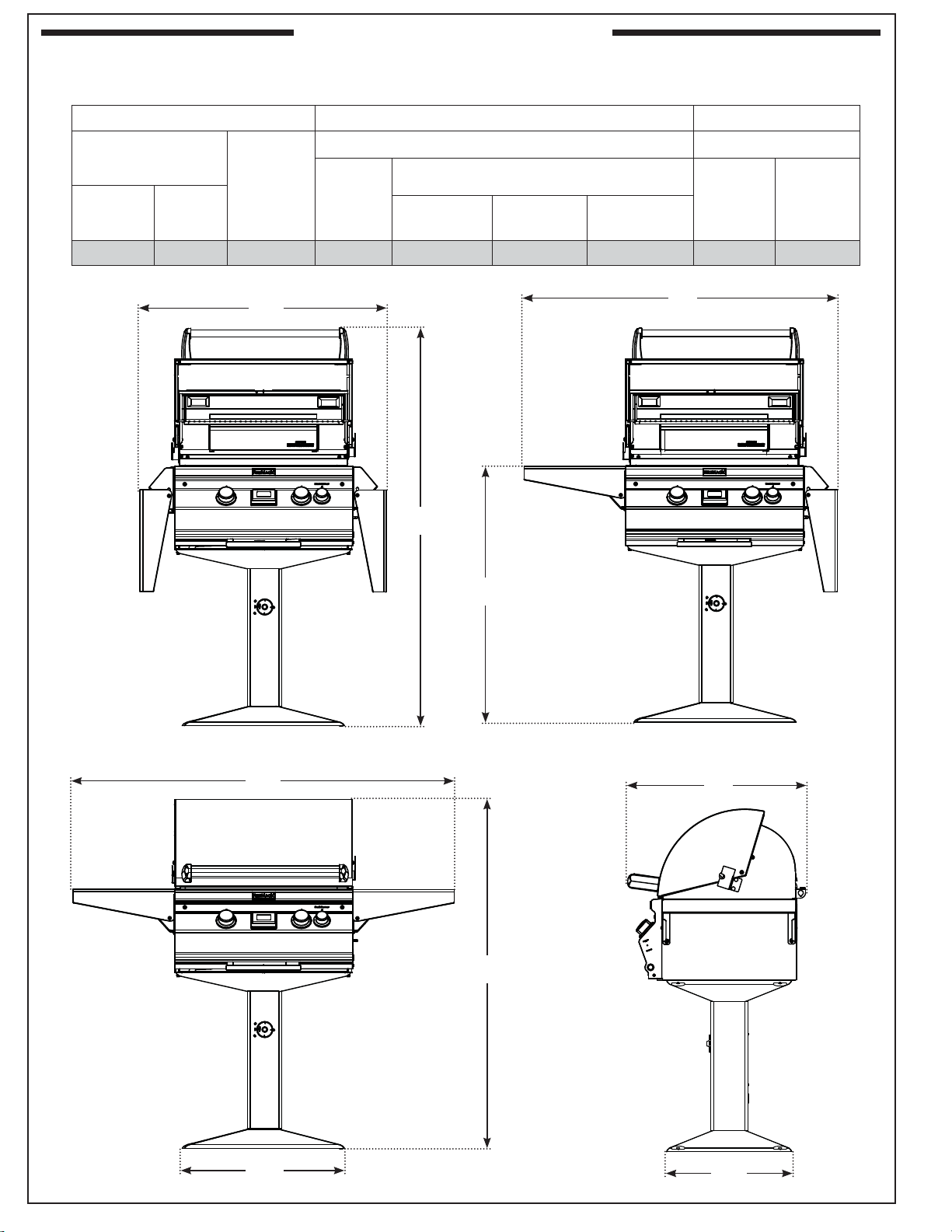
Height Width Depth
Floor to top
(with oven)
Floor to top
of shelf
(C)
Left to right Front to back
Post base
(D)
(with shelves)
Post base
(H)
Maximum
outer
(I)
Open (A)
Closed
(B)
Up
(E)
Down
(F)
1 Up / 1 Down
(G)
57" 50" 37" 26" 55
3
/4" 35
1
/4" 45
1
/2" 18
1
/2" 25
3
/4"
POST PATIO MOUNT GRILL DIMENSIONS TABLE
Fig. 6-1
MODEL SPECIFICATIONS
I
C
H
E
D
F
A
G
B
REV 8 - 1401220800
L-C2-294
7
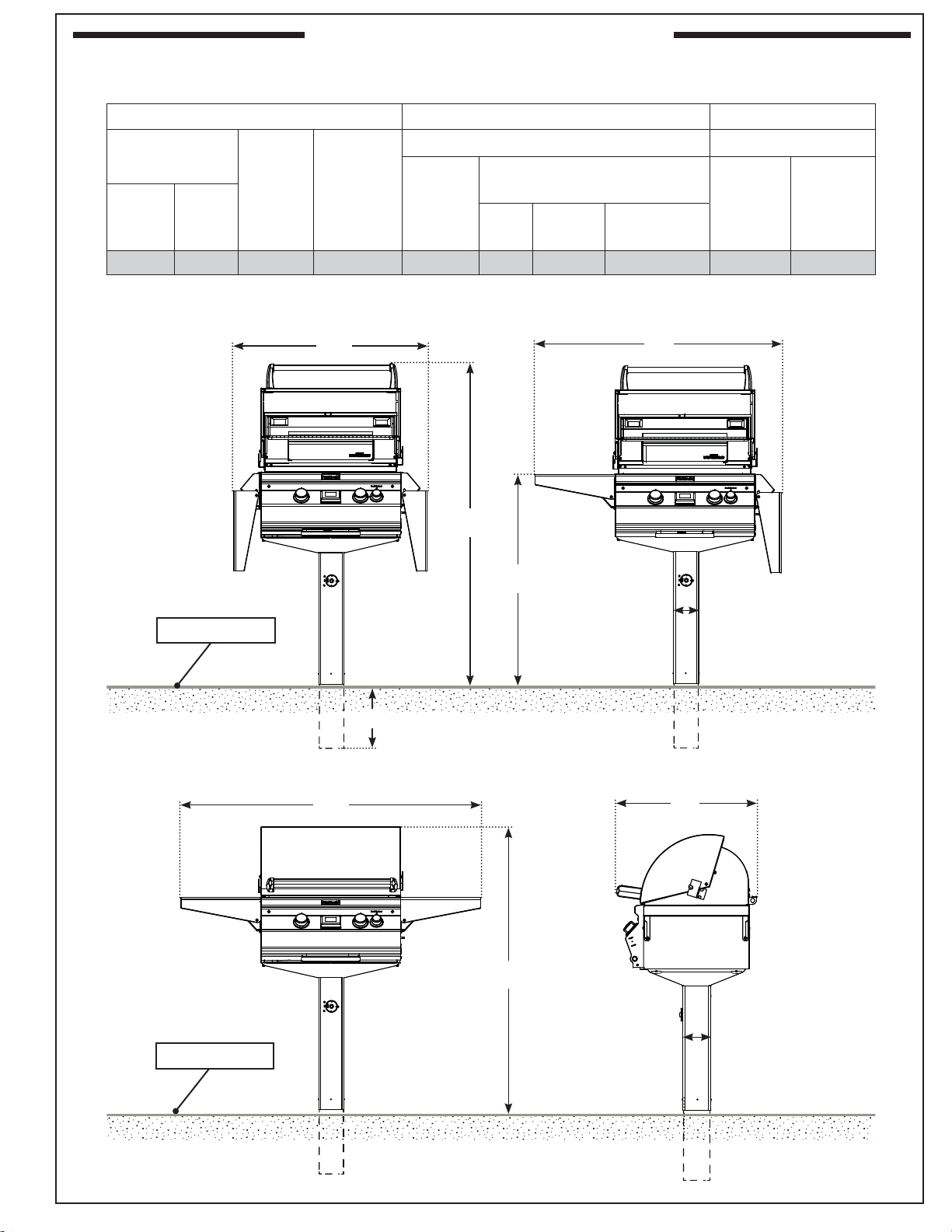
Height* Width Depth
Floor to top
(with oven)
Floor to
top of
shelf
(L)
Floor to
bottom of
extension
below
ground
(M)
Left to right Front to back
Post
(N)
(with shelves)
Post
(R)
Maximum
outer
(S)
Open
(J)
Closed
(K)
Up
(O)
down
(P)
1 Up /1 Down
(Q)
57" 50” 37” 18” 5
1
/2” 55
3
/4" 35
1
/4" 45
1
/2"5
1
/2” 25
3
/4"
*Note: Height dimensions are approximate from ground level once installed.
IN-GROUND POST GRILL DIMENSIONS TABLE
Fig. 7-1
Ground level
MODEL SPECIFICATIONS (cont.)
S
L
O
K
P
J
Q
Ground level
N
M
R
REV 8 - 1401220800
L-C2-294
8
1. The outdoor grill and surrounding area MUST
remain clear of fl ammable substances such as
gasoline, yard debris, wood, etc.
2. The airfl ow through the vent space located below
the control panel must remain unobstructed.
3. When using propane gas:
a. The required ventilation openings in the
enclosure must be clear of debris.
b. The propane cylinder, regulator, and rubber
hose must be in a location not subject to
temperature above 125° F (51° C). A proper
fl ame pattern will ensure safe operation and
optimal performance.
4. The fl ames on each burner burn evenly along
the entire burner with a steady fl ame (mostly
blue). If burner fl ames are not normal, check and
clean the orifi ce and burner/venturi tubes for
insects and insect nests. A clogged tube can
lead to a fi re beneath the grill. A proper fl ame
pattern will ensure safe operation and optimal
performance. Adjust the air shutter as needed
(see AIR SHUTTER ADJUSTMENT).
5. The in-line gas valve or gas cylinder valve must
always be shut OFF when the grill is not in use.
6. The drip collector holes must be clear and
unobstructed. Excessive grease deposits can
result in a grease fi re.
7. The backburner or infrared burner cover must
be removed before using the burner.
8. Whenever reconnecting any wires, apply a
small amount of dielectric grease to the male
connector, then make the connection.
OPERATIONAL SAFETY INFORMATION
ELECTRICAL CONNECTIONS
This grill requires 120VAC power to operate.
Use only a Ground Fault Interrupter (GFCI)
protected circuit with this outdoor cooking gas
appliance.
Use a grounded electrical extension cord rated for
outdoor use to connect the grill to line power.
WARNING
Electrical Grounding Instructions
For your protection against shock hazard, this
outdoor-cooking gas-appliance is equipped with
a three-pronged (grounding) electrical connector.
This appliance should be connected to a properly
grounded three-prong receptacle using a grounding
extension cord rated for outdoor use. Do not cut or
remove the grounding prong from the connector.
Important: ONLY REPLACE THE OVEN LIGHTS
WITH 12V / 10 WATT HALOGEN BULB(S).
WARNING: NEVER cover the entire cooking or grill surface with griddles or pans. Overheating will occur, and
burners will not perform properly when combustion heat is trapped below the cooking surface.
CAUTION: NEVER spray water on a hot gas unit.
Important: When reviewing this units wiring connections; please refer to the wiring diagram
label affi xed to the inside of the control panel.
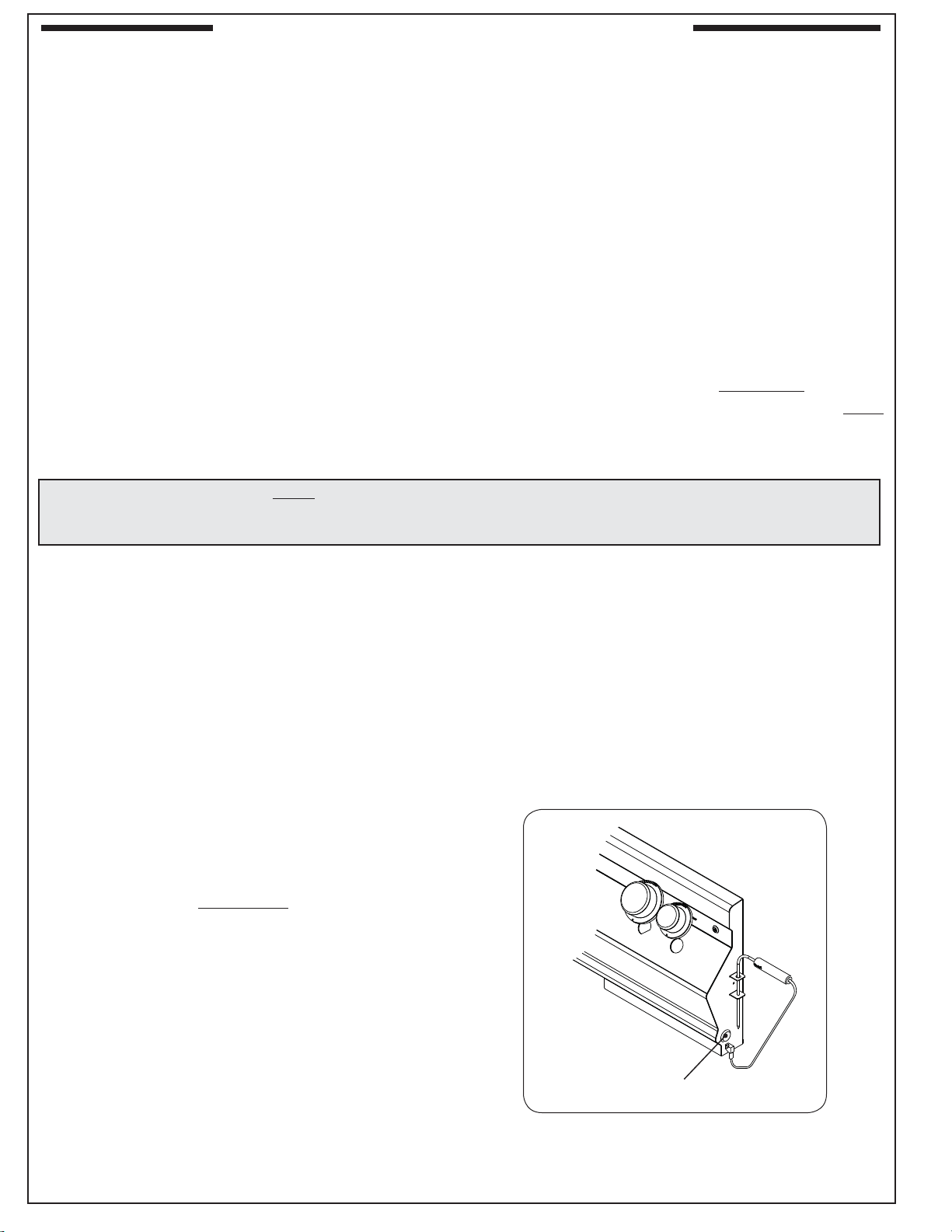
LIGHT SWITCH
The light switch is push button operated, and is
located on the right side of the control panel (see
Fig. 8-1). It controls the power to all lights.
Light
switch
Fig. 8-1
REV 8 - 1401220800
L-C2-294
9
INSTALLATION REQUIREMENTS
This grill is designed for outdoor use only. DO NOT use this grill
inside a building, garage, enclosed area, or under an unprotected
overhead combustible construction. See the EXHAUST REMOVAL
section on the following page for details on installing under a patio
roof. DO NOT use this grill in or on a recreational vehicle or boat.
Important: The grill is not insulated. Refer to the information
below to ensure all required clearances are met.
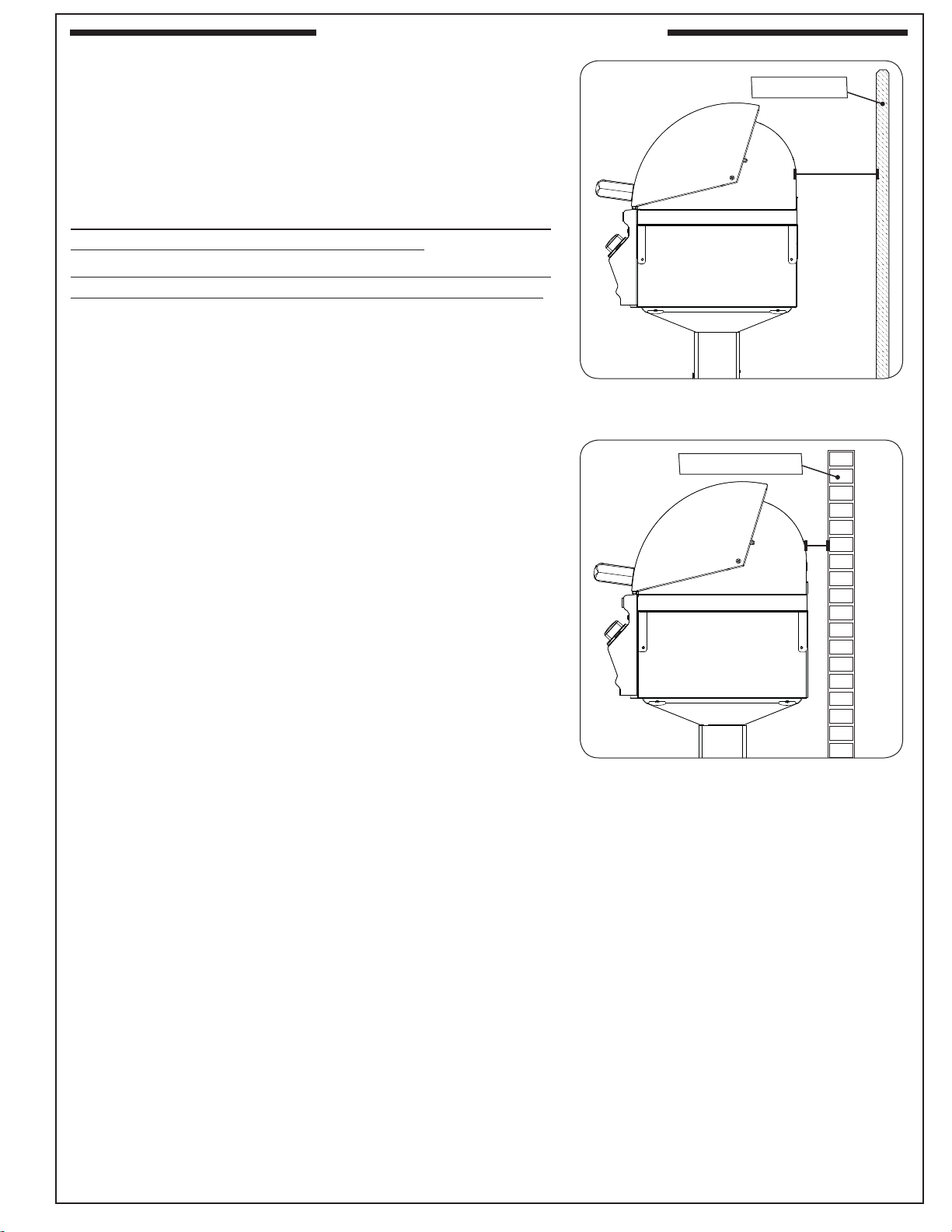
The grill must have a minimum clearance of 18" from
combustible materials/items AT ALL TIMES.
For the minimum clearances between the grill and any side or rear
walls, your setup must fall within one (or more) of the following:
A. Clearance between grill and combustible wall
• The grill must have a minimum of 18" right, left, and rear
clearance from any combustible wall (see Fig. 9-1).
B. Clearance between grill and strictly non-combustible wall
(i.e. brick wall, see Fig. 9-2)
• The grill must have a minimum of 4" right, left, and rear
clearance from any non-combustible wall.
(To allow for proper ventilation and prevent dangerous
overheating.)
Fig. 9-1 Clearance 'A' Diagram
Combustible
Min.
18"
(Clearance required for
right, left, and rear)
Fig. 9-2 Clearance 'B' Diagram
Non-combustible
Min.
4"
(Clearance required for
right, left, and rear)
REV 8 - 1401220800
L-C2-294
10
INSTALLATION REQUIREMENTS (cont.)
The control panel MUST remain removable for
servicing and air shutter adjustment (see PARTS
LIST).
ENSURING PROPER COMBUSTION AIR AND
COOLING AIRFLOW
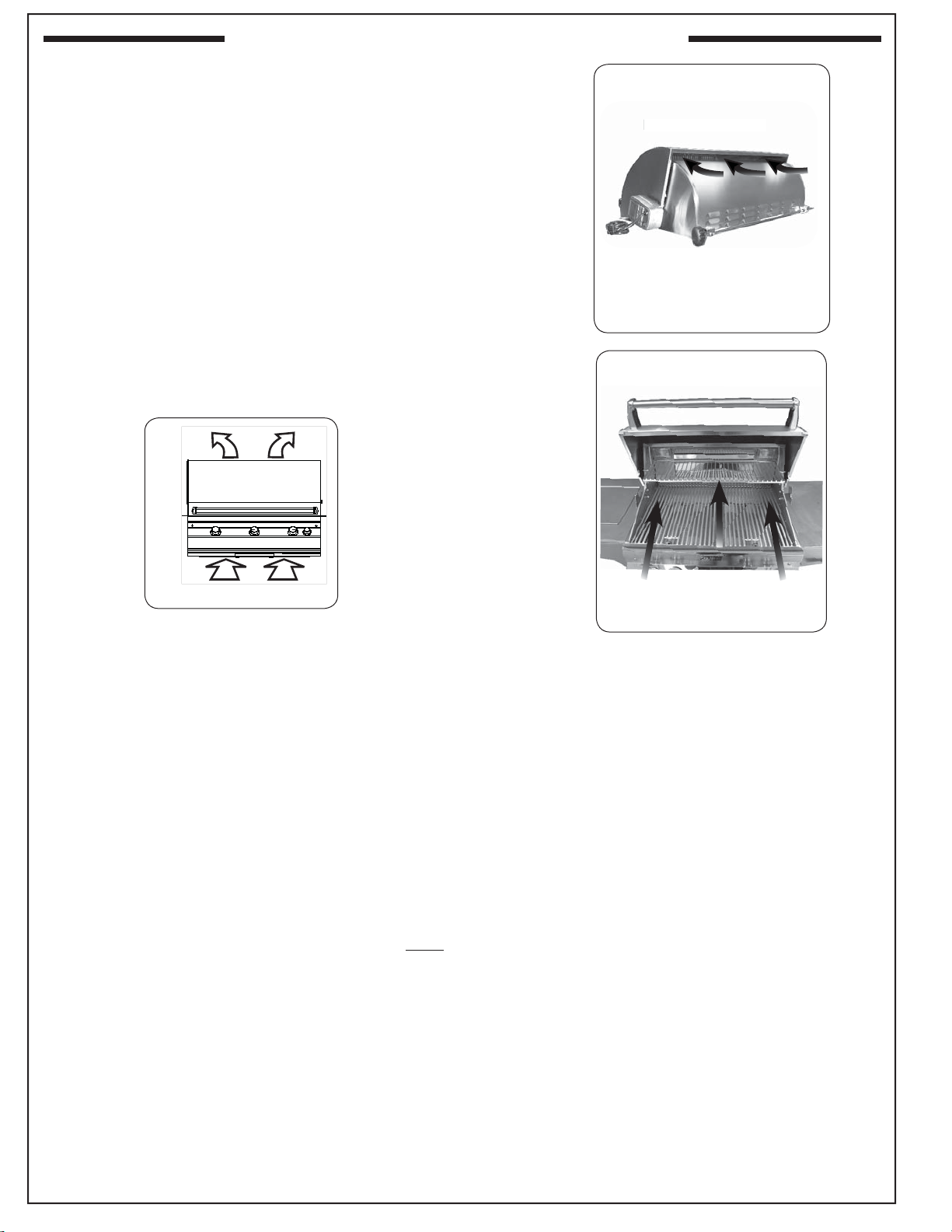
Proper airfl ow (Fig. 10-1) MUST be maintained for
the grill to perform as it was designed. If airfl ow
is blocked, overheating and poor combustion will
result. Do not block the 1" (2.5 cm) front air inlet
along the bottom of the control panel or more
than 75% of the cooking grid surface with pans
or griddles.
Note: The 1" (2.5 cm) front air space also
allows access to the drip tray.
EXHAUST REMOVAL
If installed or used under a patio roof, the cooking
grid area must be fully covered by an exhaust
hood with a vent. An exhaust fan with a rating of
1,000 CFM (cubic feet per minute) (472 liters per
second) or more may be necessary to effectively
remove smoke and other cooking by-products from
the area under the hood.
Fire Magic Vent Hoods are
available to meet this requirement.
This outdoor grill
must not be used under unprotected overhead
combustible construction. THIS UNIT MUST NOT
BE LOCATED IN A FULLY ENCLOSED AREA
OF ANY KIND.
CAUTION: Wind blowing into or across the rear
oven lid vent (Fig. 10-2) can cause
poor performance and/or dangerous
overheating. Orient the grill so that the
prevailing wind blows toward the front
of the grill (Fig. 10-3).
YOU MUST PROTECT REAR OVEN
VENT FROM PREVAILING WIND
Rear oven lid vent
INCORRECT
Fig. 10-2
ReRearar o oveven n lilid d veve
ntnt
Fig. 10-1 - Ventilation
GAS SUPPLY AND MANIFOLD PRESSURES:
For natural gas - normal 7" (17.78 cm) water column
(w.c.), minimum 5" (12.7 cm), maximum 10
1
/
2
" (26.7
cm). For propane gas - normal 11" w.c., minimum 10"
(25.4 cm), maximum 13" (33 cm).
GAS SUPPLY PLUMBING REQUIREMENTS
For natural gas or a household propane system, rigid
1
/
2
", or
3
/
4
" black steel pipe, or local code approved
pipe, is required to conduct the gas supply to the
unit. An outdoor approved fl exible connector can
be used to connect your household gas supply to
the grill. DO NOT use a rubber hose within the
enclosure for the grill . Apply only joint compounds
that are resistant to all gasses on all male pipe
fi ttings. Make sure to tighten every joint securely.
Note: If
1
/
2
" pipe is used with natural gas, it
should be no longer than 20'.
An external valve (with a removable key) in the
gas line is necessary for safety when the grill
is not in use. It also provides for convenient
maintenance.
Fig. 10-3
CORRECT
PLACE GRILL SO PREVAILING WIND
BLOWS TOWARD FRONT OF GRILL
REV 8 - 1401220800
L-C2-294
11
PREPARE FOR INSTALLATION
Consult a qualifi ed professional installer.
The fl ex connector can be routed out the back of the
post, under the post base, or inside the post. The power
supply cord is to be routed out the back.
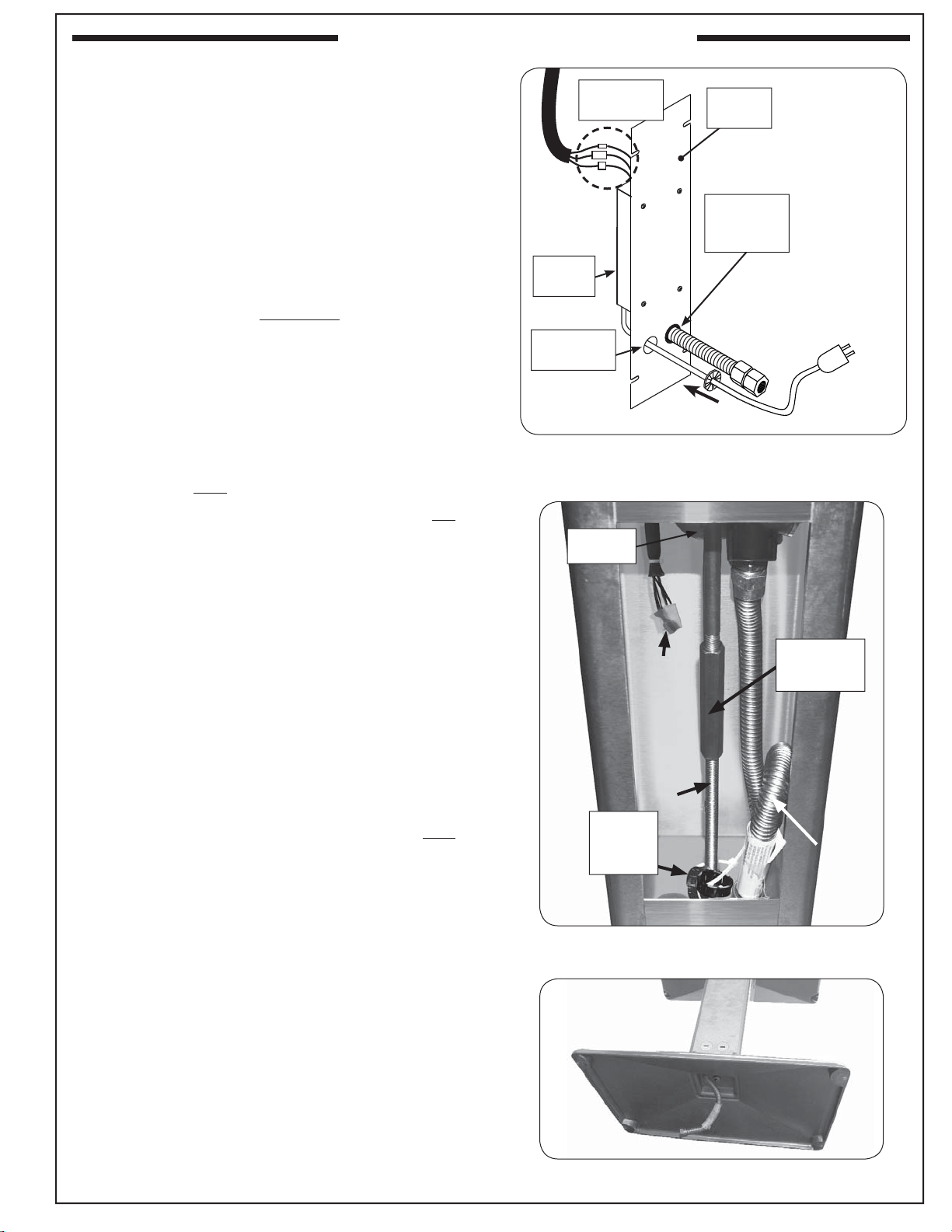
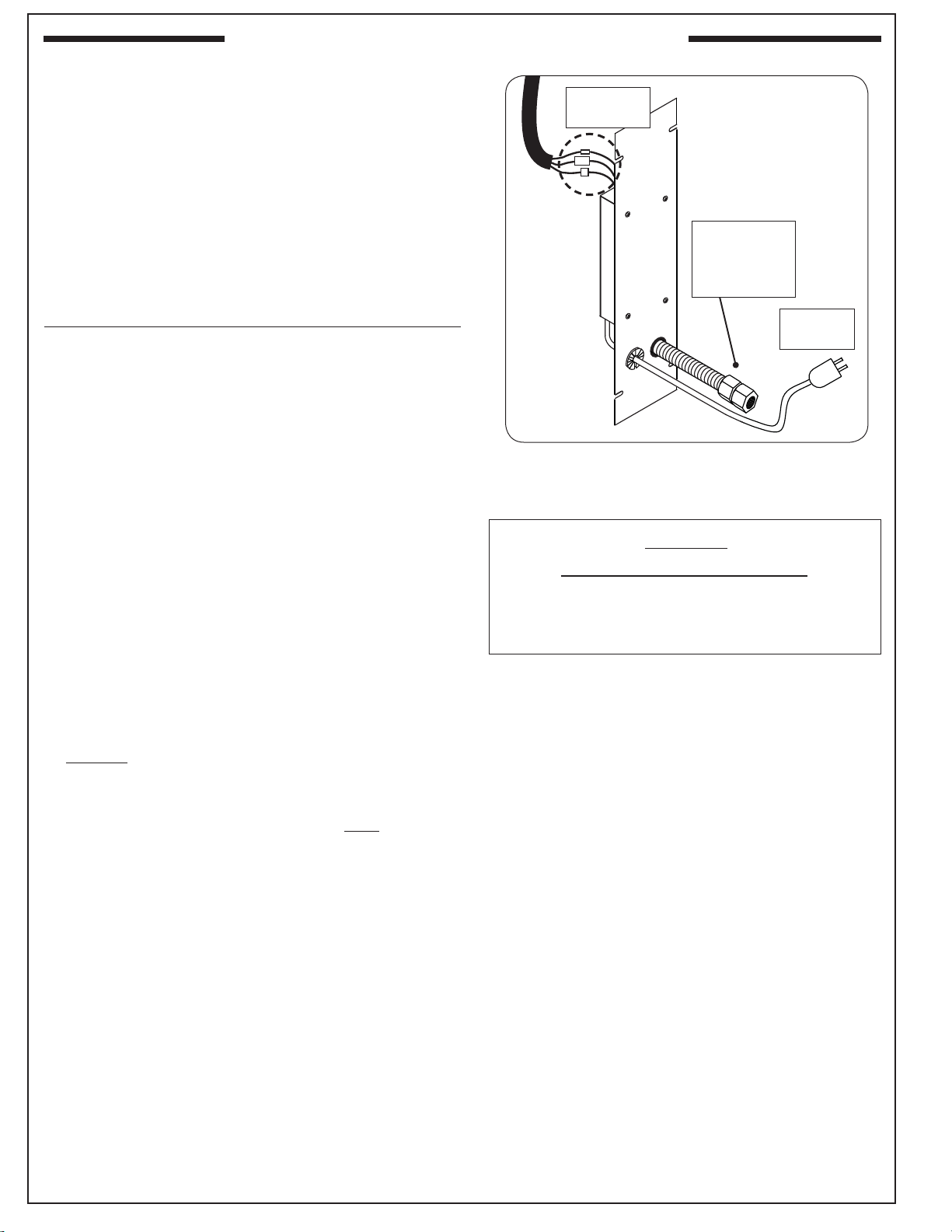
To gain access to the inside of the post, unscrew and
carefully open the access plate on the rear of the post
using a medium Phillips-head screwdriver. Retain the
screws.
A power supply is pre-mounted to the access plate.
For ease of installation, disconnect the power supply
from the wire harness extension. Locate the three wires
coming from the inside of the post to the power supply
and carefully disconnect (see Fig. 11-1 and 11-2).
Important: Pull from the connectors (not the wires).
ROUTE POWER SUPPLY CORD
The power cord will need to be routed through the
access plate for later connection to a GFCI receptacle.
1. Remove the knock-out disc at the bottom left of
the access plate with a large fl athead screwdriver.
(Insert the screwdriver into the notch provided in
the center of the knock-out.)
2. Feed the power cord through the newly created hole.
3. Remove the plastic power cord bushing fastened to
the inside of the post and install it onto the power
cord. Slide the bushing up against the access plate
knock-out hole and snap into place. See Fig. 11-1.
ROUTE FLEX CONNECTOR
The gas supply line will need to be run to the post install
location as appropriate for the desired setup.
To route fl ex connector through rear of post:
1. Remove the knock-out disk at the bottom right of
the access plate with a large fl athead screwdriver.
(Insert the screwdriver into the notch provided in
the center of the knock-out.)
2. Remove the plastic grommet fastened to the inside of
the post and insert it into the newly created opening.
Then route the fl ex connector through the opening.
See Fig. 11-1 and 11-2.
To route fl ex connector beneath post base:
Route the fl ex connector through the hole found beneath
the center of the post base (see Fig. 11-3).
PATIO MOUNT INSTALLATION
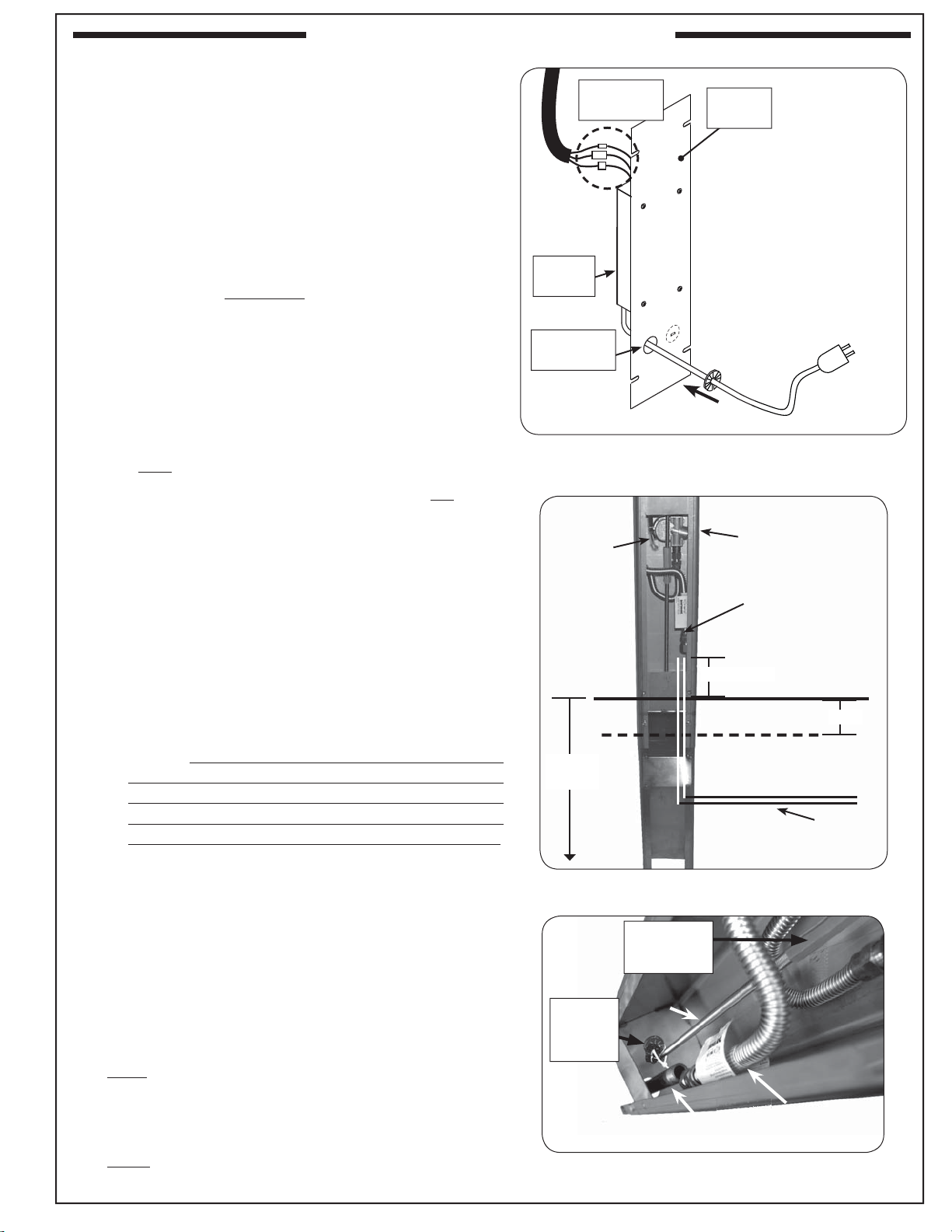
Fig. 11-2 Post interior detail
Flex
connector
Grommet
& bushing
attached
with tie
Tension
Bolt
Back of
timer valve
Wire
harness
extension
Fig. 11-1 Access plate view & install orientation
Fig. 11-3 Post base option
Access
plate
Gas supply
knock-out
(optional)
Power cord
knock-out
Power
supply
Wire
Connections
Adjustable nut
(turn to tighten
if needed)
REV 8 - 1401220800
L-C2-294
12
PATIO MOUNT INSTALLATION (cont.)
CONNECT GAS SUPPLY
For household propane or natural gas units:
Route the fl ex connector to the gas stub.
Turn OFF the gas supply at the source. Remove the
adapter that is loosely connected to the fl ex connector.
Attach the adapter to the gas-supply stub using a pipe
compound resistant to all gasses. Tighten securely. Then
attach the open end of the fl ex connector to the adapter.
Tighten securely.
For propane cylinders:
For connecting a propane unit to a portable propane tank,
read the safety warnings and follow the instructions in the
section SAFE USE AND MAINTENANCE OF PROPANE
GAS CYLINDERS.
Important: An appropriate adapter will be required to
connect the existing fl ex connector to an
L.P. regulator/hose assembly.
LEAK TEST
Turn all burner control knobs to the OFF position. Turn the
gas supply on. Then carefully check all gas connections
for leaks with a brush and half-soap/half-water solution
before lighting. NEVER USE A MATCH OR OPEN
FLAME TO TEST FOR LEAKS.
RECONNECT POWER SUPPLY WIRES
CAUTION: IMPROPERLY CONNECTED WIRES WILL
CAUSE DAMAGE TO THE GRILL AND
MAY RESULT IN PROPERTY DAMAGE
AND/OR PERSONAL INJURY.
To connect the power supply box, connect the three wires
coming from the power supply to the wire harness extension
as shown in Fig. 12-1.
Important: Apply dielectric grease to the male connectors
prior to making any wire connections.
RE-SECURE ACCESS PLATE
Carefully replace the access plate using the four screws,
ensuring all interior components are properly oriented
inside of the grill. Ensure the power supply cord (and fl ex
connector if applicable) coming out of the rear of the post
are properly situated and the plastic bushing/grommet
pieces are secure in place.
CONNECT POWER CORD
Plug the power supply cord into a properly wired,
grounded, and inspected GFCI electrical receptacle.
Use a heavy-duty grounded extension cord if necessary.
Note: Keep electrical supply cords away from all
heated surfaces.
Fig. 12-1 Connect: Gas, Wires, Plate, Power
To GFCI
receptacle
Wire
Connections
SECURING THE PATIO MOUNT GRILL
Important: BEFORE USE, the patio mount base
must be securely fastened to a stable,
level surface to ensure the grill remains
fi xed and upright at all times.
Locate the patio mount base in the planned grill
location and mark the 4 holes. Drill the marked holes
to a
1
/
2
" diameter x 1
1
/
2
" depth. Insert the lag shields
(see PARTS LIST) into the holes, being sure that they
are fl ush with the ground.
Align the holes on the patio mount base over the lag
shields in the ground. Secure the base with the lag
screws (see PARTS LIST) using a
7
/
16
" nut driver.
WARNING
Electrical Grounding Instructions:
This outdoor-cooking gas appliance is equipped
with a three-pronged (grounding) plug. Do not cut or
remove the grounding prong from the plug.
To gas supply
(as applicable,
fl ex location
may vary)
REV 8 - 1401220800
L-C2-294
13
Ground level
Concrete level
Post
Gas supply
route
Fig. 13-2
Fi
Fi
Fi
Fi
Fi
Fi
Fi
Fi
g.
g
g.
g.
g.
g.
g.
g.
g
g
g
g.
1
1
1
1
1
1
1
1
1
1
3-
3
3-
3-
3-
3-
3-
3-
3-
3
3
3
3
2
2
2
2
2
2
2
2
2
2
2
2
2
2
Supply line
Tension bolt
Flex
connector
IN-GROUND POST INSTALLATION
PREPARE FOR INSTALLATION
Consult a qualifi ed professional installer / licensed contractor.
The in-ground post is designed primarily for installation with
a permanent underground gas supply. The power supply
cord is to be routed out the back.
To gain access to the inside of the post, unscrew and
carefully open the access plate on the rear of the post using
a medium Phillips-head screwdriver. Retain the screws.
A power supply is pre-mounted to the access plate. For
ease of installation, disconnect the power supply from the
wire harness extension. Locate the three wires coming from
the inside of the post to the power supply and carefully
disconnect (see Fig. 13-1 and 13-2).
Important: Pull from the connectors (not the wires).
ROUTE POWER SUPPLY CORD
The power cord will need to be routed through the access
plate for later connection to a GFCI receptacle.
1. Remove the knock-out disc at the bottom left of the
access plate with a large fl athead screwdriver. (Insert
the screwdriver into the notch provided in the center
of the knock-out.)
2. Feed the power cord through the newly created hole.
3. Remove the plastic power cord bushing fastened to
the inside of the post and install it onto the power cord.
Slide the bushing up against the access plate knock-
out hole and snap into place. See Fig. 13-1.
ROUTE GAS SUPPLY
Note: This section addresses an underground gas supply
setup. To connect through the rear of the post,
reference the ROUTE FLEX CONNECTOR section
of PATIO-MOUNT INSTALLATION, and do not
perform the steps until after: attaching the extension
post, and installing the post / pouring the concrete.
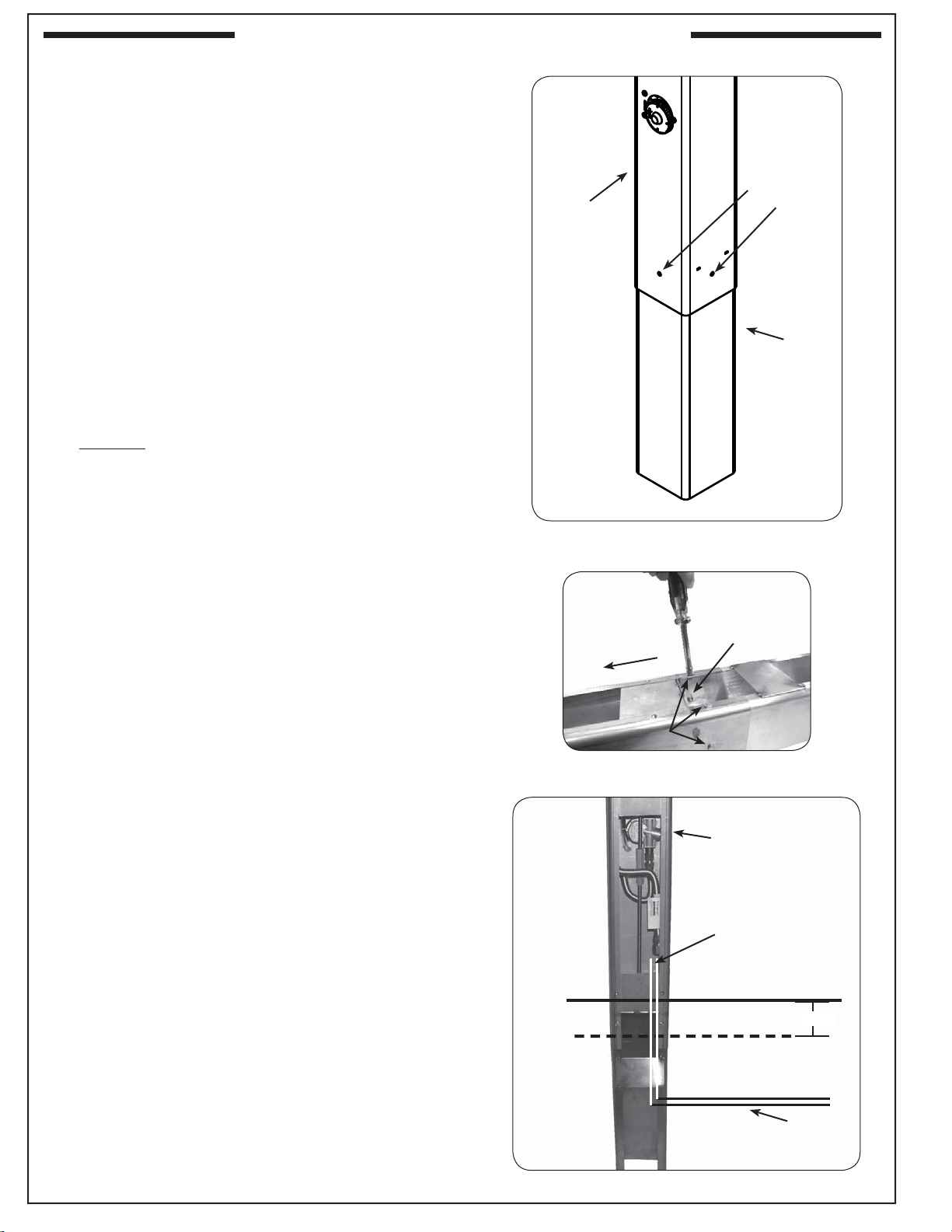
1. After running the underground gas supply line to
the planned grill location, dig a hole for the post and
extension approximately 18" deep and 10-12" in
diameter.
Note: Run the gas supply line up from the bottom of
the hole (a little off center) so that it reaches to
approximately 4" above ground level.
Note: The actual depth of the hole should be such that
the cooking surface is 34-35" above ground level.
2. Verify that the gas supply line fi ts through the gas line
clearance hole in the bottom of the post (see Fig. 13-3).
The clearance hole is the larger of the two holes in the
bottom of the post and is off center.
3. Verify that the fl ex connector coming from the inside of
the post will connect properly with the gas supply line.
Fig. 13-1 Access plate view & orientation
Access
plate
Power cord
knock-out
Power
supply
Wire
Connections
Fig. 13-2 In-ground install orientation
4" (approx.)
18"
(approx.)
3-5"
Flex connector
Fig. 13-3 Post interior detail
Grommet
& bushing
attached
with tie
Adjustable nut
(turn to tighten
if needed)
Wire
harness
extension
REV 8 - 1401220800
L-C2-294
14
IN-GROUND POST INSTALLATION (cont.)
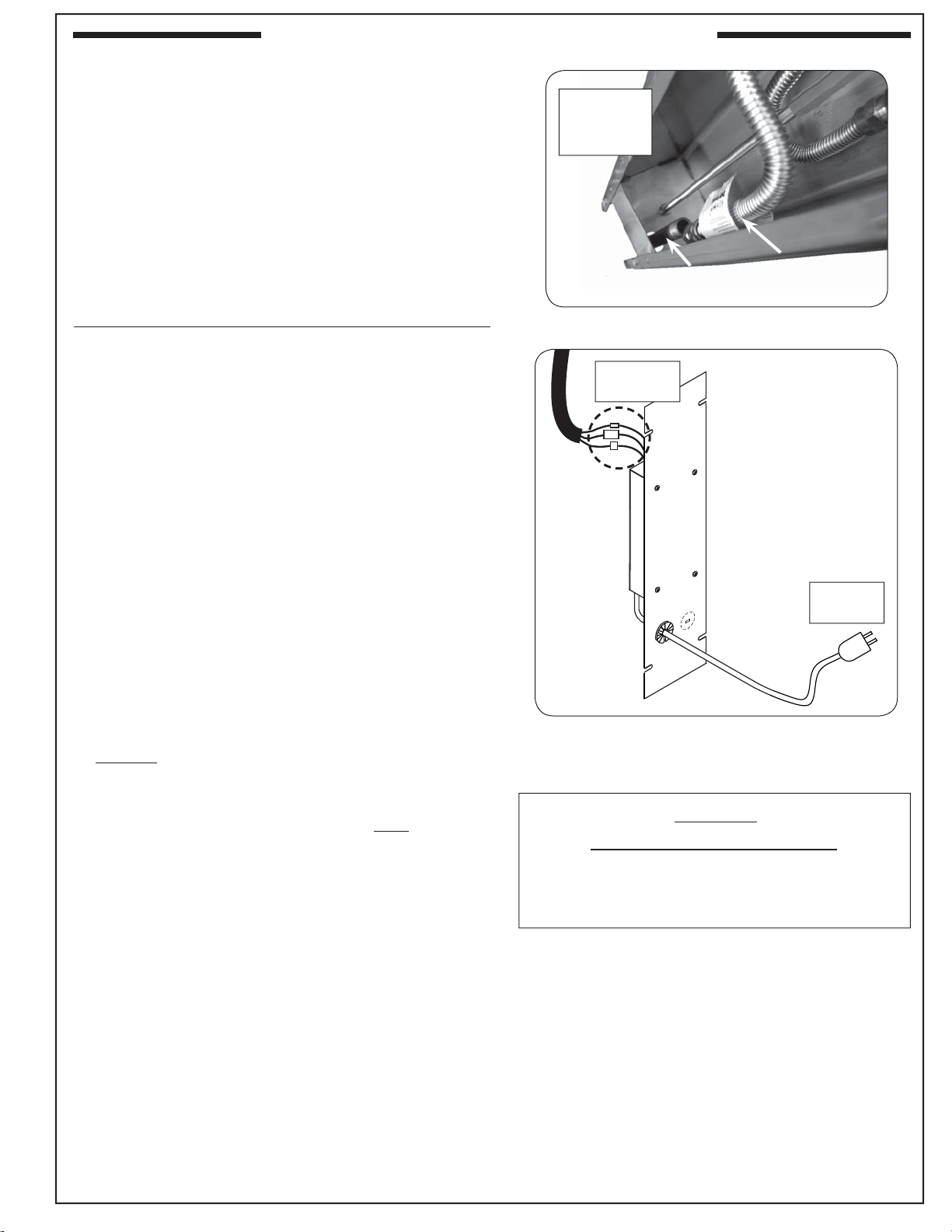
Bolts
Weld-nut
To grill
Post
Extension
(position
open side
toward back)
Install
provided bolts
into 5 holes
around post
Fig. 14-1 Install extension to post
Fig. 14-2 Fasten extension to post
Ground level
Concrete level
Post
Gas supply
route
Fig. 14-3 Pour concrete & install post
3-5"
Gas supply line
(cover to protect)
ATTACH POST EXTENSION
1. Attach the extension to the bottom of the grill post so
that the open portion is toward the back of the grill and
the fi ve holes in the extension line up with the fi ve (5)
weld-nuts in the post (see Fig. 14-1).
2. From outside the joined post and extension, insert
one of the
1
/
4
X 20"-
5
/
8
bolts (supplied) into each of
the fi ve (5) bolt holes and tighten each using a
7
/
16
"
socket driver or wrench (see Fig. 14-2).
Note: There is one hole on each side of the post,
except the back which has two holes located on
either side of the extension opening.
PLACE POST IN-GROUND & POUR
CONCRETE
1. Prepare the concrete to be used for the install.
2. Carefully orient the post over the gas supply line and
into the installation hole.
Important: Verify that the gas supply line is running up
through the post hole, just off center. It must
extend high enough to reach the grill gas
connection and remain safely above the level
of the concrete when poured.
3. Remove the post, then cover the end of the gas supply
line with a plastic bag and/or masking tape to avoid
getting concrete or other debris in the supply line.
4. Pour the concrete into the hole 3-5" below ground
level taking care to protect the gas supply line.
5. While the concrete is still wet, carefully lower the
extended grill post into the hole so that the gas
supply line slides through the clearance hole in the
bottom of the post.
6. Orient the grill per plan, then level the grill and support
it so that it remains in position while the concrete drys.
REV 8 - 1401220800
L-C2-294
15
IN-GROUND POST INSTALLATION (cont.)
CONNECT GAS SUPPLY
For household propane or natural gas units:
Route the fl ex connector to the gas stub.
Turn OFF the gas supply at the source. Remove the
adapter that is loosely connected to the fl ex connector.
Attach the adapter to the gas-supply stub using a pipe
compound resistant to all gasses. Tighten securely. Then
attach the open end of the fl ex connector to the adapter.
Tighten securely.
For propane cylinders:
For connecting a propane unit to a portable propane tank,
read the safety warnings and follow the instructions in the
section SAFE USE AND MAINTENANCE OF PROPANE
GAS CYLINDERS.
Important: An appropriate adapter will be required to
connect the existing fl ex connector to an
L.P. regulator/hose assembly.
LEAK TEST
Turn all burner control knobs to the OFF position. Turn the
gas supply on. Then carefully check all gas connections
for leaks with a brush and half-soap/half-water solution
before lighting. NEVER USE A MATCH OR OPEN
FLAME TO TEST FOR LEAKS.
RECONNECT POWER SUPPLY WIRES
CAUTION: IMPROPERLY CONNECTED WIRES WILL
CAUSE DAMAGE TO THE GRILL AND
MAY RESULT IN PROPERTY DAMAGE
AND/OR PERSONAL INJURY.
To connect the power supply box, connect the three wires
coming from the power supply to the wire harness extension
as shown in Fig. 15-2.
Important: Apply dielectric grease to the male connectors
prior to making any wire connections.
RE-SECURE ACCESS PLATE
Carefully replace the access plate using the four screws,
ensuring all interior components are properly oriented
inside of the grill. Ensure the power supply cord (and fl ex
connector if applicable) coming out of the rear of the post
are properly situated and the plastic bushing/grommet
pieces are secure in place.
CONNECT POWER CORD
Plug the power supply cord into a properly wired,
grounded, and inspected GFCI electrical receptacle.
Use a heavy-duty grounded extension cord if necessary.
Note: Keep electrical supply cords away from all
heated surfaces.
Fig. 15-2 Connect: Wires, Plate, Power
To GFCI
receptacle
Wire
Connections
WARNING
Electrical Grounding Instructions:
This outdoor-cooking gas appliance is equipped
with a three-pronged (grounding) plug. Do not cut or
remove the grounding prong from the plug.
Fig. 15-1 Connect gas
Supply line
Flex
connector
In-ground
method shown.
Individual setup
may vary.
16
U
L
Fig. 16-1 type coupleur rapide de fi l de point culminant d’I
Valve
de
décompression
QCC
Type 1
Valve
Ajustage de précision
en laiton de fi l de
point culminant
Indicateur
de niveau
de liquide
(facultatif)
Écrou de main avec le
fi l de point culminant.
Régulateur
Passage
Tuyau
Volant de commande
main dans le sens des aiguilles d’une montre pour engager les
fi ls et pour serrer jusqu’à ce que douillettement. L’utilisation des
pinces ou de la clé ne devrait pas être nécessaire. Seulement
le propane marqué par cylindres doit être employé.
Pour débrancher: Tournez l’écrou de main dans le sens
contraire des aiguilles d’une montre jusqu’à isolé (fi g. 16-1).
Important: Avant d’employer le gril, et ensuite chaque
fois que le cylindre est enlevé et rattaché,
examinez tous les raccordements pour déceler
les fuites. Arrêtez les valves de gril et ouvrez
la valve principale de cylindre, puis vérifi ez
les raccordements avec de l’eau savonneux.
Réparez toutes les fuites avant d’allumer le gril.
ATTENTION: Tournez toujours la valve principale de cylindre
de propane au loin après chaque utilisation,
et avant de déplacer le gril et le cylindre, ou
débrancher l’accouplement. Cette valve doit
rester fermée et le cylindre a débranché alors
que l’appareil n’est pas en service, quoique
l’écoulement de gaz soit arrêté par un dispositif
de sûreté quand le coupleur est débranché.
Inspectez soigneusement l’ensemble de tuyau chaque fois
avant que le gaz soit allumé. Un tuyau fi ssuré ou effi loché doit
être immédiatement remplacé.
Si l'appareil est stocké à l'intérieur, le cylindre doit être disconnected
et a enlevé. Des cylindres Disconnected doivent être stockés
dehors, hors de la portée des enfants, avec les prises de valve
fi letées étroitement installées, et ne doivent pas être stockés dans
un bâtiment, le garage, ou n'importe quel autre secteur inclus.
POUR VOTRE SÛRETÉ
a. Ne stockez pas un cylindre de gaz disponible de propane
dessous ou ne vous approchez pas de cet appareil.
b. Ne remplissez jamais cylindre au delà de 80 pour cent de
plein.
c. SI L’INFORMATION DANS “A” ET “B” N’EST PAS SUIVIE
EXACTEMENT, UN FEU CAUSANT LA MORT OU DES
DOMMAGES SÉRIEUX PEUT SE PRODUIRE.
IMPORTANT POUR VOTRE SÛRETÉ
LISEZ ET SUIVEZ TOUS LES AVERTISSEMENTS ÉQUIPÉS DE VOTRE CYLINDRE DE GAZ DE PROPANE.
En actionnant cet appareil avec un cylindre de gaz de propane ON DOIT observer ces instructions et avertissements.
LE MANQUE DE FAIRE AINSI PEUT AVOIR COMME CONSÉQUENCE UNE INCENDIE OU UNE EXPLOSION SÉRIEUSE.
CYLINDRE ET CONDITIONS ET
CARACTÉRISTIQUES DE CONNECTEUR
a. Des cylindres et les valves de gaz de propane doivent être
maintenus en bon état et doivent être remplacés s’il y a
des dommages évidents au cylindre ou à la valve.
b. Ce gril, une fois utilisé avec un cylindre, devrait être relié à
un gallon de la norme 5 (20lb.) cylindre de gaz de propane
équipé d’un OPD (remplissez au-dessus du niveau le
dispositif d’empêchement). L’OPD a été exigé sur tous les
cylindres vendus depuis octobre 1.1998 pour empêcher le
remplissage excessif.
c. Les dimensions de cylindre devraient être approximativement
12"(30.5cm) de diamètre et 18" (45.7cm) hauts. Des
cylindres doivent être construits et marqués selon les
caractéristiques pour des cylindres de gaz de propane du
département des ETATS-UNIS du transport (D.O.T.) ou
le niveau national du Canada, du CAN/CSA-B339, des
cylindres, des sphères et des tubes pour le transport des
marchandises dangereuses.
d. Le cylindre doit inclure un collier pour protéger la valve
de cylindre et le circuit d’alimentation de cylindre doit être
assuré le retrait de vapeur.
e. Le montage du régulateur de pression et le fl exible (Fig. 16-1)
fourni avec cet appareil au gaz en plein air (modèles au
propane seulement) doit être utilisé. Assemblées d'origine et
régulateur de pression et le tuyau de remplacement doivent
être ceux spécifi és par le fabricant pour le raccordement d'un
dispositif de cylindre de liaison identifi ée comme de type I par
le 21.58-2005/CGA ANSI Z 1.6 à 2005 (voir liste des pièces
pour les informations de commande).
f. La valve de cylindre de gaz de propane doit être équipée
d’un dispositif d’accouplement de raccordement de
cylindre, décrit comme type I dans la norme défi nie dans le
e. de paragraphe ci-dessus. Ce dispositif est généralement
décrit comme coupleur rapide de fi l de point culminant.
g. Si votre cylindre de gaz de propane vient avec une prise
de la poussière, placez le bouchon anti-poussière sur la
sortie de valve de cylindre toutes les fois que le cylindre
n’est pas en service.
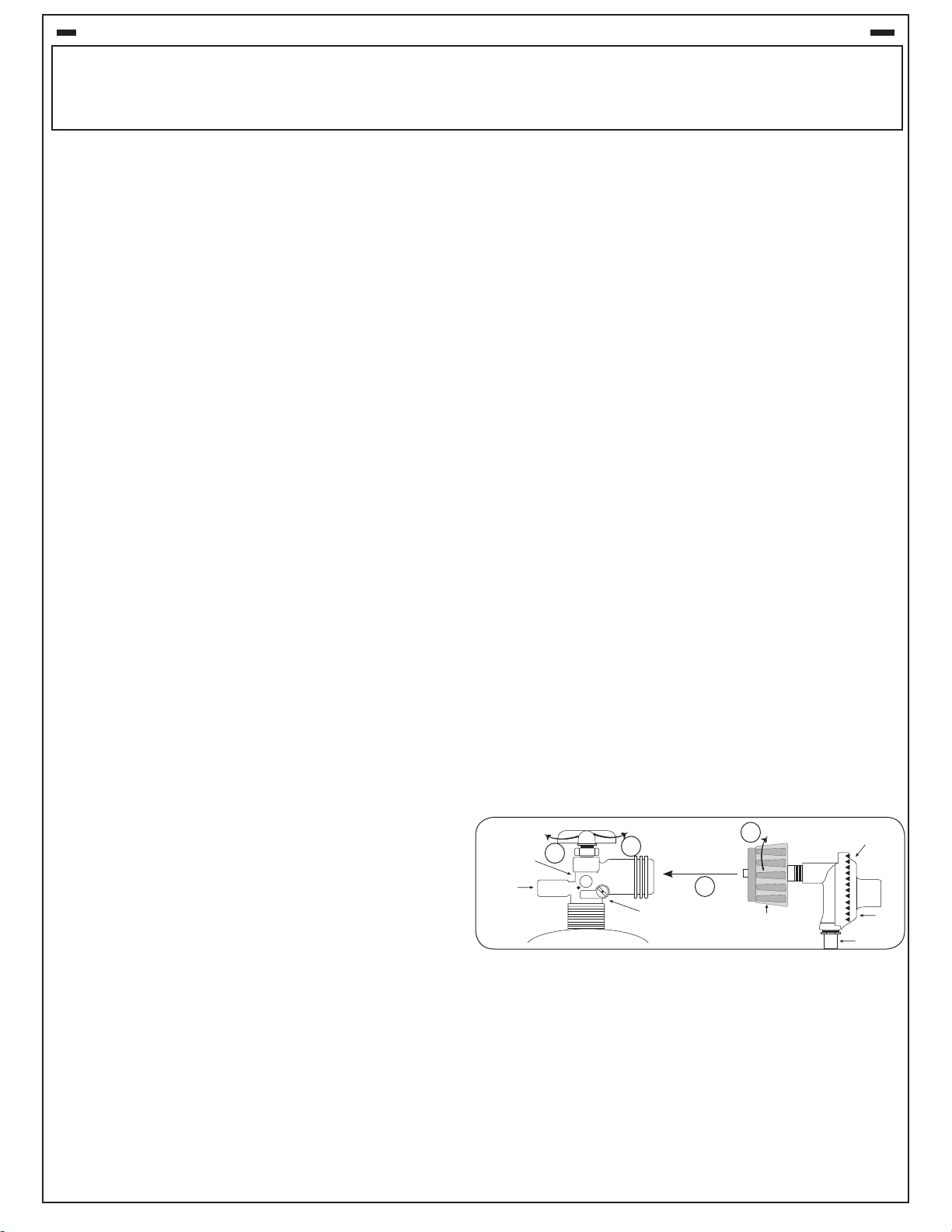
OPÉRATION DE COUPLEUR RAPIDE
Pour relier le regulator/hose à l’ajustage de précision de
valve de cylindre de gaz de propane: Serrez l’écrou de main
sur le régulateur au-dessus de l’ajustage de précision de fi l
de point culminant sur la valve de cylindre. Tournez l’écrou de
1
2
3
4
e. Le régulateur de pression et l’ensemble de tuyau utilisé
doivent assortir les spécifi cations pour le type I par ANSI
Z 21.58-2005/CGA 1.6-2005 (voir la fi gue. 16-1).
UTILISATION SÛRE ET ENTRETIEN DES CYLINDRES DE GAZ DE PROPANE
17
U
L
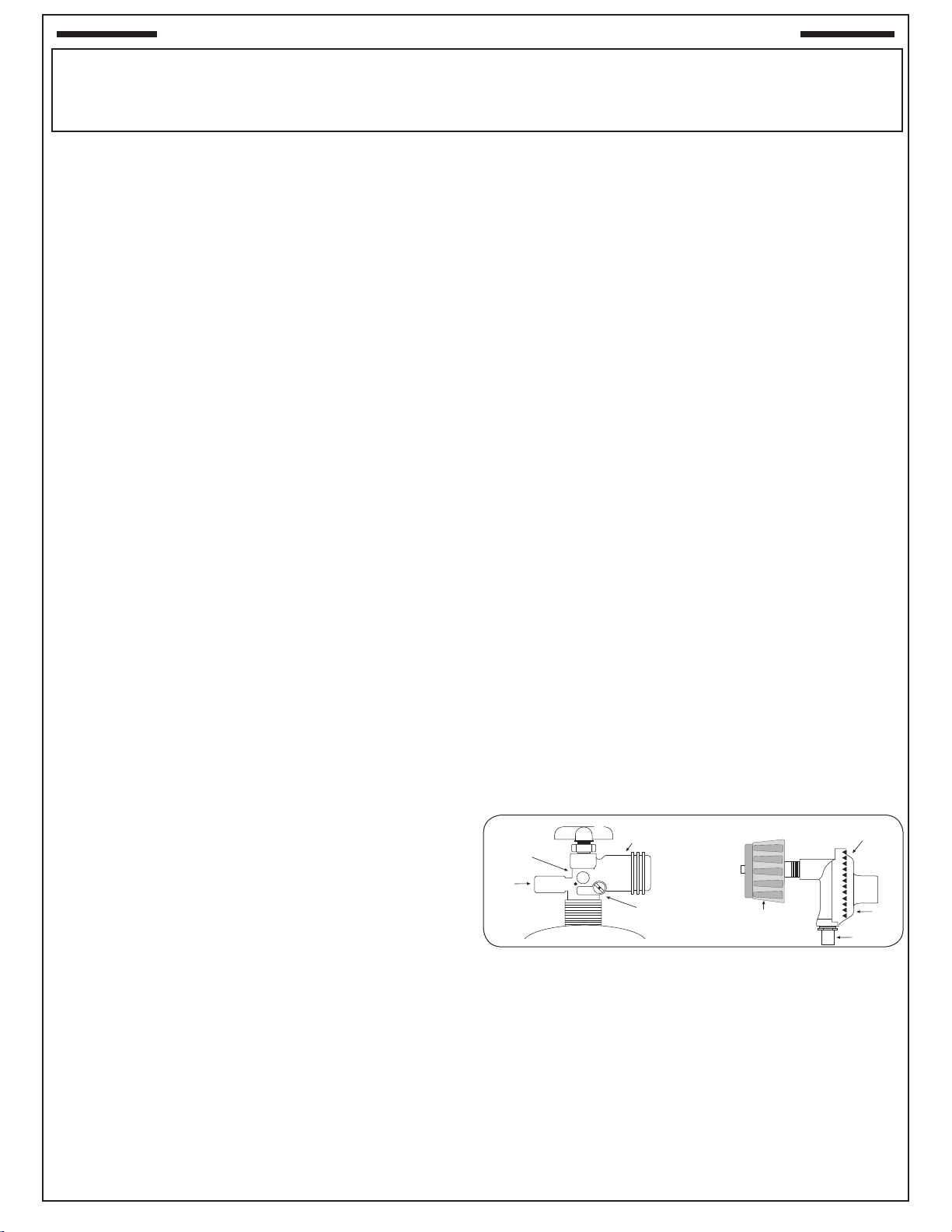
Fig. 17-1 Type I Acme thread quick coupler
Pressure
relief
valve
QCC
Type 1
valve
Brass Acme
thread fi tting
Liquid level
indicator
(optional)
Hand nut with Acme
thread
Regulator
Vent
Hose
Hand wheel
The use of pliers or a wrench should not be necessary. Only
cylinders marked “propane” may be used.
To disconnect: Turn the hand nut counterclockwise until
detached (Fig. 17-1).
Important: Before using the unit, and after each time the
cylinder is removed and reattached, check
the hose for wear (see a.) and check all
connections for leaks. Turn off the unit valves
and open the main cylinder valve, then check
connections with soapy water. Repair any
leaks before lighting the unit.
CAUTION: Always turn the propane cylinder main valve
off after each use, and before moving the unit
and cylinder or disconnecting the coupling.
This valve must remain closed and the
cylinder disconnected while the appliance
is not in use, even though the gas fl ow is
stopped by a safety feature when the coupler
is disconnected.
Carefully inspect the hose assembly each time before the
gas is turned on. A cracked or frayed hose must be replaced
immediately.
If the appliance is stored indoors, the cylinder must be
disconnected and removed. Disconnected cylinders must be
stored outdoors
, out of the reach of children, with threaded
valve plugs tightly installed, and must not be stored in a
building, garage, or any other enclosed area.
FOR YOUR SAFETY
a. DO NOT store a spare propane-gas cylinder under or
near this appliance.
b. NEVER fi ll the cylinder beyond 80-percent full.
c. IF THE INFORMATION IN a. AND b. IS NOT FOLLOWED
EXACTLY, A FIRE CAUSING DEATH OR SERIOUS
INJURY MAY OCCUR.
IMPORTANT FOR YOUR SAFETY
READ AND FOLLOW ALL WARNINGS PROVIDED WITH THE PROPANE-GAS CYLINDER.
When operating this appliance with a propane-gas cylinder, these instructions and warnings MUST be observed.
FAILURE TO DO SO MAY RESULT IN A SERIOUS FIRE OR EXPLOSION.
CYLINDER/CONNECTOR REQUIREMENTS
a. Propane-gas cylinders, valves, and hoses must be
maintained in good condition and must be replaced if
there is visible damage to either the cylinder or valve. If the
hose is cut or shows excessive abrasion or wear, it must
be replaced before using the gas appliance (see e.).
b. This unit, when used with a cylinder, should be connected
to a standard 5-gallon (20 lb.) propane-gas cylinder
equipped with an OPD (Overfi ll Prevention Device).
The OPD has been required on all cylinders sold since
October 1,1998, to prevent overfi lling.
c. Cylinder dimensions should be approximately 12" (30.5
cm) in diameter and 18" (45.7 cm) high. Cylinders must
be constructed and marked in accordance with the
Specifi cations for Propane Gas Cylinders of the U.S.
Department of Transportation (D.O.T.) or the National
Standard of Canada, CAN/CSA-B339, Cylinders,
Spheres, and Tubes for Transportation of Dangerous
Goods.
d. The cylinder used must include a collar to protect the
cylinder valve, and the cylinder supply system must be
arranged for vapor withdrawal.
e. The pressure regulator and hose assembly (Fig. 17-1)
supplied with this outdoor gas appliance (L.P. models
only) must be used. Original and replacement pressure
regulator and hose assemblies must be those specifi ed
by the manufacturer for connection with a cylinder
connecting device identifi ed as Type I by the ANSI Z
21.58-2005/CGA 1.6-2005 (see PARTS LIST for ordering
information).
f. The propane-gas cylinder valve must be equipped with a
cylinder connection coupling device, described as Type I
in the standard defi ned in paragraph e. above. This device
is commonly described as an Acme thread quick coupler.
g. If the propane-gas cylinder comes with a dust plug, place
the dust cap on the cylinder valve outlet whenever the
cylinder is not in use.
QUICK COUPLER OPERATION
To connect the regulator/hose assembly to the propane-
gas cylinder valve fi tting: Press the hand nut on the regulator
over the Acme thread fi tting on the cylinder valve. Turn the hand
nut clockwise to engage the threads and tighten until snug.
e. The pressure regulator and hose assembly used must
match the specifi cation for Type I by ANSI Z 21.58-2005/
CGA 1.6-2005 (see Fig. 17-1).
SAFE USE & MAINTENANCE OF PROPANE GAS CYLINDERS
18
IDENTIFICATION OF GRILL CONTROLS
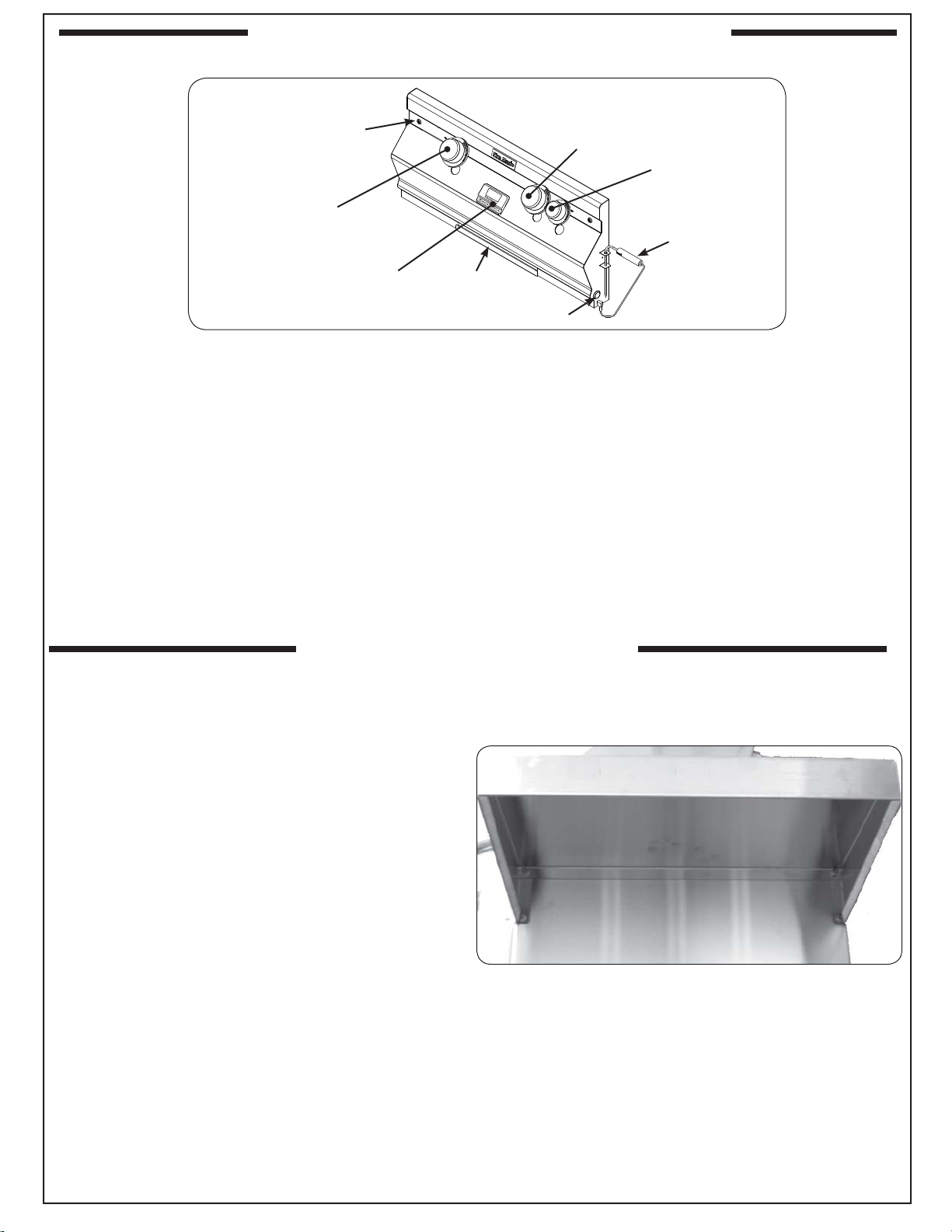
Fig. 18-1
Left
main burner
control knob
Right
main burner
control knob
Backburner
control knob
(if equipped)
Digital
thermometer
A430s controls
View from under right shelf
This grill comes with two (2) rigid shelves that must
be attached. These can be attached using the four
support screws provided and a Phillips-head screw
driver.
1.
Hold the shelf inverted so that one of the corner
holes in the shelf lines up with the appropriate
upper screw hole in the grill.
2. Insert the screw, but do not tighten all the way so
that the shelf can be easily rotated around the fi rst
screw.
3. Line up the second corner hole in the shelf with
the remaining upper screw hole in the grill. Insert
a screw and tighten.
Note: You may lift the edge of the shelf upward
to gain better access during much of the
tightening of this screw.
4. Finally, insert the bottom screws on the left and right
side of the shelf and securely tighten all screws.
To detach, reverse the process above.
RIGID SHELF INSTALLATION
Drip Tray
Control panel
screw(s)
Meat probe
Light switch
To remove the control panel:
• Turn off the gas shutoff valve.
• Pull off the control knobs. Unscrew and remove the control panel
scre
ws and washers.
• Lift the control panel up and outward, allowing it to rest on the
internal chain(s).
Important: During reinstallation; prior to opening the gas shutoff
v
alve, be sure the control knobs are in the OFF position.
19
SHUTTING OFF THE UNIT
To shut off the unit, depress each valve control knob
and, and while pressing turn it clockwise to the OFF
position.
Always close the valve from the gas supply after each
use of the unit.
ELECTRONIC LIGHTING
Note: Electronic lighting requires an installed 9-volt
battery with a good charge.
1. Open lid(s) or remove cover(s) from burner(s) to be lit.
2. Turn all gas control knob(s) to their OFF position(s).
3. Turn on the gas at its source.
Note: DO NOT
turn on more
than one valve at
a time for either
electronic or
manual lighting.
4. Depress the desired control knob for 5 seconds,
then, while pressing turn it counterclockwise to the
HI LIGHT position. Once the burner lights, release
the knob.
CAUTION: If a burner does not light within fi ve (5)
seconds of turning on the control knob,
depress the knob and turn it to the OFF
position. WAIT FIVE (5) MINUTES
before repeating step 4. If you smell
gas, follow the instructions on the cover
of this manual. If the burners still do not
light after several attempts, refer to the
instructions for manual lighting.
5. Repeat step 4 for each additional burner to be lit.
WHEN USING A PORTABLE PROPANE TANK
Propane tanks are equipped with a safety shutdown
device that may cause low or no gas pressure/fl ame
at the burners if operating and lighting instructions
are not followed exactly (See important note in the
TROUBLESHOOTING section for more details.)
MANUAL LIGHTING
CAUTION: Always wait fi ve (5) minutes for gas to
clear after any unsuccessful lighting
attempt.
1. Follow steps 1 through 3 (left).
2. Insert either a burning long-barrel butane lighter or
a burning long-stem match through the cooking grid
opening to the top of the lighting tube. (Fig. 19-2).
For backburners, hold the flame
against the surface of the backburner.
For sideburners, hold the fl ame against the burner.
3. While holding the match or lighter fl ame at the top
of the lighting tube or next to the burner (sideburner
and backburner only), depress the desired control
knob and while pressing turn it counterclockwise to
the HI LIGHT position. Remove the lighter or match
when the burner lights, and release the control
knob.
4. If the burner does not light, immediately depress
the knob and turn the valve to OFF. WAIT FIVE
(5) MINUTES before repeating steps 2 through 4
of the MANUAL LIGHTING instructions.
Read all instructions before lighting, and follow these instructions each time you light the unit.
Fig. 19-2 - Manual lighting
Lighter
Lighting
tube
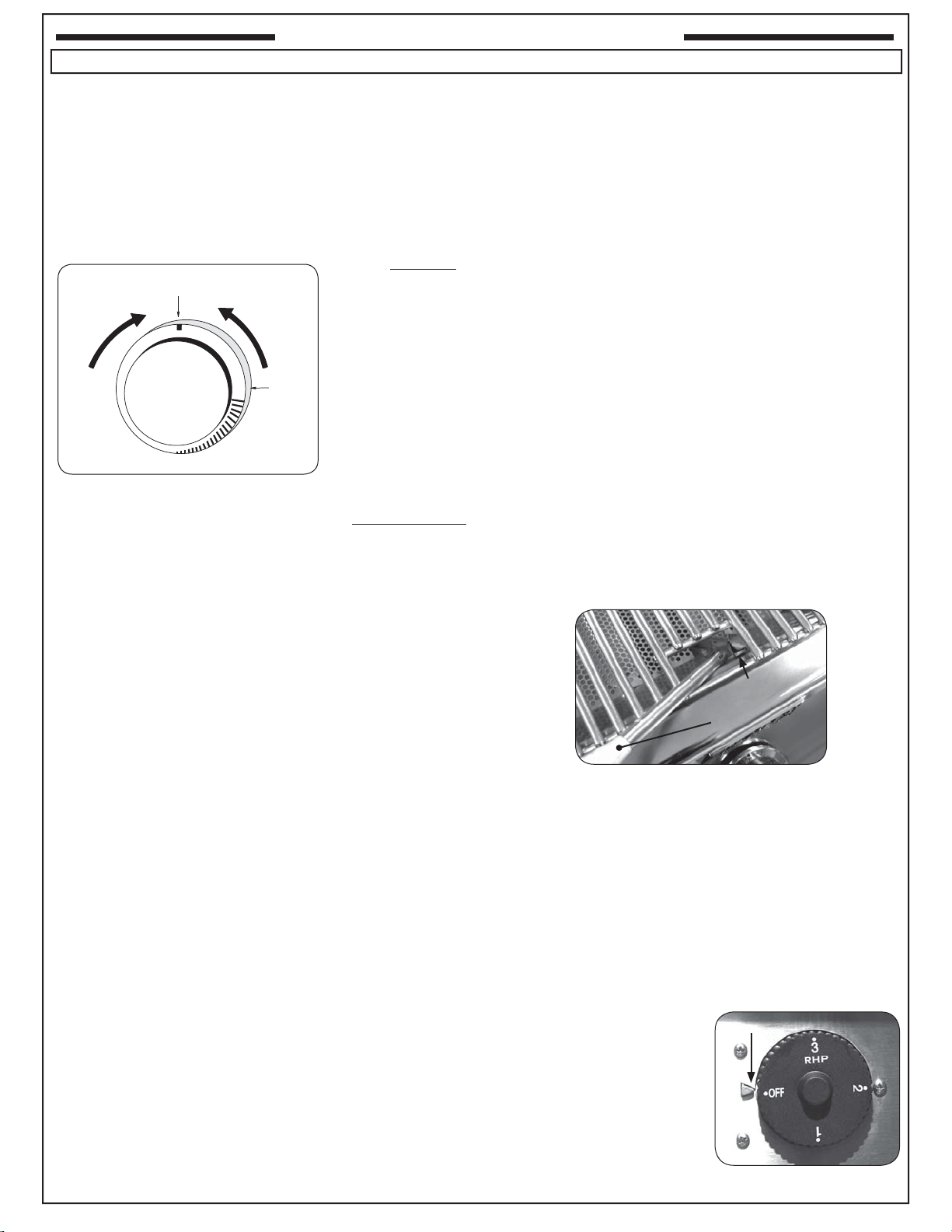
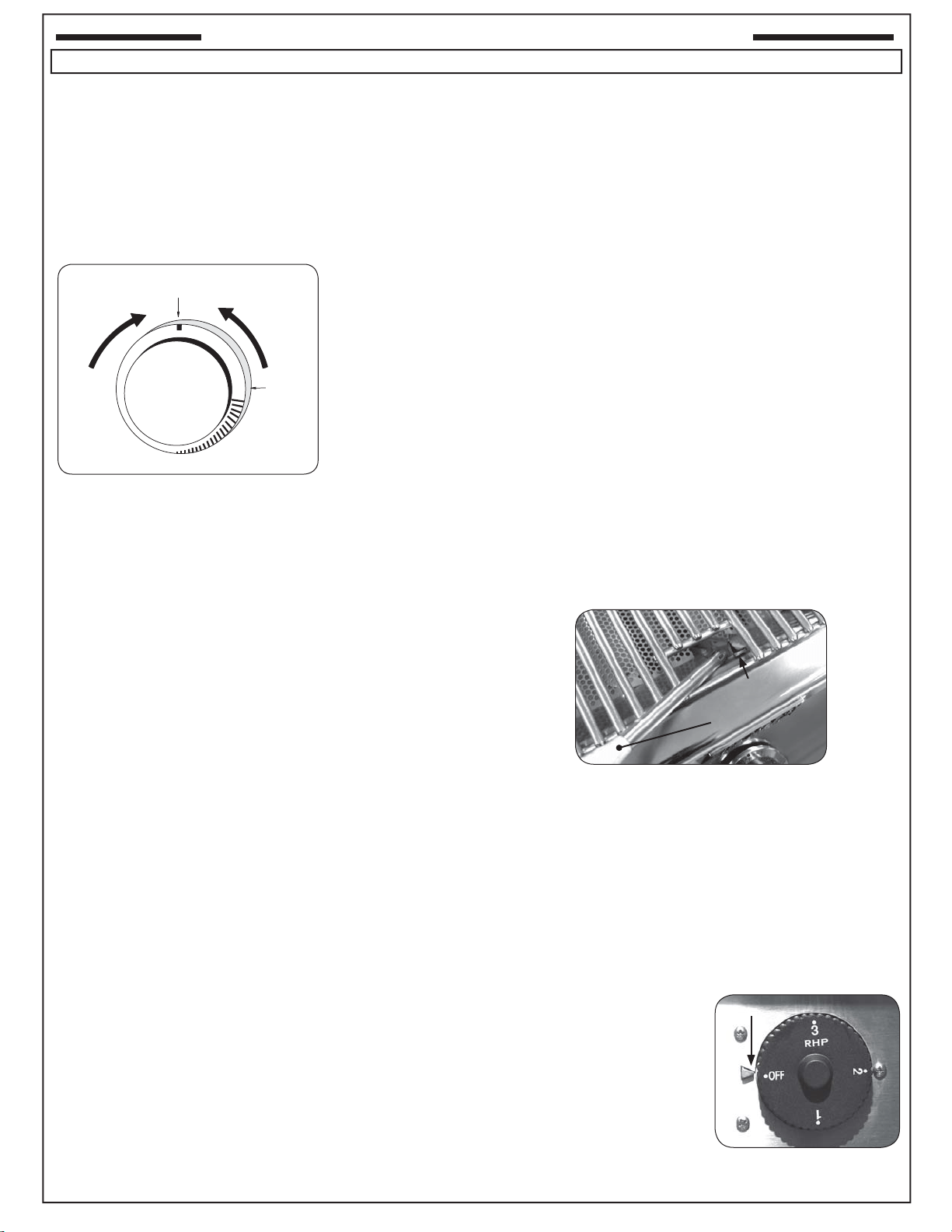
Fig. 19-1 - Control knob
OFF
HI
LIGHT
LOW
TO
TURN OFF
TO TURN ON
Read setting
here
HIGH to
LIGHT
Read setting here
(OFF position shown)
To Turn OFF
To Turn ON
Use
HI (high)
to light
Press
knob in
to turn
3. While holding the match or lighter fl ame at the top of
the lighting tube or next to the burner (backburner
only), depress the desired control knob and while
pressing turn it counterclockwise to the HI LIGHT
position. Remove the lighter or match when the
burner lights, and release the control knob.
4. Set timer control knob to the desired cooking time.
5. Depress the desired control knob for 5 seconds,
then, while pressing turn it counterclockwise to the
HI LIGHT position. Once the burner lights, release
the knob.
6. Repeat step 5 for each additional burner to be lit.
SETTING THE TIMER
Before following the lighting instructions set the timer
located on the front of the post base (Fig. 19-4) to the
desired number of cooking hours (up to three hours) by
rotating the timer knob clockwise. The timer will slowly
turn counterclockwise until it reaches the OFF position
and then shut off the gas supply to the grill. To extend
cooking time, turn the knob clockwise until it is set to the
desired remaining cooking time.
Read Here
Fig. 19-4
Timer knob in OFF position
Note: Grill must be connected to 120VAC power for
electronic lighting.
LIGHTING (IGNITION) INSTRUCTIONS
20
ARRÊT DU UNITÉ
Pour couper le unité, diminuez chaque bouton de commande
de valve et, et tout en pressant tour il dans le sens des
aiguilles d’une montre à la position de repos.
Fermez toujours la valve de la fourniture de gaz après chaque
utilisation du unité.
ÉCLAIRAGE ÉLECTRONIQUE
Note: L’éclairage électronique exige une batterie installée
de 9 volts avec une bonne charge.
1. Ouvrez les couvercles ou enlevez les couvertures des brûleurs
pour être Lit.
2. Tournez tous les boutons de commande de gaz à leurs
positions de repos.
3. Allumez le gaz à sa source.
Note: N’ouvrez
pas plus d’une
valve à la fois
pour l’éclairage
électronique ou
manuel.
4. Diminuez le bouton de commande désiré pendant 5
secondes, puis, et tout en pressant le tour il dans le sens
contraire des aiguilles d’une montre dans la position
LÉGÈRE de HI. Une fois que le brûleur s’allume, libérez
le bouton.
ATTENTION : Si un brûleur ne s’allume pas dans cinq
(5) secondes d’allumer le bouton de
commande, enfoncez le bouton et tournez-
le à la position de repos. ATTENDEZ CINQ
(5) MINUTES avant de répéter l’étape 4. Si
vous sentez le gaz, suivez les instructions
sur la couverture de ce manuel. Si les
brûleurs ne s’allument toujours pas après
que plusieurs tentatives, se rapportent aux
instructions pour l’éclairage manuel.
5. Répétez l’étape 4 pour que chaque brûleur additionnel soit Lit.
EN EMPLOYANT UN RÉSERVOIR DE PROPANE PORTATIF
Des réservoirs de propane sont équipés d’un dispositif
d’arrêt de sûreté qui peut ne pas causer le bas ou aucunes
pression de gaz/fl amme aux brûleurs si le fonctionnement
et l’allumage des instructions ne sont pas suivis exactement
(voir la note importante dans la section de dépannage pour
plus de détails.)
ÉCLAIRAGE MANUEL
ATTENTION: Attendez toujours cinq (5) minutes le gaz
pour se dégager après que n’importe quelle
tentative non réussie d’éclairage.
1. Suivez les étapes 1 à 3 (à gauche).
2. Passez un allumeur brûlant de butane de long-baril ou
une allumette brûlante de long-tige dans la grille à cuire
s’ouvrant au dessus du tube d’éclairage. (Fig. 20-2). Pour
des backburners, tenez la fl amme contre le surface du
backburner. Pour des sideburners, tenez la fl amme contre
le brûleur.
3. Tout en tenant l’allumette ou la flamme plus légère
au dessus du tube d’éclairage ou à côté du brûleur
(sideburner et backburner seulement), diminuez le
bouton et tout en pressant le tour de commande désirés
il dans le sens contraire des aiguilles d’une montre
dans la position LÉGÈRE de HI. Enlevez l’allumeur ou
assortissez quand le brûleur s’allume, et libérez le bouton
de commande.
4. Si le brûleur ne s’allume pas, enfoncez immédiatement
le bouton et tournez la valve à AU LOIN. ATTENDEZ
CINQ (5) MINUTES avant de répéter les étapes 2 à 4
des instructions manuelles d’éclairage.
Lisez toutes les instructions avant l’allumage, et suivez ces instructions chaque fois vous lumière le unité.
Fig. 20-2 - Éclairage manuel
Plus léger
Tube
d’éclairage
Fig. 20-1 - bouton de commande
OFF
HI
LIGHT
LOW
TO
TURN OFF
TO TURN ON
Read setting
here
HIGH to
LIGHT
Lisez l’établissement ici
(OUTRE de montrer)
OUTRE DE
SUR
Utilisation
SALUT
(haute)
à la lu-
mière
Enfoncez
le bouton
pour
tourner
3. Tout en tenant l’allumette ou la flamme plus légère
au dessus du tube d’éclairage ou à côté du brûleur
(backburner seulement), diminuez le bouton et tout en
pressant le tour de commande désirés il dans le sens
contraire des aiguilles d’une montre dans la position
LÉGÈRE de HI. Enlevez l’allumeur ou assortissez quand
le brûleur s’allume, et libérez le bouton de commande.
4. Placez le bouton de commande de temporisateur au
temps de cuisson.
5. Diminuez le bouton de commande désiré pendant 5 secondes,
puis, et tout en pressant le tour il dans le sens contraire des
aiguilles d’une montre dans la position LÉGÈRE de HI. Une fois
que le brûleur s’allume, libérez le bouton.
6. Répétez l’étape 5 pour que chaque brûleur additionnel soit Lit.
ÉTABLISSEMENT DU TEMPORISATEUR
Avant de suivre les instructions d’éclairage ont placé le
temporisateur situé sur l’avant de la base de poteau (fi g. 20-
4) au nombre désiré de faire cuire des heures (jusqu’à 1 ou
3 heures) près de tourner le bouton de temporisateur dans le
sens des aiguilles d’une montre. Le temporisateur tournera
lentement dans le sens contraire des aiguilles d’une montre
jusqu’à ce qu’il atteigne la position de repos et ait puis coupé
la fourniture de gaz au gril. Pour prolonger le temps de cuisson,
tournez le bouton dans le sens des aiguilles d’une montre
jusqu’à ce qu’il soit placé au temps de cuisson demeurant
désiré.
Bouton de temporisateur AU LOIN
(temporisateur de 3 heures montré)
Lu ici
Fig. 20-4
Note: Le unité doit être relié à la puissance 120VAC pour
l’éclairage électronique.
ALLUMAGE DES INSTRUCTIONS (D’ALLUMAGE)
21
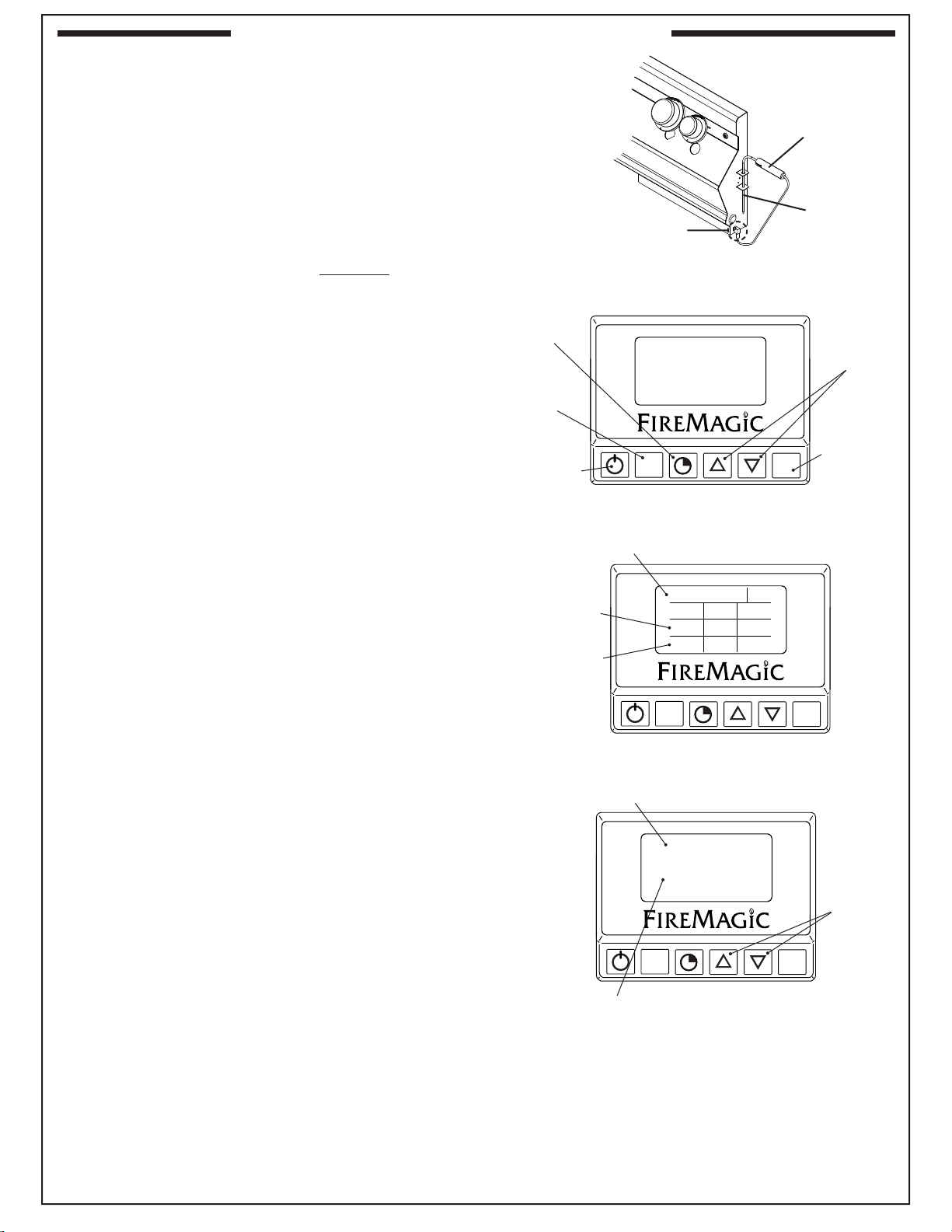
DIGITAL THERMOMETER
MENU
SET
®
Fig. 21-2 Orientation
Arrows for
adjusting digits
SET button
for selecting &
confi rming
Display screen
Timer
button
Menu
button
MENU
SET
®
078
080170
350
TEMP
SET ACT
°F
MEAT
OVEN
TIMER
00:00
Fig. 21-3 Default screen detail
Time set via Timer
Meat probe
temp. info
Oven temp.
info
MENU
SET
®
OVEN
ACTUAL: 078
SET TEMP: 350
Fig. 21-4 Location temp. screen (oven shown)
Current location
Set this temp. as desired
Fig. 21-1 Meat probe detail
MEAT
PROBE
Meat probe handle
Meat probe plug
Power
button
Use arrows
to set
Your grill comes with a digital thermometer for temperature
control, oven and meat probe temperature monitoring, and
timed cooking. Pressing the power button will turn on the
thermometer. The thermometer will automatically shut off
after 5 minutes if no temperature change is detected.
The thermometer is located on the control panel between
the control knobs.
Plug in the meat probe on the right side of the control panel
as shown in Fig. 21-1.
FOR BEST PERFORMANCE, GENTLY PRESS THE
BUTTONS. When turned on, accurate temperature readings
will begin after the thermometer has initialized. When turned
off, allow 5 seconds prior to turning back on.
Read the following sections completely regarding
thermometer operation. Refer to Fig. 21-2 for thermometer
orientation and button locations.
DEFAULT SCREEN
Press the power button to turn the thermometer ON. The
default screen will be displayed. Temperatures for the oven and
meat probe will be shown (Fig. 21-3). See below for options
under the default screen.
Setting a Location Temperature
1. Press the up/down arrow to switch to the desired location
(oven or meat probe). Location will be highlighted when
selected. Press SET.
2. The selected location’s temperature screen will be
displayed. Use the arrows to set the desired temp. The
actual temp. will also be shown. (See Fig. 21-4)
Note: PRESSING the arrows will adjust the desired
temp. by increments of one degree. HOLDING
them down (for several seconds) will adjust the
temp. rapidly.
3. Press SET to return to the default screen. Repeat as
necessary for other location.
The display will fl ash red and the alarm will sound (if set
to do so) when the oven / meat probe reaches its set
temperature. The alarm is silenced by pressing any button
on the thermometer.
22
DIGITAL THERMOMETER (cont.)
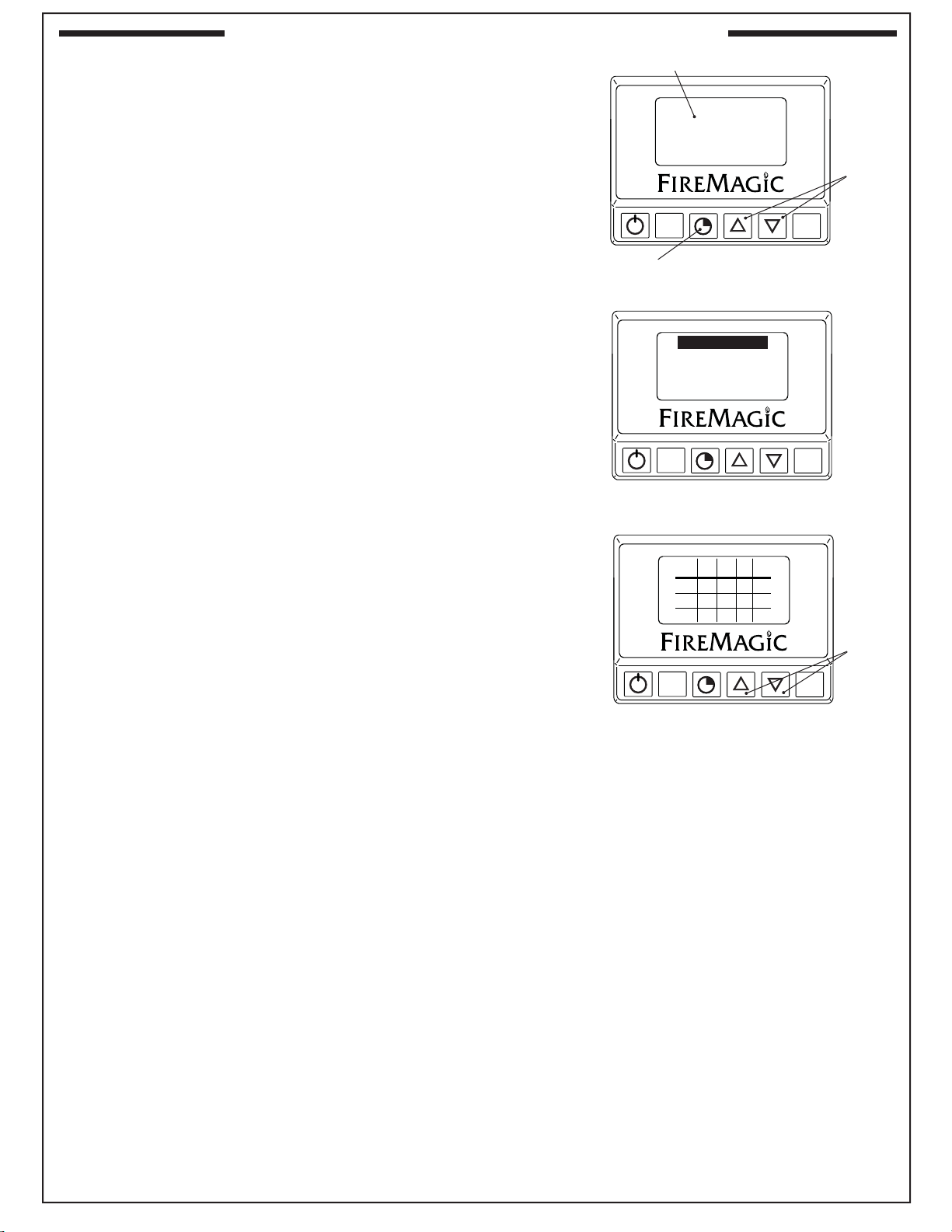
Setting the Timer
1. Press the timer button. Use the arrows to set the desired
amount of time (see Fig. 22-1.)
2. Press SET to return to the default screen.
The time remaining will be shown on the default screen. Once
the time reaches zero; the display will fl ash red and the alarm
will sound. The alarm is silenced by pressing any button on the
thermometer.
MENU SCREEN
Press the power button to turn the thermometer ON. The
default screen will be displayed. Press the MENU button to
display its screen. Press the up/down arrow to scroll through
the options. (See Fig. 22-2.) See below for options under the
menu screen.
Note: The menu screen will return to the default screen after
approximately 30 seconds of no activity. Press the
MENU button to manually return to the default screen.
Changing temperature units (°C/°F)
1. Under the menu screen select SETUP. Press SET.
2. Press the up/down arrow to select SETUP FC. Press SET.
3. Press the up/down arrow to select the desired temperature
unit (°C/°F).
4. Press SET to return to the menu screen.
Grill Guide and Meat Probe
The grill guide displays recommended ready temperatures for
various meats.
1. Under the menu screen select GRILL GUIDE. Press SET.
2. Press the up/down arrow to view the desired meat.
3. Note the temp. and press SET. This will take you to the
meat probe temperature screen.
4. Use the arrows to set the noted temp.
5. Press SET to return to the default screen.
Putting the meat probe into the cooking meat will give an actual
temp. reading. The display will fl ash red and the alarm will sound
(if set to do so) when the actual temp. reaches the set temp. The
alarm is silenced by pressing any button on the thermometer.
Note: Do not leave the meat probe in the meat for a
prolonged period of time, or with the hood closed.
Note: The meat probe is calibrated specifi cally for use at
temperatures between 130°F and 180°F.
MENU
SET
®
SETUP
GRILL GUIDE
ALARM
BACKLIGHT
Fig. 22-2 Menu screen
MENU
SET
MED
RARE
WELL
DONE
170
170
180
160
N/A
160
150
N/A
150
140
N/A
140
BEEF
PORK
LAMB
PROBE
TEMP
MEDRARE
®
Fig. 22-3 Grill Guide screen
MENU
SET
05:00
TIMER
®
Fig. 22-1 Timer screen
Set time as desired
Use arrows
to set
Timer button
Use arrows
to view
desired
meat
23
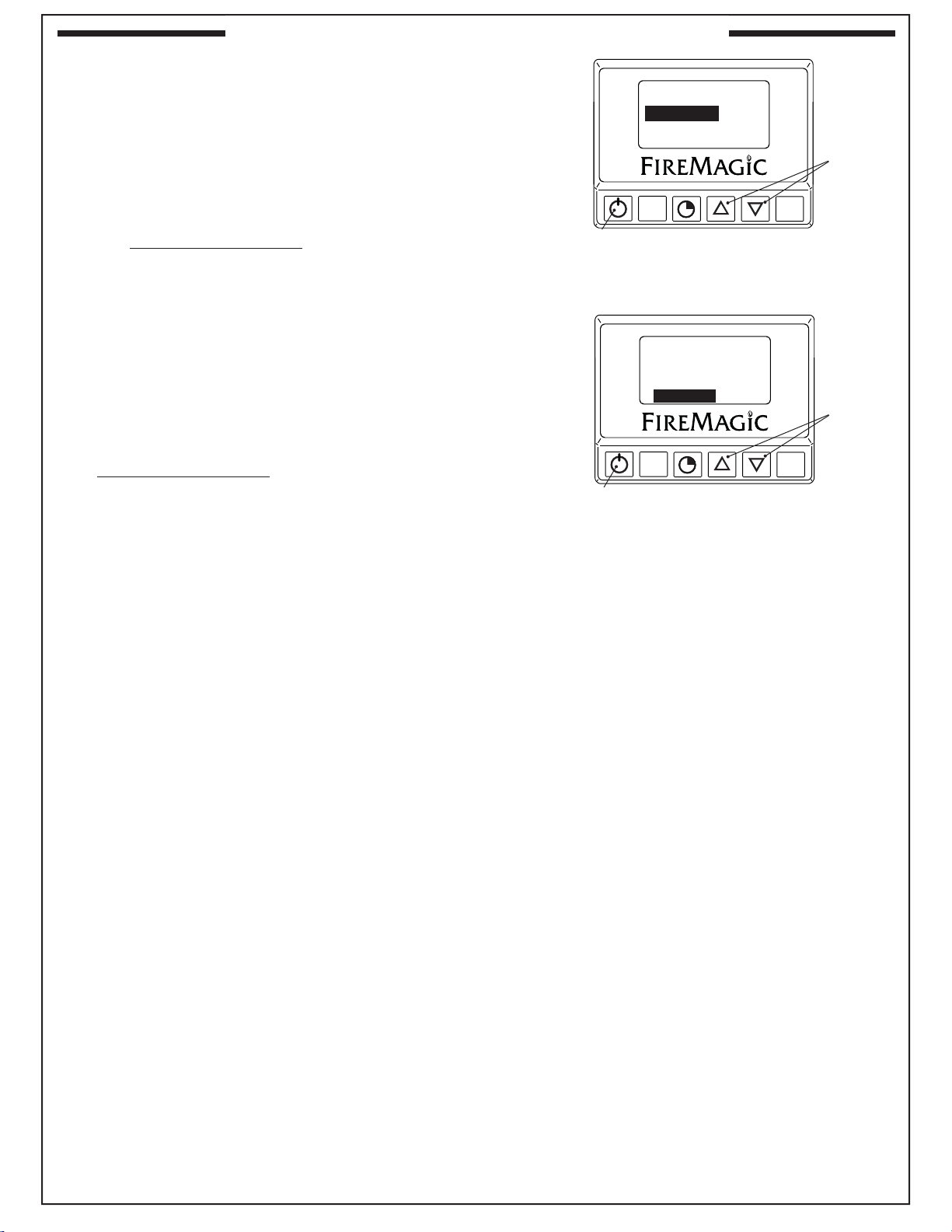
MENU
SET
®
OFF
OFF
ON
BACKLIGHT
RED
GREEN
BLUE
Fig. 23-2 Backlight screen
MENU
SET
®
OFF
ON
OVEN
PROBE
Fig. 23-1 Alarm screen
Press power button
to turn ON/OFF
Press power button
to turn ON/OFF
Use arrows
to select
desired
alarm
Use arrows
to select
desired
color
Setting the Alarm
The alarm can be individually set (ON or OFF) for the meat
probe and oven temp. The default setting has the alarm OFF
for the meat probe and oven temp. The alarm always alerts
for the TIMER.
1. Under the menu screen select ALARM. Press SET.
2. Use the up/down arrow to select the desired alarm,
and press the power button to turn the alarm ON/OFF.
3. Press SET to return to the menu screen.
Setting the Thermometer Backlight
The default color for the thermometer backlight is blue. The
color may be changed as desired by turning the three base
colors ON/OFF. Various combinations will result in different
colors.
1. Under the menu screen select BACKLIGHT. Press SET.
2. Use the up/down arrow to select the desired color, and
press the power button to turn the color ON/OFF.
3. Press SET to return to the menu screen. The new color
will be displayed.
Note: Turning all colors OFF will result in no backlight.
DIGITAL THERMOMETER (cont.)
24
OPTIONAL ROTISSERIE
Fig. 24-6
Backburner
(lit)
Left support bracket
FIREMAGIC
FIREMAGIC
Drip tray
liner
Fig. 24-4
Backburner
(unlit)
CAUTION: WHEN USING THE BACKBURNER; KEEP
THE OVEN LID CLOSED TO PREVENT HEAT
LOSS, PROVIDE PROPER CONVECTION,
AND PROVIDE PROPER VENTING. THIS WILL
ENSURE EVEN COOKING TEMPERATURES.
DO NOT KEEP YOUR OVEN LID OPEN DURING
ROTISSING, AS THIS MAY CAUSE PERSONAL
INJURY, OR IN SOME CASES, IN WINDY
CONDITIONS, DAMAGE TO THE GRILL.
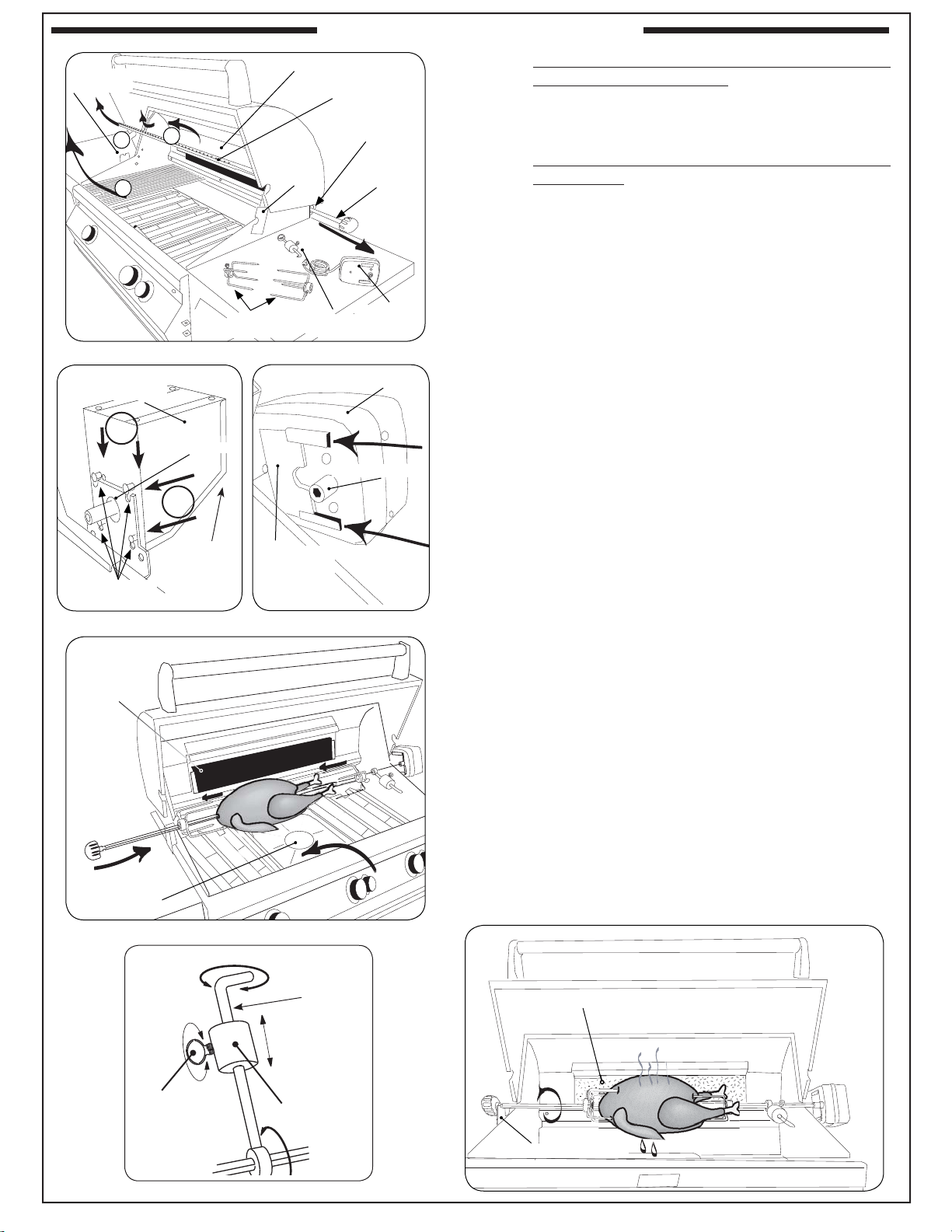
1. Remove warming rack, backburner cover, and cooking
grids. Leave the fl avor grids on if possible.
2. Slide rotisserie motor fully onto motor bracket (right side,
Fig. 24-2 or Fig. 24-3, and Fig. 24-1).
3. Remove rotisserie rod from rear bracket (Fig. 24-1) and
attach knob if necessary.
4. Slide the left meat holder onto the rod (and tighten), the
meat onto the rod and into the holder, followed by the
right meat holder onto the rod and into the meat as shown
in Fig. 24-4. Tighten the right meat holder. Be sure the
meat is centered and balanced as well as possible.
7. Hold both ends of the rod so it settles freely (do not grip
tightly). Allow the rod to rotate until the heavy side of the
meat rests downward.
8. The counterbalance may then be attached to even weight
distribution. Slide counterbalance onto rod next to the
meat holder. Loosen the arm and point it upward opposite
the heavy side of the meat. Tighten the arm.
9. Slide the counterbalance weight up or down the arm until
the rod rotates most evenly then tighten thumb screw
(Fig. 24-5 and Fig. 24-6).
10. Insert the pointed end of the rod into the motor drive
socket and the groove next to the knob into the left
support bracket.
11. To keep drippings off the burners and simplify cleanup,
place Fire Magic
®
drip tray liners under the meat, if
desired (Fig. 24-4).
12. Plug-in the rotisserie motor and press the rocker switch
to start.
13. Light backburner per lighting instructions in this manual
(or on drip tray handle) and close oven lid.
Important: Turn the backburner to low or off when
stopping the rotisserie to prevent overcooking.
Fig. 24-5
Thumb
screw
loosen/
tighten
slide
Weight
Arm
Backburner cover
Warming rack
Rotisserie rod
rear bracket
Rotisserie
rod
and
knob
Rotisserie
motor
Meat
holders
Counter-
balance
Rotisserie
motor
bracket
A
B
1
Rotisserie
rod bracket
Fig. 24-1
Rotisserie motor
slots (4)
Heavy-duty
Rotisserie motor
Rod drive socket
Fig. 24-2
1
2
Rocker
switch
Rotisserie
motor bracket
Rotisserie motor
Rod drive socket
Fig. 24-3
25
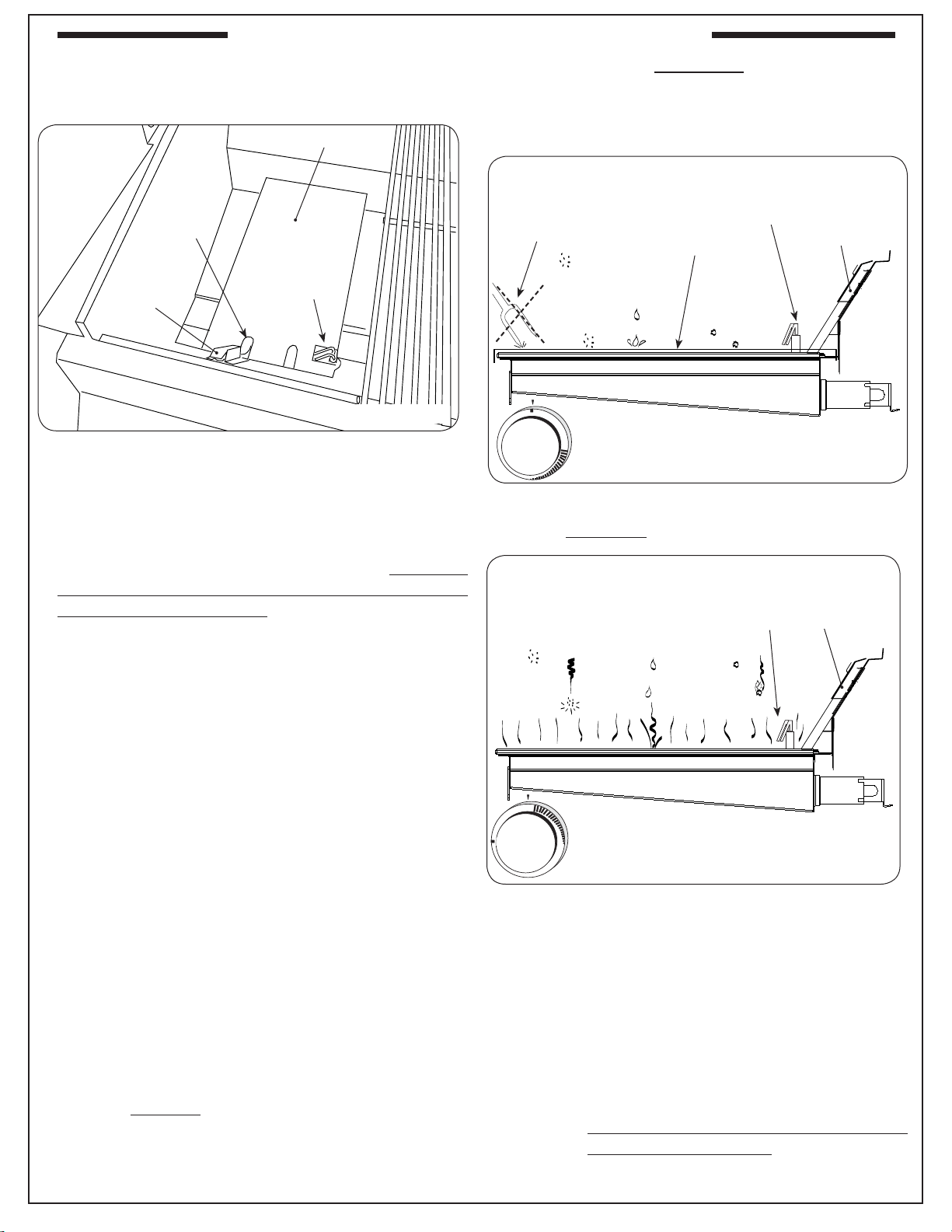
The infrared (IR) searing burner (optional) cooks with
a powerful radiant heat.
Light the infrared burner following the LIGHTING
INSTRUCTIONS in this manual or printed on the
drip tray. Follow these guidelines when operating the
Infrared burner:
• DO NOT place food on the cooking grid until
the IR burner glows orange (Fig. 25-3). Drippings
are heated and evaporate instead of sticking to and
impairing burner function.
• For cleaning purposes; always leave your burner
on (after cooking) for an additional 5 minutes, to
allow for a burnoff period. This is important to
keep your burner clean and operating properly.
As the burner is self cleaning (at full temperature);
avoid the use of cleaners or abrasives.
• When not in use, always cover the infrared burner
with the stainless-steel cover. This protects the
burner from drippings (from other cooking), airborne
particles, and foreign objects (Fig. 25-2).
• Do not strike or scratch the burner ceramic as it
may chip, crack, or break (Fig. 25-2).
Note: Digital thermometer does not give accurate
readings for infrared burners.
Important: When grilling with the infrared burner,
always place a cooking grid above it.
The cooking grid must be removed for
rotisserie cooking.
CAUTION: DO NOT operate your IR burner with the
oven hood closed.
CAUTION: Never attempt to operate the IR burner
with the protective cover in place.
WARNING
Only handle the infrared burner cover when the
grill is cold or with a well-insulated long-handled
tool or heat resistant gloves.
Burner ceramic must be protected with cover when
burner is not in use.
Drips and particles evaporate before hitting infrared
burner when cooking at the maximum setting.
Note: Flavor grids are not to be used with infrared
burners.
To ensure proper operation, all infrared burners
(back and main) must be operated on the HI setting
for a minimum of 10 minutes. Thereafter, the fl ame
may be lowered as desired.
CAUTION: Always monitor the infrared burner fl ame
when operated on low, as it may blow
out in high-wind conditions.
O
FF
HI
LIGHT
LOW
Fig. 25-3
SIDE VIEW
(burner on HI LIGHT
and glowing orange)
Flash
tube
Ignitor
electrode
Fig. 25-1
Cut-out for
Flash tube
Cover
Ignitor
electrode
Flash tube
OFF
HI
LIGHT
L
O
W
Fig. 25-2
Flash
tube
Cover
SIDE VIEW (with cover on)
Ignitor
electrode
Food
particles
or debris
Drippings
and other
liquids
Airborne
dust or
grease
NO foreign
objects
OPTIONAL INFRARED BURNER OPERATION
26
The art of grilling involves learning the nuances of your
grill and knowing how various cuts of meat and other
foods cook on it under different settings and conditions.
Each grill will be unique due to its configuration
and how it is positioned or installed. This section
contains information about how Fire Magic grills were
engineered, which will help you in learning how your
grill responds to the way you use it.
GRILL HEAT DISTRIBUTION - MAIN BURNERS
The heat level at each part of the grill has been
engineered for specifi c purposes. Knowing the heat
distribution for each burner will allow you the best
possible food positioning when grilling.
CAUTION: Even the coolest part of the grill is too
hot to be touched during operation of
the grill.
The front of the grill is designed, for safety reasons,
to be the coolest part of the grill. If you look directly
down on the grill top, while it is off and cool, you can
see this portion of the grill, where the front end of each
burner stops and the slope of the inner grill fi re wall
begins. This area also loses heat most rapidly when
the oven lid is opened (see Fig. 26-2).
From the front of the grill moving toward the back, the
heat rises gradually until just above the burner’s front
edge, where it rises rapidly to a fairly even temperature
refl ected by the thermometer. The heat continues to
rise gradually until it reaches a maximum directly
above the place where the two lobes of each burner
connect (see Fig. 26-2). From there to the back of
the grill, heat diminishes moderately. This supports
the desired temperature for the warming rack and
prevents heat from becoming excessive at the back
fi re wall of the grill.
GRILL HEAT DISTRIBUTION - IR BURNER
Infrared burners are designed for even, searing
heat across their whole surface. Because the heat
is radiant, it tends to heat the food you are cooking
directly without heating the air around it as much as
a conventional burner.
WIND CONSIDERATIONS
Wind direction can have an effect on the grill,
especially with the oven open. For maximum stability
and convenience, position the grill so that the oven
opens toward any prevailing wind (Fig. 26-1).
Fig. 26-1
Orient barbecue so prevailing
wind blows in this direction
Fig. 26-2
Medium heat
Medium heat
High heat
Low heat
GRILLING TIPS
27
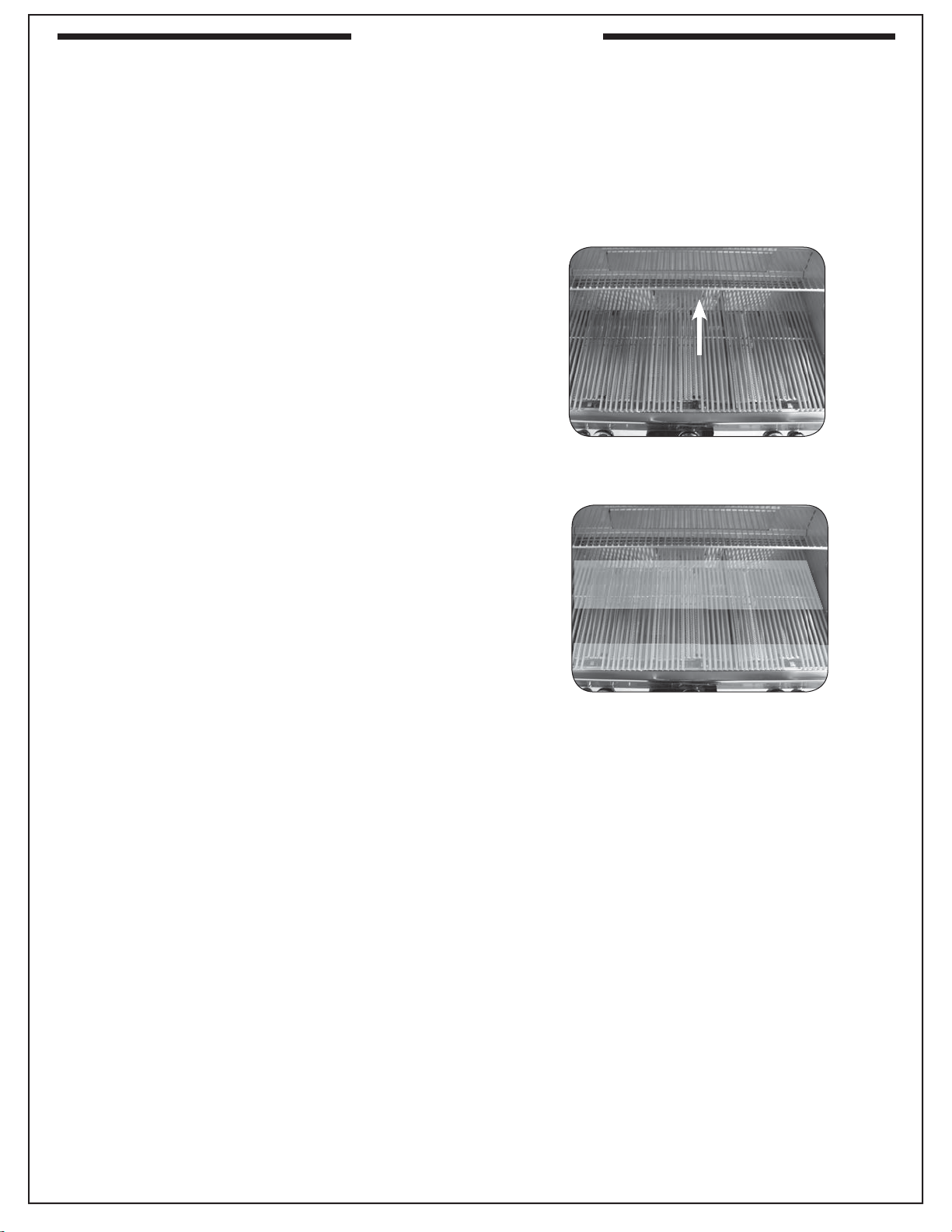
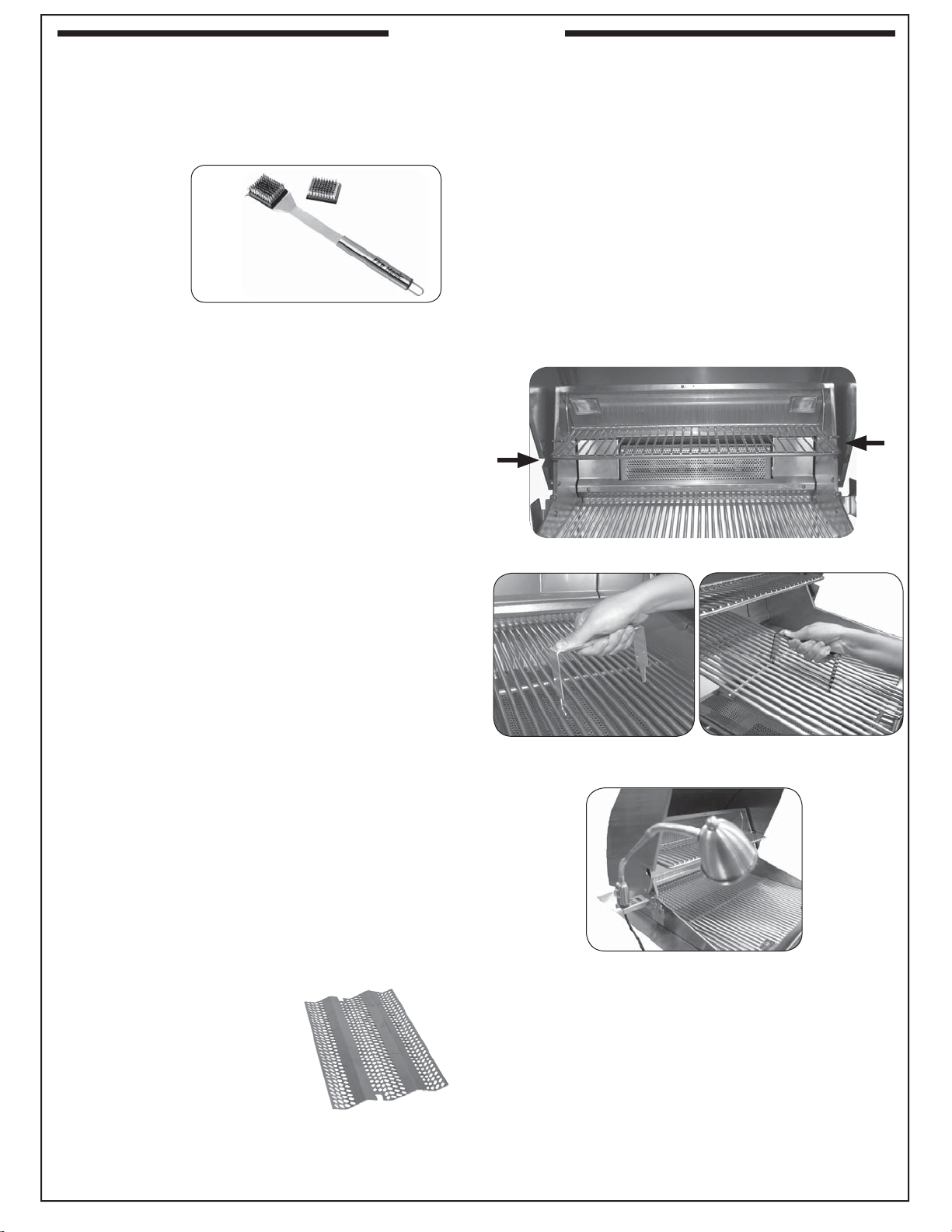
THE COOKING GRID LIFTER
Hold the grid lifter by gripping the center section with the
prongs pointing down (use an oven mitt or heavy glove
if the grill is hot). Insert the notched end of the grid lifter
into the cooking grid, in front of the midway point (front
to back; Fig. 27-3), and central (left to right; Fig. 27-4).
Twist the grill lifter (clockwise or counterclockwise) so
the handle is parallel to the grill rods. This “seats” the
spiked end of the grid lifter between two rods, enabling
you to safely lift out the grid. Lift slowly and adjust the
grid lifter, if necessary, for balance.
Placement of the grid lifter in cooking grid
Fig. 27-3
Fig. 27-4
THE DRIP TRAY
The drip collection system allows you to brush or scrape
excess dried residue from the grilling area directly into
the drip tray (see PARTS LIST for drip tray location).
THE GRILL BRUSH (OPTIONAL)
Purchase a Fire Magic
®
stainless-steel grill brush (sold
separately) to keep your grill cleaner. It comes with
scraper for large particles and a replaceable head with
brass bristles for overall cleaning.
Grill brush with replacement head
Fig. 27-1
THE WARMING RACK
The warming rack (Fig. 27-2) is packed separately.
To install the warming rack, lift the front of the rack
up slightly and insert the rack hangers into the two
holes in the back of the inner oven hood just above the
backburner. Then lower the front of the rack into a level
position to lock the rack in place.
To remove the warming rack, lift up on the front of the
rack until the rack hangers pull free from their supporting
holes.
Note: Removing the warming rack before using the
rotisserie will leave more clearance for the
meat being cooked.
Fig. 27-2 Warming rack in place inside oven
THE WARMING RACK (if equipped)
Flavor grid
THE FLAVOR GRID(S)
Place each fl avor grid directly over a burner. The solid
areas of the grid should rest over the tabs found on the
burner. See Fig. 27-5. The slightly larger grids are
designed to be placed over the outside burners,
and the slightly smaller grid(s) are designed to be
placed over the interior burner(s).
Note: This allows heat from the burners to be evenly
distributed throughout the cooking area. The
fl avor grids heat and cool quickly, making the
grill very responsive to changes in heat from
the burners.
Fig. 27-5
THE ROTIS-A-LIGHT (OPTIONAL)
This fl exible grill lighting solution
(sold separately)
will enhance your outdoor cooking experience by
enabling you to continue cooking long after the sun
has set. The Rotis-A-Light has two multi-directional
fl exi-angles, making this a completely versatile
and indispensable light suitable for any grilling
location.
Fig. 27-6 Optional Rotis-A-Light
ACCESSORIES
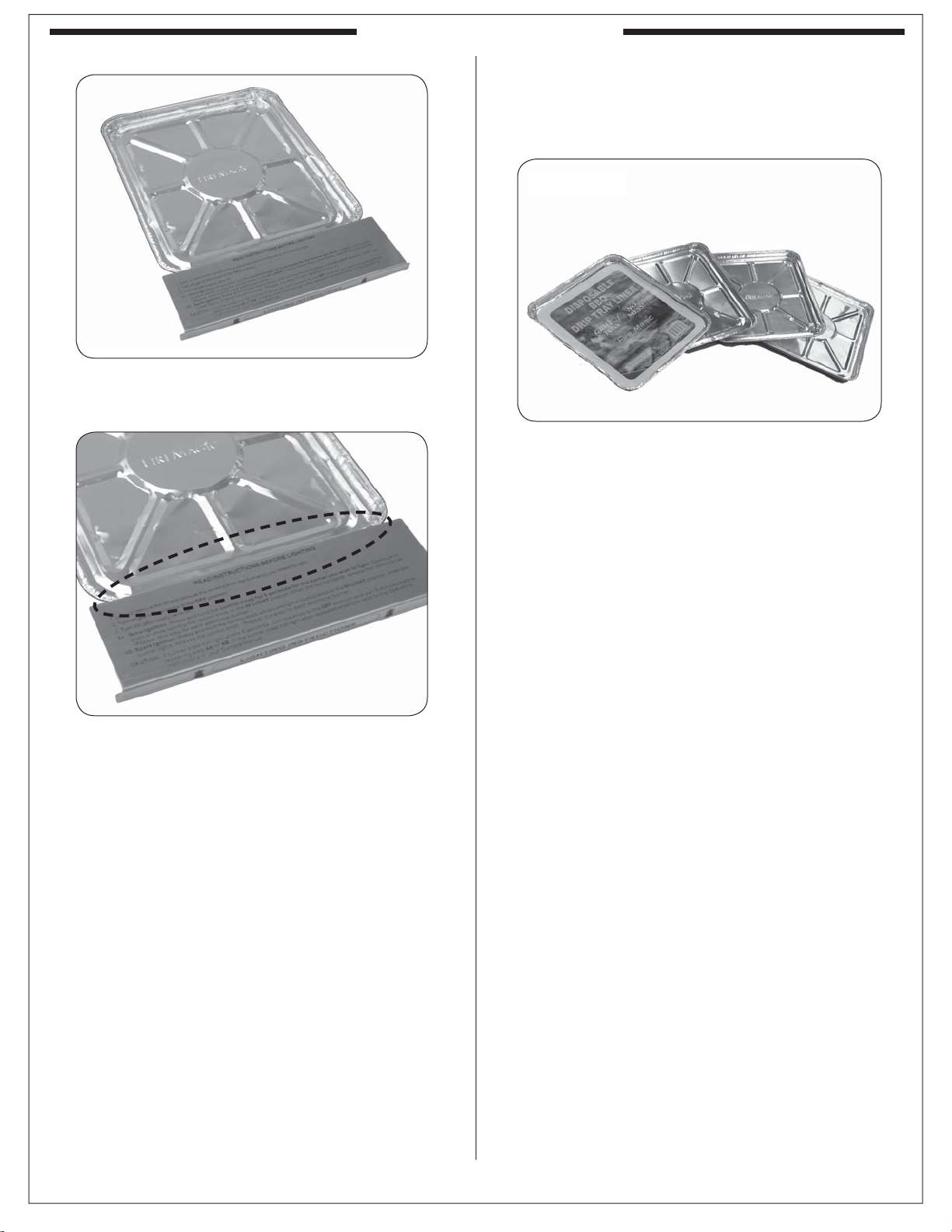
28
Drippings from grilling flow through specially
designed channels and collect in the drip tray .
Check the drip tray regularly and empty when
required.
Your grill includes a pack of four (4) Fire Magic
®
drip tray liners (Fig. 28-1). For your convenience
in cleanup, place a liner into the drip tray before
grilling.
To fi t a liner into the drip tray, pull out the tray and
set it on a fl at, level surface. Place the liner in the
drip tray as shown in Fig. 28-2 and carefully insert
the tray back under the control panel.
Note: Be sure that the liner is properly placed into
the the drip tray. The front of the liner must
fi t under the drip tray's lighting instruction
plate (see 28-3 detail).
After each use, wait for the grill to cool and carefully
pull out the drip tray to check it. When a liner is
nearing full, carefully lift it out of the drip tray, lifting
with both hands to keep the tray level until it is
safely discarded. Then insert a new drip tray liner.
Order more drip tray liners through your local Fire
Magic
®
dealer.
Note: The foil tray liner is also useful for setting on
burners to cover them and catch drippings
directly during rotisserie only cooking.
Note: For models with match holders attached
inside the drip tray, place the match holder
off to one edge of the pan (Fig. 28-3). If
necessary, mold the foil liner around them
and the other features of the tray to create
enough clearance space to open and close
the tray without catching the liner.
Fig. 28-1
Be sure liner fi ts under lighting instruction plate
Pull out the drip tray and place liner
Fig. 28-2
Fig. 28-3
Note: There are easy to follow lighting instructions
etched onto the top of the drip tray handle.
FIRE MAGIC
®
DRIP TRAY
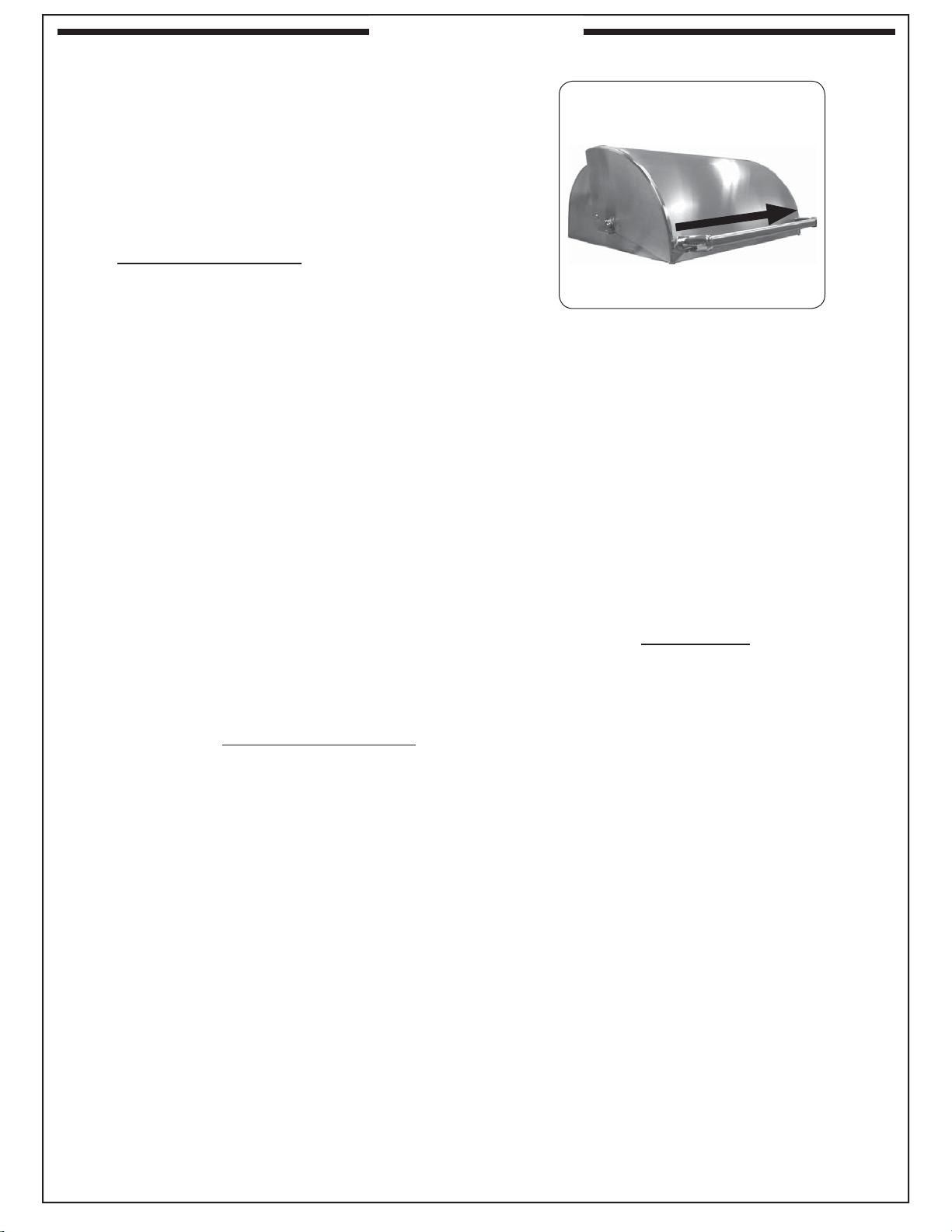
29
Fig. 29-1 - Wipe with grain
PROTECTING YOUR APPLIANCE FROM THE
WEATHER
An optional cover will protect your appliance when not
in use. (Allow to cool before covering.)
Please specify the model number and serial number
of your appliance when ordering a cover.
APPLIANCE MUST BE COMPLETELY COOL WHEN
CLEANING. DO NOT SPRAY ANY CLEANER OR
LIQUIDS ON THE APPLIANCE WHEN HOT.
The appliance must be cleaned as often as once a month
(depending on use) to prevent grease build-up and other
food deposits.
INTERIOR
THE BURNER PORTS AND CARRY-OVER PORTS/
SLOTS MUST BE KEPT CLEAN TO ENSURE PROPER
IGNITION AND OPERATION.
Remove the burner (see orifi ce changing instructions)
and clean the ports and slots as required. (For Fire Magic
grills use Maintenance Kit part #MK-1.) Also inspect and
clean the burner inlet for insects and nests. A clogged
burner can lead to a fi re in the bottom of the appliance.
The inside of the appliance may be cleaned periodically
with oven cleaner if desired. Follow the oven cleaner
instructions for proper use.
Be careful not to get oven cleaner on the outside surface
of the appliance as it can permanently damage the fi nish.
EXTERIOR
Stainless steel surfaces when exposed to temperatures
produced by the grilling process will change color. The
stainless steel will change color from silver to brown
and blue. This can be removed by using stainless steel
cleaner.
Clean your appliance by fi rst using grill cleaner to remove
grease and dirt. Always wipe with the grain (See Fig.
29-1). Next, use stainless steel cleaner to restore the
stainless steel color (Note: not for mirror fi nish). Finish
by wiping your appliance down using polish wipes. To
clean any mirror fi nish (if applicable), use a quality
brand glass cleaner only, not any of the cleaners
mentioned above.
If your appliance is installed in a seaside (salt air) or
poolside (chlorine) location, it will be more susceptible
to corrosion and must be maintained/cleaned more
frequently. Do not store chemicals (such as chlorine or
fertilizer) near your stainless steel appliance.
Due to the nature of stainless steel, surface iron oxide
deposits may appear. Do not be alarmed – these deposits
are removable with stainless steel cleaner through prompt
and periodic maintenance. If not attended to promptly,
permanent pitting may occur.
By following these recommendations, you will enjoy the
beauty and convenience of your appliance for many years
to come.
IMPORTANT
IN THE EVENT OF A GREASE FIRE, IMMEDIATELY
SHUT OFF THE MAIN GAS VALVE TO THE GRILL.
KEEP THE LID OPEN AND ALLOW THE FIRE TO
EXTINGUISH ITSELF. A THOROUGH INSPECTION
BY A TRAINED SERVICE TECHNICIAN SHOULD
BE CONDUCTED BEFORE FUTURE USE OF YOUR
GRILL. THE SERVICE TECHNICIAN WILL CHECK
THE SYSTEM FOR GAS LEAKS AND WILL CHECK
ALL ELECTRICAL WIRING FOR DAMAGE. ALL GAS
LEAKS AND WIRING MUST BE REPAIRED PRIOR
TO FUTURE USE.
Wipe with grain
CARE & CLEANING
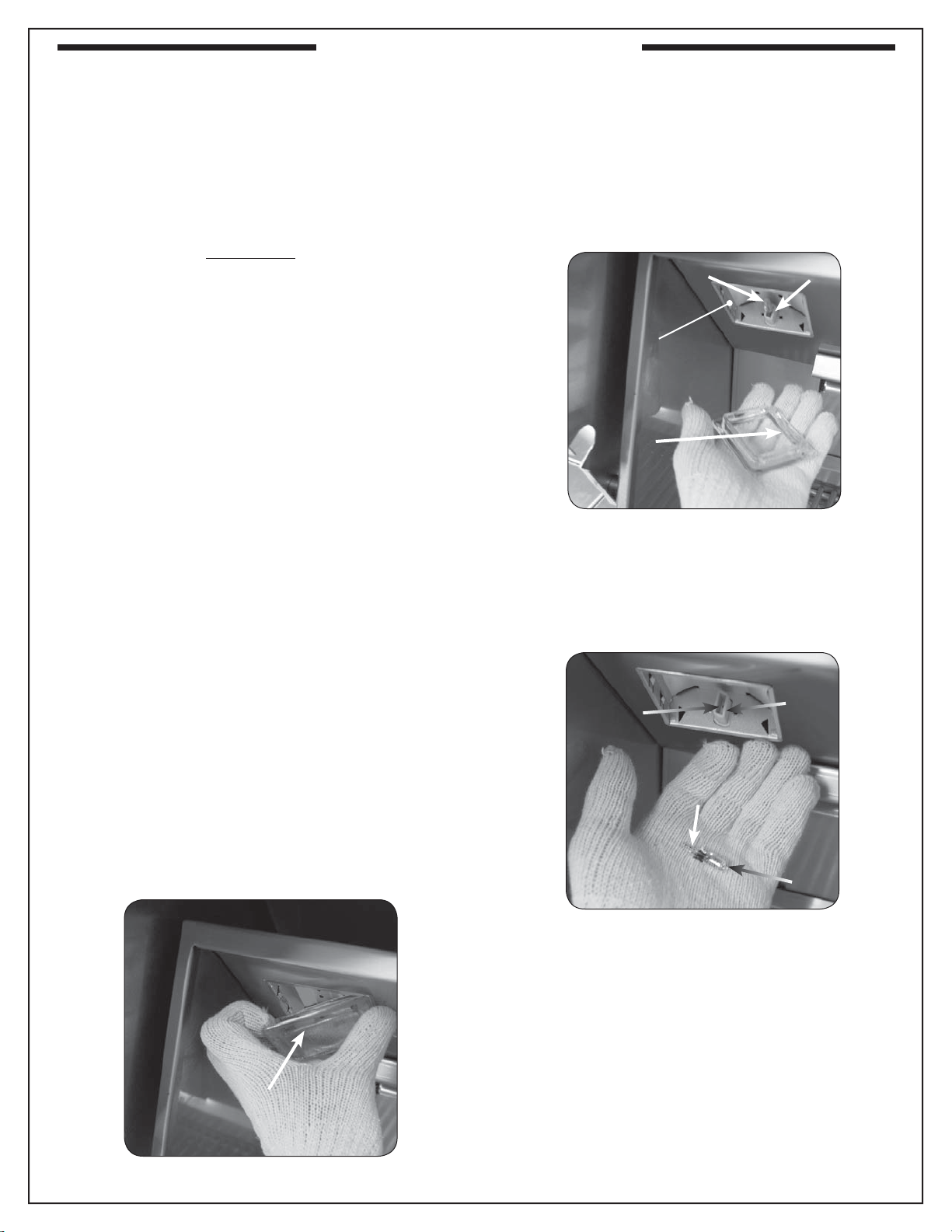
30
Fire Magic
®
grills are all engineered with the
conveniences of electrical power for illuminating and
igniting the grill.
To replace any oven light, follow the instructions below.
Important: ONLY REPLACE WITH 12V / 10 WATT
HALOGEN BULB(S).
WARNING
To protect from potentially sharp sheet metal and
glass, wear gloves and safety glasses during this
procedure.
1. Turn all burner control knobs to the OFF position
and shut off the gas supply to the grill at the source
(tank valve for propane units or gas line shut-off
valve for natural gas units.)
2. Disconnect supply of external electrical power to
the grill.
CAUTION: Wait for the grill, oven, lens, light bulb,
and fi xture to cool before proceeding to
the next step.
3. Open the oven lid.
Important: Place one hand directly below the glass
lens and prepare to catch it when it is
detached.
4. Carefully insert a standard fl at head screwdriver
or thin plastic spatula between the glass lens and
the stainless steel on which the light is mounted
and gently pry the glass lens out in such a way
that the stainless steel is not scratched (twisting
the screwdriver handle, for instance). Catch the
lens and set it safely aside.
Note: You may wish to take this opportunity to clean
the lens with a standard household window
cleaner and then dry it completely.
5. Wearing a pair of gloves, reach into the fi xture,
gently grab the bulb, and pull it straight out of the
fi xture so that the two pins at the base of the bulb
come all the way out.
Important: Bulb is halogen. DO NOT TOUCH with
bare hands. Oils from hands drastically
reduce bulb life.
Note: It may be helpful to rock the bulb gently
backward and forward while pulling it out.
6. Inspect the old bulb for broken glass or fi lament.
Note: It may be benefi cial to test a suspect bulb
in one of the other light fi xtures known to be
working and turn the power back on to be
certain the bulb is actually not working.
7. Insert the new 12V / 10 watt halogen bulb into the
socket so that both pins slide all the way into the
two holes in the bottom of the socket.
8. Place the lens back into the fi xture opening with
the curved cut-out on the bottom and snap it back
into place.
Fig. 30-1
Lens
Fig. 30-3
Bulb
Prongs
Socket
Holes
Fig. 30-2
Fixture
Socket
Curved
cut-out
top of
lens
Bulb
REPLACING HALOGEN BULBS
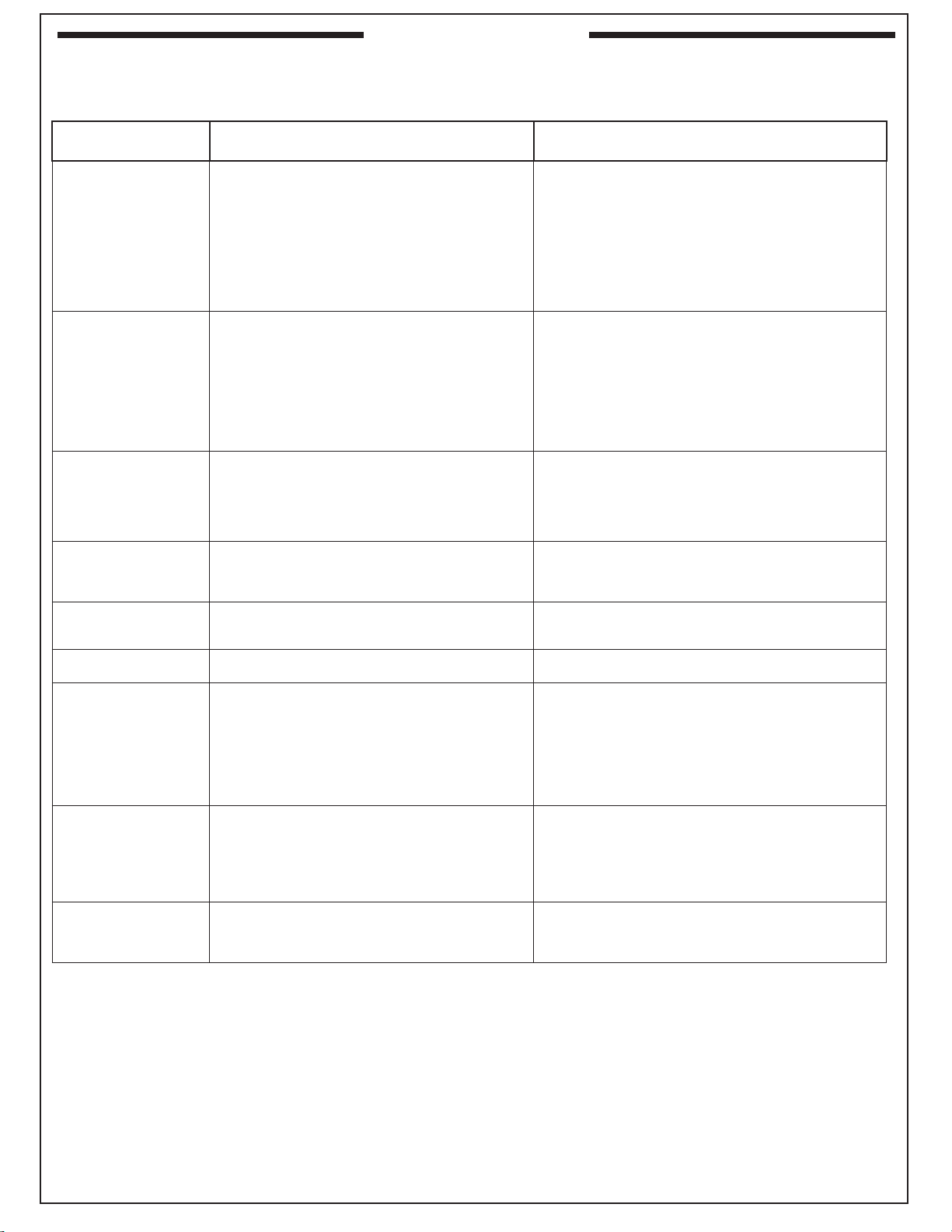
31
If you have trouble with this Fire Magic
®
grill, please use this list to identify the problem. By trying one or more of the
solutions to the possible cause, you should be able to solve the problem. If this list does not cover your present problem,
or if you have other technical diffi culties with the grill, please contact your local Fire Magic
®
dealer or visit our web site at
www.rhpeterson.com.
TROUBLESHOOTING
PROBLEM POSSIBLE CAUSE CORRECTION
Ignition system
failure
1. Power supply failure
2. Improper air shutter adjustment
3. Ignition wire disconnected
4. Low gas pressure
5. Front carry-over port
6. Igniter switch malfunction
1. Check and/or replace power supply.
2. Adjust air shutters.
3. Plug wires back into ignition switches.
4. Have the gas co. check supply pressure.
5. Clean burner ports.
6. Contact dealer for replacement.
Insuffi cient heat
1. Improper air-shutter adjustment
2. Using propane orifi ce for natural gas
3. Low gas pressure/fl ame (propane)
4. Low gas pressure/fl ame (natural)
1. Adjust air shutters.
2. Check/change orifi ces.
3. Shut off all valves, including propane tank,
and follow lighting instructions exactly. (See
important note* below.)
4. Have the gas co. check pressure at grill.
Uneven heating
1. Burner ports partially blocked by debris
2. Small spiders or insects in burner
3. Improper air shutter adjustment
1. Remove burners and clean out ports.
2. Inspect burners and orifi ces for spider webs or
other debris that may block fl ow.
3. Adjust air shutter.
Thermometer not
operating
1. Power supply failure
2. Thermometer failure
1. Check and/or replace power supply.
2. Check and/or replace thermometer.
Thermometer not
operating properly
1. Thermometer malfunction
1a. Disconnect and reconnect external power to grill.
1b. Check and/or replace thermometer.
Rotisserie noisy
1. Rotisserie out of balance 1. Adjust rotisserie counterbalance.
Burner goes out on
LOW
1. Valve “Low” setting needs adjustment
1. Light burner on HIGH, immediately turn to
LOW setting. Remove knob from valve and
using a small fl at screwdriver, slowly turn the
adjustment screw in the stem, a little at a time
(30° to 45°), in either direction, until the fl ame is
approximately
1
/
4
” in height from burner ports.
Interior light(s) not
operating
1. Light switch not functioning
2. Bulb(s) burned out
3. Power supply failure
1. Re-connect external power to grill or contact
dealer for replacement.
2. Contact dealer for replacement.
3. Check and/or replace power supply.
No power to grill
1. Input power source failure
2. Power supply failure
1. Check GFCI / circuit breaker.
2. Check and/or replace power supply.
Table 2
* Important: Propane tanks are equipped with a safety shutdown device that may cause low or no
gas/fl ame at the burners if operating and lighting instructions are not followed exactly. If
you suspect the propane tank safety shutoff is in effect, shut off all burner control valves
and the propane tank valve. Then read and follow the LIGHTING INSTRUCTIONS exactly.
Lighting instructions are located in your owner’s manual and printed on the grill’s metal
drip tray. If the problem persists, continue troubleshooting, or contact your local dealer
or R. H. Peterson for assistance.
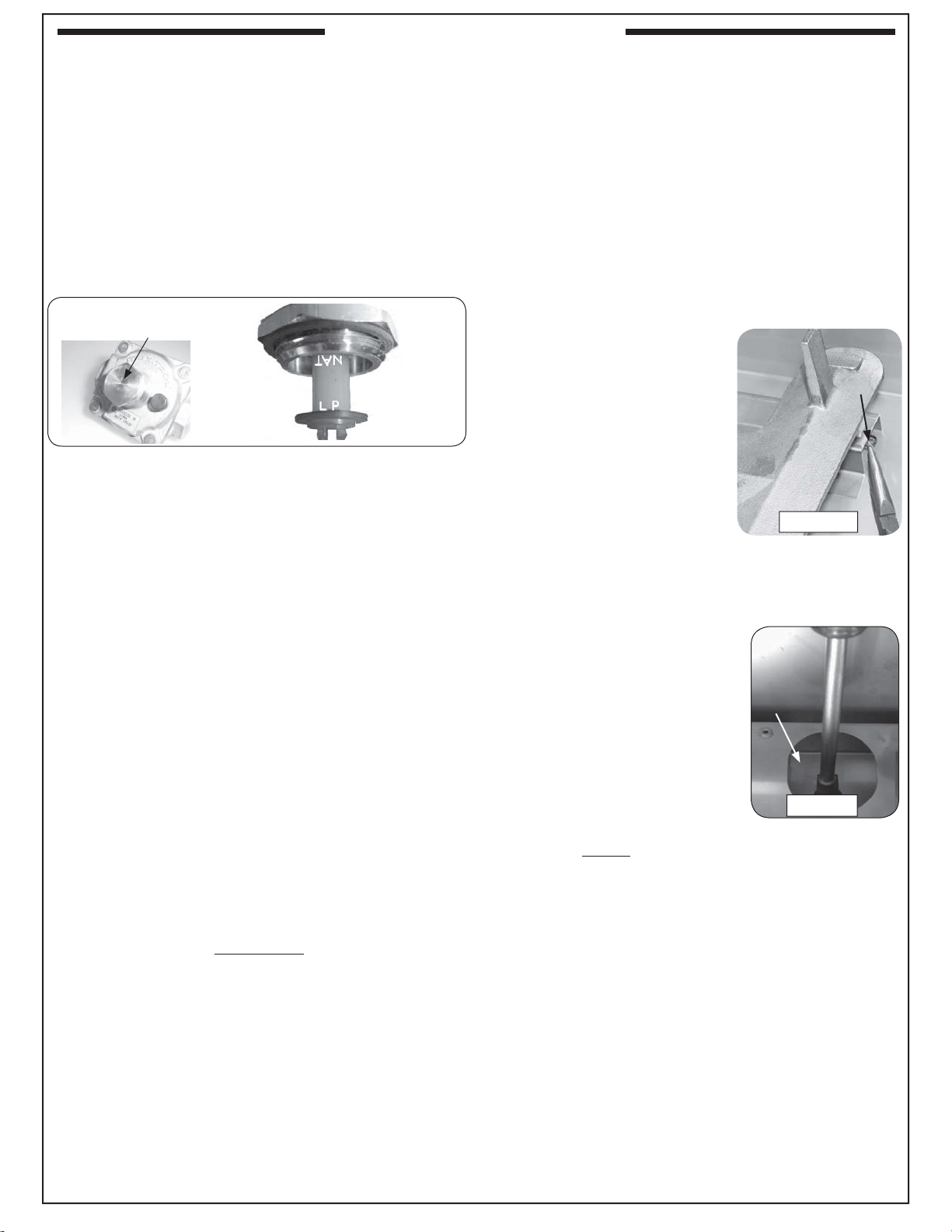
32
REGULATOR CONVERSION
The gas regulator, located behind the control panel, must
be set for the type of gas used to fuel the grill. To check
the regulator setting, remove the cap in the center of the
regulator (Fig. 32-1). Holding the cap vertical (see Fig.
32-2), the letters at the bottom of the plastic stalk indicate
the gas type for which the regulator is currently confi gured.
If the bottom of the regulator stalk does not indicate the
gas connected to the grill, remove the stalk from the cap,
invert, and replace into center of cap. Replace cap on the
regulator, screwing down until snug.
GAS ORIFICE CONVERSION
This Fire Magic
®
grill comes from the factory confi gured
for one type of gas as marked on the label behind the
control panel. When the grill is converted, this label
must be replaced or updated to identify the new gas.
Each burner has a brass orifi ce, which can be replaced
and must match the gas being used. When converting
the grill to a different gas, each burner’s orifi ce must
be replaced with the corresponding orifi ce for the new
gas.
Natural-gas to propane-gas conversions using a
tank internal to a portable grill require installation of
a propane tank holder (not included) for safety and
compliance with the ANSI standards referenced on
the cover of this document. This tank holder must be
purchased separately from the manufacturer.
Consult Table 1 at the beginning of this document to
determine the proper orifi ce sizes for each burner.
It is critical to the operation of each burner that its orifi ce
be fully inserted into the center of its orifi ce opening.
WARNING
Hazardous overheating will occur if a natural-gas
orifi ce is used with propane gas.
CAUTION: Make sure the grill is at a safe
temperature and isolated from gas and
electrical supplies before beginning.
For your safety, exercise caution, and make sure you
have adequate hand protection, such as gloves, when
handling metal parts.
Required tools:
• Phillips-head screwdriver (#2 medium)
• Needle-nose pliers
•
3
/
8
" hex nut driver (deep socket)
•
5
/
16
" hex nut driver
CHANGING THE MAIN BURNER ORIFICES
1. Remove the cooking grid from above the burner you
are working on by lifting it fi rst from the front and set
it aside.
2. Remove the fl avor grid from above the burner you
are working on and set it aside.
3. Remove the cotter pin from the left or right rear
burner anchoring peg by
pulling it straight out of the
cotter pin hole using fi ngers
or needle-nose pliers (Fig.
32-3).
CAUTION: The burner is
heavy.
4. Lift the back end of the burner
out of the anchor peg holes,
then move the burner toward
the back of the grill to clear
the gas inlet and set it aside.
5. Use a
3
/
8
" hex nut driver to remove the exposed
orifi ce (Fig. 32-4) and replace it with the correct
orifi ce for the new gas. (See
Table 1 at the beginning of this
document for orifi ce sizes.)
6. Replace the burner by first
sliding the open cylindrical
end of the burner around
the orifi ce, enveloping it and
centering on it, then lower the
back end anchor pegs into the
anchor peg holes.
Note: It is critical to the continued safe functioning
of the burner that the orifi ce is centered and
completely inside the burner gas conduit.
7. Reinsert the cotter pin into the right rear burner
anchor peg using fi ngers or needle-nose pliers.
8. Replace the fl avor grid and then the cooking grid so
that the cutout section of the cooking grid is lined
up with the lighting tube.
Repeat these steps for each main burner.
Main
burner
Cotter pin
Fig. 32-3
Fig. 32-4
Orifi ce
CONVERTING THE GAS TYPE
Fig. 32-1
Fig. 32-2
Read gas
type here.
(LP shown)
Gas regulator
Note the cap on top.
CHANGING THE BACKBURNER ORIFICE (IF
EQUIPPED)
1.
Remove the warming rack if installed and set it aside.
2. Remove the backburner cover.
3. Unscrew all backburner access plate screws using
a Phillips-head screwdriver and set them aside.
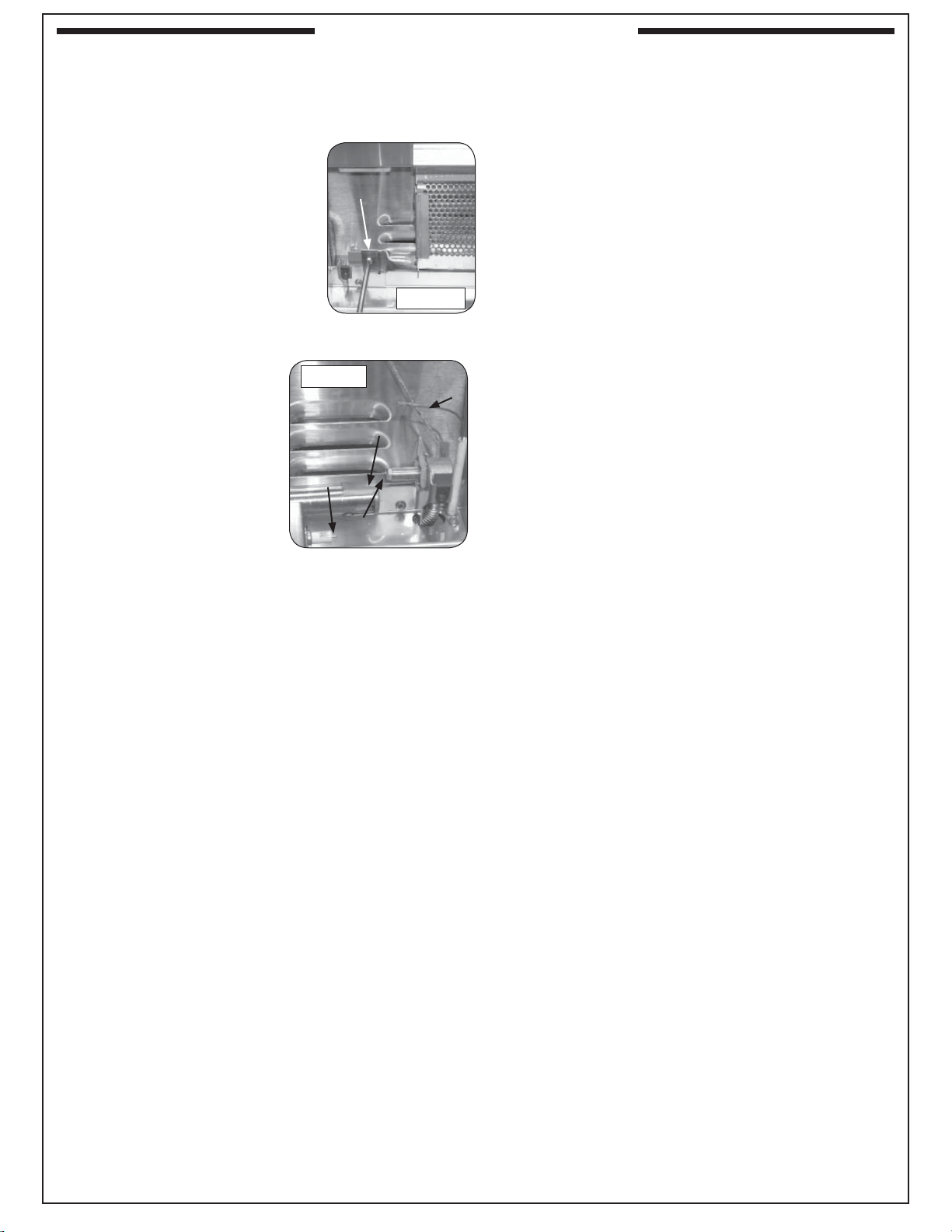
33
CONVERTING THE GAS TYPE
4. Remove the back panel by pulling the bottom toward
the front of the grill and rotating it upward and
outward until the two top tabs attached to back wall
of the oven can be removed from the slots in the top
of the plate.
5. Remove the backburner
assembly retaining screw on
the lower left of the backburner
using a Phillips-head
screwdriver and set it aside.
6. Pull the backburner assembly
to the left, clear of the orifi ce,
and then rotate the top forward
and downward and lay it face
down across the cooking grids
or main burners.
CAUTION: Be careful not
to damage the
wires connected
to the backburner
assembly.
7. Use a
3
/
8
" hex nut driver
to remove the exposed
orifi ce and replace it with
the correct orifi ce for the
gas being converted to
(See Table 1 for size).
8. Replace the backburner assembly and reinsert the
retaining screw. Center the backburner assembly so
that the backburner plate will fi t over it. Tighten the
retaining screw using a Phillips-head screwdriver.
9. Replace the back panel by fi rst inserting the tabs
above into the slots in the top of the plate and then
rotating the bottom downward and inward.
10. Replace all the backburner plate screws using a
Phillips-head screwdriver.
6. Pull the wire from the ignitor
electrode (Fig. 33-2), then remove
the backburner retaining screw
on the left of the backburner
(Fig. 33-1) using a Phillips
screwdriver.
Fig. 33-2
Backburner
orifi ce
Backburner
air shutter
Backburner
electrode
Electrode wire
(disconnected)
Fig. 33-1
Retaining
screw
CHANGING AN INFRARED BURNER ORIFICE
(IF EQUIPPED)
1. Remove the cooking grid from above the burner on
which you are working by lifting it fi rst from the front
and set it aside.
2. Unscrew both lighting tube hex head screws with a
3
/
8
" hex nut driver.
3. Remove the infrared burner by lifting the back of the
burner up so that both tabs are freed from their slots,
then lift the burner toward the back of the fi re box
and upward. Set the burner aside.
4. Use a
3
/
8
" hex nut driver to remove the exposed orifi ce
and replace it with the proper orifi ce for the new gas
(see Table 1 for sizing).
5. Replace the infrared burner by fi rst sliding it over the
orifi ce, then lowering the two tabs under the back of
the burner into the slots in the back burner rest.
6. Reattach the lighting tube and replace the grid so
that the cut-out section is in front.
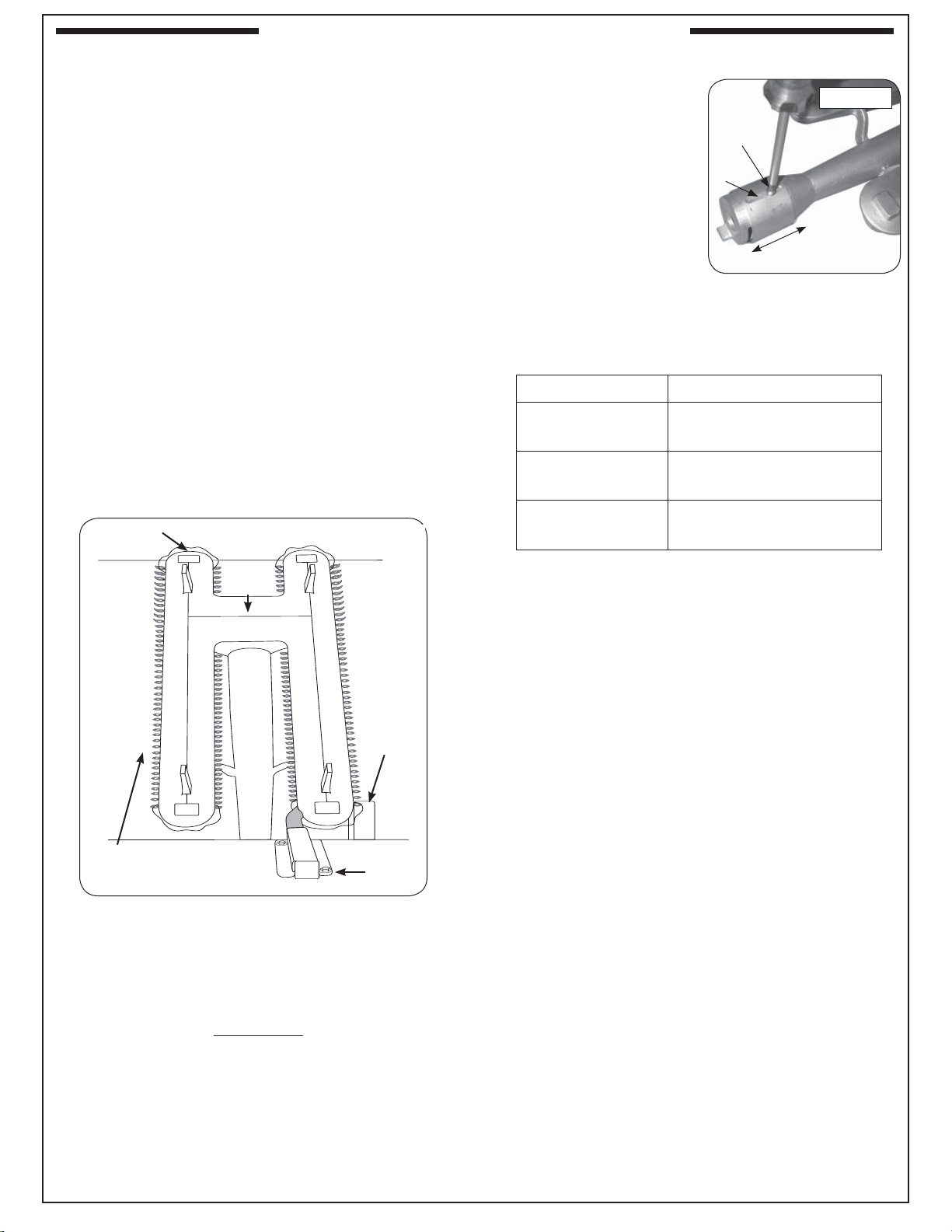
34
1. Follow the safety precautions and steps for
main burner removal
in the CHANGING
THE MAIN BURNER
ORIFICES section
(steps 1-4).
2. Adjust the air shutter
opening by loosening
the adjustment screw
with a screwdriver,
then sliding the air shutter backward or forward
to open or close the air shutter opening (see
Fig. 34-2).
Too large an air shutter opening will allow too much
air into the burner, which will cause the fl ames fi rst
to shorten and then to appear to lift up off the ports.
For the bottom of the fl ames to move closer to the
ports, close the air shutter more.
If the air shutter opening is too small or closed, the
fl ames will present consistently orange tips and
become “lazy,” slowly undulating back and forth.
For propane gas, ideal settings tend to be just
slightly open. For natural gas, which generally
requires less primary air than propane, the main
burner air shutter may be nearly closed.
3. Adjust the air shutter opening and then replace
the burner (steps 6-8 in the CHANGING THE
MAIN BURNER ORIFICES section)
4. Follow the lighting instructions in this manual to
light the burner.
5. Repeat steps 1-4 until the fl ames appear to
touch the burner ports, burning fairly steadily
and mostly blue (see Fig. 34-1).
AIR SHUTTER ADJUSTMENT
Important: Air shutters are preset at the
factory based on the gas the grill is
built to burn. However, altitude or
other local conditions may require
air shutter adjustment for proper
combustion.
MAIN BURNER
Flames from a properly adjusted main burner with
no wind or breeze present will appear fairly steady,
consistent, and mostly blue. If the tip of a fl ame were
to turn orange, it should only do so briefl y and then
become blue again. The fl ames will appear to burn
while touching the burner ports (see Figure 34-1).
If the fl ames have orange in them and appear to
undulate slowly from side to side, or if some of them
appear to lift off the burner instead of touching it,
then adjust the air shutter, as instructed below.
CAUTION: Turn all burner control knobs to the
OFF position and turn off the gas
supply at the source before removing
or adjusting a burner.
WARNING
Wait for the burner to be cool or use heavily insulated
heat-resistant gloves when handling the burner.
Adjustment
screw
Fig. 34-2
Adj.
slot
Close
Open
Shutter Setting Flame Condition
Open too far
Flames shorten and
lift off the burner
Ideal setting
Blue fl ames just
touching burner
Closed too far
“Lazy” fl ames with
orange in them
BURNER AIR SHUTTER ADJUSTMENT
Fig. 34-1
Blue fl ames on
burner ports
Bridge
between
burner
lobes
Lighting
tube
Ignitor
box
Carry-over
slots (on
each lobe)
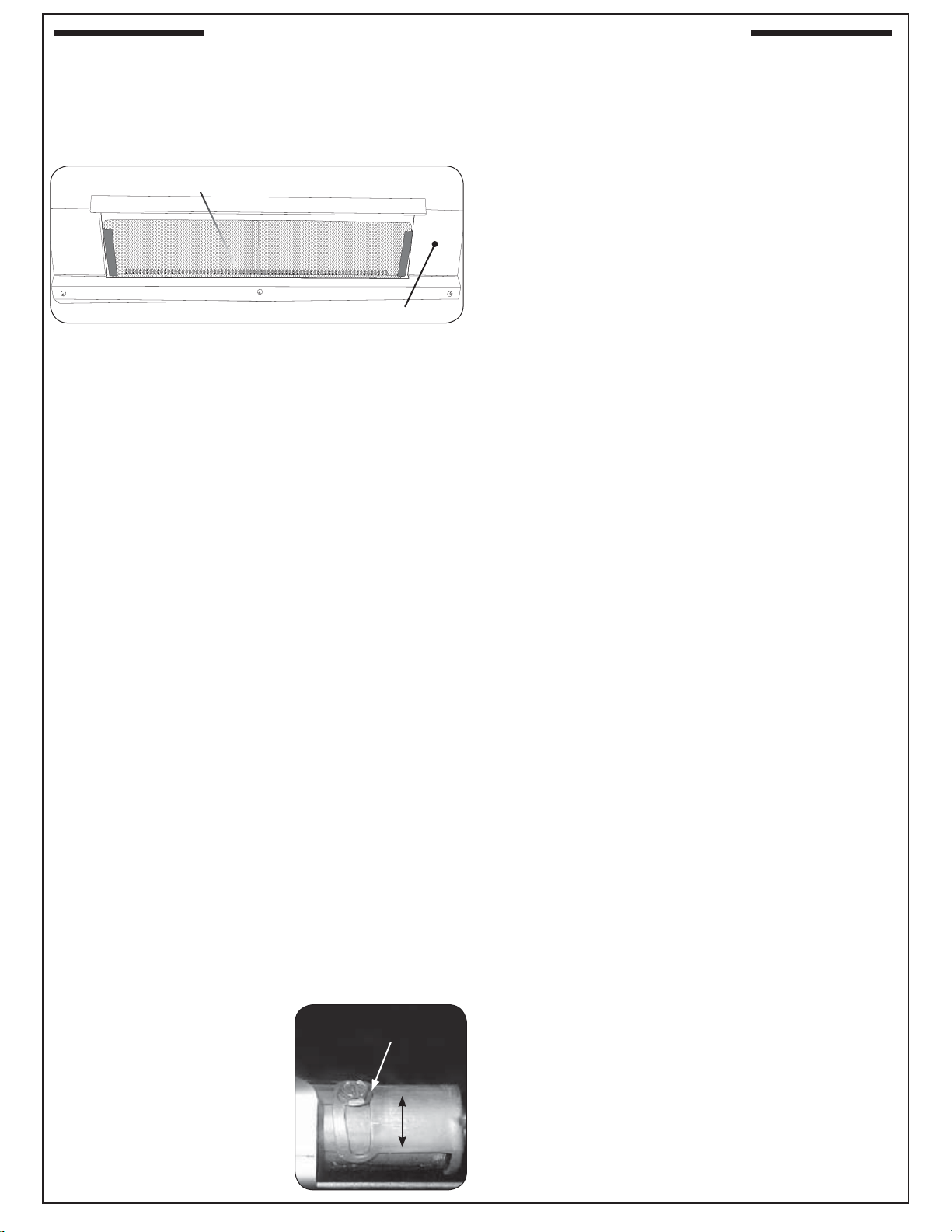
35
BACKBURNER (IF EQUIPPED)
The air shutter is set at the factory. However,
altitude or other local conditions may require air
shutter adjustment for proper combustion.
Flames from a properly adjusted backburner will
appear as a horizontal line of even blue fl ames along
the bottom of and behind the backburner grating. The
grating itself will glow red after it heats up.
Note: It is normal for the backburner to smoke
when it is fi rst used. Burning the backburner
on HI LIGHT for approximately 15 minutes
will eliminate the smoking.
If, instead of being blue and even, the backburner
fl ames appear to have orange in them and waver
slowly left and right, or if the fl ames appear to lift
off the burner, adjust the backburner air shutter by
following the steps below.
The backburner air shutter adjustment is located
behind the right side of the access panel in the back
of the oven, above the cooking grid.
Note: It is only necessary to remove the
backburner back panel, not the backburner,
when adjusting the backburner air shutter.
1. Follow the safety precautions and steps for
backburner back panel removal (steps 1-4) in
the CHANGING THE BACKBURNER ORIFICE
section.
CAUTION: The backburner air shutter can be
safely adjusted with the backburner lit
if it is adjusted using a long-handled
screwdriver or well-insulated fi re and
heat-resistant gloves.
2. Adjust the air-shutter opening by loosening the
adjustment screw with a
screwdriver, then sliding
the air shutter backward
or forward to open or
close the air shutter
opening (see Fig 35-2).
Watch the backburner
flames while adjusting
the air shutter.
Fig. 35-1
Blue fl ames behind burner screen
Back panel
Fig. 35-2
Backburner air shutter
adjustment screw
Open
Close
Too large an air shutter opening will allow too much
air into the burner, which will cause the fl ames fi rst
to shorten and then to appear to lift up off the ports.
For the bottom of the fl ames to move closer to the
ports, close the air shutter more.
If the air shutter opening is too small or closed, the
fl ames will present consistently orange tips and
become “lazy,” slowly wavering left and right.
3. Continue adjustment until the fl ames appear to
touch the burner ports, burning fairly steadily,
consistently, and mostly blue (see Fig. 35-1),
then retighten the backburner air shutter
adjustment screw.
4. Replace the burner access plate (step 8 in the
CHANGING THE BACKBURNER ORIFICE
section).
BURNER AIR SHUTTER ADJUSTMENT (Cont.)
36
Robert H. Peterson Co. • 14724 East Proctor Avenue • City of Industry, CA 91746
Quality Check Date:_________________
Burner Orifi ces Nat. L.P. Leak Test: ___________ Model#: ___________________
Main: ____ ____ Burn Test: ___________ Serial#: ___________________
Back: ____ ____ Gas Type:
Nat. / L.P. Air Shutter: ___________________
Side/Power: ____ ____ Inspector: ___________________
Infrared: ____ ____
Other: ____ ____
A COPY OF YOUR SALES SLIP FOR PROOF OF PURCHASE IS REQUIRED
This warranty applies to the original purchaser for products which are installed in the United States or Canada and which are operated and maintained
as intended for single family residential usage. This warranty is valid only with proof of purchase, shall commence on the date of purchase, and shall
terminate (both as to original and any replacement products) on the anniversary date of the original purchase of the product stated on the above schedules.
This warranty covers defects in material and workmanship. This warranty does not cover parts which become defective as a result of negligence, misuse,
use not in compliance with the Owner’s Manual/Installation Instructions, accidental damage, improper handling, improper storage, improper installation,
lack of required routine maintenance (as specifi ed in the Owner’s Manual/Installation Instructions), electrical damage, local gas impurities or failure to
protect against combustibles. Product must be installed (and gas must be connected) as specifi ed in the Owner’s Manual/Installation Instructions by
a qualifi ed professional installer. Modifi cations to products which are not specifi cally authorized will void this warranty. Accessories, parts, valves,
remotes, etc. when used must be Peterson products or this warranty is void. Warrantied items will be repaired or replaced at Peterson’s sole discretion.
This warranty does not apply to rust, corrosion, oxidation, or discoloration unless the affected part becomes inoperable.
This warranty does not cover labor or labor related charges, except as provided by separate specifi c written programs from the Peterson Co. All repair
work must be performed by a qualifi ed professional service person and requires prior approval of Peterson.
Peterson may require the defective product or part to be returned to the factory to determine the cause of failure. Peterson will pay freight charges if
the product or part is determined to be defective. This warranty does not cover breakage in shipment from our (Independent) distributor to its customer
if the damage is determined to have occurred during that shipment.
This warranty specifi cally excludes liability for indirect, incidental, or consequential damages. Some states and provinces do not allow the exclusion
or limitation of incidental or consequential damages, so the above exclusion may not apply to you. This warranty gives you specifi ed legal rights, and
you may have other rights that vary from state to state or province.
For additional information regarding this warranty, or to place a warranty claim, contact the R. H. Peterson dealer where the product was purchased.
TO REGISTER YOUR PRODUCT ONLINE GO TO: WWW.RHPETERSON.COM,
AND CLICK ON PRODUCT REGISTRATION. THANK YOU FOR YOUR PURCHASE.
PETERSON FIRE MAGIC GRILLS AND ACCESSORIES
LIMITED WARRANTY
Robert H. Peterson Co. ("RHP") warrants your Fire Magic
®
grill to be free from defects in material and workmanship.
Fire Magic
®
cast stainless-steel burners, stainless-steel rod cooking grids, and stainless-steel housings are warranted for as long as you own
your Fire Magic
®
grill -- LIFETIME. (Except as noted below.)
Fire Magic Choice stainless steel tubular burners are warranted for TWENTY (20) YEARS.
Fire Magic
®
cast brass burners, brass valves, inner liners, manifold assemblies, and backburner assemblies (except ignition parts) are
warranted for FIFTEEN (15) YEARS.
Fire Magic
®
Electric Grills, including stainless steel grid, and housings are warranted for TEN (10) YEARS.
Fire Magic
®
Infra-red burners, fl avor grids, Charcoal stainless steel grills, and Smokers are warranted for FIVE (5) YEARS; except for the
charcoal pan, charcoal grid, wood pellet screen, thermometer, and ash tray; which are warranted for ONE (1) YEAR.
Fire Magic
®
sideburners and all other Fire Magic
®
grill components (except ignition and electronic parts) are warranted for THREE (3)
YEARS.
Fire Magic
®
ignition systems (excluding batteries), electronic components (including lights and thermometers), and grill accessories are
warranted for ONE (1) YEAR.
WARRANTY