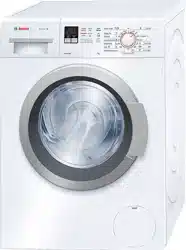


2
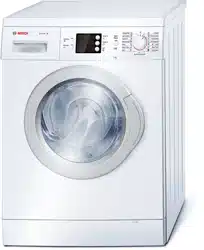
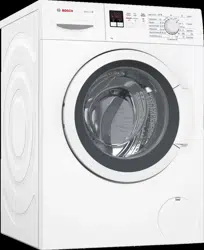
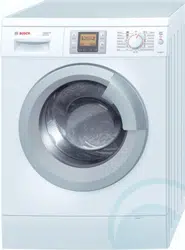
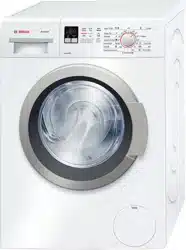
Your new washing machine
You have chosen a Bosch washing
machine.
Please take a few minutes to read and
become familiar with the advantages of
your washing machine.
To meet the high quality demands
required by Bosch, every washing
machine that leaves our factory is
carefully checked to ensure that it
functions correctly and is in perfect
condition.
For more information on our products,
accessories, replacement parts and
services, see our website www.bosch-
home.com or contact our after-sales
service centres.
If the operating and installation
instructions describe different models,
any differences will be pointed out at the
relevant points in the text.
Read these operating and installation
instructions before switching on the
washing machine.
Display rules
: Warning!
This combination of symbol and signal
word indicates a possibly dangerous
situation. Not heeding the warning can
cause death or injuries.
Caution!
This signal word indicates a possibly
dangerous situation. Not heeding the
caution can cause property and/or
environmental damage.
Note/tip
Information about the optimum use of
the appliance/any other useful
information.
1. 2. 3. / a) b) c)
The steps are represented by numbers
or letters.
■ / -
Lists are represented by a small box or
a dash.

en
3
Contents
enInstruction Manual and Installation Instructions
8 Intended use. . . . . . . . . . . . . . . . .4
( Safety instructions . . . . . . . . . . .5
Electrical safety. . . . . . . . . . . . . . . . . . 5
Risk of injury . . . . . . . . . . . . . . . . . . . . 5
Safety for children. . . . . . . . . . . . . . . . 5
7 Environmental protection . . . . . .7
Packaging/used appliance . . . . . . . . . 7
Tips on economical use . . . . . . . . . . . 7
Y Main points in brief . . . . . . . . . . .8
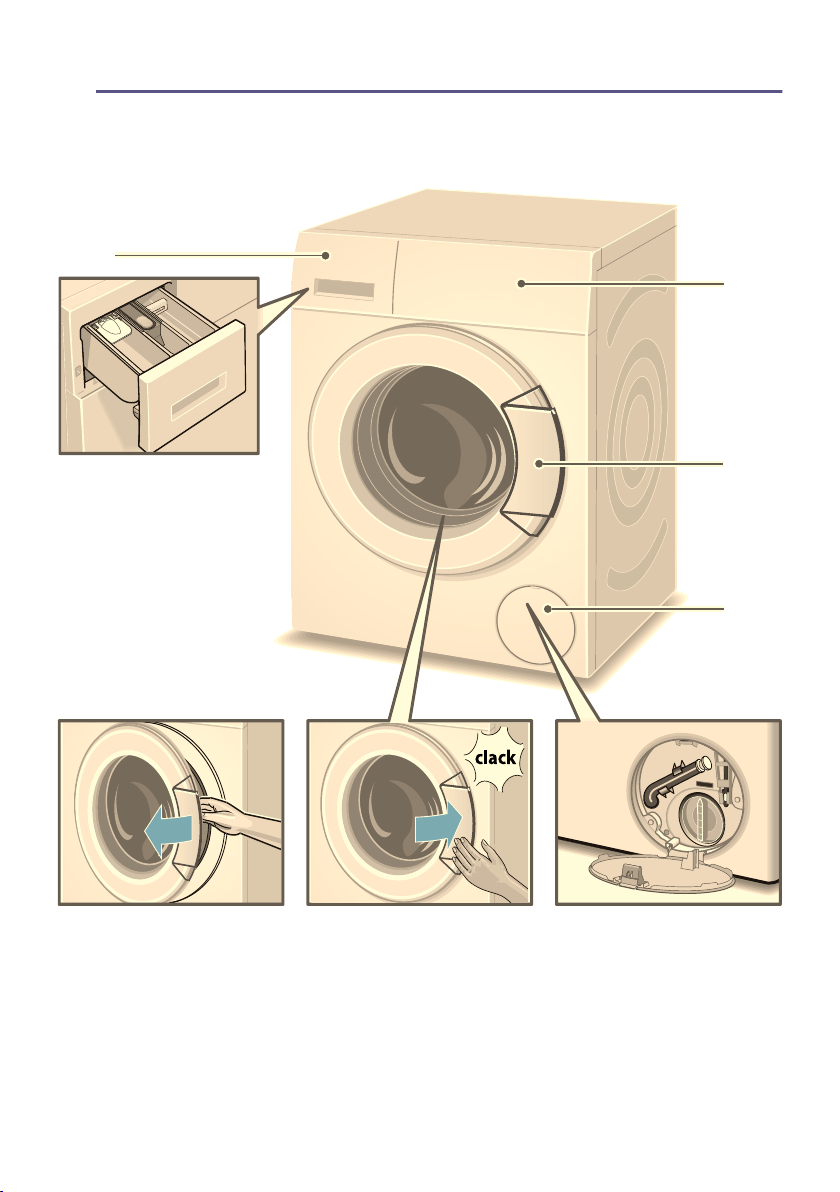
* Getting to know the appliance . 9
Washing machine . . . . . . . . . . . . . . . . 9
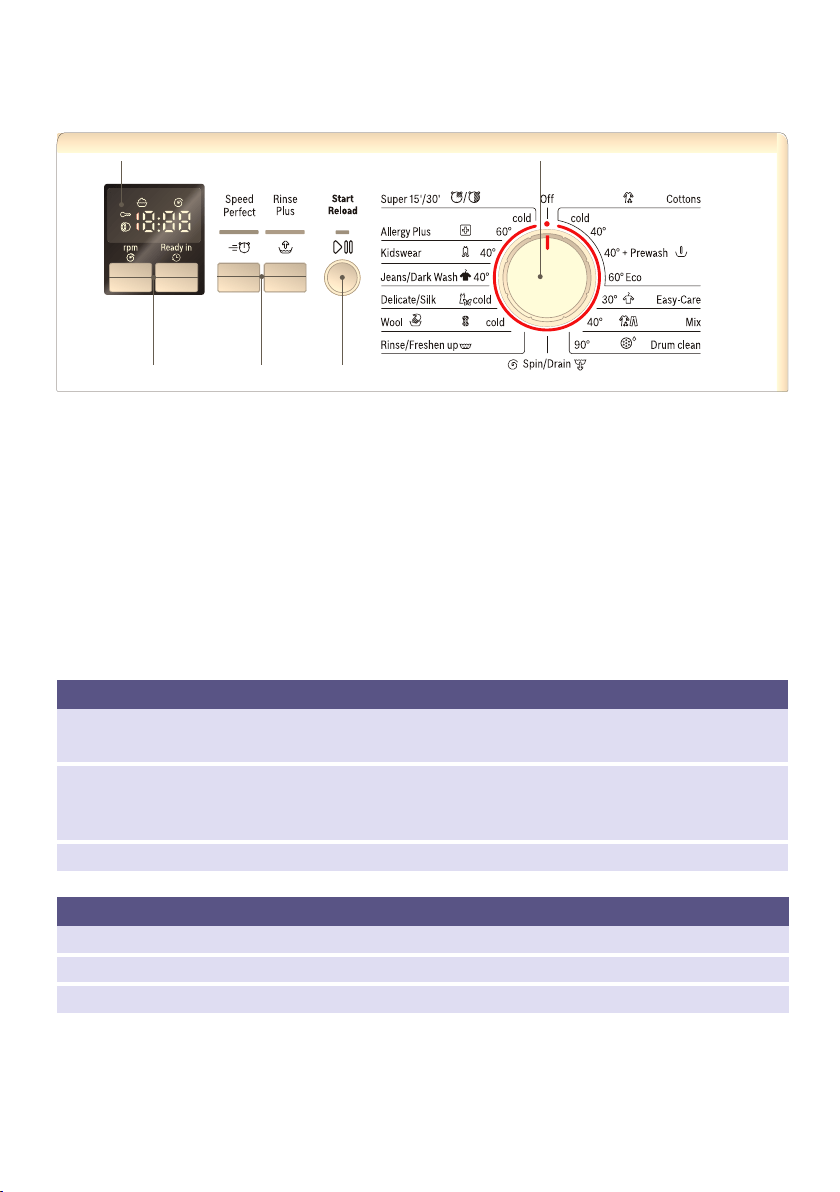
Control panel . . . . . . . . . . . . . . . . . . 10
Display panel . . . . . . . . . . . . . . . . . . 10
Z Laundry. . . . . . . . . . . . . . . . . . . .11
Prepare the laundry . . . . . . . . . . . . . 11
Sorting laundry . . . . . . . . . . . . . . . . . 11
C Detergent . . . . . . . . . . . . . . . . . .12
Correct selection of detergent . . . . . 12
Saving energy and detergent . . . . . . 12
/ Overview of programmes . . . . .13
Programmes on the programme
selector. . . . . . . . . . . . . . . . . . . . . . . 13
Starching . . . . . . . . . . . . . . . . . . . . . 15
Dyeing/bleaching . . . . . . . . . . . . . . . 15
Soaking . . . . . . . . . . . . . . . . . . . . . . 15
0 Programme default settings . . .15
rpm 0 . . . . . . . . . . . . . . . . . . . . . . . 15
Ready in ð . . . . . . . . . . . . . . . . . . . 16
\ Additional programme
settings . . . . . . . . . . . . . . . . . . . .16
SpeedPerfect G . . . . . . . . . . . . . . 16
Rinse Plus Z . . . . . . . . . . . . . . . . . 16
1 Operating the appliance . . . . . . 17
Preparing the washing machine . . . .17
Select programme/switch on the
appliance. . . . . . . . . . . . . . . . . . . . . .17
Change the programme
default settings . . . . . . . . . . . . . . . . .17
Select additional programme
settings . . . . . . . . . . . . . . . . . . . . . . .17
Placing laundry into the drum . . . . . .17
Measure and add detergent
and care products . . . . . . . . . . . . . . .18
Start the programme . . . . . . . . . . . . .19
Childproof lock . . . . . . . . . . . . . . . . .19
Adding/removing laundry . . . . . . . . .19
Changing the programme . . . . . . . . .20
Cancel the programme . . . . . . . . . . .20
Programme end during rinse hold. . .20
Programme end . . . . . . . . . . . . . . . .20
Removing laundry/switching off the
appliance. . . . . . . . . . . . . . . . . . . . . .20
H Sensors . . . . . . . . . . . . . . . . . . . 21
Automatic load sensing. . . . . . . . . . .21
Unbalanced load detection system . .21
VoltCheck . . . . . . . . . . . . . . . . . . . . .21
M Setting the signal . . . . . . . . . . . 22
2 Cleaning and maintenance. . . . 23
Machine housing/control panel . . . . .23
Drum . . . . . . . . . . . . . . . . . . . . . . . . .23
Descaling . . . . . . . . . . . . . . . . . . . . .23
Detergent drawer and housing . . . . .23
Detergent solution pump blocked . . .23
The drain hose at the siphon
is blocked . . . . . . . . . . . . . . . . . . . . .24
Filter in the water supply blocked . . .24
3 Faults and what to do
about them. . . . . . . . . . . . . . . . . 25
Emergency release . . . . . . . . . . . . . .25
Information on the display panel . . . .26
Faults and what to do about them. . .27

en Intended use
4
4 After-sales service . . . . . . . . . . 29
[ Consumption rates . . . . . . . . . . 30
Consumption values table . . . . . . . . 30
J Technical data . . . . . . . . . . . . . . 30
5 Positioning and connecting. . . 30
Included with the appliance . . . . . . . 30
Safety instructions . . . . . . . . . . . . . . 31
Installation surface. . . . . . . . . . . . . . 32
Installation on a base
or a wooden joist floor. . . . . . . . . . . 32
Installing the appliance
in a kitchenette . . . . . . . . . . . . . . . . 32
Removing the transport locks . . . . . 32
Hose and cable lengths. . . . . . . . . . 33
Water inlet . . . . . . . . . . . . . . . . . . . . 33
Water outlet . . . . . . . . . . . . . . . . . . . 34
Levelling . . . . . . . . . . . . . . . . . . . . . 35
Electrical connection . . . . . . . . . . . . 35
Before washing for the first time . . . 36
Transportation . . . . . . . . . . . . . . . . . 37
8 Intended use
Intended use
■ For private domestic use only.
■ The washing machine is suitable for
washing machine-washable fabrics
and hand-washable wool in
detergent solution.
■ To be operated with cold mains
water and standard detergents and
care products which are suitable for
use in front-loading washing
machines. Do not use detergents for
hand wash.
■ When measuring the amount of all
detergents/additives/care products
and cleaning agents, always check
the manufacturer's instructions.
■ The washing machine may be used
by children over the age of 8 years
old and by persons with reduced
physical, sensory or mental capacity
or by persons with a lack of
experience or knowledge if they are
supervised or have been instructed
by a responsible person.
Children must not perform cleaning
or maintenance work unsupervised.
■ Keep children under the age of 3
years away from the washing
machine.
■ Keep pets away from the washing
machine.
Read the Instruction Manual and
Installation Instructions and all other
information supplied with the washing
machine and use the machine
accordingly.
Retain the documents for subsequent
use.

Safety instructions en
5
( Safety instructions
Safety instructions
Electrical safety
:Warning
Danger of death!
There is a risk of electric shock
if you touch live components.
■ Never touch or hold the
mains plug with wet hands.
■ Only pull out the mains cable
by the plug and never by the
cable, as this could damage
it.
■ The appliance must be
grounded.
Electrical connection
~ Page 35
Risk of injury
:Warning
Risk of injury!
■ When the washing machine
is lifted by its protruding
parts (e.g. the washing
machine door), the
components may break off
and cause injuries.
Do not lift the washing
machine by protruding parts.
■ If you climb on the washing
machine, the worktop may
break and cause injuries.
Do not climb onto the
washing machine.
■ If you lean on the washing
machine door when it is
open, the washing machine
may tip over and cause
injuries.
Do not lean on the washing
machine door when it is
open.
■ Reaching into the drum
when it is turning can cause
injuries to hands.
Do not reach into the drum
when it is turning.
Wait until the drum has
stopped turning.
:Warning
Risk of scalding!
When you are washing at high
temperatures, there is a risk of
scalding if you come into
contact with hot water e.g. if hot
water is being drained into a
wash basin.
Do not reach into the hot
detergent solution.
Safety for children
:Warning
Danger of death!
If children play with the washing
machine, they may get into life-
threatening situations or injure
themselves.
■ Do not leave children
unattended near the washing
machine.
■ Do not let children play with
the washing machine.

en Safety instructions
6
:Warning
Danger of death!
Children may lock themselves
in appliances, putting their lives
at risk.
For appliances that have
reached the end of their service
life:
■ Disconnect the mains plug.
■ Cut through the mains cable
and remove it, along with
plug.
■ Destroy the lock on the
washing machine door.
:Warning
Risk of suffocation!
Children may become wrapped
in packaging/film or packing
parts if allowed to play with
them, or they may pull them
over their heads and suffocate.
Keep packaging, film and
packaging parts out of the
reach of children.
:Warning
Risk of poisoning!
Detergents and care products
may be poisonous if
consumed.
Keep detergents and care
products out of the reach of
children.
:Warning
Eye/skin irritation!
Detergents and care products
may cause irritation if they
come into contact with the eyes
or skin.
Keep detergents and care
products out of the reach of
children.
:Warning
Risk of injury!
When you wash at high
temperatures, the glass in the
washing machine door gets
hot.
Do not let children touch the
hot washing machine door.

Environmental protection en
7
7 Environmental
protection
Environmental protection
Packaging/used appliance
Do’s
■ Hand over the old/discarded
electronic equipment only to
authorized collection centers for
disposal
■ Consult the authorized service
center as to whether the Electronic
Equipment can be repaired or not,
before discarding
■ Consult the retailer about appliance
take back schemes
Don’ts
■ Don’t dump the discarded Electronic
Equipment in the open or in any land
fill site, as this will result in
contamination of the soil and the
ground water
■ Don’t dispose of the discarded
Electronic Equipment in household
bins or Municipal bins
■ The product is not meant for re-sale
to any unauthorized agencies/scrap
dealers
■ Don't keep any replaced spare
part(s) from the product in an
exposed area
Tips on economical use
■ Always fill the appliance with the
maximum amount of laundry for the
relevant programme.
Overview of programmes
~ Page 13
■ Wash normally soiled laundry
without a prewash.
■ Save energy and detergent when
washing lightly and normally soiled
laundry.
Saving energy and detergent
~ Page 12
■ Energy-saving mode: The display
panel lighting goes out after a few
minutes and Start/
Reload A flashes. To activate the
lighting, press any button.
Energy-saving mode is not activated
if a programme is running.
■ If the laundry is subsequently dried
in a tumble dryer, select the spin
speed according to the tumble dryer
manufacturer's instructions.
)
Dispose of packaging in an
environmentally-responsible
manner.
The following Do’s and Don’ts
provide a framework for the
return and recycling of used
products when available in
your area.
en Main points in brief
8
Y Main points in brief
Main points in brief
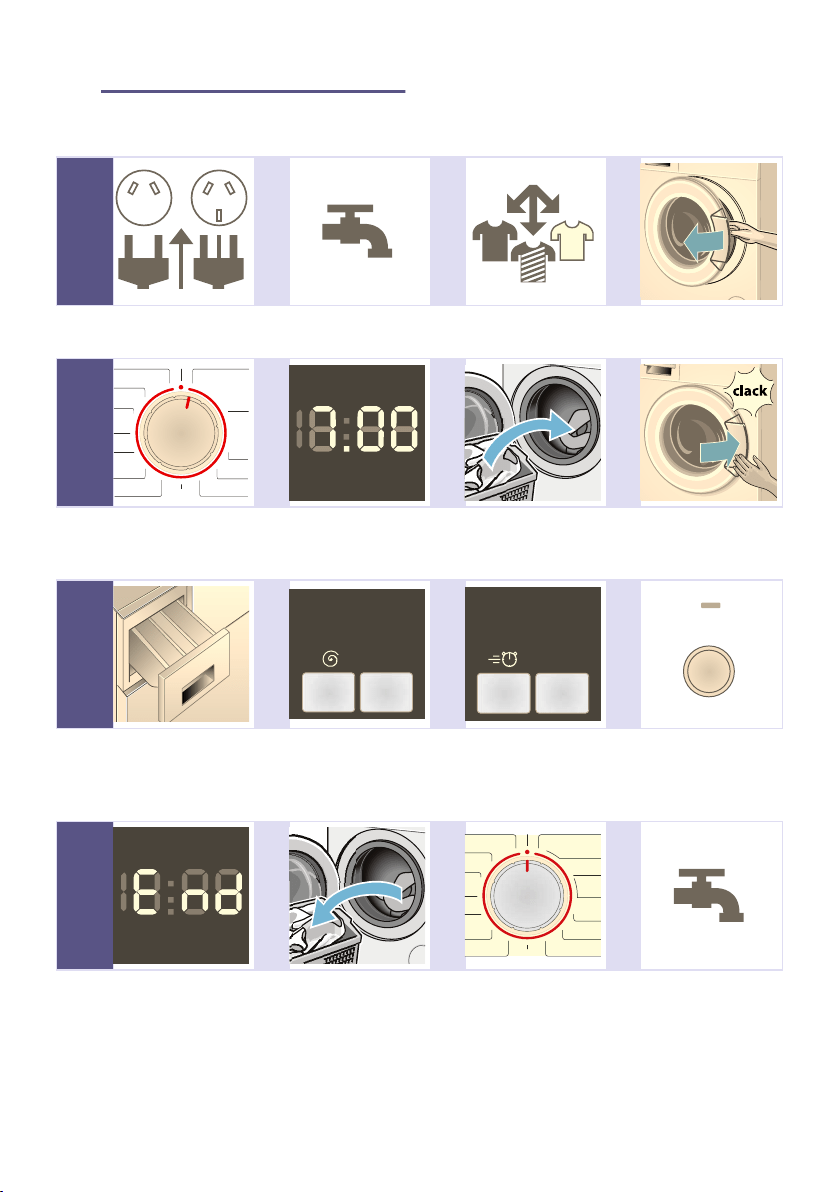
--------
--------
--------
--------
1 @ @ @
Connect the mains
plug.
Turn on the water
tap.
Sort the laundry. Open the door.
2 @ @ @
Select a programme
e.g. Cottons.
Observe the
maximum load on
the display panel.
Load the laundry . Close the washing
machine door.
3 @ @ @
Ç
Add detergent.
~ Page 18
Change the
programme default
settings, if
necessary.
Select additional
settings, if
necessary.
Start the
programme.
4 @ @ @
Programme end Open the washing
machine door and
remove the laundry.
Set the programme
selector to off
position.
Turn off the water
tap.
en Getting to know the appliance
10
Control panel
Display panel
#
+
( rpm 0, Ready in ð for changing
the programme default settings
Overview of all programme default
settings ~ Page 15
0 SpeedPerfect G, Rinse Plus Z
for choosing the additional
programme settings
Overview of all programme
settings ~ Page 16
8 Start/Reload A for starting,
interrupting (f.e. adding/removing
laundry) and cancelling a
programme
@ Programme selector for selecting
a programme and for switching
the machine on and off
H Display panel for settings and
information
Settings for the selected programme
– – –...1200** 0 Spin speed; ** max. speed
depends on the model
In rpm (rotations per minute);
– – – = Rinse hold (without final spin)
1:30 Programme duration Depends on the programme selection in h:min
(hours:minutes)
1 - 24 h Ready in Programmes ends after ... h (h = hours)
7.0 kg Max. load
Status indicators for the programme progress (programme sequence):
N O 0 End Wash, rinse, spin, programme duration or end
¼ Open the washing machine door, add laundry ~ Page 19
D Childproof lock ~ Page 19
Laundry en
11
Z Laundry
Laundry
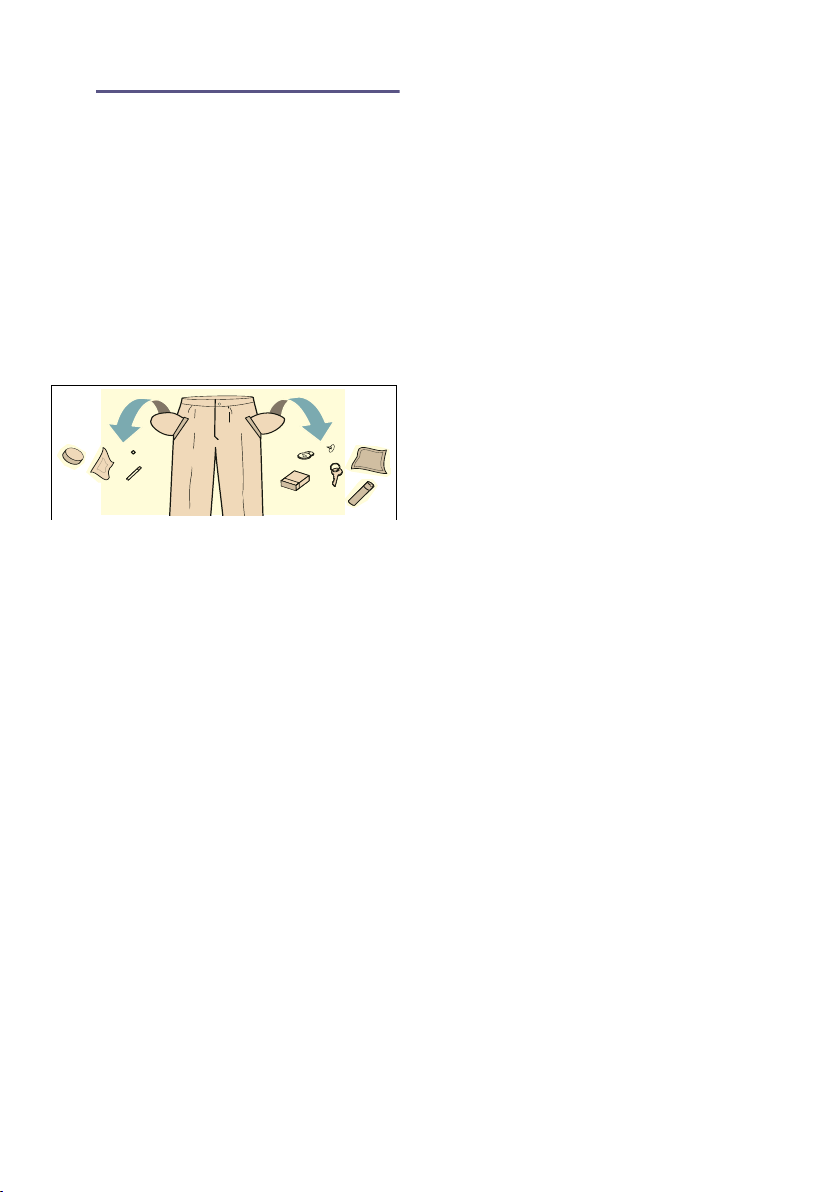
Prepare the laundry
Caution!
Damage to the appliance/fabrics
Foreign objects (e.g. coins, paper-clips,
needles, nails) may damage the laundry
or components in the washing machine.
Therefore, note the following tips when
preparing your laundry:
■ Empty pockets.
■ Look out for metal items (paperclips,
etc.) and remove them.
■ Wash delicates in a laundry bag
(tights, underwired bras, etc.).
■ Close any zips, button up any cover
buttons.
■ Brush sand out of pockets and
collars.
■ Remove curtain fittings or place
curtains in a laundry bag.
Sorting laundry
Sort your laundry according to the care
instructions and manufacturer's
information on the care labels:
■ Type of fabric/fibre
■ Colour
Note: Laundry can discolour or not
be cleaned correctly. Wash white
and coloured laundry separately.
Wash new bright fabrics separately
the first time you wash them.
■ Soiling
Wash laundry with the same level of
soiling together.
You can find examples of levels of
soiling on ~ Page 12
– Light: Do not prewash, select the
SpeedPerfect G setting if
necessary
– Normal
– Heavy: Load less laundry, select
a programme with prewash
– Stains: Remove/pretreat stains
while they are fresh. First, dab the
stain with soapy water/do not
rub. Then wash the items of
laundry with the appropriate
programme. Stubborn/dried-in
stains can sometimes only be
removed with several washes.
■ Symbols on the care labels
The numbers in the symbols indicate
the maximum washing temperature
which may be used.
– M: Suitable for a normal
washing process; e.g. Cottons
programme
– U : A gentle washing process is
required; e.g. Easy-Care
programme
– V : An especially gentle washing
process is required; e.g.
Delicate/Silk programme
– W : Suitable for washing by
hand; e.g. Wool programme
– Ž : Do not wash the laundry in
the machine.

en Detergent
12
C Detergent
Detergent
Correct selection of detergent
The care label is crucial for selecting
the correct detergent, temperature and
treatment of the laundry.
Note: Only use detergents for front-
loading washing machines, low suds/
detergent foam.
■ Standard detergent with optical
brighteners
Suitable for boil-washable white
laundry made from linen or cotton
Programme: Cottons/
cold - max. 90 °C
■ Detergent for colours without
bleach or optical brighteners
Suitable for coloured laundry made
from linen or cotton
Programme: Cottons/
cold - max. 60 °C
■ Detergent for colours/delicates
without optical brighteners
Suitable for coloured laundry made
from easy-care fibres, synthetic
fibres
Programme: Easy-Care/
cold - max. 60 °C
■ Detergent for delicates
Suitable for delicate, fine fabrics, silk
or viscose
Programme: Delicate/Silk/
cold - max. 40 °C
■ Detergent for woollens
Suitable for wool
Wool programme/
cold - max. 40 °C
Saving energy and detergent
For light and normal soiling, you can
save energy (lower washing
temperature) and detergent.
Note: When measuring the amount of
all detergents/additives/care products
and cleaning agents, please always
check the manufacturer's instructions
and information.
Measure and add detergent and care
products ~ Page 18
Saving Soiling/note
Reduced temper-
ature and deter-
gent quantity as
per the recom-
mended dosage
Light
No visible dirt or stains. Cloth-
ing has taken on some body
odour, e.g.:
■ Light summer/sports
clothing (worn for a few
hours)
■ T-shirts, shirts, blouses
(worn for up to one day)
■ Guest bed linen and hand
towels (used for one day)
Normal
Visible dirt or a few light
stains, e.g.:
■ T-shirts, shirts, blouses
(sweat soaked, worn a
few times)
■ Towels, bedding (used for
up to one week)
Temperature as
per the care label
and detergent
quantity as per
the recom-
mended dosage
for heavy soiling
Heavy
Dirt and/or stains clearly visi-
ble, e.g. tea towels, baby
items, work clothing
Overview of programmes en
13
/ Overview of programmes
Overview of programmes
Programmes on the programme selector
Programme/type of laundry/information Settings/Presettings of the pro-
grammes are highlighted in bold
Name of programme
Short explanation of the programme or the fabric for which it is suita-
ble.
Max. load;
* Reduced load for SpeedPerfect
G function
Temperature that can be selected
Spin speed that can be selected;
** Max. spin speed, depending on
the model
Possible programme settings
i Cottons
Hard-wearing fabrics, heat-resistant fabrics made of cotton or linen
+ Prewash T : Programme with prewash; divide the detergent
between compartments I and II
Note: The SpeedPerfect G setting is suitable as a short pro-
gramme for lightly soiled laundry.
Max. 7 kg/4* kg
cold - 40 - 60 °C
– – – ... 1200** rpm
G, Z
f Easy-Care
Fabrics made from synthetic or blended fabrics
Max. 3.5 kg
30 °C
– – – ... 1200** rpm
G, Z
o Mix
A mixed load of fabrics made of cotton and synthetic fabrics
Max. 3.5 kg
40 °C
– – – ... 1200** rpm
G, Z
l Drum clean
Programme for cleaning and caring for the drum and the outer tub,
e.g. before the 1st wash cycle, if an odour has formed after a pro-
longed absence or if washing frequently at a low washing tempera-
ture (40 °C and lower)
Notes
■ Run programme without laundry.
■ Use only detergents for front loader washing machines. Do not
use additional cleaning agents.
-
90 °C
800 rpm
-
en Overview of programmes
14
0 Spin/Drain [
Extra spin with speed that can be selected
If only the drain cycle is required, set the spin speed to – – –.
-
-
– – – ... 800 ... 1200** rpm
-
Super 15’/30’ -/,
Extra-short programme of approx. 15 minutes, suitable for small
items of lightly soiled laundry
Note: Longer programme duration (approx. 30 minutes) for deacti-
vated SpeedPerfect G setting ~ Page 16
Max. 2 kg/3.5 kg
cold
– – – ... 800 ... 1200** rpm
G
AllergyPlus ;
Hard-wearing textiles made of cotton or linen
Note: Especially suitable for increased hygienic demands or particu-
larly sensitive skin on account of prolonged washing at a defined tem-
perature, with a higher water level and longer rinsing time
Max. 7 kg/4* kg
60 °C
– – – ... 800 ... 1200** rpm
G, Z
Kidswear b
Hard-wearing fabrics, heat-resistant fabrics made of cotton or linen
Max. 7 kg/4* kg
40 °C
– – – ... 1200** rpm
G, Z
Jeans/Dark Wash >
Dark fabrics made of cotton and dark easy-care fabrics
Turn laundry inside-out before washing.
Max. 3 kg
40 °C
– – – ... 800 ... 1200** rpm
G, Z
Delicate/Silk “
For delicate, washable fabrics, e.g. made of silk, satin, synthetic
fibres or blended fabrics (e.g. silk blouses, silk scarves)
Note: Use a detergent which is suitable for machine washing deli-
cates or silk.
Max. 2 kg
cold
– – – ... 600 ... 800** rpm
G, Z
Wool W l
Hand or machine-washable fabrics made of wool or that contain
wool;
particularly gentle wash programme to prevent shrinkage of laundry,
with longer programme breaks (fabrics rest in the detergent solu-
tion)
Notes
■ Wool is of animal origin, e.g.: Angora, alpaca, llama, sheep.
■ Use a detergent which is suitable for machine washing wool.
Max. 2 kg
cold
– – – ... 800 rpm
-
Programme/type of laundry/information Settings/Presettings of the pro-
grammes are highlighted in bold

Programme default settings en
15
Starching
Note: Laundry shall not be treated with
fabric softener.
Starching is possible in all wash
programmes if liquid starch is used.
Measure starch into compartment M in
accordance with the manufacturer's
instructions (clean first if necessary).
Dyeing/bleaching
Dye should only be used in normal
household quantities. Salt may damage
stainless steel. Always follow the dye
manufacturer's instructions.
Do not use the washing machine to
bleach clothes.
Soaking
1. Pour soaking agent/detergent into
compartment II in accordance with
the manufacturer's instructions.
2. Select desired programme.
3. Press Start/Reload A .
4. After approx. ten minutes, press
Start/Reload A .
5. After the required soaking time,
press Start/Reload A again to
continue or change the programme.
Notes
■ Load laundry of the same colour.
■ No additional detergent is required;
the soaking solution is used for
washing.
0 Programme default
settings
Programme default settings
The spin speed and programme
duration ("Ready in" time) for all
programmes are preset at the factory.
These are displayed in the display panel
after selecting the programme.
You can change the default settings as
follows.
rpm 0
(Spin speed)
Depending on the programme
progress, you can change the spin
speed (in rpm; rotations per minute)
before and during the programme.
To do this, repeatedly select the
corresponding button until the required
setting is displayed.
Setting – – – 0 : Rinse hold = without
final spin, the laundry remains in the
water after the final rinse.
You can select "Rinse hold" to prevent
creasing if the laundry will not be taken
out of the washing machine immediately
after the programme has ended.
The maximum speed that can be set
depends on the model and programme
that have been selected.
Overview of programmes ~ Page 13
Rinse/Freshen up O
Extra rinse with spin
-
-
– – – ... 800 ... 1200** rpm
Z
Programme/type of laundry/information Settings/Presettings of the pro-
grammes are highlighted in bold

en Additional programme settings
16
Ready in ð
(“Ready in” time)
When you select the programme, the
relevant programme duration is
displayed.
The programme duration is
automatically adjusted when the
programme is running. Changes to the
programme default settings or
programme settings also change the
programme duration.
Before starting the programme, the
programme end ("Ready in" time) can
be preselected in increments of one
hour (h = hours) up to a maximum of 24
hours.
To do this, repeatedly select the
corresponding button until the required
setting is displayed.
Note: The programme duration is
included in the selected "Ready in" time.
After the start, the preselected time e.g.
8 h is displayed and the time counts
down to the start of the wash
programme. The programme duration is
then displayed, e.g. 2:30
(hours:minutes).
Changing the preselected time:
You can change the preselected time
after the start of the programme as
follows:
1. Press Start/Reload A .
2. Press the Ready in ð button
repeatedly until the required number
of hours is displayed.
3. Press the Start/Reload A button.
Adding laundry while the preselected
time continues running:
1. Press Start/Reload A .
2. The symbols YES and ¼ light up on
the display panel. The washing
machine door can be opened and
laundry can be added.
3. Close the washing machine door.
4. Press the Start/Reload A button.
The preselected time continues to
run.
\ Additional programme
settings
Additional programme settings
SpeedPerfect G
For washing in a shorter time with a
washing result comparable to that of the
standard programme.
Notes
■ Do not exceed the maximum load.
Overview of programmes
~ Page 13
■ SpeedPerfect G is preset by
default. To deactivate this additional
default setting, press the
SpeedPerfect G button. The
indicator light goes off.
Rinse Plus Z
Extra rinse. For areas with very soft
water or for an even better rinsing
result.
Operating the appliance en
17
1 Operating the
appliance
Operating the appliance
Preparing the washing
machine
Note: The washing machine must be
correctly installed and connected.
~ Page 30
1. Connect the mains plug.
2. Turn on the water tap.
3. Open the door.
4. Check that the drum is completely
drained. Drain if necessary.
Select programme/switch on
the appliance
Note: If you have activated the
childproof lock, you must first deactivate
it before you can set a programme.
Childproof lock ~ Page 19
Use the programme selector to select
the required programme. Can be turned
in either direction.
The machine is switched on.
The display panel shows the following
information consecutively for the
selected programme:
■ The programme duration,
■ The preset spin speed and
■ The maximum load.
Change the programme
default settings
You can use the default settings or
change them.
To do this, repeatedly select the
corresponding button until the required
setting is displayed.
The settings are activated without
needing to be confirmed.
They are not saved when the appliance
is switched off.
Programme default settings
~ Page 15
Overview of programmes ~ Page 13
Select additional programme
settings
By selecting additional settings, you can
better adapt the washing process to
your items of laundry.
The settings can be selected or
deselected depending on the
programme progress.
The indicator lamp for the button lights
up if a setting is active.
The settings are not saved when the
appliance is switched off.
Additional settings ~ Page 16
Overview of programmes ~ Page 13
Placing laundry into the drum
:Warning
Danger of death!
Items of laundry pretreated with
cleaning agents that contain solvents,
e.g. stain remover/cleaning solvent,
may cause an explosion after being
loaded into the washing machine.
Hand-rinse items of laundry thoroughly
beforehand.
en Operating the appliance
18
Notes
■ Mix items of laundry of varying sizes.
Laundry items of different sizes
distribute themselves better during
the spin cycle. Individual items of
laundry may lead to imbalances.
■ Observe the specified maximum
load. Overfilling has a negative
impact on the washing result and
promotes creasing.
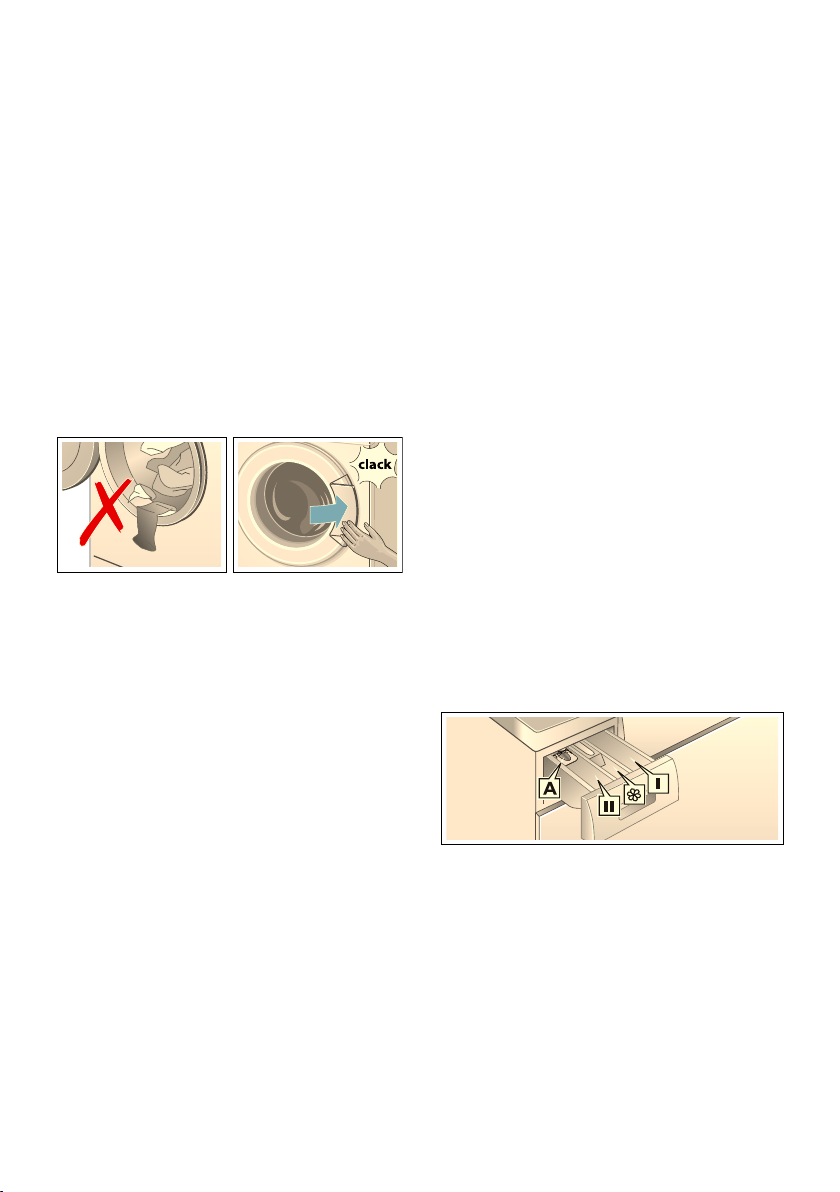
1. Place presorted items of laundry
unfolded in the washing drum.
2. Make sure that no items of laundry
are trapped between the washing
machine door and the rubber seal,
and close the door.
The Start/Reload A button indicator
lamp flashes and the programme
settings continue to be displayed on the
display panel one after another. It is
possible to change the settings.
Measure and add detergent
and care products
Caution!
Damage to the appliance
Cleaning agents and agents for
pretreating laundry (e.g. stain removers,
prewash sprays, etc.) may cause
damage if they come into contact with
the surfaces of the washing machine.
Do not allow these agents to come into
contact with the surfaces of the washing
machine. If necessary, immediately wipe
away spray residue and other residues/
droplets with a damp cloth.
Measuring
Measure the detergent and care
products according to:
■ Water hardness; ask your water
supply company
■ The manufacturer's instructions on
the packaging
■ The amount of laundry
■ Soiling
Filling
:Warning
Eye/skin irritation!
Detergent and care products may spray
out if the detergent drawer is opened
while the machine is in operation.
Open the drawer carefully.
Rinse eyes or skin thoroughly if they
come into contact with detergent/care
products.
If swallowed accidentally, seek medical
advice.
Note: Dilute viscous fabric softener and
fabric conditioner with water; this
prevents blockages.
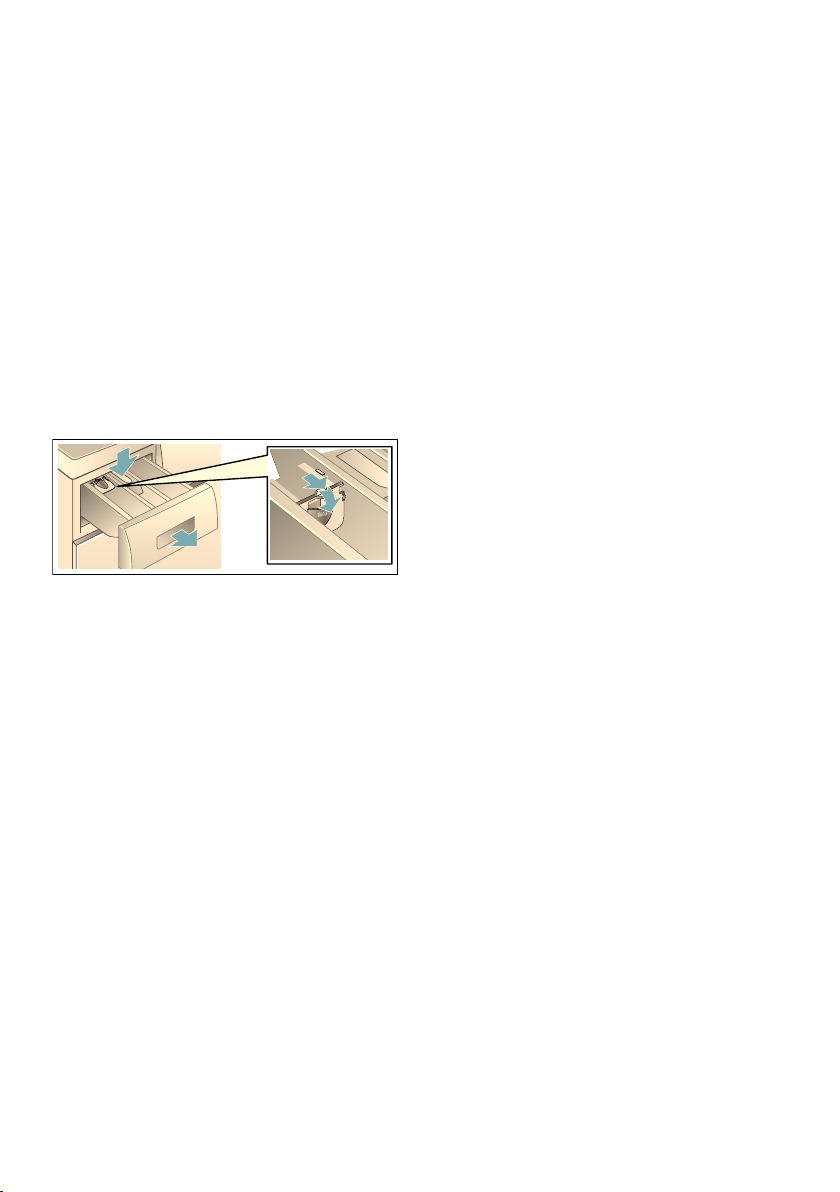
Pour the detergent and care products
into the appropriate compartments:
Measuring aid A* For liquid detergent
Compartment II Detergent for the
main wash, water
softener, bleach,
stain remover
Compartment i Fabric softener,
starch
Do not exceed the
max.
Compartment I Detergent for
prewash
Operating the appliance en
19
1. Pull out the detergent drawer as far
as possible.
2. Add detergent and/or care products.
3. Close the detergent drawer.
Measuring aid* for liquid detergent
*depending on the model
Position the measuring aid for
measuring the correct amount of liquid
detergent:
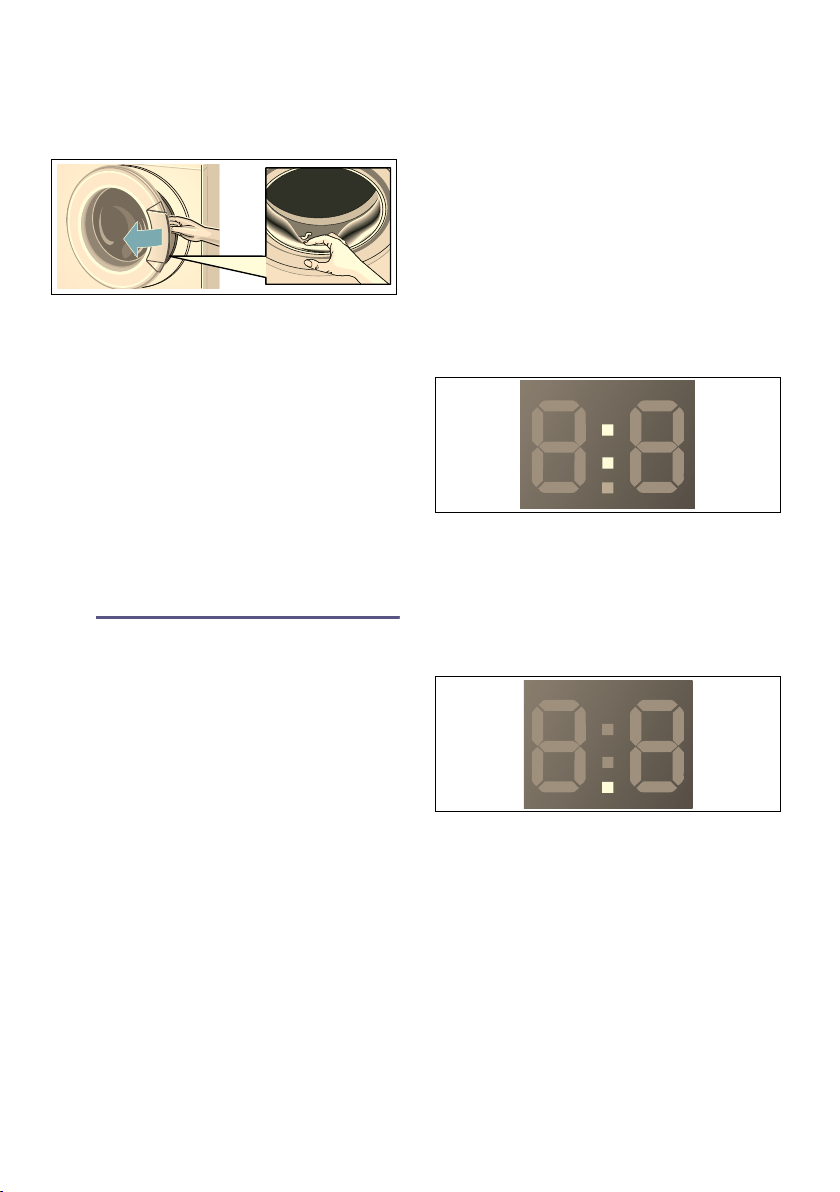
1. Pull out the detergent drawer. Press
down the insert and fully remove the
drawer.
2. Slide the measuring aid forwards,
fold it down and click it into place.
3. Reinsert the drawer.
Note: Do not use the measuring aid for
gel detergents and washing powder, or
for programmes with prewash or when
"Ready in" time is selected.
For models without a measuring aid,
pour the liquid detergent into the
appropriate dispenser and place it in
the drum.
Start the programme
Select the Start/Reload A button. The
indicator lamp lights up and the
programme starts.
During the programme, the display
panel shows the "Ready in" time or,
after starting the wash programme, the
programme duration and the symbols
for the programme progress.
Display panel ~ Page 10
Note: If you want to lock the
programme to prevent it from being
inadvertently adjusted, you can select
the childproof lock as follows.
Childproof lock
You can lock the washing machine to
prevent the functions you have set from
being changed inadvertently. To do this,
activate the childproof lock after starting
the programme.
To activate/deactivate the childproof
lock, press and hold Start/
Reload A for approx. five seconds.
The D symbol appears in the display
panel.
■ D lights up: The childproof lock is
active.
■ D flashes: The childproof lock is
active and the programme selector
was adjusted. To prevent the
programme from stopping, turn the
programme selector back to the
original programme. The symbol
lights up again.
Note: The childproof lock can remain
activated until you wish to start the next
programme, even after switching off the
machine.
You must then deactivate the childproof
lock before starting the programme and
activate it again as necessary once the
programme has started.
Adding/removing laundry
After starting the programme, you can
add or remove laundry as required.
To do this, press the Start/
Reload A button.
The Start/Reload A indicator lamp
flashes and the machine checks
whether it is possible to add laundry.

en Operating the appliance
20
Note: Do not leave the washing
machine door open for too long when
adding laundry as water from the
laundry may leak out.
If the display panel shows:
■ Both the YES and ¼ symbols lit up,
it is possible to add laundry.
■ A flashing NO symbol, wait until YES
and ¼ light up.
Do not open the door until both the
YES and the ¼ symbols are lit.
■ A flashing NO symbol, it is not
possible to add laundry.
For safety reasons, the washing
machine door remains locked when
the water level or temperature is
high, or while the drum is rotating,
and it is not possible to add laundry.
To continue the programme, press
the Start/Reload A button. The
programme continues automatically.
Changing the programme
If you have started the wrong
programme by mistake, you can
change the programme as follows:
1. Press Start/Reload A .
2. Select the other programme.
3. Press Start/Reload A . The new
programme starts from the
beginning.
Cancel the programme
Programmes at high temperatures:
1. Press Start/Reload A .
2. To cool the laundry: Select Rinse/
Freshen up O .
3. Press Start/Reload A .
For programmes at low temperatures:
1. Press Start/Reload A .
2. Select 0 Spin/Drain [ .
3. Press Start/Reload A .
Programme end during rinse
hold
– – – 0 appears on the display panel
and the Start/Reload A button
indicator lamp flashes.
To end the programme, set the
programme selector to 0 Spin/
Drain [ or select a spin speed. Then
press the Start/Reload A button.
Programme end
End appears on the display panel and
the Start/Reload A button indicator
lamp is off.
If the N symbol appears on the display
panel, the washing machine has
detected too much foam during the
wash programme and automatically
switched on a rinse cycle to remove the
foam.
Note: Add less detergent for the next
washing cycle with the same load.
Removing laundry/switching
off the appliance
1. Open the washing machine door
and remove the laundry.
2. Set the programme selector to off
position. The appliance is switched
off.
3. Turn off the water tap.
Notes
■ Do not leave any items of laundry in
the drum. They may shrink in the
next wash or discolour another item.
Sensors en
21
■ Remove any foreign objects from the
drum and the rubber seal – risk of
rusting.
■ Leave the washing machine door
and detergent drawer open so that
any residual water can dry away.
■ Always wait for the end of the
programme, otherwise the appliance
may still be locked. Then switch on
the appliance and wait for it to
unlock.
■ If the display panel goes off at the
end of a programme, energy-saving
mode is active. To activate the panel,
press any button.
H Sensors
Sensors
Automatic load sensing
The automatic load sensing function
adapts the water consumption ideally to
each programme depending on the
type of fabric and the load.
Unbalanced load detection
system
The automatic unbalanced load
detection system detects imbalances
and ensures even distribution of the
laundry by repeatedly starting and
stopping drum spinning.
If the laundry is extremely unevenly
distributed, the speed is reduced or the
spin cycle is not performed for safety
reasons.
Note: Place large and small items of
laundry evenly in the drum.
Faults and what to do about them
~ Page 25
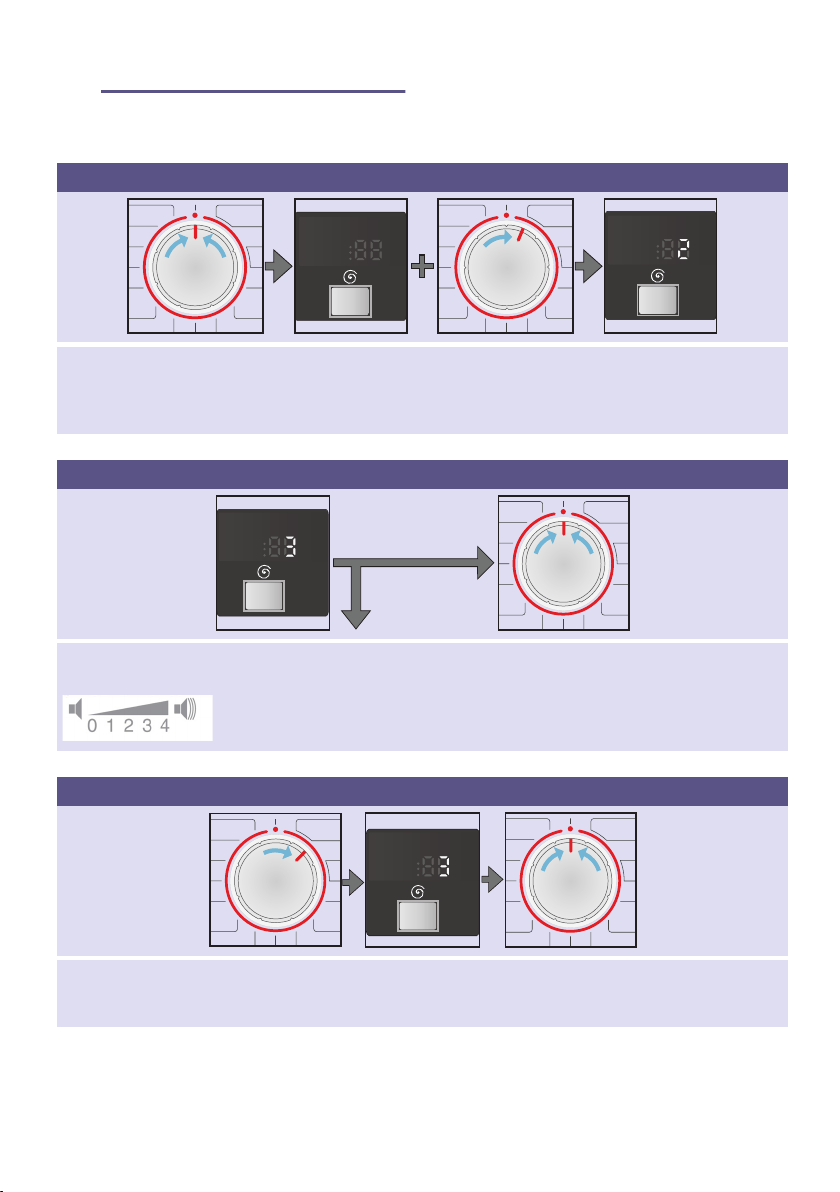
VoltCheck
The automatic voltage control system
detects unauthorised voltage drops
during the washing process.
Note: Whenever there is an
undervoltage, the colon flashes on the
Ready in display on the display panel.
When the supply voltage is stable again,
the programme continues running. The
colon on the Finished in display stops
flashing.
If the interruption causes the
programme to be extended, the dot on
the display flashes.
The voltage control system is activated
when a program is started.
en Setting the signal
22
M Setting the signal
Setting the signal
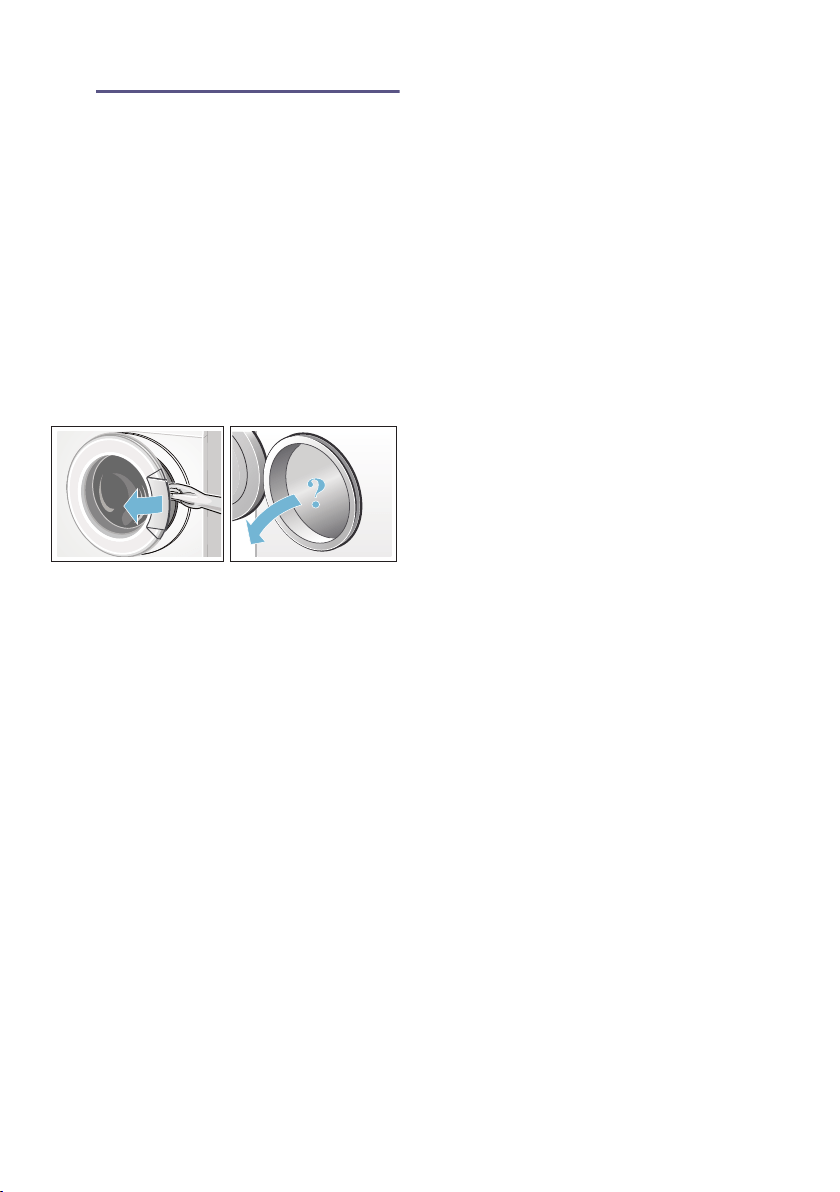
1. Activate the setting mode for the signal volume
Set to Ú. Press and hold the 0 button and turn one
position to the right.
Press and hold the button for
approx. five seconds until the
display elements light up. Set-
ting mode is activated.
2. Set the volume for the button signals (depending on the model)
Press the button repeatedly until the
desired volume is reached.
Go to point
3 or
Set to Ú to exit the setting mode for the signal volume.
3. Set the volume for the information signals
Turn the dial one position to the right. Press the button repeat-
edly until the desired vol-
ume is reached.
Set to Ú to exit the setting mode for
the signal volume.
Cleaning and maintenance en
23
2 Cleaning and
maintenance
Cleaning and maintenance
:Warning
Danger of death!
There is a risk of electric shock if you
touch live components.
Switch off the appliance and unplug the
mains plug.
:Warning
Risk of poisoning!
Toxic vapours can be produced by
cleaning agents that contain solvents,
e.g. cleaning solvent.
Do not use cleaning agents that contain
solvents.
Caution!
Damage to the appliance
Cleaning agents that contain solvents,
e.g. cleaning solvent, can damage
surfaces and components in the
machine.
Do not use cleaning agents that contain
solvents.
Machine housing/control
panel
■ Wipe the housing and the control
panel with a soft, damp cloth.
■ Remove the detergent residue
immediately.
■ Do not clean with a water jet.
Drum
Use chlorine-free cleaning agents and
not steel wool.
Descaling
Descaling should not be necessary if
the detergent is measured out correctly.
However, if it is required, follow the
manufacturer's instructions for the
descaling agent. Suitable descalers can
be obtained via our website or from our
after-sales service. ~ Page 29
Detergent drawer and housing
If the washing machine contains
detergent or fabric softener residues:
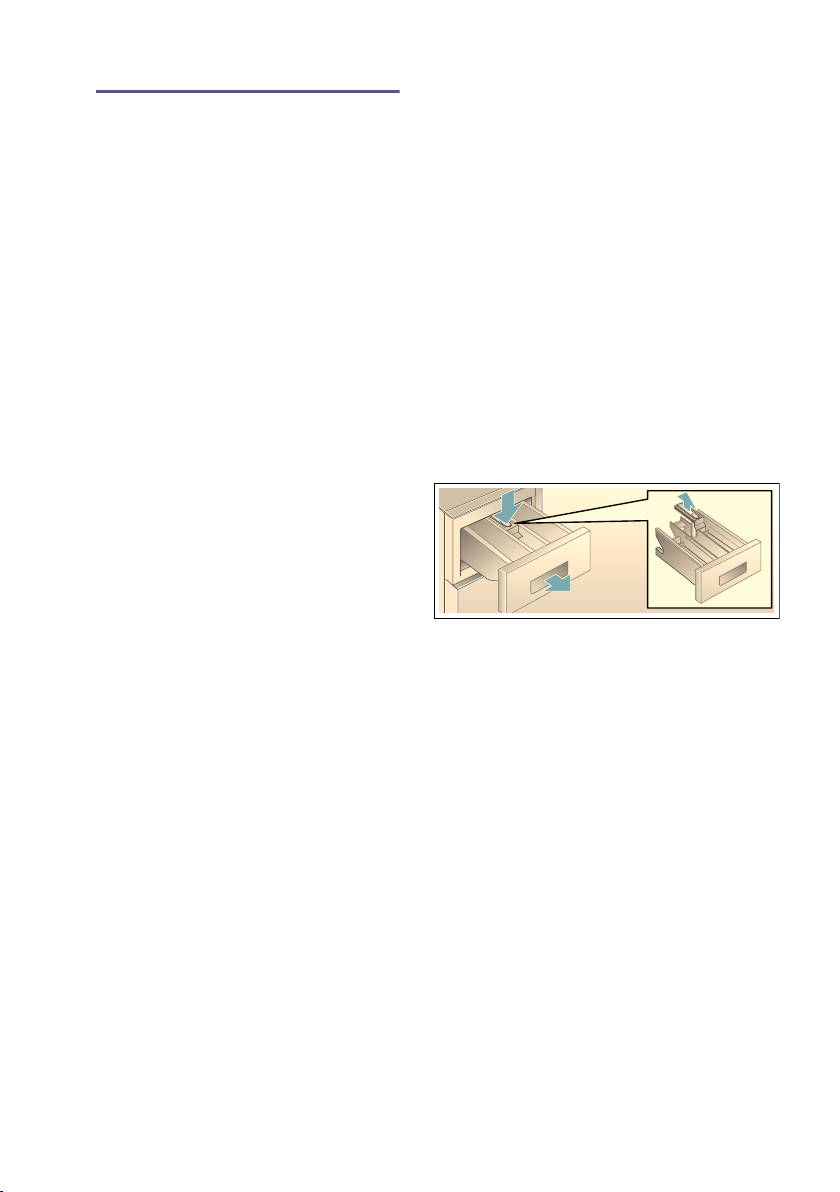
1. Pull out the detergent drawer. Press
down the insert and fully remove the
drawer.
2. To remove the insert: Push the insert
upwards from below with your finger.
3. Clean the detergent dispenser tray
and insert with water and a brush,
and dry it. Clean the inside of the
housing as well.
4. Fit the insert and lock it in place
(push the cylinder onto the guide
pin).
5. Push in the detergent drawer.
Note: Leave the detergent drawer open
so that any residual water can
evaporate.
Detergent solution pump
blocked
:Warning
Risk of scalding!
When you wash at high temperatures,
the water gets very hot. If you come into
contact with the hot water, you may be
scalded.
en Cleaning and maintenance
24
Allow the water to cool down.
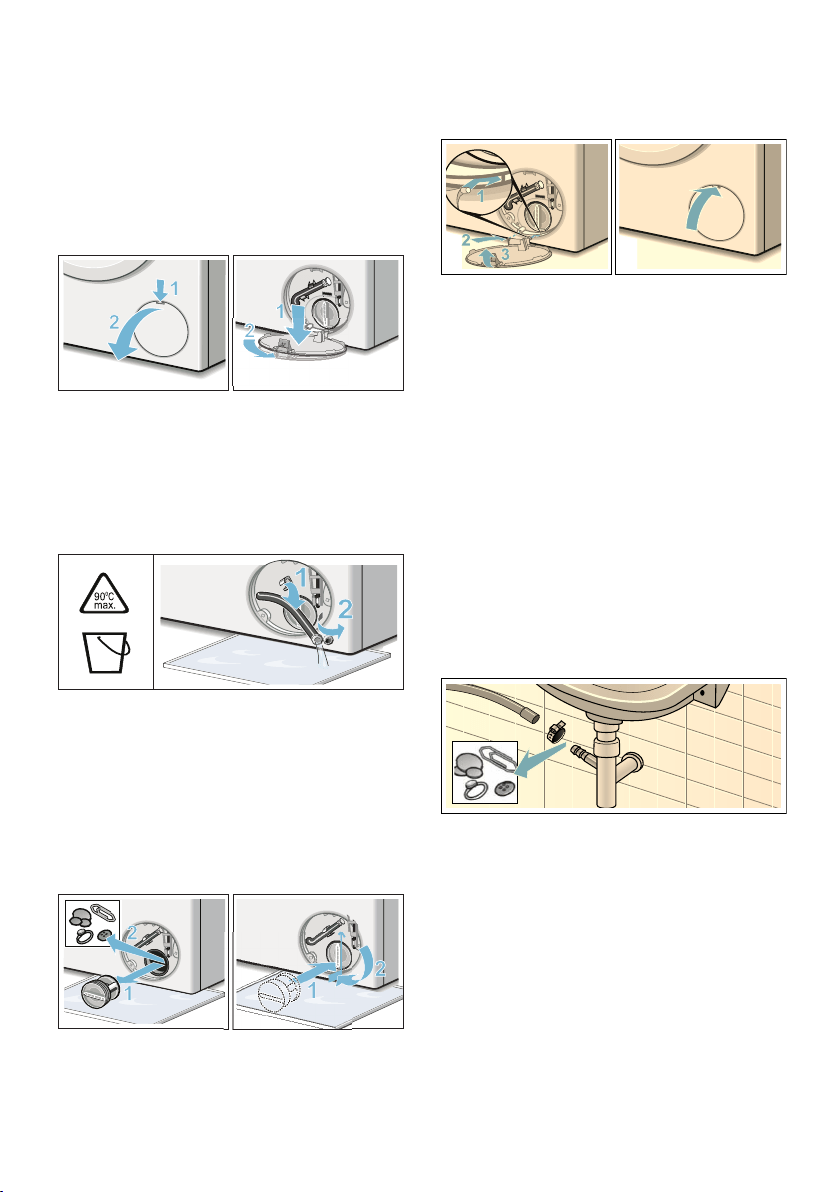
1. Turn off the water tap so that no
more water can flow in and has to be
drained via the drain pump.
2. Switch off the appliance. Disconnect
the mains plug.
3. Open and remove the service flap.
4. Take the drain hose out of the
retainer.
Remove the sealing cap, allow the
detergent solution to flow out into a
suitable container.
Replace the sealing cap and place
the drainage hose in the retainer.
5. Carefully unscrew the pump cover,
residual water may leak out.
Clean the interior, pump cover
thread and pump housing. The
impeller in the detergent solution
pump must be able to rotate.
Refit the pump cover and screw it on
tightly. The handle must be in a
vertical position.
6. Place the service flap back on, lock
it into place, and close it.
Note: To prevent unused detergent
from flowing straight into the drain
during the next wash: Pour 1 litre of
water into compartment II and start
the 0 Spin/Drain [ programme (if only
drain cycle is required,
set rpm 0 on - - - ).
The drain hose at the siphon
is blocked
1. Switch off the appliance. Disconnect
the mains plug.
2. Loosen the hose clamp. Carefully
remove the drain hose, residual
water may leak out.
3. Clean the drainage hose and siphon
connecting piece.
4. Reattach the drainage hose and
secure the connection using the
hose clamp.
Filter in the water supply
blocked
For this, first reduce the water pressure
in the supply hose:
1. Turn off the water tap.
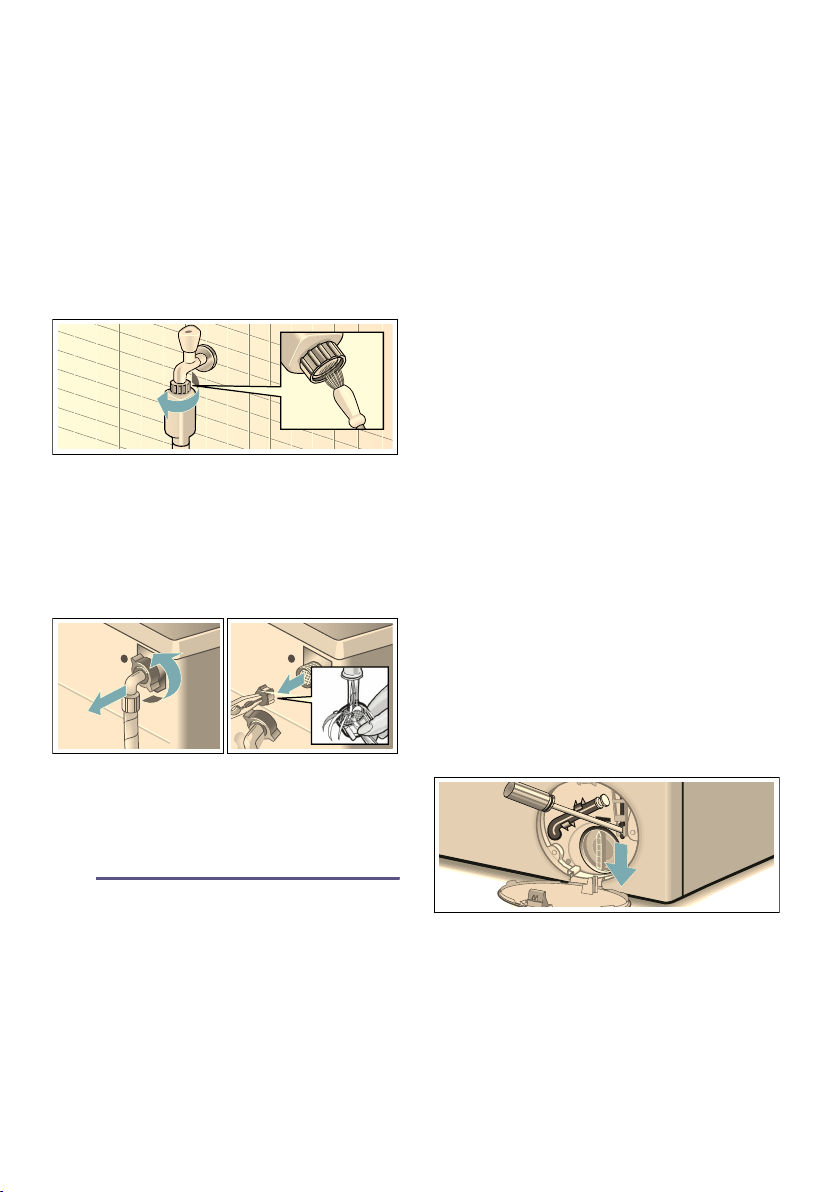
Faults and what to do about them. en
25
2. Select any programme (except
Rinse/Freshen up O // 0 Spin/
Drain [ ).
3. Press Start/Reload A . Allow the
programme to run for approximately
40 seconds.
4. Set the programme selector to off
position. Disconnect the mains plug.
5. Clean the filter on the water tap:
Remove the hose from the water tap.
Clean the filter with a small brush.
6. For standard and Aqua-Secure
models, clean the filter on the rear of
the appliance:
Remove the hose from the rear of
the appliance,
Remove the filter using pliers and
clean the filter.
7. Connect the hose and check for
leaks.
3 Faults and what to do
about them.
Faults and what to do about them.
Emergency release
e.g. in the event of a power outage
The programme will continue running
when the power supply has been
restored.
However, if the laundry has to be
removed, the washing machine door
can be opened as follows:
:Warning
Risk of scalding!
When you are washing at high
temperatures, there is a risk of scalding
if you come into contact with detergent
solution and laundry.
If possible, leave it to cool down.
:Warning
Risk of injury!
You may injure your hands if you reach
into the drum while it is turning.
Do not reach into the drum when it is
turning.
Wait until the drum has stopped turning.
Caution!
Water damage
Any escaping water may cause water
damage.
Do not open the washing machine door
if water can be seen through the glass.
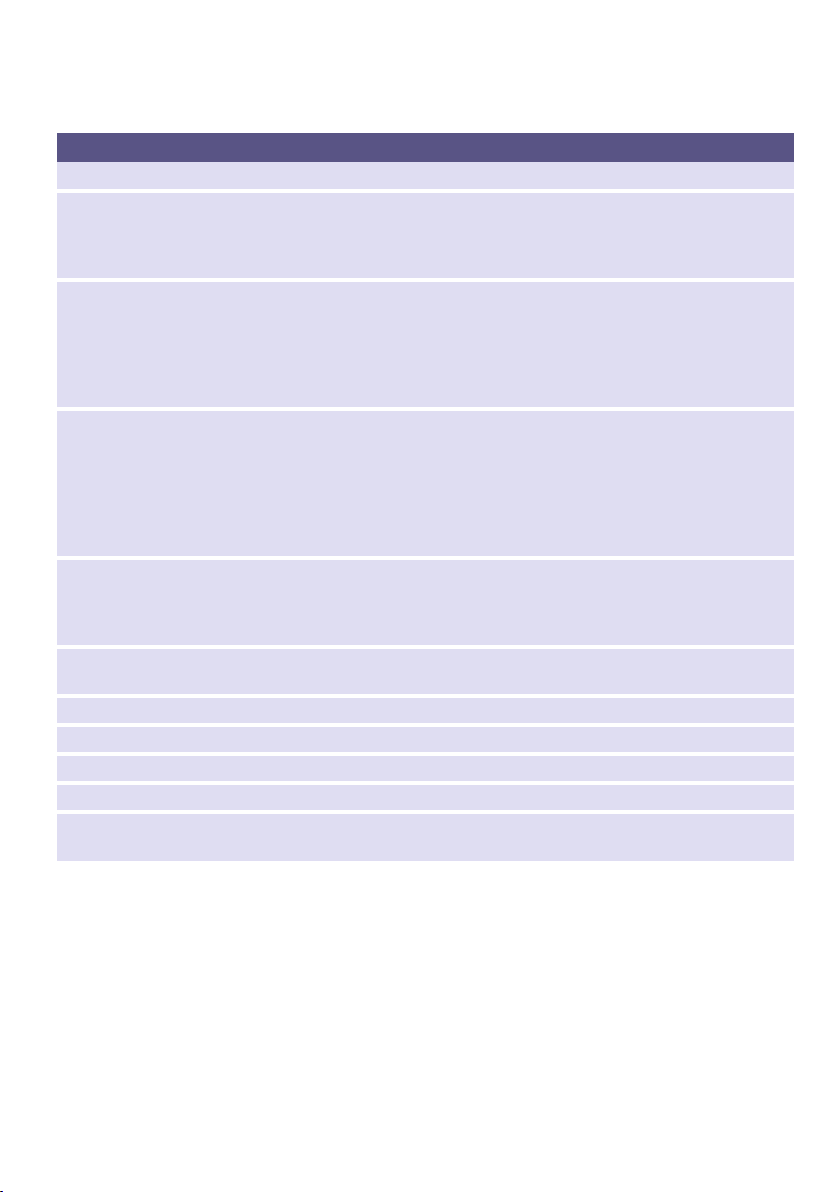
1. Switch off the appliance. Disconnect
the mains plug.
2. Drain the detergent solution
.
3. Pull the emergency release
downwards with a tool and release.
The washing machine door can then
be opened.
en Faults and what to do about them.
26
Information on the display panel
Display Cause/remedial action
YES The washing machine door is unlocked. It is possible to add laundry.
NO ■ The temperature is too high. Wait until the temperature falls.
■ Water level too high. Not possible to add laundry. If necessary, close the wash-
ing machine door immediately. To continue the programme, press Start/
Reload A .
¼ flashes ■ Laundry may be caught. Please open and close the washing machine door
again and press Start/Reload A .
■ If necessary, push the washing machine door closed or remove the laundry and
push it closed again.
■ If necessary, switch the appliance off and on again; set the programme and
make your individual settings; start the programme.
E:17 ■ Turn the water tap on fully,
■ The supply hose is kinked/trapped,
■ The water pressure is too low.
– Clean the filter in the water supply. ~ Page 24
– If an additional water filter has been installed (depending on model)
~ Page 33, check for contaminants and clean if required ~ separate
installation and cleaning instruction for water filter.
E:18 ■ The detergent solution pump is blocked. Clean the detergent solution pump.
~ Page 23
■ The drain hose/waste pipe is blocked. Clean the drain hose at the siphon.
~ Page 24
E:23 Water in the base tub, appliance leaking. Turn off the water tap. Call the after-sales
service. ~ Page 29
D The childproof lock is activated; to deactivate: ~ Page 19
N flashes Too much foam detected, a rinse cycle has been switched on.
: The mains voltage is too low. ~ Page 21
. Undervoltage in the wash programme. The programme is extended. ~ Page 29
Other displays Switch off the appliance, wait for 5 seconds and switch it back on again. If the dis-
play appears again, call the after-sales service. ~ Page 29
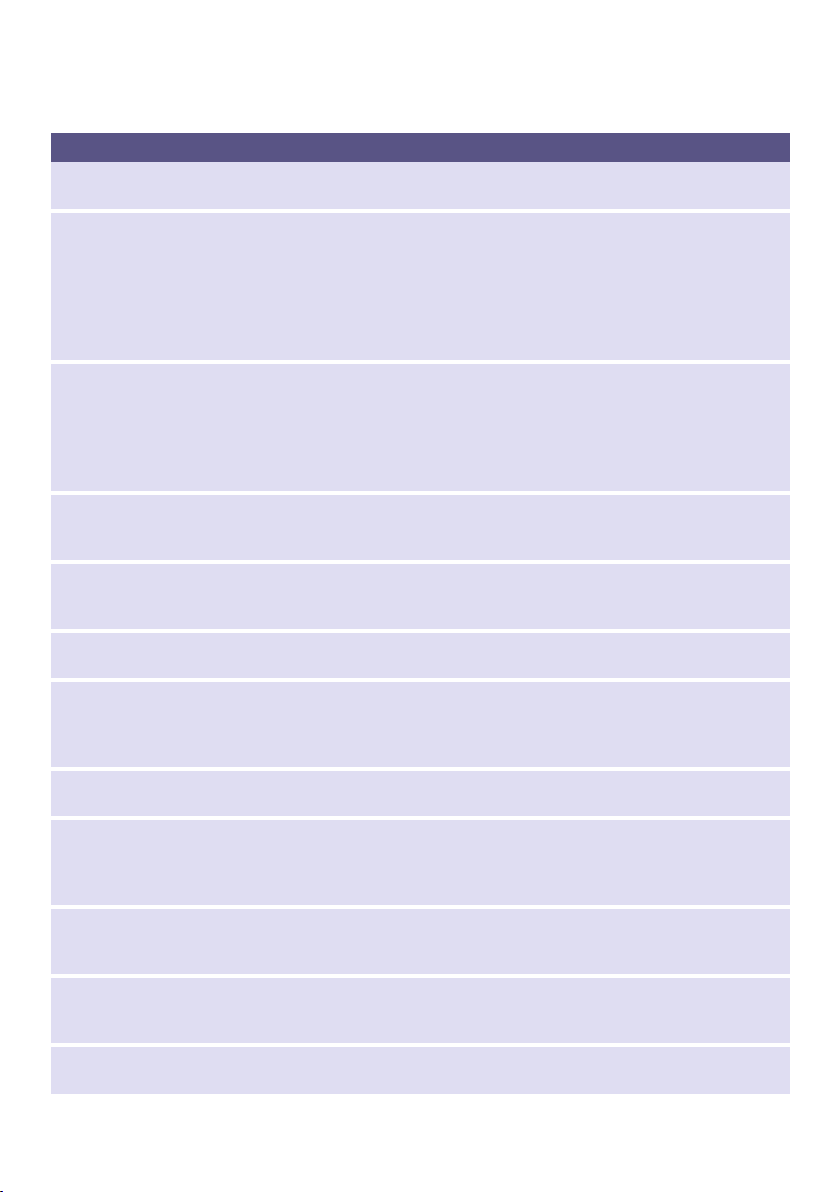
Faults and what to do about them. en
27
Faults and what to do about them.
Faults Cause/remedial action
Water is leaking out. ■ Attach/replace the drainage hose correctly.
■ Tighten the screw connection of the supply hose.
No water supply.
Detergent not dispensed.
■ Start/Reload A not pressed?
■ Tap not turned on?
■ Filter blocked? Clean the filter. ~ Page 24
Note: If an additional water filter has been installed (depending on model)
~ Page 33, check for contaminants and clean if required ~ separate
installation and cleaning instruction for water filter.
■ Supply hose kinked or trapped?
Washing machine door
cannot be opened.
■ Safety function active.
Note: For safety reasons, the washing machine door remains locked when
the water level or temperature is high (See ~ Cancel the programme
~ Page 20) or while the drum is rotating.
■ – – – 0 (Rinse hold = without final spin) selected?
■ Can be opened by emergency release only? ~ Page 25
Programme does not
start.
■ Start/Reload A pressed or Ready in ð time selected?
■ Washing machine door closed?
■ D Childproof lock activated? To deactivate: ~ Page 19
Detergent solution is not
emptied.
■ – – – 0 (Rinse hold = without final spin) selected?
■ Clean the detergent solution pump. ~ Page 23
■ Clean the waste pipe and/or drainage hose. ~ Page 24
Water not visible in the
drum.
Not a fault – water below the visible area.
Spin result not satisfac-
tory.
Laundry wet/too damp.
■ Not a fault – the unbalanced load detection system has interrupted the spin
because the laundry is unevenly distributed.
Distribute large and small items of laundry evenly in the drum.
■ Spin speed selected too low?
Spin cycle started and
stopped several times.
Not a fault – the unbalanced-load detection system is adjusting the imbalance.
The programme duration
is longer than usual.
■ Not a fault – the unbalanced-load detection system is adjusting the imbal-
ance by repeatedly distributing the laundry.
■ Not a fault – the foam detection system active – adds an additional rinse
cycle.
The programme duration
changes during the wash
cycle.
Not a fault – the programme sequence is optimised for the particular washing
process. This may lead to occasional changes in the programme duration in the
display panel.
Residual water in the
compartment i for care
products.
■ Not a fault – the effect of the care product is not affected.
■ Clean the insert if necessary.
Odours in the washing
machine.
Run the l Drum clean programme without laundry. Use standard detergent.

en Faults and what to do about them.
28
The symbol N flashes
in the display panel. Foam
may escape from the
detergent drawer.
■ Too much detergent used?
Mix one tablespoon of fabric softener with 1/2 litre water and pour into
compartment II (not for outdoor fabrics, sportswear fabrics or those made
with down).
Reduce the detergent dosage for the next wash cycle.
■ Improper detergent use? Only use detergent suitable for front-loading
washing machines.
Intense noise, vibrations
and "wandering" during
spinning.
■ Is the appliance levelled? Level the appliance. ~ Page 35
■ Are the appliance feet fixed? Secure the appliance feet. ~ Page 35
■ Transport locks removed? Remove the transport locks. ~ Page 32
Display panel/indicator
lamps do not function dur-
ing operation.
■ Power cut?
■ Circuit breakers tripped? Switch the circuit breakers back on or replace
them.
■ If the fault occurs repeatedly, call the after-sales service.
Detergent residues on the
laundry.
■ Occasionally, phosphate-free detergents contain water-insoluble residues.
■ Select Rinse/Freshen up O or brush the laundry after washing.
NO appears on the dis-
play panel in reload
mode.
■ Water level too high. Not possible to add laundry. Close the washing
machine door immediately, if necessary.
■ To continue the programme, press Start/Reload A .
YES appears on the dis-
play panel in reload
mode.
The washing machine door is unlocked. It is possible to add laundry.
The colon in the "Ready
in" display (:) flashes on
the display panel.
The mains voltage is too low. ~ Page 21
The single dot (.) flashes. The undervoltage has caused the wash programme to be extended.
~ Page 21
If you cannot correct a fault yourself (after switching off/on) or a repair is required:
■ Set the programme selector to off position. The appliance is switched off.
■ Unplug the mains plug from the socket.
■ Turn off the tap and call the after-sales service. ~ Page 29
Faults Cause/remedial action

After-sales service en
29
4 After-sales service
After-sales service
If you cannot correct the fault yourself,
(see section, Faults and what to do
about them ~ Page 25), please
contact our after-sales service. ~
Cover page
We will always find an appropriate
solution in order to avoid unnecessary
visits by engineers.
Please give the after-sales service the
product number (E no.) and the
production number (FD) of the
appliance.
You can find this information,
*depending on the model:
On the inside of the washing machine
door*/in the opened service flap* and
on the rear of the appliance.
Trust the expertise of the
manufacturer.
Contact us for assistance. By doing so,
you will ensure that the repairs are
carried out by trained service personnel
using genuine spare parts.
Product number Production number
(1U )'

en Consumption rates
30
[ Consumption rates
Consumption rates
Consumption values table
J Technical data
Technical data
Dimensions:
850 x 600 x 590 mm
(Height x width x depth)
Weight
63-83 kg (depending on model)
Mains connection:
Mains voltage 220-240 V, 50 Hz
Nominal current 10 A
Nominal input 2300 W
Water pressure:
100-1000 kPa (1-10 bar)
5 Positioning and
connecting
Positioning and connecting
Included with the appliance
Note: Check the machine for transport
damage. Never use a damaged
machine. If you have a complaint,
please contact the retailer from whom
you purchased the appliance, or our
after-sales service.
Programme Load Energy consumption* Water* Programme duration*
i Cottons cold 7 kg 0.23 kWh 70 l 2 1/2 h
i Cottons 40 °C 7 kg 0.77 kWh 70 l 2 1/2 h
f Easy-Care 40 °C 4 kg 0.45 kWh 51 l 1 1/2 h
o Mix 40 °C 3.5 kg 0.33 kWh 46 l 1 1/4 h
“ Delicate/Silk cold 2 kg 0.13 kWh 35 l 3/4 h
W l Wool cold 2 kg 0.02 kWh 45 l 3/4 h
Programme Load Energy consumption* Water* Programme duration*
Eco 60 °C** 7 kg 0.70 kWh 72 l 4 1/2 h
Values determined according to IEC60456:2010.
Eco 60 °C is recommended for a normally soiled load.
* Observed values may deviate from the indicated values due to influence of water pressure, hardness
and inlet temperature, ambient temperature, type, amount and soiling of laundry, detergent used, fluc-
tuations in power supply and selected additional functions.
** Program setting with maximum spin speed for testing according to AS/NZS 2040.2 and AS/NZS 6400.
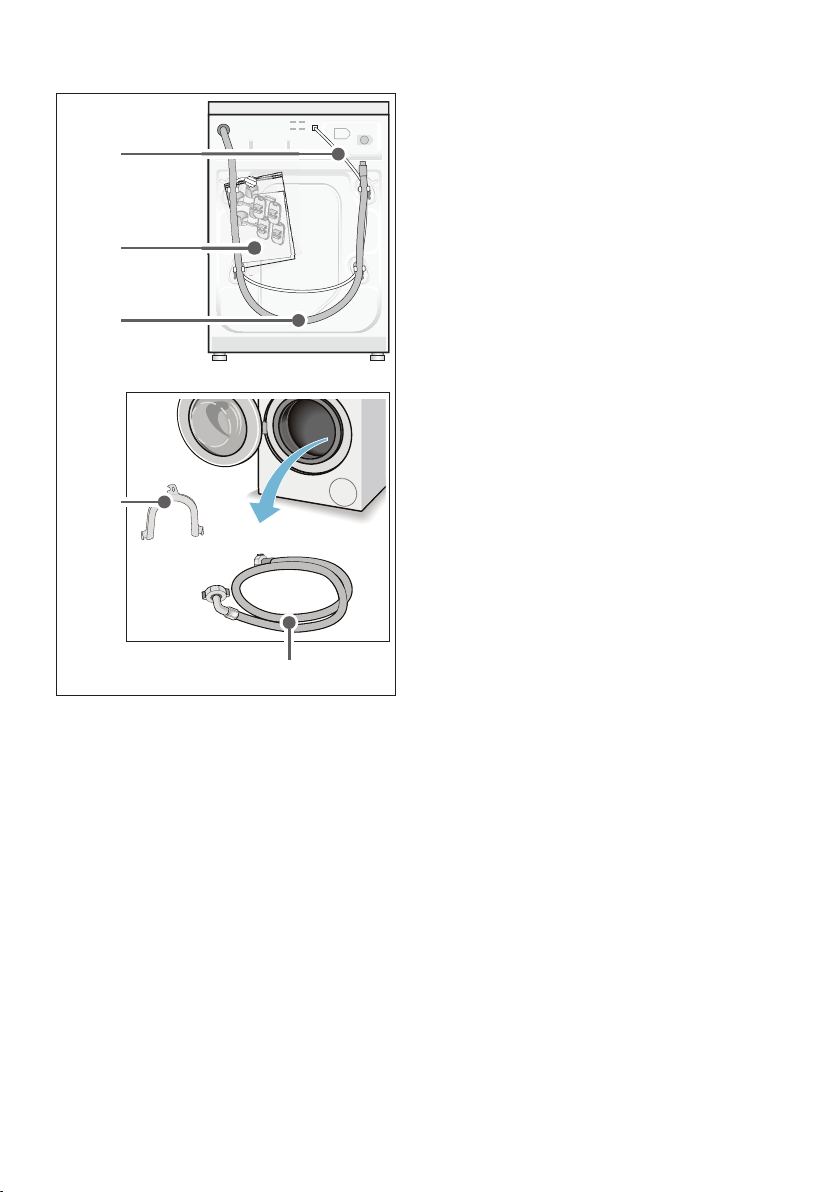
Positioning and connecting en
31
In addition, a hose clamp (24 - 40 mm
diameter, available from specialist
dealers) is required to connect the
water drain hose to a siphon.
Useful tools
■ Spirit level for levelling
■ Wrench with:
– WAF 13 for loosening the
transport locks, and
– WAF 17 for aligning the
appliance feet
Safety instructions
:Warning
Risk of injury!
■ The washing machine is very heavy.
Be careful when lifting/transporting
the washing machine.
■ When the washing machine is lifted
by its protruding parts (e.g. the
washing machine door), the
components may break off and
cause injuries.
Do not lift the washing machine by
protruding parts.
■ If the hose and mains cables are not
routed properly, there is a risk of
tripping and injury.
Lay hoses and cables in such a way
that there is no risk of tripping.
Caution!
Damage to the appliance
Frozen hoses may rip/burst.
Do not install the washing machine in
areas exposed to frost or outdoors.
Caution!
Water damage
The connection points for the water
supply hose and water drain hose are
under high water pressure. To prevent
leaks and water damage, you must
follow the instructions in this section.
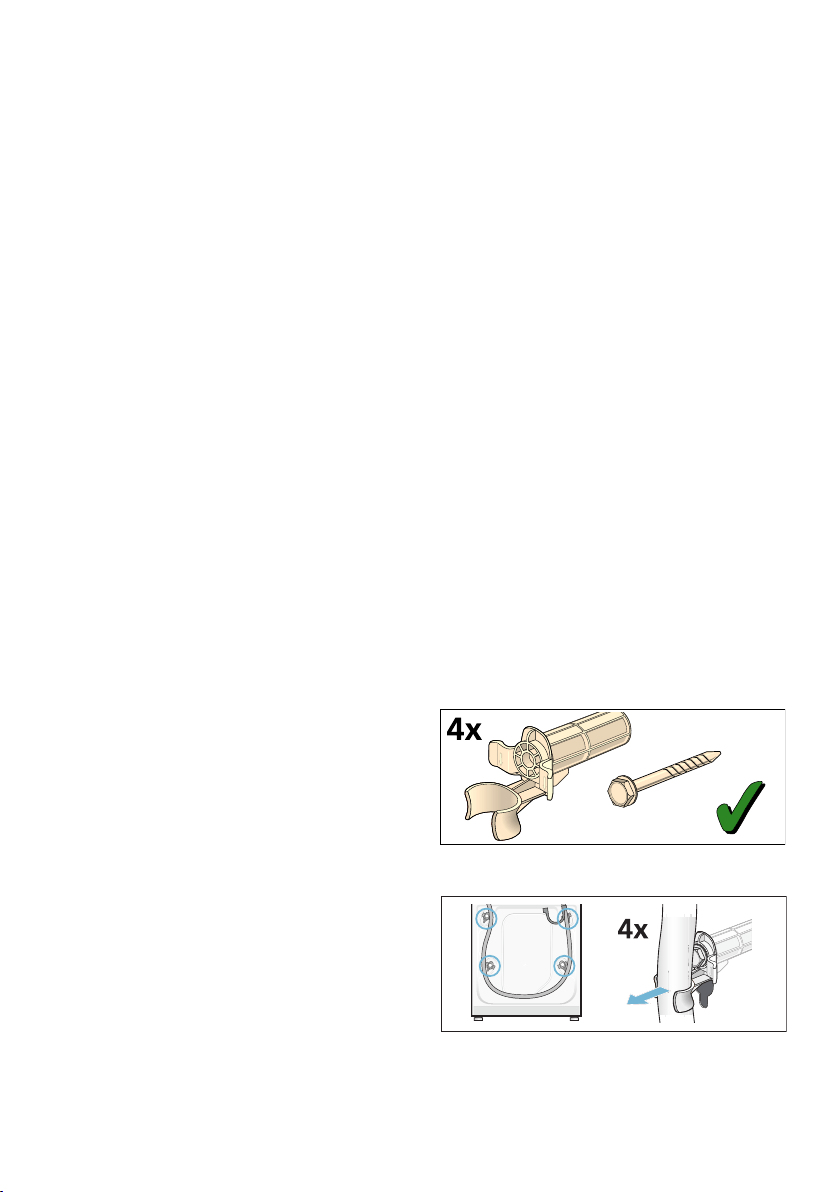
( Mains cable
0 Bag:
■ Installation and operating
instructions
■ After-sales service location
directory*
■ Warranty*
■ Cover caps for openings left
after removing the transport
locks
■ Wrench*
8 Water drain hose
@ Elbow for securing the water drain
hose*
H Water supply hose on standard/
Aqua-Secure models
*depending on the model
+
#
en Positioning and connecting
32
Notes
■ In addition to the safety information
listed here, the local water and
electricity supplier may have special
requirements.
■ If in doubt, have the appliance
connected by a specialist.
Installation surface
Note: The washing machine must be
stable aligned so that it does not move
around.
■ The installation surface must be firm
and level.
■ Soft floors/floor coverings are not
suitable.
Installation on a base or a
wooden joist floor
Caution!
Damage to the appliance
The washing machine may "wander"
and tip/topple from the base when
spinning.
The feet of the appliance must be
secured with holding brackets.
Order no. WMZ 20490,
WZ 20490 WZ 20510, WZ 20520
Note: On wooden joist floors, install the
washing machine:
■ In a corner, if possible,
■ On a water-resistant wooden board
(min. 30 mm thick) which is screwed
tightly to the floor.
Installing the appliance in a
kitchenette
:Warning
Danger of death!
There is a risk of electric shock if you
touch live components.
Do not remove the appliance covering
plate.
Notes
■ Recess width of 60 cm required.
■ Only install the washing machine
underneath a continuous worktop
that is securely connected to
adjacent cabinets.
Removing the transport locks
Caution!
Damage to the appliance
■ The machine is secured for
transportation using transport locks.
If the transport locks are not
removed, the drum, for example,
may become damaged when the
machine is operated.
Before using the appliance for the
first time, make sure that you
completely remove all four transport
locks. Keep the locks in a safe
place.
■ To prevent transport damage from
occurring if the appliance is moved
at a later date, you must refit the
transport locks before transporting
the appliance.
Note: Keep the screws and sleeves in
a safe place.
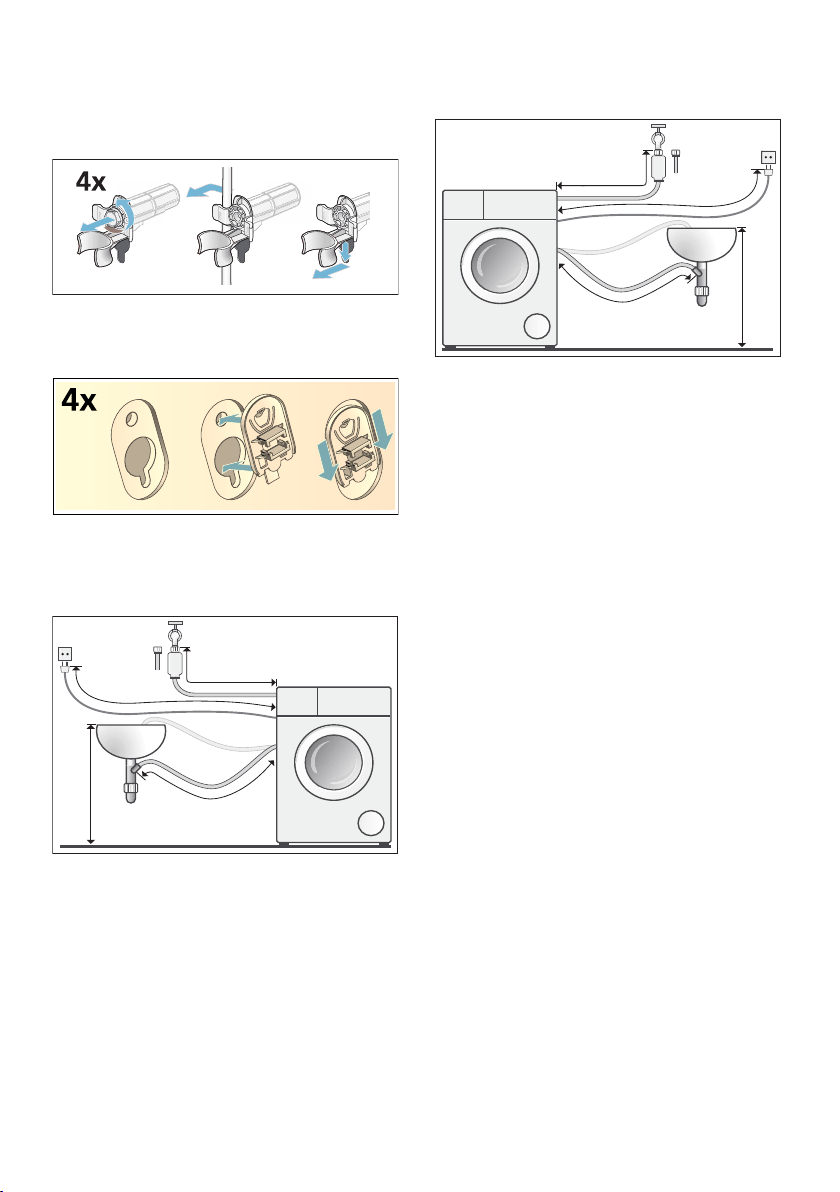
1. Take the hoses out of the holders.
2. Unscrew and remove all four
transport brace screws.
Positioning and connecting en
33
Remove the sleeves. To do this,
remove the mains cable from the
holders.
3. Fit the covers. Lock the covers firmly
in place by applying pressure to the
snap-in hooks.
Hose and cable lengths
■ Left-hand connection
■ Right-hand connection
Tip: The following are available from
specialist dealers/the after-sales
service:
■ An extension for Aqua-Stop or cold
water supply hose (approx. 2.50 m);
order no. WMZ2380, WZ10130,
CZ11350, Z7070X0
■ A longer supply hose (approx.
2.20 m) for standard model
Water inlet
:Warning
Danger of death!
There is a risk of electric shock if you
touch live components.
Observe the following when connecting
the machine:
Notes
■ Only operate the washing machine
using cold mains water.
■ Do not connect the machine to the
mixer tap of an unpressurised hot-
water boiler.
■ Do not use a used supply hose. Only
use the supply hose supplied or one
that was purchased from an
authorised specialist retailer.
■ Do not bend, squash, modify or cut
through the water supply hose
(otherwise its strength is no longer
guaranteed).
PD[FP
aFP
aFP
aFP
aFP
PD[FP
aFP
aFP
en Positioning and connecting
34
■ Only tighten the screw connections
by hand. If the screw connections
are tightened too much with a tool
(pliers), the thread may be
damaged.
Optimum water pressure in the supply
network
At least 100 kPa (1 bar)
Maximum 1000 kPa (10 bar)
When the tap is open, the water flow is
at least 8 l/min.
If the water pressure is higher than this,
a pressure-reducing valve must be
installed.
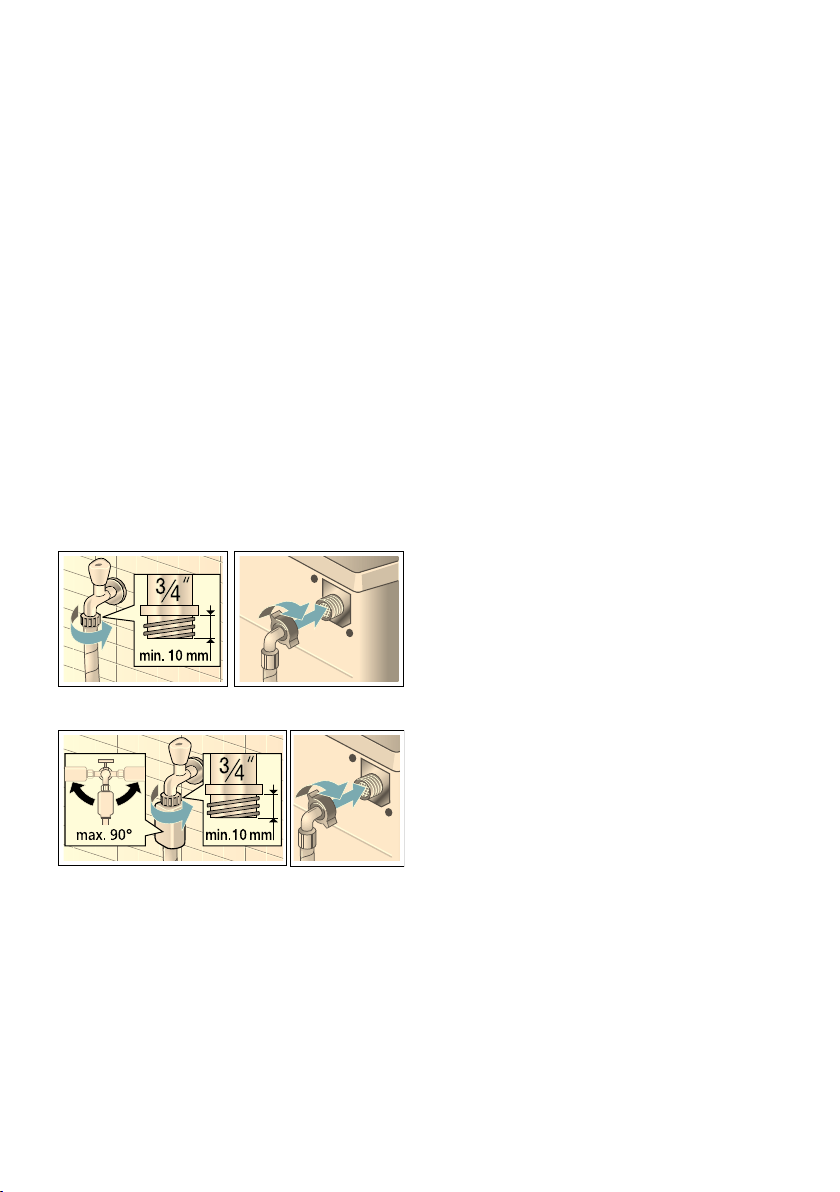
Connection
1. Connect the water supply hose to
the water tap (¾" = 26.4 mm) and to
the appliance:
– Model: Standard
– Model: AquaSecure
2. Open the water tap carefully,
checking the leak tightness of the
connection points. The screw
connection is under mains water
pressure.
Water outlet
Caution!
Water damage
If the drain hose slips out of the wash
basin or the connection point during
draining due to high water pressure, any
escaping water may cause water
damage.
Secure the drain hose so that it cannot
slip out.
Note: Do not kink the water drain hose
or put strain on it lengthways.
You can lay the water drain hose as
follows:
■ Outlet in a sink
:Warning
Risk of scalding!
When you are washing at high
temperatures, there is a risk of
scalding if you come into contact
with hot detergent solution e.g. if hot
detergent solution is being drained
into a wash basin.
Do not reach into the hot detergent
solution.
Caution!
Damage to the appliance/fabrics
If the end of the drain hose is
immersed in the drained water, water
may be sucked back into the
appliance and may damage the
appliance/fabrics.
Make sure that:
– The plug does not block drainage
from the sink.
– The end of the drain hose is not
immersed in the drained water.
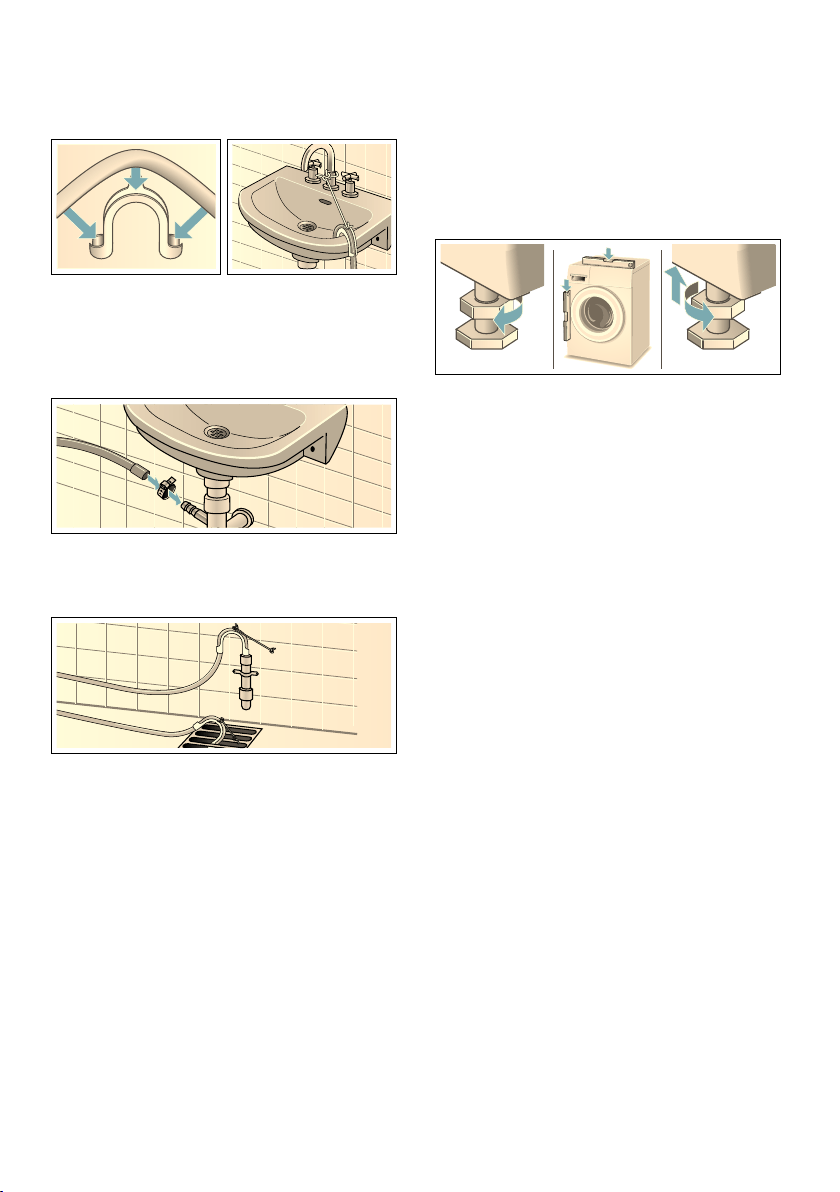
Positioning and connecting en
35
– The water drains away quickly
enough.
■ Drainage into a siphon
The connection point must be
secured using a hose clamp with a
diameter of 24-40 mm (available
from specialist dealers).
■ Outlet into a plastic pipe with
rubber bushing or into a drainage
pit
Levelling
Level the appliance using a spirit level.
Incorrect levelling may result in intense
noise, vibrations and "wandering".
1. Loosen the lock nuts using a
wrench, by turning it in a clockwise
direction.
2. Check the alignment of the washing
machine with a spirit level, and
adjust it if necessary. Change the
height by turning the appliance feet.
All four appliance feet must stand
firmly on the ground.
3. Tighten the lock nut against the
housing.
In doing so, hold the foot tight and
do not adjust its height.
The lock nuts on all four appliance
feet must be screwed tightly against
the housing.
Electrical connection
:Warning
Danger of death!
There is a risk of electric shock if you
touch live components.
■ Never touch or hold the mains plug
with wet hands.
■ Only pull out the mains cable by the
plug and never by the cable, as this
could damage it.
■ Never unplug the mains plug during
operation.
Observe the following information and
ensure that:
Notes
■ The mains voltage and voltage
indicated on the washing machine
(rating plate) are the same.
The connected load and fuse
required are specified on the rating
plate.
■ The mains plug fits the socket.
■ The cable cross-section is adequate.
■ The mains cable is only replaced by
a qualified electrician (if this is
necessary). Replacement mains
cables are available from the after-
sales service.
■ No multiple plugs/couplings or
extension cables are used.

en Positioning and connecting
36
■ If an earth-leakage circuit breaker is
used, only a type which displays this
symbol is used: z.
Only this symbol guarantees
compliance with the currently
applicable regulations.
■ The mains plug can be accessed at
all times.
■ The mains cable is not bent,
squashed, modified, cut through, or
in contact with heat sources.
Grounding Instructions
:Warning
Danger of death!
Improper connection of the ground may
result in electric shock. Have the
appliance checked by a qualified
technician or licensed electrician if you
are in doubt as to whether the washing
machine has been properly grounded.
This appliance must be grounded. In the
event of malfunction or breakdown,
grounding will reduce the risk of electric
shock by providing a path of least
resistance for the electric current. This
appliance is equipped with a cord that
has an equipment grounding conductor
and a grounding plug. The plug must be
plugged into an appropriate outlet that
is properly installed and grounded in
accordance with local codes and
ordinances. To ground the appliance
use a 3 pin plug and properly grounded
socket of 16 A rating.
Notes
■ Do not modify the plug provided with
the appliance. If the plug will not fit
into outlet have a properly grounded
outlet installed by qualified
electrician. Do not cut, remove or
bypass the grounding prong on the
washing machine power cord plug.
■ The wiring for the eletrical outlet
circuit must be sufficient to meet the
appliance requirements. Use of
Ground Fault Circuit Interrupter
(GFCI) is recommended.
■ Do not use the machine with an
extension box, extension cord, spike
busters etc., as this may lead to
improper grounding conditions.
Before washing for the first
time
The washing machine was thoroughly
tested before leaving the factory. In
order to remove any water which may
be left over from the test, run the first
washing cycle without any laundry.
Notes
■ The washing machine must be
correctly installed and connected
~ Page 30
■ Never use a damaged machine.
Inform your after-sales service.
~ Page 29
1. Check the machine.
2. Remove the protective film from the
control panel.
3. Connect the mains plug.
4. Turn on the water tap.
5. Close the washing machine door (do
not load any laundry).
6. Select the l Drum clean
programme.
7. Open the detergent drawer.
8. Pour approx. 1 litre of water into
compartment II.
9. Pour standard detergent into
compartment II.
Note: To prevent foaming, only use
half of the amount of detergent
recommended by the detergent
manufacturer. Do not use detergent
for wool or delicates.
10.Close the detergent drawer.
11.Press Start/Reload A .
12.Switch off the appliance at the end of
the programme.
Your washing machine is now ready to
use.
Positioning and connecting en
37
Transportation
e.g. when moving home
Preparatory work:
1. Turn off the water tap.
2. Reduce the water pressure in the
supply hose.
Maintenance – filter in the water
supply ~ Page 24
3. Drain the remaining detergent
solution.
Maintenance – detergent solution
pump blocked ~ Page 23
4. Disconnect the washing machine
from the mains.
5. Remove the hoses.
Before initial use:
Notes
■ The transport locks must be
removed. ~ Page 32
■ To prevent unused detergent from
flowing straight into the drain during
the next wash: Pour
approximately 1 litre of water into
compartment II and select and start
the 0 Spin/Drain [ programme (if
only drain cycle is required, set
rpm 0 on - - - ).
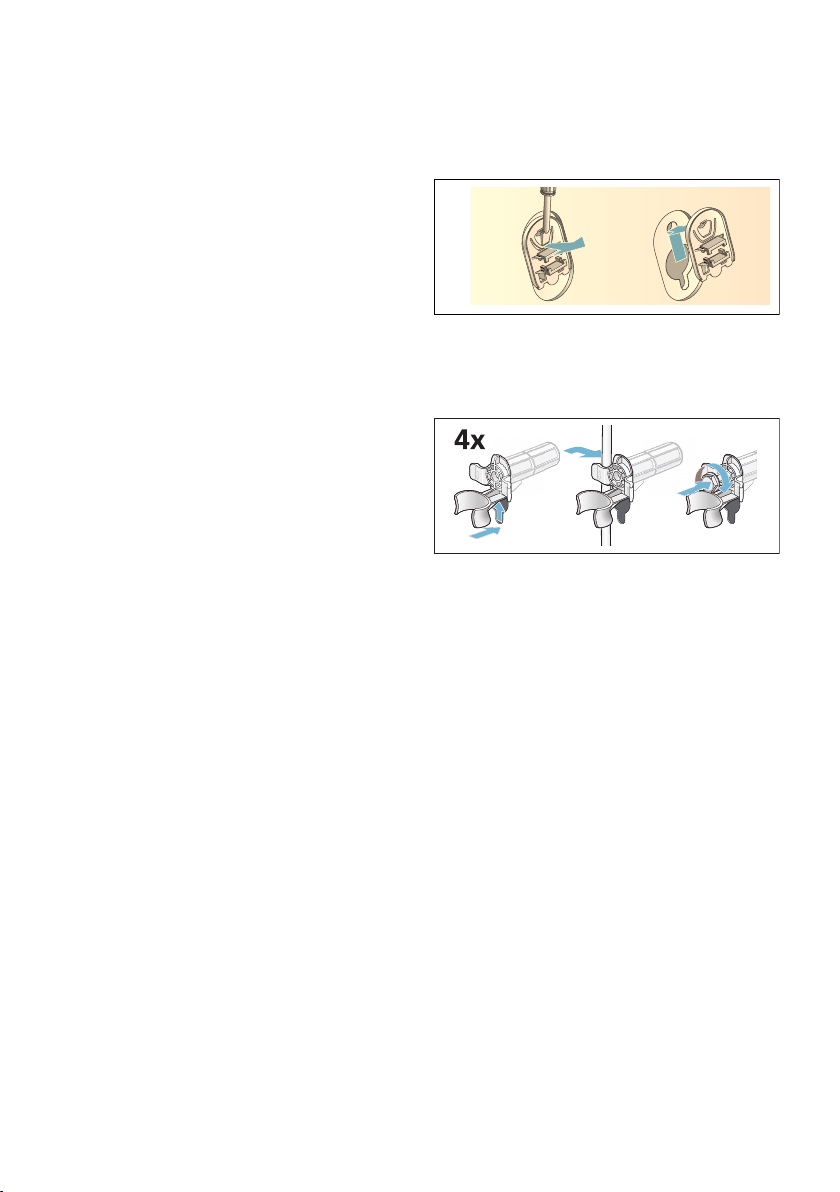
Installing the transport locks:
1. Remove the covers and keep them
in a safe place.
Use a screwdriver if necessary.
2. Insert all four sleeves.
Clip the mains cable securely in the
holders. Insert and tighten the
screws.
6
6

Robert Bosch, Hausgeräte GmbH
Carl-Wery-Straße 34
81739 München
DEUTSCHLAND
*9000968542*
9000968542 (9410)
You can find the contact information for all countries in the attached after-sales
service directory.
7 Advice and repair order in the event of faults
GB 0344 892 8979 (Calls charged at local or mobile rate.)
IE 01450 2655 (0.03 € per minute at peak. Off peak 0.0088 € per minute.)