Operating and Installation Instructions
Ventilation Hood
To prevent accidents and damage to the appliance, you must
read
these instructions before installing the appliance and using it for the first
time.
en-US M.-Nr. 09 805 980

Contents
2
IMPORTANT SAFETY INSTRUCTIONS................................................................. 4
Caring for the environment.................................................................................
13
Description of functions......................................................................................
14
Con@ctivity 2.0 function ........................................................................................ 15
Guide to the appliance.........................................................................................
16
Operation (Automatic mode)...............................................................................
18
Cooking with Con@ctivity 2.0 (Automatic mode)................................................... 18
Temporarily exiting Automatic mode ..................................................................... 20
Resuming Automatic mode ................................................................................... 20
Operation (Manual mode)....................................................................................
21
Cooking without Con@ctivity 2.0 (Manual mode).................................................. 21
Turning on the fan .................................................................................................. 21
Selecting the power level....................................................................................... 21
Selecting the delayed shut down time................................................................... 21
Turning off the fan.................................................................................................. 21
Turning overhead lighting on/off ............................................................................ 22
Power management............................................................................................... 22
Operation (Automatic and Manual modes)........................................................
23
Filter saturation indicator ....................................................................................... 23
Adjusting the filter saturation indicator for the grease filter .............................. 23
Activating/changing the OdorFree Charcoal Filter operating hours counter .... 24
Checking the filter saturation indicator............................................................. 24
Sensor button signal tone...................................................................................... 25
Cleaning and care................................................................................................
26
Stainless steel housing .......................................................................................... 26
Special instructions for glass surfaces ............................................................. 27
Grease filters.......................................................................................................... 27
OdorFree Charcoal Filter........................................................................................ 29
Resetting the operating hours counter for the OdorFree Charcoal Filter.......... 30
Disposing of the OdorFree Charcoal Filter........................................................ 30
Installation ............................................................................................................ 31
Before installation .................................................................................................. 31
Installation parts..................................................................................................... 31
Appliance dimensions............................................................................................ 32
Distance between cooktop and ventilation hood (S) ............................................. 33
Installation recommendations................................................................................ 34
Structural support .................................................................................................. 34

Contents
3
Removing the protective film ................................................................................. 34
Exhaust duct.........................................................................................................
46
Condensate trap .................................................................................................... 47
Electrical connection........................................................................................... 48
Grounding Instructions .......................................................................................... 48
Activating Con@ctivity 2.0...................................................................................
49
Installation of the Con@ctivity 2.0 stick ................................................................. 49
Activating the Con@ctivity 2.0 function ................................................................. 49
Activating the ventilation hood ......................................................................... 49
Activating the cooktop...................................................................................... 50
Activation failed ................................................................................................ 50
Deactivating Con@ctivity 2.0 ................................................................................. 50
Service and warranty........................................................................................... 51
Location of the data plate ...................................................................................... 51
Technical data .....................................................................................................
52

IMPORTANT SAFETY INSTRUCTIONS
4
READ AND SAVE THESE INSTRUCTIONS
This appliance complies with current safety requirements. Improp‐
er use
of the appliance can lead to personal injury and material
damage.
Read all instructions before installing or using the appliance for
the first time. Only use the appliance for its intended purpose.
Keep these operating instructions in a safe place and pass them
on to any future user.
Use
C
AUTION: For General Ventilating Use Only. Do Not Use To Ex‐
haust Hazardous Or Explosive Materials And Vapors.
This applianc
e is intended for residential use only. Use only as de‐
scribed in these operating instructions.
This ventilation hood is designed for domestic use and for use in
simil
ar residential environments.
This venti
lation hood is not intended for outdoor use.
It
must only be used to extract and clean vapors produced during
cooking. Any other use occurs at the owner's own risk.
This appliance is suitable for installation above gas or electric
coo
king surfaces.
P
ersons who lack physical, sensory or mental abilities, or experi‐
ence with the appliance should not use it without supervision or in‐
struction by a responsible person.

IMPORTANT SAFETY INSTRUCTIONS
5
Children
As w
ith any appliance, close supervision is necessary when used
by children.
Please super
vise children in the vicinity of the hood and do not let
them play with it.
Dange
r of suffocation! Ensure that any plastic wrappings, bags,
etc. are disposed of safely and kept out of the reach of children.
Technical safety
W
ARNING: TO REDUCE THE RISK OF FIRE, ELECTRIC SHOCK,
OR INJURY TO PERSONS, OBSERVE THE FOLLOWING:
– Use this appliance only in the manner intended by the manufac‐
tur
er. If you have questions, contact Miele.
– Before servicing or cleaning the appliance, switch power off at
the ser
vice panel and lock the service disconnecting means to
prevent power from being switched on accidentally. If the service
disconnecting means cannot be locked, securely fasten a promi‐
nent warning device, such as a tag, to the service panel.
Installatio
n, repair and maintenance work should be performed by
a Miele authorized service technician in accordance with national
and local safety regulations and the provided installation instruc‐
tions. Contact Miele’s Technical Service Department for examina‐
tion, repair or adjustment. Repairs and other work by unauthorized
persons could be dangerous and may void the warranty.
A d
amaged ventilation hood oven can be dangerous. Always
check for visible signs of damage. Never use a damaged ventilation
hood.

IMPORTANT SAFETY INSTRUCTIONS
6
Be cer
tain your appliance is properly installed and grounded by a
qualified technician. To guarantee the electrical safety of this appli‐
ance, continuity must exist between the appliance and an effective
grounding system. It is imperative that this basic safety requirement
be met. If there is any doubt, have the electrical system of the house
checked by a qualified electrician.
T
o avoid damaging the ventilation hood, make sure that the con‐
nection data (voltage and frequency) on the data plate correspond to
the building's power supply before connecting the appliance. When
in doubt, consult a qualified electrician.
Do not use a power bar or e
xtension cord to connect the ventila‐
tion hood to electricity. These are a fire hazard and do not guarantee
the required level of appliance safety.
T
o ensure safe operation, only use the ventilation hood after it has
been properly installed.
This ventilation hood may not be used in non-stationary locations
(e.g. on a ship).
Only open the housing as described in the enclosed "Installation
diagr
am" and in the "Cleaning and care" section of this manual. Un‐
der no circumstances should any other parts of the housing be
opened.
Tampering with electrical connections or components and mechani‐
cal parts is highly dangerous to the user and can cause operation
faults.

IMPORTANT SAFETY INSTRUCTIONS
7
Defective co
mponents should be replaced by Miele original parts
only. Only with these parts can the manufacturer guarantee the safe‐
ty of the appliance.
During
installation, maintenance, and repair work, the ventilation
hood must be disconnected from the electrical supply. It is only
completely isolated from the electricity supply if one of the following
applies:
– The circuit breakers on the electrical service panel are tripped.
– The screw-type fuses on the electrical service panel have been
r
emoved.
– The power cable (if present) has been unplugged from the socket
(pull the plug no
t the cord).
Proper use
W
ARNING: TO REDUCE THE RISK OF A COOKTOP GREASE
FIRE:
– a) Never leave surface units unattended at high settings. Boil‐
ove
rs cause smoking and greasy spillovers may ignite. Heat oils
slowly on low or medium settings.
– b) Always turn the hood on when cooking at a high heat.
– c) Clean the ventilation hood frequently. Grease should not be al‐
lo
wed to accumulate on the fan or filter.
– d) Use the proper pan size. Always use cookware appropriate for
the siz
e of the cooking area.
Never use an open flame beneath the ventilation hood.
T
o avoid the risk of fire, do not flambé or grill over an open flame.
When turned on, the ventilation hood will draw any flames into the
filter. Fat deposits may ignite.

IMPORTANT SAFETY INSTRUCTIONS
8
W
ARNING: TO REDUCE THE RISK OF INJURY TO PERSONS IN
THE EVENT OF A COOKTOP GREASE FIRE, OBSERVE THE FOL‐
LOWING*:
– a) SMOTHER FLAMES with a close fitting lid, cookie sheet, or
metal
tray then turn off the burner. BE CAREFUL TO PREVENT
BURNS. If the flames do not go out immediately, EVACUATE AND
CALL THE FIRE DEPARTMENT.
– b) NEVER PICK UP A FLAMING PAN - You may be burned.
– c) DO NOT USE WATER, including wet dishcloths or towels - a vi‐
olent steam explosion will result.
– d) Use a fire extinguisher ONLY if:
– 1) You have a class ABC extinguisher, and you know how to operate it.
– 2) The fire is small and contained in the area where it started.
– 3) The fire department is being called.
– 4) You can fight the fire with your back to an exit.
*Based on "Kitchen Firesafety Tips" published by NFPA.
The venti
lation hood may become damaged if exposed to exces‐
sive heat from a gas cooktop.
– When using the ventilation hood over a gas cooktop, ensure that
any burne
rs in use are always covered by cookware. Turn burners
off when removing the cookware, even if doing so for just a short
time.
– Select cookware that is suitable for the size of the burner.
– Adjust the flame so that it never extends up the sides of the cook‐
war
e.
– Avoid overheating the cookware (e.g., when cooking with a wok).
Always turn the ventila
tion hood on whenever a burner is in use to
prevent damage from condensation.

IMPORTANT SAFETY INSTRUCTIONS
9
Overheat
ed oils and fats can ignite and set the ventilation hood
on fire.
When cooking with oils or fats, do not leave pots, pans or fryers un‐
attended. Never leave an electric grill unattended when grilling.
F
at and debris deposits impair the proper functioning of the venti‐
lation hood.
To ensure that cooking vapors are properly cleaned, never use the
ventilation hood without the grease filters in place.
A filt
er containing too much grease is a fire hazard!
The filters should be cleaned or replaced at regular intervals.
Please no
te that the heat rising from the stovetop during cooking
can cause the ventilation hood to become very hot.
Do not touch the housing or the grease filters until the ventilation
hood has cooled down.

IMPORTANT SAFETY INSTRUCTIONS
10
Proper installation
W
ARNING: TO REDUCE THE RISK OF FIRE, ELECTRIC SHOCK,
OR INJURY TO PERSONS, OBSERVE THE FOLLOWING:
– a) Installation work and electrical wiring must be done by quali‐
fied person(s) in accor
dance with all applicable codes and stand‐
ards, including fire-rated construction.
– b) Sufficient air is needed for combustion and exhausting of gas‐
es thr
ough the flue (chimney of fuel burning equipment to prevent
back drafting. Follow the heating equipment manufacturer’s
guideline and safety standards such as those published by the
National Fire Protection Association (NFPA) and the American So‐
ciety for Heating, Refrigeration and Air Conditioning Engineers
(ASHRAE), and the local code authorities.
– c) When cutting or drilling into the wall or ceiling, do not damage
electrical wiring and other hidden utilities.
– d) Ducted hoods must always be vented to the outdoors.
– e) Do not use this hood with any solid-state speed control device.
T
o determine whether a ventilation hood may be operated above
your cooking appliance, please refer to the information provided by
the appliance's manufacturer.
Safety r
egulations prohibit the installation of a ventilation hood
above solid fuel stoves.
Insufficient distance between the cooking appliance and the ven‐
tilatio
n hood can result in damage to the hood.
The minimum safety distances between the appliance and the bot‐
tom of the ventilation hood specified in the "Installation" section
must be maintained, unless the appliance's manufacturer has indi‐
cated that a greater distance is required.
If more than one cooking appliance is used beneath the ventilation
hood, and if different minimum safety distances apply for these ap‐
pliances, you should use the greater distance.

IMPORTANT SAFETY INSTRUCTIONS
11
Be sur
e to observe the information contained in the "Installation"
section when mounting the ventilation hood.
Metal par
ts can have sharp edges which may cause injury.
Wear gloves to protect your hands from being cut.
When installing the exhaust duct, only use pipes or tubes made of
non-flammable material. These can be obtained from your Miele
dealer or from Miele Technical Service.
Exhaust air shou
ld not be vented into a chimney or vent flue
which is otherwise in use and should not be channeled into ducting
which ventilates rooms with fuel-burning installations.
If
exhaust air is to be extracted into a chimney or vent flue no lon‐
ger used for other purposes, be sure to comply with all applicable
regulations.
W
ARNING: TO REDUCE THE RISK OF FIRE USE ONLY METAL
DUCTWORK.

IMPORTANT SAFETY INSTRUCTIONS
12
Cleaning and care
Never use a st
eam cleaner to clean the ventilation hood.
The steam can reach the electrical components and cause a short
circuit.
Accessories
Use only ge
nuine original Miele parts. If parts or accessories from
other manufacturers are used, the warranty will become void.
FCC Declaration of Conformity
These device
s comply with FCC Rules Part 15. This equipment
has been tested and found to be in compliance with the limits for a
Class B digital device, pursuant to Part 15 of the FCC Rules of Oper‐
ation and is subject to the following conditions:
These devices may not cause harmful interference.
These devices must accept any interference received, including in‐
terference that may cause undesired operation.
FCC Radiation Exposure Statement
This equipment co
mplies with FCC radiation exposure limits set
forth for an uncontrolled environment. This equipment should be in‐
stalled and operated with minimum distance 8" (20 cm) between the
radiator and your body.
Industry Canada Statement
This digi
tal apparatus does not exceed the Class B limits for Ra‐
dio Noise Emissions from digital apparatus set out in the Radio In‐
terference Regulations of the Canadian Department of Communica‐
tions.
Complies with Canadian ICES-003 Class B specifications.

Caring for the environment
13
Disposal of the packing mate‐
rial
The cardboard box and packing materi‐
als pr
otect the appliance during ship‐
ping. They have been designed to be
biodegradable and recyclable.
Ensure that any plastic wrappings,
bags, etc. ar
e disposed of safely and
kept out of the reach of children. Dan‐
ger of suffocation!
Disposal of your old appliance
Do not dispose of this appliance with
your ho
usehold waste.
Old appliances may contain materials
that can be r
ecycled. Please contact
your local recycling authority about the
possibility of recycling these materials.
Before discarding an old appliance en‐
sur
e that it presents no danger to chil‐
dren while being stored for disposal.
Unplug it from the outlet, cut off its
power cord and remove any doors to
prevent hazards.
Description of functions
14
The following functions are available on
your ventilation hood, depending on the
model:
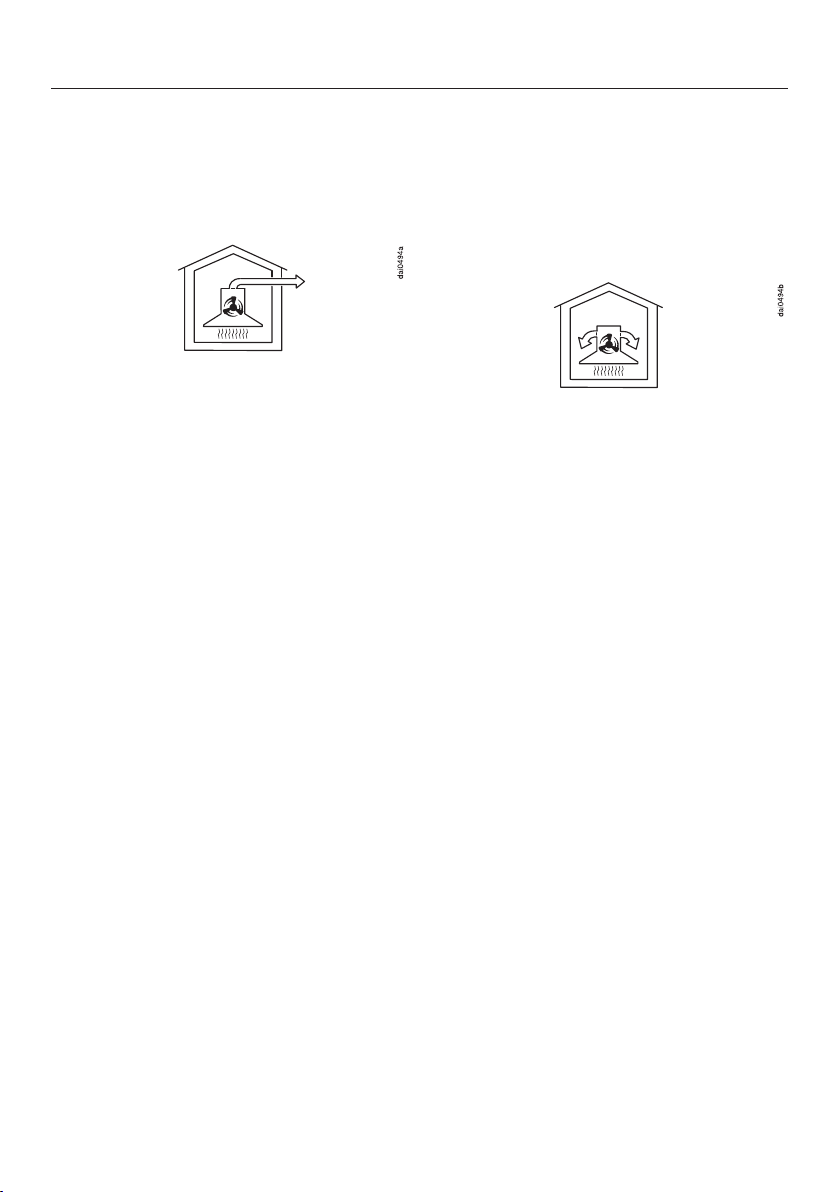
Vented mode
The air is drawn in and cleaned by the
gr
ease filters and directed outside.
Non-return flap
A non-return flap in the ducting pre‐
vents the e
xchange of inside and out‐
side air from occurring when the venti‐
lation hood is not in use.
The flap is closed when the ventilation
hood is turned off.
When the ventilation hood is turned on,
the non-return flap opens so that the
exhaust air can be transported outside
without any obstruction.
A non-return flap has been provided
with the hood in case your ducting
does not have o
ne. It is inserted into
the outlet duct collar of the fan.
Recirculation mode
The recirculation mode requires a recir‐
cula
tion kit and OdorFree Charcoal Fil‐
ter (available as optional accessories,
see "Technical Data" for more informa‐
tion)
The air is drawn in and first cleaned by
the gr
ease filters and then by an Odor‐
Free Charcoal Filter. The cleaned air is
then recirculated back into the kitchen.
Description of functions
15
Con@ctivity 2.0 function
Automatic control
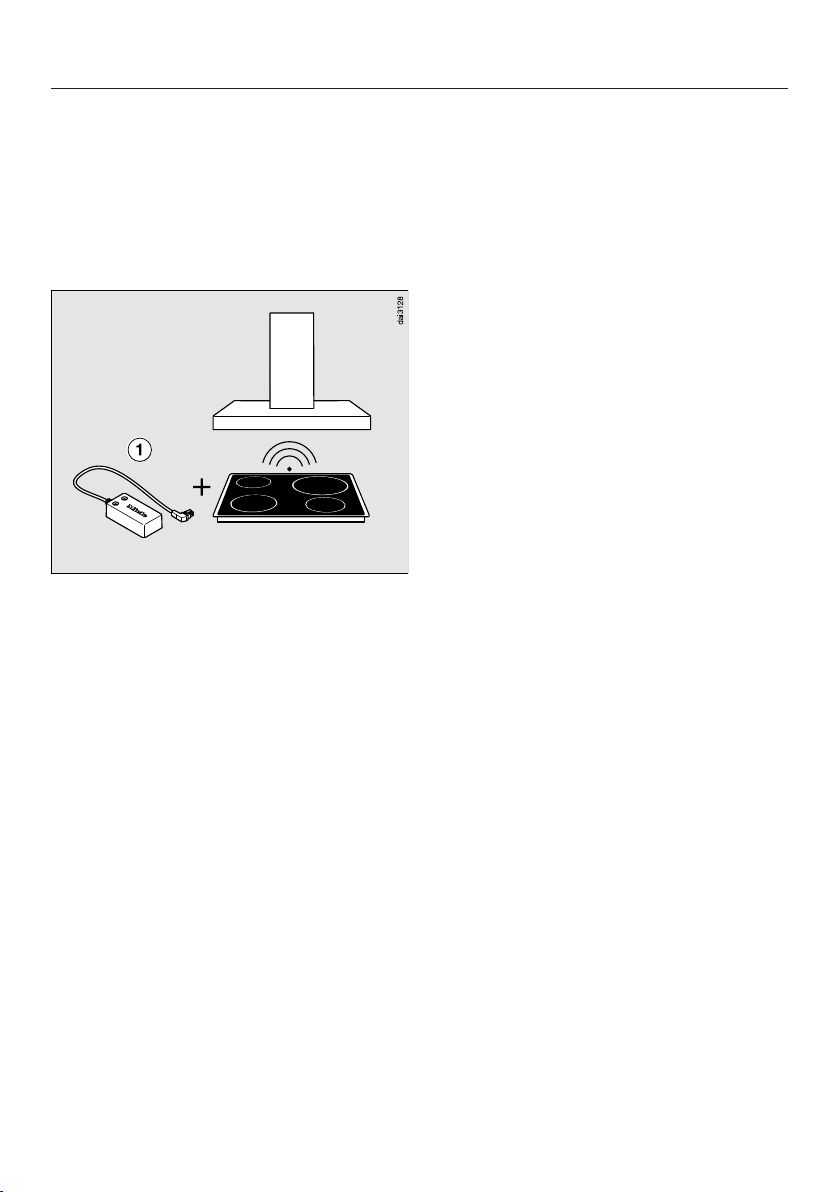
This hood features a communication
fun
ction which enables the automatic
control of the hood based on the opera‐
tional status of a Miele cooktop.
To enable the communication function,
th
e cooktop must be equipped with the
corresponding Con@ctivity 2.0 stick .
Please refer to the installation instruc‐
tions for the Co
n@ctivity 2.0 stick to
determine whether connection to your
cooktop is possible.
There must be radio contact between
the cooktop and the hood for you to be
able to use the Con@ctivity 2.0 function
(see "Activating Con@ctivity 2.0").
The cooktop transmits information
about its oper
ational status to the hood
using a radio signal.
– When a burner is turned on, the
coo
ktop lighting on the hood turns
on automatically. After a brief delay,
the ventilation hood fan also comes
on.
– During cooking, the hood automati‐
cally selects the fan level based on
the nu
mber of burners in operation
and their power levels.
– Once you have turned off the cook‐
t
op, the fan and the lighting will turn
off automatically after a predeter‐
mined delay.
Detailed information about this function
can be found under "Operation."
Guide to the appliance
16

Guide to the appliance
17
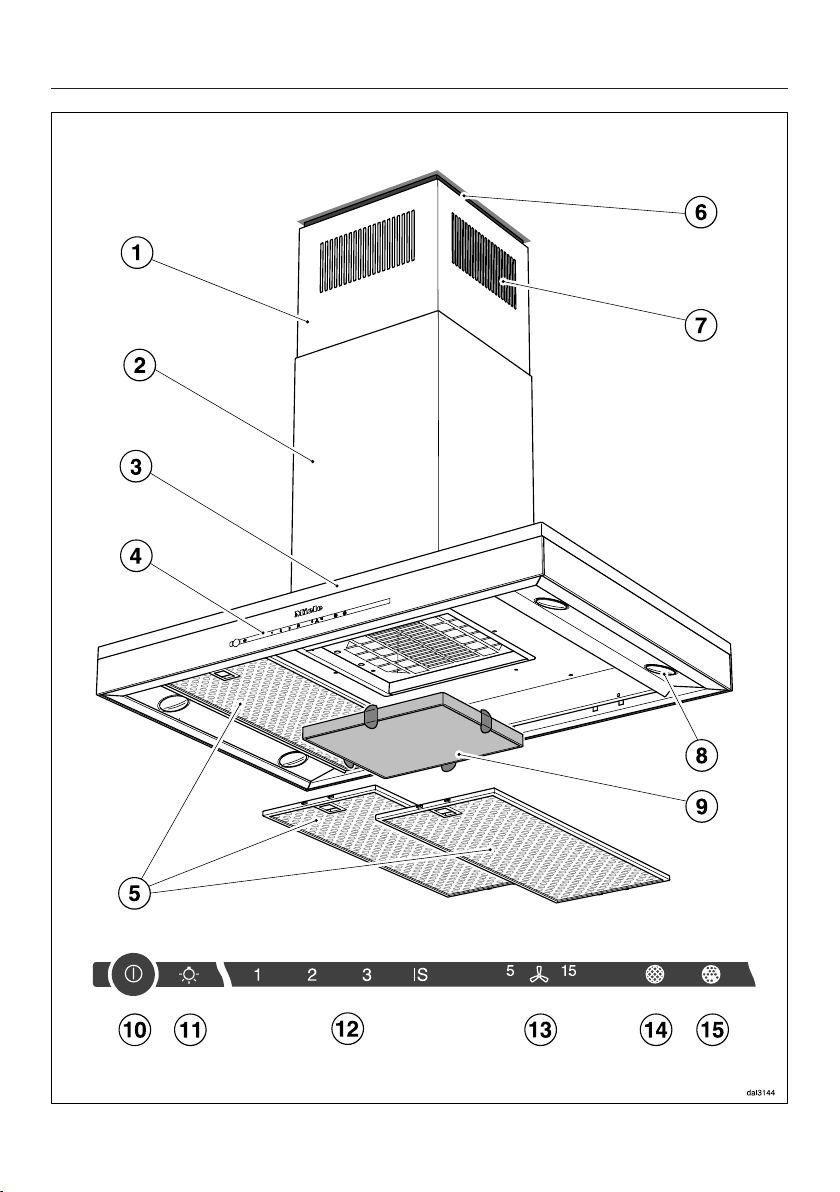
a
Chimney extension
b
Chimney
c
Canopy
d
Control panel
The symbols act as sensor-controlled buttons. To select a function, tap the
butt
on. An audible tone sounds briefly to confirm selection.
e
Grease filter
f
Spacer frame
The spacer frame creates a shadow gap between the chimney and the ceiling.
The ho
od can be installed with or without the spacer frame.
g
Recirculation vent
(only for recirculation mode)
h
Overhead lighting
i
OdorFree Charcoal Filter
Optional accessory for recirculation mode
j
Turns the fan on and off
k
Overhead light button
l
Fan power selection
m
Delayed shut-down button
n
Filter saturation indicator for the grease filters
o
Filter saturation indicator for the OdorFree Charcoal Filter
Operation (Automatic mode)
18
When Con@ctivity 2.0 is active, the
hoo
d always operates in Automatic
mode (see "Activating Con@ctivity
2.0").
See "Cooking without Con@ctivity 2.0"
for informa
tion on manually operating
the hood.
Cooking with Con@ctivity 2.0
(Au
tomatic mode)
Turn on a burner to the desired power
setting.
The hood lighting will come on.
After a few seconds, the fan will come
on, briefly oper
ating at power level 2
before immediately switching to level 1.
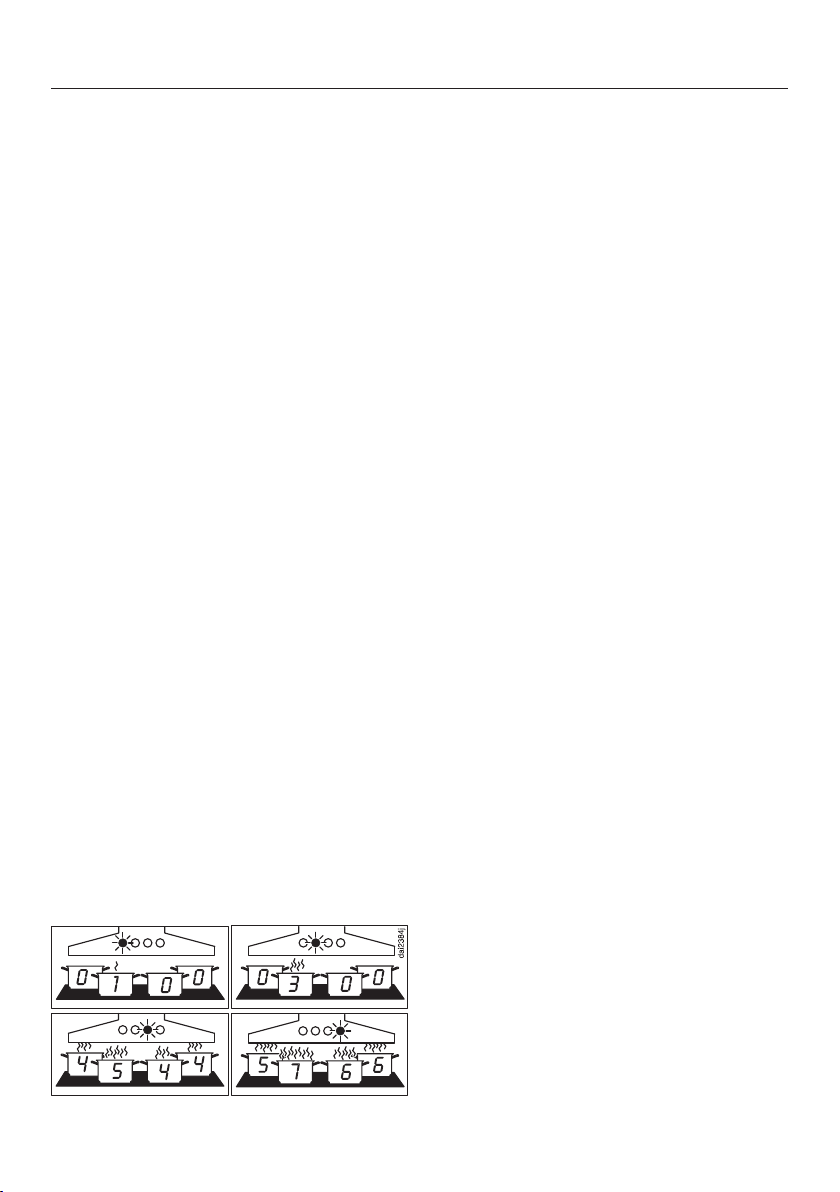
The hood selects the fan level automat‐
ically during cooking.
This level is determined by the total
output of the coo
ktop, i.e. the number
of burners in operation and the power
settings selected.
If you select a higher power setting
on the
cooktop or switch on multiple
burners, the hood will switch to a
higher fan level.
If you select a lower power setting on
the cooktop or turn off a burner, the
hood will accordingly switch to a low‐
er fan level.
Examples for fan levels 1 t
o 4
Reaction time
Changing the power setting on the
coo
ktop does not lead to an immediate
increase or decrease in cooking vapors.
For this reason, the hood reacts with a
slight delay.
Delays can also result from the fact that
the coo
ktop transmits the information
to the hood in intervals.
The reaction time can vary from a few
secon
ds to a couple of minutes.

Operation (Automatic mode)
19
Cooking process
If,
for example, you switch on a burn‐
er at the highest power setting to
heat cookware in preparation for
searing and then reduce the power
level after approx. 60 to 90 seconds*,
a cooking process is recognized.
The hood turns on automatically and,
after the cooktop power level has been
reduced, switches back to fan level 3,
where it remains for approx. 5 minutes.
After this, the fan level is once again
det
ermined by the Con@ctivity function.
Y
ou can also manually select a differ‐
ent fan level before then.
Turning off
T
urn off all burners.
Over the next few minutes, the ventila‐
tion ho
od fan setting will decrease one
level at a time until the hood eventually
turns off.
This helps to neutralize any lingering
vapors and odors in the air
.
– From the intensive setting IS, the fan
immedia
tely switches to level 3.
– If the fan is operating at level 3, it will
switch t
o level 2 after approx. 1 mi‐
nute.
– From level 2, the fan switches to level
1 aft
er 2 minutes.
– After 2 minutes at level 1, the fan au‐
t
omatically turns off.
– After another 30 seconds, the lighting
turns off.
The cooking process is now finished.

Operation (Automatic mode)
20
Temporarily exiting Automatic
mode
To temporarily exit the Automatic mode
when cooking:
Manu
ally select a different fan level,
or
Manually turn the hood off, or
Activat
e the Delayed shut down func‐
tion on the ventilation hood. The
fan turns off after the delay time se‐
lected, and the lighting will remain on.
The ventilation hood functions can now
be oper
ated manually (see "Cooking
without Con@ctivity 2.0").
Resuming Automatic mode
The ventilation hood resumes Automat‐
ic mode:
If the ventilation hood has not been
used for a period of app
rox. 5 mi‐
nutes after the manual selection of a
fan level, or
If the manuall
y selected fan level
once again matches the automatic
setting, or
If the ventilation hood fan and the
coo
ktop have been turned off for at
least 30 seconds.
Automatic mode will resume the next
time the cooktop is turned on.
If you wish to manually operate the
ventilation hood for a complete cook‐
ing process, turn on the ventilation
hood fan before turning on the cook‐
top.
If the ventilation hood and the cook‐
top have been turned off for at least
30 seconds after you have finished
cooking, Automatic mode will resume
the next time the cooktop is turned
on.

Operation (Manual mode)
21
Cooking without Con@ctivity
2.0 (Manual mode)
The hood can be operated manually if:
– The Con@ctivity 2.0 function is not
activated.
– You have temporarily deactivated the
Co
n@ctivity 2.0 function (see "Tem‐
porarily exiting Automatic mode").
Turning on the fan
T
ap the On/Off button .
The fan switches to level 2.
Selecting the power level
Power levels 1 t
o 3 can be used for light
to heavy cooking vapors and odors.
For strong vapors and odors that are
t
emporarily produced when cooking,
e.g., during searing, select the IS inten‐
sive level.
Selec
t the power level required by
tapping a button from 1 to IS.
Reducing power of the intensive set‐
ting
If power management is activated (de‐
faul
t setting), the fan automatically
switches back to level 3 after 5 mi‐
nutes.
Selecting the delayed shut
down time
It is a good idea to let the fan run for a
few mo
re minutes after cooking in order
to neutralize any lingering vapors and
odors in the air.
With the delayed shut down function, it
is possible to have the fan automatically
shut off after a predetermined period of
time.
Aft
er you have finished cooking, tap
the delayed shut down button .
– Once: fan switches off after 5 mi‐
nut
es (5 lights up).
– Twice: fan switches off after 15 mi‐
nut
es (15 lights up).
– If you press the delayed shut down
butt
on again, the fan remains
turned on (5 15 goes out).
Turning off the fan
P
ress the On/Off button to turn the
fan off.

Operation (Manual mode)
22
Turning overhead lighting
on/off
The overhead lighting can be turned on
and off separ
ately from the fan.
T
ap the lighting button .
Power management
The ventilation hood features a power
manag
ement system for switching off
the lighting and reducing the fan power
setting automatically.
– If the intensive setting is selected, the
fan aut
omatically switches to level 3
after 5 minutes.
– If the fan is set to level 3, 2 or 1, it
switches t
o the next-highest fan set‐
ting after 2 hours and then in 30-mi‐
nute intervals until the fan eventually
switches off.
– If the cooktop lighting is on, it auto‐
matic
ally turns off after 12 hours.
Turning power management on/off
Turn off the fan and the lighting.
P
ress the delayed shut down button
for approx. 10 seconds until 1
lights up in the fan power display.
Ne
xt, tap the following buttons in
succession:
– The lighting button ,
– Followed by the 1 button and then
– The lighting button again.
If power management is turned on, the
1 and IS indicat
ors will be continuously
lit.
If it is switched off, 1 and IS will flash.
T
ap 1 to turn off the power manage‐
ment.
The 1 and IS indicat
ors will flash.
T
ouch IS to turn it on.
The 1 and IS indicat
ors are constantly
lit.
Co
nfirm the setting by pressing the
delayed shut down button .
All the indicator lights will go out.
If the setting is not confirmed within 4
minu
tes, the hood automatically reverts
to the old setting.

Operation (Automatic and Manual modes)
23
Filter saturation indicator
The number of hours the hood has
been in oper
ation is stored in appliance
memory.
The filter saturation indicators show
when the filt
ers need to be cleaned or
changed by lighting up the grease filter
symbol or OdorFree Charcoal Filter
symbol . Additional information on
cleaning and changing the filters and
resetting the filter saturation counters
can be found under "Cleaning and
care."
Adjusting the filter saturation indica‐
t
or for the grease filter
You can set the filter saturation indica‐
t
or to suit your cooking habits.
The factory default setting is a cleaning
int
erval of 30 hours.
– Select a shorter time (20 hours) if you
oft
en fry foods.
– We also recommend a shorter clean‐
ing interval if you only cook occa‐
sionally. This will prevent grease
buildup from hardening and making
cleaning more difficult.
– Select a longer cleaning interval of 40
or 50
hours if you use very little fat
when cooking.
Press the On/Off button to turn off
the fan.
T
ap the delayed shut down button
and the grease filter button at the
same time.
The grease filter symbol and one of
the fan power level indic
ators will flash.
The indicators 1 t
o IS show the current
time setting:
Indicator 1 ...............................
20 hours
Indicator 2................................
30 hours
Indicator 3................................
40 hours
Indicator IS ..............................
50 hours
T
ap the relevant button to select the
time required.
Co
nfirm your choice by touching the
grease filter button .
All the indicator lights will go out.
If the setting is not confirmed within 4
minu
tes, the hood automatically reverts
to the old setting.

Operation (Automatic and Manual modes)
24
Activating/changing the OdorFree
Char
coal Filter operating hours
counter
The OdorFree Charcoal Filter is required
for e
xtraction mode.
The operating hours counter for the
OdorF
ree Charcoal Filter requires one-
time activation and must be set to
match your cooking habits.
P
ress the On/Off button to turn the
fan off.
T
ap the delayed shut-down button
and the OdorFree Charcoal Filter but‐
ton at the same time.
The OdorFree Charcoal Filter symbol
and one of the fan setting
indicators will
flash.
The indicators 1 t
o IS show the current
time setting:
Indicator 1 .............................
120 hours
Indicator 2..............................
180 hours
Indicator 3 ............................. 240 hours
Indicator IS..........................
deactivated
T
ap the relevant button to select the
time required.
Confirm your choice by tapping the
OdorF
ree Charcoal Filter button .
All the indicator lights go out.
If the setting is not confirmed within 4
minu
tes, the old setting is retained.
Checking the filter saturation indica‐
t
or
Before the set operating time has run
out, you can
check what percentage of
the time has elapsed.
P
ress the On/Off button to turn the
fan on.
P
ress and hold the grease filter but‐
ton or the OdorFree Charcoal Fil‐
ter button .
One or more of the power level indica‐
t
ors will flash.
The number of flashing indicators
shows the elapsed oper
ating hours as a
percentage.
Indicator 1
..................................... 25%
Indicators 1 and 2
......................... 50%
Indicators 1 t
o 3 ............................ 75%
Indicators 1 t
o IS ......................... 100%
The elapsed operating hours remain
stored in the memory when the hood
is turned off or if power to the appli‐
ance is lost.

Operation (Automatic and Manual modes)
25
Sensor button signal tone
Whenever you select a feature with the
sensor butt
ons, you will hear a brief sig‐
nal tone.
You can deactivate this signal tone if
you pr
efer.
P
ress the On/Off button to turn the
fan off.
T
ap the IS and the grease filter
buttons at the same time for approx.
5 seconds until a short signal tone is
heard.
The signal tone is now turned off for all
functions.
T
o reactivate the signal tone, follow
the same steps.
If the hood is disconnected from the
power supp
ly, or after a power inter‐
ruption, the beep is automatically re‐
activated, regardless of the previous
settings.

Cleaning and care
26
WARNING: TO REDUCE THE RISK
OF FIRE, ELECTRIC SHOCK, OR IN‐
JURY TO PERSONS, OBSERVE THE
FOLLOWING:
Befor
e cleaning or servicing the
hood, disconnect it from the power
supply, see "IMPORTANT SAFETY
INSTRUCTIONS".
Stainless steel housing
General
The surfaces and control buttons are
susce
ptible to scratching and chip‐
ping.
Observe the following cleaning in‐
structions.
Cle
an all surfaces and control but‐
tons using warm water and liquid
dish soap only, applying the mixture
with a sponge cloth.
Make sure that no water gets into
the in
terior of the hood.
Only use a damp cloth to clean the
ho
od, especially in the control panel
area.
Aft
er cleaning, dry the surfaces with a
soft cloth.
Avoid the following:
– Cleaners containing soda, acid or
chloride, or cleaners containing sol‐
vents
– Abrasive cleaners such as scouring
powder, scouring liquid, abrasive
sponges such as pot scourers, or
used sponges that still contain resi‐
dues from abrasive cleaners
Special instructions for stainless
st
eel surfaces
(does not apply to control buttons)
S
tainless steel surfaces can also be
cleaned using a non-abrasive stain‐
less steel cleaner, available from
Miele.
T
o prevent the surfaces from quickly
becoming dirty again, we recom‐
mend treating them with a stainless
steel care conditioner.
Apply sparingly over the entire area
using a soft cloth.
Special instructions for RAL color
finish housing
(special order)
Obser
ve the general cleaning instruc‐
tions contained in this chapter.
Minor scratches on the surface are in‐
evitable when cleaning the housing.
Depending on the lighting in the kitch‐
en, this may negatively affect the ap‐
plia
nce's appearance.
Cleaning and care
27
Special instructions for control but‐
t
ons
Do not leave dirt and debris on the
butt
ons for any length of time.
Otherwise they may become discol‐
or
ed or damaged.
Remove any dirt or debris immedi‐
ately.
Observe the general cleaning instruc‐
tions contained in this chapter.
Do not use a stainless steel cleaner
t
o clean the control buttons.
Special instructions for glass surfa‐
ces
Gla
ss surfaces can be cleaned using
a commercial glass cleaner.
Grease filters
The reusable metal grease filters in the
ap
pliance remove the solid particles
contained in kitchen vapors (fat, dust,
etc.), thereby preventing the ventilation
hood from becoming dirty.
A
dirty filter is a fire hazard!
Cleaning intervals
Over longer periods of time, fat buildup
on the gr
ease filter hardens and makes
cleaning more difficult. Therefore, we
recommend cleaning the grease filters
once every 3-4 weeks.
By illuminating the grease filter symbol,
the filt
er saturation counter reminds
you to regularly clean the grease filters.
Y
ou can adjust the interval of the filter
saturation counter to match your
cooking habits (see "Operation").
Removing the grease filters
When handling a grease filter, be
car
eful not to drop it.
This can result in damage to the filter
and t
o the cooktop.
Make sure you hold the filter secure‐
ly at all times when handling it.
Cleaning and care
28
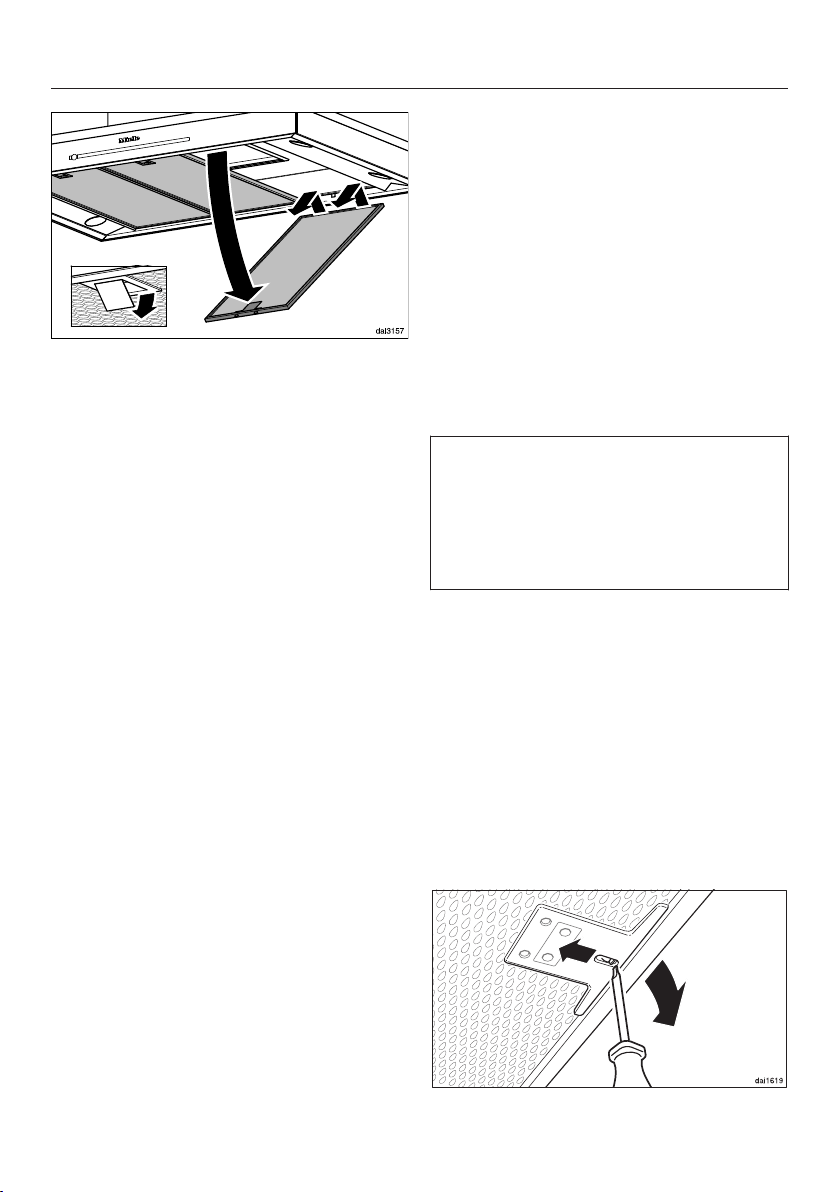
T
o remove a grease filter, release the
locking clip. Then, open the filter to a
45° angle, unhook it, and remove it
from the hood.
Cleaning the grease filters by hand
Cle
an the filters with a soft nylon
brush in a mild solution of hot water
and dish soap. Do not use undiluted
dish soap.
Unsuitable cleaning agents
Unsuitable cleaners can cause damage
t
o the filter surfaces if used regularly.
Do not use any of the following:
– Lime removers
– Abrasive powders or abrasive liquids
– Aggressive all-purpose cleaners and
degr
easer sprays
– Oven sprays
Cleaning the grease filters in the
dishwasher
Place
the filters as upright or inclined
as possible in the lower basket. En‐
sure that the spray arm is not ob‐
structed.
Use a common household dishwash‐
er det
ergent.
Selec
t a program with a wash tem‐
perature between 122°F (50°C) and
149°F (65°C). In a Miele dishwasher
use the "Normal" program.
Depending on the detergent used,
cleaning the filters in a dishwasher
may cause the inside filter surfaces to
become discolored. However, this will
not affect the functioning of the filters
in any way.
After cleaning
After cleaning, leave the filters on an
absorbent surface to dry.
When r
emoving the filters for clean‐
ing, also clean off any accessible oil
or fat buildup from the housing. Do‐
ing so will prevent a fire hazard.
Rein
stall the grease filters. When in‐
serting the filters, make sure that the
locking clip is facing down.
Cleaning and care
29
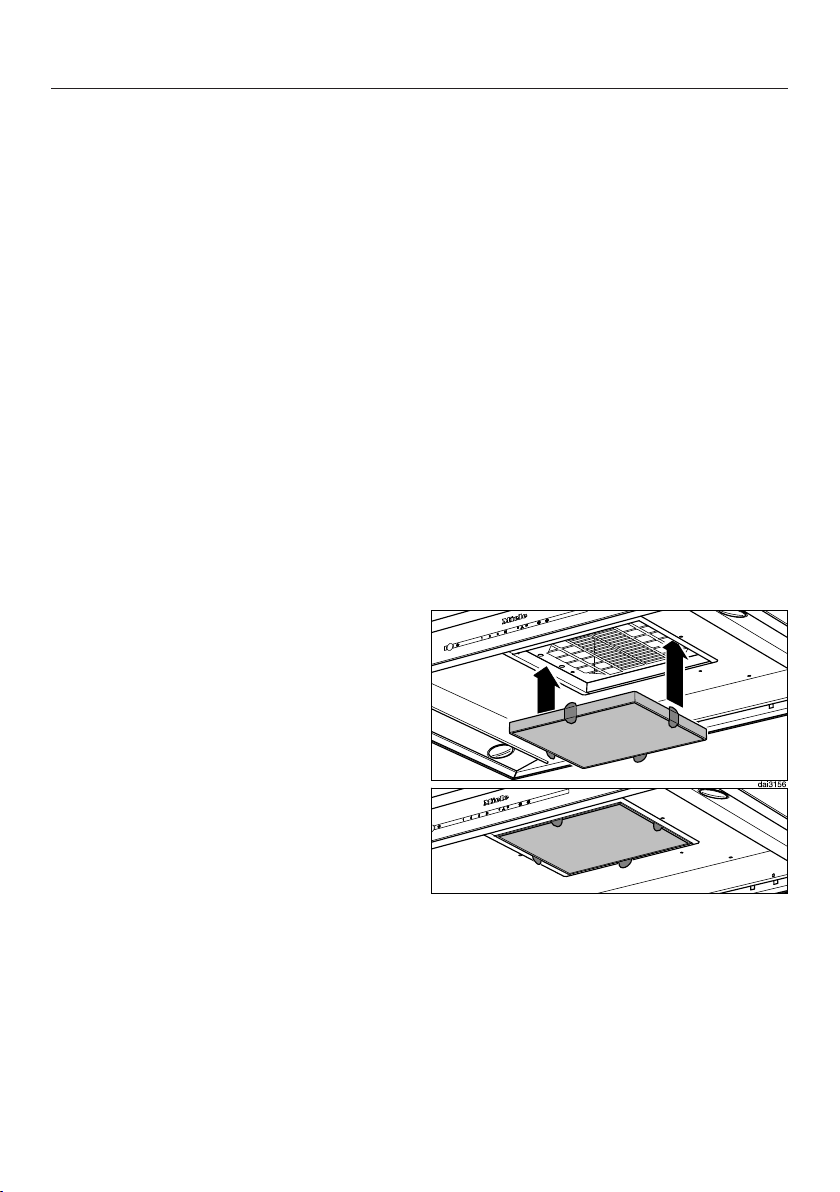
If the filt
ers have been installed incor‐
rectly, you can insert a small screw‐
driver into the slit to disengage the
locking clip.
Resetting the filter saturation indica‐
t
or for the grease filter
Once cleaning is complete, the filter
saturation indicator must be reset.
While
the fan is turned on, press the
grease filter button for approx. 3
seconds, until only the 1 is flashing.
The grease filter symbol goes out.
When cleaning the grease filters before
the full oper
ating time has elapsed:
P
ress the grease filter button for
approx. 6 seconds, until only the 1 is
flashing.
OdorFree Charcoal Filter
If the hood is equipped for recirculation,
an OdorF
ree Charcoal Filter must be in‐
stalled in addition to the grease filters.
This filter is designed to absorb odor-
causing agents and is mounted in the
canopy above the grease filters.
OdorFree Charcoal Filters are available
from your Miele dealer or from Miele.
See "Technical data" for the type and
reference number.
Installing/replacing the OdorFree
Char
coal Filter
T
o install or replace the OdorFree
Charcoal Filter, the grease filters must
first be removed as described above.
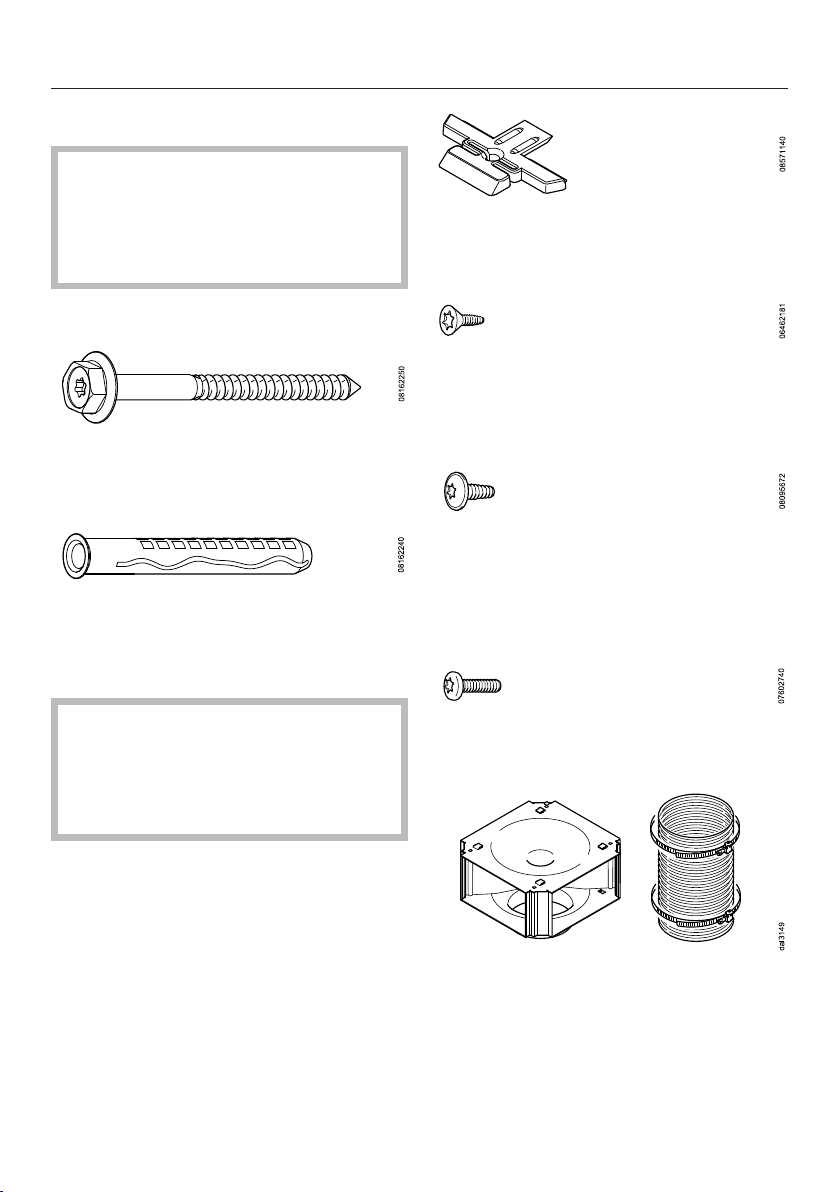
Remove the OdorFree Charcoal Filter
from its packaging.
P
ress the OdorFree Charcoal Filter in‐
to the frame.
Rein
stall the grease filters.
When insta
lling the filter for the first
time, activate the filter saturation
counter (see "Operation").

Cleaning and care
30
When to change the OdorFree Char‐
coal Fil
ter
Always r
eplace the OdorFree Char‐
coal Filter whenever it no longer ab‐
sorbs kitchen odors effectively.
Replace the filter at least once every
6 months.
The OdorFree Charcoal Filter saturation
coun
ter will light up to remind you to
change the charcoal filter regularly.
The
OdorFree Charcoal Filter satura‐
tion counter requires one-time activa‐
tion before use (see the "Operation"
chapter).
Resetting the operating hours coun‐
t
er for the OdorFree Charcoal Filter
If the operating hours counter is activat‐
ed, it
must be reset each time the filter
is changed.
P
ress the OdorFree Charcoal Filter
button for approx. 3 seconds with
the ventilation hood switched on until
only the indicator light for level 1 is
flashing.
The OdorFree Charcoal Filter symbol
will go out.
If you replace the OdorFree Charcoal
Fil
ter before the full operating time
elapses:
P
ress the OdorFree Charcoal Filter
button for approx. 6 seconds until
only the indicator light for level 1 is
flashing.
Disposing of the OdorFree Charcoal
Fil
ter
Used OdorF
ree Charcoal Filters can
be disposed of with normal house‐
hold waste.
Installation
31
Before installation
Befor
e installing the appliance,
read all of the information contained
in this chapter and also in the "IM‐
PORTANT SAFETY INSTRUCTIONS"
section.
Installation parts
4 screws, 6 9/16" x 4 5/16"
(7 x 110 mm) and
4 plugs, 3/8" x 3 1/8" (10 x 80 mm)
for securing the ventilation hood to the
ceiling (not for use in USA / CDN).
The screws and plugs are designed
for use in
solid ceilings only.
Use different fasteners for other ceil‐
in
g construction types. Make sure
that the ceiling can support the load.
4 extension piece holders
for aligning and securing the telescopic
chimney
4 screws M3/16" x 5/16"
(M4 x 8.5 mm)
for securing the extension piece hold‐
ers.
14 screws M3/16" x 5/16"
(M4 x 8 mm)
for securing the spacer frame and se‐
c
uring the hood to the installation
frame.
1 screw M3/16" x 5/8" (M4 x 16 mm)
for securing the chimney.
DUI 32 recirculation kit for recircula‐
tion mode
(not supplied, available as an optional
accesso
ry). The kit includes a direc‐
tional unit, aluminum hose, and hose
clips.
Installation
32
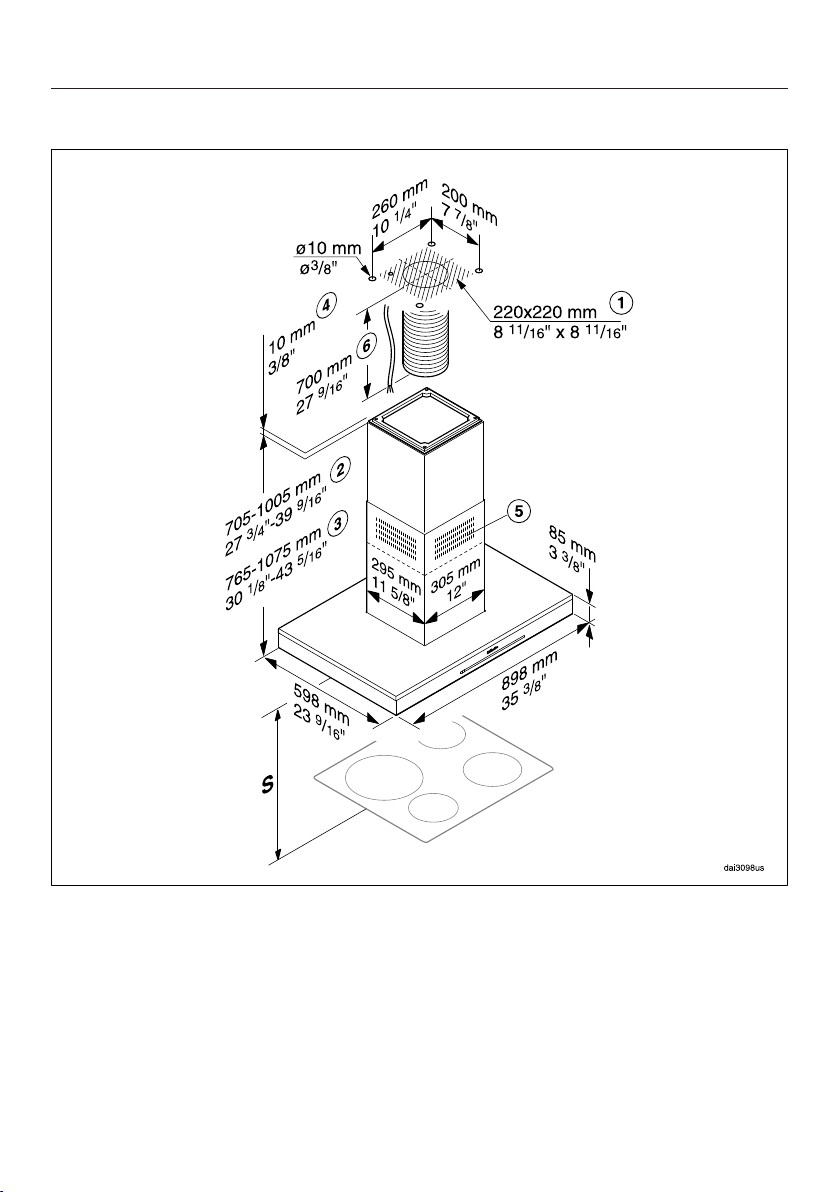
Appliance dimensions
a
Mounting area for the exhaust ducting and power cable. In recirculation mode,
onl
y the power cord is required.
b
Possible height range for appliance in vented mode
c
Possible height range for appliance in recirculation mode
d
Alternative installation with spacer frame
e
Air vent positioned at the top for recirculation
Installation
33
f
A power cord is required to connect the hood to the socket in the ceiling. With
e
xtraction mode flexible ducting is also required.
Exhaust connection 6" (150 mm)
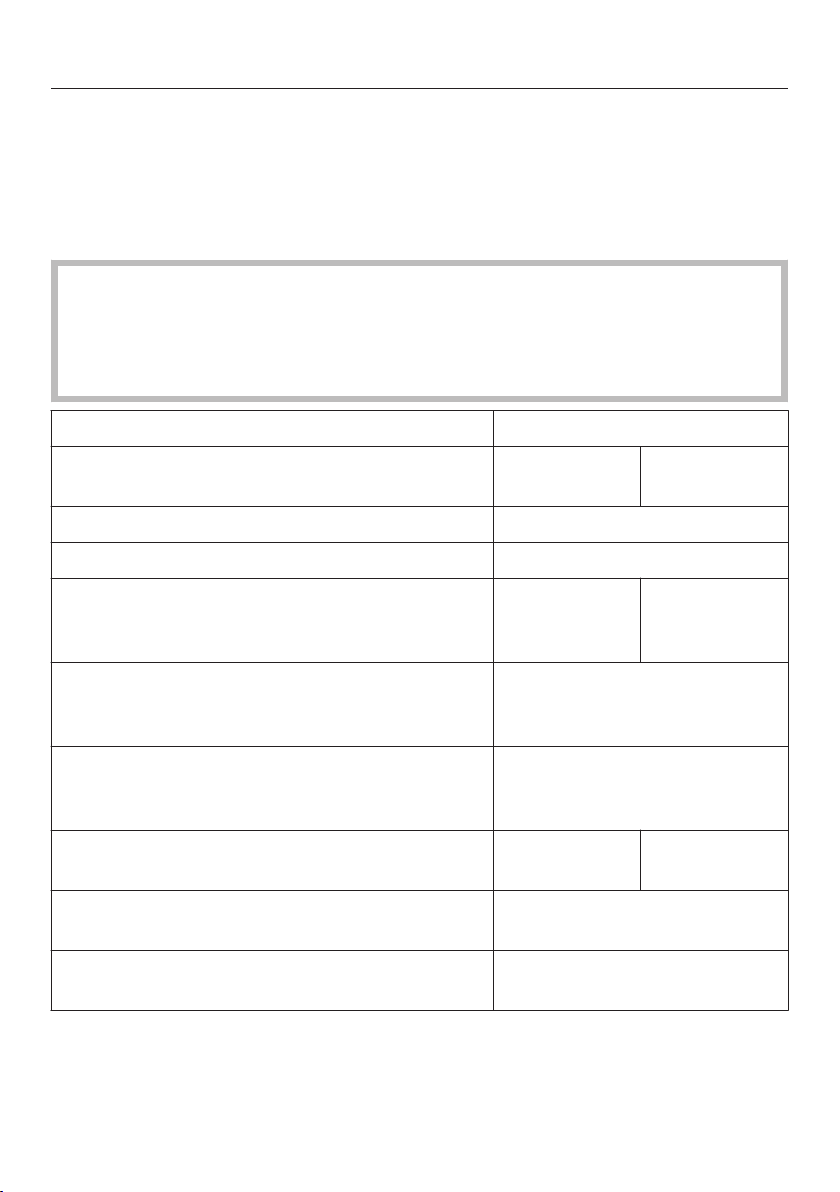
Distance between cooktop and ventilation hood (S)
Provided a larger distance is not given by the manufacturer of the cooktop, fol‐
lo
w the minimum safety distances between a cooktop and the bottom of the
hood.
Please also observe the information contained in the "IMPORTANT SAFETY IN‐
S
TRUCTIONS" section.
Minimum distance S
Cooking appliance Miele appli‐
ance
Non-Miele ap‐
pliance
Electric/Induction cooktop 24" (610 mm)
Electric grill, deep fat fryer (electric) 26" (660 mm)
Multi-burner gas cooktop
≤ 43,000 B
TU/hr (12.6 W),
no burner > 15,000 BTU/hr (4.5 kW).
26" (660 mm) 30" (760 mm)
Multi-burner gas cooktop
≤ 73,800 B
TU/hr (21.6 W),
no burner > 16,500 BTU/hr (4.8 kW)
30" (760 mm)
Multi-burner gas cooktop
> 73,800 B
TU/hr (21.6 W),
or one of the burners > 16,500 BTU/hr (4.8 kW)
Not possible
Single-burner gas cooktop
≤ 20,500 B
TU/hr (6 kW)
26" (660 mm) 30" (760 mm)
Single-burner gas cooktop
≤ 27,600 B
TU/hr (8.1 kW)
30" (760 mm)
Single-burner gas cooktop
> 27,600 B
TU/hr (8.1 kW)
Not possible
Installation
34
Installation recommendations
– We also recommend a distance of at
least 25 1/2" (650 mm) above electric
coo
ktops to provide more workspace
and easier cooking under the hood.
– When selecting an installation height,
always tak
e the user height into con‐
sideration. Users should have ample
space to work comfortably on the
cooktop and reach the ventilation
hood controls with ease.
– Please note that the greater the dis‐
tance
from the cooktop, the less ef‐
fective the hood is at drawing in the
cooking vapors.
– To achieve optimal vapor extraction,
mak
e sure that the hood covers the
cooktop. The hood should be posi‐
tioned centrally over the cooktop, not
to the side or rear.
– The cooktop should be no wider than
the ho
od. Preferably, it should be
narrower.
– The mounting area must be easily
accessible. The ventilation hood
sho
uld be easy to reach and disas‐
semble in case a service call is nec‐
essary. This should be taken into
consideration when planning the po‐
sition of cupboards, shelves, ceilings
or decorative elements in the vicinity
of the ventilation hood.
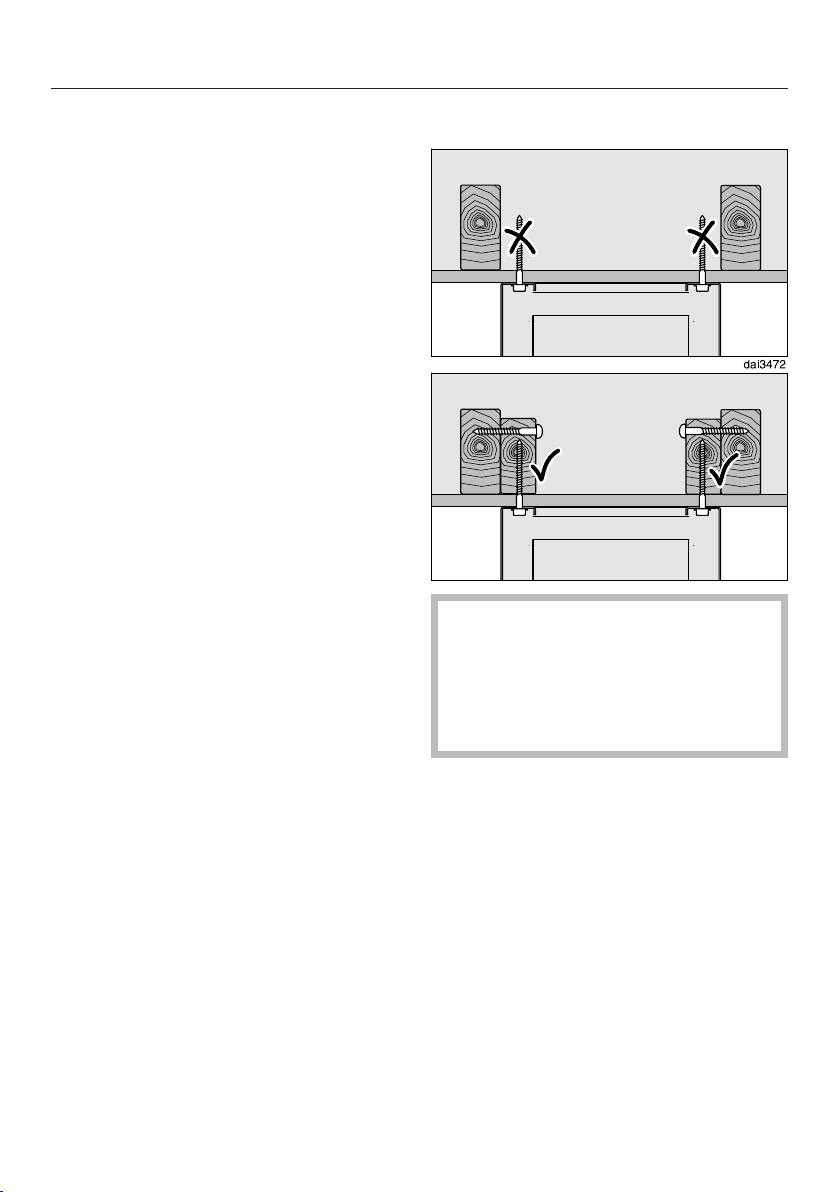
Structural support
The hood must be attached to rigid
structur
al framing that is supported
in its entirety by the ceiling joists, or
to the ceiling joists directly. Do not
attach the plate directly to the ceiling
with anchors, toggle bolts, etc.
Removing the protective film
The housing components are covered
by a p
rotective film to prevent them
from becoming damaged during trans‐
port.
Please
remove this film before instal‐
ling the housing components. It can
be peeled off easily without any addi‐
tional tools.
Installation
35
8
5
/
8
"
220 mm
8
5
/
8
"
220 mm
dai3435aus
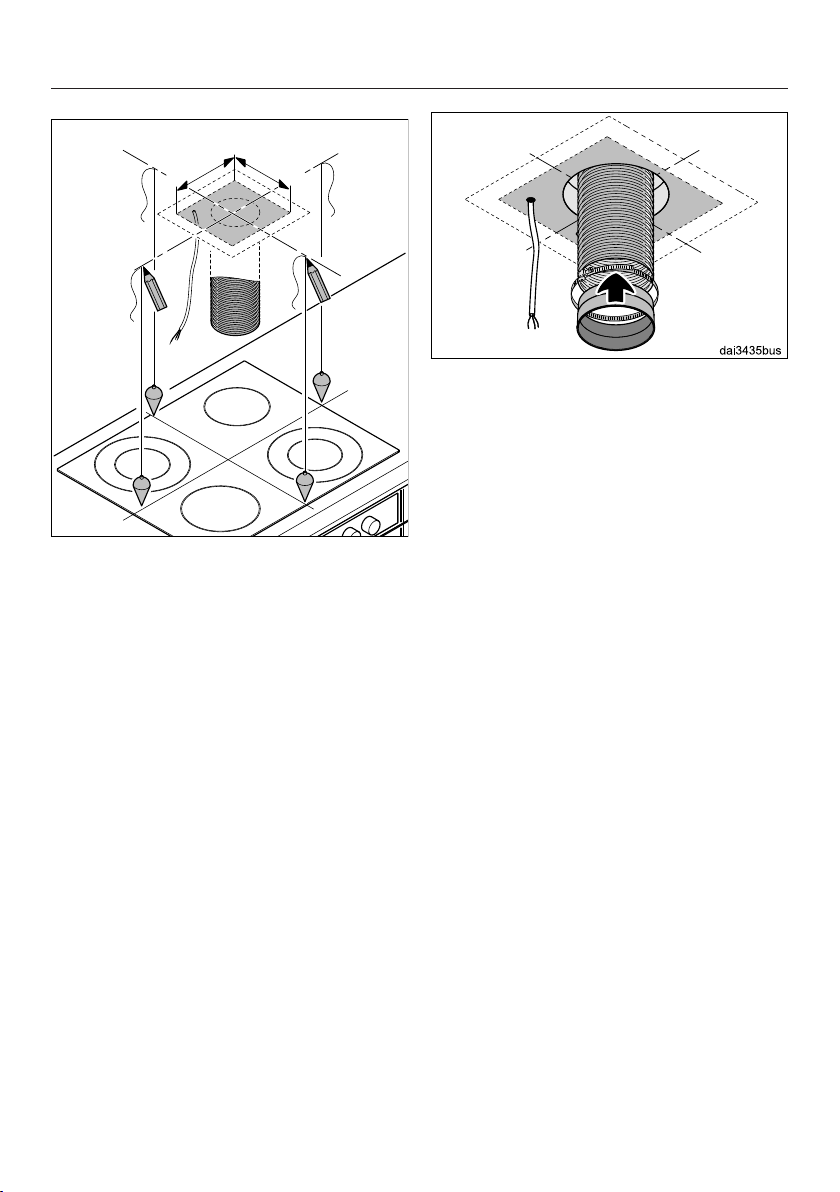
Dr
aw two intersecting lines on the
ceiling.
F
or vented mode:
– Place a section of the exhaust duct‐
ing in the ceiling and feed it down
thr
ough the cross-sectional area as
illustrated. Exhaust ducting of ap‐
prox. 27 9/16" (700 mm) length is re‐
quired between the ceiling and the
hood exhaust socket.
– Secure the exhaust ducting to the ex‐
hau
st socket, e.g. with a hose clip
(available as an optional accessory)
on flexible ducting.
Place
the power cord and guide it
through the ceiling in the area shown.
A power cord approx. 27 9/16"
(700 mm) in length is required be‐
tween the ceiling and the hood con‐
nectors.
Installation
36
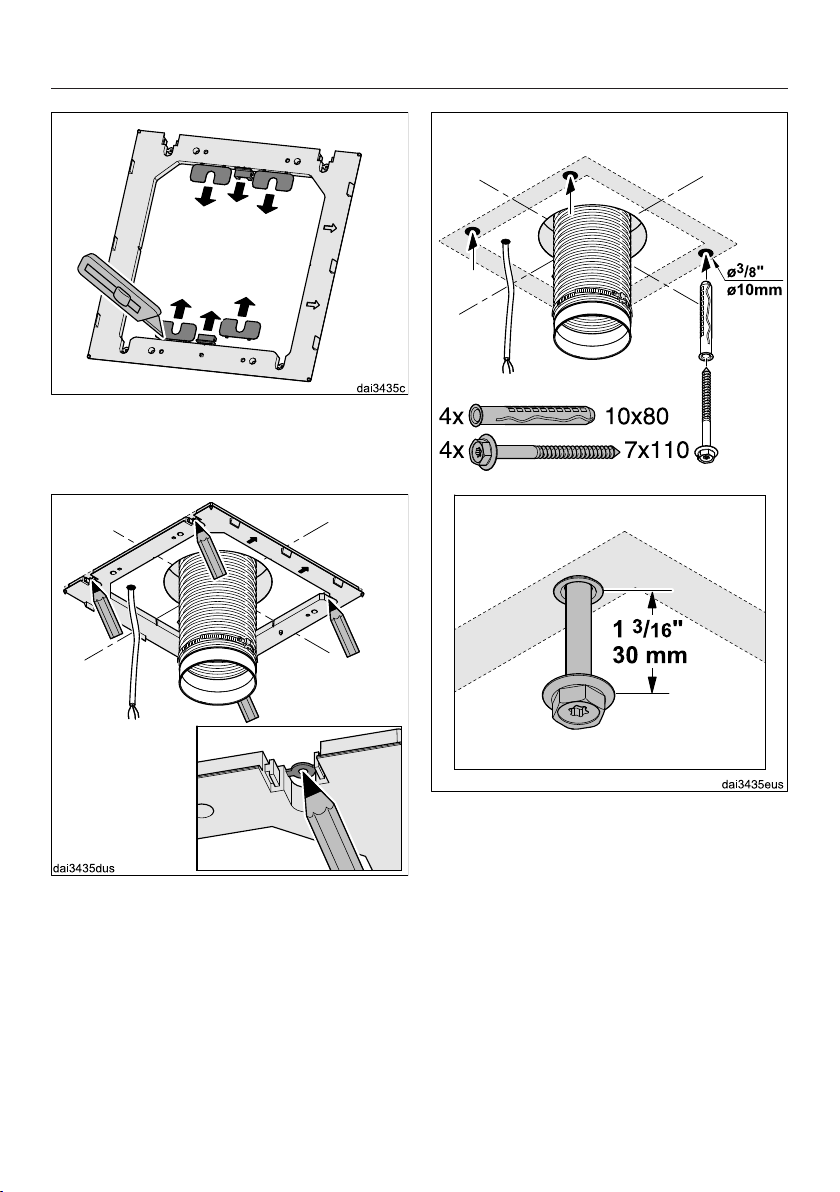
Use a kni
fe to release the four
spacers and the two covers from the
spacer frame supplied.
Use the spacer frame as a drilling
template. Place it on the ceiling with
the arrows pointing forwards. Using
the notches, align the spacer frame
on the intersecting lines and make
pencil marks for the drill holes.
Drill four holes 3/8" (10 mm), ap‐
pr
ox. 4 1/2" (115 mm) deep for the
plugs supplied.
Place the four plugs in the holes and
scr
ew in the four screws so that they
protrude by approx. 1 3/16" (30 mm).
Installation
37
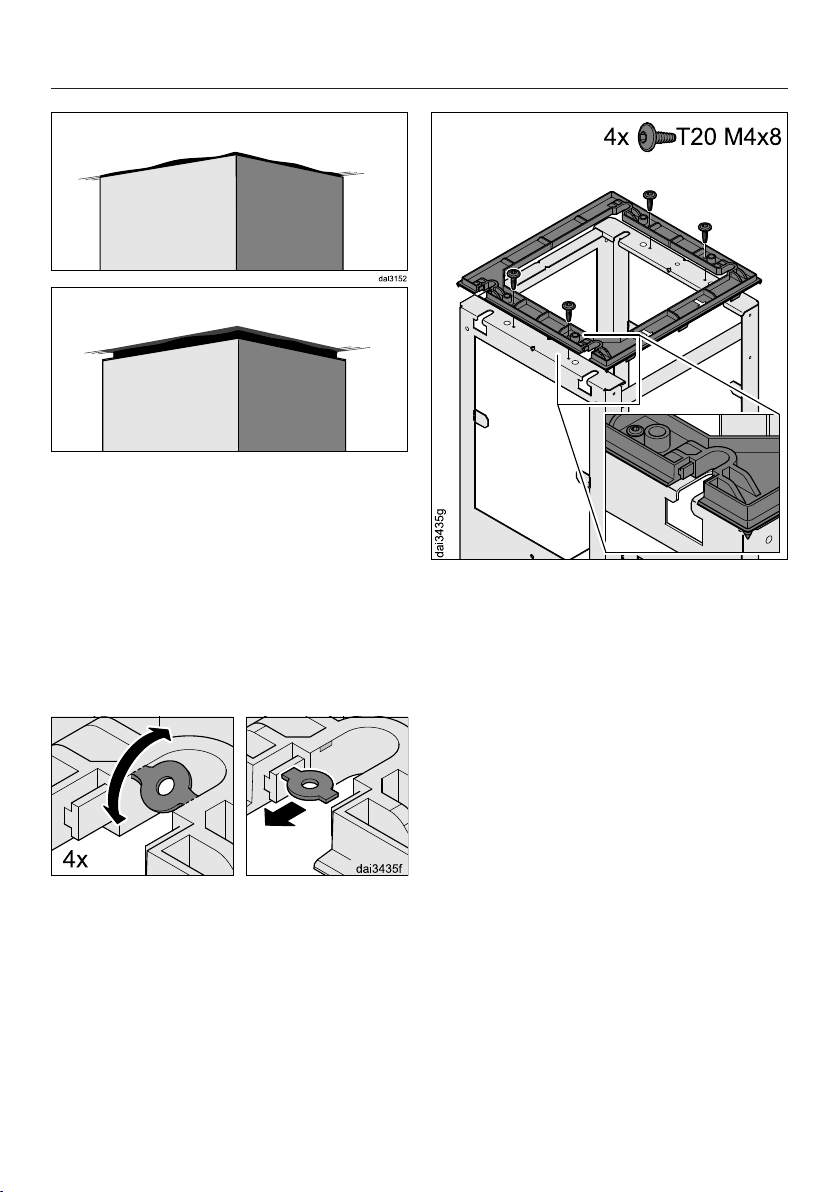
The spac
er frame can be installed be‐
tween the chimney and the ceiling. This
creates a shadow which gives the illu‐
sion of a gap between the ceiling and
the chimney. This is useful if the ceiling
is not level or is uneven. The hood is
aligned vertically with the spacers sup‐
plied. Visual irregularities between the
chimney and the ceiling are then con‐
cealed by the shadow.
If you wish to install the hood with the
spacer frame, remove the four inserts
from the fixing holes.
Mou
nt the spacer frame onto the in‐
stallation frame.
Installation
38
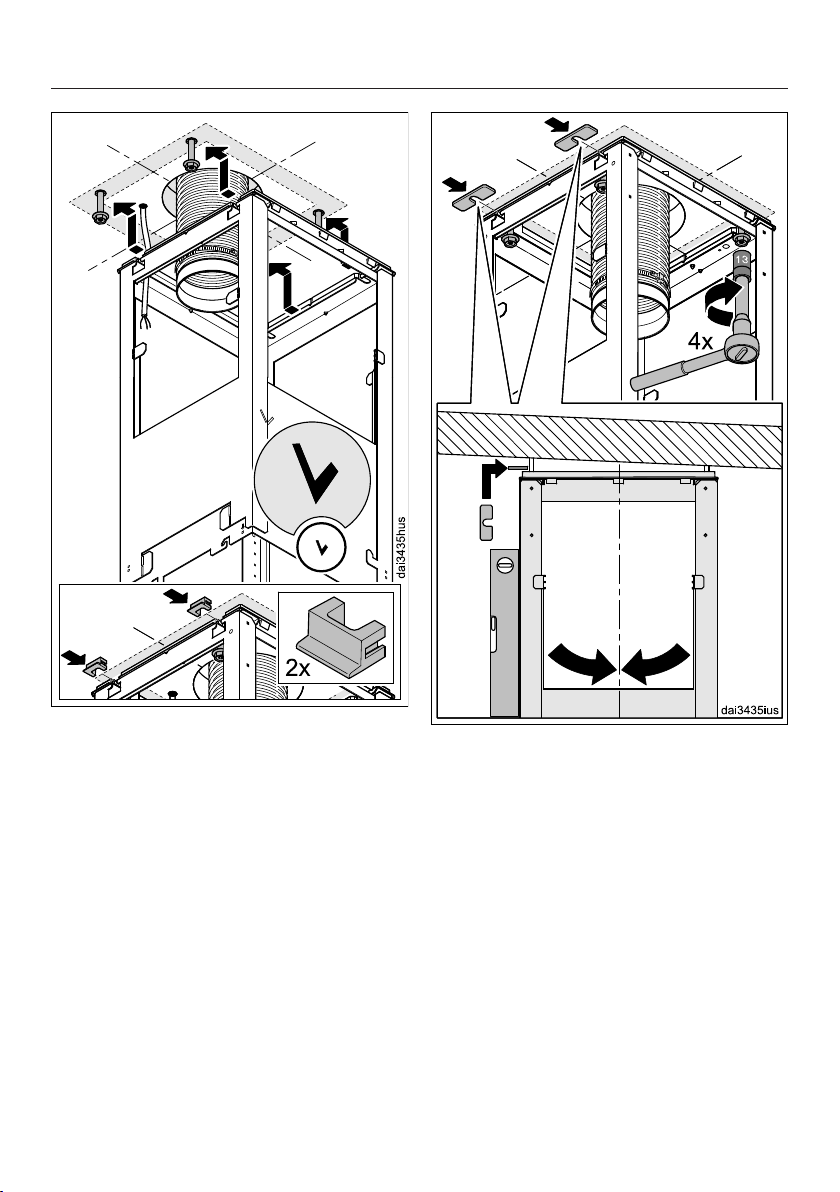
Han
g the installation frame on the
four screws. The front of the frame is
marked with a "V."
If using the spacer fr
ame, place the
two covers into the fixing holes.
Alig
n the installation frame and se‐
cure it with the screws.
The spacers, which were removed
from the spacer frame at the start,
can be used to align the hood verti‐
cally.
Installation
39
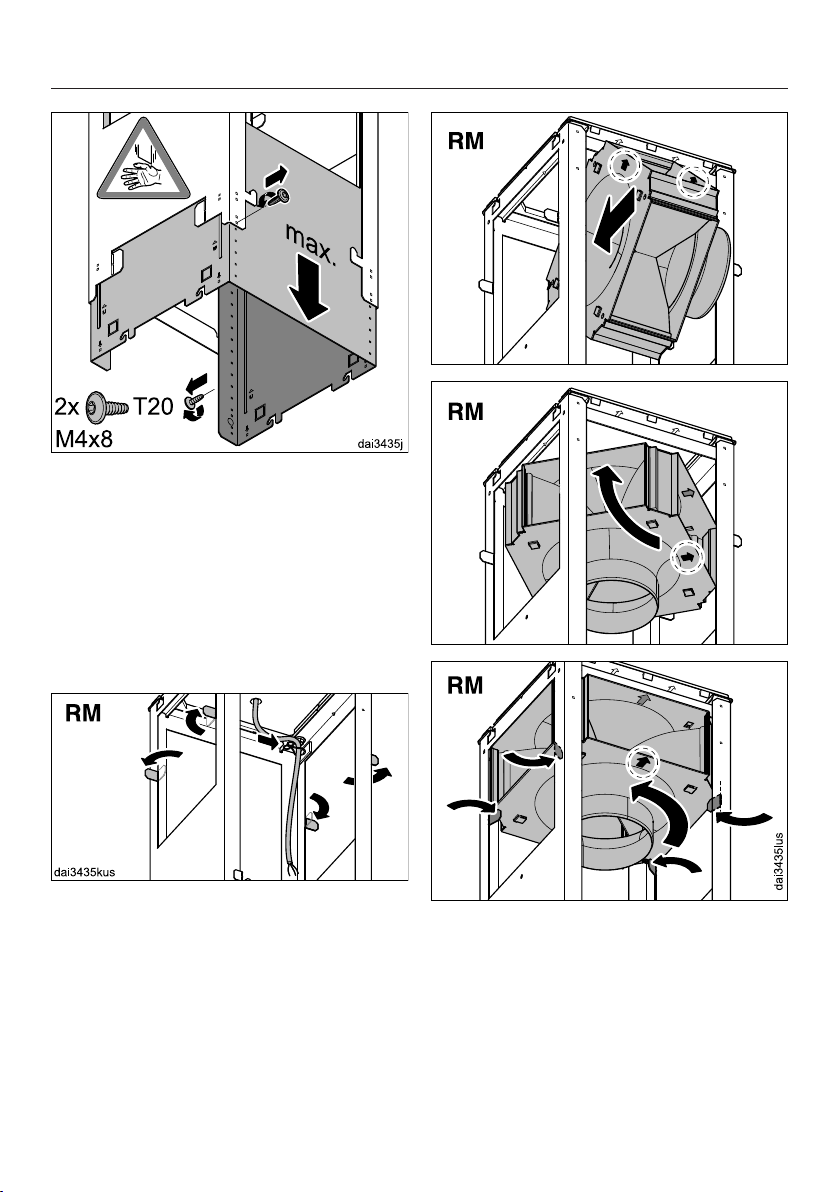
Ho
lding the installation frame secure‐
ly, remove the two fixing screws and
extend the installation frame to its
maximum length.
Replace
the screws.
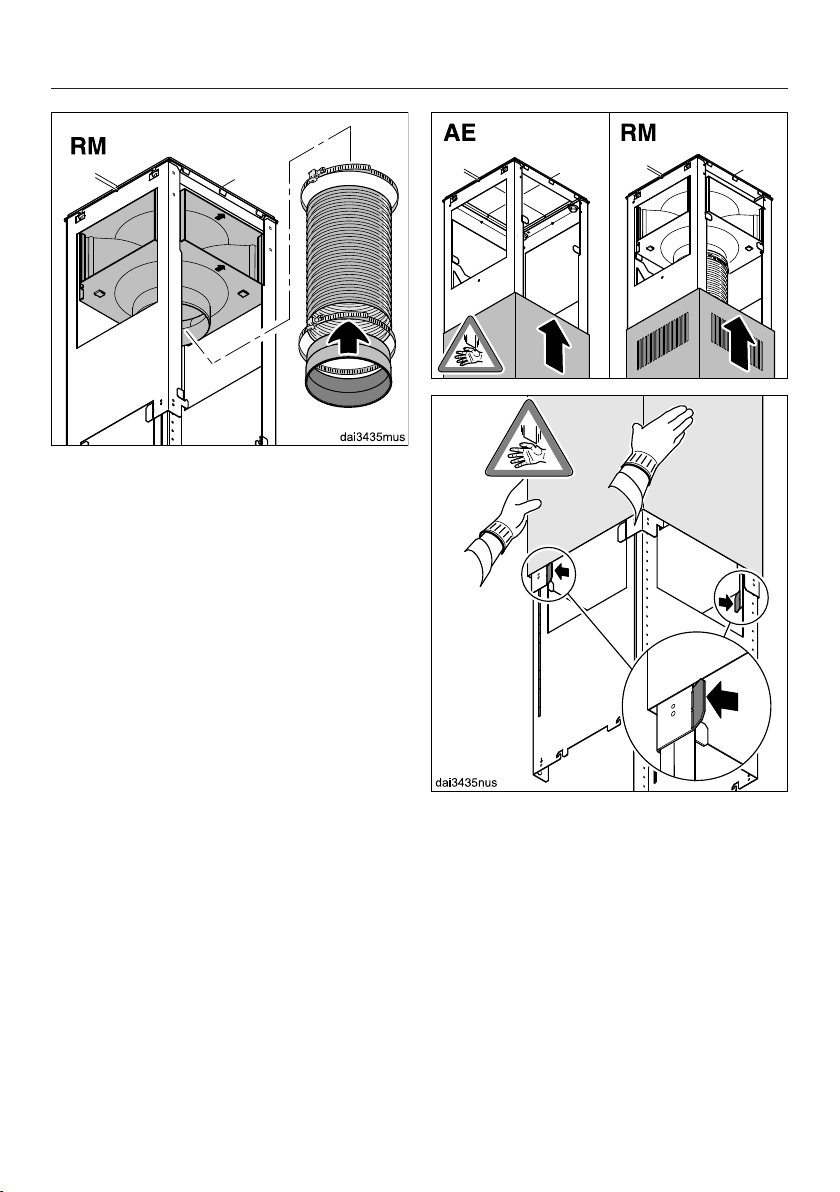
The directional unit from recirculation
kit DUI 32 (optional
accessory) is instal‐
led for recirculation mode (RM):
Bend the four r
etaining tabs on the
installation frame outwards.
Place
the power cord inside the in‐
stallation frame.
Fi
t the directional unit as shown, not‐
ing the marking on the front.
Bend the r
etaining tabs back and ap‐
prox. 45° inwards to hold the direc‐
tional unit in place.
Installation
40
Secur
e the exhaust socket to the
hose using a hose clip.
Secur
e the hose to the directional
unit socket using a hose clip.
Che
ck that the hose is held securely.
P
ush the telescopic chimney over the
installation frame:
– with the recirculation grilles at the
bott
om for vented mode (AE),
– with the recirculation grilles at the top
for r
ecirculation mode (RM).
Bend the two r
etaining tabs outwards
to prevent the telescopic chimney
from slipping down again.
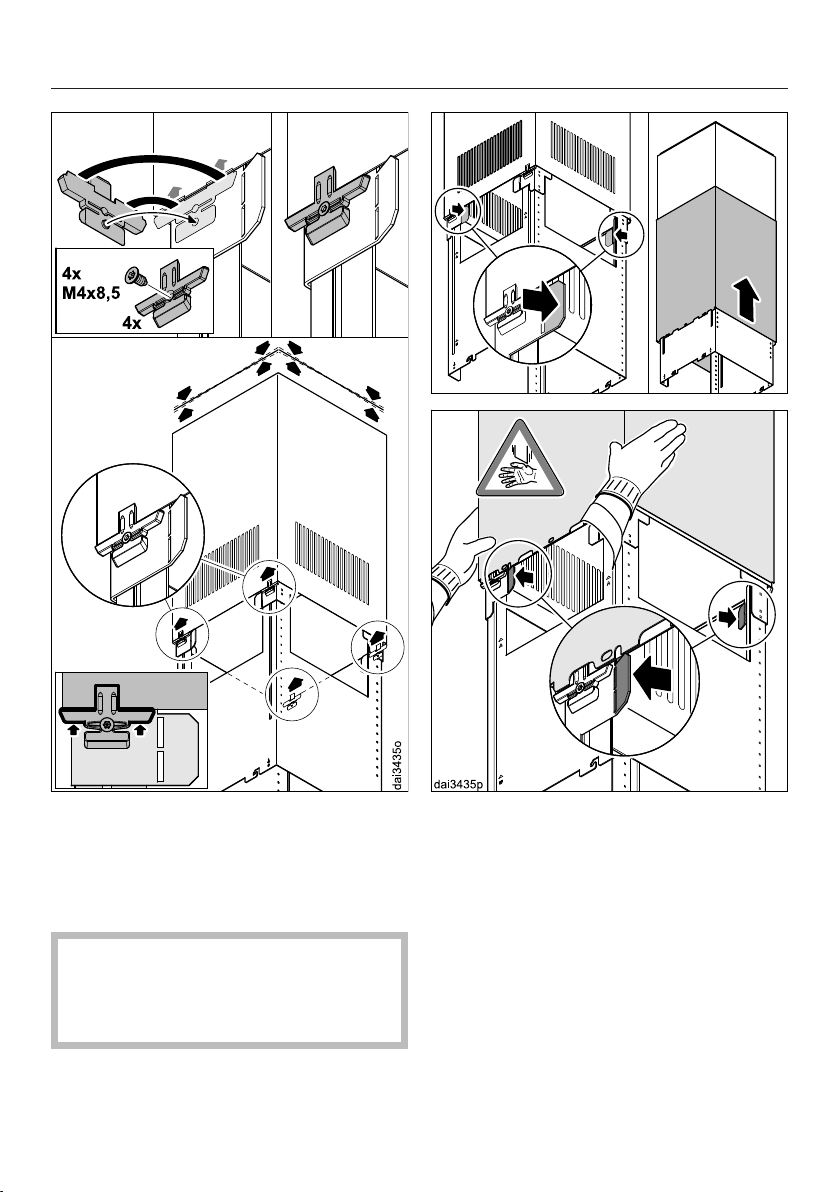
Installation
41
Fi
t the four telescopic chimney
clamps. When the screws are tight‐
ened, the clamps spread out and
push the telescopic expansion piece
upwards.
Tighten the screws only until the top
edge of the t
elescopic chimney is
evenly aligned with the ceiling or the
spacer frame.
Bend back the two retaining tabs.
P
ush the chimney over the telescopic
chimney and bend the retaining tabs
outwards again to prevent the chim‐
ney from slipping down again.
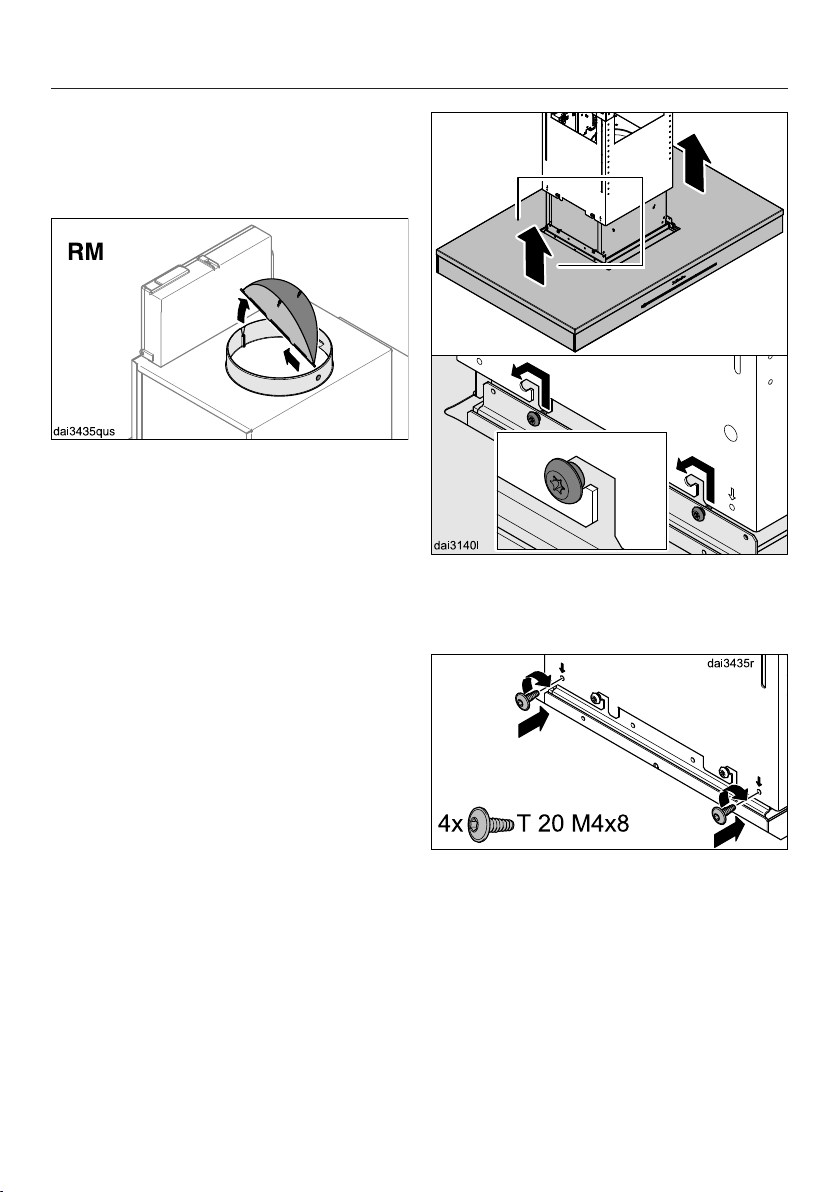
Installation
42
A non-return flap is supplied with the
hoo
d or is already fitted in the exhaust
socket of the motor unit (depending on
model).
W
ith vented mode (AE) insert the
non-return flap in the exhaust socket
if your ducting system is not equip‐
ped with one.
Recirculation mode (RM) does not re‐
quire the non-return flap to be insert‐
ed. If there is one present, it should
be removed.
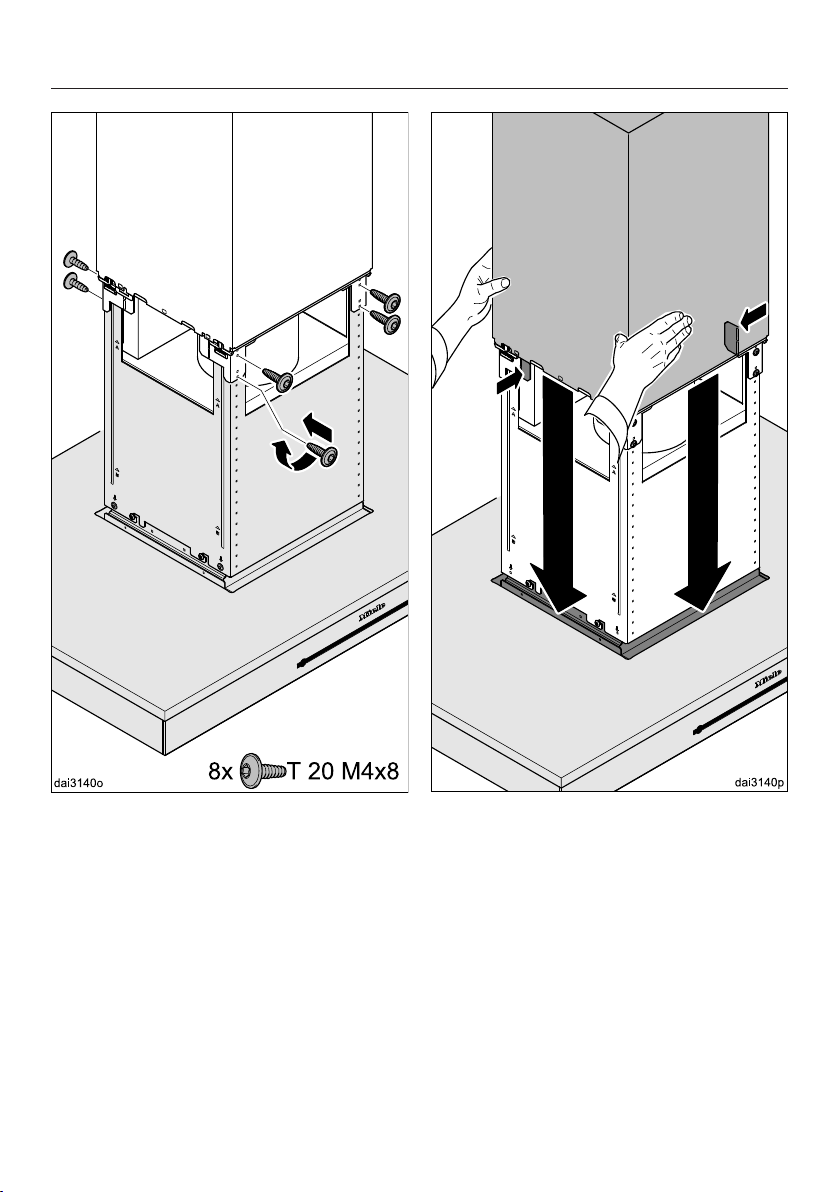
Han
g the hood on the brackets, mak‐
ing sure that the controls are at the
front.
Secur
e the hood with the screws
supplied.
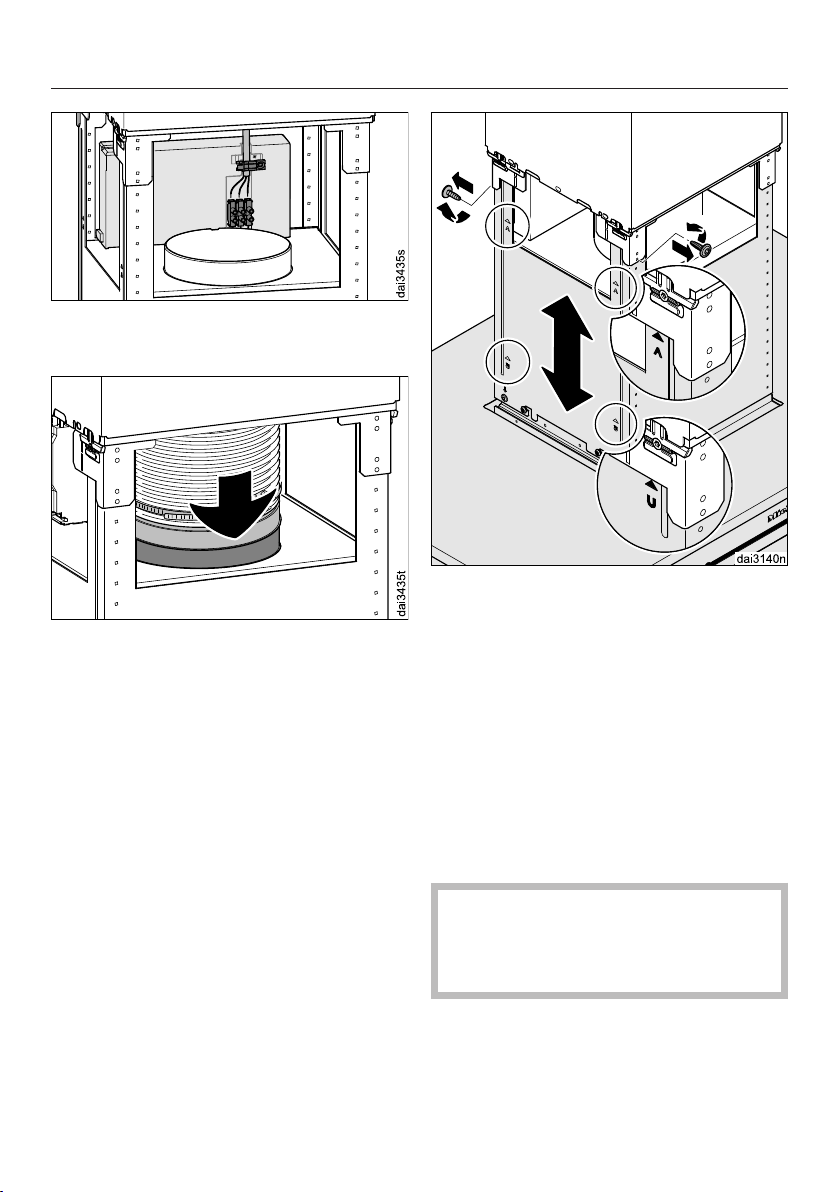
Installation
43
Co
nnect the power cord. See "Elec‐
trical connection."
Place
the exhaust ducting onto the
exhaust socket.
Unsc
rew both screws from the instal‐
lation frame again.
The canopy can now be adjusted to the
desir
ed height, observing the permissi‐
ble height ranges:
– With vented mode: upwards as far as
it will go
, downwards only to the "A"
marking.
– With recirculation mode: upwards as
far as the "U",
downwards as far as it
will go.
Follow the instructions in "Appliance
dimensions." Safety distances be‐
tween the co
oktop and ventilation
hood must be observed.
Installation
44
Raise the canopy to the desired
height and secure it with the screws.
Ho
ld the chimney securely, bend
back the retaining tabs and carefully
lower it.
The chimney will locate in the cut-out in
the cano
py.
Installation
45
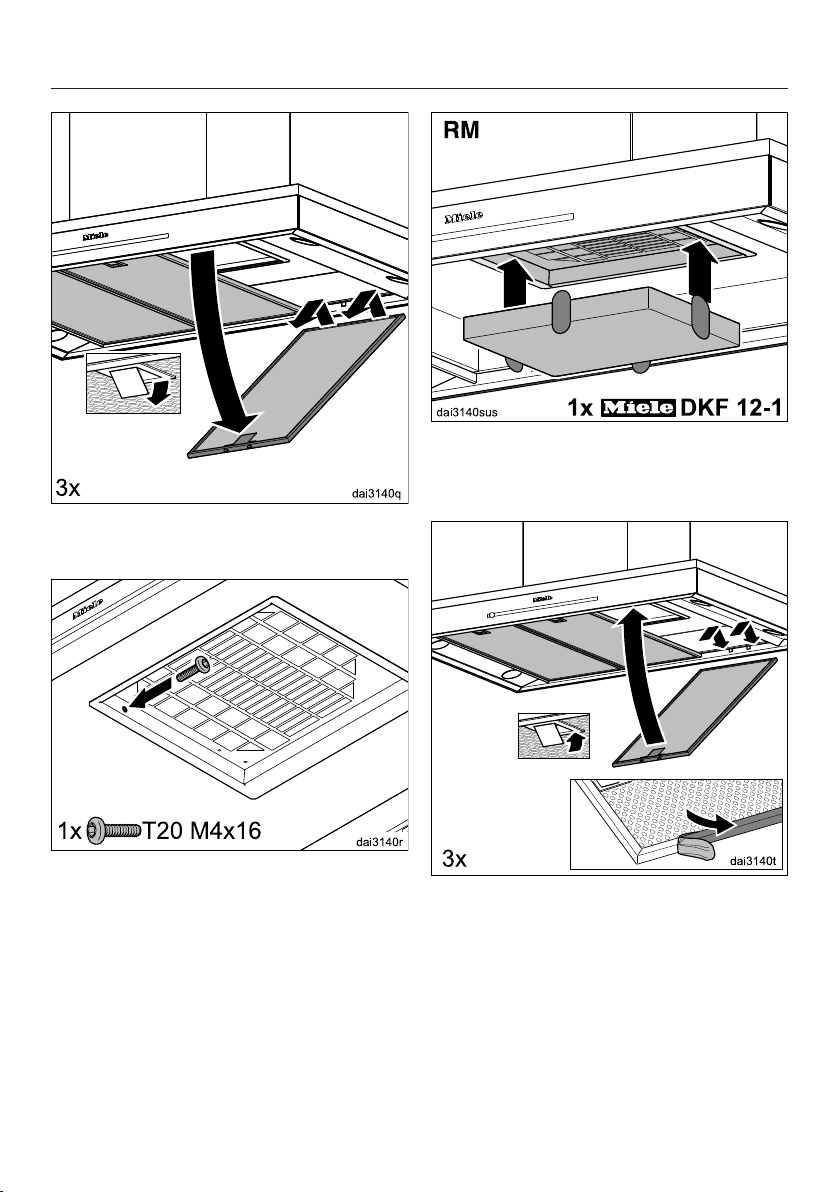
Remo
ve the grease filters from the
hood.
Insert the safety screw on the inside.
W
ith recirculation mode (RM) ventila‐
tion hoods, insert the OdorFree Char‐
coal Filter.
C
arefully remove the protective foil
from the grease filters.
Rein
sert the grease filters.
Exhaust duct
46
WARNING: Danger of toxic fumes.
Gas cooking appliances release car‐
bon monoxide that can be harmful or
fatal if inhaled.
To reduce the risk of fire and to prop‐
erly e
xhaust air, the exhaust gases
extracted by the hood should be
vented outside of the building only.
Do not vent exhaust air into spaces
within walls or ceilings or in attics,
cr
awl spaces or garages.
To reduce the risk of fire, only use
metal ductwork.
Please read and follow the "IMPOR‐
T
ANT SAFETY INSTRUCTIONS" to
reduce the risk of personal injury.
Follow all local building codes when
installing the hood.
Only use smooth pipes or flexible
duct hoses made from non-flamma‐
ble materials for exhaust ductwork.
T
o achieve the greatest possible air
extraction with the lowest noise lev‐
els, please note the following:
– The diameter of the exhaust duct
should not be less than 6" (150 mm).
– If flat exhaust ducts are used, the
cross section should not be smaller
than that of the exhaust connector.
– The exhaust duct should be as short
and str
aight as possible.
– If elbows are needed, make sure they
have
a large radius.
– The exhaust duct itself must not be
kin
ked or compressed.
– Make sure that all connections are
secu
re and airtight.
Remember that any constriction of
the airflow will reduce extraction per‐
formance and increase operating
noise.
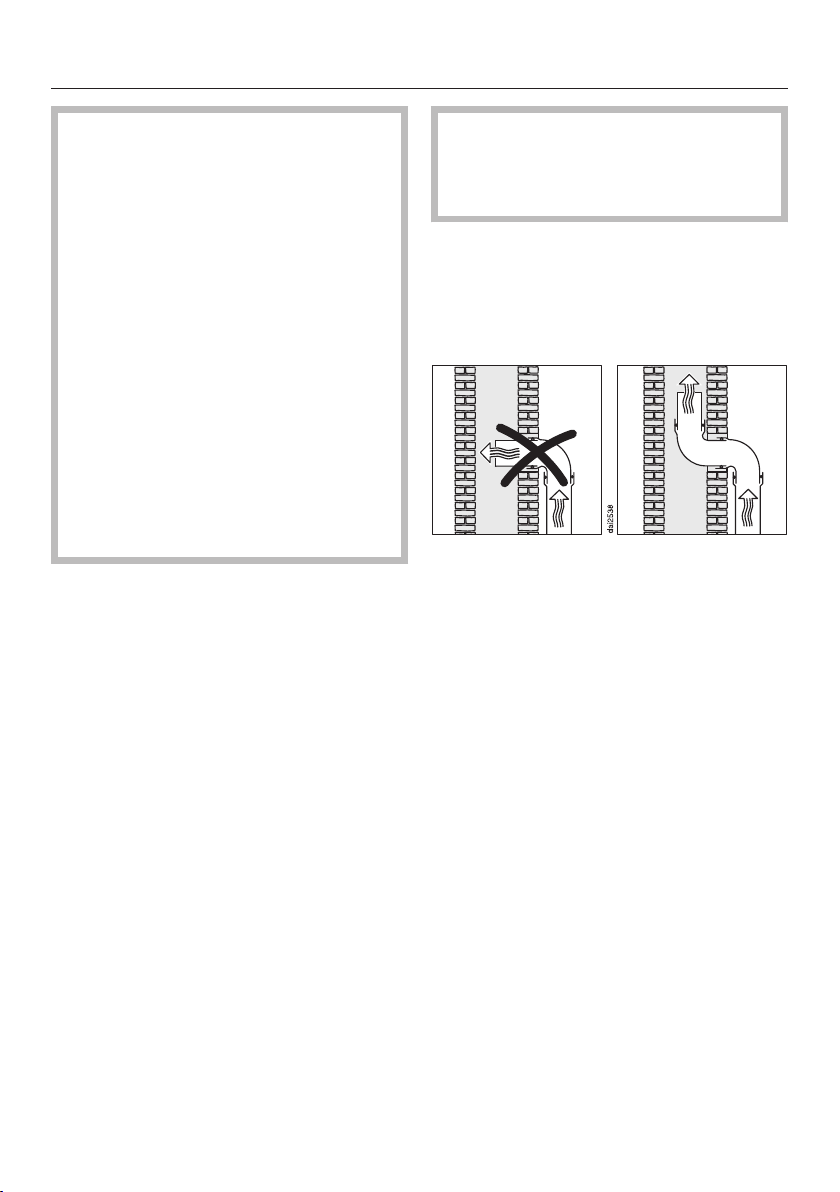
If the e
xhaust duct is to be routed
through an outside wall, we recom‐
mend installing a telescopic wall vent
or a rooftop vent (available as an op‐
tional accessory).
If the e
xhaust air is to be conducted
into a vent flue, the intake piece must
be aligned with the flow direction of
the flue.
When insta
lling the exhaust duct hor‐
izontally, you must slope it away from
the source by at least 1 cm per meter
(3/8" per 3 1/4'). This ensures that
condensate cannot drain back into
the ventilation hood.
If the e
xhaust duct is to be routed
through rooms, ceiling space etc., the
temperatures in these different areas
may differ greatly, which means that
the problem of condensation will
need to be addressed. The exhaust
duct will need to be insulated.
Exhaust duct
47
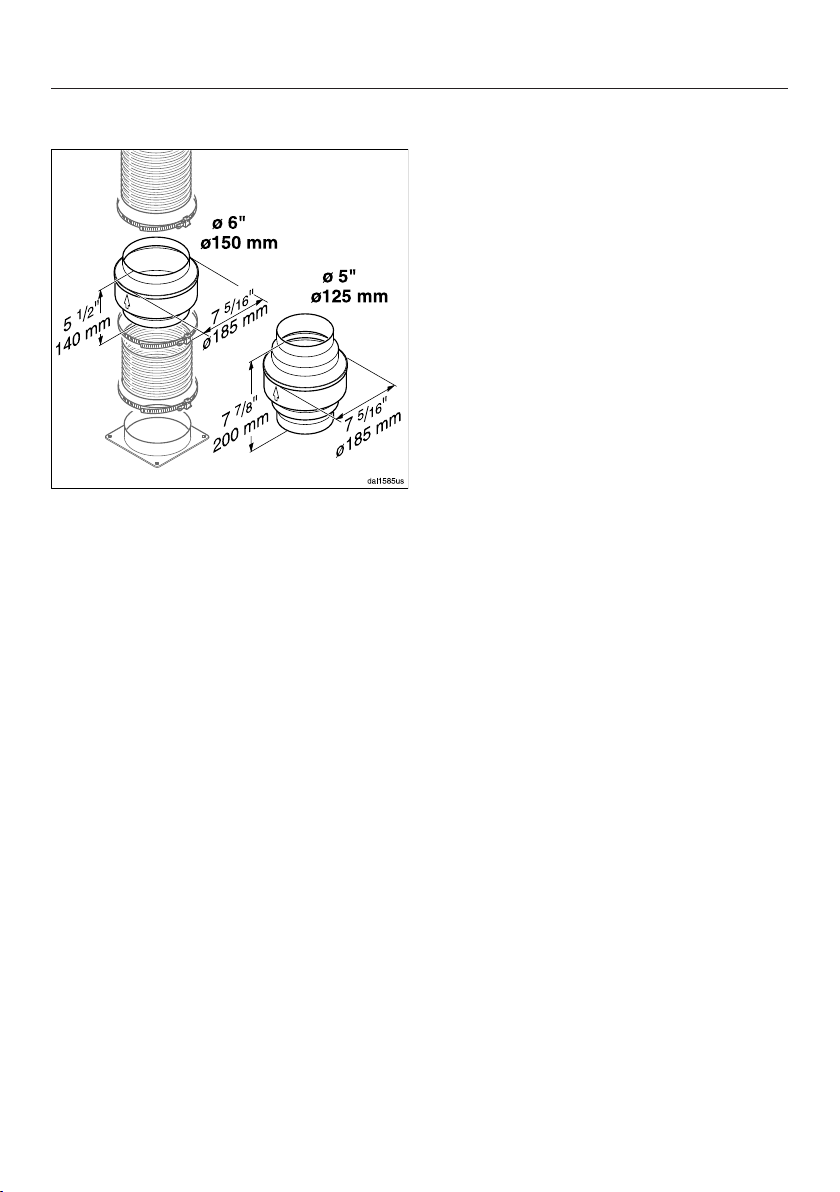
Condensate trap
In addition to insulating the exhaust
duct, w
e recommend installing a con‐
densate trap to collect and evaporate
any condensate which might accumu‐
late.
Condensate traps are available for ex‐
haust ducts with a diameter of 5"
(125 mm) or 6" (150 mm).
When insta
lling a condensate trap,
make sure that it is positioned verti‐
cally and, if possible, directly above
the hood outlet duct collar.
The arrow on the housing indicates
the direction of airflow.
Electrical connection
48
WARNING: TO REDUCE THE RISK
OF FIRE, ELECTRIC SHOCK, OR IN‐
JURY TO PERSONS, OBSERVE THE
FOLLOWING:
All electrical work should be per‐
formed by a qualified electrician in
strict acc
ordance with national regu‐
lations (for USA: ANSI-NFPA 70) and
local safety regulations. Installation,
repairs and other work by unqualified
persons could be dangerous.
Ensure that power to the appliance is
OFF whil
e installation or repair work
is performed.
Verify that the voltage, load and cir‐
cui
t rating information found on the
data plate (located behind the baffle
filters), match the household electri‐
cal supply before installing the hood.
Use only with ventilation hood cord-
connection kits that have been in‐
vestig
ated and found acceptable for
use with this model hood.
If there is any question concerning
the electrical connection of this ap‐
plian
ce to your power supply, please
consult a licensed electrician or call
Miele’s Technical Service Depart‐
ment.
WARNING: THIS APPLIANCE MUST
BE GROUNDED
Grounding Instructions
WARNING - Improper grounding can
r
esult in a risk of electric shock.
This appliance must be grounded. In
the even
t of an electrical short cir‐
cuit, grounding reduces the risk of
electric shock by providing a path of
least resistance.plug.
If there is any doubt, have the elec‐
trical system of the house checked
by a qualified electrician.
To increase security before the ma‐
chi
ne is installed, it is recommended
to install a protective switch(30mA).
The
hood must be hard wired ac‐
cordingly:
Black/Red wire: connect to L1 (live)
White wire: connect to N (neutral)
Green wire: connect to GND (ground)

Activating Con@ctivity 2.0
49
Installation of the Con@ctivity
2.0 stick
In order for you to be able to use the
Con@ctivity 2.0 function, the cookt
op
must be equipped with a Con@ctivity
2.0 stick.
See the r
elevant installation instruc‐
tions of the Con@ctivity 2.0 stick.
Activating the Con@ctivity 2.0
function
To use the Con@ctivity 2.0 function, the
r
adio link between the cooktop and the
ventilation hood must be activated.
Both appliances must be installed and
oper
ational.
Wireless connection must be activated
on the ven
tilation hood and the cooktop
at the same time. Activation on the ven‐
tilation hood is described below.
Activation on the cooktop is described
in the relevant operating and installation
instructions. Please refer to the operat‐
ing instructions before starting.
Activate the ventilation hood first, then
the cooktop.
Activating the ventilation hood
Th
e cooktop and hood must be
turned off.
P
ress the delayed shut down button
for approx. 10 seconds until 1
lights up in the fan setting display.
Ne
xt, tap the following buttons in
succession:
– The 1
button,
– Then the IS
button,
– And then the lighting button .
The hood is in log on / log off mode.
If the wireless connection is already ac‐
tivat
ed, 2 and 3 will light up at the same
time.
If there is no wireless connection, 2 and
3 will flash constantly (Con@ctivity 2.0
is already activated or a remote control
is logged on).
T
o activate Con@ctivity 2.0, tap the
IS button.
The search for a wireless connection
will start.
As this is happening, begin activation
on the
cooktop.

Activating Con@ctivity 2.0
50
Activating the cooktop
While the ventil
ation hood is search‐
ing for a wireless connection, start
activation on the cooktop.
More information can be found in the
operating instructions for the cook‐
top.
When the co
oktop registers that con‐
nection has been established, con‐
firm activation on the ventilation hood
with the delayed shut-down button
515. All indicators will go out.
Confirm
activation on the cooktop.
The Con@ctivity 2.0 function is now
ready for use.
If you do not confirm within 4 minutes,
activation will be canceled.
You only need to carry out the activa‐
tion pr
ocedure once. If the appliances
are disconnected from the electricity
supply, for example during a loss of
power, they will still remain activated.
Activation failed
If a wir
eless connection cannot be
established despite activation of the
Con@ctivity function on the ventila‐
tion hood and cooktop, the function
must first be deactivated and then re‐
activated on both appliances.
Deactivating Con@ctivity 2.0
Deactivation on the ventilation hood
is simil
ar to the activation procedure.
Select the IS instead of the 1 button.
T
o deactivate the cooktop, please re‐
fer to the corresponding operating in‐
structions.
Please keep in mind that disabling the
connection will also disable any re‐
mote control function being used. The
remote control must then be reactivat‐
ed.

Service and warranty
51
For faults that you cannot resolve on
your own, please contact your Miele
dealer or Mie
le Technical Service.
The telephone number for the Technical
Ser
vice Department is listed at the back
of these instructions.
When contacting Miele, please state
the model and serial number of your
ventilation hood.
These
can be found on the data plate.
Location of the data plate
The data plate is visible once you have
r
emoved the grease filters.
Warranty
For further information, please refer to
your warr
anty booklet.

Technical data
52
Fan motor 350 W
Overhead lighting 4 x 3 W
Total connected load 362 W
Voltage, Frequency 120 V AC, 60 Hz
Fuse rating 15 A
Power cord length 6.5 ft. (2 m)
Weight
Optional accessories for recirculation mode:
Recirculation kit DUW 32 and OdorFree Charcoal Filter DKF 12
Contains
FCC
ID: 2ACUWEI8800
IC: 5669C-EI8800
This device complies with Part 15 of the FCC Rules and with Industry Canada li‐
cence-exempt RSS standard(s). Operation is subject to the following two condi‐
tions: (1) this device may not cause harmful interference, and (2) this device must
accept any interference received, including interference that may cause undesired
operation.


9 Independence Way
Princeton, NJ 08540
Phone:
Fax:
www.mieleusa.com
U.S.A.
Miele, Inc.
National Headquarters
Please have the model and serial number
of your appliance available before
contacting Technical Service.
Canada
Importer
Miele Limited
Headquarters and Miele Centre
800-843-7231
609-419-9898
609-419-4298
Technical Service & Support
Nationwide
Phone:
Fax:
T
161 Four Valley Drive
Vaughan, ON L4K 4V8
www.miele.ca
800-999-1360
888-586-8056
Customer Care Centre
Phone:
800-565-6435
905-532-2272
Germany
Manufacturer
Miele & Cie. KG
Carl-Miele-Straße 29
33332 Gütersloh
53

M.-Nr. 09 805 980 / 00en-US
DA 6690 D